
This post was updated on:
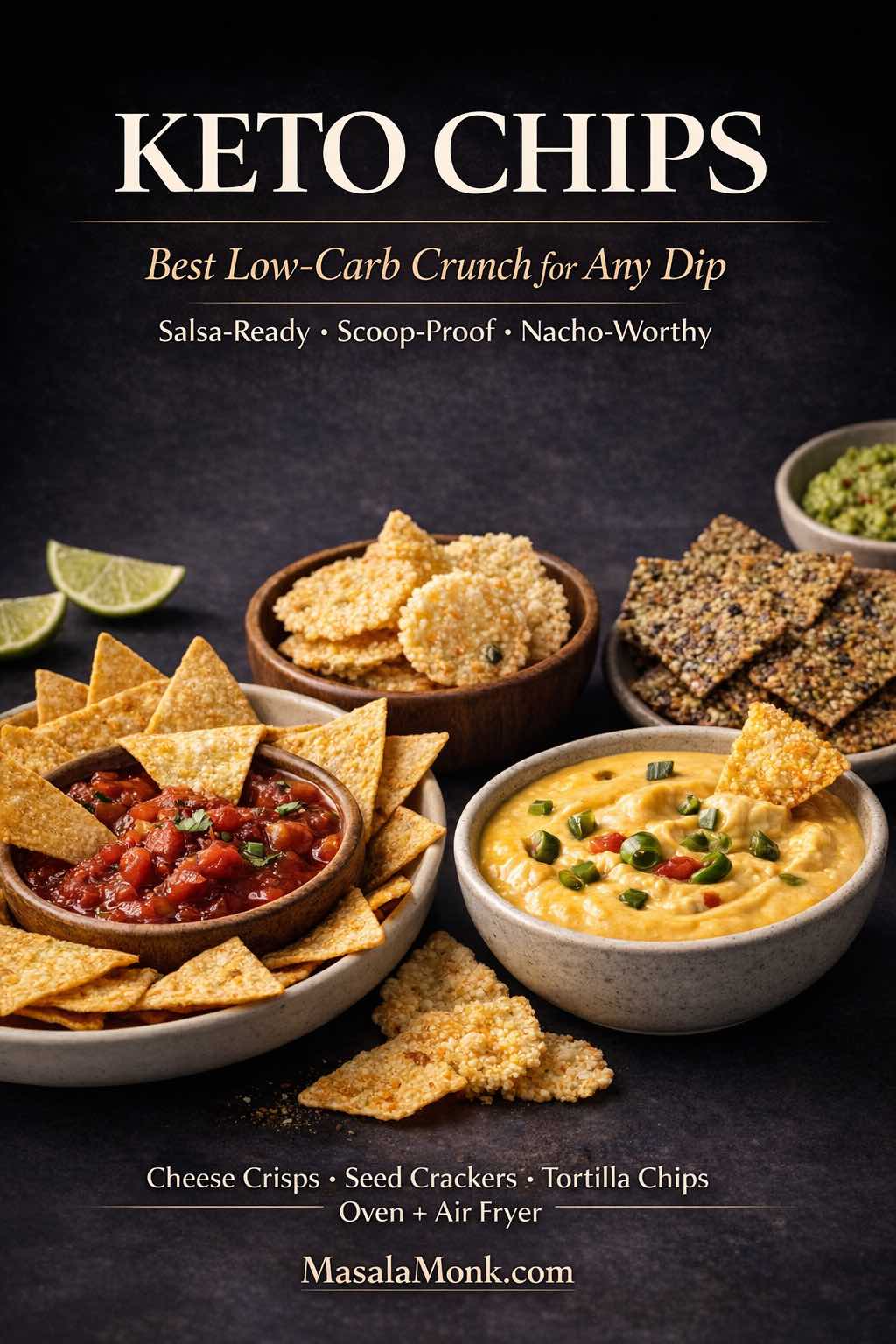
There is a very specific kind of low-carb craving that has little to do with hunger: you want something salty that snaps. The hard part is that no single keto chip does every job well. A thin tortilla-style chip can be excellent with salsa and useless with a heavy queso; a cheese crisp can scoop a thick dip beautifully but feel far richer than what you want for casual grazing.
So if you want chips on keto, this guide is organized by what you want the chip to do. You can buy something ready-made, bake a quick batch from low-carb tortillas, make cheese or seed crackers from scratch, build a nearly zero-carb crunch from pork rinds or chicken skin, or fix the texture problem that keeps turning homemade chips soft.
Jump to: quick picks · what counts as keto-friendly · store-bought · tortilla chips · cheese chips · zero/no-carb · salsa & nachos · crunch fixes
Best Keto & Low-Carb Chips at a Glance
Start with the way you plan to eat them. The best low carb chips for salsa are not necessarily the best ones for queso or nachos, so use the job to narrow the field.
| Need | Best option + why |
|---|---|
| Salsa | Extra-dry low-carb tortilla chips — familiar shape, but dry enough to survive a wet dip. |
| Thick queso or creamy dip | Cheese crisps, seed crackers, or pork rinds — stronger scoops that resist breaking. |
| Nachos | Tortilla-style chips or sturdy cheese crisps — enough structure for heat and toppings. |
| Lowest-carb crunch | Pork rinds, chicken skin, or cheese crisps — different from tortilla chips, but naturally very low in carbohydrate. |
| Everyday cracker-style snack | Seed or almond-flour crackers — easy to portion and sturdier in a snack box. |
| Spicy “hot chip” craving | Tortilla chips or cheese crisps + seasoning dust — the seasoning delivers most of the effect. |
| Store-bought | Read the serving, then do the snap test — a chip that bends in the bag usually softens quickly in dip. |
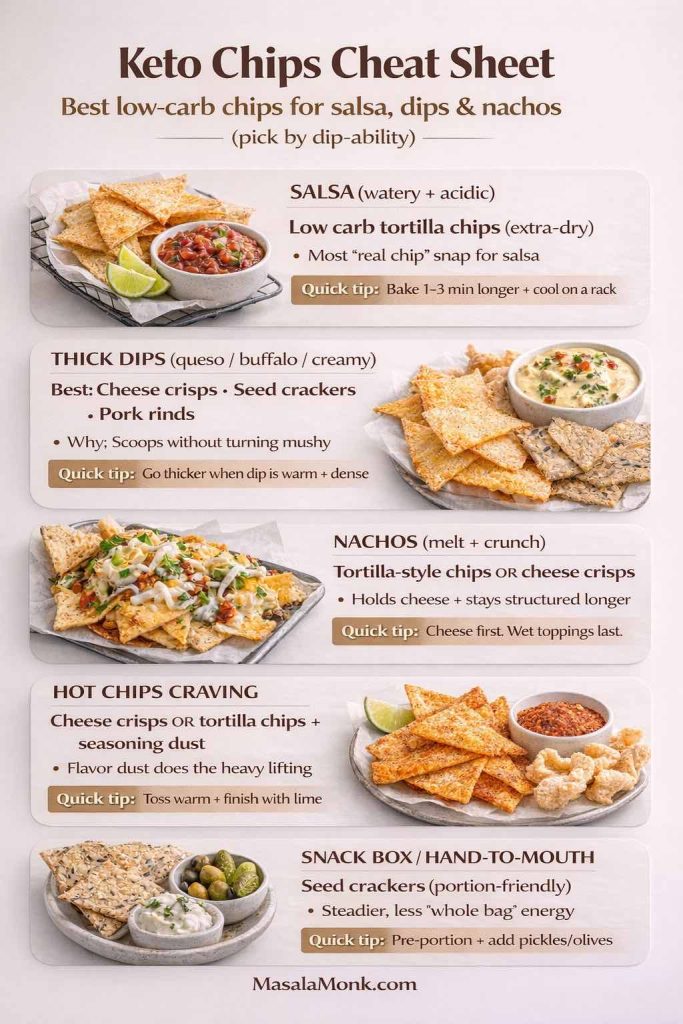
If you only keep two options around, make them different: one dry tortilla-style chip for salsa and nachos, and one sturdier option such as cheese crisps or seed crackers for thicker dips.
What Chips Are Keto-Friendly?
In practice, a chip is keto-friendly only in the context of the portion you actually eat and the carb target you are following. That can mean a naturally very-low-carb food such as a cheese crisp or pork rind, or a tortilla-style chip made from a lower-carb wrap or flour blend. The word keto on the front of a package is not enough by itself.
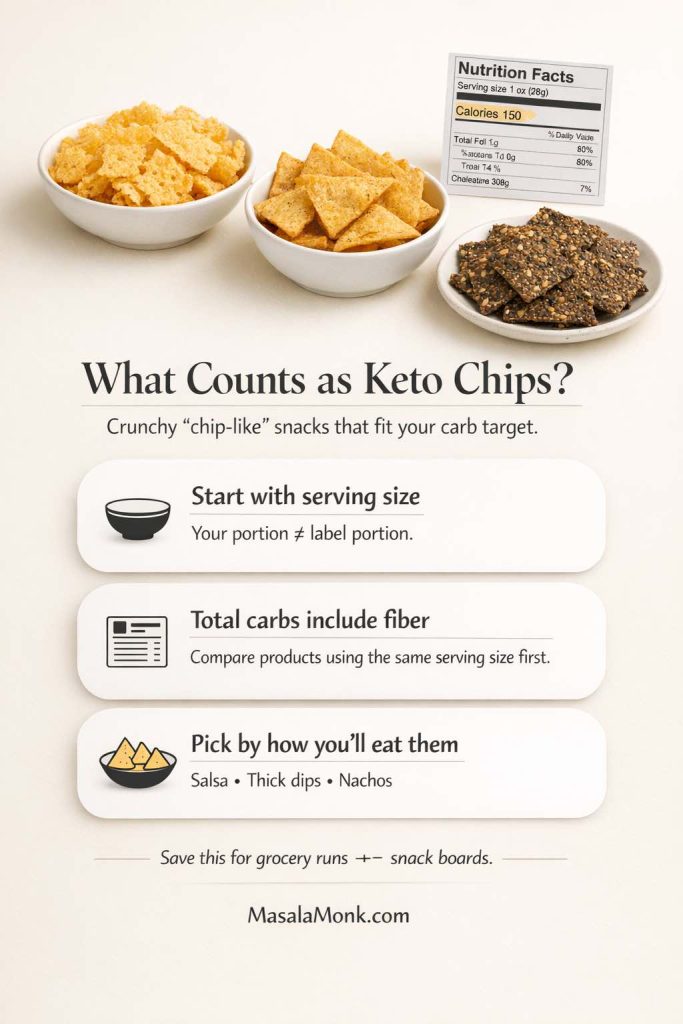
For packaged chips, read the serving size first and then the carbohydrate line. The FDA guide to the Nutrition Facts label is the useful baseline here: the numbers belong to the stated serving, not to the entire bag.
Fiber is listed within total carbohydrate on U.S. labels, which is why some high-fiber products advertise a much smaller “net carb” number. That can be useful information, but it does not make portion size irrelevant. Compare products using the same serving logic, and pay attention to how much you normally eat rather than how tidy the marketing looks.
Texture belongs in this decision too. A chip can fit your carb target and still be a bad choice for salsa because it bends or turns pasty when wet. Conversely, a sturdy cheese or seed cracker may be excellent with queso even if it does not resemble a tortilla chip at all.
Store-Bought Keto & Low-Carb Chips: What to Look For
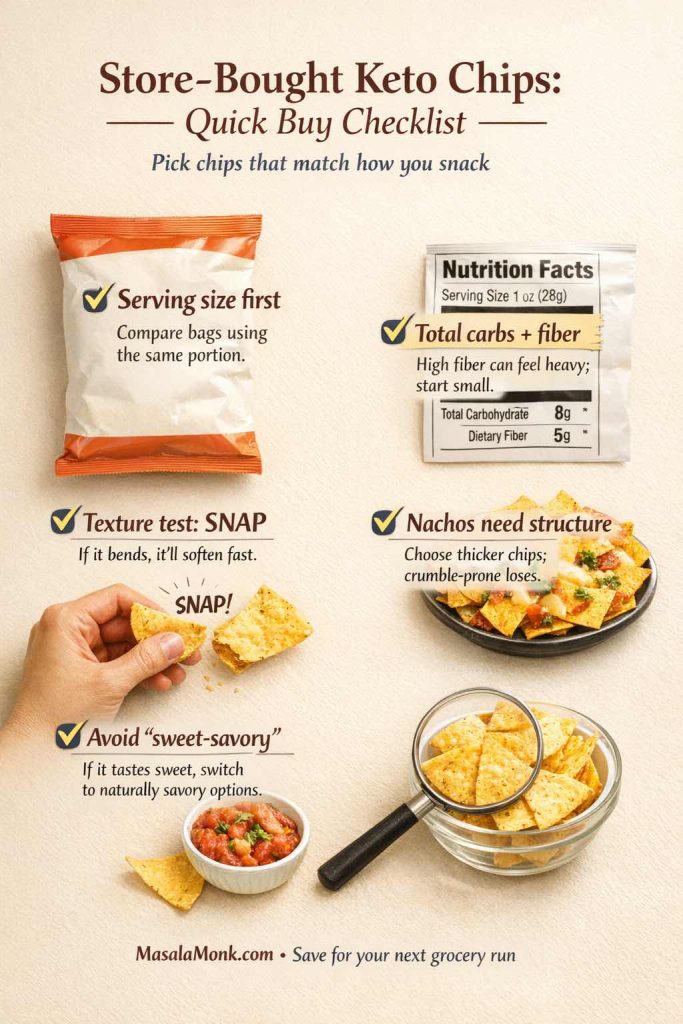
Store-bought low-carb chips differ as much in texture as they do in carb numbers. Rather than trusting a large keto or protein claim on the front of the bag, check the serving, understand what kind of chip you are buying, and then ask whether its texture matches the job.
| Type you will see | Best use + compromise |
|---|---|
| Protein tortilla-style chips | Convenient packaged snacking with familiar savory flavors, but some are brittle, powdery, or weak in wet dips. |
| Fiber-heavy tortilla-style chips | Can work well for salsa and nachos when genuinely dry; texture and fiber load vary widely between products. |
| Cheese crisps | Excellent hard crunch for thick dips, but richer, saltier, and less tortilla-like. |
| Pork rinds | Strong scoops for queso and creamy dips, but they soften quickly in watery salsa. |
| Seed/almond crackers | Sturdy for snack boxes and dense dips, though the experience is more cracker-like than chip-like. |
| Veggie crisps | Lighter snacking, but often too fragile for heavy dipping. |
Do a 15-second scan. Start with the listed serving size, then total carbohydrate and fiber. If sugar alcohols or sweeteners are present, note the amount and how the brand presents its “net carb” claim. Finally, break one chip. For salsa or nachos, a clean snap is more promising than a bend.
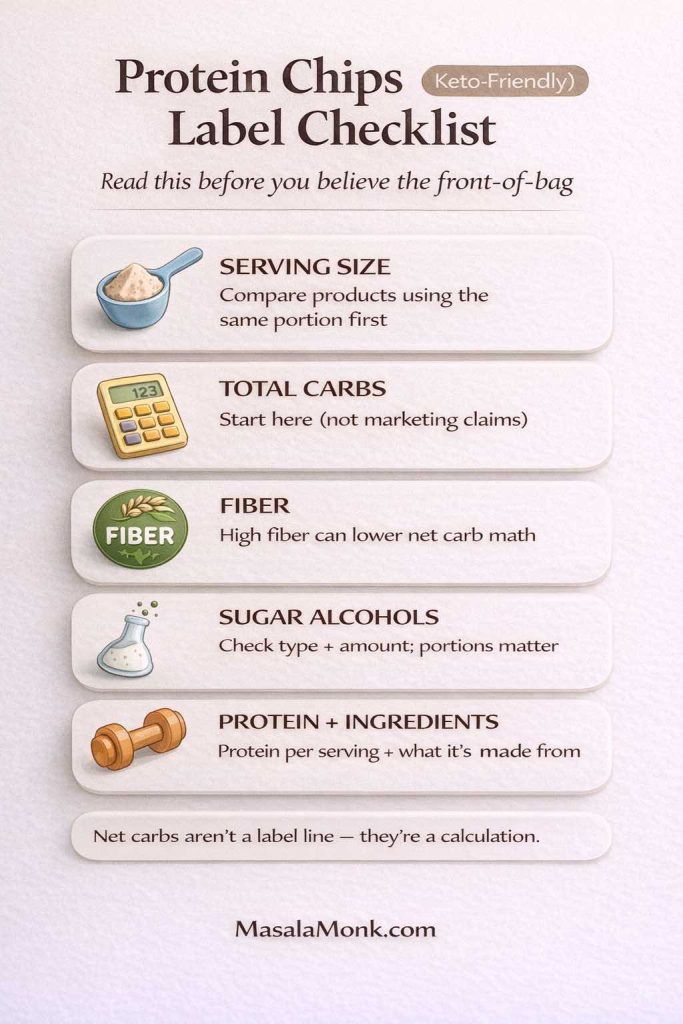
Protein chips can fit a low-carb eating pattern, but high protein does not automatically mean low carb. Some products also rely heavily on added fibers. If large servings of high-fiber snacks make you uncomfortable, start with the stated serving before deciding the bag is an everyday option.
Flavor matters too. Some lower-carb formulas leave a sweet or vanilla-like note even when the seasoning is nominally savory. If that clashes with salsa, queso, or guacamole, a naturally savory base such as cheese crisps, seed crackers, or pork rinds may simply be a better fit.
Keto Tortilla Chips: Oven + Air Fryer
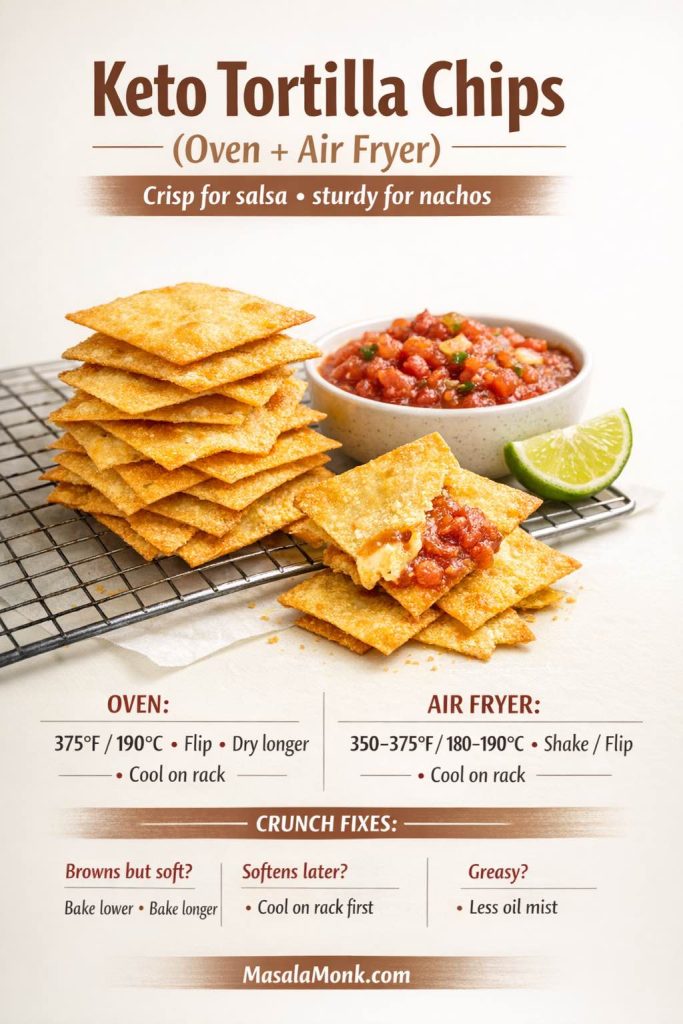
For salsa and nachos, tortilla-style chips are still the closest thing to the familiar experience. The useful mental model is drying, not merely browning: the center has to lose enough moisture to snap after cooling, not just turn golden at the edge.
Baseline batch: 4 low-carb tortillas
Yield: roughly 24–32 chips, depending on whether each tortilla is cut into 6 or 8 wedges. Oven time: usually 14–22 minutes plus cooling. Wrap thickness and fiber content can move that timing noticeably.
- 4 low-carb tortillas
- 1–2 tsp neutral or olive oil, or a very light oil spray
- ¼–½ tsp fine salt
- Optional: smoked paprika, chili powder, garlic powder, cumin, or another dry seasoning
- Heat the oven to 190°C / 375°F.
- Cut each tortilla into 6–8 similar-size wedges. Smaller, even triangles dry more predictably than large irregular ones.
- Arrange them in a single layer on one or two trays. If pieces overlap, steam gets trapped between them.
- Use just enough oil to lightly coat the surfaces, then season.
- Bake for 8–12 minutes, flip, then bake another 6–10 minutes.
- Move the chips to a rack for about 10 minutes before judging the texture.
The doneness test: pick up a fully cooled chip and bend the center. If the edges crack but the middle still folds, it is browned but not dry. Return the batch to a slightly lower oven for a few more minutes. If the center snaps cleanly, it is ready for salsa.
Very high-fiber wraps can behave differently from ordinary tortillas: some brown early while the center stays flexible. In that case, lower the heat a little and extend the drying time rather than pushing the color darker. Add wet finishes such as lime only after baking; moisture added before storage works against the crispness you just created.
Air fryer: faster for a small batch
Set the air fryer to about 180–190°C / 350–375°F. Work in a single layer, lightly oil and season the wedges, then cook for 4–6 minutes. Flip or shake and continue for another 2–5 minutes. Cool before deciding whether the chips need another minute or two; warm chips can feel softer than they will once the steam has escaped.
The first batch is calibration. If the chips taste bitter, a spice may be scorching before the tortilla dries; season more lightly before cooking and add delicate spices afterward. If they feel greasy, cut the oil rather than extending the bake.
From-scratch almond-flour tortilla chips
If you want control over the dough as well as the bake, almond flour is the sturdier route. For more on why low-carb flours behave so differently, see the MasalaMonk keto flour guide.
- 1½ cups almond flour
- 1 tbsp psyllium husk powder
- ½ tsp salt
- 1 tsp baking powder, optional
- 1 egg
- 2 tbsp olive oil
- 3–6 tbsp warm water, as needed
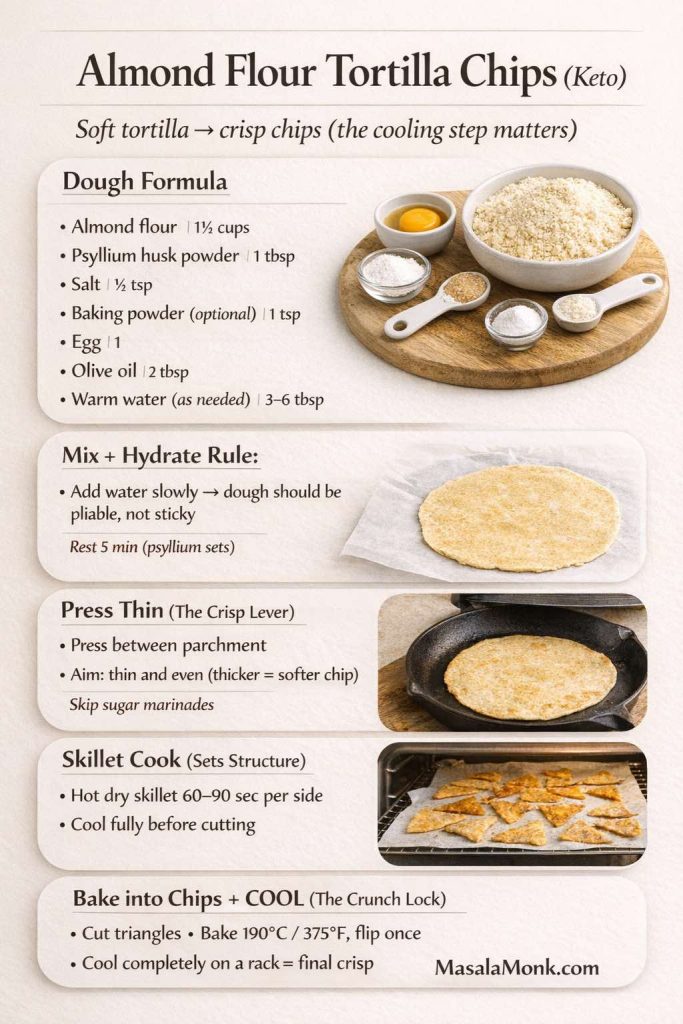
- Mix the dry ingredients, then add the egg and oil.
- Add warm water gradually until the dough is pliable rather than sticky.
- Divide into 4–6 balls and press each very thinly between parchment. Aim for an even sheet; thick patches stay chewy.
- Cook on a hot dry skillet for about 60–90 seconds per side to set the tortilla.
- Cool, cut into triangles, then bake at 190°C / 375°F until dry and crisp, flipping once.
- Cool on a rack before serving.
If a cooled almond-flour chip bends through the center, roll the next batch thinner or give the cut chips more oven time. The skillet sets the structure; the oven removes the moisture.
Coconut-flour tortilla chips: thinner and more delicate
- 2 tbsp coconut flour
- 2 eggs
- 2 tbsp water
- 1 tbsp olive oil
- Salt
- Pinch of baking powder, optional
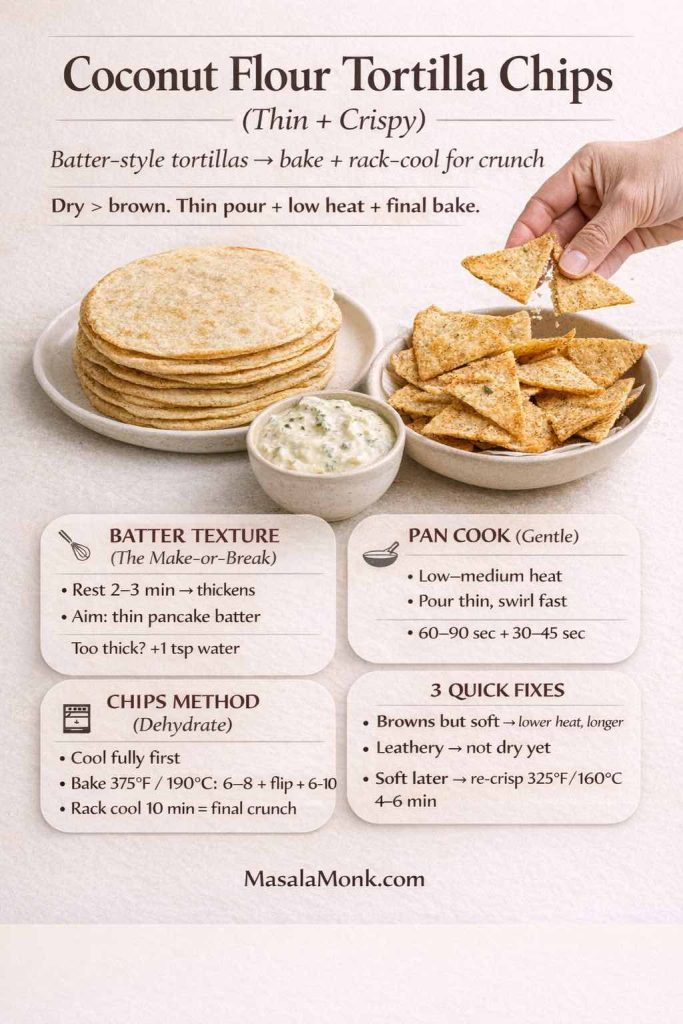
Whisk everything and let the batter stand for about two minutes so the coconut flour hydrates. Cook thin circles gently in a lightly oiled skillet, flipping only when the first side has enough structure to release. Cool, cut, then bake until the pieces feel dry. These are less forgiving than almond-flour chips, so treat them as a delicate salsa chip rather than a heavy queso scoop.
For storage and re-crisping, jump to How to Keep Keto Chips Crispy rather than repeating the same instructions here.
Keto Cheese Chips & Parmesan Crisps
Cheese crisps are the quickest route to a hard, salty crunch. Parmesan dries into a thinner, harder wafer; cheddar gives more body. A blend sits between the two and works especially well when the chip needs to carry a thick dip.
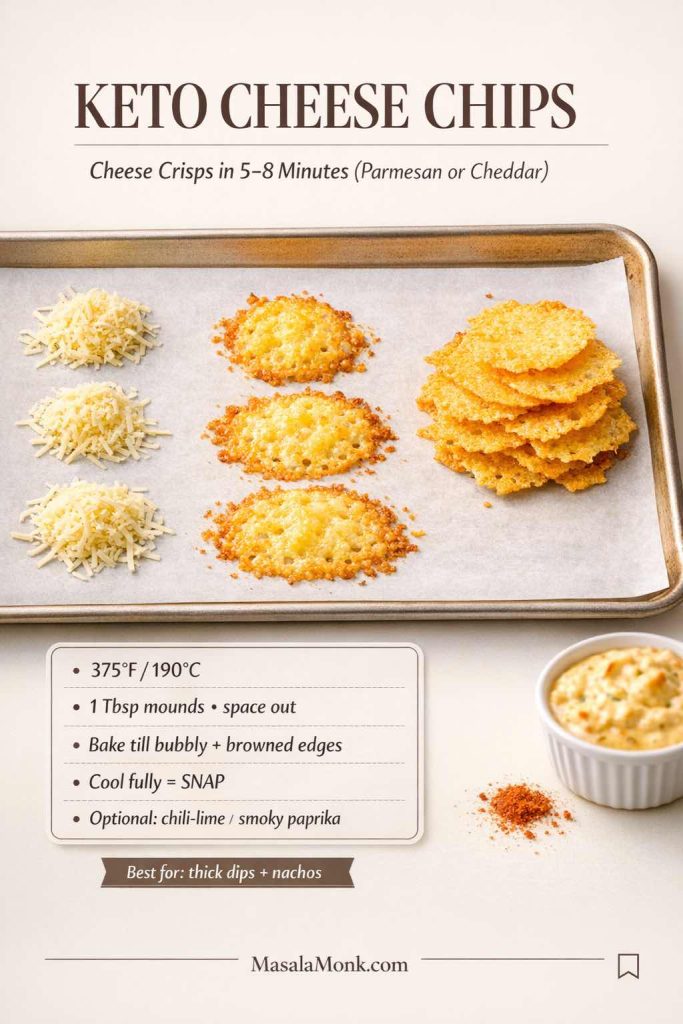
Basic parmesan or cheddar crisps
Baseline batch: 1 cup finely shredded cheese makes about 12–16 small crisps, depending on how large you make the mounds. Allow roughly 5 minutes to portion, 5–8 minutes to bake, and 5–10 minutes to cool.
- 1 cup finely shredded parmesan, cheddar, or a mix
- Optional: smoked paprika, chili powder, garlic powder, black pepper, or dried oregano
- Heat the oven to 190°C / 375°F and line a tray with parchment.
- Place roughly tablespoon-size mounds of cheese on the tray, leaving room for them to spread.
- Season lightly.
- Bake for about 5–8 minutes, until the edges are amber and the bubbling has slowed.
- Leave the crisps to cool before lifting them. Warm cheese is flexible; the snap develops as it cools.
For a sturdier dipping crisp, make the mounds slightly thicker or mix parmesan with cheddar. If the finished crisp shatters the moment it touches queso, the next batch needs a little more body—not necessarily more baking.
If cheese is becoming a regular snack base, the separate guide to carbs in cheese from a keto perspective is useful for comparing varieties rather than treating every cheese as nutritionally identical.
Scoopable cheese crackers
- 1 cup shredded cheddar
- ⅓ cup finely grated parmesan
- 1 egg white
- 1–2 tsp psyllium husk powder, optional
- Garlic powder, paprika, and black pepper
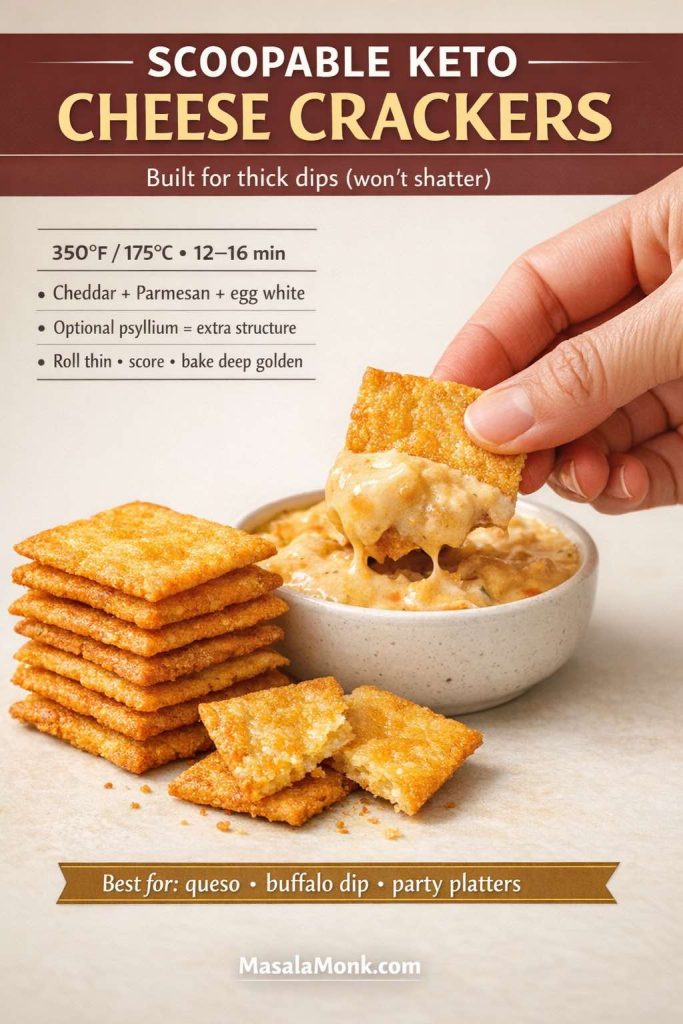
Mix into a sticky dough, roll between parchment to roughly 2–3 mm, score into squares, and bake at 175°C / 350°F for 12–16 minutes. Look for a deeply golden sheet with dry edges. Cool before snapping along the score lines.
Cottage-cheese chips need dehydration, not just browning
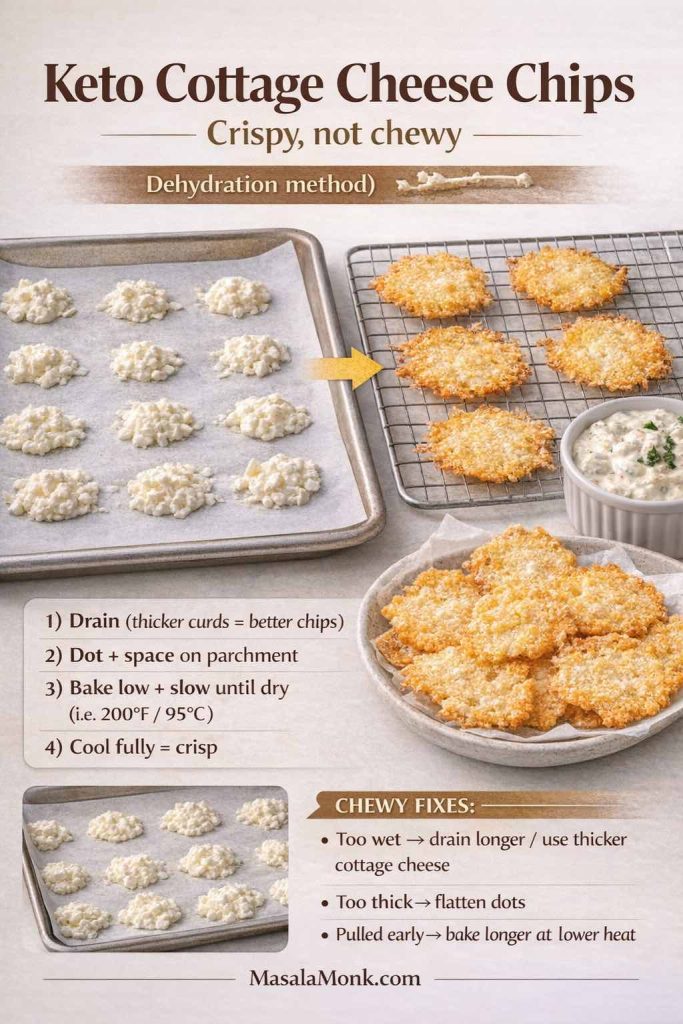
Drain cottage cheese thoroughly before it hits the tray. Spoon small, thin portions with space around each one; thick dollops tend to brown outside while staying chewy in the middle. Bake at a lower temperature than ordinary cheese crisps until the chips look dry rather than merely golden, then cool completely. If a batch stays flexible after cooling, the next adjustment is usually less moisture or thinner portions, not more seasoning.
Seed & Almond-Flour Crackers
Seed crackers are the quiet workhorse of this list: less rich than cheese crisps, sturdier than many tortilla-style chips, and easy to portion into snack boxes. The critical variable is thickness.
Crisp seed crackers
- ½ cup flaxseed meal
- 2 tbsp chia seeds
- 2 tbsp sesame seeds, optional
- ½ tsp salt
- 1 cup water
- Garlic powder, paprika, cumin, or dried herbs, optional
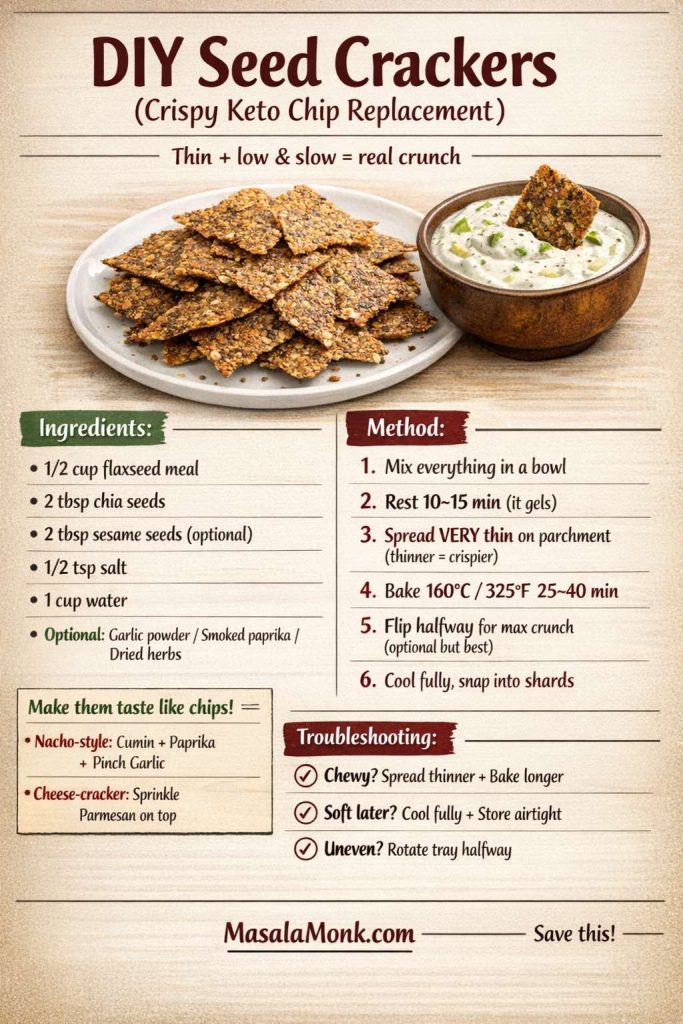
- Mix everything and let it stand for 10–15 minutes, until the water has turned the seeds into a cohesive gel.
- Spread the mixture thinly and as evenly as possible on parchment.
- Bake at 160°C / 325°F for about 25–40 minutes, depending on thickness.
- For a very crisp sheet, flip it partway through once it is firm enough to handle.
- Cool completely before breaking into shards.
The visual cue is dryness through the center. If the edge snaps but the middle flexes, the sheet needs more time. A nacho-style version can take cumin, paprika, and garlic; a light parmesan dust makes the same base more savory.
Almond-flour crackers
- 1¼ cups almond flour
- 1 tbsp psyllium husk powder
- ½ tsp salt
- ½ tsp baking powder
- 1 egg
- 1 tbsp olive oil
- 2–4 tbsp water, as needed
- Sesame seeds or everything-style seasoning, optional
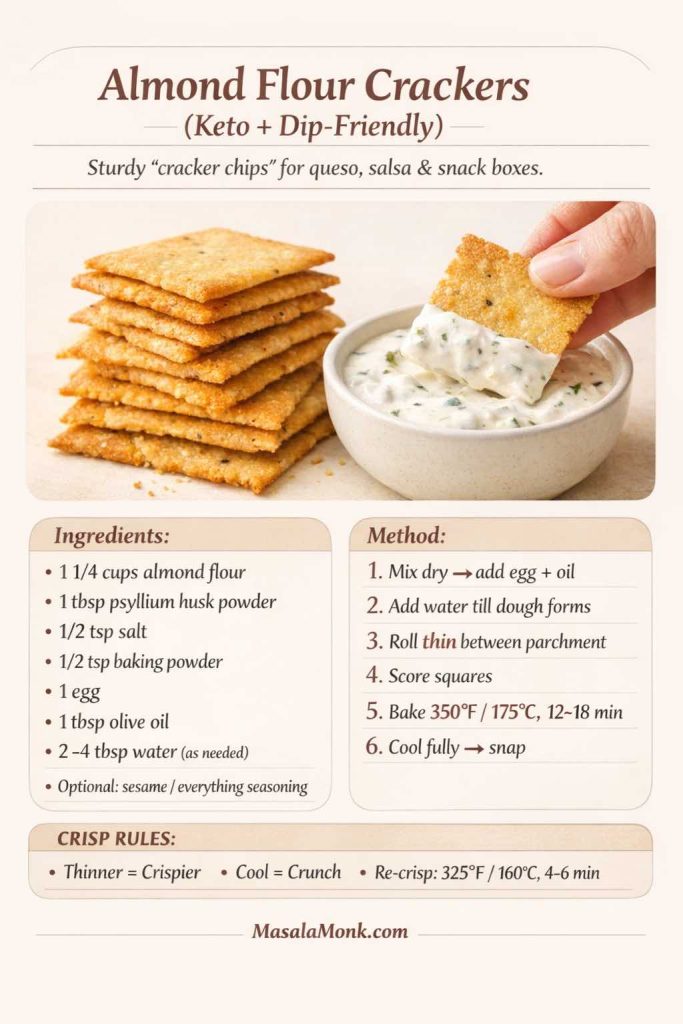
Heat the oven to 175°C / 350°F. Mix the dry ingredients, then add the egg and oil. Add only enough water to make a workable dough. Roll thinly between parchment, score, and bake for 12–18 minutes. The center squares should look as dry as the edge pieces; pale, soft centers usually mean the sheet was too thick or needs more time.
Zero-Carb and Nearly Zero-Carb Chips
When people search for no carb chips or zero-carb chips, the useful answers usually stop looking like tortilla chips. Pork rinds, chicken skin, cheese crisps, and meat-based snacks can get much closer to the carb target because the base is fat and/or protein rather than flour.
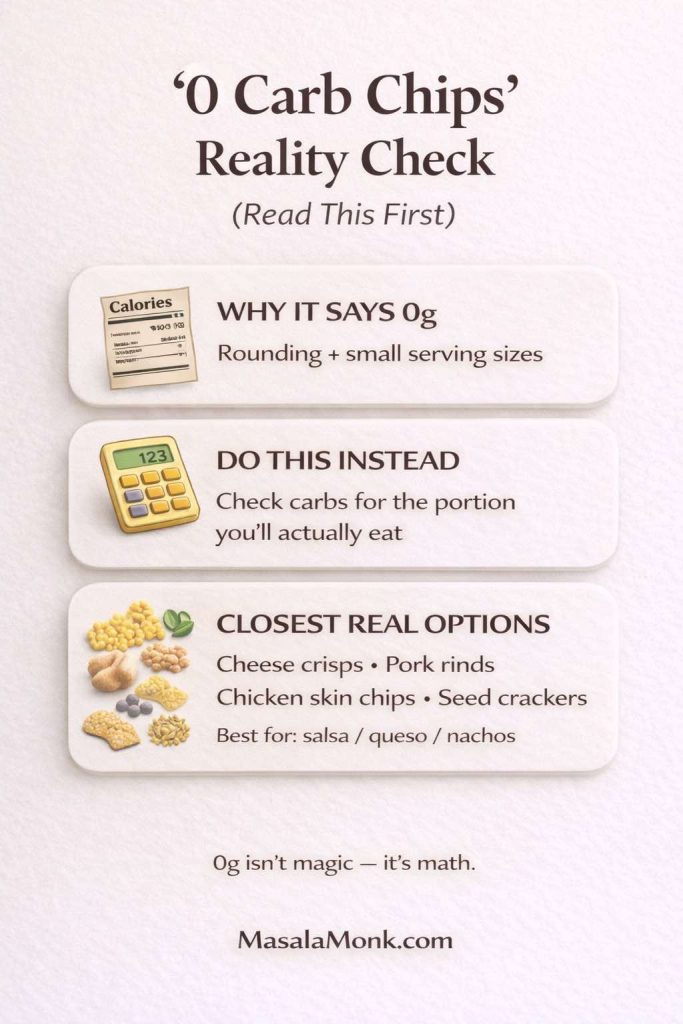
Pork rinds: strongest with thick dips
Pork rinds are naturally scoopable because of their curled, airy structure. They work particularly well with queso and creamy dips, but watery salsa softens them quickly.
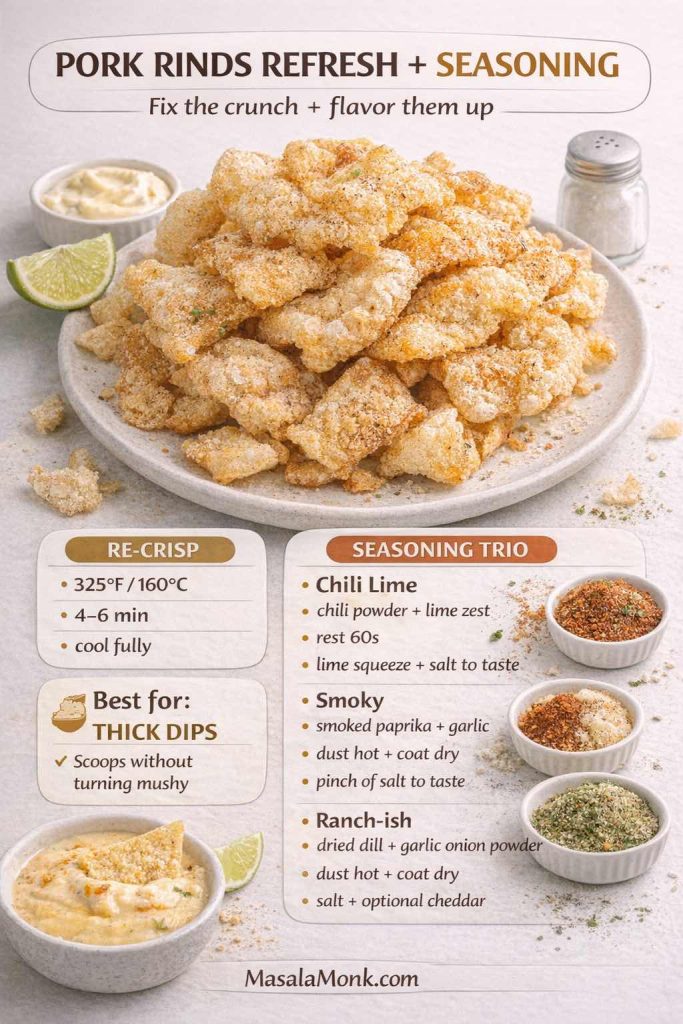
If an open bag has merely lost its snap, warm the rinds at about 160°C / 325°F for 4–6 minutes, then cool. That can refresh texture; it cannot fix stale or rancid flavor. Season after warming with chili-lime, smoked paprika and garlic, or a dill-and-garlic blend.
Chicken skin chips
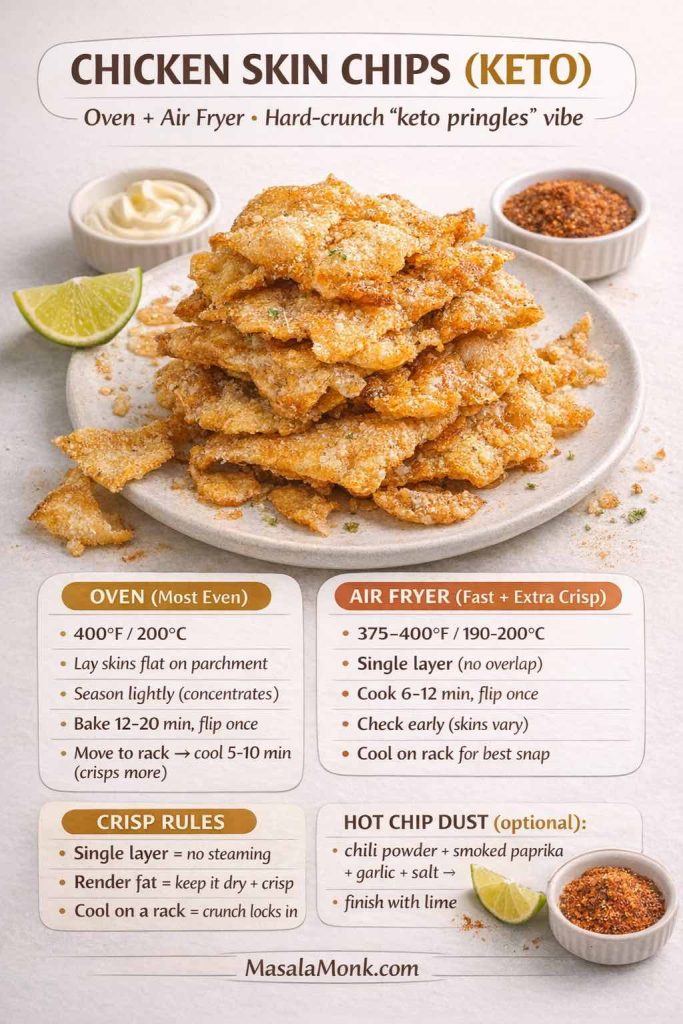
Lay chicken skins flat in a single layer, season lightly, and bake around 200°C / 400°F until deeply crisp, flipping once; an air fryer around 190–200°C / 375–400°F can work for smaller batches. Because this starts with raw poultry, use a food thermometer and make sure the pieces reach 74°C / 165°F before serving. USDA identifies 165°F as the safe minimum internal temperature for poultry.
The texture continues to firm as rendered fat drains and the skins cool. If the pieces are crowded, they steam; if they are heavily seasoned before cooking, the seasoning can become harsh as the skins shrink.
Jerky-style meat crisps: safety comes before extra crunch
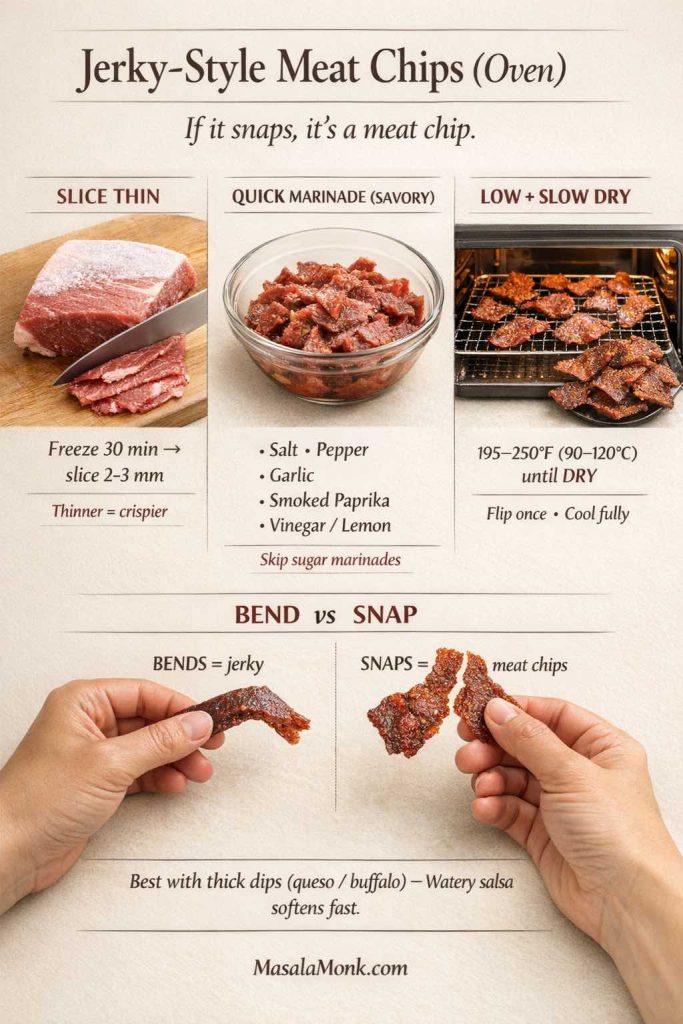
Do not simply put raw beef into a very low oven and wait for it to dry. USDA’s current home-jerky guidance recommends heating meat to 71°C / 160°F (and poultry to 74°C / 165°F) before dehydrating, because low-temperature drying alone may not destroy pathogens. See USDA’s home jerky guidance for the full process.
If you want a crisper, chip-adjacent texture after that safe heating step, continue drying in a dehydrator or controlled low oven until the strips are drier than ordinary jerky, watching closely near the end. Treat the graphic as a texture idea, not as a shortcut around the safe heat step.
Keto Veggie Chips: Lighter Crunch, Different Job
Veggie chips are useful when cheese- and meat-based snacks feel too rich, but they should be judged on their own terms. Their enemy is water, and the fix is almost always more drying rather than more oil.
Kale chips
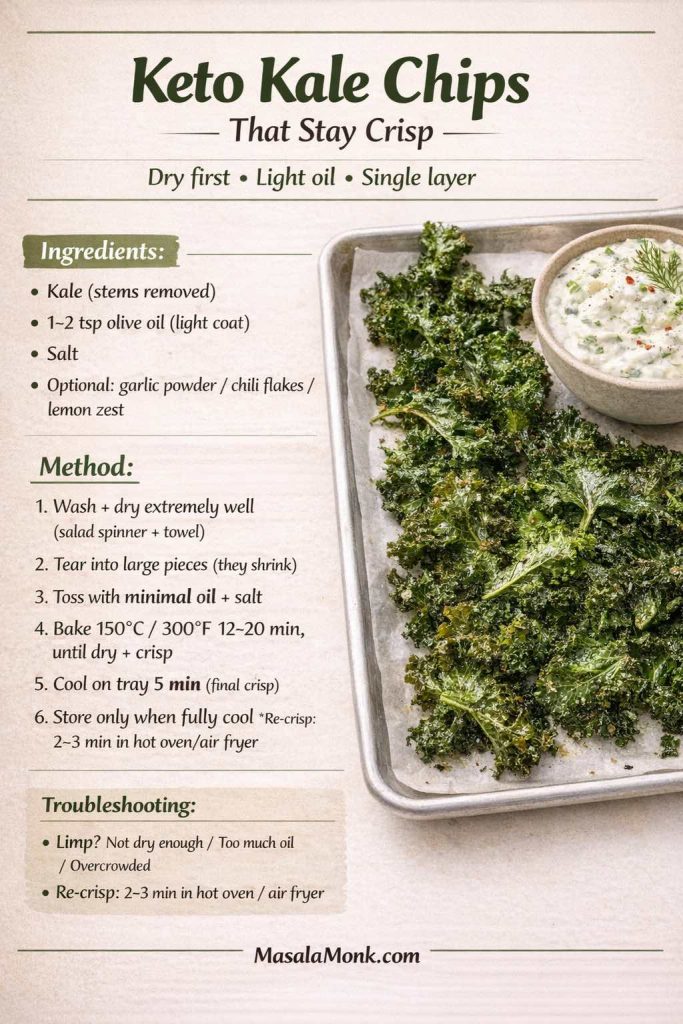
Remove thick stems, wash, and dry the leaves thoroughly. Massage with just enough oil to barely coat the surface, then bake around 150°C / 300°F until the leaves feel papery and crisp. If the kale is darkening while still leathery, the leaves were probably wet or over-oiled.
Zucchini, radish, and similar watery vegetables
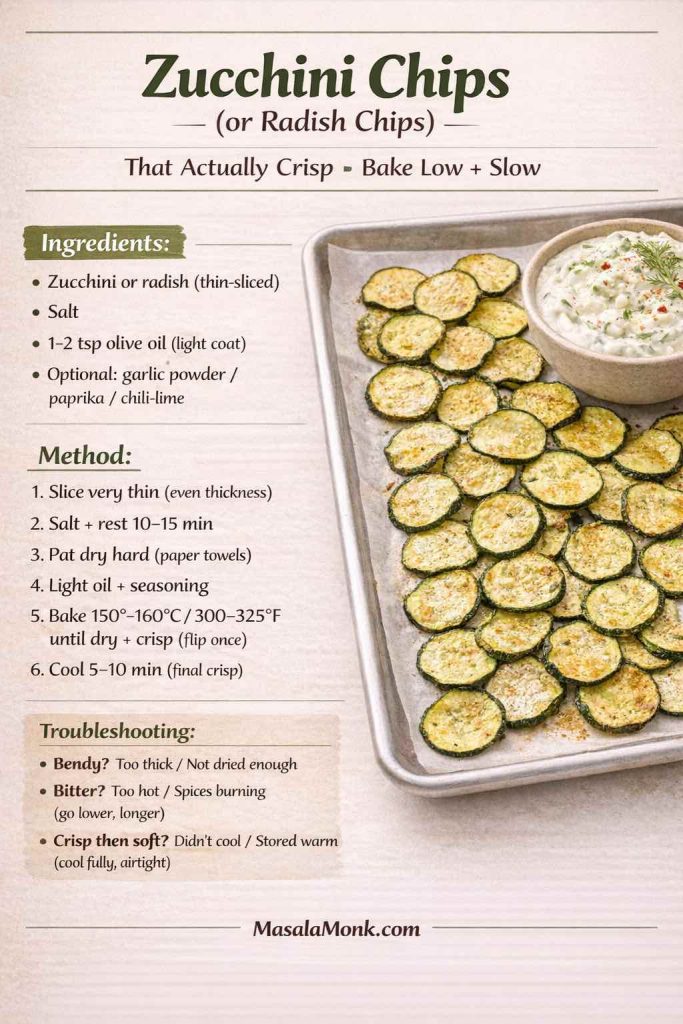
Slice as evenly and thinly as you can, salt lightly, rest, and blot away the moisture that beads on the surface. Bake around 150–160°C / 300–325°F until dry, then let the slices cool for 5–10 minutes. If they are browned at the rim but still translucent and flexible in the center, they need more drying time. These are better with a thick creamy dip than with a very wet salsa.
Keto Hot Chips & Doritos-Style Seasoning
Sometimes the craving is not for a particular chip at all; it is for salt, acid, chili and that powdery seasoning that sticks to your fingers. In that case, changing the seasoning is far easier than chasing a perfect commercial imitation.
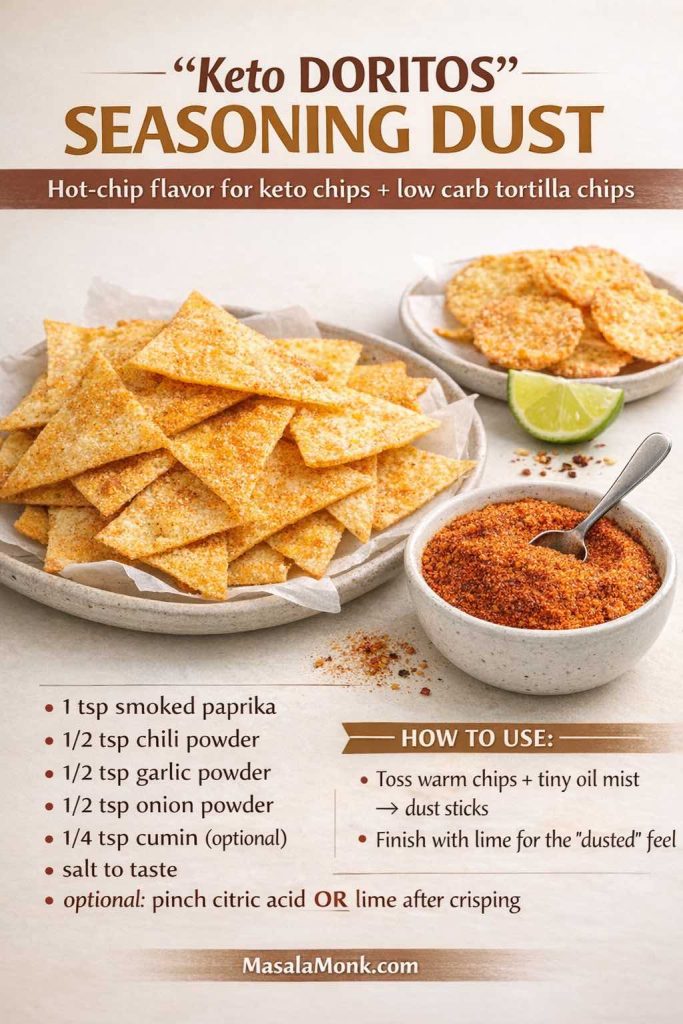
A useful starting mix is chili powder, smoked paprika, garlic powder and salt. Toss it with warm chips so the dust adheres, then add lime just before eating. Keep the lime out of storage containers; acid and moisture are best added at the last moment.
Best Keto Chips for Salsa, Dips & Nachos
This is where chip choice matters most. Salsa tests dryness, queso tests strength, and nachos test whether the base can survive heat plus toppings without turning into a soft layer underneath everything else.
For salsa: choose dry first, thin second
For keto chips and salsa, a thin tortilla-style chip feels the most familiar, but only if it is dry enough. If it bends before it snaps, the salsa will soften it almost immediately. Seed crackers are the sturdier fallback when the salsa is especially juicy.
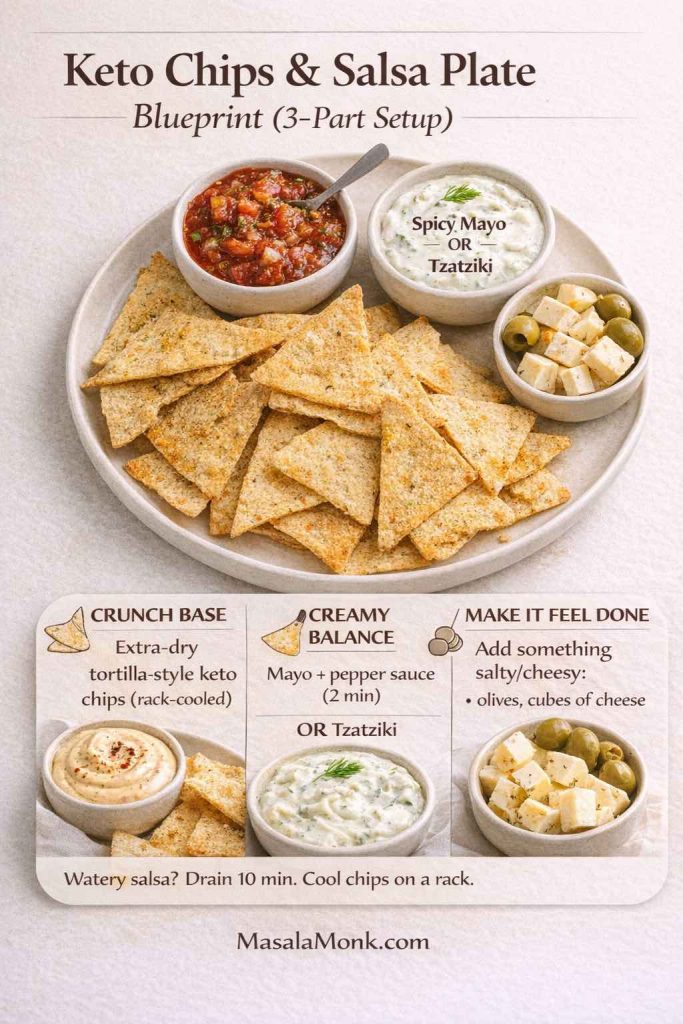
If you want a ready-made salsa path, pair this section with MasalaMonk’s salsa verde recipe. For a creamy contrast, fresh guacamole gives tortilla-style chips more body without turning the whole plate into queso.
For thick dips: strength beats resemblance
For keto chips for dipping, cheese crackers, seed crackers and pork rinds are often better here than delicate tortilla chips. If the dip is hot and dense, you need a chip that can carry weight without folding or dissolving.
For a full party dip rather than another mini-recipe inside this article, use Buffalo Chicken Dip or Spinach Dip and pick one of the sturdier bases above.
For nachos: start with the base, then control moisture
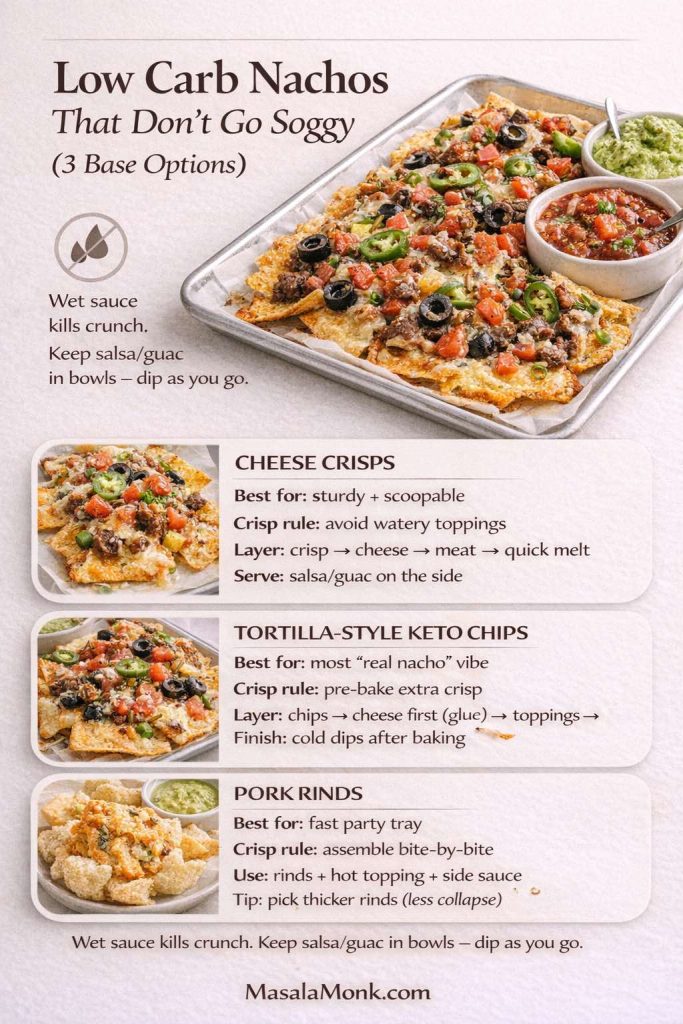
For low carb nacho chips, tortilla-style chips give the most familiar result. Cheese crisps are sturdier but richer. Pork rinds can work for a fast tray, especially if the wet components stay on the side.
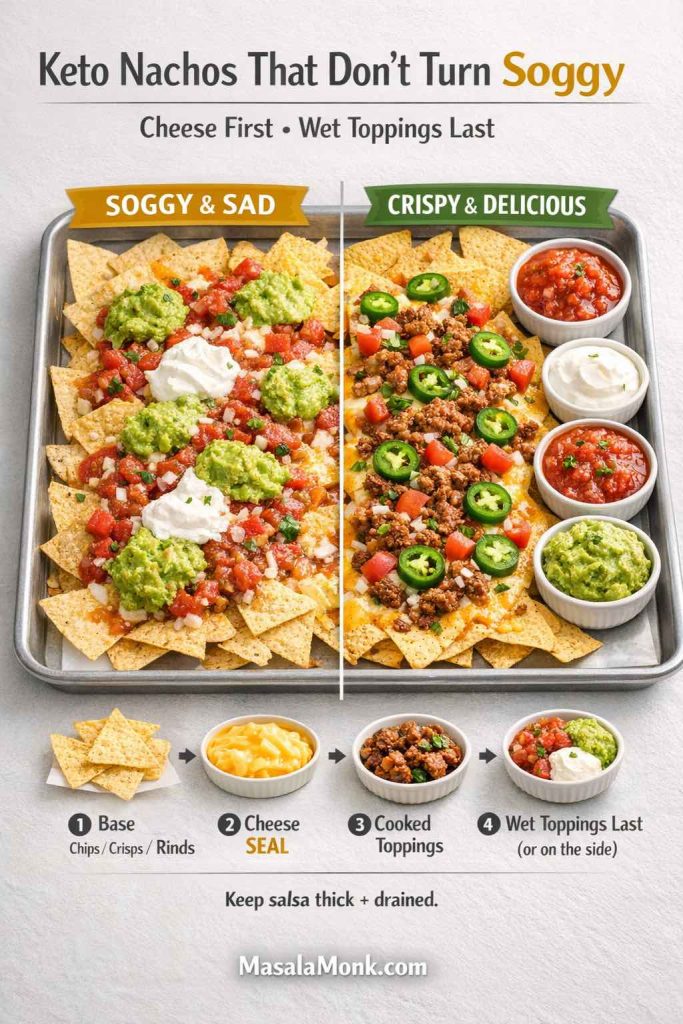
- Spread the chip base in a single layer rather than building a deep pile.
- Add shredded cheese first so it melts directly onto the chips.
- Add cooked, relatively dry toppings such as meat, peppers or olives.
- Bake just long enough to melt the cheese.
- Add salsa, guacamole and sour cream after baking—or serve them beside the tray.
If you want a dedicated cheese sauce instead of shredded cheese, the MasalaMonk cheese sauce recipe is a better next stop than duplicating a full sauce guide here.
Dips That Actually Work With Keto Chips
The easiest way to make a chip substitute feel disappointing is to pair it with a dip that is too thin for the base. Match the texture: dense queso needs a stronger scoop, while tortilla-style chips reward a salsa with less free liquid.
Thick queso
- 1 tbsp butter
- ½ cup heavy cream (or full-fat milk if that suits you)
- 1 cup shredded cheddar or cheddar-parmesan mix
- ½ tsp garlic powder
- ½ tsp smoked paprika
- Salt to taste
- Jalapeño, green chilies, or pepper sauce, optional
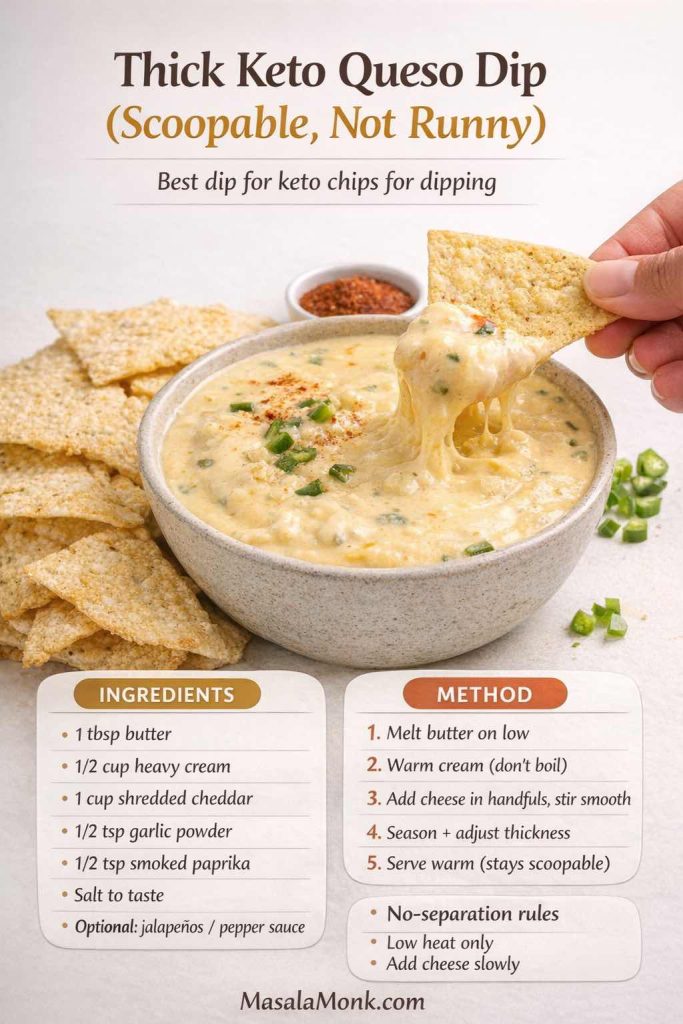
Melt the butter over low heat, warm the cream without boiling, then add cheese in small handfuls and stir until each addition melts. The finished queso should fall slowly from a spoon rather than pour like a thin sauce. If it becomes grainy or oily, the heat was probably too high.
Scoopable salsa
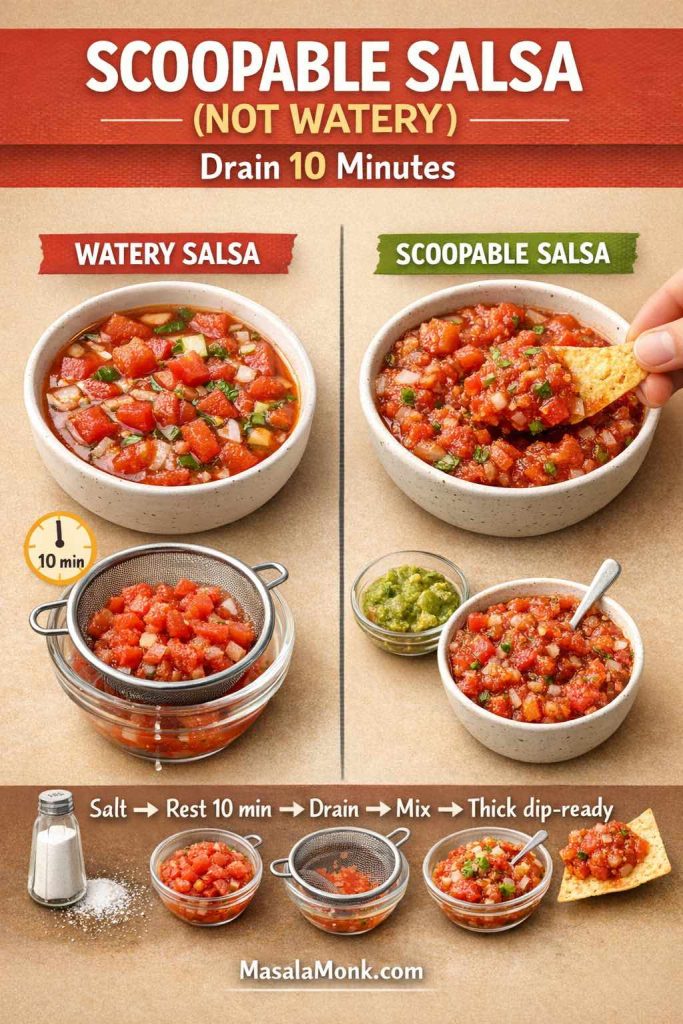
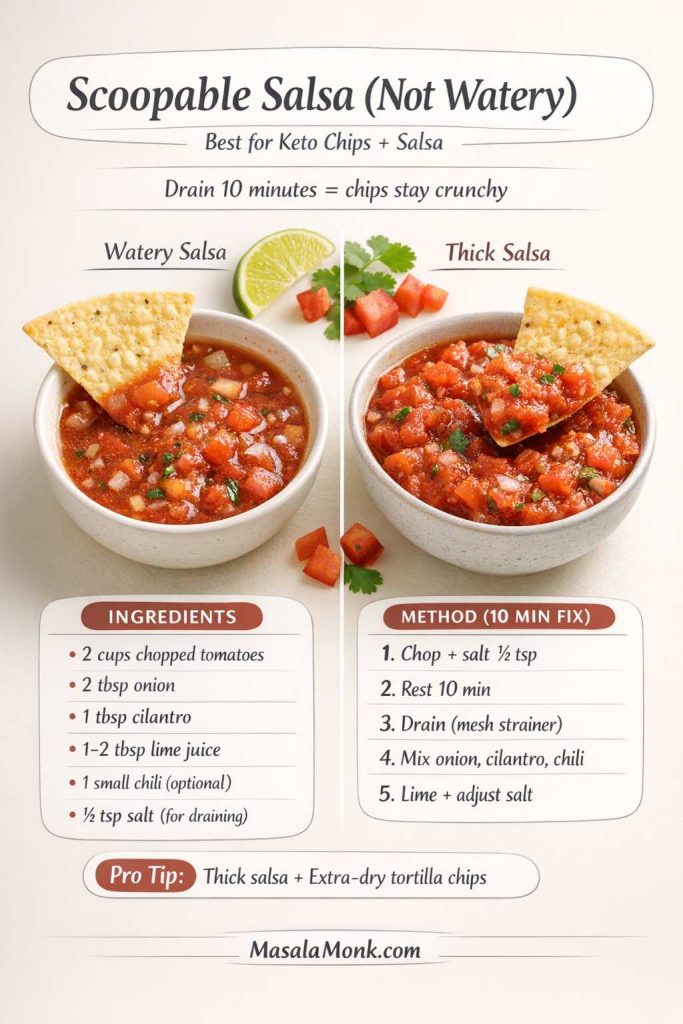
Chop the tomatoes, salt lightly, and leave them for 10 minutes. If liquid has pooled underneath, drain it before adding onion, cilantro, chili, lime, and the final seasoning. The goal is not a dry salsa; it is a salsa that clings to a chip instead of immediately running off it.
Quick guacamole
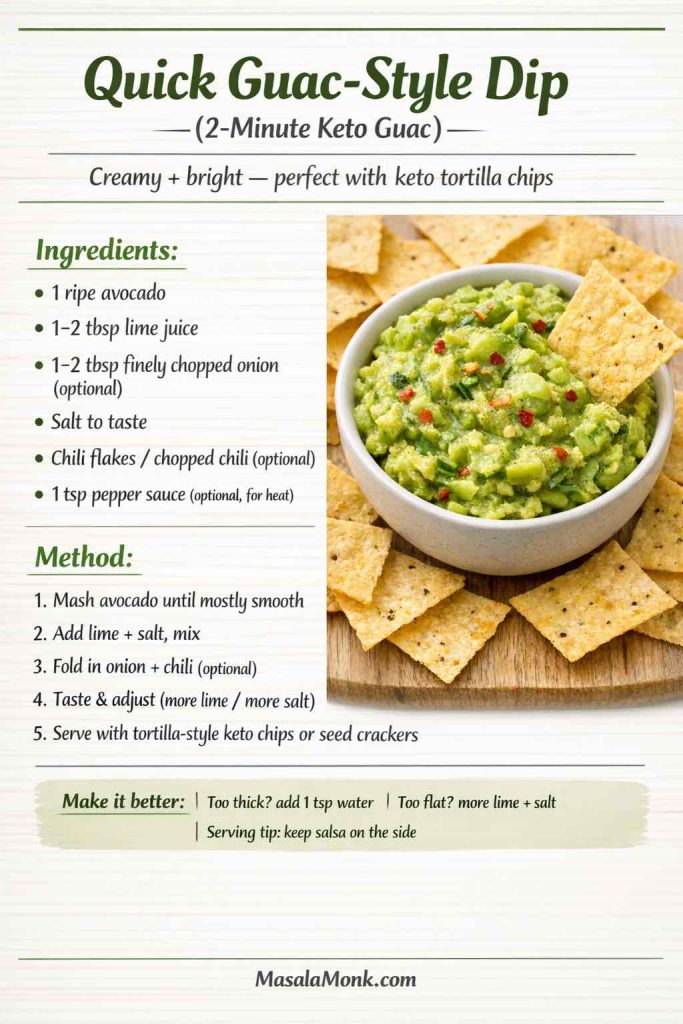
A basic version needs only ripe avocado, lime, and salt. Add onion, chili, or cilantro if you want more contrast. For a fuller treatment, move to the complete MasalaMonk guacamole recipe rather than duplicating it here.
How to Keep Keto Chips Crispy
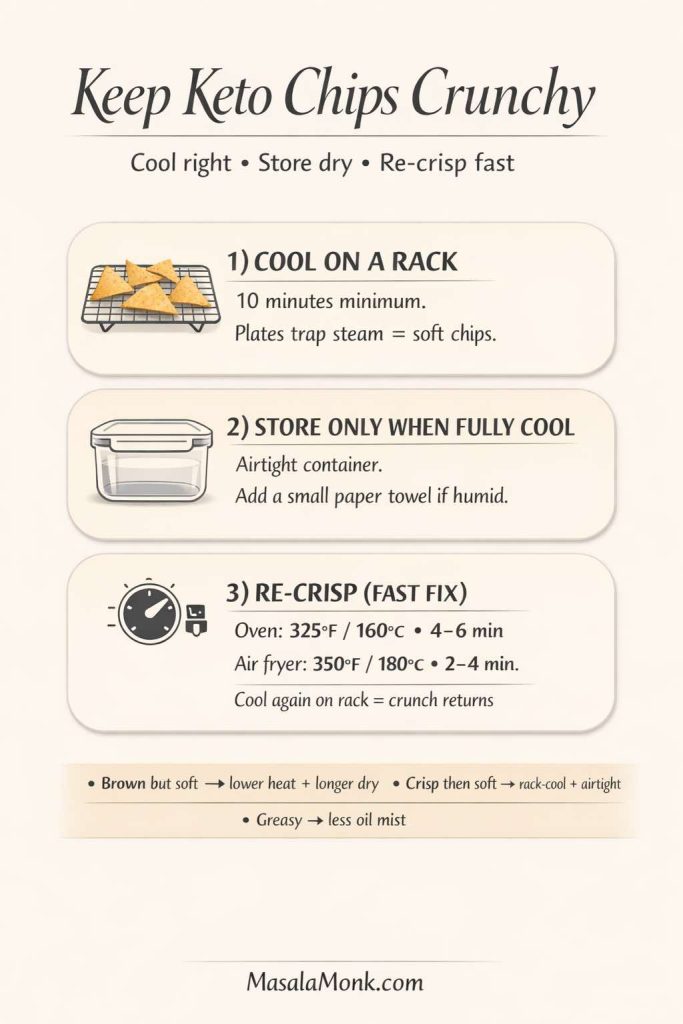
Most homemade chip failures come down to moisture, uneven thickness, too much oil, or trapped steam while cooling. Diagnose the texture before changing the whole recipe.
| What happened | What it means + what to change |
|---|---|
| Brown outside, soft in the center | The surface cooked before the center dried. Lower the heat slightly, make the pieces thinner or more even, and extend drying time. |
| Crisp when hot, soft after cooling | Steam was trapped or the center still held moisture. Cool on a rack and do not seal until completely cool. |
| Crisp at first, soft the next day | Humidity or storage moisture got back in. Re-crisp briefly, cool again, then return to an airtight container. |
| Greasy instead of crisp | Too much oil is slowing moisture loss. Use a mist or very light coating rather than brushing heavily. |
| Edges crisp, centers chewy | The pieces are too thick or too large. Roll or slice thinner, cut smaller, or extend the low-heat drying phase. |
For many tortilla chips and crackers, a short re-crisp at about 160°C / 325°F for 4–6 minutes works well. An air fryer around 180°C / 350°F for 2–4 minutes can be faster. Cool again before serving or storing.
Keto Snack Boxes, Boards & Make-Ahead Rotation
Chips are easiest to overeat when they are the entire snack. A better setup gives the crunch a job inside a small plate: something crisp, something creamy, a protein element and one bright or briny bite.
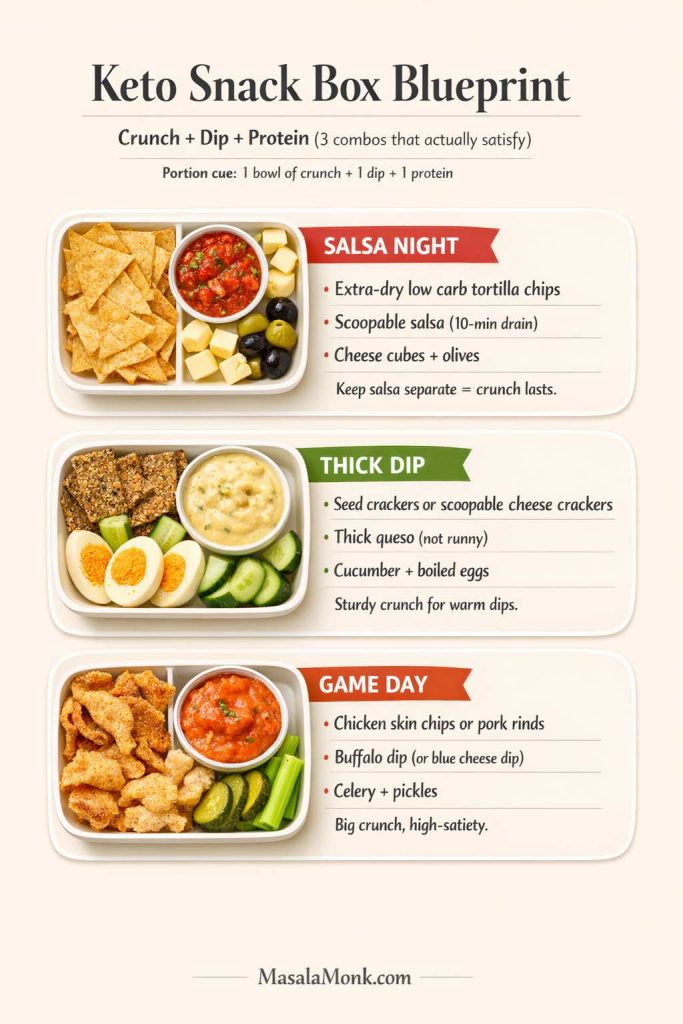
| Situation | Build it |
|---|---|
| Salsa night | Tortilla-style chips + salsa + guacamole + olives |
| Thick-dip snack | Cheese or seed crackers + buffalo/spinach dip + cucumber |
| Road trip | Seed crackers + cheese + nuts + pickles |
| Game day | Cheese crisps or pork rinds + warm dip + jalapeños + crunchy vegetables |
For a larger mixed table, the charcuterie board guide is the natural next step. If you are comparing broader low carb snacks rather than chips specifically, use the keto-friendly snacks guide.
This rotation also prevents one substitute from becoming exhausting. You do not need every option in this article in your kitchen at once.
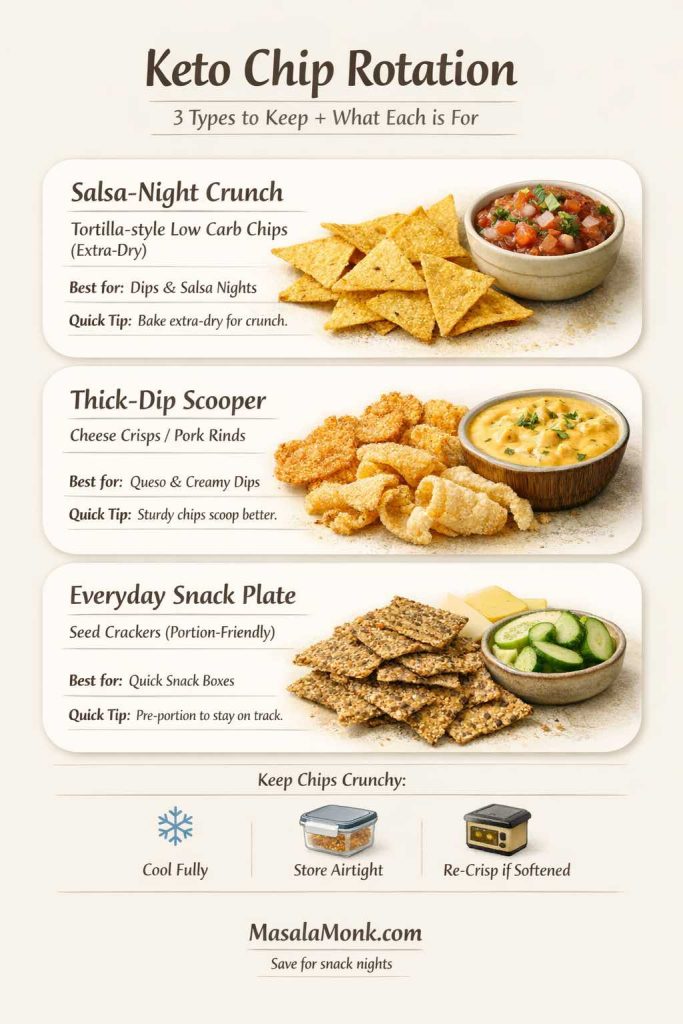
A Short Health Note
Keto-compatible does not automatically mean nutritionally superior. Many packaged or cheese/meat-based snack options can be high in sodium or saturated fat, while very high-fiber products can feel quite different from ordinary chips. Variety and portion size still matter. For broader context, Harvard’s overview of ketogenic diets discusses both potential uses and limitations.
That is another reason this guide treats cheese crisps, seed crackers, tortilla chips and veggie chips as different tools rather than one universal answer.
Keto Chips FAQ
Are there truly zero-carb chips?
Some cheese-, pork-skin- or meat-based snacks can be extremely low in carbohydrate, and some labels may show 0g per serving. Still, the stated serving and the actual amount you eat matter. Read the label rather than treating “zero carb” as a separate food category.
Can I turn regular low-carb tortillas into chips?
Yes. Cut them into triangles, use very little oil, bake or air fry in one layer, and give them enough time to dry. Different wraps behave differently, so the first batch is partly a texture test.
Why do homemade tortilla chips soften after cooling?
Usually because steam was trapped underneath or because the center never fully dried. Cool on a rack and avoid sealing chips while they are even slightly warm.
Which keto chips work best with salsa?
Extra-dry tortilla-style chips are the closest to the classic experience. Seed crackers are a sturdier fallback. The wetter the salsa, the more rigid the chip needs to be.
Which base works best for keto nachos?
Tortilla-style chips give the most familiar result, cheese crisps give more strength, and pork rinds are useful for a fast tray. Whichever base you choose, keep salsa, guacamole and sour cream until the end.
Are protein chips automatically keto-friendly?
No. Protein and carbohydrate are separate numbers. Check the serving size, total carbohydrate, fiber and sweeteners just as you would for any other packaged chip.
How long do homemade keto chips stay crisp?
That depends heavily on the base and humidity. Store only fully cooled chips in an airtight container. If tortilla chips or crackers soften, a short oven or air-fryer re-crisp often restores them.
Can I make keto chips ahead for a party?
Yes, but choose the stable types. Seed crackers and well-dried tortilla chips are easier to make ahead than delicate veggie chips. Keep wet dips and toppings separate until serving.
The easiest way to make low-carb chips satisfying is to stop asking one chip to do everything. Keep the tortilla-style crunch for salsa and nachos, reach for cheese or pork rinds when the dip is heavy, use seed crackers when you want something steadier, and fix moisture before blaming the recipe. Once the texture matches the job, the whole category becomes much less about compromise.









[…] low-carb dipping, pair this richer sauce with sturdy options from this keto chips guide, especially if you want something scoopable for nachos, dips, or snack […]