Posted on Leave a comment

Easy 7 Layer Dip Recipe

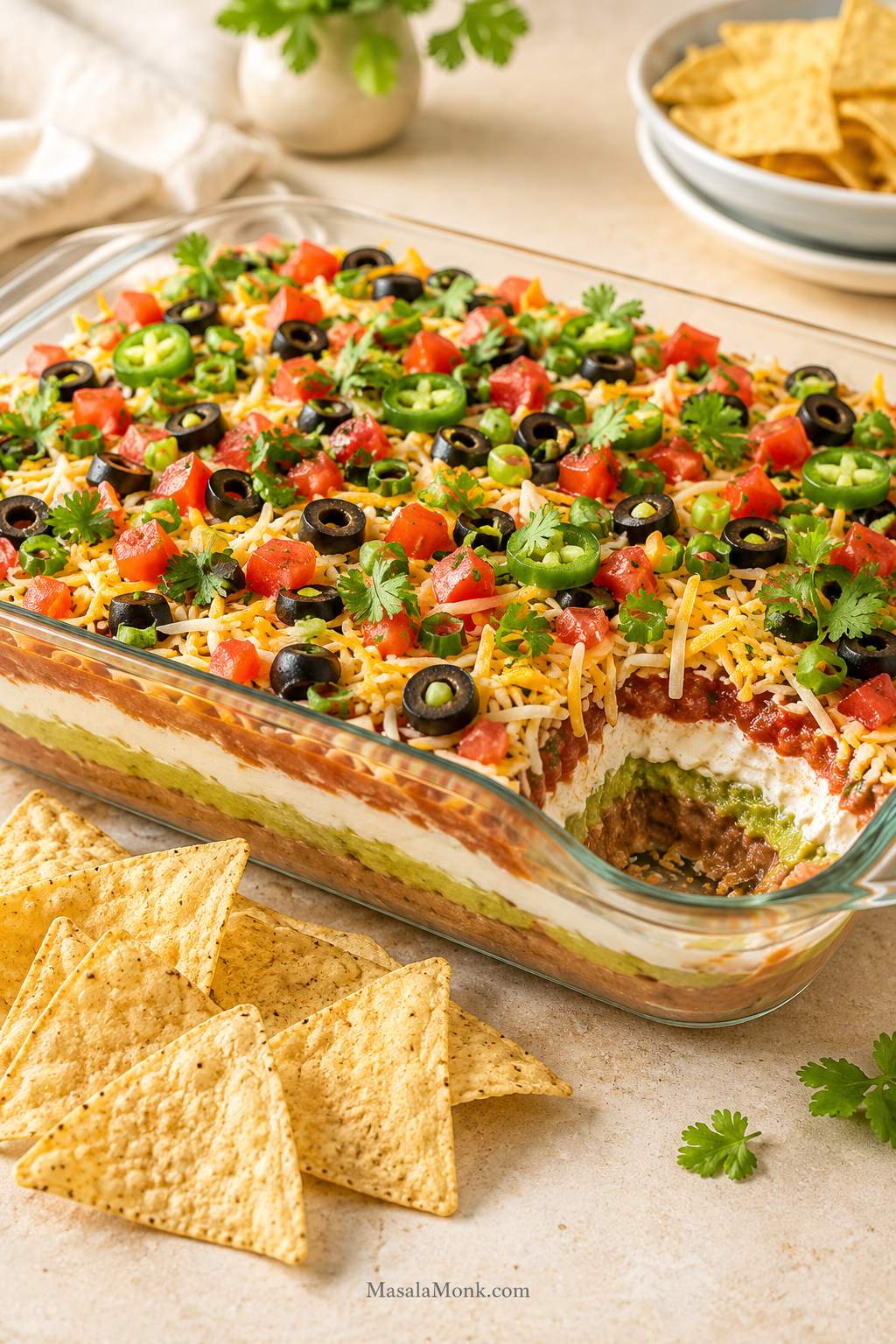
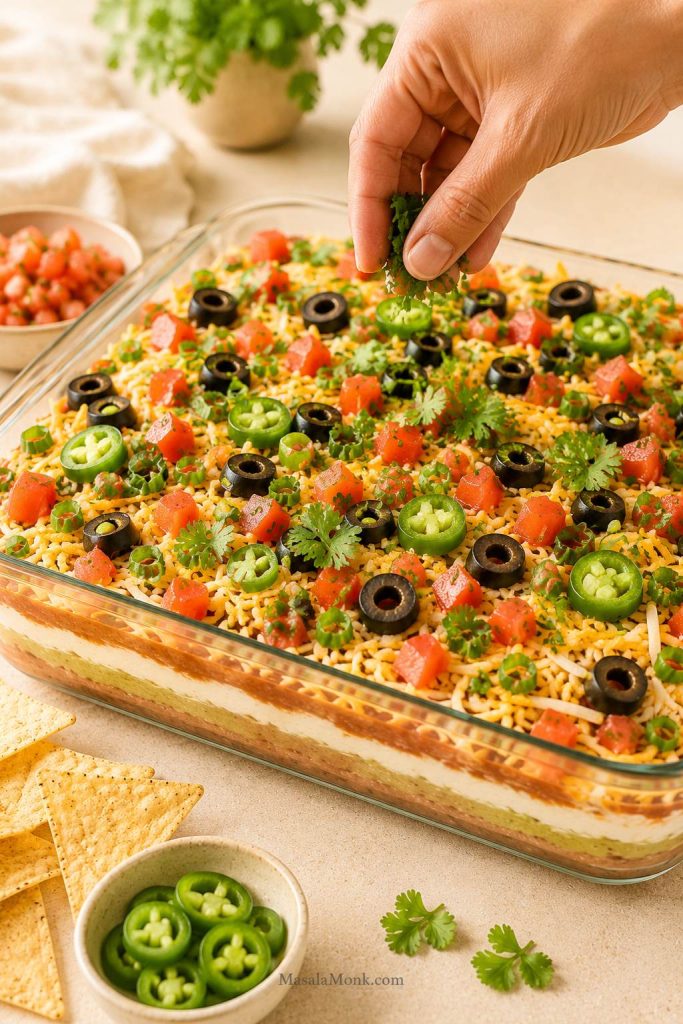
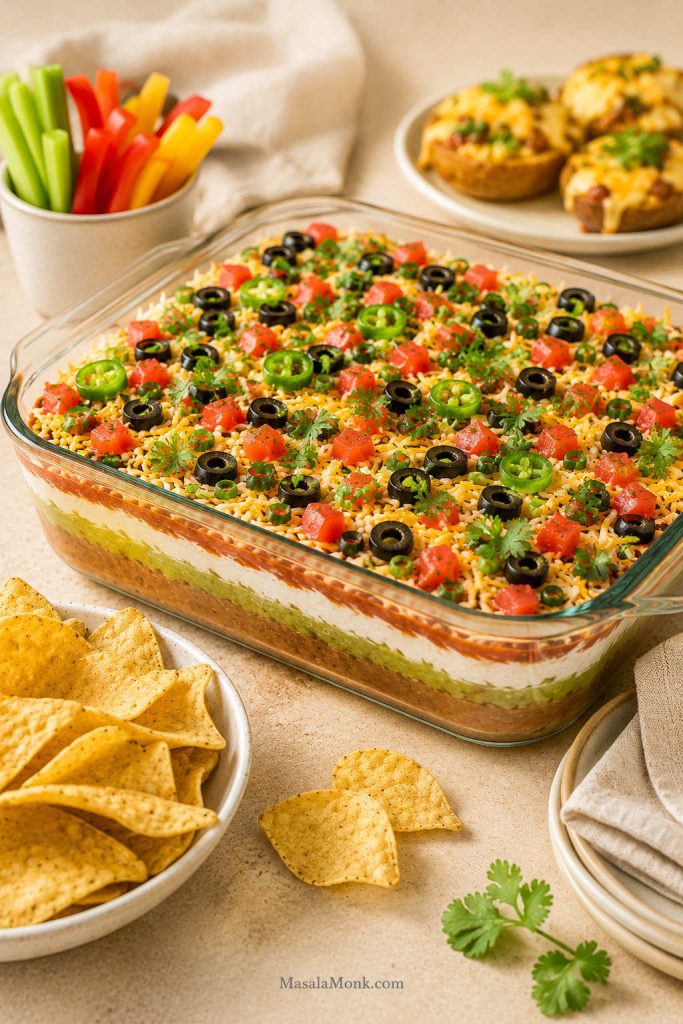
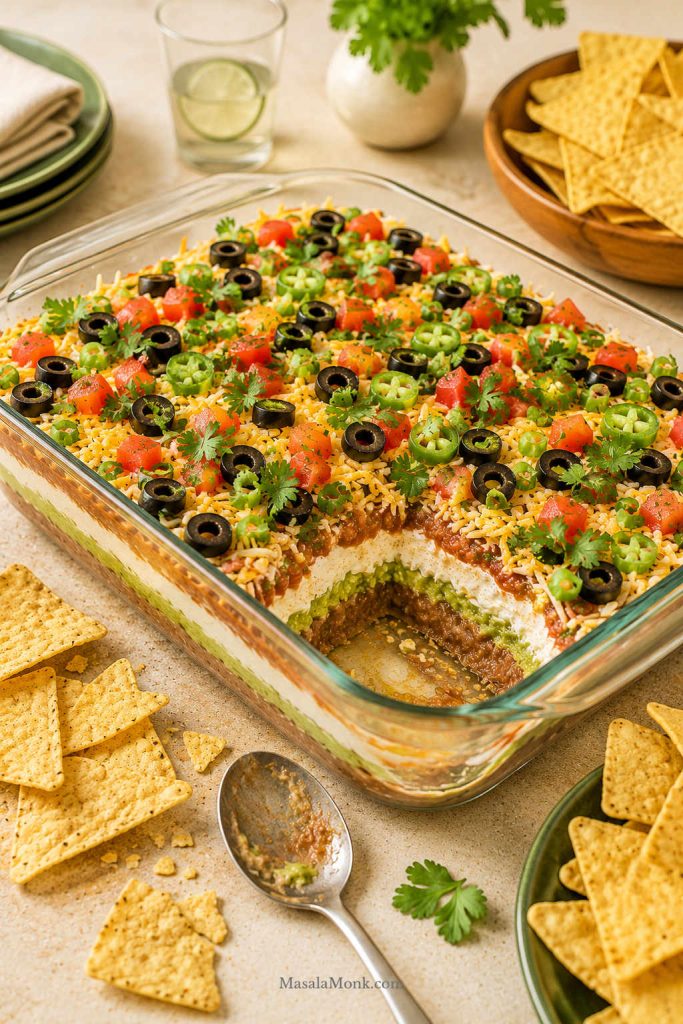
Finished 7 layer dip in a clear 9x13 glass dish with visible layers, colorful toppings, tortilla chips, and one corner lightly scooped.

This is the kind of 7 layer dip recipe people hover around at gatherings: cool, creamy, salty, fresh, and loaded enough that every chip gets a little bit of everything. The best versions look colorful when they land on the table and still taste good after the first few scoops.

This one keeps that appetizer-table magic while fixing the usual problems: stiff beans, loose salsa, browning avocado, broken chips, and layers that collapse too quickly. Instead of baking, it stays cold and no-bake, with seasoned refried beans, fresh avocado, taco-seasoned sour cream, drained salsa or pico, shredded cheese, tomatoes, olives, green onions, and jalapeños layered into a 9×13-inch dish.

The trick is not a secret ingredient. Most 7 layer dips are easy; this one is built around the parts that usually go wrong. The beans need to scoop cleanly, the avocado needs protection, the salsa should brighten without leaking, and the layers should be thin enough that the first scoop does not ruin the whole dish.

That is the difference between a dip people nibble at and a dip people keep “evening out” with one more chip until the corner of the dish is mysteriously gone.

Quick Answer: The Best 7 Layer Dip Recipe

This cold, no-bake 7 layer dip recipe is built in a 9×13-inch dish with seasoned refried beans on the bottom, then guacamole, taco-seasoned sour cream, drained salsa or pico de gallo, shredded cheese, diced tomatoes, and a final topping layer of olives, green onions, jalapeños, and cilantro.

The best layer order is the one that keeps the dip sturdy, fresh, and easy to scoop: heavy beans first, avocado protected in the middle, creamy sour cream above it, drained salsa for brightness, cheese for structure, and fresh toppings on top. If you have time, chill the dish for about 30 minutes so the layers settle before serving.

For exact amounts, jump to the recipe card. If you want the visual test first, see what a clean scoop should look like.

What a Clean Scoop Should Look Like

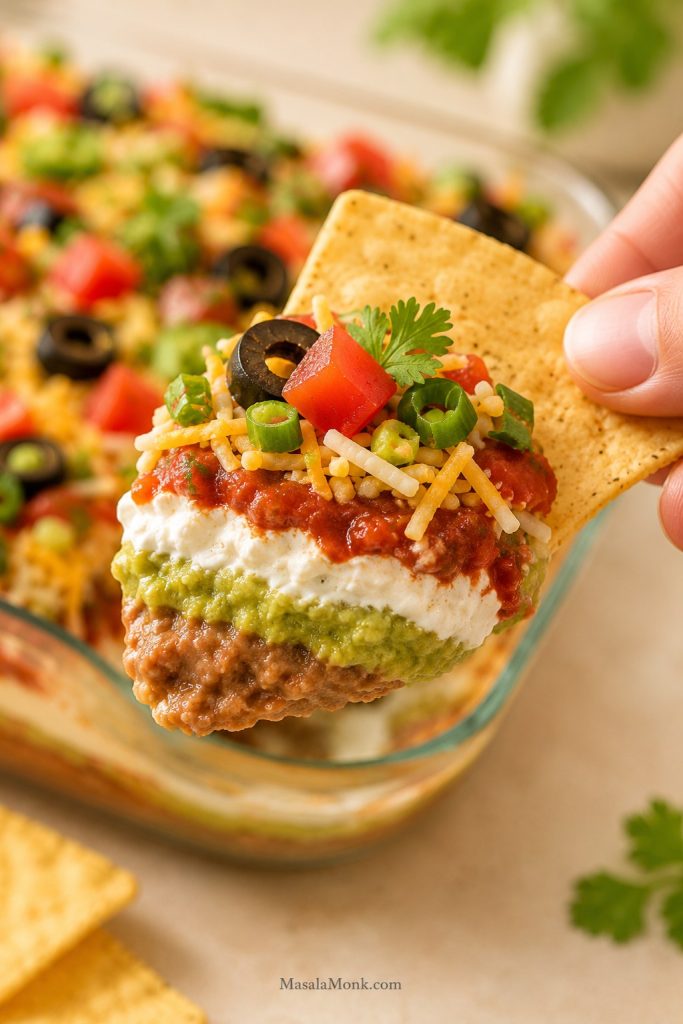
A good scoop should pick up beans, avocado, sour cream, salsa, cheese, and toppings together without pulling the whole dish apart. If the first scoop collapses the corner, the layers are usually too thick, too cold, or too loose.

Tortilla chip lifting a clean scoop of 7 layer dip with refried beans, guacamole, sour cream, salsa, cheese, tomatoes, olives, and green onions.
A good scoop should catch beans, avocado, sour cream, salsa, cheese, and toppings together; if it drags the whole dish apart, the layers are probably too thick or too cold.

7 Layer Dip at a Glance

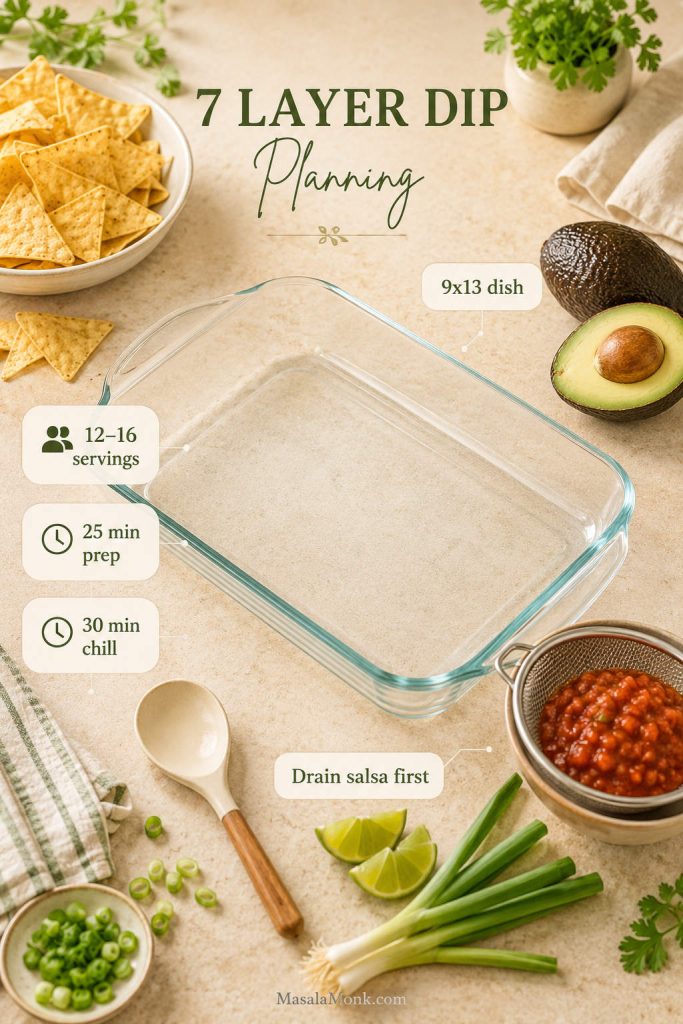
7 layer dip planning scene with a 9x13 dish, tortilla chips, avocados, salsa strainer, timer, and labels for servings, prep time, chill time, and draining salsa.
Before layering, check the dish size, serving count, chill time, and salsa-draining step so the dip is easier to serve when guests arrive.
Recipe type Cold, no-bake layered taco dip
Best dish 9×13-inch / about 23×33 cm glass or ceramic dish
Servings 12–16 appetizer servings
Main base 2 cans refried beans + 3 medium-large avocados
Prep time 25 minutes
Chill time 30 minutes recommended, optional if serving right away
Serve temperature Cold or lightly chilled
Best chips Sturdy tortilla chips or scoop-style chips
Make-ahead window Best assembled the same day; components can be prepped 1 day ahead
Biggest mistake Using loose salsa or pico without draining it first

What Is 7 Layer Dip?

7 layer dip is a cold layered Tex-Mex-style appetizer made with beans, avocado or guacamole, sour cream, salsa, cheese, and fresh toppings. It is usually served with tortilla chips and shows up at game days, potlucks, tailgates, movie nights, and casual parties because it is easy to make and easy to share.

The names often overlap. Some people call it seven layer dip, 7 layer taco dip, layered taco dip, Mexican layer dip, or layered bean dip. Although the exact toppings can change from kitchen to kitchen, the goal is always the same: a colorful, scoopable dish with a sturdy base, creamy middle layers, bright salsa, cheese, and fresh toppings.

If you are building a cold appetizer table, this dip also works well beside a make-ahead cheese ball recipe. Both can be chilled ahead, served with sturdy dippers, and set out when guests arrive.

Why This 7 Layer Dip Recipe Works

The goal is not just seven layers; it is seven layers that taste good together. The bean layer should be savory, the avocado should be bright, the sour cream should be tangy, the salsa should wake everything up, and the toppings should make each scoop feel fresh instead of heavy.

The best bite should be creamy from the beans and avocado, tangy from the sour cream and salsa, salty from the cheese and olives, and fresh from the tomatoes, green onions, cilantro, and jalapeños.

Flavorful bean base

The refried beans are loosened and seasoned before spreading, so they taste better and stay soft enough for chips to scoop through.

Fresh avocado middle

The avocado layer adds cool, creamy freshness. Covering it with sour cream helps slow browning and keeps the middle from drying out.

Bright but balanced salsa

Drained salsa or pico brings tangy tomato flavor without taking over the whole bite or sinking into the creamy layers.

Clean serving-dish structure

A 9×13-inch dish gives the layers room to spread, keeps the dip easier to scoop, and makes enough for a real appetizer table.
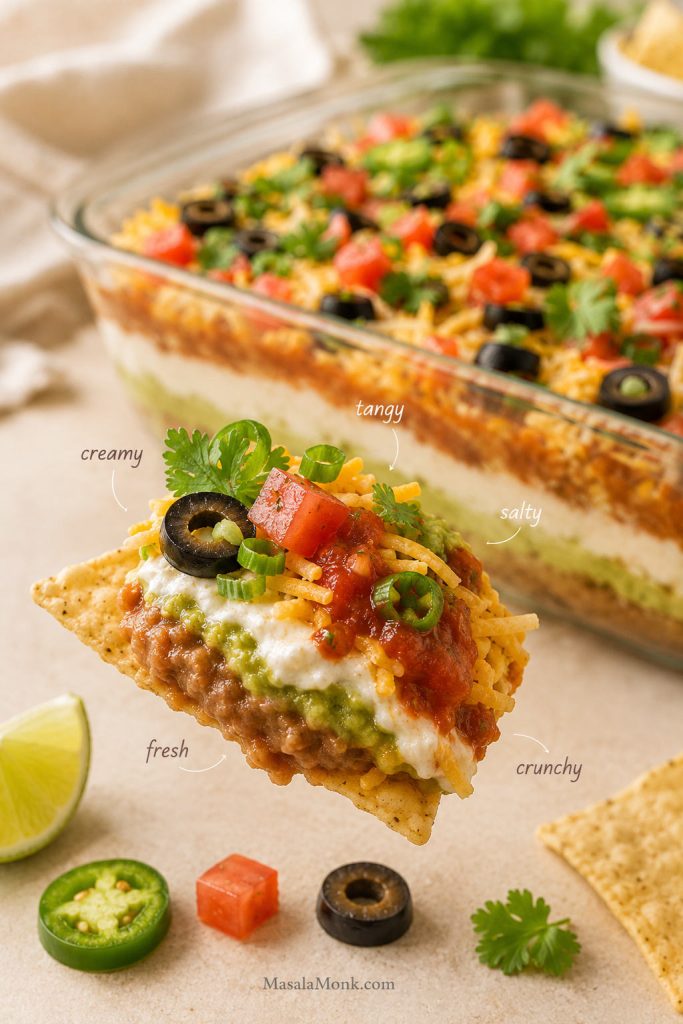
Loaded tortilla chip with 7 layer dip and small callouts for creamy, tangy, salty, fresh, and crunchy flavors.
The best bite is balanced: creamy beans and avocado, tangy salsa and sour cream, salty cheese and olives, plus fresh toppings for crunch and brightness.

7 Layer Dip Ingredients

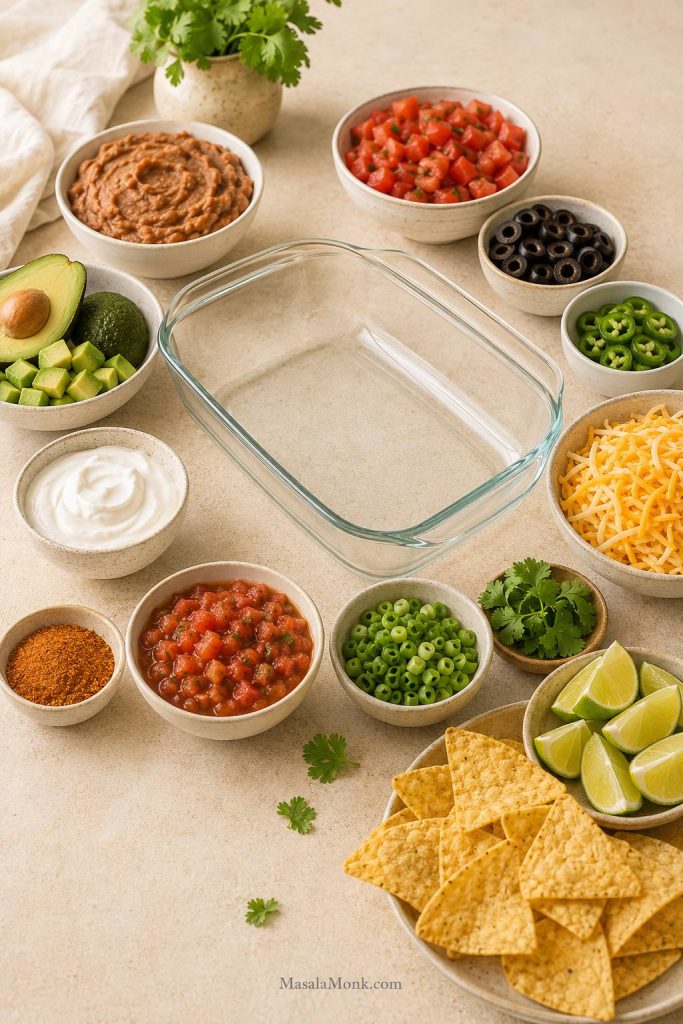
Ingredients for 7 layer dip arranged on a light surface, including refried beans, avocados, sour cream, taco seasoning, salsa, cheese, tomatoes, olives, green onions, jalapeños, lime, cilantro, and tortilla chips.
Simple ingredients work harder when the creamy layers are seasoned first, because plain beans or sour cream can make the finished dip taste flat.

This dip only works if the bean layer, avocado layer, and sour cream layer each taste good before they go into the dish. So, season the creamy layers first, then build the dish. That way every bite tastes balanced instead of just like plain beans, sour cream, and jarred salsa stacked together.

1. Refried Beans

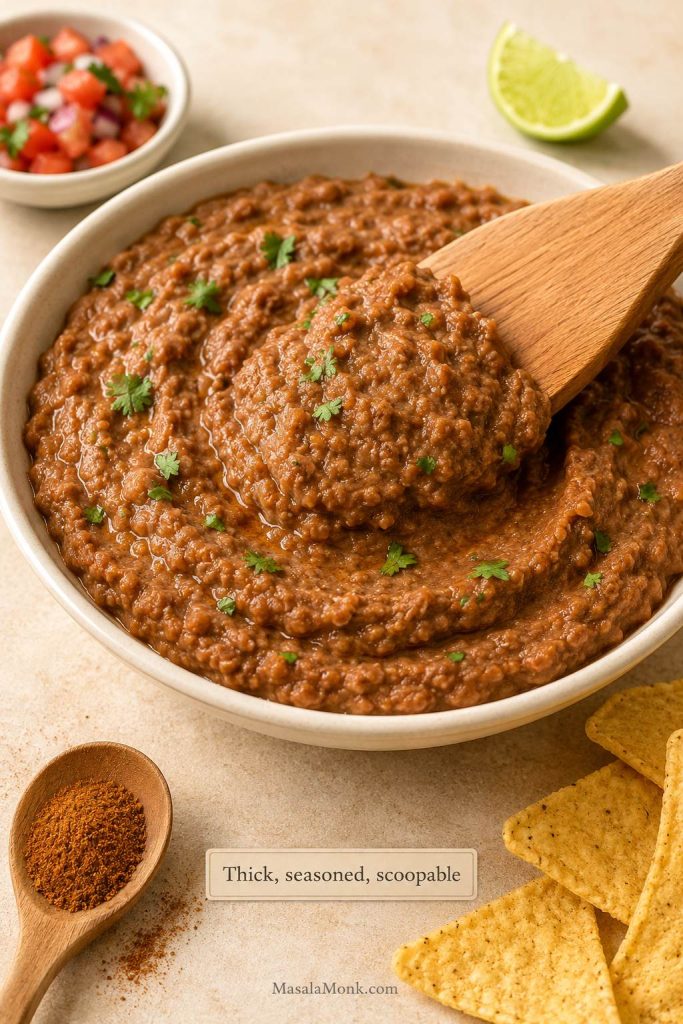
Use two cans of refried beans for a full 9×13-inch dish. Pinto refried beans give the most classic flavor, while black refried beans taste a little earthier. If you are serving vegetarian guests, check the label because some refried beans are made with lard.

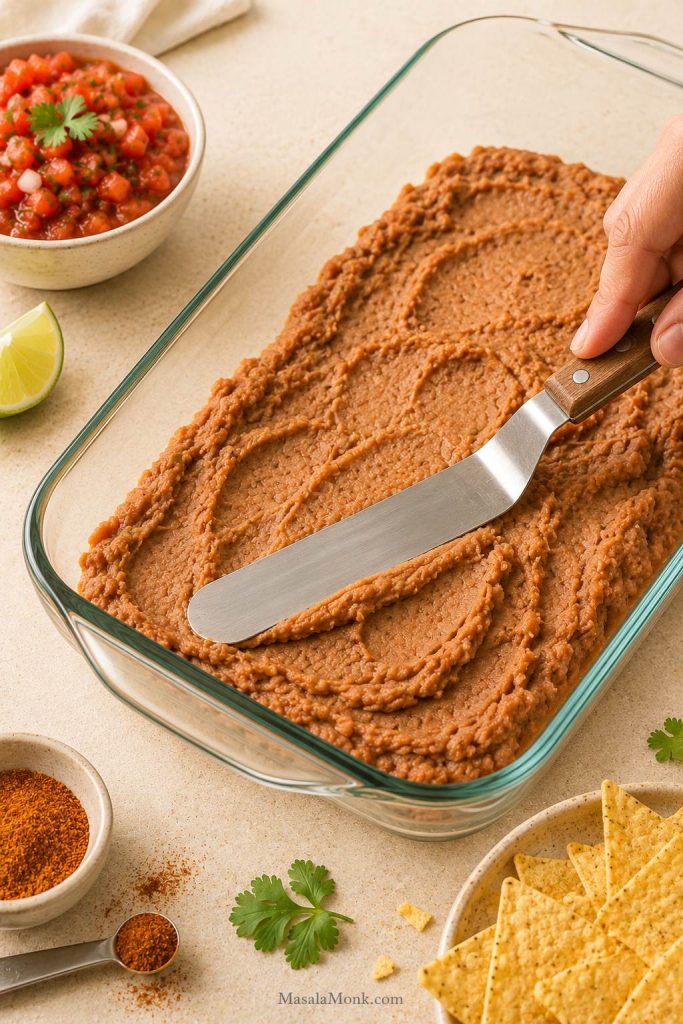
Plain canned beans can be stiff when cold, so stir them with a little salsa, cumin, chili powder, garlic powder, lime juice, and salt before spreading. You want a base that is thick enough to hold the layers but soft enough for a tortilla chip to scoop through.

Seasoned refried beans in a bowl with a spatula showing thick scoopable texture, plus salsa, lime, chips, and seasoning nearby.
A sturdy refried bean base holds the dip together, but the texture still needs to be soft enough for chips to scoop cleanly.

2. Guacamole or Mashed Avocado

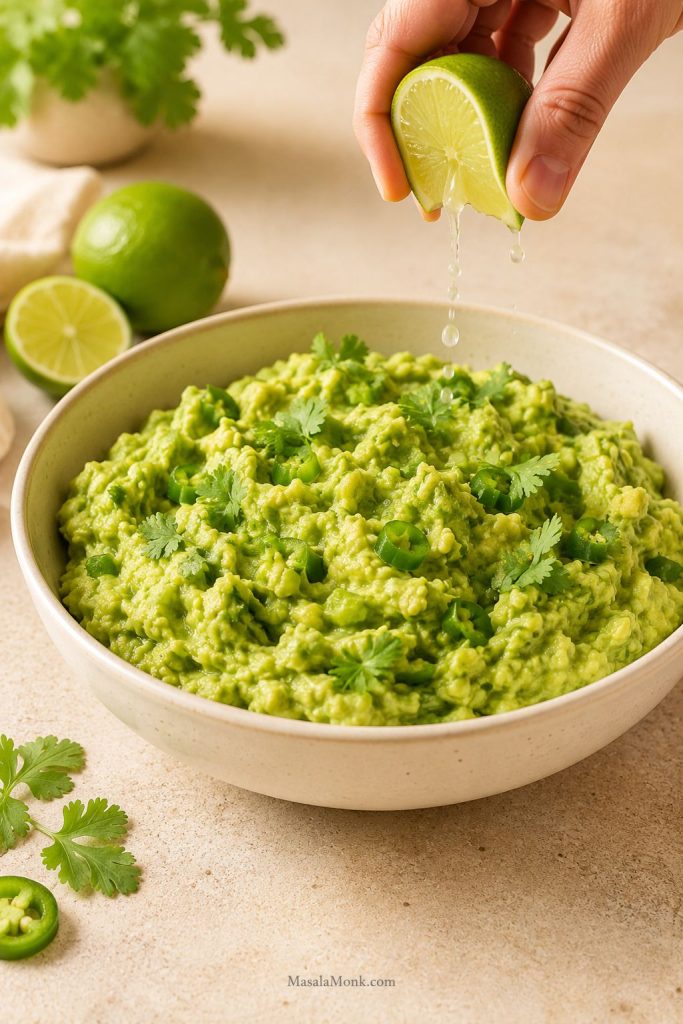
Fresh avocado gives the dip a cool, creamy middle. Mash ripe avocados with lime juice, salt, cilantro, and jalapeño if you like heat. Keep it slightly chunky for a fresher texture, or mash it smoother for cleaner layers.

Store-bought guacamole works too when you need a faster party dip. Choose a thicker guacamole, taste it first, and brighten it with lime juice, cilantro, or a little salt if it tastes flat.

Bowl of fresh mashed avocado with lime, cilantro, jalapeño, and a hand mixing the guacamole layer for 7 layer dip.
Lime, cilantro, and salt brighten the avocado layer, while a slightly chunky texture keeps the dip fresh instead of heavy.

3. Sour Cream and Taco Seasoning

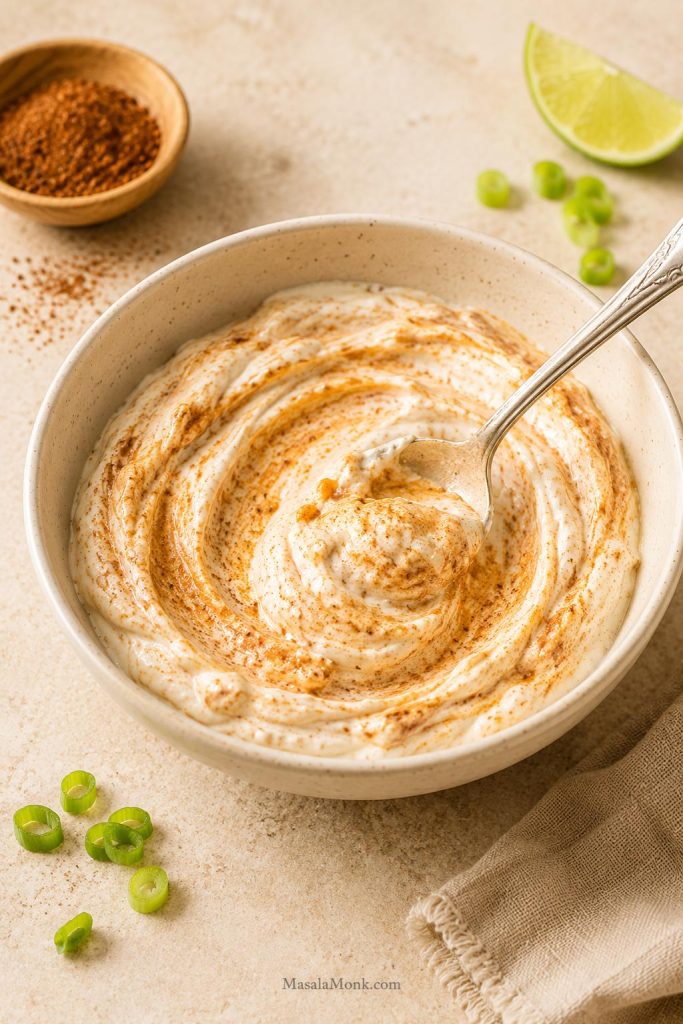
Sour cream mixed with taco seasoning creates the creamy taco-dip layer. Use enough seasoning to give it flavor, but do not overdo it because salsa, chips, cheese, and olives also bring salt.

A taco seasoning packet works well here. Start with less than the full packet if your chips, cheese, salsa, and olives are already salty, then add more to taste.

Bowl of sour cream being mixed with taco seasoning for the creamy layer of 7 layer dip.
Taco seasoning turns plain sour cream into a flavorful middle layer; however, add it gradually if your chips, cheese, salsa, and olives are already salty.

For a thicker texture, beat 4 oz / 113 g softened cream cheese into the sour cream before spreading. Cream cheese is optional. A small amount makes the layer richer and more stable; however, too much can make the dip feel heavy instead of fresh.

4. Salsa or Pico de Gallo

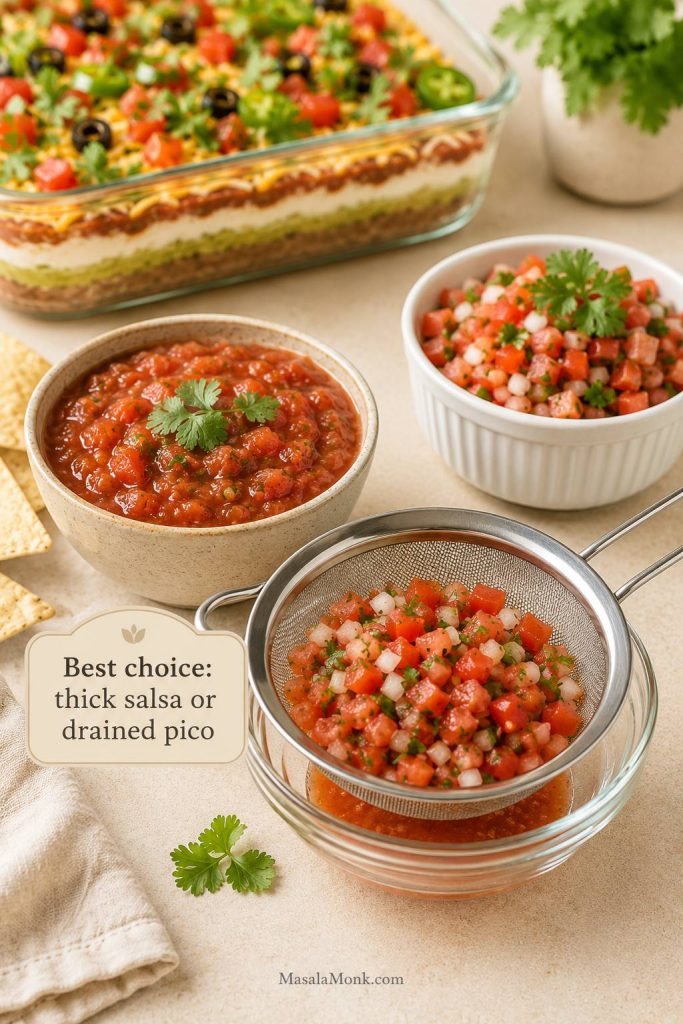
The best salsa for 7 layer dip is thick, chunky salsa or well-drained pico de gallo. Although pico tastes fresh and bright, tomatoes release liquid as they sit. Avoid thin restaurant-style salsa unless you strain it first, because it can leak into the sour cream and make the dip watery.

Chunky salsa, drained pico de gallo, and thin salsa in a fine-mesh strainer with text saying thick salsa or drained pico is best.
Thick salsa or drained pico gives 7 layer dip bright tomato flavor without letting excess liquid sink into the sour cream layer.

Most importantly, the salsa layer should brighten the dip, not take over the whole bite. If you want a brighter salsa bowl on the side, this mango salsa recipe gives the table something fresh, juicy, and chip-friendly without weighing down the creamy layers.

Place the salsa or pico in a fine-mesh strainer before layering. If it leaves a puddle in the bowl, it will leave a puddle in the dish.

For the full moisture-control guide, use the no-watery dip section.

5. Shredded Cheese

Cheddar gives sharper flavor, Monterey Jack tastes milder and creamier, pepper jack adds heat, and a Mexican cheese blend is the easiest all-purpose option. Freshly shredded cheese tastes best, but pre-shredded cheese works when you need a fast appetizer dish.

The cheese also helps separate the salsa from the fresh toppings, which keeps the top looking cleaner.

6 and 7. Fresh Toppings

Finish with diced Roma tomatoes, black olives, green onions, cilantro, and jalapeños. Roma tomatoes are useful because they are meatier and less juicy than many slicing tomatoes. If your tomatoes are especially wet, seed them or blot them before adding them to the top.

Fresh toppings being added to 7 layer dip, including shredded cheese, diced tomatoes, sliced black olives, green onions, cilantro, and jalapeños.
Fresh toppings add color and crunch, although juicy tomatoes and delicate herbs are best added thoughtfully when making the dip ahead.

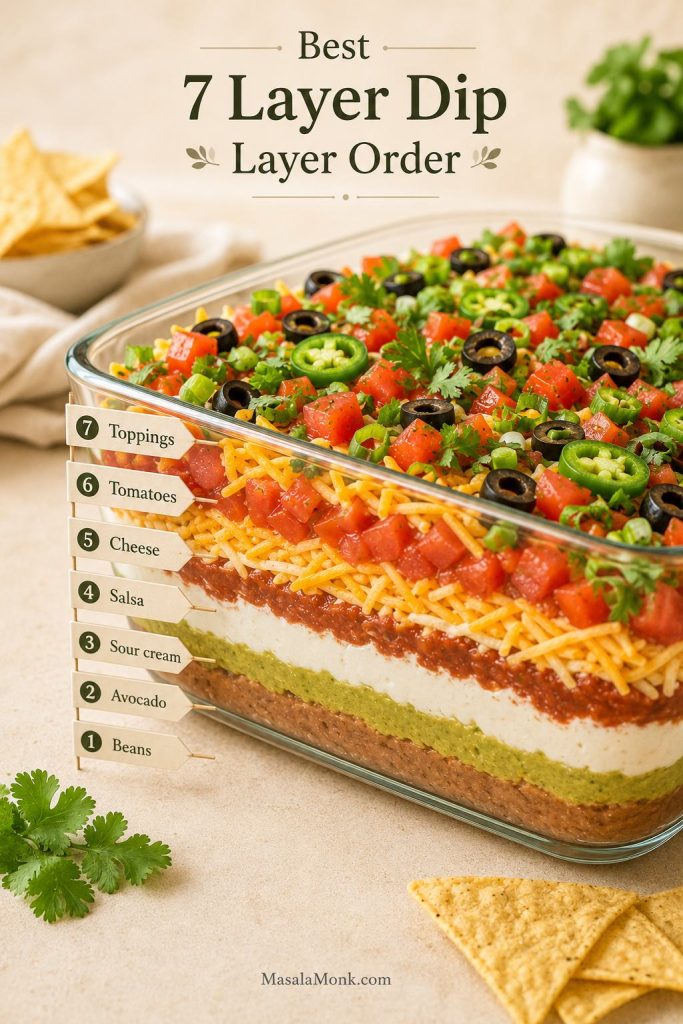
Best 7 Layer Dip Layer Order

Side view of 7 layer dip in a glass dish with labeled layers for beans, avocado, sour cream, salsa, cheese, tomatoes, and toppings.
The best 7 layer dip layer order keeps heavy beans on the bottom, protects avocado in the middle, and leaves fresh toppings on top.

There are several common layer orders, and many of them work. In some versions, cheese goes earlier; in others, salsa sits on top or lettuce becomes one of the layers. For this 7 layer dip recipe, I like the order below because it keeps the heaviest layer on the bottom, protects the avocado, controls excess liquid, and leaves the top fresh and colorful.

The best order for 7 layer dip is:

  1. Seasoned refried beans
  2. Guacamole or mashed avocado
  3. Taco-seasoned sour cream
  4. Drained salsa or pico de gallo
  5. Shredded cheese
  6. Diced tomatoes
  7. Olives, green onions, jalapeños, and cilantro

The point is not to build the tallest dip. The point is to build layers thin enough that a normal chip can reach more than one flavor before it breaks.

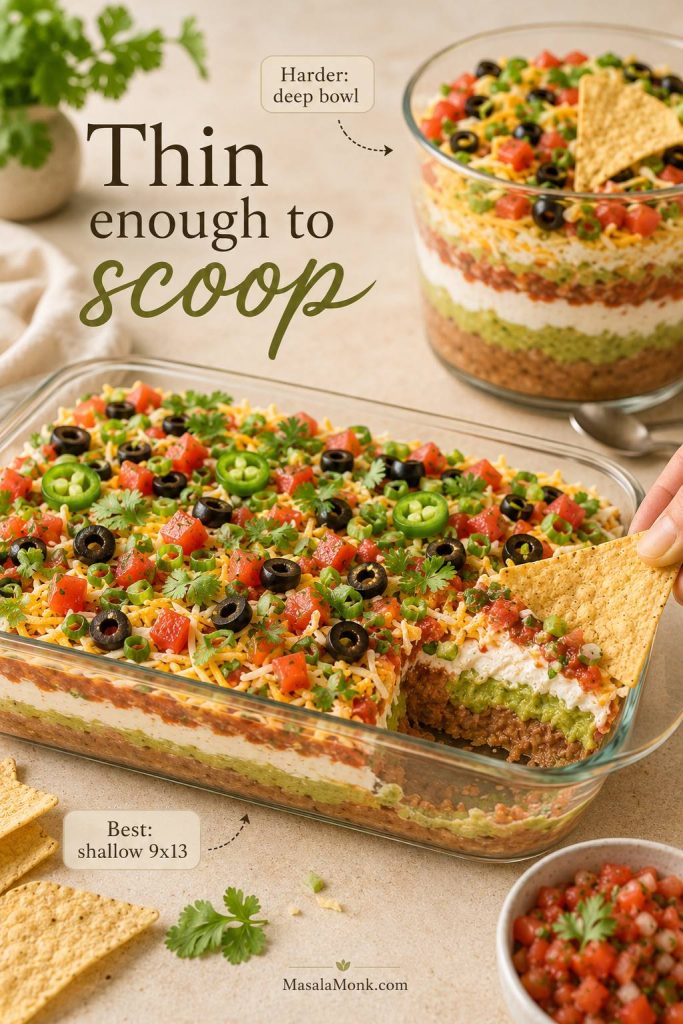
Why Thin Layers Scoop Better

Thin layers help a chip reach more than one flavor without snapping. They also make the first scoop cleaner because the dip spreads across the dish instead of stacking too high in one deep spot.

Shallow 9x13 dish of 7 layer dip being scooped cleanly, compared with a deeper bowl that is harder to scoop from.
A normal chip should reach more than one flavor before it breaks; that is why thinner, even layers beat a tall, heavy stack.

This order works because the beans create the sturdy base, the avocado stays tucked into the middle, the sour cream spreads gently over it, and the salsa is managed before the cheese and toppings go on. As a result, the top stays bright while the bottom stays strong enough for scooping.

Layer-order tip: Spread each layer gently all the way to the edges. That makes the dip look cleaner from the side, gives every scoop a bit of every layer, and helps protect the avocado from air.

Equipment You’ll Need

A 9×13-inch dish, a fine-mesh strainer, a few mixing bowls, and a spatula are the only tools that really matter. The strainer keeps salsa from watering down the dip, while the spatula helps spread the soft layers without dragging them into each other.

  • 9×13-inch / 23×33 cm glass or ceramic dish: best for a crowd and visible layers.
  • Fine-mesh strainer: for draining salsa or pico.
  • Mixing bowls: for the beans, avocado, and sour cream.
  • Fork or potato masher: for mashing avocado.
  • Silicone spatula or offset spatula: for spreading soft layers gently.
  • Knife and cutting board: for tomatoes, green onions, jalapeños, and herbs.
  • Plastic wrap: for covering the dish tightly if making it ahead.

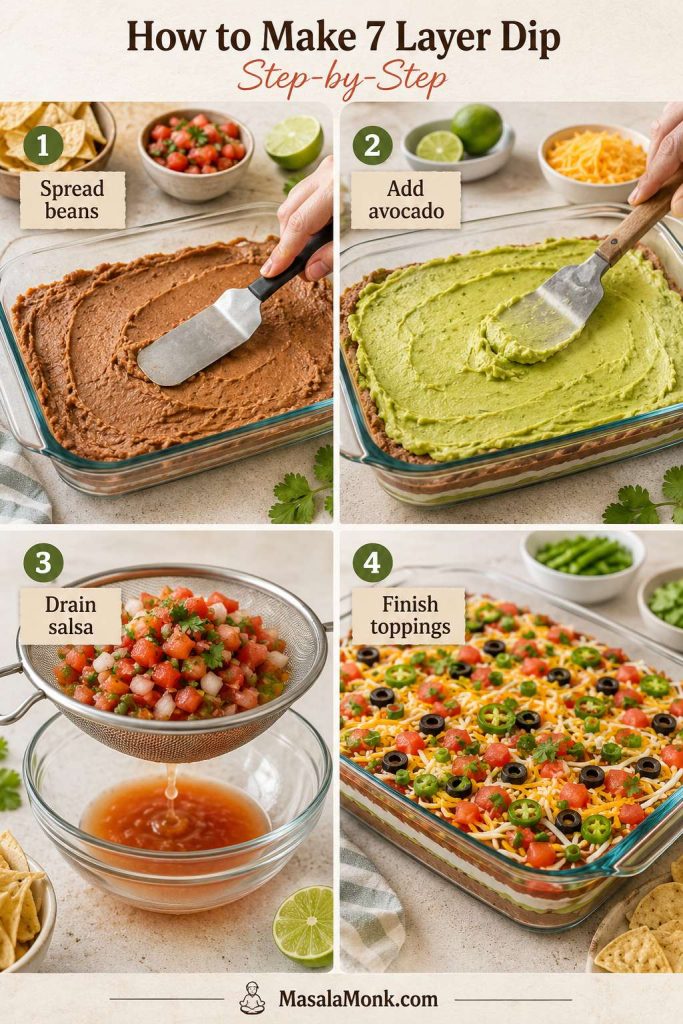
How to Make 7 Layer Dip

The method is simple, but the small details matter: season each creamy layer, spread gently, drain the salsa, and chill the dish briefly if you have time.

Four-step 7 layer dip guide showing beans spread in a dish, avocado added, salsa drained in a strainer, and toppings finished on the dip.
Build the dip in the right order: spread the beans, add avocado, drain the salsa, and finish with toppings for cleaner layers.

Step 1: Season and Loosen the Beans

Stir the refried beans with salsa, cumin, chili powder, garlic powder, lime juice, and salt. If the beans still feel too stiff, add another spoonful of salsa or a small spoonful of sour cream. The goal is thick and scoopable, not runny.

Spread the beans edge to edge in the bottom of the dish, including the corners. This gives every scoop a sturdy base and keeps the first chip from pulling up toppings with no beans underneath.

Spatula spreading seasoned refried beans into the corner of a clear 9x13 dish for the base layer of 7 layer dip.
Spreading beans into the corners gives every scoop a base, so early chips do not pull up toppings without the refried bean layer underneath.

Step 2: Make the Avocado Layer

Mash the avocados with lime juice, cilantro, jalapeño, and salt. Taste before layering; bland avocado makes the whole dish feel flat.

Then, dollop the avocado over the bean layer first and spread it gently. Do not press too hard, or you will drag the beans underneath.

Step 3: Mix the Sour Cream Layer

Stir sour cream with taco seasoning until smooth. If using cream cheese, make sure it is fully softened, then beat it with the sour cream before adding the seasoning so there are no lumps.

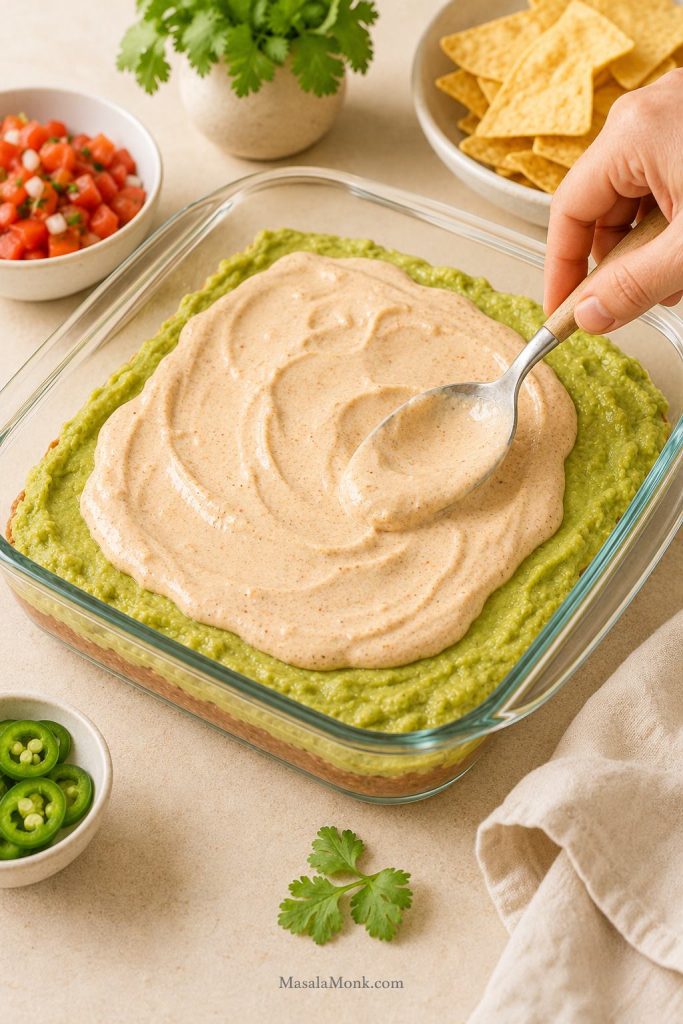
Next, dollop the sour cream mixture across the avocado and spread it gently to the edges. Try to cover the avocado completely; this helps slow browning and gives the dip a clean creamy middle.
Taco-seasoned sour cream being spread over the avocado layer in a glass dish to cover the green layer.
Covering avocado with sour cream helps slow browning and keeps the middle layer creamy through chilling and serving.

Step 4: Drain the Salsa or Pico

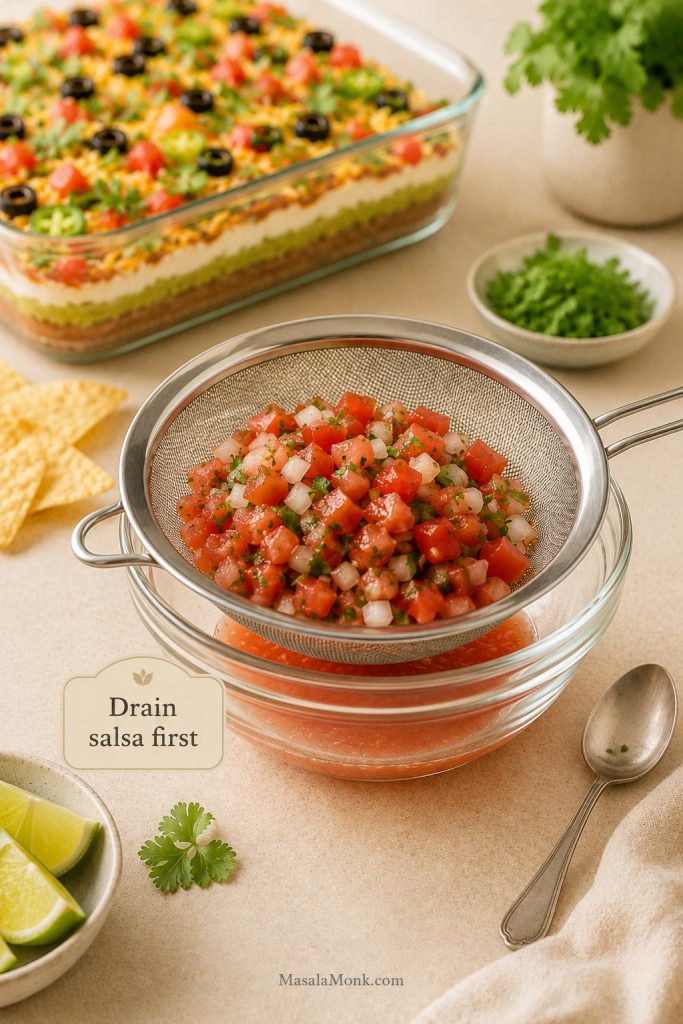
Place the salsa or pico in a fine-mesh strainer and drain for 5 to 10 minutes if it looks loose. You do not need to squeeze it dry; you just want to remove the liquid that would otherwise run into the sour cream.
Chunky salsa draining in a fine-mesh strainer over a glass bowl with visible liquid below and text saying drain salsa first.
If salsa releases liquid in the strainer, it would have released that liquid into the dip, so drain it before layering.

After that, spread the drained salsa in a thin, even layer. Too much can overpower the creamy layers and make them slide around, so use less if your salsa is very juicy.

Step 5: Add Cheese and Fresh Toppings

Sprinkle the cheese evenly over the salsa, then add diced tomatoes, olives, green onions, cilantro, and jalapeños. If the dip is being made several hours ahead, save the most delicate herbs and a few extra green onions for just before serving so the top looks fresh.

Step 6: Chill Briefly and Serve

Chill the dish for about 30 minutes if you have time. This helps the layers settle and makes the dip easier to scoop. If it has been refrigerated for several hours, let it sit for about 10 minutes before serving so the bean layer softens slightly.

Finally, serve with sturdy tortilla chips, scoop-style chips, or crunchy vegetables. The first scoop should cut through the layers without turning the whole dish into a landslide.

Planning for a party? The make-ahead section explains what to prep the day before and what to add right before serving.

Easy 7 Layer Dip Recipe

This easy 7 layer dip recipe is built for clean scooping: seasoned refried beans, guacamole, taco sour cream, drained salsa, cheese, tomatoes, olives, green onions, and jalapeños layered in a 9×13-inch dish. It is cold, creamy, colorful, crowd-friendly, and made to stay fresher and cleaner on the appetizer table.

Prep time:
25 minutes
Chill time:
30 minutes optional
Total time:
25–55 minutes
Yield:
12–16 servings
Dish:
9×13-inch / 23×33 cm dish
Serve:
Cold or lightly chilled

Ingredients

Bean layer

  • 2 cans refried beans, 15–16 oz each / 850–900 g total
  • ⅓ cup salsa / 80 ml, drained if loose
  • 1 teaspoon ground cumin / 2–3 g
  • ½ teaspoon chili powder / 1–2 g
  • ½ teaspoon garlic powder / about 1.5 g, optional
  • 1 tablespoon lime juice / 15 ml, optional
  • Salt, to taste

Guacamole layer

  • 3 medium-large ripe avocados / about 400–500 g avocado flesh
  • 2 tablespoons lime juice / 30 ml
  • ¼ cup chopped cilantro / 10–15 g
  • 1 small jalapeño, finely chopped, optional
  • Salt, to taste

Sour cream layer

  • 1½ cups sour cream / about 360 g
  • 2 tablespoons taco seasoning / about 18–20 g
  • Optional for a thicker texture: 4 oz cream cheese / 113 g, softened

Salsa layer

  • 1½ cups chunky salsa or pico de gallo / 360 ml, drained well
  • Use 1 cup / 240 ml if your salsa is very wet

Cheese and toppings

  • 1½–2 cups shredded cheddar, Monterey Jack, pepper jack, or Mexican cheese blend / 170–225 g
  • 1 cup diced Roma tomatoes / 150–180 g, seeded if juicy
  • ½ cup sliced black olives / about 60–75 g, drained
  • ⅓ cup sliced green onions / 25–35 g
  • Optional: chopped cilantro, pickled jalapeños, diced fresh jalapeño

For serving

  • Sturdy tortilla chips or scoop-style chips

Instructions

  1. Season the beans. In a bowl, stir the refried beans with salsa, cumin, chili powder, garlic powder, lime juice, and salt until thick but scoopable.
  2. Spread the base. Spread the bean layer evenly in a 9×13-inch dish, going all the way to the edges and corners.
  3. Make the avocado layer. Mash the avocados with lime juice, cilantro, jalapeño, and salt. Taste and adjust with more lime or salt if needed.
  4. Add the avocado. Dollop the avocado over the beans, then spread gently so you do not pull up the layer underneath.
  5. Mix the sour cream layer. Stir sour cream with taco seasoning until smooth. For a thicker texture, beat softened cream cheese into the sour cream before adding the seasoning.
  6. Cover the avocado. Dollop the sour cream layer over the avocado and spread it gently to the edges.
  7. Drain the salsa. Spoon salsa or pico into a fine-mesh strainer and drain for 5–10 minutes if it is loose or watery.
  8. Add the salsa and cheese. Spread the drained salsa in a thin layer, then sprinkle evenly with cheese.
  9. Finish the top. Add tomatoes, olives, green onions, cilantro, and jalapeños.
  10. Chill and serve. Chill for 30 minutes if possible. Serve cold or lightly chilled with sturdy tortilla chips.

Notes

  • Drain the salsa or pico well. This is the main fix for a loose, soggy dip.
  • Dollop each soft layer across the dish before spreading it gently for cleaner layers.
  • Halve the recipe for a smaller 8×8-inch dish.
  • Assemble the dip the same day you serve it for the best texture.
  • Cream cheese is optional. It makes the sour cream layer thicker but is not required.
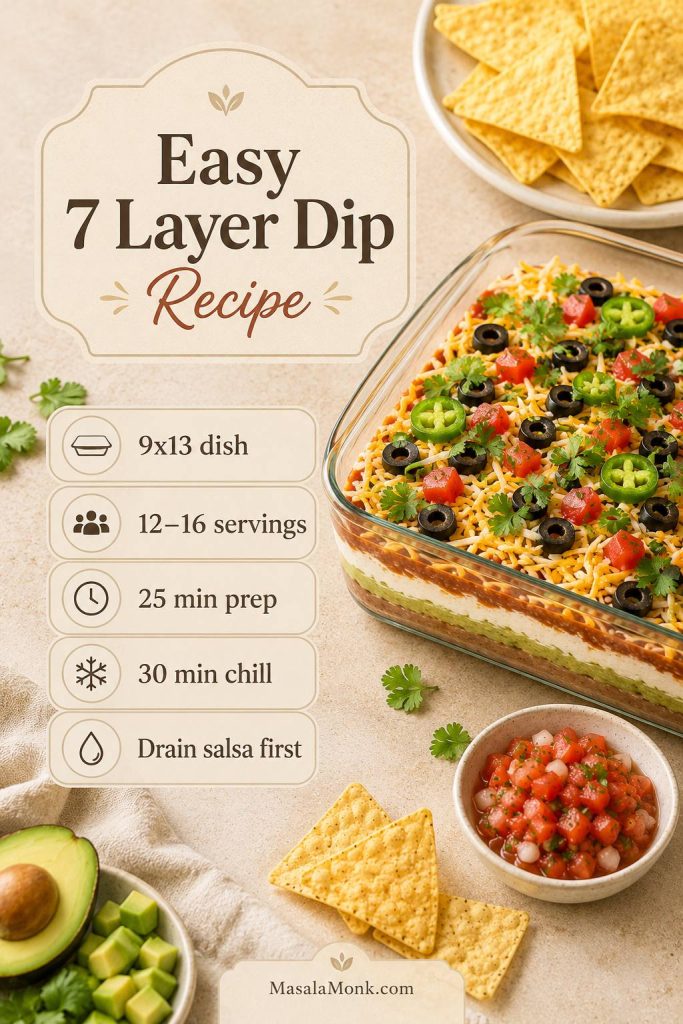
Saveable easy 7 layer dip recipe card with a finished dip, tortilla chips, and text for 9x13 dish, servings, prep time, chill time, and draining salsa first.
Keep the core details handy: use a 9×13 dish, plan for 12 to 16 servings, chill briefly if possible, and drain salsa first.

Can You Make 7 Layer Dip Ahead?

You can make this 7 layer dip recipe ahead, but the real test is how it looks when guests arrive: bright avocado, clean creamy layers, no salsa leaking at the edges, and a top that still looks like you just finished it.

For guests, assemble the dip a few hours before serving, cover it tightly, and keep it chilled. However, if it is just for casual snacking or leftovers, overnight assembly is fine; just expect softer layers and a little avocado darkening.

The cleanest make-ahead plan is to prep the parts separately one day ahead. Mix the beans, stir together the sour cream layer, shred the cheese, slice the olives, chop the green onions, and drain the salsa. Then mash the avocado and assemble the full dish closer to serving time.

Make-ahead timing Best approach Why it works
30 minutes ahead Fully assemble and chill Best balance of fresh flavor and settled layers
2–6 hours ahead Fully assemble, cover tightly, refrigerate Great for guests if salsa is drained well
1 day ahead Prep components separately; assemble later Keeps toppings fresher and avocado brighter
Overnight fully assembled Possible, but not ideal Avocado can darken and salsa can release moisture

Easy Party Timeline

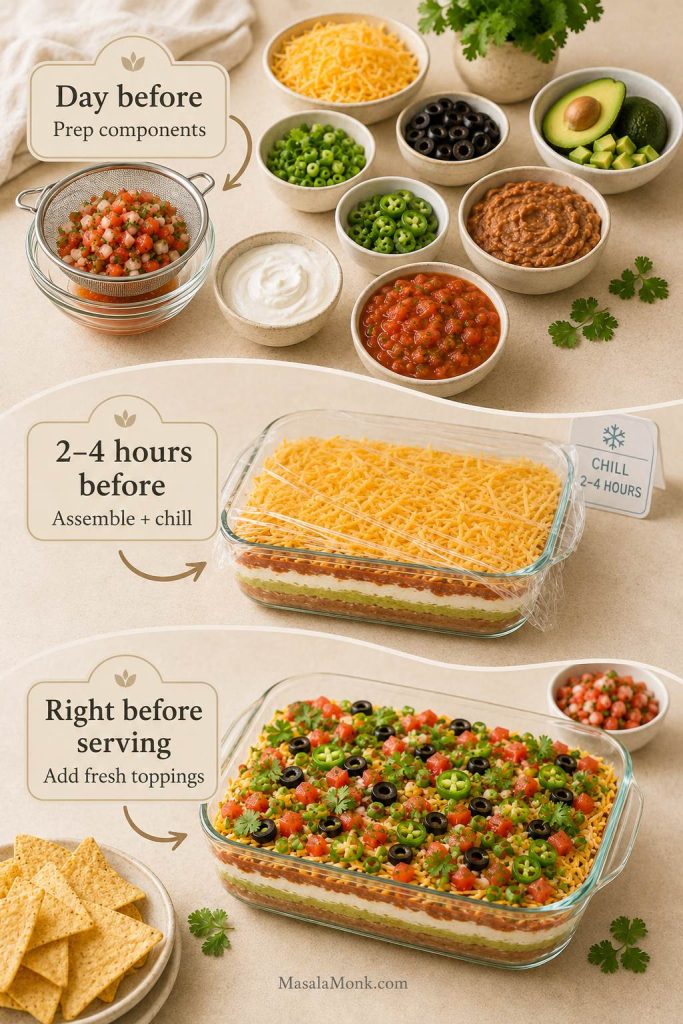
Make-ahead timeline for 7 layer dip showing day-before component prep, 2 to 4 hour assembly and chilling, and fresh toppings added before serving.
For the freshest make-ahead 7 layer dip, prep sturdy components early, assemble a few hours before serving, and add delicate toppings last.
  • The day before: mix the bean layer, mix the sour cream layer, shred cheese, chop sturdy toppings, and drain olives.
  • 2–4 hours before serving: mash the avocado, drain the salsa, assemble the dip, cover, and refrigerate.
  • Right before serving: add extra cilantro, green onions, jalapeños, or a few fresh tomatoes to brighten the top.

If you need to assemble the whole dish the night before, drain the salsa very well, seed juicy tomatoes, spread each layer to the edges, and press plastic wrap close to the surface before refrigerating. Then, add delicate toppings like cilantro and extra green onions right before serving so the top still looks fresh.

Best hosting move: Keep the full dish chilled until guests arrive. If the gathering is long, set out part of the dip and refill from the refrigerator instead of letting the whole dish sit out for hours.

For leftovers and food-safety timing, see how to store leftover 7 layer dip.

How to Keep 7 Layer Dip from Getting Watery

If a 7 layer dip looks perfect when you assemble it and then turns soupy around the edges, salsa is usually the first suspect. The fix is not more cheese or thicker sour cream. Instead, drain the salsa or pico before it ever touches the creamy layers.

If you remember only one thing before assembling the dip, make it this: drain the salsa first.

No-Watery-Dip Rules

Spoon salsa or pico into a fine-mesh strainer and let the loose liquid run off. If your salsa is especially juicy, use less of it, choose a thicker chunky salsa, or add only enough to create a thin flavorful layer. The salsa should brighten the dip, not turn it into a tomato-heavy puddle.

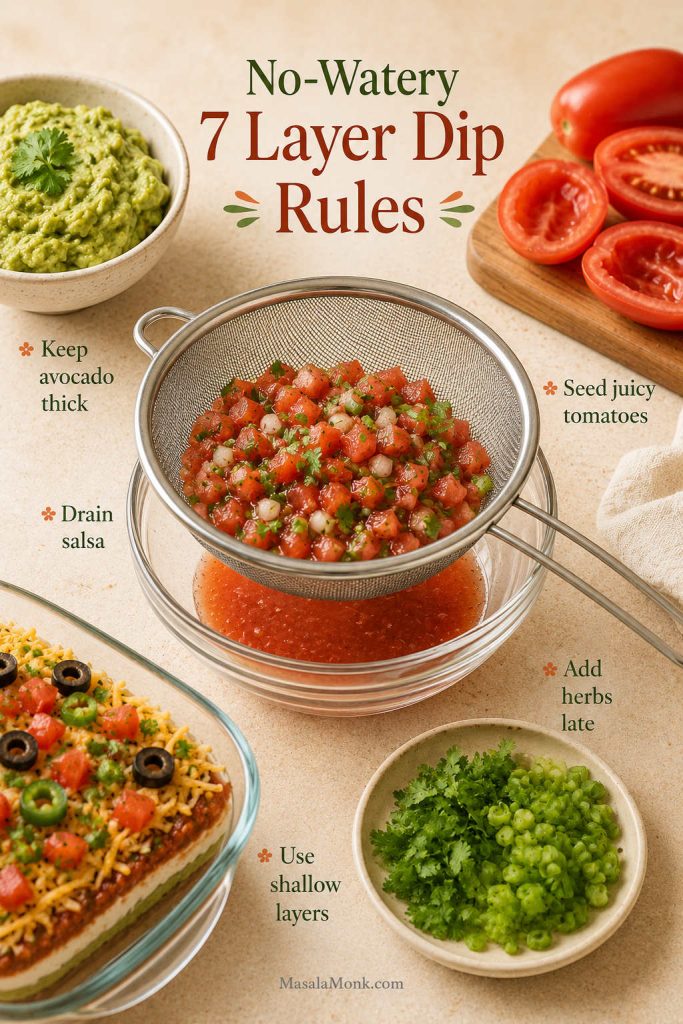
No-watery-dip rules: Drain salsa or pico, use Roma tomatoes or seed juicy tomatoes, keep the avocado layer thick, add delicate toppings late, and avoid making the layers so deep that chips have to dig through them.
No-watery 7 layer dip rules board with salsa draining in a strainer, thick guacamole, seeded tomatoes, fresh herbs, and shallow dip layers.
Watery dip is usually preventable: drain salsa, seed juicy tomatoes, keep avocado thick, add herbs late, and avoid overly deep layers.

Common Watery Dip Problems and Fixes

Problem What causes it Best fix
Liquid pools around the edges Salsa or pico was added straight from the jar or bowl Drain it in a fine-mesh strainer before layering
Tomatoes make the top soggy Very juicy tomatoes or unseeded tomatoes Use Roma tomatoes, seed them, or blot them lightly
The layers loosen after chilling Too many fresh watery toppings were added too early Add herbs, green onions, and extra tomatoes closer to serving
The avocado layer softens too much The avocados were overmixed or too much liquid was added Use just enough lime for flavor and keep the avocado layer thick
Lettuce turns limp Lettuce was layered too far ahead Use lettuce only for same-day serving, or save it for taco salad

Do Not Ignore the Bean Layer

The bean layer matters too. If the beans are too stiff, guests press harder with chips, which breaks the layers and makes the dish messy. If the beans are too loose, the base loses structure. Aim for thick, spreadable, and chip-friendly.

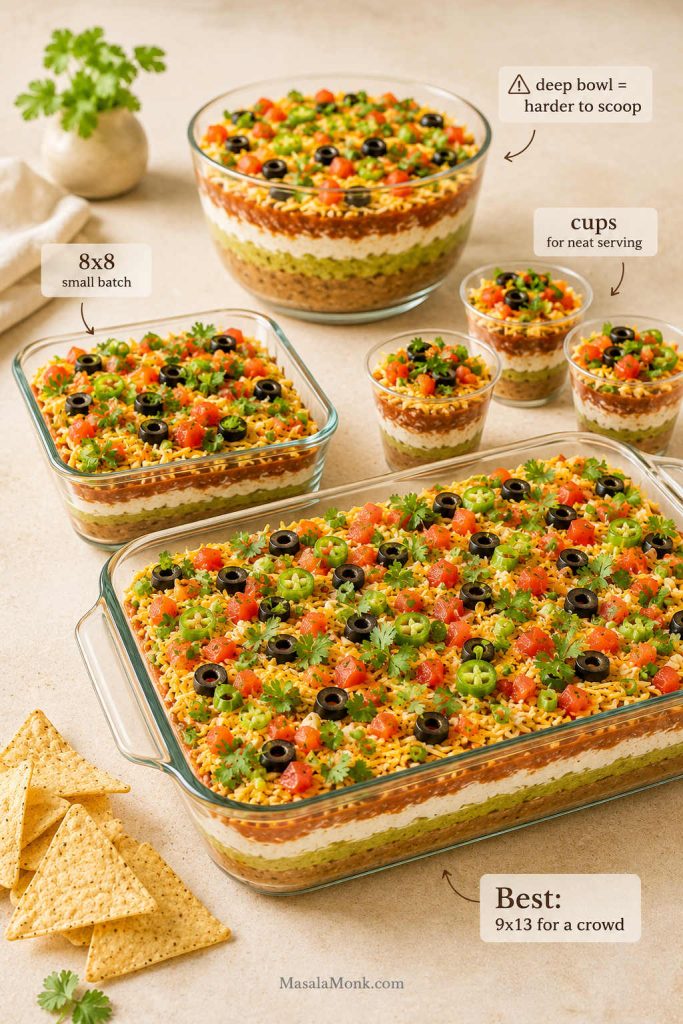
Best Dish Size for 7 Layer Dip

Comparison of 7 layer dip serving sizes with a 9x13 dish, 8x8 dish, individual cups, and a deep bowl labeled harder to scoop.
For a crowd, a shallow 9×13 dish gives the layers room and makes serving easier than a deep bowl.

A 9×13-inch / 23×33 cm glass or ceramic dish is the best choice for this 7 layer dip recipe because it gives you enough surface area for even layers, easy scooping, and a crowd-friendly amount of dip. A clear dish also shows off the layers from the side, which makes it look more impressive without any extra fuss.

The best serving dish is not just the prettiest one; it is the one that lets a chip reach more than one layer at a time. Although a deep bowl may show off the layers, a shallower dish is usually easier to eat from.

Dish or serving style Best for Watch out for
9×13-inch dish Parties, potlucks, game day, large family gatherings Use enough toppings so the surface does not look sparse
8×8-inch dish Small batch, family snack, casual dinner side Halve the recipe so the layers do not get too thick
Shallow platter Pretty presentation and easy scooping Layers spread thinner and can look messier faster
Deep trifle bowl Dramatic visible layers Harder to dip cleanly; better with a serving spoon
Individual cups or jars Office parties, kids, tailgates, no double-dipping More prep work, but very neat to serve

How to Make a Smaller 8×8 7 Layer Dip

For an 8×8-inch dish, halve the recipe. Use 1 can of refried beans, 1 to 2 avocados, about ¾ cup sour cream, ¾ cup drained salsa, ¾ to 1 cup cheese, and a lighter handful of toppings. Keep the same layer order; only reduce the quantities.

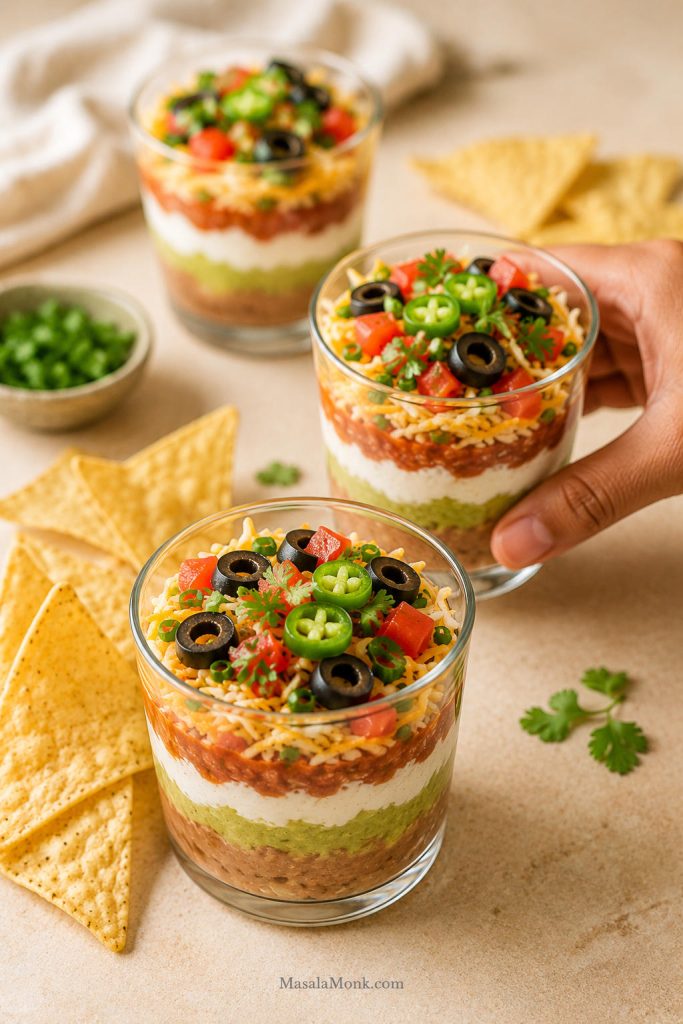
How to Make 7 Layer Dip Cups

For individual cups, use small clear cups or jars and add a spoonful of each layer in the same order: beans, guacamole, sour cream, drained salsa, cheese, tomatoes, and toppings. This works well when you want a cleaner appetizer table or when guests need an easy grab-and-go serving.

Individual 7 layer dip cups in clear glasses with visible beans, avocado, sour cream, salsa, cheese, tomatoes, olives, jalapeños, cilantro, and tortilla chips.
Individual 7 layer dip cups take more prep, but they make portions neat, visible, and easy for guests to grab.

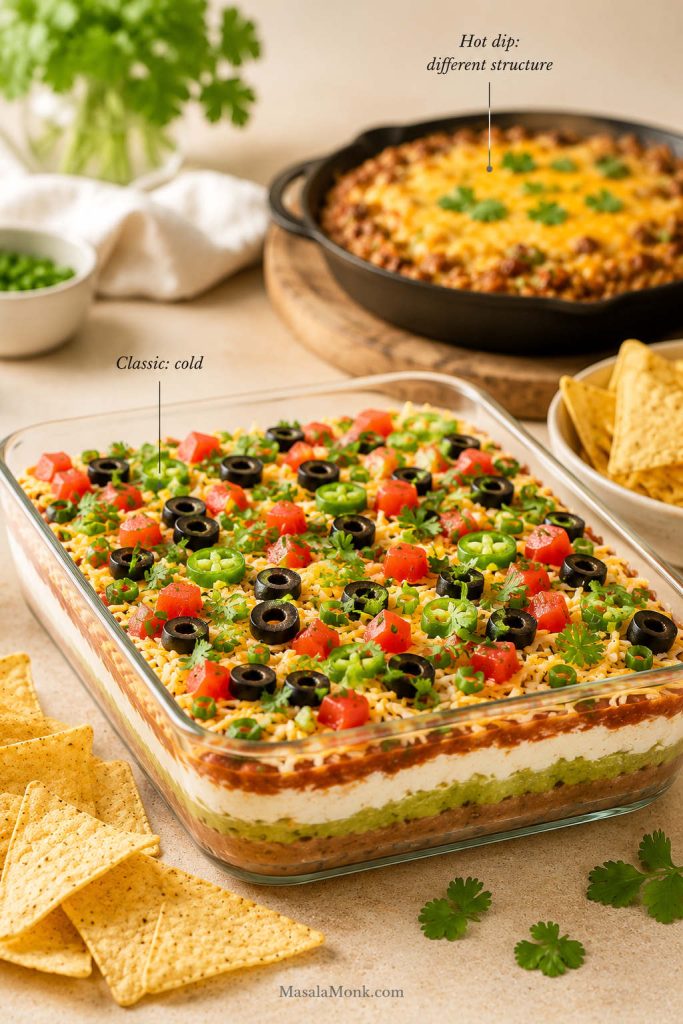
Is 7 Layer Dip Served Hot or Cold?

The classic version is served cold or lightly chilled. Beans, guacamole, sour cream, salsa, cheese, and toppings are layered into a no-bake dip and served with tortilla chips. That cold, creamy, crunchy contrast is part of why it works so well as a shared appetizer.

If you want a hot dip, use a baked taco dip structure instead. Warm versions usually need a different base, especially if you add ground beef, melty cheese, or more cream cheese. For this dish, keep it cold and focus on clean layers, managed moisture, and sturdy chips.

Cold 7 layer dip in a clear glass dish compared with a warm skillet taco dip in the background, with labels for classic cold and hot dip different structure.
Classic 7 layer dip is served cold or lightly chilled, while hot taco dip needs a different structure with warm fillings and melted cheese.

For a game-day spread, keep this dip cold and pair it with something hot and crisp, like air fryer chicken wings. The contrast works well: cool creamy layers, crunchy chips, and hot wings that bring the heat.

What to Serve with 7 Layer Dip

Best Chips and Dippers

Sturdy tortilla chips are the best choice because they can handle the bean layer without breaking. Scoop-style chips are especially useful because they pick up more of the layers at once. Thin restaurant-style chips taste great, but they can snap if the dip is very cold or the beans were not softened before spreading.

For a full 9×13 dish, plan on one 10–13 oz / 280–370 g bag of sturdy tortilla chips for every 6 to 8 people, and more if this is one of the main snacks on the table. Because every scoop tastes a little different — creamy, salty, tangy, fresh, and crunchy all at once — it usually disappears in uneven corners first, with everyone going back for the bite that has the most cheese, salsa, and avocado.

For a party where this is one of several appetizers, plan about ⅓ to ½ cup dip per person. Once it becomes the main snack on the table, expect people to eat more because every scoop tastes a little different.

Party Appetizer Pairings

Party appetizer spread with 7 layer dip, tortilla chips, sliced vegetables, small plates, napkins, and a warm appetizer in the background.
Sturdy tortilla chips are the main dipper, while crisp vegetables and one warm appetizer can round out the party table without crowding the dip.

You can also serve 7 layer dip with mini tostadas, pita chips, crunchy lettuce cups, bell pepper strips, cucumber rounds, celery sticks, or carrot sticks. For a bigger appetizer spread, it fits naturally next to creamy favorites like buffalo chicken dip and spinach dip.

For something warm and crisp beside the cold dip, a tray of potato appetizers works well with the same chips-and-dips mood: salty, crunchy, easy to share, and friendly for a mixed crowd. Deciding between a cold layered dip and a warm baked version? See hot vs cold 7 layer dip.

Chip tip: If the dip is very cold from the refrigerator, let it sit for 10 minutes before serving. The layers will still be chilled, but the beans will be easier to scoop.

7 Layer Dip Variations

This is where 7 layer dip gets personal. Some people want olives, some want no olives, some want lettuce, some want ground beef, and some want the classic cold layers exactly as they are. Use the structure here as the base, then adjust the toppings without losing the clean scoop.

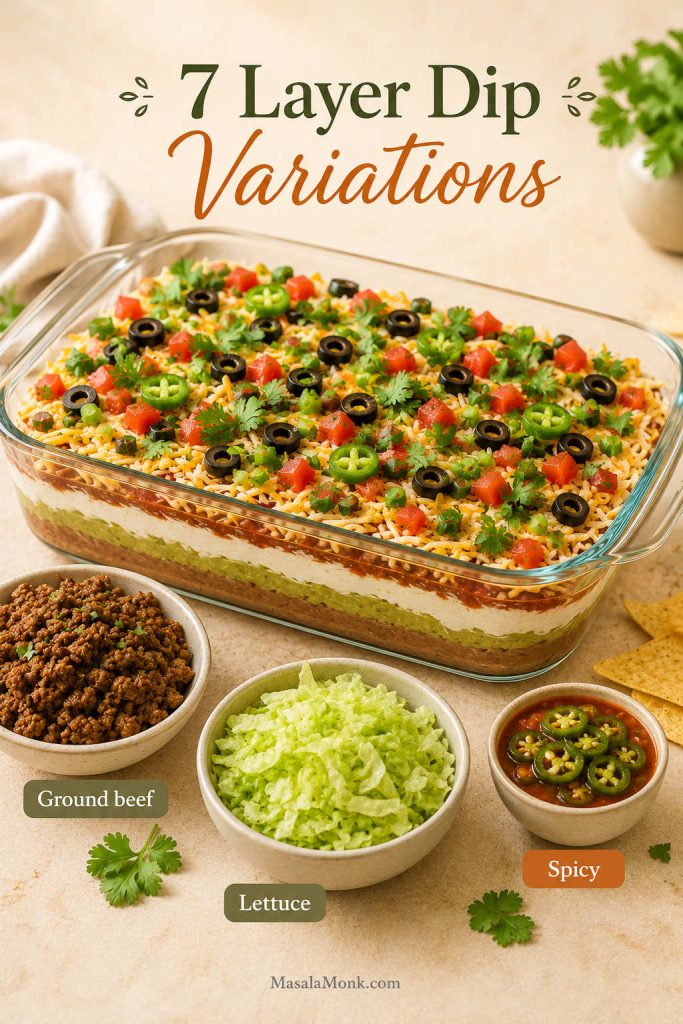
7 layer dip variation scene with a main dip and bowls of ground beef, shredded lettuce, and spicy jalapeño salsa.
Once the base structure is solid, you can add ground beef, lettuce, or jalapeño heat without losing the layered scoop.

7 Layer Dip with Ground Beef

For a heartier taco-night version, add cooked, well-drained, cooled taco-seasoned ground beef above the bean layer. Do not add hot beef to a cold dip because it can loosen the sour cream and avocado. Keeping the beef cooled and well-drained gives you taco flavor without making the layers greasy or soupy.

7 Layer Dip with Cream Cheese

This is the richer party version: beat 4 oz / 113 g softened cream cheese into the sour cream before adding taco seasoning. It makes the creamy layer thicker and more stable, but keep the amount modest so the dip still tastes fresh rather than heavy.

7 Layer Dip with Lettuce

Lettuce only belongs in this dip when it is heading to the table soon. It adds taco-salad crunch, but it wilts quickly once it sits against salsa and sour cream. Add it near the top and serve the dish the same day.

Spicy 7 Layer Dip

To add heat without making the dip watery, use hot salsa sparingly, mix diced jalapeño into the avocado, swap in pepper jack cheese, or finish with pickled jalapeños. For another creamy-spicy bite on the side, these baked jalapeño poppers fit the same party mood.

Vegetarian 7 Layer Dip

This recipe is vegetarian as written if your refried beans are vegetarian. Some canned refried beans contain lard, so check the label if that matters for your guests. Black refried beans or pinto refried beans both work well.

Lighter 7 Layer Dip

For a lighter version, use Greek yogurt in place of some or all of the sour cream, use a little less cheese, and add more fresh toppings. Keep the bean and avocado layers flavorful so the dip still tastes satisfying instead of like a reduced version of the original.

Troubleshooting 7 Layer Dip

If a layered dip goes wrong, it usually shows up fast: a watery edge, a broken chip, a smeared top, or one scoop that pulls half the dish with it. However, most of these are not disasters. They are small texture issues you can prevent before the dish reaches the table.

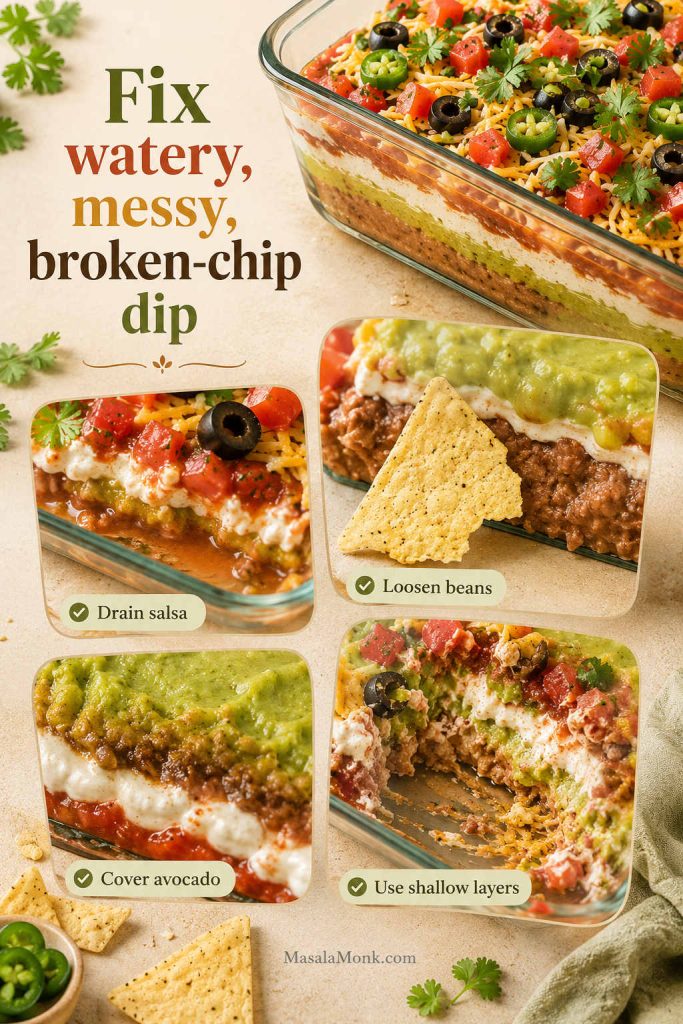
Troubleshooting board for 7 layer dip showing watery salsa, a broken chip, browning avocado, messy layers, and fix labels for draining salsa, loosening beans, covering avocado, and using shallow layers.
When 7 layer dip turns messy, the cause is usually excess liquid, stiff beans, exposed avocado, or layers built too deep.

Moisture and Texture Fixes

Problem Why it happened How to fix it
The dip is watery Salsa, pico, tomatoes, or lettuce released too much liquid Drain salsa and pico, seed juicy tomatoes, and add delicate toppings closer to serving
The beans are too stiff Refried beans were spread straight from the can or chilled too hard Mix beans with salsa, lime juice, or a spoonful of sour cream until scoopable
Chips keep breaking The dip is too dense, too cold, or served in a deep dish Loosen the beans slightly, use a shallower dish, and serve with sturdy chips
Every scoop destroys the layers Layers are too thick, the dish is too deep, or the dip is too cold Use a 9×13 dish, spread thinner even layers, and let the dip sit 10 minutes before serving
The guacamole is browning The avocado layer had too much air exposure Use lime juice, cover the avocado with sour cream, and press plastic wrap close to the surface when chilling

Flavor and Serving Fixes

Problem Why it happened How to fix it
The layers look messy Each layer was spread too aggressively from one spot Dollop each soft layer across the dish first, then spread gently with an offset spatula or spoon
The dip tastes flat The beans or avocado were not seasoned enough Season the bean layer and avocado layer separately before assembly
The top looks dull after chilling Fresh herbs and green onions sat too long in the fridge Add cilantro, green onions, and extra jalapeños just before serving
The dip feels too salty Taco seasoning, cheese, olives, and chips all added salt Use less taco seasoning next time and balance with more avocado, sour cream, or fresh tomato

How to Store Leftover 7 Layer Dip

Cover leftovers from this 7 layer dip recipe tightly and refrigerate them as soon as the party is over. The dip is best within 1 to 2 days. The flavor will still be good the next day, but the layers may soften, the salsa may bleed into the creamy layers, and the avocado may darken slightly.

Do not freeze it. Sour cream, avocado, salsa, and fresh toppings do not thaw cleanly, so the texture will turn watery and grainy. Instead, if the leftovers look messy but still smell fresh and have been stored safely, scoop them into tacos, burrito bowls, quesadillas, or nachos rather than trying to serve them as a neat layered dip again.

Because this dip contains dairy and avocado, keep it chilled until serving and do not let it sit out for hours. The FDA recommends refrigerating perishable foods within 2 hours, or within 1 hour when the temperature is above 90°F / 32°C. A refrigerator should be kept at 40°F / 4°C or below. You can read the FDA’s safe food handling guidance here: Safe Food Handling.

Storage tip: For a long game day or gathering, serve a smaller portion first and keep the rest covered in the refrigerator for refills.

FAQs About 7 Layer Dip

What are the seven layers in 7 layer dip?

A classic version usually has refried beans, guacamole, sour cream, salsa, cheese, tomatoes, and toppings such as olives, green onions, jalapeños, or cilantro. The toppings can vary, but the best versions balance creamy, fresh, salty, and crunchy layers.

Which layer goes first?

Start with refried beans because they are the heaviest layer and create the base. Loosen and season them first, then spread them all the way to the corners so every scoop has structure.

What is the best layer order?

For most gatherings, use beans, guacamole, taco-seasoned sour cream, drained salsa or pico, cheese, tomatoes, and toppings. That order keeps the base sturdy, protects the avocado, and controls extra liquid. For the full explanation, see the best layer order section.

How many people does a 9×13 dish serve?

A 9×13 dish serves about 12 to 16 people as an appetizer. If it is one of several snacks, it can stretch further. If it is the main dip on the table, expect larger servings.

How much 7 layer dip should I plan per person?

For a party with several appetizers, plan about ⅓ to ½ cup dip per person. If this is the main snack with chips, plan more because people tend to come back for extra scoops.

How far ahead should I make it?

For guests, make this 7 layer dip recipe 30 minutes to 6 hours before serving. You can prep most components one day ahead, but full overnight assembly is not ideal because salsa can release liquid and avocado can darken. For timing details, see the make-ahead section.

Why did my dip get watery?

Usually, the culprit is loose salsa, pico de gallo, juicy tomatoes, or lettuce. Drain salsa before layering, use Roma tomatoes, seed or blot juicy tomatoes, and add delicate toppings closer to serving. For the full fix, see how to keep 7 layer dip from getting watery.

What salsa is best for 7 layer dip?

Thick, chunky salsa or well-drained pico de gallo works best. Thin restaurant-style salsa can taste good, but it should be strained first so it does not leak into the sour cream layer.

Can I use store-bought guacamole?

Yes. Store-bought guacamole is fine for a faster version. Choose a thick guacamole, taste it first, and add lime juice, cilantro, or salt if it needs more brightness.

Is it supposed to be hot or cold?

Serve it cold or lightly chilled. Hot taco dip is a separate style and usually needs a different structure with cooked meat, melted cheese, or a baked base.

Should lettuce go in it?

Use lettuce only when serving the dip soon after assembly. It adds crunch, but it wilts quickly once it sits against salsa and sour cream.

Do I need taco seasoning?

Taco seasoning gives the sour cream layer more flavor, and a packet works well. Start with less than the full packet if your chips, cheese, salsa, and olives are already salty, then add more to taste.

What can I use instead of sour cream?

Plain Greek yogurt is the easiest substitute. It tastes tangier and slightly lighter, but it works well with taco seasoning. You can also use half Greek yogurt and half sour cream.

What chips are best?

Sturdy tortilla chips or scoop-style chips are best because they can cut through the bean layer without snapping. If the dip has been refrigerated for several hours, let it sit for about 10 minutes so the beans soften slightly before serving. For more serving ideas, see what to serve with 7 layer dip.

How long can it sit out?

Do not leave it out for more than 2 hours, or more than 1 hour in hot weather above 90°F / 32°C. For long gatherings, set out a smaller amount and keep the rest refrigerated.

What is the difference between 7 layer dip and taco dip?

7 layer dip is a type of taco dip with distinct visible layers. Taco dip can be simpler, creamier, baked, meatier, or mixed together rather than layered. In everyday cooking, the names often overlap.

Is it the same as Mexican layer dip?

They are usually very similar. Mexican layer dip is a broader name that may include fewer or more than seven layers, while 7 layer dip specifically suggests a seven-part layered appetizer with beans, creamy layers, salsa, cheese, and toppings.

Final Tips for the Best 7 Layer Dip

The best 7 layer dip recipe is not complicated. It just needs care in the places that matter: seasoned beans, drained salsa, protected avocado, a 9×13 dish for a crowd, sturdy chips for scooping, and enough fresh toppings to make the dish look bright and generous.

When those pieces are in place, the dip does exactly what a great party appetizer should do. It looks colorful when it hits the table, scoops cleanly through the first rush, tastes creamy and fresh in the same bite, and keeps people coming back long after they said they were done snacking.

Are you team olives, team no olives, team lettuce, team ground beef, or classic cold layers only? Tell me which version disappears fastest at your table.

Final serving of 7 layer dip in a clear 9x13 dish with one corner scooped, tortilla chips around the dish, and colorful toppings still visible.
When the layers are built well, the dip can still look colorful, inviting, and easy to scoop after the first rush of chips.

Back to top

Posted on Leave a comment

Spinach Artichoke Dip Recipe

Baked spinach artichoke dip in a cream ceramic dish with a tortilla chip lifting a thick scoop of cheese, spinach, and artichokes.

A good spinach artichoke dip recipe has a very specific kind of magic: the edges are bubbling, the top is lightly golden, and the first scoop pulls up creamy cheese, tender spinach, and little bites of artichoke without leaving a watery puddle behind. It is the kind of hot, cheesy appetizer people hover around at a party, pretending they are only taking one more chip.

The challenge is getting all that richness to behave. Spinach and artichokes bring moisture, the cheese needs gentle heat, and the creamy base needs enough structure to stay smooth. This version keeps the classic party-dip comfort, but it uses spinach pressed free of hidden water, well-drained artichokes, a stable cream cheese base, and a controlled bake so the dip stays plush, spoonable, and full of flavor.

What you get is a warm baked spinach artichoke dip that is rich but balanced, sturdy enough for chips, and easy enough to make ahead for game day, holidays, potlucks, movie nights, or any table where a bubbling dish of dip disappears faster than expected.

This guide focuses on the details that usually make or break the bowl: how dry the spinach should be, which artichokes work best, which cheeses melt smoothly, when to stop baking, and how to keep the dip warm without turning it oily.

Spinach Artichoke Dip Texture Goal

Before the recipe details, look for the first success cue: a thick scoop with visible vegetables and no watery puddle.

Close-up of hot spinach artichoke dip being scooped from a baked dish with creamy cheese, spinach, artichokes, and a golden edge.
This close-up shows the texture you are aiming for: soft-set, rich, and full of visible vegetables, but still thick enough to hold together.

Spinach Artichoke Dip Guide

Use this guide to make a classic hot spinach artichoke dip, choose the right ingredients, adjust the pan and bake time, and keep the texture smooth, rich, and chip-friendly.

Quick Answer: Best Ratio, Bake Time, and Texture Cue

For this spinach artichoke dip recipe, use 8 oz cream cheese, ½ cup sour cream, ⅓ cup mayonnaise, 10 oz frozen spinach, one 14 oz can artichoke hearts, Parmesan, and mozzarella or Monterey Jack. Bake it at 375°F / 190°C for 22–28 minutes in a 1½- to 2-quart baking dish or an 8×8-inch dish, until the edges bubble and the top is lightly golden.

After baking, rest the dip for 5 minutes before serving. That short pause matters because the cheese and cream base settle into a thicker, chip-friendly texture instead of running the moment a chip hits the dish.

Detail Use This
Oven temperature 375°F / 190°C
Bake time 22–28 minutes
Dish 1½- to 2-quart glass or ceramic dish, or 8×8-inch dish
Servings 8–10 appetizer servings
Spinach 10 oz / 280 g frozen spinach, thawed and squeezed very dry
Artichokes 14 oz / 390–400 g canned artichoke hearts, drained and patted dry
Texture cue Bubbling edges, creamy center, lightly golden top
Rest time 5 minutes before serving

Spinach Artichoke Dip Ratio at a Glance

Keep these core numbers in mind before you mix: dairy base, vegetables, oven temperature, bake time, and rest cue.

Quick answer board for spinach artichoke dip showing 375°F, 22 to 28 minutes, cream cheese, spinach, artichokes, and rest time.
Use the ratio as your starting point, but judge the finish by the dish: bubbling edges, a hot center, and a short rest create the best texture.
Three rules: press the vegetables free of hidden water, bake until the edges bubble, then rest the dip for 5 minutes. The finished dip should look smooth in the center and scoop without leaking liquid into the dish.

Three Rules for a Dip That Holds Together

These three habits are the safety net. Once they make sense, the full step-by-step method shows exactly when to mix, fold, bake, and rest the dip.

Three-rule guide showing spinach being pressed dry, bubbling dip edges, and a rested scoop on a chip.
This is the easiest way to remember the recipe: dry the vegetables well, stop baking once the edges bubble, and give the dip a few minutes to settle.

Why This Spinach Artichoke Dip Works

The creamy texture comes down to balance. Spinach and artichokes bring moisture, the dairy brings richness, and the cheese gives the dip body. When those parts work together, you get a warm, scoopable appetizer instead of a dip that turns loose, oily, or heavy.

That is why this spinach artichoke dip recipe uses a cream cheese base, a moderate oven temperature, and vegetables that are dried before they meet the cheese.

The Creamy Base Has Structure

Cream cheese gives the dip structure and helps hold the base together. Sour cream adds tang, so the richness does not feel flat. A smaller amount of mayonnaise gives the classic party-dip flavor without making the whole dish taste oily or heavy.

That smaller mayo amount is intentional. You still get the familiar richness, but the dip stays closer to a soft, velvety baked appetizer than a heavy mayo-based spread.

How the Base Holds Together

The base is not just richness; it is the part that holds the vegetables and cheese together.

Cream cheese, sour cream, and mayonnaise being mixed into a smooth base with callouts for structure, tang, and richness.
The base works because every dairy ingredient has a job: cream cheese holds the dip together, sour cream brightens it, and mayo adds classic party-dip richness.

The Vegetables Are Dried First

Frozen spinach is reliable because you can thaw it and press out a surprising amount of hidden water before it ever touches the baking dish. Artichoke hearts need the same attention: drain them well, pat them dry, and chop them into bite-size pieces so every scoop has a little artichoke without making the dip wet.

That is the difference between a dip that looks good for five minutes and one that still scoops cleanly after people have been grazing for a while.

The Cheese Melts Gently

Parmesan gives salty, savory depth, while mozzarella or Monterey Jack gives the soft melt. A moderate 375°F / 190°C bake is hot enough to warm the center and brown the top, but not so harsh that the dairy breaks before the dip is ready.

Why this version stays creamy: cream cheese gives the base structure, a smaller amount of mayo keeps it rich without tasting heavy, a full 10 oz package of spinach gives real flavor, and a moderate 375°F bake lets the cheese melt gently.

The main idea is simple: remove water before the dip goes into the oven, then bake just until the cheese melts and the edges bubble. That one-two combination keeps the dip smooth, rich, and chip-friendly.

Ingredients for Creamy Spinach Artichoke Dip

The ingredients are familiar, but the details matter. Use softened cream cheese, fully drained spinach, dry artichokes, and a cheese combination that melts well instead of turning grainy.

Ingredients Before You Mix

Before mixing, it helps to have the base, vegetables, cheese, and seasonings ready at the same time.

Ingredient guide with cream cheese, sour cream, mayonnaise, cheeses, spinach, artichokes, garlic, lemon, pepper, and red pepper flakes.
The ingredient list is simple, but the balance matters; once the dairy, cheese, spinach, and artichokes are in the right ratio, the dip tastes generous without feeling heavy.

Cream Cheese

Use one 8 oz / 226 g block of full-fat cream cheese, softened to room temperature. Block cream cheese gives the dip the best structure. If it is too cold, it will be harder to mix and may leave small lumps in the base.

Sour Cream and Mayonnaise

Sour cream gives the dip a gentle tang and a looser, spoonable texture. A smaller amount of mayonnaise adds richness and helps the dip feel classic without taking over. If you dislike mayo, you can use more sour cream or Greek yogurt instead; just know that the flavor will be tangier and slightly less rich.

Parmesan and Mozzarella or Monterey Jack

Parmesan gives the dip savory, salty flavor. Mozzarella gives the classic stretchy melt. Monterey Jack is a little creamier and smoother if you want a softer restaurant-style texture. You can use all mozzarella, all Monterey Jack, or a mix of the two.

Choose mozzarella if you want more stretch, or Monterey Jack if you want a softer, smoother scoop. For the most balanced version, use one of those for melt and Parmesan for flavor.

Freshly shredded cheese melts a little smoother, but bagged mozzarella or Monterey Jack still works here because the cream cheese base helps keep the dip soft.

Spinach

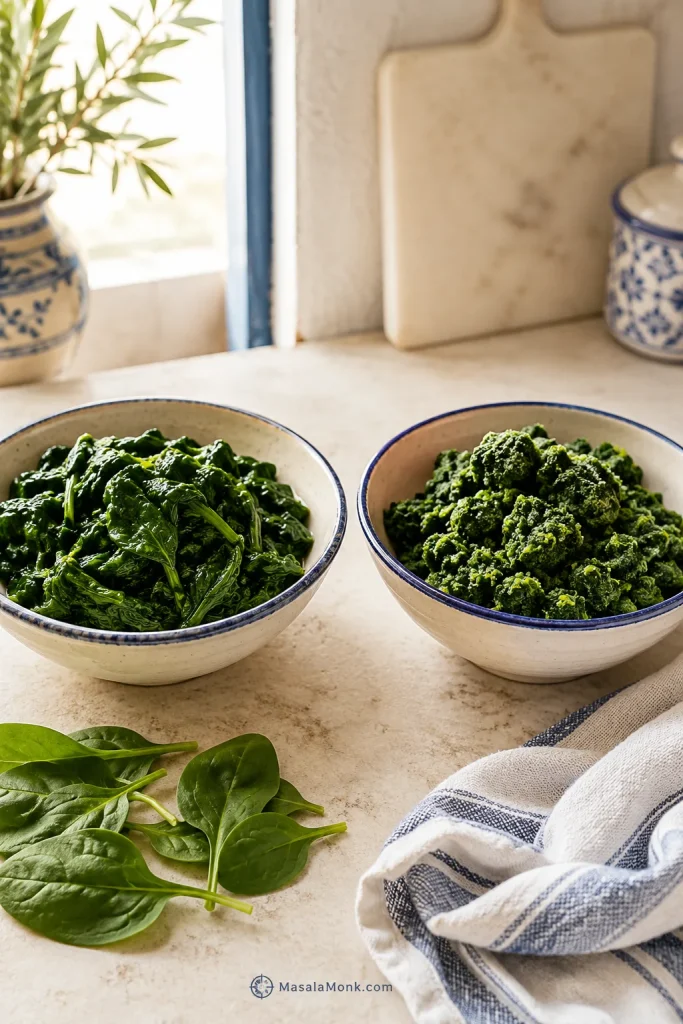
Frozen spinach is the easiest route here because the big shrinking-down step has already happened; your main job is getting rid of the hidden water. Thaw it completely, then squeeze it until it feels like a compact damp ball instead of wet leaves. If you use fresh spinach, cook it down first, cool it, chop it, and squeeze out the extra liquid.

Artichoke Hearts

Canned artichoke hearts in water or brine are the easiest default. Drain them well, pat them dry, and chop them into bite-size pieces. Marinated artichokes work too, but they add more oil, salt, and tang, so drain them very thoroughly and taste before adding extra salt.

Quartered artichoke hearts are easiest because they are already close to scoopable size. Whole hearts work too, but chop them smaller so they do not release big pockets of liquid into the dip.

If the jar smells boldly herby or vinegary, assume that flavor will show up in the finished dip.

Garlic, Lemon, Pepper, and Optional Heat

Garlic gives the dip its savory backbone. Lemon zest or a little lemon juice cuts through the richness without making the dip taste lemony. Black pepper adds warmth, and a pinch of red pepper flakes or a few dashes of hot sauce can wake up the whole dish.

Fresh vs Frozen Spinach for Spinach Artichoke Dip

Fresh spinach and frozen spinach both work, but they do not behave the same way. Frozen spinach is easier for most home cooks because it has already been cooked down. Once thawed, you can squeeze out the water and add it straight to the creamy base.

Fresh spinach has a cleaner flavor, but it takes more prep. Once it cooks down, the leaves still need to be cooled and squeezed; otherwise, the dip can turn loose instead of thick and scoopable.

Best Spinach Choice for the Dip

The best spinach is the one you can prep and dry thoroughly, even if frozen spinach is the easiest route.

Comparison of frozen chopped spinach, frozen leaf spinach, and fresh spinach for making spinach artichoke dip.
Frozen spinach saves prep time because it is already cooked down, but it still needs one important step: press out the water before it reaches the cheese base.
Spinach Type Amount How to Use It
Frozen chopped spinach 10 oz / 280 g Thaw completely and squeeze very dry.
Frozen cut-leaf spinach 10 oz / 280 g Use if available for a slightly better leafy texture. Thaw and squeeze dry.
Fresh baby spinach About 1 lb / 450 g Cook down first, cool, chop, and squeeze dry.
Frozen creamed spinach Shortcut only Changes the dairy, salt, and texture. Reduce other creamy ingredients if using it.
Most important rule: the success of this dip depends less on fresh vs frozen spinach and more on how dry the spinach is before it goes into the bowl.

After squeezing, the spinach should feel compact and damp, not juicy. If you press it and liquid still runs out, keep going. Once the spinach is ready, it should break apart easily when you stir it into the base instead of leaving green liquid behind in the bowl.

How Dry the Spinach Should Look

The table explains the options; this cue shows the texture you want before the spinach enters the cheese base. If your dip has turned loose before, the troubleshooting section explains how to fix watery dip and prevent it next time.

Compact squeezed spinach clump on a kitchen towel showing how dry spinach should be before adding it to dip.
This is the spinach texture to aim for: compact and damp, not juicy. If liquid still runs out when you press it, keep going.

Canned vs Marinated Artichokes

For classic spinach artichoke dip, canned artichoke hearts are the easiest choice. They are tender, mild, and easy to chop. The only catch is moisture. Drain them well, press away excess liquid with paper towels or a clean kitchen towel, and chop them into pieces small enough to scoop.

Marinated artichokes can taste great, but they bring oil, herbs, salt, and tang. Drain them extra well before they go into the creamy base, especially if you do not want the dip to taste sharp or oily.

Best Artichokes to Use

Before choosing a can or jar, remember that artichokes change both flavor and moisture.

Comparison of canned, brined, marinated, and frozen artichokes for spinach artichoke dip.
Artichokes affect both moisture and flavor. For the cleanest baked dip, choose mild canned or brined hearts and dry them well before mixing.
Artichoke Type Use It? What to Know
Canned in water Yes The easiest default. Drain well, pat dry, and chop.
Jarred in brine Yes Drain well. Rinse if they taste very salty.
Marinated in oil Yes, with care More flavor, more oil. Drain very thoroughly.
Frozen artichokes Yes, if available Thaw, drain, pat dry, then chop.
Fresh artichokes Not ideal here Too much prep for a creamy baked dip.

How to Prep Artichokes for Dip

Once you choose the artichokes, the prep is simple but important: drain, dry, and chop them small enough for clean scoops.

Artichoke hearts being drained, patted dry, and chopped into bite-size pieces on a cutting board.
Smaller, drier artichoke pieces mix more evenly into the cheese base, so every scoop gets flavor without hidden wet pockets.

Best Cheese for Spinach Artichoke Dip

The best cheese for spinach artichoke dip is usually a mix of one cheese for melt and one cheese for flavor. Mozzarella or Monterey Jack gives the creamy pull. Parmesan gives the savory bite.

The goal is not just stretch. You want a dip that feels melty and generous, but still has enough savory edge from Parmesan to keep each bite from tasting like plain cream.

A dramatic cheese pull is fun, but the better party dip is the one that stays smooth enough for the next person’s chip.

Best Cheese Blend for Spinach Artichoke Dip

Cheese choice helps, but bake control matters too; the bake-time guide shows when to stop before the dairy overheats.

Cheese guide showing mozzarella, Monterey Jack, and Parmesan for spinach artichoke dip.
The best cheese blend does two things at once: mozzarella or Monterey Jack gives melt, while Parmesan adds the savory bite that keeps the dip from tasting flat.

Classic Cheese Combination

Use mozzarella and Parmesan for the familiar creamy, cheesy party dip. Mozzarella melts softly, and Parmesan keeps the flavor from tasting flat.

Creamiest Cheese Combination

Use Monterey Jack and Parmesan if you want a smoother, less stretchy dip. Monterey Jack melts beautifully and works especially well if you are serving the dip from a slow cooker or keeping it warm for a party.

Sharper Restaurant-Style Option

Use white cheddar with Parmesan for a sharper flavor. Keep the amount moderate, because too much aged cheese can make the dip salty or slightly grainy.

Cheese to Use Carefully

Gruyère, Swiss, and aged cheddar can add great flavor, but they are best in smaller amounts. For the smoothest dip, do not make aged cheese the entire cheese base.

Freshly Shredded vs Bagged Cheese

This is a practical choice, not a dealbreaker. Fresh shreds melt smoother, but the cream cheese base keeps good bagged cheese workable.

Freshly shredded cheese and bagged shredded cheese compared for use in spinach artichoke dip.
Freshly shredded cheese melts a little smoother, but bagged mozzarella or Monterey Jack still works because the cream cheese base helps keep the dip soft.

How to Make Spinach Artichoke Dip

This is an easy spinach artichoke dip, but the order matters: dry the vegetables first, mix the base until smooth, fold gently, and bake just until the edges bubble.

Method at a Glance

Here is the whole workflow before the step-by-step details.

Step-by-step guide showing vegetable prep, base mixing, cheese folding, baking, and resting for spinach artichoke dip.
The method is simple, but the order matters: dry the vegetables first, smooth the base, fold gently, and bake only until the dip is hot and bubbling.

Step 1: Prep the Spinach and Artichokes

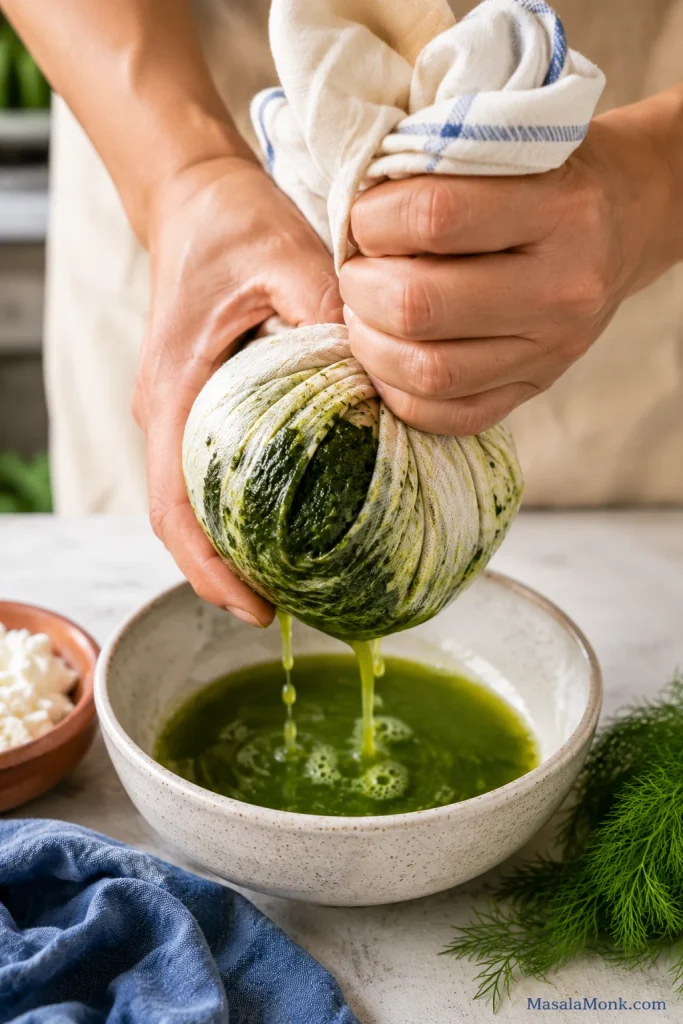
Thaw the frozen spinach completely. Wrap it in a clean kitchen towel, cheesecloth, or several layers of paper towel, then squeeze until no more liquid runs out. Drain the artichokes, pat them dry, and chop them into bite-size pieces.

How to Press Out Hidden Water

This is where the dip is won or lost: twist firmly, then keep pressing until the spinach stops giving off liquid.

Hands twisting thawed spinach in a clean kitchen towel over a bowl to remove green liquid.
Pressing out the hidden water is the most important prep step because wet spinach is one of the fastest ways to make the dip loose.

Step 2: Mix the Creamy Base

In a large bowl, mix softened cream cheese, sour cream, mayonnaise, garlic, lemon zest or juice, black pepper, and optional red pepper flakes or hot sauce. The base should look mostly smooth before you add the vegetables.

Mix the Base Before Adding Vegetables

A smooth base makes the vegetables easier to fold in evenly, especially when the cream cheese is fully softened.

Cream cheese, sour cream, mayonnaise, garlic, lemon, and pepper being mixed into a smooth base in a bowl.
Mix the base before adding spinach and artichokes; otherwise, cold cream cheese can leave lumps and make the vegetables harder to fold in evenly.

Step 3: Fold in Cheese, Spinach, and Artichokes

Fold in most of the Parmesan and mozzarella or Monterey Jack, saving some for the top. Add the squeezed spinach and chopped artichokes, then stir until evenly combined. Do not mash everything into a paste; little artichoke pieces are part of the charm.

Step 4: Taste and Adjust

Taste the mixture before baking and add salt only if needed, since Parmesan and artichokes can already be salty. This is also the moment to add a little more lemon, pepper, or hot sauce if the base tastes flat.

Step 5: Bake Until Bubbly

Spread the mixture into a greased 1½- to 2-quart glass or ceramic baking dish, or an 8×8-inch dish. Top with the reserved cheese. Bake at 375°F / 190°C for 22–28 minutes, until the edges bubble and the top is lightly golden.

Step 6: Rest Before Serving

Let the dip rest for 5 minutes before serving. It will still be hot, but the base will settle into a thicker, smoother scoop.

Spinach Artichoke Dip Recipe Card

This spinach artichoke dip recipe makes a hot baked dip with a velvety cheese base, tender spinach, bite-size artichokes, and enough structure to hold on sturdy chips, crackers, crostini, pita, or vegetables.

Prep Time15 minutes
Bake Time22–28 minutes
Rest Time5 minutes
Total TimeAbout 45 minutes
Servings8–10
YieldAbout 5 cups
Oven375°F / 190°C
Dish1½- to 2-quart or 8×8-inch

Ingredients

  • 8 oz / 226 g cream cheese, softened
  • ½ cup / 120 g sour cream
  • ⅓ cup / 75–80 g mayonnaise
  • ¾ cup / 65–75 g grated Parmesan, divided
  • 1½ cups / 150–170 g shredded mozzarella or Monterey Jack, divided
  • 10 oz / 280 g frozen spinach, thawed and squeezed very dry
  • 1 can / 14 oz / about 390–400 g artichoke hearts, drained, patted dry, and chopped
  • 2–3 garlic cloves, minced
  • 1 tsp lemon zest or 1 tbsp lemon juice
  • ¼ tsp black pepper
  • ¼ tsp red pepper flakes or a few dashes of hot sauce, optional
  • Salt, only after tasting
  • Tortilla chips, pita chips, crostini, crackers, or vegetables, for serving

Instructions

  1. Heat the oven to 375°F / 190°C. Lightly grease a 1½- to 2-quart glass or ceramic baking dish, or an 8×8-inch baking dish.
  2. Thaw the spinach completely, then squeeze it very dry in a clean kitchen towel, cheesecloth, or several layers of paper towel.
  3. Drain the artichoke hearts, pat them dry, and chop them into bite-size pieces.
  4. In a large mixing bowl, stir together the softened cream cheese, sour cream, mayonnaise, garlic, lemon zest or juice, black pepper, and optional red pepper flakes or hot sauce until mostly smooth.
  5. Fold in ½ cup Parmesan and 1 cup mozzarella or Monterey Jack. Save the remaining cheese for topping.
  6. Fold in the squeezed spinach and chopped artichokes until evenly distributed.
  7. Taste the mixture before baking and add salt only if needed, since Parmesan and artichokes can already be salty.
  8. Spread the mixture into the prepared baking dish. Top with the remaining Parmesan and mozzarella or Monterey Jack.
  9. Bake for 22–28 minutes, until the dip bubbles at the edges and the top is lightly golden.
  10. For a more browned top, broil for 1–2 minutes at the end, watching closely.
  11. Rest for 5 minutes before serving warm with sturdy chips, crackers, crostini, pita, or vegetables.

Notes

  • Do not rush the spinach step. A few extra squeezes are the difference between a dip that holds together and one that leaks at the bottom.
  • If baking from the fridge, add 10–15 minutes depending on the depth of the dish.
  • If using fresh spinach, cook down about 1 lb / 450 g fresh spinach, cool it, chop it, and squeeze it dry before adding.
  • If the dip seems too thick after baking, stir in a spoonful of warm milk, sour cream, or softened cream cheese.
  • If the dip seems watery, the spinach or artichokes likely needed more draining. Bake uncovered a little longer and use the troubleshooting table below for next time.
  • For the smoothest texture, serve the dip warm after a 5-minute rest, not straight from the oven while it is still bubbling aggressively.

What the Finished Dip Should Look Like

When the dip is ready, the edges should be bubbling, the top should be lightly golden, and the center should look soft rather than dry. After a 5-minute rest, a chip or spoon should pull up a thick, creamy scoop with visible spinach and artichoke pieces.

Serve it while the top is still just-baked and lightly golden, but not so hot that the cheese runs. That is the sweet spot where the dip holds on a chip, the artichokes still taste bright, and the garlic-cheese aroma does half the work for you.

If the dip tastes a little flat after baking, add a tiny squeeze of lemon or a few dashes of hot sauce on top before serving. Warm dairy and cheese can mute seasoning slightly, so a small bright finish can make the whole dish taste more awake.

Why the 5-Minute Rest Matters

The finished dip should not be served at its most molten moment; a brief rest gives the first scoop a better chance to hold together.

Comparison of spinach artichoke dip straight from the oven and after resting for five minutes, with a thicker rested scoop.
Resting gives the cheese base time to settle, so the first chip pulls up a thick scoop instead of dragging loose dip back into the dish.

Bake Time by Pan Size

The right bake time for this spinach artichoke dip recipe depends on the depth of the dish. A shallow dish heats faster and browns sooner. A deeper dish takes longer for the center to become hot and creamy.

Time gets you close, but the visual cue matters more. If your oven runs hot or your dish is shallow, start checking early: the edges should bubble before the top gets deeply browned.

Best Pan Size for Baking

Choose the dish before you rely on the timer. Wider dishes brown faster, while deeper ones need more time in the center.

Pan size guide showing different baking dishes, including a 1½ to 2 quart dish, 8x8-inch dish, shallow pie dish, and 9x9-inch dish.
Pan depth changes bake time. A shallow dish browns faster, while a deeper dish needs more time for the center to become hot.
Dish or Setup Bake Time at 375°F / 190°C Texture Cue
1½- to 2-quart baking dish 22–28 minutes Bubbling edges, creamy center
8×8-inch dish 22–25 minutes Hot through, lightly golden top
Shallow pie dish 18–22 minutes Watch the top; it browns faster
9×9-inch dish 20–25 minutes Good for a slightly thinner layer
From the fridge Add 10–15 minutes Center should be hot, not just edges
Broiled top 1–2 minutes only Watch constantly so the cheese does not overheat

Doneness Cues Before You Pull the Dish

Pair the bake-time table with what you see in the dish: bubbling and lightly golden, not deeply browned.

Doneness guide showing spinach artichoke dip that is too loose, just right, and too browned.
Use time as a guide, then trust what you see: the dip should bubble at the edges and look lightly golden before it goes too far.

350°F vs 375°F vs 400°F

350°F is gentler and works well for deeper dishes, but the dip may take longer. 375°F is the best default because it heats the center and browns the top without rushing the dairy. A 400°F oven works for a faster bake in a shallow dish, but watch it closely so the top does not brown before the center is fully hot.

Make Ahead Spinach Artichoke Dip

This spinach artichoke dip recipe is a great make-ahead appetizer because you can assemble it 1–2 days ahead, refrigerate it tightly covered, and bake it when you are ready to serve.

Make-Ahead Setup

The easiest party timing is simple: assemble ahead, keep it chilled, then bake close to serving time. If you are assembling in glass or ceramic, check the cold dish safety note before baking.

Make-ahead guide showing assembled spinach artichoke dip stored before being transferred to a baking dish.
For the smoothest make-ahead dip, handle the moisture first; once the spinach and artichokes are dry, the rest of the prep becomes easy.

How Far Ahead Can You Assemble It?

For the best texture, assemble the dip 1 day ahead. Two days is still fine, but the spinach and artichokes need to be very well drained so the dip does not loosen as it sits.

This is the kind of appetizer you want ready before people drift into the kitchen asking what smells good. Assemble it ahead, then bake it when the table is almost ready.

How to Bake It From the Fridge

If the dip is cold from the fridge, add 10–15 minutes to the bake time. The top may look ready before the center is hot, so check the middle before serving.

Cold Dish Safety Note

A cold glass or ceramic baking dish should not go straight from the refrigerator into a fully hot oven. Let the dish sit at room temperature briefly, place it on a room-temperature baking sheet, or transfer the dip to a room-temperature baking dish before baking. This helps protect the dish from thermal shock.

Cold Dish Safety Before Baking

This fridge-to-oven step protects the dish: let cold glass or ceramic warm slightly, or move the dip into a room-temperature baker.

Cold dish safety guide showing a refrigerated glass or ceramic dish, a baking sheet, and a transfer step before baking.
If the dip was refrigerated in glass or ceramic, avoid shocking the dish with sudden heat; instead, let it warm slightly or transfer the dip before baking.
Best party prep: mix the dip in an airtight container, refrigerate it, then transfer it to the baking dish before baking. That gives you more flexibility and avoids putting an ice-cold glass dish into a hot oven.

Storage and Reheating

Store leftover spinach artichoke dip in an airtight container in the refrigerator for 3–4 days. Refrigerate leftovers within 2 hours of serving, especially because this is a dairy-heavy dip.

Party safety tip: if the dip has been sitting out for more than 2 hours, especially in a warm room, do not keep returning it to the fridge and reheating it. For longer parties, keep a smaller amount out and refill with a clean spoon, or keep the dip warm in a slow cooker once it is fully heated.

To reheat a larger portion, cover loosely and warm in a 325–350°F oven until hot. For a small portion, microwave in short bursts, stirring between each burst. If the dip has thickened in the fridge, stir in a spoonful of milk, sour cream, or cream cheese to bring back the creamy texture.

How to Store and Reheat Leftovers

Leftovers need gentle heat, not aggressive reheating. If you need to store the dip longer than a few days, the freezing section explains the texture tradeoff.

Storage and reheating guide showing leftover spinach artichoke dip in a container, oven reheating, and dairy being stirred in to loosen the dip.
Leftover dip thickens as it chills, so reheat it gently and stir in a little dairy if it needs help becoming smooth again.

For general leftover safety, USDA FSIS recommends reheating leftovers to 165°F / 74°C; their leftovers and food safety guide is a useful reference for reheating and storing cooked foods.

Can You Freeze Spinach Artichoke Dip?

You can freeze spinach artichoke dip, but it is not the best make-ahead method if you want the creamiest texture. Dairy-based dips can loosen, separate, or turn slightly grainy after freezing and thawing.

If you need to freeze it, freeze the dip unbaked in a freezer-safe container or disposable foil pan. Thaw overnight in the refrigerator when possible, stir well, top with a little fresh cheese, and bake gently until hot.

Freezing Spinach Artichoke Dip

Freezing is possible, but the best result comes from thawing, stirring, and baking gently.

Freezing guide showing spinach artichoke dip in a freezer-safe container, thawed dip being stirred, and a small baked dish.
You can freeze this dip, but refrigeration gives the best texture. When freezing is necessary, thaw it, stir it well, and bake gently.
Method Works? What to Know
Refrigerate unbaked Yes Use within 1–2 days for the creamiest result.
Freeze unbaked Possible Texture may loosen after thawing.
Freeze baked leftovers Not ideal Dairy can separate when reheated.
Bake from frozen Possible in a foil pan Takes longer and may be less creamy.
Thaw, stir, then bake Best freezer route Restores the texture better than baking straight from frozen.

Slow Cooker Spinach Artichoke Dip Option

To make slow cooker spinach artichoke dip, mix the recipe as written and spread it into a lightly greased 3-quart slow cooker. Cook on low for 1½–2 hours or on high for about 1 hour, stirring once or twice, until the dip is hot and creamy.

Once it is hot, switch the slow cooker to warm for serving. Stir occasionally so the edges do not overheat. If the dip thickens as it sits, loosen it with a splash of warm milk or a spoonful of sour cream.

Just know that the slow cooker is best for holding the dip warm and soft; it will not give you the same browned top as the oven.

Slow Cooker Serving Option

For long parties, the slow cooker solves the holding problem even though it will not brown the top. For timing, pair it with the make-ahead plan.

Spinach artichoke dip in a cream slow cooker with tortilla chips, crostini, carrots, celery, and cucumber nearby.
Use the slow cooker when you care more about easy serving than a golden top; it keeps the dip warm, soft, and ready for grazing.
Slow cooker tip: do not leave dairy-heavy dip on high for too long. Once it is melted and hot, warm is the safer party setting.

If you want a second hot dip for the same party table, MasalaMonk’s buffalo chicken dip recipe gives you a spicier baked, crockpot, and game-day option.

No Mayo, Healthy, and Greek Yogurt Variations

The classic version uses a little mayonnaise because it adds richness and gives the dip that familiar party-appetizer flavor. You can still make it without mayo, with Greek yogurt, or in a lighter style if you keep enough cream cheese to hold the dip together.

For a broader look at cold spinach dip, baked spinach dip, bread-bowl versions, and lighter yogurt-based ideas, MasalaMonk’s spinach dip recipes guide is a useful companion.

Ways to Adapt the Dip

Once the base recipe is balanced, these swaps are much easier to control because the moisture and cheese structure stay steady.

Variations guide showing classic, no mayo, Greek yogurt, lighter, spicy, and extra cheesy spinach artichoke dip.
Once the base recipe is balanced, you can change the style without losing the texture: go no-mayo, Greek yogurt, lighter, spicy, or extra cheesy.

Spinach Artichoke Dip Without Mayo

Replace the ⅓ cup mayonnaise with ⅓ cup sour cream. This is the easiest no-mayo version because the flavor stays creamy and familiar. For a tangier no-mayo dip, use ⅓ cup full-fat Greek yogurt instead.

No-mayo ratio: 8 oz cream cheese + ⅔ cup sour cream, or ½ cup sour cream + ⅓ cup full-fat Greek yogurt, with no mayo. Keep the cheese, spinach, and artichokes the same.

Healthy Spinach Artichoke Dip

For a lighter spinach artichoke dip, replace the mayo with Greek yogurt, use part-skim mozzarella, and keep the full amount of spinach and artichokes. Do not remove all the cream cheese unless you want a much lighter, tangier dip with less classic party-dip texture.

Lighter ratio: 8 oz cream cheese + ½ cup sour cream + ⅓ cup full-fat Greek yogurt + part-skim mozzarella. This keeps the dip smooth and scoopable while reducing the mayo-heavy richness.

Greek Yogurt Spinach Artichoke Dip

Greek yogurt adds tang and protein, but it can separate if overheated. Use full-fat Greek yogurt if possible, keep the cream cheese in the base, and avoid baking the dip too aggressively. Greek yogurt works best as a mayo replacement, not as the only creamy ingredient.

Spicy Spinach Artichoke Dip

Add minced jalapeño, red pepper flakes, cayenne, or hot sauce. Start small. The goal is warmth and lift, not a dip that hides the artichoke flavor.

Extra Cheesy Restaurant-Style Dip

Add an extra ½ cup mozzarella, Monterey Jack, or white cheddar. If you add more cheese, keep the spinach and artichokes very dry so the dip stays creamy instead of greasy.

How to Fix Watery, Greasy, Grainy, or Bland Spinach Artichoke Dip

A great spinach artichoke dip recipe should stay smooth and scoopable from the first chip to the last. If the dip turns watery, greasy, grainy, or bland, do not change the whole recipe first. Most problems are fixable once you know where they started: excess water, aggressive heat, or seasoning that needs more contrast.

Quick Fix Guide

Before changing the recipe, diagnose the problem first. The table below gives the full cause-and-fix details.

Troubleshooting guide showing watery, greasy, grainy, too thick, too thin, bland, too salty, and broken chip problems for spinach artichoke dip.
Most dip problems come from moisture, heat, or seasoning, so diagnosing the issue first makes the fix much easier.
Problem Likely Cause Fix
Watery dip Spinach or artichokes were too wet Squeeze spinach harder, pat artichokes dry, and bake uncovered a little longer.
Greasy top Dairy or cheese overheated Use moderate heat, avoid a long broil, and remove the dip once the edges bubble.
Grainy texture Cheese overheated or too much aged cheese Use mozzarella or Monterey Jack for melt, Parmesan for flavor, and avoid overbaking.
Too thick Too much cheese or overbaking Stir in warm milk, sour cream, or a spoonful of softened cream cheese.
Too thin Too much liquid in the vegetables or base Bake uncovered a little longer and add a small handful of cheese if needed.
Bland Not enough acid, garlic, pepper, or savory cheese Add lemon zest or juice, black pepper, garlic, Parmesan, or a few dashes of hot sauce.
Too salty Brined artichokes, salty cheese, or too much added salt Rinse brined artichokes next time and salt only after tasting the mixed dip.
Chips keep breaking Dip is too thick or dippers are too thin Use pita chips, crostini, sturdy tortilla chips, crackers, or vegetables.
Dish cracked Cold glass or ceramic dish went straight into a hot oven Let the dish warm slightly, transfer the dip, or use a room-temperature baking dish.

What to Serve With Spinach Artichoke Dip

Spinach artichoke dip is thick, warm, and cheese-rich, so sturdy dippers are best. Thin chips can snap if the dip is very cheesy, especially right out of the oven.

Because the dip is rich, the best spread has contrast: something salty, something crisp, something fresh, and something sturdy enough to scoop through the warm cheese without snapping.

What to Serve With It

Build contrast around the rich dip: sturdy, crisp, fresh, and easy to scoop. If this is the main hot appetizer, check the party quantity guide before deciding whether to make a full or double batch.

Serving board with baked spinach artichoke dip, tortilla chips, pita chips, crostini, crackers, carrots, celery, bell peppers, cucumber, and snap peas.
The best dippers bring contrast: sturdy chips and crostini handle the thick dip, while fresh vegetables keep the appetizer board from feeling too heavy.

How Much Spinach Artichoke Dip to Make for a Party

One full batch makes about 5 cups, which is enough for 8–10 appetizer servings. If this is the main hot appetizer on the table, make more than you think you need.

Crowd Size Amount to Make What to Know
4–6 people Half batch Good for a small snack spread.
8–10 people 1 full batch The standard party size for this recipe.
12–16 people 1½ batches Useful when there are several appetizers.
18–20 people Double batch Best for game day, holidays, or buffet-style serving.

Party Quantity Visual Guide

If this is the main hot appetizer, check this quantity guide before deciding whether a full batch is enough.

Party quantity guide showing different dish sizes for half batch, full batch, one and a half batches, and double batch spinach artichoke dip.
If this is the main hot appetizer, make a little more than you think; it is the dish people keep returning to while they graze.

For a party where people will graze for a while, a double batch is safer than it sounds. Hot spinach artichoke dip has a way of becoming the dish everyone “just checks on” every time they pass the table.

For a full appetizer table, balance the rich dip with something crisp, something fresh, and something hot from the oven or air fryer. That keeps the spread from feeling too heavy.

Crunchy Dippers

Tortilla chips, pita chips, pretzel crisps, bagel chips, sturdy crackers, and thick potato chips all work well. Sturdy dippers matter because nobody wants the chip to snap halfway through the first scoop.

Bread and Crostini

Serve the dip with toasted baguette slices, sourdough crostini, focaccia strips, garlic bread, naan chips, or a bread bowl for a party-style presentation. For a warmer bread option, slice a homemade garlic bread loaf into thick pieces and serve it beside the dip instead of plain crostini.

Fresh Vegetable Dippers

Carrot sticks, celery, bell pepper strips, cucumber rounds, broccoli, cauliflower, and snap peas add freshness and crunch next to the rich dip. A low-carb spread still works beautifully here: serve crunchy vegetables or choose sturdier ideas from MasalaMonk’s keto chips guide.

Party Board Ideas

For game day, pair the dip with air fryer chicken wings or baked jalapeño poppers so the table has something crispy, spicy, and hot next to the creamy dip.

On a grazing table, this dip can be the warm centerpiece. Build the rest of the board with MasalaMonk’s charcuterie board 3-3-3-3 rule.

Leftover Spinach Artichoke Dip Ideas

Although leftovers are rare, spinach artichoke dip has a second life built in. It is already creamy, garlicky, cheesy, and full of vegetables, so it can become a shortcut sauce, filling, or spread for another meal.

  • Spinach artichoke pizza: spread a thin layer over pizza dough, flatbread, or naan, then add mozzarella and bake until the edges are crisp.
  • Stuffed chicken breast: tuck a spoonful inside chicken breasts before baking.
  • Grilled cheese: spread a thin layer inside the sandwich with extra mozzarella.
  • Quesadillas: use it with chicken, turkey, or extra vegetables.
  • Pasta sauce: loosen with milk or pasta water and toss with short pasta for a fast creamy dinner.
  • Baked potatoes: spoon warm dip over baked potatoes or sweet potatoes.
  • Omelets or scrambled eggs: use a small spoonful as a creamy filling.
  • Stuffed mushrooms: fill mushroom caps and bake until hot.
  • Turkey or chicken sandwich spread: use a thin chilled layer instead of mayo.

Ways to Use Leftover Dip

Leftovers are more useful when you treat the dip like a filling or sauce, not just something to reheat.

Leftover spinach artichoke dip ideas including pizza, stuffed chicken, grilled cheese, quesadilla, pasta, baked potato, eggs, and mushrooms.
Leftover spinach artichoke dip already works like a creamy filling or shortcut sauce, so it can turn into pizza, pasta, sandwiches, stuffed chicken, or baked potatoes the next day.

If you turn leftover dip into flatbread or pizza and want a tomato layer underneath, MasalaMonk’s pizza sauce recipes can help you keep the base creamy, garlicky, or more tomato-forward.

Once you understand the moisture, heat, and seasoning balance, spinach artichoke dip becomes one of those reliable appetizers you can make almost on autopilot. Keep the spinach dry, bake gently, serve it warm, and let the dippers do the rest.

FAQs About Spinach Artichoke Dip

Is spinach artichoke dip better with fresh or frozen spinach?

Frozen spinach is the safer choice for most home cooks because the hard part — wilting it down — is already done. The only job left is to thaw it fully and press out the hidden water. Fresh spinach works too, but it needs to be cooked, cooled, chopped, and squeezed before you add it to the dip.

Why did my spinach artichoke dip turn watery?

The spinach or artichokes probably carried too much water into the creamy base. The fix starts before baking: thaw frozen spinach completely, squeeze it until it feels compact, drain the artichokes well, and pat them dry before mixing.

What temperature should spinach artichoke dip be baked at?

375°F / 190°C is the best default temperature. It is hot enough to melt and brown the dip, but gentle enough to protect the creamy dairy base. A 350°F oven is gentler and slower, while 400°F browns faster but needs closer watching.

Should spinach artichoke dip be served hot or warm?

It is best served warm. Straight from the oven, the dip can be too hot and loose; after a 5-minute rest, it becomes thicker, smoother, and easier to scoop.

How long does spinach artichoke dip last in the fridge?

Leftover spinach artichoke dip keeps for 3–4 days in an airtight container in the refrigerator. Reheat only what you need, because repeated warming and chilling can make the dairy base less smooth.

What is the best cheese for spinach artichoke dip?

Mozzarella or Monterey Jack is best for melt, while Parmesan is best for savory flavor. Choose mozzarella if you want more stretch; choose Monterey Jack if you want a softer scoop. Either way, Parmesan keeps the dip from tasting flat.

Is mayo necessary in spinach artichoke dip?

No. Mayo adds richness, but the dip still works with sour cream or full-fat Greek yogurt in its place. Greek yogurt makes the dip tangier and can separate if overheated, so it works best with cream cheese rather than as the only base.

How do you keep spinach artichoke dip warm for a party?

The easiest way is to use a slow cooker on the warm setting after the dip is fully heated. Stir occasionally and loosen with a splash of warm milk or a spoonful of sour cream if it thickens too much.

What chips are best for spinach artichoke dip?

Use dippers with backbone: pita chips, crostini, sturdy tortilla chips, pretzel crisps, crackers, or crisp vegetables. Thin chips are fine for salsa, but they snap too easily in a thick cheese dip.

Back to top

Posted on 1 Comment

Easy Cheese Ball Recipe

Close-up of a pecan-coated cheese ball on a dark plate with round crackers and a spreader, with a scoop taken out to show the creamy cheddar and green onion filling inside.

This easy cheese ball recipe is the classic no-cook party appetizer you want when you need something creamy, savory, make-ahead friendly, and reliable. It starts with cream cheese, sharp cheddar, green onion, simple seasonings, and a crunchy pecan coating, then chills into a firm but spreadable ball that works with crackers, pretzels, vegetables, holiday boards, game day snacks, and party platters.

A good cheese ball should not taste like plain cream cheese with nuts stuck to the outside. Instead, the filling should be creamy, savory, a little sharp from the cheddar, fresh from the green onion, and easy to scoop once it softens slightly on the platter. Since the base recipe is simple, you can also turn the same cheese mixture into a bacon ranch cheese ball, dried beef cheese ball, pineapple cheese ball, cranberry pecan cheese ball, mini cheese ball bites, cheese ball dip, or a no-nut version without starting over.

This is the chilled cream cheese appetizer, not the crispy fried snack. If you are looking for hot, fried cheese balls with an Indian-inspired flavor profile, MasalaMonk already has a guide to crispy Indian-inspired cheese balls. Here, we are making the classic cheese ball served with crackers, vegetables, and party boards.

Active prep is only about 15 minutes. The rest of the time is chilling, which makes this an easy make-ahead appetizer rather than a last-minute kitchen project.

Quick Answer: What Is a Cheese Ball?

A cheese ball is a chilled, spreadable appetizer made with cream cheese, shredded cheese, seasonings, and an outer coating such as chopped pecans, walnuts, herbs, bacon, crushed pretzels, or dried cranberries. Once the filling is mixed, it is shaped into a ball, chilled until firm, rolled in the coating, and served with crackers, vegetables, pretzels, crostini, or a party board.

Unlike fried cheese balls, this version is creamy, cold, and spreadable rather than hot, breaded, or crisp. First, the cream cheese makes it smooth. Then, the cheddar gives it sharper flavor, the seasonings keep it from tasting flat, and the coating adds crunch and color. After chilling, the ball should hold its shape on the platter; however, this recipe should still soften enough to spread after 15 to 20 minutes at room temperature.

Quick answer: Mix 16 oz / 450 g softened cream cheese with 1½ to 2 cups / 170 to 225 g shredded cheddar, green onion, Worcestershire sauce, garlic powder, onion powder, and black pepper. Then shape, chill for 1 to 2 hours, and roll in chopped pecans, herbs, bacon, pretzels, or another coating.
Annotated guide showing a finished cheese ball with crackers, celery, cucumber, pretzel crisps, and a spreader, with labels noting the creamy center, crunchy coating, chilled serving style, and sturdy dippers.
A cheese ball is a chilled, spreadable appetizer with a creamy center and a textured outer coating. Because it is easier to serve once slightly softened, sturdy dippers like crackers, pretzel crisps, and crisp vegetables work especially well.

Cheese Ball Ingredients at a Glance

If you only remember one thing, remember this: cream cheese gives the ball body, cheddar gives this recipe sharper flavor, seasonings make it taste complete, and the coating makes it party-ready. Once those jobs are clear, it becomes much easier to adjust the recipe without making the filling too soft, salty, or bland.

Ingredient What It Does Best Tip
Cream cheese Creamy base and structure Use softened block-style cream cheese, not melted cream cheese
Sharp cheddar Real cheese flavor Freshly shredded cheddar blends best, although pre-shredded works in a pinch
Green onion Freshness and mild onion bite Slice it finely so every bite gets a little
Worcestershire sauce Savory depth Start with 1 teaspoon / 5 ml, then taste before adding more
Garlic and onion powder Even seasoning Use powders because they spread smoothly through the cream cheese
Pecans, herbs, bacon, or pretzels Crunch, color, and finish Roll the cheese ball in crunchy coatings close to serving
Ingredient guide for a cheese ball recipe showing cream cheese, shredded sharp cheddar, green onions, Worcestershire sauce, garlic powder, onion powder, black pepper, chopped pecans, herbs, and optional bacon arranged on a dark background.
The base of a classic cheese ball recipe is simple, but each ingredient has a job. Cream cheese gives structure, sharp cheddar adds flavor, Worcestershire brings savory depth, and pecans or herbs finish the outside with crunch and contrast.

How to Make a Cheese Ball

The method is easy, but the order matters. First, beat the cream cheese until smooth. Next, mix in the flavorings, shape the filling before it gets too warm, chill until firm, and add the coating close enough to serving that it stays fresh. That way, the cheese ball recipe stays simple without turning soft, lumpy, or messy.

Six-step visual guide showing how to make a cheese ball: soften cream cheese, mix in cheddar and seasonings, shape into a ball, chill until firm, roll in coating, and serve with crackers.
How to make a cheese ball is easier than it looks: soften, mix, shape, chill, coat, and serve. Most important, do not skip the chilling step, because that is what helps the cheese ball hold its shape and coat cleanly.

Step 1: Soften the Cream Cheese

Start with softened cream cheese. Leave it at room temperature until it is easy to press with a spoon. If the cream cheese is too cold, it will not mix smoothly. If it is melted, the filling may become loose and harder to shape. For that reason, softened but still-cool cream cheese gives you the best balance.

Step 2: Mix the Filling

Beat the cream cheese until smooth. Then mix in shredded cheddar, green onion, Worcestershire sauce, garlic powder, onion powder, black pepper, and any add-ins. Scrape the bowl well so the seasoning is evenly spread through the filling.

Before shaping, taste the mixture. It should taste slightly bold because crackers and vegetables will soften the flavor. If it tastes flat, add a little more green onion, black pepper, garlic powder, onion powder, or Worcestershire sauce. At this stage, the recipe is easier to fix because the cheese has not yet been shaped into a ball.

Step 3: Shape and Chill

Spoon the filling onto a large piece of plastic wrap or parchment. Then, gather the wrap around the mixture and shape it into a ball. It does not need to be perfect yet because chilling will make it easier to smooth and coat. After the first chill, you can gently reshape it if needed.

Refrigerate for at least 1 hour. For a cleaner shape, chill for 2 hours. If you are making the cheese ball ahead, stop here and keep it wrapped until the day you plan to serve it.

Step 4: Roll in the Coating

Spread chopped pecans, herbs, bacon, pretzels, or your chosen coating on a plate. After that, unwrap the chilled cheese ball, then roll and press it gently into the coating until the outside is covered.

Nuts hold up better than most coatings. However, bacon, pretzels, crackers, and fresh herbs are best added closer to serving. That keeps the outside crisp, fresh, and more appetizing. The cheese ball also looks cleaner when the final coating is added after the recipe has had time to chill.

Step 5: Serve Slightly Softened

A cheese ball is usually too firm right from the refrigerator. So, let it sit for 15 to 20 minutes before serving so it becomes easier to spread. It should soften slightly, but it should not sit out for the entire party. Instead, serve it in a planned window and keep extra portions chilled if the gathering will last longer.

Texture target: Before chilling, the mixture should look thick, creamy, and scoopable. It should not be runny, greasy, or crumbly. After chilling, it should be firm enough to roll in coating, but it should still soften enough to spread after 15 to 20 minutes at room temperature. If it feels loose before chilling, add a little more cheddar; if it feels dry, let it rest briefly and mix again.

Easy Cheese Ball Recipe

Easy Cheese Ball Recipe with Cream Cheese

This classic cheese ball recipe is creamy, savory, make-ahead friendly, and perfect with crackers, vegetables, pretzels, and party boards.

YieldAbout 3 to 3½ cups
Servings16 to 20 appetizer servings
Prep Time15 minutes
Chill Time1 to 2 hours
Total Time1 hour 15 minutes to 2 hours 15 minutes
Cook Time0 minutes

Ingredients

  • 16 oz / 450 g cream cheese, softened
  • 1½ to 2 cups / about 170 to 225 g shredded sharp cheddar cheese
  • 2 to 3 green onions, finely sliced, about 20 to 30 g
  • 1 teaspoon / 5 ml Worcestershire sauce
  • ½ teaspoon garlic powder
  • ½ teaspoon onion powder
  • ¼ teaspoon black pepper
  • Pinch of salt, only if needed

For the Coating

  • ¾ to 1 cup / about 85 to 115 g finely chopped pecans or walnuts
  • 2 tablespoons chopped parsley, chives, or green onion
  • Optional: ¼ to ½ cup / about 25 to 50 g cooked crumbled bacon

Instructions

  1. Add softened cream cheese to a mixing bowl and beat until smooth
  2. Add shredded cheddar, green onion, Worcestershire sauce, garlic powder, onion powder, black pepper, and a small pinch of salt if needed
  3. Mix until evenly combined, then taste and adjust the seasoning before shaping
  4. Spoon the mixture onto plastic wrap or parchment and shape it into a ball
  5. Wrap tightly and refrigerate for at least 1 hour, or 2 hours for a firmer, cleaner shape
  6. Spread chopped pecans, herbs, and optional bacon on a plate
  7. Unwrap the chilled cheese ball and roll it in the coating, pressing gently so the outside is covered
  8. Let it sit for 15 to 20 minutes before serving with crackers, pretzels, vegetables, or crostini

Recipe Notes

  • Taste the filling before shaping. It should taste slightly bold because crackers, vegetables, and pretzels soften the flavor once served
  • For a softer spread, use 1½ cups / 170 g cheddar instead of 2 cups / 225 g
  • For a firmer cheese ball, chill longer or mix in a little more shredded cheddar
  • For a no-nut cheese ball, coat it with herbs, bacon, crushed pretzels, crushed crackers, everything seasoning, or toasted breadcrumbs
  • For mini cheese ball bites, chill the mixture, scoop into 1-tablespoon portions, roll each one in coating, and add pretzel sticks right before serving
Recipe card graphic for an easy cheese ball recipe with a photo of the finished cheese ball, yield and timing details, an ingredient list including cream cheese, sharp cheddar, green onions, Worcestershire, seasonings, and pecans, plus a short method.
This easy cheese ball recipe uses a classic formula: cream cheese, sharp cheddar, green onions, Worcestershire, simple seasonings, and chopped pecans. Since it is make-ahead friendly, it is a strong choice for holidays, parties, and snack boards.

Why This Cheese Ball Recipe Works

This cheese ball recipe works because it keeps the base firm, flavorful, and easy to spread. Instead of adding too many wet ingredients, it uses full-fat block cream cheese for structure, sharp cheddar for stronger cheese flavor, and dry seasonings that blend smoothly through the filling.

Also, the coating goes on after the ball has chilled. That timing matters because the outside stays cleaner, the nuts or herbs stick better, and the finished appetizer looks fresher on the platter. That way, the cheese ball stays make-ahead friendly without tasting flat or turning messy.

Recipe Choice Why It Helps
Full-fat block cream cheese Firms up enough to shape into a ball
Sharp cheddar Adds enough flavor to stand up to crackers and vegetables
Garlic powder and onion powder Season evenly without harsh raw pieces
Worcestershire sauce Adds savory depth so the filling does not taste one-note
Coating after chilling Keeps the outside fresher, cleaner, and crunchier
Explainer board showing why a cheese ball recipe works, with callouts for block cream cheese for structure, sharp cheddar for flavor, Worcestershire for savory depth, dry seasonings for even flavor, and coating after chilling for a cleaner finish.
A good cheese ball recipe works because the structure and flavor stay balanced. Block cream cheese keeps it firm, sharp cheddar keeps it from tasting flat, and coating the ball after chilling helps the outside stay cleaner and more defined.

That is what keeps the recipe flexible without making it vague. You can change the coating, the add-ins, or the serving style, while the cream cheese and cheddar base still keeps the ball structured enough to slice, scoop, and spread.

Cheese Ball Ingredient Notes

The base is simple, but each ingredient matters. Because the recipe is no-cook, the flavor comes from good cheese, proper seasoning, and the contrast between the creamy inside and the textured coating. That is why bland cheese, cold cream cheese, and watery add-ins can make the whole appetizer fall flat.

Cream Cheese

Use full-fat block-style cream cheese for the best structure. Because this is a chilled recipe, the cheese needs to firm up around the ball without turning stiff or crumbly. Block-style cream cheese softens smoothly, firms up well in the refrigerator, and gives the finished cheese ball a rich but spreadable texture. By contrast, whipped cream cheese can make the mixture looser, while cold cream cheese can leave small lumps in the filling.

Let the cream cheese soften at room temperature until it presses easily with a spoon. It should be soft enough to beat, but not melted or greasy. If it melts, the cheese mixture can become loose, and the ball may take much longer to firm up in the refrigerator. On the other hand, if it is too cold, the filling can stay lumpy even after mixing.

If your kitchen is cool, cream cheese may need 45 to 60 minutes to soften. If your kitchen is warm, check it sooner so it softens without turning greasy.

Sharp Cheddar

Sharp cheddar is the easiest choice because it brings more flavor than mild cheddar. Also, it balances the cream cheese, so the finished appetizer tastes like a proper cheddar cheese ball instead of a plain cream cheese spread. For this recipe, the cheese should be bold enough that the ball still tastes savory after it is spread onto crackers.

Whenever possible, shred the cheddar fresh because it blends more smoothly into the cream cheese base. Still, pre-shredded cheddar can work when convenience matters. If the mixture feels dry after using packaged shredded cheese, let it sit for a few minutes and mix again before shaping. In practice, the recipe is forgiving as long as the cheese tastes bold and the ball still holds together after chilling.

Best Cheese for a Cheese Ball

For most versions, sharp cheddar is the best first choice because it has enough flavor to balance the cream cheese. However, this recipe can move in different directions depending on the cheese you choose. If you want the ball to taste milder, sharper, smokier, or spicier, start with the guide below.

Cheese Best For How to Use It
Sharp cheddar Classic cheese ball recipe Main shredded cheese for the strongest everyday version
White cheddar Holiday boards Use like yellow cheddar for a sharper but cleaner-looking ball
Colby Jack Milder family-style cheese ball Use when you want a softer flavor
Pepper Jack Spicy cheese ball Use half pepper Jack and half cheddar
Smoked gouda Smoky party flavor Use a small amount with cheddar rather than replacing all the cheese
Blue cheese Bold retro appetizer Use a little because the flavor is strong
Goat cheese Tangier variation Use as a partial swap, but expect a softer ball
Chooser guide comparing cheeses for a cheese ball recipe, including sharp cheddar, white cheddar, Colby Jack, Pepper Jack, smoked gouda, blue cheese, and goat cheese, each labeled with its flavor style.
Sharp cheddar is the best first choice for a cheese ball because it gives strong flavor without making the filling complicated. However, white cheddar, Pepper Jack, smoked gouda, or even a little blue cheese can shift the recipe in a different direction.

When in doubt, start with sharp cheddar. After that, use the table as a flavor guide rather than a strict rule. For example, pepper Jack makes sense for a spicy cheese ball, while white cheddar looks cleaner on a holiday board.

Green Onion, Garlic, Onion, and Worcestershire

Green onion adds freshness, while garlic powder and onion powder season the filling evenly. Meanwhile, Worcestershire sauce adds a savory note that makes the cheese ball taste fuller and less one-dimensional. Together, they make the recipe taste seasoned without adding extra moisture.

Because crackers, pretzels, bacon, dried beef, and seasoning blends can all be salty, add salt carefully. Before shaping the ball, taste the cheese filling; then decide if the recipe needs even a small pinch.

Pecans, Walnuts, Herbs, Bacon, or Pretzels

Although chopped pecans are the classic coating, walnuts, herbs, bacon, and crushed pretzels can all work depending on the flavor you want. Pecans add crunch and a slightly sweet nuttiness, while herbs such as parsley, chives, and green onion make the outside fresher and brighter.

For a game-day cheese ball, add cooked crumbled bacon to the coating. For a no-nut cheese ball, use herbs, bacon, crushed pretzels, crushed crackers, everything seasoning, or toasted breadcrumbs instead.

Do You Need Sour Cream, Mayo, or Butter?

You do not need sour cream, mayo, or butter for this classic shaped cheese ball recipe. In fact, keeping them out makes the ball easier to shape because the filling stays thicker and cleaner. Full-fat cream cheese already gives the recipe enough richness, while cheddar and seasonings bring the flavor.

That said, sour cream or mayo can be useful if you are making cheese ball dip instead of a shaped appetizer. In that case, add only 1 to 2 tablespoons at first, then check the texture before adding more. Otherwise, the dip can move from creamy to loose very quickly.

Warm cheese option: If you want a pourable cheese dip instead of a chilled cream cheese appetizer, try MasalaMonk’s easy cheese sauce recipe for nachos, fries, broccoli, pasta, and dipping.

Equipment You Need

You do not need special equipment for this recipe, but a few basic tools make the cheese mixture smoother and the final ball easier to shape. If the cream cheese is properly softened, even a sturdy spatula can work. However, a hand mixer makes the filling smoother faster, especially when you are doubling the recipe.

Tool Why It Helps
Mixing bowl For beating the cream cheese and folding in cheddar
Hand mixer or sturdy spatula For a smoother filling
Box grater For freshly shredded cheddar
Plastic wrap or parchment For shaping the filling into a clean ball
Plate or shallow tray For rolling the chilled cheese ball in coating
Serving knife or spreader For easier spreading without breaking crackers

Common Mistakes to Avoid

Before you start mixing, it helps to know what can go wrong. Most cheese ball problems come from cream cheese that is too cold, add-ins that are too wet, or coatings that are added too early. Fortunately, each problem is easy to avoid if you build the recipe in the right order. More importantly, fixing the filling before shaping is much easier than fixing a finished ball after the coating is already on.

Mistake What Happens Better Move
Melting the cream cheese Loose or greasy filling Soften at room temperature instead
Using cold cream cheese Lumpy cheese ball mixture Let it soften until it presses easily
Adding wet pineapple, pickles, or jalapeños Soft or watery filling Drain and blot before mixing
Coating with pretzels or bacon too early Soft outside layer Add crunchy coatings closer to serving
Adding salt too soon Overly salty cheese ball Taste first, then salt only if needed
Serving straight from the fridge Firm texture and broken crackers Rest 15 to 20 minutes before serving
Mistake-and-fix guide for a cheese ball recipe showing six common problems: cream cheese too cold, cream cheese melted, wet add-ins, coating too early, too much salt, and serving straight from the fridge.
Most cheese ball recipe problems are easy to avoid once you know what to watch for. For example, cold cream cheese causes lumps, wet add-ins can loosen the mixture, and serving the ball straight from the fridge makes it harder to spread.

How Much Cheese Ball to Make

Because this cheese ball recipe is usually served as part of a snack table, the right amount depends on what else you are serving. If the ball is the main appetizer, plan more. However, if it sits on a board with dips, crackers, vegetables, fruit, and hot snacks, one batch can stretch further. In that case, variety matters more than making one oversized cheese ball.

Crowd Size Amount to Make Best Plan
6 to 8 people Half batch Smaller ball or full recipe as dip with leftovers planned
12 to 20 people 1 full cheese ball Crackers, vegetables, pretzels, and at least one fresh side
25 to 35 people 2 cheese balls Two flavors, such as classic pecan and bacon ranch
Large party board 1 cheese ball plus other appetizers Warm dip, crunchy snack, fruit, pickles, olives, and sturdy crackers
Individual portions 36 to 48 mini cheese ball bites 1-tablespoon portions with pretzel sticks added right before serving
Serving guide showing how much cheese ball to make for different group sizes, including half a batch for 6 to 8 people, one cheese ball for 12 to 20, two cheese balls for 25 to 35, one ball plus other appetizers for a large board, and mini bites as another option.
How much cheese ball to make depends on how you are serving it. If it is one appetizer among several, one batch goes further; however, for larger gatherings, two cheese balls or a tray of mini bites makes hosting much easier.

Cheese Ball Dip: How to Serve This Without Shaping It

If you want the flavor of a cheese ball without shaping it, turn the mixture into cheese ball dip. This is useful for casual parties, snack boards, and smaller gatherings where a bowl of spread is easier than a shaped appetizer. Instead of changing the whole recipe, you only need to adjust the cheese slightly so the ball mixture becomes softer and more scoopable.

To make cheese ball dip, use the same base recipe but reduce the cheddar to 1½ cups / about 170 g so the texture stays softer. Then, mix the filling, spoon it into a shallow serving bowl, smooth the top, and sprinkle the coating over the surface. Chill for 30 to 60 minutes if making it ahead; afterward, let it soften slightly before serving so you get the same flavor with less shaping and easier scooping.

For Cheese Ball Dip Use This Adjustment
Softer texture Use 1½ cups / 170 g cheddar instead of 2 cups / 225 g
Easy serving Spoon into a shallow bowl instead of shaping into a ball
Better topping Add pecans, herbs, bacon, or pretzels right before serving
Best dippers Crackers, pretzel crisps, celery, cucumber, bell pepper, crostini, or pita chips
Side-by-side comparison showing a shaped cheese ball on a platter and a bowl of cheese ball dip, with notes that the cheese ball is firmer and better for boards while the dip is softer and easier to scoop.
Cheese ball dip vs cheese ball comes down to texture and serving style. Both use a similar flavor base, yet the dip is softer and easier to scoop, while the shaped cheese ball feels more polished for a party platter or snack board.

3 Ingredient Cheese Ball

A 3 ingredient cheese ball is useful when you need the fastest possible appetizer. However, it will not have the same depth as the full recipe because garlic, onion, pepper, and Worcestershire add much of the savory background flavor. Still, when time is short, cream cheese, cheddar, and one strong seasoning can form a simple ball that works with crackers and pretzels.

Version Ingredients Best Use
Classic shortcut 16 oz / 450 g cream cheese + 1½ cups / 170 g cheddar + 1 packet / about 28 g ranch seasoning Fast game-day cheese ball
No-ranch shortcut 16 oz / 450 g cream cheese + 1½ cups / 170 g cheddar + 3 sliced green onions Milder cheese ball for simple crackers
Coated shortcut 16 oz / 450 g cream cheese + 1½ cups / 170 g cheddar + ¾ cup / 85 g chopped pecans Basic party cheese ball with crunch
Guide image for a 3 ingredient cheese ball showing cream cheese, shredded cheddar, ranch seasoning or green onion, plus a finished cheese ball served with crackers and pretzels, with the steps mix, shape, and chill.
A 3 ingredient cheese ball is the fastest shortcut version when you need a party appetizer quickly. However, the full cheese ball recipe gives you better depth because Worcestershire, garlic powder, onion powder, pepper, and green onion round out the flavor.

For the best flavor, though, use the full recipe. Worcestershire sauce, garlic powder, onion powder, black pepper, and green onion make the cheese ball taste more complete without making the method harder. Still, the shortcut version is useful when speed matters more than building the most layered flavor.

What to Roll a Cheese Ball In

The coating does more than make the cheese ball look finished. It adds texture, controls richness, and tells people what kind of flavor to expect. Although pecans are classic, there are plenty of good nut-free and holiday-friendly options. For example, this recipe can move from a classic cheese ball to a game-day ball or holiday cheese board centerpiece just by changing the outside layer.

Coating Best For Notes
Chopped pecans Classic cheese ball Toast lightly, then cool before using
Chopped walnuts Earthier flavor Chop finely so the pieces stick well
Parsley, chives, or green onion Fresh green finish Good for a lighter-looking or no-nut version
Bacon and chives Game day Add close to serving so the bacon stays crisp
Crushed pretzels No-nut crunch Add shortly before serving because pretzels soften
Crushed crackers Simple no-nut coating Use sturdy crackers and crush finely
Everything seasoning Bagel-style flavor Use lightly because it can be salty
Dried cranberries and pecans Holiday cheese ball Sweet, salty, colorful, and festive
Toasted breadcrumbs Nut-free coating Use dry crumbs and add close to serving
Coating guide showing cheese balls rolled in chopped pecans, walnuts, herbs, bacon and chives, crushed pretzels, crushed crackers, everything seasoning, cranberries and pecans, and toasted breadcrumbs.
What you roll a cheese ball in changes both texture and flavor. For example, pecans give the classic crunch, bacon and chives make it more savory, while crushed pretzels or crackers work well when you want a no-fuss party coating.

No-Nut Cheese Ball Coatings

For a cheese ball without nuts, use chopped herbs, cooked bacon, crushed pretzels, crushed crackers, everything seasoning, toasted breadcrumbs, sesame seeds, or a mix of herbs and shredded cheddar. If allergies are a concern, avoid using nut coatings anywhere near the same platter, utensils, or serving board. In that case, keep the whole platter nut-free rather than relying on separate corners of the same board.

No-nut cheese ball coating guide showing a finished no-nut cheese ball with coating options including fresh herbs, bacon, crushed pretzels, crushed crackers, everything seasoning, sesame seeds, toasted breadcrumbs, and shredded cheddar.
A no-nut cheese ball can still look colorful and taste crunchy. Instead of pecans or walnuts, use fresh herbs, bacon, crushed pretzels, cracker crumbs, sesame seeds, toasted breadcrumbs, or shredded cheddar for a safer party-board option.

What to Serve With a Cheese Ball

A cheese ball works best with dippers that can handle a creamy spread. So, put out a mix of crackers, vegetables, pretzels, and a few fresh or tangy sides so the platter does not feel too heavy. Since this recipe is rich, the best cheese board pairings usually include something crisp, something salty, and something fresh. That balance keeps guests coming back without making every bite feel the same.

Best Crackers for a Cheese Ball

Cracker or Dipper Why It Works Best Pairing
Buttery crackers Classic party flavor and easy crunch Classic pecan or cranberry pecan
Wheat crackers Sturdy, nutty, and less fragile Dried beef or bacon ranch
Seeded crackers More texture and grown-up flavor Herb or no-nut cheese ball
Water crackers Clean flavor that lets the cheese stand out Classic cheddar once slightly softened
Pretzel crisps Salty, crunchy, and strong enough for scooping Bacon ranch, jalapeño, or dill pickle
Crostini or baguette slices Strongest option for a firmer cheese ball Party boards and holiday platters
Celery, cucumber, and bell pepper Fresh, lighter, and crisp Rich cheese balls and game-day spreads
Apple slices and grapes Sweet and fresh against savory cheese Cranberry pecan, pineapple, or classic pecan
Serving guide showing a cheese ball with buttery crackers, wheat crackers, seeded crackers, water crackers, pretzel crisps, crostini, celery, cucumber, bell pepper, apple slices, and grapes.
The best crackers and dippers for a cheese ball are sturdy enough to scoop without breaking. Since the filling is rich, a mix of crackers, pretzel crisps, fresh vegetables, apple slices, and grapes keeps the platter balanced.

Because the cheese ball can be firm when it first comes out of the fridge, sturdy crackers work better than very thin ones. So let it soften for 15 to 20 minutes before serving, or include a small spreading knife on the platter.

For a low-carb platter, serve the cheese ball with celery, cucumber rounds, bell pepper strips, cheese crisps, pork rinds, or other sturdy options from MasalaMonk’s guide to keto chips for dips. This works especially well when the cheese ball is part of a heavier game-day table and you want a few lighter, crunchier options.

Turn It Into a Party Board

For a fuller spread, place the cheese ball on a board with crackers, pretzels, fruit, nuts, pickles, olives, cured meats, and a small bowl of jam or chutney. If you want a simple layout formula, MasalaMonk’s guide to charcuterie board ideas gives you an easy structure for building a balanced board. From there, add one crunchy item, one fresh item, and one sweet or tangy item around the cheese ball.

For a game-day table, pair this cheese ball with buffalo chicken dip, crispy mozzarella sticks, or a tray of potato appetizers. That gives guests a mix of cold, creamy, hot, crispy, salty, and fresh bites.

Close-up of a cheese ball party board with a nut-coated cheese ball surrounded by crackers, pretzels, grapes, apple slices, celery, cucumber slices, olives, and folded cured meat on a dark platter.
A cheese ball party board works best when it has contrast. Add salty crackers, crisp vegetables, fresh fruit, and a few briny sides so the creamy cheese ball feels like the centerpiece instead of the only thing on the platter.

Make Ahead, Storage, and Freezing

A cheese ball is one of the easiest make-ahead appetizers because chilling helps it firm up. In fact, the recipe often tastes better after a few hours because the cheese, onion, and seasonings have time to settle. The best approach is to make and shape the filling ahead, then add the coating closer to serving. That way, the inside gets time to develop flavor while the outside still tastes fresh.

Best make-ahead method: Mix and shape the cheese ball 1 day ahead, wrap tightly, and refrigerate. Then roll it in pecans, herbs, bacon, pretzels, or crumbs closer to serving so the outside stays fresh and crisp.

Make-Ahead Timeline

When You Are Serving What to Do Best Coating Timing
Same day Mix, shape, chill for 1 to 2 hours Coat after chilling
1 day ahead Mix, shape, wrap tightly, and refrigerate Coat the day you serve
2 to 3 days ahead Shape uncoated and keep tightly wrapped Coat shortly before serving
Freezer prep Freeze the shaped, uncoated cheese ball Thaw overnight, then coat fresh
Make-ahead storage and freezing guide for a cheese ball showing steps for same-day prep, making it 1 day ahead, keeping it uncoated for 2 to 3 days, freezing it uncoated, thawing overnight in the fridge, and coating fresh before serving.
For the cleanest make-ahead cheese ball, shape and chill the filling first, then add the coating close to serving. That way, the inside has time to firm up while the outside stays fresh, crisp, and party-ready.

How to Store a Cheese Ball

After shaping, wrap the cheese ball tightly in plastic wrap or store it in an airtight container in the refrigerator. If it has already been coated, use a container large enough that the outside does not get crushed.

For best texture, keep a shaped, uncoated cheese ball refrigerated for up to 3 days before serving. Once the cheese ball has been coated or served, store leftovers tightly covered in the refrigerator and use them within 3 to 4 days. For freezing, freeze the shaped, uncoated cheese ball for up to 1 month, then thaw it overnight in the refrigerator and coat it fresh before serving.

Keep the cheese ball refrigerated at 40°F / 4°C or colder. For the cleanest presentation, store the shaped cheese ball uncoated, then roll it in pecans, herbs, bacon, or crumbs shortly before serving.

Can You Freeze a Cheese Ball?

If you need to make it further ahead, freeze the cheese ball before adding the coating so the outside stays fresher after thawing. Wrap the shaped cheese ball tightly, place it in a freezer-safe bag or container, and freeze at 0°F / -18°C. Then thaw it overnight in the refrigerator and roll it in a fresh coating before serving.

Freezing works best with the plain cream cheese, cheddar, green onion, and seasoning base. Wet add-ins such as pineapple, pickles, or jalapeños can release moisture after thawing, so those versions are better made fresh or only 1 to 2 days ahead. After thawing, always add a fresh coating so the outside tastes crisp instead of stale or soft.

How Long Can a Cheese Ball Sit Out?

Because a cheese ball is made with cream cheese and shredded cheese, treat it like a perishable appetizer. According to USDA food safety guidance, perishable food should not be left out for more than 2 hours at room temperature, or more than 1 hour when the temperature is above 90°F / 32°C.

For a long party, serve a smaller cheese ball first and keep the backup chilled. Then, if the platter runs low, bring out a fresh one instead of letting the same ball sit for hours. If the cheese ball has been sitting out too long, do not wrap it back up for later. Instead, refrigerate safe leftovers promptly and discard anything that has been left out beyond the safe window.

Food safety guide showing a cheese ball platter with a clock and chilled backup container, explaining that a cheese ball can sit out up to 2 hours at room temperature or 1 hour above 90°F or 32°C.
A cheese ball should not sit out all day just because it is served chilled. For safer entertaining, serve a smaller portion first, keep the backup refrigerated, and replace the platter when needed instead of leaving one ball out for hours.

Cheese Ball Variations

Once the base recipe works, the variations are easy. Instead of rebuilding the appetizer from scratch, keep the cream cheese structure, then change the cheese, seasonings, add-ins, and coating. The formulas below are designed as practical starting points, so you do not have to guess how much bacon, dried beef, pineapple, jalapeño, or cranberry to add to each ball. After that, you can adjust salt, heat, sweetness, or crunch to match the occasion.

Which Cheese Ball Variation Should You Make?

Choose This Version Best For Flavor Direction
Classic pecan Safest party version Creamy, savory, nutty, familiar
Bacon ranch Game day Salty, herby, bold, snacky
Dried beef or chipped beef Old-school party flavor Salty, savory, retro
Cranberry pecan Thanksgiving or Christmas Sweet-salty, colorful, festive
Pineapple Retro sweet-savory spread Creamy, tangy, slightly sweet
Jalapeño Spicy snack table Cheesy, peppery, fresh heat
Mini bites Easy individual serving Party-friendly and mess-light
Variation guide showing eight cheese ball ideas: classic pecan, bacon ranch, dried beef, cranberry pecan, pineapple, jalapeño, dill pickle, and mini cheese ball bites with pretzel sticks.
Once the base cheese ball recipe is right, the variations are easy. Keep the cream cheese structure, then change the coating and add-ins for bacon ranch, dried beef, cranberry pecan, pineapple, jalapeño, dill pickle, or mini cheese ball bites.

Bacon Ranch Cheese Ball

For a bacon ranch cheese ball, use 16 oz / 450 g cream cheese, 1½ cups / 170 g shredded cheddar, 1 packet / about 28 g ranch seasoning, ½ cup / about 50 g cooked crumbled bacon, and 2 sliced green onions. Then roll the outside in more bacon, chopped chives, and pecans or crushed pretzels.

Because ranch seasoning and bacon are both salty, do not add extra salt until you taste the filling. If the cheese ball tastes strong on its own, serve it with celery, bell pepper strips, or unsalted crackers for balance. Otherwise, pretzel crisps, wheat crackers, and sturdy buttery crackers all work well.

Close-up of a bacon ranch cheese ball coated with chopped bacon, chives, and crunchy bits, served with pretzels, celery sticks, and crackers on a dark platter.
A bacon ranch cheese ball is ideal for game day because it is salty, creamy, and easy to serve with pretzels, celery, and sturdy crackers. Since bacon and ranch seasoning are already flavorful, taste before adding extra salt.

Dried Beef Cheese Ball or Chipped Beef Cheese Ball

For a dried beef cheese ball, use 16 oz / 450 g cream cheese, 1½ cups / 170 g shredded cheddar, 4 to 5 oz / 115 to 140 g finely chopped dried beef or chipped beef, 2 sliced green onions, 1 teaspoon / 5 ml Worcestershire sauce, ½ teaspoon onion powder, and ½ teaspoon garlic powder.

Because dried beef is already salty, skip the added salt. Then roll the outside in chopped pecans, herbs, more finely chopped dried beef, or a mix of all three. If you like a sharper old-school flavor, add 1 to 2 teaspoons prepared horseradish, but blot any extra moisture first.

Old-school party version: Since dried beef is salty, chop it very finely and reserve a little for the outside coating. That way, the cheese ball recipe gets flavor inside and a clear visual cue outside.
Close-up of a dried beef cheese ball, also called a chipped beef cheese ball, coated with finely chopped dried beef and green onion, with crackers and a scoop of the creamy filling visible.
A dried beef cheese ball brings an old-school party flavor into a modern appetizer board. Because dried beef is naturally salty, chop it finely, skip extra salt at first, and balance the cheese ball with crackers, green onion, and fresh dippers.

Cranberry Pecan Cheese Ball

For a cranberry pecan cheese ball, use the base recipe and mix in ½ cup / about 60 g chopped dried cranberries. Then roll the outside in ½ cup / 55 g chopped pecans, ¼ cup / 30 g chopped dried cranberries, and 2 tablespoons chopped parsley or chives.

A little orange zest makes this version brighter, especially for Thanksgiving or Christmas. Because this version already has sweetness from the cranberries, salty or buttery crackers usually work better than sweet dippers. For that reason, it is especially good with apple slices, grapes, and a small bowl of pepper jelly or chutney.

Cranberry pecan cheese ball with a creamy center, coated in chopped pecans, dried cranberries, and herbs, served with crackers, apple slices, grapes, and a small bowl of red chutney.
A cranberry pecan cheese ball is the best holiday-style variation when you want sweet, savory, creamy, and crunchy in one appetizer. Because the cranberries add sweetness, serve it with salty crackers, apple slices, grapes, or a tangy chutney for balance.

Jalapeño Cheese Ball

For a jalapeño cheese ball, add 1 to 2 finely chopped jalapeños to the base recipe. Fresh jalapeño tastes brighter, while pickled jalapeño adds tang. Either way, blot the pieces dry before mixing so the filling does not become watery.

Cheddar, bacon, smoked paprika, and chives all work well here. For more heat, add a pinch of cayenne instead of adding too much hot sauce, which can loosen the texture. If your crowd likes creamy heat, this jalapeño version also pairs well with baked jalapeño poppers on the same snack table. Meanwhile, celery and cucumber help cool the heat without making the platter boring.

Jalapeño cheese ball with a creamy filling, chopped jalapeños, green herbs, and cheddar flecks, served with pretzels, cucumber slices, celery sticks, and crackers.
A jalapeño cheese ball should taste creamy first and spicy second. Since fresh jalapeños can vary in heat, start with a modest amount, then add more only after tasting the filling so the cheese ball stays balanced.

Pineapple Cheese Ball

For a pineapple cheese ball, use 16 oz / 450 g cream cheese, 1 to 1½ cups / 115 to 170 g shredded cheddar, ¾ cup / about 180 g crushed pineapple that has been drained and blotted very well, 2 sliced green onions, and ½ cup / about 55 g chopped pecans.

The pineapple must be very dry before it goes into the filling. If it is watery, the cheese ball will turn soft and loose. Therefore, drain it well, press out extra juice, and blot it before mixing. Since this version is sweet-savory, it works especially well with salty crackers, pretzels, and toasted baguette slices.

Pineapple cheese ball coated with chopped pecans and green onion, with a creamy filling and pineapple pieces inside, served with crackers, pretzels, toasted bread slices, and a small bowl of pineapple.
A pineapple cheese ball works best when the pineapple is drained very well before mixing. Otherwise, the filling can turn loose; however, when the pineapple is dry, it adds a sweet-savory flavor that pairs beautifully with salty crackers and pretzels.

Dill Pickle Cheese Ball

For a dill pickle cheese ball, add ½ cup / about 75 g finely chopped pickles, 1 to 2 teaspoons dill, 1½ cups / 170 g cheddar, garlic powder, and green onion to the cream cheese base. Before mixing, blot the chopped pickles very well so the filling stays thick.

After chilling, roll the outside in chopped herbs, crushed pretzels, or a mix of herbs and shredded cheddar. Since pickles add both salt and moisture, taste before adding extra salt and serve this version with pretzel crisps, celery, cucumber rounds, and sturdy crackers.

Dill pickle cheese ball with chopped pickles, dill, herbs, and a creamy center, served with pretzels, cucumber slices, celery sticks, and seeded crackers.
A dill pickle cheese ball should taste tangy and fresh without becoming watery. For that reason, blot chopped pickles before mixing them into the cream cheese base, then serve the finished ball with pretzels, celery, cucumber, or sturdy crackers.

Mini Cheese Ball Bites

Mini cheese ball bites are ideal when you want individual party portions instead of one large cheese ball. After the filling chills until firm, scoop it into generous 1-tablespoon portions. A full batch usually makes about 36 to 48 mini cheese ball bites, depending on how generously you scoop and how much coating you use.

From there, roll each mini cheese ball in chopped pecans, herbs, bacon, crushed pretzels, or dried cranberries. Then add pretzel sticks right before serving so they stay crisp and do not soften in the cheese mixture. If you are making this recipe ahead, chill the coated bites without the sticks and add the pretzels only when the platter is ready.

Tray of mini cheese ball bites in different coatings, including herbs, bacon, pecans, crushed pretzels, and dried cranberries, with some bites topped with pretzel sticks.
Mini cheese ball bites are ideal when guests need an easy one-bite appetizer. Once the mixture is chilled, scoop it into 1-tablespoon portions, roll each bite in coating, and add pretzel sticks last so they stay crisp.

Christmas Cheese Ball

For a Christmas cheese ball, use the cranberry pecan version or roll the outside in a red-and-green mix of dried cranberries, pecans, parsley, and chives. You can keep it round, shape it into a wreath, or make a simple ornament-style cheese ball for a holiday board.

Still, flavor should come first. A simple round cheese ball with cranberries, pecans, herbs, crackers, grapes, and apple slices usually looks festive without needing a complicated shape. Plus, it is easier to chill, coat, transport, and serve.

Pumpkin Cheese Ball

For Halloween or Thanksgiving, shape the cheese ball into a pumpkin. After wrapping the cheese ball, use rubber bands or kitchen twine around the outside to create pumpkin-like ridges while it chills. Once firm, remove the wrap and add a bell pepper stem or pretzel rod on top.

For a more orange look, use a cheddar-heavy filling or press finely shredded cheddar onto the outside. Since this is mostly a shaping idea, keep the flavor familiar and serve it with crackers, pretzels, and vegetables for a seasonal appetizer board.

Holiday Cheese Ball Shapes

If you want the cheese ball to match a holiday or party theme, change the shape without changing the whole recipe. The easiest approach is to keep the same cream cheese base, chill it well, and shape the ball before adding the final coating. That way, the design changes but the flavor stays reliable.

Shape Best Season How to Do It
Pumpkin Halloween or Thanksgiving Wrap, tie with twine or rubber bands, chill, then add a pepper stem or pretzel rod
Christmas wreath Christmas Shape into a ring, chill, then coat with herbs, pecans, and dried cranberries
Ornament Christmas Keep round and use a cranberry-herb coating
Football Game day Shape into an oval, coat with bacon or nuts, then add thin cheese strips as laces
Mini bites Any party Scoop into 1-tablespoon balls and serve with pretzel sticks
Holiday cheese ball shapes guide showing a pumpkin-shaped cheese ball, Christmas wreath cheese ball, ornament cheese ball, football cheese ball, and mini cheese ball bites.
Holiday cheese ball shapes let you use the same base recipe in different party styles. For example, shape it into a pumpkin for fall, a wreath or ornament for Christmas, a football for game day, or mini cheese ball bites for easy serving.

How to Fix a Cheese Ball

Most cheese ball problems are easy to fix before the coating goes on. So, taste and adjust the filling first, then shape, chill, and roll it once the texture is right. If the recipe feels off after the ball is coated, the fix usually gets messier. Use the troubleshooting table as a quick check before the cheese ball goes on the platter.

Problem Why It Happened How to Fix It
Too soft Warm cream cheese, short chill, or wet add-ins Chill longer; if needed, mix in more shredded cheddar
Too firm Too much shredded cheese or very cold serving temperature Let it sit for 15 to 20 minutes before serving
Bland Not enough seasoning Add garlic powder, onion powder, Worcestershire, pepper, herbs, or sharper cheddar
Too salty Bacon, dried beef, ranch seasoning, or everything seasoning Add more cream cheese if possible and serve with unsalted crackers or vegetables
Coating falls off Outside too cold, dry, or loosely pressed Let the cheese ball soften slightly, then press the coating on gently
Nuts, pretzels, or crumbs get soft Coated too far ahead Roll in crunchy coatings closer to serving time
Lumpy filling Cream cheese was too cold Soften fully and beat smooth before adding cheddar
Watery filling Pineapple, pickles, or jalapeños were not drained enough Blot wet add-ins well, chill longer, and mix in more cheddar if needed
Troubleshooting guide for how to fix a cheese ball, showing a cut pecan-coated cheese ball with crackers and tips for fixing a cheese ball that is too soft, too firm, bland, too salty, lumpy, watery, or has coating that falls off.
Most cheese ball problems are easiest to fix before the coating goes on. Taste and adjust the filling first, then chill, shape, and roll it once the texture is right.

More Cheese Appetizers and Party Snacks

If you are building a larger party table, this chilled cheese ball can anchor the cold, creamy side while hot appetizers bring crunch. For more cheese-forward snacks, try MasalaMonk’s mozzarella sticks or Indian-inspired cheese balls. For a broader small-plates spread, add croquettes or build an Indian-inspired tapas night. Together, those options give the table contrast instead of making everything soft, cold, or cheese-heavy.

FAQs

What is a cheese ball made of?

A classic cheese ball is usually made with cream cheese, shredded cheese, seasonings, and an outer coating. In this recipe, cream cheese gives the ball structure, while sharp cheddar, green onion, Worcestershire sauce, garlic powder, onion powder, black pepper, and pecans add flavor and texture.

What cheese is best for a cheese ball?

Because sharp cheddar has strong flavor without making the recipe complicated, it is the best first choice. However, white cheddar, Colby Jack, pepper Jack, smoked gouda, blue cheese, or goat cheese can work if you want the cheese ball to taste milder, smokier, spicier, or tangier.

How long should a cheese ball chill?

At minimum, chill a cheese ball for 1 hour. However, 2 hours is better if you want a cleaner shape and easier coating. If you make it the night before, let it soften for 15 to 20 minutes before serving so crackers do not break as easily.

Can I make a cheese ball the night before?

Yes. For the freshest texture, shape and wrap the cheese ball the night before, then refrigerate it. After that, roll it in the coating closer to serving, especially if the coating includes bacon, pretzels, crackers, or herbs.

Can you freeze a cheese ball?

Yes, but freeze it before adding the coating. That way, the outside tastes fresher after thawing. Wrap the shaped cheese ball tightly, freeze it in a freezer-safe container, thaw it overnight in the refrigerator, and then roll it in a fresh coating before serving.

How long can a cheese ball sit out?

Because it is made with cream cheese and shredded cheese, a cheese ball should not sit out for more than 2 hours at room temperature. If the temperature is above 90°F / 32°C, keep that window to 1 hour. After that, refrigerate safe leftovers promptly or discard anything that has been sitting out too long.

What crackers are best for a cheese ball?

Because the cheese ball firms up in the fridge, sturdy crackers work better than very thin ones. Buttery crackers, wheat crackers, seeded crackers, pretzel crisps, pita chips, crostini, and baguette slices all work well. If the ball is still very firm, let it soften briefly or add a small spreading knife.

Can I make a cheese ball without nuts?

Yes. Instead of pecans or walnuts, use chopped herbs, bacon, crushed pretzels, crushed crackers, everything seasoning, sesame seeds, or toasted breadcrumbs. If allergies are a concern, keep the whole platter nut-free rather than using separate sections of the same board.

Do I need sour cream or mayo in a cheese ball?

No, not for a classic shaped cheese ball recipe. Sour cream and mayo can loosen the mixture, which makes the ball harder to shape. If you are making cheese ball dip, though, a small spoonful can help make the texture softer.

Why is my cheese ball too soft?

A cheese ball is usually too soft because the cream cheese was too warm, the mixture did not chill long enough, or there were too many wet add-ins. First, chill it longer. If it is still too loose, mix in more shredded cheddar before adding the coating.

Can I serve this as cheese ball dip?

Yes. If you want cheese ball dip, use slightly less cheddar for a softer texture, spoon the mixture into a shallow bowl, and add the coating on top instead of shaping it into a ball. This works especially well for casual parties where easy scooping matters more than presentation.

Is this the same as fried cheese balls?

No. This is a chilled cream cheese appetizer served with crackers and vegetables. Fried cheese balls are a different snack style, often made with potato, cheese, breadcrumbs, and frying or baking. So, if you want a hot crispy snack, use a fried cheese ball recipe instead.

Can I make mini cheese ball bites?

Yes. After the cheese mixture chills until firm, scoop it into 1-tablespoon portions, roll each one in coating, and add pretzel sticks right before serving. A full batch usually makes about 36 to 48 mini cheese ball bites.

A classic cheese ball recipe is simple, but the small details make it better. First, soften the cream cheese properly. Then, season the filling before shaping, chill it until firm, and add the coating at the right time. Once the base is right, you can keep it classic with pecans, make it festive with cranberries, turn it bold with bacon ranch, add old-school flavor with dried beef, or serve it as mini cheese ball bites for an easy party platter. In the end, the best version is the one that tastes good, spreads easily, and fits the way you are serving it.

Posted on 11 Comments

Buffalo Chicken Dip | Healthy, Crockpot & Veg Recipes

Hand dipping a celery stick into a bubbling buffalo chicken dip in a cast iron skillet on a wooden table

There are some recipes people like, and then there are recipes people hover around. This creamy buffalo chicken wing dip definitely belongs in the second group. It has everything you love about hot wings—heat, tang, salty richness—folded into a scoopable, shareable spread that works for game days, house parties, holiday evenings or the most low-key movie night.

Once you understand the basic structure of this hot wing chicken dip, you can twist it into a baked version, a crockpot buffalo-style chicken dip, a quick skillet batch, high-protein or low-carb options, and even vegetarian or vegan “buffalo chicken” style dips. You can then build a whole menu around it, with wings, jalapeño poppers, creamy side dishes, and even a couple of cocktails to cut through all that glorious richness.


Why This Creamy Wing Dip Works So Well

Every good buffalo-style chicken dip—no matter how fancy it looks in the photo—comes down to a few simple ideas:

  1. Shredded chicken for texture and savoriness
    Tender chicken brings the “wing” part of the flavor. When you shred it finely, each bite of dip feels meaty without being chunky or awkward to scoop.
  2. A smooth, tangy base
    Cream cheese, sour cream or yogurt and a little creamy dressing (usually ranch or blue cheese) give the dip its body. This mixture softens the heat, spreads the flavor and makes the whole thing feel luxurious.
  3. Buffalo-style hot sauce for fire and acidity
    A generous amount of hot sauce delivers that familiar wing flavor. The trick is balancing it with the creamy base so the dip stays bold but still pleasant to eat by the spoonful.
  4. Melty cheese for comfort
    A handful of shredded cheese melts through the mixture, giving the wing dip extra body and those stretchy strings everyone secretly chases with their chips.

When you keep these four pillars in mind—chicken, creamy base, buffalo-style sauce, and cheese—you can replace individual components and still end up with something delicious. That’s why one basic buffalo chicken wing dip recipe can morph into dozens of variations without ever feeling repetitive.

Also Read: Simple Bloody Mary Recipe – Classic, Bloody Maria, Virgin & More


Core Ingredients for Buffalo Chicken Dip

To give you a solid starting point, here’s a flexible list you can reuse across several methods: baked, slow cooker, stovetop, and more.

Choosing the chicken

You can use almost any cooked chicken:

  • Leftover roast or grilled chicken
  • Poached chicken breasts or thighs
  • Rotisserie chicken from the store
  • Even canned chicken in a pinch

For a party-sized batch of buffalo style chicken dip, aim for 2 cups (250–300 g) of shredded chicken. Finely shredded meat blends into the creamy base much more easily than large chunks, so it is worth taking an extra minute with your forks.

Building the creamy base

A reliable base ratio looks like this:

  • 225 g cream cheese, softened
  • ½ cup thick plain yogurt or sour cream
  • ½ cup ranch or blue cheese dressing

This gives you a mixture that’s rich, tangy and thick enough to feel substantial, yet still soft enough to scoop. Yogurt brings a little extra protein and a more pronounced tang, while sour cream gives a slightly silkier feel.

If you like to keep an eye on nutrition, it helps to know that plain Greek yogurt tends to be lower in fat and calories but higher in protein than sour cream, as shown in comparisons that use USDA data.(foodess.com) That makes it a handy ingredient when you want your hot chicken dip to be a bit lighter but still creamy.

Hot sauce and cheese

For that signature buffalo wing taste:

  • ½ cup buffalo-style hot sauce, or to taste
  • 1 cup shredded cheese (cheddar, mozzarella, Colby Jack or a blend)

The hot sauce brings heat and acidity; the cheese melts through and anchors everything. A small pinch of garlic powder and onion powder (about ¼ teaspoon each) rounds out the flavor and pushes the dip closer to what you’d get at a pub or sports bar.

Also Read: Tres Leches – Mexican 3 Milk Cake Recipe


Oven-Baked Buffalo Style Chicken Dip

The most straightforward way to make this dish is in the oven. Baked buffalo style chicken dip comes out bubbling around the edges with a lightly bronzed top, and it feels slightly more special than a dip made in the microwave.

Hand dipping toasted bread into classic baked buffalo chicken dip with golden cheese crust, served with wings and veggie sticks
Classic baked buffalo chicken dip with a bubbling cheesy top—ready in about 30 minutes and perfect as the base recipe for every variation in this guide.

Step-by-step baked buffalo chicken wing dip

Ingredients

  • 2 cups cooked shredded chicken
  • 225 g cream cheese, softened
  • ½ cup plain yogurt or sour cream
  • ½ cup ranch or blue cheese dressing
  • ½ cup buffalo-style hot sauce
  • 1 cup shredded cheese (plus extra for topping)
  • 2 tbsp chopped spring onion or chives (optional)
  • ¼ tsp garlic powder
  • ¼ tsp onion powder
  • Salt and pepper

1. Preheat and prep

First, preheat your oven to 180°C / 350°F. Lightly grease an 8×8 inch (20×20 cm) baking dish or a similar small casserole. A shallow dish gives you more golden top; a deeper one gives you a softer center.

Hand brushing oil inside a square baking dish for buffalo chicken dip with a preheated oven and bowl of oil in the background
Step 1 – Preheat the oven to 180°C / 350°F and lightly grease your baking dish so the buffalo chicken dip bakes evenly and releases cleanly.

2. Mix the creamy buffalo base

Next, combine the softened cream cheese, yogurt or sour cream, ranch or blue cheese dressing, hot sauce, garlic powder and onion powder in a bowl. Whisk until the mixture is completely smooth.

At this stage, take a little taste:

  • If it feels too mellow, add another splash of hot sauce.
  • If it tastes sharper than you’d like, stir in a spoonful of cream cheese or yogurt.
  • If it seems flat, a pinch of salt helps other flavors pop.

Recipes like the oven-baked buffalo chicken dip at Taste of Home follow almost exactly this pattern: a short list of creamy ingredients plus hot sauce, chicken and cheese, baked until hot and bubbly.

Hand whisking cream cheese, yogurt, dressing and buffalo-style hot sauce in a mixing bowl to make the creamy base for buffalo chicken dip.
Step 2 – Mix the creamy base by whisking softened cream cheese, yogurt or sour cream, ranch or blue cheese dressing, and buffalo-style hot sauce until completely smooth and well seasoned.

3. Fold in chicken and cheese

Then, add the shredded chicken, ¾ of your shredded cheese and the chopped herbs. Stir until the chicken is fully coated and you don’t see any dry pockets.

The mixture should be thick but spreadable. If it feels overly stiff, another spoonful of dressing or yogurt will loosen it.

Hand folding shredded chicken, shredded cheese and chopped herbs into a creamy orange buffalo sauce in a mixing bowl.
Step 3 – Fold in shredded chicken, cheese and herbs until every piece is coated in the creamy buffalo sauce and the dip looks thick and spreadable.

4. Bake until bubbling

Spread the mixture evenly in your prepared baking dish. Sprinkle the remaining cheese over the top.

Bake for 20–25 minutes, or until:

  • The edges are bubbling
  • The cheese topping has melted and turned golden in places

If you love a browned crust, you can finish the dish under a hot grill or broiler for 2–3 minutes, keeping a close eye so the cheese doesn’t burn.

Hand wearing an oven mitt sliding a baking dish of buffalo chicken dip with melted cheese into a hot oven
Step 4 – Bake the buffalo chicken dip for 20–25 minutes until the cheese on top is melted, bubbling around the edges and lightly golden.

5. Rest and serve

Finally, let the baked chicken wing dip rest for about 5–10 minutes. During this pause, it thickens slightly and becomes easier to scoop.

Scatter extra herbs or a handful of crumbled blue cheese over the top if you like. Then carry it straight to the table with vegetables, crackers and bread.

A second, milder dip—perhaps one from the spinach dip recipes collection—looks beautiful next to this fiery, cheesy dish and gives your guests another flavor to explore.

Hand dipping a celery stick into baked buffalo chicken dip with a golden cheese crust, surrounded by baguette slices and veggie sticks on a wooden table
Step 5 – Let the buffalo chicken dip rest for a few minutes, garnish with herbs, then serve with crunchy veggie sticks and toasted bread for dipping.

Make-ahead tips for baked buffalo chicken wing dip

You can assemble this oven-baked buffalo chicken wing dip a day ahead:

  • Mix the base, chicken and cheese.
  • Spread it in the dish, cover tightly and refrigerate.
  • When you’re ready to serve, uncover, add the final layer of cheese and bake.

Because the mixture starts cold, it may need an extra 5–10 minutes in the oven. Check that the center is hot and the edges are bubbling before you bring it out.

Also Read: How to Cook Perfect Rice Every Time (Recipe)


Slow Cooker Buffalo Chicken Wing Dip for Parties

When you’re planning a game day or a long evening with friends, a slow cooker version—often called buffalo wing dip or buffalo style chicken dip in the slow cooker—is incredibly practical. You can prep everything earlier, then simply let the crockpot keep it warm while people graze.

There are two main approaches:

  1. Using chicken that is already cooked and shredded.
  2. Starting with raw chicken breasts, which cook in the slow cooker before becoming dip.

Crockpot buffalo wing dip with cooked chicken

For this crockpot method, use the same ingredient list as the baked version.

1. Load the slow cooker

Place the cream cheese (cut into cubes), yogurt or sour cream, ranch or blue cheese dressing, hot sauce, chicken, shredded cheese and seasonings into the slow cooker. Stir them together roughly.

2. Cook on LOW

Cover the crockpot and cook on LOW for about 2–3 hours, stirring once or twice. The aim is to gently melt the cheese and cream cheese until you have a smooth, hot wing dip.

3. Keep warm

Once the mixture is fully melted and bubbling around the edges, switch the slow cooker to WARM. This keeps the dip scoopable for hours without scorching it.

Hand ladling slow cooker buffalo chicken wing dip from a black crockpot, with veggie sticks, wings and dip bowls on a wooden table
Slow cooker buffalo chicken wing dip simmering in a crockpot—a hands-off, crowd-sized party batch you can keep warm for hours on game day.

Many popular recipes follow this rhythm almost exactly, such as slow cooker buffalo chicken dips from Allrecipes and Taste of Home that layer chicken, hot sauce, cheese and dressing, then cook on LOW before switching to WARM for serving.

Slow cooker method with raw chicken

If you prefer to start with raw chicken, you can do that as well:

  1. Place 2 small chicken breasts into the bottom of the slow cooker.
  2. Pour over your hot sauce, dressing and a splash of water or stock.
  3. Cook on LOW for 3–4 hours, until the chicken is tender.
  4. Shred the chicken directly in the pot using two forks or a hand mixer.
  5. Add cream cheese, yogurt or sour cream and shredded cheese. Stir to combine.
  6. Cook on LOW for another 30–45 minutes, then switch to WARM.

This approach is especially handy if you’re starting from frozen or raw meat and don’t want to dirty any extra pans.

Also Read: Crock Pot Lasagna Soup (Easy Base + Cozy Slow-Cooker Recipes)


Quick Stovetop and Skillet Buffalo Chicken Wing Dip

Sometimes turning on the oven or hauling out the slow cooker feels like too much. On a hot afternoon or in a tiny kitchen, a stovetop buffalo-style chicken dip is just easier.

Hand dipping a celery stick into skillet buffalo chicken dip with melted cheese in a cast iron pan on a wooden table
Skillet buffalo chicken dip made on the stovetop in one pan—quick hot wing–style flavor with a gooey cheese pull, ready fast for last-minute cravings.

Simple skillet method

  1. In a large skillet, gently heat the cream cheese, yogurt or sour cream, hot sauce and dressing over low to medium-low heat.
  2. Stir constantly until the mixture becomes smooth and creamy.
  3. Add the shredded chicken, cheese and seasonings.
  4. Continue to cook, stirring, until the cheese melts and the dip is piping hot.
  5. If your skillet is oven-safe, you can sprinkle extra cheese on top and slide it under the grill or broiler for a couple of minutes for a lightly browned finish.

Skillet versions often show up in slow-cooker recipes too; for instance, some Allrecipes methods start with a creamy mixture on the stove before moving to the slow cooker.(Allrecipes) In everyday life, though, you can simply stop once the dip is melted and serve it straight from the pan.

Also Read: High Protein Overnight Oats | 5 Recipes (Low Calorie, Vegan, Bulking & More)


Using Canned or Rotisserie Chicken

Realistically, you won’t always have perfectly poached or roasted chicken waiting in the fridge. Fortunately, this spicy chicken dip is very forgiving.

Canned chicken for speed

Canned chicken makes a surprisingly good base for buffalo style chicken dip when you’re short on time:

  • Use two 170 g (6 oz) cans, drained well.
  • Flake the meat with a fork to remove clumps.
  • Stir it into your creamy buffalo base just as you would fresh chicken.

Because canned chicken is lean and a bit drier, you might want to:

  • Add a spoonful or two of extra yogurt or dressing.
  • Increase the cheese slightly for more richness.

Recipes like Allrecipes’ baked buffalo dip with canned chicken use exactly this trick to turn pantry items into a party-ready hot dip with minimal effort.

Rotisserie chicken for extra flavor

Rotisserie chicken is ideal when you want the wing dip to feel extra luxurious with minimal extra work:

  • Pull the meat off the bones while it is still slightly warm.
  • Shred it finely, chopping any very large pieces.
  • Avoid large skin or cartilage pieces, though a little chopped crispy skin can add delicious flavor.

With rotisserie chicken, the rest of the recipe stays exactly the same, but the taste becomes deeper and more complex. That makes this approach wonderful for holidays or any time you want your buffalo style chicken dip to feel a notch above the usual.

Also Read: Homemade Hot Chocolate with Cocoa Powder Recipe


Lighter, High-Protein and Low-Carb Variations

A classic buffalo chicken wing dip is undeniably indulgent. Even so, you can nudge it toward healthier territory without sacrificing the flavors you love.

Greek yogurt hot wing dip

For a lighter yet creamy chicken wing dip, Greek yogurt is a star:

  • Use ½ block cream cheese instead of a full block.
  • Increase Greek yogurt to ¾–1 cup.
  • Keep hot sauce and cheese the same.
Hand dipping a carrot stick into high-protein buffalo chicken dip made with Greek yogurt, served with veggie sticks and toasted bread.
High-protein buffalo chicken dip made with Greek yogurt—lighter than the classic version, still extra creamy and perfect with crunchy veggie dippers.

Because Greek yogurt is typically lower in fat and higher in protein than sour cream, according to nutrition comparisons based on USDA data, it turns this into more of a high-protein buffalo chicken dip without feeling “diet” in the slightest.(foodess.com)

When you taste the mixture, you may find it a little tangier than the original. In that case, an extra tablespoon of cream cheese or a tiny drizzle of honey can round out the flavor.

Cottage cheese for a protein boost

For a really protein-dense spicy chicken dip:

  1. Blend 1 cup cottage cheese until completely smooth.
  2. Use that in place of half the cream cheese and half the yogurt or sour cream.
  3. Season generously with salt, pepper, garlic powder and extra hot sauce to keep the flavor bold.

This style of hot chicken dip is ideal when you want something that feels like a treat but works within a higher-protein eating plan.

Hand dipping a wholegrain cracker into protein buffalo chicken dip made with cottage cheese, with extra crackers, cottage cheese, and veggie sticks on a wooden board.
Protein buffalo chicken dip made with cottage cheese for a macro-friendly twist—extra creamy, high in protein, and still perfect with crackers or veggie sticks.

Lower-carb, keto-friendly chicken wing dip

Because the base ingredients are mostly meat, cheese and dairy, this hot wing chicken dip is already relatively low in carbohydrates. To keep it firmly in low-carb or keto territory:

  • Choose full-fat cream cheese, yogurt or sour cream and cheese.
  • Avoid any sweet sauces or sugary dressings.
  • Serve with low-carb dippers such as:
    • Celery sticks
    • Cucumber slices
    • Bell pepper strips
    • Lightly steamed broccoli florets
Hand dipping an orange bell pepper strip into keto buffalo chicken dip topped with golden cheese, surrounded by fresh veggie sticks on a wooden table.
Keto buffalo chicken dip with a golden, bubbly cheese crust—low-carb, high-fat, and perfect served with crunchy veggie sticks instead of chips or bread.

Meanwhile, guests who aren’t counting carbs can happily spoon their portion next to something extra cosy, like a bowl of creamy macaroni and cheese that covers stovetop, baked and Southern-style versions.


Vegetarian and Vegan Buffalo-Style Dip

Not everyone at the table eats meat or dairy, but that doesn’t mean they should miss the fun. You can borrow the same buffalo wing flavors and package them into vegetarian and vegan versions.

Meat-free buffalo ranch dip

For a vegetarian take:

  • Replace shredded chicken with roasted cauliflower florets, chopped into bite-sized pieces.
  • Or sauté a mix of white beans and finely chopped mushrooms until golden and fold them into the creamy base.
Hand dipping crusty bread into vegetarian buffalo cauliflower dip with roasted cauliflower and veggie sticks on a wooden table.
Vegetarian buffalo cauliflower dip made with roasted florets and a creamy, cheesy base—all the heat and comfort of classic buffalo dip, just without the chicken.

The result is a hearty, buffalo ranch dip that’s full of texture and spice but completely meat-free. It also sits nicely alongside actual wings, so vegetarians and omnivores can share the table without anyone feeling left out.

Dairy-free and vegan version

To go fully plant-based:

  • Swap cream cheese for a thick vegan cream cheese or blended cashew cream.
  • Use unsweetened plant yogurt instead of dairy yogurt or sour cream.
  • Choose a vegan cheese that melts well.
  • Stir in roasted cauliflower or soy-based “chicken” strips.
Hand dipping a celery stick into vegan buffalo “chicken” dip made with cashew cream, served with veggie sticks on a light surface.
Vegan buffalo “chicken” dip made with cashew cream and plenty of heat—fully plant-based, dairy-free, and perfect with crunchy veggie dippers.

Bake it just as you would the classic buffalo-style chicken dip, keeping an eye on how your plant-based cheese behaves. After one or two tries, you’ll know exactly how long it needs for a perfectly melty texture.

Also Read: Peanut Butter Cookies (Classic Recipe & 3 Variations)


What to Serve with Spicy Chicken Dip

A good hot wing chicken dip needs the right cast of supporting characters. With a few well-chosen sides and dippers, you can turn one bubbling dish into a whole buffet.

Classic dippers and fresh crunch

Start with a mix of crisp and neutral options:

  • Celery and carrot sticks
  • Cucumber rounds
  • Simple crackers
  • Pita triangles or toasted baguette slices
  • Soft bread cubes

The vegetables bring freshness and crunch, while the breads and crackers offer a mild base for that bold buffalo flavor.

Wings, poppers and creamy sides

To lean fully into a game-day vibe, build a spread around the dip:

  • Crispy chicken wings
    A batch of air fryer chicken wings gives you crunchy, shatteringly crisp wings without deep-frying, which pair naturally with any buffalo-inspired dish.
  • Baked jalapeño poppers
    A tray of baked jalapeño poppers echoes the spicy, cheesy theme and disappears just as fast as the dip itself.
  • A second creamy dip
    For guests who prefer milder flavors, something from the spinach dip recipes collection works beautifully—especially a cool spinach artichoke dip or yogurt-based variation.
  • Comforting vegetable side
    During the holidays, green bean casserole recipe ideas make a cosy partner for this spicy, cheesy dish.
  • Potato bites and other nibbles
    Air-fried potatoes are a natural match. Chilli garlic potato bites bring crunch, spice and a bit of smoky flavor without deep-frying, and they’re perfect for scooping up the dip.

Cool dips and drinks to tame the heat

Rich, spicy food almost always tastes better with something bright or cooling alongside it:

  • A big bowl of blue cheese dip from the blue cheese dip for wings guide gives people a way to mix tangy and spicy flavors.
  • A chilled platter of chopped vegetables with a simple yogurt ranch dressing offers a refreshing break from all the cheese.

For drinks, bubbles and citrus cut through the richness beautifully:

  • A batch of cocktails from the French 75 cocktail recipe post—gin, lemon and sparkling wine—feel festive but still sharp and refreshing.
  • Meanwhile, the creative gin cocktail recipes guide offers pineapple, lychee, coffee and other twists that hold up well against strong savory flavors.

Naturally, you can offer non-alcoholic options alongside these: sparkling water with lemon, iced tea or citrusy sodas all make sense next to a tray of hot wings and dips.


Storing, Reheating and Food Safety

Whenever you make a creamy buffalo-style chicken dip, it helps to treat it like any other dish containing cooked meat and dairy.

How long can spicy chicken dip sit out?

Food safety guidance from organizations such as the USDA and FoodSafety.gov generally recommends that perishable foods, including leftovers with meat and dairy, should not sit at room temperature for more than about two hours, or just one hour if the room is very hot.(Food Safety and Inspection Service) After that, bacteria can multiply quickly.

Practically speaking, that means:

  • If your dip is in a slow cooker on WARM, you can leave it out for the duration of a normal gathering.
  • If it is in a regular dish and has cooled down on the table for a couple of hours, it’s better to wrap it, chill it promptly, and then reheat portions later rather than letting it sit all evening.

Storing and reheating leftovers

To store leftovers:

  1. Transfer any remaining dip to shallow, airtight containers.
  2. Allow it to cool slightly on the counter, but move it to the fridge within that 2-hour window.
  3. Keep it chilled and aim to eat it within 3–4 days, as suggested in general leftover guidelines.(Food Safety and Inspection Service)

To reheat, you can:

  • Warm small portions in the microwave, stirring between bursts.
  • Reheat larger amounts in a small baking dish at 160–175°C / 325–350°F until hot and bubbling.
  • Gently melt it in a saucepan over low heat, adding a spoonful of yogurt or milk if it seems too thick.

Once leftovers have been reheated, it is safest to eat them right away and avoid reheating the same portion multiple times.

Also Read: How to Make Churros (Authentic + Easy Recipe)


Leftover Ideas: Sandwiches, Stuffed Potatoes and More

When you’ve made a generous batch, leftovers of this buffalo style chicken dip turn into a secret stash of ready-to-go, seasoned chicken filling. Instead of spooning it back into a bowl, you can transform it into new dishes with very little extra work.

Buffalo chicken dip leftovers turned into four easy meals including a sandwich, stuffed potato, quesadilla wedge and mac and cheese, arranged on a wooden board.
Buffalo chicken dip leftovers turned into four easy meals—sandwiches, stuffed potatoes, quesadillas and mac and cheese—so one batch of dip stretches far beyond game day.

Spicy chicken sandwiches and sliders

Warm the leftover dip until soft and spreadable, then pile it onto toasted buns:

  • Add crisp lettuce and slices of tomato for freshness.
  • Layer in pickles, sliced onion or shredded cabbage for crunch.
  • Drizzle a little extra ranch or blue cheese dressing if you’d like things saucier.

For more ideas on toppings, breads and flavor combinations, you can borrow structures from the chicken sandwich recipes guide, which includes buffalo, BBQ and other styles.

Loaded baked potatoes

A few spoonfuls of leftover spicy chicken ranch dip are fantastic in baked potatoes:

  1. Bake potatoes until tender inside and crisp outside.
  2. Split and fluff the insides with a fork.
  3. Stir in warm dip and a little extra cheese.
  4. Return them to the oven or under the grill until the tops bubble and brown.

Top with chopped spring onions, jalapeño slices or even a dollop of yogurt for a complete meal.

Quesadillas and wraps

Spread leftover wing dip across a tortilla, sprinkle with a bit more cheese and top with another tortilla. Toast it in a skillet until crisp on both sides and slice into wedges. Serve with carrot sticks, celery and extra hot sauce.

Alternatively, spoon the heated dip into soft tortillas with shredded lettuce, cucumber and tomatoes, then roll into wraps for an easy lunch.

Buffalo mac and cheese mash-up

For the ultimate comfort combo, swirl warm dip through a bowl of creamy macaroni and cheese. The result is a mash-up that tastes like pub food in the best way—rich, cheesy pasta with pockets of spicy chicken running through it.


Build a Full Game-Day Spread Around Wing Dip

Once you’ve cooked this creamy wing dip a couple of times, it starts to feel natural to build entire menus around it. A simple, satisfying spread might look like this:

With a layout like that, people can move around the table, build plates that suit their mood and come back to the creamy wing dip whenever they like. It becomes the friendly constant in the middle of everything else.


A Simple Hot Wing Dip Formula You Can Adapt Forever

Underneath all the variations—baked, slow cooker, skillet, high-protein, keto, vegetarian or extra-rich—the structure of this buffalo style chicken dip stays the same:

Cooked chicken + creamy base + buffalo-style hot sauce + cheese

Once you remember that formula, you’re free to improvise:

  • Swap canned chicken, rotisserie chicken or leftover roast.
  • Adjust the base with more Greek yogurt, a little cottage cheese or extra cream cheese.
  • Choose cheddar for a sharper bite, mozzarella for extra stretch or a blend for balance.
  • Dial the heat up or down according to the crowd.
  • Fold the dip into sandwiches, wraps, potatoes and pasta when you have leftovers.

After a few rounds, you won’t really need to check measurements anymore. You’ll glance into your fridge, see chicken, hot sauce, a block of cream cheese and some shredded cheese, and know exactly what to do.

That’s when this creamy buffalo chicken wing dip—whatever version you land on—stops being just another recipe and quietly becomes your signature party dish.

Also Read: Béchamel Sauce for Lasagna: Classic, Vegan & Ricotta Sauce Recipe

FAQs about Buffalo Chicken Dip

1. Can I make buffalo chicken dip ahead of time?

Absolutely. Firstly, you can assemble the entire spicy chicken dip up to a day in advance. Mix the cooked chicken, creamy base, hot sauce, and cheese, then spread it in your baking dish, cover tightly, and refrigerate. When you’re ready to serve, uncover it, add the final layer of cheese, and bake until hot and bubbling. As a result, you get the ease of a make-ahead recipe with the taste and texture of a freshly baked buffalo wing dip. Just remember it may need a few extra minutes in the oven because it starts cold from the fridge.


2. Can I use canned chicken in this chicken wing dip?

Yes, you can. To begin with, canned chicken is a brilliant shortcut when you want a quick buffalo chicken dip recipe with minimal prep. Drain the cans very well, then flake the meat with a fork so there are no large clumps. After that, stir it into your creamy buffalo mixture just as you would shredded roast or rotisserie chicken. The flavor will still be rich and tangy, especially once it bakes with hot sauce and cheese. If it seems a bit dry, simply add a spoonful of extra yogurt, sour cream, or dressing to loosen the dip.


3. How do I make buffalo chicken dip with rotisserie chicken?

Rotisserie chicken works beautifully here. First, strip the meat from the bones while it’s still slightly warm; this makes shredding easier. Next, chop or shred the meat into small pieces so it blends evenly into the buffalo ranch chicken dip. You can use a mix of breast and thigh for the best flavor. Then, fold the shredded chicken into your creamy base and cook using your favorite method—baked, slow cooker, or stovetop. Because rotisserie meat already has plenty of seasoning, the final chicken wing dip tends to taste extra savory and satisfying.


4. What’s the best way to make buffalo chicken wing dip in a slow cooker?

For a crock pot version, start by adding cream cheese, yogurt or sour cream, ranch or blue cheese dressing, hot sauce, shredded chicken, and cheese to the slow cooker. Then, stir everything roughly to combine. Cook the dip on LOW for about 2–3 hours, stirring once or twice, until it’s smooth and melted. Afterwards, switch the setting to WARM so your buffalo style chicken dip stays hot and scoopable for the whole party. If you’re starting with raw chicken breasts, cook them first with the sauce on LOW until tender, shred the meat in the pot, and then add the remaining ingredients.


5. Can I make Instant Pot buffalo chicken dip?

Definitely. Initially, place chicken breasts, hot sauce, a splash of water or stock, and a bit of dressing in the Instant Pot. Pressure cook on HIGH for a short cycle (often around 10 minutes, depending on thickness) and allow a brief natural release. Once you open the pot, shred the chicken directly inside using forks or a mixer. After that, stir in cream cheese, yogurt or sour cream, dressing, and shredded cheese. Finally, use the sauté function on LOW to melt everything together into a creamy, spicy chicken dip. Keep stirring so the bottom doesn’t scorch.


6. How can I make this spicy chicken dip healthier or higher in protein?

There are several easy tweaks. For one thing, you can replace part of the cream cheese and sour cream with thick Greek yogurt, which usually has more protein and less fat. In addition, blending cottage cheese until smooth and using it for a portion of the base gives you an ultra-creamy, high-protein chicken ranch dip. You might also choose leaner chicken breast instead of darker meat, and use reduced-fat cheese if you prefer. Even with these adjustments, the hot chicken dip stays satisfying thanks to the spices and buffalo-style sauce.


7. Is buffalo chicken dip okay for low-carb or keto diets?

Generally, yes. The main ingredients—chicken, cream cheese, full-fat yogurt or sour cream, cheese, and hot sauce—are naturally low in carbohydrates. Nevertheless, you’ll want to check your dressing and sauces for hidden sugars if you’re strict about carbs. To keep this buffalo wing dip recipe keto-friendly, use full-fat dairy and serve it with low-carb dippers such as celery sticks, cucumber rounds, bell pepper strips, and broccoli florets. As long as you skip bread and crackers, this cheesy chicken dip fits neatly into many low-carb meal plans.


8. Can I make buffalo chicken dip without cream cheese?

You can, although the texture changes a little. Instead of cream cheese, you may use a combination of thick Greek yogurt, sour cream, and a bit of grated cheese to help the dip set as it bakes. Alternatively, blending cottage cheese until velvety creates a surprisingly rich base. Moreover, you can add a small amount of mayonnaise or extra shredded cheese for body. The result is still a creamy, hot wing dip recipe, just with a slightly lighter and less dense mouthfeel than the classic cream cheese version.


9. How do I make a dairy-free or vegan buffalo-style dip?

To create a dairy-free version, swap each creamy element for a plant-based counterpart. Use vegan cream cheese or cashew cream for the base, then add unsweetened plant yogurt instead of sour cream. Furthermore, choose a vegan cheese that melts well to mimic the gooey texture. For the “chicken,” roasted cauliflower florets or a soy-based chicken alternative work well. Season everything with hot sauce, garlic and onion powder, then bake or warm on the stove until thick and bubbly. This way, you get a vegan buffalo-style dip that still hits those familiar wing flavors.


10. Can I make a vegetarian buffalo cauliflower dip instead of chicken?

Yes, and it’s delicious. First roast bite-sized cauliflower florets with a drizzle of oil, a pinch of salt and a little hot sauce until they’re tender and lightly browned. Once they cool slightly, chop them into small pieces and fold them into your creamy base just as you would shredded chicken. Additionally, you can mix in a handful of white beans for extra protein. When you bake this vegetarian buffalo cauliflower dip, it delivers the same spicy, tangy flavor but with a completely meat-free twist that even non-vegetarians tend to enjoy.


11. How long should I bake chicken wing dip in the oven?

For a basic baked buffalo wing dip recipe, a good guideline is 20–25 minutes at 180°C / 350°F in a small baking dish. Usually, you’ll know it’s ready when the edges are bubbling enthusiastically and the cheese on top has melted and begun to brown in spots. However, if your dish is deeper or the mixture was very cold from the fridge, it might need an extra 5–10 minutes. On the other hand, if you’re using a wide, shallow skillet, the dip may heat through more quickly, so keep an eye on it.


12. How long can buffalo-style chicken dip sit out, and how should I store it?

Because this hot chicken dip contains cooked meat and dairy, it’s considered perishable. Generally, it’s wiser not to leave it out at room temperature for more than about two hours. After that, transfer leftovers to shallow, airtight containers, allow them to cool slightly, then refrigerate. As a rule of thumb, try to eat refrigerated leftovers within three to four days. When reheating, warm the dip until piping hot and bubbling—whether in the oven, on the stove, or in short bursts in the microwave—so the texture recovers and the flavor stays vibrant.


13. Can I freeze buffalo chicken dip?

Freezing is possible, though the texture changes a little. Cream cheese and yogurt or sour cream can turn slightly grainy after thawing. Even so, many people are happy with the result for casual gatherings. To freeze, cool the cooked dip completely, then pack it into a freezer-safe container, leaving a little room at the top. Later, thaw it overnight in the fridge. Then, reheat it gently in the oven or on the stove, stirring in a splash of fresh cream, milk, or yogurt if it seems thick. Although not perfect, it’s a convenient way to avoid wasting leftovers.


14. What can I serve with this spicy chicken dip besides chips?

There are countless options. Besides tortilla chips, crackers and bread, you can offer crisp vegetables such as celery, carrots, cucumbers, bell peppers and cherry tomatoes. In addition, toasted baguette slices, pita wedges, soft pretzels and breadsticks all pair nicely with a creamy buffalo ranch chicken dip. For a more substantial spread, you might add wings, jalapeño poppers, potato bites, or even simple roasted vegetables. That way, guests who want something lighter can focus on fresh dippers, while others indulge in the more decadent bites alongside the hot wing chicken dip.


15. How can I adjust the heat level in my buffalo wing dip recipe?

Tuning the spice is easy. To make a milder chicken wing dip, reduce the amount of hot sauce and increase the creamy components slightly—more yogurt, sour cream or dressing will soften the heat. Conversely, to make the dip hotter, you can add extra buffalo-style sauce, a pinch of cayenne or some finely chopped fresh chili. Additionally, stirring in more blue cheese or ranch dressing often balances a mixture that feels too fiery. Taste the dip before baking when it’s still in the mixing bowl; tweaking the seasoning at that stage is much simpler.


16. What should I do with leftover chicken wing dip?

Leftovers are extremely versatile. You can turn them into fillings for sandwiches, sliders or wraps by gently reheating the dip and spooning it into buns or tortillas with fresh lettuce and crunchy vegetables. Moreover, you can stuff baked potatoes with the warm mixture and a little extra cheese, then grill or broil until golden. Another fun idea is to spread the leftover spicy chicken dip between tortillas and toast them into quesadillas. Finally, stirring a spoonful into hot mac and cheese creates a richly flavored pasta dish that tastes like pub food in the best possible way.

Posted on 10 Comments

Baked Jalapeño Poppers (Oven) — Time, Temp & Bacon Tips

Hand plating bacon-wrapped baked jalapeno poppers on a tray — oven time and temp guide by MasalaMonk

There’s a particular kind of party food that somehow disappears the moment the tray lands on the table. Baked jalapeno poppers are that food—spicy, creamy, crisp around the edges, and just messy enough to feel celebratory. Instead of deep-frying, we’ll rely on the oven (and, if you like, a quick finish on the grill or under the broiler) for a version that stays crunchy where it should and melty where it counts. Along the way, you’ll get precise time and temperature cues for plain and bacon-wrapped jalapeño poppers in oven, clever variations, and a handful of drink pairings that make every bite pop.

Before we jump in, a quick word on method: because the oven is less aggressive than a fryer, we’ll engineer crispness with smart setup—wire rack, middle rack placement, proper spacing, and (optionally) a light panko top. This combination delivers the sought-after contrast: tender pepper, hot filling, and a lightly golden cap you can tap with a finger.

Also Read: How to Cook Bacon in the Oven (Crispy, No-Mess, Crowd-Ready Recipe)

The Roadmap (What You’ll Do, in Spirit)

First, split the jalapeños lengthwise. Next, scoop out seeds and ribs (leave some ribs if you want a little sting). Then, stir together a balanced filling—cream cheese for structure, sharp cheddar for pull, scallion for freshness, garlic for warmth, a pinch of salt to wake everything up. After that, pipe or spoon the filling into the pepper “boats.” Finally, either bake them as-is or wrap each with thin-cut bacon, setting the halves seam-side down so the wrap tightens as it cooks.

Although that sounds almost too simple, the difference between good and great lives in the details. A wire rack over a sheet pan is essential: rendered fat and vegetable moisture drip away, heat surrounds the peppers, and the bottoms crisp instead of steam. And yes, a quick sprinkle of panko creates a crackly top without cumbersome breading—Serious Eats has long championed oven-crisp poppers and even suggests techniques like a brief chill to keep fillings tidy. See their crispy baked jalapeño poppers method for why this works so well. (Serious Eats: Crispy & Gooey Baked Jalapeño Poppers)

Also Read: French Toast Sticks (Air Fryer + Oven Recipe) — Crispy Outside, Custardy Inside

Here’s the baseline method for baked jalapeño poppers—time, temp, and the rack setup that keeps them crisp.

Hands holding a sheet pan of baked jalapeno poppers with golden panko topping—oven time and temp guide for MasalaMonk
Baked jalapeño poppers with a light panko crust—use a wire rack and bake 400°F for 20–25 min (or 375°F for 25–30) until edges bubble and tops are golden.

Baked Jalapeno Poppers: Oven Time & Temp (Your Baseline)

Because jalapeños vary—some are slender and fiery, others plump and mild—cook times flex. Nevertheless, a reliable pattern emerges:

  • 400°F (204°C): about 20–25 minutes for plain baked poppers.
  • 375°F (190°C): roughly 25–30 minutes, especially for larger peppers that need a more gradual cook.

Importantly, doneness cues beat the clock every time: look for a lightly golden top, bubbling edges where the cheese meets the pepper, and a pepper wall that yields to a fork without collapsing. If you opted for panko, a slightly hotter oven helps the crumbs set fast; if you skipped crumbs, stay anywhere in that 375–400°F lane and track the visual signs. For more on oven-based technique, you can cross-reference this test-driven baked poppers approach. (Serious Eats: Crispy & Gooey Baked Jalapeño Poppers)

Also Read: Air Fryer or Air Fryer Toaster Oven: Making the Right Choice

Why Panko Helps (Without Going Full Breaded)

Now, you could dredge and bread, but that’s overkill for an oven method. Instead, sprinkle a little oiled panko on top; the large, airy flakes brown quickly and stay crisp. Panko’s structure (bigger flakes, more surface area) is the real reason it works so well for light oven crunch. If you’d like a deeper dive into why those crumbs behave differently, skim this primer on what panko does in high-heat applications. (Serious Eats: Everything You Can Do With Panko)

Bacon-Wrapped Jalapeño Poppers in Oven (Time, Temp & Finish)

For bacon-wrapped, use thin-cut slices and the timings below; finish hot for snap.

Hand lifting bacon-wrapped baked jalapeno poppers from a black tray—oven time and temperature guide
Bacon-wrapped jalapeño poppers—bake on a wire rack at 400°F for 25–30 minutes (or 375°F for 30–35), then broil briefly for extra snap.

Because bacon needs time to render, bacon-wrapped jalapeño poppers in oven take a touch longer. Furthermore, thin-cut bacon is your friend here: it renders faster, tightens beautifully, and crisps without overcooking the pepper. Consequently, aim for:

  • 400°F (204°C): about 25–30 minutes.
  • 375°F (190°C): approximately 30–35 minutes.

Afterward, if you want a final snap, broil for 60–90 seconds, keeping the tray on the middle rack so the bacon doesn’t leap from crisp to scorched. Prefer smoke instead of broil? As an alternative, a pellet grill or smoker gives you that campfire flavor with very little effort: many cooks smoke at a low setting for about 30 minutes, then raise the heat to around 375°F to finish until the bacon is as crisp as you like. Traeger’s step-by-step method follows that exact logic—low smoke, then hot finish—so you can use it as a cross-check. (Traeger: Smoked Jalapeño Poppers)

If the grill calls your name instead, indirect medium heat (think a covered grill with the poppers off the direct flame) usually lands you in the 20–30 minute window, after which a quick kiss of direct heat crisps the bacon edges. Weber’s popper playbooks outline both grilled and smoked takes, complete with setup notes you can mirror on gas or charcoal. (Weber: Smoked Jalapeño Poppers; Weber: Grilled Jalapeño Poppers)

a quick safety nudge: bacon should be handled cold, cooked once, and cooled promptly. for storage windows (and a handy chart you can cite in your notes), the USDA FSIS has clear guidance on bacon handling and leftovers. (USDA FSIS: Bacon & Food Safety)

The Cleanest Base Recipe of Baked Jalapeño Poppers

You’ll need: fresh jalapeños, cream cheese, shredded sharp cheddar, scallions, garlic, fine salt, optional panko, and thin-cut bacon if you’re wrapping.

  1. Prep the peppers. Halve lengthwise; scrape seeds and ribs with a small spoon. For milder poppers, remove everything; for a gentle tingle, keep a little rib in place.
  2. Mix the filling. Beat the cream cheese until spreadable; fold in cheddar, scallion, and garlic; season lightly.
  3. Fill confidently. Spoon or pipe; keep the filling just proud of the rim (too much will ooze). If you’re wrapping, tuck the bacon seam underneath.
  4. Set the stage. Line a sheet pan with foil for easy cleanup; place a wire rack on top; spray lightly. Arrange peppers with space.
  5. Bake by cues. Use the time/temps above, but trust your eyes: bubbling edges, tender pepper walls, light golden tops.
  6. Finish with intention. Broil briefly for bacon crisp; or, if you’ve got a lit grill, slide the rack on for a minute per side for faint smoke and char.

Because you might be like to try some variations without redundancy, here are a few ideas that change the feel without changing the base.

Variations of Baked Jalapeño Poppers

Panko-Crisp Cap. Toss panko with a touch of oil or melted butter, then sprinkle sparingly before baking. It’s just enough texture to crackle without hiding the pepper. For a rationale rooted in testing, see why panko’s larger shards resist sogginess. (Serious Eats: Panko Guide)

Cheddar-Forward Filling. Increase sharp cheddar for melt and salt; balance with extra scallion. Because cheddar tightens as it melts, leaving a little headspace helps prevent spillover. For ideas on alternative coatings or fillings (including pulled pork for a smoked spin), peek at this pulled-pork poppers riff. (Serious Eats: Pulled-Pork Jalapeño Poppers)

Grilled Finish (No Bacon). Bake until nearly done, then finish on a hot grill grates for 1–2 minutes to add a whisper of smoke. Weber’s jalapeño guides show indirect setups that minimize flare-ups while you get that last bit of char. (Weber: Jalapeño Poppers)

Cook indirect to tender, then kiss with direct heat for the crisp finish.

Tongs moving jalapeño popper on a grill from indirect heat toward flames—grill 20–30 min, then sear briefly to finish
Grilled Jalapeño Poppers: cook over indirect heat for ~20–30 minutes, then flash over direct heat for crisp edges.

Smoked, Then Crisped. If you’re hosting outdoors, smoke the tray for 30 minutes on low, then raise heat to 375°F until the bacon is just right. Traeger’s method lays out that two-stage approach clearly. (Traeger: Smoked Jalapeño Poppers)

Low smoke, then hot finish—use this two-stage rhythm for perfect texture.

Gloved hand sliding bacon-wrapped jalapeño poppers into a smoker—smoke 180–225°F, then finish near 375°F to crisp
Smoked Jalapeño Poppers: go low for flavor at 180–225°F, then finish around 375°F until bacon is rendered and filling bubbles.

Air-Fryer Shortcut (Small Batches). On weeknights, the basket can be a lifesaver. In that case, preheated around 370–380°F, you’ll usually see 7–10 minutes for plain poppers and about 10–14 minutes for bacon-wrapped, with a flip halfway. For a published reference that mirrors those times and cues, here’s a reliable kitchen resource. (The Kitchn: Air Fryer Jalapeño Poppers)

Weeknight quick? These air-fryer times get you color without crowding the basket.

Hand pulling out an air fryer basket with jalapeno poppers—plain and bacon-wrapped—showing fast weeknight cook times
Air-fryer jalapeño poppers: plain cook in 8–10 minutes at 370–380°F; bacon-wrapped take 10–14 at 360–370°F. Space pieces and flip bacon once for color.

Jalapeño Popper Bake (Casserole). All the popper flavor in a crowd-friendly dish—brown the top under the broiler.

Spoon lifting a square of jalapeño popper bake with browned panko top and chives—375–400°F for about 25–30 minutes
Jalapeño Popper Bake: bake at 375–400°F for ~25–30 minutes until the center bubbles; broil 1 minute for a browned top.

Serving: Contrast, Then More Contrast

Since poppers are rich and salty—and, with bacon, downright luxurious—pair them with drinks and sides that cut through. Naturally, you’ll want variety on the board, but more importantly, you’ll want balance in the glass.

Bright, savory-tangy refreshers. When bacon’s on the tray, the savory sparkle of Jal Jeera (an Indian cumin-mint lemonade) does magical things; it’s zippy, cooling, and distinctly moreish alongside spicy bites.

Tropical, minty coolers. For a crowd pleaser that never fights the food, mix Pineapple Mojito Mocktails; add ginger if you want a light snap that stands up to bacon fat. On a sweeter note—though still bright—Mango Lemonade settles the heat without weighing down the palate.

Creamy, tangy dip to reset the palate. A cool blue cheese dip pairs as naturally with poppers as it does with wings: the funk and acid balance heat, while the thickness reins in drips and crumbs.

Something hearty on the side. Because the spicy-creamy combo begs for a neutral foil, toss a tray of crisped tubers into the mix; you can swipe them through stray cheese and crumbs between bites. This roundup of potato appetizers is a helpful springboard.

Also Read: Air Fryer Chicken Wings (Super Crispy, No Baking Powder)

Technique Notes You’ll Use For Baked Jalapeño Poppers

Gloves and steam. Always seed jalapeños with gloves if possible; capsaicin sticks to skin. Meanwhile, after baking, let poppers rest 3–5 minutes so steam relaxes into the filling; that short pause prevents molten blowouts.

Rack, not pan. Elevation is everything. A rack allows hot air to circulate and keeps bottoms from stewing in their own juices. If you don’t have one, crumple long coils of foil into “rails” and set peppers on top—janky, yes, but effective.

Thin bacon wins. Because thick slices remain chewy by the time peppers are done, thin-cut bacon is the right call for the oven. If all you have is thick-cut, par-render it briefly on a rack in a hot oven, then wrap and finish on the peppers. For safe handling and storage windows, keep the USDA FSIS bacon guide bookmarked. (USDA FSIS: Bacon & Food Safety)

Breadcrumb restraint. A little panko goes a long way; too much turns the bite into a crust with a pepper attached. Oil the crumbs lightly so they brown instead of drying out. If you’re nerdy about why panko behaves the way it does, this explainer is a quick, satisfying read. (Serious Eats: What to Do With Panko)

Alternate heat sources. If you’re grilling, aim for indirect heat to start; once the pepper softens and the filling bubbles, slide briefly over direct heat to toast the edges. Weber’s popper recipes show timing patterns (often 16–30 minutes total) you can translate to your setup. (Weber: Grilled Jalapeño Poppers; Weber: AU Jalapeño Poppers, 20–30 minutes indirect)

Smoker logic. Smoke likes time, bacon likes heat. Consequently, a two-stage approach—low smoke first, then a hotter finish—gives you both. Traeger’s versions document that climb from 180°F smoke to a 375°F finish until bacon is crisp. (Traeger: Smoked Jalapeño Poppers)

Air-fryer guardrails. Especially on small batches, the basket keeps things weeknight-friendly. Keep space between halves, flip once for bacon, and begin checking early; models run hot or cool by a few degrees. The Kitchn’s recipe lands around 7–10 minutes for plain poppers, and that aligns well with home testing. (The Kitchn: Air Fryer Jalapeño Poppers)

Flavor Tweaks Without Starting Over

Scallion swap. Chives create a softer onion note; minced pickled jalapeños add tang and echo the main pepper without extra heat.

Citrus lift. A micro-grate of lime zest over hot poppers brightens the whole bite; if you’re serving with Jal Jeera or Mango Lemonade, the citrus ties everything together.

Cheese balance. Cream cheese softens heat and prevents greasy leaks; cheddar adds savor and stretch. If you want a stronger punch, swap a little cheddar for smoked gouda or pepper jack, then rein in the salt.

Herb crunch. Minced cilantro and a dusting of toasted panko take the bite from creamy to layered without making it fussy.

Pulled-pork cameo. For a smoker day or a tailgate platter, tuck a teaspoon of pulled pork beneath the cheese; it eats luxurious and leverages leftovers. The inspiration isn’t new, but it’s timeless. (Pulled-Pork Poppers)

Make-Ahead, Leftovers, and Freezer Smarts

Assemble ahead. Filled, unbaked poppers chill beautifully. Cover and refrigerate overnight; bake from cold and add a couple of minutes until the same doneness cues appear. If you sprinkled panko, hold it back until right before baking so it stays perky.

After the party. Cool leftovers, stash airtight, and enjoy within a few days for best quality. When in doubt, reheat on a rack in a hot oven so bottoms crisp again. For freezer logic, the USDA FSIS notes frozen foods remain safe indefinitely, while quality has a practical window; as a reference point, bacon sits comfortably in the 1–2 month range for peak texture. (USDA FSIS: Freezing & Food Safety)

Batch strategy. If you’re cooking multiple trays, rotate pans halfway. Moreover, keep the rack in the middle position to balance top browning with pepper tenderness.

Re-crisp rescue. If bacon lost crunch in the fridge, bring poppers back to life at 425°F for a few minutes on a rack; broil briefly if needed, watching closely.

Also Read: Lemon Drop Martini Recipe (Classic, 3-Ingredient, & More)

When You Want a Show-Stopping Platter

Start with a mountain of baked jalapeño poppers—some plain, some bacon-wrapped. Then, surround them with a few high-contrast sides and sips. Slide in that blue cheese dip for tang, pour a pitcher of Pineapple Mojito Mocktails for brightness, and add a bowl of potato appetizers for an easy, neutral foil. Or, for a more savory-spicy lean, pour tall glasses of Jal Jeera and let the cumin-mint twist do the heavy lifting between bites.

Troubleshooting Baked Jalapeño Poppers

Soggy bacon? Use thinner slices, keep the rack elevated, and finish hot. Alternatively, grill briefly over direct heat right at the end; Weber’s popper recipes show how to move from indirect to direct without flare-ups. (Weber Grilling Inspiration)

Leaky filling? Don’t overfill, and if you’re wrapping, place the seam under the pepper. In addition, a quick 10-minute chill helps the filling set up before baking—a tip baked (pun intended) into many test kitchens’ workflows. (Serious Eats baked poppers)

Too spicy? Remove every last seed and rib; then up the cream cheese and add a drop of honey or a spoon of cooled, mashed potato to the filling—both tame heat without turning the bite into dessert. Finally, pour Mango Lemonade alongside for a sweet-tart buffer.

Not tender yet? Give the peppers 3–5 more minutes; the sweet spot is when the wall yields easily but still holds its shape.

Also Read: 10 Best Chicken Sandwich Recipes (BBQ, Parm, Buffalo & More)


Wrap It Up (and Bake)

Ultimately, baked jalapeño poppers are all about contrasts done right: hot and cool, creamy and crisp, spicy and refreshing. With an oven-first method, a few small tricks (rack, spacing, panko), and dependable timing for both plain and bacon-wrapped jalapeño poppers in oven, you get consistent results without baby-sitting oil. And if you feel like leveling up, you’ve got options: a smoke-then-crisp routine on the pellet grill, a quick detour across hot grates for whisper-char, or an air-fryer sprint for weeknights.

Now, line a tray, grab those peppers, and claim the last popper before someone else does.

FAQs

1) How long to bake jalapeño poppers at 400°F?

At 400°F, baked jalapeno poppers without bacon usually finish in about 20–25 minutes, while bacon-wrapped poppers tend to need 25–30 minutes. Moreover, pull them once the tops are lightly golden, the filling bubbles at the edges, and the peppers feel tender yet hold shape.

2) How long to bake jalapeño poppers at 375°F?

At 375°F, plain poppers generally take 25–30 minutes and bacon-wrapped versions about 30–35 minutes. Additionally, rotate the pan once so color develops evenly across the tray.

3) How long to bake jalapeño poppers at 350°F?

At 350°F, expect a gentler cook: 30–35 minutes for plain and 35–40 minutes for bacon-wrapped. Consequently, if you want extra browning after they’re tender, finish with a brief broil while watching closely.

4) What oven temperature works best for baked jalapeno poppers?

A range of 375–400°F is the sweet spot for consistent results. Notably, 400°F crisps faster, whereas 375°F gives larger peppers and heavy fillings a more even cook.

5) How long to cook jalapeño poppers in the oven overall?

Most trays land between 20 and 35 minutes depending on pepper size, filling volume, and temperature. Ultimately, remove them when the cheese is bubbling and the pepper walls yield to a fork without collapsing.

6) How to keep bacon crisp on bacon-wrapped jalapeño poppers in oven?

Thin-cut bacon and a wire rack make the difference by letting fat render and drip away. Likewise, baking hot on the middle rack and finishing with a short broil locks in snap without overcooking the peppers.

7) How to bake stuffed jalapeños (no bacon) so the filling doesn’t leak?

Keep the filling just proud of the rim rather than mounded, then chill the filled peppers for about ten minutes. Furthermore, a light sprinkle of oiled panko helps the surface set quickly.

8) What’s the best cheese mix for baked jalapeno poppers?

Cream cheese provides body and prevents greasy leaks; sharp cheddar adds savory pull. Conversely, if you want a bolder bite, swap in a little smoked gouda or pepper jack and adjust salt.

9) How long to bake jalapeño poppers with panko on top?

In a 400°F oven, plain poppers with a panko topper usually finish in 20–25 minutes, while bacon-wrapped need roughly 25–30. Additionally, oil the crumbs lightly so they brown instead of drying out.

10) What’s the simplest way to reheat baked jalapeno poppers?

Re-crisp on a rack at 400–425°F for a few minutes until the tops liven up again. Alternatively, avoid microwaving, which softens crust and bacon.

11) How long to bake jalapeño poppers wrapped in bacon at 400°F?

Plan about 25–30 minutes on the middle rack for bacon-wrapped jalapeños. Importantly, thicker bacon may require a minute or two of broil to finish rendering.

12) How long do extra-large jalapeño poppers take?

At 375°F, oversized peppers often need 30–35 minutes; at 400°F, start checking around 25–30. Moreover, test tenderness with a fork and extend time in small increments.

13) What temp to cook bacon-wrapped jalapeños if I want gentle heat?

Choose 375°F for more control over pepper softness and even rendering. Subsequently, if you’d like sharper crisp, raise to 400°F for the final few minutes.

14) How long to cook jalapeño poppers in air fryer (plain and bacon)?

Plain poppers at roughly 370–380°F typically take 8–10 minutes, while bacon-wrapped at about 360–370°F run 10–14 minutes with a flip. Nevertheless, check early because basket crowding and model variance change browning speed.

15) How to cook bacon-wrapped jalapeños in oven without soggy bottoms?

Elevate everything on a wire rack so heat circulates and drips fall away. Similarly, give pieces space; overcrowding traps steam and softens the bacon.

16) How to bake stuffed jalapeños so peppers stay tender, not mushy?

Bake on the middle rack uncovered and stop as soon as a fork slides in with slight resistance. Thereafter, rest a few minutes so steam settles into the filling rather than making the walls limp.

17) How long to bake jalapeño poppers if I’m using thick bacon?

Expect 35 minutes or a touch more at 375°F, depending on thickness. Alternatively, par-render the bacon briefly before wrapping to shorten the final bake.

18) How far ahead can I assemble baked jalapeno poppers?

Assemble up to one day ahead and refrigerate tightly covered. Additionally, bake from cold and add two to three minutes until the same visual cues appear.

19) How long to bake jalapeño popper “casserole” or bake?

In a shallow dish at 375–400°F, estimate about 25–30 minutes until the center bubbles. Afterward, broil briefly for a browned top and rest several minutes so slices hold.

20) What’s the best rack position for even results?

Use the middle rack to balance top browning with pepper tenderness. Similarly, if you’re running multiple trays, rotate positions halfway through.

21) How to cook jalapeños wrapped in bacon on the grill without flare-ups?

Set up indirect heat first and cook until nearly done, then kiss with direct heat to crisp edges. Moreover, keep the seam underneath and use toothpicks sparingly.

22) How long to cook jalapeño poppers in the air fryer when they’re thick and crowded?

Start around 10–14 minutes for bacon-wrapped at 360–370°F but reduce the load for better airflow. Consequently, smaller batches brown more reliably and finish on time.

23) How long to bake jalapeño poppers with bacon bits instead of wrapping?

At 400°F, 20–25 minutes typically does it since there’s no strip to render. Additionally, sprinkle bits over the filling before baking for quick porky flavor.

24) What’s the ideal way to store and re-crisp leftovers?

Cool promptly, refrigerate airtight, and re-crisp on a rack in a hot oven just before serving. Hence, bottoms stay firm and the top regains texture without drying out the pepper.

25) Baked jalapeno poppers: what visual cues mean “done” regardless of time?

Look for bubbling cheese at the edges, lightly golden tops, and pepper walls that are tender but upright. Thus, even if clocks vary, those indicators guarantee the right bite on both plain and bacon-wrapped jalapeño poppers in oven.