Posted on Leave a comment

Wonton Soup Recipe: Easy Homemade Wontons in a Clear, Savory Broth

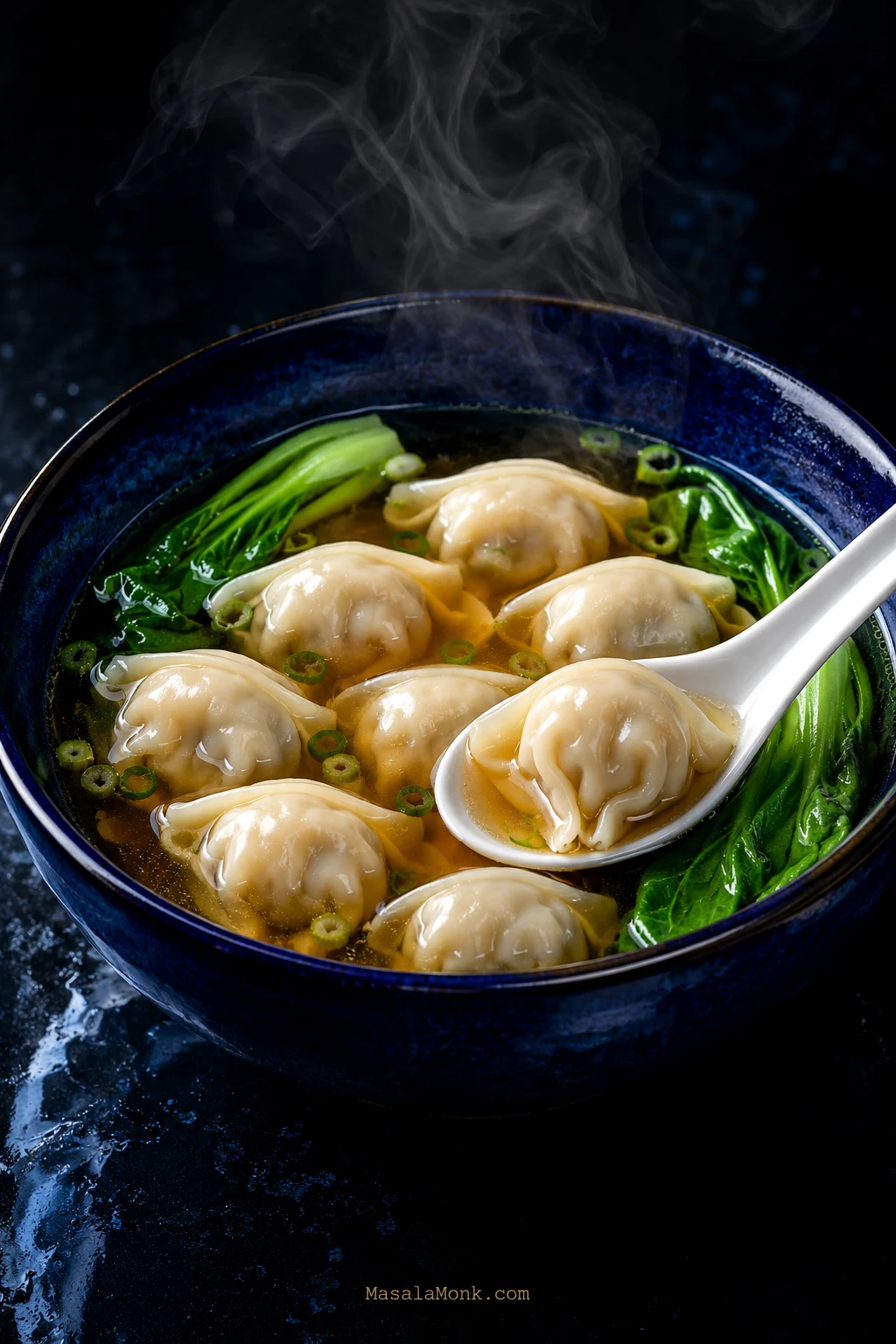
Steaming bowl of pork-and-shrimp wonton soup with clear amber broth, baby bok choy, sliced scallions and a wonton lifted on a white spoon.

Wonton soup leaves very little to hide. The broth is clear, the wrapper is thin, and the filling is small enough that you notice quickly when any one of them is off.

At its simplest, wonton soup is a Chinese soup of small filled dumplings made with thin wheat wrappers and served in broth. The details change considerably from one region, restaurant and household to another: thin skins or chewy ones, pork or shrimp or both, a spare broth or something much more assertive.

The bowl we are aiming for here sits on the lighter side: thin-to-medium wrappers, a juicy pork-and-shrimp center, and a clear ginger-scallion broth with enough savory depth to taste complete without becoming heavy or soy-dominated. Bite through a good wonton and you get tender wrapper first, then juicy pork and firmer little pieces of shrimp, all against that light broth.

The thick, chewy wontons from an American-Chinese takeout shop are simply a different target, and wrapper choice makes an enormous difference. Homemade broth can miss in another direction: a rich packaged stock sometimes leaves you with chicken soup that happens to contain wontons. Both problems are fixable.

Folding takes some time on a first batch, but the technique gets easier quickly. Cook one wonton before folding the rest, taste what you actually made, and adjust while the bowl of filling is still sitting in front of you. Then cook enough for dinner and freeze the rest raw.

The second bowl is much less work than the first.

Mix until sticky. Seal lightly. Boil separately.

Quick Answer: How to Make Wonton Soup

Mix equal weights of ground pork and chopped shrimp with scallions, ginger, Chinese light soy sauce, Shaoxing wine, sesame oil, white pepper and cornstarch until the filling turns sticky and cohesive. Use a modest amount of filling and only enough water to make the wrapper seam tacky.

Simmer a light chicken broth with ginger and scallions, season it gently, and cook the wontons in separate water so loose wrapper starch stays out of the serving broth. Wontons of this size take about 4–5 minutes fresh or 6–8 minutes from frozen.

For a main bowl, plan on roughly 8–10 wontons with 1¼–1½ cups / 300–350 ml broth. Assemble only when you are ready to eat. The wrappers keep absorbing broth once they are in the bowl.


Wonton Soup Recipe

Prep & folding50–60 minutes
Cook time15–20 minutes
Total time1 hour 5 minutes–1 hour 20 minutes; allow longer for a first batch
YieldAbout 50 wontons; expect roughly 45–60 depending on wrapper size
BrothAbout 6 cups / 1.42 litres
Serving4 generous bowls, with extra wontons to freeze
Fresh wontons4–5 minutes
Frozen homemade wontons6–8 minutes

Your first tray may take longer. Folding gets much faster once your hands learn the movement. You need a large pot for the wontons, a medium saucepan, a mixing bowl, a tray or several plates, and a slotted spoon or spider. A kitchen scale and instant-read thermometer are useful extras.

Treat the quantities below as the starting point and the first cooked wonton as the final say. Wrapper thickness, pork, soy sauce and salt vary enough that a small adjustment to your particular batch is completely normal.

Ingredients

For the Pork and Shrimp Wontons

  • 225 g / 8 oz ground pork, preferably regular rather than extra-lean
  • 225 g / 8 oz raw peeled and deveined shrimp
  • Enough square wonton wrappers for about 50–60 wontons, preferably 3½–4 inches / 9–10 cm
  • 2 scallions (green onions), very finely sliced
  • 2 teaspoons finely grated fresh ginger
  • 1 tablespoon / 15 ml Chinese light soy sauce
  • 1½ tablespoons / 22 ml Shaoxing wine
  • 1½ teaspoons / 7.5 ml toasted sesame oil
  • 2 teaspoons / about 6 g cornstarch (cornflour in India and the UK)
  • ¼ teaspoon ground white pepper
  • ½ teaspoon fine sea salt
  • 1 tablespoon / 15 ml cold water or unsalted chicken stock, only if needed

Chinese light soy sauce does not mean reduced-sodium soy sauce. It is the thinner, lighter-colored everyday soy used in Chinese cooking. Dark soy will change both the color and flavor of the broth. Regular all-purpose soy sauce is fine too; taste before adding extra salt.

No Shaoxing wine? Dry sherry is the closest easy substitute. For an alcohol-free version, use unsalted stock or water. You lose some of the fermented-wine aroma, but the wontons still work.

A 1 lb / 454 g package of ground pork leaves you with roughly half a pack after this recipe. Conveniently, the remaining 225 g / 8 oz is also the amount used in Dan Dan Noodles.

For the Clear Broth

  • 6 cups / 1.42 litres mild chicken stock total; for a particularly dark or roasted stock, use 5 cups stock + 1 cup / 240 ml water
  • A little extra hot water or stock for topping up after simmering, if needed
  • 20 g / about ¾ oz fresh ginger, sliced
  • 3 scallions, white and light-green parts lightly bruised; reserve green tops
  • 1 tablespoon / 15 ml Chinese light soy sauce
  • ½ teaspoon sugar
  • ¼ teaspoon ground white pepper
  • 1 teaspoon / 5 ml toasted sesame oil
  • Fine sea salt, only if needed
  • Optional for adjusting the finished broth: ½ teaspoon Chinese chicken powder, bouillon according to package strength, or a small pinch / about ⅛ teaspoon MSG

Choose a mild, fairly neutral stock. A particularly dark or roasted one is better diluted before you start.

MSG, chicken powder and bouillon are optional adjustments rather than automatic additions. Taste the finished broth first.

For Serving

  • 4 small heads baby bok choy, halved or quartered
  • Sliced scallion greens
  • Chili oil, optional
  • Extra white pepper, optional
  • Cilantro, optional
  • A few drops toasted sesame oil, optional

Method

1. Chop the Shrimp

Pat the shrimp dry and chop them into small pieces. Keep going until part of the shrimp becomes sticky and paste-like while plenty of little pieces remain. Those pieces give the cooked filling its small springy bites.
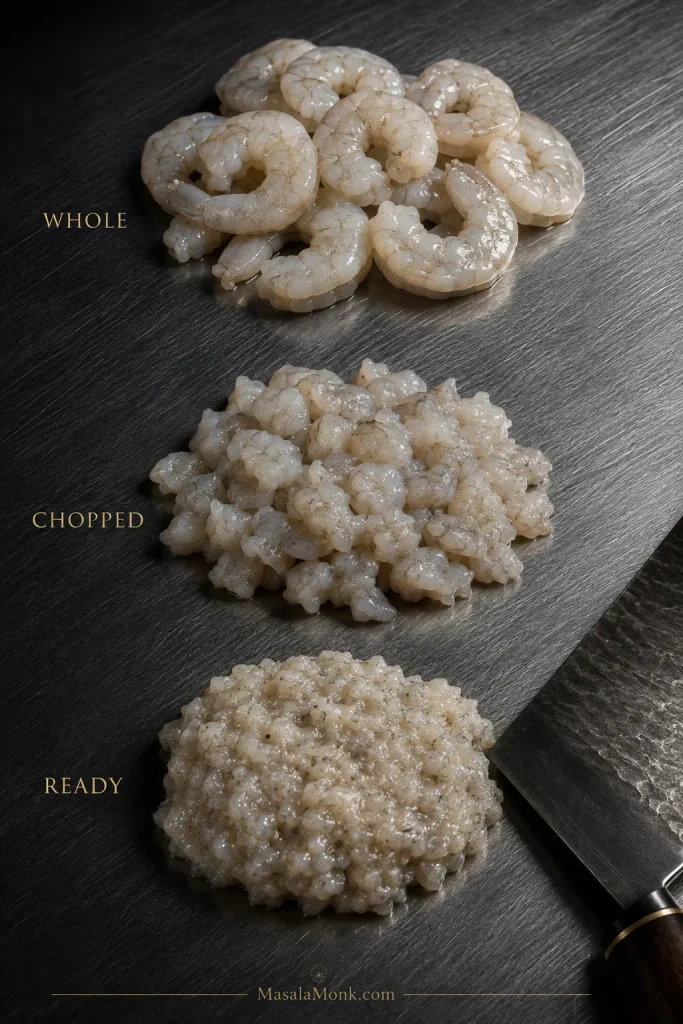
Three stages of raw shrimp preparation labeled Whole, Chopped and Ready, progressing from peeled shrimp to chopped pieces and a sticky finely chopped mixture.
The uneven chop is deliberate: if every shrimp piece is still distinct, keep going; if the mixture becomes completely smooth, you have gone past the useful middle ground.

2. Mix Until the Filling Turns Sticky

Put the pork, shrimp, scallions, ginger, soy sauce, Shaoxing wine, sesame oil, cornstarch, white pepper and salt in a large bowl. Stir vigorously with chopsticks, a fork or a sturdy spoon until the mixture becomes tacky and cohesive.

It starts loose and granular. Keep mixing until it clings to the spoon and pulls together when lifted. An unusually stiff mixture can take the tablespoon of cold water or stock; work it in until no loose liquid remains.

Stop once the texture has clearly changed. The cooked center should hold together and stay juicy.
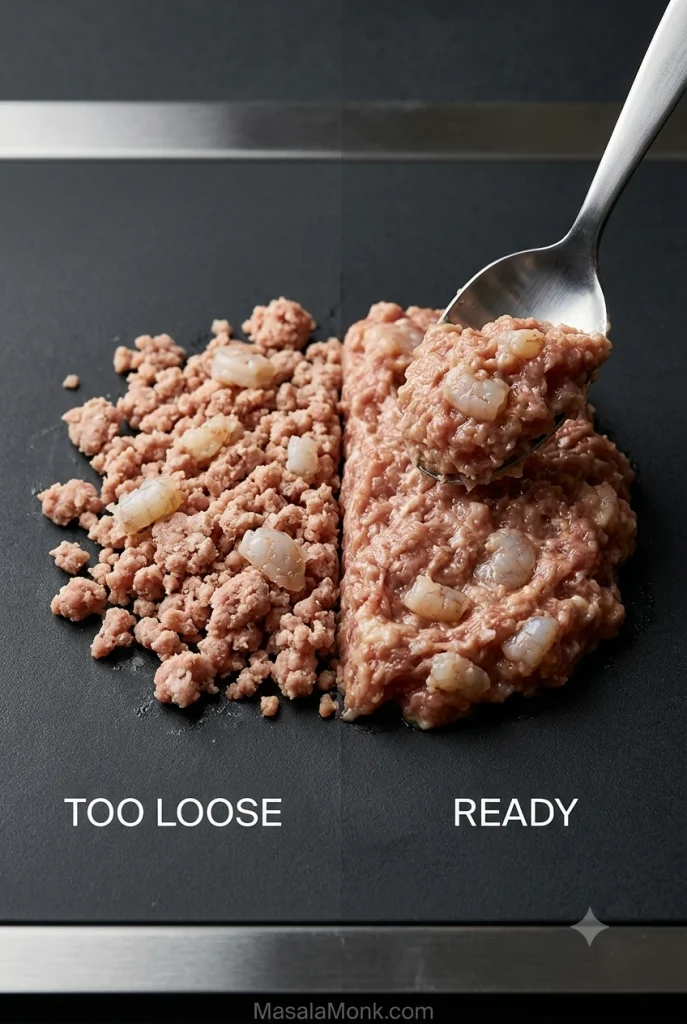
Comparison of loose, granular pork-and-shrimp wonton filling beside properly mixed filling that looks sticky, moist and cohesive.
Use texture rather than a timer to judge wonton filling: stop when it has enough cohesion to shape cleanly, before vigorous mixing turns into unnecessary overworking.

3. Cook One Before You Fold the Rest

Bring a small saucepan of water to a boil. It is a much easier way to check the filling than heating a huge pot and leaving it there while you fold fifty wontons.

For a 3½-inch / 9 cm wrapper, begin with about 1 rounded teaspoon / 9–10 g filling. A roomier 4-inch / 10 cm wrapper can take roughly 1 generously rounded teaspoon / 11–12 g.
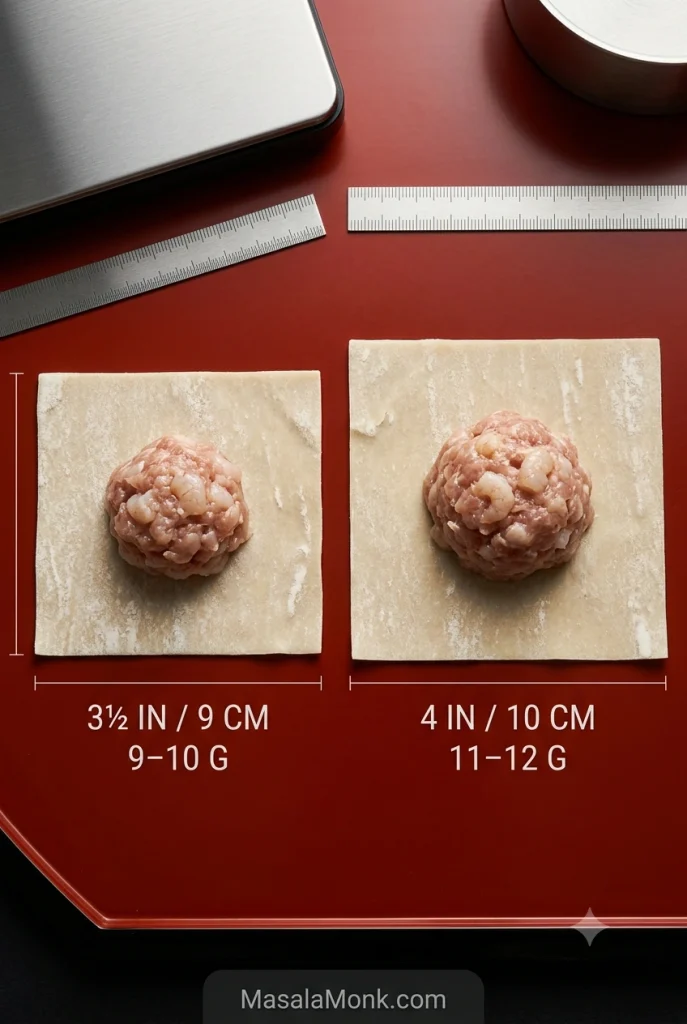
Two square wonton wrappers with measured portions of pork-and-shrimp filling showing the appropriate amount for 3½-inch and 4-inch wrappers.
Leave a clean border around the wonton filling. The easiest way to avoid overstuffing is to judge how much wrapper remains available for sealing, not how generously filled the center looks.

Moisten the sealing edge lightly, fold the wonton and boil it for 4–5 minutes for the sizes used here, until the wrapper is translucent and the filling is cooked through.

Then eat it.

This is where the recipe stops being theoretical. Check the salt and ginger, but also pay attention to the proportions. Too much meat for the wrapper makes the wonton feel heavy; too many folded layers can already be chewy at the corners.
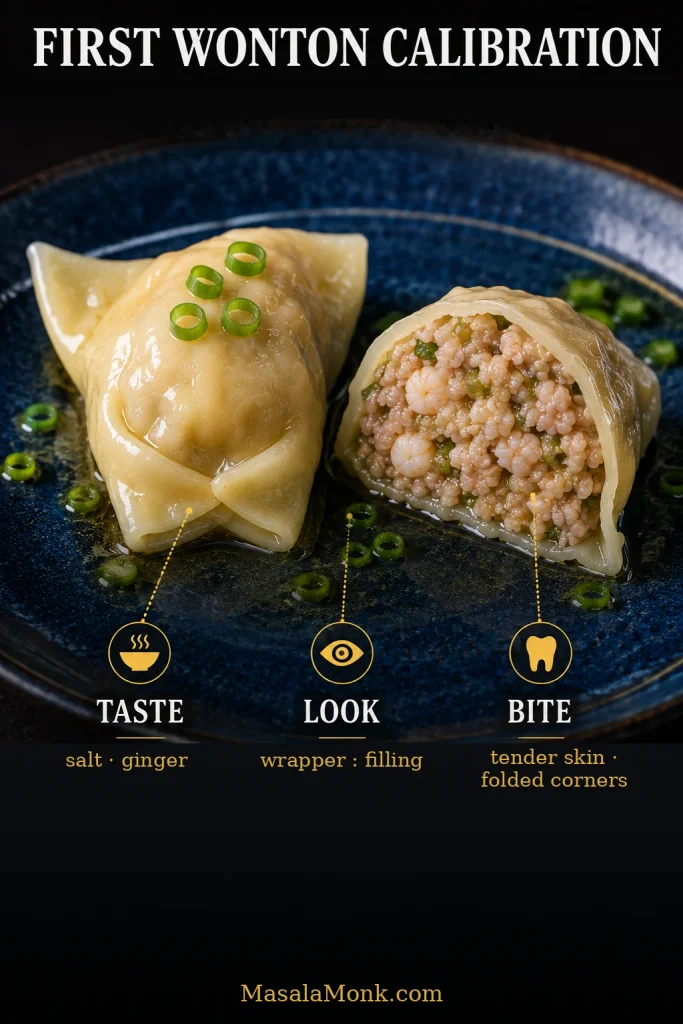
One intact cooked wonton and one cut-open wonton with labels for Taste: salt and ginger, Look: wrapper to filling, and Bite: tender skin and folded corners.
If the seasoning tastes right but the folded corners still chew heavily, change the fold rather than the filling. One cooked wonton can diagnose those two problems separately.

Make those corrections now. Once it tastes right, drain and wash the saucepan; you will use it for the broth.

4. Fold the Wontons

Set out the filling, wrappers, a small bowl of water and a parchment-lined tray or a few plates. Keep the unused wrappers covered while you work.

  1. Lay one square wrapper on a clean, dry surface with one straight edge facing you.
  2. Add the appropriate amount of filling just below the center.
  3. Moisten the far edge and the upper part of the two side edges with a thin film of water. The wrapper should become tacky, not wet and slippery.
  4. Fold the wrapper in half over the filling to make a rectangle. Press from around the filling outward toward the edges, pushing out trapped air as you seal.
  5. Check that the sealed edge is clean and that no filling has been trapped in it.
  6. Lightly dampen one of the two bottom corners on the filling side. Curve the two bottom corners toward each other, overlap them slightly, and press to seal.
  7. Put the finished wonton on the tray and keep it loosely covered while you continue.
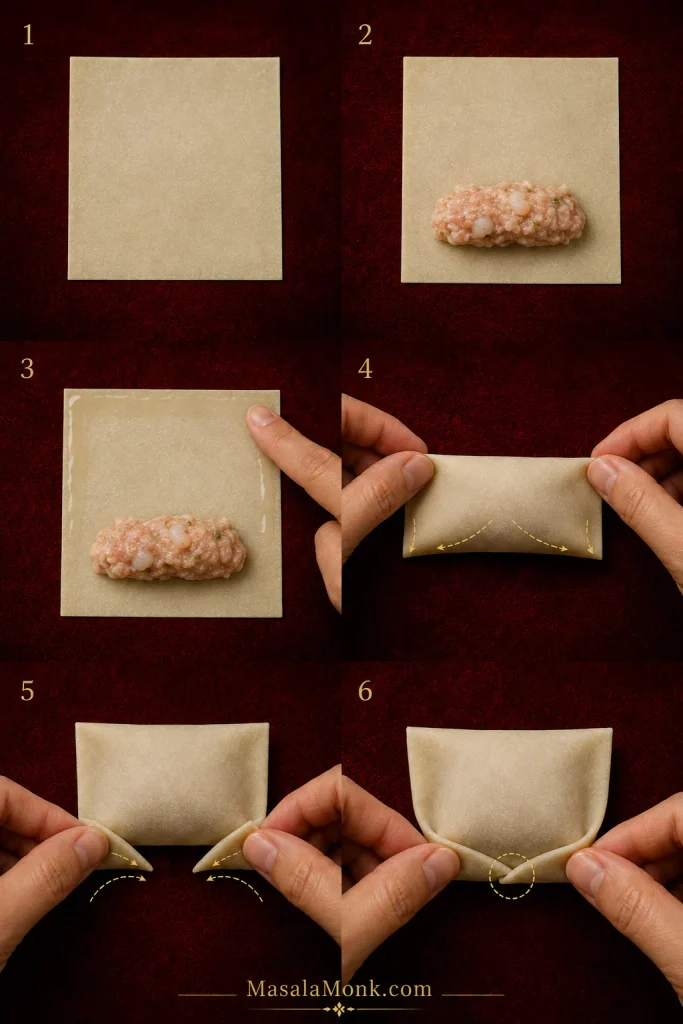
Six-step overhead sequence showing a square wonton wrapper filled, moistened, folded into a rectangle, sealed and finished by joining the two lower corners.
In this wonton fold, the rectangle does the real sealing; the final corner join mainly shapes the parcel, so it should never become a thick knot of wrapper.

The first few will probably be less tidy than the last few. Leave them alone when the seam holds; crooked wontons taste the same.

On a warm day or during a long folding session, keep the filling chilled and move finished wontons to the refrigerator in batches rather than leaving raw pork and shrimp on the counter.

5. Start the Broth and Wonton Water Together

Near the end of folding, put the washed saucepan and the large wonton pot on the stove together.

Combine the stock, water if using, sliced ginger and bruised scallion pieces in the saucepan and bring it to a gentle simmer for 8–10 minutes. Meanwhile, bring the large pot of plain water to a boil. Reached boiling too soon? Turn it down and bring it back up when the bok choy and wontons are ready to go in.

Remove the ginger and scallions from the broth. Top it back up with hot water or stock to about 6 cups / 1.42 litres if simmering has reduced it noticeably. Add the soy sauce, sugar and white pepper, then taste before adding salt.

The finished broth should smell first of ginger, scallion and white pepper, then taste clean and savory enough that you want another spoonful between wontons. Salt already right but the broth still hollow? Add a small pinch of MSG. A generally weak broth needs chicken powder or bouillon instead—start modestly and taste again.

Stir in the sesame oil at the end. You should notice it as the bowl reaches you, not taste sesame as the main event.

6. Blanch the Bok Choy, Then Cook the Wontons

Blanch the bok choy in the boiling water for 60–90 seconds, until bright green and tender-crisp, then lift it out with a spider or slotted spoon. Use the same water for the wontons.

Add only enough wontons to move comfortably and stir gently as they go in so the wrappers do not settle onto the bottom. Four dinner bowls will often be easier to cook in two loose batches in an average home pot.

Fresh wontons of this size take about 4–5 minutes. They rise and become more translucent as they cook. Once that happens, start checking rather than adding several precautionary minutes.

Cut open one of the larger wontons when you are unsure about the center, or use an instant-read thermometer. The USDA safe-temperature chart gives 160°F / 71°C for ground pork.

A cooked wonton should have a tender, translucent wrapper that still holds its shape, juicy cohesive pork, and little shrimp pieces with some bounce left in them. The seam should bite through cleanly rather than hanging around as a hard knot of dough.
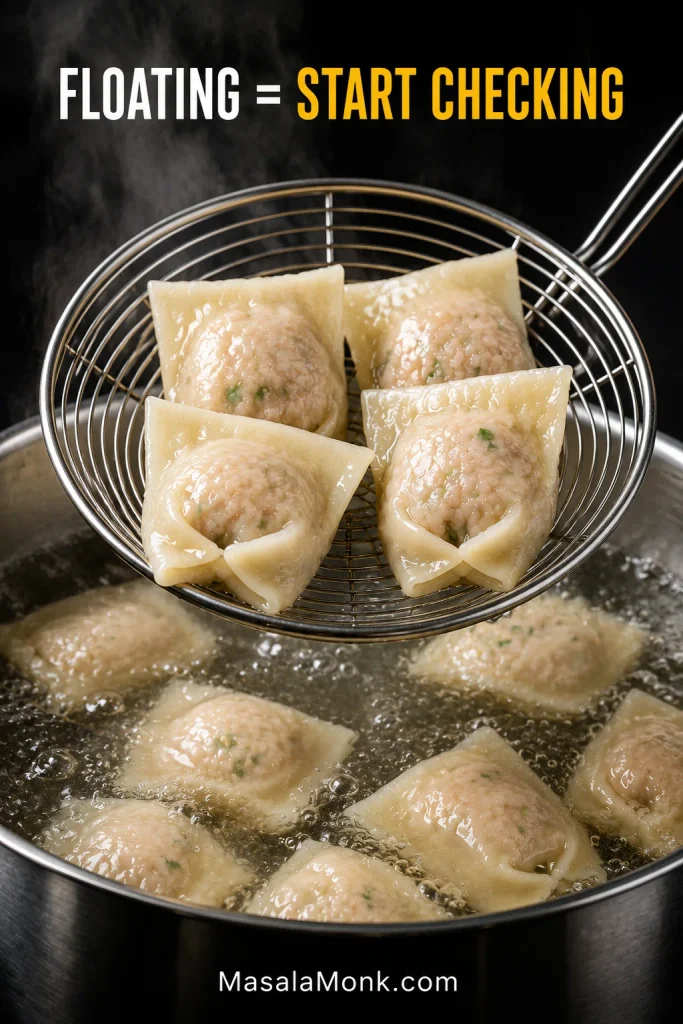
Translucent cooked wontons lifted in a round wire skimmer above gently boiling water, with more wontons floating in a stainless-steel pot and the text “Floating = Start Checking.”
Once a wonton floats, the useful question changes from “How many minutes?” to “What does the wrapper and center look like now?” Floating begins the doneness check; it does not end it.

7. Assemble the Bowls

Put 8–10 wontons and some bok choy in each large bowl. Ladle over about 1¼–1½ cups / 300–350 ml hot broth, then scatter over the sliced scallion greens.

The finished bowl should look almost simpler than the counter that produced it: clear broth, green bok choy and intact wontons sitting just below the surface.
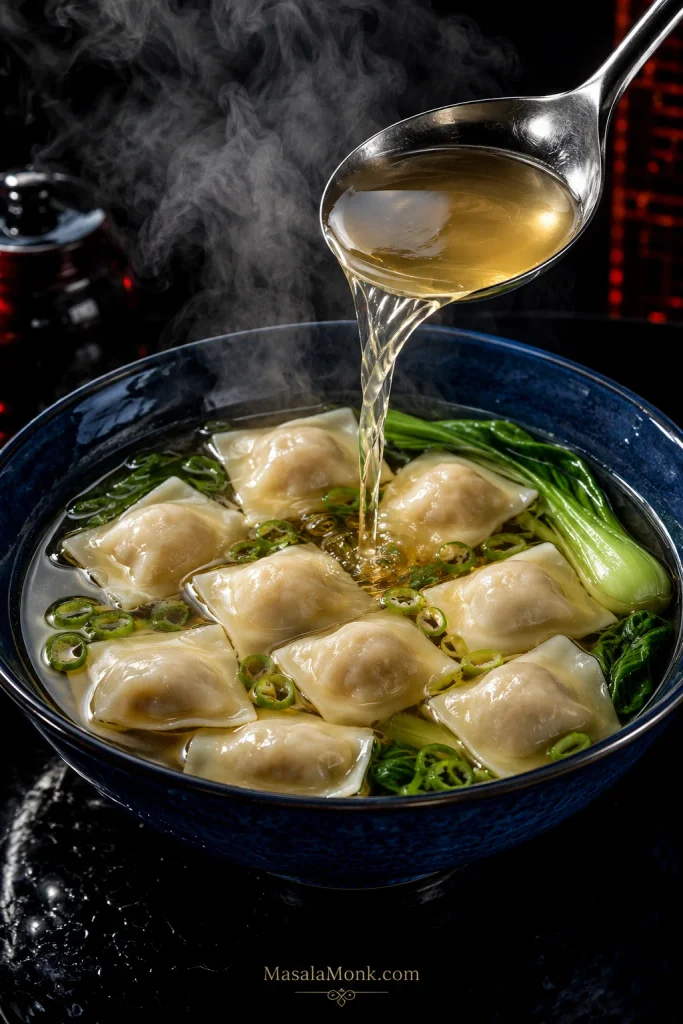
Clear golden broth pouring from a metal ladle into a blue bowl of cooked wontons, baby bok choy and sliced scallions.

Chili oil, cilantro, extra white pepper or a few drops of sesame oil can all go on at the table. Serve straight away. Any wontons waiting for a second bowl are better off outside the broth.

Recipe Notes

  • Wrapper size changes the yield; expect roughly 45–60 wontons from this batch.
  • Buy a few extra wrappers because package counts vary and occasional skins tear or arrive dry.
  • Check that you have picked up one wrapper rather than two stuck together.
  • Cook homemade frozen wontons directly from frozen rather than thawing them.
  • Store cooked wontons separately from the broth.
  • Standard wonton wrappers usually contain wheat; the filling also contains shellfish, soy and sesame unless suitable substitutes are used.

What to Serve With Wonton Soup

A smaller bowl with 4–6 wontons makes a light starter before something fuller such as Chicken Fried Rice. At 8–10 wontons, the soup is substantial enough to be dinner by itself; something cold and crisp such as a simple cucumber salad is plenty alongside it.

Cut one open and the filling should look cohesive rather than densely packed: moist pork holding everything together, with small pieces of shrimp still visible throughout. That is the texture all the chopping and vigorous mixing were meant to produce.
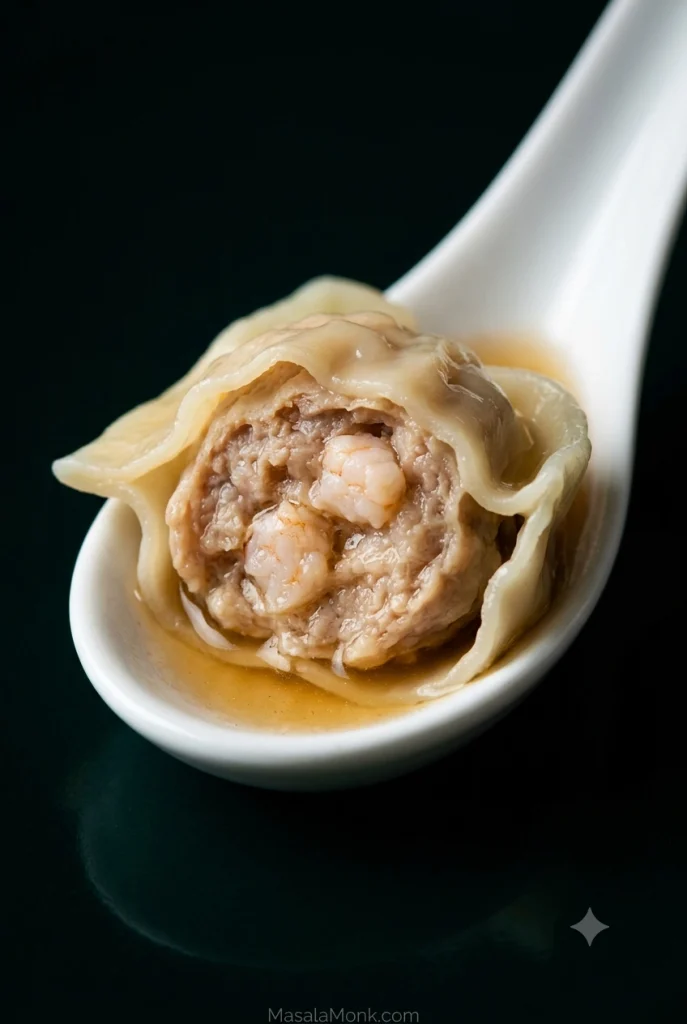
Cut-open pork-and-shrimp wonton showing moist ground pork mixed with small chopped shrimp pieces and a few green scallion flecks.
A cut pork-and-shrimp wonton should show one moist, compact center with small shrimp pieces distributed throughout—not separate layers of meat and seafood.

At this point, you have everything you need to make the soup. The sections below are there when you need to choose a wrapper, fix the broth, cook frozen wontons or work out what went wrong.

Jump to wrappers · filling & folding · broth · frozen wontons · troubleshooting · make-ahead & storage

Which Wonton Wrappers Should You Buy?

Wonton wrappers vary more than the name suggests. For this bowl, look for thin-to-medium square wrappers around 3½–4 inches / 9–10 cm. They cook tender without being quite as fragile as the thinnest specialty skins.

In Asian groceries, you may see yellow Hong Kong-style skins and white Shanghai-style skins. Yellow wrappers are often thinner; white wrappers can be somewhat sturdier. Brand differences matter more than color, though. Pick up the package and look for skins that appear flexible and fresh rather than dry around the edges.

Thin wrappers give a more delicate, silky wonton. Medium skins are easier to handle.

Then there are the intentionally thick, chewy wontons served by some American-Chinese restaurants—the version people sometimes spend years trying to recreate after moving away from a favorite takeout shop. That texture is a style, not evidence that somebody overcooked the wrapper.
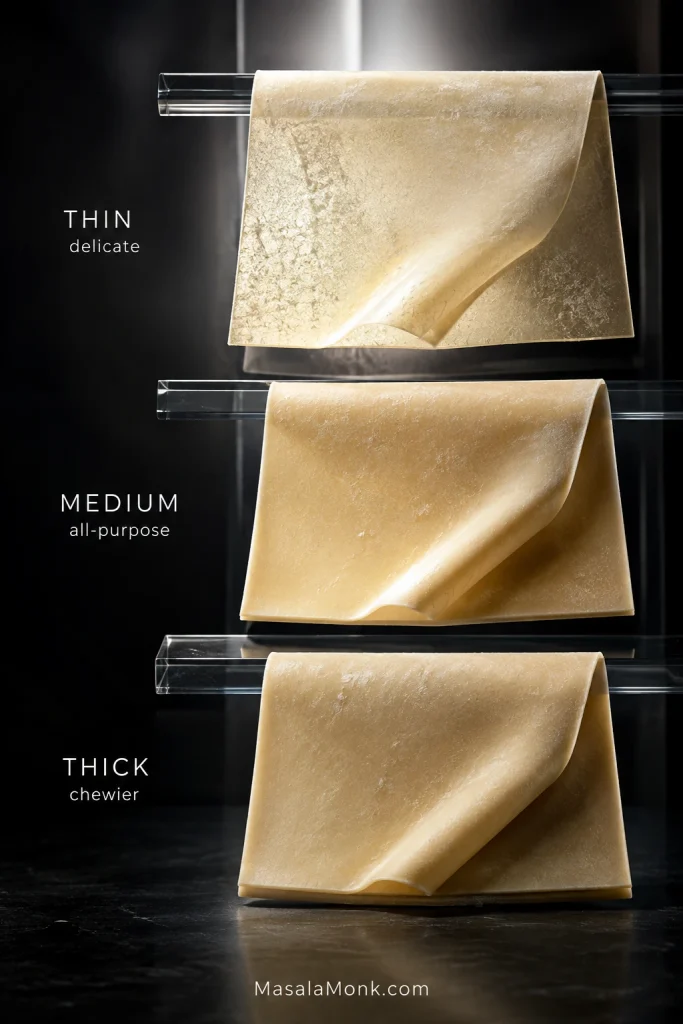
Three raw wonton wrappers labeled Thin, Medium and Thick, displayed to show differences in translucency, edge thickness and flexibility.
Wonton wrapper thickness is a texture choice, not a quality grade: delicate soup wontons and chewier takeout-style wontons can both be correct for different targets.

Dry white edges, curled corners and visible cracks are more worrying than the wrapper’s color. Frozen wrappers are fine too; thaw the unopened package slowly in the refrigerator until the skins are completely pliable, then keep the opened stack covered while you work.
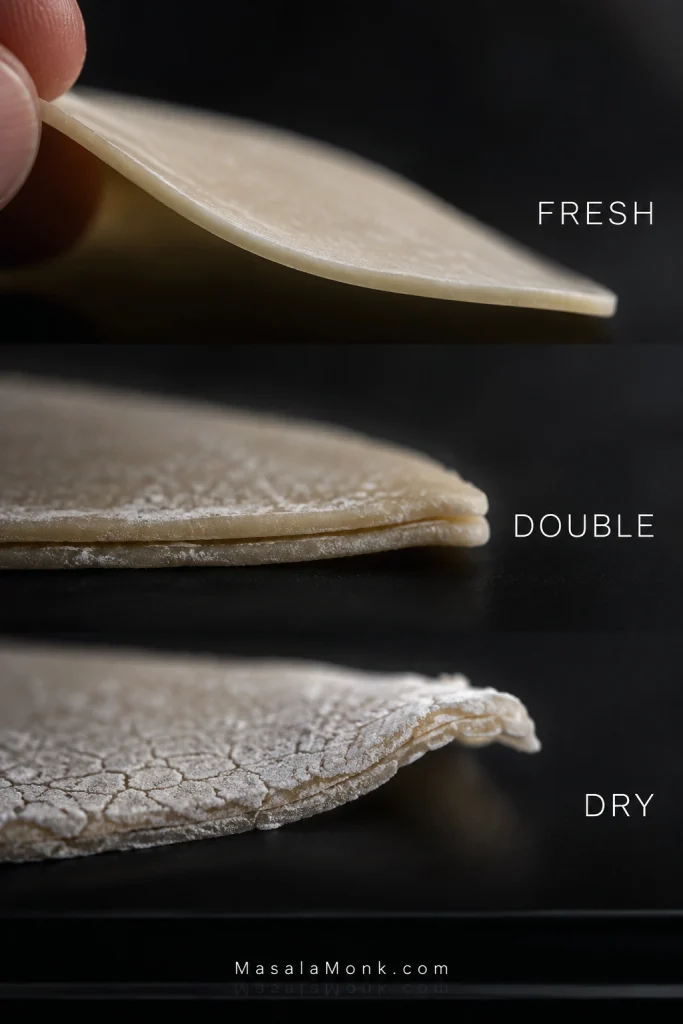
Macro comparison labeled Fresh, Double and Dry showing a supple single wonton wrapper, two wrappers stuck together and a dry wrapper with curled or cracked edges.
Two different wrapper problems can later look like “tough wontons”: a doubled skin creates excess chew, while a dry edge creates sealing trouble before the dumpling even reaches the pot.

Extra wrappers can become another batch of wontons, or take a completely different route in Crab Rangoon, where the same little square skins turn crisp instead of tender.

Wrappers cracking or turning chewy? Jump to Troubleshooting.

Getting the Filling and Fold Right

Once the filling tastes right, most remaining problems are mechanical: how much goes into each wrapper, what gets trapped in the seam, and how many layers collect at the corners.

Most leaks begin before the wonton reaches the water: filling caught in the seam, dry wrapper edges, trapped air or simply too much filling. A wrapper that already looks under pressure on the tray is unlikely to become happier in boiling water.
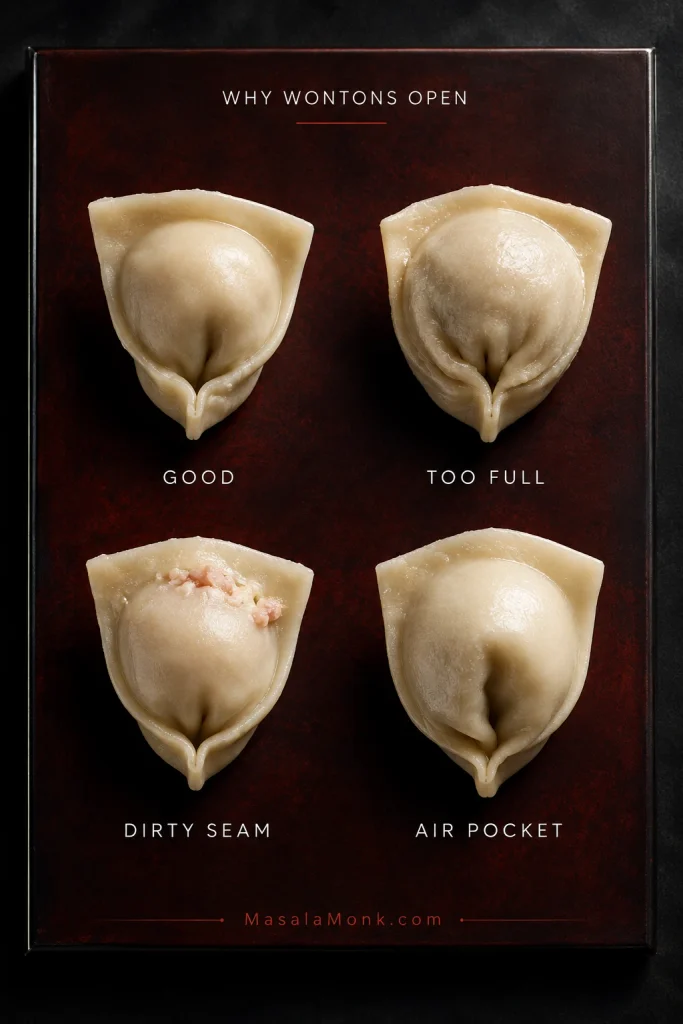
Four wontons labeled Good, Too Full, Dirty Seam and Air Pocket, demonstrating common sealing problems that can cause wontons to open during cooking.
Read the failed seam before changing the cooking time: stretched skin, trapped air or filling on the edge are folding problems, so extra boiling cannot repair them.

Decorative folds create a different problem. Several layers bunched together at one point need longer to soften, leaving a chewy knot after the rest of the wrapper is tender.

Soup wontons do not need much architecture.
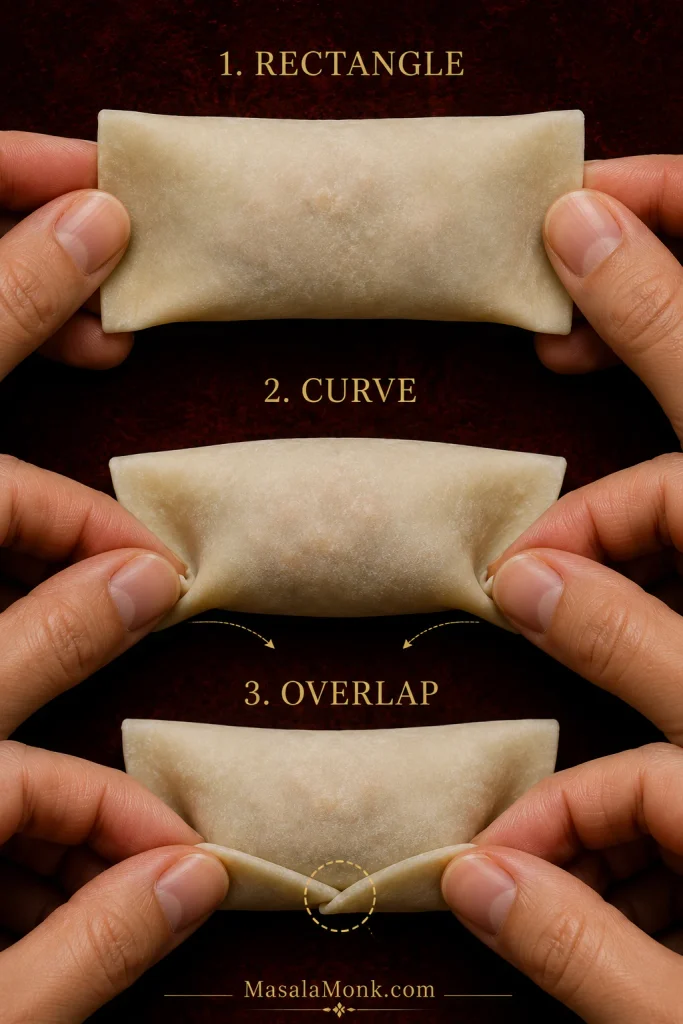
Three close-up stages labeled Rectangle, Curve and Overlap, showing the two lower wrapper corners being brought together and crossed at the front.
The corner overlap needs only enough contact to hold. A larger overlap adds extra wrapper precisely where a finished wonton is most likely to feel chewy.

By the middle of the tray, your hands will usually have settled on their own amount of filling and their own version of the fold.

How to Make Wonton Broth Taste Clear but Not Bland

Wonton soup broth can be as simple as mild chicken stock seasoned with ginger, scallion, white pepper, Chinese light soy sauce and a little sesame oil. It does not need to be rich or elaborate. It just needs enough savory depth that the spoonful between wontons tastes complete.

More soy is not the automatic answer to weak broth. It can make the soup darker and saltier without giving it the depth you were looking for. At the other extreme, a rich roasted stock can turn the bowl into chicken soup with wontons in it.

Cooking the wontons in separate water keeps most loose wrapper starch out of the broth. Egg Drop Soup uses another light chicken-broth base, but turns it silky with egg ribbons instead of wrappers and filling.
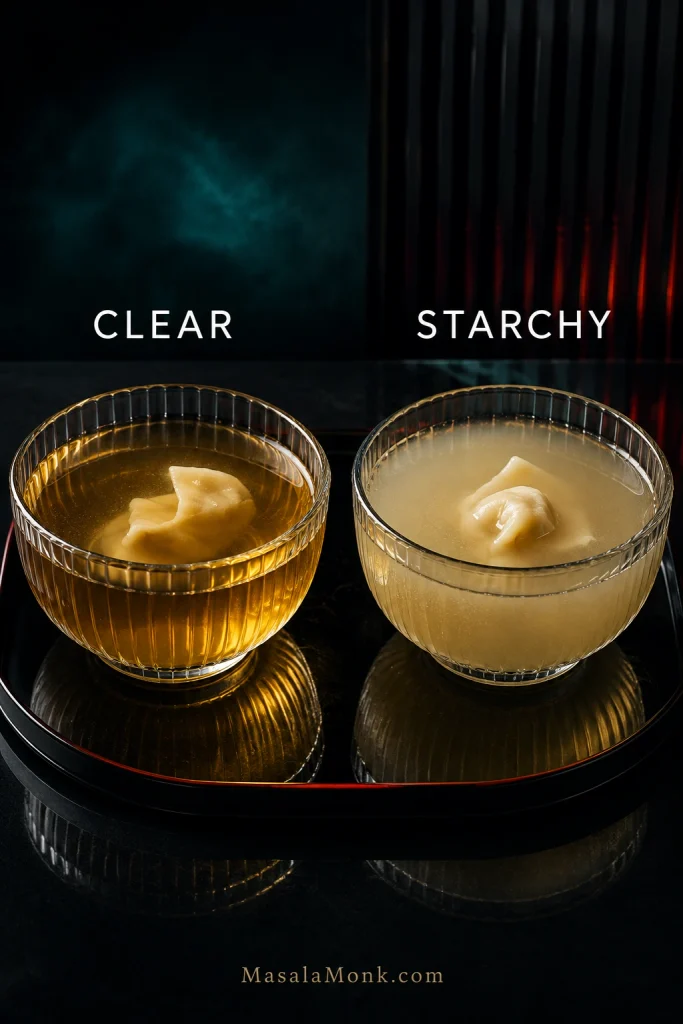
Matching vessels labeled Clear and Starchy showing transparent amber wonton broth beside noticeably cloudier broth affected by wrapper starch.
Clear wonton broth is partly a process choice, not a seasoning fix. Once wrapper starch clouds the liquid, more ginger, soy or sesame cannot restore that visual clarity.

Restaurant broth can head in several directions. Cantonese and Hong Kong versions may build depth with poultry, pork or dried seafood; some American-Chinese takeout bowls lean harder on chicken powder, bouillon or MSG.

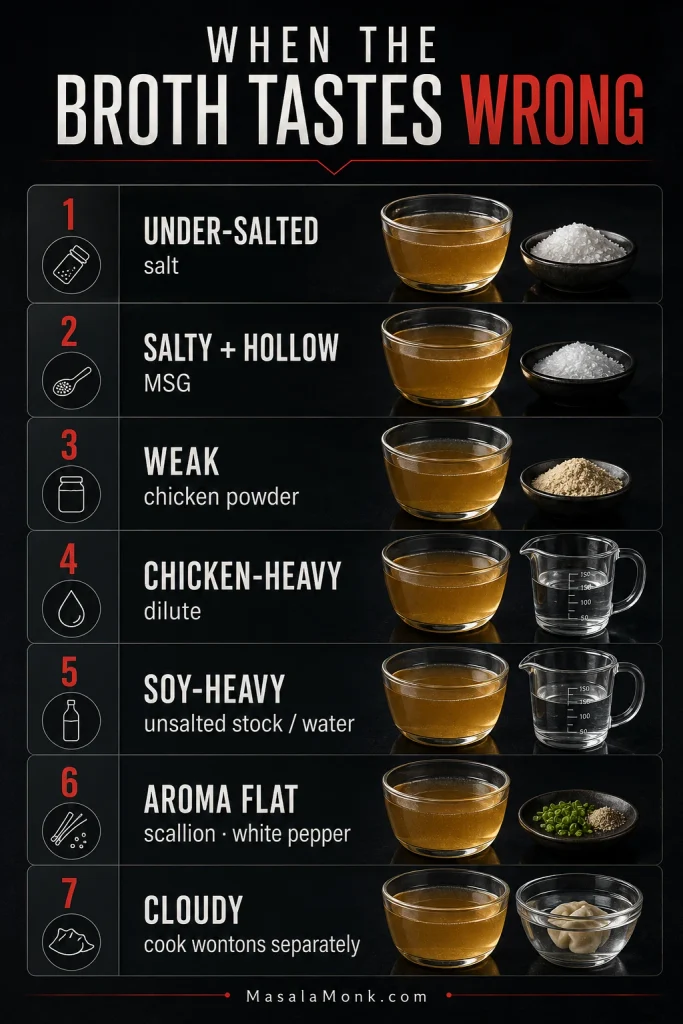
How to Fix Wonton Broth

For this recipe, the broth should support the wontons, not bury them.

Your broth tastes…What to change
Under-saltedAdd salt a little at a time.
Salty enough but hollowTry a small pinch of MSG instead of more soy.
Weak and missing chicken depthAdd a little chicken powder or bouillon and taste again.
Too chicken-forwardDilute with water, then rebalance the seasoning.
Too soy-heavyDilute with unsalted stock or water.
Good but aromatically flatAdd scallion, white pepper or a few drops of sesame oil at the finish.
Cloudy or starchyBoil the wontons separately next time.
Broth troubleshooting graphic pairing seven taste problems with corrections including salt, MSG, chicken powder, dilution, unsalted stock or water, scallion and white pepper, and cooking wontons separately.
For wonton soup broth, think in four buckets before reaching for more soy: seasoning, savory depth, concentration and aroma. The right correction depends on which one is actually missing.

Back to Recipe · Back to Top

Using Frozen Wontons

Frozen wontons turn the same broth into a much faster dinner. Homemade wontons can go straight from freezer to boiling water. Thawing them first only gives the filling more time to wet the wrapper.

  1. Make the broth and bring a separate pot of water to a boil.
  2. Add the frozen wontons in slightly smaller batches than you would use for fresh ones.
  3. Stir gently soon after they go in; frozen wontons spend longer near the bottom before floating.
  4. Start checking around 6 minutes. Homemade wontons of this size take roughly 6–8 minutes, but wrapper thickness and filling size matter more than the clock.
  5. Move them into bowls as soon as the wrappers are tender and the centers are hot throughout.
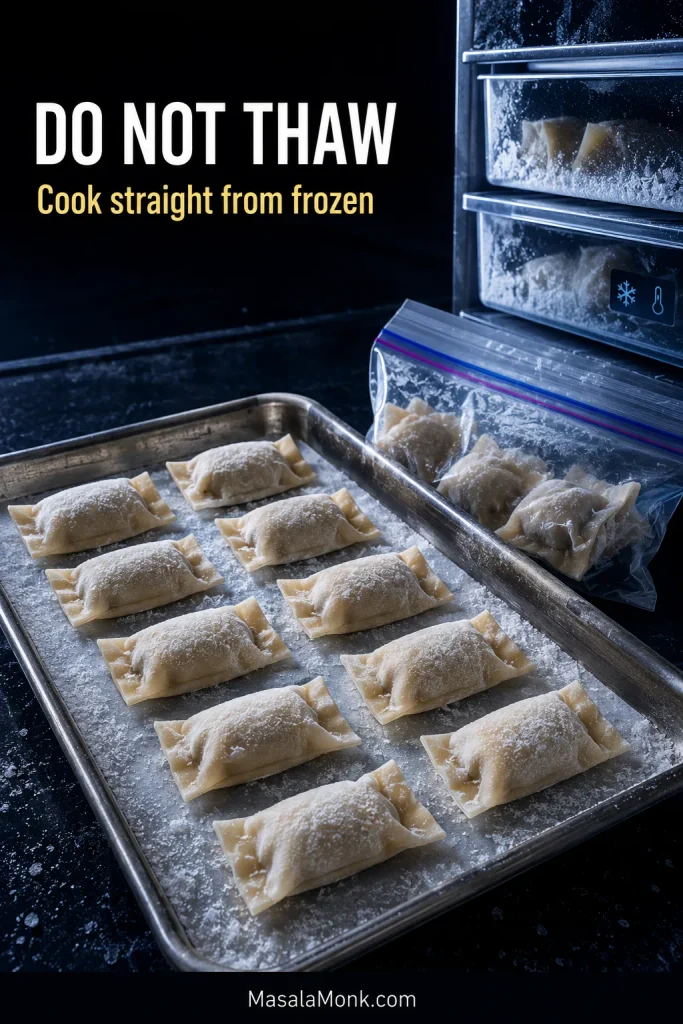
Frosted homemade wontons spaced apart in a cold freezer setting with the text “Do Not Thaw” and “Cook straight from frozen.”

Store-bought frozen wontons are their own case. Start with the package directions. A large, thick-skinned commercial wonton may behave very differently from the homemade ones here.

A batch that repeatedly comes out chewy usually needs gentler cooking before it needs more time. Smaller batches help too, especially with very thin skins surrounding a still-frozen center.

A 10–15 Minute Shortcut With Store-Bought Frozen Wontons

Sometimes the bag of frozen wontons is dinner, not a make-ahead project. This shortcut makes 2 generous bowls and keeps the same general broth-to-bowl proportions as the main recipe.

  • 3 cups / about 710 ml mild chicken broth
  • About 10 g fresh ginger, cut into 5–6 thin slices
  • 2 scallions, whites lightly bruised and greens sliced
  • 1½ teaspoons / 7.5 ml Chinese light soy sauce
  • ¼ teaspoon sugar
  • ⅛ teaspoon ground white pepper
  • 12–16 store-bought frozen wontons, depending on size
  • 2 small heads baby bok choy, or a handful of spinach
  • ½ teaspoon / 2.5 ml toasted sesame oil

Bring the broth, ginger and bruised scallion whites to a simmer and let them infuse for about 8 minutes. Add the soy sauce, sugar and white pepper, then taste. Remove the ginger and scallion pieces and stir in the sesame oil at the end.

While the broth simmers, cook the frozen wontons in a separate pot according to the package directions and blanch the bok choy in the same water for the final 60–90 seconds. Spinach can simply wilt in the hot broth.

Divide the wontons and greens between two bowls, ladle over about 1½ cups / 350 ml broth per bowl, and finish with the sliced scallion greens. Six to eight commercial wontons can be plenty when they are larger than the homemade ones here; use the package size and your appetite rather than forcing the main-recipe count onto them.
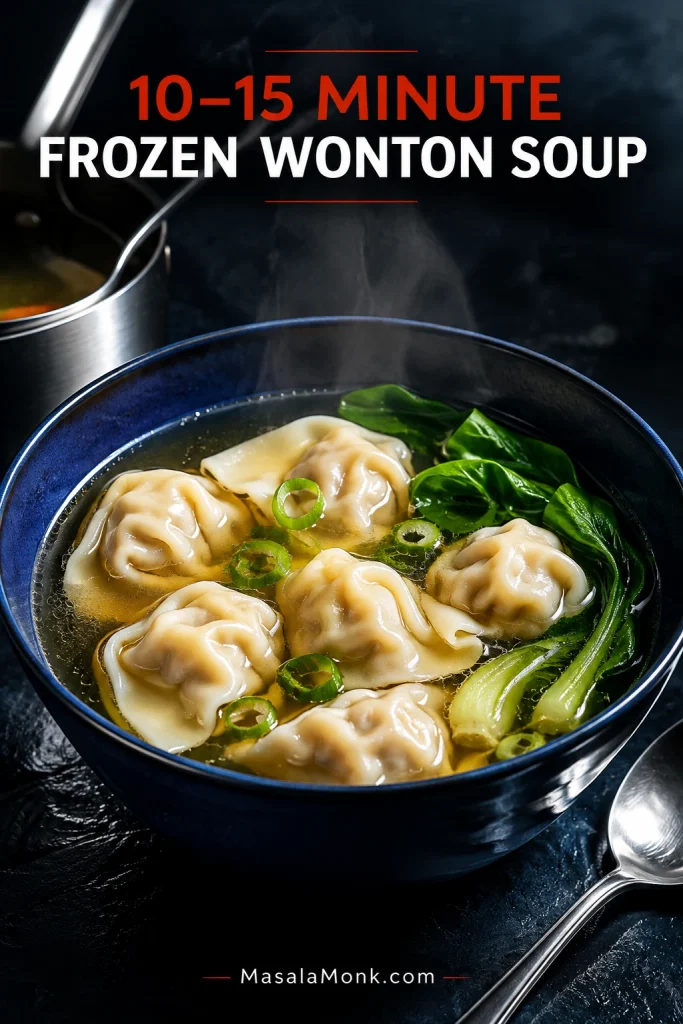
Finished bowl of quick frozen wonton soup with clear broth, enclosed wontons, greens and scallions, labeled “10–15 Minute Frozen Wonton Soup.”

Freezing your own batch? Jump to Make Ahead & Storage.

Troubleshooting

ProblemLikely cause → what to change
Wontons open in the waterOverfilled, filling in the seam, trapped air or rough boiling → use slightly less filling, keep the edge clean, press out air and maintain a steady rather than violent boil.
Wrappers crack while foldingDry or old wrappers → keep the stack covered and replace badly dried skins.
Wrappers are unusually thick or chewyTwo skins stuck together, a thick wrapper style or too many folded layers → check for double skins and use a simpler fold.
Wontons are mushyOvercooking or sitting in broth → stop cooking once tender and assemble only at serving time.
Filling is crumblyThe mixture never became cohesive → mix until tacky before folding the next batch.
Filling is dry or toughVery lean pork or excess cooking → use pork with some fat and stop cooking once the center is done.
Broth is cloudyWrapper starch → boil the wontons separately.
Broth is salty but flatSalt is already high but savory depth is missing → try a small pinch of MSG rather than more soy.
Broth tastes strongly of soyToo much soy or a salty stock → dilute with unsalted stock or water.
Broth tastes like chicken noodle soupStock is too rich or chicken-forward → dilute it and rebalance the seasoning.
Frozen wontons turn chewyThin wrapper plus prolonged aggressive boiling → use smaller batches and gentler cooking before adding more time.

For broth problems, the broth table above gives the fuller seasoning diagnosis. The useful question is not simply “what can I add?” but “what is the broth actually missing?”

Back to Recipe · Broth Fixes · Back to Top

Make Ahead, Freeze and Store

Freezing Raw Wontons

Arrange raw wontons in one layer on a parchment-lined tray, plate or shallow pan without letting them touch. Freeze until completely firm, then transfer them to a freezer bag or airtight container.
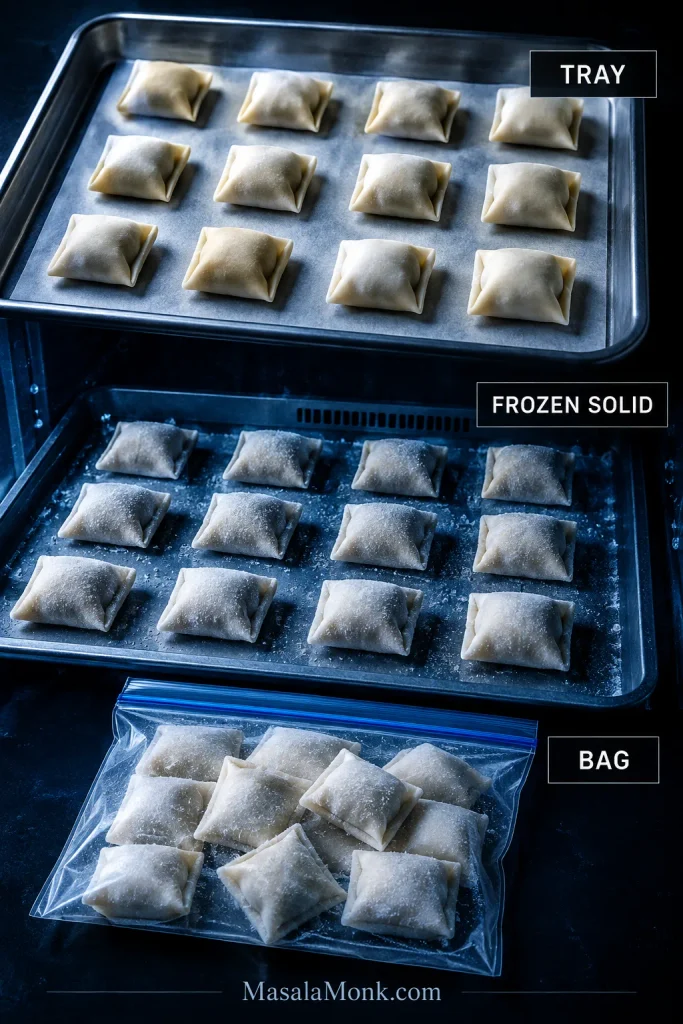
Three-stage freezer workflow labeled Tray, Frozen Solid and Bag, showing wontons spaced on a tray, frozen firm and then transferred to a freezer bag.
When you freeze homemade wontons, the tray is the anti-clumping step; the bag is only storage. Freeze them firm before they ever touch one another in a container.

A full sheet pan is not necessary. Two or three dinner plates work perfectly well in a small freezer, and once the wontons are solid they take up surprisingly little room. Protect the wrappers from being crushed and use them within about 2–3 months for the best quality.

A week later, those frozen wontons turn the longest part of this recipe into something you have already done.

For same-day prep, folding the wontons a few hours ahead is workable. Keep them covered in a single layer in the refrigerator at 40°F / 4°C or below. For the best wrapper texture, freeze them rather than refrigerating overnight; filling moisture gradually softens the skins.

Using frozen shrimp? Thaw it in the refrigerator and keep it cold while preparing the filling. Freeze assembled wontons promptly when they are not being cooked. Repeated warming, chilling and refreezing is poor for both safety and texture. The FDA seafood-safety guidance covers thawing and handling in more detail.

Leftovers and Reheating

Store the broth and cooked wontons separately.

Cooked wrappers keep taking up liquid after dinner. Left overnight in broth, they can swell, soften too far or start falling apart. Refrigerate drained wontons in one covered container and the broth in another; for the best texture, use the cooked wontons within about 2–3 days.

Bring the broth back to a boil when reheating, lower the heat, then add the cooked wontons only long enough to heat them through to 165°F / 74°C. They need reheating, not another full cooking session.

Give them a little room in the container too. Warm cooked wontons packed tightly together like to stick.

Cooking from frozen? Return to Frozen Wontons · Back to Recipe.

Variations

The filling can move in several directions without changing the basic method. Pork-only wontons benefit from meat with some fat and may take a little extra water or stock. Increasing the shrimp gives you a sweeter, springier center. Ground chicken works too, though lean chicken dries more easily and deserves to be treated as its own filling rather than a perfect one-for-one pork substitute. Ground-chicken wontons should reach 165°F / 74°C in the center.

The bowl itself is easier to improvise. Bok choy, spinach, napa cabbage and mushrooms all make sense; tender greens belong near the end. Chili oil is easiest to add at the table. Noodles change the identity of the dish more substantially: once they become a major part of the bowl, you are moving into wonton noodle soup, and they are best cooked separately so their starch stays out of the clear broth.

Deconstructed wonton soup skips the individual folding and cooks the filling and wrapper separately. It is a shortcut format rather than simply another regional name for the same bowl.

Which Kind of Wonton Soup Is This?

Order wonton soup in Hong Kong or Shanghai, at an Australian-Chinese restaurant or from an American-Chinese takeout shop, and you may get noticeably different bowls. The wrapper can be very thin or deliberately chewy, the filling can shift, and the broth may be spare and clean or much more strongly seasoned.

This recipe uses techniques found across several Chinese wonton traditions without pretending that one version can represent all of them.
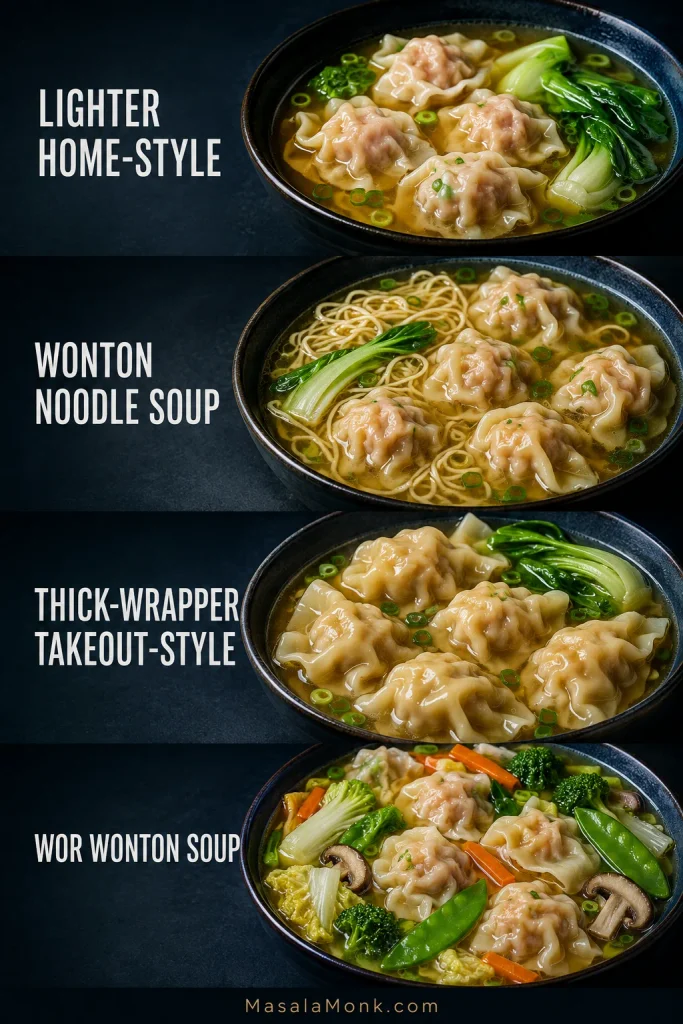
Four vertically stacked bowls labeled Lighter Home-Style, Wonton Noodle Soup, Thick-Wrapper Takeout-Style and Wor Wonton Soup, each showing a visibly different serving style.
From lighter home-style bowls to wonton noodle soup and wor wonton soup, these are useful style directions rather than rigid taxonomy: wrapper, noodles, vegetables and broth intensity can vary independently.

Names change with geography too. In Australian-Chinese restaurant terminology, short soup generally means wonton soup, while “long and short” combines wontons with noodles. Wonton noodle soup makes noodles a central part of the bowl and often has its own Cantonese cooking traditions.

Wor wonton soup, sometimes called subgum wonton soup, is usually a more loaded Chinese-American bowl with vegetables and often extra meat or seafood.

A Few Common Questions

Can I use dumpling wrappers instead of wonton wrappers?

Sometimes. Round dumpling wrappers are often thicker, so the finished dumpling will be chewier. Square wonton wrappers are the closer match for the relatively delicate wontons here.

Can I make the broth without chicken stock?

Yes. Building it from water means using chicken powder or bouillon according to the package strength first, then adding the ginger, scallion, soy sauce and white pepper from this recipe and adjusting from there.

Can I make wonton soup gluten-free?

Standard wonton wrappers contain wheat, and ordinary soy sauce may contain wheat as well. You need suitable gluten-free wrappers plus gluten-free versions of the sauces and seasonings. Rice-paper sheets are not a direct substitute for boiled wonton wrappers; they behave very differently in hot water.

Can I cook the wontons directly in the broth?

Yes. It saves a pot and works perfectly well when convenience matters most. The broth will be cloudier and slightly starchier, and the wontons absorb some liquid as they cook. Start with a little extra broth or water when using this method.


The First Wonton Is the Slowest One

A stack of wrappers beside a bowl of raw filling can make dinner look like a bigger job than it is. Then one comes out of the pot, you taste it, and suddenly the rest of the tray makes more sense.

That first tray teaches you things measurements cannot quite capture: how much filling your particular wrappers want, how damp the seam needs to be, and when the cooked skin has gone from merely done to properly tender.

By the last few wontons, your hands have already started making some of those decisions before you consciously think about them. The next time you make wontons, you will probably look at this recipe less.
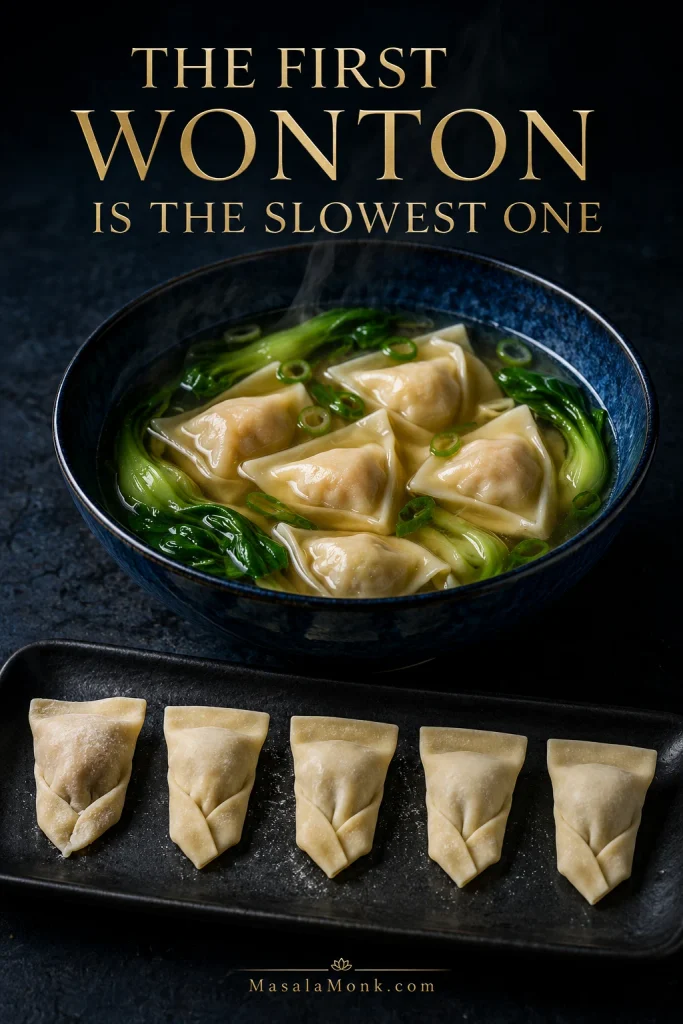
Finished bowl of wonton soup above a row of handmade raw wontons progressing from a slightly awkward first fold to cleaner, more confident later folds.

After a counter full of wrappers, filling and little bowls of water, the finished soup is almost surprisingly spare: tender wontons, something green, and clear hot broth poured over just before you eat.
Back to Recipe · Back to Top

Posted on Leave a comment

Crab Rangoon Recipe: Crispy Cream Cheese Wontons (Fried, Baked or Air Fryer)

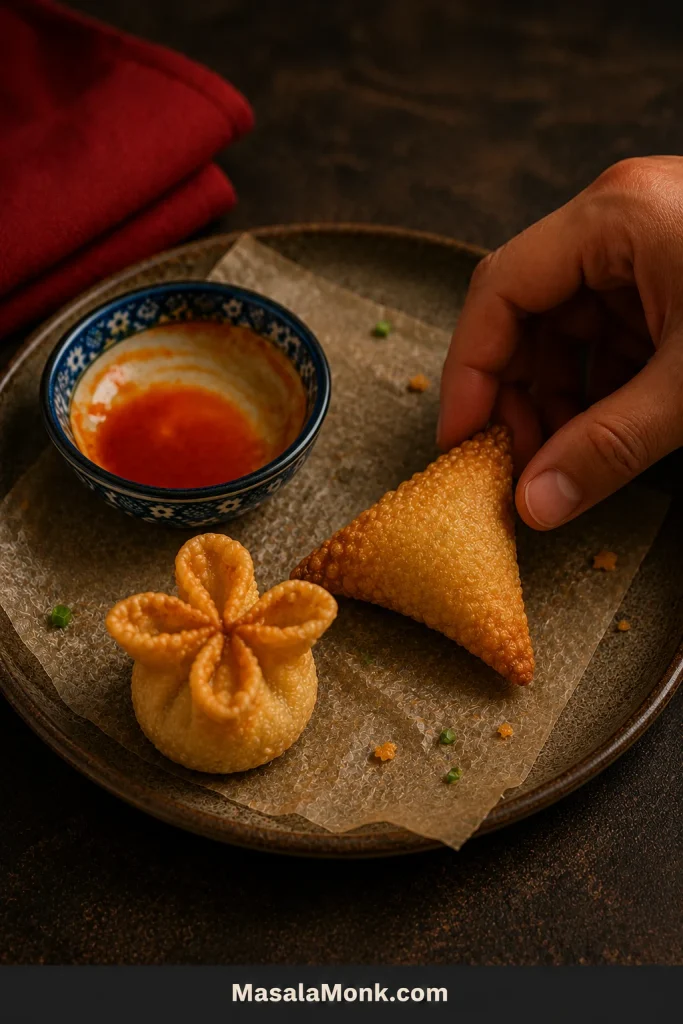
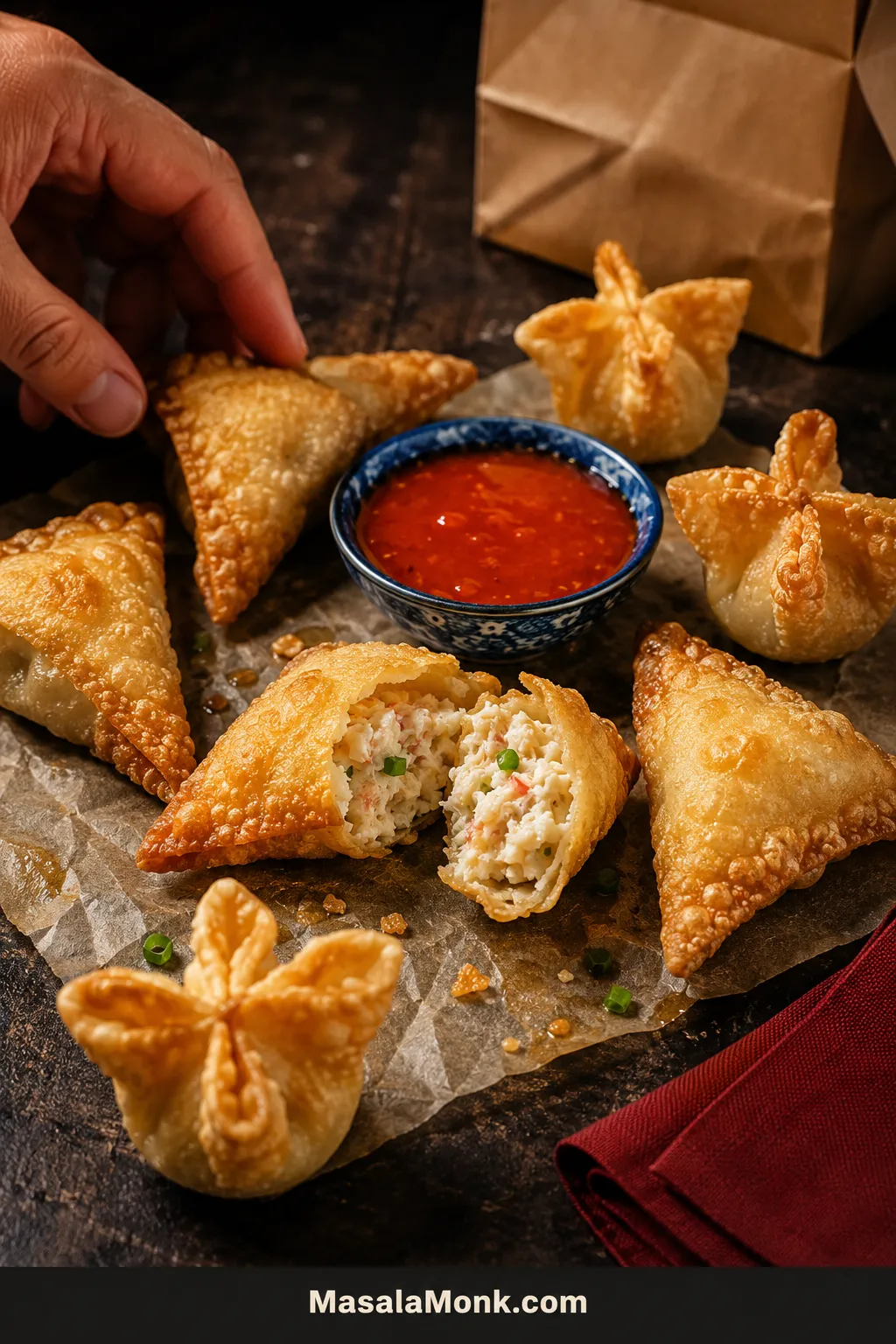
Golden triangle and purse-shaped crab rangoons arranged around red-orange sweet-and-sour sauce, with one broken open to reveal the creamy crab filling.

Crab rangoon is the kind of appetizer that disappears before anyone admits how many they have eaten. The wrapper cracks first, the warm cream cheese filling follows, and everyone reaches past the dipping sauce for one more.

At home, though, the same little wonton can become surprisingly frustrating. One overfilled piece opens in the oil. A wet filling slips through a seam. Air-fryer corners turn dark while the middle stays pale. Or the wrapper comes out crisp but almost empty.

Here, you can match the filling to the version you remember, keep the seams closed, and choose the kind of crunch that works for your kitchen.

The rule that keeps everything under control is simple: thick filling, modest portions, clean seams. Drain the crab, chill the filling until it holds its shape, and leave enough bare wrapper around it to push out the air and close every edge.

Deep frying gives you the thinnest, most blistered restaurant-style shell. The air fryer produces crisp batches with less oil. Baking lets you cook more pieces at once without standing over a pot. Each method gives you a different kind of crunch.

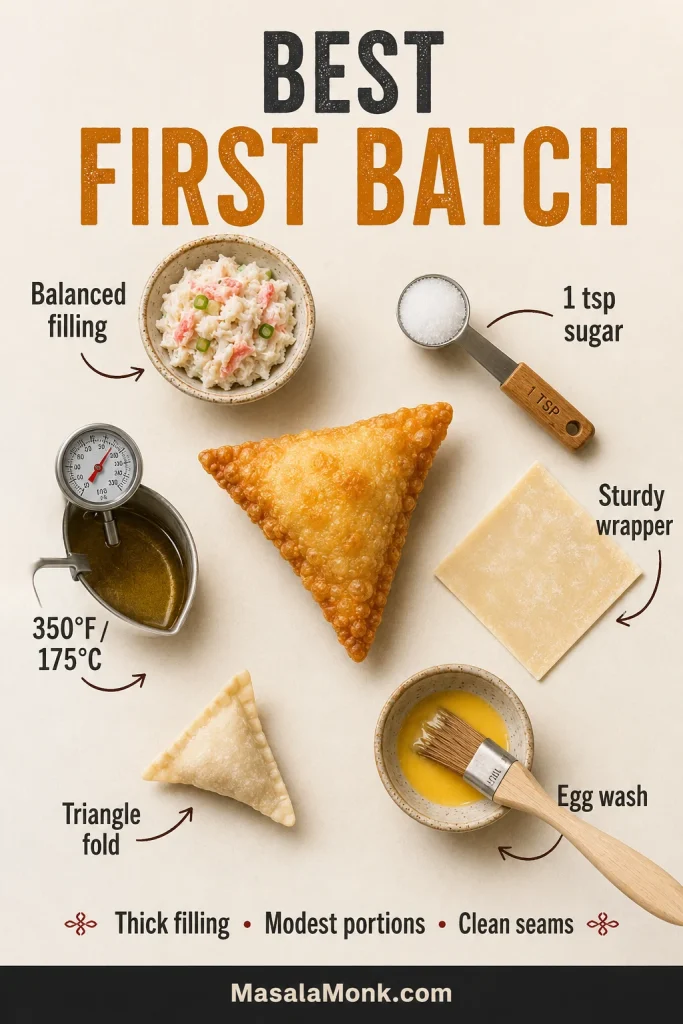
Best First Batch

For a dependable restaurant-style first batch, use the balanced imitation-crab filling with 1 teaspoon sugar, sturdy square wonton wrappers, triangle folds, egg wash, and deep frying at 350°F / 175°C.

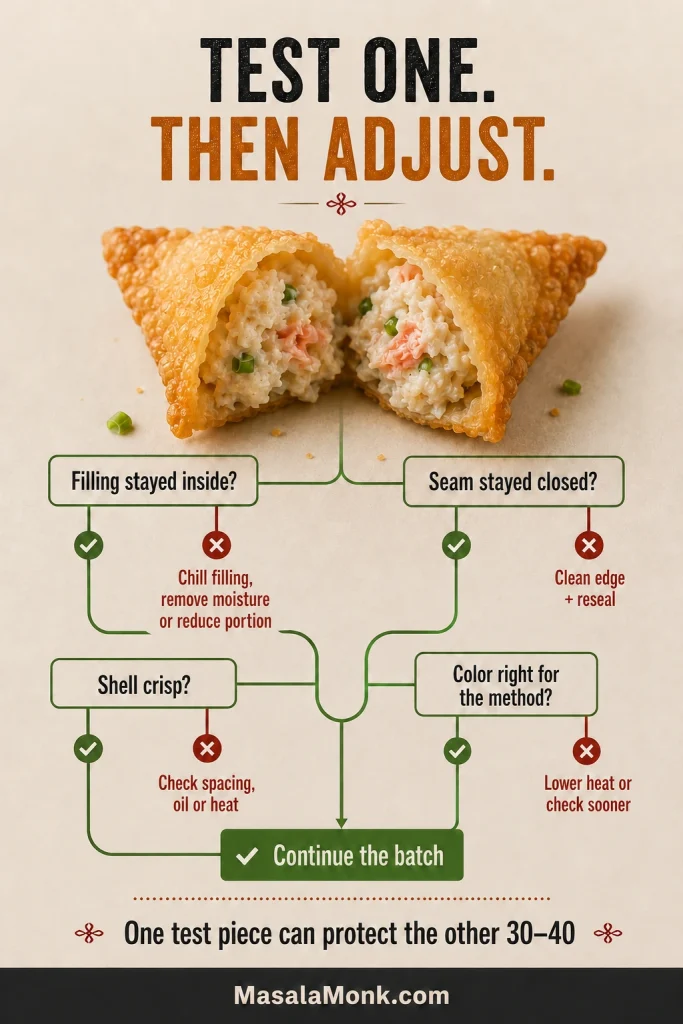
Keep each portion modest, press out the air before sealing, and cook one test rangoon before continuing. That first piece will tell you whether the remaining batch needs a little less filling, a firmer seam, or a shorter cooking time.

First-batch guide surrounding a finished triangle rangoon with balanced filling, one teaspoon sugar, a sturdy wrapper, egg wash, triangle folding and 350°F frying guidance.
Keep the first batch predictable. Then adjust sweetness or crab quantity without confusing the cause of any change.

Crab Rangoon Recipe

Crispy crab and cream cheese wontons, with complete instructions for deep frying, air frying, or baking.

Mix, chill, fold, then cook. The filling and sauce come together quickly. Most of the hands-on time is folding, and the first few wrappers are the slowest.

Hands-on preparation and foldingAbout 50–60 minutes
Chilling20–30 minutes, while the sauce and setup are completed
Deep-frying the full batchAbout 20–30 minutes
Resting before serving3–5 minutes
Total elapsed timeAbout 1 hour 25 minutes–1 hour 55 minutes
YieldAbout 30–35 rangoons with 3½-inch wrappers, or 36–40 smaller rangoons with thin 3-inch wrappers
Servings8 servings as written; roughly 8–10 with other appetizers, or 5–7 as the main hot appetizer

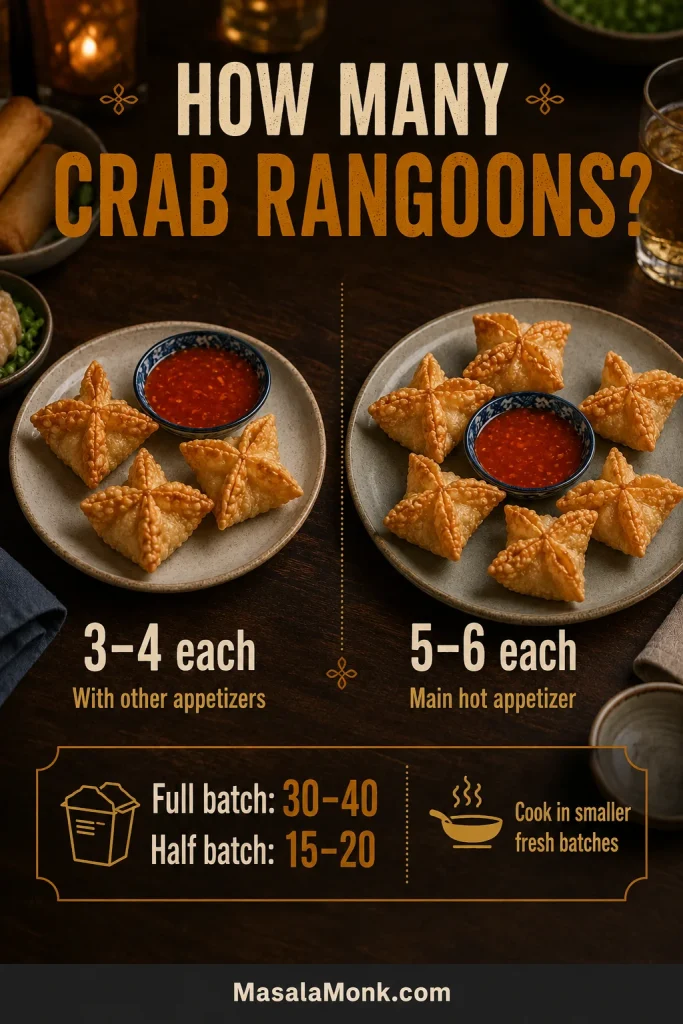
This is a party-size batch of roughly 30–40 rangoons. A half batch makes approximately 15–20 pieces—enough for about four people with other appetizers, or two to three people when these are the main hot appetizer.

For a half batch, halve the filling, sauce, and wrapper quantity, but keep the same frying-oil depth and temperature. You can still use one egg for the wash, or use plain water for simple triangle folds.

Equipment

  • All methods: mixing bowl, spatula, measuring teaspoons or a small scoop, lined tray, small bowl for egg wash, and a clean towel for covering the wrappers
  • Deep frying: heavy pot, frying thermometer, slotted spoon or spider strainer, and wire rack
  • Air frying: air fryer and oil mister or pastry brush
  • Baking: rimmed sheet pans, parchment, and oil mister or pastry brush

Ingredients

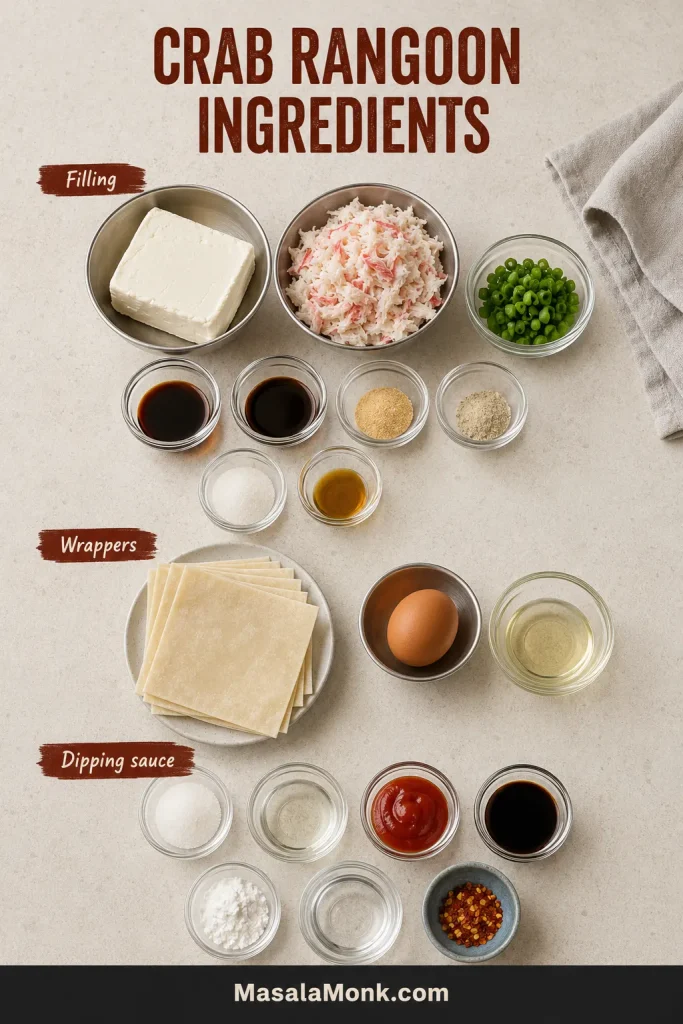
Overhead arrangement of cream cheese, crab, scallions, seasonings, wonton wrappers, egg, cooking oil and ingredients for homemade sweet-and-sour sauce.
Separate filling, sealing and sauce ingredients before mixing. Meanwhile, keep unused wrappers covered so their edges stay flexible.

Crab and Cream Cheese Filling

IngredientUS amountMetric amount
Full-fat block cream cheese, softened but not warm8 oz227 g
Ready-to-eat imitation crab, recommended for the first batch; or cooked lump or well-drained canned crab6 oz170 g
Medium scallions, very finely chopped2 mediumAbout 18–20 g
Low-sodium soy sauce1 tsp5 ml
Worcestershire sauce1 tsp5 ml
Garlic powder½ tspAbout 1.5 g
White pepper or finely ground black pepper¼ tspAbout 0.5 g
Granulated sugar—1 tsp for the recommended first batch; use 0–1 tsp to taste1 tsp4 g
Toasted sesame oil, optional¼ tsp1 ml
Fine saltSmall pinch, only if needed

For Wrapping and Cooking

  • One 40–50-count package square wonton wrappers, approximately 3–3½ inches / 7.5–9 cm wide
  • 1 large egg mixed with 1 teaspoon water, or plain water for simple triangle folds; you may not need all the egg wash
  • For deep frying: neutral high-heat oil, approximately 1½–2 inches / 4–5 cm deep
  • For air frying or baking: enough neutral oil to mist or brush every exposed part of the wrapper lightly

Package counts vary, and a few extra wrappers are useful in case some tear, dry out, or stick together.

Quick Red-Orange Sweet-and-Sour Sauce

IngredientUS amountMetric amount
Granulated sugar⅓ cup67 g
Water¼ cup60 ml
Unseasoned rice vinegar or white vinegar3 tbsp45 ml
Ketchup1 tbsp15 g
Low-sodium soy sauce1 tsp5 ml
Cornstarch2 tspAbout 5–6 g
Cold water for the slurry1 tbsp15 ml
Chili flakes, optionalSmall pinch

Make and Chill the Filling

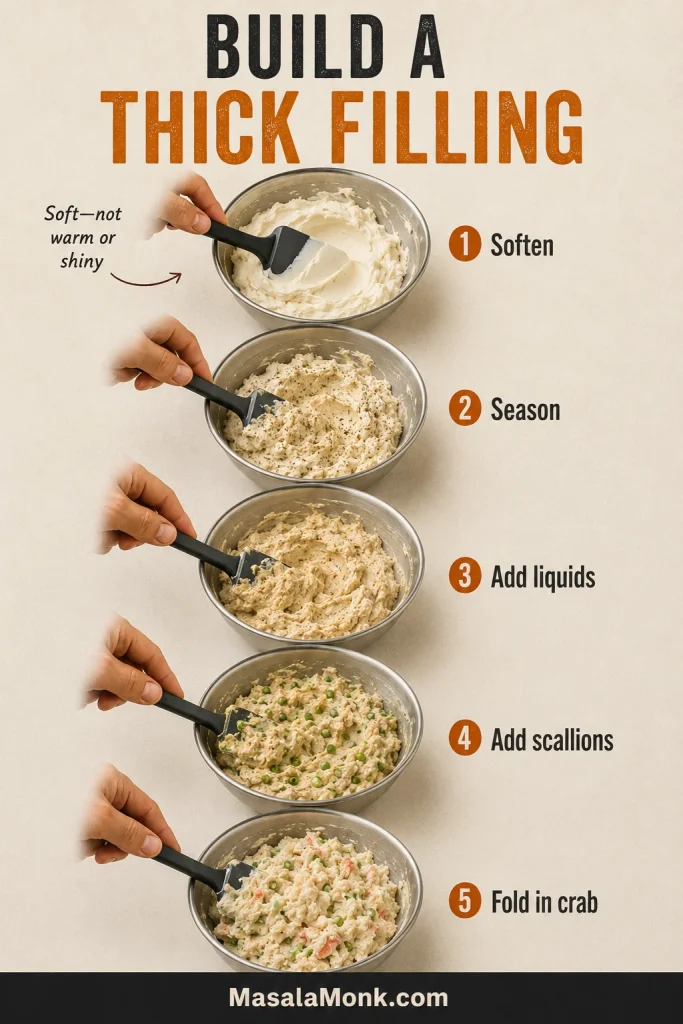
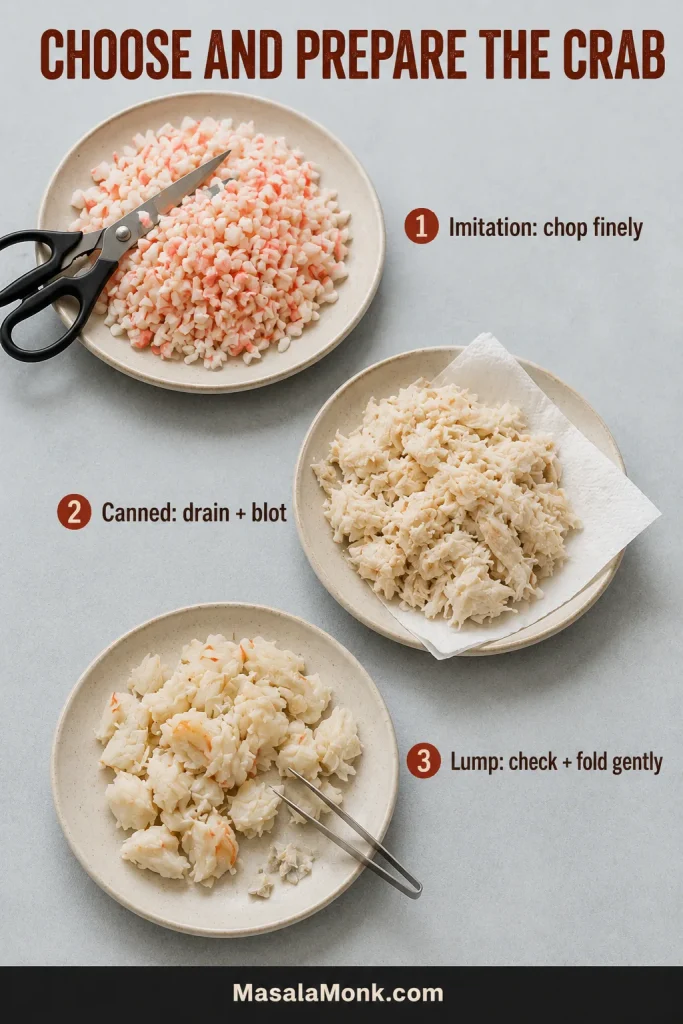
  1. Finely chop imitation crab. For canned or lump crab, drain thoroughly, blot away visible moisture, and check carefully for shell fragments. Thaw previously frozen cooked crab completely before drying it.
  2. Mix the softened cream cheese, garlic powder, pepper, and the sugar, if using, until smooth.
  3. Add the soy sauce, Worcestershire sauce, and optional sesame oil.
  4. Stir in the scallions, then fold in the crab gently so the mixture stays thick and some crab texture remains.
  5. Taste and add a small pinch of salt only when needed.
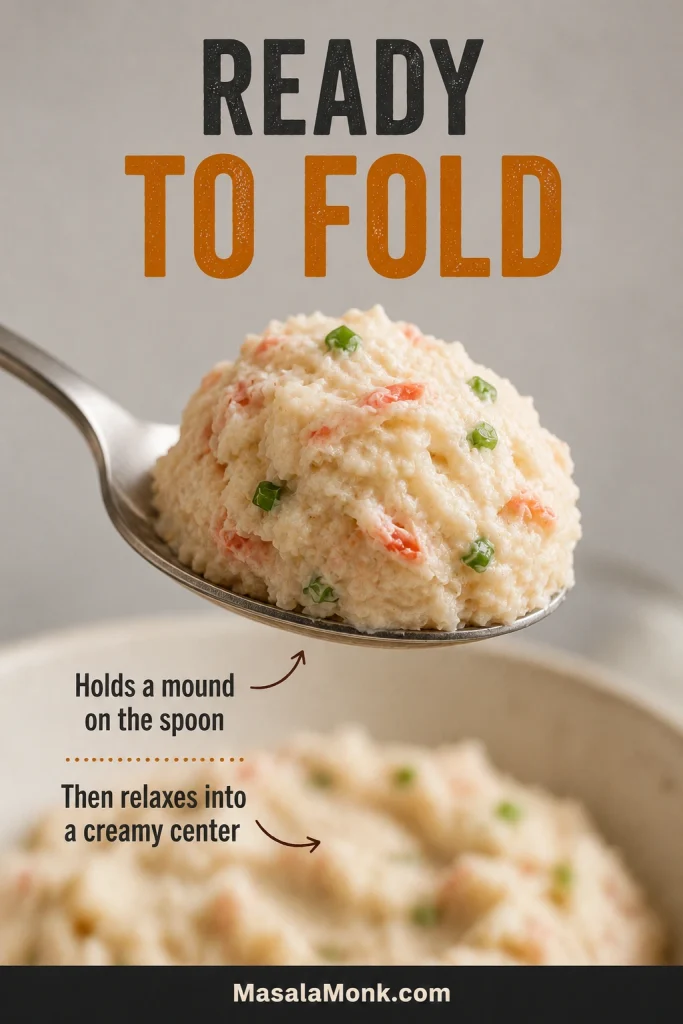
  6. Cover and refrigerate for 20–30 minutes. Properly chilled filling holds a rounded scoop on the spoon.
Five-stage preparation guide showing softened cream cheese combined with seasonings, liquid sauces, scallions and crab to produce a thick, evenly mixed filling.
Add sauces and seasonings before the crab. Once the seafood goes in, stir only enough to distribute it.

Use cooked crab or ready-to-eat imitation crab. These short cooking methods crisp the wrapper and warm the filling; they are not intended to cook raw seafood safely.

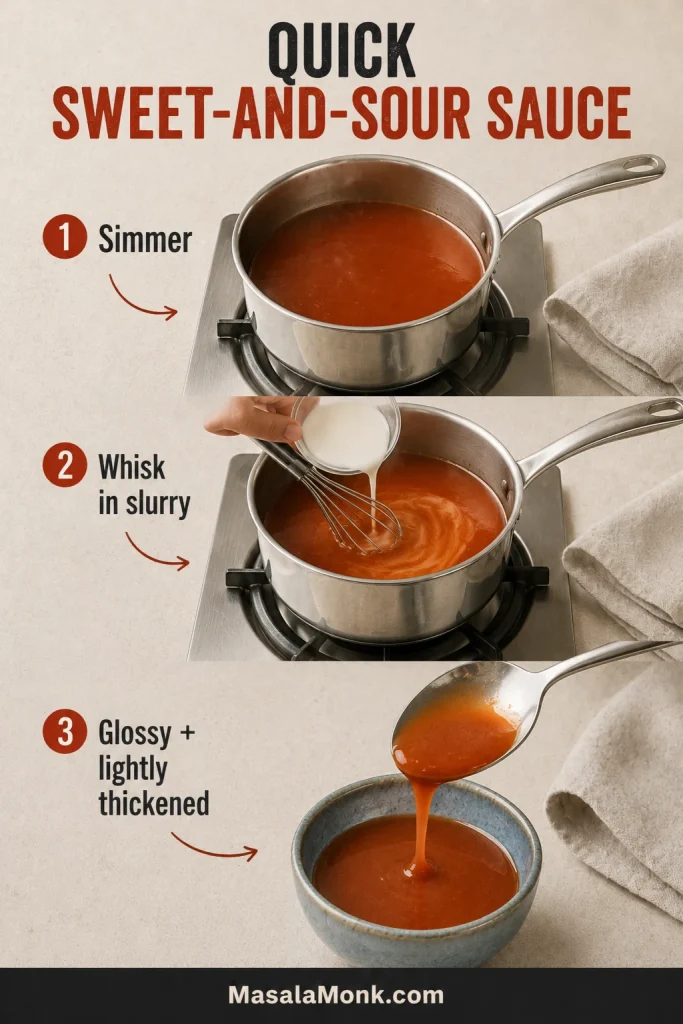
Make the Sweet-and-Sour Sauce

  1. Simmer the sugar, ¼ cup water, vinegar, ketchup, soy sauce, and optional chili flakes until the sugar dissolves.
  2. Mix the cornstarch with 1 tablespoon cold water, then whisk the slurry into the saucepan.
  3. Cook for 30–60 seconds, until glossy and lightly thickened. Thin the cooled sauce with warm water, 1 teaspoon at a time, if needed.
Three-stage guide showing red-orange sauce simmering, cornstarch slurry being whisked in and the finished glossy sauce lightly coating a spoon.
Sweet-and-sour sauce thickens as it cools. If it turns gel-like, whisk in warm water one teaspoon at a time.

Fill and Fold

  1. Line a tray with parchment. Keep the wrapper stack covered and remove only four to six at a time.
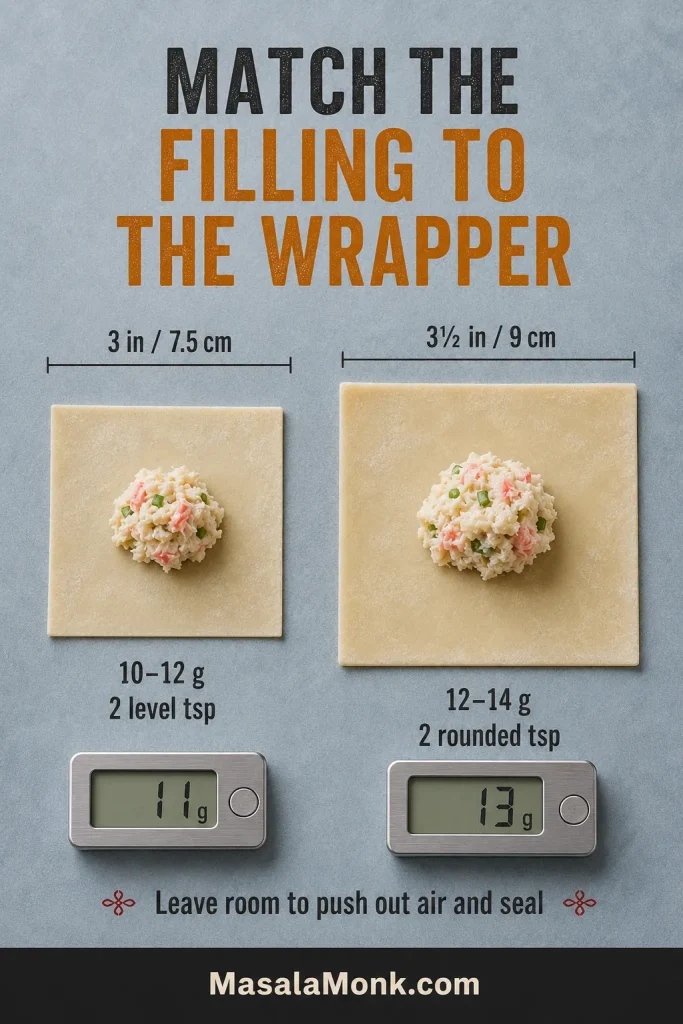
  2. Add about 2 level teaspoons, or 10–12 g, to a thin 3-inch wrapper. Use about 2 rounded teaspoons, or 12–14 g, in a sturdy 3½-inch wrapper.
  3. Lightly moisten the edge with egg wash or water.
  4. Fold into a triangle or four-corner purse.
  5. Press the wrapper close around the filling, push out trapped air, and close every seam firmly.
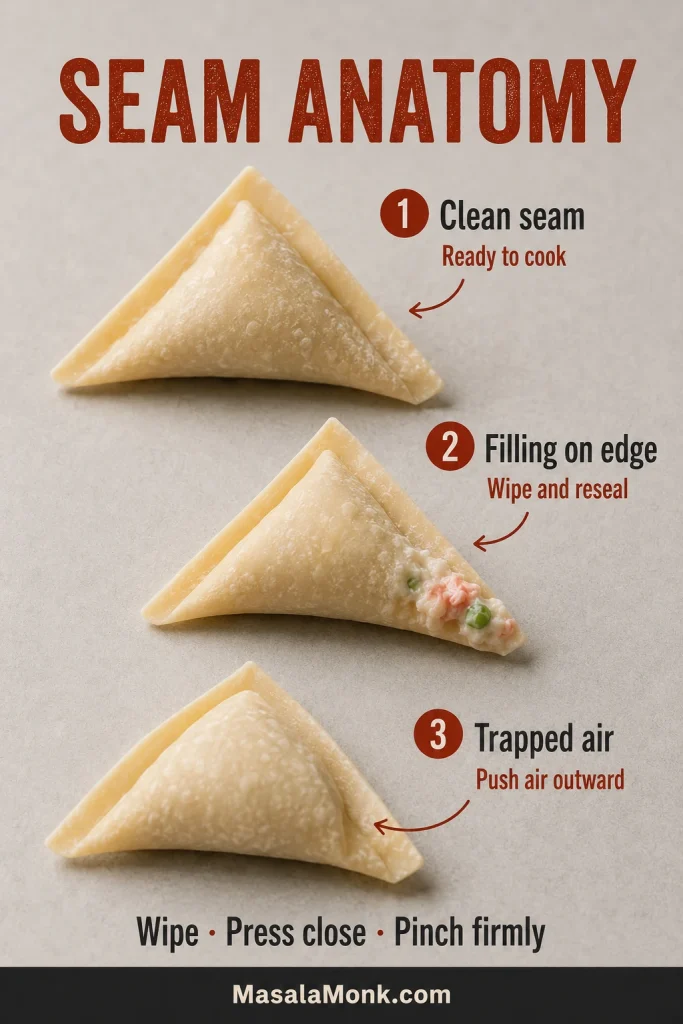
  6. Run a fingertip along the seam. It should feel smooth and uninterrupted, with no soft air pocket beside the filling.
  7. Return each finished rangoon to the lined tray and keep it covered while you continue folding.

Deep-Fry

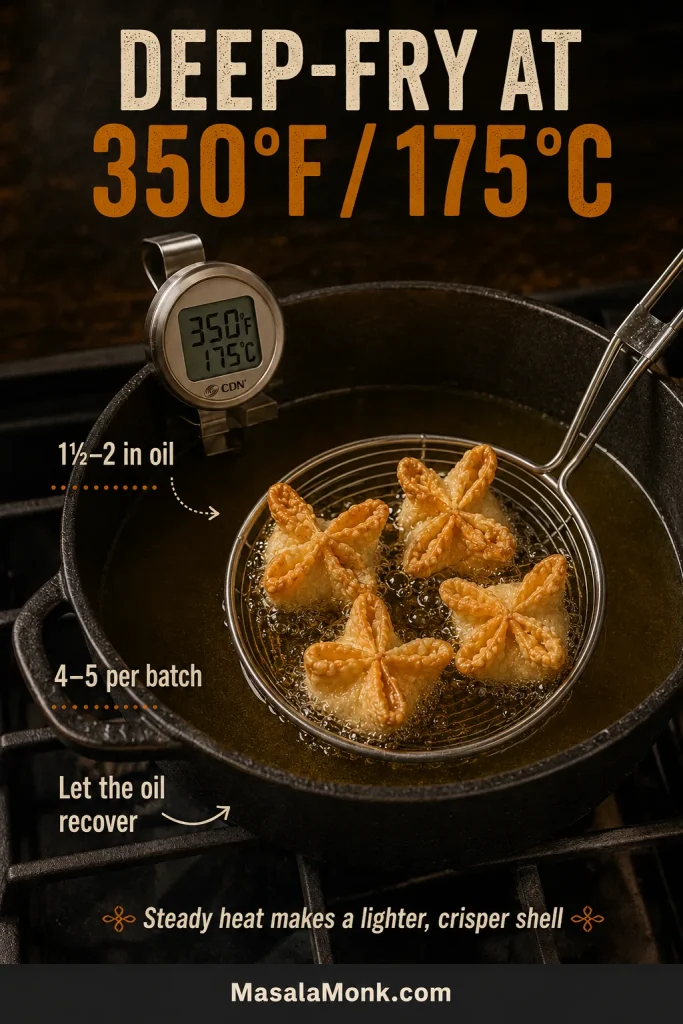
  1. Pour enough oil into a heavy pot to reach 1½–2 inches / 4–5 cm deep. Do not fill the pot more than halfway.
  2. Heat the oil to 350°F / 175°C.
  3. Lower four or five rangoons gently into the oil.
  4. Fry for approximately 2–3 minutes, turning only when needed for even color.
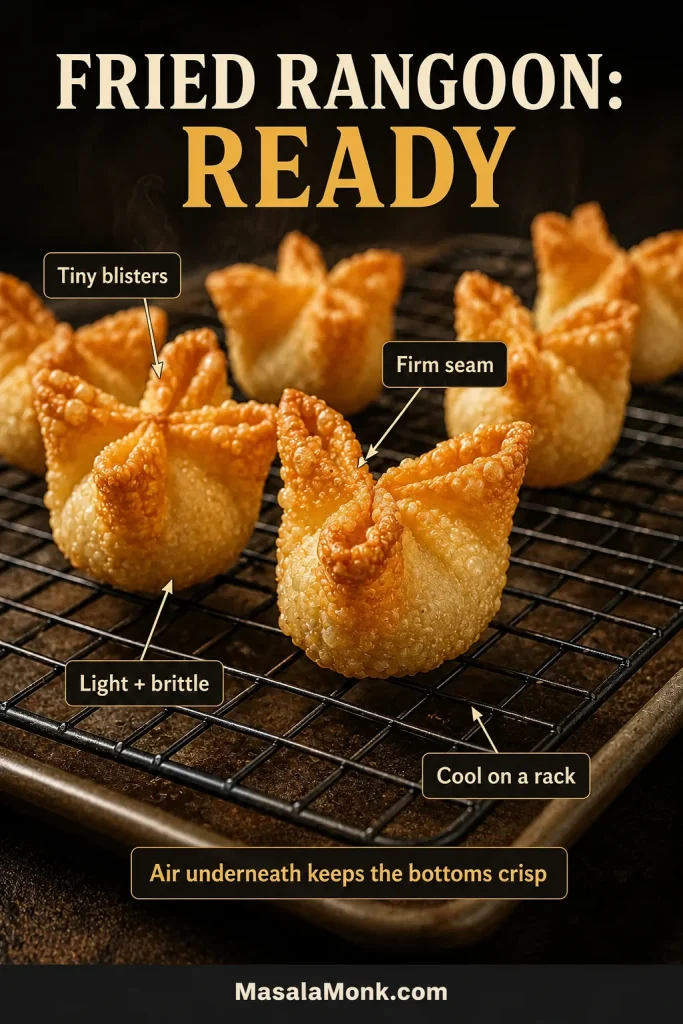
  5. Remove them when the wrappers are evenly golden, tiny blisters cover the flat sides, and the seams feel firm.
  6. Drain on a wire rack and let the oil return to 350°F / 175°C before the next batch.

Air Fry

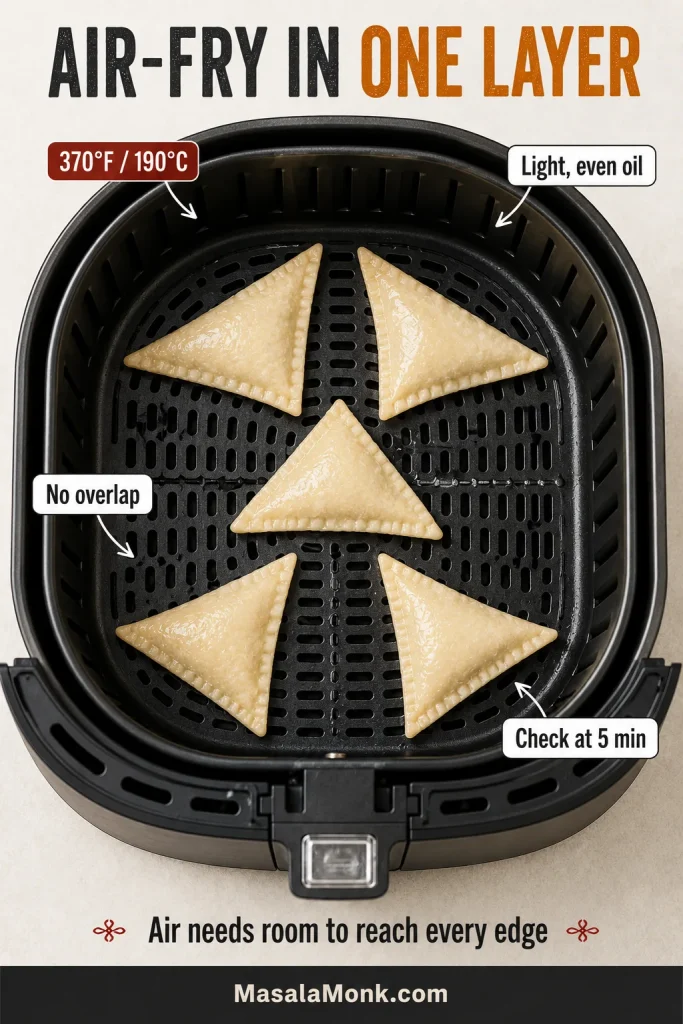
  1. Preheat the air fryer to 370°F / 190°C for about 3 minutes, unless the manufacturer advises otherwise.
  2. Coat every exposed part of the wrapper lightly with oil.
  3. Arrange the rangoons in one uncrowded layer.
  4. Air fry for 6–8 minutes, beginning to check at 5 minutes.
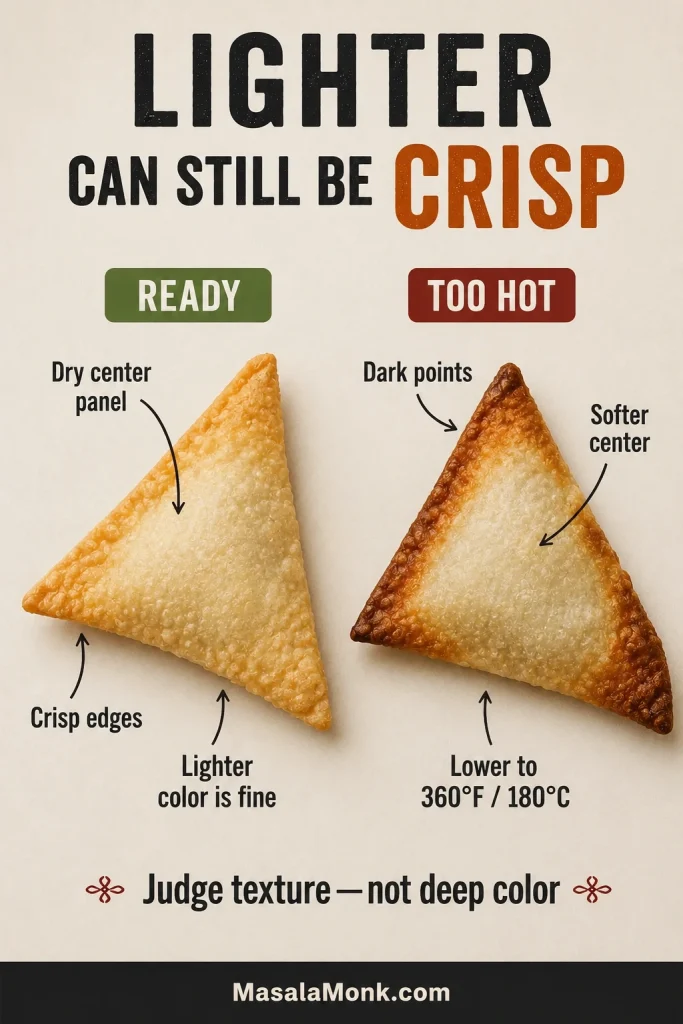
  5. Tap the center panel gently with the tongs. It should feel dry and sound crisp, even when the wrapper remains lighter than a fried one.
  6. Purse shapes usually do not need flipping. Turn flat triangles once only when their undersides remain noticeably pale.

Bake

  1. Heat the oven to 400°F / 200°C. Line one or two rimmed baking sheets with parchment.
  2. Spray or brush every exposed part of the wrapper lightly with oil.
  3. Arrange the rangoons in one layer with at least 1 inch / 2.5 cm between them.
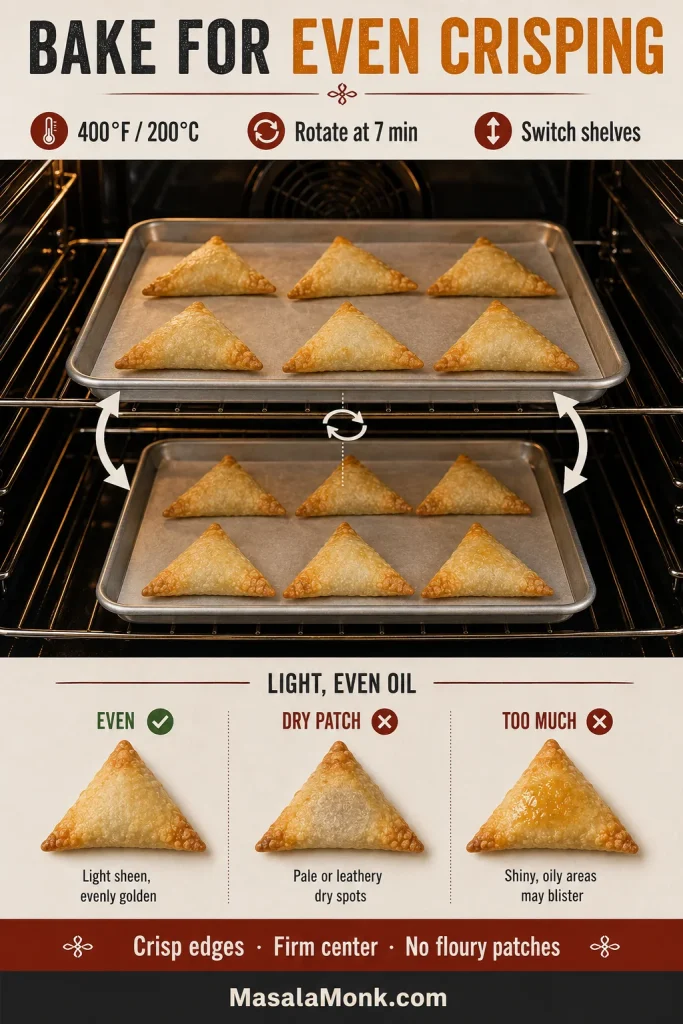
  4. Bake for 10–14 minutes, rotating the tray after about 7 minutes.
  5. When using two trays, switch their positions and turn them front to back.
  6. Remove them when the edges snap, the wrapper around the center feels firm, and no floury-looking patches remain.

Before eating: Let the rangoons rest for 3–5 minutes. The crisp shell cools before the creamy center does.

Allergen note: This recipe may contain milk, wheat, egg, soy, fish, crustacean shellfish, sesame, or peanut, depending on the packaged ingredients and cooking oil used. See the detailed allergen guidance below.

Once the first rangoon cracks cleanly and stays full, the rest of the batch becomes mostly repetition rather than guesswork. The guide below helps you choose a different filling, understand the wrappers, compare methods, or solve anything the test piece revealed.

Decision tree centered on a split-open crab rangoon, checking whether the filling stayed inside, the seam stayed closed, the shell crisped and the color suits the cooking method.
Rest the test rangoon for 3–5 minutes before opening it. Otherwise, hot filling can look looser than it will eat.

Guide contents

Choose and Prepare the Filling

Maybe the version you remember came in a paper takeout bag beside egg rolls, with a tiny cup of bright-red sauce. Maybe the center was almost entirely creamy, or full enough that you could see the crab when you broke it open. There is no single version everyone is trying to recreate.

For many people, crab rangoon is less about one official formula than a particular balance of sweetness, creaminess, and crackle attached to a familiar meal.

Crab rangoon is a Chinese-American restaurant appetizer rather than a traditional Chinese dish, which helps explain why fillings vary so widely.

Choose Your Crab Rangoon Filling

If you want…Use this fillingRecommended crab
Sweet takeout or buffet-style8 oz cream cheese + 4–5 oz crab + 1–1½ tsp sugarImitation crab
Balanced and creamy8 oz cream cheese + 6 oz crab + 0–1 tsp sugarImitation, canned, or lump crab
More distinct crab flavor8 oz cream cheese + 8 oz crab; omit sugarLump or well-drained canned crab

Because the total amount of filling changes, the sweet version makes slightly fewer rangoons and the crab-forward version slightly more. Wrapper size and portioning still have the greatest effect on yield.

Three plates showing finely chopped imitation crab, drained canned crab resting on paper towel and larger lump crab flakes being checked for shell fragments.
Treat each crab differently. Chop imitation crab, blot canned crab and fold lump crab gently to preserve texture.

Smooth takeout-style center: Finely chopped imitation crab blends into the cream cheese, while 1–1½ teaspoons of sugar recreates the gentle sweetness found at many takeout restaurants. Add ⅛–¼ teaspoon MSG (monosodium glutamate) for a slightly deeper savory note.

Balanced and creamy: The filling stays creamy while the crab remains noticeable. Omit the sugar for a savory center, or add up to 1 teaspoon for gentle sweetness.

More crab in every bite: Omit the sugar, drain the crab especially well, and fold it in at the end so some flakes remain visible.

To add a little crunch, fold in 2 tablespoons finely diced, thoroughly drained water chestnuts.

Ingredients and Why They Matter

This filling does not need a long ingredient list. Moisture and texture matter more than piling in extra seasoning.

Full-fat block cream cheese gives the filling its most stable texture. Soften it until a spatula moves through it easily, but stop before it becomes warm, shiny, or runny. Spreadable tubs and whipped cream cheese may contain more moisture or air, while reduced-fat cream cheese generally produces a softer filling.

Imitation crab gives the mild, lightly sweet flavor many people associate with takeout crab rangoon. Lump crab provides the clearest seafood flavor and more visible flakes. Canned crab is convenient and crab-forward, but it must be drained thoroughly and checked for shell fragments.

Scallions add freshness without much moisture. Garlic powder adds flavor without introducing liquid, while soy sauce and Worcestershire sauce bring salt, savoriness, and tang in small enough amounts to keep the mixture thick.

What Should the Filling Look Like?

A properly chilled filling should hold its mound on the spoon, then relax into a creamy pocket once heated. It should not run, release visible liquid, or spread across the wrapper before you begin folding.

Close-up of chilled crab and cream cheese filling holding a rounded mound on a metal spoon, with small crab pieces and scallion flecks visible.
If chilled filling slides off the spoon, chill it longer or reduce the portion. If it cracks, let it soften briefly.
  • Too soft but not watery: refrigerate for another 15–20 minutes.
  • Visibly wet: chill the filling, spoon away any liquid that gathers, and avoid adding more liquid seasoning. If it still slumps after chilling, use slightly smaller portions and choose triangle folds.
  • Too stiff: let it stand at room temperature for a few minutes.
  • Long crab strands remain: break them up gently with kitchen scissors or the edge of a spatula.
  • Large cream cheese lumps remain: let the filling stand for about five minutes, then press the remaining lumps gently against the bowl with a spatula. Avoid vigorous beating once the crab has been added.
Check allergens and packaged ingredients
  • Wheat: standard wonton wrappers and most conventional soy sauces
  • Milk: cream cheese
  • Egg: egg wash and some imitation-crab products
  • Soy: soy sauce and some imitation-crab products
  • Fish: imitation crab and some Worcestershire sauces
  • Crustacean shellfish: real crab, crab extract, and some imitation-crab products
  • Sesame: optional sesame oil
  • Peanut: only when peanut oil is chosen for frying

Check every packaged ingredient, consider cross-contact in shared cooking oil, and follow the FDA guidance on reading complete ingredient and allergen information.

Wrappers, Portions, and Folding

The wrapper is doing more than holding the filling. Its size determines how much you can add without asking the seam to stretch.

Wonton wrappers are usually sold refrigerated near tofu, fresh noodles, or produce, and may be stocked in the freezer section of Asian supermarkets. Frozen wrappers should thaw completely in their sealed package in the refrigerator before you separate the stack.

  • Standard supermarket wonton wrapper: the most manageable all-purpose choice
  • Thin Hong Kong-style wrapper: delicate and deeply blistered, but easier to tear or overfill
  • Thicker wonton wrapper: sturdier and easier to handle, with a slightly chewier shell

Egg-roll wrappers can be cut into squares, while spring-roll sheets and rice paper behave differently. MasalaMonk’s crispy vegetable spring roll guide explains those alternatives in more detail.

How Much Filling Goes in Each Wrapper?

A properly filled wrapper should feel plump but relaxed, never stretched tightly over the filling. Leave enough clean space around the mound to release trapped air and close the seam.

  • Thin 3-inch / 7.5 cm wrapper: about 2 level teaspoons, or 10–12 g
  • Sturdy 3½-inch / 9 cm wrapper: about 2 rounded teaspoons, or 12–14 g
  • Four-corner purse: stay near the lower end of the range
  • Broad triangle: a sturdy larger wrapper can usually hold the higher end
A 3-inch wonton wrapper holding 10 to 12 grams of filling beside a 3½-inch wrapper holding 12 to 14 grams, with size and weight labels.
Measure the first few portions. Once your hand recognizes the volume, you can work faster without gradually overfilling wrappers.

Which Fold Works Best?

FoldMain advantageWorks especially well forMain risk
TriangleEasiest and strongest sealBeginners, air frying, and bakingSlightly flatter filling pocket
Four-corner purseClassic shape and fuller centerDeep fryingMore seams and faster-browning points

How to Fold and Seal Them

Pretty folds are optional. Closed folds are not. The first one may look awkward; it only needs to stay sealed. Once the portion and motion feel familiar, the tray usually fills much faster.

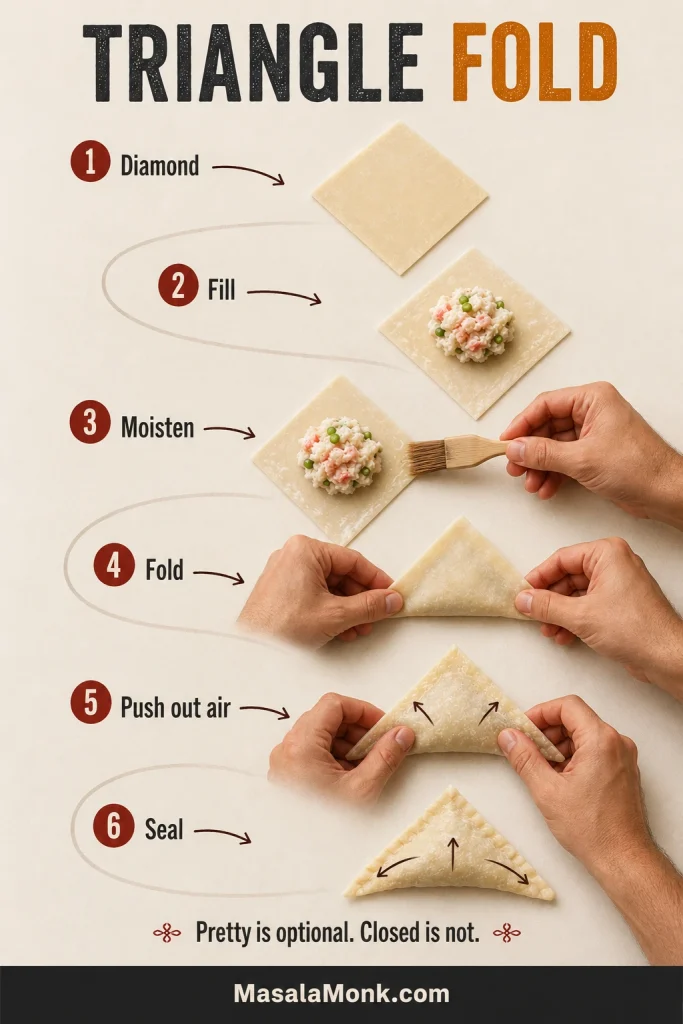
Triangle Fold

  1. Place the wrapper like a diamond with one point facing you.
  2. Add the measured filling to the center.
  3. Brush a thin film of water or egg wash around the edges.
  4. Bring the bottom point to the top point.
  5. Press close to the filling and push air toward the open edges.
  6. Seal from the center toward each corner.
Six-step overhead guide showing a square wonton wrapper filled, moistened, folded into a triangle, pressed to remove air and sealed along the edges.
Seal a triangle with one firm pass. Repeated pinching can thin the wrapper and create tiny cracks.

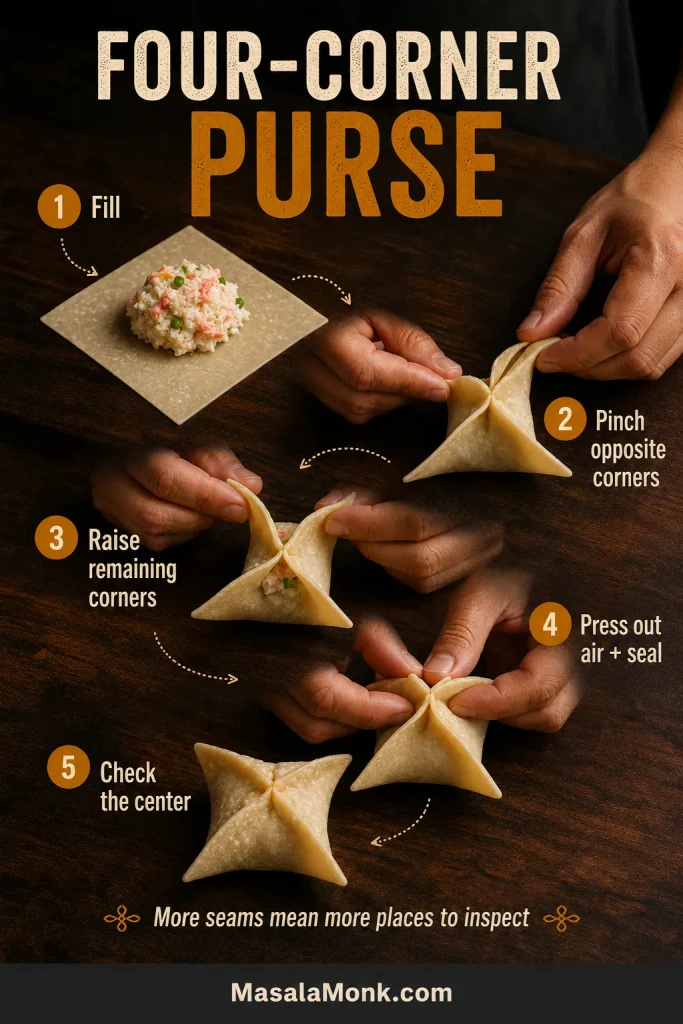
Four-Corner Purse

  1. Add the measured filling to the center.
  2. Brush a thin film of egg wash around the border.
  3. Bring two opposite corners together and pinch.
  4. Bring the remaining corners to the center.
  5. Press the wrapper close around the filling to remove air.
  6. Seal the four diagonal seams from the center outward.
  7. Check the point where all four seams meet.
Five-step guide showing a filled wonton wrapper formed into a four-corner purse by joining opposite corners, raising the remaining corners and sealing the seams.
Lift each purse gently by its center junction before cooking a full tray. Weak joins usually separate there first.

Water is usually enough for fresh wrappers and simple triangles. Egg wash provides extra grip for purse folds and deep frying. Use only a thin film; a soaked edge becomes slippery.

Close comparison of a properly sealed wrapper edge, filling caught along the sealing border and an air pocket trapped beside the filling.
A slightly damp edge becomes tacky; a soaked edge slides. Apply only a thin film of egg wash.

Back to the recipe · Compare cooking methods · Troubleshoot sealing

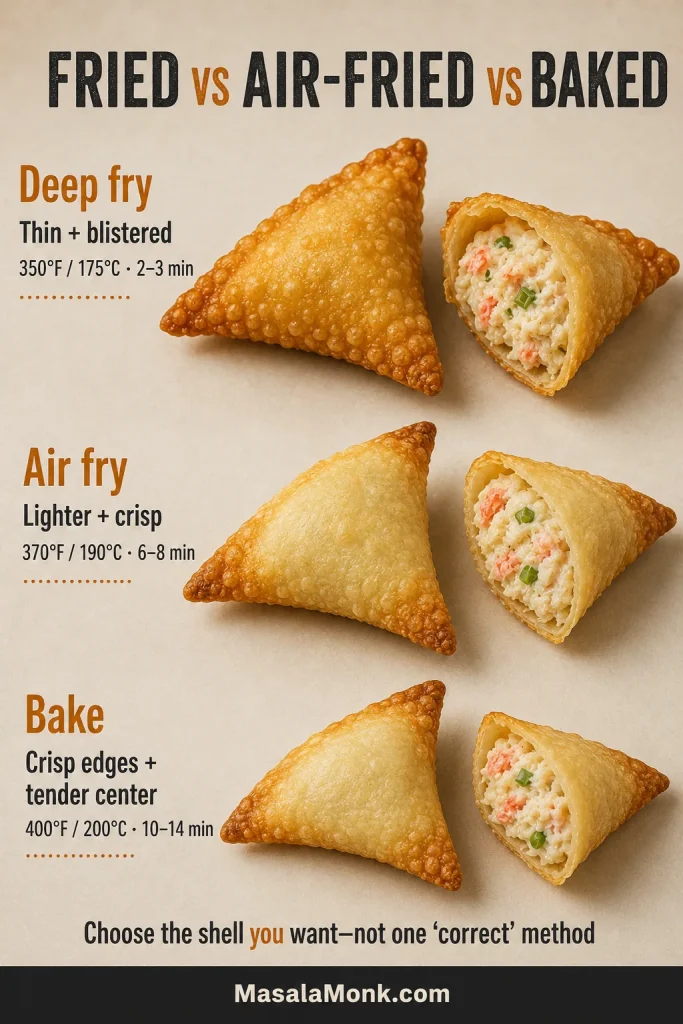
Compare the Three Cooking Methods

The filling stays the same. What changes now is the shell you want around it and the number of pieces you need to cook at once.

MethodResultFull-batch timeWorks especially well for
Deep fryThinnest, most blistered, and evenly crispAbout 20–30 minutesRestaurant-style texture; triangles or purses
Air fryCrisp, lighter shell with faster-browning pointsAbout 25–55 minutes; allow roughly 35–55 minutes with a five-piece basketSmaller lower-oil batches; triangles
BakeCrisp edges with a more tender center10–14 minutes when two trays bake together, or 20–28 minutes in two roundsLarger batches; triangles
Fried, air-fried and baked crab rangoons shown whole and cut open, with different wrapper colors, surface textures, temperatures and cooking times.
Keep the filling amount and fold consistent when comparing methods. Otherwise, wrapper shape can be mistaken for a cooking difference.

Deep-Fried Crab Rangoon

Deep frying produces the thinnest shell and the most even blistering because the hot oil reaches the seams, points, and flat sides at the same time. Triangle folds are easy to manage, while four-corner purses give the familiar restaurant shape.

The oil temperature matters more than chasing an exact shade of gold. When the oil falls too far below 350°F / 175°C, the wrappers absorb more fat before they become crisp. Let the pot recover between batches rather than adding more pieces to save a minute.

Five folded crab rangoons being carefully lowered into a heavy pot containing 1½ to 2 inches of oil at 350°F or 175°C.
Lower each piece close to the oil surface. This reduces splashing and helps prevent the fold from striking the pot.

Properly fried wrappers should feel light and brittle rather than thick or oily. Look for tiny blisters, firm seams, and even color before the points become dark.

Golden fried crab rangoons cooling in one layer on an elevated wire rack, with small wrapper blisters, firm seams and crisp pointed edges visible.
Freshly fried crab rangoon may feel slightly flexible. It should become brittle within a minute on the rack.

Frying Safety

  • Use a stable, heavy pot and do not fill it more than halfway with oil.
  • Keep water, damp wrappers, wet utensils, children, and pets away from the cooking area.
  • Lower the rangoons gently, remove any leaking piece promptly, and keep pot handles turned away from the edge of the stove.
  • Drain the cooked rangoons on a wire rack so steam does not soften the bottoms.

Air Fryer Crab Rangoon

For the air fryer, the triangle is the more forgiving shape. It has fewer seams and fewer exposed points competing with the hot circulating air. Purse-shaped rangoons still work, but their tips may crisp before the wrapper around the center.

Five uncooked triangle crab rangoons arranged without touching in a lightly oiled air-fryer basket, with open vents and space around every piece.
Leave the basket vents exposed and space the triangles apart. Crowding blocks hot air from reaching the bottoms and center panels.

A lighter shell is not a failed shell. A pale air-fried wrapper can still crack cleanly when you bite it. Trust the dry, crisp texture rather than waiting for the deep color produced by frying.

Two air-fried crab rangoons compared: one light-golden and crisp with a firm center, and one with dark points surrounding a softer pale center.
Do not wait for deep-fried color. Instead, tap the wrapper over the filling; it should feel dry and firm.

When the tips darken too quickly, lower the setting to 360°F / 180°C. The extra minute or two gives the center panel time to crisp without hardening the points.

Baked Crab Rangoon

On a sheet pan, triangles sit steadily and expose more wrapper to the heat. Baking is also the most practical option when you want to cook a large batch without standing over oil.

The wrapper around the center stays slightly more tender than the edges. That is part of the baked texture, not a sign that the batch failed. Look for crisp points, firm seams, and no dry floury patches.

Uneven oil coverage is the usual reason baked wrappers stay pale or leathery. Mist or brush any dry-looking areas and return the tray to the oven briefly rather than continuing until the points become hard.

Two trays of triangle crab rangoons baking on different oven shelves, with arrows showing tray rotation, shelf switching and different levels of oil coverage.
Remove a finished tray instead of waiting for both to match. Oven shelves rarely brown at exactly the same rate.

Which Dipping Sauce Do You Remember?

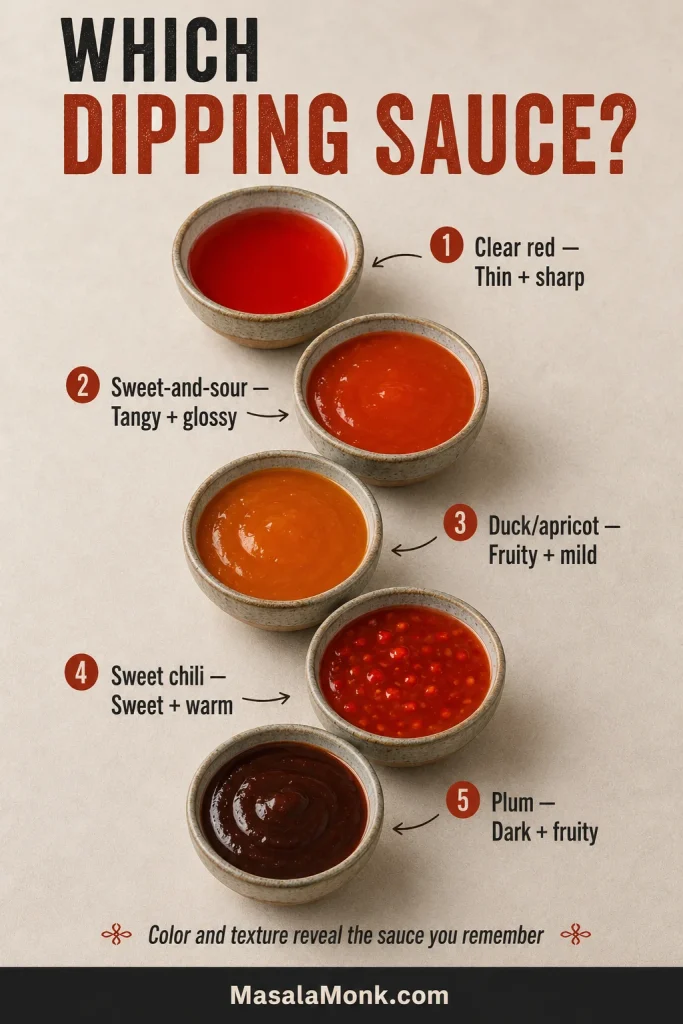
The sauce is often the part people remember most clearly and name least accurately. The red or orange dip may be sweet-and-sour, duck sauce, sweet chili, or plum sauce.

SauceAppearanceFlavor
Clear bright-red restaurant sauceThin, translucent, glossySimple vinegar-and-sugar sweet-and-sour
Red-orange sweet-and-sourGlossy and slightly opaqueTangy, sweet, lightly tomato- or fruit-based
Duck or apricot sauceOrange and jam-likeFruity and mild
Sweet chili sauceRed with visible chili piecesSweet with gentle heat
Plum sauceDarker and thickerFruitier and less sharply acidic
Five ceramic bowls containing clear red sauce, red-orange sweet-and-sour sauce, orange duck sauce, flecked sweet chili sauce and dark plum sauce.
Identify crab rangoon dipping sauce by texture before color. Brands vary in shade, but thickness remains more revealing.

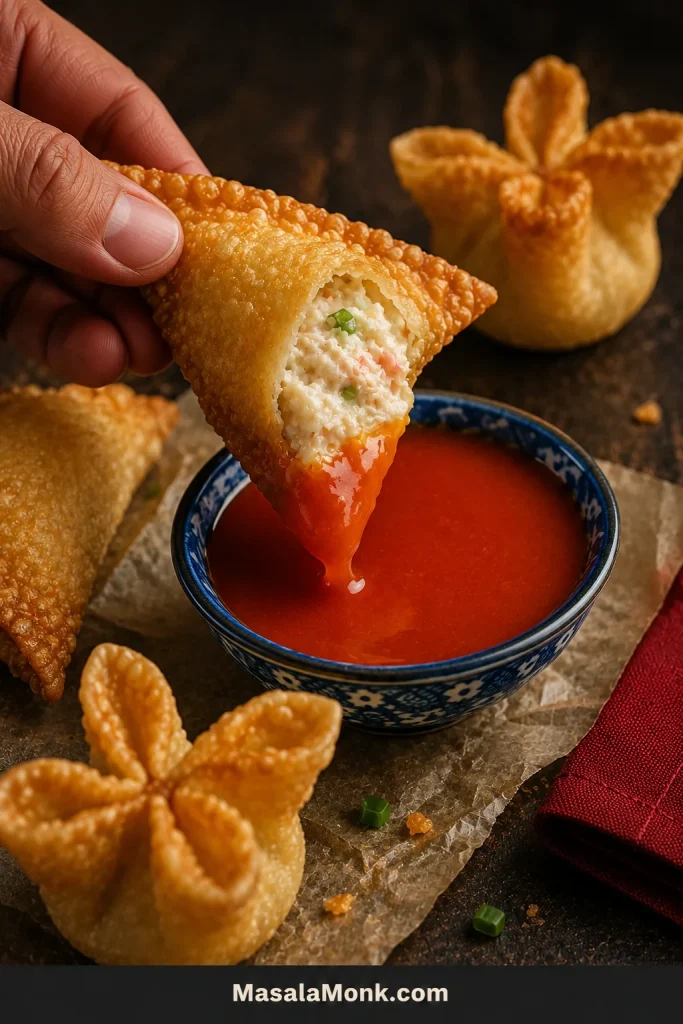
The sauce included in the recipe is glossy, red-orange, and sweet-and-sour. Its vinegar cuts through the rich cream cheese and crisp wrapper. Duck or plum sauce provides a softer fruit contrast, while sweet chili adds gentle heat.

A hand dipping one corner of a broken-open crab rangoon into smooth red-orange sweet-and-sour sauce while the creamy center remains visible.
Use a shallow bowl for crab rangoon dipping sauce. It encourages a light corner dip and preserves more crunch.

For guests who prefer a less tangy dip, homemade yum yum sauce gives the platter a cool, creamy alternative.

Troubleshooting: What to Do Now

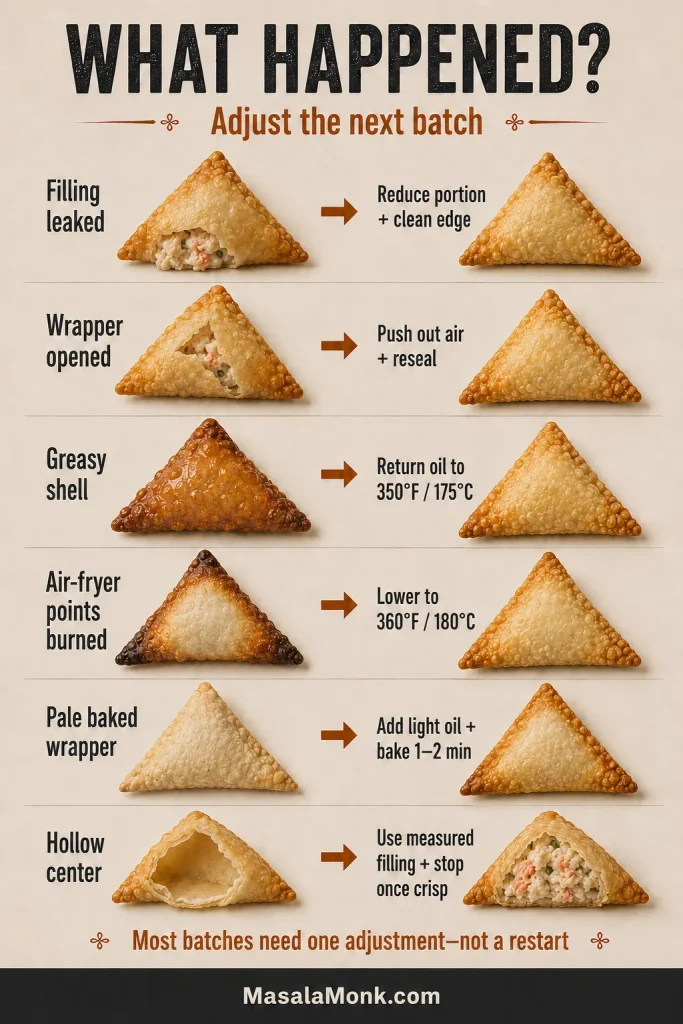
A few imperfect rangoons do not mean the batch is lost. Start with the symptom you can see. Most batches need one adjustment, not a complete restart.

Most problems lead back to thick filling, modest portions, or clean seams. The tables below separate issues you can catch before cooking from the ones that appear after the wrappers hit the heat.

Jump to: Before cooking · After cooking · Reheat softened leftovers

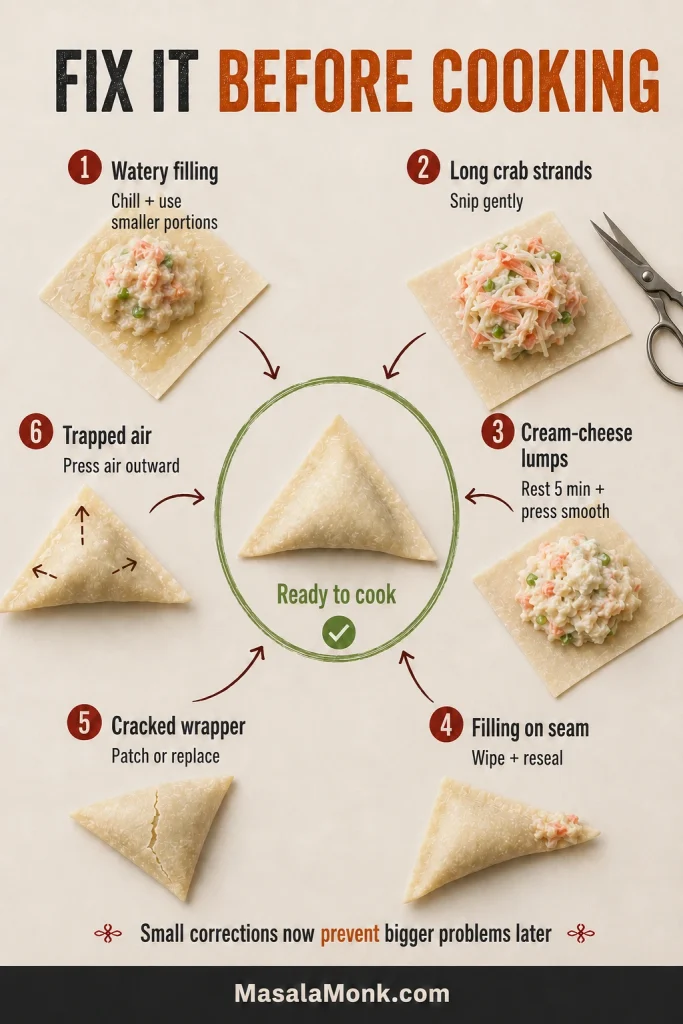
Before Cooking

Pre-cooking crab rangoon troubleshooting guide showing watery filling, long crab strands, cream cheese lumps, filling on a seam, a cracked wrapper and trapped air around a correctly folded piece labelled ready to cook.
Inspect the last pieces you folded first. Wrappers exposed longest are most likely to dry, crack or need resealing.
What you seeWhat to do now
Filling is wateryThe crab may have carried too much moisture, or the filling may be warm. Chill it for 15–20 minutes, spoon away visible liquid, and avoid adding more liquid seasoning. If it still slumps, use smaller portions and triangle folds.
Long crab strands remainBreak them up gently in the mixed filling with kitchen scissors or the edge of a spatula.
Cream cheese remains lumpyLet the filling stand for about five minutes, then press the remaining lumps gently against the bowl with a spatula. Avoid vigorous beating once the crab has been added.
Seam will not stickWipe the border clean, let it dry briefly, lightly moisten it again, and pinch.
Wrapper crackedPatch a small crack with a dampened scrap of wrapper. Discard badly split pieces.
Air remains around the fillingPress the wrapper closer to the mound and push the air toward the open edge before sealing.

Most sealing problems are easier to correct before the first batch cooks. Once the rangoons hit the heat, color, texture, and leakage become the useful clues.

After Cooking

Six-row crab rangoon troubleshooting guide comparing leaked filling, an opened seam, a greasy fried shell, air-fryer points burned, a pale baked wrapper and a hollow center with corrected results.
The failure location matters. A leaking seam suggests sealing trouble, while a split panel often points to overfilling.
What happenedWhat to do now
Filling leaked outThe portion may be too large, the filling too wet, or the border dirty. Reduce the remaining portions, clean each edge, and reseal.
Wrapper openedPress the remaining wrappers close to the filling, push the air outward, and pinch every seam again.
Fried rangoons are greasyBring the oil back to 350°F / 175°C and cook smaller batches.
Outside browned too quicklyLower the heat, let the oil or appliance temperature settle, and check the next batch sooner.
Air-fryer points burnedReduce the setting to 360°F / 180°C and add 1–2 minutes if the center panel still needs crisping.
Baked wrappers stayed paleBrush or mist the dry areas lightly and bake for another 1–2 minutes.
Bottom stayed softReturn the pieces in one layer for 1–2 minutes, then cool them on a rack.
Center feels hollowUse the measured portion, press the wrapper close around it, inspect every seam, and stop cooking once the shell is crisp.
Cooked rangoons softenedRe-crisp at 350°F / 175°C in the air fryer for 2–3 minutes or at 375°F / 190°C in the oven for 4–6 minutes.

Party Timeline and Quantities

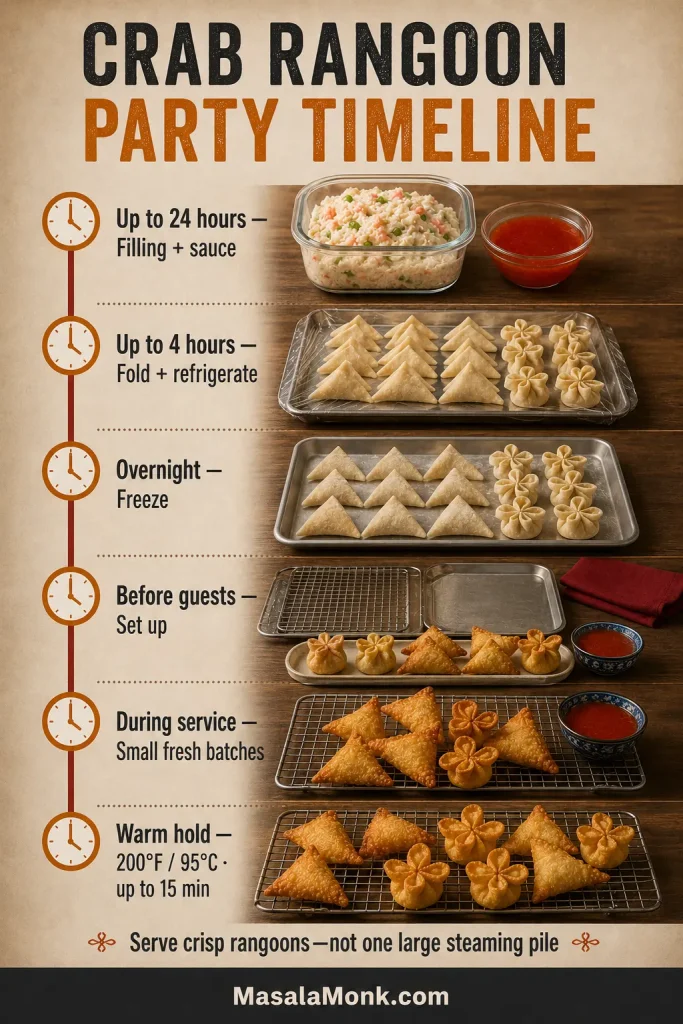
The goal is to serve crisp rangoons—not spend the whole party trapped beside the stove. Smaller fresh batches stay crisper than one large pile slowly steaming itself soft.

To reduce last-minute cooking, let a make-ahead cheese ball cover the cold-appetizer slot while the rangoons come out in smaller fresh batches.

How Many Crab Rangoons Per Person?

Plan on 3–4 rangoons per person when several appetizers are available, or 5–6 when they are the main hot appetizer. Count the recipe as 8 servings; in practice, one balanced batch usually serves about 8–10 with other appetizers or 5–7 when these are the main hot appetizer.

Serving guide showing four crab rangoons for a mixed appetizer spread and six for a main hot appetizer, with full- and half-batch quantity guidance.
Count cooking capacity as well as appetite. A small air-fryer basket may serve only a few guests at once.

For a larger group, double the filling, but open and fill the second package of wrappers only when needed so the unused stack stays supple.

Make-Ahead Crab Rangoon Timeline

Up to 24 hours ahead: Prepare the filling and store it in an airtight container in the refrigerator. Make the dipping sauce and refrigerate it separately.

For the best wrapper texture, up to four hours ahead: Fold the rangoons, arrange them on parchment-lined trays, cover them carefully so the wrappers do not dry out, and keep them refrigerated until cooking.

For overnight or longer preparation: Freeze the assembled rangoons rather than refrigerating them.

Before guests arrive: Set out wire racks, sheet pans, dipping bowls, and serving platters. Take the sauce out of the refrigerator early enough to lose its deep chill, or warm it gently if preferred. Heat the oil, oven, or air fryer shortly before cooking.

During service: Cook the first batch before everyone is waiting at the platter. After that, smaller fresh batches can arrive while people are already eating. Hold finished rangoons uncovered on a wire rack in a 200°F / 95°C oven for no more than about 15 minutes.

Party timeline showing filling and sauce prepared up to 24 hours ahead, folding up to four hours ahead, freezing, setup, fresh-batch cooking and a short warm hold.
Plan the party backward from the first serving time. Cold preparation is flexible, but crisp holding time is limited.

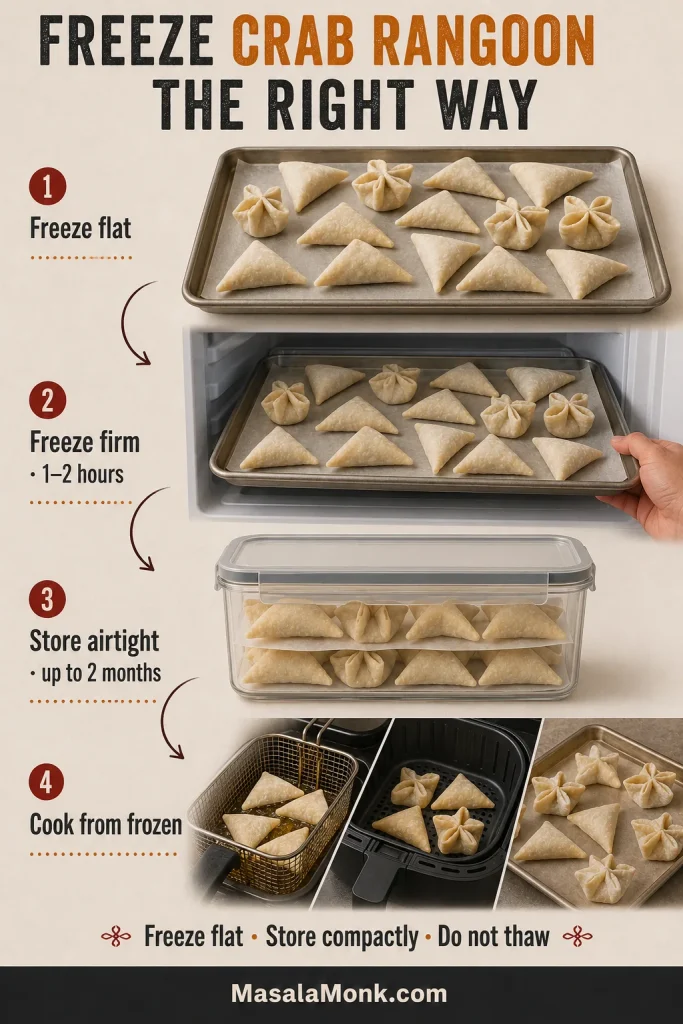
Freeze and Cook From Frozen

Once frozen solid, the rangoons can be stored compactly and cooked whenever needed. Keep them frozen until they go directly into the oil, air fryer, or oven.

  1. Arrange the uncooked rangoons in one layer on a parchment-lined tray.
  2. Freeze until firm, usually 1–2 hours.
  3. Transfer them to an airtight freezer container or freezer bag.
  4. Separate layers with parchment to protect the seams and points.
  5. Use within two months for the best wrapper quality.

Do not thaw before cooking. Condensation can soften the wrappers and weaken the seams.

Four-stage guide showing uncooked crab rangoons frozen flat on a tray, placed in a freezer, packed airtight with parchment and cooked directly from frozen.
Label the fold and intended cooking method before freezing. Triangles and purses may finish at different times from frozen.

When deep frying frozen rangoons: Brush away visible ice crystals, lower them into the oil carefully, and cook smaller batches because frozen pieces lower the oil temperature more sharply.

MethodTiming from frozenLook for
Deep fry at 350°F / 175°C3–4 minutesEvenly golden wrapper and firm seams
Air fry at 370°F / 190°CCheck at 8 minutes; usually 8–12 minutesDry center panel and crisp points; the shell may remain lighter than a fried rangoon
Bake at 400°F / 200°CCheck at 14 minutes; usually 14–18 minutesCrisp edges and a firm center

Cook one frozen rangoon first because wrapper thickness, fold shape, filling amount, freezer temperature, and appliance performance all affect the timing.

Storage and Reheating

Freshly cooked rangoons have the most delicate shell, but dry heat restores enough crunch to make leftovers worth saving.

Refrigerate cooked crab rangoon within two hours. Once the heaviest steam has subsided, arrange the pieces in a shallow container and refrigerate promptly. Cover the container once the rangoons have cooled.

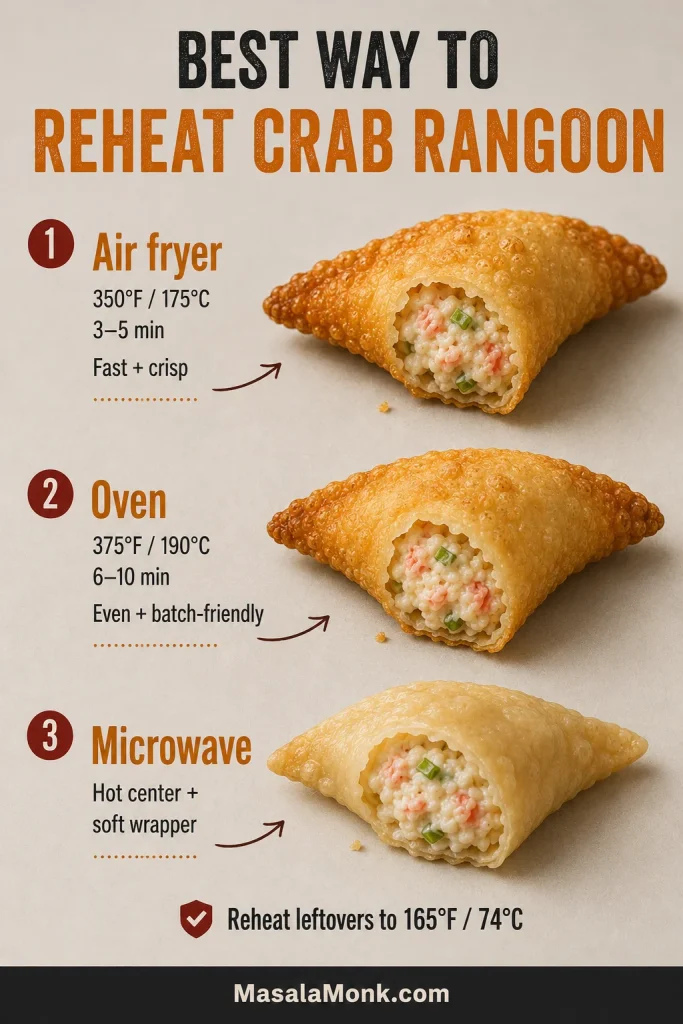
Use refrigerated leftovers within 3–4 days, but reheat and eat them within two days for the best wrapper texture. The USDA leftovers guide recommends reheating leftovers to 165°F / 74°C.

  • Air fryer: 350°F / 175°C for 3–5 minutes
  • Oven: 375°F / 190°C for 6–10 minutes
  • Microwave: the filling becomes hot, but the wrapper remains soft
Crab rangoons compared after reheating in an air fryer, oven and microwave, with crisp dry-heat results and a visibly softer microwaved wrapper.
Leave crab rangoon uncovered while reheating. Foil and lids trap steam, undoing the wrapper’s restored crunch.

What to serve with them · Back to top

What to Serve With It

Pair the rich, creamy rangoons with one substantial dish and one sharp or vegetable-led side. That gives the meal contrast without turning the table into a list of competing fried foods.

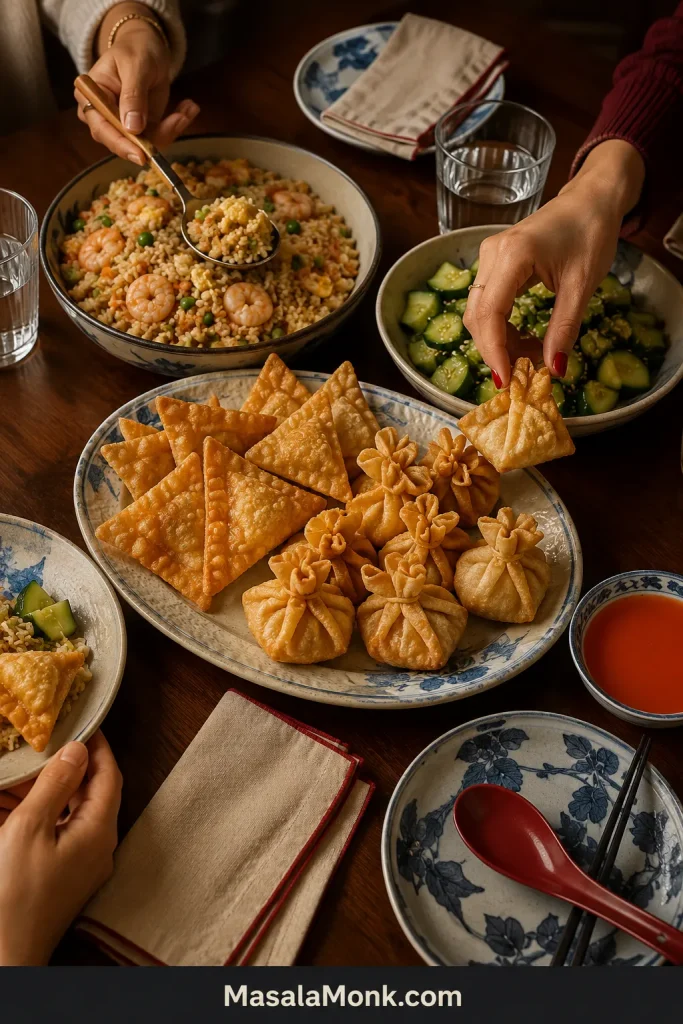
  • Takeout-style dinner: shrimp fried rice with a cool cucumber salad
  • Noodle dinner: lo mein or chow mein with stir-fried vegetables
  • Lighter spread: hot-and-sour soup with lettuce cups or smashed cucumber salad

The cucumber salad is especially useful between rich bites: rice vinegar, sesame, garlic, and chili reset the palate before the next rangoon.

Shared dinner table with a central platter of crab rangoons, smooth red-orange sauce, shrimp fried rice, cucumber salad and several hands serving food.
Keep the crab rangoon platter away from steaming rice and dressed salad. Nearby moisture can soften wrappers before serving.

For another Chinese-American takeout classic, try MasalaMonk’s Egg Foo Young with brown gravy.

Frequently Asked Questions

Is crab rangoon made with real crab?

It can be made with real crab, canned crab, imitation crab, or a mixture. Imitation crab often gives the mild, lightly sweet flavor associated with takeout crab rangoon.

Is crab rangoon supposed to be sweet?

Some takeout and buffet versions are gently sweet, while others are savory. The filling guide includes exact sugar ranges for sweet, balanced, and crab-forward versions.

Can crab rangoon be made gluten-free?

It requires dedicated gluten-free wrappers and individually checked sauces, imitation crab, and seasonings. Standard wonton wrappers contain wheat, and packaged ingredients vary by brand.

Why does crab rangoon keep opening?

Too much filling, trapped air, or filling on the sealing edge are the usual causes. See the troubleshooting section for the correction that matches what happened.

What is the red sauce served with crab rangoon?

It is usually a sweet-and-sour sauce, although some restaurants serve duck sauce, plum sauce, or sweet chili sauce. The dipping-sauce guide can help identify the version you remember.

The last two pieces rarely stay on the platter for long.

Almost-empty platter holding one triangle crab rangoon and one purse-shaped rangoon beside crumbs and sauce streaks, with a hand reaching for a final piece.
By the time the last batch arrives, the first platter may already be down to crumbs and sauce streaks.

The Rule to Remember

Thick filling, modest portions, clean seams.

Drain the crab, chill the filling until it holds a mound, and push out trapped air before sealing. Those three decisions do more for the finished rangoon than an elaborate fold or a longer ingredient list.

After the short rest, the shell should crack cleanly around a warm, creamy center—and the person who said they only wanted one may already be reaching for another.

Which version are you making: sweet and creamy, balanced, or packed with real crab?

Back to the top · Back to the recipe