
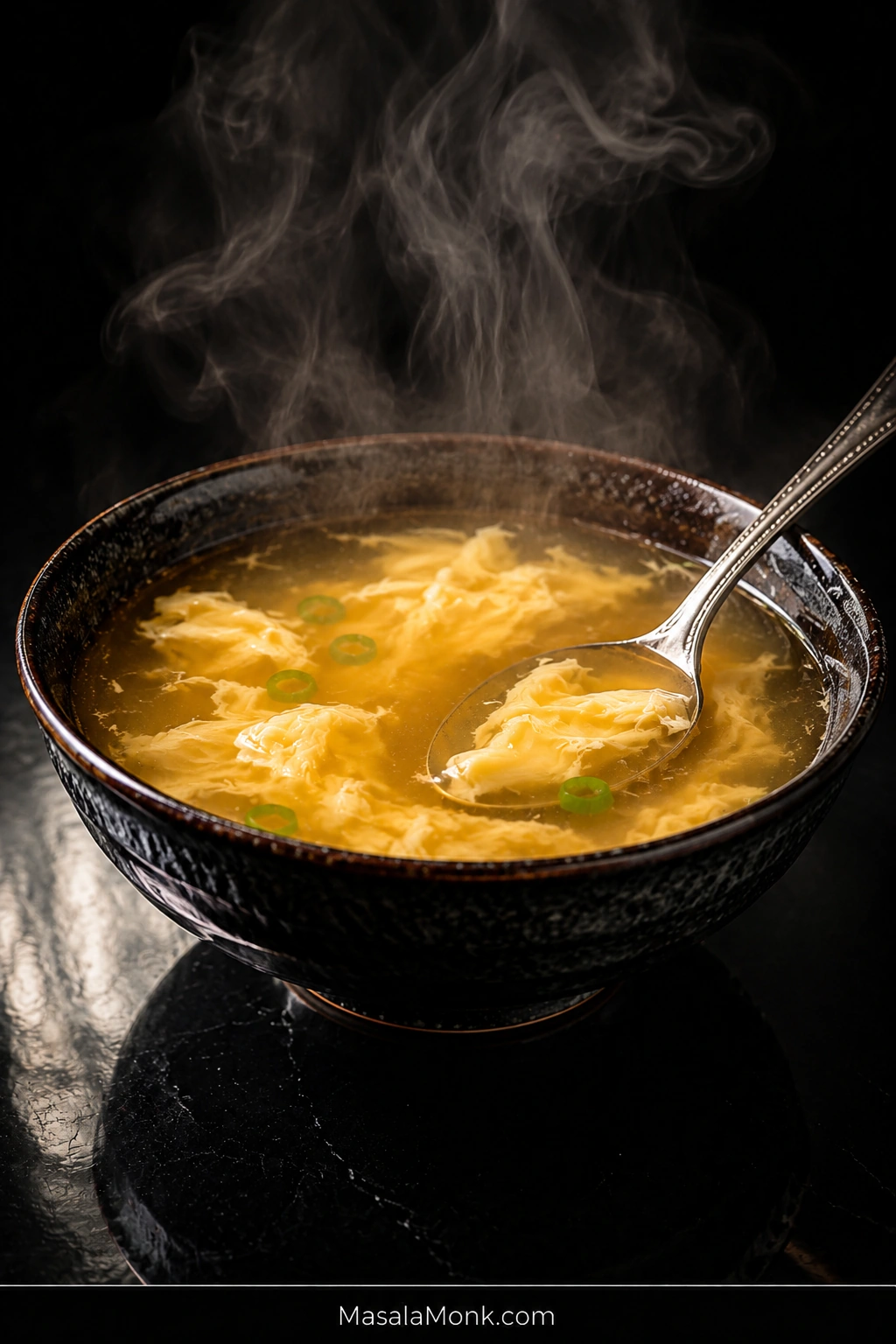
Sometimes egg drop soup is the first thing you want from a Chinese takeout order: a steaming bowl, soft ribbons drifting through savory broth, a few scallion greens on top, and just enough body to make every spoonful feel silky.
The base is simple. The egg pour is the only part worth slowing down for.
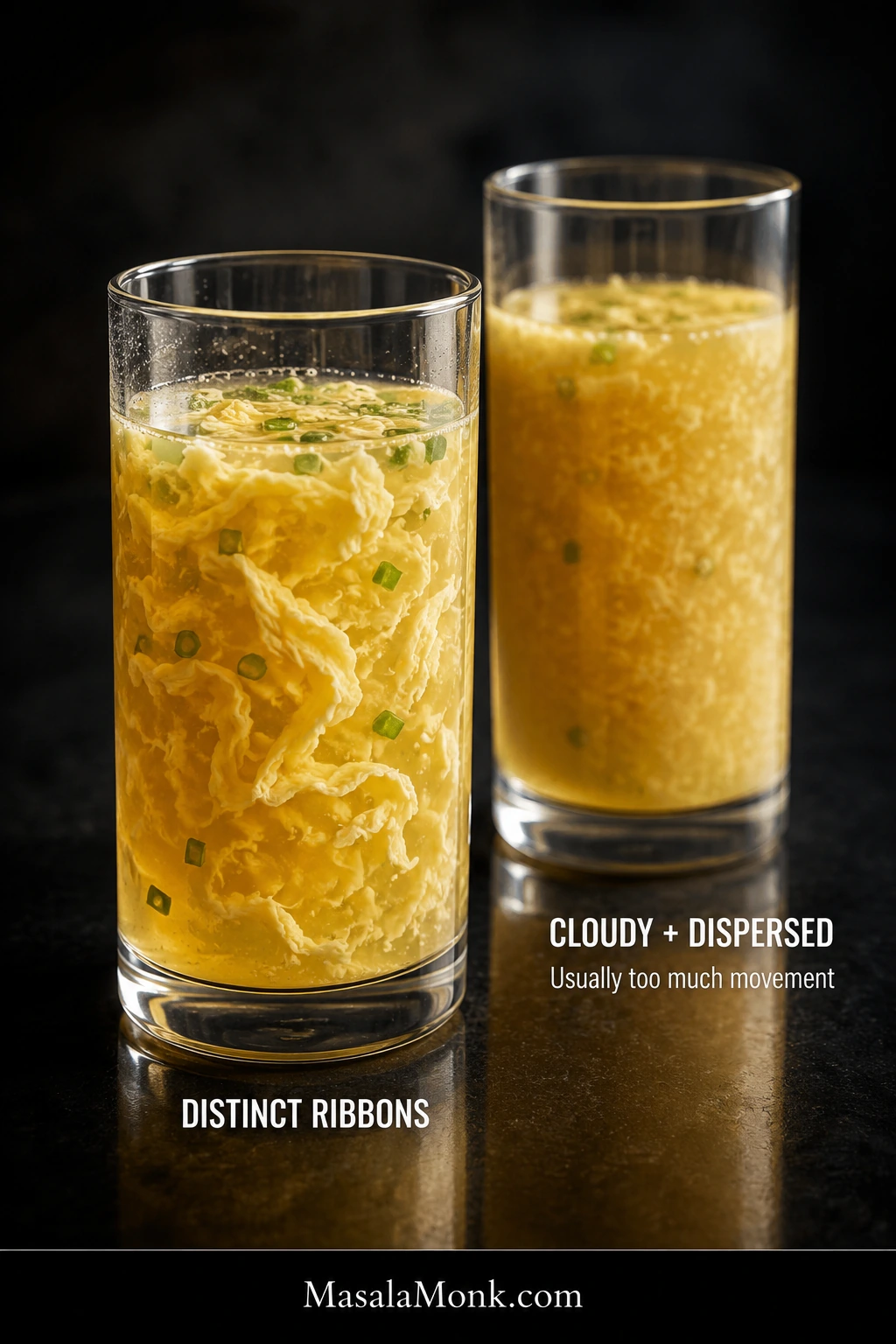
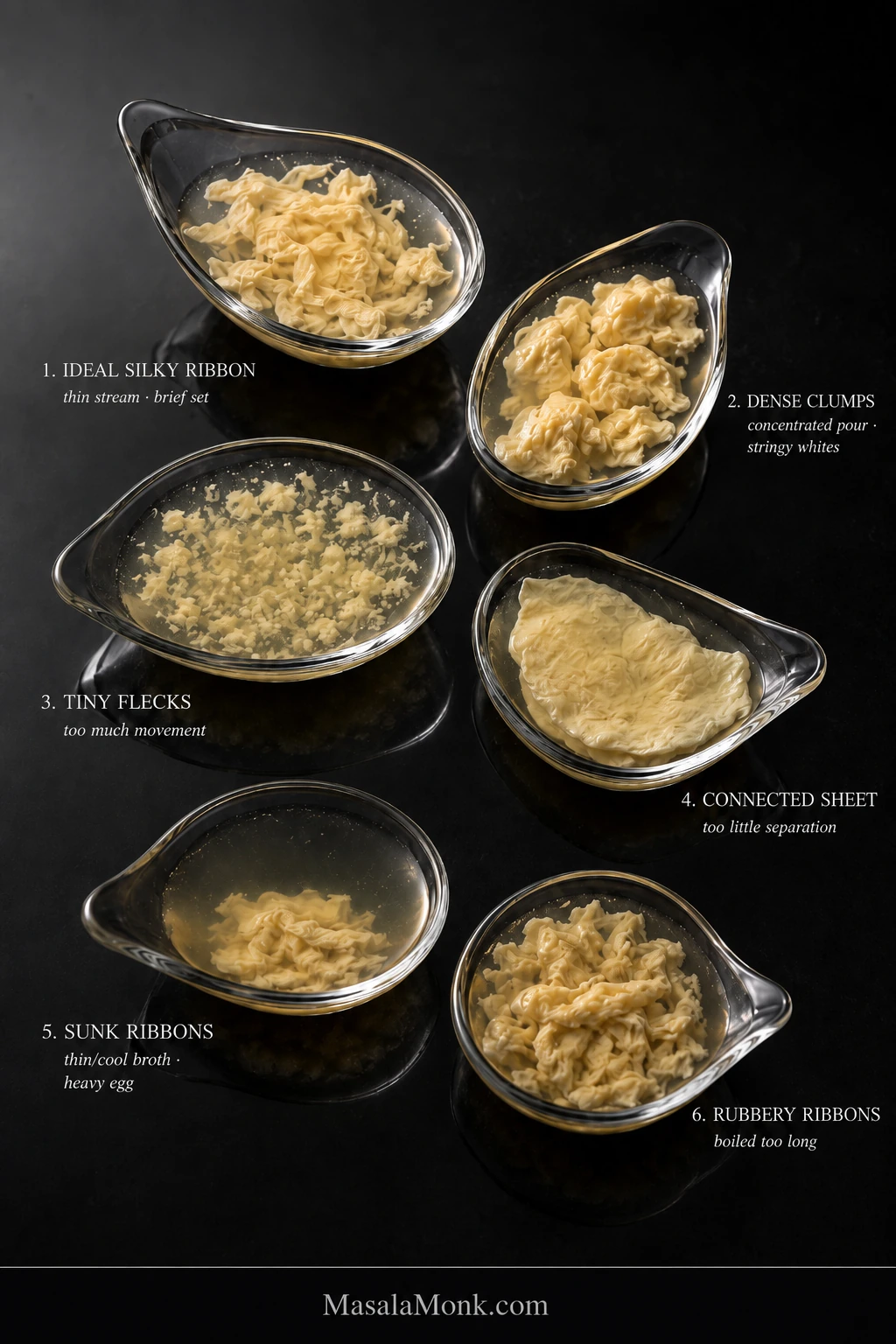
Too much movement can break the egg into tiny flecks. A heavy pour can leave dense clumps. Stir before the egg has set and the ribbons may disappear into cloudy broth.
Thicken first. Create the movement first. Let the egg set before you move it again.
Quick formula: For the base recipe, use 4 cups / 946 ml chicken broth, 2 large eggs, 2 teaspoons / 10 ml water for the eggs, and 1½ tablespoons / about 12 g cornstarch.
In this guide
- Egg Drop Soup Recipe
- Egg Drop Soup Ingredients: What Matters Most
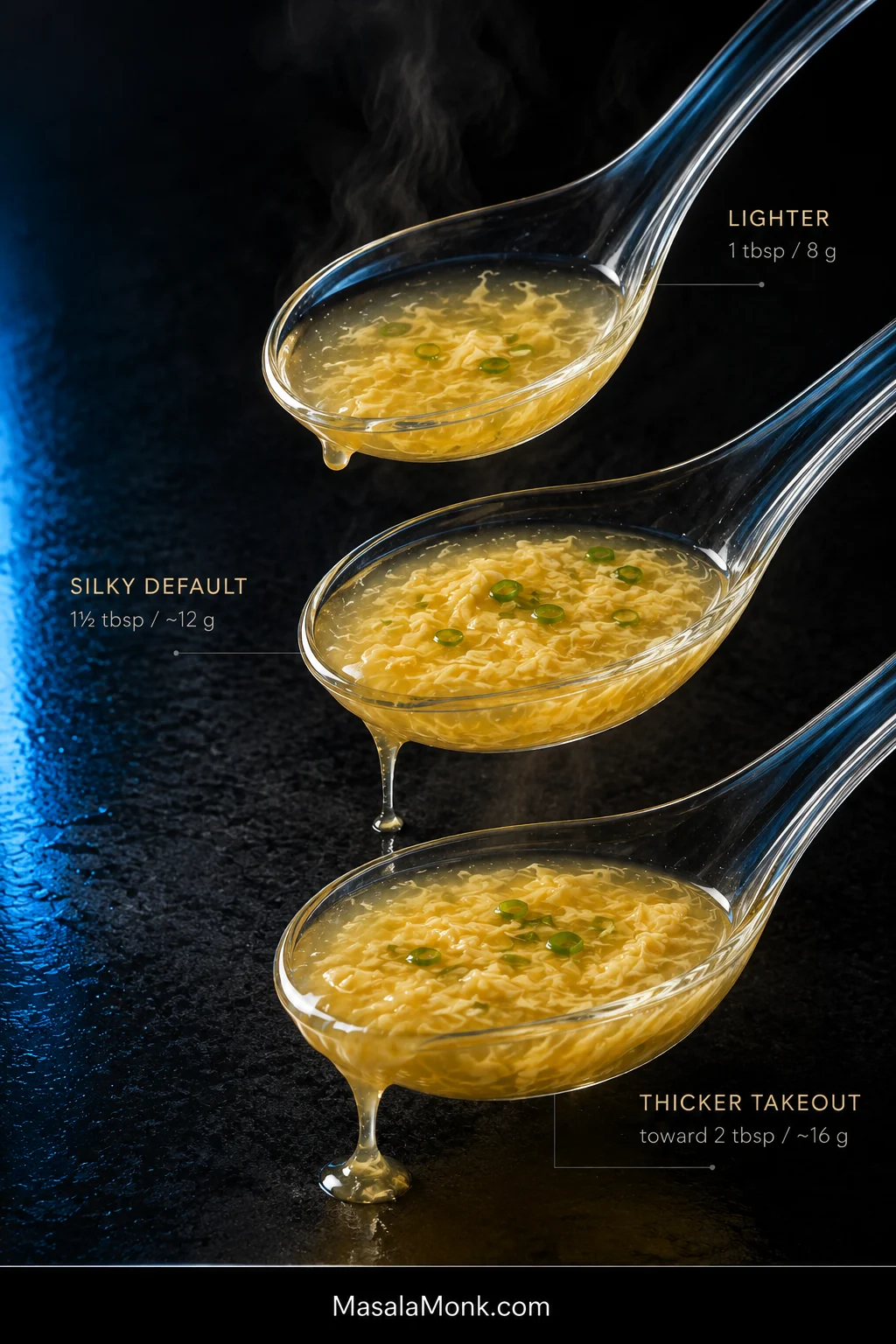
- Choose Your Texture
- How to Get Silky Egg Ribbons
- Why Homemade Egg Drop Soup Doesn’t Taste Like the Restaurant
- Why Is Restaurant Egg Drop Soup Yellow?
- Troubleshooting
- How to Scale Egg Drop Soup
- Variations and Substitutions
- Egg Flower Soup vs. Egg Drop Soup
- What to Serve With Egg Drop Soup
- Make Ahead, Store & Reheat
Egg Drop Soup Recipe
This makes 4 starter bowls or 2 generous bowls. The finished soup is broth-forward and lightly thickened, with soft egg ribbons suspended throughout.
Recipe at a Glance
| Serves | 4 starter bowls or 2 generous bowls |
|---|---|
| Prep | About 5 minutes |
| Cook | About 10 minutes |
| Total | About 15 minutes |
| Pot | Medium saucepan, about 2½–3 qt |
Equipment
- Medium saucepan, about 2½–3 quarts
- Small bowl for the cornstarch slurry
- Spouted measuring cup or another easy-pouring cup for the eggs
- Fork or small whisk
- Ladle or large spoon
Ingredients
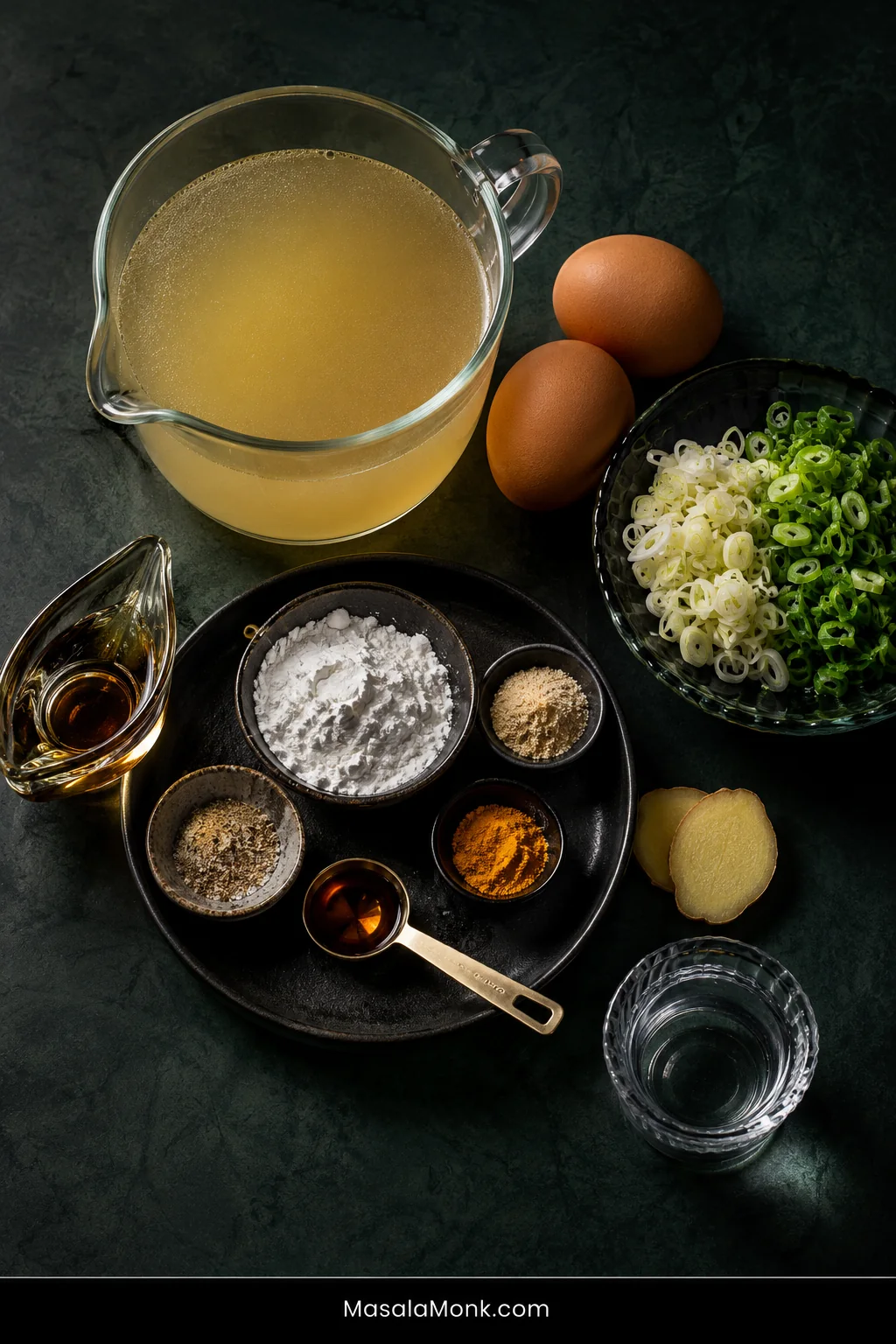
- 4 cups / 32 fl oz / 946 ml low-sodium chicken broth
- 2 scallions, thinly sliced, white and green parts separated
- 2 thin slices fresh ginger, about 5 g
- ½–1 teaspoon chicken powder or bouillon, optional, depending on your broth
- ¼ teaspoon ground white pepper, plus more to taste
- ⅛ teaspoon turmeric, optional, for warmer color
- 1½ tablespoons cornstarch, about 12 g
- 1½ tablespoons / 22 ml cold water, for the slurry
- 2 large eggs, about 100 g without shells
- 2 teaspoons / 10 ml water, for loosening the eggs
- ½ teaspoon / 2.5 ml toasted sesame oil, optional, plus more by drops to taste
- Salt, as needed after tasting
1. Season the Broth
Add the chicken broth, scallion whites, ginger, white pepper, and optional turmeric to a medium saucepan.
Bring to a boil, lower the heat, and simmer for 2–3 minutes. Remove the ginger slices after they have flavored the broth.
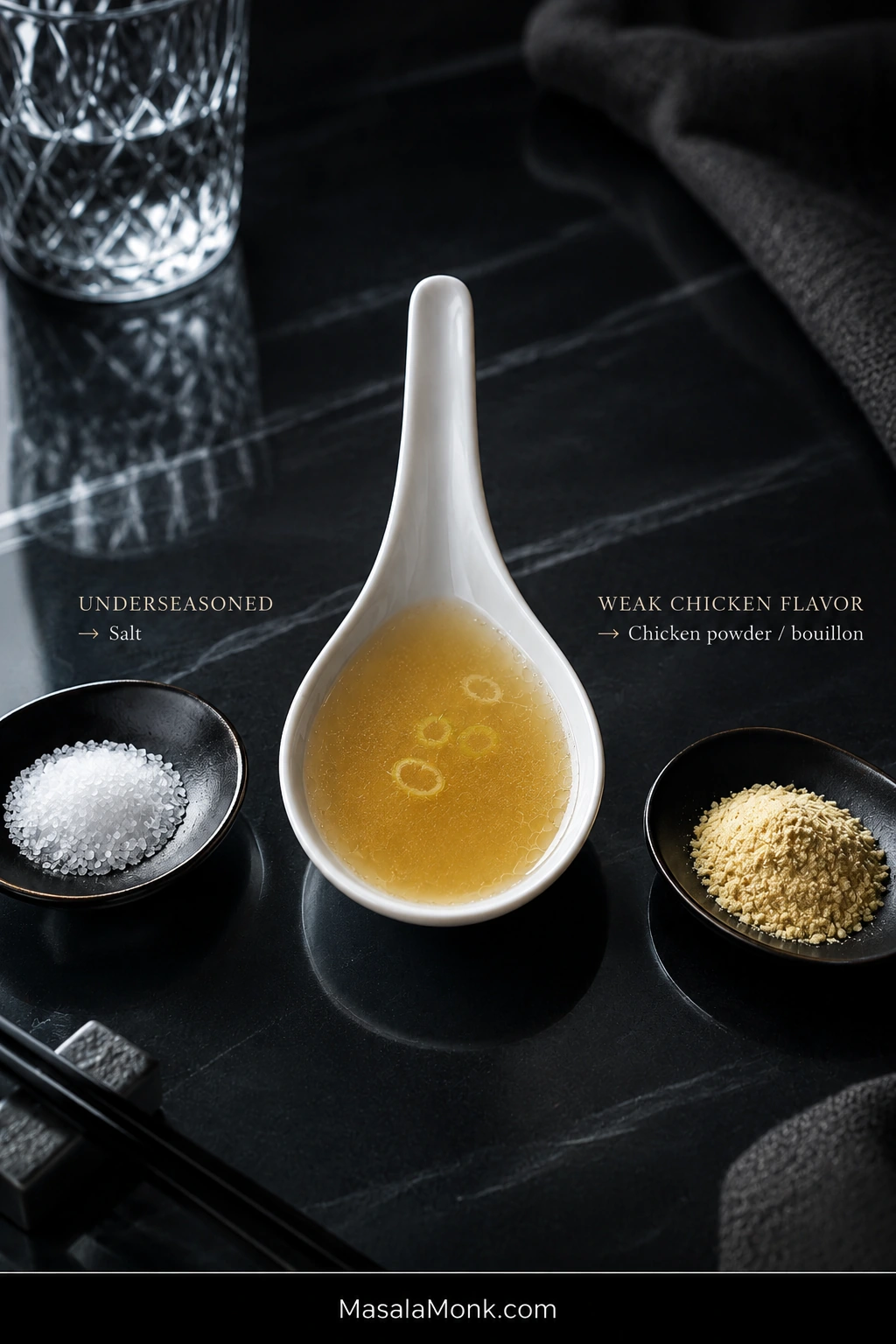
Now taste. If the chicken flavor is good but the broth simply tastes underseasoned, add salt. If the chicken flavor itself feels weak or hollow, add ½ teaspoon chicken powder or bouillon, let it dissolve, and taste again before using more.
Get the broth tasting good here. Cornstarch will change its texture and egg will add richness, but neither one can supply the savory foundation the broth is missing.
2. Thicken the Broth
Mix the cornstarch with 1½ tablespoons / 22 ml cold water until smooth.
Stir the slurry again immediately before using it; cornstarch settles quickly. Pour it gradually into the simmering broth while stirring.
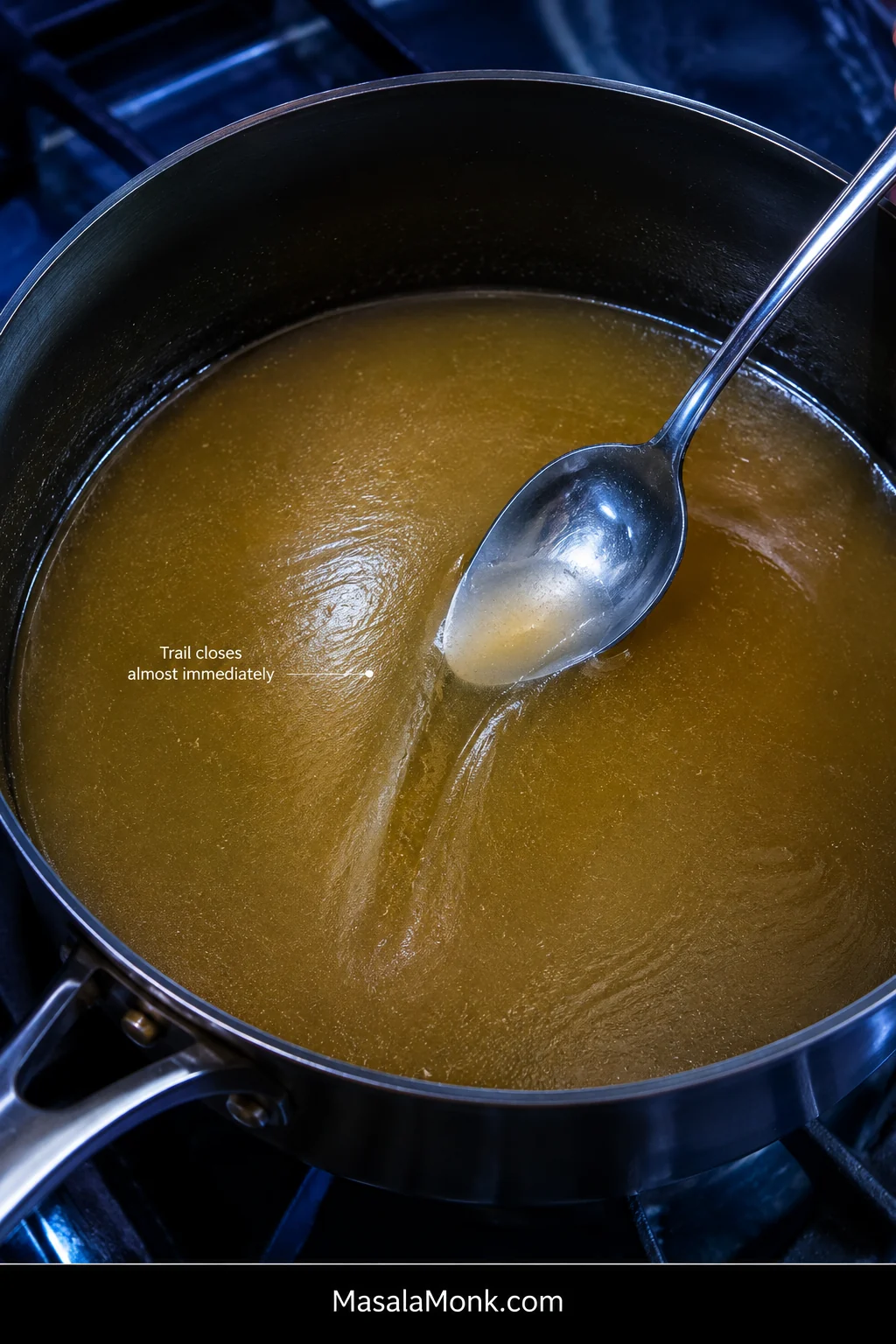
Cook for about 45–60 seconds, then drag a spoon through the pot. The broth should have a slight sheen, and the path behind the spoon should close almost immediately. A lingering trench means the soup is becoming too thick. If it looks almost unchanged from plain stock, give the starch another few seconds at a simmer.
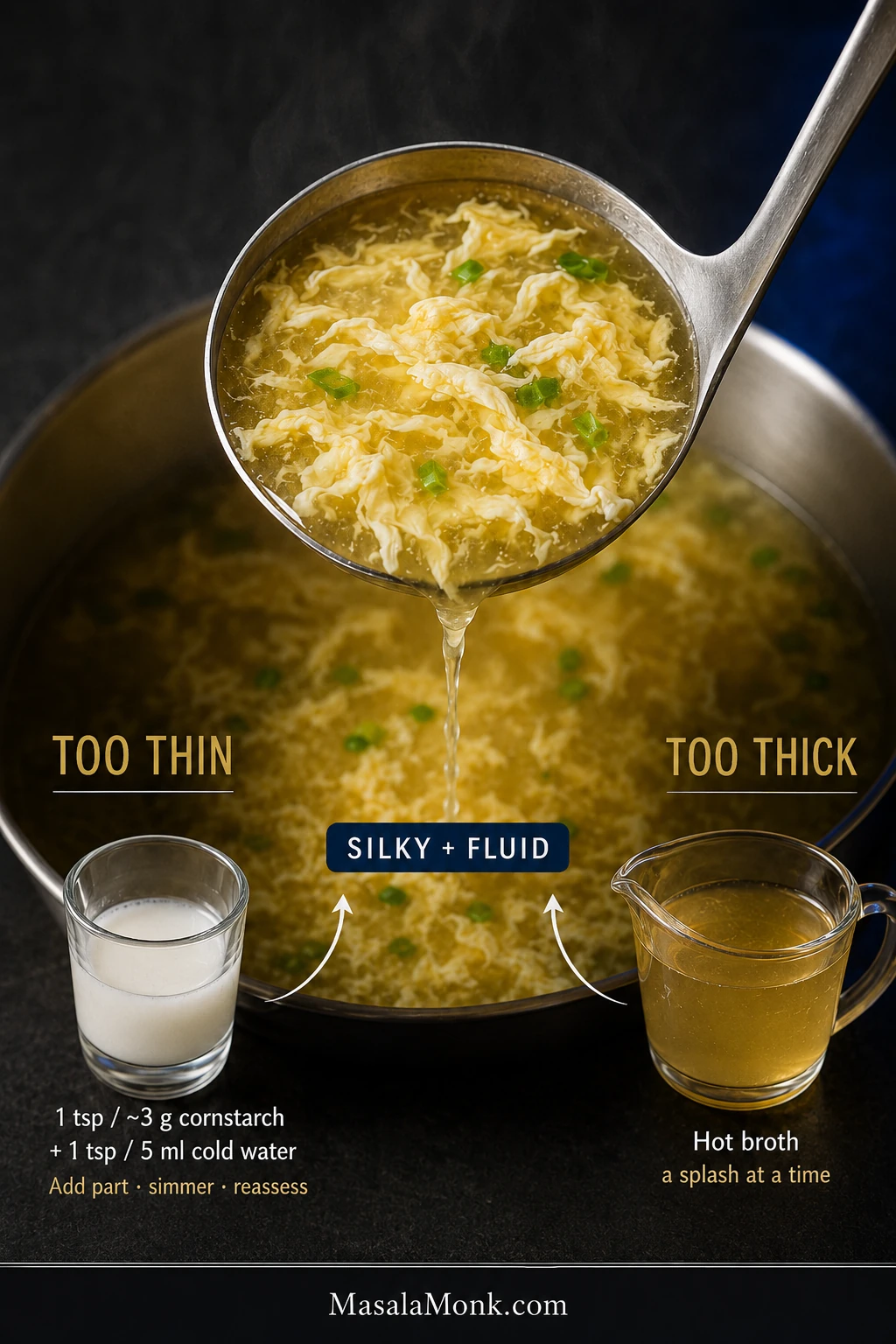
The texture should remain fluid enough to move easily around the saucepan, with just enough body to feel silky on the spoon.
3. Prepare the Eggs
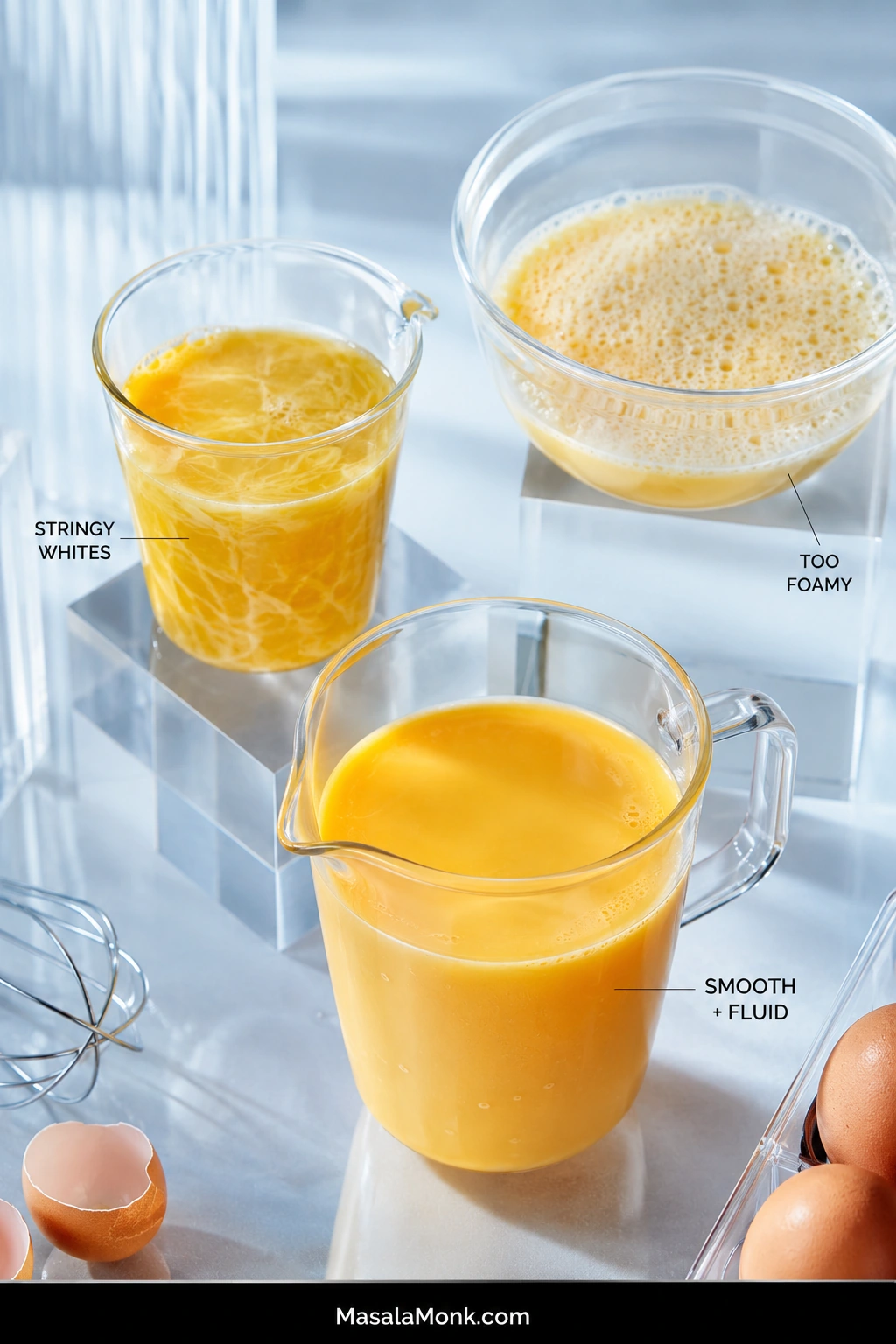
Beat the eggs with 2 teaspoons / 10 ml water until the yolks and whites are evenly combined and no clear, stringy ropes of egg white remain.
The added water makes the eggs easier to pour in a narrow stream. Stop once the mixture is smooth and fluid; foam does not help the ribbons.
4. Make the Egg Ribbons
For this simmer-based method, keep a few quiet bubbles breaking the surface.
Give the broth one broad circular stir to create a slow current, then put the spoon down.
Pour the egg in a thin, steady stream around the pot, allowing the moving broth to carry it instead of repeatedly pouring into one spot.
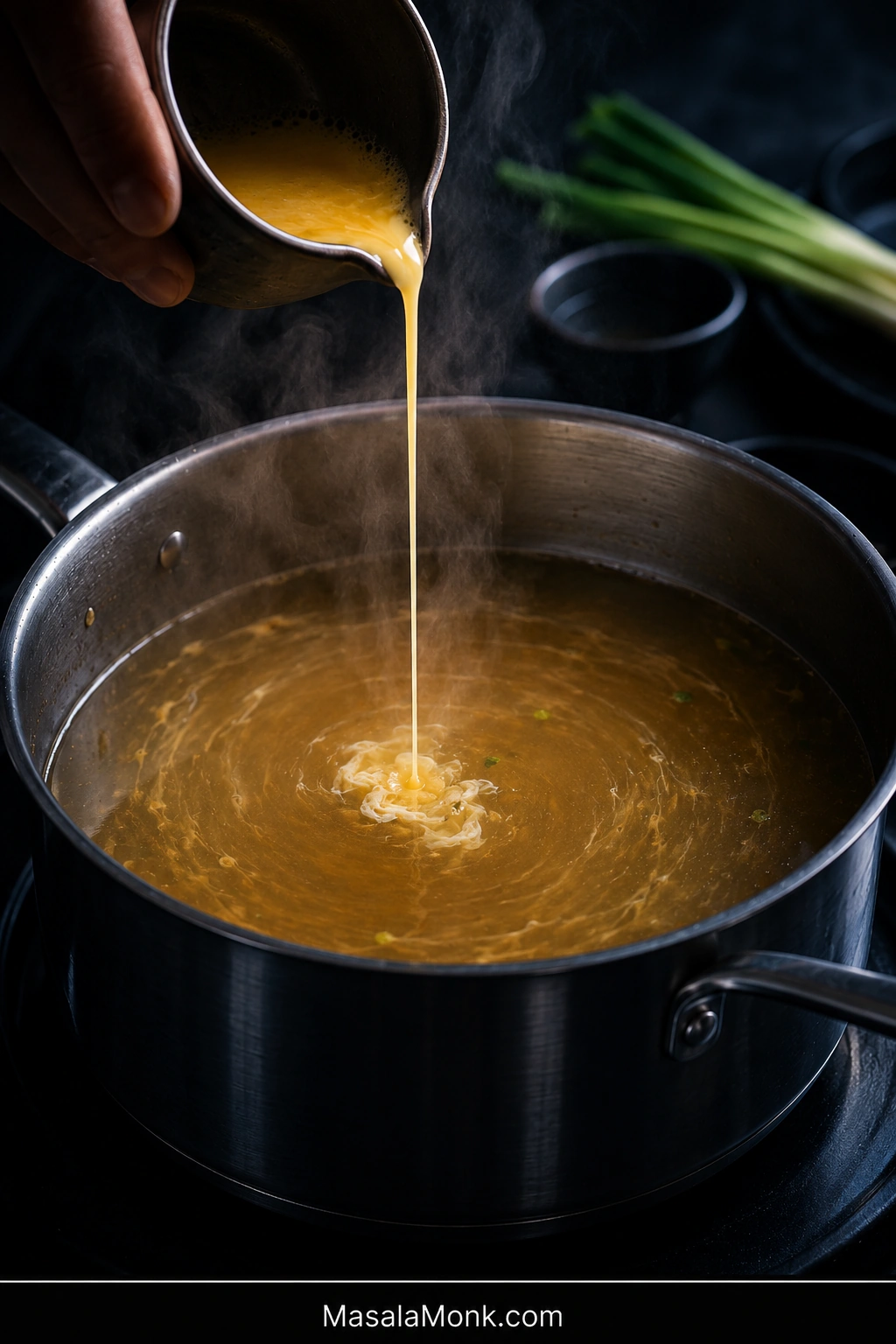
Leave the soup untouched for about 10–15 seconds, or until the egg is opaque and distinct ribbons are visible. Use one or two easy strokes to separate pieces that have joined together.
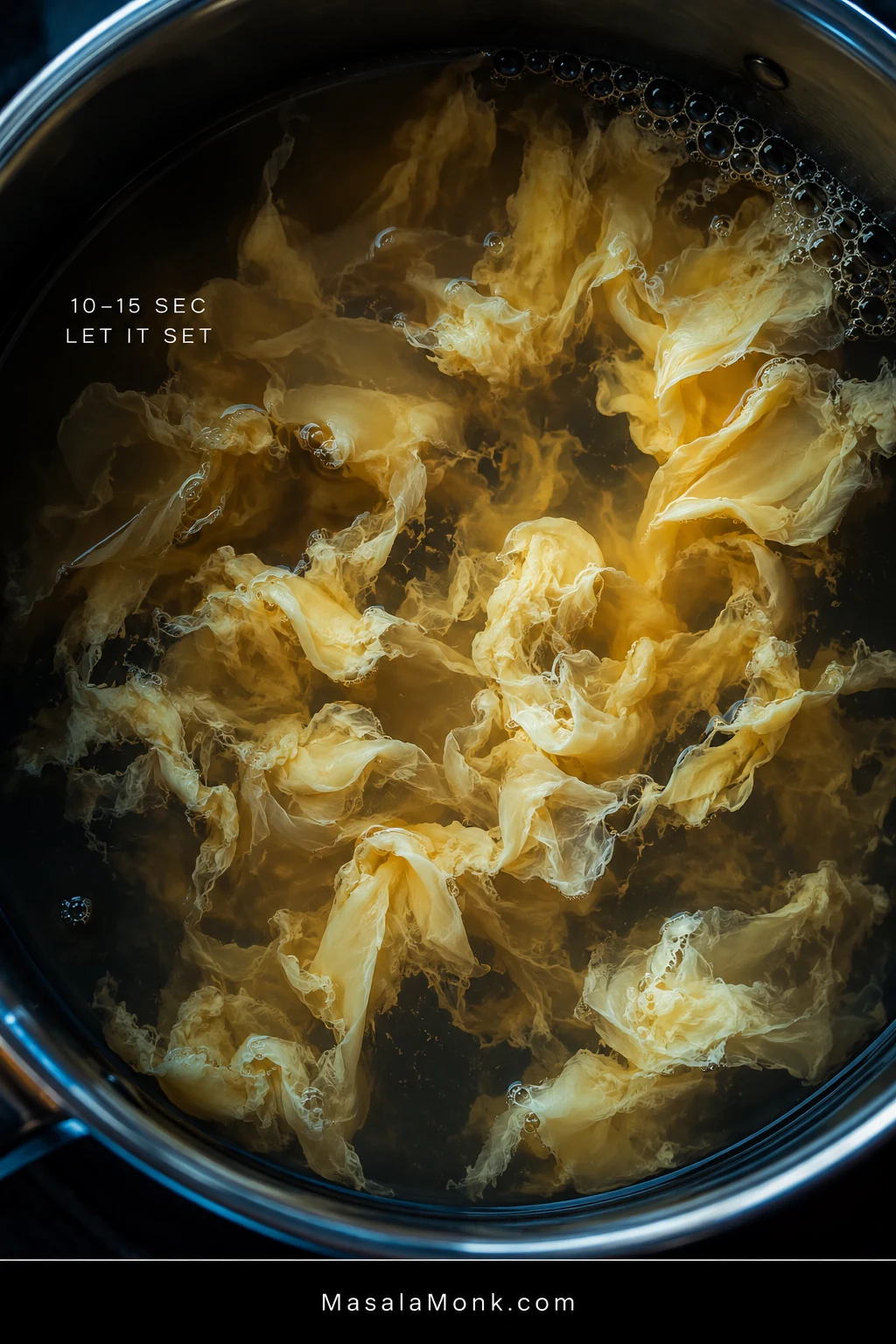
Once those ribbons are visible, the tricky part is over.
A spouted cup gives you the most control. With a wider cup, hold a fork across the lip and let the beaten egg pass through the tines in a narrower stream.
5. Finish and Serve
Turn off the heat. Add the scallion greens and, if you like it, ½ teaspoon toasted sesame oil.
Taste once more. Add salt only when needed. Increase the sesame oil by drops so its toasted fragrance stays in the background.
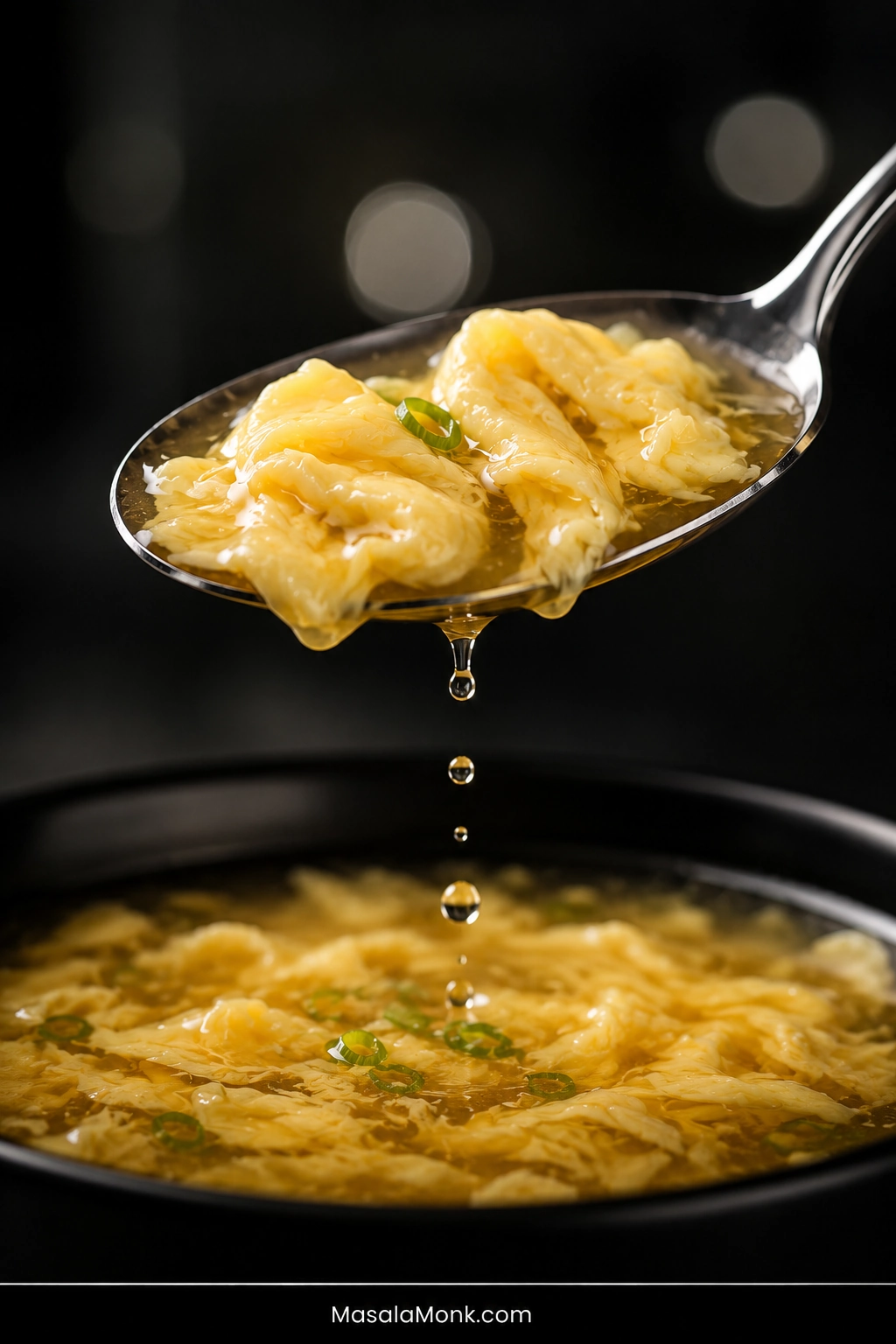
Serve while the soup is steaming and the ribbons are soft.
Before You Sit Down: Check the Soup
- The broth pours easily from the ladle.
- The egg floats through it as ribbons or soft flowers instead of one heavy mass.
- White pepper gives the sip a quiet warmth.
The ribbons do not need to look identical. When the soup tastes good and looks inviting, stop adjusting it and eat it hot.
Egg Drop Soup Ingredients: What Matters Most
Start with a clean-tasting chicken broth rather than one dominated by heavy roasting, tomatoes, or strong herbs. A mild broth is fine because you can correct its salt and savory strength before making the ribbons.
Cornstarch gives many restaurant-style versions their lightly glossy body and helps keep the egg suspended. The amount determines how broth-like or thick the finished soup feels.
White pepper supplies the familiar earthy warmth. Chicken powder or bouillon strengthens weak chicken flavor, while sesame oil is an optional finishing aroma and is best added cautiously.
Turmeric only adjusts color here. It is not needed for the flavor or for successful egg ribbons.
Choose Your Texture
One restaurant may serve egg drop soup almost broth-like while another makes it thick enough to cling to the spoon. Ribbon size varies too.
| You want… | Try this |
|---|---|
| A lighter broth | Start with about 1 tbsp / 8 g cornstarch |
| The silky default | Use 1½ tbsp / about 12 g |
| A thicker takeout texture | Increase gradually toward 2 tbsp / about 16 g |
| More egg | Use 3 large eggs |
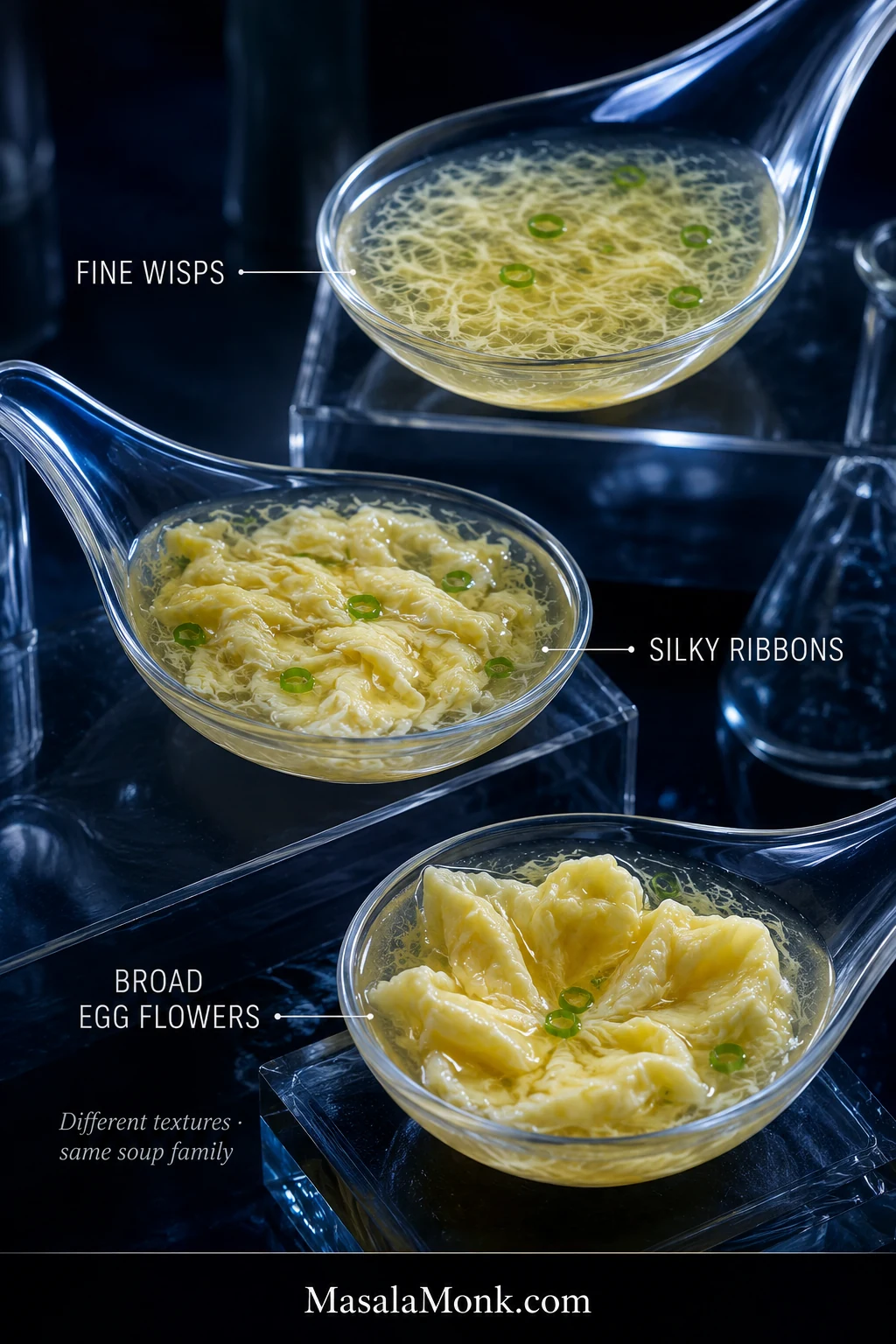
| Fine wisps | Use a finer stream with more movement in the broth |
| Broad soft flowers | Give the egg more stillness once it enters |
These are starting points, not pass-or-fail rules. The difference between wisps, ribbons, and broad flowers is mostly texture and appearance.
Soup already too thin or thick? Jump to the texture fixes.
How to Get Silky Egg Ribbons
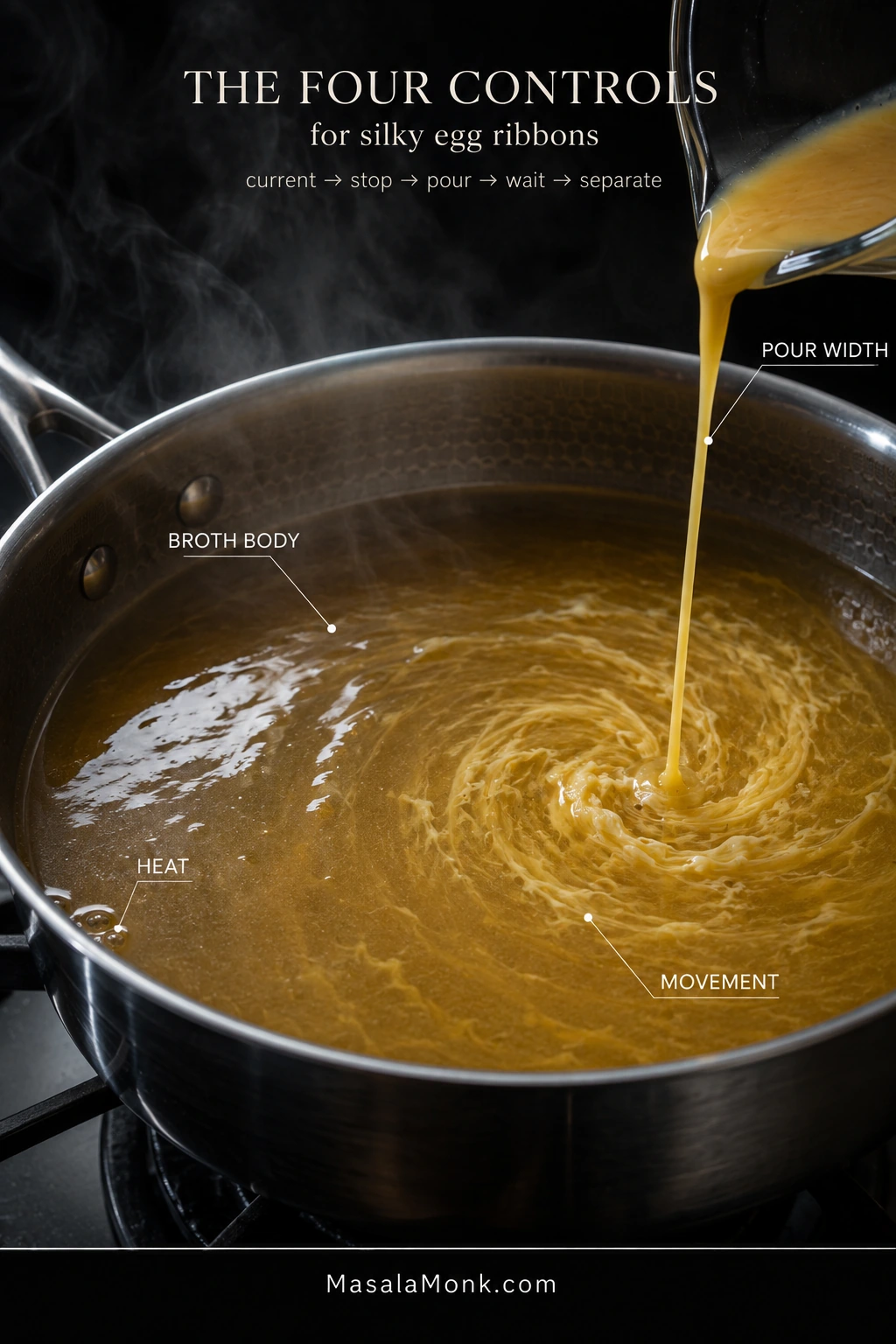
The shape of the egg comes down to four controls: broth body, heat, pour width, and movement.
A little starch slows the egg enough to help it remain suspended instead of immediately sinking through thin broth. Too much starch goes the other way and makes the soup heavy. Heat matters too: vigorous boiling can break delicate egg apart, while broth that has cooled too far may not set the stream cleanly with this simmer-based method.
Pour width changes the size of the pieces that enter the soup. A narrow stream produces finer ribbons; a heavier stream naturally forms broader ones. Movement determines how much those setting pieces are broken apart.
After you create a slow current, the broth can do most of the work. Continued stirring during the pour breaks the setting egg into smaller pieces before the ribbons have time to hold together.
Create the current → stop stirring → pour → wait → gently separate.
That same pause-before-stirring principle is useful in Hot and Sour Soup, where the egg shares the broth with tofu, mushrooms, and stronger seasonings.
Got clumps, flecks, or cloudy broth instead? Jump to troubleshooting.
Why Homemade Egg Drop Soup Doesn’t Taste Like the Restaurant
The frustrating batch is the one that looks right but tastes nothing like the soup you had in mind.
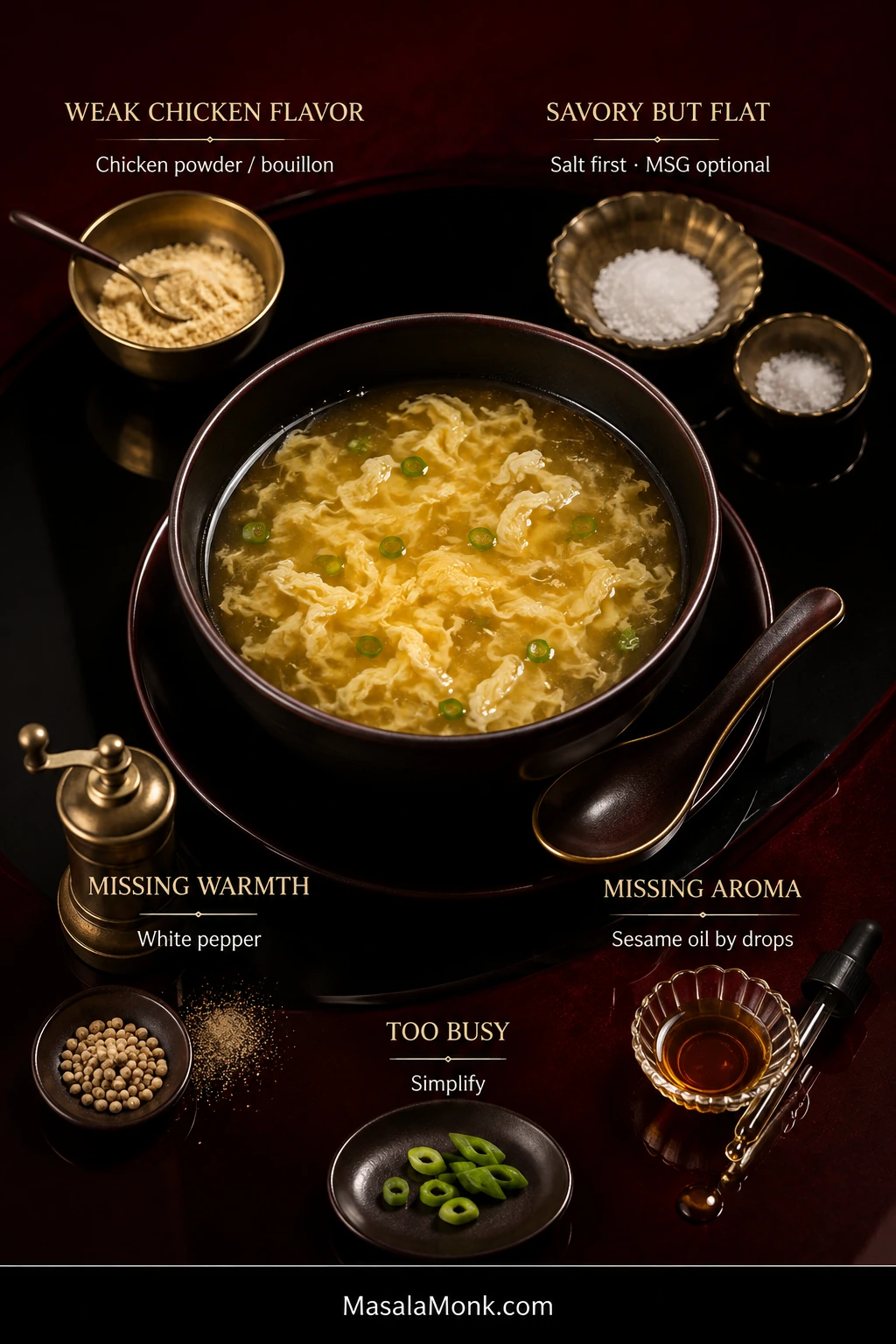
The difference is usually broth strength, salt and savory depth, white pepper, or how heavily sesame and soy are used. Start with what you can actually taste instead of adding every seasoning at once.
Weak chicken flavor: add some chicken powder or bouillon. Mild carton broth benefits more from this than a rich homemade stock.
Savory but flat: check the salt first. When the salt tastes right, add a very small pinch of MSG, stir, taste, and add more only if the broth needs it. Many chicken powders already contain MSG, so read the label before adding more. The FDA’s overview of MSG has more background on the ingredient and its use in food.
Missing warmth: add another touch of white pepper. Its heat tends to arrive toward the back of the sip without dominating the first taste.
Missing aroma: try a few drops of toasted sesame oil and stop when the fragrance becomes noticeable.
Tastes too busy: simplify. Skip the soy sauce, reduce or omit sesame oil, and let chicken broth, white pepper, ginger, and scallion carry the soup. Some takeout versions are much more restrained than heavily seasoned homemade recipes.
Do You Need Soy Sauce?
No. Soy sauce is perfectly usable, but it changes both the color and flavor of the broth.
For a pale, clean-tasting soup, build the chicken flavor first. Add soy when you specifically want its savory fermented character.
Why Is Restaurant Egg Drop Soup Yellow?
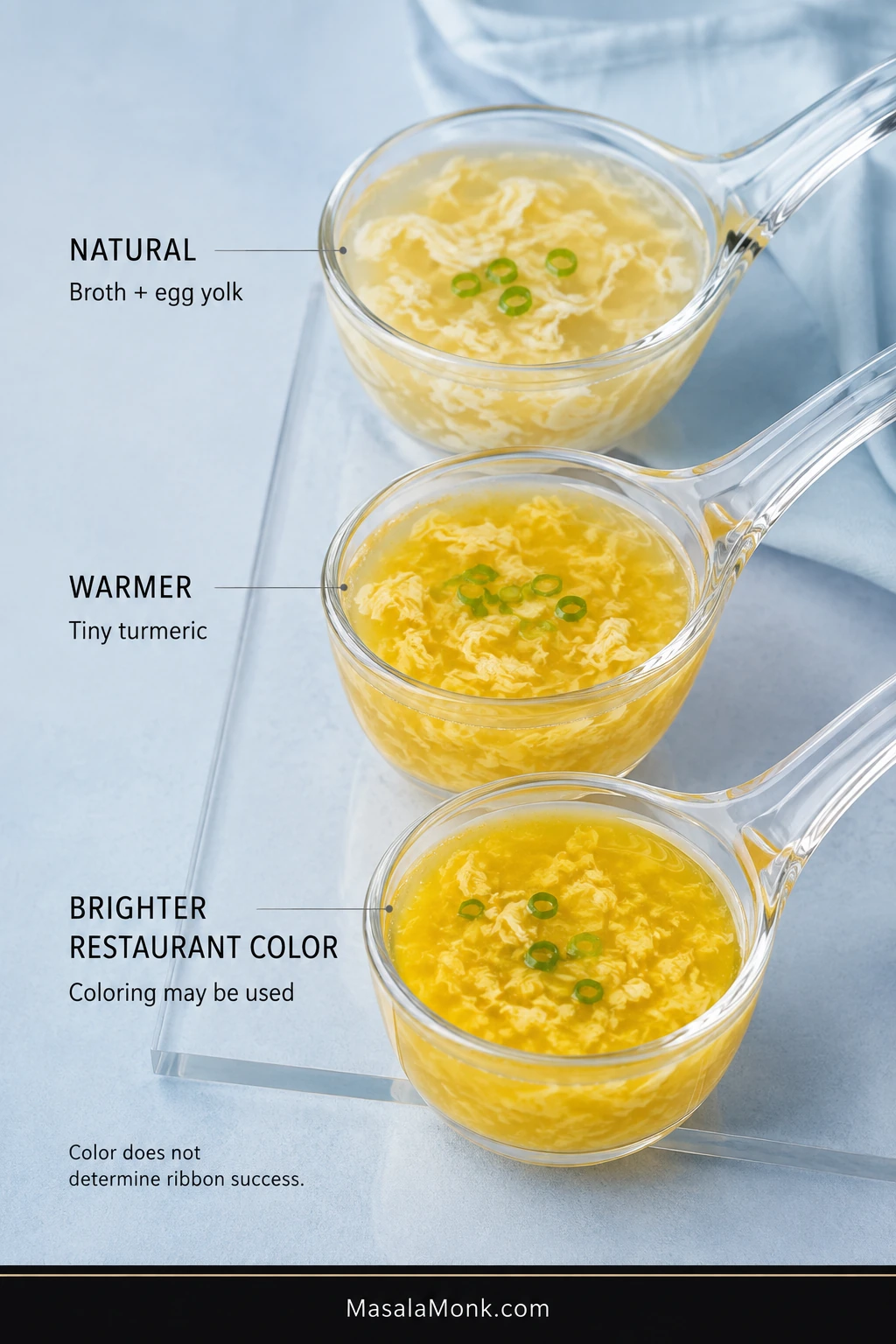
Egg drop soup can be naturally pale yellow; brighter restaurant-yellow versions may use turmeric or food coloring. Color has nothing to do with whether the ribbons formed correctly.
Chicken broth and egg yolks on their own can range from cream-gold to soft yellow.
For a warmer shade, the base recipe needs only ⅛ teaspoon turmeric. More can begin changing the flavor instead of simply warming the color.
Some Chinese-American restaurants use food coloring for a brighter takeout look. It is entirely cosmetic.
Pale soup is not failed soup.
Troubleshooting
Broth problems are easier to rescue than cooked egg. You can thicken a watery soup, loosen an over-thickened one, and strengthen a bland broth. After the egg has cooked into a particular shape, the useful question is what caused it and what can be done with the bowl you already have.
My Egg Disappeared and the Broth Turned Cloudy
The egg dispersed before distinct ribbons had time to set. Continuous stirring is the usual culprit; broth that has cooled too far can also make clean setting harder with this method.
Give the poured egg more stillness while it sets. The broth may stay cloudy, but that does not stop it from tasting good.
I Got Scrambled-Looking Clumps
Large dense pieces usually mean too much egg reached one area at once, or thick ropes of white were still present in the beaten eggs.
A narrower pour and fully blended eggs prevent most of this. Separate the clumps lightly in the soup you already have and carry on. The texture is different, but dinner is still dinner.
I Got Tiny Flecks
The egg was broken apart by too much movement while it was trying to set.
Use less agitation after the pour. The flecks will not turn back into broad ribbons, but the soup itself is perfectly usable.
I Got One Big Sheet of Egg
The egg set with too little separation and joined into one connected piece.
Break the sheet gently into ribbons. When newly poured egg turns opaque, one or two careful strokes are enough to separate it before the whole mass sets together.
My Soup Is Too Thin
Give the original slurry about a minute at a simmer before assuming you need more starch.
Still too light? Mix 1 teaspoon / about 3 g cornstarch + 1 teaspoon / 5 ml cold water. Add part of it, simmer briefly, and reassess before using the rest.
My Soup Is Too Thick
Add hot low-sodium chicken broth a splash at a time, moving the spoon carefully around the ribbons.
If it takes a substantial amount of broth to loosen the soup, use less cornstarch when you make it again.
Other Quick Fixes
- Ribbons sank: thin broth, heavy pieces of egg, too much egg, or broth that cooled too far can contribute. Keep the base egg ratio and make sure the broth is back at a quiet simmer before pouring.
- Rubbery egg: prolonged boiling after the ribbons have set is usually responsible. When the egg is opaque and set, finish the soup and get it off the heat.
- Cornstarch lumps: if you spot them before adding the egg, strain the broth and return it to the saucepan. After ribbons have formed, remove obvious lumps with a spoon instead of sending the finished soup through a strainer.
- Too much sesame oil: dilute the soup with more broth. Sesame is much easier to add than remove.
- Broth looks brown: dark stock or soy sauce is usually responsible. The color alone does not mean anything went wrong.
- Soup tastes of turmeric: dilute it when practical and use less in the next pot.
Ready to try again? Back to the recipe steps.
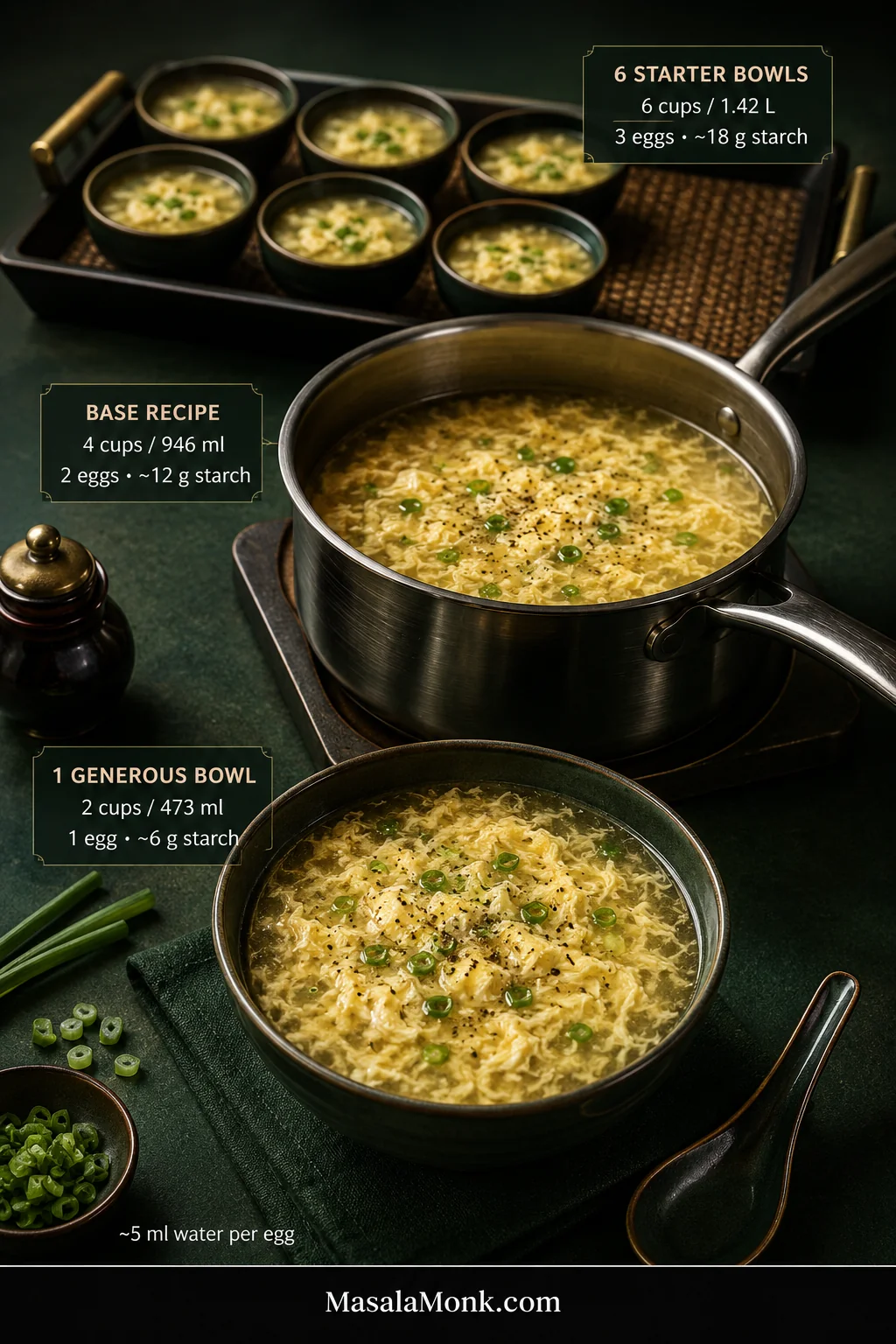
How to Scale Egg Drop Soup for One, Two or a Crowd
Egg drop soup is especially handy when you are cooking only for yourself. One egg and a couple of cups of broth are enough for a hot lunch or easy dinner without leaving a large pot behind.
| Need | Starting broth | Egg | Cornstarch |
|---|---|---|---|
| 1 generous bowl | 2 cups / 473 ml | 1 large / ~50 g | 2¼ tsp / ~6 g |
| Base recipe | 4 cups / 946 ml | 2 large / ~100 g | 1½ tbsp / ~12 g |
| 6 starter bowls | 6 cups / 1.42 L | 3 large / ~150 g | 2¼ tbsp / ~18 g |
Use about 1 teaspoon / 5 ml water per large egg to loosen the mixture.
Scale broth, eggs, and cornstarch by measurement. Salt, bouillon, and chicken powder are better adjusted by taste because brands vary so much.
Variations and Substitutions
Can I Make Egg Drop Soup Without Cornstarch?
Yes. Leave the cornstarch out and the egg will continue to form wisps or ribbons. The broth will simply be lighter and more delicate, without the glossy body common in many Chinese-American restaurant versions.
Other Easy Variations
- Potato starch: make a cold slurry and begin with less than the full cornstarch quantity. Add gradually until the broth reaches the same spoon-path cue used in the base recipe; different starches do not always thicken one-for-one.
- Vegetable broth: choose a clean, savory one. Dark roasted or tomato-heavy broth changes the character of the soup considerably.
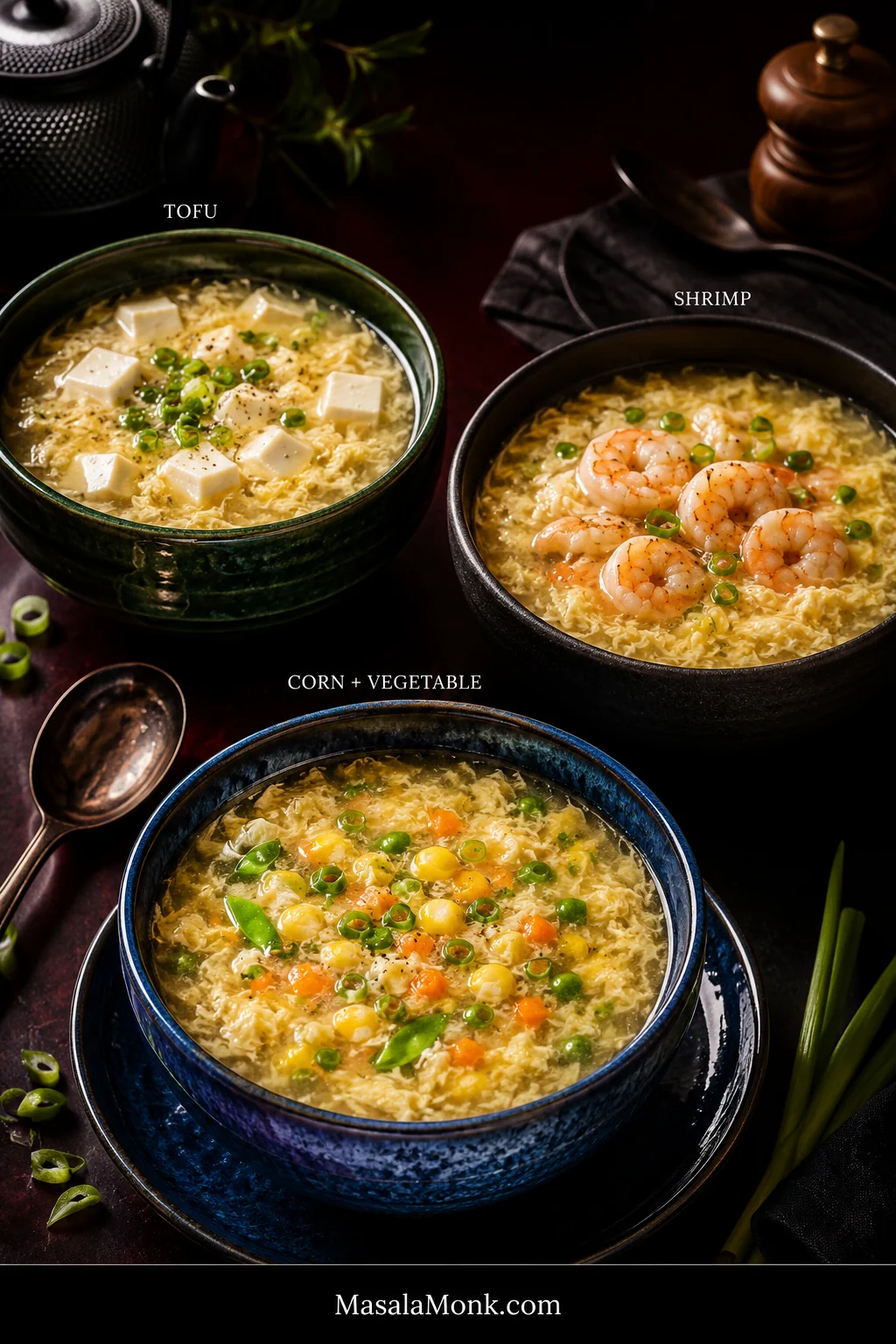
- Tofu: warm small cubes of soft or silken tofu in the seasoned broth before adding the slurry and egg. For a tofu-centered meal, serve the soup alongside Mapo Tofu and rice.
- Shrimp: poach peeled, deveined shrimp until barely cooked, lift them out, and continue with the slurry and egg. Return the shrimp at the end just long enough to heat through.
- Vegetables: peas, finely diced carrot, mushrooms, spinach, and other quick-cooking vegetables fit easily. Add firm vegetables earlier and delicate greens near the end.
- Corn: a handful adds sweetness and texture. With enough corn to become a main flavor, the soup takes on a noticeably sweeter, fuller character.
- Rice: spoon cooked rice into individual bowls so leftovers do not absorb most of the broth. Starting from dry rice? Our guide to cooking rice covers the basics.
Is Egg Flower Soup the Same as Egg Drop Soup?
Yes. Egg drop soup and egg flower soup generally refer to the same broad family of soups. “Egg flower” describes the soft, flower-like shapes created when beaten egg sets in hot broth.
The exact soup changes from kitchen to kitchen. Some versions are clear and delicate with fine wisps; others have broad flowers and noticeably more body.
Chinese home-style soups may include tomato, seaweed, tofu, corn, or vegetables. Many Chinese-American restaurant versions lean toward concentrated chicken flavor, some starch thickening, white pepper, and egg suspended through a pale or yellow broth.
Egg plays a completely different role in Egg Foo Young, another Chinese-American restaurant favorite where it becomes the body of the dish instead of delicate ribbons in broth.
Your favorite restaurant may serve its soup thinner, thicker, brighter, or more egg-heavy. The controls above make those differences easy to adjust.
What to Serve With Egg Drop Soup
As a starter, egg drop soup works especially well with something that brings more texture or substance to the table.
A small bowl before Chicken Fried Rice makes an easy takeout-style dinner: hot soup first, followed by separate grains, vegetables, egg, and chicken.
Crispy spring rolls add crunch; steamed dumplings, plain rice, Chinese-style noodles, stir-fried vegetables, and simple chicken or beef dishes all fit comfortably beside it.
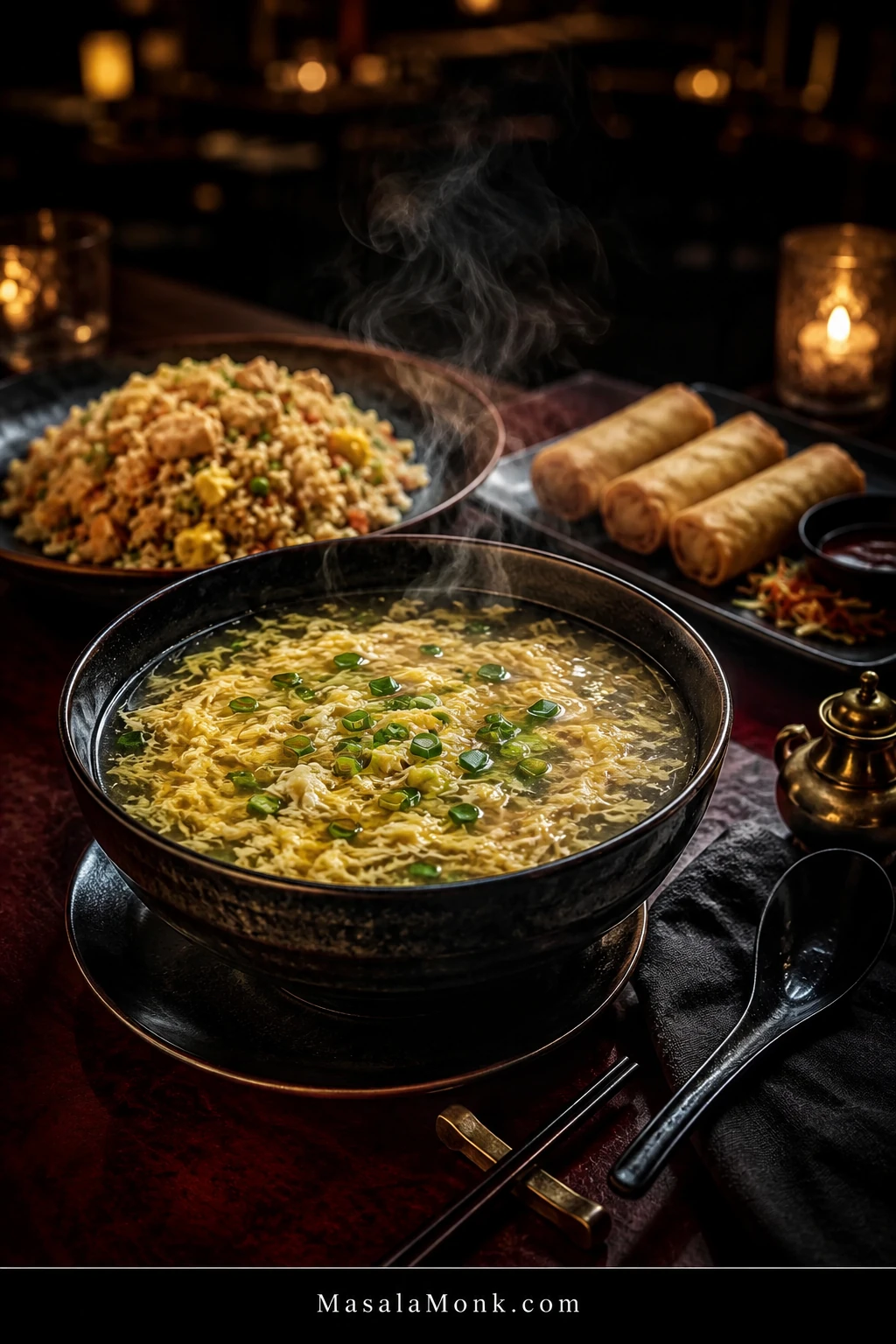
Two generous cups can also make a light lunch on their own, especially on a day when cooking anything elaborate sounds unnecessary.
Make Ahead, Store & Reheat
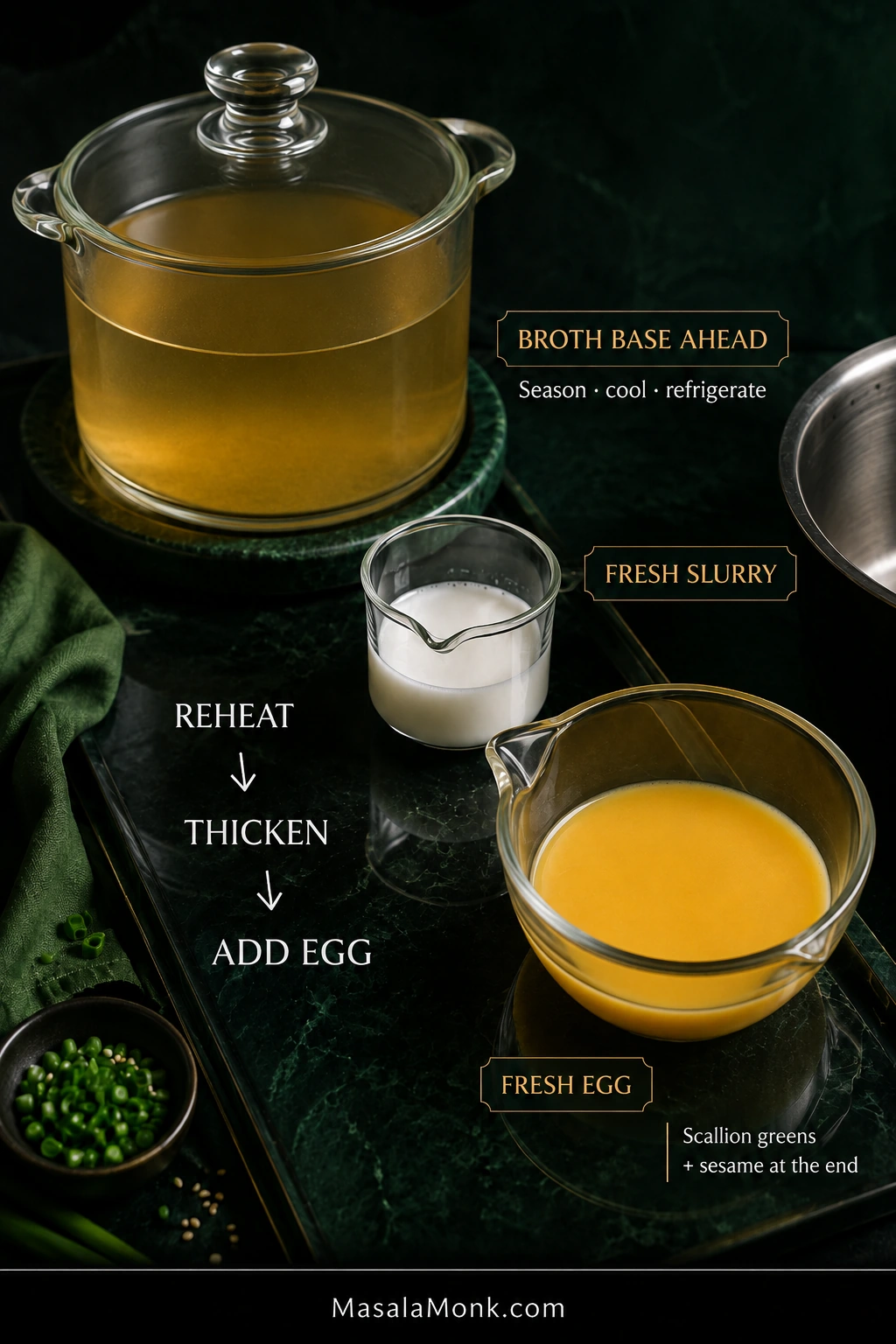
Egg drop soup is nicest when the ribbons have just been made, but the seasoned broth is easy to prepare ahead. That gives you most of the convenience while saving the egg for the last few minutes.
Best Make-Ahead Method
- Prepare the seasoned broth, remove the ginger slices, cool it, and refrigerate without cornstarch or egg.
- Bring the broth back to a simmer when you want the soup.
- Add a freshly mixed slurry.
- Add freshly beaten egg when the broth has the body you want.
- Finish with scallion greens and optional sesame oil.
A few minutes at the stove later, you have fresh ribbons without remaking the broth from the beginning.
Storing Leftovers
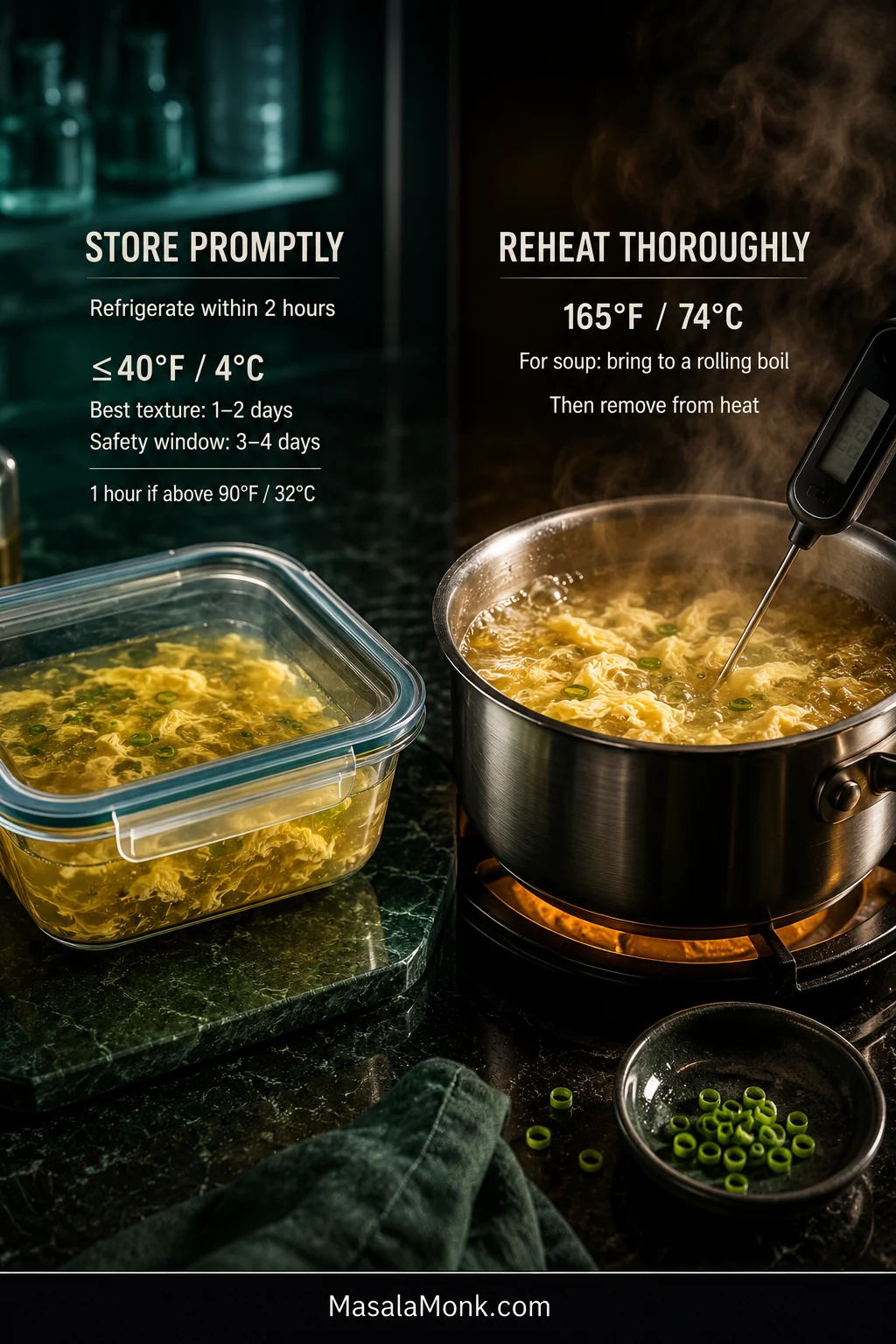
Refrigerate leftovers promptly in a covered, shallow container. For the nicest ribbon and broth texture, aim to eat the soup within 1–2 days. Properly refrigerated cooked leftovers generally have a broader 3–4 day food-safety window at 40°F / 4°C or below.
Get leftovers into the refrigerator within 2 hours of cooking, or within 1 hour when the surrounding temperature is above 90°F / 32°C. The USDA guide to leftovers and reheating has the broader food-safety guidance.
Reheating
Bring leftover soup to a rolling boil when reheating and make sure it reaches 165°F / 74°C. After the soup is thoroughly hot, take it off the heat so the cooked ribbons spend as little extra time boiling as possible.
In the microwave, heat in shorter intervals and stir between them so the soup warms evenly.
If chilled soup has lost some of its original body, mix 1 teaspoon / about 3 g cornstarch + 1 teaspoon / 5 ml cold water. Add only as much of that slurry as the reheated soup needs.
Can You Freeze It?
The seasoned broth base freezes better than the completed soup. Thaw and reheat the broth, then add fresh slurry and egg when you are ready to eat.
The best part of learning the egg pour is not making every ribbon look identical. It is knowing that a saucepan of broth and a couple of eggs can become that familiar steaming soup whenever you want it.
Some nights it is a starter before dinner. Some nights it is the whole point: something warm, savory, and comforting on the table in about 15 minutes.








