Posted on Leave a comment

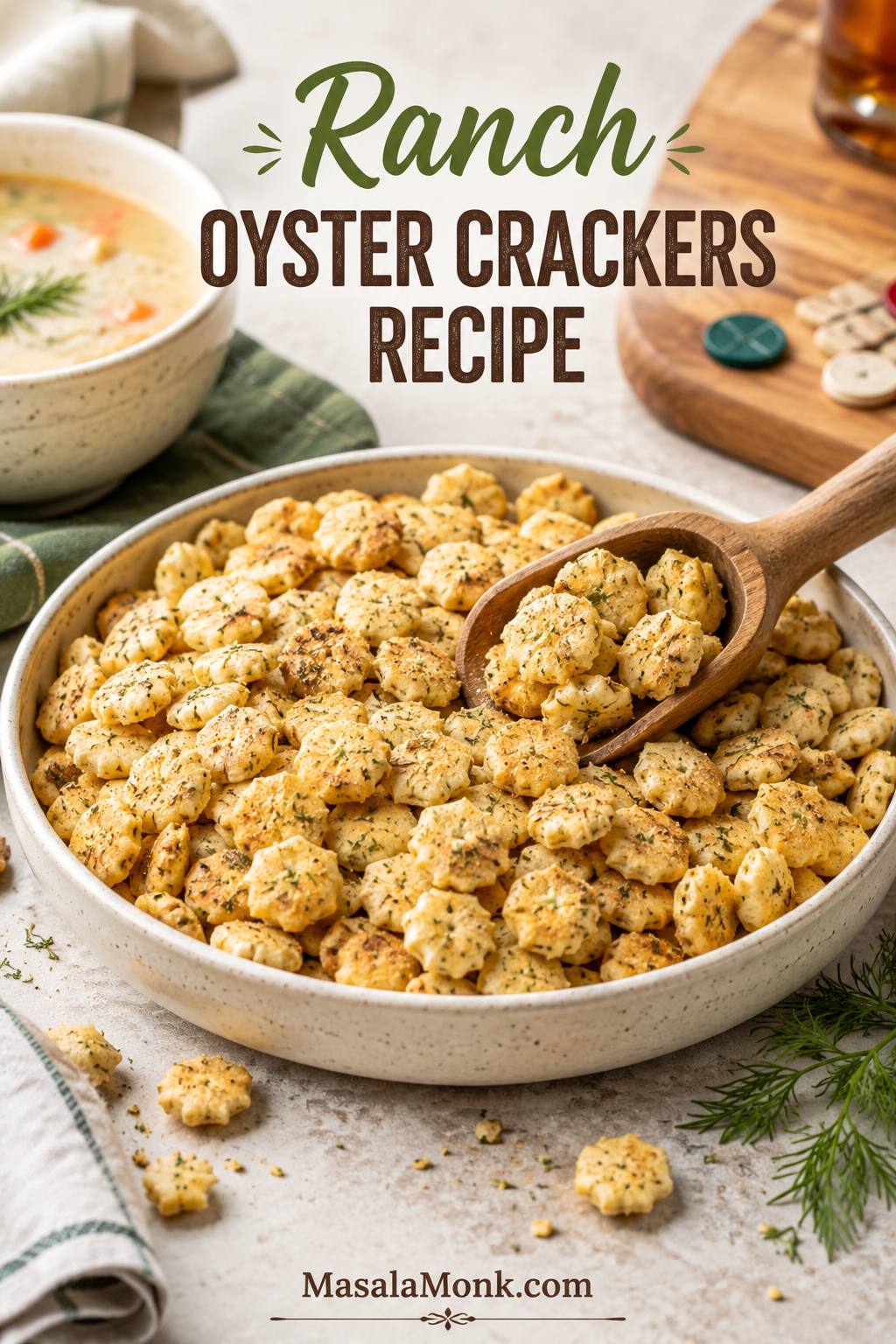
Ranch Oyster Crackers Recipe

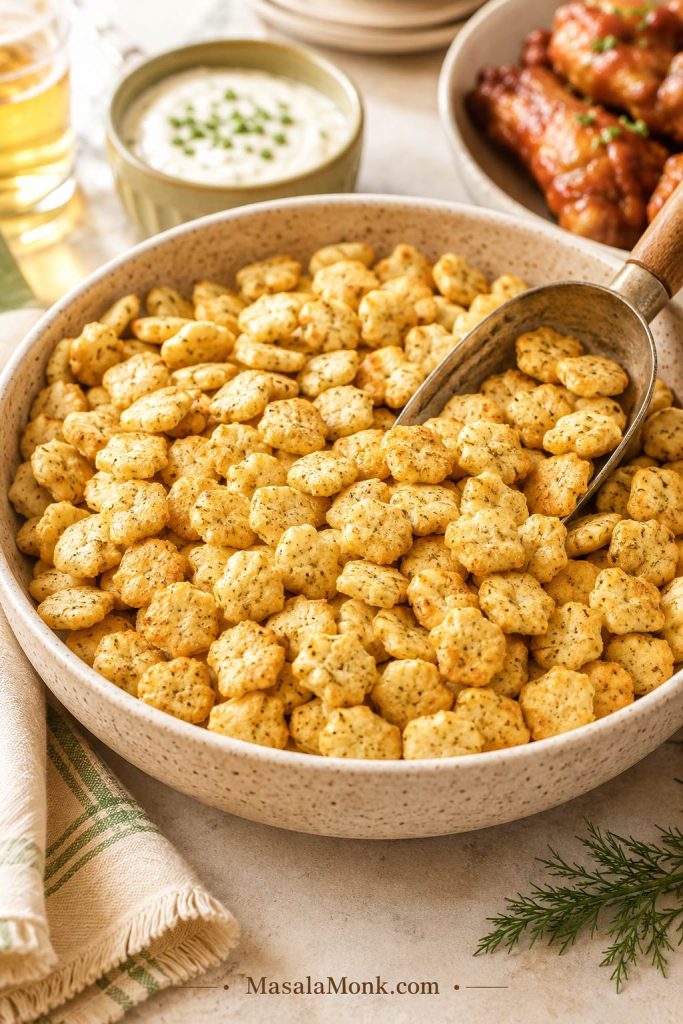
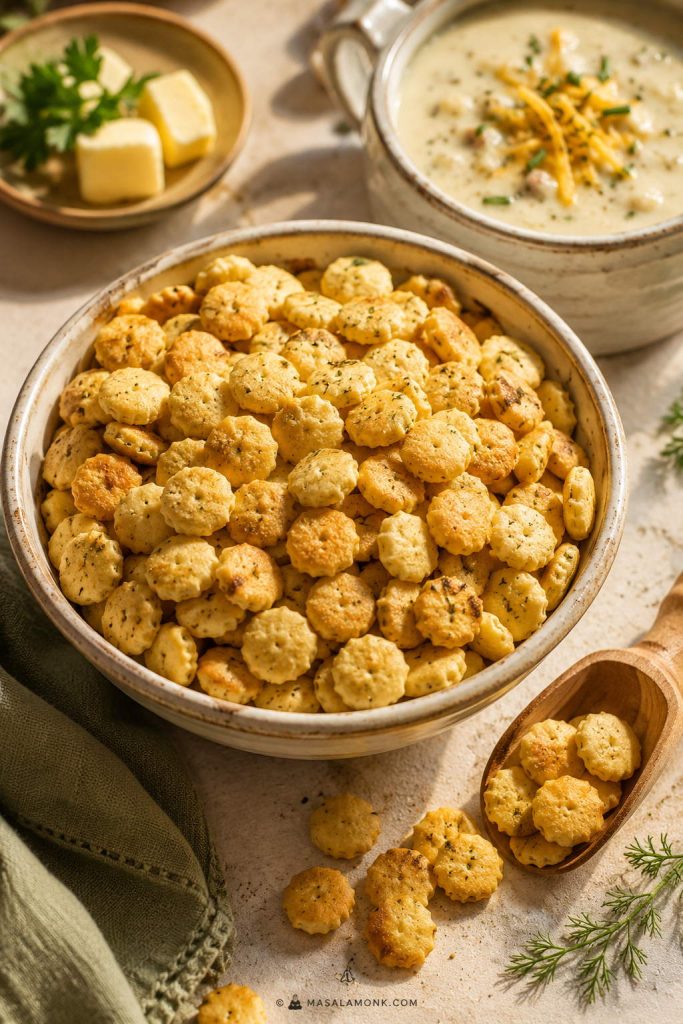
Bowl of golden ranch oyster crackers with herb flecks, scoop, and cozy snack-table sides.

Ranch oyster crackers are the kind of snack that disappears quietly. You set out a bowl before the game starts, beside a pot of soup, or on a holiday snack table, and somehow everyone keeps drifting back for another salty, herby handful. They are crisp, tiny, ranch-seasoned, and just rich enough to feel like a treat without asking much from you.

The recipe itself is easy. The confusing part is everything around it: whether “ranch dressing” means bottled dressing or the dry ranch packet, how much seasoning to use for a 9 oz, 12 oz, or 16 oz bag, whether oil or butter gives a better crunch, whether the crackers really need to be baked, and what to do if they turn out greasy, salty, or soft.

Once those little decisions are clear, the batch is easy to get right. The baked method gives the snappiest result, and the ratio table helps you adjust for whatever bag you have. From there, choose oil or butter, dill or no dill, a gentle ranch coating or a bolder party-snack bowl. The result should be bold but not harsh, coated but not oily, and crunchy enough that people keep reaching back into the bowl.

Quick Answer: The Best Ranch Oyster Crackers Formula

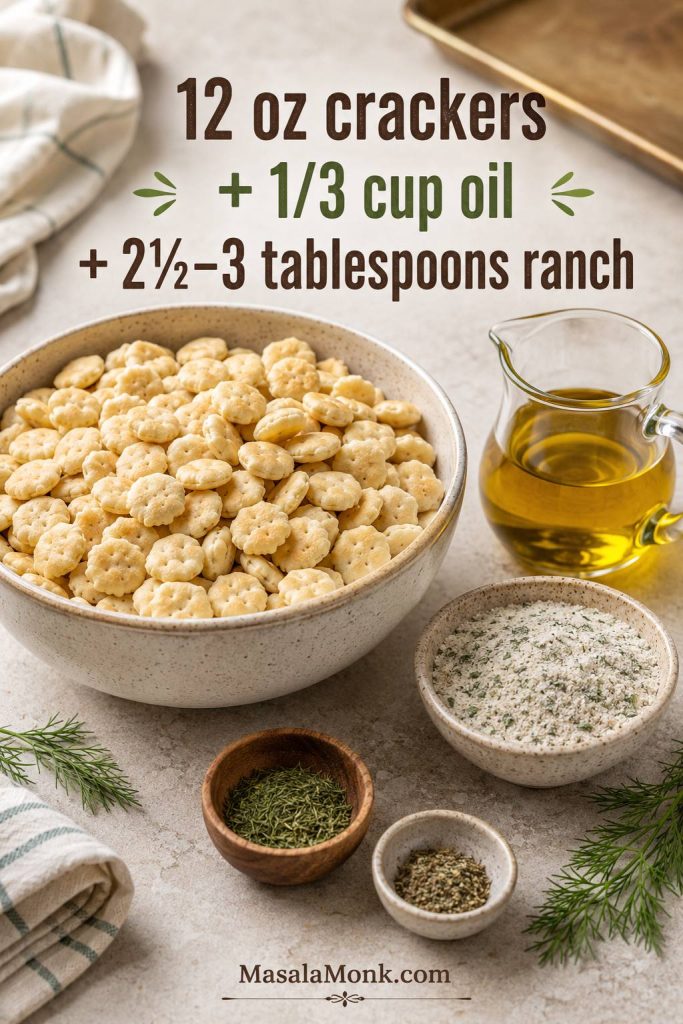
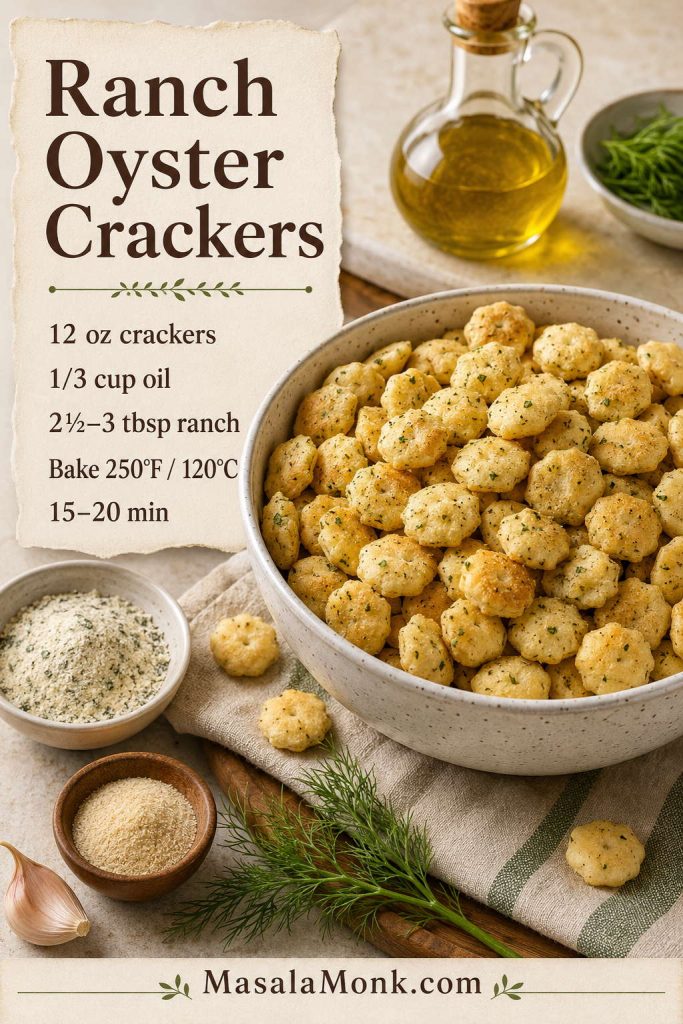
For 12 oz / 340 g oyster crackers, use ⅓ cup / 80 ml neutral oil, 2½ tablespoons dry ranch seasoning for a balanced batch or up to 3 tablespoons for a bolder batch, 1 teaspoon dried dill, ½ teaspoon garlic powder, and ½ to 1 teaspoon lemon pepper.

Toss well, spread on a rimmed baking sheet, bake at 250°F / 120°C for 18–22 minutes, stir once halfway, and cool fully before storing. The first handful should taste salty, herby, crisp, and evenly coated — never dusty in one bite and oily in the next.

Quick pick: Use neutral oil for the best crunch, melted butter for the richest flavor, the air fryer for the fastest small batch, the no-bake method when you want to skip the oven, and a 16 oz batch for parties, gifting, game day, or bigger soup nights.

If you are using a full 1 oz / 28 g ranch packet with a 12 oz bag, expect a bold, salty party-snack flavor. For a safer first batch, start with 2½ tablespoons, bake, taste, and dust the crackers with a little more seasoning while they are still warm on the tray.

Using a 9 oz or 16 oz bag? Check the ranch seasoning ratios before mixing the coating.

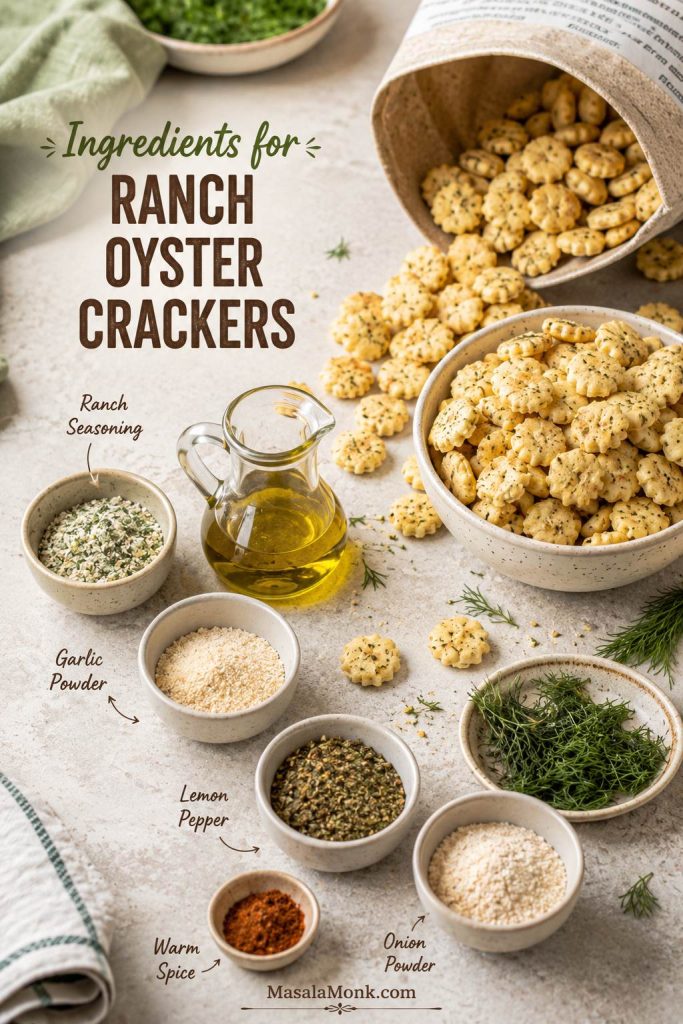
Prep scene with oyster crackers, oil, dry ranch seasoning, dill, garlic powder, lemon pepper, and sheet pan.
Start with this 12-ounce ranch oyster crackers formula, then adjust the next batch toward bolder seasoning, richer butter, or more heat.

Why This Recipe Works

The best batches come out lightly toasted, evenly seasoned, and crisp after cooling. That does not happen by dumping ranch powder over crackers; it comes from the order, the ratio, and a little low-heat baking time.

  • Dry ranch seasoning keeps the crackers crisp. Bottled dressing adds moisture, while dry mix gives flavor without making the crackers soggy.
  • Whisking the seasoning into the oil first prevents clumps. The ranch powder, dill, garlic, and lemon pepper spread more evenly when they are suspended in oil before they touch the crackers.
  • A low oven sets the coating instead of scorching it. At 250°F / 120°C, the crackers have time to toast gently while the oil or butter settles into a clean, savory finish.
  • The ratio table protects the batch. Oyster cracker bags vary, and using the same seasoning amount for every bag can make one batch bland and another too salty.
  • Cooling on the tray finishes the texture. The crackers firm up as the seasoning settles into the surface.

The goal is simple: every handful should taste seasoned, not dusty in some bites and oily in others. Mix the coating first, bake low, and let the crackers cool on the pan, and the bowl lands crisp, salty, herby, and clean.

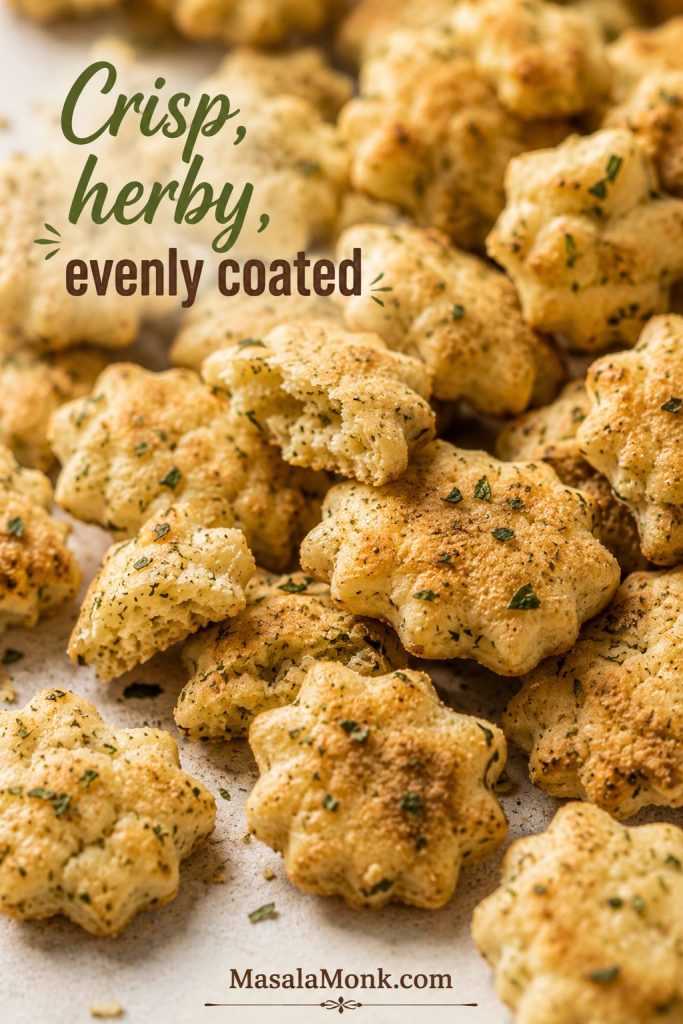
Close-up of crisp ranch oyster crackers with toasted edges, broken pieces, and green herb flecks.
Look for a matte, herby surface with lightly toasted edges; that finish tells you the seasoning has settled instead of sitting on the crackers as oil.

What Are Ranch Oyster Crackers?

Ranch oyster crackers are small oyster crackers tossed with dry ranch seasoning, oil or melted butter, and simple seasonings like dill, garlic powder, lemon pepper, and onion powder. They are usually baked at a low temperature until the seasoning clings and the crackers become crunchy again.

They are one of the most common versions of seasoned oyster crackers: the ranch packet gives the base flavor, while dill, garlic, lemon pepper, Parmesan, or heat can push the batch in different directions.

Despite the name, oyster crackers usually do not contain oysters. They are small soup crackers traditionally served with oyster stew, chowder, chili, and other soups. That soup-and-stew background is also why they make so much sense with creamy bowls and chili today. For a little more history, this history of oyster crackers explains where the name comes from.

Think of them as a snack mix shortcut. They are easier than Chex mix, less fussy than homemade crackers, and more interesting than plain soup crackers. Once baked and cooled on the pan, they are sturdy enough for snacking but still small enough to scatter over tomato soup, chili, chowder, salad, or a dip board.

Dry Ranch Seasoning vs Bottled Ranch Dressing

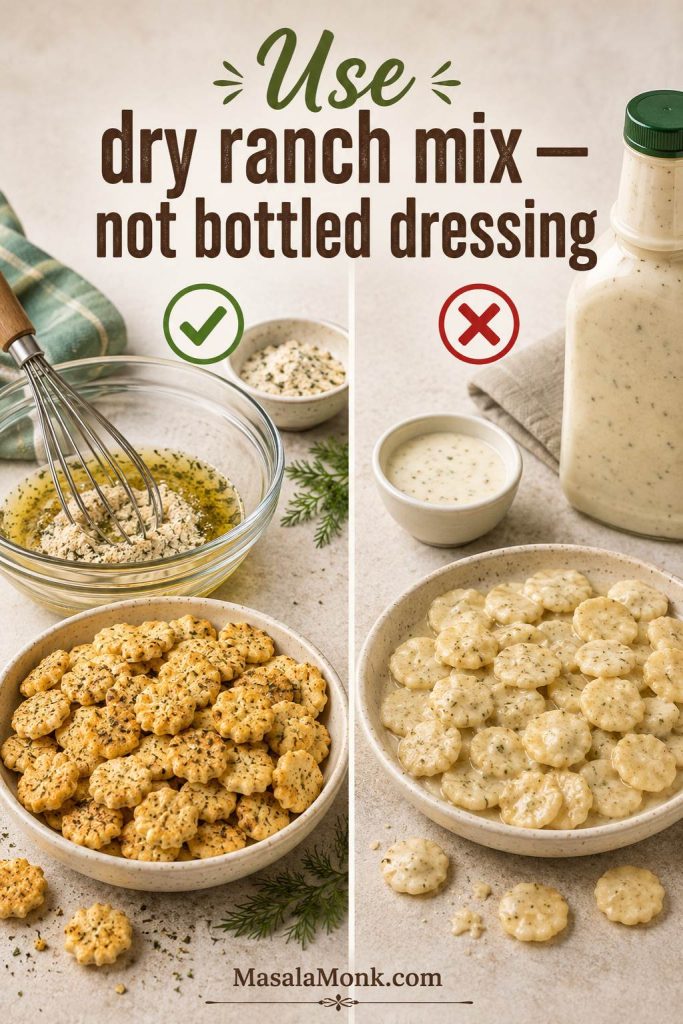
Use dry ranch seasoning here. It gives concentrated ranch flavor without the moisture that comes from bottled dressing. Creamy ranch dressing may sound tempting, but it can turn the crackers soft instead of snappy.

Split comparison of dry ranch seasoning mixed with oil and bottled ranch dressing with softer crackers.
Dry ranch mix seasons the crackers without adding water or cream, which is why it gives a cleaner crunch than bottled dressing.
Ranch productCan you use it?What to know
Dry ranch seasoning packetYes, best choiceClassic, easy, and bold. Use the packet weight and taste for saltiness.
Ranch seasoning shakerYesMeasure by tablespoons. Start with less if the blend is salty.
Dry ranch dip mixUsually yesCan be saltier or stronger than dressing mix. Start with a little less.
Bottled ranch dressingNot recommendedAdds moisture and can make the crackers soft.
Homemade ranch-style dry mixYesGood if you want more control over salt, dill, garlic, onion, and herbs.

Helpful rule: When people say “ranch dressing crackers,” they often mean crackers made with dry ranch dressing mix, not creamy dressing from a bottle.

Homemade Dry Ranch-Style Mix

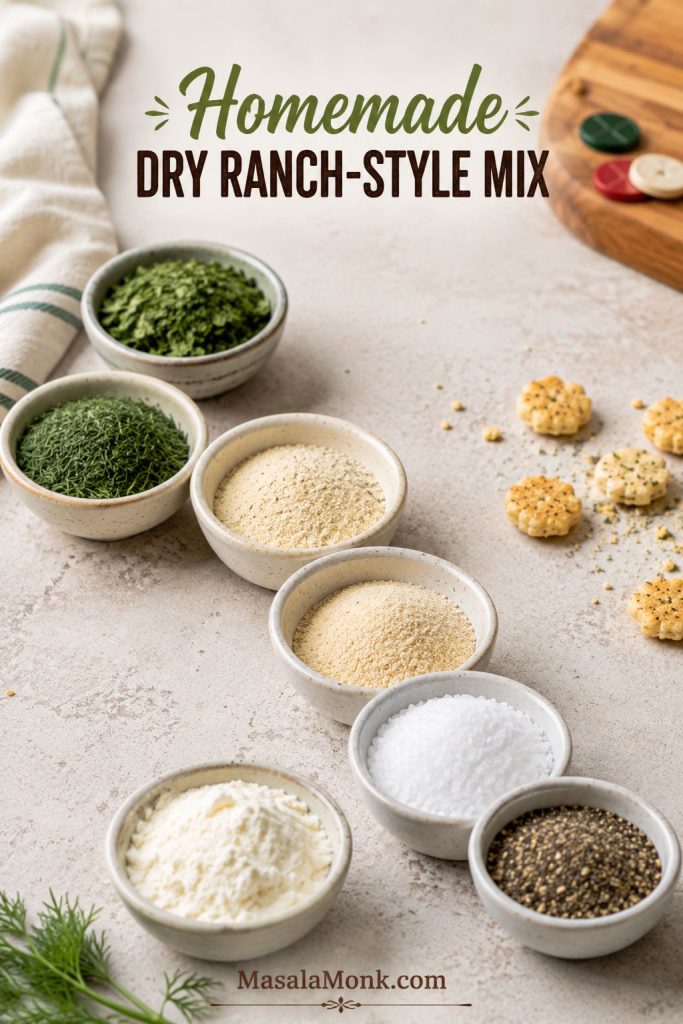
A homemade ranch-style dry mix can work too, especially if it includes parsley, dill, garlic powder, onion powder, salt, pepper, and optional buttermilk powder. Without buttermilk powder, the flavor will be more herby-garlicky than creamy-ranch, but it can still make a good seasoned cracker batch.

Small bowls of parsley, dill, garlic powder, onion powder, salt, pepper, and buttermilk powder for dry ranch mix.
A homemade dry ranch-style mix lets you control salt, herbs, and garlic, which is helpful when serving kids, low-salt guests, or lighter soup-night batches.

Ingredients and What Each One Does

If you have oyster crackers, dry ranch mix, and a neutral oil, you are most of the way there. The crackers bring the crunch, the ranch mix brings the salty-herby flavor, and the oil or butter decides how light or rich the final batch feels.

Oyster crackers with oil, dry ranch seasoning, dill, garlic powder, lemon pepper, and onion powder in small bowls.
Every flavoring in this mix is dry, so the crackers can pick up ranch, dill, garlic, and lemon pepper while still baking into a snackable texture.

Oyster crackers

Use plain oyster crackers. Common bags are 9 oz / 255 g, 12 oz / 340 g, and 16 oz / 454 g. Cup counts vary by brand, but 9 oz is usually about 4–5 cups, 12 oz about 5½–6 cups, and 16 oz about 7–8 cups. Weight is more reliable than cups, so use the ratio table if your bag size is different.

Dry ranch seasoning

A standard dry ranch packet gives the classic flavor most people expect: tangy, salty, herby, garlicky, and slightly creamy-tasting even though there is no bottled dressing in the recipe. Store-brand ranch seasoning also works. The familiar green-label style packets are common, but the brand matters less than the salt level and packet size.

Dry ranch mix is useful beyond snack crackers too; it brings the same shortcut flavor to easy dinners like one-pot chicken bacon ranch pasta. Here, though, the seasoning needs to stay dry enough to cling to crackers instead of turning into a sauce.

Unsure how much of the packet to use? Jump to the ranch packet adjustment notes before you season the crackers.

Neutral oil or melted butter

Neutral oil gives the lightest, snappiest batch. Canola, vegetable, avocado, or another mild oil works well. Melted butter gives richer flavor and makes the kitchen smell more like party mix. Use unsalted butter if your ranch mix is already salty; if you only have salted butter, start with less seasoning.

Dried dill and other seasonings

Dill gives the crackers that old-school ranch snack-mix flavor. Garlic powder deepens the ranch flavor, lemon pepper adds lift, and onion powder rounds everything out. Cayenne, red pepper flakes, smoked paprika, Parmesan, parsley, taco seasoning, or Italian seasoning can all work too; add salty extras carefully because ranch packets already bring plenty of salt.

How Much Ranch Seasoning to Use for Oyster Crackers

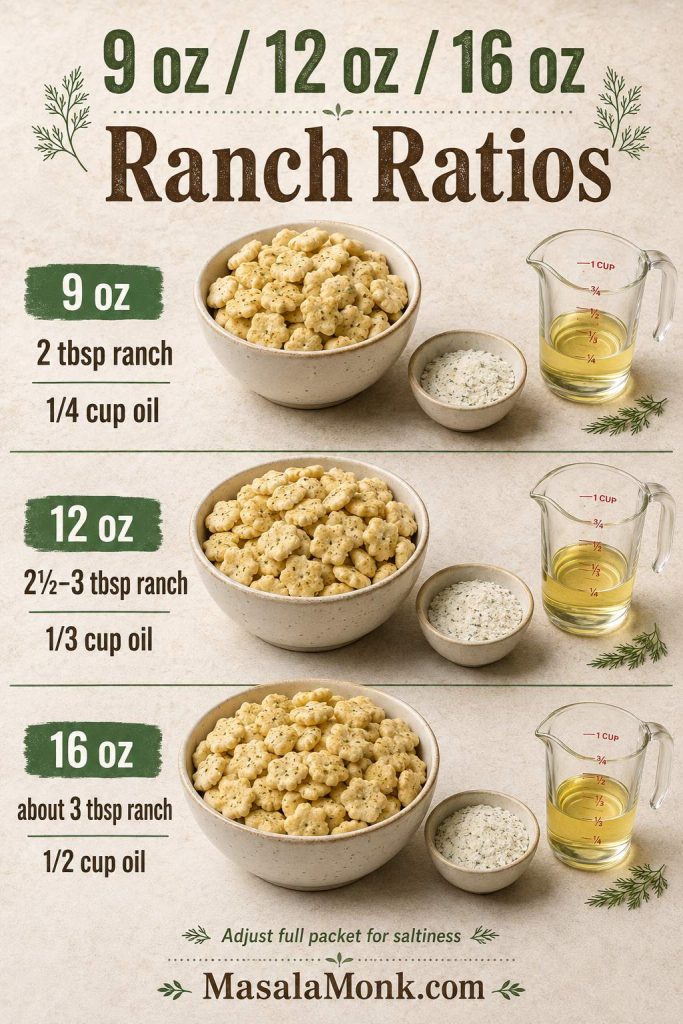
The seasoning gets easier once you match it to the bag size. Some recipes use cups, some use ounces, some say one packet, and ranch packet sizes are not always identical. Use this table as the practical guide.

Ranch Ratios by Bag Size

Oyster crackersMetricRanch seasoningOil or butterBake time at 250°F / 120°C
9 oz255 g2 tbsp mild
2½–3 tbsp bold
¼ cup oil for lighter coating
⅓ cup oil or 5 tbsp butter for richer coating
15–20 min
12 oz340 g2½ tbsp balanced
3 tbsp bold
⅓ cup oil
up to ½ cup butter for richer coating
18–22 min
16 oz454 gAbout 3 tbsp
or most/all of a standard 1 oz / 28 g packet, adjusted for saltiness
½ cup oil or ½ cup melted butter20–25 min
2 × 16 oz908 gAbout 6 tbsp
or 2 standard 1 oz / 28 g packets, adjusted for saltiness
1 cup oilUse 2 sheet pans
Three ranch oyster cracker ratio sections for 9 ounce, 12 ounce, and 16 ounce batches with ranch and oil measurements.
Bag size matters: the same ranch packet can taste bold in a 12-ounce batch but more balanced in a larger 16-ounce party batch.

How to Adjust the Ranch Packet

A ranch packet is sold by weight, not by tablespoons, and brands vary. The same 1 oz / 28 g packet can make a bold 12 oz batch or a more moderate 16 oz batch; it depends on how salty and intense you want the bowl.

Dry ranch seasoning packet, tablespoon measure, kitchen scale, and oyster crackers for checking packet weight.
Since ranch packets are sold by weight, measuring once helps you match the recipe instead of guessing from packet to packet.

Balanced for Soup, Bold for Parties

Making these for soup? Stay closer to the balanced ranch amount so the crackers add crunch without taking over the bowl. Making them for a party snack? Go bolder, especially if the crackers will sit beside dips, wings, cheese, or other strong flavors.

Lighter ranch oyster crackers for soup beside a bolder seasoned batch for parties.
Keep the seasoning lighter for soup so it does not overpower the bowl; go bolder when the crackers need to stand beside dips, wings, and cheese.

Best starting point: For a 12 oz / 340 g bag, use ⅓ cup oil and 2½ tablespoons ranch seasoning. After that, adjust toward extra dill, more butter, or a bolder packet-style coating depending on how your house likes them.

For batch size, think of 9 oz as a small test batch, 12 oz as the one-pan standard, and 16 oz as the party or gifting size. If you double a 16 oz batch, use two sheet pans so the crackers have room to toast evenly.

Once the bag size and seasoning amount are clear, move to the baked method and mix the coating.

Oil vs Butter for Ranch Oyster Crackers

Neither oil nor butter is wrong; they just make different snack bowls. Oil gives you the light, crunchy version people keep grabbing from between sips of soup. Butter gives you the richer bowl that smells like party mix coming out of the oven.

Two ranch oyster cracker batches comparing a lighter oil-coated version with a richer butter-coated version.
Oil keeps the bite lighter and drier, whereas melted butter gives a deeper, party-mix flavor that feels richer while still warm.
ChoiceResultBest forWatch out for
Neutral oilSnappy, light, evenly coatedMain recipe, make-ahead snacks, soup toppingUse a measured amount so the crackers do not feel greasy
Melted butterRicher, more savory, slightly heavierParty bowls, warm snacking, buttery flavorUse unsalted if your ranch mix is salty
Half oil, half butterBalanced flavor and crunchBest compromiseGive it enough baking time for the coating to settle
Olive oilMore noticeable flavorSmall batches or herby versionsUse a mild one so it does not fight the ranch flavor
Popcorn oilOld-school snack flavorHeavier party mixTaste first because some brands are extra salty

For the main recipe, use oil if you want the cleanest crunch. Use melted butter for a richer snack, then give the crackers enough space and baking time so the coating settles instead of feeling heavy.

How to Make Ranch Oyster Crackers

Once you choose the fat, the method is simple: whisk the seasoning into the oil or butter first, toss the crackers gently, spread them in one layer, bake low, stir once, and let them sit on the tray. This is snack food, not pastry; the goal is seasoned, easy, and good by the handful.

If the coating looks a little uneven or the first batch tastes slightly light, you can usually fix it with a few more minutes in the oven or a small dusting of seasoning while the crackers are warm.

Step 1: Heat the oven

Heat the oven to 250°F / 120°C. This low temperature gives the seasoning time to settle onto the crackers without burning the ranch powder, dill, garlic, or lemon pepper.

Step 2: Mix the seasoning oil

In a small bowl or measuring cup, whisk together the oil, dry ranch seasoning, dried dill, garlic powder, lemon pepper, and any optional onion powder, smoked paprika, or cayenne. Mixing the seasonings into the oil first helps prevent salty clumps and bare patches.

Dry ranch seasoning, dill, garlic powder, and lemon pepper being whisked into oil in a glass bowl.
Mixing the ranch seasoning into the oil first helps the herbs and powders move evenly through the batch instead of clinging in salty clumps.

Step 3: Coat the crackers gently

Add the oyster crackers to a large mixing bowl or a gallon zip-top bag. Pour the seasoning oil over them and toss gently until the crackers look evenly coated. A bowl is gentler and reduces breakage. A zip-top bag is faster and less messy, but shake softly rather than crushing the crackers.

Hands gently tossing oyster crackers with ranch seasoning oil in a large cream mixing bowl.
Use a wide bowl and gentle folds so the oyster crackers pick up seasoning without breaking into too many crumbs.

Step 4: Spread on a rimmed baking sheet

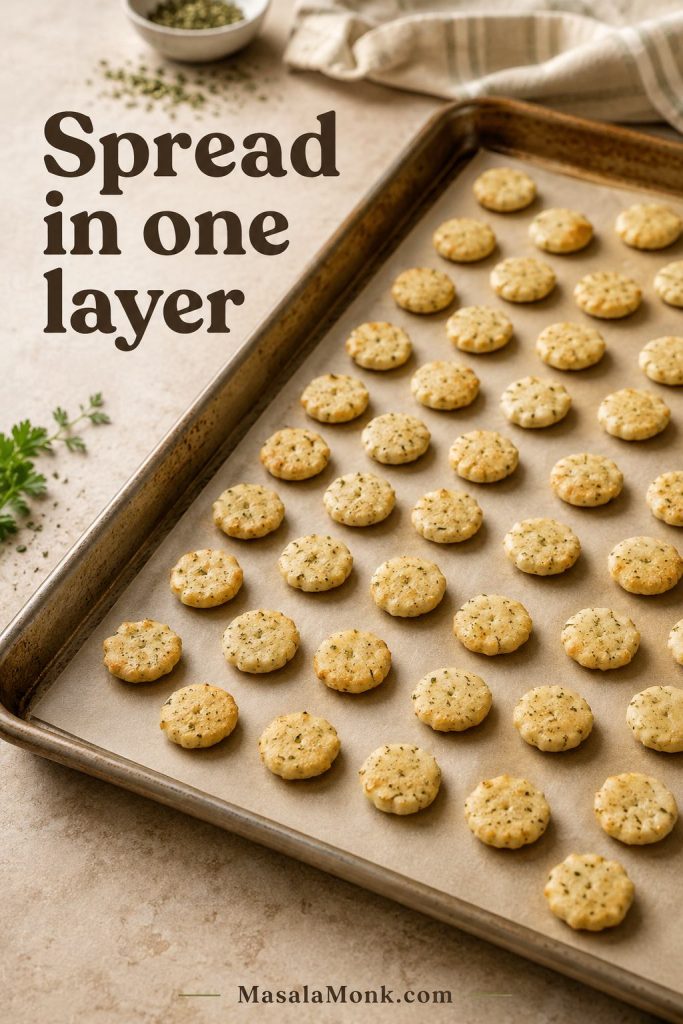
Spread the crackers on a rimmed baking sheet in as even a layer as possible. Parchment makes cleanup easier, and space on the pan helps the coating set evenly.

Ranch oyster crackers spread in a single layer on a parchment-lined rimmed baking sheet.
A single layer gives each cracker space to dry and toast, while crowded spots can stay heavy even after baking.

Step 5: Bake low and stir once

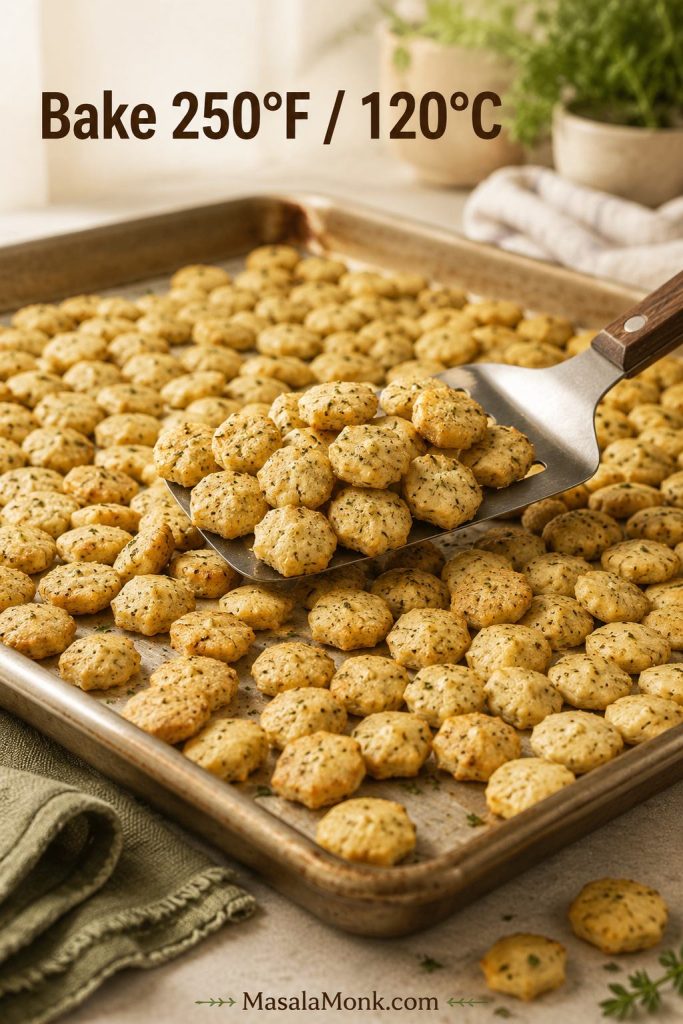
Bake for 18–22 minutes, stirring after about 10 minutes. A smaller or lightly coated batch may be ready closer to 15–18 minutes. A butter-heavy or 16 oz batch may need 20–25 minutes. The crackers should smell toasted and look set rather than wet or shiny.

Baked ranch oyster crackers on a sheet pan with toasted edges, herb flecks, and a spatula lifting some crackers.
The best doneness cue is not deep browning; instead, the crackers should smell toasted and look set, dry, and evenly speckled.

Step 6: Let the crackers cool on the pan

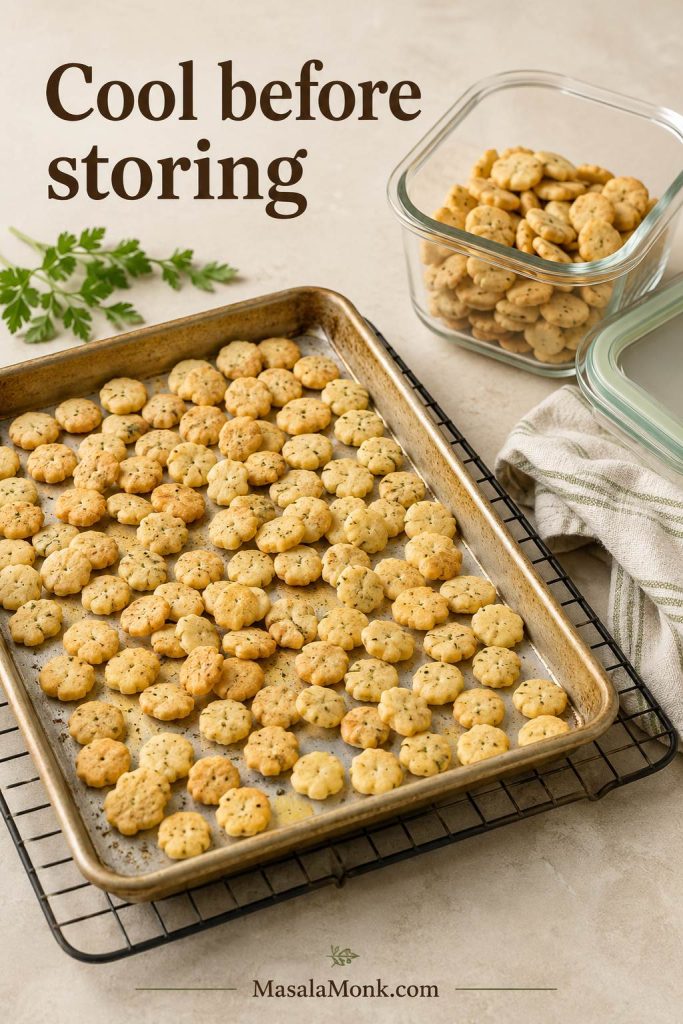
Leave the crackers on the pan until they are no longer warm. Once cooled, they should be evenly seasoned and ready to store.

Ranch oyster crackers cooling on a sheet pan beside an open glass storage container and lid.
Leave the crackers on the pan until the warmth fades, then move them into storage so the finished texture stays clean.

Texture cue: If the crackers still look glossy after baking, give them another 3–5 minutes at the same low temperature. They should look coated, not shiny with oil.

Equipment note: A large bowl is gentler, a zip-top bag coats faster, a rimmed baking sheet keeps the crackers contained, parchment helps cleanup, and a thin spatula makes stirring easier.

Want to skip the oven or use the air fryer instead? Compare the baked, no-bake, and air fryer methods before choosing.

Baked, No-Bake, and Air Fryer Methods

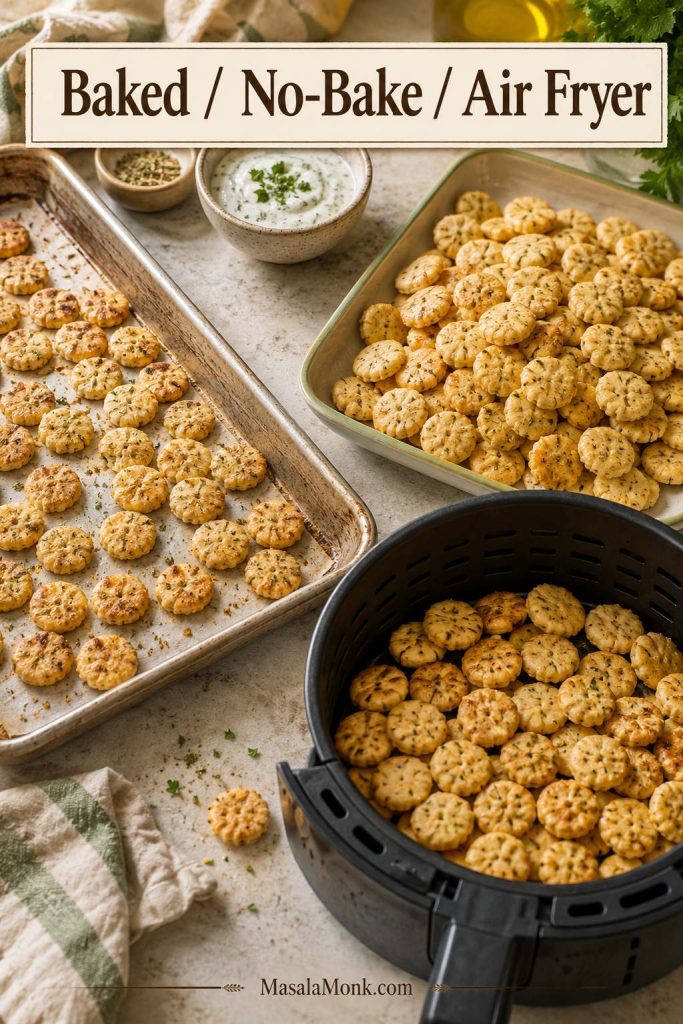
If you want the most reliable crunch, use the oven. No-bake and air-fryer versions are useful when you are short on time, avoiding the oven, or making a small batch. The microwave is included only as a backup.

Baked, no-bake, and air fryer ranch oyster crackers shown with a sheet pan, resting tray, and air fryer basket.
Pick the oven for an even full batch, the air fryer for speed, or the no-bake method when make-ahead ease matters more than maximum crunch.
MethodTimeTextureBest for
Baked18–22 minMost even and snappyMost reliable crunch
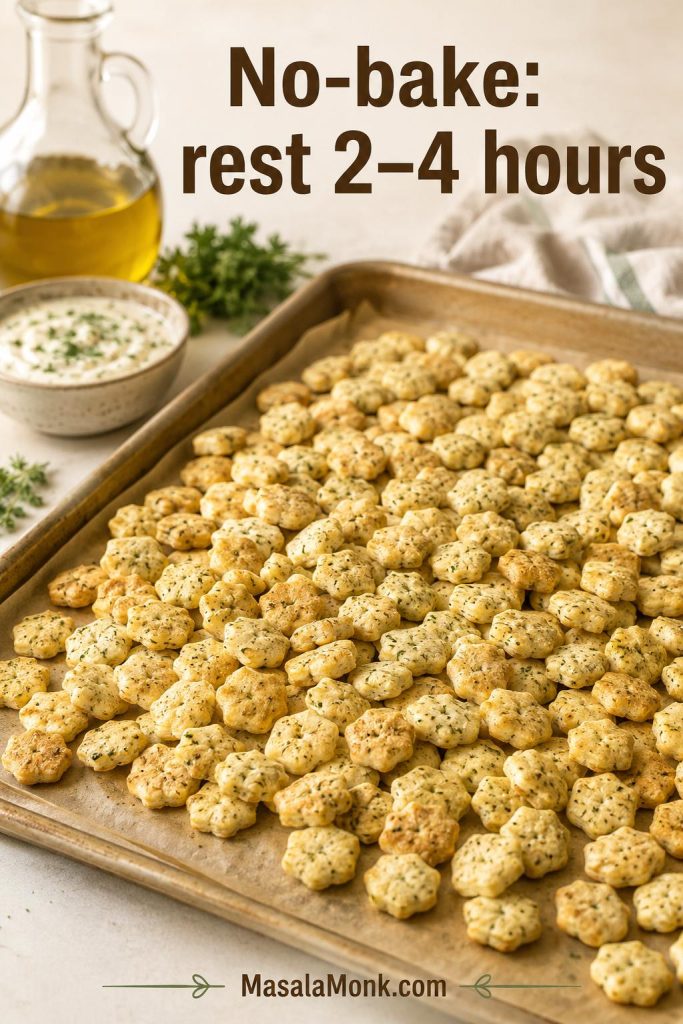
No-bake2–4 hours sitting timeGood, but slightly softerNo oven, prep-ahead snack
Air fryer7–10 minVery crisp, small batchesQuick small batch
Microwave backup2–3 minFast but less evenOnly when speed matters most

No-bake version

Choose this when you need the snack made ahead and do not mind a slightly softer crunch. Toss the oyster crackers with the seasoned oil, spread them on a sheet pan, and let them sit for 2–4 hours, stirring occasionally. They are ready when the surface no longer feels slick. Oil works better than butter here because it coats without setting up heavy as it cools.

No-bake ranch oyster crackers resting on a sheet pan with oil and seasoning nearby.
The no-bake method needs patience: spreading the crackers out gives the seasoned oil time to settle before serving.

Air fryer version

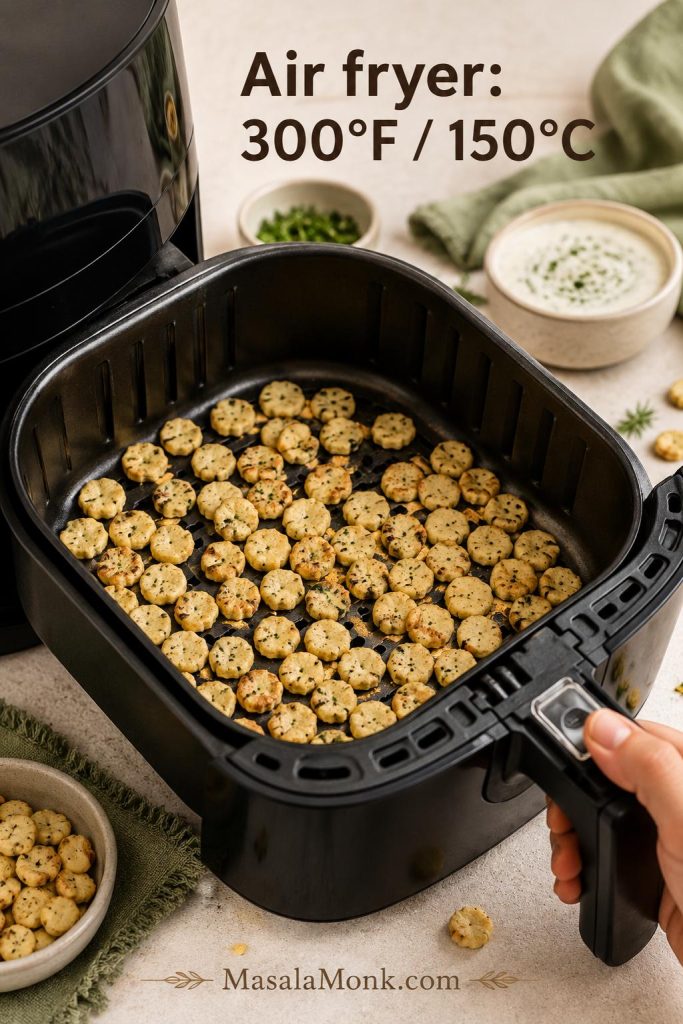
For the air fryer, cook small batches at 300°F / 150°C for 5 minutes, shake the basket, then cook another 2–5 minutes until set and lightly toasted. Air fry only 3–4 cups at a time unless you have a large basket. A little less oil usually works better in smaller baskets.

Ranch oyster crackers cooked in a thin layer inside an air fryer basket.
Keep air fryer batches shallow, because the crackers need moving air around them to toast rather than simply warm through.

If the air fryer is already out, you can keep the same snack-table rhythm going with air fryer chicken wings while the crackers cool.

Microwave backup

The microwave is the fastest backup, not the best texture method. Work in short bursts, then spread the crackers out afterward so steam does not soften them.

Dill or No Dill?

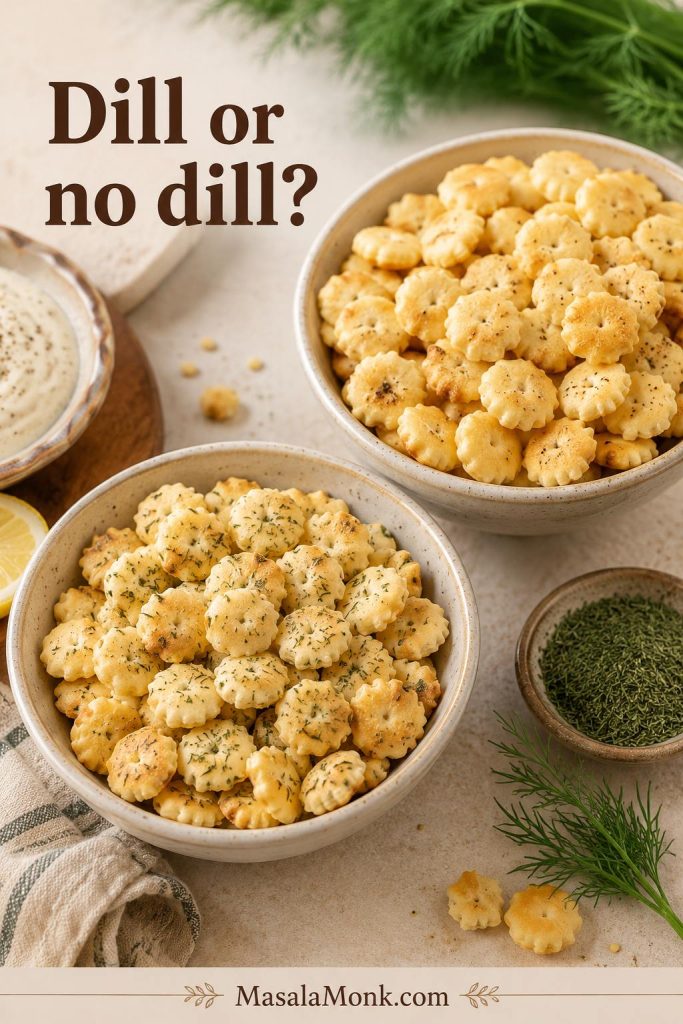
Dill is the old-school choice here. It gives these crackers their classic ranch snack-mix flavor, although the batch still works without it. For 9 oz / 255 g, use about ¾–1 teaspoon; for 12 oz / 340 g, use 1 teaspoon; for 16 oz / 454 g, use 1½–2 teaspoons. If you skip dill, replace it with dried parsley, chives, extra onion powder, or a little more lemon pepper.

Two bowls of ranch oyster crackers comparing a dill-speckled batch with a cleaner no-dill batch.
Dill gives the classic old-school ranch snack flavor, though parsley, chives, onion powder, or extra lemon pepper can still round out the batch.

Flavor Variations

Treat the base recipe like a blank snack mix. Keep the crackers, fat, and low oven steady; change the personality with the seasonings. This is where the batch starts to feel like yours.

Need the base formula first? Jump to the ranch oyster crackers recipe card, then come back and choose a variation.

Spicy Ranch Oyster Crackers, or Firecracker Style

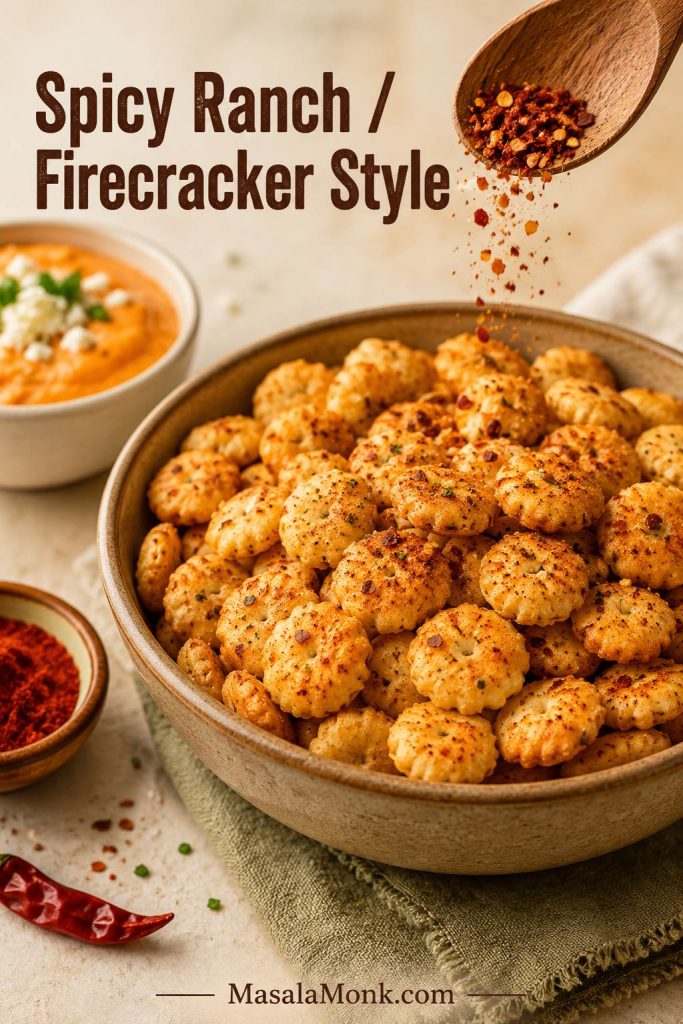
Add ¼ teaspoon cayenne for mild heat, ½ teaspoon cayenne for a stronger kick, or 1 tablespoon red pepper flakes for a more obvious spicy snack. Classic firecracker oyster crackers are usually hotter, red-pepper-forward, and more heavily seasoned than regular ranch crackers, so keep them milder here unless you know your crowd wants heat.

For a hotter game-day table, pair the spicy crackers with a scoopable dish like buffalo chicken dip. The crackers are better for topping and nibbling, while sturdier chips or bread can handle the heaviest scoops.

Dry heat is easier than wet hot sauce. Cayenne, smoked paprika, chili powder, and red pepper flakes keep the batch punchy without adding extra moisture.

Spicy ranch firecracker oyster crackers with red pepper flakes, cayenne, and a buffalo-style dip nearby.
For firecracker-style oyster crackers, dry heat such as cayenne and red pepper flakes adds punch without softening the snack.

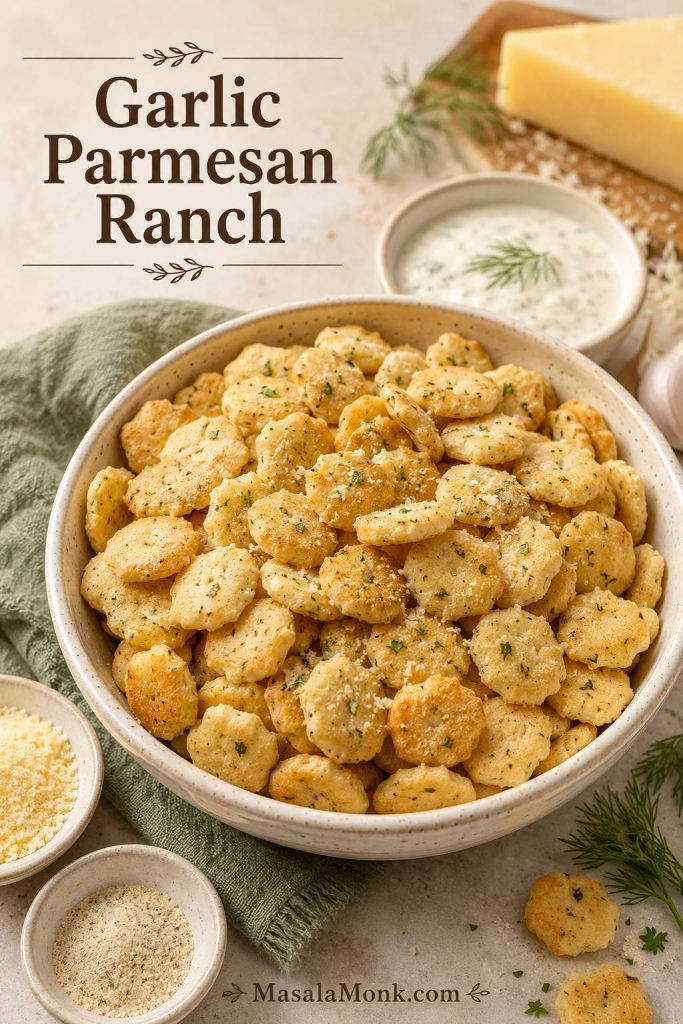
Garlic Parmesan ranch oyster crackers

Add a little extra garlic powder to the seasoning oil. After baking, while the crackers are still warm, toss with finely grated Parmesan and dried parsley. Adding Parmesan after baking keeps the cheese from scorching and gives the crackers a salty, savory finish.

Garlic Parmesan ranch oyster crackers in a bowl with grated Parmesan, garlic powder, parsley, and Parmesan wedge.
Add Parmesan after baking so the cheese stays savory and delicate instead of scorching on the sheet pan.

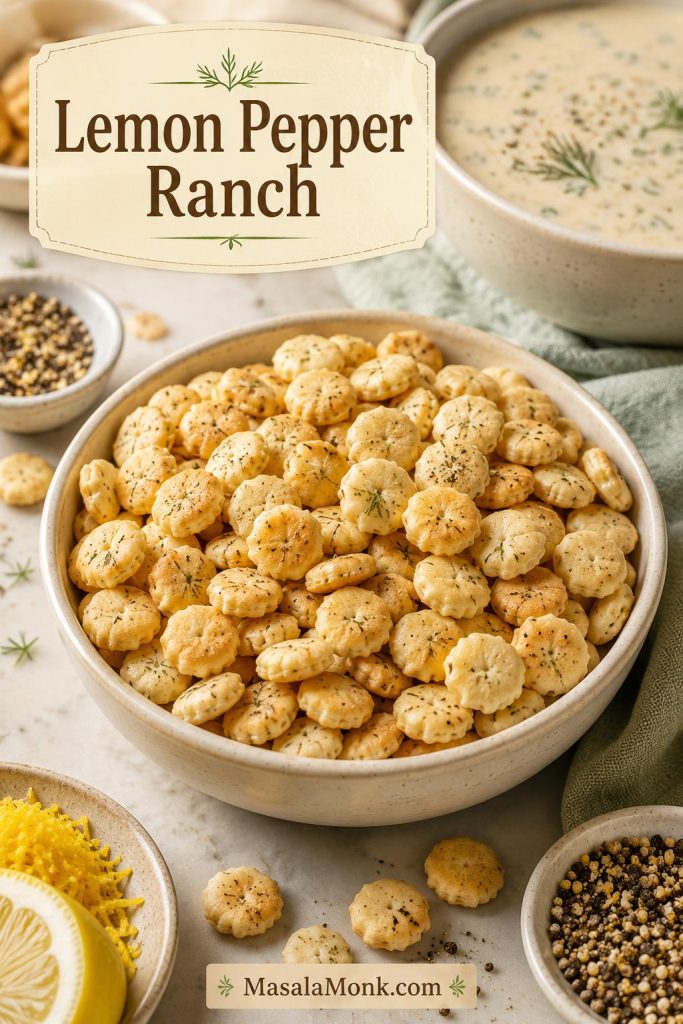
Lemon pepper ranch oyster crackers

Increase the lemon pepper to 1½ teaspoons for a 12 oz batch. This version is especially good as a soup topping because the citrusy pepper flavor cuts through creamy soups, chowder, and chili. If you like that bright, peppery flavor, it also makes a natural game-day pairing with lemon pepper chicken wings.

Lemon pepper ranch oyster crackers with lemon zest, lemon slice, pepper seasoning, and creamy soup in the background.
Lemon pepper lifts the ranch flavor, making this variation especially useful with creamy soups, chowders, and richer dips.

Taco ranch oyster crackers

Use ranch seasoning plus a small amount of taco seasoning, smoked paprika, and cayenne. Start lightly because taco seasoning can be salty. This version works well for movie-night bowls, game-day spreads, pretzels, corn chips, and roasted nuts.

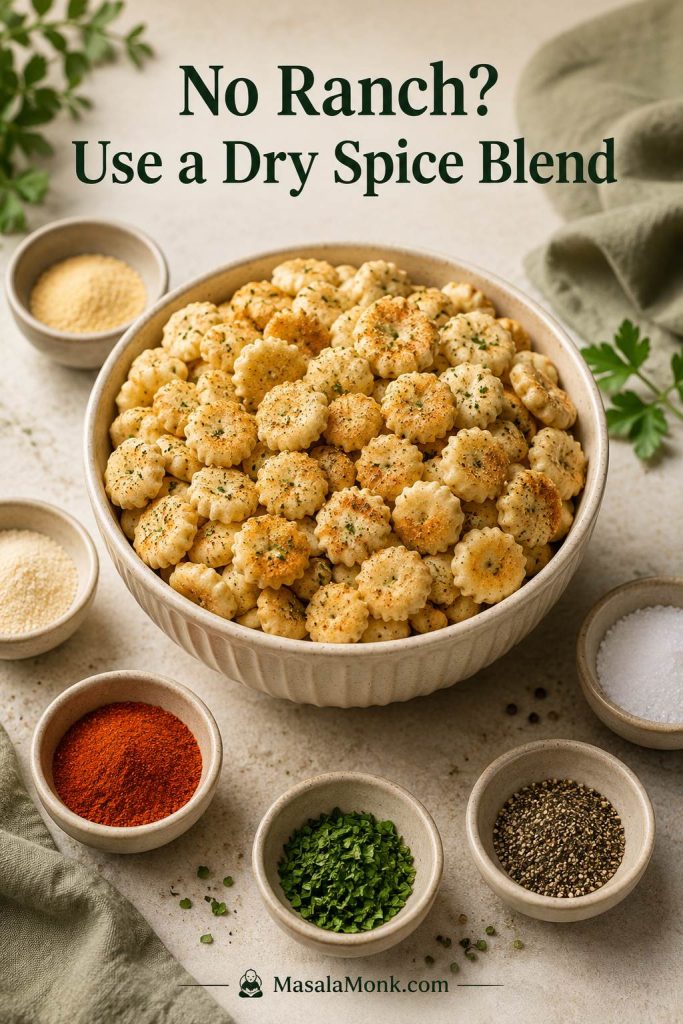
No-ranch seasoned oyster crackers

If you want a ranch-free seasoned oyster cracker batch, keep the same method and use a dry homemade seasoning blend. For 12 oz / 340 g oyster crackers, whisk together:

  • ⅓ cup / 80 ml neutral oil or melted butter
  • 1 teaspoon garlic powder
  • 1 teaspoon onion powder
  • 1 teaspoon dried parsley or Italian seasoning
  • ½ teaspoon dried dill, optional
  • ½ teaspoon smoked paprika or sweet paprika
  • ¼–½ teaspoon fine salt, depending on how salty your crackers are
  • ¼ teaspoon black pepper

Toss with the crackers and bake the same way. If you want a Parmesan version, add finely grated Parmesan after baking while the crackers are still warm.

Seasoned oyster crackers with bowls of paprika, parsley, black pepper, salt, garlic powder, and onion powder.
A ranch-free dry spice blend keeps the same easy method while giving readers a packet-free way to season oyster crackers.

Cinnamon sugar oyster crackers are a separate sweet snack direction. They usually use butter, sugar, cinnamon, and a slightly different baking rhythm, so treat that as its own snack bowl rather than folding it into this ranch version.

How to Serve Ranch Oyster Crackers

Ranch oyster crackers are easy to snack on straight from a bowl, but they are more useful than that. They can act like tiny croutons, party mix, soup crackers, or the salty crunch on a larger appetizer table.

Making them ahead for a party or snack table? Read the storage tips before you seal the batch.

Best Ways to Serve Them

UseHow to serve them
Soup toppingScatter over tomato soup, chowder, potato soup, chicken soup, or a cozy bowl like crock pot lasagna soup. Add them right before eating so the first spoonful is still crunchy.
Chili crunchUse instead of plain crackers for a salty ranch finish.
Party bowlServe in a big bowl with a small scoop or spoon so people can grab handfuls easily.
Snack mixCombine with pretzels, Chex, Goldfish-style crackers, roasted nuts, or mini saltines.
Dip boardUse as one crunchy element beside chips, vegetables, and bread pieces.
Cheese boardPair with a make-ahead cheese ball, cheddar cubes, soft cheese, pickles, and sliced vegetables.
Lunchbox snackPack only once the crackers are dry and no longer warm.
Road-trip snackStore in a zip-top bag or airtight snack container.
Holiday snack jarFill small jars or tins once the crackers have cooled and feel dry to the touch.

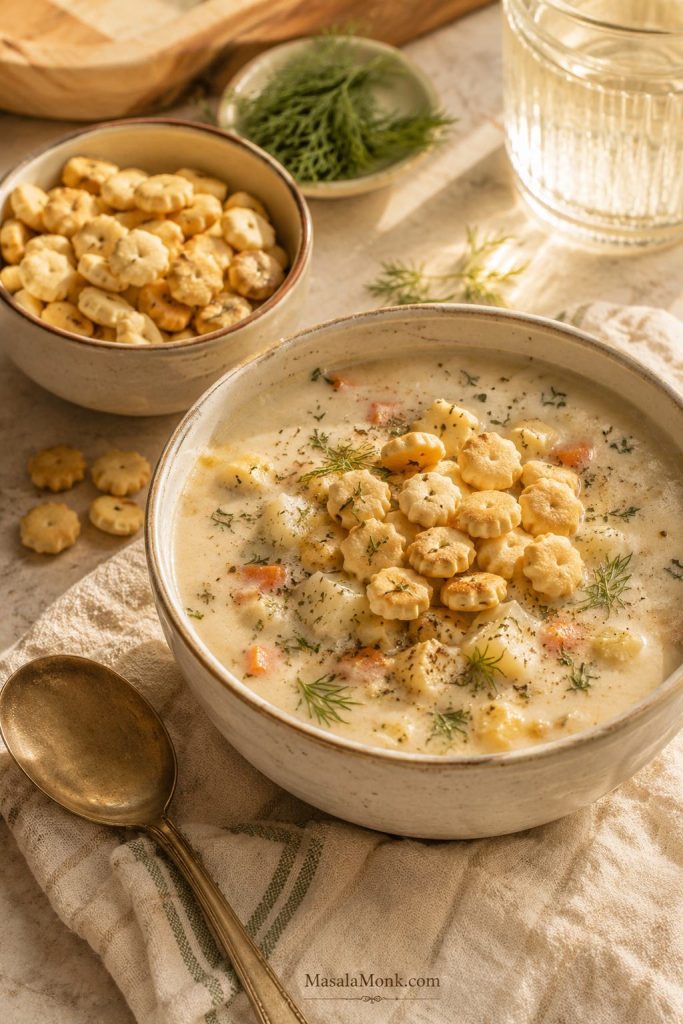
Use Ranch Oyster Crackers as a Soup Topping

For soup, add the crackers right before eating rather than letting them sit in the bowl. That keeps the first spoonful creamy underneath and crunchy on top.

Creamy soup topped with ranch oyster crackers, with extra crackers in a small bowl nearby.
Think of these as tiny ranch croutons: they work especially well on creamy soups where plain crackers can taste flat.

Dip Boards and Appetizer Tables

For a hot appetizer table, set a bowl of these crackers near a bubbling spinach artichoke dip. They are best for nibbling alongside it or sprinkling over individual scoops, while sturdier chips, bread, or vegetables can handle the heaviest dips.

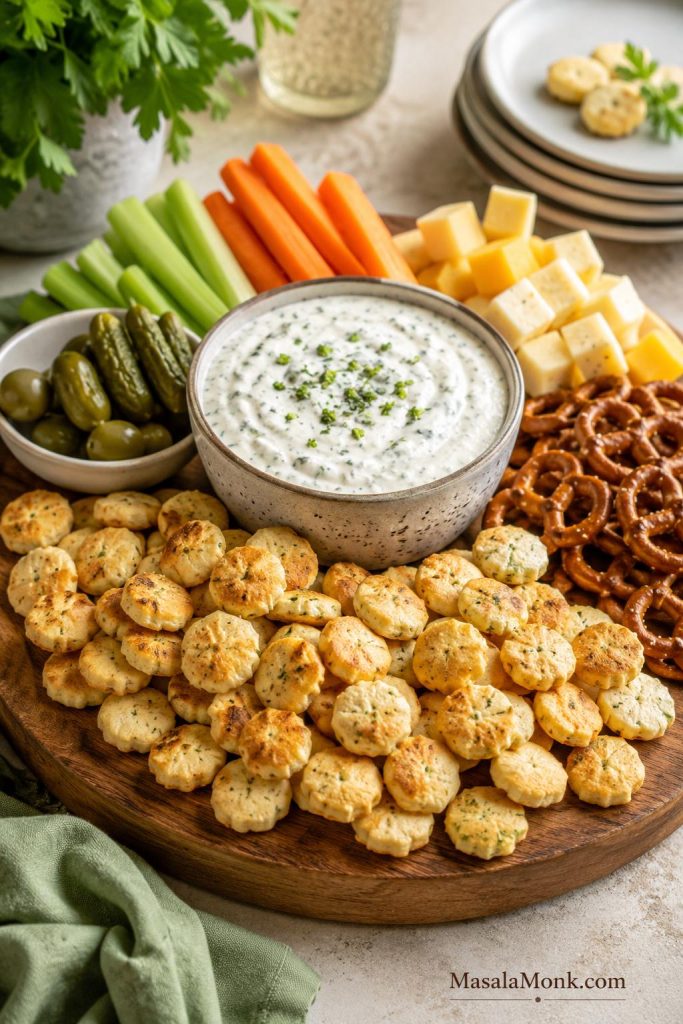
Ranch oyster crackers served on an appetizer board with creamy dip, cheese cubes, carrots, celery, pretzels, pickles, and olives.
On an appetizer board, ranch oyster crackers shine as a nibble or topping, while sturdier chips, bread, and vegetables can handle heavy dips.

They also fit neatly into a larger snack board or casual charcuterie board, especially when you want one seasoned, crunchy element beside cheeses, pickles, fruit, nuts, and plain crackers.

Party Bowl for Game Day and Snack Tables

If you are building a bigger game-day spread, serve them near wings, deviled eggs, cheese cubes, crunchy vegetables, and a few stronger crackers for heavier dips. Oyster crackers are excellent for sprinkling, topping, and casual snacking, but they are not always sturdy enough for very thick dips.

Large bowl of ranch oyster crackers with a scoop, dip, drinks, and party snacks in the background.
A small scoop keeps the party bowl cleaner and makes the crackers easier to serve beside dips, wings, and snack-board extras.

Storage and Make-Ahead Tips

Ranch oyster crackers are a good make-ahead snack as long as they are cool before they go into a container. Once cooled, store them airtight at room temperature and use them within the first several days for the cleanest crunch.

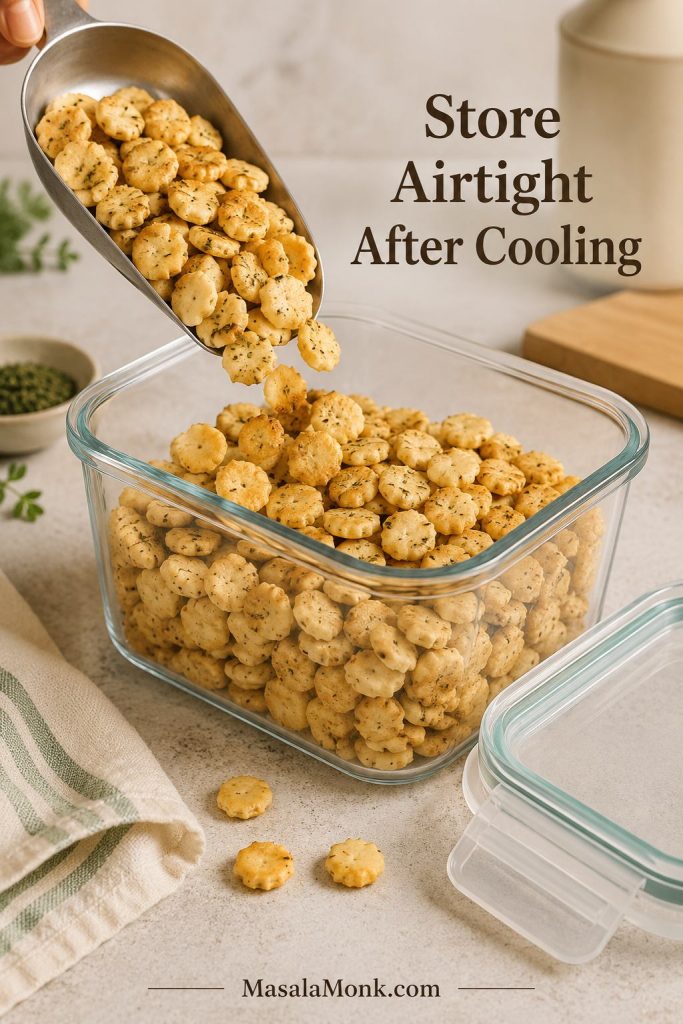
Ranch oyster crackers being poured into an open airtight glass container with the lid nearby.
A wide, airtight container protects the seasoning better than a loose bag when you are making the snack a day ahead.
  • Best storage: Use a sealed container, jar, tin, or zip-top bag.
  • Room temperature only: The fridge can make crackers stale faster.
  • Longer storage: If baked dry and stored airtight, they usually keep about 1 week, depending on humidity and coating.
  • Gift jars: Use only crackers that feel dry to the touch, and never seal them warm.
  • Refresh if needed: Bake at 250°F / 120°C for 5–8 minutes, then cool on the pan again.
  • Freshness check: If they smell stale, taste flat, or feel soft even after refreshing, make a fresh batch.

Gift Jars

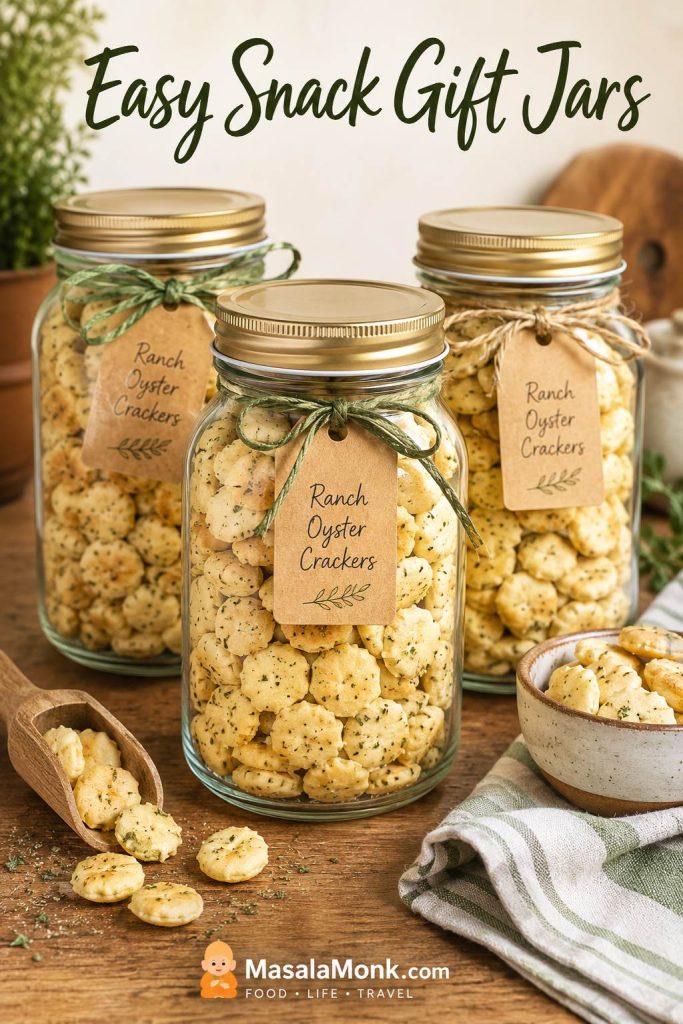
For gifting, pack only fully cooled crackers into clean jars or tins. A simple label and tight seal matter more than fancy packaging because the texture is the real gift.

Glass jars filled with ranch oyster crackers, kraft tags, ribbons, scoop, and small bowl of crackers.
For gift jars, leave a little headspace and use a tight lid so the crackers stay neat, crisp, and easy to pour.

They are especially useful because you can make them before people arrive, then put out a bowl when the table still feels like it needs one more salty, crunchy thing.

If you are making these for a party, prep one or two other make-ahead bites too. A tray of classic deviled eggs gives the table something creamy and tidy while the crackers bring the crunch.

Freezing is not worth it for most batches. The crackers can pick up moisture and lose their clean crunch, so make them a few days before the party and store them well instead.

If a stored batch turns soft or oily, use the troubleshooting guide before deciding it is a loss.

Troubleshooting the Batch

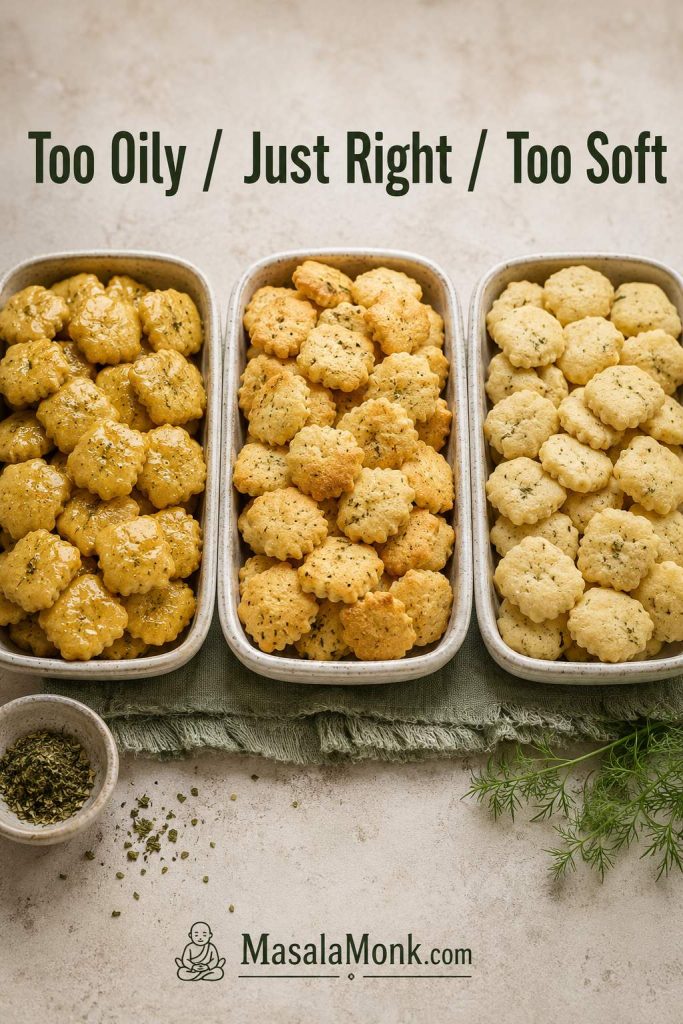
If a batch does not come out quite right, it is usually one of four things: too much fat, too much salt, not enough baking time, or uneven coating. The good news is that many batches can be saved, especially if the flavor is right but the texture is off.

Three trays of ranch oyster crackers showing too oily, just right, and too soft textures.
Use the texture as your guide: shiny crackers need more drying time, pale crackers may need better mixing, and the ideal batch looks evenly coated.

Common Problems and Fixes

ProblemWhy it happenedFix nowFix next time
Greasy crackersToo much oil or butter, or not baked long enoughSpread on a pan and bake 5–8 minutes more at 250°F / 120°CUse less fat and spread in one layer
Soggy crackersBottled ranch dressing, too much fat, or stored while warmBake low until dry, then let the tray coolUse dry ranch mix only and wait until the crackers are no longer warm before storing
Too saltyFull packet plus salty crackers, ranch dip mix, or salty add-insAdd more plain crackers and toss; if you do not have extra crackers, mix the batch into unsalted pretzels or plain cerealStart with ¾ packet or fewer salty extras
BlandToo many crackers or too little seasoningDust while warm on the tray, then let cool before storingUse the ratio table and taste your seasoning mix
Seasoning clumpedDry powder hit oily crackers unevenlyToss longer, break up clumps gently, and add a handful of plain crackers if some bites are too saltyWhisk seasoning into oil before adding to crackers
Burnt edgesOven too hot, thin pan, or not stirredRemove dark pieces before they flavor the batchUse 250°F / 120°C and stir halfway
Crackers brokeBag shaken too hard or crackers were fragileUse broken pieces as soup toppingToss in a bowl with a spatula instead of shaking hard
Soft after storageStored warm, humid room, or container not airtightRe-crisp at 250°F / 120°C for 5–8 minutesCool on the pan and store airtight

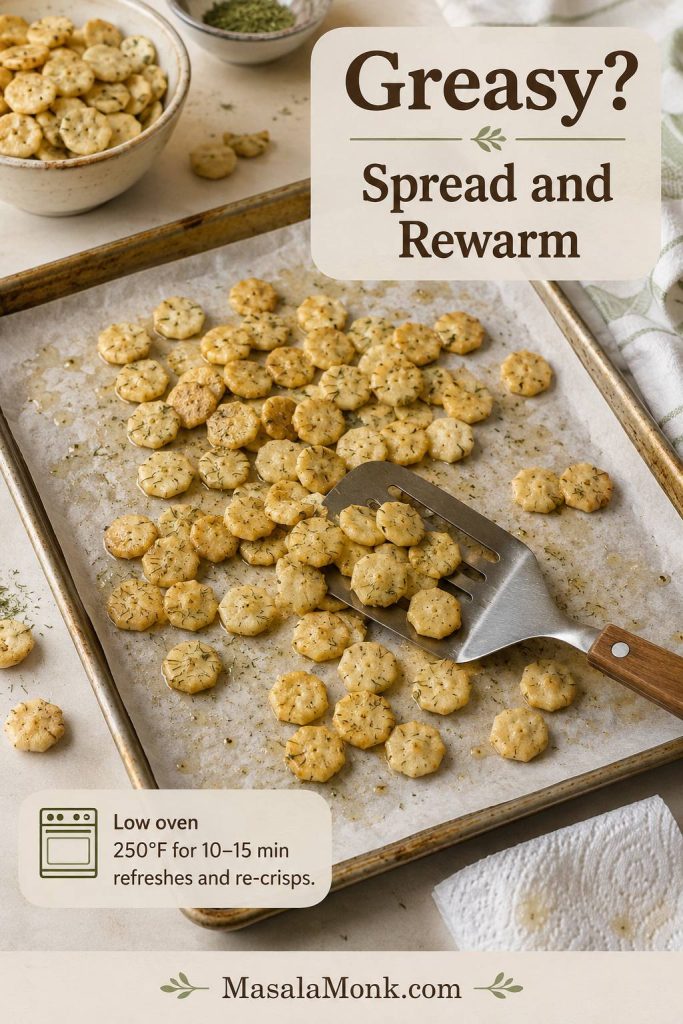
Fix Greasy Crackers

If the flavor is good but the crackers feel slick, spread them back onto a pan and warm them gently. This gives the extra coating a chance to settle instead of sitting on the surface.

Greasy ranch oyster crackers spread on a parchment-lined baking sheet with a spatula and paper towel nearby.
Use low heat for a greasy batch; the goal is to dry the surface gently, not brown the crackers further.

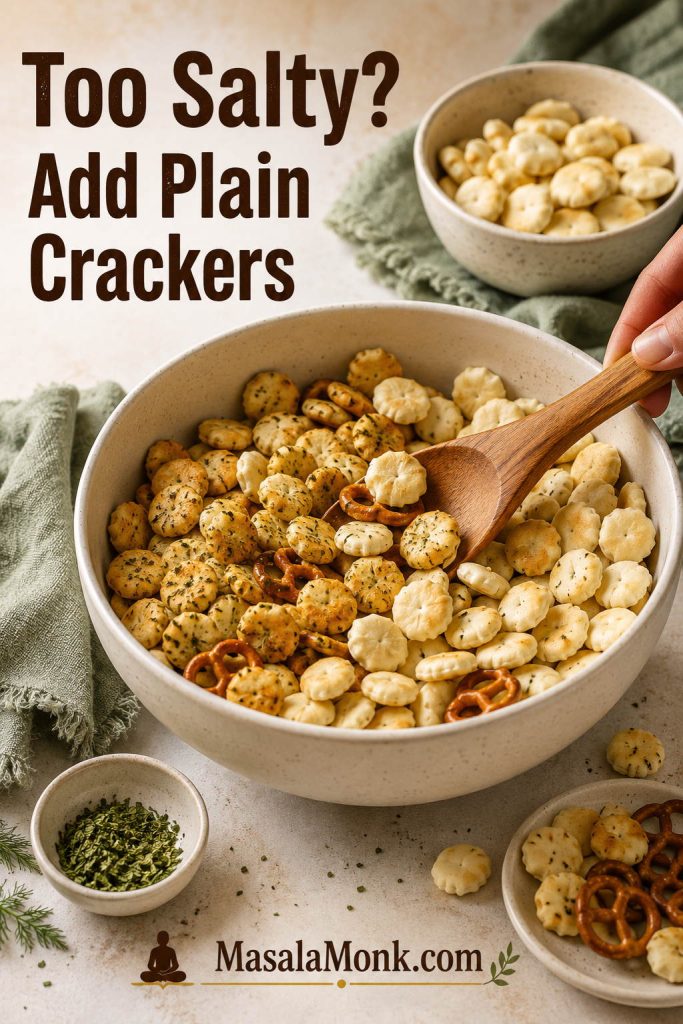
Too Salty? Stretch the Batch

If the seasoning tastes too strong, stretch the batch with plain crackers, pretzels, or unsalted cereal. Diluting the coating is usually better than trying to scrape seasoning off.

Seasoned ranch oyster crackers mixed with plain crackers and pretzels in a bowl to reduce saltiness.
When ranch oyster crackers taste too salty, stretch the seasoning with plain crackers, pretzels, or cereal instead of tossing the batch.

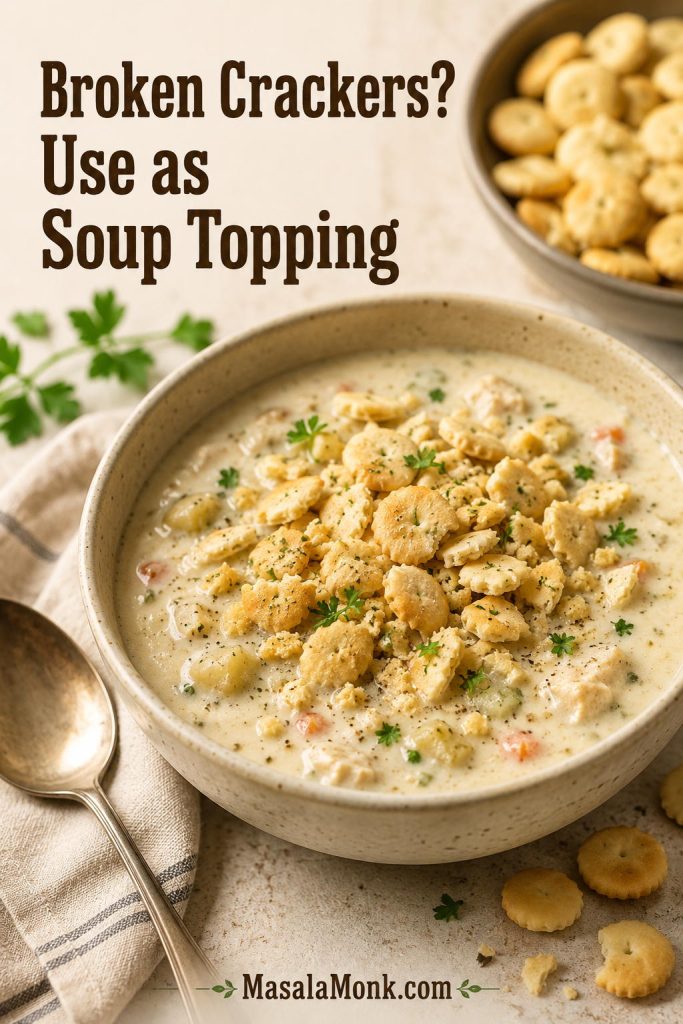
Use Broken Crackers as Soup Topping

The most reassuring part: even imperfect batches rarely go to waste. If the flavor is good, the broken, softer, or extra-seasoned crackers can still become excellent soup toppers.

Broken ranch oyster crackers sprinkled over creamy soup with whole crackers and a spoon nearby.
Broken pieces still bring crunch and ranch flavor, so save them for soup instead of reserving only the perfect whole crackers.

Ranch Oyster Crackers Recipe

These baked ranch oyster crackers make about 5½–6 cups of crisp, savory snack crackers for soup, parties, road trips, and make-ahead appetizer bowls.

Saveable recipe card with ranch oyster crackers, oil, dry ranch seasoning, garlic powder, dill, and bake time.
Use this base formula as your starting point, then adjust future batches with more dill, butter, heat, Parmesan, or a ranch-free spice blend.
Prep Time5 minutes
Cook Time18–22 minutes
Total Time25–30 minutes
YieldAbout 5½–6 cups / 8–10 snack servings

Equipment: Large bowl or gallon zip-top bag, small bowl or measuring cup, rimmed baking sheet, parchment paper, and a spatula.

Ingredients

  • 12 oz / 340 g oyster crackers, about 5½–6 cups depending on brand
  • ⅓ cup / 80 ml neutral oil, such as canola, vegetable, or avocado oil
  • 2½ tablespoons dry ranch seasoning for balanced flavor, or up to 3 tablespoons for a bolder batch
  • 1 teaspoon dried dill
  • ½ teaspoon garlic powder
  • ½–1 teaspoon lemon pepper
  • ½ teaspoon onion powder, optional
  • ¼ teaspoon smoked paprika or cayenne, optional

Instructions

  1. Heat the oven to 250°F / 120°C. Line a rimmed baking sheet with parchment if you want easier cleanup.
  2. In a small bowl or measuring cup, whisk together the oil, ranch seasoning, dried dill, garlic powder, lemon pepper, and any optional onion powder, smoked paprika, or cayenne.
  3. Add the oyster crackers to a large mixing bowl or gallon zip-top bag. Pour the seasoning oil over the crackers.
  4. Toss gently until the crackers are evenly coated.
  5. Spread the crackers in a single layer on the prepared baking sheet.
  6. Bake for 18–22 minutes, stirring after about 10 minutes, until the crackers smell toasted and look dry rather than glossy.
  7. Let the crackers cool on the pan before serving or storing.

Notes

  • For a 9 oz / 255 g bag, use 2 tablespoons ranch seasoning for mild flavor or 2½–3 tablespoons for bold flavor. Use ¼ cup oil for a lighter coating, or ⅓ cup oil / 5 tablespoons melted butter for a richer snack.
  • For a 16 oz / 454 g bag, use ½ cup oil and about 3 tablespoons ranch seasoning, or most/all of a standard 1 oz / 28 g packet adjusted for saltiness.
  • For a butter version, use up to ½ cup / 113 g melted unsalted butter instead of oil.
  • Dry ranch mix gives the crispest coating; bottled dressing softens the crackers.
  • If the crackers need more flavor, dust them while warm on the tray.

Ranch Oyster Crackers FAQs

Can I use bottled ranch dressing instead of dry ranch mix?

Skip bottled ranch for this recipe. Dry ranch mix gives you the ranch flavor without adding the moisture that makes crackers soften.

How much ranch seasoning is in one packet?

Many packets are about 1 oz / 28 g, but the tablespoon amount can vary. For a 12 oz bag, 2½ tablespoons is balanced and 3 tablespoons gives a bolder snack-bowl flavor.

Can I use ranch dip mix instead of ranch dressing mix?

Yes, with a light hand. Dip mix can taste saltier or stronger, so start with a little less and add more after baking if the crackers need it.

Do I have to use a specific brand?

No. Store-brand ranch seasoning, shaker seasoning, classic packets, or homemade dry ranch-style seasoning can all work. The salt level matters more than the label.

Do they have to be baked?

Not always. Baking gives the snappiest batch, but the no-bake method works when you have time to let the crackers sit for a few hours.

Can I skip the dill?

Yes. Dill gives the old-school ranch-snack flavor, but parsley, chives, onion powder, or extra lemon pepper can take its place.

Is butter better than oil?

Choose butter for richer flavor and oil for a lighter crunch. For make-ahead batches, oil is the safer default because it stays cleaner and less heavy.

Why are mine greasy?

They can usually be rescued. Spread them out and bake at 250°F / 120°C for another 5–8 minutes so the coating has time to settle.

How long do they stay fresh?

They are best in the first several days. If baked dry, cooled fully, and stored airtight, they usually keep about a week.

Can I make them in the air fryer?

Yes. Cook a small batch at 300°F / 150°C for 5 minutes, shake, then cook another 2–5 minutes. Give the crackers room in the basket so they toast evenly.

Can I turn them into snack mix?

Absolutely. Once the crackers are baked and cool, fold them into pretzels, Chex-style cereal, cheese crackers, roasted nuts, or mini saltines.

Can I use another cracker?

Yes — just watch the timing. Mini saltines, small pretzels, Chex-style cereal, cheese crackers, and Goldfish-style crackers can all brown or dry at different speeds.

Are oyster crackers made with oysters?

Usually, no. They are small soup crackers traditionally served with oyster stew and chowder. Always check the package if you have allergy concerns.

Can I make them ahead?

Yes. Make them a day or two ahead, cool them fully, and store airtight at room temperature. Re-crisp at 250°F / 120°C for 5–8 minutes if needed.

Final Bite

Once the ratio makes sense, this becomes one of those repeat snacks you barely need to think about. It can sit beside soup on a quiet night, fill the extra bowl on an appetizer table, travel in a road-trip bag, or turn into a holiday jar without much work.

Make them once as written, then adjust the next batch to fit your table: extra dill for the old-school version, cayenne for the spicy bowl, Parmesan for a savory finish, or a no-ranch blend when you want something more homemade. However you season them, the job is the same: give soup a little crunch, give the snack table one more reason to linger, and make sure the bowl empties before anyone quite notices.

Final serving bowl of ranch oyster crackers with a wooden scoop, creamy soup, butter, herbs, and soft green linen.
Serve the finished bowl near something creamy or soft, and the tiny crackers bring the salty crunch that makes the table feel complete.

Back to top

Posted on Leave a comment

Spinach Artichoke Dip Recipe

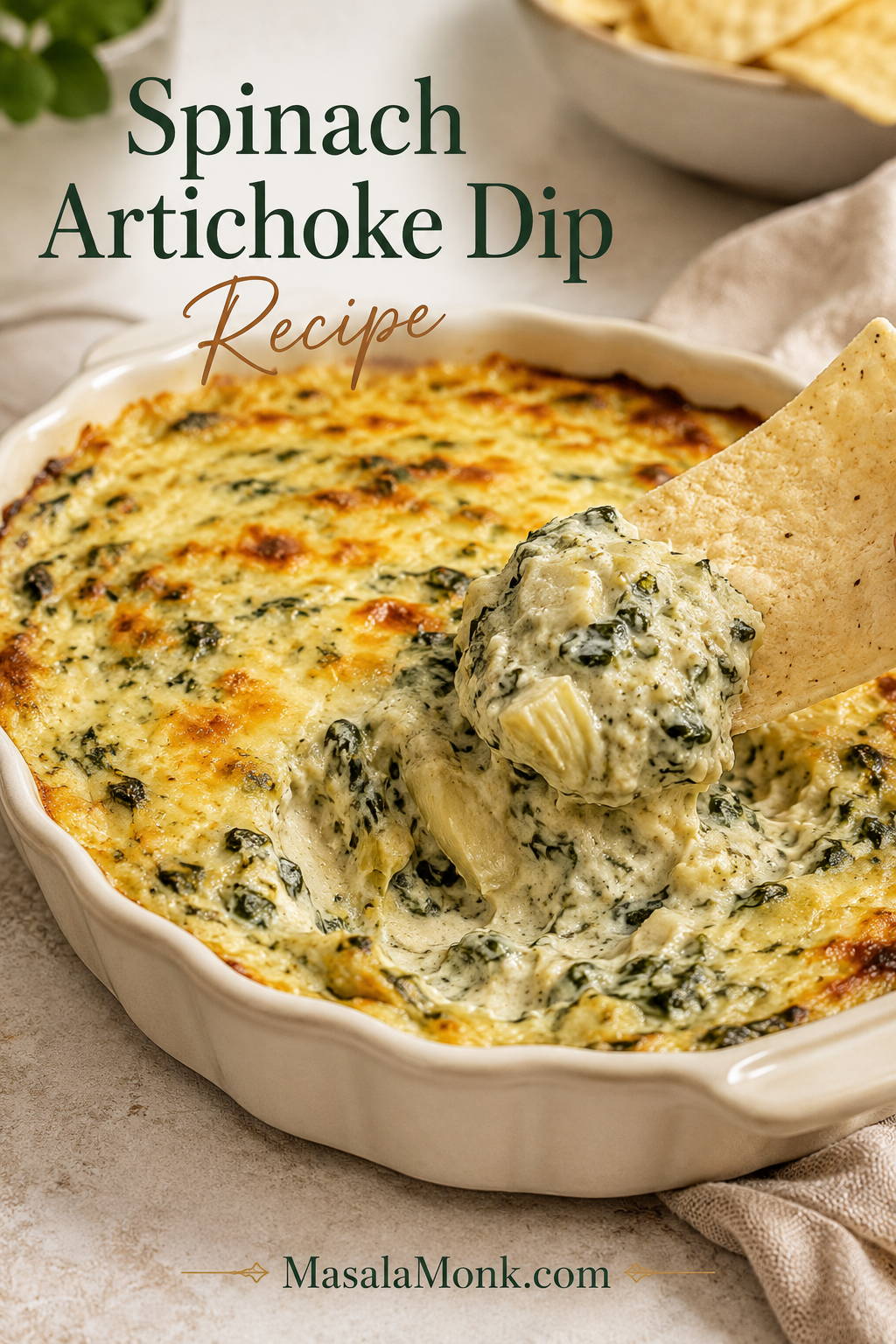
Baked spinach artichoke dip in a cream ceramic dish with a tortilla chip lifting a thick scoop of cheese, spinach, and artichokes.

A good spinach artichoke dip recipe has a very specific kind of magic: the edges are bubbling, the top is lightly golden, and the first scoop pulls up creamy cheese, tender spinach, and little bites of artichoke without leaving a watery puddle behind. It is the kind of hot, cheesy appetizer people hover around at a party, pretending they are only taking one more chip.

The challenge is getting all that richness to behave. Spinach and artichokes bring moisture, the cheese needs gentle heat, and the creamy base needs enough structure to stay smooth. This version keeps the classic party-dip comfort, but it uses spinach pressed free of hidden water, well-drained artichokes, a stable cream cheese base, and a controlled bake so the dip stays plush, spoonable, and full of flavor.

What you get is a warm baked spinach artichoke dip that is rich but balanced, sturdy enough for chips, and easy enough to make ahead for game day, holidays, potlucks, movie nights, or any table where a bubbling dish of dip disappears faster than expected.

This guide focuses on the details that usually make or break the bowl: how dry the spinach should be, which artichokes work best, which cheeses melt smoothly, when to stop baking, and how to keep the dip warm without turning it oily.

Spinach Artichoke Dip Texture Goal

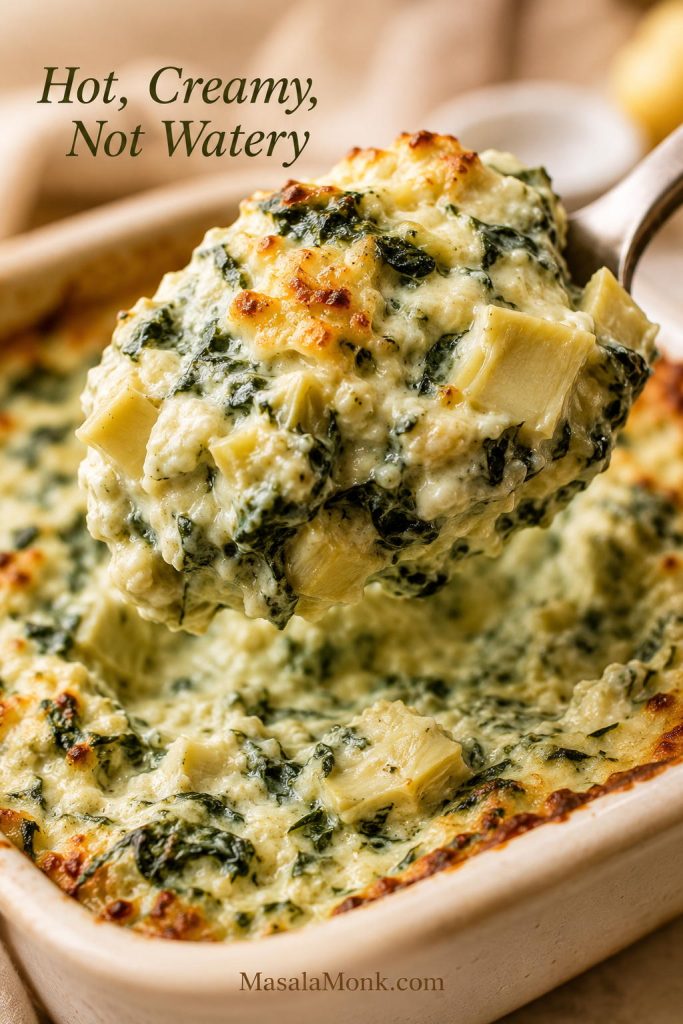
Before the recipe details, look for the first success cue: a thick scoop with visible vegetables and no watery puddle.

Close-up of hot spinach artichoke dip being scooped from a baked dish with creamy cheese, spinach, artichokes, and a golden edge.
This close-up shows the texture you are aiming for: soft-set, rich, and full of visible vegetables, but still thick enough to hold together.

Spinach Artichoke Dip Guide

Use this guide to make a classic hot spinach artichoke dip, choose the right ingredients, adjust the pan and bake time, and keep the texture smooth, rich, and chip-friendly.

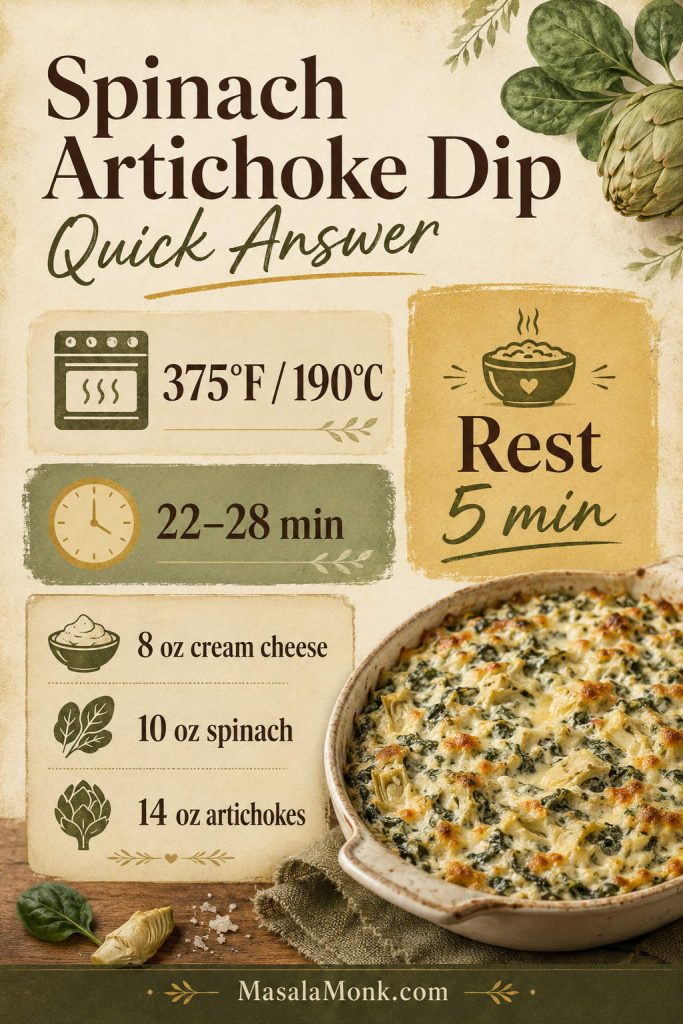
Quick Answer: Best Ratio, Bake Time, and Texture Cue

For this spinach artichoke dip recipe, use 8 oz cream cheese, ½ cup sour cream, ⅓ cup mayonnaise, 10 oz frozen spinach, one 14 oz can artichoke hearts, Parmesan, and mozzarella or Monterey Jack. Bake it at 375°F / 190°C for 22–28 minutes in a 1½- to 2-quart baking dish or an 8×8-inch dish, until the edges bubble and the top is lightly golden.

After baking, rest the dip for 5 minutes before serving. That short pause matters because the cheese and cream base settle into a thicker, chip-friendly texture instead of running the moment a chip hits the dish.

Detail Use This
Oven temperature 375°F / 190°C
Bake time 22–28 minutes
Dish 1½- to 2-quart glass or ceramic dish, or 8×8-inch dish
Servings 8–10 appetizer servings
Spinach 10 oz / 280 g frozen spinach, thawed and squeezed very dry
Artichokes 14 oz / 390–400 g canned artichoke hearts, drained and patted dry
Texture cue Bubbling edges, creamy center, lightly golden top
Rest time 5 minutes before serving

Spinach Artichoke Dip Ratio at a Glance

Keep these core numbers in mind before you mix: dairy base, vegetables, oven temperature, bake time, and rest cue.

Quick answer board for spinach artichoke dip showing 375°F, 22 to 28 minutes, cream cheese, spinach, artichokes, and rest time.
Use the ratio as your starting point, but judge the finish by the dish: bubbling edges, a hot center, and a short rest create the best texture.
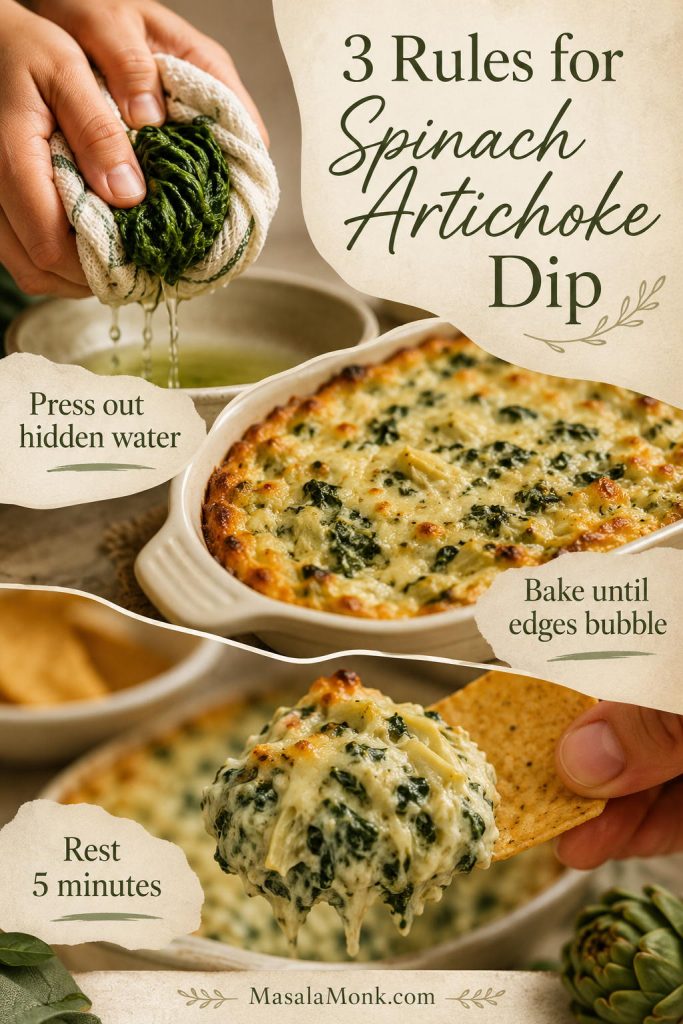
Three rules: press the vegetables free of hidden water, bake until the edges bubble, then rest the dip for 5 minutes. The finished dip should look smooth in the center and scoop without leaking liquid into the dish.

Three Rules for a Dip That Holds Together

These three habits are the safety net. Once they make sense, the full step-by-step method shows exactly when to mix, fold, bake, and rest the dip.

Three-rule guide showing spinach being pressed dry, bubbling dip edges, and a rested scoop on a chip.
This is the easiest way to remember the recipe: dry the vegetables well, stop baking once the edges bubble, and give the dip a few minutes to settle.

Why This Spinach Artichoke Dip Works

The creamy texture comes down to balance. Spinach and artichokes bring moisture, the dairy brings richness, and the cheese gives the dip body. When those parts work together, you get a warm, scoopable appetizer instead of a dip that turns loose, oily, or heavy.

That is why this spinach artichoke dip recipe uses a cream cheese base, a moderate oven temperature, and vegetables that are dried before they meet the cheese.

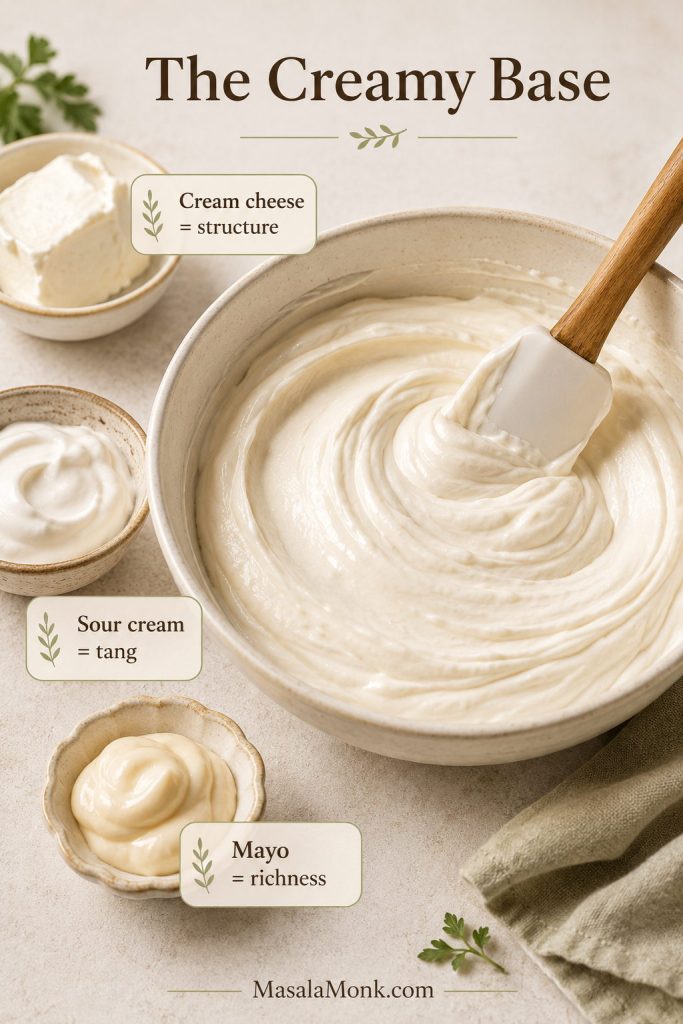
The Creamy Base Has Structure

Cream cheese gives the dip structure and helps hold the base together. Sour cream adds tang, so the richness does not feel flat. A smaller amount of mayonnaise gives the classic party-dip flavor without making the whole dish taste oily or heavy.

That smaller mayo amount is intentional. You still get the familiar richness, but the dip stays closer to a soft, velvety baked appetizer than a heavy mayo-based spread.

How the Base Holds Together

The base is not just richness; it is the part that holds the vegetables and cheese together.

Cream cheese, sour cream, and mayonnaise being mixed into a smooth base with callouts for structure, tang, and richness.
The base works because every dairy ingredient has a job: cream cheese holds the dip together, sour cream brightens it, and mayo adds classic party-dip richness.

The Vegetables Are Dried First

Frozen spinach is reliable because you can thaw it and press out a surprising amount of hidden water before it ever touches the baking dish. Artichoke hearts need the same attention: drain them well, pat them dry, and chop them into bite-size pieces so every scoop has a little artichoke without making the dip wet.

That is the difference between a dip that looks good for five minutes and one that still scoops cleanly after people have been grazing for a while.

The Cheese Melts Gently

Parmesan gives salty, savory depth, while mozzarella or Monterey Jack gives the soft melt. A moderate 375°F / 190°C bake is hot enough to warm the center and brown the top, but not so harsh that the dairy breaks before the dip is ready.

Why this version stays creamy: cream cheese gives the base structure, a smaller amount of mayo keeps it rich without tasting heavy, a full 10 oz package of spinach gives real flavor, and a moderate 375°F bake lets the cheese melt gently.

The main idea is simple: remove water before the dip goes into the oven, then bake just until the cheese melts and the edges bubble. That one-two combination keeps the dip smooth, rich, and chip-friendly.

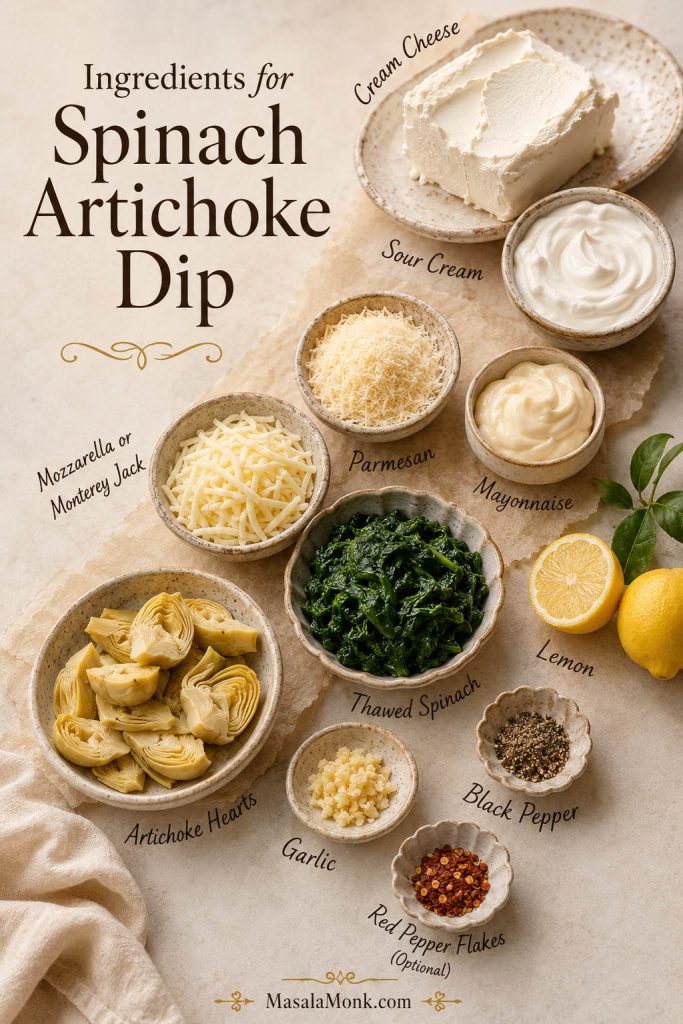
Ingredients for Creamy Spinach Artichoke Dip

The ingredients are familiar, but the details matter. Use softened cream cheese, fully drained spinach, dry artichokes, and a cheese combination that melts well instead of turning grainy.

Ingredients Before You Mix

Before mixing, it helps to have the base, vegetables, cheese, and seasonings ready at the same time.

Ingredient guide with cream cheese, sour cream, mayonnaise, cheeses, spinach, artichokes, garlic, lemon, pepper, and red pepper flakes.
The ingredient list is simple, but the balance matters; once the dairy, cheese, spinach, and artichokes are in the right ratio, the dip tastes generous without feeling heavy.

Cream Cheese

Use one 8 oz / 226 g block of full-fat cream cheese, softened to room temperature. Block cream cheese gives the dip the best structure. If it is too cold, it will be harder to mix and may leave small lumps in the base.

Sour Cream and Mayonnaise

Sour cream gives the dip a gentle tang and a looser, spoonable texture. A smaller amount of mayonnaise adds richness and helps the dip feel classic without taking over. If you dislike mayo, you can use more sour cream or Greek yogurt instead; just know that the flavor will be tangier and slightly less rich.

Parmesan and Mozzarella or Monterey Jack

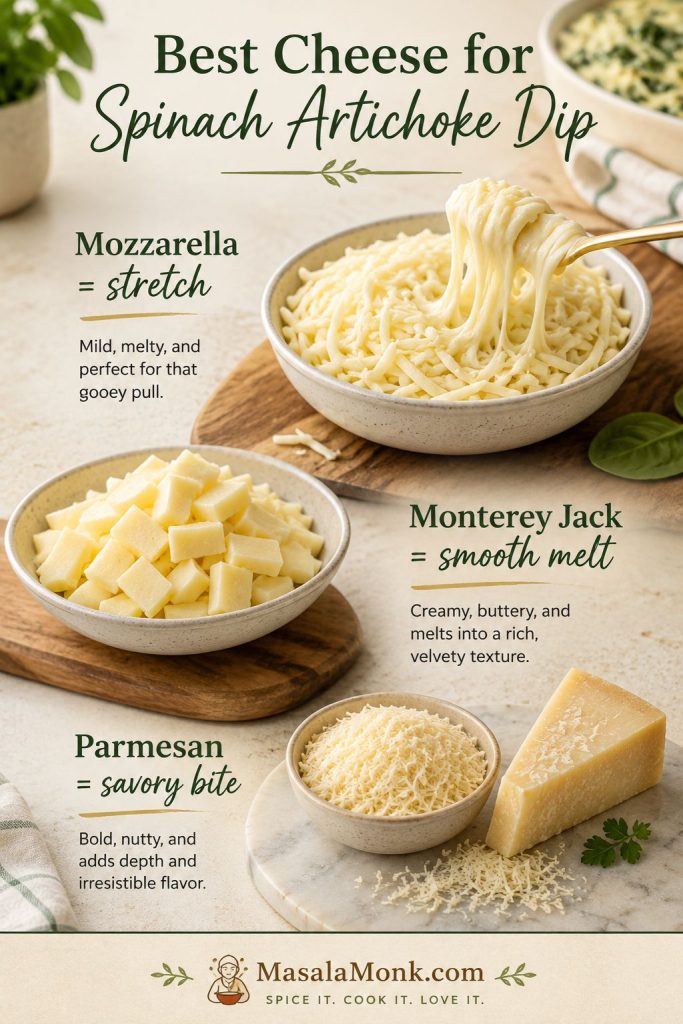
Parmesan gives the dip savory, salty flavor. Mozzarella gives the classic stretchy melt. Monterey Jack is a little creamier and smoother if you want a softer restaurant-style texture. You can use all mozzarella, all Monterey Jack, or a mix of the two.

Choose mozzarella if you want more stretch, or Monterey Jack if you want a softer, smoother scoop. For the most balanced version, use one of those for melt and Parmesan for flavor.

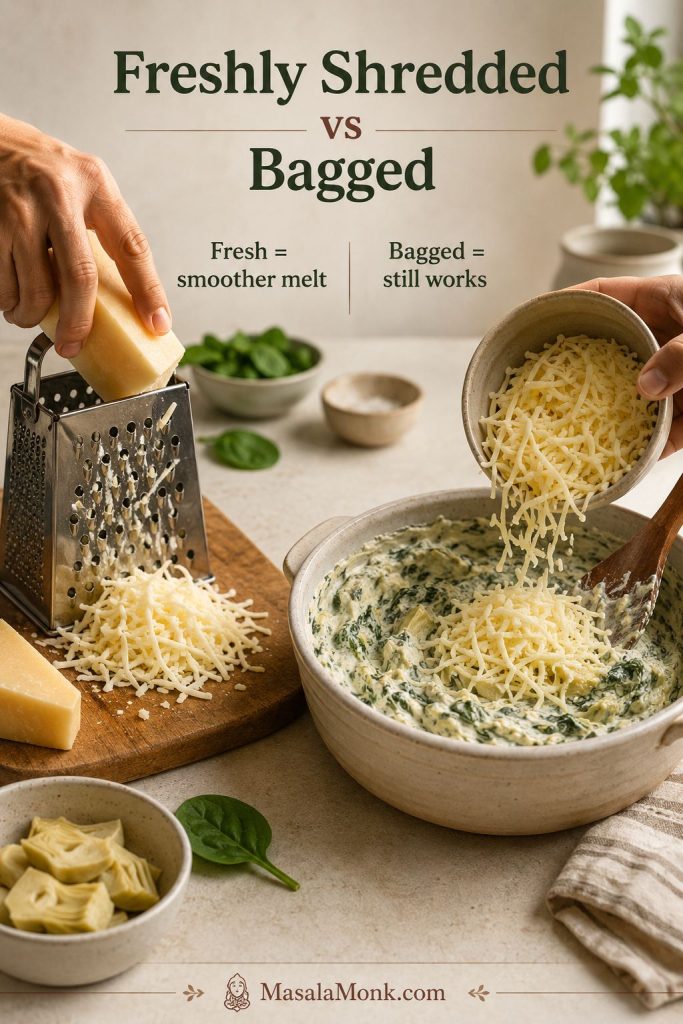
Freshly shredded cheese melts a little smoother, but bagged mozzarella or Monterey Jack still works here because the cream cheese base helps keep the dip soft.

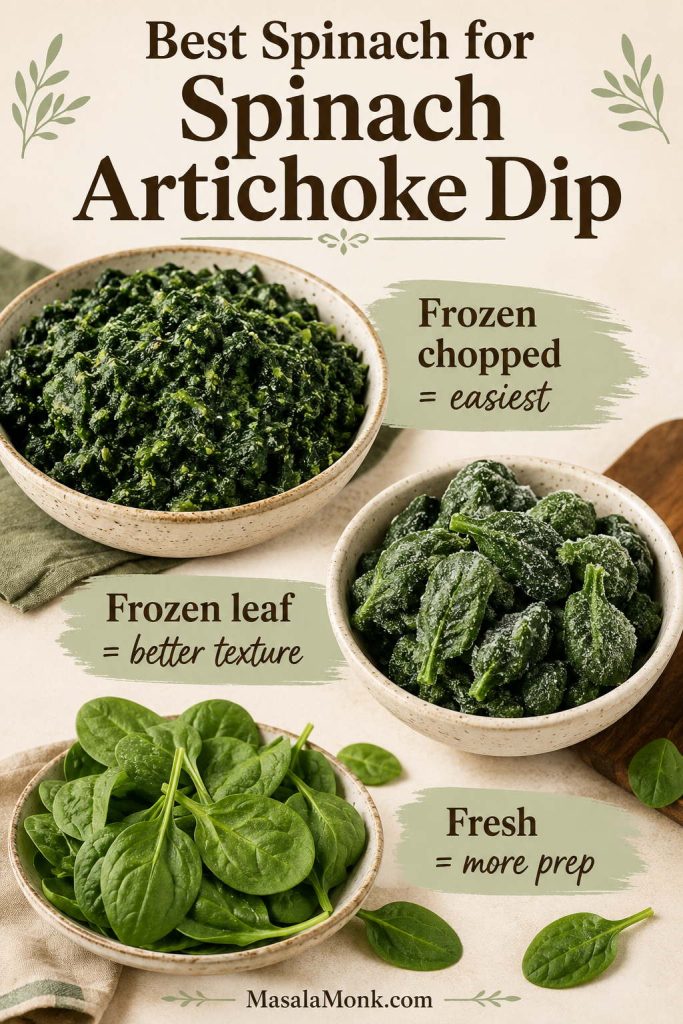
Spinach

Frozen spinach is the easiest route here because the big shrinking-down step has already happened; your main job is getting rid of the hidden water. Thaw it completely, then squeeze it until it feels like a compact damp ball instead of wet leaves. If you use fresh spinach, cook it down first, cool it, chop it, and squeeze out the extra liquid.

Artichoke Hearts

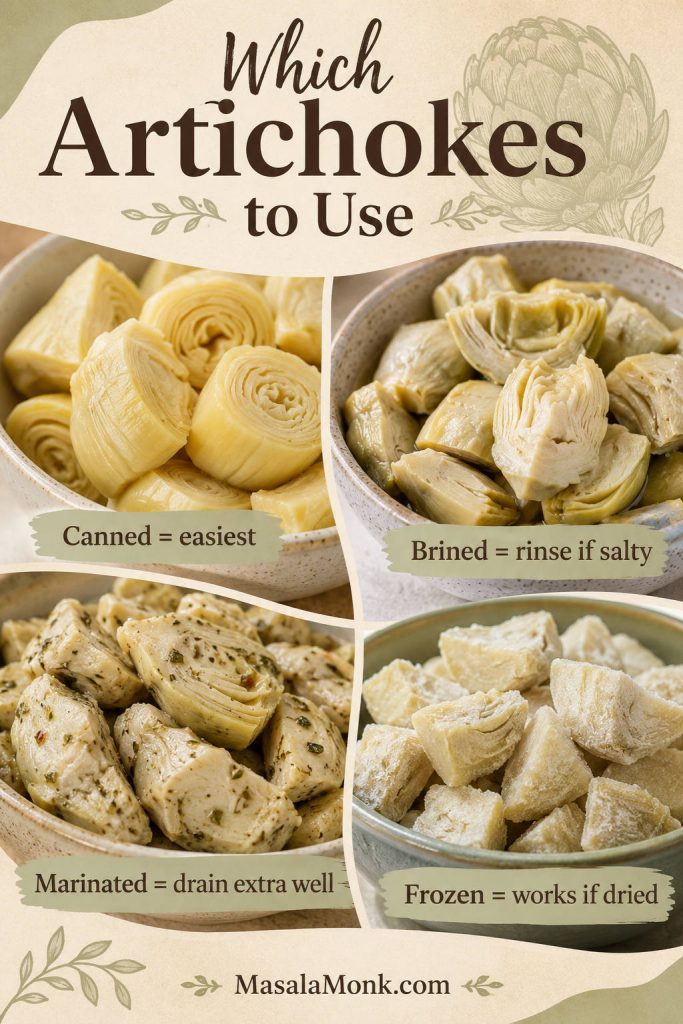
Canned artichoke hearts in water or brine are the easiest default. Drain them well, pat them dry, and chop them into bite-size pieces. Marinated artichokes work too, but they add more oil, salt, and tang, so drain them very thoroughly and taste before adding extra salt.

Quartered artichoke hearts are easiest because they are already close to scoopable size. Whole hearts work too, but chop them smaller so they do not release big pockets of liquid into the dip.

If the jar smells boldly herby or vinegary, assume that flavor will show up in the finished dip.

Garlic, Lemon, Pepper, and Optional Heat

Garlic gives the dip its savory backbone. Lemon zest or a little lemon juice cuts through the richness without making the dip taste lemony. Black pepper adds warmth, and a pinch of red pepper flakes or a few dashes of hot sauce can wake up the whole dish.

Fresh vs Frozen Spinach for Spinach Artichoke Dip

Fresh spinach and frozen spinach both work, but they do not behave the same way. Frozen spinach is easier for most home cooks because it has already been cooked down. Once thawed, you can squeeze out the water and add it straight to the creamy base.

Fresh spinach has a cleaner flavor, but it takes more prep. Once it cooks down, the leaves still need to be cooled and squeezed; otherwise, the dip can turn loose instead of thick and scoopable.

Best Spinach Choice for the Dip

The best spinach is the one you can prep and dry thoroughly, even if frozen spinach is the easiest route.

Comparison of frozen chopped spinach, frozen leaf spinach, and fresh spinach for making spinach artichoke dip.
Frozen spinach saves prep time because it is already cooked down, but it still needs one important step: press out the water before it reaches the cheese base.
Spinach Type Amount How to Use It
Frozen chopped spinach 10 oz / 280 g Thaw completely and squeeze very dry.
Frozen cut-leaf spinach 10 oz / 280 g Use if available for a slightly better leafy texture. Thaw and squeeze dry.
Fresh baby spinach About 1 lb / 450 g Cook down first, cool, chop, and squeeze dry.
Frozen creamed spinach Shortcut only Changes the dairy, salt, and texture. Reduce other creamy ingredients if using it.
Most important rule: the success of this dip depends less on fresh vs frozen spinach and more on how dry the spinach is before it goes into the bowl.

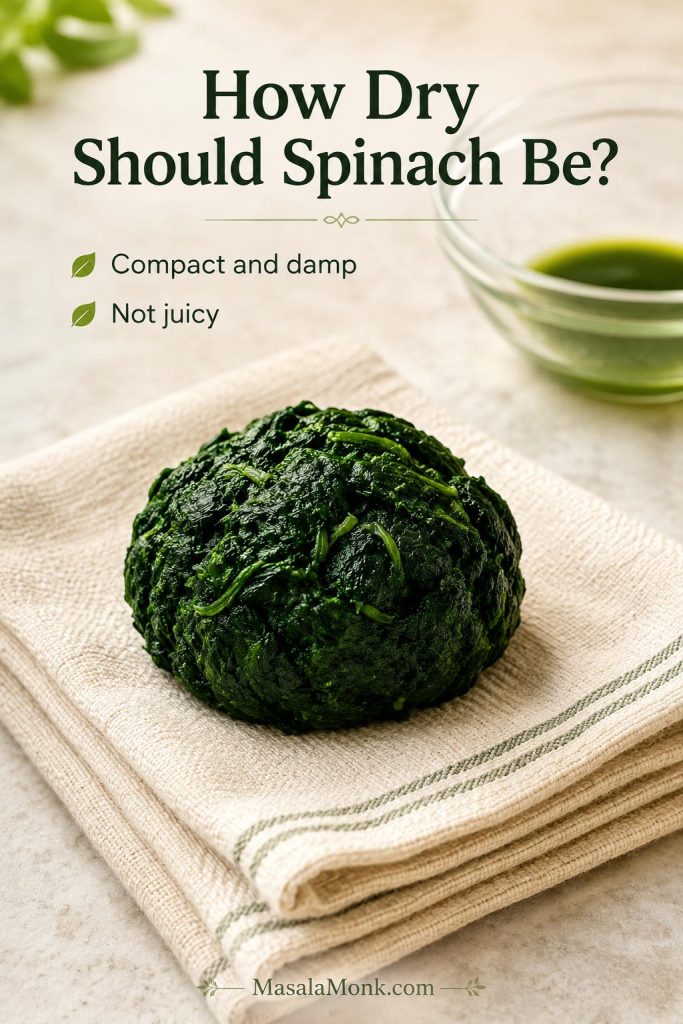
After squeezing, the spinach should feel compact and damp, not juicy. If you press it and liquid still runs out, keep going. Once the spinach is ready, it should break apart easily when you stir it into the base instead of leaving green liquid behind in the bowl.

How Dry the Spinach Should Look

The table explains the options; this cue shows the texture you want before the spinach enters the cheese base. If your dip has turned loose before, the troubleshooting section explains how to fix watery dip and prevent it next time.

Compact squeezed spinach clump on a kitchen towel showing how dry spinach should be before adding it to dip.
This is the spinach texture to aim for: compact and damp, not juicy. If liquid still runs out when you press it, keep going.

Canned vs Marinated Artichokes

For classic spinach artichoke dip, canned artichoke hearts are the easiest choice. They are tender, mild, and easy to chop. The only catch is moisture. Drain them well, press away excess liquid with paper towels or a clean kitchen towel, and chop them into pieces small enough to scoop.

Marinated artichokes can taste great, but they bring oil, herbs, salt, and tang. Drain them extra well before they go into the creamy base, especially if you do not want the dip to taste sharp or oily.

Best Artichokes to Use

Before choosing a can or jar, remember that artichokes change both flavor and moisture.

Comparison of canned, brined, marinated, and frozen artichokes for spinach artichoke dip.
Artichokes affect both moisture and flavor. For the cleanest baked dip, choose mild canned or brined hearts and dry them well before mixing.
Artichoke Type Use It? What to Know
Canned in water Yes The easiest default. Drain well, pat dry, and chop.
Jarred in brine Yes Drain well. Rinse if they taste very salty.
Marinated in oil Yes, with care More flavor, more oil. Drain very thoroughly.
Frozen artichokes Yes, if available Thaw, drain, pat dry, then chop.
Fresh artichokes Not ideal here Too much prep for a creamy baked dip.

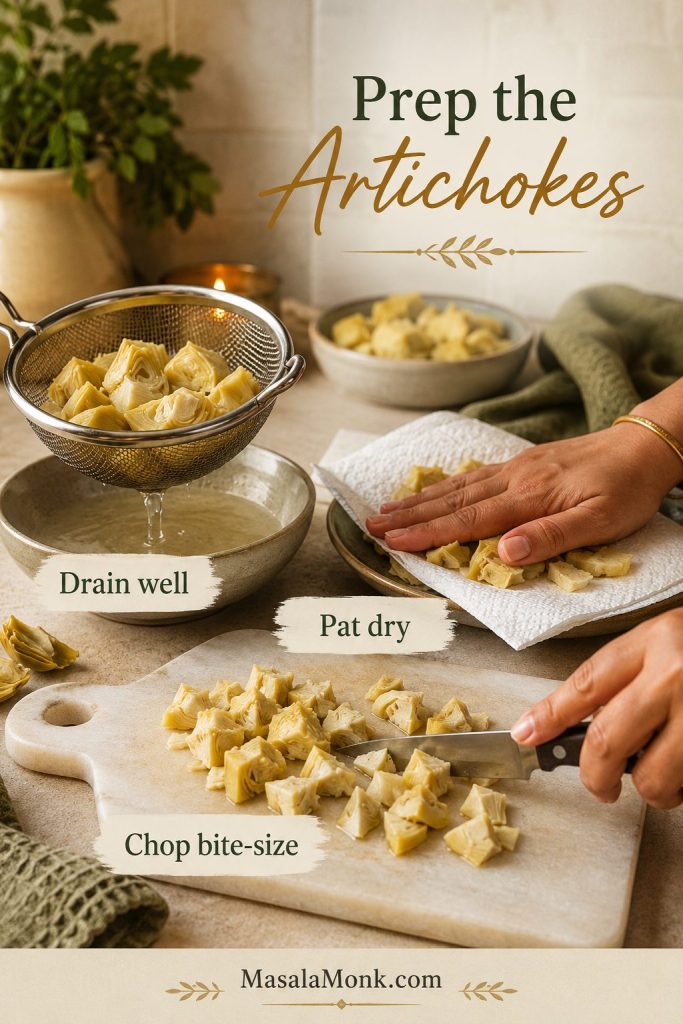
How to Prep Artichokes for Dip

Once you choose the artichokes, the prep is simple but important: drain, dry, and chop them small enough for clean scoops.

Artichoke hearts being drained, patted dry, and chopped into bite-size pieces on a cutting board.
Smaller, drier artichoke pieces mix more evenly into the cheese base, so every scoop gets flavor without hidden wet pockets.

Best Cheese for Spinach Artichoke Dip

The best cheese for spinach artichoke dip is usually a mix of one cheese for melt and one cheese for flavor. Mozzarella or Monterey Jack gives the creamy pull. Parmesan gives the savory bite.

The goal is not just stretch. You want a dip that feels melty and generous, but still has enough savory edge from Parmesan to keep each bite from tasting like plain cream.

A dramatic cheese pull is fun, but the better party dip is the one that stays smooth enough for the next person’s chip.

Best Cheese Blend for Spinach Artichoke Dip

Cheese choice helps, but bake control matters too; the bake-time guide shows when to stop before the dairy overheats.

Cheese guide showing mozzarella, Monterey Jack, and Parmesan for spinach artichoke dip.
The best cheese blend does two things at once: mozzarella or Monterey Jack gives melt, while Parmesan adds the savory bite that keeps the dip from tasting flat.

Classic Cheese Combination

Use mozzarella and Parmesan for the familiar creamy, cheesy party dip. Mozzarella melts softly, and Parmesan keeps the flavor from tasting flat.

Creamiest Cheese Combination

Use Monterey Jack and Parmesan if you want a smoother, less stretchy dip. Monterey Jack melts beautifully and works especially well if you are serving the dip from a slow cooker or keeping it warm for a party.

Sharper Restaurant-Style Option

Use white cheddar with Parmesan for a sharper flavor. Keep the amount moderate, because too much aged cheese can make the dip salty or slightly grainy.

Cheese to Use Carefully

Gruyère, Swiss, and aged cheddar can add great flavor, but they are best in smaller amounts. For the smoothest dip, do not make aged cheese the entire cheese base.

Freshly Shredded vs Bagged Cheese

This is a practical choice, not a dealbreaker. Fresh shreds melt smoother, but the cream cheese base keeps good bagged cheese workable.

Freshly shredded cheese and bagged shredded cheese compared for use in spinach artichoke dip.
Freshly shredded cheese melts a little smoother, but bagged mozzarella or Monterey Jack still works because the cream cheese base helps keep the dip soft.

How to Make Spinach Artichoke Dip

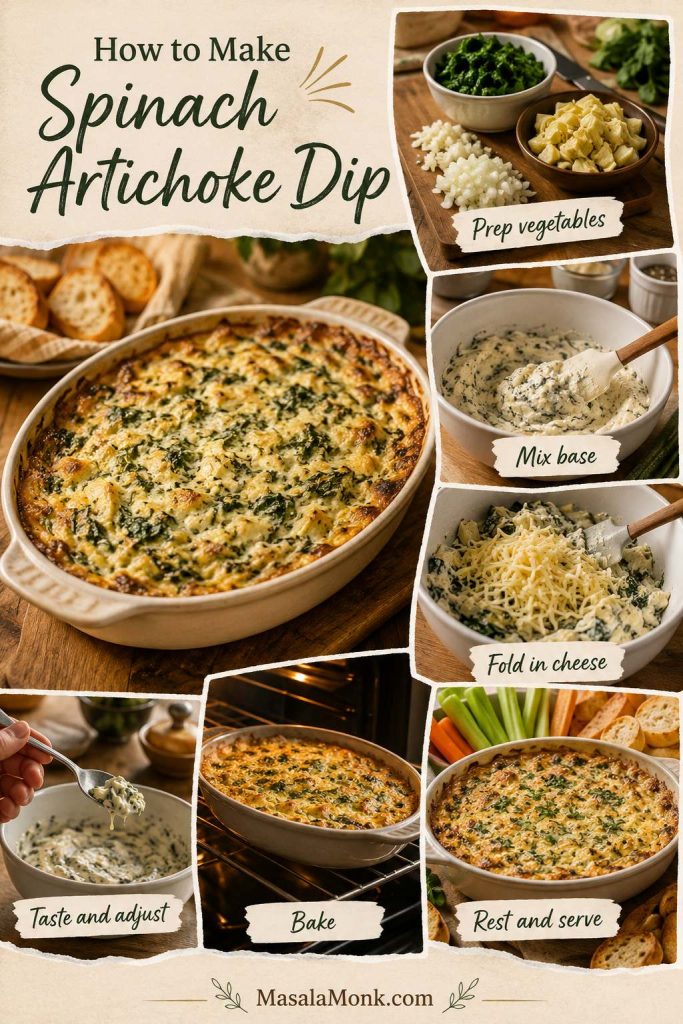
This is an easy spinach artichoke dip, but the order matters: dry the vegetables first, mix the base until smooth, fold gently, and bake just until the edges bubble.

Method at a Glance

Here is the whole workflow before the step-by-step details.

Step-by-step guide showing vegetable prep, base mixing, cheese folding, baking, and resting for spinach artichoke dip.
The method is simple, but the order matters: dry the vegetables first, smooth the base, fold gently, and bake only until the dip is hot and bubbling.

Step 1: Prep the Spinach and Artichokes

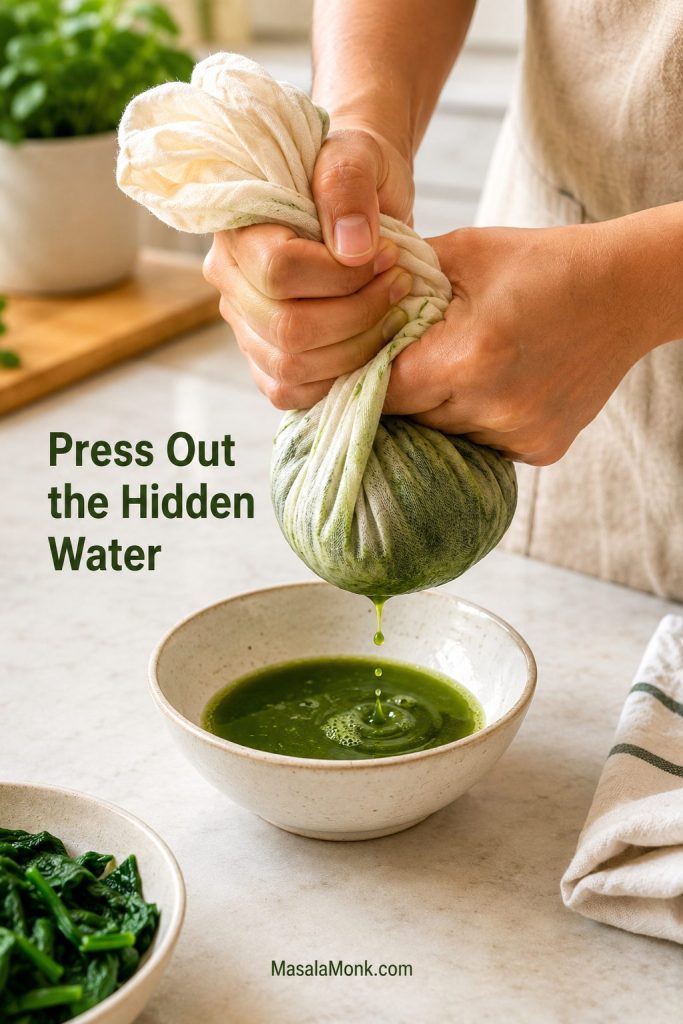
Thaw the frozen spinach completely. Wrap it in a clean kitchen towel, cheesecloth, or several layers of paper towel, then squeeze until no more liquid runs out. Drain the artichokes, pat them dry, and chop them into bite-size pieces.

How to Press Out Hidden Water

This is where the dip is won or lost: twist firmly, then keep pressing until the spinach stops giving off liquid.

Hands twisting thawed spinach in a clean kitchen towel over a bowl to remove green liquid.
Pressing out the hidden water is the most important prep step because wet spinach is one of the fastest ways to make the dip loose.

Step 2: Mix the Creamy Base

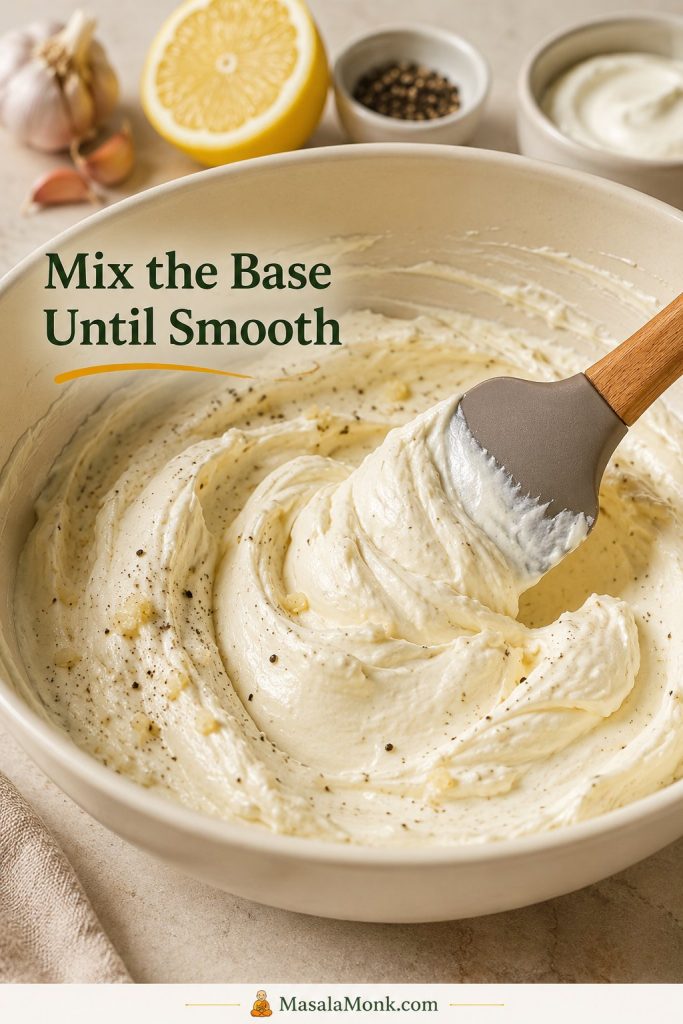
In a large bowl, mix softened cream cheese, sour cream, mayonnaise, garlic, lemon zest or juice, black pepper, and optional red pepper flakes or hot sauce. The base should look mostly smooth before you add the vegetables.

Mix the Base Before Adding Vegetables

A smooth base makes the vegetables easier to fold in evenly, especially when the cream cheese is fully softened.

Cream cheese, sour cream, mayonnaise, garlic, lemon, and pepper being mixed into a smooth base in a bowl.
Mix the base before adding spinach and artichokes; otherwise, cold cream cheese can leave lumps and make the vegetables harder to fold in evenly.

Step 3: Fold in Cheese, Spinach, and Artichokes

Fold in most of the Parmesan and mozzarella or Monterey Jack, saving some for the top. Add the squeezed spinach and chopped artichokes, then stir until evenly combined. Do not mash everything into a paste; little artichoke pieces are part of the charm.

Step 4: Taste and Adjust

Taste the mixture before baking and add salt only if needed, since Parmesan and artichokes can already be salty. This is also the moment to add a little more lemon, pepper, or hot sauce if the base tastes flat.

Step 5: Bake Until Bubbly

Spread the mixture into a greased 1½- to 2-quart glass or ceramic baking dish, or an 8×8-inch dish. Top with the reserved cheese. Bake at 375°F / 190°C for 22–28 minutes, until the edges bubble and the top is lightly golden.

Step 6: Rest Before Serving

Let the dip rest for 5 minutes before serving. It will still be hot, but the base will settle into a thicker, smoother scoop.

Spinach Artichoke Dip Recipe Card

This spinach artichoke dip recipe makes a hot baked dip with a velvety cheese base, tender spinach, bite-size artichokes, and enough structure to hold on sturdy chips, crackers, crostini, pita, or vegetables.

Prep Time15 minutes
Bake Time22–28 minutes
Rest Time5 minutes
Total TimeAbout 45 minutes
Servings8–10
YieldAbout 5 cups
Oven375°F / 190°C
Dish1½- to 2-quart or 8×8-inch

Ingredients

  • 8 oz / 226 g cream cheese, softened
  • ½ cup / 120 g sour cream
  • ⅓ cup / 75–80 g mayonnaise
  • ¾ cup / 65–75 g grated Parmesan, divided
  • 1½ cups / 150–170 g shredded mozzarella or Monterey Jack, divided
  • 10 oz / 280 g frozen spinach, thawed and squeezed very dry
  • 1 can / 14 oz / about 390–400 g artichoke hearts, drained, patted dry, and chopped
  • 2–3 garlic cloves, minced
  • 1 tsp lemon zest or 1 tbsp lemon juice
  • ¼ tsp black pepper
  • ¼ tsp red pepper flakes or a few dashes of hot sauce, optional
  • Salt, only after tasting
  • Tortilla chips, pita chips, crostini, crackers, or vegetables, for serving

Instructions

  1. Heat the oven to 375°F / 190°C. Lightly grease a 1½- to 2-quart glass or ceramic baking dish, or an 8×8-inch baking dish.
  2. Thaw the spinach completely, then squeeze it very dry in a clean kitchen towel, cheesecloth, or several layers of paper towel.
  3. Drain the artichoke hearts, pat them dry, and chop them into bite-size pieces.
  4. In a large mixing bowl, stir together the softened cream cheese, sour cream, mayonnaise, garlic, lemon zest or juice, black pepper, and optional red pepper flakes or hot sauce until mostly smooth.
  5. Fold in ½ cup Parmesan and 1 cup mozzarella or Monterey Jack. Save the remaining cheese for topping.
  6. Fold in the squeezed spinach and chopped artichokes until evenly distributed.
  7. Taste the mixture before baking and add salt only if needed, since Parmesan and artichokes can already be salty.
  8. Spread the mixture into the prepared baking dish. Top with the remaining Parmesan and mozzarella or Monterey Jack.
  9. Bake for 22–28 minutes, until the dip bubbles at the edges and the top is lightly golden.
  10. For a more browned top, broil for 1–2 minutes at the end, watching closely.
  11. Rest for 5 minutes before serving warm with sturdy chips, crackers, crostini, pita, or vegetables.

Notes

  • Do not rush the spinach step. A few extra squeezes are the difference between a dip that holds together and one that leaks at the bottom.
  • If baking from the fridge, add 10–15 minutes depending on the depth of the dish.
  • If using fresh spinach, cook down about 1 lb / 450 g fresh spinach, cool it, chop it, and squeeze it dry before adding.
  • If the dip seems too thick after baking, stir in a spoonful of warm milk, sour cream, or softened cream cheese.
  • If the dip seems watery, the spinach or artichokes likely needed more draining. Bake uncovered a little longer and use the troubleshooting table below for next time.
  • For the smoothest texture, serve the dip warm after a 5-minute rest, not straight from the oven while it is still bubbling aggressively.

What the Finished Dip Should Look Like

When the dip is ready, the edges should be bubbling, the top should be lightly golden, and the center should look soft rather than dry. After a 5-minute rest, a chip or spoon should pull up a thick, creamy scoop with visible spinach and artichoke pieces.

Serve it while the top is still just-baked and lightly golden, but not so hot that the cheese runs. That is the sweet spot where the dip holds on a chip, the artichokes still taste bright, and the garlic-cheese aroma does half the work for you.

If the dip tastes a little flat after baking, add a tiny squeeze of lemon or a few dashes of hot sauce on top before serving. Warm dairy and cheese can mute seasoning slightly, so a small bright finish can make the whole dish taste more awake.

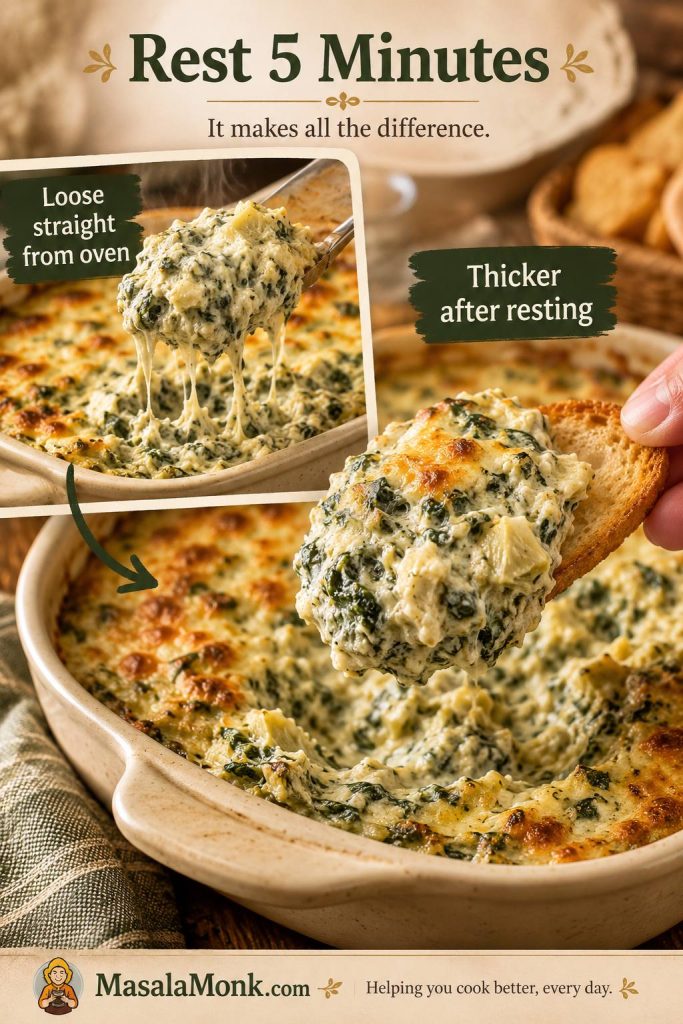
Why the 5-Minute Rest Matters

The finished dip should not be served at its most molten moment; a brief rest gives the first scoop a better chance to hold together.

Comparison of spinach artichoke dip straight from the oven and after resting for five minutes, with a thicker rested scoop.
Resting gives the cheese base time to settle, so the first chip pulls up a thick scoop instead of dragging loose dip back into the dish.

Bake Time by Pan Size

The right bake time for this spinach artichoke dip recipe depends on the depth of the dish. A shallow dish heats faster and browns sooner. A deeper dish takes longer for the center to become hot and creamy.

Time gets you close, but the visual cue matters more. If your oven runs hot or your dish is shallow, start checking early: the edges should bubble before the top gets deeply browned.

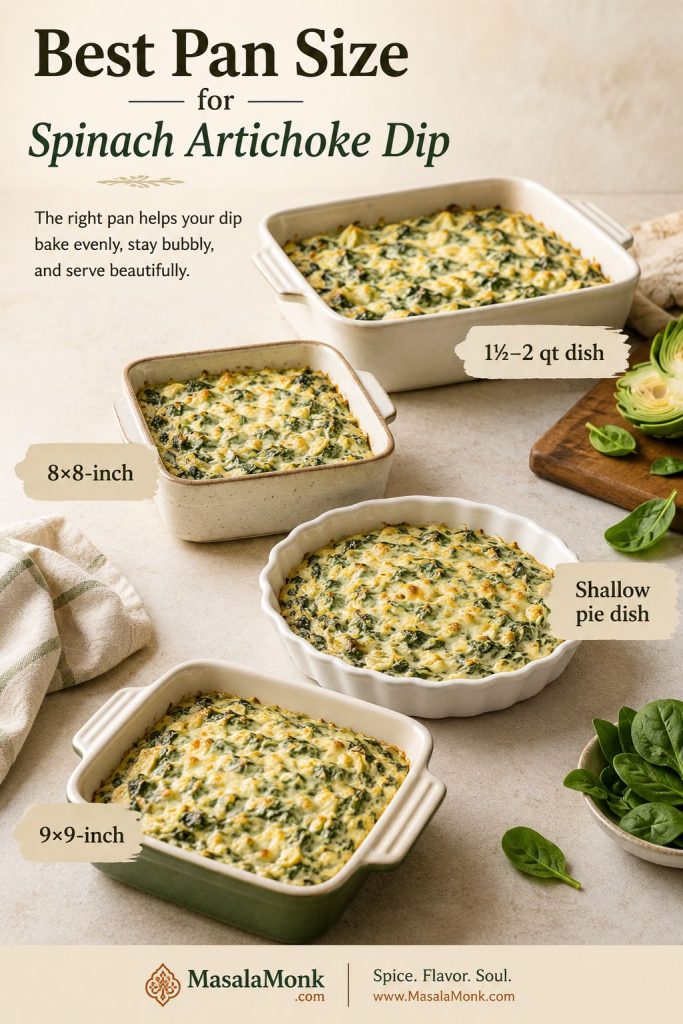
Best Pan Size for Baking

Choose the dish before you rely on the timer. Wider dishes brown faster, while deeper ones need more time in the center.

Pan size guide showing different baking dishes, including a 1½ to 2 quart dish, 8x8-inch dish, shallow pie dish, and 9x9-inch dish.
Pan depth changes bake time. A shallow dish browns faster, while a deeper dish needs more time for the center to become hot.
Dish or Setup Bake Time at 375°F / 190°C Texture Cue
1½- to 2-quart baking dish 22–28 minutes Bubbling edges, creamy center
8×8-inch dish 22–25 minutes Hot through, lightly golden top
Shallow pie dish 18–22 minutes Watch the top; it browns faster
9×9-inch dish 20–25 minutes Good for a slightly thinner layer
From the fridge Add 10–15 minutes Center should be hot, not just edges
Broiled top 1–2 minutes only Watch constantly so the cheese does not overheat

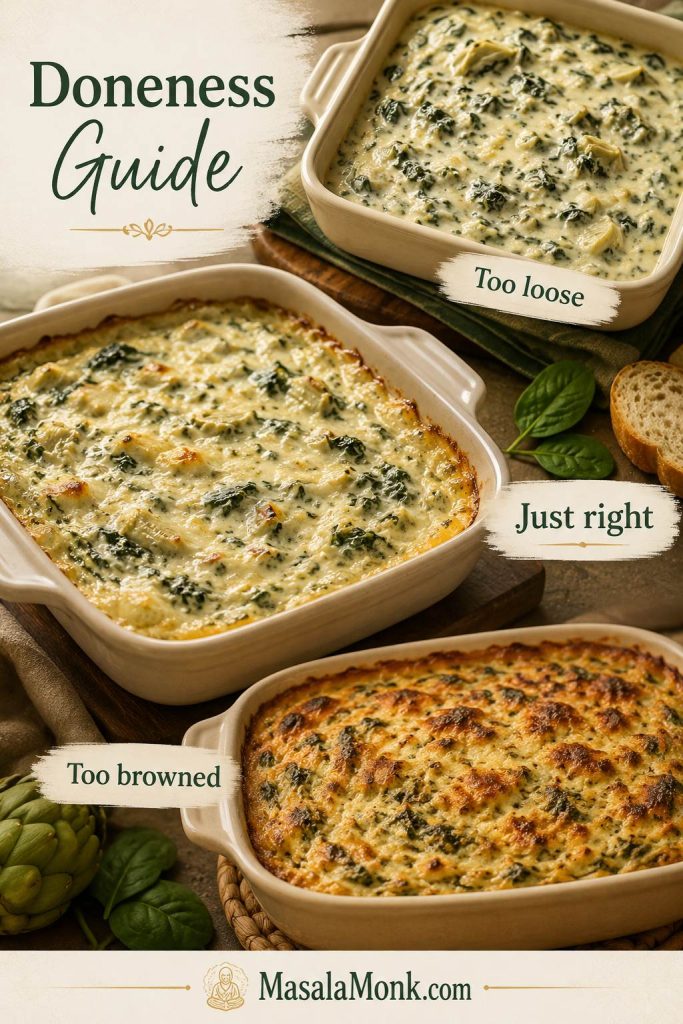
Doneness Cues Before You Pull the Dish

Pair the bake-time table with what you see in the dish: bubbling and lightly golden, not deeply browned.

Doneness guide showing spinach artichoke dip that is too loose, just right, and too browned.
Use time as a guide, then trust what you see: the dip should bubble at the edges and look lightly golden before it goes too far.

350°F vs 375°F vs 400°F

350°F is gentler and works well for deeper dishes, but the dip may take longer. 375°F is the best default because it heats the center and browns the top without rushing the dairy. A 400°F oven works for a faster bake in a shallow dish, but watch it closely so the top does not brown before the center is fully hot.

Make Ahead Spinach Artichoke Dip

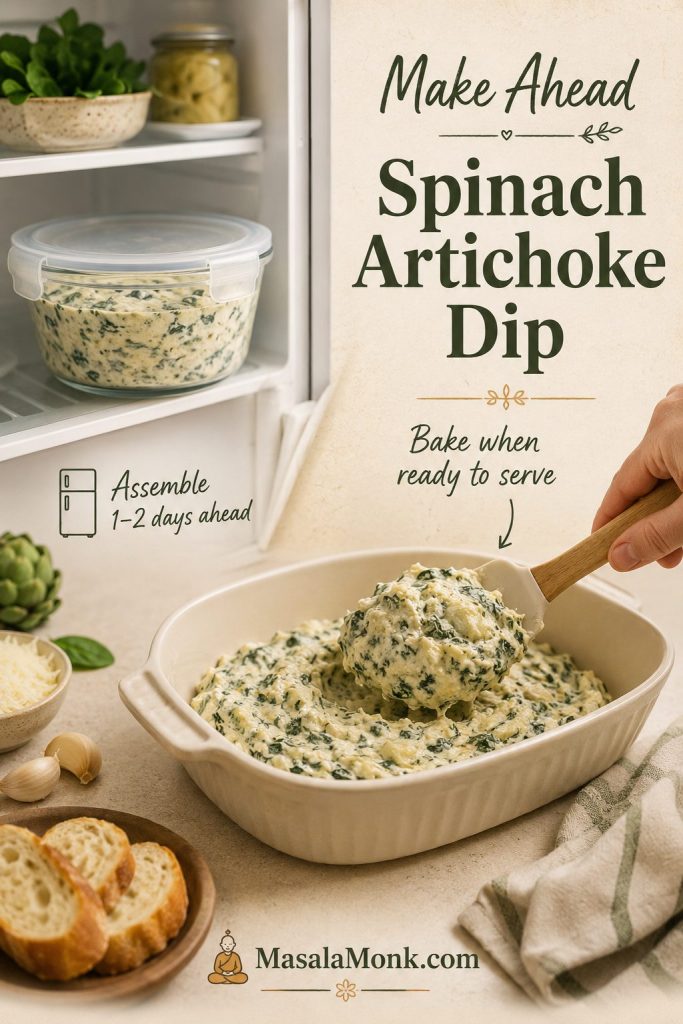
This spinach artichoke dip recipe is a great make-ahead appetizer because you can assemble it 1–2 days ahead, refrigerate it tightly covered, and bake it when you are ready to serve.

Make-Ahead Setup

The easiest party timing is simple: assemble ahead, keep it chilled, then bake close to serving time. If you are assembling in glass or ceramic, check the cold dish safety note before baking.

Make-ahead guide showing assembled spinach artichoke dip stored before being transferred to a baking dish.
For the smoothest make-ahead dip, handle the moisture first; once the spinach and artichokes are dry, the rest of the prep becomes easy.

How Far Ahead Can You Assemble It?

For the best texture, assemble the dip 1 day ahead. Two days is still fine, but the spinach and artichokes need to be very well drained so the dip does not loosen as it sits.

This is the kind of appetizer you want ready before people drift into the kitchen asking what smells good. Assemble it ahead, then bake it when the table is almost ready.

How to Bake It From the Fridge

If the dip is cold from the fridge, add 10–15 minutes to the bake time. The top may look ready before the center is hot, so check the middle before serving.

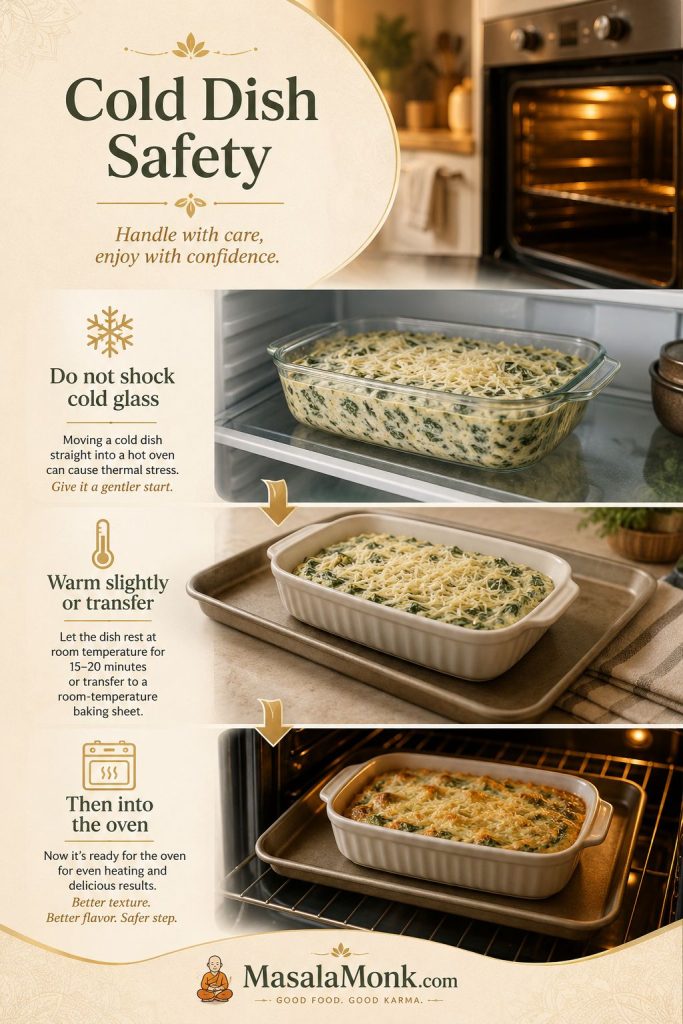
Cold Dish Safety Note

A cold glass or ceramic baking dish should not go straight from the refrigerator into a fully hot oven. Let the dish sit at room temperature briefly, place it on a room-temperature baking sheet, or transfer the dip to a room-temperature baking dish before baking. This helps protect the dish from thermal shock.

Cold Dish Safety Before Baking

This fridge-to-oven step protects the dish: let cold glass or ceramic warm slightly, or move the dip into a room-temperature baker.

Cold dish safety guide showing a refrigerated glass or ceramic dish, a baking sheet, and a transfer step before baking.
If the dip was refrigerated in glass or ceramic, avoid shocking the dish with sudden heat; instead, let it warm slightly or transfer the dip before baking.
Best party prep: mix the dip in an airtight container, refrigerate it, then transfer it to the baking dish before baking. That gives you more flexibility and avoids putting an ice-cold glass dish into a hot oven.

Storage and Reheating

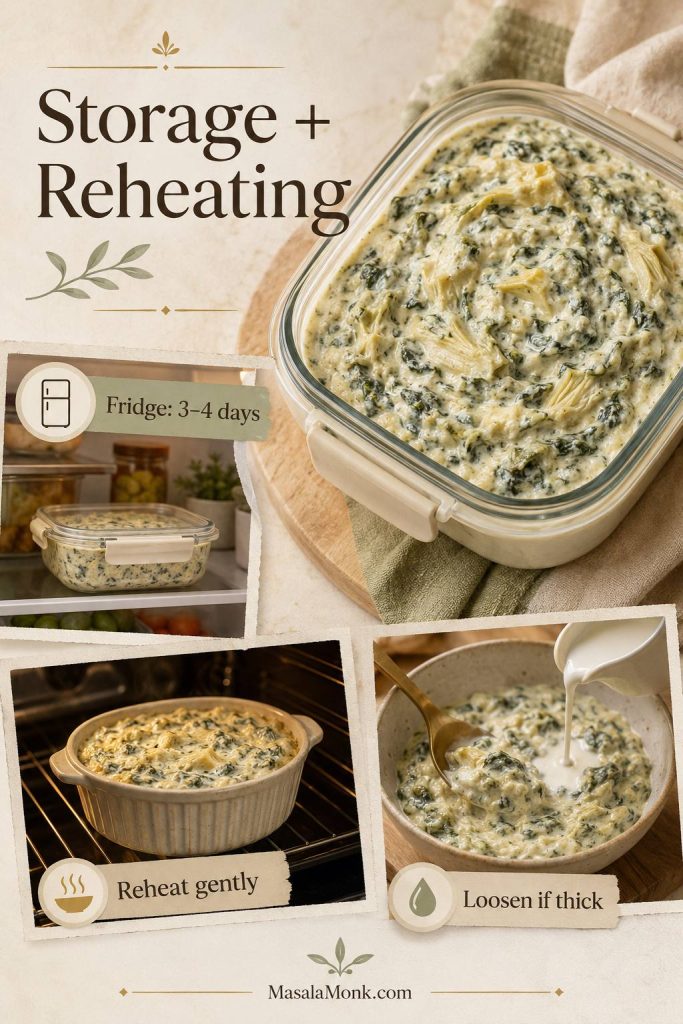
Store leftover spinach artichoke dip in an airtight container in the refrigerator for 3–4 days. Refrigerate leftovers within 2 hours of serving, especially because this is a dairy-heavy dip.

Party safety tip: if the dip has been sitting out for more than 2 hours, especially in a warm room, do not keep returning it to the fridge and reheating it. For longer parties, keep a smaller amount out and refill with a clean spoon, or keep the dip warm in a slow cooker once it is fully heated.

To reheat a larger portion, cover loosely and warm in a 325–350°F oven until hot. For a small portion, microwave in short bursts, stirring between each burst. If the dip has thickened in the fridge, stir in a spoonful of milk, sour cream, or cream cheese to bring back the creamy texture.

How to Store and Reheat Leftovers

Leftovers need gentle heat, not aggressive reheating. If you need to store the dip longer than a few days, the freezing section explains the texture tradeoff.

Storage and reheating guide showing leftover spinach artichoke dip in a container, oven reheating, and dairy being stirred in to loosen the dip.
Leftover dip thickens as it chills, so reheat it gently and stir in a little dairy if it needs help becoming smooth again.

For general leftover safety, USDA FSIS recommends reheating leftovers to 165°F / 74°C; their leftovers and food safety guide is a useful reference for reheating and storing cooked foods.

Can You Freeze Spinach Artichoke Dip?

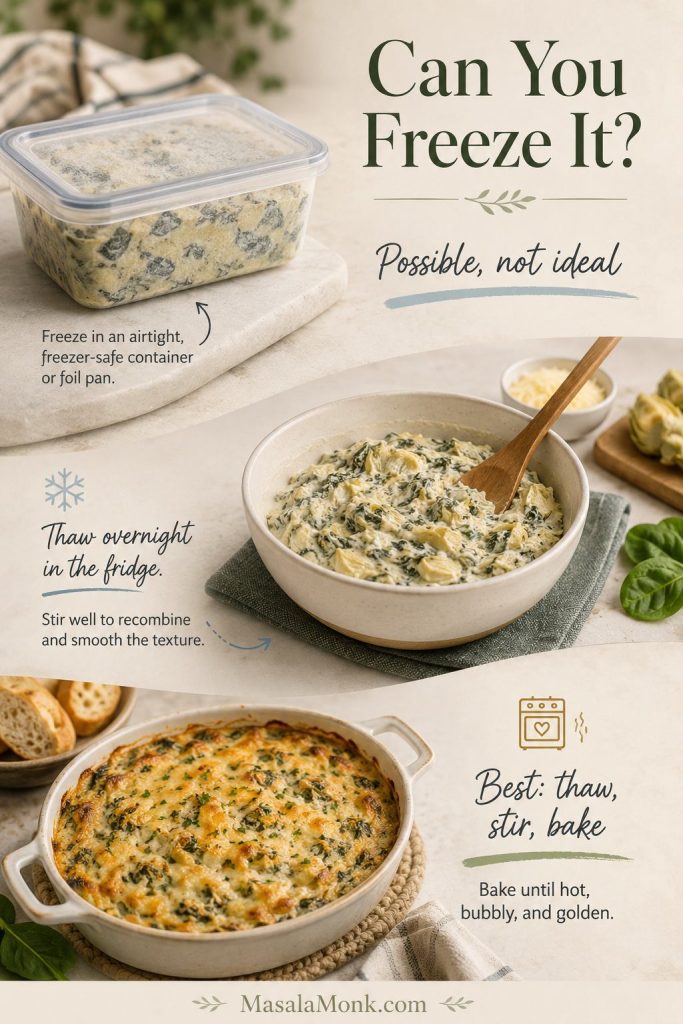
You can freeze spinach artichoke dip, but it is not the best make-ahead method if you want the creamiest texture. Dairy-based dips can loosen, separate, or turn slightly grainy after freezing and thawing.

If you need to freeze it, freeze the dip unbaked in a freezer-safe container or disposable foil pan. Thaw overnight in the refrigerator when possible, stir well, top with a little fresh cheese, and bake gently until hot.

Freezing Spinach Artichoke Dip

Freezing is possible, but the best result comes from thawing, stirring, and baking gently.

Freezing guide showing spinach artichoke dip in a freezer-safe container, thawed dip being stirred, and a small baked dish.
You can freeze this dip, but refrigeration gives the best texture. When freezing is necessary, thaw it, stir it well, and bake gently.
Method Works? What to Know
Refrigerate unbaked Yes Use within 1–2 days for the creamiest result.
Freeze unbaked Possible Texture may loosen after thawing.
Freeze baked leftovers Not ideal Dairy can separate when reheated.
Bake from frozen Possible in a foil pan Takes longer and may be less creamy.
Thaw, stir, then bake Best freezer route Restores the texture better than baking straight from frozen.

Slow Cooker Spinach Artichoke Dip Option

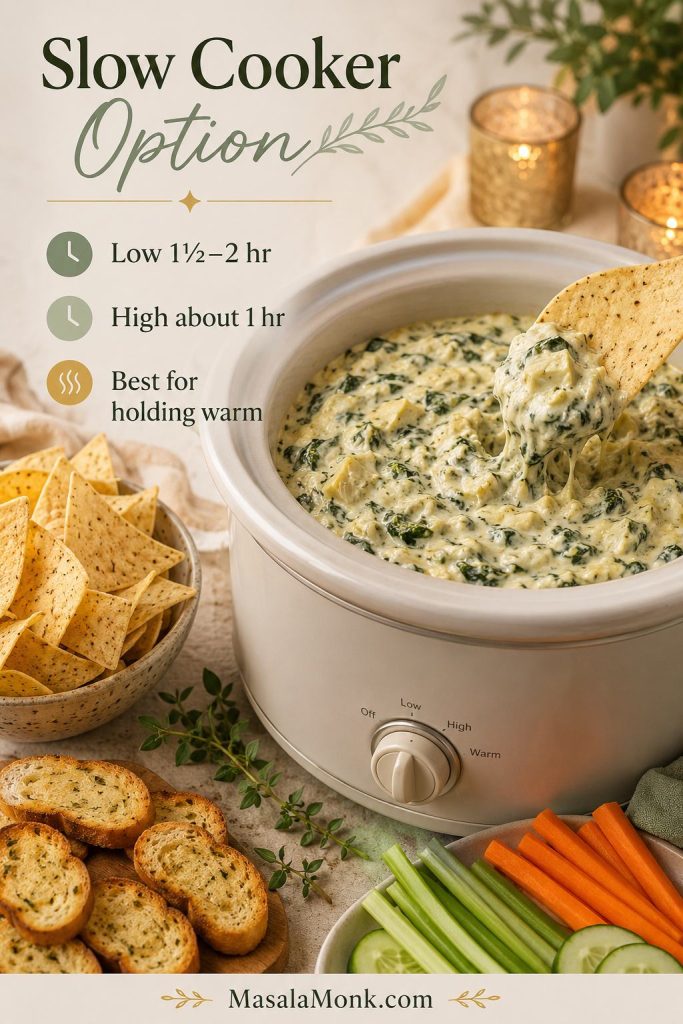
To make slow cooker spinach artichoke dip, mix the recipe as written and spread it into a lightly greased 3-quart slow cooker. Cook on low for 1½–2 hours or on high for about 1 hour, stirring once or twice, until the dip is hot and creamy.

Once it is hot, switch the slow cooker to warm for serving. Stir occasionally so the edges do not overheat. If the dip thickens as it sits, loosen it with a splash of warm milk or a spoonful of sour cream.

Just know that the slow cooker is best for holding the dip warm and soft; it will not give you the same browned top as the oven.

Slow Cooker Serving Option

For long parties, the slow cooker solves the holding problem even though it will not brown the top. For timing, pair it with the make-ahead plan.

Spinach artichoke dip in a cream slow cooker with tortilla chips, crostini, carrots, celery, and cucumber nearby.
Use the slow cooker when you care more about easy serving than a golden top; it keeps the dip warm, soft, and ready for grazing.
Slow cooker tip: do not leave dairy-heavy dip on high for too long. Once it is melted and hot, warm is the safer party setting.

If you want a second hot dip for the same party table, MasalaMonk’s buffalo chicken dip recipe gives you a spicier baked, crockpot, and game-day option.

No Mayo, Healthy, and Greek Yogurt Variations

The classic version uses a little mayonnaise because it adds richness and gives the dip that familiar party-appetizer flavor. You can still make it without mayo, with Greek yogurt, or in a lighter style if you keep enough cream cheese to hold the dip together.

For a broader look at cold spinach dip, baked spinach dip, bread-bowl versions, and lighter yogurt-based ideas, MasalaMonk’s spinach dip recipes guide is a useful companion.

Ways to Adapt the Dip

Once the base recipe is balanced, these swaps are much easier to control because the moisture and cheese structure stay steady.

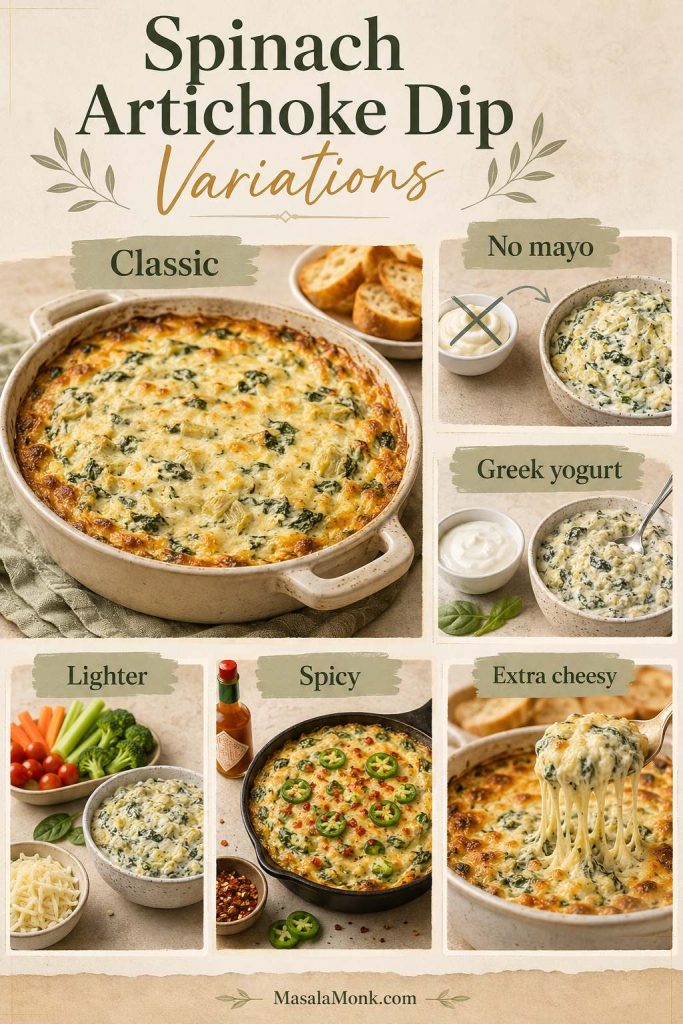
Variations guide showing classic, no mayo, Greek yogurt, lighter, spicy, and extra cheesy spinach artichoke dip.
Once the base recipe is balanced, you can change the style without losing the texture: go no-mayo, Greek yogurt, lighter, spicy, or extra cheesy.

Spinach Artichoke Dip Without Mayo

Replace the ⅓ cup mayonnaise with ⅓ cup sour cream. This is the easiest no-mayo version because the flavor stays creamy and familiar. For a tangier no-mayo dip, use ⅓ cup full-fat Greek yogurt instead.

No-mayo ratio: 8 oz cream cheese + ⅔ cup sour cream, or ½ cup sour cream + ⅓ cup full-fat Greek yogurt, with no mayo. Keep the cheese, spinach, and artichokes the same.

Healthy Spinach Artichoke Dip

For a lighter spinach artichoke dip, replace the mayo with Greek yogurt, use part-skim mozzarella, and keep the full amount of spinach and artichokes. Do not remove all the cream cheese unless you want a much lighter, tangier dip with less classic party-dip texture.

Lighter ratio: 8 oz cream cheese + ½ cup sour cream + ⅓ cup full-fat Greek yogurt + part-skim mozzarella. This keeps the dip smooth and scoopable while reducing the mayo-heavy richness.

Greek Yogurt Spinach Artichoke Dip

Greek yogurt adds tang and protein, but it can separate if overheated. Use full-fat Greek yogurt if possible, keep the cream cheese in the base, and avoid baking the dip too aggressively. Greek yogurt works best as a mayo replacement, not as the only creamy ingredient.

Spicy Spinach Artichoke Dip

Add minced jalapeño, red pepper flakes, cayenne, or hot sauce. Start small. The goal is warmth and lift, not a dip that hides the artichoke flavor.

Extra Cheesy Restaurant-Style Dip

Add an extra ½ cup mozzarella, Monterey Jack, or white cheddar. If you add more cheese, keep the spinach and artichokes very dry so the dip stays creamy instead of greasy.

How to Fix Watery, Greasy, Grainy, or Bland Spinach Artichoke Dip

A great spinach artichoke dip recipe should stay smooth and scoopable from the first chip to the last. If the dip turns watery, greasy, grainy, or bland, do not change the whole recipe first. Most problems are fixable once you know where they started: excess water, aggressive heat, or seasoning that needs more contrast.
Quick Fix Guide

Before changing the recipe, diagnose the problem first. The table below gives the full cause-and-fix details.
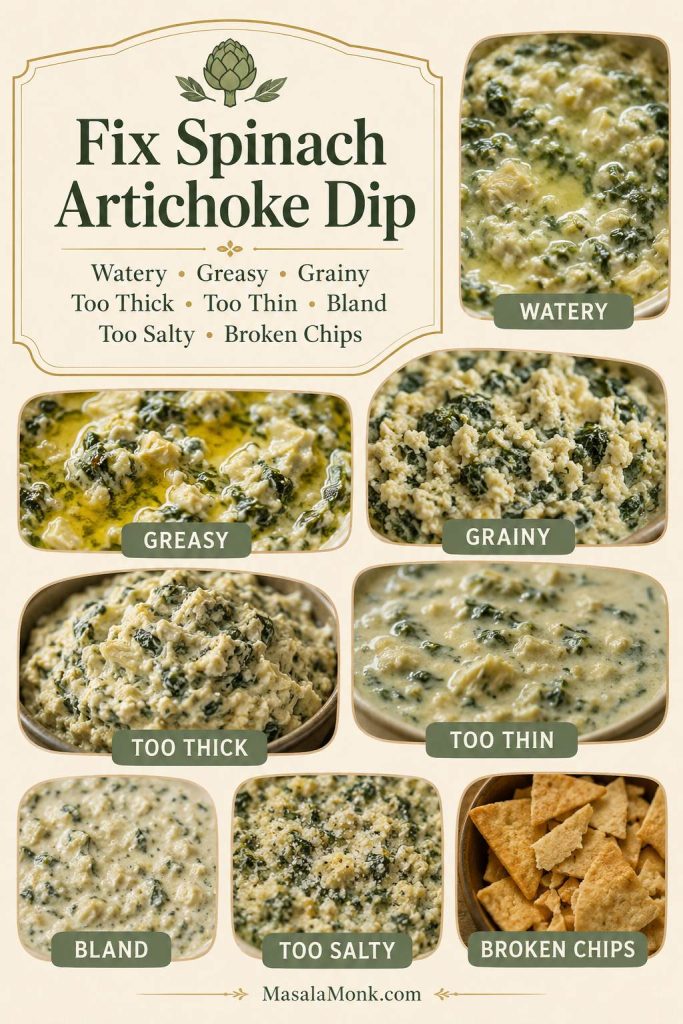
Troubleshooting guide showing watery, greasy, grainy, too thick, too thin, bland, too salty, and broken chip problems for spinach artichoke dip.
Most dip problems come from moisture, heat, or seasoning, so diagnosing the issue first makes the fix much easier.
Problem Likely Cause Fix
Watery dip Spinach or artichokes were too wet Squeeze spinach harder, pat artichokes dry, and bake uncovered a little longer.
Greasy top Dairy or cheese overheated Use moderate heat, avoid a long broil, and remove the dip once the edges bubble.
Grainy texture Cheese overheated or too much aged cheese Use mozzarella or Monterey Jack for melt, Parmesan for flavor, and avoid overbaking.
Too thick Too much cheese or overbaking Stir in warm milk, sour cream, or a spoonful of softened cream cheese.
Too thin Too much liquid in the vegetables or base Bake uncovered a little longer and add a small handful of cheese if needed.
Bland Not enough acid, garlic, pepper, or savory cheese Add lemon zest or juice, black pepper, garlic, Parmesan, or a few dashes of hot sauce.
Too salty Brined artichokes, salty cheese, or too much added salt Rinse brined artichokes next time and salt only after tasting the mixed dip.
Chips keep breaking Dip is too thick or dippers are too thin Use pita chips, crostini, sturdy tortilla chips, crackers, or vegetables.
Dish cracked Cold glass or ceramic dish went straight into a hot oven Let the dish warm slightly, transfer the dip, or use a room-temperature baking dish.

What to Serve With Spinach Artichoke Dip

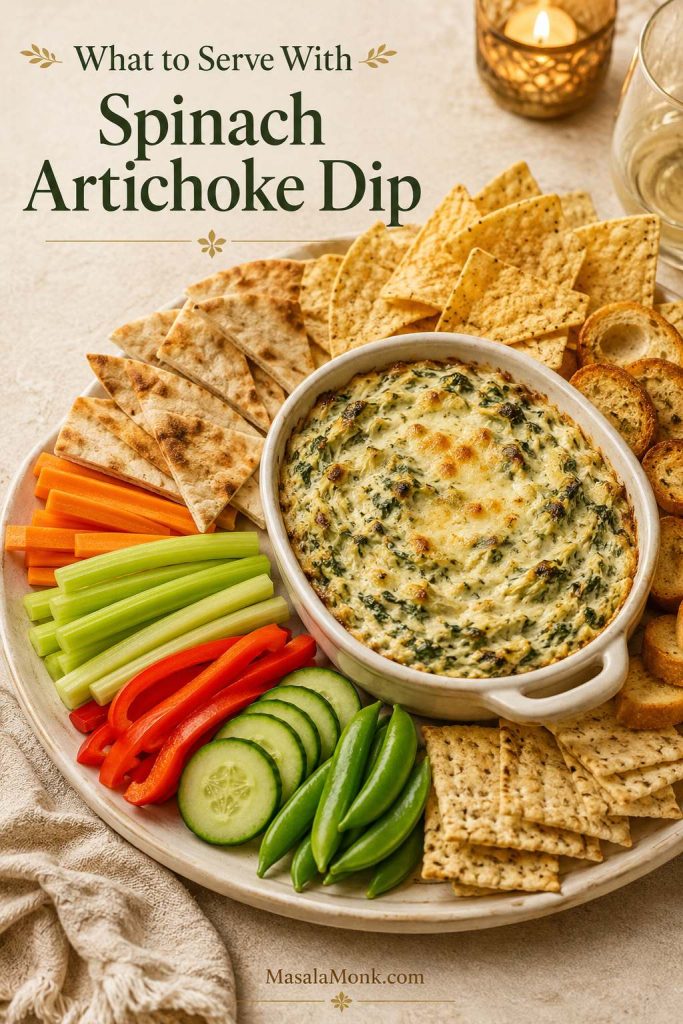
Spinach artichoke dip is thick, warm, and cheese-rich, so sturdy dippers are best. Thin chips can snap if the dip is very cheesy, especially right out of the oven.

Because the dip is rich, the best spread has contrast: something salty, something crisp, something fresh, and something sturdy enough to scoop through the warm cheese without snapping.

What to Serve With It

Build contrast around the rich dip: sturdy, crisp, fresh, and easy to scoop. If this is the main hot appetizer, check the party quantity guide before deciding whether to make a full or double batch.

Serving board with baked spinach artichoke dip, tortilla chips, pita chips, crostini, crackers, carrots, celery, bell peppers, cucumber, and snap peas.
The best dippers bring contrast: sturdy chips and crostini handle the thick dip, while fresh vegetables keep the appetizer board from feeling too heavy.

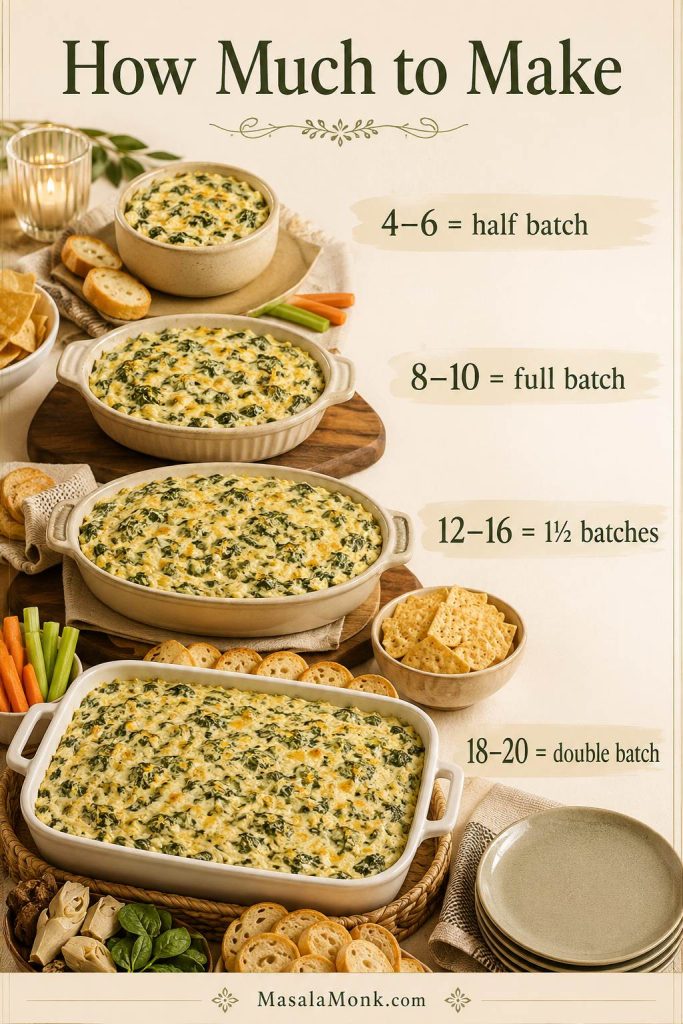
How Much Spinach Artichoke Dip to Make for a Party

One full batch makes about 5 cups, which is enough for 8–10 appetizer servings. If this is the main hot appetizer on the table, make more than you think you need.

Crowd Size Amount to Make What to Know
4–6 people Half batch Good for a small snack spread.
8–10 people 1 full batch The standard party size for this recipe.
12–16 people 1½ batches Useful when there are several appetizers.
18–20 people Double batch Best for game day, holidays, or buffet-style serving.

Party Quantity Visual Guide

If this is the main hot appetizer, check this quantity guide before deciding whether a full batch is enough.

Party quantity guide showing different dish sizes for half batch, full batch, one and a half batches, and double batch spinach artichoke dip.
If this is the main hot appetizer, make a little more than you think; it is the dish people keep returning to while they graze.

For a party where people will graze for a while, a double batch is safer than it sounds. Hot spinach artichoke dip has a way of becoming the dish everyone “just checks on” every time they pass the table.

For a full appetizer table, balance the rich dip with something crisp, something fresh, and something hot from the oven or air fryer. That keeps the spread from feeling too heavy.

Crunchy Dippers

Tortilla chips, pita chips, pretzel crisps, bagel chips, sturdy crackers, and thick potato chips all work well. Sturdy dippers matter because nobody wants the chip to snap halfway through the first scoop.

Bread and Crostini

Serve the dip with toasted baguette slices, sourdough crostini, focaccia strips, garlic bread, naan chips, or a bread bowl for a party-style presentation. For a warmer bread option, slice a homemade garlic bread loaf into thick pieces and serve it beside the dip instead of plain crostini.

Fresh Vegetable Dippers

Carrot sticks, celery, bell pepper strips, cucumber rounds, broccoli, cauliflower, and snap peas add freshness and crunch next to the rich dip. A low-carb spread still works beautifully here: serve crunchy vegetables or choose sturdier ideas from MasalaMonk’s keto chips guide.

Party Board Ideas

For game day, pair the dip with air fryer chicken wings or baked jalapeño poppers so the table has something crispy, spicy, and hot next to the creamy dip.

On a grazing table, this dip can be the warm centerpiece. Build the rest of the board with MasalaMonk’s charcuterie board 3-3-3-3 rule.

Leftover Spinach Artichoke Dip Ideas

Although leftovers are rare, spinach artichoke dip has a second life built in. It is already creamy, garlicky, cheesy, and full of vegetables, so it can become a shortcut sauce, filling, or spread for another meal.

  • Spinach artichoke pizza: spread a thin layer over pizza dough, flatbread, or naan, then add mozzarella and bake until the edges are crisp.
  • Stuffed chicken breast: tuck a spoonful inside chicken breasts before baking.
  • Grilled cheese: spread a thin layer inside the sandwich with extra mozzarella.
  • Quesadillas: use it with chicken, turkey, or extra vegetables.
  • Pasta sauce: loosen with milk or pasta water and toss with short pasta for a fast creamy dinner.
  • Baked potatoes: spoon warm dip over baked potatoes or sweet potatoes.
  • Omelets or scrambled eggs: use a small spoonful as a creamy filling.
  • Stuffed mushrooms: fill mushroom caps and bake until hot.
  • Turkey or chicken sandwich spread: use a thin chilled layer instead of mayo.

Ways to Use Leftover Dip

Leftovers are more useful when you treat the dip like a filling or sauce, not just something to reheat.

Leftover spinach artichoke dip ideas including pizza, stuffed chicken, grilled cheese, quesadilla, pasta, baked potato, eggs, and mushrooms.
Leftover spinach artichoke dip already works like a creamy filling or shortcut sauce, so it can turn into pizza, pasta, sandwiches, stuffed chicken, or baked potatoes the next day.

If you turn leftover dip into flatbread or pizza and want a tomato layer underneath, MasalaMonk’s pizza sauce recipes can help you keep the base creamy, garlicky, or more tomato-forward.

Once you understand the moisture, heat, and seasoning balance, spinach artichoke dip becomes one of those reliable appetizers you can make almost on autopilot. Keep the spinach dry, bake gently, serve it warm, and let the dippers do the rest.

FAQs About Spinach Artichoke Dip

Is spinach artichoke dip better with fresh or frozen spinach?

Frozen spinach is the safer choice for most home cooks because the hard part — wilting it down — is already done. The only job left is to thaw it fully and press out the hidden water. Fresh spinach works too, but it needs to be cooked, cooled, chopped, and squeezed before you add it to the dip.

Why did my spinach artichoke dip turn watery?

The spinach or artichokes probably carried too much water into the creamy base. The fix starts before baking: thaw frozen spinach completely, squeeze it until it feels compact, drain the artichokes well, and pat them dry before mixing.

What temperature should spinach artichoke dip be baked at?

375°F / 190°C is the best default temperature. It is hot enough to melt and brown the dip, but gentle enough to protect the creamy dairy base. A 350°F oven is gentler and slower, while 400°F browns faster but needs closer watching.

Should spinach artichoke dip be served hot or warm?

It is best served warm. Straight from the oven, the dip can be too hot and loose; after a 5-minute rest, it becomes thicker, smoother, and easier to scoop.

How long does spinach artichoke dip last in the fridge?

Leftover spinach artichoke dip keeps for 3–4 days in an airtight container in the refrigerator. Reheat only what you need, because repeated warming and chilling can make the dairy base less smooth.

What is the best cheese for spinach artichoke dip?

Mozzarella or Monterey Jack is best for melt, while Parmesan is best for savory flavor. Choose mozzarella if you want more stretch; choose Monterey Jack if you want a softer scoop. Either way, Parmesan keeps the dip from tasting flat.

Is mayo necessary in spinach artichoke dip?

No. Mayo adds richness, but the dip still works with sour cream or full-fat Greek yogurt in its place. Greek yogurt makes the dip tangier and can separate if overheated, so it works best with cream cheese rather than as the only base.

How do you keep spinach artichoke dip warm for a party?

The easiest way is to use a slow cooker on the warm setting after the dip is fully heated. Stir occasionally and loosen with a splash of warm milk or a spoonful of sour cream if it thickens too much.

What chips are best for spinach artichoke dip?

Use dippers with backbone: pita chips, crostini, sturdy tortilla chips, pretzel crisps, crackers, or crisp vegetables. Thin chips are fine for salsa, but they snap too easily in a thick cheese dip.

Back to top

Posted on Leave a comment

Battered Fries Recipe

Golden battered fries in a bowl with a craggy crisp coating and dipping sauce on the side.

This battered fries recipe gives you golden, craggy fries with a crisp seasoned coating and fluffy potato centers. The batter clings lightly to each fry, so you get real crunch without a thick, cakey, doughy shell.

Depending on where you live, you may know them as battered fries, battered french fries, batter-dipped fries, or battered chips. This battered fries recipe starts with a no-beer batter, then gives you a pub-style beer batter option, thicker battered chips, air fryer notes, frozen-fries tips, exact frying temperatures, and fixes for soggy fries or batter that falls off.

The goal here is not a heavy potato fritter. These fries should still taste like proper fries first: hot, fluffy, salty, and potato-forward, with just enough seasoned coating to make the outside extra crisp. Once you understand the batter thickness and oil temperature, the recipe is much easier than it looks.

Close-up of battered fries showing a crisp golden coating and a fluffy potato center.
Aim for a crust like this: thin, craggy, and crisp, because a heavy shell can make battered fries taste more doughy than potato-rich.

Quick Answer: How to Make Battered Fries

To make battered fries, cut starchy potatoes into fries, soak them in cold water, dry them very well, coat them in a light seasoned batter, and fry until golden. For the best texture, first-fry the potatoes at 325°F / 165°C until pale and partly cooked, then dip them in batter and fry again at 375°F / 190°C until crisp.

The batter should be thin enough to drip slowly but thick enough to cling. A mix of flour, cornstarch or potato starch, baking powder, seasoning, and ice-cold sparkling water gives you crisp battered fries without beer. For beer battered fries, use cold lager or pilsner instead of sparkling water.

Serve them as soon as possible after frying. Battered fries lose crunch when they sit covered, stacked, or trapped in steam.

Best texture shortcut: dry the potatoes thoroughly, dust them lightly with flour, cornstarch, or potato starch before dipping, and fry in small batches so the oil stays hot.

If battered fries have turned soggy or the coating has slipped off before, do not worry. The drying, dusting, and double-fry steps below are there to fix exactly those problems.

Battered Fries Recipe at a Glance

Potato choice Russet potatoes for battered fries; Maris Piper or King Edward for thicker battered chips.
Cut size ¼-inch fries for crisp battered french fries; ½-inch pieces for battered chips.
Batter texture Thin enough to drip slowly, thick enough to cling lightly.
Main liquid Ice-cold sparkling water, seltzer, or club soda for no-beer battered fries; cold lager or pilsner for beer battered fries.
Frying method For this battered fries recipe, first fry at 325°F / 165°C, then batter and final fry at 375°F / 190°C.
Success tip Dry the potatoes very well before battering.
Battered fries guide showing russet potatoes, quarter-inch fries, thin batter, and first and final fry temperatures.
If you want the quick version first, remember the four anchors of a good battered fries recipe: starchy potatoes, thin cuts, cold batter, and two controlled fry temperatures.
Ready to cook? Go straight to the step-by-step method or the recipe card.

What Are Battered Fries?

Battered fries are french fries coated in a seasoned batter before frying. The coating fries into a crisp, rough shell around the potato, giving you more crunch and seasoning than regular fries.

They are sometimes called battered french fries, batter-dipped fries, coated fries, or battered chips. The exact name changes by region, but the idea is the same: potato inside, crisp coating outside, and plenty of surface texture for salt, vinegar, ketchup, aioli, ranch, or cheese sauce.

For the classic unbattered version, start with MasalaMonk’s crispy homemade French fries guide; once you want a rougher, crunchier coating, come back to this battered version.

Why This Battered Fries Recipe Works

The crispness comes from a few small choices working together. Starchy potatoes give you fluffy centers. Soaking removes excess surface starch. Drying helps the batter cling. Cornstarch or potato starch keeps the coating crisp, baking powder lightens it, and cold carbonation helps the batter fry up airy instead of heavy.

Most importantly, the double-fry method makes the biggest difference. The first fry cooks the potato through before the batter goes on, while the second fry crisps the coating quickly. As a result, the outside turns golden without leaving the center hard or undercooked.

Battered Fries vs Regular Fries

Regular fries are usually fried plain, sometimes after soaking, blanching, or double-frying. Battered fries get an extra coating before frying, so the outside is more rugged, crunchy, and seasoned.

Type Texture How It Is Made Best For
Regular fries Crisp outside, fluffy inside Fried without batter Classic fries, burgers, everyday sides
Battered fries Craggy, crisp, seasoned shell Dipped in seasoned batter before frying Pub-style fries, dipping sauces, fish and chips sides
Coated fries Lightly crisp, less batter-heavy Tossed in starch or dry coating Air fryer versions and lighter coatings
Beer battered fries Light, crisp, pub-style coating Made with cold beer in the batter Fish and chips, fried seafood, party snacks
Regular fries and battered fries shown side by side to compare smooth fries with craggy coated fries.
Regular fries give you a cleaner bite, whereas battered fries add a rougher seasoned surface that catches more salt, sauces, and spice.

You may also see breaded fries or coated fries. Those usually use a dry flour, starch, or breadcrumb-style coating rather than a loose wet batter. They can be easier for baking or air frying, but they do not give quite the same pub-style battered shell.

Battered Fries vs Battered Chips

Battered fries and battered chips are close cousins. In the United States, battered fries usually means battered french fries. In the United Kingdom and some other places, chips often means thicker-cut fried potatoes, so battered chips are usually chunkier than American fries.

For thin or medium battered french fries, cut the potatoes about ¼ inch thick. For battered chips, cut them closer to ½ inch thick and cook the potato before battering, either by parboiling or first-frying. That way, the inside turns tender before the coating gets too dark.

Thin battered fries and thicker battered chips shown with cut-size labels.
Thin battered fries cook fast, but battered chips need a thicker-cut strategy, so the inside turns tender before the outside gets too dark.
Making thicker chips instead of fries? Jump to the battered chips method.

Ingredients for This Battered Fries Recipe

The main battered fries recipe uses a no-beer batter, so it works even if you do not want to cook with alcohol. A beer batter version is included below as an easy variation.

Ingredients for battered fries including potatoes, flour, starch, baking powder, seasonings, sparkling water, and oil.
Flour builds structure, starch sharpens the crunch, and cold fizz lightens the batter, so each ingredient has a clear job in the final texture.

Potatoes

  • 2 lb / 900g russet potatoes — best for fluffy centers and crisp edges.
  • Maris Piper or King Edward potatoes — good UK options for thicker battered chips.

Batter

  • 1 cup / 120g all-purpose flour — gives the batter structure.
  • ⅓ cup / 40g cornstarch or potato starch — helps the coating fry crisp instead of heavy. Potato starch gives a slightly more delicate, crackly finish; cornstarch is easier to find and still works well.
  • 1 tsp baking powder — lightens the batter.
  • 1 tsp fine salt — seasons the coating from the inside.
  • 1 tsp paprika — adds color and mild flavor.
  • ¾ tsp garlic powder — gives savory depth.
  • ½ tsp onion powder — rounds out the seasoning.
  • ¼ tsp black pepper — adds gentle heat.
  • ⅛–¼ tsp cayenne, optional — for a little kick.
  • ¾ cup / 180ml ice-cold sparkling water, seltzer, or club soda, plus 1–3 tbsp more as needed — keeps the batter light and crisp without beer.

Because some seasoning blends are already salty, reduce the fine salt in the batter slightly and season the finished fries to taste.

For Frying

  • Neutral oil for deep frying — vegetable, canola, sunflower, peanut, or another high-heat frying oil.
Why sparkling water? Cold carbonation gives the batter lift without beer. Sparkling water, seltzer, or club soda all work. For beer battered fries, use cold lager or pilsner in place of the water.
Got everything ready? Check the batter thickness guide before mixing, or head to the step-by-step method.

Best Potatoes for Battered Fries

Starchy potatoes are best because they cook up fluffy inside and crisp well outside. In the US, use russet potatoes. For battered chips, especially UK-style chips, Maris Piper or King Edward potatoes are good choices.

Avoid very waxy potatoes if your goal is a fluffy center. Waxy potatoes hold their shape well, but they do not give the same classic fry texture.

For more potato-prep detail, the Idaho Potato Commission’s French fry guidance is a useful reference for russets, soaking, blanching, and batch size.

Potato guide showing russet potatoes for battered fries and Maris Piper or King Edward potatoes for thicker chips.
Russets work best for battered fries because their starchy texture stays fluffy, while Maris Piper or King Edward are especially useful for thicker battered chips.
Cut Best Use Texture
¼-inch fries Battered french fries Crisp coating, faster cooking, classic fry shape
⅜-inch fries Pub-style battered fries More potato inside, still crisp outside
½-inch chips Battered chips Thicker, softer center, best with parboiling or first-frying

Equipment You Need

You do not need restaurant equipment, but a few tools make battered fries much easier and safer.

  • Heavy-bottomed pot, Dutch oven, or deep fryer — choose something deep enough to leave several inches of headroom above the oil.
  • Oil or candy thermometer — the easiest way to keep the oil at the right temperature.
  • Large bowl — for soaking the potatoes.
  • Clean kitchen towels or paper towels — for drying the fries thoroughly.
  • Wire rack over a sheet pan — better than piling hot fries on paper towels, which can trap steam.
  • Spider skimmer, slotted spoon, or tongs — for lowering and lifting fries safely.
Frying setup for battered fries with a deep pot, thermometer, wire rack, skimmer, towel, and batter bowl.
You do not need restaurant gear; instead, focus on a thermometer and wire rack, because they help control both oil temperature and steam.
Deep-frying safety: never fill the pot more than halfway with oil. Add fries carefully, fry in small batches, and keep water away from hot oil. For more technical frying guidance, Oklahoma State University Extension explains why oil temperature, batch size, and recovery time matter during deep-fat frying.

Best Oil for Battered Fries

Use a neutral, high-heat oil such as vegetable, canola, sunflower, or peanut oil. You want enough oil for the fries to move freely, usually about 2½–3 inches in a deep, heavy pot, but the pot should never be more than halfway full.

Deep pot with frying oil, thermometer, and oil-depth labels for making battered fries safely.
Neutral oil works best, but the real secret is control: enough depth for even frying, yet enough empty space in the pot for safe bubbling.

Oil temperature matters more than the exact oil brand. If the oil is too cool, the fries absorb oil and turn greasy. If it is too hot, the coating browns before the potato inside is tender. A thermometer is the easiest way to stay in control.

As a practical rule, fry only enough potatoes to cover the surface of the oil loosely, with space between pieces. If the oil stops bubbling actively or drops far below the target temperature, the batch is too large.

The Best Batter Thickness for Fries

For this battered fries recipe, the batter should coat each fry in a thin layer, drip slowly, and still show the shape of the potato underneath. Think pourable gravy or thin pancake batter, not paste. If it runs off like water, it is too thin. However, if it sits on the fry in thick ridges, it is too heavy and can turn cakey.

Three bowls of batter showing too thin, just right, and too thick textures for battered fries.
Batter consistency changes everything: too thin slides off, too thick turns cakey, and the sweet spot drips slowly while still clinging.
Batter Texture What Happens How to Fix It
Too thin Runs off the fries and leaves bare spots Add flour 1 tbsp at a time
Just right Clings lightly and drips slowly Use immediately while cold
Too thick Turns cakey, clumpy, or doughy Add cold sparkling water, club soda, or beer 1 tbsp at a time
If your coating keeps sliding off, go to how to make batter stick or the troubleshooting table.

How to Make Batter Stick to Fries

If the batter keeps sliding off, the answer is usually not to make it much thicker. In fact, batter that is too thick can turn heavy and slide off in clumps. The better approach is dry potatoes, a light dusting, and hot oil.

Fries being dusted with flour or starch before dipping into batter.
If batter keeps slipping off, dry the fries well and dust them lightly first, because grip matters more than a thicker batter does.
  • Dry the potatoes completely: surface moisture makes batter slip and oil splatter.
  • Use a light dusting first: a thin coat of flour, cornstarch, or potato starch gives the batter something to grip.
  • Keep the batter cold: cold batter fries up lighter and clings better.
  • Let excess batter drip off: too much batter creates clumps instead of a crisp shell.
  • Add fries one by one: this stops them from sticking together in the oil.
  • Keep the oil hot: if the oil is too cool, the coating absorbs oil before it sets.

How to Make This Battered Fries Recipe

The best method for this battered fries recipe is simple once you understand the order: soak, dry, first-fry, batter, final-fry. The first fry cooks the potato inside, while the second fry crisps the coating.

1. Cut and Soak the Potatoes

Peel the potatoes if you prefer a smoother fry, or leave the skins on for a more rustic texture. Cut into ¼-inch fries for battered french fries or thicker pieces for battered chips.

Place the cut potatoes in cold water for at least 30 minutes. For better texture, soak for 1–2 hours. Soaking helps remove excess surface starch, which can make fries brown unevenly or stick together. For a firmer fry, add 1 tbsp vinegar to the soaking water.

2. Dry the Fries Very Well

Drain the potatoes and spread them on clean kitchen towels. Pat them very dry. This step matters more than it looks: wet potatoes are one of the main reasons batter slips off, oil splatters, or fries turn soggy.

Cut potatoes soaking in water and drying on a towel before being battered and fried.
Soaking helps remove excess surface starch; however, drying is just as important, since wet fries splatter and resist a clean coating.

3. First-Fry the Potatoes

Heat oil in a heavy pot or deep fryer to 325°F / 165°C. Fry the dried potatoes in small batches for 4–5 minutes, just until they are pale and partly cooked. They should not be deeply browned yet.

Pale first-fried potatoes resting on a wire rack beside a pot and thermometer.
The first fry should leave the potatoes pale and partly cooked, so the second fry can focus on crisping the batter instead of finishing the center.

Transfer the first-fried potatoes to a wire rack. Do not pile them into a bowl, or they will steam and soften.

4. Mix the Batter

In a bowl, whisk together the flour, cornstarch or potato starch, baking powder, salt, paprika, garlic powder, onion powder, black pepper, and cayenne if using. Slowly whisk in the ice-cold sparkling water, seltzer, or club soda until the batter is smooth but still thin enough to drip slowly.

Do not overmix. A few tiny lumps are fine, and the batter should stay cold. Once the sparkling water, club soda, or beer is mixed in, the bubbles slowly fade, so mix the batter close to the final fry instead of letting it sit while the oil heats.

5. Dust, Dip, and Fry

Raise the oil temperature to 375°F / 190°C. Lightly dust the first-fried potatoes with flour, cornstarch, or potato starch. Dip a few fries into the batter, then hold them over the bowl or set them briefly on a wire rack so the excess batter can drip away. If you see a thick clump, smooth it lightly before the fry goes into the oil. Carefully lower the fries into the hot oil one by one.

A potato fry lifted from batter with excess batter dripping back into the bowl.
Let the extra batter drip back into the bowl for a moment, because a lighter coating fries crisper and tastes less heavy.

When you are unsure about the batter thickness, fry one test fry first. It is the easiest way to save the whole batch. A coating that slides off needs a slightly thicker batter or a more careful dusting. A heavy, bready coating means the batter needs another tablespoon of cold sparkling water, club soda, or beer.
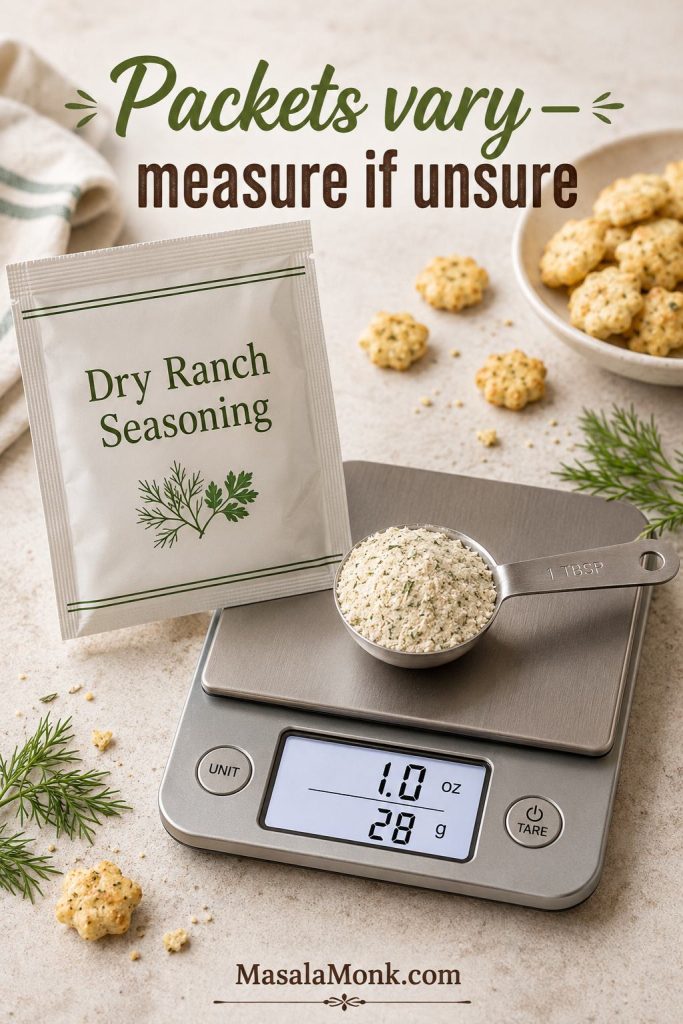
Fry in small batches for 2–4 minutes, until the coating is golden, crisp, and craggy. The bubbling should slow slightly, and the fries may float freely near the surface. Let the oil return to 375°F / 190°C between batches so the fries stay crisp instead of greasy.

Battered fries frying in bubbling hot oil with a thermometer showing final fry temperature.
During the final fry, small batches help the oil recover faster, and that usually means less grease and better crunch.

6. Season While Hot

Move the battered fries to a wire rack and season immediately with salt. If you want flavored fries, add Cajun seasoning, garlic salt, smoked paprika salt, or chili-lime seasoning while the coating is still hot.

Freshly fried battered fries being salted on a wire rack while still hot.
Season the fries right away, because the hot craggy surface catches salt and spice far better than fries that have already cooled.
Want the shorter method? Go to the quick single-fry version. Want a pub-style version? Go to beer battered fries.

Quick Single-Fry Battered Fries

The double-fry method gives this battered fries recipe the crispest, most reliable result. However, when you want a faster batch, the single-fry method still works well as long as the potatoes are cut thin and dried thoroughly.

  1. Cut, soak, and dry the potatoes very well.
  2. Heat oil to 350°F / 175°C.
  3. Dip the raw dried fries into the batter in small handfuls.
  4. Let excess batter drip off.
  5. Fry for 7–10 minutes, turning occasionally, until golden and cooked through.
  6. Drain on a wire rack and season while hot.
Thin battered fries being made with a quick single-fry method at 350 degrees Fahrenheit.
The single-fry shortcut works best for thinner fries; for thicker cuts, the double-fry method is usually more reliable.

This method is easier, but the coating may brown before thicker fries are fully tender inside. For thicker battered chips or the crispiest battered french fries, use the double-fry method above.

Beer Battered Fries Variation

To turn this battered fries recipe into beer battered fries, replace the sparkling water with ¾ cup / 180ml ice-cold lager or pilsner. Then, add a little more beer, 1 tablespoon at a time, if the batter is too thick.

Beer being poured into batter with golden beer battered fries served nearby.
Beer battered fries get a pub-style edge from cold lager or pilsner, yet the batter still needs to stay thin and cold for the best finish.

Lager, pilsner, or light beer works best because the flavor stays clean and the carbonation helps the batter fry crisp. Very bitter IPAs, heavy stouts, and sweet flavored beers can overpower the potatoes, so use them only if you specifically want that flavor in the coating.

Beer batter tip: keep the beer cold and the coating thin. Warm beer or thick batter can make beer battered fries heavy instead of crisp.
Using beer? Follow the same recipe card, replacing the sparkling water with cold lager or pilsner.

No-Egg and Gluten-Free Battered Fries

This battered fries recipe is already made without egg. The batter gets its lightness from baking powder and cold sparkling water instead.

Gluten-free and no-egg battered fries with flour blend, starch, baking powder, sparkling water, and finished fries.
This version proves that battered fries do not need egg, and with the right flour-starch balance, a gluten-free batter can still fry crisp.

For gluten-free battered fries, replace the all-purpose flour with a gluten-free all-purpose flour blend or use a mix of rice flour and cornstarch. Keep the batter thin and cold, and fry a small test piece first so you can adjust the thickness before coating the whole batch.

If you are cooking for someone who needs strict gluten-free food, also check the baking powder, seasonings, and any dipping sauces for gluten-containing additives or cross-contact warnings.

How to Make Battered Chips

Battered chips are usually thicker than battered french fries, so they need a slightly different method. Use russet, Maris Piper, or King Edward potatoes and cut them about ½ inch thick.

  1. Cut the potatoes into thick chips.
  2. Parboil for 5–7 minutes, just until the edges begin to soften.
  3. Drain and dry on a wire rack until the surface moisture is gone.
  4. Dust lightly with flour, cornstarch, or potato starch.
  5. Dip in a slightly thicker batter.
  6. Fry at 180°C / 356°F for about 5–7 minutes, depending on thickness, until golden and crisp.
Thick battered chips shown with parboiling, drying, battering, and frying steps.
Because battered chips are thicker than battered french fries, parboiling first helps the potato soften before the coating turns deeply golden.

For a UK-style golden battered chips look, add a pinch of turmeric to the batter. Some regional orange chips use food coloring, but it is optional and not needed for a good crisp coating.

Lager gives battered chips a classic pub-style flavor, but sparkling water or club soda works if you want a no-beer version. Keep the batter slightly thicker than the battered-fries batter so it grips the larger chips, but do not make it paste-like.

Air Fryer Battered Fries: What Works

This battered fries recipe is best deep-fried because hot oil sets the wet batter immediately. In an air fryer, loose wet batter can drip before it crisps, which makes the fries patchy or messy.

So, if you came here hoping to pour wet batter over fries and air fry them, the honest answer is: it is not the best method. That does not mean you are out of options, though. You will get better results with a starch coating that behaves more like a crisp shell.

Wet battered fries compared with starch-coated fries in an air fryer basket.
Air fryer battered fries work better with a starch coating than a loose wet batter, so adjust the method rather than forcing the deep-fry version.

For air fryer battered fries, use a clingy starch coating instead of a loose batter. Toss the potatoes with a cornstarch slurry or a dry flour-cornstarch coating, spray generously with oil, and air fry in a single layer at 375°F / 190°C for about 14–20 minutes, flipping and spraying again halfway through.

However, when the real goal is crisp potato texture with less oil, MasalaMonk’s air fryer hash browns guide is a better air fryer potato starting point because it focuses on thin layers, moisture control, shaking, and crisp edges.

Best answer: deep frying gives the most authentic battered fries. The air fryer is better for coated fries than loose wet-battered fries.

How to Batter Frozen Fries

You can batter frozen fries, but fresh-cut or first-fried homemade potatoes work better. Frozen fries already contain surface moisture and may already have a light coating, so the batter may not cling as evenly.

If you want to use frozen fries, do not batter them while icy. Let them thaw slightly, pat them very dry, dust lightly with cornstarch, potato starch, or flour, then dip them in a slightly thicker batter. Fry in small batches so the oil temperature does not drop too much.

Frozen fries being thawed slightly, patted dry, dusted with starch, and prepared for battering.
Frozen fries can still work, but only after a little thawing, careful drying, and a light dusting, otherwise the batter may cling unevenly.

Make-Ahead Battered Fries

This battered fries recipe is best right after frying, but you can still make hosting easier. Cut, soak, dry, and first-fry the potatoes earlier in the day, then let them cool on a wire rack. When you are ready to serve, make the batter fresh, dip the fries, and do the final fry.

Make-ahead battered fries setup with first-fried fries, fresh batter, oven reheating, and air fryer reheating cues.
For easier hosting, first-fry the potatoes ahead of time; then, once you are ready to serve, batter and finish-fry them fresh.

Do not batter the fries far in advance. The coating will soften as it sits. If you need to hold cooked battered fries for a short time, keep them on a wire rack in a low oven so steam does not collect underneath.

Store leftover battered fries in the fridge in a shallow container once fully cooled. They are best reheated within 1–2 days, because the coating softens the longer it sits.

To reheat leftovers, use a hot oven or air fryer until the coating crisps again. Avoid microwaving, which makes the batter soft.

Battered Fries Variations

Cajun Battered Fries

Add Cajun seasoning to the batter and sprinkle a little more over the fries as soon as they come out of the oil. This is one of the easiest ways to make seasoned battered french fries with a little heat.

Garlic Parmesan Battered Fries

Season the hot fries with garlic salt, black pepper, and finely grated parmesan-style cheese. Add parsley if you want a more restaurant-style finish.

Spicy Battered Fries

Add cayenne, chili powder, or smoked paprika to the batter. Serve with spicy mayo, ranch, or a cooling garlic dip.

Battered Sweet Potato Fries

Sweet potatoes can be battered, but they have more moisture and a softer texture than russets. Cut them a little thicker, dry them well, and use a light coating. Expect a softer center and a slightly sweeter flavor.

Double Battered Fries

Double battered fries have an extra-heavy coating. They can be very crunchy, but they can also turn thick and doughy if the batter is not thin enough. For most batches, one light coating gives the best balance of potato and crunch.

Troubleshooting Battered Fries

If this battered fries recipe did not come out crisp, the problem is usually moisture, batter thickness, oil temperature, or overcrowding. Fortunately, small changes make a big difference with battered potatoes.

Troubleshooting board for battered fries showing fixes for batter falling off, soggy fries, greasy fries, and cakey coating.
When battered fries go wrong, the problem is usually moisture, oil temperature, overcrowding, or batter thickness — and each one has a fix.
Problem Likely Cause Fix
Batter falls off Fries are wet, batter is too thin, or potatoes were not dusted Dry thoroughly, dust with flour/cornstarch/potato starch, and thicken the batter slightly
Fries are soggy Oil is too cool, pan is overcrowded, or batter is too thick Use a thermometer, fry in small batches, and thin the batter
Fries are greasy Oil temperature dropped too low Let the oil return to temperature between batches
Coating is cakey Batter is too thick Add cold sparkling water, club soda, or beer 1 tbsp at a time
Potatoes are hard inside Fries are too thick or skipped the first cook Use the double-fry method or parboil thick chips first
Fries stick together Too many fries added at once Add fries one by one and separate them early in frying
Batter clumps Too much batter stayed on the fries Let excess batter drip off before frying

Battered Fries Time and Temperature Guide

Use this chart as a quick reference for oil temperature, cook time, and method choice.

Time and temperature guide for battered fries with single fry, first fry, final fry, and battered chips temperatures.
Use this guide as a quick check when switching between single-fry battered fries, double-fried fries, beer batter, and thicker battered chips.
Method Potato Cut Prep Temperature Cook Time
Quick single-fry battered fries ¼-inch fries Soak + dry 350°F / 175°C 7–10 min
Best double-fry battered fries ¼-inch fries First fry, then batter 325°F then 375°F / 165°C then 190°C 4–5 min + 2–4 min
Beer battered fries ¼-inch fries Double fry preferred 325°F then 375°F / 165°C then 190°C 4–5 min + 2–4 min
Battered chips ½-inch chips Parboil + dry + dust 180°C / 356°F 5–7 min after parboiling, depending on thickness
Air fryer coated fries ¼–½-inch fries Starch slurry or dry coating 375°F / 190°C 14–20 min

What to Serve with Battered Fries

This battered fries recipe is best served hot, while the coating is still crisp. For the most obvious pairing, serve the fries with MasalaMonk’s fish and chips recipe. The crisp coating also works well with burgers, chicken tenders, fried shrimp, and creamy or tangy dips.

Battered fries served with dipping sauces, fish, burger, chicken, malt vinegar, and bold dips.
Battered fries love bold pairings, so creamy dips, sharp vinegar notes, and crisp fried sides all make especially good matches.
  • Burgers and sandwiches
  • Fried chicken or chicken tenders
  • Fried shrimp or calamari
  • Onion rings
  • Garlic aioli
  • Spicy mayo
  • Ranch dressing
  • Cheese sauce
  • Malt vinegar and salt

For a sweet-tangy dip that works surprisingly well with fries, try mango mustard sauce. Keep it thick for dipping so it clings to the crisp coating instead of running off.

If you want something sharper and more pickle-like, amba sauce is another bold option for fries, wedges, and roasted potatoes.

Ready to make them? The full measured battered fries recipe is below.
Saveable battered fries recipe card with yield, soak time, fry temperatures, batter ingredients, and method summary.
Once the method clicks, this saveable battered fries recipe card makes the timing, temperatures, and batter basics easy to revisit.

Battered Fries Recipe

This battered fries recipe cooks up golden outside with fluffy potato centers inside. The coating is seasoned but light, so the potato still comes through. The main version uses a no-beer batter made with flour, cornstarch or potato starch, baking powder, seasoning, and ice-cold sparkling water, seltzer, or club soda. For a pub-style finish, use the beer batter variation below.

Prep Time20 minutes
Soak Time30 minutes
Cook Time25 minutes
Total Time1 hour 15 minutes
Yield4–6 servings
MethodDeep frying
CategorySide dish / snack
DietVegetarian

Ingredients

For the Potatoes

  • 2 lb / 900g russet potatoes, cut into ¼-inch fries
  • Cold water, for soaking
  • 1 tbsp vinegar, optional
  • Neutral oil, for deep frying

For the Batter

  • 1 cup / 120g all-purpose flour
  • ⅓ cup / 40g cornstarch or potato starch
  • 1 tsp baking powder
  • 1 tsp fine salt, plus more for finishing
  • 1 tsp paprika
  • ¾ tsp garlic powder
  • ½ tsp onion powder
  • ¼ tsp black pepper
  • ⅛–¼ tsp cayenne, optional
  • ¾ cup / 180ml ice-cold sparkling water, seltzer, or club soda, plus 1–3 tbsp more as needed

Instructions

  1. Cut the potatoes: Cut the potatoes into ¼-inch fries. For thicker battered chips, cut them closer to ½ inch thick.
  2. Soak: Place the cut potatoes in cold water for at least 30 minutes, or 1–2 hours for better texture. Add 1 tbsp vinegar if using.
  3. Dry thoroughly: Drain the potatoes and dry them very well with clean kitchen towels. Surface moisture will make the batter slip and can cause oil splatter.
  4. First fry: Heat oil to 325°F / 165°C. Fry the potatoes in small batches for 4–5 minutes, until pale and partly cooked. Drain on a wire rack.
  5. Make the batter: Whisk together flour, cornstarch or potato starch, baking powder, salt, paprika, garlic powder, onion powder, pepper, and cayenne. Whisk in ice-cold sparkling water, seltzer, or club soda until the batter is thin but clingy. Do not make the batter too far ahead.
  6. Heat for final fry: Raise the oil to 375°F / 190°C.
  7. Dust and dip: Lightly dust the first-fried potatoes with flour, cornstarch, or potato starch. Dip into the batter and let excess drip off over the bowl or briefly on a wire rack.
  8. Final fry: Fry in small batches for 2–4 minutes, until golden and crisp. The bubbling should slow slightly, and the fries may float freely near the surface. Add the fries one by one so they do not stick together.
  9. Season: Transfer to a wire rack and season immediately with salt. Serve hot.

Beer Battered Fries Variation

Replace the sparkling water, seltzer, or club soda with ¾ cup / 180ml ice-cold lager or pilsner. Add more beer 1 tbsp at a time if the batter is too thick. Keep the batter cold and thin for the crispest beer battered fries.

Notes

  • This battered fries recipe works best when the batter is mixed close to frying time, while the liquid is still cold and bubbly.
  • The batter should coat the fries lightly and drip slowly. Thick batter makes cakey fries.
  • You may not need every drop of batter. A light coating is better than forcing thick batter onto every fry.
  • Potato starch gives a slightly more delicate, crackly coating; cornstarch is easier to find and still works well.
  • Longer soaking, up to 1–2 hours, improves texture but is optional.
  • Use a thermometer for the oil. Cool oil makes greasy fries.
  • Use a deep, heavy pot and leave several inches of headroom so the oil does not bubble over.
  • Drain on a wire rack instead of piling fries on paper towels.
  • Do not cover hot battered fries. Steam softens the crisp coating quickly.
  • For battered chips, cut thicker, parboil 5–7 minutes, dry well, dust, batter, and fry at 180°C / 356°F.
  • For make-ahead prep, cut, soak, dry, and first-fry the potatoes earlier, then batter and final-fry just before serving.

FAQs About Battered Fries

Are battered fries the same as battered chips?

They are similar, but battered chips are usually thicker. In the US, battered fries usually means battered french fries. In the UK, chips are thicker fried potatoes, so battered chips often need parboiling or first-cooking before battering.

Are battered fries the same as coated fries?

Not always. Battered fries are usually dipped in a wet batter before frying. Coated fries may use a lighter dry coating or starch coating instead. Both can be crisp, but battered fries usually have a more noticeable craggy shell.

What is battered fries batter made of?

Battered fries batter is usually made with flour, cornstarch or potato starch, baking powder, salt, seasonings, and a cold fizzy liquid such as sparkling water, club soda, or beer. The batter should be thin and cold so it fries crisp instead of turning thick and cakey.

What makes this battered fries recipe crisp?

The crisp texture comes from dry potatoes, a thin cold batter, cornstarch or potato starch, baking powder, and hot oil. The double-fry method also helps because the potato cooks first, then the batter crisps quickly in the final fry.

Should you cook the fries before battering them?

For the best battered fries, first-fry the potatoes at 325°F / 165°C until partly cooked, then batter them and fry again at 375°F / 190°C. Thin fries can be battered raw and single-fried, but the double-fry method is more reliable.

What can you use instead of beer in battered fries?

Ice-cold sparkling water, seltzer, or club soda works well instead of beer. The carbonation helps keep the batter light and crisp without adding beer flavor.

What kind of beer works best for beer battered fries?

Cold lager, pilsner, or light beer works best because the flavor stays clean and the carbonation helps the coating fry crisp. Very bitter or heavy beers can overpower the potatoes.

Is pancake batter good for battered fries?

Pancake batter is not ideal because it can fry up sweet, thick, and cakey. A better battered fries recipe uses flour, starch, baking powder, seasoning, and cold sparkling water or beer for a lighter, crispier coating.

Why does the batter fall off fries?

Batter usually falls off when the fries are too wet, the batter is too thin, or the potatoes were not dusted before dipping. Dry the potatoes very well, dust lightly with flour, cornstarch, or potato starch, and make sure the batter clings instead of running off.

Why are battered fries soggy?

Soggy battered fries usually come from cool oil, overcrowding, wet potatoes, or batter that is too thick. Fry in small batches, keep the oil hot, dry the potatoes well, and use a thin coating.

Do battered fries work in an air fryer?

Wet battered fries are better deep-fried because hot oil sets the batter quickly and evenly. In an air fryer, loose batter can drip before it sets. For air fryer fries, use a starch slurry or dry flour-cornstarch coating and spray well with oil.

Do baked battered fries work?

Wet-battered fries do not bake as well as they fry because the batter needs fast heat to set. For baked fries, use a dry starch coating instead of a loose wet batter, spread the fries in one layer, and use enough oil to help the coating crisp.

How do you batter frozen fries?

Frozen fries work best when they are thawed slightly, patted very dry, dusted with flour, cornstarch, or potato starch, then dipped in a slightly thicker batter before frying. The coating may not cling as evenly as it does on fresh-cut or first-fried potatoes.

How do you keep battered fries crispy?

Serve them right away, drain them on a wire rack, and avoid covering them while hot. If you need to hold them briefly, keep them on a rack in a low oven so steam does not soften the coating.

What is the best way to reheat battered fries?

A hot oven or air fryer is the best way to reheat battered fries because dry heat helps the coating crisp again. Microwaving is not recommended because it softens the batter.

What oil is best for battered fries?

Use a neutral high-heat oil such as vegetable, canola, sunflower, or peanut oil. Avoid low-smoke-point oils for deep frying.

Once you get the batter thickness and oil temperature right, these battered fries are easy to repeat. Start with the no-beer version first, then try the beer batter, battered chips, or Cajun variation when you want a more pub-style batch. Serve them hot, keep the coating light, and do not be surprised if they disappear fast.

Posted on 8 Comments

Mozzarella Sticks Recipe (Air Fryer, Oven, or Fried): String Cheese, Shredded Cheese, and Every Crunchy Variation

Close-up of a crispy mozzarella stick being pulled apart over a bowl of marinara, showing a stretchy, gooey cheese pull. Text overlay reads “Mozzarella Sticks Recipe,” “Air Fryer • Oven • Fried,” and “No-Leak Method,” with MasalaMonk.com at the bottom.

Mozzarella sticks are comfort food with a little drama built in. You bite through a crisp shell, the cheese stretches, steam escapes, and suddenly the plate needs “just one more.” Even better, once you learn a reliable base recipe, you can pivot in any direction—classic fried mozzarella sticks, air fryer mozzarella sticks, oven baked cheese sticks, beer battered mozzarella sticks, keto cheese sticks, prosciutto wrapped mozzarella sticks, puff pastry mozzarella sticks, and even mozzarella sticks with shredded cheese when that’s what your fridge gives you.

This is that base method—plus multiple detailed recipes—so you can make the version that fits your night, your pantry, and your patience level.

If you want to turn it into a full snack spread instead of a single plate, it’s easy to build a “pizza night” board around them: pick a dip from MasalaMonk’s pizza sauce recipes, add something warm and bready like a homemade garlic bread loaf, and suddenly mozzarella sticks feel like a party, even on an ordinary evening.


Mozzarella sticks recipe: the master method that prevents leaks

Mozzarella sticks are simple, but they’re not forgiving. Cheese melts quickly; breading sets on its own schedule. The gap between those two timelines is where most “burst open” disasters happen.

So rather than chasing perfection with complicated ingredients, focus on three non-negotiables:

  1. A dry cheese surface
  2. A coating that’s thick enough to seal
  3. A frozen center so the crust can set first
Stop mozzarella sticks from bursting open with this No-Leak Master Method. The whole trick is timing: dry the cheese, double-coat + seal the ends, then freeze until firm so the crust sets before the center turns molten. Works for air fryer mozzarella sticks, oven baked mozzarella sticks, and fried mozzarella sticks—especially with string cheese. Save this card for your next batch, and grab the full Mozzarella Sticks Recipe on MasalaMonk.com for exact temps/times, shredded-cheese “log” method, and sauce ideas.

Serious Eats emphasizes the value of a thicker coating for fried cheese and specifically notes coating the ends to prevent leaking in their mozzarella sticks method (Gluten-Free Tuesday: Mozzarella Sticks). It’s not about being fussy; it’s about giving melted cheese fewer escape routes.

Ingredients for mozzarella cheese sticks (base setup)

This makes about 12 sticks (more if you cut them shorter).

Cheese (choose one)

  • 12 mozzarella string cheese sticks (the most reliable starting point)
  • or 450–500 g low-moisture mozzarella block, cut into sticks (about 10–12 cm long, 2 cm thick)
  • or shredded mozzarella (there’s a dedicated method below, because it needs structure)

Breading station

  • 70 g all-purpose flour
  • 2 large eggs
  • 1 tbsp water or milk (loosens eggs so they coat evenly)
  • 120 g panko breadcrumbs (for crunch)
  • 40 g fine breadcrumbs (optional, but it helps seal gaps)
  • 1 tsp garlic powder
  • 1 tsp onion powder
  • 1 tsp dried oregano or Italian seasoning
  • ½ tsp paprika (or chili flakes if you want heat)
  • ¾ tsp salt
  • black pepper

For cooking

  • Air fryer or oven: neutral oil spray
  • Frying: neutral oil (enough for 5–7 cm depth in your pot)

How to bread mozzarella sticks (the order matters)

Set up three shallow bowls: flour, egg wash, breadcrumb mix.

  1. Dry the cheese. Pat each stick with paper towel. Moisture is the enemy of adhesion.
  2. Flour first. Coat in flour; tap off excess. Flour is the “primer coat.”
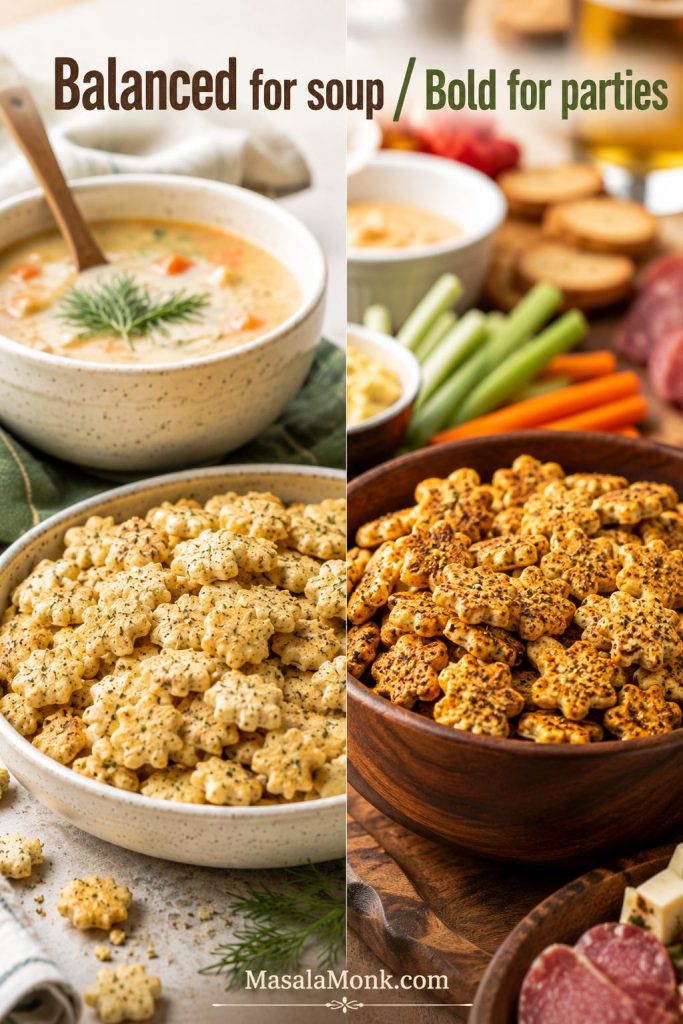
  3. Egg wash. Dip fully and let extra drip off.
  4. Breadcrumb coat. Roll and press gently so crumbs cling, especially at the ends.
  5. Second dip, second coat. Back into egg, then crumbs again. This double coating is what turns “okay” into “crispy and sealed.”
Instructional recipe-card image titled “Seal the Ends (No-Leak Breading Tip)” showing hands pressing breadcrumbs onto the end of a breaded mozzarella stick over a tray. Three bowls in the background show flour, egg wash, and breadcrumbs. On-image tips say to press crumbs onto both ends like little caps, patch thin spots before freezing, double coat for a thicker seal, and freeze until firm (2–4 hours). Note says it works for air fryer mozzarella sticks, oven baked, and fried. MasalaMonk.com branding.
If your mozzarella sticks burst open, it’s usually not the recipe—it’s the ends. After the second coat, press breadcrumbs onto both ends like little caps, patch thin spots, then freeze until firm. This quick “seal the ends” step makes air fryer mozzarella sticks, oven baked cheese sticks, and fried mozzarella sticks far less likely to leak.

Now the most important step:

  1. Freeze until firm. Arrange on a tray and freeze at least 2 hours. For stress-free results, freeze 4 hours or overnight.

Why freezing works: the crust sets before the cheese reaches full melt, so the cheese stays inside long enough to warm and stretch instead of instantly escaping.

Quick reality check: if you want truly no-stress mozzarella sticks

Use string cheese, double coat, freeze longer than you think you need, and cook in small batches. It sounds boring, yet it’s the route to “they all stayed sealed.”

Also Read: Sourdough Starter Recipe: Make, Feed, Store & Fix Your Starter (Beginner Guide)


Best cheese for mozzarella sticks: string cheese vs block vs shredded

Mozzarella sticks are not picky about flavor; they’re picky about water content and structure.

Infographic titled “Best Cheese for Mozzarella Sticks: String vs Block vs Shredded.” Three side-by-side panels compare string cheese (most reliable, low leak risk, low prep), low-moisture mozzarella block (best control, medium leak risk depending on thickness, medium prep), and shredded mozzarella (needs structure, best as formed logs/bites, higher leak risk, longer freeze and more prep). MasalaMonk.com branding.
Not all mozzarella behaves the same—and this is why sticks “leak.” String cheese is the most reliable (already portioned + drier), low-moisture block mozzarella gives you the most control (thickness matters, so freeze longer if you cut thick), and shredded mozzarella needs structure (form logs/bites with a binder, then freeze longer). Use this chart to pick the right cheese for air fryer mozzarella sticks, oven baked cheese sticks, or fried mozzarella sticks—then follow the master no-leak method (dry surface, thick coating, frozen center). Save this for your next snack night.

String cheese mozzarella sticks (easiest and most consistent)

String cheese is already portioned, relatively dry, and firm enough to handle breading. It’s also the best option if you’re making mozzarella sticks in an air fryer, because air fryers cook aggressively from the outside in.

Mozzarella sticks with shredded cheese (it can work, but shape is everything)

Shredded cheese is loose. It melts quickly. It needs help. The solution is to turn shredded mozzarella into a cohesive “log” before breading.

Below, you’ll get a method that uses a binder and a longer freeze so the exterior can set without the center instantly collapsing.

Smoked mozzarella sticks (big flavor, different behavior)

Smoked mozzarella brings a deeper flavor, but it often softens faster once heated. That means the same rule applies—freeze longer, and don’t cook too long “just to be safe,” because extra time usually causes leakage.

Also Read: How to make No-Bake Banana Pudding: No Oven Required Recipe


Mozzarella sticks with shredded mozzarella (formed logs recipe)

If you’re here because you want mozzarella sticks shredded cheese style, this is the most dependable approach.

Shredded mozzarella “sticks” recipe (best as short logs or bites)

Ingredients

  • 200 g shredded low-moisture mozzarella
  • 20 g cornstarch (about 2 tbsp)
  • 30 g cream cheese (about 2 tbsp), softened
  • 1 egg white (optional, use it if the mix feels loose)
  • breading station from the master method
Recipe-card image titled “Mozzarella Sticks With Shredded Cheese (Formed Logs)” showing breaded mozzarella logs with a cheese pull and marinara dip. Text explains the binder method: 200g shredded low-moisture mozzarella, 20g cornstarch, 30g cream cheese, optional egg white; shape short logs, freeze 2–3 hours, double-coat (flour/egg/crumbs), freeze again 30 minutes; tip says short logs burst less. MasalaMonk.com branding.
Making mozzarella sticks with shredded cheese? Use the formed-log binder method so they hold their shape and don’t collapse in the fryer. Mix shredded low-moisture mozzarella + cornstarch + cream cheese, shape short logs, freeze until very firm, then double-coat and freeze again for the crispiest, least-leaky results.

Method

  1. Mix shredded mozzarella and cornstarch until the shreds look lightly dusted.
  2. Add cream cheese and mix until the mixture clumps and holds together.
  3. If it still feels crumbly, add the egg white and mix again.
  4. Shape into short logs (about finger length) or nuggets.
  5. Freeze 2–3 hours until very firm.
  6. Bread using the master method (double coat), then freeze 30 minutes again.
  7. Cook using any method below; start checking early because formed logs can go from perfect to bursting quickly.

These are closer to mozzarella cheese bites than classic long sticks, although the flavor and crunch payoff is exactly what you want.

Also Read: Chicken Adobo — Step-by-Step Recipe — Classic Filipino Adobong Manok


Mozzarella sticks sauce: build dips that make the plate disappear

Mozzarella sticks and marinara are classic for a reason. Still, a second sauce makes the whole thing feel intentional rather than routine.

Recipe-card image titled “Best Sauce for Mozzarella Sticks (3 Quick Dips)” showing breaded mozzarella sticks with a cheese pull and three ramekins of dipping sauce: marinara-style sauce, garlic mayo, and pesto dip. On-image text lists quick dip formulas: warm marinara with oregano and optional chili flakes; mayo with grated garlic, lemon, and black pepper; pesto mixed 1:1 with mayo or yogurt to make it creamy. Tip says “Serve one red + one creamy.” MasalaMonk.com branding.
The fastest way to upgrade mozzarella sticks sauce beyond “just marinara” is a dip duo: one red + one creamy. Use warm marinara-style sauce, a punchy garlic mayo, or a bright pesto dip (pesto + mayo/yogurt). Pick two and suddenly mozzarella sticks feel restaurant-level—perfect for cheese sticks and marinara sauce nights.

Marinara-style dip

Instead of locking yourself into one red sauce, keep it flexible. MasalaMonk’s pizza sauce recipes gives you multiple sauce directions that still work as “cheese sticks sauce”—classic marinara-style, vodka-style, ranch-style, and more—so you can switch it up without changing the snack.

Creamy dip base (spicy mayo, garlic mayo, herby mayo)

If you want a dip that clings, mayo is the base. The easiest way to make it feel restaurant-level is to start with a strong foundation like MasalaMonk’s homemade mayonnaise guide, then flavor it:

  • spicy mayo: chili sauce + lime + pinch of sugar
  • garlic mayo: grated garlic + lemon + black pepper
  • herby mayo: dried oregano + parsley + a splash of pickle brine

If you want an egg-free base, use MasalaMonk’s eggless mayonnaise recipe and build the same variations.

Pesto dip (fresh, bright, unexpectedly perfect)

Pesto is underrated with fried cheese. A spoonful beside hot mozzarella sticks feels “fancier” instantly. Start with MasalaMonk’s pesto recipe guide if you want a classic or a creative variation.

Also Read: Sourdough Recipe: 10 Easy Bread Bakes (Loaves, Rolls & Bagels)


Air fryer mozzarella sticks recipe (crispy, fast, minimal oil)

Air fryer mozzarella sticks are the weeknight hero version. They also demand discipline: the air fryer’s heat is intense, and overcrowding makes breading soften instead of crisp.

Food Network’s air fryer mozzarella sticks method preheats to 400°F and cooks around 6 minutes, turning halfway (Air Fryer Mozzarella Sticks). Use that as a baseline, then adjust for your model.

Recipe-card infographic titled “Air Fryer Mozzarella Sticks (From Frozen)” showing breaded mozzarella sticks in an air fryer basket with marinara and a creamy dip, plus one stick pulled for a cheese stretch. Text lists: preheat air fryer to 200°C (390–400°F) for 3–5 minutes; cook in a single layer with space; spray lightly with oil for better browning; air fry 5–7 minutes, turning at minute 3–4; rest 2 minutes so the crust firms and cheese settles. Tip says “Runs hot? Try 190°C + add 1–2 min.” MasalaMonk.com branding.
Making frozen mozzarella sticks in the air fryer is all about spacing + timing. Preheat to 200°C (390–400°F), keep them in a single layer, spray lightly for browning, and cook 5–7 minutes (turn at minute 3–4), then rest 2 minutes for a cleaner cheese pull. Save this for “how long to cook mozzarella sticks in air fryer” nights—if your air fryer runs hot, drop to 190°C and add 1–2 minutes to prevent blowouts.

Air fryer mozzarella sticks (from frozen, breaded)

Ingredients

  • frozen breaded mozzarella sticks (string cheese or block)
  • oil spray
  • marinara-style sauce or creamy dip

Steps

  1. Preheat air fryer to 200°C (390–400°F) for 3–5 minutes.
  2. Arrange sticks in a single layer with space around each. If they touch, crisping suffers.
  3. Spray lightly with oil to help browning.
  4. Air fry 5–7 minutes, turning at minute 3–4.
  5. Rest 2 minutes before biting; the cheese settles and the crust firms.

If your air fryer runs hot, drop to 190°C and add 1–2 minutes instead. That small change often prevents blowouts.

When you’re already in air fryer mode, it’s easy to keep the basket moving with something like MasalaMonk’s air fryer chicken wings as a companion platter—crispy, shareable, and in the same “dunkable snack” lane.

Also Read: Sweetened Condensed Milk Fudge: 10 Easy Recipes


Oven baked mozzarella sticks recipe (big batch, hands-off)

When you’re feeding more people, or when you want everything done at once instead of in air fryer batches – oven baked cheese sticks are the move you make.

Recipe-card infographic titled “Oven Baked Mozzarella Sticks (From Frozen)” showing breaded mozzarella sticks on a wire rack over a sheet tray with a marinara dip. Text reads “Big batch, hands-off — extra crisp” and lists steps: heat oven to 220°C (425°F); place sticks on a wire rack over a tray (best crisp) or use parchment and flip carefully; spray lightly with oil; bake 10–12 minutes and flip at minute 6; rest 2 minutes and serve immediately. Tip says rack prevents soggy bottoms and to space them out. MasalaMonk.com branding.
For oven baked mozzarella sticks from frozen, the rack is the cheat code. Bake at 220°C (425°F) for 10–12 minutes, flip at minute 6, then rest 2 minutes so the crust stays crisp and the cheese pull is clean. Save this card for “cheese sticks in oven” nights—spacing + a wire rack prevents soggy bottoms.

Oven baked mozzarella sticks (from frozen, breaded)

Steps

  1. Heat oven to 220°C (425°F).
  2. Place sticks on a wire rack over a tray if you have one. If not, parchment works—just flip carefully.
  3. Spray lightly with oil.
  4. Bake 10–12 minutes, flipping at minute 6.
  5. Rest 2 minutes, then serve immediately.

If you’re building a tray of snacks, oven timing pairs beautifully with MasalaMonk’s baked jalapeño poppers—cheese plus heat, crisp edges, and the same “dip and repeat” rhythm.


Fried mozzarella sticks recipe (restaurant-style crunch)

Deep fried mozzarella sticks are the most dramatic and the most satisfying. They’re also the most sensitive to oil temperature. Too cool, and the cheese melts before the crust sets. Too hot, and the breading browns before the cheese warms.

USDA’s food safety guidance for deep frying is worth a quick read before you start (Deep Fat Frying and Food Safety), especially if you’re new to frying. Meanwhile, if you want a temperature target you can trust, USDA notes deep frying oil is usually maintained around 350°F to 375°F with a deep fry thermometer.

Deep fried mozzarella sticks (from frozen, breaded)

Ingredients

  • frozen breaded mozzarella sticks
  • neutral oil (canola/vegetable/sunflower)
  • sauce for dipping
Recipe-card infographic titled “Deep Fried Mozzarella Sticks (From Frozen)” showing breaded mozzarella sticks frying in hot oil in a basket and then draining on a wire rack, with marinara dipping sauce. Text lists ingredients (frozen breaded mozzarella sticks, neutral oil, dipping sauce) and steps: heat oil to 175–180°C (350–360°F); fry in small batches for 45–75 seconds until deep golden; drain on a wire rack (paper towels cause steam); serve immediately. MasalaMonk.com branding.
Deep fried mozzarella sticks from frozen are all about speed + oil temperature. Keep oil at 175–180°C, fry 45–75 seconds in small batches, then drain on a wire rack so the crust stays crisp (paper towels trap steam). Save this for “how long to fry mozzarella sticks” nights—and serve immediately with marinara for the best crunch.

Steps

  1. Heat oil to 175–180°C (350–360°F).
  2. Fry in small batches for 45–75 seconds until deep golden.
  3. Drain on a wire rack. Paper towels can trap steam and soften crust.
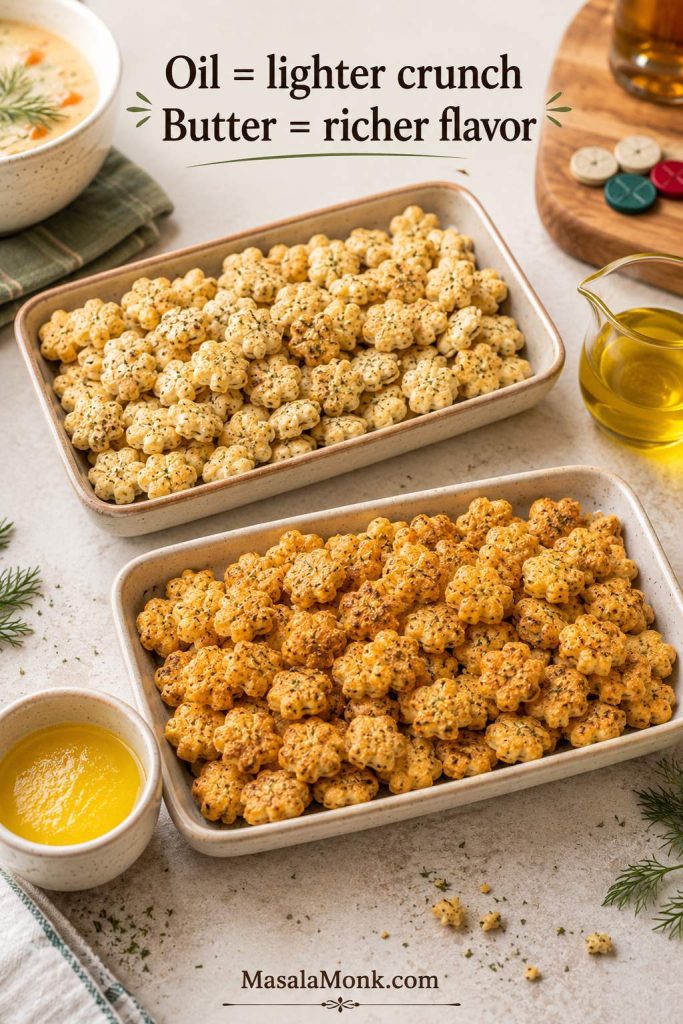
  4. Serve immediately.

If you want the crunch to stay loud: don’t stack them. Put them on a rack, spread out, and dip one at a time.

Bon Appétit’s homemade mozzarella sticks recipe leans into that ideal balance—crispy coating, gooey center, not greasy—while emphasizing a proper crust and good oil temperature control (Homemade Mozzarella Sticks).

Also Read: 10 Vegan Chocolate Cake Recipes (Easy, Moist, & Dairy-Free)


Pan fried mozzarella sticks (when you don’t want deep frying)

Pan frying is a compromise: less oil, less mess, still crisp. However, it only works well if you keep the oil hot enough and you don’t flip endlessly.

Step-by-step recipe-card titled “Pan Fried Mozzarella Sticks (Shallow Fry)” showing breaded mozzarella sticks frying in a heavy pan with shallow oil, then draining on a rack. Text lists steps: add 2–3 cm oil to a heavy pan and heat to 175°C (350°F); fry in batches, turning gently, for 60–90 seconds total; drain on a rack; serve fast because shallow-fried cheese cools quicker. A tip notes hot shallow oil helps keep them crispy with less grease. MasalaMonk.com branding.
Pan fried mozzarella sticks are the “less oil, less mess” middle ground—still crisp, just faster and more delicate than deep frying. Keep the oil hot (about 175°C), turn gently once or twice, and drain on a rack so the crust stays loud. Save this shallow-fry card for nights when you want fried cheese sticks without filling a pot.
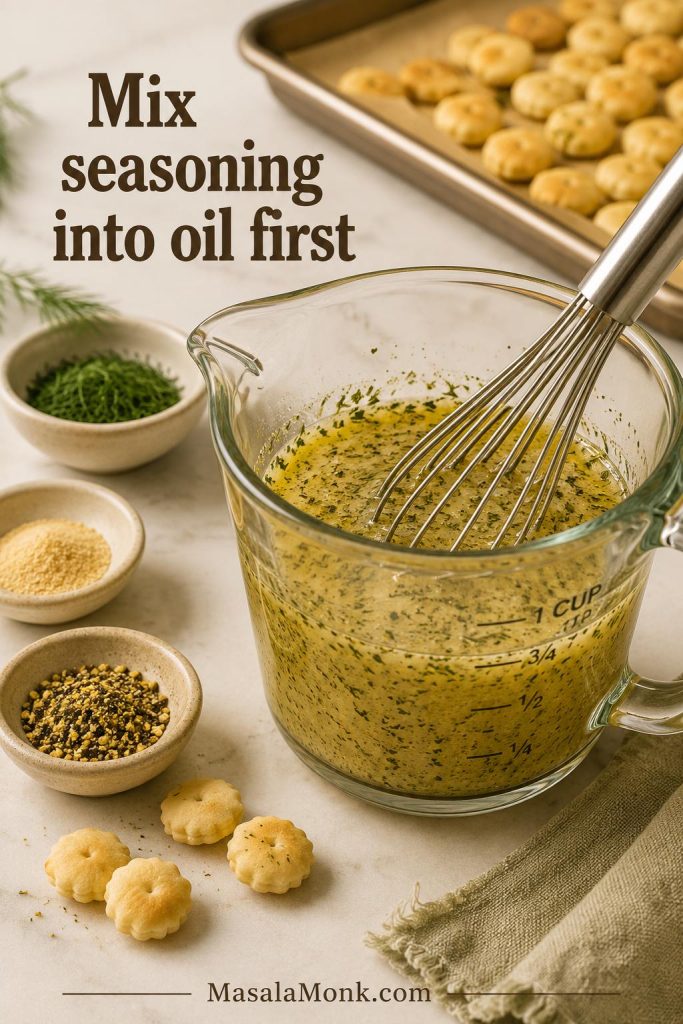
Pan fried mozzarella sticks (shallow fry)

Steps

  1. Add 2–3 cm of oil to a heavy pan and heat to 175°C (350°F).
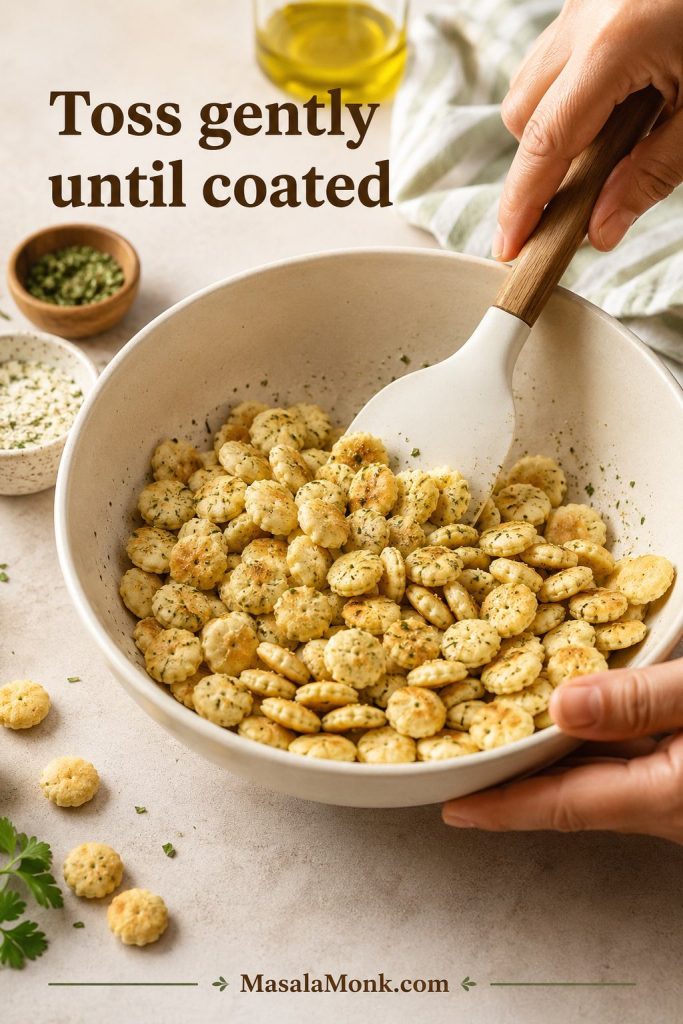
  2. Fry in batches, turning gently, about 60–90 seconds total.
  3. Drain on a rack.
  4. Serve fast—shallow-fried cheese cools quicker than deep fried.

This method is best for shorter sticks (cut string cheese in half) because they heat through before the cheese has time to escape.

Also Read: Kahlua Drinks: 10 Easy Cocktail Recipes (Milk, Vodka, Coffee)


Beer battered mozzarella sticks (pub-style, craggy and bold)

Breadcrumbs give a clean crunch. Beer batter gives a thicker, more rugged coating—almost like a tempura cousin with pub energy.

Recipe-card image titled “Beer Battered Mozzarella Sticks” showing craggy, golden battered mozzarella sticks on a dark plate with marinara sauce and a beer glass in the background. On-image steps say: freeze cheese 2–4 hours; whisk dry mix of flour, cornstarch, baking powder, salt and pepper; add cold beer until thick-pourable; dust sticks in flour so batter grips; fry at 180°C for 60–90 seconds; tip says work in small batches. MasalaMonk.com branding.
Want beer battered mozzarella sticks with that bold, craggy pub crunch? The secret is extra-freezing plus a cold, thick-pourable batter so it sets fast in hot oil. Dust the sticks in flour first (better grip), then fry at 180°C for 60–90 seconds in small batches for crispy battered mozzarella sticks without greasy coating.

Beer battered mozzarella sticks recipe

Ingredients

  • 12 cheese sticks (preferably block-cut or firm string cheese)
  • 125 g flour
  • 1 tbsp cornstarch
  • 1 tsp baking powder
  • ½ tsp salt + pepper
  • 180–240 ml cold beer (add gradually)
  • oil for frying

Steps

  1. Freeze cheese sticks 2–4 hours.
  2. Whisk dry ingredients, then add cold beer until the batter is thick yet pourable.
  3. Dust cheese lightly in flour first (batter sticks better).
  4. Dip in batter and fry at 180°C for 60–90 seconds.
  5. Drain and serve.

Beer battered mozzarella sticks are one of those snacks that feel like they came from a menu, even though they’re made in your kitchen.

Also Read: Hot Chocolate Coffee: 3 Easy Recipes (Cocoa, Mix, or Espresso)


Breaded mozzarella sticks recipe (classic breadcrumb version)

This is the “default” mozzarella sticks recipe most people want: breaded, crispy, stretchy, and made with string cheese or block cheese.

Infographic showing mozzarella sticks cooking times from frozen: air fryer 190–200°C for 5–7 minutes (flip halfway), oven 220°C for 10–12 minutes (flip halfway), and deep fried at 175–180°C for 45–75 seconds in small batches. Background photo shows a crispy mozzarella stick being pulled with gooey cheese stretch and marinara dip.
Mozzarella sticks cooking times, solved—so you get a gooey pull without blowouts. This quick guide covers mozzarella sticks in the air fryer (190–200°C, 5–7 min), oven baked cheese sticks (220°C, 10–12 min), and fried mozzarella sticks (175–180°C, 45–75 sec). Biggest rule for crispy, no-leak results: cook from frozen, don’t crowd, flip halfway (air fryer/oven), then rest 2 minutes so the cheese settles. Save this for “what temp + how long?” nights, and share it with anyone who always overcooks them. Which method are you making—air fryer, oven, or fried?

Use the master breading method above, then choose your cooking path:

  • Air fryer: 200°C for 5–7 minutes, flip halfway
  • Oven: 220°C for 10–12 minutes, flip halfway
  • Frying: 175–180°C for 45–75 seconds

It’s the same breaded base, three different personalities.

Also Read: Cappuccino Recipe: How to Make a Perfect Cappuccino at Home


3 ingredient mozzarella sticks (simple recipe, fast prep)

When you want a quick easy mozzarella sticks recipe without extra seasoning bowls, keep it minimal.

Recipe-card image titled “3 Ingredient Mozzarella Sticks” showing golden breaded mozzarella sticks with a cheese pull and a marinara dip, plus the three ingredients below: string cheese, eggs, and breadcrumbs (panko or regular). On-image instructions say to double-coat and freeze for 2 hours, then cook either in the air fryer at 200°C for 5–7 minutes (flip) or bake at 220°C for 10–12 minutes (flip). Tip says to rest 2 minutes before biting. MasalaMonk.com branding.
Need a quick easy mozzarella sticks recipe? This 3 ingredient mozzarella sticks method is the simplest path to crispy, stretchy cheese sticks at home: string cheese + eggs + breadcrumbs, double-coat, freeze, then cook in the air fryer or oven. Save this card for busy snack nights—and don’t skip the 2-minute rest for the best cheese pull.

How to make three-ingredient mozzarella sticks

  • string cheese
  • eggs
  • breadcrumbs (panko or regular)

Bread the sticks (egg → crumbs), repeat once more for a double coat, freeze 2 hours, then air fry or bake using the timings above.

Even without extra spices, these still work because the dip carries flavor.

Also Read: Cold Brew Espresso Martini: How to Make It (Step-by-Step Recipe)


Puff pastry mozzarella sticks (flaky, golden, party-perfect recipe)

Puff pastry mozzarella sticks are the “wrapped cheese sticks” upgrade. They don’t need breading; they need good sealing and enough bake time to crisp.

Recipe-card image titled “Puff Pastry Mozzarella Sticks” showing golden, flaky puff pastry-wrapped mozzarella sticks on a white plate with a cheese pull and a ramekin of marinara sauce. On-image instructions say: cut pastry into strips, wrap in a spiral (overlap slightly), seal seam underneath, brush egg wash, freeze 20–30 minutes to stop slumping, then bake at 200°C for 15–18 minutes until deep golden. Tip notes deep golden equals crisp with less leakage. MasalaMonk.com branding.
These puff pastry mozzarella sticks are the flakiest “wrapped cheese sticks” upgrade—no breading station needed. Wrap in a spiral, freeze briefly so the pastry holds shape, then bake until deep golden for the crispiest finish and the cleanest cheese pull. Perfect party snack when you want oven-baked cheese sticks that look fancy but feel easy.

Puff pastry mozzarella sticks recipe

Ingredients

  • puff pastry sheet, thawed
  • mozzarella sticks (or cut block sticks)
  • egg wash (1 egg + splash water)
  • optional: chili flakes, oregano, sesame seeds

Steps

  1. Cut pastry into strips.
  2. Wrap each cheese stick in a spiral, overlapping slightly.
  3. Seal the seam underneath.
  4. Brush with egg wash.
  5. Freeze 20–30 minutes so the pastry sets and doesn’t slump.
  6. Bake at 200°C (400°F) for 15–18 minutes until deeply golden.

These are especially good with pesto, because flaky pastry plus herb sauce feels like a snack you’d order twice.

Also Read: Sandwich for Breakfast: Breakfast Sandwich Recipe + 10 Variations


Crescent roll mozzarella sticks (easy wrapped cheese sticks)

This dough is forgiving and fast, which makes it perfect for quick cheese sticks at home.

Recipe-card image titled “Crescent Roll Mozzarella Sticks” showing mozzarella sticks wrapped in crescent dough on a parchment-lined baking tray with a cheese pull and a ramekin of marinara sauce. On-image instructions say: wrap mozzarella sticks in crescent dough, brush with egg wash or milk, sprinkle garlic powder and oregano, and bake at 190°C for 10–13 minutes until deep golden. Tip says to pinch seams tight and freeze 10 minutes for a cleaner shape. MasalaMonk.com branding.
These crescent roll mozzarella sticks are the easiest wrapped cheese sticks for busy nights: wrap, brush, season, bake—and you still get that gooey cheese pull. Pinch the seams and freeze for 10 minutes so they hold their shape, then bake until deep golden for the crispiest edges. Perfect if you’re searching mozzarella sticks with crescent rolls or an easy oven-baked version.

Crescent roll mozzarella sticks

Steps

  1. Wrap mozzarella sticks in crescent dough.
  2. Brush with egg wash or milk.
  3. Sprinkle garlic powder and oregano.
  4. Bake at 190°C (375°F) for 10–13 minutes until browned.

They’re softer than breaded sticks, yet they deliver a satisfying “pull” and hold up well with marinara.

Also Read: Iced Coffee: 15 Drink Recipes—Latte, Cold Brew, Frappe & More


Prosciutto wrapped mozzarella sticks (and pepperoni wrapped mozzarella sticks)

Wrapped mozzarella sticks are a different kind of crunchy: the crisp comes from rendered cured meat rather than breadcrumbs. They’re also naturally lower carb, although they’re not exactly “low calorie mozzarella sticks.”

Split recipe-card image titled “Wrapped Mozzarella Sticks (Prosciutto vs Pepperoni)” showing two plates of mozzarella sticks wrapped in prosciutto on the left and pepperoni on the right, each with marinara sauce. Text says “Crispy wrap, gooey center — no breading.” Prosciutto instructions: wrap tight (overlap slightly), freeze 20–30 minutes, air fry 190–200°C for 4–6 minutes (turn once). Pepperoni instructions: wrap 2 slices (overlap), freeze 15–20 minutes, air fry 190–200°C for 4–5 minutes (check early). Tip says pepperoni crisps faster. MasalaMonk.com branding.
These wrapped cheese sticks skip breadcrumbs but still deliver crunch: prosciutto wrapped mozzarella sticks turn crisp and salty, while pepperoni wrapped mozzarella sticks crisp even faster. Freeze briefly so the wrap firms up, then air fry hot and fast for a gooey center—perfect when you want low-carb-ish mozzarella sticks without the breading station.

Prosciutto wrapped mozzarella sticks recipe

Steps

  1. Wrap each mozzarella stick with a thin slice of prosciutto, overlapping slightly.
  2. Freeze 20–30 minutes so the wrap firms.
  3. Air fry at 190–200°C for 4–6 minutes, turning once.
  4. Serve immediately.

Pepperoni wrapped mozzarella sticks

Follow the same method, although pepperoni crisps even faster, so start checking at 4 minutes.

If you want to build a full tray of savory bites alongside these, it’s easy to add something like MasalaMonk’s how to cook bacon in the oven method for crisp bacon strips that can top dips, salads, or even a snack board.

Also Read: Cranberry Moscow Mule Recipe: A Festive Holiday Cocktail With Easy Variations


Keto mozzarella sticks (low carb cheese sticks recipe that still crunch)

To make these cheese sticks keto, is all about swapping breadcrumbs for a coating that browns and crisps without flour.

Recipe-card image titled “Keto Mozzarella Sticks (Low Carb)” showing crispy coated mozzarella sticks with a cheese pull and marinara, plus bowls of almond flour and finely grated parmesan. Text lists keto coating ingredients (50g almond flour, 25g parmesan, optional crushed pork rinds, garlic powder, paprika, salt, pepper) and method: coat → egg → coat (repeat), freeze 2–4 hours, air fry 200°C for 5–7 minutes (flip) or bake 220°C for 10–12 minutes; tip notes parmesan browns fast so start checking early. MasalaMonk.com branding.
These keto mozzarella sticks are the easiest way to get a real crunch without breadcrumbs: almond flour + parmesan (optional pork rind crunch), double-coat, freeze, then cook hot and fast. Perfect for anyone searching low carb cheese sticks or keto cheese sticks—and the “check early” parmesan tip prevents blowouts.

Keto mozzarella sticks recipe

Coating

  • 50 g almond flour
  • 25 g parmesan, finely grated
  • optional: ½ cup crushed pork rinds for extra crunch
  • garlic powder, paprika, pepper, salt

Steps

  1. Bread as usual: almond flour mix → egg → almond flour mix again.
  2. Freeze 2–4 hours.
  3. Air fry 200°C for 5–7 minutes or bake 220°C for 10–12 minutes.

If you want a deeper mozzarella-and-low-carb angle for readers who like that lane, MasalaMonk’s mozzarella keto-friendly guide fits naturally as a supporting read.

Also Read: Baked Ziti Recipe Collection: 15 Easy Variations


Cheddar cheese stick recipe (a sharper, richer twist)

Cheddar sticks are delicious, but cheddar behaves differently from mozzarella. It melts more aggressively and can separate if pushed too far. That means the safest way is thicker sticks, longer freezing, and quick cooking.

Recipe-card image titled “Cheddar Cheese Sticks (Extra Crunchy)” showing crispy breaded cheddar cheese sticks on a white plate with a melted cheddar center and a ramekin of marinara sauce. On-image instructions say to cut firm cheddar into thicker sticks (about 2.5 cm), double-coat (flour, egg, crumbs), freeze 4 hours or overnight, then air fry at 190°C for 5–6 minutes or bake at 220°C for 10–11 minutes. Tip says thicker sticks plus shorter cook means less splitting. MasalaMonk.com branding.
A cheddar cheese stick recipe needs a slightly different strategy than mozzarella: thicker sticks + longer freezing + faster cooking so the coating sets before the cheddar melts too aggressively. This “extra crunchy” method is perfect for anyone searching cheddar sticks recipe or wanting a sharper, richer twist on classic cheese sticks.

Cheddar cheese sticks (breaded)

Steps

  1. Cut firm cheddar into thicker sticks than mozzarella (about 2.5 cm thick).
  2. Double coat using the master breading method.
  3. Freeze 4 hours or overnight.
  4. Air fry 190°C for 5–6 minutes or bake 220°C for 10–11 minutes.
  5. Serve fast; cheddar cools and firms quickly.

These don’t stretch like mozzarella, yet they deliver a richer bite that’s excellent with a tangy sauce.

Also Read: Green Chutney Recipe (Coriander–Mint / Cilantro Chutney)


Smoked mozzarella sticks (bolder flavor, same recipe)

Mozzarella sticks with smoked cheese are pure snack joy—especially with marinara or spicy mayo.

Recipe-card image titled “Smoked Mozzarella Sticks” showing crispy breaded smoked mozzarella sticks on a plate with a cheese pull and two dips (marinara and spicy mayo). Text says “Bolder flavor, cook a little gentler” and lists tips: use smoked low-moisture mozzarella (string or block), double-coat and seal the ends, freeze 4 hours, then cook with one of three methods—air fryer 190°C for 5 minutes then check, oven 220°C for 9–11 minutes, or fry 175°C for 45–60 seconds. Tip notes “one extra minute” is what causes leaks. MasalaMonk.com branding.
Smoked mozzarella sticks bring bigger flavor, but smoked cheese softens faster—so the win is cooking a little gentler and checking early. Double-coat, seal the ends, freeze longer, then air fry, bake, or fry just until golden. Use marinara or spicy mayo and serve immediately for the best pull without leaks.

Use the same breading and freezing method, then cook slightly more cautiously:

  • Air fryer: start at 190°C for 5 minutes, then check
  • Oven: 220°C for 9–11 minutes
  • Frying: 175°C for 45–60 seconds

Because smoked mozzarella can soften fast, “just one extra minute” is often what causes leaks.

Also Read: Manhattan Cocktail Recipe (Classic + 6 Variations)


Mozzarella rounds and mozzarella cheese bites (bite-size versions)

Sometimes sticks feel too long, especially for a party tray. In that case, cut string cheese into thirds or use a low-moisture block and cut small rectangles. Bread them the same way, freeze thoroughly, then cook a little faster:

Recipe-card image titled “Mozzarella Bites (Rounds + Nuggets)” showing golden breaded mozzarella rounds and nugget bites on a plate with marinara and pesto dips, including one piece broken open with a cheese pull. Text explains cut size (rounds as coin/medallion, bites as nuggets or thirds of string cheese) and cook times from frozen: air fryer 4–6 minutes, oven 8–10 minutes, fry 35–55 seconds. Tip says smaller pieces leak faster, so don’t overcook. MasalaMonk.com branding.
For party trays, mozzarella rounds and mozzarella cheese bites are easier to dip and cook faster than full sticks—just start checking early. Use this quick from-frozen time guide for air fryer mozzarella bites, oven baking, or frying, and remember the key rule: smaller pieces leak faster if you overcook them.
  • Air fryer: 4–6 minutes
  • Oven: 8–10 minutes
  • Frying: 35–55 seconds

Bite-size pieces are also the easiest way to use shredded cheese logs because they hold shape better.

Also Read: Paper Plane Cocktail Recipe + Best Amaro Substitutes & Tips


Hot mozzarella sticks and “hot cheetos” style crust (spicy snack energy)

If you want a bright, spicy crust that feels like a guilty pleasure, crushed spicy corn snacks can replace breadcrumbs. It’s messy, but it’s fun.

Recipe-card image titled “Hot Cheetos Mozzarella Sticks” showing bright red-orange, spicy-crumb coated mozzarella sticks on a plate with one stick pulled open for a gooey cheese stretch. Two dips sit behind the plate (ranch-style/creamy dip and marinara). Text instructions say: crush spicy corn snacks into fine crumbs; use master method flour → egg → spicy crumbs → egg → spicy crumbs; freeze 2–4 hours; air fry at 200°C for 5–7 minutes (flip) or bake at 220°C for 10–12 minutes. Tip says fine crumbs stick better than shards. MasalaMonk.com branding.
If you want hot cheetos mozzarella sticks with real crunch, the key is fine crumbs + double coating so the spicy crust seals before the cheese goes molten. Freeze well, then cook hot and fast in the air fryer (or bake). This is the most fun way to do hot mozzarella sticks and it’s a guaranteed save for “spicy snack energy” nights.

Hot “cheetos” mozzarella sticks

Steps

  1. Crush spicy corn snacks finely (you want a crumb, not shards).
  2. Use the master method: flour → egg → spicy crumbs → egg → spicy crumbs.
  3. Freeze 2–4 hours.
  4. Air fry 200°C for 5–7 minutes or bake 220°C for 10–12 minutes.

These are best served with a cool dip—eggless mayo or ranch-style sauce works beautifully.

Also Read: Rob Roy Drink Recipe: Classic Scotch Cocktail (Perfect + Dry + Sweet Variations)


How to cook frozen mozzarella sticks (air fryer and oven)

Frozen mozzarella sticks are built for convenience, but they still benefit from good spacing and correct heat. The biggest mistake is crowding the basket or stacking on a tray, because trapped steam softens the coating.

Infographic titled “Frozen Mozzarella Sticks (Air Fryer + Oven): The crisp rules (no soggy coating).” Side-by-side air fryer basket photos show “Don’t” overcrowd sticks (crowding causes steam and sogginess) versus “Do” cook in a single layer with space for crisp results. Checklist says: cook from frozen (don’t thaw), single layer with space, preheat air fryer/oven, flip halfway, rest 2 minutes. Bottom line lists times: air fryer 190–200°C for 6–8 minutes; oven 220°C for 10–14 minutes. MasalaMonk.com branding.
For frozen mozzarella sticks in the air fryer (or oven), the biggest “why are they soggy?” fix is simple: single layer + space so hot air circulates instead of steaming the coating. Cook straight from frozen, preheat, flip halfway, and rest 2 minutes—this is the easiest way to get crispy air fryer mozzarella sticks frozen or oven baked cheese sticks without blowouts.

Instant Pot’s from-frozen mozzarella sticks method stresses single-layer spacing, with room around each piece, so hot air can circulate (From-Frozen Mozzarella Sticks).

Frozen mozzarella sticks in air fryer

  1. Preheat to 190–200°C (375–400°F).
  2. Arrange in one layer with space around each.
  3. Air fry 6–8 minutes, turning once if your model benefits from it.

Frozen mozzarella sticks in oven

  1. Heat oven to 220°C (425°F).
  2. Place sticks on a rack or spaced out on parchment.
  3. Bake 10–14 minutes, flipping halfway.

If you want the “best mozzarella sticks frozen” experience at home, the trick is simply cooking them hot and fast without crowding.

Also Read: Blueberry Pancakes (6 Recipes) + Homemade Pancake Mix


Mozzarella stick breading: how to make it taste like more than crumbs

Breading can taste bland if it’s treated like an afterthought. Luckily, the fix is simple: give it fragrance and contrast.

Try one of these breadcrumb blends:

  • Italian-style: oregano + garlic + parmesan
  • smoky: smoked paprika + black pepper + pinch of sugar
  • spicy: chili flakes + paprika + garlic
  • herby: dried parsley + oregano + lemon zest (tiny amount)

Also, panko gives a louder crunch, while fine breadcrumbs help seal. Combining both is the easiest way to get “crispy cheese stick” texture without extra steps.

Also Read: Negroni Recipe: Classic Cocktail & Its Variation Drinks


Low calorie mozzarella sticks (the realistic approach)

Mozzarella sticks are not diet food; still, you can make them lighter without turning them sad.

Recipe-card infographic titled “Low Calorie Mozzarella Sticks (Realistic Approach)” showing crispy breaded mozzarella sticks on a plate with a small arugula and cherry tomato salad, plus two dips (yogurt dip and marinara). Text reads “Lighter… not sad.” and “Low Calorie Sticks: 4 Smart Swaps,” listing: cook method air fry/oven over deep fry, panko for crisp with less oil, dip swap to yogurt dip or thin marinara, and balance plate with fresh salad/veg. Tip says “Still want a pull? Freeze + double-coat first.” MasalaMonk.com branding.
Want low calorie mozzarella sticks that still feel like a treat? Use the “realistic” upgrades: air fryer or oven, panko for crunch, and a lighter dip like yogurt-herb sauce or thin marinara—then add something fresh so the plate feels balanced. Save this card for your next snack night and use the master freeze + double-coat method from the post for the cleanest, no-leak cheese pull.

Here’s what helps:

  • Choose air fryer or oven instead of deep frying.
  • Use panko for crunch so you don’t need as much oil.
  • Serve with a lighter dip (yogurt-based or a thinner marinara-style sauce).
  • Pair with something fresh so the plate feels balanced.

If you want another crisp side that’s baked rather than fried, MasalaMonk’s garlic cheese potatoes (no frying) fits the same comfort lane while staying oven-friendly.

Also Read: Keto Chia Pudding Recipe with Almond Milk


A snack board built around mozzarella sticks (so the night feels like a plan)

Mozzarella sticks shine brightest when they’re part of a spread. That doesn’t mean you need ten dishes; it means you need contrast.

Here’s a simple board idea:

If you want one “effort snack” that’s still in the same family, MasalaMonk’s arancini balls guide is basically mozzarella sticks’ cousin—crispy outside, gooey and cheesy inside, and impossible to ignore.

Also Read: Almond Flour Pancakes (Easy Recipes) Fluffy, High-Protein, Keto & More


How to make mozzarella sticks at home without stress (common issues and fixes)

Even with a good recipe, mozzarella sticks can misbehave. When that happens, the fix is usually one of these, not a full restart.

“They burst open in the air fryer.”

  • Freeze longer. Two hours is the minimum; four is calmer.
  • Lower the temperature slightly and extend the time.
  • Make sure the ends are sealed with crumbs.

“Breading falls off.”

  • Don’t skip flour. Flour gives the egg something to grip.
  • Pat the cheese dry first.
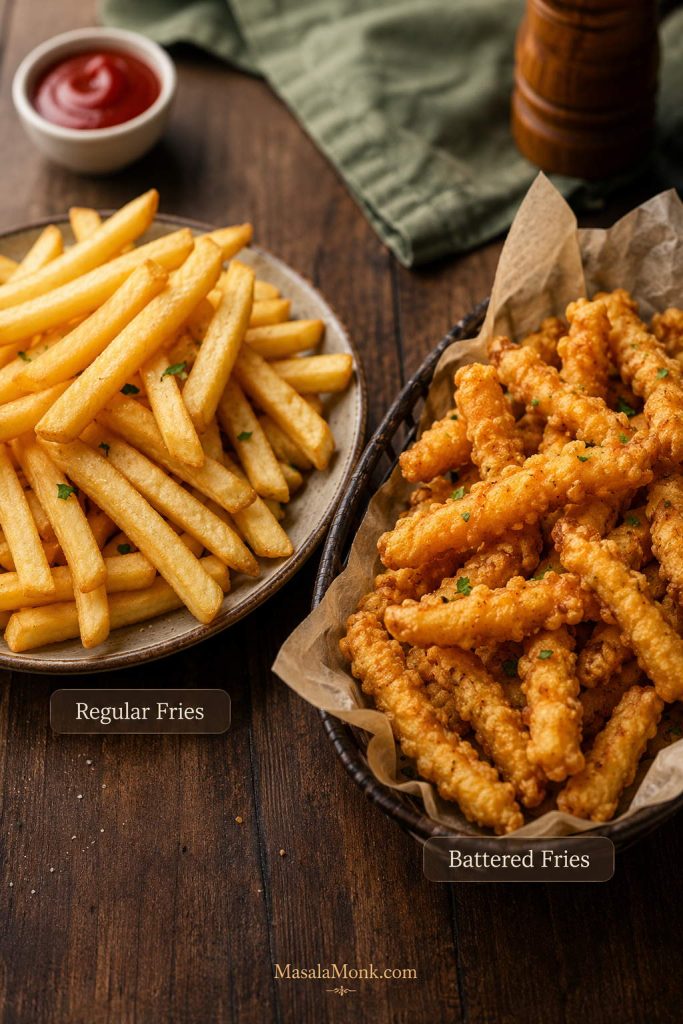
  • Press crumbs gently; don’t just roll and hope.

“They’re golden but the cheese isn’t melty.”

  • Your cheese pieces are too thick for your cook time.
  • Cut sticks slightly slimmer next time, or cook 30–60 seconds longer—carefully.

“They’re greasy.”

  • Oil was too cool (frying), or you drained on paper towels and steam softened the crust.
  • If frying, keep oil temperature steady. USDA’s deep frying guidance is useful here (Deep Fat Frying and Food Safety).

Also Read: Authentic Chimichurri Recipe (Argentine Steak Sauce)


Make-ahead mozzarella sticks (and why they’re perfect for it)

Mozzarella sticks are at their best right after cooking, yet the prep can be done long before anyone shows up.

Make ahead

Bread the sticks, freeze until solid, then transfer to a freezer bag.

How long they keep

They keep well frozen for several weeks. The key is keeping them sealed so they don’t pick up freezer odors.

Reheating leftovers

Microwaves soften breading. Instead, reheat in:

  • air fryer at 190°C for 3–4 minutes
  • oven at 220°C for 6–8 minutes

Bon Appétit highlights the advantage of prepping ahead with homemade mozzarella sticks since cooking is quick once you’re ready (Homemade Mozzarella Sticks).

Also Read: How to Make Churros (Authentic + Easy Recipe)


Turn mozzarella sticks into dinner (not just snacks)

Mozzarella sticks can be the opening act. If you want a full meal, keep the rest simple and comforting.

It’s warm, shareable, and it makes the night feel like it had a plan—without turning cooking into a project.

Also Read: 19 Essential Kitchen Tools That Make Cooking Easier


One last note before you cook

Mozzarella sticks are a snack, but they’re also a small technique: seal, freeze, cook hot and fast, and serve immediately. Once you nail that rhythm, you can make them any way you want—string cheese mozzarella sticks, mozzarella sticks with shredded cheese, beer battered cheese sticks, baked cheese sticks, keto cheesesticks, or frozen mozzarella sticks in the air fryer when time is tight.

Also Read: How to Cook Tortellini (Fresh, Frozen, Dried) + Easy Dinner Ideas

FAQs

1) What’s the best cheese for mozzarella sticks?

For the most reliable mozzarella sticks recipe, low-moisture mozzarella is the sweet spot because it melts smoothly without releasing as much water. String cheese is the easiest option since it’s already shaped and fairly firm. Meanwhile, block mozzarella (cut into sticks) gives you control over thickness and texture. If you’re using fresh mozzarella, expect more leaking unless you dry it very well and freeze longer.

2) Can I make mozzarella sticks using string cheese?

Yes—mozzarella sticks made with string cheese are often the simplest way to get consistent results. Since the pieces are uniform, they cook evenly whether you choose air fryer mozzarella sticks, oven baked mozzarella sticks, or fried mozzarella sticks. Just make sure they’re double-breaded and thoroughly frozen first.
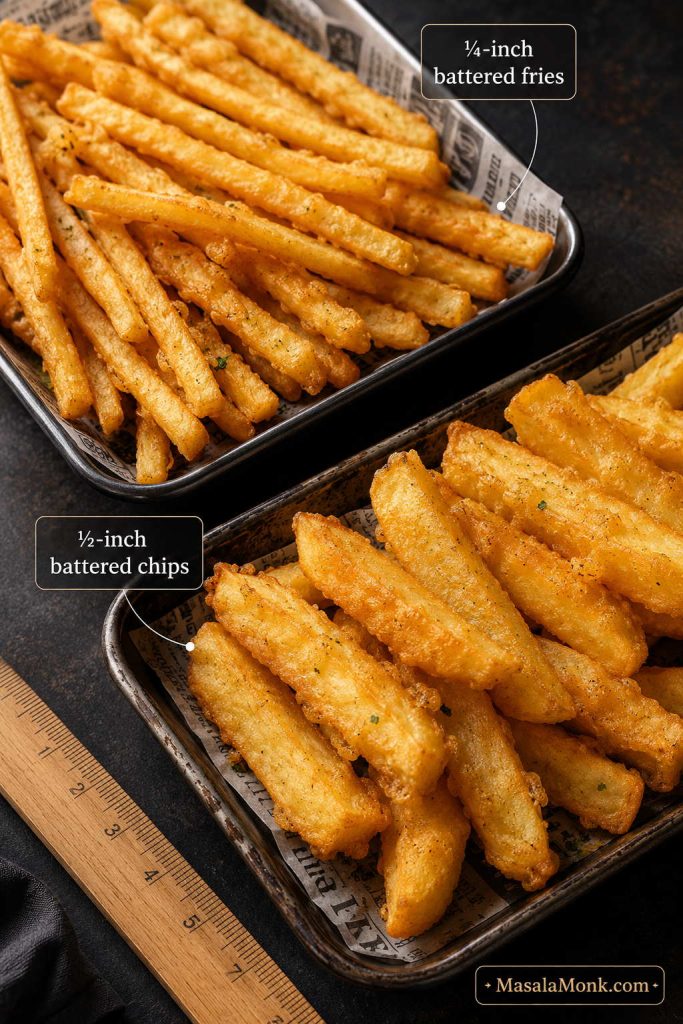
3) How do I make mozzarella sticks with shredded cheese without them falling apart?

Mozzarella sticks with shredded cheese work best when you treat them like shaped logs or bites rather than long sticks. First, mix shredded mozzarella with a small amount of starch (cornstarch works well) and a soft binder like cream cheese so it holds together. After that, freeze the shaped pieces until very firm, then double-coat and freeze again. As a result, the coating has time to set before the cheese collapses.

4) Why do my cheese sticks burst open while cooking?

Usually, the center isn’t frozen enough or the breading has thin spots—especially at the ends. Sometimes, cooking temperature also plays a role: if the oil is too cool, the cheese melts before the crust sets; if the air fryer runs very hot, the outside browns quickly while the middle erupts. Therefore, longer freezing, better sealing, and steady heat fix most blowouts.

5) How long should I freeze mozzarella sticks before cooking?

Freeze breaded mozzarella sticks for at least 2 hours; however, 4 hours (or overnight) makes the process calmer and more forgiving. If you’re making mozzarella sticks from shredded mozzarella, freeze even longer because the shaped mixture warms and softens faster.

6) What’s the best breading for mozzarella sticks?

A mix of panko and fine breadcrumbs creates the best balance: panko gives louder crunch, while finer crumbs help seal gaps. Additionally, seasoning the breading—garlic powder, oregano, onion powder, paprika—makes the crust taste like more than “just crumbs.”

7) How do I bread mozzarella sticks so the coating stays on?

Start with flour, then egg, then breadcrumbs—because flour helps the egg grip and prevents slipping. After that, repeat egg and breadcrumbs for a second coat. Finally, press the crumbs gently, especially around the ends, since that’s where leaking usually starts.

8) How to cook mozzarella sticks in an air fryer?

For mozzarella sticks in air fryer, preheat to around 190–200°C, arrange in a single layer, lightly spray with oil, and cook for about 5–7 minutes, flipping halfway. Then let them rest for a minute or two so the cheese settles rather than spilling immediately.

9) How long to cook cheese sticks in air fryer (time guide)?

Most air fryer cheese sticks take 6–8 minutes, depending on thickness and the air fryer’s intensity. If they’re small or your air fryer runs hot, start checking at 5 minutes. Conversely, thicker sticks might need closer to 8 minutes.

10) How to cook frozen mozzarella sticks in air fryer?

Air fry frozen mozzarella sticks straight from the freezer at 190–200°C for about 6–8 minutes, turning once if needed. Importantly, don’t thaw first, because thawing increases leakage and can make the coating soggy.

11) How to cook frozen cheese sticks in the oven?

Bake frozen mozzarella sticks in oven at about 220°C for 10–14 minutes, flipping halfway. For extra crispness, bake on a rack so hot air circulates underneath instead of steaming the bottom.

12) Can I bake mozzarella sticks instead of frying?

Absolutely—baked mozzarella sticks can get very crisp, particularly with panko breading and a light oil spray. Use a hot oven and avoid crowding. Even so, freezing first still matters, because the cheese needs time to warm without escaping.

13) What’s the best way to make mozzarella sticks extra crispy?

Double breading is step one. After that, freeze thoroughly, then cook hot and fast. Additionally, panko breadcrumbs and a light oil spray help browning, while cooking on a rack (in the oven) prevents soggy bottoms.
14) Can I pan fry mozzarella sticks?

Yes, pan fried mozzarella sticks can work with a shallow layer of hot oil. Still, you’ll want to fry in small batches and avoid constant flipping. In other words, treat it like quick shallow frying: set the crust, turn once, and remove promptly.

15) How long to fry mozzarella sticks?

Most deep fried mozzarella sticks cook quickly—often under 90 seconds—because the goal is to brown the crust while warming the center. If you fry too long, the cheese melts completely and pushes out. So, once they’re golden, pull them.
16) What oil is best for fried cheese sticks?

Choose a neutral, high-heat oil such as sunflower, canola, or vegetable oil. In addition, keep the temperature steady so the breading crisps quickly without absorbing excess oil.

17) What are beer battered mozzarella sticks, and how are they different?

Beer battered mozzarella sticks use a thick batter instead of breadcrumbs, creating a craggy, pub-style shell. Because batter needs time to set, freezing the cheese extra well is even more important. Also, a quick flour dust before dipping helps the batter cling.

18) Can I make low carb mozzarella sticks or keto cheese sticks?

Yes—keto mozzarella sticks skip breadcrumbs and use coatings like almond flour, parmesan, and sometimes crushed pork rinds for crunch. Even so, the same rules apply: double coat, freeze thoroughly, then cook quickly to prevent blowouts.

19) Are “low calorie mozzarella sticks” actually possible?

They can be lighter, although they won’t be “diet food.” Air fryer mozzarella sticks or oven baked cheese sticks reduce oil compared to deep frying. Moreover, pairing them with a tomato-based dip instead of a heavy creamy sauce can keep the plate feeling balanced.

20) What sauce goes with mozzarella sticks besides marinara?

Marinara sauce for mozzarella sticks is classic, yet plenty of other options work: garlic mayo, spicy mayo, ranch-style dip, pesto, honey-mustard, or even a simple chili sauce. As a result, the same cheese sticks can feel totally different from one night to the next.

21) Can I reheat mozzarella sticks and keep them crispy?

Yes—reheat in an air fryer or hot oven so the crust re-crispens. Meanwhile, microwaving tends to soften the coating. For best texture, reheat briefly, then rest for a minute before serving.

22) Can I make mozzarella sticks ahead of time?

Definitely. Bread the sticks, freeze until solid, and store in a freezer bag. Then cook straight from frozen whenever you want. Consequently, mozzarella sticks become a quick snack instead of a last-minute project.

23) Why are my mozzarella sticks soggy?

Crowding is the usual culprit, especially in the air fryer. Also, baking on a flat tray can trap steam underneath. Therefore, space them out, flip midway, and consider using a rack in the oven.

24) Can I use cheddar for cheese sticks?

Yes—cheddar cheese stick recipe versions exist, but cheddar melts differently and can separate. For that reason, cut thicker pieces, freeze longer, and cook slightly faster. Alternatively, blend cheddar with mozzarella for a sharper flavor with better melt behavior.

25) What are mozzarella rounds, and can I cook them like cheese sticks?

Mozzarella rounds are simply thicker coin-shaped pieces (or small medallions). You can bread and cook them like mozzarella cheese bites, although they often need slightly shorter cooking times. In addition, they’re great for snack platters because they’re bite-sized and easy to dip.

Posted on 6 Comments

Easy Lemon Pepper Chicken Wings (Air Fryer, Oven & Fried Recipe)

Easy lemon pepper chicken wings on a plate with fries and creamy dip, glass of white wine and a woman in the background, styled like a premium magazine cover with the title Easy Lemon Pepper Chicken Wings – Crispy & Flavorful.

There’s a very particular kind of happiness that comes from a tray of lemon pepper chicken wings landing on the table. The first thing you notice is the smell: hot chicken, citrus, and black pepper all hitting your nose at once. Then you see the skin, blistered and golden, flecked with tiny bits of lemon zest and coarse pepper. And finally there’s that crunch when you bite in, followed by juicy meat and a bright, salty, lemony finish that makes your fingers impossible not to lick.

You do not need a restaurant fryer or a game-day catering budget to make wings like that at home. With a bag of wings, a couple of lemons, and a bit of patience, you can build your own version that’s just as addictive—maybe more, because you can tweak it exactly the way you like.

In this long, detailed guide, you’ll walk through:

  • A flexible base recipe for lemon pepper chicken wings
  • Three cooking methods: air fryer, oven-baked, and shallow-fried
  • A fresh homemade lemon pepper seasoning you can keep in a jar
  • A buttery “lemon pepper wet” sauce for glossy, saucy wings
  • Variations like honey lemon pepper, spicy three-pepper wings, and lemon pepper ranch
  • Side dishes, dips, and drinks that turn wings into a full spread
  • How to store and reheat leftovers safely while keeping them crisp

Grab a drink, skim once to see which method you’ll use, and then dive back in with your wings and spices ready to go.

Also Read: What to Mix with Jim Beam: Best Mixers & Easy Cocktails


Why Lemon Pepper Chicken Wings Hit So Hard

Before getting into the practical stuff, it helps to understand what we’re chasing.

Texture: Crispy Outside, Juicy Inside

The dream lemon pepper chicken wing is all about contrast:

  • Skin: tight, dry, and crisp enough that you hear it crackle
  • Meat: tender and still juicy, never stringy or overcooked
  • Coating: light enough to cling, bold enough to taste in every bite

That combination comes from a few small habits: drying the wings, seasoning them well, and cooking them with enough heat and airflow that the skin really dehydrates and browns. Certain techniques, like using a little baking powder in the dry rub, are popular because they raise the pH of the skin and help it crisp more deeply, a trick explored in depth in testing-focused cooking articles.

Portrait graphic showing lemon pepper chicken wings with text callouts for crispy skin, juicy meat and bright lemon and pepper seasoning, explaining why the wings are so addictive.
This is what a great lemon pepper wing should look and feel like: crackly skin that gives way with a snap, juicy meat that stays tender all the way to the bone, and a bold mix of lemon and black pepper that lingers just enough to make you reach for another. It’s the kind of balance that works whether you’re eating over the kitchen counter on a Friday night or passing a platter around on game day.

Flavor: Bright, Salty, Peppery

Then there’s the flavor profile:

  • Lemon: zesty and fresh, with just enough juice to be tangy
  • Pepper: freshly cracked and slightly floral, not just dusty heat
  • Salt: present but balanced, never harsh
  • Butter or oil: there in the background, carrying all the other flavors

A good lemon pepper seasoning hits those notes cleanly. In its traditional form, lemon pepper is made by infusing dried lemon zest into cracked black pepper and then combining it with salt and optional aromatics. When you build your own version at home, you can decide how lemony, how peppery, and how salty you want it.

Comfort: Casual but Special

Finally, wings have that special status of being both casual and celebratory. They fit into:

  • Friday-night snacks
  • Game-day spreads
  • Lazy family dinners
  • Potluck tables where everybody grabs with their fingers

Lemon pepper in particular has a kind of “grown-up” flavor profile—more sharp and aromatic than heavily sweet sauces—while still being totally approachable.

That’s what we’re aiming for: wings that feel like something you’d order from a favorite place, only made at home, exactly to your taste.

Also Read: Katsu Curry Rice (Japanese Recipe, with Chicken Cutlet)


Ingredients for Lemon Pepper Chicken Wings

To keep things painless, let’s group everything into four parts: the wings, the base seasoning, the lemon pepper blend, and the optional wet sauce.

The Wings and Base Seasoning

For roughly 4 servings (or fewer, if everyone is wing-obsessed), you’ll want:

  • 1 kg / 2.2 lb chicken wings, split into drumettes and flats, wing tips removed
  • 2 tablespoons neutral oil (such as avocado, sunflower, or canola)
  • 1½–2 teaspoons fine salt, adjusted according to your lemon pepper blend
  • 1 tablespoon baking powder (aluminium-free; optional but excellent for crispness)
  • ½ teaspoon garlic powder
  • ½ teaspoon onion powder

This base seasoning gives the wings a solid, savory foundation. If you’ve ever wondered why some baked or air-fried wings feel a bit flabby, it’s often because the skin never really dries out or because there isn’t enough salt on the meat itself.

Recipe card style image showing raw chicken wings in a bowl with jars of salt, garlic powder and onion powder, plus text listing the base seasoning ingredients for lemon pepper chicken wings.
Everything that goes into the base rub for these wings: chicken, neutral oil, salt, baking powder and a mix of garlic and onion powder to build that savory crunch before the lemon pepper even hits.

The baking powder is a small but powerful addition. Tests on crispy poultry have shown that an alkaline coating encourages browning and crunch, which is why this trick shows up again and again in recipes for crispy baked wings and roasted chicken skin.

If you’d rather skip it, you absolutely can; just make a point of drying the wings very thoroughly and not overcrowding them during cooking.

Also Read: Simple Bloody Mary Recipe – Classic, Bloody Maria, Virgin & More


Homemade Lemon Pepper Seasoning

There are many store-bought lemon pepper seasonings available, and some are genuinely tasty. However, they also vary hugely in saltiness and lemon intensity, and quite a few are mostly salt with a faint citrus scent.

Making your own gives you control. You can keep it bright, adjust the salt, and even decide how fine or coarse the pepper should be.

For a small jar:

  • 2 tablespoons finely grated lemon zest (preferably from unwaxed lemons)
  • 1½ tablespoons freshly cracked black pepper
  • 1 tablespoon flaky or coarse salt
  • ½ teaspoon garlic powder
  • ½ teaspoon onion powder
  • ½–1 teaspoon sugar (optional, but it rounds off any bitterness and helps browning)
Portrait recipe card showing a small bowl of homemade lemon pepper seasoning with visible lemon zest, black pepper and salt on a wooden surface, surrounded by peppercorns and lemon, plus text listing the seasoning ingredients.
A small batch of homemade lemon pepper seasoning—lemon zest, cracked black pepper, salt, garlic and onion powder—so you can control exactly how bright, salty and peppery your wings taste.

To prepare it:

  1. Spread the lemon zest in a thin layer on a plate or small tray.
  2. Let it air-dry for a few hours, or place it in a very low oven until it’s no longer wet to the touch.
  3. Combine the dried zest with the pepper, salt, and other seasonings, then stir thoroughly.
  4. Store in an airtight jar away from direct heat and light.

If you’d like reassurance on the proportions or want another perspective, you can glance at a similar homemade lemon pepper seasoning recipe that uses dried lemon zest, black pepper, and salt as its backbone.

For each kilo of wings, plan on 1½–2 tablespoons of this seasoning, plus more at the table for anyone who likes an extra sprinkle.

Also Read: Air Fryer Hard-Boiled Eggs (No Water, Easy Peel Recipe)


Lemon Pepper “Wet” Sauce

Some people love their lemon pepper chicken wings dry and crisp, with the seasoning clinging directly to the skin. Others adore the “wet” style: glossy, buttery, and intensely lemony.

For a small batch of wet sauce:

  • 4 tablespoons unsalted butter, melted
  • 1–2 tablespoons fresh lemon juice, to taste
  • 1 tablespoon lemon pepper seasoning
  • Optional: 1 teaspoon hot sauce if you like an extra kick
Portrait recipe card showing a bowl of lemon pepper wet sauce with a whisk, plus text listing melted butter, fresh lemon juice, lemon pepper seasoning and optional hot sauce for coating lemon pepper chicken wings.
This quick lemon pepper “wet” sauce—melted butter whisked with lemon juice, seasoning and a touch of heat—turns crisp wings into the glossy, intensely lemony style you’d usually only get from a good wing joint.

Whisk it all together until smooth. Taste and adjust the lemon, salt, and heat. If it feels too sharp, a pinch more butter or a drop of honey will smooth things out. If it tastes flat, a bit more lemon juice or seasoning will wake it up.

You’ll toss fresh-cooked wings in this sauce to make them “lemon pepper wet”.

Also Read: Tres Leches – Mexican 3 Milk Cake Recipe


Optional Extras

Depending on your mood, you can also have these on standby:

  • Extra fresh lemon wedges for squeezing
  • A little more freshly cracked black pepper at the table
  • Honey for quick honey lemon pepper wings
  • Cayenne pepper or chili flakes for a spicier batch
  • Ranch dressing or yogurt-based sauces for dipping

Now that everything’s assembled, it’s time to get the wings ready to cook.


Prepping the Wings Properly

Spending ten minutes on prep makes a huge difference later. Instead of jumping straight into cooking, take a moment to set the wings up for success.

Portrait image showing hands cutting raw chicken wings on a wooden board into drumettes, flats and tips, with text overlay titled Trimming and Splitting.
Start strong by trimming and splitting each wing into a drumette, a flat and a tip so everything cooks evenly and is easy to eat.

Trimming and Splitting

If your wings aren’t already separated, start by cutting each whole wing into:

  • The drumette (the meaty piece that looks like a tiny drumstick)
  • The flat (the two-boned middle section)
  • The tip (which you can save for stock if you like)

Sharp kitchen shears work well; a small chef’s knife is also fine. Once you’ve separated them, discard any stray feathers or bits of skin.

Picture of Chicken Wings separated into 3 parts - the drumette, the flat and the Tip.
This is how the wing would look like after proper cutting – Chicken Wings separated into 3 parts – the Drumette, the Flat and the Tip.

Drying the Skin

Next, lay the pieces out on a tray or large plate lined with paper towels. Pat every side dry. Flip them and pat again. It may feel a little tedious, but this step is one of the keys to crisp wings later, especially in the oven or air fryer.

If you’re planning ahead, you can put the tray of dried wings into the fridge, uncovered, for an hour or two. The circulating air helps dry the skin even further. Some cooks even leave them overnight.

Portrait image of chicken wings on a plate lined with paper towels while a hand pats them dry, with text overlay titled Drying the Skin.
Patting the wings bone-dry with paper towels is the small prep step that pays off later in ultra-crispy skin.

Seasoning the Meat

Once the wings are dry, slide them into a big bowl. Sprinkle over base seasoning or:

  • The oil
  • Salt
  • Baking powder
  • Garlic powder
  • Onion powder

Using your hands or a spatula, toss everything until the wings are evenly coated. Make sure the baking powder doesn’t clump; it should be completely mixed into the other seasonings.

At this stage you can cook right away, or you can let the wings sit in the fridge for about half an hour to absorb the salt and spices. That short rest is a kind of mini dry brine; it helps season the meat all the way through and encourages a beautiful, even color on the skin.

Portrait image showing a hand sprinkling seasoning over raw chicken drumettes on a plate, with text overlay titled Seasoning the Meat.
A generous, even coating of salt and spices or use the base seasoning we create earlier in the post – on the wings sets up deep flavor before the lemon pepper ever goes on.

Notice that we still haven’t added the lemon pepper seasoning. That comes later, once the wings are cooked and still hot. Adding it at the end protects the lemon zest from burning and keeps the flavor bright.

Also Read: Peanut Butter Cookies (Classic Recipe & 3 Variations)


Base Method: From Raw Wings to Golden and Ready

Although the details differ from method to method, the basic flow is always the same:

  1. Prep and season the wings
  2. Cook using air fryer, oven, or oil
  3. Toss hot wings in lemon pepper seasoning and/or wet sauce
  4. Check internal temperature
  5. Serve and enjoy

With that structure in mind, you can choose the cooking approach that fits your kitchen and mood.


Air Fryer Lemon Pepper Chicken Wings

If you own an air fryer, this is likely to become your favorite method. It’s fast, fairly clean, and makes crisp wings with very little oil.

Preheating and Setup

Begin by preheating your air fryer to 190–200°C / 375–400°F. Preheating ensures the wings start crisping immediately, rather than steaming while the machine warms up.

While it heats, lightly oil the basket if things tend to stick, and double-check that the air vents are clear. Basic air fryer safety guidelines, such as keeping the unit on a heat-resistant surface and avoiding obstructed vents, help everything cook evenly and safely.

Portrait image of an air fryer with a hand adjusting the dial while seasoned chicken wings sit in the basket in a single layer, with text overlay about preheating to 190–200°C and arranging the wings properly.
Preheat the air fryer fully, then slide in the wings in a single, uncrowded layer so the hot air can crisp every side instead of steaming them.

Arranging the Wings

Place the seasoned wings into the basket in a single layer. It’s okay if they’re a little close, but try to avoid stacking them. Air fryers crisp food by blasting it with hot moving air; when air can’t circulate, you get pale, soft spots instead of even browning. Overcrowding is one of the most common reasons for disappointing results.

If you have more wings than comfortably fit in one layer, plan on cooking them in batches rather than forcing everything in at once.

Cooking Time and Turning

Slide the basket in and air fry the wings for about 22–26 minutes, flipping or shaking them halfway through. The exact time depends on:

  • The size of your wings
  • Your specific air fryer model
  • How packed the basket is
Portrait image of an air fryer basket filled with golden lemon pepper chicken wings being pulled out by hand, with overlay text listing cooking time, flipping halfway and checking doneness around 20 minutes.
Once the basket is loaded, let the wings go for 22–26 minutes, giving them a shake halfway through so every side gets blasted with hot air instead of sitting in one spot.

Around the 20-minute mark, start checking their color and texture. The skin should look golden to deep brown and feel firm when you tap it with tongs.

Seasoning While Hot

As soon as the wings are cooked, transfer them to a clean bowl while they’re still sizzling. Sprinkle over 1½–2 tablespoons lemon pepper seasoning and toss until every piece looks speckled with zest and pepper.

If you’re going for air-fried lemon pepper wet wings, drizzle in some of the butter–lemon sauce and toss again. The residual heat helps the flavors sink in and the butter cling without separating.

Portrait image of hot lemon pepper chicken wings in a bowl while a hand sprinkles seasoning over them, showing how to toss the wings with lemon pepper while they are still sizzling.
As soon as the wings come out of the air fryer or oven, shower them with lemon pepper and toss while they’re still sizzling so the zest, pepper and butter lock onto every piece.

Pile the wings onto a platter, garnish with fresh lemon wedges for squeezing, and bring them straight to the table.

Also Read: Homemade Hot Chocolate with Cocoa Powder Recipe


Oven-Baked Lemon Pepper Chicken Wings

When you’re feeding more than a couple of people, the oven suddenly becomes your best friend. A single large tray can handle a mountain of wings at once.

Preheating the Oven

Set your oven to 220°C / 425°F. If it has a convection (fan) option, switch it on; that extra air movement mimics the air fryer effect and encourages crisp skin.

Portrait image of a hand turning the oven dial to 220°C / 425°F with the door open, showing a foil-lined baking sheet and wire rack inside, with text overlay titled Preheating the Oven.
Crank the oven up to 220°C / 425°F and drop a rack over a lined tray before you even think about the wings—high heat and airflow are what turn seasoned chicken into proper oven-crisp lemon pepper wings.

Place a wire rack on a rimmed baking sheet and line the sheet with foil or parchment for easier cleanup. The rack keeps wings elevated, allowing hot air to circulate underneath, which is especially helpful when the sheet is crowded.

Arranging and Baking

Spread the seasoned wings out in a single layer on the rack. Avoid stacking them; if necessary, use two trays and swap their positions halfway through baking.

Slide the tray into the hot oven and bake for 40–45 minutes, turning the wings once in the middle of the cooking time. As they roast, the skin will gradually tighten and brown, and the fat will drip down onto the tray.

Portrait image of raw seasoned chicken wings laid in a single layer on a wire rack set over a baking sheet, being slid toward the oven, with text overlay titled Arranging & Baking.
Spread the wings out on a rack in one even layer and let the oven do its thing for 40–45 minutes—no stacking, no crowding, just steady heat working on every side.

If, towards the end, they look well-cooked but not quite crisp enough for your taste, you can switch on the broiler for the last 2–3 minutes. Watch carefully at this stage; the lemon and pepper can go from perfect to scorched very quickly under direct heat.

Tossing in Lemon Pepper

Once they’re sizzling and golden, transfer the wings to a mixing bowl. Immediately dust them with lemon pepper seasoning and toss gently but thoroughly. If you’d like some of them wetter, move half to another bowl and toss those in your butter–lemon sauce.

Portrait image of freshly baked chicken wings in a metal mixing bowl being tossed with lemon pepper seasoning using a wooden spoon, with text overlay titled Tossing in Lemon Pepper.
As soon as the tray comes out, scrape the hot wings into a bowl and toss them in lemon pepper so the citrus, salt and cracked pepper cling to the crust while it’s still sizzling.

The baked method gives you lemon pepper chicken wings with a little less hands-on time than frying, plenty of crunch, and the satisfaction of pulling a huge, steaming tray from the oven.

Also Read: Watermelon Daiquiri: A Refreshing Twist on a Classic Cocktail


Fried Lemon Pepper Chicken Wings

There’s something undeniably satisfying about fried wings. The oil helps create that deeply blistered, crunchy skin that many people associate with their favorite wing spots.

Heating the Oil

Choose a wide, heavy pan—a deep skillet or Dutch oven works well—and pour in 2–3 cm of neutral oil. Heat it to 175–180°C / 347–356°F. If you don’t have a thermometer, you can use the old bread test: a small piece of bread should sizzle and turn golden in under a minute.

Portrait image of a cast iron skillet filled with hot oil on the stove, with a hand dipping a small piece of bread in to test the temperature, and text overlay titled Heating the Oil for fried lemon pepper wings.
Heat a shallow pool of neutral oil until a scrap of bread sizzles and turns golden in under a minute—that’s the sweet spot for blistered, crunchy fried lemon pepper wings.

Keep the handle turned inward and the pan on a stable burner. Having a splatter guard or lid nearby is handy, just in case.

Frying in Batches

Lower the wings into the oil carefully, placing them away from you to minimize splashes. Fry only as many as fit comfortably in a single layer; crowding cools the oil and leads to greasy, unevenly cooked wings.

Let them sizzle for 10–12 minutes, turning occasionally so they brown on all sides. Heavier wings may need a little longer. The skin should be deeply golden and crisp, and the meat cooked through.

Portrait image of chicken wings frying in hot oil in a skillet while a pair of tongs lifts a golden drumette above the surface, with text overlay titled Frying in Batches.
Work in small batches so each wing has room to move in the oil, turning them until every side is deep golden and crisp instead of greasy and uneven.

Check the internal temperature of a few wings with an instant-read thermometer; it should read at least 165°F / 74°C, matching the recommended safe minimum temperature for chicken.

Transfer cooked wings to a wire rack set over a tray or to paper towels to drain.

Seasoning Straight from the Oil

While the wings are still hot and glistening, move them into a bowl and shower them with lemon pepper seasoning. Any residual oil on the surface helps the spices cling and bloom. For a truly indulgent batch, pour in some of the buttery lemon mixture too and toss until everything looks shiny.

Portrait image of a plate piled with fried chicken wings while a hand sprinkles lemon pepper seasoning over them, with lemon wedges on the table and text overlay titled Fried Lemon Pepper Chicken Wings – Seasoning Straight from the Oil.
As soon as the wings leave the oil, hit them with lemon pepper so the hot, glistening crust grabs every speck of citrus, salt and black pepper.

If you’re cooking several rounds of fried wings, you can hold finished ones in a low oven (around 140°C / 285°F) for a short time. Just remember the usual game-day safety guidance: cooked foods shouldn’t sit in the “danger zone” between cold and hot for extended periods.

Also Read: Authentic Butter Chicken Recipe (Murgh Makhani) Creamy and Flavorful


Lemon Pepper Chicken Wings Variations

Once you’ve done a straightforward batch, it’s hard to resist playing. Fortunately, the base lemon pepper chicken wings recipe is like a blank canvas that welcomes small tweaks.

Honey Lemon Pepper Chicken Wings

To turn a portion into honey lemon pepper wings:

  1. Stir 2–3 tablespoons honey into your melted butter–lemon sauce.
  2. Toss a batch of hot wings in this mixture until they’re evenly coated and shining.
  3. Taste one and adjust with another splash of lemon juice or a pinch of salt if needed.
Portrait image of honey lemon pepper chicken wings piled on a plate, glistening with a sticky honey–lemon glaze, with text overlay explaining to stir honey into warm lemon-butter sauce and toss the hot wings.
Honey lemon pepper wings take the same crispy base and wrap it in a glossy honey–lemon glaze that softens the sharp edges and makes every bite a little bit sticky, sweet and impossible to stop at one.

The honey softens the sharp edges of the lemon and pepper, so this variation is especially popular with people who like a gentler, slightly sweet wing.


Spicy Lemon Pepper Chicken Wings

If your crowd enjoys a bit more heat, you can make spicy lemon pepper wings by layering in a few extra flavors.

For the dry rub, add:

  • ½–1 teaspoon cayenne pepper, chili powder, or a mix of your favorite hot spices

For the finishing sauce, consider:

  • A spoonful of hot sauce
  • Extra cracked black pepper on top
Portrait image of spicy lemon pepper chicken wings on a plate, coated in a fiery three-pepper glaze with visible chili flakes and black pepper, with text overlay explaining to add cayenne to the rub and hot sauce to lemon-butter before tossing the wings.
Spicy lemon pepper wings layer heat from black pepper, cayenne and hot sauce over that same bright citrus base, so you get proper three-pepper fire without losing the lemony punch.

The idea is to pull heat from three places: the black pepper, the cayenne or chili, and the hot sauce. That way, you get a “three-pepper” style intensity without losing the citrusy brightness that makes lemon pepper wings so distinctive.

Also Read: Kali Mirch Paneer | Black Pepper Paneer- Kid Friendly Recipe


Lemon Pepper Ranch Chicken Wings

When you want to lean toward creamy, herby flavors without giving up the lemon-pepper backbone, ranch steps in.

There are a couple of simple routes:

  1. Lemon Pepper Ranch Dip
    Stir some lemon pepper seasoning into a bowl of thick ranch. Use it as a dip for classic lemon pepper wings, vegetable sticks, and maybe some potato wedges.
  2. Ranch-Coated Lemon Pepper Wings
    Thin ranch with a bit of lemon juice until it’s just pourable. Toss freshly cooked, lightly lemon-peppered wings in a small amount of this dressing so they get a light ranch glaze.
Portrait image of lemon pepper ranch chicken wings on a rustic plate, drizzled with creamy ranch, with a bowl of herby ranch dip and lemon wedges in the background, plus text overlay explaining how to make lemon pepper ranch dip or a light ranch glaze for the wings.
Lemon pepper ranch wings take the same crisp, citrusy base and finish it with cool, herby ranch—either as a thick dip on the side or a light glaze over the hot wings.

Either way, you keep the zing of lemon and the bite of black pepper, while adding the familiar tang and herbs of ranch.


Extra Twists to Try

As you get comfortable, you might experiment with:

  • Garlic Lemon Pepper Wings – Add minced garlic to the butter sauce or increase the garlic powder in the base rub.
  • Smoky Lemon Pepper Wings – Add a little smoked paprika or chipotle powder to the seasoning mix.
  • Herby Lemon Pepper Wings – Finish with chopped parsley or thyme for fresh, green notes.

Small changes can dramatically shift the personality of your wings without requiring a completely new recipe.


Dips, Sides, and Extras for Wing Night

A platter of lemon pepper chicken wings is already a good time, yet pairing them with a few well-chosen sides turns everything into a proper event. You don’t need to go overboard; two or three complementary dishes go a long way.

Portrait image of a wing night spread with lemon pepper chicken wings in the center, surrounded by fries, creamy dip, jalapeño poppers and churros on a dark wooden table, with text overlay asking what to serve with lemon pepper wings and suggesting dips, potatoes, comfort sides and something sweet.
Turn a simple tray of lemon pepper wings into a full wing night by adding a creamy dip, a hot potato side, a cheesy bite like jalapeño poppers and an easy dessert to finish.

Cool and Creamy Dips

First, let’s talk dips. Wings love anything creamy or tangy that cools the palate.

A versatile approach is to offer more than one option:

  • A selection pulled from spinach dip recipes gives you both cold and hot spinach-based dips, including a classic spinach-artichoke style that is fantastic with salty, zesty chicken.
  • When the wings are bright and peppery, a chilled bowl of yogurt, cucumber, lemon, and garlic based on a Greek tzatziki sauce recipe brings a cooling, refreshing contrast and feels lighter than a traditional ranch.

You can also keep a simple blue cheese dip or herbed mayonnaise around, especially if you’re making a spicy batch.


All the Potato Things

Next come the potatoes, because wings and potatoes are a classic duo.

For a straightforward side that always disappears, a big tray of crispy homemade French fries does the job. You can season them simply with salt or play around with variations: garlic-parmesan, chili, or even a light dusting of lemon pepper to echo the wings.

If you feel like branching out, take a look at 10 easy potato appetizers. There you’ll find ideas like smashed potatoes, loaded bites, and other crispy snacks that sit happily beside a wing platter and give people something else to nibble between drumettes.


Comfort Sides That Make It a Meal

Sometimes you want the wings to feel like the centerpiece of a hearty dinner rather than just snacks. In that case, adding one or two warm, substantial dishes helps.

A bubbling pan of macaroni and cheese brings creamy comfort to the table. Next to lemon pepper chicken wings, the rich cheese sauce and soft pasta respond beautifully to the tangy, crisp chicken.

For an additional spicy, creamy bite, baked jalapeño poppers fit right in. They have their own crunch and heat, yet they don’t duplicate the exact flavors of the wings, which keeps the spread interesting.

And if you want a sweet finish without getting too formal, you might end with churros. Using the method from how to make churros, you can fry or bake ridged sticks of dough, roll them in cinnamon sugar, and serve them with chocolate or caramel sauce. They feel playful and shareable, which matches the whole mood of wing night.


Drinks That Pair with Lemon Pepper Chicken Wings

Although you can absolutely just set out a cooler of cold drinks and call it a day, matching your beverages to lemon pepper wings is surprisingly fun.

Because lemon is already a star here, citrusy drinks are natural partners. A chilled lemon drop martini style drink echoes the lemon while bringing a sweet-tart edge that works nicely with salty, peppery chicken. You can make a non-alcoholic version using lemon juice, simple syrup, and sparkling water served in glasses with sugared rims.

During cooler months, you might also lean into autumnal flavors by offering a pumpkin-spice-flavored latte or dessert built from your own spice blend, especially if you already have the oven and stove busy with wings and sides.


Storing and Reheating Lemon Pepper Chicken Wings

With a big batch, you’ll often have a few wings left over. Stored and reheated properly, they make an easy next-day lunch or snack that’s almost as good as the original round.

Portrait image showing cooked lemon pepper chicken wings in a glass container beside an air fryer, with text overlay explaining how to store them in the fridge and reheat in the oven or air fryer to keep the skin crispy.
Once wing night is over, cool the leftovers, tuck them into the fridge and bring them back to life in the oven or air fryer so the skin crisps up again instead of going limp.

Storing Safely

After everyone has eaten, let the wings cool down briefly, then transfer them into an airtight container. Try to get them into the refrigerator within two hours of cooking. Game-day food safety advice consistently emphasizes this 2-hour window for hot foods like wings, to avoid letting them sit in the temperature range where bacteria grow fastest.

In the fridge, cooked wings will usually keep well for 3–4 days.

Reheating in the Oven

For a fairly large batch or whenever you want the most uniform results, the oven is a good choice:

  1. Bring the wings out of the fridge while the oven preheats to 175–190°C / 350–375°F.
  2. Arrange them on a wire rack set over a baking sheet.
  3. Warm them for 8–12 minutes, turning once if necessary, until they’re hot, the skin has re-crisped, and a thermometer reads at least 165°F / 74°C in the thickest part.

Comparisons of reheating methods often find that the oven returns the best combination of juicy meat and crisp skin, while the microwave tends to make the coating soft.

Reheating in the Air Fryer

If you only have a handful of wings to reheat, the air fryer shines:

  1. Preheat to about 175–180°C / 350–360°F.
  2. Place the wings in a single layer in the basket.
  3. Heat for 5–8 minutes, shaking once, until they’re sizzling again and the skin feels crisp.

The air fryer works quickly and restores a nice crunch without needing much effort. Guides on reheating wings in an air fryer recommend similar temperatures and timings, with the same target internal temperature for safety.

Once more, the microwave is best kept as a last resort. It will heat the meat, but it tends to steam the skin, undoing all your crisping work.

Also Read: French Toast Sticks (Air Fryer + Oven Recipe) — Crispy Outside, Custardy Inside


Using Leftover Lemon Pepper Chicken Wings in New Ways

Interestingly, leftover lemon pepper chicken wings don’t have to stay wings. If you strip the meat from the bones, you suddenly have a bowl of tender, lemony chicken that’s perfect for other dishes.

For instance, you can:

  • Toss the meat with a little mayonnaise or yogurt, chopped celery, and herbs for a quick lemon pepper chicken salad.
  • Sprinkle it over greens with cherry tomatoes, cucumbers, and a light vinaigrette for an easy lunch.
  • Layer it into sandwiches or sliders, using ideas from chicken sandwich recipes—anything from Buffalo to BBQ styles can overlap nicely with the lemon pepper flavor, especially if you add cheese, lettuce, and pickles.

In this way, one batch of wings can stretch into multiple meals without feeling repetitive.


Bringing It All Together

By now you’ve seen that making excellent lemon pepper chicken wings at home isn’t complicated; it’s just a series of small, thoughtful steps:

  • Drying and seasoning the wings so they’re flavorful before they ever hit the heat
  • Choosing the cooking method that matches your gear and your crowd
  • Finishing with a fresh, lively lemon pepper seasoning and, if you’re in the mood, a buttery wet sauce
  • Adding simple variations—honey, spice, ranch—to keep things interesting
  • Surrounding the wings with dips, potatoes, and a few extras to turn them into a full occasion
  • Handling leftovers in a way that keeps them both safe and delicious

Whether you’re planning a game-night spread, a relaxed weekend dinner, or just a kitchen experiment on a random afternoon, this approach lets you take a humble pack of wings and transform it into something everyone reaches for.

Next time you see a pile of wings at the shop, you’ll know exactly what to do: grab a couple of lemons, check your pepper grinder, and give yourself permission to fill your kitchen with the smell of hot, crackling, lemon pepper chicken wings.

FAQs about Lemon Pepper Chicken Wings

1. What are the ingredients for lemon pepper chicken wings?

For classic lemon pepper chicken wings, you usually need chicken wings, oil, salt, black pepper, lemon zest or lemon pepper seasoning, and a few simple pantry spices. Typically, the ingredients for lemon pepper chicken include wings, garlic powder, onion powder, a small amount of baking powder for crispiness, and either a homemade or store-bought lemon pepper blend. For saucy versions, you simply add butter and a splash of lemon juice to turn the dry rub into a glossy coating.

2. How do I make lemon pepper chicken wings crispy?

Firstly, pat the wings very dry with paper towels before you season them. Then, toss them with a little oil, salt, and a light dusting of baking powder along with your spices. After that, cook the lemon pepper wings in a hot oven or air fryer without crowding the tray or basket, so the skin has room to dry and blister. Finally, toss them in lemon pepper once they’re cooked and still hot; this way, you get crisp skin plus a fresh coating of seasoning instead of burnt lemon.

3. Can I cook lemon pepper chicken wings in the air fryer?

Absolutely, air fryer lemon pepper wings are one of the easiest options. First, preheat your air fryer so the wings start cooking in hot air right away. Next, arrange the wings in a single layer and cook them until the skin is golden and crisp, flipping once. Afterward, toss the hot wings in lemon pepper seasoning or a butter-lemon sauce to finish. Because the air fryer circulates hot air around each piece, air fryer chicken wings lemon pepper usually turn out very crispy with minimal oil.

4. How do I bake lemon pepper wings in the oven?

To make baked lemon pepper wings, start by preheating the oven to a high temperature, usually around 220°C / 425°F. Place the seasoned wings on a rack set over a baking sheet so air can circulate underneath. Then bake until the wings are brown and crisp, turning once halfway. Right after they come out of the oven, toss them in lemon pepper seasoning or melted butter with lemon and pepper, and you’ll have oven baked lemon pepper chicken with a satisfying crunch and bright flavor.

5. Can I use frozen wings for lemon pepper chicken wings?

Yes, you can, although the process changes slightly. Ideally, you thaw frozen wings in the fridge overnight so you can dry and season them properly. If you must cook from frozen, you can start them plain in the oven or air fryer until they’re mostly cooked, then drain off any excess moisture, pat them as dry as you can, and season them before finishing. This method works, but thawed wings still give the crispiest lemon pepper chicken wings.

6. What is the best way to make lemon pepper wet wings?

For lemon pepper wet wings, you cook the wings until the skin is crisp, then toss them in a butter-based sauce. Typically, the sauce includes melted butter, lemon juice, and lemon pepper seasoning; sometimes a little garlic or hot sauce goes in as well. Once the wings are done, you immediately coat them in this mixture, creating shiny, saucy lemon pepper wings that still have a bit of crunch underneath the glaze.

7. How can I make honey lemon pepper wings?

To create honey lemon pepper wings, you start with regular lemon pepper chicken wings and simply sweeten the finishing sauce. Melt butter, stir in lemon juice, lemon pepper seasoning, and then add honey until the balance of sweet and tangy feels right. When the wings are finished cooking, toss them in this honey-lemon mixture. As a result, you get sticky, glossy honey lemon pepper wings that keep the citrus and pepper bite but add a gentle caramel sweetness.

8. Are lemon pepper chicken wings spicy?

On their own, most lemon pepper chicken wings are more tangy and peppery than truly spicy. Black pepper brings a mild heat and a floral bite, while the lemon makes everything feel bright. If you enjoy spice, you can turn them into spicy lemon pepper wings by adding cayenne, chili flakes, or hot sauce to the dry rub or finishing butter. Conversely, if you prefer a milder flavor, you can reduce the pepper and let the lemon and garlic stand out more.

9. Can I make salt and pepper chicken wings using the same method?

Yes, the same base technique works beautifully for salt and pepper chicken wings. Instead of finishing with lemon pepper, you season the wings with salt, black pepper, and sometimes garlic, spring onions, or chopped chilies after cooking. In other words, you follow the same steps for drying, seasoning, and crisping the wings, then swap the lemon for extra aromatics. This way, you can easily make both salt and pepper chicken and lemon pepper chicken in one session.

10. What are the ingredients for lemon pepper chicken breast or boneless lemon pepper wings?

The ingredients for lemon pepper chicken breast are almost identical to those for wings. You need chicken breast or boneless pieces, oil, salt, garlic powder, onion powder, and lemon pepper seasoning, plus optional butter and lemon juice for a sauce. For boneless lemon pepper wings, you cut boneless chicken into chunks or strips, coat them lightly, cook them until golden, and then toss them in lemon pepper seasoning or a lemon-butter sauce. Essentially, you’re using the same flavors, just on boneless pieces instead of whole wings.

11. How long should I marinate or season lemon pepper chicken wings?

Interestingly, you don’t have to marinate lemon pepper chicken wings for hours to get good flavor. Usually, it’s enough to season the wings with salt, spices, and oil, then let them rest in the fridge for 30–60 minutes. That short rest works like a dry brine and helps the meat absorb the salt. Later, you finish with lemon pepper seasoning or a wet sauce after cooking, which keeps the lemon taste bright. If you want to marinate longer, you can, but it’s better to keep strong acids like lemon juice for the end so they don’t toughen the meat.

12. How do I keep lemon pepper wings from drying out?

To keep lemon pepper wings juicy, start by not overcooking them. Use a thermometer and aim for an internal temperature of 165°F / 74°C, then pull them from the heat. Additionally, try not to trim away too much skin or fat, because those help keep the meat moist while it crisps. Finally, avoid long, harsh marinating in pure lemon juice; instead, add most of the acid at the end in a sauce or final seasoning so you get flavor without dryness.

13. Can lemon pepper chicken wings be made gluten-free or dairy-free?

In many cases, lemon pepper chicken wings are naturally gluten-free if you avoid flour or breadcrumb coatings and choose a gluten-free lemon pepper seasoning. If you’re sensitive, double-check that your baking powder and spices are labeled safe. For a dairy-free version, you simply skip the butter and use oil instead when you make the finishing sauce, or you stick to a dry lemon pepper rub. Consequently, you can still enjoy lemon pepper wings even with gluten-free or dairy-free needs.

14. Can I prepare lemon pepper chicken wings ahead of time?

Yes, preparing ahead is very practical. First, you can season the wings with the base spices and refrigerate them, uncovered or loosely covered, for a few hours or overnight; this helps the skin dry and the meat absorb salt. Then, you cook them close to serving time so they’re fresh and crisp. Alternatively, you can fully cook the lemon pepper chicken wings, chill them, and reheat them later in the oven or air fryer. As long as you cool and store them properly and heat them back to a safe temperature, they keep their flavor and much of their crunch.

15. How do I reheat lemon pepper wings so they stay crispy?

To reheat lemon pepper wings without losing texture, avoid the microwave whenever possible. Instead, use a hot oven or air fryer. In an oven, place the wings on a rack set over a baking sheet and warm them at a moderate temperature until they’re hot through and the skin re-crispens. When using an air fryer, reheat them in a single layer at a medium-high setting for a few minutes, shaking once. In short, dry, circulating heat restores crispiness far better than steaming or microwaving does.

16. Can I turn this recipe into black pepper chicken or black pepper chicken sauce?

You can absolutely borrow the same flavor base for black pepper chicken or a simple black pepper chicken sauce. Instead of focusing on lemon, you boost the pepper and add soy sauce, garlic, and maybe a little stock or water to create a glossy stir-fry sauce. Then you cook sliced chicken pieces and vegetables, such as onions and peppers, in that mixture. Although the result is different from lemon pepper chicken wings, it uses the same balance of savory, peppery heat and can be a nice way to enjoy similar flavors in a completely new dish.