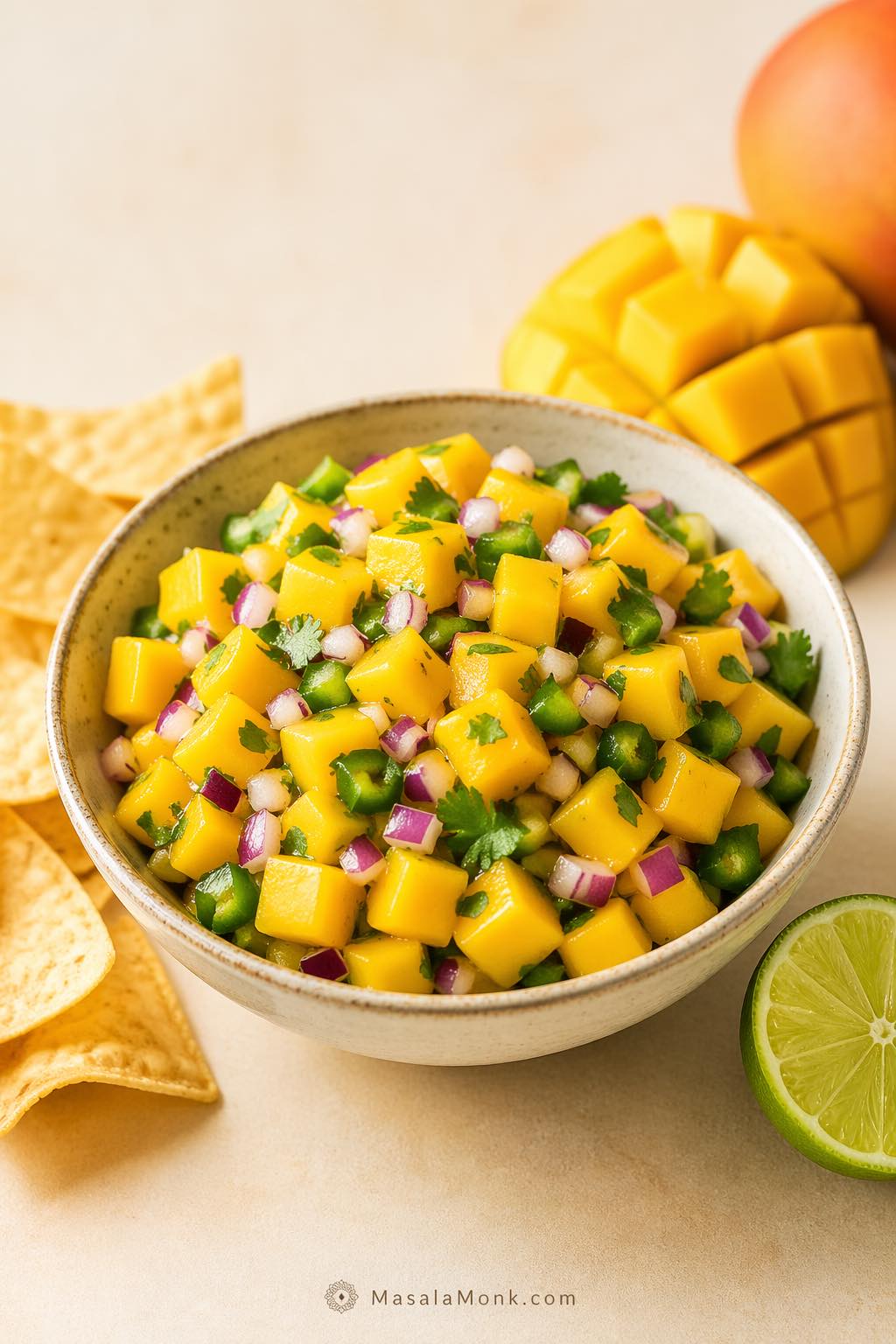
A mango salsa recipe should do more than taste sweet and bright. It should stay chunky instead of turning watery, balance lime and heat without burying the fruit, and work whether you use it as a salsa dip with chips, a spoonable mango salsa sauce for tacos, or a fresh topping for fish, shrimp, or chicken.
This version starts with the cleanest, most useful base: ripe mango, red onion, jalapeño, cilantro, lime, and salt. It is the best first version to make because it stays bright, fresh, and flexible. From there, you can adjust it depending on how you plan to serve it: add tomato for a scoopable chip dip, avocado for a richer topping, or more chile for a hotter bowl that still tastes fresh instead of harsh.
If you are making mango salsa for the first time, make this clean version first. It gives you the brightest mango flavor, then lets you move toward a chunkier taco topping, a scoopable salsa dip, a saucier spoonful for salmon or shrimp, or a spicy variation without guessing.
If you want the shortest useful answer, start here. The best mango salsa recipe uses ripe but still firm mangoes, not very soft ones, so the bowl stays fresh and chunky instead of slumping into liquid. The best first version is usually no tomato. That cleaner build lets the mango stay bright and distinct, whether you serve it as a fresh salsa dip, a taco topping, or a spoonable mango salsa sauce for fish, shrimp, grilled chicken, and bowls.
Best mangoes: ripe but still firm, so the salsa holds a neat dice.
Best first version: no tomato, because it tastes cleaner and works better as a topping.
Best for chips: add tomato if you want a more pico-like, scoop-friendly bowl.
Best saucier move: mash or blend a few spoonfuls, then stir them back in instead of blending the whole bowl.
Best for tacos and fish: keep it fruit-forward, sharp, chunky, and lightly spicy.
Best heat move: start with jalapeño, then add more chile only if the bowl tastes flat.
Best make-ahead window: a short rest is fine, but it is best the day you make it.
Frozen mango: usable in a pinch, but fresh mango gives better texture.
At a Glance
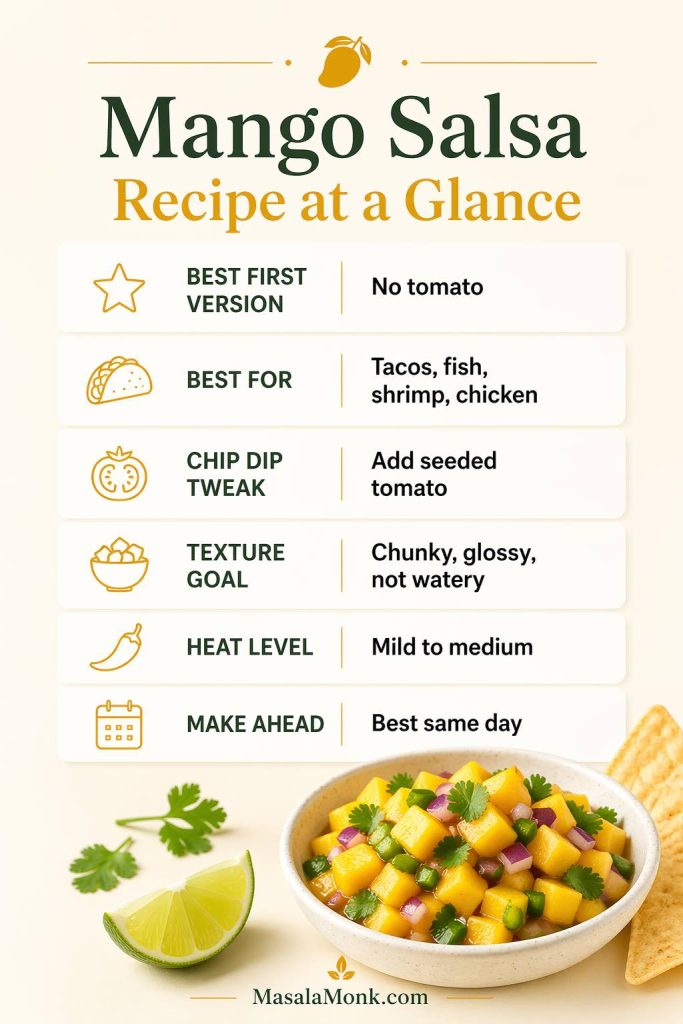
Best first version: no tomato
Best for: tacos, fish, shrimp, grilled chicken, burrito bowls
Best chip-dip tweak: add 1 small seeded tomato
Best salsa sauce tweak: mash a small portion and fold it back in
Texture goal: chunky, glossy, not watery
Heat level: mild to medium, easy to adjust
Make-ahead: best the same day
The finished salsa should look glossy, not puddled. The mango pieces should stay distinct when spooned, and the bowl should smell bright and savory, not sharply acidic or raw.
Start with the no-tomato version when you want the mango to stay bright and distinct; add tomato only when the salsa is mainly for chips and you want a juicier, more scoopable bowl.
Mango Salsa Recipe Ingredients
The ingredient list for this mango salsa recipe is short on purpose. Because the bowl relies on freshness and contrast, every ingredient should help the mango rather than compete with it.
2 large ripe but firm mangoes, diced small (about 2 cups / 330 to 360 g diced mango)
1/4 to 1/3 cup finely chopped red onion (about 35 to 50 g)
1 small jalapeño, finely chopped
2 to 3 tablespoons chopped cilantro
1 to 2 tablespoons fresh lime juice, plus more to taste
1/4 teaspoon fine salt, plus more to taste
Optional: 1/4 cup finely chopped red bell pepper
Optional: 1 small tomato, seeded and finely diced
Optional: 1/2 avocado, diced
The mango
Use mangoes that smell ripe and feel slightly soft when pressed, but not squishy. Once diced, the pieces should hold clean edges rather than collapse or smear when stirred.
The onion
Red onion gives the bowl the sharp, savory edge that stops it from drifting toward fruit salad. Finely chopped onion works best because it spreads that bite evenly. If your onion tastes very harsh, rinse it briefly under cold water or soak it in cold water for 5 minutes, then dry it well before adding it.
The jalapeño
Jalapeño adds heat, but more importantly, it gives shape to the sweetness. For a milder bowl, remove the seeds and white membranes. For a medium bowl, leave in a little of the membrane. Start smaller than you think you need, then taste.
The cilantro, lime, and salt
Cilantro keeps the salsa tasting green and fresh. Lime lifts everything, while salt makes the fruit and aromatics taste more like themselves. Add lime gradually. You want the mango lightly coated, not sitting in a shallow pool at the bottom of the bowl.
The useful extras
Red bell pepper adds crunch without changing the identity of the bowl very much, so it is the safest extra if you want more texture. Tomato is best when the salsa is mainly for chips. Seed it well, then let the diced tomato sit on a paper towel for a minute if it seems very juicy. Avocado makes the bowl richer and softer, which is especially good over salmon, grilled chicken, or grain bowls. If you use avocado, add it at the very end and fold it in gently.
Best Mangoes to Use
The fruit decides a lot here. Even a well-seasoned bowl struggles if the mango is watery, stringy, or collapsing under the knife.
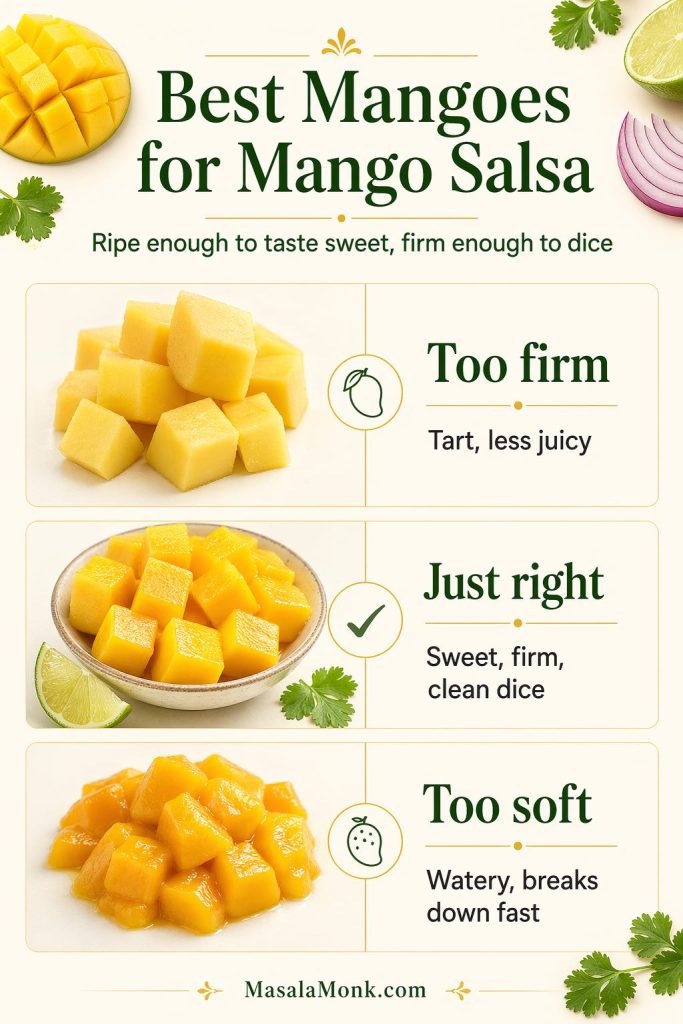
Choose mangoes that are ripe enough to taste sweet but still firm enough to hold a clean dice; very soft mangoes break down quickly once lime and salt are added.
Ripe but firm is the sweet spot
The best mangoes for salsa give slightly when pressed, smell fragrant, and taste sweet without turning mushy as soon as you cut them. Ataulfo, Champagne, honey, or Kent mangoes can all work well if they are firm enough to dice cleanly, but firmness matters more than variety.
Avoid overly soft mangoes
Very soft mangoes are better in sorbet, smoothies, or dressing. In salsa, they break down quickly once lime and salt are added, and the bowl becomes watery faster than you want.
If your mango is extra sweet or extra tart
When the fruit is especially sweet, lean a little harder on lime, salt, and jalapeño. For mangoes that taste more tart than expected, use less lime at first and let the fruit stay the focus. Taste before serving and adjust there instead of trying to fix everything at once.
How to Cut Mango for Salsa
How you cut the fruit affects both texture and usability in a mango salsa recipe. A good mango salsa should be easy to scoop, easy to spoon, and pleasant to eat in one bite.
Use the cheek-and-score method
Stand the mango upright, slice off the two cheeks, then score the flesh in a grid without cutting through the skin. Turn the cheek outward slightly and slice off the cubes. Then trim the remaining fruit from around the pit.
The mango should be small enough to scoop easily with chips or sit neatly on tacos, yet large enough to stay distinct. Aim for roughly small bean-sized pieces rather than large chunks or very fine mince.
Mix gently
Once the fruit is cut, treat it carefully. Fold the salsa together rather than stirring it hard. Otherwise, even good fruit starts to look tired before it reaches the table.
How to Make This Mango Salsa Recipe
This mango salsa recipe comes together quickly, but the order helps you keep both the texture and the balance under control.
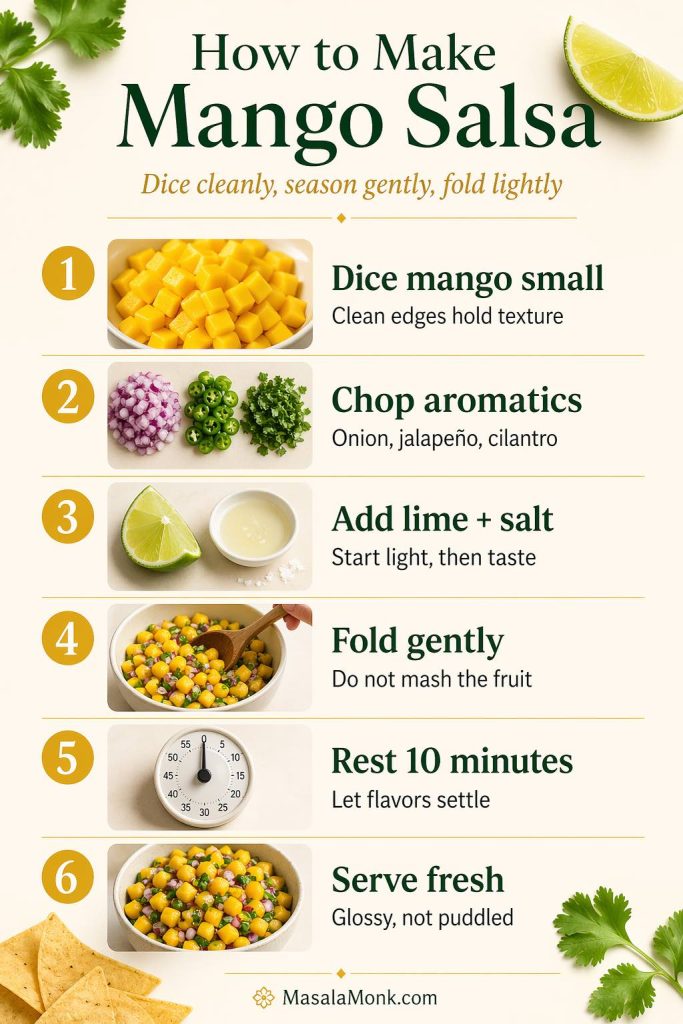
Add the lime and salt lightly at first, then fold instead of stirring hard; this keeps the mango pieces clean-edged, glossy, and distinct when the salsa is served.
1. Dice the mango
Dice the mango into small, even cubes and place them in a medium bowl. The pieces should look clean-edged and firm enough to hold shape when lifted on a spoon.
2. Chop the supporting ingredients
Finely chop the red onion, jalapeño, and cilantro. If you are using red bell pepper, chop that finely too. The onion pieces should be small enough not to dominate a bite, and the jalapeño should be dispersed rather than concentrated in a few hot pockets.
3. Combine gently
Add the onion, jalapeño, cilantro, and bell pepper to the mango. Toss gently so the fruit stays intact. At this stage, the bowl should already look colorful and structured, not crushed.
4. Add lime and salt
Start with 1 tablespoon lime juice and 1/4 teaspoon salt. Toss again, gently, then look at the bottom of the bowl. You want a light gloss on the fruit, not visible pooling liquid.
5. Rest briefly, then taste again
Let the salsa sit for 10 minutes if you have time. That is enough to bring the flavors together without softening the fruit too much. After that short rest, the salsa should smell bright and savory, with the onion and lime settled into the fruit instead of shouting separately.
6. Adjust before serving
When the salsa tastes too sweet, add a little more lime, salt, or jalapeño. For a bowl that tastes too sharp, add a bit more mango. Flat flavor usually means it needs salt. Serve cool or lightly chilled, not ice-cold straight from the back of the fridge, so the flavor reads clearly.
Mango Salsa Recipe
Yield: About 2 cups, enough for 4 to 6 as a topping or 4 as a dip
2 large ripe but firm mangoes, diced small (about 2 cups / 330 to 360 g)
1/4 to 1/3 cup finely chopped red onion
1 small jalapeño, finely chopped
2 to 3 tablespoons chopped cilantro
1 to 2 tablespoons fresh lime juice
1/4 teaspoon fine salt, plus more to taste
Optional: 1/4 cup finely chopped red bell pepper
Instructions
Add the diced mango to a medium bowl.
Add the red onion, jalapeño, cilantro, and bell pepper if using.
Add 1 tablespoon lime juice and the salt, then toss gently.
Let the salsa sit for 10 minutes, then taste.
Add more lime or salt as needed.
Serve right away for the freshest texture.
Notes
Use firm-ripe mangoes, not very soft ones.
The finished salsa should look glossy, not puddled.
For a milder salsa, remove the jalapeño seeds and membranes.
For chips, add 1 small seeded tomato if you want a more dip-like bowl.
For a saucier mango salsa, mash or blend 2 to 3 tablespoons of the finished salsa with a squeeze of lime, then stir it back into the bowl.
If using avocado, fold it in at the very end.
This salsa is best the day you make it.
Why This Mango Salsa Recipe Works
This recipe works because it keeps the job of the salsa clear. It should brighten the food around it, not smother it.
It balances sweet, sharp, and spicy
The mango gives sweetness, but the onion, jalapeño, lime, and salt keep that sweetness from drifting into dessert territory. The result tastes bright and savory rather than merely fruity.
It stays chunky
Because the fruit is diced instead of blended, the finished salsa stays textured and spoonable. That texture is part of what makes it feel useful at the table.
It fits more than one meal
Although it is excellent with chips, it is even more valuable because it works over fish tacos, salmon, shrimp, grilled chicken, burrito bowls, and taco salads.
Tomato or No Tomato?
This is the biggest choice in mango salsa. Some people want a bright topping. Others want a bowl that feels more like a classic fresh dip.
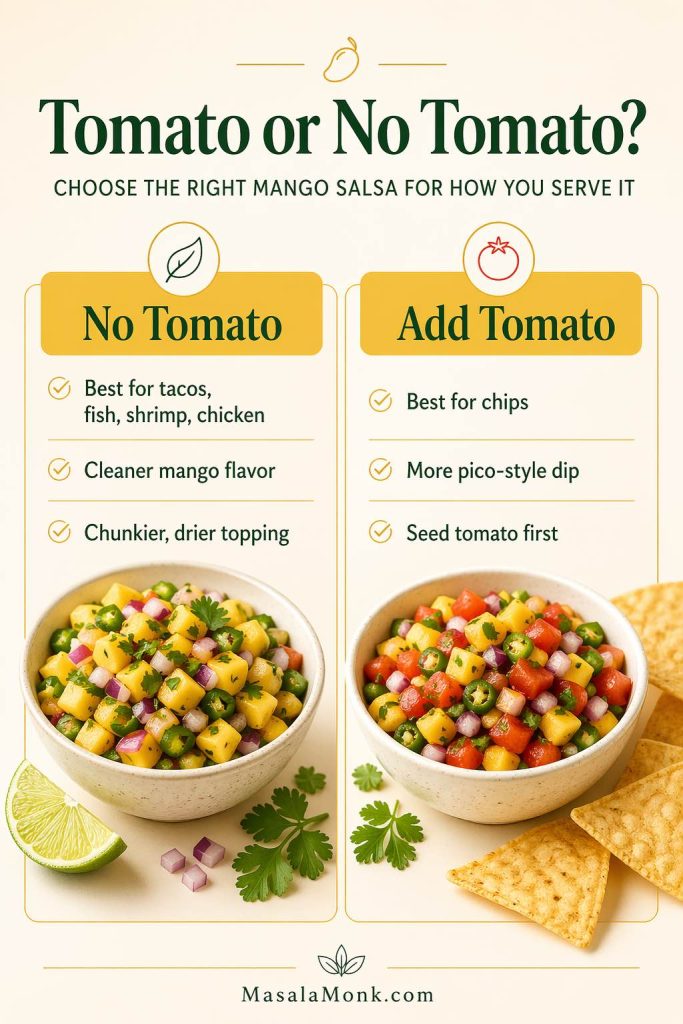
Tomato is not wrong in mango salsa, but it changes the job of the bowl: skip it when you want a cleaner, chunkier topping for tacos or fish; add it when you want a juicier salsa for chips.
When no-tomato mango salsa is better
A no-tomato version is usually better for tacos, fish, shrimp, grilled chicken, and bowls. It tastes cleaner, lets the fruit stay more distinct, and avoids extra moisture.
When tomato makes sense
Add tomato when the bowl is mainly for chips or when you want a more familiar pico-like feel. Seed it first, then keep the pieces small so the salsa stays balanced instead of watery.
How to Fix the Balance
If it tastes too sweet
Add a little more lime, a pinch more salt, or a bit more jalapeño.
If it tastes too sharp
Add more mango first. Extra fruit is usually a cleaner fix than sweetener.
If it tastes too mild
It usually needs a touch more salt or lime.
If it turns watery
Wateriness usually comes from overly soft fruit, overmixing, too much resting time, or undrained tomato. Drain off a little excess liquid if needed, then taste again.
If you want it more like a salsa sauce
If you want a mango salsa sauce for tacos, fish, shrimp, chicken, or bowls, do not blend the whole recipe. Mash or blend 2 to 3 tablespoons of the finished salsa with a little lime juice, then stir it back into the bowl. That makes it more spoonable while keeping the fresh mango pieces intact.
If it feels too spicy
Add more mango if you have it. Avocado can soften the heat too if you want a richer version.
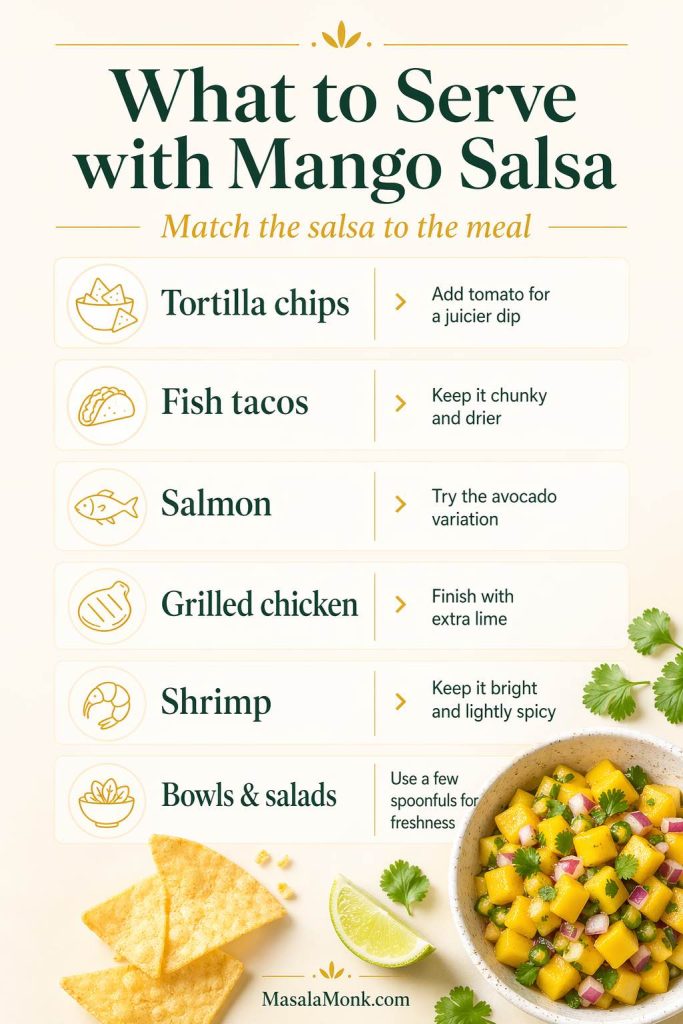
What to Serve with Mango Salsa
Once the bowl is made, use it as a salsa dip, taco topping, fresh side, or spoonable mango salsa sauce depending on the meal.
Mango salsa works best when you match the texture to the meal: keep it chunkier and drier for tacos or fish, add tomato for chips, and use a few spoonfuls to brighten bowls and salads.
Tortilla chips
For chips, a slightly juicier bowl is fine. This is the best place to add seeded tomato and use a slightly smaller dice if you want a more scoopable, party-friendly dip.
Fish tacos
For fish tacos, keep the salsa chunkier and a little drier. The no-tomato version works best here because it brings brightness and sweetness without making the taco wet or heavy. It pairs especially well with flaky grilled or pan-seared white fish.
Salmon
With baked, grilled, or pan-seared salmon, the lime, onion, and jalapeño do especially useful work. A spoonful on top cuts through the richness and makes a simple fillet feel more finished. If you want a softer, richer topping for salmon, the avocado variation below is the best branch.
Grilled chicken
Chicken gives the salsa a neutral base to wake up. It works especially well with grilled chicken breasts, thighs, or fajita-style chicken. A slightly punchier lime finish works well here, especially if the chicken is smoky, charred, or warmly spiced. For a full meal to pair it with, try these sheet pan chicken fajitas.
Shrimp
Shrimp and mango salsa are a natural pairing. Keep the salsa bright and lightly spicy rather than heavy or very wet. Spoon it over grilled shrimp skewers, tuck it into shrimp tacos, or use it over rice bowls when you want something fresh and quick.
Burrito bowls and taco salads
This is one of the smartest ways to use leftovers. A few spoonfuls add acidity, freshness, and texture to bowls with rice, beans, avocado, chicken, or shrimp.
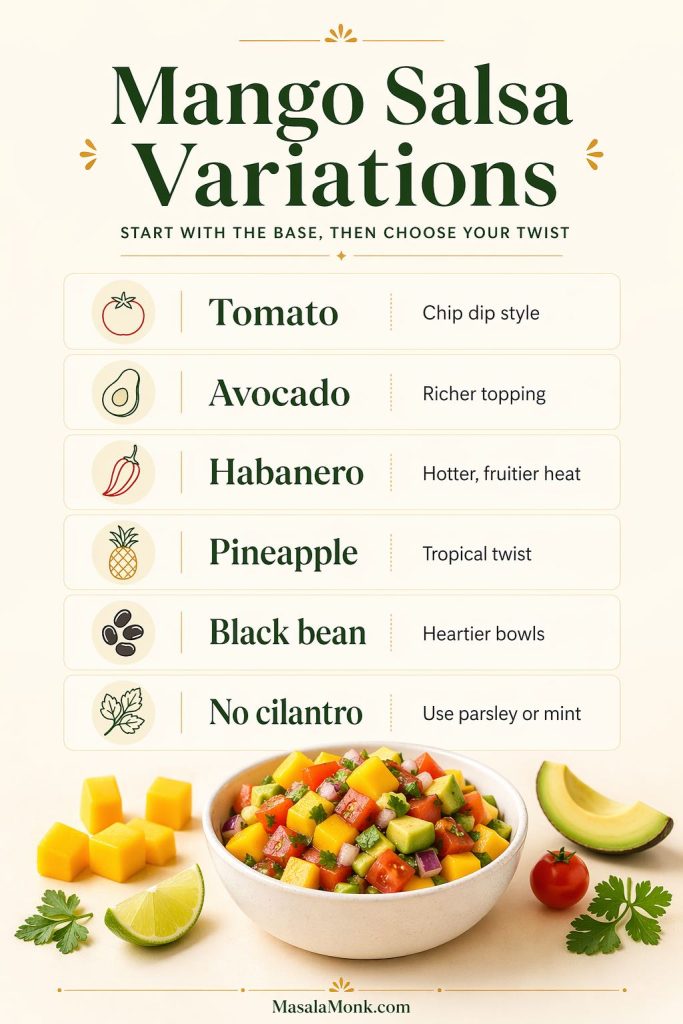
Add 1 small seeded and finely diced tomato if you want the salsa to feel more like a classic fresh dip. Keep the amount modest so the mango still leads.
Mango avocado salsa
Add diced avocado when you want a richer, softer bowl. Fold it in at the end so it stays intact. This version is especially good with salmon, grilled chicken, and burrito bowls.
Once the base mango salsa tastes balanced, choose the variation by use: tomato for chips, avocado for richness, habanero for heat, pineapple for sweetness, or black beans for a heartier bowl.
Spicy mango habanero salsa
Swap in a very small amount of habanero if you want a hotter, fruitier heat. Go carefully so the brightness of the base recipe still comes through.
Pineapple mango salsa
Add a small amount of finely diced pineapple if you want a more tropical twist. Keep the ratio in favor of mango so the recipe still reads clearly as mango salsa.
Black bean mango salsa
Add rinsed and well-drained black beans if you want a heartier bowl for chips, burrito bowls, or taco salads. Keep the mango pieces distinct so the salsa still tastes fresh rather than heavy.
Pickled jalapeño or pickled onion
Use a little pickled jalapeño or pickled red onion if you want a sharper, brighter variation. Add these carefully because they bring both acidity and salt.
No cilantro version
If you do not like cilantro, use a smaller amount of parsley or fresh mint instead. The flavor will change, but the salsa can still taste fresh and balanced.
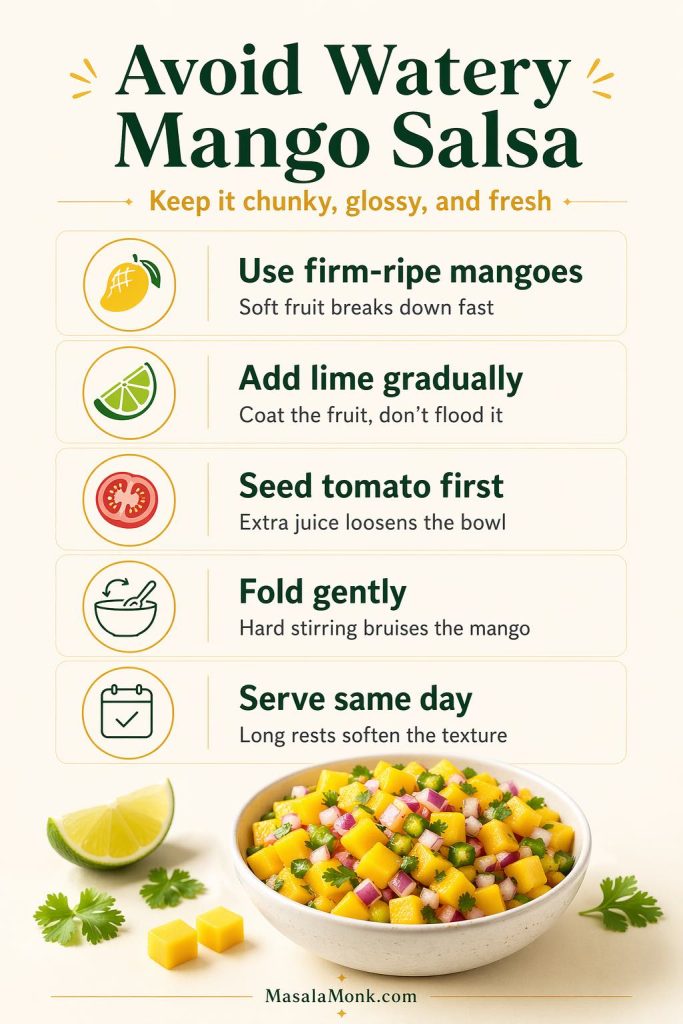
Watery mango salsa usually starts with fruit that is too soft, too much lime, juicy tomato, or rough mixing. Keep the bowl glossy instead of puddled by seasoning gradually and folding gently.
Using very soft mangoes: they may taste good, but they break down fast and make the bowl watery.
Adding too much lime at the start: the fruit should be coated lightly, not swimming.
Leaving onion pieces too large: big pieces make the salsa taste sharper and rougher than it should.
Not drying soaked onion or juicy tomato: extra water shows up later in the bowl.
Not seeding tomato for the chip-dip version: the salsa can turn loose fast.
Overmixing: stirring hard bruises the fruit and dulls the texture.
Letting it sit too long before serving: a short rest helps, but too long softens the mango and blurs the flavor.
Storage and Make-Ahead
Mango salsa is best fresh, and that is part of what makes it so good.
Best the day you make it
The texture is best on the day it is made. The fruit is firmer, the flavors feel brighter, and the bowl still looks clean and lively.
How long it lasts
Stored in an airtight container in the fridge, it will usually keep well for about 2 days, sometimes 3 depending on the fruit.
What changes after a few hours
A short rest of 10 to 20 minutes can help the flavors settle. After several hours, though, the mango softens more, liquid collects more easily, and the bowl becomes less crisp and defined.
How to freshen leftovers
If leftover salsa seems dull, drain off a little excess liquid, then add a small squeeze of lime and a pinch of salt. Let it sit for a minute, then taste again.
The best bowl is the one that still looks clean when you spoon it: distinct mango pieces, light lime gloss, no puddle at the bottom, and enough salt and chile to keep the sweetness lively.
Mango Salsa Recipe FAQs
Can I make mango salsa ahead of time?
Yes, but it is best within the same day if texture matters to you. Overnight storage softens the fruit and draws out more liquid.
Is mango salsa sauce the same as mango salsa?
Usually, yes. People often use mango salsa sauce to mean mango salsa served as a dip, taco topping, or spoonable sauce. Fresh mango salsa is normally chunky, not fully blended. If you want it saucier, mash or blend a small portion with lime juice and stir it back in instead of turning the whole bowl into a smooth mango sauce.
Is mango salsa better with tomato or without?
Neither is universally better. No-tomato mango salsa is usually better for tacos, fish, shrimp, and chicken, while tomato is better when you want a more scoopable dip for chips.
What mangoes are best for a mango salsa recipe?
Ripe but still firm mangoes are best. Ataulfo, Champagne, honey, and Kent mangoes can all work if they are firm enough to dice cleanly.
Can I use frozen mango?
You can, but fresh mango is better for a truly chunky bowl. Frozen fruit tends to soften more as it thaws.
What goes with mango salsa?
Tortilla chips, fish tacos, salmon, grilled chicken, shrimp, burrito bowls, and taco salads all work well.
Is mango salsa good with shrimp?
Yes. Mango salsa is excellent with grilled shrimp, shrimp tacos, coconut shrimp, shrimp rice bowls, and chilled shrimp appetizers. Keep it bright, lightly spicy, and not too wet so it lifts the shrimp without making the dish soggy.
How spicy should mango salsa be?
Usually just spicy enough to sharpen the sweetness. Most people do not need a very hot bowl unless they are intentionally making a spicy variation.
How long does mango salsa last in the fridge?
Usually 2 days, sometimes up to 3 depending on the fruit. It is most appealing sooner rather than later.
Can I use mango salsa for fish tacos?
Yes. The clean no-tomato base version is especially good here because it brightens the fish without making the taco feel soggy or overloaded.
If you want the best first version, make the clean no-tomato bowl, use firm-ripe mangoes, season lightly and carefully, and serve it while the texture is still bright and distinct. That version gives you the most flexibility and the clearest mango flavor.
Croquettes have a way of making an ordinary day feel a little more celebratory. The outside turns crisp and golden, the inside stays soft and savory, and suddenly a handful of simple ingredients becomes something you’d happily serve to guests. Even so, a lot of people hesitate to try a croquettes recipe because they’ve had the frustrating version: croquettes that crack in the oil, croquettes that taste bland inside, croquettes that go oily, or croquettes that collapse the moment you flip them.
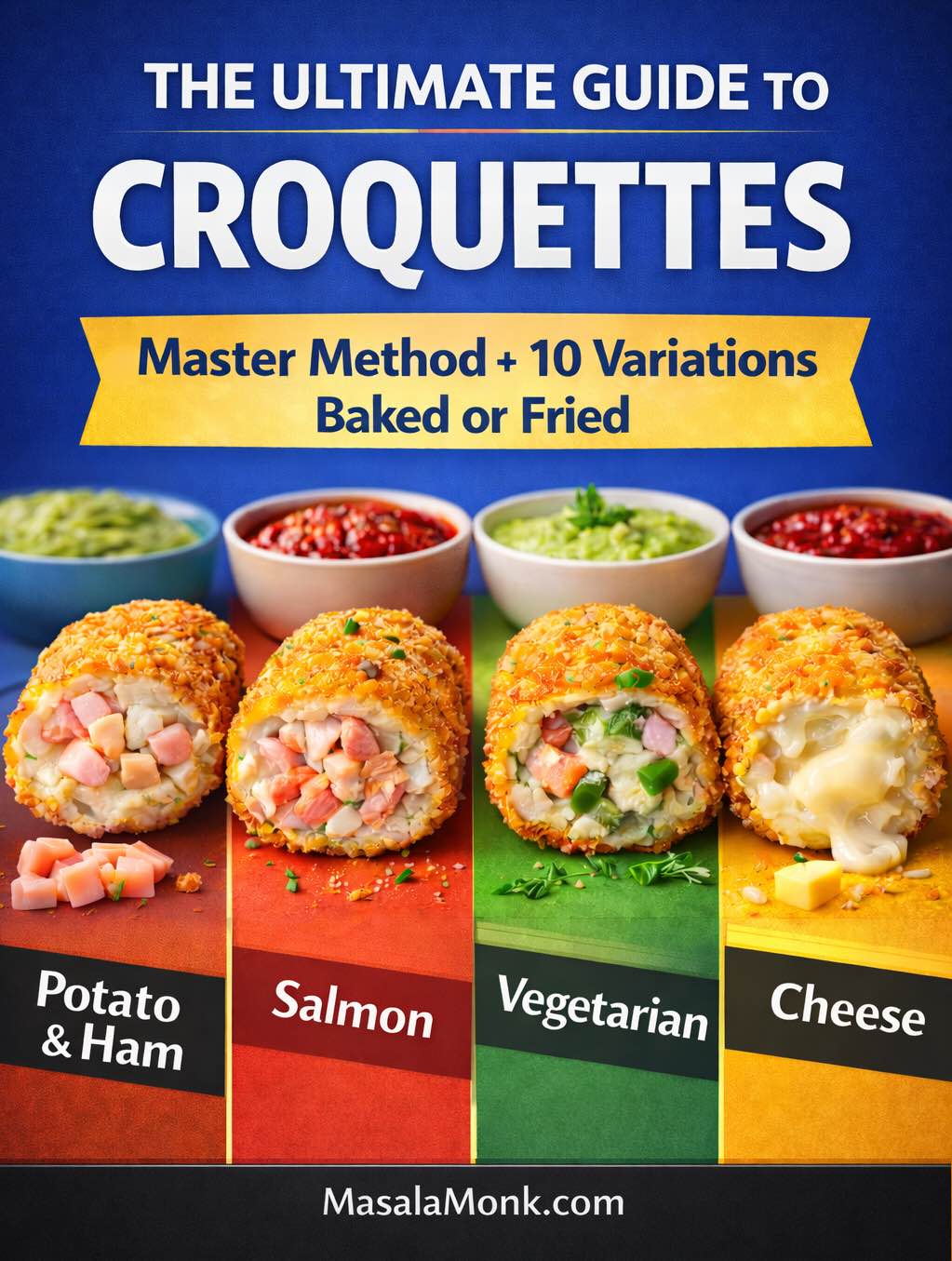
Fortunately, once you learn one reliable croquettes recipe method, everything clicks. After that, you can make easy croquettes on a weeknight, bake them when you want healthy croquettes, or go all-in with Spanish croquetas that are creamy enough to feel like a tapas bar at home. You can also work through the classics—potato croquettes, ham croquettes, chicken croquettes, tuna croquettes, salmon croquettes (canned or fresh salmon croquette), cod croquettes, vegetarian croquettes, vegan croquettes—without learning a new technique every time.
This post is exactly that: a single, detailed, step-by-step guide that covers croquette fish styles, croquette veggie options, and the “perfect croquettes” approach—plus the oven baked croquettes route when you want crunch with less fuss.
And because croquettes are at their best when they’re part of a spread, you’ll also get natural pairings: cooling chutneys, fiery chutneys, and a few drink and dessert ideas to finish the meal without feeling heavy.
Croquettes Recipe: The Four Rules That Make Them Work Every Time
Before you pick a variant, it helps to understand what croquettes really are. Whether you call it a croquette, a croqueta recipe, a kroket (you’ll see “chicken kroket” and “dutch croquettes” used in different places), or even a Japanese potato croquette style, the structure is the same:
A flavorful filling
A binder that holds it together
A coating that creates crunch
A chill step that turns “hope” into “confidence”
If you keep those four rules steady, you can change almost everything else.
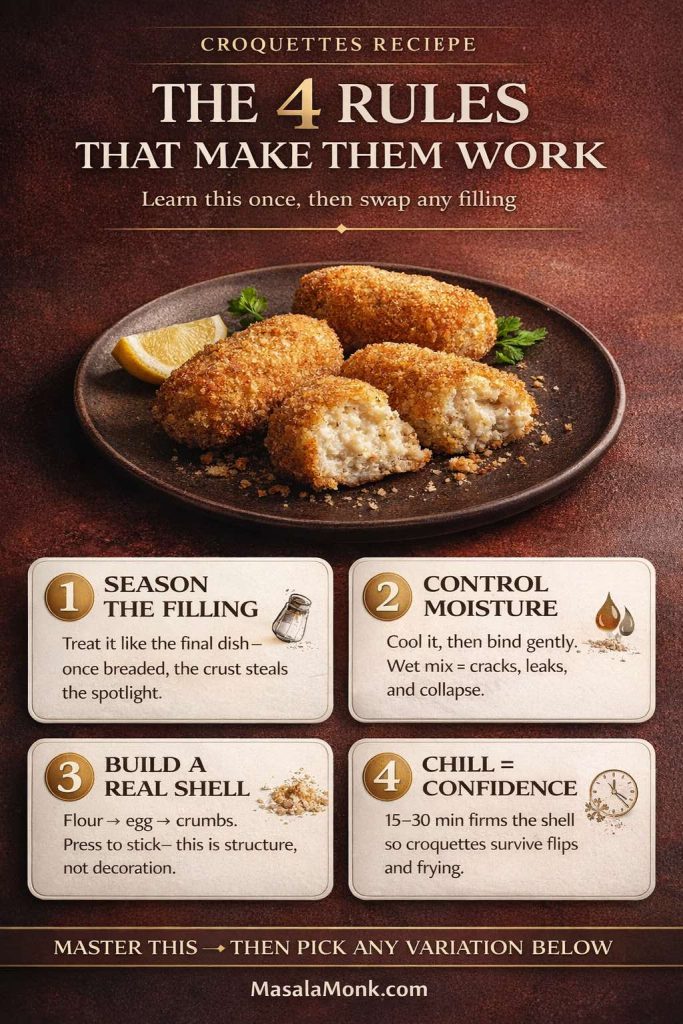
Croquettes falling apart? This is the “save it forever” checklist. Season the filling like it’s the final dish, cool and control moisture, build a real shell (flour → egg → crumbs), then chill so the coating firms up before you cook. Once these four rules click, you can swap in potato, salmon (canned or fresh), ham & cheese, chicken, tuna, cod, vegetarian, or vegan fillings without changing the method. Bookmark this guide, pin it for later, and use it as your quick reset before frying, baking, or air frying.
Rule 1: Season the filling like it’s the final dish. Once croquettes are breaded, the outside becomes the star. That means the inside must be seasoned enough to hold its own.
Rule 2: Control moisture, don’t fight it. Wet fillings are the number one reason croquettes fall apart. Instead of adding more egg (which can make them softer), you remove or offset moisture: cool the mixture, add just enough dry binder, and chill properly.
Rule 3: The coating is a shell, not decoration. Flour → egg → crumbs isn’t tradition for tradition’s sake. It builds a sturdy exterior so the inside can stay creamy.
Rule 4: Chilling is non-negotiable for perfect croquettes. Chilling firms fat and starches, reduces steam pressure, and makes shaping easier. It’s the difference between croquettes that survive the pan and croquettes that become snack-flavored chaos.
Keep these rules in mind, and suddenly “how do you make croquettes” becomes a calm question rather than a stressful one.
How to Make Croquettes: The Master Step-by-Step (Works for Every Variant)
This is the core croquettes recipe method you’ll use for everything in the post—potato, fish, chicken, turkey, vegetarian, vegan, Spanish croquetas, and more.
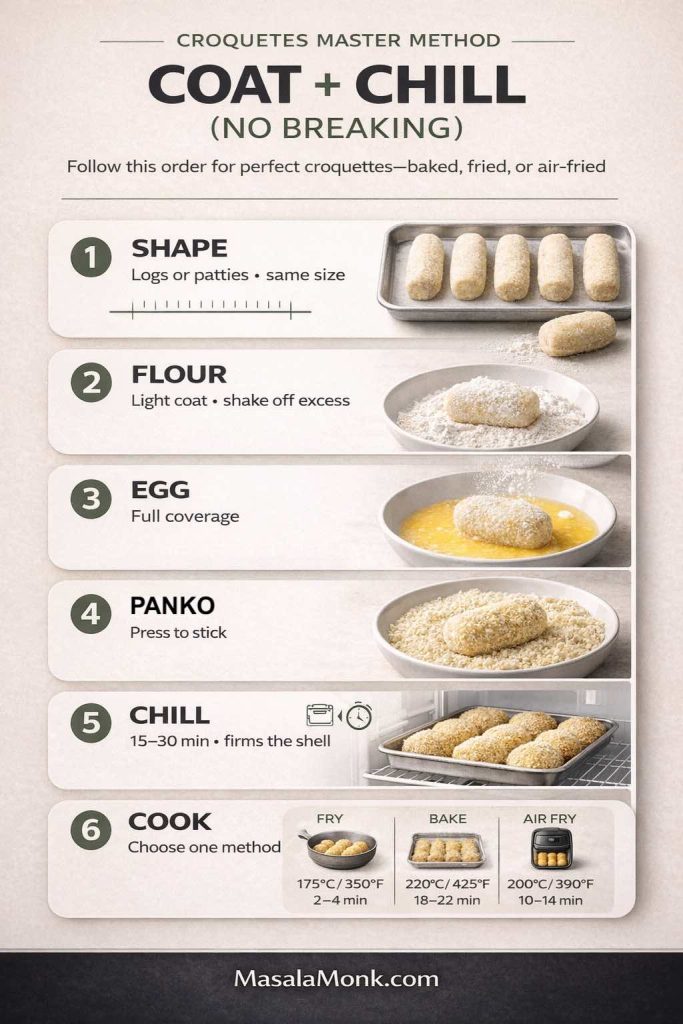
If your croquettes crack, leak, or fall apart, this is the fix: shape → flour → egg → panko → chill. That 15–30 minute chill firms the coating so you can fry for max crunch or bake/air-fry for a lighter batch—then plug in any filling from the post (potato, salmon, ham & cheese, tuna, chicken, cod, or vegan) without changing the method.
What you’ll need
3 shallow bowls (for breading)
A tray (for chilling shaped croquettes)
A rack (for draining fried croquettes or baking with airflow)
Optional but helpful: a food thermometer for meat and fish variants
Base quantities (Recipe makes 10–12 croquettes)
Think of these as the “croquettes template.” Your filling changes, the structure stays.
For the croquette mixture
2 packed cups prepared filling (pick a variant below)
1 large egg (binder) Vegan binder method is included later
2–6 tablespoons breadcrumbs or flour, only as needed (moisture control)
Salt and pepper (plus any spices/herbs your filling wants)
For the coating
½ cup flour
2 eggs, beaten with a pinch of salt
1½ cups breadcrumbs or panko (panko gives the crispest bite)
Step 1: Prepare the filling, then cool it completely
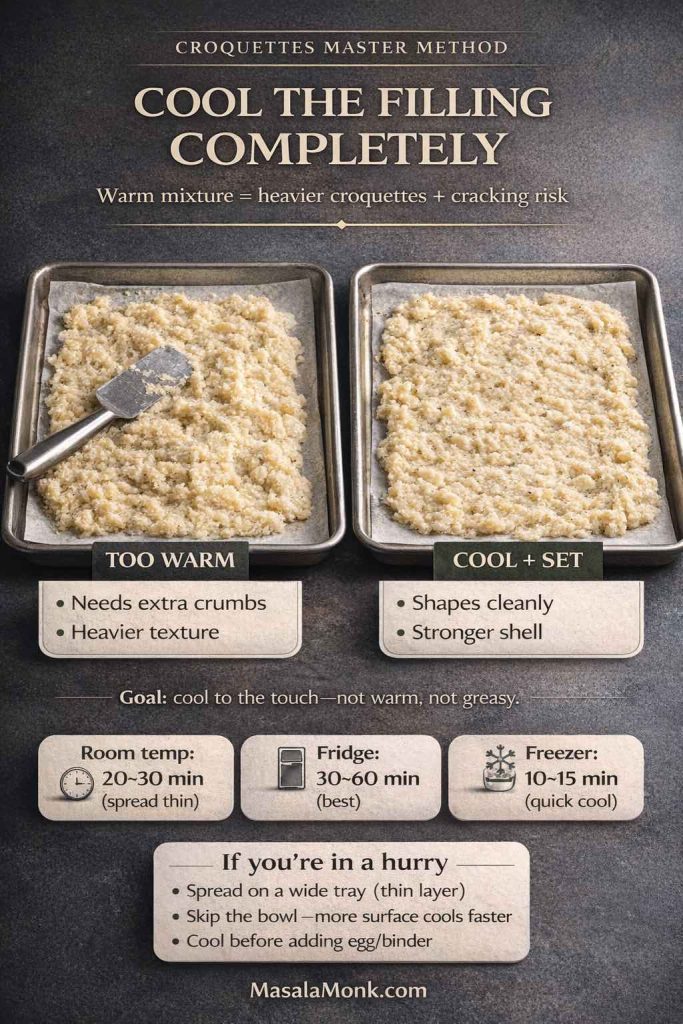
Make your filling according to the variant recipe you’re using. When it’s done, spread it out on a plate or tray and let it cool. If you rush and mix while it’s warm, you’ll need more breadcrumbs, the texture will be heavier, and shaping will feel like wrestling mashed clouds.
Warm croquette mixture is the fastest way to end up with heavy croquettes that crack or soak up oil. Spread your filling thin, cool it fully, then bind and bread—your croquettes shape cleanly, hold their coating, and cook with less drama whether you fry, bake, or air fry. Save this card for every potato, salmon, chicken, veg, or vegan batch.
Step 2: Bind the mixture
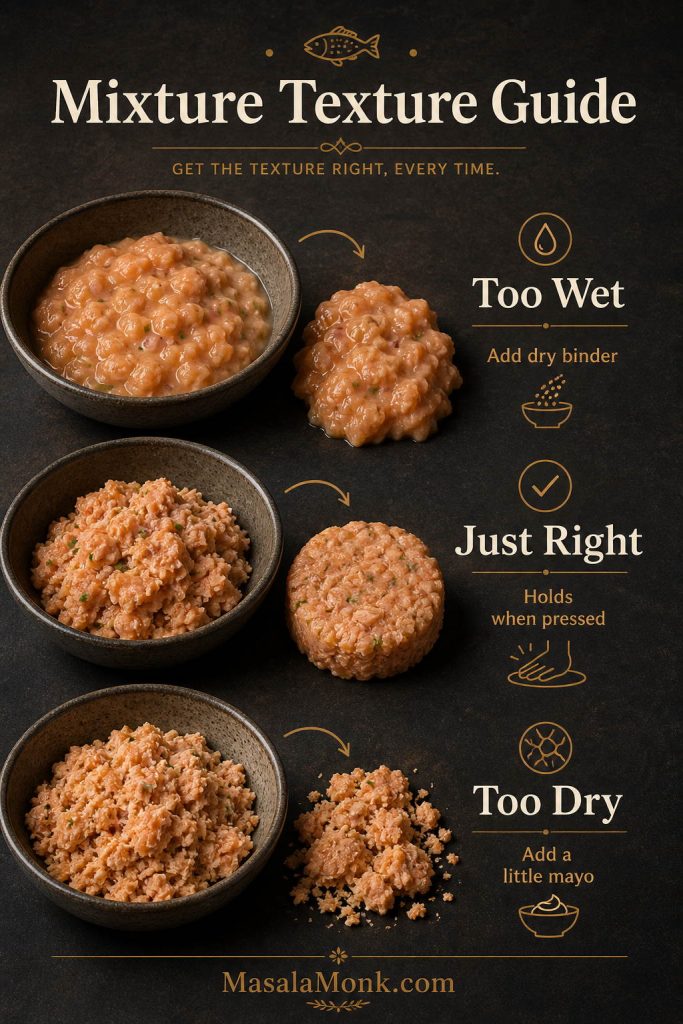
Add your egg and mix thoroughly. Then test the texture:
If it holds together when you press a small handful, you’re good.
If it feels loose or wet, add breadcrumbs 1 tablespoon at a time until it firms up.
This step is where people often over-correct. Slow down. You’re aiming for a mixture that is cohesive, not dry.
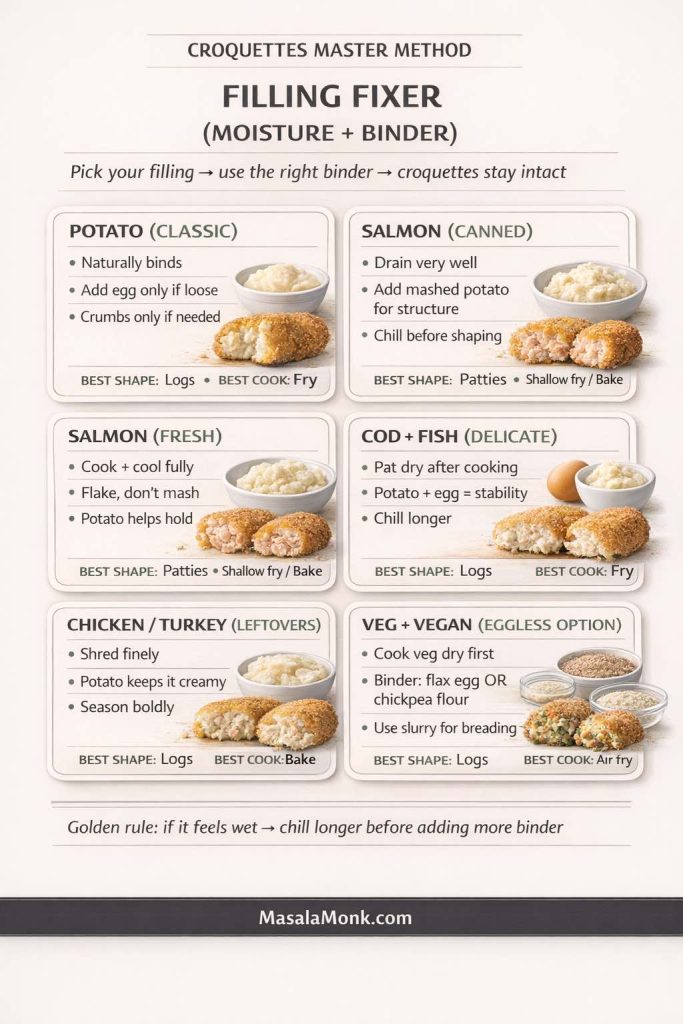
Use this quick ‘filling fixer’ before you shape anything: it shows the one adjustment that saves a batch—drain/pat dry where needed, then choose the right binder so croquettes stay intact. It’s especially handy for fish croquettes (salmon/cod) and vegan croquettes, where moisture control makes or breaks the crust.
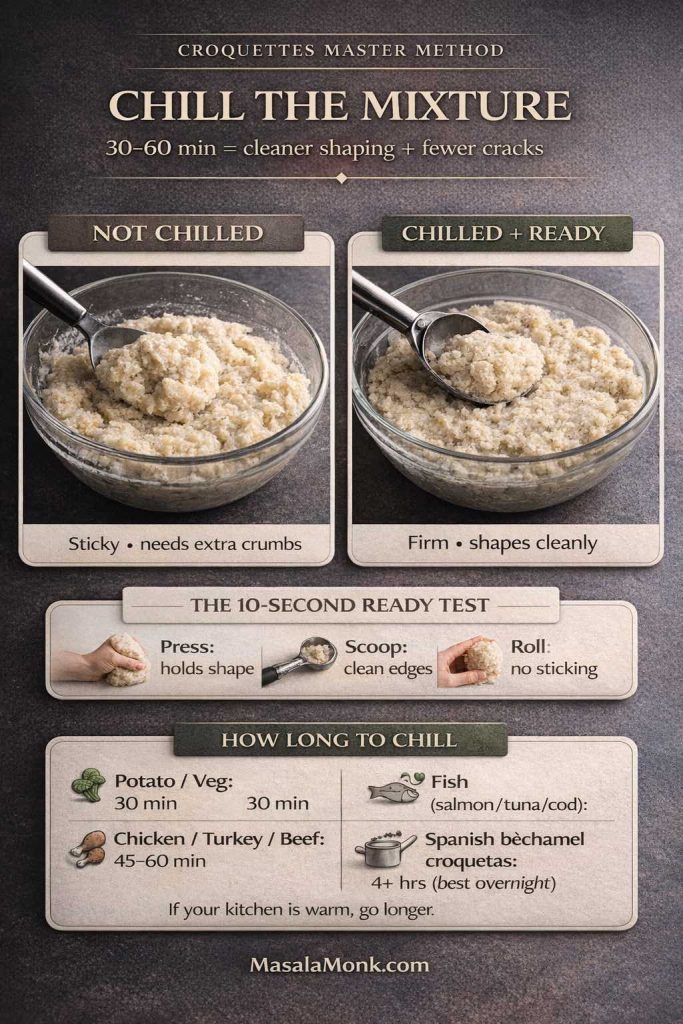
Step 3: Chill the mixture (30–60 minutes)
This single step makes shaping easier and prevents cracking. In addition, it helps the mixture set so it survives turning.
Chilling the croquettes mixture is the quiet step that prevents most disasters. A cold mix holds its shape, needs fewer extra crumbs, and is far less likely to crack once it hits hot oil. Use the quick ready test here (press → scoop → roll), then match the chill time to your filling—potato/veg sets fast, fish benefits from a steady firm-up, and béchamel-based Spanish croquetas really shine with a longer rest. Keep this guide nearby before shaping so every batch stays tidy, crisp, and confident.
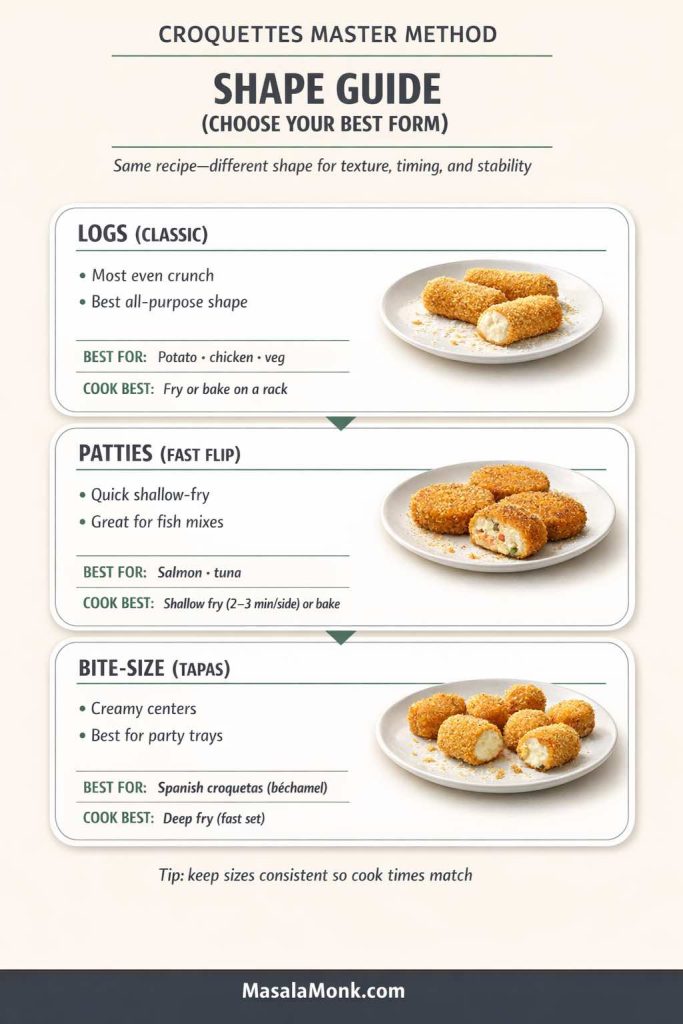
Step 4: Shape your croquettes
You can shape croquettes as:
Logs (classic croquette shape)
Thick patties (great for salmon croquettes, tuna croquettes, and easy croquettes you want to flip quickly)
Small cylinders (perfect for Spanish croquetas, which are often bite-sized)
As you shape, keep the sizes consistent so cook times match.
Not sure which croquettes shape to make? Use this quick shape guide: logs cook evenly (great for potato, chicken, veg), patties are perfect for salmon croquettes and tuna croquettes when you want a quick shallow-fry, and bite-size croquetas are the tapas-style choice for creamy béchamel centers. Keep sizes consistent so every batch cooks evenly—then bake, air fry, shallow fry, or deep fry with confidence.
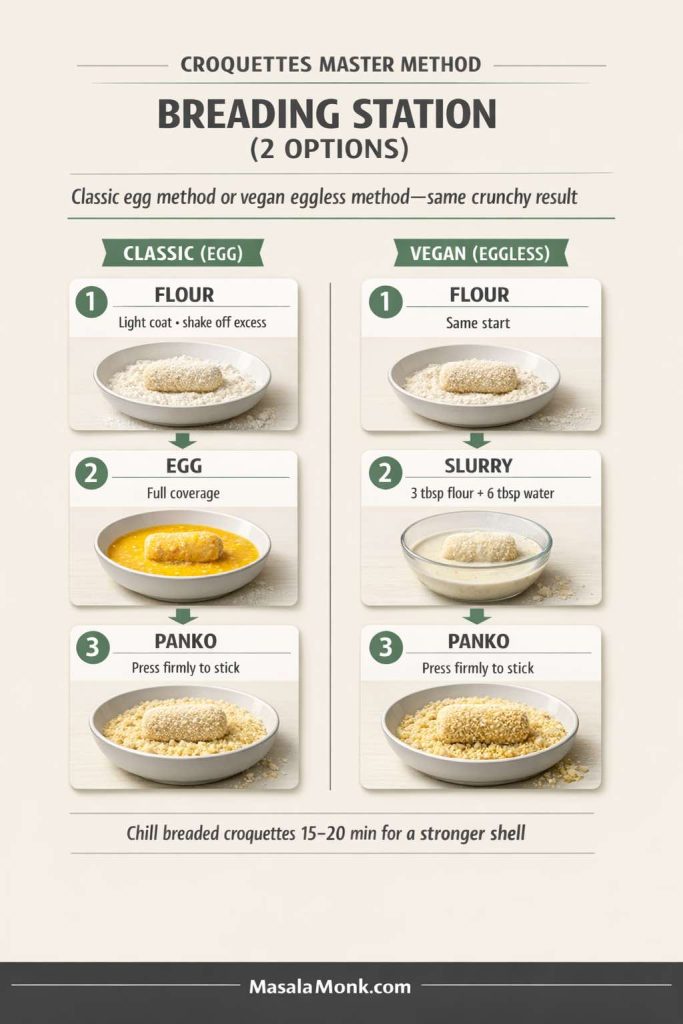
Step 5: Bread the croquettes (flour → egg → crumbs)
Set up a breading station:
Flour bowl
Egg bowl
Breadcrumb bowl
Coat each croquette in flour first, shaking off excess. Then dip in egg. Finally, press into breadcrumbs so the crumbs actually stick rather than merely dust the surface.
Want croquettes that stay sealed and crisp? Use this breading station every time: flour → egg (or eggless slurry) → panko, then chill 15–20 minutes so the coating sets like a shell before you fry, bake, or air fry. The right side is perfect for vegan croquettes or when you’re out of eggs—same crunch, less stress.
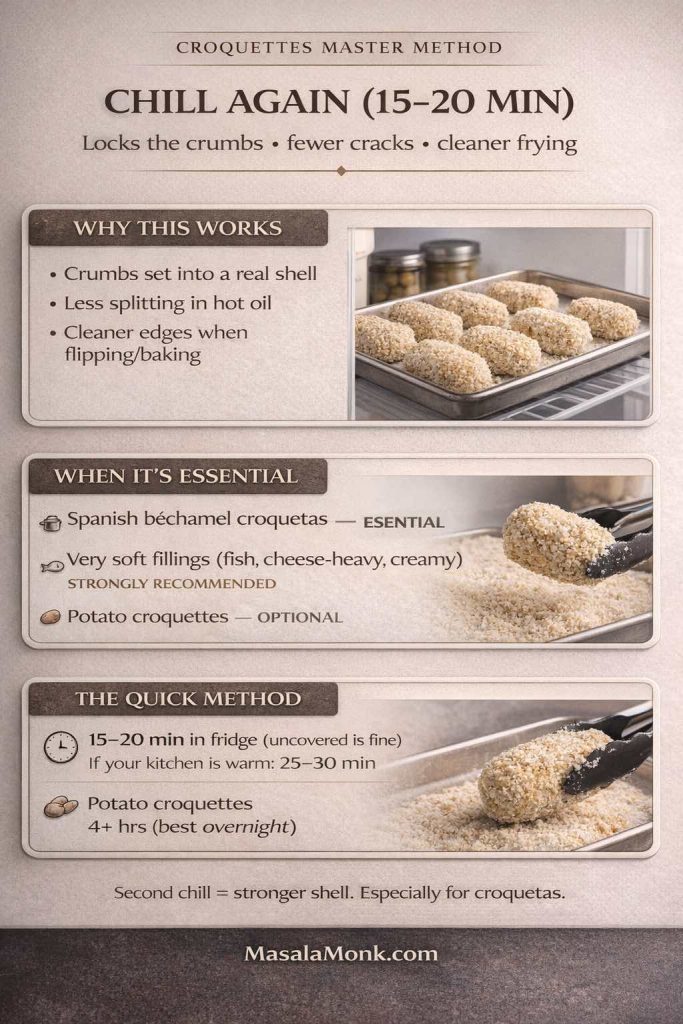
Step 6: Chill again (15–20 minutes)
This second chill is optional for potato croquettes, yet extremely helpful for béchamel-based Spanish croquetas and any very soft filling. It firms the exterior and helps the coating adhere.
That “second chill” is the quiet upgrade that stops croquettes from cracking or shedding crumbs. After flour → egg/slurry → panko, refrigerate the breaded croquettes for 15–20 minutes so the coating hydrates, firms up, and grips the surface—especially for very soft fillings like béchamel-style Spanish croquetas, fish, or cheese-heavy centers. Then cook with confidence: the shell sets faster, edges stay cleaner, and frying feels far less stressful. Keep this card saved as your quick reminder whenever your coating feels fragile.
Step 7: Cook using your method of choice (fry, shallow fry, bake, or air fry)
You’ve got options. None of them are “wrong,” so choose based on your time and your mood.
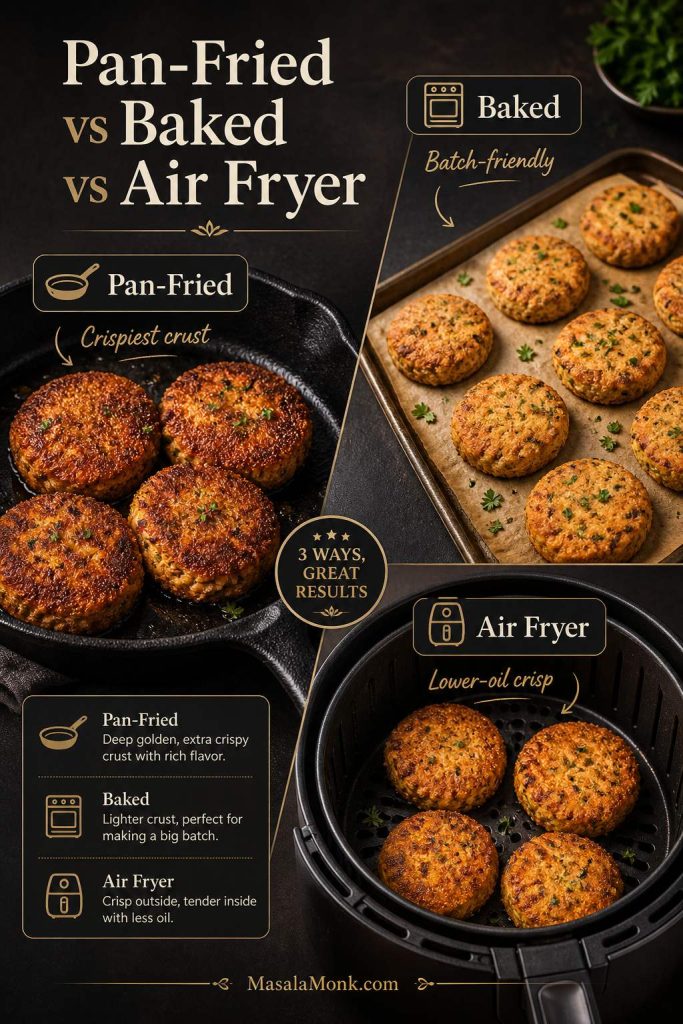
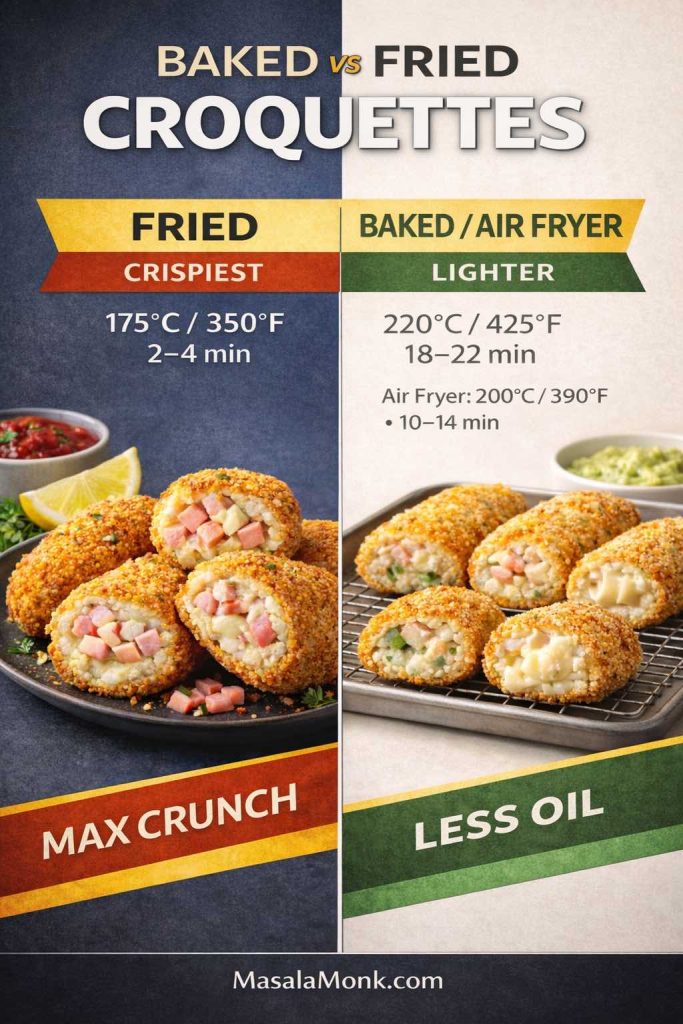
Baked vs fried croquettes at a glance: fry at 175°C/350°F for 2–4 minutes for maximum crunch, or bake at 220°C/425°F for 18–22 minutes (air fryer 200°C/390°F for 10–14 minutes) for a lighter option. Use this as your quick timing guide before you jump into the master croquettes recipe and pick a variation.
Croquettes Cooking Methods (Fried, Shallow-Fried, Oven Baked, Air Fryer)
Deep-fried croquettes recipe (crispiest and fastest)
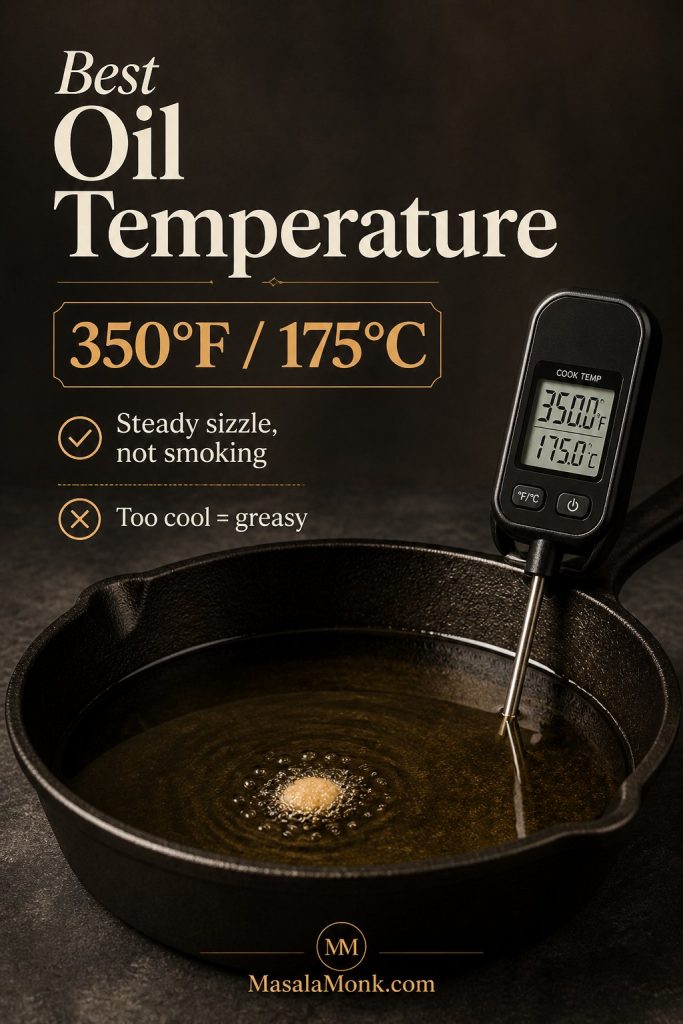
Heat oil to 175°C / 350°F
Fry in batches, 2–4 minutes, until deep golden
Drain on a rack so they stay crisp
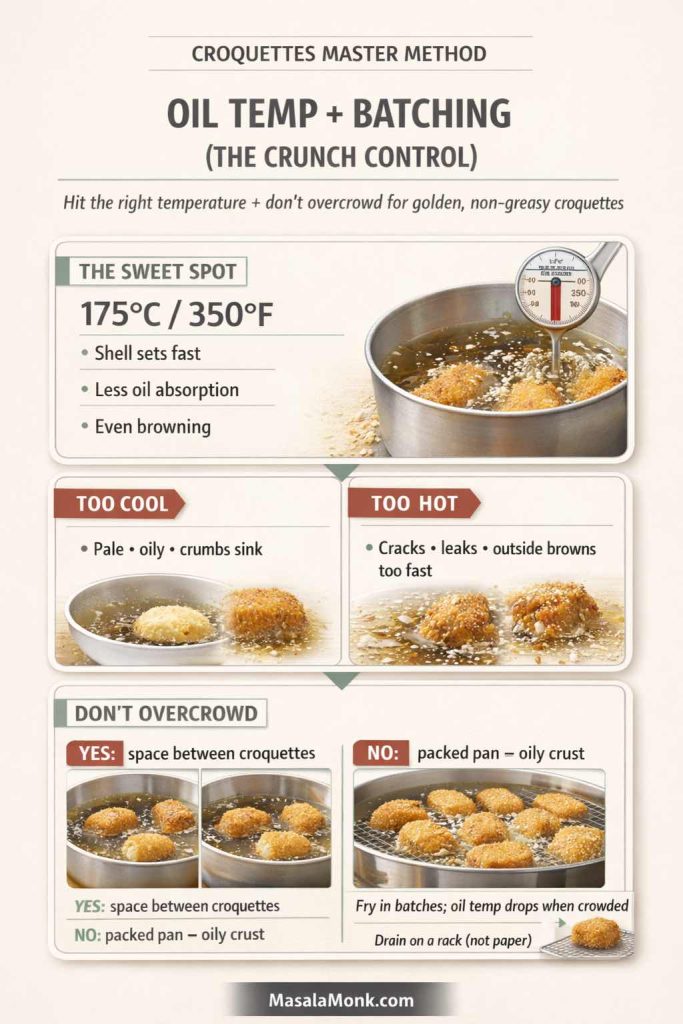
If your croquettes ever turn greasy or crack in the oil, this is the reset: aim for 175°C / 350°F and fry in small batches so the shell sets fast and browns evenly. Use the “too cool vs too hot” cues here to troubleshoot in seconds, then drain on a rack (not paper) to keep the crust crunchy—whether you’re making potato croquettes, salmon croquettes, chicken croquettes, or Spanish croquetas.
Because the shell sets quickly, deep frying is surprisingly forgiving—provided the oil is hot enough and you don’t overcrowd the pot.
Shallow-fried croquettes (easier, still crisp)
Add about 1 cm of oil to a skillet
Medium heat
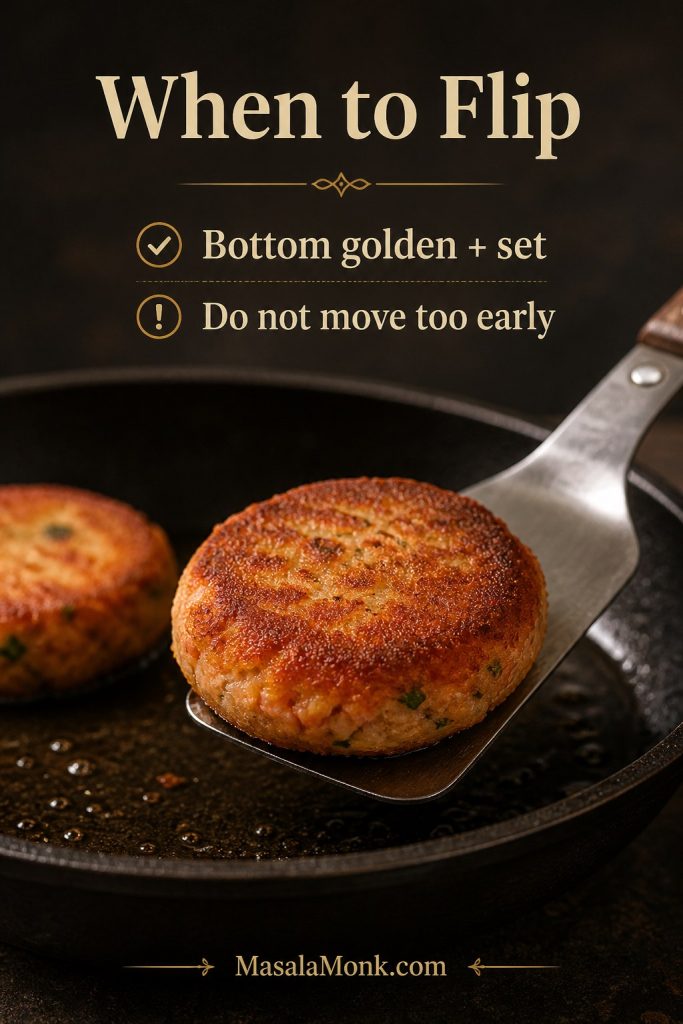
Fry 2–3 minutes per side
Shallow frying is excellent for salmon croquette patties and old fashioned tuna croquettes where you want more surface browning.
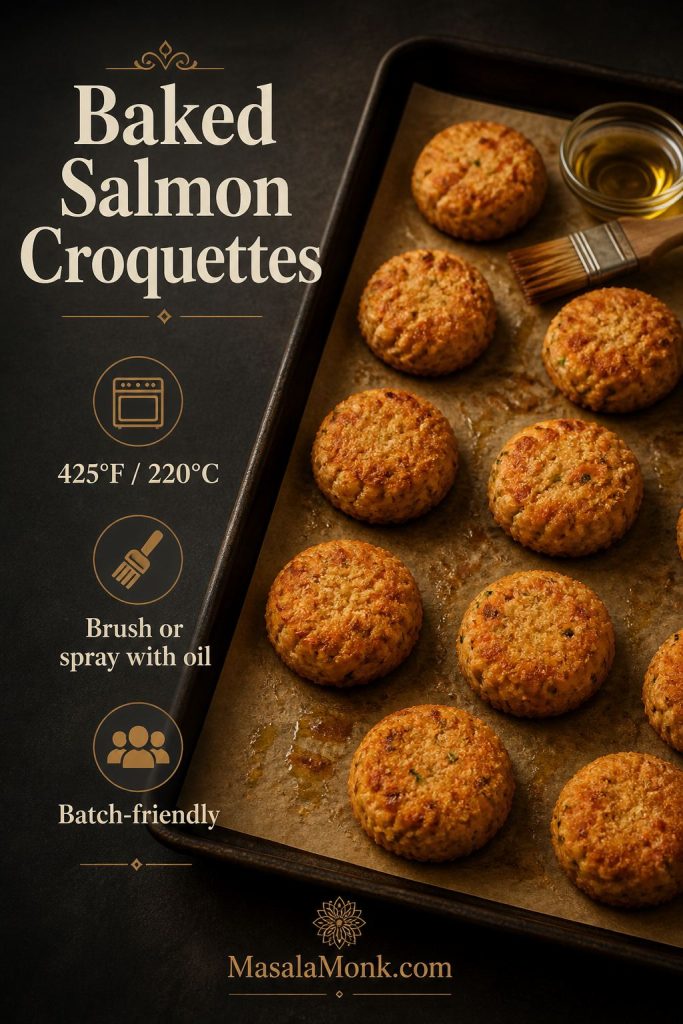
Croquettes oven baked (the best “healthy croquettes” recipe)
If you want croquettes oven baked without losing that crunch, do this:
Preheat oven to 220°C / 425°F
Place croquettes on a rack over a tray
Lightly spray or brush with oil
Bake 18–22 minutes, flipping once
Baked croquettes won’t taste “fried,” but they can be crisp and satisfying when you use panko and high heat.
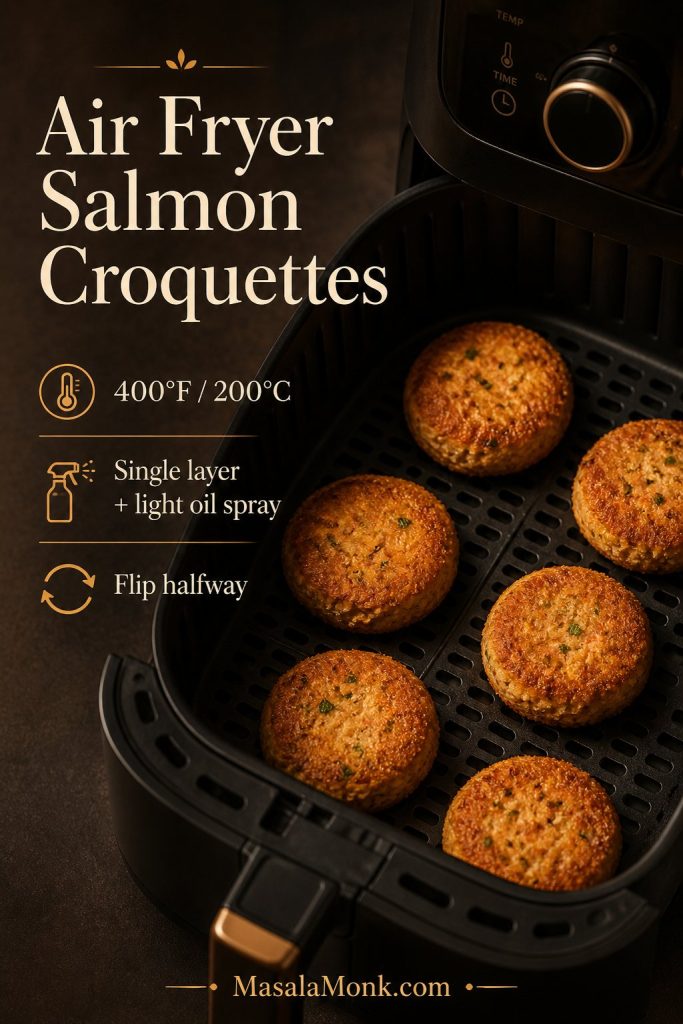
Air fryer croquettes (fast, crisp, low mess recipe)
Preheat if your air fryer benefits from it
Cook at 200°C / 390°F
Spray lightly with oil
Air fry 10–14 minutes, flipping once
Air frying is fantastic for frozen croquettes you’ve made ahead, because it re-crisps without drying out the center too harshly.
Vada Pav Dry Chutney when you want a sprinkle-style punch that clings to the crust
Meanwhile, if you’re turning croquettes into cocktail snacks, the pairing is almost too natural: salty croquettes with a briny drink, or crispy croquettes with a citrusy drink. A crisp Dirty Martini fits especially well with Spanish croquetas and ham and cheese croquettes, while a bright Lemon Drop Martini works beautifully when you want freshness to cut richness. If you prefer something lighter and longer, Vodka with Lemon is an easy match.
Now that the method is clear, let’s cook through the variants properly.
Potato Croquettes (Classic, Leftover Mash Friendly, and Japanese Potato Croquette Recipe)
Potato croquettes are the easiest place to start because potatoes naturally bind. That’s why “mashed potato croquette” and “how to make potato croquettes with leftover mashed potatoes” are such popular queries—this version welcomes leftovers.
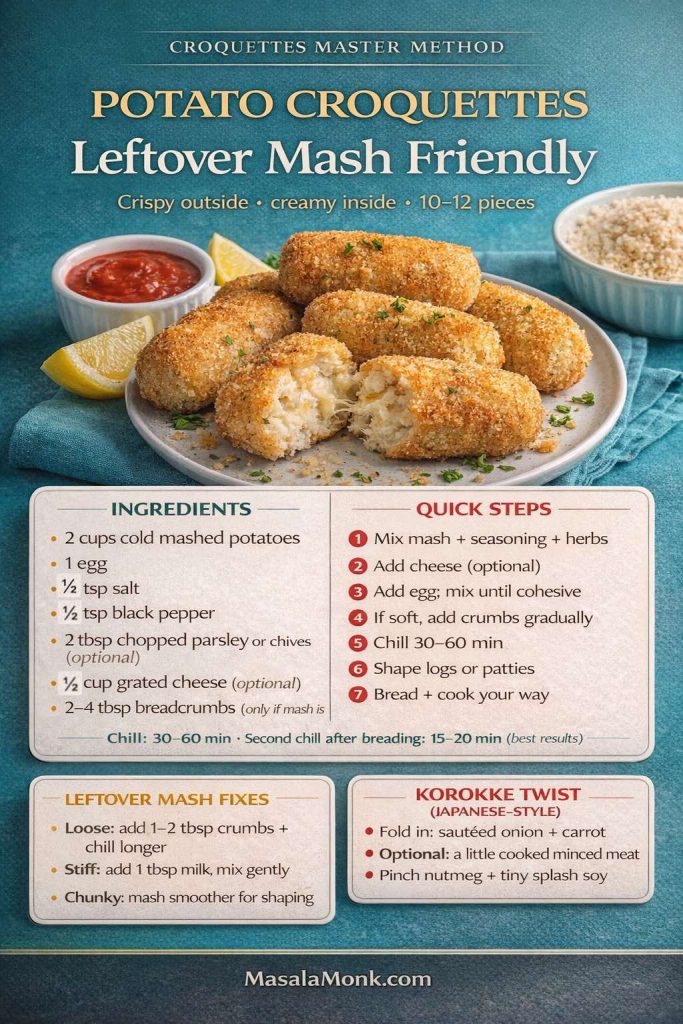
Potato croquettes are the easiest starting point because mashed potatoes bind naturally. This quick card gives you the exact ingredient ratios, the chill window (30–60 minutes), and the 3 “leftover mash” fixes (loose/stiff/chunky), plus a Japanese korokke-style twist—so you can get crisp, golden croquettes without guessing.
Easy potato croquettes recipe (makes 10–12)
Ingredients
2 cups cold mashed potatoes
1 egg
½ teaspoon salt
½ teaspoon black pepper
2 tablespoons chopped parsley or chives (optional)
½ cup grated cheese (optional, great for cheese croquettes vibes)
2–4 tablespoons breadcrumbs if needed (only if your mash is loose)
Step-by-step
Mix the mashed potatoes with salt, pepper, and herbs.
Stir in cheese if you want a richer center.
Add the egg and mix until cohesive.
If it feels too soft to shape, add breadcrumbs gradually.
Chill 30–60 minutes.
Shape into logs or patties.
Bread and cook using your preferred method.
If you like checking a classic baseline, BBC Good Food’s potato croquettes are a handy reference for the traditional approach.
Recipe for leftover mashed potato croquettes: making them sturdier
Leftover mash varies a lot. Some is buttery, some is stiff, some has milk or cream. Consequently, the fix also varies:
If your mash is loose: add 1–2 tablespoons breadcrumbs and chill longer
If your mash is stiff: add 1 tablespoon milk, mix gently, then chill
If your mash is chunky: mash a bit more so shaping is smoother
Japanese potato croquette direction (korokke vibe recipe)
If you want Japanese potato croquette style, keep the potato base, then fold in one of these:
sautéed onions and carrots
a little cooked minced meat (beef croquettes style)
a pinch of nutmeg plus a tiny splash of soy for depth
Shape into patties, bread with panko, then shallow fry or bake hot for a crisp shell.
Spanish Croquetas (Ham, Jamón, and Ham and Cheese Croquettes recipe)
Spanish croquetas are the ones people describe as “perfect croquetas” because the interior is creamy in a way potato croquettes simply aren’t. Instead of mash, you build a very thick béchamel that sets in the fridge, then you bread and fry.
This is the point where “how do you make ham croquettes” becomes a real cooking question, because béchamel croquetas reward patience. Luckily, the steps are straightforward.
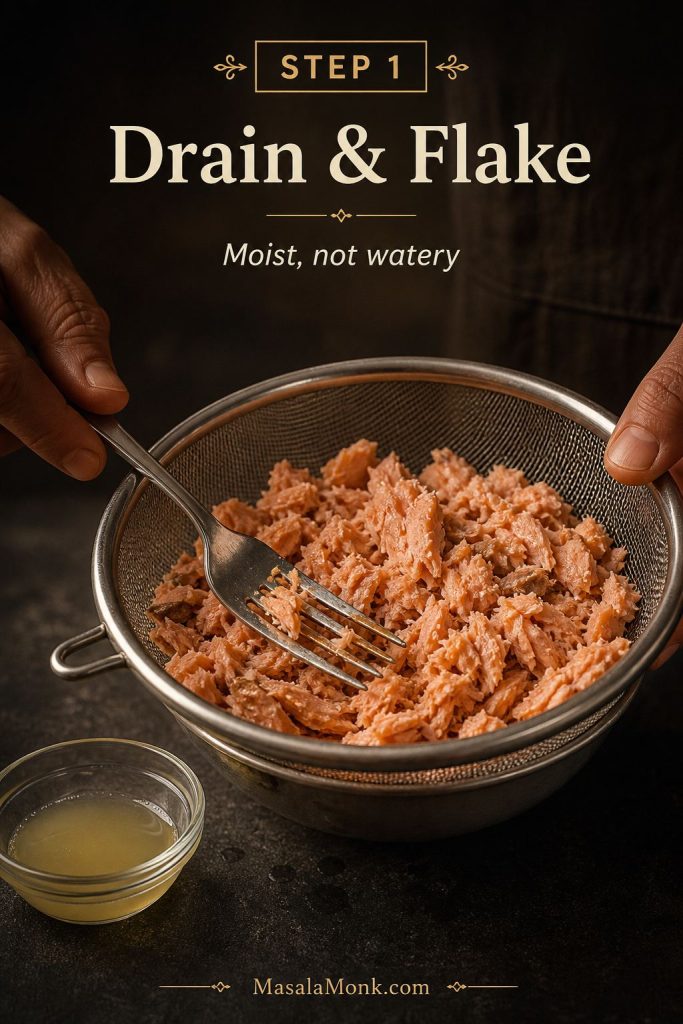
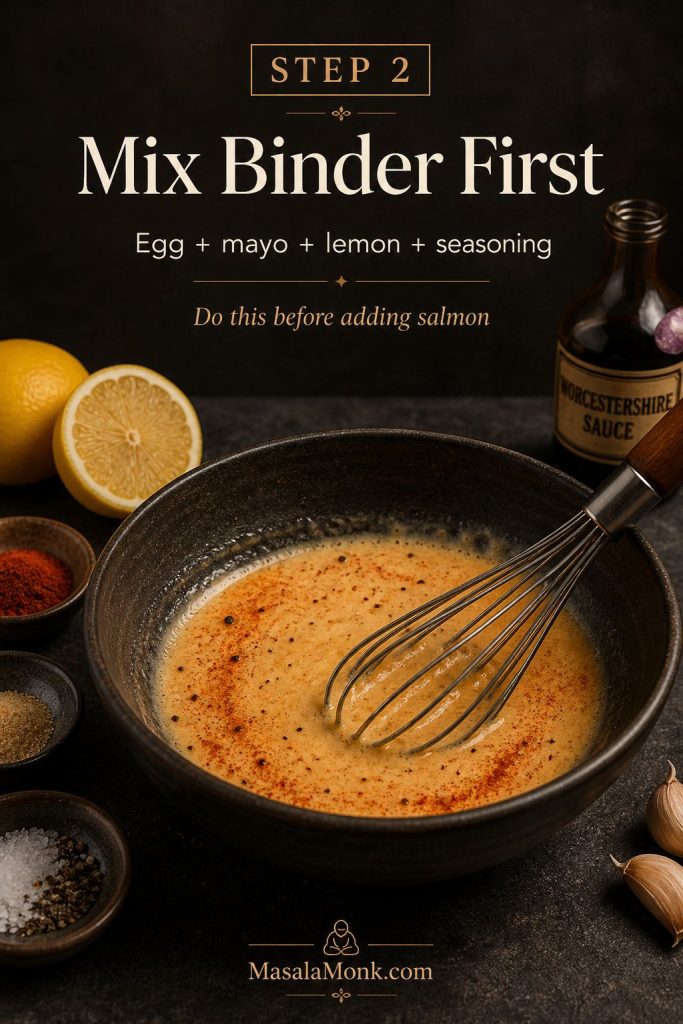
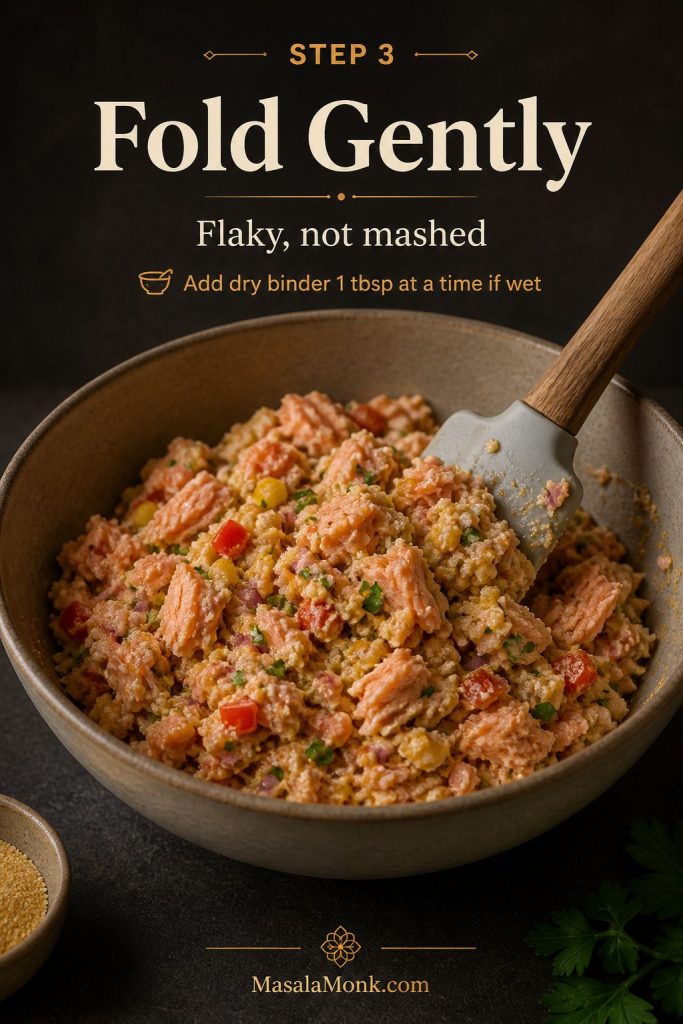
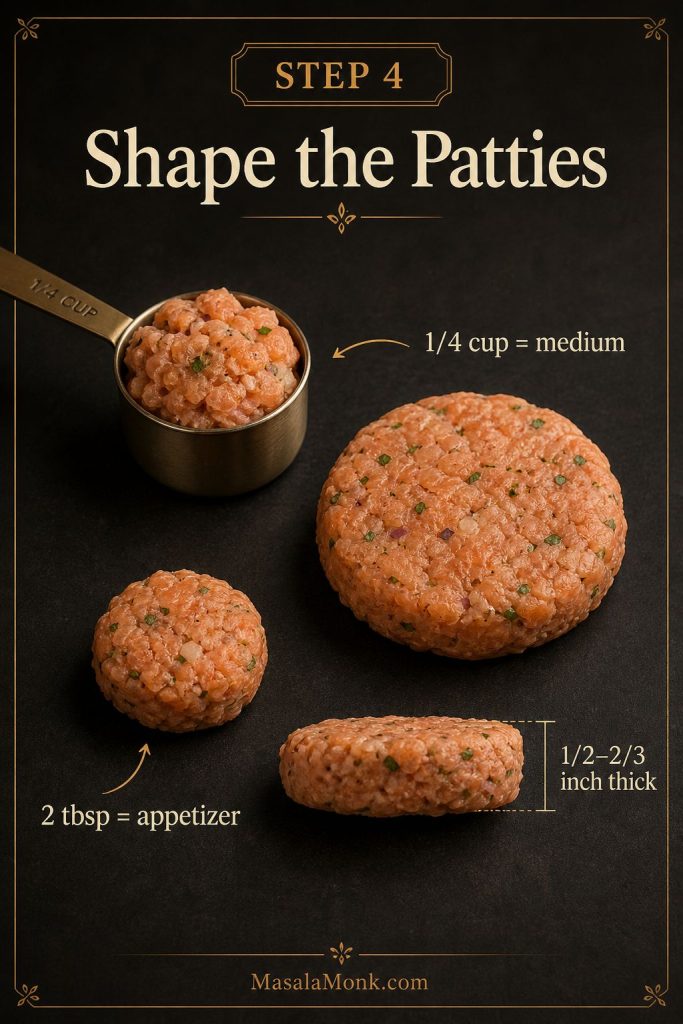
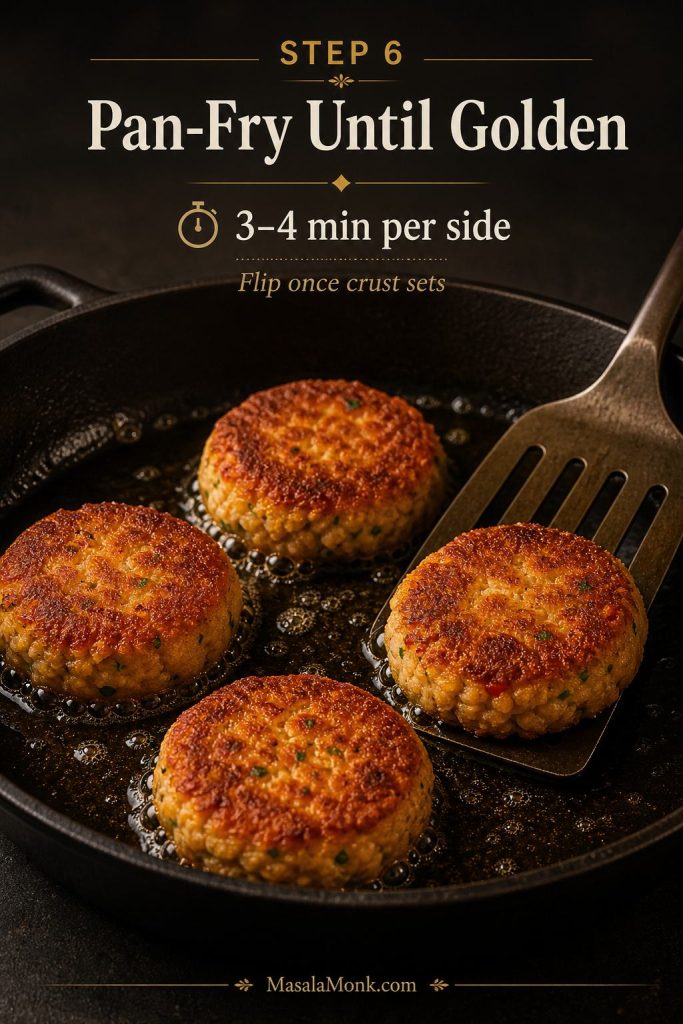
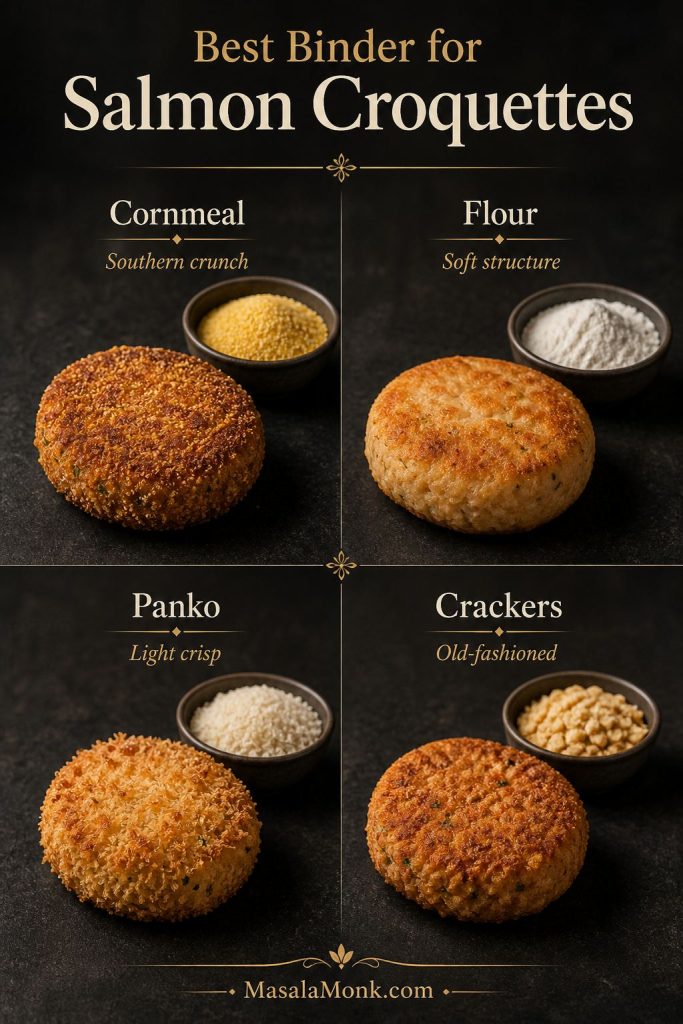
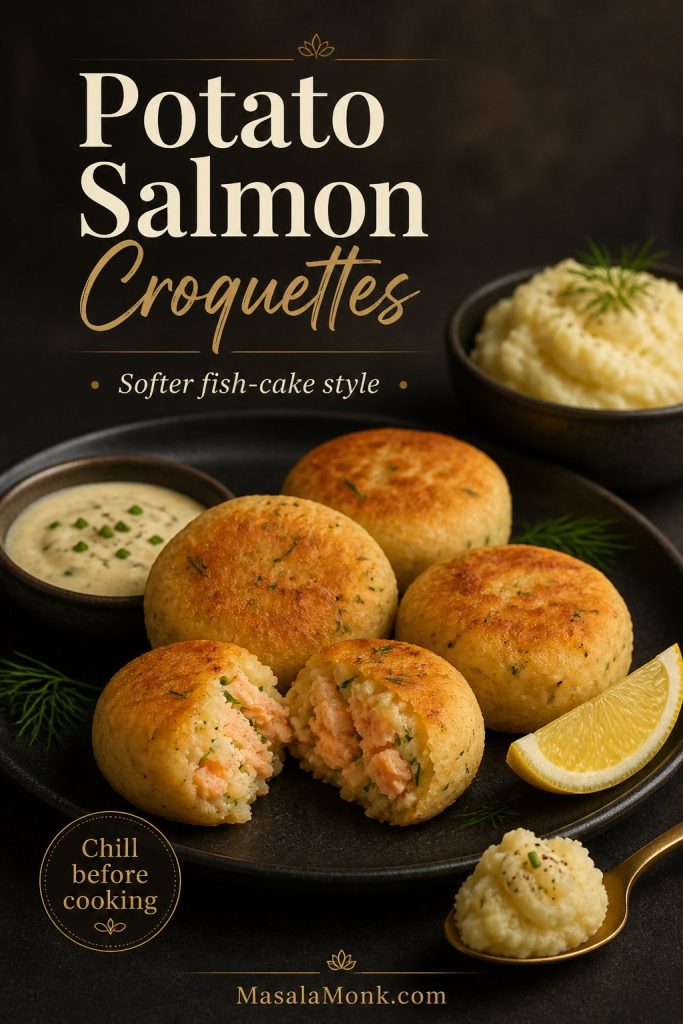
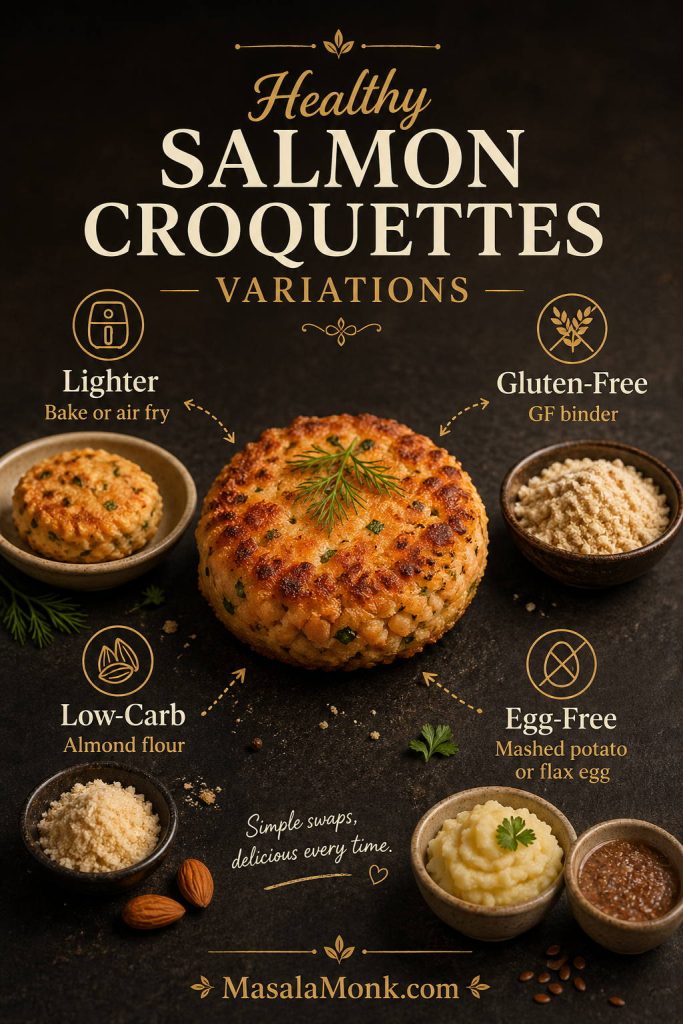
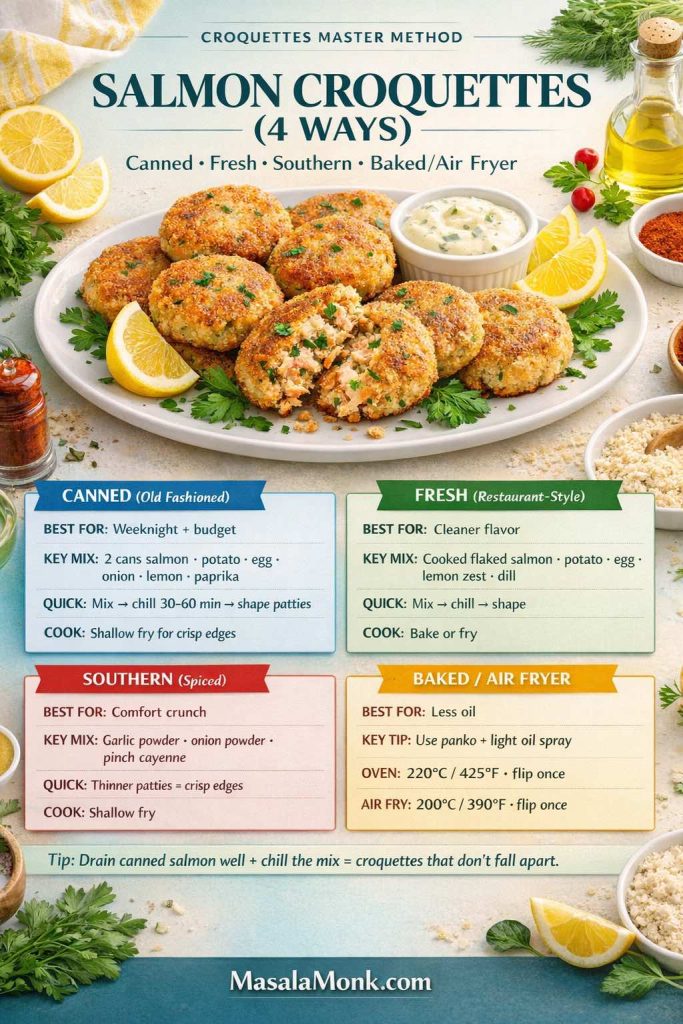
Salmon croquettes are popular because they hit the sweet spot: inexpensive enough for regular meals, yet special enough for guests. They also adapt well to baking, so “baked salmon croquette recipe” and “easy salmon croquette” versions fit nicely alongside fried.
Use this as your salmon croquettes shortcut: canned for weeknight budget patties, fresh for a cleaner “restaurant” bite, southern for crisp, spiced edges, or baked/air fryer when you want less oil. The big wins are the same across all four—drain well, chill the mix, and keep patties consistent—so they hold together whether you shallow fry, bake hot, or air fry.
Tuna Croquettes (Easy, Budget-Friendly, and Sturdy)
Tuna croquettes are simple, but they demand one thing: dry tuna. If you drain it aggressively, the rest is easy.
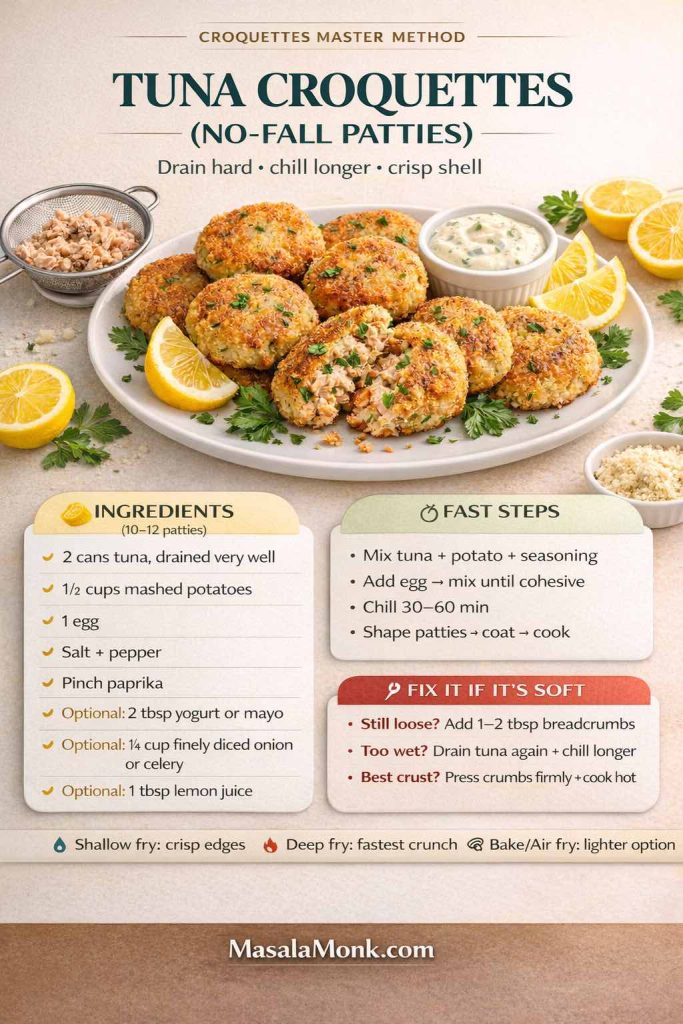
Tuna croquettes only ask for one thing: drain the tuna hard, then chill the mix so patties stay intact. Use this card as your quick reference—basic tuna + mashed potato + egg, plus the simple “fix-it” moves (breadcrumbs, extra draining, firm crumb press) that stop croquettes from turning mushy or breaking when you fry, bake, or air-fry.
Easy tuna croquette recipe (makes 10–12)
Ingredients
2 cans tuna, drained very well
1½ cups mashed potatoes
1 egg
2 tablespoons yogurt or mayo (optional)
1 tablespoon lemon juice
¼ cup finely diced onion or celery (optional)
salt and pepper
pinch paprika
Step-by-step
Mix tuna with mashed potatoes and seasoning.
Add egg and mix until cohesive.
Chill, shape, bread, cook.
If you’re asking “how do you make tuna croquettes” without them falling apart, the answer is nearly always the same: drain more, chill more, and don’t rush the breading.
Chicken Croquettes and Turkey Croquettes (Best Use of Leftovers)
Chicken croquettes are a brilliant leftover solution because shredded chicken gives texture and protein while the binder creates creaminess. Turkey croquettes follow the same pattern, and they’re especially useful after a roast dinner.
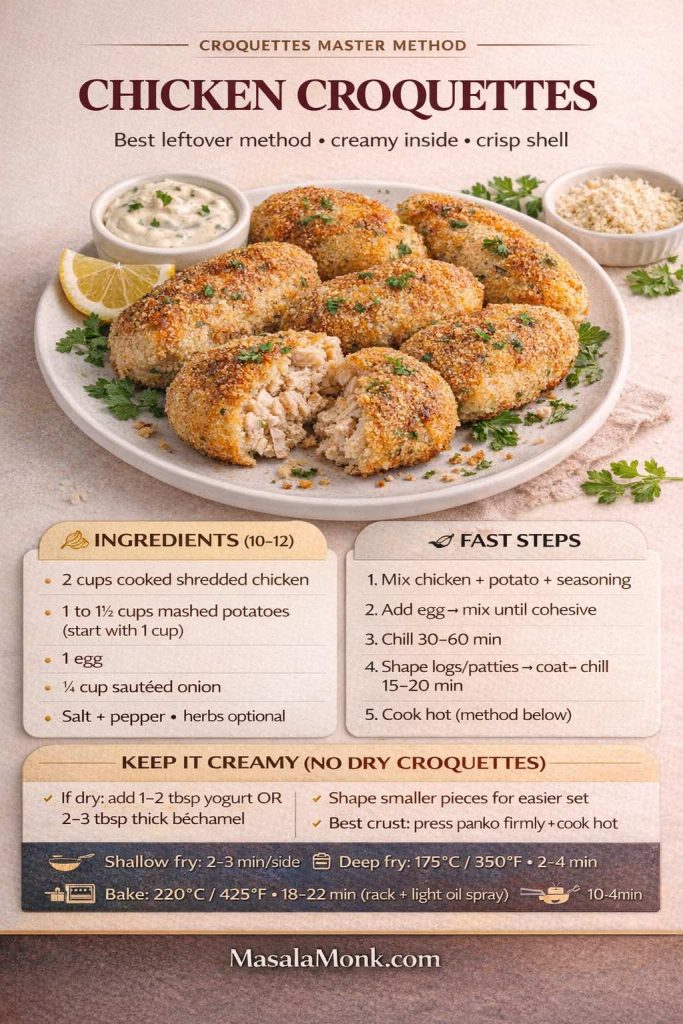
Chicken croquettes recipe (makes 10–12)
Ingredients
2 cups cooked shredded chicken
1 to 1½ cups mashed potatoes (start with 1 cup)
1 egg
¼ cup sautéed onion (or finely minced onion)
salt and pepper
optional: thyme or mixed herbs
Chicken croquettes are the best leftover upgrade: mix shredded chicken with mashed potatoes and egg, chill so they hold shape, then choose your cook method—shallow fry for crisp edges, deep fry for fastest crunch, or bake/air fry for a lighter batch. Use this card as your quick reference when you reach the chicken/turkey croquettes section, especially if your mixture feels dry or you want that creamy center every time.
Step-by-step
Mix chicken with potatoes, onion, and seasonings.
Add egg and mix well.
If it feels loose, add breadcrumbs 1 tablespoon at a time.
Chill, shape, bread, then fry or bake.
For a restaurant-style croquetas de pollo approach, Food & Wine’s chicken croquettes is a solid external reference.
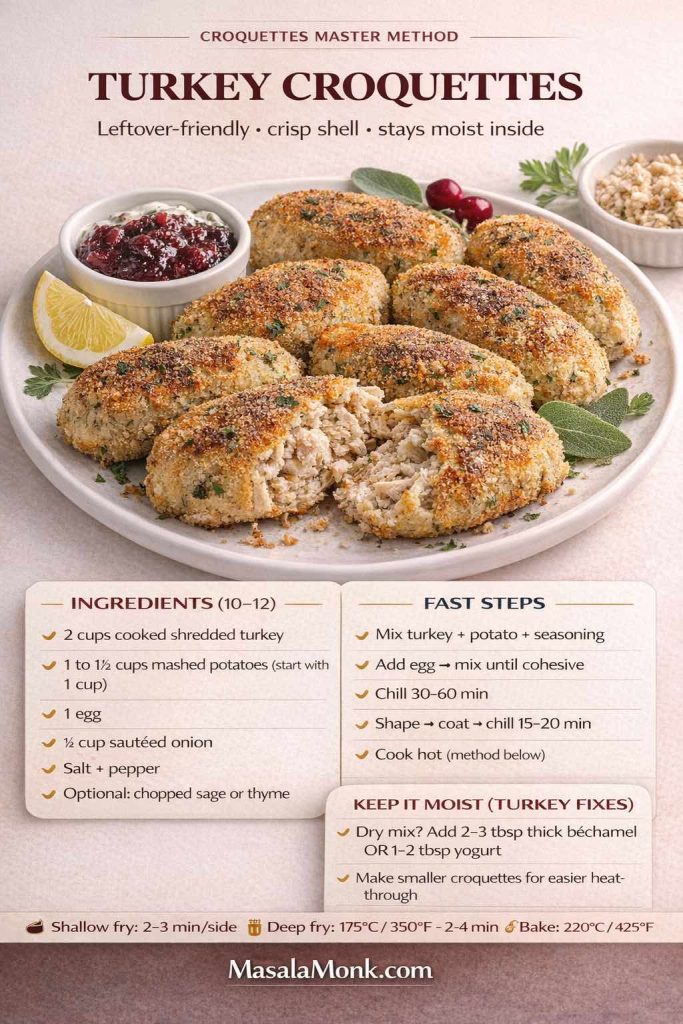
Turkey croquettes (leftover-friendly recipe)
Use the chicken method, then lean into turkey flavors:
add chopped sage
add black pepper generously
optionally tuck a tiny cranberry center inside each croquette for a sweet-savory surprise
Because turkey can be drier than chicken, the potato ratio often helps: aim for the higher end (closer to 1½ cups potato).
These turkey croquettes are the easiest way to turn leftover roast turkey into a crisp, restaurant-style snack: bind shredded turkey with mashed potatoes, chill so the mixture firms up, then coat well for a sealed shell that stays moist inside. Use the “keep it moist” fixes if your mix feels dry, and pick your cook style—shallow fry for crisp edges, deep fry for fastest crunch, or bake/air fry when you want a lighter batch with less mess. Save this card as your quick reference when you’re making turkey (or chicken) croquettes again.
Cod Croquettes Recipe and Croquette Fish Variants (Moisture Control Wins)
Cod croquettes are delicate, light, and surprisingly elegant. However, cod holds water, which is why “croquettes cod” attempts sometimes go wrong.
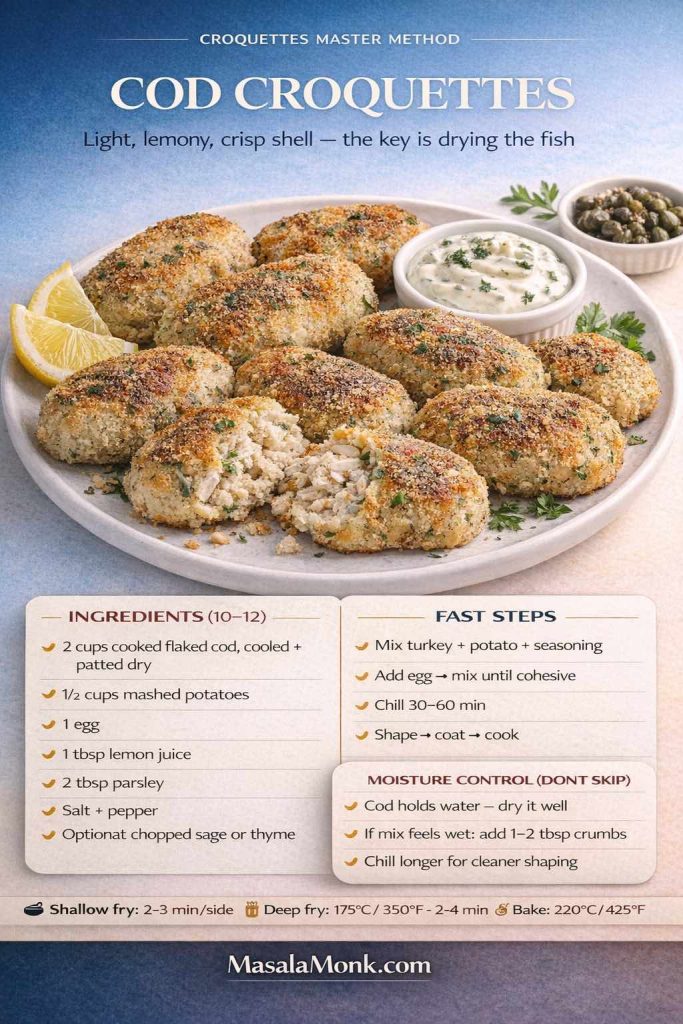
Cod fish croquettes (Recipe for 10–12 pieces)
Ingredients
2 cups cooked flaked cod, cooled and patted dry
1½ cups mashed potatoes
1 egg
1 tablespoon lemon juice
2 tablespoons parsley
salt and pepper
Cod croquettes are delicate because cod holds water—so the “secret” isn’t more binder, it’s drying the fish properly. Pat the cooled cod dry, mix with mashed potatoes + lemon + herbs, then chill before shaping so the patties stay firm. Use this card as your quick guide whenever you want light, lemony fish croquettes that don’t crack, leak, or turn mushy.
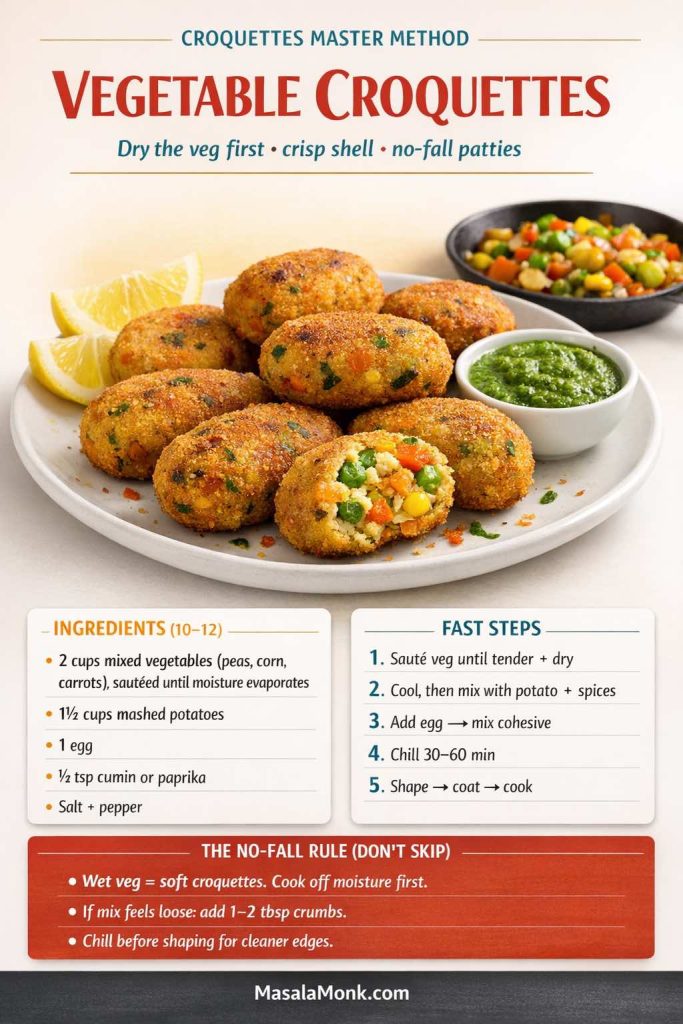
Vegetarian croquettes succeed or fail on one detail: dry vegetables. Sauté peas, corn, and carrots until the pan looks dry (no steam, no watery shine), then mix with mashed potatoes, season well, and chill before shaping. This card is your quick guide for crisp, sturdy veg croquettes that don’t crumble—perfect for weeknight snacks, lunchboxes, or party platters.
Step-by-step
Sauté vegetables until they’re tender and relatively dry.
Cool, then mix with potatoes and spices.
Add egg; chill.
Shape, bread, cook.
These are especially good with South Indian Coconut Chutney because the creamy chutney doubles down on comfort without overpowering the filling.
Vegan Croquettes (Croquettes Vegan, Eggless Binding and Coating)
These croquettes can be just as crisp, yet the vegan version needs a binder that sets and a coating that sticks without eggs.
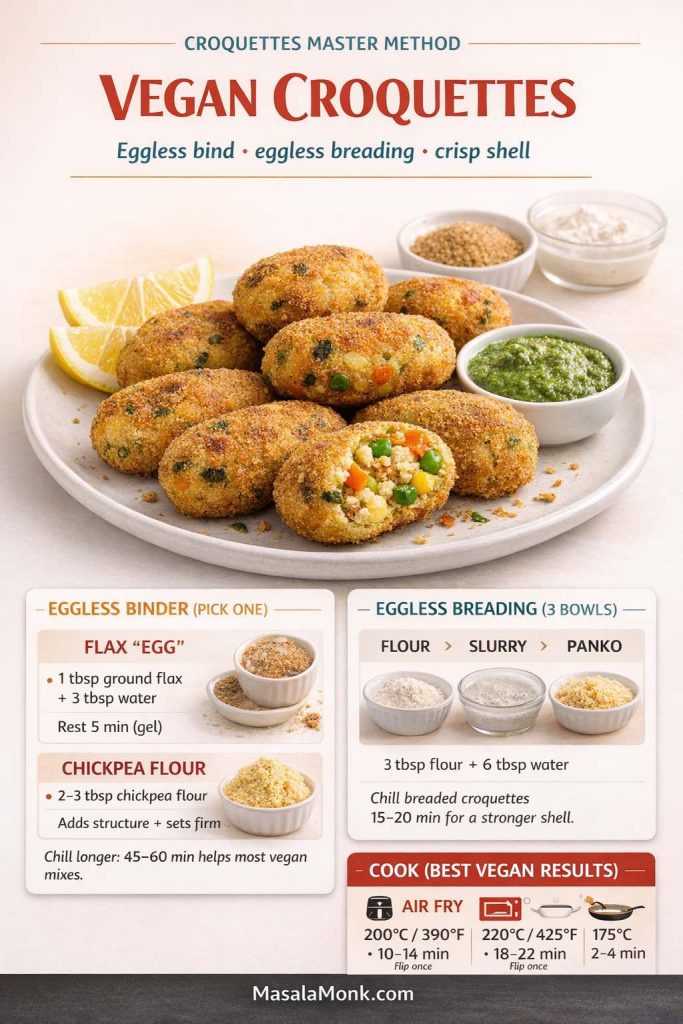
Vegan croquettes don’t fail because they’re vegan—they fail because the coating doesn’t set. Use one strong binder (flax egg or chickpea flour), then bread the smart way (flour → slurry → panko) and chill the breaded croquettes 15–20 minutes so the shell holds. This card gives you the full eggless workflow plus the best cook options (air fryer, oven, or quick fry) for a crisp crust and a center that stays together.
Beef Croquettes and Lamb Croquettes (When You Want Something Heartier)
Even though potato and fish croquettes get most of the attention, beef croquettes and lamb croquette versions are excellent when you want deeper savoriness.
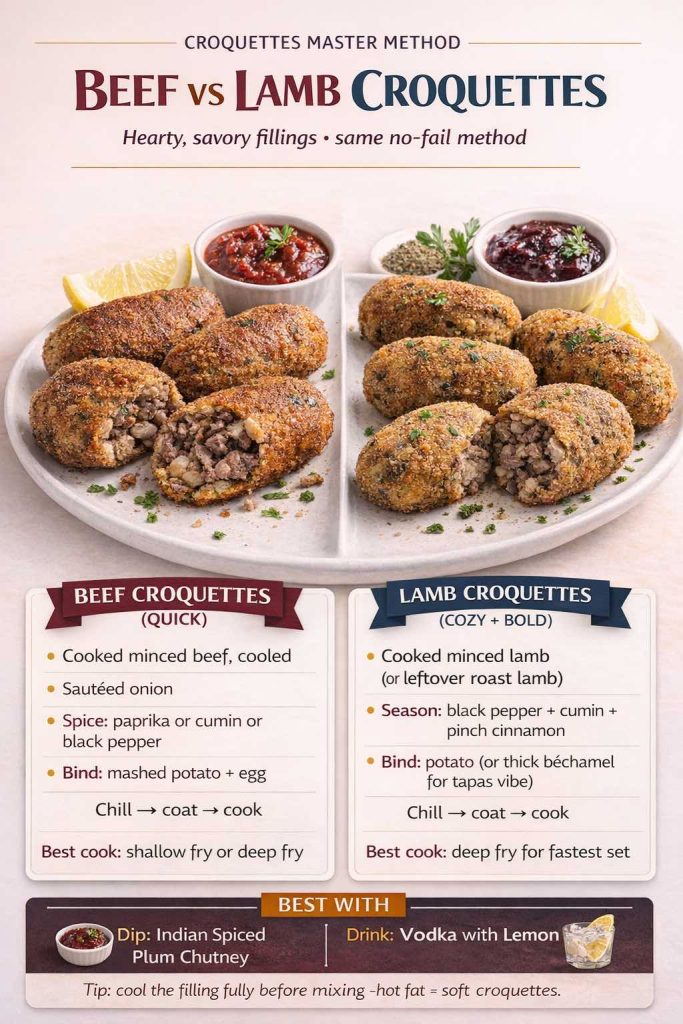
Craving something heartier than potato croquettes? This quick beef vs lamb croquettes guide helps you pick the vibe: beef croquettes for fast, savory comfort and lamb croquettes for a cozier, bolder batch (cumin + a pinch of cinnamon). Either way, the method stays the same—cool the filling, bind, chill, coat, then cook hot—so you get a crisp shell without the “fall apart” drama. Serve these with a sweet-tangy chutney (plum is perfect) and something bright like vodka with lemon to keep the plate feeling balanced.
Beef croquettes (quick recipe)
Use cooked minced beef, cooled
Add sautéed onions and a pinch of spice (paprika, cumin, or black pepper)
Bind with mashed potato and egg
Chill, bread, cook
Lamb croquette (cozy, bold recipe)
Use cooked minced lamb or finely chopped leftover roast lamb
Season with black pepper, cumin, and a small pinch of cinnamon
Bind with potato (or a thicker béchamel if you want a tapas vibe)
Making Croquettes That Don’t Fall Apart (Without Overcomplicating It)
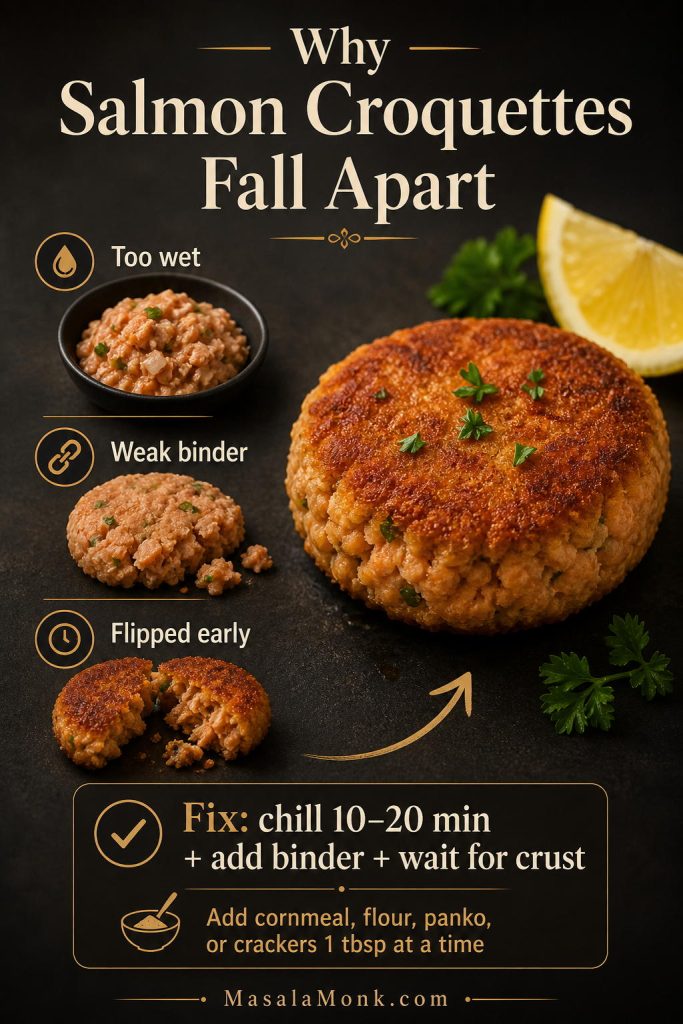
It’s tempting to treat croquettes like a mysterious technique. In reality, croquettes fail for a few predictable reasons. Once you can spot them, you can fix them quickly.
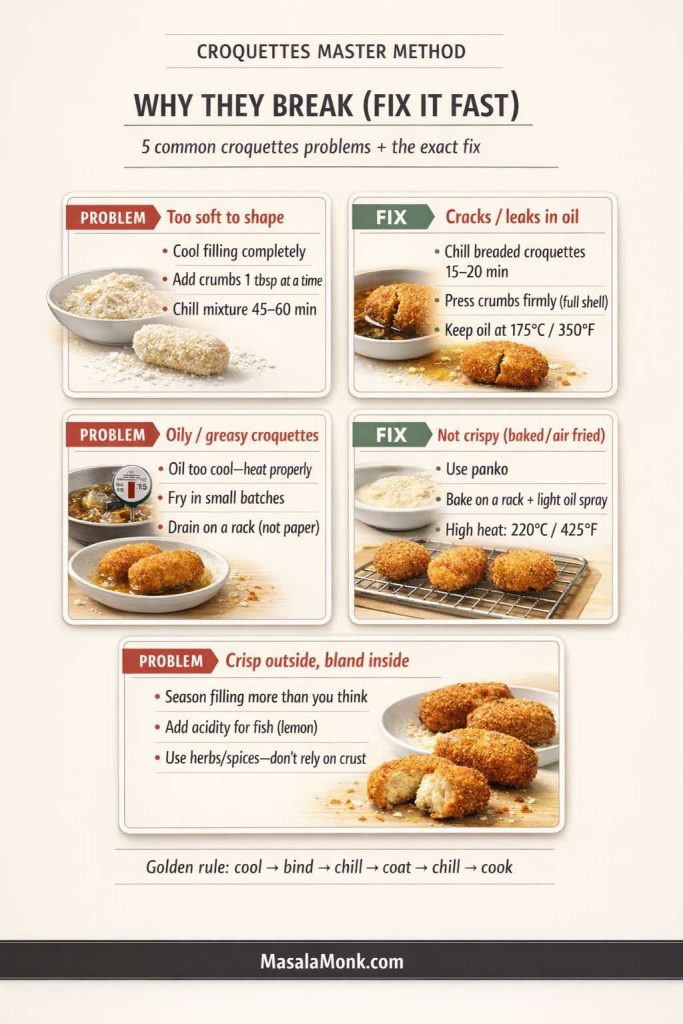
Croquettes cracking, going oily, or turning soft? Save this “fix it fast” guide. It covers the 5 issues that ruin a croquettes recipe—too-wet filling, weak coating, wrong oil temp, baked croquettes not crisp, and bland centers—plus the exact quick fixes (including the key chill steps). Use it right before you cook potato croquettes, salmon croquettes (canned or fresh), ham and cheese croquetas, chicken croquettes, cod croquettes, or vegan croquettes so every batch comes out golden and sturdy.
If your croquettes are too soft to shape
Cool the mixture fully
Add 1–2 tablespoons breadcrumbs
Chill 45–60 minutes
Shape smaller pieces (large croquettes are harder to stabilize)
Croquettes crack or leak while frying
Your oil may be too hot
Your croquettes may not be chilled enough
The mixture might be too wet
The coating may be too thin (press crumbs in firmly)
And if croquettes are crisp outside but bland inside
Season more than you think. Croquettes are not a stew. The crust dilutes the perceived seasoning, so the filling needs confidence: salt, pepper, acidity (lemon in fish croquettes), and aromatics.
If croquettes oven baked are not crisp
Use panko
Bake at high heat
Oil-spray the crumbs
Place on a rack so air circulates
Leave space between croquettes
Baked croquettes can be genuinely crunchy. They just need structure and heat rather than hope.
Make-Ahead, Freezing, and “Frozen Croquettes” Without Store-Bought Anything
Even though “frozen croquettes” and “croquetas frozen” often show up as shopping intent, freezing homemade croquettes is one of the smartest ways to keep this recipe in your regular rotation. In fact, croquettes are almost designed for batch cooking.
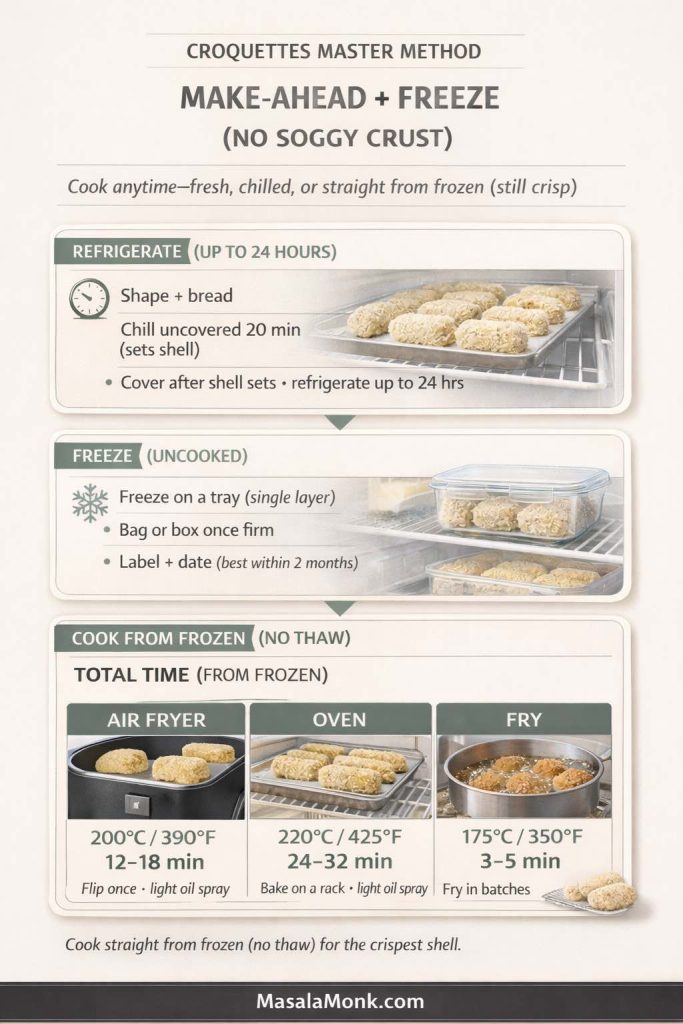
Croquettes are made for batch cooking. Shape and bread a double batch, freeze them uncooked, then cook straight from frozen whenever you want easy croquettes—no soggy crust, no defrosting drama. Use this quick guide for frozen croquettes: air fryer 200°C/390°F (12–18 min), oven baked croquettes 220°C/425°F (24–32 min), or fry at 175°C/350°F (3–5 min). Flip once and add a light oil spray for the crispiest shell—then pair with your favorite chutney, dip, or sauce from the post.
Make-ahead (best texture)
Prepare filling
Shape croquettes
Bread them
Refrigerate up to 24 hours before cooking
This keeps the coating intact and gives you that “ready whenever” flexibility.
Freeze croquettes (uncooked, breaded)
Place breaded croquettes on a tray in a single layer
Freeze until firm
Transfer to a freezer bag or container
Cook from frozen
Air fryer: add 2–4 minutes
Oven: add 6–10 minutes
Frying: lower into oil carefully, fry slightly longer at steady temperature
Frozen homemade croquettes are also a lifesaver when you want easy croquettes for guests without spending the whole evening at the stove.
Serving Croquettes Like a Complete Meal (Not Just a Snack)
Croquettes can be appetizers, lunch, or dinner. The difference is what you serve around them.
Croquettes are rich and crispy—so the easiest way to make them feel like a complete meal is to add contrast. Use this serving guide for three go-to setups: a snack platter with a cooling chutney + spicy chutney, lemon wedges (especially for fish croquettes), and something crunchy like cucumbers, pickles, or salad; a cocktail-night spread with salty-sip pairings (Dirty Martini, Lemon Drop Martini, or Vodka with Lemon); or a simple dinner with croquettes alongside salad or sautéed greens. Keep the rule simple: bright + crunchy + tangy makes every croquettes recipe taste sharper and more satisfying.
For a snack platter
A cooling chutney + a spicy chutney
Lemon wedges for fish croquettes
Something crunchy on the side (salad, pickles, sliced cucumbers)
Croquettes were practically made for a salty sip. A briny Dirty Martini pairs especially well with ham croquettes, jamon croquettes, and ham and cheese croquettes because the flavors reinforce each other instead of competing. On the other hand, if you want the opposite effect—freshness that cuts richness—a citrusy Lemon Drop Martini is a fun counterpoint. And when you want something lighter, Vodka with Lemon keeps the whole spread breezy.
For a simple dinner
Croquettes + salad
Croquettes + sautéed greens
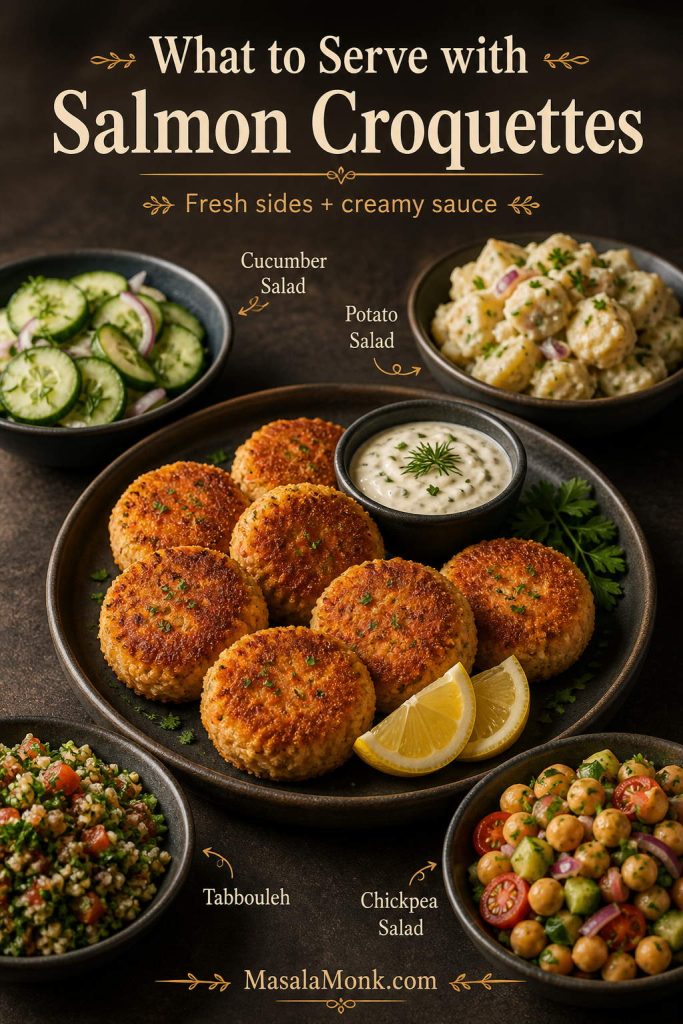
Fish croquettes + a quick cucumber-onion salad with lemon
Croquettes don’t need much. They just need contrast.
Putting It All Together: Choose Your Croquettes Recipe, Then Follow the Same Flow
At this point, you’ve got everything you need:
a single croquettes recipe method
detailed recipes for the most common variants
a baked option for healthy croquettes
make-ahead and freezing guidance
sauces, drinks, and dessert pairings that turn croquettes into a full experience
So the only question left is what you’re making first.
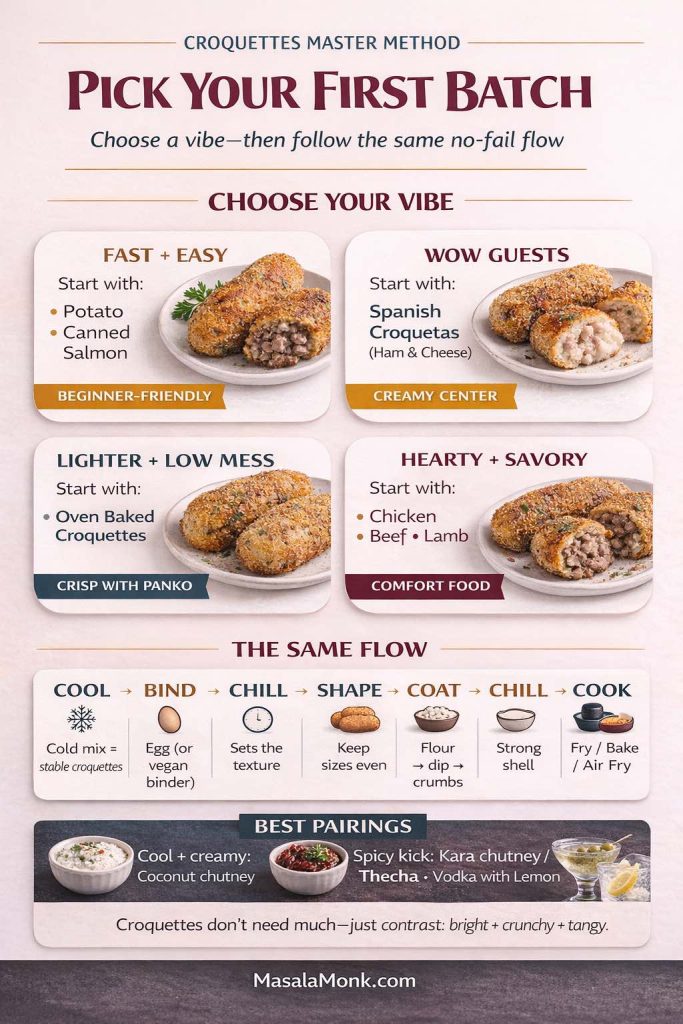
Not sure which croquettes recipe to start with? Use this “pick your first batch” guide to match your mood—potato croquettes or canned salmon croquettes for fast weeknights, Spanish croquetas (ham & cheese) to wow guests, oven baked croquettes for a lighter, low-mess option, or chicken/beef/lamb croquettes when you want hearty comfort. Whichever you choose, the success formula is the same: cool → bind → chill → shape → coat → chill → cook—then finish with contrast (coconut chutney for cool creaminess, kara chutney/thecha for heat, and a bright drink like vodka with lemon).
For a fast, no-drama batch, potato croquettes or canned salmon croquettes are the easiest place to begin. Planning to wow guests? Spanish croquetas—especially ham and cheese croquettes—feel instantly special alongside coconut chutney and a dirty martini. On busy nights when you’d rather skip splatter and cleanup, croquettes oven baked with a punchy kara chutney keep things crisp, flavorful, and wonderfully low-effort.
Whichever path you pick, the method stays the same—and that’s the real upgrade.
Croquettes are crispy, breaded bites with a soft, savory center—usually made from mashed potato, béchamel, flaked fish, or shredded meat. In other words, a croquette is less about one “fixed” ingredient and more about the method: a seasoned filling, a binder, and a crunchy coating.
2) How do you make croquettes so they don’t fall apart?
Start by cooling the filling completely, then add just enough binder to make it hold its shape. After that, chill the shaped croquettes before cooking. Finally, keep the oil at a steady temperature (or bake hot on a rack) so the shell sets quickly instead of soaking.
3) How to make a croquette with the classic flour–egg–breadcrumbs coating?
First, roll each croquette in flour and shake off the excess. Next, dip in beaten egg. Then press firmly into breadcrumbs (panko if you want extra crunch). Afterward, chill briefly so the coating adheres, and cook.
4) What’s the easiest croquettes recipe for beginners?
Potato croquettes are the simplest starting point because mashed potatoes naturally bind and shape easily. Alternatively, canned salmon croquettes are very forgiving when you combine drained salmon with mashed potatoes and a single egg.
5) Can I make croquettes oven baked instead of fried?
Yes—croquettes oven baked can be crisp when you use panko, bake at a high temperature, and lightly oil the surface. Even so, spacing matters; if croquettes touch, steam builds and the coating softens.
6) Are baked croquettes actually “healthy croquettes”?
Compared with deep-frying, baking uses less oil, so it’s often a lighter option. However, “healthy” still depends on the filling and portion size—especially for ham and cheese croquettes or béchamel-based Spanish croquetas.
7) How do I make potato croquettes with leftover mashed potatoes?
Use cold mashed potatoes, mix in an egg, then adjust with a little breadcrumb only if needed. After that, chill the mixture, shape, bread, and cook. If your mash is very buttery or loose, chilling longer makes a big difference.
8) What’s the difference between potato croquettes and mashed potato croquette patties?
Potato croquettes are often shaped as logs, while mashed potato croquette patties are flattened and typically pan-fried. Because patties have more surface area, they brown quickly and feel extra crisp around the edges.
9) What are Spanish croquetas and how are they different from regular croquettes?
Spanish croquetas usually use a thick béchamel base instead of mashed potato. As a result, the center is creamier and softer. That said, they need more chilling time so they’re firm enough to bread and fry cleanly.
10) How do you make ham croquettes the Spanish way?
Make a very thick béchamel, stir in finely chopped ham or jamón, then chill until solid. Next, shape quickly, bread thoroughly, and fry at a steady temperature until golden. In practice, patience during chilling is what separates perfect croquetas from messy ones.
11) How to make ham and cheese croquettes without the filling leaking out?
Let the béchamel cool completely, then chill overnight if possible. Also, dice ham finely and use grated cheese that melts smoothly. Finally, keep the croquettes small and the coating firm so the shell seals before the cheese gets too runny.
12) Can I make cheese croquettes without ham?
Absolutely. Swap ham for grated cheese, sautéed mushrooms, spinach, or finely chopped herbs. Even so, avoid watery fillings; otherwise, the mixture turns loose and needs more binder.
13) What’s the best salmon croquette recipe: canned salmon or fresh salmon croquette?
Canned salmon croquettes are quicker and more consistent, especially for weeknights. Meanwhile, a fresh salmon croquette tastes cleaner and more “restaurant-like,” particularly when you add lemon zest and herbs.
14) How do I make old fashioned salmon croquettes?
Use drained canned salmon, mashed potatoes (or a small amount of breadcrumbs), egg, onion, and seasoning. Then shape into patties and shallow-fry until deeply golden. Traditionally, this style is simple, crisp, and comfort-forward.
15) How to make southern salmon croquettes (southern fried salmon croquettes recipe style)?
Season more boldly—think garlic powder, onion powder, and a pinch of cayenne—then shape thinner patties for extra crunch. After that, shallow-fry until the edges brown well. As a result, you get that classic southern-style crispness without a deep fryer.
16) Can I use fresh salmon for salmon croquettes southern style?
Yes—cook and flake the salmon first, then cool it completely before mixing. Still, add mashed potatoes for stability; fresh salmon can be softer than canned once it’s flaked.
17) How do you make tuna croquettes that aren’t mushy?
Drain tuna extremely well, then bind it with mashed potatoes and egg. Additionally, chill the mixture before shaping. If needed, add a small amount of breadcrumbs, but don’t overdo it or the croquettes turn dry.
18) How do you make chicken croquettes so they stay creamy inside?
Use shredded chicken plus a creamy binder like mashed potato (or a thick béchamel-style base). Then chill before shaping so the mixture firms up. Finally, cook until the crust is deeply golden, which helps seal in moisture.
19) How do you make turkey croquettes from leftovers?
Combine shredded turkey with mashed potatoes, seasoning, and an egg. Next, chill, shape, bread, and cook. For extra flavor, add herbs like sage or a little minced onion, and keep the croquettes slightly smaller so they heat through evenly.
20) What’s the best method for cod croquettes or cod fish croquette?
Pat the cooked cod dry after it cools, then mix with mashed potatoes, egg, lemon, and herbs. Afterward, chill thoroughly. Because cod holds moisture, that drying step is the quiet key to croquettes cod that hold together.
21) Can I make croquettes vegetarian without them crumbling?
Yes—use a sturdy base like mashed potatoes and cook vegetables until most moisture evaporates. Then add egg and chill before shaping. Consequently, vegetarian croquettes stay cohesive and fry or bake neatly.
22) How do I make croquettes vegan without eggs?
Use a binder such as a flax “egg” (ground flax + water) or chickpea flour. For breading, replace the egg dip with a simple flour-and-water slurry. Then chill longer before cooking to help everything set.
23) Why are my croquettes not crispy?
Usually, the oil wasn’t hot enough, the pan was overcrowded, or the coating was too thin. For oven baked croquettes, the most common issue is low heat or skipping oil on the crumbs. In contrast, using panko and baking on a rack improves crispness dramatically.
24) Why do croquettes crack while frying?
Cracking often happens when the mixture is too wet or not chilled, or when oil is too hot and the outside sets before the inside stabilizes. Therefore, chilling and steady oil temperature solve most cracking problems.
25) Can I freeze croquettes?
Yes—freeze breaded croquettes on a tray, then transfer to a container once firm. Later, bake, air-fry, or fry from frozen with a slightly longer cook time. This is especially handy for easy croquettes on busy days.
26) How do I reheat croquettes so they stay crisp?
Reheat in an oven or air fryer rather than the microwave. That way, the exterior re-crisps while the center warms through. If you must microwave, finish in a hot pan or oven for a quick crisping boost.
27) What can I serve with croquettes?
Pair croquettes with bright, tangy sides or sauces—something that cuts richness. Also, salads, pickles, citrus wedges, and herby dips all work well. Meanwhile, for party food, croquettes fit beautifully on snack platters alongside other small bites.
28) What’s the single biggest tip for perfect croquettes?
Chill twice: chill the mixture before shaping, and chill the breaded croquettes before cooking. Ultimately, that one habit makes croquettes easier to handle, cleaner to cook, and far more consistent.
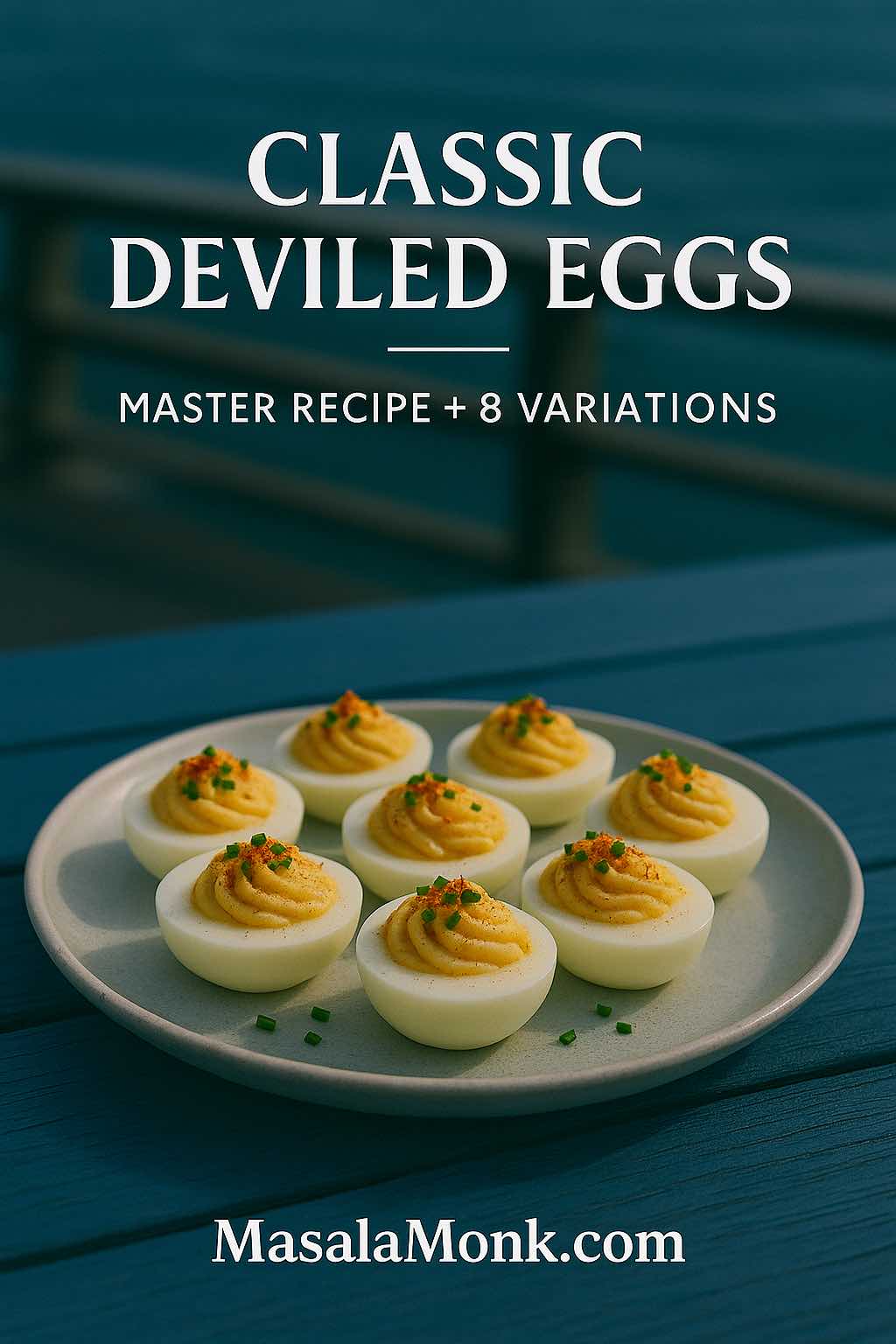
There’s a reason classic deviled eggs are the platter that empties first. They’re simple, yes, but they’re also quietly perfect: a tender white that cradles a plush, tangy filling; a dusting of paprika that looks like confetti; a garnish that promises exactly what you’re about to taste. They travel well, they scale easily, and they make friends at every table—from potlucks to weddings to sleepy Sunday brunch. Most of all, they invite tinkering, so after you master the base, you can tilt the flavor toward briny, herby, smoky, or spicy without losing the comfort of the original.
Today, you’ll get a dependable classic deviled eggs recipe that scales cleanly, plus eight variations that read as real, distinct ideas rather than tiny tweaks. Along the way, you’ll see why cooking method matters, how a brief whisk transforms texture, and where tiny adjustments in acid and salt make magic. If you want seasoning inspiration while you read, take a quick spin through MasalaMonk’s friendly roundup, Egg-cellent Seasoning Options for Flavorful Eggs; it’s full of small, confident nudges. For paprika style and color sense, Elevate Your American Cooking is a quick primer. And for a clear demonstration of the steam method (which often peels easier), the step-by-step at Serious Eats helps: Steamed Hard-Boiled Eggs. Finally, because we all host in the real world, the FDA’s plain-English refresher on time and temperature is worth a single, sensible link: Egg Safety.
The quiet mechanics of great deviled eggs
Before we cook, it helps to know what we’re chasing. First, texture: you want smooth whites without moon-craters and a filling that’s plush, pipeable, and light. Therefore, a hot-start boil or a gentle steam—followed by an aggressive ice bath—works in your favor. Because heat sets the albumen from the outside in, starting hot contracts the membrane early; consequently, shells slip off with less drama, and yolks stay sunny instead of green-rimmed.
Second, balance: every bite needs a little fat (mayo), a little heat (mustard, pepper, or both), and a little acid (vinegar or pickle brine). Since flavors pop faster in a silky puree, you add acid by drops and salt by pinches, tasting as you go; as a result, you land in that bright, savory zone that makes people reach back to the platter without thinking.
Third, finish: garnish isn’t decoration so much as a promise. Dill signals pickle; celery leaf whispers buffalo; tarragon says French; chives nod toward ranch; bacon speaks for itself. Meanwhile, a gentle snowfall of paprika acts like lighting—softening edges and adding warmth without hiding the swirl.
Yield: 12 halves (serves 4–6 as an appetizer) Total time: about 30 minutes (including a short chill)
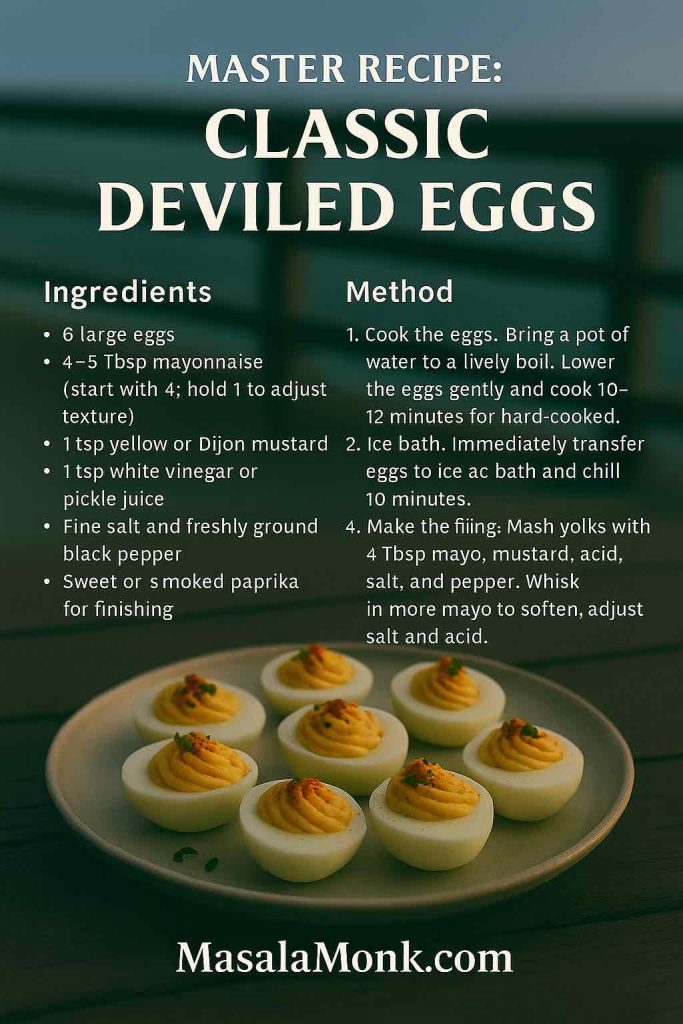
Ingredients
6 large eggs
4–5 Tbsp mayonnaise (start with 4; hold 1 to adjust texture)
1 tsp yellow or Dijon mustard
1 tsp white vinegar or pickle juice
Fine salt and freshly ground black pepper
Sweet or smoked paprika, for finishing
Optional: snipped chives or fresh dill
Scaling ratio (per whole egg → 2 halves): 1 yolk + 1½ tsp mayo + ⅛ tsp mustard + ⅛ tsp acid + pinch salt & pepper. Because that ratio is easy to remember, you can scale from a snack for two to a party tray without doing math on your phone mid-peel.
Serve these briny deviled eggs with crisp kettle chips and chilled dill spears; the snap mirrors the pickle notes. A light pilsner or sparkling water with lemon keeps the palate fresh between bites.
Method
Cook the eggs. Bring a pot of water to a lively boil. Lower the eggs gently and cook 10–12 minutes for hard-cooked. (Alternatively—and often more peel-friendly—steam eggs over simmering water for ~12 minutes; if you want a visual, the walkthrough at Steamed Hard-Boiled Eggs is clear and kind.)
Ice bath. Immediately transfer eggs to an ice bath and chill 10 minutes. In practice, this interrupts carryover cooking and helps the membrane release; consequently, peels behave.
Peel. Tap all over, roll gently to web the shell, then peel from the wide end where the air pocket sits. If you hit a stubborn spot, peel under water; it sneaks under the membrane.
Halve and collect yolks. Slice lengthwise. Pop yolks into a bowl; set whites cut-side up on a platter. If they’re sliding, line the platter with a paper towel while you work and remove it before serving.
Make the filling. Add 4 Tbsp mayo, mustard, vinegar or pickle juice, a pinch of salt, and a few grinds of pepper to the yolks. First mash very smooth with a fork; then whisk 30–60 seconds until the mixture looks glossy and plush. Taste. If you want a softer swirl, add the remaining tablespoon of mayo. Adjust acid drop by drop and salt to taste.
Fill. Spoon the filling back into the whites, or pipe from a small bag with the corner snipped (set the bag in a tall glass to fill neatly; then twist and burp air).
Finish and chill. Dust lightly with paprika; add chives or dill if you like. Finally, chill 10–20 minutes so the tops set and the tray travels as well as it tastes.
Because the base is conservative on liquid, the filling stays sturdy enough to pipe crisply; because a short whisk aerates without adding water, the texture reads decadent rather than dense. Meanwhile, that easy ratio means your hands remember it, which—in a real kitchen, at a real hour—creates confidence. Moreover, since we season late and in tiny increments, you can walk flavor right to the edge without tipping it over. If you want to extend the spice conversation—cayenne, onion powder, mustard powder, smoked paprika—MasalaMonk’s list is helpful and relaxed: Egg-cellent Seasoning Options for Flavorful Eggs. And if you’re deciding between sweet, hot, and smoked paprika—and how each reads on the plate—this quick primer will save you a few experiments: Elevate Your American Cooking.
Scaling (US & metric that won’t betray you mid-party)
Whole Eggs
Yolks
Mayo
Mustard
Acid
Fine Salt
Yield
4
4
6 tsp / ~30 g
½ tsp
½ tsp
¼ tsp
8 halves
6
6
9 tsp / ~45 g
¾ tsp
¾ tsp
⅜ tsp
12 halves
10
10
15 tsp / ~75 g
1¼ tsp
1¼ tsp
⅝ tsp
20 halves
12
12
18 tsp / ~90 g
1½ tsp
1½ tsp
¾ tsp
24 halves
24
24
36 tsp / ~180 g
3 tsp
3 tsp
1½ tsp
48 halves
For very large batches, weigh the mayo and whisk briefly in a wide bowl—or on a mixer’s lowest speed for 20–30 seconds—so the filling emulsifies evenly without going slack. Then pause. Because you can always loosen with a few drops of acid or water, restraint keeps you in control.
Troubleshooting you’ll actually use
Too stiff? Add ½ tsp liquid (pickle juice, vinegar, or water) and whisk. Repeat if you must, but slowly.
Too loose? Mash in an extra cooked yolk if you have one; otherwise, chill 10 minutes and reassess.
Grainy? Press through a fine mesh sieve, then whisk 20 seconds.
Flat flavor? Add a tiny pinch of salt and a few drops of acid; dust with paprika.
Whites tearing? Chill longer; next time, steam the eggs and use eggs that aren’t ultra-fresh.\
Eight variations (fully detailed, distinct, and platter-friendly)
Each variation starts with the master filling at Step 5. Because the base is balanced, you can layer flavor confidently, yet the texture remains classic.
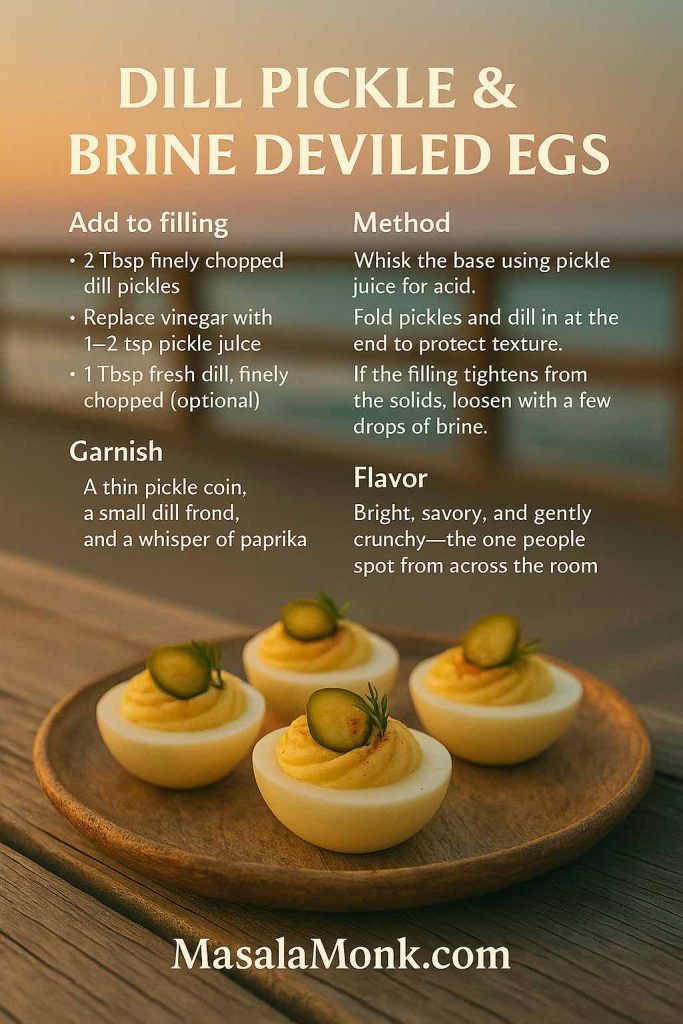
1) Dill Pickle & Brine Deviled Eggs
Add to filling
2 Tbsp finely chopped dill pickles
Replace vinegar with 1–2 tsp pickle juice
1 Tbsp fresh dill, finely chopped (optional)
Serve these briny deviled eggs with crisp kettle chips and chilled dill spears; the snap mirrors the pickle notes. A light pilsner or sparkling water with lemon keeps the palate fresh between bites.
How to do it Whisk the base using pickle juice for acid. Fold pickles and dill in at the end to protect texture. If the filling tightens from the solids, loosen with a few drops of brine.
Garnish A thin pickle coin, a small dill frond, and a whisper of paprika.
Flavor Bright, savory, and gently crunchy—the one people spot from across the room.
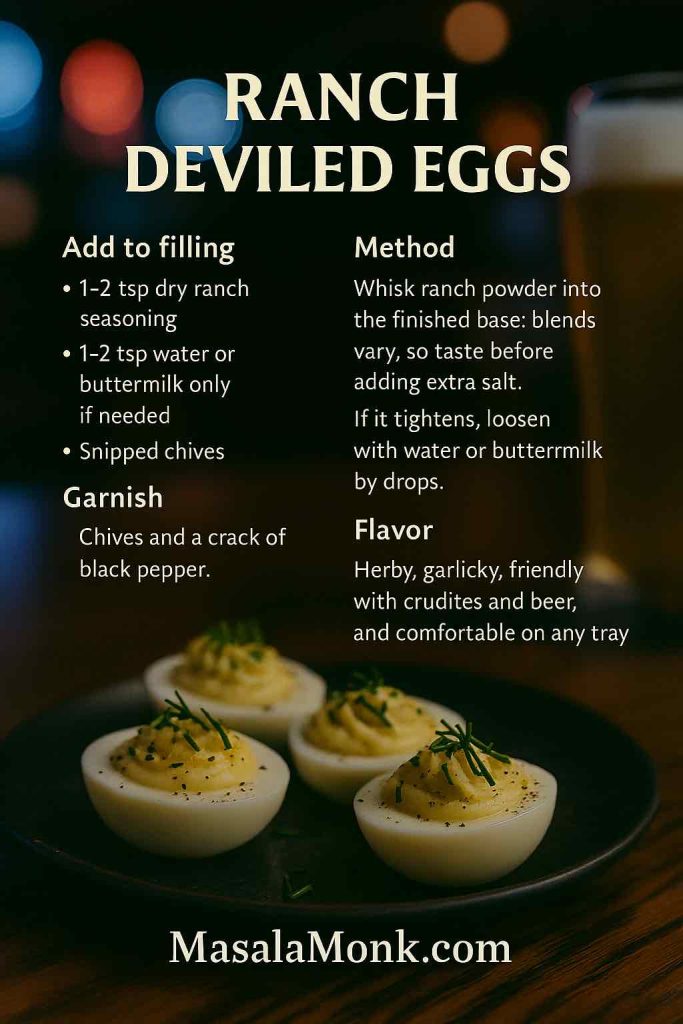
Pair ranch deviled eggs with crunchy crudités—celery, cucumbers, carrots—and a cold lager or sparkling water. The crisp veg resets the palate, so the herby filling stays bright through the whole platter.
How to do it Whisk ranch powder into the finished base; blends vary, so taste before adding extra salt. If it tightens, loosen with water or buttermilk by drops.
Garnish Chives and a crack of black pepper.
Flavor Herby, garlicky, friendly with crudités and beer, and comfortable on any tray.
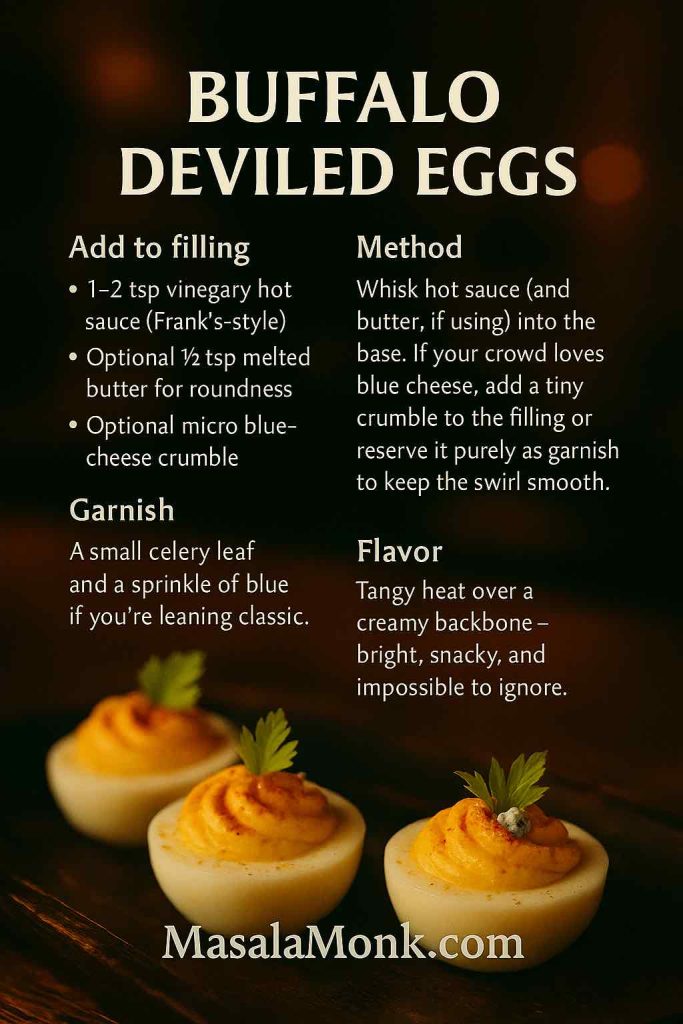
Dial heat precisely by adding the hot sauce in drops, then whisking in a ½ tsp of melted butter to round the edges. Set a ramekin of extra sauce and a small bowl of blue-cheese crumbles on the side so guests can customize without loosening the filling; celery sticks keep the bites crisp between rounds.
How to do it Whisk hot sauce (and butter, if using) into the base. If your crowd loves blue cheese, add the tiniest crumble to the filling or reserve it purely as garnish so the swirl stays smooth.
Garnish A small celery leaf and a sprinkle of blue if you’re leaning classic.
Flavor Tangy heat over a creamy backbone—like wings night and brunch met in the middle.
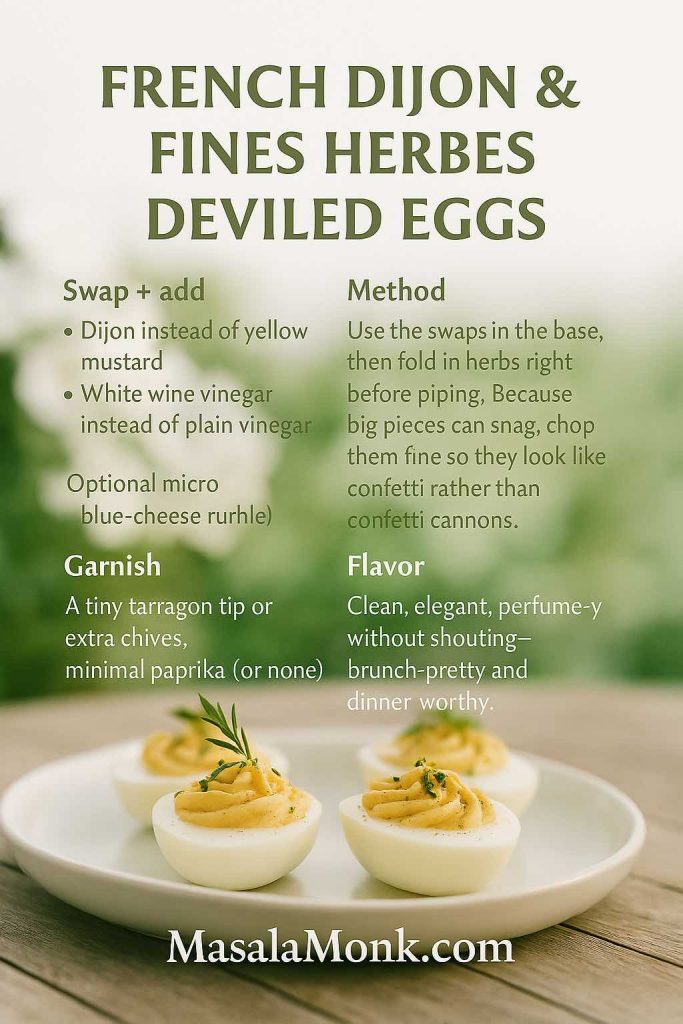
4) French Dijon & Fines Herbes Deviled Eggs
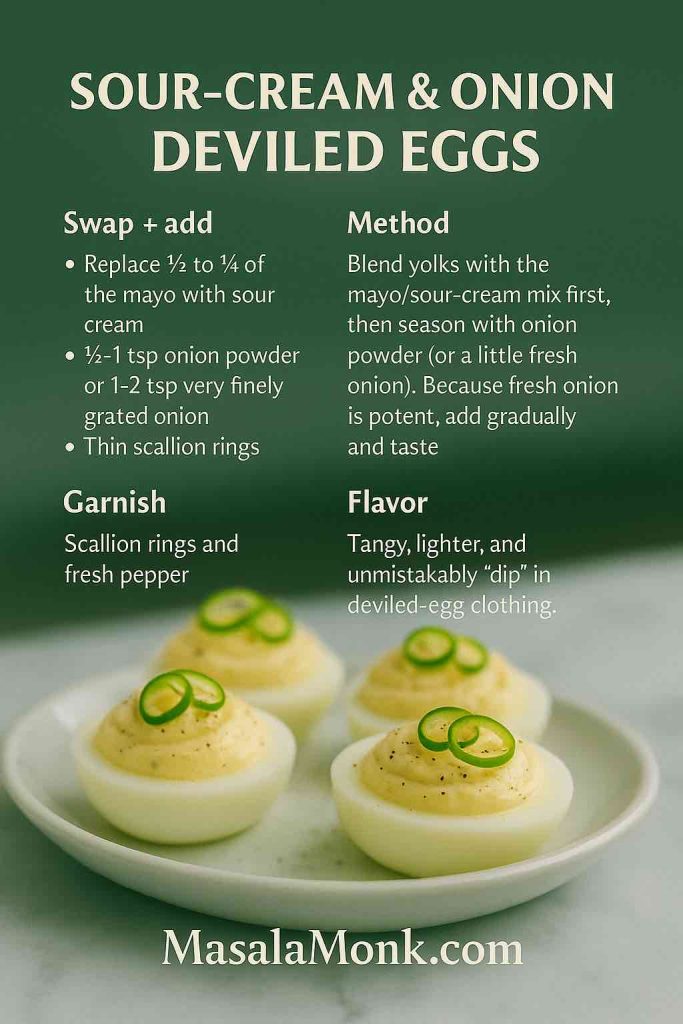
Swap + add
Dijon instead of yellow mustard
White wine vinegar instead of plain vinegar
1–2 tsp fines herbes (parsley, chives, tarragon; very finely chopped)
For the silkiest texture, press yolks through a fine sieve before whisking, then fold ultra-fine herbs in just before piping. Pair with a dry Crémant or Sauvignon Blanc and a simple salad dressed with white-wine vinaigrette so the Dijon and tarragon stay bright.
How to do it Use the swaps in the base, then fold in herbs right before piping. Because big pieces can snag, chop them fine so they look like confetti rather than confetti cannons.
Garnish A tiny tarragon tip or extra chives; minimal paprika (or none).
Flavor Clean, elegant, perfume-y without shouting—brunch-pretty and dinner-worthy.
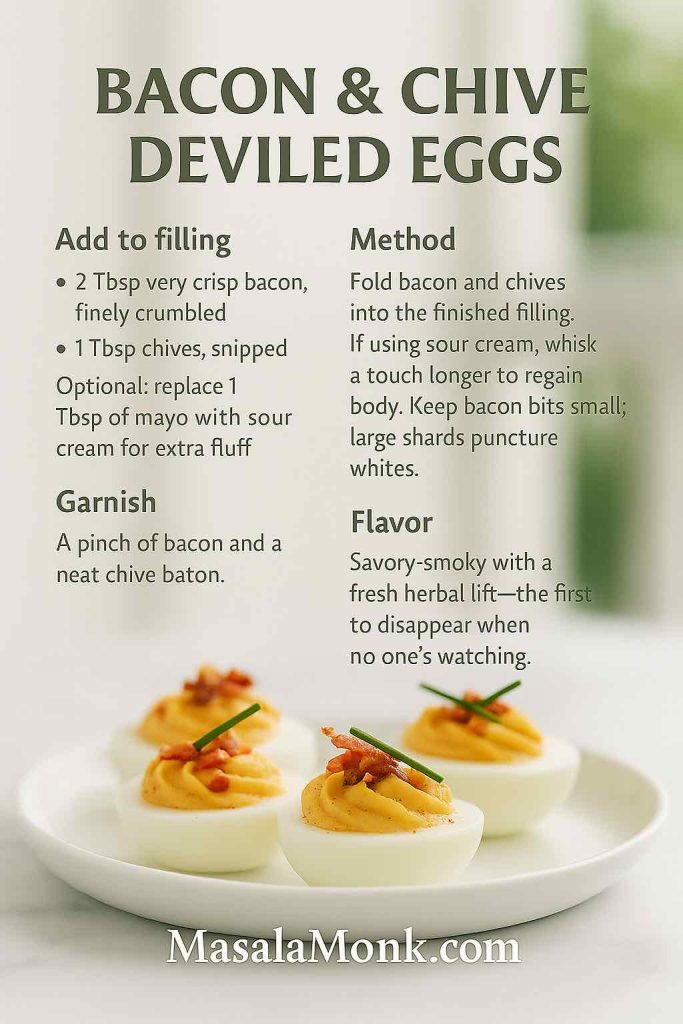
Optional: replace 1 Tbsp of mayo with sour cream for extra fluff
Bake bacon on a rack at 200°C / 400°F for 12–18 min until shatter-crisp, then cool completely before crumbling—stays crunchy longer than pan-fried. For clean lines, snip chives with scissors and add after piping. Traveling? Carry bacon in a separate container and sprinkle on at the venue to keep every bite crisp.
How to do it Fold bacon and chives into the finished filling. If using sour cream, whisk a touch longer to regain body. Keep bacon bits small; large shards puncture whites.
Garnish A pinch of bacon and a neat chive baton.
Flavor Savory-smoky with a fresh herbal lift—the first to disappear when no one’s watching.
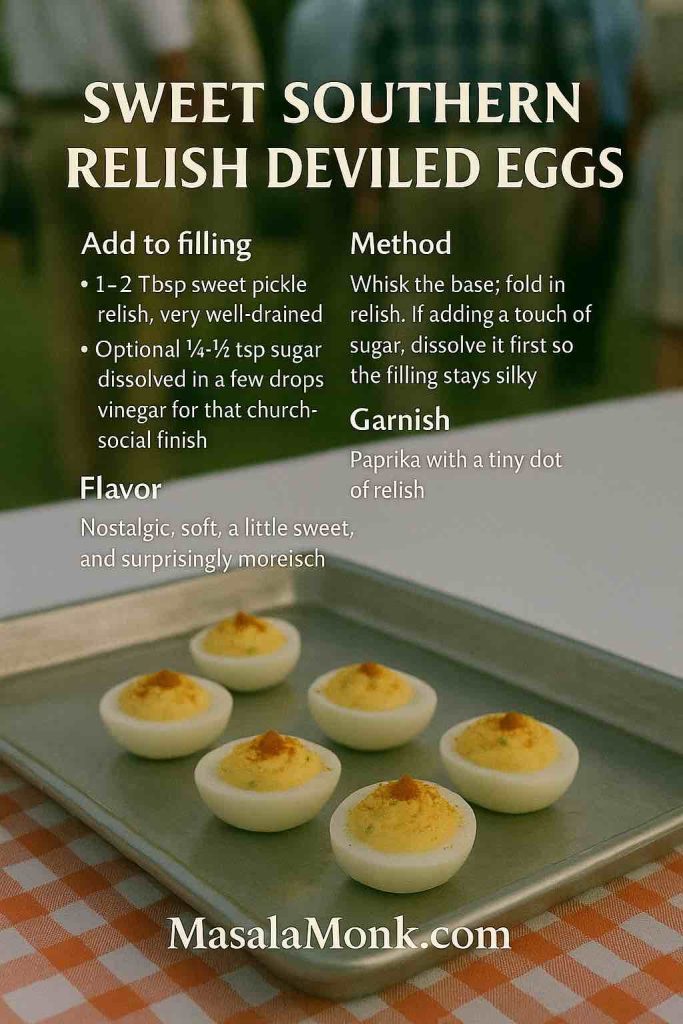
Optional ¼–½ tsp sugar dissolved in a few drops vinegar for that church-social finish
Drain relish in a fine sieve and pat dry with paper towel so the filling doesn’t weep. If you like a classic potluck sweetness, dissolve ¼–½ tsp sugar in a few drops of white vinegar before whisking in. Transport on the same sheet pan, then dust paprika and dot the relish at the venue to keep the tops pristine.
How to do it Whisk the base; fold in relish gently. If adding a touch of sugar, dissolve it first so the filling stays silky.
Garnish Paprika with a tiny dot of relish.
Flavor Nostalgic, soft, a little sweet, and surprisingly moreish.
Squeeze grated onion in a paper towel until nearly dry—extra moisture thins the filling and dulls the flavor. For the cleanest “dip” vibe, use full-fat sour cream and finish with freshly cracked pepper; serve beside crunchy celery and kettle chips to echo the sour-cream-and-onion profile without adding more salt.
How to do it Blend yolks with the mayo/sour-cream mix first, then season with onion powder (or a little fresh onion). Because fresh onion is potent, add gradually and taste.
Garnish Scallion rings and fresh pepper.
Flavor Tangy, lighter, and unmistakably “dip” in deviled-egg clothing.
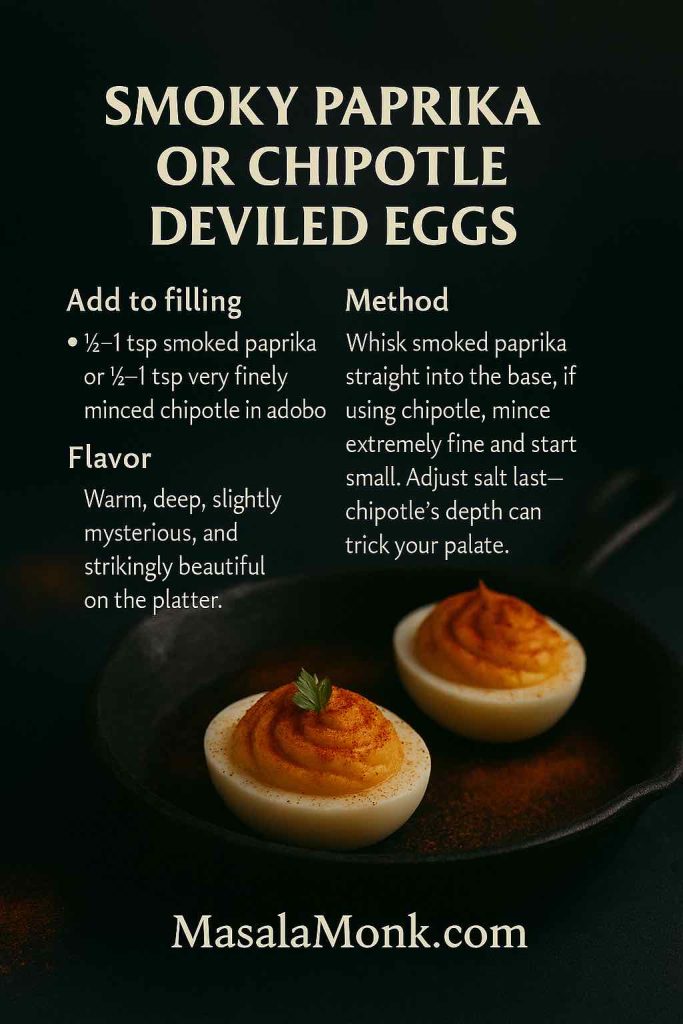
½–1 tsp smoked paprikaor ½–1 tsp very finely minced chipotle in adobo
Use pimentón de la Vera (dulce or picante) for clean smoke; sift it through a fine strainer so the dusting looks even and doesn’t clump. If choosing chipotle in adobo, blot first and mince to a paste—then season salt last and brighten with a few drops of white vinegar or lime so the heat reads vivid, not muddy. Pair with roasted nuts or grilled corn bites to echo that campfire vibe without overpowering the eggs.
How to do it Whisk smoked paprika straight into the base; if using chipotle, mince extremely fine and start small. Adjust salt last—chipotle’s depth can trick your palate.
Garnish Extra smoked paprika and a small parsley leaf.
Flavor Warm, deep, slightly mysterious, and strikingly beautiful on the platter.
Curious about paprika styles? A quick skim here will help you choose by color and heat: Elevate Your American Cooking.
Make-ahead, storage, and transport (real-life logistics)
Two days ahead: Cook and peel up to 48 hours in advance. Store whites and filling separately. Layer whites between paper towels in a covered container; press plastic wrap directly onto the surface of the filling before lidding. Consequently, you avoid crusting and keep whites satin-smooth.
On the day: Assemble within 4 hours of serving so the swirls stay glossy and the paprika doesn’t bloom in condensation. If you’re plating outside, keep a small cooler nearby; that way, refreshing the tray is easy.
At the table: Keep the platter cold. If the party runs long, rotate a second chilled tray and return the first to the fridge. For a simple, sane reminder on timing, temperature, and leftovers, the FDA’s page is short and useful: What You Need to Know About Egg Safety.
Transport: Easiest of all, carry whites and filling separately and pipe on arrival—zero smears. Otherwise, chill pre-filled halves until the tops set, then pack snugly with minimal headspace. If you line the container with a lightly damp paper towel, the whites won’t skate around during the ride.
Plating that invites people in
Because we eat with our eyes first, presentation isn’t fussy—it’s welcoming. Try a classic ring on a white platter with an even paprika halo and a light snowfall of chives. Or, build a garden board with celery sticks, cucumbers, radishes, and gentle herbs; ranch and dill versions feel at home there. For the briny crowd, create a pickle party: ring the eggs with cornichons, dill spears, and a bowl of pickled onions so people can build little bites. Meanwhile, brunch loves bacon & chive beside crisp hash browns and toast soldiers. If you’re serving a crowd, consider a mixed trio per tray—classic, herby/briny, and spicy/smoky—with distinct garnishes so guests can choose at a glance.
Serving sizes and party math (so you never come up short)
For a mixed appetizer spread, plan 2–3 halves per person; if classic deviled eggs are the star (or your people are egg people), lean toward 4 halves. A standard dozen eggs (24 halves) satisfies 8–12 with other options or 6–8 among superfans. If you’re making two trays, lead with classic, dill pickle & brine, and smoky paprika, then follow with ranch, buffalo, and bacon & chive. Consequently, you’ll cover mild, briny, and bold without repeating yourself.
When scaling beyond 12 eggs, weigh the mayo, stick to the ratio, and whisk briefly on a mixer’s lowest speed—stop the moment the filling looks glossy and holds ridges. Then chill a few minutes and pipe. Because restraint is your friend, you can always loosen with a drop or two of acid; you can’t un-thin a bowl of filling.
Egg size and timing: Large eggs are the assumed standard here. If you’re using extra-large eggs, add a minute; if medium, subtract a minute.
Altitude: At altitude, water boils lower; therefore, add 1–2 minutes to the cook time and keep that ice bath honest.
Older vs. fresh eggs: Older peel easier; very fresh can be stubborn. Consequently, if all you’ve got is farm-fresh, steam them.
Color cues: A green ring around the yolk isn’t dangerous; it’s overcooked. Ice baths help prevent that.
Piping tips: A plain snip gives rustic peaks; a star tip gives height and texture; a French star gives tidy ridges that catch paprika beautifully.
Garnish discipline: Less is more. Place the herb where it makes sense: dill for pickle, celery leaf for buffalo, tarragon for French, chives for ranch, bacon for—well—bacon.
Concluding it all
Here’s the truth: classic deviled eggs are less about perfection and more about care. You boiled water; you shocked eggs; you mashed and seasoned and tasted; you piped little swirls that look like you meant it. That intention shows. Guests notice when food feels calm and confident, and they lean in when there’s just enough variety to make choosing fun. So make the base once, then make it yours—tilt it toward dill for the cousin who loves pickles, nudge it toward Dijon and herbs for the friend who wears linen, drift it toward buffalo for the crew who cheer at the TV. And when the platter comes back empty—and it will—smile, because you did a simple thing well.
If you want to keep playing, wander a little: try a dusting of smoked paprika after chilling for deeper color; or set two tiny bowls next to the tray—one with extra pickle chips, one with chives—so people can customize their second pass. Meanwhile, if you’re planning a bigger spread, these two MasalaMonk roundups fit right beside deviled eggs without stealing the spotlight: 10 Potato Appetizers Ideas You Will Never Imagine and 5 Sweet Potato Appetizers Ideas to Inspire the Chef in You. Finally, for a clear, friendly technique refresher anytime, the steam method steps are here when you need them: Steamed Hard-Boiled Eggs. And because good hosting is also safe hosting, one bookmark for your kitchen drawer: Egg Safety.
Now breathe. Plate the eggs. Watch the tray empty. Then take your quiet bow.
FAQs
1. What are classic deviled eggs, exactly?
Classic deviled eggs are hard-cooked eggs halved and filled with a creamy yolk mixture seasoned with mayonnaise, mustard, a touch of acid (vinegar or pickle brine), salt, pepper, and usually paprika. In short, they’re simple, savory, and endlessly adaptable.
2. What’s the master ratio for classic deviled eggs?
Per 1 egg (2 halves): 1 yolk + 1½ tsp mayo + ⅛ tsp mustard + ⅛ tsp acid + a pinch of salt and pepper. Because that ratio scales cleanly, you can multiply straight across for 4, 6, 10, 12, or even 24 eggs without fuss.
3. Should I boil or steam the eggs?
Both work; however, steaming is often more forgiving and peels more cleanly. Either way, immediately shock in ice water for 10 minutes so shells release easily and yolks stay sunny.
4. How do I peel eggs without tearing the whites?
First, crack all over and roll gently; then start from the wide end where the air pocket sits. If a spot resists, peel under water—consequently, the membrane loosens and the peel slips away.
5. How long do hard-cooked eggs last in the fridge?
Generally, up to 7 days when kept refrigerated. That said, once you mix the filling, aim to enjoy your classic deviled eggs within 2–3 days for the best texture and flavor.
6. How far ahead can I assemble deviled eggs?
Ideally, cook and peel up to 48 hours ahead but keep whites and filling separate. Then, assemble within 4 hours of serving so the swirls stay glossy and the paprika looks fresh.
7. How long can deviled eggs sit out at a party?
As a rule, try not to exceed 2 hours at room temperature. After that, move the platter back to the fridge—or instead, set it over ice so you can linger longer, safely.
8. What’s the best way to transport deviled eggs?
If possible, carry whites and filling separately and pipe on arrival—no smears, no sliding. Otherwise, chill pre-filled halves until the tops set; then pack snugly with minimal headspace.
9. My filling is too stiff—how do I fix it?
Add ½ teaspoon liquid (pickle juice, vinegar, or water) and whisk briefly; if needed, repeat in tiny increments. Consequently, you keep control and avoid overshooting into soupy territory.
10. My filling is too loose—now what?
First, chill 10 minutes; often it firms up. If it’s still slack, mash in one extra cooked yolk, then taste and adjust salt and acid.
11. What kind of mustard is best?
Yellow mustard tastes nostalgic and mild; Dijon is sharper and a bit more elegant. In practice, both make excellent classic deviled eggs—choose based on the crowd (and the garnishes).
12. Is pickle juice better than vinegar?
They’re different tools. Vinegar gives clean brightness; meanwhile, pickle juice adds tang plus a whisper of dill and salt, which pairs beautifully with “dill pickle deviled eggs.”
13. Can I make deviled eggs without mayonnaise?
Yes—try part sour cream or thick Greek yogurt for tang (though the texture will be slightly lighter). Even so, keep the ratio gentle on liquid and whisk just until plush.
14. What’s the easiest flavor variation to master first?
Start with Dill Pickle & Brine: swap vinegar for pickle juice and fold in chopped dill pickles. Instantly, you get briny snap and, moreover, a garnish that tells guests what’s inside.
15. How do I make ranch deviled eggs taste balanced, not salty?
Whisk in 1–2 tsp dry ranch and taste before adding any extra salt—blends vary widely. If the filling tightens, loosen with a teaspoon of water or buttermilk.
16. What’s the trick to buffalo deviled eggs?
Blend 1–2 tsp vinegary hot sauce into the yolk base; optionally add a touch of melted butter for wing-style roundness. Then, garnish with a tiny celery leaf (and a micro crumble of blue cheese if your people love it).
17. How do I keep bacon crisp in bacon-chive deviled eggs?
Cook bacon very crisp, cool completely, then crumble finely. Fold it in right before piping; otherwise, it softens and can puncture the whites.
18. Which herbs make the “French” variation sing?
Use Dijon and white wine vinegar, then add very finely chopped fines herbes (parsley, chives, tarragon). Consequently, you’ll get an aromatic, elegant take on classic deviled eggs.
19. What’s the difference between smoked paprika and chipotle here?
Smoked paprika gives warm, gentle smokiness and gorgeous color; chipotle adds smoke plus heat. Therefore, start small with chipotle (½ tsp), taste, and adjust.
20. How many deviled eggs should I plan per person?
For a mixed spread, plan 2–3 halves per person; if deviled eggs are the star, estimate 4 halves. Practically speaking, a dozen eggs (24 halves) feeds 8–12 with other apps.
21. What’s the best garnish strategy for a mixed tray?
Keep garnishes distinct and readable: dill fronds for pickle, chives for ranch, celery leaves for buffalo, tarragon tips for French, bacon for bacon-chive. As a result, guests choose confidently without asking.
22. Spoon or pipe—does it matter?
Both work. Nevertheless, piping (even from a snipped zip bag) creates height and catches paprika beautifully, whereas spooning feels rustic and relaxed.
23. How do I avoid a green ring on the yolks?
Don’t overcook, and always ice bath for at least 10 minutes. Because carryover heat causes that green ring, rapid chilling stops it in its tracks.
24. Why do my whites get watery in the fridge?
Excess moisture—either from very fresh eggs or wet add-ins—can weep. To prevent it, drain relish well, chop pickles finely, and, additionally, store whites on paper towels before assembly.
25. Can I scale classic deviled eggs for a crowd without losing texture?
Absolutely. Weigh the mayo for large batches, whisk briefly on the lowest mixer speed (20–30 seconds), and pause early; then loosen by drops if needed. Consequently, the filling stays plush, not pasty.
26. What are the most “guest-proof” three flavors for one platter?
Classic, Dill Pickle & Brine, and Smoky Paprika. Together, they cover creamy, briny, and warm-smoky; moreover, the garnishes are unmistakable at a glance.
27. Can I add sweetness without making them cloying?
Yes—especially for Southern relish deviled eggs. Dissolve ¼–½ tsp sugar in a few drops of vinegar first, then whisk in; therefore, the sweetness disperses evenly.
28. Do medium or extra-large eggs change anything?
Slightly. Medium eggs cook a minute faster; extra-large need a minute more. Regardless, the ratio still holds—because you’ll season to taste at the end, you remain in control.
29. What’s one small step that makes my classic deviled eggs look pro?
Whisk the filling briefly until glossy, then chill 10 minutes before piping. As a result, ridges hold, paprika dusts evenly, and the platter looks serene.
30. Where can I learn more about seasonings and paprika styles?