Posted on Leave a comment

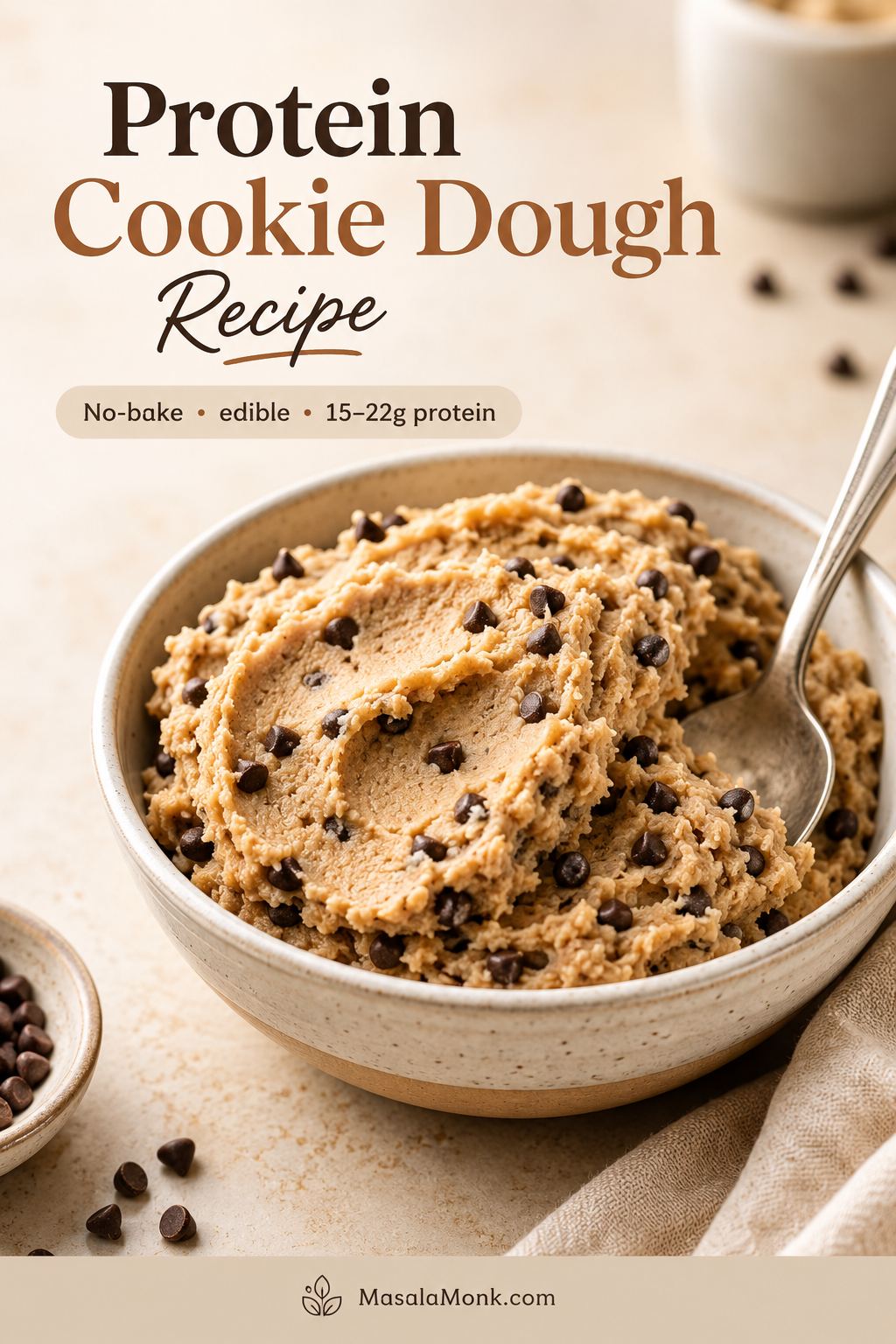
Protein Cookie Dough Recipe

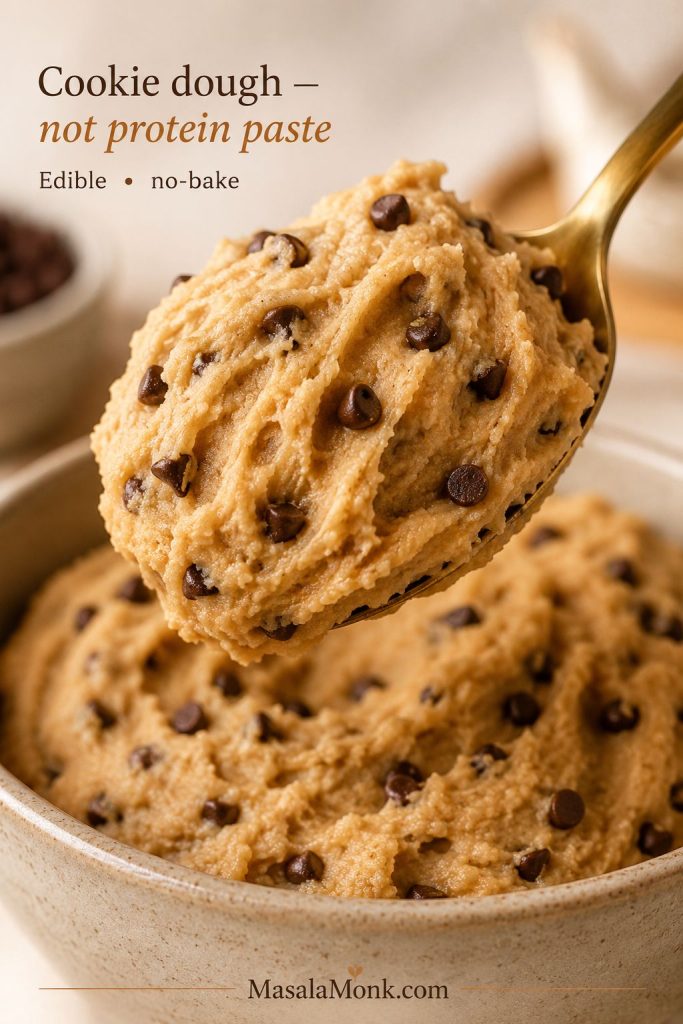
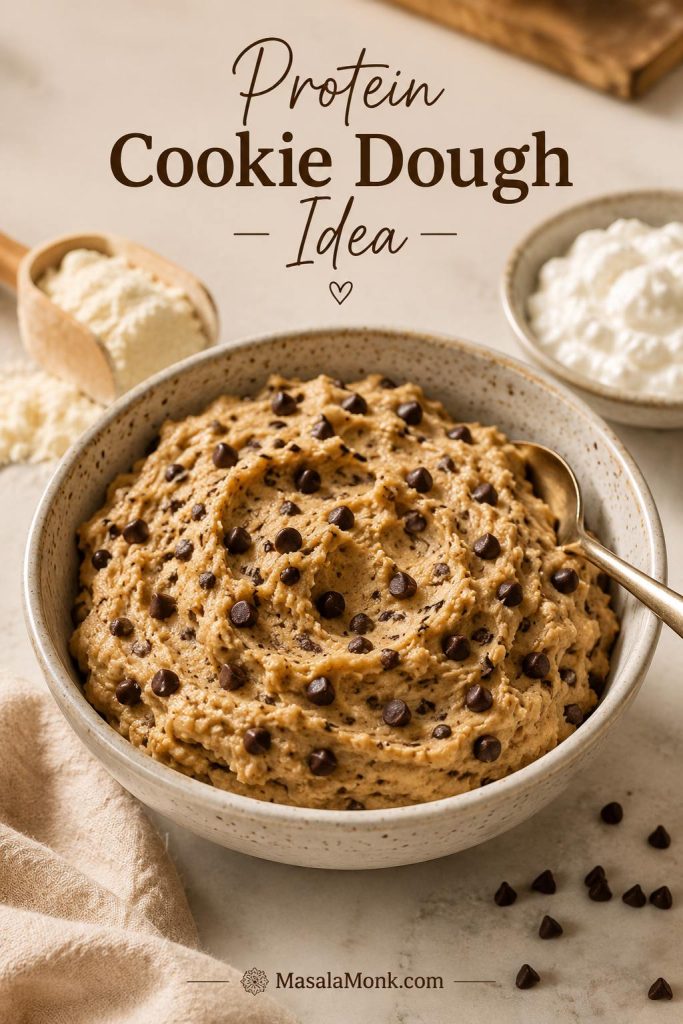
Thick protein cookie dough recipe in a bowl with mini chocolate chips, spoon marks, and a scoopable texture.

This protein cookie dough recipe is edible, no-bake, ready in about 5 minutes, and built to taste like cookie dough — not protein paste. It is egg-free, made without raw all-purpose flour, and gives you a scoopable, chocolate-studded dough with about 15–22g protein per serving when divided into 3–4 portions.

No oven, no mixer, no waiting for cookies to cool — just one bowl, a spoon, and a sweet snack that feels more like dessert than a protein shake.

The difference between good protein cookie dough and chalky protein paste is balance. Protein powder adds structure, nut butter gives richness, Greek yogurt softens the dough, and almond flour or oat flour makes it thick enough to scoop. Then vanilla, salt, and mini chocolate chips bring it closer to a real cookie dough bite. If you like this kind of high-protein dessert, this dough gives you the same treat-like feeling without needing a freezer or blender.

It should feel like sneaking a spoonful of cookie dough from the bowl, only with enough protein to make it feel more satisfying than a random bite of dessert.

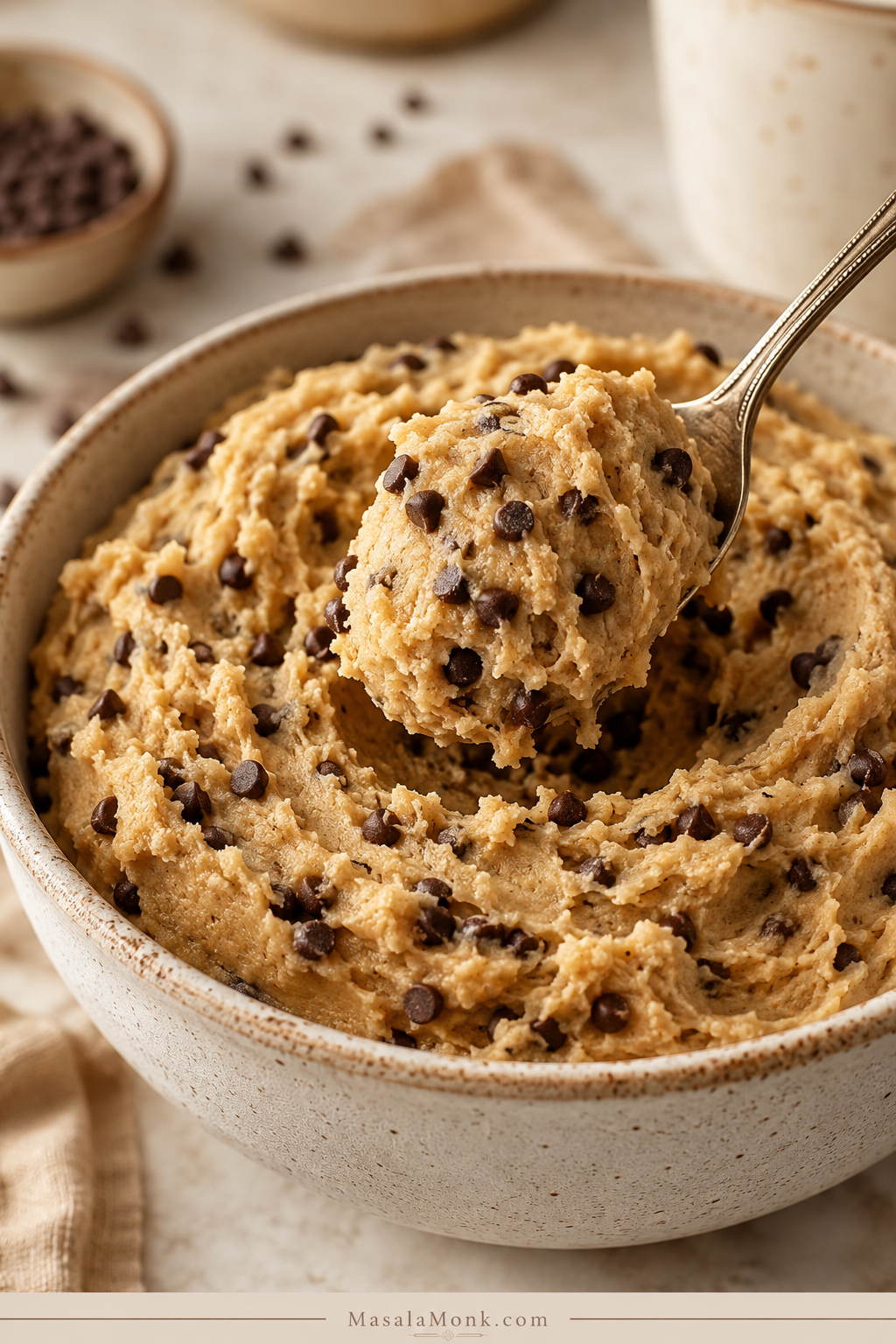
Spoon lifting edible protein cookie dough with mini chocolate chips and soft ridges showing the scoopable texture
This spoon-lift shows the texture you want: creamy, sturdy, and able to hold its shape without turning stiff.

Quick Answer: The Best Protein Cookie Dough Ratio

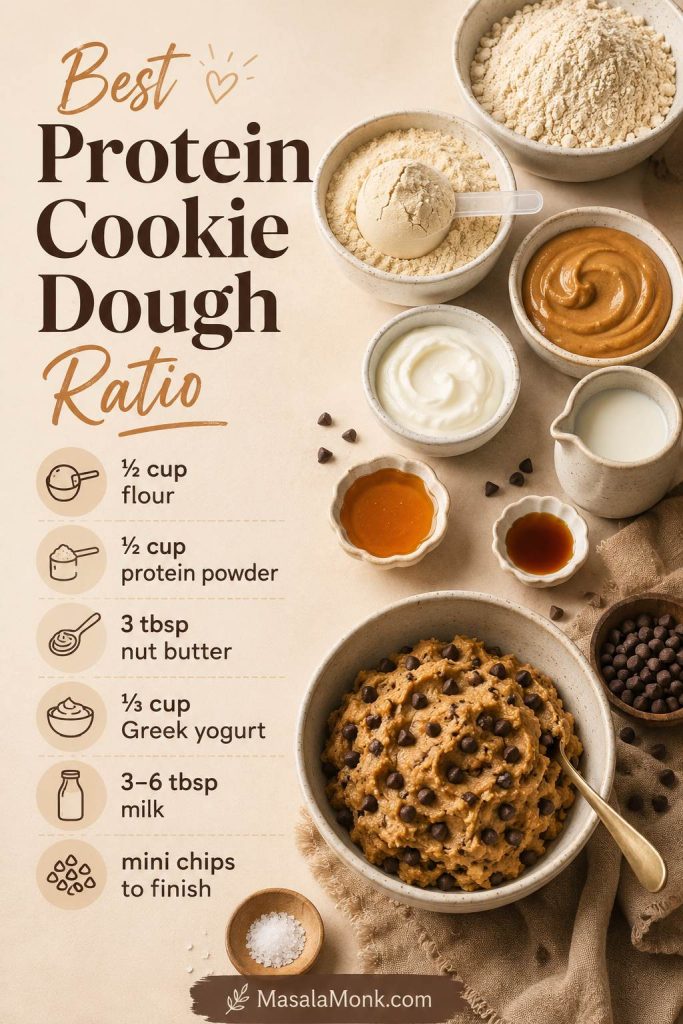
Protein cookie dough ratio board with protein powder, flour, nut butter, Greek yogurt, milk, and mini chocolate chips
This quick ratio works because the dry base, creamy ingredients, and milk are balanced before the chocolate chips go in.

Use less milk for a firmer dough and more milk for a softer, scoop-and-eat texture. Divide the batch into 3 portions for a higher-protein snack, or 4 portions for smaller dessert-style servings.

Best first version: Use a vanilla whey-casein blend if you have one, almond flour for a softer rich dough, and mini chocolate chips for the most cookie-dough-like bite.
Do not add all the milk at once. Protein powders absorb moisture differently, and a dough that looks dry at first can loosen quickly after mixing. Add liquid gradually and stop as soon as the dough holds together.

Not sure how your powder will behave? See the protein powder guide before adding all the milk.

Protein Cookie Dough at a Glance

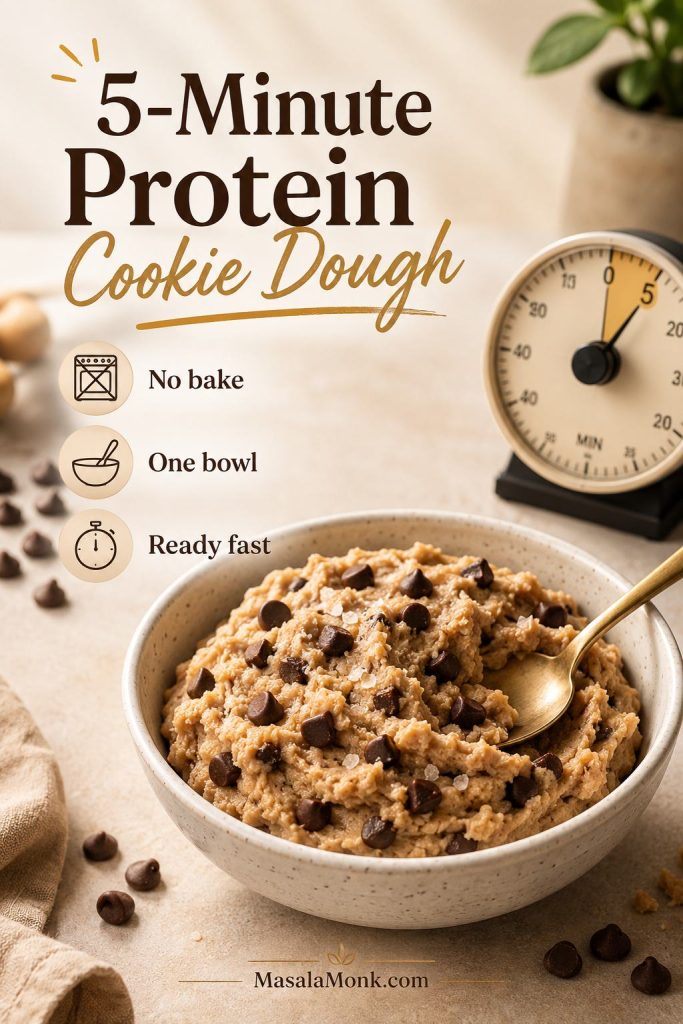
One-bowl five-minute no-bake protein cookie dough with a timer, spoon, and thick chocolate chip dough
Since this is a 5-minute no-bake recipe, the key is adjusting texture in the bowl instead of relying on baking time.
Prep time 5 minutes
Cook time 0 minutes
Chill time Optional 20–30 minutes for firmer dough
Servings 3–4 servings
Protein estimate About 15–22g per serving, depending on powder and serving size
Best texture Scoopable, sturdy, and easy to eat with a spoon
Best flour Almond flour for soft/rich, oat flour for more cookie-like
Main fix Add liquid slowly, then fine-tune the texture in small spoonfuls
Storage 4–5 days in the fridge or 2–3 months frozen in portions

The best part is that the recipe is forgiving. If the first mix looks too dry, too sticky, or too thick, you do not have to start over — you just adjust the bowl in small steps.

Estimated Protein, Calories, and Serving Size

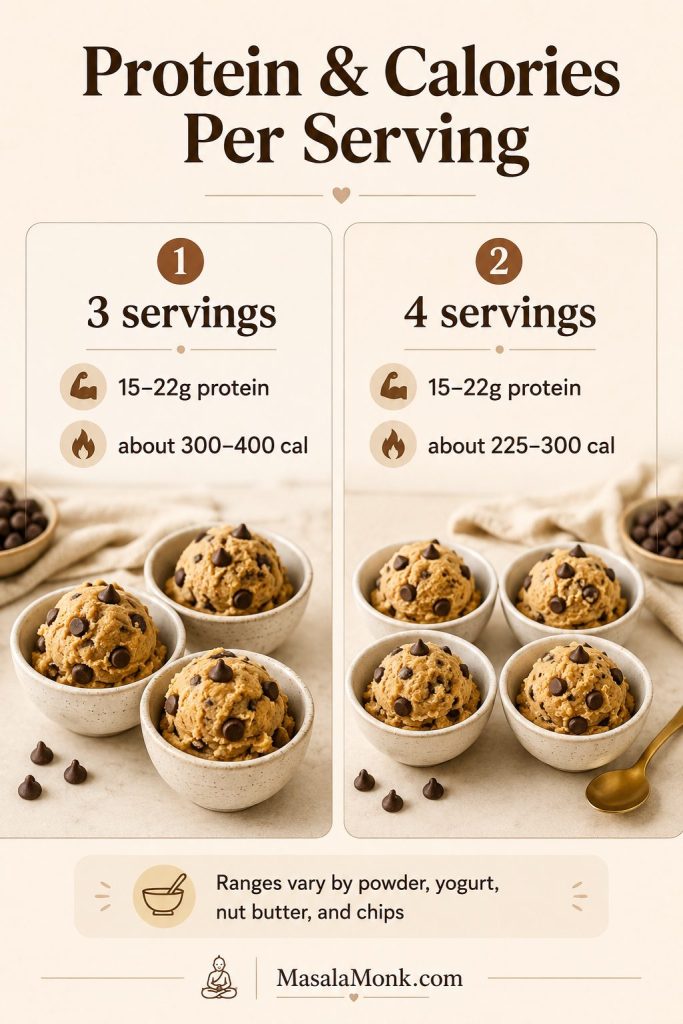
Protein and calorie guide for protein cookie dough showing three-serving and four-serving portion estimates
For macro tracking, portion size matters: three larger servings feel more snack-like, while four smaller servings keep the calories lighter.

As a rough range, the full batch often lands around 900–1,200 calories, depending on the protein powder, nut butter, yogurt, milk, syrup, and chocolate chips used. That works out to about 300–400 calories if divided into 3 larger servings, or about 225–300 calories if divided into 4 smaller servings. Use your own ingredient labels for the most accurate number.

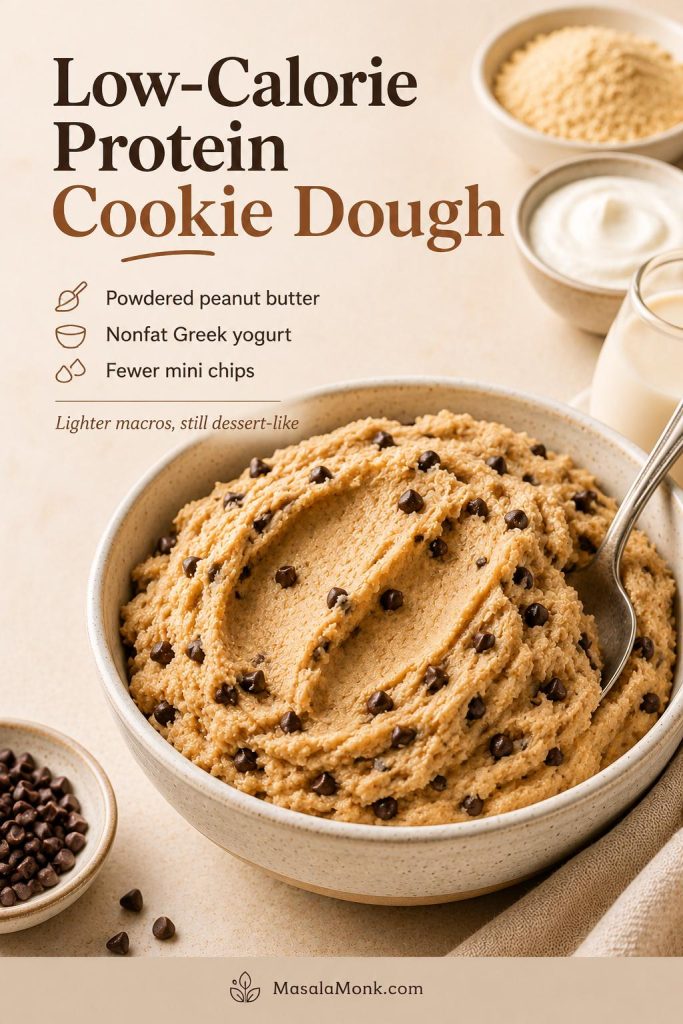
Calories vary most from the nut butter, chocolate chips, protein powder, syrup, and yogurt you use. A richer dessert bowl usually comes from regular nut butter, maple syrup or honey, and the full chocolate chip amount. If you want a lighter version, use powdered peanut butter, nonfat Greek yogurt, almond milk, and fewer mini chocolate chips.

To keep the bowl lighter without making it taste flat, jump to the low-calorie protein cookie dough version and use the swaps there.

Why This Protein Cookie Dough Works

A good high-protein cookie dough has to solve the real problem: it needs enough protein to feel worth making, but it still has to satisfy the part of you that wanted cookie dough in the first place. When the balance is off, the texture changes quickly. Extra protein powder can make the dough dry or chalky, too much liquid can turn it sticky, and not enough fat can make it taste like sweet paste instead of cookie dough.

This version works because each ingredient protects the dough from the usual protein-dessert problems: dry, sticky, chalky, or bland. Protein powder gives the snack its purpose, almond flour or oat flour keeps it from turning loose, nut butter makes it taste richer, and Greek yogurt softens the bite so it feels more like dessert than a scoop of powder. Vanilla, salt, and mini chocolate chips finish the flavor so it tastes more like cookie dough and less like a protein shake in a bowl.

When that balance is right, the dough tastes sweet and familiar instead of “healthy” in the disappointing way.

The finished dough should hold ridges when stirred, scoop cleanly, and firm up slightly after chilling. It should not pour like batter, crumble like dry powder, or cling aggressively to the spoon.

Why readers usually love this: It gives you the cookie-dough feeling without turning into a full baking project. No oven, no mixer, no waiting for cookies to cool — just a thick, sweet, chocolate-studded bowl you can adjust until it tastes right.

Ingredients You Need

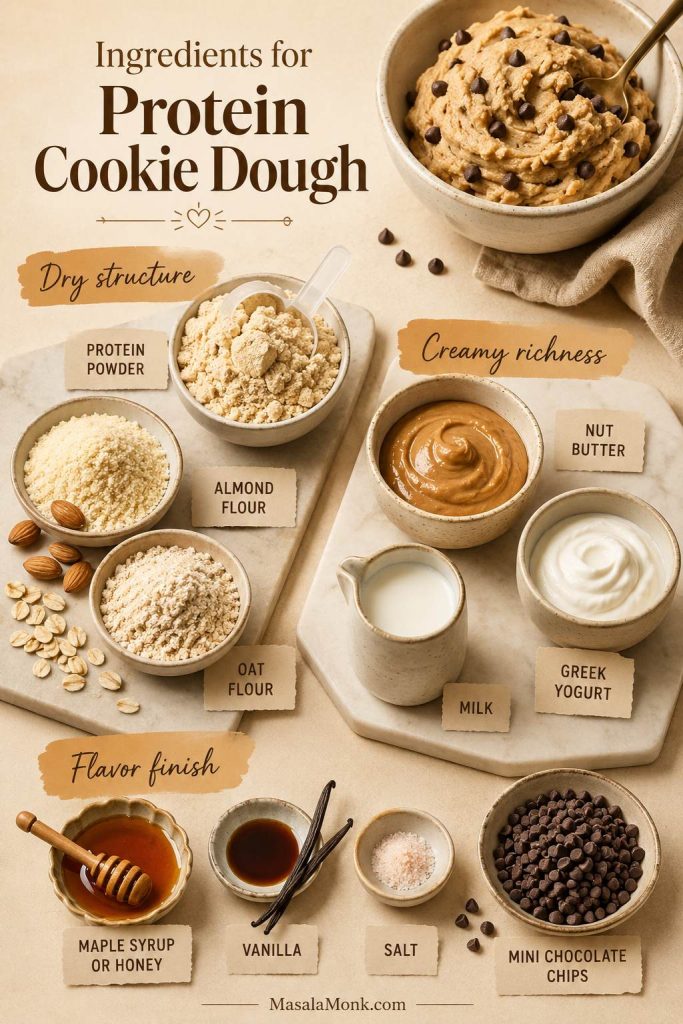
Protein cookie dough ingredients arranged by texture role, including protein powder, flour, yogurt, nut butter, and chocolate chips
Each ingredient controls something important: body, creaminess, sweetness, flavor, or chocolate in every bite.

Protein powder

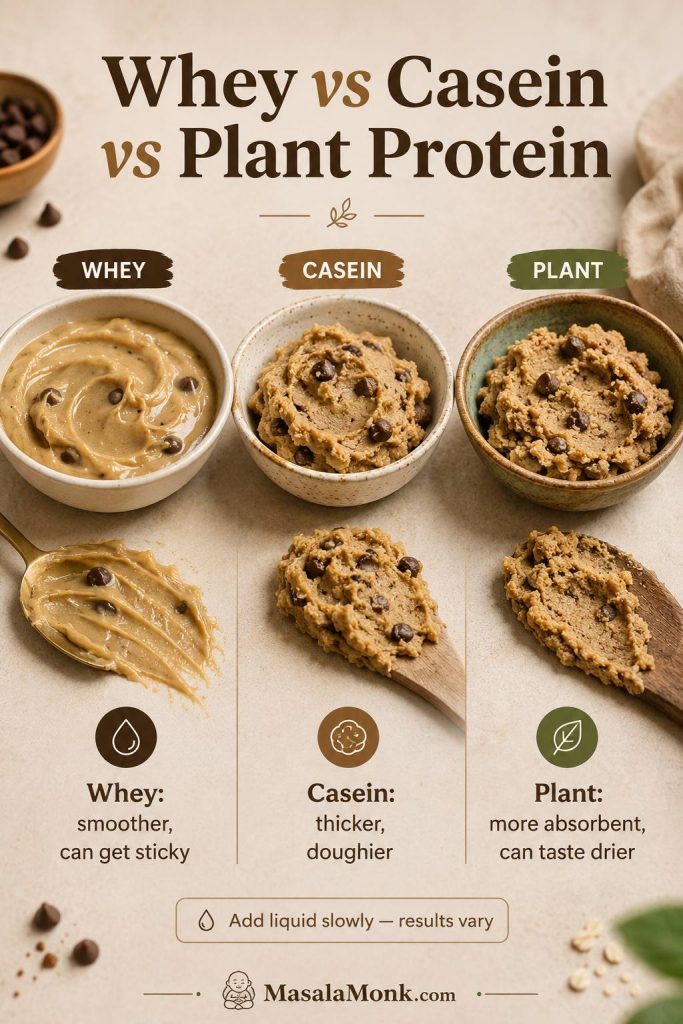
Vanilla protein powder is the easiest choice because it already brings sweetness and dessert flavor. Whey protein can make a smoother dough, but it may become sticky if you add too much liquid. Casein and plant protein usually thicken more aggressively, so they often need extra milk or yogurt. A whey-casein blend is often the easiest option for a classic cookie dough texture.

Almond flour or oat flour

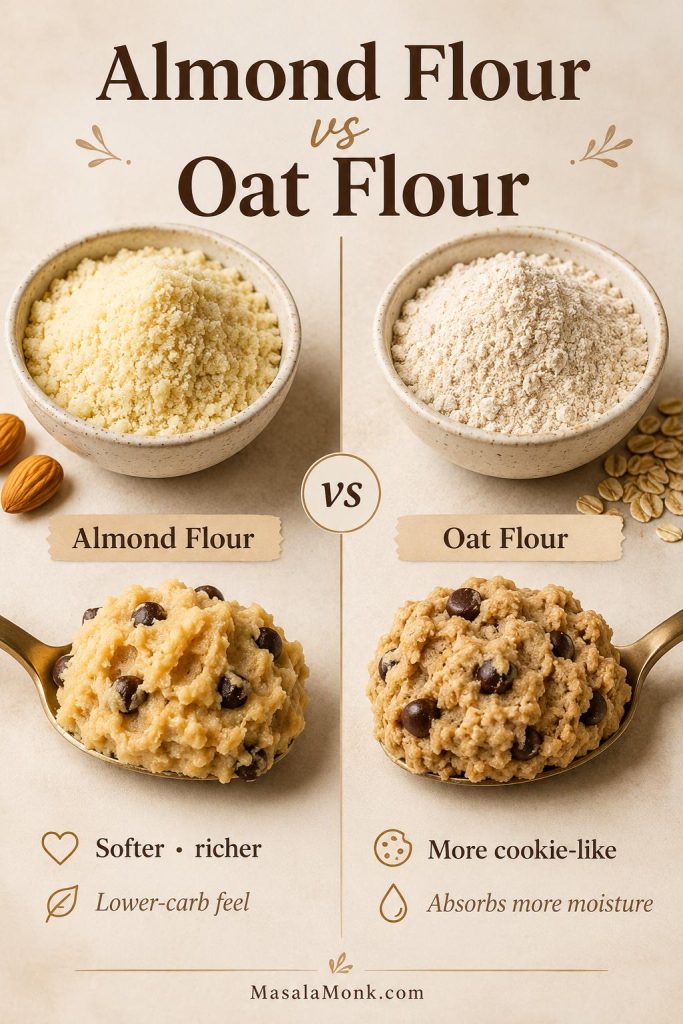
Almond flour versus oat flour comparison for protein cookie dough showing softer rich dough and more cookie-like dough
Almond flour gives a softer, richer dough; meanwhile, oat flour brings a more cookie-like chew and usually needs a little more moisture.

Do not use regular raw all-purpose flour in this no-bake recipe. The safety section below explains why.

For the raw-dough details, read the edible cookie dough safety section before swapping flours.

Nut butter

Peanut butter gives the strongest flavor and the richest dough. Almond butter is milder. Cashew butter gives a softer, almost bakery-style sweetness. Sunflower seed butter works if you need a nut-free option, though it has a more noticeable flavor.

Greek yogurt

Greek yogurt keeps the dough creamy while adding more protein. Thick plain Greek yogurt works best. If your yogurt is thin or watery, start with less milk. If your yogurt is very thick, you may need an extra spoonful of milk to bring the dough together.

Maple syrup or honey

Maple syrup and honey do more than sweeten the dough. They also add moisture and help the texture feel less powdery. Sugar-free syrup can work, but the texture may be thinner or less rich depending on the brand.

Vanilla, salt, and mini chocolate chips

These small ingredients make a big difference. Vanilla gives the dough a dessert-like aroma, salt keeps the flavor from tasting flat, and mini chocolate chips spread more evenly than large chips, especially in a single-serving bowl.

Is Protein Cookie Dough Safe to Eat Raw?

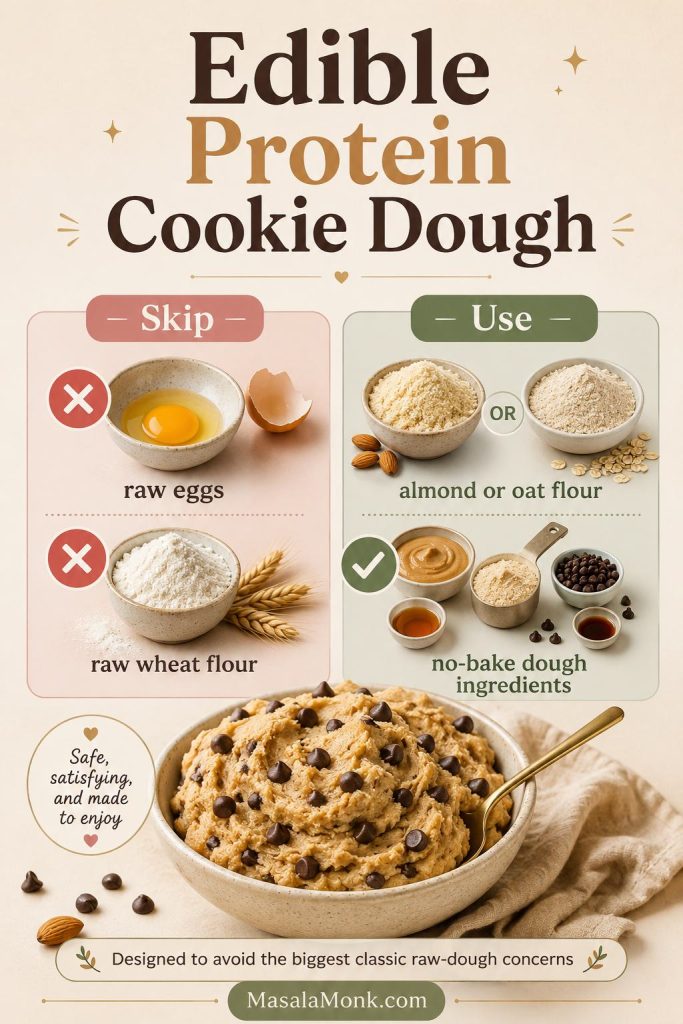
Edible protein cookie dough safety board showing no raw eggs, no raw wheat flour, and almond or oat flour instead
Edible protein cookie dough works best when the no-bake base avoids raw eggs and raw wheat flour from the start.

The FDA explains that most flour is raw and has not been treated to kill germs. The CDC also warns against eating raw dough made with uncooked flour because flour can carry germs that are killed only when the flour is baked or cooked.

For this no-bake dough, use fresh almond flour, oat flour from a trusted package, or a flour product specifically labeled for edible dough. Do not swap in regular raw wheat flour.

If you want the classic version without protein powder, this edible cookie dough recipe follows the same no-bake, spoonable dessert idea with a more traditional cookie-dough flavor.

Important: This recipe avoids raw all-purpose wheat flour. Keep the finished dough chilled, use fresh ingredients, and do not leave yogurt-based cookie dough sitting out for long.

Best Protein Powder for Cookie Dough

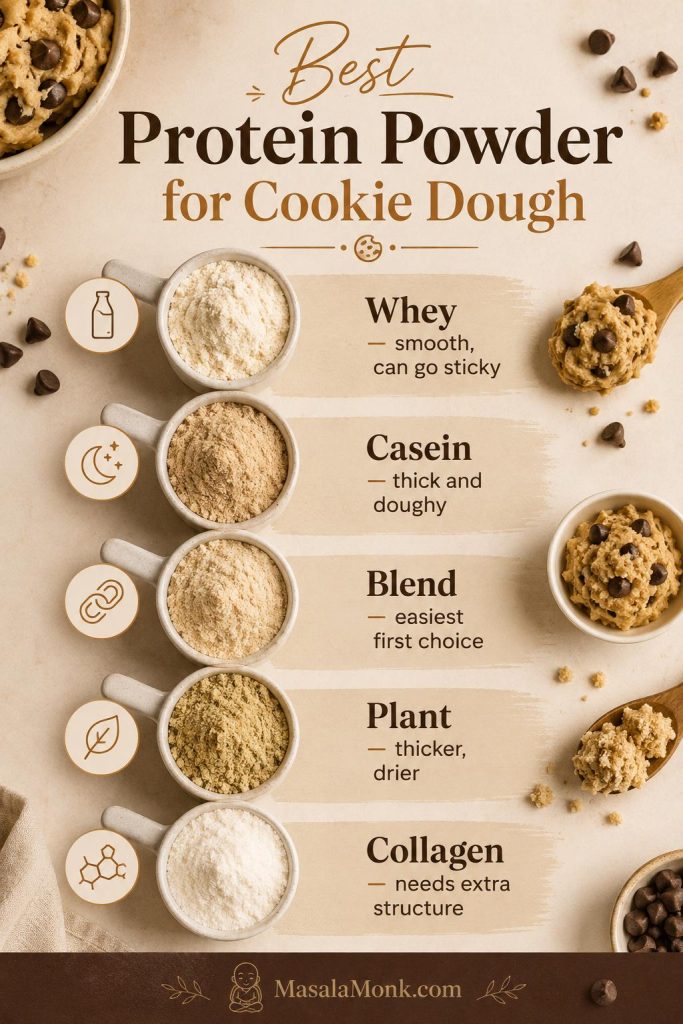
Best protein powder for cookie dough guide comparing whey, casein, blended, plant, and collagen protein powders
The best powder depends on texture as much as flavor, because each type thickens the bowl differently.

Texture matters just as much as flavor. Whey, casein, plant protein, collagen, and blends all absorb moisture at a different pace, which is why the recipe gives a range for milk instead of one fixed amount.

This is why two people can use the same recipe and get different results. The recipe may not be the problem — the powder may simply need more or less moisture.

Protein powder texture guide

Protein powder Texture in cookie dough Best fix
Whey protein Smooth, but can become sticky or wet if overhydrated. Add milk slowly. Thicken with almond flour, oat flour, or a little more protein powder.
Casein protein Thick, doughy, and very absorbent. Add milk or Greek yogurt 1 teaspoon at a time until spoonable.
Whey-casein blend Usually the most balanced cookie dough texture. Best first choice for a balanced, cookie-dough-like texture.
Plant protein Thick, sometimes chalky or earthy. Add nut butter, yogurt, vanilla, salt, and enough milk to soften the texture.
Collagen powder Adds protein but does not give much dough structure. Use it with almond flour or oat flour, not as the only dry ingredient.
Powdered peanut butter Lower in fat, peanut-forward, and slightly dry. Pair with Greek yogurt or milk to keep the dough creamy.
Whey, casein, and plant protein cookie dough comparison showing smoother, thicker, and more absorbent dough textures
Whey, casein, and plant protein can all work, but each one changes how much liquid the bowl needs before it becomes scoopable.

For the first batch, use the recipe as written but hold back some of the milk. Once you see how your protein powder thickens, the recipe becomes easy to repeat.

If your dough already turned dry, sticky, or loose, go straight to the texture fixes instead of guessing.

How to Make Protein Cookie Dough

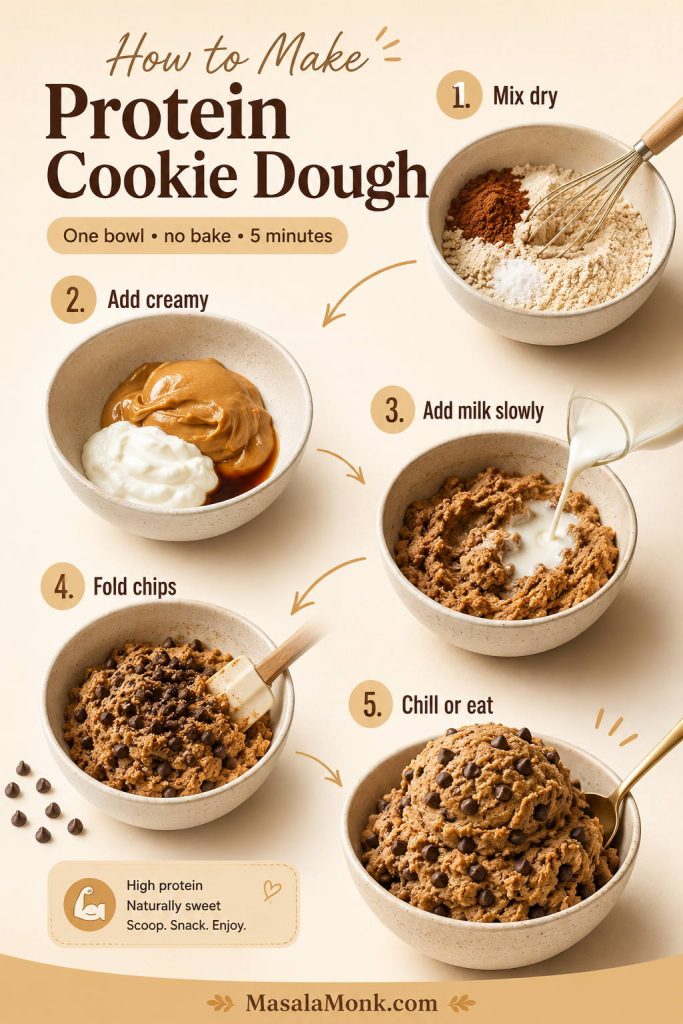
Step-by-step protein cookie dough method showing dry ingredients, creamy ingredients, slow milk addition, chocolate chips, and finished dough
The method stays simple: build the dry base, add richness, loosen carefully, fold in chocolate, then chill only if you want a firmer bite.

Step 1: Mix the dry ingredients

Place the almond flour or oat flour, protein powder, and salt in a medium bowl. Stir them together first so the protein powder is evenly distributed before the wet ingredients go in.

Step 2: Add the creamy ingredients

Stir in the nut butter, Greek yogurt, maple syrup or honey, and vanilla. The dough may start to clump together and look too thick at this point, which is fine.

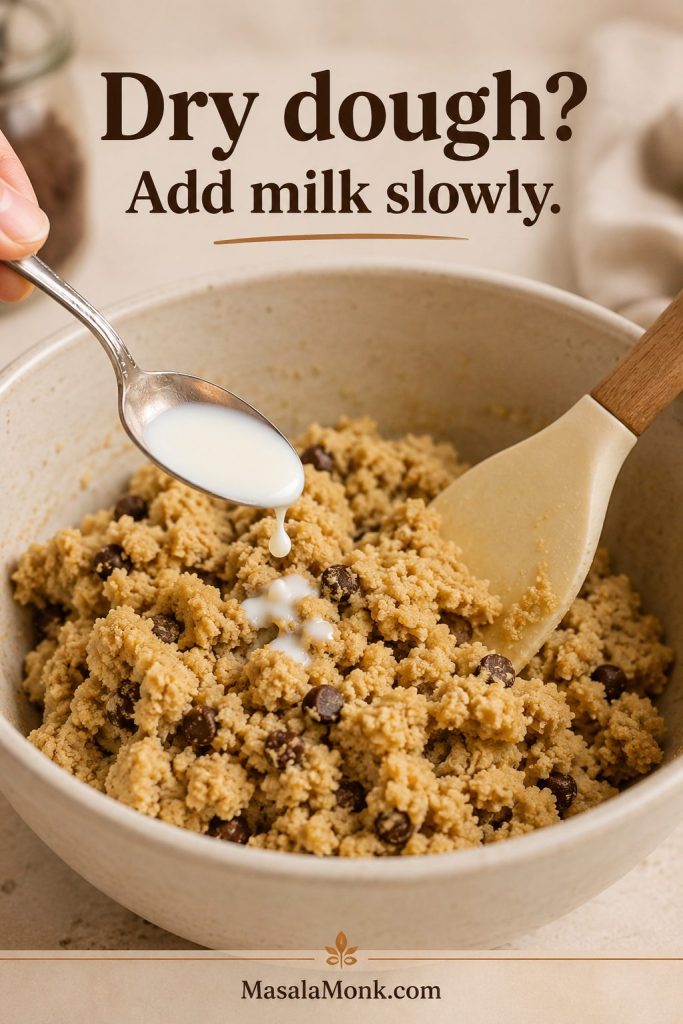
Pour in milk or almond milk 1 tablespoon / 15ml at a time. Mix well after each addition and stop when the dough is soft but sturdy. You may not need all the milk, especially if your yogurt is loose or your protein powder is whey-based.
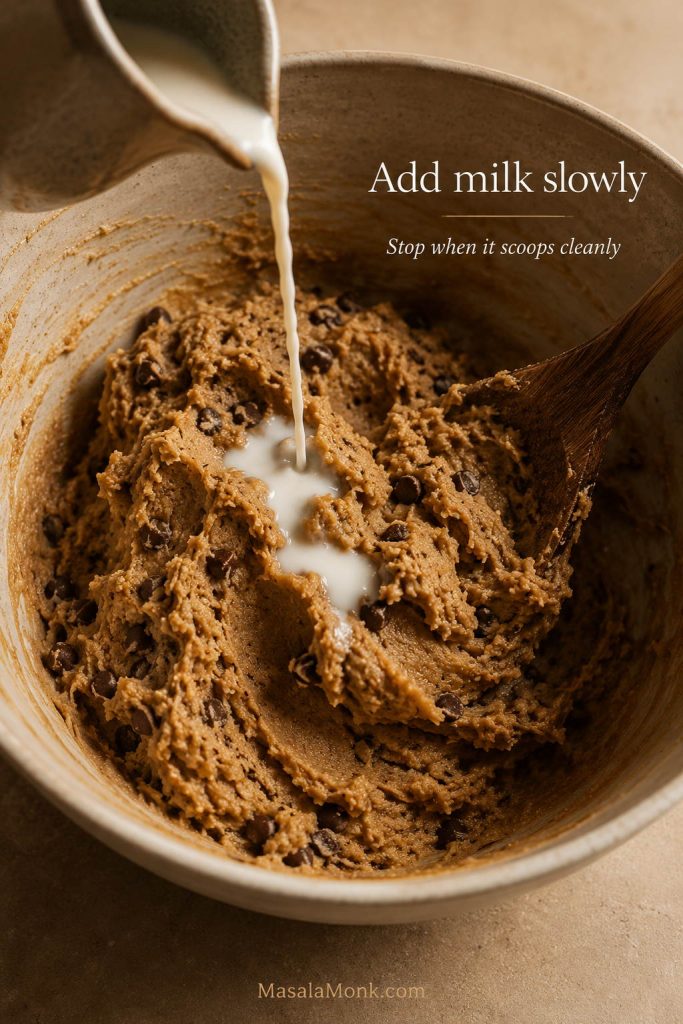
Milk being added slowly to thick protein cookie dough in a mixing bowl to control the final texture
Add milk slowly so the dough softens gradually; otherwise, a small bowl can turn loose before the protein powder has time to absorb it.
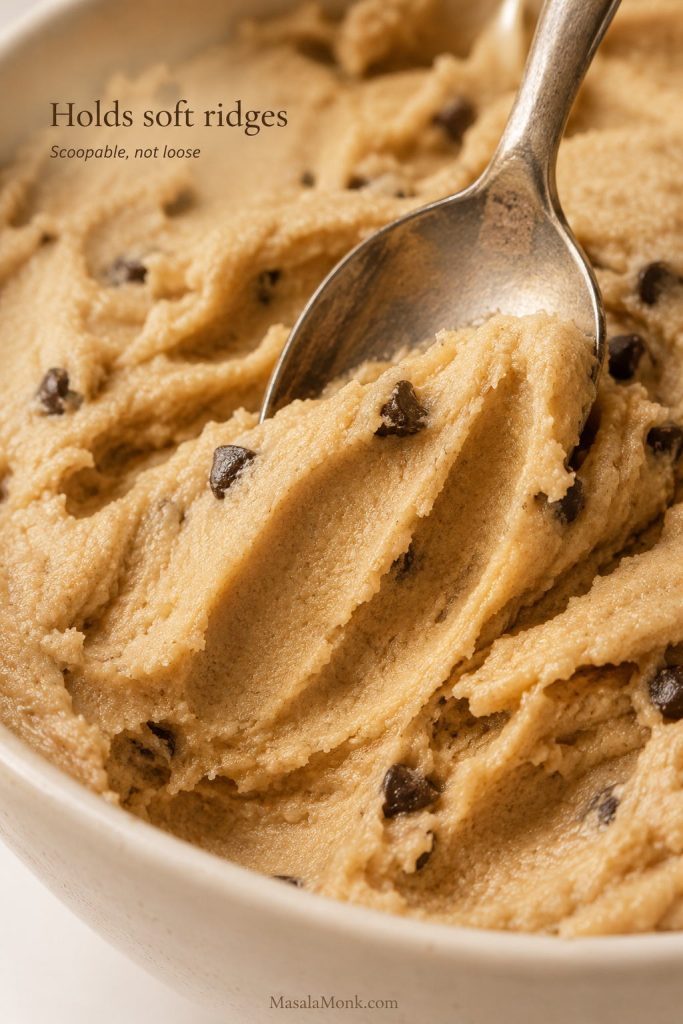
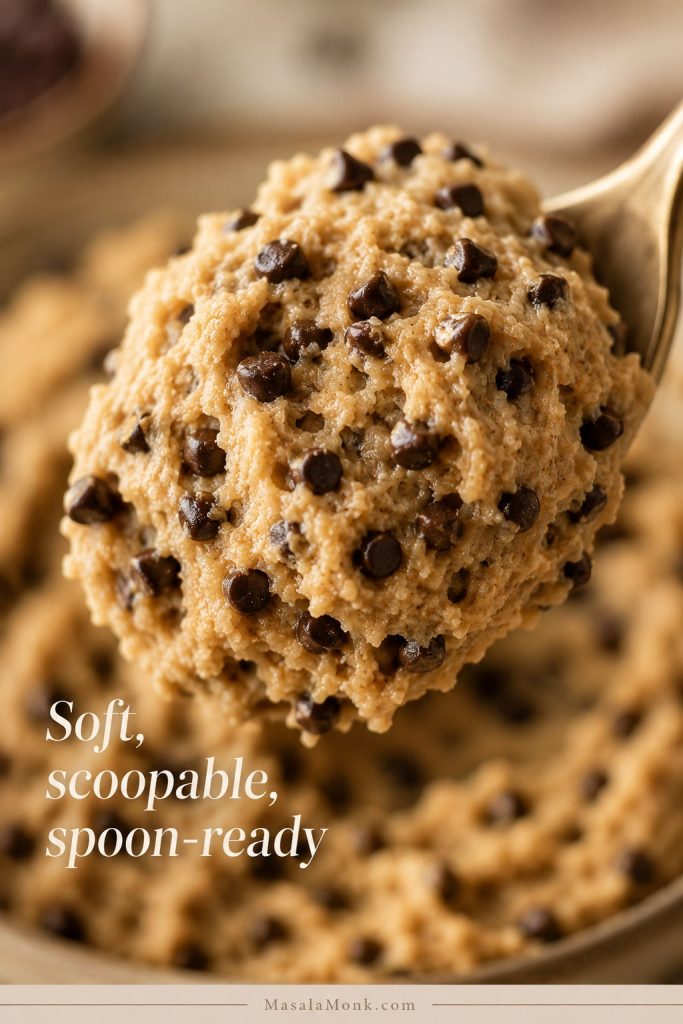
Close-up of protein cookie dough holding soft spoon ridges to show the ideal thick but scoopable texture
Look for spoon marks that stay visible for a moment; that is the easiest sign your protein cookie dough is thick enough without being dry.

If your dough does not look like this yet, use the texture guide to fix it before folding in the chocolate chips.

Step 4: Fold in mini chocolate chips

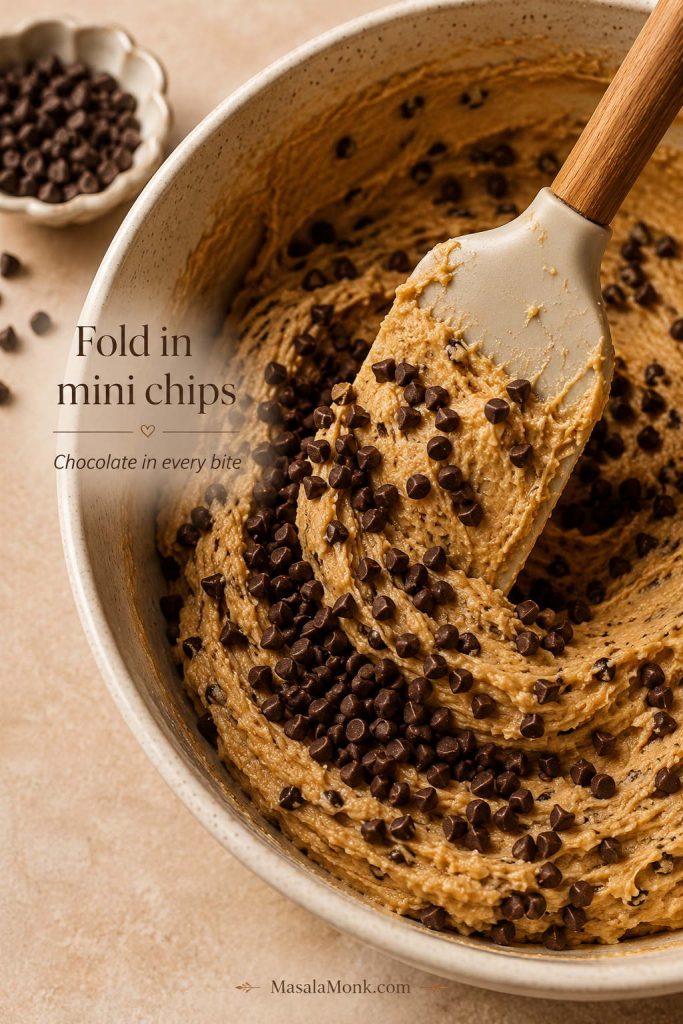
Mini chocolate chips being folded into thick protein cookie dough so the chips spread evenly through the bowl
Mini chocolate chips work better than larger chips because they spread through the dough evenly and make each spoonful taste more like dessert.

Step 5: Eat right away or chill

You can eat the dough immediately if you like a softer, freshly mixed texture. For a firmer, more classic cookie dough feel, cover the bowl and chill it for 20–30 minutes.

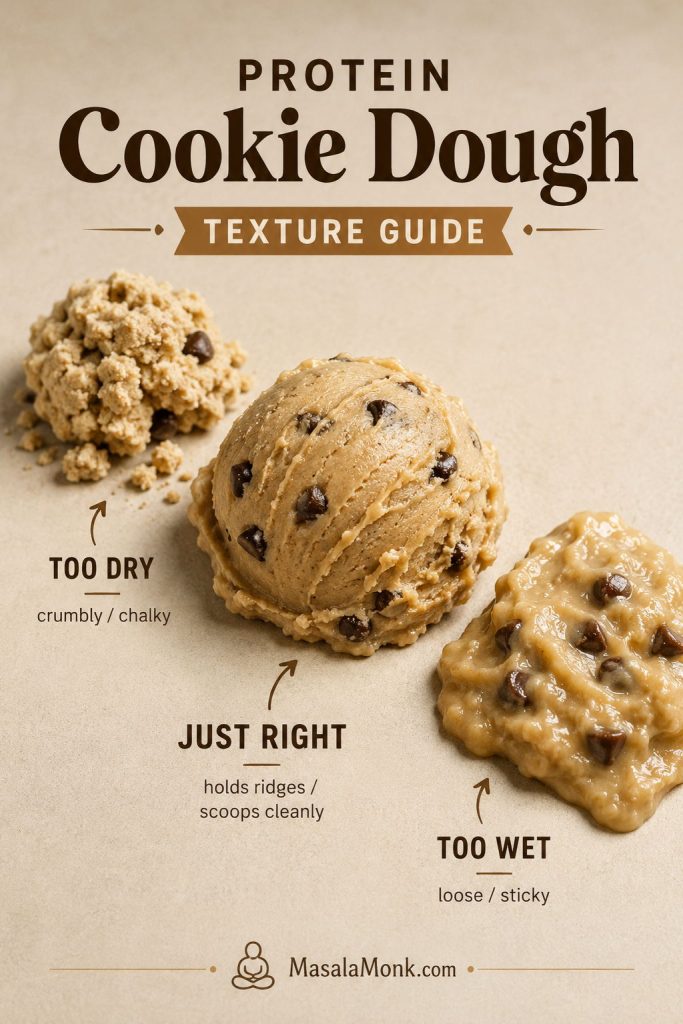
Protein Cookie Dough Texture Guide

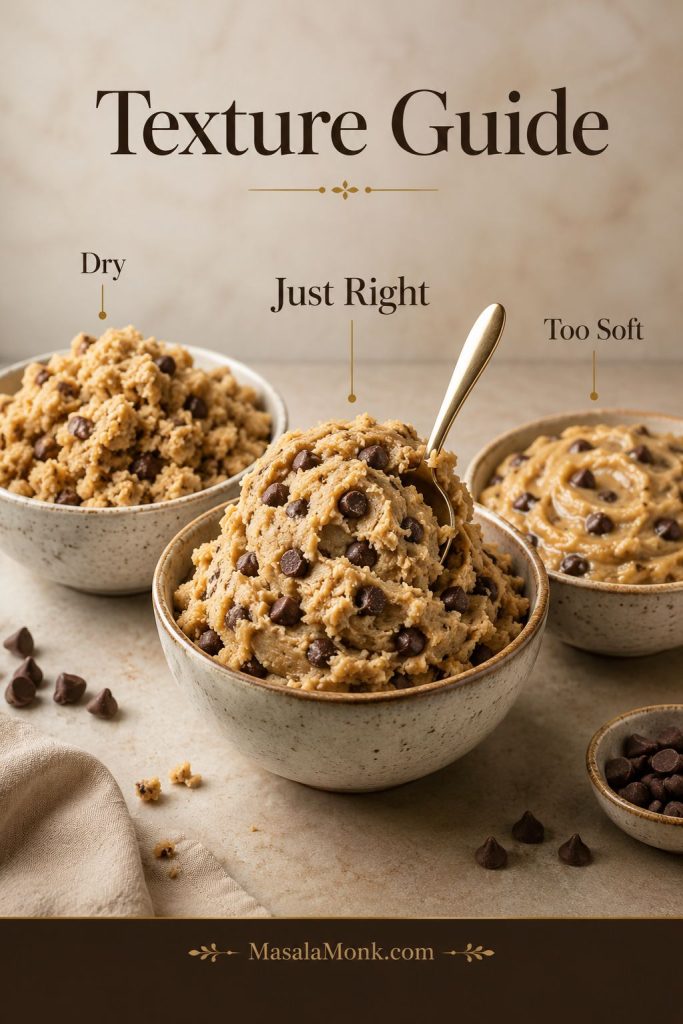
Protein cookie dough texture guide comparing crumbly dry dough, scoopable just-right dough, and loose wet dough
Once you recognize the difference between crumbly, scoopable, and loose, fixing the texture becomes much easier.
Problem Why it happened How to fix it
Too wet Too much milk, loose yogurt, or a whey protein that does not absorb much liquid. Stir in 1 teaspoon almond flour, oat flour, or protein powder at a time.
Too dry Casein or plant protein absorbed the liquid quickly. Loosen it with 1 teaspoon milk or Greek yogurt at a time.
Chalky Too much protein powder, plant protein, or not enough fat/moisture. Work in 1–2 teaspoons nut butter or Greek yogurt, plus vanilla and a pinch of salt.
Too sticky Too much syrup, nut butter, or liquid. Chill 20–30 minutes, or sprinkle in a little almond/oat flour.
Not sweet enough Unsweetened protein powder or not enough syrup. Sweeten with 1 teaspoon maple syrup, honey, or your preferred sweetener.
Too protein-y The protein powder flavor is too strong. Balance it with vanilla, salt, mini chocolate chips, or a better-tasting vanilla protein powder next time.
Best texture rule: Adjust slowly. One teaspoon can change a small batch more than you expect.

Once the texture is right, the bowl stops feeling like a protein workaround and starts feeling like what you actually wanted: cold, sweet cookie dough with little pockets of chocolate in every spoonful.

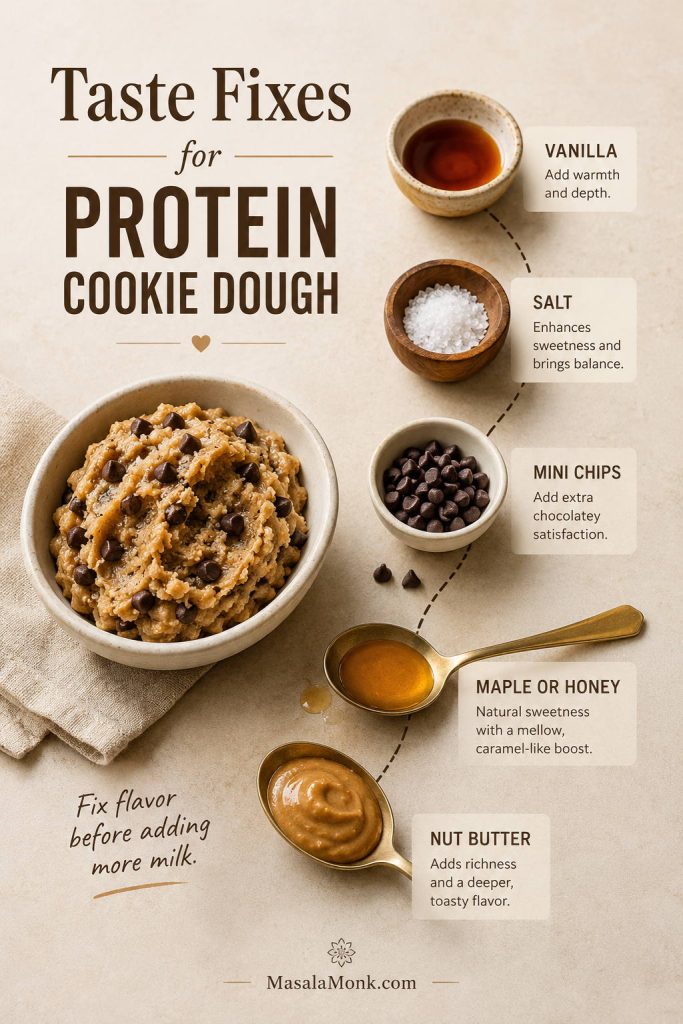
How to Make It Taste More Like Cookie Dough

Protein cookie dough taste-fix board with vanilla, salt, chocolate chips, syrup, and nut butter for better flavor
If the flavor feels too protein-heavy, vanilla, salt, nut butter, syrup, and mini chips can improve the dough without making it runnier.
  • Add a little more vanilla if the flavor tastes flat.
  • Add a tiny pinch of salt if the dough tastes too sweet, bland, or protein-heavy.
  • Use mini chocolate chips so every spoonful gets chocolate.
  • Add 1 teaspoon maple syrup or honey if your protein powder is not very sweet.
  • Add 1 teaspoon nut butter if the dough tastes chalky or thin.
  • Chill the dough for 20–30 minutes if the flavor feels sharp right after mixing.
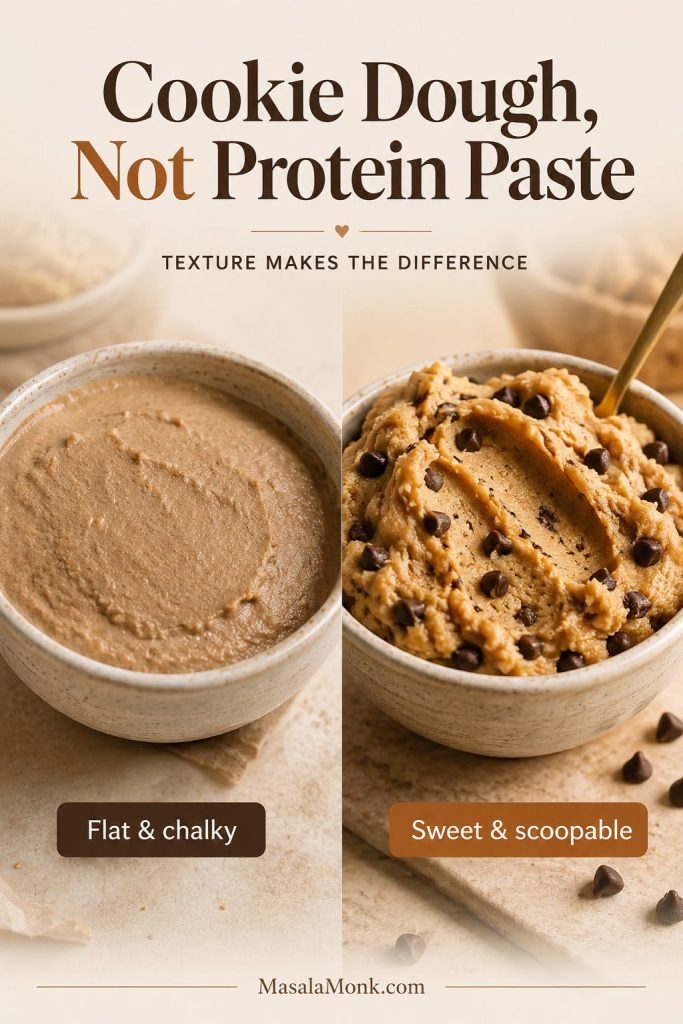
Cookie dough versus protein paste comparison showing dull chalky dough beside sweet scoopable chocolate chip dough
The best high-protein cookie dough still needs dessert appeal, so texture and flavor matter just as much as the protein number.

Once the base flavor tastes right, try one of the flavor variations to make the dough more dessert-like.

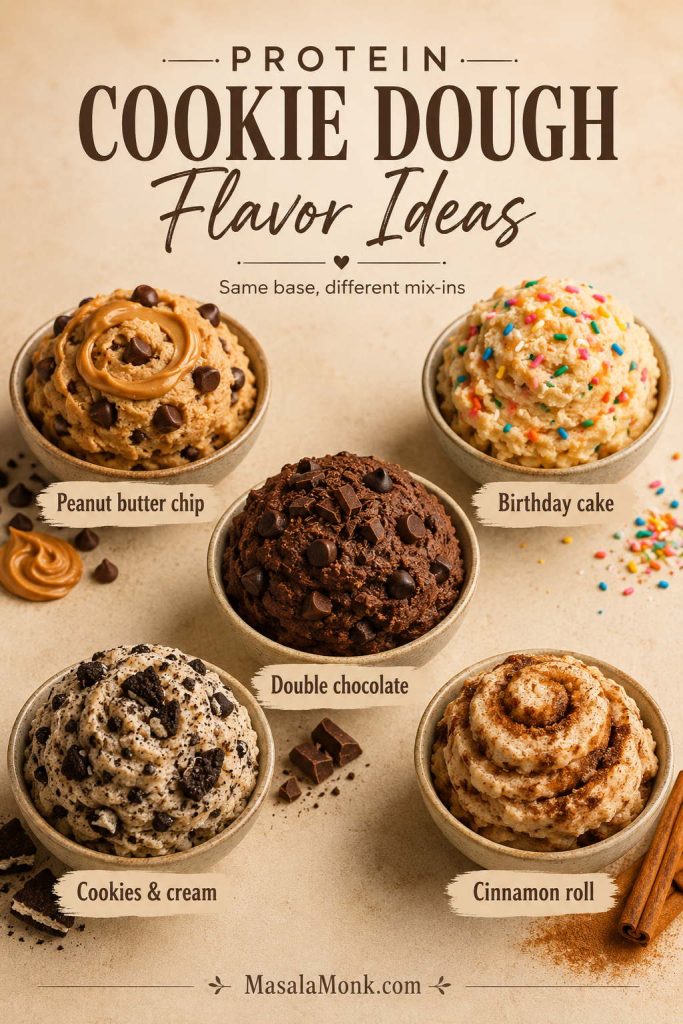
Protein Cookie Dough Flavor Variations

Protein cookie dough flavor variation board with peanut butter chip, birthday cake, double chocolate, cookies and cream, and cinnamon roll
Once the base dough is balanced, small mix-ins can take it toward peanut butter chip, birthday cake, double chocolate, cookies and cream, or cinnamon roll.
  • Peanut butter chocolate chip: Use peanut butter as the nut butter and keep the mini chocolate chips.
  • Birthday cake: Use vanilla protein powder, cashew butter, and a small spoonful of sprinkles.
  • Double chocolate: Add 1 tablespoon cocoa powder and a little extra milk if the dough gets too thick.
  • Cookies and cream: Fold in crushed chocolate sandwich cookies or a lighter cookie-style mix-in.
  • Cinnamon roll: Add cinnamon, vanilla, and a tiny pinch more salt.

For any dry mix-in like cocoa powder or crushed cookies, add a tiny splash of milk only after the dough is mixed so you do not accidentally make it loose.

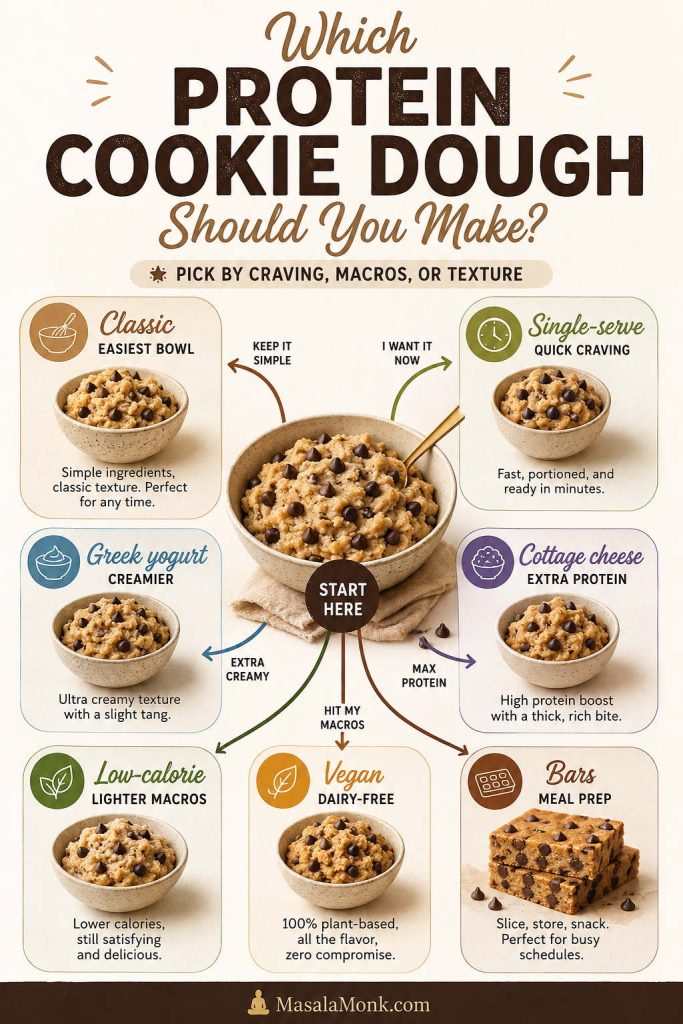
Which Protein Cookie Dough Version Should You Make?

Protein cookie dough version chooser showing classic, single-serve, Greek yogurt, cottage cheese, low-calorie, vegan, and bars
Use this guide by need: single-serve for speed, Greek yogurt or cottage cheese for creaminess, low-calorie for lighter macros, vegan for dairy-free, or bars for meal prep.
Version Best for Texture Use this base
Classic protein cookie dough Best overall Thick enough to scoop, soft enough to eat with a spoon Protein powder + flour + nut butter + Greek yogurt
Single serve Quick craving Small-batch dough 30g protein powder + nut butter
Greek yogurt Creamier snack Smoother, tangier, and more spoonable Greek yogurt + protein powder
Cottage cheese Extra creamy, higher-protein variation Smooth and creamy when blended first Blended cottage cheese
Low calorie Macro-friendly snack Lighter and less rich Powdered peanut butter + nonfat Greek yogurt
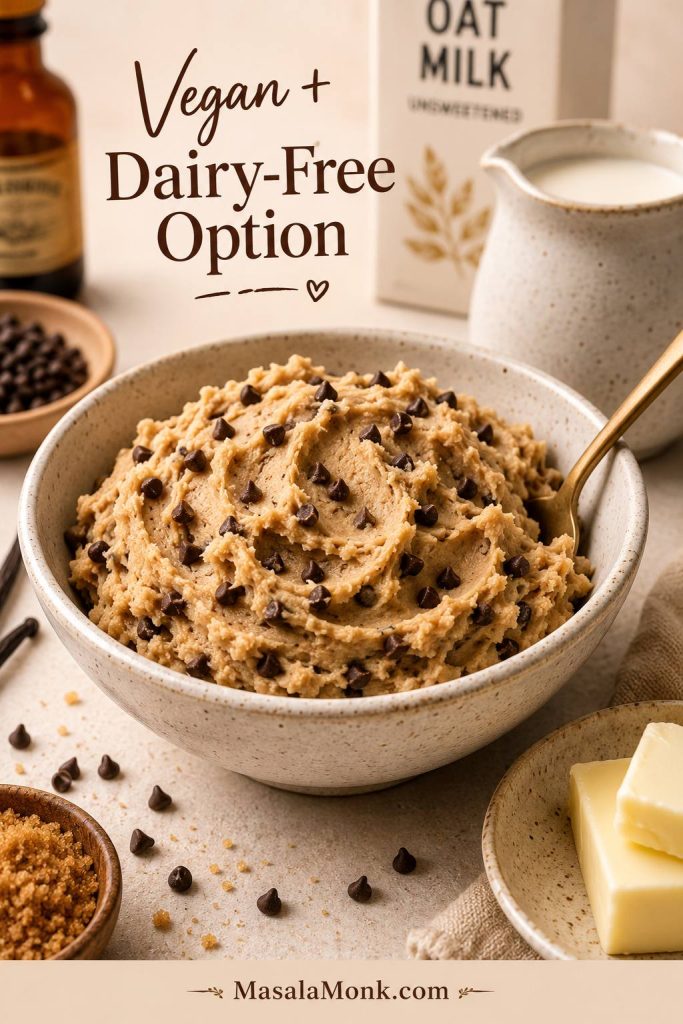
Vegan Dairy-free version Thick, sometimes chalkier Plant protein + dairy-free milk
Chickpea Plant-based/fiber-rich Thicker and dip-like Chickpeas + protein powder
Bars Meal prep Firm and sliceable Thicker dough + pan chill

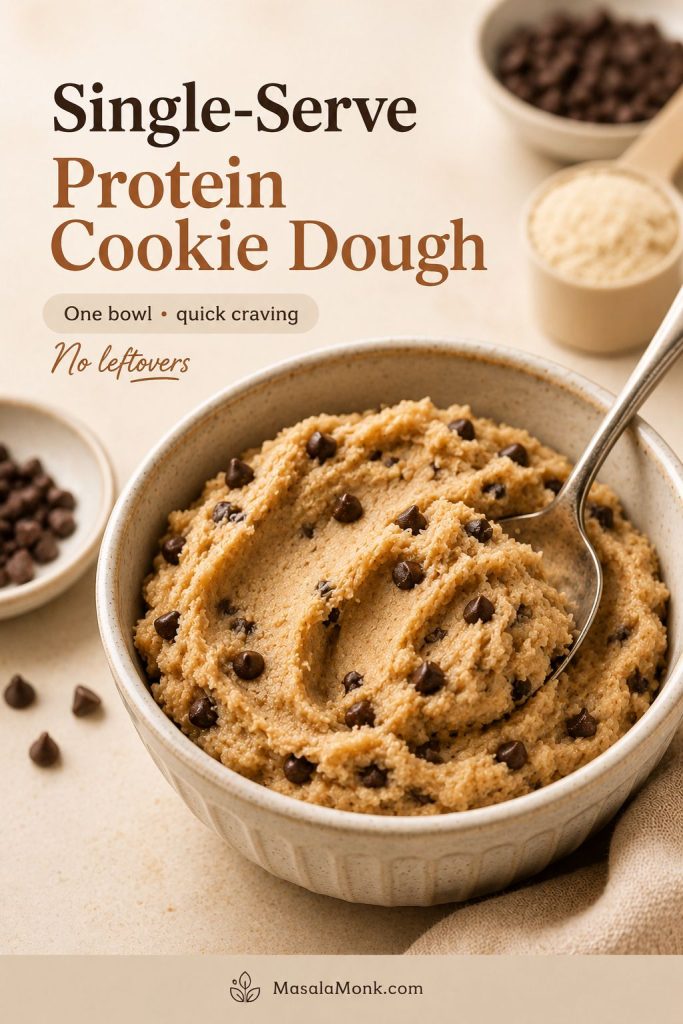
Single-Serve Protein Cookie Dough

Single-serve protein cookie dough in a small bowl with mini chocolate chips, spoon, and quick snack portion
The single-serve version is ideal when you want one quick bowl now, especially if you do not want extra dough waiting in the fridge.
Ingredient Amount
Vanilla protein powder 30g
Almond flour or oat flour 2–3 tablespoons
Nut butter 1½ tablespoons
Greek yogurt or milk 1–2 tablespoons
Maple syrup or honey 1–2 teaspoons, optional
Vanilla extract ¼ teaspoon
Salt Pinch
Mini chocolate chips 1–2 tablespoons

Mix the dry ingredients first, stir in the nut butter and yogurt, then adjust with tiny splashes of milk until the dough is scoopable but not loose. This version can be higher in protein than the main recipe because it uses a full scoop of protein powder in one serving.

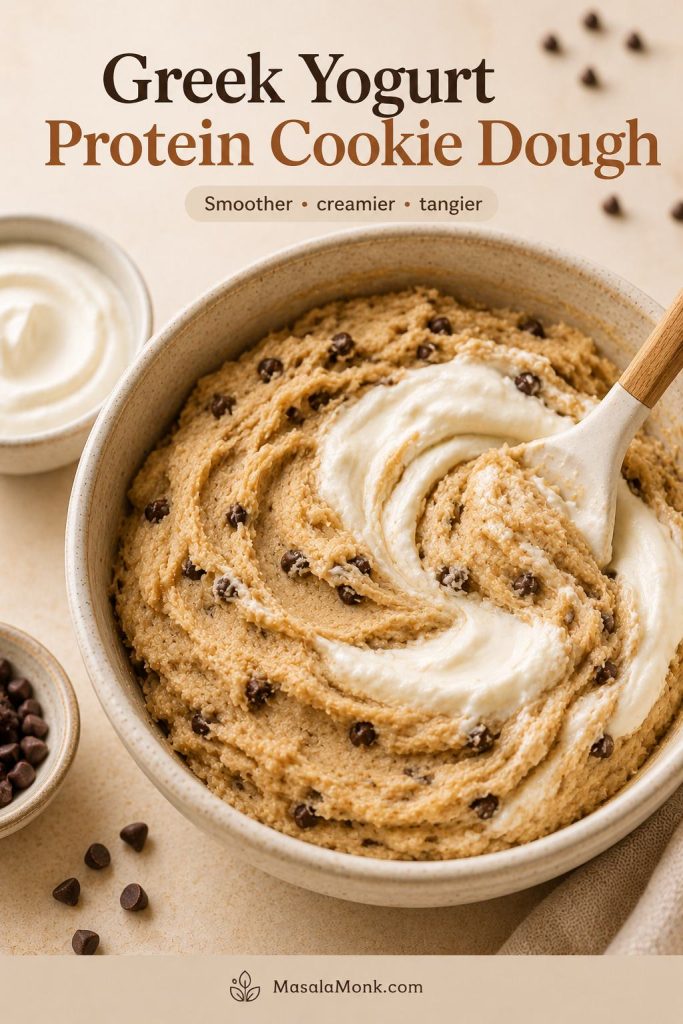
Greek Yogurt Protein Cookie Dough

Greek yogurt protein cookie dough with thick Greek yogurt being mixed in for a smoother and creamier texture
Greek yogurt gives the dough a softer, tangier bite, which helps balance the dryness some protein powders can bring.

To make the Greek yogurt version, increase the Greek yogurt to ½ cup and reduce the milk. Stir the dough well, then chill it for 20–30 minutes so the flour and protein powder can absorb the moisture. If the yogurt is very thick, add milk 1 teaspoon at a time. If the yogurt is loose, add a little more almond flour or oat flour.

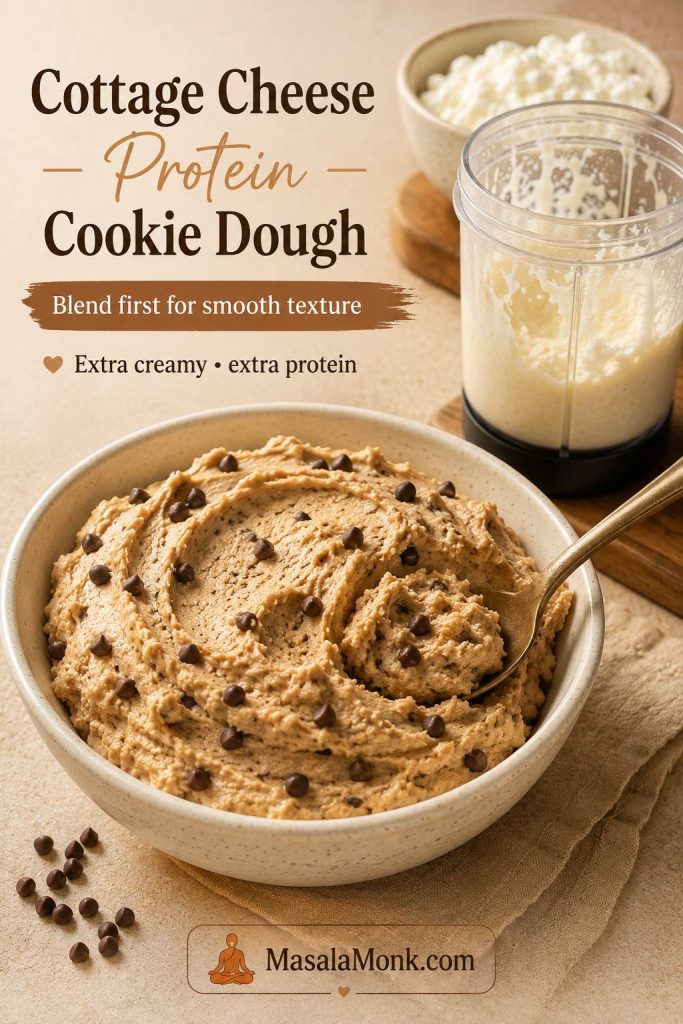
Cottage Cheese Protein Cookie Dough

Cottage cheese protein cookie dough showing blended cottage cheese, finished dough, and the smooth texture after blending
The cottage cheese version depends on one important step: blend the cottage cheese smooth before mixing it into the dry base.

For a cottage cheese version, blend ½ cup cottage cheese with vanilla and 2–3 teaspoons maple syrup until smooth. Then stir it by hand into the protein powder, almond flour or oat flour, nut butter, salt, and chocolate chips. Add the chips after blending, not before.

If your blended cottage cheese is very loose, start with less milk or skip the milk completely until the dough is mixed.

Cottage cheese texture tip: Blend the cottage cheese first, then mix by hand after the dry ingredients go in. Over-blending the full dough can make it runnier.

If you enjoy creamy low-carb desserts, this keto cheesecake recipe is another good one to keep nearby, especially when you want something chilled and richer than a snack bowl.

Low-Calorie Protein Cookie Dough

Low-calorie protein cookie dough with powdered peanut butter, nonfat Greek yogurt, almond milk, and fewer mini chocolate chips
A lighter bowl should still taste satisfying, so use macro-friendly swaps without removing all the creaminess and chocolate.
Swap What it does
Powdered peanut butter Reduces fat and calories while keeping peanut flavor.
Nonfat Greek yogurt Adds creaminess and protein with fewer calories.
Mini chocolate chips Gives more chocolate in every bite with a smaller amount.
Sugar-free syrup, carefully Can reduce sugar, but may make the dough thinner or less rich.
Single-serving batch Helps with portion control and avoids extra leftovers.

For one lighter serving, start with 30g vanilla protein powder, 2 tablespoons powdered peanut butter, ¼ cup nonfat Greek yogurt, 1–2 teaspoons syrup or sweetener, vanilla, salt, and 1 tablespoon mini chocolate chips. Add almond milk 1 teaspoon at a time until the dough becomes scoopable.

For another creamy dessert with a lighter, healthier feel, this avocado chocolate mousse is a good next option when you want chocolate without baking.

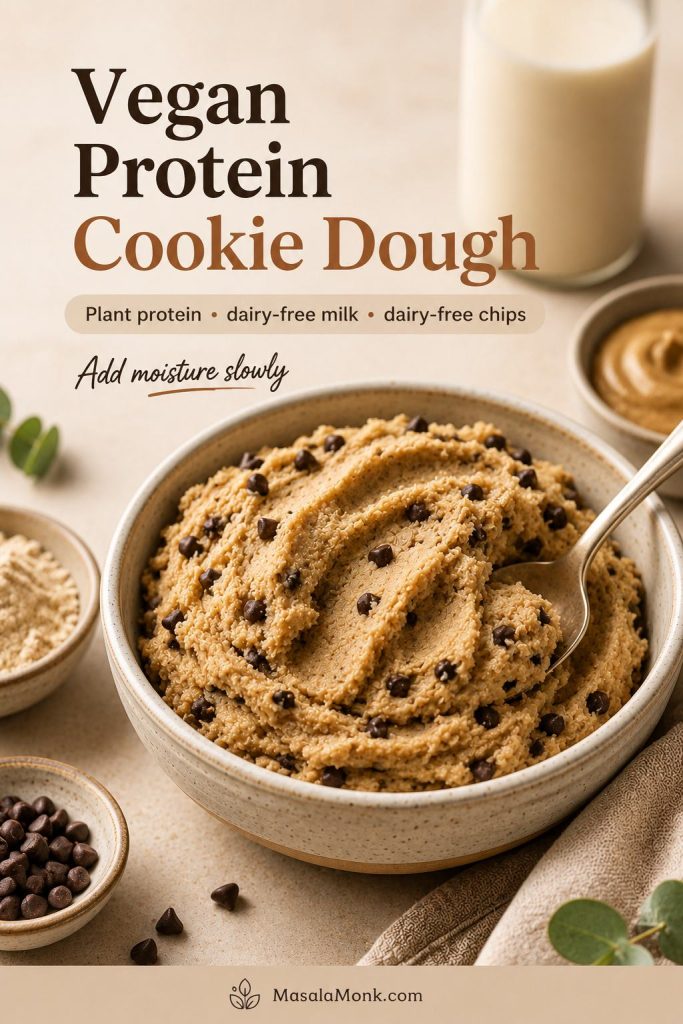
Vegan Protein Cookie Dough

Vegan protein cookie dough with plant protein powder, dairy-free milk, nut butter, and dairy-free chocolate chips
The vegan version usually needs a little more moisture and fat because plant protein can thicken quickly as it sits.

For a vegan batch, use ½ cup almond or oat flour, ½ cup plant protein powder, 2–3 tablespoons almond or cashew butter, 2–3 teaspoons maple syrup, vanilla, salt, dairy-free milk as needed, and dairy-free mini chocolate chips. Add the milk slowly because plant protein often thickens fast.

When plant protein tastes earthy, extra vanilla, a tiny pinch of salt, and mini chocolate chips help a lot. A little more nut butter can also soften the chalky edge without making the dough too loose.

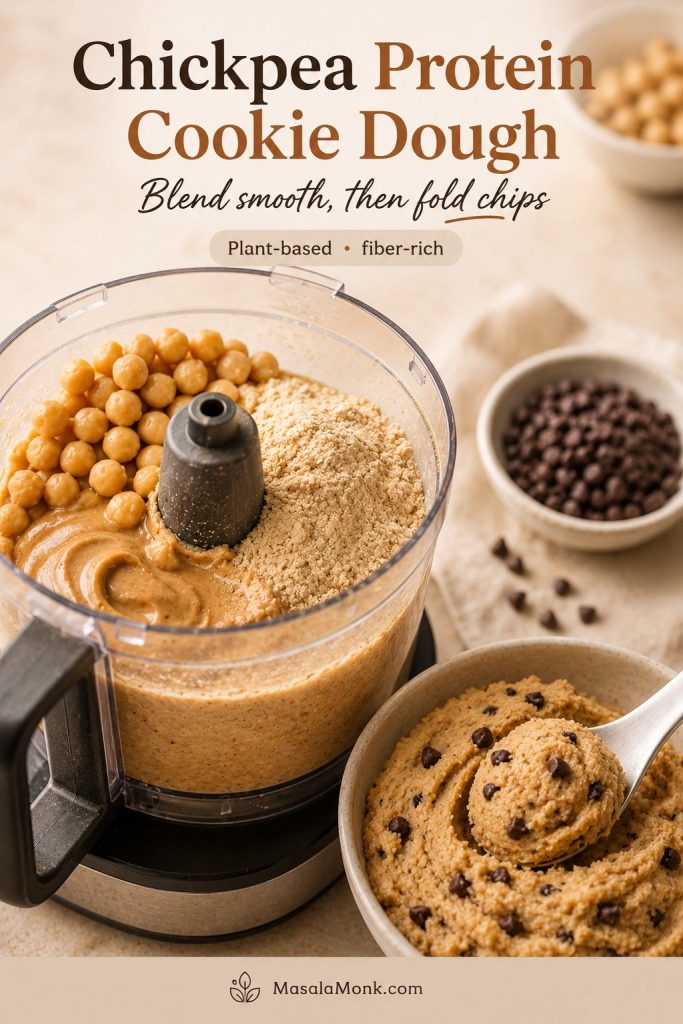
Chickpea Protein Cookie Dough

Chickpea protein cookie dough being made in a food processor with chickpeas, protein powder, nut butter, and chocolate chips
The chickpea version works best as a blended variation, since a food processor gives the base a smoother, dip-like texture.

For a chickpea version, start with 1 cup well-rinsed chickpeas, 30g vanilla protein powder, 2 tablespoons nut butter or sunflower seed butter, 1–2 tablespoons maple syrup, vanilla, salt, and 1–2 tablespoons milk as needed. Blend everything except the chocolate chips until smooth, then fold in the chips.

For the smoothest texture, rinse the chickpeas very well and remove the skins if you have time. Chilling the dough for 20–30 minutes also helps the flavor mellow and the texture thicken.

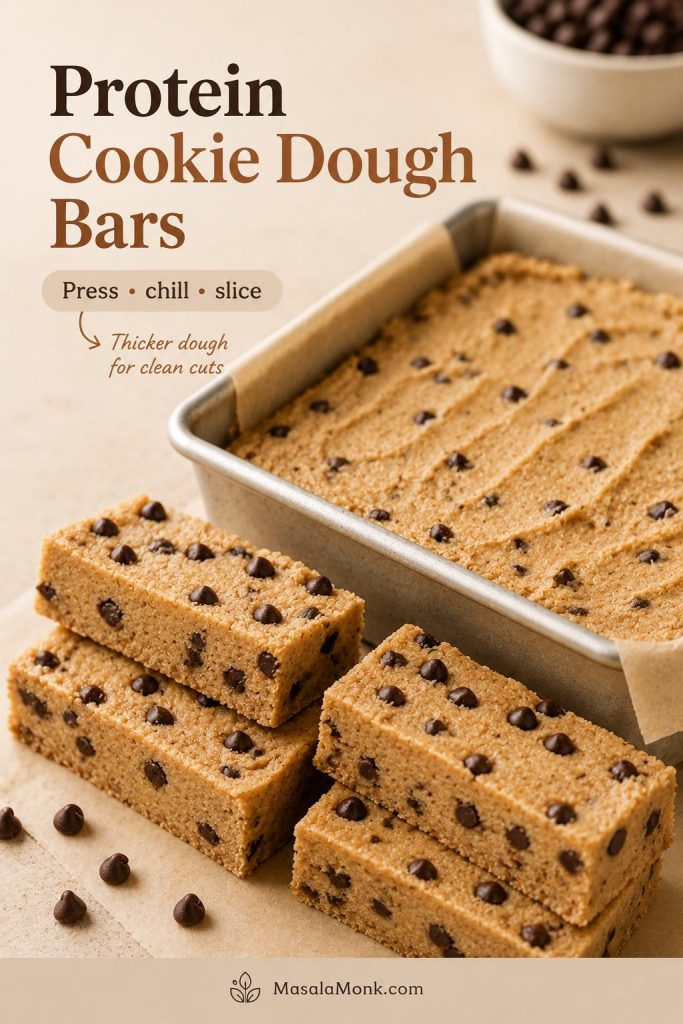
No-bake protein cookie dough bars sliced from a chilled parchment-lined loaf pan with mini chocolate chips visible
Protein cookie dough bars need a firmer base than the spoonable version, so they can chill, hold their shape, and slice cleanly.

After slicing, use the storage guide so the bars stay firm instead of drying out.

A loaf pan works well for a thicker small batch. Use an 8-inch square pan only if you are doubling the recipe, otherwise the bars may be too thin.

For a more dessert-like bar, spread melted chocolate over the chilled dough and chill again until set. For a softer snack bar, skip the chocolate coating and keep the chocolate chips mixed into the dough.

Storage and Freezer Tips

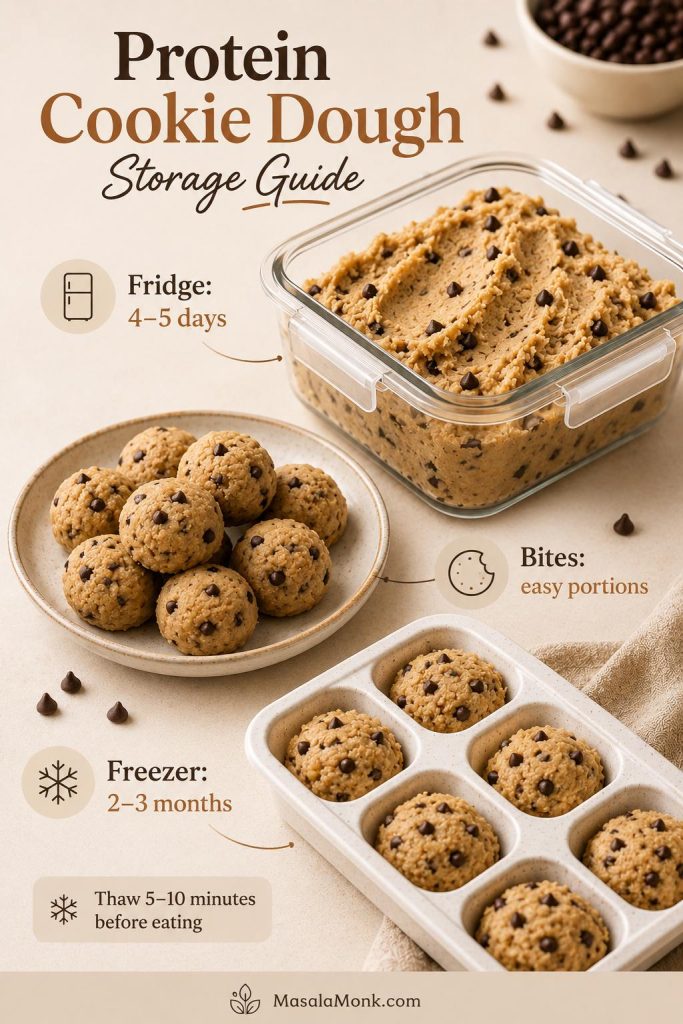
Protein cookie dough storage guide showing an airtight fridge container, rolled snack bites, and freezer portions
For easy snack prep, keep protein cookie dough chilled in a container or freeze small portions that soften after a few minutes.
Storage method How long Best tip
Airtight container in the fridge 4–5 days Stir before serving if it firms up.
Rolled balls in the fridge 4–5 days Use a small cookie scoop for even portions.
Freezer portions 2–3 months Freeze on a tray first, then move to a container.
Cookie dough bars Up to 1 week chilled Keep parchment between layers if stacking.

For bites, chill the dough until it is firm enough to scoop, then roll it into small balls and store them in the fridge or freezer. They are easier to portion than a full bowl and work well for snack prep.

Frozen portions taste best after sitting at room temperature for 5–10 minutes. They should soften slightly but still hold their shape.

What to Eat With Protein Cookie Dough

You can absolutely eat this straight from the bowl. That is the point. But if you make extra, it also turns into an easy topping, dip, or freezer snack.

Think of it as a spoonable snack first, then use leftovers anywhere you would normally want a sweet, cookie-dough-style topping.

  • Scoop it into small snack balls.
  • Serve it with apple slices.
  • Swirl it into Greek yogurt.
  • Crumble it over smoothie bowls.
  • Press it into bars.
  • Freeze it into bite-size portions.
  • Use it as a high-protein dessert dip.

Once you understand the texture, this becomes the kind of recipe you can make by feel: a little more milk for spoonable, a little more flour for scoopable, and a little more vanilla and salt when the protein powder tries to take over.

Different protein powders can change this dough a lot. If you try it with whey, casein, collagen, or plant protein, note how much milk it needed and whether the final texture turned out scoopable, sticky, dry, or firm. That is the kind of detail other readers actually want before they open a new tub of protein powder, so it is worth sharing if your powder behaved differently.

After one batch, you will probably know exactly how your protein powder behaves. From there, this becomes an easy fridge snack you can make by feel — thicker for cookie dough bites, softer for spooning, sweeter when it is dessert, and lighter when you just want a quick protein treat.

Ready to make it now? Jump to the full protein cookie dough recipe card.

FAQs About Protein Cookie Dough

Why is my protein cookie dough dry?

Your protein powder probably absorbed more liquid than expected. Casein and plant-based protein powders are especially thirsty, so add milk or Greek yogurt 1 teaspoon at a time until the dough softens.

Why did my protein cookie dough turn sticky?

Sticky dough usually means too much syrup, nut butter, or milk. First, chill it for 20–30 minutes. After that, add almond flour or oat flour 1 teaspoon at a time if the mixture still feels too loose.

Which protein powder tastes best in cookie dough?

A good vanilla whey-casein blend is usually the easiest choice for a balanced dough texture. Whey can be smooth but sticky, casein can be thick and dry, and plant protein may need more moisture and flavor support.

Best peanut butter substitutes for protein cookie dough

Peanut butter is not required. Almond butter, cashew butter, sunflower seed butter, tahini, or a mix of Greek yogurt and powdered peanut butter can all work. The flavor and texture will change slightly, but the recipe still holds together.

Using powdered peanut butter in protein cookie dough

Powdered peanut butter works best in the low-calorie version because it keeps peanut flavor while reducing fat. Since it can taste drier than regular nut butter, pair it with Greek yogurt and add milk slowly until the dough is scoopable.

No Greek yogurt? Use this texture fix

Greek yogurt helps with creaminess, but the recipe can work without it. Replace it with more nut butter and a little milk, or use dairy-free yogurt for a vegan version. Since yogurt also adds thickness, add the liquid slowly so the dough does not become loose.

Is almond flour safe in no-bake cookie dough?

This recipe avoids raw all-purpose wheat flour, which is the main flour concern in classic raw cookie dough. Use fresh almond flour or oat flour from a reputable source, keep the finished dough chilled, and do not swap in regular raw wheat flour unless it is specifically labeled for edible dough.

Freezing protein cookie dough without ruining the texture

Roll the dough into balls or portion it into small scoops, freeze on a tray, then transfer to an airtight container. Let frozen portions sit for 5–10 minutes before eating so they soften slightly without turning mushy.

Should you bake this dough into cookies?

This recipe is designed as edible no-bake dough. Protein powder behaves differently when baked, so a dedicated protein cookie recipe will give you a better baked texture.

Lower-calorie protein cookie dough swaps that still taste good

Use powdered peanut butter, nonfat Greek yogurt, sugar-free syrup if you like it, and a smaller amount of mini chocolate chips. A single-serving batch is usually the easiest way to keep the calories controlled without making a large bowl of leftovers.

Vegan protein cookie dough: what changes?

Plant-based protein powder usually thickens more and can taste earthier than whey. Use almond or oat flour, nut butter, maple syrup, dairy-free milk, and dairy-free chocolate chips, then add extra milk or nut butter if the dough tastes chalky.

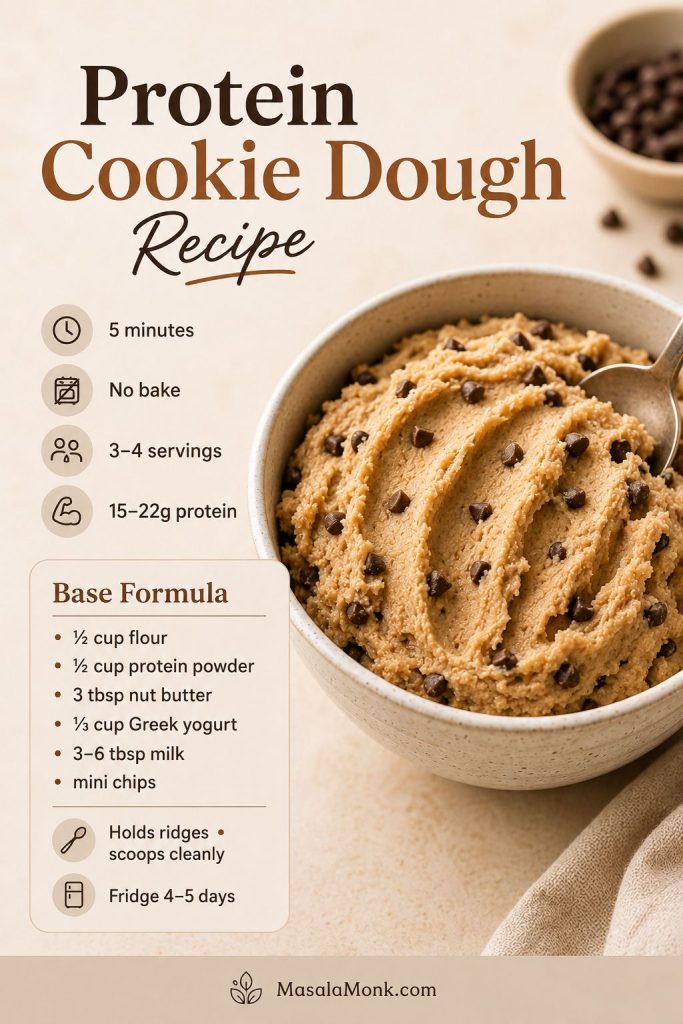
Protein cookie dough recipe card showing the base formula, five-minute prep time, protein estimate, texture target, and storage
Save the base formula as a texture guide: equal parts flour and protein powder, creamy ingredients for richness, then milk only until scoopable.

Protein Cookie Dough Recipe Card

This edible protein cookie dough is no-bake, egg-free, creamy, and ready in about 5 minutes. Chill it for a firmer cookie-dough bite, or eat it right away while it is softer and freshly mixed.

Texture target: The dough should hold ridges when stirred, scoop cleanly, and feel thick but not dry. Pourable dough needs more dry structure, while crumbly dough needs a little more moisture.

Servings 3–4
Prep Time 5 minutes
Chill Time Optional 20–30 minutes
Cook Time 0 minutes

Equipment

  • Medium mixing bowl
  • Spatula or sturdy spoon
  • Measuring cups and spoons
  • Kitchen scale, optional but helpful
  • Airtight container for storage

Ingredients

Ingredient US amount Metric amount
Almond flour or oat flour ½ cup 50–56g
Vanilla protein powder ½ cup 50–60g
Creamy peanut, almond, or cashew butter 3 tablespoons About 48g
Plain thick Greek yogurt ⅓ cup About 80g
Maple syrup or honey 2–3 teaspoons 10–15ml
Milk or almond milk 3–6 tablespoons, added gradually 45–90ml
Vanilla extract ½ teaspoon 2.5ml
Fine salt ¼ teaspoon About 1.5g
Mini chocolate chips 3 tablespoons 30–40g

Instructions

  1. Stir the almond flour or oat flour, protein powder, and salt together in a medium bowl.
  2. Mix in the nut butter, Greek yogurt, maple syrup or honey, and vanilla until a thick dough starts to form.
  3. Add milk or almond milk 1 tablespoon / 15ml at a time, mixing well after each addition, until the dough holds ridges when stirred and scoops cleanly.
  4. Fold in the mini chocolate chips.
  5. Eat immediately for a softer dough, or cover and chill for 20–30 minutes for a firmer cookie-dough bite.

Notes

  • Protein powders absorb liquid differently, so start with less milk and add more gradually.
  • Chilling is optional, but it improves both texture and flavor because the flour and protein powder have time to hydrate.
  • Divide the batch into 3 servings for a higher-protein snack or 4 servings for smaller dessert portions.
  • Use 3 teaspoons maple syrup or honey for a sweeter dessert-style dough, or start with 2 teaspoons for a less sweet snack.
  • When the dough is wet, build it back up with almond flour, oat flour, or protein powder 1 teaspoon at a time.
  • For dry dough, add milk or Greek yogurt 1 teaspoon at a time until it softens.
  • Strong protein-powder flavor usually improves with extra vanilla, a tiny pinch of salt, or 1 teaspoon nut butter before adding more milk.
  • Do not use regular raw all-purpose flour in this no-bake recipe.

Storage

Store protein cookie dough in an airtight container in the fridge for 4–5 days. For longer storage, portion it into balls or scoops and freeze for 2–3 months. Let frozen portions sit for 5–10 minutes before eating.

Estimated Protein and Calories

Protein and calories will vary by powder, yogurt, flour, nut butter, milk, syrup, chocolate chips, and serving size. As a rough guide, this batch usually lands around 15–22g protein per serving when divided into 3–4 portions, with about 225–400 calories per serving depending on portion size and ingredients. Use your own labels for the most accurate numbers.
Posted on Leave a comment

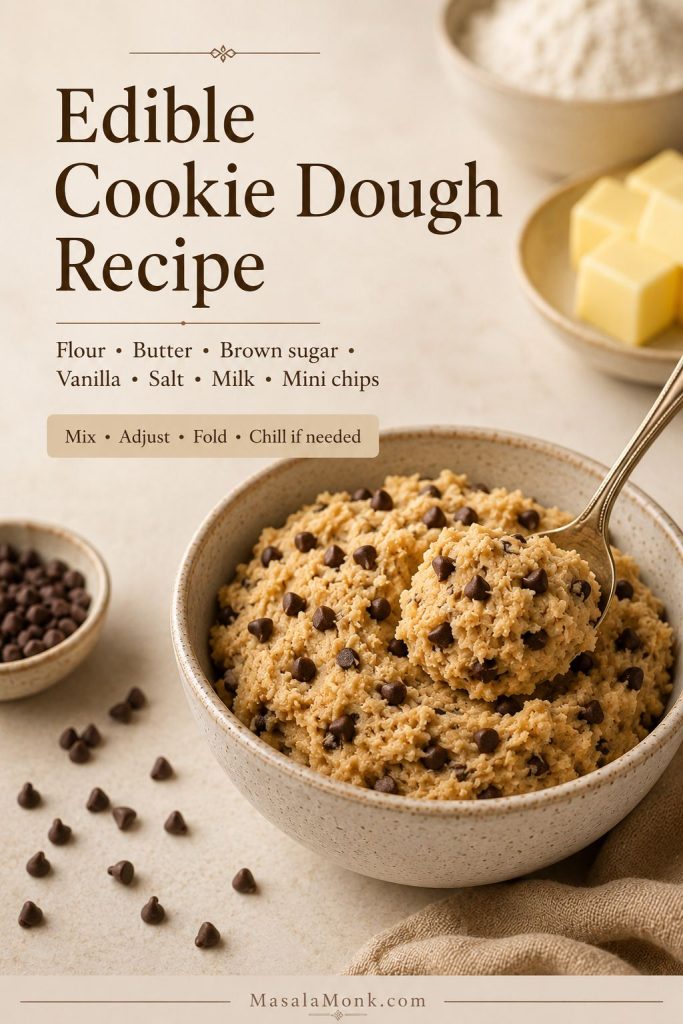
Edible Cookie Dough Recipe

A spoon lifts soft chocolate chip edible cookie dough from a bowl, showing a creamy texture with mini chocolate chips throughout.

This edible cookie dough recipe is for the spoonful you wanted before the cookies ever reached the oven: soft brown-sugar dough, creamy butter, vanilla, a little salt, and tiny chocolate chips in every bite. It tastes like classic chocolate chip cookie dough, but it is made for eating straight from the bowl — no baking tray, no waiting, no pretending you only wanted “one taste.”

The important difference is safety. This version skips raw eggs and treats flour as something that needs attention, not an ingredient to casually stir in raw. For the most cautious batch, use commercially heat-treated flour labeled ready-to-eat; if you use a home flour-heating method, the notes below explain the limits clearly.

Before You Start: Texture and Safety

The good news is that edible cookie dough does not need to be complicated. Once you understand the flour piece, the rest is simple: cream butter and sugar, add vanilla and salt, mix in the flour, then adjust the texture until it tastes like the middle of a chocolate chip cookie.

Once the base is right, you can keep it classic with mini chocolate chips, make a single-serving bowl, turn it into sugar cookie dough, add peanut butter, roll it into bites, or chill little pieces for ice cream. Start with the chocolate chip version first; it teaches you what the texture should feel like.

Before you start mixing, use the texture cue below as your visual target: the dough should look thick, creamy, and spoonable, not dry, runny, or frosting-soft.

Close-up spoonful of edible cookie dough held above a bowl, showing a thick, creamy texture with mini chocolate chips.
For the smoothest result, the dough should look dense but not dry; in other words, it should stay on the spoon without turning crumbly, stiff, or frosting-soft.

If the craving is really for warm cookies from the oven, use a proper cookie recipe like MasalaMonk’s double chocolate chip cookies instead. This one is built for one job: cookie dough you can enjoy by the spoonful.

What You’ll Find in This Edible Cookie Dough Guide

Use the quick answer if you already know the basics, or go straight to the safety notes if you want to understand the flour and egg issue before mixing.

Quick Answer: How to Make This Edible Cookie Dough Recipe

To make this edible cookie dough recipe, start with ready-to-eat flour or handle the flour using the safety notes below. Let the flour cool completely, then sift it so the dough does not taste lumpy or floury. Cream softened butter with brown sugar and a little granulated sugar, mix in vanilla and salt, add the flour, loosen the dough with milk or cream, and fold in mini chocolate chips.

The texture should be soft and scoopable, like the center of chocolate chip cookie dough before baking. It should not be runny, greasy, sandy, or crumbly. If it feels too thick, add milk one teaspoon at a time. If it feels too soft, chill it for 15 to 20 minutes before serving.

Quick texture cue: the dough should hold on a spoon, but still press easily when you scoop it. If it cracks apart, it needs a little more milk. If it slumps like frosting, it needs chilling or a spoonful of sifted flour.
  • Best flour option: commercially heat-treated flour labeled ready-to-eat
  • Eggs: none
  • Texture: creamy, spoonable, and thick enough to hold on a spoon
  • Best chips: mini semisweet chocolate chips
  • Chill time: optional, 10–20 minutes if the dough feels soft
  • Storage: 4–5 days refrigerated, 1–2 months frozen
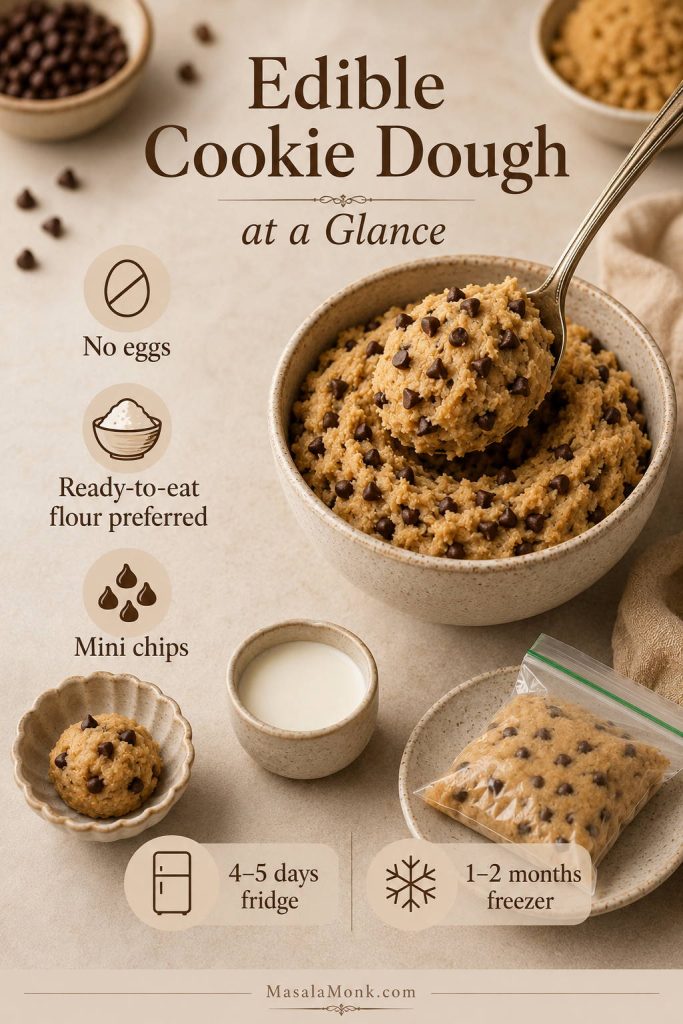
At-a-glance edible cookie dough guide showing no eggs, ready-to-eat flour preferred, mini chocolate chips, and fridge and freezer storage times.
If you only remember the essentials, keep these in mind first: no eggs, ready-to-eat flour preferred, mini chips for a better bite, and short cold storage for the best texture.

Why This Edible Cookie Dough Works

A good edible cookie dough recipe should not taste like sweet flour paste. It should taste like the spoonful you wanted from a real chocolate chip cookie batch: buttery, brown-sugary, vanilla-scented, lightly salty, and soft enough to scoop.

  • No eggs: the dough is made for eating, not baking, so eggs are left out completely.
  • Better flour handling: ready-to-eat flour is the cleanest choice, and the home flour-heating note is explained honestly.
  • Brown sugar leads: it gives the deeper chocolate chip cookie flavor that plain white sugar cannot.
  • Softened butter, not melted: softened butter keeps the texture creamy instead of greasy or loose.
  • Mini chips: smaller chips spread through the dough better, so every spoonful tastes balanced.
  • Adjustable milk: flour behaves differently after heating, so milk is added slowly instead of dumped in all at once.

The safety piece gets much less confusing once you remember one thing: regular cookie dough is meant to be baked, and this dough is not. A safer edible cookie dough recipe starts with no raw eggs and a better flour choice from the beginning.

According to the CDC, raw dough and batter should not be eaten because uncooked flour and raw eggs can contain germs that may cause food poisoning. Commercial edible dough products, the CDC notes, are made with heat-treated flour and pasteurized eggs or no eggs.

So, is this kind of dough safer than sneaking a spoonful from a regular cookie batch? Yes, when it is made without raw eggs and with ready-to-eat flour. The safest route is commercially heat-treated flour labeled ready-to-eat. Home flour-heating methods are common in recipes, but they are not the same as validated commercial heat-treatment.

Why This Recipe Has No Eggs

Eggs stay out because the bowl is not going into the oven. They help baked cookies with structure, richness, and spread, but raw or lightly cooked eggs can carry food-safety risks. Since this is a spoonable dessert, the simplest direction is to leave eggs out completely.

That also means the dough will not bake like regular cookie dough. It has no eggs for structure and no leavening for lift, so treat it as a no-bake dessert rather than a shortcut cookie recipe.

What to Know About Raw Flour

Flour is easy to overlook because it does not look like a risky ingredient. However, the FDA explains that most flour is a raw food and has not been treated to kill bacteria. Baking or cooking is what normally makes flour-containing doughs safe to eat.

That is why the flour choice matters here. If you can get commercially heat-treated flour labeled ready-to-eat, use it. It gives you the cleanest safety story and keeps the method simple.

The Most Cautious Flour Option

For the most cautious batch, use flour labeled commercially heat-treated or ready-to-eat. SDSU Extension explains that commercial heat-treatment uses validated controls, while home flour heating is harder to control perfectly.

That does not mean homemade edible cookie dough is off the table; it just means the flour step deserves a little honesty. Ready-to-eat flour is the strongest option. If you choose to heat flour yourself, treat that step as risk reduction rather than the same thing as commercially processed flour.

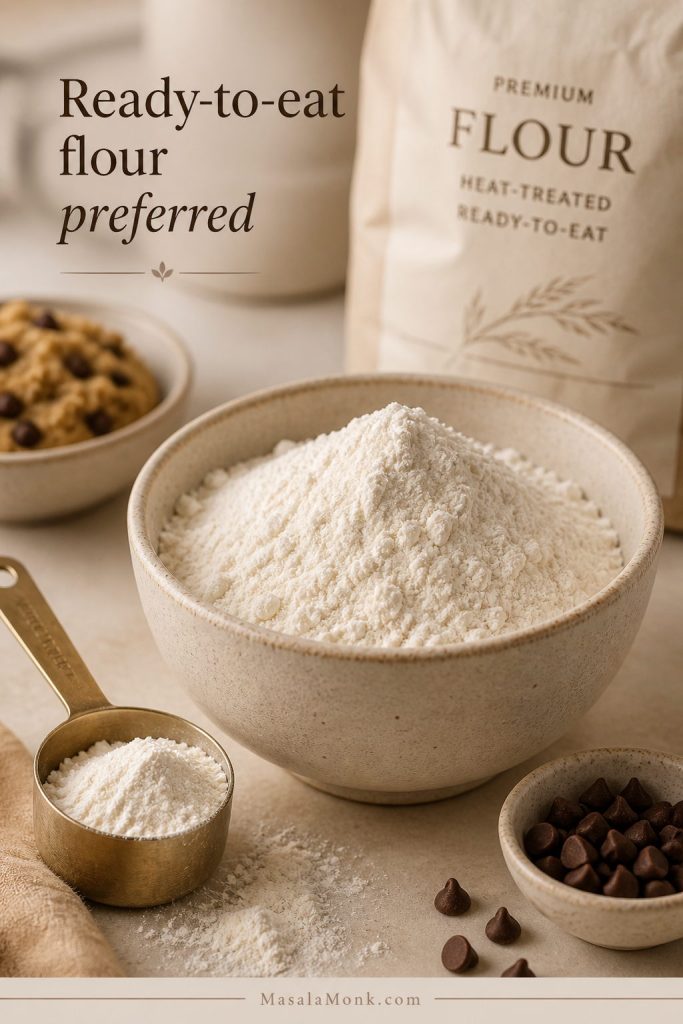
Ready-to-eat flour displayed beside edible cookie dough ingredients as the preferred flour choice for no-bake cookie dough.
Commercially heat-treated ready-to-eat flour keeps the no-bake dough approach cleaner, especially because regular flour is normally made safer through baking or cooking.

About Heating Flour at Home

Many edible cookie dough recipes include a home flour-heating step, but this should be framed carefully. The most cautious choice is still commercially heat-treated flour labeled ready-to-eat. The FDA notes that home flour treatments may not reliably kill all bacteria or make raw flour safe to eat, so treat any home method as a recipe-blog risk-reduction step rather than a validated food-safety process.

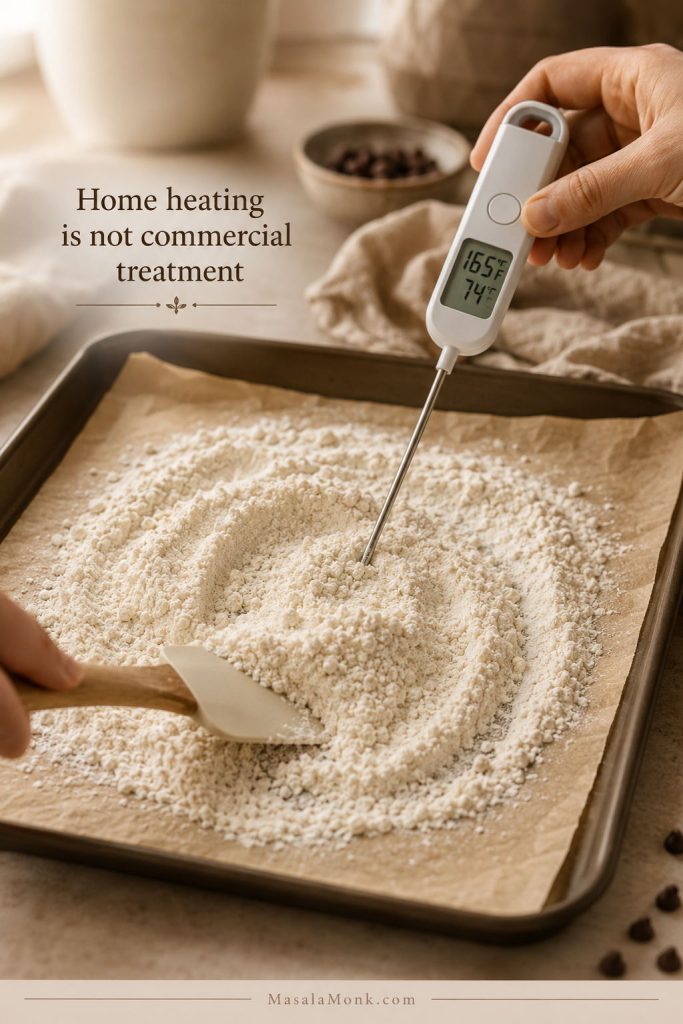
For readers who still choose to follow a home flour-heating method, use an instant-read thermometer, spread the flour thinly, stir it during heating, check more than one spot, cool it completely, and sift before mixing.

Flour spread on a parchment-lined baking tray with an instant-read thermometer inserted, illustrating a home flour-heating method.
If you heat flour at home, use the thermometer cue as a careful kitchen step, not a promise; the safest route is still flour processed for ready-to-eat use.

Oven Method Used by Many Recipe Blogs

Preheat the oven to 350°F / 175°C. Spread a little more flour than you need in a thin layer on a parchment-lined rimmed baking sheet. Bake for 7 to 10 minutes, stirring once or twice, until the flour reaches 165°F / 74°C when checked in multiple spots with an instant-read thermometer. Cool completely, sift, then measure or weigh the amount needed for the dough.

Microwave Method Used by Many Recipe Blogs

Place flour in a wide microwave-safe bowl. Microwave for 30 seconds, stir well, then continue in 15-second bursts, stirring and checking the temperature in more than one spot. Let it cool completely and sift before using.

Simple takeaway: use ready-to-eat flour if you can find it. If not, read the home-heating note carefully and understand that it is a common recipe-blog risk-reduction step, not the same as commercial heat treatment.

Ingredients for Edible Cookie Dough

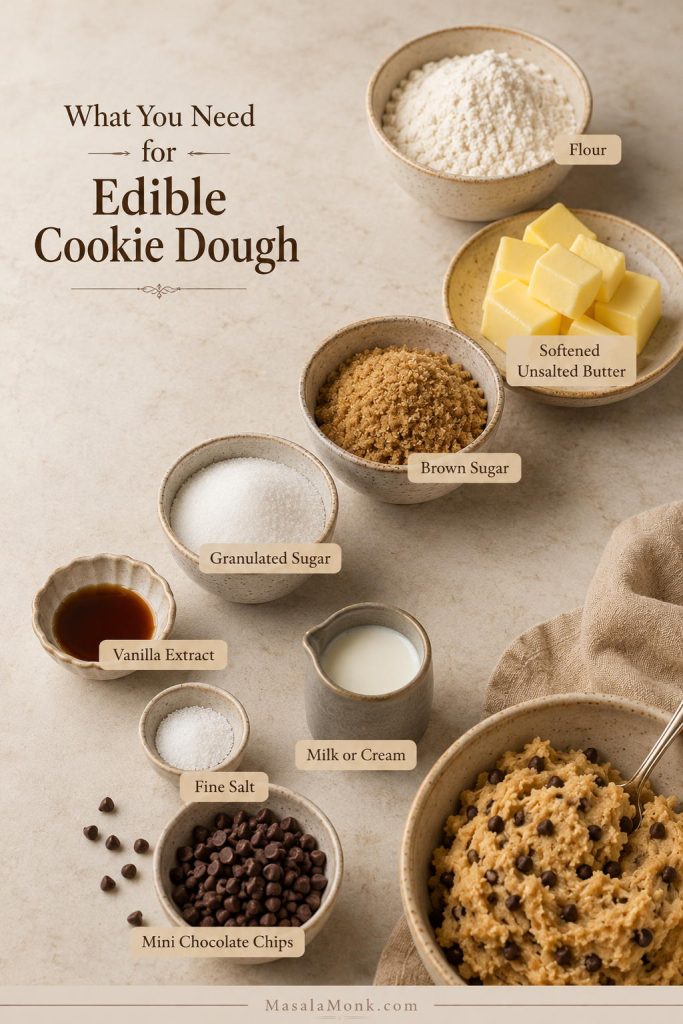
The ingredient list stays close to classic chocolate chip cookie dough, but each item has a job. Since the dough is not baked, little details matter more than usual: softened butter works better than melted butter, mini chips are easier to eat than large chips, and milk should be added slowly.

Ingredients for edible cookie dough arranged on a counter, including flour, softened butter, brown sugar, granulated sugar, vanilla, salt, milk, and mini chocolate chips.
Because this no-bake dough is eaten as-is, the ingredient balance matters more than usual: softened butter keeps it creamy, brown sugar adds depth, and milk helps fine-tune the consistency.

Ready-to-Eat or Properly Handled Flour

Flour gives the dough its familiar body. Use 1¼ cups / 150g commercially heat-treated all-purpose flour if you can find it. If you use a home flour-heating method, cool the flour completely, sift it, and then measure the final amount into the bowl.

Softened Butter

Use ½ cup / 113g / 4 oz unsalted butter, softened but not melted. Softened butter creams into the sugar and gives the dough a classic texture. Melted butter can make it greasy, loose, or frosting-like.

Brown Sugar and Granulated Sugar

Brown sugar gives the dough that deep chocolate chip cookie flavor. Granulated sugar adds familiar sweetness, but too much can make the texture gritty. This recipe uses mostly brown sugar with just a small amount of granulated sugar for balance.

Vanilla and Salt

Vanilla makes the dough taste like dessert instead of sweet butter and flour. Salt is just as important because it keeps the sweetness from feeling flat. Do not skip it, especially if you are using unsalted butter.

Milk or Cream

Milk or cream loosens the dough after the flour goes in. Start with 1 tablespoon and add more only if needed. Flour can absorb differently after heating, so the best amount is the one that gives you a scoopable texture.

Mini Chocolate Chips

Mini chocolate chips work better than large chips because this dough is eaten soft, not baked. They distribute evenly, so each spoonful has chocolate without turning the bowl into mostly hard chunks.

Optional Baking Soda for Flavor Only

A tiny pinch of baking soda can make the dough taste more like classic cookie dough, but it is optional. If you use it, add only ⅛ teaspoon. It is there for flavor, not because the dough should be baked.

Tools That Make the Texture Better

You can make this with a bowl and spatula, so do not let the tool list make the recipe feel fussy. A few extras simply make the result more reliable: an instant-read thermometer for the flour if you are using a home-heating method, a fine-mesh sieve for lumps, and a scale so the dough does not turn dry from too much flour.

  • Rimmed baking sheet
  • Parchment paper
  • Instant-read thermometer
  • Mixing bowl
  • Electric hand mixer or stand mixer
  • Rubber spatula
  • Fine-mesh sieve
  • Digital scale, strongly recommended
  • Small cookie scoop, optional
  • Airtight container for storage

A scale is especially useful because flour gets compacted easily. If you scoop too much into the bowl, the dough can turn dry, chalky, or too thick before you even start troubleshooting.

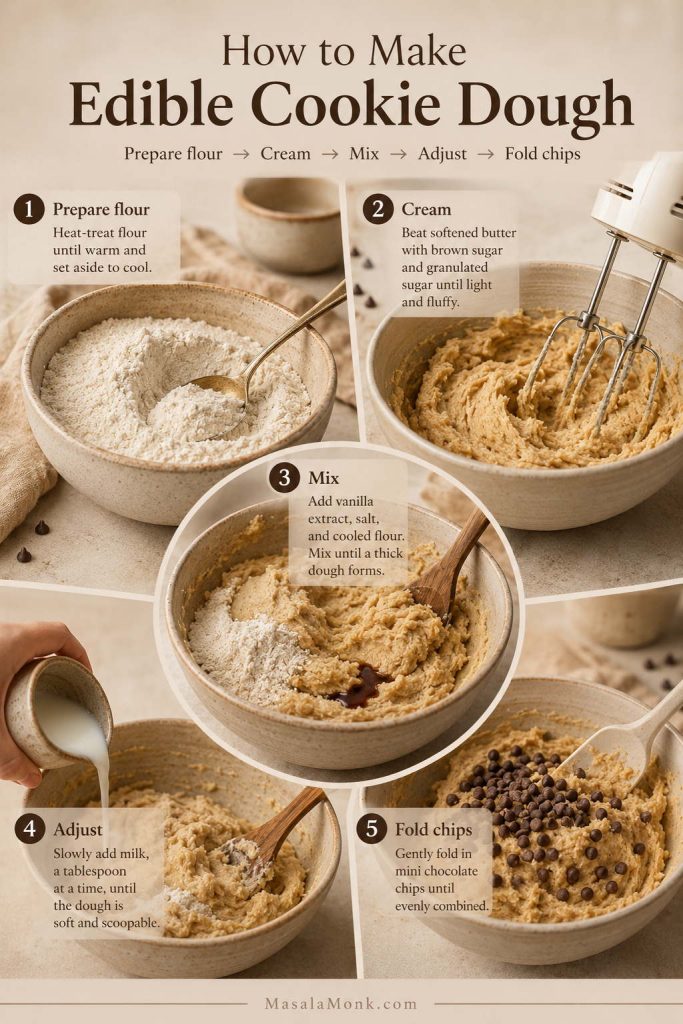
The method is easy, but the order makes a big difference. Handle the flour first, let it cool, then build the dough slowly. Warm flour and melted butter are two of the fastest ways to turn a good bowl of cookie dough into something greasy.

Step-by-step edible cookie dough process showing flour preparation, creaming butter and sugar, mixing ingredients, adjusting texture, and folding in mini chocolate chips.
The method works best in sequence: prepare the flour first, cream the butter and sugars well, then mix, adjust, and fold in the chips once the texture already feels close.

Step 1: Prepare the Flour

If you are using commercially heat-treated flour, measure or weigh it and move on. If you are using a home flour-heating method, follow the note above, cool the flour completely, and sift it before mixing. Do not add warm flour to the butter mixture.

Step 2: Cream the Butter and Sugars

Add softened butter, brown sugar, and granulated sugar to a bowl. Beat until the mixture looks creamy, lighter, and slightly fluffy. You should still see a thick butter-sugar mixture, not melted butter pooling around the edges. This step helps soften the sugar crystals and gives the dough a smoother bite.

Mix in the vanilla and salt, then add the cooled, sifted flour. Add the flour gradually if you are mixing by hand. At first, the mixture may look a little thick; that is normal.

Step 4: Adjust the Texture

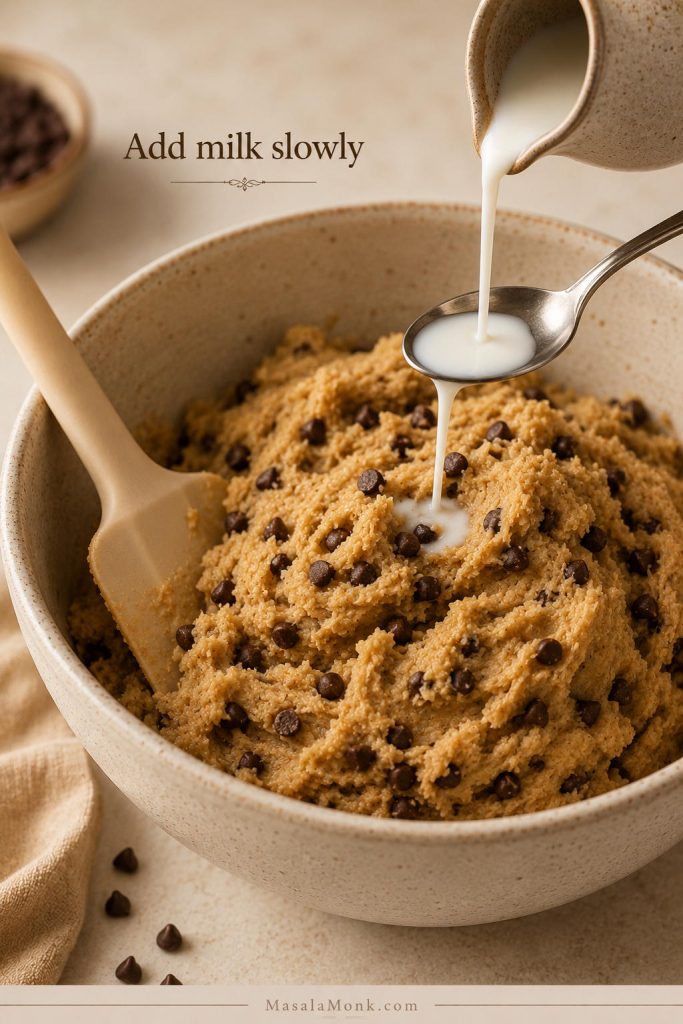
Add milk or cream one teaspoon at a time. Stir, pause, and check the texture before adding more. The dough should hold its shape on a spoon but still press easily when you scoop it. Stop before it starts looking like frosting.

A small amount of milk is being added to thick edible cookie dough in a bowl while a spoon rests nearby.
Add milk slowly, then stir before deciding on more; the dough often softens after a few turns, so patience helps keep it thick and spoonable.

Step 5: Fold in Mini Chocolate Chips

Fold in the mini chocolate chips with a spatula. Taste and adjust with a tiny pinch of salt if it tastes too sweet, or a few extra drops of vanilla if it tastes flat.

Serving cue: this dough is best after a 10-minute rest. That short pause lets the sugar soften slightly and the flour hydrate, so each spoonful tastes smoother.

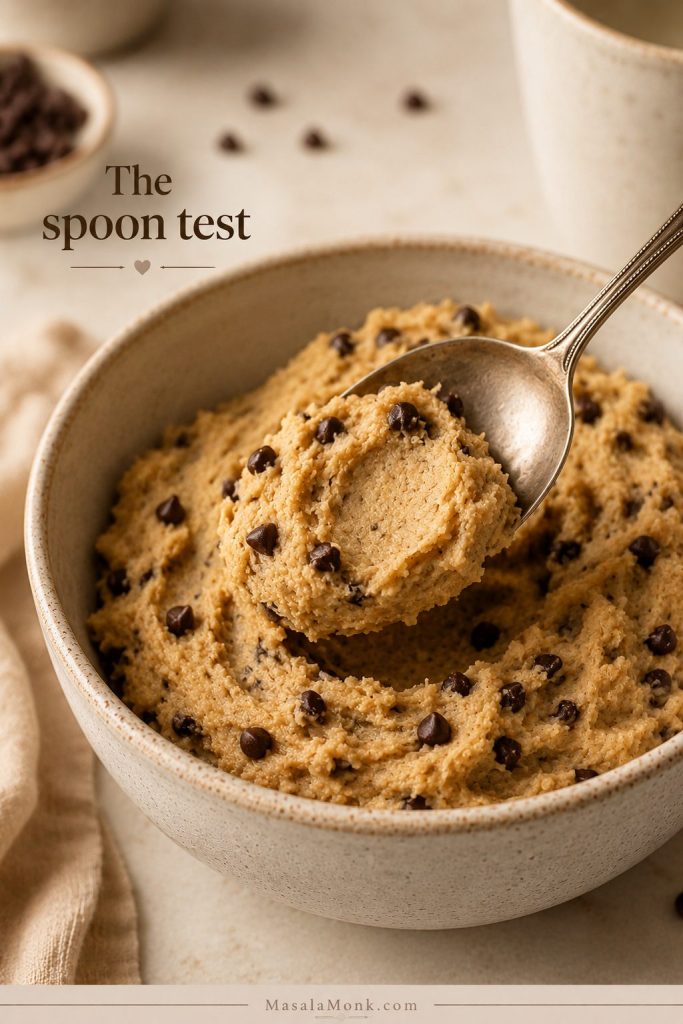
Spoon test: The dough should lift cleanly and still look creamy before you move to the recipe card.

A spoon presses into and lifts edible cookie dough, showing a soft texture that holds its shape.
The spoon test is one of the easiest checks in the whole recipe: if the dough lifts cleanly and still looks creamy, you are usually very close to the ideal finish.

Edible Cookie Dough Recipe Card

This edible cookie dough recipe is a classic chocolate chip version made without eggs and with a safer flour approach. It is designed for eating by the spoonful, rolling into bites, or folding into desserts.

YieldAbout 2½ cups
Servings12–16 small servings
Prep Time10 minutes
Total Time20–25 minutes

Ingredients

  • 1¼ cups / 150g commercially heat-treated all-purpose flour, preferred; or flour handled using the home-heating note above, cooled completely and sifted
  • ½ cup / 113g / 4 oz unsalted butter, softened
  • ½ cup / 100–110g packed light brown sugar
  • 2 tablespoons / 25g granulated sugar
  • 1½ teaspoons / 7ml vanilla extract
  • ½ teaspoon fine salt, or to taste
  • 1–2 tablespoons / 15–30ml milk or cream, added as needed
  • ¾ cup / 120–130g mini semisweet chocolate chips
  • Optional: ⅛ teaspoon baking soda, for classic cookie-dough flavor only

Method

  1. Prepare the flour. Use commercially heat-treated flour if available. If using a home flour-heating method, follow the safety note above, cool the flour completely, sift it, then measure 150g for the recipe.
  2. Cream the butter and sugars. In a mixing bowl, beat softened butter, brown sugar, and granulated sugar until creamy and slightly fluffy.
  3. Add flavor. Mix in vanilla, salt, and optional baking soda if using.
  4. Add flour. Add the cooled, sifted flour and mix until a thick dough forms.
  5. Adjust texture. Add milk or cream 1 teaspoon at a time until the dough is soft and scoopable.
  6. Add chocolate. Fold in mini chocolate chips. Let the dough rest for about 10 minutes before serving for the smoothest texture.

Notes

  • This dough is for eating as edible cookie dough, not for baking into cookies.
  • For the most cautious version, use commercially heat-treated flour labeled ready-to-eat.
  • Home flour-heating methods are common in recipe blogs, but FDA guidance says home treatments may not reliably make raw flour safe to eat. Use commercially heat-treated ready-to-eat flour for the most cautious version.
  • If you choose to heat flour at home, use an instant-read thermometer, stir well, check multiple spots, cool completely, and sift before mixing.
  • If the dough is too dry, add milk 1 teaspoon at a time. If it is too sticky, chill it for 15–20 minutes.
  • Store refrigerated in an airtight container for 4–5 days, or freeze portions for 1–2 months.
Recipe card image for edible cookie dough showing the main ingredients and a simple method beside a bowl of cookie dough.
Use the recipe card as your baseline, then adjust only the milk or chill time first; those two small changes usually fix the texture without changing the flavor.

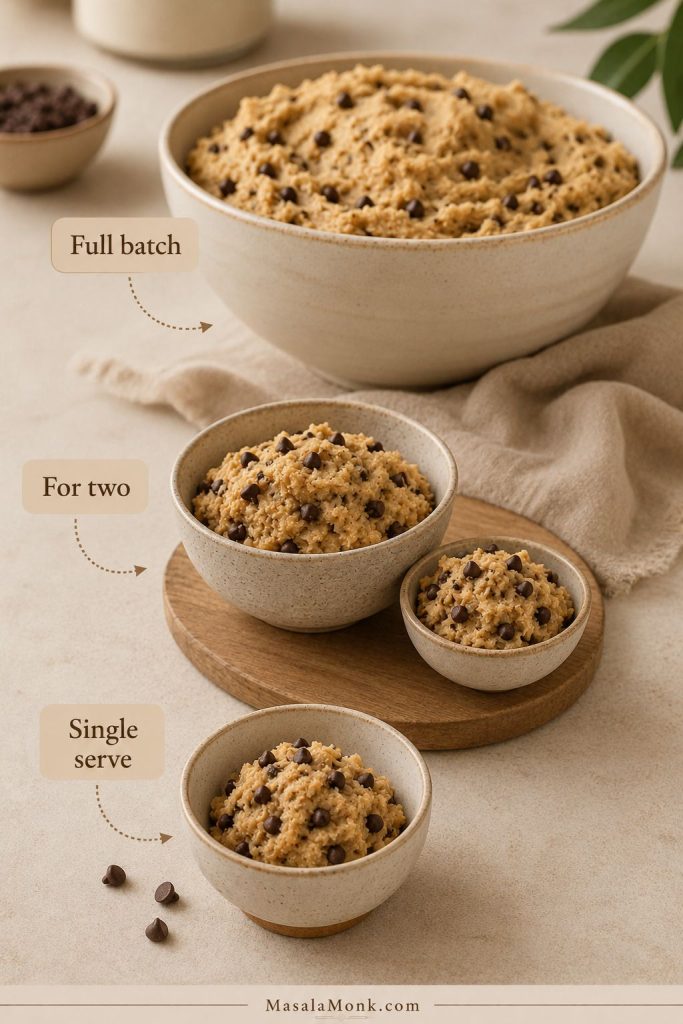
Which Batch Size Should You Make?

Choose the batch based on the kind of cookie dough moment you want. The single-serve version is best for one quick craving, the for-two version is perfect for a small dessert, and the full edible cookie dough recipe works better when you want cookie dough bites, ice cream mix-ins, dessert cups, or a make-ahead treat in the fridge.

Three edible cookie dough portion sizes are shown, representing single serve, for two, and full batch amounts.
Batch size changes the experience as much as flavor does: a single serve suits one craving, a for-two version feels more dessert-like, while a full batch works better for bites or mix-ins.
Make This Best For Texture Tip
Single serve One craving, no leftovers Add milk slowly because small bowls loosen fast.
For two Movie night, date night, small dessert Rest 10 minutes before eating for a smoother bite.
Full batch Cookie dough bites, dessert cups, ice cream mix-ins Chill before rolling or portioning.

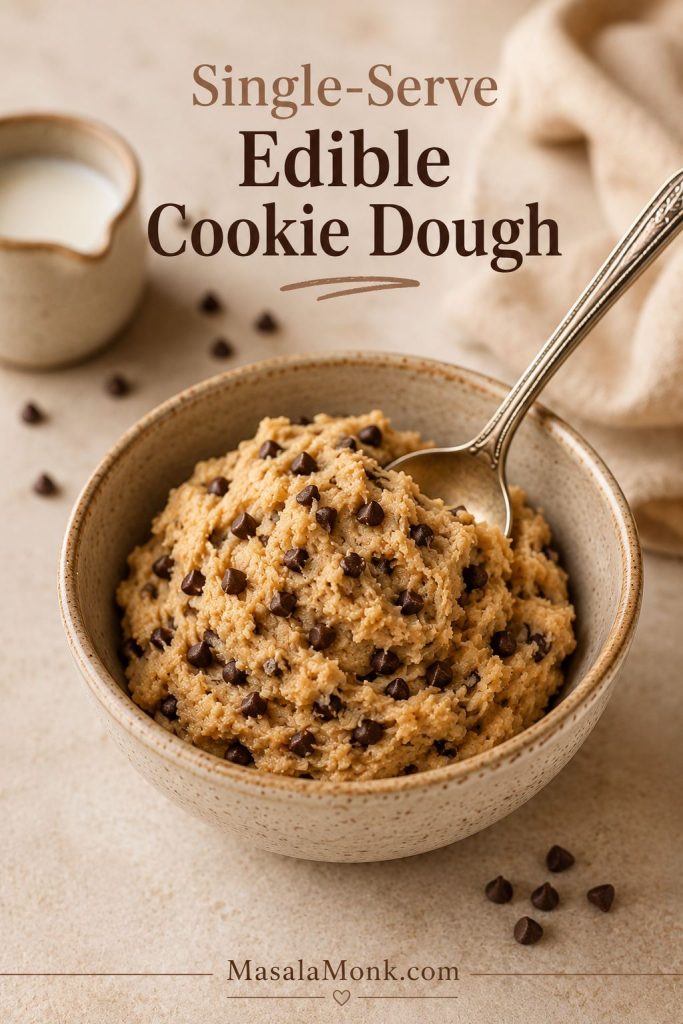
The single-serve version is the bowl to make when you want cookie dough now and do not want leftovers calling your name from the fridge. Because the batch is small, measure the flour and milk carefully; a tiny extra splash can change the texture quickly.

Single-serve edible cookie dough in a small bowl with mini chocolate chips and a spoon.
Choose the single-serve bowl when you want cookie dough for one and nothing left over, but add milk carefully because small batches loosen faster than larger ones.

Single-Serve Formula

  • 6 tablespoons / 48g ready-to-eat flour, preferred; or flour handled using the safety note above
  • 2 tablespoons / 28g / 1 oz softened butter
  • 2 tablespoons / 25–28g light brown sugar
  • 1 tablespoon / 12g granulated sugar
  • ¼–½ teaspoon vanilla extract
  • Small pinch of fine salt
  • ½–1 tablespoon / 7–15ml milk or cream
  • 2 tablespoons / 20–25g mini chocolate chips

Mix it the same way as the main batch: cream the softened butter and sugars, add vanilla and salt, stir in the flour, loosen with milk, and fold in the chips. If you want a firmer scoop, chill it for 10 minutes before eating.

This small-batch version makes enough for two dessert portions without leaving a full container in the fridge. That size works especially well for a movie night, date night, or quick no-bake dessert when you want something sweet without baking a tray of cookies.

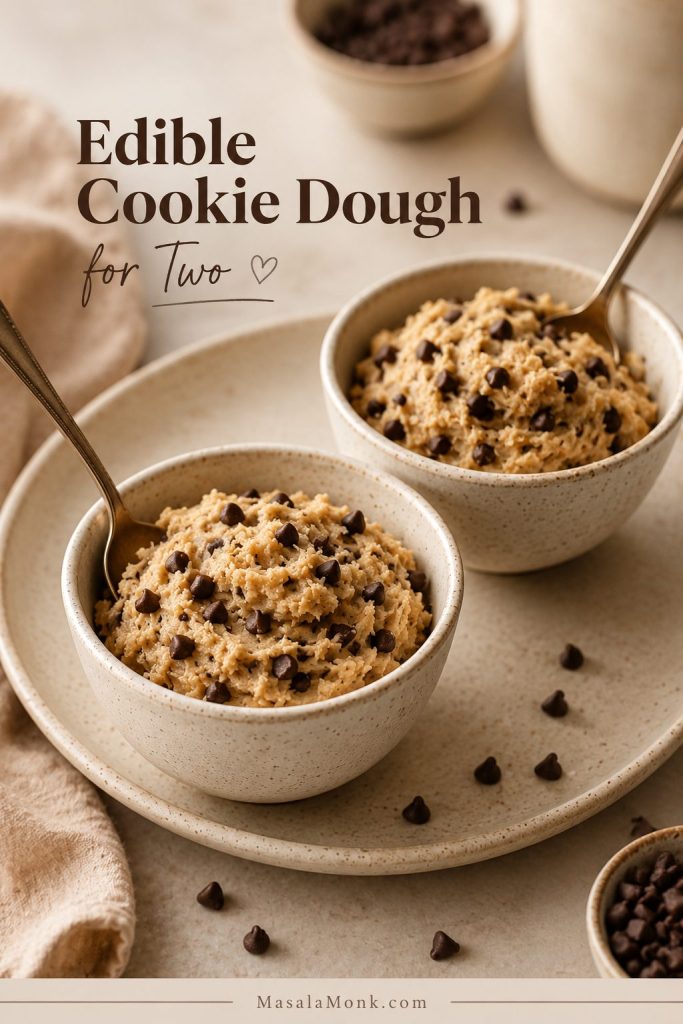
Two small bowls of edible cookie dough with spoons, arranged as a dessert for two.
This small batch is a practical middle ground: enough for a shared dessert, yet still easy to mix without committing to a full container in the fridge.

For-Two Formula

  • ½ cup + 1 tablespoon / about 68g ready-to-eat flour, preferred; or flour handled using the safety note above
  • 4 tablespoons / 56g / 2 oz softened butter
  • ¼ cup / 50–55g light brown sugar
  • 1½–2 tablespoons / 18–25g granulated sugar
  • ½–1 teaspoon vanilla extract
  • ⅛–¼ teaspoon fine salt
  • 1–1½ tablespoons / 15–22ml milk or cream
  • ¼ cup / 40–45g mini chocolate chips

Start with the lower amount of milk, then add more only if the mixture feels too thick. Small batches can go from crumbly to loose quickly, so adjust slowly and give the bowl a minute before adding another splash.

Edible Cookie Dough Variations

Once the base is right, the dough is easy to customize. Keep the same safety logic: no raw eggs, avoid regular raw flour, and adjust the texture slowly because different add-ins change how soft or thick the mixture feels.

Not sure where to start? Make the classic chocolate chip version first, then decide what you want more of next time: extra vanilla, more chocolate, a salty peanut butter edge, a firmer bite for rolling, or a lighter dairy-free version.

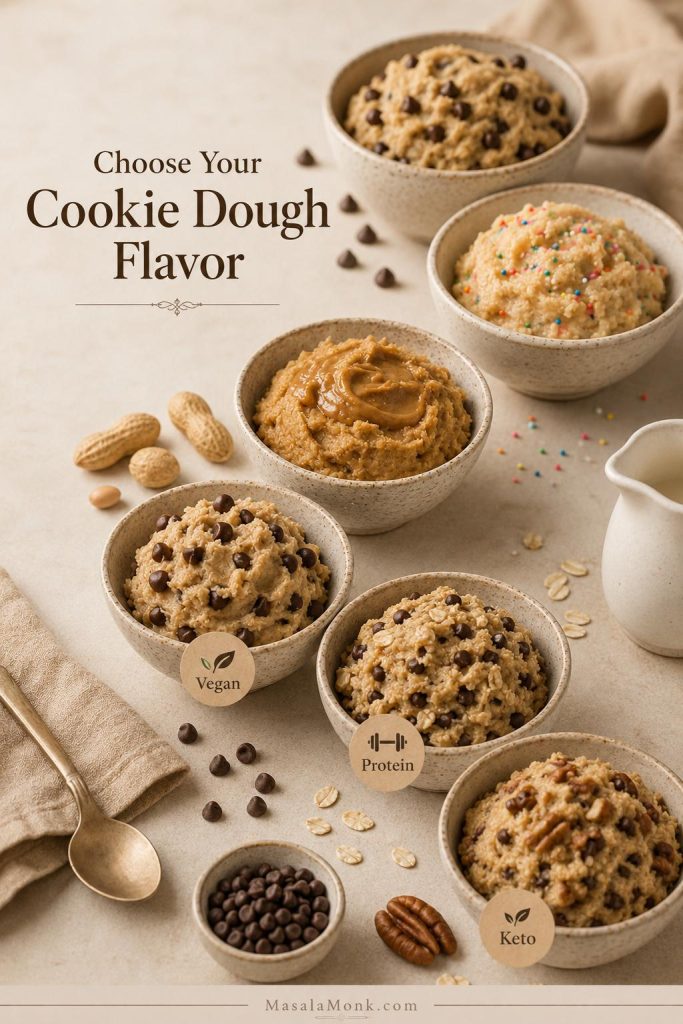
Variation guide showing several edible cookie dough styles, including chocolate chip, peanut butter, vegan, protein, keto, and sprinkle-topped options.
Once the base recipe feels right, use the variations to choose your next direction, whether that means sweeter, nuttier, dairy-free, higher-protein, or lower-carb.
If You Want… Make This Variation Small Adjustment
Classic chocolate chip flavor Chocolate chip edible cookie dough Use mostly brown sugar and mini chips.
A sweeter bakery-style bowl Sugar cookie dough Use more granulated sugar and add sprinkles at the end.
A richer, saltier bite Peanut butter cookie dough Add creamy peanut butter and reduce the milk slightly.
A firmer bite for rolling Cookie dough bites Chill before scooping or dipping.
A lighter dairy-free option Vegan edible cookie dough Use vegan butter, dairy-free milk, and dairy-free chips.

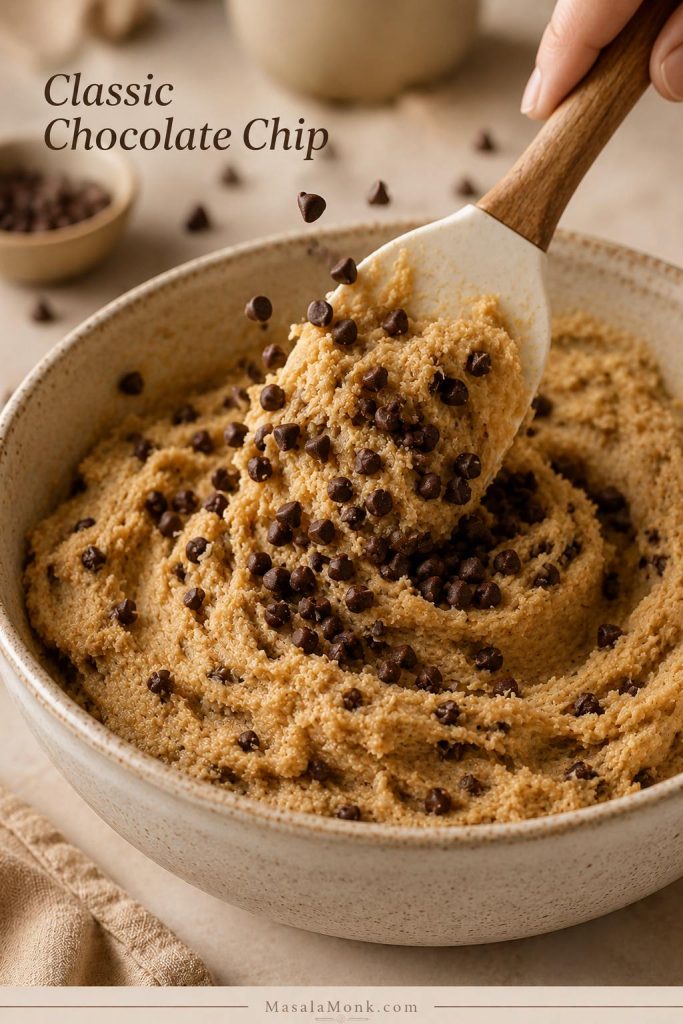
Start here if you want the classic chocolate chip version. Brown sugar, vanilla, salt, softened butter, and mini chocolate chips give you the familiar cookie dough flavor without needing to bake anything.

Mini chocolate chips are being folded into edible cookie dough with a spatula.
Classic chocolate chip remains the best place to start, since brown sugar, vanilla, and mini chips come closest to the flavor most people expect from cookie dough.

For deeper chocolate flavor, add 1 to 2 tablespoons of cocoa powder and a splash more milk. For a chunkier bowl, use a mix of mini chips and finely chopped chocolate.

Choose this variation when you want the vanilla-sprinkle side of cookie dough instead of the brown-sugar chocolate chip side. It tastes lighter, sweeter, and more bakery-style.

Use more granulated sugar and less brown sugar. You can replace the brown sugar with granulated sugar for a cleaner vanilla flavor, then add a tiny splash of almond extract if you like bakery-style sugar cookies. Sprinkles, white chocolate chips, and a little extra vanilla work well here. Add sprinkles at the end so they do not bleed too much color into the dough.

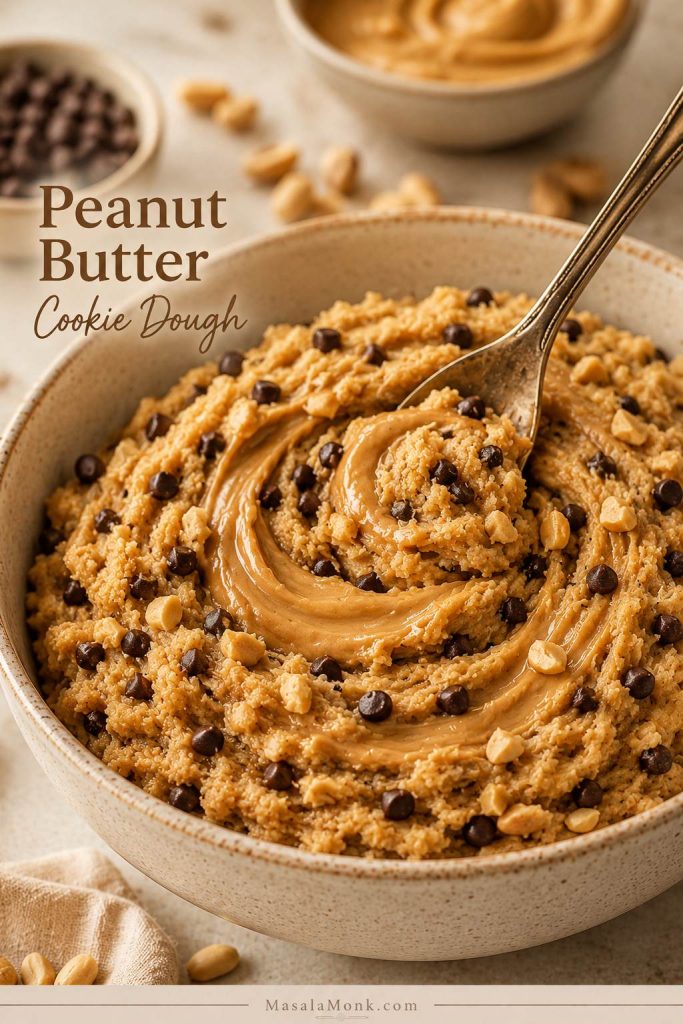
This is the richer, saltier variation — the one that tastes like peanut butter cookie dough met chocolate chip cookie dough in the same bowl. Mix ¼ cup creamy peanut butter into the butter and sugar mixture, then reduce the milk slightly. Peanut butter adds richness and salt, so taste before adding extra salt.

Peanut butter is swirled into edible cookie dough with chocolate chips and chopped peanuts visible on top.
Meanwhile, the peanut butter version turns richer and slightly firmer, so it is a smart choice when you want a saltier edge and a more substantial bite.

Mini chocolate chips are great here, but chopped roasted peanuts also work if you want crunch. For a baked version of this flavor, MasalaMonk’s peanut butter cookies are the better route.

For a gluten-free version, use a gluten-free flour blend you already like in no-bake or raw-style applications. Different blends behave differently when they are not baked, so texture matters more than usual here.

If the dough tastes gummy, try a gum-free gluten-free blend next time. If it tastes grainy, let it rest for 10 to 15 minutes before serving. Almond flour can also work, but it gives a softer, nuttier dough rather than a classic all-purpose-flour texture.

To make the dough vegan or dairy-free, use vegan butter, dairy-free milk, and dairy-free chocolate chips. The same method works, but the mixture may soften faster depending on the vegan butter you use.

Vegan edible cookie dough in a bowl with dairy-free milk and chocolate chips shown nearby.
The dairy-free version should still feel like dessert first: creamy, scoopable, and close to the original texture, just made with vegan butter, dairy-free milk, and dairy-free chips.

If you want a dairy-free frozen dessert to pair with cookie dough bites, MasalaMonk’s coconut ice cream is a natural next recipe.

The protein version goes in a different direction from the classic butter-and-brown-sugar dough, but it is useful when you want the cookie dough idea in a higher-protein snack. For a quick version, blend cottage cheese until completely smooth, then stir it with almond flour or oat flour, vanilla protein powder, a little maple syrup or sweetener, vanilla, salt, and mini chocolate chips.

A bowl of protein-style edible cookie dough with mini chocolate chips, a scoop of protein powder, and a small bowl of creamy white protein base nearby.
Protein cookie dough goes in a different direction from the classic bowl; still, it can be useful when you want the same dessert idea in a more filling, snack-like version.

Chill it before eating so the texture firms up. If you like high-protein desserts, MasalaMonk’s protein ice cream goes deeper into protein powder, Greek yogurt, dairy-free, low-calorie, and sugar-free frozen dessert options.

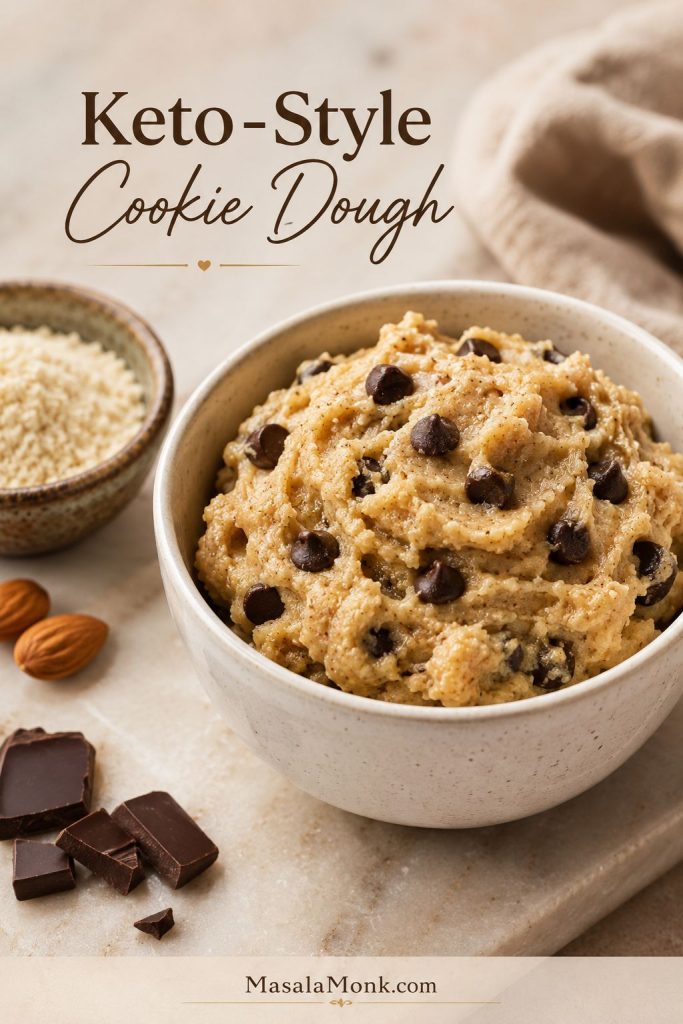
Expect a nuttier, softer dough than the classic chocolate chip version. For a keto-style bowl, use almond flour instead of wheat flour, a low-carb sweetener instead of sugar, and sugar-free chocolate chips. Because almond flour has more fat and less starch than all-purpose flour, start with less added milk and adjust slowly.

Keto-style edible cookie dough in a bowl with almond flour, almonds, and dark chocolate pieces nearby.
Because almond flour behaves differently from all-purpose flour, keto edible cookie dough usually turns out softer and nuttier, with a flavor that feels less classic but still satisfying.

For another low-carb dessert direction, MasalaMonk’s keto hot chocolate is a good companion recipe.

How to Fix Edible Cookie Dough Texture

If your first spoonful is not perfect, do not panic. Edible cookie dough is one of the easiest desserts to adjust because nothing has been baked yet. Most texture problems come down to flour, butter temperature, or adding the milk too quickly.

The easiest way to fix the dough is to change only one thing at a time. Add milk slowly, chill before adding more flour, and taste again after a short rest.

Three bowls compare edible cookie dough textures labeled dry, just right, and too soft.
Look at the texture before changing the recipe: crumbly dough needs slow moisture, loose dough needs chilling, and the best bowl sits somewhere in between.
Problem Likely Cause Fix
Dry or crumbly texture Too much flour, packed flour, or not enough milk Add milk or cream 1 teaspoon at a time until scoopable.
Sticky dough Butter too warm or too much milk Chill 15–20 minutes, or add 1 tablespoon sifted flour.
Gritty bite Sugar has not softened into the butter enough Cream the butter and sugars longer, or let the dough rest 10 minutes.
Floury flavor Flour was overmeasured or not sifted after heating Use grams, sift after heating, and add a little vanilla or salt to balance.
Overly sweet dough Too much sugar or too many chips Add a pinch of salt and 1–2 tablespoons flour.
Greasy or soupy texture Butter was melted instead of softened Chill, then stir. Next time, use softened butter.
Very firm after chilling Butter hardened in the fridge Let the dough sit at room temperature for 10–15 minutes before serving.

Start with a teaspoon of milk or cream, then stir before adding more. Small corrections work better here because dry dough can move from crumbly to loose surprisingly quickly.

A teaspoon of milk is being added to dry, crumbly edible cookie dough to improve the texture.
If the dough turns dry or crumbly, fix it gradually rather than all at once; a teaspoon of milk or cream is usually enough to start bringing it back together.

Chill first so the butter firms up before you add more flour. After a short rest in the fridge, the same bowl often becomes scoopable without turning heavy or floury.

Soft edible cookie dough is shown with a fridge cue, illustrating chilling as a fix for sticky dough.
Chilling gives the butter time to firm up again; as a result, soft dough often becomes scoopable without needing extra flour.

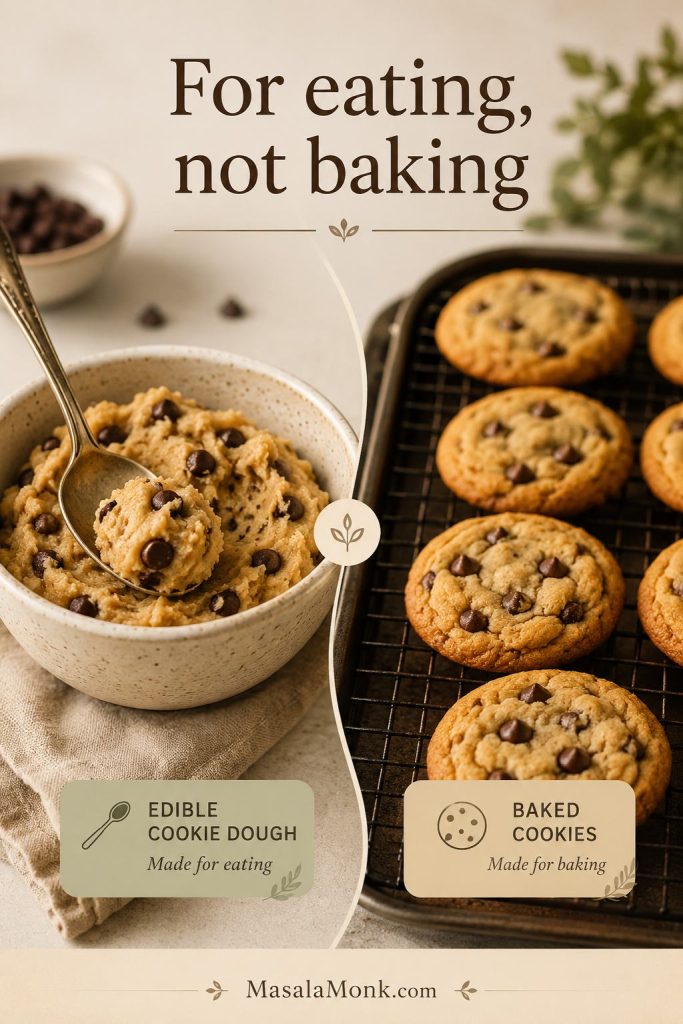
No, this edible cookie dough is made for spooning, scooping, and rolling into bites — not for baking. It has no eggs and no leavening, so it will not behave like regular cookie dough in the oven. Instead of turning into chewy cookies, it may spread, turn greasy, stay dense, or bake up flat.

Edible cookie dough in a bowl is shown beside baked cookies on a tray to compare dough for eating with dough for baking.
Edible cookie dough is made for spooning and scooping, not for baking; therefore, use a proper cookie recipe whenever the goal is warm cookies from the oven.

Think of this as a no-bake dessert, not a shortcut cookie dough. If the craving is really for warm cookies from the oven, use a recipe designed for baking, like MasalaMonk’s double chocolate chip cookies. If you want a roll-and-cut dough, MasalaMonk’s gingerbread cookies are a better example of dough built for shaping and baking.

Eating it by the spoonful is the obvious answer, but this dough can do more. Because it is eggless and made with a safer flour approach, you can use it as a no-bake dessert component instead of treating it like leftover raw cookie dough.

Easy No-Bake Ways to Serve It

  • Eat it by the spoonful after a 10-minute rest for smoother texture.
  • Roll it into bites and chill until firm.
  • Dip the bites in melted chocolate and finish with flaky salt.
  • Fold chilled pieces into ice cream for homemade cookie dough ice cream.
  • Blend a spoonful into a milkshake for cookie dough flavor.
  • Use it as a brownie topping after brownies have cooled.
  • Layer it into dessert cups with whipped cream, chocolate sauce, or berries.
  • Press it into mini tart shells for a no-bake cookie dough dessert.
Several ways to use edible cookie dough are shown, including bites, ice cream mix-ins, milkshake, brownie topping, and dessert cups.
Beyond the spoonful, this dough can become bites, brownie topping, milkshake flavor, or ice cream mix-ins, so one batch can stretch into several no-bake dessert ideas.

Cookie Dough Ice Cream and Mix-In Safety

Ice cream note: only use dough made with ready-to-eat ingredients for ice cream mix-ins. Do not fold regular raw cookie dough into ice cream; the pieces should be made without raw eggs and with a safer flour approach.

Small chilled pieces are especially good folded into homemade ice cream. For a chocolate-chip frozen dessert direction, see MasalaMonk’s mint chocolate chip ice cream.

If you want another no-bake spoonable dessert, MasalaMonk’s avocado chocolate mousse gives you a chocolate-rich option with a completely different texture.

How to Store and Freeze Edible Cookie Dough

Because the dough contains butter and milk or cream, it should be stored cold. Do not leave it sitting out for long serving windows, especially in a warm kitchen.

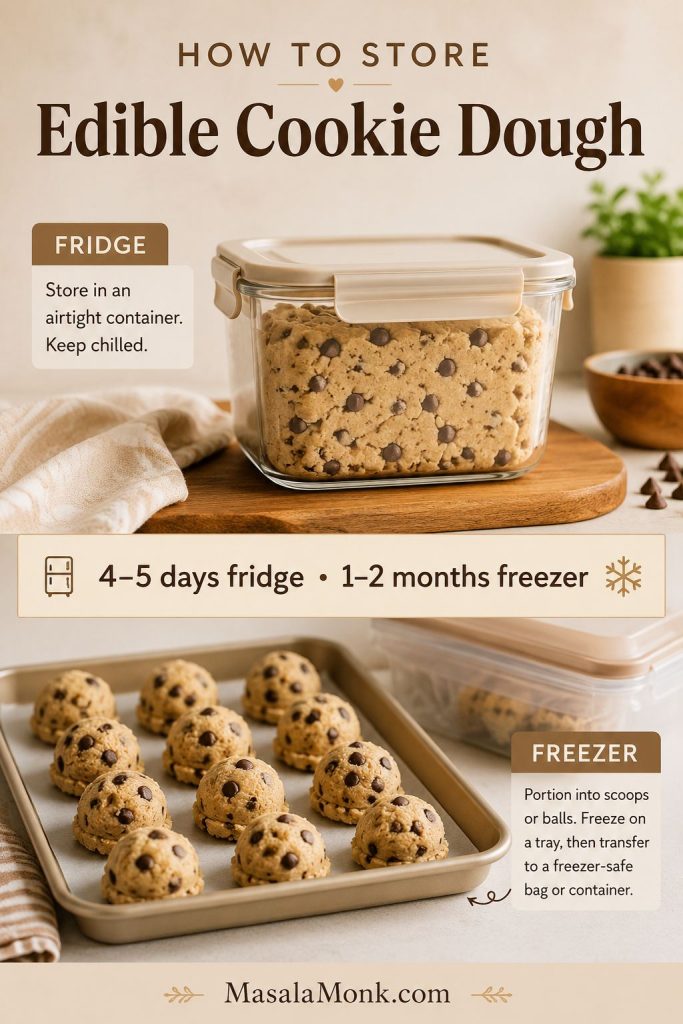
  • Refrigerator: Store in an airtight container for 4–5 days.
  • Freezer: Freeze portioned balls or scoops for 1–2 months.
  • To serve from the fridge: Let it sit at room temperature for 10 minutes so the butter softens slightly.
  • To freeze neatly: Scoop into balls, freeze on a lined tray until firm, then transfer to a freezer-safe container.
Storage guide for edible cookie dough showing an airtight container for the fridge and portioned scoops for the freezer, with timing notes.
Cold storage firms the butter, so let refrigerated scoops rest briefly before serving; meanwhile, freezing in portions makes later dessert bowls much easier.

If you are making cookie dough bites for a party, keep them chilled until close to serving time. For the best texture, portion them small enough that people can eat them in one or two bites.

Protein versions made with cottage cheese or yogurt should be treated as more perishable. Keep them refrigerated, use clean utensils, and aim to eat them within 2–3 days rather than keeping them as long as the classic butter-based version.

FAQs

Is this edible cookie dough recipe safe to eat?

Edible cookie dough is safest when it is made without raw eggs and with commercially heat-treated flour labeled ready-to-eat. Regular raw cookie dough is not meant to be eaten because it usually contains raw flour and raw eggs. Home flour-heating methods are common in recipes, but they are not the same as commercially validated heat treatment.

What is the safest flour for edible cookie dough?

The safest flour choice is commercially heat-treated flour labeled ready-to-eat. Regular all-purpose flour is raw and is normally made safe through baking or cooking, not by being stirred directly into a no-bake dessert.

Why does edible cookie dough need safer flour handling?

Most flour is raw and has not been treated to kill bacteria. Regular cookie dough becomes safer when baked, but edible cookie dough is not baked. That is why this recipe uses ready-to-eat flour guidance instead of asking you to stir plain raw flour into dessert.

How do I make edible cookie dough without eggs?

This recipe is eggless by design. Eggs are useful in baked cookies, but they are not needed here because the dough is made for spooning, not for going into the oven.

How does almond flour change the texture?

Almond flour makes a softer, nuttier dough and works best in keto, gluten-free, or vegan-style edible cookie dough. It will not taste exactly like classic chocolate chip cookie dough made with all-purpose flour, so start with less milk and adjust slowly.

How do I make this edible cookie dough recipe gluten-free?

Use a gluten-free flour blend you already like in no-bake applications, or use almond flour for a softer variation. If your gluten-free dough feels gummy, try a gum-free blend next time. If it feels grainy, let it rest for 10 to 15 minutes before eating.

How do I make a vegan version?

For a vegan version, use vegan butter, dairy-free milk, and dairy-free chocolate chips. The dough may soften more quickly depending on the vegan butter, so chill it if it feels too loose.

How do I make edible cookie dough for one?

For one serving, use 6 tablespoons / 48g ready-to-eat flour, preferred; or flour handled using the safety note above, plus 2 tablespoons softened butter, 2 tablespoons brown sugar, 1 tablespoon granulated sugar, vanilla, salt, ½ to 1 tablespoon milk, and 2 tablespoons mini chocolate chips. Mix, adjust the texture, and chill briefly if needed.

Why should this dough not be baked?

This dough is made for eating, not baking. It has no eggs and no leavening, so it can bake up flat, greasy, dense, or crumbly. Use a real cookie recipe if you want baked cookies.

How long does edible cookie dough last in the fridge?

Store edible cookie dough in an airtight container in the refrigerator for 4–5 days. Let it sit at room temperature for about 10 minutes before eating if it becomes too firm.

How should you freeze edible cookie dough?

Freezing works best when the dough is portioned first. Scoop it into small balls, freeze them on a lined tray until firm, then move them to a freezer-safe container. Use within 1–2 months for the best texture.

Once you have the base texture right, this edible cookie dough recipe becomes the kind of dessert you can make your own: extra vanilla, darker chocolate, sprinkles, peanut butter, or chilled bite-size scoops tucked into ice cream. Start with the classic chocolate chip version first, then let the next batch follow your craving.

Make a quick note of what you changed — more salt, less milk, extra chips, longer chill time. The best edible cookie dough is the one you can repeat exactly when the craving hits again.

Back to the top

Posted on 2 Comments

Coconut Ice Cream Recipe: Coconut Milk, Coconut Cream, Cream of Coconut and No-Churn Options

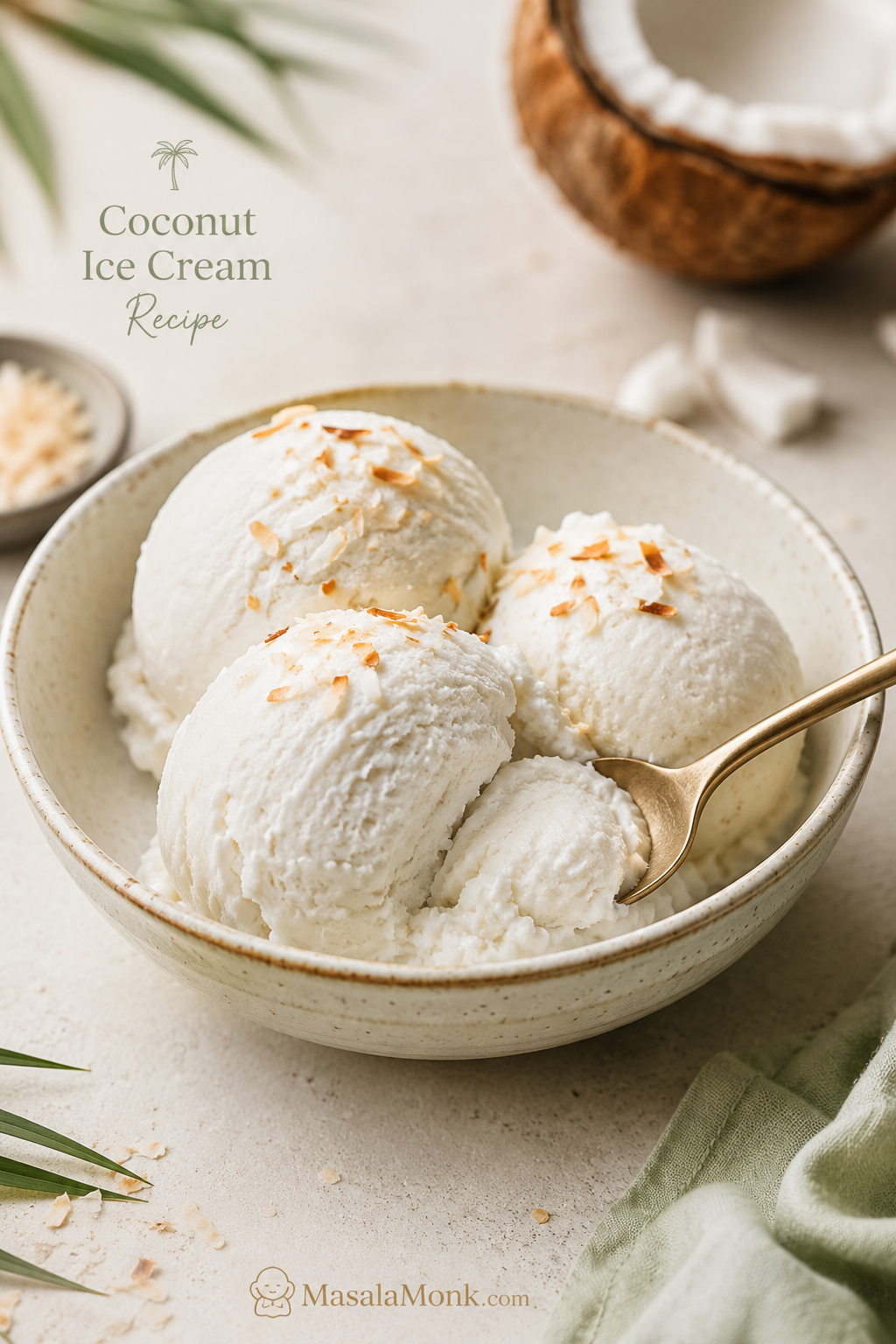
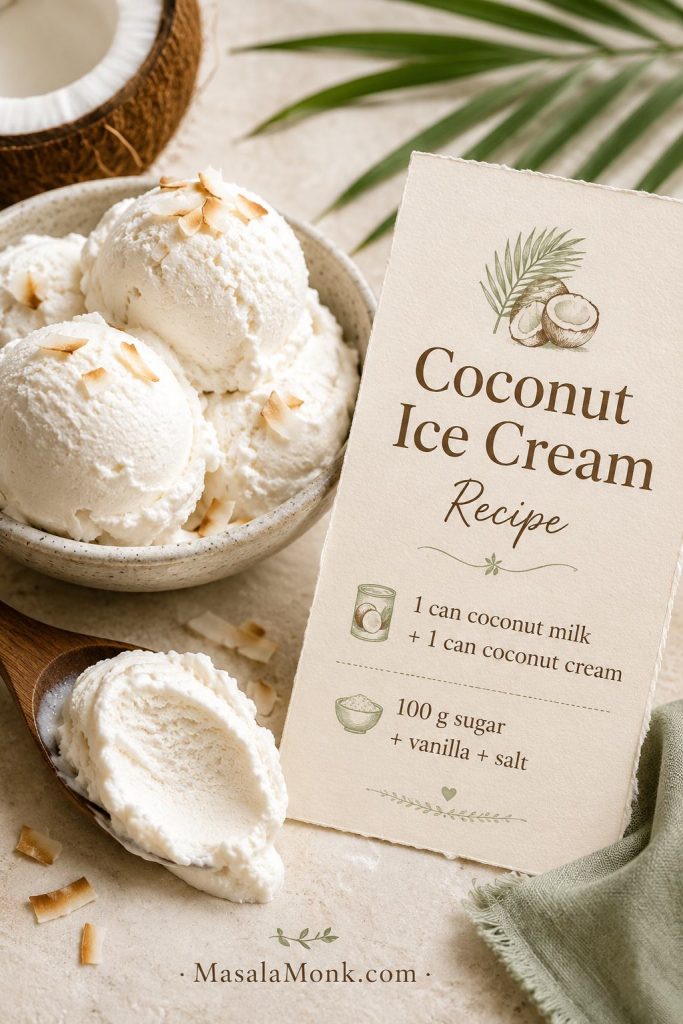
Three scoops of creamy coconut ice cream in a light ceramic bowl with toasted coconut flakes and a spoon cutting into one scoop.

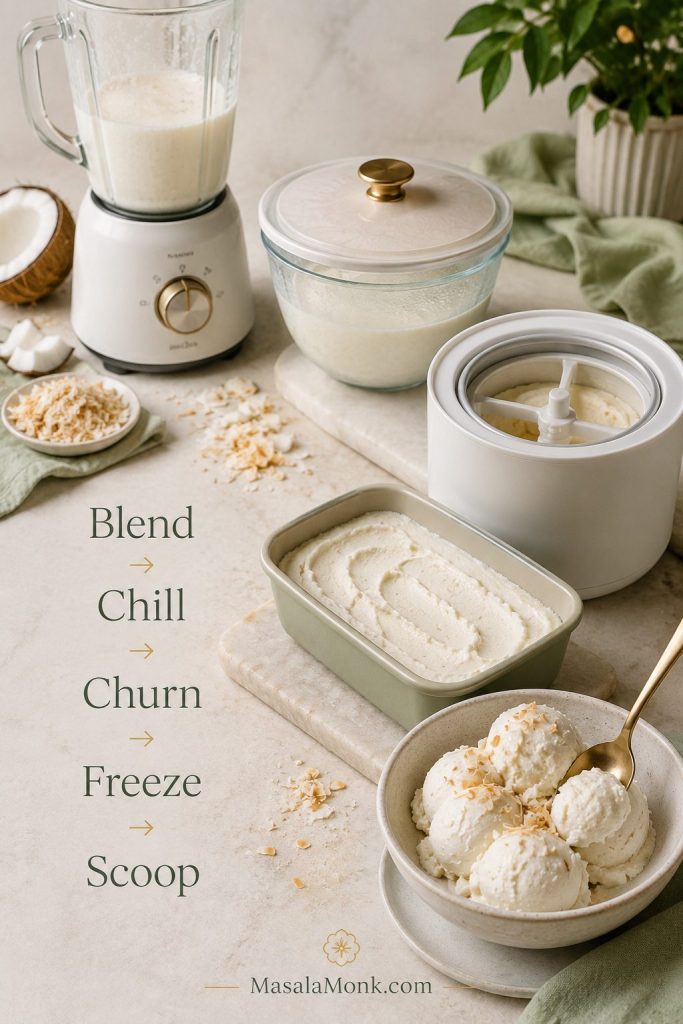
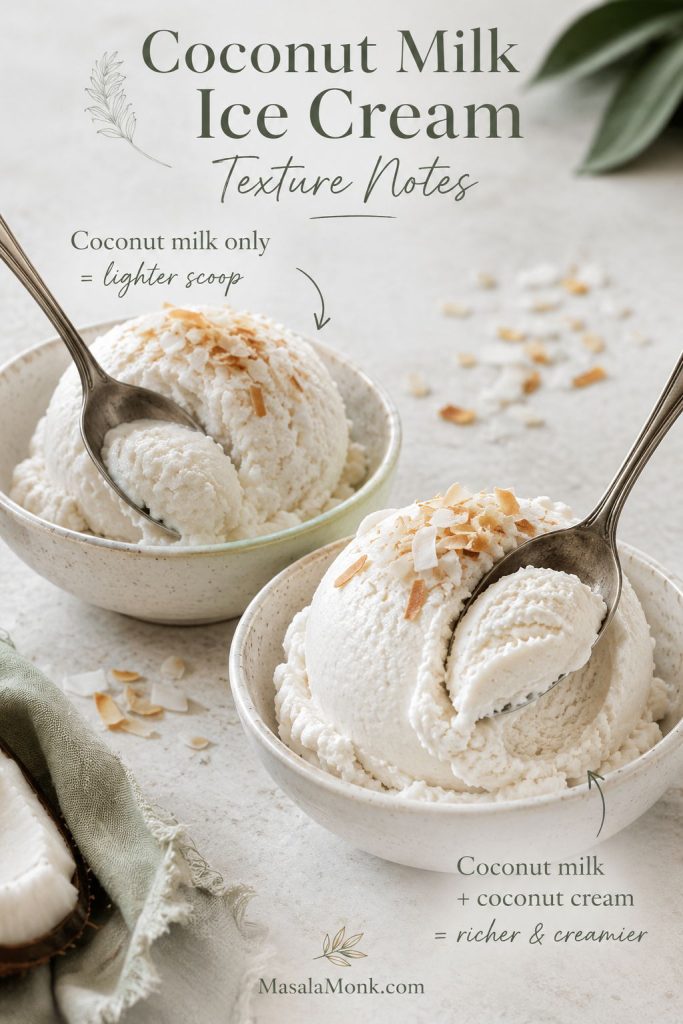
This coconut ice cream recipe is for the kind of scoop that tastes deeply coconutty, creamy, and smooth—not icy, watery, or rock-hard straight from the freezer. The base uses full-fat coconut milk and coconut cream for a rich dairy-free texture, with just enough sugar to keep it soft enough to scoop.

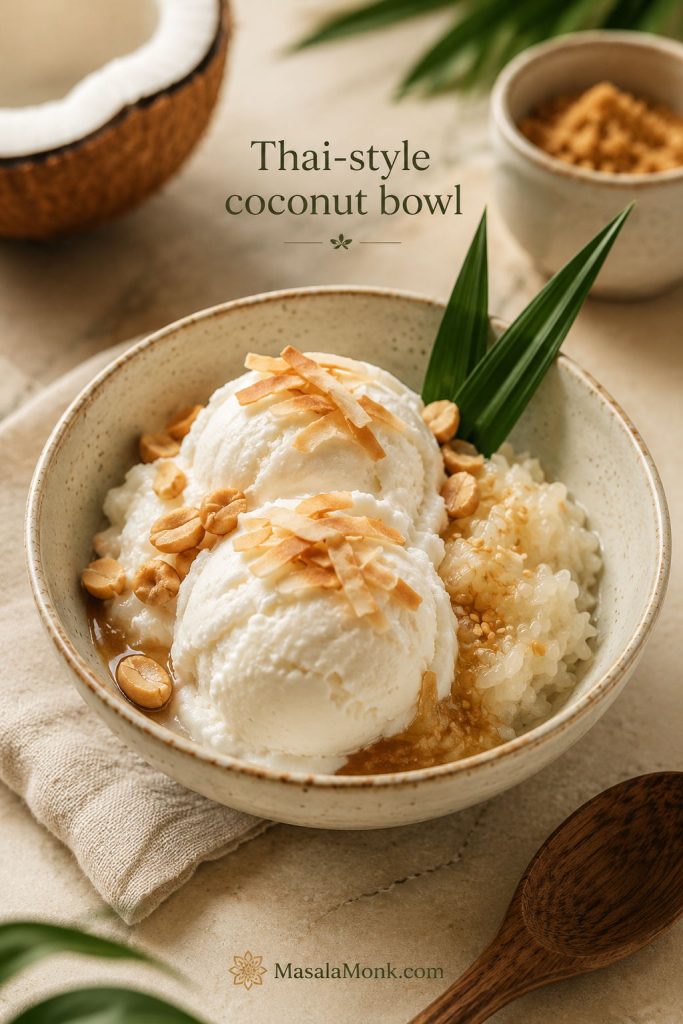
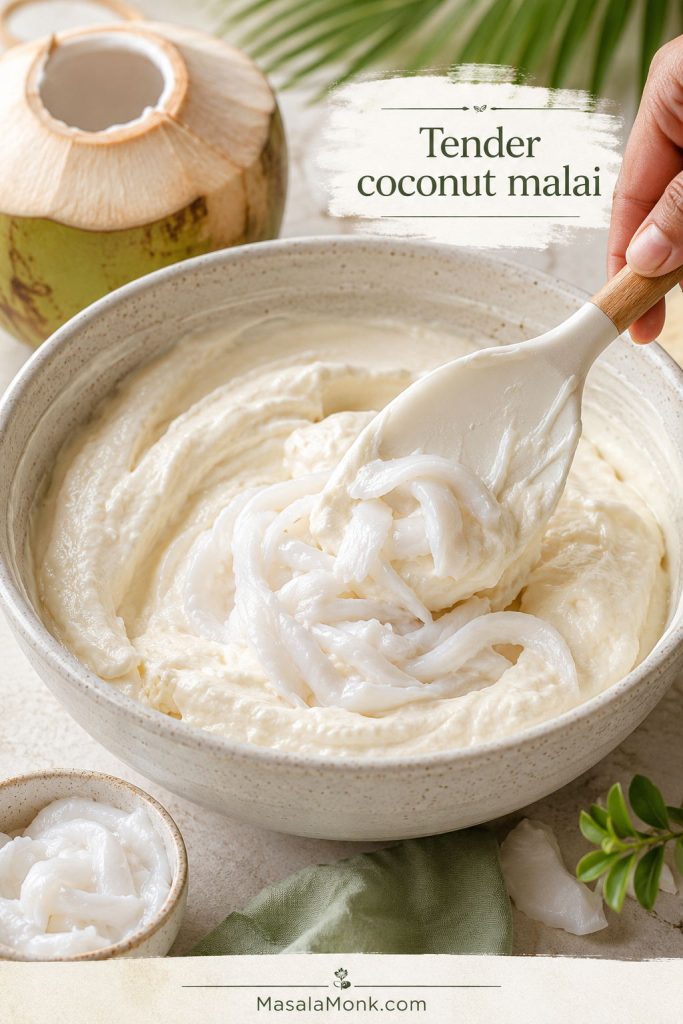
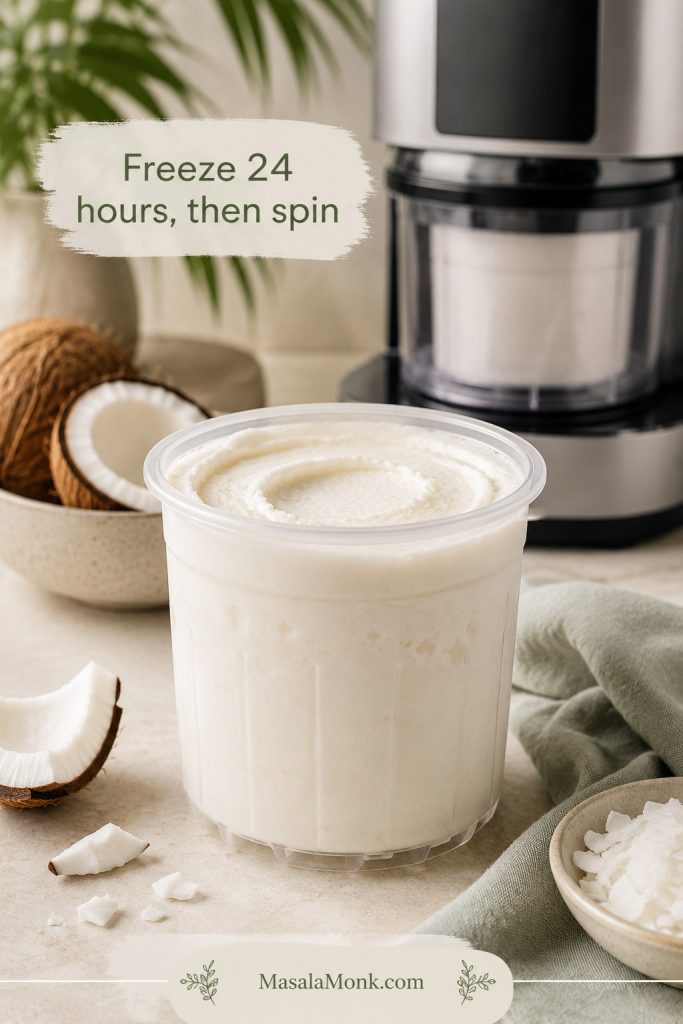
You can churn it for the smoothest, parlor-style finish, or use the no-churn freeze-and-blend method when you do not have an ice cream maker. There is also a sweeter cream of coconut batch, a condensed milk shortcut, Ninja Creami notes, and tender coconut and Thai-style ideas if you want a more tropical bowl.

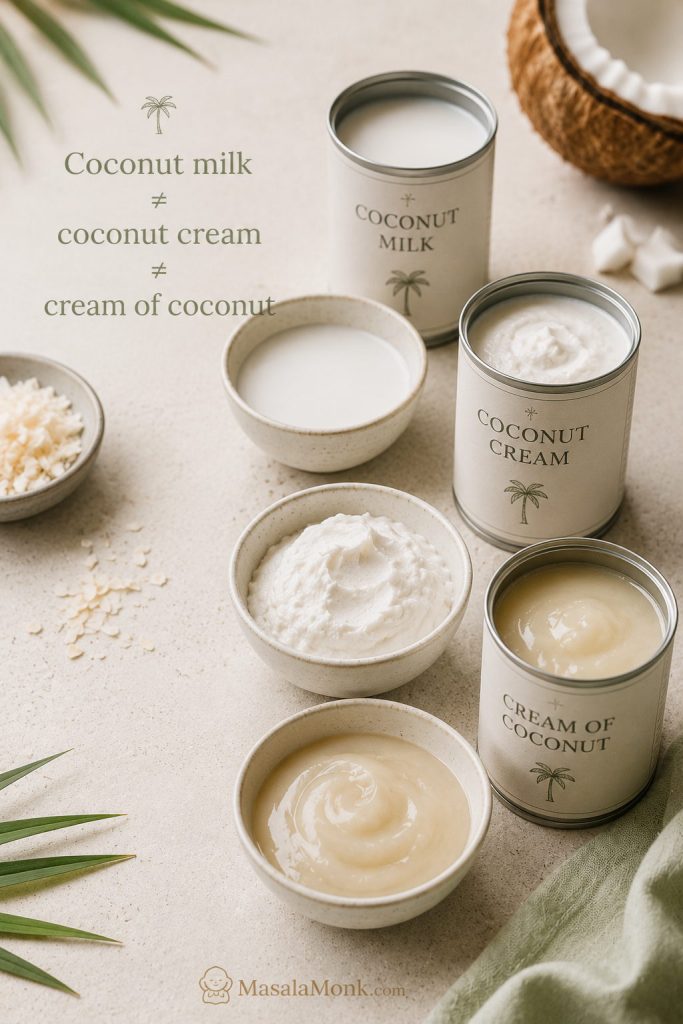
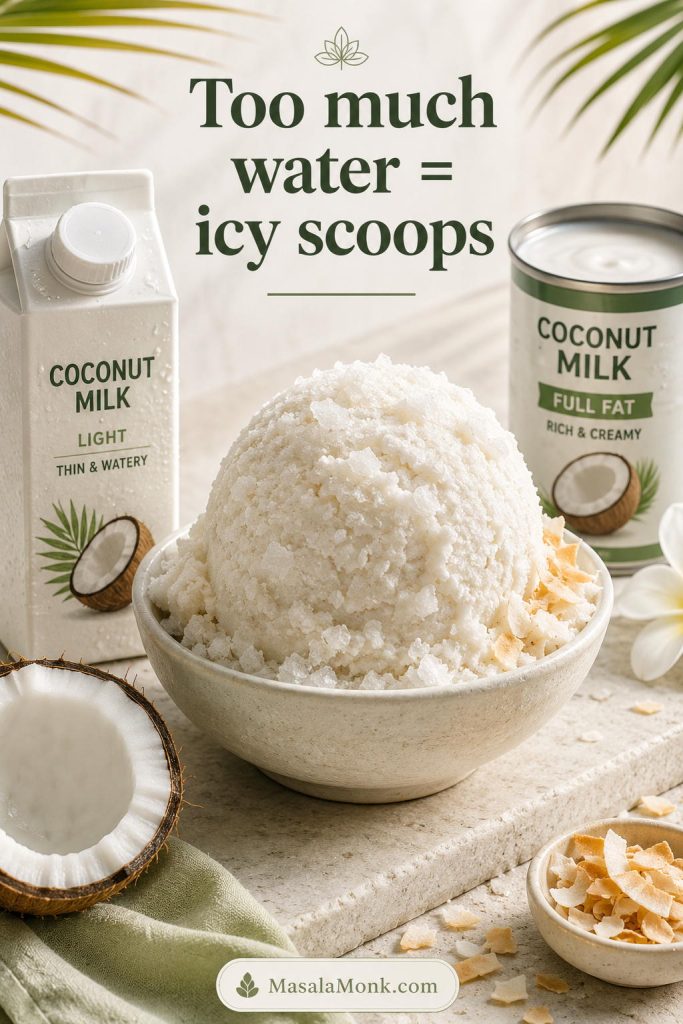
The only part of this coconut ice cream recipe that really needs care is choosing the right coconut product. Coconut milk, coconut cream, and cream of coconut sound similar, but they behave very differently once frozen. Get that part right, and you are already most of the way to a creamy scoop.

Quick Answer: The Best Coconut Ice Cream Recipe

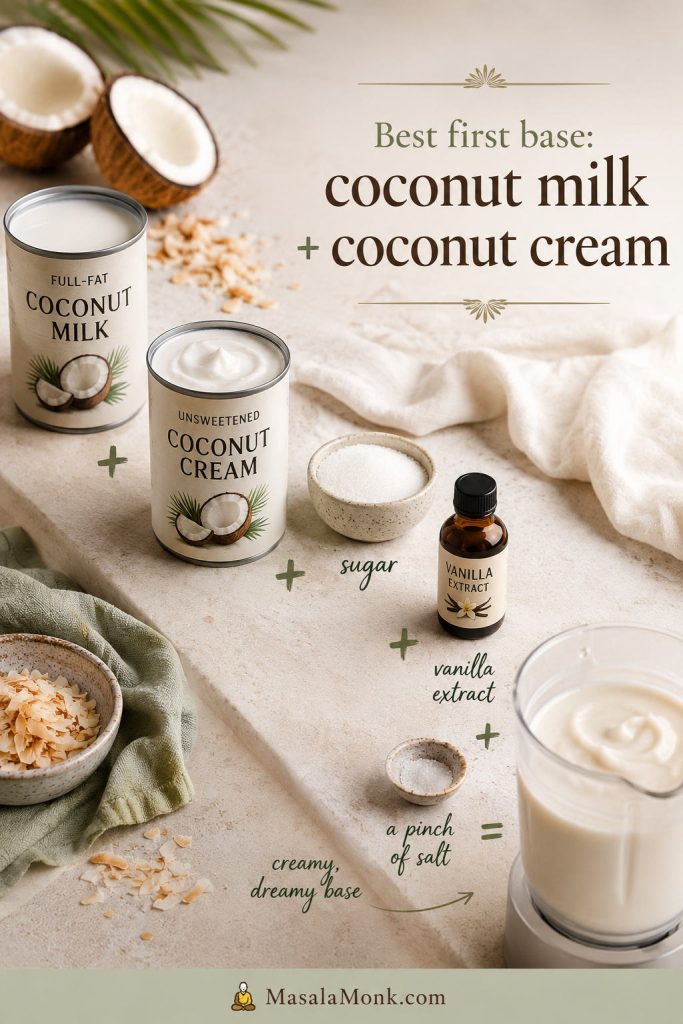
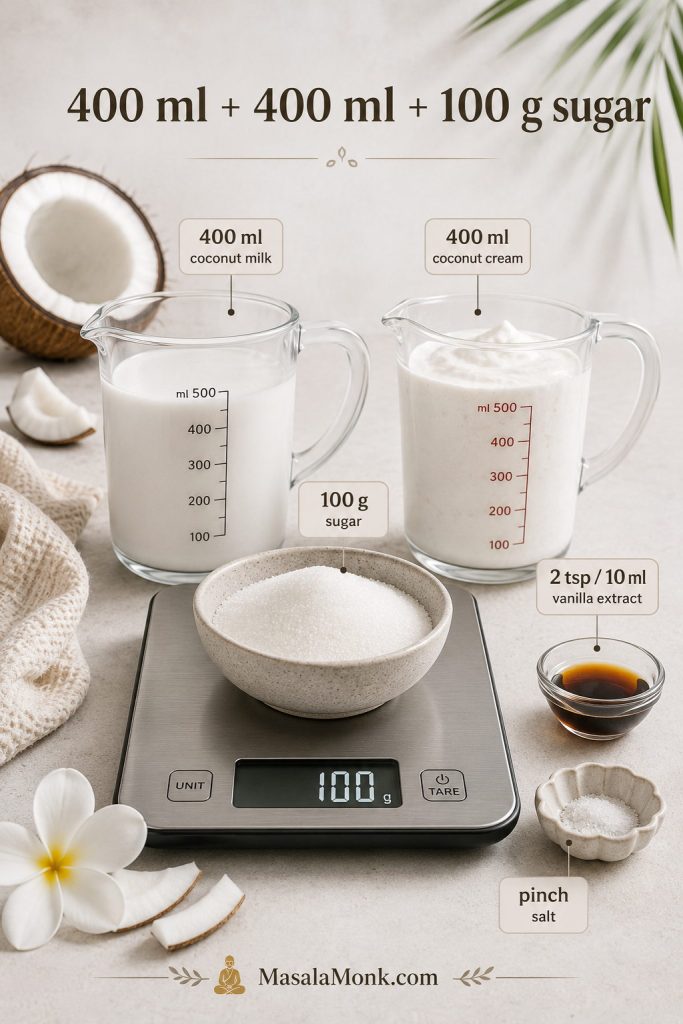
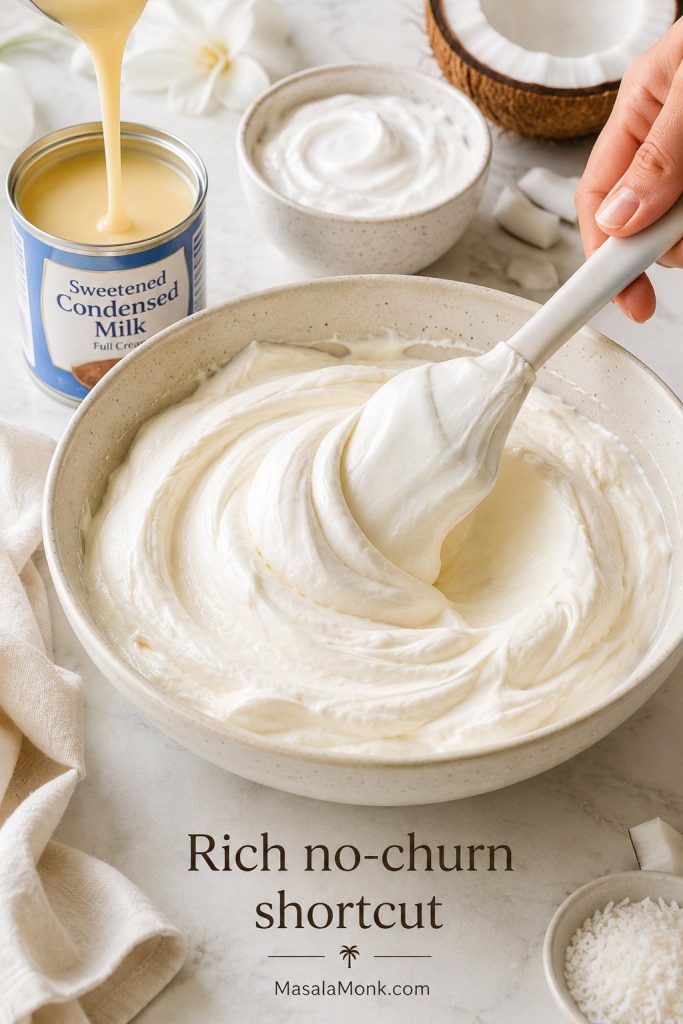
The creamiest dairy-free coconut ice cream starts with 1 can full-fat coconut milk plus 1 can unsweetened coconut cream, blended with sugar, vanilla, and salt. Churn it for the smoothest, parlor-style texture, then freeze until firm. If you do not have an ice cream maker, freeze the base in cubes and blend it until creamy. For a richer dairy-style shortcut, use the condensed milk method below.

Best base 1 can full-fat coconut milk + 1 can unsweetened coconut cream
Best method Ice cream maker for the smoothest texture; freeze-and-blend for no-churn
Texture Creamy, coconut-forward, scoopable after resting briefly
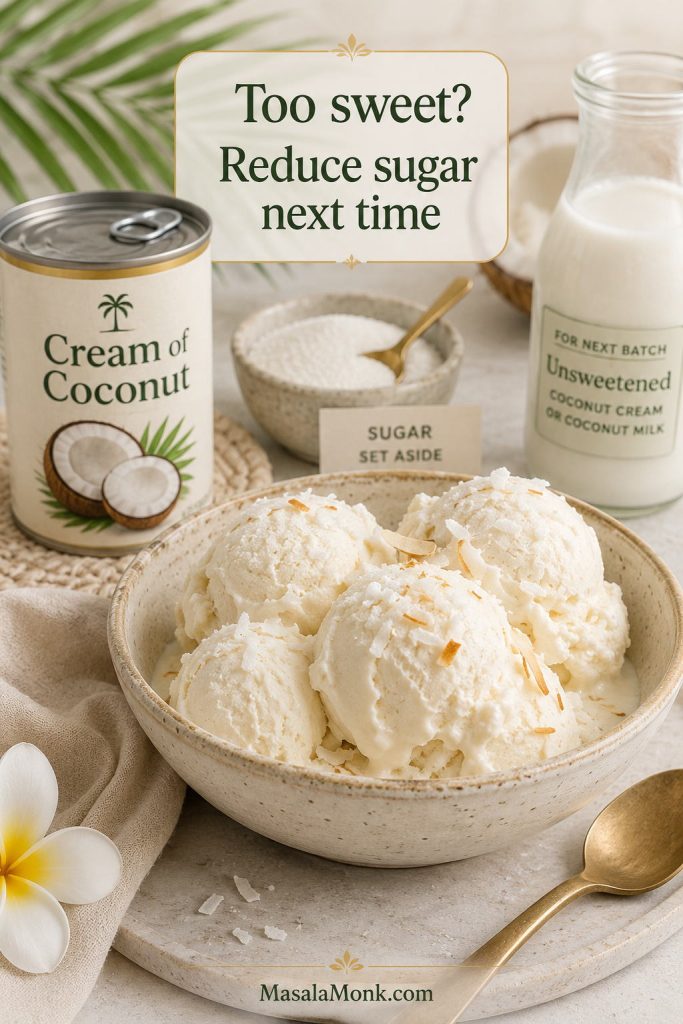
Avoid Thin carton coconut milk, lite coconut milk, and using sweetened cream of coconut without reducing sugar

Still deciding? See coconut milk vs coconut cream vs cream of coconut, or skip straight to the recipe card.

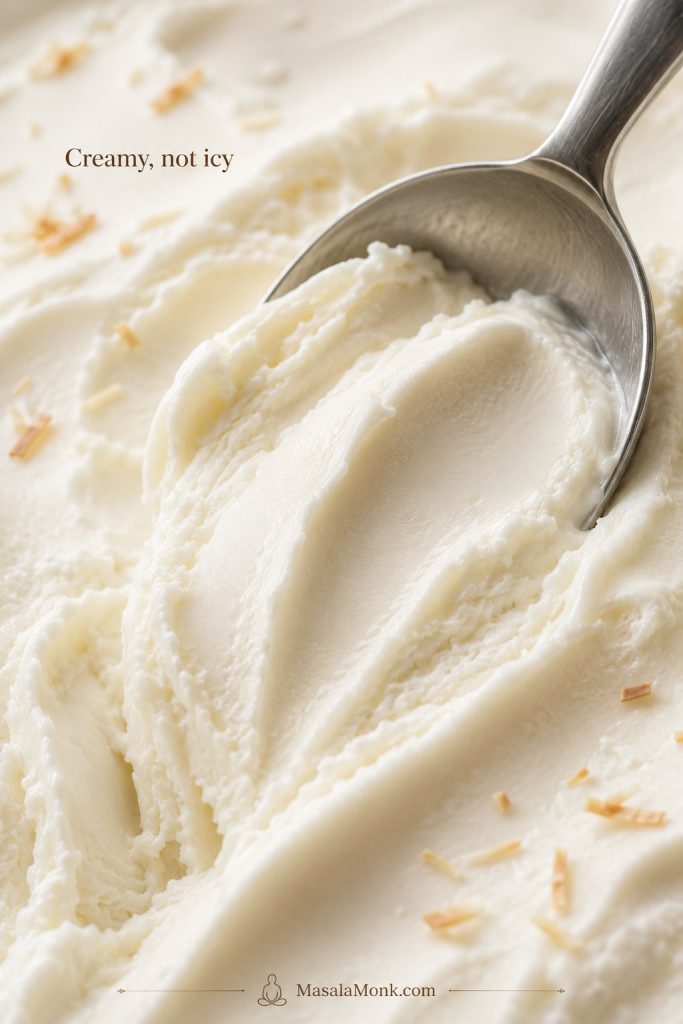
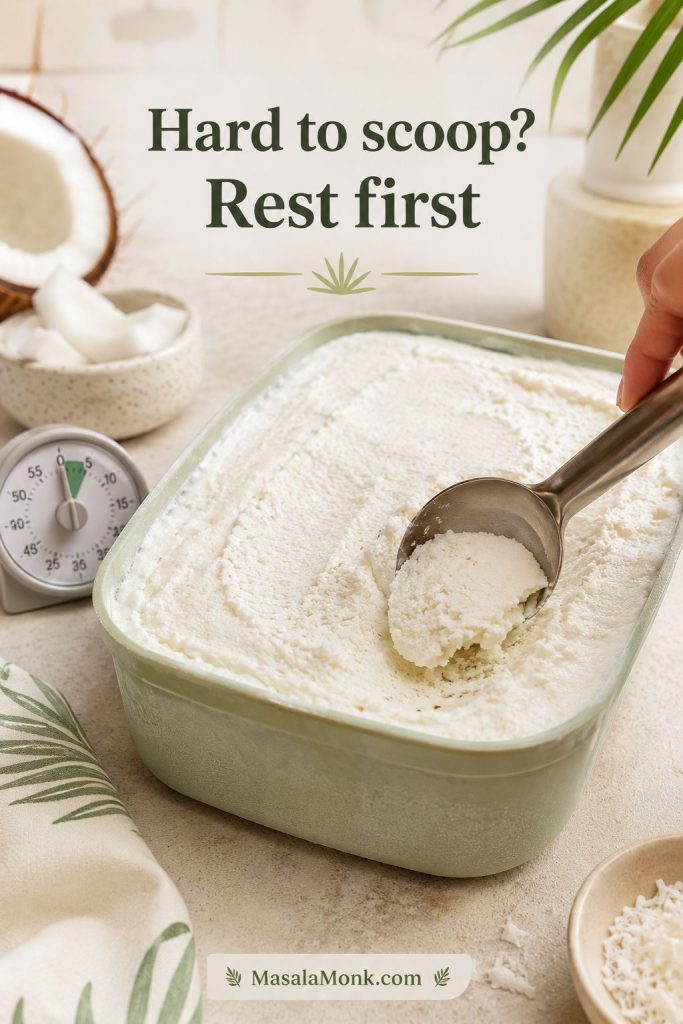
Before you choose a method, look at the texture you are aiming for: smooth, dense, creamy coconut ice cream that drags softly on the spoon instead of breaking into icy crystals.

Close-up of a spoon dragging through smooth coconut ice cream, showing soft creamy ridges and a dense but scoopable texture.
A smooth spoon drag is the texture cue to look for; if the scoop looks brittle or crystalline, the base usually needs better fat balance, chilling, or liquid control.

At a Glance

Yield About 1 quart / 900 ml to 1 liter
Prep time 10 minutes
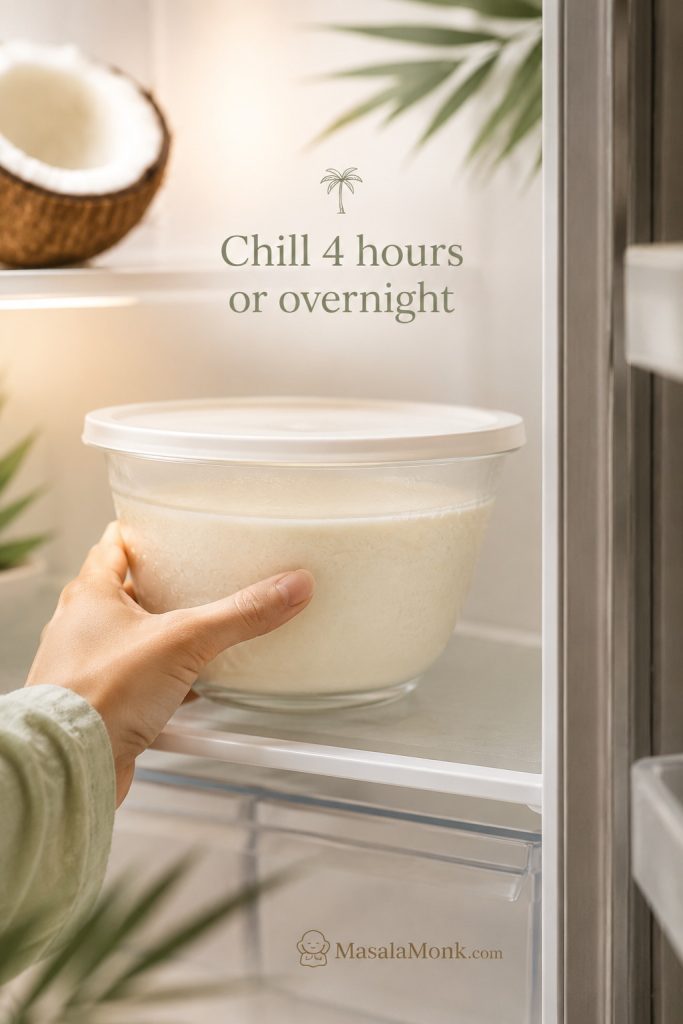
Base chill time At least 4 hours; overnight is better
Churn time 20–30 minutes for most machines
Final freeze 4–6 hours for firm scoops
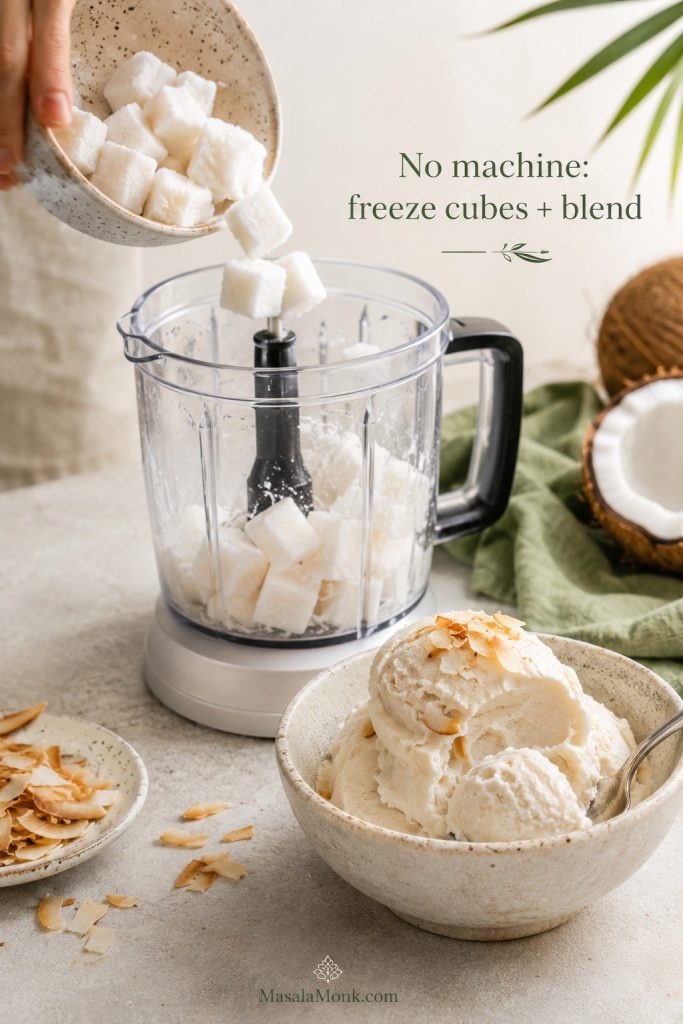
No-machine option Freeze the blended base in ice cube trays, then blend the frozen cubes
Equipment Blender, ice cream maker, freezer-safe container, spatula, measuring cups or scale

Why This Coconut Ice Cream Recipe Works

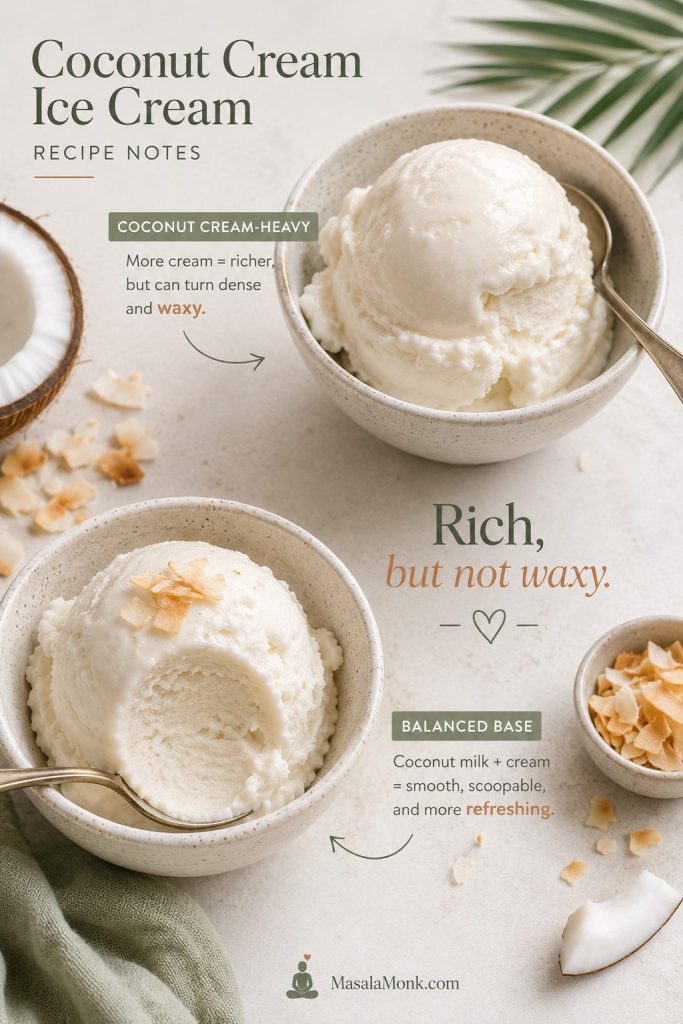
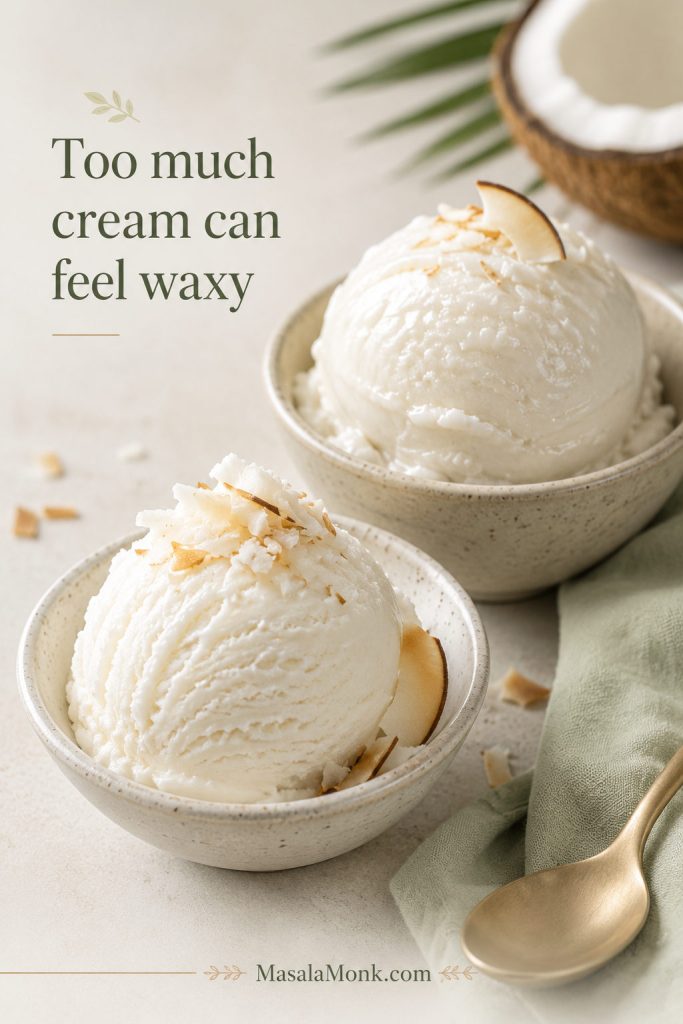
This coconut ice cream recipe works because it balances coconut flavor, fat, sugar, and temperature instead of relying on coconut milk alone. Because of that, the goal is a scoop that tastes rich and coconut-forward, but still feels smooth on the spoon—not icy, brittle, greasy, or waxy.

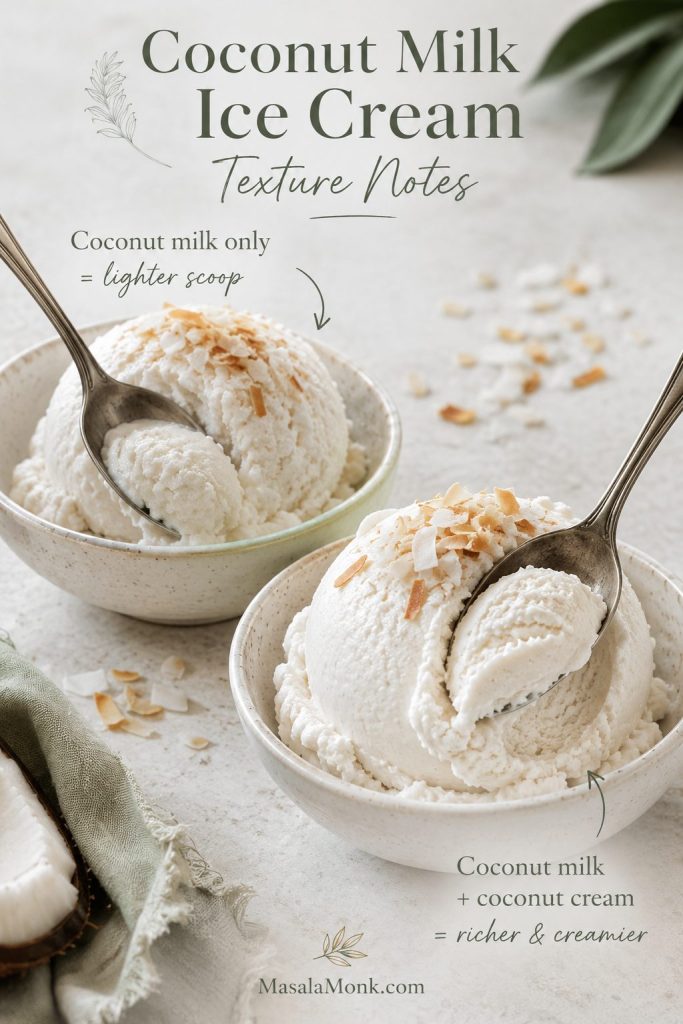
  • Coconut milk keeps the base pourable. It brings clean coconut flavor without making the mixture too heavy.
  • Coconut cream adds body. The extra fat helps the finished scoop feel creamier and less icy.
  • Sugar improves scoopability. It is not only for sweetness; cutting it too far can make homemade coconut ice cream freeze harder.
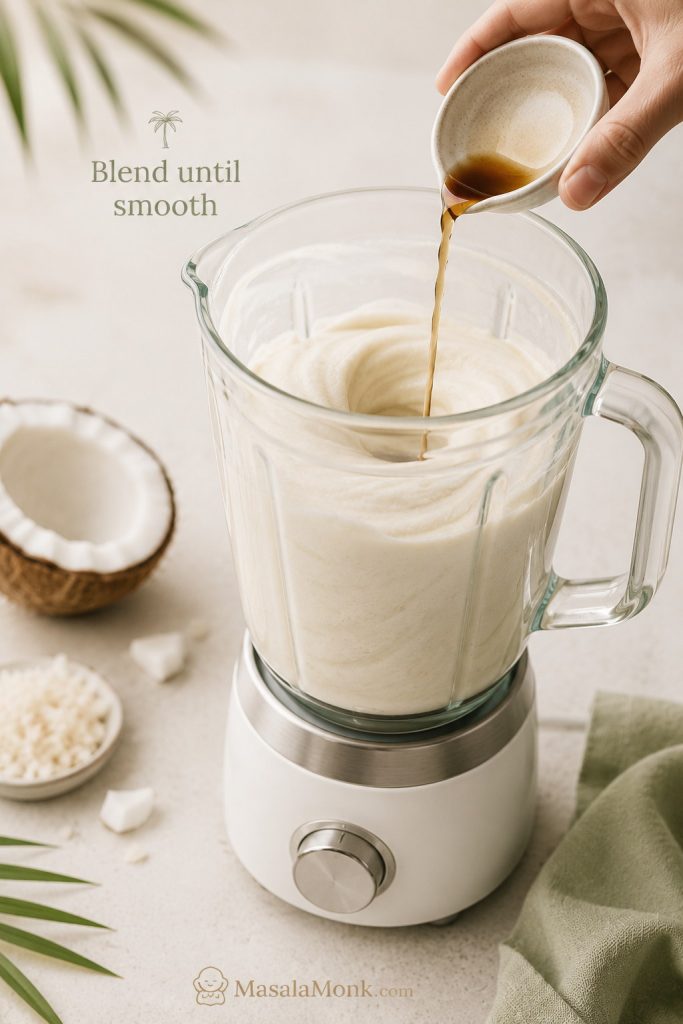
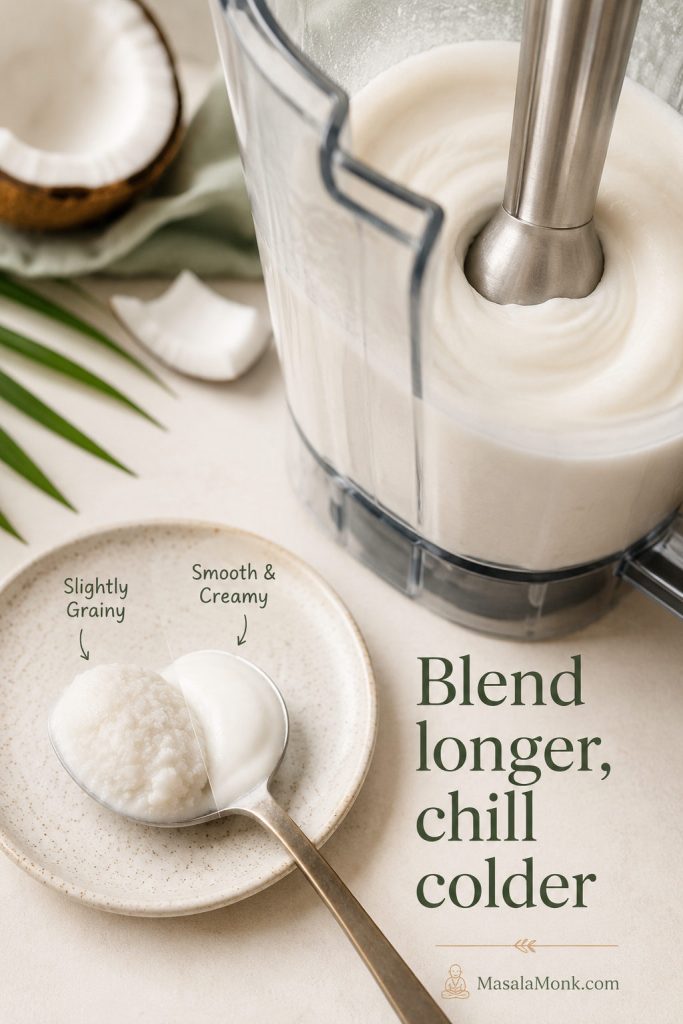
  • Blending and chilling protect the texture. Blending dissolves the sugar and smooths the coconut fat, while a cold base churns thicker and faster.

The easiest way to remember the main base is simple: coconut milk keeps it fluid, coconut cream gives it body, and sugar helps the finished scoop stay softer.

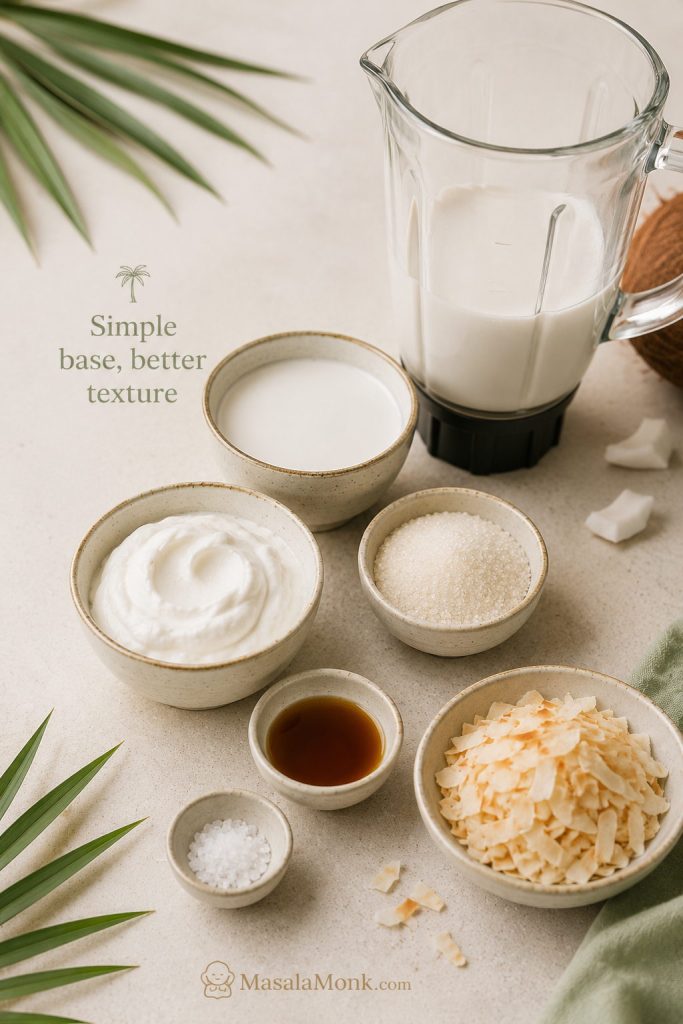
Coconut milk, coconut cream, sugar, vanilla, and salt arranged as the base ingredients for homemade coconut ice cream.
Coconut milk keeps the base fluid, while coconut cream adds body; together, they create a creamier first batch than either one usually gives alone.

Which Coconut Ice Cream Version Should You Make?

Start here if you are staring at coconut milk, coconut cream, or cream of coconut and wondering whether you bought the right can. You probably can still make a good batch, but the method changes depending on what is in front of you.

If you have ever bought the wrong can for a coconut dessert, this is the section that saves the batch. From there, pick the row that matches your pantry, then follow that route instead of forcing every coconut product into the same recipe.

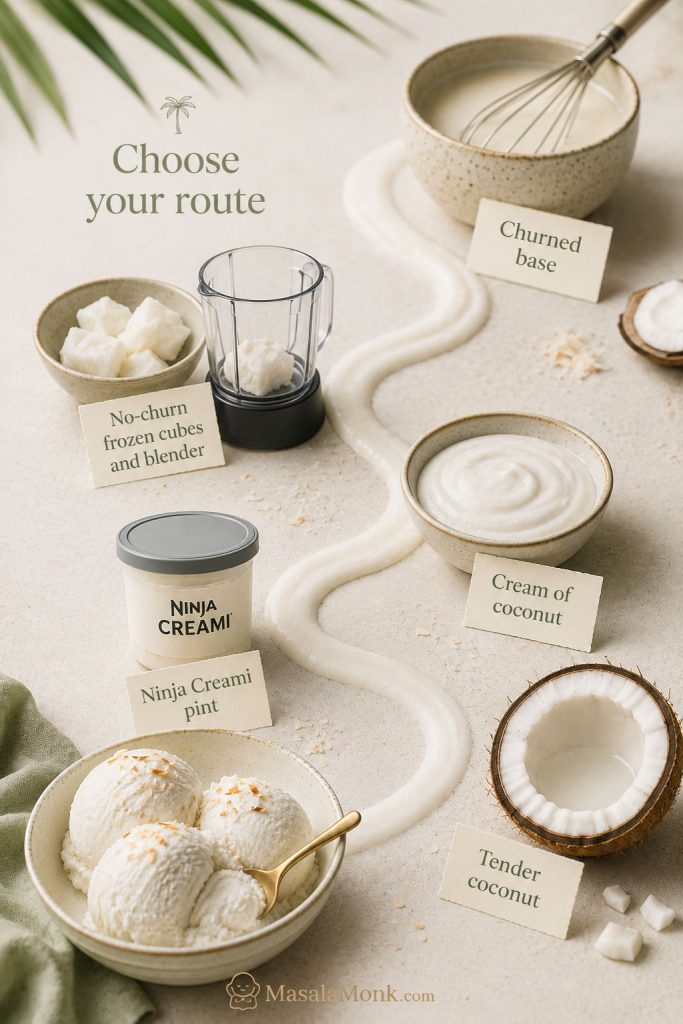
Visual guide showing coconut ice cream options including churned, no-churn, cream of coconut, Ninja Creami, and tender coconut versions.
Start with what you already have, then choose the method that fits your tools, since coconut milk, cream of coconut, and a Ninja Creami all need slightly different handling.
What you have or want Best route to take What to expect
Full-fat coconut milk + unsweetened coconut cream Best first version Balanced coconut flavor, creamy texture, dairy-free, and less icy than coconut milk alone
Only full-fat canned coconut milk Coconut milk ice cream Lighter coconut flavor, slightly icier texture
Unsweetened coconut cream Coconut cream ice cream Richer, smoother, more indulgent
Sweetened cream of coconut Cream of coconut ice cream Sweeter, stronger coconut flavor, pina-colada-style
No ice cream maker Freeze-and-blend no-churn method Soft-serve texture first, firmer after a short freeze
Heavy cream + condensed milk Condensed milk no-churn shortcut Very creamy and easy, but not dairy-free
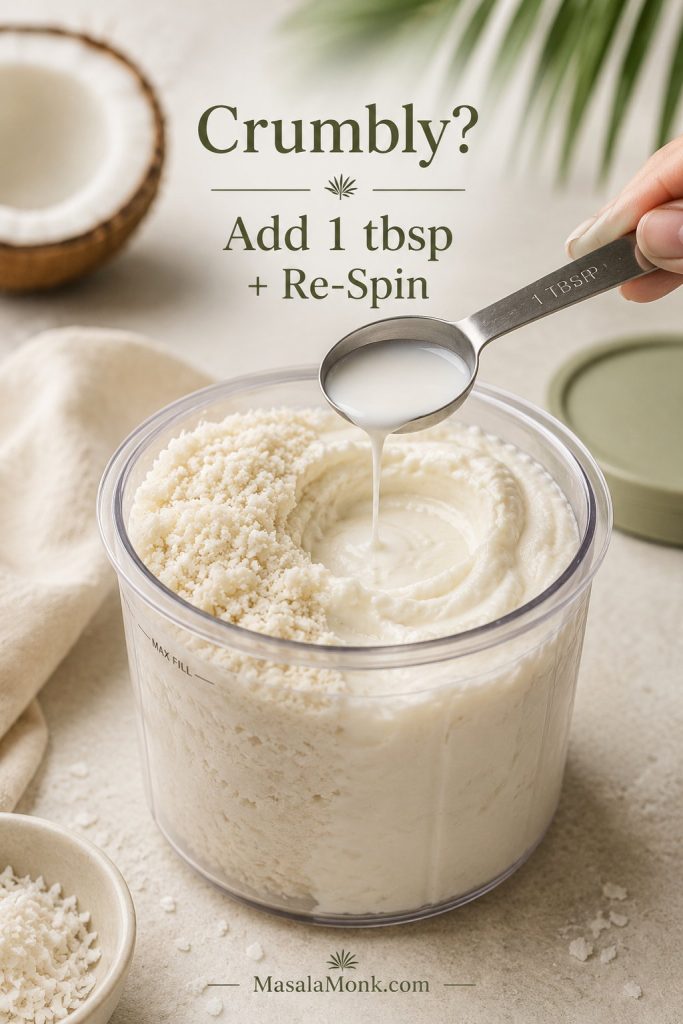
Ninja Creami Ninja Creami method Freeze 24 hours, spin, then Re-Spin if crumbly
Tender coconut malai Tender coconut style Fresh coconut texture, Indian-style flavor
Palm sugar or pandan Thai coconut style More fragrant, street-dessert-style coconut flavor
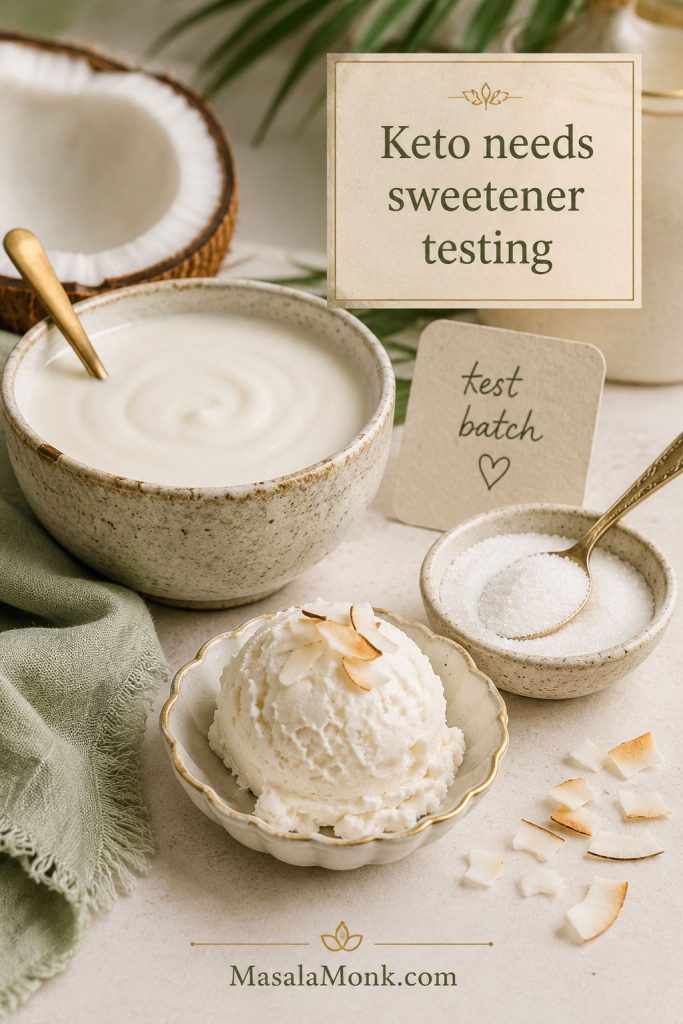
Keto or sugar-free goal See the keto note in variations Needs sweetener-specific testing because texture changes

Picked your path? Jump to the ice cream maker method, no-churn coconut ice cream, cream of coconut ice cream, or Ninja Creami method.

Coconut Milk vs Coconut Cream vs Cream of Coconut

The wrong-can mistake

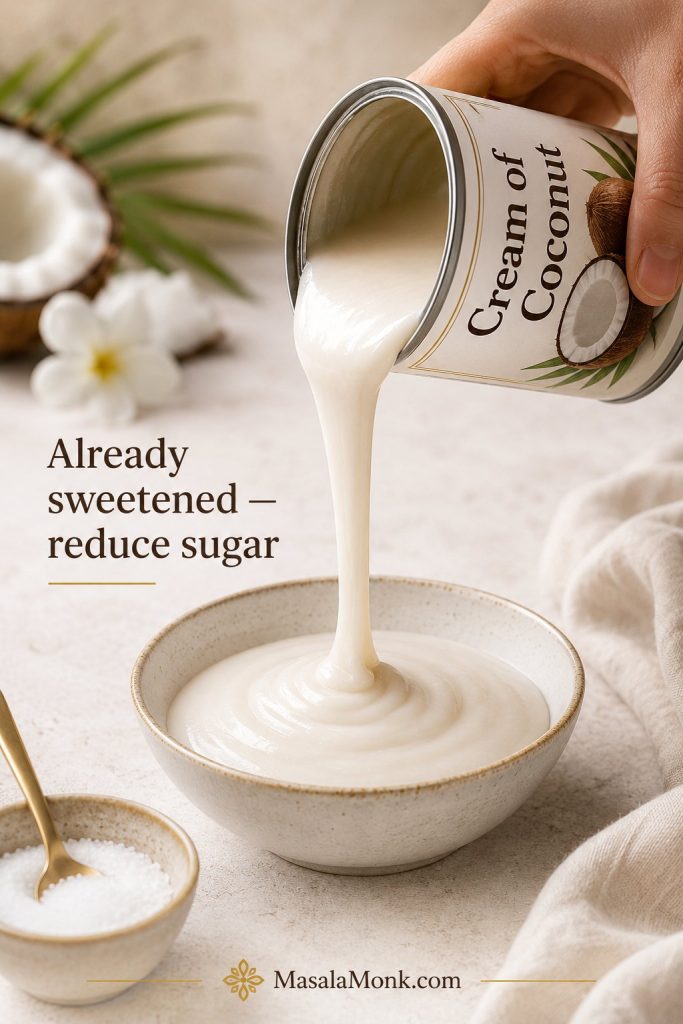
This is where most coconut ice cream problems start. The names sound almost interchangeable, but the products are not the same. For the main base, reach for full-fat canned coconut milk and unsweetened coconut cream. Save sweetened cream of coconut for the separate cream of coconut batch below.

If you have ever stood in the aisle wondering whether coconut cream and cream of coconut are the same thing, this is the section that prevents the wrong-can mistake.

Do not pour cream of coconut into the main recipe as a straight swap. It is already sweetened, so the batch can turn too sweet and heavy unless you reduce the sugar. Instead, use it in the separate cream-of-coconut version below.

Thick cream of coconut being poured into a bowl with a sugar bowl set aside nearby.
Cream of coconut is already sweetened, so reducing added sugar keeps the finished batch rich and coconut-forward without turning heavy or candy-sweet.

Before you open a can, it helps to see the three products side by side: coconut milk is pourable, coconut cream is thicker, and cream of coconut is sweetened and glossy.

Three coconut products—coconut milk, coconut cream, and cream of coconut—shown in separate bowls beside their containers.
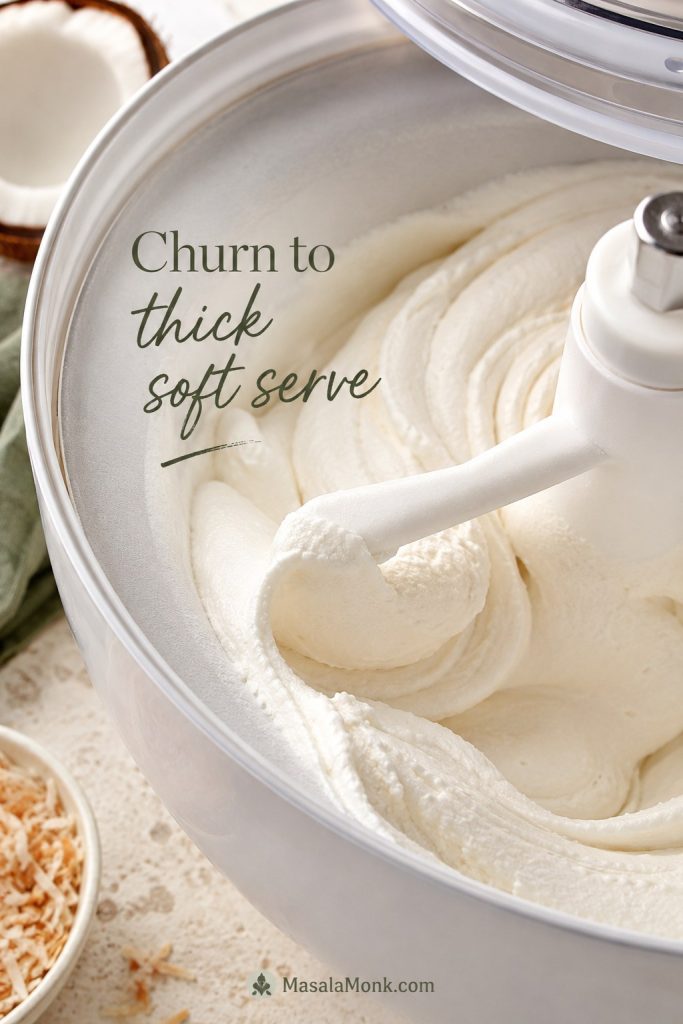
These three coconut products can look similar on the shelf, yet each one changes sweetness, richness, and freezer texture in a different way.

What each can actually does

Coconut product What it is Best use in coconut ice cream Important note
Full-fat canned coconut milk A pourable coconut base with moderate fat Main dairy-free coconut milk ice cream Choose canned full-fat coconut milk, not thin drinking coconut milk
Unsweetened coconut cream Thicker, richer coconut base with more fat Creamier coconut ice cream with better body Best paired with coconut milk so the texture is rich but not waxy
Cream of coconut Sweetened coconut product used in drinks and desserts Sweet, pina-colada-style coconut ice cream Already sweetened, so reduce or skip added sugar
Carton coconut milk Thin drinking-style coconut milk Usually not ideal Often too watery and can freeze icy
Condensed coconut milk Sweetened vegan condensed milk alternative Vegan no-churn or Ninja Creami routes Counts as both sweetener and texture helper
Tender coconut flesh Soft coconut malai from young coconut Tender coconut ice cream style Add it for flavor and texture, not as the only base

Helpful ingredient note: for a deeper ingredient explanation, Epicurious has a useful guide to cream of coconut, including how it differs from coconut cream and coconut milk.

Now that the coconut products are clear, head to the ingredients list, the cream of coconut batch, or the main recipe card.

Ingredients

You do not need a long ingredient list for good coconut ice cream. Instead, what matters most is using full-fat coconut products, dissolving the sugar well, and giving the base enough time to chill before freezing.

In this coconut ice cream recipe, sugar is important not only for sweetness but also for scoopability. When the sweetener is reduced too aggressively, the finished scoop often freezes harder and icier.

Coconut milk, coconut cream, sugar, vanilla, salt, and toasted coconut arranged around a blender jar for coconut ice cream.
The ingredient list is short, yet full-fat coconut products, enough sugar, vanilla, and salt do most of the work in building a smooth homemade scoop.
Ingredient US amount Metric amount Why it matters
Full-fat canned coconut milk 1 can, 13.5–14 oz 400 ml Gives the ice cream its coconut base without making it too heavy
Unsweetened coconut cream 1 can, 13.5–14 oz 400 ml Adds richness and helps prevent an icy texture
Granulated sugar 1/2 cup 100 g Sweetens and improves scoopability
Fine salt 1/8 tsp About 0.7–1 g Makes the coconut flavor taste fuller
Vanilla extract 2 tsp 10 ml Rounds out the coconut flavor
Toasted coconut, optional 1/3–1/2 cup 25–40 g Adds texture and stronger coconut flavor
Coconut extract, optional 1/4 tsp 1 ml Useful if your coconut milk tastes mild

Taste before chilling: the base should taste slightly sweeter than you want the finished ice cream to taste. Cold dulls sweetness, so a base that tastes just right before freezing can taste a little flat once frozen.

Use the measurements below as a quick check before you blend, especially if you are switching between cans, cups, grams, and milliliters.
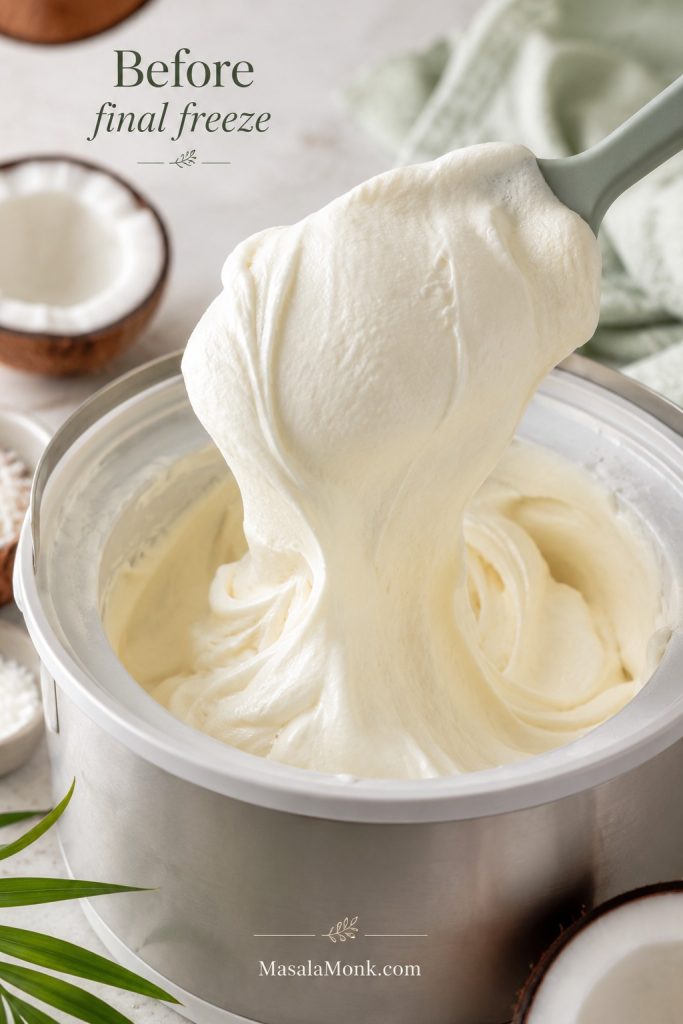
Measured coconut milk, coconut cream, sugar, vanilla extract, and salt displayed with quantity labels for coconut ice cream.
Accurate measurements keep the coconut ice cream base balanced, especially when you switch between cans, cups, grams, and milliliters.
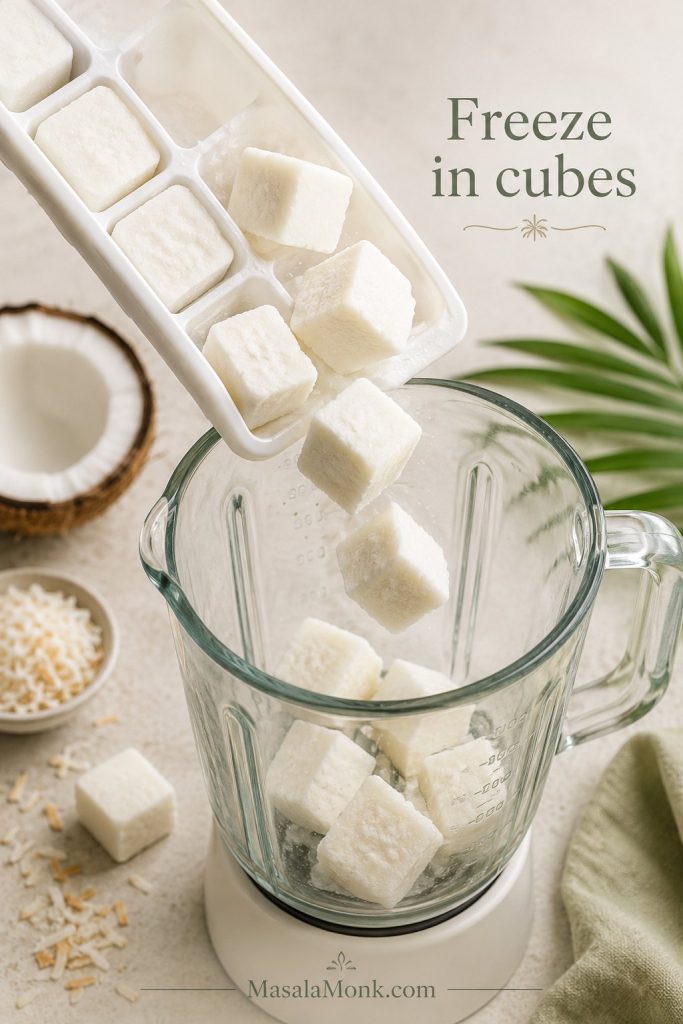
Start with full-fat canned coconut milk

For the coconut milk-only version, use canned full-fat coconut milk rather than the thin drinking-style cartons. The canned product has more body, while carton coconut milk is usually too watery for a creamy frozen dessert.
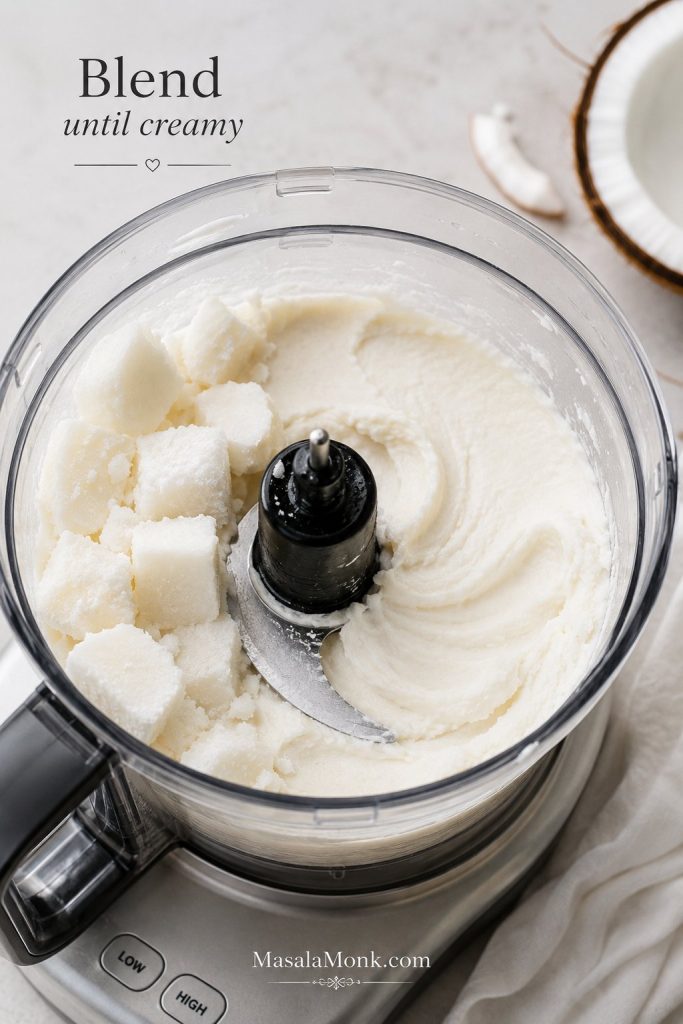
Add unsweetened coconut cream for richness

The cream adds body, but balance matters. One can of each gives you richness without the waxy heaviness that can happen when the base is all cream.

A little salt makes the flavor fuller

A tiny amount of salt makes the coconut and vanilla taste more complete. It should not make the ice cream taste salty; it simply keeps the sweetness from tasting flat.

Ice Cream Maker Method

For this coconut ice cream recipe, an ice cream maker is the easiest route to a smooth, parlor-style scoop because it freezes the base while keeping it moving. That movement keeps ice crystals smaller, which matters with coconut bases because they can freeze firmer than dairy ice cream.

Blend and chill the coconut base

  1. Freeze the ice cream maker bowl. If your machine uses a freezer bowl, freeze it for 12–24 hours, or according to the manufacturer’s directions.
  2. Blend the base. Add coconut milk, coconut cream, sugar, salt, and vanilla to a blender. Blend for 1–2 minutes, until smooth and the sugar is fully dissolved.
  3. Chill the base. Refrigerate for at least 4 hours, preferably overnight. A cold base churns thicker and faster.

Blend until the base looks completely smooth, because this step helps dissolve sugar and even out the coconut fat before the mixture chills.

Coconut ice cream base blending in a clear blender jar while ingredients are added.
Blending is not just mixing; it helps dissolve the sugar and smooth the coconut fat so the finished ice cream tastes cleaner and creamier.

After blending, chill the base until it is properly cold; this gives the machine a better chance to thicken the mixture quickly.

Covered bowl of coconut ice cream base chilling in a refrigerator before churning.
A colder base gives the churn a head start, which means the mixture can thicken faster before large ice crystals have time to form.

Churn, freeze, and rest before scooping

  1. Churn. Pour the chilled base into the ice cream maker and churn for 20–30 minutes, or until it looks like thick soft serve.
  2. Add coconut texture. Fold in toasted coconut at the end if you want little chewy-crisp coconut pieces.
  3. Freeze until scoopable. Transfer to a freezer-safe container and freeze for 4–6 hours.
  4. Rest before scooping. Let the ice cream sit at room temperature for 5–15 minutes before scooping, especially if it has been frozen overnight.

During churning, watch the texture rather than the clock alone; the base should look thick and soft-serve-like before you transfer it to the freezer.

Coconut ice cream churning in an ice cream maker until thick and soft like soft serve.
Stop churning when the base looks like thick soft serve; at this point, the machine has done its job and the freezer finishes the texture.

Texture cue: after churning, the coconut ice cream should look like thick soft serve. It will not be fully firm until it has had several hours in the freezer.

Do not panic if the freshly churned batch is still soft; that soft-serve stage is exactly what should happen before the final freezer rest.

Soft churned coconut ice cream lifted with a spatula, showing a thick creamy fold before final freezing.
This soft stage is normal after churning, so do not keep running the machine just because the coconut ice cream is not scoop-firm yet.

No-Churn Coconut Ice Cream Without an Ice Cream Maker

No ice cream maker? This coconut ice cream recipe still gives you two solid routes. The freeze-and-blend method keeps things dairy-free and fresh-tasting; meanwhile, the condensed milk route gives you the easiest rich, creamy no-churn scoop.

For more no-machine dessert methods, this guide to homemade ice cream without a machine is also useful, while the coconut method below gives more specific coconut milk and coconut cream guidance.

Option 1: Dairy-free freeze-and-blend coconut ice cream

Blend the main coconut base, then pour it into ice cube trays. Freeze for at least 6 hours or overnight. Smaller cubes are easier for the blender to turn smooth than one large frozen block.

Frozen cubes of coconut ice cream base being tipped from an ice cube tray into a blender jar.
Freezing the base in cubes gives the blender smaller pieces to work through, which helps the no-churn method turn creamy instead of chunky.

Blend the frozen cubes in a strong blender or food processor until creamy and soft-serve-like, then eat immediately or freeze briefly for firmer scoops.

Frozen coconut base cubes blending into a creamy no-churn coconut ice cream texture.
Once the frozen cubes break down, the mixture turns creamy quickly, so stop blending as soon as it looks smooth and soft.

Option 2: Condensed milk no-churn coconut ice cream

For a richer dairy-style no-churn version, whip 2 cups / 480 ml heavy cream to stiff peaks, then fold in 1 can / 14 oz sweetened condensed milk, 1 can / 400 ml unsweetened coconut cream, 1/8 tsp salt, and 1/2 tsp coconut extract. Freeze in a loaf pan or freezer container for 8 hours or overnight.

Whipped cream, condensed milk, and coconut cream being folded together in a bowl for no-churn coconut ice cream.
The condensed milk version is richer and easier, although it gives a softer, sweeter, more dessert-like scoop than the dairy-free cube-and-blend method.
No-churn method Best for Texture Trade-off
Freeze-and-blend Dairy-free or vegan batches Soft and creamy when freshly blended Needs a strong blender or food processor
Whipped cream + condensed milk Easy no-churn dessert Rich, creamy, softer Not dairy-free unless using vegan alternatives

If you want the most coconut-forward no-machine route, use the freeze-and-blend method rather than the dairy shortcut.

Summary scene showing the no-churn coconut ice cream method from frozen cubes to a creamy blended result.
The freeze-and-blend method is the cleanest dairy-free no-churn route, since it keeps the coconut flavor fresh without depending on whipped cream.

Using the no-churn method? You may also want the troubleshooting guide or the full recipe card.

Coconut Ice Cream Recipe

This coconut ice cream recipe is made with full-fat coconut milk, unsweetened coconut cream, sugar, vanilla, and salt. Churn it in an ice cream maker for the smoothest texture, or use the no-churn freeze-and-blend method if you do not have a machine.

Yield About 1 quart / 900 ml to 1 liter
Prep Time 10 minutes
Chill + Freeze 8–10 hours total
Method Ice cream maker or no-churn

Ingredients

  • 1 can full-fat canned coconut milk, 13.5–14 oz / 400 ml
  • 1 can unsweetened coconut cream, 13.5–14 oz / 400 ml
  • 1/2 cup / 100 g granulated sugar
  • 1/8 teaspoon fine salt
  • 2 teaspoons / 10 ml vanilla extract
  • 1/3–1/2 cup / 25–40 g toasted coconut, optional
  • 1/4 teaspoon coconut extract, optional, for stronger coconut flavor

Ice Cream Maker Method

  1. If using a freezer-bowl ice cream maker, freeze the bowl for 12–24 hours.
  2. Add coconut milk, coconut cream, sugar, salt, and vanilla to a blender.
  3. Blend for 1–2 minutes, until completely smooth and the sugar is dissolved.
  4. Cover and chill the base for at least 4 hours, preferably overnight.
  5. Pour the chilled base into the ice cream maker and churn for 20–30 minutes, or until it reaches thick soft-serve texture.
  6. Fold in toasted coconut, if using.
  7. Transfer to a freezer-safe container and freeze for 4–6 hours, until scoopable.
  8. Rest at room temperature for 5–15 minutes before scooping.

No-Churn Freeze-and-Blend Method

  1. Blend the coconut milk, coconut cream, sugar, salt, and vanilla until smooth.
  2. Pour into ice cube trays and freeze for at least 6 hours or overnight.
  3. Blend the frozen cubes in a strong blender or food processor until creamy.
  4. Serve as soft-serve coconut ice cream, or freeze briefly for firmer scoops.

Notes

  • Use full-fat canned coconut milk, not thin carton coconut milk.
  • A coconut milk-only batch can be made with 2 cans full-fat coconut milk, but the texture will be slightly lighter.
  • A coconut cream-heavy batch still needs some coconut milk so the texture does not turn too heavy or waxy.
  • A cream-of-coconut version should skip the added sugar because cream of coconut is already sweetened.
  • The Ninja Creami method needs a 24-hour freeze in the Creami pint; if the first spin looks crumbly, add 1 tablespoon coconut milk and Re-Spin.
  • For a slightly softer scoop, replace 1–2 tablespoons of the sugar with golden syrup, maple syrup, or agave. Do not remove too much sweetener, or the ice cream may freeze harder.

Use this visual recipe card when you want the core formula without scrolling back through every method note.

Saveable recipe card image showing coconut ice cream ingredients and a finished creamy scoop.
This recipe card gives you the core formula at a glance, which is useful when you want the main coconut ice cream base without scrolling through the full guide.

The full workflow is easier to follow when you keep the order clear: blend, chill, churn, freeze, and rest before scooping.

Step-by-step visual showing the coconut ice cream process from blending and chilling to churning, freezing, and scooping.
The sequence matters: blend until smooth, chill until cold, churn until thick, freeze until firm, then rest briefly before scooping.

Easy 2-Ingredient and 3-Ingredient Shortcuts

When speed matters more than the creamiest possible scoop, these shortcut batches can help. They are useful for quick desserts, but the texture will be different from the full coconut milk and coconut cream base.

Shortcut Ingredients Best for Texture note
2-ingredient cream of coconut ice cream Cream of coconut + heavy cream Fast no-churn dessert Sweet, rich, not dairy-free
3-ingredient coconut milk ice cream Full-fat coconut milk + sugar + vanilla Simple dairy-free coconut ice cream Lighter and icier than the coconut cream base
3-ingredient Ninja Creami coconut ice cream Coconut milk + sweetener + vanilla Creami users Needs a 24-hour freeze and usually benefits from a Re-Spin

Coconut Milk Ice Cream Recipe Notes

If you only have full-fat canned coconut milk, the recipe will still work. Use 2 cans / about 800 ml full-fat coconut milk in place of the coconut milk and coconut cream combination. The flavor will still be good, but the texture may be slightly lighter and a little icier than the batch made with one can of coconut cream.

Comparison of a lighter coconut milk-only ice cream scoop and a richer scoop made with coconut milk plus coconut cream.
A coconut milk-only batch can still be good; however, it usually tastes lighter and freezes a bit firmer than the milk-and-cream version.

For a smoother coconut milk-only batch, chill the cans overnight and use the thick coconut layer from the top if your coconut milk separates. You can also add 1 tablespoon cornstarch or tapioca starch to a cooked base if you want a more custard-like dairy-free texture.

Coconut Cream Ice Cream Recipe Notes

Coconut cream ice cream is richer because the cream has more fat and less water. For the best balance, combine one can of coconut milk with one can of coconut cream. If the base is made only with cream, the result can be very rich but sometimes heavier on the palate.

Comparison between a dense coconut cream-heavy ice cream scoop and a smoother scoop made with a balanced coconut milk and coconut cream base.
More coconut cream does not always mean better texture, because too much richness can feel waxy instead of smooth on the palate.

This is the route to choose when you want a vegan scoop that still feels creamy and indulgent. It also works well with toasted coconut, vanilla bean, dark chocolate pieces, mango puree, or pineapple.

Cream of Coconut Ice Cream

The cream-of-coconut version is its own style because the product is already sweetened. As a result, it gives the finished scoop a stronger, sweeter, almost pina-colada-style flavor. Choose this route when you want a richer dessert-style batch rather than a cleaner coconut milk base.

Important: cream of coconut is not the same as unsweetened coconut cream. If you use cream of coconut, skip the 1/2 cup sugar from the main recipe.

For a cream of coconut batch, blend 1 can / 14–15 oz cream of coconut with 1 cup / 240 ml milk or coconut milk, 1 1/2 cups / 360 ml heavy cream or coconut cream, and a pinch of salt. Churn as directed, or freeze and blend for a softer no-churn result.

Cream of coconut ice cream with cream of coconut and sugar shown nearby to explain how to fix an overly sweet batch.
If a cream-of-coconut batch tastes too sweet, reduce the added sugar next time; that small adjustment usually restores balance without losing coconut flavor.

For a very simple no-churn cream of coconut ice cream, whip 2 cups / 480 ml cold heavy cream to soft peaks, then fold in 1 can / 14–15 oz cream of coconut and a pinch of salt. Freeze for 8 hours or overnight. This shortcut is rich and sweet, so it does not need extra sugar.

Using cream of coconut? Check why coconut ice cream turns too sweet or icy, or compare it again with coconut milk and coconut cream.

Vegan and Dairy-Free Notes

The main coconut milk and coconut cream base is naturally dairy-free and vegan as long as your sugar is vegan-friendly. It does not need eggs, heavy cream, or condensed milk. For the creamiest vegan coconut ice cream, keep the fat level high and avoid thin coconut beverages.

For an even smoother vegan batch, however, one of these optional helpers can improve the texture:

Vegan coconut ice cream texture helpers including starch, syrup, coconut milk powder, and a small optional alcohol cue around a spoonful of ice cream.
Vegan texture helpers can improve the scoop, but they work best as support tools; fat balance, sugar level, and chill time still matter most.
  • 1 tablespoon cornstarch or tapioca starch, cooked briefly into the base for a vegan custard feel.
  • 1–2 tablespoons golden syrup, maple syrup, or agave, replacing part of the sugar for softer scooping.
  • 1–2 tablespoons coconut milk powder, for extra coconut flavor and body.
  • 1 teaspoon vodka or rum, optional, to slightly soften the freeze and add a grown-up note.

Thai-Style and Tender Coconut Notes

Thai coconut ice cream and tender coconut ice cream are related to this recipe, but they have their own flavor logic. Thai-style coconut ice cream often uses coconut milk, coconut cream or coconut water, palm sugar, salt, and sometimes pandan. Tender coconut ice cream usually includes soft tender coconut flesh, also called malai, for a fresh coconut texture.

Thai coconut ice cream variation

For a Thai-inspired batch, replace the granulated sugar with palm sugar, add a pandan leaf while gently warming the base, then remove it before chilling. Serve with roasted peanuts, sticky rice, toasted coconut, jackfruit, or sweet corn if you want a Thai street-dessert style bowl.

Thai-style coconut ice cream in a bowl with roasted peanuts, sticky rice, toasted coconut, and palm sugar.
Thai-style coconut ice cream leans fragrant and textured, so toppings like sticky rice, peanuts, palm sugar, and toasted coconut add contrast as well as flavor.

Tender coconut ice cream variation

For tender coconut ice cream, blend the main coconut base and add chopped tender coconut flesh after churning, or pulse some of the tender coconut into the base before chilling. A small splash of tender coconut water can brighten the flavor, but too much will make the ice cream icier.

Tender coconut flesh being folded into a creamy coconut ice cream base.
Tender coconut flesh adds soft texture and a delicate fresh-coconut note; however, too much coconut water can make the batch icier.

Ninja Creami Coconut Ice Cream

To make coconut ice cream in a Ninja Creami, blend the main base until smooth, pour it into the Creami pint without passing the max fill line, and freeze it level for 24 hours. Process on the Ice Cream or Lite Ice Cream setting depending on your machine and base.

Coconut ice cream in a Ninja Creami-style pint after spinning, with the machine softly visible in the background.
For the Ninja Creami method, a fully frozen pint is essential, since the machine needs a solid base before it can spin the mixture into a creamy texture.

If the mixture looks crumbly after the first spin, add 1 tablespoon coconut milk or coconut cream and use Re-Spin. After that, add toasted coconut, chocolate chips, or chopped fruit with the Mix-In function once the base is creamy.

Freeze the pint level and keep the mixture below the max fill line. If the surface is uneven after freezing, let it sit for a few minutes and level the top before spinning so the blade processes the base evenly.

Creami result What to do
Powdery or crumbly Add 1 tablespoon coconut milk or coconut cream, then Re-Spin.
Too soft Freeze the pint longer and make sure the base was not overfilled or too warm before freezing.
Uneven top Let it sit briefly, level the surface, then process so the blade catches evenly.
Weak coconut flavor Add toasted coconut as a Mix-In or use a small amount of coconut extract next time.

If the Creami pint looks powdery or crumbly after the first spin, use a small splash of coconut milk or coconut cream before you change the whole base.

Ninja Creami coconut ice cream showing a crumbly texture being improved with a tablespoon of liquid before re-spinning.
If a Creami pint comes out crumbly, add about 1 tablespoon of coconut milk or coconut cream and re-spin before changing the whole recipe.

For another fruit-based frozen dessert with blender, no-machine, ice cream maker, and Ninja Creami notes, this mango sorbet recipe is a useful companion.

Flavor Variations

Once the base is balanced, you can take it in several directions without wrecking the texture. Mango makes it sunny and tropical, pineapple pushes it toward a pina-colada-style scoop, chocolate makes it deeper and richer, and toasted coconut gives every bite a stronger coconut finish.

Variation How to make it Best note
Mango coconut ice cream Use thick mango puree, not thin mango juice. If adding a full cup, reduce the coconut milk by 1/4 cup. For a mango-first route, start with this homemade mango ice cream recipe, then use coconut cream or coconut milk as the tropical variation.
Pineapple coconut ice cream Use drained crushed pineapple or thick pineapple puree. Avoid loose pineapple juice unless you want a more icy, sorbet-like result.
Pina colada ice cream Use cream of coconut, pineapple, and optional rum. Reduce added sugar because cream of coconut is sweet.
Chocolate coconut ice cream Use cocoa powder for the easiest version, or cooled melted dark chocolate for a richer texture. Add a pinch more salt to deepen the chocolate flavor.
Mint chocolate coconut ice cream Add peppermint extract and chopped dark chocolate or mini chips to the chilled base. For a classic dairy-style flavor path, see this mint chocolate chip ice cream recipe.
Toasted coconut ice cream Fold toasted coconut into the churned base. Best for stronger coconut flavor and texture.
Old-fashioned coconut custard ice cream Use coconut milk with cream, sugar, egg yolks, vanilla, and salt; cook to a custard before chilling and churning. Richest dairy-style route, but not vegan or egg-free.
Keto coconut ice cream Use coconut cream and a freezer-friendly low-carb sweetener. Needs separate sweetener testing because many keto sweeteners freeze harder.

Keto coconut ice cream note

Keto coconut ice cream needs a freezer-friendly sweetener because many low-carb sweeteners freeze harder than sugar. Allulose usually behaves better than many granular sugar alcohol blends, but the texture still needs separate testing.

Coconut cream, low-carb sweetener, and a small test batch of coconut ice cream arranged to illustrate keto sweetener testing.
Keto coconut ice cream depends heavily on sweetener choice, because replacing sugar affects not only sweetness but also softness and freezer texture.

If you are building a low-carb dessert menu rather than only one frozen recipe, this keto cheesecake recipe is a better tested make-ahead option because frozen keto desserts need more careful sweetener choices.

Want to try one of these flavors? Go back to the main recipe card, or revisit coconut cream ice cream notes if you want a richer base.

Troubleshooting

Start with the likely cause

If your first batch is not perfect, do not toss the recipe. Coconut ice cream is sensitive to fat, sugar, water, and temperature, so small changes can make a big difference in how creamy, scoopable, or icy it turns out.

Most failed batches come down to one of four things: too much water, not enough fat, not enough sugar, or a base that was not cold enough. Rather than changing the whole recipe, find the likely problem below and adjust from there.

Three coconut ice cream textures shown together: icy, smooth and just right, and dense or too heavy.
Most texture problems come down to water, fat, sugar, or temperature, so this guide helps you diagnose the batch before changing the whole recipe.

Fix icy or hard coconut ice cream first

Icy coconut ice cream usually points to too much water, too little fat, thin carton coconut milk, or a base that was not chilled enough before churning.

Thin coconut milk and icy coconut ice cream shown together to explain why a batch can freeze hard and crystalline.
Icy texture usually means the base had too much water or too little fat; therefore, full-fat canned coconut milk works better than thin carton milk.
Problem Likely cause Fix
Icy coconut ice cream Low fat, too much water, carton coconut milk, or warm base Use full-fat canned coconut milk and coconut cream; chill the base at least 4 hours
Too hard to scoop Low sugar, low fat, or long freezer time Rest 5–15 minutes before scooping; slightly increase sugar next time
Grainy texture Sugar not dissolved or coconut fat separated Blend the base for 1–2 minutes; avoid overheating coconut cream
Slushy after churning Ice cream bowl or base was not cold enough Freeze the bowl fully and chill the base overnight if possible
Too sweet Cream of coconut or condensed milk used with extra sugar Use unsweetened coconut cream next time or skip added sugar with cream of coconut
Weak coconut flavor Mild coconut milk or too much vanilla/sugar Add toasted coconut, coconut extract, or more coconut cream
Fatty or waxy mouthfeel Too much coconut cream and not enough coconut milk Use the balanced 1 can coconut milk + 1 can coconut cream formula
Crumbly Ninja Creami result Base froze very hard Add 1 tablespoon coconut milk or cream and Re-Spin

If the batch is hard but not icy, start with resting time before you change the recipe. Coconut-based ice cream often needs a few minutes on the counter.

Firm coconut ice cream resting on the counter with a timer and scoop to show how to soften it before serving.
If the batch freezes too hard, let it rest for a few minutes before scooping; often, that simple pause is enough to improve the texture.

Fix grainy, weak, or waxy batches

If the texture tastes grainy, the base usually needs better blending, better chilling, or gentler handling so the sugar dissolves and the coconut fat stays smooth.

Coconut ice cream base being blended smooth, with spoon samples showing a smoother texture compared with a slightly grainy one.
Graininess usually points to undissolved sugar or separated coconut fat, so thorough blending and proper chilling can make the next batch smoother.

When the texture is fine but the flavor tastes quiet, strengthen the coconut note with toasted coconut, coconut extract, or a slightly richer base.

Coconut ice cream topped with toasted coconut flakes, with coconut extract and vanilla nearby to show ways to strengthen coconut flavor.
If the flavor tastes mild, toasted coconut is the easiest boost; meanwhile, a small amount of coconut extract can add depth without taking over.

If the scoop tastes rich but leaves a heavy coating on the palate, the base may have too much coconut cream and not enough coconut milk.

Comparison of a dense glossy coconut cream-heavy scoop and a smoother balanced coconut ice cream scoop.
A waxy mouthfeel usually means the base leaned too far toward coconut cream, whereas a balanced mix of coconut milk and cream feels cleaner.

Texture note: sugar affects more than sweetness in homemade ice cream. King Arthur Baking has a helpful explainer on how sugar affects scoopability and freezer texture, which is why this recipe does not cut the sweetener too aggressively.

Storage and Scooping

In practice, homemade coconut ice cream is usually at its best when it is treated a little differently from store-bought dairy ice cream. The container, surface protection, and resting time all matter.

Store it in a shallow freezer-safe container with a tight lid. Press parchment paper or plastic wrap directly against the surface before closing the lid if you want to reduce ice crystals. The texture is best in the first 1–2 weeks.

Coconut ice cream spread in a shallow freezer container with plastic wrap or parchment pressed directly onto the surface.
Pressing wrap or parchment directly onto the surface limits air exposure, which helps reduce ice crystals during freezer storage.

Dairy-free coconut ice cream often freezes firmer than dairy ice cream. Let it sit at room temperature for 5–15 minutes before scooping. If it has been frozen for several days, use a warm scoop and drag firmly through the ice cream rather than forcing it straight down.

Coconut ice cream being scooped cleanly after resting at room temperature with a small timer nearby.
After a short rest at room temperature, the scoop moves more cleanly and the texture tastes softer, creamier, and less frozen-solid.

If this is your first homemade coconut ice cream, do not judge the batch straight from the freezer. First, let it rest for a few minutes; then scoop it with a warm spoon and decide whether it needs more sugar, more coconut cream, or a longer chill next time.

Before you start, check which route fits your ingredients or skim the common coconut ice cream problems if you want to avoid icy, hard, or overly sweet results.

FAQs

Need the main recipe again? Jump back to the recipe card or the quick answer.

What coconut milk works best for coconut ice cream?

Full-fat canned coconut milk works best because it has enough fat and body to freeze into a creamier scoop. Skip thin carton coconut milk for this recipe; it is usually too watery and can leave you with a hard, icy texture.

What is the difference between coconut cream and cream of coconut?

Coconut cream is usually unsweetened and thick. Cream of coconut is sweetened and syrupy. Use coconut cream for the main base. Use cream of coconut only for the sweeter cream-of-coconut batch, and reduce or skip added sugar.

Why did my coconut ice cream turn icy?

Coconut ice cream usually turns icy when the base is too watery, too low in fat, too warm before churning, or made with thin carton coconut milk. Full-fat canned coconut milk, coconut cream, and a fully chilled base make the texture smoother.

Can I make coconut ice cream without an ice cream maker?

The best dairy-free no-churn method is to freeze the blended coconut base in ice cube trays, then blend the frozen cubes until creamy. For a richer dairy route, whipped cream plus sweetened condensed milk makes a softer no-churn coconut ice cream.

Do I need eggs for coconut ice cream?

This coconut ice cream recipe does not need eggs because coconut cream gives the base enough richness. Egg yolks can be used for a custard-style coconut ice cream, but they are not necessary for the main dairy-free method.

How long should I chill the coconut ice cream base?

Chill the base for at least 4 hours, though overnight is better. If the base goes into the machine cold, it churns thicker and smoother; if it starts warm, it can stay loose and slushy for too long.

How do I make coconut ice cream easier to scoop?

Sugar, fat, and a fully chilled base all help the finished scoop stay softer. Let the container sit at room temperature for 5–15 minutes before scooping, especially with dairy-free batches, and use a warm scoop instead of forcing it straight from the freezer.

Is this coconut ice cream vegan?

The main base is vegan and dairy-free as long as your sugar is vegan-friendly. It gets richness from coconut milk and coconut cream instead of heavy cream, condensed milk, or eggs.

Why does keto coconut ice cream need a separate approach?

Keto coconut ice cream needs separate sweetener testing because many low-carb sweeteners freeze harder than sugar. Coconut cream gives a strong base, but the sweetener choice matters for texture. Allulose usually behaves better than many granular sugar alcohol blends.

Once you understand the difference between coconut milk, coconut cream, and cream of coconut, homemade coconut ice cream becomes much easier to control. After one batch, this coconut ice cream recipe becomes easy to adjust: start with the churned base for the smoothest scoop, use the freeze-and-blend method if you do not have a machine, and do not worry if the first try needs a small adjustment. A little more fat, sugar, chill time, or resting time can be the difference between icy and creamy.

Posted on 4 Comments

How to make Mango Chia Pudding? 5 Creative Ideas

MANGO CHIA PUDDING

A Tropical Superfood Adventure That’s Anything But Ordinary

If you’re craving a tropical escape in a jar, mango chia pudding is your golden ticket. Creamy, naturally sweet, and bursting with nutrients, this little jar of sunshine is more than just a pretty breakfast—it’s a versatile, customizable superfood dessert that adapts to your mood and taste.

But let’s go beyond the basic recipe.

This post is for those who want to elevate the classic mango chia pudding into something creative, healthy, and visually irresistible. Whether you’re meal-prepping for the week, hosting a brunch, or looking for a nutrient-packed dessert, these five exclusive ideas will take your chia pudding game to the next level.


🍧 First, The Foundation: Perfect Mango Chia Pudding

Before we dive into our wild creations, here’s the perfect base recipe that holds up to any toppings, layers, or flavors:

🌿 Ingredients:

  • 1 large ripe mango (peeled and diced)
  • 1 cup coconut milk (or almond milk for a lighter option)
  • ¼ cup chia seeds
  • 1–2 tablespoons maple syrup (optional, depending on sweetness of mango)
  • ½ teaspoon vanilla extract
  • Pinch of sea salt

🌀 Instructions:

  1. Make the Mango Purée: Blend the mango until smooth.
  2. Mix: In a mixing bowl, whisk together the purée, coconut milk, maple syrup, vanilla, and salt.
  3. Add Chia Seeds: Stir in the chia seeds, making sure they’re well distributed.
  4. Rest & Thicken: Cover and refrigerate for at least 2 hours (or overnight), stirring once after 30 minutes to avoid clumping.
  5. Serve: Spoon into jars or bowls and add your favorite toppings—or explore the creative twists below.

🌟 5 Unique Mango Chia Pudding Creations

Let’s remix the classic with inventive flavor combos, layered textures, and superfood boosts. Each version below builds on the base pudding, transforming it into something spectacular.


1. 🥭💚 Matcha Mango Marble Swirl

Why You’ll Love It:

A dynamic duo—tropical mango meets earthy matcha for a nutrient-packed breakfast that wakes up your senses.

What You’ll Need:

  • ½ teaspoon ceremonial-grade matcha powder
  • ¼ cup almond milk
  • 1 teaspoon honey or agave
  • Mango chia pudding base

How to Make It:

  1. Whisk matcha, almond milk, and honey until smooth.
  2. Layer your jar with mango chia pudding and drizzle matcha blend in between for a marbled look.
  3. Top with sliced kiwi, hemp seeds, and a sprinkle of coconut flakes.

Pro Tip:

Matcha contains caffeine—perfect for a morning energy boost.


2. 🧡🌶️ Mango Lassi Chia Pudding with Turmeric & Cardamom

Why You’ll Love It:

Inspired by the classic Indian lassi, this variation has cooling yogurt, warming spices, and just the right touch of tang.

What You’ll Need:

  • ½ cup plain Greek yogurt or plant-based yogurt
  • ⅛ teaspoon ground turmeric
  • ¼ teaspoon cardamom
  • Splash of lemon juice
  • Mango chia pudding base

How to Make It:

  1. Stir yogurt, turmeric, cardamom, and lemon into the mango chia base.
  2. Garnish with pomegranate seeds, crushed pistachios, and a mint sprig.

Pro Tip:

The turmeric adds anti-inflammatory benefits—and a gorgeous golden hue.


3. 🥥🍫 Tropical Dessert Jar with Toasted Coconut & Cacao Nibs

Why You’ll Love It:

Imagine a tropical sundae—but healthy. This layered jar brings crunch, creaminess, and just enough chocolate to feel indulgent.

What You’ll Need:

  • Toasted shredded coconut
  • Cacao nibs or dark chocolate shavings
  • Coconut whipped cream
  • Chopped dried pineapple (optional)

How to Make It:

  1. Spoon mango chia pudding into a glass.
  2. Add a layer of toasted coconut and cacao nibs.
  3. Repeat, then finish with coconut whipped cream and pineapple.

Pro Tip:

Toast your coconut in a dry pan for 2-3 minutes for deeper flavor.


4. 🥭🥜 Peanut Butter Mango Crunch Parfait

Why You’ll Love It:

The sweet-salty combo of peanut butter and mango creates a flavor bomb, while granola brings satisfying crunch.

What You’ll Need:

  • 1 tablespoon natural peanut butter (or almond butter)
  • ½ banana, mashed
  • Crunchy granola
  • Mango chia pudding base

How to Make It:

  1. Mix mashed banana and peanut butter into the mango chia base.
  2. Layer with granola and more mango chunks.
  3. Optional: Drizzle with more nut butter and a pinch of flaky sea salt.

Pro Tip:

Make this in a mason jar and take it on-the-go for an afternoon pick-me-up.


5. 🌈🥭 Fruit Rainbow Chia Bowl with Superfood Toppings

Why You’ll Love It:

A colorful bowl that turns your breakfast into a full-spectrum vitamin boost. Ideal for kids or a weekend treat.

What You’ll Need:

  • Mango, blueberries, kiwi, strawberries, dragon fruit, and pomegranate
  • Goji berries, chia seeds, flax meal, or spirulina powder (optional)
  • Mango chia pudding base

How to Make It:

  1. Spoon mango chia pudding into a wide bowl.
  2. Arrange fruits in rainbow stripes.
  3. Sprinkle with superfoods like goji berries or spirulina powder.

Pro Tip:

Instagrammable AND nutrient-dense—what more could you ask?


🧠 Final Thoughts: Chia Pudding, Elevated

Mango chia pudding is more than just a trendy breakfast. It’s a canvas for creativity, a nutrient-dense delight, and an easy way to feel like you’re treating yourself—while staying on track with your health goals.

These five variations blend global inspiration, seasonal ingredients, and bold textures to keep your taste buds excited and your routine fresh.

So tell me: Which one will you try first?

Let’s keep the mango magic going! Drop your favorite twist in the comments, or tag your pudding creations on Instagram with #MangoChiaMasterpiece.

📌 Frequently Asked Questions (FAQs)

1. How long does mango chia pudding last in the fridge?

Mango chia pudding lasts up to 5 days in an airtight container in the refrigerator. For best texture, stir it once a day to prevent clumping.


2. Can I use frozen mango instead of fresh?

Yes! Just thaw the mango fully and blend it into a smooth purée. Frozen mango tends to be sweeter and juicier, which works great for pudding.


3. What’s the best plant-based milk to use?

It depends on your texture preference:

  • Coconut milk for creamy richness
  • Almond milk for a lighter version
  • Oat milk for a neutral, subtly sweet taste

4. How do I make the pudding thicker or thinner?

  • For a thicker texture, use more chia seeds (up to ⅓ cup per 1 cup of liquid).
  • For a thinner consistency, add more liquid or blend the pudding after it thickens.

5. Is mango chia pudding suitable for weight loss?

Yes, when made with unsweetened milk and no added sugar, it’s high in fiber, omega-3s, and keeps you full longer—great for healthy snacking or breakfast.


6. Can I meal prep this for the whole week?

Absolutely! Prepare it in individual jars and store in the fridge. Add fresh toppings (like fruit or granola) right before eating to maintain texture.


7. Can kids eat mango chia pudding?

Yes! It’s a kid-friendly, naturally sweet option—just be mindful of any allergies (especially to seeds, nuts, or coconut). You can also blend it smooth if your child dislikes the texture of chia seeds.


8. Can I make this without a blender?

Yes, use store-bought mango purée or mash the mango thoroughly with a fork for a rustic texture. A whisk will help mix everything evenly.


9. What if my chia pudding doesn’t set properly?

Ensure the chia seeds are fresh and fully mixed in (stir again after 30 minutes). If it still doesn’t thicken, add 1–2 extra tablespoons of seeds and let it sit a few more hours.


10. Is chia pudding safe to eat daily?

Yes, chia seeds are packed with nutrients, but start with 2–3 tablespoons per serving to avoid digestive discomfort. Stay hydrated, as chia absorbs a lot of water.

Posted on 1 Comment

Sherbet vs. Sorbet

Welcome to the world of frozen delights, where two contenders have been cooling palates for ages yet often leaving a trail of confusion in their wake. Sorbet and sherbet, though sounding deceptively similar, are as distinct as summer and spring. This post is your ultimate guide to unraveling the mysteries of these icy treats.

Did you know that sorbet has its roots in ancient cultures, serving as a refreshing respite for royalty, while sherbet emerged as a creamy twist, bridging the gap between ice cream and its fruitier cousins? It’s time to delve into the frosty realm of sorbet and sherbet, where each spoonful tells a story of flavor, tradition, and culinary artistry.

Join us on this refreshing journey as we dissect their ingredients, compare their textures, and explore the colorful world of these beloved desserts. Whether you’re a connoisseur of all things sweet or a curious foodie, prepare to have all your sorbet and sherbet queries answered!

Defining the Delights: Sorbet and Sherbet Unveiled

What is Sorbet?

Sorbet, a timeless treat, is simplicity at its best. Comprising primarily of fruit puree or juice, water, and sugar, it’s the quintessential dairy-free dessert. Ideal for those sweltering summer days, sorbet offers a burst of refreshing fruitiness, a perfect palate cleanser or a light dessert option. Originating from ancient times, sorbet has traveled across cultures, evolving into the vibrant and versatile treat we adore today.

What is Sherbet?

Sherbet, often mispronounced and misspelled as ‘sherbert’, is sorbet’s creamier cousin. With a hint of dairy, typically in the form of milk or cream, sherbet occupies a delightful middle ground between ice cream and sorbet. It boasts a rich, smooth texture with a fruit-forward profile. While sherbet shares sorbet’s fruity base, the addition of dairy transforms it into a more indulgent experience. Originating from the Middle East, sherbet has become a staple in Western dessert menus, celebrated for its unique blend of creaminess and fruity tang.


The Frosty Face-Off: Sorbet vs. Sherbet

Now that we’ve established what sorbet and sherbet are, let’s delve into their key differences.

Ingredients and Texture:

  • Sorbet is a blend of fruit, sugar, and water, resulting in a light, icy texture that’s intensely flavored and refreshingly crisp.
  • Sherbet, with its slight dairy addition, typically milk or cream, offers a creamier, smoother texture, akin to ice cream but less heavy.

Dairy Content and Dietary Considerations:

  • Sorbet is dairy-free, making it a favorite for vegans and those with lactose intolerance.
  • Sherbet contains a small amount of dairy, ranging from 1% to 2%, which disqualifies it as a dairy-free option.

Flavor Profiles:

  • Both desserts shine in the flavor department, boasting a range from citrus to berry and tropical fruits. Sherbet, however, due to its creaminess, might offer a more mellow and rounded taste compared to the bold and direct flavors of sorbet.

Beyond the Basics: Sherbet vs. Other Frozen Treats

Sherbet vs. Ice Cream:

  • Ice cream is known for its high dairy content and rich, creamy texture. Sherbet, in comparison, has a much lower dairy content, making it lighter and fruitier.

Gelato vs. Sorbet and Sherbet:

  • Gelato, the Italian cousin of ice cream, is denser and creamier than both sorbet and sherbet. Sorbet remains dairy-free and fruit-focused, while sherbet offers a midway creaminess.

Nutritional Aspects: Counting the Calories:

  • Sorbet generally has fewer calories than sherbet due to the absence of dairy. Sherbet, with its slight dairy content, falls between sorbet and ice cream in terms of calorie count.

DIY Delights: Crafting Your Own Sorbet and Sherbet

Homemade Sorbet Magic: Unleash your inner chef with this simple sorbet recipe. Blend your favorite fruits, add water and sugar, and freeze. The result? A refreshing, fruit-packed delight perfect for any sunny day.

Sherbet Sensations at Home: Craving something creamier? Try making sherbet with a mix of fruit puree, a splash of dairy, sugar, and freeze. This homemade version of sherbet brings the perfect balance of fruity and creamy right to your bowl.


Frequently Asked Questions: Sorbet and Sherbet

1. What is the main difference between sorbet and sherbet?

  • Sorbet is dairy-free, made primarily from fruit and sugar. Sherbet includes a small amount of dairy, giving it a creamier texture.

2. Can lactose-intolerant individuals eat sorbet?

  • Yes, since sorbet is dairy-free, it is suitable for those with lactose intolerance.

3. Is sherbet healthier than ice cream?

  • Sherbet generally has lower fat content than ice cream, making it a slightly healthier option.

4. Does the type of fruit matter in making sorbet or sherbet?

  • The fruit choice can affect the flavor and texture. Ripe, seasonal fruits are best for a richer taste.

5. Can I make sorbet or sherbet without an ice cream maker?

  • Yes, both can be made by manually mixing the ingredients and freezing them, though the texture might be less smooth.

6. Is sherbet considered ice cream?

  • Sherbet is not traditional ice cream due to its lower dairy content, but it’s often categorized similarly due to its creamy texture.

7. Can sorbet and sherbet be vegan?

  • Sorbet is inherently vegan, but sherbet contains dairy and is not vegan.

8. Are sorbet and sherbet gluten-free?

  • Generally, yes, but always check specific ingredients for gluten if you’re sensitive or allergic.

9. How long can homemade sorbet or sherbet last in the freezer?

  • Properly stored, they can last up to a month, though they’re best consumed within two weeks for optimal flavor and texture.

10. Can sorbet and sherbet be used in drinks?

  • Absolutely! They can be a fantastic addition to cocktails or mocktails for a fruity, refreshing twist.

Wrapping it Up: The Sweet End of Our Frozen Journey

As we conclude our frosty exploration into the realms of sorbet and sherbet, it’s clear that both these treats hold their unique charm. Whether you lean towards the light and crisp sorbet or the creamy indulgence of sherbet, there’s no wrong choice. It’s all about what tantalizes your taste buds!

So, what’s your pick? Are you team sorbet or team sherbet? Share your favorite flavors and homemade creations in the comments. And remember, the next time you’re faced with the sorbet vs. sherbet dilemma, you’re now well-equipped to make the delicious decision!