Posted on 2 Comments

No Bake Mango Cheesecake Recipe

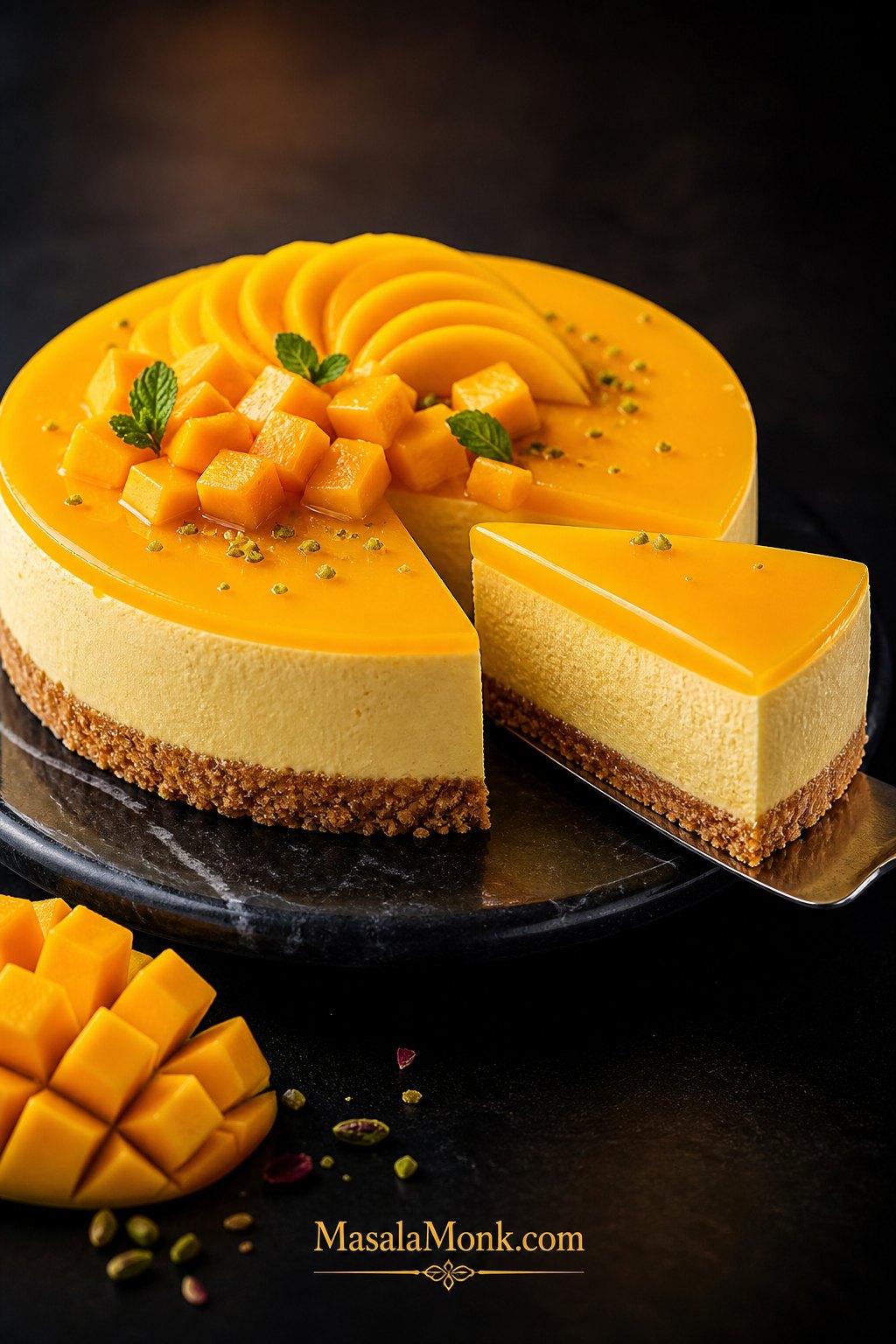
Whole no bake mango cheesecake with one slice lifted, showing a biscuit base, creamy mango filling, and glossy mango topping on a dark surface.

This no bake mango cheesecake recipe is creamy, bright, and deeply mango-forward, with a buttery biscuit base and a glossy mango topping that makes it feel special without turning on the oven. Because mango can make no-bake cheesecake fillings loose, this recipe also shows you how to control the texture so the final dessert stays creamy, sliceable, and not watery.

Before you start, choose the right setting method. For a full sliceable cheesecake, agar agar or gelatin gives the cleanest result. However, for a softer mango cheesecake without gelatin, cups or jars are usually the safer and easier option. This no bake mango cheesecake recipe shows you all three routes, so you can make the version that fits your kitchen, diet, and serving style.

Quick Answer: How to Make No Bake Mango Cheesecake

To make no bake mango cheesecake, start with a biscuit base, a cream cheese and whipped cream filling, mango pulp or fresh mango puree, and a setting method such as agar agar or gelatin. For clean slices, use agar agar or gelatin and chill the cheesecake overnight. However, for a softer mango cheesecake without gelatin, make it in cups, jars, or bowls instead of relying on a full cake to slice neatly.

For the easiest version, use canned Alphonso or Kesar mango pulp because the flavor, color, and sweetness are consistent. Meanwhile, fresh ripe mangoes also work beautifully when they are sweet, smooth, and not watery. If you want the plain base formula first, start with this no-bake cheesecake guide, then come back to this mango version for the fruit, setting, and topping details.
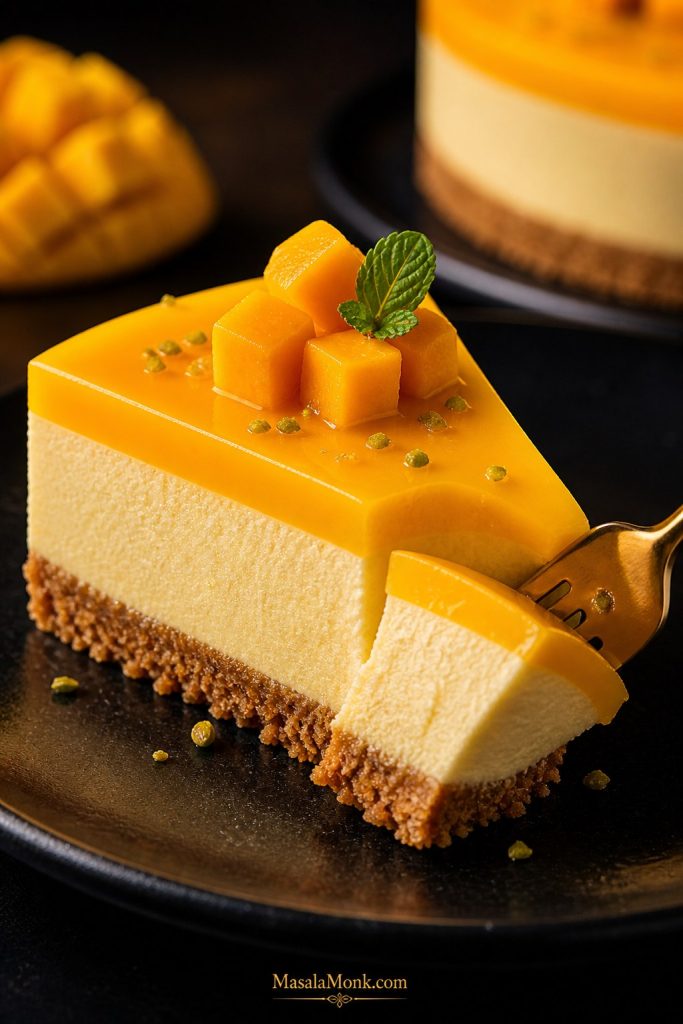
Close-up slice of no bake mango cheesecake on a plate with a fork, showing the crumb crust, creamy mango cheesecake layer, and shiny mango topping.
This close-up shows the texture goal more clearly than words can: the slice is creamy and tender, yet stable enough to lift cleanly from the cake.

No Bake Mango Cheesecake at a Glance

Best pan 8-inch / 20 cm springform or loose-bottom pan
Best full-cake setting method Agar agar for a vegetarian cake; gelatin for a classic creamy set
Best no-gelatin format Cups, jars, or bowls
Best mango option Alphonso/Kesar mango pulp or ripe non-fibrous fresh mango
Chill time 8–12 hours for a full cake; at least 6 hours for cups
Texture goal Creamy, mango-forward, sliceable for a full cake; soft and spoonable for cups
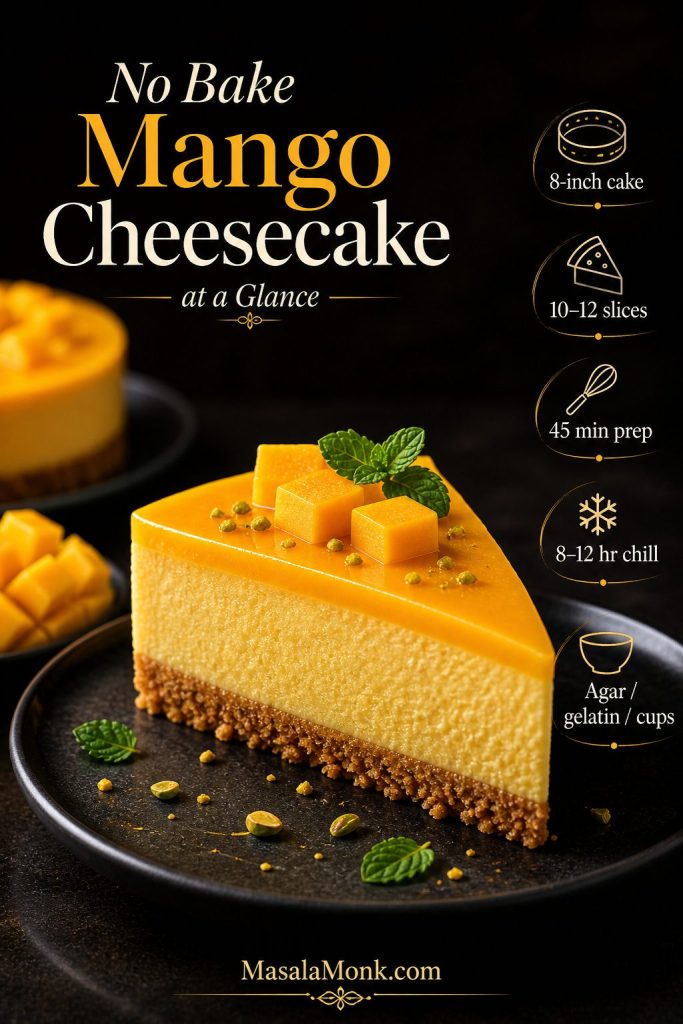
Informational graphic with a slice of no bake mango cheesecake and text noting 8-inch cake, 10–12 slices, 45 minutes prep, 8–12 hours chill, and agar, gelatin, or cups.
Use this quick guide before starting so the pan size, yield, chill time, and setting options are clear from the beginning.

Which No Bake Mango Cheesecake Version Should You Make?

The best version depends on how you want to serve it. A full cake needs enough structure to unmold and slice. In contrast, cups and jars can stay softer, so they are more forgiving if you want a no-gelatin mango cheesecake. Therefore, this no bake mango cheesecake recipe gives you both the full-cake route and the easier cup-style option.

What you want Make this version Why
Clean full-cake slices Agar agar or gelatin full cake Both give enough structure for slicing.
Vegetarian full cake Agar agar version Agar is plant-based and sets firmly.
Classic creamy texture Gelatin version Gelatin gives a softer mousse-like set.
No gelatin and no agar Cups, jars, or bowls The filling can stay soft without needing to slice.
Richer shortcut Condensed milk version It adds sweetness and creaminess quickly.
Party-friendly servings Mini cheesecakes or cups They are easier to serve and more forgiving.
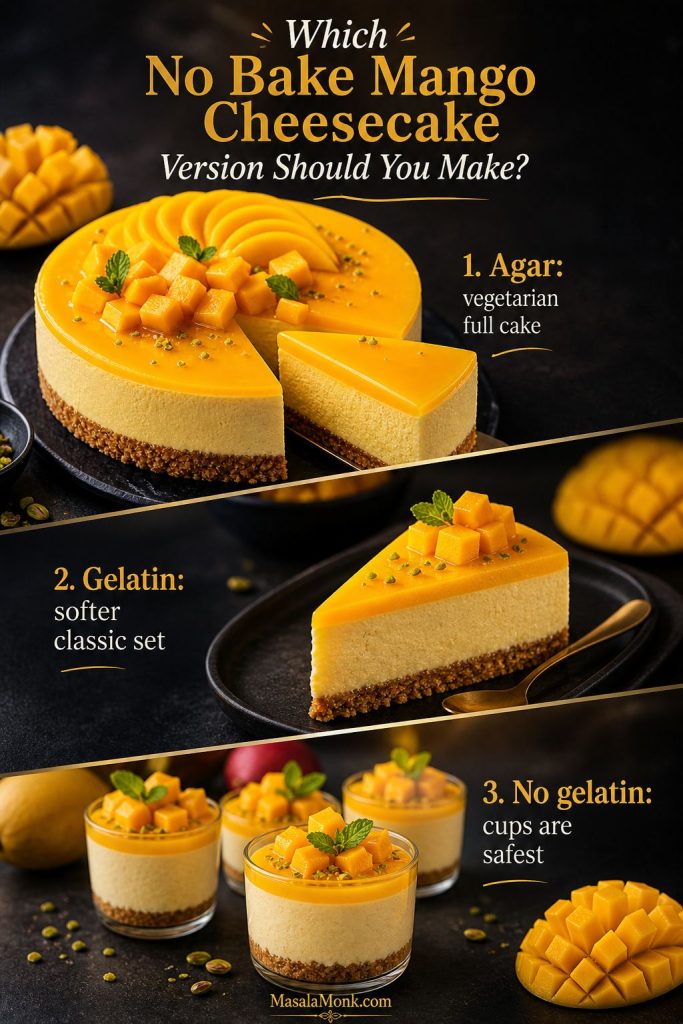
Comparison graphic showing three no bake mango cheesecake options: agar set full cake, gelatin set full cake, and no-gelatin cheesecake cups.
Choose the version before mixing the filling: agar agar is best for a vegetarian full cake, gelatin gives a softer classic set, and cups are the easiest no-gelatin option.
Best default version: Make the 8-inch agar agar version if you want an eggless, vegetarian-friendly cake that slices. Choose the gelatin version if you prefer a softer classic cheesecake texture. Choose cups if you want no gelatin and no agar.

Why This No Bake Mango Cheesecake Works

This mango cheesecake is built around the two things that matter most in a no-bake dessert: enough mango flavor and enough structure. Mango adds color, fragrance, and fruitiness, but too much watery puree can stop a no-bake cheesecake from setting properly. As a result, this recipe gives you a reliable full-cake method, plus clear adjustments for gelatin, agar agar, and no-gelatin cups.
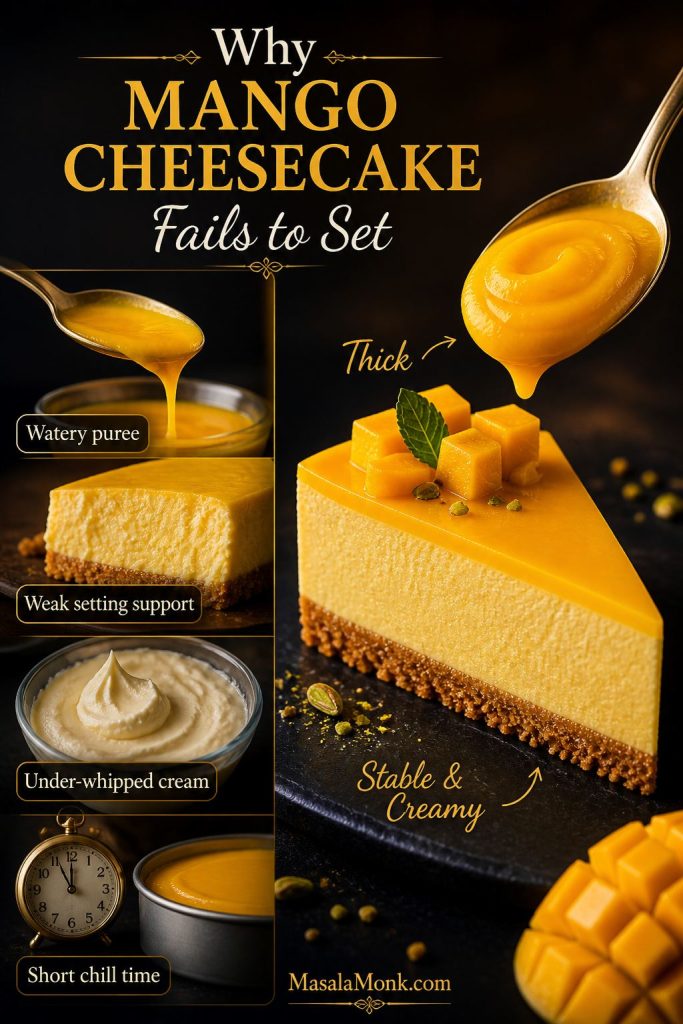
Comparison graphic showing common reasons mango cheesecake fails to set, including watery puree, under-whipped cream, weak setting support, and short chill time.
Most setting problems begin before the cheesecake reaches the fridge; watery mango puree, weak structure, and rushed chilling can all lead to a loose filling.
  • No oven is needed. The cheesecake sets in the fridge, which makes it ideal for warm weather and make-ahead entertaining.
  • Mango is used in the filling and topping. This gives the cheesecake a stronger mango flavor than a plain cheesecake with fruit only on top.
  • The biscuit base is simple and sturdy. Digestive biscuits, graham crackers, or Marie biscuits all work.
  • The setting method is flexible. Use agar agar for a vegetarian full cake, gelatin for a classic creamy set, or cups for a softer no-gelatin version.
  • It works with fresh mango or mango pulp. The post explains how to adjust sweetness and texture for both.
  • It is make-ahead friendly. Overnight chilling gives the cleanest slices and the best flavor.

The key is not adding more mango puree than the filling can hold. Too much watery mango can give you stronger fruit flavor at first, but it can also stop the cheesecake from slicing cleanly after chilling.

The same thick-puree logic matters in homemade mango ice cream, where watery mango can weaken both flavor and texture. In cheesecake, the problem is even more obvious because the filling has to hold its shape once sliced.

Ingredients for No Bake Mango Cheesecake

Although the ingredient list is simple, the ratios matter. The filling needs enough cream cheese and whipped cream for body, enough mango for flavor, and the right setting method for the serving style you want. Otherwise, it can taste good but still fail to slice cleanly.
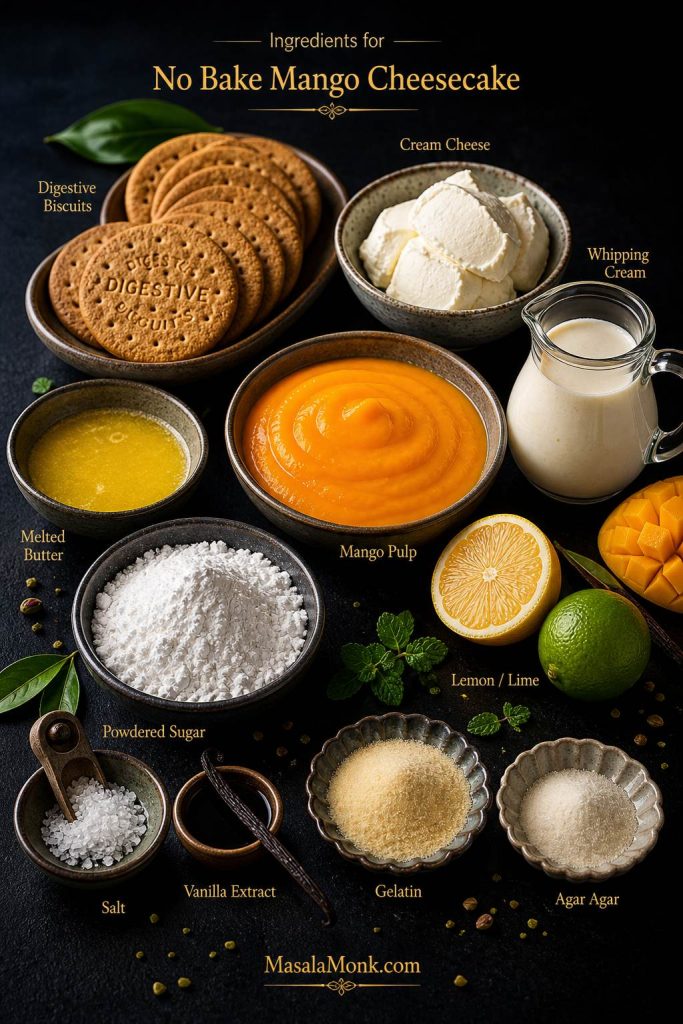
Ingredient spread for no bake mango cheesecake with biscuits, butter, cream cheese, cream, mango pulp, sugar, lemon or lime, agar agar, and gelatin.
These simple ingredients work best when each one has a clear job: cream cheese gives body, mango gives flavor, cream adds lightness, and agar or gelatin controls the final set.

Biscuit Base

  • Digestive biscuits, graham crackers, or Marie biscuits: these make the crumb base.
  • Melted butter: binds the crumbs and helps the base hold together.
  • Fine salt: balances the sweetness.
  • Sugar: optional, especially if the biscuits are already sweet.
  • Cardamom or cinnamon: optional, but useful if you want a warmer flavor.

Mango Cheesecake Filling

  • Full-fat cream cheese: gives the cheesecake structure and tang. Avoid low-fat cream cheese spread for a full cake.
  • Whipping cream or heavy cream: makes the filling lighter and creamier.
  • Mango pulp or mango puree: gives flavor, color, and sweetness.
  • Powdered sugar or caster sugar: sweetens the filling. Use weight when possible because cup measures vary by sugar type.
  • Lemon or lime juice: brightens the mango and balances the richness.
  • Vanilla: rounds out the flavor.
  • Agar agar or gelatin: helps a full cake slice cleanly.

Mango Topping

The topping can be a clean mango jelly, a softer mango coulis, or a simple layer of fresh mango. Choose mango jelly for a polished cake top, coulis for a spoonable finish, and fresh mango for the quickest decoration.

Fresh Mango vs Mango Pulp for No Bake Mango Cheesecake

In this recipe, mango quality can make or break the final texture. Sweet, smooth mango gives a bright filling, while watery or fibrous mango can make the cheesecake weak, bland, or difficult to set. Therefore, the safest choice is either thick mango pulp or ripe, non-fibrous fresh mango.
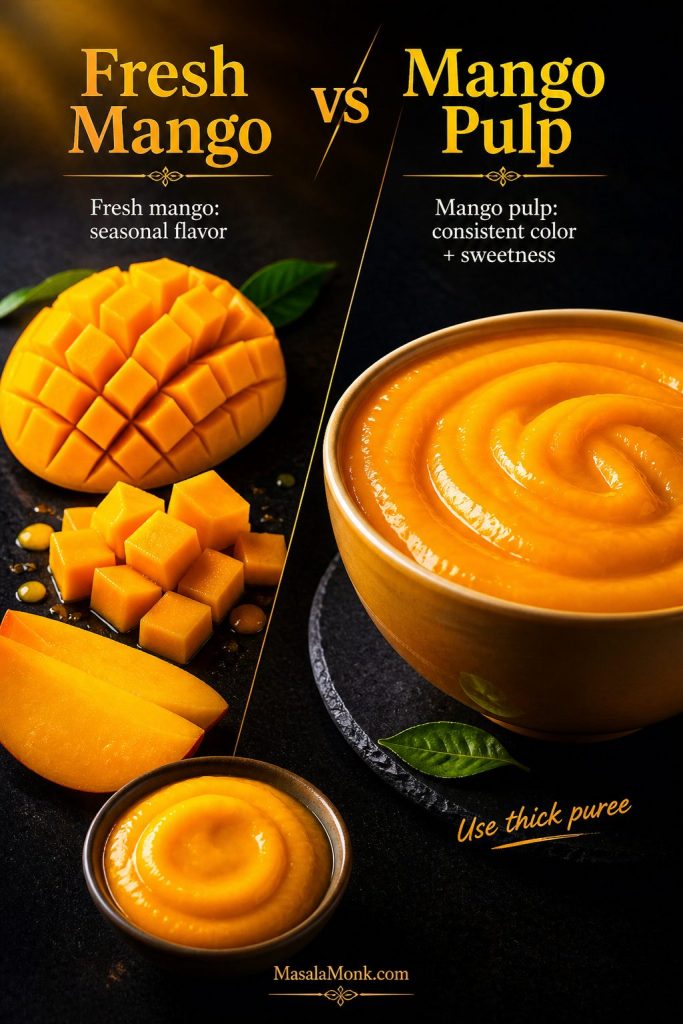
Comparison image showing fresh mango pieces and puree on one side and thick mango pulp in a bowl on the other side.
Fresh mango gives the brightest seasonal flavor, while mango pulp offers consistent sweetness and color; in both cases, thickness matters more than volume.
Mango option Best for Notes
Fresh ripe mango Best seasonal flavor Use sweet, non-fibrous mangoes. Blend smooth and sieve if needed.
Alphonso or Kesar mango pulp Strong color and consistent flavor Reduce sugar if the pulp is already sweetened.
Canned mango puree Easiest year-round option Check sweetness before adding the full amount of sugar.
Frozen mango Backup option Thaw and drain first so the filling does not become watery.
Watery mango puree Risky for a full cake Cook it down briefly or use a stronger setting method.
Mango tip: If your mango puree is thin, watery, or bland, do not add more and more puree to the filling. That can stop the cheesecake from setting. Use a thicker pulp, cook the puree down briefly, or add extra mango flavor through the topping instead.
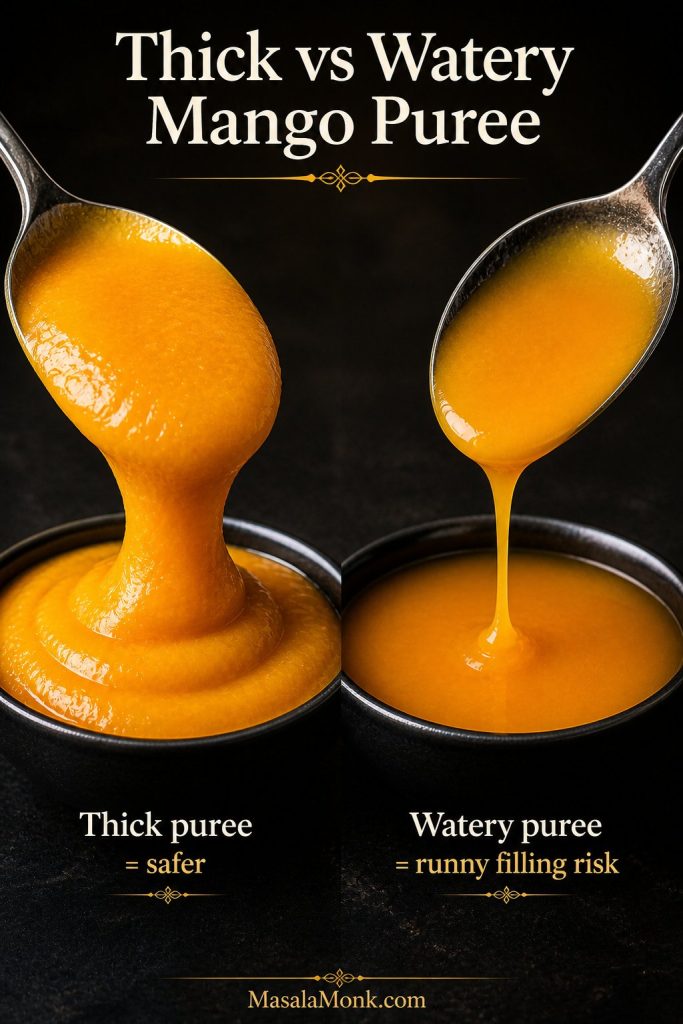
Side-by-side comparison of thick mango puree coating a spoon and watery mango puree running off a spoon.
The spoon test is one of the easiest ways to judge mango puree: thick puree supports the filling, whereas watery puree can make the cheesecake too soft.

For a drinkable mango recipe where texture can stay softer, this mango smoothie is the better route; for cheesecake, the mango puree needs to be thicker and more controlled.

Best Biscuit Base for No Bake Mango Cheesecake

A good biscuit base should hold together without tasting greasy. After the melted butter is mixed in, the crumbs should look like wet sand. If the mixture is dry and dusty, the crust may crumble. On the other hand, if it looks shiny or oily, there may be too much butter.

  • Digestive biscuits: slightly malty and sturdy.
  • Graham crackers: classic for cheesecake and easy to use.
  • Marie biscuits: lighter and common in Indian kitchens.
  • Biscoff-style biscuits: sweeter and more caramel-like.
  • Plain cookies: useful when you want a softer dessert-style base.
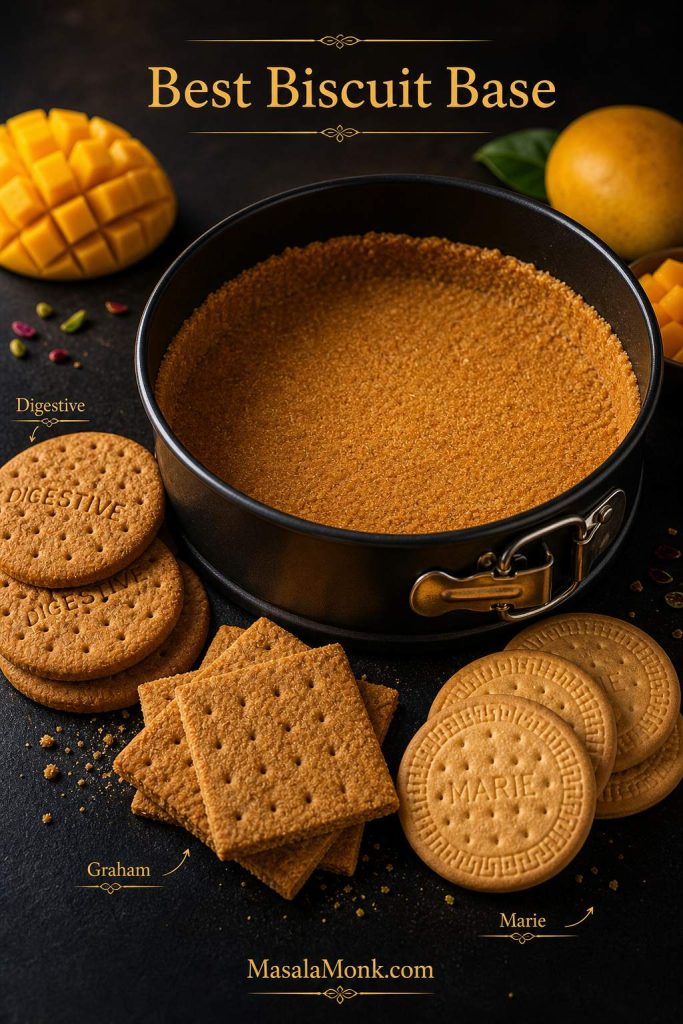
Graphic showing a pressed crumb crust in a springform pan with digestive biscuits, graham crackers, and Marie biscuits nearby.
Digestive biscuits, graham crackers, and Marie biscuits all work, but the best biscuit base is the one that presses firmly and balances the sweet mango filling.
Base tip: Press the crumb mixture firmly with the bottom of a flat glass or measuring cup, then chill it for 30 minutes before adding the filling.

Similarly, if you like biscuit-base desserts, this Banoffee Pie uses the same no-bake crumb-base idea in a banana, caramel, and cream direction.

How to Make No Bake Mango Cheesecake

This no bake mango cheesecake recipe is written for an 8-inch / 20 cm full cake using agar agar as the default setting method. However, the gelatin and no-gelatin cup options are also included after the main method, so you can choose the version that suits your kitchen.

Step 1: Prepare the Pan

Line the base of an 8-inch / 20 cm springform or loose-bottom pan with parchment paper. For cleaner sides, line the inner wall with a strip of parchment or acetate.

Step 2: Make the Biscuit Base

Crush the biscuits into fine crumbs, mix with melted butter, salt, and any optional sugar or spice, then press the mixture firmly into the pan. Chill for 30 minutes.
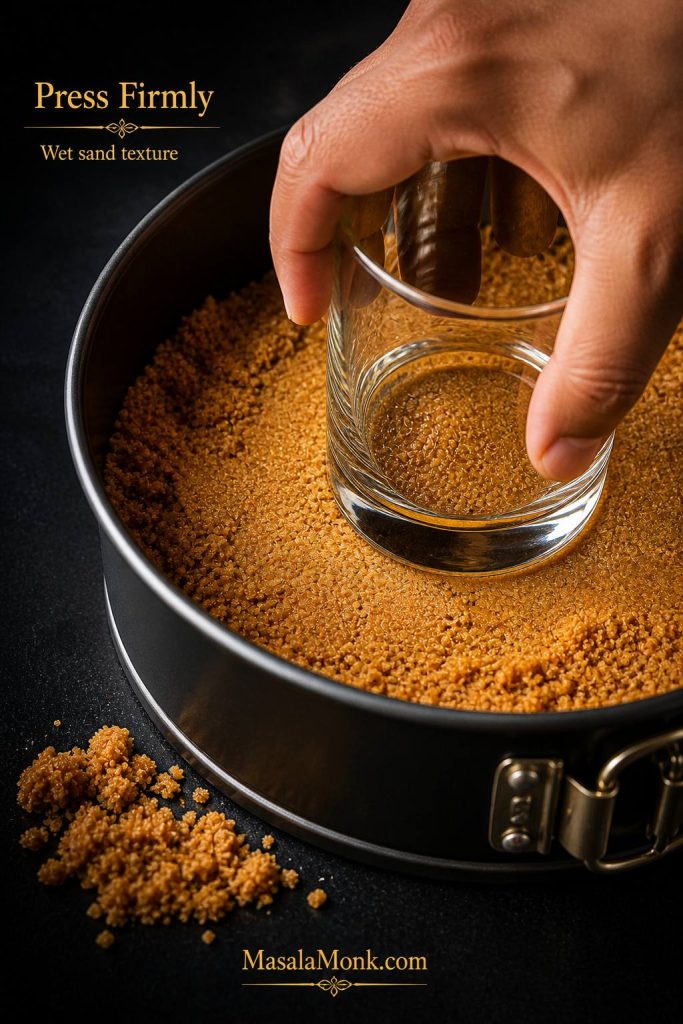
Close-up of a glass pressing biscuit crumbs into a springform pan, with loose crumbs nearby showing a wet sand texture.
Once the crumbs look like wet sand, press them firmly into the pan so the base slices neatly instead of falling apart.

Step 3: Make the Mango Puree

If using fresh mango, blend until smooth and sieve if the mango is fibrous. If using canned mango pulp, stir it well and taste before adding sugar to the filling. For the agar version, the mango puree should be at room temperature, not fridge-cold.
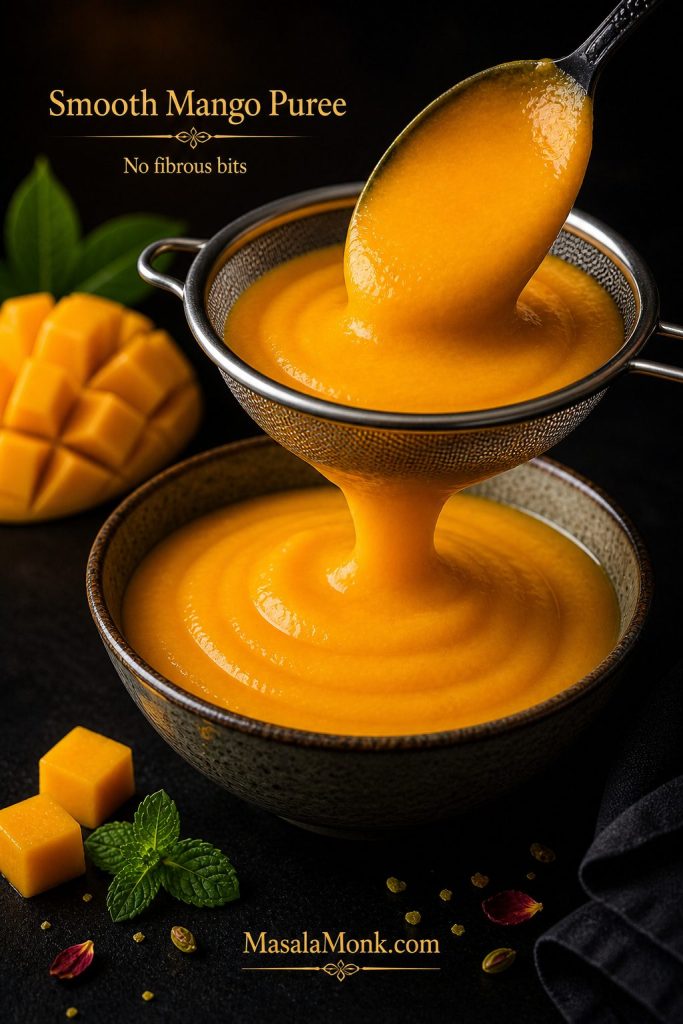
Smooth mango puree being pushed through a sieve into a bowl, with mango pieces nearby on a dark surface.
Sieving the mango puree removes fibrous bits and gives the filling a smoother finish, especially when using fresh mango.

Step 4: Beat the Cream Cheese

Beat softened cream cheese with sugar, lemon or lime juice, vanilla, and salt until completely smooth. Do not add the mango puree yet. Keeping the mango separate makes it easier to mix in the agar without shocking it against cold dairy.
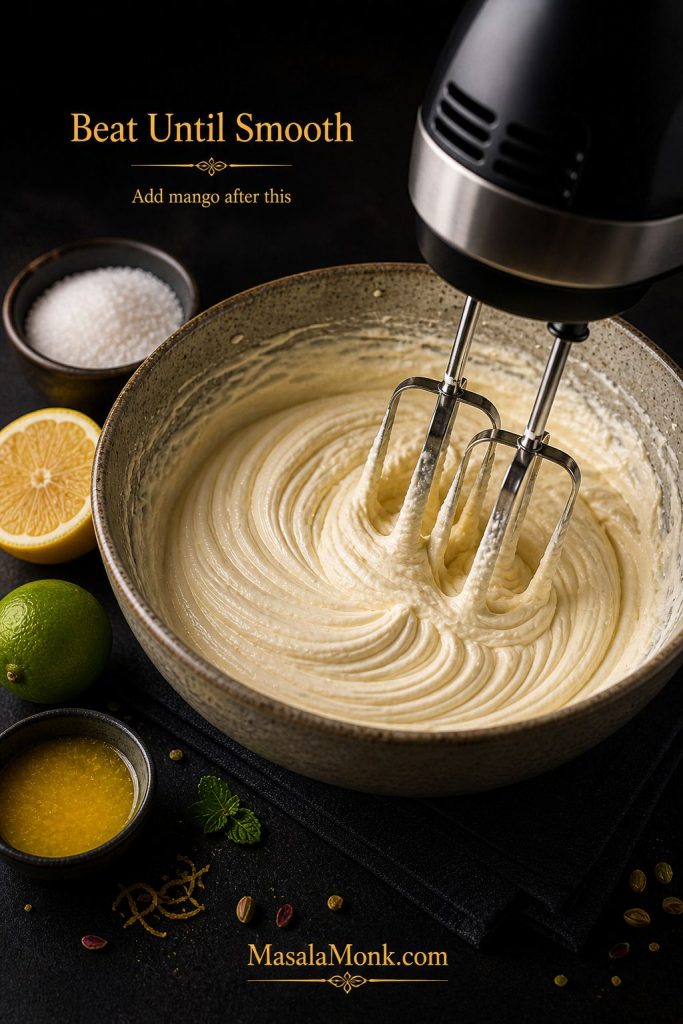
Bowl of cream cheese being mixed until smooth with a hand mixer, with citrus and sugar nearby.
Beat the cream cheese base until it is completely smooth first; after mango is added, small lumps become much harder to fix.

Step 5: Whip the Cream

Whip cold cream to medium-stiff or stiff peaks. In warm weather, chill the bowl and beaters first so the cream holds better.
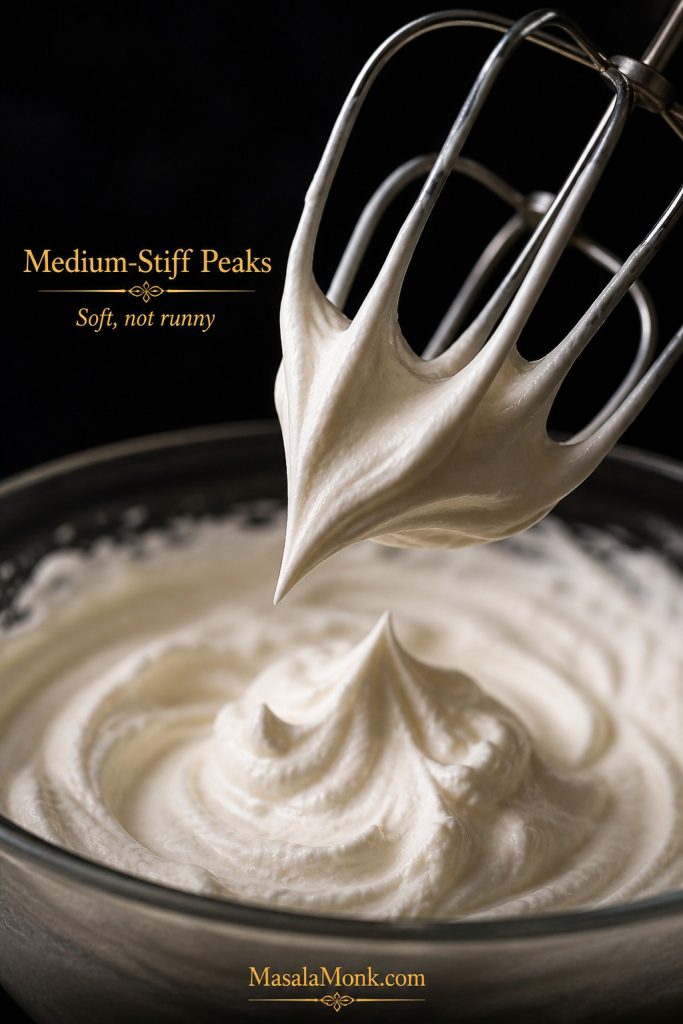
Whipped cream forming medium-stiff peaks on a beater above a mixing bowl.
Medium-stiff whipped cream gives the filling lift and structure, while still keeping the mango cheesecake creamy rather than heavy.

Step 6: Activate the Agar Agar

Simmer the agar agar powder with water until it fully dissolves, then boil gently for about 60–90 seconds. Agar must be heated properly to activate. Let it cool slightly, but do not let it set.
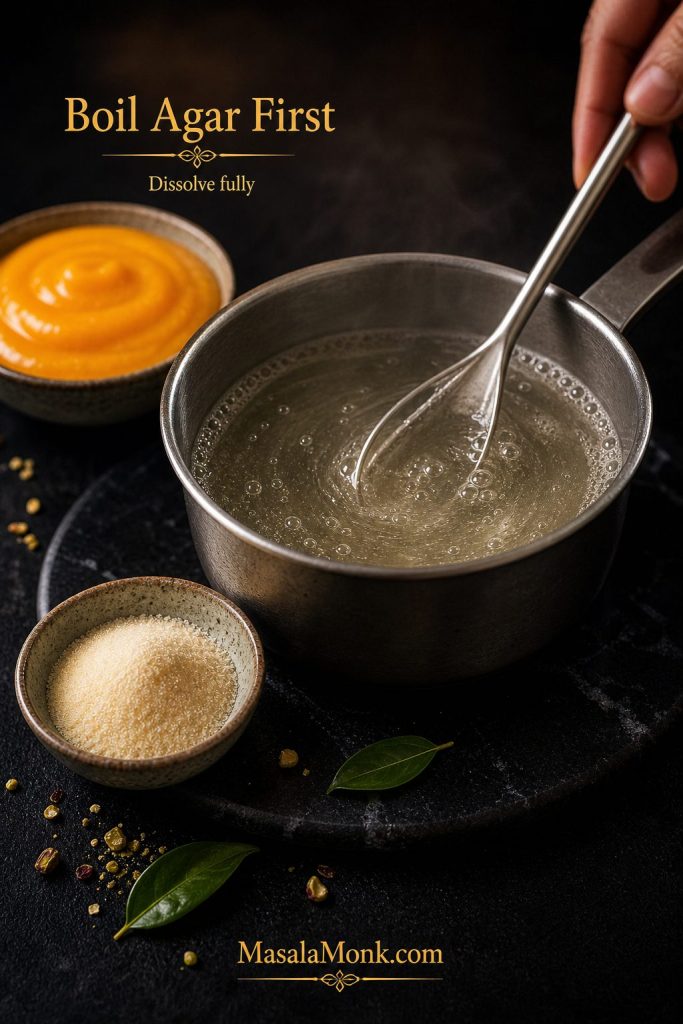
Small saucepan with agar agar mixture simmering, with a bowl of mango puree and agar powder nearby.
Agar agar must be boiled properly before it can set the cheesecake, so this step is more important than simply stirring powder into the filling.

Step 7: Mix the Mango Filling

Whisk the warm agar mixture into room-temperature mango puree first. Then beat this mango-agar mixture into the cream cheese mixture until smooth. Fold in the whipped cream and pour the filling over the chilled biscuit base right away, because agar starts setting quickly.
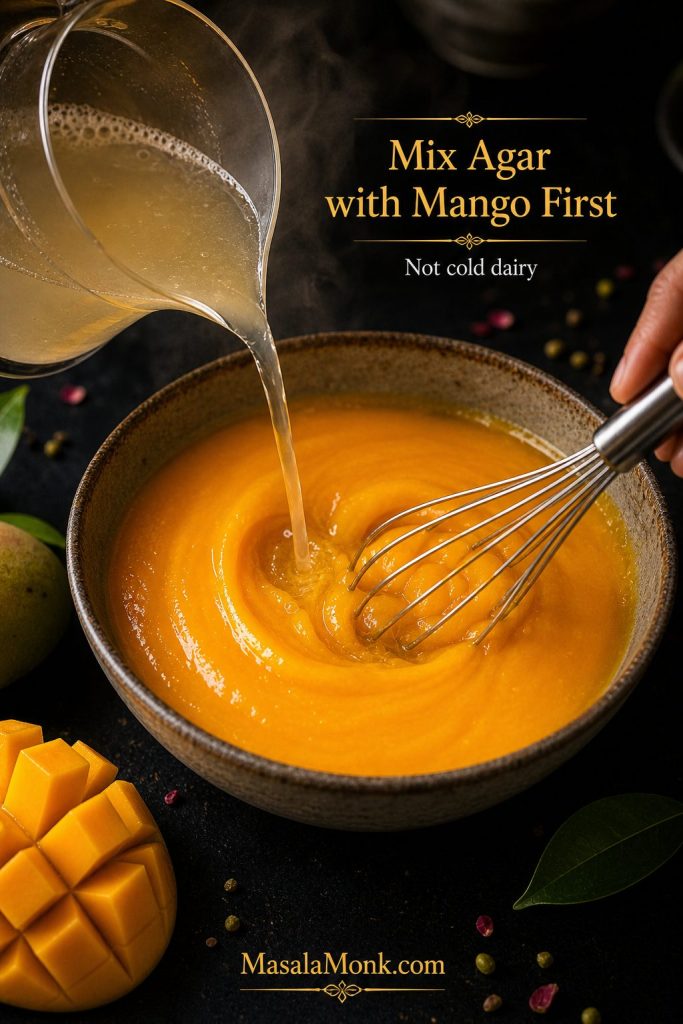
Warm agar mixture being whisked into mango puree in a bowl on a dark counter.
Mixing warm agar into mango puree first helps prevent stringy agar and protects the cream cheese mixture from sudden heat.
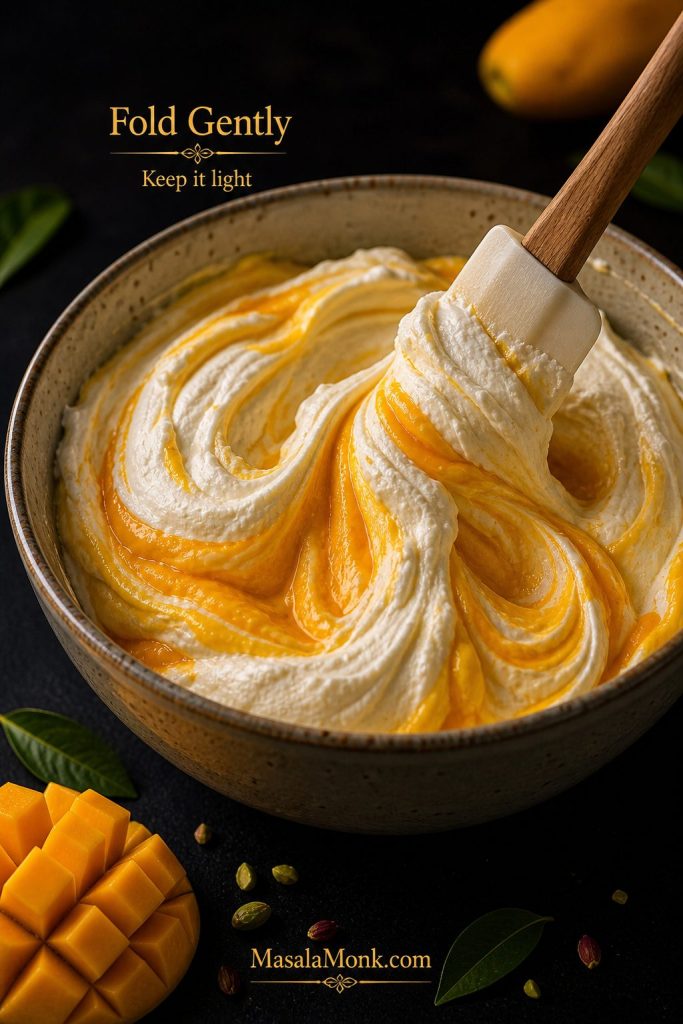
Spatula folding whipped cream into mango cheesecake filling with visible pale and orange swirls.
Fold gently at this stage so the whipped cream lightens the mango filling without knocking out all the air.
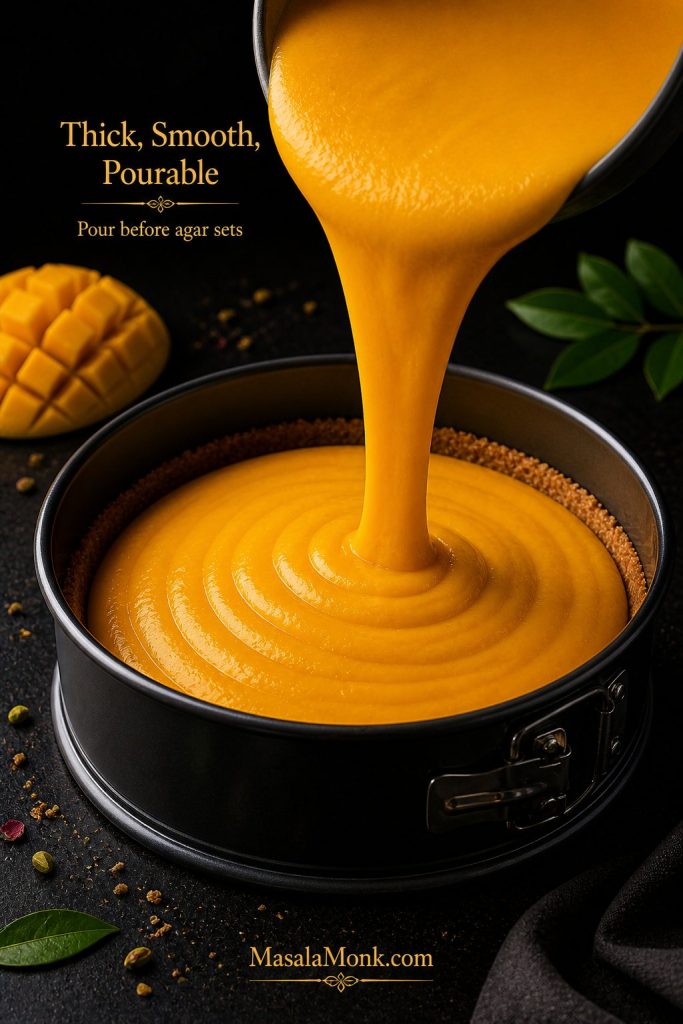
Thick mango cheesecake filling being poured into a springform pan with a prepared biscuit crust.
The filling should pour in a thick ribbon, not run like juice; that texture is a good sign before the cheesecake goes into the fridge.

Step 8: Chill the Cheesecake Layer

Smooth the top, then chill the cheesecake layer for 60–90 minutes before adding a separate mango jelly or topping layer. The surface should feel lightly set before the topping goes on.

Step 9: Add the Mango Topping

Pour the mango topping gently and close to the surface so it does not disturb the cheesecake layer. A spoon can help soften the pour. The topping should be lukewarm, not hot.
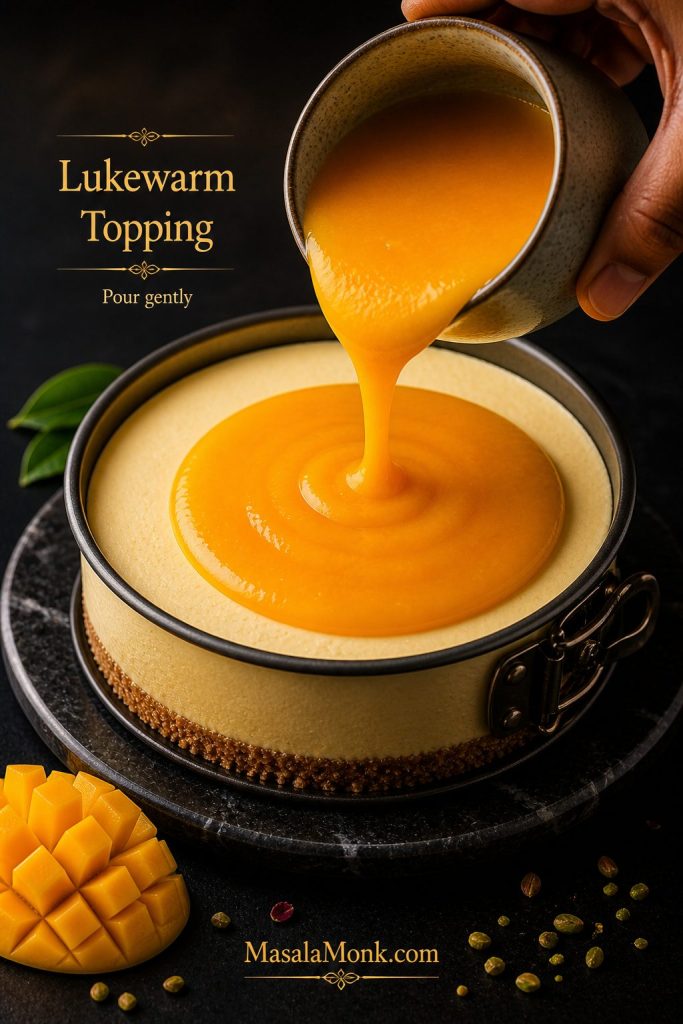
Topping tip: Let the mango topping cool until lukewarm before pouring. If it is too hot, it can soften the cheesecake layer; if it is too cool, an agar-based topping may begin setting before it spreads evenly.
Mango topping being poured gently onto the surface of a chilled cheesecake layer in a pan.
Let the mango topping cool until lukewarm before pouring, because a hot topping can soften the cheesecake layer underneath.

Step 10: Chill Overnight

Chill the finished cheesecake for 8–12 hours, or overnight, before unmolding and slicing. Use a warm sharp knife and clean the blade between cuts for neater slices.
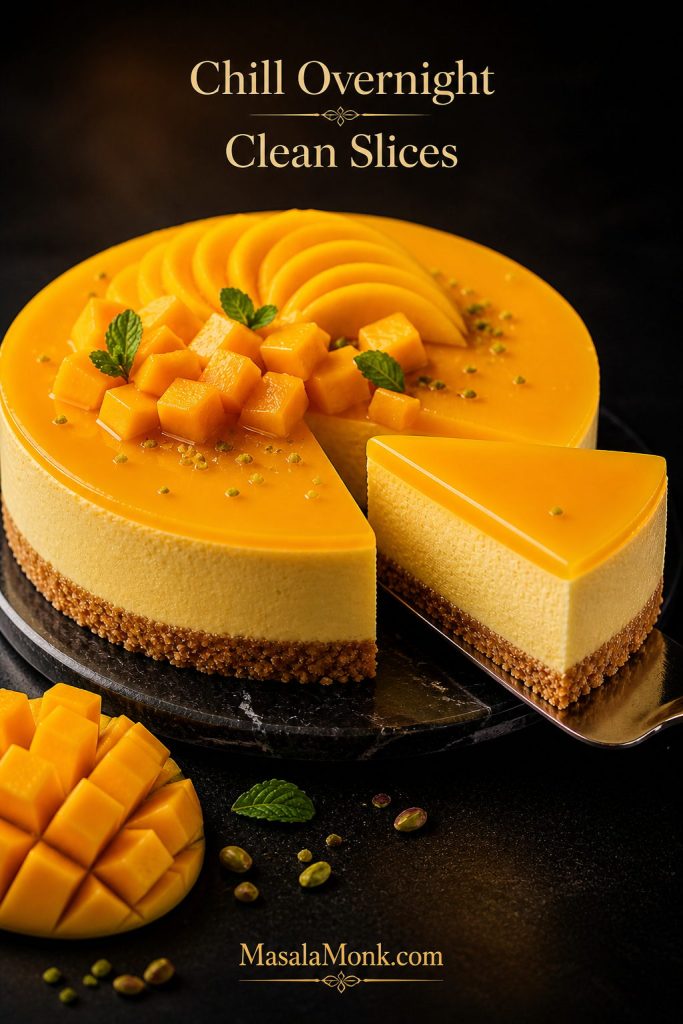
Finished mango cheesecake on a dark surface with one clean slice cut and lifted, showing defined layers and a glossy topping.
After an overnight chill, the cheesecake should release cleanly and show defined layers when sliced with a warm knife.

Gelatin vs Agar Agar vs No Gelatin for Mango Cheesecake

For this no bake mango cheesecake recipe, the setting method decides whether you get clean slices, a vegetarian full cake, or a softer cup-style dessert. In other words, this is the choice that matters most before you start mixing the filling.
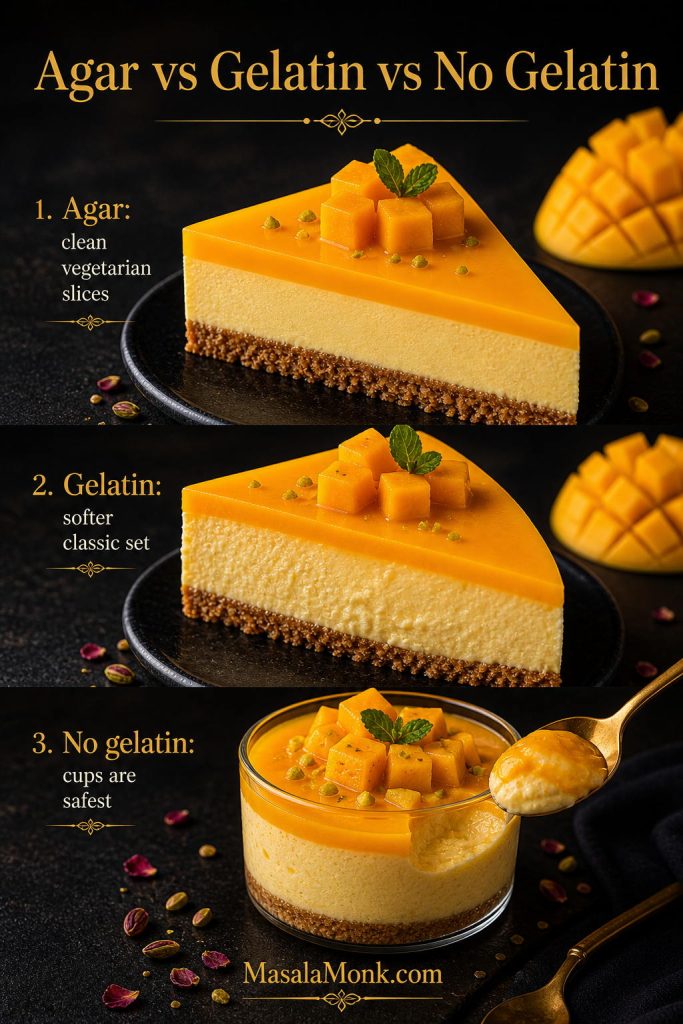
Comparison image showing agar-set mango cheesecake slices, gelatin-set mango cheesecake slices, and a no-gelatin mango cheesecake cup.
This comparison shows why the setting method matters: agar gives cleaner vegetarian slices, gelatin gives a softer classic texture, and no-gelatin cups stay spoonable.
Why mango cheesecake can fail: Mango puree adds flavor, but it also adds moisture. If the puree is thin, the cream is under-whipped, or the setting method is weak, the cheesecake may taste good but refuse to slice cleanly.
Version Best for Texture Watch out for
Agar agar Vegetarian full cake Clean, sliceable, slightly firmer Must be boiled and sets fast
Gelatin Classic full cake Creamy, mousse-like Can clump and is not vegetarian
No gelatin/no agar Cups, jars, bowls Soft and creamy Usually too soft for clean full-cake slices
White chocolate Rich no-gelatin cake Firmer and sweeter Changes flavor and sweetness
Condensed milk Cups, jars, and richer shortcut versions Sweet, creamy, softer Does not set a full cake by itself

No Bake Mango Cheesecake Without Gelatin

You can make mango cheesecake without gelatin, but the final texture depends on the format. For the most foolproof result, use the no-gelatin version in cups, jars, or bowls. A full no-gelatin cake can work, but it needs thick mango puree, full-fat cream cheese, properly whipped cream, and an overnight chill.
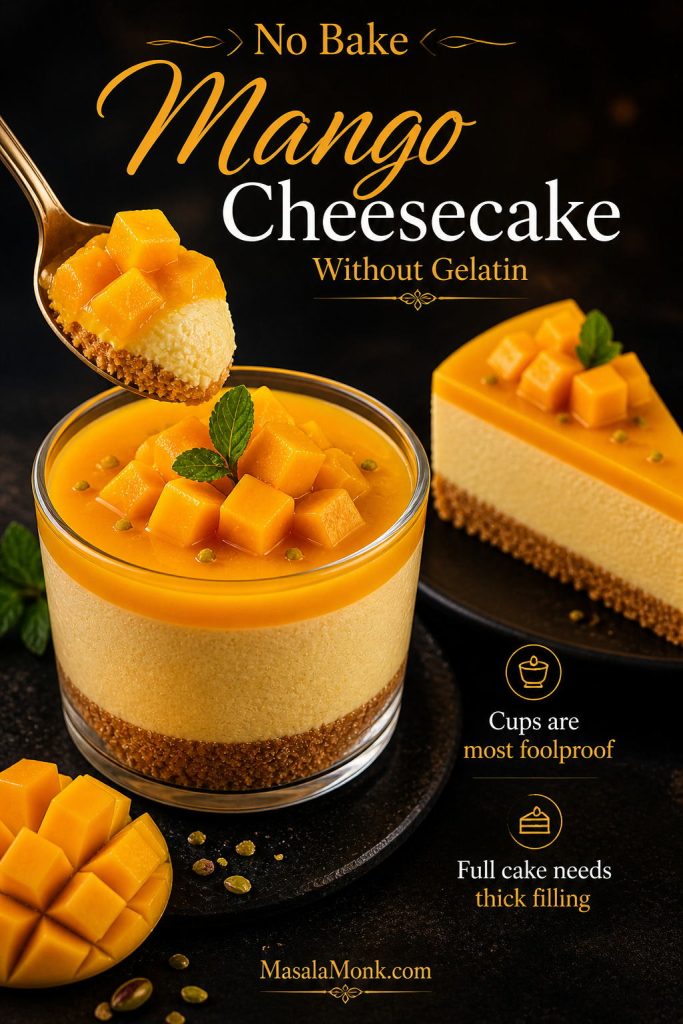
Graphic showing no-gelatin mango cheesecake cups in the foreground and a softer no-gelatin cheesecake slice in the background.
A no-gelatin mango cheesecake is easiest in cups because the filling can stay creamy without needing to stand tall as a full cake.
  • Start with full-fat cream cheese, not low-fat spread.
  • Whip the cream properly so it gives the filling structure.
  • Choose thick mango pulp or puree instead of watery mango juice.
  • Chill overnight for the best texture.
  • Serve it in cups or jars if you want a fully no-gelatin, no-agar dessert.
  • For a firmer no-gelatin full cake, add melted white chocolate.
Best no-gelatin approach: Cups or jars are the most foolproof choice because the filling can stay creamy and spoonable without needing to stand tall. For a full no-gelatin cake, keep the puree thick and chill overnight.

No Bake Mango Cheesecake with Agar Agar

Agar agar is the best vegetarian setting option for a sliceable mango cheesecake. However, it sets more firmly than gelatin and starts setting quickly, so the method matters. As a result, you need to dissolve it fully and mix it into room-temperature mango puree before it reaches the dairy base.
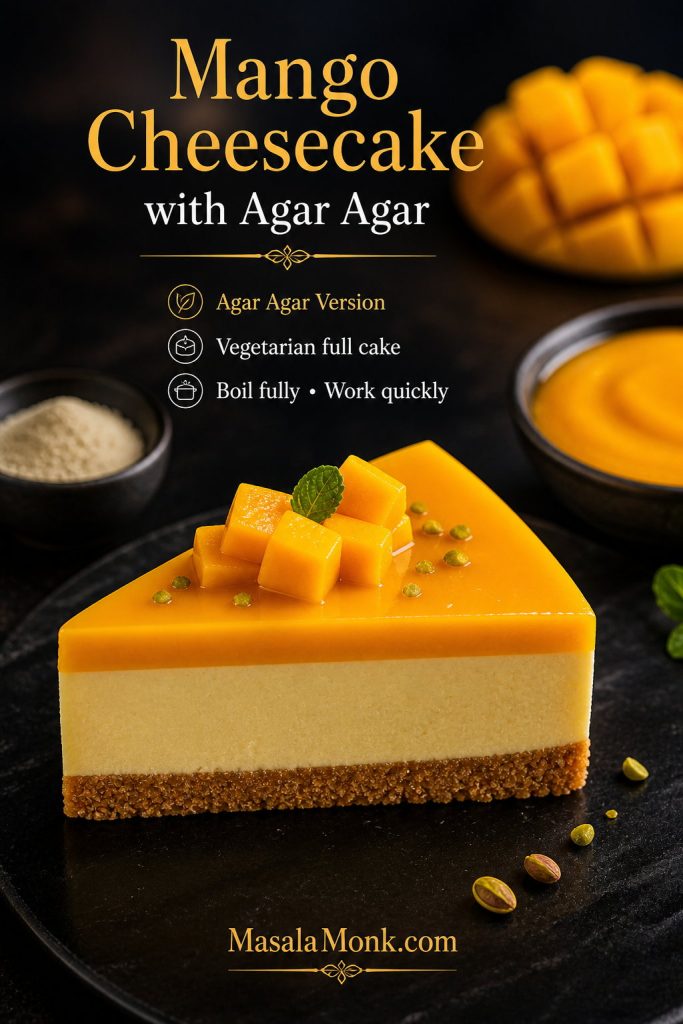
Slice of mango cheesecake with agar agar powder and mango puree, labeled as a vegetarian full cake option.
Agar agar is the strongest choice for an eggless full cake, provided it is dissolved fully and mixed before it begins to set.
  • Choose agar agar powder for the easiest measuring.
  • Measure by weight when possible because agar strength and spoon volume can vary.
  • Boil agar with water until it fully dissolves.
  • Avoid adding hot agar directly into cold cream cheese.
  • Instead, mix agar into room-temperature mango puree first.
  • Work quickly once agar is added.
  • Use a light hand, because too much agar can make the texture too firm or jelly-like.
Agar tip: Do not mix hot agar into fridge-cold mango puree or cold cream cheese. The agar can seize, turn stringy, or set unevenly. Room-temperature mango puree is much safer.

For more background on how agar differs from gelatin, this guide to agar-agar explains why it needs boiling and why it sets firmer than gelatin.

No Bake Mango Cheesecake with Gelatin

Gelatin gives a classic creamy set and works well for a full mango cheesecake. However, it is not vegetarian. Compared with agar agar, it usually gives a softer, more mousse-like texture.
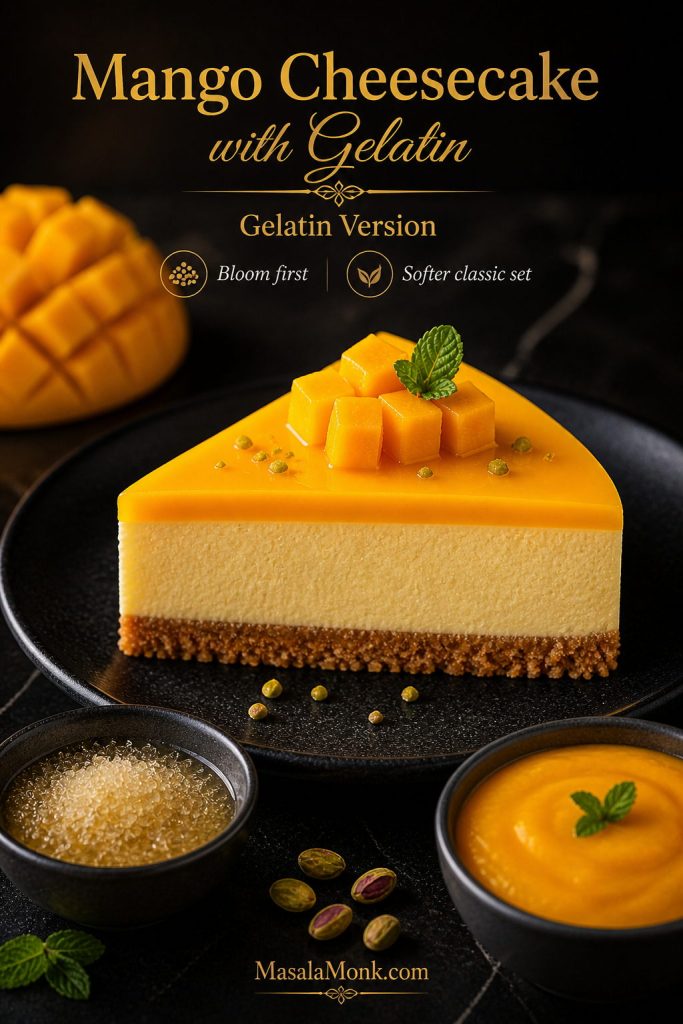
Slice of mango cheesecake with bloomed gelatin and mango puree, labeled as a softer gelatin-set version.
Gelatin works best when it is bloomed first, then dissolved gently, so it blends smoothly into the mango cheesecake filling.
  • For the filling, use 2¼–2½ tsp / about 7–8 g unflavored powdered gelatin with 60 ml / ¼ cup cold water.
  • First, sprinkle gelatin over cold water and let it bloom for 5–10 minutes.
  • After blooming, dissolve it gently without boiling it hard.
  • Then mix the dissolved gelatin into mango puree before adding it to the dairy base.
  • For the mango topping, use ¾ tsp / about 2–2.5 g gelatin with 30 ml / 2 tbsp cold water.
  • Finally, chill overnight for the cleanest slices.
Fresh mango and gelatin tip: If using fresh mango with gelatin, use thick puree, bloom the gelatin properly, and chill overnight. If your fresh mango puree is very thin, reduce it slightly before using it.

For a deeper general guide to blooming gelatin before using it in desserts, King Arthur Baking has a useful explainer on how to use gelatin in baking and desserts.

Full Cake vs Cups, Jars, and Mini Mango Cheesecakes

Format matters because the filling has to behave differently in each version. A full cake needs more structure because it has to unmold and slice. By comparison, cups and jars are more forgiving because they can stay soft and creamy. Therefore, choose the format before you choose the setting method.

Format Best setting method Best for
8-inch full cake Agar agar or gelatin Birthdays and clean slices
9-inch full cake Agar or gelatin, slightly flatter Larger gatherings
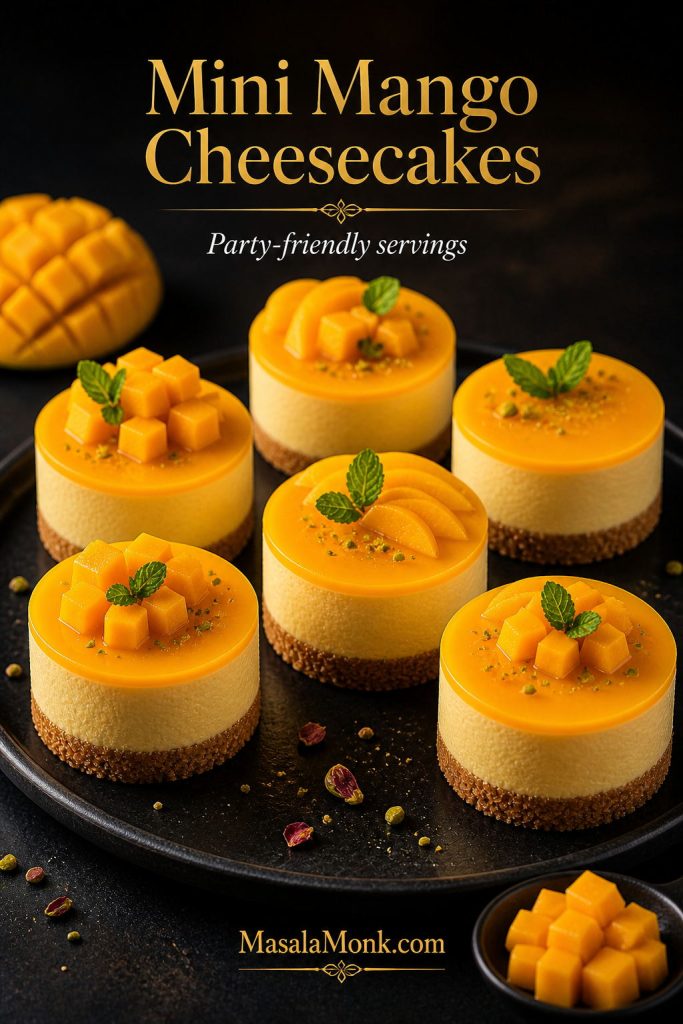
Mini cheesecakes Agar, gelatin, or firmer no-gelatin filling Parties and individual servings
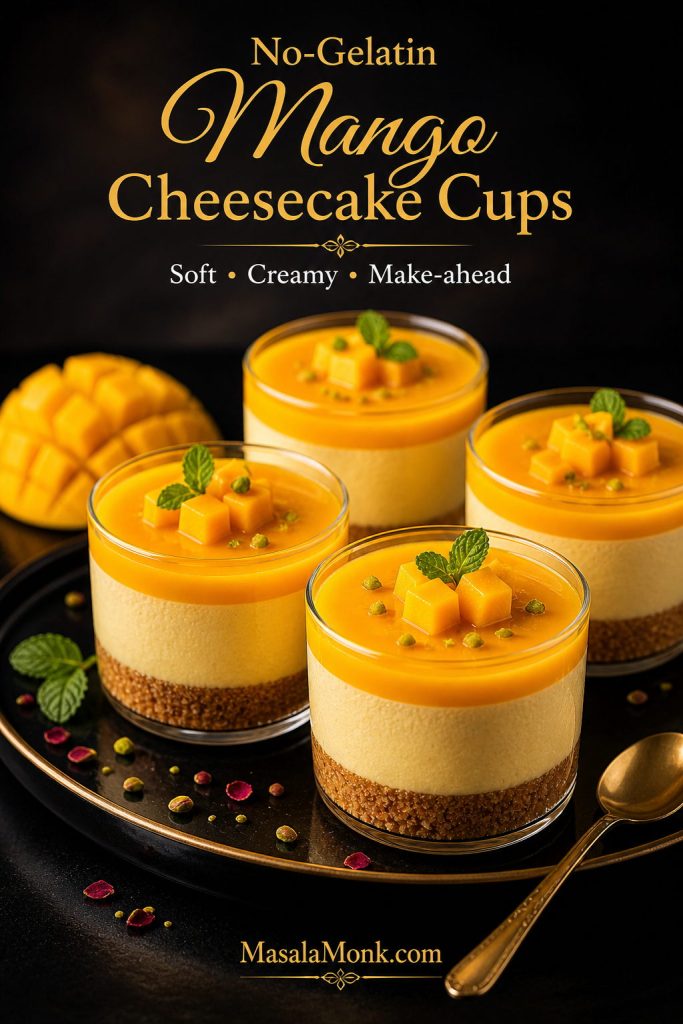
Cups or jars No gelatin/no agar works well Easiest version
Bowls Soft-set no-gelatin filling Make-ahead dessert
Tray of layered mango cheesecake cups with crumb bases, creamy mango filling, and glossy mango topping.
Mango cheesecake cups are ideal for make-ahead serving because each portion has its own biscuit base, creamy filling, and glossy topping.
Several mini mango cheesecakes on a tray, each with a crumb base, creamy filling, and glossy mango topping.
Mini mango cheesecakes give the polish of a full cake in individual portions, which makes them especially useful for parties and dessert tables.

If you want an even softer mango dessert without worrying about clean slices, this quick mango pudding is a simpler spoonable option.

No Bake Mango Cheesecake with Condensed Milk

Condensed milk makes mango cheesecake sweeter, creamier, and richer. Because of that, it works especially well in cups, jars, and shortcut versions. However, if you use condensed milk, reduce the added sugar and keep the lemon or lime juice so the filling does not taste flat.

  • Replace part or all of the sugar with condensed milk.
  • Use 100–150 g condensed milk for a richer filling, then sweeten to taste.
  • Reduce sugar if using sweetened mango pulp.
  • Add lemon or lime juice for balance.
  • Use a setting method if making a full cake.
  • Use cups or jars for the easiest condensed milk version.
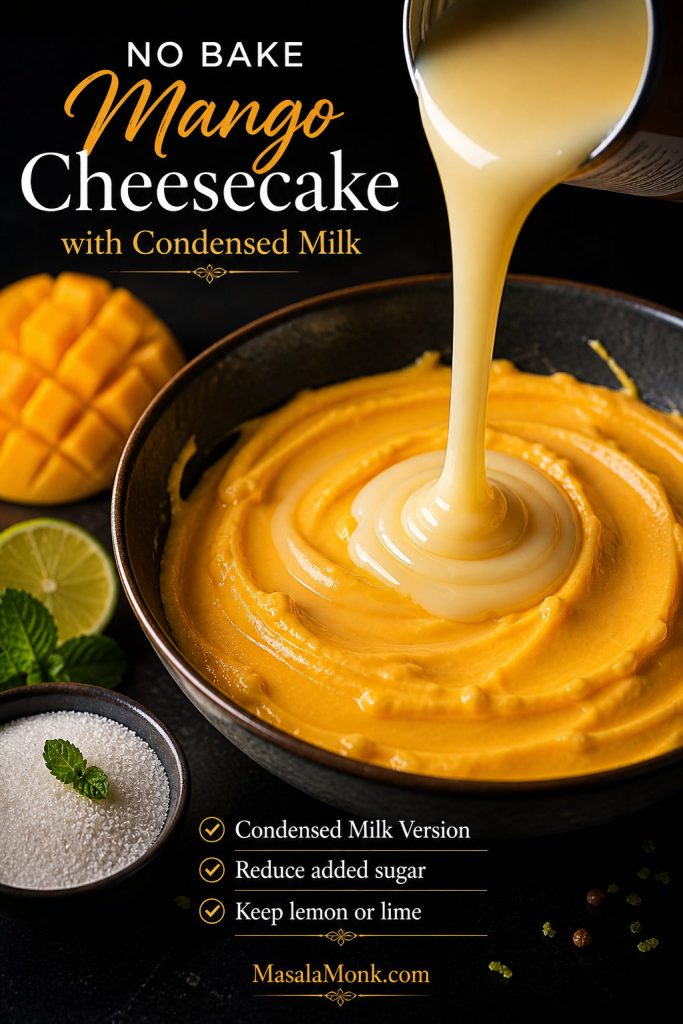
Condensed milk adjustment: For the full cake, start with 100–150 g condensed milk and reduce the added sugar to 0–30 g, depending on how sweet your mango pulp is.
Thick condensed milk being poured into mango cheesecake filling with citrus nearby.
Condensed milk adds richness and sweetness, so the filling usually needs less added sugar and a little citrus to stay balanced.

Mango Topping: Jelly, Coulis, or Fresh Mango

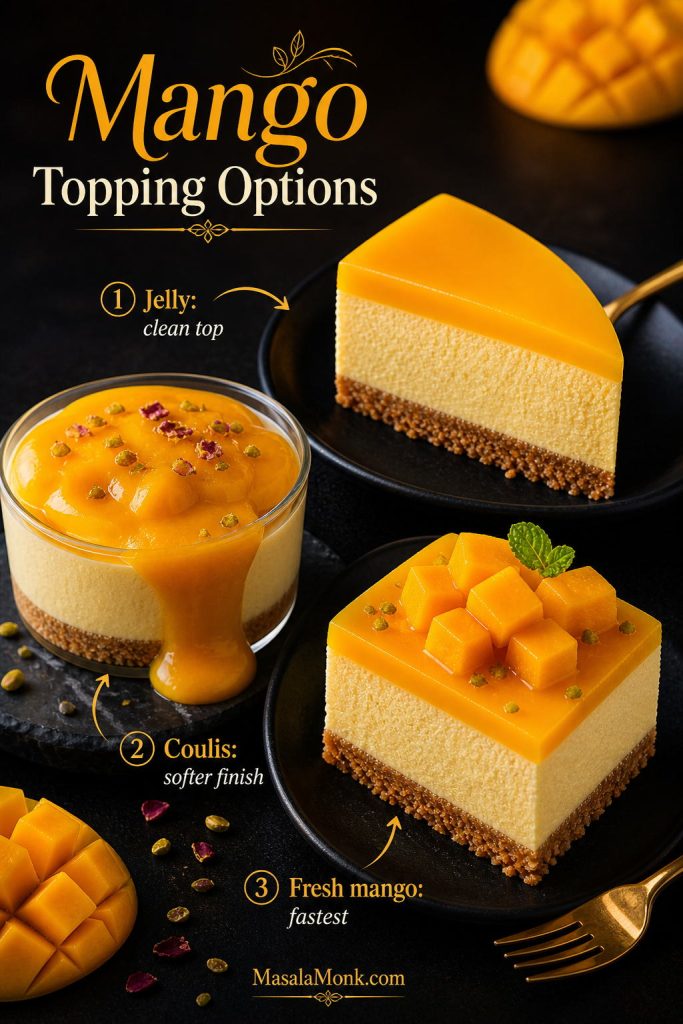
The topping can change both the look and texture of the cheesecake. For example, a mango jelly gives a polished top, while a mango coulis gives a softer sauce-like finish. Alternatively, fresh mango pieces give the fastest decoration.

Topping Best for Texture
Mango jelly Clean cake top and neat slices Set, smooth, glossy
Mango coulis Cups, jars, and softer cakes Spoonable and saucy
Fresh mango cubes Quick decoration Fresh and juicy
Mango passionfruit topping Tangier variation Bright, tropical, slightly tart
Graphic comparing three mango topping styles for cheesecake: jelly, coulis, and fresh mango cubes.
The topping changes the final style: mango jelly looks neat and sliceable, coulis feels softer, and fresh mango cubes add the quickest finish.

For a lighter fruit-first dessert, this mango sorbet keeps mango at the center without cream cheese or a biscuit base.

No Bake Mango Cheesecake Variations

These variations keep the same basic structure but adjust the flavor. However, avoid adding large amounts of extra liquid unless you also adjust the setting method. Otherwise, the filling may become too loose to slice.
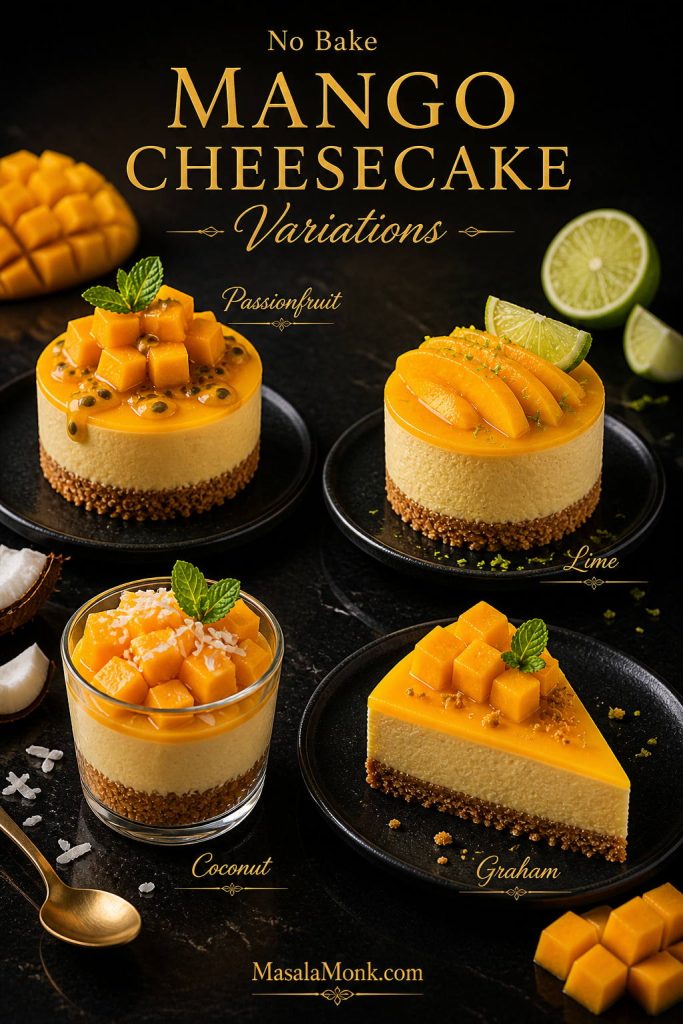
Graphic showing four no bake mango cheesecake variations labeled passionfruit, lime, coconut, and graham.
Keep variations controlled so the filling does not loosen; passionfruit, lime, coconut, and graham all add flavor without changing the whole recipe.

Mango Passionfruit Cheesecake

For a sharper tropical flavor, add passionfruit to the topping or swirl it through a mango coulis. This is especially good if your mango pulp is very sweet.

Mango Lime or Key Lime Cheesecake

For a brighter version, use lime zest and a little extra lime juice. Keep the extra juice modest so the filling does not become too loose.

Mango Coconut Cheesecake

For a richer tropical variation, add coconut cream, coconut milk powder, or toasted coconut as a topping. Coconut milk powder can also add a little body to cup-style cheesecakes.

Mango White Chocolate Cheesecake

Melted white chocolate can help a no-gelatin cheesecake set more firmly, but it also makes the filling sweeter and heavier. Reduce sugar if you use it.
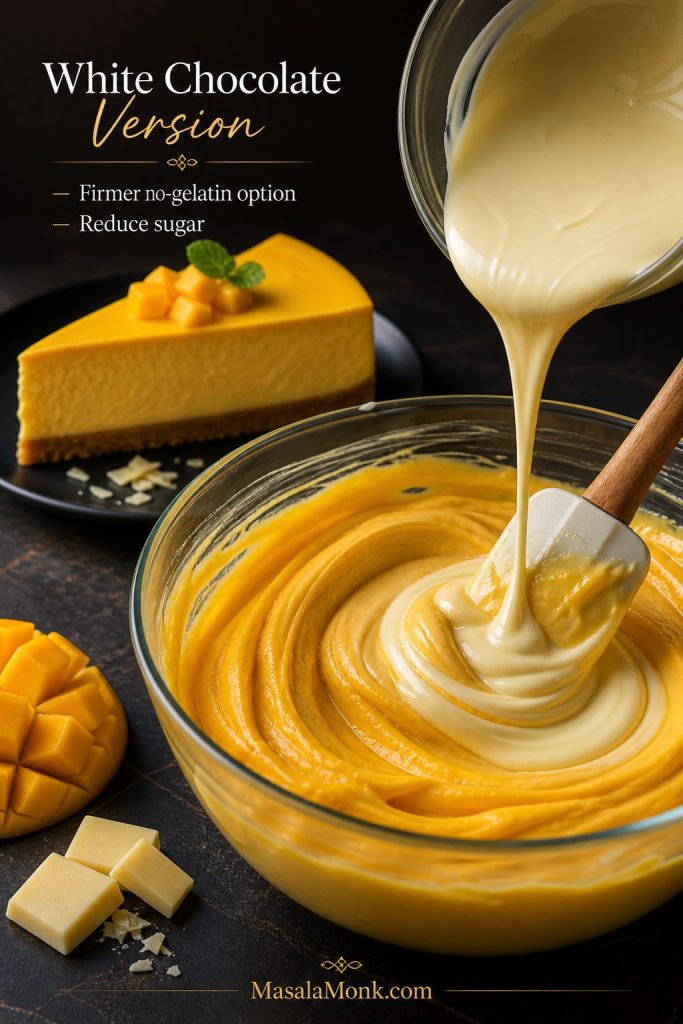
Melted white chocolate being added to mango cheesecake filling, with a finished mango cheesecake slice in the background.
White chocolate can help a no-gelatin filling firm up, but it also adds sweetness, so reduce the sugar before adjusting anything else.

Mango Graham Cheesecake

Use a graham cracker crust and a mango cream cheese filling for a classic mango graham cheesecake direction. This works especially well in cups or a 9-inch full cake.

Vegan No Bake Mango Cheesecake

A vegan version needs a different base formula, usually with cashews, coconut cream, vegan cream cheese, or another dairy-free structure. Treat it as a separate variation rather than a direct swap. For a naturally softer dairy-free mango dessert, this mango chia pudding is a better fit than trying to force a direct vegan cheesecake swap.

Mistakes to Avoid

  • Do not use watery mango puree. It can make the filling loose and bland.
  • Do not rush the chill time. A full cake needs overnight chilling for clean slices.
  • Do not pour hot topping over the cheesecake layer. It can soften or disturb the filling.
  • Do not add agar directly to cold dairy. Mix it with room-temperature mango puree first.
  • Do not use the no-gelatin cups formula as a full cake. It is meant to be soft and spoonable.
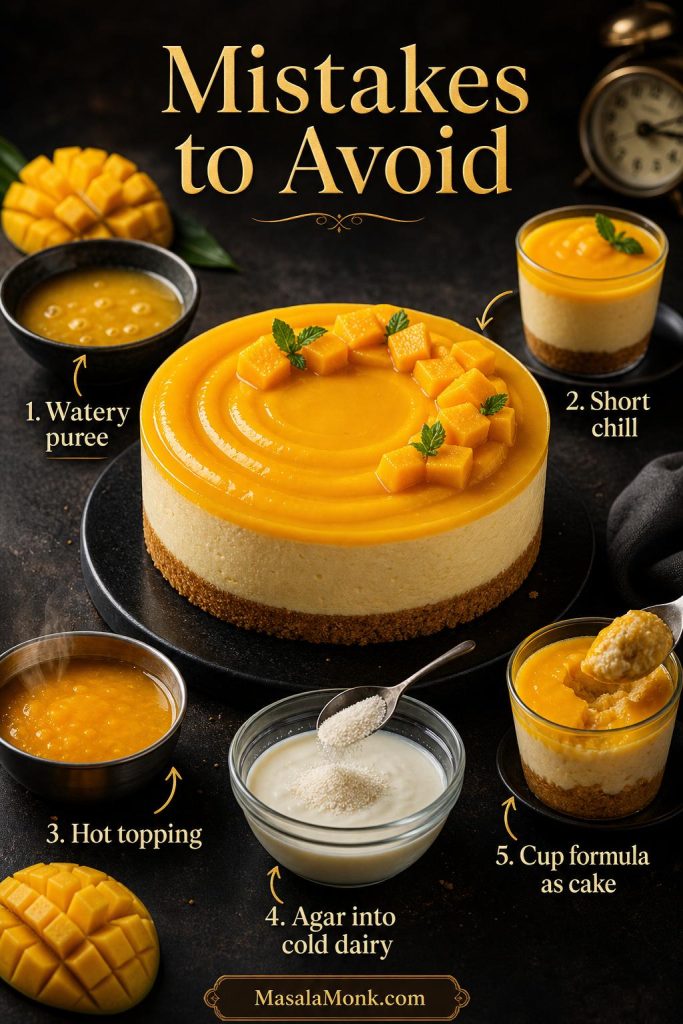
Graphic showing common mango cheesecake mistakes, including watery puree, short chill time, hot topping, agar added to cold dairy, and using a cup formula as a cake.
Avoiding watery puree, short chilling, hot topping, and the wrong setting method prevents most mango cheesecake problems before they happen.

Troubleshooting No Bake Mango Cheesecake

Most no bake mango cheesecake problems come from watery mango, weak setting, under-whipped cream, or not enough chilling time. Therefore, use this table before changing the whole recipe. In many cases, a longer chill or a cup-style serving can save the dessert.
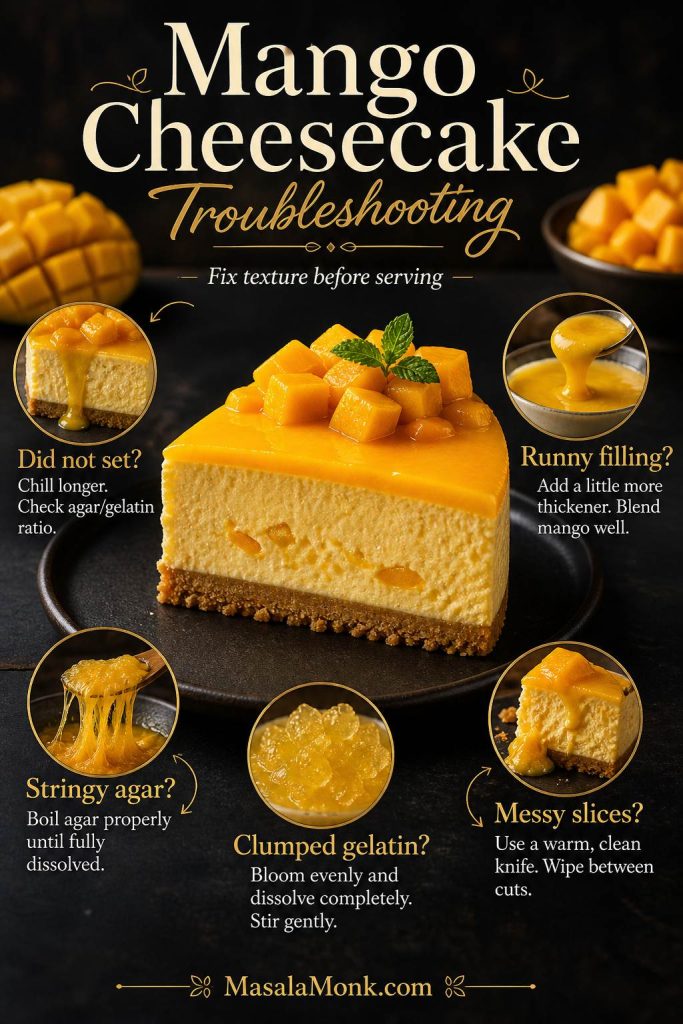
Troubleshooting graphic for mango cheesecake with issues such as runny filling, stringy agar, clumped gelatin, messy slices, and cheesecake that did not set.
When a mango cheesecake does not set, check the puree thickness, agar or gelatin method, and chill time before deciding how to fix or serve it.
Problem Likely cause Fix
Cheesecake did not set Too much mango, weak setter, or not enough chill time Chill overnight, freeze briefly before slicing, or use cups next time.
Filling is runny Watery mango puree or under-whipped cream Reduce puree, whip cream properly, or add a setting method.
Agar turned stringy Agar was not dissolved or hit cold filling Boil fully and mix with room-temperature mango puree first.
Gelatin clumped Gelatin was not bloomed properly Sprinkle over cold water, let it bloom, then dissolve gently.
Topping is runny Too little agar or watery puree Cook down the puree or add the correct amount of setting agent.
Crust crumbles Too little butter or loose pressing Add enough butter and press the base firmly with a flat cup.
Cheesecake is too sweet Sweetened pulp or condensed milk Add lemon or lime and reduce sugar next time.
Mango flavor is weak Bland mango or too little puree Use Alphonso or Kesar pulp, or add a mango coulis layer.
Slices are messy Not chilled enough or no setter Chill overnight and wipe the knife between cuts.
Water on top Condensation Chill uncovered first, then cover loosely once set.

Make Ahead, Storage, and Freezing

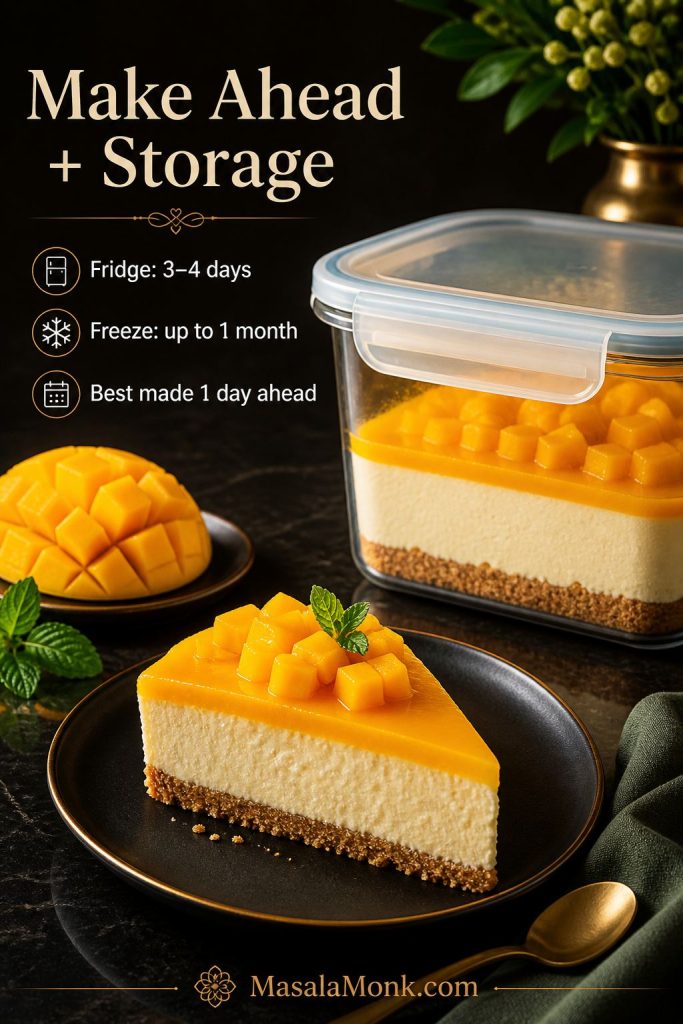
No bake mango cheesecake is a make-ahead dessert. In fact, the texture is usually better after a full overnight chill because the filling firms up and the mango flavor settles into the cream cheese base. For best results, keep it cold until shortly before serving. Also, add fresh mango decoration closer to serving so it stays bright.

Storage method Time Notes
Fridge 3–4 days Keep covered after the cheesecake has fully set.
Freezer Up to 1 month Freeze without fresh fruit topping for the cleanest result.
Room temperature 30–45 minutes max Keep chilled as much as possible, especially in warm weather.
Make ahead 1 day ahead is ideal Overnight chilling gives the cleanest slices.
Mango cheesecake in a covered storage container with a plated slice nearby, plus text showing fridge and freezer storage times.
This dessert improves with planning: make it one day ahead, keep it chilled, and store leftovers covered so the layers stay fresh.

No Bake Mango Cheesecake Recipe Card

Because this no bake mango cheesecake recipe includes agar, gelatin, and no-gelatin cup options, read the notes once before starting so you do not mix the wrong setting method into the filling.
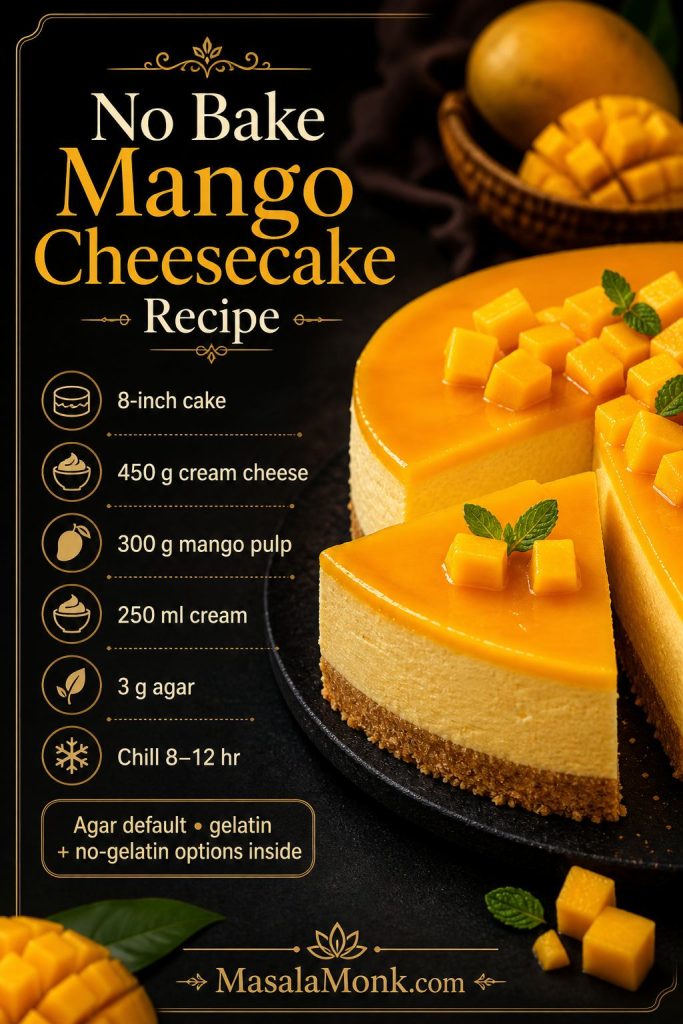
Default version: This recipe card uses agar agar for a vegetarian, eggless full cake. Use the gelatin option below if you prefer a classic mousse-like set, or the cup version if you want no gelatin and no agar.
Texture cue: The filling should be thick, smooth, and pourable when it goes into the pan. If it looks loose and watery before chilling, the mango puree may be too thin or the cream may not be whipped enough.
Recipe card graphic for no bake mango cheesecake showing an 8-inch cake formula with cream cheese, mango pulp, cream, agar, and 8 to 12 hours chill time.
This recipe card keeps the core formula easy to scan, while the full post explains when to use agar, gelatin, or no-gelatin cups.

No Bake Mango Cheesecake Recipe

This creamy no bake mango cheesecake recipe has a buttery biscuit base, mango cream cheese filling, and mango topping. The default version uses agar agar for an eggless, vegetarian-friendly full cake, with exact notes for gelatin and no-gelatin cups.

Yield10–12 slices
Pan8-inch / 20 cm
Prep Time45 minutes
Chill Time8–12 hours

Cook Time: 5 minutes
Total Time: 9–13 hours, including chilling
Best for: make-ahead dessert, summer dessert, eggless cheesecake, mango dessert

Equipment

  • 8-inch / 20 cm springform or loose-bottom pan
  • Parchment paper
  • Food processor, mixer-grinder, or rolling pin for crumbs
  • Blender, if using fresh mango
  • Electric hand mixer or stand mixer
  • Saucepan
  • Rubber spatula
  • Offset spatula or flat spoon
  • Fine sieve, optional
  • Digital scale, recommended

Biscuit Base

  • 200 g / 7 oz digestive biscuits, graham crackers, or Marie biscuits, about 2 cups crumbs
  • 80 g / 2.8 oz / about 5½ tbsp unsalted butter, melted
  • 1–2 tbsp sugar, optional
  • ¼ tsp fine salt
  • ¼ tsp cardamom or cinnamon, optional

Mango Cheesecake Filling

  • 450 g / 16 oz full-fat cream cheese, softened
  • 250 ml / 1 cup cold whipping cream or heavy cream
  • 300 g / 10.5 oz / about 1¼ cups mango pulp or thick mango puree, room temperature for agar version
  • 80–100 g powdered sugar or caster sugar, added to taste
  • 1½–2 tbsp / 22–30 ml lemon or lime juice
  • 1 tsp vanilla extract
  • ⅛ tsp fine salt
  • 3 g agar agar powder / about 1½ tsp
  • 100–125 ml / about ⅓–½ cup water, for agar

Mango Jelly Topping

  • 200–250 g / about ¾–1 cup mango pulp
  • 1–2 tbsp sugar, optional
  • 1–2 tsp lemon or lime juice
  • 1 g agar agar powder / about ½ tsp
  • 80–100 ml / about ⅓ cup water

Method

  1. Line the base of an 8-inch / 20 cm springform pan with parchment paper. Line the sides if you want a cleaner finish.
  2. Crush the biscuits into fine crumbs. Mix with melted butter, salt, and optional sugar or spice until the texture looks like wet sand.
  3. Press the crumb mixture firmly into the pan. Chill for 30 minutes.
  4. Blend fresh mango into a smooth puree, or stir canned mango pulp until even. For the agar version, keep the mango puree at room temperature rather than fridge-cold.
  5. Beat softened cream cheese with sugar, lemon or lime juice, vanilla, and salt until completely smooth. Keep the mango puree separate for now.
  6. Whip cold cream to medium-stiff or stiff peaks in a separate bowl.
  7. Simmer agar agar powder with water until fully dissolved, then boil gently for about 60–90 seconds. Let it cool slightly, but do not let it set.
  8. Whisk the warm agar mixture into the room-temperature mango puree first. Then beat this mango-agar mixture into the cream cheese mixture until smooth.
  9. Fold in the whipped cream and pour the filling over the chilled biscuit base right away.
  10. Smooth the top and chill for 60–90 minutes before adding the mango topping.
  11. For the topping, simmer the agar agar powder with water until fully dissolved, then whisk in the mango pulp, sugar, and lemon or lime juice. Simmer briefly until smooth, then cool until lukewarm.
  12. Pour the topping gently over the cheesecake layer.
  13. Chill for 8–12 hours, or overnight, before unmolding and slicing.

Gelatin Option for Full Cake

To make a classic gelatin-set version, replace the agar in the filling with 2¼–2½ tsp / about 7–8 g unflavored powdered gelatin and 60 ml / ¼ cup cold water. First, sprinkle gelatin over the cold water and let it bloom for 5–10 minutes. After that, dissolve it gently, then mix it into the mango puree before adding it to the cream cheese mixture. Do not boil gelatin hard.

For the mango topping, use ¾ tsp / about 2–2.5 g gelatin bloomed in 30 ml / 2 tbsp cold water instead of agar. Then, stir the dissolved gelatin into the warm mango topping, cool until lukewarm, and pour gently over the cheesecake layer.

No-Gelatin Mango Cheesecake Cups

To make 6–8 no-gelatin mango cheesecake cups, use 150 g biscuit crumbs, 60 g melted butter, 300 g full-fat cream cheese, 200 ml cold whipping cream, 200–225 g thick mango pulp, 50–70 g powdered sugar or 100–120 g condensed milk, 1 tbsp lemon or lime juice, 1 tsp vanilla, and a pinch of salt.

Press the biscuit base into cups or jars. Beat cream cheese with mango, sugar or condensed milk, lemon or lime, vanilla, and salt. Fold in whipped cream, spoon into cups, and chill for at least 6 hours, preferably overnight. This version is soft and creamy, not designed for clean full-cake slices.

Serve these directly from the cups with mango coulis, fresh mango cubes, or crushed biscuit crumbs on top.

Do not use this no-gelatin cups formula as a full cake unless you are comfortable with a soft, mousse-like texture that may not slice neatly.

Condensed Milk Adjustment

For a condensed milk full-cake version, start with 100–150 g condensed milk and reduce the added sugar to 0–30 g, depending on how sweet your mango pulp is. Keep the lemon or lime juice so the filling stays balanced.

Agar Note

Agar strength can vary by brand, so weight is more reliable than spoon measure. Start with 3 g for this 8-inch cake. If your agar is very strong or you prefer a softer texture, use the lower end next time.

Pan Notes

This recipe is best in an 8-inch / 20 cm pan. A 9-inch pan will work, but the cheesecake will be slightly flatter. For a taller 9-inch cheesecake, increase the filling and base by about 25%.

Slicing Note

For clean slices, chill overnight, loosen the sides gently, use a warm sharp knife, and wipe the blade between cuts.

Storage

Refrigerate for 3–4 days. Freeze for up to 1 month without fresh fruit topping. Keep chilled until serving.

FAQs About No Bake Mango Cheesecake

How do you make this no bake mango cheesecake recipe without gelatin?

The safest way is to make it in cups or jars. A full no-gelatin cake can be softer and may not slice as cleanly unless the filling is very thick or supported with another ingredient such as white chocolate.

Is agar agar a good substitute for gelatin in mango cheesecake?

Agar agar works well as a vegetarian setting option, but it behaves differently from gelatin. It must be boiled to activate, sets faster, and can become too firm if you use too much.

Why did my mango cheesecake not set?

The most common reasons are watery mango puree, too much mango, weak setting agent, under-whipped cream, or not enough chilling time. Before changing the recipe, chill it overnight and check the texture again.

What kind of mango pulp works best?

Canned Alphonso or Kesar mango pulp is one of the easiest options because it gives consistent sweetness, color, and mango flavor. However, if the pulp is already sweetened, reduce the sugar in the filling.

Fresh mango or canned mango pulp: which is better?

Both work. Fresh mango gives the best seasonal flavor when the fruit is ripe, sweet, and non-fibrous. Meanwhile, canned mango pulp gives more consistent color and sweetness throughout the year.

How does condensed milk change the filling?

Condensed milk makes the cheesecake sweeter, creamier, and richer. Therefore, reduce the added sugar and keep the lemon or lime juice so the filling stays balanced instead of flat.

How long should mango cheesecake chill?

A full cake should chill for 8–12 hours, or overnight, for the cleanest slices. Cups and jars usually need at least 6 hours, although overnight is still better for texture.

Does mango cheesecake freeze well?

It freezes best without fresh fruit topping. For the cleanest texture, freeze the whole cake or slices tightly wrapped, then thaw in the fridge before serving.

When should I make mango cheesecake cups instead of a full cake?

Cups are the better choice when you want a no-gelatin dessert, a softer texture, or easier party servings. They are also more forgiving because the filling does not need to unmold or slice cleanly.

Which biscuits are best for the crust?

Digestive biscuits, graham crackers, and Marie biscuits all work. Choose digestive biscuits for a sturdier base, graham crackers for a classic cheesecake flavor, or Marie biscuits for a lighter base.

Is this no bake mango cheesecake recipe eggless?

It is eggless because it is no bake and does not rely on eggs for structure. In addition, the default agar agar version is vegetarian-friendly.

Can I use paneer instead of cream cheese?

Paneer can work only if it is blended very smooth with a little cream, yogurt, or milk, but the flavor will be less tangy than cream cheese. For the most reliable cheesecake texture, full-fat cream cheese is still the better choice.

What happens if I skip cream cheese?

You can make mango mousse cups or mango dessert cups without cream cheese, but the result will not taste like classic cheesecake. For proper cheesecake flavor and structure, cream cheese is the best choice.

Why is my cheesecake too soft?

The filling may have too much mango, watery puree, under-whipped cream, or too little setting support. First, chill it longer. If it still does not slice cleanly, serve it as cups instead.

How do I get clean slices?

Chill the cheesecake overnight, use a warm sharp knife, and wipe the blade between cuts. Also, remember that agar agar or gelatin will give cleaner slices than a no-setter filling.

How far ahead should I make it for a party?

Make it one day ahead and keep it refrigerated. Finally, add fresh mango decoration closer to serving so the fruit stays bright and fresh.
Posted on 1 Comment

Mango Smoothie Recipe

Thick mango smoothie in a glass topped with mango cubes and mint, served with fresh mango and lime.

A good mango smoothie recipe should taste cold, creamy, bright, and full of real mango flavor. It should not turn watery after a few sips, taste mostly like banana, or need a pile of ice just to feel thick.

This mango smoothie recipe starts with a simple base formula: ripe mango, just enough liquid, something creamy, and a small lift of lime if the fruit needs brightness. You can make it with fresh or frozen mango, yogurt or milk, banana or no banana, dairy or plant milk, and still end up with a smoothie that feels smooth, balanced, and easy to drink.

Once you understand the ratio, the same recipe can move in several directions. Make it thicker for a smoothie bowl, lighter for a breakfast drink, richer with Greek yogurt, tropical with pineapple, berry-bright with strawberries, or more filling with protein powder. The goal is not to memorize a dozen recipes. It is to know how to build the mango smoothie you actually want.

Mango Smoothie Recipe Quick Answer

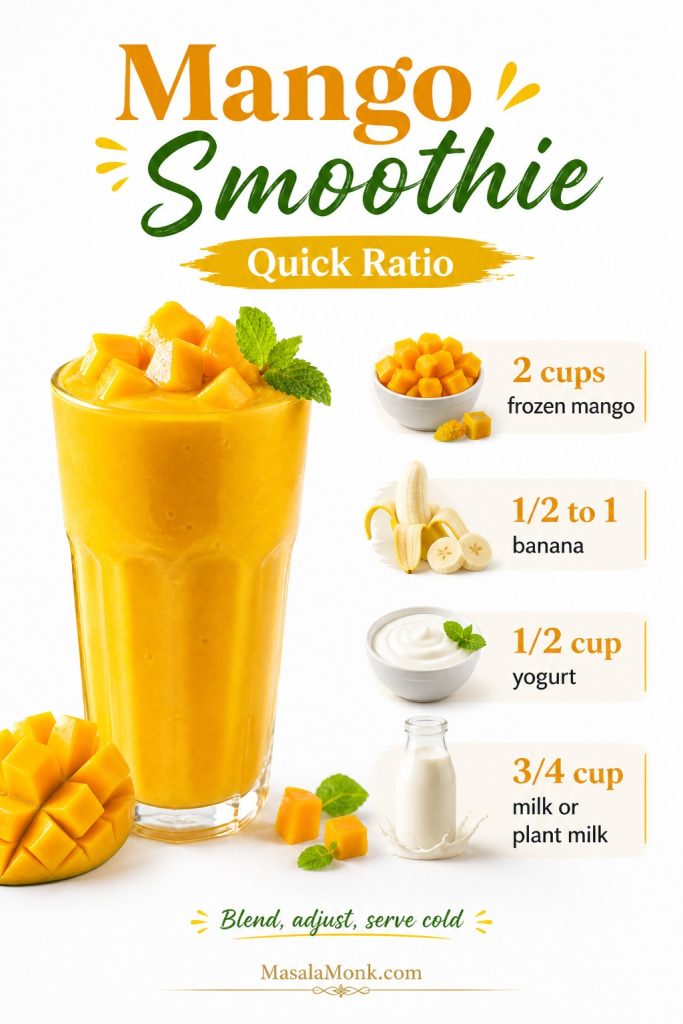
For a creamy, balanced mango smoothie, blend 2 cups frozen mango chunks, 1/2 to 1 small banana, 1/2 cup yogurt, and 3/4 cup milk or plant milk. Add 1 to 2 teaspoons lime juice when the mango tastes very sweet or slightly flat. To loosen a thick smoothie, add milk 1 tablespoon at a time. For a thin smoothie, add more frozen mango instead of piling in ice.

Best starting point: Use frozen mango, chilled yogurt, chilled milk, and no ice. This gives you a cold, creamy mango smoothie without diluting the fruit.
Quick mango smoothie ratio graphic showing frozen mango, banana, yogurt, milk or plant milk, and a finished smoothie.
Use this base ratio when you want a reliable starting point. Then, depending on whether you want a thinner drink or a thicker blend, adjust the liquid or frozen fruit in small steps.

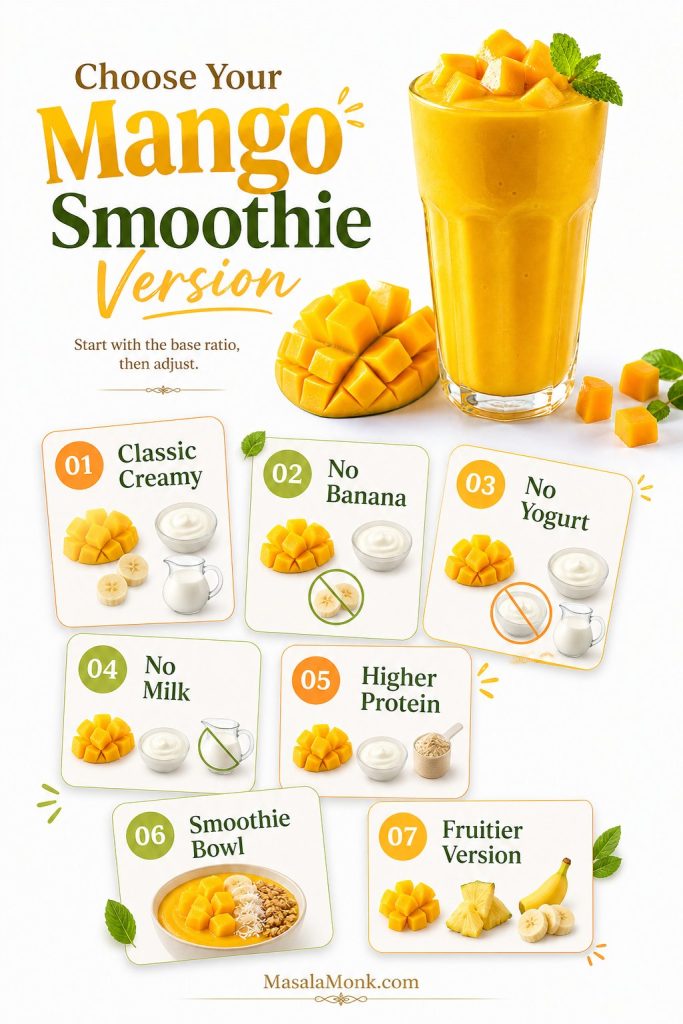
Choose Your Mango Smoothie Version

The base mango smoothie recipe is flexible, so you can adjust it depending on what you have and how creamy you want the drink to be. Use this quick guide before you blend.

Visual guide showing classic, no banana, no yogurt, no milk, higher protein, smoothie bowl, and fruitier mango smoothie options.
This quick chooser helps you match the mango smoothie recipe to what you have on hand; as a result, you can move straight to the version that fits your ingredients and texture goal.
What You Want Best Adjustment Start With
Classic creamy mango smoothie Use frozen mango, banana, yogurt, and milk. Start with 2 cups mango, 1/2 banana, 1/2 cup yogurt, and 3/4 cup milk.
No banana Use extra frozen mango, Greek yogurt, avocado, or soaked cashews for body. Blend 2 1/2 cups frozen mango with 1/2 cup yogurt and 3/4 cup milk.
No yogurt Use banana, avocado, coconut milk, or extra frozen mango for creaminess. Try 2 cups mango, 1 banana, and 3/4 cup milk.
No milk Use coconut water, orange juice, water, or coconut milk depending on texture. Begin with 2 cups mango, 1/2 banana, 1/2 cup yogurt, and 1/2 to 3/4 cup liquid.
Higher protein Add protein powder, Greek yogurt, hemp seeds, chia seeds, soy milk, or dairy milk. Add 1 scoop protein powder to the base recipe, then blend in 2 to 4 tablespoons extra milk if needed.
Smoothie bowl Use more frozen mango and much less liquid. For a spoonable bowl, use 2 1/2 to 3 cups frozen mango with only 1/4 to 1/2 cup milk.
Fruitier smoothie Replace half the mango with strawberries, pineapple, blueberries, or peaches. Use 1 cup mango, 1 cup second fruit, yogurt, and milk.

Mango Smoothie at a Glance

Before you start blending, here is the mango smoothie recipe in practical terms. This is the version to make first when you want a classic mango smoothie that is thick, smooth, and easy to adjust.

Detail What to Use
Prep time 5 minutes
Blend time 35–60 seconds, depending on blender strength
Servings 2 medium smoothies
Yield About 2 1/2 to 3 cups / 600–700 ml / 20–24 fl oz
Best mango Frozen ripe mango chunks for texture; fresh ripe mango for peak-season flavor
Best liquid Milk, almond milk, oat milk, cashew milk, or coconut milk
Best texture Thick but pourable
Ice? Skip it with frozen mango; use a little only with fresh mango

Why This Mango Smoothie Works

This mango smoothie recipe works because it is built around texture and balance, not just sweetness. Although mango gives the main flavor, it still needs the right support. Frozen mango thickens the drink without watering it down. Yogurt adds body and a little tang. Banana makes the smoothie naturally creamy, while milk or plant milk helps everything blend smoothly.

Most importantly, the recipe keeps the liquid modest at the start. It is always easier to thin a smoothie than to rescue one that has turned watery. That is why the method asks you to blend first, then adjust slowly with small splashes of milk only when needed.

Mango Smoothie Ingredients

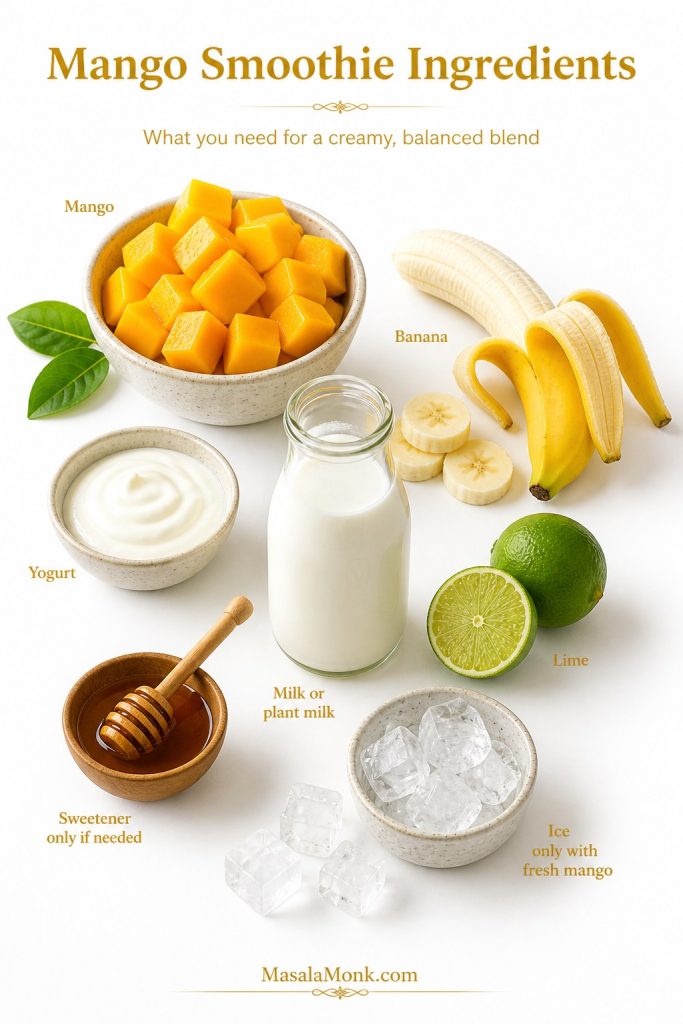
This smoothie recipe is flexible, but mango still does the main work. Once you know what each ingredient brings, you can change the smoothie confidently without losing the thick, creamy texture.

Mango smoothie ingredients arranged on a white background, including mango, banana, yogurt, milk, lime, sweetener, and ice.
Think of these ingredients as texture controls: mango builds the base, banana softens it, yogurt thickens it, milk loosens it, and lime keeps the flavor from tasting flat.

Mango

Mango is the heart of the recipe, so use ripe, sweet fruit whenever possible. Frozen mango chunks are the easiest option because they make the smoothie cold and thick right away. Fresh mango also works beautifully, especially during mango season. However, it needs a little help from chilled ingredients or a few ice cubes to feel just as cold.

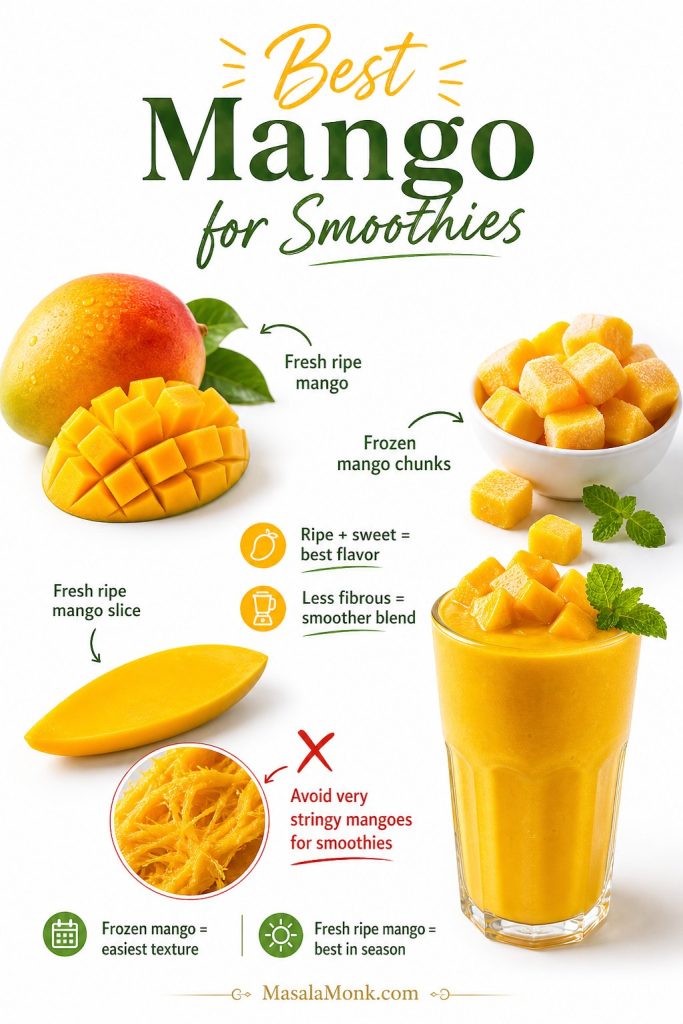
If you are using Indian mangoes, ripe Alphonso, Kesar, Dasheri, or other sweet non-fibrous varieties work especially well. With supermarket mangoes, choose fruit that smells sweet near the stem and gives slightly when pressed. For a simple ripeness check, Mango.org recommends choosing mangoes by feel rather than color.

As a practical guide, 1 medium-large mango usually gives about 1 cup of chopped fruit, so this recipe needs about 2 medium-large mangoes if you are using fresh mango instead of frozen chunks.

Guide to choosing mango for smoothies, showing ripe mango, frozen mango chunks, smoothie texture, and stringy mango to avoid.
For the smoothest mango smoothie, choose ripe, sweet, less fibrous mangoes when possible. Meanwhile, frozen mango chunks are the easiest way to get thick, cold texture all year.

Banana

Banana makes the smoothie creamier, sweeter, and more filling. A frozen banana gives the thickest texture, while a fresh banana blends more easily. However, banana is still optional. To make a mango smoothie without banana, use extra frozen mango, Greek yogurt, avocado, coconut milk, or soaked cashews for body.

Yogurt

Yogurt adds creaminess, tang, and protein. Greek yogurt makes the smoothie thicker and more filling, while regular plain yogurt gives a lighter, more drinkable result. In addition, yogurt helps balance very sweet mangoes because it brings a little tang. For a dairy-free mango smoothie, use coconut yogurt, almond yogurt, cashew yogurt, or skip the yogurt and lean on banana or avocado instead.

Milk or Plant Milk

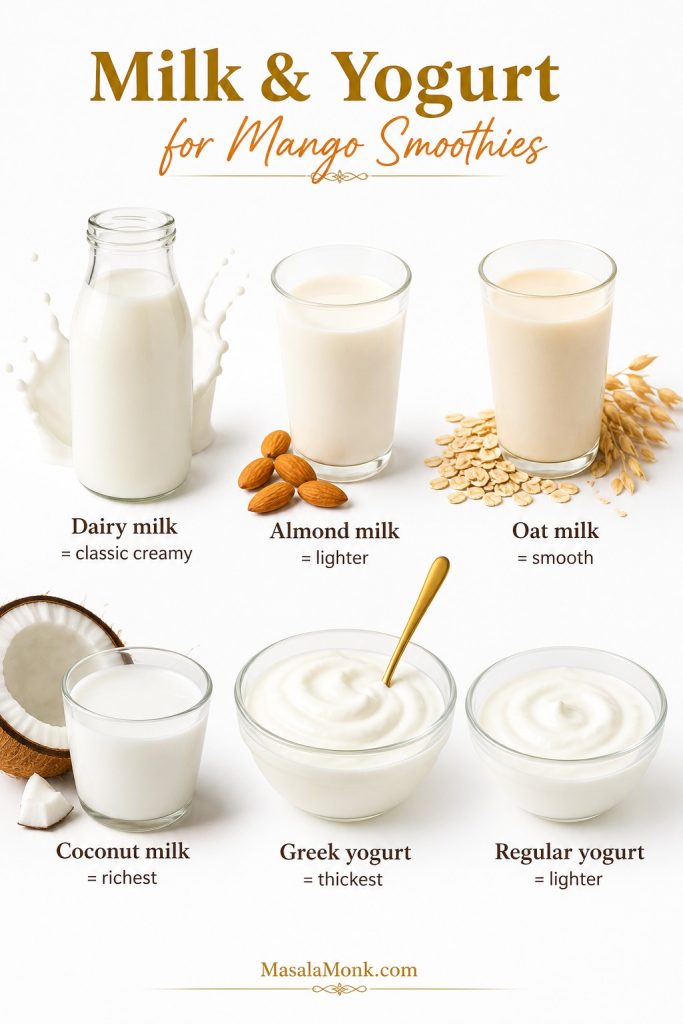
Milk loosens the smoothie just enough for the blender to run. Dairy milk gives a classic creamy flavor, almond milk keeps it light, oat milk makes it smooth, cashew milk adds richness, and coconut milk gives the drink a tropical edge. Orange juice also works, especially when you want a brighter fruit smoothie instead of a creamy one. However, it makes the drink sweeter and less creamy, so use it with frozen mango, pineapple, berries, or lime rather than treating it like a milk replacement in every version.

Milk and yogurt comparison for mango smoothies with dairy milk, almond milk, oat milk, coconut milk, Greek yogurt, and regular yogurt.
Choose the liquid based on the finish you want: almond milk keeps things lighter, oat milk feels rounder, coconut milk tastes richer, and Greek yogurt gives the most body.

Lime Juice

Lime juice is optional, but it can make a big difference. A small squeeze balances the sweetness and makes the mango taste fresher. Start with 1 teaspoon, blend, then add a little more only if the smoothie still tastes flat.

Sweetener

Sweeten only if your mango needs it. Very ripe mango and banana are often enough on their own. If the smoothie tastes sharp, bland, or not quite rounded, add honey, maple syrup, sugar, jaggery, or a soft date in small amounts.

For a no-added-sugar mango smoothie, use very ripe mango and banana, then skip the honey or sugar entirely. If the fruit is sweet enough, the smoothie does not need extra sweetener.

Ice

Ice is helpful only when you are using fresh mango and want a colder smoothie. With frozen mango, skip it. Too much ice weakens the flavor and can make the texture watery, so frozen fruit is usually the better way to thicken the drink.

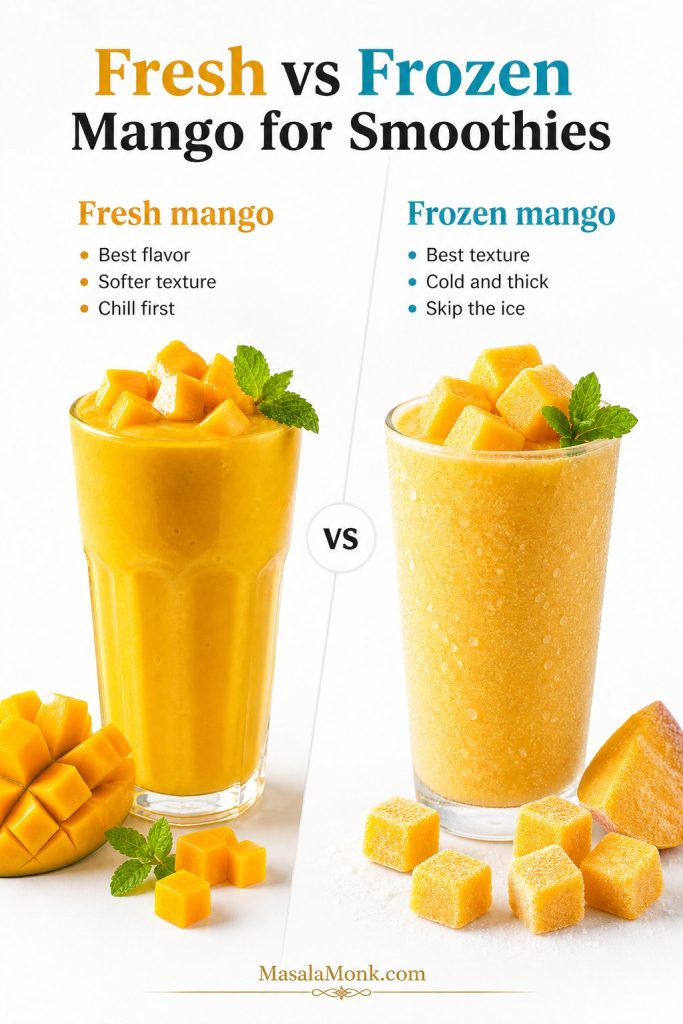
Fresh vs Frozen Mango for Smoothies

Both fresh and frozen mango can make a good smoothie, but they behave differently in the blender. Frozen mango gives the most reliable thick texture. Fresh mango gives a softer, juicier, more seasonal flavor. Meanwhile, mango pulp is useful when ripe mangoes are not available, but it often needs less sweetener.

That is why this mango smoothie recipe gives you separate guidance for frozen mango, fresh mango, mango pulp, and fibrous mango.

Mango Type Best For How to Adjust
Frozen mango chunks Thick, cold, creamy smoothies Use little to no ice. Add milk slowly so the smoothie stays mango-forward.
Fresh ripe mango Peak-season flavor and softer smoothies Use chilled milk and yogurt, or add 1/2 cup ice. For better texture, freeze the mango cubes first.
Mango pulp Quick smoothies, shake-style drinks, and off-season mango flavor Use less sweetener because canned mango pulp is often already sweetened.
Fibrous mango Not ideal for very smooth drinks Blend longer, use yogurt for body, or choose a less fibrous mango next time.
Fresh and frozen mango comparison for smoothies, with fresh mango for flavor and frozen mango for thicker texture.
Fresh mango gives peak-season flavor, whereas frozen mango gives the thickest smoothie with less need for ice. Therefore, choose based on whether flavor or texture matters more that day.

Before using fresh mango, cut the fruit into cubes and chill it. For a thicker result, spread the cubes on a plate or tray and freeze them for 30 to 60 minutes. As a result, the smoothie turns colder and thicker without watering down the mango flavor.

If you are working with extra frozen mango and want a spoonable dessert instead of a drink, this mango sorbet recipe uses fresh or frozen mango with a similar fruit-forward approach.

How to Make a Mango Smoothie

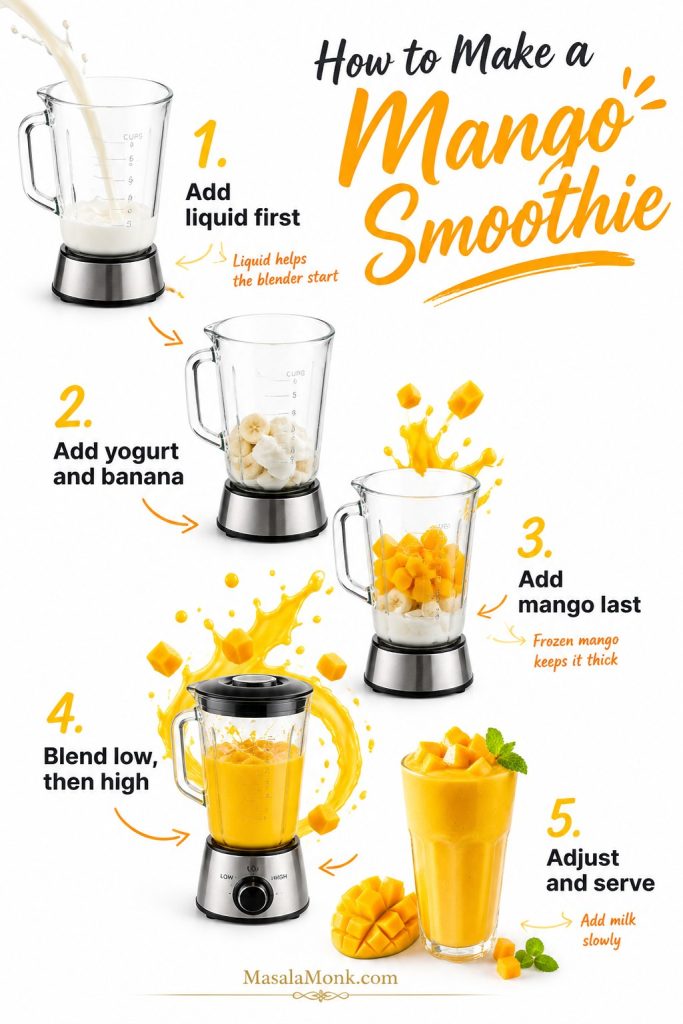
The method is simple, but the order matters, especially if you are using a regular blender instead of a high-speed blender. First, liquid on the bottom helps the blades move. Then, frozen fruit on top keeps the smoothie thick. Because of that order, the blender needs less extra liquid.

For this mango smoothie, the recipe works best when the liquid goes in before the frozen fruit, especially in a standard blender.

Equipment You Need

  • Blender: A high-speed blender is best for frozen mango, but a regular blender works if you add the liquid first.
  • Measuring cups or kitchen scale: Helpful when you want the texture to stay consistent.
  • Knife and cutting board: Needed if you are using fresh mango.
  • Spatula or tamper: Useful for thick smoothie bowls or frozen-fruit blends.
  • Tall glasses or jars: Best for serving the smoothie right away.

Blender Method

  1. Add the liquid first. Pour milk, almond milk, oat milk, coconut milk, or orange juice into the blender. This helps the blades catch.
  2. Add the creamy ingredients. Add yogurt, banana, avocado, protein powder, or any soft add-ins next.
  3. Add mango last. Frozen mango can sit on top because the liquid underneath helps the blender start moving.
  4. Blend low, then high. Start on low for about 10 seconds, then increase to high and blend until smooth.
  5. Adjust slowly. If the smoothie is too thick, add milk 1 tablespoon at a time. If it is too thin, add more frozen mango.
  6. Serve right away. Mango smoothies taste best while cold, creamy, and freshly blended.
Step-by-step mango smoothie method showing liquid first, yogurt and banana next, mango last, blending, and serving.
This blending order prevents two common problems at once: the blender starts more easily, and the smoothie stays thick because the frozen fruit is not buried under too much liquid.
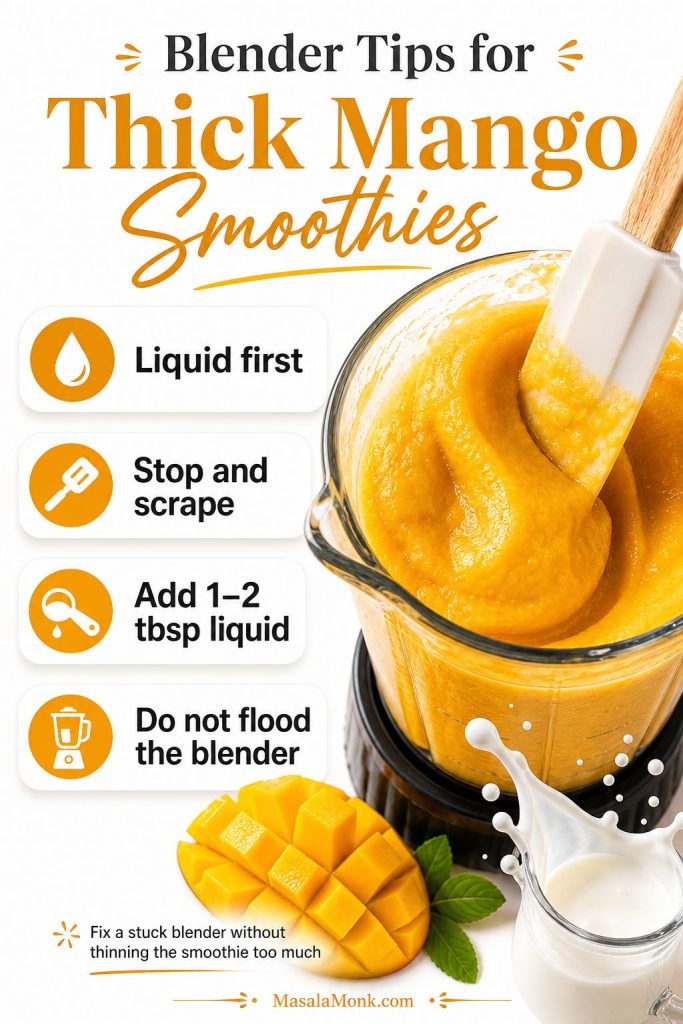
Blender tip: If the blender gets stuck, do not keep adding large splashes of liquid. Stop, scrape the sides, add 1 or 2 tablespoons liquid, then blend again. This keeps the smoothie thick instead of watery.
Blender tips for thick mango smoothies showing a blender jar, spatula, small liquid addition, and mango pieces.
If a thick smoothie gets stuck, do not flood the blender. Instead, scrape the sides and add a small splash of liquid so the mixture loosens without turning watery.

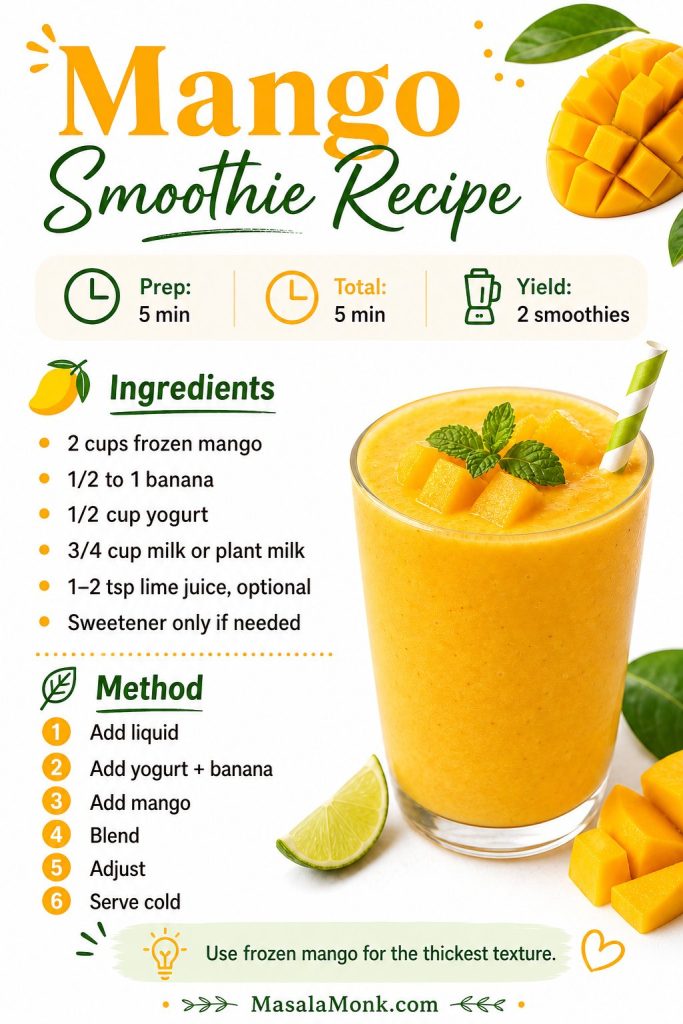
Here is the full mango smoothie recipe in one place, with the base version first and adjustment notes underneath.

Mango Smoothie Recipe

This creamy mango smoothie is cold, thick, and easy to adjust. Use frozen mango for the best texture, or fresh ripe mango with chilled ingredients when mangoes are in season.

Prep Time5 minutes
Total Time5 minutes
Servings2 smoothies
Yield600–700 ml

Ingredients

  • 2 cups frozen mango chunks, about 280–320 g
  • 1/2 to 1 small banana, preferably frozen, about 50–100 g peeled
  • 1/2 cup plain Greek yogurt or regular yogurt, about 120 g
  • 3/4 cup milk or plant milk, about 180 ml / 6 fl oz, plus more as needed
  • 1–2 teaspoons fresh lime juice, optional
  • 1–2 teaspoons honey, maple syrup, sugar, or jaggery, only if needed
  • 1/2 cup ice, only if using fresh mango instead of frozen mango

Instructions

  1. Add the milk or plant milk to the blender first.
  2. Add the yogurt, banana, lime juice, and sweetener if using.
  3. Add the frozen mango chunks.
  4. Blend on low for about 10 seconds, then increase to high and blend for 35–60 seconds, or until smooth.
  5. If the smoothie is too thick, add more milk 1 tablespoon at a time. If it is too thin, add more frozen mango and blend again.
  6. Taste and adjust with a little more lime juice or sweetener if needed.
  7. Pour into glasses and serve immediately.

Notes

  • For the thickest smoothie, use frozen mango and frozen banana.
  • For a mango smoothie without banana, use extra frozen mango, avocado, Greek yogurt, coconut milk, or soaked cashews.
  • For a dairy-free mango smoothie, use almond milk, oat milk, cashew milk, or coconut milk with coconut yogurt or no yogurt.
  • For a smoothie bowl, reduce the liquid to 1/4 to 1/2 cup and use extra frozen mango.
  • If using fresh mango, chill the mango and milk first, or add 1/2 cup ice.
  • To double the recipe, double all ingredients but start with slightly less liquid, then add more after blending.

Approximate Nutrition

Per smoothie, using frozen mango, 1/2 small banana, Greek yogurt, and unsweetened almond milk: about 180–230 calories, 6–10 g protein, and 3–5 g fiber. Exact nutrition will change depending on the milk, yogurt, banana amount, and sweetener you use.

Saveable mango smoothie recipe card with prep time, yield, ingredients, method, and a finished smoothie.
Save this mango smoothie recipe as your base version; afterward, you can return to the post for bowl, dairy-free, protein, or no-banana adjustments.

Serving Ideas

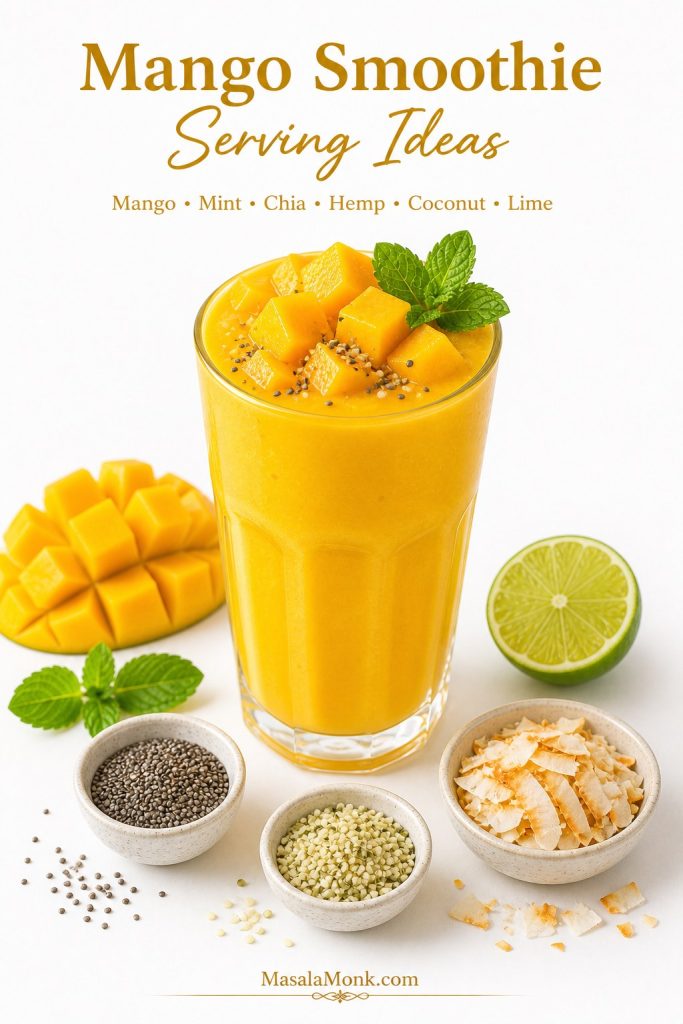
Serve the smoothie right after blending, while it is still cold, thick, and creamy. For a simple garnish, add diced mango, a few mint leaves, chia seeds, hemp seeds, toasted coconut, or a thin lime wheel. If it is a quick breakfast smoothie, keep it plain. If you want it to feel more finished, choose one small topping so the mango flavor still stays first.

Mango smoothie serving ideas with diced mango, mint, chia seeds, hemp seeds, toasted coconut, lime, and a finished smoothie.
A few simple toppings can make the smoothie feel more finished; still, keeping the garnish light helps the fresh mango flavor stay front and center.

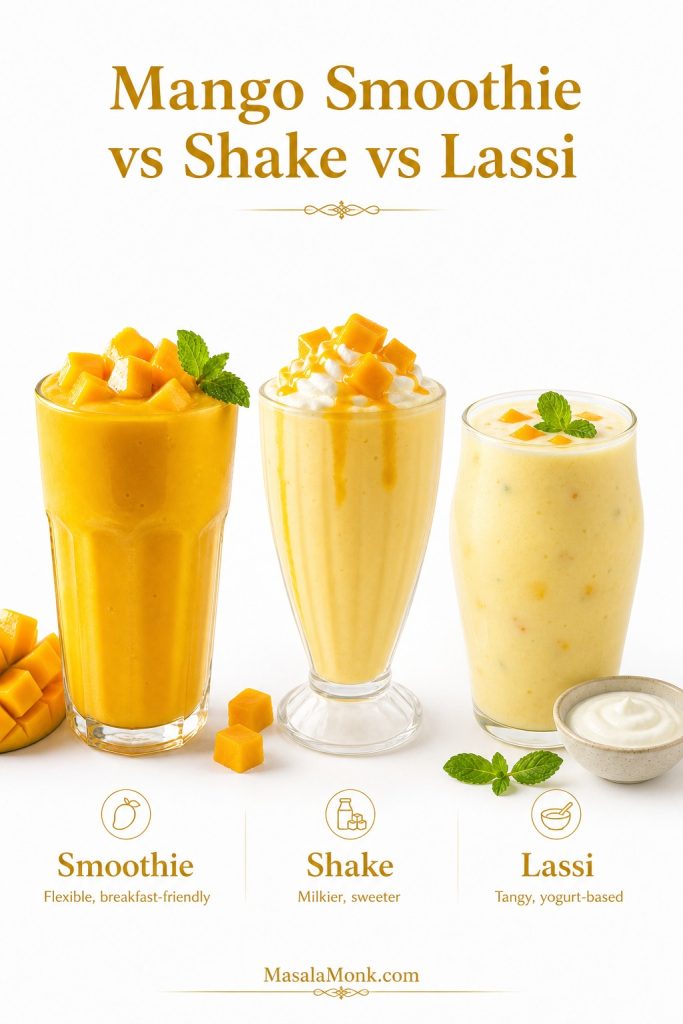
Mango Smoothie vs Mango Shake vs Mango Lassi

Mango smoothie, mango shake, and mango lassi can overlap, but they are not exactly the same drink. The difference usually comes down to the base, texture, sweetness, and how rich you want the drink to feel.

Drink Main Base Texture Best For
Mango Smoothie Mango, milk or plant milk, yogurt, banana, fruit, greens, or protein add-ins Cold, creamy, flexible, breakfast-friendly Breakfast, snack, smoothie bowls, protein versions, dairy-free versions
Mango Shake Mango, chilled milk, sugar, sometimes ice cream or nuts Sweeter, milkier, richer Classic summer drink, dessert-style mango drink
Mango Lassi Mango, yogurt or curd, milk or water, sweetener Tangy, creamy, cooling Indian-style yogurt drink, restaurant-style pairing, cooling drink
Comparison image showing mango smoothie, mango shake, and mango lassi in three glasses with different textures and labels.
These mango drinks overlap, but they are not the same. A smoothie is more flexible, a shake is milkier and sweeter, and lassi tastes tangier because yogurt leads the blend.

For the richer milk-based version, see this mango shake recipe. For the yogurt-based Indian drink, use this mango lassi recipe. If you want a little background, Britannica describes lassi as a yogurt-based drink, which is why mango lassi tastes tangier and more yogurt-forward than a typical mango smoothie.

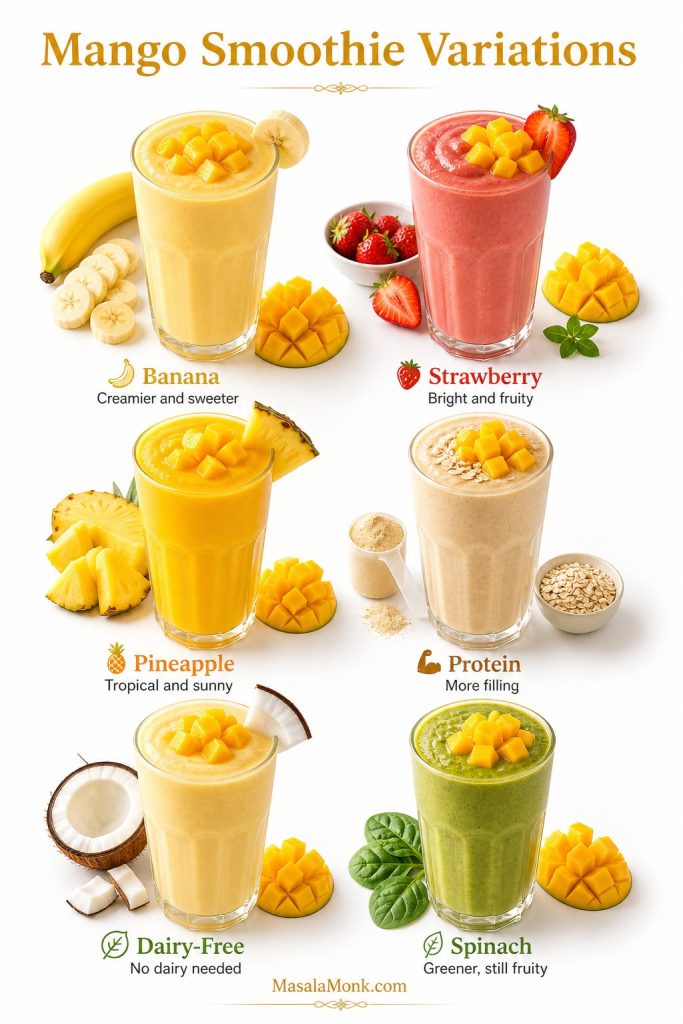
Mango Smoothie Variations

Once you have the base recipe, the mango smoothie variations are easy. In most cases, keep the total frozen fruit close to 2 cups for a drinkable smoothie, then adjust the liquid slowly. However, for smoothie bowls, use more frozen fruit and much less liquid.

Mango smoothie variations guide showing banana, strawberry, pineapple, protein, dairy-free, and spinach versions.
Use the base recipe as a template, then change only one direction at a time — fruitier, creamier, greener, higher-protein, or dairy-free — so the flavor stays balanced.

Mango Banana Smoothie

Banana is the classic way to make a mango smoothie creamier and more filling. Use 1 full banana instead of 1/2 banana, preferably frozen, and keep the rest of the base recipe the same. The result is sweeter, softer, and perfect for a quick breakfast smoothie.

Strawberry Mango Smoothie

Strawberries make the smoothie brighter, fruitier, and slightly tangy. Use 1 cup frozen mango and 1 cup frozen strawberries, then blend with the same yogurt and milk base. Taste before sweetening because tart strawberries may need a little honey, while sweet ones may need nothing at all. If you want more berry-based options, this strawberry smoothie guide has more smoothie ideas to explore.

Mango Pineapple Smoothie

Pineapple pushes the smoothie in a more tropical direction. Use 1 cup frozen mango with 1 cup frozen pineapple, then choose coconut milk or coconut water if you want that sunny, beachy flavor. If the pineapple tastes sharp, banana or a small spoon of honey will round it out.

Mango Blueberry Smoothie

Blueberries make the smoothie thicker, darker, and more berry-forward. Start with 1 cup frozen mango and 1 cup frozen blueberries, then loosen the blender with an extra splash of milk if needed. A little lime juice helps keep the flavor lively.

Mango Peach Smoothie

Peach gives the smoothie a softer, more floral sweetness. Use 1 cup mango and 1 cup frozen peaches. Vanilla yogurt can taste lovely here, although plain yogurt keeps the drink fresher and less dessert-like.

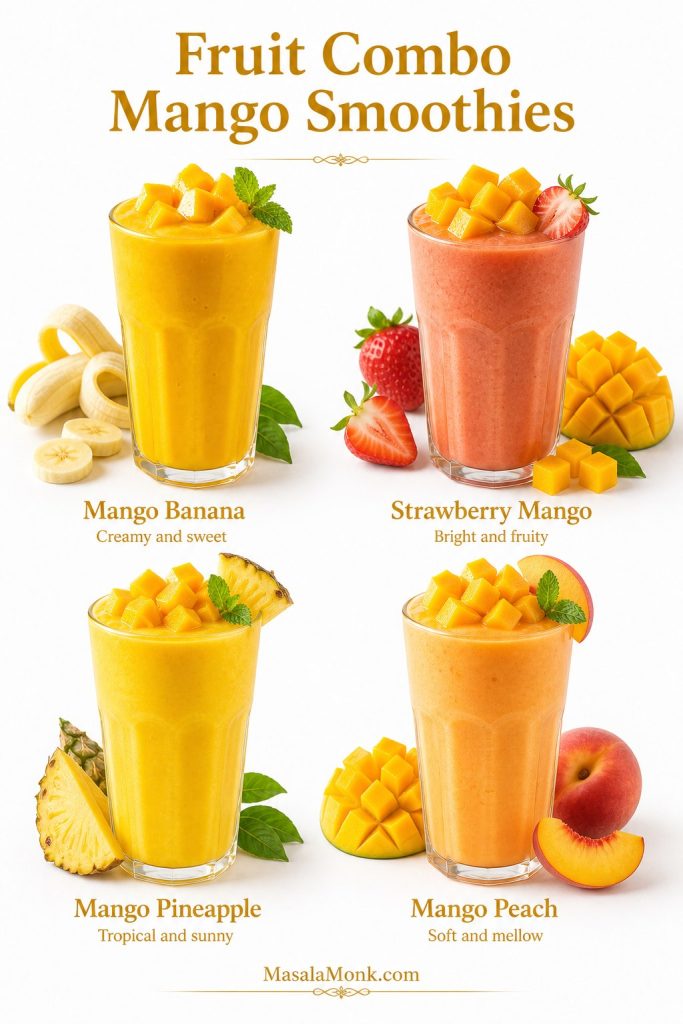
Fruit combo mango smoothies showing mango banana, strawberry mango, mango pineapple, and mango peach versions.
Fruit combinations change the whole mood of the smoothie: banana makes it creamier, strawberry brightens it, pineapple pushes it tropical, and peach keeps it softer and rounder.

Mango Yogurt Smoothie

To make yogurt the main creamy element, increase it to 3/4 cup and reduce the milk slightly. Greek yogurt gives a thicker, higher-protein smoothie, while regular yogurt keeps the texture lighter. This version sits close to a lassi-style mango drink, but it stays more flexible and smoothie-like.

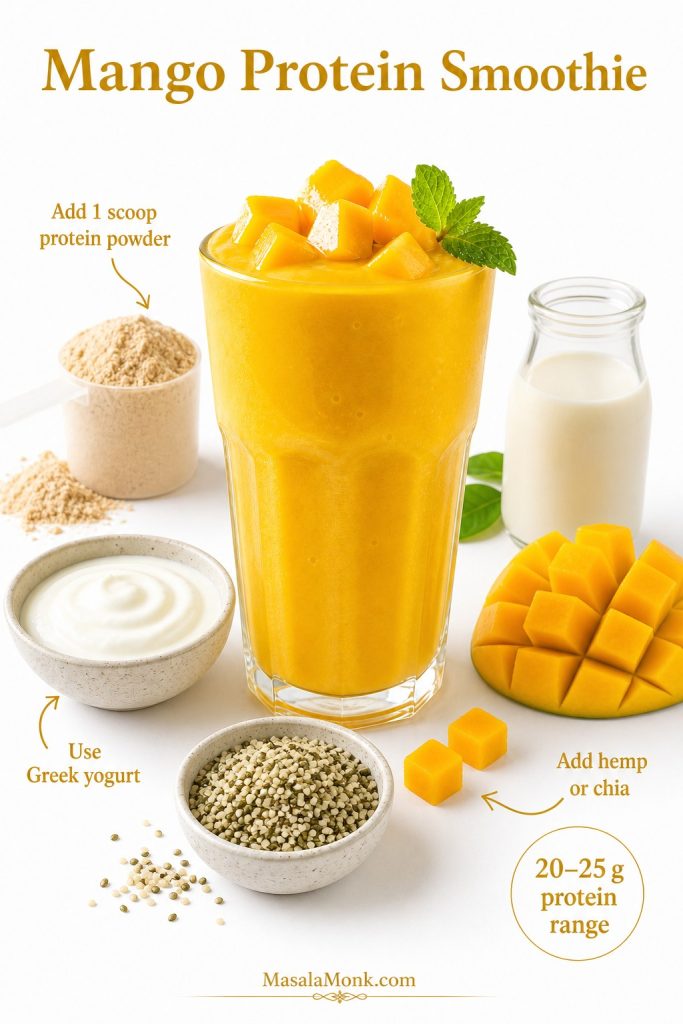
Mango Protein Smoothie

Protein powder turns the smoothie into a more filling breakfast or post-workout drink. Add 1 scoop vanilla protein powder to the base recipe, then increase the milk by 2 to 4 tablespoons as needed. For a higher-protein mango smoothie, use Greek yogurt, add 1 tablespoon hemp seeds or chia seeds, and choose dairy milk or soy milk instead of a very light plant milk. Depending on the protein powder and yogurt you use, this version can move into the 20–25 g protein range.

Mango protein smoothie with protein powder, Greek yogurt, hemp or chia seeds, milk, mango cubes, and a finished smoothie.
For a more filling mango protein smoothie, pair protein powder with Greek yogurt, hemp, chia, or a higher-protein milk. That way, the drink feels more complete without losing its fruit-first taste.

Avocado Mango Smoothie

Avocado is a great choice when you want creaminess without banana. Use 1/4 to 1/2 ripe avocado in the base recipe and skip the banana. The flavor stays mellow, the texture turns silky, and the smoothie becomes less sweet but still rich. For more creamy fruit-and-nut ideas, you might also like these nut-infused smoothies.

Mango Spinach Smoothie

Baby spinach blends easily into mango smoothies because its flavor is mild. Add 1 to 2 cups spinach with the liquid and blend until smooth before adding the mango. That extra first blend keeps the texture cleaner and gives you a green mango smoothie that still tastes fruity.

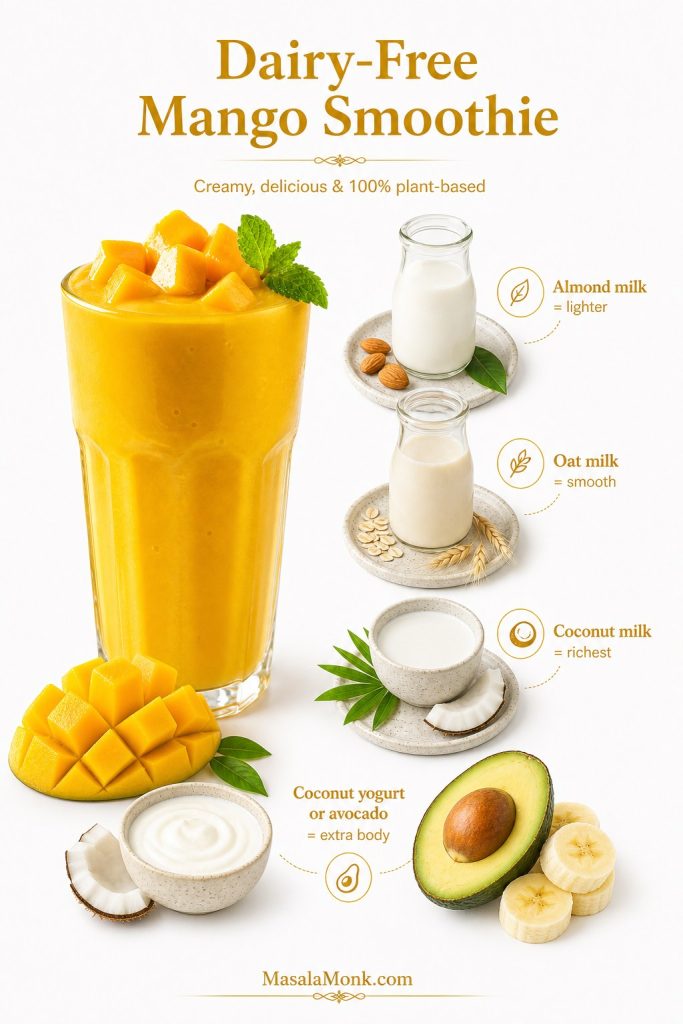
Dairy-Free Mango Smoothie

A dairy-free mango smoothie works best when you replace both the liquid and the creamy element. Use almond milk, oat milk, cashew milk, or coconut milk, then add coconut yogurt, dairy-free yogurt, banana, avocado, or soaked cashews for body. Coconut milk gives the richest result, while almond milk keeps the smoothie lighter. For more on this tropical pairing, see this guide to mango with coconut milk.

Dairy-free mango smoothie options with almond milk, oat milk, coconut milk, coconut yogurt, avocado, and mango.
A dairy-free version works best when you replace both the liquid and the creamy element; otherwise, the smoothie can taste thin even when the mango flavor is strong.

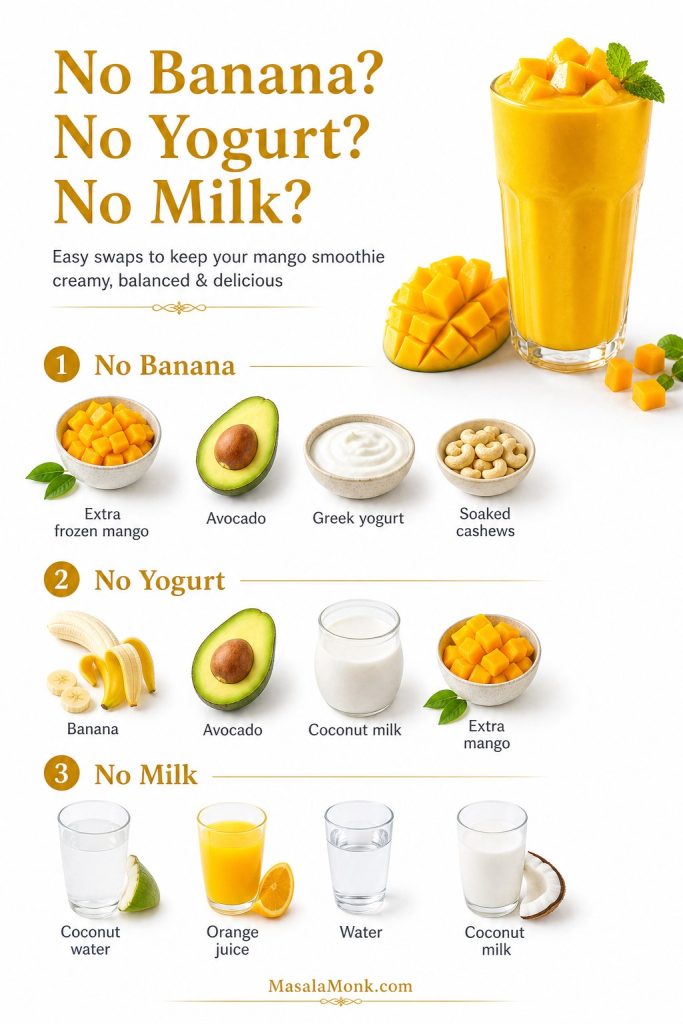
Mango Smoothie Without Banana

Skipping banana is easy as long as you replace the body it normally gives. Use 2 1/2 cups frozen mango, 1/2 cup yogurt, and 3/4 cup milk. For an even creamier texture, add 1/4 avocado or 2 tablespoons soaked cashews. This keeps the smoothie thick without letting banana take over the flavor.

Mango Smoothie Without Yogurt

Without yogurt, the smoothie needs another ingredient for body. Banana, avocado, coconut milk, or extra frozen mango all work well. Start with 3/4 cup milk and add more only if the blender needs it. Since yogurt usually adds tang, a little lime juice helps keep this version from tasting too sweet or flat.

Substitution guide for making mango smoothies without banana, yogurt, or milk, with alternative ingredients in three sections.
If you are missing banana, yogurt, or milk, use this guide to swap with purpose. As a result, the smoothie stays balanced instead of becoming too thin, too sweet, or too flat.

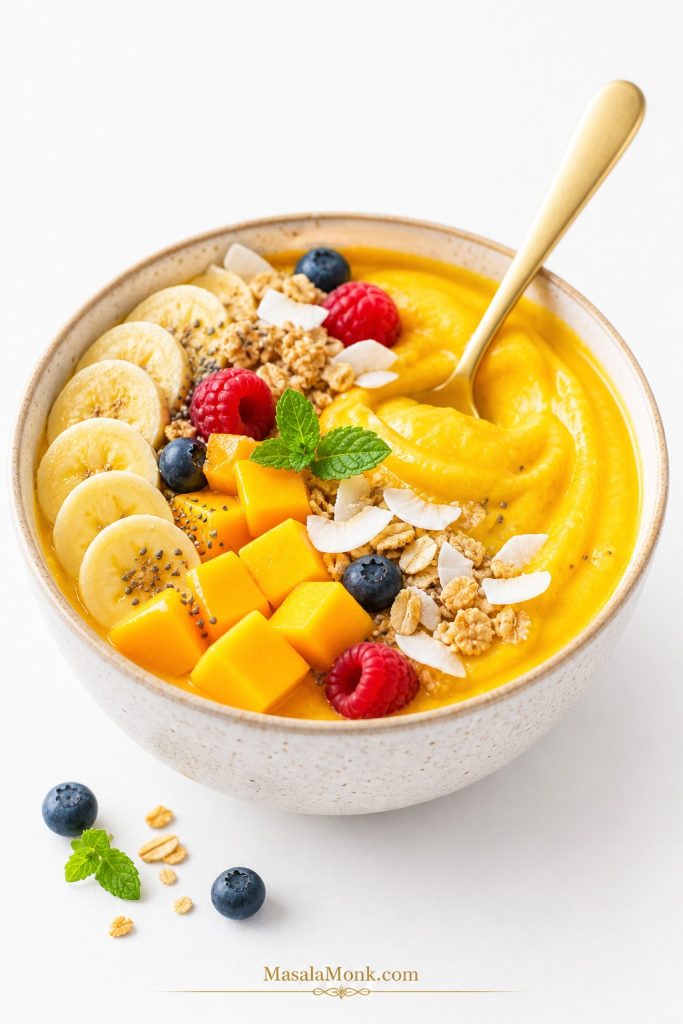
Mango Smoothie Bowl

A mango smoothie bowl should be thick enough to spoon, not thin enough to sip through a straw. Use 2 1/2 to 3 cups frozen mango and only 1/4 to 1/2 cup milk. Blend slowly, scrape as needed, and top with granola, coconut, chia seeds, berries, banana slices, or chopped nuts. If you like make-ahead oat toppings, these homemade granola bars can also be crumbled over smoothie bowls.

Thick mango smoothie bowl topped with mango cubes, granola, coconut flakes, chia seeds, berries, banana slices, and a spoon.
The bowl version should mound slightly around the spoon and toppings; if it spreads like a drink, blend in more frozen mango before serving.

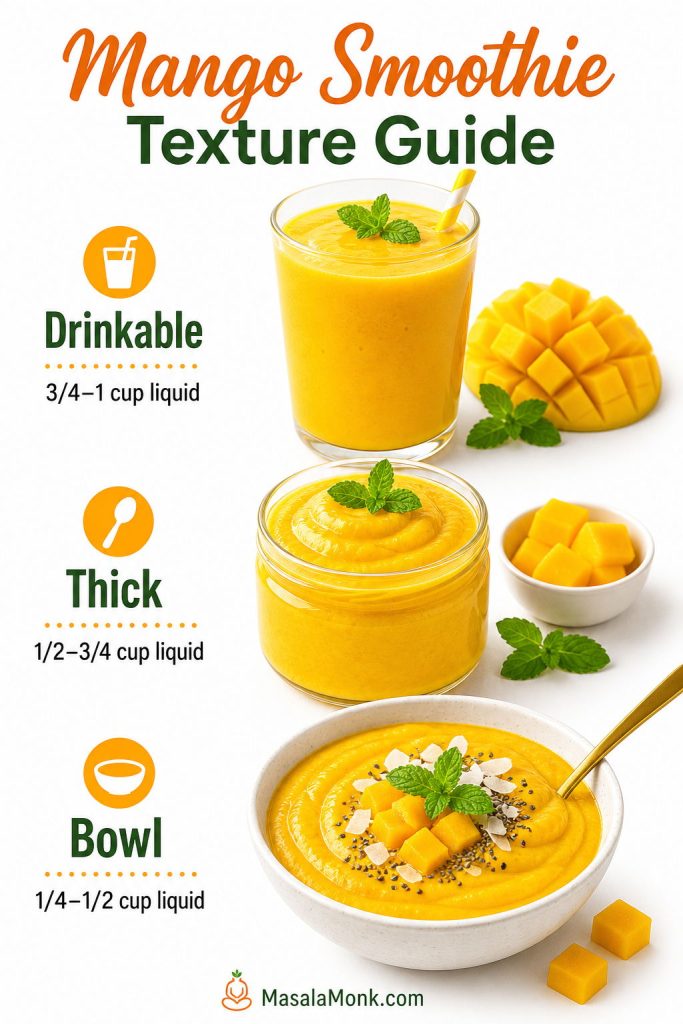
Mango Smoothie Texture Guide

The best mango smoothie texture depends on how you want to serve it. For example, a glass smoothie needs enough liquid to pour, while a smoothie bowl needs much less liquid and more frozen fruit. Meanwhile, a shake-like mango drink uses more milk and feels lighter.

Texture Use This Ratio Best For
Drinkable smoothie 2 cups mango + 3/4 to 1 cup liquid Breakfast glass, snack, quick smoothie
Thick smoothie 2 cups mango + 1/2 to 3/4 cup liquid Cold, creamy, spoonable-but-pourable texture
Smoothie bowl 2 1/2 to 3 cups frozen mango + 1/4 to 1/2 cup liquid Bowl with toppings
Shake-like smoothie 1 1/2 to 2 cups mango + 1 to 1 1/2 cups chilled milk Lighter, milkier mango drink
Mango smoothie texture guide showing drinkable, thick, and bowl-style versions with different liquid amounts.
Texture is easiest to control before blending: decide whether you want to sip it, pour it thick, or spoon it, then start with the matching liquid range.

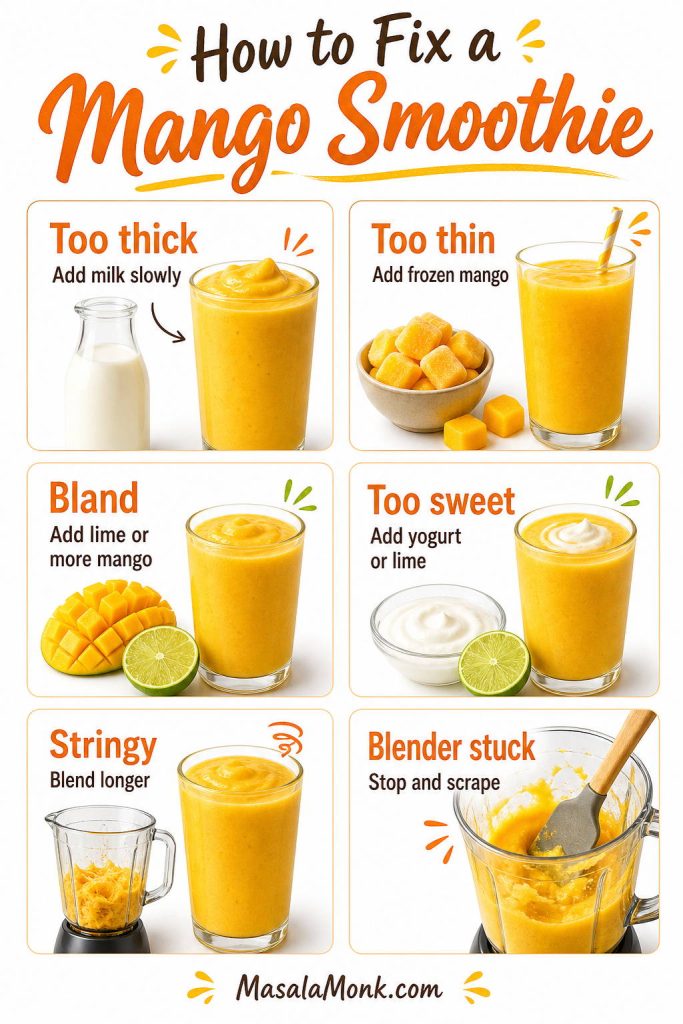
How to Fix a Mango Smoothie

Most smoothie problems are easy to fix once you know whether the issue is texture, sweetness, or flavor balance. Start with one small adjustment, then blend and taste again.

Troubleshooting guide for fixing a mango smoothie that is too thick, too thin, bland, too sweet, stringy, or stuck in the blender.
Most mango smoothie problems need only one small fix. For example, frozen mango thickens, lime brightens, yogurt softens sweetness, and scraping helps a stuck blender move again.

If the Smoothie Is Too Thick

Add milk or plant milk 1 tablespoon at a time. Blend again before adding more. This keeps the smoothie from turning thin too quickly.

If the Smoothie Is Too Thin

Add more frozen mango, frozen banana, Greek yogurt, or avocado. Ice can help in a pinch, but frozen fruit gives a better mango flavor and a creamier finish.

If the Smoothie Tastes Bland

Add lime juice, a tiny pinch of salt, or more mango. Bland smoothies often need brightness, not just more sugar.

If the Smoothie Is Too Sweet

Add plain yogurt, lime juice, or a few more frozen mango pieces. Avoid adding too much extra milk because it can weaken the flavor.

If the Smoothie Is Not Sweet Enough

Add honey, maple syrup, sugar, jaggery, or a soft date in small amounts. Still, taste the mango first. Very ripe mangoes may not need any sweetener at all.

If the Smoothie Is Stringy

The mango may be fibrous. Blend longer, use a stronger blender, or choose smoother mango varieties next time. Frozen mango chunks are often more consistent for smoothies.

If the Blender Gets Stuck

Stop the blender, scrape the sides, and add 1 or 2 tablespoons liquid. Then blend again, starting low before increasing the speed.

Make Ahead, Storage, and Freezing

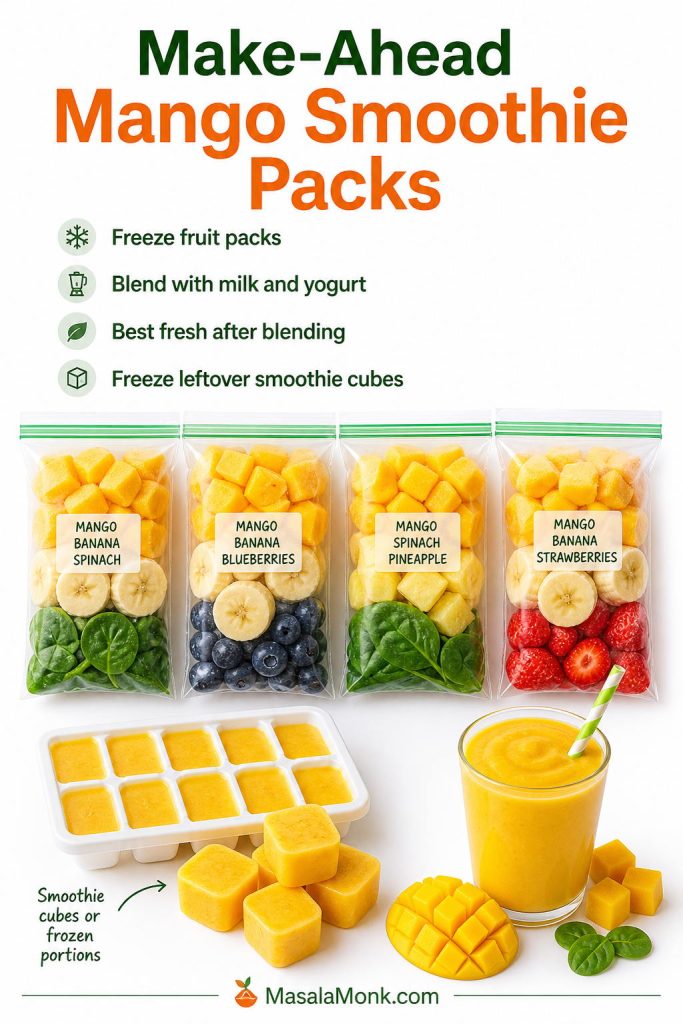
Mango smoothies are best right after blending because the texture is cold, creamy, and fresh. Even so, the recipe is easy to prep ahead when you freeze the mango for each smoothie in small packs. For example, you can freeze mango, banana, and spinach together so breakfast takes only a minute or two.
  • Refrigerator: Store leftover smoothie in a covered jar for up to 1 day. Shake or blend again before drinking.
  • Freezer smoothie packs: Add mango, banana, berries, pineapple, or spinach to freezer bags. When ready, blend with milk and yogurt.
  • Smoothie cubes: Freeze leftover smoothie in an ice cube tray, then re-blend the cubes with a splash of milk.
  • Best fresh: For the best texture, blend just before serving.
Make-ahead mango smoothie packs with freezer bags of mango, banana, greens, berries, smoothie cubes, and a finished smoothie.
Freezer packs make busy mornings easier; even so, the best texture still comes from blending the smoothie fresh instead of storing it fully blended.

More Mango and Smoothie Recipes

After you make this smoothie, you may want a richer mango drink, a tangier yogurt-based drink, or another fruit smoothie. Try this mango shake recipe when you want something creamier and sweeter, this mango lassi recipe when you want a cooling yogurt-based drink, or this strawberry smoothie guide when you want more berry-based variations.

Mango Smoothie FAQs

Can I make a mango smoothie without banana?

Yes. Use extra frozen mango, Greek yogurt, avocado, coconut milk, or soaked cashews to replace the creaminess banana normally gives. For a simple no-banana mango smoothie, blend 2 1/2 cups frozen mango, 1/2 cup yogurt, and 3/4 cup milk.

Can I make a mango smoothie without yogurt?

Yes. Use banana, avocado, coconut milk, oat milk, or extra frozen mango for body. The smoothie will taste less tangy, so a little lime juice can help balance the sweetness.

Is fresh or frozen mango better for smoothies?

Frozen mango is better for thick, cold smoothies because it chills and thickens the drink without ice. Fresh mango is excellent during mango season, but the smoothie may need chilled milk, chilled yogurt, or a few ice cubes.

Can I make a mango smoothie with frozen mango?

Yes, and it is usually the best option for texture. Frozen mango makes the smoothie thicker, colder, and creamier without watering it down.

Can I use mango pulp for a smoothie?

Yes. Mango pulp works well, especially when fresh mangoes are not in season. Since many canned mango pulps are sweetened, taste before adding honey, sugar, maple syrup, or jaggery.

How do I make a mango smoothie thicker?

Use frozen mango, frozen banana, Greek yogurt, avocado, or less liquid. For the thickest smoothie, start with only 1/2 cup liquid and add more slowly.

How do I make a mango smoothie dairy-free?

Use almond milk, oat milk, cashew milk, or coconut milk. Replace yogurt with coconut yogurt, dairy-free yogurt, banana, avocado, or soaked cashews.

Is a mango smoothie the same as a mango shake?

Not exactly. A mango smoothie is usually more flexible and may include yogurt, banana, plant milk, protein powder, greens, or other fruit. A mango shake is usually milkier, sweeter, and often made with chilled milk, mango, sugar, and sometimes ice cream.

What liquid is best for a mango smoothie?

Milk gives the creamiest classic result. Almond milk keeps it light, coconut milk makes it tropical, oat milk makes it smooth, and orange juice makes it brighter and fruitier.

Can I make a mango smoothie without milk?

Yes. Use coconut water, orange juice, or water instead of milk, but expect a lighter and less creamy smoothie. For a no-milk smoothie that still feels creamy, use coconut milk, dairy-free yogurt, avocado, banana, or extra frozen mango.

Can I add protein powder to a mango smoothie?

Yes. Add 1 scoop vanilla protein powder and increase the liquid slightly. Protein powder thickens smoothies, so add milk 1 or 2 tablespoons at a time until the blender runs smoothly.

Can I make a mango smoothie with water?

You can, but the smoothie will taste thinner and less creamy. For a lighter smoothie, coconut water is usually better than plain water. For a creamier smoothie, use milk, oat milk, cashew milk, coconut milk, or yogurt.

Final Tip

For the best mango smoothie recipe, start with ripe mango, keep the liquid modest, and adjust only after blending. Frozen mango gives you the easiest thick texture, while a little lime juice keeps the flavor bright. Once the recipe gives you a smoothie that is cold, creamy, and full of mango flavor, pour it right away and enjoy it at its best.

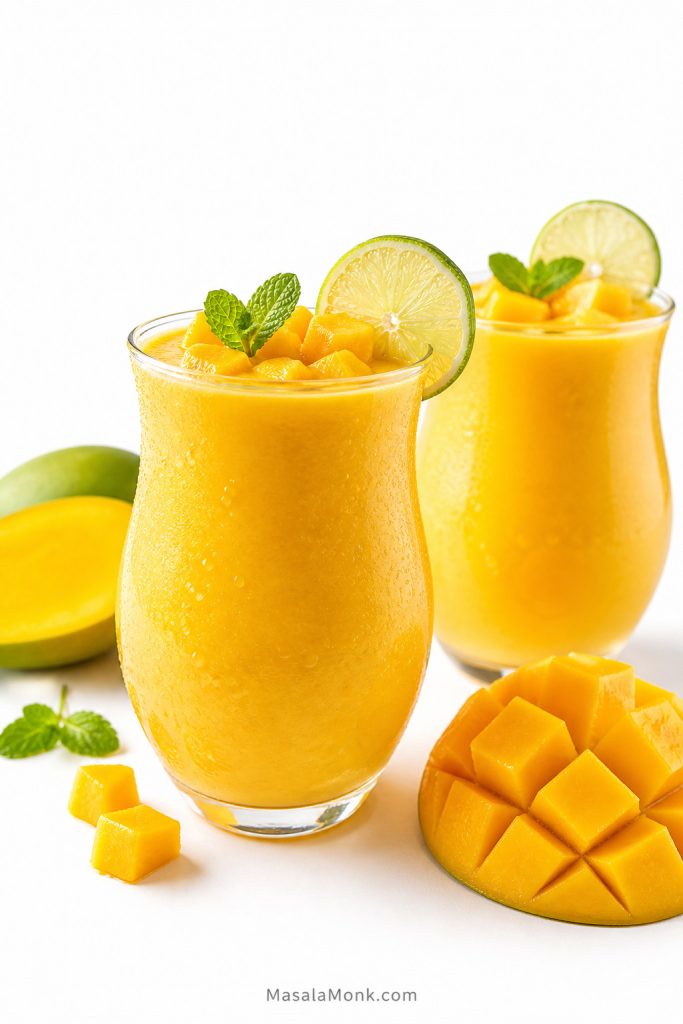
Finished mango smoothies in glasses with mango pieces, mint, and lime on a bright white background.
The finished drink should look cold, creamy, and ready to serve right away. In the end, that thick, mango-forward texture is what makes the recipe worth repeating.
Posted on 1 Comment

Mango Lassi Recipe (Restaurant-Style, Thick and Creamy)

Social-share cover image for mango lassi recipe showing a thick creamy restaurant-style glass of mango lassi

A good mango lassi recipe should taste clearly of mango, feel thick and creamy, and stay balanced between sweet, tangy, and cold. The best versions are rich enough to feel satisfying, but still easy to drink.

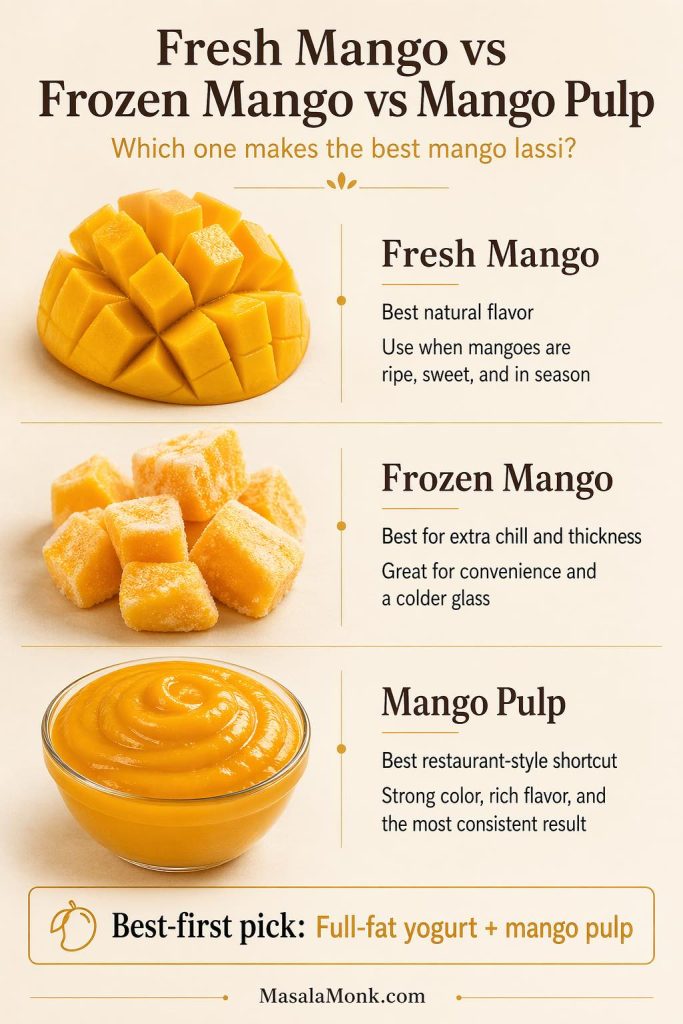
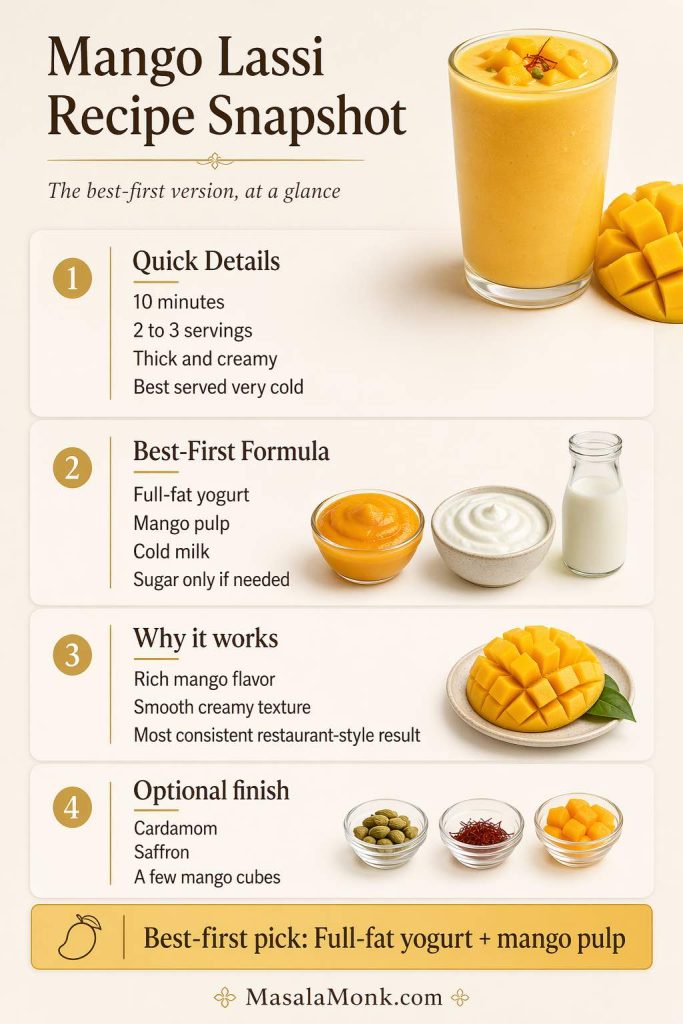
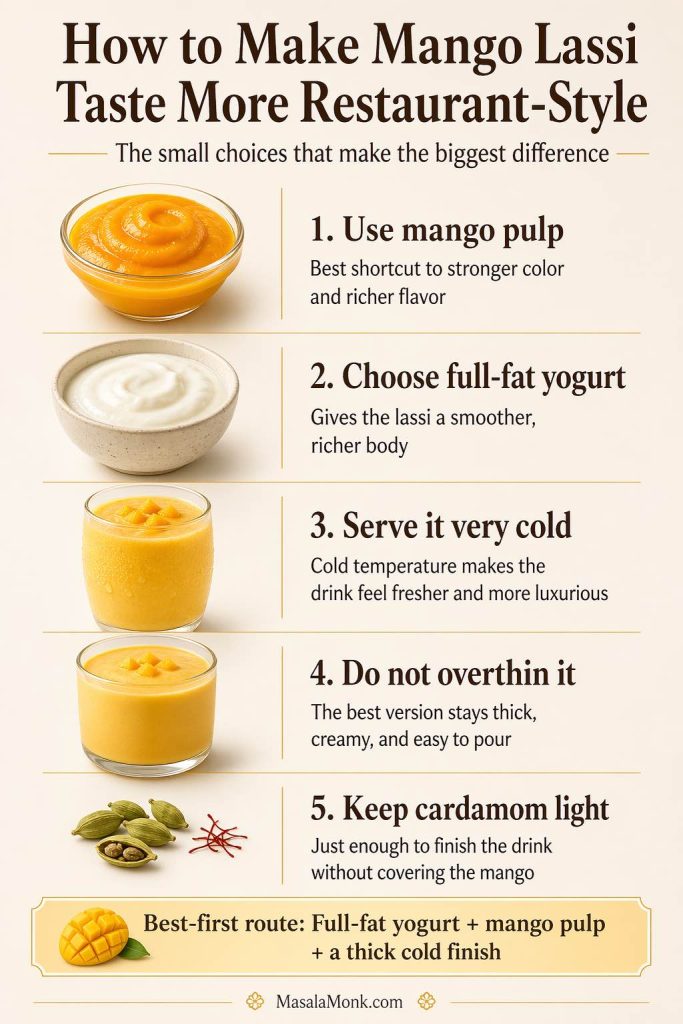
This mango lassi recipe is built for that result. It works with fresh mango, frozen mango, or canned mango pulp, and it shows you how to adjust the texture, sweetness, and tang so the drink stays smooth, cold, and properly mango-forward. For the closest restaurant-style Indian mango lassi, use full-fat yogurt and mango pulp.

At a glance: 10 minutes, 2 to 3 servings, thick and creamy, best served very cold.

Mango Lassi Recipe Quick Answer

Mango lassi is a cold yogurt-based Indian drink made by blending mango, yogurt, a little milk or water, and sweetener until smooth and creamy. Britannica gives helpful background on lassi as a traditional yogurt-based drink from India. A good mango lassi recipe should be thick but pourable, strongly mango-flavored, and lightly balanced by yogurt tang. Fresh ripe mango gives the best natural flavor, frozen mango gives extra chill and thickness, and mango pulp is the easiest way to get a richer, more restaurant-style result at home.

If you want a milk-based mango drink instead, try this mango shake for a creamier, less tangy option.

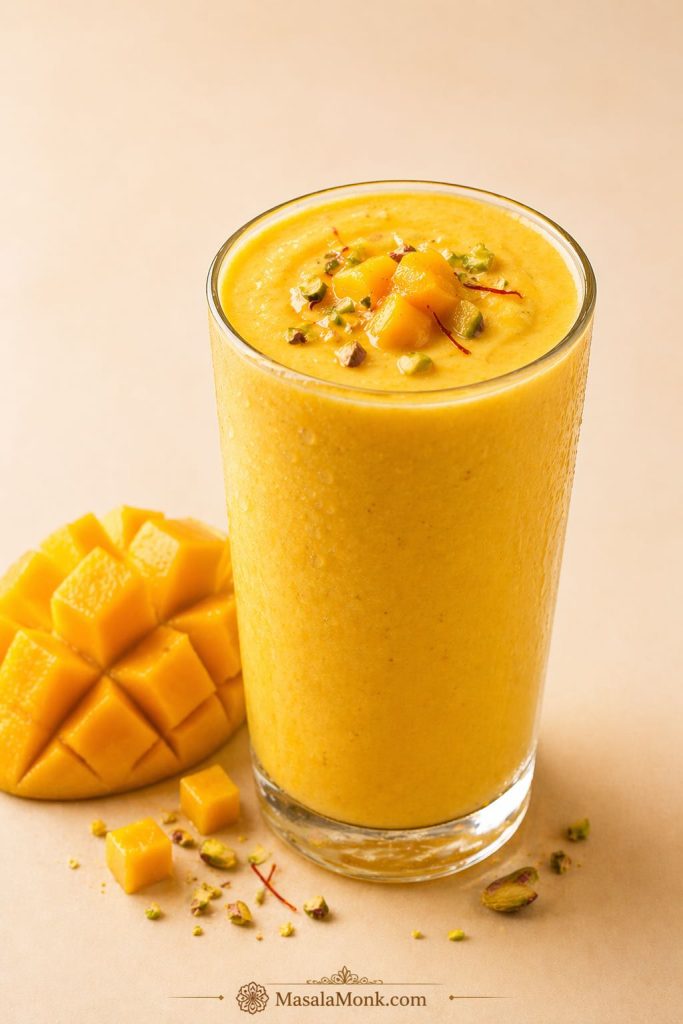
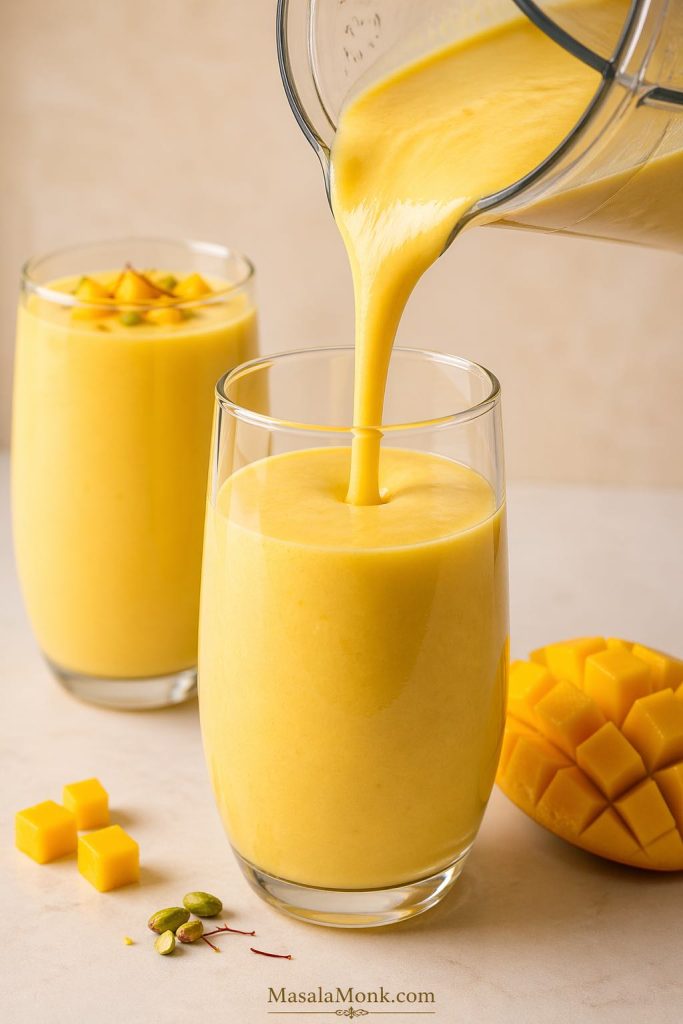
Glass of thick creamy mango lassi topped with mango cubes, pistachios, and saffron, with a scored mango half beside it.
A thick, creamy mango lassi made with a restaurant-style look and a rich mango finish.

Why This Mango Lassi Recipe Works

The difference between an average mango lassi and a very good one usually comes down to balance. A good mango lassi tastes clearly of mango first, not just yogurt and sugar. It feels creamy and rich without turning heavy, and it stays cold enough to be refreshing without becoming watery from too much ice.

The base is simple, but it is flexible enough to work with fresh mango, frozen mango, or canned mango pulp. That matters because small changes in mango type, yogurt thickness, and sweetener can noticeably change the final glass.

Balanced, not overly sweet

A good mango lassi recipe should taste naturally sweet and lightly tangy, not candy-like. Mangoes vary a lot in sweetness, and canned mango pulp is often already sweetened, so the best approach gives you room to adjust instead of forcing the same amount of sugar every time. Starting lighter and correcting after blending gives you a cleaner, more mango-forward result.

Thick but still pourable

The best texture lands somewhere between a smoothie and a milkshake. It should pour easily into a glass, but still look creamy and substantial. Yogurt gives the drink body, mango adds natural thickness, and just enough milk or water loosens it without washing out the flavor. For that reason, this mango lassi recipe works best when the liquid is added carefully instead of all at once.

Works with fresh mango, frozen mango, or pulp

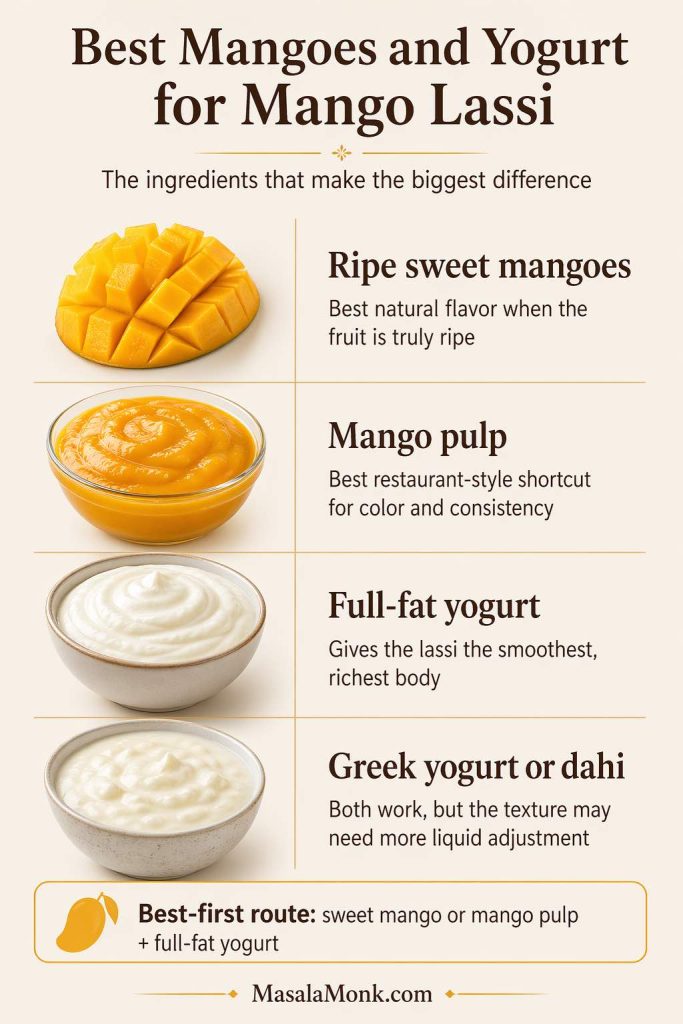
One of the biggest reasons mango lassi recipes disappoint is that they pretend every mango works the same way. They do not. Ripe fresh mango gives the best flavor when it is excellent, frozen mango gives reliable cold thickness, and mango pulp gives the most dependable restaurant-style color and concentrated mango taste. This recipe is designed so you can get a good result with any of the three.

Easy to adjust to taste

Once everything is blended, you can still fix almost anything in seconds. A splash of milk loosens a lassi that feels too thick. More sweetness helps when it tastes too tart, while extra yogurt or mango can fix a thinner-than-expected texture. If the flavor seems flat, the drink usually needs stronger mango, not just more sugar. That flexibility makes this a much more dependable home recipe than a one-note formula.

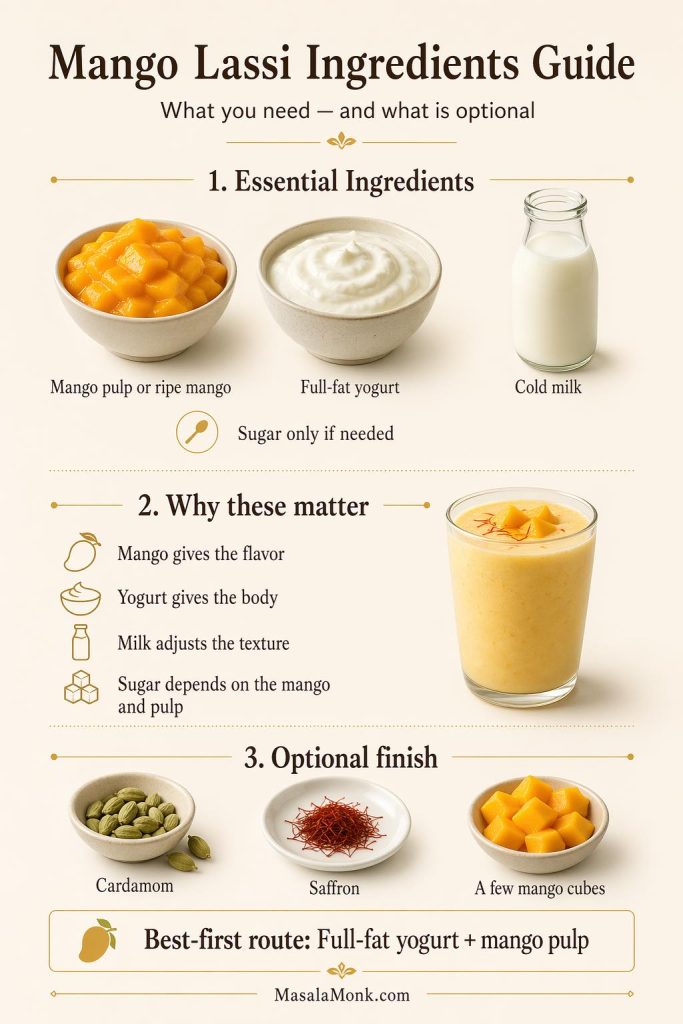
Mango Lassi Recipe Ingredients

Mango lassi uses a short ingredient list, which means each ingredient matters more. This is not the kind of recipe where average fruit and random yogurt disappear into the background. The mango sets the flavor, the yogurt sets the body, and the liquid and sweetener determine whether the drink feels balanced or diluted.

Mango lassi ingredients guide showing mango pulp or ripe mango, full-fat yogurt, cold milk, optional cardamom and saffron, and the best-first route with mango pulp.
Start with mango pulp or ripe mango for flavor, full-fat yogurt for body, and cold milk to loosen the texture without making the lassi watery.

Mango

You can use ripe fresh mango, frozen mango, or canned mango pulp here. Fresh mango gives the best flavor when it is truly ripe and sweet. Frozen mango is excellent when you want the drink colder and thicker without relying on a lot of ice. Mango pulp is the easiest way to get that bright restaurant-style mango flavor and color, especially when your fresh mangoes are only decent instead of exceptional.

Yogurt

Yogurt gives mango lassi its body and tang. Full-fat yogurt makes the drink smoother and richer, while low-fat yogurt can taste thinner and sharper. Traditional dahi gives a softer tang and looser texture, while Greek yogurt makes a thicker lassi and often needs more liquid. Taste the yogurt before blending, because very sour yogurt can throw off the whole drink.

Milk or water

A small amount of milk loosens the yogurt and mango without stripping out richness. Water works too, especially if the mango and yogurt are already full-bodied, but milk usually gives a rounder result. The important thing is restraint. Too much liquid is one of the fastest ways to turn mango lassi from creamy to forgettable.

Sweetener

Sugar is the most straightforward option, but honey can work if you like its flavor. The amount depends on your mangoes and on whether your pulp is already sweetened. The best approach is to start low, blend, and then add more only if the drink still tastes too tart or muted. A good mango lassi recipe should taste sweet enough to feel comforting, not so sweet that it buries the fruit.

Cardamom and optional flavor additions

Cardamom is the classic optional addition, and a small amount can make the drink feel more finished without taking over. Saffron or a tiny drop of rose water can also work in richer versions, but both should stay in the background. This is still a mango drink first.

Best Mangoes and Yogurt for Mango Lassi

This is where ingredient choice matters most. When the mango and yogurt are right, the drink tastes smooth, balanced, and easy to love. When one is off, the lassi needs more correction than most people expect.

Guide comparing ripe sweet mangoes, mango pulp, full-fat yogurt, and Greek yogurt or dahi for mango lassi.
Sweet ripe mangoes give the best natural flavor, mango pulp gives the easiest restaurant-style shortcut, and full-fat yogurt gives mango lassi its smoothest, richest body.

Best mangoes for flavor

The best fresh mangoes for mango lassi are ripe, sweet, fragrant, and low in fibrous texture. If the mango tastes flat, watery, or slightly sour on its own, the lassi will usually need extra help from sugar or pulp. Soft, fully ripe mangoes give a rounder, more dessert-like result, while underripe fruit tends to make the drink taste sharper and less luxurious.

Alphonso and Kesar mango for restaurant-style lassi recipe

When people talk about restaurant-style mango lassi, they are often chasing the intense color and concentrated flavor associated with Alphonso or Kesar mango pulp. The National Horticulture Board’s mango varieties material is a useful reference for Indian varieties such as Alphonso and Kesar. That does not mean you need those mangoes every time, but it does explain why a lassi made with canned Indian mango pulp can taste more vivid and familiar than one made with average supermarket mangoes. If your fresh fruit is just okay, pulp can help bridge that gap.

Dahi vs Greek yogurt

Dahi usually gives a softer tang and a naturally looser consistency, which makes it very easy to blend into a smooth drinking texture. Greek yogurt gives more body and richness, but it can also make the lassi too thick or slightly too tart if you do not add enough liquid. Both work well. You just want to respect the difference instead of assuming they behave the same way.

What to do if your yogurt is too sour

If your yogurt tastes noticeably sharp, the finished lassi may taste more tangy than creamy even after sweetener is added. The easiest fixes are to use a sweeter mango, add a little more sweetener, reduce the yogurt slightly, or soften the tartness with a spoonful of mango pulp. In other words, do not fight sour yogurt with sugar alone. It is better to rebalance the drink from more than one direction.

Fresh Mango vs Frozen Mango vs Mango Pulp

This choice changes the drink more than almost anything else. Fresh mango gives the best natural flavor when the fruit is excellent. Frozen mango gives easy chill and thickness. Mango pulp gives the most reliable shortcut to the deeper color and fuller flavor many people expect from restaurant-style mango lassi.

Comparison of fresh mango, frozen mango, and mango pulp for making mango lassi, with notes on flavor, thickness, and restaurant-style results.
Fresh mango gives the best natural flavor, frozen mango adds extra chill and thickness, and mango pulp is the easiest route to a richer restaurant-style mango lassi.

Fresh mango: best flavor

Use fresh mango when your fruit is ripe, sweet, and actually worth showcasing. This is usually the best route when mangoes are in season and full of flavor. The main caution is that room-temperature fresh mango often makes the lassi less cold and slightly looser, so you may want colder yogurt, a little ice, or a brief chill before serving.

Frozen mango: best convenience and chill

Frozen mango is one of the easiest ways to make mango lassi feel thick and very cold without leaning too hard on ice. It is convenient, consistent, and often better than mediocre fresh mango. If you like a thicker glass with a colder finish, frozen mango is often the easiest choice. Just remember that heavily frozen fruit can also make the drink thicker than expected, so add liquid gradually.

The same “start with less liquid, then adjust” idea also helps with smoothie-style blends, and this strawberry smoothie recipe uses that logic well.

Mango pulp: best restaurant-style shortcut

Mango pulp is the easiest shortcut when you want a richer, more restaurant-style mango lassi. It gives stronger color, fuller mango flavor, and a more predictable result than average fresh fruit. Even a small amount can make the drink taste more complete.

How sweetened mango pulp changes the recipe

Most canned mango pulp is already sweetened, which means it does two jobs at once: it adds mango flavor and it adds sweetness. Because of that, you should not treat it like unsweetened fresh mango. Start with less added sugar than you think you need, blend first, and only sweeten more if the drink still tastes too tart. That one adjustment keeps the lassi from becoming cloying.

Mango Lassi Recipe Snapshot

This mango lassi recipe makes a thick, creamy, restaurant-style Indian drink with a strong mango flavor and a balanced sweet-tangy finish. The best-first version uses full-fat yogurt and canned Alphonso or Kesar mango pulp.

Mango lassi recipe snapshot showing time, servings, best-first formula with full-fat yogurt and mango pulp, and optional finish ingredients.
This mango lassi recipe snapshot shows the best-first route at a glance: full-fat yogurt, mango pulp, cold milk, and just enough sweetness for a thick, creamy restaurant-style result.
  • Prep time: 10 minutes
  • Total time: 10 minutes
  • Yield: 2 to 3 servings
  • Category: Drink
  • Cuisine: Indian
  • Texture: Thick and creamy
  • Best served: Very cold
  • Best-first formula: Full-fat yogurt plus canned mango pulp

How to Make This Mango Lassi Recipe

This mango lassi recipe is easiest to control when you start with less liquid than you think you need. Once the mango, yogurt, and sweetener are blended smooth, you can fine-tune the thickness and flavor in seconds.

Mango lassi texture guide showing too thick, just right, and too thin consistency with quick fixes.
Aim for a mango lassi that feels thick, creamy, and easy to pour, then adjust with a splash of milk if it is too thick or more yogurt or mango pulp if it turns too thin.

Add everything to the blender

Add the mango, yogurt, milk or water, sweetener, and cardamom if using to the blender. If you are using fresh mango and want the drink especially cold, add a few ice cubes or make sure the yogurt and liquid are well chilled before blending. If you are using canned mango pulp, start with less sweetener since the pulp may already be sweet.

Blend until fully smooth

Blend until the mixture looks silky and completely uniform, with no yogurt streaks or visible fruit pieces left behind. This usually takes less time than people expect, especially with mango pulp or very ripe mango. If the drink looks too thick to move well in the blender, add a small splash of liquid rather than a large pour.

Thick smooth mango lassi being poured from a blender jar into a glass, with a finished glass and mango pieces nearby.
Pour the lassi when it flows in a thick, smooth stream and settles into the glass without looking watery, stiff, or grainy.

Taste and adjust

Before pouring, taste the lassi once. This is where the drink starts to feel finished instead of merely acceptable. Add more sweetness a little at a time if needed. If the texture feels too thick, loosen it with a small splash of milk. When the yogurt tastes too sharp, extra mango or mango pulp usually works better than sugar alone.

Serve very cold

Pour into glasses and serve right away while the texture is at its best. Mango lassi is most satisfying when it is very cold, smooth, and freshly blended. If you want, finish with a tiny pinch of cardamom or a few saffron strands, but keep the garnish light so the mango stays at the center.

How to Make It Taste More Restaurant-Style

If you want an authentic mango lassi with a more restaurant-style finish, the answer is usually not more sugar or more ice. It is better ingredient choice, colder serving temperature, and a thicker final texture. Mango pulp and full-fat yogurt do most of the heavy lifting.

Guide showing how to make mango lassi taste more restaurant-style with mango pulp, full-fat yogurt, a thick cold finish, and light cardamom.
Use mango pulp for richer flavor, full-fat yogurt for body, and a thick cold finish to bring mango lassi closer to the restaurant-style version, then keep the cardamom light so the mango stays in front.

Use mango pulp for the closest restaurant-style flavor

When homemade mango lassi does not quite taste like the restaurant version, mango pulp is often the missing link. It gives deeper color, fuller mango flavor, and a more consistent result than average fresh fruit. You do not have to use only pulp, either. Even combining a little pulp with ripe fresh mango can bring the drink much closer to that restaurant-style result.

Use full-fat yogurt

Full-fat yogurt gives the drink a smoother, richer feel and helps it stay creamy instead of sharp or thin. Low-fat yogurt can still work, but it usually needs more help from good mango and careful sweetening. If you want the most satisfying texture, full-fat yogurt is the simplest upgrade.

Serve colder than you think

A lukewarm mango lassi tastes flatter and heavier. Cold temperature sharpens the refreshment and makes the texture feel more luxurious. Chill the yogurt, chill the liquid, and use frozen mango or a little ice when needed, but do not water the drink down just to make it colder.

Do not overthin the drink

A restaurant-style mango lassi should feel rich and creamy, not like thin juice with yogurt mixed in. Add liquid gradually and stop as soon as the drink becomes pourable. It is much easier to loosen a thick lassi than to fix one that has already become diluted.

Use cardamom lightly

Cardamom can make mango lassi feel finished and fragrant, but too much turns the drink perfumed and distracts from the fruit. A light hand works best. The same is true for rose water and saffron in richer versions. They should support the mango, not compete with it.

How to Fix Thickness, Sweetness, and Tang

Small adjustments make the biggest difference here. Mangoes vary, yogurt varies, and canned pulp changes the sweetness level a lot. A quick adjustment after blending is normal, not a sign that anything went wrong.

Mango lassi flavor fix guide showing how to correct tart, sweet, weak, or flat flavor with simple adjustments.
Fix a tart mango lassi with a little sweetness and more mango or pulp, bring back an overly sweet batch with yogurt or plain mango, and make flat flavor feel brighter by serving it colder and keeping the cardamom light.

If it is too thick

Add milk or water a splash at a time and blend briefly after each addition. Greek yogurt and frozen mango can make the lassi thicker than expected, so small adjustments are usually all you need. The goal is not a thin drink. It is a creamy one that pours easily.

If it is too thin

Add more yogurt for body or more mango for both body and flavor. Mango pulp can also help because it thickens and boosts mango taste at the same time. Avoid solving thinness with ice, since melting ice usually weakens the drink further.

If it is too tart

A tart lassi usually comes from sour yogurt, not from a lack of sugar alone. Start with a little more sweetener, but also consider adding more mango or mango pulp to round out the flavor. If the yogurt is especially sharp, reducing it slightly next time can give a better balance than simply pouring in more sugar.

If it is too sweet

Add more yogurt or a little more plain mango to pull the drink back into balance. This happens most often when canned pulp is already sweetened and extra sugar gets added too soon. A tiny pinch of salt can also make the sweetness feel less one-dimensional without making the drink taste salty.

If the mango flavor feels weak

More sugar is rarely the best fix here. What the drink usually needs is more mango, riper mango, or some mango pulp for concentration. This is especially useful when fresh mango looks good but tastes milder than expected. Strengthening the fruit works better than trying to sweeten your way into a fuller flavor.

Mango Lassi Recipe Variations

The best way to handle variations is to keep the classic version central and make small, controlled changes from there. That keeps the page useful for the main mango lassi search while still giving readers a few practical ways to adapt the recipe.

Mango lassi variations guide showing vegan or dairy-free, lower-sugar, lightly spiced, and extra-rich restaurant-style options.
Switch mango lassi toward vegan, lower-sugar, lightly spiced, or extra-rich restaurant-style versions by changing only one or two elements at a time and keeping the mango flavor strong.

Vegan mango lassi

Use a thick plain non-dairy yogurt and enough mango to keep the drink creamy and fruit-forward. Coconut yogurt gives the richest result, but it also adds its own flavor, so it works best when you do not mind that extra note in the background. Taste carefully before adding sweetener because some non-dairy yogurts are already lightly sweet.

Guide showing how to make mango lassi vegan with thick plain non-dairy yogurt, oat milk, strong mango, and sweetener tips.
Keep vegan mango lassi thick and creamy with plain non-dairy yogurt, a neutral milk like oat milk, and enough ripe mango or mango pulp to carry the flavor.

Dairy-free option

This works much like the vegan version, but the main goal is simply replacing the dairy while keeping the body of the drink intact. Use a plain dairy-free yogurt and a neutral or lightly creamy liquid so the mango still leads. Oat milk can work well here because it softens the texture without overpowering the drink.

Healthy or lower-sugar mango lassi

The easiest way to make mango lassi feel lighter is to rely on very sweet ripe mango and reduce the added sugar rather than stripping out all richness. You can also skip extra sweetener entirely if your mango or mango pulp is already sweet enough. Just remember that a lower-sugar version still needs enough mango flavor and enough yogurt body to taste complete.

Cardamom, saffron, or rose water

These are small finishing choices, not full identity changes. Cardamom is the easiest and most classic. Saffron adds warmth and a slightly more festive feel. Rose water can make the drink feel more perfumed and luxurious, but it needs a very light hand. In every case, the mango should still remain the first thing you taste.

Extra-rich restaurant-style Mango Lassi Recipe

If you want the richest, plushest version, use full-fat yogurt and mango pulp, and keep the drink slightly thicker than usual. Some people also like a little condensed milk in this style, but it should be added carefully because it sweetens very quickly. Even then, the goal is still a mango lassi, not a dessert that happens to be drinkable.

For a more tangy, spiced Indian summer drink, aam ka panna is a very different direction built around raw mango instead of ripe mango.

If you want something savory, cooling, and cumin-forward instead of creamy, jal jeera is another classic Indian summer drink worth making.

Storage and Make-Ahead

Mango lassi is at its best right after blending, when the drink is cold, smooth, and fully aerated. That fresh texture is part of what makes it feel rich and refreshing at the same time.

Storage and make-ahead guide for mango lassi showing best served fresh, fridge storage for about 1 day, stirring before serving again, and adding milk if it thickens after chilling.
Serve mango lassi fresh for the best texture, refrigerate leftovers only briefly, then stir well and loosen with a splash of milk if it thickens after chilling.

Best served fresh

If you want the thickest, creamiest texture, serve mango lassi as soon as it is blended. This is especially true when you are using fresh mango or ice, since the drink can loosen as it sits.

How long it keeps in the fridge

You can refrigerate mango lassi for about 1 day if needed. Store it in a covered jar or bottle and keep it cold.

What to do before serving again

Stir or shake well before serving again, because some separation is normal. If it feels too thick after chilling, add a small splash of milk and mix again.

If you want more traditional cooling drinks for hot weather, these Indian sharbats are a good next place to explore.

Mango Lassi Recipe FAQs

Can I make mango lassi with canned mango pulp?

Yes. Canned mango pulp is one of the easiest ways to make mango lassi taste more restaurant-style. It gives a concentrated mango flavor and strong color, but many brands are already sweetened, so add extra sugar carefully and only after tasting.

Can I use frozen mango instead of fresh?

Yes. Frozen mango works very well and often gives a thicker, colder lassi than fresh fruit. It is especially useful when fresh mangoes are out of season or not very flavorful. Just add liquid gradually because frozen fruit can make the drink thicker than expected.

What yogurt is best for mango lassi?

Plain full-fat yogurt usually gives the best balance of richness and smoothness. Dahi gives a softer tang and a looser texture, while Greek yogurt makes a thicker lassi and often needs more liquid. Any plain yogurt can work, but very sour yogurt may need more adjustment.

Why is my mango lassi too thick or too tart?

A too-thick lassi usually comes from Greek yogurt, frozen mango, or not enough liquid. A too-tart lassi usually comes from sour yogurt or mango that is not sweet enough. Both are easy to fix after blending with small, careful adjustments.

Can I make mango lassi without milk?

Yes. You can use water instead of milk, especially if your mango and yogurt already give the drink enough body. Milk makes the texture rounder and richer, but it is not essential. The key is to add only enough liquid to make the lassi pourable.

How do I make vegan mango lassi?

Use a thick plain non-dairy yogurt and a small amount of dairy-free milk or water. Coconut yogurt gives the richest texture, while oat milk can help keep the drink creamy without overpowering the mango too much. Taste before sweetening because some non-dairy products are already sweetened.

Can I make it ahead of time?

You can make it a few hours ahead, but it is best the same day and ideally soon after blending. If you make it ahead, keep it chilled and stir or shake it well before serving.

Is mango lassi supposed to be thick?

Yes. Mango lassi should be thick enough to feel creamy and substantial, but still pourable and easy to drink. It should not be watery, and it should not be so dense that it feels like spoonable yogurt.

Full Mango Lassi Recipe

Mango Lassi Recipe (Restaurant-Style, Thick and Creamy)

This restaurant-style Indian mango lassi recipe is thick, creamy, cold, and strongly mango-forward. For the best-first version, use full-fat yogurt and canned Alphonso or Kesar mango pulp.

  • Prep time: 10 minutes
  • Total time: 10 minutes
  • Yield: 2 to 3 servings
  • Category: Drink
  • Cuisine: Indian

Ingredients

  • 1 1/2 cups canned Alphonso or Kesar mango pulp
  • 1 cup plain full-fat yogurt
  • 1/4 to 1/2 cup cold milk, as needed
  • 1 to 2 tablespoons sugar or honey, only if needed
  • 1/8 teaspoon ground cardamom, optional
  • Ice only if needed for extra chill

Fresh mango option: use 1 cup ripe mango plus 1/2 cup mango pulp for a fresher flavor with similar depth.

Method

  1. Add the mango pulp, yogurt, 1/4 cup cold milk, sweetener if using, and cardamom if using to a blender.
  2. Blend until completely smooth and creamy.
  3. Add a little more milk only if needed to loosen the drink.
  4. Taste and adjust. Add more sweetener only if needed, or a little more mango pulp if the flavor needs more depth.
  5. Add a little ice and blend briefly only if you want the lassi colder and slightly frothier.
  6. Pour into glasses and serve immediately.

Notes

  • Best-first route: full-fat yogurt plus canned mango pulp gives the closest restaurant-style result.
  • Fresh mango: best when the fruit is very ripe, sweet, and fragrant.
  • Frozen mango: gives a colder, thicker lassi and works well when fresh mango is not at its best.
  • Dahi vs Greek yogurt: dahi gives a looser, softer-tang result, while Greek yogurt makes a thicker lassi and may need more milk.
  • Too thick: add milk a splash at a time.
  • Too thin: add more yogurt or more mango.
  • Too tart: add a little more sweetener and, if needed, more mango pulp.
  • Vegan version: use a thick plain non-dairy yogurt and dairy-free milk or water.

Storage

Mango lassi is best served right after blending, but you can refrigerate it for about 1 day. Stir or shake well before serving again, and add a small splash of milk if it thickens too much in the fridge.

For a colder mango finish, this mango sorbet recipe is a good next step when you want something fruit-forward but not creamy.

↑ Back to top

Posted on 4 Comments

How to make Mango Chia Pudding? 5 Creative Ideas

MANGO CHIA PUDDING

A Tropical Superfood Adventure That’s Anything But Ordinary

If you’re craving a tropical escape in a jar, mango chia pudding is your golden ticket. Creamy, naturally sweet, and bursting with nutrients, this little jar of sunshine is more than just a pretty breakfast—it’s a versatile, customizable superfood dessert that adapts to your mood and taste.

But let’s go beyond the basic recipe.

This post is for those who want to elevate the classic mango chia pudding into something creative, healthy, and visually irresistible. Whether you’re meal-prepping for the week, hosting a brunch, or looking for a nutrient-packed dessert, these five exclusive ideas will take your chia pudding game to the next level.


🍧 First, The Foundation: Perfect Mango Chia Pudding

Before we dive into our wild creations, here’s the perfect base recipe that holds up to any toppings, layers, or flavors:

🌿 Ingredients:

  • 1 large ripe mango (peeled and diced)
  • 1 cup coconut milk (or almond milk for a lighter option)
  • ¼ cup chia seeds
  • 1–2 tablespoons maple syrup (optional, depending on sweetness of mango)
  • ½ teaspoon vanilla extract
  • Pinch of sea salt

🌀 Instructions:

  1. Make the Mango Purée: Blend the mango until smooth.
  2. Mix: In a mixing bowl, whisk together the purée, coconut milk, maple syrup, vanilla, and salt.
  3. Add Chia Seeds: Stir in the chia seeds, making sure they’re well distributed.
  4. Rest & Thicken: Cover and refrigerate for at least 2 hours (or overnight), stirring once after 30 minutes to avoid clumping.
  5. Serve: Spoon into jars or bowls and add your favorite toppings—or explore the creative twists below.

🌟 5 Unique Mango Chia Pudding Creations

Let’s remix the classic with inventive flavor combos, layered textures, and superfood boosts. Each version below builds on the base pudding, transforming it into something spectacular.


1. 🥭💚 Matcha Mango Marble Swirl

Why You’ll Love It:

A dynamic duo—tropical mango meets earthy matcha for a nutrient-packed breakfast that wakes up your senses.

What You’ll Need:

  • ½ teaspoon ceremonial-grade matcha powder
  • ¼ cup almond milk
  • 1 teaspoon honey or agave
  • Mango chia pudding base

How to Make It:

  1. Whisk matcha, almond milk, and honey until smooth.
  2. Layer your jar with mango chia pudding and drizzle matcha blend in between for a marbled look.
  3. Top with sliced kiwi, hemp seeds, and a sprinkle of coconut flakes.

Pro Tip:

Matcha contains caffeine—perfect for a morning energy boost.


2. 🧡🌶️ Mango Lassi Chia Pudding with Turmeric & Cardamom

Why You’ll Love It:

Inspired by the classic Indian lassi, this variation has cooling yogurt, warming spices, and just the right touch of tang.

What You’ll Need:

  • ½ cup plain Greek yogurt or plant-based yogurt
  • ⅛ teaspoon ground turmeric
  • ¼ teaspoon cardamom
  • Splash of lemon juice
  • Mango chia pudding base

How to Make It:

  1. Stir yogurt, turmeric, cardamom, and lemon into the mango chia base.
  2. Garnish with pomegranate seeds, crushed pistachios, and a mint sprig.

Pro Tip:

The turmeric adds anti-inflammatory benefits—and a gorgeous golden hue.


3. 🥥🍫 Tropical Dessert Jar with Toasted Coconut & Cacao Nibs

Why You’ll Love It:

Imagine a tropical sundae—but healthy. This layered jar brings crunch, creaminess, and just enough chocolate to feel indulgent.

What You’ll Need:

  • Toasted shredded coconut
  • Cacao nibs or dark chocolate shavings
  • Coconut whipped cream
  • Chopped dried pineapple (optional)

How to Make It:

  1. Spoon mango chia pudding into a glass.
  2. Add a layer of toasted coconut and cacao nibs.
  3. Repeat, then finish with coconut whipped cream and pineapple.

Pro Tip:

Toast your coconut in a dry pan for 2-3 minutes for deeper flavor.


4. 🥭🥜 Peanut Butter Mango Crunch Parfait

Why You’ll Love It:

The sweet-salty combo of peanut butter and mango creates a flavor bomb, while granola brings satisfying crunch.

What You’ll Need:

  • 1 tablespoon natural peanut butter (or almond butter)
  • ½ banana, mashed
  • Crunchy granola
  • Mango chia pudding base

How to Make It:

  1. Mix mashed banana and peanut butter into the mango chia base.
  2. Layer with granola and more mango chunks.
  3. Optional: Drizzle with more nut butter and a pinch of flaky sea salt.

Pro Tip:

Make this in a mason jar and take it on-the-go for an afternoon pick-me-up.


5. 🌈🥭 Fruit Rainbow Chia Bowl with Superfood Toppings

Why You’ll Love It:

A colorful bowl that turns your breakfast into a full-spectrum vitamin boost. Ideal for kids or a weekend treat.

What You’ll Need:

  • Mango, blueberries, kiwi, strawberries, dragon fruit, and pomegranate
  • Goji berries, chia seeds, flax meal, or spirulina powder (optional)
  • Mango chia pudding base

How to Make It:

  1. Spoon mango chia pudding into a wide bowl.
  2. Arrange fruits in rainbow stripes.
  3. Sprinkle with superfoods like goji berries or spirulina powder.

Pro Tip:

Instagrammable AND nutrient-dense—what more could you ask?


🧠 Final Thoughts: Chia Pudding, Elevated

Mango chia pudding is more than just a trendy breakfast. It’s a canvas for creativity, a nutrient-dense delight, and an easy way to feel like you’re treating yourself—while staying on track with your health goals.

These five variations blend global inspiration, seasonal ingredients, and bold textures to keep your taste buds excited and your routine fresh.
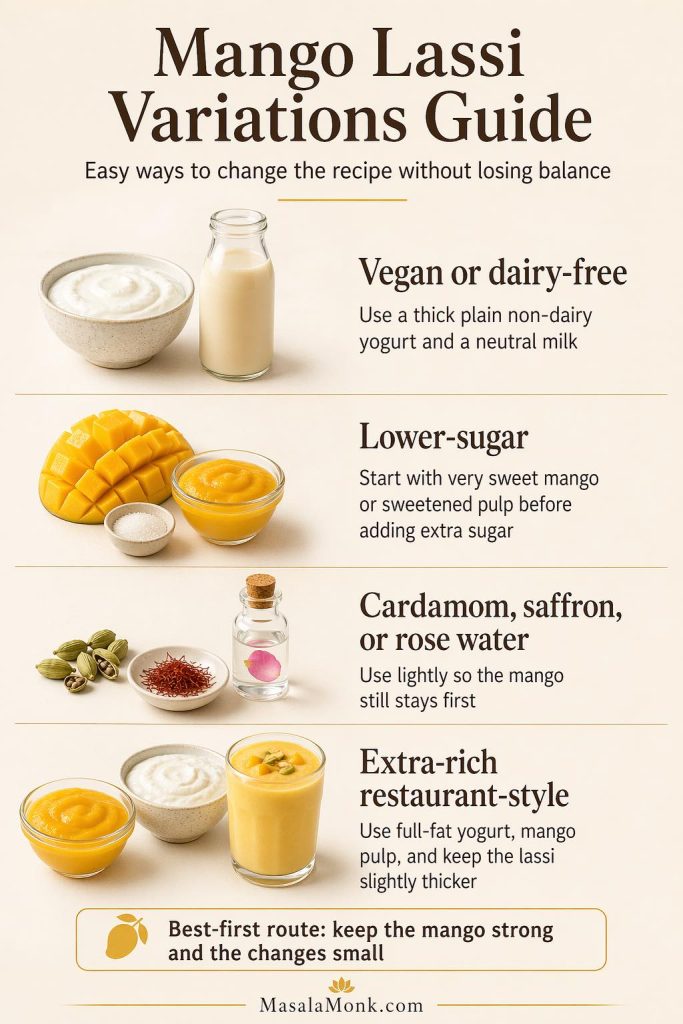
So tell me: Which one will you try first?

Let’s keep the mango magic going! Drop your favorite twist in the comments, or tag your pudding creations on Instagram with #MangoChiaMasterpiece.

📌 Frequently Asked Questions (FAQs)

1. How long does mango chia pudding last in the fridge?

Mango chia pudding lasts up to 5 days in an airtight container in the refrigerator. For best texture, stir it once a day to prevent clumping.


2. Can I use frozen mango instead of fresh?

Yes! Just thaw the mango fully and blend it into a smooth purée. Frozen mango tends to be sweeter and juicier, which works great for pudding.


3. What’s the best plant-based milk to use?

It depends on your texture preference:

  • Coconut milk for creamy richness
  • Almond milk for a lighter version
  • Oat milk for a neutral, subtly sweet taste

4. How do I make the pudding thicker or thinner?

  • For a thicker texture, use more chia seeds (up to ⅓ cup per 1 cup of liquid).
  • For a thinner consistency, add more liquid or blend the pudding after it thickens.

5. Is mango chia pudding suitable for weight loss?

Yes, when made with unsweetened milk and no added sugar, it’s high in fiber, omega-3s, and keeps you full longer—great for healthy snacking or breakfast.


6. Can I meal prep this for the whole week?

Absolutely! Prepare it in individual jars and store in the fridge. Add fresh toppings (like fruit or granola) right before eating to maintain texture.


7. Can kids eat mango chia pudding?

Yes! It’s a kid-friendly, naturally sweet option—just be mindful of any allergies (especially to seeds, nuts, or coconut). You can also blend it smooth if your child dislikes the texture of chia seeds.


8. Can I make this without a blender?

Yes, use store-bought mango purée or mash the mango thoroughly with a fork for a rustic texture. A whisk will help mix everything evenly.


9. What if my chia pudding doesn’t set properly?

Ensure the chia seeds are fresh and fully mixed in (stir again after 30 minutes). If it still doesn’t thicken, add 1–2 extra tablespoons of seeds and let it sit a few more hours.


10. Is chia pudding safe to eat daily?

Yes, chia seeds are packed with nutrients, but start with 2–3 tablespoons per serving to avoid digestive discomfort. Stay hydrated, as chia absorbs a lot of water.