Posted on Leave a comment

Kiwi Smoothie Recipe

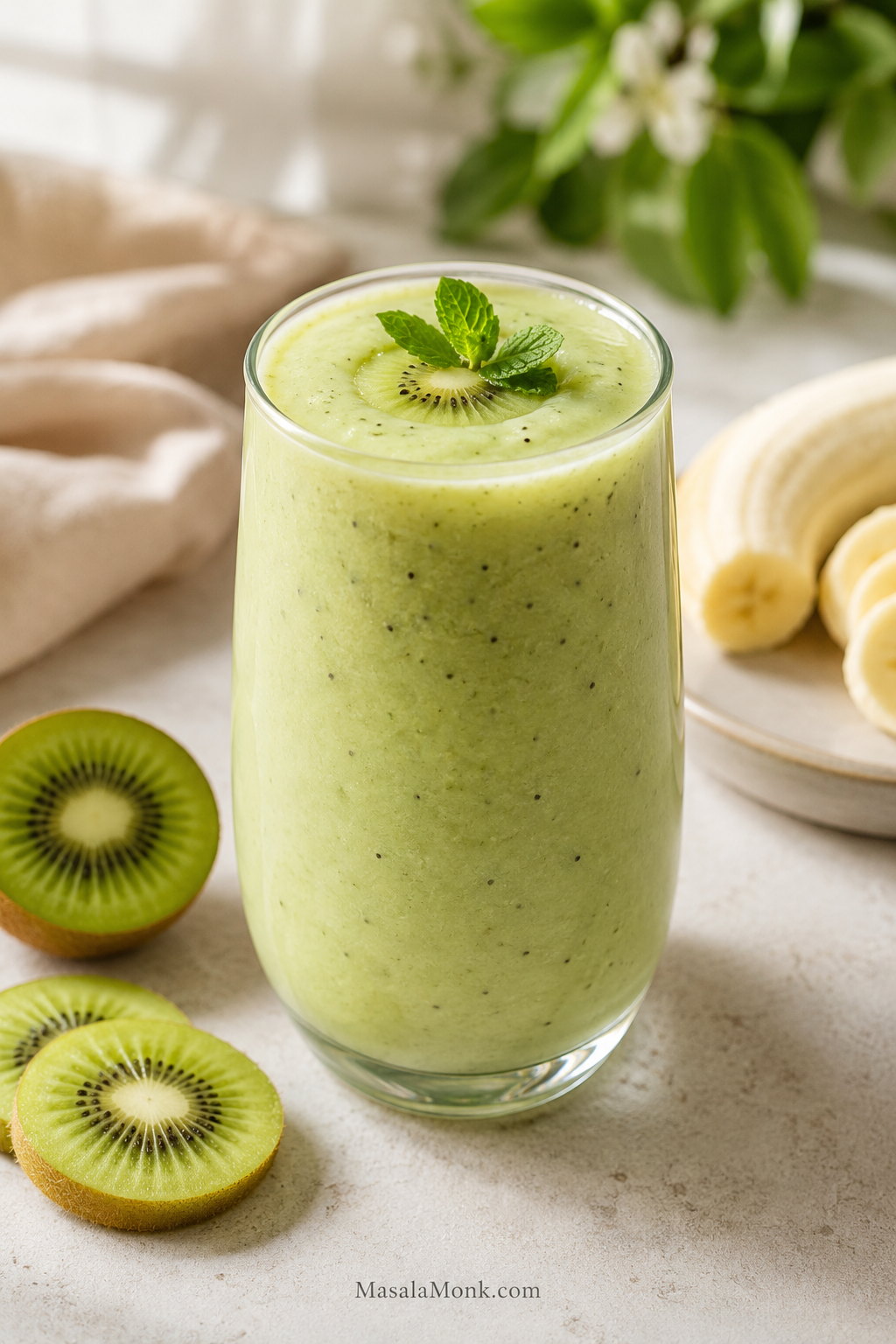
Creamy pale-green kiwi smoothie in a glass with sliced kiwi and banana on a breakfast counter.

This kiwi smoothie recipe is creamy, fresh, tangy-sweet, and easy to adjust with banana, yogurt, milk, strawberry, mango, or dairy-free swaps. It takes about 5 minutes, but it still gives you enough control to avoid the usual problems: a smoothie that tastes too sour, too thin, too watery, too seedy, or too bland.

Done right, it tastes bright and creamy at the same time — fresh enough for a warm morning, but filling enough to feel like breakfast.

The base is simple: ripe kiwi for brightness, frozen banana for creaminess, yogurt for body, and just enough liquid to help the blender move. From there, you can make it lighter with coconut water, fruitier with orange juice, thicker as a smoothie bowl, greener with spinach, or sweeter with mango and strawberries.

Start with the classic kiwi banana smoothie, then adjust it to fit what you have. If your kiwis are sharp, jump to the fixes section. If you want a no-yogurt smoothie, a no-banana version, or a kiwi shake-style drink, those options are built into the guide too.

Quick Answer: Best Kiwi Smoothie Recipe Ratio

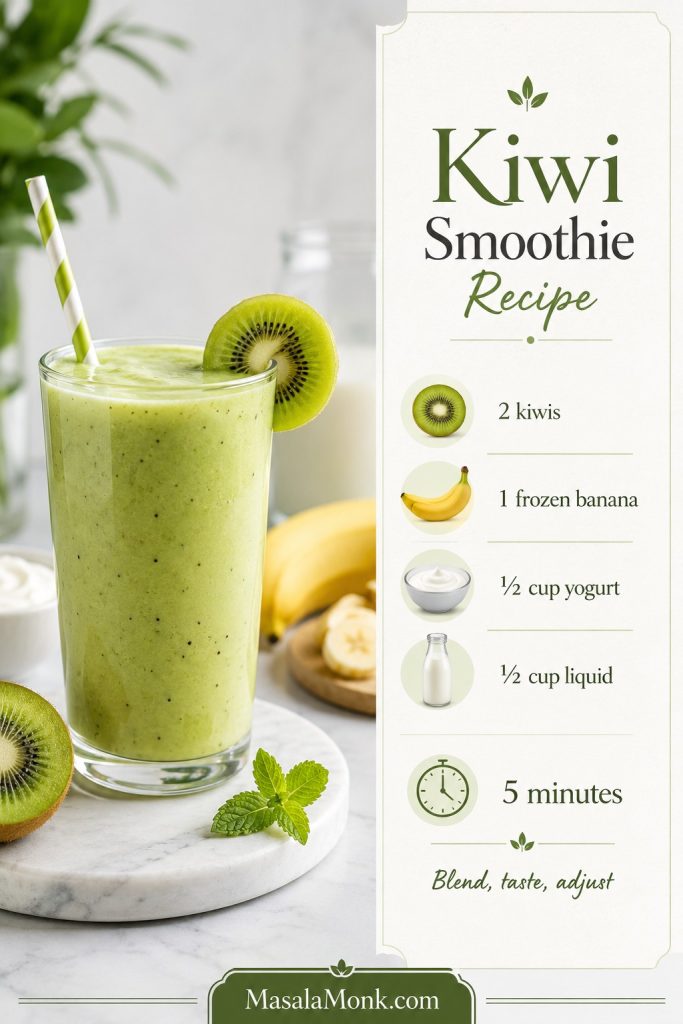
The best kiwi smoothie ratio is 2 ripe kiwis + 1 frozen banana + ½ cup yogurt + ½ cup liquid. Choose milk for a creamier smoothie, coconut water for a lighter smoothie, or orange juice for a brighter fruitier version. Add honey only if your kiwis taste sharp.
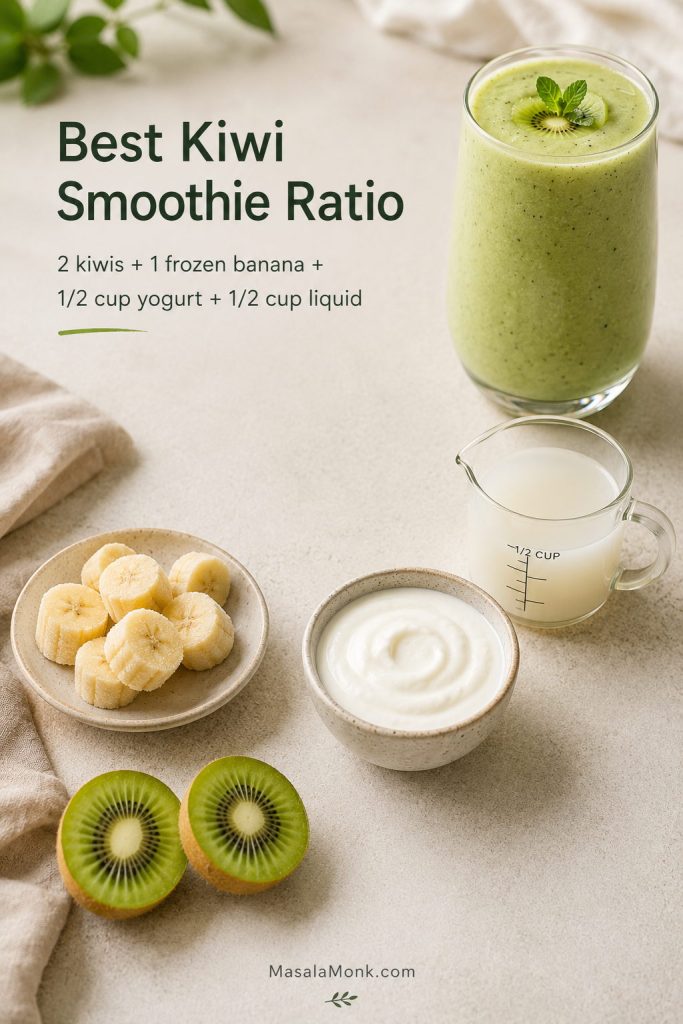
Kiwi smoothie ratio guide with kiwis, frozen banana, yogurt, liquid, and a finished smoothie
Start with this base kiwi smoothie ratio first; then taste before adding more fruit, liquid, or sweetener.

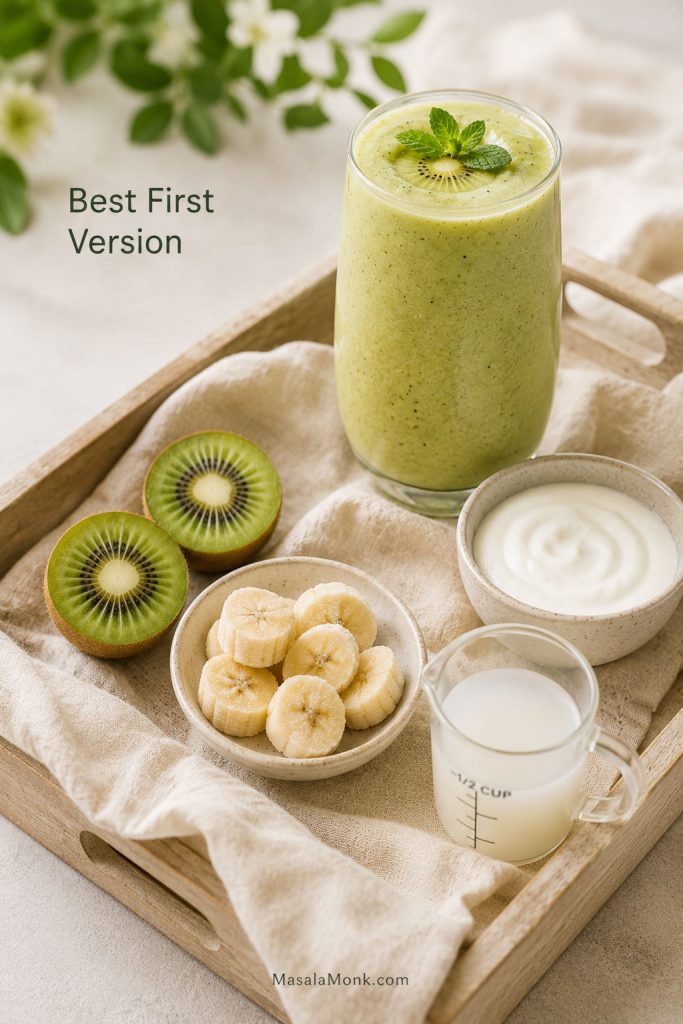
Best First Version to Try

Use 2 ripe kiwis, 1 frozen banana, ½ cup plain Greek yogurt, and ½ cup milk or coconut water. This gives you the cleanest creamy-tangy balance before you start changing the fruit, liquid, or sweetness.
Finished kiwi smoothie with ripe kiwis, frozen banana, Greek yogurt, and milk or coconut water
This first blend is the safest place to start because it gives you a creamy-tangy balance before you try strawberry, mango, no-yogurt, or no-banana versions.

For one large smoothie, the base recipe usually means 2 peeled kiwis, 1 medium frozen banana, ½ cup Greek yogurt or plain yogurt, and ½ cup milk, water, coconut water, or orange juice. Blend until smooth, taste, then adjust before pouring.

The formula works because each ingredient has a job. Kiwi brings the bright fruit flavor, banana softens the tartness, yogurt gives body, and the liquid helps everything blend. Once that balance is right, the smoothie tastes fresh instead of sharp or watery.

If you already know what went wrong with your last smoothie, the troubleshooting table will help you adjust sourness, thickness, sweetness, and texture quickly.

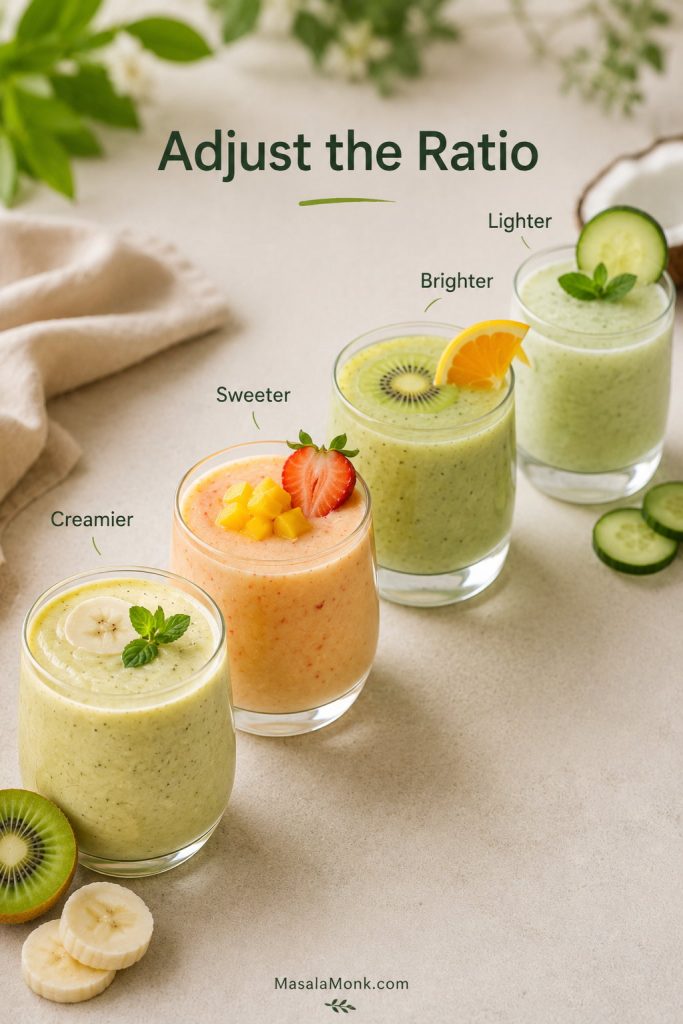
How to Adjust the Ratio

Want your kiwi smoothie… Add or adjust this
Creamier Frozen banana, Greek yogurt, avocado, or a splash of milk.
Sweeter Ripe banana, mango, strawberries, or 1–2 teaspoons honey.
Brighter Orange juice as the liquid or a tiny squeeze of lime.
Lighter Coconut water, water, cucumber, or spinach.
Thicker Frozen banana, frozen mango, chia seeds, or less liquid.
Dairy-free Almond milk, oat milk, coconut water, plant yogurt, mango, or avocado.
Four kiwi smoothie glasses showing creamier, sweeter, brighter, and lighter adjustment options
Small adjustments change the whole drink, so correct one thing at a time: body, sweetness, brightness, or overall lightness.

From there, the rest of the recipe is mostly about control. If your kiwi is very sweet, you may not need honey. If it tastes sharp, banana, mango, or yogurt will smooth it out quickly without changing the whole recipe.

Ingredients for a Creamy Kiwi Smoothie
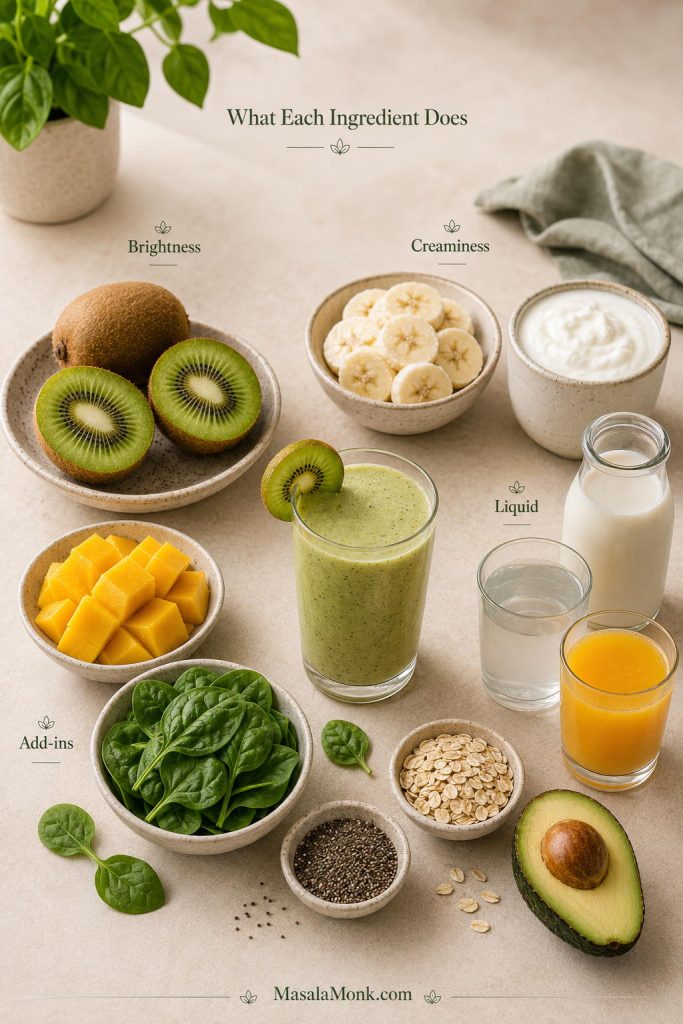
Kiwi smoothie ingredient guide with kiwi, banana, yogurt, liquid, mango, spinach, chia, oats, and avocado grouped by purpose
Each ingredient has a clear job: kiwi brings brightness, banana and yogurt add body, while the liquid decides whether the smoothie feels creamy, light, or bright.

A good smoothie recipe using kiwis needs balance. Kiwi gives the drink its bright, tangy flavor, but it needs something creamy or sweet beside it so the smoothie does not taste thin or harsh. The best version is not just about adding kiwi; it is about giving kiwi the right support.

Kiwi
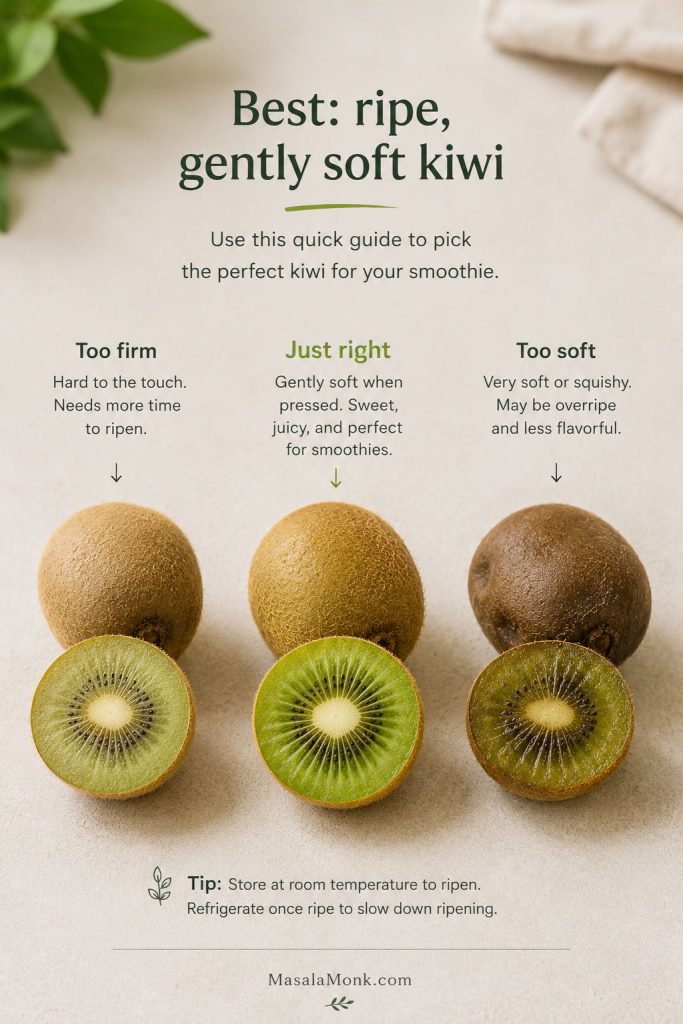
Kiwi ripeness guide showing firm kiwi, ripe kiwi, and very soft kiwi for smoothies
Ripe kiwis usually make a smoother, sweeter smoothie; however, firm kiwis can taste grassy or harsh once blended.

Ripe kiwis make the best smoothie. They should give slightly when pressed and smell fresh, not fermented. Hard kiwis can taste grassy, sour, or harsh once blended, while overripe kiwis can make the smoothie taste dull.

For the smoothest texture, peel the kiwi before blending. Kiwi skin is edible, but it can make a smoothie feel fibrous or slightly fuzzy, especially if your blender is not very powerful.
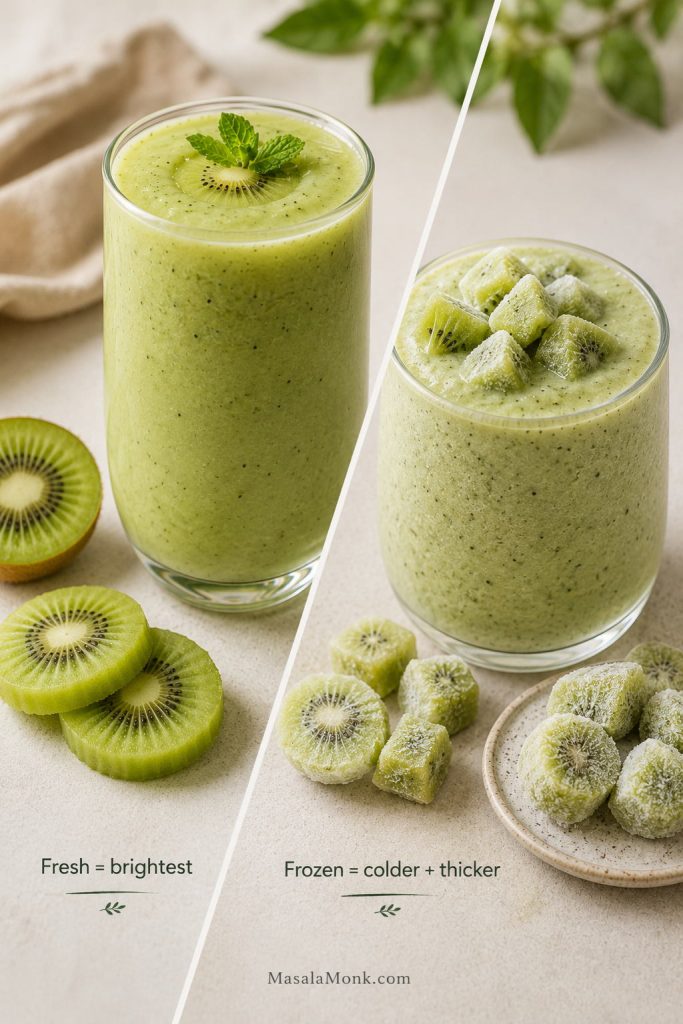
Fresh or frozen kiwi? Fresh kiwi gives the brightest flavor. Frozen kiwi makes the smoothie colder and thicker, but it works best with banana, mango, yogurt, or another creamy ingredient so the drink does not turn icy.
Fresh kiwi slices compared with frozen kiwi chunks for smoothie making
Fresh kiwi gives the brightest flavor, while frozen kiwi helps chill and thicken the smoothie when it is paired with banana, mango, yogurt, or another creamy ingredient.

Green kiwi gives the classic tangy flavor. Golden kiwi is usually sweeter and softer, so it can work well if you want a milder smoothie with less added sweetener.
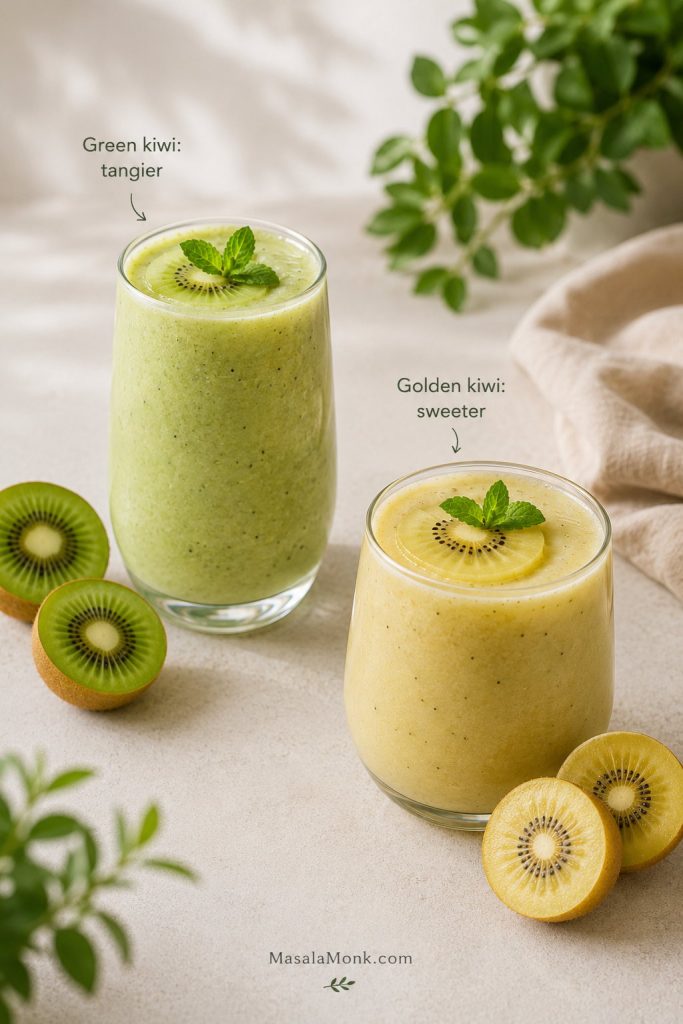
Green kiwi smoothie and golden kiwi smoothie shown side by side with matching fruit
Green kiwi gives the classic tangy smoothie flavor, whereas golden kiwi makes the drink softer, sweeter, and a little milder.

Banana

Banana is the easiest way to make the drink creamy, especially in a recipe where kiwis bring most of the tartness. A frozen banana works best because it chills and thickens the drink without needing lots of ice. For a less sweet smoothie, use half a banana and add more yogurt, mango, or avocado for body.

Yogurt

Plain Greek yogurt makes the smoothie thicker and more satisfying. Regular plain yogurt gives a softer, drinkable texture. For a dairy-free version, plant yogurt, almond milk, coconut water, avocado, chia, oats, and frozen mango can all help replace some of that body. The no-yogurt variation gives the easiest swaps.

Liquid

The liquid decides whether the smoothie tastes creamy, light, or bright. Milk makes it mellow, coconut water keeps it fresh, orange juice makes it fruitier, and water keeps it simple but thinner. Start with ½ cup and add more only if the blender needs help.

Optional Add-Ins

Spinach, mango, pineapple, chia seeds, oats, protein powder, avocado, mint, and lime can all work with kiwi. Add them with a purpose: mango for sweetness, avocado for creaminess, spinach for a green smoothie, chia or oats for thickness, and lime only when the smoothie needs a sharper finish.

How to Make a Kiwi Smoothie
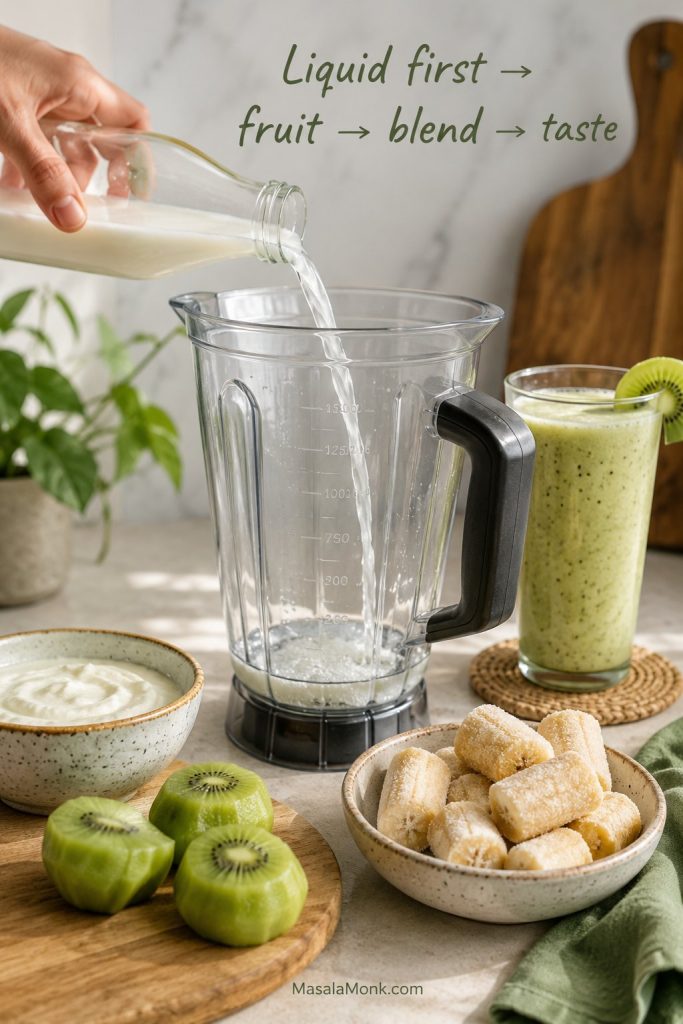
Liquid being poured into a blender with kiwi, banana, yogurt, and a finished smoothie nearby
Add the liquid first, because it helps the blender catch the fruit more easily and keeps the smoothie from getting watered down later.

The method is simple, but the order matters when you are blending kiwis with frozen banana, yogurt, and liquid. Add the liquid first so the blender can catch the ingredients more easily, especially if you are using frozen mango, frozen strawberries, oats, or greens.

  1. Peel and chop the kiwis. Cut away the fuzzy skin for the smoothest drink.
  2. Add the liquid first. Pour milk, coconut water, orange juice, or water into the blender.
  3. Add yogurt and soft ingredients. This helps the blender move before the frozen fruit goes in.
  4. Add kiwi and banana. Break the frozen banana into chunks if needed.
  5. Add frozen fruit or ice last. Use ice only if your fruit is fresh and the smoothie needs chilling.
  6. Blend until smooth. Most versions take 30–60 seconds. Green or frozen-heavy smoothies may need 60–120 seconds.
  7. Taste before pouring. Adjust sweetness, thickness, or brightness while the smoothie is still in the blender. The fixes table below shows the quickest adjustments.
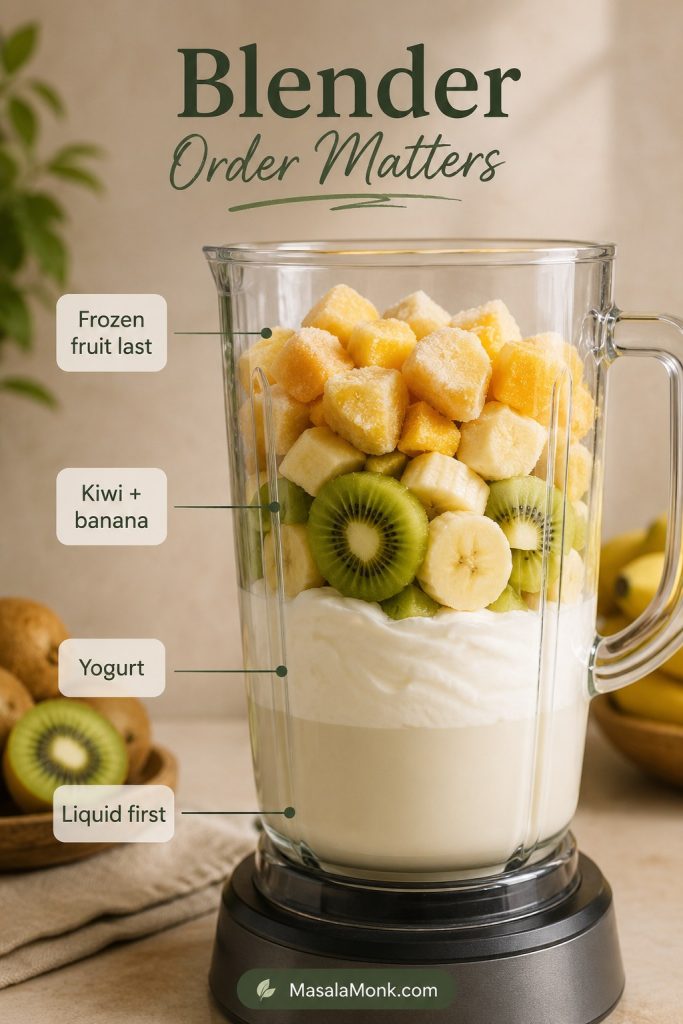
Blender tip: If the blender stalls, do not dump in a lot of liquid at once. Add 1 tablespoon at a time, blend again, and stop as soon as the smoothie moves smoothly.
Blender jar layered with liquid, yogurt, kiwi, banana, and frozen fruit for a smoothie
The right blender order matters: liquid first, creamy ingredients next, and frozen fruit last so the blades can move smoothly.

If you are using a regular blender, chop the frozen banana smaller and let very hard frozen fruit sit at room temperature for 3–5 minutes before blending. Also, add liquid first, then increase the liquid by tablespoons only if the blades stop moving.
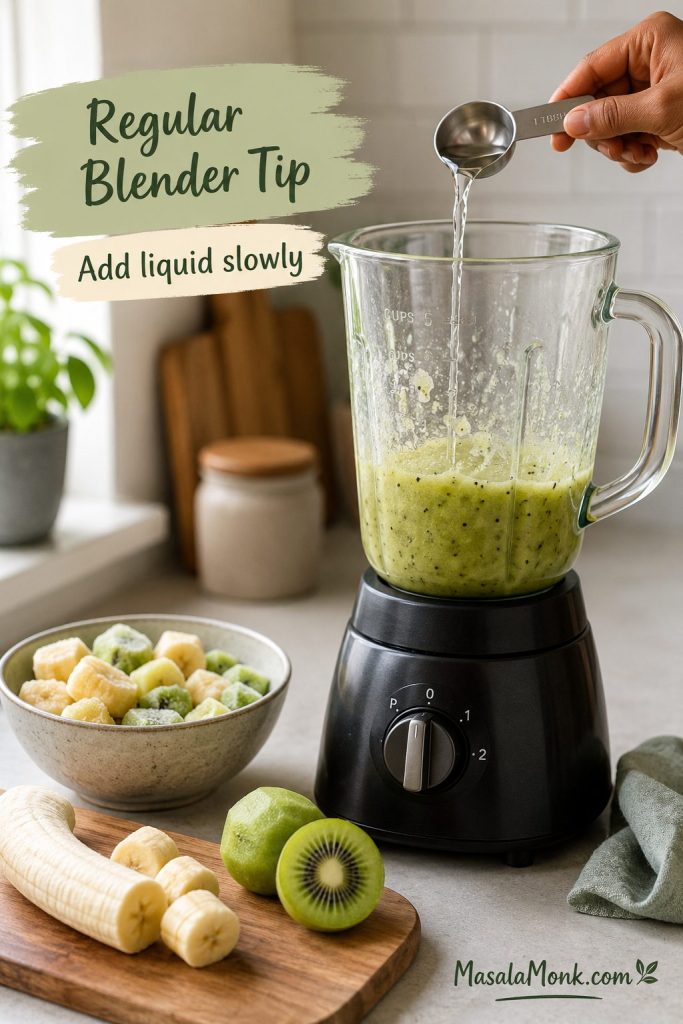
Regular blender with kiwi smoothie ingredients and liquid being added slowly
Even a regular blender can make a creamy kiwi smoothie when the frozen fruit is chopped smaller and the liquid is added gradually.

Kiwi Smoothie Recipe Card

Kiwi smoothie recipe card with a finished smoothie and the base ingredient ratio
Save this base recipe first; once the ratio is familiar, it becomes much easier to troubleshoot texture and build variations confidently.

Kiwi Smoothie Recipe

This creamy kiwi smoothie recipe is made with ripe kiwi, frozen banana, yogurt, and your choice of milk, coconut water, orange juice, or water. It is bright, fresh, tangy-sweet, and easy to adjust.

Prep Time5 minutes
Cook Time0 minutes
Total Time5 minutes
YieldAbout 1 large 16–20 oz smoothie or 2 small 8–10 oz smoothies

Equipment

  • Blender or high-speed blender
  • Knife and cutting board
  • Measuring cups and spoons
  • Glass or jar for serving

Ingredients

  • 2 medium ripe kiwis, peeled and chopped, about 140–160 g flesh
  • 1 medium frozen banana, about 100–120 g
  • ½ cup plain Greek yogurt or regular plain yogurt, about 120 g
  • ½ cup milk, coconut water, orange juice, or water, 4 fl oz / 120 ml
  • 1–2 teaspoons honey or maple syrup, optional, 7–14 g
  • ½ cup frozen mango, strawberries, or pineapple, optional, about 70–90 g
  • ¼–½ cup ice, optional, only if your fruit is fresh and the smoothie needs chilling
  • 1 teaspoon lime or lemon juice, optional, 5 ml

Method

  1. Add the liquid to the blender first.
  2. Add the yogurt, peeled kiwi, frozen banana, and any optional frozen fruit.
  3. Blend for 30–60 seconds, or until smooth. If using greens, oats, chia, protein powder, or a lot of frozen fruit, blend for 60–120 seconds.
  4. Taste the smoothie. Add honey if it is too tart, more liquid if it is too thick, or more frozen banana/mango if it is too thin.
  5. Pour into one large glass or two small glasses and drink right away.

Notes

  • For the creamiest smoothie, use frozen banana instead of fresh banana.
  • For a dairy-free smoothie, use plant yogurt, almond milk, coconut water, mango, or avocado.
  • For a smoothie bowl, reduce the liquid to ¼ cup / 60 ml and use frozen banana or frozen mango.
  • Kiwi smoothies with milk or yogurt are best enjoyed fresh because kiwi can change the texture as it sits. See the milk, yogurt, and juice guide for more detail.
  • The final yield depends on how much frozen fruit or ice you add.

Kiwi Smoothie Variations
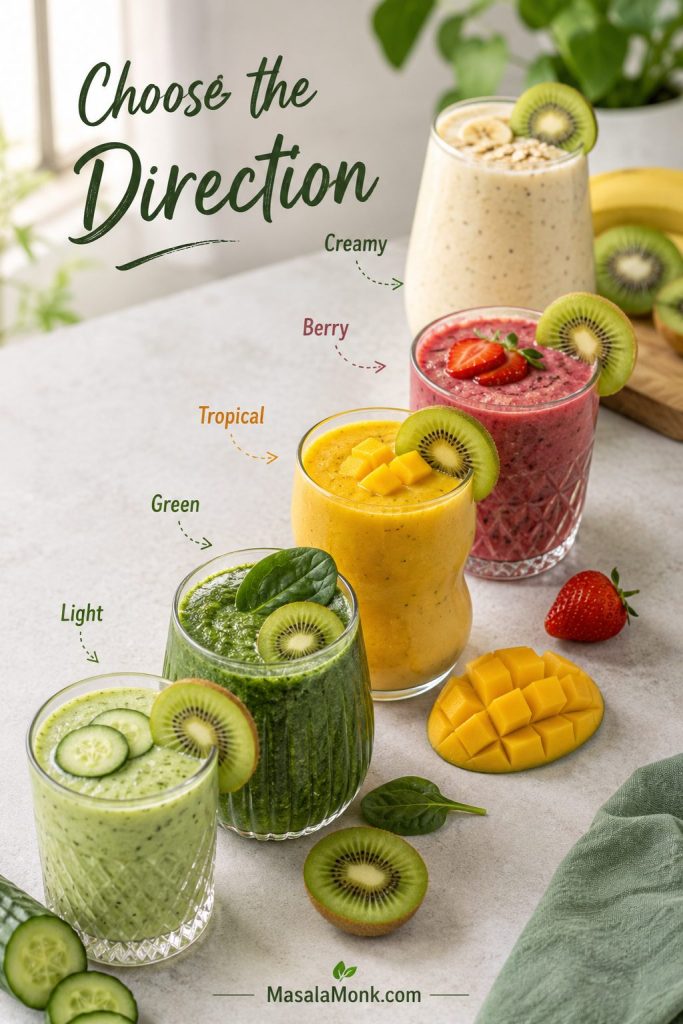
Five kiwi smoothie variations in different glasses with banana, strawberry, mango, spinach, and cucumber styles
A good base smoothie can move in several directions; however, changing one main ingredient at a time keeps the flavor balanced.

Once the base ratio tastes right, the fun part is choosing the direction. You can make it creamy and breakfast-like with banana, tropical with mango or pineapple, sharper with strawberries, greener with spinach, or lighter with cucumber and coconut water. Since kiwis bring most of the bright, tangy flavor, change one thing at a time so the blend stays balanced.

Banana Kiwi Smoothie
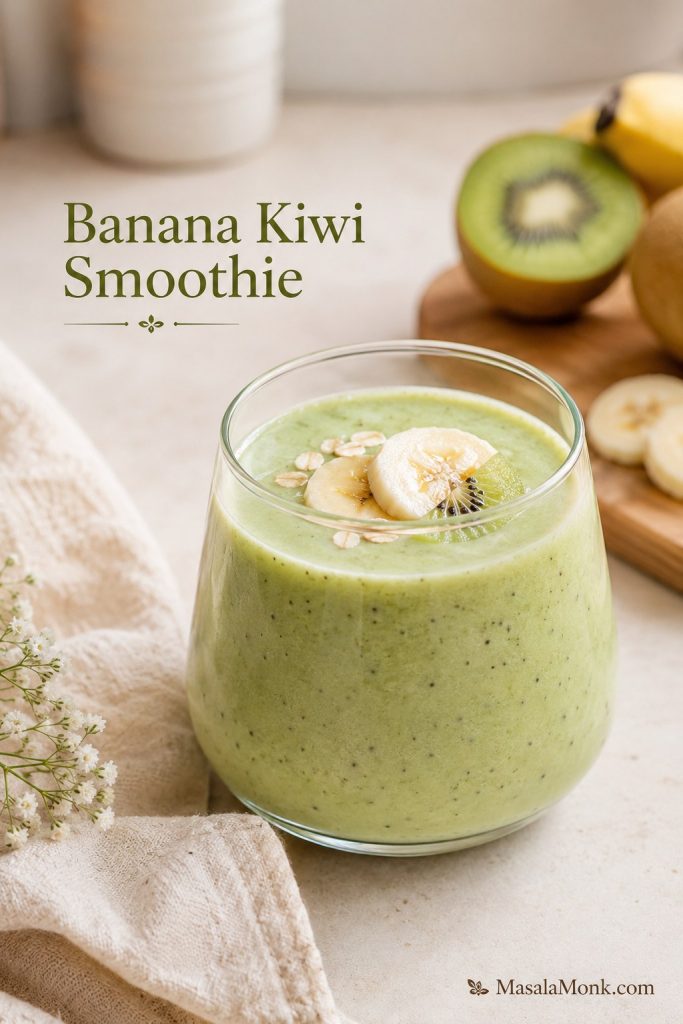
Creamy banana kiwi smoothie with banana slices and fresh kiwi garnish
Banana softens kiwi’s tartness and gives the smoothie a thicker breakfast-style texture without relying on extra ice.

This is the easiest and creamiest version. Make the base recipe with 2 ripe kiwis, 1 frozen banana, yogurt, and milk or coconut water. The banana softens kiwi’s tartness and gives the smoothie a smooth breakfast-style texture.

Strawberry Kiwi Smoothie
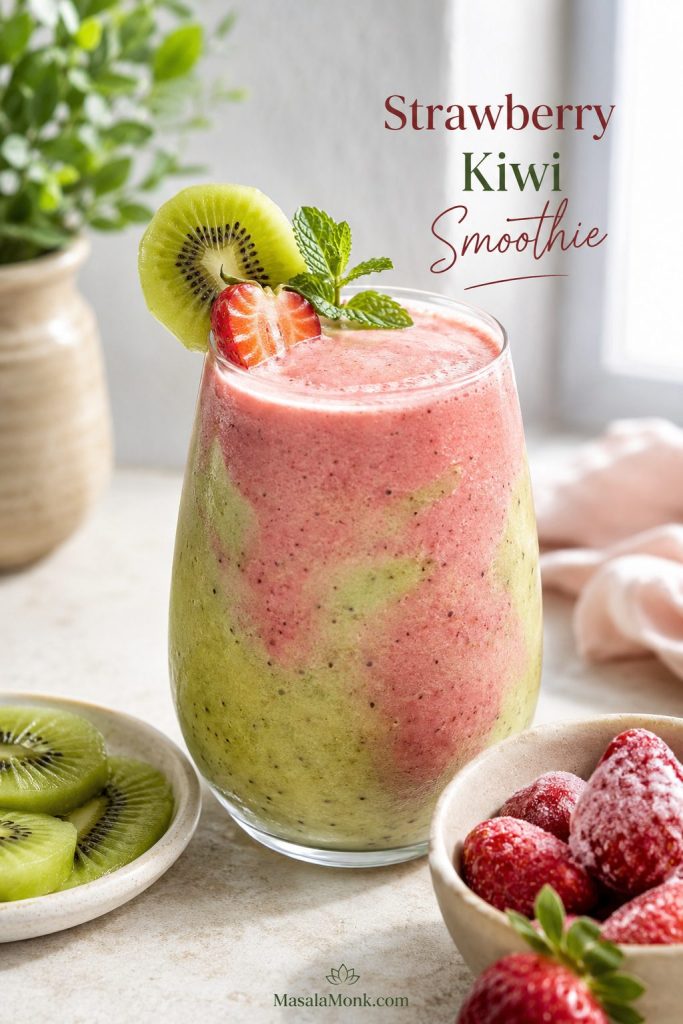
Strawberry kiwi smoothie with pink and green blended layers, kiwi, and strawberries
Strawberries make the drink brighter and more familiar, while kiwi keeps the smoothie fresh, tangy, and fruit-forward.

Strawberries make the smoothie taste brighter and more familiar, especially if you like a sweet-tart berry flavor. Add ½–1 cup frozen strawberries to the base recipe. Keep the banana if you want creaminess, or reduce it slightly if you want the strawberry and kiwi to taste sharper and fresher.

If you want to go deeper on the berry side, MasalaMonk also has a full strawberry smoothie guide with yogurt, no-yogurt, protein, and fruit variation ideas.

Kiwi Mango Smoothie
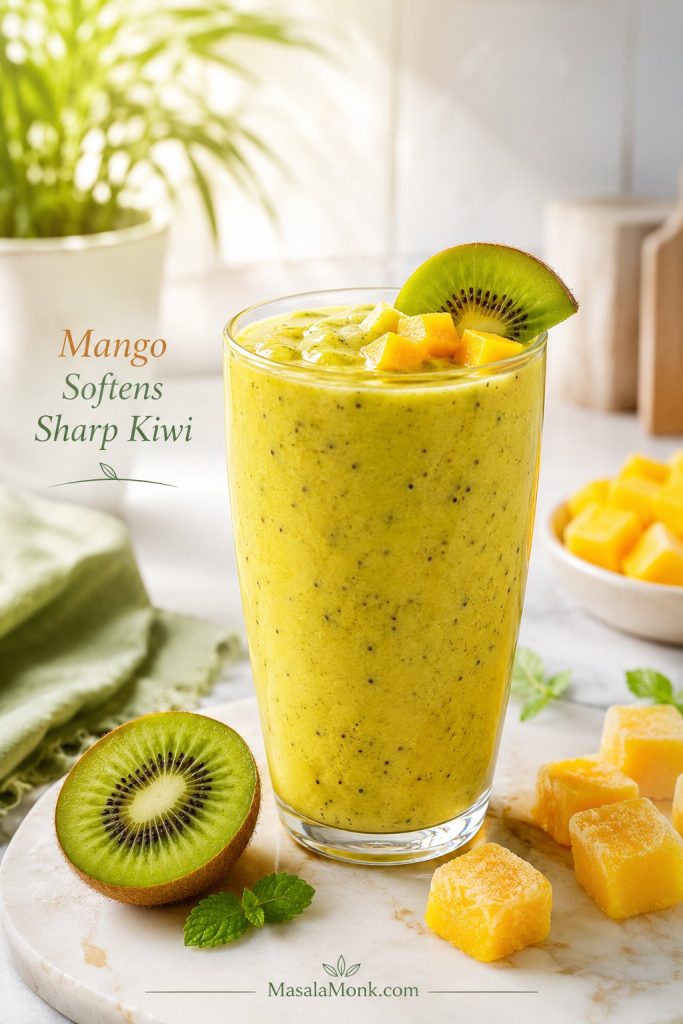
Golden-green kiwi mango smoothie with mango cubes and sliced kiwi
Mango is one of the best ways to soften sharp kiwi because it adds natural sweetness and body at the same time.

Mango is one of the easiest ways to tame sharp kiwi. It adds sweetness, body, and a tropical flavor without needing much extra sweetener. Blend ½–1 cup frozen mango with 2 kiwis, then use coconut water for a lighter drink or orange juice for a brighter one.

If mango is the fruit you use most often in smoothies, this mango smoothie recipe is a useful companion because it covers fresh mango, frozen mango, yogurt, milk, banana, no-banana, dairy-free, protein, and smoothie bowl versions.

Kiwi Pineapple Smoothie
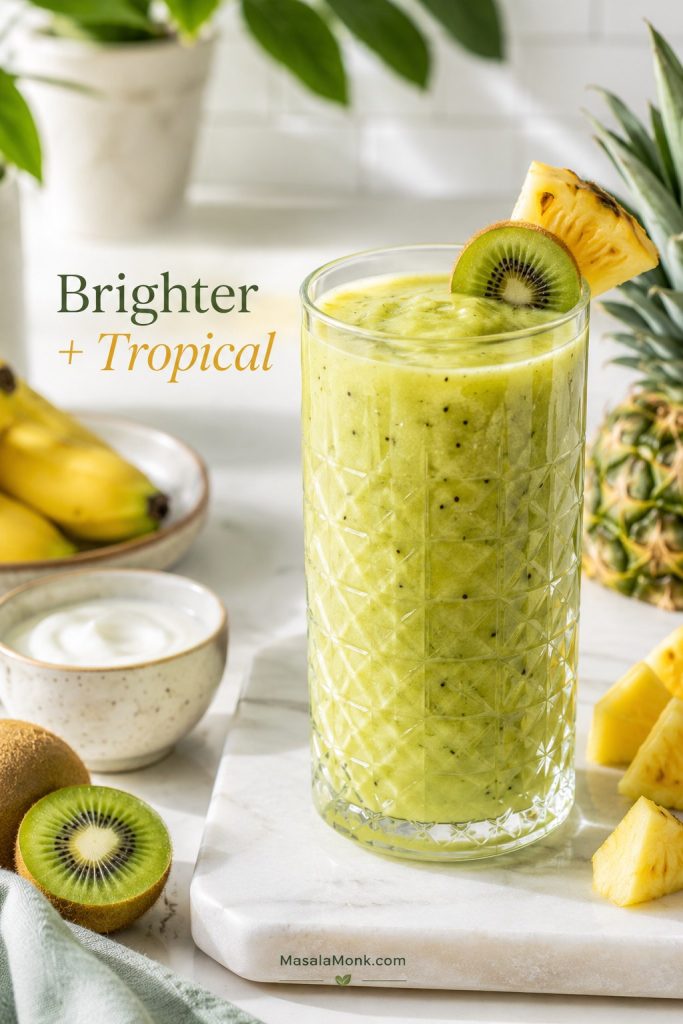
Kiwi pineapple smoothie in a tall glass with pineapple and kiwi garnish
Pineapple pushes the smoothie in a brighter tropical direction; because it can also taste tart, banana, mango, or yogurt helps keep it balanced.

Pineapple pushes the smoothie in a sharper, juicier, more tropical direction. Frozen pineapple is especially good when you want a colder, thicker drink. Because both kiwi and pineapple can taste tart, balance this version with banana, yogurt, mango, or a small amount of honey.

Green Kiwi Smoothie With Spinach
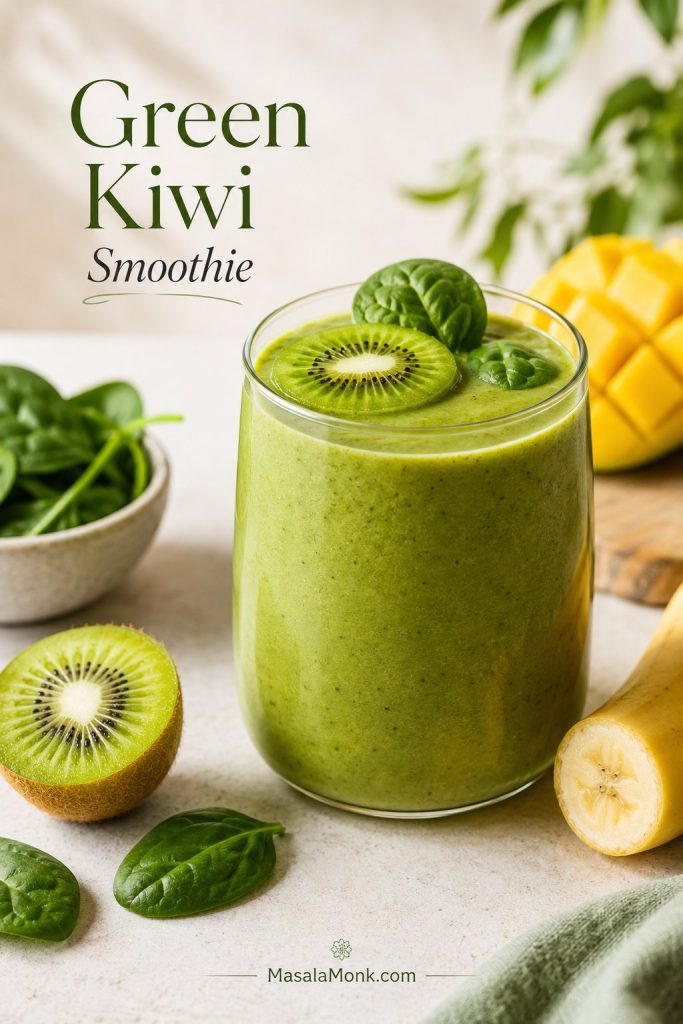
Green kiwi smoothie with spinach, banana, mango, and kiwi garnish
Fresh spinach blends into a kiwi smoothie more gently than frozen spinach, especially when banana or mango stays in the mix for sweetness.

Fresh baby spinach blends into kiwi smoothies more gently than frozen spinach. Add 1 cup to the base recipe, then keep banana or mango in the mix so the smoothie still tastes sweet enough. The color becomes greener, but the flavor stays mild when the spinach is fresh and not packed too heavily.

For more smoothie ideas built around fruit, greens, and vitamin C pairings, see MasalaMonk’s high-iron smoothies and shakes guide.

Kiwi Cucumber Smoothie
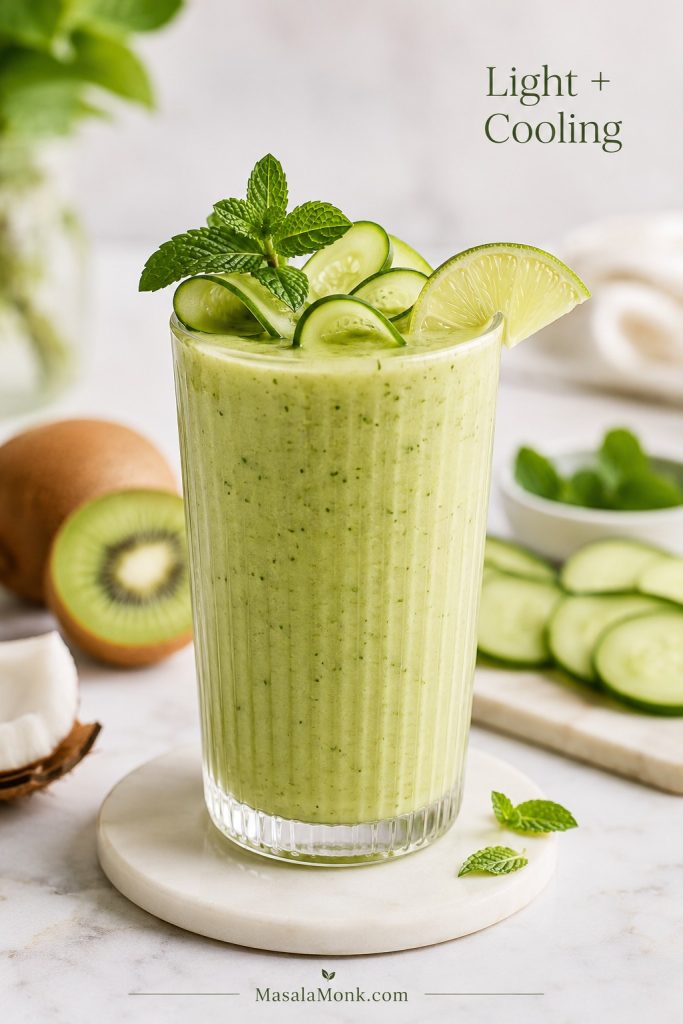
Light kiwi cucumber smoothie with cucumber slices, mint, lime, and kiwi
For a lighter version, cucumber, mint, lime, and coconut water make the smoothie feel crisp without turning it into a heavy breakfast blend.

This cucumber version is lighter and fresher than the banana-yogurt blend. Blend kiwi with cucumber, mint, lime, and coconut water for a crisp, cooling drink. Add a little banana, mango, or Greek yogurt if you want it to feel more filling.

Kiwi Protein Smoothie

Greek yogurt is the simplest protein boost because it also improves texture. You can add one scoop of plain or vanilla protein powder, but keep banana, mango, or yogurt in the mix so the smoothie does not taste chalky.

For another simple way to add texture to smoothies, see this guide on using hemp seeds in smoothies.

Kiwi Smoothie Without Yogurt
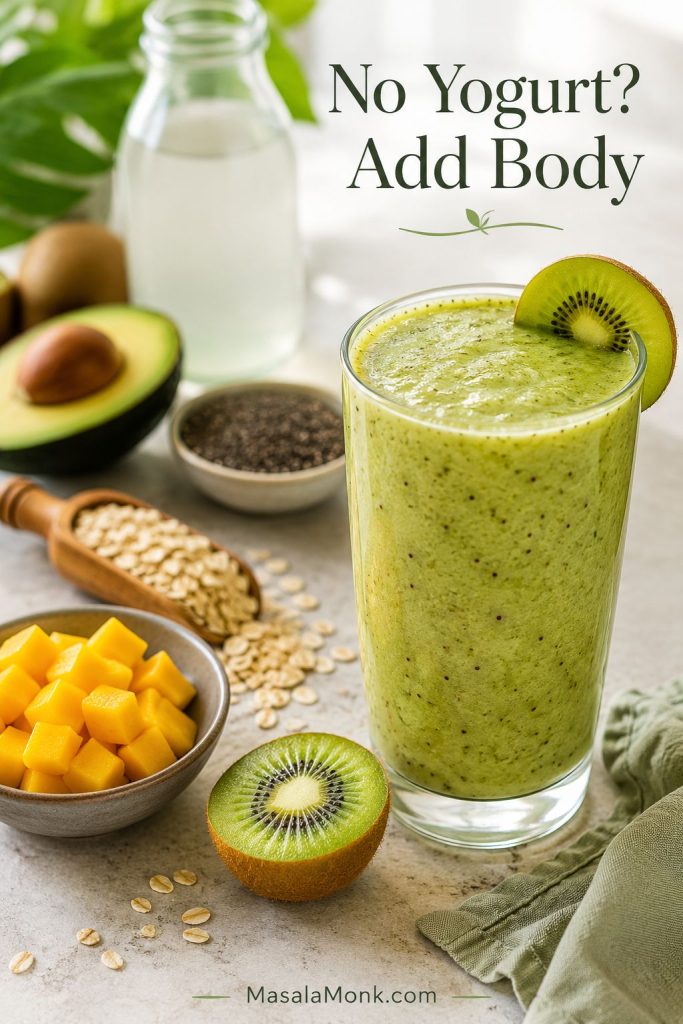
Kiwi smoothie without yogurt shown with mango, avocado, oats, chia seeds, and plant milk
Without yogurt, the smoothie needs another source of body, so mango, avocado, oats, chia, or plant milk become more important.

A no-yogurt version still needs body because kiwis alone can make the recipe taste sharp and thin. Keep the frozen banana and use almond milk, oat milk, coconut water, or orange juice as the liquid. For a thicker texture, add frozen mango, avocado, chia seeds, oats, or plant-based yogurt.

Kiwi Smoothie Without Banana
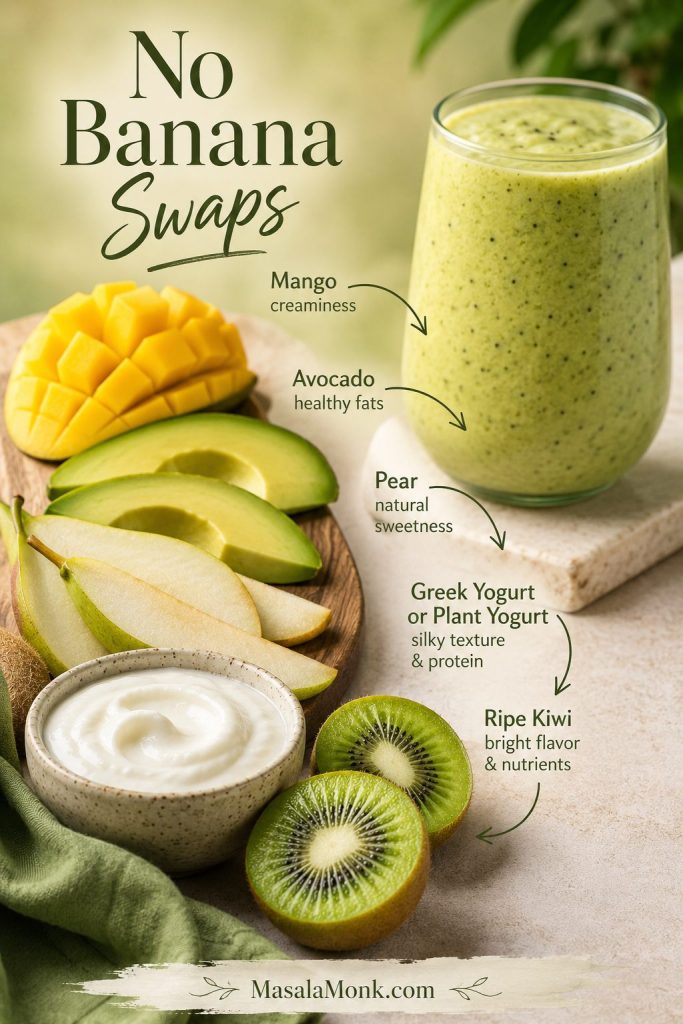
Kiwi smoothie without banana shown with mango, avocado, pear, yogurt, and kiwi
Banana is easy, but not essential; instead, use mango for sweetness or avocado and pear when you want creaminess with a different flavor profile.

Banana is helpful, but it is not mandatory. Frozen mango is the best swap when you still want sweetness and thickness. Avocado gives creaminess without sweetness, Greek yogurt adds body, and pear gives a softer fruit flavor. Without one of these replacements, kiwi can taste sharper and the smoothie may feel thinner.

Kiwi Smoothie Bowl
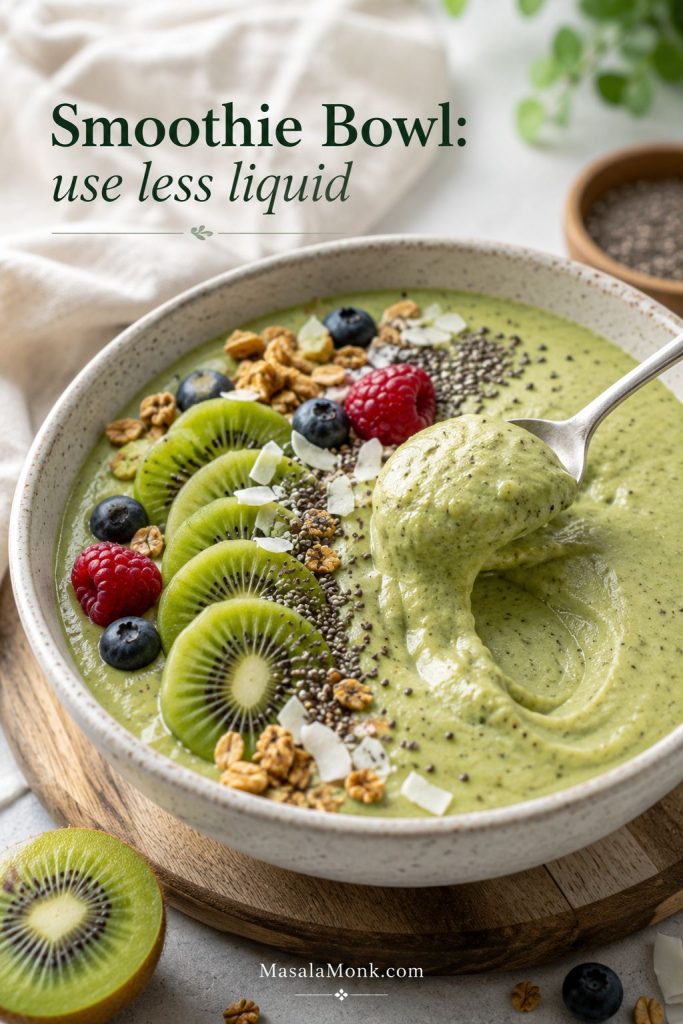
Thick kiwi smoothie bowl with sliced kiwi, berries, granola, coconut, chia, and a spooned texture
A kiwi smoothie bowl needs less liquid than a drinkable smoothie; otherwise, the toppings sink and the base becomes too loose.

A smoothie bowl needs much less liquid than a drinkable smoothie. Reduce the liquid to ¼ cup / 60 ml and use frozen banana, frozen mango, or frozen pineapple. Blend thick, then top with sliced kiwi, granola, coconut, chia seeds, berries, or pumpkin seeds.

Kiwi Milkshake or Kiwi Shake
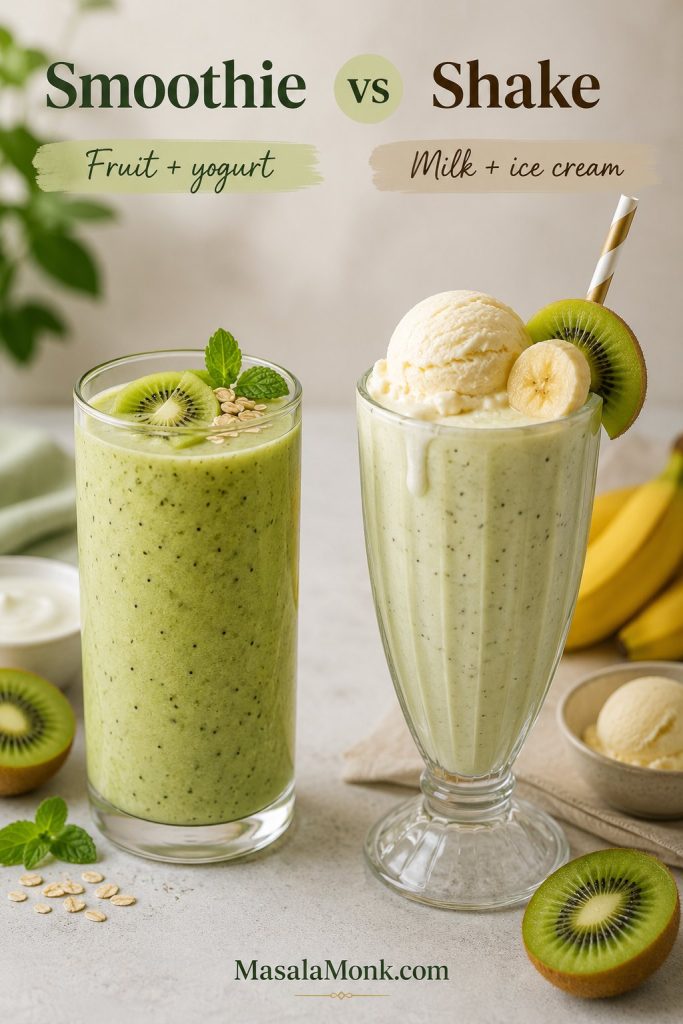
Kiwi smoothie and kiwi milkshake compared in two different glasses
A kiwi smoothie is usually lighter and fruit-based, while a kiwi shake becomes richer and sweeter with milk, banana, and ice cream.

A kiwi shake is the dessert-style cousin of this smoothie. Blend 2–3 peeled kiwis with milk, banana, and a scoop of vanilla ice cream for a colder, sweeter drink. It is richer than the main recipe, so serve it right away and treat it more like a milkshake than a breakfast smoothie.

Best Fruits to Pair With Kiwi in Smoothies
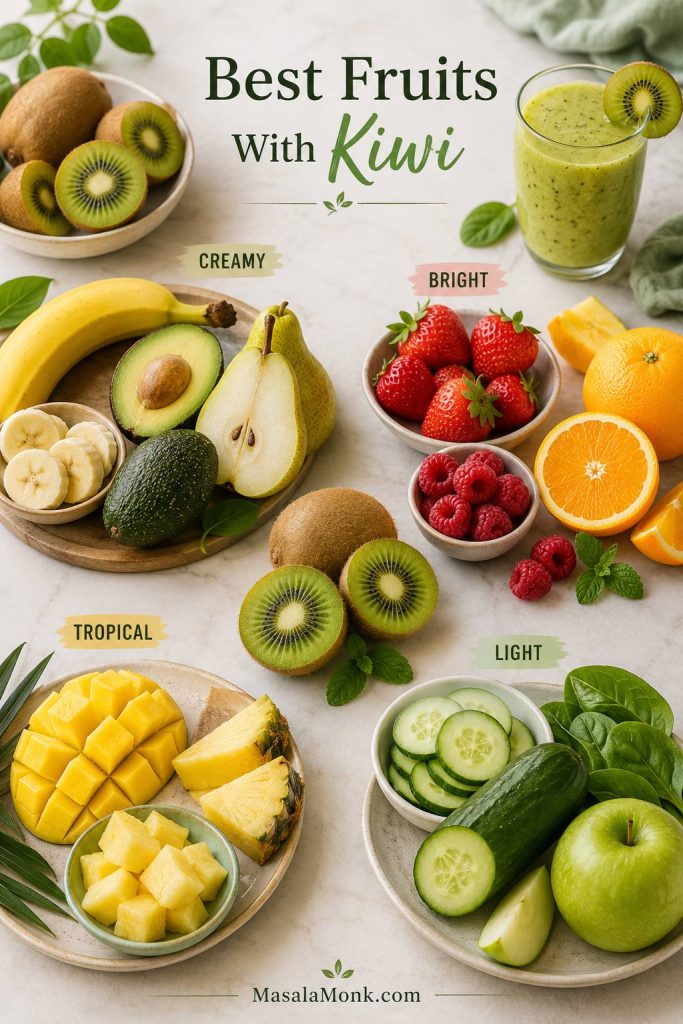
Fruit pairing guide for kiwi smoothies with banana, avocado, pear, berries, orange, mango, pineapple, cucumber, spinach, and apple
Kiwi pairs best with fruits that either soften its tangy edge or echo its bright flavor, so choose the pairing based on the smoothie you want.

Because kiwi has a naturally bright edge, it works best with fruits that either soften its tartness or echo that fresh flavor. Banana and mango make it creamier. Strawberry and raspberry keep it tangy. Pineapple and orange make it tropical. Apple, pear, cucumber, and spinach keep it lighter.

Fruit or add-in Why it works with kiwi Best smoothie style
Banana Softens tartness and thickens the drink. Creamy breakfast smoothie
Strawberry Gives a familiar sweet-tart berry flavor. Berry kiwi smoothie
Mango Adds tropical sweetness and body. No-yogurt or tropical smoothie
Pineapple Makes the smoothie bright and juicy. Refreshing summer smoothie
Orange Adds citrus sweetness and makes the drink fruitier. Juice-based smoothie
Apple Keeps the flavor mild and fresh. Light breakfast smoothie
Blueberry Adds deeper berry flavor and color. Purple fruit smoothie
Raspberry Keeps the smoothie sharp and tangy. Tart berry smoothie
Pear Adds gentle sweetness without dominating. No-banana smoothie
Avocado Makes the smoothie creamy without banana. No-banana creamy smoothie
Spinach Adds green color with mild flavor. Green kiwi smoothie
Cucumber Makes the smoothie lighter and fresher. Cooling smoothie

Kiwi Smoothie With Milk, Yogurt, or Juice
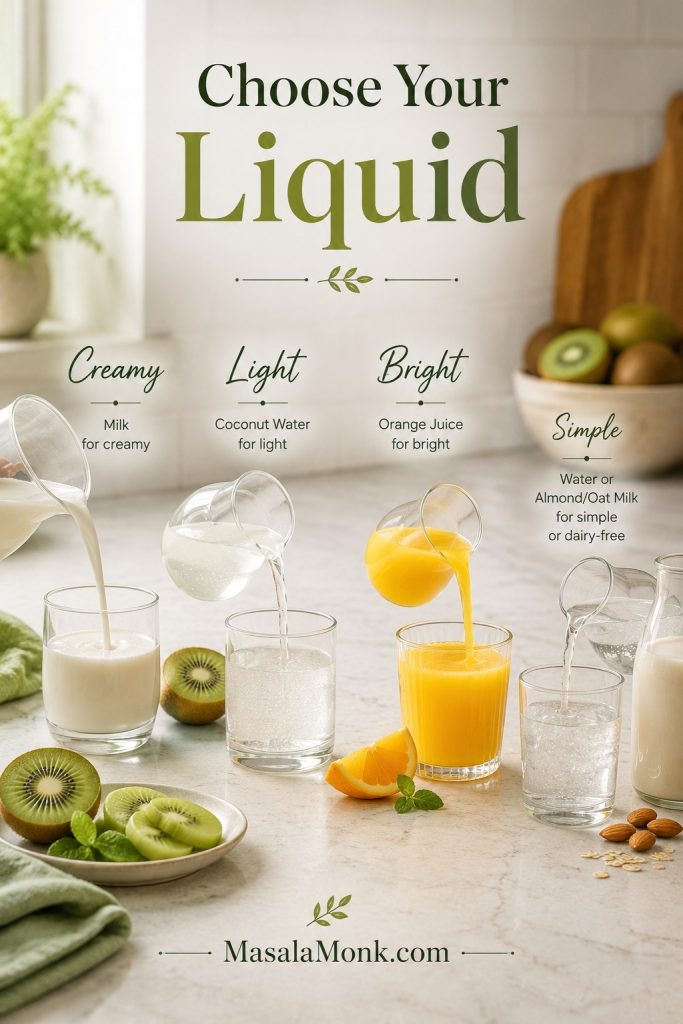
Liquid guide for kiwi smoothies showing milk, coconut water, orange juice, water, and plant milk
Liquid choice shapes the whole smoothie, so pick milk for creaminess, coconut water for lightness, orange juice for brightness, or water when the fruit already tastes sweet.

The liquid you choose changes the whole smoothie. There is no single correct option; the best one depends on whether you want the drink creamy, light, bright, dairy-free, or more filling.

Because the liquid changes the final texture so much, choose based on the smoothie you actually want instead of forcing one option.

Liquid Best use Watch-out
Milk Creamy, mellow smoothie. Best with banana or yogurt for balance.
Greek yogurt + water Thick texture without too much liquid. Can taste tangy if the kiwi is tart.
Almond milk or oat milk Dairy-free creaminess. Use unsweetened if you want more control.
Coconut water Light, refreshing, tropical-style smoothie. Thinner than milk or yogurt.
Orange juice Bright, fruity, tropical flavor. Can make a tart kiwi taste even sharper.
Water Cleanest and simplest option. Can taste thin unless you use banana or mango.
Canned coconut milk Rich tropical smoothie. Can get heavy fast; use a small amount.

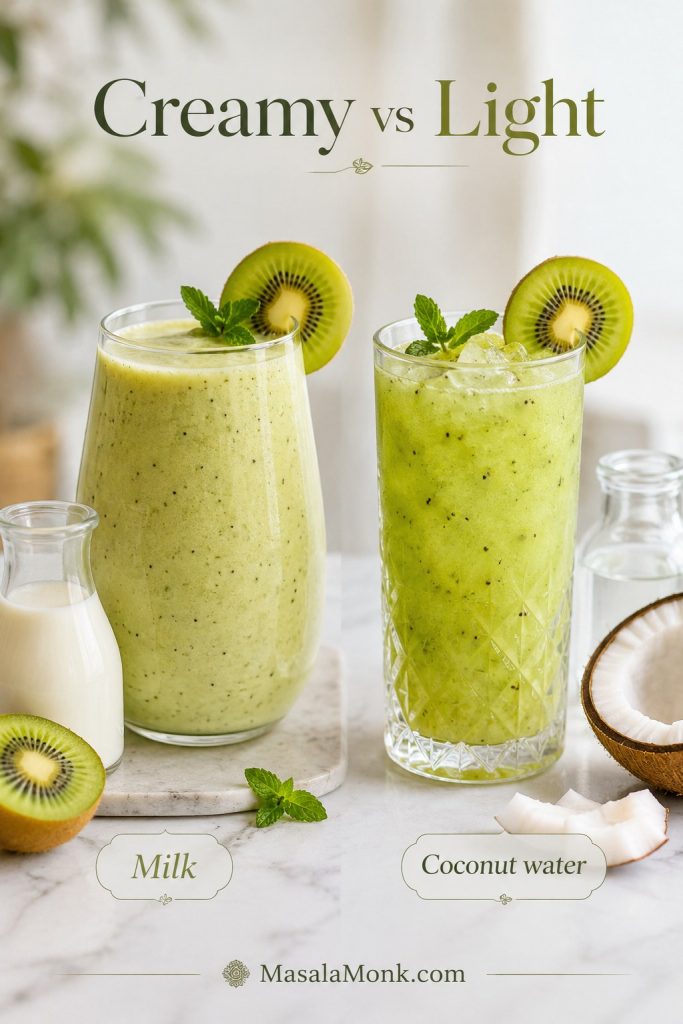
Milk vs Coconut Water

Milk-based kiwi smoothie and coconut-water kiwi smoothie shown side by side
Choose milk when you want a softer, creamier breakfast smoothie; meanwhile, coconut water works better for a lighter, fresher finish.

If you like the lighter tropical finish of coconut water, MasalaMonk’s coconut water smoothie ideas can give you more combinations beyond kiwi.

Kiwi works with milk and yogurt, but dairy-based versions are best enjoyed soon after blending. Green kiwifruit contains actinidin, a natural protein-digesting enzyme, so a milk- or yogurt-heavy smoothie can thin or separate more noticeably as it sits.

Is a Kiwi Smoothie Good for Weight Loss?

A smoothie recipe with kiwis can fit into a lighter breakfast or snack, but it is not magic on its own. The overall blend matters more than the word “kiwi.” Use whole fruit, keep juice and sweeteners modest, and add protein or fiber if you want the smoothie to feel more satisfying. The protein smoothie variation is a good place to start if you want a more filling version.

For example, a more balanced version could use 2 kiwis, ½ frozen banana, Greek yogurt or unsweetened plant milk, spinach or cucumber, and chia seeds. On the other hand, too much honey, sweetened yogurt, fruit juice, or ice cream can quickly turn it into a dessert drink.

Harvard Health notes that smoothies can become calorie-heavy when they include added sugar, syrup, honey, sweetened yogurt, frozen yogurt, or large amounts of juice. That is why this recipe keeps sweetener optional and uses whole fruit as the main base.

How to Fix a Kiwi Smoothie
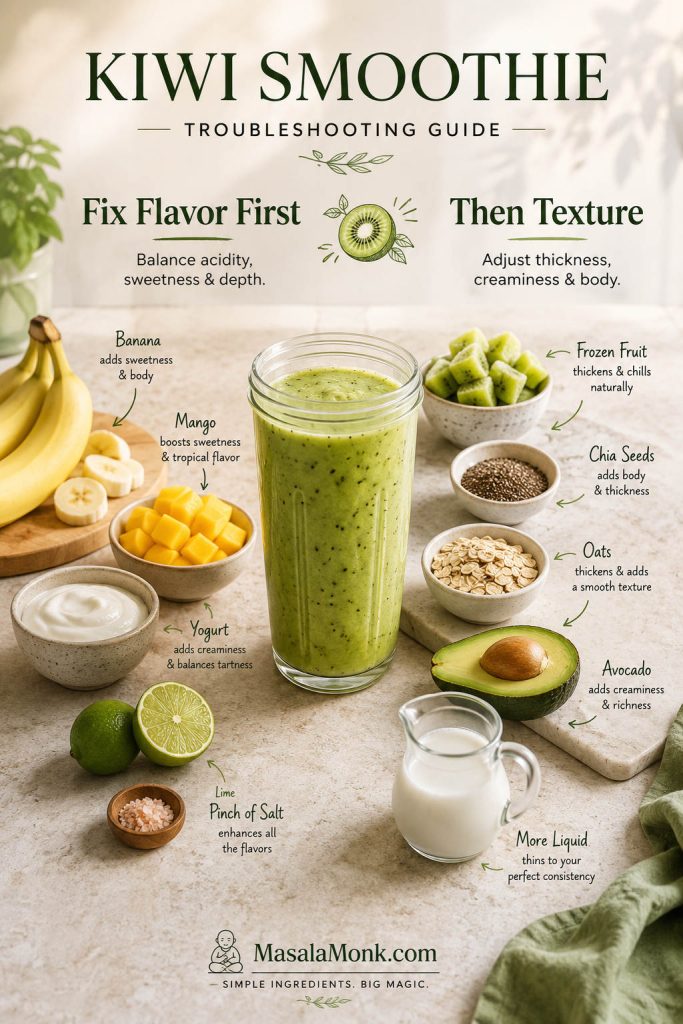
Kiwi smoothie troubleshooting scene with small glasses labeled sour, thin, thick, flat, and watery
A kiwi smoothie that tastes off rarely needs a full remake; instead, one small fix for flavor or texture usually brings it back quickly.

Most problems in a smoothie recipe with kiwis are easy to fix while the drink is still in the blender. Taste before pouring, then adjust one thing at a time. Small changes work better than adding a lot of liquid, sugar, or ice all at once.

Do not throw out a smoothie just because the first sip is not perfect. Kiwi can taste different from fruit to fruit, and one small adjustment in the blender can turn a sharp, flat, or watery smoothie into something balanced.

Fix the Flavor First

If the smoothie tastes sour, flat, bitter, or too sweet, fix the flavor before you change the texture. Usually, one small addition is enough: banana or mango for softness, yogurt for roundness, lime for brightness, or a tiny pinch of salt for a flat-tasting blend.
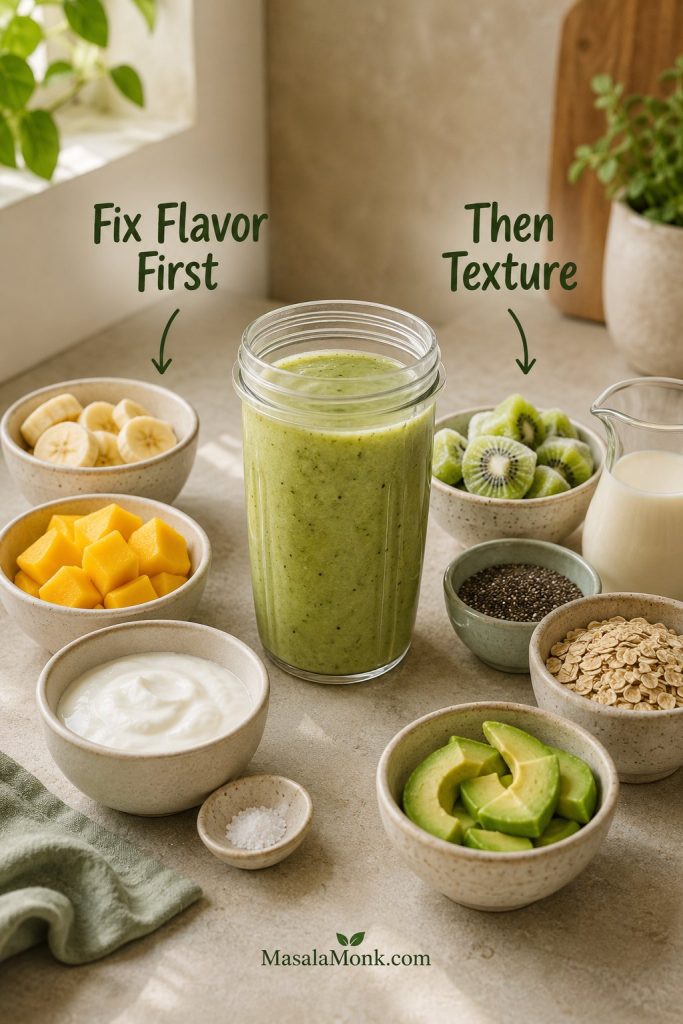
Kiwi smoothie fix guide with flavor ingredients on one side and texture ingredients on the other
Fix flavor before texture, because a smoothie that is sour or bland needs a different adjustment than one that is too thick or too thin.

Then Fix the Texture

Once the flavor tastes right, adjust the texture. Frozen fruit, banana, chia, oats, and avocado add body, while milk, coconut water, orange juice, or water loosen a thick smoothie. Add liquid slowly so the drink does not become watery.

Problem Best fix
Sour or sharp Blend in banana, mango, honey, maple syrup, or yogurt to soften the edge.
Thin texture Use frozen banana, frozen mango, chia seeds, oats, or avocado to bring back body. Next time, start with less liquid.
Overly thick Add milk, coconut water, orange juice, or water 1 tablespoon at a time until the blender moves smoothly.
Flat flavor A little more kiwi, a tiny squeeze of lime, orange juice, or even a small pinch of salt can wake it up.
Overly sweet Plain yogurt, cucumber, spinach, extra kiwi, or a little lemon/lime can pull the sweetness back into balance.
Seed-heavy texture Blend longer or use a high-speed blender. Kiwi seeds are edible, but a little texture is normal.
Watery smoothie Use frozen fruit instead of lots of ice, and keep the liquid lower at the start.
Bitter or harsh Use ripe, peeled kiwi. Hard kiwis and too much skin can make the drink taste rough.
Separation after sitting Shake or stir before drinking. For the next batch, use banana, yogurt, chia, or a less watery liquid.
Blender struggling Pour liquid in first, chop frozen fruit smaller, and add extra liquid by tablespoons instead of splashing in too much at once.

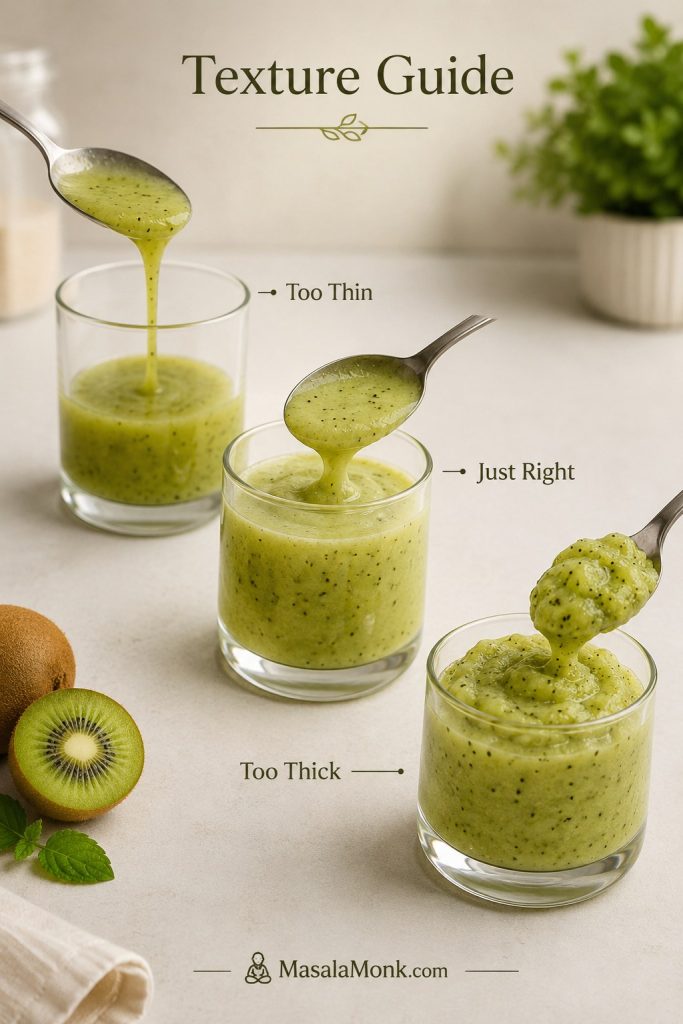
Kiwi Smoothie Thickness Guide

Kiwi smoothie texture guide showing too thin, just right, and too thick spoon textures
The sweet spot is thick enough to feel creamy, yet still loose enough to pour and sip comfortably without feeling heavy.

Make-Ahead, Freezing, and Storage Tips
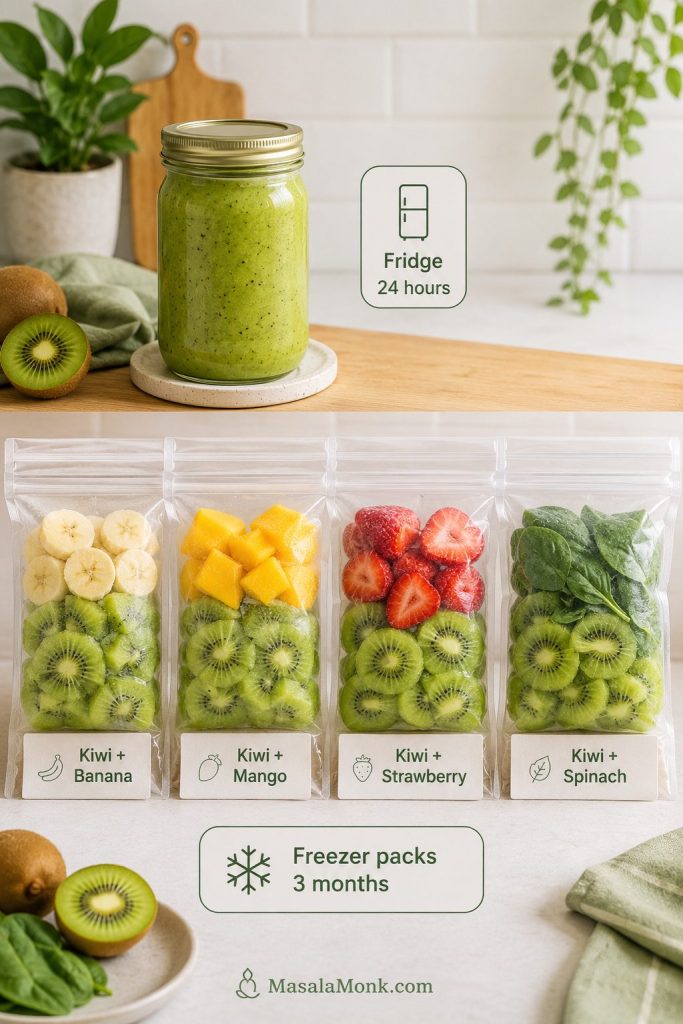
Kiwi smoothie storage image with a fridge jar and freezer packs for kiwi banana, kiwi mango, kiwi strawberry, and kiwi spinach
Blended smoothies taste best fresh, but freezer packs make it easier to prep kiwi, banana, mango, berries, or spinach ahead of time.

This smoothie tastes best right after blending. The flavor is brighter, the texture is smoother, and dairy-based versions are less likely to thin out. If you need to make it ahead, keep it short and practical.

Storing a Kiwi Smoothie in the Fridge

For the best texture, drink it within 24 hours. Store it in a sealed jar or bottle, refrigerate it, and shake or stir before drinking. The smoothie may separate slightly, especially if it has water, coconut water, or juice instead of yogurt.

Freezing Kiwi for Smoothies

Frozen kiwi works well in smoothies. Peel and chop ripe kiwi, freeze the pieces on a tray, then transfer them to a freezer bag or container. However, frozen kiwi works best with banana, mango, strawberry, or yogurt because kiwi alone can become icy.

Making Kiwi Smoothie Packs

Smoothie packs are the easiest make-ahead option. Add peeled kiwi, banana, mango, strawberries, spinach, or pineapple to freezer bags. Freeze for up to 3 months. When ready to blend, add the frozen pack to the blender with yogurt and liquid.

Kiwi Nutrition Notes for Smoothies

Kiwi is often used in smoothies because it brings bright flavor, gentle natural sweetness, fiber from the whole fruit, and vitamin C. It pairs especially well with banana, mango, strawberry, spinach, and yogurt because those ingredients balance the tartness.

The USDA vitamin C table lists raw green kiwifruit as a high-vitamin-C fruit per cup, which makes kiwi a useful ingredient in fruit smoothies. You can also explore MasalaMonk’s broader guide to vitamin C rich foods for more everyday fruit and vegetable ideas.

For a deeper look at kiwi beyond smoothies, MasalaMonk has a guide to kiwi nutrition, benefits, and practical uses. For this recipe, though, the most important thing is simple: ripe fruit, the right liquid, and enough body to keep the smoothie enjoyable.

FAQs About Kiwi Smoothies

These quick answers cover the most common questions readers have before changing the base recipe: milk or no milk, yogurt or no yogurt, banana or no banana, fresh kiwi or frozen kiwi.

Can you put kiwi in a smoothie?

Kiwi works very well in smoothies because it adds bright, tangy fruit flavor. It tastes best with creamy or sweet ingredients like banana, yogurt, mango, strawberry, milk, or coconut water.

Do you peel kiwi before putting it in a smoothie?

For the smoothest kiwi smoothie, peel it first. Kiwi skin is edible, but it can add a fuzzy, fibrous texture. If you want to blend kiwi with the skin on, wash it very well and use a strong blender.

What fruit goes well with kiwi in smoothies?

Banana, strawberry, mango, pineapple, orange, apple, blueberry, raspberry, pear, and avocado all pair well with kiwi. Banana and mango are best for sweetness and creaminess, while strawberry and pineapple keep the flavor brighter.

Can I make a kiwi smoothie with milk?

Milk makes the drink creamy and mild, especially when paired with banana or yogurt. For the best texture, drink milk-based versions soon after blending.

Can I make a kiwi smoothie without yogurt?

For a no-yogurt version, replace yogurt with frozen banana, mango, avocado, plant milk, coconut water, chia seeds, oats, or plant-based yogurt. Without yogurt, the smoothie usually needs frozen fruit or banana to stay thick.

Can I make a kiwi smoothie without banana?

Mango, avocado, pear, Greek yogurt, frozen pineapple, or chia seeds can all replace banana. Mango is the best swap when you want sweetness and thickness without changing the flavor too much.

How do you make a kiwi smoothie less sour?

Start with ripe kiwis, then add banana or mango if the smoothie still tastes sharp. Milk or yogurt can also soften the flavor better than water. If needed, add 1–2 teaspoons honey or maple syrup, but avoid too much lime, lemon, pineapple, or orange juice when the kiwi is already tart.

Why did my kiwi smoothie turn watery?

It may have too much liquid, too much ice, or not enough creamy fruit. Frozen banana, frozen mango, yogurt, avocado, chia seeds, or oats will help thicken it. Also, the texture can thin slightly as it sits, so it is best fresh.

Can I use frozen kiwi in a smoothie?

Frozen kiwi works well, especially with banana, mango, strawberry, yogurt, or another creamy ingredient. On its own, frozen kiwi can make a smoothie taste icy or sharp.

What is the difference between a kiwi smoothie and a kiwi milkshake?

The smoothie version is usually fruit-based and often made with yogurt, milk, coconut water, or juice. A kiwi milkshake is dessert-style and usually includes milk, ice cream, or extra sweetener.

Final Tips for the Best Kiwi Smoothie

The first time you make it, start with 2 ripe kiwis, 1 frozen banana, ½ cup yogurt, and ½ cup liquid. Then, taste it before pouring. That one small pause is what helps you catch a sharp kiwi, a thin texture, or a smoothie that needs one more spoonful of yogurt.

After that, the recipe becomes easy to adapt. Banana makes it creamy, mango makes it tropical, strawberry makes it brighter, cucumber makes it lighter, and ice cream turns it into a kiwi shake. Once you make it once, note which direction you liked best: creamy banana, tropical mango, lighter coconut water, or sharper strawberry kiwi.

The best version is not always the sweetest one. It is the one where the kiwi still tastes fresh, the texture feels creamy, and nothing sharp, watery, or heavy takes over.
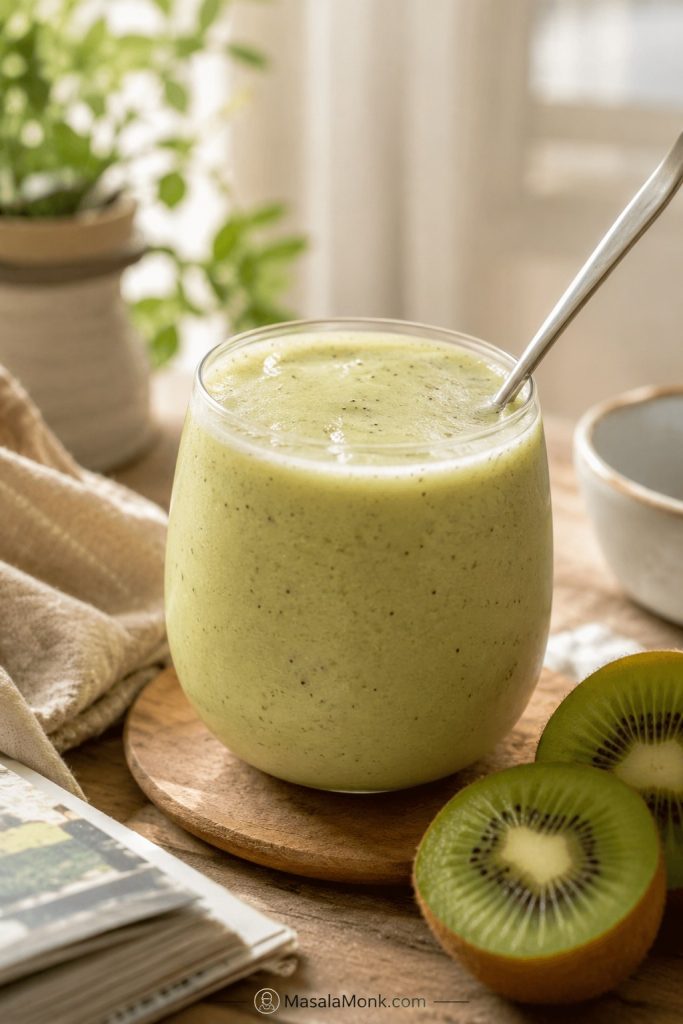
Finished creamy kiwi smoothie served in a glass with sliced kiwi in a warm breakfast setting
At its best, this smoothie stays bright, creamy, and fresh-tasting, so the kiwi still leads without turning the drink watery or harsh.
Posted on 3 Comments

Mango Smoothie Recipe

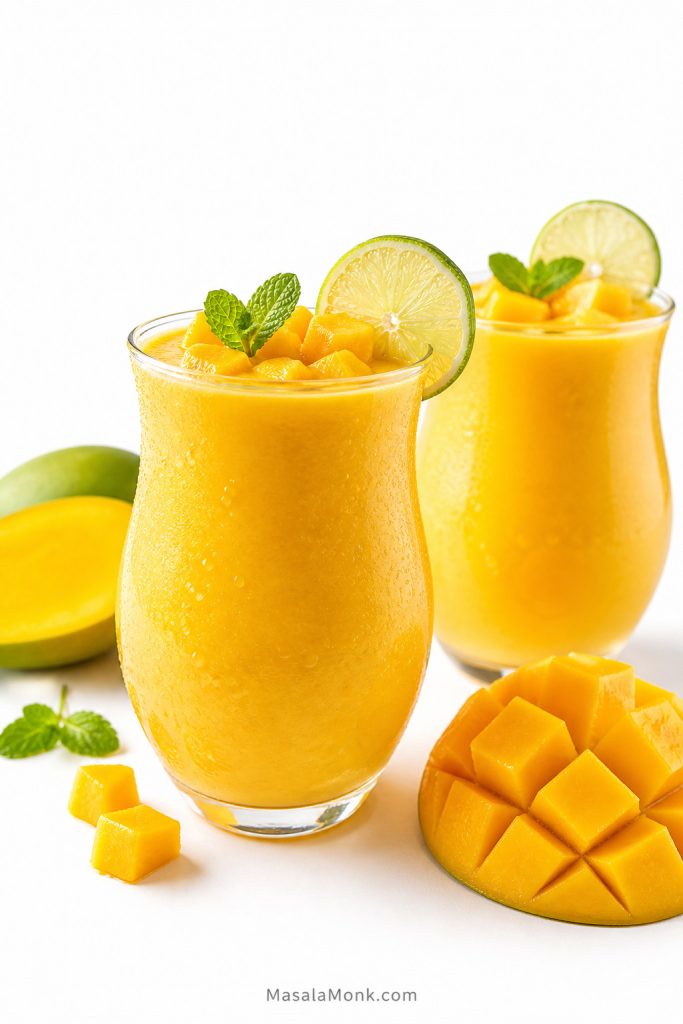
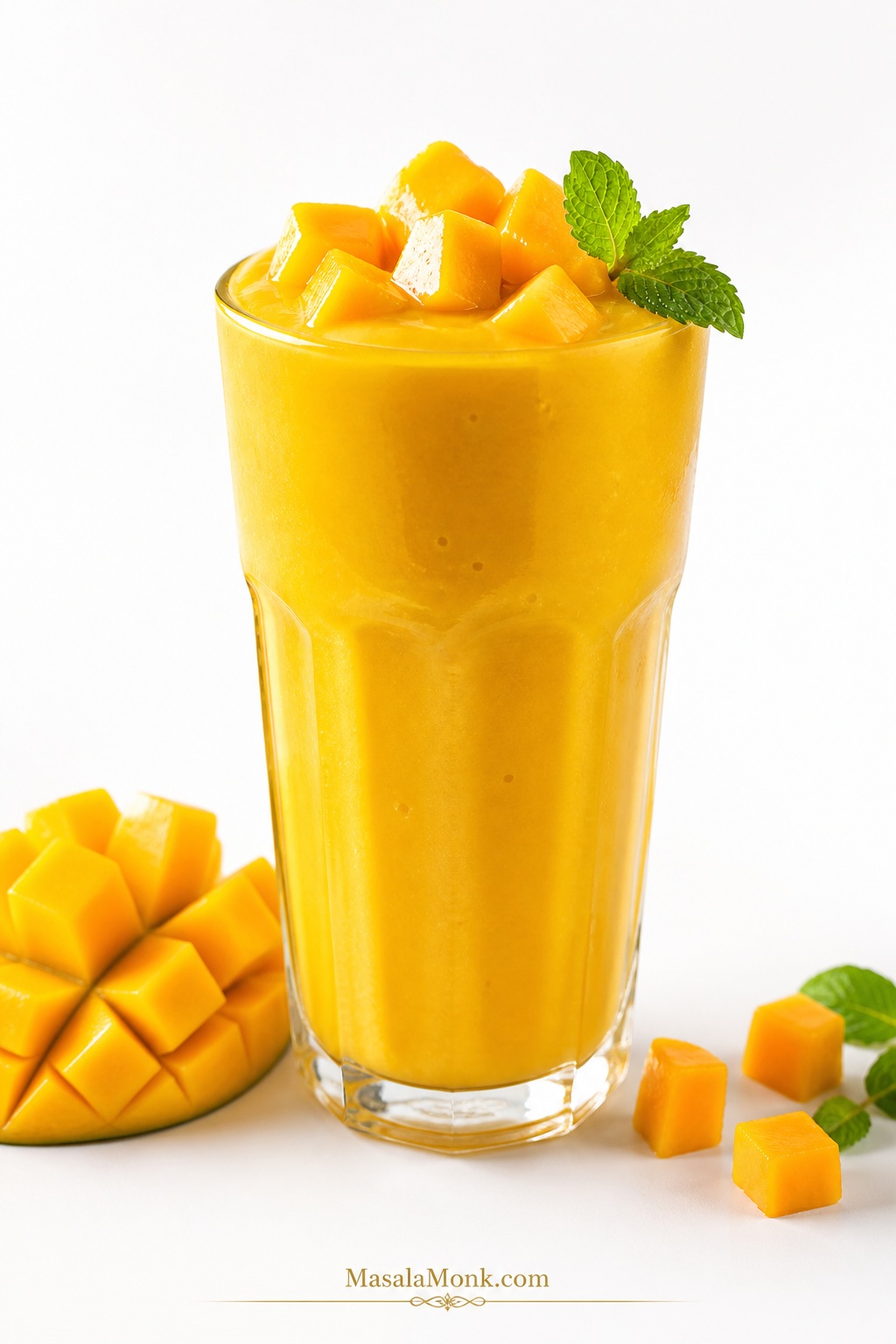
Thick mango smoothie in a glass topped with mango cubes and mint, served with fresh mango and lime.

A good mango smoothie recipe should taste cold, creamy, bright, and full of real mango flavor. It should not turn watery after a few sips, taste mostly like banana, or need a pile of ice just to feel thick.

This mango smoothie recipe starts with a simple base formula: ripe mango, just enough liquid, something creamy, and a small lift of lime if the fruit needs brightness. You can make it with fresh or frozen mango, yogurt or milk, banana or no banana, dairy or plant milk, and still end up with a smoothie that feels smooth, balanced, and easy to drink.

Once you understand the ratio, the same recipe can move in several directions. Make it thicker for a smoothie bowl, lighter for a breakfast drink, richer with Greek yogurt, tropical with pineapple, berry-bright with strawberries, or more filling with protein powder. The goal is not to memorize a dozen recipes. It is to know how to build the mango smoothie you actually want.

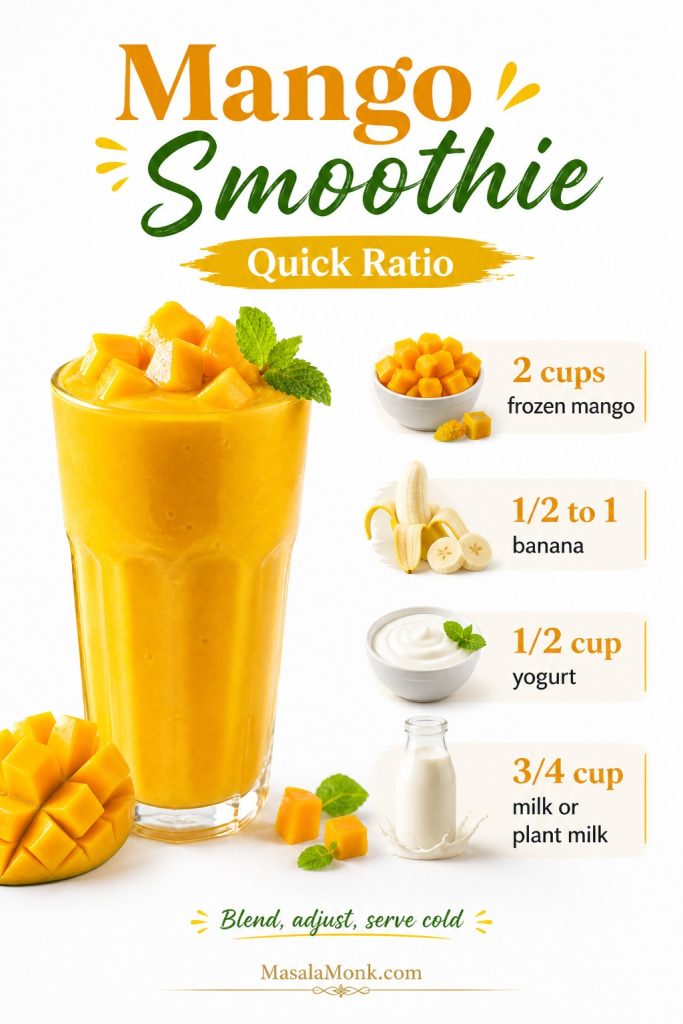
Mango Smoothie Recipe Quick Answer

For a creamy, balanced mango smoothie, blend 2 cups frozen mango chunks, 1/2 to 1 small banana, 1/2 cup yogurt, and 3/4 cup milk or plant milk. Add 1 to 2 teaspoons lime juice when the mango tastes very sweet or slightly flat. To loosen a thick smoothie, add milk 1 tablespoon at a time. For a thin smoothie, add more frozen mango instead of piling in ice.

Best starting point: Use frozen mango, chilled yogurt, chilled milk, and no ice. This gives you a cold, creamy mango smoothie without diluting the fruit.
Quick mango smoothie ratio graphic showing frozen mango, banana, yogurt, milk or plant milk, and a finished smoothie.
Use this base ratio when you want a reliable starting point. Then, depending on whether you want a thinner drink or a thicker blend, adjust the liquid or frozen fruit in small steps.

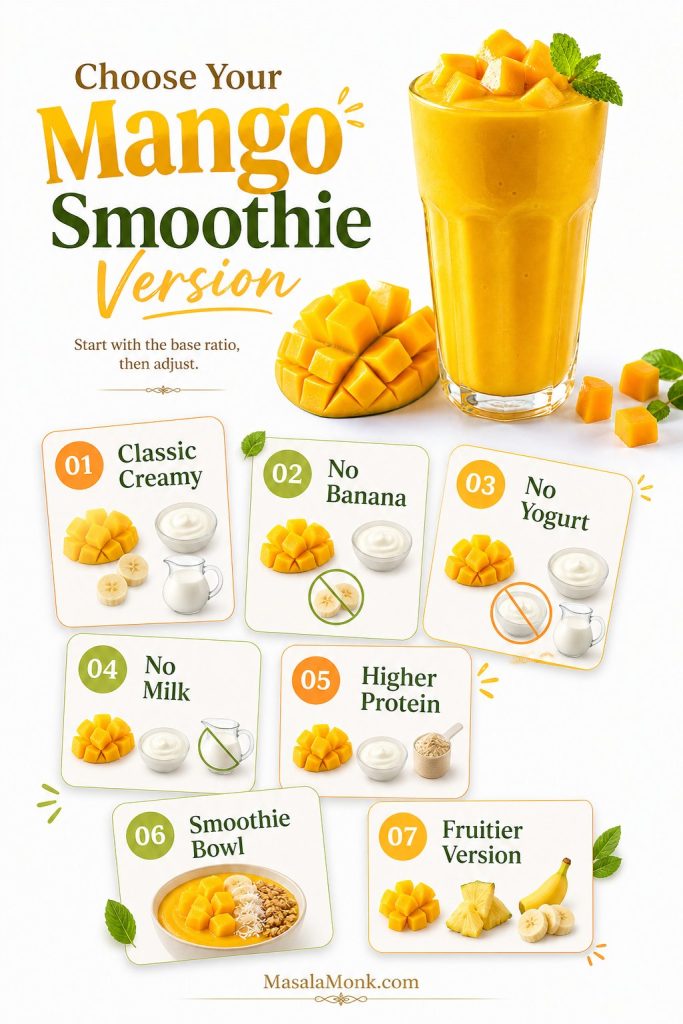
Choose Your Mango Smoothie Version

The base mango smoothie recipe is flexible, so you can adjust it depending on what you have and how creamy you want the drink to be. Use this quick guide before you blend.

Visual guide showing classic, no banana, no yogurt, no milk, higher protein, smoothie bowl, and fruitier mango smoothie options.
This quick chooser helps you match the mango smoothie recipe to what you have on hand; as a result, you can move straight to the version that fits your ingredients and texture goal.
What You Want Best Adjustment Start With
Classic creamy mango smoothie Use frozen mango, banana, yogurt, and milk. Start with 2 cups mango, 1/2 banana, 1/2 cup yogurt, and 3/4 cup milk.
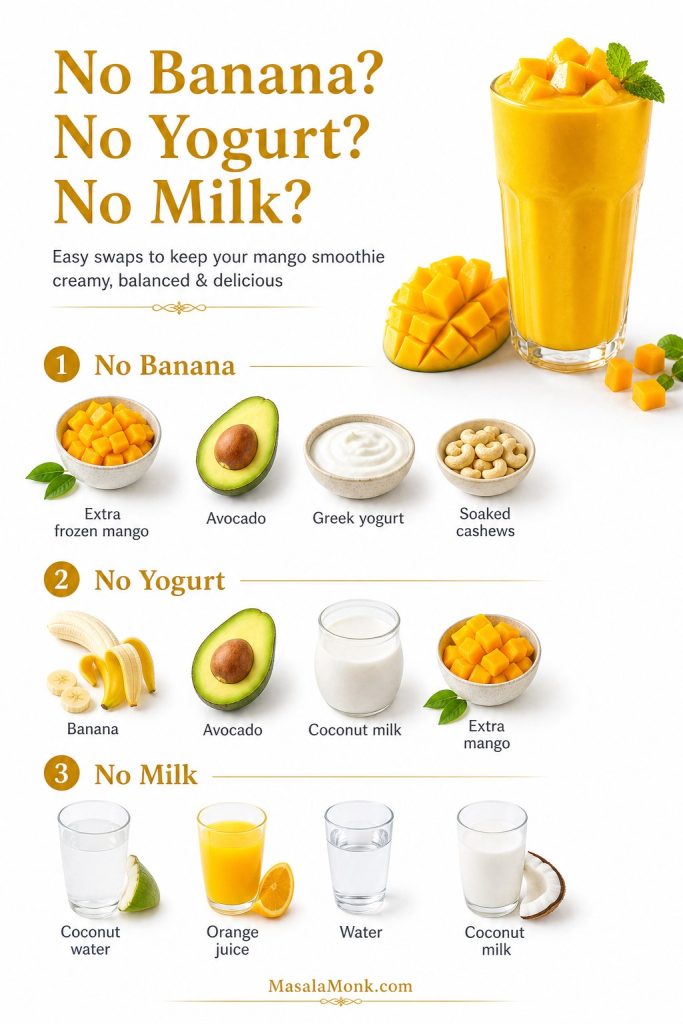
No banana Use extra frozen mango, Greek yogurt, avocado, or soaked cashews for body. Blend 2 1/2 cups frozen mango with 1/2 cup yogurt and 3/4 cup milk.
No yogurt Use banana, avocado, coconut milk, or extra frozen mango for creaminess. Try 2 cups mango, 1 banana, and 3/4 cup milk.
No milk Use coconut water, orange juice, water, or coconut milk depending on texture. Begin with 2 cups mango, 1/2 banana, 1/2 cup yogurt, and 1/2 to 3/4 cup liquid.
Higher protein Add protein powder, Greek yogurt, hemp seeds, chia seeds, soy milk, or dairy milk. Add 1 scoop protein powder to the base recipe, then blend in 2 to 4 tablespoons extra milk if needed.
Smoothie bowl Use more frozen mango and much less liquid. For a spoonable bowl, use 2 1/2 to 3 cups frozen mango with only 1/4 to 1/2 cup milk.
Fruitier smoothie Replace half the mango with strawberries, pineapple, blueberries, or peaches. Use 1 cup mango, 1 cup second fruit, yogurt, and milk.

Mango Smoothie at a Glance

Before you start blending, here is the mango smoothie recipe in practical terms. This is the version to make first when you want a classic mango smoothie that is thick, smooth, and easy to adjust.

Detail What to Use
Prep time 5 minutes
Blend time 35–60 seconds, depending on blender strength
Servings 2 medium smoothies
Yield About 2 1/2 to 3 cups / 600–700 ml / 20–24 fl oz
Best mango Frozen ripe mango chunks for texture; fresh ripe mango for peak-season flavor
Best liquid Milk, almond milk, oat milk, cashew milk, or coconut milk
Best texture Thick but pourable
Ice? Skip it with frozen mango; use a little only with fresh mango

Why This Mango Smoothie Works

This mango smoothie recipe works because it is built around texture and balance, not just sweetness. Although mango gives the main flavor, it still needs the right support. Frozen mango thickens the drink without watering it down. Yogurt adds body and a little tang. Banana makes the smoothie naturally creamy, while milk or plant milk helps everything blend smoothly.

Most importantly, the recipe keeps the liquid modest at the start. It is always easier to thin a smoothie than to rescue one that has turned watery. That is why the method asks you to blend first, then adjust slowly with small splashes of milk only when needed.

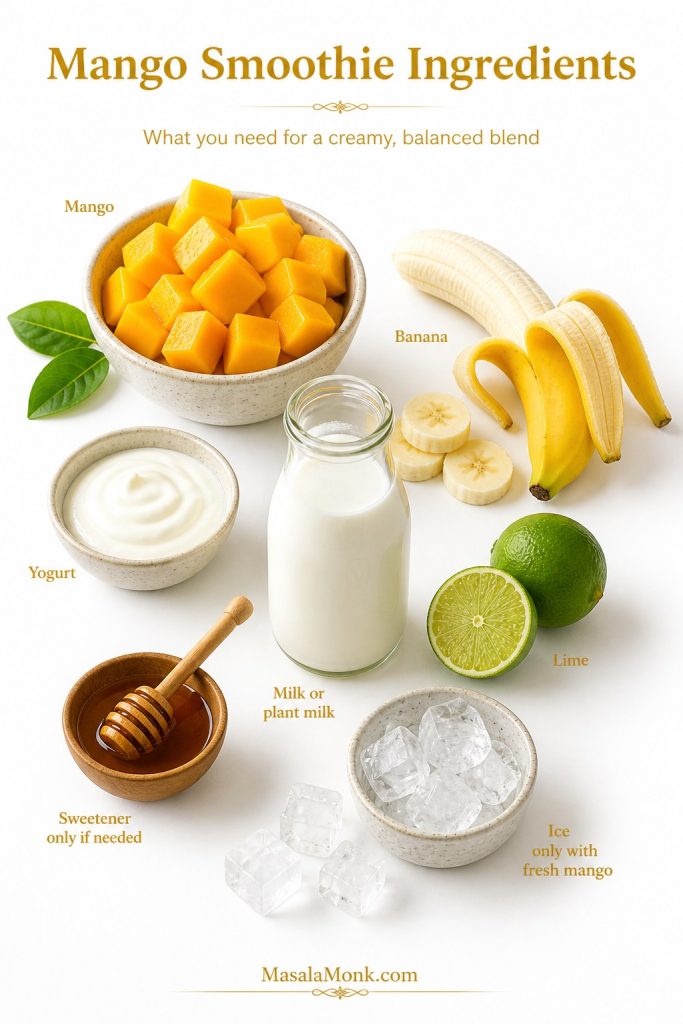
Mango Smoothie Ingredients

This smoothie recipe is flexible, but mango still does the main work. Once you know what each ingredient brings, you can change the smoothie confidently without losing the thick, creamy texture.

Mango smoothie ingredients arranged on a white background, including mango, banana, yogurt, milk, lime, sweetener, and ice.
Think of these ingredients as texture controls: mango builds the base, banana softens it, yogurt thickens it, milk loosens it, and lime keeps the flavor from tasting flat.

Mango

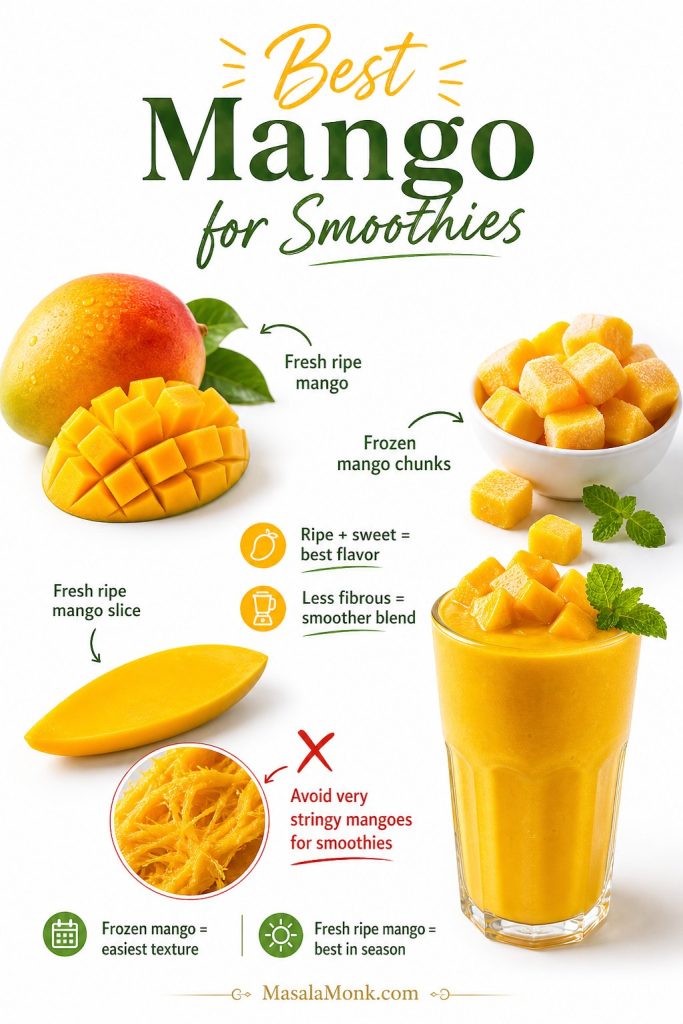
Mango is the heart of the recipe, so use ripe, sweet fruit whenever possible. Frozen mango chunks are the easiest option because they make the smoothie cold and thick right away. Fresh mango also works beautifully, especially during mango season. However, it needs a little help from chilled ingredients or a few ice cubes to feel just as cold.

If you are using Indian mangoes, ripe Alphonso, Kesar, Dasheri, or other sweet non-fibrous varieties work especially well. With supermarket mangoes, choose fruit that smells sweet near the stem and gives slightly when pressed. For a simple ripeness check, Mango.org recommends choosing mangoes by feel rather than color.

As a practical guide, 1 medium-large mango usually gives about 1 cup of chopped fruit, so this recipe needs about 2 medium-large mangoes if you are using fresh mango instead of frozen chunks.

Guide to choosing mango for smoothies, showing ripe mango, frozen mango chunks, smoothie texture, and stringy mango to avoid.
For the smoothest mango smoothie, choose ripe, sweet, less fibrous mangoes when possible. Meanwhile, frozen mango chunks are the easiest way to get thick, cold texture all year.

Banana

Banana makes the smoothie creamier, sweeter, and more filling. A frozen banana gives the thickest texture, while a fresh banana blends more easily. However, banana is still optional. To make a mango smoothie without banana, use extra frozen mango, Greek yogurt, avocado, coconut milk, or soaked cashews for body.

Yogurt

Yogurt adds creaminess, tang, and protein. Greek yogurt makes the smoothie thicker and more filling, while regular plain yogurt gives a lighter, more drinkable result. In addition, yogurt helps balance very sweet mangoes because it brings a little tang. For a dairy-free mango smoothie, use coconut yogurt, almond yogurt, cashew yogurt, or skip the yogurt and lean on banana or avocado instead.

Milk or Plant Milk

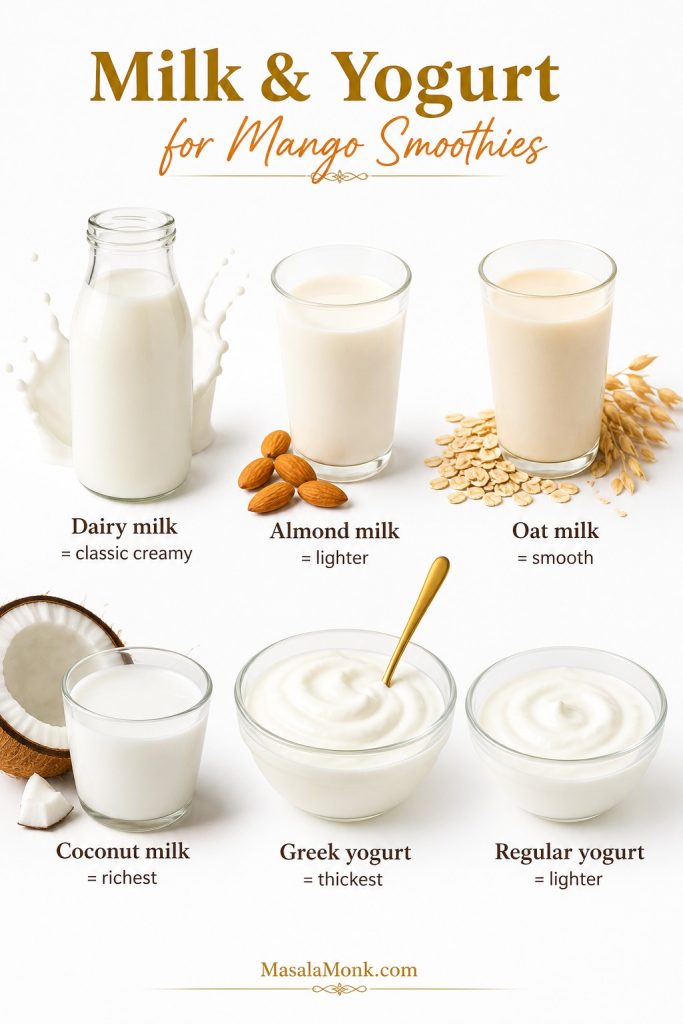
Milk loosens the smoothie just enough for the blender to run. Dairy milk gives a classic creamy flavor, almond milk keeps it light, oat milk makes it smooth, cashew milk adds richness, and coconut milk gives the drink a tropical edge. Orange juice also works, especially when you want a brighter fruit smoothie instead of a creamy one. However, it makes the drink sweeter and less creamy, so use it with frozen mango, pineapple, berries, or lime rather than treating it like a milk replacement in every version.

Milk and yogurt comparison for mango smoothies with dairy milk, almond milk, oat milk, coconut milk, Greek yogurt, and regular yogurt.
Choose the liquid based on the finish you want: almond milk keeps things lighter, oat milk feels rounder, coconut milk tastes richer, and Greek yogurt gives the most body.

Lime Juice

Lime juice is optional, but it can make a big difference. A small squeeze balances the sweetness and makes the mango taste fresher. Start with 1 teaspoon, blend, then add a little more only if the smoothie still tastes flat.

Sweetener

Sweeten only if your mango needs it. Very ripe mango and banana are often enough on their own. If the smoothie tastes sharp, bland, or not quite rounded, add honey, maple syrup, sugar, jaggery, or a soft date in small amounts.

For a no-added-sugar mango smoothie, use very ripe mango and banana, then skip the honey or sugar entirely. If the fruit is sweet enough, the smoothie does not need extra sweetener.

Ice

Ice is helpful only when you are using fresh mango and want a colder smoothie. With frozen mango, skip it. Too much ice weakens the flavor and can make the texture watery, so frozen fruit is usually the better way to thicken the drink.

Fresh vs Frozen Mango for Smoothies

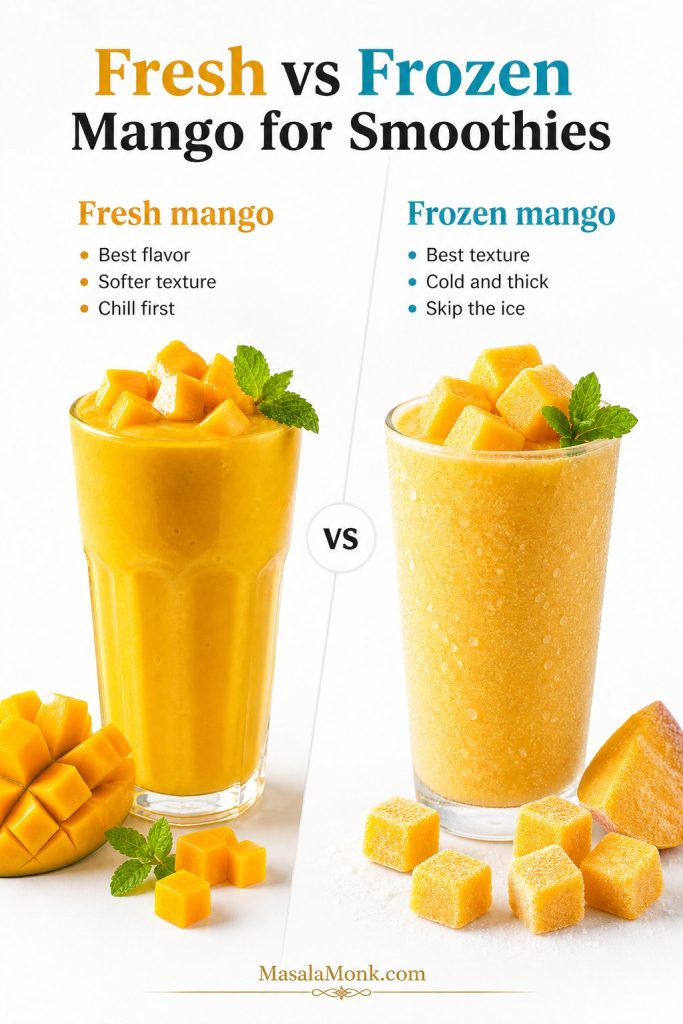
Both fresh and frozen mango can make a good smoothie, but they behave differently in the blender. Frozen mango gives the most reliable thick texture. Fresh mango gives a softer, juicier, more seasonal flavor. Meanwhile, mango pulp is useful when ripe mangoes are not available, but it often needs less sweetener.

That is why this mango smoothie recipe gives you separate guidance for frozen mango, fresh mango, mango pulp, and fibrous mango.

Mango Type Best For How to Adjust
Frozen mango chunks Thick, cold, creamy smoothies Use little to no ice. Add milk slowly so the smoothie stays mango-forward.
Fresh ripe mango Peak-season flavor and softer smoothies Use chilled milk and yogurt, or add 1/2 cup ice. For better texture, freeze the mango cubes first.
Mango pulp Quick smoothies, shake-style drinks, and off-season mango flavor Use less sweetener because canned mango pulp is often already sweetened.
Fibrous mango Not ideal for very smooth drinks Blend longer, use yogurt for body, or choose a less fibrous mango next time.
Fresh and frozen mango comparison for smoothies, with fresh mango for flavor and frozen mango for thicker texture.
Fresh mango gives peak-season flavor, whereas frozen mango gives the thickest smoothie with less need for ice. Therefore, choose based on whether flavor or texture matters more that day.

Before using fresh mango, cut the fruit into cubes and chill it. For a thicker result, spread the cubes on a plate or tray and freeze them for 30 to 60 minutes. As a result, the smoothie turns colder and thicker without watering down the mango flavor.

If you are working with extra frozen mango and want a spoonable dessert instead of a drink, this mango sorbet recipe uses fresh or frozen mango with a similar fruit-forward approach.

How to Make a Mango Smoothie

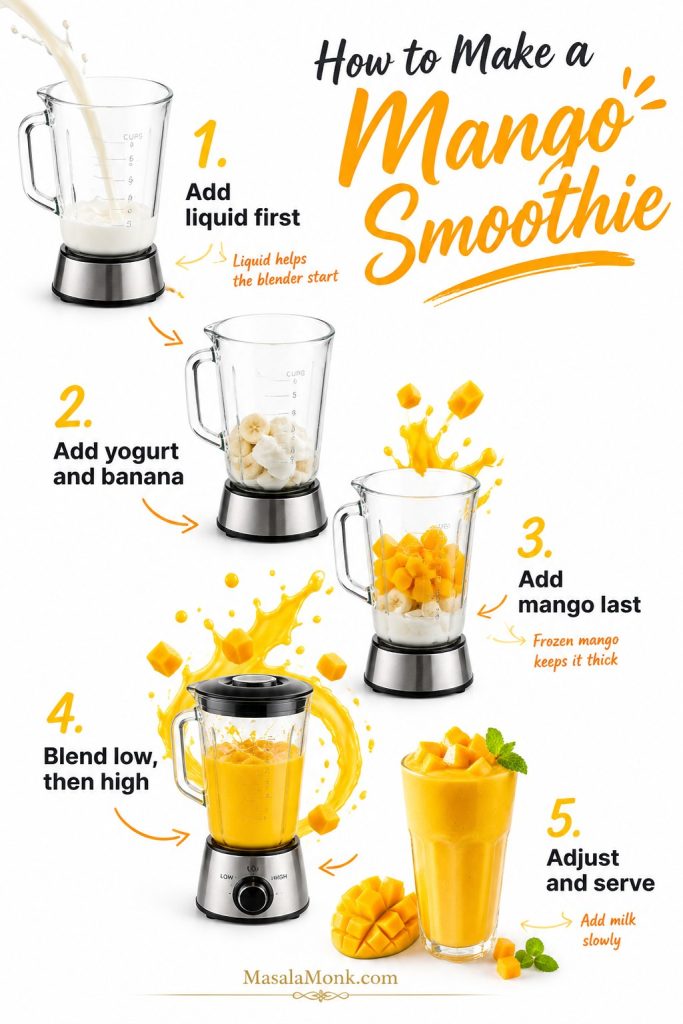
The method is simple, but the order matters, especially if you are using a regular blender instead of a high-speed blender. First, liquid on the bottom helps the blades move. Then, frozen fruit on top keeps the smoothie thick. Because of that order, the blender needs less extra liquid.

For this mango smoothie, the recipe works best when the liquid goes in before the frozen fruit, especially in a standard blender.

Equipment You Need

  • Blender: A high-speed blender is best for frozen mango, but a regular blender works if you add the liquid first.
  • Measuring cups or kitchen scale: Helpful when you want the texture to stay consistent.
  • Knife and cutting board: Needed if you are using fresh mango.
  • Spatula or tamper: Useful for thick smoothie bowls or frozen-fruit blends.
  • Tall glasses or jars: Best for serving the smoothie right away.

Blender Method

  1. Add the liquid first. Pour milk, almond milk, oat milk, coconut milk, or orange juice into the blender. This helps the blades catch.
  2. Add the creamy ingredients. Add yogurt, banana, avocado, protein powder, or any soft add-ins next.
  3. Add mango last. Frozen mango can sit on top because the liquid underneath helps the blender start moving.
  4. Blend low, then high. Start on low for about 10 seconds, then increase to high and blend until smooth.
  5. Adjust slowly. If the smoothie is too thick, add milk 1 tablespoon at a time. If it is too thin, add more frozen mango.
  6. Serve right away. Mango smoothies taste best while cold, creamy, and freshly blended.
Step-by-step mango smoothie method showing liquid first, yogurt and banana next, mango last, blending, and serving.
This blending order prevents two common problems at once: the blender starts more easily, and the smoothie stays thick because the frozen fruit is not buried under too much liquid.
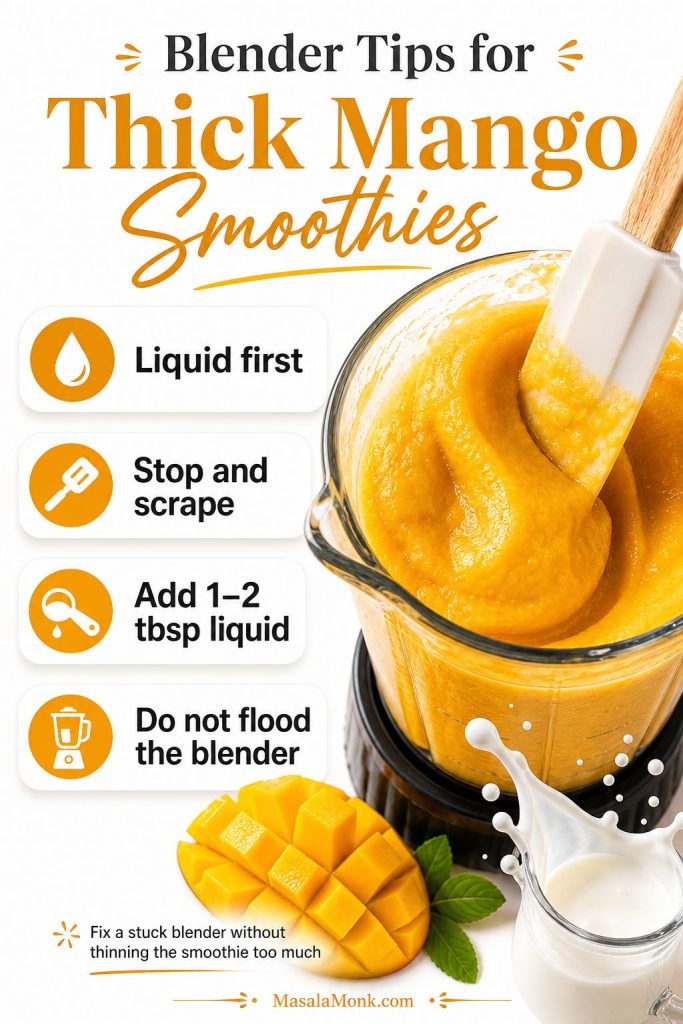
Blender tip: If the blender gets stuck, do not keep adding large splashes of liquid. Stop, scrape the sides, add 1 or 2 tablespoons liquid, then blend again. This keeps the smoothie thick instead of watery.
Blender tips for thick mango smoothies showing a blender jar, spatula, small liquid addition, and mango pieces.
If a thick smoothie gets stuck, do not flood the blender. Instead, scrape the sides and add a small splash of liquid so the mixture loosens without turning watery.

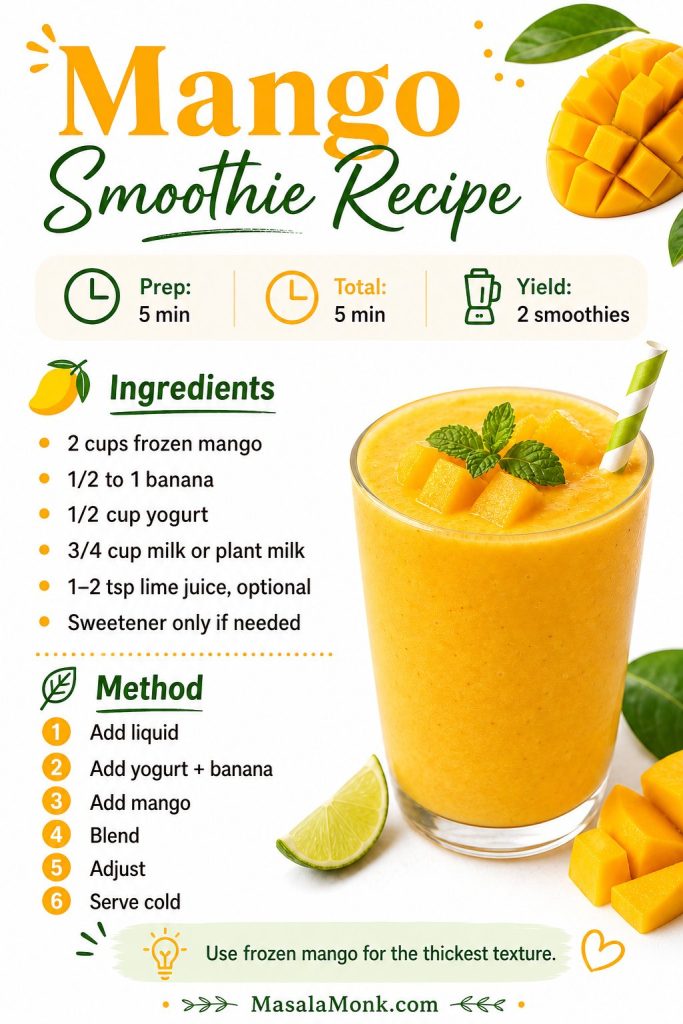
Here is the full mango smoothie recipe in one place, with the base version first and adjustment notes underneath.

Mango Smoothie Recipe

This creamy mango smoothie is cold, thick, and easy to adjust. Use frozen mango for the best texture, or fresh ripe mango with chilled ingredients when mangoes are in season.

Prep Time5 minutes
Total Time5 minutes
Servings2 smoothies
Yield600–700 ml

Ingredients

  • 2 cups frozen mango chunks, about 280–320 g
  • 1/2 to 1 small banana, preferably frozen, about 50–100 g peeled
  • 1/2 cup plain Greek yogurt or regular yogurt, about 120 g
  • 3/4 cup milk or plant milk, about 180 ml / 6 fl oz, plus more as needed
  • 1–2 teaspoons fresh lime juice, optional
  • 1–2 teaspoons honey, maple syrup, sugar, or jaggery, only if needed
  • 1/2 cup ice, only if using fresh mango instead of frozen mango

Instructions

  1. Add the milk or plant milk to the blender first.
  2. Add the yogurt, banana, lime juice, and sweetener if using.
  3. Add the frozen mango chunks.
  4. Blend on low for about 10 seconds, then increase to high and blend for 35–60 seconds, or until smooth.
  5. If the smoothie is too thick, add more milk 1 tablespoon at a time. If it is too thin, add more frozen mango and blend again.
  6. Taste and adjust with a little more lime juice or sweetener if needed.
  7. Pour into glasses and serve immediately.

Notes

  • For the thickest smoothie, use frozen mango and frozen banana.
  • For a mango smoothie without banana, use extra frozen mango, avocado, Greek yogurt, coconut milk, or soaked cashews.
  • For a dairy-free mango smoothie, use almond milk, oat milk, cashew milk, or coconut milk with coconut yogurt or no yogurt.
  • For a smoothie bowl, reduce the liquid to 1/4 to 1/2 cup and use extra frozen mango.
  • If using fresh mango, chill the mango and milk first, or add 1/2 cup ice.
  • To double the recipe, double all ingredients but start with slightly less liquid, then add more after blending.

Approximate Nutrition

Per smoothie, using frozen mango, 1/2 small banana, Greek yogurt, and unsweetened almond milk: about 180–230 calories, 6–10 g protein, and 3–5 g fiber. Exact nutrition will change depending on the milk, yogurt, banana amount, and sweetener you use.

Saveable mango smoothie recipe card with prep time, yield, ingredients, method, and a finished smoothie.
Save this mango smoothie recipe as your base version; afterward, you can return to the post for bowl, dairy-free, protein, or no-banana adjustments.

Serving Ideas

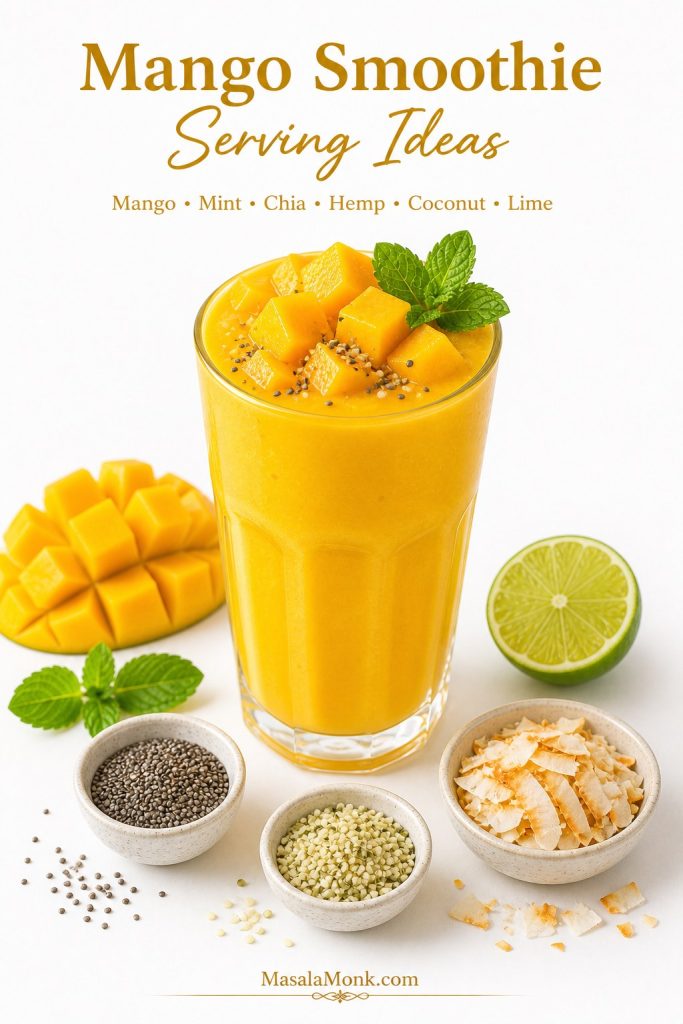
Serve the smoothie right after blending, while it is still cold, thick, and creamy. For a simple garnish, add diced mango, a few mint leaves, chia seeds, hemp seeds, toasted coconut, or a thin lime wheel. If it is a quick breakfast smoothie, keep it plain. If you want it to feel more finished, choose one small topping so the mango flavor still stays first.

Mango smoothie serving ideas with diced mango, mint, chia seeds, hemp seeds, toasted coconut, lime, and a finished smoothie.
A few simple toppings can make the smoothie feel more finished; still, keeping the garnish light helps the fresh mango flavor stay front and center.

Mango Smoothie vs Mango Shake vs Mango Lassi

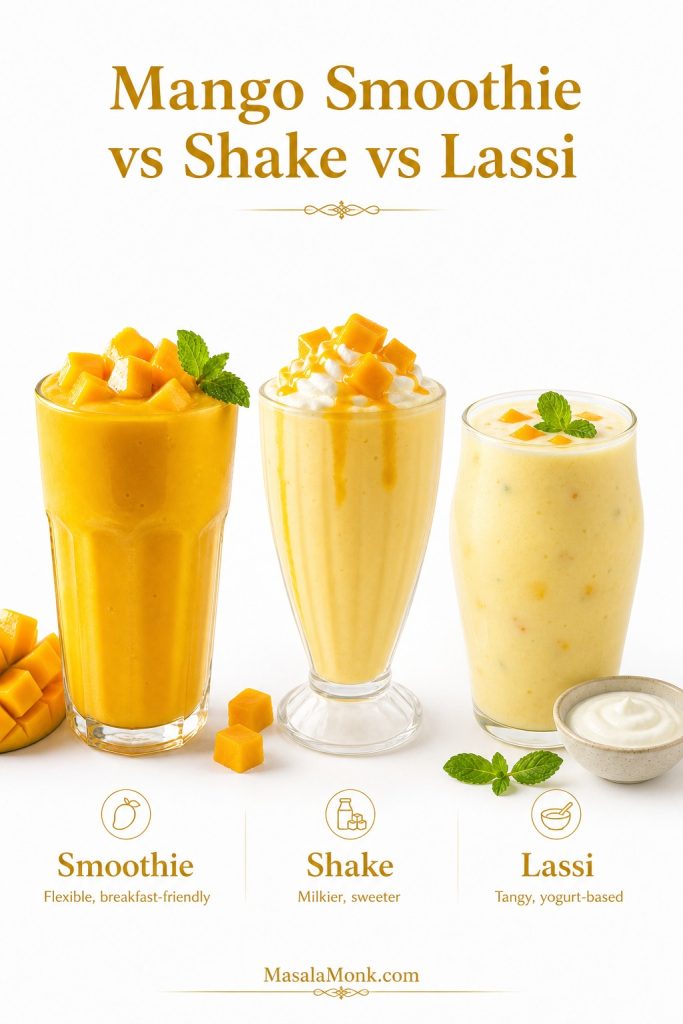
Mango smoothie, mango shake, and mango lassi can overlap, but they are not exactly the same drink. The difference usually comes down to the base, texture, sweetness, and how rich you want the drink to feel.

Drink Main Base Texture Best For
Mango Smoothie Mango, milk or plant milk, yogurt, banana, fruit, greens, or protein add-ins Cold, creamy, flexible, breakfast-friendly Breakfast, snack, smoothie bowls, protein versions, dairy-free versions
Mango Shake Mango, chilled milk, sugar, sometimes ice cream or nuts Sweeter, milkier, richer Classic summer drink, dessert-style mango drink
Mango Lassi Mango, yogurt or curd, milk or water, sweetener Tangy, creamy, cooling Indian-style yogurt drink, restaurant-style pairing, cooling drink
Comparison image showing mango smoothie, mango shake, and mango lassi in three glasses with different textures and labels.
These mango drinks overlap, but they are not the same. A smoothie is more flexible, a shake is milkier and sweeter, and lassi tastes tangier because yogurt leads the blend.

For the richer milk-based version, see this mango shake recipe. For the yogurt-based Indian drink, use this mango lassi recipe. If you want a little background, Britannica describes lassi as a yogurt-based drink, which is why mango lassi tastes tangier and more yogurt-forward than a typical mango smoothie.

Mango Smoothie Variations

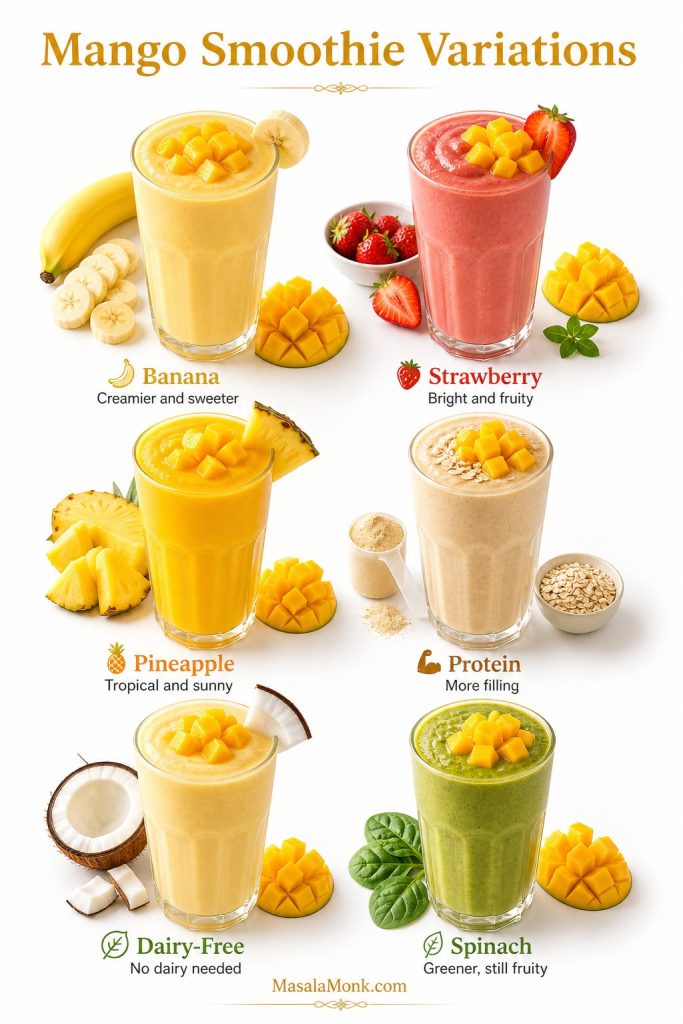
Once you have the base recipe, the mango smoothie variations are easy. In most cases, keep the total frozen fruit close to 2 cups for a drinkable smoothie, then adjust the liquid slowly. However, for smoothie bowls, use more frozen fruit and much less liquid.

Mango smoothie variations guide showing banana, strawberry, pineapple, protein, dairy-free, and spinach versions.
Use the base recipe as a template, then change only one direction at a time — fruitier, creamier, greener, higher-protein, or dairy-free — so the flavor stays balanced.

Mango Banana Smoothie

Banana is the classic way to make a mango smoothie creamier and more filling. Use 1 full banana instead of 1/2 banana, preferably frozen, and keep the rest of the base recipe the same. The result is sweeter, softer, and perfect for a quick breakfast smoothie.

Strawberry Mango Smoothie

Strawberries make the smoothie brighter, fruitier, and slightly tangy. Use 1 cup frozen mango and 1 cup frozen strawberries, then blend with the same yogurt and milk base. Taste before sweetening because tart strawberries may need a little honey, while sweet ones may need nothing at all. If you want more berry-based options, this strawberry smoothie guide has more smoothie ideas to explore.

Mango Pineapple Smoothie

Pineapple pushes the smoothie in a more tropical direction. Use 1 cup frozen mango with 1 cup frozen pineapple, then choose coconut milk or coconut water if you want that sunny, beachy flavor. If the pineapple tastes sharp, banana or a small spoon of honey will round it out.

Mango Blueberry Smoothie

Blueberries make the smoothie thicker, darker, and more berry-forward. Start with 1 cup frozen mango and 1 cup frozen blueberries, then loosen the blender with an extra splash of milk if needed. A little lime juice helps keep the flavor lively.

Mango Peach Smoothie

Peach gives the smoothie a softer, more floral sweetness. Use 1 cup mango and 1 cup frozen peaches. Vanilla yogurt can taste lovely here, although plain yogurt keeps the drink fresher and less dessert-like.

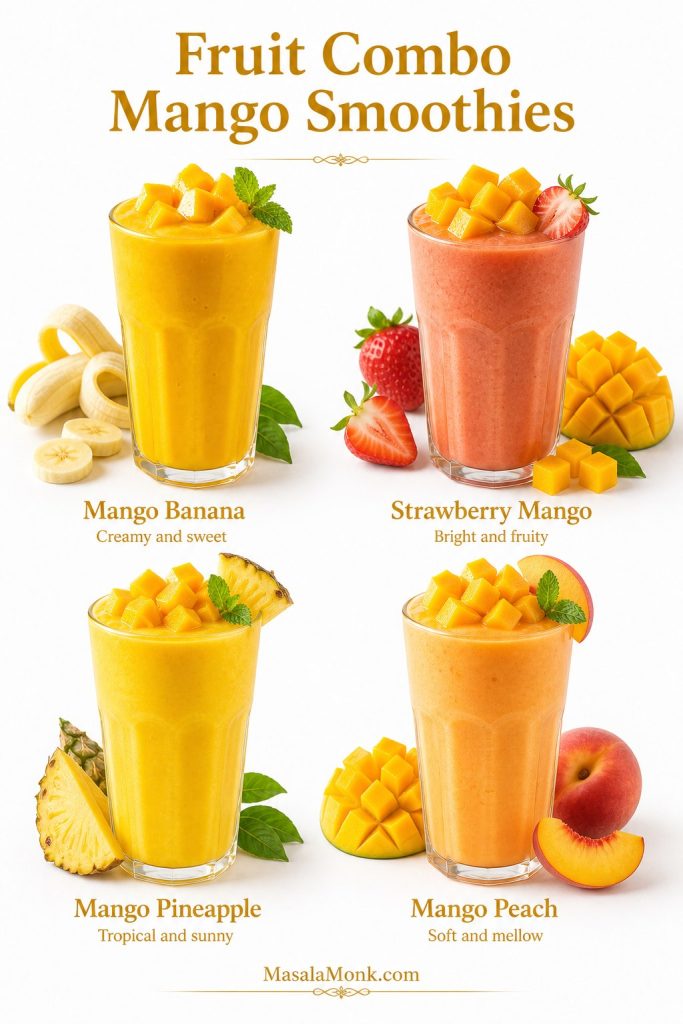
Fruit combo mango smoothies showing mango banana, strawberry mango, mango pineapple, and mango peach versions.
Fruit combinations change the whole mood of the smoothie: banana makes it creamier, strawberry brightens it, pineapple pushes it tropical, and peach keeps it softer and rounder.

Mango Yogurt Smoothie

To make yogurt the main creamy element, increase it to 3/4 cup and reduce the milk slightly. Greek yogurt gives a thicker, higher-protein smoothie, while regular yogurt keeps the texture lighter. This version sits close to a lassi-style mango drink, but it stays more flexible and smoothie-like.

Mango Protein Smoothie

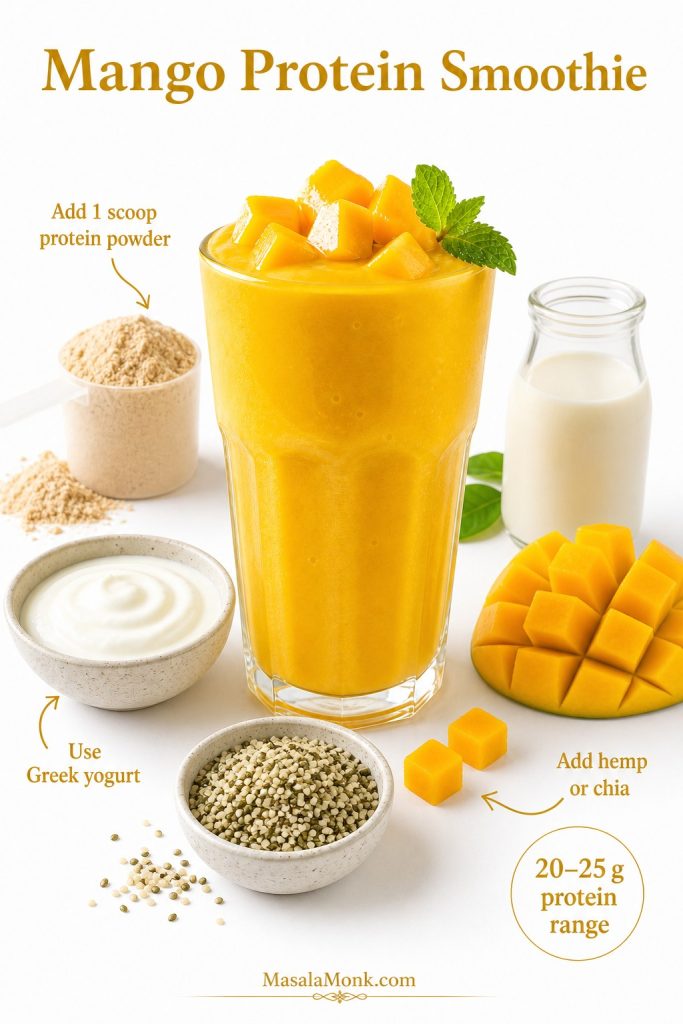
Protein powder turns the smoothie into a more filling breakfast or post-workout drink. Add 1 scoop vanilla protein powder to the base recipe, then increase the milk by 2 to 4 tablespoons as needed. For a higher-protein mango smoothie, use Greek yogurt, add 1 tablespoon hemp seeds or chia seeds, and choose dairy milk or soy milk instead of a very light plant milk. Depending on the protein powder and yogurt you use, this version can move into the 20–25 g protein range.

Mango protein smoothie with protein powder, Greek yogurt, hemp or chia seeds, milk, mango cubes, and a finished smoothie.
For a more filling mango protein smoothie, pair protein powder with Greek yogurt, hemp, chia, or a higher-protein milk. That way, the drink feels more complete without losing its fruit-first taste.

Avocado Mango Smoothie

Avocado is a great choice when you want creaminess without banana. Use 1/4 to 1/2 ripe avocado in the base recipe and skip the banana. The flavor stays mellow, the texture turns silky, and the smoothie becomes less sweet but still rich. For more creamy fruit-and-nut ideas, you might also like these nut-infused smoothies.

Mango Spinach Smoothie

Baby spinach blends easily into mango smoothies because its flavor is mild. Add 1 to 2 cups spinach with the liquid and blend until smooth before adding the mango. That extra first blend keeps the texture cleaner and gives you a green mango smoothie that still tastes fruity.

Dairy-Free Mango Smoothie

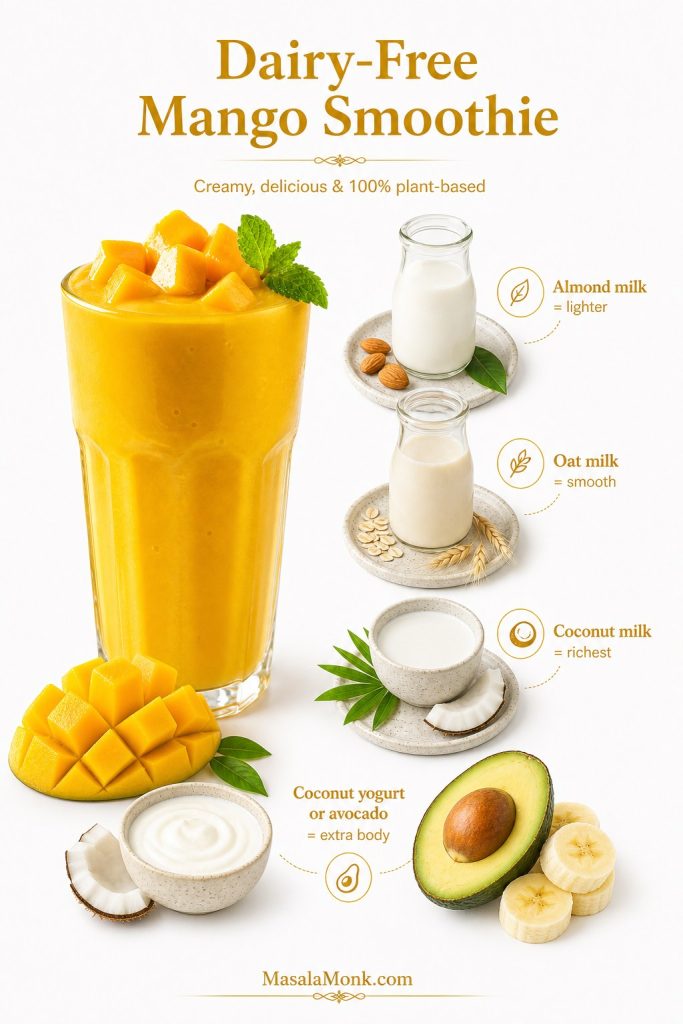
A dairy-free mango smoothie works best when you replace both the liquid and the creamy element. Use almond milk, oat milk, cashew milk, or coconut milk, then add coconut yogurt, dairy-free yogurt, banana, avocado, or soaked cashews for body. Coconut milk gives the richest result, while almond milk keeps the smoothie lighter. For more on this tropical pairing, see this guide to mango with coconut milk.

Dairy-free mango smoothie options with almond milk, oat milk, coconut milk, coconut yogurt, avocado, and mango.
A dairy-free version works best when you replace both the liquid and the creamy element; otherwise, the smoothie can taste thin even when the mango flavor is strong.

Mango Smoothie Without Banana

Skipping banana is easy as long as you replace the body it normally gives. Use 2 1/2 cups frozen mango, 1/2 cup yogurt, and 3/4 cup milk. For an even creamier texture, add 1/4 avocado or 2 tablespoons soaked cashews. This keeps the smoothie thick without letting banana take over the flavor.

Mango Smoothie Without Yogurt

Without yogurt, the smoothie needs another ingredient for body. Banana, avocado, coconut milk, or extra frozen mango all work well. Start with 3/4 cup milk and add more only if the blender needs it. Since yogurt usually adds tang, a little lime juice helps keep this version from tasting too sweet or flat.

Substitution guide for making mango smoothies without banana, yogurt, or milk, with alternative ingredients in three sections.
If you are missing banana, yogurt, or milk, use this guide to swap with purpose. As a result, the smoothie stays balanced instead of becoming too thin, too sweet, or too flat.

Mango Smoothie Bowl

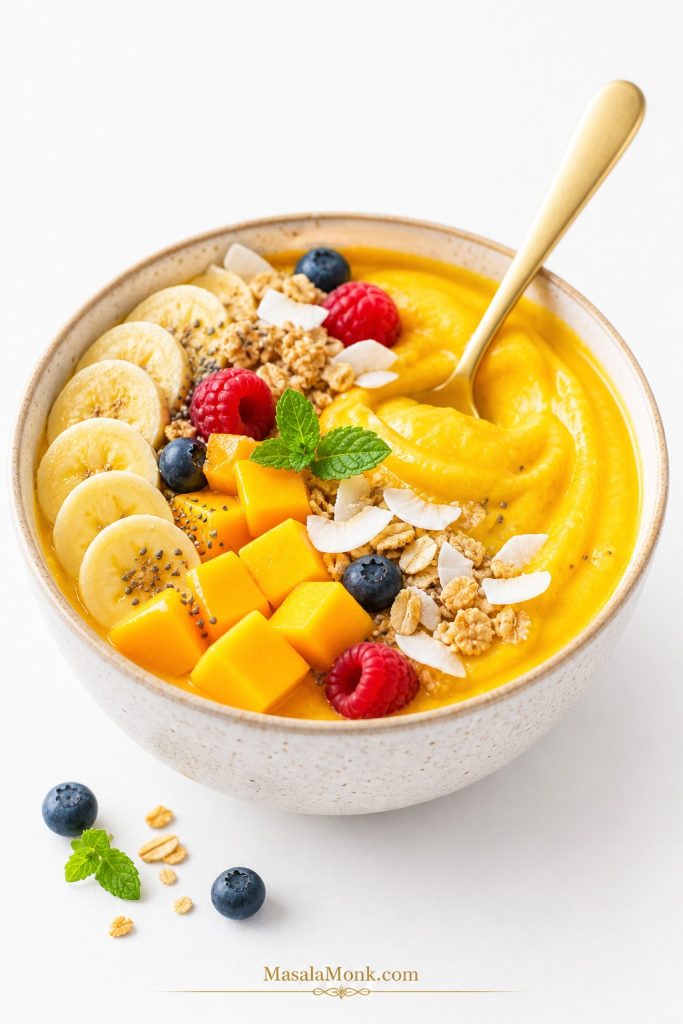
A mango smoothie bowl should be thick enough to spoon, not thin enough to sip through a straw. Use 2 1/2 to 3 cups frozen mango and only 1/4 to 1/2 cup milk. Blend slowly, scrape as needed, and top with granola, coconut, chia seeds, berries, banana slices, or chopped nuts. If you like make-ahead oat toppings, these homemade granola bars can also be crumbled over smoothie bowls.

Thick mango smoothie bowl topped with mango cubes, granola, coconut flakes, chia seeds, berries, banana slices, and a spoon.
The bowl version should mound slightly around the spoon and toppings; if it spreads like a drink, blend in more frozen mango before serving.

Mango Smoothie Texture Guide

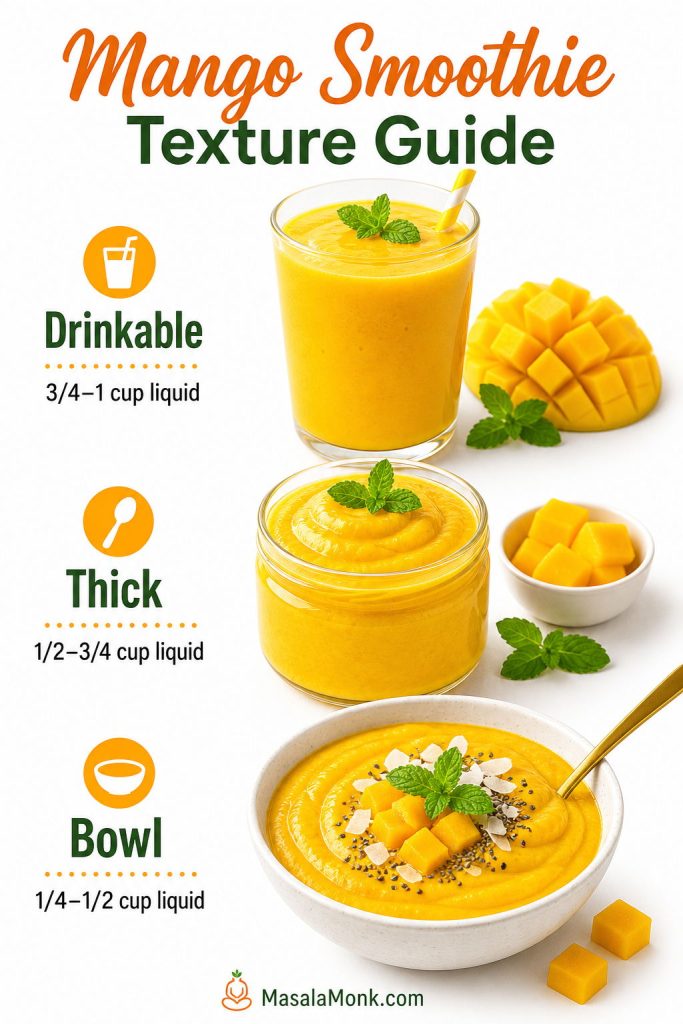
The best mango smoothie texture depends on how you want to serve it. For example, a glass smoothie needs enough liquid to pour, while a smoothie bowl needs much less liquid and more frozen fruit. Meanwhile, a shake-like mango drink uses more milk and feels lighter.

Texture Use This Ratio Best For
Drinkable smoothie 2 cups mango + 3/4 to 1 cup liquid Breakfast glass, snack, quick smoothie
Thick smoothie 2 cups mango + 1/2 to 3/4 cup liquid Cold, creamy, spoonable-but-pourable texture
Smoothie bowl 2 1/2 to 3 cups frozen mango + 1/4 to 1/2 cup liquid Bowl with toppings
Shake-like smoothie 1 1/2 to 2 cups mango + 1 to 1 1/2 cups chilled milk Lighter, milkier mango drink
Mango smoothie texture guide showing drinkable, thick, and bowl-style versions with different liquid amounts.
Texture is easiest to control before blending: decide whether you want to sip it, pour it thick, or spoon it, then start with the matching liquid range.

How to Fix a Mango Smoothie

Most smoothie problems are easy to fix once you know whether the issue is texture, sweetness, or flavor balance. Start with one small adjustment, then blend and taste again.

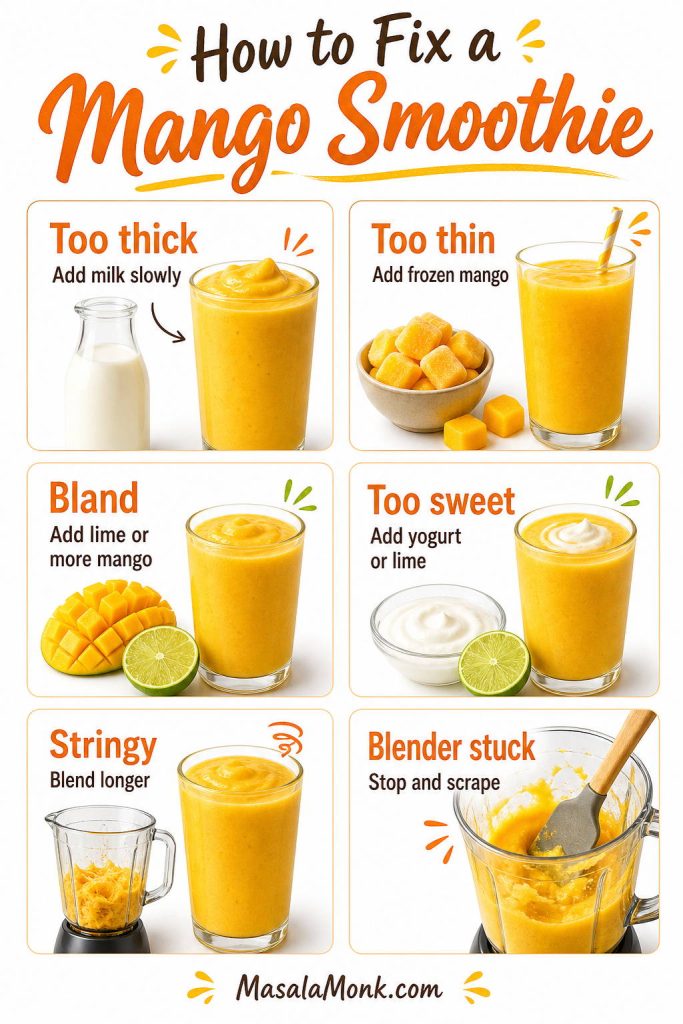
Troubleshooting guide for fixing a mango smoothie that is too thick, too thin, bland, too sweet, stringy, or stuck in the blender.
Most mango smoothie problems need only one small fix. For example, frozen mango thickens, lime brightens, yogurt softens sweetness, and scraping helps a stuck blender move again.

If the Smoothie Is Too Thick

Add milk or plant milk 1 tablespoon at a time. Blend again before adding more. This keeps the smoothie from turning thin too quickly.

If the Smoothie Is Too Thin

Add more frozen mango, frozen banana, Greek yogurt, or avocado. Ice can help in a pinch, but frozen fruit gives a better mango flavor and a creamier finish.

If the Smoothie Tastes Bland

Add lime juice, a tiny pinch of salt, or more mango. Bland smoothies often need brightness, not just more sugar.

If the Smoothie Is Too Sweet

Add plain yogurt, lime juice, or a few more frozen mango pieces. Avoid adding too much extra milk because it can weaken the flavor.

If the Smoothie Is Not Sweet Enough

Add honey, maple syrup, sugar, jaggery, or a soft date in small amounts. Still, taste the mango first. Very ripe mangoes may not need any sweetener at all.

If the Smoothie Is Stringy

The mango may be fibrous. Blend longer, use a stronger blender, or choose smoother mango varieties next time. Frozen mango chunks are often more consistent for smoothies.

If the Blender Gets Stuck

Stop the blender, scrape the sides, and add 1 or 2 tablespoons liquid. Then blend again, starting low before increasing the speed.

Make Ahead, Storage, and Freezing

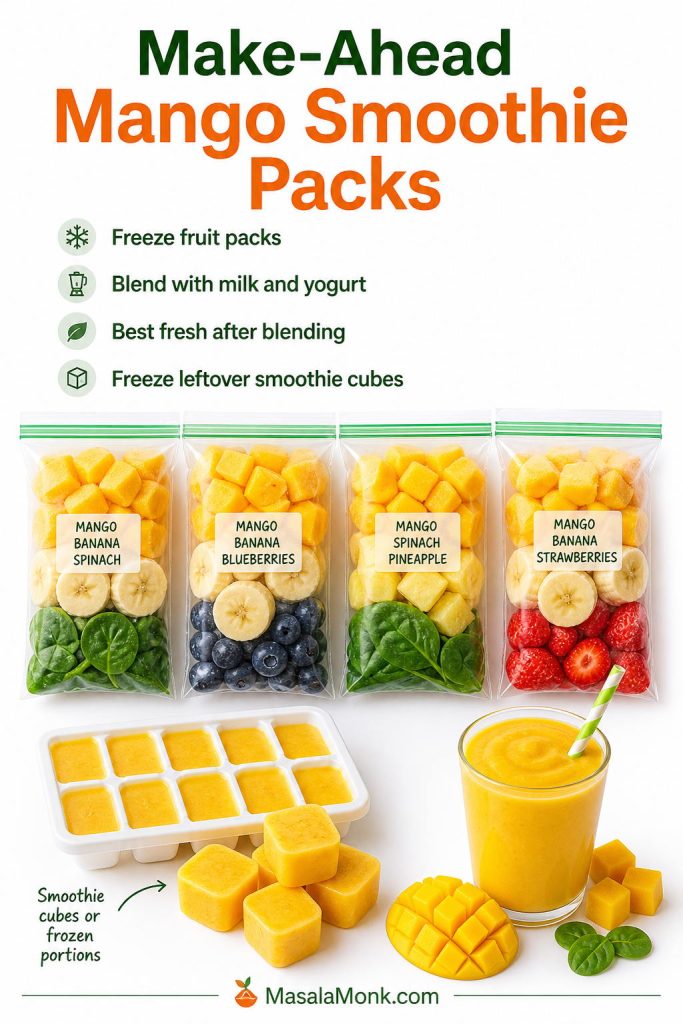
Mango smoothies are best right after blending because the texture is cold, creamy, and fresh. Even so, the recipe is easy to prep ahead when you freeze the mango for each smoothie in small packs. For example, you can freeze mango, banana, and spinach together so breakfast takes only a minute or two.

  • Refrigerator: Store leftover smoothie in a covered jar for up to 1 day. Shake or blend again before drinking.
  • Freezer smoothie packs: Add mango, banana, berries, pineapple, or spinach to freezer bags. When ready, blend with milk and yogurt.
  • Smoothie cubes: Freeze leftover smoothie in an ice cube tray, then re-blend the cubes with a splash of milk.
  • Best fresh: For the best texture, blend just before serving.
Make-ahead mango smoothie packs with freezer bags of mango, banana, greens, berries, smoothie cubes, and a finished smoothie.
Freezer packs make busy mornings easier; even so, the best texture still comes from blending the smoothie fresh instead of storing it fully blended.

More Mango and Smoothie Recipes

After you make this smoothie, you may want a richer mango drink, a tangier yogurt-based drink, or another fruit smoothie. Try this mango shake recipe when you want something creamier and sweeter, this mango lassi recipe when you want a cooling yogurt-based drink, or this strawberry smoothie guide when you want more berry-based variations.

Mango Smoothie FAQs

Can I make a mango smoothie without banana?

Yes. Use extra frozen mango, Greek yogurt, avocado, coconut milk, or soaked cashews to replace the creaminess banana normally gives. For a simple no-banana mango smoothie, blend 2 1/2 cups frozen mango, 1/2 cup yogurt, and 3/4 cup milk.

Can I make a mango smoothie without yogurt?

Yes. Use banana, avocado, coconut milk, oat milk, or extra frozen mango for body. The smoothie will taste less tangy, so a little lime juice can help balance the sweetness.

Is fresh or frozen mango better for smoothies?

Frozen mango is better for thick, cold smoothies because it chills and thickens the drink without ice. Fresh mango is excellent during mango season, but the smoothie may need chilled milk, chilled yogurt, or a few ice cubes.

Can I make a mango smoothie with frozen mango?

Yes, and it is usually the best option for texture. Frozen mango makes the smoothie thicker, colder, and creamier without watering it down.

Can I use mango pulp for a smoothie?

Yes. Mango pulp works well, especially when fresh mangoes are not in season. Since many canned mango pulps are sweetened, taste before adding honey, sugar, maple syrup, or jaggery.

How do I make a mango smoothie thicker?

Use frozen mango, frozen banana, Greek yogurt, avocado, or less liquid. For the thickest smoothie, start with only 1/2 cup liquid and add more slowly.

How do I make a mango smoothie dairy-free?

Use almond milk, oat milk, cashew milk, or coconut milk. Replace yogurt with coconut yogurt, dairy-free yogurt, banana, avocado, or soaked cashews.

Is a mango smoothie the same as a mango shake?

Not exactly. A mango smoothie is usually more flexible and may include yogurt, banana, plant milk, protein powder, greens, or other fruit. A mango shake is usually milkier, sweeter, and often made with chilled milk, mango, sugar, and sometimes ice cream.

What liquid is best for a mango smoothie?

Milk gives the creamiest classic result. Almond milk keeps it light, coconut milk makes it tropical, oat milk makes it smooth, and orange juice makes it brighter and fruitier.

Can I make a mango smoothie without milk?

Yes. Use coconut water, orange juice, or water instead of milk, but expect a lighter and less creamy smoothie. For a no-milk smoothie that still feels creamy, use coconut milk, dairy-free yogurt, avocado, banana, or extra frozen mango.

Can I add protein powder to a mango smoothie?

Yes. Add 1 scoop vanilla protein powder and increase the liquid slightly. Protein powder thickens smoothies, so add milk 1 or 2 tablespoons at a time until the blender runs smoothly.

Can I make a mango smoothie with water?

You can, but the smoothie will taste thinner and less creamy. For a lighter smoothie, coconut water is usually better than plain water. For a creamier smoothie, use milk, oat milk, cashew milk, coconut milk, or yogurt.

Final Tip

For the best mango smoothie recipe, start with ripe mango, keep the liquid modest, and adjust only after blending. Frozen mango gives you the easiest thick texture, while a little lime juice keeps the flavor bright. Once the recipe gives you a smoothie that is cold, creamy, and full of mango flavor, pour it right away and enjoy it at its best.

Finished mango smoothies in glasses with mango pieces, mint, and lime on a bright white background.
The finished drink should look cold, creamy, and ready to serve right away. In the end, that thick, mango-forward texture is what makes the recipe worth repeating.
Posted on 3 Comments

Slim Down and Power Up: 5 Turmeric and Moringa Smoothies for Weight Loss

Turmeric & Moringa Smoothies for Weight Loss

If your mornings have been feeling sluggish and your weight-loss journey is stuck in neutral, it’s time to meet the dynamic duo that’s been quietly revolutionizing healthy living across kitchens, smoothie bars, and wellness circles: Turmeric and Moringa.

Both of these superfoods are rooted in centuries of traditional medicine — turmeric in Ayurveda, moringa in African and South Asian healing — and modern research is catching up to explain why.
Blend them into a smoothie, and you’ve got a nutrient-packed, anti-inflammatory, metabolism-boosting drink that can help you feel lighter, more energized, and more focused.

Today, we’ll dig into:

  • The science behind turmeric and moringa for weight loss
  • Real-life user experiences you can relate to
  • How to use them safely and deliciously in smoothies
  • Five step-by-step recipes that balance flavor with function
  • Extra tips to make this a habit that sticks

Why Turmeric and Moringa Make a Winning Combo

1. Turmeric: The Golden Root for Metabolic Health

Turmeric’s magic lies in curcumin, a bioactive compound with potent anti-inflammatory and antioxidant properties.
Chronic low-grade inflammation is often linked to weight gain, insulin resistance, and sluggish metabolism. By lowering inflammation, turmeric may:

  • Improve insulin sensitivity — helping your body use carbs for energy instead of storing them as fat
  • Support fat metabolism — some studies suggest turmeric influences fat-burning enzymes
  • Balance mood and energy — reducing stress-related eating

💡 Absorption Hack: Curcumin isn’t well absorbed on its own. Pair turmeric with black pepper (piperine boosts absorption up to 2000%) and/or a healthy fat like coconut milk.


2. Moringa: The Hunger-Soothing, Nutrient-Dense Leaf

Moringa oleifera, often called the “Miracle Tree”, is exceptionally nutrient-rich:

  • Protein — rare for a leafy plant (9 essential amino acids)
  • Fiber — helps you stay full and supports gut health
  • Micronutrients — vitamins A, C, E, calcium, iron, potassium

Emerging research and anecdotal evidence suggest moringa may:

  • Reduce cravings and appetite — thanks to fiber and protein content
  • Regulate blood sugar — preventing crashes and cravings
  • Support fat breakdown — animal studies show reduced fat formation and increased fat metabolism

📚 Study Snapshot: A human trial using a supplement containing moringa, turmeric, and curry leaf reported 4.8–5.4 kg weight loss over 8–16 weeks. While it’s unclear how much of this was due to moringa alone, the results are promising.


3. Synergy: More Than the Sum of Their Parts

When combined, turmeric and moringa:

  • Double down on anti-inflammatory action
  • Provide balanced nutrition — protein, vitamins, antioxidants
  • Address multiple weight-loss pathways (digestion, metabolism, cravings, inflammation)
  • Offer immune support — important during calorie restriction or increased activity

💡 Extra Boost: Add ginger for thermogenesis (heat production that burns calories) or citrus for vitamin C.


What Real People Say

From a Health Writer’s Kitchen

“I added 1–2 tsp moringa powder to my smoothies and matcha for 3 months. My digestion improved, my sugar cravings practically disappeared, and I had sustained energy without the afternoon slump.” — Glamour Health Writer


From YouTube Wellness Journeys

  • After 30 days of moringa, one user reported increased mental clarity, better mood, and more stable energy.
  • Another swore by a teaspoon of moringa as a quick cold reliever — easing sneezing and watery eyes in under 15 minutes.

These aren’t clinical trials, but they add a relatable, real-world layer to the science — showing how small, consistent changes can make a noticeable difference.


How to Use Turmeric and Moringa in Smoothies

Forms You Can Use

  • Powder — convenient, shelf-stable; start with ½ tsp each
  • Fresh leaves/root — more potent, but adjust quantities (1–2 inches turmeric root or a handful moringa leaves)
  • Capsules — less common for smoothies but useful for travel

Flavor Balancing Tips

  • Earthy moringa and pungent turmeric can be intense — balance them with:
    • Sweet fruits (banana, mango, pineapple)
    • Creamy bases (coconut milk, almond milk, yogurt)
    • Spices (cinnamon, cardamom, vanilla)

Best Time to Drink

  • Morning — sets a healthy tone for the day
  • Post-workout — supports recovery and replenishment
  • Midday snack — curbs cravings and stabilizes energy

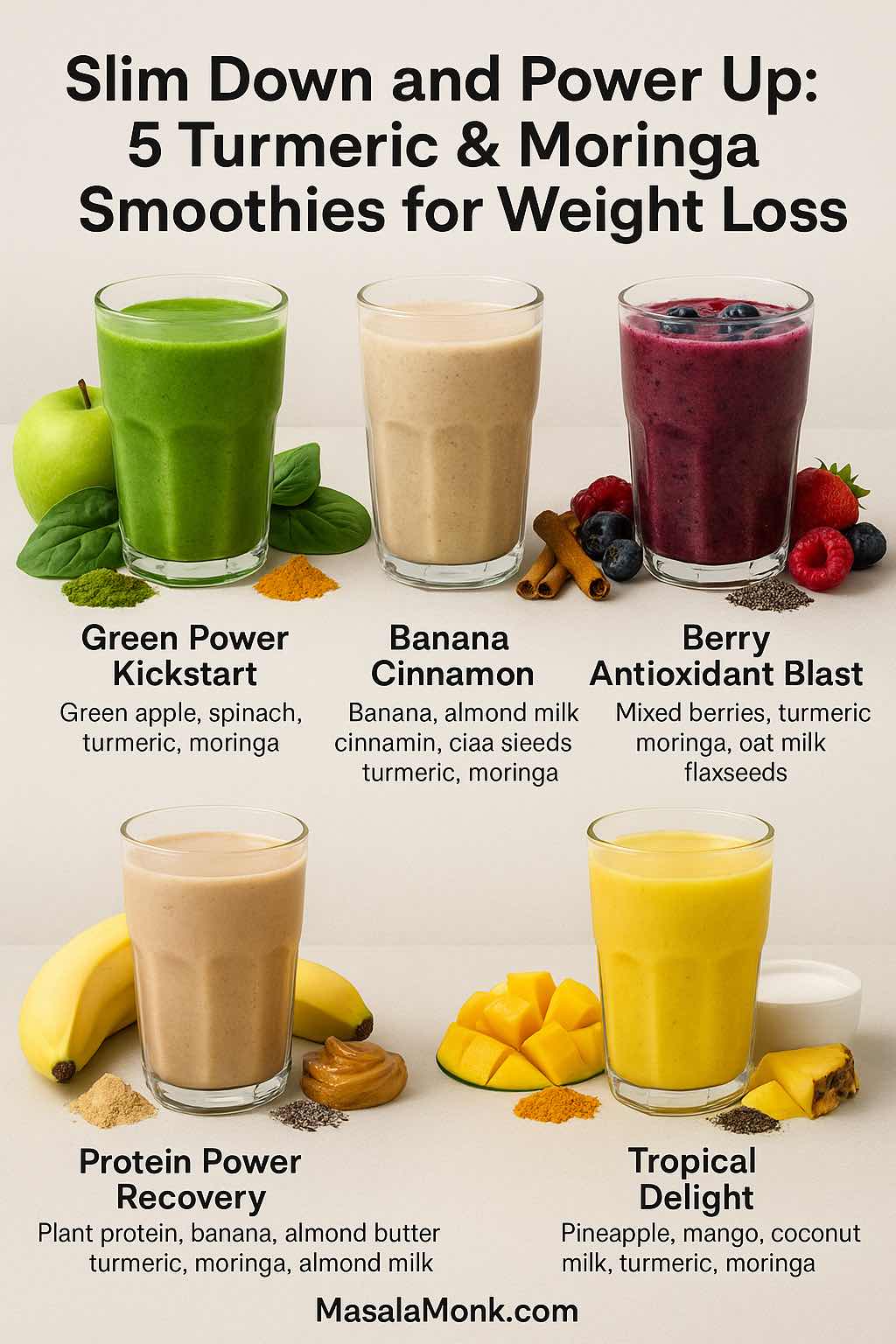
5 Slim-Down & Power-Up Smoothies

These aren’t just random blends — each recipe is carefully crafted for a specific purpose, whether it’s kicking off your morning, recovering post-workout, or curbing a sweet craving without derailing your weight-loss goals.
You’ll notice they all stick to ½–1 tsp turmeric and moringa, keeping flavors balanced while maximizing health benefits.


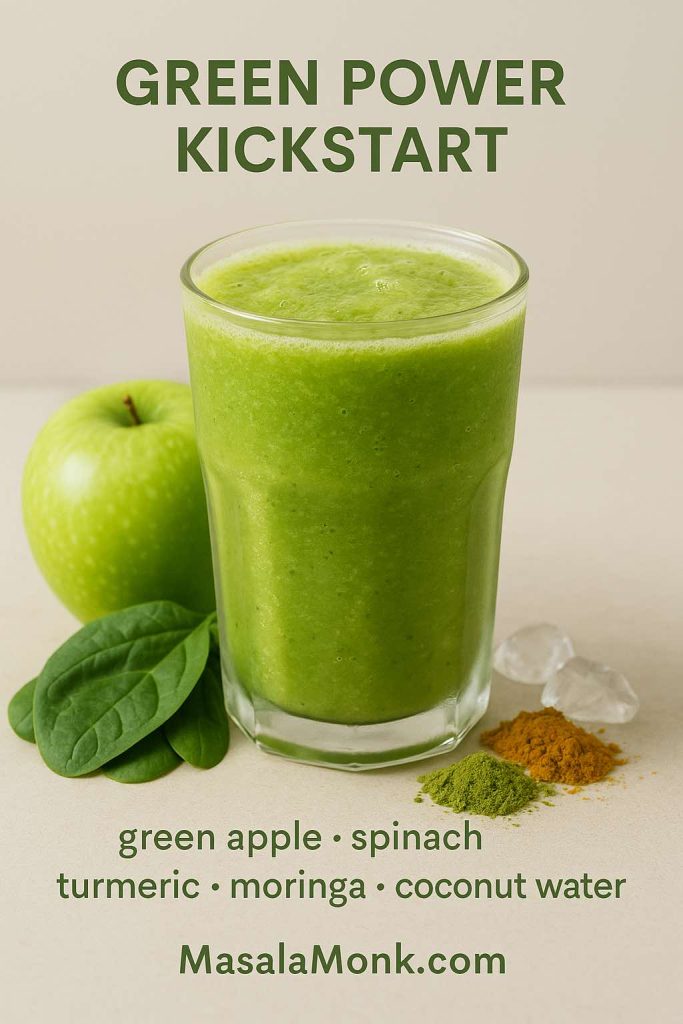
1. Green Power Kickstart

Purpose: A hydrating, detox-friendly morning blend that wakes you up without caffeine.

“Fuel your morning with our Green Power Kickstart smoothie — a refreshing blend of green apple, spinach, turmeric, moringa, and coconut water. Packed with fiber, antioxidants, and anti-inflammatory goodness, it’s the perfect weight-loss smoothie to energize your day naturally.”

Ingredients:

  • 1 green apple (chopped, with skin for extra fiber)
  • 1 cup spinach leaves (packed)
  • ½ tsp turmeric powder
  • ½ tsp moringa powder
  • Pinch freshly ground black pepper
  • 1 cup coconut water (unsweetened)
  • Ice cubes

Instructions:

  1. Add spinach, apple, coconut water, turmeric, moringa, and pepper to a blender.
  2. Blend until smooth; add ice and pulse for a chilled finish.

Why it Works:

  • Spinach adds iron and folate for energy production.
  • Coconut water restores electrolytes, perfect if you’ve sweated in a morning workout.
  • The green apple adds a tangy sweetness that masks moringa’s earthiness.

Macros (approx.): 120 kcal | 2g protein | 29g carbs | 1g fat | 5g fiber

Customization: Swap spinach for kale (more vitamin K) or add cucumber for extra hydration.


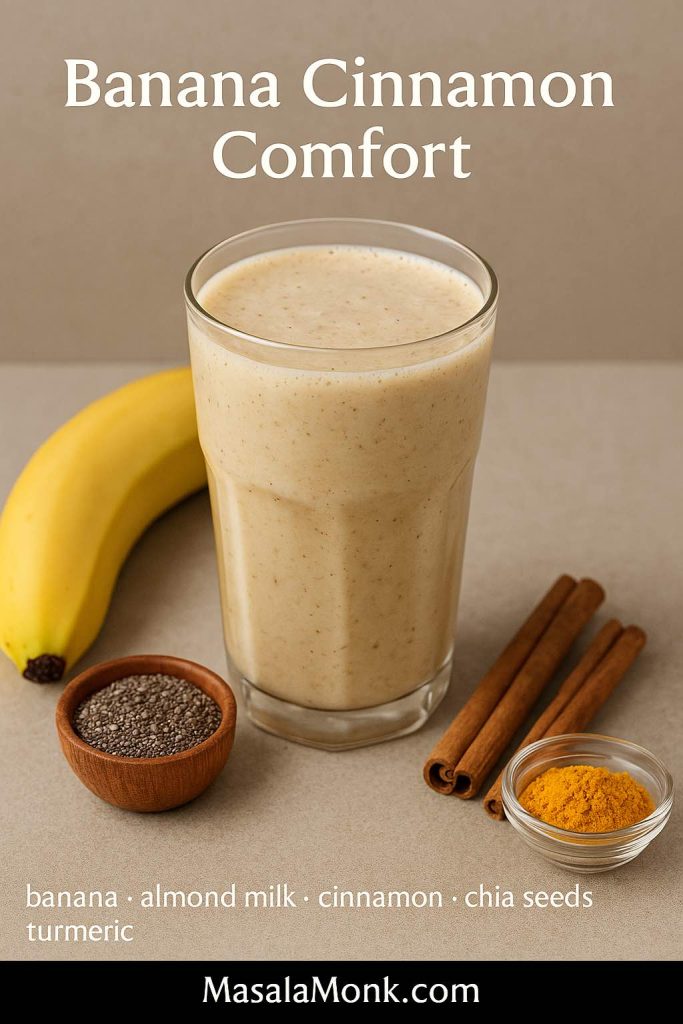
2. Banana Cinnamon Comfort

Purpose: A creamy, dessert-like breakfast smoothie that keeps you full until lunch.

“Indulge in the creamy Banana Cinnamon Comfort smoothie — a satisfying mix of banana, almond milk, cinnamon, chia seeds, turmeric, and moringa. This healthy breakfast smoothie curbs cravings, balances blood sugar, and keeps you full for hours.”

Ingredients:

  • 1 banana (frozen for creaminess)
  • 1 cup unsweetened almond milk
  • ½ tsp turmeric
  • ½ tsp moringa
  • ½ tsp cinnamon powder
  • 1 tsp chia seeds (soaked for 5–10 min)

Instructions:

  1. Blend banana, almond milk, turmeric, moringa, and cinnamon until smooth.
  2. Add soaked chia seeds, pulse lightly to keep texture.

Why it Works:

  • Cinnamon helps regulate blood sugar and reduce sweet cravings.
  • Chia seeds add omega-3 fats and soluble fiber, promoting satiety.
  • Turmeric + cinnamon = warm, comforting flavor that hides any bitterness.

Macros (approx.): 190 kcal | 4g protein | 37g carbs | 4g fat | 7g fiber

Customization: For extra protein, add a scoop of plant-based protein powder or Greek yogurt.


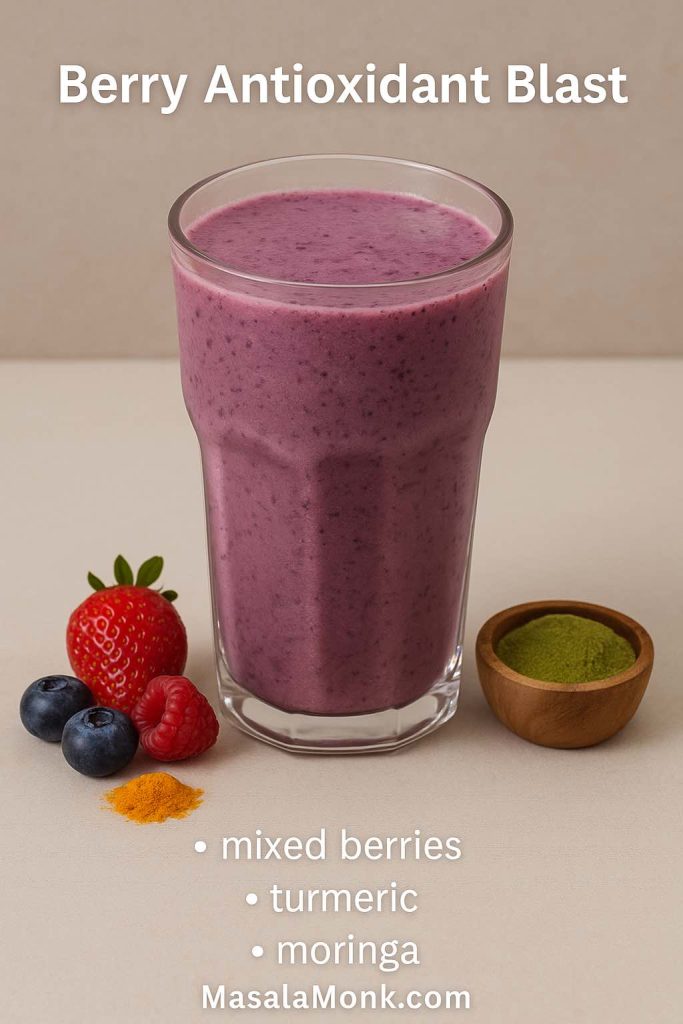
3. Berry Antioxidant Blast

Purpose: A low-calorie, antioxidant-rich immune booster for midday or post-gym refreshment.

“Boost your immunity and metabolism with our Berry Antioxidant Blast — a vibrant mix of strawberries, blueberries, raspberries, turmeric, and moringa. This low-calorie, antioxidant-rich smoothie is your go-to for weight loss and glowing skin.”

Ingredients:

  • 1 cup mixed berries (blueberries, raspberries, strawberries; frozen or fresh)
  • ½ tsp turmeric
  • ½ tsp moringa
  • 1 cup oat milk (unsweetened)
  • 1 tbsp flaxseeds (ground for better absorption)

Instructions:

  1. Blend berries, oat milk, turmeric, and moringa until smooth.
  2. Add ground flaxseeds and blend briefly.

Why it Works:

  • Berries are low in calories but high in polyphenols, which fight oxidative stress.
  • Flaxseeds add lignans — compounds that may support hormonal balance.
  • Oat milk provides a creamy, dairy-free base with beta-glucans for heart health.

Macros (approx.): 150 kcal | 3g protein | 30g carbs | 4g fat | 6g fiber

Customization: Add a squeeze of lemon juice for brightness or swap oat milk for coconut water for a lighter feel.


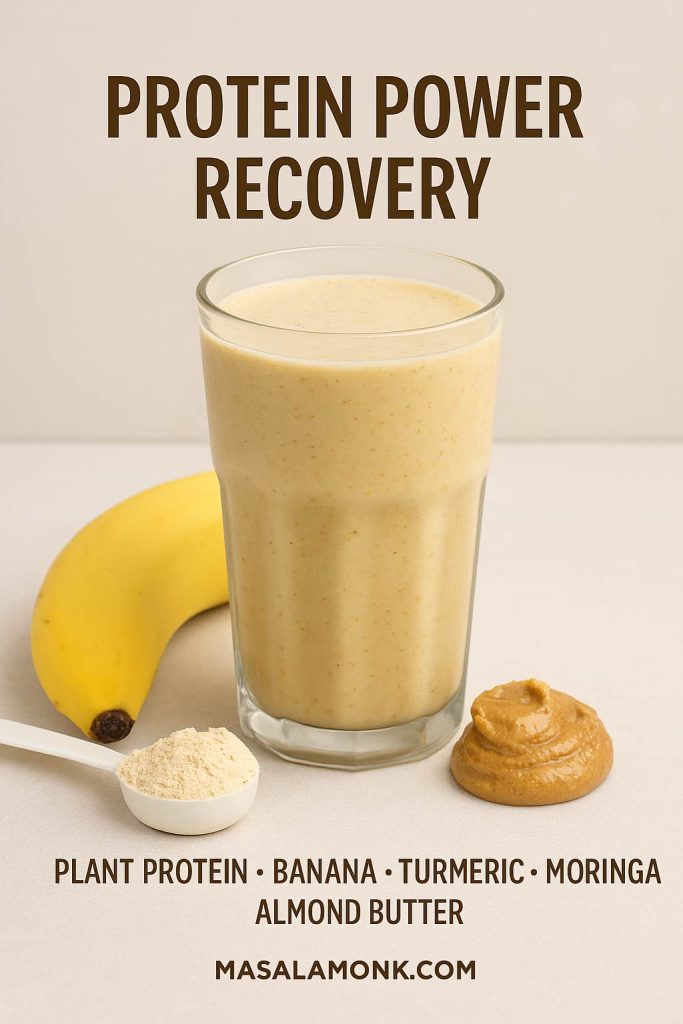
4. Protein Power Recovery

Purpose: Post-workout refuel that supports muscle repair and keeps hunger away for hours.

“Rebuild and refuel with the Protein Power Recovery smoothie — a powerhouse blend of plant protein, banana, almond butter, turmeric, and moringa. Perfect post-workout, this high-protein smoothie aids muscle recovery while supporting weight-loss goals.”

Ingredients:

  • 1 scoop plant-based protein powder (20–25g protein)
  • 1 banana
  • 1 cup almond milk
  • ½ tsp turmeric
  • ½ tsp moringa
  • 1 tbsp almond butter

Instructions:

  1. Blend all ingredients until creamy and lump-free.
  2. Serve immediately for best taste.

Why it Works:

  • Protein powder supplies the amino acids needed for muscle recovery.
  • Almond butter offers healthy fats for joint health and satiety.
  • Turmeric fights exercise-induced inflammation, aiding recovery.

Macros (approx.): 310 kcal | 26g protein | 32g carbs | 9g fat | 6g fiber

Customization: Use peanut butter for a richer flavor or add cacao powder for a chocolate boost.


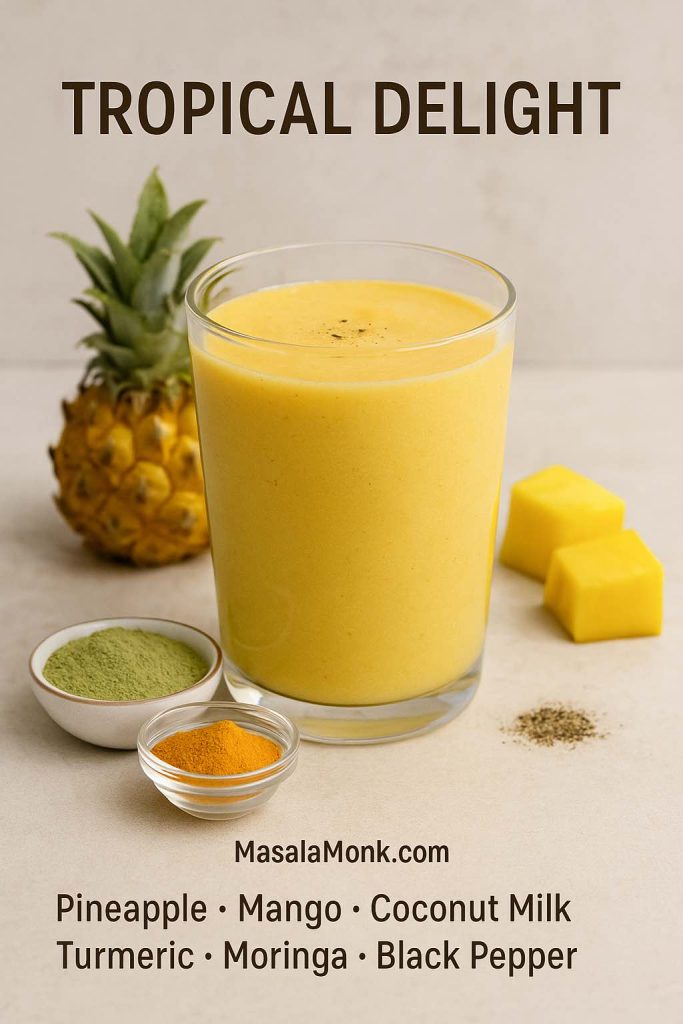
5. Tropical Delight

Purpose: A mood-boosting, vacation-in-a-glass smoothie that still works for weight loss.

“Escape to the tropics with our Tropical Delight smoothie — a sunny mix of pineapple, mango, coconut milk, turmeric, moringa, and black pepper. Hydrating, vitamin-rich, and anti-inflammatory, it’s a delicious way to slim down and power up.”

Ingredients:

  • 1 cup pineapple chunks (fresh or frozen)
  • ½ cup mango chunks
  • 1 cup coconut milk (light or unsweetened)
  • ½ tsp turmeric
  • ½ tsp moringa
  • Pinch black pepper

Instructions:

  1. Blend all ingredients until silky.
  2. Chill before serving for a refreshing summer feel.

Why it Works:

  • Pineapple contains bromelain, an enzyme that may aid digestion.
  • Mango adds natural sweetness and beta-carotene for skin health.
  • Coconut milk’s healthy fats improve turmeric’s absorption.

Macros (approx.): 230 kcal | 3g protein | 36g carbs | 9g fat | 4g fiber

Customization: Swap mango for papaya (extra digestion support) or add mint leaves for a cooling twist.


Pro Tips for All Smoothies

  • Pre-freeze fruit for a thicker, milkshake-like consistency without ice dilution.
  • Blend powders last for smoother texture and even distribution.
  • Taste before serving — if too earthy, add a splash of lemon juice or a date for balance.
  • Batch prep dry ingredients in jars so you can just dump, blend, and go in the morning.

Extra Tips for Weight Loss Success

  1. Replace, don’t just add — Use smoothies as a meal or snack replacement, not an extra calorie source.
  2. Watch fruit sugar — Pair sweet fruits with protein or fiber.
  3. Stay consistent — 4–5 smoothies per week is a good start.
  4. Listen to your body — Start small to check tolerance.
  5. Hydrate well — Smoothies work best alongside adequate water intake.

Related Reads on MasalaMonk


The Takeaway

Turmeric and moringa smoothies are not a magic bullet — but they’re a practical, science-backed, and delicious tool to support your weight-loss journey. They help reduce inflammation, improve digestion, curb cravings, and supply a steady stream of nutrients.

Blend them consistently, pair them with balanced meals, and stay active — and you’ll have a tasty, sustainable path to a slimmer, more energized you.

FAQs

1. Can I drink turmeric and moringa smoothies every day?
Yes, you can enjoy them daily, but start with smaller amounts (½ tsp each) and gradually increase to check your tolerance. Overconsumption may cause mild digestive upset in some people.


2. When is the best time to drink these smoothies for weight loss?
Mornings are ideal for an energy boost and metabolism kickstart. Post-workout is also a great time to support recovery and nutrient replenishment.


3. How much turmeric and moringa should I add to a smoothie?
Begin with ½ tsp turmeric powder + ½ tsp moringa powder per serving, and increase up to 1 tsp each as your taste buds and digestion adjust.


4. Do I have to use black pepper with turmeric?
Yes, if possible. Black pepper contains piperine, which boosts curcumin absorption in turmeric by up to 2000%. A small pinch is enough.


5. Can I use fresh turmeric root or moringa leaves instead of powder?
Absolutely. Use 1–2 inches fresh turmeric root or a handful of fresh moringa leaves per smoothie, adjusting other flavors to balance the taste.


6. Are these smoothies suitable for diabetics?
Yes, but use low-GI fruits (berries, green apple) and avoid adding sweeteners. Moringa may help regulate blood sugar, but check with your doctor if you’re on medication.


7. Will these smoothies make me lose weight quickly?
They can support weight loss by curbing cravings, boosting metabolism, and improving digestion, but results depend on overall diet and activity levels.


8. Can I prep these smoothies in advance?
You can pre-chop fruits and portion dry ingredients into jars, but blend just before drinking for the best flavor and nutrient retention.


9. What can I use instead of plant-based milk?
You can use dairy milk, coconut water, or even plain water. Just ensure there’s a small amount of healthy fat (nuts, seeds, coconut) for turmeric absorption.


10. Are there any side effects of moringa or turmeric?
In moderate amounts, both are safe for most people. Large doses may cause digestive issues. Turmeric may interact with blood thinners; moringa may lower blood pressure—consult your doctor if you have health conditions.