Posted on 1 Comment

Berry Smoothie Recipe

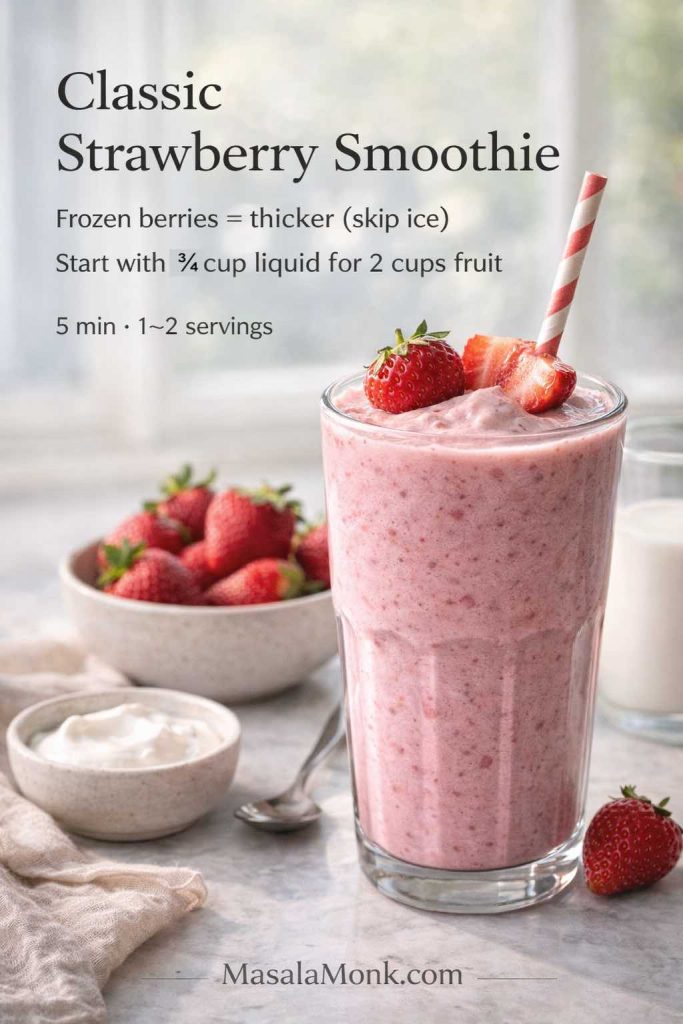
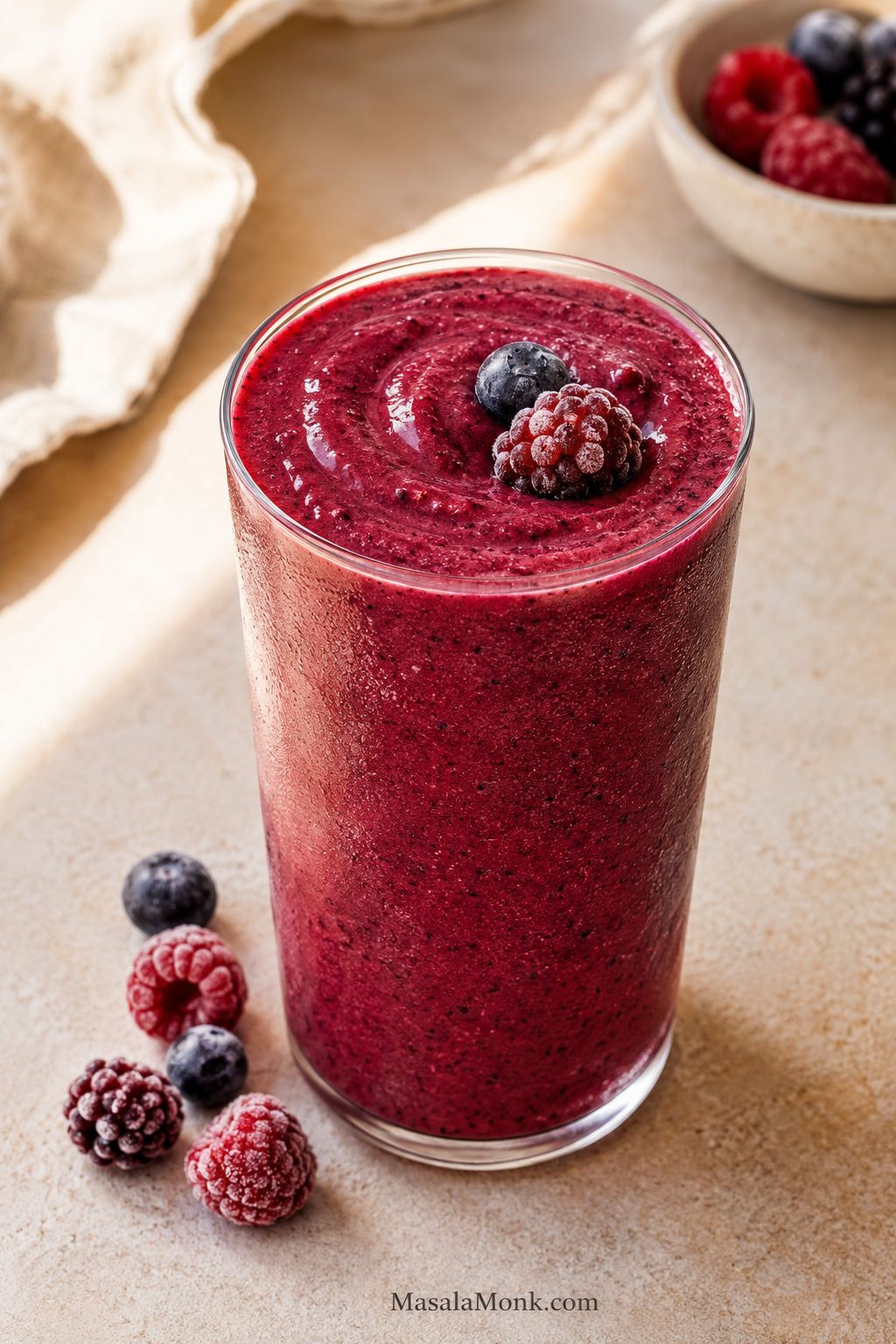
Thick berry smoothie in a clear glass with frozen mixed berries on a warm stone breakfast surface.

A good berry smoothie should taste like real berries first: cold, creamy, bright, and thick enough to pour slowly. It should feel like a real breakfast or snack, not a glass of watered-down fruit milk.

This berry smoothie recipe starts with one reliable base, then shows you how to adjust it for the way smoothies actually happen at home: a frozen berry bag, half a banana, a spoon of yogurt, almond milk, protein powder, spinach, oats, chia, or whatever needs using up in the fridge.

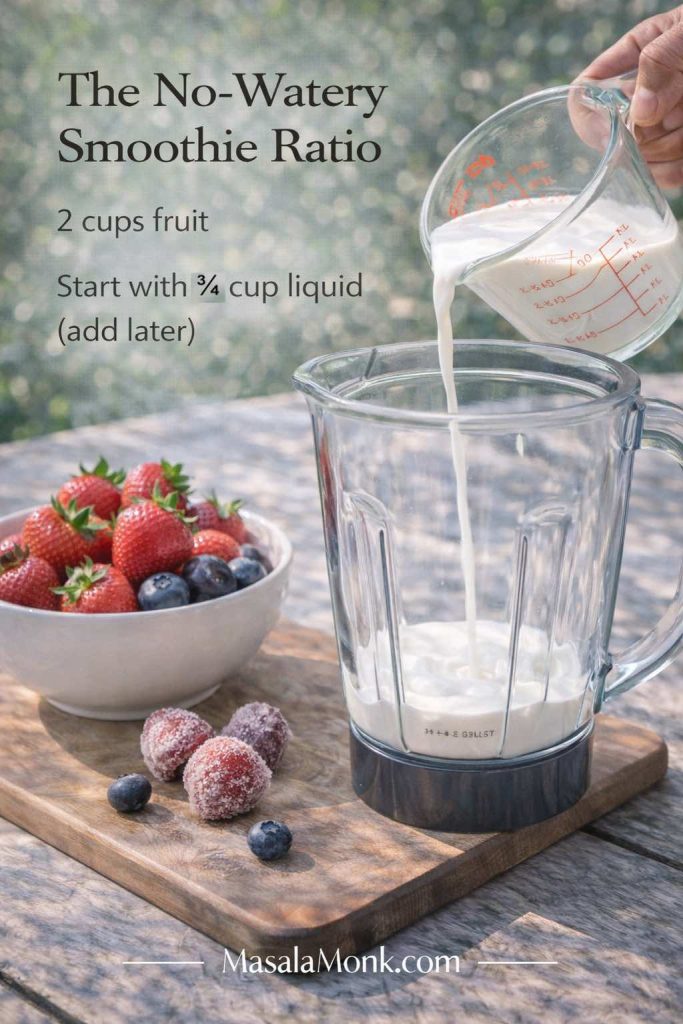
The main rule is simple: start with frozen berries and less liquid than you think. Once the blender starts moving, you can always loosen the smoothie. If it turns watery first, you have to build the texture back with more frozen fruit or another thickener.

Quick Answer: The Best Berry Smoothie Ratio

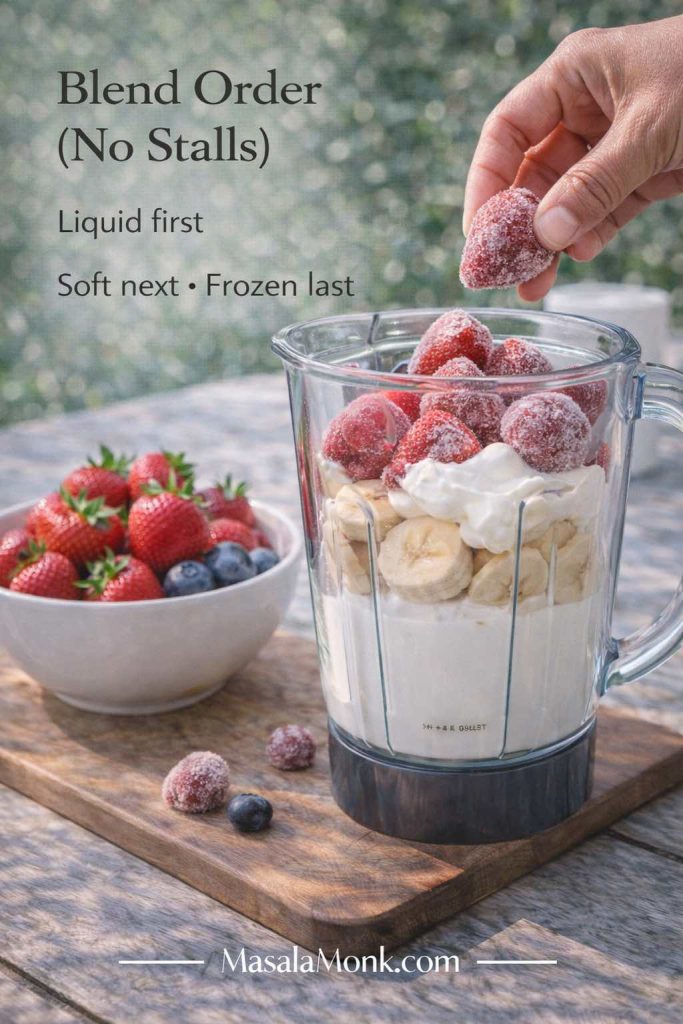
For a thick, drinkable berry smoothie, blend 1 1/2 cups frozen berries, 1/2 banana, 1/2 cup Greek yogurt, and 1/2 cup milk or almond milk. Add the liquid first, then the yogurt and banana, then the frozen berries. Blend until smooth, adding more liquid 1 tablespoon at a time only if the blender stalls.
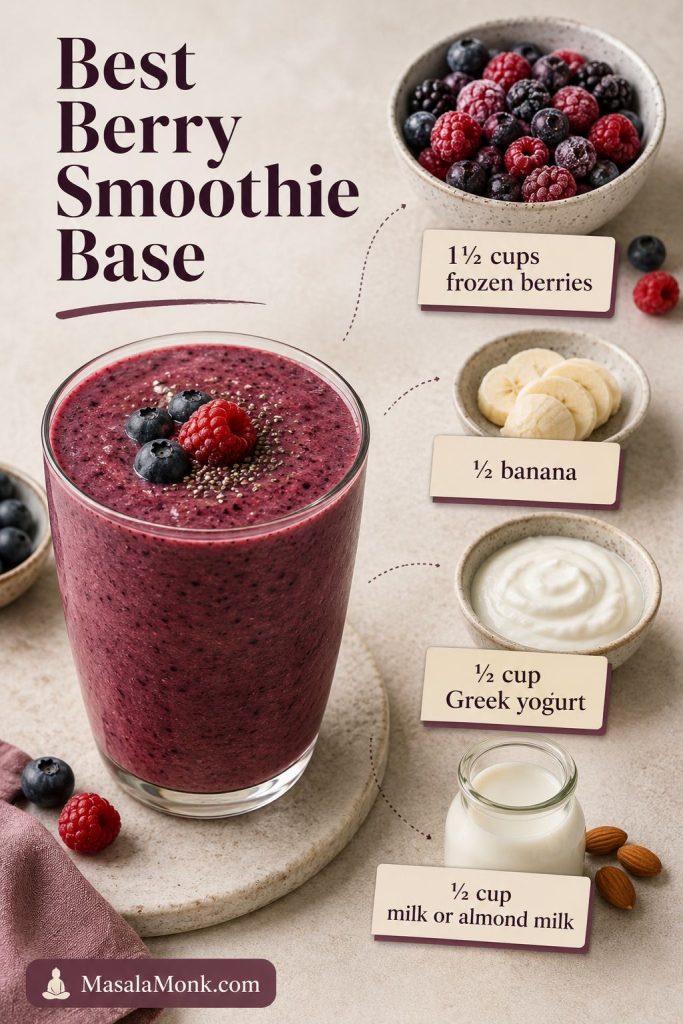
Berry smoothie base ratio showing frozen berries, banana, Greek yogurt, and milk or almond milk.
This base ratio gives you a reliable starting point: frozen berries build texture, banana softens the flavor, yogurt adds creaminess, and milk helps the blender move.

Frozen berries make the thickest, coldest smoothie because they chill the drink and build texture at the same time. Fresh berries work beautifully when they are sweet and in season, but they usually need help from frozen banana, yogurt, oats, chia, or a small amount of ice.

At a glance: 5 minutes, no cooking, about 2 cups / 475 ml total. Use 1/2 cup / 120 ml liquid for a thick drinkable smoothie, or 2–5 tablespoons / 30–75 ml for a spoonable smoothie bowl.

When the ratio is right, the smoothie tastes cold and full, not watered down — the kind of breakfast you can drink slowly instead of rushing through.

Need to adjust the texture? Jump to the smoothie ratio guide or the troubleshooting section.

Choose Your Berry Smoothie Version

Use this quick table when you know what you want but do not want to read every variation first.
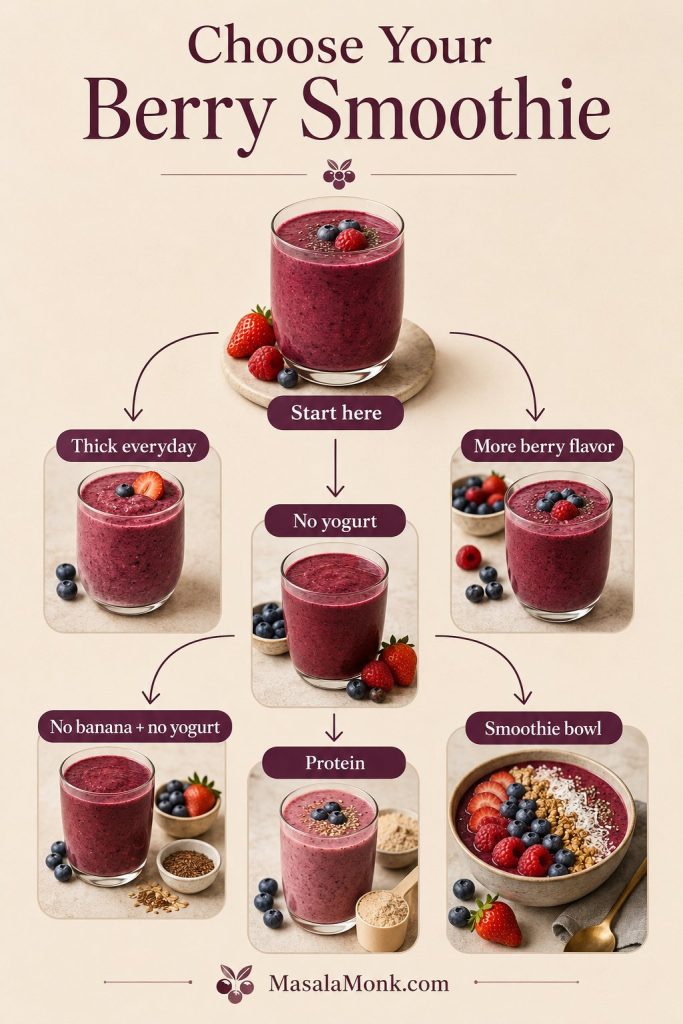
Decision guide showing berry smoothie versions for thick, no yogurt, no banana, protein, and smoothie bowl options.
Choose the berry smoothie version based on what you need today: thicker texture, stronger berry flavor, no yogurt, no banana, more protein, or a spoonable bowl.
What you want Make this version
Thick everyday smoothie Classic berry smoothie
Stronger berry flavor No-banana berry smoothie
Dairy-free or no yogurt No-yogurt berry smoothie
No banana and no yogurt Almond butter + oats/chia version
More filling Berry protein smoothie
Hidden greens Spinach berry smoothie
Spoonable breakfast Berry smoothie bowl

Why This Berry Smoothie Works

This recipe works because it treats a smoothie like a flexible ratio instead of a rigid formula. Berries bring the flavor, frozen fruit brings thickness, yogurt or banana brings creaminess, and the liquid decides whether the final texture is slow-pouring, light, or spoonable.

That is why the same freezer bag can give you either a thin, forgettable drink or a smoothie that feels cold, full, and breakfast-worthy. The difference is not complicated technique; it is starting with enough frozen fruit and not flooding the blender before the texture has a chance.

Ice makes a smoothie colder, but it can also water down the berry flavor as it melts. Frozen berries do the job better because they add chill, flavor, and thickness at the same time. For a deeper look at why frozen fruit often gives smoothies better body, see this fresh vs frozen fruit smoothie test.

The texture goal: A good berry smoothie should pour slowly, not splash like juice. If it is thin, add frozen fruit. If the blender sounds angry, add liquid one tablespoon at a time.

Ingredients That Control Flavor and Texture

You only need a few ingredients, but each one changes the result. Choose the berries first, then decide whether you want banana, yogurt, dairy-free liquid, protein, greens, or a thicker breakfast-style smoothie.
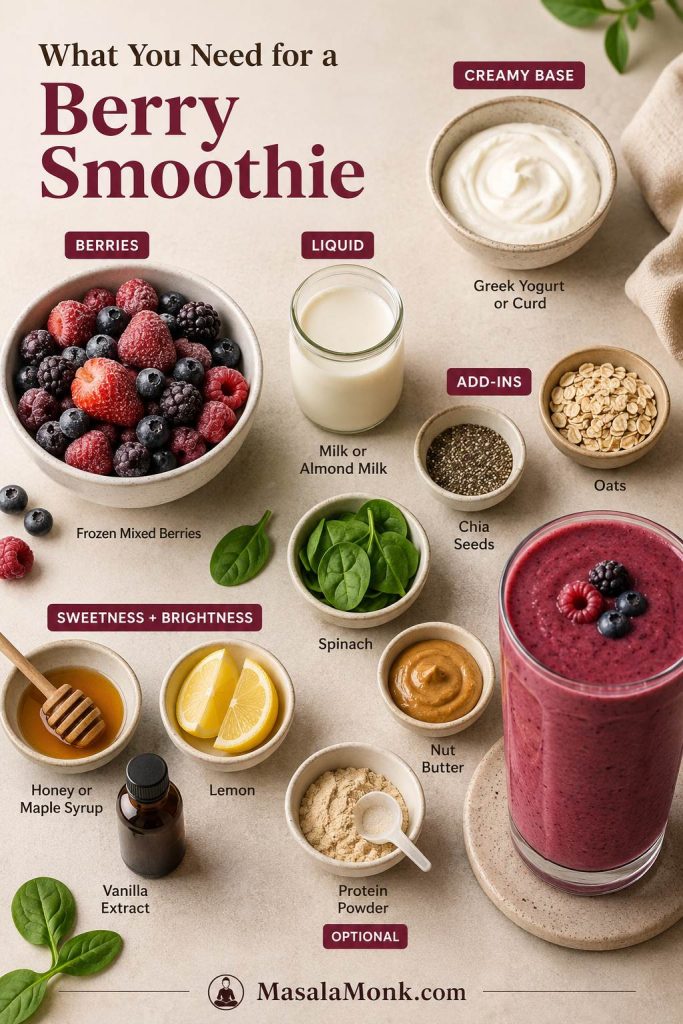
Berry smoothie ingredients including frozen berries, banana, yogurt, milk, oats, chia, spinach, nut butter, lemon, and sweetener.
Once you know each ingredient’s job, the recipe becomes easier to fix. Berries bring flavor, creamy add-ins give body, and small extras adjust sweetness, brightness, or thickness.

If you already know your main constraint, jump straight to the no-banana version, no-yogurt version, or protein smoothie.

Fresh vs Frozen Berries

Frozen berries are the easiest choice for a thick smoothie. They are already cold, blend into a frosty texture, and reduce the need for ice. A frozen mixed berry bag with strawberries, blueberries, raspberries, and blackberries is usually the most convenient option.

Fresh berries are best when they are sweet and juicy. Since they are not frozen, they usually make a thinner smoothie, so use them with frozen banana, Greek yogurt, oats, chia, a handful of frozen berries, or a little ice when you want more thickness.
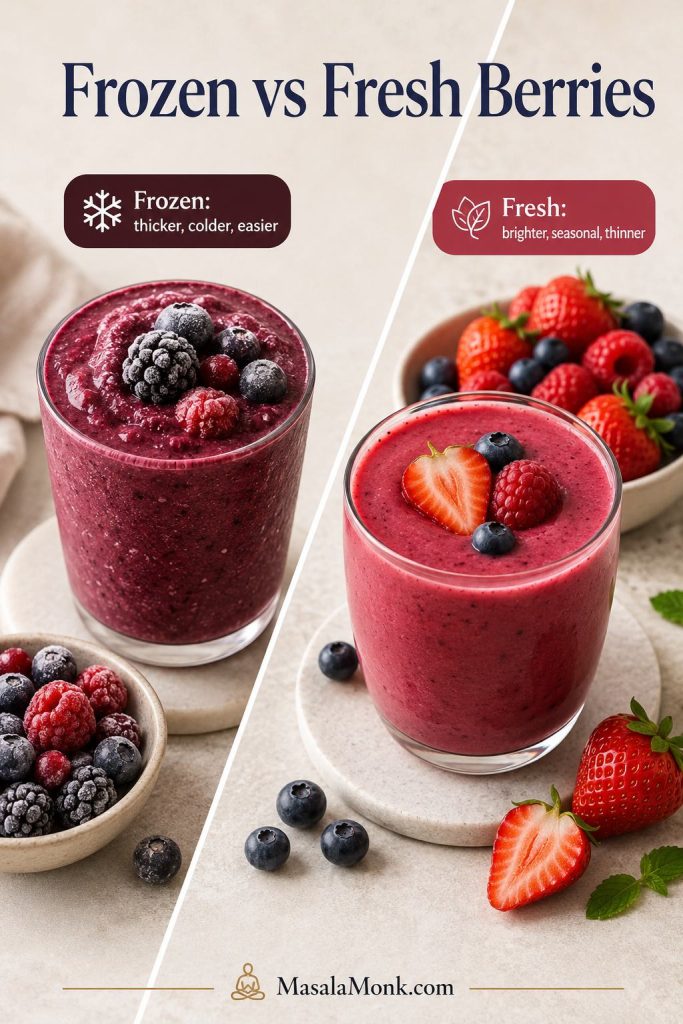
Frozen and fresh berries compared for smoothies, with a thicker frozen berry smoothie and a lighter fresh berry smoothie.
Frozen berries are the safer choice when texture matters, while fresh berries are best for peak-season flavor. Choose frozen for thickness and fresh for brightness.

Do not thaw frozen berries first unless your blender is struggling badly. Thawed berries release juice, and that extra juice can make the smoothie thinner.

Best Berries for a Smoothie

Different berries behave differently in the blender. This is why one mixed berry smoothie can taste sweet and creamy, while another turns tart, seedy, or flat.
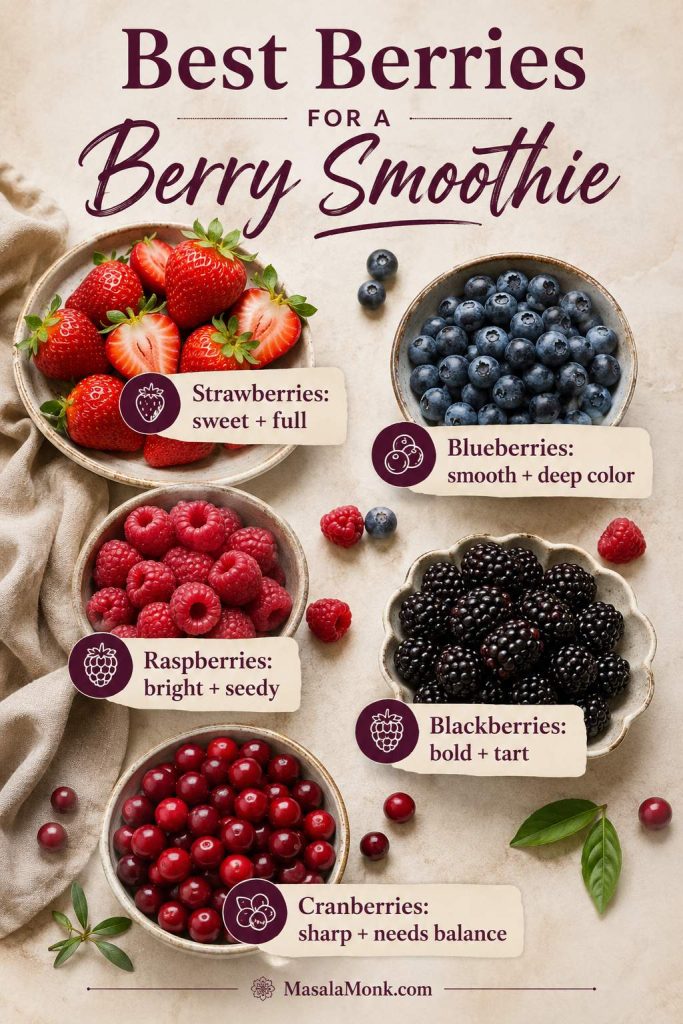
Berry chooser guide showing strawberries, blueberries, raspberries, blackberries, and cranberries with smoothie flavor notes.
Strawberries and blueberries make a smoother everyday blend, while raspberries, blackberries, and cranberries bring brighter tartness. That means the berry mix changes both flavor and texture.
Berry What It Adds Watch Out For
Strawberries Sweetness, body, and classic smoothie flavor Can taste mild if the smoothie has too much liquid
Blueberries Deep color, mild sweetness, and smoother texture Can taste flat without lemon juice or a little sweetness
Raspberries Bright tart flavor and strong berry aroma Can be seedy and sharp
Blackberries Deep berry flavor and bold color Can be seedy and tart
Cranberries Sharp, tangy berry flavor Usually need banana, dates, honey, or juice to balance them

If your smoothie tastes sharp or gritty, the berry mix may be the reason, not your method. A strawberry-blueberry-heavy blend is usually the safest everyday choice; raspberry-blackberry-heavy blends are more vivid, but they need more balancing.

For the smoothest texture, lean on strawberries and blueberries more than raspberries or blackberries. If seeds bother you, blend longer or strain only when needed.

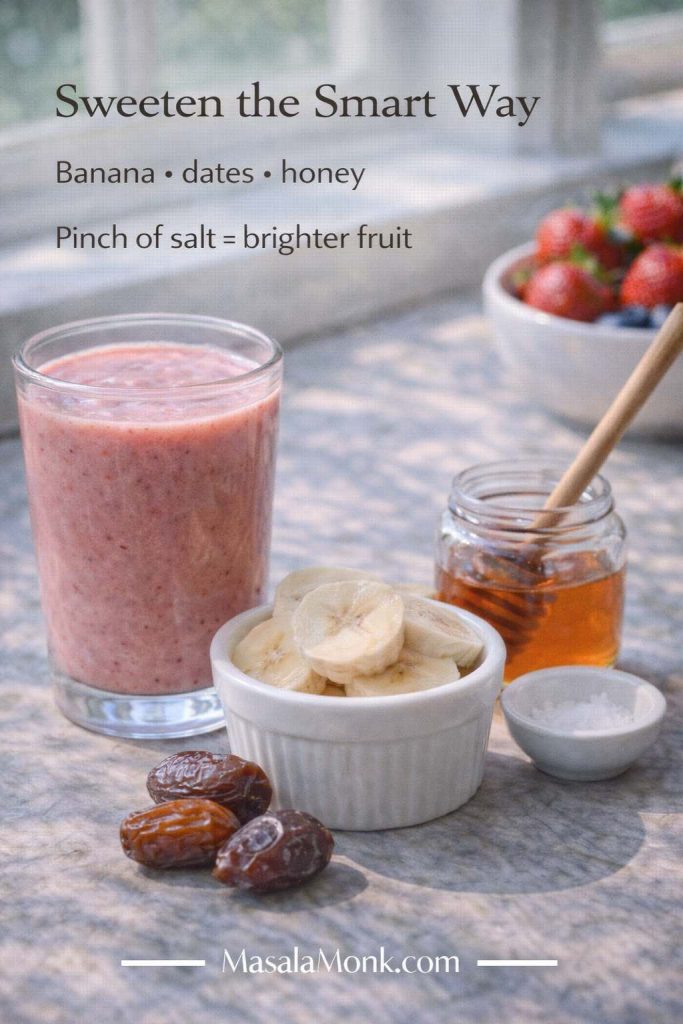
Taste before adding sweetener if your blend has plenty of strawberries or banana. For gentle sweetness, try banana or vanilla first. If the smoothie is still sharp, add a date, honey, or maple syrup. Use juice only when you want a sweeter, fruit-drink style smoothie.

For kids or anyone who prefers a softer, sweeter smoothie, use a strawberry-heavy berry mix, vanilla yogurt, or a small splash of apple or orange juice.

Banana or No Banana

Banana adds natural sweetness and a creamy texture. Half a banana is enough for balance; a full banana makes the drink sweeter, thicker, and more banana-forward.

If you want the smoothie to taste mostly like berries, stay closer to half a banana. Skip it completely when you want a brighter color, sharper berry flavor, or no banana taste at all. To keep a no-banana smoothie creamy, use Greek yogurt, coconut yogurt, avocado, almond butter, oats, chia, or extra frozen berries.
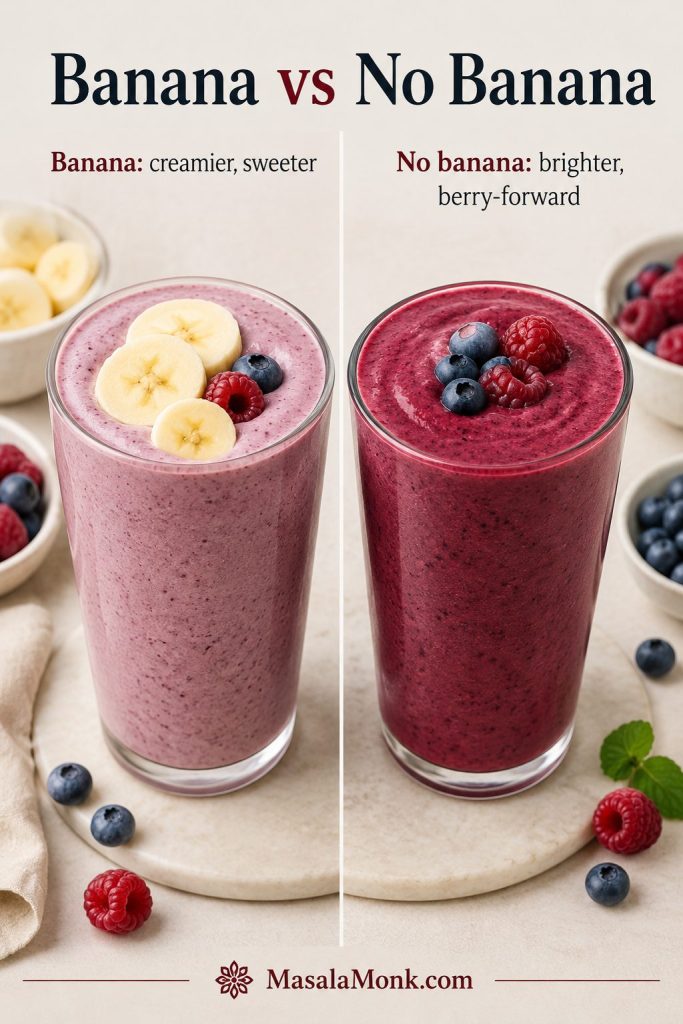
Banana and no-banana berry smoothies compared, with a creamier banana version and a darker berry-forward version.
Banana makes a berry smoothie sweeter and creamier, but it can take over quickly. For a brighter berry smoothie without banana, use yogurt, oats, chia, or extra frozen fruit.

Yogurt or No Yogurt

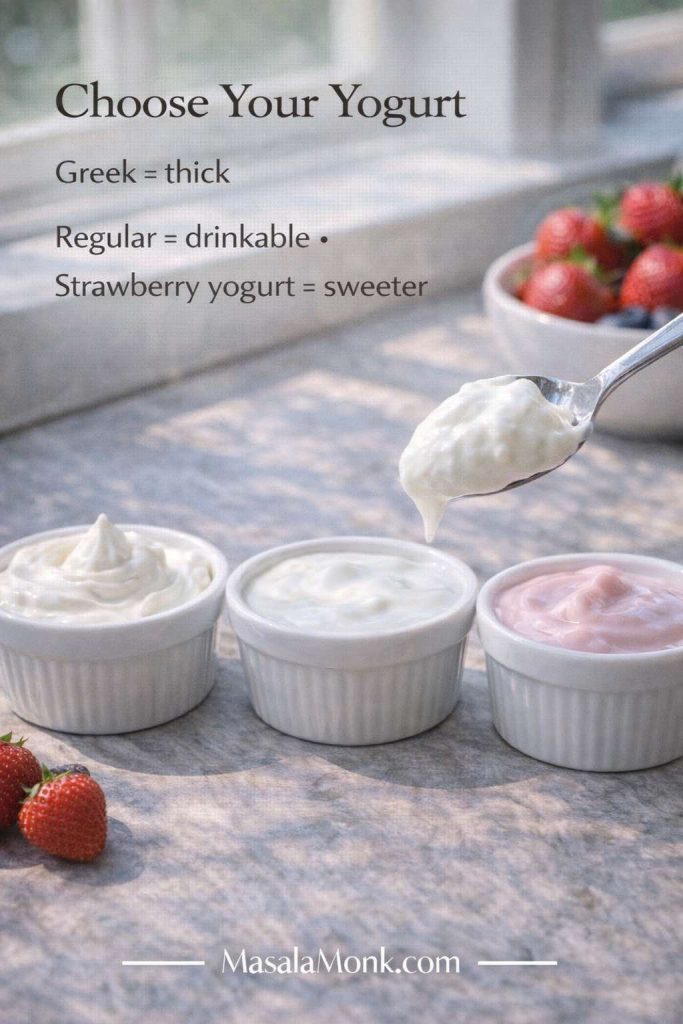
Greek yogurt is the easiest route to a thick, creamy smoothie with a little extra staying power. Regular yogurt works too, but it is looser, so you may need slightly less liquid. Plain yogurt keeps the flavor breakfast-like; vanilla yogurt makes it softer and sweeter.

If you are using homemade curd, choose a thick, well-set curd and start with slightly less liquid. If the curd is loose or watery, strain it for 15–20 minutes or reduce the milk by 2–3 tablespoons.

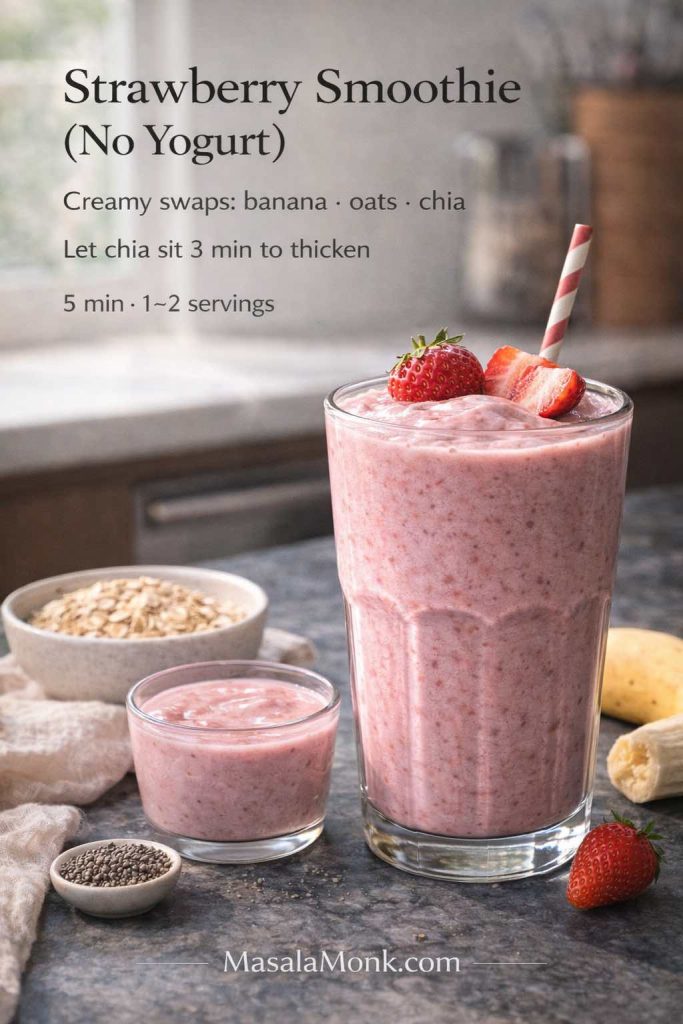
Without yogurt, use banana, almond butter, oats, chia, coconut yogurt, avocado, coconut milk, or extra frozen fruit so the drink does not taste like berries blended with thin milk.
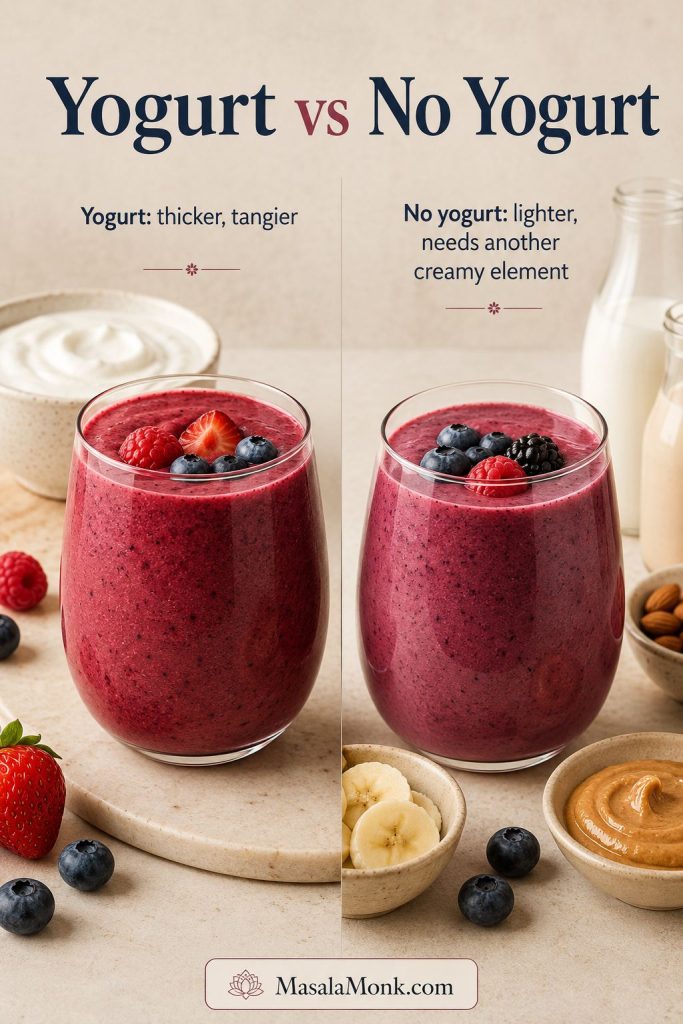
Yogurt and no-yogurt berry smoothies compared, with Greek yogurt on one side and dairy-free creamy ingredients on the other.
Yogurt gives a berry smoothie easy thickness and tang. However, a berry smoothie without yogurt can still work when banana, oats, chia, nut butter, or coconut yogurt replace the creaminess.

Should You Add Ice?

Use frozen berries instead of ice whenever possible. Frozen berries chill the smoothie while keeping the flavor full. Ice can help when you are using fresh fruit, but too much can make the drink taste diluted.

Add ice only when you are using fresh berries and need the smoothie to be colder or thicker. Start with a small handful, not a full cup.

Best Liquids to Use

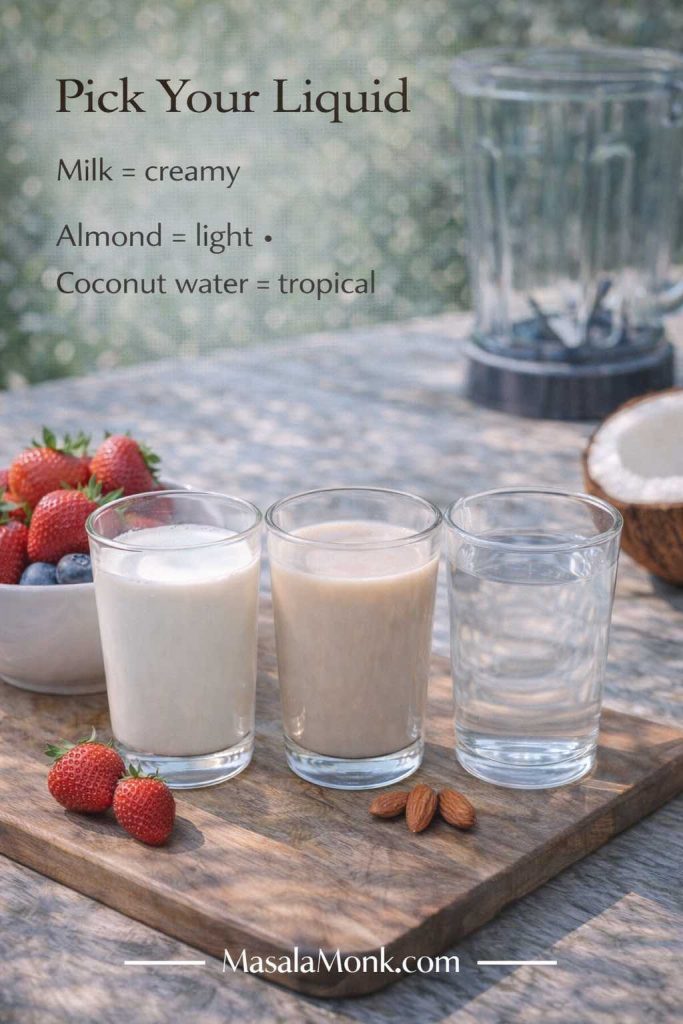
Your liquid sets the mood of the glass. Milk and oat milk make the smoothie rounder, almond milk keeps it lighter, coconut water feels more refreshing, and juice pushes it sweeter.
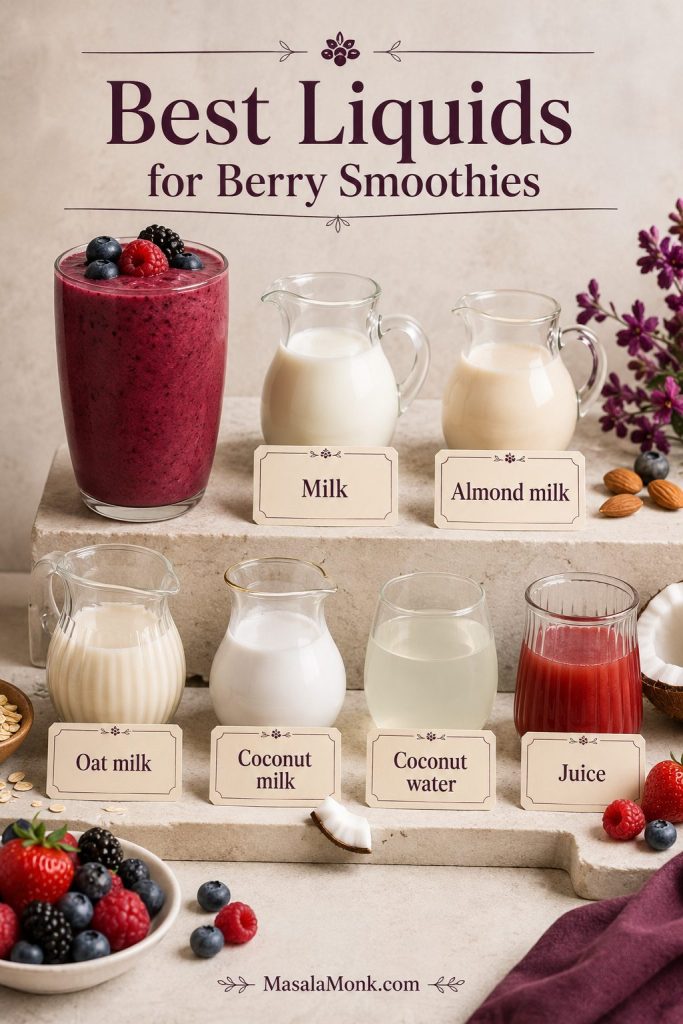
Liquid chooser guide for berry smoothies showing milk, almond milk, oat milk, coconut milk, coconut water, and juice.
The liquid changes the whole smoothie. Milk and oat milk taste creamier, almond milk stays lighter, coconut water feels refreshing, and juice makes the blend sweeter.
Liquid Best For Watch Out For
Milk Creamy classic berry smoothie Can feel heavier with yogurt
Almond milk Light dairy-free smoothie Less creamy than dairy milk
Oat milk Creamier dairy-free smoothie Can soften the bright berry flavor
Coconut milk Rich dairy-free smoothie Can taste coconut-forward
Coconut water Refreshing lighter smoothie Thinner, less creamy texture
Orange or apple juice Sweeter fruit smoothie Can become too sweet quickly
Cranberry juice Tart berry-forward smoothie May need banana or honey
Water Emergency low-calorie option Can taste thin or flat

If you are unsure, start with milk for creaminess or almond milk for a lighter dairy-free version. Use juice only when the berries are very tart, because it can quickly push the smoothie into sweeter, dessert-like territory. If coconut milk is your usual smoothie base, this guide to coconut milk nutrition and glycemic impact is a useful deeper read.

Optional Add-Ins

Think of these as small levers, not a shopping list. Add one or two at a time so the berries still taste like the main event.
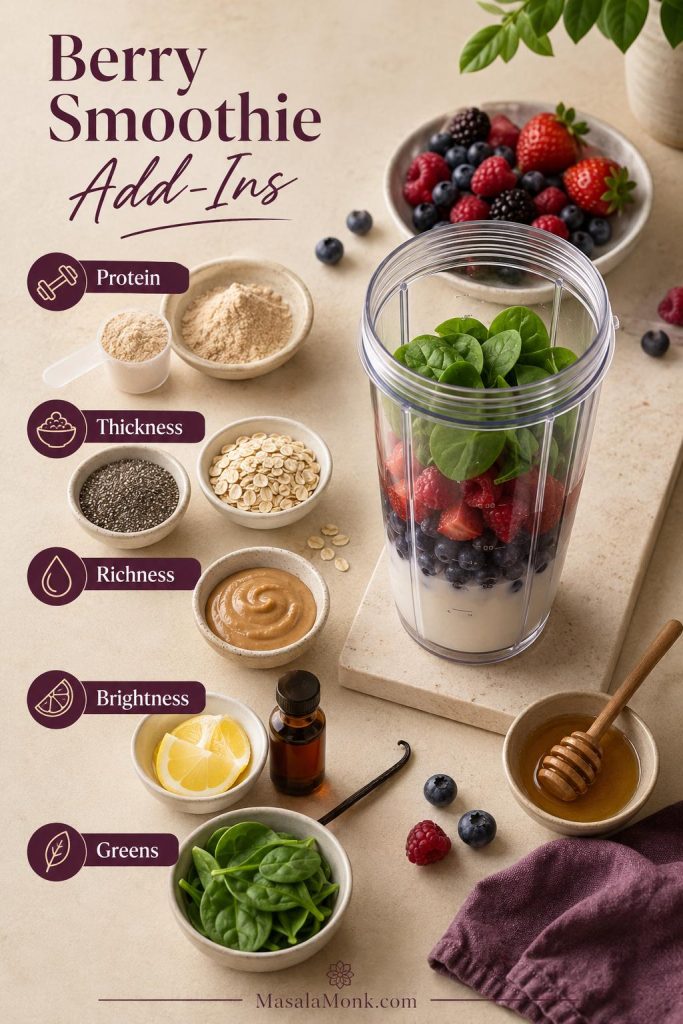
Berry smoothie add-ins guide showing protein powder, chia, oats, nut butter, spinach, lemon, vanilla, and sweetener.
Add-ins should solve a problem, not clutter the blender. Use chia or oats for thickness, protein powder for fullness, lemon for brightness, and nut butter for richness.
  • Protein powder: use 1 scoop and add extra liquid if needed.
  • Chia seeds: add 1 teaspoon to 1 tablespoon for thickness and texture.
  • Oats: add 1 to 2 tablespoons for a breakfast smoothie feel. If you are choosing between rolled, quick, instant, or steel-cut oats, this guide to oats types, nutrition, and differences explains how each one behaves.
  • Nut butter: add 1 tablespoon for richness. For more nut-based smoothie ideas, these nut-infused smoothie recipes are a natural next read.
  • Spinach: add 1 cup baby spinach for a smoothie that still tastes mostly like berries.
  • Lemon juice: add 1 teaspoon to brighten a dull smoothie.
  • Vanilla: add 1/4 teaspoon for a softer, dessert-like flavor.
  • Honey, maple syrup, or dates: use only if the berries are tart.
  • Tiny pinch of salt: useful when the smoothie tastes flat rather than fruity.

Start with the base smoothie, then add one thing for the job you need: oats for breakfast fullness, chia for thickness, nut butter for richness, or protein powder for a more filling drink.

Equipment

You do not need complicated equipment, but the blender and ingredient order matter more than people think.
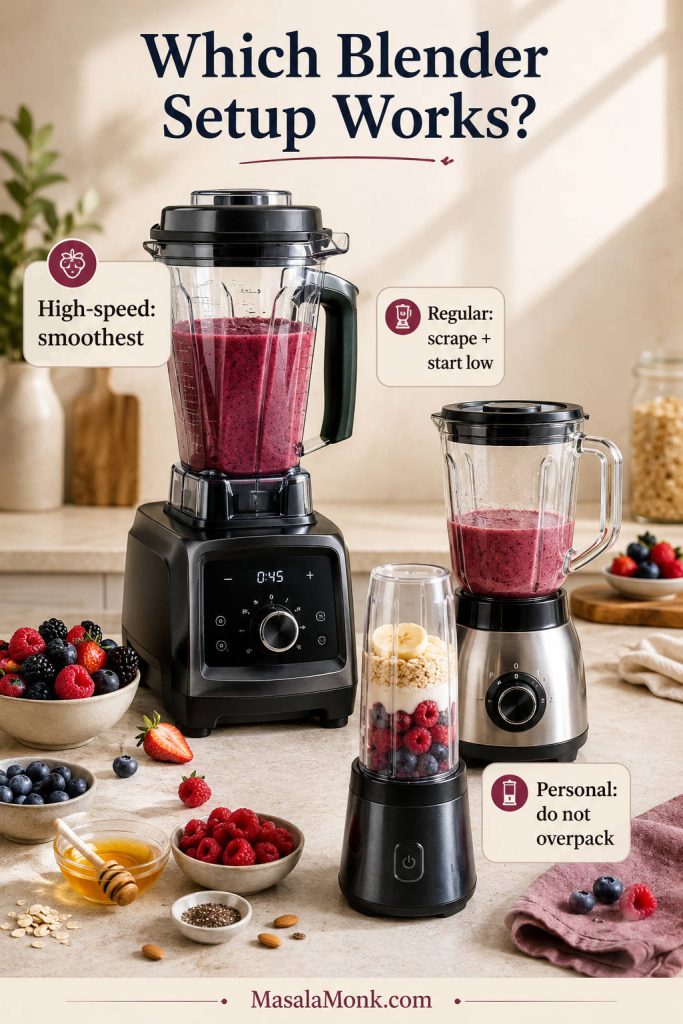
Blender setup guide showing high-speed, regular, and personal blenders for making berry smoothies.
A high-speed blender makes the smoothest berry smoothie, but a regular or personal blender can still work well when you load it carefully and avoid overpacking.
  • Blender: A high-speed blender gives the smoothest texture, especially with frozen berries and frozen banana.
  • Regular blender: Works well if you add liquid first, use sliced banana, pause to scrape, and add liquid slowly.
  • Personal blender: Good for single servings, but avoid overfilling the cup with frozen fruit.
  • Spatula: Helpful for thick frozen blends and smoothie bowls.
  • Tamper: Useful for smoothie bowls because they use very little liquid.
  • Measuring cups and spoons: Helpful because smoothies are ratio-sensitive.

A regular blender can still make a good smoothie. Add the liquid first, avoid overpacking the jar with frozen fruit, and pause to scrape before adding extra liquid.

For a personal blender, do not pack the cup too tightly with frozen fruit. Add liquid first, then yogurt or banana, then berries, and leave enough headspace for the mixture to move.

For the full blending sequence, see how to make a berry smoothie.

Personal Blender Loading Order

Use this loading order when you are making a single-serving smoothie in a cup-style blender.
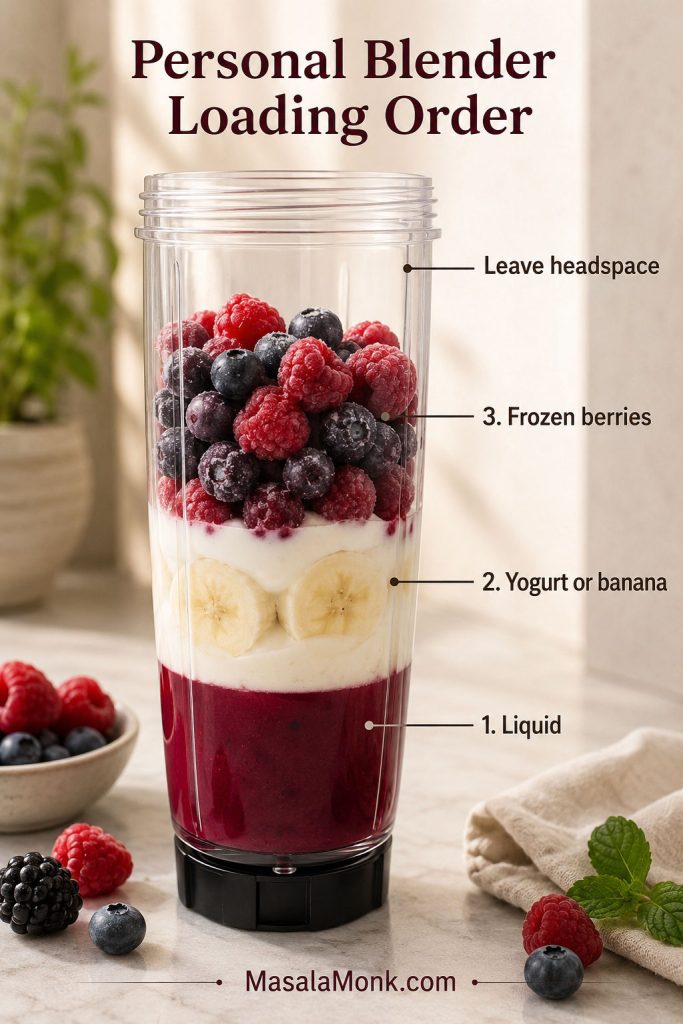
Personal blender cup showing smoothie layers with liquid first, yogurt or banana next, frozen berries on top, and headspace.
A personal blender works best when the blades can pull softer ingredients through the frozen fruit. Leave space at the top so the mixture can actually circulate.

How to Make a Berry Smoothie

The method is simple, but this is where most watery smoothies are either prevented or created: the order and the liquid amount matter.
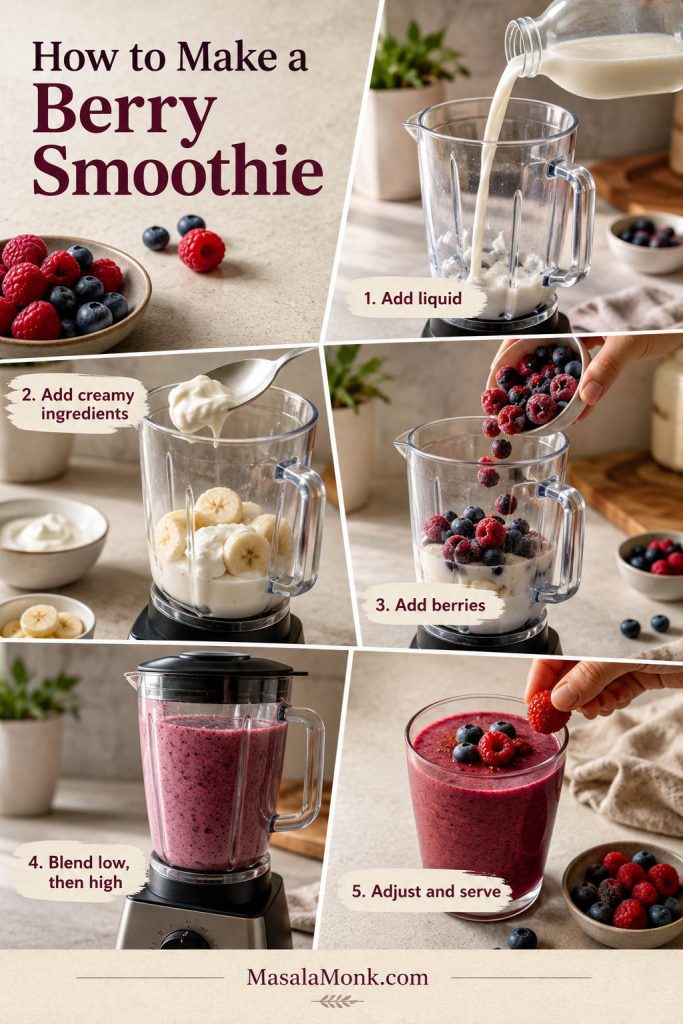
Step-by-step berry smoothie process showing liquid, creamy ingredients, frozen berries, blending, and serving.
A smoother blend starts before you press the button. Build the jar from easy-to-move ingredients to frozen fruit so the smoothie thickens without stalling.
  1. Add the liquid first. Pour milk, almond milk, oat milk, coconut water, or juice into the blender jar.
  2. Add the creamy ingredients. Add yogurt, banana, nut butter, oats, chia, or protein powder.
  3. Add the berries last. Frozen berries should sit on top so the blender can pull liquid through the softer ingredients first.
  4. Blend low, then high. Start on low speed to break up the frozen fruit, then increase to high until smooth.
  5. Adjust slowly. If the blender stalls, add more liquid 1 tablespoon / 15 ml at a time.
  6. Serve right away. Berry smoothies are best cold, thick, and freshly blended.

Regular blender tip: If the blender struggles, stop and scrape before adding more liquid. Add just enough liquid to get the blades moving, then let the blender do the work.

Berry Smoothie Texture Guide

Use this visual checkpoint before changing the recipe. First decide whether the smoothie is too thin, just right, or too thick to blend.
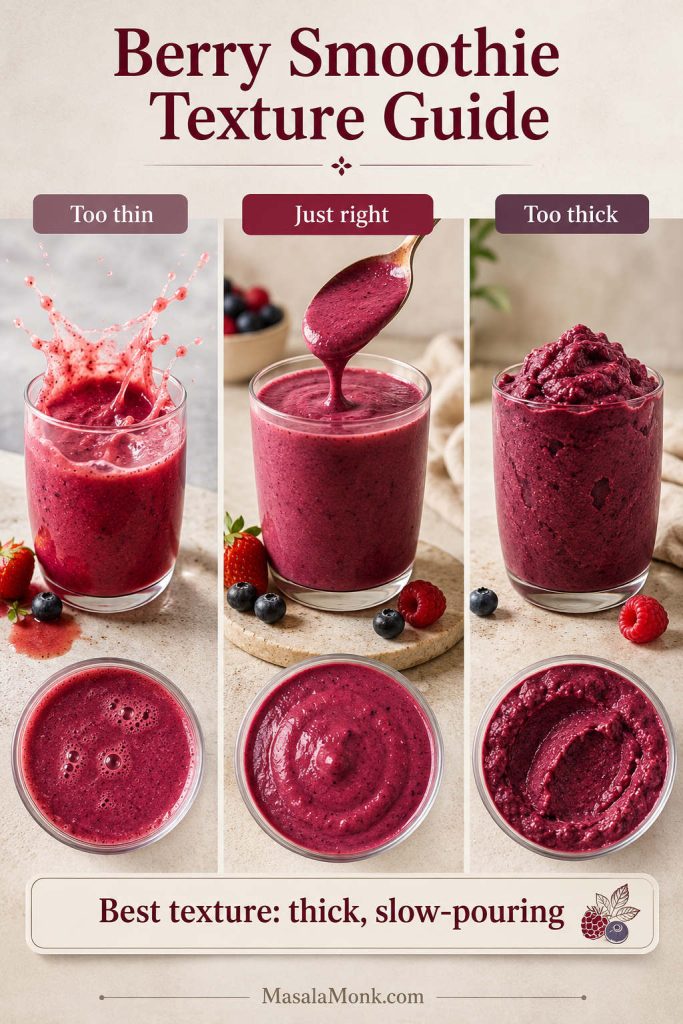
Berry smoothie texture guide showing too thin, just right, and too thick smoothie textures.
Texture tells you what to fix. A thin smoothie needs more frozen fruit, while a stuck smoothie needs liquid added slowly until it becomes thick and pourable.

Smoothie Ratio Guide

Use this guide when you know the texture you want but are not sure how much liquid, fruit, or creaminess to use. A drinkable smoothie needs more liquid than a smoothie bowl. A protein smoothie often needs extra liquid because powder, oats, and chia thicken as they blend.

Choose Your Smoothie Texture

Start by deciding whether you want a lighter sip, a thick drinkable smoothie, a protein version, or a spoonable bowl. That choice tells you whether to loosen the blend or keep the liquid low.
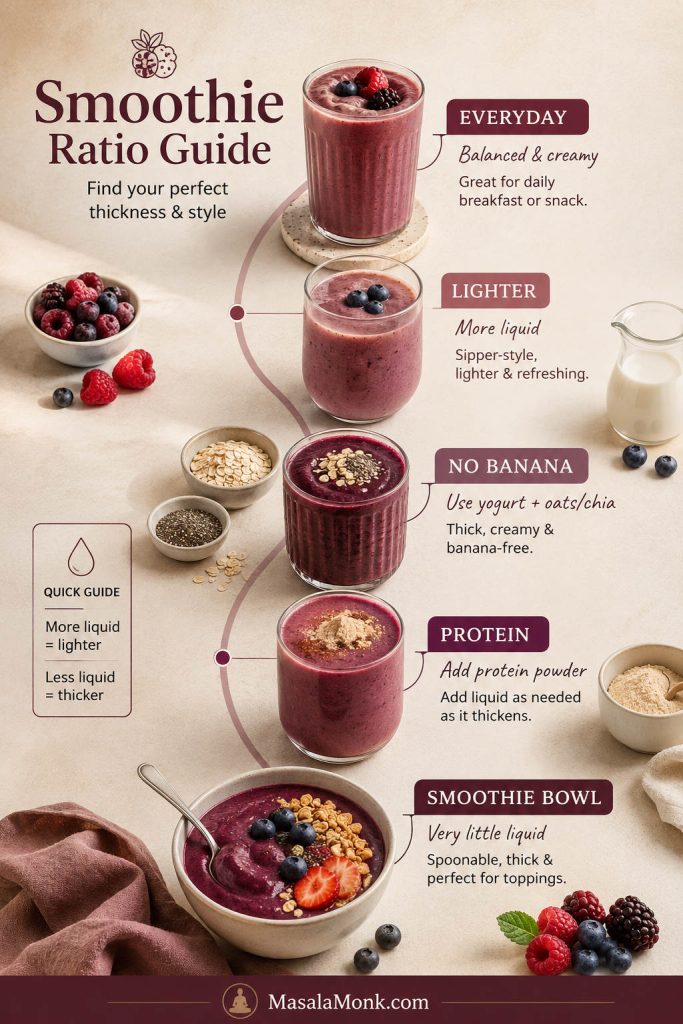
Smoothie ratio guide showing everyday, lighter, no banana, protein, and smoothie bowl versions.
The same berry base can shift into different smoothie styles. More liquid makes it lighter, less liquid makes it thicker, and extra creamy ingredients help no-banana or protein versions work.

Berry Smoothie Ratios by Style

Use the table as a practical starting point, then adjust after the first blend.

Style Berries Creamy Ingredient Liquid Best For
Thick drinkable smoothie 1 1/2 cups / 225 g frozen berries 1/2 banana + 1/2 cup / 120 g yogurt 1/2 cup / 120 ml to start Best everyday version
Lighter smoothie 1 cup / 150 g berries 1/4 to 1/2 cup yogurt 3/4 to 1 cup / 180–240 ml Thinner, easier to sip
No-banana smoothie 1 1/2 cups / 225 g frozen berries 1/2 cup / 120 g Greek yogurt + oats or chia 1/2 to 3/4 cup / 120–180 ml Berry-forward flavor
No-yogurt smoothie 1 1/2 cups / 225 g frozen berries 1 medium banana or 1 tbsp almond butter 1/2 to 3/4 cup / 120–180 ml Dairy-free option
No banana + no yogurt 1 1/2 cups / 225 g frozen berries 1 tbsp almond butter + 1 tbsp oats or chia 1/2 to 3/4 cup / 120–180 ml Vegan-style berry smoothie
Protein smoothie 1 to 1 1/2 cups berries Greek yogurt or 1 scoop protein powder 3/4 to 1 cup / 180–240 ml Breakfast or post-workout
Smoothie bowl 1 heaping cup frozen berries 1 frozen banana 2 to 5 tbsp / 30–75 ml Thick spoonable bowl

Think of this as a starting point, not a rulebook. Your berries, blender, and yogurt will vary a little, so the first blend is just the beginning. Blend once, taste once, then make one small adjustment at a time.

Once you know the texture you want, jump to the recipe card or check the quick smoothie fixes if your first blend needs adjusting.

Mixed Berry Smoothie

A mixed berry smoothie is the easiest “open the freezer and make something good” version because a frozen berry bag already gives you sweetness, tartness, color, and aroma. Strawberries add body, blueberries soften the flavor, raspberries brighten it, and blackberries make it deeper.
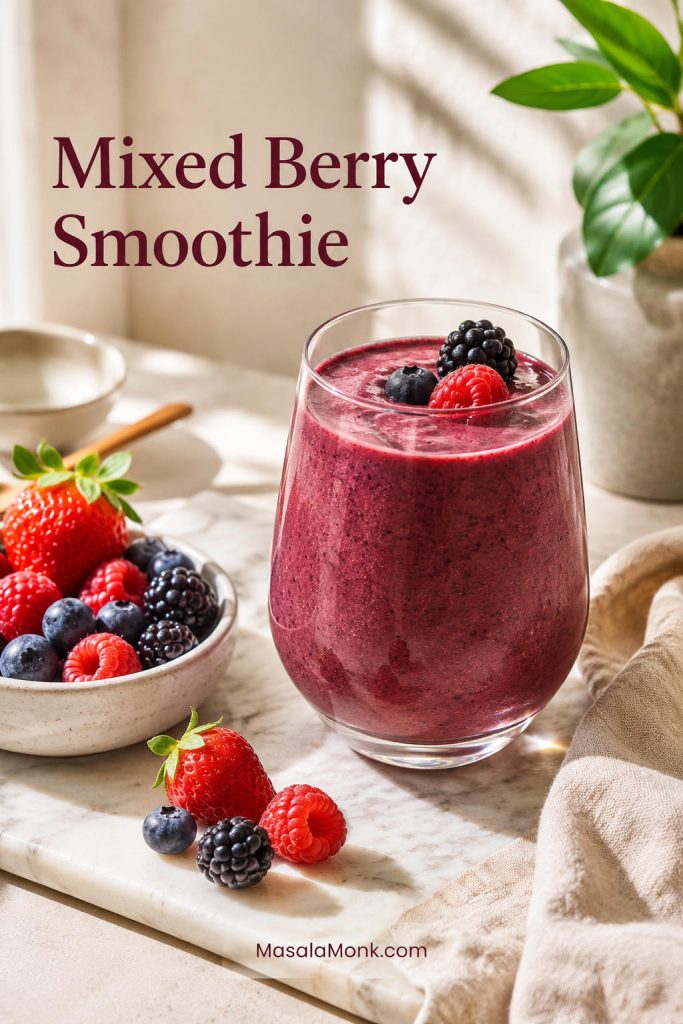
Mixed berry smoothie in a glass with strawberries, blueberries, raspberries, and blackberries nearby.
A mixed berry smoothie is the easiest everyday version because one frozen berry blend gives sweetness, tartness, color, and depth without needing extra steps.
  • 1 1/2 cups frozen mixed berries, about 225 g / 8 oz
  • 1/2 banana, about 55–60 g
  • 1/2 cup Greek yogurt or plain yogurt, about 120 g / 4 oz
  • 1/2 cup milk or almond milk, 120 ml / 4 fl oz
  • 1 teaspoon honey or maple syrup, only if needed

It is the easiest everyday blend for breakfast, snack time, or a quick cold drink when you want the berries to do most of the work.

Frozen Berry Smoothie

This is the freezer-bag version for the coldest, thickest smoothie without adding ice. Use the berries straight from the freezer so the drink stays frosty and berry-forward instead of thin and diluted.
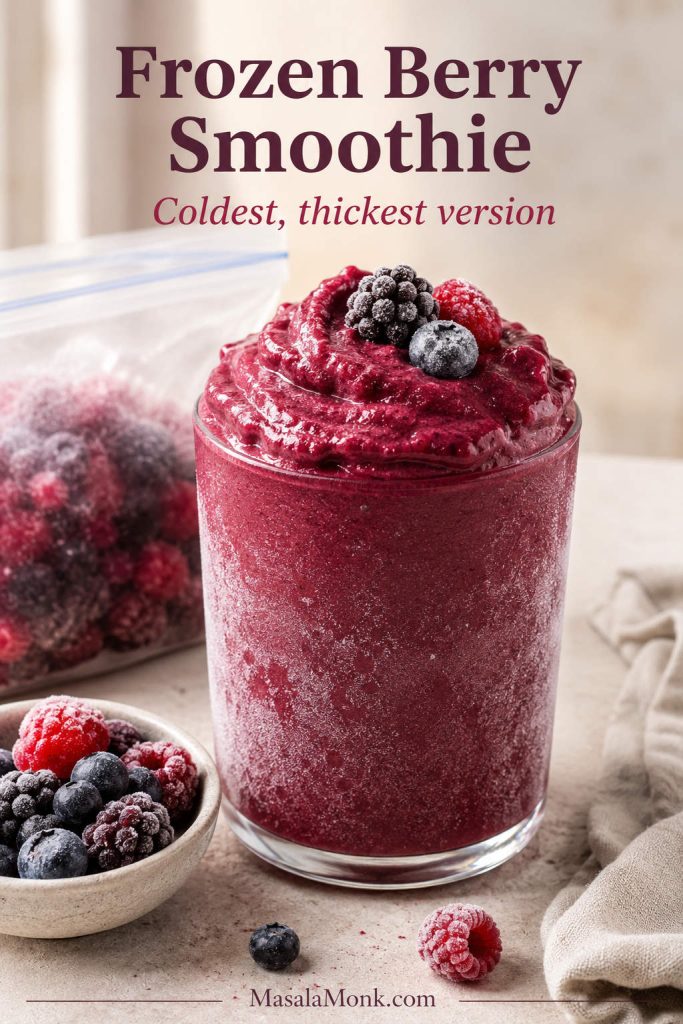
Frozen berry smoothie with frosty glass, frozen mixed berries, and a thick cold texture.
This is the freezer-bag version for maximum cold texture. Because the berries are already frozen, you get a frosty smoothie without leaning on extra ice.

For 1 1/2 cups / 225 g frozen berries, 1/2 cup / 120 ml liquid gives you a thick, slow-pouring start. Scrape once before loosening the blend.

Texture rule: More frozen fruit makes the smoothie thicker. More liquid makes it thinner. Start thick, then loosen it slowly.

Strawberry Banana Berry Smoothie

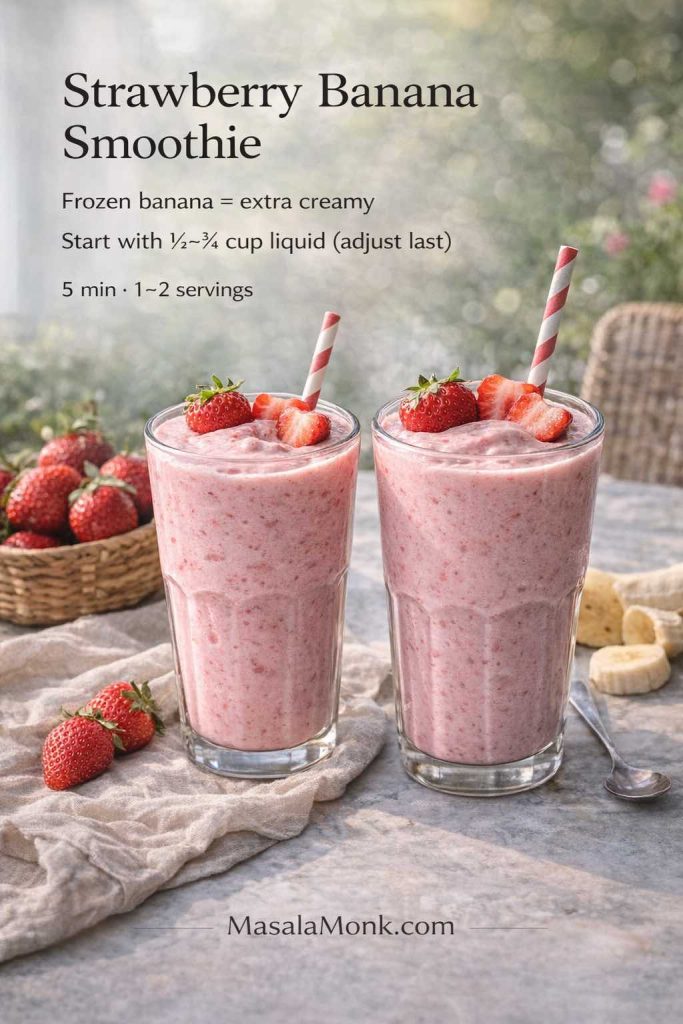
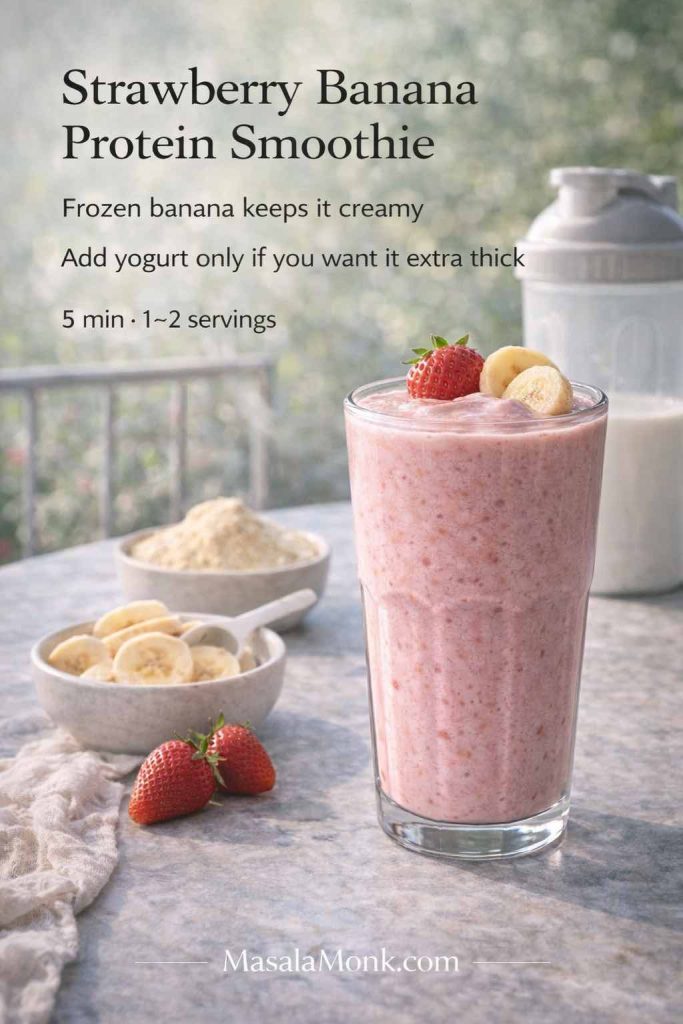
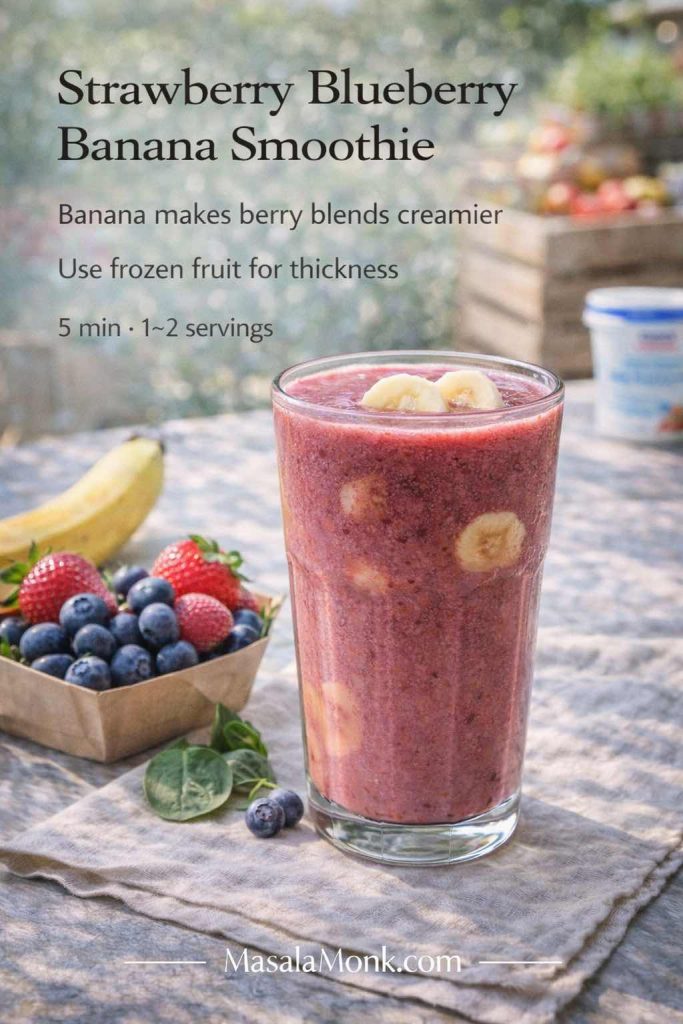
Strawberry banana is the classic smoothie flavor because banana makes strawberries taste sweeter and creamier. To keep it berry-forward, use more strawberries than banana and add a small handful of mixed berries for depth.
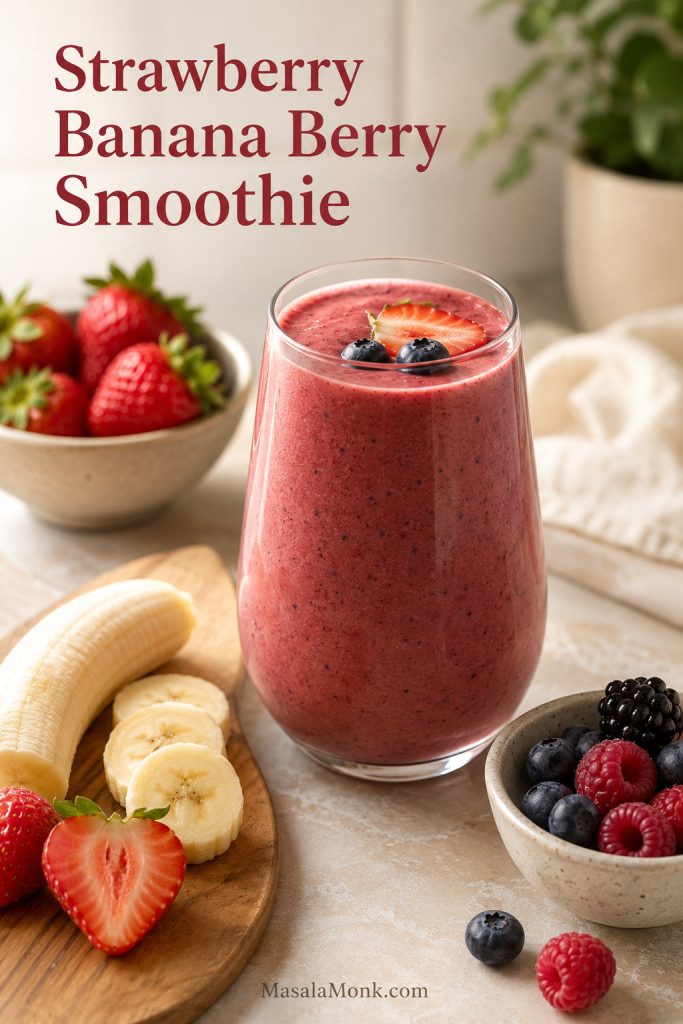
Strawberry banana berry smoothie with strawberries, banana slices, and mixed berries on a light breakfast surface.
Strawberry banana tastes soft and familiar, but extra berries keep the smoothie from becoming too banana-heavy. That balance gives you creaminess and real berry flavor together.
  • 1 cup frozen strawberries, about 150 g
  • 1/2 cup mixed berries, about 75 g
  • 1 small banana or 1/2 large banana, about 100–120 g peeled
  • 1/2 cup yogurt, about 120 g / 4 oz
  • 1/2 to 3/4 cup milk or almond milk, 120–180 ml

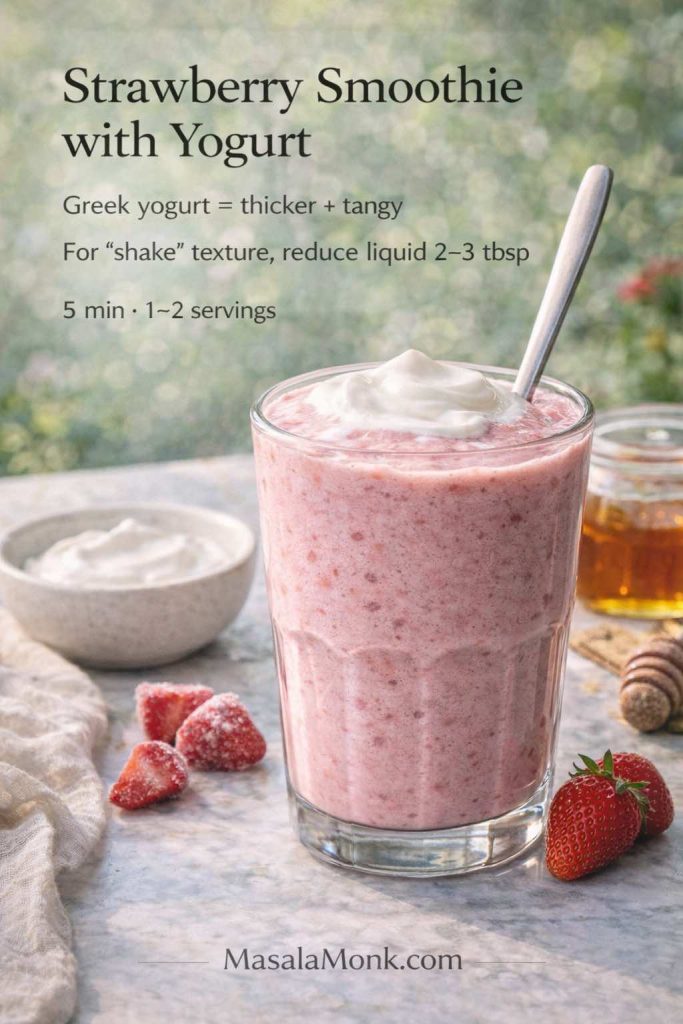
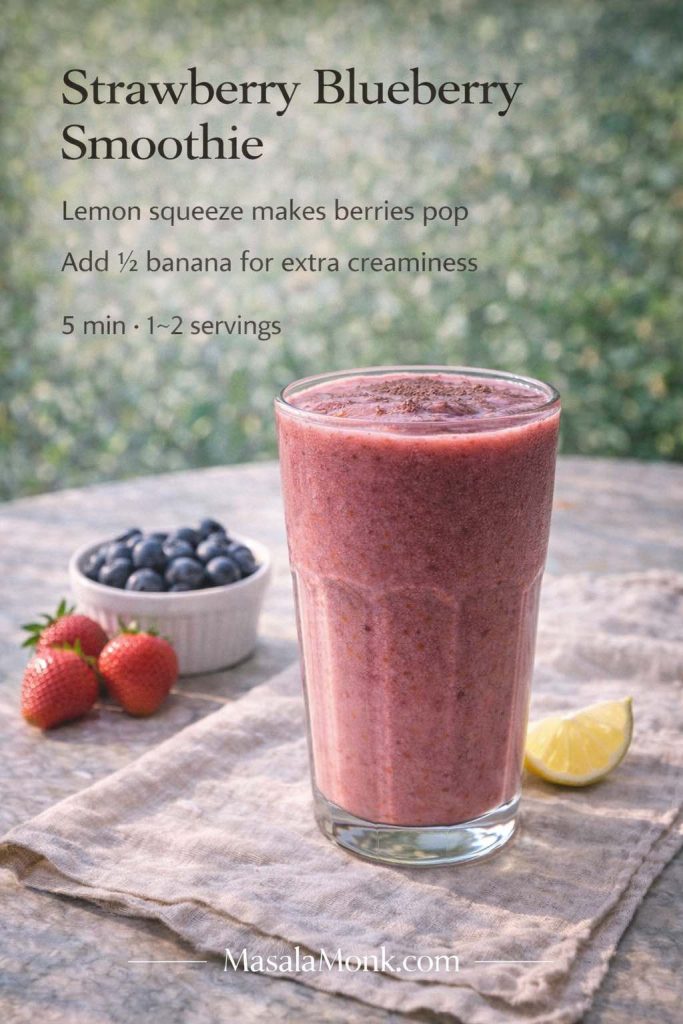
If you are leaning more toward strawberries than mixed berries, our strawberry smoothie recipes give you more ways to build that flavor.

Berry Smoothie Without Banana

You can make a thick smoothie without banana. This is the better version if you have ever made a berry smoothie and wondered why it mostly tasted like banana.

When you want the berries to stay sharp, bright, and clearly in charge, blend:
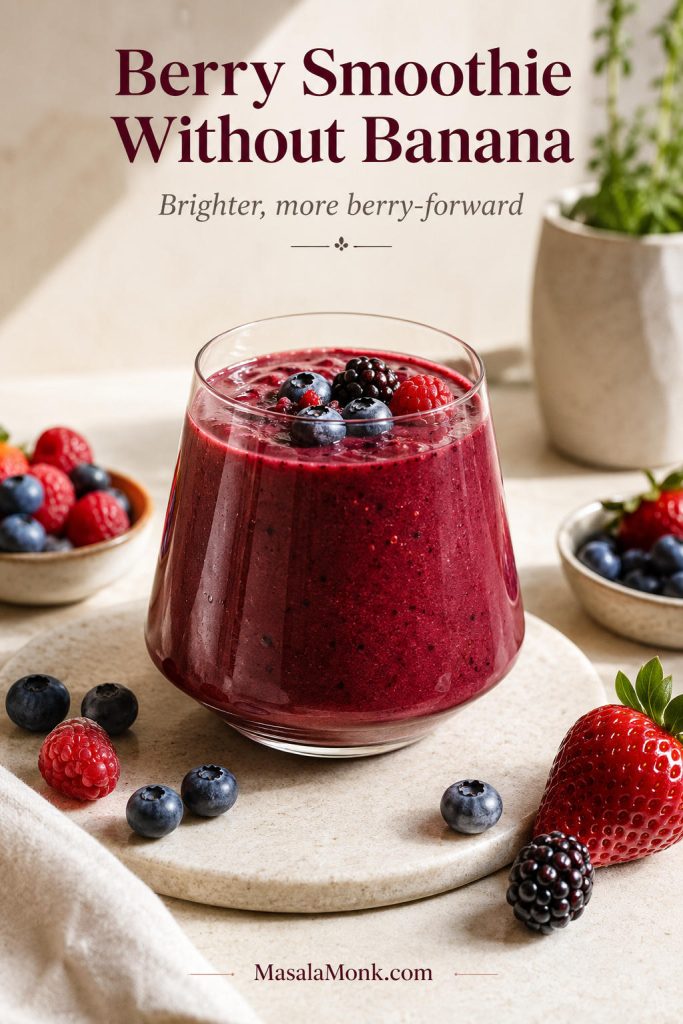
Berry smoothie without banana in a glass with mixed berries and a deeper berry-purple color.
For a berry smoothie without banana, build creaminess another way. Greek yogurt, oats, chia, nut butter, avocado, or extra frozen berries help keep the texture full.
  • 1 1/2 cups frozen berries, about 225 g / 8 oz
  • 1/2 cup Greek yogurt or coconut yogurt, about 120 g / 4 oz
  • 1 tablespoon almond butter, about 15–16 g, or 1 to 2 tablespoons oats
  • 1/2 to 3/4 cup milk, almond milk, or oat milk, 120–180 ml
  • 1 teaspoon honey or maple syrup, optional

The result is brighter, cleaner, and more berry-forward. It is especially good with sweet blueberries, strawberries, or a mixed berry blend that leans heavily on strawberries.

If you are also skipping yogurt, use the no banana + no yogurt version instead.

Berry Smoothie Without Yogurt

No yogurt in the fridge is not a problem. The goal is still creamy, not thin — just without the tang of yogurt.
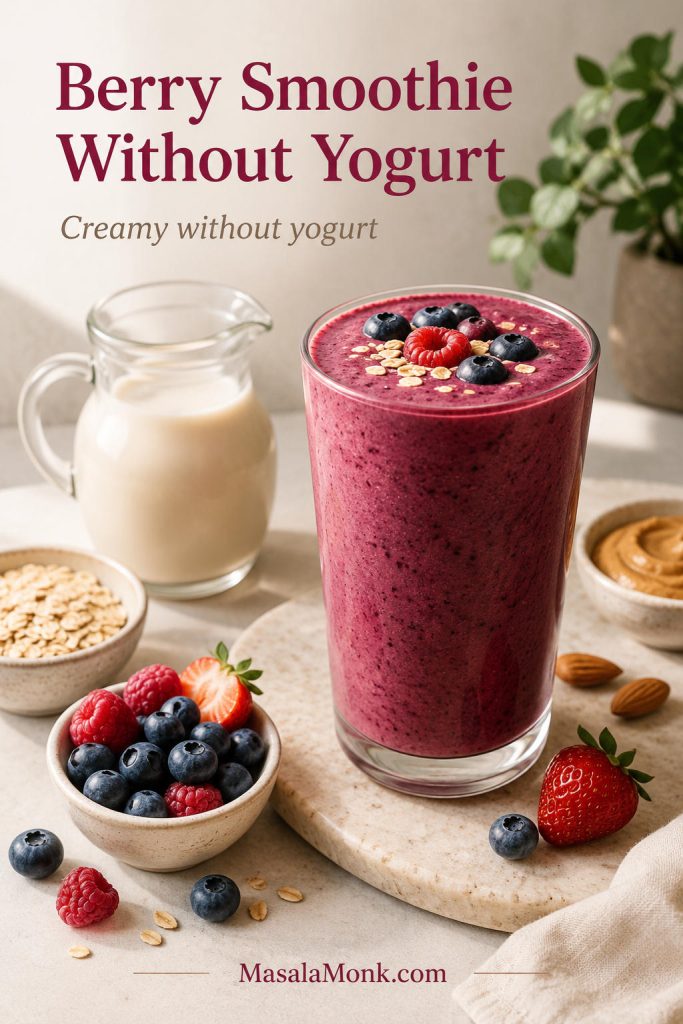
Berry smoothie without yogurt shown with plant milk, oats, nut butter, banana, and mixed berries.
A berry smoothie without yogurt should still feel creamy, not thin. Instead of yogurt, use banana, oats, chia, nut butter, avocado, or a creamier dairy-free milk.
  • 1 1/2 cups frozen berries, about 225 g / 8 oz
  • 1 medium banana, about 100–120 g peeled
  • 1/2 cup almond milk, oat milk, coconut milk, or dairy milk, 120 ml / 4 fl oz
  • 1 tablespoon chia, oats, or almond butter if you want more fullness
  • 1 teaspoon lemon juice, optional

For a dairy-free version, use almond milk, oat milk, or coconut milk. Coconut yogurt also works if you want the thickness of yogurt without dairy.

If you are skipping both yogurt and banana, jump to the no banana + no yogurt version.

Berry Smoothie Without Banana or Yogurt

This is the trickiest version because you are removing the two ingredients that usually make a berry smoothie soft and creamy. Almond butter gives richness, while oats or chia help the drink feel fuller without pushing the berries into the background.
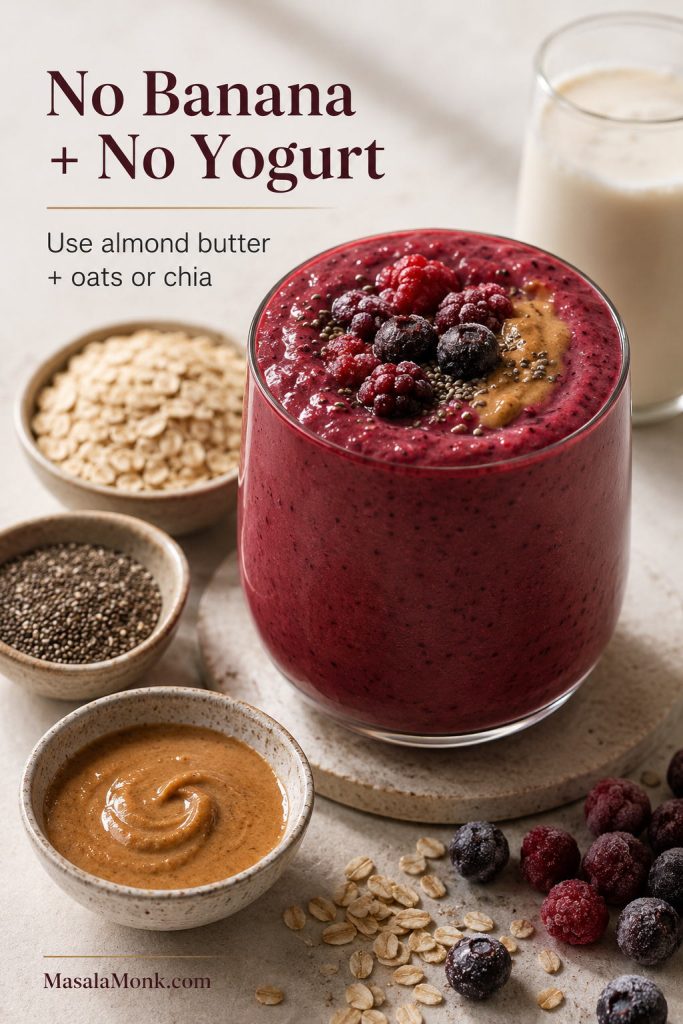
Berry smoothie without banana or yogurt shown with almond butter, oats, chia seeds, plant milk, and frozen berries.
Removing both banana and yogurt makes texture trickier. Almond butter adds richness, while oats or chia help this berry smoothie stay creamy without hiding the fruit.
  • 1 1/2 cups frozen berries, about 225 g / 8 oz
  • 1/2 to 3/4 cup almond milk or oat milk, 120–180 ml
  • 1 tablespoon almond butter, about 15–16 g
  • 1 tablespoon oats or chia seeds, about 6–12 g depending on which you use
  • 1 teaspoon honey, maple syrup, or 1 soft date, optional

If it tastes sharp instead of fruity, add a little more almond butter, a date, or a splash of sweeter liquid.

Berry Protein Smoothie

The best berry protein smoothie should still taste like berries, not like protein powder with fruit added to hide it. Greek yogurt, protein powder, milk, chia, and oats can all help, but the flavor should stay berry-first.
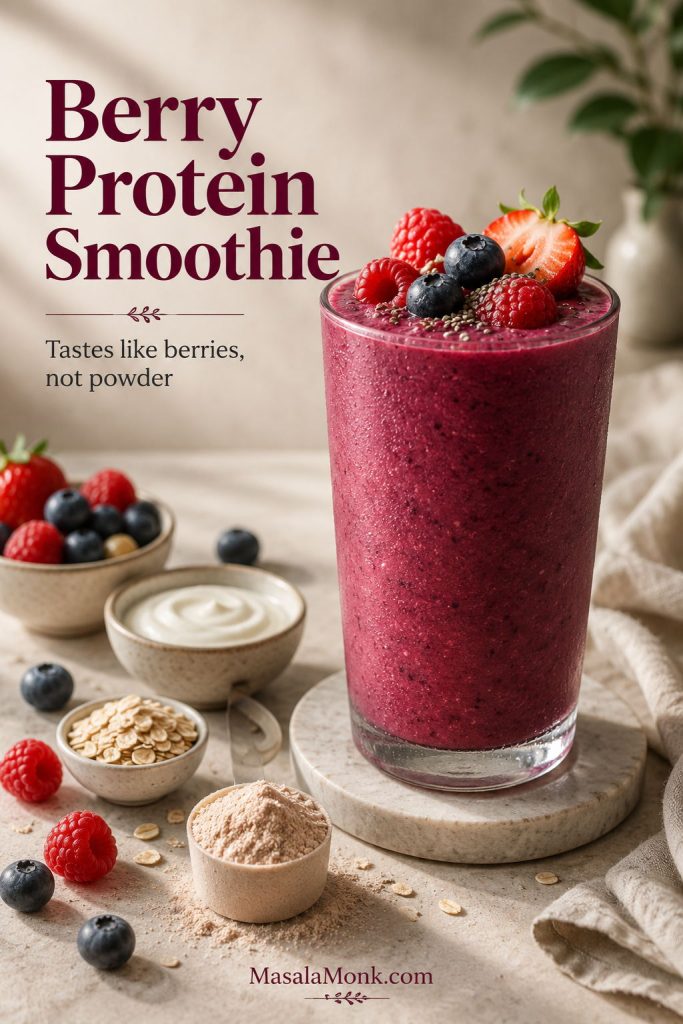
Berry protein smoothie with berries, yogurt, oats, chia, and a small scoop of protein powder.
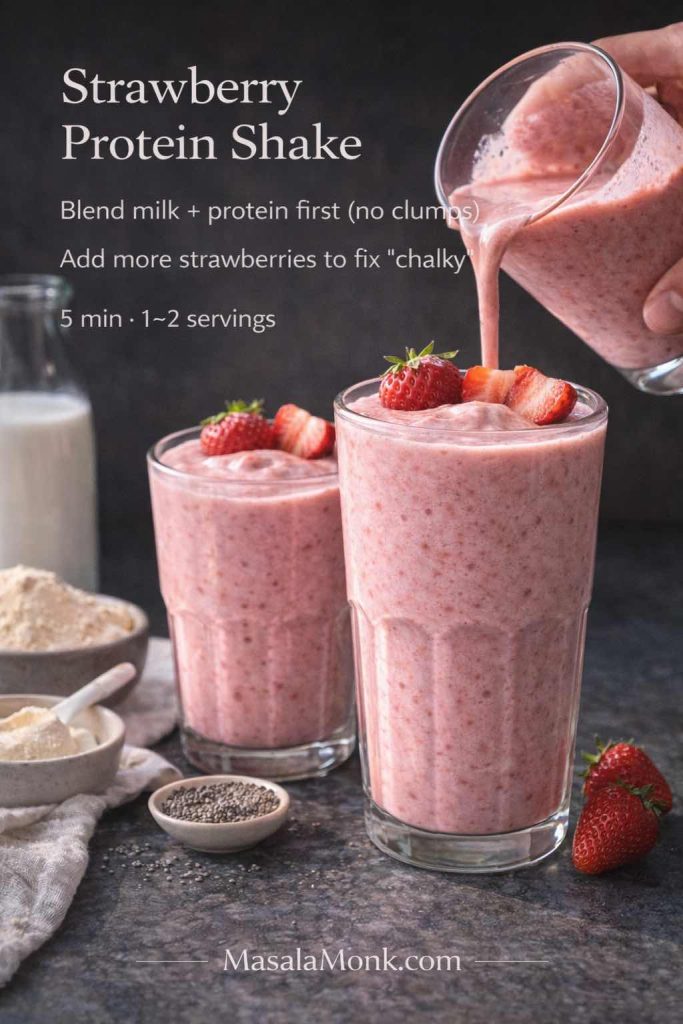
A berry protein smoothie should still taste like berries first. To avoid chalkiness, blend protein powder with enough liquid, yogurt, berries, or other creamy ingredients.
Protein Style Use This Liquid Adjustment
Greek yogurt protein smoothie 1/2 to 3/4 cup Greek yogurt Start with 1/2 cup milk
Protein powder smoothie 1 scoop vanilla or unflavored protein powder Use 3/4 cup liquid to start
High-fiber protein smoothie Greek yogurt + chia or oats Add liquid slowly because chia and oats thicken
No-powder protein smoothie Greek yogurt + milk + chia Keep texture creamy, not chalky

For a balanced berry protein smoothie, blend 1 1/2 cups / 225 g frozen berries, 1/2 banana / 55–60 g, 1/2 cup / 120 g Greek yogurt or 1 scoop protein powder, and 3/4 cup / 180 ml milk or almond milk.

Protein powder scoop sizes vary, so use the serving size on your package. Vanilla protein powder gives a softer, dessert-style flavor. Unflavored protein keeps the berries more noticeable, but it can taste chalkier if the smoothie is too thick. If that happens, loosen it with a little milk, then add a few extra berries or a spoon of yogurt to bring the flavor back.

For mornings when you want protein but prefer a warm spoonable breakfast, this high-protein oatmeal guide uses oats, yogurt, protein powder, seeds, and nut butter in a more filling bowl format.

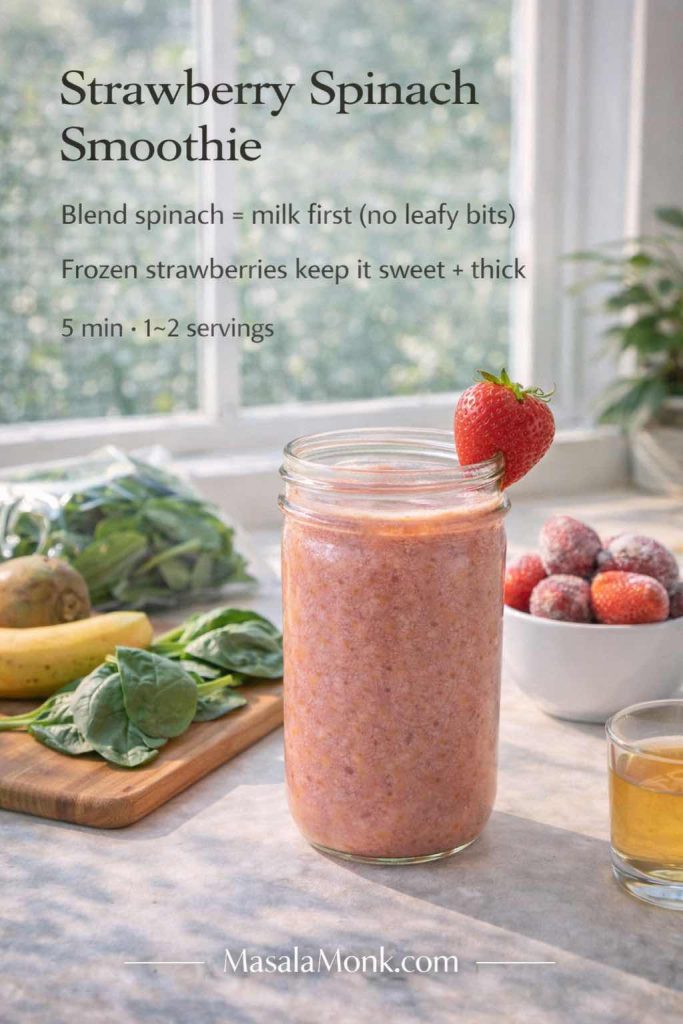
Spinach Berry Smoothie

This is the greens version for people who still want the smoothie to taste like berries. Baby spinach is milder than kale and blends more smoothly.
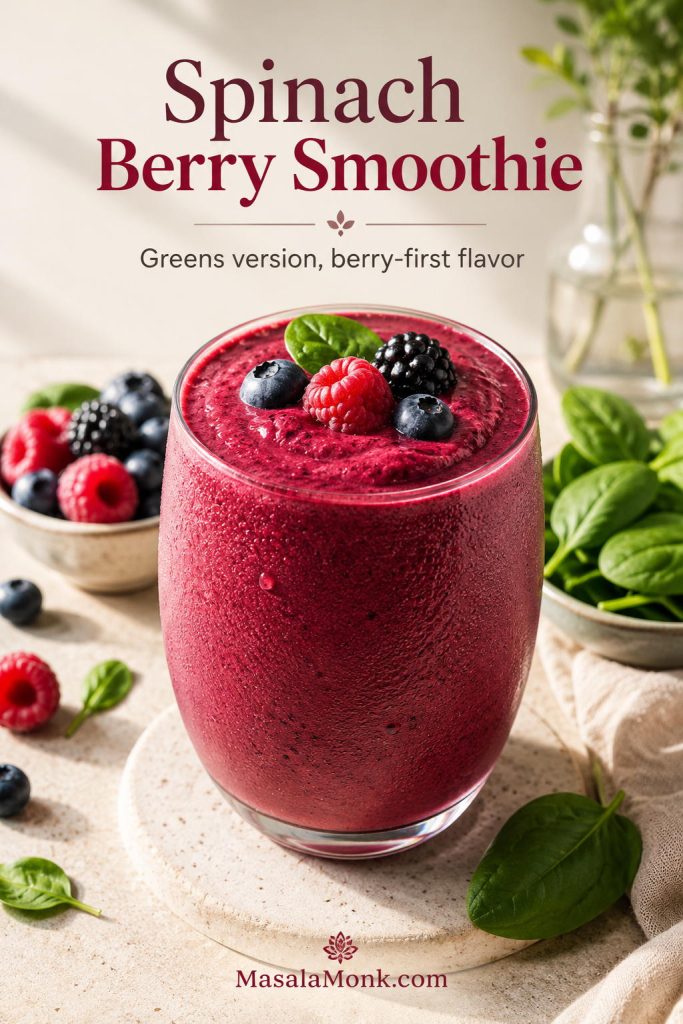
Spinach berry smoothie with baby spinach, blueberries, raspberries, blackberries, and a berry-colored smoothie.
Baby spinach works best when it supports the smoothie instead of taking over. Blend it with liquid first, then add berries so the flavor stays berry-led.

With enough berries, spinach should disappear into the background. Blend the spinach with the liquid first, then add the berries, banana or yogurt, and any add-ins.

  • 1 cup baby spinach, about 30 g
  • 1/2 to 3/4 cup milk or almond milk, 120–180 ml
  • 1 1/2 cups frozen berries, about 225 g / 8 oz
  • 1/2 banana / 55–60 g or 1/2 cup Greek yogurt / about 120 g
  • 1 teaspoon honey or maple syrup, optional

The berries should stay in charge of the flavor. If the smoothie tastes too green, add a little lemon juice, more berries, or half a banana.

Berry Smoothie Bowl

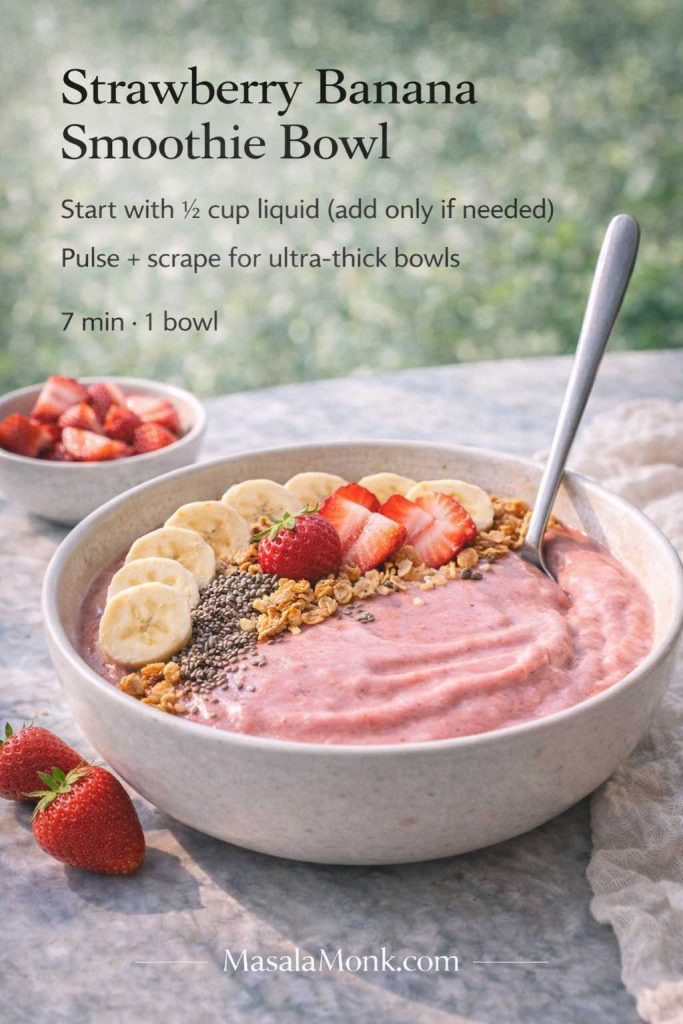
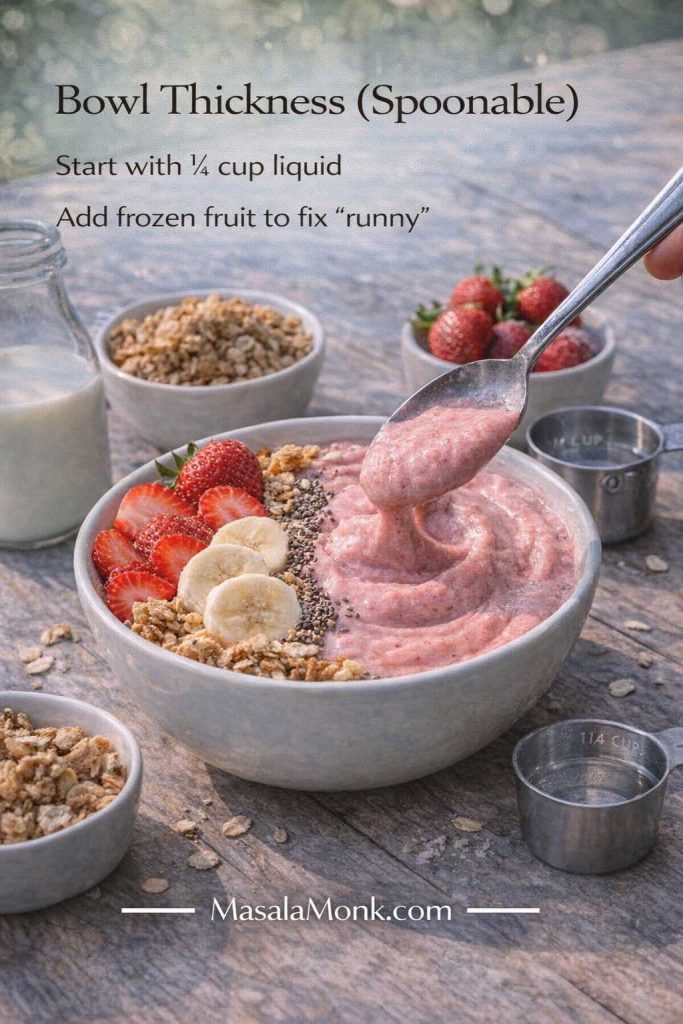
This is the version for mornings when you want a spoon, toppings, and something cold that still feels like breakfast. A berry smoothie bowl uses only a few tablespoons of liquid, so the texture lands closer to soft serve than a drink.
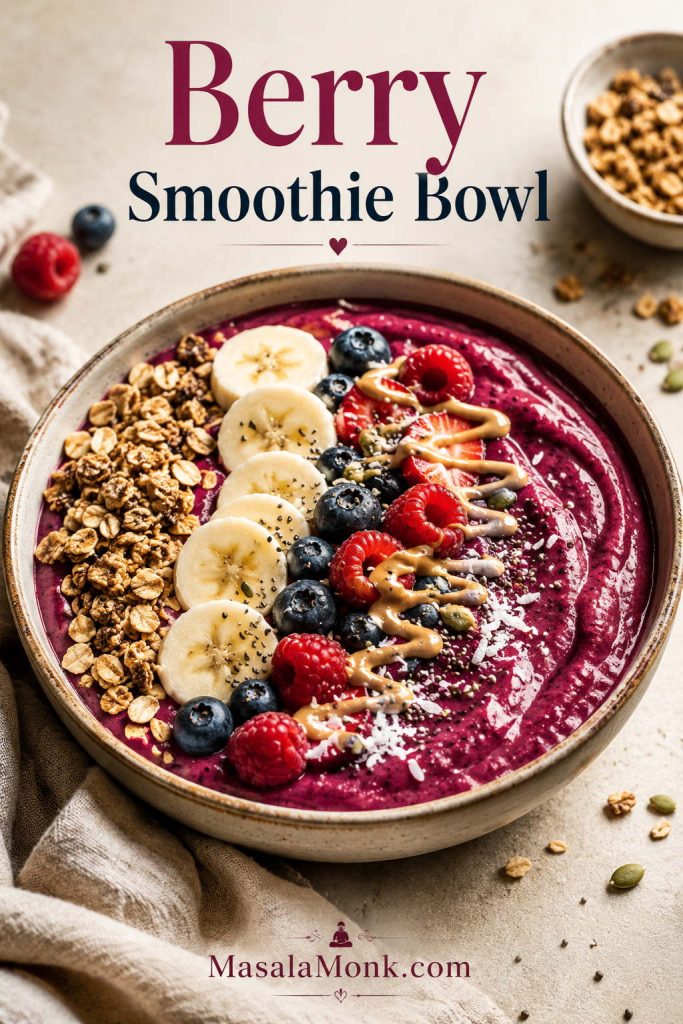
Thick berry smoothie bowl topped with granola, banana slices, berries, seeds, coconut, and nut butter drizzle.
A smoothie bowl should eat more like soft serve than a drink. When the base holds a spoon trail, it is ready for granola, berries, and seeds.
  • 1 heaping cup frozen berries, about 150–180 g
  • 1 frozen banana, about 100–120 g peeled
  • 2 to 5 tablespoons milk, almond milk, or oat milk, 30–75 ml
  • Optional: 1/2 scoop protein powder

Start with 2 tablespoons liquid and blend slowly, scraping down the sides as needed. The bowl is ready when it mounds on a spoon and the granola sits on top instead of sinking. If it pours like a drink, blend in more frozen fruit.

Best Smoothie Bowl Toppings

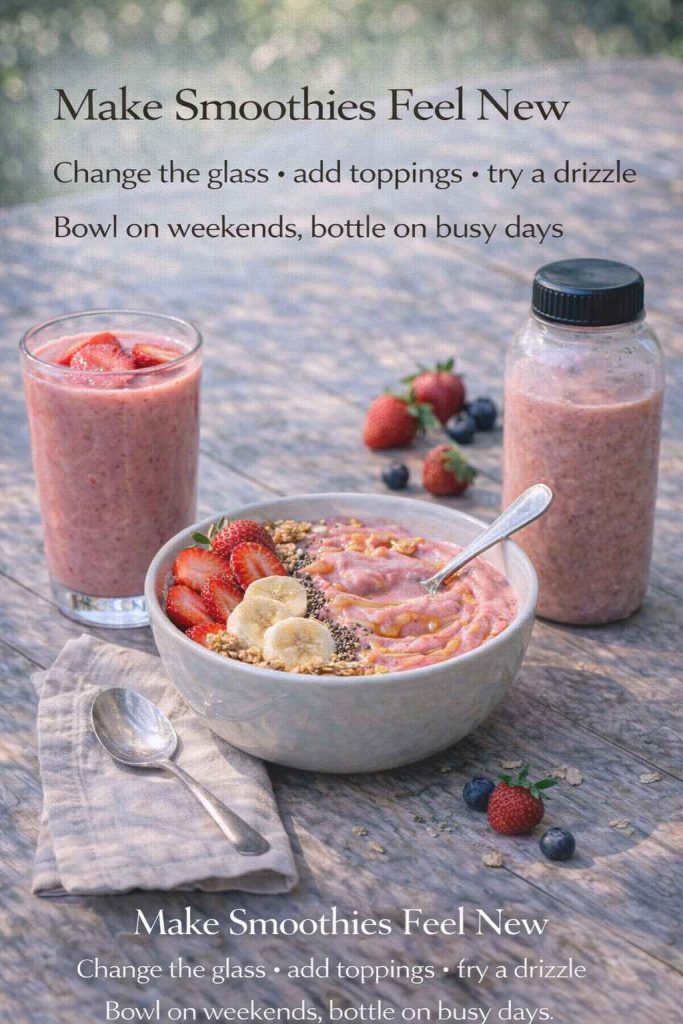
For crunch, add granola, coconut, chopped nuts, cacao nibs, or toasted seeds. A spoonful of homemade granola works especially well because it gives a thick smoothie bowl contrast instead of disappearing into the fruit. For freshness, add sliced banana or extra berries. For staying power, add chia, hemp seeds, peanut butter, almond butter, or a spoonful of Greek yogurt.
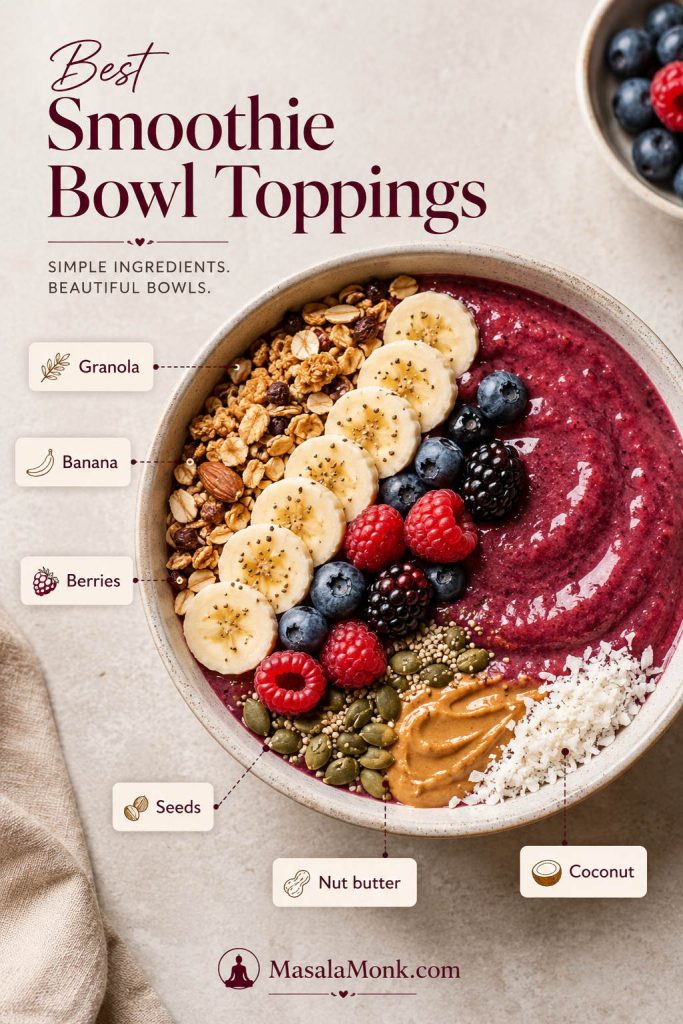
Smoothie bowl toppings guide showing granola, banana, berries, seeds, nut butter, and coconut on a berry smoothie bowl.
Smoothie bowl toppings should add more than decoration. Granola brings crunch, fruit adds freshness, seeds add texture, and nut butter makes the bowl more satisfying.

If your bowl turns pourable instead of spoonable, jump to the thin or thick smoothie fix.

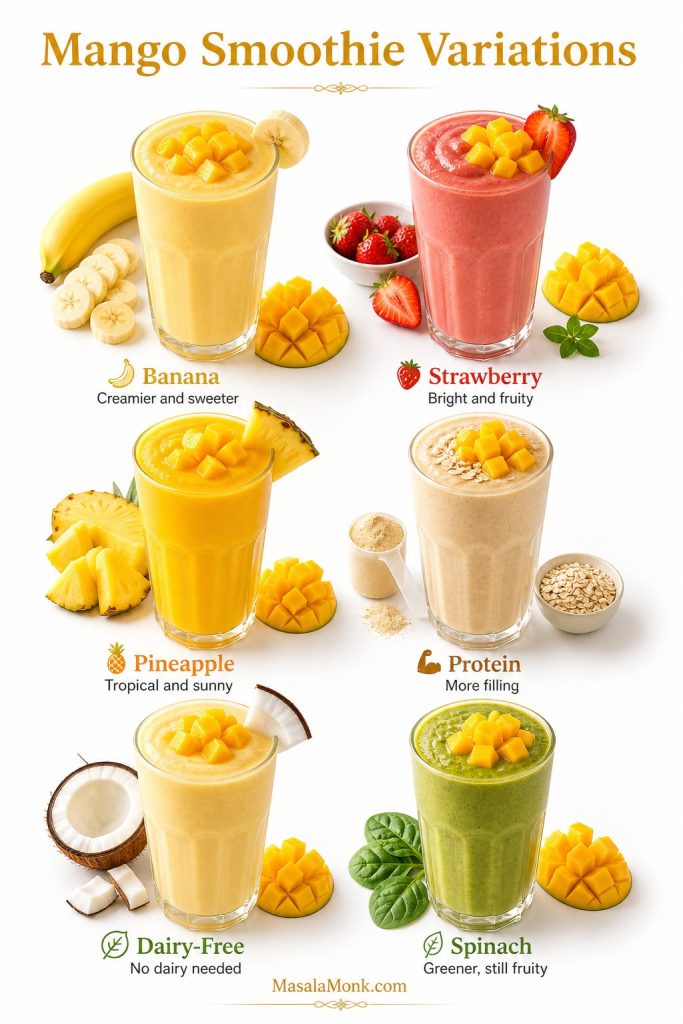
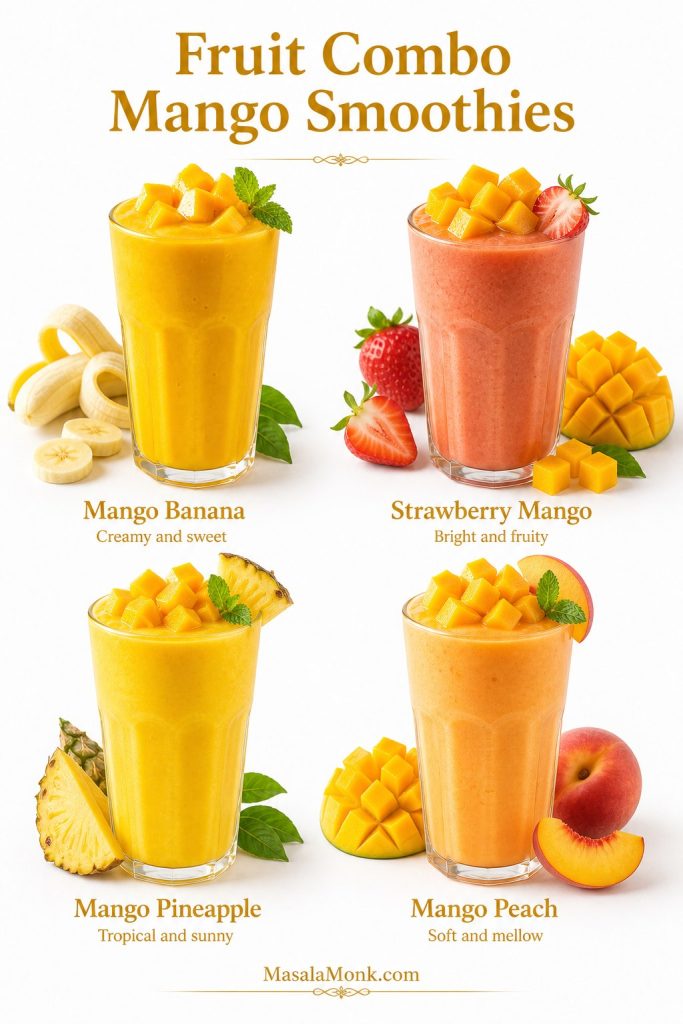
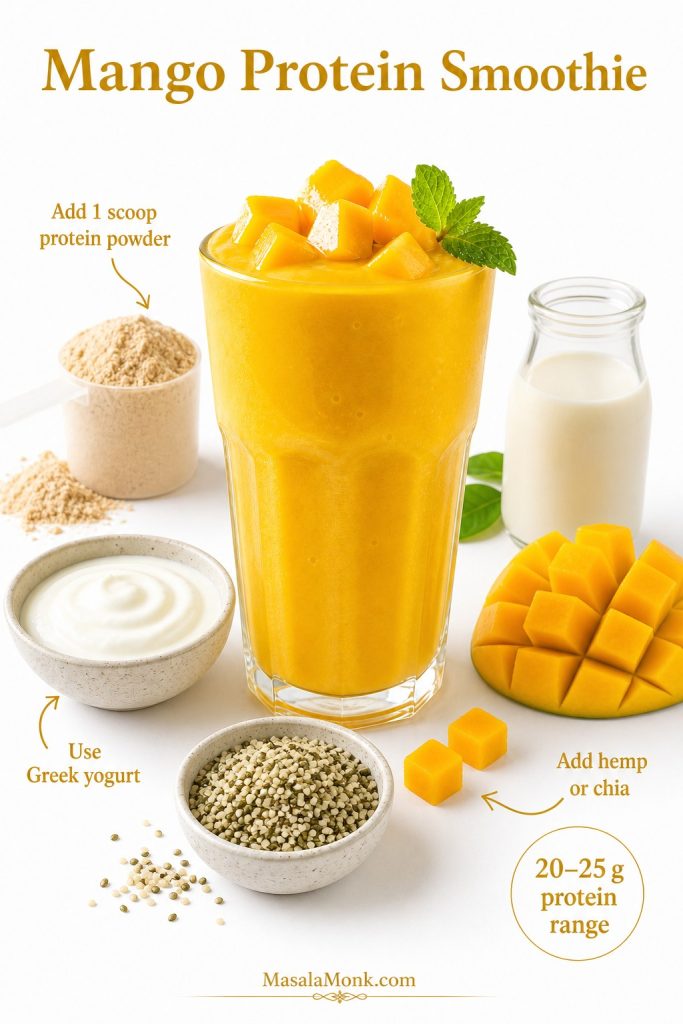
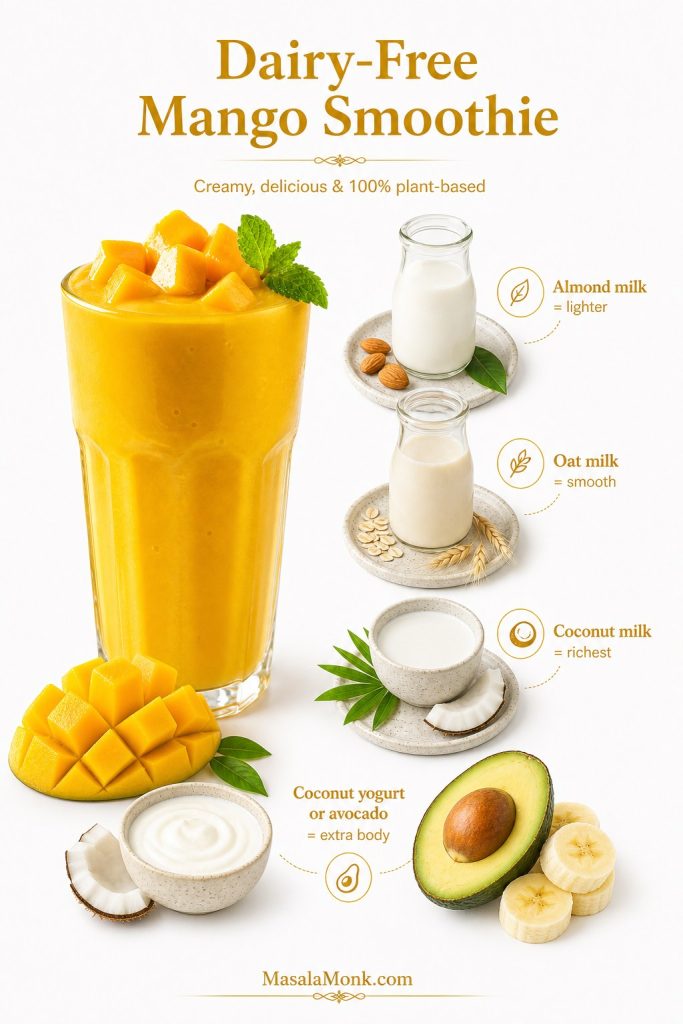
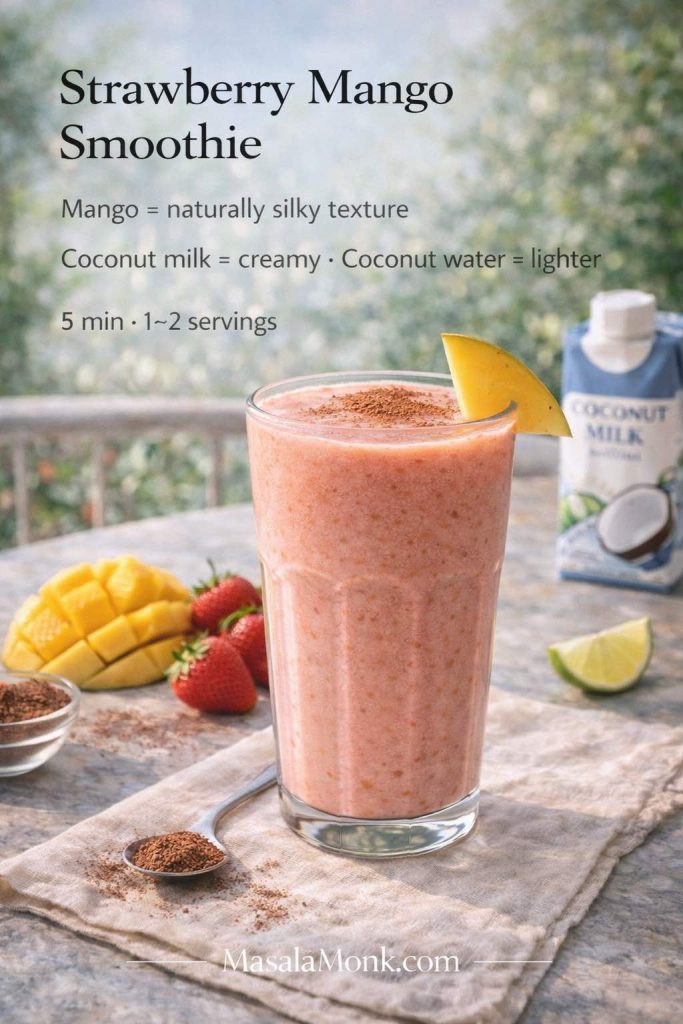
If you like brighter fruit smoothies, this berry base also pairs naturally with a mango smoothie recipe.

Berry Smoothie vs Smoothie Bowl vs Açai Bowl

A berry smoothie is built to sip from a glass. A smoothie bowl uses similar ingredients with much less liquid, so it becomes thick enough for a spoon.

An açai bowl is related, but it is a separate recipe. It usually starts with frozen açai puree or a frozen açai packet, frozen fruit, and very little liquid. If you want that deeper açai flavor with toppings like granola, banana, berries, coconut, and nut butter, follow an açai bowl recipe rather than simply adding more liquid to a smoothie.
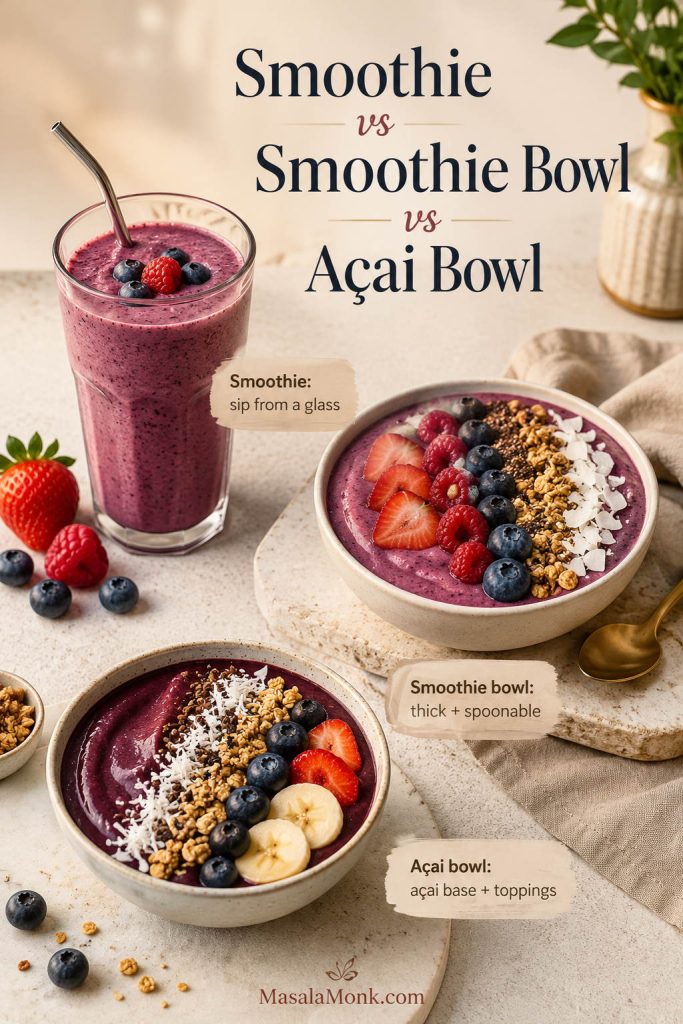
Comparison of a berry smoothie in a glass, a berry smoothie bowl, and an açai bowl with toppings.
A berry smoothie is made to sip, a smoothie bowl is thick enough for a spoon, and an açai bowl starts with an açai base before the toppings go on.

Make-Ahead Berry Smoothies and Freezer Packs

This smoothie tastes best right after blending, while it is still cold and thick. However, rushed mornings are real, so the best make-ahead move is not storing a finished smoothie. It is making freezer packs so the fresh blend still takes less than a minute.
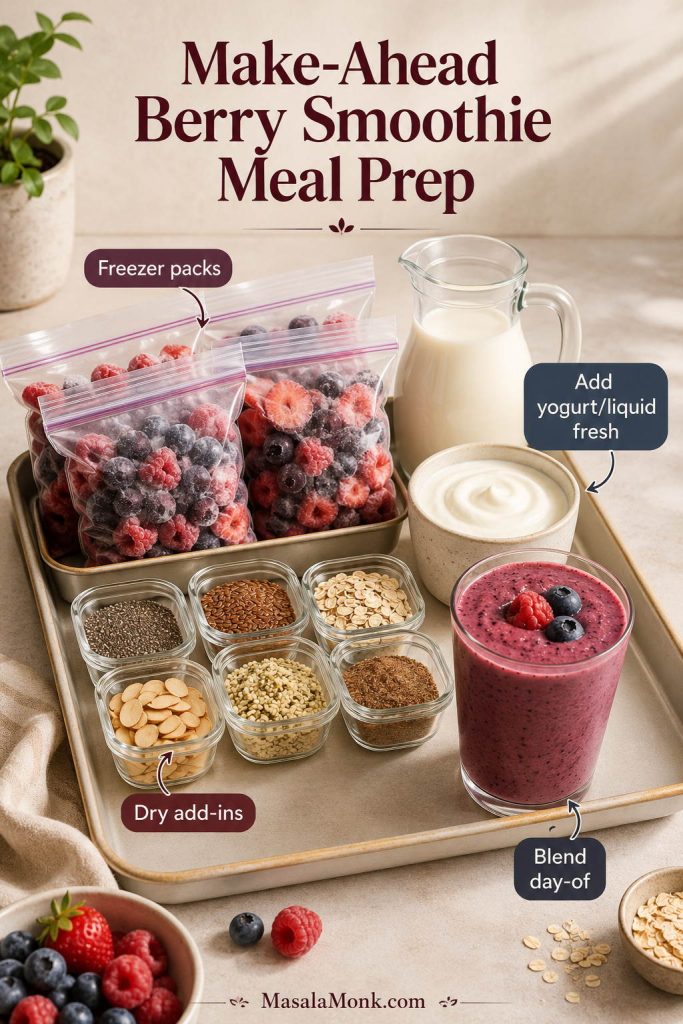
Make-ahead berry smoothie meal prep tray with freezer packs, dry add-ins, yogurt, milk, and a finished smoothie.
Good smoothie meal prep is about separating what freezes well from what tastes better fresh. That keeps the final blend colder, thicker, and cleaner.

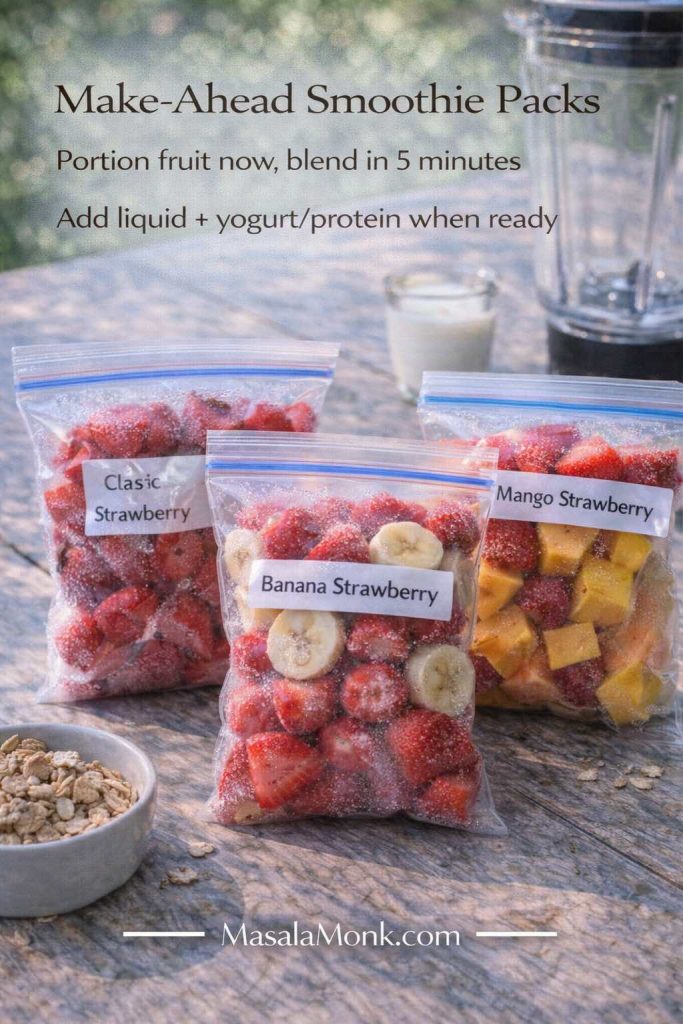
Freezer Smoothie Packs

Add the berries, banana, and any dry add-ins like oats, chia, or protein powder to a freezer-safe bag or container. When ready to blend, add the frozen pack to the blender with yogurt and liquid.
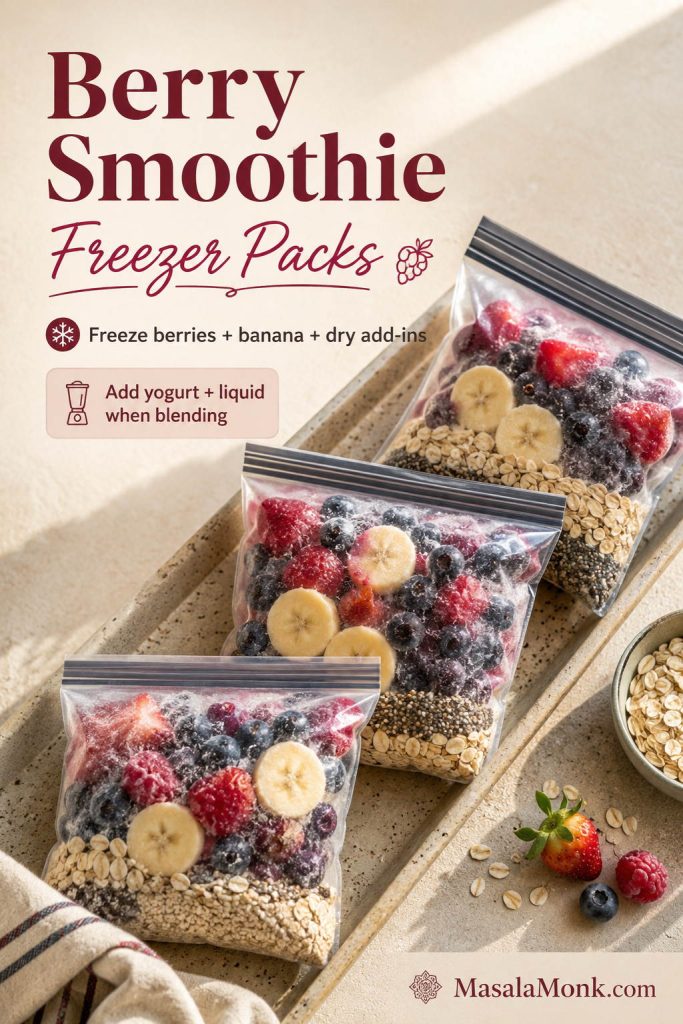
Berry smoothie freezer packs with frozen berries, banana slices, oats, and chia in freezer-safe bags.
Freezer packs are best for the ingredients that can wait: berries, banana, oats, chia, or protein powder. Save the yogurt and liquid for blending day.
  • 1 1/2 cups frozen berries, about 225 g / 8 oz
  • 1/2 sliced banana, about 55–60 g
  • 1 tablespoon oats or chia, optional
  • 1 scoop protein powder, optional

When blending, add 1/2 cup / 120 g yogurt and 1/2 cup / 120 ml milk or almond milk. Add more liquid only if needed.

If a stored smoothie separates or thins out, see how to store a berry smoothie or the troubleshooting section.

Storing a Blended Smoothie

If you need to store a blended smoothie, keep it covered in the fridge and drink it within 24 hours. It may separate or thin out, so shake or re-blend before serving. For better texture, add a few frozen berries before re-blending.
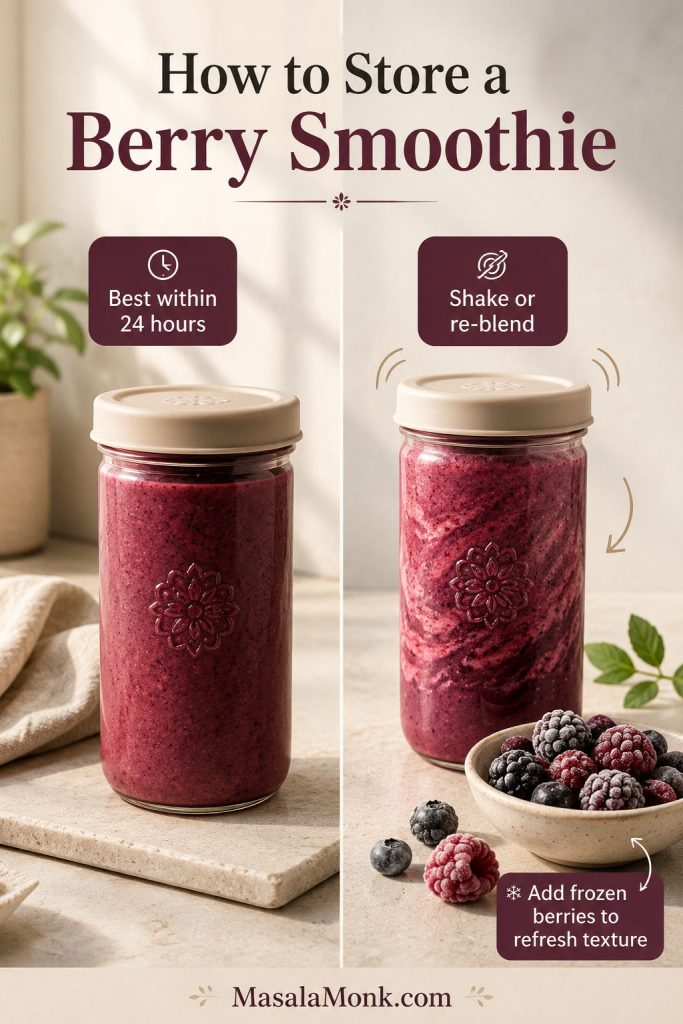
Berry smoothie storage guide showing lidded jars, a shake or re-blend cue, and frozen berries to refresh texture.
A blended smoothie is best fresh, but short fridge storage can work. Before drinking, shake or re-blend it, then add frozen berries if the texture has thinned.

If you want a no-blender breakfast that follows the same ratio-and-texture logic, this overnight oats recipe is another make-ahead option built around creamy texture, storage, and easy fixes.

Troubleshooting: Too Thin, Too Tart, or Too Thick

This is where a smoothie goes from random to reliable. If the first blend is too thin, too tart, too seedy, or too thick to move, you almost never need to start over. You just need the right fix.

For a clean starting formula, go back to the quick answer ratio or use the recipe card.

Berry Smoothie Mistakes to Avoid

Do not add lots of ice to rescue a smoothie that has been sitting too long. Ice can make the flavor watery. Re-blend with frozen berries or frozen banana instead.
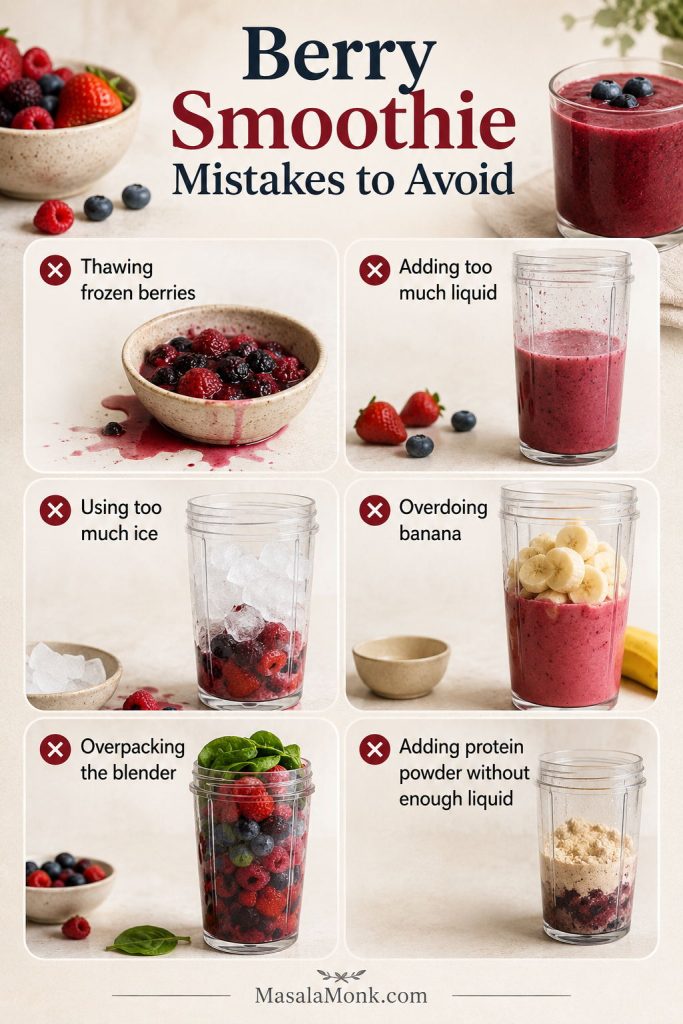
Berry smoothie mistakes guide showing thawed berries, too much liquid, too much ice, too much banana, an overpacked blender, and dry protein powder.
Many berry smoothie mistakes happen before blending starts. Keep frozen fruit frozen, add liquid carefully, avoid too much ice, and leave room for the blender to move.

Quick Smoothie Fixes

Use this quick guide when the smoothie is already in the blender and you need to decide what to change next.
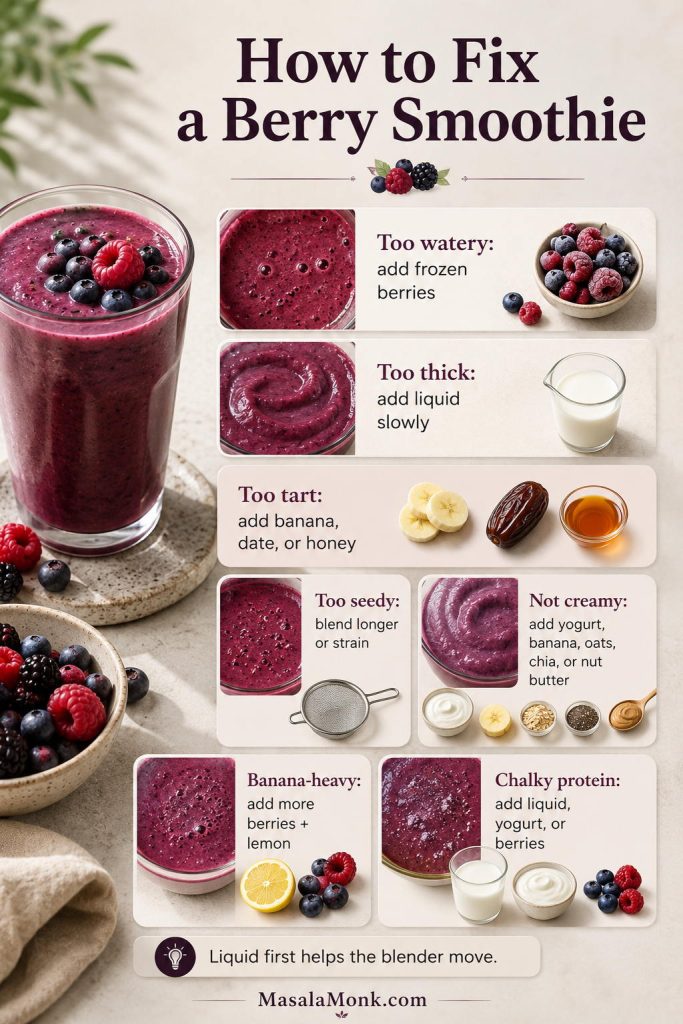
Berry smoothie troubleshooting guide showing fixes for watery, thick, tart, seedy, not creamy, banana-heavy, and chalky protein smoothies.
Most berry smoothie problems are fixable once you identify the issue. Adjust texture, sweetness, creaminess, seediness, or dilution one step at a time.
Problem Why It Happens How to Fix It
Too watery Too much liquid or thawed berries Add frozen berries, frozen banana, Greek yogurt, oats, or chia
Too thick to blend Not enough liquid for the blender Add liquid 1 tablespoon / 15 ml at a time
Too tart Berries are sour or yogurt is tangy Add banana, vanilla, honey, maple syrup, dates, or sweeter juice
Too sweet Too much banana, juice, or sweetened yogurt Add lemon juice, plain yogurt, or more tart berries
Bland or flat Too much liquid or mild berries Add lemon juice, vanilla, a tiny pinch of salt, or more berries
Too seedy Raspberries or blackberries are seed-heavy Blend longer, use more blueberries/strawberries, or strain if needed
Too icy Too much ice or not enough creamy ingredient Use frozen fruit instead of ice; add banana, yogurt, or nut butter
Not creamy Berries + liquid only Add banana, Greek yogurt, avocado, oats, chia, or almond butter
Green bits from spinach Spinach added with everything at once Blend spinach with liquid first, then add fruit
Tastes like banana, not berries Too much banana for the berry amount Use 1/2 banana instead of a full banana and add more berries
Protein smoothie tastes chalky Too much powder or not enough liquid/creaminess Add yogurt, extra berries, or more liquid 1 tablespoon at a time

How to Fix a Thin or Thick Berry Smoothie

If the texture is the only problem, use this focused repair guide before changing the flavor.
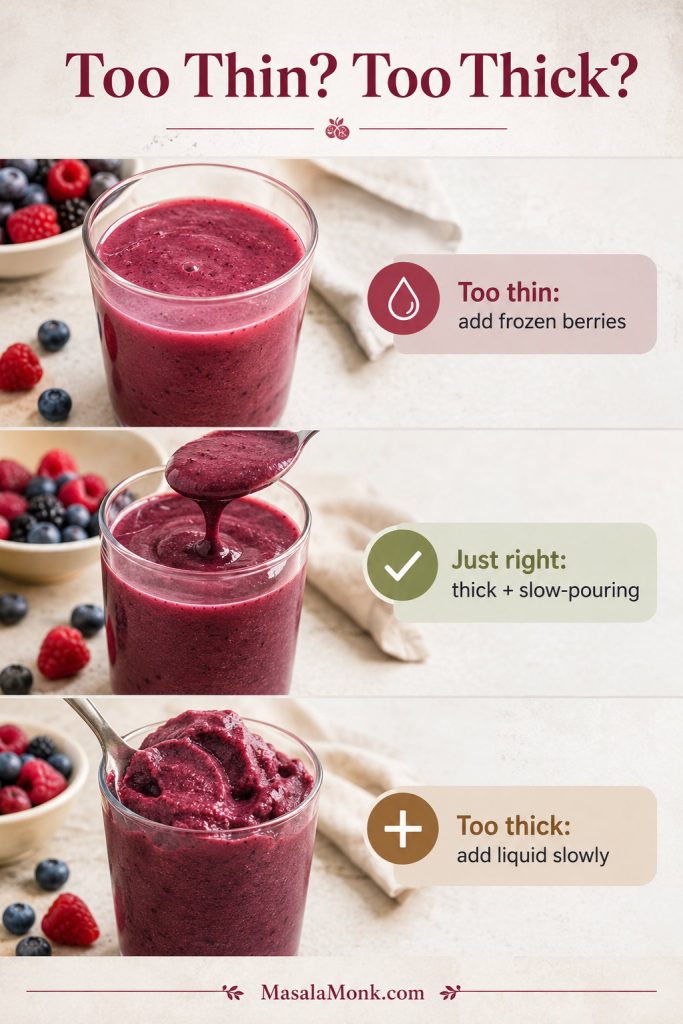
Texture repair guide showing a thin berry smoothie, a thick slow-pouring smoothie, and an overly thick smoothie.
Think of texture as a two-way dial. Frozen fruit moves a loose smoothie thicker, while small splashes of liquid help a stuck blend loosen without washing it out.

How to Fix a Sour or Dull Berry Smoothie

If the texture is right but the flavor feels sharp or flat, adjust sweetness and brightness instead of adding more liquid.
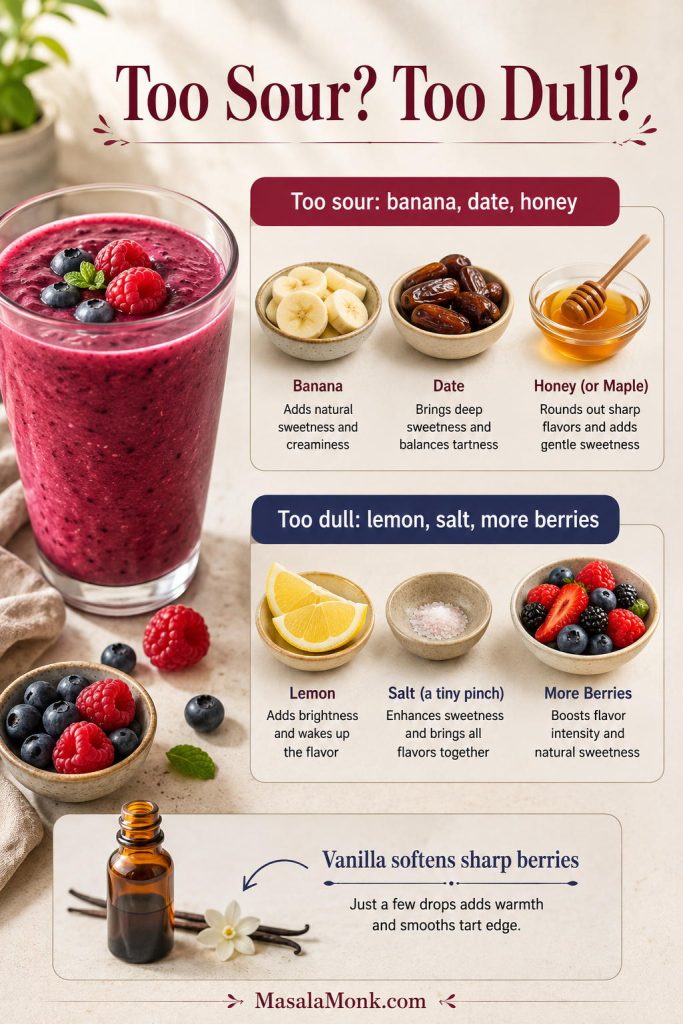
Flavor repair guide for berry smoothies showing banana, dates, honey, vanilla, lemon, salt, and extra berries.
Tart berries need soft sweetness from banana, dates, honey, or vanilla. Meanwhile, a flat smoothie often needs brightness from lemon, extra berries, or a tiny pinch of salt.

Best Rescue Move

Most smoothie problems are fixable in the blender. The only real mistake is adding a lot of liquid before you know what the texture needs.

Once you get the texture right, the flavor feels cleaner too: colder berries, less dilution, and a smoothie that tastes like fruit instead of sweet milk.

Berry Smoothie Recipe Card
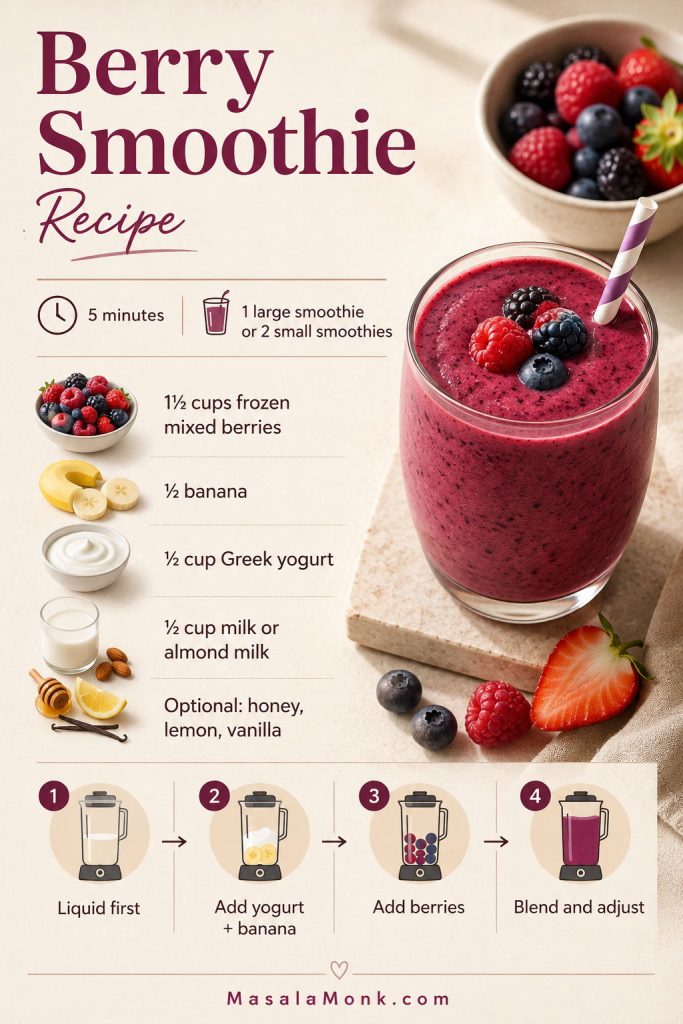
Saveable berry smoothie recipe card showing frozen berries, banana, Greek yogurt, milk, optional flavorings, and blending steps.
Save this base berry smoothie recipe as your starting point. Then, once the texture works, adjust it for protein, no banana, no yogurt, or a smoothie bowl.

Classic Berry Smoothie

This is the reliable base version: thick, creamy, berry-forward, and easy to adjust with or without banana, yogurt, protein powder, or greens.

Prep Time 5 minutes
Cook Time 0 minutes
Total Time 5 minutes
Yield 1 large 16 oz / 475 ml smoothie or 2 small 8 oz smoothies

Ingredients

  • 1 1/2 cups frozen mixed berries, about 225 g / 8 oz
  • 1/2 medium banana, about 55–60 g / 2 oz
  • 1/2 cup Greek yogurt or plain yogurt, about 120 g / 4 oz
  • 1/2 cup milk or almond milk, 120 ml / 4 fl oz, plus more as needed
  • 1 to 2 teaspoons honey or maple syrup, optional
  • 1 teaspoon lemon juice, optional
  • 1/4 teaspoon vanilla extract, optional

Instructions

  1. Add the milk or almond milk to the blender first.
  2. Add the yogurt, banana, honey or maple syrup, lemon juice, and vanilla if using.
  3. Add the frozen berries last.
  4. Blend on low speed to start, then increase to high until thick and creamy.
  5. If the blender stalls, add more liquid 1 tablespoon / 15 ml at a time.
  6. Taste and adjust. Add lemon juice if it tastes flat, sweetener if it is too tart, or more frozen berries if it is too thin.
  7. Pour into a glass and serve immediately.

Notes

  • Dairy-free: use almond milk, oat milk, coconut milk, or coconut yogurt.
  • No banana: use yogurt, oats, chia, avocado, almond butter, or extra frozen berries.
  • No yogurt: use banana, nut butter, oats, chia, avocado, or coconut milk.
  • Protein: add 1 scoop protein powder and start with 3/4 cup liquid.
  • Smoothie bowl: use only 2 to 5 tablespoons liquid and scrape as you blend.

FAQs

Can I use frozen mixed berries straight from the bag?

Yes. Use them straight from the freezer for the thickest texture. Do not thaw them unless your blender cannot handle frozen fruit.

Frozen berries or fresh berries: which works better?

Frozen berries are better for thickness. Fresh berries taste best in season, but usually need frozen banana, yogurt, or a little ice to avoid a thinner drink.

Can I use curd instead of Greek yogurt?

Yes. Use thick, well-set curd and reduce the milk slightly. Loose curd can make the smoothie thinner and tangier.

Why does my berry smoothie taste sour?

Your berry mix may be heavy on raspberries, blackberries, or cranberries. Add banana, vanilla, a date, honey, maple syrup, or a sweeter liquid.

Milk or yogurt: what gives the best texture?

Milk makes the smoothie easier to drink; yogurt makes it thicker and creamier. For balance, use 1/2 cup yogurt with 1/2 cup milk or almond milk.

What can replace yogurt in a berry smoothie?

Use banana, almond butter, oats, chia, coconut yogurt, avocado, or extra frozen berries. The goal is to replace yogurt’s creaminess, not just remove it.

What can replace banana in a berry smoothie?

Use Greek yogurt, coconut yogurt, avocado, oats, chia, almond butter, or extra frozen berries. Replace both banana’s sweetness and its creamy texture.

What works if I want no banana and no yogurt?

Use frozen berries, almond milk or oat milk, almond butter, and oats or chia seeds. Almond butter adds richness; oats or chia add thickness.

Why did my smoothie turn watery?

Usually, there is too much liquid, thawed fruit, or not enough frozen fruit. Add frozen berries, frozen banana, Greek yogurt, oats, or chia.

Can I make this in a personal blender?

Yes. Add liquid first, then yogurt or banana, then frozen berries. Do not pack the cup too tightly; leave room for the mixture to move.

Is ice necessary, or are frozen berries enough?

Frozen berries are usually enough. They chill and thicken the smoothie without diluting the flavor. Use ice only with fresh berries when you need extra chill.

How much protein powder should I add?

Use 1 scoop of vanilla or unflavored protein powder. Since powder thickens the smoothie, start with 3/4 cup liquid and adjust after blending.

What makes a smoothie bowl thick enough for toppings?

Use very little liquid. Blend frozen berries, frozen banana, and 2 to 5 tablespoons milk or almond milk until thick enough to spoon.

What is the best way to prep berry smoothies ahead?

Make freezer smoothie packs instead of storing finished smoothies. Freeze berries, banana, and dry add-ins together, then blend with yogurt and liquid.
Posted on Leave a comment

Kiwi Smoothie Recipe

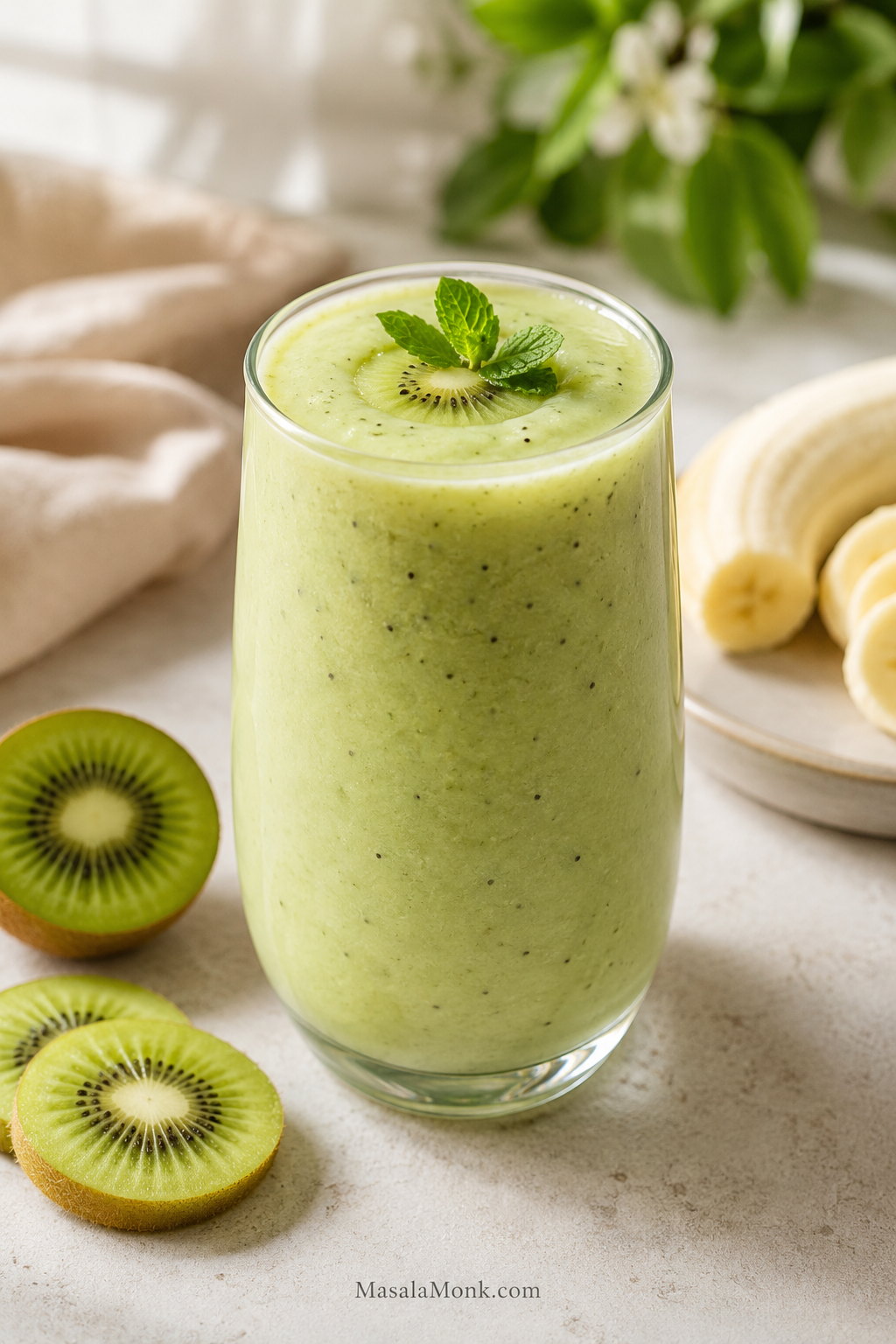
Creamy pale-green kiwi smoothie in a glass with sliced kiwi and banana on a breakfast counter.

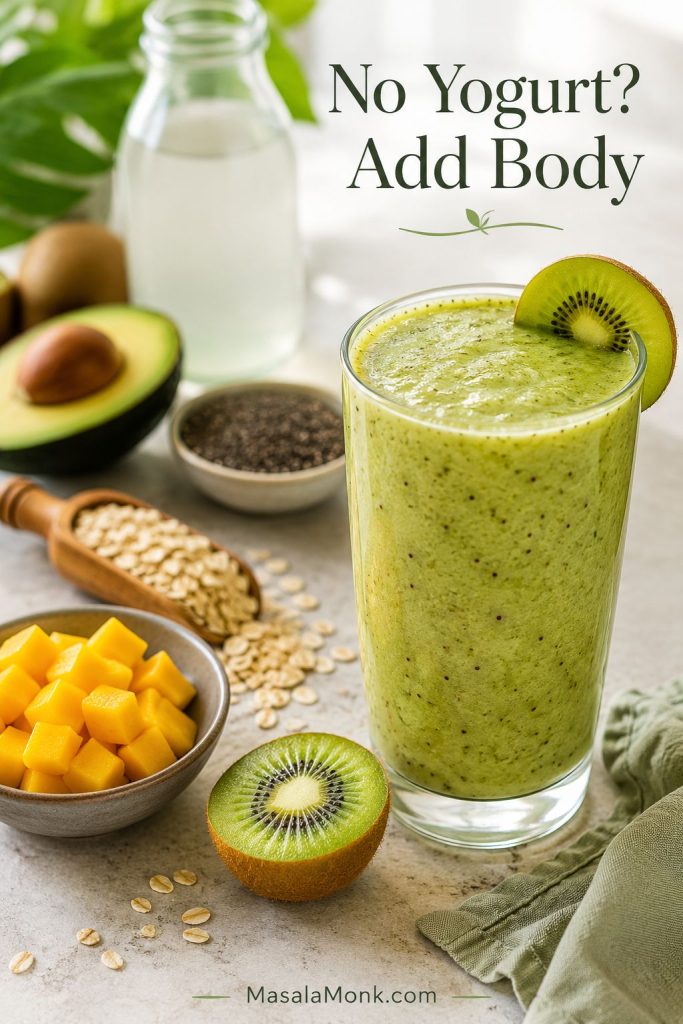
This kiwi smoothie recipe is creamy, fresh, tangy-sweet, and easy to adjust with banana, yogurt, milk, strawberry, mango, or dairy-free swaps. It takes about 5 minutes, but it still gives you enough control to avoid the usual problems: a smoothie that tastes too sour, too thin, too watery, too seedy, or too bland.

Done right, it tastes bright and creamy at the same time — fresh enough for a warm morning, but filling enough to feel like breakfast.

The base is simple: ripe kiwi for brightness, frozen banana for creaminess, yogurt for body, and just enough liquid to help the blender move. From there, you can make it lighter with coconut water, fruitier with orange juice, thicker as a smoothie bowl, greener with spinach, or sweeter with mango and strawberries.

Start with the classic kiwi banana smoothie, then adjust it to fit what you have. If your kiwis are sharp, jump to the fixes section. If you want a no-yogurt smoothie, a no-banana version, or a kiwi shake-style drink, those options are built into the guide too.

Quick Answer: Best Kiwi Smoothie Recipe Ratio

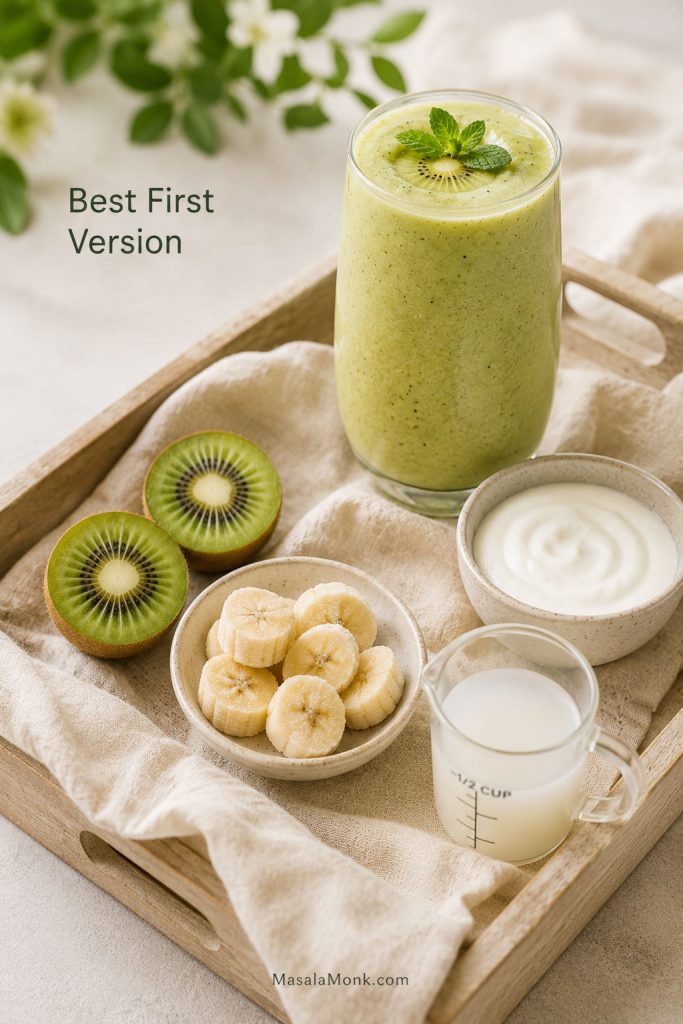
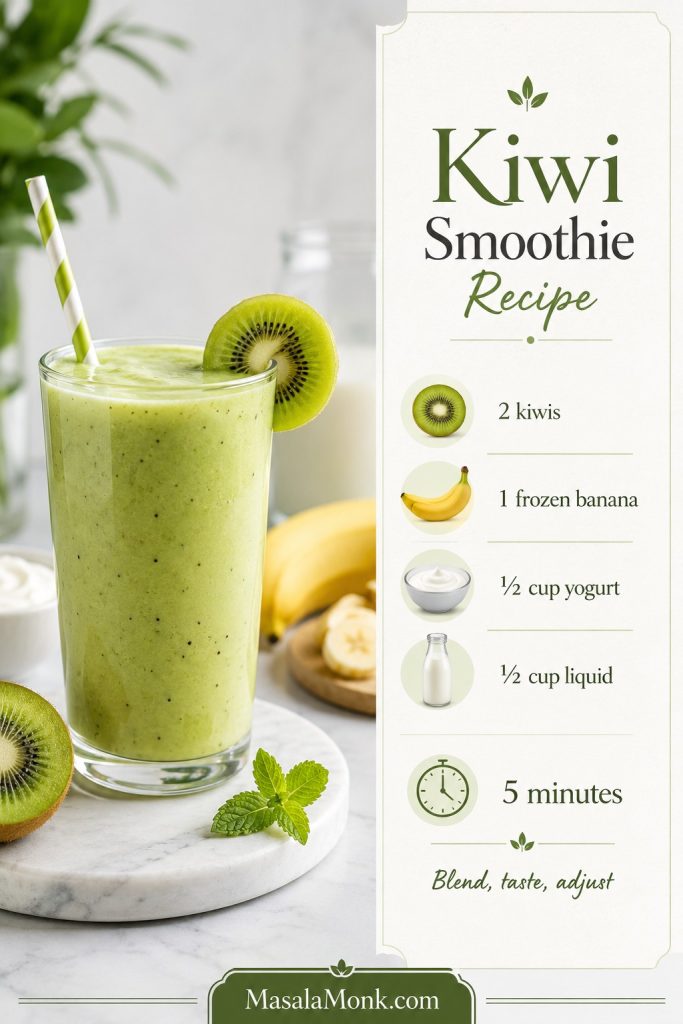
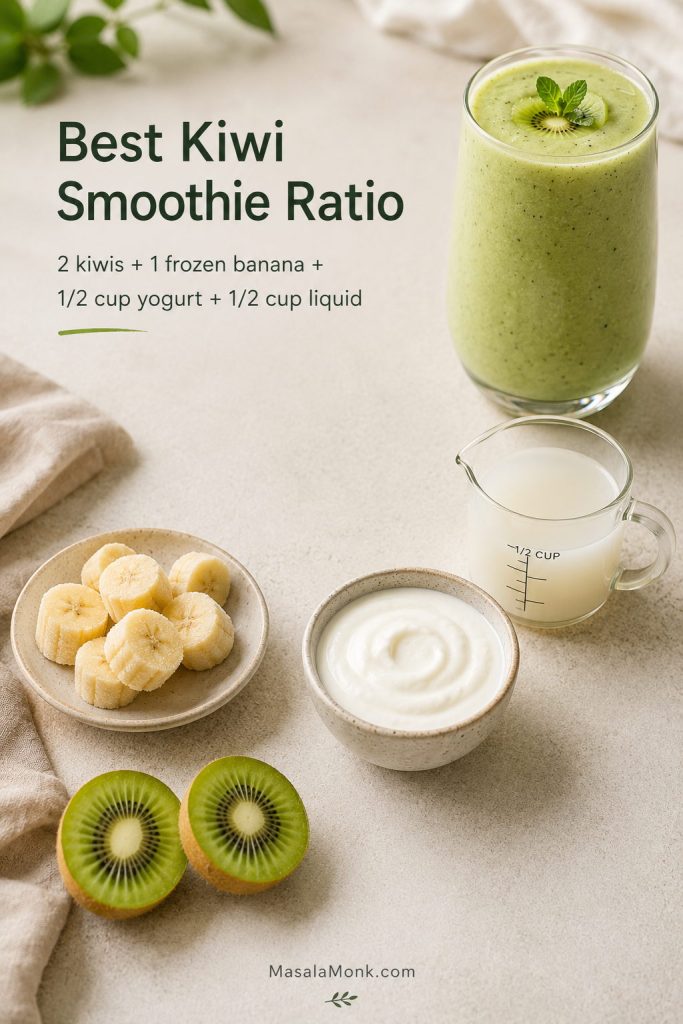
The best kiwi smoothie ratio is 2 ripe kiwis + 1 frozen banana + ½ cup yogurt + ½ cup liquid. Choose milk for a creamier smoothie, coconut water for a lighter smoothie, or orange juice for a brighter fruitier version. Add honey only if your kiwis taste sharp.

Kiwi smoothie ratio guide with kiwis, frozen banana, yogurt, liquid, and a finished smoothie
Start with this base kiwi smoothie ratio first; then taste before adding more fruit, liquid, or sweetener.

Best First Version to Try

Use 2 ripe kiwis, 1 frozen banana, ½ cup plain Greek yogurt, and ½ cup milk or coconut water. This gives you the cleanest creamy-tangy balance before you start changing the fruit, liquid, or sweetness.
Finished kiwi smoothie with ripe kiwis, frozen banana, Greek yogurt, and milk or coconut water
This first blend is the safest place to start because it gives you a creamy-tangy balance before you try strawberry, mango, no-yogurt, or no-banana versions.

For one large smoothie, the base recipe usually means 2 peeled kiwis, 1 medium frozen banana, ½ cup Greek yogurt or plain yogurt, and ½ cup milk, water, coconut water, or orange juice. Blend until smooth, taste, then adjust before pouring.

The formula works because each ingredient has a job. Kiwi brings the bright fruit flavor, banana softens the tartness, yogurt gives body, and the liquid helps everything blend. Once that balance is right, the smoothie tastes fresh instead of sharp or watery.

If you already know what went wrong with your last smoothie, the troubleshooting table will help you adjust sourness, thickness, sweetness, and texture quickly.

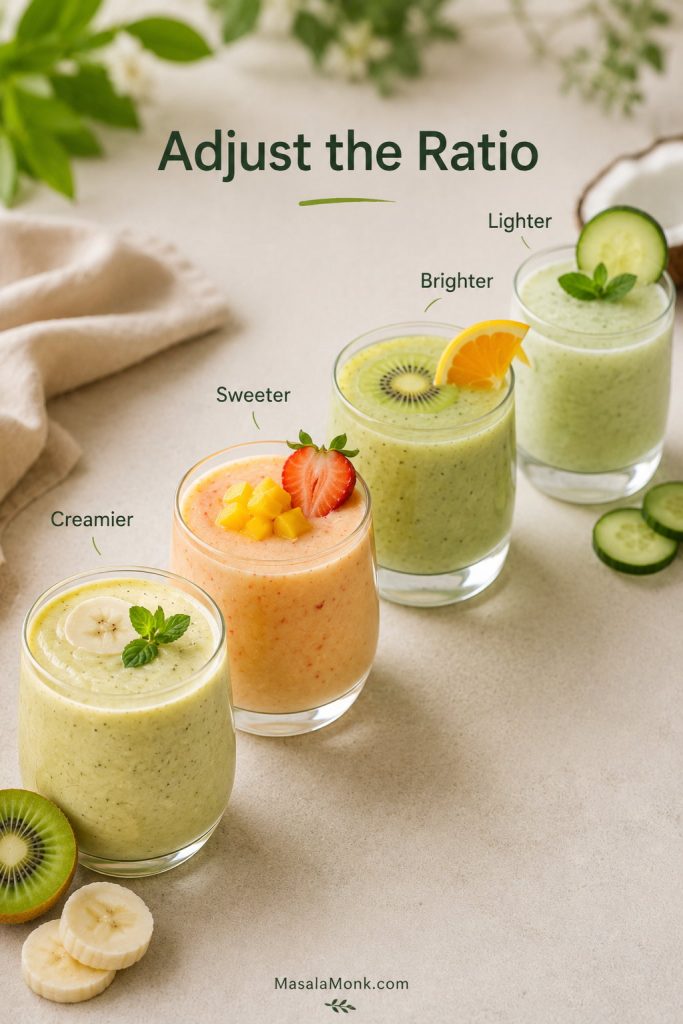
How to Adjust the Ratio

Want your kiwi smoothie… Add or adjust this
Creamier Frozen banana, Greek yogurt, avocado, or a splash of milk.
Sweeter Ripe banana, mango, strawberries, or 1–2 teaspoons honey.
Brighter Orange juice as the liquid or a tiny squeeze of lime.
Lighter Coconut water, water, cucumber, or spinach.
Thicker Frozen banana, frozen mango, chia seeds, or less liquid.
Dairy-free Almond milk, oat milk, coconut water, plant yogurt, mango, or avocado.
Four kiwi smoothie glasses showing creamier, sweeter, brighter, and lighter adjustment options
Small adjustments change the whole drink, so correct one thing at a time: body, sweetness, brightness, or overall lightness.

From there, the rest of the recipe is mostly about control. If your kiwi is very sweet, you may not need honey. If it tastes sharp, banana, mango, or yogurt will smooth it out quickly without changing the whole recipe.

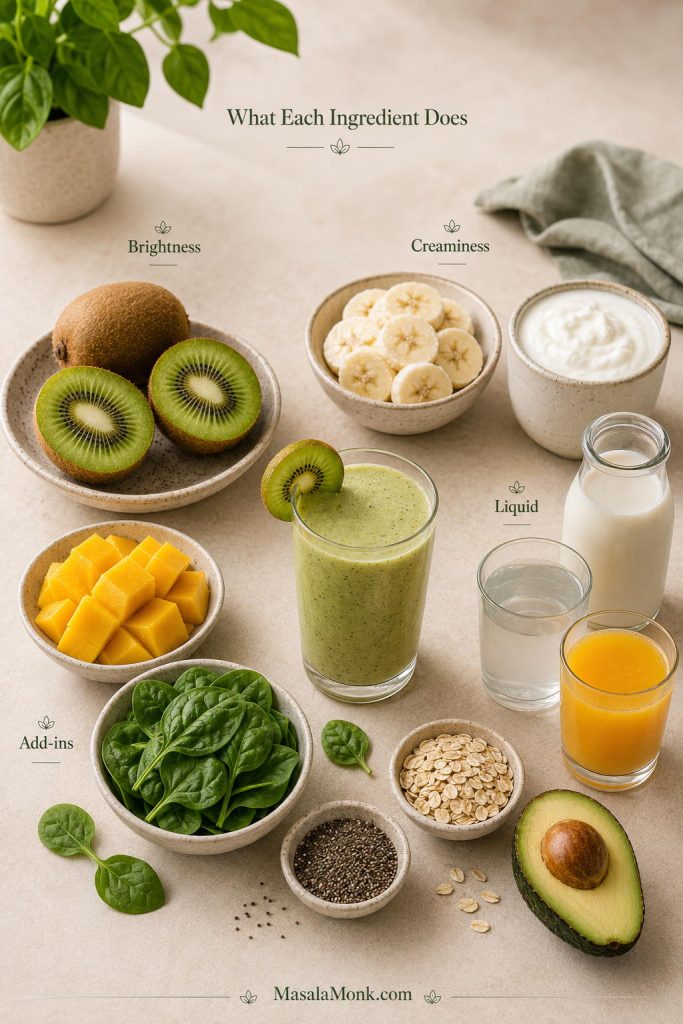
Ingredients for a Creamy Kiwi Smoothie

Kiwi smoothie ingredient guide with kiwi, banana, yogurt, liquid, mango, spinach, chia, oats, and avocado grouped by purpose
Each ingredient has a clear job: kiwi brings brightness, banana and yogurt add body, while the liquid decides whether the smoothie feels creamy, light, or bright.

A good smoothie recipe using kiwis needs balance. Kiwi gives the drink its bright, tangy flavor, but it needs something creamy or sweet beside it so the smoothie does not taste thin or harsh. The best version is not just about adding kiwi; it is about giving kiwi the right support.

Kiwi

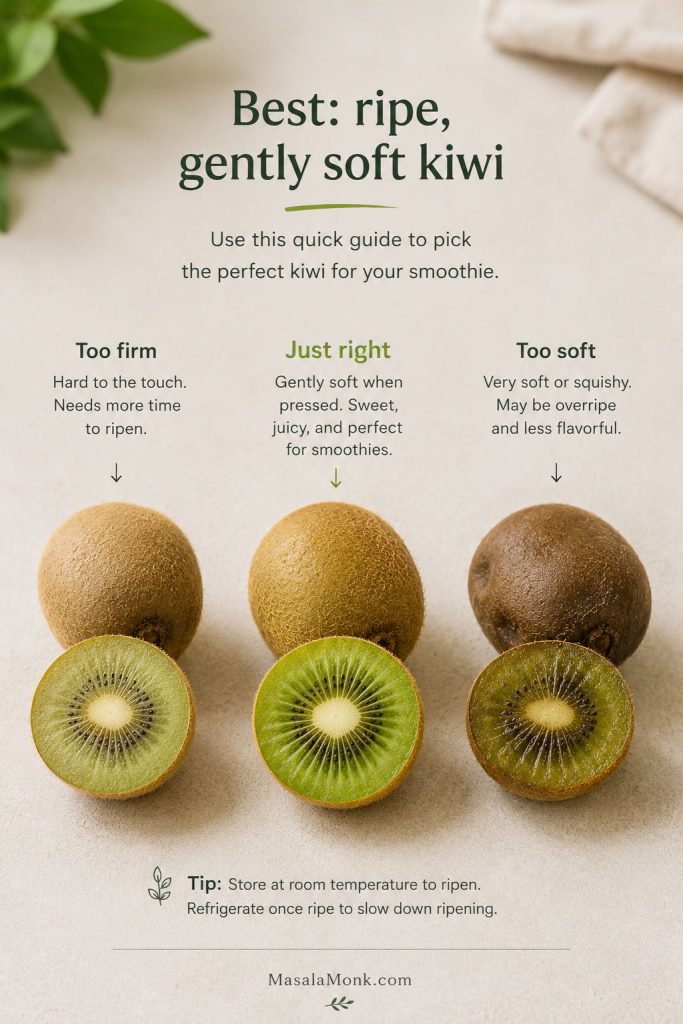
Kiwi ripeness guide showing firm kiwi, ripe kiwi, and very soft kiwi for smoothies
Ripe kiwis usually make a smoother, sweeter smoothie; however, firm kiwis can taste grassy or harsh once blended.

Ripe kiwis make the best smoothie. They should give slightly when pressed and smell fresh, not fermented. Hard kiwis can taste grassy, sour, or harsh once blended, while overripe kiwis can make the smoothie taste dull.

For the smoothest texture, peel the kiwi before blending. Kiwi skin is edible, but it can make a smoothie feel fibrous or slightly fuzzy, especially if your blender is not very powerful.

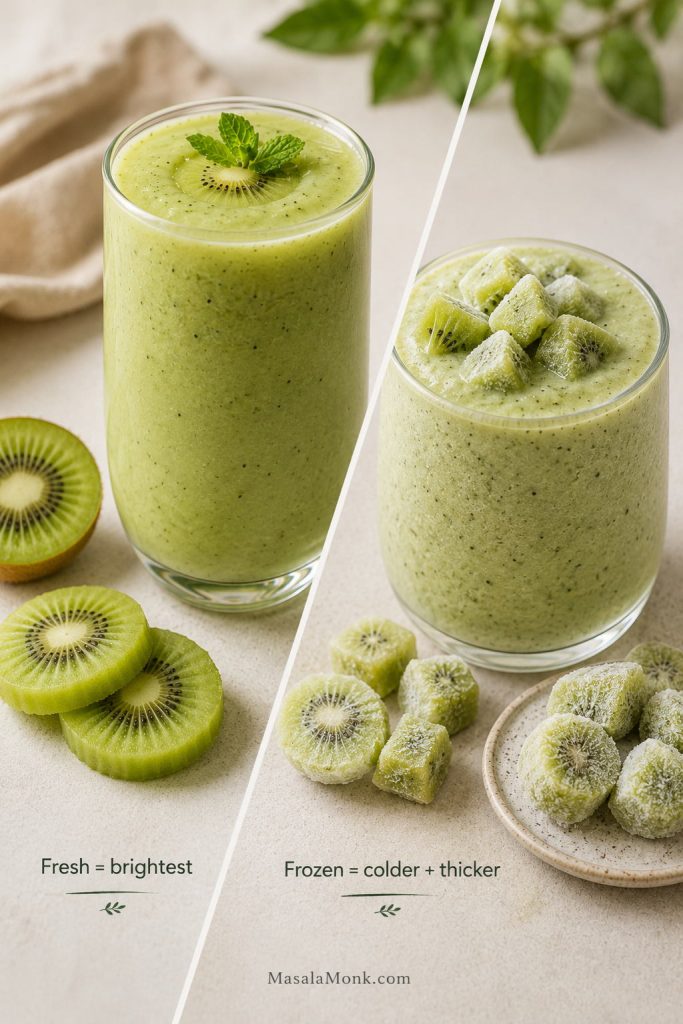
Fresh or frozen kiwi? Fresh kiwi gives the brightest flavor. Frozen kiwi makes the smoothie colder and thicker, but it works best with banana, mango, yogurt, or another creamy ingredient so the drink does not turn icy.
Fresh kiwi slices compared with frozen kiwi chunks for smoothie making
Fresh kiwi gives the brightest flavor, while frozen kiwi helps chill and thicken the smoothie when it is paired with banana, mango, yogurt, or another creamy ingredient.

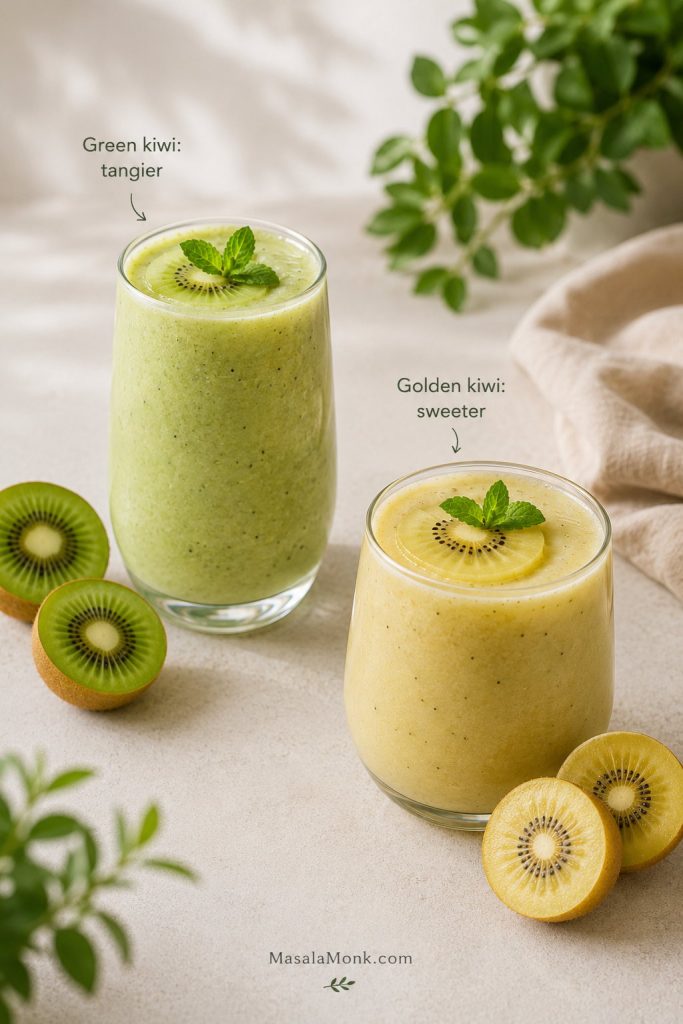
Green kiwi gives the classic tangy flavor. Golden kiwi is usually sweeter and softer, so it can work well if you want a milder smoothie with less added sweetener.

Green kiwi smoothie and golden kiwi smoothie shown side by side with matching fruit
Green kiwi gives the classic tangy smoothie flavor, whereas golden kiwi makes the drink softer, sweeter, and a little milder.

Banana

Banana is the easiest way to make the drink creamy, especially in a recipe where kiwis bring most of the tartness. A frozen banana works best because it chills and thickens the drink without needing lots of ice. For a less sweet smoothie, use half a banana and add more yogurt, mango, or avocado for body.

Yogurt

Plain Greek yogurt makes the smoothie thicker and more satisfying. Regular plain yogurt gives a softer, drinkable texture. For a dairy-free version, plant yogurt, almond milk, coconut water, avocado, chia, oats, and frozen mango can all help replace some of that body. The no-yogurt variation gives the easiest swaps.

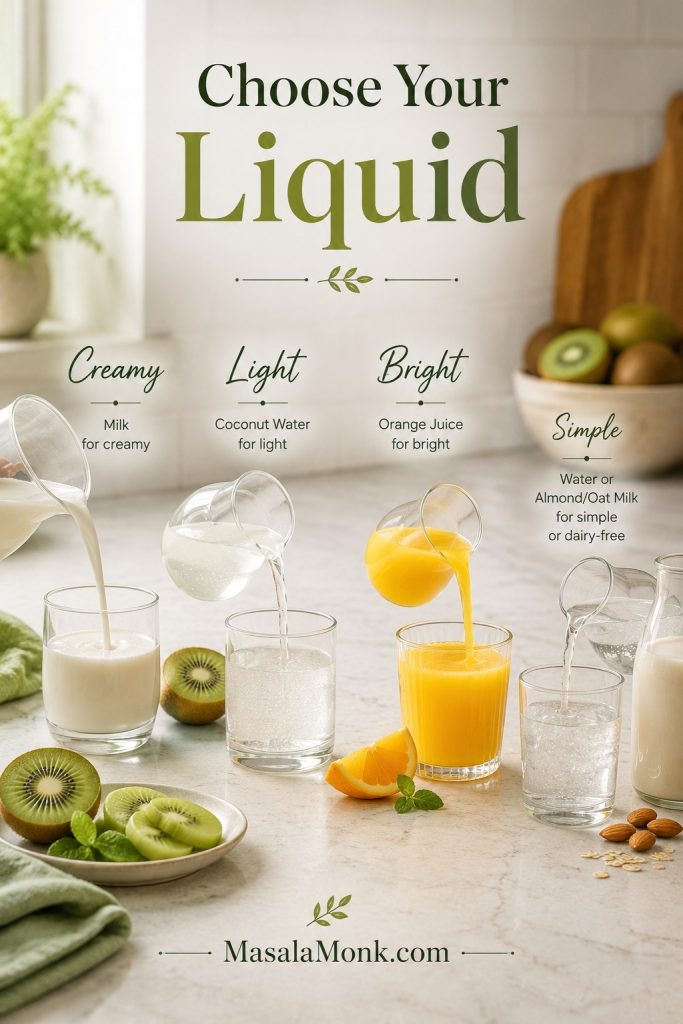
Liquid

The liquid decides whether the smoothie tastes creamy, light, or bright. Milk makes it mellow, coconut water keeps it fresh, orange juice makes it fruitier, and water keeps it simple but thinner. Start with ½ cup and add more only if the blender needs help.

Optional Add-Ins

Spinach, mango, pineapple, chia seeds, oats, protein powder, avocado, mint, and lime can all work with kiwi. Add them with a purpose: mango for sweetness, avocado for creaminess, spinach for a green smoothie, chia or oats for thickness, and lime only when the smoothie needs a sharper finish.

How to Make a Kiwi Smoothie

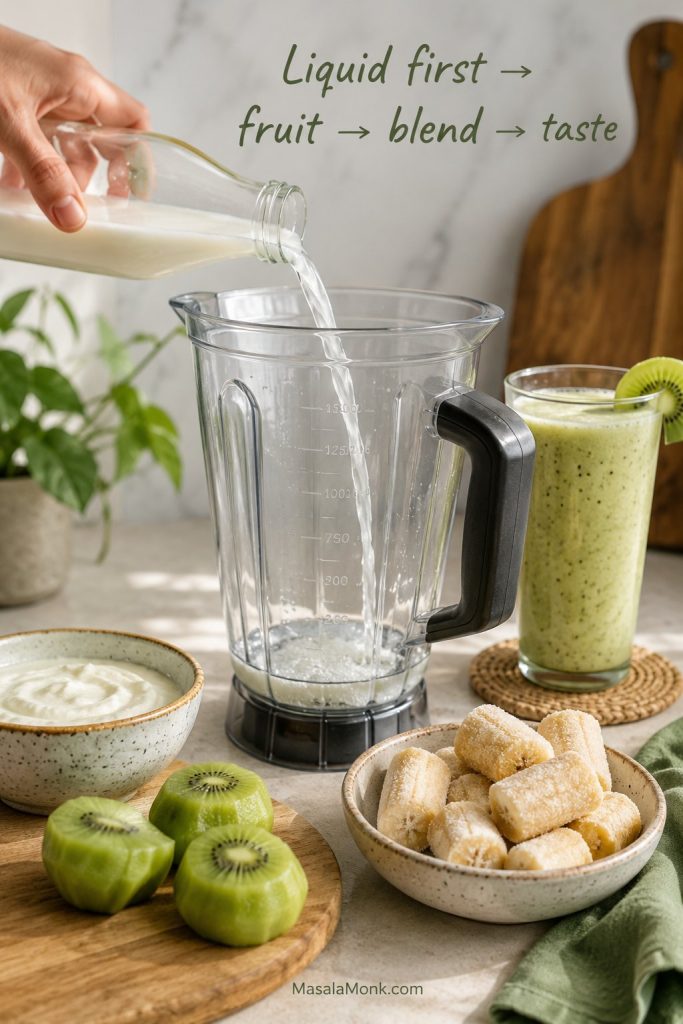
Liquid being poured into a blender with kiwi, banana, yogurt, and a finished smoothie nearby
Add the liquid first, because it helps the blender catch the fruit more easily and keeps the smoothie from getting watered down later.

The method is simple, but the order matters when you are blending kiwis with frozen banana, yogurt, and liquid. Add the liquid first so the blender can catch the ingredients more easily, especially if you are using frozen mango, frozen strawberries, oats, or greens.

  1. Peel and chop the kiwis. Cut away the fuzzy skin for the smoothest drink.
  2. Add the liquid first. Pour milk, coconut water, orange juice, or water into the blender.
  3. Add yogurt and soft ingredients. This helps the blender move before the frozen fruit goes in.
  4. Add kiwi and banana. Break the frozen banana into chunks if needed.
  5. Add frozen fruit or ice last. Use ice only if your fruit is fresh and the smoothie needs chilling.
  6. Blend until smooth. Most versions take 30–60 seconds. Green or frozen-heavy smoothies may need 60–120 seconds.
  7. Taste before pouring. Adjust sweetness, thickness, or brightness while the smoothie is still in the blender. The fixes table below shows the quickest adjustments.
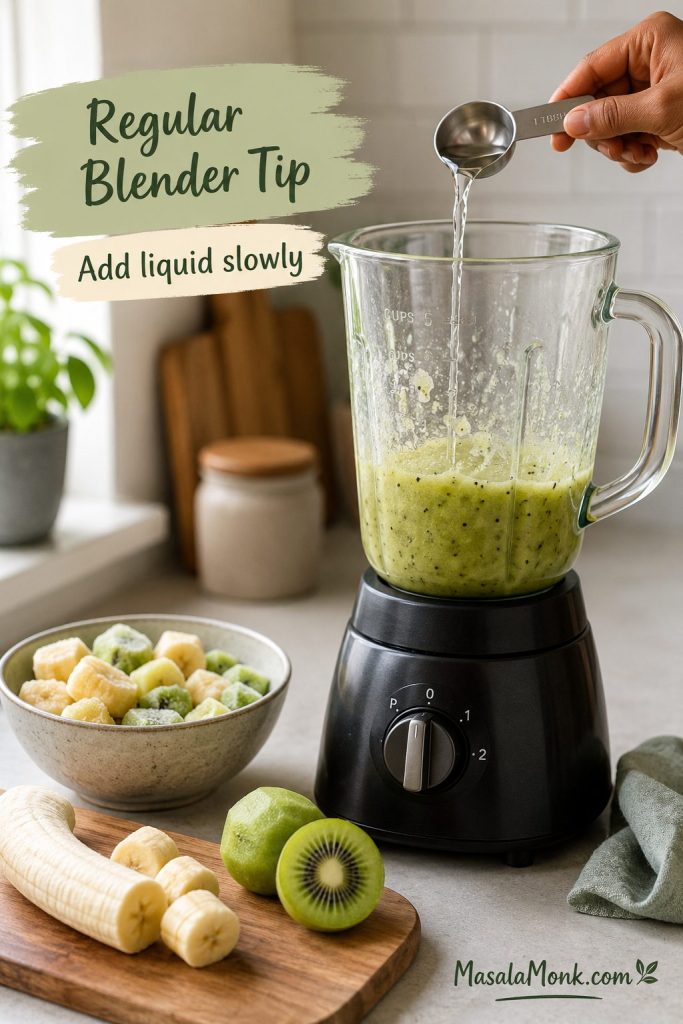
Blender tip: If the blender stalls, do not dump in a lot of liquid at once. Add 1 tablespoon at a time, blend again, and stop as soon as the smoothie moves smoothly.
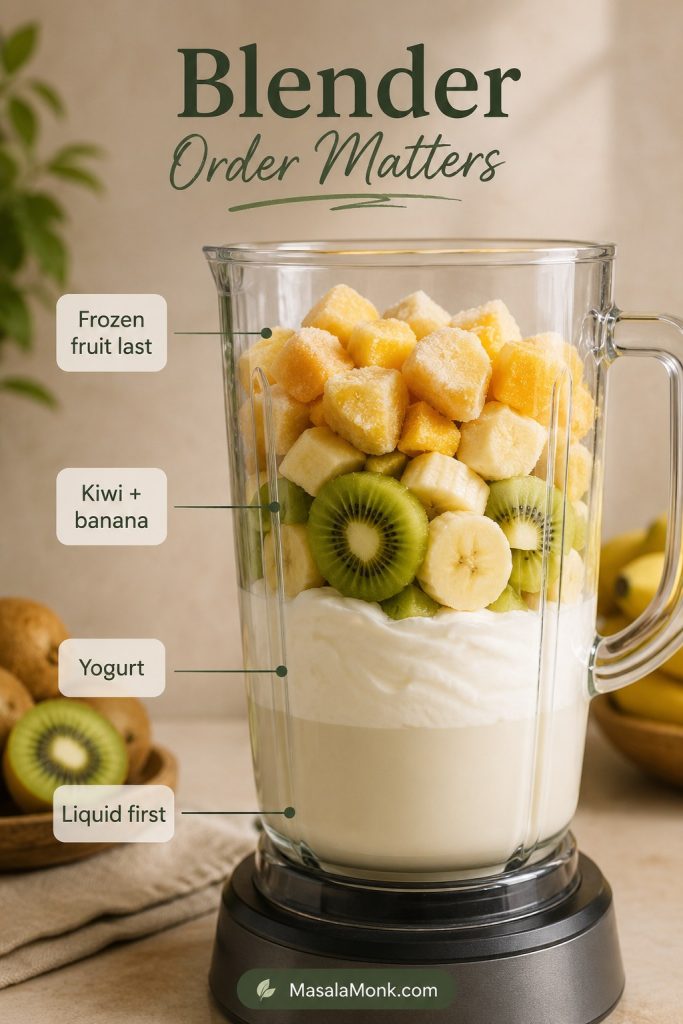
Blender jar layered with liquid, yogurt, kiwi, banana, and frozen fruit for a smoothie
The right blender order matters: liquid first, creamy ingredients next, and frozen fruit last so the blades can move smoothly.

If you are using a regular blender, chop the frozen banana smaller and let very hard frozen fruit sit at room temperature for 3–5 minutes before blending. Also, add liquid first, then increase the liquid by tablespoons only if the blades stop moving.

Regular blender with kiwi smoothie ingredients and liquid being added slowly
Even a regular blender can make a creamy kiwi smoothie when the frozen fruit is chopped smaller and the liquid is added gradually.

Kiwi Smoothie Recipe Card

Kiwi smoothie recipe card with a finished smoothie and the base ingredient ratio
Save this base recipe first; once the ratio is familiar, it becomes much easier to troubleshoot texture and build variations confidently.

Kiwi Smoothie Recipe

This creamy kiwi smoothie recipe is made with ripe kiwi, frozen banana, yogurt, and your choice of milk, coconut water, orange juice, or water. It is bright, fresh, tangy-sweet, and easy to adjust.

Prep Time5 minutes
Cook Time0 minutes
Total Time5 minutes
YieldAbout 1 large 16–20 oz smoothie or 2 small 8–10 oz smoothies

Equipment

  • Blender or high-speed blender
  • Knife and cutting board
  • Measuring cups and spoons
  • Glass or jar for serving

Ingredients

  • 2 medium ripe kiwis, peeled and chopped, about 140–160 g flesh
  • 1 medium frozen banana, about 100–120 g
  • ½ cup plain Greek yogurt or regular plain yogurt, about 120 g
  • ½ cup milk, coconut water, orange juice, or water, 4 fl oz / 120 ml
  • 1–2 teaspoons honey or maple syrup, optional, 7–14 g
  • ½ cup frozen mango, strawberries, or pineapple, optional, about 70–90 g
  • ¼–½ cup ice, optional, only if your fruit is fresh and the smoothie needs chilling
  • 1 teaspoon lime or lemon juice, optional, 5 ml

Method

  1. Add the liquid to the blender first.
  2. Add the yogurt, peeled kiwi, frozen banana, and any optional frozen fruit.
  3. Blend for 30–60 seconds, or until smooth. If using greens, oats, chia, protein powder, or a lot of frozen fruit, blend for 60–120 seconds.
  4. Taste the smoothie. Add honey if it is too tart, more liquid if it is too thick, or more frozen banana/mango if it is too thin.
  5. Pour into one large glass or two small glasses and drink right away.

Notes

  • For the creamiest smoothie, use frozen banana instead of fresh banana.
  • For a dairy-free smoothie, use plant yogurt, almond milk, coconut water, mango, or avocado.
  • For a smoothie bowl, reduce the liquid to ¼ cup / 60 ml and use frozen banana or frozen mango.
  • Kiwi smoothies with milk or yogurt are best enjoyed fresh because kiwi can change the texture as it sits. See the milk, yogurt, and juice guide for more detail.
  • The final yield depends on how much frozen fruit or ice you add.

Kiwi Smoothie Variations

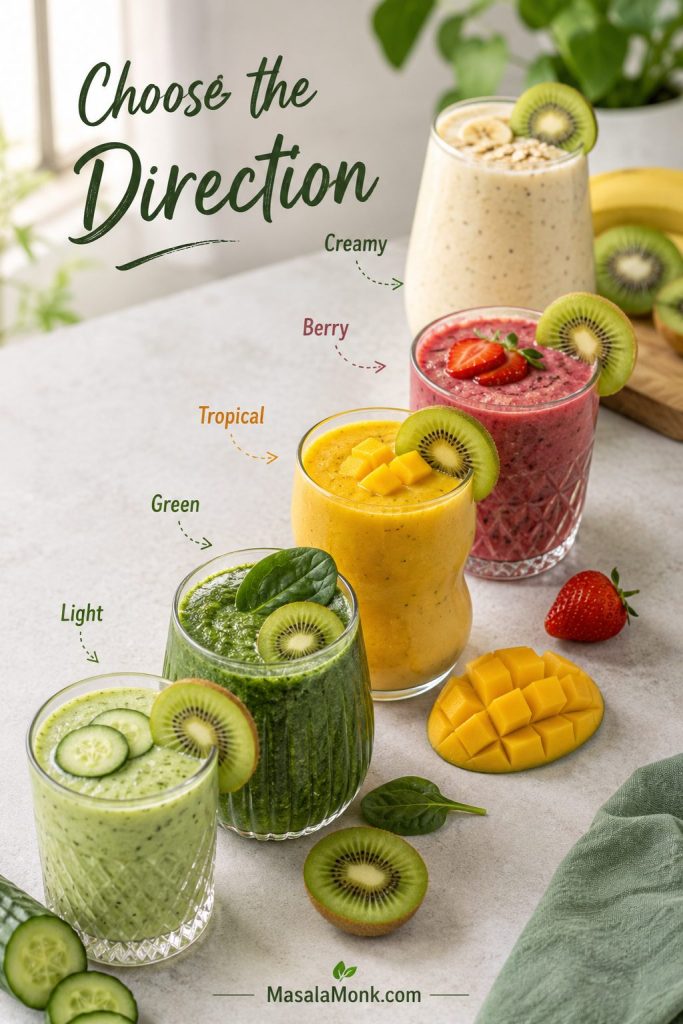
Five kiwi smoothie variations in different glasses with banana, strawberry, mango, spinach, and cucumber styles
A good base smoothie can move in several directions; however, changing one main ingredient at a time keeps the flavor balanced.

Once the base ratio tastes right, the fun part is choosing the direction. You can make it creamy and breakfast-like with banana, tropical with mango or pineapple, sharper with strawberries, greener with spinach, or lighter with cucumber and coconut water. Since kiwis bring most of the bright, tangy flavor, change one thing at a time so the blend stays balanced.

Banana Kiwi Smoothie

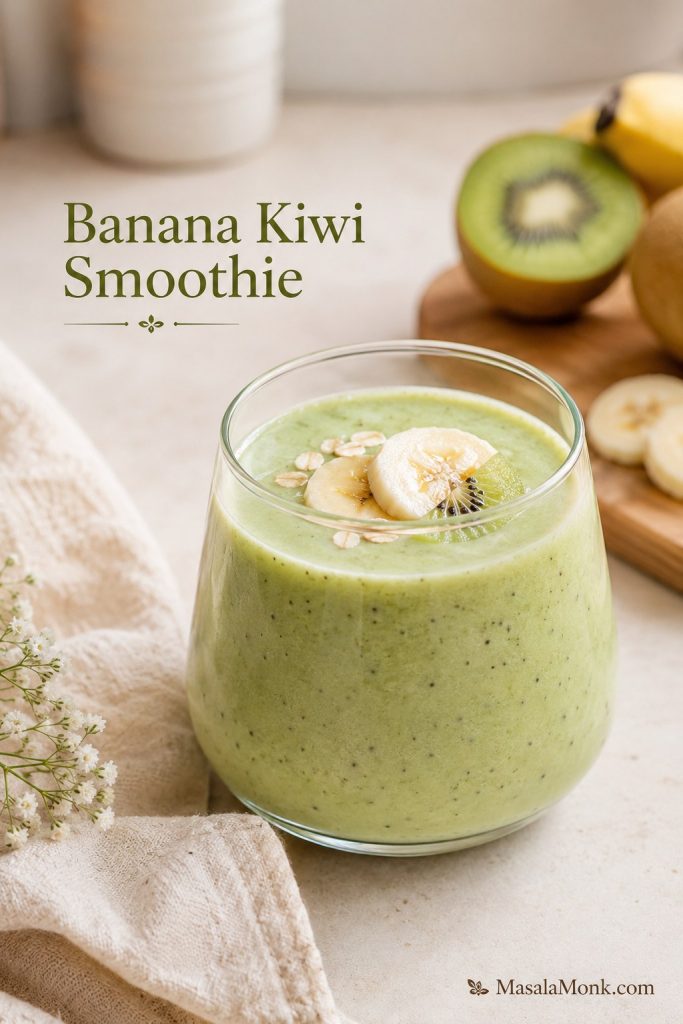
Creamy banana kiwi smoothie with banana slices and fresh kiwi garnish
Banana softens kiwi’s tartness and gives the smoothie a thicker breakfast-style texture without relying on extra ice.

This is the easiest and creamiest version. Make the base recipe with 2 ripe kiwis, 1 frozen banana, yogurt, and milk or coconut water. The banana softens kiwi’s tartness and gives the smoothie a smooth breakfast-style texture.

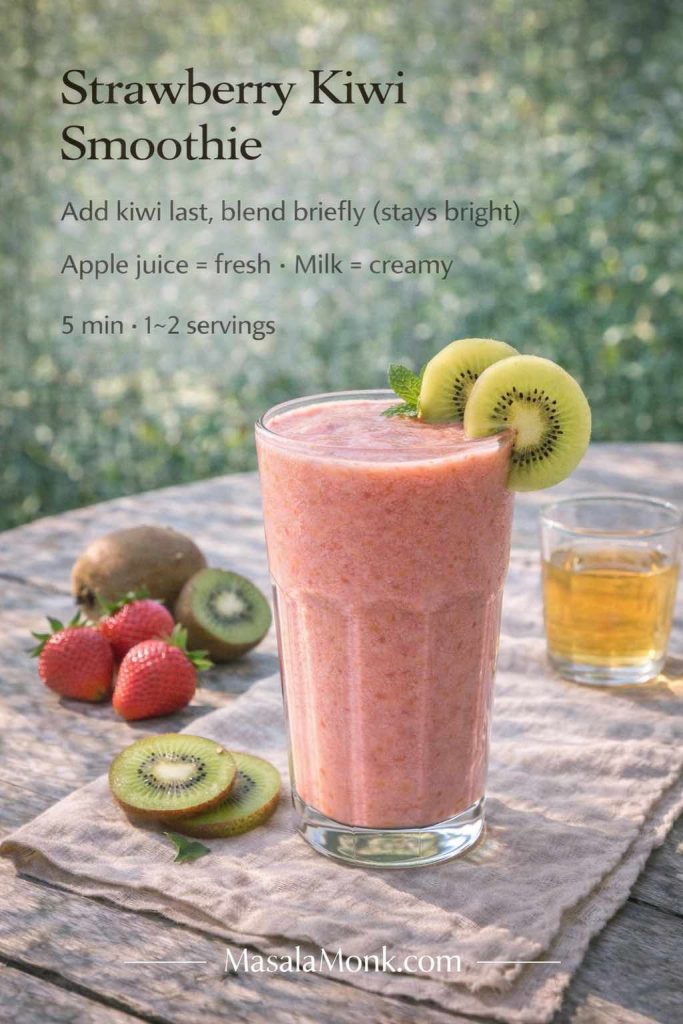
Strawberry Kiwi Smoothie

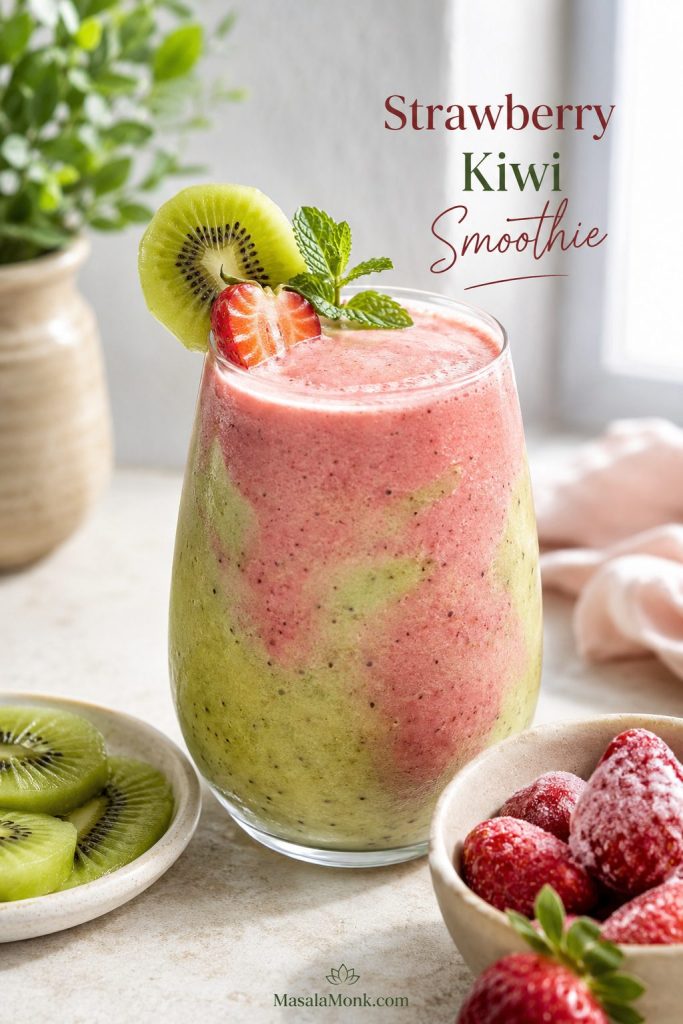
Strawberry kiwi smoothie with pink and green blended layers, kiwi, and strawberries
Strawberries make the drink brighter and more familiar, while kiwi keeps the smoothie fresh, tangy, and fruit-forward.

Strawberries make the smoothie taste brighter and more familiar, especially if you like a sweet-tart berry flavor. Add ½–1 cup frozen strawberries to the base recipe. Keep the banana if you want creaminess, or reduce it slightly if you want the strawberry and kiwi to taste sharper and fresher.

If you want to go deeper on the berry side, MasalaMonk also has a full strawberry smoothie guide with yogurt, no-yogurt, protein, and fruit variation ideas.

Kiwi Mango Smoothie

Golden-green kiwi mango smoothie with mango cubes and sliced kiwi
Mango is one of the best ways to soften sharp kiwi because it adds natural sweetness and body at the same time.

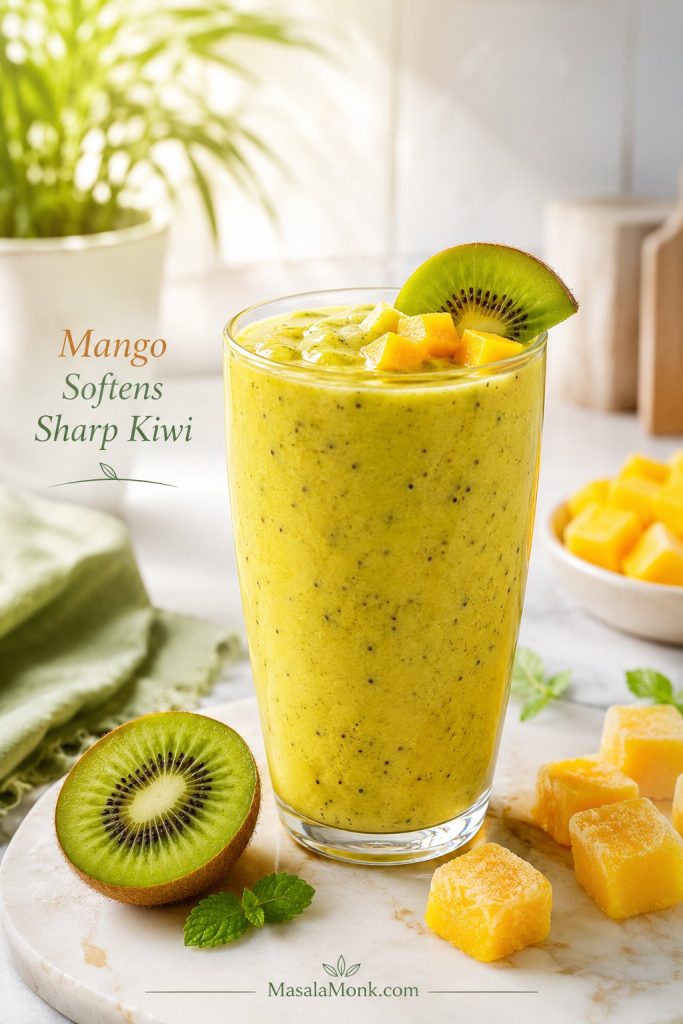
Mango is one of the easiest ways to tame sharp kiwi. It adds sweetness, body, and a tropical flavor without needing much extra sweetener. Blend ½–1 cup frozen mango with 2 kiwis, then use coconut water for a lighter drink or orange juice for a brighter one.

If mango is the fruit you use most often in smoothies, this mango smoothie recipe is a useful companion because it covers fresh mango, frozen mango, yogurt, milk, banana, no-banana, dairy-free, protein, and smoothie bowl versions.

Kiwi Pineapple Smoothie

Kiwi pineapple smoothie in a tall glass with pineapple and kiwi garnish
Pineapple pushes the smoothie in a brighter tropical direction; because it can also taste tart, banana, mango, or yogurt helps keep it balanced.

Pineapple pushes the smoothie in a sharper, juicier, more tropical direction. Frozen pineapple is especially good when you want a colder, thicker drink. Because both kiwi and pineapple can taste tart, balance this version with banana, yogurt, mango, or a small amount of honey.

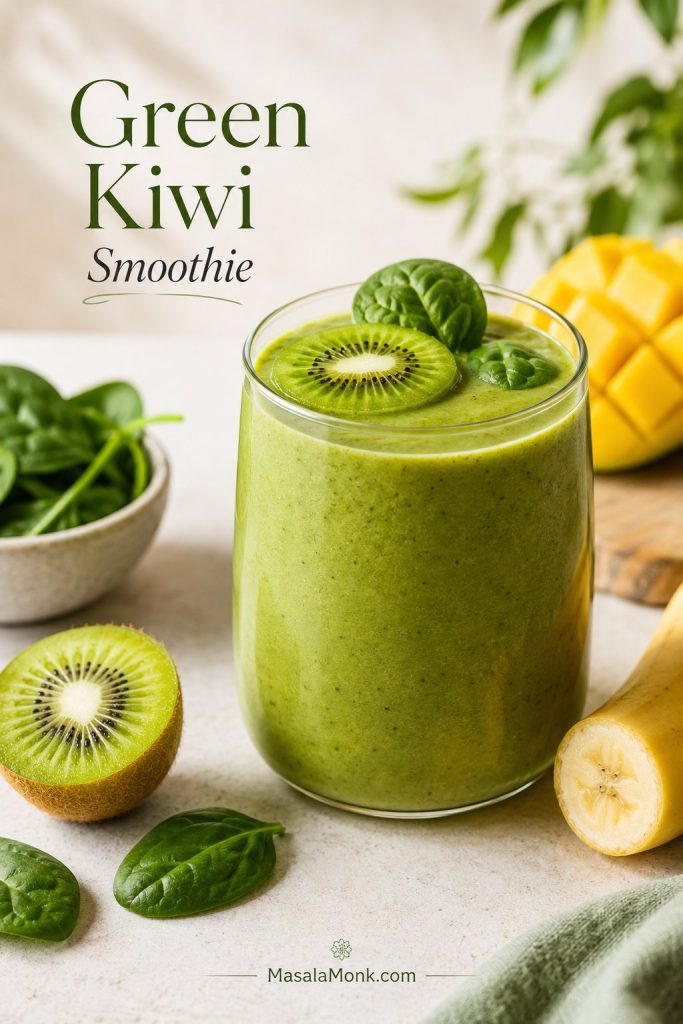
Green Kiwi Smoothie With Spinach

Green kiwi smoothie with spinach, banana, mango, and kiwi garnish
Fresh spinach blends into a kiwi smoothie more gently than frozen spinach, especially when banana or mango stays in the mix for sweetness.

Fresh baby spinach blends into kiwi smoothies more gently than frozen spinach. Add 1 cup to the base recipe, then keep banana or mango in the mix so the smoothie still tastes sweet enough. The color becomes greener, but the flavor stays mild when the spinach is fresh and not packed too heavily.

For more smoothie ideas built around fruit, greens, and vitamin C pairings, see MasalaMonk’s high-iron smoothies and shakes guide.

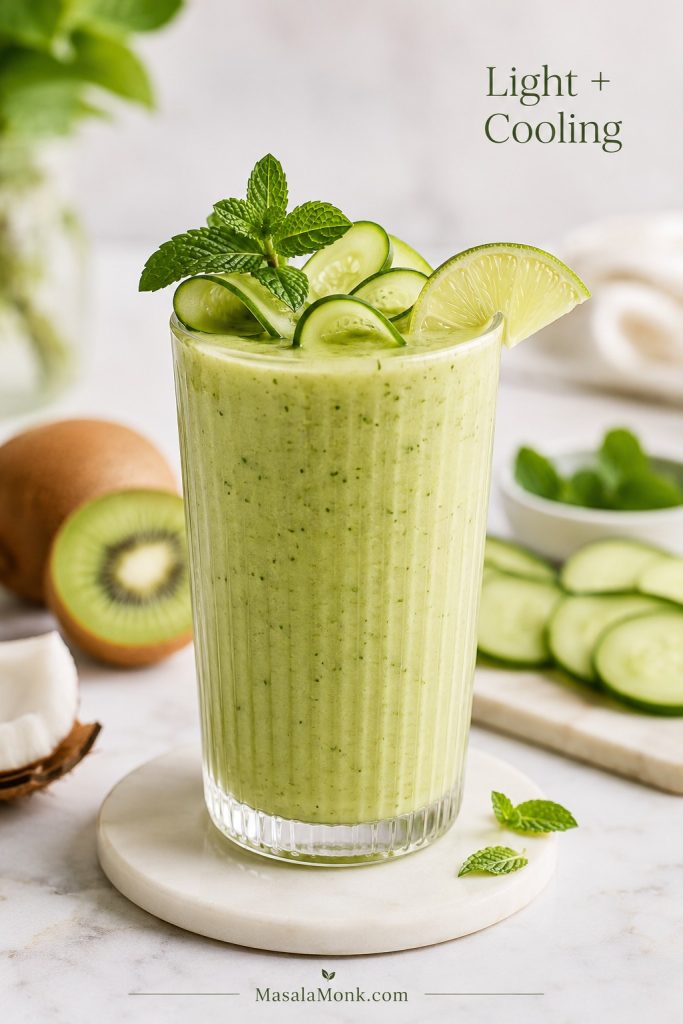
Kiwi Cucumber Smoothie

Light kiwi cucumber smoothie with cucumber slices, mint, lime, and kiwi
For a lighter version, cucumber, mint, lime, and coconut water make the smoothie feel crisp without turning it into a heavy breakfast blend.

This cucumber version is lighter and fresher than the banana-yogurt blend. Blend kiwi with cucumber, mint, lime, and coconut water for a crisp, cooling drink. Add a little banana, mango, or Greek yogurt if you want it to feel more filling.

Kiwi Protein Smoothie

Greek yogurt is the simplest protein boost because it also improves texture. You can add one scoop of plain or vanilla protein powder, but keep banana, mango, or yogurt in the mix so the smoothie does not taste chalky.

For another simple way to add texture to smoothies, see this guide on using hemp seeds in smoothies.

Kiwi Smoothie Without Yogurt

Kiwi smoothie without yogurt shown with mango, avocado, oats, chia seeds, and plant milk
Without yogurt, the smoothie needs another source of body, so mango, avocado, oats, chia, or plant milk become more important.

A no-yogurt version still needs body because kiwis alone can make the recipe taste sharp and thin. Keep the frozen banana and use almond milk, oat milk, coconut water, or orange juice as the liquid. For a thicker texture, add frozen mango, avocado, chia seeds, oats, or plant-based yogurt.

Kiwi Smoothie Without Banana

Kiwi smoothie without banana shown with mango, avocado, pear, yogurt, and kiwi
Banana is easy, but not essential; instead, use mango for sweetness or avocado and pear when you want creaminess with a different flavor profile.

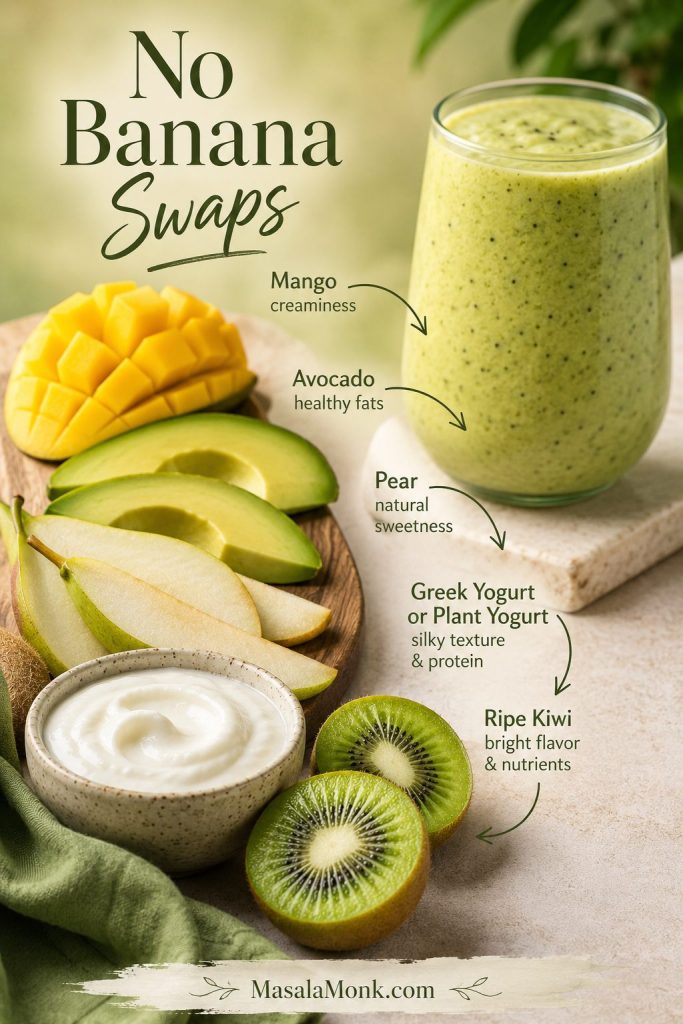
Banana is helpful, but it is not mandatory. Frozen mango is the best swap when you still want sweetness and thickness. Avocado gives creaminess without sweetness, Greek yogurt adds body, and pear gives a softer fruit flavor. Without one of these replacements, kiwi can taste sharper and the smoothie may feel thinner.

Kiwi Smoothie Bowl

Thick kiwi smoothie bowl with sliced kiwi, berries, granola, coconut, chia, and a spooned texture
A kiwi smoothie bowl needs less liquid than a drinkable smoothie; otherwise, the toppings sink and the base becomes too loose.

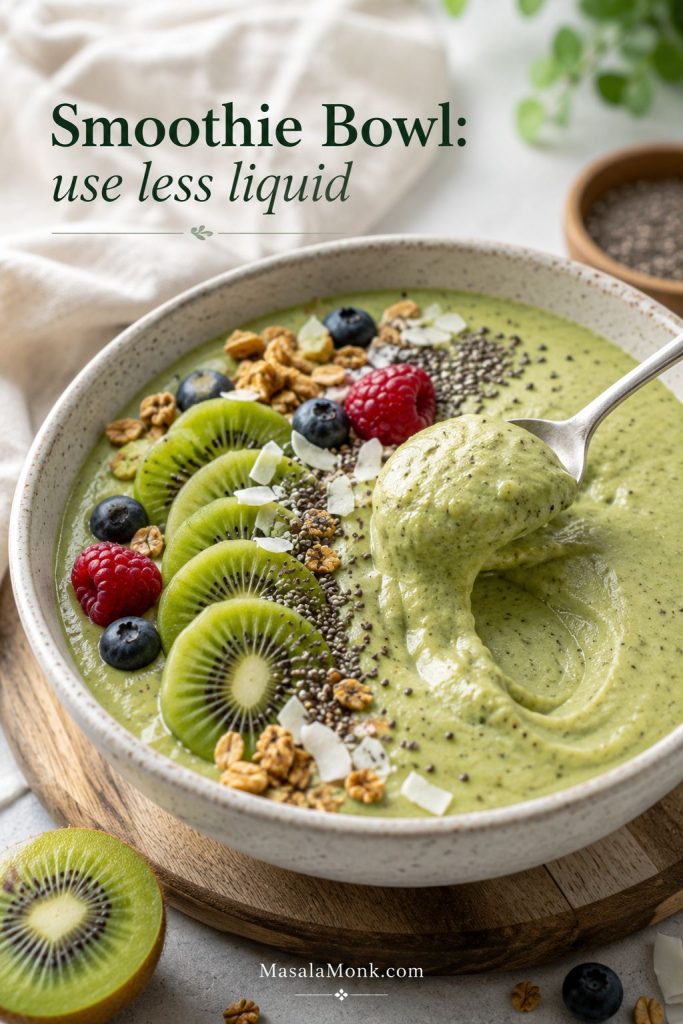
A smoothie bowl needs much less liquid than a drinkable smoothie. Reduce the liquid to ¼ cup / 60 ml and use frozen banana, frozen mango, or frozen pineapple. Blend thick, then top with sliced kiwi, granola, coconut, chia seeds, berries, or pumpkin seeds.

Kiwi Milkshake or Kiwi Shake

Kiwi smoothie and kiwi milkshake compared in two different glasses
A kiwi smoothie is usually lighter and fruit-based, while a kiwi shake becomes richer and sweeter with milk, banana, and ice cream.

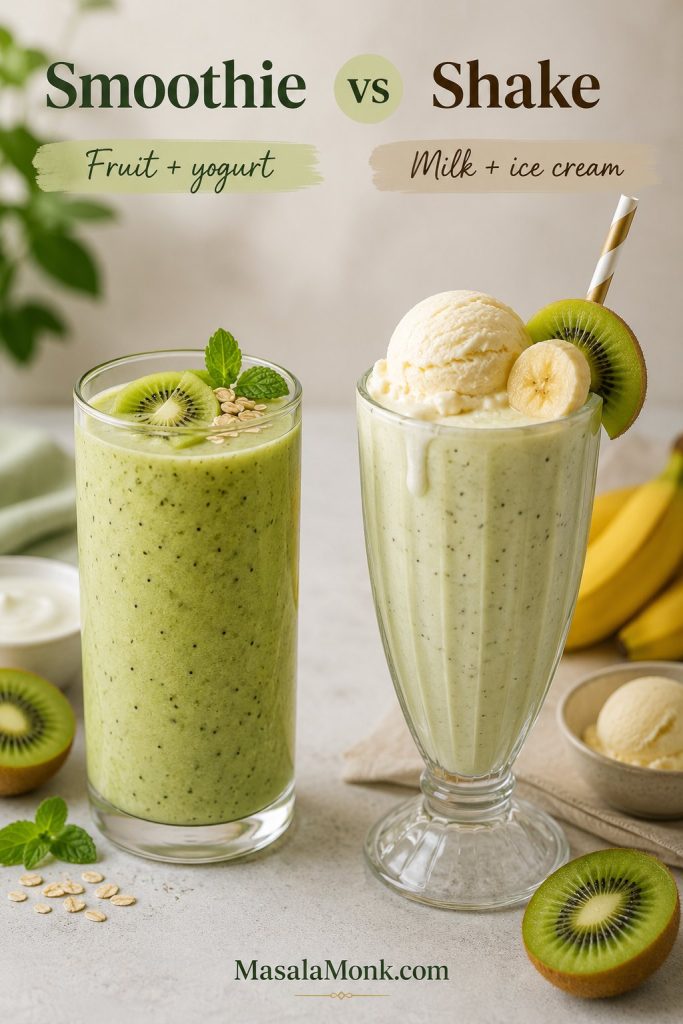
A kiwi shake is the dessert-style cousin of this smoothie. Blend 2–3 peeled kiwis with milk, banana, and a scoop of vanilla ice cream for a colder, sweeter drink. It is richer than the main recipe, so serve it right away and treat it more like a milkshake than a breakfast smoothie.

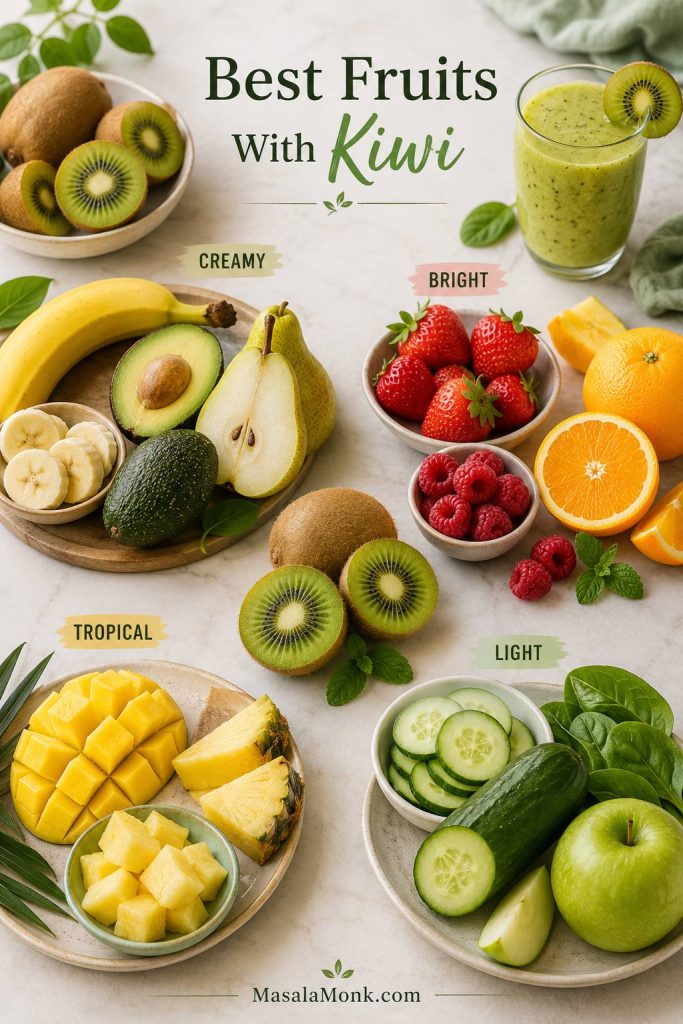
Best Fruits to Pair With Kiwi in Smoothies

Fruit pairing guide for kiwi smoothies with banana, avocado, pear, berries, orange, mango, pineapple, cucumber, spinach, and apple
Kiwi pairs best with fruits that either soften its tangy edge or echo its bright flavor, so choose the pairing based on the smoothie you want.

Because kiwi has a naturally bright edge, it works best with fruits that either soften its tartness or echo that fresh flavor. Banana and mango make it creamier. Strawberry and raspberry keep it tangy. Pineapple and orange make it tropical. Apple, pear, cucumber, and spinach keep it lighter.

Fruit or add-in Why it works with kiwi Best smoothie style
Banana Softens tartness and thickens the drink. Creamy breakfast smoothie
Strawberry Gives a familiar sweet-tart berry flavor. Berry kiwi smoothie
Mango Adds tropical sweetness and body. No-yogurt or tropical smoothie
Pineapple Makes the smoothie bright and juicy. Refreshing summer smoothie
Orange Adds citrus sweetness and makes the drink fruitier. Juice-based smoothie
Apple Keeps the flavor mild and fresh. Light breakfast smoothie
Blueberry Adds deeper berry flavor and color. Purple fruit smoothie
Raspberry Keeps the smoothie sharp and tangy. Tart berry smoothie
Pear Adds gentle sweetness without dominating. No-banana smoothie
Avocado Makes the smoothie creamy without banana. No-banana creamy smoothie
Spinach Adds green color with mild flavor. Green kiwi smoothie
Cucumber Makes the smoothie lighter and fresher. Cooling smoothie

Kiwi Smoothie With Milk, Yogurt, or Juice

Liquid guide for kiwi smoothies showing milk, coconut water, orange juice, water, and plant milk
Liquid choice shapes the whole smoothie, so pick milk for creaminess, coconut water for lightness, orange juice for brightness, or water when the fruit already tastes sweet.

The liquid you choose changes the whole smoothie. There is no single correct option; the best one depends on whether you want the drink creamy, light, bright, dairy-free, or more filling.

Because the liquid changes the final texture so much, choose based on the smoothie you actually want instead of forcing one option.

Liquid Best use Watch-out
Milk Creamy, mellow smoothie. Best with banana or yogurt for balance.
Greek yogurt + water Thick texture without too much liquid. Can taste tangy if the kiwi is tart.
Almond milk or oat milk Dairy-free creaminess. Use unsweetened if you want more control.
Coconut water Light, refreshing, tropical-style smoothie. Thinner than milk or yogurt.
Orange juice Bright, fruity, tropical flavor. Can make a tart kiwi taste even sharper.
Water Cleanest and simplest option. Can taste thin unless you use banana or mango.
Canned coconut milk Rich tropical smoothie. Can get heavy fast; use a small amount.

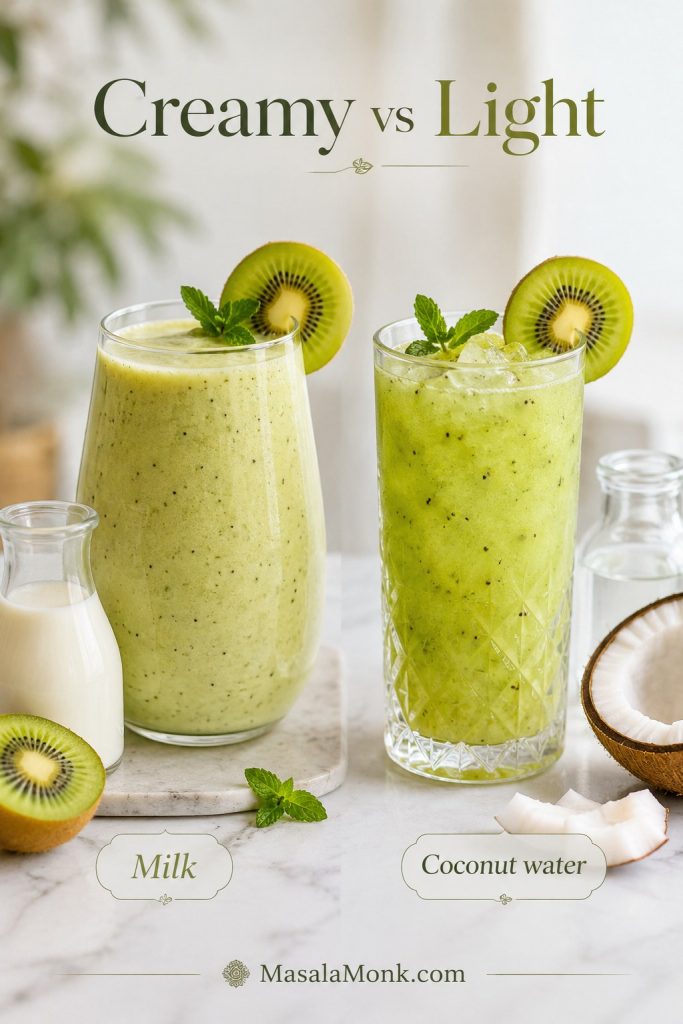
Milk vs Coconut Water

Milk-based kiwi smoothie and coconut-water kiwi smoothie shown side by side
Choose milk when you want a softer, creamier breakfast smoothie; meanwhile, coconut water works better for a lighter, fresher finish.

If you like the lighter tropical finish of coconut water, MasalaMonk’s coconut water smoothie ideas can give you more combinations beyond kiwi.

Kiwi works with milk and yogurt, but dairy-based versions are best enjoyed soon after blending. Green kiwifruit contains actinidin, a natural protein-digesting enzyme, so a milk- or yogurt-heavy smoothie can thin or separate more noticeably as it sits.

Is a Kiwi Smoothie Good for Weight Loss?

A smoothie recipe with kiwis can fit into a lighter breakfast or snack, but it is not magic on its own. The overall blend matters more than the word “kiwi.” Use whole fruit, keep juice and sweeteners modest, and add protein or fiber if you want the smoothie to feel more satisfying. The protein smoothie variation is a good place to start if you want a more filling version.

For example, a more balanced version could use 2 kiwis, ½ frozen banana, Greek yogurt or unsweetened plant milk, spinach or cucumber, and chia seeds. On the other hand, too much honey, sweetened yogurt, fruit juice, or ice cream can quickly turn it into a dessert drink.

Harvard Health notes that smoothies can become calorie-heavy when they include added sugar, syrup, honey, sweetened yogurt, frozen yogurt, or large amounts of juice. That is why this recipe keeps sweetener optional and uses whole fruit as the main base.

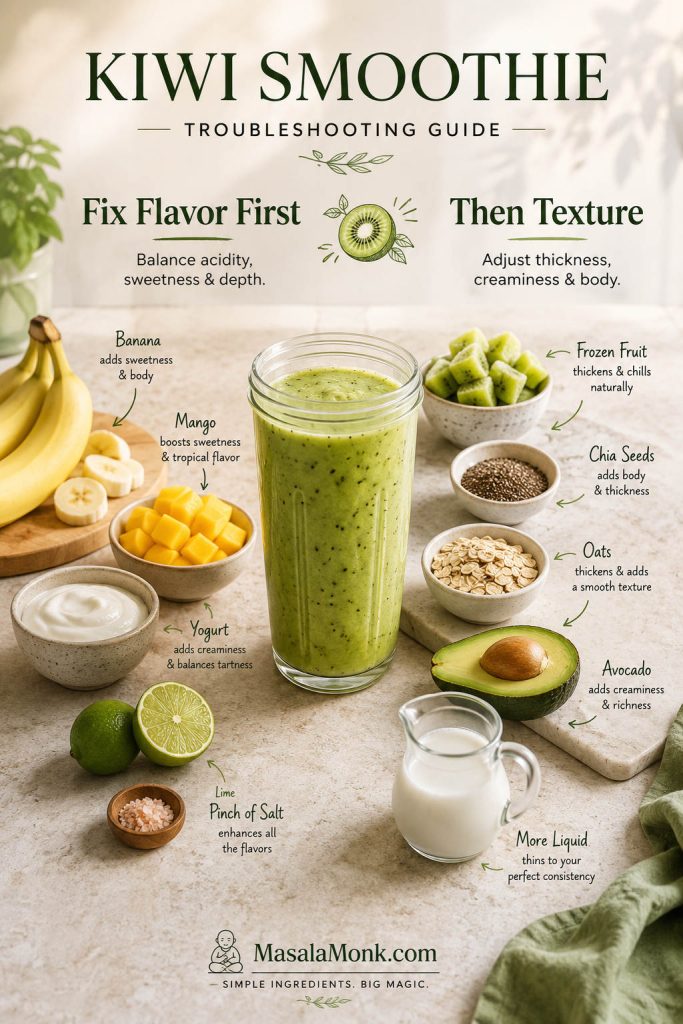
How to Fix a Kiwi Smoothie

Kiwi smoothie troubleshooting scene with small glasses labeled sour, thin, thick, flat, and watery
A kiwi smoothie that tastes off rarely needs a full remake; instead, one small fix for flavor or texture usually brings it back quickly.

Most problems in a smoothie recipe with kiwis are easy to fix while the drink is still in the blender. Taste before pouring, then adjust one thing at a time. Small changes work better than adding a lot of liquid, sugar, or ice all at once.

Do not throw out a smoothie just because the first sip is not perfect. Kiwi can taste different from fruit to fruit, and one small adjustment in the blender can turn a sharp, flat, or watery smoothie into something balanced.

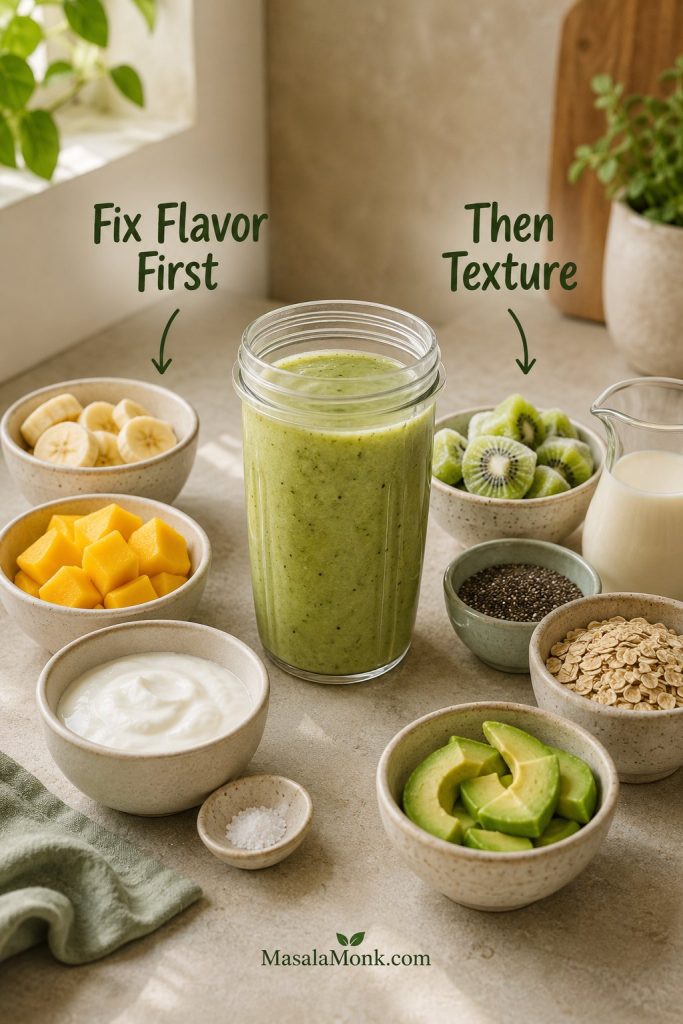
Fix the Flavor First

If the smoothie tastes sour, flat, bitter, or too sweet, fix the flavor before you change the texture. Usually, one small addition is enough: banana or mango for softness, yogurt for roundness, lime for brightness, or a tiny pinch of salt for a flat-tasting blend.

Kiwi smoothie fix guide with flavor ingredients on one side and texture ingredients on the other
Fix flavor before texture, because a smoothie that is sour or bland needs a different adjustment than one that is too thick or too thin.

Then Fix the Texture

Once the flavor tastes right, adjust the texture. Frozen fruit, banana, chia, oats, and avocado add body, while milk, coconut water, orange juice, or water loosen a thick smoothie. Add liquid slowly so the drink does not become watery.

Problem Best fix
Sour or sharp Blend in banana, mango, honey, maple syrup, or yogurt to soften the edge.
Thin texture Use frozen banana, frozen mango, chia seeds, oats, or avocado to bring back body. Next time, start with less liquid.
Overly thick Add milk, coconut water, orange juice, or water 1 tablespoon at a time until the blender moves smoothly.
Flat flavor A little more kiwi, a tiny squeeze of lime, orange juice, or even a small pinch of salt can wake it up.
Overly sweet Plain yogurt, cucumber, spinach, extra kiwi, or a little lemon/lime can pull the sweetness back into balance.
Seed-heavy texture Blend longer or use a high-speed blender. Kiwi seeds are edible, but a little texture is normal.
Watery smoothie Use frozen fruit instead of lots of ice, and keep the liquid lower at the start.
Bitter or harsh Use ripe, peeled kiwi. Hard kiwis and too much skin can make the drink taste rough.
Separation after sitting Shake or stir before drinking. For the next batch, use banana, yogurt, chia, or a less watery liquid.
Blender struggling Pour liquid in first, chop frozen fruit smaller, and add extra liquid by tablespoons instead of splashing in too much at once.

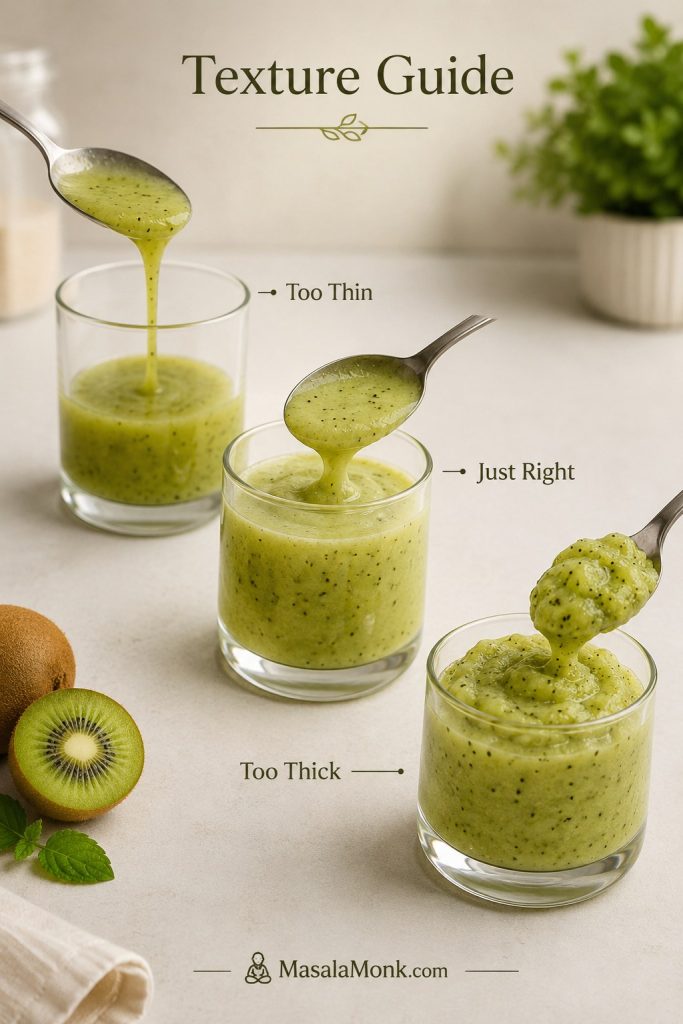
Kiwi Smoothie Thickness Guide

Kiwi smoothie texture guide showing too thin, just right, and too thick spoon textures
The sweet spot is thick enough to feel creamy, yet still loose enough to pour and sip comfortably without feeling heavy.

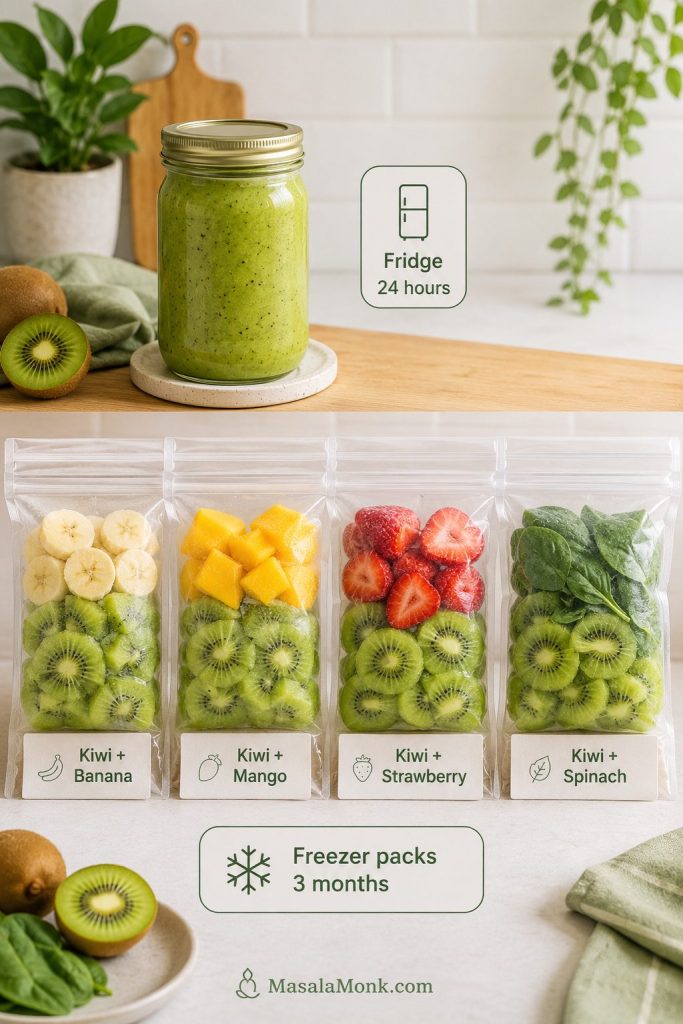
Make-Ahead, Freezing, and Storage Tips

Kiwi smoothie storage image with a fridge jar and freezer packs for kiwi banana, kiwi mango, kiwi strawberry, and kiwi spinach
Blended smoothies taste best fresh, but freezer packs make it easier to prep kiwi, banana, mango, berries, or spinach ahead of time.

This smoothie tastes best right after blending. The flavor is brighter, the texture is smoother, and dairy-based versions are less likely to thin out. If you need to make it ahead, keep it short and practical.

Storing a Kiwi Smoothie in the Fridge

For the best texture, drink it within 24 hours. Store it in a sealed jar or bottle, refrigerate it, and shake or stir before drinking. The smoothie may separate slightly, especially if it has water, coconut water, or juice instead of yogurt.

Freezing Kiwi for Smoothies

Frozen kiwi works well in smoothies. Peel and chop ripe kiwi, freeze the pieces on a tray, then transfer them to a freezer bag or container. However, frozen kiwi works best with banana, mango, strawberry, or yogurt because kiwi alone can become icy.

Making Kiwi Smoothie Packs

Smoothie packs are the easiest make-ahead option. Add peeled kiwi, banana, mango, strawberries, spinach, or pineapple to freezer bags. Freeze for up to 3 months. When ready to blend, add the frozen pack to the blender with yogurt and liquid.
Kiwi Nutrition Notes for Smoothies

Kiwi is often used in smoothies because it brings bright flavor, gentle natural sweetness, fiber from the whole fruit, and vitamin C. It pairs especially well with banana, mango, strawberry, spinach, and yogurt because those ingredients balance the tartness.

The USDA vitamin C table lists raw green kiwifruit as a high-vitamin-C fruit per cup, which makes kiwi a useful ingredient in fruit smoothies. You can also explore MasalaMonk’s broader guide to vitamin C rich foods for more everyday fruit and vegetable ideas.

For a deeper look at kiwi beyond smoothies, MasalaMonk has a guide to kiwi nutrition, benefits, and practical uses. For this recipe, though, the most important thing is simple: ripe fruit, the right liquid, and enough body to keep the smoothie enjoyable.

FAQs About Kiwi Smoothies

These quick answers cover the most common questions readers have before changing the base recipe: milk or no milk, yogurt or no yogurt, banana or no banana, fresh kiwi or frozen kiwi.

Can you put kiwi in a smoothie?

Kiwi works very well in smoothies because it adds bright, tangy fruit flavor. It tastes best with creamy or sweet ingredients like banana, yogurt, mango, strawberry, milk, or coconut water.

Do you peel kiwi before putting it in a smoothie?

For the smoothest kiwi smoothie, peel it first. Kiwi skin is edible, but it can add a fuzzy, fibrous texture. If you want to blend kiwi with the skin on, wash it very well and use a strong blender.

What fruit goes well with kiwi in smoothies?

Banana, strawberry, mango, pineapple, orange, apple, blueberry, raspberry, pear, and avocado all pair well with kiwi. Banana and mango are best for sweetness and creaminess, while strawberry and pineapple keep the flavor brighter.

Can I make a kiwi smoothie with milk?

Milk makes the drink creamy and mild, especially when paired with banana or yogurt. For the best texture, drink milk-based versions soon after blending.

Can I make a kiwi smoothie without yogurt?

For a no-yogurt version, replace yogurt with frozen banana, mango, avocado, plant milk, coconut water, chia seeds, oats, or plant-based yogurt. Without yogurt, the smoothie usually needs frozen fruit or banana to stay thick.

Can I make a kiwi smoothie without banana?

Mango, avocado, pear, Greek yogurt, frozen pineapple, or chia seeds can all replace banana. Mango is the best swap when you want sweetness and thickness without changing the flavor too much.

How do you make a kiwi smoothie less sour?

Start with ripe kiwis, then add banana or mango if the smoothie still tastes sharp. Milk or yogurt can also soften the flavor better than water. If needed, add 1–2 teaspoons honey or maple syrup, but avoid too much lime, lemon, pineapple, or orange juice when the kiwi is already tart.

Why did my kiwi smoothie turn watery?

It may have too much liquid, too much ice, or not enough creamy fruit. Frozen banana, frozen mango, yogurt, avocado, chia seeds, or oats will help thicken it. Also, the texture can thin slightly as it sits, so it is best fresh.

Can I use frozen kiwi in a smoothie?

Frozen kiwi works well, especially with banana, mango, strawberry, yogurt, or another creamy ingredient. On its own, frozen kiwi can make a smoothie taste icy or sharp.

What is the difference between a kiwi smoothie and a kiwi milkshake?

The smoothie version is usually fruit-based and often made with yogurt, milk, coconut water, or juice. A kiwi milkshake is dessert-style and usually includes milk, ice cream, or extra sweetener.

Final Tips for the Best Kiwi Smoothie

The first time you make it, start with 2 ripe kiwis, 1 frozen banana, ½ cup yogurt, and ½ cup liquid. Then, taste it before pouring. That one small pause is what helps you catch a sharp kiwi, a thin texture, or a smoothie that needs one more spoonful of yogurt.
After that, the recipe becomes easy to adapt. Banana makes it creamy, mango makes it tropical, strawberry makes it brighter, cucumber makes it lighter, and ice cream turns it into a kiwi shake. Once you make it once, note which direction you liked best: creamy banana, tropical mango, lighter coconut water, or sharper strawberry kiwi.

The best version is not always the sweetest one. It is the one where the kiwi still tastes fresh, the texture feels creamy, and nothing sharp, watery, or heavy takes over.

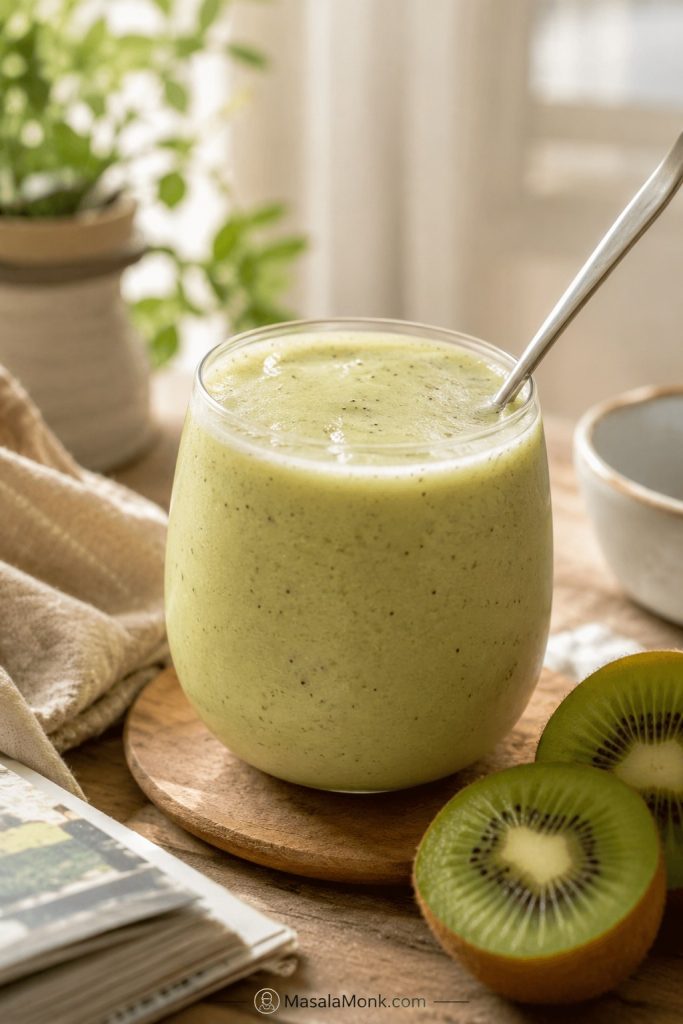
Finished creamy kiwi smoothie served in a glass with sliced kiwi in a warm breakfast setting
At its best, this smoothie stays bright, creamy, and fresh-tasting, so the kiwi still leads without turning the drink watery or harsh.
Posted on 3 Comments

Mango Smoothie Recipe

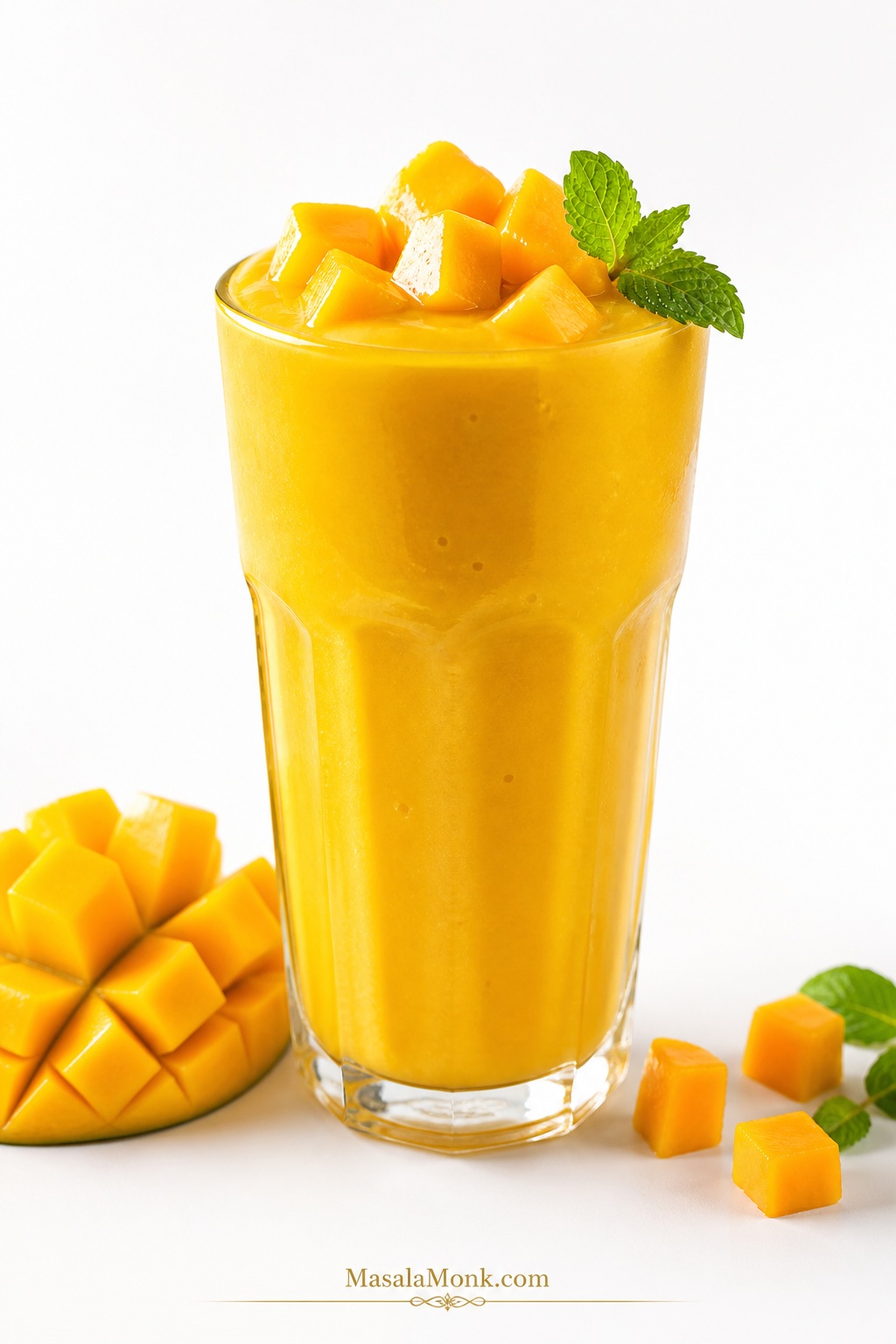
Thick mango smoothie in a glass topped with mango cubes and mint, served with fresh mango and lime.

A good mango smoothie recipe should taste cold, creamy, bright, and full of real mango flavor. It should not turn watery after a few sips, taste mostly like banana, or need a pile of ice just to feel thick.

This mango smoothie recipe starts with a simple base formula: ripe mango, just enough liquid, something creamy, and a small lift of lime if the fruit needs brightness. You can make it with fresh or frozen mango, yogurt or milk, banana or no banana, dairy or plant milk, and still end up with a smoothie that feels smooth, balanced, and easy to drink.

Once you understand the ratio, the same recipe can move in several directions. Make it thicker for a smoothie bowl, lighter for a breakfast drink, richer with Greek yogurt, tropical with pineapple, berry-bright with strawberries, or more filling with protein powder. The goal is not to memorize a dozen recipes. It is to know how to build the mango smoothie you actually want.

Mango Smoothie Recipe Quick Answer

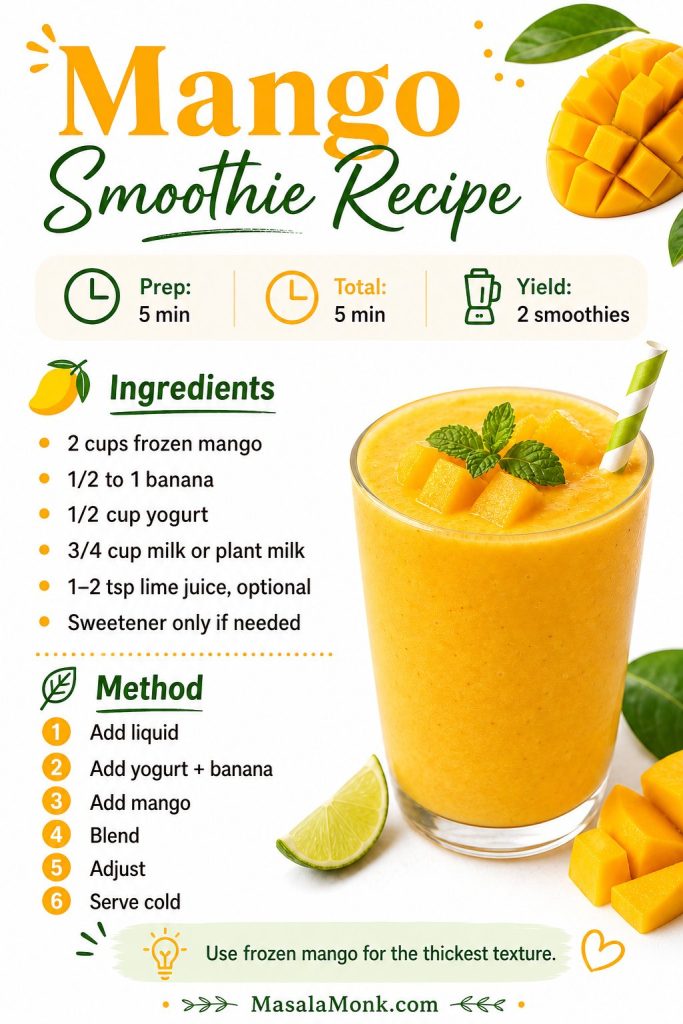
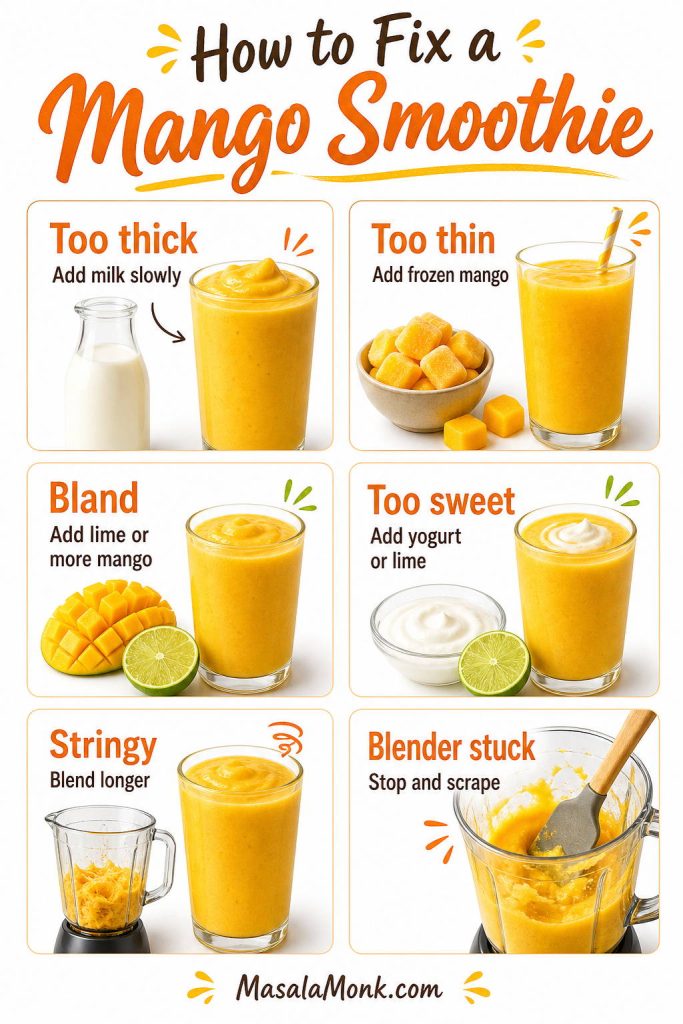
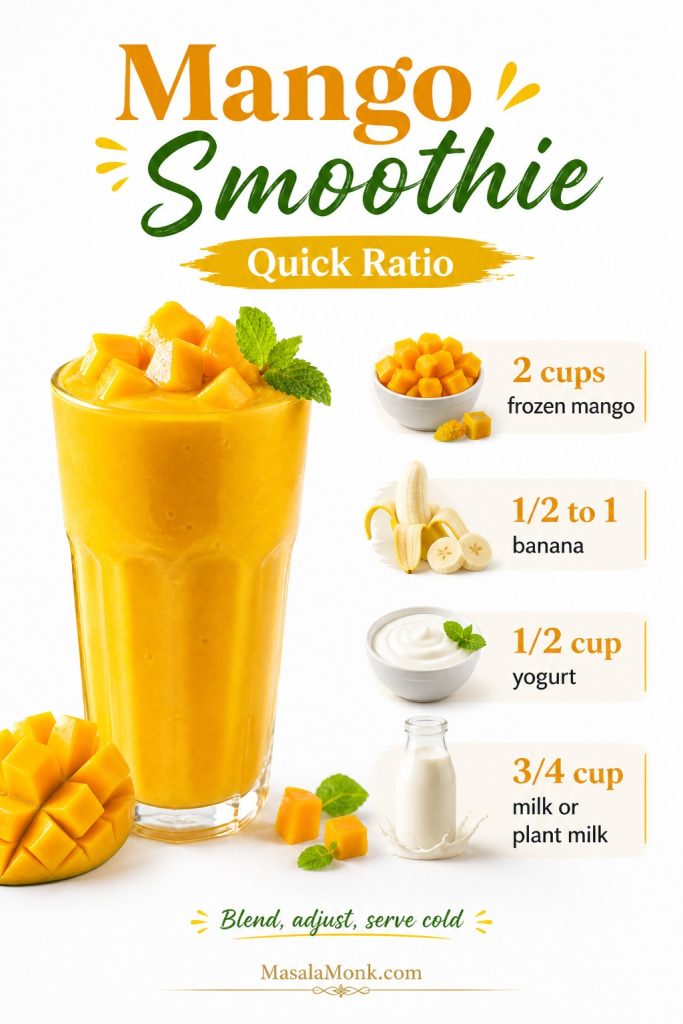
For a creamy, balanced mango smoothie, blend 2 cups frozen mango chunks, 1/2 to 1 small banana, 1/2 cup yogurt, and 3/4 cup milk or plant milk. Add 1 to 2 teaspoons lime juice when the mango tastes very sweet or slightly flat. To loosen a thick smoothie, add milk 1 tablespoon at a time. For a thin smoothie, add more frozen mango instead of piling in ice.

Best starting point: Use frozen mango, chilled yogurt, chilled milk, and no ice. This gives you a cold, creamy mango smoothie without diluting the fruit.
Quick mango smoothie ratio graphic showing frozen mango, banana, yogurt, milk or plant milk, and a finished smoothie.
Use this base ratio when you want a reliable starting point. Then, depending on whether you want a thinner drink or a thicker blend, adjust the liquid or frozen fruit in small steps.

Choose Your Mango Smoothie Version

The base mango smoothie recipe is flexible, so you can adjust it depending on what you have and how creamy you want the drink to be. Use this quick guide before you blend.

Visual guide showing classic, no banana, no yogurt, no milk, higher protein, smoothie bowl, and fruitier mango smoothie options.
This quick chooser helps you match the mango smoothie recipe to what you have on hand; as a result, you can move straight to the version that fits your ingredients and texture goal.
What You Want Best Adjustment Start With
Classic creamy mango smoothie Use frozen mango, banana, yogurt, and milk. Start with 2 cups mango, 1/2 banana, 1/2 cup yogurt, and 3/4 cup milk.
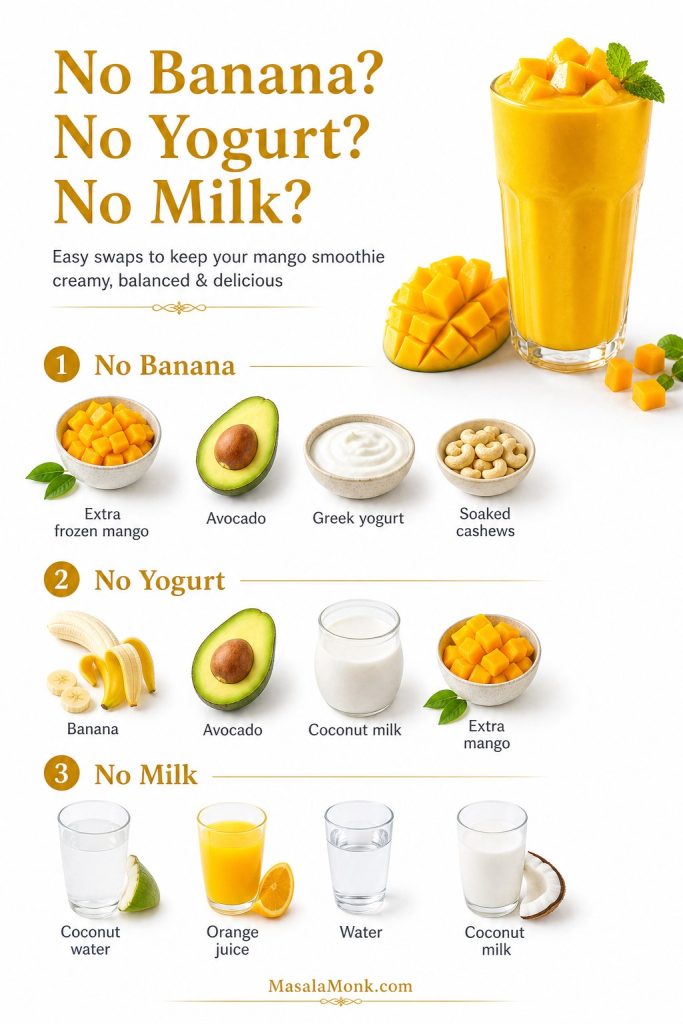
No banana Use extra frozen mango, Greek yogurt, avocado, or soaked cashews for body. Blend 2 1/2 cups frozen mango with 1/2 cup yogurt and 3/4 cup milk.
No yogurt Use banana, avocado, coconut milk, or extra frozen mango for creaminess. Try 2 cups mango, 1 banana, and 3/4 cup milk.
No milk Use coconut water, orange juice, water, or coconut milk depending on texture. Begin with 2 cups mango, 1/2 banana, 1/2 cup yogurt, and 1/2 to 3/4 cup liquid.
Higher protein Add protein powder, Greek yogurt, hemp seeds, chia seeds, soy milk, or dairy milk. Add 1 scoop protein powder to the base recipe, then blend in 2 to 4 tablespoons extra milk if needed.
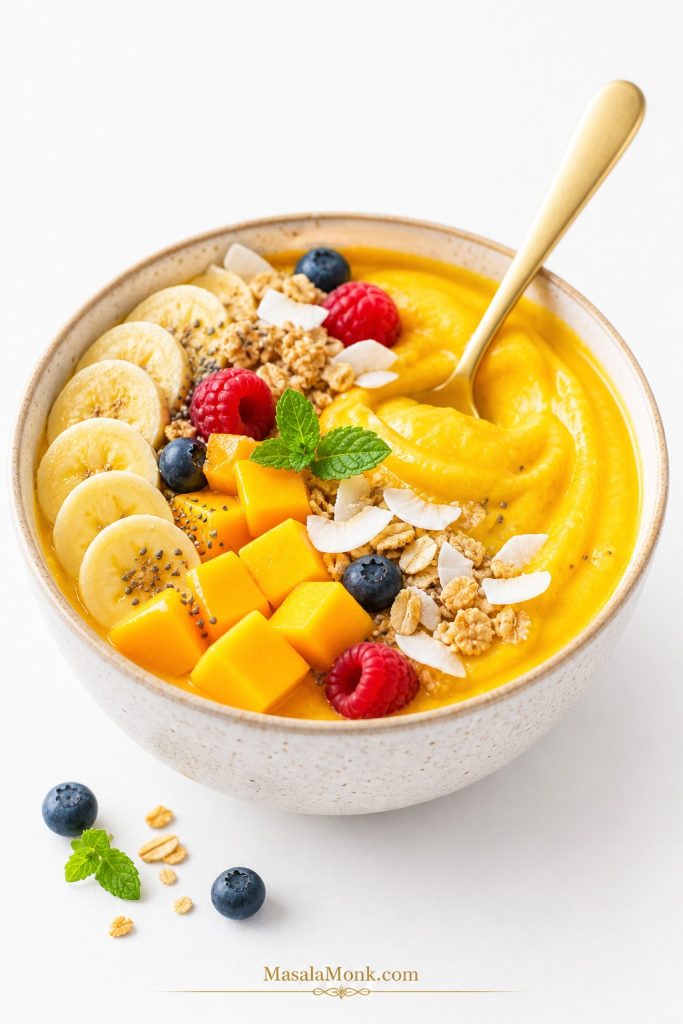
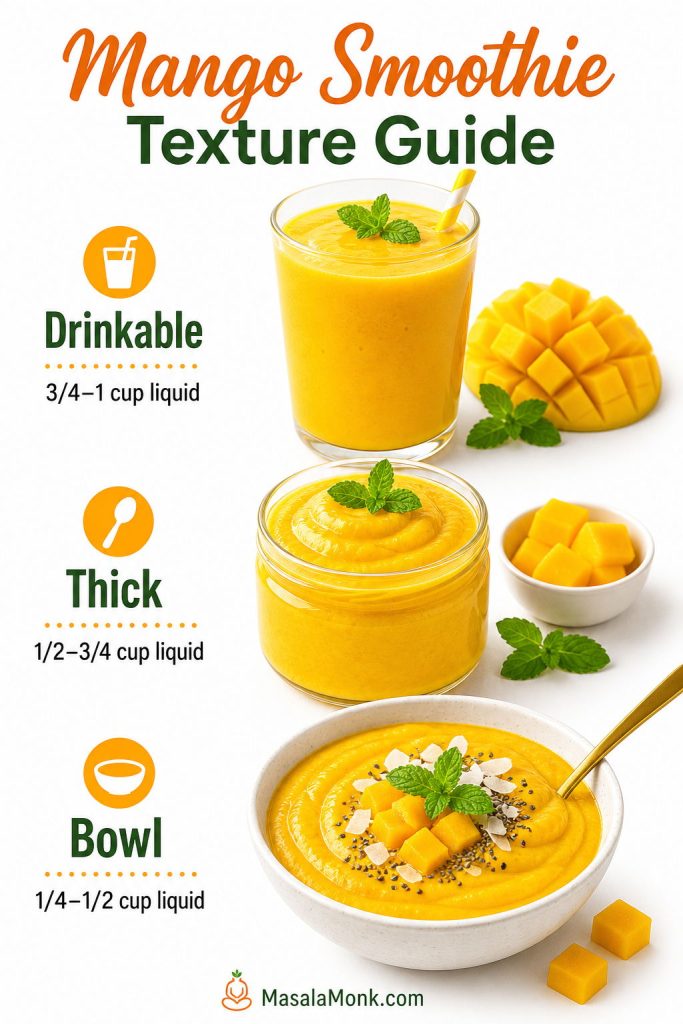
Smoothie bowl Use more frozen mango and much less liquid. For a spoonable bowl, use 2 1/2 to 3 cups frozen mango with only 1/4 to 1/2 cup milk.
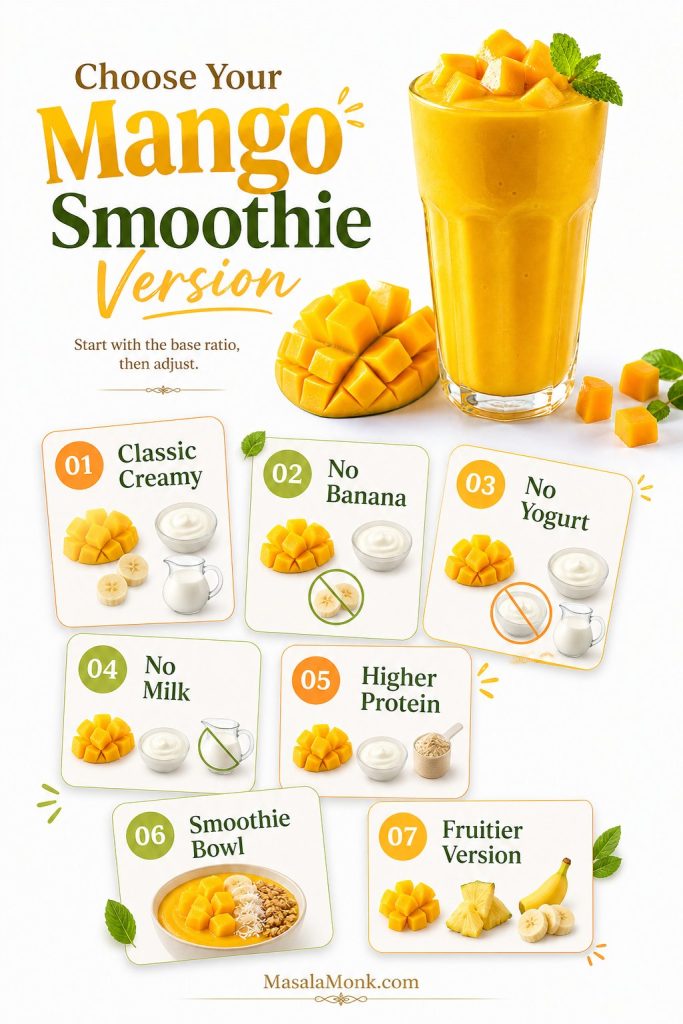
Fruitier smoothie Replace half the mango with strawberries, pineapple, blueberries, or peaches. Use 1 cup mango, 1 cup second fruit, yogurt, and milk.

Mango Smoothie at a Glance

Before you start blending, here is the mango smoothie recipe in practical terms. This is the version to make first when you want a classic mango smoothie that is thick, smooth, and easy to adjust.

Detail What to Use
Prep time 5 minutes
Blend time 35–60 seconds, depending on blender strength
Servings 2 medium smoothies
Yield About 2 1/2 to 3 cups / 600–700 ml / 20–24 fl oz
Best mango Frozen ripe mango chunks for texture; fresh ripe mango for peak-season flavor
Best liquid Milk, almond milk, oat milk, cashew milk, or coconut milk
Best texture Thick but pourable
Ice? Skip it with frozen mango; use a little only with fresh mango

Why This Mango Smoothie Works

This mango smoothie recipe works because it is built around texture and balance, not just sweetness. Although mango gives the main flavor, it still needs the right support. Frozen mango thickens the drink without watering it down. Yogurt adds body and a little tang. Banana makes the smoothie naturally creamy, while milk or plant milk helps everything blend smoothly.

Most importantly, the recipe keeps the liquid modest at the start. It is always easier to thin a smoothie than to rescue one that has turned watery. That is why the method asks you to blend first, then adjust slowly with small splashes of milk only when needed.

Mango Smoothie Ingredients

This smoothie recipe is flexible, but mango still does the main work. Once you know what each ingredient brings, you can change the smoothie confidently without losing the thick, creamy texture.

Mango smoothie ingredients arranged on a white background, including mango, banana, yogurt, milk, lime, sweetener, and ice.
Think of these ingredients as texture controls: mango builds the base, banana softens it, yogurt thickens it, milk loosens it, and lime keeps the flavor from tasting flat.

Mango

Mango is the heart of the recipe, so use ripe, sweet fruit whenever possible. Frozen mango chunks are the easiest option because they make the smoothie cold and thick right away. Fresh mango also works beautifully, especially during mango season. However, it needs a little help from chilled ingredients or a few ice cubes to feel just as cold.

If you are using Indian mangoes, ripe Alphonso, Kesar, Dasheri, or other sweet non-fibrous varieties work especially well. With supermarket mangoes, choose fruit that smells sweet near the stem and gives slightly when pressed. For a simple ripeness check, Mango.org recommends choosing mangoes by feel rather than color.

As a practical guide, 1 medium-large mango usually gives about 1 cup of chopped fruit, so this recipe needs about 2 medium-large mangoes if you are using fresh mango instead of frozen chunks.

Guide to choosing mango for smoothies, showing ripe mango, frozen mango chunks, smoothie texture, and stringy mango to avoid.
For the smoothest mango smoothie, choose ripe, sweet, less fibrous mangoes when possible. Meanwhile, frozen mango chunks are the easiest way to get thick, cold texture all year.

Banana

Banana makes the smoothie creamier, sweeter, and more filling. A frozen banana gives the thickest texture, while a fresh banana blends more easily. However, banana is still optional. To make a mango smoothie without banana, use extra frozen mango, Greek yogurt, avocado, coconut milk, or soaked cashews for body.

Yogurt

Yogurt adds creaminess, tang, and protein. Greek yogurt makes the smoothie thicker and more filling, while regular plain yogurt gives a lighter, more drinkable result. In addition, yogurt helps balance very sweet mangoes because it brings a little tang. For a dairy-free mango smoothie, use coconut yogurt, almond yogurt, cashew yogurt, or skip the yogurt and lean on banana or avocado instead.

Milk or Plant Milk

Milk loosens the smoothie just enough for the blender to run. Dairy milk gives a classic creamy flavor, almond milk keeps it light, oat milk makes it smooth, cashew milk adds richness, and coconut milk gives the drink a tropical edge. Orange juice also works, especially when you want a brighter fruit smoothie instead of a creamy one. However, it makes the drink sweeter and less creamy, so use it with frozen mango, pineapple, berries, or lime rather than treating it like a milk replacement in every version.

Milk and yogurt comparison for mango smoothies with dairy milk, almond milk, oat milk, coconut milk, Greek yogurt, and regular yogurt.
Choose the liquid based on the finish you want: almond milk keeps things lighter, oat milk feels rounder, coconut milk tastes richer, and Greek yogurt gives the most body.

Lime Juice

Lime juice is optional, but it can make a big difference. A small squeeze balances the sweetness and makes the mango taste fresher. Start with 1 teaspoon, blend, then add a little more only if the smoothie still tastes flat.

Sweetener

Sweeten only if your mango needs it. Very ripe mango and banana are often enough on their own. If the smoothie tastes sharp, bland, or not quite rounded, add honey, maple syrup, sugar, jaggery, or a soft date in small amounts.

For a no-added-sugar mango smoothie, use very ripe mango and banana, then skip the honey or sugar entirely. If the fruit is sweet enough, the smoothie does not need extra sweetener.

Ice

Ice is helpful only when you are using fresh mango and want a colder smoothie. With frozen mango, skip it. Too much ice weakens the flavor and can make the texture watery, so frozen fruit is usually the better way to thicken the drink.

Fresh vs Frozen Mango for Smoothies

Both fresh and frozen mango can make a good smoothie, but they behave differently in the blender. Frozen mango gives the most reliable thick texture. Fresh mango gives a softer, juicier, more seasonal flavor. Meanwhile, mango pulp is useful when ripe mangoes are not available, but it often needs less sweetener.

That is why this mango smoothie recipe gives you separate guidance for frozen mango, fresh mango, mango pulp, and fibrous mango.

Mango Type Best For How to Adjust
Frozen mango chunks Thick, cold, creamy smoothies Use little to no ice. Add milk slowly so the smoothie stays mango-forward.
Fresh ripe mango Peak-season flavor and softer smoothies Use chilled milk and yogurt, or add 1/2 cup ice. For better texture, freeze the mango cubes first.
Mango pulp Quick smoothies, shake-style drinks, and off-season mango flavor Use less sweetener because canned mango pulp is often already sweetened.
Fibrous mango Not ideal for very smooth drinks Blend longer, use yogurt for body, or choose a less fibrous mango next time.
Fresh and frozen mango comparison for smoothies, with fresh mango for flavor and frozen mango for thicker texture.
Fresh mango gives peak-season flavor, whereas frozen mango gives the thickest smoothie with less need for ice. Therefore, choose based on whether flavor or texture matters more that day.

Before using fresh mango, cut the fruit into cubes and chill it. For a thicker result, spread the cubes on a plate or tray and freeze them for 30 to 60 minutes. As a result, the smoothie turns colder and thicker without watering down the mango flavor.

If you are working with extra frozen mango and want a spoonable dessert instead of a drink, this mango sorbet recipe uses fresh or frozen mango with a similar fruit-forward approach.

How to Make a Mango Smoothie

The method is simple, but the order matters, especially if you are using a regular blender instead of a high-speed blender. First, liquid on the bottom helps the blades move. Then, frozen fruit on top keeps the smoothie thick. Because of that order, the blender needs less extra liquid.
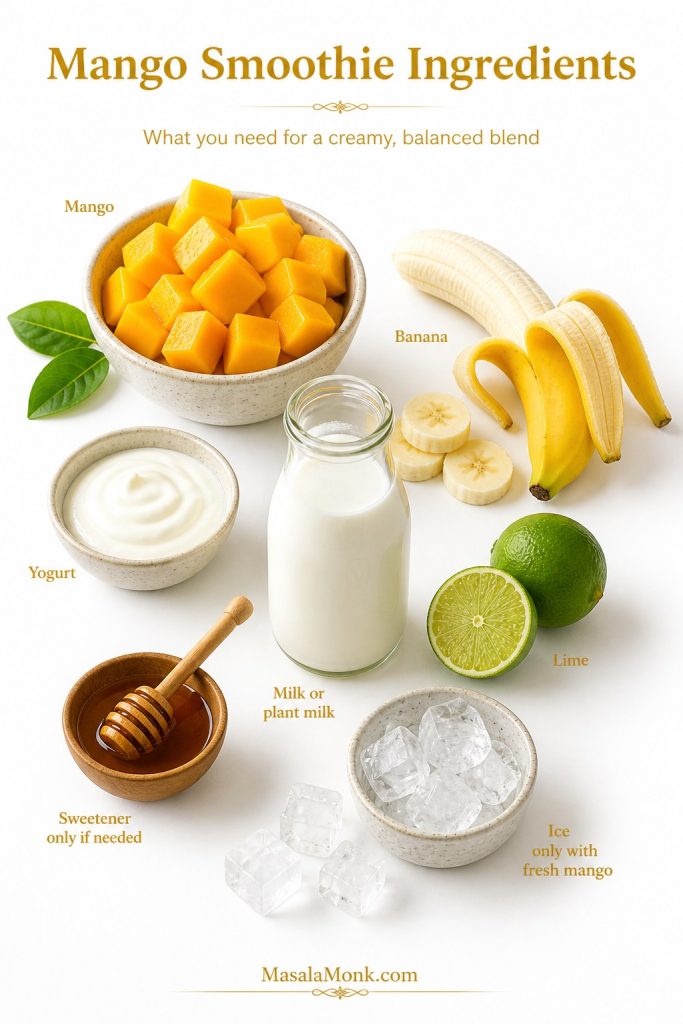
For this mango smoothie, the recipe works best when the liquid goes in before the frozen fruit, especially in a standard blender.

Equipment You Need

  • Blender: A high-speed blender is best for frozen mango, but a regular blender works if you add the liquid first.
  • Measuring cups or kitchen scale: Helpful when you want the texture to stay consistent.
  • Knife and cutting board: Needed if you are using fresh mango.
  • Spatula or tamper: Useful for thick smoothie bowls or frozen-fruit blends.
  • Tall glasses or jars: Best for serving the smoothie right away.

Blender Method

  1. Add the liquid first. Pour milk, almond milk, oat milk, coconut milk, or orange juice into the blender. This helps the blades catch.
  2. Add the creamy ingredients. Add yogurt, banana, avocado, protein powder, or any soft add-ins next.
  3. Add mango last. Frozen mango can sit on top because the liquid underneath helps the blender start moving.
  4. Blend low, then high. Start on low for about 10 seconds, then increase to high and blend until smooth.
  5. Adjust slowly. If the smoothie is too thick, add milk 1 tablespoon at a time. If it is too thin, add more frozen mango.
  6. Serve right away. Mango smoothies taste best while cold, creamy, and freshly blended.
Step-by-step mango smoothie method showing liquid first, yogurt and banana next, mango last, blending, and serving.
This blending order prevents two common problems at once: the blender starts more easily, and the smoothie stays thick because the frozen fruit is not buried under too much liquid.
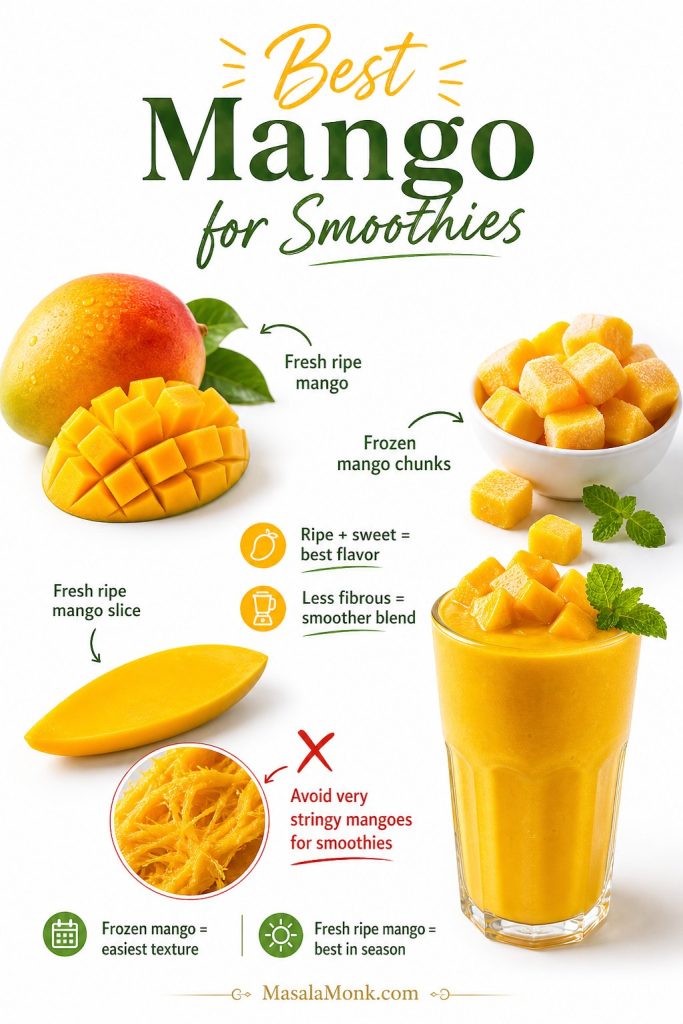
Blender tip: If the blender gets stuck, do not keep adding large splashes of liquid. Stop, scrape the sides, add 1 or 2 tablespoons liquid, then blend again. This keeps the smoothie thick instead of watery.
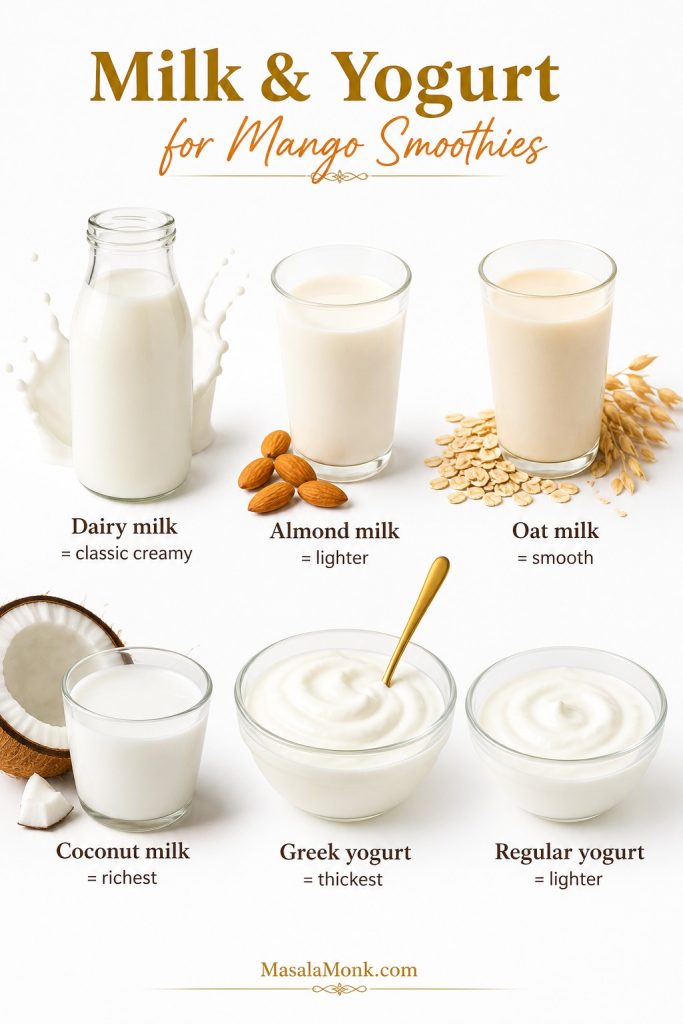
Blender tips for thick mango smoothies showing a blender jar, spatula, small liquid addition, and mango pieces.
If a thick smoothie gets stuck, do not flood the blender. Instead, scrape the sides and add a small splash of liquid so the mixture loosens without turning watery.

Here is the full mango smoothie recipe in one place, with the base version first and adjustment notes underneath.

Mango Smoothie Recipe

This creamy mango smoothie is cold, thick, and easy to adjust. Use frozen mango for the best texture, or fresh ripe mango with chilled ingredients when mangoes are in season.

Prep Time5 minutes
Total Time5 minutes
Servings2 smoothies
Yield600–700 ml

Ingredients

  • 2 cups frozen mango chunks, about 280–320 g
  • 1/2 to 1 small banana, preferably frozen, about 50–100 g peeled
  • 1/2 cup plain Greek yogurt or regular yogurt, about 120 g
  • 3/4 cup milk or plant milk, about 180 ml / 6 fl oz, plus more as needed
  • 1–2 teaspoons fresh lime juice, optional
  • 1–2 teaspoons honey, maple syrup, sugar, or jaggery, only if needed
  • 1/2 cup ice, only if using fresh mango instead of frozen mango

Instructions

  1. Add the milk or plant milk to the blender first.
  2. Add the yogurt, banana, lime juice, and sweetener if using.
  3. Add the frozen mango chunks.
  4. Blend on low for about 10 seconds, then increase to high and blend for 35–60 seconds, or until smooth.
  5. If the smoothie is too thick, add more milk 1 tablespoon at a time. If it is too thin, add more frozen mango and blend again.
  6. Taste and adjust with a little more lime juice or sweetener if needed.
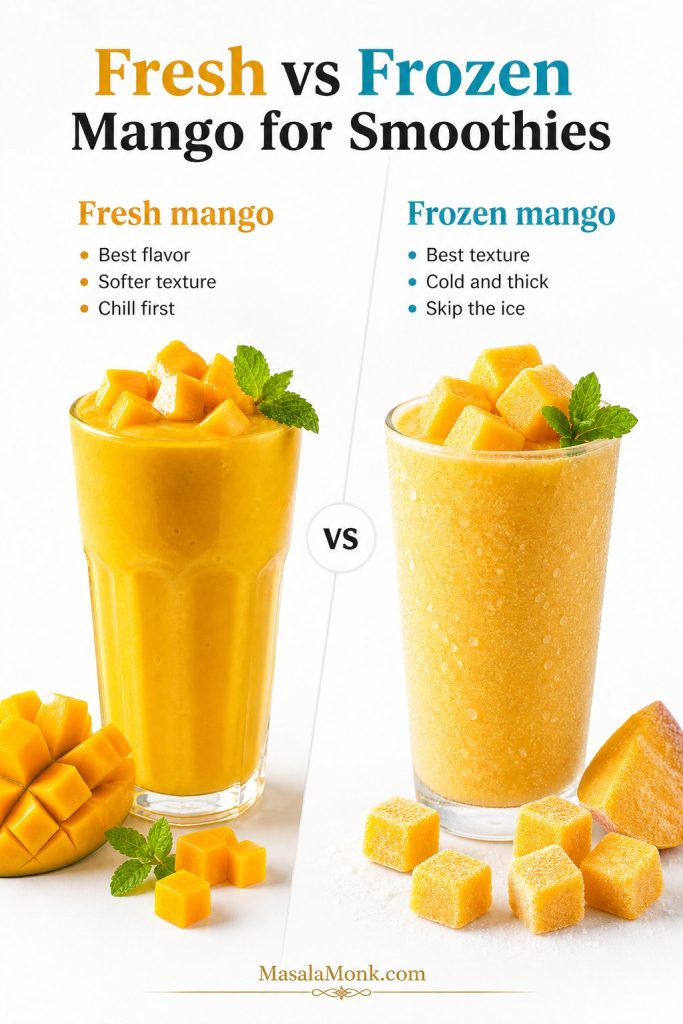
  7. Pour into glasses and serve immediately.
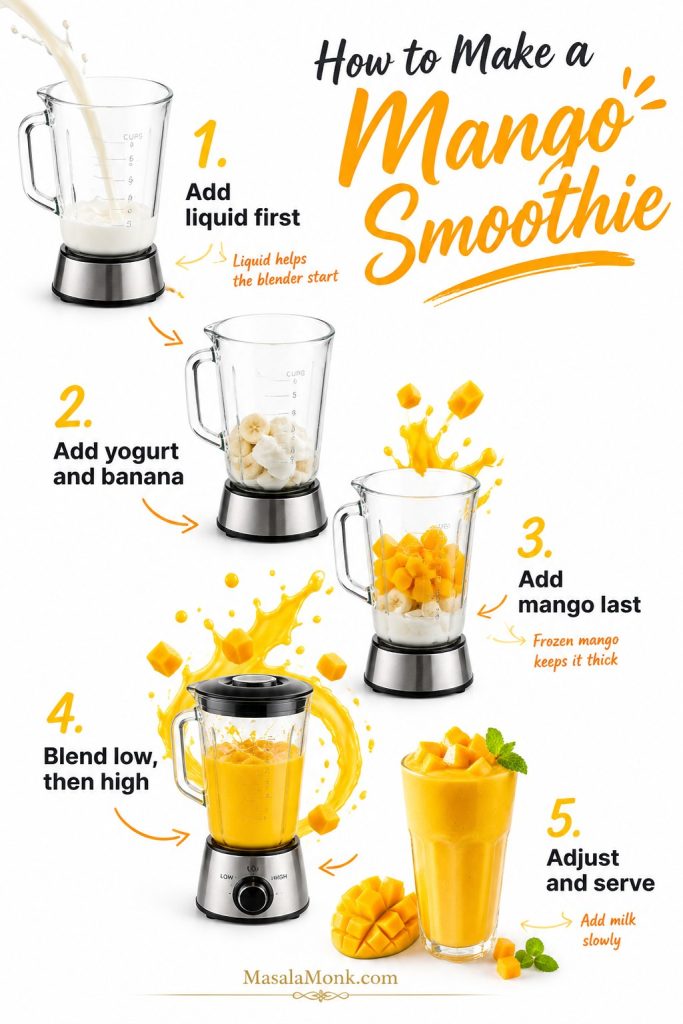
Notes

  • For the thickest smoothie, use frozen mango and frozen banana.
  • For a mango smoothie without banana, use extra frozen mango, avocado, Greek yogurt, coconut milk, or soaked cashews.
  • For a dairy-free mango smoothie, use almond milk, oat milk, cashew milk, or coconut milk with coconut yogurt or no yogurt.
  • For a smoothie bowl, reduce the liquid to 1/4 to 1/2 cup and use extra frozen mango.
  • If using fresh mango, chill the mango and milk first, or add 1/2 cup ice.
  • To double the recipe, double all ingredients but start with slightly less liquid, then add more after blending.

Approximate Nutrition

Per smoothie, using frozen mango, 1/2 small banana, Greek yogurt, and unsweetened almond milk: about 180–230 calories, 6–10 g protein, and 3–5 g fiber. Exact nutrition will change depending on the milk, yogurt, banana amount, and sweetener you use.

Saveable mango smoothie recipe card with prep time, yield, ingredients, method, and a finished smoothie.
Save this mango smoothie recipe as your base version; afterward, you can return to the post for bowl, dairy-free, protein, or no-banana adjustments.

Serving Ideas

Serve the smoothie right after blending, while it is still cold, thick, and creamy. For a simple garnish, add diced mango, a few mint leaves, chia seeds, hemp seeds, toasted coconut, or a thin lime wheel. If it is a quick breakfast smoothie, keep it plain. If you want it to feel more finished, choose one small topping so the mango flavor still stays first.

Mango smoothie serving ideas with diced mango, mint, chia seeds, hemp seeds, toasted coconut, lime, and a finished smoothie.
A few simple toppings can make the smoothie feel more finished; still, keeping the garnish light helps the fresh mango flavor stay front and center.

Mango Smoothie vs Mango Shake vs Mango Lassi

Mango smoothie, mango shake, and mango lassi can overlap, but they are not exactly the same drink. The difference usually comes down to the base, texture, sweetness, and how rich you want the drink to feel.

Drink Main Base Texture Best For
Mango Smoothie Mango, milk or plant milk, yogurt, banana, fruit, greens, or protein add-ins Cold, creamy, flexible, breakfast-friendly Breakfast, snack, smoothie bowls, protein versions, dairy-free versions
Mango Shake Mango, chilled milk, sugar, sometimes ice cream or nuts Sweeter, milkier, richer Classic summer drink, dessert-style mango drink
Mango Lassi Mango, yogurt or curd, milk or water, sweetener Tangy, creamy, cooling Indian-style yogurt drink, restaurant-style pairing, cooling drink
Comparison image showing mango smoothie, mango shake, and mango lassi in three glasses with different textures and labels.
These mango drinks overlap, but they are not the same. A smoothie is more flexible, a shake is milkier and sweeter, and lassi tastes tangier because yogurt leads the blend.

For the richer milk-based version, see this mango shake recipe. For the yogurt-based Indian drink, use this mango lassi recipe. If you want a little background, Britannica describes lassi as a yogurt-based drink, which is why mango lassi tastes tangier and more yogurt-forward than a typical mango smoothie.

Mango Smoothie Variations

Once you have the base recipe, the mango smoothie variations are easy. In most cases, keep the total frozen fruit close to 2 cups for a drinkable smoothie, then adjust the liquid slowly. However, for smoothie bowls, use more frozen fruit and much less liquid.

Mango smoothie variations guide showing banana, strawberry, pineapple, protein, dairy-free, and spinach versions.
Use the base recipe as a template, then change only one direction at a time — fruitier, creamier, greener, higher-protein, or dairy-free — so the flavor stays balanced.

Mango Banana Smoothie

Banana is the classic way to make a mango smoothie creamier and more filling. Use 1 full banana instead of 1/2 banana, preferably frozen, and keep the rest of the base recipe the same. The result is sweeter, softer, and perfect for a quick breakfast smoothie.

Strawberry Mango Smoothie

Strawberries make the smoothie brighter, fruitier, and slightly tangy. Use 1 cup frozen mango and 1 cup frozen strawberries, then blend with the same yogurt and milk base. Taste before sweetening because tart strawberries may need a little honey, while sweet ones may need nothing at all. If you want more berry-based options, this strawberry smoothie guide has more smoothie ideas to explore.

Mango Pineapple Smoothie

Pineapple pushes the smoothie in a more tropical direction. Use 1 cup frozen mango with 1 cup frozen pineapple, then choose coconut milk or coconut water if you want that sunny, beachy flavor. If the pineapple tastes sharp, banana or a small spoon of honey will round it out.

Mango Blueberry Smoothie

Blueberries make the smoothie thicker, darker, and more berry-forward. Start with 1 cup frozen mango and 1 cup frozen blueberries, then loosen the blender with an extra splash of milk if needed. A little lime juice helps keep the flavor lively.

Mango Peach Smoothie

Peach gives the smoothie a softer, more floral sweetness. Use 1 cup mango and 1 cup frozen peaches. Vanilla yogurt can taste lovely here, although plain yogurt keeps the drink fresher and less dessert-like.

Fruit combo mango smoothies showing mango banana, strawberry mango, mango pineapple, and mango peach versions.
Fruit combinations change the whole mood of the smoothie: banana makes it creamier, strawberry brightens it, pineapple pushes it tropical, and peach keeps it softer and rounder.

Mango Yogurt Smoothie

To make yogurt the main creamy element, increase it to 3/4 cup and reduce the milk slightly. Greek yogurt gives a thicker, higher-protein smoothie, while regular yogurt keeps the texture lighter. This version sits close to a lassi-style mango drink, but it stays more flexible and smoothie-like.

Mango Protein Smoothie

Protein powder turns the smoothie into a more filling breakfast or post-workout drink. Add 1 scoop vanilla protein powder to the base recipe, then increase the milk by 2 to 4 tablespoons as needed. For a higher-protein mango smoothie, use Greek yogurt, add 1 tablespoon hemp seeds or chia seeds, and choose dairy milk or soy milk instead of a very light plant milk. Depending on the protein powder and yogurt you use, this version can move into the 20–25 g protein range.

Mango protein smoothie with protein powder, Greek yogurt, hemp or chia seeds, milk, mango cubes, and a finished smoothie.
For a more filling mango protein smoothie, pair protein powder with Greek yogurt, hemp, chia, or a higher-protein milk. That way, the drink feels more complete without losing its fruit-first taste.

Avocado Mango Smoothie

Avocado is a great choice when you want creaminess without banana. Use 1/4 to 1/2 ripe avocado in the base recipe and skip the banana. The flavor stays mellow, the texture turns silky, and the smoothie becomes less sweet but still rich. For more creamy fruit-and-nut ideas, you might also like these nut-infused smoothies.

Mango Spinach Smoothie

Baby spinach blends easily into mango smoothies because its flavor is mild. Add 1 to 2 cups spinach with the liquid and blend until smooth before adding the mango. That extra first blend keeps the texture cleaner and gives you a green mango smoothie that still tastes fruity.

Dairy-Free Mango Smoothie

A dairy-free mango smoothie works best when you replace both the liquid and the creamy element. Use almond milk, oat milk, cashew milk, or coconut milk, then add coconut yogurt, dairy-free yogurt, banana, avocado, or soaked cashews for body. Coconut milk gives the richest result, while almond milk keeps the smoothie lighter. For more on this tropical pairing, see this guide to mango with coconut milk.

Dairy-free mango smoothie options with almond milk, oat milk, coconut milk, coconut yogurt, avocado, and mango.
A dairy-free version works best when you replace both the liquid and the creamy element; otherwise, the smoothie can taste thin even when the mango flavor is strong.

Mango Smoothie Without Banana

Skipping banana is easy as long as you replace the body it normally gives. Use 2 1/2 cups frozen mango, 1/2 cup yogurt, and 3/4 cup milk. For an even creamier texture, add 1/4 avocado or 2 tablespoons soaked cashews. This keeps the smoothie thick without letting banana take over the flavor.

Mango Smoothie Without Yogurt

Without yogurt, the smoothie needs another ingredient for body. Banana, avocado, coconut milk, or extra frozen mango all work well. Start with 3/4 cup milk and add more only if the blender needs it. Since yogurt usually adds tang, a little lime juice helps keep this version from tasting too sweet or flat.

Substitution guide for making mango smoothies without banana, yogurt, or milk, with alternative ingredients in three sections.
If you are missing banana, yogurt, or milk, use this guide to swap with purpose. As a result, the smoothie stays balanced instead of becoming too thin, too sweet, or too flat.

Mango Smoothie Bowl

A mango smoothie bowl should be thick enough to spoon, not thin enough to sip through a straw. Use 2 1/2 to 3 cups frozen mango and only 1/4 to 1/2 cup milk. Blend slowly, scrape as needed, and top with granola, coconut, chia seeds, berries, banana slices, or chopped nuts. If you like make-ahead oat toppings, these homemade granola bars can also be crumbled over smoothie bowls.

Thick mango smoothie bowl topped with mango cubes, granola, coconut flakes, chia seeds, berries, banana slices, and a spoon.
The bowl version should mound slightly around the spoon and toppings; if it spreads like a drink, blend in more frozen mango before serving.

Mango Smoothie Texture Guide

The best mango smoothie texture depends on how you want to serve it. For example, a glass smoothie needs enough liquid to pour, while a smoothie bowl needs much less liquid and more frozen fruit. Meanwhile, a shake-like mango drink uses more milk and feels lighter.

Texture Use This Ratio Best For
Drinkable smoothie 2 cups mango + 3/4 to 1 cup liquid Breakfast glass, snack, quick smoothie
Thick smoothie 2 cups mango + 1/2 to 3/4 cup liquid Cold, creamy, spoonable-but-pourable texture
Smoothie bowl 2 1/2 to 3 cups frozen mango + 1/4 to 1/2 cup liquid Bowl with toppings
Shake-like smoothie 1 1/2 to 2 cups mango + 1 to 1 1/2 cups chilled milk Lighter, milkier mango drink
Mango smoothie texture guide showing drinkable, thick, and bowl-style versions with different liquid amounts.
Texture is easiest to control before blending: decide whether you want to sip it, pour it thick, or spoon it, then start with the matching liquid range.

How to Fix a Mango Smoothie

Most smoothie problems are easy to fix once you know whether the issue is texture, sweetness, or flavor balance. Start with one small adjustment, then blend and taste again.

Troubleshooting guide for fixing a mango smoothie that is too thick, too thin, bland, too sweet, stringy, or stuck in the blender.
Most mango smoothie problems need only one small fix. For example, frozen mango thickens, lime brightens, yogurt softens sweetness, and scraping helps a stuck blender move again.

If the Smoothie Is Too Thick

Add milk or plant milk 1 tablespoon at a time. Blend again before adding more. This keeps the smoothie from turning thin too quickly.

If the Smoothie Is Too Thin

Add more frozen mango, frozen banana, Greek yogurt, or avocado. Ice can help in a pinch, but frozen fruit gives a better mango flavor and a creamier finish.

If the Smoothie Tastes Bland

Add lime juice, a tiny pinch of salt, or more mango. Bland smoothies often need brightness, not just more sugar.

If the Smoothie Is Too Sweet

Add plain yogurt, lime juice, or a few more frozen mango pieces. Avoid adding too much extra milk because it can weaken the flavor.

If the Smoothie Is Not Sweet Enough

Add honey, maple syrup, sugar, jaggery, or a soft date in small amounts. Still, taste the mango first. Very ripe mangoes may not need any sweetener at all.

If the Smoothie Is Stringy

The mango may be fibrous. Blend longer, use a stronger blender, or choose smoother mango varieties next time. Frozen mango chunks are often more consistent for smoothies.

If the Blender Gets Stuck

Stop the blender, scrape the sides, and add 1 or 2 tablespoons liquid. Then blend again, starting low before increasing the speed.

Make Ahead, Storage, and Freezing

Mango smoothies are best right after blending because the texture is cold, creamy, and fresh. Even so, the recipe is easy to prep ahead when you freeze the mango for each smoothie in small packs. For example, you can freeze mango, banana, and spinach together so breakfast takes only a minute or two.

  • Refrigerator: Store leftover smoothie in a covered jar for up to 1 day. Shake or blend again before drinking.
  • Freezer smoothie packs: Add mango, banana, berries, pineapple, or spinach to freezer bags. When ready, blend with milk and yogurt.
  • Smoothie cubes: Freeze leftover smoothie in an ice cube tray, then re-blend the cubes with a splash of milk.
  • Best fresh: For the best texture, blend just before serving.
Make-ahead mango smoothie packs with freezer bags of mango, banana, greens, berries, smoothie cubes, and a finished smoothie.
Freezer packs make busy mornings easier; even so, the best texture still comes from blending the smoothie fresh instead of storing it fully blended.

More Mango and Smoothie Recipes

After you make this smoothie, you may want a richer mango drink, a tangier yogurt-based drink, or another fruit smoothie. Try this mango shake recipe when you want something creamier and sweeter, this mango lassi recipe when you want a cooling yogurt-based drink, or this strawberry smoothie guide when you want more berry-based variations.

Mango Smoothie FAQs

Can I make a mango smoothie without banana?

Yes. Use extra frozen mango, Greek yogurt, avocado, coconut milk, or soaked cashews to replace the creaminess banana normally gives. For a simple no-banana mango smoothie, blend 2 1/2 cups frozen mango, 1/2 cup yogurt, and 3/4 cup milk.

Can I make a mango smoothie without yogurt?

Yes. Use banana, avocado, coconut milk, oat milk, or extra frozen mango for body. The smoothie will taste less tangy, so a little lime juice can help balance the sweetness.

Is fresh or frozen mango better for smoothies?

Frozen mango is better for thick, cold smoothies because it chills and thickens the drink without ice. Fresh mango is excellent during mango season, but the smoothie may need chilled milk, chilled yogurt, or a few ice cubes.

Can I make a mango smoothie with frozen mango?

Yes, and it is usually the best option for texture. Frozen mango makes the smoothie thicker, colder, and creamier without watering it down.

Can I use mango pulp for a smoothie?

Yes. Mango pulp works well, especially when fresh mangoes are not in season. Since many canned mango pulps are sweetened, taste before adding honey, sugar, maple syrup, or jaggery.

How do I make a mango smoothie thicker?

Use frozen mango, frozen banana, Greek yogurt, avocado, or less liquid. For the thickest smoothie, start with only 1/2 cup liquid and add more slowly.

How do I make a mango smoothie dairy-free?

Use almond milk, oat milk, cashew milk, or coconut milk. Replace yogurt with coconut yogurt, dairy-free yogurt, banana, avocado, or soaked cashews.

Is a mango smoothie the same as a mango shake?

Not exactly. A mango smoothie is usually more flexible and may include yogurt, banana, plant milk, protein powder, greens, or other fruit. A mango shake is usually milkier, sweeter, and often made with chilled milk, mango, sugar, and sometimes ice cream.

What liquid is best for a mango smoothie?

Milk gives the creamiest classic result. Almond milk keeps it light, coconut milk makes it tropical, oat milk makes it smooth, and orange juice makes it brighter and fruitier.

Can I make a mango smoothie without milk?

Yes. Use coconut water, orange juice, or water instead of milk, but expect a lighter and less creamy smoothie. For a no-milk smoothie that still feels creamy, use coconut milk, dairy-free yogurt, avocado, banana, or extra frozen mango.

Can I add protein powder to a mango smoothie?

Yes. Add 1 scoop vanilla protein powder and increase the liquid slightly. Protein powder thickens smoothies, so add milk 1 or 2 tablespoons at a time until the blender runs smoothly.

Can I make a mango smoothie with water?

You can, but the smoothie will taste thinner and less creamy. For a lighter smoothie, coconut water is usually better than plain water. For a creamier smoothie, use milk, oat milk, cashew milk, coconut milk, or yogurt.

Final Tip

For the best mango smoothie recipe, start with ripe mango, keep the liquid modest, and adjust only after blending. Frozen mango gives you the easiest thick texture, while a little lime juice keeps the flavor bright. Once the recipe gives you a smoothie that is cold, creamy, and full of mango flavor, pour it right away and enjoy it at its best.

Finished mango smoothies in glasses with mango pieces, mint, and lime on a bright white background.
The finished drink should look cold, creamy, and ready to serve right away. In the end, that thick, mango-forward texture is what makes the recipe worth repeating.
Posted on 14 Comments

Strawberry Smoothie Recipes (12 Easy Blends + Bowls & Protein Shakes)

The Ultimate Strawberry Smoothie Guide cover featuring a creamy strawberry smoothie in a glass topped with fresh strawberries and chia seeds on a dark background.

A strawberry smoothie recipe can be as simple as fruit and milk—sweet, cold, and comforting in the way only strawberries manage. Still, it can also be the kind of drink that feels a little more intentional: thicker, creamier, packed with protein, or bright and tropical depending on what you toss into the blender. That’s the charm. You can keep it basic on a sleepy morning, then lean into something spoonable and extra on the weekend.

Even if you start with one strawberry smoothie recipe, the variations open up fast. Add banana and you’ve got a strawberry banana smoothie that tastes like a classic diner treat. Stir in yogurt and it turns into a strawberry smoothie with yogurt—tangy, creamy, and quietly luxurious. Blend in protein powder and you’re suddenly in strawberry protein shake territory, where the smoothie stops being “just a drink” and starts pulling real weight as breakfast or post-workout fuel. Push the texture thicker and you’ve stepped into strawberry smoothie bowl land, with toppings and crunch and the satisfaction of eating your smoothie with a spoon.

Before any of that, though, it’s worth doing two quick things that make every version better.

First, wash fresh strawberries properly. The FDA’s guidance on handling produce is practical and straightforward in their page on selecting and serving produce safely. Second, if you ever like checking nutrition basics for ingredients you use often, the USDA FoodData Central strawberry listings are a dependable reference.

Now that you’ve got clean berries and a blender, let’s make smoothies that taste like strawberries—whether you want them light and drinkable, thick and creamy, or bold enough to count as a full meal.

Also Read: Fight Anemia and Boost Hemoglobin: 10 High Iron Shakes & Smoothie Ideas


The small details that make smoothies taste smoother, richer, and more “finished”

Start with the fruit: fresh strawberries vs frozen strawberries

Fresh strawberries taste vivid and perfumed when they’re in season. Frozen strawberries, on the other hand, are the secret to texture. If you’re chasing that thick café-style consistency, a strawberry smoothie made with frozen strawberries is hard to beat.

Fresh vs frozen strawberries guide card for smoothies showing two bowls of strawberries outdoors, with tip that frozen strawberries make thicker smoothies and help you skip ice.
Fresh vs Frozen Strawberries: Use fresh berries when you want the most fragrant strawberry flavor—use frozen berries when you want thickness and a frosty smoothie without watering it down with ice.

When you use frozen fruit, you’re essentially replacing ice with flavor. That’s why the “smoothie frozen fruit” approach works so well: you get frost and thickness without watering down the fruit. The same logic applies to any recipe for smoothie with frozen fruit—frozen berries, frozen mango, frozen pineapple—because cold fruit behaves like a built-in thickener.

If your blender is strong, you can go fully frozen. If it struggles, you can use half frozen and half fresh, then adjust.

A simple ratio that keeps you out of watery territory

A lot of disappointment comes from one thing: too much liquid too soon. Instead, begin conservatively and add more only when the blender needs it.

A reliable starting point for most drinkable smoothies:

  • 2 cups fruit (more if you want it extra thick)
  • ¾ cup liquid (milk, almond milk, coconut water, juice)
  • ½ cup creamy element (yogurt, banana, oats, nut butter)
No-watery smoothie ratio guide card showing milk being poured into a blender jar beside strawberries, with tip to use 2 cups fruit and start with 3/4 cup liquid.

The No-Watery Smoothie Ratio: Start thick on purpose—use plenty of fruit and add liquid only as needed. It’s the easiest way to avoid a bland, watery smoothie without adding ice.

For thicker blends, especially smoothie bowls:

  • 2½ to 3 cups frozen fruit
  • ¼ to ½ cup liquid (start low)
  • Optional yogurt, but don’t lean on it too heavily unless you like a tang-forward bowl

Once you get comfortable with this, you can improvise endlessly—banana strawberry fruit smoothie one day, strawberry mango smoothie the next—without thinking too hard about measurements.

Choosing the liquid sets the vibe

The liquid you choose isn’t just “what makes the blender spin.” It decides the flavor direction and the mouthfeel.

Pick your liquid guide card for strawberry smoothies showing three glasses of milk, almond milk, and coconut water, with tip that milk makes smoothies creamy, almond milk keeps them light, and coconut water tastes tropical.
Pick Your Liquid: Milk gives the creamiest strawberry smoothie, almond milk keeps it lighter, and coconut water makes fruit taste brighter—choose based on whether you want “milkshake” comfort or a refreshing finish.
  • Milk makes a classic strawberry smoothie with milk: creamy, mild, and familiar.
  • Almond milk keeps things lighter and slightly nutty, which is perfect for an almond milk strawberry smoothie or a banana strawberry smoothie almond milk version.
  • Yogurt-based liquids (like kefir or drinkable yogurt) create a tangy, thicker “strawberry smoothie drink” feel.
  • Coconut water brightens tropical smoothies. If you like that clean, refreshing finish, MasalaMonk’s coconut water smoothie ideas are a great source of flavor combinations.

Yogurt: regular, Greek, or strawberry yogurt?

Yogurt is one of the easiest ways to turn “nice” into “wow.”

Choose your yogurt guide card for strawberry smoothies showing Greek yogurt, regular yogurt, and strawberry yogurt in small bowls, with tip that Greek yogurt is thick, regular yogurt is more drinkable, and strawberry yogurt is sweeter.
Choose Your Yogurt: Want a thick, café-style strawberry smoothie? Go Greek. Prefer a lighter sip? Use regular yogurt. Want extra sweetness without adding honey? Strawberry yogurt does the job.
  • Greek yogurt makes thick smoothies and supports the kind of creamy texture people want when they look up smoothie recipes with Greek yogurt.
  • Regular yogurt is softer and more drinkable; it’s ideal for strawberry fruit smoothie recipes with yogurt that feel light but still creamy.
  • Strawberry yogurt adds extra sweetness and a dessert-like flavor. It’s also handy if you want a strawberry smoothie with strawberry yogurt and you don’t feel like adding a sweetener.

If you like the idea of a strawberry yogurt shake recipe that feels like a treat without ice cream, yogurt is the cleanest path.

Blend order matters more than you think

If your blender ever stalls, it’s usually because frozen fruit got stuck around the blades. The fix is simple: blend in layers.

Smoothie blend order guide card showing a blender jar layered with milk, banana, yogurt, and frozen strawberries, with tip to add liquid first, soft ingredients next, and frozen fruit last.
Blend Order (No Stalls): Putting liquid in first helps the blades catch—then add soft ingredients, and finish with frozen fruit so everything blends smooth without getting stuck.
  1. Liquid first
  2. Soft ingredients next (yogurt, banana, nut butter, protein powder)
  3. Frozen fruit last

With leafy greens, blend greens with liquid first, then add fruit. You’ll see why when we get to the strawberry spinach smoothie.

Sweetness: aim for balance, not sugar

Strawberries can be sweet or tart depending on the batch. Instead of reaching straight for sugar, you can sweeten through ingredients:

  • ripe banana
  • dates
  • honey or maple
  • a splash of orange juice (especially good with pineapple)
Sweeten strawberry smoothies naturally guide card showing a strawberry smoothie with banana slices, dates, honey, and a pinch of salt, with tip that salt makes fruit taste brighter.
Sweeten the Smart Way: If your strawberries are tart, sweeten with banana, dates, or a little honey—then add a tiny pinch of salt to make the fruit flavor pop without making the smoothie taste “salty.”

A tiny pinch of salt can also make fruit taste brighter. It won’t taste salty; it just rounds out the flavor.

A note on “shake” style smoothies (without ice cream)

When someone wants a strawberry shake recipe, they often mean a smoothie that feels like a milkshake—thicker, creamier, a little frothy—without adding ice cream.

Strawberry shake without ice cream guide card showing a frothy strawberry shake in a tall glass with frozen strawberries and cold milk, with tip to blend longer for a fluffier texture.
Shake Style (No Ice Cream): Skip the ice cream and the ice—use cold milk plus frozen strawberries, then blend a little longer to whip in air for that milkshake-like fluff.

To get that strawberry milkshake without ice cream feel:

  • use cold milk
  • use frozen strawberries
  • include banana or yogurt for thickness
  • blend a little longer for fluff

That’s it. You’ll get a strawberry shake without ice cream that still feels indulgent.

Also Read: How to Make Churros (Authentic + Easy Recipe)


Recipe 1: Strawberry Smoothie (Classic, flexible, and dependable)

This is the foundational strawberry smoothie recipe you can return to anytime. It’s simple enough to memorize, yet it’s also the base that supports dozens of strawberry fruit smoothie recipes.

Ingredients for Strawberry Smoothie Recipe

  • 2 cups strawberries (fresh or frozen)
  • ¾ cup milk (or almond milk)
  • ½ cup yogurt (optional)
  • 1–2 teaspoons honey or maple (optional)
  • Ice (only if using fresh strawberries and you want it extra cold)
Classic strawberry smoothie recipe card in a tall glass, with tip to use frozen strawberries for a thicker smoothie and start with less liquid.
Classic Strawberry Smoothie: For a thicker café-style blend, use frozen strawberries instead of ice and add liquid gradually—start low, then loosen only if the blender needs it.

Method

Add the liquid to the blender first, followed by strawberries. Blend until smooth. If you’re using yogurt, add it after the berries break down, then blend again. Taste and adjust.

Make it three different ways (without changing the spirit)

Strawberry smoothie with yogurt
Add ½ cup Greek yogurt for a creamy, thick finish. This is the version that often feels like the best strawberry smoothie recipe when you want something satisfying.

Strawberry smoothie recipe without yogurt
Skip yogurt and add ½ banana, or 2 tablespoons oats, or 1 tablespoon chia. Each makes it creamy in a different way.

Strawberry smoothie with milk
Use cold milk and frozen strawberries for a smooth, classic drink. If you want it extra thick, reduce the milk slightly and add more frozen strawberries instead.

If you’re ever unsure what to do with a batch of berries, this is the “good strawberry smoothie recipe” you can make without thinking.

Also Read: Peanut Butter Cookies (Classic Recipe & 3 Variations)


Recipe 2: Strawberry Banana Smoothie (the classic everyone loves)

A strawberry banana smoothie is sweet, creamy, and forgiving. It’s also the smoothie that most people associate with the phrase “fruit smoothie.” Whether you call it banana and strawberries smoothie or banana strawberry fruit smoothie, the goal is the same: smooth texture, bright berry flavor, and a sweetness that feels natural.

Ingredients for Strawberry Banana Smoothie Recipe

  • 2 cups strawberries (frozen is ideal)
  • 1 banana (fresh or frozen)
  • ¾ cup milk (or almond milk)
  • ½ cup yogurt (optional)
  • Pinch of salt (optional)
Strawberry banana smoothie recipe card showing two creamy smoothies, with tip to use frozen banana for a thicker texture and start with less liquid.
Strawberry Banana Smoothie: Freeze the banana for built-in creaminess, then add milk slowly—thickness comes from fruit, not extra liquid.

Method

Blend milk and strawberries first. Once the strawberries break down, add banana and yogurt (if using), then blend until creamy.

Variation options you’ll actually use

Strawberry banana smoothie with yogurt
Use Greek yogurt for extra thickness. If you’re building smoothie recipes with yogurt and strawberries into your routine, this is a great staple.

Strawberry banana smoothie with milk
Keep it simple: cold milk + frozen strawberries + banana. It feels like a strawberry banana drink, especially if you blend it until slightly frothy.

Strawberry banana smoothie without yogurt
Frozen banana does the heavy lifting. Use slightly less liquid and you’ll still get a thick smoothie.

If you enjoy comparing techniques, Serious Eats has a clear, straightforward strawberry banana smoothie method that’s easy to read alongside your own version.

And if you ever want a more filling, nutty twist, MasalaMonk’s nut-infused smoothie recipes are a great way to borrow ideas—like adding walnuts for richness without making the smoothie taste heavy.

Also Read: Double Chocolate Chip Cookies – Easy Recipe with 7 Variations


Recipe 3: Strawberry Smoothie With Yogurt (extra creamy, lightly tangy)

Sometimes the “best strawberry smoothie” isn’t the simplest one—it’s the one with that lush, creamy texture that tastes like it came from a café. Yogurt is the easiest way to get there.

This recipe also naturally fits smoothie recipes with Greek yogurt, strawberry smoothie recipe with yogurt, and even the idea of a strawberry yogurt milk smoothie if you prefer a thinner pour.

Ingredients for Strawberry Smoothie With Yogurt Recipe

  • 2 cups frozen strawberries
  • ½ cup Greek yogurt
  • ¾ cup milk (or almond milk)
  • 1 teaspoon honey (optional)
  • ½ teaspoon vanilla (optional)
Strawberry smoothie with yogurt recipe card showing a thick smoothie topped with Greek yogurt, with tip to use Greek yogurt for a thicker, tangy texture.
Strawberry Smoothie with Yogurt: Greek yogurt gives you that café-thick texture—if it feels too pourable, reduce the liquid by a couple tablespoons instead of adding ice.

Method

Blend milk and yogurt first until smooth. Then add strawberries and blend until thick and creamy. Taste; sweeten lightly if needed.

Two directions to take it

If you want something closer to a strawberry yogurt shake recipe, use cold whole milk and blend longer so it becomes a little airy. On the other hand, if you prefer a brighter, lighter smoothie, use regular yogurt and almond milk.

Either way, you’ll get a strawberry smoothie drink that feels creamy without being heavy.

Also Read: French Toast Sticks (Air Fryer + Oven Recipe) — Crispy Outside, Custardy Inside


Recipe 4: Strawberry Smoothie Without Yogurt (still creamy, still satisfying)

If yogurt isn’t your thing—or you simply ran out—you can still make a strawberry smoothie that’s thick and silky. The trick is replacing yogurt with something that brings body.

Ingredients for Strawberry Smoothie Recipe Without Yogurt

  • 2 cups frozen strawberries
  • ¾ cup milk or almond milk
  • One creamy option:
    • ½ banana, or
    • 2 tablespoons oats, or
    • 1 tablespoon chia (let it sit for a few minutes after blending), or
    • ¼ avocado
  • Optional sweetener if your berries are tart
Strawberry smoothie without yogurt recipe card showing a creamy pink smoothie with banana, oats, and chia as yogurt-free thickening options.
Strawberry Smoothie Without Yogurt: If it tastes great but feels thin, thicken with fruit or fiber—banana for sweetness, oats for a breakfast-like body, or chia (rest 3 minutes) for a naturally thicker finish.

Method

Blend liquid and your creamy option first. Add frozen strawberries and blend until smooth.

What it tastes like

With banana, the smoothie leans sweet and classic—almost like a strawberry banana smoothie but lighter. When making it with oats, it becomes more breakfast-like, especially if you let it sit briefly so it thickens. And with avocado, it feels plush and rich, yet it still tastes like strawberries.

This is a simple strawberry smoothie solution that feels complete even without yogurt.

Also Read: 10 Best Chicken Sandwich Recipes (BBQ, Parm, Buffalo & More)


Recipe 5: Strawberry Protein Shake (filling, fast, and surprisingly delicious)

A strawberry protein shake should still taste like fruit, not like a supplement. The best versions are creamy, balanced, and easy to drink even when you’re not in the mood for something heavy.

It’s also a natural fit for strawberry protein drink, strawberry protein smoothie, and strawberry protein shake powder type blends.

Ingredients for Strawberry Protein Shake Recipe

  • 2 cups frozen strawberries
  • 1 cup milk (or almond milk)
  • 1 scoop vanilla protein powder
  • ½ banana or 1 date (optional)
  • 1 tablespoon chia or ground flax (optional)
Strawberry protein shake recipe card showing a thick pink shake being poured into a glass, with tips to blend milk and protein powder first and add more strawberries to reduce chalky taste.
Strawberry Protein Shake: For a smooth, non-chalky shake, blend your liquid with protein powder first, then add frozen strawberries—extra fruit fixes texture and flavor better than extra sweetener.

Method

Blend the milk and protein powder first. Next, add strawberries and blend until thick. If you’re using chia, pulse it in at the end.

Make it more satisfying in a clean way

A spoonful of nut butter adds richness and makes the smoothie feel like a meal. Hemp seeds work well too; MasalaMonk’s hemp seed smoothie ideas include combinations that pair nicely with berries.

If you’re in a season where you want higher-calorie blends, MasalaMonk’s high calorie protein shakes can inspire how to build a thicker, more substantial shake while keeping your own version strawberry-forward.

For an external reference point, Healthline has a simple strawberry banana protein powder smoothie that’s easy to compare if you like seeing alternate ratios.

Also Read: Almond Flour Pancakes (Easy Recipes) Fluffy, High-Protein, Keto & More


Recipe 6: Strawberry Banana Protein Smoothie (breakfast + gym-friendly)

This is what happens when a strawberry banana smoothie grows up. It’s still sweet and familiar, yet it carries you further thanks to protein.

It also naturally matches phrases like strawberry banana protein smoothie, banana and strawberry protein shake, and protein banana strawberry smoothie.

Ingredients for Strawberry Banana Protein Smoothie Recipe

  • 1½ cups frozen strawberries
  • 1 banana
  • 1 cup milk or almond milk
  • 1 scoop protein powder
  • ½ cup yogurt (optional)
Strawberry banana protein smoothie recipe card on an outdoor patio, showing a thick pink smoothie with banana and strawberry garnish and tips for keeping it creamy.
Strawberry Banana Protein Smoothie: Use frozen banana for creaminess, then decide your texture—skip yogurt for a lighter shake, or add a little Greek yogurt when you want it extra thick and filling.

Method

Blend milk and protein powder until smooth. Add strawberries and banana, then blend until creamy.

Two easy adjustments

If you want it lighter, skip the yogurt and rely on frozen banana for creaminess. Conversely, if you want it extra thick, add yogurt and reduce the milk slightly.

If you’re using almond milk, you’ll end up close to a strawberry banana smoothie with almond milk—just with more staying power.

Also Read: Bolognese Sauce Recipe: Real Ragù & Easy Spag Bol


Recipe 7: Strawberry Banana Smoothie Bowl (thick, spoonable, topping-ready)

A smoothie bowl is all about texture. Instead of “drinkable,” you’re aiming for thick enough to hold toppings without everything sinking.

This covers strawberry banana smoothie bowl, smoothie bowl strawberry banana, and strawberry smoothie bowl recipe style blends naturally—without turning it into a project.

Ingredients for Strawberry Banana Smoothie Bowl Recipe

  • 2 cups frozen strawberries
  • 1 frozen banana (sliced before freezing)
  • ¼ to ⅓ cup milk or almond milk (start small)
  • Optional: ¼ cup yogurt for tang
Strawberry banana smoothie bowl recipe card showing a thick pink smoothie bowl topped with banana slices, strawberries, granola, and chia, with tip to use minimal liquid for a spoonable texture.
Strawberry Banana Smoothie Bowl: Bowl thickness comes from frozen fruit, not extra yogurt—start with very little liquid, then pulse and scrape until it turns spoonable enough to hold toppings.

Method

Add frozen fruit to the blender first. Then add the smallest amount of liquid to help it catch. Blend, stop, scrape, blend again until thick. Spoon into a bowl.

Toppings that work every time

  • Granola + sliced strawberries
  • Banana coins + nut butter drizzle
  • Coconut flakes + pineapple chunks
  • Chia seeds + cacao nibs
Strawberry smoothie bowl thickness guide card showing a spoonable pink smoothie bowl with toppings, with tip to start with 1/4 cup liquid and add frozen fruit to fix a runny bowl.
Bowl Thickness (Spoonable): Smoothie bowls should be blended “thick first”—start with very little liquid, then correct texture by adding more frozen fruit (not more yogurt or milk) if it turns runny.

If you want a quick visual reference for thickness, Bakerita’s strawberry banana smoothie bowl shows a classic approach. Meanwhile, Minimalist Baker’s smoothie bowl method explains the key principle: minimal liquid and patience in the blender.

For a make-ahead angle, MasalaMonk’s meal prepping with strawberries is a great companion read, especially if you like prepping frozen fruit packs for quick blending.

Also Read: Classic Rum Punch + 9 Recipes (Pitcher & Party-Friendly)


Recipe 8: Strawberry Peanut Butter Smoothie (comforting, rich, and balanced)

Strawberries and peanut butter sound unusual until you taste them together. The berries keep it bright; the peanut butter adds depth. The result feels like dessert while still being breakfast-friendly.

This naturally fits strawberry peanut butter smoothie, peanut butter and strawberry smoothie, and strawberry banana peanut butter smoothie variations.

Ingredients for Strawberry Peanut Butter Smoothie Recipe

  • 2 cups frozen strawberries
  • 1 banana
  • 1–2 tablespoons peanut butter
  • ¾ cup milk or almond milk
  • Optional: pinch of cinnamon, pinch of salt, splash of vanilla
Strawberry peanut butter smoothie recipe card showing a creamy pink smoothie topped with peanut butter, with tips to blend peanut butter with milk first and adjust richness with 1–2 tablespoons.
Strawberry Peanut Butter Smoothie: For a smooth, creamy blend, emulsify peanut butter with milk first—then choose your richness: 1 tablespoon keeps it light, 2 tablespoons makes it dessert-like.

Method

Blend milk and peanut butter first so it emulsifies. Add strawberries and banana and blend until thick and creamy.

A few ways to change the mood

If you want something lighter, use almond milk and stick to 1 tablespoon peanut butter. If you want it more like a strawberry shake without ice cream, use cold milk and blend longer so it becomes airy.

Either direction, you’ll have a smoothie that feels indulgent without being heavy.

Also Read: Moscow Mule Recipe (Vodka Mule): The Master Formula + 9 Variations


Recipe 9: Chocolate Strawberry Smoothie (cocoa-forward, not syrupy)

Chocolate and strawberry is a classic pairing, although it can become overly sweet if you lean on syrups. Cocoa powder keeps things grounded while frozen strawberries keep it bright.

This is a natural fit for chocolate strawberry smoothie, chocolate and strawberry smoothie, and cocoa strawberry smoothie versions.

Ingredients for Chocolate Strawberry Smoothie Recipe

  • 2 cups frozen strawberries
  • 1 banana (or 2 dates)
  • 1 tablespoon cocoa powder
  • 1 cup milk (or almond milk)
  • Optional: ½ cup yogurt for extra creaminess
Chocolate strawberry smoothie recipe card showing a creamy strawberry smoothie topped with cocoa powder, with tip to mix cocoa into milk first for a smooth, grit-free texture.
Chocolate Strawberry Smoothie: To avoid gritty cocoa, dissolve it into the milk first—then keep it to about 1 tablespoon so the chocolate supports the strawberries instead of overpowering them.

Method

Blend cocoa powder with milk first so it dissolves smoothly. Add strawberries and banana, then blend until creamy.

A protein-friendly approach

If you like the idea of a strawberry banana chocolate protein smoothie, you can add vanilla or chocolate protein powder and keep the cocoa modest. That way, the smoothie stays fruit-forward rather than tasting like a protein bar in liquid form.

If you’re curious about adding seeds for extra richness, MasalaMonk’s hemp seed smoothie ideas include combinations that pair beautifully with cocoa.

Also Read: 7 Pizza Sauce Recipes | Marinara, White Garlic, Alfredo, Buffalo, BBQ, Vodka & Ranch


Recipe 10: Strawberry Mango Smoothie (sunny, tropical, and silky)

Strawberry mango smoothie blends are bright, cheerful, and naturally creamy—even without much dairy. Mango has a way of smoothing everything out, so the texture feels “finished” with very little effort.

This fits strawberry mango smoothie, mango and strawberry smoothie, mango and strawberry smoothie recipe, and smoothie strawberry mango phrasing naturally.

Ingredients

  • 1½ cups frozen strawberries
  • 1 cup frozen mango
  • ¾ cup coconut milk beverage or milk
  • Optional: ½ banana or 1 date
  • Optional: 1 tablespoon chia
Strawberry mango smoothie recipe card showing a tropical smoothie in a tall glass with mango and strawberries, with tip that mango makes it naturally silky and coconut milk is creamier than coconut water.
Strawberry Mango Smoothie: Mango gives you a naturally silky blend—choose coconut milk when you want it creamy, or coconut water when you want a lighter, more refreshing tropical finish.

Method

Blend liquid and fruit until smooth. If you’re using chia, pulse it in at the end.

An easy twist if you like “shake” style blends

If you enjoy mango drinks beyond smoothies, MasalaMonk’s mango shake guide offers variations that translate well—especially if you want a dairy-free or lower-sugar direction.

Also Read: Vodka Pasta (Penne alla Vodka) + Spicy Rigatoni, Chicken, and Gigi Recipes


Recipe 11: Strawberry Blueberry Smoothie (berry-forward, vibrant, and satisfying)

A strawberry blueberry smoothie tastes like berries—not just sweetness. It’s also endlessly flexible, because you can keep it lean and bright or make it creamy and thick depending on your mood.

This naturally covers strawberry blueberry smoothie, strawberry and blueberry smoothie, strawberry blueberry smoothie recipe, and smoothie strawberry and blueberry phrasing.

Ingredients

  • 1½ cups frozen strawberries
  • 1 cup frozen blueberries
  • ¾ to 1 cup milk or almond milk
  • Optional: ½ cup yogurt
  • Optional: sweetener only if needed
Strawberry blueberry smoothie recipe card with a thick berry smoothie in a glass, blueberries and strawberries on the side, and tip to add a squeeze of lemon and optional banana for creaminess.
Strawberry Blueberry Smoothie: Berries taste brighter with a tiny squeeze of lemon—then add half a banana only if you want a smoother, creamier finish (especially with frozen fruit).

Method

Blend liquid and berries until smooth. Add yogurt if using, then blend again until creamy.

Triple-fruit variation (banana blueberry and strawberry smoothie)

Add ½ banana. You’ll end up with a strawberry blueberry banana smoothie that tastes rounder and creamier, and it also aligns beautifully with the classic banana blueberry and strawberry smoothie style.

Strawberry blueberry banana smoothie recipe card at an outdoor market table, showing a thick berry smoothie with banana slices and fresh strawberries and blueberries, with tip that banana makes berry smoothies creamier.
Strawberry Blueberry Banana Smoothie: When berry smoothies taste too sharp, half a banana rounds them out—use frozen fruit for thickness and a smoother, creamier finish without extra dairy.

If you enjoy berry blends in general, you can also push this into “berry smoothies” territory by adding raspberries or blackberries—just keep your liquid modest so it stays thick.

Also Read: Golden Milk Recipe: The Best Bedtime Detox Drink!


Recipe 12: Strawberry Pineapple Smoothie (bright, tangy, refreshing)

Pineapple brings a tropical sharpness that makes strawberries taste even sweeter. If you like a smoothie that feels light and energizing, strawberry pineapple smoothie blends are a great choice.

This naturally fits pineapple and strawberry smoothie and smoothie with strawberries and pineapple versions.

Ingredients

  • 1½ cups frozen strawberries
  • 1 cup pineapple chunks (fresh or frozen)
  • ¾ cup coconut water or milk
  • Optional: ½ banana for sweetness
Strawberry pineapple smoothie recipe card showing a tropical smoothie by a pool with pineapple and strawberries, with tip to use frozen pineapple for thickness and choose coconut water for a lighter smoothie or milk for a creamier one.
Strawberry Pineapple Smoothie: For a bright, refreshing tropical blend, use frozen pineapple to keep it thick and frosty—then choose coconut water for a lighter finish or milk when you want it creamy.

Method

Blend coconut water and pineapple first until smooth. Add strawberries and blend until frosty.

If you enjoy the clean, refreshing finish of coconut water, MasalaMonk’s coconut water smoothie ideas pair naturally with this style.

And if you like the idea of “tropical” but want more structure, MasalaMonk’s meal prepping with strawberries includes a tropical bowl direction that’s easy to adapt using strawberry, pineapple, mango, and banana.

Also Read: Authentic Louisiana Red Beans and Rice Recipe (Best Ever)


Bonus: Strawberry Kiwi Smoothie (zippy, bright, and a little fancy recipe)

This one isn’t part of the numbered list above, but it deserves a spot in your rotation. Strawberry kiwi smoothies taste like a fruit salad that decided to become a drink—bright, juicy, and refreshing.

It also naturally matches strawberry kiwi smoothie, kiwi and strawberry smoothie, and smoothie with kiwi and strawberry phrasing.

Ingredients

  • 2 cups strawberries (frozen works best)
  • 1–2 kiwis, peeled
  • ¾ cup apple juice or milk
  • Optional: ½ banana if you want it sweeter
Strawberry kiwi smoothie recipe card on an outdoor garden table, with kiwi slices on the glass and tip to add kiwi last and blend briefly, plus apple juice vs milk for a fresh or creamy finish.
Strawberry Kiwi Smoothie: Kiwi tastes brightest when it’s blended briefly—add it at the end, then choose apple juice for a crisp, fresh smoothie or milk when you want it creamier.

Method

Blend strawberries with your liquid first. Add kiwi and blend briefly until smooth.

Kiwi can get slightly bitter if over-blended in some machines, so keeping it quick helps the flavor stay clean.

Also Read: 10 Creative Chia Pudding Recipes for Every Taste


Bonus: Strawberry Spinach Smoothie Recipe (green, but still tastes like strawberries)

If you want greens without sacrificing flavor, this is the one. Strawberry spinach smoothie blends are at their best when they taste like fruit first, spinach second.

This naturally covers smoothie with spinach and strawberries and strawberry smoothie with spinach variations.

Ingredients

  • 2 cups frozen strawberries
  • 1 banana
  • 1–2 packed cups baby spinach
  • ¾ to 1 cup milk or almond milk
  • Optional: chia or flax for extra body
Strawberry spinach smoothie recipe card showing a pink-green smoothie in a mason jar on a kitchen counter with spinach, banana, and frozen strawberries, with tip to blend spinach with milk first for a smooth texture.
Strawberry Spinach Smoothie: For a smooth, fruit-forward green smoothie, blend spinach with your liquid first until completely silky—then add frozen strawberries and banana for sweetness and thickness.

Method

Blend milk and spinach first until completely smooth. Then add strawberries and banana and blend until thick and creamy.

If you’re interested in iron-friendly directions, MasalaMonk’s high-iron smoothies and shakes includes ideas in the same spirit—greens plus vitamin C–rich fruits—without turning the smoothie into something that tastes medicinal.

Also Read: Tres Leches – Mexican 3 Milk Cake Recipe


How to build your own “mix and match” variations without overthinking it

Once you’ve made a few of these, you’ll start noticing patterns. From there, you can spin off new combinations easily—whether you’re craving smoothie strawberry ingredients that feel light, or something thicker and more filling.

If you want a smoothie recipe without strawberries

Sometimes you land here even though you’re not in a strawberry mood. In that case, you can swap strawberries for another frozen fruit and keep the same method. Mango, blueberries, pineapple, and mixed berries all work beautifully. The blending logic stays exactly the same as any recipe for smoothie with frozen fruit.

If you want smoothie ideas with strawberries but not banana

Banana is popular, although not everyone loves it. If you want a strawberry smoothie no banana or strawberry smoothie without banana direction, try one of these as your “creamy element” instead:

  • Greek yogurt
  • oats
  • chia (let it rest briefly after blending)
  • avocado (use a small amount)

That’s how you get a creamy strawberry smoothie without banana, without needing special ingredients.

If you want a strawberry smoothie recipe no banana and no yogurt

Use frozen strawberries, almond milk, and oats or chia. It turns into a simple strawberry smoothie that’s creamy enough to satisfy, yet still light.

If you want a strawberry fruit shake feel

Lean on cold milk, frozen strawberries, and an extra banana slice or two. Blend longer until the texture looks fluffy. You’ll end up with a strawberry fruit shake that feels like a treat, especially if you add a splash of vanilla.

Also Read: How to Cook Perfect Rice Every Time (Recipe)


Make-ahead smoothie packs (the easiest way to drink smoothies more often)

If you’ve ever bought frozen strawberries and bananas with good intentions, only to watch the bananas over-ripen on the counter, smoothie packs are the answer.

They also make mornings smoother because you’re not measuring fruit while half awake.

What to do

Portion fruit into freezer bags or containers. Then, when you want a smoothie, dump a pack into the blender and add liquid plus any creamy element you like.

Make-ahead smoothie packs guide card showing three freezer bags labeled classic strawberry, banana strawberry, and mango strawberry with tip to portion fruit ahead and add liquid plus yogurt or protein when blending.
Make-Ahead Smoothie Packs: Pre-portion frozen fruit once, then smoothies become a 5-minute habit—just dump a pack into the blender and add your liquid (plus yogurt or protein) when you’re ready.

Packs to try (easy, practical, and delicious)

Classic Strawberry pack

  • 2 cups strawberries
    This one works with milk, almond milk, or yogurt. It’s the base for most strawberry smoothie recipes.

Banana Strawberry pack

  • 1½ cups strawberries
  • 1 banana, sliced
    This is your go-to for a strawberry banana smoothie recipe whenever you want it.

Mango Strawberry pack

  • 1½ cups strawberries
  • 1 cup mango
    Add coconut milk beverage for the smoothest, sunniest result.

Blueberry Strawberry pack

  • 1½ cups strawberries
  • 1 cup blueberries
    Great with milk, almond milk, or yogurt, depending on whether you want it bright or creamy.

Strawberry pineapple pack

  • 1½ cups strawberries
  • 1 cup pineapple
    Try coconut water for a fresh finish, especially on hot days.

Turning packs into smoothie bowls

If you want a smoothie bowl, use the same packs—but cut your liquid down dramatically. Instead of ¾ cup, start with ¼ cup, then increase only if the blender needs it.

Also Read: Whole Chicken in Crock Pot Recipe (Slow Cooker “Roast” Chicken with Veggies)


A few serving ideas that make smoothies feel less repetitive

It’s easy to love smoothies for a week and then get bored. A small change in presentation can keep them interesting.

Strawberry smoothie serving ideas guide card showing a classic smoothie in a glass, a strawberry smoothie bowl with toppings, and a portable protein smoothie bottle, with tips to change the glass, add toppings, and use bowls or bottles.
Serving ideas: Keep smoothies from getting boring by changing the format—glass for a classic sip, bowl for weekend toppings, and a bottle when you need something grab-and-go.
  • Pour your strawberry smoothie with milk into a chilled glass and add a few sliced strawberries on top. It feels more “finished.”
  • Turn a strawberry banana smoothie into a smoothie bowl on weekends and add crunchy toppings.
  • Make a chocolate strawberry smoothie when you’re craving dessert, then add a spoonful of yogurt to keep it creamy and satisfying.
  • Blend a strawberry protein smoothie after workouts, then sprinkle chia on top for a little texture.

Small shifts keep the routine enjoyable, which is often the real secret to sticking with it.

Also Read: Mayo Recipe: 15+ Homemade Mayonnaise Variations


FAQs

1. What’s the easiest strawberry smoothie recipe for beginners?

To keep it simple, start with strawberries + milk and blend until smooth. For an easy strawberry smoothie recipe that’s consistently creamy, use frozen berries and begin with less liquid than you think you need. Afterward, adjust: add a splash more milk if it’s too thick, or add more frozen strawberries if it’s too thin. That approach turns a basic strawberry smoothie into a good strawberry smoothie recipe you can repeat without measuring perfectly every time.

2. What are the best strawberry smoothie ingredients for a creamy texture?

In practice, creaminess comes from a combination of frozen fruit and one “softener.” Strawberries provide flavor; banana, yogurt, oats, chia, or nut butter provide body. For a classic strawberry smoothie recipe, frozen strawberries + milk + yogurt is hard to beat. Alternatively, if you prefer fewer ingredients, frozen strawberries + milk + banana creates a thick, smooth result with a naturally sweet finish.

3. Can I make a strawberry smoothie with yogurt, and what yogurt works best?

Absolutely—strawberry smoothie with yogurt is one of the creamiest versions. Greek yogurt yields a thicker, tangier blend, while regular yogurt makes it lighter and more drinkable. As it happens, flavored strawberry yogurt can also work when you want extra sweetness without adding honey. If your goal is a strawberry smoothie recipe with yogurt that feels like a treat, choose a thicker yogurt and keep the liquid modest.

4. How do I make a strawberry smoothie recipe without yogurt that’s still creamy?

For that reason, you’ll want a substitute that adds body. A ripe banana is the easiest swap; it thickens and sweetens at the same time. Otherwise, oats (2 tablespoons) add a breakfast-like texture, while chia seeds thicken after blending if you let the smoothie rest briefly. In a pinch, a small piece of avocado can create a velvety mouthfeel without overpowering the strawberry flavor.

5. What’s a simple strawberry smoothie recipe with only 3 ingredients?

A simple strawberry smoothie recipe can be as straightforward as: frozen strawberries, milk, and banana. That combination also doubles as an easy strawberry smoothie recipe when you don’t want yogurt. By the same token, you can swap banana for yogurt if you prefer tang over sweetness. Either way, keeping the ingredient list short tends to make the strawberry flavor stand out more.

6. How do I make a strawberry smoothie with milk that doesn’t taste watery?

All things considered, wateriness comes from too much liquid or too much ice. Use frozen strawberries rather than ice, and start with about ¾ cup milk for 2 cups fruit. Next, blend thoroughly so the fruit fully breaks down—under-blended smoothies can taste thin even when they aren’t. If it still feels light, add more frozen strawberries instead of adding more milk.

7. What’s the best strawberry banana smoothie recipe for a thick, creamy result?

A reliable strawberry banana smoothie recipe uses frozen strawberries and a ripe banana, plus just enough milk to get the blender moving. At the same time, blending the milk with strawberries first can prevent clumps, especially if your berries are very icy. If you want a richer strawberry and banana smoothie recipe, add yogurt; if you’d rather keep it simpler, rely on the banana for creaminess and reduce the liquid slightly.

8. How do I make a strawberry banana smoothie with yogurt?

In contrast to the no-yogurt version, a strawberry banana smoothie with yogurt has more tang and a thicker texture. Add yogurt after the fruit begins to blend—this helps the blender stay smooth and prevents the mixture from getting stuck. Subsequently, tweak consistency with frozen fruit rather than extra liquid. If you want a more dessert-like finish, a dash of vanilla makes the flavor feel rounder.

9. How do I make a strawberry banana smoothie with milk that tastes like a shake?

To get that “strawberry shake recipe” vibe, use cold milk, frozen strawberries, and a ripe banana, then blend a little longer to introduce air. In addition, skip ice whenever possible—ice can dull the flavor and thin the texture as it melts. For a strawberry shake without ice cream, a spoonful of yogurt can mimic milkshake creaminess without making it heavy.

10. What’s the easiest way to use frozen fruit in smoothies?

In practice, the best smoothie frozen fruit method is to treat frozen fruit as your thickener. Start with frozen strawberries (or a frozen fruit mix), add liquid gradually, and blend in stages. If you’re following a recipe for smoothie with frozen fruit, begin with less liquid than suggested and increase only if the blender stalls. That strategy keeps the smoothie thick and prevents the “watery aftertaste” that can happen when you over-pour liquid.

11. How do I make a frozen strawberry smoothie that’s smooth, not icy?

A frozen strawberry smoothie turns silky when you blend long enough and use a creamy element. Yogurt, banana, or a spoonful of nut butter helps prevent an icy texture. Moreover, letting frozen fruit sit for 2–3 minutes before blending can reduce harsh ice crystals. If your blender struggles, blend the liquid with softer ingredients first, then add the frozen strawberries gradually.

12. Can I make a strawberry smoothie bowl recipe if I only have a regular blender?

Yes—strawberry smoothie bowl recipes are doable in most blenders with one adjustment: use far less liquid. Begin with frozen strawberries and frozen banana, add only a small splash of milk, and stop to scrape down the sides. In the same vein, pulsing can help the blades catch. If it becomes too thick to blend, add liquid a tablespoon at a time rather than pouring freely.

13. How do I thicken a strawberry banana smoothie bowl if it turns runny?

In that situation, add more frozen fruit first—frozen strawberries or frozen banana fixes texture quickly. Alternatively, a spoonful of oats or chia can thicken the bowl if you let it sit a couple of minutes. Avoid adding extra yogurt once it’s already runny, because yogurt can add moisture. For a reliable strawberry banana smoothie bowl, starting with minimal liquid is the best prevention.

14. What’s a good strawberry protein shake that still tastes like fruit?

A strawberry protein shake works best when protein supports the flavor rather than taking over. Blend your liquid with protein powder first to prevent clumps, then add frozen strawberries. Next, consider adding a banana or yogurt to keep the texture creamy and the taste balanced. If you want a strawberry protein smoothie that feels more like dessert, a small pinch of cocoa or vanilla can round out the flavor without burying the strawberries.

15. How do I make a strawberry banana protein smoothie without it tasting chalky?

To reduce chalkiness, use less powder than you think you need and build creaminess with banana or yogurt instead. Additionally, blending the powder with liquid first makes a smoother base. If the flavor still feels strong, add more strawberries rather than more sweetener—extra fruit softens the protein taste while keeping the smoothie bright. That approach usually produces a better strawberry protein drink overall.

16. Can I make a strawberry smoothie no banana that’s still thick?

Certainly—strawberry smoothie without banana is easy if you replace banana’s thickening role. Greek yogurt is the simplest option; oats and chia also work well. In particular, chia thickens after blending, so a short rest can transform texture. If you need a strawberry smoothie recipe no banana and no yogurt, use oats or chia with frozen strawberries and start with minimal liquid.

17. How do I make a non dairy strawberry smoothie or an almond milk strawberry smoothie?

A non dairy strawberry smoothie works beautifully with almond milk, oat milk, or coconut milk beverage. For an almond milk strawberry smoothie, blend frozen strawberries with almond milk and add a creamy element like banana, oats, or nut butter. In addition, skip ice and rely on frozen fruit for thickness. If you’re aiming to make smoothie without milk entirely, coconut water can be used, although it’ll taste lighter and more refreshing.

18. How do I make a strawberry shake without ice cream?

A strawberry shake without ice cream comes down to cold milk, frozen strawberries, and one thickener. Banana creates a classic milkshake-style sweetness; yogurt adds tang and creaminess. After that, blend longer than usual to make it slightly frothy. If you’re after a strawberry milkshake without ice cream that feels extra rich, add a small spoonful of nut butter and a pinch of salt.

19. What’s the best way to add strawberry puree for smoothies?

Strawberry puree for smoothies works best as a flavor booster rather than the main thickener. Use puree when you want a strong strawberry taste from fresh berries, then add frozen fruit (or a banana/yogurt) to build texture. Likewise, puree is handy in smoothie bowls if your blender needs help catching—use a little puree as the base, then blend in frozen fruit for thickness.

20. Can I prep frozen strawberries and bananas ahead for quick smoothies?

Yes—frozen strawberries and bananas are one of the easiest make-ahead combos. Slice bananas before freezing so they blend smoothly. Then, portion frozen fruit into packs so you can dump and blend. For a drinkable smoothie, add milk or almond milk; for a thicker bowl, add only a small splash. As a result, you’ll make strawberry banana smoothie recipes far more often because the hardest part is already done.

21. What if I’m using frozen smoothie mixes or strawberry smoothie mix packets?

Frozen smoothie mixes can be convenient, although flavor varies. To make them taste fresher, add extra frozen strawberries and keep sweeteners minimal. If you’re working with a strawberry smoothie mix or strawberry smoothie powder, use it lightly and let real fruit lead. In general, blending the mix with milk or almond milk and adding a banana improves both texture and taste.

22. What can I make if I want a smoothie recipe without strawberries?

A smoothie recipe without strawberries can follow the same structure—frozen fruit + liquid + a creamy element. Mango, pineapple, blueberries, and mixed berries all work well. Consequently, you can still keep a thick, creamy texture by relying on frozen fruit instead of ice. If you like tropical flavors, mango and pineapple blends are naturally smooth; if you prefer a deeper berry taste, blueberries make a rich base.

Posted on 2 Comments

5 Energizing Matcha Smoothie Recipes with Spinach for Healthy Mornings

A collection of five different matcha spinach smoothies arranged in unique glasses with fruits, protein, and matcha props, styled on dark marble.

If you’ve ever struggled to find the perfect morning drink that’s both energizing and nourishing, you’re not alone. Coffee might wake you up fast, but it can also leave you with jitters or a mid-morning crash. That’s why more and more people are turning to matcha smoothie recipes with spinach. They don’t just taste amazing — they deliver steady, focused energy and a serious boost of nutrients in every sip.

The beauty of these smoothies is how flexible they are. Creamy bananas, sweet strawberries, tropical mango, or even a scoop of protein powder can all blend seamlessly with spinach and matcha. The result is a drink that feels indulgent, but is secretly loaded with health benefits. And as science shows, both matcha and spinach bring some powerful advantages to your body and mind.


The Science Behind Matcha + Spinach Smoothies

Before we get into recipes, let’s unpack why this duo is worth adding to your routine. Because while smoothies should taste good, it’s even better when they work hard for your health too.

Matcha: Calm Energy Meets Antioxidant Power

Unlike regular green tea, where the leaves are steeped and removed, matcha is made by whisking whole powdered leaves into water or milk. This means you’re consuming all the nutrients the leaf has to offer. According to Harvard Health, matcha delivers a higher concentration of catechins — powerful plant compounds that act as antioxidants and may help lower blood pressure, protect heart health, and support insulin sensitivity (Harvard Health).

One antioxidant in particular, EGCG (epigallocatechin gallate), has been studied for its role in metabolism and fat oxidation. Research suggests green tea catechins like EGCG may help with weight management, though results are still mixed in humans (PMC study).

What makes matcha especially unique is its combination of caffeine and L-theanine. Together, they deliver steady alertness without the nervous edge of coffee. A review in the Cleveland Clinic notes that this balance can improve focus, memory, and attention while promoting a sense of calm (Cleveland Clinic). It’s why so many people describe matcha energy as “calm focus” rather than a quick buzz.

Spinach: A Green You’ll Actually Enjoy

Spinach may be humble, but it’s a nutritional powerhouse that deserves more credit. Just a handful provides vitamin K for bone strength, iron for healthy blood, folate for cell growth, and magnesium for muscles and nerves. It’s also a good source of vitamin C and plant-based antioxidants, which support immunity and skin health.

What makes spinach so easy to add to smoothies is its taste — or rather, its lack of one. Unlike bitter greens like kale, spinach blends smoothly with fruits and nut milks without overpowering them. The Times of India even calls spinach-based smoothies some of the easiest “green drinks” for people who don’t usually like leafy flavors (Times of India).

Together: Why This Combo Works

When you bring these two ingredients together, you get the best of both worlds: the antioxidants and calm energy of matcha plus the vitamins, minerals, and fiber of spinach. One nutrition site even points out that matcha contains up to 125 times more antioxidants than spinach alone, which makes pairing them a no-brainer (Veganced).

The result? A smoothie that helps your body fight oxidative stress, supports steady energy, aids digestion, and fills nutritional gaps — all while tasting creamy and refreshing. No wonder matcha + spinach smoothies are becoming a go-to choice for people looking to balance wellness with convenience.


5 Healthy Matcha Smoothie Recipes

Now that you know the science behind why matcha and spinach make such a powerful pair, it’s time to put that knowledge into practice. These five recipes are simple, versatile, and can be made in just a few minutes. Each one has its own personality — whether you’re in the mood for creamy banana, refreshing berries, tropical mango, a protein-packed boost, or a lighter breakfast blend for weight management.

Think of these as base recipes you can play with. Swap milks, add seeds, toss in extra fruit — the options are endless. The best part? Every sip delivers the calm energy of matcha and the nutritional lift of spinach.


Banana Spinach Matcha Smoothie Recipe

There’s something undeniably comforting about bananas in a smoothie — creamy, naturally sweet, and always satisfying. When you pair banana with vibrant green matcha and a handful of spinach, you get a drink that feels indulgent while being sneakily healthy. The banana masks the “green” taste of spinach, making this a great option if you’re just starting out with green smoothies.

A tall glass of banana spinach matcha smoothie with banana slices and spinach leaves, styled in a classy magazine look.
Start your mornings with this creamy Banana Spinach Matcha Smoothie — packed with antioxidants, fiber, and natural energy.

This smoothie is perfect for breakfast on busy mornings because it gives you sustained energy without a sugar crash. Bananas provide quick-release carbs for an instant boost, while matcha’s caffeine and L-theanine combination offers focus and calm energy throughout the morning. Add in spinach for fiber, iron, and vitamins, and you’ve got a simple but powerful smoothie that ticks all the boxes.

Want to play around with flavors? Add a spoonful of cocoa powder for a chocolate banana matcha smoothie, sprinkle in cinnamon for warmth, or swap dairy milk for almond or oat milk if you prefer a vegan version. For an extra protein boost, toss in a spoon of Greek yogurt or nut butter — it turns this into a filling, meal-worthy shake.

Ingredients:

  • 1 ripe banana (frozen for extra creaminess)
  • 1 teaspoon matcha powder (culinary grade works best in smoothies)
  • 1 cup fresh spinach leaves, washed and packed
  • 1 cup almond or oat milk (or dairy milk if you prefer)
  • 1 tablespoon nut butter (optional, for protein and healthy fats)
  • Ice cubes (optional, for texture)

Method:

  1. Place all ingredients in a blender.
  2. Blend on high until smooth and creamy.
  3. Adjust thickness with more milk if needed.
  4. Serve immediately — garnish with a sprinkle of matcha powder or chia seeds.

Pro Tip: Freeze banana slices ahead of time for a creamier texture and a naturally chilled smoothie without watering it down.


Strawberry Spinach Matcha Smoothie (Berry Boost)

Strawberries and matcha may sound like an unusual pairing, but once you try it, you’ll see why it works so well. The sweetness and slight tang of strawberries balance matcha’s earthy notes, while spinach blends in seamlessly, adding nutrients without altering the taste. The result is a refreshing, vibrant pink-green smoothie that feels like a treat but delivers serious nutrition.

A layered strawberry spinach matcha smoothie in a stemmed glass with fresh strawberries and spinach on a dark background.
A refreshing Strawberry Spinach Matcha Smoothie, blending leafy greens with fruity sweetness for a vibrant, energizing drink.

This smoothie is ideal as a mid-morning pick-me-up or an afternoon refresher. Berries are loaded with vitamin C and antioxidants, which not only support your immune system but also help your body absorb the iron from spinach more effectively — a win-win. Together with matcha’s catechins, this drink is a powerhouse of anti-inflammatory compounds.

For variety, try swapping strawberries for blueberries or raspberries to create different versions of a berry matcha smoothie. Adding a spoonful of chia seeds makes it more filling, while coconut water instead of milk gives it a lighter, tropical edge. You can even blend in a few frozen banana slices for extra creaminess.

Ingredients:

  • 1 cup strawberries (fresh or frozen)
  • 1 teaspoon matcha powder
  • 1 cup fresh spinach leaves
  • 1 cup coconut water or almond milk
  • 1 tablespoon chia seeds (optional, for fiber)
  • ½ frozen banana (optional, for creaminess)

Method:

  1. Blend spinach, liquid base, and matcha first to avoid clumps.
  2. Add strawberries, chia seeds, and banana if using.
  3. Blend until smooth, adjusting liquid for consistency.
  4. Pour into a chilled glass and enjoy immediately.

Pro Tip: Use frozen berries instead of ice cubes — they’ll thicken your smoothie while keeping the flavor concentrated and sweet.


Mango Spinach Matcha Smoothie (Tropical Energy)

If you’ve ever wished your breakfast could taste like vacation, this smoothie is for you. Juicy, golden mango pairs beautifully with the grassy notes of matcha, while spinach provides a subtle green boost. The result is a creamy, tropical matcha green smoothie that feels indulgent but is light on calories.

A golden mango spinach matcha smoothie in a tumbler glass, with mango cubes and matcha powder styled elegantly.
Bright and tropical, this Mango Spinach Matcha Smoothie delivers creamy texture, immune-boosting vitamins, and a morning energy kick.

Mango is rich in vitamin A and vitamin C, making this smoothie especially good for skin health and immunity. Paired with matcha’s antioxidants and spinach’s minerals, it becomes a nutrient-dense drink that can replace sugary tropical juices with a much healthier option. It’s also naturally sweet, so you don’t need added sugar.

For an extra twist, add coconut milk or pineapple chunks to create a tropical matcha smoothie. If you’re looking for a more filling version, blend in a scoop of protein powder or flax seeds to turn it into a post-workout recovery drink.

Ingredients:

  • 1 cup mango chunks (fresh or frozen)
  • 1 teaspoon matcha powder
  • 1 cup spinach leaves
  • 1 cup coconut milk (or coconut water for lighter option)
  • 1 tablespoon flax seeds or hemp seeds (optional, for omega-3s)
  • Ice cubes (optional)

Method:

  1. Blend spinach, liquid, and matcha first.
  2. Add mango and seeds, then blend until silky smooth.
  3. Serve chilled, with a sprinkle of shredded coconut on top if desired.

Pro Tip: If your mango isn’t super ripe, add half a banana to balance the flavor and enhance creaminess.


Protein-Packed Spinach Matcha Smoothie

Sometimes you need a smoothie that does more than just refresh you — it needs to fill you up. This protein-packed version is exactly that. With a scoop of protein powder or Greek yogurt, it transforms into a balanced meal that keeps you satisfied for hours. Matcha fuels your mind with clean energy, spinach delivers micronutrients, and the protein helps repair muscles and maintain satiety.

A protein-packed spinach matcha smoothie served in a sleek shaker bottle with protein scoop and spinach leaves.
Boost your workout recovery with this Protein-Packed Spinach Matcha Smoothie — rich in plant-based protein and antioxidants.

This smoothie works beautifully as a post-workout drink. The combination of carbs from fruit and protein from powders or yogurt is ideal for recovery, while matcha helps sharpen your focus for the rest of the day. Spinach adds magnesium and potassium, which also support muscle function.

The best part? You can adapt it endlessly. Go with vanilla whey for creaminess, collagen for skin and joint support, or plant-based protein for a vegan twist. Blend in banana or avocado for texture, add nut butter for richness, or stir in cacao for a chocolate matcha protein shake.

Ingredients:

  • 1 scoop protein powder (whey, plant-based, or collagen)
  • 1 teaspoon matcha powder
  • 1 cup fresh spinach
  • 1 banana or ½ avocado
  • 1 tablespoon almond butter (optional)
  • 1 cup milk of choice (dairy, oat, or almond)

Method:

  1. Blend spinach, matcha, and milk first.
  2. Add protein powder, banana/avocado, and almond butter.
  3. Blend until smooth and creamy.
  4. Serve immediately as a satisfying meal replacement.

Pro Tip: For best results, blend the spinach and matcha with liquid first, then add the protein powder — this prevents clumping and ensures a silky finish.


Weight-Loss Morning Matcha Spinach Smoothie

Light, hydrating, and metabolism-friendly, this is one of those Matcha Smoothie Recipes, that is designed for those mornings when you want something refreshing yet filling enough to keep cravings at bay. Matcha has been studied for its potential role in fat oxidation, while spinach provides fiber to support digestion and satiety. Add chia seeds, which expand in liquid, and you’ve got a smoothie that helps you feel full longer without piling on extra calories.

A tall slim glass of weight-loss morning matcha smoothie with lemon wedge garnish, cucumber slices, and chia seeds.
Light and refreshing, this Weight-Loss Morning Matcha Smoothie combines green apple, cucumber, and matcha for a low-calorie wellness drink.

This blend is especially good first thing in the morning, as it hydrates and energizes without being heavy. The crisp flavors of apple or cucumber keep it light and refreshing, while lemon juice adds brightness and helps balance the grassy notes of matcha. It’s also a great option if you’re trying intermittent fasting and need a nutrient-rich but light first meal.

For more staying power, you can add a quarter avocado, a scoop of protein powder, or even some Greek yogurt. These tweaks turn it from a simple snack into a smart, weight-conscious breakfast smoothie that supports your goals.

Ingredients:

  • 1 teaspoon matcha powder
  • 1 cup fresh spinach
  • ½ green apple or cucumber
  • 1 tablespoon chia seeds (or flax seeds)
  • 1 cup unsweetened almond milk
  • Juice of ½ lemon (optional, for brightness)
  • Ice cubes

Method:

  1. Blend spinach, almond milk, and matcha first until smooth.
  2. Add apple/cucumber, chia seeds, and lemon juice.
  3. Blend again until creamy and light.
  4. Pour into a tall glass and enjoy immediately.

Pro Tip: Soak the chia seeds in almond milk for 10–15 minutes before blending — it makes the smoothie creamier and more filling.


Tips for Making the Best Matcha Smoothies at Home

By now, you’ve seen just how versatile and delicious these matcha smoothie recipes can be. But before you start blending on autopilot, it’s worth taking a moment to think about how to get the most out of your matcha smoothie routine. A few simple choices can make your drinks not only tastier, but also healthier and more satisfying.

A flat-lay still life of smoothie ingredients including matcha powder, spinach leaves, banana slices, strawberries, mango cubes, chia seeds, and a lemon wedge.
Ready to blend wellness into your day? Fresh matcha, spinach, fruits, and seeds — the perfect base for healthy smoothie recipes.

First, let’s talk about the matcha itself. Not all matcha powders are created equal. If you’re new to making smoothies, look for a culinary-grade matcha. It’s affordable, blends well, and is made for mixing into recipes. Ceremonial grade is a bit more delicate and often reserved for traditional tea ceremonies, but if that’s what you have, it will still work beautifully. Just remember to sift your matcha before blending to avoid clumps.

Next, consider your base liquid. While regular milk is always an option, plant-based milks like almond, oat, or coconut add unique flavors and textures that can transform a smoothie. Coconut milk, for example, makes your drink richer and tropical, while oat milk adds a natural sweetness and creamy consistency. If you’re keeping calories low, unsweetened almond milk or coconut water are excellent choices.

Add-in and Add-ons for Matcha Smoothie Recipes

Another thing to think about is add-ins. The recipes above are strong on their own, but you can make them even more powerful by including extras like:

  • Chia seeds or flax seeds → for fiber and omega-3s.
  • Nut butters → for creaminess and healthy fats.
  • Protein powders → for satiety and muscle recovery.
  • Cacao or cinnamon → for extra flavor and antioxidants.

And finally, don’t forget texture. If you like your smoothies thick and spoonable, use frozen fruit and less liquid. If you prefer them light and drinkable, add more liquid and use fresh fruit. Over time, you’ll figure out the balance that works best for your taste and routine.

When you keep these tips in mind, you’ll find that your matcha smoothie recipes become less of a one-off treat and more of a daily ritual you look forward to.


📚 Further Reading on Health & Wellness

Looking for more ways to nourish your mornings and support your health? Here are a few handpicked posts from MasalaMonk you might enjoy:


Conclusion – Blending Flavor, Health, and Energy

As you can see, a simple smoothie can be so much more than just a quick drink. By combining spinach with matcha, you’re layering nutrients, antioxidants, and natural energy into something that also tastes genuinely delicious. Whether you reach for the banana version on a busy morning, the berry boost for an afternoon refresh, or the protein-packed blend after a workout, each one of these matcha smoothie recipes has a role to play in your day.

What makes them even better is how customizable they are. With just a few tweaks — switching up your fruit, adding seeds, or trying different plant-based milks — you can create endless variations without ever getting bored. It’s this flexibility, along with the proven health benefits of both matcha and spinach, that makes these smoothies such a smart addition to your lifestyle.

So the next time you’re debating between reaching for a cup of coffee or skipping breakfast altogether, consider giving one of these vibrant green blends a try instead. You’ll get the calm, sustained energy of matcha, the nutritional boost of spinach, and the satisfaction of knowing you’re nourishing your body with every sip. In other words, you’re not just drinking a smoothie — you’re fueling your day the smart, delicious way.


FAQs About Matcha Smoothie Recipes

1. Can you put matcha powder in smoothies?

Absolutely! Adding matcha powder to smoothies is one of the easiest ways to enjoy its benefits. Because matcha is powdered green tea leaves, you’re consuming the whole leaf — which means more antioxidants and nutrients compared to regular steeped tea. Just a teaspoon blended with fruit, spinach, and your favorite milk turns into a vibrant matcha smoothie recipe that’s both energizing and nourishing.


2. What fruit goes best with matcha in smoothies?

Bananas, strawberries, blueberries, and mango are some of the best fruits to pair with matcha in smoothies. Bananas add creaminess and natural sweetness, berries bring antioxidants and tang, and mango creates a tropical twist. These pairings not only balance matcha’s earthy flavor but also make your matcha smoothie recipes taste like a treat.


3. What is the best matcha for smoothies?

For smoothies, culinary-grade matcha is the best choice. It’s more affordable than ceremonial grade and designed to be mixed into foods and drinks. Look for high-quality organic matcha that’s bright green in color, as that usually indicates freshness and good nutrient content. This will make your matcha green tea smoothies both flavorful and effective.


4. Are matcha smoothies good for weight loss?

They can be. Matcha contains catechins like EGCG that may support metabolism and fat oxidation, while spinach and seeds add fiber to keep you full. When combined with low-calorie fruits like cucumber, apple, or berries, these weight-loss matcha smoothie recipes can help control cravings and keep your energy steady throughout the day.


5. Can matcha smoothies replace coffee in the morning?

Yes, many people use matcha smoothies as a coffee alternative. Matcha contains caffeine, but it’s balanced by L-theanine, which promotes calm focus instead of jitters. When blended into a smoothie with spinach, fruit, and protein, it makes a balanced breakfast that powers your morning without the crash that coffee often brings.


6. How often should you drink matcha smoothies?

Most people can enjoy one of the matcha smoothie recipes per day without issues, depending on their caffeine sensitivity. A typical serving (1 teaspoon of matcha powder) contains about 60–70 mg of caffeine, which is less than coffee but enough to boost energy. If you’re sensitive to caffeine, try having your smoothie earlier in the day.