Posted on — Leave a comment

Matcha Latte Recipe

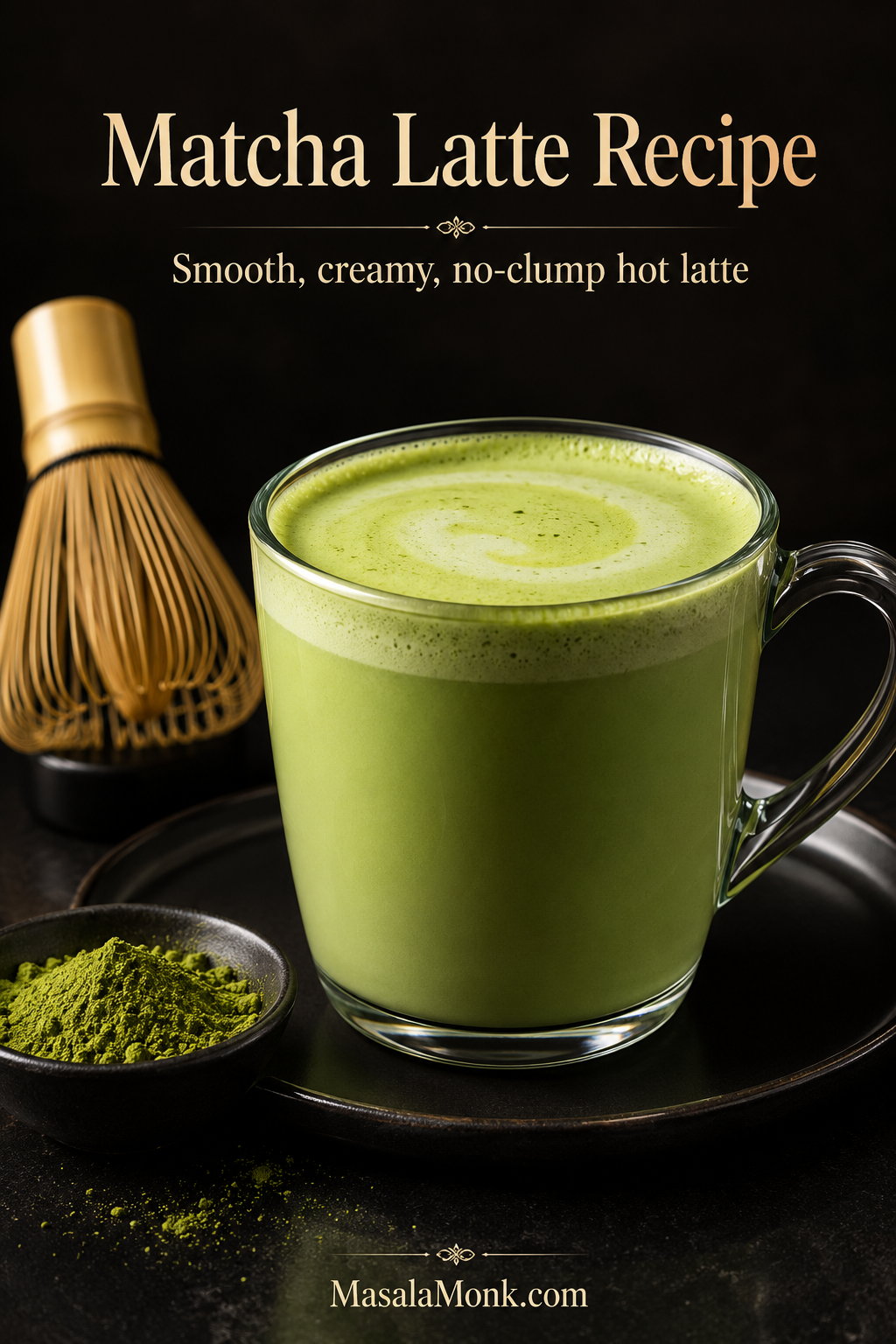
Hot matcha latte in a mug with creamy green foam, matcha powder, and a bamboo whisk beside it.

A good matcha latte recipe should give you a cup that tastes smooth, creamy, and gently earthy — not bitter, chalky, or full of green clumps. If your first homemade version tasted like warm milk with powder at the bottom, the problem probably was not you. Matcha simply needs a little help before the milk goes in.

This is a no-clump, no-bitter, ratio-first hot matcha latte for the problems most homemade cups run into: weak flavor, harsh bitterness, and powder settling at the bottom. Start with 1½ teaspoons matcha, 2 tablespoons hot water, and ¾ cup warm milk, then adjust from a clear baseline instead of guessing.

The finished cup should taste creamy enough to feel like a treat, but green enough that the tea still shows up. The trick is simple: sift the matcha, whisk it with a small amount of hot water, and only then add the milk.

This guide focuses on the hot, creamy homemade version. For the full cold version, use our iced matcha latte recipe.
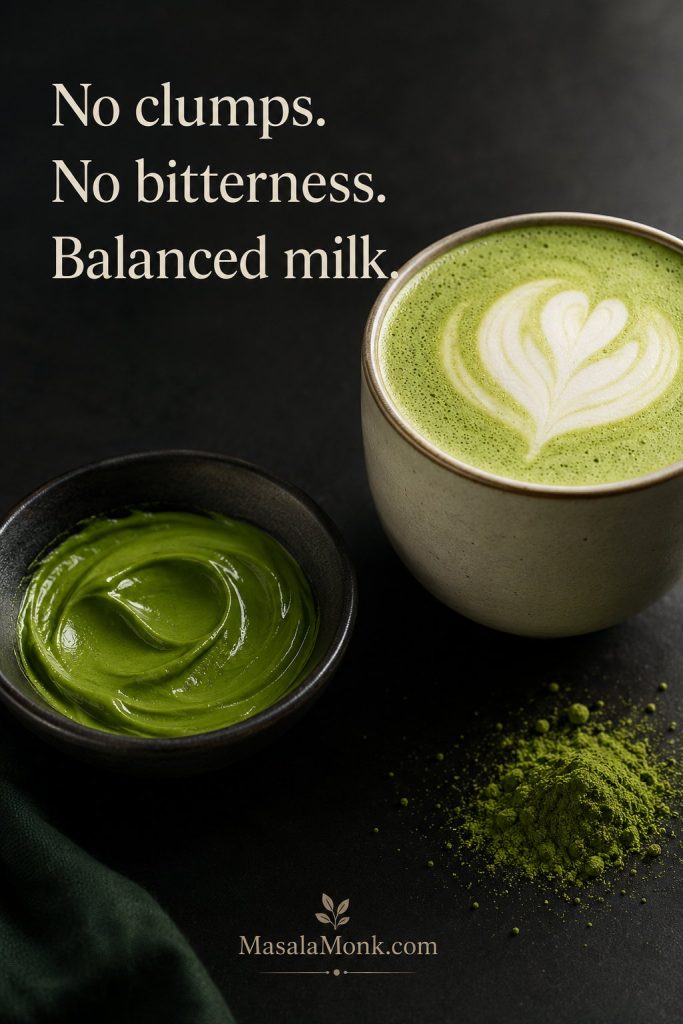
Why this method works: sifting breaks up dry clumps, the concentrated hot-water paste hydrates the tea before milk dilutes it, and the final taste adjustment keeps the latte balanced instead of watery, bitter, or overly sweet.
Creamy no-clump matcha latte beside a bowl of glossy green matcha paste.
Once matcha turns glossy instead of sandy, the milk blends in more evenly and the drink is far less likely to taste chalky.

Quick Answer: Best Matcha Latte Ratio

For one balanced hot matcha latte, whisk 1½ teaspoons / about 3 grams matcha with 2 tablespoons / 30 ml hot water, then add ¾ cup / 170–180 ml warm milk. Sweeten with 1 teaspoon sugar, honey, maple syrup, or simple syrup if you like a lightly sweet cup.
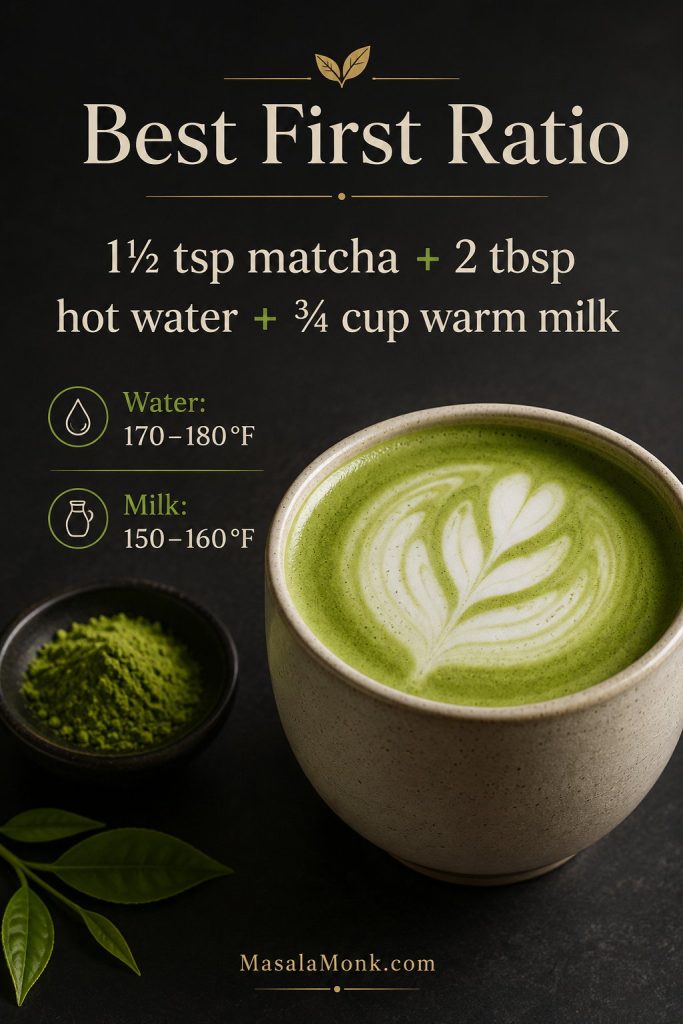
Best first ratio: 1½ tsp / about 3 g matcha + 2 tbsp / 30 ml hot water + ¾ cup / 170–180 ml milk. Use water around 170–180°F / 76–82°C and milk around 150–160°F / 65–71°C.
Matcha latte ratio card showing 1½ teaspoons matcha, 2 tablespoons hot water, and ¾ cup warm milk.
This baseline matcha latte ratio gives you a balanced first cup; after that, adjust matcha, milk, or sweetness one change at a time.

Too mild usually means the tea is being drowned by milk. A harsh or bitter first sip usually points to water that was too hot, matcha that was old, or a ratio that needs a little more milk before it needs more sugar.

Want a larger drink? Use the 16 oz café-size version. If your cup is clumpy, bitter, or too weak, jump to the troubleshooting guide.

What Is a Matcha Latte?

A matcha latte is made by whisking powdered green tea with water, then adding milk. Unlike regular green tea, matcha is not steeped and removed. The whole powdered tea stays in the cup, which is why the texture depends so much on how you mix it.

Because you are drinking the whole powdered tea, a good matcha latte feels fuller than brewed green tea with milk — richer, greener, and more textured. That is also why the drink can taste creamy and smooth one day, then grainy and bitter the next if the powder is rushed.
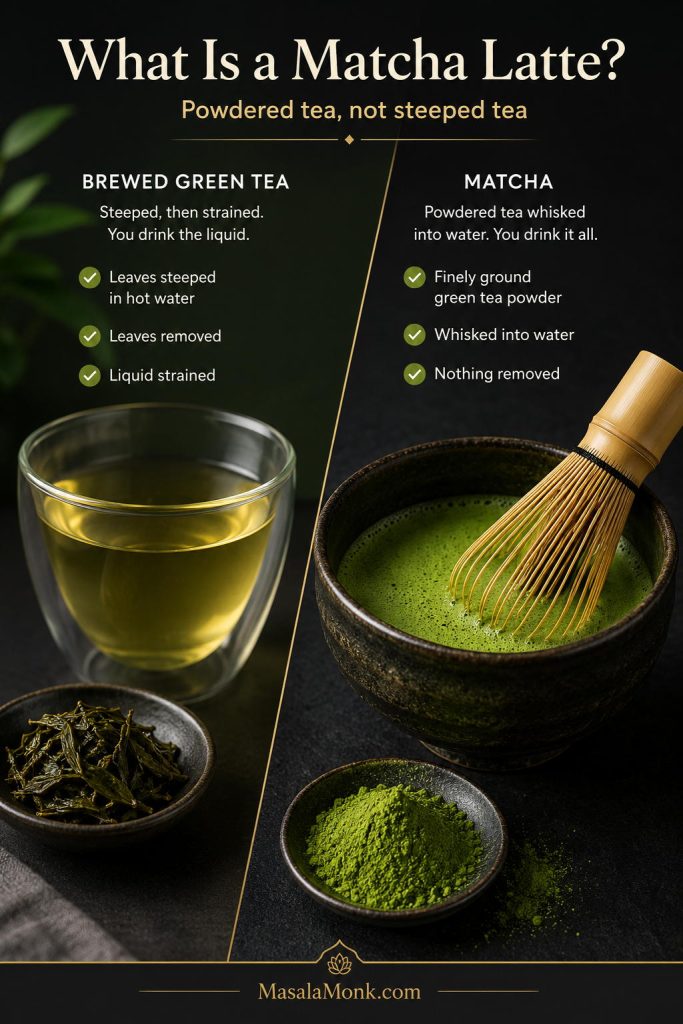
Brewed green tea compared with powdered matcha whisked into water before adding milk.
Matcha is powdered tea that stays in the drink, which is why whisking it smoothly matters before it becomes a latte.

For a more traditional reference point, Ippodo also whisks matcha with warm water before adding milk. Their matcha latte method starts with 3 grams matcha and warm 80°C / 176°F water; this recipe uses less water for a thicker latte paste before the milk goes in. You can read their guide here: Ippodo matcha latte recipe.

Ingredients You Need
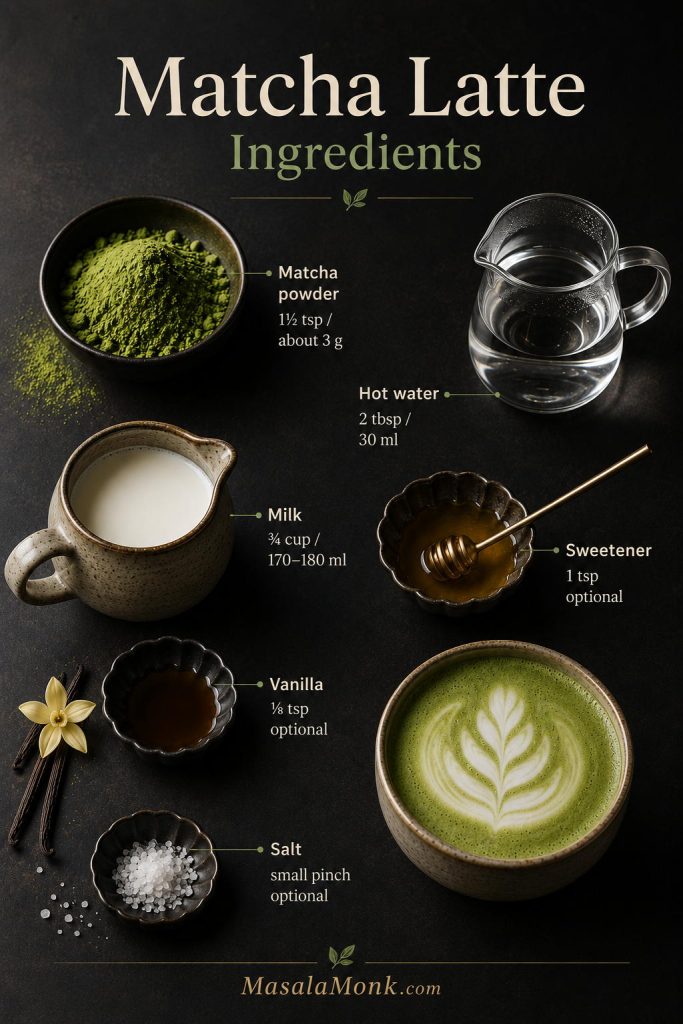
Matcha latte ingredients with matcha powder, hot water, milk, sweetener, vanilla, and salt.
The ingredients are simple, but each one has a job: water opens the matcha, milk adds body, and sweetener rounds the edge.

Matcha powder

Fresh matcha gives the best color and flavor. For lattes, use ceremonial, premium culinary, or latte-grade matcha that looks bright green and smells clean. Very dull olive powder often tastes flatter and more bitter, even with milk.

You do not need the most expensive ceremonial tin for a milk drink. However, very cheap or stale powder can make the cup taste harsh. Old matcha can smell flat, dusty, or hay-like. If that is the tin you have, use the balanced latte ratio, add a little vanilla or sweetener, and do not judge all matcha by that one cup.
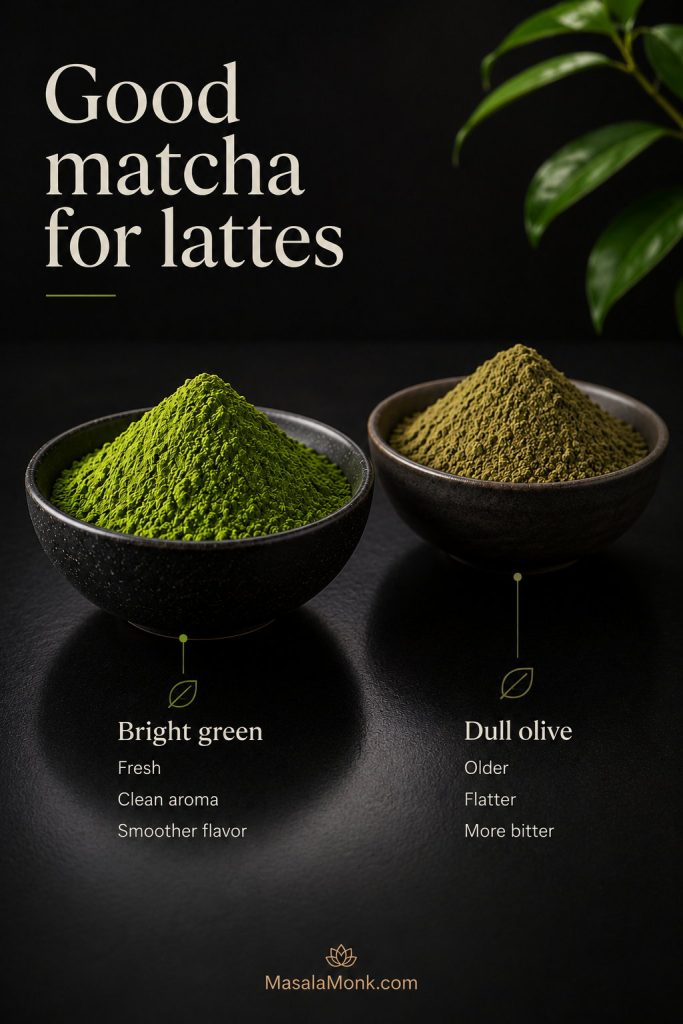
Bright green matcha powder compared with dull olive matcha powder for making lattes.
Bright matcha usually gives a cleaner latte; however, dull olive powder often tastes flatter, sharper, and harder to balance.

Hot water

Use hot water around 170–180°F / 76–82°C. It should be hot and steaming, not boiling. Without a thermometer, boil the water, let it stop bubbling, then rest it for about 1–2 minutes before using it.
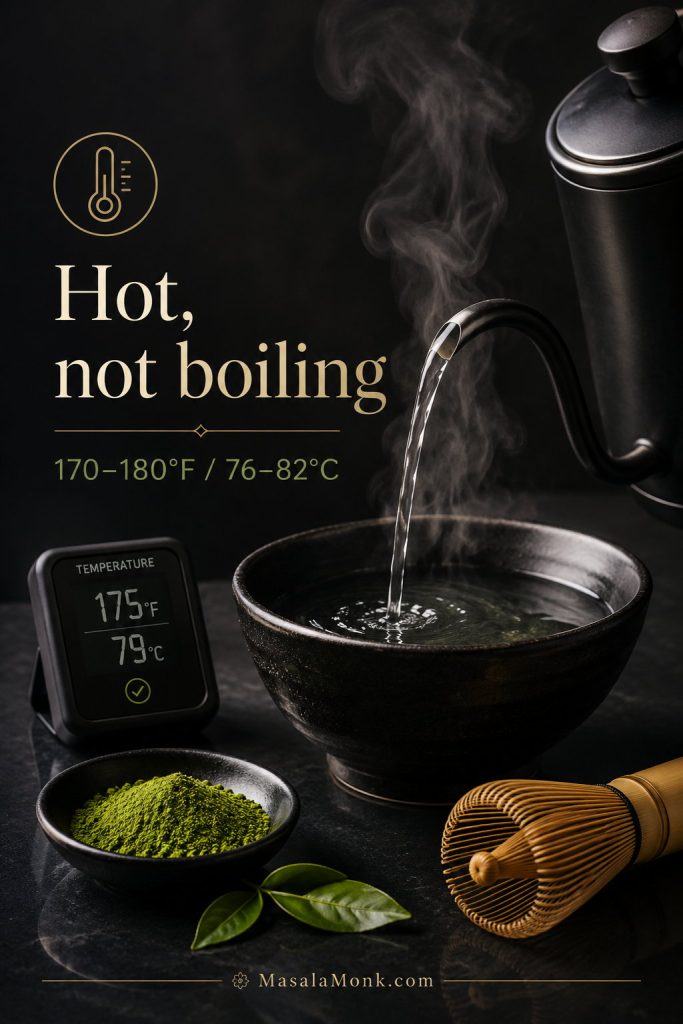
Hot water temperature guide showing 170 to 180 degrees Fahrenheit for making matcha latte.
Boiling water can make matcha taste sharp, so a brief rest after boiling helps protect the tea’s softer green flavor.

For a fuller breakdown, see the water and milk temperature guide later in the post.

Milk

Milk changes the latte as much as the tea does. Whole milk gives the richest body, oat milk is the easiest creamy dairy-free choice, almond milk makes a lighter cup, coconut milk tastes richer but can take over, and soy milk gives a stable coffee-shop texture.

Sweetener

Sweetener is optional. Sugar, honey, maple syrup, simple syrup, vanilla syrup, monk fruit, and stevia can all work. For a hot drink, granulated sugar can dissolve in the paste. For an iced version, syrup blends more smoothly than sugar crystals.

Optional vanilla or salt

A tiny splash of vanilla gives the drink a softer coffee-shop finish. A small pinch of salt can also round out bitterness, especially if your matcha is strong or your milk is unsweetened.

Best Ratio for a Creamy Cup

The best ratio depends on whether you want a mild beginner cup, a balanced café-style drink, or a stronger green tea flavor. Choose the gentle version if you are new to matcha, the balanced version if you want the best first cup, and the strong version if you want the tea to stay bold through the milk.
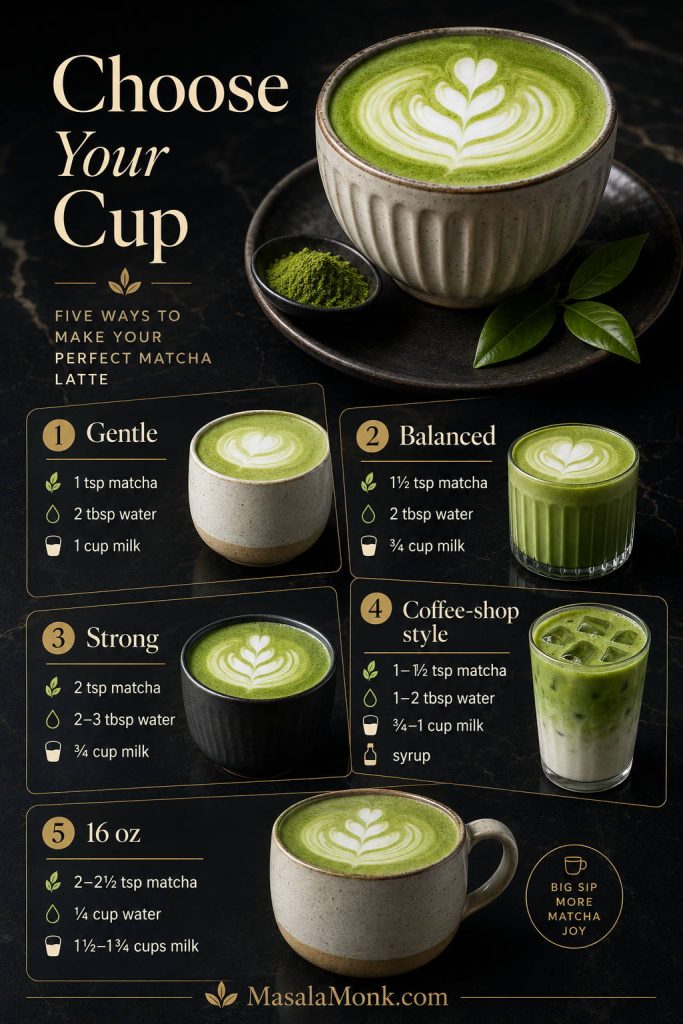
Matcha latte ratio guide for gentle, balanced, strong, coffee-shop style, and 16 ounce versions.
Choose the cup you actually want: gentle and milky, balanced café-style, stronger green tea flavor, sweeter, or 16 oz.
Style Matcha Water Milk Sweetener Best For
Gentle beginner 1 tsp / about 2 g 2 tbsp / 30 ml 1 cup / 240 ml Optional Mild, creamy, less grassy
Balanced café-style 1½ tsp / about 3 g 2 tbsp / 30 ml ¾ cup / 170–180 ml 1 tsp Best first version
Strong matcha 2 tsp / about 4 g 2–3 tbsp / 30–45 ml ¾ cup / 180 ml 1–2 tsp Bold, less milky
Starbucks-style sweet 1–1½ tsp / about 2–3 g 1–2 tbsp / 15–30 ml ¾–1 cup / 180–240 ml 1 tbsp syrup Sweeter café feel
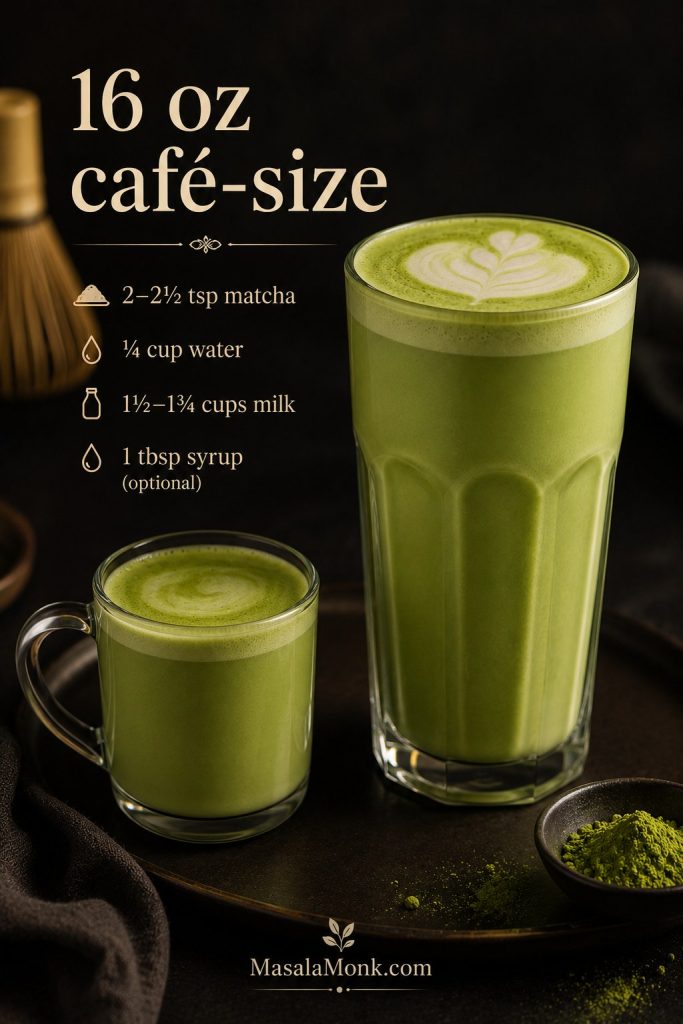
16 oz café-style 2–2½ tsp / about 4–5 g ¼ cup / 60 ml 1½–1¾ cups / 360–420 ml 1 tbsp syrup Large drink

If the paste feels too thick to whisk, add 1 extra tablespoon of water. Try not to turn the paste into a thin tea before the milk goes in, or the finished latte can taste watery.

Start with the balanced ratio, then adjust one variable at a time: more matcha for stronger flavor, less milk for a bolder cup, or a little syrup if the tea tastes sharp.

If your latte tastes like warm milk: you probably need more matcha, not more syrup. Increase the matcha to 1½–2 teaspoons or reduce the milk slightly.

Equipment You Need

You do not need a full tea setup. A strainer helps prevent clumps, a wide mug gives you room to whisk, and a bamboo whisk or handheld frother makes the paste smoother.
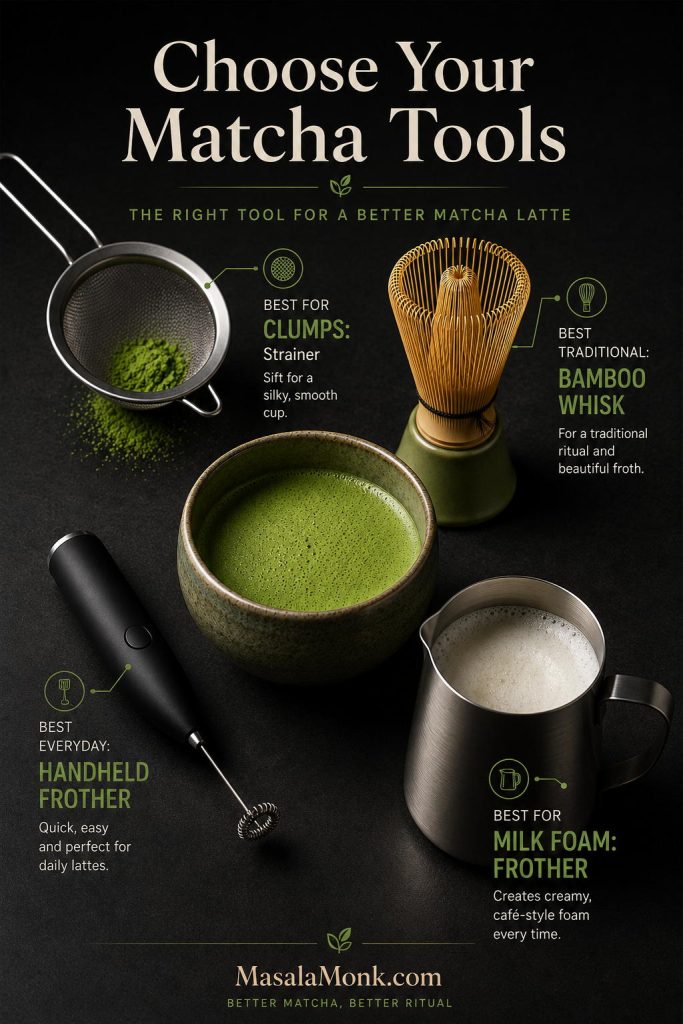
Matcha latte tools including fine mesh strainer, bamboo whisk, handheld frother, wide bowl, and milk frother.
You do not need every tool; the strainer handles clumps, the whisk builds texture, and the frother helps with milk.

No bamboo whisk? Skip ahead to the no-whisk methods.

Tool Use
Fine-mesh strainer Sifts matcha so the powder does not clump.
Bamboo whisk / chasen Best traditional tool for smooth foam.
Wide mug or small bowl Easier than whisking in a narrow mug.
Handheld frother Easiest daily method if you do not have a bamboo whisk.
Milk frother Heats and froths milk for a café-style finish.
Small saucepan Good for heating milk on the stovetop.
Blender Useful no-whisk option for a very smooth cup.
Jar with lid Best for iced matcha or quick shaking.

If the milk-frothing part is what you want to improve most, MasalaMonk’s cappuccino recipe breaks down café-style foam with and without a machine.

How to Make a Hot Matcha Latte

This method gives you the silkiest result because the matcha is fully hydrated before milk is added. The key order is simple: make the paste, add the milk, then adjust sweetness at the end.

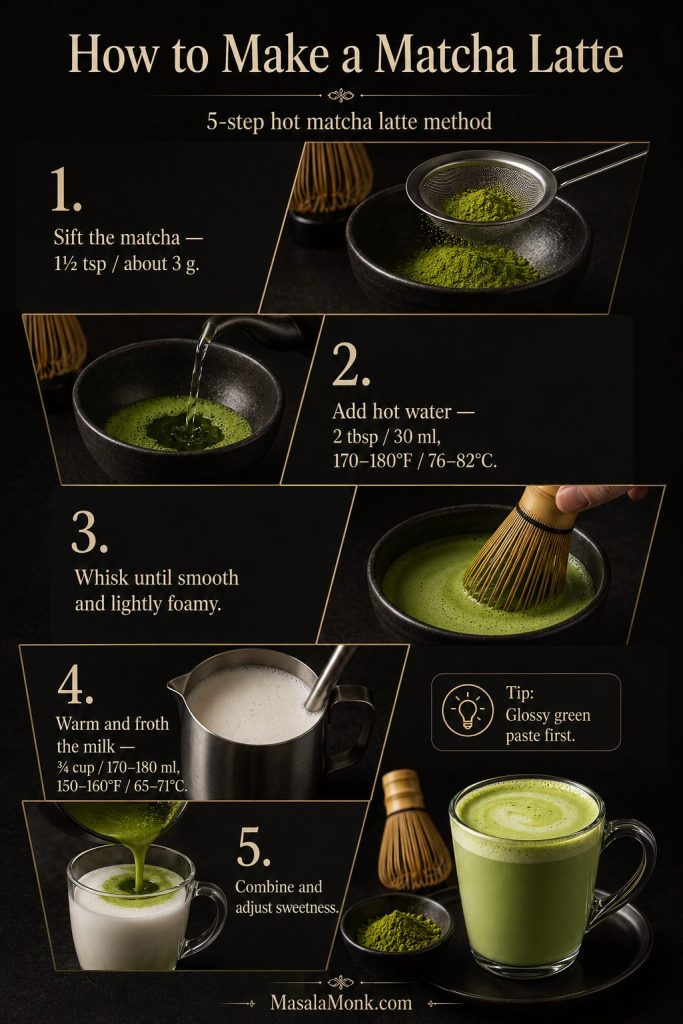
1. Sift the matcha

Add 1½ teaspoons / about 3 grams matcha to a fine-mesh strainer and sift it into a wide mug or small bowl. Matcha naturally forms tiny clumps in the tin, so this quick step is the easiest way to avoid a grainy texture.

If your matcha is very fresh and you are using a strong frother or blender, you may get away without sifting, but sifting is still the safest route for a clump-free cup.
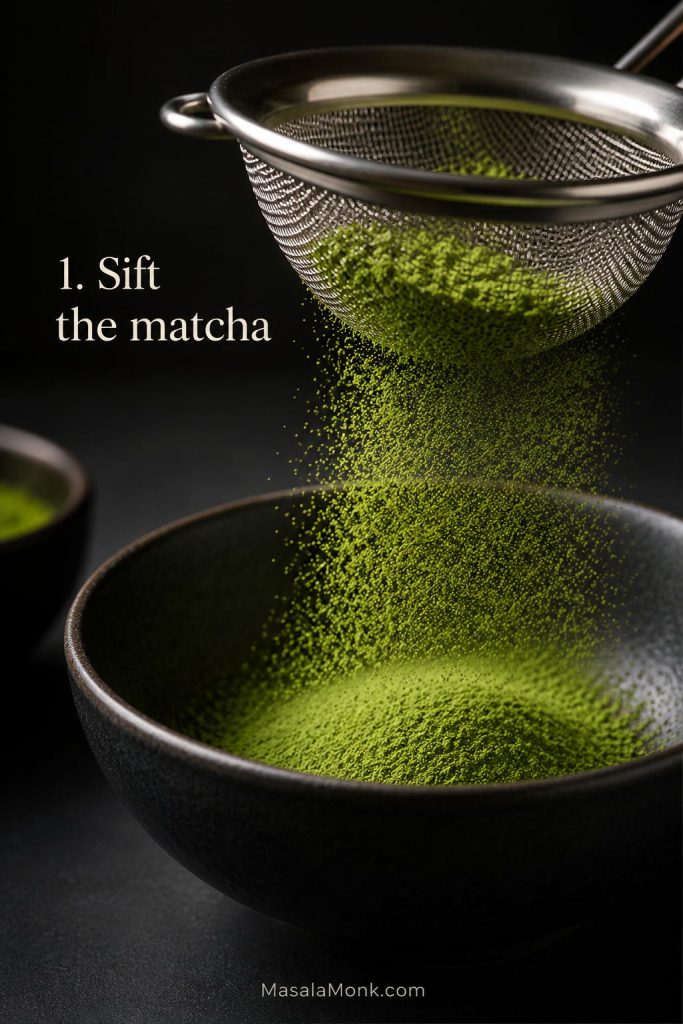
Matcha powder being sifted through a fine mesh strainer into a dark bowl.
Sifting takes only a few seconds, yet it removes the tiny dry lumps that can make a latte taste grainy.

2. Add hot water and make a paste

Add 2 tablespoons / 30 ml hot water. The water should be around 170–180°F / 76–82°C, hot but not boiling. Stir or whisk until the mixture looks like a glossy green paste with no dry pockets.

Think glossy green paste, not sandy sludge. If it looks dry or grainy, keep whisking before the milk goes in.
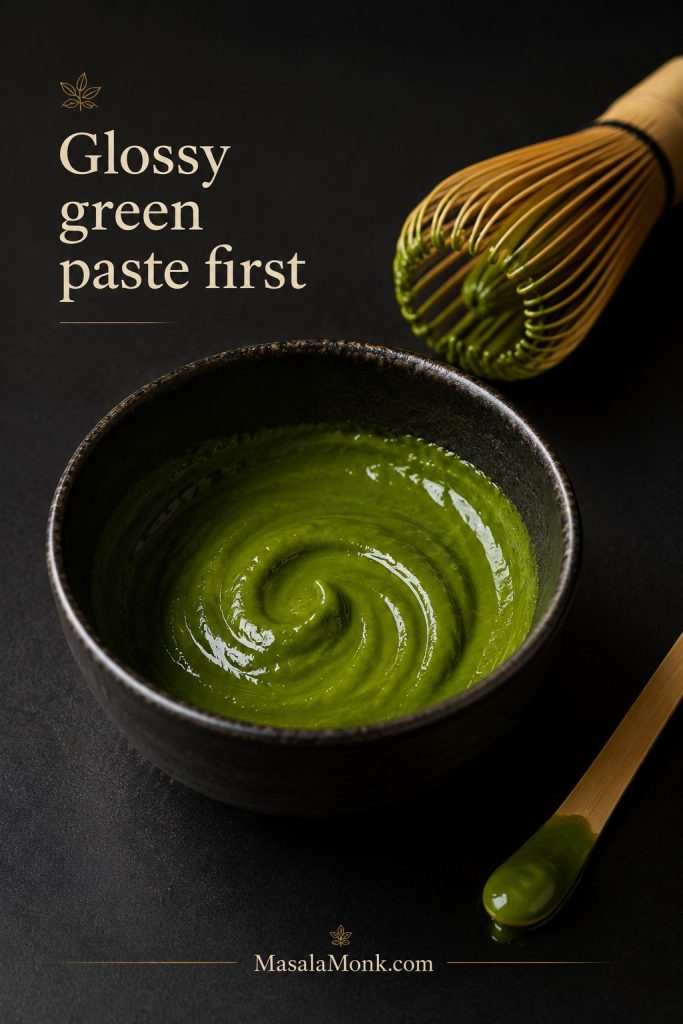
Thick glossy green matcha paste in a dark bowl with a bamboo whisk and spoon nearby.
Look for a shiny, hydrated paste before adding milk; a sandy texture usually means the powder needs more whisking.

3. Whisk until smooth and lightly foamy

Whisk briskly in a W, M, or zig-zag motion for 20–45 seconds. Avoid slow circles, which tend to push the tea around instead of suspending it evenly. The paste should look even and lightly foamy.
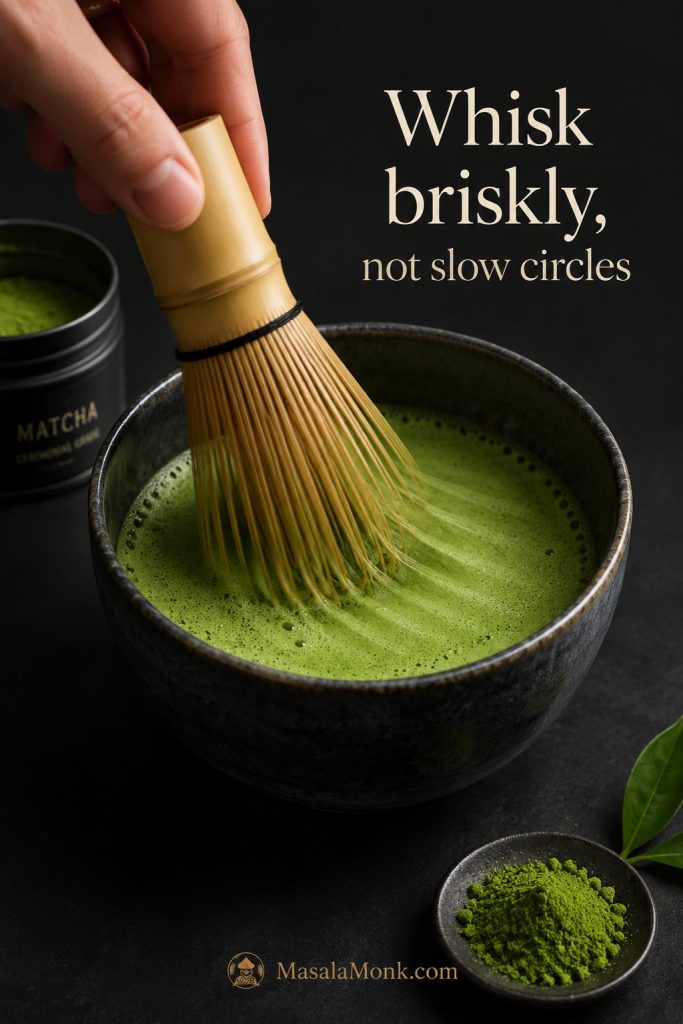
Bamboo whisk moving through foamy matcha in a bowl with matcha powder nearby.
Brisk back-and-forth whisking suspends matcha better than slow circles, especially when you want a fine, even foam.

4. Heat and froth the milk

Warm ¾ cup / 170–180 ml milk until steaming, ideally around 150–160°F / 65–71°C. Froth it with a milk frother, handheld frother, whisk, or blender. If you are heating milk in a saucepan, keep the heat gentle and do not let it boil.

A microwave also works. Heat the milk in short bursts until steaming, then froth or whisk it before adding it to the matcha.
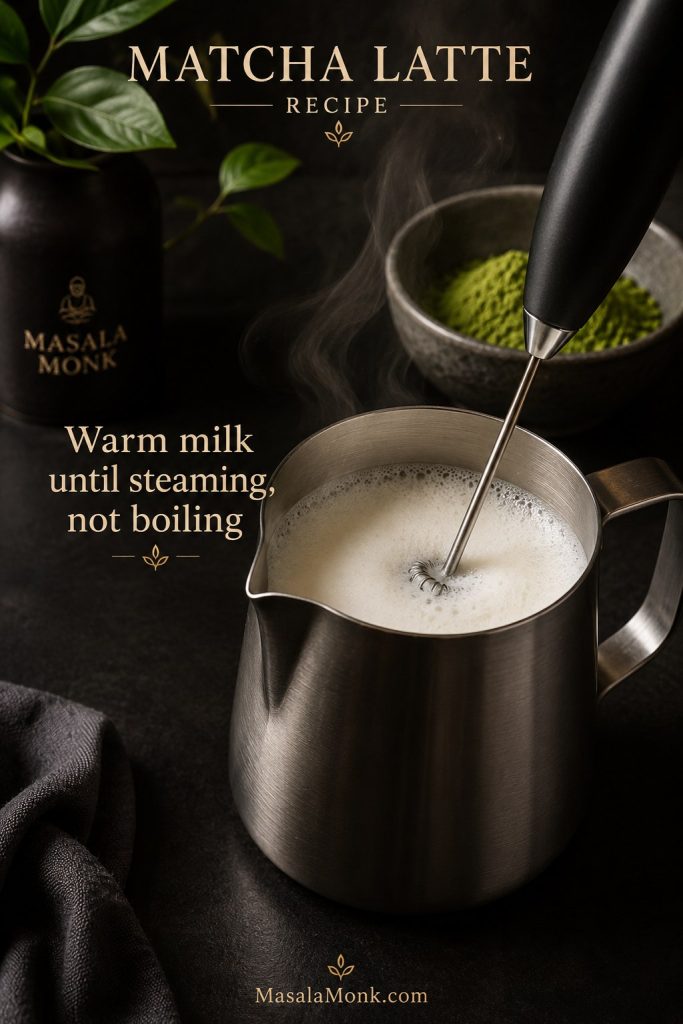
Milk being warmed and frothed in a metal pitcher for a hot matcha latte.
Warm the milk until it steams gently, then froth lightly; boiling milk can make the latte taste flat and heavy.

5. Combine and adjust

Pour the warm milk into the matcha paste. Stir gently, then taste. Add 1 teaspoon sweetener if you want it lightly sweet, or use vanilla syrup for a more coffee-shop finish.

At this point, the latte should look creamy and softly green, with no dry specks riding on top.
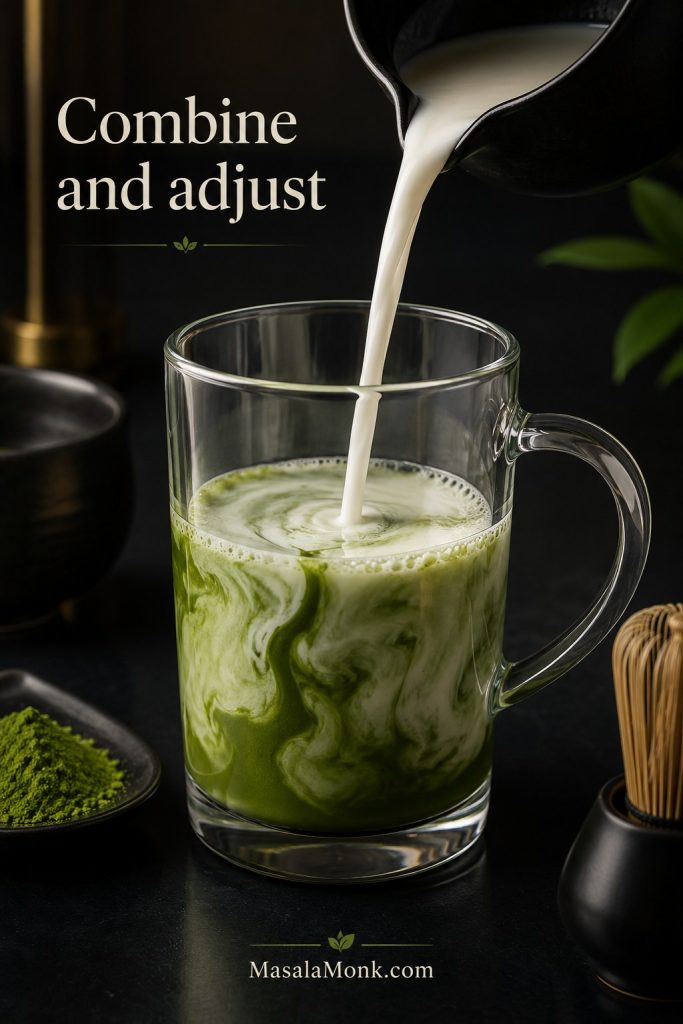
Warm milk being poured into matcha paste in a clear glass mug to create a green and white swirl.
When the matcha is already hydrated, the milk creates a creamy swirl instead of dragging dry powder through the cup.
Five step matcha latte guide showing sifting, adding hot water, whisking, warming milk, and combining.
Think of the method as a texture path: remove lumps, hydrate the tea, build light foam, warm the milk, and combine.

Water and Milk Temperature

Temperature is where a good cup can quietly go wrong. Water that is too hot can make matcha harsh; milk that is overheated can taste flat or slightly scorched.

For the paste, aim for water around 170–180°F / 76–82°C. For the milk, aim for 150–160°F / 65–71°C, or heat it just until steaming.
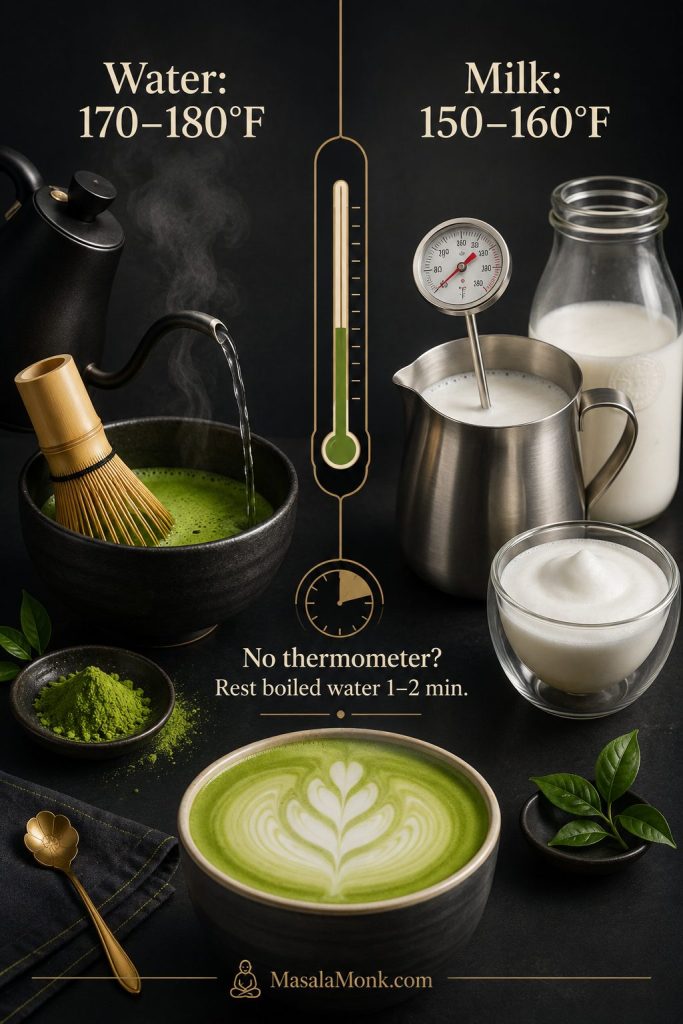
No thermometer? Boil the water, let it stop bubbling, then rest it for about 1–2 minutes before using it. For milk, stop heating when it is steaming but not simmering.
Matcha latte temperature guide showing 170 to 180 degrees Fahrenheit for water and 150 to 160 degrees Fahrenheit for milk.
The right temperatures protect both sides of the drink: gentler water keeps the tea clean, while warm milk keeps the body soft.

No Bamboo Whisk? Use These Methods

A bamboo whisk gives the cleanest foam, but it is not required for a smooth cup. You just need another way to help the powder and water meet properly before the milk goes in.
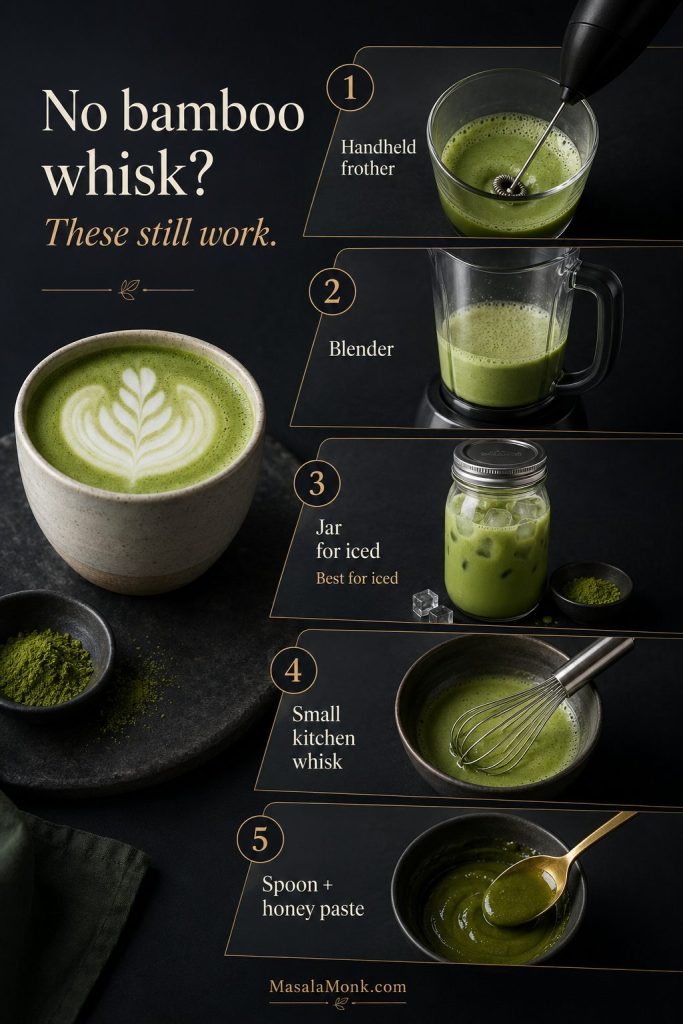
No bamboo whisk matcha latte guide with handheld frother, blender, jar for iced matcha, small whisk, and spoon paste method.
A bamboo whisk is helpful, but not required; use a frother for daily hot lattes and a jar for iced matcha.

Handheld frother method

Sift the matcha into a mug, add hot water, then use a handheld frother to blend the paste until smooth. Add warm milk and froth again briefly. This is the easiest everyday method for most home kitchens.

Blender method

Add warm milk, sweetener, and the matcha paste to a blender. Blend briefly until smooth and foamy. This is a good choice if clumps are your main issue, but do not overblend hot liquid in a sealed blender.

Jar method

The jar method works best for iced matcha. Shake the powder with a small amount of water first, then add milk and shake again. For hot drinks, use only a heat-safe jar and be careful with steam pressure.

If you are making it cold, the quick iced version is the best place to use the jar method.

Small kitchen whisk method

A regular mini whisk can work if you use a wide bowl or mug. Whisk quickly back and forth rather than stirring in circles.

Spoon + honey paste method

In a pinch, mix matcha with honey or maple syrup first, then add a little hot water and stir until smooth. It will not foam like a whisked latte, but the sticky sweetener helps loosen small clumps.
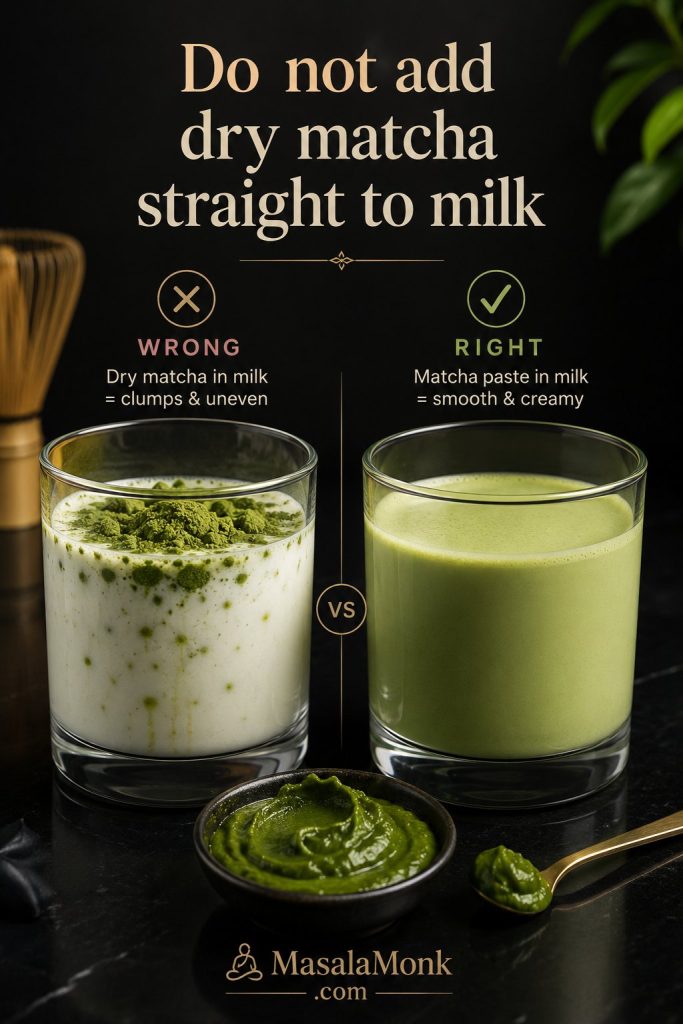
Avoid this mistake: do not add dry matcha straight into a full mug of milk. It usually floats, clumps, and leaves powder at the bottom.
Dry matcha clumping in milk compared with smooth matcha paste blended into milk.
Dry matcha tends to float and clump in milk, so make a paste first if you want the drink even from top to bottom.

Best Milk to Use

Milk decides whether the cup tastes plush, light, sharp, or sweet. Whole milk gives the roundest body, oat milk is the easiest creamy dairy-free choice, almond milk keeps things lighter, coconut milk tastes richer but can dominate, and soy milk gives a stable coffee-shop texture.

If oat milk is your favorite matcha base, MasalaMonk’s homemade oat milk guide is useful when you want a simple DIY version that does not turn slimy.

Milk Best Use Notes
Whole milk Classic café texture Foams well and gives a round, creamy body.
2% milk Everyday latte Lighter than whole milk but still balanced.
Oat milk Best dairy-free default Creamy, slightly sweet, and good at softening bitterness. Barista-style oat milk usually froths better.
Almond milk Lighter cup Can make matcha taste sharper, especially if unsweetened.
Coconut milk Rich variation Sweet and full-bodied, but it can dominate the tea.
Soy milk Stable café-style plant milk Creamy, reliable, and usually froths better than many nut milks.
Cashew or macadamia milk Premium creamy variation Soft, rich, and smooth, but less common.

There is no single correct milk here. The best choice is the one that lets the tea taste balanced instead of hidden.
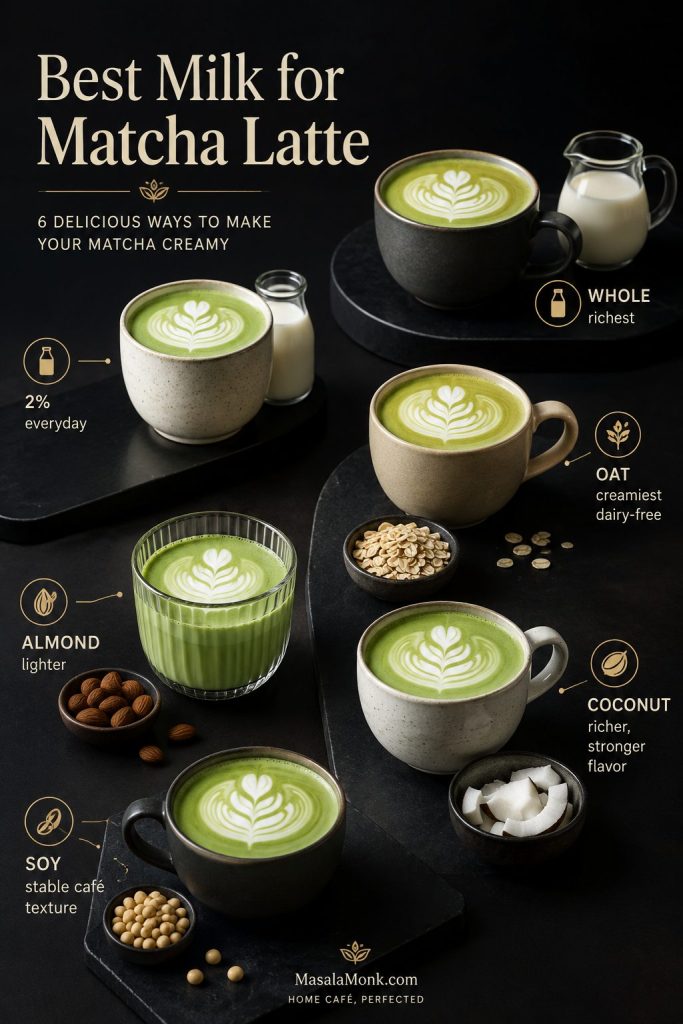
Best milk for matcha latte comparison with whole milk, 2 percent milk, oat milk, almond milk, coconut milk, and soy milk.
Milk changes the whole cup: whole milk tastes richest, oat milk is the creamiest dairy-free default, and almond milk keeps it lighter.

Once you choose your milk, the variation ideas show how to take the same base sweeter, colder, fruitier, or bolder.

Once the base is smooth, choose the version by what you want from the cup: sweeter, stronger, colder, fruitier, or bolder with espresso.

Starbucks-style at home

On Starbucks’ official menu, the hot Matcha Latte is described with matcha, milk, and classic syrup; the iced version adds ice. You can see the official Starbucks menu listing here: Starbucks Matcha Latte.

For a Starbucks-style cup at home, the main difference is sweetness. Use simple syrup or vanilla syrup instead of granulated sugar, because syrup blends smoothly into both hot and iced drinks.

For a homemade Starbucks-style hot drink, use 1–1½ teaspoons matcha, 1–2 tablespoons hot water, ¾–1 cup milk, and 1 tablespoon simple syrup or vanilla syrup. Keep the matcha paste slightly concentrated so the tea does not disappear under the milk.
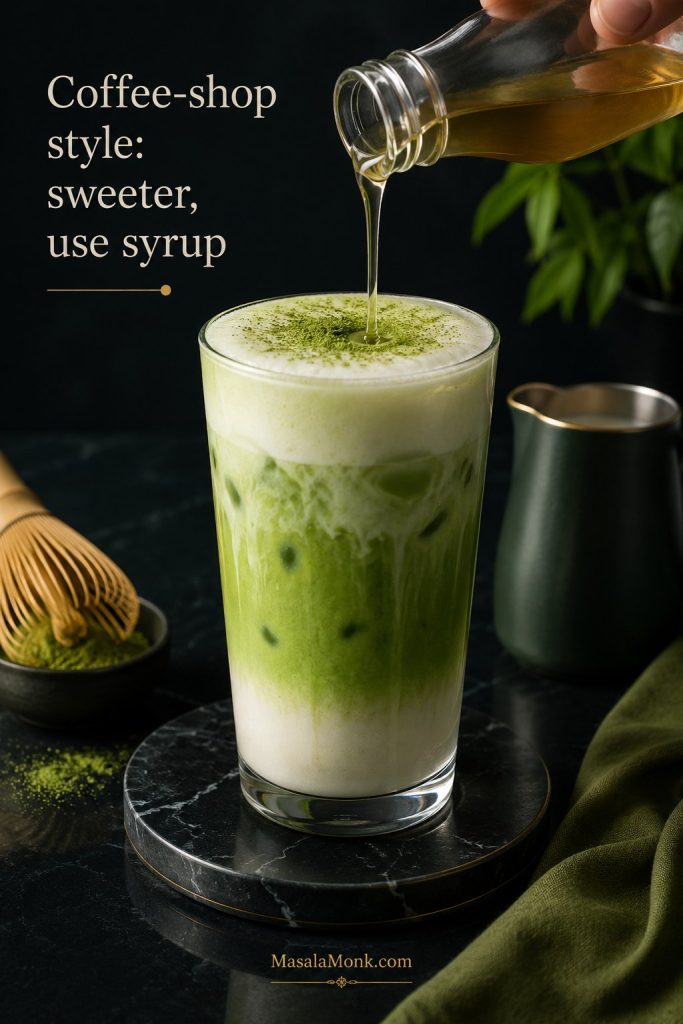
Coffee-shop style matcha latte with syrup being poured into a tall iced green drink.
For a sweeter coffee-shop style matcha latte, syrup works better than granulated sugar because it blends smoothly.

16 oz café-size version

A 16 oz café cup needs more matcha than a small mug. Use the lower milk amount if you want room for foam, or the higher amount if you want a fuller 16 fl oz drink.

Ingredient 16 oz Café-Style Hot Amount
Matcha 2–2½ tsp / about 4–5 g
Hot water ¼ cup / 60 ml
Milk 1½–1¾ cups / 360–420 ml
Sweetener 1 tbsp syrup, or to taste
Tall 16 ounce matcha latte beside a smaller mug with matcha, water, milk, and syrup amounts listed.
A larger matcha latte needs more powder, not just more milk; otherwise, the green tea flavor disappears in the cup.

Quick iced version

To make a quick iced version, whisk 1–1½ teaspoons matcha with 2 tablespoons warm water, then pour it over ice with ¾–1 cup cold milk and syrup to taste.

This is only the shortcut. For the full cold method, Starbucks-style iced version, no-clump tips, and watery-fix notes, use the full iced matcha latte recipe.
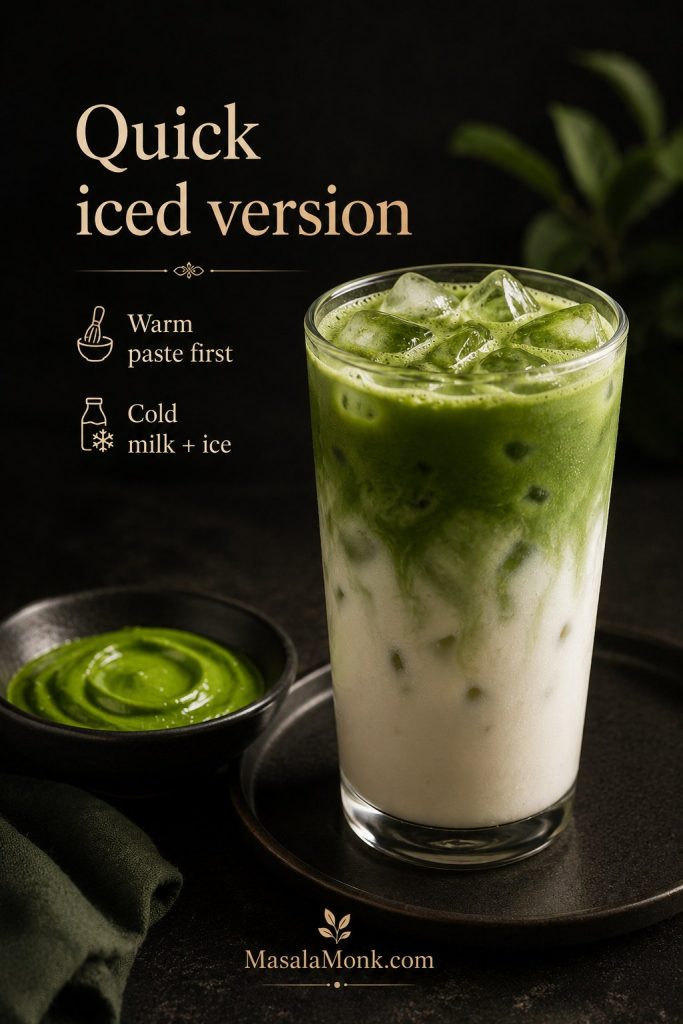
Quick iced matcha latte with ice, cold milk, green matcha layer, and a bowl of matcha paste.
For a quick iced version, make the warm paste first, then pour it over cold milk and ice to keep the texture clean.

Strawberry version

For a strawberry version, spoon strawberry puree, strawberry syrup, or a quick strawberry jam base into the bottom of the glass, add milk, then pour matcha over the top. The layered look works best when the strawberry base is thicker than the milk.

For the full layered fruit drink, use our strawberry matcha latte recipe.
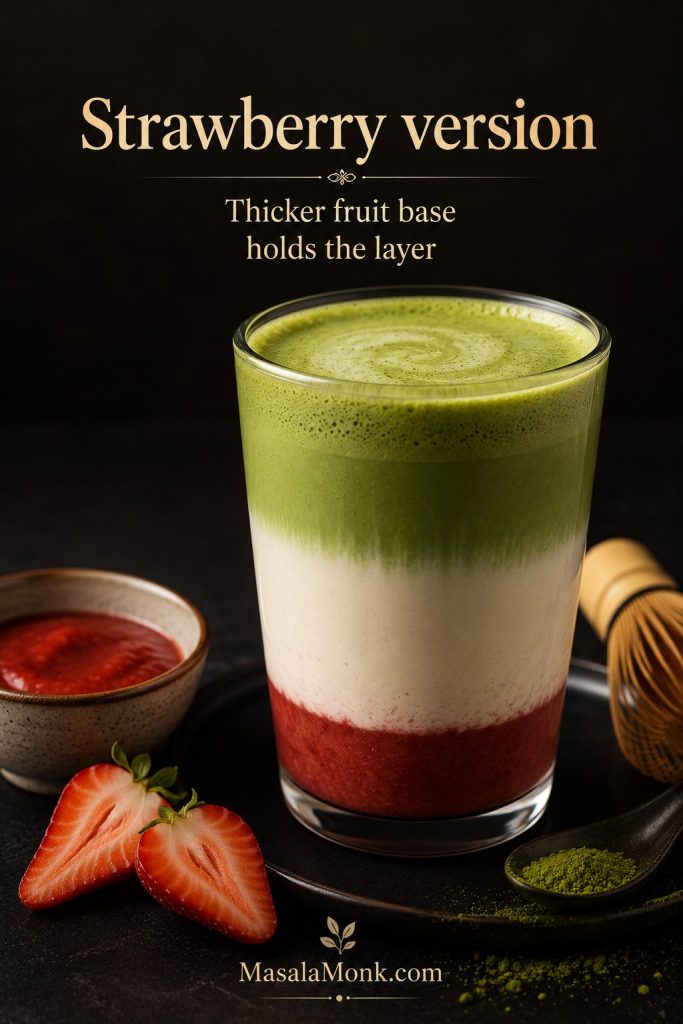
Layered strawberry matcha latte with strawberry base, milk layer, matcha layer, strawberries, and matcha powder.
A thicker strawberry base helps the layers stay visible, while the milk keeps the fruit and matcha from blending too fast.

Dirty matcha / matcha with espresso

A dirty matcha adds espresso or strong coffee to the matcha-milk base. It tastes bolder, slightly roasty, and more like a coffee-shop drink than a pure green tea latte.

Use 1 teaspoon matcha, 2 tablespoons / 30 ml hot water, ¾ cup / 180 ml milk, 1 shot espresso or 2 oz strong coffee, and 1–2 teaspoons sweetener. For a hot dirty matcha, add the espresso after combining the matcha and milk. For an iced dirty matcha, pour the espresso over ice and milk, then add the green tea layer.

If you are still figuring out espresso strength, MasalaMonk’s quick espresso guide can help you choose coffee that stands up to the green tea flavor instead of disappearing into the milk.

Espresso being poured into a green matcha latte with an espresso shot and matcha powder nearby.
Espresso makes the drink bolder and more roasty, but the matcha still needs enough strength to show through the coffee.

More flavor ideas

  • Vanilla: add 1–2 teaspoons vanilla syrup when you want the soft coffee-shop version.
  • Honey: sweeten the paste with honey before adding milk for a rounder, floral sweetness.
  • Maple: use maple syrup when you want a warmer, deeper sweetness.
  • Oat milk: use barista-style oat milk for the creamiest dairy-free version.
  • Almond milk: use almond milk for a lighter drink; add vanilla if it tastes sharp.
  • Coconut: use light coconut milk or coconut beverage for a richer, slightly tropical version.
  • Protein: blend the finished latte with vanilla protein powder, or use a protein milk.
  • Unsweetened: skip the sweetener, but use a creamy milk so the cup still tastes round rather than sharp.

Fixes for Clumps, Bitterness, and Weak Flavor

A bad matcha latte usually announces the problem quickly: clumps on top, bitterness on the first sip, weak milkiness, or powder at the bottom. Use the symptom first, then fix the cause.
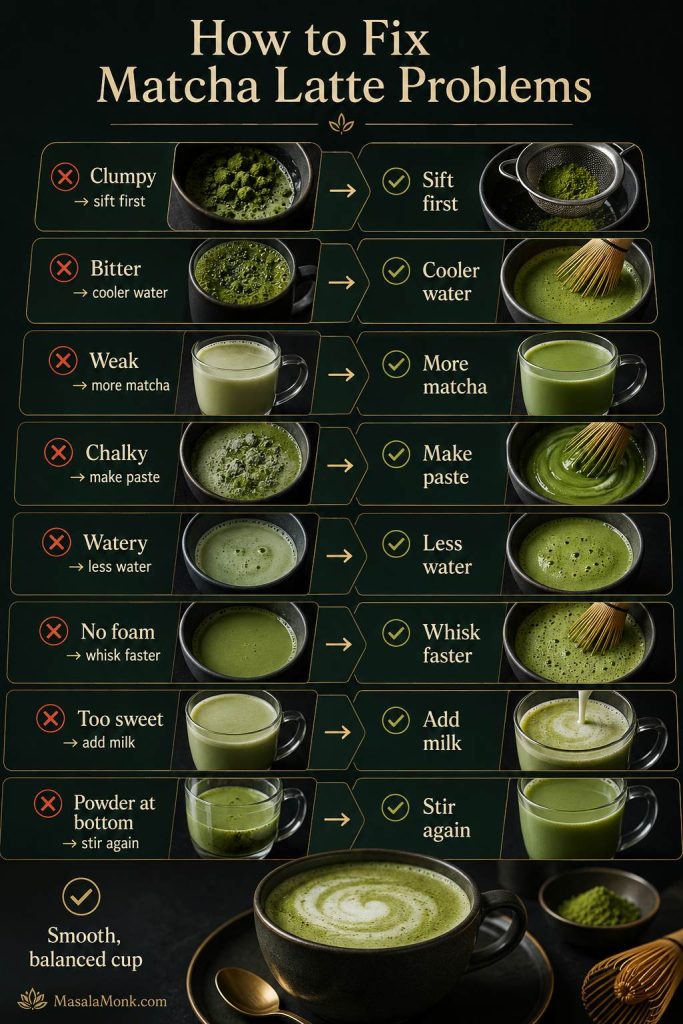
Matcha latte troubleshooting board showing fixes for clumpy, bitter, weak, chalky, watery, no foam, too sweet, and powder at bottom.
Fix the symptom instead of guessing: clumps need sifting, bitterness needs gentler water, and weak flavor needs more matcha.

Most fixes trace back to three steps: sifting, making a paste, and using the right temperature.

Problem Likely Cause Fix
Clumpy Matcha was not sifted or was added straight to milk. Sift first, then make a paste with hot water.
Bitter Water was too hot, matcha was old, or too much powder was used. Use 170–180°F water, reduce matcha slightly, or add milk/sweetener.
Weak / too milky Too much milk or not enough matcha. Use 1½ tsp / about 3 g matcha per ¾ cup milk.
Chalky Matcha was not hydrated before milk was added. Whisk with 2 tbsp hot water first.
Watery Too much water or melted ice. Use a concentrated paste and reduce extra water.
Not foamy Slow stirring or unfrothed milk. Use a W/M whisking motion and froth the milk separately.
Too sweet Too much syrup was added at the start. Start with 1 tsp sweetener, then add more after tasting.
Powder at bottom Matcha settled as the drink sat. Stir again before drinking. Matcha is a suspended powder, so some settling is normal.

A bitter cup, a weak cup, and a clumpy cup do not need the same solution. That is why fixing the symptom works better than hiding everything with extra syrup.

Recipe Card

Matcha Latte Recipe

This hot matcha latte is creamy, lightly grassy, and built around a no-clump paste method. Sift the matcha, whisk it with hot water, then add warm milk and sweeten to taste.

Yield1 latte
Prep Time5 minutes
Total Time5–7 minutes
CategoryBeverage

Equipment

  • Fine-mesh strainer
  • Bamboo whisk, handheld frother, or small whisk
  • Wide mug or small bowl
  • Milk frother, microwave-safe cup, or small saucepan

Ingredients

  • 1½ tsp / about 3 g matcha powder
  • 2 tbsp / 30 ml hot water, around 170–180°F / 76–82°C
  • ¾ cup / 170–180 ml milk of choice
  • 1 tsp sugar, honey, maple syrup, or simple syrup, optional
  • ⅛ tsp vanilla extract or a tiny splash of vanilla syrup, optional
  • Small pinch of salt, optional

Instructions

  1. Sift the matcha. Sift 1½ tsp / about 3 g matcha into a wide mug or small bowl.
  2. Make the paste. Add 2 tbsp / 30 ml hot water and whisk until smooth.
  3. Whisk until foamy. Use a W, M, or zig-zag motion for 20–45 seconds.
  4. Heat and froth the milk. Warm ¾ cup / 170–180 ml milk until steaming, then froth if desired.
  5. Combine and adjust. Pour the milk into the matcha paste, stir gently, taste, and sweeten if needed.

Notes

  • For a milder drink, use 1 tsp / about 2 g matcha and 1 cup / 240 ml milk.
  • For a stronger drink, use 2 tsp / about 4 g matcha and keep the milk around ¾ cup / 180 ml.
  • A microwave works for warming milk; heat in short bursts until steaming, then froth or whisk before combining.
  • For a Starbucks-style version, use simple syrup or vanilla syrup and make it sweeter.
  • For an iced version, use the dedicated iced matcha latte recipe for the full method.

Storage and Make-Ahead Tips

A hot matcha latte is best when the milk is freshly warmed and the foam is still light. Think of make-ahead here as prep, not storage: measure the matcha, keep the sweetener ready, and warm the milk fresh.

If you make the paste ahead, stir or froth it again before adding milk because the tea can settle. Do not store hot frothed milk for long; the foam collapses, and reheated milk can taste flat.

FAQs

How much matcha do you use for one latte?

For a balanced café-style latte, start with 1½ teaspoons / about 3 grams matcha. Use 1 teaspoon for a milder beginner drink or 2 teaspoons for a stronger green tea flavor.

What temperature should water be for matcha?

Aim for 170–180°F / 76–82°C. Boiling water can make matcha taste more bitter, so let freshly boiled water cool slightly before using it.

Why does it taste bitter?

Bitter matcha usually means the water was too hot, the powder was old, or the ratio was too strong. Lower the water temperature before adding extra sugar.

Why are there clumps?

Clumps usually mean the matcha met too much milk too soon. Sift it first, then whisk it with a small amount of hot water before adding milk.

What milk tastes best?

Whole milk is best for classic richness. Oat milk is the best dairy-free default. Almond milk is lighter, soy is stable, and coconut milk is rich but more noticeable.

Is it better hot or iced?

The hot version tastes warmer, creamier, and more soothing. Iced matcha tastes brighter and more refreshing. The best version depends on whether you want a cozy drink or a cold café-style one.

Does matcha latte have caffeine?

Yes. Matcha is powdered green tea, so it contains caffeine. The amount varies by brand and serving size; check your matcha package if caffeine is a concern.

Do I need a bamboo whisk?

Not necessarily. A bamboo whisk gives the best traditional texture, but a handheld frother, blender, jar, or small kitchen whisk can also work if you make a paste first.

How do I make a 16 oz version?

For a 16 oz drink, start with 2–2½ teaspoons / about 4–5 grams matcha, ¼ cup / 60 ml water, 1½–1¾ cups / 360–420 ml milk, and about 1 tablespoon syrup if you want it sweet.

Should I use ceremonial or culinary matcha?

Ceremonial or latte-grade matcha usually tastes smoother in drinks. Culinary matcha can work if you are adding milk and sweetener, but it is usually better for baking, smoothies, or recipes where matcha is not the only main flavor.

How do I make it Starbucks-style?

Use matcha, milk, and simple syrup or vanilla syrup. Make it sweeter than the basic recipe, then adjust the syrup to taste. For an iced version, syrup works better than granulated sugar because it blends smoothly.

Why does powder settle at the bottom?

Matcha is a powdered tea suspended in liquid, not a brewed tea that fully dissolves. Some settling is normal if the cup sits for a while. Stir or froth it again before drinking.

Final Tips

The whole method comes back to one order: make a smooth paste, add milk, then adjust sweetness. If the drink tastes weak, use a little more matcha or a little less milk next time. If it tastes bitter, lower the water temperature before reaching for extra sugar.

From there, every version gets easier: stronger, sweeter, oat milk, iced, dirty, or strawberry — all built from the same glossy paste and balanced milk base.

What the final texture should look like

The final cup should look softly green, lightly foamed, and fully blended, with no dry specks floating through the drink and no powder layer sitting at the bottom.
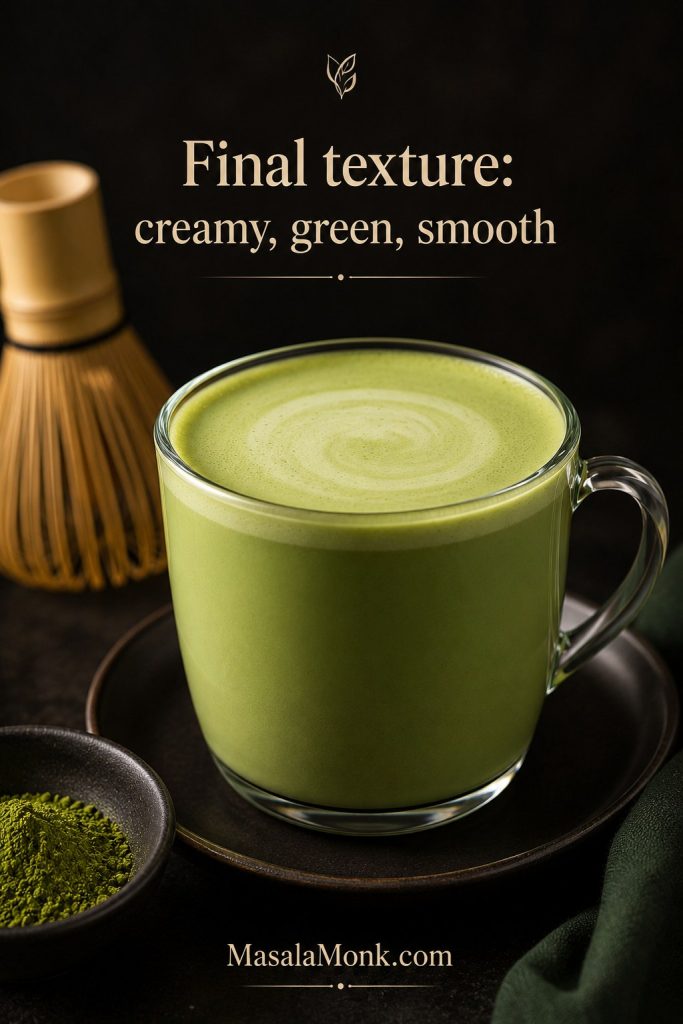
Finished hot matcha latte with creamy green texture, light foam, matcha powder, and bamboo whisk.
Before building variations, check the finish: the latte should be fully blended, lightly foamed, and free of dry green powder at the bottom.
Posted on — 7 Comments

Low Carb Chia Pudding Recipes

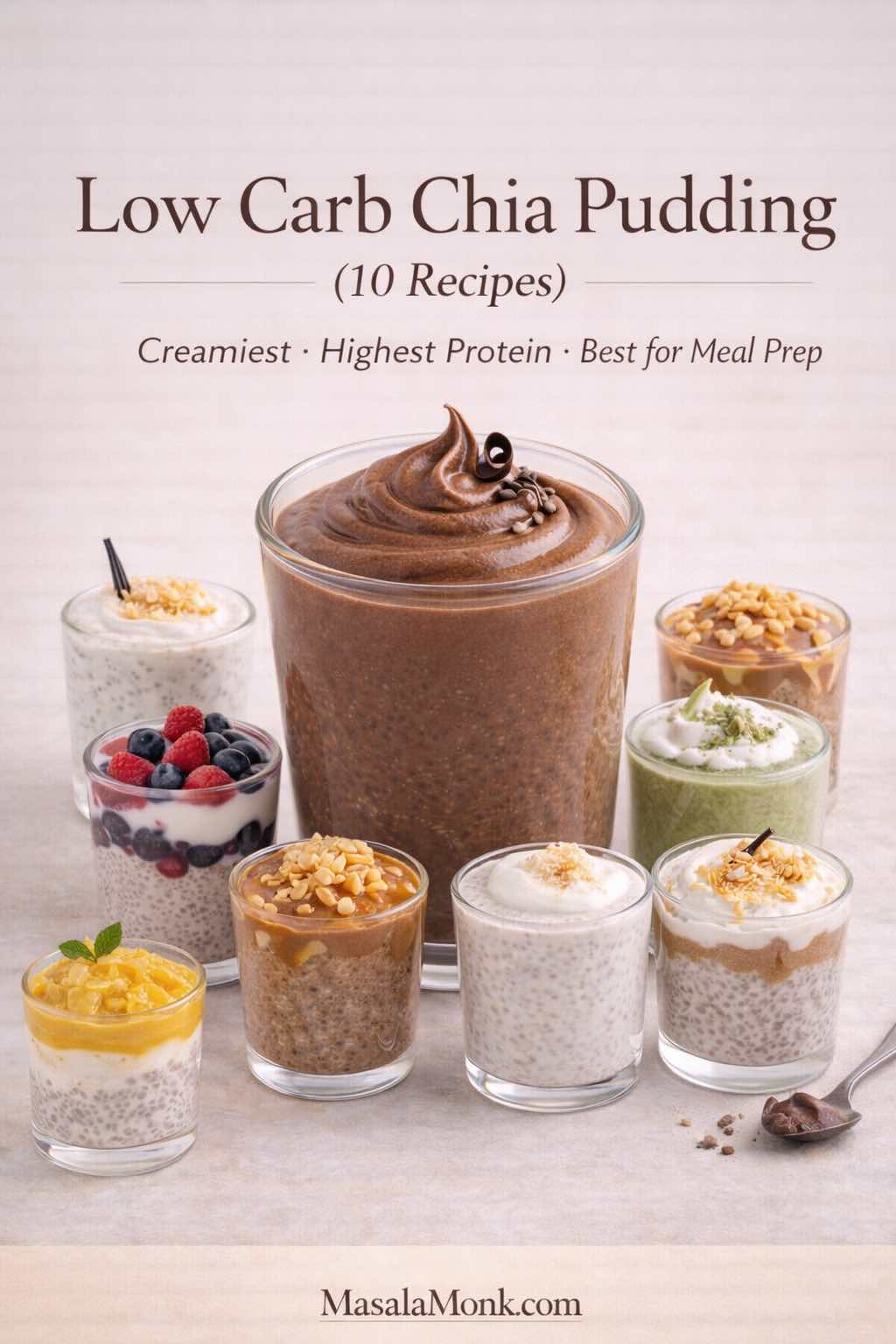
Cover image showing a premium glass jar of low carb chia pudding with a smooth whipped topping on a warm-cream seamless background. Editorial food photography style for “Low Carb Chia Pudding” featuring 10 recipes including keto, high protein, dairy-free, and blended options, with MasalaMonk.com branding.

This post was last updated on

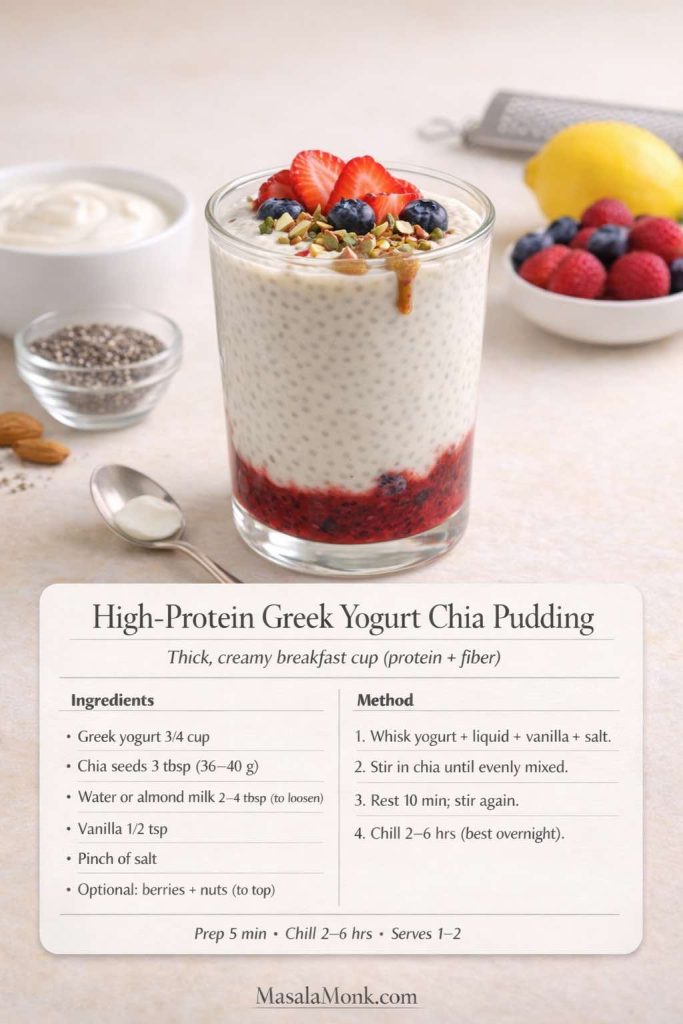
Looking for low carb chia pudding recipes for weight loss? The most useful place to start is the pudding itself. Chia is not a fat burner, but a make-ahead serving can be easy to portion, simple to build with protein, and satisfying without relying on much added sugar. Here you can make it light with almond milk, thick and tangy with Greek yogurt, rich with coconut milk, chocolatey with protein powder, or completely smooth after blending.

Here for the thick Greek-yogurt chia pudding? Start with ¾ cup plain Greek yogurt + 3 tablespoons chia seeds + ¼ cup / 60 ml unsweetened almond milk or water. Stir again after 10 minutes, then chill for at least 2 hours. Jump to the full Greek yogurt chia pudding recipe ↓

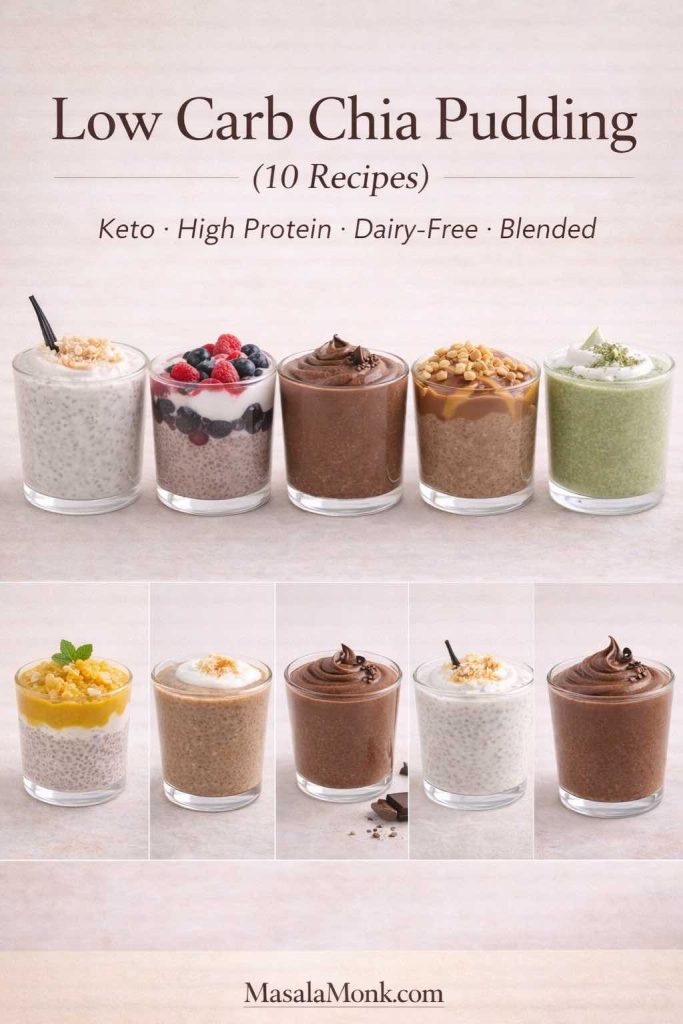
Collage showing ten low carb chia pudding cups including vanilla, Greek yogurt, chocolate, peanut butter, matcha, mango, coconut and blended mousse variations.
All 10 chia pudding recipes at a glance—from thick Greek yogurt and keto coconut milk to chocolate protein pudding, fruit layers and smooth blended mousse.

You do not need to read this guide from top to bottom. Use the jumps above if you already know what you want, or use the table of contents to solve the ratio, liquid, protein, meal-prep, or troubleshooting question that brought you here.

Low Carb Chia Pudding for Weight Loss: What Actually Matters

Chia pudding is not a fat burner, and a jar does not cause weight loss by itself. What makes it useful in a weight-management routine is practical: chia is easy to portion ahead, it creates a substantial gel-like texture when hydrated, and it can be paired with protein-rich ingredients such as Greek yogurt or protein powder.

The rest of the jar matters just as much. Canned coconut milk, nut butter, nuts, granola, fruit, sweeteners, and large portions can quickly change both calories and carbohydrates. A chia pudding that replaces a less satisfying breakfast is a different situation from adding a rich pudding on top of everything else you already eat.

  • Start unsweetened: choose unsweetened almond milk, plain Greek yogurt, or an unsweetened coconut base when keeping added sugar low matters.
  • Add protein when the jar needs to function as a meal: Greek yogurt or a protein powder you already tolerate well are the easiest routes.
  • Measure calorie-dense toppings: nut butter, nuts, seeds, coconut and granola are easy to overserve.
  • Use fruit deliberately: berries are easy to portion; mango and apple work better as measured flavor accents when carbs matter.
  • Do not confuse “keto” or “low carb” with automatically low-calorie: coconut milk and nut butter can make an excellent low-carb pudding while still creating a very energy-dense jar.

That is the reason this guide includes several styles rather than one “perfect” weight-loss pudding: the best jar is the one whose portion, protein, texture, and toppings fit the rest of your day.


Why Chia Pudding Works So Well as a Breakfast

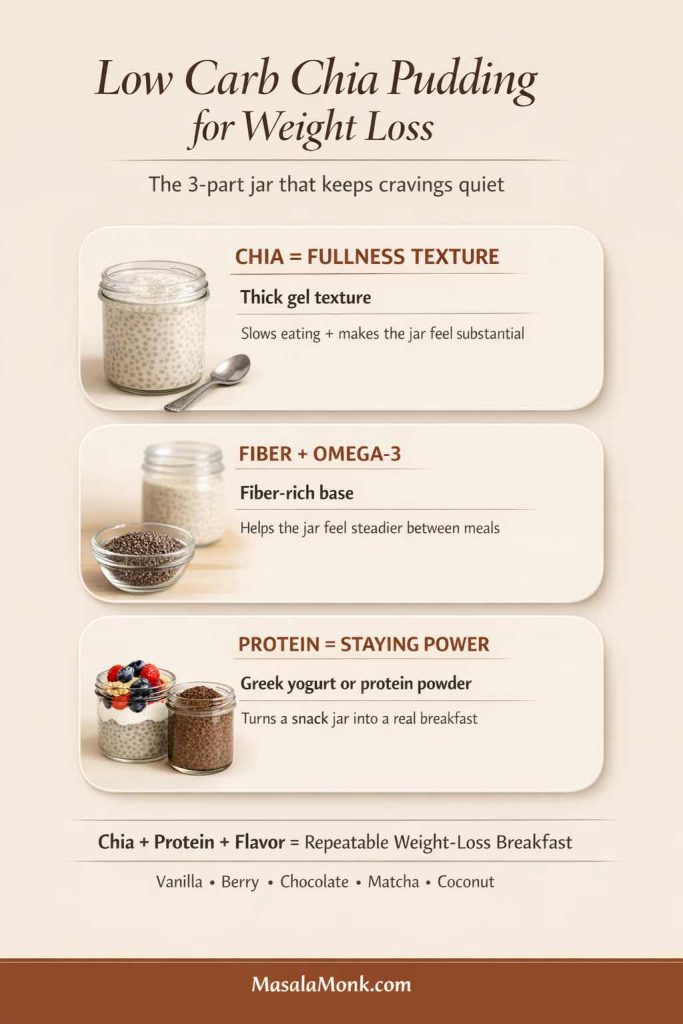
A good chia pudding does two practical things well: it gives you a breakfast you can prepare ahead, and it creates a thick, substantial texture from very little morning work. Chia seeds absorb liquid as they hydrate, while Greek yogurt, protein powder, nuts, or richer milks can make the finished jar feel more complete.

Infographic explaining how chia creates a thick gel texture and can be combined with protein such as Greek yogurt or protein powder.
Chia supplies the pudding structure; protein and the rest of the ingredients determine whether the jar behaves more like a snack or a full breakfast.

Chia seeds are naturally rich in fiber and contain alpha-linolenic acid, a plant-based omega-3 fat. For a useful evidence-based overview rather than exaggerated claims, see the Harvard Nutrition Source guide to chia seeds.

Protein is the easiest way to make the jar feel more meal-like

Plain chia and milk can work perfectly well as a snack, but Greek yogurt or protein powder gives you another lever when you want the jar to function as breakfast. Greek yogurt also changes the texture immediately: instead of waiting for milk alone to become pudding-like, you start with a thick, creamy base.

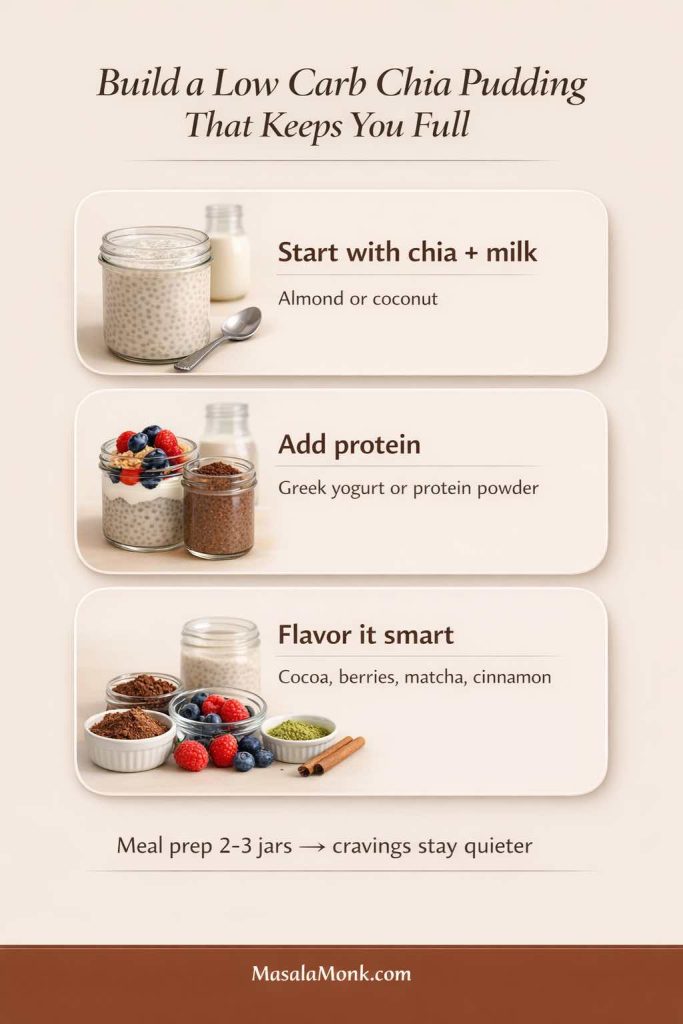
Three-step low carb chia pudding builder showing chia and milk, an optional protein addition, and flavor options such as cocoa, berries, matcha and cinnamon.
Think of the jar in three layers: chia + liquid for structure, an optional protein source for a more substantial breakfast, then flavors you genuinely want to eat.

Low Carb Chia Pudding Ratio: The Base Recipe That Prevents Clumps

For a classic milk-based chia pudding, this is the dependable starting point:

  • 3 tablespoons chia seeds (roughly 30–35 g, depending on how you measure)
  • 1 cup / 240 ml liquid
  • Pinch of salt
  • ½ teaspoon vanilla, optional
  • Sweetener to taste, optional
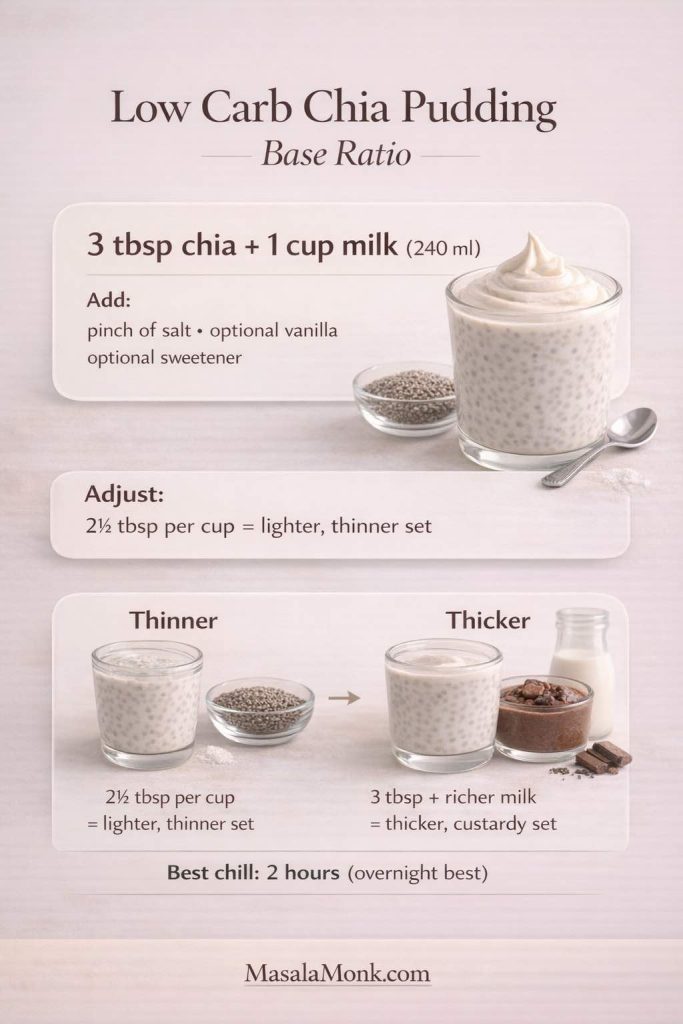
Chia pudding ratio infographic showing 3 tablespoons chia seeds to 1 cup or 240 ml milk, with adjustments for thinner or thicker pudding.
Start with 3 tablespoons chia to 1 cup / 240 ml liquid. Use a little less chia for a softer set, or keep the full amount and use a richer liquid for a denser pudding.

The exact result changes with your liquid. Thin almond milk gives a lighter pudding, while canned coconut milk sets much richer. Greek yogurt needs far less added liquid because the yogurt already provides most of the body.

The stir-rest-stir method

  1. Whisk the liquid with vanilla, salt, sweetener, cocoa, protein powder, or other smooth flavorings first.
  2. Add the chia and whisk vigorously for 20–30 seconds.
  3. Let the mixture stand for 10 minutes.
  4. Whisk or stir thoroughly a second time.
  5. Cover and refrigerate for at least 2 hours; overnight gives the most settled texture.
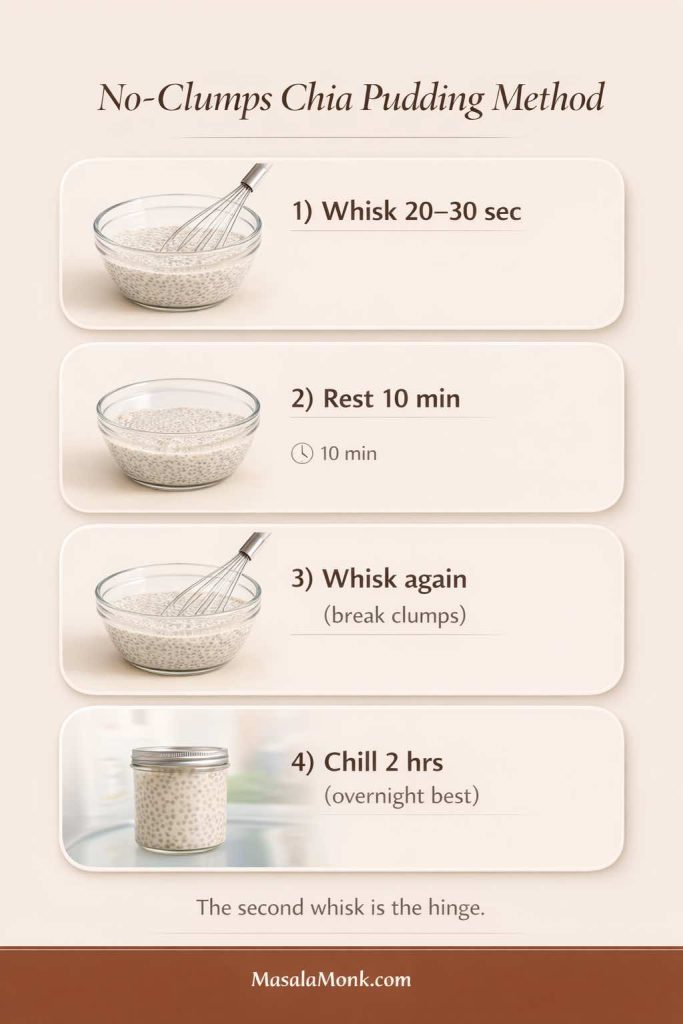
No-clumps chia pudding method showing whisking, a 10-minute rest, a second whisk and a final chill.
The second stir is the important one: the seeds have started hydrating but have not fully set, so this is your chance to break up clusters before they become permanent.

Can you make quick chia pudding?

Yes, although “quick” still means giving chia time to hydrate. Follow the same method and chill for 30–45 minutes. The texture will be softer than an overnight jar. Greek yogurt is particularly useful when you want a thick pudding sooner because much of the thickness is already present before the chia sets.

Give the chia enough time to hydrate

Chia thickens because the seeds absorb liquid over time. For pudding, use them fully hydrated rather than judging the mixture immediately after stirring. If the texture still seems thin after 30 minutes, give it more time before adding extra seeds; the biggest change usually happens during the longer refrigerator rest.


Choosing Your Liquid: Almond Milk, Coconut Milk, Yogurt, Oat Milk & More

Your liquid controls far more than flavor. It changes thickness, richness, carbohydrate content, and how much additional chia you may need. Choose the liquid first, then fine-tune the jar.

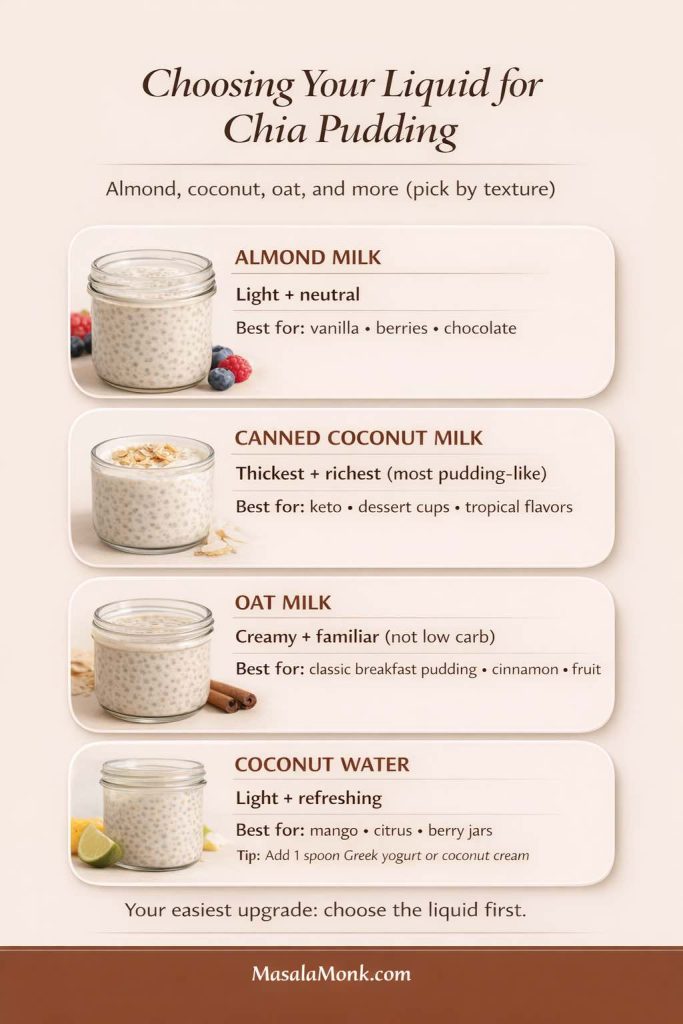
Guide comparing almond milk, canned coconut milk, oat milk and coconut water for chia pudding, including texture and best-use notes.
Almond milk stays light, canned coconut milk gives the richest set, oat milk is creamy but usually higher in carbohydrate, and coconut water creates a lighter fruit-friendly chia gel.

Almond milk: light and versatile

Unsweetened almond milk is an easy low-carb base because its flavor stays out of the way. It works especially well with vanilla, chocolate, cinnamon, berries, matcha, and nut butter.

Canned coconut milk: richest and thickest

If you want a pudding that feels especially rich, canned coconut milk is hard to beat. Because brands vary in thickness, whisk in enough water to make the mixture comfortably pourable before adding chia. Very thick coconut milk can otherwise produce dense pockets before the seeds hydrate evenly.

Greek yogurt: thick before it even chills

Greek yogurt works differently from milk. Instead of using a full cup of liquid, start with yogurt and loosen it gradually. For our full high-protein version, ¾ cup Greek yogurt + ¼ cup / 60 ml water or unsweetened almond milk creates a creamy starting mixture before the chia goes in.

Jump to the Greek yogurt chia pudding recipe →

Oat milk: creamy, but usually not low carb

Oat milk produces a mild, familiar breakfast-pudding flavor. It can still be used with any of the methods in this guide, but check the nutrition label if keeping carbohydrates low is an important part of your goal.

Coconut water: light and fruit-friendly

Coconut water produces a much lighter gel than milk. It pairs particularly well with mango, lime and berries, but it will not taste as creamy unless you add a spoonful of Greek yogurt or coconut cream. If you would rather drink your chia than turn it into pudding, our Chia Seed Water guide uses a much lighter chia-to-liquid ratio and covers plain, lemon, coconut-water and overnight versions.

Dairy-Free Chia Pudding: The Easiest Swaps

Several recipes in this collection are naturally dairy-free when you use plant milk and skip optional Greek yogurt. Unsweetened almond milk is the lightest neutral base; canned coconut milk gives the richest dairy-free texture; and a lighter coconut-milk beverage works well for matcha, mango, apple-cinnamon, and gingerbread.

If you use protein powder in a dairy-free jar, check the ingredient label: whey and casein are dairy proteins, while many pea, soy, rice, and blended plant proteins are dairy-free.


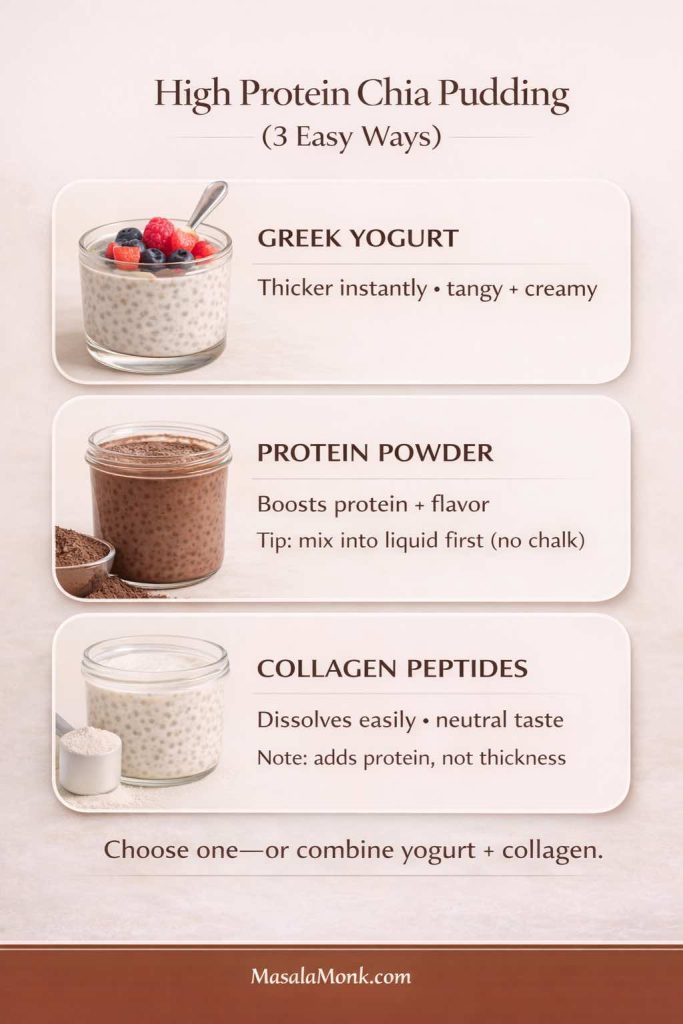
High Protein Chia Pudding: Greek Yogurt, Protein Powder & Collagen

There are three straightforward ways to increase the protein in a chia jar. Greek yogurt gives you protein and immediate thickness. Protein powder can add more protein and flavor but needs to be dissolved well. Collagen peptides dissolve easily, although they do not thicken the pudding the way yogurt does. If collagen is part of your routine, Harvard Health has a measured overview of what collagen supplements can and cannot reasonably claim.

High protein chia pudding comparison showing Greek yogurt, protein powder and collagen peptides as three ways to add protein.
Greek yogurt changes both protein and texture; protein powder is a bigger flavor lever; collagen dissolves easily but contributes little to thickness.

How to add protein powder without a chalky texture

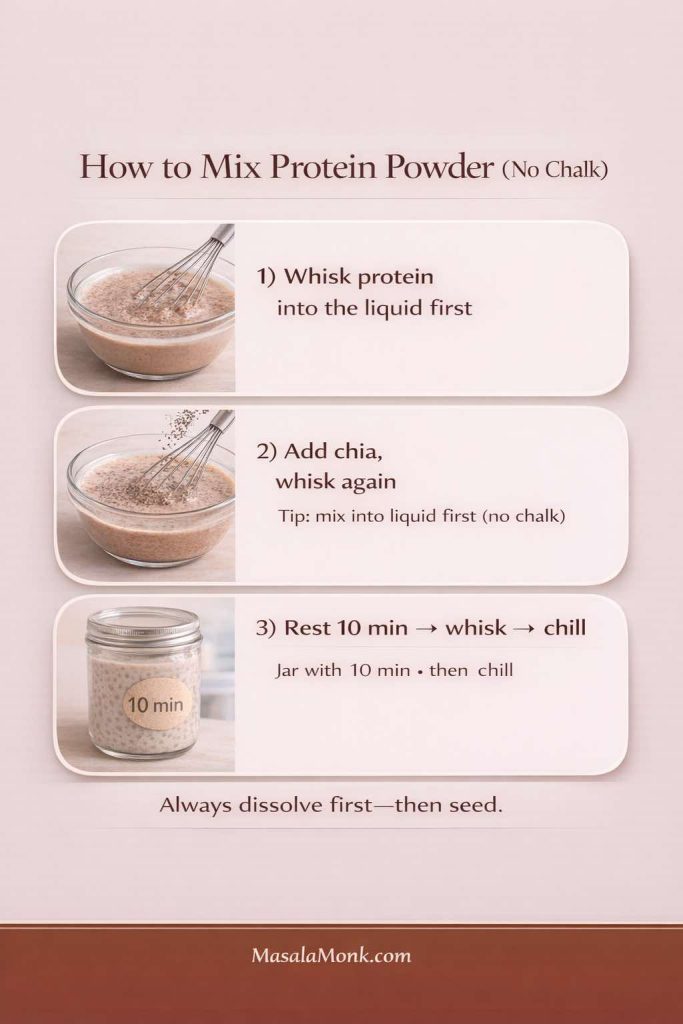
Do not dump dry protein powder into a finished chia pudding. Whisk it completely into the milk first, then add the chia. If your powder is stubborn, make a smooth paste with a small amount of liquid before gradually whisking in the rest.

Keep extra liquid nearby: protein powders absorb liquid very differently. After the 10-minute rest, add 2–4 tablespoons milk if the mixture has become unusually thick before it goes into the refrigerator.

Three-step guide showing protein powder whisked into liquid first, followed by chia seeds and a final 10-minute rest and second stir.
For smooth protein chia pudding: dissolve the powder first, add the seeds second, then use the same 10-minute rest and second-stir method.

10 Low Carb Chia Pudding Recipes

Each recipe below makes roughly 2 small servings or 1 generous serving, depending on appetite and toppings. For meal prep, multiply the ingredients and portion the finished mixture into individual jars.

Low-carb vs keto: these recipes are not all equally low in carbohydrate. The unsweetened almond-milk, Greek-yogurt, chocolate, and coconut versions are the easiest to keep very low carb. Mango and apple are fruit-forward options; use the fruit as a measured accent if carbohydrate intake is a priority.

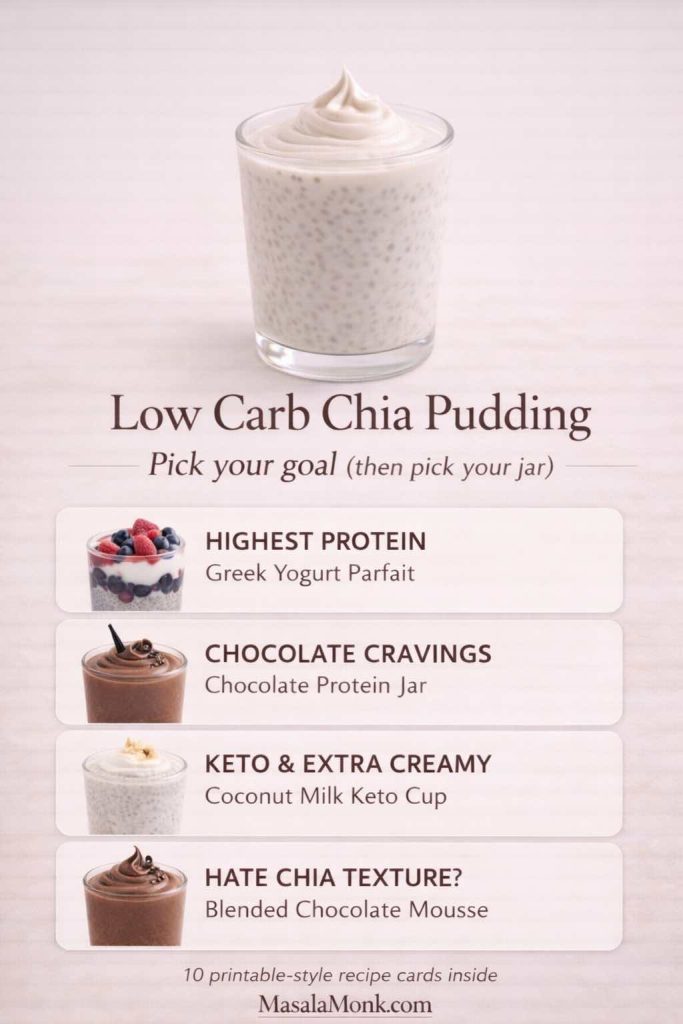
Goal-based chia pudding chooser showing Greek yogurt for highest protein, chocolate protein pudding for chocolate cravings, coconut milk for extra-creamy keto pudding and blended chocolate mousse for people who dislike whole chia texture.
Start with the result you want: Greek yogurt for thick and protein-forward, chocolate protein for cocoa cravings, coconut milk for the richest keto texture, or blended mousse if whole chia seeds are the problem.
If you want…Make this one
Thickest high-protein jarGreek Yogurt Chia Pudding
Simple everyday keto baseVanilla Almond Milk
Chocolate + proteinChocolate Protein
Chocolate dessert feelChocolate Peanut Butter
Fresh café-style flavorMatcha
Fruit-forwardMango
Cozy breakfastApple Cinnamon
Warm-spice dessert flavorGingerbread
Richest keto textureCoconut Milk
No whole-seed textureBlended Chocolate Mousse

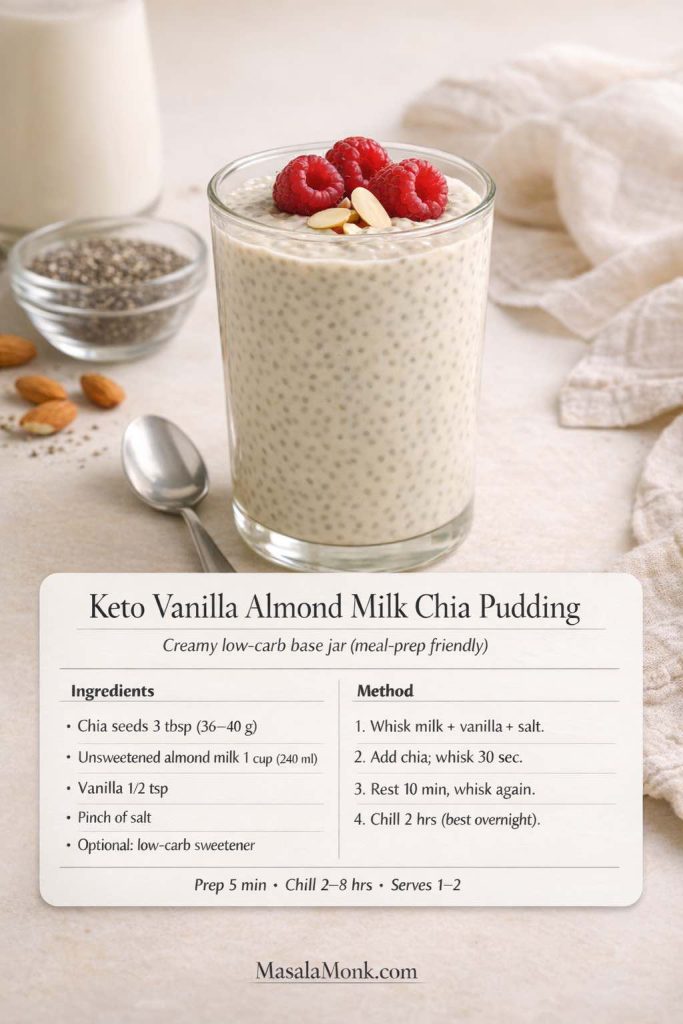
1) Keto Chia Pudding with Almond Milk

This is the easiest everyday low carb chia pudding to memorize. Vanilla keeps it neutral enough for berries, nuts, cocoa, cinnamon, or nut butter later.

Ingredients

  • 3 tablespoons chia seeds
  • 1 cup / 240 ml unsweetened almond milk
  • ½ teaspoon vanilla extract
  • Pinch of salt
  • Optional low-carb sweetener, to taste
Keto vanilla almond milk chia pudding topped with raspberries and sliced almonds.
The almond-milk jar is the useful blank canvas of the collection: light enough for fruit, but easy to make richer with yogurt, nuts or nut butter.

Method

  1. Whisk almond milk, vanilla, salt and sweetener, if using.
  2. Add the chia and whisk vigorously for 20–30 seconds.
  3. Rest 10 minutes, then whisk again.
  4. Cover and refrigerate for at least 2 hours or overnight.

Easy variations: add ½ teaspoon cinnamon; stir in 1 tablespoon unsweetened shredded coconut; or add 1–2 tablespoons Greek yogurt at serving time for a creamier finish.

For a deeper single-recipe treatment, see the keto chia pudding with almond milk.


2) Chia Pudding with Greek Yogurt: High Protein & Ultra Creamy

If the chia pudding you want is thick, creamy and closer to cheesecake filling than a glass of soaked seeds, start here. Greek yogurt gives the jar body before the chia has even finished hydrating, while a small amount of liquid keeps the mixture creamy rather than pasty.

Ingredients

  • ¾ cup plain Greek yogurt
  • 3 tablespoons chia seeds
  • ¼ cup / 60 ml unsweetened almond milk or water, plus 1–2 tablespoons more after chilling if needed
  • ½ teaspoon vanilla extract
  • Pinch of salt
  • Optional sweetener, to taste
Thick high-protein Greek yogurt chia pudding layered with berries and topped with strawberries, blueberries, nuts and a small nut-butter drizzle.
This is the thickest protein-forward version in the collection: tangy Greek yogurt, hydrated chia and enough added liquid to keep the pudding creamy rather than stiff.

Method

  1. Whisk the Greek yogurt, vanilla, salt and ¼ cup / 60 ml water or almond milk until completely smooth.
  2. Stir in the chia seeds until evenly distributed.
  3. Rest for 10 minutes, then stir again so no dense chia pockets remain.
  4. Refrigerate for at least 2 hours. Overnight is fine.
  5. Stir before serving and add another 1–2 tablespoons liquid if you want it looser.

How thick should it look before chilling?

It should already be thick, but it should still move easily when stirred. If it looks like a stiff paste before going into the refrigerator, add another tablespoon or two of liquid. The chia will absorb more as it sits.

Can you use nonfat or regular yogurt?

Yes. Nonfat Greek yogurt works, although the finished pudding can taste a little sharper and less rich. Regular yogurt is thinner, so start with less added liquid and check the texture after hydration. Different yogurts vary enough that the final splash of liquid should be adjusted by texture rather than treated as an exact requirement.

Can you add protein powder too?

Yes. Whisk the protein powder into the yogurt and loosening liquid before adding chia. Protein powders absorb liquid differently, so expect to add another 1–3 tablespoons milk if the mixture becomes unusually stiff after the 10-minute rest.

Best toppings and variations

For a cheesecake-style jar, use vanilla, berries and a little lemon zest. For chocolate, whisk cocoa into the yogurt before adding chia. Peanut butter, chopped nuts, cacao nibs and a small berry layer all work well because they add contrast without turning the pudding watery.

If this thick, tangy, almost-cheesecake style is the chia pudding you actually want, keep going with our 10 Creative Chia Pudding Recipes. That collection branches into Greek-yogurt, cheesecake, chocolate, blueberry-lemon, mango and coconut-cream directions, so you can keep the texture you like and change the flavor.


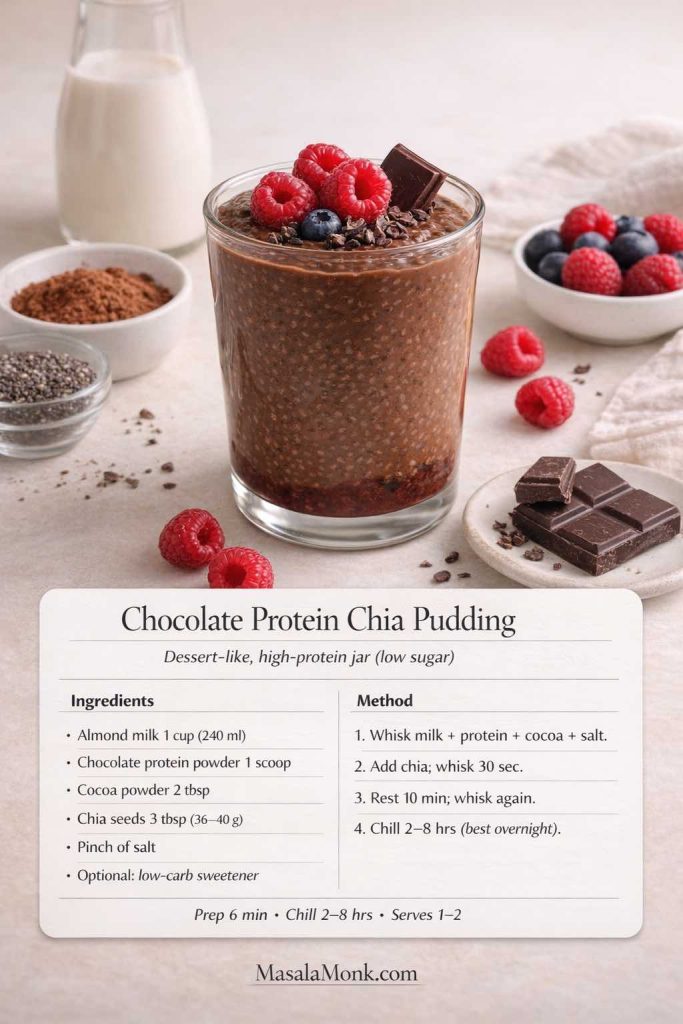
3) Chocolate Protein Chia Pudding

This is the jar to make when you want chocolate flavor without turning breakfast into a sugar-heavy dessert. The important technique is dissolving the protein powder and cocoa before the chia goes in.

  • 1 cup / 240 ml unsweetened almond milk or dairy milk
  • 1 scoop chocolate protein powder, or vanilla protein plus extra cocoa
  • 2 tablespoons cocoa or cacao powder
  • 3 tablespoons chia seeds
  • Pinch of salt
  • Optional sweetener, to taste
  • Optional: 1 tablespoon Greek yogurt for extra creaminess
  • 2–4 tablespoons extra milk, only if your protein powder makes the mixture unusually thick
Chocolate protein chia pudding topped with raspberries, cacao nibs and dark chocolate.
Cocoa and protein powder make this the most direct chocolate-for-breakfast jar in the collection.
  1. Whisk the milk, protein powder, cocoa, salt and sweetener until completely smooth.
  2. Add chia and whisk again.
  3. Rest 10 minutes, then stir thoroughly. If it already looks very thick, add 2–4 tablespoons extra milk.
  4. Refrigerate for at least 2 hours; overnight gives the most settled texture.

If it tastes chalky: whisk the protein powder with a small amount of milk into a smooth paste first, then gradually add the rest of the milk.


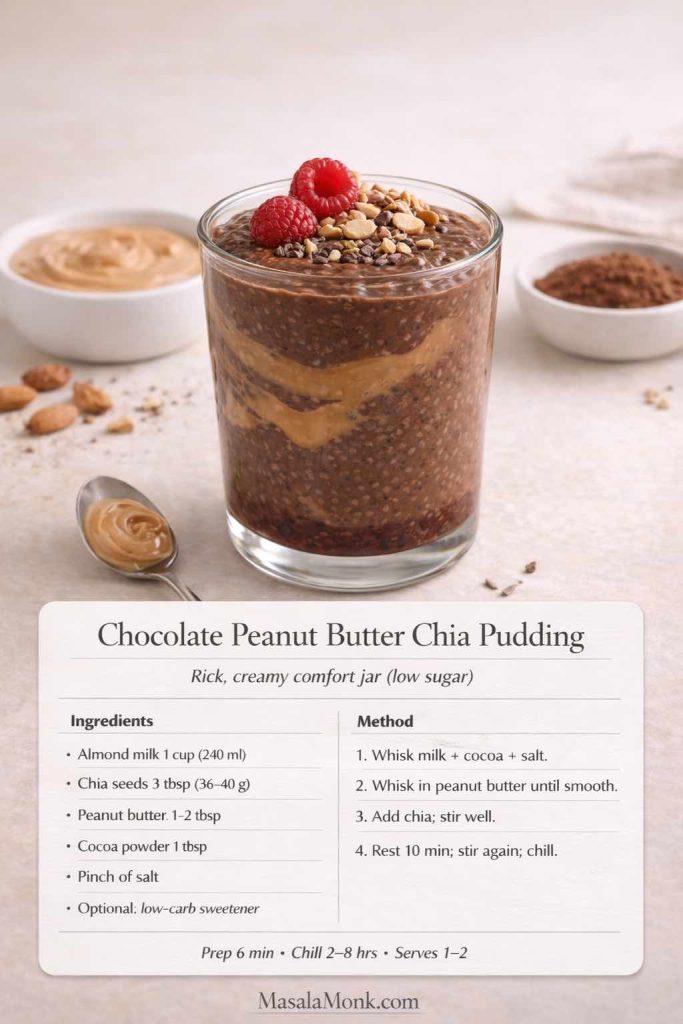
4) Chocolate Peanut Butter Chia Pudding

Peanut butter supplies richness and makes chocolate taste fuller even when you keep the pudding only lightly sweetened.

  • 1 cup / 240 ml almond milk or dairy milk
  • 3 tablespoons chia seeds
  • 1–2 tablespoons peanut butter
  • 1 tablespoon cocoa powder
  • Pinch of salt
  • Optional sweetener
Chocolate peanut butter chia pudding with a peanut butter swirl, raspberries, chopped peanuts and cacao nibs.
Chocolate and peanut butter create a richer dessert-style jar without needing much additional sweetness.
  1. Whisk milk, cocoa, salt and sweetener until smooth.
  2. Whisk in the peanut butter until evenly incorporated.
  3. Add chia, rest 10 minutes and stir again.
  4. Refrigerate for at least 2 hours.

A tiny splash of vanilla or pinch of cinnamon can make the cocoa taste deeper. Top with berries, roasted nuts or a few cacao nibs.


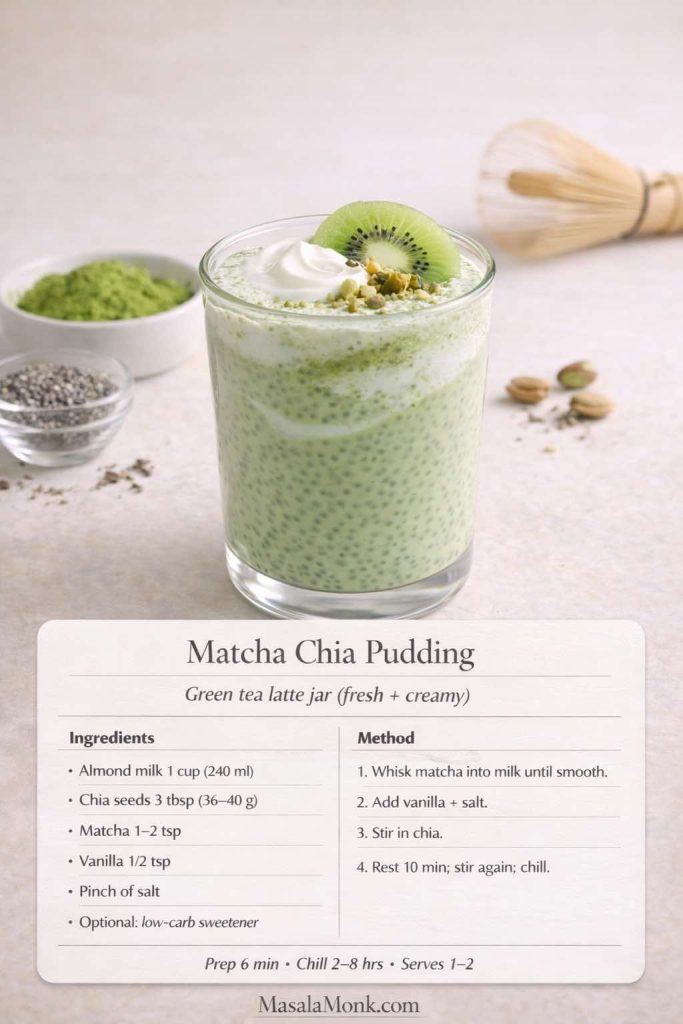
5) Matcha Chia Pudding

Matcha gives chia pudding a clean green-tea flavor that works especially well with vanilla and a small pinch of salt.

  • 1 cup / 240 ml unsweetened almond milk or light coconut-milk beverage
  • 3 tablespoons chia seeds
  • 1–2 teaspoons matcha powder
  • ½ teaspoon vanilla
  • Pinch of salt
  • Optional sweetener
Creamy matcha chia pudding topped with kiwi, pistachio and a small spoonful of yogurt.
Matcha creates a lighter, café-style change of pace between the richer chocolate and coconut puddings.
  1. Whisk or sift matcha into the milk until smooth.
  2. Add vanilla, salt and sweetener, if using.
  3. Add chia, rest 10 minutes, stir again and refrigerate.

If your matcha clumps, whisk it first with 1–2 tablespoons warm water to form a smooth paste. Matcha contains caffeine, so use less or enjoy it earlier in the day if you are sensitive to it.


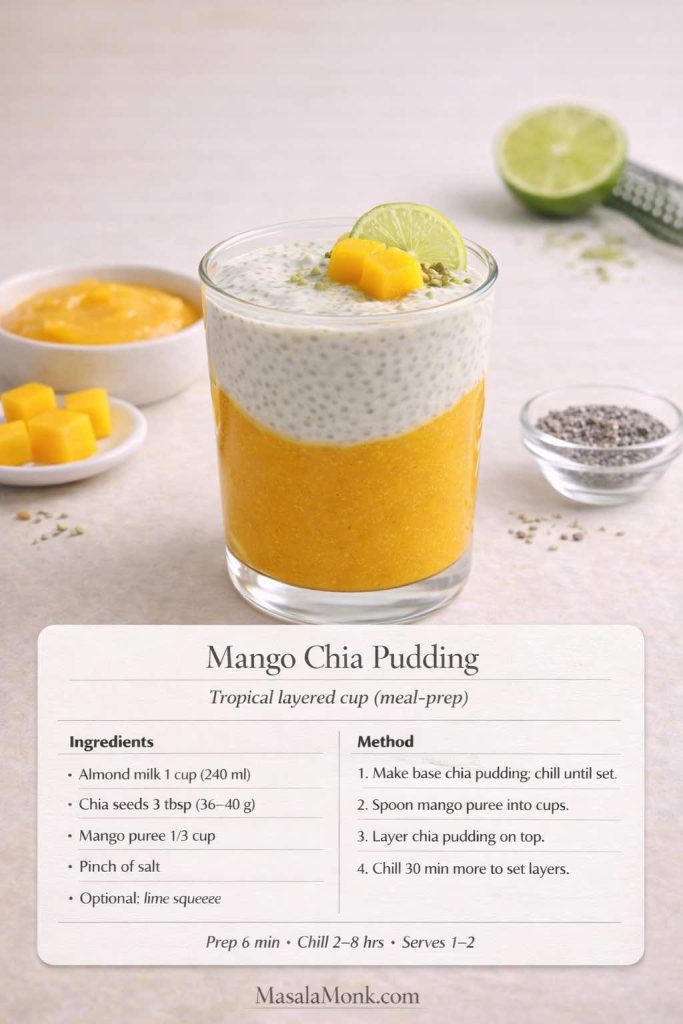
6) Mango Chia Pudding

Mango gives you plenty of flavor from a relatively small amount of fruit. Lime and a pinch of salt help the mango taste brighter, so you do not need to turn the whole jar into mango puree.

  • 1 cup / 240 ml almond milk or coconut-milk beverage
  • 3 tablespoons chia seeds
  • ⅓ cup mango puree or finely diced mango
  • Pinch of salt
  • Optional squeeze of lime
Layered mango chia pudding with bright mango puree, creamy chia pudding, mango pieces and lime.
Layering the mango rather than mixing a large quantity through the whole jar gives you strong tropical flavor without overwhelming the chia base.
  1. Make the chia base with milk, chia and salt.
  2. Chill until set.
  3. Fold in the mango just before eating, or layer the puree at the bottom of the jar.
  4. Finish with lime, if using.

If the tropical-fruit direction is what you like, try our pineapple chia pudding next. It uses the same two-stir logic but goes deeper on pineapple, yogurt, texture, and how to keep the pudding spoonable rather than watery.


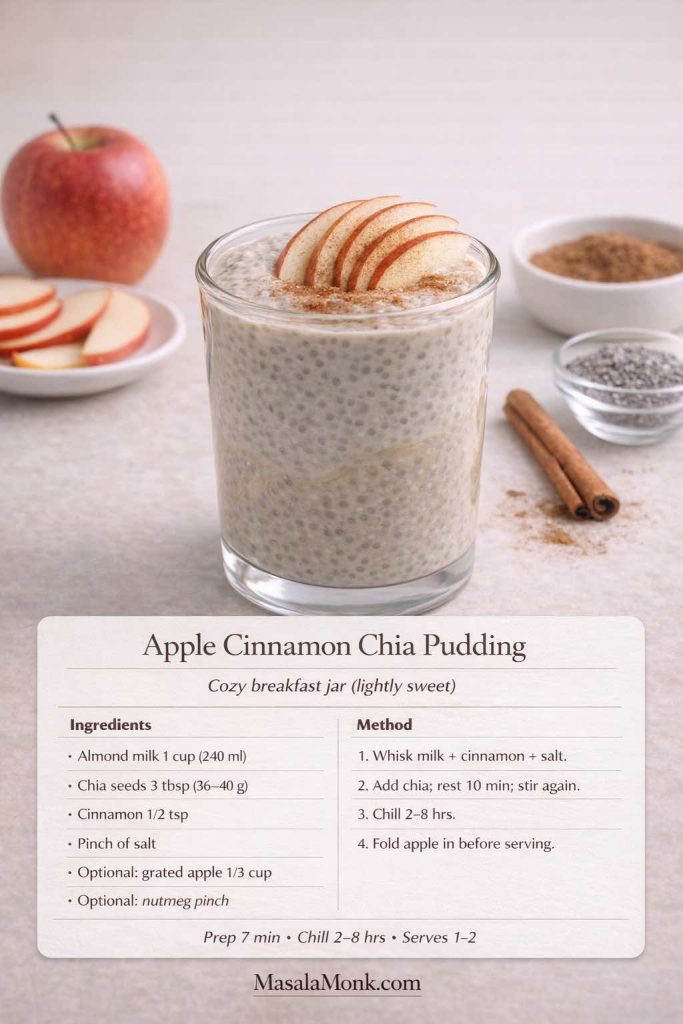
7) Apple Cinnamon Chia Pudding

This version gets most of its cozy character from cinnamon, vanilla and nutmeg, so the apple can stay a relatively small accent.

  • 1 cup / 240 ml unsweetened almond milk
  • 3 tablespoons chia seeds
  • ½ teaspoon cinnamon
  • Pinch of salt
  • Optional: ⅓ cup grated apple
  • Optional: pinch of nutmeg
Apple cinnamon chia pudding topped with thin apple slices and cinnamon.
For the freshest texture, add grated apple shortly before serving rather than letting it sit in the pudding for several days.
  1. Whisk milk, cinnamon, salt and nutmeg.
  2. Add chia, rest 10 minutes, stir again and chill.
  3. Fold in grated apple shortly before serving.

Stricter low-carb version: skip the apple and use cinnamon, vanilla and chopped pecans for a cinnamon-pecan jar.


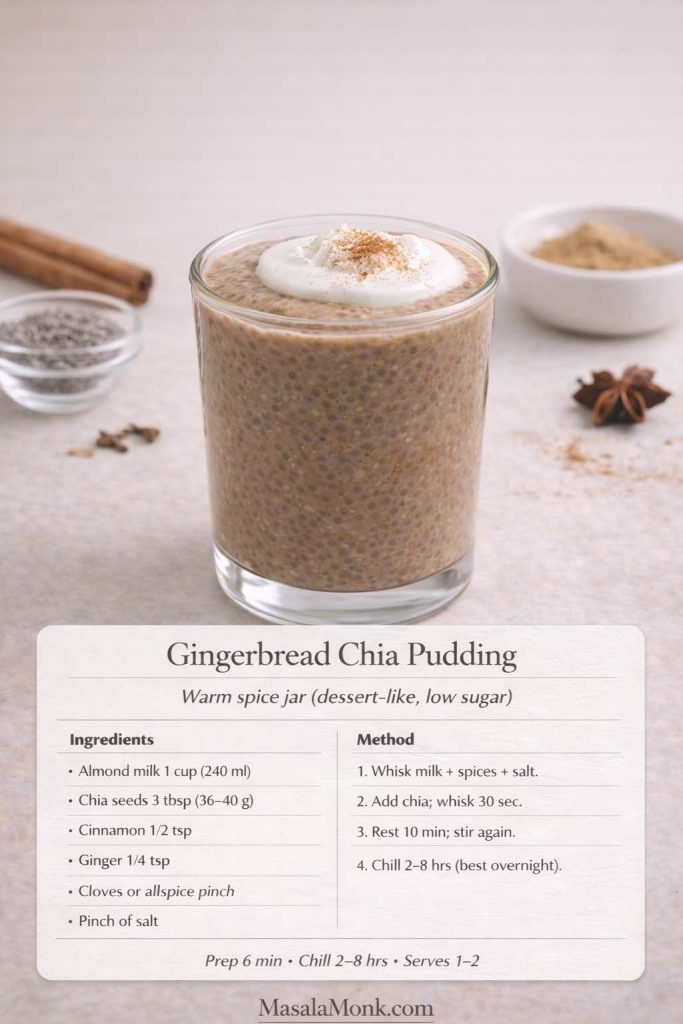
8) Gingerbread Chia Pudding

Gingerbread chia pudding is about warm-spice flavor rather than a health halo: cinnamon, ginger and cloves turn the same neutral base into something that feels much more dessert-like.

  • 1 cup / 240 ml almond milk or coconut-milk beverage
  • 3 tablespoons chia seeds
  • ½ teaspoon cinnamon
  • ¼ teaspoon ground ginger
  • Pinch of cloves or allspice
  • Pinch of salt
  • Optional sweetener
Gingerbread chia pudding topped with yogurt and cinnamon.
Warm spices transform a basic chia-and-milk jar without needing a complicated ingredient list.
  1. Whisk the spices, salt and sweetener into the milk.
  2. Add chia, rest 10 minutes, stir again and refrigerate.
  3. Serve with chopped nuts, Greek yogurt or coconut cream.

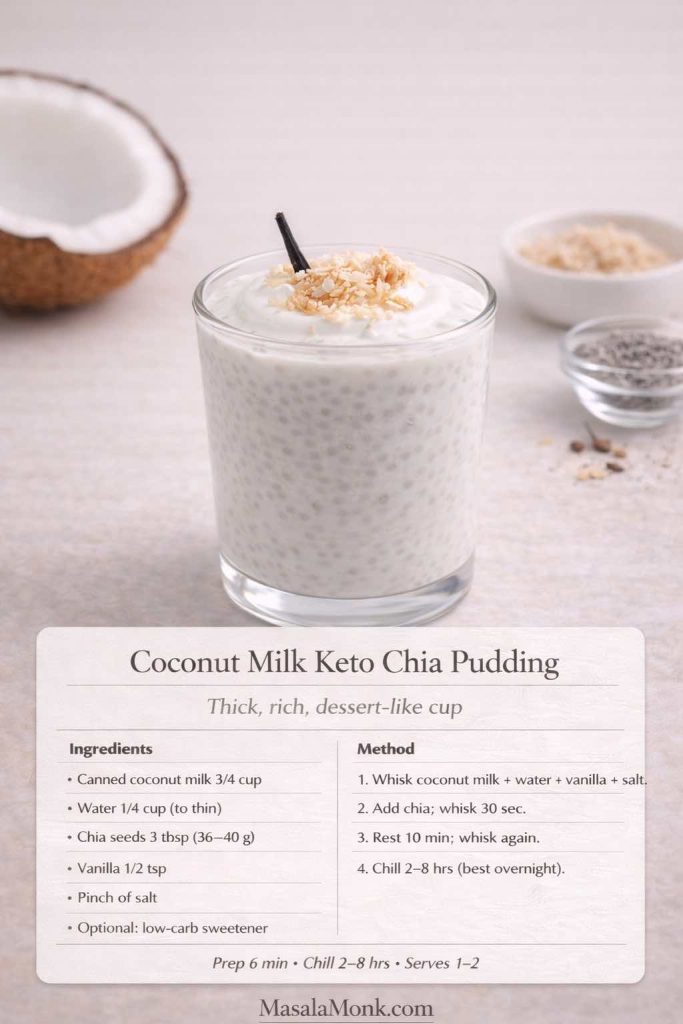
9) Keto Chia Pudding with Coconut Milk

This is the richest milk-based pudding in the collection. Canned coconut milk gives you much more body than almond milk, but thinning it slightly helps the chia hydrate evenly.

  • 3 tablespoons chia seeds
  • ¾ cup / 180 ml canned coconut milk
  • ¼ cup / 60 ml water, plus more if needed
  • ½ teaspoon vanilla
  • Pinch of salt
  • Optional sweetener
Rich coconut milk keto chia pudding topped with toasted coconut and vanilla.
Canned coconut milk produces the densest, richest milk-based chia pudding in this collection.
  1. Whisk coconut milk, water, vanilla, salt and sweetener until smooth.
  2. Add chia, rest 10 minutes and stir again.
  3. Refrigerate for at least 2 hours.
  4. If it becomes extremely thick overnight, loosen it with a splash of water before serving.

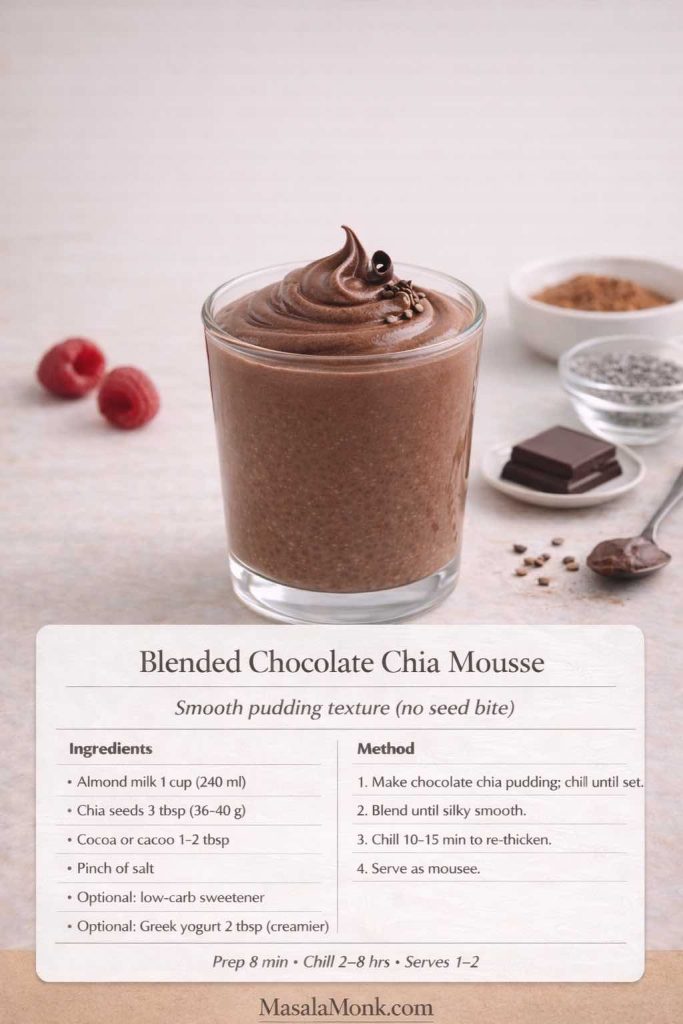
10) Blended Chia Pudding: Smooth Chocolate Mousse

If the idea of chia appeals to you but the whole-seed texture does not, this is the recipe worth trying. Let the chia hydrate first, then blend the finished pudding until glossy and smooth.

  • 1 cup / 240 ml almond milk or dairy milk
  • 3 tablespoons chia seeds
  • 1–2 tablespoons cocoa or cacao powder
  • Pinch of salt
  • Optional sweetener
  • Optional: 1 tablespoon peanut butter or 2 tablespoons Greek yogurt
Silky blended chocolate chia mousse topped with dark chocolate and cacao nibs.
Hydrate first and blend second: that is what changes chia from a seedy pudding into a much smoother mousse-like texture.
  1. Make a standard chocolate chia pudding and refrigerate it for at least 2 hours.
  2. Blend until completely smooth and glossy.
  3. Add Greek yogurt or peanut butter if you want a richer finish.
  4. Chill for another 10–15 minutes before serving.

If protein powder is part of the recipe, blending after the chia has set can also smooth out small powdery pockets.

Whichever flavor you choose, texture is the part most likely to need adjusting. The fixes below are designed so you can rescue the pudding you already made instead of starting over.


Chia Pudding Troubleshooting: Runny, Too Thick, Lumpy or Bland

Most disappointing chia pudding can be traced to the ratio, hydration time, stirring pattern, or the thickness of the liquid you started with. Fix the texture before abandoning the jar.

ProblemWhat probably happenedWhat to do now
Runny after 2+ hoursToo much liquid, too little chia, or very thin milkAdd 1 teaspoon chia at a time, stir well and chill another 30–60 minutes.
Too thick or pastyRich coconut milk, thick yogurt, extra protein powder, or too much chiaStir in milk or water 1 tablespoon at a time until creamy.
Large chia clumpsThe seeds settled together before fully hydratingBreak them up thoroughly; next time use the 10-minute second stir.
Seeds still crunchyNot enough hydration time or liquidAdd a small splash of liquid and give the pudding more time.
Protein powder tastes chalkyPowder was added after the chia or not dissolved firstBlend the pudding, or next time dissolve powder completely before adding seeds.
Watery fruit layerJuicy fruit sat in the jar too longKeep berries and other watery toppings separate until serving.
Flavor is flatNot enough salt, aroma, richness or acidityAdd a pinch of salt plus vanilla, cinnamon, cocoa, nut butter, citrus zest or berries.
You hate the seed textureThe pudding may be fine; the texture simply is not for youBlend it into chocolate chia mousse.

One important correction: if a milk-based pudding is only slightly soft at the 30-minute mark, do not keep throwing chia into it. Give it the full two hours first. Chia continues absorbing liquid as it rests.


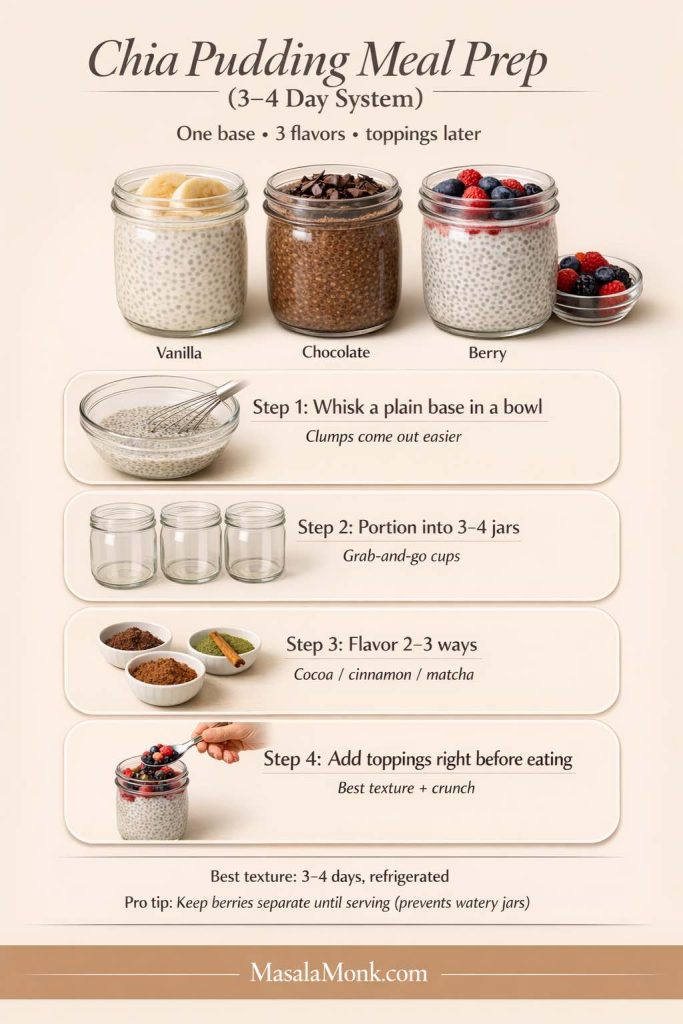
Chia Pudding Meal Prep & Storage

The easiest way to meal prep chia is to make one plain base and create several flavors from it rather than mixing four completely separate recipes.

  • Whisk the base in a bowl where you can easily break up clumps.
  • Do the 10-minute second stir.
  • Portion into three or four jars.
  • Flavor the jars in different directions—vanilla, cocoa, matcha, cinnamon, yogurt.
  • Keep crunchy toppings and watery fruit separate until serving.
Chia pudding meal-prep system showing one base divided into several jars and flavored with vanilla, chocolate and berries, with toppings kept separate until serving.
One base, several flavors, toppings added later: this is much easier to repeat than making a completely different pudding every morning.

For quality, most chia puddings are best eaten within about 3–4 days when refrigerated. Yogurt- and milk-based versions should stay cold, and fruit is usually best added closer to serving. Follow normal refrigerated food-safety practices and discard anything that develops an unusual smell, appearance or signs of spoilage.

If what you really enjoy is the make-it-tonight, grab-it-tomorrow routine rather than chia specifically, our high protein overnight oats give you the same fridge-ready breakfast rhythm with oats, yogurt, protein-powder and dairy-free routes.


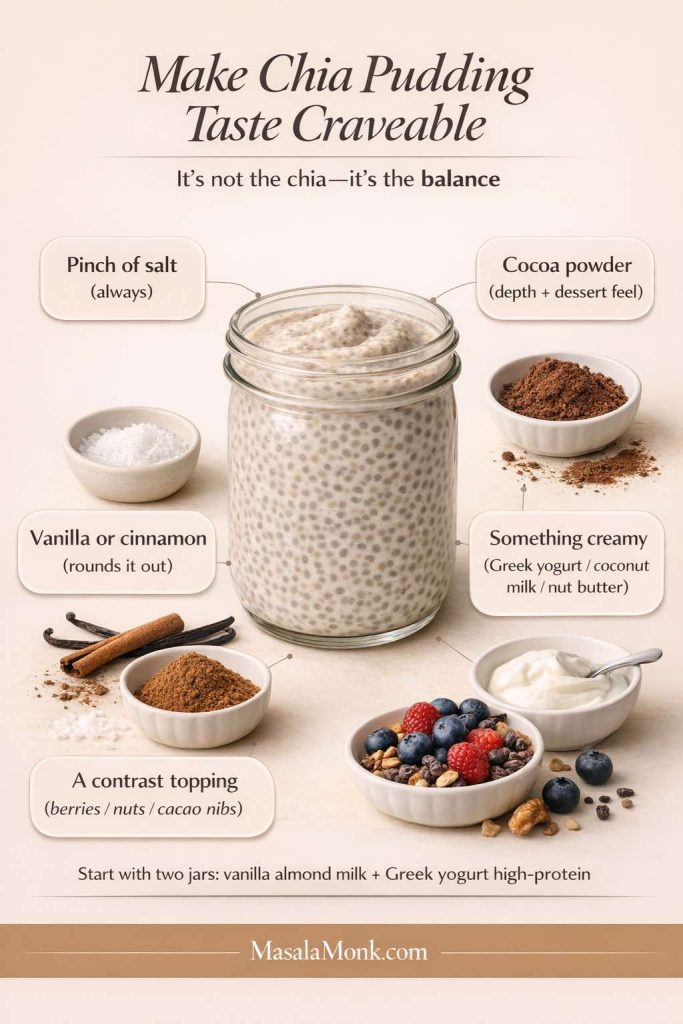
How to Make Chia Pudding Taste Better

If chia pudding tastes like a health chore, the problem is usually not the chia. A plain mixture of seeds and unsweetened milk needs flavor structure just like any other pudding.

  • Salt: a small pinch makes chocolate, vanilla, fruit and nut butter taste fuller.
  • Vanilla or warm spice: vanilla, cinnamon, ginger or nutmeg give the jar aroma without requiring much sweetness.
  • Depth: cocoa, cacao or matcha create a strong flavor identity.
  • Creaminess: Greek yogurt, canned coconut milk or nut butter changes both flavor and mouthfeel.
  • Contrast: berries, chopped nuts, toasted coconut and cacao nibs stop every spoonful feeling the same.
  • Acidity: lemon or lime zest can make fruit flavors brighter.
Flavor-balance guide for chia pudding showing salt, vanilla or cinnamon, cocoa, creamy ingredients and contrasting toppings.
Good chia pudding needs the same things other desserts do: seasoning, aroma, richness and contrast.

If you are making chia pudding for the first time, a useful two-jar experiment is one vanilla almond-milk jar and one Greek-yogurt jar. You will immediately learn whether you prefer a lighter gel-style pudding or a thicker, tangier texture.


Frequently Asked Questions

1) What is the best chia pudding ratio?

For a milk-based pudding, start with 3 tablespoons chia seeds to 1 cup / 240 ml liquid. Use a little less chia for a softer pudding. Greek-yogurt chia pudding uses a different ratio because yogurt already supplies most of the thickness.

2) How long does chia pudding need to set?

Give it at least 2 hours for a dependable set. A 30–45 minute quick version is possible but softer. Overnight works especially well for meal prep.

3) Why is my chia pudding watery?

It may need more time, more chia, or a better second stir. If it is still runny after at least two hours, add about 1 teaspoon chia, stir thoroughly and chill for another 30–60 minutes.

4) Why is my chia pudding too thick?

Thick Greek yogurt, canned coconut milk, protein powder and slightly heavy chia measurements can all produce an unexpectedly dense pudding. Stir in water or milk a tablespoon at a time until it becomes creamy again.

5) How do I stop chia seeds clumping together?

Whisk immediately after adding the seeds, then stir or whisk again after about 10 minutes. That second stir redistributes the seeds just as they begin to gel.

6) Can I make chia pudding with Greek yogurt and no milk?

Yes. Use water instead of milk to loosen the yogurt. Start with ¾ cup Greek yogurt, 3 tablespoons chia and ¼ cup / 60 ml water, then add another tablespoon or two after chilling if the pudding is too stiff.

7) Is Greek yogurt better than regular yogurt for chia pudding?

Neither is inherently better, but they behave differently. Greek yogurt is thicker and generally higher in protein, so it gives a firmer pudding. Regular yogurt starts looser, meaning you may need less added liquid or slightly more chia.

8) Can I add protein powder to chia pudding?

Yes. For the smoothest texture, dissolve the protein powder in the milk or yogurt mixture before adding the chia seeds. Because powders absorb liquid differently, keep a little extra milk nearby and adjust after the 10-minute rest.

9) Can I make chia pudding with almond milk?

Yes. Unsweetened almond milk is one of the easiest bases for low carb chia pudding because its flavor is mild and it works well with vanilla, cocoa, cinnamon, berries, matcha and nut butter.

10) Can I make chia pudding with coconut milk?

Yes. Canned coconut milk makes an especially rich pudding. If the coconut milk is very thick, dilute it with a little water before adding chia so the seeds hydrate evenly.

11) Can I make chia pudding with oat milk?

Yes. Oat milk creates a mild, creamy pudding, although many oat milks contain substantially more carbohydrate than unsweetened almond milk, so check the label if low carb is your priority.

12) Can I make dairy-free chia pudding?

Yes. Use unsweetened almond milk, coconut milk, or another dairy-free milk you enjoy. If adding protein powder, check whether it contains whey or casein; those are dairy proteins.

13) Can I make blended chia pudding?

Yes, and it is one of the best solutions if you dislike whole chia seeds. Let the pudding hydrate first, then blend until smooth. Cocoa, peanut butter or Greek yogurt can make the result even more mousse-like.

14) What is the easiest three-ingredient chia pudding?

A simple version is chia seeds + unsweetened almond milk + vanilla. Another is chia + coconut milk + cocoa. Add a pinch of salt if possible; it makes a surprisingly large difference to the finished flavor.

15) Can I use frozen berries in chia pudding?

Yes. Thawed berries release juice, which can be useful as a swirl or compote-style layer. For meal prep, keep very juicy berries separate until serving if you do not want them loosening the pudding.

16) How can I sweeten chia pudding without much sugar?

Start by improving flavor before simply increasing sweetness. Vanilla, cinnamon, cocoa, nut butter, coconut milk, berries, citrus zest and a pinch of salt can all make the pudding taste more complete. If you use a low-carb sweetener, add only enough to suit your taste.

17) Is chia pudding keto-friendly?

It can fit many low-carb or ketogenic eating patterns when made with ingredients such as unsweetened almond milk or coconut milk and appropriate toppings. The final carbohydrate content depends on your milk, yogurt, fruit, sweetener and serving size, so check the ingredients you actually use rather than relying on the word “keto” alone.

18) How long does chia pudding last in the fridge?

For quality, aim to eat most homemade chia pudding within about 3–4 days, refrigerated. Keep toppings such as nuts separate for crunch and add juicy fruit later if you want the pudding to stay thick.

19) Which chia pudding should I make first?

If you want the simplest base, start with vanilla almond milk chia pudding. If you came for the thick, creamy version, make the Greek yogurt chia pudding. And if chia’s seed texture has always bothered you, go directly to the blended chocolate mousse.

Posted on — 1 Comment

Natural Solutions for Erectile Dysfunction: Does Green Tea help in ED?

Close-up of male hands holding a glass cup of green tea, magazine-style portrait cover about green tea and erectile dysfunction.

When people type “green tea erectile dysfunction” into a search bar, they’re usually after two things: a straight answer and a practical plan. Fortunately, we can offer both. In brief, green tea isn’t a stand-alone cure for ED; nevertheless, it can support the underlying physiology that erections depend on—namely, vascular health and nitric-oxide signaling. As you’ll see, the science is strongest around blood-vessel function, and, when paired with sensible lifestyle steps, a consistent green-tea habit becomes a low-friction way to help the system that powers sexual performance.

Before anything else, it helps to remember what an erection actually is: a coordinated vascular event. Arteries must dilate on cue, endothelial cells need to produce nitric oxide in the moment, and smooth muscle has to relax so blood can enter and remain. Interestingly, green tea is rich in catechins (especially EGCG) that repeatedly show benefits for endothelial function—the same system. In fact, in a controlled study of smokers, two weeks of green tea increased flow-mediated dilation (FMD), a standard ultrasound measure of how well arteries expand; that improvement doesn’t prove a direct ED fix, yet it does strengthen the biologic plausibility behind green tea for ED as supportive care (green tea reversed endothelial dysfunction in smokers).

Does green tea help erectile dysfunction—or is that wishful thinking?

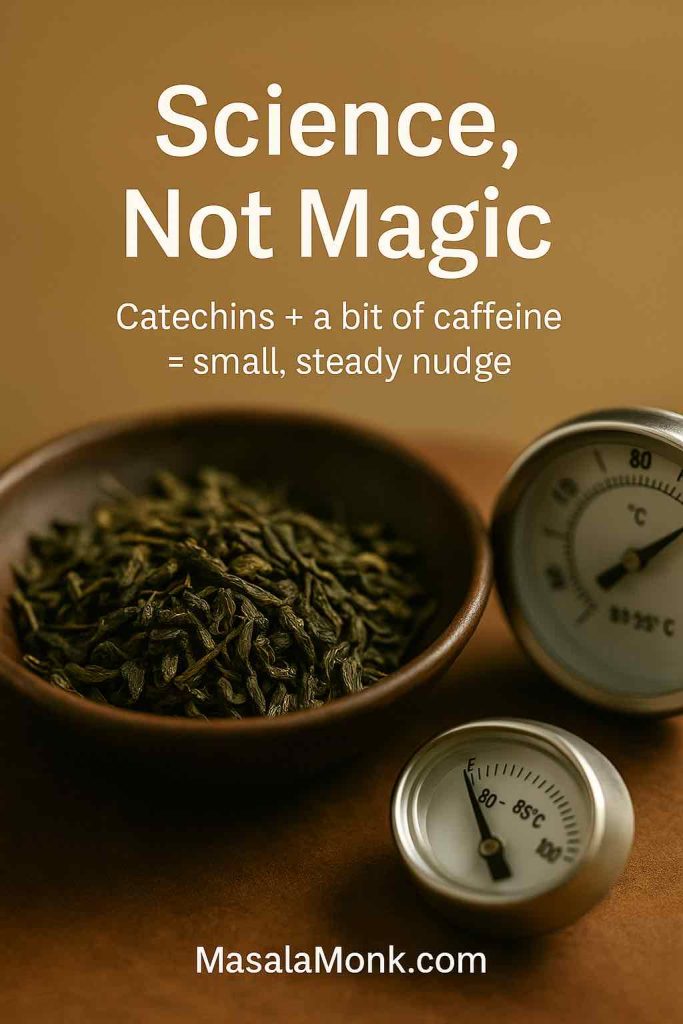
Put simply: yes, as vascular support; no, as a magic bullet. Mechanistically, catechins reduce oxidative stress, calm inflammatory signaling, and enhance eNOS activity to raise nitric-oxide availability. Crucially, those aren’t just test-tube effects. In tightly designed human studies, both acute and short-term green-tea intake improved FMD in groups with impaired endothelial function—again, the same pathway erections rely on (acute FMD improvement after green tea). Consequently, while no randomized trial shows green tea single-handedly “curing” ED, the physiologic alignment is real, relevant, and actionable.

Moreover, ED rarely has a single cause. Sleep debt, chronic stress, blood pressure, and metabolic health all push in either direction. Because of that, many readers pair daytime tea with evening routines that protect rest and dial down sympathetic overdrive. For complementary, lifestyle-friendly context you can integrate gently, see our on-site pieces like clove-infused tea for erectile dysfunction and the companion guide to enhancing intimacy with clove-infused massage. Those ideas don’t replace care; nevertheless, they often make a routine more human and sustainable.

Green tea for ED: where the signal is strongest—and where we should be cautious

First, the human vascular signal is consistent: brewed green tea improves FMD in settings of endothelial dysfunction, and that matters because endothelial health is upstream of erection quality. Second, preclinical data—for example, in diabetic or aged animals—often show EGCG preserving cavernosal smooth muscle and improving erectile physiology; informative, yes, though we should avoid over-extrapolating. Third, direct ED outcomes in humans after a green-tea intervention remain under-studied; hence, we position green tea as a supportive habit, not a replacement for guideline-based therapies.

Does green tea cause erectile dysfunction?

Short answer: there’s no evidence it does. If anything, broader caffeine research points the other way. In a large U.S. dataset, men consuming roughly 170–375 mg/day of caffeine had lower odds of prevalent ED than very-low consumers after adjusting for common confounders—an association, not proof, but reassuring nonetheless (NHANES analysis on caffeine and ED). Furthermore, more recent genetic work designed to probe causality has not supported a harmful link between habitual coffee/caffeine intake and ED risk. In other words, moderate caffeine—like what you’d get from a few cups of tea spread intelligently through the day—does not appear to be an ED villain.

Naturally, personal tolerance still matters. Overshooting your own caffeine ceiling can nudge anxiety up and sleep down; paradoxically, that will worsen performance for many people. Therefore, keeping most of your tea earlier in the day, then switching to calming, caffeine-free options in the evening, tends to balance the equation.

Matcha vs brewed tea in a green tea for erectile dysfunction routine

At first glance, the choice between matcha and brewed green tea seems cosmetic; however, it meaningfully changes catechin exposure. Because matcha is powdered whole leaf whisked into water, you ingest more of the plant per cup, often translating to higher catechin intake. That’s why some readers lean on matcha when focusing closely on green tea erectile dysfunction strategies. Nevertheless, matcha also delivers more caffeine per serving, which is terrific before a midday walk or workout but not ideal late at night.

Even so, there’s another wrinkle worth noting: several vascular studies that showed FMD improvements used brewed tea, not isolated EGCG capsules—suggesting the whole-tea matrix (minor polyphenols, L-theanine, and other constituents) may be important (overview of endothelial benefits with brewed tea). Consequently, there’s no need to chase megadoses or fancy extracts. A steady rhythm of well-brewed cups captures most of what you’re after.

Green tea in erectile dysfunction routine: timing, brewing, and iron-savvy habits

Adherence hinges on simplicity. Accordingly, try a routine that slides into ordinary life:

  • Morning: brew one cup with water around 75–85°C; steep 2–3 minutes, then taste and remove leaves. Use roughly 2 g tea leaves (about a teaspoon) per 250 ml cup. Because tea polyphenols can blunt non-heme iron absorption, drink your cup between meals, not with an iron-rich breakfast (classic research on tea and iron absorption).
  • Early afternoon: enjoy a second brewed cup—or whisk a small bowl of matcha—especially before a brisk walk or short resistance session. The slight stimulation often improves mood and training adherence, both of which indirectly benefit sexual health.
  • Evening: pivot to caffeine-free comfort so sleep can do its quiet work. For ideas that connect relaxation, scent, and touch (without stimulants), have a look at enhancing intimacy with clove-infused massage and the companion clove-infused tea piece. Both are gentle, sensory ways to reduce tension—the sort of context erections actually appreciate.

Just as importantly, build iron awareness into your habit. If you’re vegetarian, an endurance athlete, or someone with marginal ferritin, separate tea and main meals by an hour or two. When convenient, pair plant-based iron sources with vitamin C (think lemon over greens or a citrusy salad) to offset tea’s inhibitory effect. These small timing tweaks allow you to keep your green tea for ED routine without nudging iron status the wrong way.

Also Read: Iron Deficiency Anemia Symptoms: 15 Signs You Are Iron Deficient

Safety first: the nadolol interaction, plainly explained

Most people tolerate green tea well; still, one clinically documented interaction deserves a spotlight. In a carefully executed study, repeated green-tea intake caused an approximately 80% reduction in nadolol exposure, likely by inhibiting OATP1A2 transport in the gut—an effect that can blunt the drug’s blood-pressure benefits. If you take nadolol for hypertension or heart rhythm, don’t guess; speak with your clinician about tea timing and total intake to avoid under-treating your condition (green tea markedly lowers nadolol exposure). This is not theoretical; it’s been measured.

Beyond that, common-sense cautions apply: if caffeinated tea worsens reflux or sleep, dial the timing earlier; if you’re iron-deficient, prioritize recovery first, then re-introduce tea with smart spacing; and if you live with complex medical issues, a brief conversation with your care team is never wasted.

Green tea for erectile dysfunction meets the rest of your life: stacking gentle companions

Because ED is usually a multifactorial pattern rather than a single-switch problem, readers often stack tea with other low-risk, context-wise choices. We’ve written several practical, non-gimmicky pieces you can thread into your evenings or weekends:

  • For a warm, aromatic option that feels winter-friendly and ritual-rich, read our guide to clove-infused tea for erectile dysfunction.
  • To bring touch and presence back into the mix—without numbing creams or edgy supplements—try the step-by-step clove-infused massage for erectile dysfunction relief.
  • If you’re curious about botanicals with a longer cultural history, our roundup on saffron as an aphrodisiac explores dosing ranges used in research and, importantly, sets realistic expectations.
  • Meanwhile, for men who enjoy culinary-to-intimacy crossovers, the explainer on cardamom benefits for men connects circulation-leaning spices with daily habits in a balanced, non-hyped way.
  • And because sensual context matters as much as chemistry, our practical overview of best oils for erectile dysfunction (ED) translates scent, warmth, and massage into routines that couples actually keep—no unrealistic promises, just simple practices that lower friction and build momentum.

None of these are “musts.” Nevertheless, they make it easier to keep a routine going, which is usually what separates good intentions from tangible change.

Green tea erectile dysfunction: what about stamina, libido, and energy?

Here’s where nuance helps. People sometimes expect a single beverage to change stamina on contact. Realistically, indirect pathways matter more. Moderate caffeine can heighten alertness, smooth effort during workouts, and improve subjective energy—effects that compound across weeks into better mood, better fitness, and better blood-pressure control. Those are all upstream of better erections. At the same time, overshooting your personal tolerance invites a different story: racing thoughts, restless nights, and next-day irritability, none of which help. Thus, a smart green tea for ED pattern spreads cups earlier, keeps evenings quiet, and protects sleep as the ultimate performance enhancer.

Additionally, green tea’s L-theanine likely softens the feel of caffeine, producing a calmer focus than coffee for many people. That qualitative difference is hard to quantify in trials, but countless readers notice it. From a practical standpoint, if your mornings feel smoother on tea than coffee, lean into the thing you’ll actually sustain.

Brewing for benefits without getting precious

Although catechins deserve attention, brew method quietly decides whether you will enjoy your cup enough to drink it daily. Fortunately, you don’t need gadgets. Heat water just below a boil, aiming for 75–85°C; measure roughly 2 g of leaves per 250 ml cup; steep 2–3 minutes and taste. If you prefer matcha, whisk 1–2 g into hot (not boiling) water until lightly frothy, then sit for a moment—literally—before sipping. The brief pause isn’t fluff; slowing down cues your parasympathetic system, which blends seamlessly with the intimacy-supporting direction of everything else we’ve discussed.

As for timing, keep your iron guardrails in mind. Drinking tea between meals usually solves the absorption issue for most people, while a squeeze of lemon over greens or beans at lunch helps your body capture more plant-based iron despite tea’s polyphenols. With those small adjustments, your green tea erectile dysfunction routine becomes both safe and pleasantly habitual.

Bringing it all together—so you know exactly what to do next

Taken as a whole, the evidence points toward a grounded, hopeful conclusion: green tea supports the vascular foundation of erectile function, even though it does not—and should not be sold as—a cure for ED. Therefore, the smartest approach is both modest and consistent:

  1. Adopt a daily rhythm of 1–2 brewed cups earlier in the day; add a small matcha serving when you want an extra nudge.
  2. Brew well, not long: 75–85°C water, 2–3 minutes, then remove the leaves.
  3. Mind iron by separating tea from meals, especially if you’re vegetarian or have borderline ferritin.
  4. Protect sleep by switching to caffeine-free, sensory routines in the evening; for ideas that combine warmth, scent, and touch, explore clove-infused tea and clove-guided massage.
  5. Check medications, particularly nadolol, with your clinician so tea doesn’t undermine treatment (green tea–nadolol interaction explained).
  6. Give it weeks, not days; meanwhile, address the basics—movement, blood pressure, stress, and intimacy cues—because erections follow the health of your cardiovascular system.

Lastly, if you want to widen the lens without spinning into hype, our on-site resources round out the picture gracefully: browse the thoughtfully skeptical best oils for ED guide, skim the culinary-meets-intimacy angle in cardamom benefits for men, or, when you feel curious, dip into saffron as an aphrodisiac for a balanced take on a classic botanical. None of these pieces promise miracles; instead, they offer workable layers that play nicely with a daily green tea erectile dysfunction habit—precisely the sort of ecological approach that tends to produce steady, real-world gains.

FAQs

1) Does green tea help erectile dysfunction?

In brief, green tea can support erectile function by improving blood-vessel health and nitric-oxide availability; however, it isn’t a stand-alone ED cure. For most readers, making green tea for ED a steady habit works best alongside sleep, exercise, and medical advice when needed.

2) Is green tea good for ED on a daily basis?

On balance, yes—daily green tea for ED is reasonable. Moderate intake (2–3 cups earlier in the day) tends to aid vascular tone while keeping caffeine side effects in check.

3) Can green tea cause erectile dysfunction?

For clarity, there’s no solid evidence that green tea causes ED. Typically, moderate tea intake fits comfortably within a heart-healthy routine that supports erection pathways rather than harming them.

4) Does green tea make you last longer in bed?

In reality, no direct trials prove stamina benefits. Still, many find that better vascular function, improved mood, and consistent training—habits often paired with a green tea erectile dysfunction routine—can indirectly help performance.

5) Which tea is good for erectile dysfunction besides green tea?

Notably, some choose ginseng tea or pomegranate/hibiscus infusions as adjuncts. Even so, green tea for ED remains the most researched option for vascular support, so start there and layer others cautiously.

6) What’s the best way to brew green tea for ED benefits?

Importantly, use water around 75–85°C, steep 2–3 minutes, and taste before over-extracting. This preserves catechins while keeping bitterness low—making a green tea erectile dysfunction habit easier to sustain.

7) How much green tea should I drink for erectile function?

As a rule, 2–3 cups per day is a practical target. All told, consistency matters more than chasing high doses; let your body’s caffeine tolerance guide timing.

8) Is matcha better than regular green tea for ED?

By contrast, matcha often delivers more catechins per serving, which some people prefer for a focused matcha green tea erectile dysfunction plan. At the same time, matcha also contains more caffeine, so keep it earlier in the day.

9) Does green tea boost libido directly?

Ultimately, libido is multifactorial. Green tea for ED mainly supports circulation and may steady energy and mood; it doesn’t act as a classic aphrodisiac for everyone.

10) Can I drink green tea at night if I have ED?

For most, evening caffeine can disrupt sleep—an ED antagonist. Therefore, keep green tea erectile dysfunction cups earlier, and choose caffeine-free options later to protect recovery.

11) Will green tea interact with ED medications or heart drugs?

Crucially, green tea can reduce absorption of nadolol, a beta-blocker; discuss timing with your clinician. As needed, review all meds with a professional before locking in a green tea for ED routine.

12) Does green tea affect testosterone?

Meanwhile, typical intakes show no meaningful testosterone changes in healthy adults. The benefit of green tea for ED comes from vascular effects rather than hormone boosts.

13) Can green tea improve blood flow to help erections quickly?

Sometimes, yes—acute improvements in endothelial function have been observed after tea intake. Still, green tea erectile dysfunction routines work best over weeks, not hours.

14) What about side effects of green tea for ED?

Altogether, side effects are uncommon at moderate doses. That said, sensitive individuals may notice jitters, reflux, or sleep disruption; adjust timing—or choose lower-caffeine varieties—while keeping the green tea for ED plan intact.

15) Does tea reduce iron absorption and affect ED indirectly?

Indeed, polyphenols can inhibit non-heme iron absorption. To stay safe, drink green tea for ED between meals, particularly if you’re vegetarian or have low ferritin.

16) Is decaf green tea useful for erectile dysfunction?

Even without much caffeine, decaf green tea retains many catechins. Consequently, it can still complement a green tea erectile dysfunction approach—especially for evening cups.

17) How long until I notice benefits from a green tea ED routine?

Typically, readers report subtle changes within a few weeks as overall cardiovascular habits improve. Nevertheless, persistent ED warrants medical evaluation—tea is a helper, not a replacement.

18) Can I combine green tea for ED with exercise and weight management?

Absolutely. In practice, green tea erectile dysfunction strategies pair well with brisk walks, resistance training, and blood-pressure control—each reinforcing the others for better outcomes.

19) Are there specific foods to pair or avoid with green tea for ED?

Preferably, separate tea from iron-rich meals by an hour or two. Conversely, pair plant-based iron with vitamin C at mealtimes, then enjoy green tea for ED mid-morning or mid-afternoon.

20) What if anxiety contributes to my ED—will green tea help?

At times, yes: many find tea’s gentler caffeine-theanine profile less jangly than coffee. However, if anxiety remains high, shift green tea erectile dysfunction cups earlier and emphasize relaxation practices at night.

21) Is “tea for ED” different from “green tea for ED”?

Functionally, tea for ED is a broad phrase; nonetheless, green tea for ED is specific to catechin-rich Camellia sinensis. Start there, then evaluate other teas as supportive extras, not substitutes.

22) Can green tea improve morning erections?

Possibly, over time. As cardiovascular health settles, some notice stronger green tea and erection patterns in the morning. Even so, individual responses vary; keep expectations realistic.

23) Will switching from coffee to green tea help my ED?

Often, yes. Some feel steadier energy and better sleep quality after switching, which indirectly benefits erections. Try replacing one coffee with green tea for ED first, then reassess.

24) Is there a best time to drink green tea for ED results?

Preferably, earlier in the day—morning and early afternoon—so you gain vascular support without disturbing sleep. That timing keeps a green tea erectile dysfunction plan sustainable.

25) Should I choose loose-leaf or tea bags for ED support?

Either works if quality is high. Nevertheless, loose-leaf often tastes better and encourages proper brewing—making a green tea for ED habit easier to maintain day after day.

Posted on — 2 Comments

Green Tea for Weight Loss: The No-Hype, Done-For-You Guide

Steaming green tea poured into a glass with lemon, mint and cinnamon—“Green Tea for Weight Loss” cover.

Let’s set the vibe right away: if a single cup of tea could flatten your stomach by Friday, the internet would have run out of tea by Saturday. Green Tea for Weight Loss isn’t magic—it’s a nudge. But when you stack that nudge with the basics (a calorie deficit, some movement, decent sleep), the dial starts to move. Slowly? Yes. Reliably? Also yes.

Here’s everything you actually need: what green tea does (and doesn’t) do, how to brew it so it works for you, when to drink it for a gentle appetite edge, how matcha fits in, how to stay safe with extracts, and practical plans, recipes, and FAQs you can act on today. Let’s go.


Why Green Tea for Weight Loss Works (in real life)

First things first, the science in one breath: the catechins in green tea—especially EGCG—plus a bit of caffeine can gently increase energy expenditure and fat oxidation. It’s not a fat torch; it’s a quiet assist. The National Center for Complementary and Integrative Health has a good plain-English summary of where green tea helps, where it’s mixed, and when to be cautious with supplements. Read their overview once, and you’ll see why our approach here is “ritual first, hype never.” NCCIH overview on green tea. NCCIH

Bowl of loose green tea leaves with brew thermometers—Science, Not Magic overlay.
Catechins + mild caffeine = a small, steady nudge—expect modest changes that add up with routine.

Now, here’s what matters for results:

  • Expect modest changes on the scale from tea alone—think of it as background support rather than the main event. Over weeks, though, those small differences compound when you’re also eating to your goal and moving your body. As the NCCIH notes, product composition (how much catechin, how much caffeine) and your activity level influence outcomes. As that overview puts it, this is a nudge, not a shortcut.
  • Where the magic shows up more visibly: your waistline. In a randomized trial, people who drank a catechin-rich tea while following an exercise plan saw greater reductions in total and subcutaneous abdominal fat versus the exercise-only group over 12 weeks. That’s the famous synergy: tea + movement. Randomized exercise study. PubMed
  • Appetite effects are mild. For many people, a cup 30–60 minutes before a meal takes the edge off. For others, there’s no big difference. We’ll show you how to time it and test it.
Cup of steaming green tea on a stool with black training shoes in soft background—overlay “Better With Movement.”
Pair your cup with a 10–20 min walk or short lift—small, repeatable sessions compound over ~12 weeks.

So yes, Green Tea for Weight Loss works—just not the “lose 10 kg in 10 days” kind of “works.” It’s the grown-up version: consistent, modest, additive.


Medical Disclaimer

This article is educational and not medical advice. Green tea and green tea extracts can interact with medicines (e.g., beta-blockers like nadolol, statins like atorvastatin) and high-dose extracts carry rare liver risks. If you’re pregnant, breastfeeding, have liver disease, or take prescription meds, talk to your clinician first. Avoid extract dosing on an empty stomach; keep total EGCG well under 800 mg/day. Stop and seek care if you notice nausea, abdominal pain, dark urine, or unusual fatigue. Caffeine affects sleep, anxiety, and blood pressure—time your intake accordingly.
Last updated: 16 September 2025 (IST)


How to Use Green Tea for Weight Loss (simple, actionable)

You don’t need a lab, a kitchen scale, or a secret import source. You just need decent tea, hot water, and a repeatable routine. Pick one of these to start, then layer more if you enjoy them.

Option A — The Two-Cup Anchor (your everyday base)

  • How much: 2–4 cups/day (about 400–600 ml total), spread from morning to mid-afternoon.
  • Brew smart: Use 80–85°C water (not boiling), steep 2–3 minutes. This preserves catechins and keeps bitterness low.
  • When to drink:
    • 30–60 min before meals to experiment with a subtle appetite effect.
    • 30–45 min before a walk or workout to ride the exercise synergy we just talked about (as that study found, this combo helps abdominal fat over time).
  • Sleep matters: If caffeine makes you buzzy, keep your last caffeinated cup 6–8 hours before bed and switch to decaf green tea or a calming herbal in the evening.
Cup of green tea with steam; text shows 30–60 min pre-meal or 30–45 min pre-workout.
For appetite testing, sip 30–60 min before your biggest meal; for synergy, 30–45 min before a walk or workout.

Need flavor without sugar? Rotate spice infusions so the habit stays interesting:

Option B — Matcha: a stronger “green” for busy humans

Matcha is powdered whole green tea leaf, so you drink the leaf itself (hello, catechins). It’s an easy win if you like lattes or smoothies.

  • Dose: ½–1 tsp (1–2 g) once or twice daily.
  • Prep: Whisk with hot (not boiling) water for a straight cup; or blend into a matcha protein shake (recipe below) for better satiety and workout support.
  • Timing: Morning for focus, early pre-workout for a gentle kick; decaf versions at night if you’re caffeine-sensitive.

Managing stress while cutting? Smart move. For broader “tea + stress” help, see How Your Favorite Brew Can Help Manage Cortisol and 5 Herbal Teas That Help Lower Cortisol. Stress down, adherence up. Win-win.

Frothy matcha in a glass with bamboo whisk and mound of powder—Matcha: Stronger Green.
Use 1–2 g matcha in water or a protein shake for a higher-catechin option that supports satiety.

Option C — Capsules/Extracts: advanced only (read safety before you buy)

If you struggle to get enough catechins from beverages, standardized green tea extract can be an option—but supplements are where safety needs guardrails.

  • Typical labels: 200–300 mg EGCG per capsule. Most people split 1–2 caps/day with food.
  • Safety lines you should actually know: The European Food Safety Authority concluded that doses ≥800 mg/day of EGCG from supplements were associated with statistically significant increases in liver enzymes; traditional brewed tea, on the other hand, is generally safe (rare idiosyncratic reactions can occur). Start low, avoid empty-stomach dosing, and stop if you feel unwell. EFSA scientific opinion. European Food Safety Authority
  • The UK’s Committee on Toxicity reiterated caution with high-dose extracts and multi-herb stacks. TL;DR: go gentle, go with food, and don’t stack with mystery “fat burner” blends. UK COT 2024 background. cot.food.gov.uk

If you’re supplement-curious in general, browse NCCIH’s notes on interactions and who should be careful; it’s short and worth your time (as the overview explains).

Medical Disclaimer

This article is educational and not medical advice. Green tea and green tea extracts can interact with medicines (e.g., beta-blockers like nadolol, statins like atorvastatin) and high-dose extracts carry rare liver risks. If you’re pregnant, breastfeeding, have liver disease, or take prescription meds, talk to your clinician first. Avoid extract dosing on an empty stomach; keep total EGCG well under 800 mg/day. Stop and seek care if you notice nausea, abdominal pain, dark urine, or unusual fatigue. Caffeine affects sleep, anxiety, and blood pressure—time your intake accordingly.
Last updated: 16 September 2025 (IST)

Amber bottle of green tea extract beside a small meal and a cup of tea—overlay reads “Extracts: Safety First; Keep EGCG well < 800 mg/day; Take with food.”
Prefer brewed tea. If you use extracts, stay well under 800 mg/day EGCG, take with food, and avoid empty-stomach dosing.

“Okay, but what results can I expect?”

Let’s be very clear and very adult about expectations:

  • On the scale: Green tea by itself leads to modest weight changes. It’s the kind of quiet helper you barely notice week to week… until you compare month to month, especially when paired with a reasonable calorie deficit and movement (as that overview states).
  • At the waist: This is where Green Tea for Weight Loss shows up better. Over about 12 weeks, catechin-rich tea—especially when paired with exercise—has repeatedly led to small but meaningful reductions in abdominal fat in controlled trials (as the randomized exercise study found).
  • Appetite: Some folks swear a pre-meal cup tames the mindless munching. Others shrug. Try it for a week and keep it if it helps.

Bottom line: treat tea like a daily ritual that keeps you pointed in the right direction.


Recipes you’ll actually make (and keep making)

Let’s make this effortless. Two hot, two cold; all quick.

Ginger + Green Tea (5 minutes, big flavor)

  • 250 ml hot water (80–85°C)
  • 1 tsp loose green tea (or 1 bag)
  • 3–4 thin ginger slices
  • Optional: lemon wedge
    Steep 2–3 minutes, strain, sip. Simple. (And if you want a weekly rotation, peek at our Green Tea & Spice Infusions collection.)
Glass of green tea with thermometer reading 80–85°C—Brew Like a Pro.
Use ~80–85°C water and a 2–3 min steep for more catechins and less bitterness—simple and repeatable.

Cinnamon Green Tea (comforting, subtly sweet)

  • 250 ml hot water + 1 tsp green tea
  • ½ small Ceylon cinnamon stick while steeping (2–3 min); remove stick
    Prefer deeper spice? This walk-through is short and useful: Cinnamon-Green Tea.

Matcha Protein Shake (satiety + muscle-friendly)

  • 1 tsp matcha
  • 200 ml chilled milk/alt-milk
  • 20–30 g whey/plant protein
  • Ice + optional handful spinach
    Blend 20 seconds. Breakfast, nailed.

Iced “Flat Tummy” Refresher (pre-meal ritual)

  • Brew 2 cups green tea; chill
  • Add lemon, mint, and ice
    Drink before lunch for a small satiety nudge. Habit + timing = quiet win.
Overhead of four options—ginger slices, cinnamon tea, creamy matcha shake, and iced lemon refresher—with “Easy, Tasty, Repeatable” overlay.
Rotate these four low-effort flavors to keep the habit enjoyable—adherence beats intensity for results.

Matcha vs Green Tea for Weight Loss (which should you choose?)

Short version: both work if you use them. Matcha often has more catechins per serving because you consume the whole leaf; regular brewed green tea is gentler and endlessly sippable. Choose based on your routine:

  • Crave a morning ritual and like lattes or smoothies? Matcha wins.
  • Prefer many small sips through the day? Brewed green tea is your friend.
  • Sensitive to caffeine? Use decaf versions later in the day (keep the ritual, protect sleep).

If stress and sleep are getting in the way (they always do), rotate in evening herbals from this cortisol-friendly short list. Better sleep = better appetite control tomorrow.


Safety & Side Effects of Green Tea for Weight Loss (quick but essential)

  • Brewed tea (most people): Generally safe. Watch your caffeine cutoff time. As the NCCIH overview notes, green tea can interact with certain meds (e.g., nadolol, atorvastatin), so check with your clinician if you’re on prescriptions, pregnant, or breastfeeding. NCCIH overview.
  • Extracts/capsules: This is where rare liver issues show up, especially at higher doses and in multi-herb stacks. Keep supplemental EGCG well under 800 mg/day, take with food, avoid empty-stomach dosing, and stop immediately if you notice nausea, abdominal pain, dark urine, or unusual fatigue. As the EFSA opinion concluded, ≥800 mg/day is the range where liver enzymes rise in trials; and as the UK COT background notes, concentrated extracts are the main concern—not your normal brewed tea. EFSA opinion; UK COT 2024.

Green Tea for Weight Loss: A 12-Week Blueprint (repeat as needed)

This plan respects how the body changes—gradually. It’s light on rules, heavy on rhythm.

1–2 Weeks : Build the ritual (keep it easy)

  • Pick Option A (Two-Cup Anchor) or Option B (Matcha).
  • Set phone alarms for Cup 1 (mid-morning) and Cup 2 (pre-walk/workout).
  • Walk 8–10k steps/day (break it into chunks—three 10-minute walks count).
  • Lift 2–3×/week (20–30 minutes: push/pull/legs; simple beats perfect).

3–6 Weeks : Layer tiny improvements (small hinges, big doors)

  • Keep your two tea anchors.
  • Add pre-meal timing before your largest meal (tea 30–60 min prior).
  • Protein to 1.6–2.2 g/kg target body weight; fiber to 25–35 g/day.
  • Bedtime: consistent, screens down, decaf or herbal after dinner.

Also Read: The Science of Protein: Maximizing Muscle Growth and Recovery

Green tea beside a spiral notebook and pen—overlay “12-Week Blueprint for Green Tea Success; Daily tea + subtle progressions = gradual results.”
Weeks 1–2: build two daily tea anchors • 3–6: add pre-meal timing • 7–12: add a third cup on hungry days and one interval/hill session.

7–12 Weeks : Turn the dial (just a click or two)

  • Add a third cup on higher-hunger afternoons (or a decaf if it’s late).
  • Introduce one interval or hill session weekly (short, honest effort).
  • Track waist and photos more than the scale; as the exercise study found, abdominal fat shifts are the tell here.

Want food scaffolding? Start with 5 Foods that Reduce Belly Fat and Spinach—Nutrition, Benefits & 5 Practical Ways. Plant-heavy, protein-forward—boringly effective.

Curious about ACV as a sidekick? Keep expectations realistic and try ACV on an Empty Stomach, or, if you’re supplement-curious, skim ACV Gummies: Pros, Cons & FAQs. Use what helps you adhere; skip what doesn’t.


Frequently Asked (Real) Questions about Green Tea for Weight Loss

1) Is green tea an appetite suppressant?

Sort of, sometimes. Many people notice a gentle reduction in appetite if they drink a cup 30–60 minutes before meals. Others don’t. That’s why we test. Keep it if it helps.

2) What’s the “best” green tea for weight loss?

The one you’ll drink daily. Practically speaking, matcha tends to deliver more catechins per serving (whole leaf), while brewed green tea wins on sip-ability. You don’t need to overthink it.

3) Will this flatten my stomach?

No drink targets belly fat in isolation—but over about 12 weeks, catechin-rich tea paired with exercise has produced small reductions in abdominal/visceral fat in controlled studies. That’s why our plan treats tea as a pre-workout ritual as often as a pre-meal one (as that study found).

4) Can I stack green tea with other “fat burners”?

You can, but should you? Most stacks add side effects faster than they add benefits, and concentrated blends are where safety issues pop up. If you want “stronger,” do it safely and sanely: a standardized extract with food, staying well under 800 mg/day EGCG (as the EFSA opinion concluded). And only if you’re already nailing the basics.

5) What about decaf—is it worth it?

Decaf green tea keeps the ritual, hydration, and some polyphenols. You lose the small caffeine boost, but if it protects sleep, it may help you more overall. Use decaf after lunch and herbals at night—your future self will thank you.

6) Can I combine green tea with ACV, cinnamon, ginger, etc.?

Absolutely—if it helps you stick to the plan. Try the spice infusions linked above for taste without sugar, or the matcha protein shake for actual fullness. If it feels like a treat, you’ll keep doing it.

7) Any interactions or “don’ts”?

Yes—green tea can interact with some meds (e.g., nadolol, atorvastatin), and high-dose extracts carry liver risk, especially on an empty stomach or in multi-herb stacks. If you take prescriptions, are pregnant/breastfeeding, or have liver concerns, talk to your clinician first (as the NCCIH overview advises).


Green Tea for Weight Loss: Quick Reference (pin this)

  • Brewed green tea: 2–4 cups/day; 80–85°C, 2–3 min steep; last caffeinated cup 6–8 h before bed.
  • Matcha: ½–1 tsp (1–2 g) once or twice daily; whisk (not boiling water) or blend into a protein shake.
  • Timing: 30–60 min pre-meal for appetite testing; 30–45 min pre-workout for the exercise synergy.
  • Extracts (advanced): 200–300 mg EGCG/cap; keep total well under 800 mg/day; with food; stop if unwell.
  • Evening: switch to decaf or calming herbals for better sleep (and better appetite control tomorrow).
  • Food frame: protein + fiber + plants. For easy ideas, see 5 Foods that Reduce Belly Fat and Spinach—5 Practical Ways.

Sources


Final word (and then go brew)

“Green Tea for Weight Loss” really means: a small, daily ritual that helps you make better choices, train a little more consistently, and feel a little more in control. That’s the stuff that adds up. Brew your first cup, take a 10-minute walk after lunch, and repeat tomorrow. Boring? Maybe. Effective? Absolutely.

Medical Disclaimer

This article is educational and not medical advice. Green tea and green tea extracts can interact with medicines (e.g., beta-blockers like nadolol, statins like atorvastatin) and high-dose extracts carry rare liver risks. If you’re pregnant, breastfeeding, have liver disease, or take prescription meds, talk to your clinician first. Avoid extract dosing on an empty stomach; keep total EGCG well under 800 mg/day. Stop and seek care if you notice nausea, abdominal pain, dark urine, or unusual fatigue. Caffeine affects sleep, anxiety, and blood pressure—time your intake accordingly.
Last updated: 16 September 2025 (IST)

Posted on — 4 Comments

Best Tea to Lower Cortisol: Green, Black, Matcha & Herbal

Tea and Cortisol

Stress is one of the most common health challenges of modern life. Deadlines, sleepless nights, and constant notifications keep our nervous systems on high alert. At the heart of the stress response is a hormone called cortisol — sometimes called the body’s built-in alarm system.

Cortisol isn’t “bad.” In fact, we wouldn’t survive without it. It helps regulate energy, mobilize fuel when we need it, and even dampen inflammation. But when cortisol stays too high for too long, it shifts from protective to damaging:

  • Sleep becomes restless and shallow
  • Weight creeps up, especially around the belly
  • Anxiety increases
  • Blood pressure and blood sugar rise
  • Long-term cardiovascular and metabolic risks climb

That’s why researchers and wellness seekers alike have turned to lifestyle strategies for taming cortisol. One of the simplest? Tea.

Across cultures, tea has been used for centuries not just as a beverage, but as a ritual of calm. Modern science is now showing what tradition long suggested: certain teas may actually help reduce cortisol levels and support stress recovery.

Also Read: Fish Oil and Cortisol: Can Omega-3 Help You Manage Stress Hormones?

In this article, we’ll dive into the best teas to lower cortisol — green tea, black tea, matcha, and herbal infusions like chamomile and ashwagandha — and review what research says about how they work.


Cortisol 101: The Stress Hormone Explained

To understand how tea interacts with cortisol, we first need to understand how this hormone operates.

What Cortisol Does

Produced by the adrenal glands, cortisol plays a central role in the hypothalamic–pituitary–adrenal (HPA) axis, the body’s stress-response system. Its functions include:

  • Energy regulation: increases glucose availability during stress
  • Metabolism control: influences fat storage and protein breakdown
  • Immune balance: tempers inflammation
  • Stress response: sharpens focus, increases blood pressure and heart rate

Cortisol’s Daily Rhythm

Unlike adrenaline, which spikes in seconds, cortisol follows a circadian rhythm:

  • Highest in the morning (the “cortisol awakening response”), helping you feel alert
  • Declines across the day with small peaks around meals
  • Lowest at night, allowing melatonin to rise and promote deep sleep

When stress is acute — like slamming on the brakes to avoid a crash — cortisol is your ally. But when stress is chronic — unrelenting work pressure, poor sleep, emotional strain — cortisol stops following its normal rhythm. Instead, it stays elevated all day and night, which:

  • Disrupts sleep cycles
  • Weakens immunity
  • Fuels weight gain and insulin resistance
  • Increases risk for depression and burnout

Curious if you might be experiencing cortisol imbalance? Check out 10 Symptoms of High Cortisol in Women: Signs, Causes & Relief for a deeper dive into early warning signs.

Why Lowering Cortisol Naturally Matters

While medications exist to blunt cortisol, they’re rarely used outside of serious disease. Most people benefit more from lifestyle interventions: exercise, mindfulness, diet — and, as emerging evidence shows, tea.

Tea is uniquely positioned as a cortisol-modulating tool because it combines:

  • Phytochemicals like catechins, theaflavins, and adaptogenic compounds
  • Amino acids like L-theanine, which alter brain waves
  • A ritual of calm, which by itself helps activate the parasympathetic nervous system

In the following sections, we’ll explore each tea type in depth, highlight key studies, and provide practical guidance for weaving them into your routine.


Best Tea to Lower Cortisol (Quick Comparison)

Not all teas affect stress in the same way. Some calm the nervous system and improve sleep, while others directly influence cortisol production and recovery from stress.

Here’s a quick comparison of the most researched teas for cortisol management:

Tea TypeKey CompoundsCortisol EffectBest For
Green TeaEGCG, L-TheanineLowers cortisol, promotes relaxation & focusDaily stress relief
Black TeaTheaflavins, L-TheanineReduces post-stress cortisol, balances caffeine effectsAfternoon calm & focus
MatchaHigh EGCG, L-TheanineStrongest cortisol reduction, boosts mental clarityWork & study focus
Chamomile TeaFlavonoids (Apigenin)Reduces anxiety, improves sleep, indirectly lowers cortisolEvening relaxation
Ashwagandha TeaWithanolidesBalances cortisol long-term, reduces fatigueChronic stress recovery
Table showing various teas and their impact on Cortisol and Stress Levels.

👉 Which tea lowers cortisol the most?

  • Matcha and green tea have the strongest evidence for direct cortisol reduction.
  • Black tea lowers post-stress cortisol and helps the body recover faster.
  • Chamomile supports sleep and relaxation, indirectly helping cortisol normalize.
  • Ashwagandha is the most powerful adaptogen, reducing cortisol in multiple clinical trials.

is Green Tea best to Lower Cortisol Levels?

Green tea is often called the cortisol-lowering powerhouse — and with good reason. It contains a unique combination of compounds that directly and indirectly influence stress pathways.

Key Compounds in Green Tea

  • Epigallocatechin gallate (EGCG): A catechin antioxidant that regulates the HPA axis and inhibits enzymes that regenerate cortisol.
  • L-Theanine: An amino acid that promotes calm focus by increasing alpha brain waves and modulating neurotransmitters like GABA and serotonin.
  • Caffeine (moderate levels): Provides alertness but in smaller doses than coffee, balanced by L-theanine to prevent sharp cortisol spikes.

Also Read: 7 Side Effects of Green Tea Everyone Should Know About.

Does Green Tea Lower Cortisol?

Yes. Multiple studies support this:

  • A 2022 randomized human trial found that green tea consumption significantly reduced adrenal stress hormones, including cortisol, DHEA, and ACTH 【Almudhi et al., 2022 – PMC】.
  • A 2024 human study comparing green tea and roasted green tea (hojicha) found that both improved task performance, reduced fatigue, and increased subjective refreshment compared to hot water — suggesting tea helps with stress recovery and resilience 【Kurosaka et al., 2024 – Nature】.
  • A 2025 trial in young adults showed that consuming green tea during demanding cognitive tasks preserved arousal, prevented fatigue, and improved “flow” experiences compared to control groups 【Kurosaka et al., 2025 – PubMed】.

Together, these findings suggest that regular green tea drinkers may experience both lower cortisol and better resilience under stress.

Photorealistic cup of green tea with text overlay “Green Tea to Lower Cortisol” — wellness editorial image highlighting how catechins and L-theanine in green tea reduce cortisol and stress, with MasalaMonk.com branding.
Green tea is one of the best teas to lower cortisol naturally. Thanks to compounds like EGCG and L-theanine, it helps calm the nervous system, improve focus, and regulate stress hormones — making your daily tea ritual a powerful stress-management tool.

How Green Tea Works Mechanistically

  • HPA Axis Regulation: EGCG helps dampen overactivity of the hypothalamic-pituitary-adrenal axis, reducing unnecessary cortisol secretion.
  • Inhibiting Cortisol Activation: EGCG inhibits the enzyme 11β-HSD1, which converts inactive cortisone to active cortisol in tissues 【Hintzpeter et al., 2014 – ResearchGate】.
  • Brain Chemistry Modulation: L-theanine increases alpha brain wave activity, promoting a calm but alert state. It also raises levels of calming neurotransmitters, counteracting the stimulating effect of caffeine.

Practical Guidance: How Much Green Tea?

  • 3–5 cups per day is the typical range used in studies for noticeable effects.
  • Opt for loose-leaf green tea or high-quality bags to maximize EGCG content.
  • If you’re caffeine-sensitive, try decaffeinated green tea — it still contains L-theanine and catechins.

Best Times to Drink Green Tea for Cortisol

  • Morning: Supports the natural cortisol awakening response, keeping energy steady.
  • Early afternoon: Helps avoid the mid-day slump without overstimulating.
  • Avoid late evening if caffeine disrupts your sleep.

Summary: Green Tea for Cortisol and Stress Relief

Green tea stands out because it works on multiple levels — lowering cortisol directly, calming the brain, and promoting balanced energy. That’s why it consistently shows up in studies as one of the best teas for stress management.

Along with tea, certain foods also support balanced cortisol. Here’s a list of 5 Foods That Naturally Decrease Cortisol you can add to your daily meals for extra stress protection.


Black Tea for Cortisol: Can It Reduce Stress Hormones?

Black tea doesn’t always get the same wellness spotlight as green tea, but it’s a quiet workhorse when it comes to stress resilience. While it contains more caffeine than green tea, it also delivers unique polyphenols and amino acids that balance the body’s stress response.

Key Compounds in Black Tea

  • Theaflavins: Formed during the fermentation of tea leaves, these antioxidants help with vascular health and may indirectly improve stress recovery.
  • L-Theanine: Present in smaller amounts than in green tea, but still contributes to calm focus.
  • Moderate Caffeine: Stimulates alertness, but its effect is buffered by the presence of theanine.

Does Black Tea Lower Cortisol?

Yes. The most convincing evidence comes from a landmark study at University College London:

  • In a 6-week randomized, double-blind trial, 75 healthy men consumed either 4 cups of black tea daily or a placebo beverage matched for caffeine and flavor. At the end of the study, those in the black tea group had significantly lower cortisol levels following a stressful task compared to placebo. They also reported greater relaxation and a faster return to baseline blood pressure 【Steptoe et al., 2007 – PubMed】.

This was one of the first well-controlled trials to show that black tea doesn’t just soothe subjectively — it has measurable hormonal effects.

A follow-up summary by Medical News Today noted that cortisol levels dropped about 47% in the black tea group vs 27% in the placebo group 50 minutes after stress exposure 【Medical News Today】.

Photorealistic cup of black tea with text overlay “Black Tea to Lower Cortisol” — premium editorial-style image highlighting how black tea reduces stress and cortisol levels, with MasalaMonk.com footer branding.
Black tea doesn’t just energize — studies show it can also lower cortisol after stressful events. Theaflavins and L-theanine work together to promote balance, relaxation, and faster stress recovery.

How Black Tea Works Mechanistically

  • Balances Caffeine with L-Theanine: Prevents sharp cortisol spikes often associated with pure caffeine.
  • Stress Recovery: Helps the body return more quickly to baseline cortisol after a stressor.
  • Vascular Benefits: Theaflavins improve endothelial function, which may indirectly support stress resilience.

Practical Guidance: How Much Black Tea?

  • The UCL study used 4 cups per day, spread across the day.
  • Ideal times: late morning and early afternoon, when energy dips but you still want to avoid overstimulation in the evening.
  • For caffeine-sensitive individuals, decaf black tea still contains theaflavins and some theanine.

Summary: Black Tea Lowers Cortisol After Stress

While green tea often gets more credit, black tea deserves recognition as a proven stress reliever. Daily consumption has been shown to lower post-stress cortisol and speed recovery — making it an accessible, enjoyable way to support long-term resilience.


Matcha Green Tea and Cortisol Reduction

Matcha is often described as green tea in concentrated form. Unlike regular green tea, where leaves are steeped and removed, matcha is made from finely ground whole leaves. That means you’re drinking all of the active compounds — catechins, amino acids, and caffeine — in a single cup. This makes matcha a particularly powerful tea for stress management and cortisol balance.

Key Compounds in Matcha

  • EGCG (Epigallocatechin gallate): A potent antioxidant catechin found in higher concentrations than brewed green tea.
  • L-Theanine: Matcha’s shade-growing process increases its L-theanine content, which promotes calm focus and buffers caffeine.
  • Caffeine: Offers sustained energy, but without the “jitter–crash” of coffee thanks to its synergy with L-theanine.

Also Read: 5 Energizing Matcha Smoothie Recipes with Spinach for Healthy Mornings

Does Matcha Lower Cortisol?

There is growing — though context-specific — evidence that matcha may help regulate cortisol:

  • A 2023 randomized controlled trial in Nutrition Journal tested matcha consumption (1.5 g twice daily) in healthy, untrained men who also undertook resistance training. After 12 weeks, the matcha group had lower salivary cortisol levels compared to placebo. Participants also reported less fatigue early in the training period 【Shigeta et al., 2023 – PubMed】.
  • Another human study found that matcha plus caffeine improved attention and mental performance under mild psychological stress compared to caffeine alone. While this trial did not directly measure cortisol, it suggests matcha may enhance resilience to stress at the cognitive level 【Unno et al., 2020 – ScienceDirect】.
  • In older adults with mild cognitive decline, a 12-month RCT reported that daily matcha intake improved emotional perception and trended toward better sleep quality — both outcomes tied to healthier cortisol rhythms 【Uchida et al., 2024 – PLOS ONE】.
Photorealistic cup of matcha green tea with text overlay “Matcha to Lower Cortisol” — luxury wellness style image showing how matcha reduces cortisol and anxiety naturally, branded with MasalaMonk.com.
Matcha is one of the most effective teas to lower cortisol. Packed with concentrated EGCG and L-theanine, it helps reduce stress hormones, improve focus, and provide calm energy without the crash of coffee.

Why Matcha Works Better Than Regular Green Tea

Matcha isn’t just stronger green tea — its unique preparation changes the chemistry:

  • Whole leaf advantage: By drinking the powdered leaf, you absorb the full catechin and amino acid profile.
  • Shade-grown process: Boosts L-theanine, creating a calm, focused mental state despite caffeine.
  • Higher bioavailability: Powdered form may improve absorption compared to steeped leaves.

Practical Guidance: How Much Matcha?

  • Studies typically use the equivalent of 1–2 cups per day (½ to 1 teaspoon per serving).
  • Best consumed in the morning or early afternoon, since it provides smooth, long-lasting energy.
  • For sensitive individuals, pairing matcha with a protein-rich snack can further buffer caffeine’s effects.

Summary: Matcha Green Tea for Cortisol Reduction and Focus

Matcha offers one of the most concentrated natural sources of cortisol-modulating compounds. While the strongest human evidence comes from exercise-related studies, its combination of EGCG, L-theanine, and caffeine makes it a powerful daily ritual for supporting focus, reducing fatigue, and potentially balancing stress hormones.


Herbal Teas and Cortisol

Not all cortisol-lowering teas come from the traditional Camellia sinensis plant (green, black, matcha). Many herbal infusions — often called tisanes — offer their own powerful stress-relief benefits. Some work directly on cortisol, others reduce anxiety or improve sleep, which indirectly helps normalize cortisol rhythms. Among the best studied are chamomile, ashwagandha, and holy basil (tulsi).

Does Chamomile Tea Lower Cortisol and Reduce Anxiety?

Chamomile has been used for centuries as a bedtime relaxant, and modern science confirms its benefits for anxiety and sleep. But what about cortisol?

  • In people with generalized anxiety disorder (GAD), chamomile treatment was associated with a more normal daily cortisol rhythm — higher morning levels and a steeper daily decline, which is considered healthier 【PubMed – Exploratory Chamomile Cortisol Study】.
  • A 2025 comparative trial reported that chamomile tea led to improvements in daytime functioning and reductions in salivary cortisol levels 【Taylor & Francis – Chamomile Flower Study】.
  • A systematic review of clinical trials also found that chamomile consistently reduces anxiety, with possible HPA-axis involvement, further supporting its role in cortisol balance 【PMC – Chamomile Review】.

Best use: 1–2 cups in the evening to calm the nervous system, improve sleep, and indirectly lower stress hormone load.

Also Read: Chamomile for Sleep and Insomnia.

Photorealistic cup of chamomile tea with flowers, text overlay “Chamomile Tea to Lower Cortisol” — editorial wellness image highlighting chamomile’s role in reducing cortisol and stress, branded MasalaMonk.com.
Chamomile tea is a calming herbal infusion that supports cortisol balance by easing anxiety and improving sleep. A warm cup in the evening helps restore your body’s natural stress rhythm.
Ashwagandha Tea (Adaptogen) for Cortisol and Stress Relief

Ashwagandha (Withania somnifera) is perhaps the most researched adaptogenic herb for cortisol balance. Clinical trials repeatedly show it reduces both subjective stress and objective cortisol levels.

  • The NIH Office of Dietary Supplements notes that multiple studies have demonstrated serum cortisol reductions, especially at doses of 500–600 mg/day 【NIH ODS Fact Sheet】.
  • A 2023 systematic review covering 30–112 days of supplementation confirmed that ashwagandha lowers cortisol in stressed populations, while also reducing fatigue and improving sleep 【MDPI – Systematic Review】.
  • An RCT in 2019 showed that daily ashwagandha supplementation significantly reduced morning cortisol while improving anxiety scores in otherwise healthy but stressed adults 【Medicine Journal – 2019 RCT】.

Best use: 1–2 cups of ashwagandha root tea, or standardized extracts in supplement form. Particularly helpful for people under chronic stress or burnout.

Read more about Ashwagandha for Anxiety and Stress Relief.

Photorealistic cup of ashwagandha tea with dried roots, text overlay “Ashwagandha Tea Lowers Cortisol” — luxury wellness magazine-style image highlighting ashwagandha’s cortisol-lowering benefits, branded MasalaMonk.com.
Ashwagandha tea is one of the most powerful adaptogenic teas to lower cortisol. Backed by clinical studies, it helps reduce fatigue, boost resilience, and support long-term stress recovery.

Holy Basil (Tulsi): Balancing Stress and Cortisol

Holy basil, or tulsi, is revered in Ayurveda as a sacred herb for stress and resilience. Modern trials back up its traditional use.

  • In a 2022 randomized, placebo-controlled trial, participants who consumed an Ocimum tenuiflorum extract (Holixer™) for 8 weeks showed reduced salivary cortisol, lower perceived stress, and better sleep quality compared to placebo 【PubMed – Tulsi Trial】.

Though fewer studies exist compared to ashwagandha, tulsi’s combination of stress hormone modulation and subjective mood improvement makes it a strong herbal option for cortisol balance.

Best use: 1–2 cups of tulsi tea per day, morning or evening depending on personal tolerance.

Lemon Balm, Lavender, and Cortisol Support

  • Lemon Balm (Melissa officinalis): Studies suggest it has anti-stress and mild sedative effects, helping with restlessness and insomnia. While cortisol-specific data are limited, its calming influence supports overall stress recovery.
  • Lavender Tea: Known for reducing anxiety and improving sleep quality, lavender may indirectly support healthier cortisol cycles.

Also Read: Unlocking Restorative Sleep: 5 Lavender & Peppermint Herbal Tea Recipes for Serenity

Summary: Herbal Teas That Lower Cortisol (Chamomile, Ashwagandha, Tulsi)

Herbal teas can be just as effective as traditional teas when it comes to cortisol management:

  • Chamomile → reduces anxiety, improves sleep, may lower salivary cortisol.
  • Ashwagandha → strongest clinical evidence; multiple RCTs show reduced serum cortisol.
  • Tulsi (Holy Basil) → improves stress, sleep, and reduces salivary cortisol in trials.
  • Lemon Balm & Lavender → calming and sleep-promoting, supporting indirect cortisol balance.

For those sensitive to caffeine or seeking evening options, herbal teas are an excellent way to wind down, restore calm, and nudge cortisol back into a healthy rhythm.

Want to explore even more calming brews? We have a full guide on 5 Herbal Teas & Brews That Help Lower Cortisol Naturally.


How to Drink Tea to Lower Cortisol Naturally

Knowing which teas lower cortisol is only half the story. To actually see benefits, consistency and timing matter. Here’s how to get the most out of your tea ritual.

How Much Tea Should You Drink?

  • Green Tea / Black Tea: Most clinical studies use the equivalent of 3–5 cups per day. This amount provides enough catechins, theaflavins, and L-theanine to influence cortisol levels.
  • Matcha: Typically 1–2 servings per day (½–1 teaspoon of powder whisked into hot water). Since matcha is concentrated, less is needed.
  • Chamomile: 1–2 cups in the evening can improve sleep and relaxation.
  • Ashwagandha: 1–2 cups daily (root tea) or standardized supplements (~500–600 mg/day) are most often studied.
  • Tulsi: 1–2 cups daily, morning or evening, depending on preference.

Best Times to Drink Tea for Cortisol Balance

  • Morning: Green tea or matcha works with the body’s natural cortisol awakening response, providing calm focus.
  • Late Morning / Early Afternoon: Black tea offers steady energy and helps avoid midday slumps.
  • Evening: Chamomile, tulsi, or lemon balm prepare the body for rest by calming the nervous system and supporting cortisol’s nighttime decline.

Brewing Tips for Maximum Benefits

  • Steep Time Matters: Green tea ~2 minutes, black tea ~3–4 minutes, chamomile ~5–7 minutes. Oversteeping can make tea bitter but won’t add extra benefits.
  • Water Temperature: Avoid boiling water for green tea and matcha (ideal ~80°C / 176°F) to protect delicate catechins.
  • Quality Counts: Loose leaf or high-grade tea bags often contain more active compounds than generic blends. Organic options reduce pesticide exposure.

Combine Tea with Stress-Lowering Practices

Tea is powerful on its own, but combining it with relaxation techniques can enhance its effects:

  • Pair your evening chamomile with deep breathing or meditation.
  • Drink matcha mindfully, focusing on aroma, warmth, and taste — a mini tea ceremony for calm.
  • Use afternoon black tea as a cue to take a short walk or stretch break, combining cortisol-lowering habits.

For a complete lifestyle approach, pair your tea ritual with smart eating habits. This Diet Strategies to Lower Cortisol Levels article walks you through foods that calm the HPA axis and those that trigger stress hormones.


Risks of Drinking Tea for Cortisol Management

While tea is generally safe, there are important caveats to keep in mind.

Caffeine Sensitivity

  • Green, black, and matcha teas contain caffeine, which can temporarily raise cortisol in sensitive individuals.
  • If you notice jitters or disrupted sleep, switch to decaf versions or herbal teas in the evening.

Iron Absorption

  • Polyphenols in tea can reduce absorption of non-heme iron from plant foods.
  • To minimize this, drink tea between meals rather than with meals if you’re at risk of anemia.

Herbal Tea Interactions

  • Ashwagandha: May interact with thyroid medication, sedatives, or blood pressure drugs.
  • Chamomile: Can interact with blood thinners (like warfarin) or sedatives.
  • Tulsi: Limited data, but may influence blood sugar or anticoagulant effects.

Always check with a healthcare professional if you take medications or have chronic conditions.

Science Still Has Gaps

  • Many tea-and-cortisol studies are short-term (4–12 weeks) and involve small groups.
  • Effects vary widely between individuals due to metabolism, stress levels, and genetics.
  • More large-scale, head-to-head trials are needed to compare teas directly.

And if your stress feels highest in the mornings, you’ll find useful guidance in Morning Anxiety? Your Cortisol Might Be to Blame.


Final Thoughts on Tea and Cortisol Reduction

The evidence is clear: tea is more than a comfort drink. With compounds like EGCG, theaflavins, and L-theanine, teas such as green, black, and matcha actively influence cortisol regulation. Meanwhile, herbal infusions like chamomile, ashwagandha, and tulsi reduce anxiety, improve sleep, and even lower cortisol in clinical studies.

Does this mean tea alone will erase the effects of chronic stress? Not quite. But when woven into a balanced lifestyle that includes quality sleep, exercise, mindful eating, and relaxation practices, tea can be a powerful daily ally.

Think of it this way: every cup is not just hydration, but a micro-ritual — a pause in the day that helps the body reset and the mind unwind. Over weeks and months, these small choices add up, supporting healthier cortisol rhythms and more resilient stress responses.

So the next time life feels overwhelming, remember: your teacup might just be your most accessible stress-management tool.


Frequently Asked Questions: Best Tea to Lower Cortisol

1. What is the best tea to lower cortisol naturally?

The best teas to lower cortisol are green tea, matcha, black tea, chamomile, ashwagandha, and tulsi (holy basil). Green tea and matcha have the strongest scientific evidence for lowering cortisol directly, while herbal teas like chamomile and ashwagandha work by calming the nervous system and improving sleep.

2. Does chamomile tea really lower cortisol?

Yes — chamomile tea has been shown to reduce anxiety, improve sleep, and even lower salivary cortisol in some studies. It’s one of the gentlest and most accessible teas for stress relief, making it perfect for bedtime.

3. Can black tea reduce stress hormones?

Black tea helps the body recover faster from stress. Research shows that daily black tea drinkers experience lower cortisol levels after stressful events compared to placebo. It’s a great mid-day option for steady focus without spiking stress hormones.

4. Is green tea good for lowering cortisol?

Absolutely. Green tea’s combination of EGCG and L-theanine helps calm the brain while regulating cortisol production. Drinking 3–5 cups per day has been linked to lower stress hormone levels and improved mental resilience.

5. How does matcha compare to green tea for cortisol?

Matcha is like a concentrated version of green tea. Because you consume the whole powdered leaf, matcha delivers more EGCG and L-theanine per cup, making it one of the most effective teas for reducing cortisol and boosting calm focus.

6. Can herbal teas like ashwagandha lower cortisol?

Yes. Ashwagandha is an adaptogen with strong clinical evidence showing significant reductions in cortisol levels. Drinking it as a tea or infusion can be especially helpful for people under chronic stress.

7. What about tulsi (holy basil) tea for cortisol?

Tulsi, or holy basil, is often called the “Queen of Herbs” in Ayurveda. Studies suggest that tulsi tea can lower salivary cortisol, improve sleep quality, and reduce perceived stress, making it a soothing daily choice.

8. How many cups of tea should I drink to reduce cortisol?

Most studies recommend 3–5 cups of green or black tea per day, 1–2 cups of matcha, and 1–2 cups of herbal teas like chamomile, tulsi, or ashwagandha. Consistency over weeks is key to seeing results.

9. Does caffeine in tea raise cortisol?

Tea does contain caffeine, which can raise cortisol short-term, but it’s balanced by L-theanine, which smooths the effect. For sensitive individuals, decaf versions or herbal teas are great options that still support cortisol balance.

10. Can drinking tea before bed help with cortisol and sleep?

Yes — herbal teas like chamomile, lemon balm, lavender, or tulsi are especially effective in the evening. They relax the body, support lower nighttime cortisol, and help improve sleep quality.

11. Which tea is the best overall for lowering cortisol?

If you want the strongest science-backed option, matcha and green tea come out on top for direct cortisol reduction. But if you struggle with sleep or nighttime stress, chamomile or tulsi may be the best teas for you.