Posted on Leave a comment

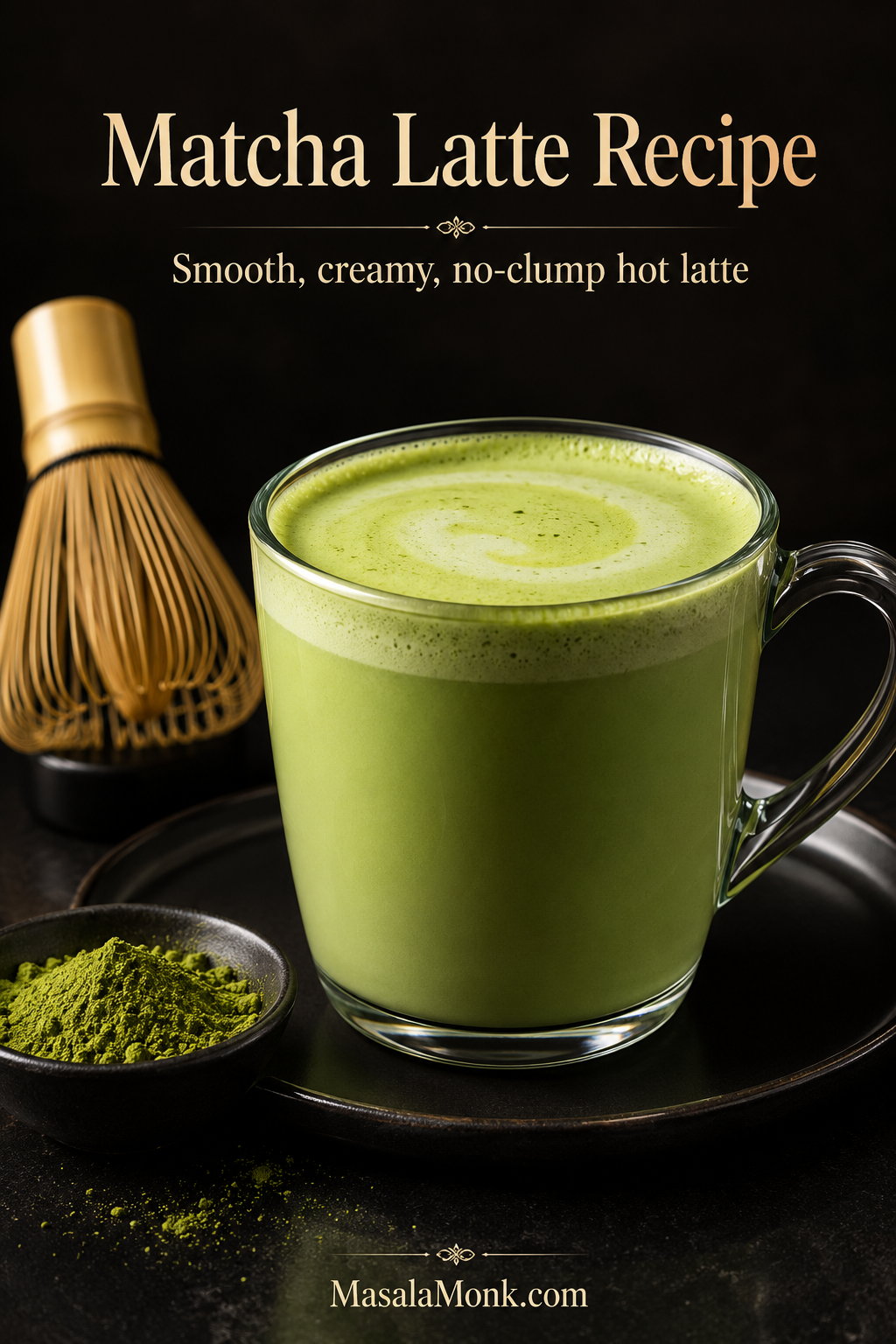
Matcha Latte Recipe

Hot matcha latte in a mug with creamy green foam, matcha powder, and a bamboo whisk beside it.

A good matcha latte recipe should give you a cup that tastes smooth, creamy, and gently earthy — not bitter, chalky, or full of green clumps. If your first homemade version tasted like warm milk with powder at the bottom, the problem probably was not you. Matcha simply needs a little help before the milk goes in.

This is a no-clump, no-bitter, ratio-first hot matcha latte for the problems most homemade cups run into: weak flavor, harsh bitterness, and powder settling at the bottom. Start with 1½ teaspoons matcha, 2 tablespoons hot water, and ¾ cup warm milk, then adjust from a clear baseline instead of guessing.

The finished cup should taste creamy enough to feel like a treat, but green enough that the tea still shows up. The trick is simple: sift the matcha, whisk it with a small amount of hot water, and only then add the milk.

This guide focuses on the hot, creamy homemade version. For the full cold version, use our iced matcha latte recipe.
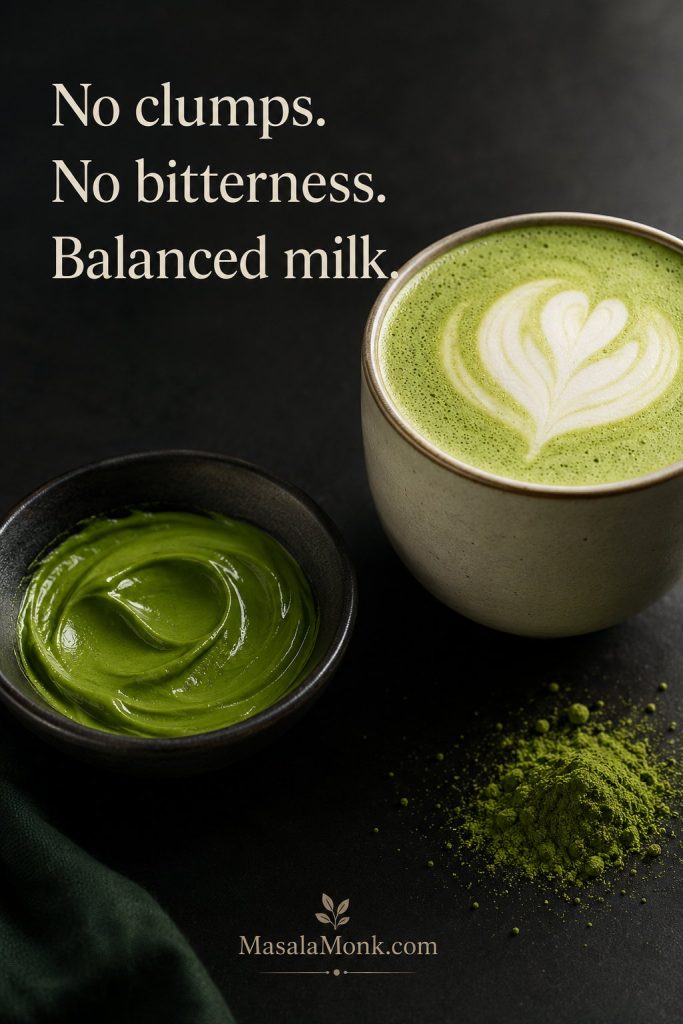
Why this method works: sifting breaks up dry clumps, the concentrated hot-water paste hydrates the tea before milk dilutes it, and the final taste adjustment keeps the latte balanced instead of watery, bitter, or overly sweet.
Creamy no-clump matcha latte beside a bowl of glossy green matcha paste.
Once matcha turns glossy instead of sandy, the milk blends in more evenly and the drink is far less likely to taste chalky.

Quick Answer: Best Matcha Latte Ratio

For one balanced hot matcha latte, whisk 1½ teaspoons / about 3 grams matcha with 2 tablespoons / 30 ml hot water, then add ¾ cup / 170–180 ml warm milk. Sweeten with 1 teaspoon sugar, honey, maple syrup, or simple syrup if you like a lightly sweet cup.
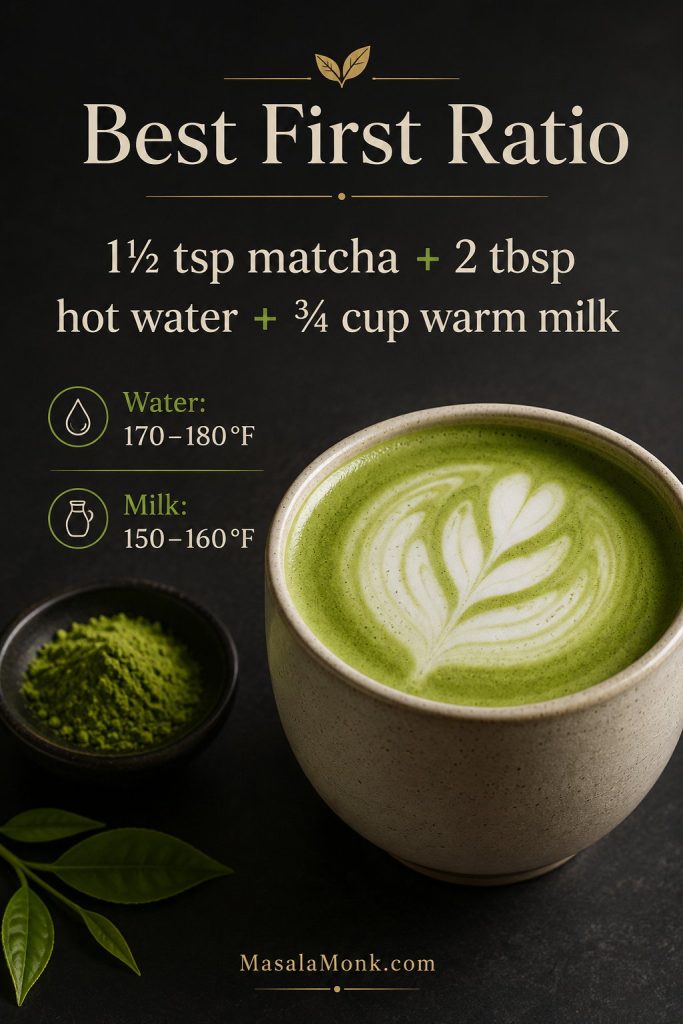
Best first ratio: 1½ tsp / about 3 g matcha + 2 tbsp / 30 ml hot water + ¾ cup / 170–180 ml milk. Use water around 170–180°F / 76–82°C and milk around 150–160°F / 65–71°C.
Matcha latte ratio card showing 1½ teaspoons matcha, 2 tablespoons hot water, and ¾ cup warm milk.
This baseline matcha latte ratio gives you a balanced first cup; after that, adjust matcha, milk, or sweetness one change at a time.

Too mild usually means the tea is being drowned by milk. A harsh or bitter first sip usually points to water that was too hot, matcha that was old, or a ratio that needs a little more milk before it needs more sugar.

Want a larger drink? Use the 16 oz café-size version. If your cup is clumpy, bitter, or too weak, jump to the troubleshooting guide.

What Is a Matcha Latte?

A matcha latte is made by whisking powdered green tea with water, then adding milk. Unlike regular green tea, matcha is not steeped and removed. The whole powdered tea stays in the cup, which is why the texture depends so much on how you mix it.

Because you are drinking the whole powdered tea, a good matcha latte feels fuller than brewed green tea with milk — richer, greener, and more textured. That is also why the drink can taste creamy and smooth one day, then grainy and bitter the next if the powder is rushed.
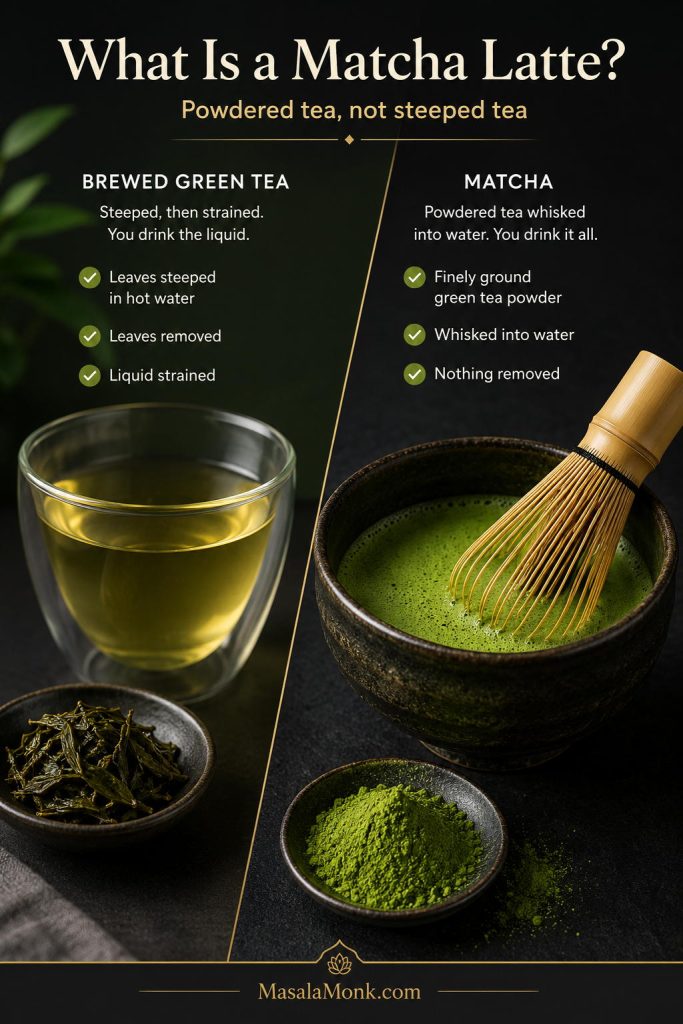
Brewed green tea compared with powdered matcha whisked into water before adding milk.
Matcha is powdered tea that stays in the drink, which is why whisking it smoothly matters before it becomes a latte.

For a more traditional reference point, Ippodo also whisks matcha with warm water before adding milk. Their matcha latte method starts with 3 grams matcha and warm 80°C / 176°F water; this recipe uses less water for a thicker latte paste before the milk goes in. You can read their guide here: Ippodo matcha latte recipe.

Ingredients You Need
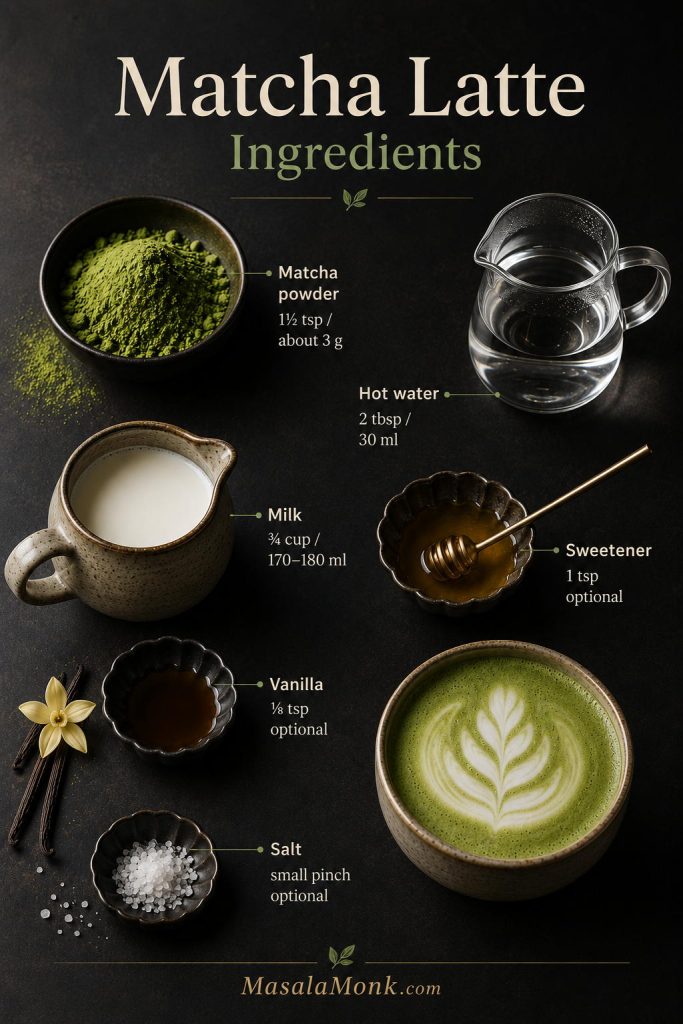
Matcha latte ingredients with matcha powder, hot water, milk, sweetener, vanilla, and salt.
The ingredients are simple, but each one has a job: water opens the matcha, milk adds body, and sweetener rounds the edge.

Matcha powder

Fresh matcha gives the best color and flavor. For lattes, use ceremonial, premium culinary, or latte-grade matcha that looks bright green and smells clean. Very dull olive powder often tastes flatter and more bitter, even with milk.

You do not need the most expensive ceremonial tin for a milk drink. However, very cheap or stale powder can make the cup taste harsh. Old matcha can smell flat, dusty, or hay-like. If that is the tin you have, use the balanced latte ratio, add a little vanilla or sweetener, and do not judge all matcha by that one cup.
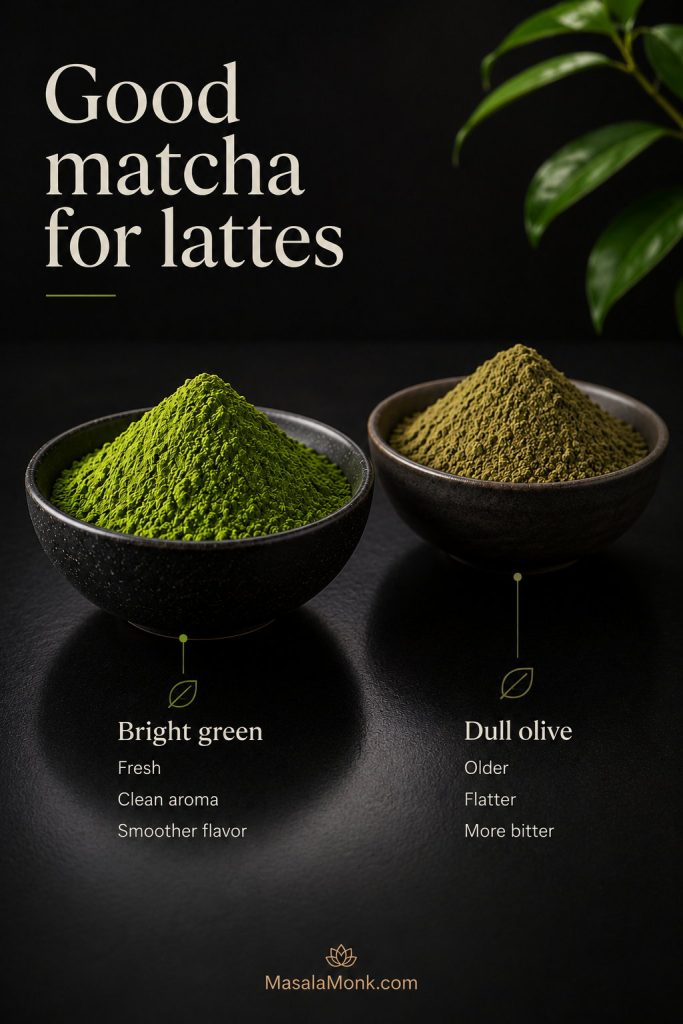
Bright green matcha powder compared with dull olive matcha powder for making lattes.
Bright matcha usually gives a cleaner latte; however, dull olive powder often tastes flatter, sharper, and harder to balance.

Hot water

Use hot water around 170–180°F / 76–82°C. It should be hot and steaming, not boiling. Without a thermometer, boil the water, let it stop bubbling, then rest it for about 1–2 minutes before using it.
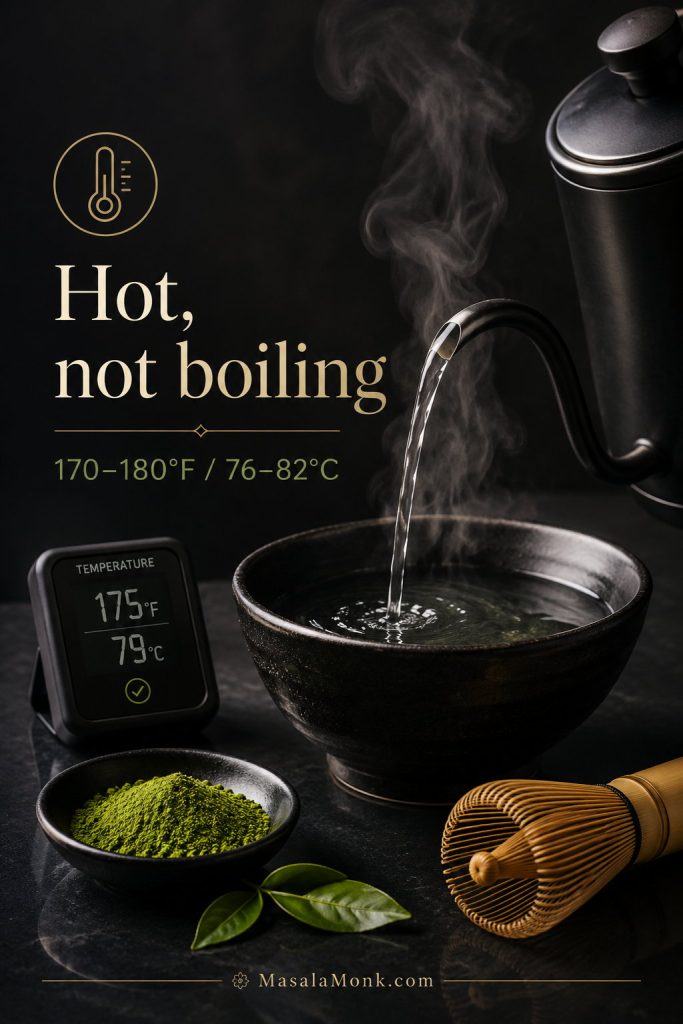
Hot water temperature guide showing 170 to 180 degrees Fahrenheit for making matcha latte.
Boiling water can make matcha taste sharp, so a brief rest after boiling helps protect the tea’s softer green flavor.

For a fuller breakdown, see the water and milk temperature guide later in the post.

Milk

Milk changes the latte as much as the tea does. Whole milk gives the richest body, oat milk is the easiest creamy dairy-free choice, almond milk makes a lighter cup, coconut milk tastes richer but can take over, and soy milk gives a stable coffee-shop texture.

Sweetener

Sweetener is optional. Sugar, honey, maple syrup, simple syrup, vanilla syrup, monk fruit, and stevia can all work. For a hot drink, granulated sugar can dissolve in the paste. For an iced version, syrup blends more smoothly than sugar crystals.

Optional vanilla or salt

A tiny splash of vanilla gives the drink a softer coffee-shop finish. A small pinch of salt can also round out bitterness, especially if your matcha is strong or your milk is unsweetened.

Best Ratio for a Creamy Cup

The best ratio depends on whether you want a mild beginner cup, a balanced café-style drink, or a stronger green tea flavor. Choose the gentle version if you are new to matcha, the balanced version if you want the best first cup, and the strong version if you want the tea to stay bold through the milk.
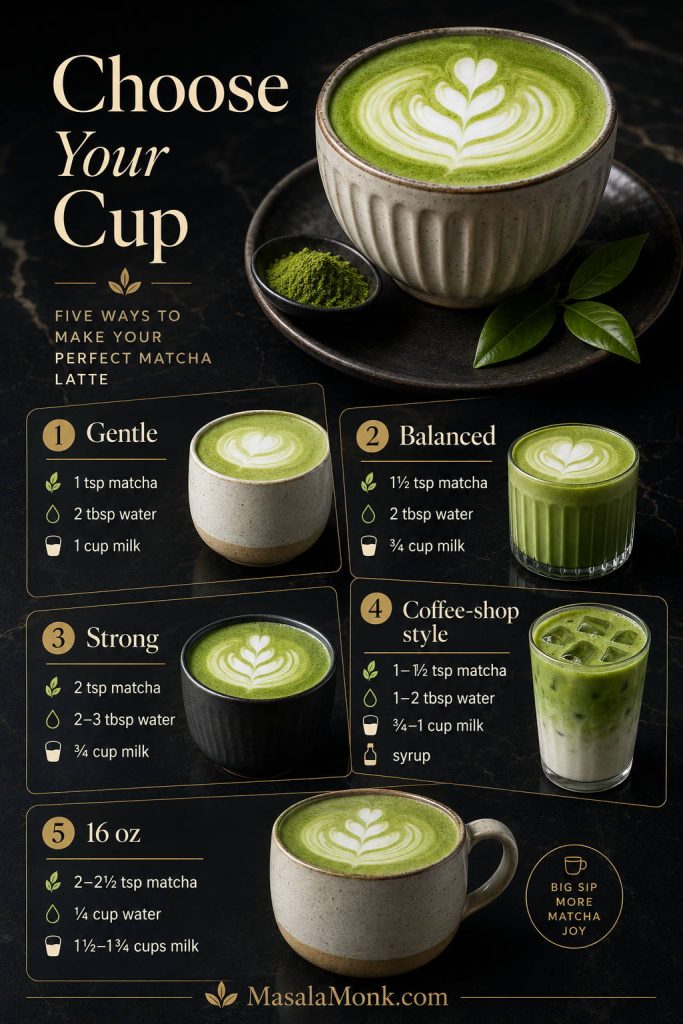
Matcha latte ratio guide for gentle, balanced, strong, coffee-shop style, and 16 ounce versions.
Choose the cup you actually want: gentle and milky, balanced café-style, stronger green tea flavor, sweeter, or 16 oz.
Style Matcha Water Milk Sweetener Best For
Gentle beginner 1 tsp / about 2 g 2 tbsp / 30 ml 1 cup / 240 ml Optional Mild, creamy, less grassy
Balanced café-style 1½ tsp / about 3 g 2 tbsp / 30 ml ¾ cup / 170–180 ml 1 tsp Best first version
Strong matcha 2 tsp / about 4 g 2–3 tbsp / 30–45 ml ¾ cup / 180 ml 1–2 tsp Bold, less milky
Starbucks-style sweet 1–1½ tsp / about 2–3 g 1–2 tbsp / 15–30 ml ¾–1 cup / 180–240 ml 1 tbsp syrup Sweeter café feel
16 oz café-style 2–2½ tsp / about 4–5 g ¼ cup / 60 ml 1½–1¾ cups / 360–420 ml 1 tbsp syrup Large drink

If the paste feels too thick to whisk, add 1 extra tablespoon of water. Try not to turn the paste into a thin tea before the milk goes in, or the finished latte can taste watery.

Start with the balanced ratio, then adjust one variable at a time: more matcha for stronger flavor, less milk for a bolder cup, or a little syrup if the tea tastes sharp.

If your latte tastes like warm milk: you probably need more matcha, not more syrup. Increase the matcha to 1½–2 teaspoons or reduce the milk slightly.

Equipment You Need

You do not need a full tea setup. A strainer helps prevent clumps, a wide mug gives you room to whisk, and a bamboo whisk or handheld frother makes the paste smoother.
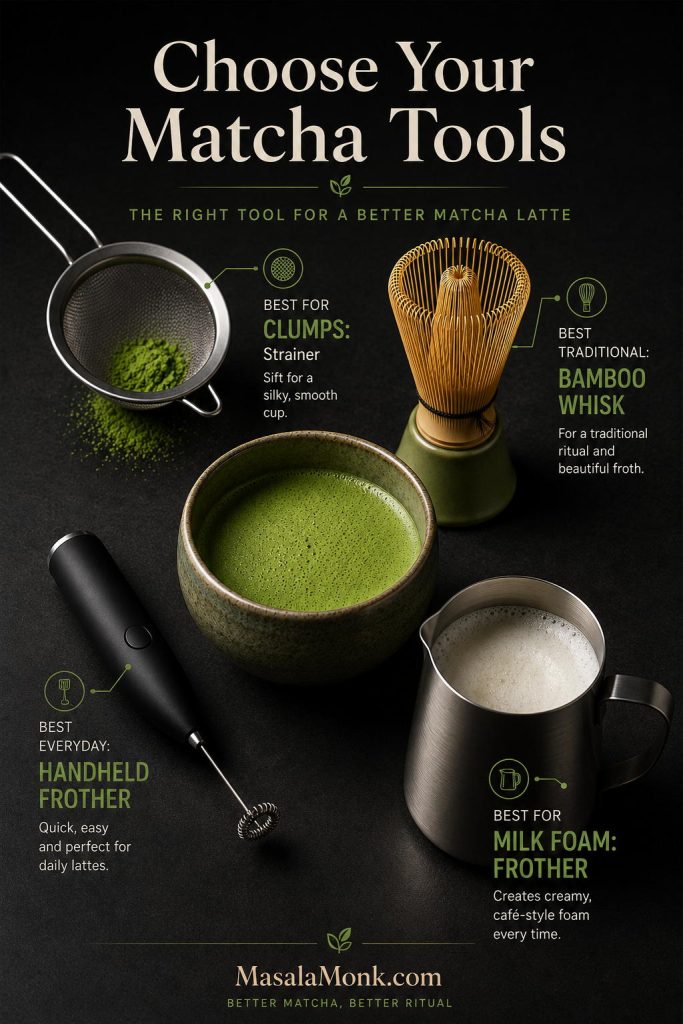
Matcha latte tools including fine mesh strainer, bamboo whisk, handheld frother, wide bowl, and milk frother.
You do not need every tool; the strainer handles clumps, the whisk builds texture, and the frother helps with milk.

No bamboo whisk? Skip ahead to the no-whisk methods.

Tool Use
Fine-mesh strainer Sifts matcha so the powder does not clump.
Bamboo whisk / chasen Best traditional tool for smooth foam.
Wide mug or small bowl Easier than whisking in a narrow mug.
Handheld frother Easiest daily method if you do not have a bamboo whisk.
Milk frother Heats and froths milk for a café-style finish.
Small saucepan Good for heating milk on the stovetop.
Blender Useful no-whisk option for a very smooth cup.
Jar with lid Best for iced matcha or quick shaking.

If the milk-frothing part is what you want to improve most, MasalaMonk’s cappuccino recipe breaks down café-style foam with and without a machine.

How to Make a Hot Matcha Latte

This method gives you the silkiest result because the matcha is fully hydrated before milk is added. The key order is simple: make the paste, add the milk, then adjust sweetness at the end.

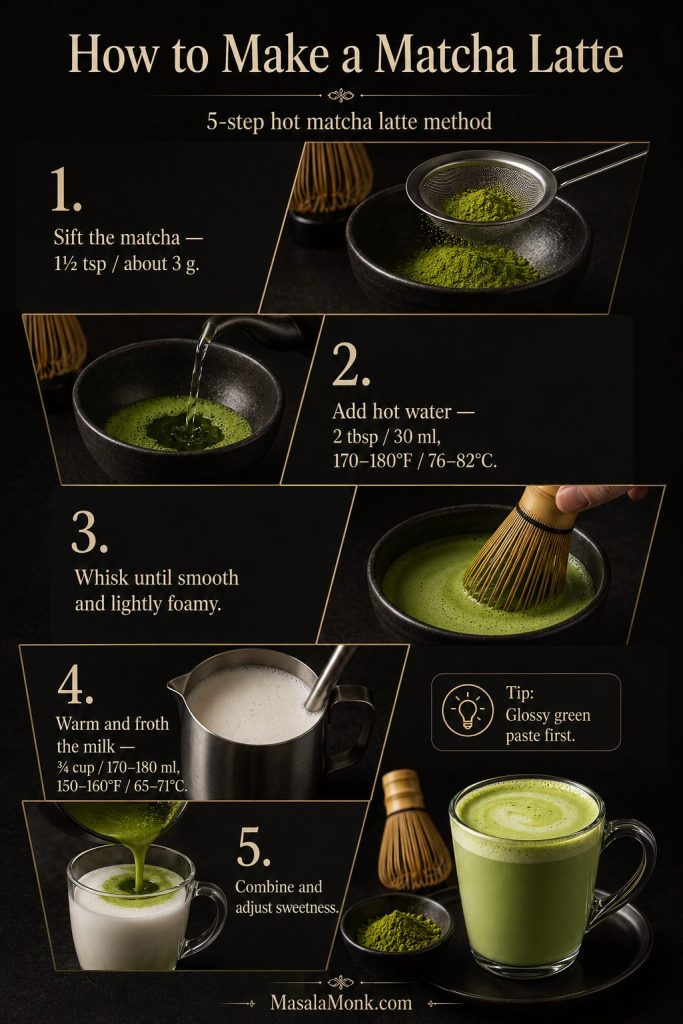
1. Sift the matcha

Add 1½ teaspoons / about 3 grams matcha to a fine-mesh strainer and sift it into a wide mug or small bowl. Matcha naturally forms tiny clumps in the tin, so this quick step is the easiest way to avoid a grainy texture.

If your matcha is very fresh and you are using a strong frother or blender, you may get away without sifting, but sifting is still the safest route for a clump-free cup.
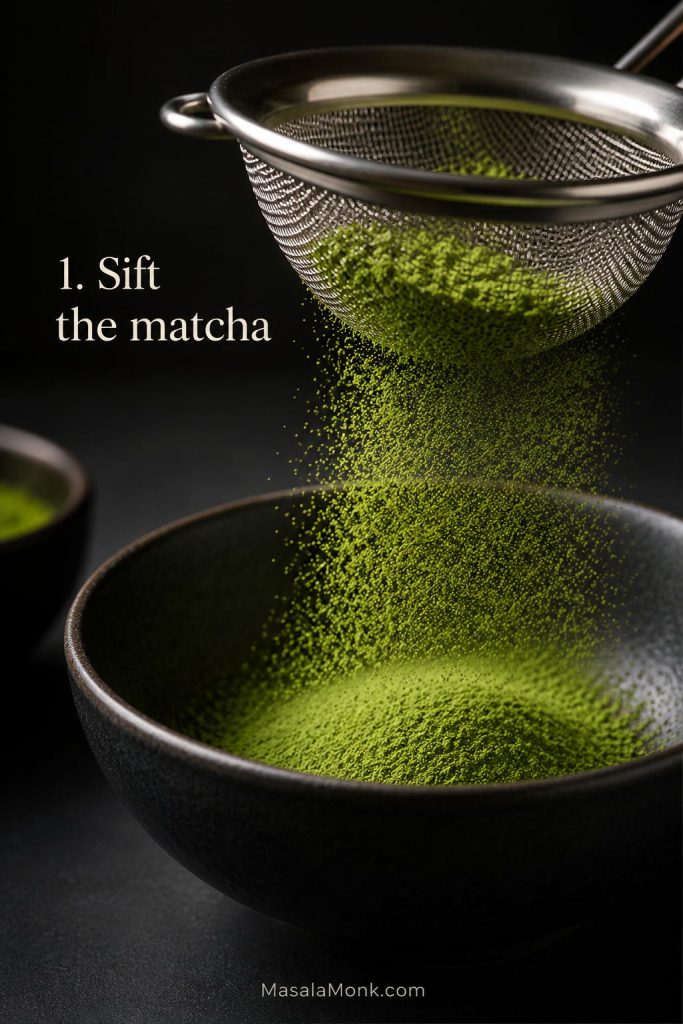
Matcha powder being sifted through a fine mesh strainer into a dark bowl.
Sifting takes only a few seconds, yet it removes the tiny dry lumps that can make a latte taste grainy.

2. Add hot water and make a paste

Add 2 tablespoons / 30 ml hot water. The water should be around 170–180°F / 76–82°C, hot but not boiling. Stir or whisk until the mixture looks like a glossy green paste with no dry pockets.

Think glossy green paste, not sandy sludge. If it looks dry or grainy, keep whisking before the milk goes in.
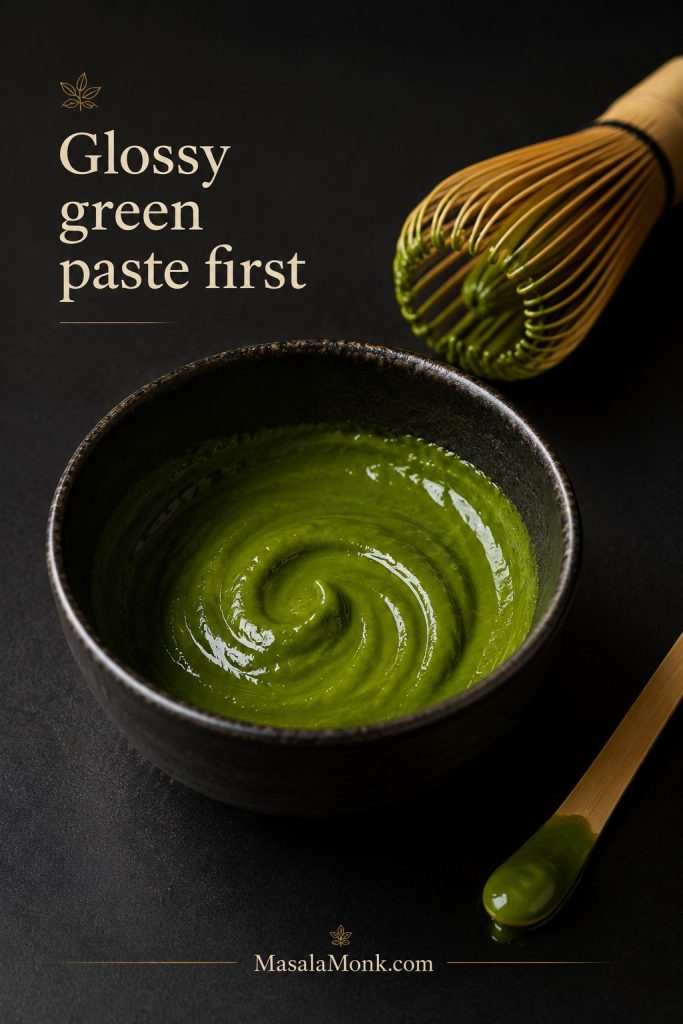
Thick glossy green matcha paste in a dark bowl with a bamboo whisk and spoon nearby.
Look for a shiny, hydrated paste before adding milk; a sandy texture usually means the powder needs more whisking.

3. Whisk until smooth and lightly foamy

Whisk briskly in a W, M, or zig-zag motion for 20–45 seconds. Avoid slow circles, which tend to push the tea around instead of suspending it evenly. The paste should look even and lightly foamy.
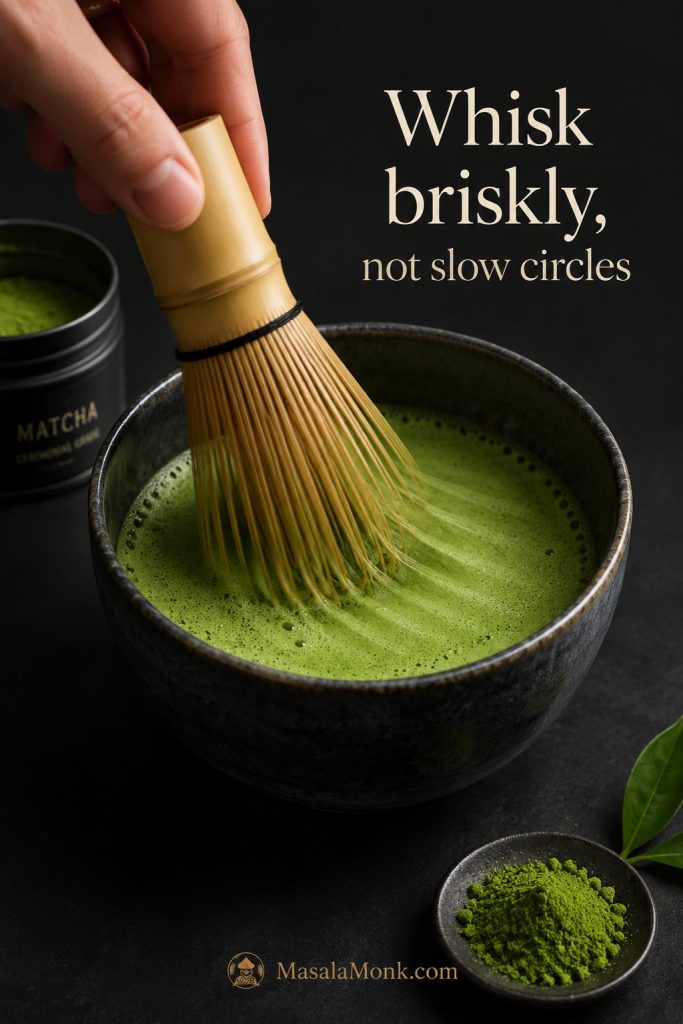
Bamboo whisk moving through foamy matcha in a bowl with matcha powder nearby.
Brisk back-and-forth whisking suspends matcha better than slow circles, especially when you want a fine, even foam.

4. Heat and froth the milk

Warm ¾ cup / 170–180 ml milk until steaming, ideally around 150–160°F / 65–71°C. Froth it with a milk frother, handheld frother, whisk, or blender. If you are heating milk in a saucepan, keep the heat gentle and do not let it boil.

A microwave also works. Heat the milk in short bursts until steaming, then froth or whisk it before adding it to the matcha.
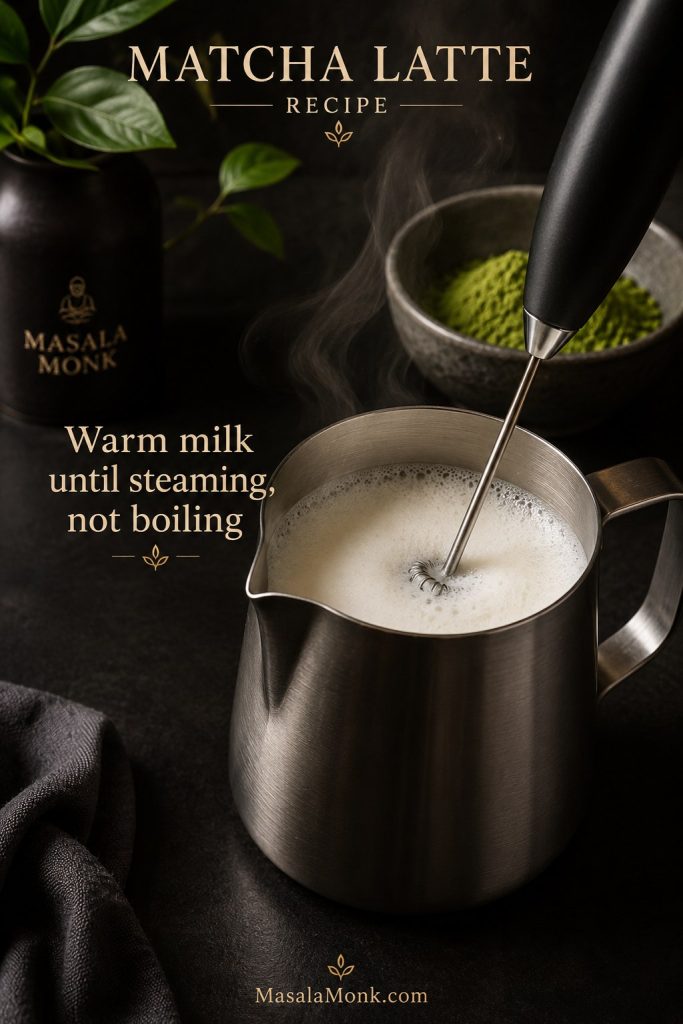
Milk being warmed and frothed in a metal pitcher for a hot matcha latte.
Warm the milk until it steams gently, then froth lightly; boiling milk can make the latte taste flat and heavy.

5. Combine and adjust

Pour the warm milk into the matcha paste. Stir gently, then taste. Add 1 teaspoon sweetener if you want it lightly sweet, or use vanilla syrup for a more coffee-shop finish.

At this point, the latte should look creamy and softly green, with no dry specks riding on top.
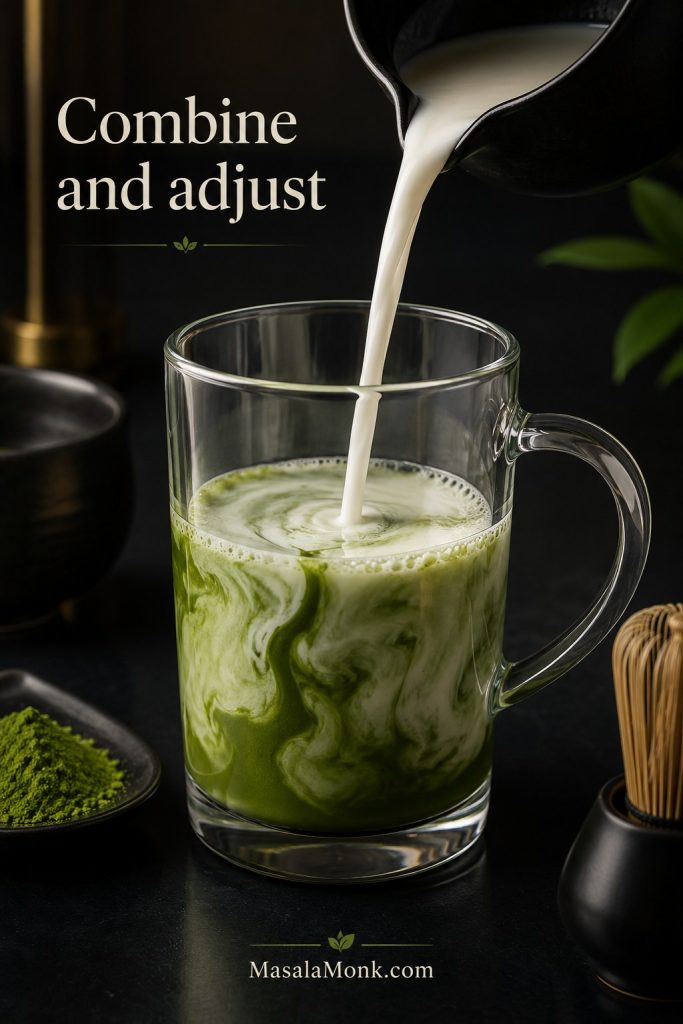
Warm milk being poured into matcha paste in a clear glass mug to create a green and white swirl.
When the matcha is already hydrated, the milk creates a creamy swirl instead of dragging dry powder through the cup.
Five step matcha latte guide showing sifting, adding hot water, whisking, warming milk, and combining.
Think of the method as a texture path: remove lumps, hydrate the tea, build light foam, warm the milk, and combine.

Water and Milk Temperature

Temperature is where a good cup can quietly go wrong. Water that is too hot can make matcha harsh; milk that is overheated can taste flat or slightly scorched.

For the paste, aim for water around 170–180°F / 76–82°C. For the milk, aim for 150–160°F / 65–71°C, or heat it just until steaming.
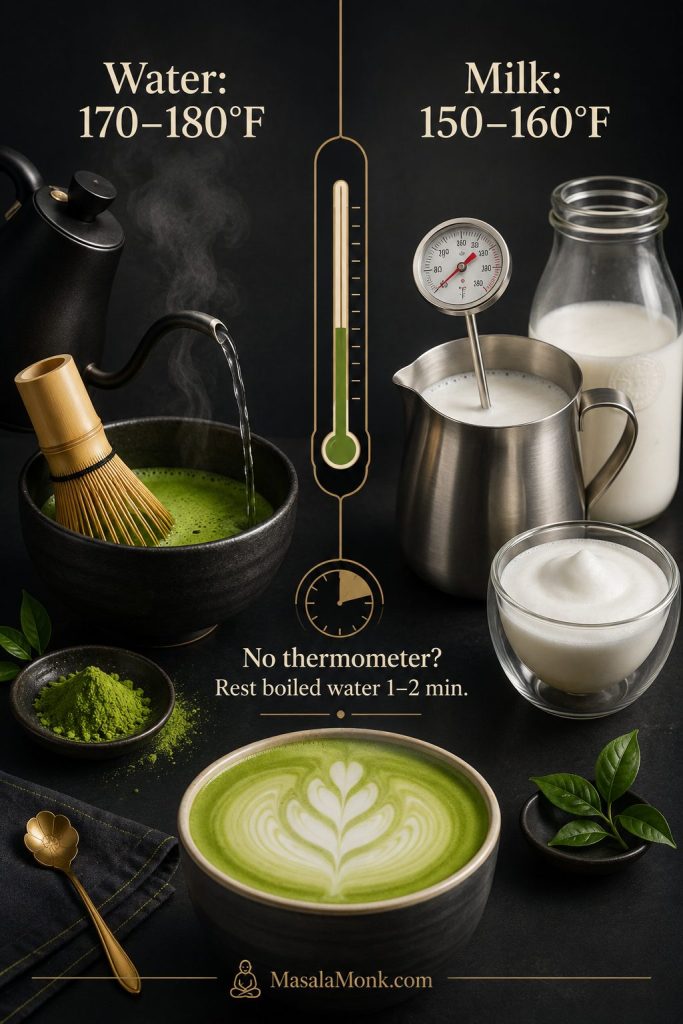
No thermometer? Boil the water, let it stop bubbling, then rest it for about 1–2 minutes before using it. For milk, stop heating when it is steaming but not simmering.
Matcha latte temperature guide showing 170 to 180 degrees Fahrenheit for water and 150 to 160 degrees Fahrenheit for milk.
The right temperatures protect both sides of the drink: gentler water keeps the tea clean, while warm milk keeps the body soft.

No Bamboo Whisk? Use These Methods

A bamboo whisk gives the cleanest foam, but it is not required for a smooth cup. You just need another way to help the powder and water meet properly before the milk goes in.
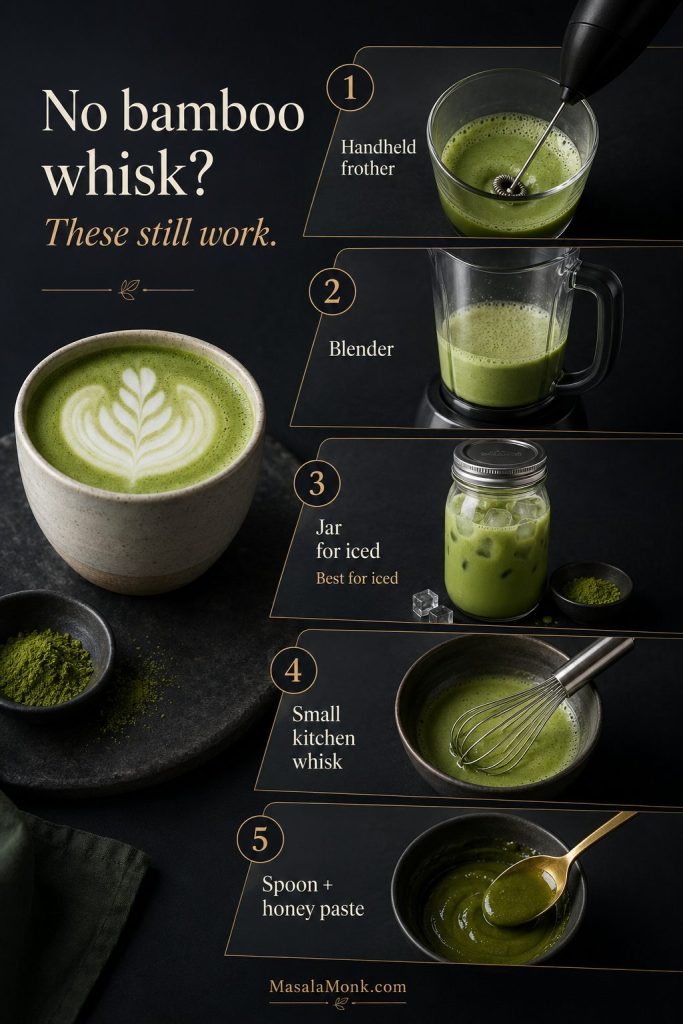
No bamboo whisk matcha latte guide with handheld frother, blender, jar for iced matcha, small whisk, and spoon paste method.
A bamboo whisk is helpful, but not required; use a frother for daily hot lattes and a jar for iced matcha.

Handheld frother method

Sift the matcha into a mug, add hot water, then use a handheld frother to blend the paste until smooth. Add warm milk and froth again briefly. This is the easiest everyday method for most home kitchens.

Blender method

Add warm milk, sweetener, and the matcha paste to a blender. Blend briefly until smooth and foamy. This is a good choice if clumps are your main issue, but do not overblend hot liquid in a sealed blender.

Jar method

The jar method works best for iced matcha. Shake the powder with a small amount of water first, then add milk and shake again. For hot drinks, use only a heat-safe jar and be careful with steam pressure.

If you are making it cold, the quick iced version is the best place to use the jar method.

Small kitchen whisk method

A regular mini whisk can work if you use a wide bowl or mug. Whisk quickly back and forth rather than stirring in circles.

Spoon + honey paste method

In a pinch, mix matcha with honey or maple syrup first, then add a little hot water and stir until smooth. It will not foam like a whisked latte, but the sticky sweetener helps loosen small clumps.
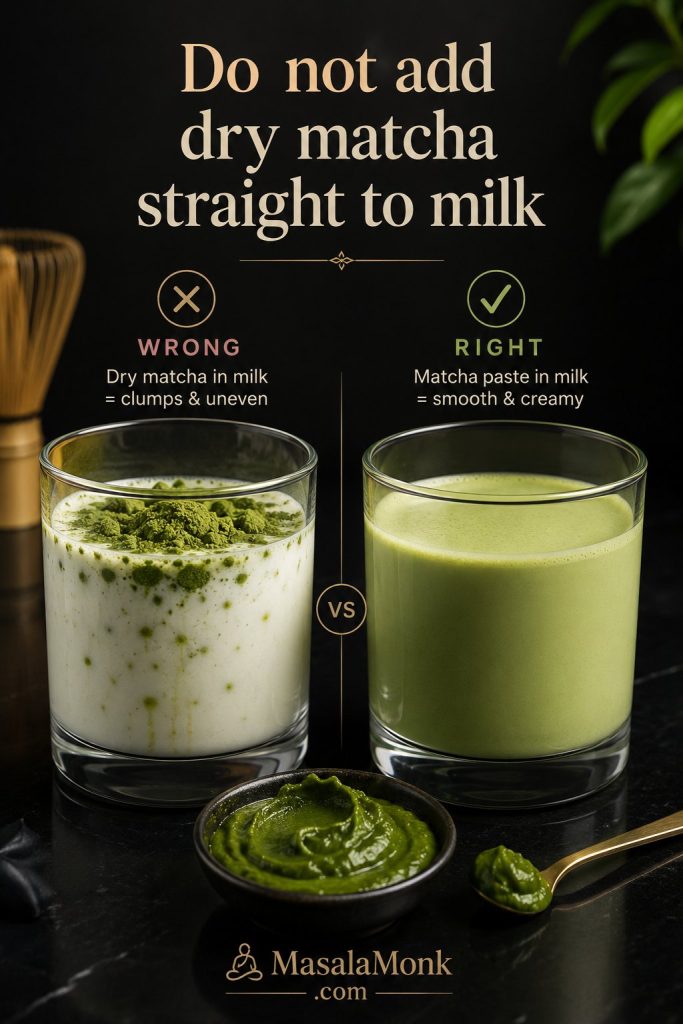
Avoid this mistake: do not add dry matcha straight into a full mug of milk. It usually floats, clumps, and leaves powder at the bottom.
Dry matcha clumping in milk compared with smooth matcha paste blended into milk.
Dry matcha tends to float and clump in milk, so make a paste first if you want the drink even from top to bottom.

Best Milk to Use

Milk decides whether the cup tastes plush, light, sharp, or sweet. Whole milk gives the roundest body, oat milk is the easiest creamy dairy-free choice, almond milk keeps things lighter, coconut milk tastes richer but can dominate, and soy milk gives a stable coffee-shop texture.

If oat milk is your favorite matcha base, MasalaMonk’s homemade oat milk guide is useful when you want a simple DIY version that does not turn slimy.

Milk Best Use Notes
Whole milk Classic café texture Foams well and gives a round, creamy body.
2% milk Everyday latte Lighter than whole milk but still balanced.
Oat milk Best dairy-free default Creamy, slightly sweet, and good at softening bitterness. Barista-style oat milk usually froths better.
Almond milk Lighter cup Can make matcha taste sharper, especially if unsweetened.
Coconut milk Rich variation Sweet and full-bodied, but it can dominate the tea.
Soy milk Stable café-style plant milk Creamy, reliable, and usually froths better than many nut milks.
Cashew or macadamia milk Premium creamy variation Soft, rich, and smooth, but less common.

There is no single correct milk here. The best choice is the one that lets the tea taste balanced instead of hidden.
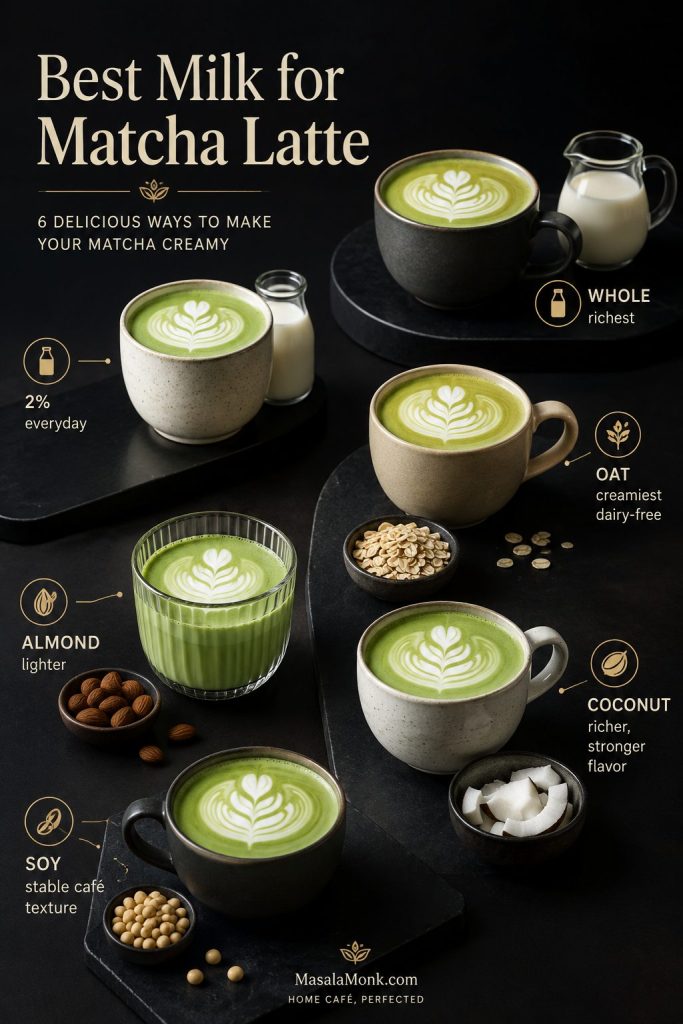
Best milk for matcha latte comparison with whole milk, 2 percent milk, oat milk, almond milk, coconut milk, and soy milk.
Milk changes the whole cup: whole milk tastes richest, oat milk is the creamiest dairy-free default, and almond milk keeps it lighter.

Once you choose your milk, the variation ideas show how to take the same base sweeter, colder, fruitier, or bolder.

Once the base is smooth, choose the version by what you want from the cup: sweeter, stronger, colder, fruitier, or bolder with espresso.

Starbucks-style at home

On Starbucks’ official menu, the hot Matcha Latte is described with matcha, milk, and classic syrup; the iced version adds ice. You can see the official Starbucks menu listing here: Starbucks Matcha Latte.

For a Starbucks-style cup at home, the main difference is sweetness. Use simple syrup or vanilla syrup instead of granulated sugar, because syrup blends smoothly into both hot and iced drinks.

For a homemade Starbucks-style hot drink, use 1–1½ teaspoons matcha, 1–2 tablespoons hot water, ¾–1 cup milk, and 1 tablespoon simple syrup or vanilla syrup. Keep the matcha paste slightly concentrated so the tea does not disappear under the milk.
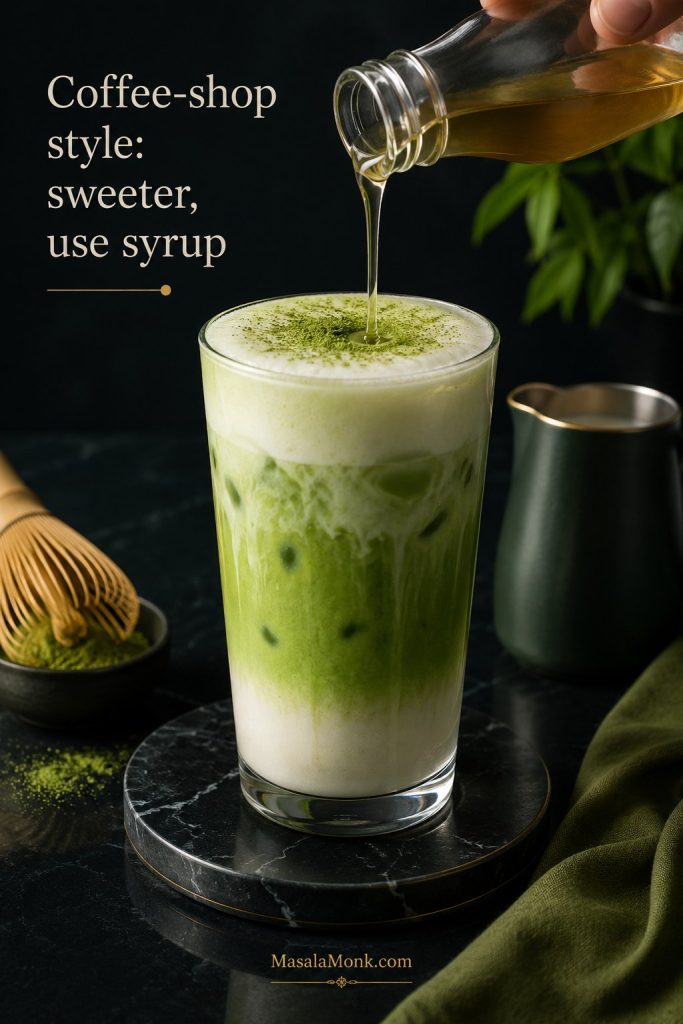
Coffee-shop style matcha latte with syrup being poured into a tall iced green drink.
For a sweeter coffee-shop style matcha latte, syrup works better than granulated sugar because it blends smoothly.

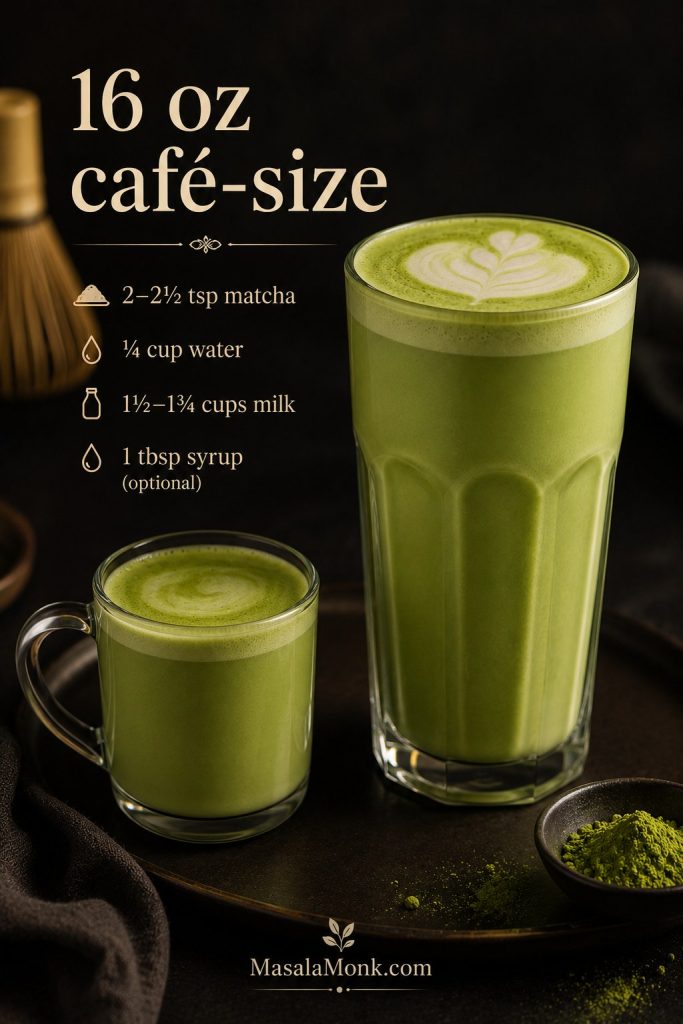
16 oz café-size version

A 16 oz café cup needs more matcha than a small mug. Use the lower milk amount if you want room for foam, or the higher amount if you want a fuller 16 fl oz drink.

Ingredient 16 oz Café-Style Hot Amount
Matcha 2–2½ tsp / about 4–5 g
Hot water ¼ cup / 60 ml
Milk 1½–1¾ cups / 360–420 ml
Sweetener 1 tbsp syrup, or to taste
Tall 16 ounce matcha latte beside a smaller mug with matcha, water, milk, and syrup amounts listed.
A larger matcha latte needs more powder, not just more milk; otherwise, the green tea flavor disappears in the cup.

Quick iced version

To make a quick iced version, whisk 1–1½ teaspoons matcha with 2 tablespoons warm water, then pour it over ice with ¾–1 cup cold milk and syrup to taste.

This is only the shortcut. For the full cold method, Starbucks-style iced version, no-clump tips, and watery-fix notes, use the full iced matcha latte recipe.
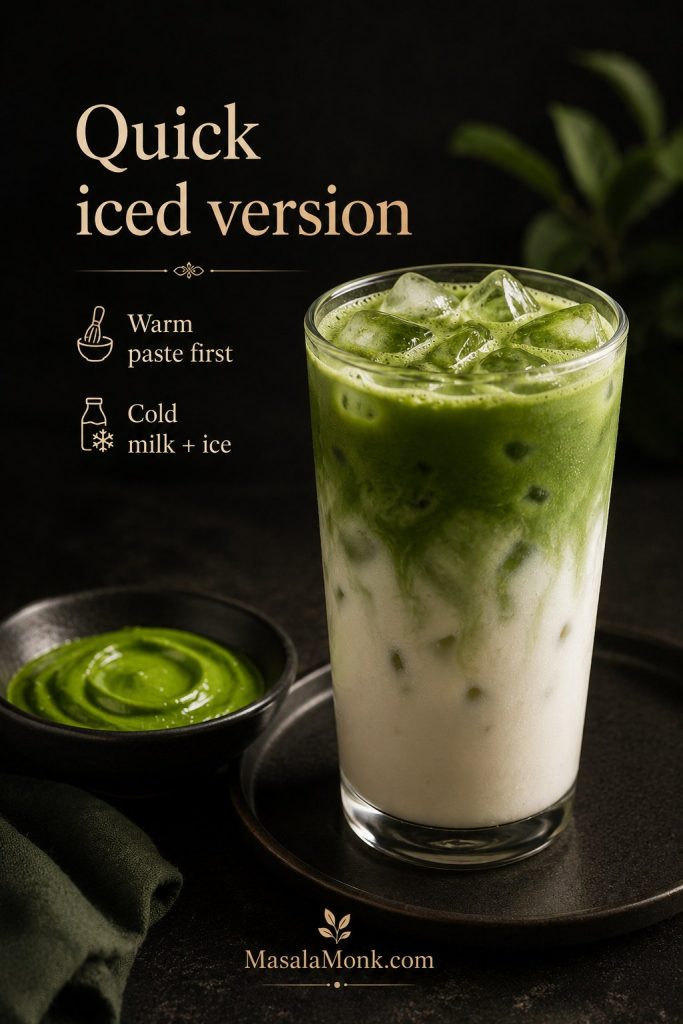
Quick iced matcha latte with ice, cold milk, green matcha layer, and a bowl of matcha paste.
For a quick iced version, make the warm paste first, then pour it over cold milk and ice to keep the texture clean.

Strawberry version

For a strawberry version, spoon strawberry puree, strawberry syrup, or a quick strawberry jam base into the bottom of the glass, add milk, then pour matcha over the top. The layered look works best when the strawberry base is thicker than the milk.

For the full layered fruit drink, use our strawberry matcha latte recipe.
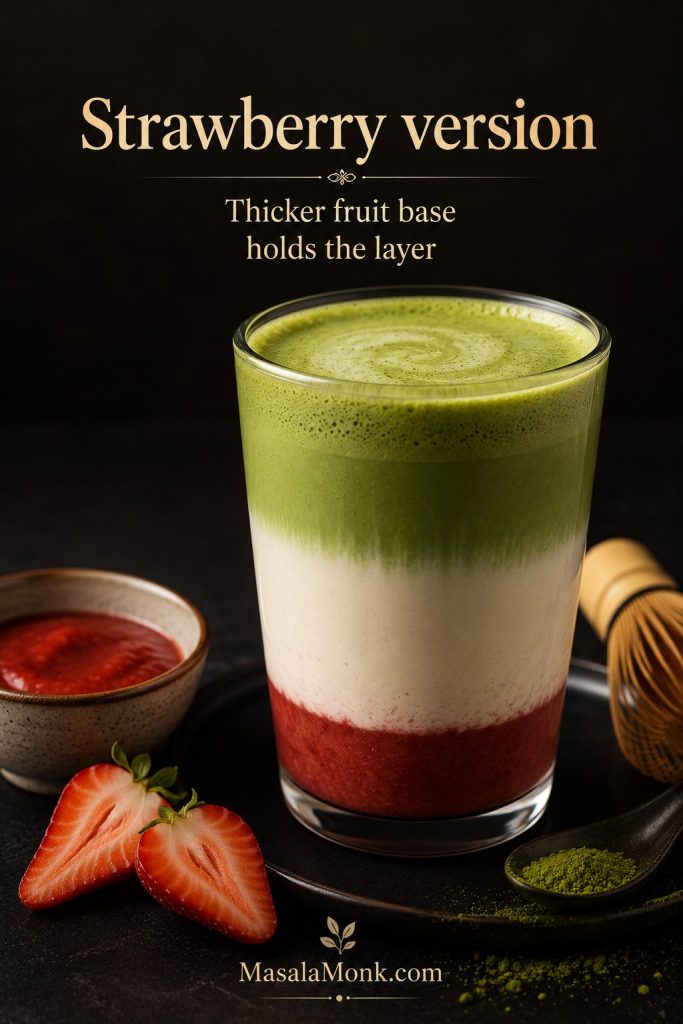
Layered strawberry matcha latte with strawberry base, milk layer, matcha layer, strawberries, and matcha powder.
A thicker strawberry base helps the layers stay visible, while the milk keeps the fruit and matcha from blending too fast.

Dirty matcha / matcha with espresso

A dirty matcha adds espresso or strong coffee to the matcha-milk base. It tastes bolder, slightly roasty, and more like a coffee-shop drink than a pure green tea latte.

Use 1 teaspoon matcha, 2 tablespoons / 30 ml hot water, ¾ cup / 180 ml milk, 1 shot espresso or 2 oz strong coffee, and 1–2 teaspoons sweetener. For a hot dirty matcha, add the espresso after combining the matcha and milk. For an iced dirty matcha, pour the espresso over ice and milk, then add the green tea layer.

If you are still figuring out espresso strength, MasalaMonk’s quick espresso guide can help you choose coffee that stands up to the green tea flavor instead of disappearing into the milk.
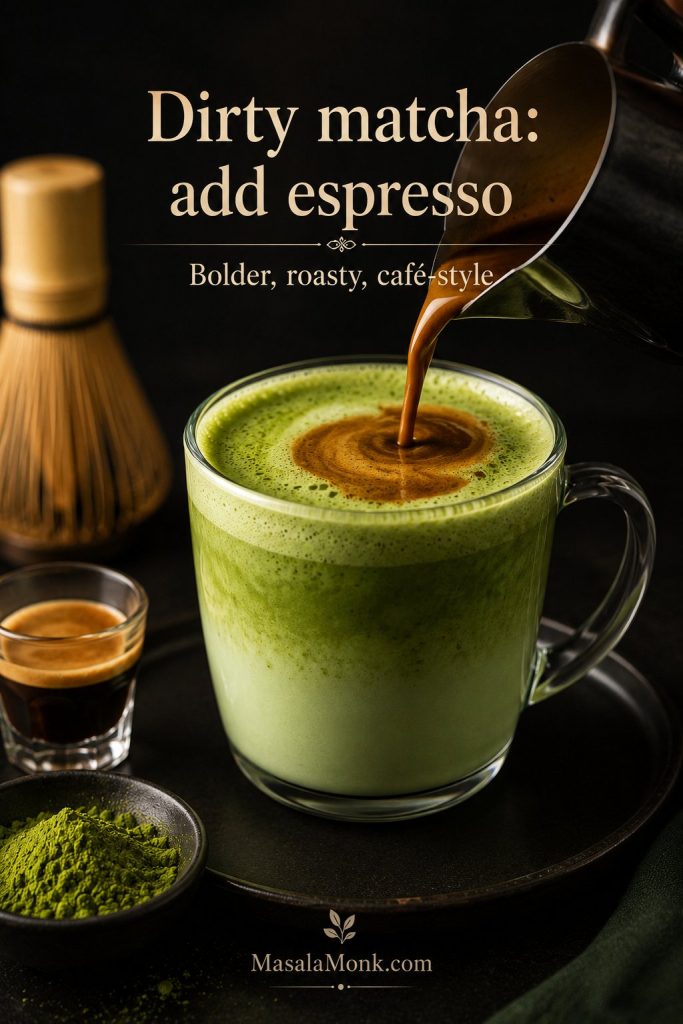
Espresso being poured into a green matcha latte with an espresso shot and matcha powder nearby.
Espresso makes the drink bolder and more roasty, but the matcha still needs enough strength to show through the coffee.

More flavor ideas

  • Vanilla: add 1–2 teaspoons vanilla syrup when you want the soft coffee-shop version.
  • Honey: sweeten the paste with honey before adding milk for a rounder, floral sweetness.
  • Maple: use maple syrup when you want a warmer, deeper sweetness.
  • Oat milk: use barista-style oat milk for the creamiest dairy-free version.
  • Almond milk: use almond milk for a lighter drink; add vanilla if it tastes sharp.
  • Coconut: use light coconut milk or coconut beverage for a richer, slightly tropical version.
  • Protein: blend the finished latte with vanilla protein powder, or use a protein milk.
  • Unsweetened: skip the sweetener, but use a creamy milk so the cup still tastes round rather than sharp.

Fixes for Clumps, Bitterness, and Weak Flavor

A bad matcha latte usually announces the problem quickly: clumps on top, bitterness on the first sip, weak milkiness, or powder at the bottom. Use the symptom first, then fix the cause.
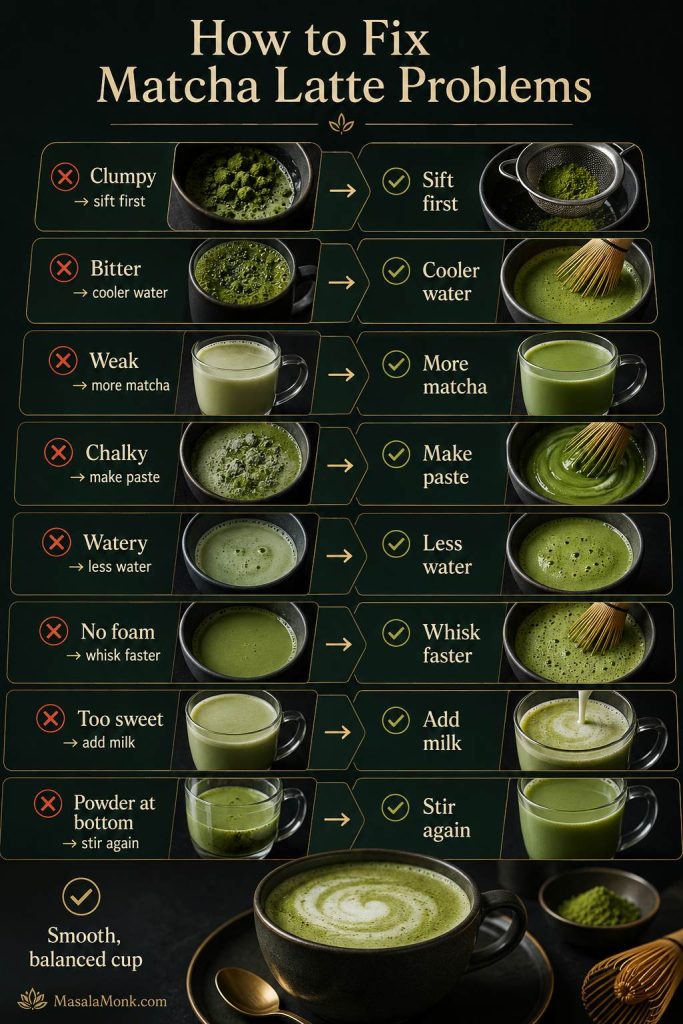
Matcha latte troubleshooting board showing fixes for clumpy, bitter, weak, chalky, watery, no foam, too sweet, and powder at bottom.
Fix the symptom instead of guessing: clumps need sifting, bitterness needs gentler water, and weak flavor needs more matcha.

Most fixes trace back to three steps: sifting, making a paste, and using the right temperature.

Problem Likely Cause Fix
Clumpy Matcha was not sifted or was added straight to milk. Sift first, then make a paste with hot water.
Bitter Water was too hot, matcha was old, or too much powder was used. Use 170–180°F water, reduce matcha slightly, or add milk/sweetener.
Weak / too milky Too much milk or not enough matcha. Use 1½ tsp / about 3 g matcha per ¾ cup milk.
Chalky Matcha was not hydrated before milk was added. Whisk with 2 tbsp hot water first.
Watery Too much water or melted ice. Use a concentrated paste and reduce extra water.
Not foamy Slow stirring or unfrothed milk. Use a W/M whisking motion and froth the milk separately.
Too sweet Too much syrup was added at the start. Start with 1 tsp sweetener, then add more after tasting.
Powder at bottom Matcha settled as the drink sat. Stir again before drinking. Matcha is a suspended powder, so some settling is normal.

A bitter cup, a weak cup, and a clumpy cup do not need the same solution. That is why fixing the symptom works better than hiding everything with extra syrup.

Recipe Card

Matcha Latte Recipe

This hot matcha latte is creamy, lightly grassy, and built around a no-clump paste method. Sift the matcha, whisk it with hot water, then add warm milk and sweeten to taste.

Yield1 latte
Prep Time5 minutes
Total Time5–7 minutes
CategoryBeverage

Equipment

  • Fine-mesh strainer
  • Bamboo whisk, handheld frother, or small whisk
  • Wide mug or small bowl
  • Milk frother, microwave-safe cup, or small saucepan

Ingredients

  • 1½ tsp / about 3 g matcha powder
  • 2 tbsp / 30 ml hot water, around 170–180°F / 76–82°C
  • ¾ cup / 170–180 ml milk of choice
  • 1 tsp sugar, honey, maple syrup, or simple syrup, optional
  • ⅛ tsp vanilla extract or a tiny splash of vanilla syrup, optional
  • Small pinch of salt, optional

Instructions

  1. Sift the matcha. Sift 1½ tsp / about 3 g matcha into a wide mug or small bowl.
  2. Make the paste. Add 2 tbsp / 30 ml hot water and whisk until smooth.
  3. Whisk until foamy. Use a W, M, or zig-zag motion for 20–45 seconds.
  4. Heat and froth the milk. Warm ¾ cup / 170–180 ml milk until steaming, then froth if desired.
  5. Combine and adjust. Pour the milk into the matcha paste, stir gently, taste, and sweeten if needed.

Notes

  • For a milder drink, use 1 tsp / about 2 g matcha and 1 cup / 240 ml milk.
  • For a stronger drink, use 2 tsp / about 4 g matcha and keep the milk around ¾ cup / 180 ml.
  • A microwave works for warming milk; heat in short bursts until steaming, then froth or whisk before combining.
  • For a Starbucks-style version, use simple syrup or vanilla syrup and make it sweeter.
  • For an iced version, use the dedicated iced matcha latte recipe for the full method.

Storage and Make-Ahead Tips

A hot matcha latte is best when the milk is freshly warmed and the foam is still light. Think of make-ahead here as prep, not storage: measure the matcha, keep the sweetener ready, and warm the milk fresh.

If you make the paste ahead, stir or froth it again before adding milk because the tea can settle. Do not store hot frothed milk for long; the foam collapses, and reheated milk can taste flat.

FAQs

How much matcha do you use for one latte?

For a balanced café-style latte, start with 1½ teaspoons / about 3 grams matcha. Use 1 teaspoon for a milder beginner drink or 2 teaspoons for a stronger green tea flavor.

What temperature should water be for matcha?

Aim for 170–180°F / 76–82°C. Boiling water can make matcha taste more bitter, so let freshly boiled water cool slightly before using it.

Why does it taste bitter?

Bitter matcha usually means the water was too hot, the powder was old, or the ratio was too strong. Lower the water temperature before adding extra sugar.

Why are there clumps?

Clumps usually mean the matcha met too much milk too soon. Sift it first, then whisk it with a small amount of hot water before adding milk.

What milk tastes best?

Whole milk is best for classic richness. Oat milk is the best dairy-free default. Almond milk is lighter, soy is stable, and coconut milk is rich but more noticeable.

Is it better hot or iced?

The hot version tastes warmer, creamier, and more soothing. Iced matcha tastes brighter and more refreshing. The best version depends on whether you want a cozy drink or a cold café-style one.

Does matcha latte have caffeine?

Yes. Matcha is powdered green tea, so it contains caffeine. The amount varies by brand and serving size; check your matcha package if caffeine is a concern.

Do I need a bamboo whisk?

Not necessarily. A bamboo whisk gives the best traditional texture, but a handheld frother, blender, jar, or small kitchen whisk can also work if you make a paste first.

How do I make a 16 oz version?

For a 16 oz drink, start with 2–2½ teaspoons / about 4–5 grams matcha, ¼ cup / 60 ml water, 1½–1¾ cups / 360–420 ml milk, and about 1 tablespoon syrup if you want it sweet.

Should I use ceremonial or culinary matcha?

Ceremonial or latte-grade matcha usually tastes smoother in drinks. Culinary matcha can work if you are adding milk and sweetener, but it is usually better for baking, smoothies, or recipes where matcha is not the only main flavor.

How do I make it Starbucks-style?

Use matcha, milk, and simple syrup or vanilla syrup. Make it sweeter than the basic recipe, then adjust the syrup to taste. For an iced version, syrup works better than granulated sugar because it blends smoothly.

Why does powder settle at the bottom?

Matcha is a powdered tea suspended in liquid, not a brewed tea that fully dissolves. Some settling is normal if the cup sits for a while. Stir or froth it again before drinking.

Final Tips

The whole method comes back to one order: make a smooth paste, add milk, then adjust sweetness. If the drink tastes weak, use a little more matcha or a little less milk next time. If it tastes bitter, lower the water temperature before reaching for extra sugar.

From there, every version gets easier: stronger, sweeter, oat milk, iced, dirty, or strawberry — all built from the same glossy paste and balanced milk base.

What the final texture should look like

The final cup should look softly green, lightly foamed, and fully blended, with no dry specks floating through the drink and no powder layer sitting at the bottom.
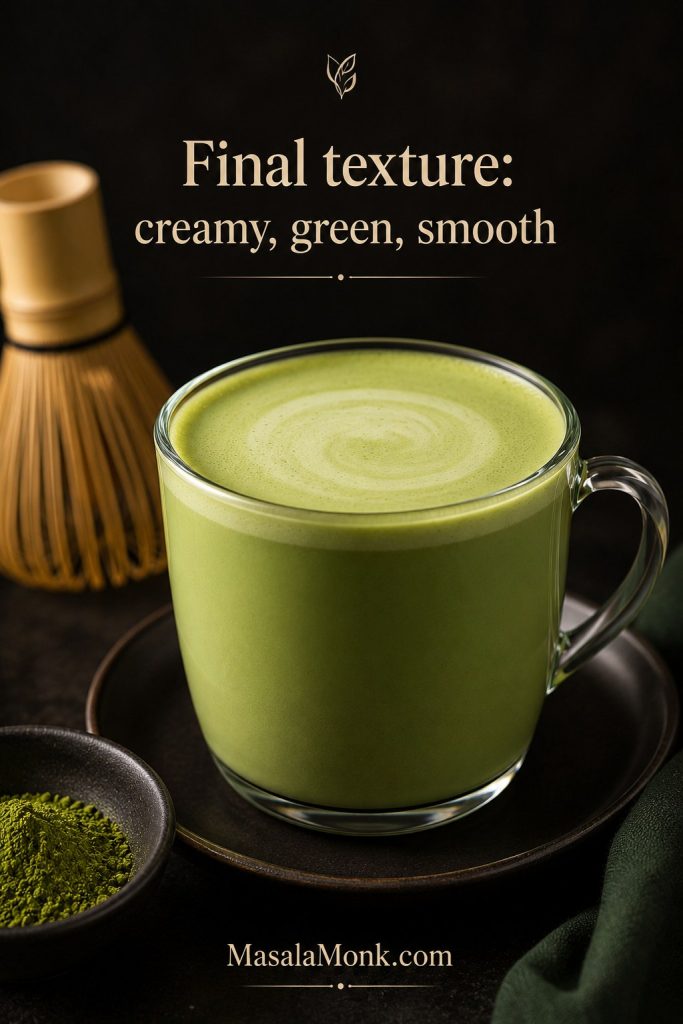
Finished hot matcha latte with creamy green texture, light foam, matcha powder, and bamboo whisk.
Before building variations, check the finish: the latte should be fully blended, lightly foamed, and free of dry green powder at the bottom.
Posted on 7 Comments

Healthy Pumpkin Spice Latte (Low Cal, Real Pumpkin)

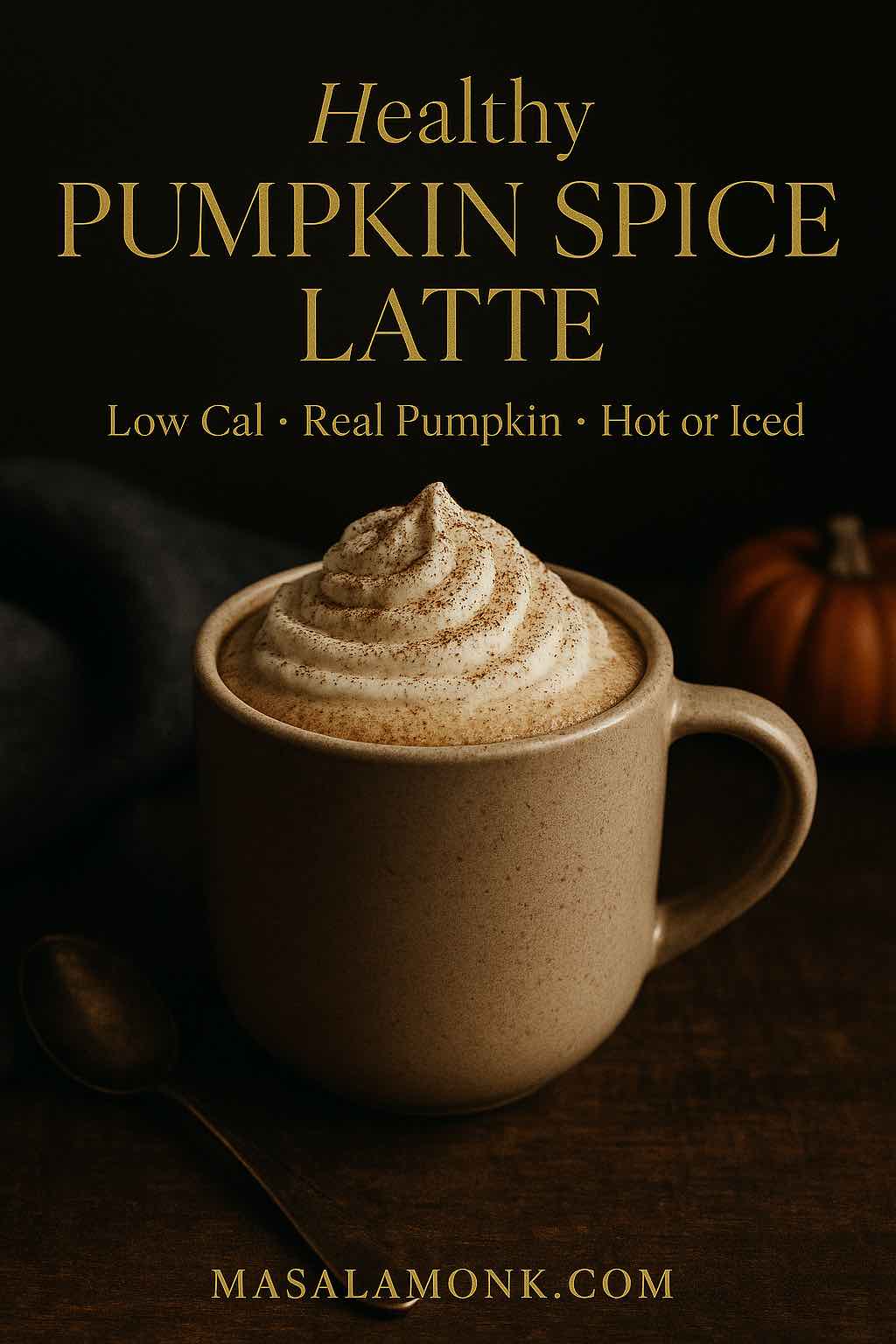
Portrait of a healthy pumpkin spice latte topped with foam and spice; real pumpkin, low calorie; hot or iced recipe from MasalaMonk

When the air turns crisp and mornings get slower, a Healthy Pumpkin Spice Latte is exactly the kind of cozy you can feel good about. Right from the start, this recipe prioritizes real pumpkin purée, balanced spice, and smart sweeteners, so your Healthy Pumpkin Spice Latte tastes indulgent while staying light. For even better iced results, you might glance at our post on iced coffee methods; understanding cold brew vs. iced espresso vs. shaken lattes instantly upgrades texture.


Why This Version Is a Truly Healthy Pumpkin Spice Latte

To begin with, we build flavor from real pumpkin and a precise spice blend (cinnamon, ginger, nutmeg, clove) rather than relying on multiple pumps of syrup. As a result, your Healthy Pumpkin Spice Latte delivers warmth, body, and aroma without a sugar crash. Additionally, you can steer calories by milk choice—unsweetened almond for the leanest profile, skim for dairy protein without fat, or oat for extra creaminess. For context and honest comparisons, the official café baselines are here: Starbucks hot PSL nutrition and Starbucks iced PSL nutrition (starbucks.com). You’ll see how quickly sugar and calories climb with standard builds.

Moreover, using real pumpkin gives you a little fiber and micronutrients with very modest sugars. If you like specifics, skim the canned pumpkin nutrition profile (MyFoodData, USDA-based). Put simply: the Healthy Pumpkin Spice Latte approach leans on whole ingredients and method control, not just “less syrup.”


Ingredients for a Healthy Pumpkin Spice Latte (1 Serving, ~12 oz / 355 ml)

Before we begin, gather everything in one place; preparation makes the pour seamless. Then, follow the lists below—organized so you can choose quickly without second-guessing. Choose one milk and one sweetener; the rest stays the same.

Core base (must-have)

  • Espresso: 30–60 ml (1–2 shots) or ~90 ml strong brewed coffee
    Tip: Start with 1 shot for balance; add a second if you prefer a bolder Healthy Pumpkin Spice Latte.
  • Pumpkin purée: 30 g (2 Tbsp), 100% pumpkin (not pie filling)
  • Vanilla extract: ½ tsp
  • Fine salt: a small pinch (it rounds sweetness and spice)

Milk (pick one)

  • Unsweetened almond milk — 200 ml (¾ cup + 1 Tbsp): ultra-light and lowest in calories.
  • Skim milk — 200 ml: lean dairy with extra protein and a clean latte finish.
  • Unsweetened oat milk — 200 ml: naturally creamy; slightly higher calories but luxurious texture.

Preferably, choose cold milk for iced versions; otherwise, any works.

To get precise control of ingredients, additives, macros and quality of your milk we have couple of posts that explain How to make Almond Milk at Home and then Easy Homemade Oats Milk with just One Ingredient- Non Slimy, at last.

Pumpkin spice blend (balanced & bright)

Use 1 tsp total, mixed as:

  • ⅝ tsp ground cinnamon
  • ⅛ tsp ground ginger
  • ⅛ tsp ground nutmeg
  • A tiny pinch clove (go easy—clove dominates quickly)

For a precise recipe and some of the variants you can make at home, read our post on Pumpkin Spice, Your Way: Master Blend, Variations & Real-World Recipes. Alternatively, use 1 tsp of a quality pre-mixed pumpkin pie spice.

Sweetener (to taste—choose one)

  • Zero-calorie: liquid stevia, monk-fruit drops, or erythritol/monk-fruit blend (start light; add gradually).
  • Natural: 1–2 tsp maple syrup or honey for classic café sweetness.
  • Low-glycemic twist (optional): 1–2 tsp allulose for clean sweetness without a cooling aftertaste.

Because pumpkin softens bitterness, you’ll often need less sweetener than you expect.

For iced Healthy Pumpkin Spice Latte

  • Ice: ~200 g (heaping cup), plus extra for the glass
  • Optional cold foam: 60 ml milk (of your choice), frothed separately

Flavor extras (optional, but lovely)

  • Citrus spark: the faintest whisper of orange zest (⅛ tsp) brightens the spices.
  • Caramel note: ¼ tsp molasses introduces depth without much sugar.
  • Saffron warmth: a few strands steeped in a splash of your milk add aromatic complexity.

Equipment (simple is fine)

  • Whisk or handheld frother (for hot microfoam)
  • Shaker or jar with lid (for the iced, frothy finish)
  • Small saucepan (if making the hot version)

Quick metric/US snapshot

  • Espresso 30–60 ml = 1–2 shots
  • Milk 200 ml = ~¾ cup + 1 Tbsp
  • Pumpkin purée 30 g = 2 Tbsp
  • Spice blend = 1 tsp total

Finally, to keep your Healthy Pumpkin Spice Latte consistent day after day, pre-mix a small jar of the spice blend and store it airtight; subsequently, each cup becomes a simple “scoop and whisk.” Do not miss our full post on how to make how to make pumpkin pie spice blend, and its variants.


Method: Hot Healthy Pumpkin Spice Latte (≈10 Minutes)

First, warm the base: in a small saucepan over medium-low, whisk milk, pumpkin purée, spice blend, vanilla, sweetener, and a pinch of salt for 3–4 minutes until steaming—avoid a rolling boil to preserve aroma. Next, froth to a latte-like texture using a whisk, handheld frother, or (carefully) a heat-safe jar. Meanwhile, pull 1–2 shots of espresso into a mug (or pour in hot strong coffee). Finally, combine by topping the coffee with your pumpkin milk. Taste; adjust sweetness or spice. Because pumpkin adds body and softens bitterness, you may need less sweetener than expected—another reason this is a Healthy Pumpkin Spice Latte you’ll actually crave daily.


Method: Iced Healthy Pumpkin Spice Latte (Shaker Method)

First, brew and cool: pull espresso and let it stand 1–2 minutes, or use a cold espresso concentrate. Then, shake: in a cocktail shaker or jar, combine espresso, cold milk, pumpkin purée, spice, vanilla, sweetener, and ice; shake 10–15 seconds until chilled and lightly frothy. Afterward, strain over fresh ice to avoid extra dilution. For a café-style finish, top with cold foam; see How to Make Cold Foam (Better Homes & Gardens) and a clever, low-cost option in Why I Love the French Press (Serious Eats). As a result, your iced Healthy Pumpkin Spice Latte will have the silky cap you love—no special machine needed. And if you want to go deeper on cold methods, circle back to our post on iced coffee methods.


Quick Recipe Card for Healthy Pumpkin Spice Latte (Hot or Iced)

Yield: 1 serving · Time: 10 minutes (hot) / 5 minutes (iced)

Ingredients

  • 30–60 ml espresso (1–2 shots) or ~90 ml strong coffee
  • 30 g (2 Tbsp) pumpkin purée (100% pumpkin)
  • 1 tsp pumpkin spice blend (see notes)
  • 1/2 tsp vanilla extract
  • Pinch fine salt
  • 200 ml milk of choice (almond/skim/oat)
  • Sweetener to taste (zero‑cal or 1–2 tsp maple/honey)
  • For iced: ~200 g ice, plus more for glass; optional 60 ml cold‑foam milk

Instructions (Hot)

  1. In a small saucepan over medium‑low, whisk milk, pumpkin, spice, vanilla, sweetener, and salt 3–4 min until steaming. Do not boil.
  2. Froth to microfoam.
  3. Brew espresso into a mug.
  4. Pour spiced milk over espresso; taste and adjust.

Instructions (Iced, Shaken)

  1. Pull espresso; let stand 1–2 min (or use cold concentrate).
  2. In a shaker, combine espresso, cold milk, pumpkin, spice, vanilla, sweetener, and ice. Shake 10–15 sec.
  3. Strain over fresh ice; top with cold foam if desired.

Notes

  • Spice mix: 5/8 tsp cinnamon, 1/8 tsp ginger, 1/8 tsp nutmeg, tiny pinch clove.
  • Flavor extras: 1/8 tsp orange zest; 1/4 tsp molasses; a few saffron strands (steeped).
  • Grande (~16 oz): scale by 1.3–1.4×.

Estimated nutrition (almond milk base): ~90 kcal; ~10 g carbs; ~4 g sugar; ~3 g fat; ~2 g protein.


Macros, Comparisons, and Sensible Tweaks for a Healthy Pumpkin Spice Latte

Because milk choice drives most of the calories, start there. Per ~12 oz serving (with 30 g pumpkin purée and zero-cal sweetener), expect roughly:

  • Unsweetened almond milk: ~90 kcal, ~10 g carbs, ~4 g sugar, ~3 g fat, ~2 g protein
  • Skim milk: ~135 kcal, ~21 g carbs, ~14 g sugar, ~0 g fat, ~9 g protein
  • Unsweetened oat milk: ~170 kcal, ~22 g carbs, ~7 g sugar, ~6 g fat, ~3 g protein

If you add 2 tsp maple syrup, plan for about +34 kcal and +~9 g sugar. Even so, maple is assertive, so a small amount provides plenty of flavor. Meanwhile, remember that pumpkin purée adds a little fiber and body with modest sugars; for numbers, keep this canned pumpkin nutrition page (MyFoodData) handy.

For perspective, compare your Healthy Pumpkin Spice Latte to Starbucks hot PSL nutrition or Starbucks iced PSL nutrition (starbucks.com). On balance, the homemade cup stays lean because you control milk and sweetener instead of defaulting to multiple syrup pumps.


Variations That Keep Your Healthy Pumpkin Spice Latte Fresh

Keto / Low-Carb Healthy Pumpkin Spice Latte: Choose unsweetened almond milk and a zero-cal sweetener. If you also track caffeine, try one espresso shot and adjust later. For a cozy non-coffee day, our vegan keto smoothie kick-start echoes fall spice while staying low in sugar.

Vegan Healthy Pumpkin Spice Latte: Pick almond or oat milk and sweeten with monk fruit or maple. Oat brings café-style creaminess; almond keeps calories lean. Either way, the pumpkin + spice profile remains the star.

No-Coffee / Decaf Healthy Pumpkin Spice Latte: Swap espresso for strong chai or rooibos, or simply use steamed milk. Brew a small tea concentrate and treat it like espresso in the method; the spices harmonize beautifully.


Troubleshooting and Pro Tips for Your Healthy Pumpkin Spice Latte

  • Spice settling: Before heating, whisk the spice into the pumpkin purée; the purée helps suspend fine particles so they don’t sink.
  • Too thin: Add 1–2 tsp more pumpkin purée or reduce milk by 20–30 ml to concentrate texture.
  • Not pumpkiny enough: Increase purée to 40 g and add ¼ tsp more cinnamon; if the flavor turns “muddy,” reduce clove first—it’s potent.
  • No frother, no problem: A French press makes quick microfoam; see this French press overview (Serious Eats).
  • Iced texture matters: Shake vigorously to produce tiny bubbles and a creamier sensation, even with almond milk. Additionally, always strain over fresh ice.
  • Batching for guests: Prepare a larger batch of the spiced milk base and keep it warm. For safety, stay out of the “danger zone.” Review USDA slow-cooker tips (usda.gov) and the simple keep-hot guideline ≥ 140°F / 60°C (FoodSafety.gov). Then add espresso to each mug just before serving so the coffee stays vibrant.

How to Slot a Healthy Pumpkin Spice Latte Into Your Week

Realistically, most of us want easy repetition. Consequently, try this cadence:

  • Weekdays: Unsweetened almond milk + zero-cal sweetener; make the hot version in the morning and the iced version in the afternoon.
  • Weekends: Switch to oat milk, add a small splash of maple, and treat it like dessert—no apology needed.
  • Meal prep: Mix a three-day base (milk + pumpkin + spice + vanilla + sweetener) and refrigerate. Before each cup, re-shake or whisk, then add espresso and heat or shake over ice. In practice, this keeps your Healthy Pumpkin Spice Latte consistent without fuss.

By the way, when you want a thicker, post-workout option that still hits fall notes, peek at our pumpkin seed smoothie ideas. It’s not a latte, certainly, but it’s seasonally aligned and satisfying.


Why This Healthy Pumpkin Spice Latte Keeps Working

At any rate, the magic is simple: whole ingredients and deliberate technique. Because you aren’t locked into fixed syrup pumps, you can adjust sweetness in tiny steps. Because you froth (or shake) properly, you can dial creaminess regardless of milk. And because you use pumpkin purée, you add body and color without runaway sugar. In short, the Healthy Pumpkin Spice Latte respects flavor and goals.

Meanwhile, it’s flexible. Prefer perfumey spice? Increase cinnamon and nutmeg while easing clove. Want more body without extra calories? Froth a small portion of milk into cold foam and spoon it on top. Need stronger coffee presence? Use two shots, then balance with 1–2 extra teaspoons of pumpkin. Finally, if you want to fine-tune the iced path, revisit our post on iced coffee methods. And keep these two official references nearby for honest comparisons as you tweak: Starbucks hot PSL nutrition and Starbucks iced PSL nutrition (starbucks.com).


FAQs

1) What exactly makes this a Healthy Pumpkin Spice Latte?

Because we build flavor from real pumpkin purée and a balanced spice blend—rather than multiple syrup pumps—you get body, aroma, and warmth with fewer added sugars. Additionally, you control milk and sweetener, so calories and carbs stay in check.

2) How many calories are in one serving of Pumpkin Spice Latte?

Typically, 12 oz lands around ~90 kcal with unsweetened almond milk, ~135 kcal with skim, and ~170 kcal with unsweetened oat. Of course, add 30–40 kcal if you stir in 2 teaspoons of maple syrup.

3) Can I make a Healthy Pumpkin Spice Latte without coffee?

Absolutely. Instead of espresso, use strong chai or rooibos, or simply steamed milk. Consequently, you keep the cozy pumpkin-spice profile while skipping caffeine.

4) How do I make a vegan Pumpkin Spice Latte?

Simply choose almond or oat milk and a plant-based sweetener (e.g., monk fruit or maple). As a result, the texture remains creamy while the drink stays dairy-free.

5) How do I keep my Pumpkin Spice Latte keto / low-carb?

First, select unsweetened almond milk. Then, sweeten with a zero-calorie option like stevia or a monk-fruit blend. Therefore, you’ll reduce net carbs while keeping flavor intact.

6) Does this recipe of Pumpkin Spice Latte use real pumpkin?

Yes—each serving uses about 30 g (2 Tbsp) of 100% pumpkin purée. Accordingly, you get a touch of fiber and body with modest sugars, unlike syrups alone.

7) Can I make an iced Healthy Pumpkin Spice Latte that still tastes rich?

Definitely. Shake the drink with ice for 10–15 seconds; that agitation adds tiny bubbles and creaminess. Then, for café-style texture, crown it with a small spoonful of cold foam.

8) What’s the best milk for a Healthy Pumpkin Spice Latte?

It depends. Unsweetened almond milk is leanest, skim milk adds protein with minimal fat, and oat milk yields the lushest mouthfeel. In short, pick based on goals: calories, protein, or creaminess.

9) How can I cut sugar but keep flavor in Pumpkin Spice Latte?

Start with zero-calorie sweeteners and rely on pumpkin + spice for depth. Moreover, a small pinch of salt and a splash of vanilla round perception of sweetness so you can use less.

10) How do I prevent spices from sinking to the bottom of Pumpkin Spice Latte?

Before heating, whisk the spice directly into the pumpkin purée; the purée suspends fine particles. Likewise, give the finished drink a quick swirl before the final sip.

11) Can I batch this for guests or meal prep?

Yes. Prepare the spiced milk base (milk, pumpkin, spice, vanilla, sweetener) and keep it warm for serving or chill up to 3 days. Afterwards, add espresso to each cup to keep the coffee vibrant.

12) Is there a slow-cooker version of Healthy Pumpkin Spice Latte?

Certainly. For gatherings, warm the spiced milk base on Low, then hold on Warm. Subsequently, pour espresso into each mug and top with the hot base. Stir before each pour so spices stay even.

13) What’s the right espresso dose—one shot or two?

Begin with one shot for balance. Then, if you prefer stronger coffee notes, add a second shot and, if needed, slightly increase pumpkin purée (by 1–2 tsp) to keep harmony.

14) Can I make a grande-size Healthy Pumpkin Spice Latte?

Yes—scale ingredients by 1.3–1.4× for ~16 oz. Nevertheless, taste as you go and adjust sweetness gradually; it’s easier to add than to dial back.

15) How do I get thicker body of Pumpkin Spice Latte without extra calories?

First, froth a small portion of your milk to create microfoam; next, spoon it on top. Additionally, bump pumpkin purée by 1–2 teaspoons for natural viscosity.

16) What if I want a pumpkin spice chai instead of a coffee latte?

Simply swap the espresso for strong chai concentrate. Consequently, you’ll get a spiced, tea-forward variation that pairs beautifully with pumpkin and vanilla.

17) Which sweetener tastes closest to café sweetness?

For most palates, a monk-fruit/erythritol blend reads clean. Alternatively, 1–2 teaspoons of maple syrup deliver classic café character—just budget the added calories.

18) How should I store leftovers?

Cool the spiced milk base quickly and refrigerate in an airtight jar for up to 3 days. Then, shake before using and add fresh espresso when serving hot or iced.

19) Can I use pumpkin pie spice instead of a custom blend?

Yes. Use 1 teaspoon of a quality pumpkin pie spice. However, if clove dominates, reduce the total to ¾ teaspoon and compensate with a pinch of extra cinnamon.

20) Any tips for a copycat café feel at home?

Indeed. Froth milk (or make cold foam), strain iced drinks over fresh ice, and dust the top lightly with cinnamon. Furthermore, serve in a pre-warmed mug (hot) or a chilled glass (iced) for a professional finish.