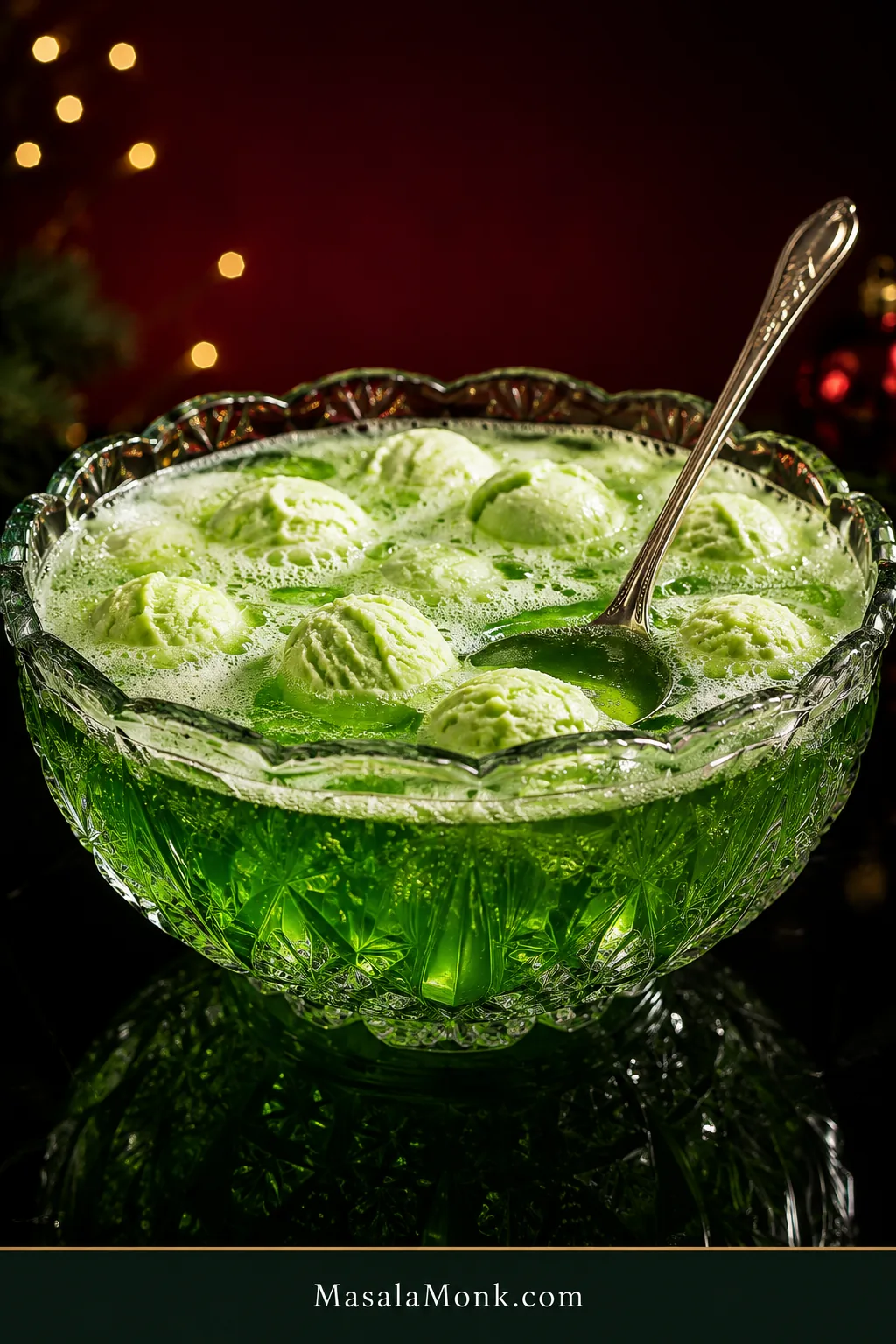
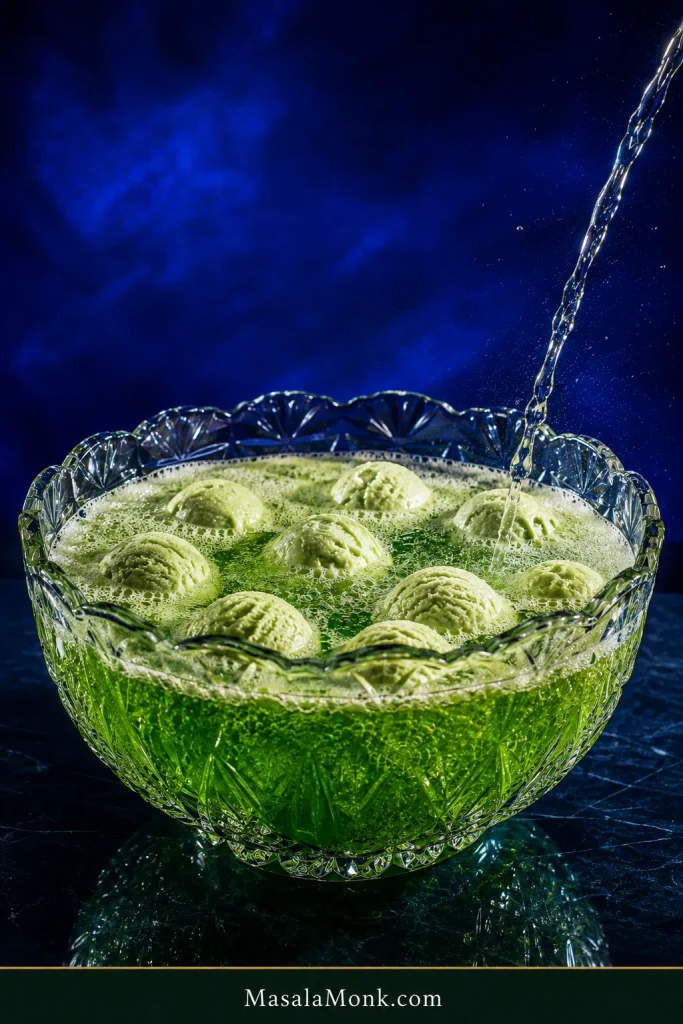
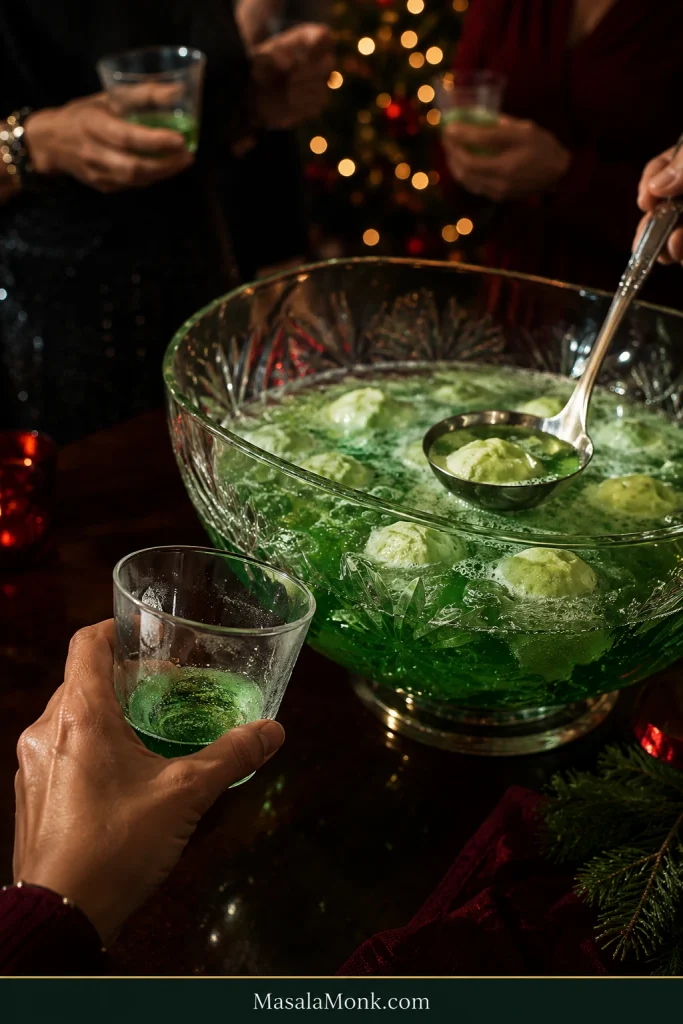
Set a bowl of bright green, frothy punch on a Christmas table and it rarely goes unnoticed for long. Lime sherbet floats across the top, bubbles gather around the scoops, and the kids are often lining up with cups before anyone has even asked what is in the bowl.
This non-alcoholic Grinch Punch is the family-friendly version: lime sherbet, green fruit punch, pineapple juice and lemon-lime soda. Four main ingredients, one punch bowl and about five minutes to put it together.
Combine 4 cups green fruit punch with 1 cup pineapple juice, add 1 quart lime sherbet, then slowly pour in 4 cups very cold Sprite or 7Up. Give the punch one or two gentle folds and serve while the soda is fizzy and the sherbet is floating on top.
Active prep: about 5 minutes
Alcohol: none
Best vessel: a roomy open punch bowl
Best timing: assemble shortly before serving
You may also see this same style of kid-friendly green Christmas drink called Grinch Juice.
Make this for: Christmas parties, Grinch movie nights, classroom celebrations, holiday buffets and family gatherings where one playful drink needs to work for both children and adults.
Grinch Punch Recipe
This recipe makes one standard party-bowl batch. Halve the quantities for movie night or repeat the standard batch when you need more.
Ingredients
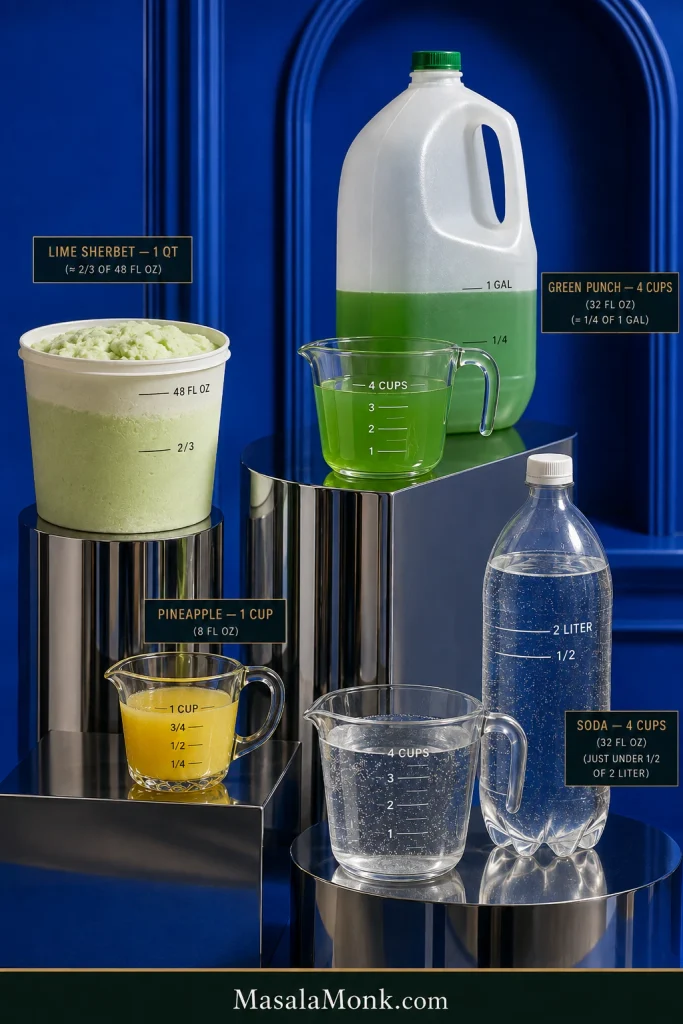
1 quart (32 fl oz / 946 mL) lime sherbet, cold and scoopable
4 cups (32 fl oz / 946 mL) green fruit punch, preferably Hawaiian Punch Green Berry Rush
1 cup (8 fl oz / 237 mL) 100% pineapple juice, chilled
4 cups (32 fl oz / 946 mL) Sprite or 7Up, very cold
Red sanding sugar, as needed, optional
Lime wedges or maraschino cherries, as needed, optional
Shopping shortcut:
Lime sherbet: 1 quart, or about two-thirds of a 48-fl-oz tub.
Green punch: 32 fl oz, or one-quarter of a gallon jug.
Soda: 32 fl oz, just under half of a 2-liter bottle.
One 48-fl-oz sherbet tub covers a standard batch, but two full batches need another 16 fl oz of lime sherbet.
You’ll need: a large punch bowl, ladle, ice cream scoop and long spoon.
Instructions
Chill the liquids. Keep the green punch, pineapple juice and soda refrigerated until needed. Leave the sherbet frozen until shortly before assembly.
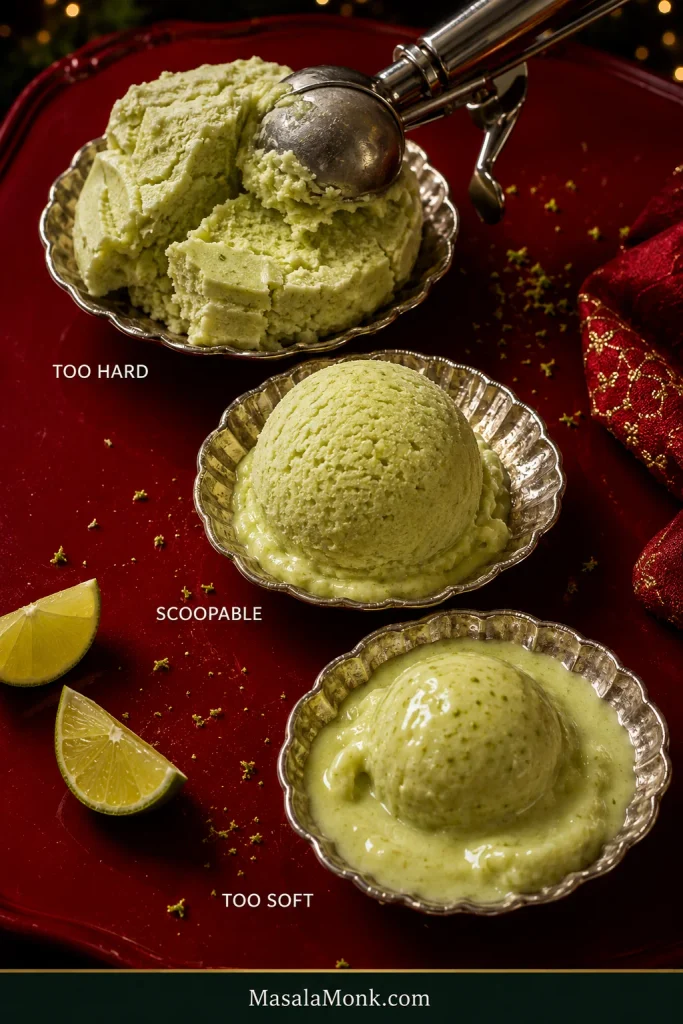
Get the sherbet scoopable. If it is rock-hard, leave it at room temperature for about 5 minutes—just long enough to scoop cleanly without becoming soft or slushy.
If the sherbet is still too hard after a few minutes, warm the scoop under hot water, dry it, then scoop.
Build the base. Pour the green fruit punch and pineapple juice into the punch bowl.
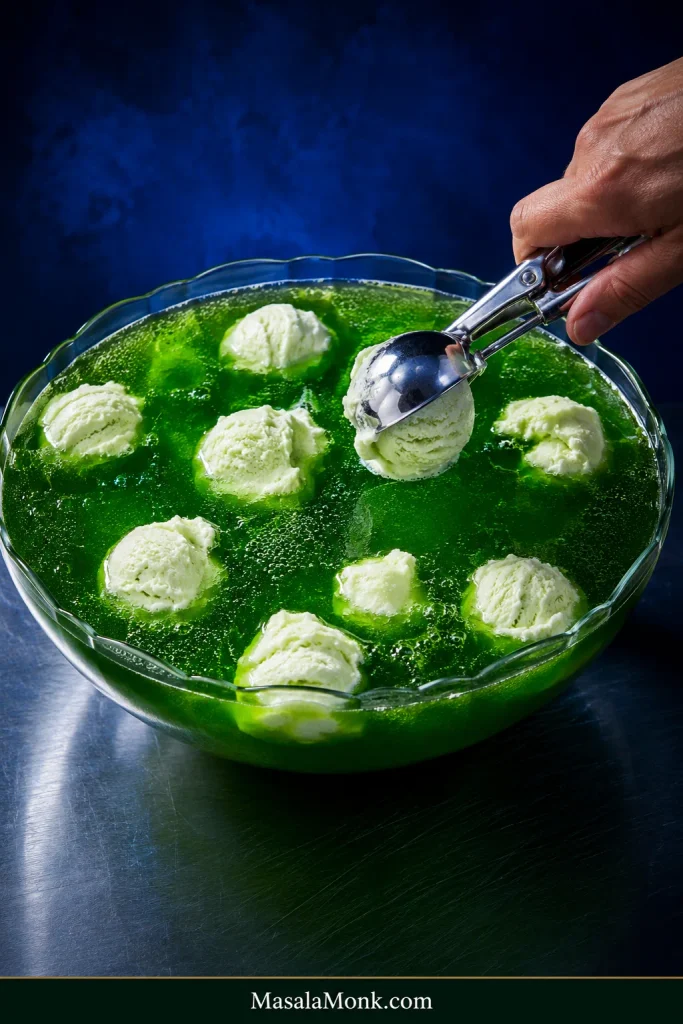
Add the sherbet. Scoop it across the surface rather than dropping one solid block into the middle.
Spread smaller sherbet scoops across the surface so they soften gradually instead of melting from one large block.
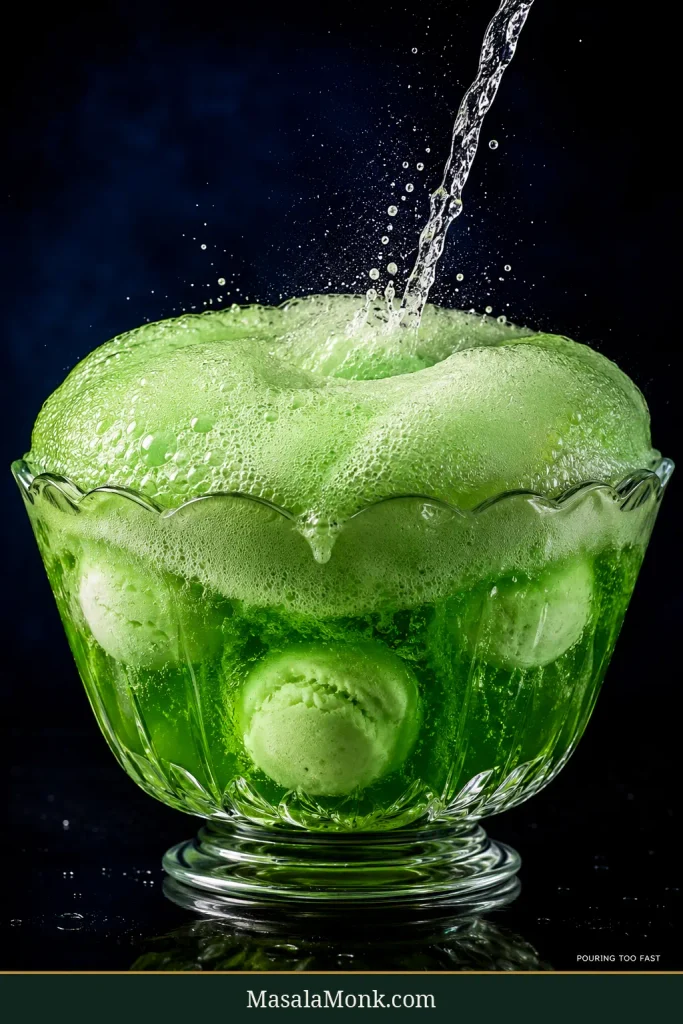
Add the fizz. Slowly pour the Sprite or 7Up around the bowl, letting some run over the sherbet for froth. If the foam climbs quickly, pause and let it settle before continuing.
Move the soda stream around the bowl; spreading the first burst of froth helps prevent one tall foam mound.
Finish gently. Give the punch one or two slow folds with a long spoon, then ladle it into cups and serve.
Check the Finished Punch
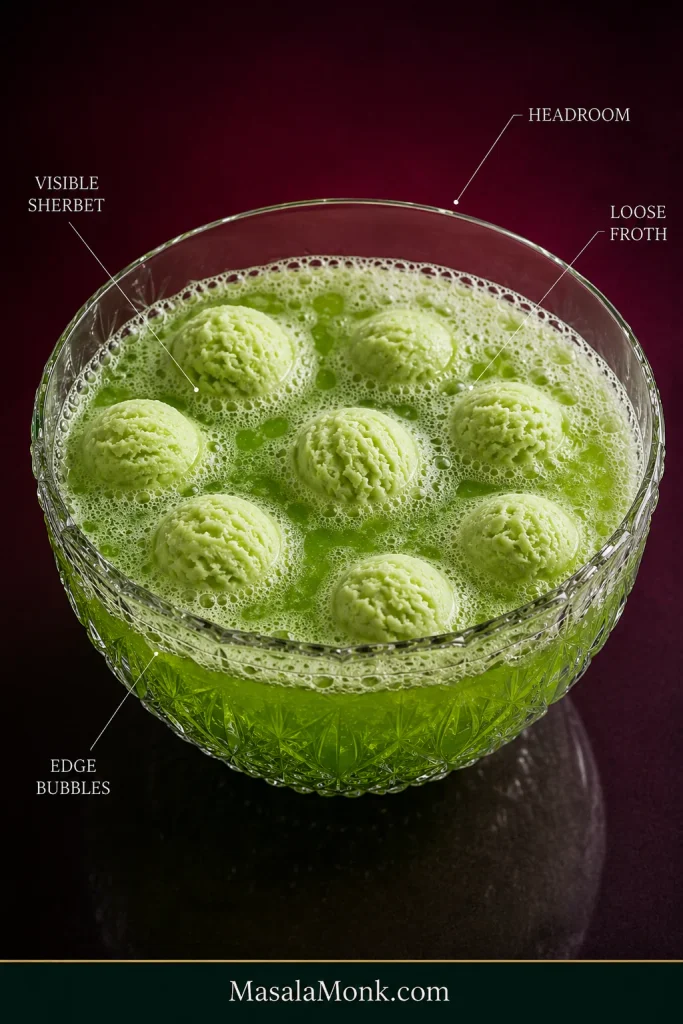
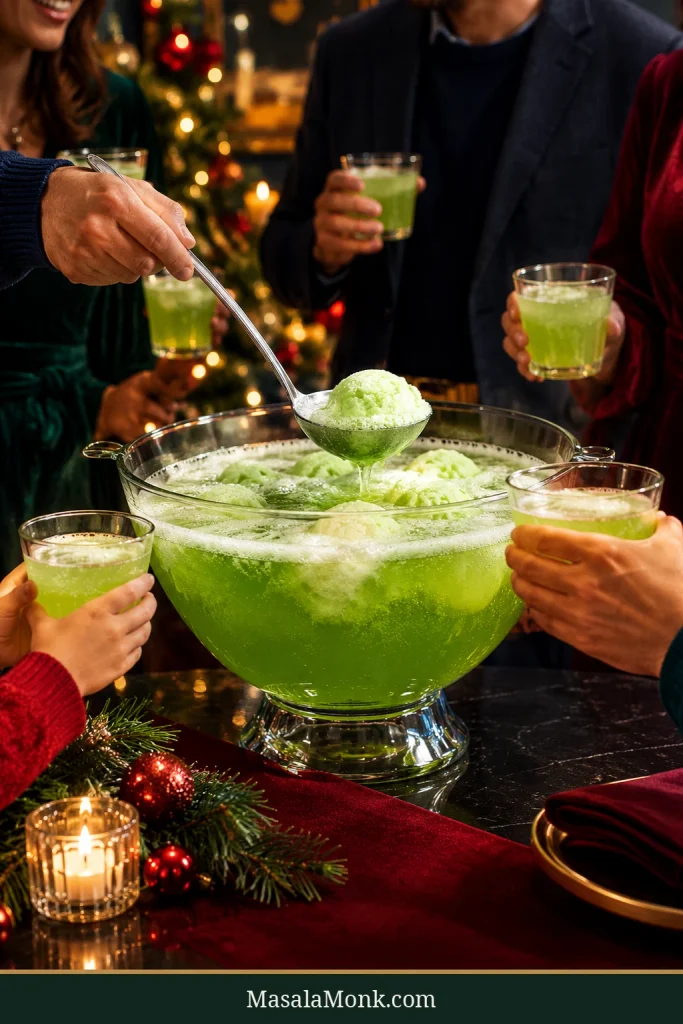
What should it look like? A bright green bowl with a loose frothy top, visible sherbet scoops and lively bubbles gathering around the edges.
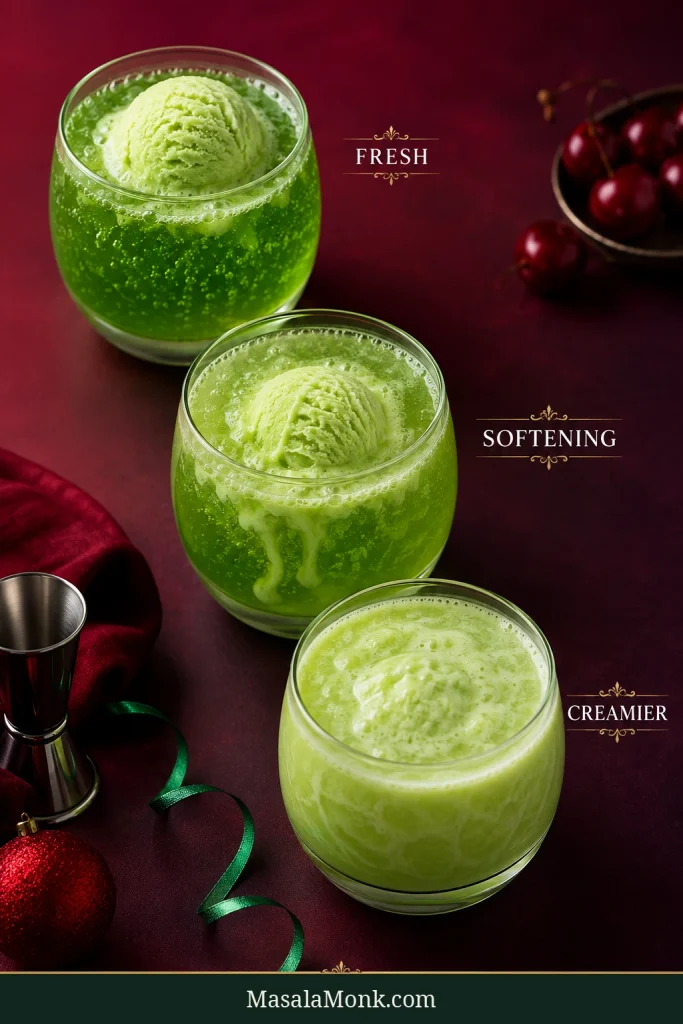
Serve while green punch, pale sherbet and loose froth still look distinct instead of blending into one creamy layer.
In the cup, the first sip is fizzy and citrusy. As the sherbet softens, the drink becomes creamier, while the pineapple rounds out the fruitiness without taking over.
Sherbet-heavy pours drink creamier, while mostly liquid servings stay lighter and fizzier—so cups naturally vary a little.
Optional Grinch Garnish
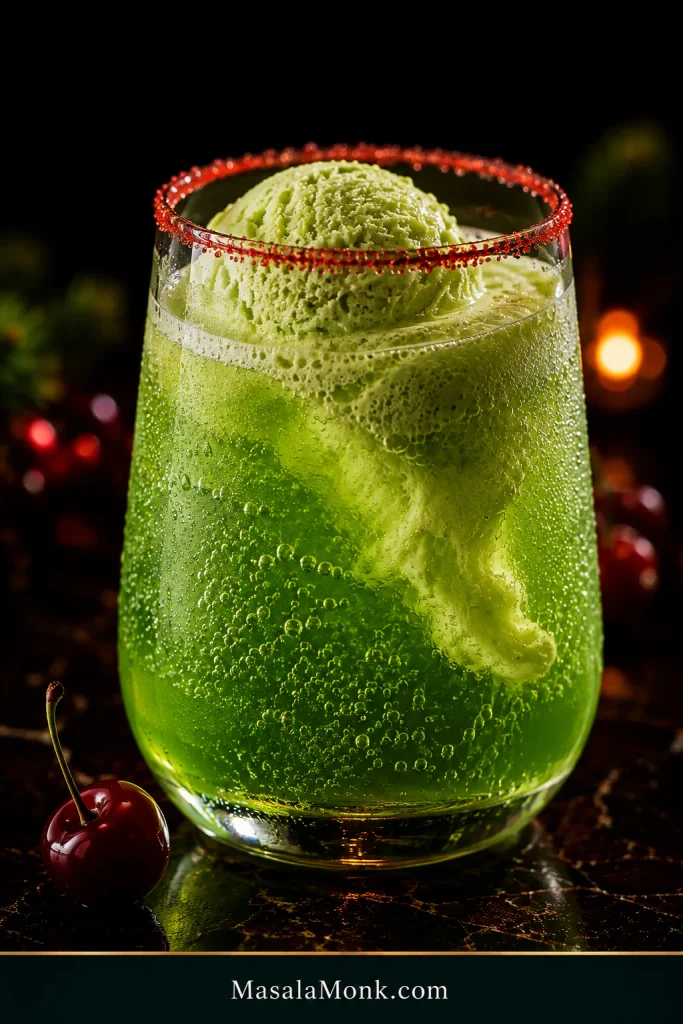
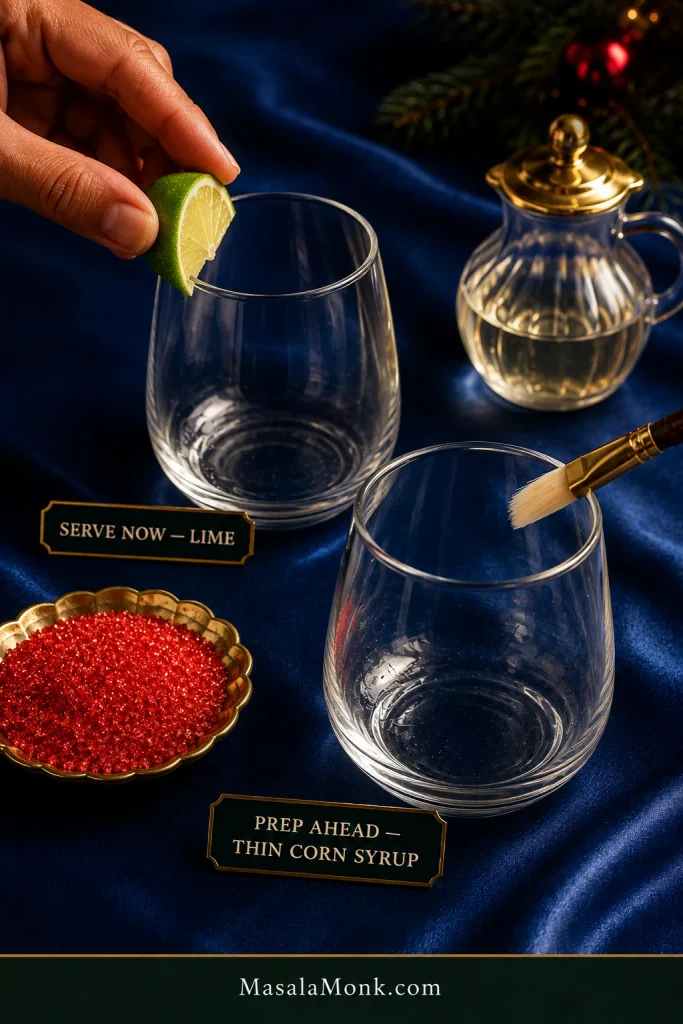
For cups you are serving right away, rub a lime wedge lightly around the rim and dip it into red sanding sugar. Preparing the cups a few hours ahead? A very thin coat of corn syrup holds the sugar more securely. Test one disposable cup first, because some plastic rims are stubborn.
Coat only the cup’s outer edge; red sanding sugar stays decorative instead of dissolving into the first sip.
A maraschino cherry adds a simple red accent if you want a touch of Grinch-heart contrast without turning every glass into a craft project.
Lime sherbet. This gives the punch its citrus flavor, creamy body and floating green scoops. Very soft sherbet disappears into the drink quickly; very hard sherbet is awkward to portion.
Sherbet contains some dairy, which is part of what makes it creamier than sorbet. If the freezer-case labels blur together, our guide to sherbet vs sorbet explains the difference. For school parties, check the sherbet label and your school’s allergy rules before serving.
Lime sherbet can be surprisingly hard to find around Christmas, so buy it when you see it rather than leaving it to the day of the party.
Green fruit punch. When recipes call for “green Hawaiian Punch,” Hawaiian Punch Green Berry Rush is the bright-green drink to look for. It supplies much of the color, fruit flavor and sweetness. Another green fruit punch works when Green Berry Rush is unavailable.
Sprite or 7Up. Lemon-lime soda brings the fizz. Use it straight from the refrigerator and open it close to serving so those bubbles end up in the bowl.
Pineapple juice. One cup adds fruitiness and some tartness without taking over the lime. Use ordinary 100% pineapple juice from a bottle or can, not frozen concentrate. If pineapple is a flavor you particularly enjoy, these punch recipes with pineapple juice explore it more fully.
For a three-ingredient version, replace the pineapple juice with another cup of green fruit punch. The result is sweeter and more straightforward.
Sherbet punch has an unmistakably old-school feel: a bright, bubbling bowl that somehow looks familiar before anyone has taken a sip. Turning it Grinch green simply gives that familiar party drink a Christmas twist.
Can’t Find Lime Sherbet or Green Berry Rush?
These are the two ingredients most likely to send you back around the supermarket. Both have workable substitutes.
If you can’t find…
Try…
What changes
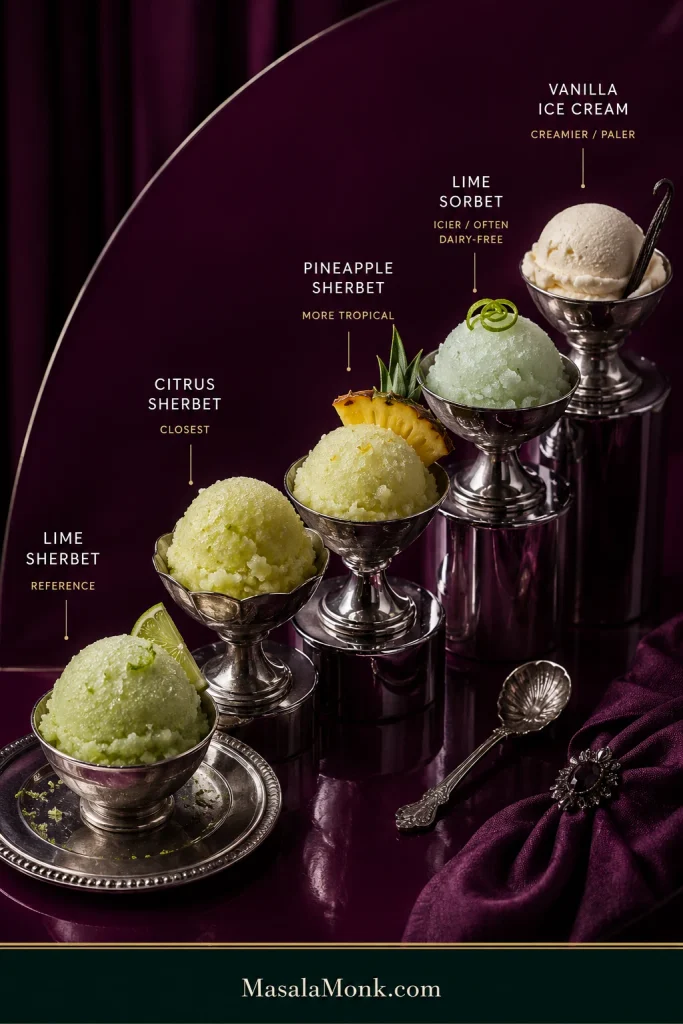
Lime sherbet
Another citrus sherbet
Closest overall style; color may change
Lime sherbet
Pineapple sherbet
More tropical but still bright and fruity
Lime sherbet
Lime sorbet
Usually dairy-free; icier, lighter and less creamy or frothy. Check the label if dairy must be avoided
Lime sherbet
Vanilla ice cream
Creamier and sweeter, with much less lime flavor and a paler top
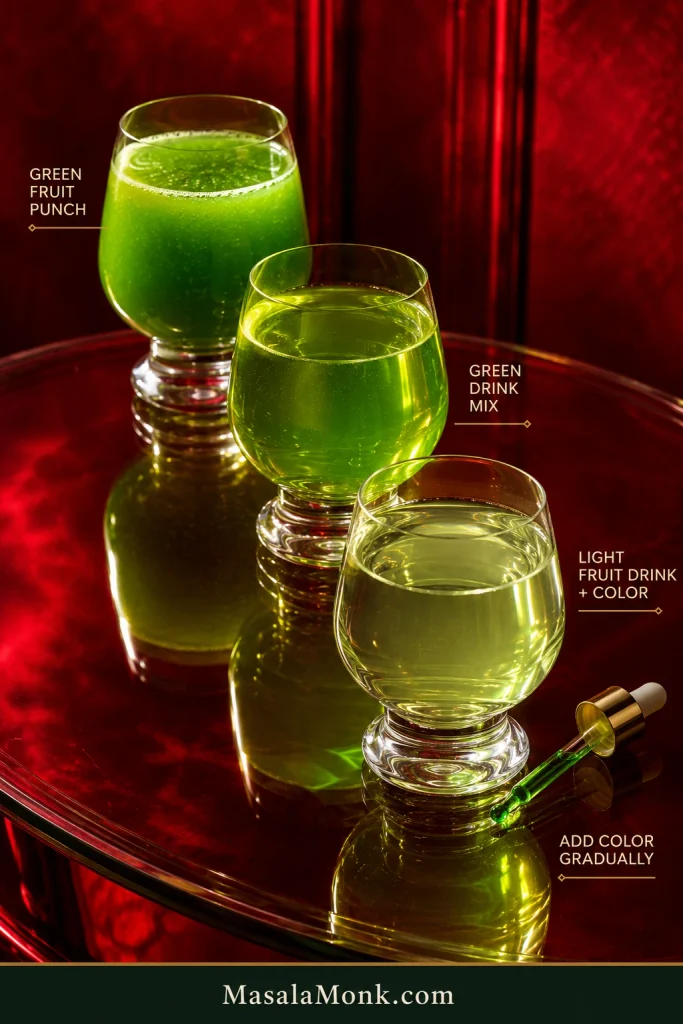
Green Berry Rush
Same amount of another green fruit punch
Usually the simplest swap; sweetness varies
Green Berry Rush
Prepared green lemon-lime Kool-Aid or a similar drink mix
More citrus-forward; mix it as directed for drinking before using
Any green drink
Light-colored fruit drink plus green food coloring
Gets you the color; taste before adjusting sweetness
Another sherbet keeps the familiar body; sorbet turns icier, while vanilla ice cream pushes Grinch Punch toward a float.
When you change the green punch, taste the cold fruit-punch and pineapple mixture before adding the sherbet and soda. Some replacements are much sweeter than others.
Start with one drop of green food coloring, stir, and add more only if the bowl needs it.
Compare green drink bases before adding sherbet; melting sherbet lightens the color and makes opacity differences harder to judge.
Want Grinch Punch with no sherbet at all? That works better as a different punch formula because removing the sherbet also removes much of the body, citrus flavor and volume. This easy Christmas Punch uses cranberry, pineapple, orange, ginger ale and sparkling water instead.
Sprite, 7Up or Ginger Ale?
Sprite or 7Up: the familiar sweet lemon-lime version used in the main recipe.
Ginger ale: still fizzy, with a gentle ginger note in the background.
Sparkling water: useful for dialing back the sweetness.
Zero-sugar lemon-lime soda: reduces the sugar coming from the soda, although the sweetener flavor will be different.
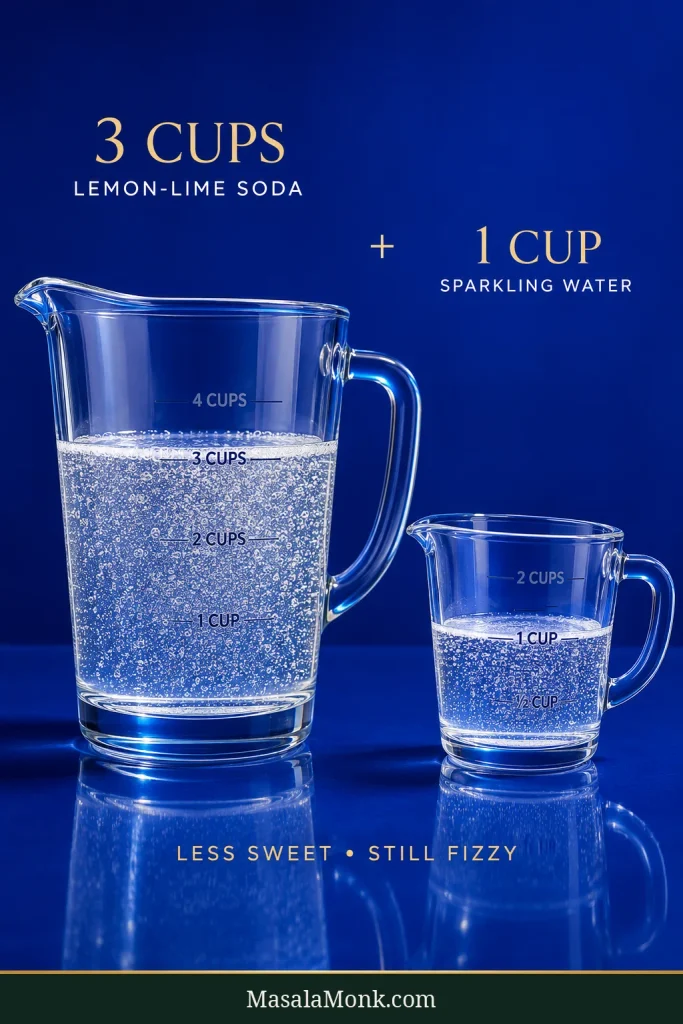
For a less-sweet bowl, use 3 cups Sprite or 7Up plus 1 cup plain sparkling water. You keep most of the fizz while bringing the sweetness down a notch.
Sparkling water reduces sweetness without changing the fruit-base or lime-sherbet ratio, so the punch keeps its balance.
Another kid-friendly fizzy option is a classic Shirley Temple, which uses grenadine and cherries with Sprite, 7Up or ginger ale.
How to Control the Foam
The froth is part of the fun. The foam climbing over the rim is not.
What separates a bubbly Grinch bowl from a green foam eruption mostly comes down to how the soda goes in. Start with well-chilled fruit punch and pineapple juice, add the sherbet, then pour the soda slowly around the bowl.
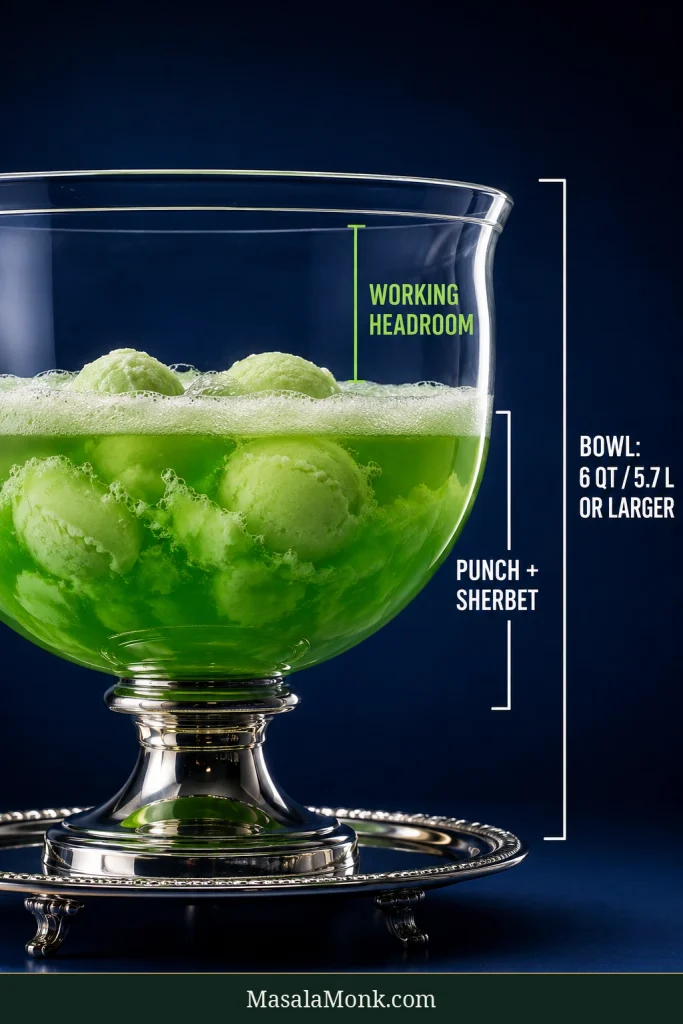
Foam steals headroom quickly, so a comfortably underfilled punch bowl can become crowded as soon as soda hits sherbet.
If the foam begins climbing too quickly, stop pouring and give it a moment to settle. There is no prize for emptying the whole bottle into the bowl in one go.
For more froth at the end, save a small splash of soda and pour it gently over a few sherbet scoops. A loose bubbly layer is plenty; the sherbet should still be visible underneath.
The scoops naturally soften as the punch sits and gradually make the drink creamier. That is normal. The distinct floating scoops are simply the freshest-looking stage.
As the sherbet softens, the punch becomes creamier and more even in color while the floating scoops gradually disappear.
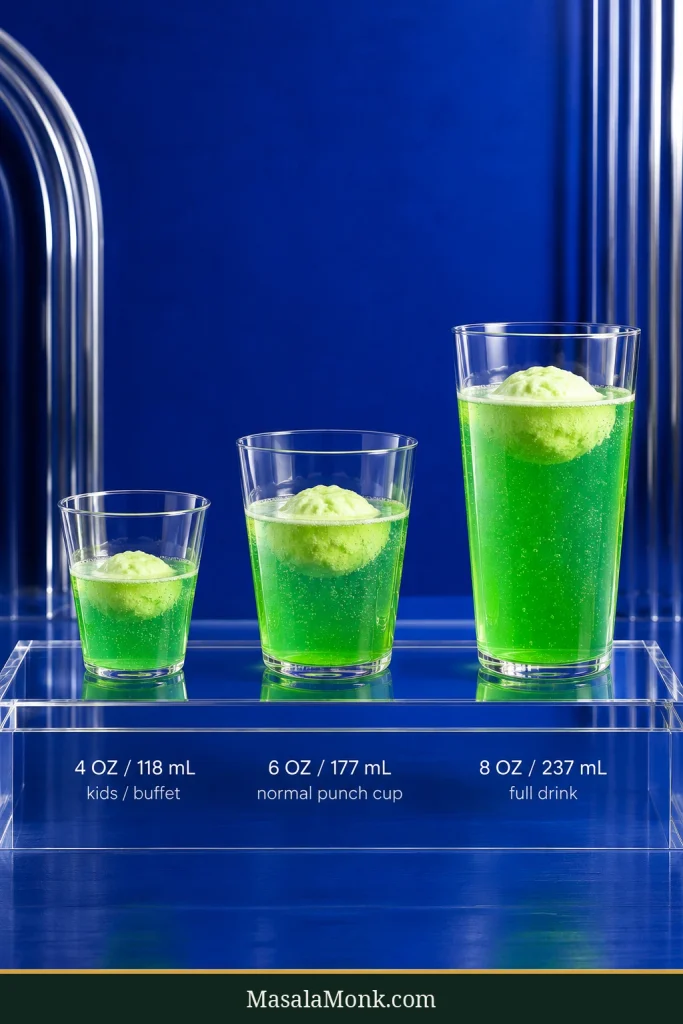
“Serves 12” does not tell you much when one person is picturing a small punch cup and another is filling an eight-ounce glass.
Sherbet contains air, so the amount you can ladle into cups varies by brand and by how much sherbet lands in each serving. Use these as party-planning ranges.
How Many Cups Will One Batch Pour?
Pour size
Best for
Planning range
4 oz / 118 mL
Kids’ party, classroom, large buffet
Roughly 22–26 small pours
6 oz / 177 mL
Normal punch cup
Roughly 15–17 pours
8 oz / 237 mL
Full drink
Roughly 11–13 pours
Moving from a 6-ounce to 8-ounce cup costs roughly four servings from a standard batch, so cup size matters.
Pours are not the same as guests. At a kids’ party, four-ounce first pours often make more sense. Anyone who wants more can come back, and you are less likely to collect half-full cups from every table afterward.
Planning for 20 people? One standard batch can cover one small first pour per guest. Keep ingredients ready for another batch when this is the main drink or you expect plenty of refills.
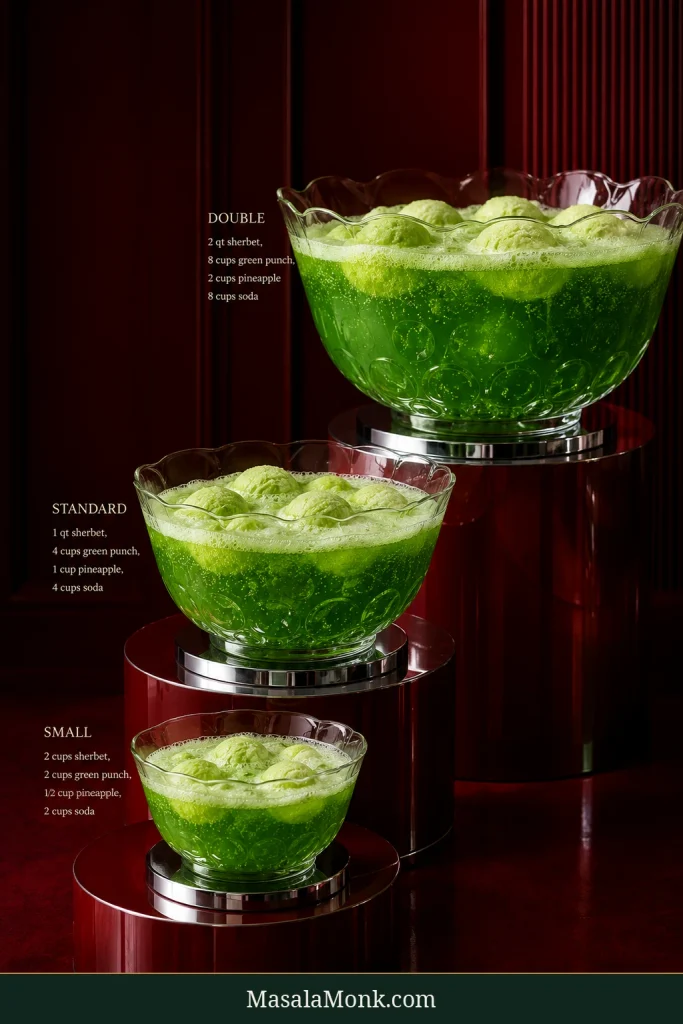
Small, Standard and Double Batches
Ingredient
Small Batch
Standard Batch
Double Batch
Lime sherbet (volume)
2 cups / 473 mL
1 qt / 946 mL
2 qt / 1.89 L
Green fruit punch
2 cups / 473 mL
4 cups / 946 mL
8 cups / 1.89 L
Pineapple juice
½ cup / 118 mL
1 cup / 237 mL
2 cups / 473 mL
Sprite or 7Up
2 cups / 473 mL
4 cups / 946 mL
8 cups / 1.89 L
Remember 4:4:1:4 by cups—sherbet, green punch, pineapple juice and soda—to keep scaled batches balanced.
The small batch is plenty for movie night or a few people when the punch is part of the fun rather than the whole event. At most home parties, two standard batches made at different times are easier to manage than one enormous double batch.
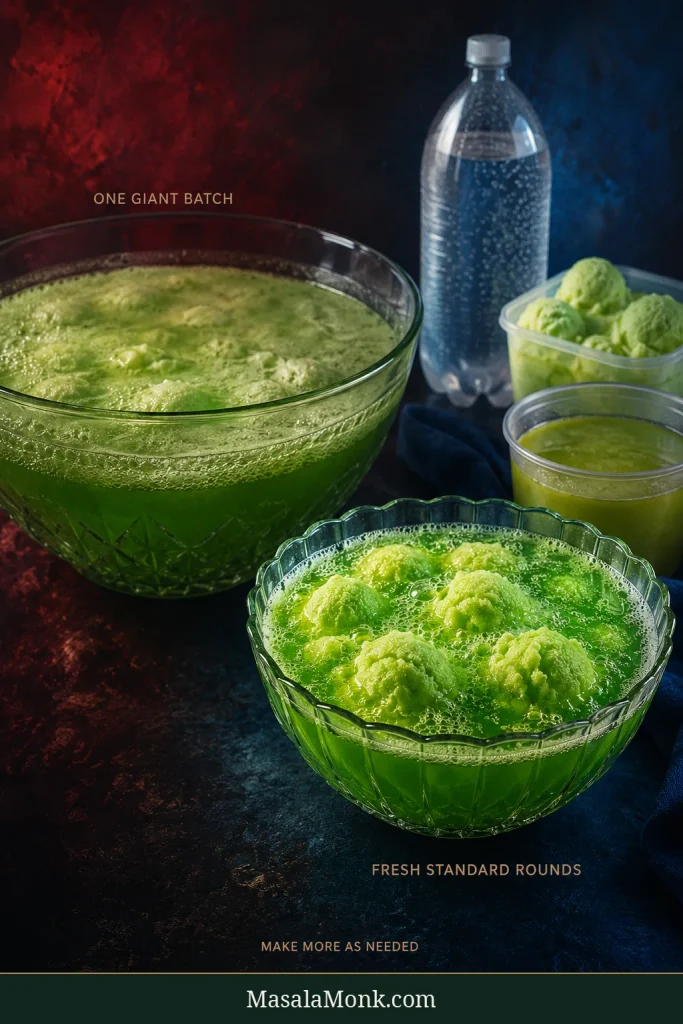
For a very large crowd, buy enough ingredients for several standard batches and make them in rounds. Later batches stay fizzier, and you avoid committing everything to one bowl at the start.
Keep extra soda cold and unopened until the next round so every fresh batch starts with maximum fizz.
What Size Punch Bowl?
A bowl around 6 quarts / 5.7 liters or larger gives the standard batch useful headroom. Sherbet floats above the liquid and soda can build a temporary layer of foam, so the empty space matters.
With a smaller bowl, make the half batch or serve the punch in two rounds.
A wide bowl adds surface area, making floating sherbet and rising foam easier to manage than in a narrow vessel.
Keep It Cold and Fizzy
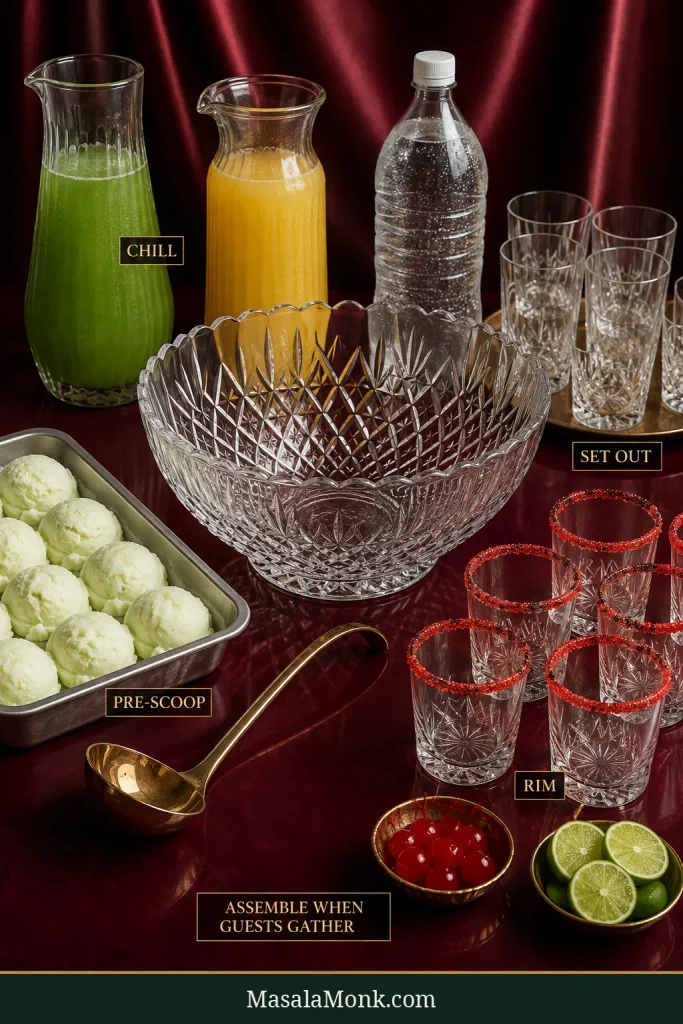
You can do nearly everything before the doorbell starts ringing. The only jobs worth saving for the end are putting the bowl together and opening the soda.
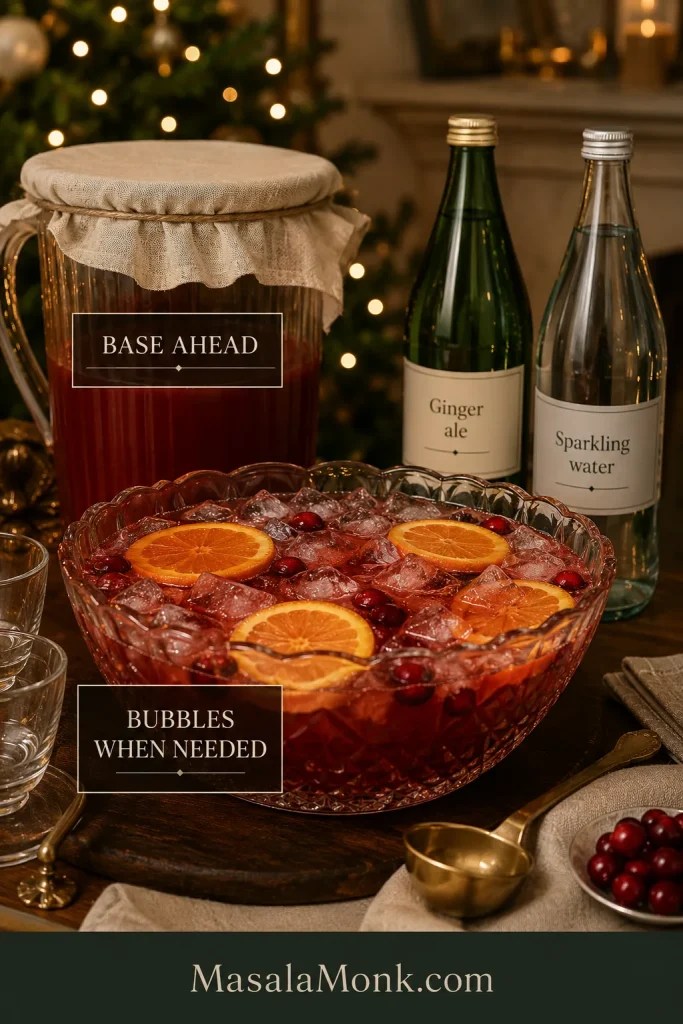
Prepare ahead, assemble late.
What to Prep Ahead
Earlier in the day, refrigerate the green punch, pineapple juice and soda, prepare the garnishes or sugar-rimmed cups, and put the bowl, ladle and glasses where you can find them. For a crowd, you can also pre-scoop the sherbet onto a lined tray or into a chilled muffin pan and return it to the freezer.
Leave space between pre-scooped portions; separate lime-sherbet scoops refreeze cleanly instead of joining into one awkward slab.
Once that is done, you are not wrestling with a frozen tub or hunting for the ladle while guests are walking through the door.
When to Assemble a Fresh Round
Put the punch together when people are beginning to gather around the drinks. That is a better cue than the clock—and certainly better than assembling it when you start setting up the buffet an hour earlier.
For a longer party, put out only part of the punch at first. Keep the remaining fruit base refrigerated, the sherbet frozen and the extra soda cold and unopened. When the first bowl runs low, make another. The bubbles are fresher, and there is usually less punch left sitting around at the end of the party.
Keep It Cold and Easy to Serve
Properly chilled ingredients usually make loose ice unnecessary, and melting ice dilutes the drink. For longer service, set the punch bowl inside a larger bowl or tray of ice. You can also freeze some green fruit punch into cubes if you want ice inside the bowl without adding plain water.
Because sherbet contains dairy, do not leave the finished punch at room temperature for more than 2 hours, or more than 1 hour when the temperature is above 90°F / 32°C. The USDA food-safety guidance has more detail.
A punch bowl is the easiest vessel because the sherbet and froth have room to float. For a small batch, a wide pitcher works. With a spigot dispenser, run only the chilled fruit base through the dispenser; add sherbet and soda to the cups or serving bowl so pieces do not interfere with the spout.
At a mixed-age party, keep the shared bowl alcohol-free so everyone can reach for the same festive drink. A fully alcoholic Grinch Punch is better treated as its own recipe instead of adding spirits to the family batch.
Fix a Problem
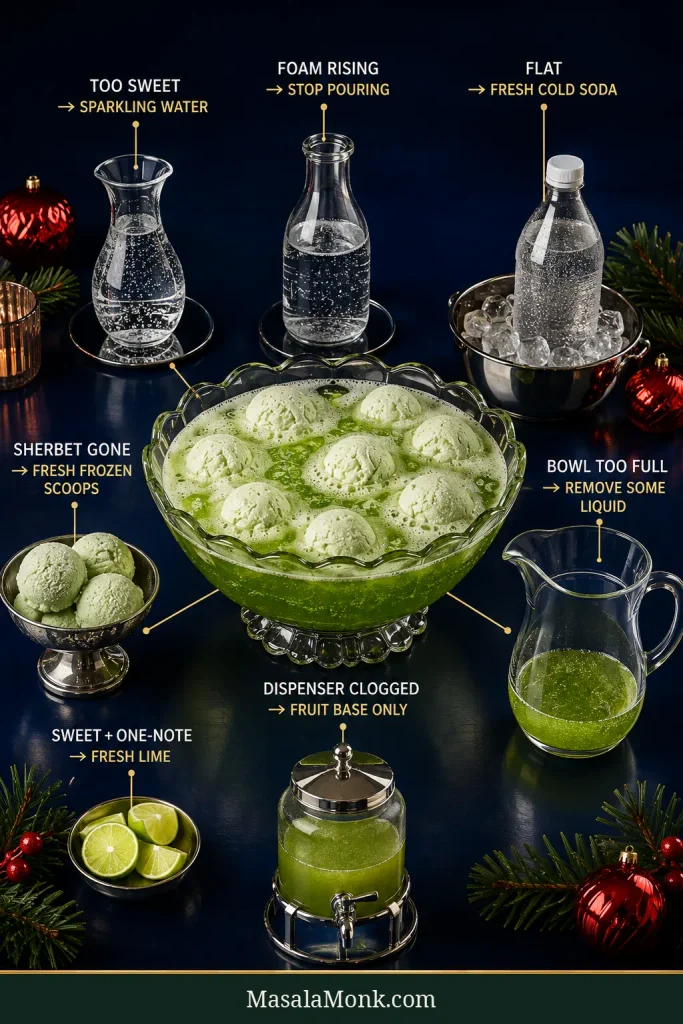
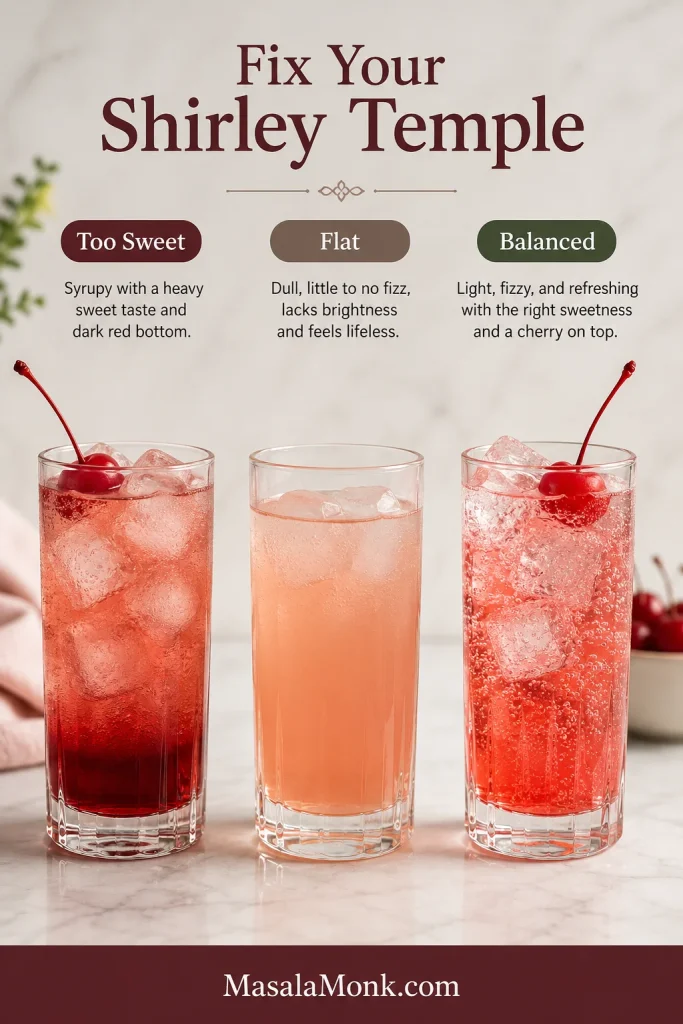
Sherbet punch is forgiving, but it can still become too sweet, too foamy, too flat or simply too large for the bowl you grabbed. Most problems can be fixed without dumping the bowl and starting over.
Problem
Fix Now
Next Time
Too sweet
Add cold sparkling water
Use 3 cups soda plus 1 cup sparkling water
Foam is overflowing
Stop pouring and let the foam settle
Chill the liquids well, pour the soda more slowly and leave more bowl headroom
Hardly any froth
Pour a small final splash of soda over a few scoops
Let some soda run directly over the sherbet during assembly
Punch went flat
Refresh it with newly opened cold soda
Open the soda close to serving and stir gently
Sherbet disappeared quickly
Add a few fresh frozen scoops if you have them
Keep the sherbet frozen until shortly before assembly
Punch is separating
Give the bowl one slow sweep with the ladle
Avoid vigorous stirring that knocks out carbonation
Bowl is too full
Remove some liquid before adding the rest of the soda
Use a larger bowl or serve two rounds
Dispenser is clogging
Move the punch to an open bowl if possible
Run only the fruit base through a dispenser
Tastes sweet and one-note
Add a small squeeze of fresh lime
Use the lighter soda mix or taste the fruit base before finishing the bowl
Change one variable at a time—sweetness, fizz, sherbet or volume—so a quick rescue does not create another problem.
Leftovers
Grinch Punch does not store especially well once assembled.
Refrigerate leftovers promptly if you want to keep them. By the next day, the bubbles are gone and the frothy top has disappeared, so expect a creamy fruit drink rather than freshly made punch.
The Final Ladle
Grinch Punch does not need a complicated ingredient list to make a Christmas table feel more fun. A vivid green bowl, a few lime-sherbet scoops and that first rush of bubbles already do most of the work—especially once someone comes back carrying an empty cup and asks for another.
That is the charm of this punch: it looks like a celebration without becoming another hosting job. It gives the table color, gives the kids something to get excited about, and still leaves the person who made it free to enjoy the party.
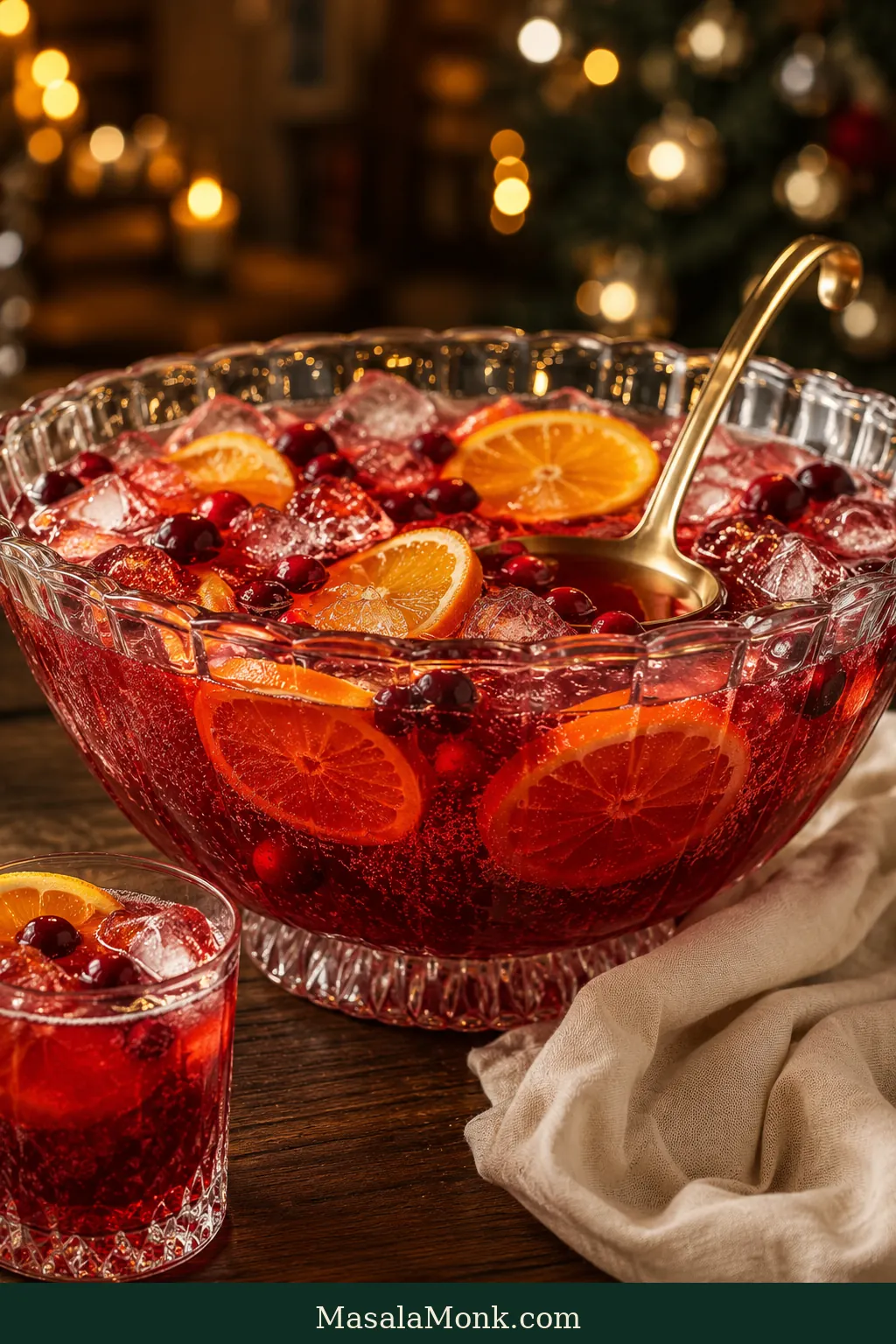
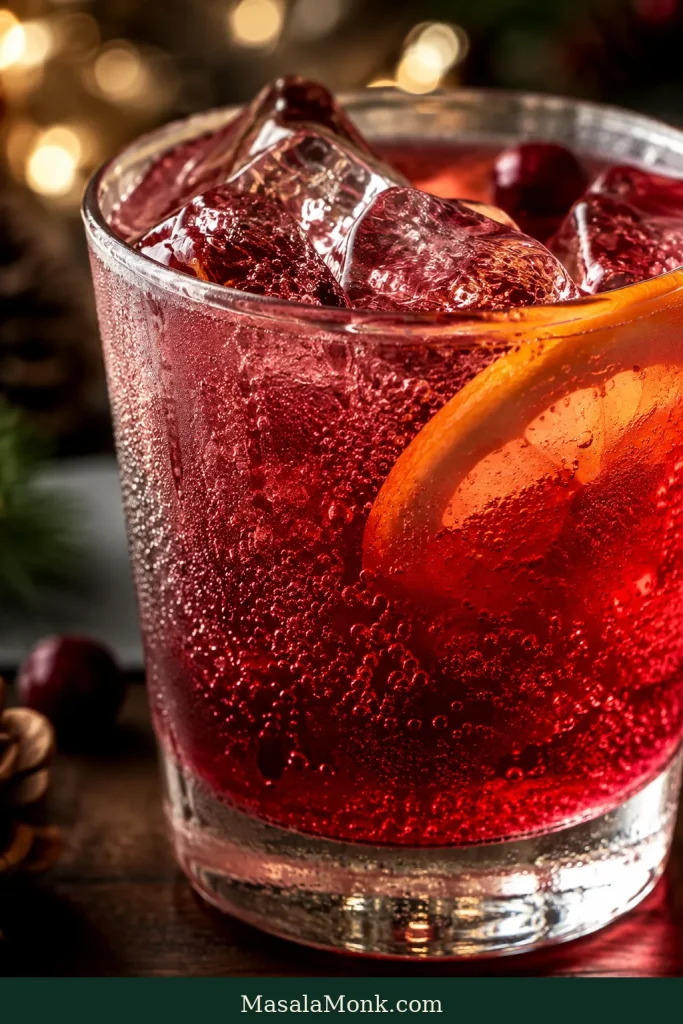
Cold bubbles climbing around orange slices and ruby-red cranberries. Tart enough to cut through a rich Christmas dinner, fruity enough that people come back carrying an empty glass. That is the kind of Christmas punch worth putting in the middle of the table.
The trouble is that Christmas punch can go wrong surprisingly easily. Too sweet and the first glass feels like dessert. Too flat and it tastes like mixed fruit juice. Add alcohol carelessly and a drink that tastes gentle can become much stronger than anyone expected.
The idea here is simple: the recipe starts as a non-alcoholic Christmas punch, with ginger ale plus sparkling water so not all the fizz comes from sweet soda. Vodka or rum can be added where you want them, while brut Prosecco or Champagne can replace the ginger ale for a drier version.
Everyone gets the festive glass. Once the bowl is on the table, the host should be able to leave it there and get on with Christmas.
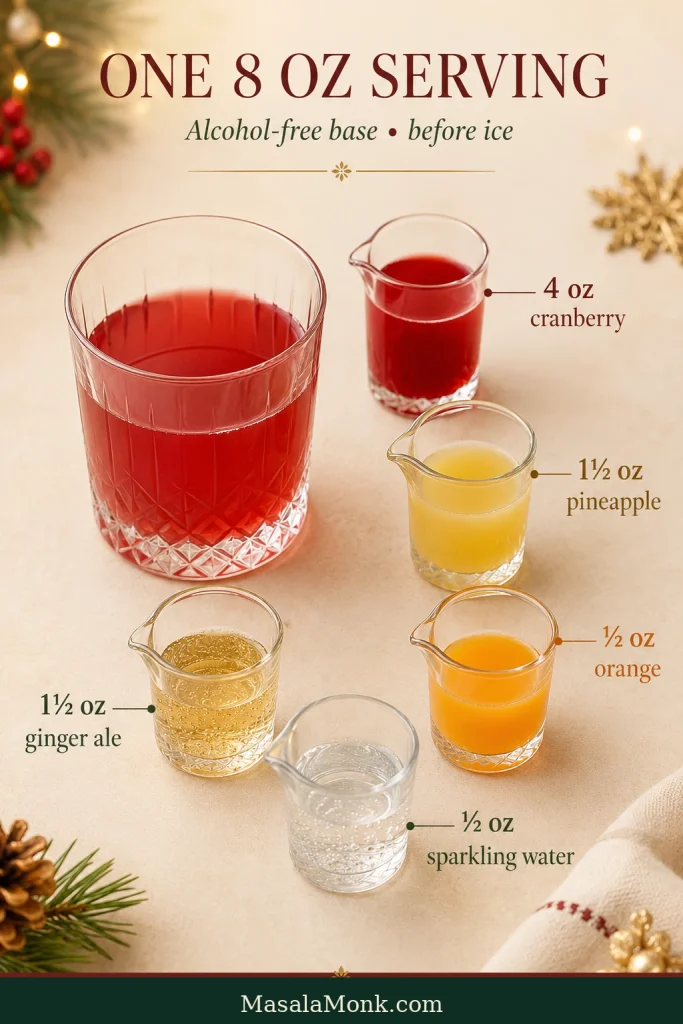
This easy Christmas punch combines cranberry, pineapple and orange juice with ginger ale and sparkling water. It takes about five minutes to mix once everything is cold, makes about 1 US gallon / 128 US fl oz / 3.8 L, and can be served alcohol-free or spiked by the glass with vodka or rum.
The rule worth remembering is shorter than the ingredient list:
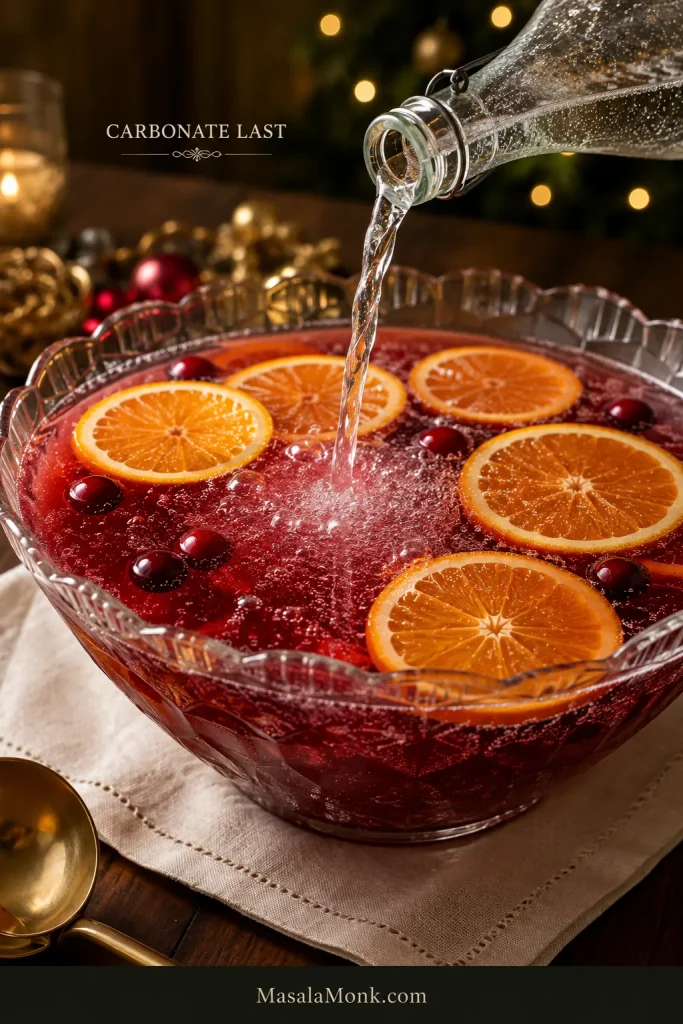
Chill first. Balance before bubbles. Carbonate last.
Choose Your Version
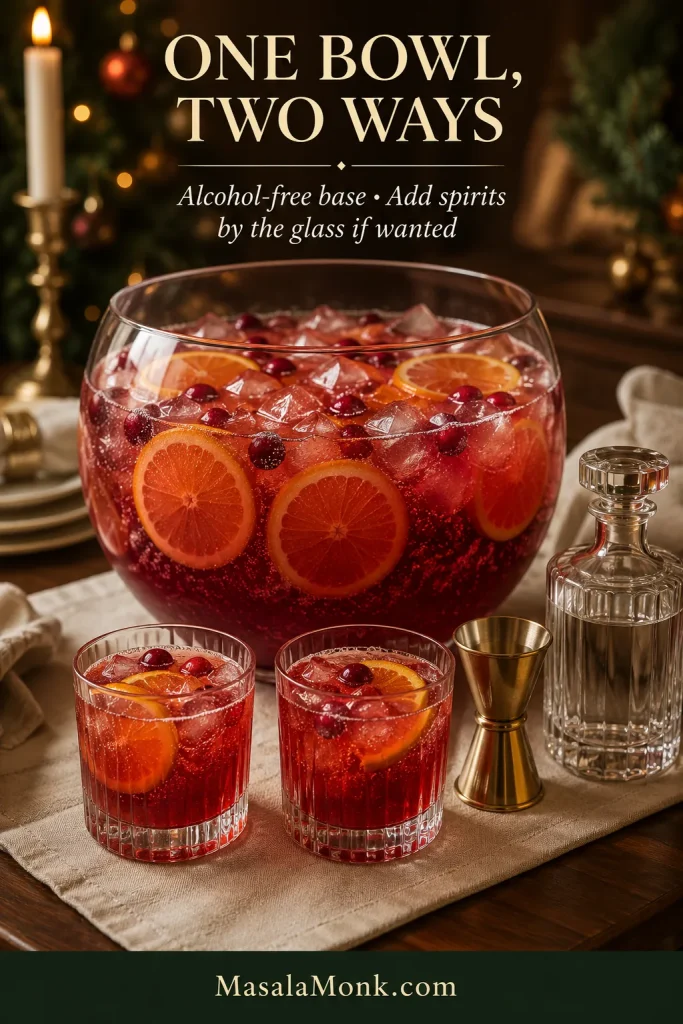
Mixed family gathering? Keep the bowl alcohol-free so children and adults can share the same festive punch. Adults who want vodka or rum can add it to their own glasses.
Adults only? Add a measured amount of vodka, light rum or gold rum to the whole bowl. The whole-bowl amounts below let you choose the strength without relying on guesswork.
Want a drier sparkling-wine version? Replace the ginger ale with brut Prosecco or Champagne.
Making your first batch? Keep the bowl alcohol-free and spike individual glasses. It gives you the most control without committing the whole gallon to one choice.
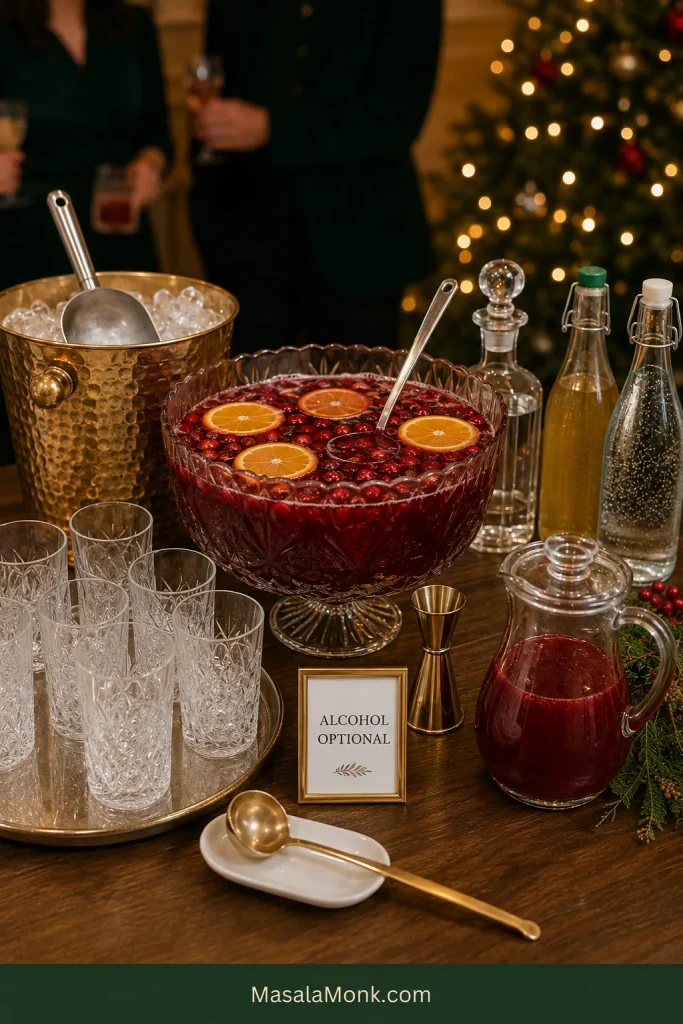
Keep the main bowl alcohol-free for mixed gatherings; place a spirit and jigger beside it for adults who want to spike their own glass.
Christmas Punch Recipe
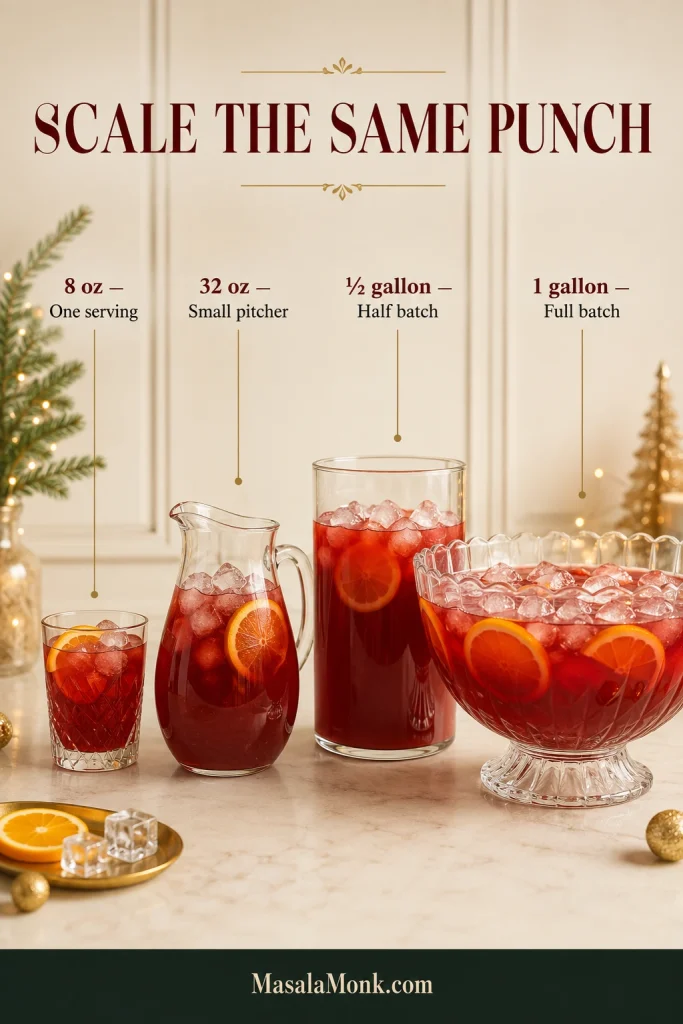
The full batch makes about one gallon before optional lemon or alcohol. The scaling section below includes ready-made amounts for a single glass, pitcher and half batch.
Recipe at a Glance
Prep
About 5 minutes
Yield
About 1 US gallon / 128 US fl oz / 3.8 L
Small party pours
About 21 × 6 fl oz / 180 ml
Generous servings
About 16 × 8 fl oz / 240 ml
Best bowl size
6 qt / 5.7 L for most full batches
Flavor
Cranberry-forward, lightly sweet and sparkling
Alcohol
Optional
Serving sizes: 6 fl oz / 180 ml is a small party pour; 8 fl oz / 240 ml is a generous serving. The 12 fl oz / 355 ml figure used later is a shopping allowance per guest, including refills—not one glass.
Ingredients
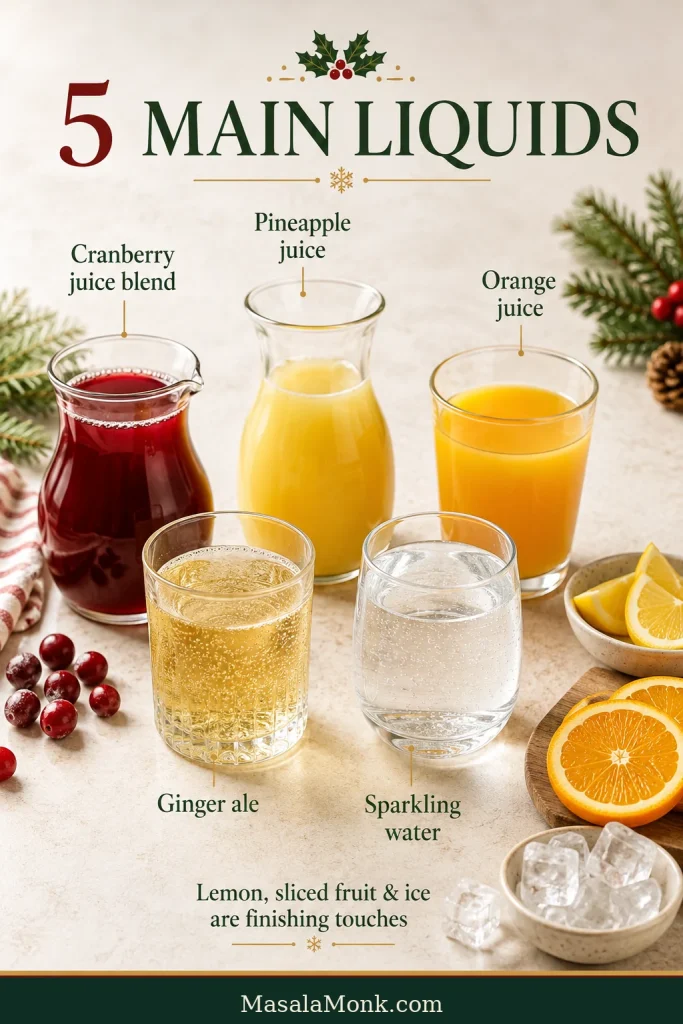
The punch itself uses five main liquids. Optional lemon juice, sliced fruit and ice are finishing touches.
Three juices build the flavor; ginger ale and sparkling water supply the lift. Chill all five before mixing.
8 cups / 64 fl oz / 1.9 L 100% cranberry juice blend, well chilled — not pure unsweetened cranberry juice
3 cups / 24 fl oz / 710 ml 100% pineapple juice, well chilled
1 cup / 8 fl oz / 240 ml 100% pulp-free orange juice, well chilled
3 cups / 24 fl oz / 710 ml ginger ale, very cold
1 cup / 8 fl oz / 240 ml plain sparkling water, very cold; club soda also works
Fresh lemon juice: 1–2 tbsp / 15–30 ml, only if the juice mixture needs more brightness after tasting
Orange: 1, thinly sliced
Up to 1 cup fresh or frozen cranberries, optional garnish
Large punch ice, an ice ring or ice for individual glasses, as needed
If you bought pure cranberry juice or cranberry juice cocktail instead, don’t swap it cup-for-cup. The cranberry guide below shows where to start.
How to Make Christmas Punch
Once everything is cold, the actual mixing takes about five minutes.
Chill everything first. Start with refrigerator-cold juices and mixers so the ice is not doing all the chilling.
Mix the juices. Pour the cranberry, pineapple and orange juice into the bowl and stir gently.
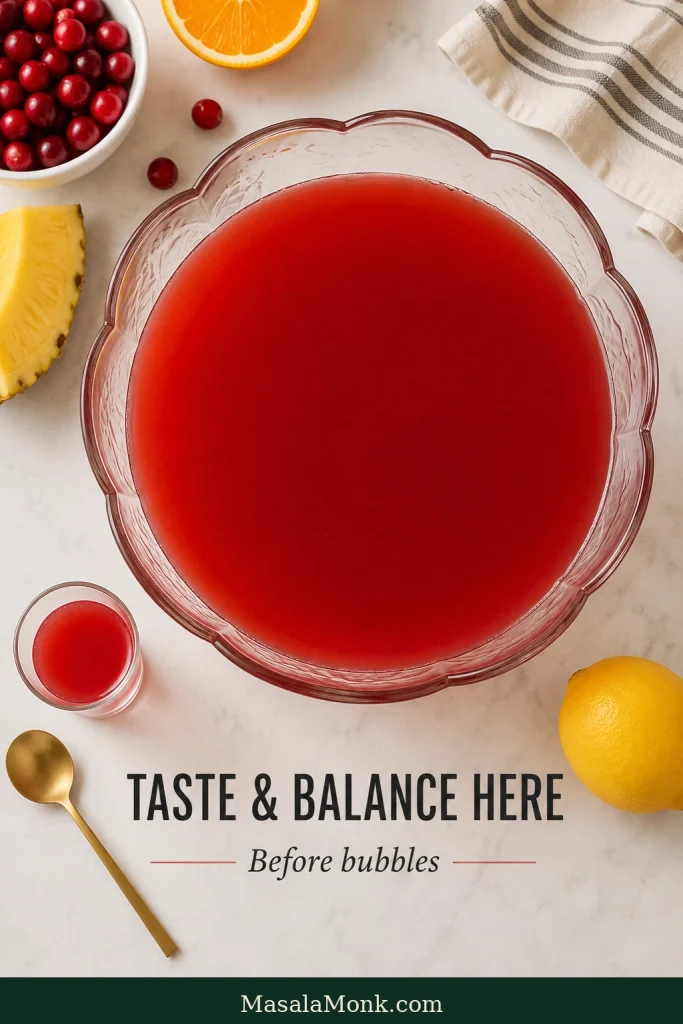
Taste before the bubbles. Look for cranberry up front with enough fruit sweetness behind it that the mixture does not feel aggressively tart. If it feels heavy or sweeter than you want, try 1 tablespoon / 15 ml lemon juice. If it is unusually sharp, check the cranberry label first.
For a single serving with ice or alcohol, use a 10–12 fl oz / 300–355 ml glass. For the small batch, choose a pitcher larger than 1 L. Don’t fill it to its advertised capacity when fruit or ice is going inside.
An 8-ounce serving is the cheapest place to test a new cranberry juice, mixer or substitution before a party.
Use the Ratio for Odd-Sized Batches
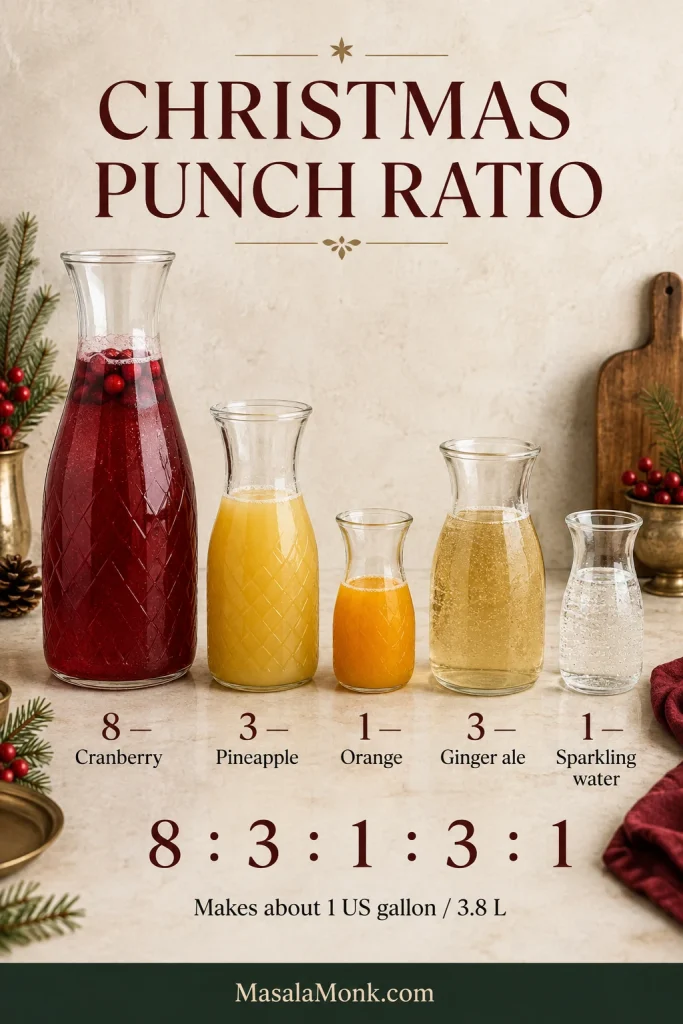
If your pitcher or dispenser does not match one of the sizes above, use 8 parts cranberry : 3 pineapple : 1 orange : 3 ginger ale : 1 sparkling water. Keep the same measure for every part.
For odd-sized vessels, 8:3:1:3:1 works with any consistent measure—ounces, milliliters, cups or a small jug.
Jump to What You Need
For a small gathering, everything you need is already above. The rest is here when you need help with cranberry labels, ingredient swaps, alcohol, crowd quantities, serving, ice or troubleshooting.
Cranberry leads. It gives the punch its tart backbone, deep red color and unmistakable holiday character. Because it makes up half the alcohol-free drink, choosing the right cranberry product matters far more than adding another handful of decorative fruit.
Pineapple brings body and fruit sweetness into the middle of the drink. Three cups are enough to soften cranberry without pulling everything too far into tropical-punch territory.
A smaller amount of orange connects cranberry’s tart edge with pineapple’s sweetness without taking over the color or flavor.
Ginger ale brings fizz, sweetness and a gentle ginger note. Sparkling water adds more bubbles without another full measure of sweet soda.
Together, those ingredients are meant to keep cranberry in front, soften its tartness with pineapple and citrus, and leave enough fizz that the punch feels refreshing rather than syrupy. Once the main ingredients are doing their jobs, adding more things rarely makes it better.
The target is cranberry-forward, bright and fizzy—not simply sweet.
Cranberry Juice: Read the Label Before You Pour
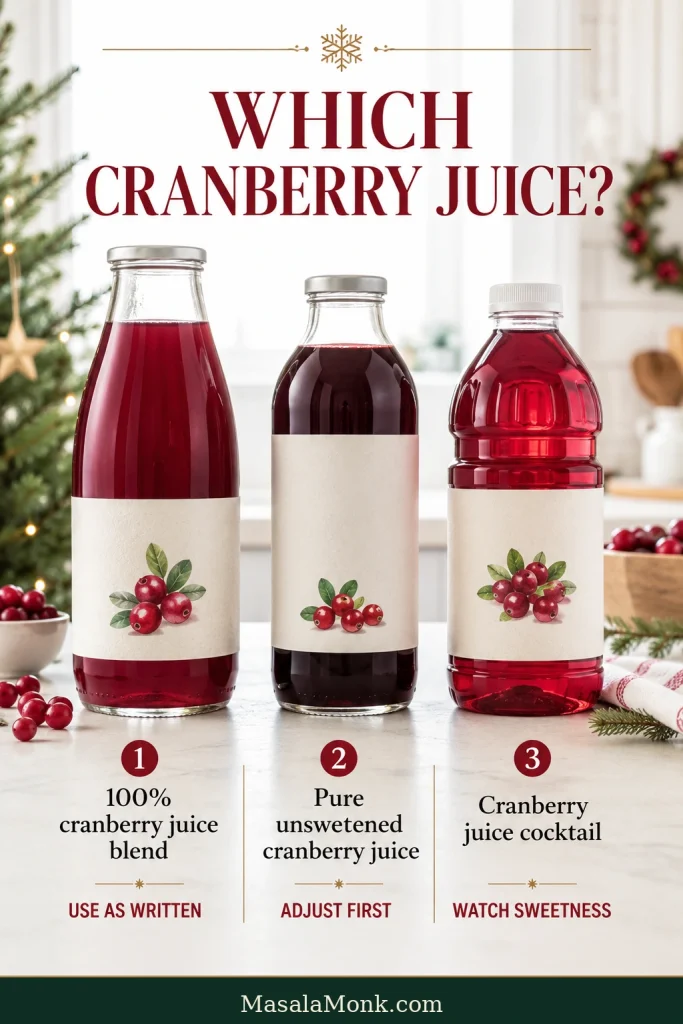
For the recipe as written, use 100% cranberry juice blend—not pure unsweetened cranberry juice and not automatically cranberry juice cocktail.
“Cranberry juice” sounds like one ingredient. At punch-bowl scale, the label can change the entire drink.
If the label says 100% juice but lists apple, grape or pear too, you are likely looking at a cranberry juice blend.
What you bought
What to do
100% cranberry juice blend Cranberry blended with naturally sweeter apple, grape or pear juice
Use 8 cups / 1.9 L as written. This is the intended version.
Pure unsweetened cranberry juice
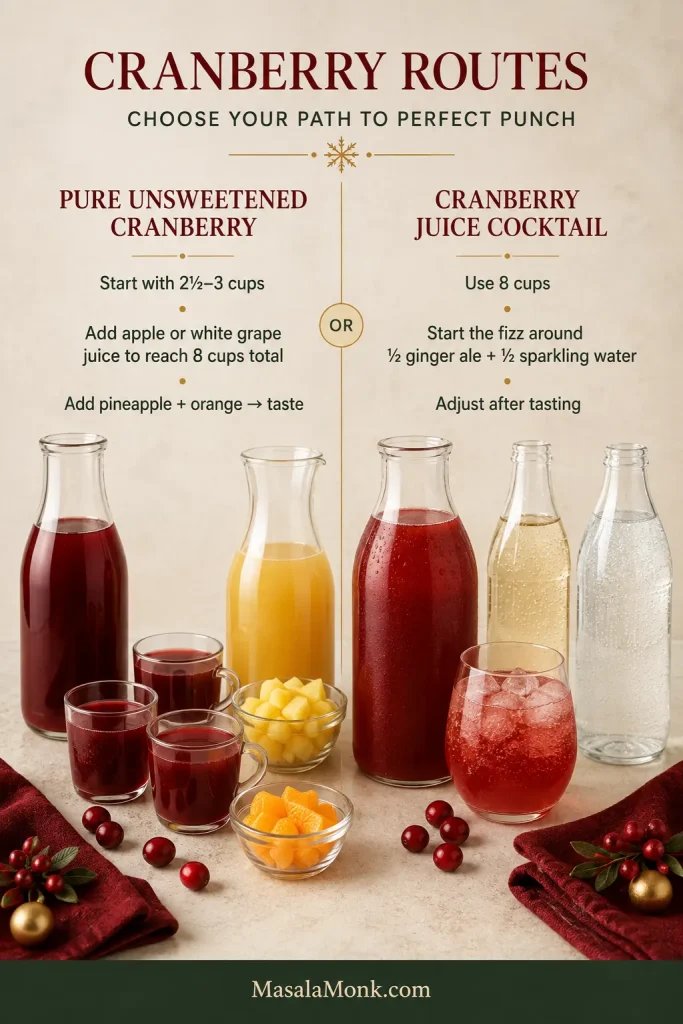
Do not use it cup-for-cup. For the 8-cup cranberry portion, begin cautiously with about 2½–3 cups pure cranberry and enough apple or white grape juice to bring the total to 8 cups. Mix in the pineapple and orange, then taste.
Cranberry juice cocktail
Use 8 cups / 1.9 L, but begin the fizzy portion with roughly equal parts ginger ale and sparkling water. Add more ginger ale only if the punch needs more sweetness.
If You Bought Pure Cranberry or Cranberry Cocktail
Start there, then taste. The difference between brands is large enough that one fixed number will not suit every bottle.
If the pure-cranberry version is still too sharp after the pineapple and orange are in, add a little more apple or white grape juice. If it only needs a small sweetness correction, cold simple syrup gives you finer control; add it 1 tablespoon / 15 ml at a time.
Cranberry cocktail can create the opposite problem. When the juice mixture is already sweet enough, plain sparkling water is more useful than another sweet mixer.
Fix the 8-cup cranberry portion first; once it tastes balanced, let pineapple, orange and fizz return to their normal jobs.
Before the Bubbles
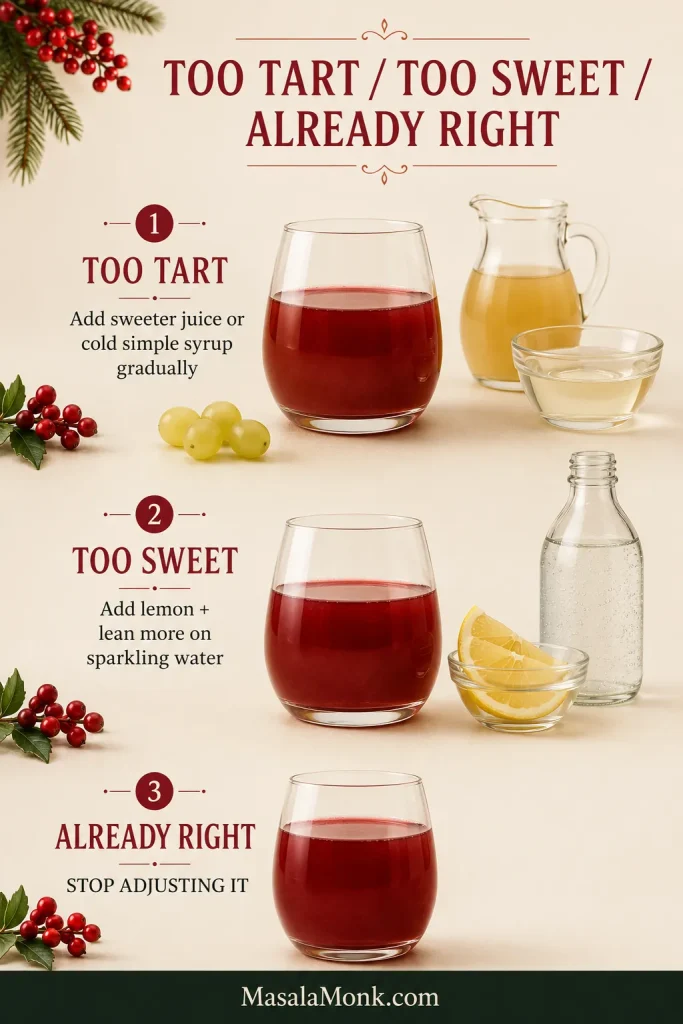
Too tart? Add a sweeter complementary juice or cold simple syrup in small measured amounts.
Too sweet? Add fresh lemon a tablespoon at a time and lean more heavily on sparkling water when you finish the bowl.
Already good? Stop adjusting it.
Make one correction, taste again, then decide whether the punch needs anything else.
Keep dry granulated sugar out of an already fizzy bowl. If the finished punch genuinely needs sweetness, cold simple syrup dissolves more easily and is much less likely to produce a sudden cap of foam.
Once the juice tastes right, you can stop thinking about cranberry labels. From there, the variations are mostly about the kind of punch you want.
Ingredient Swaps: What Changes
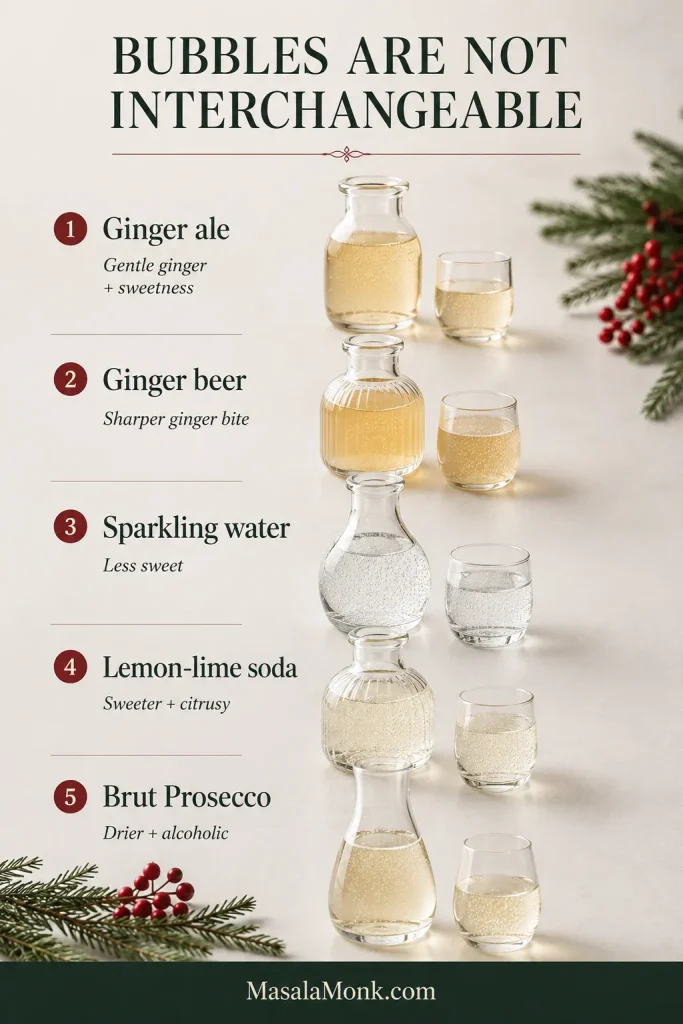
Ginger beer, Sprite, sparkling water and Prosecco all add bubbles, but they do very different things to the punch.
Use sparkling water to pull sweetness back, ginger ale for sweetness plus lift, and ginger beer for a sharper ginger edge.
Change
What happens
Replace some ginger ale with ginger beer
More ginger bite and a sharper finish
Use Sprite or 7Up instead of ginger ale
Sweeter and more lemon-lime forward, without the ginger character
Replace some ginger ale with sparkling water
Less sweetness while keeping the punch fizzy
Replace part of the cranberry with pomegranate
Deeper fruit flavor and a more red-purple color
Replace some pineapple with orange or apple juice
Less pineapple body and a different kind of fruit sweetness
If the stronger ginger version is what appeals to you, a Cranberry Moscow Mule takes cranberry, lime, vodka and ginger beer into an individual cocktail rather than a punch-bowl variation.
Make It Alcoholic: Vodka, Rum or Sparkling Wine?
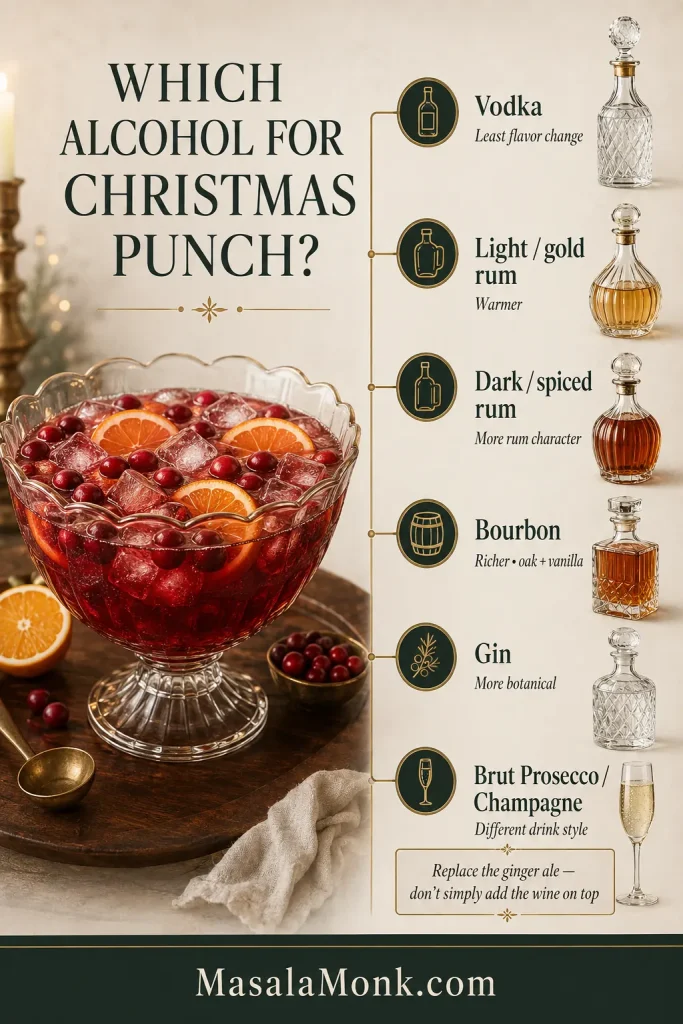
If the alcohol-free glass already tastes good, you can stop there. What matters is how much you want the alcohol to change the punch. Vodka stays mostly out of the fruit’s way; rum becomes more noticeable; sparkling wine changes the style of the drink altogether.
Test a spirit in one measured glass before committing it to the whole bowl.
Alcohol
What changes
Vodka
Clean and neutral; the fruit remains in front
Light or gold rum
Rounder and warmer without a heavy molasses flavor
Dark or spiced rum
More obvious rum, vanilla and spice; easier to overpower the fruit
Brut Prosecco or Champagne
Drier, lighter and more sparkling
Bourbon
Oak, vanilla and a richer cranberry-orange profile
Gin
Sharper and botanical; changes the character much more noticeably than vodka
Vodka is the easiest choice when you want the punch to keep tasting primarily of fruit. Light or gold rum adds more warmth, while coconut rum only makes sense when coconut is genuinely part of the flavor you want.
If cranberry and vodka are your favorite part of the punch, a classic Cosmopolitan takes that combination into a sharper lime-and-orange cocktail.
Spike Individual Glasses
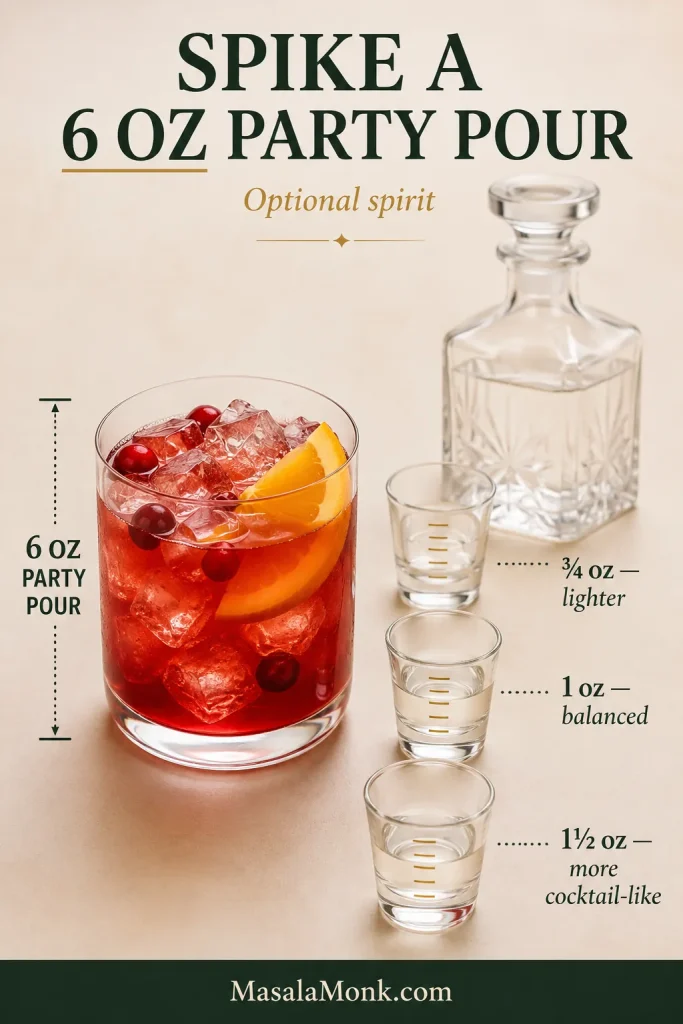
For a 6 fl oz / 180 ml pour, start with 1 fl oz / 30 ml spirit. From there, move lighter or stronger depending on the glass you want.
Lighter: ¾ fl oz / 22 ml
Balanced: 1 fl oz / 30 ml
More cocktail-like: 1½ fl oz / 45 ml
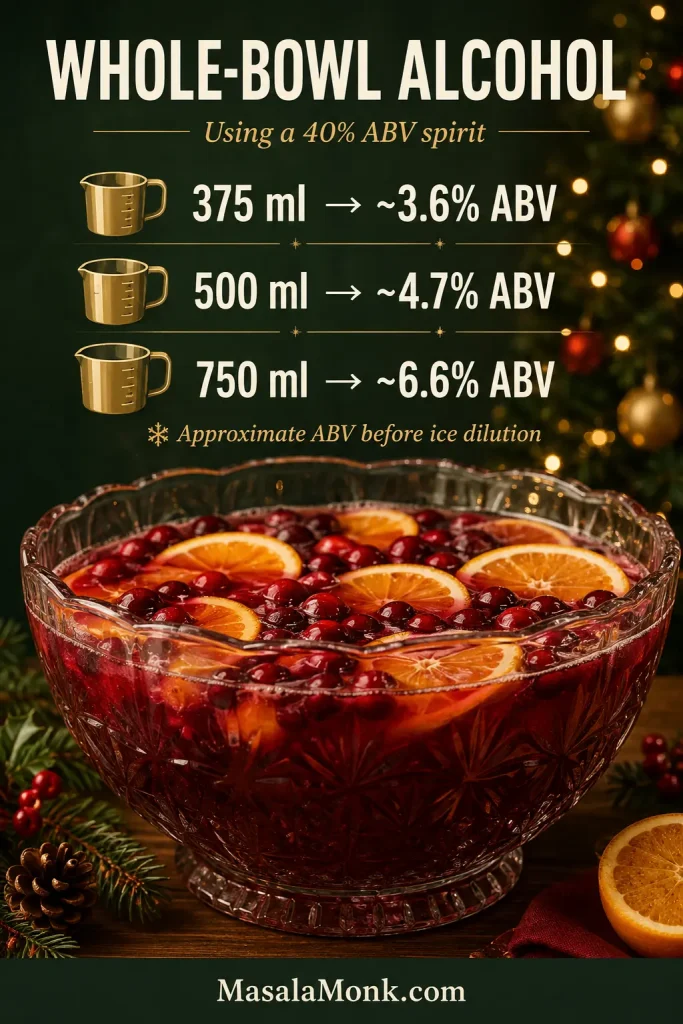
With a typical 40% ABV spirit, the 1-fl-oz version is roughly 5.7% ABV before ice dilution; the 1½-fl-oz version is around 8%. Use a 10–12 fl oz glass so there is room for the spirit and ice.
Measure punch and spirit separately. A jigger keeps one party pour from quietly becoming a different drink.
Spike the Whole Bowl
40% spirit added to one full batch
Approx. ABV*
375 ml
About 3.6%
500 ml
About 4.7%
750 ml
About 6.6%
*Calculated before ice dilution.
Serving several alcoholic batches? Record the first measured spirit amount and repeat it instead of matching later bowls by taste.
Cold fruit and carbonation can make alcohol seem gentler than it is. Measure how much went into the bowl instead of judging strength only by taste. The NIAAA guide to standard drinks is useful for comparing those pours with familiar servings of spirits and wine.
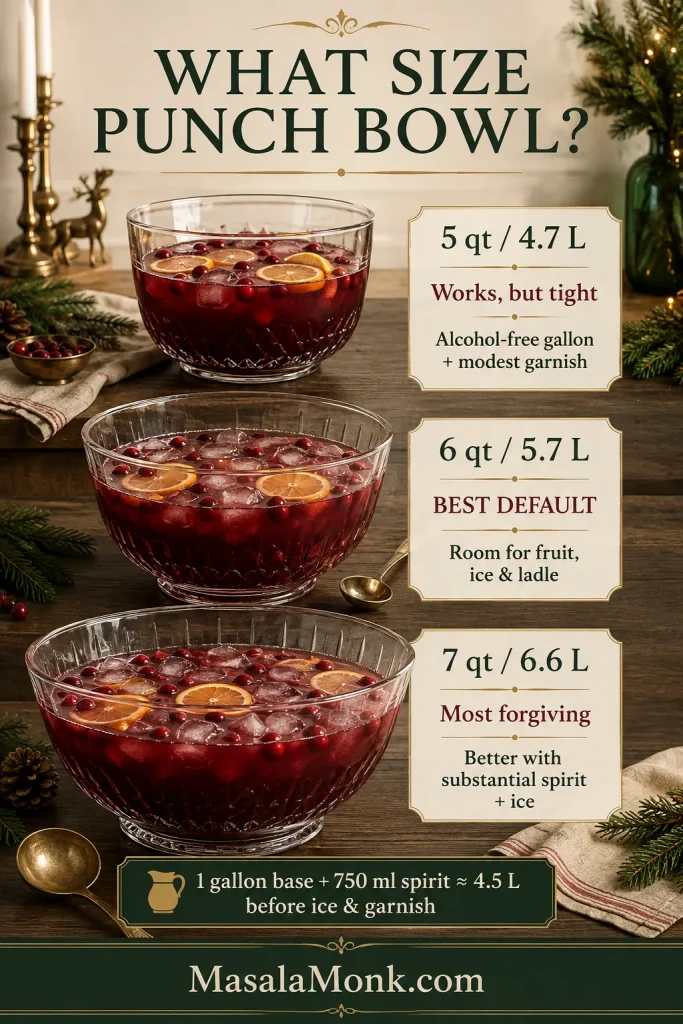
Adding the full 750 ml of spirit brings the total liquid to roughly 4.5 L before ice and garnish. Do not use a 5-quart bowl for that version; the bowl-size guide below shows the practical headroom for larger batches.
Prosecco or Champagne Version
Replace the 3 cups / 710 ml ginger ale with one chilled 750 ml bottle of brut Prosecco or Champagne. Keep the sparkling water. With a typical 12% sparkling wine, the finished bowl is roughly 2.4% ABV before ice dilution.
For a stronger sparkling version, about 375 ml vodka brings the bowl into roughly the mid-5% ABV range, depending on the bottles used.
If sparkling wine is really the main event, the Mimosa guide includes a cranberry version for individual Christmas-brunch glasses.
Christmas Punch for a Crowd: How Much Per Person?
For a party, recipe yield and shopping quantity are not quite the same thing. Nobody is thinking about the yield printed on the recipe once people start coming back for refills.
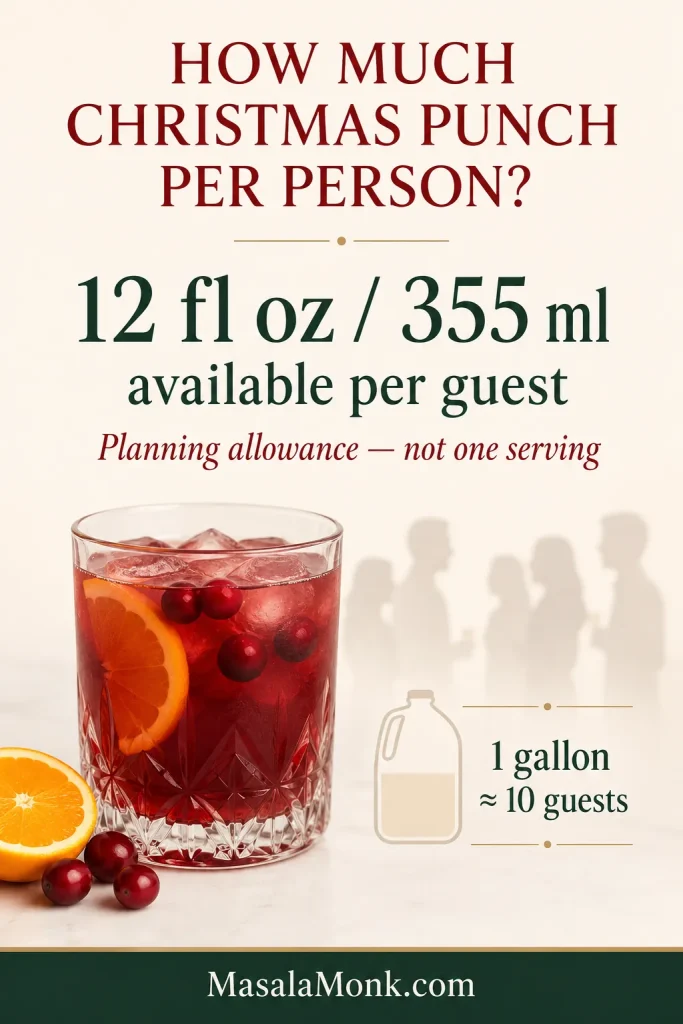
As a generous planning rule, allow about 12 fl oz / 355 ml of punch available per guest when punch is an important drink option. For planning, one gallon therefore covers roughly 10 people. Make less when beer, wine, cocktails, soft drinks and other beverages are also being served.
This is a shopping allowance, not a serving size. The extra volume simply gives people room to come back for another glass.
Round the total up by whole batches. A little cold reserve is easier to manage than running out mid-party.
How Many Batches for 10–80 Guests?
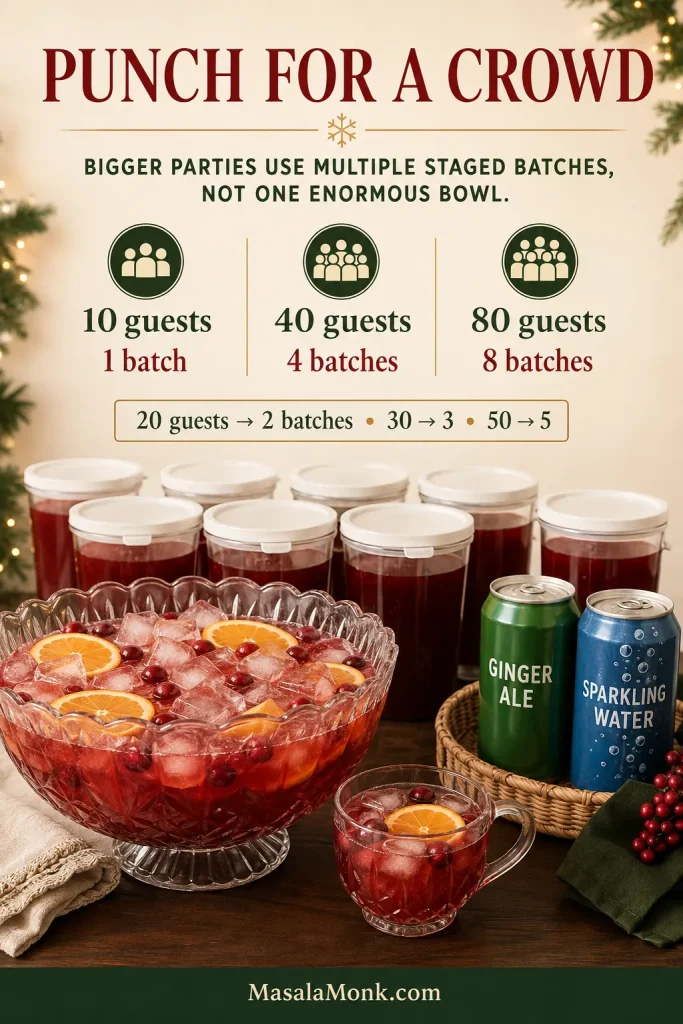
For a quick planning rule, think roughly one gallon for every ten guests. That turns a large guest count into repeatable batches before you start shopping.
Treat these as planning milestones, not fixed drinking quotas; some guests will refill and others will barely touch a glass.
Guests
Punch to have available*
1-gallon batches
10
About 1 gallon
1
20
About 2 gallons
2
30
About 3 gallons
3
40
About 4 gallons
4
50
About 5 gallons
5
80
About 8 gallons
8
*A generous planning amount. Reduce it when plenty of other beverages are available.
Shopping Math for 40 Guests
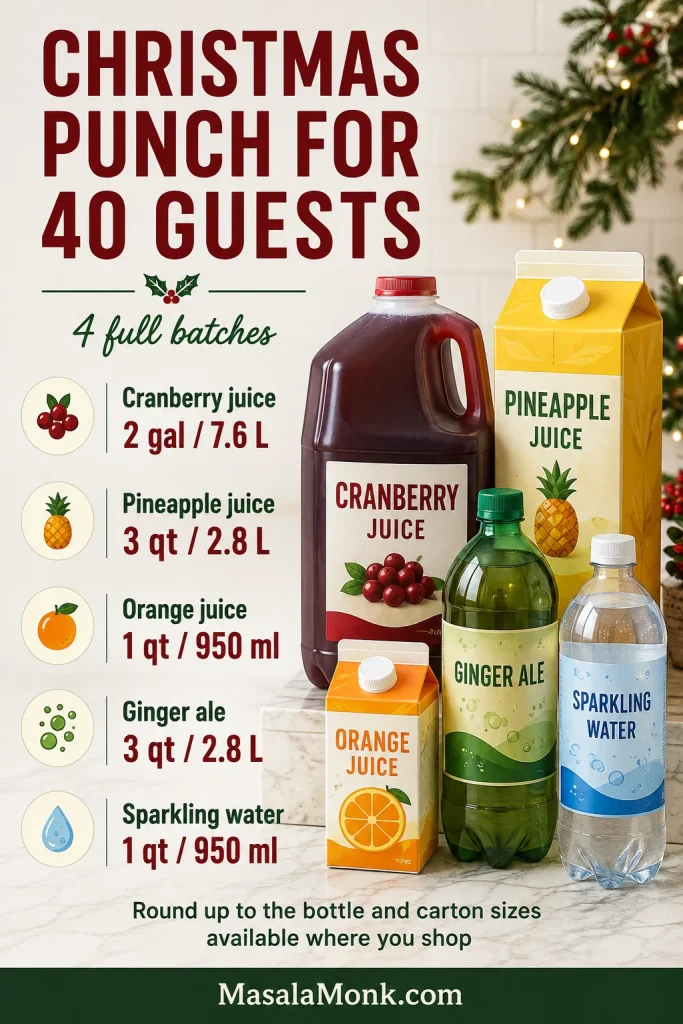
Every full batch needs roughly 2 qt / 1.9 L cranberry juice, 3 cups / 710 ml pineapple juice, 1 cup / 240 ml orange juice, 3 cups / 710 ml ginger ale and 1 cup / 240 ml sparkling water.
For 40 guests / four batches, shop for approximately:
Cranberry juice: 2 gal / 7.6 L
Pineapple juice: 3 qt / 2.8 L
Orange juice: 1 qt / 950 ml
Ginger ale: 3 qt / 2.8 L
Sparkling water: 1 qt / 950 ml
Round up to the carton and bottle sizes actually available where you shop.
For multiple batches, smaller bottles of fizzy mixers can keep later refills sealed, cold and lively until needed.
Don’t Carbonate Everything at Once
The shopping is handled. Now the job is making gallon four taste as lively as gallon one.
Prepare the cranberry-pineapple-orange mixture ahead and keep most of it covered in the refrigerator. Finish the first bowl with ginger ale and sparkling water when guests arrive; carbonate the next batch only when you need it.
The second half of the party gets fresh punch instead of whatever bubbles survived from the first half.
Label each chilled reserve base with the exact ginger ale and sparkling water it still needs.
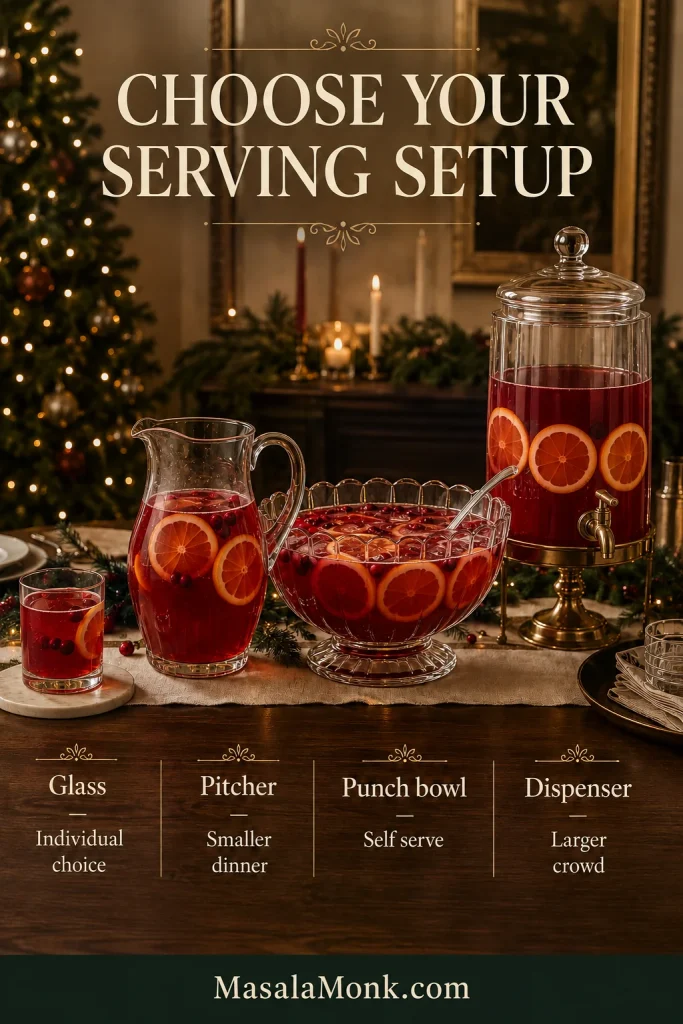
The best vessel depends on how people are drinking. A pitcher suits a smaller seated dinner—especially beside something rich such as honey glazed ham—while a bowl or dispenser makes more sense when guests are serving themselves.
Pitchers suit smaller seated meals; bowls and dispensers make self-service easier when guests are circulating.
By the Glass
This is easiest for a small group or when everyone is choosing their own alcohol. Use the 8-fl-oz / 240-ml single-serving formula from the scaling section, then add spirit and ice separately.
Pitcher
A pitcher makes more sense than a punch bowl for a smaller dinner. Don’t fill it to its advertised capacity, especially when fruit or ice is going inside.
What Size Punch Bowl Do You Need?
A 6-quart / 5.7-L bowl is the best default for one full batch. It leaves useful room for fruit, ice and the ladle instead of filling the bowl almost to the rim.
Tight fit — 5 qt / 4.7 L: workable for the alcohol-free gallon with modest garnish and no large ice ring, but fairly full.
Best default — 6 qt / 5.7 L: the better choice for most full batches, especially with fruit or large ice.
Most forgiving — 7 qt / 6.6 L: preferable when adding a substantial amount of spirit plus an ice ring or generous punch ice.
A one-gallon bowl is not a sensible home for exactly one gallon of liquid plus an ice ring.
Six quarts is the practical default for a one-gallon batch; substantial ice or spirit may justify more headroom.
Beverage Dispenser
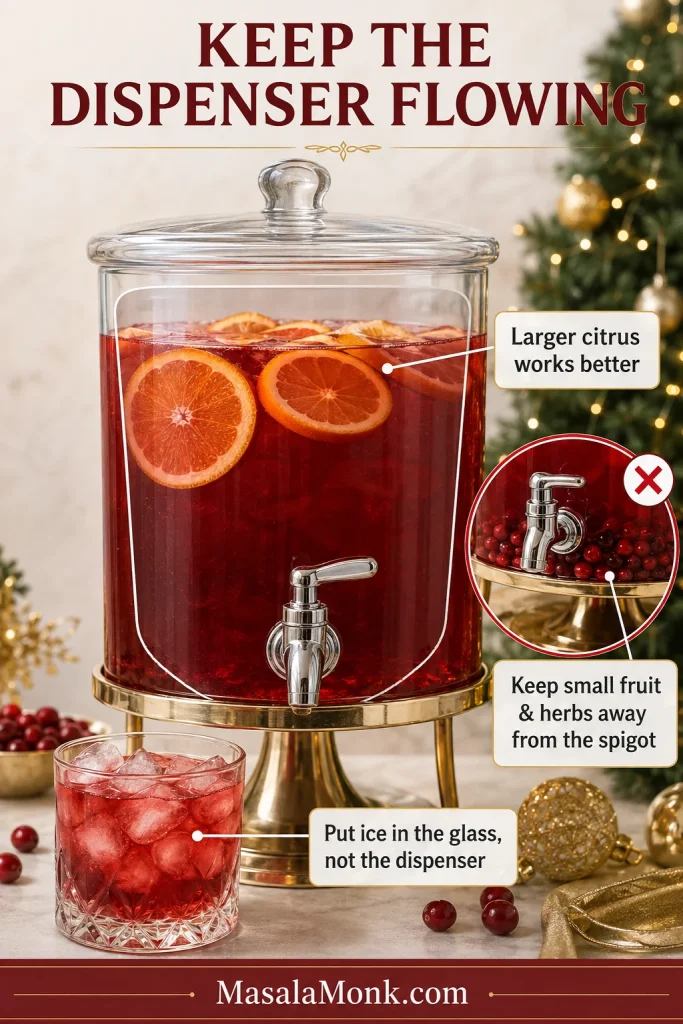
A dispenser is excellent for a larger group because guests can serve themselves without a ladle. Leave a little space at the top rather than filling it to the brim.
If the dispenser will be out for much of the party, let guests add ice to their own glasses instead of filling it with cubes that slowly weaken every remaining serving.
Test the empty dispenser with water and an actual serving glass before filling it with punch.
Can You Make Christmas Punch Ahead of Time?
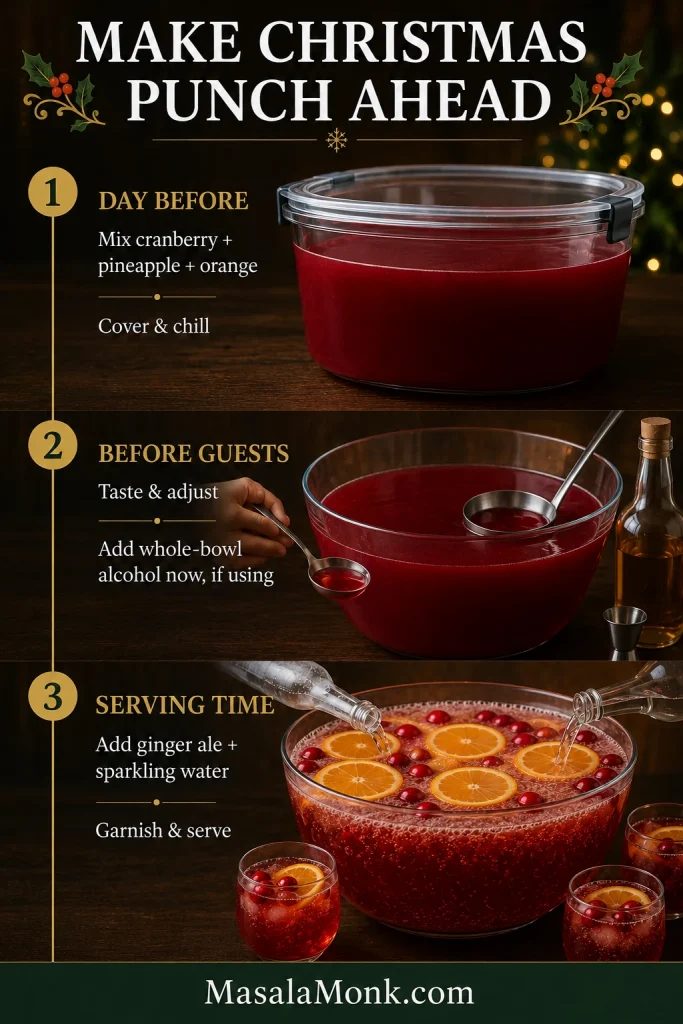
Yes. Mix and chill the cranberry, pineapple and orange juices the day before, but keep the ginger ale and sparkling water separate until serving time.
Before guests arrive, taste the cold juice mixture and make any final sweetness or acidity adjustment. Add whole-bowl alcohol now if you’re using it.
Then, just before serving, add the ginger ale and sparkling water.
Juices can wait overnight. Bubbles and garnish are serving-time jobs.
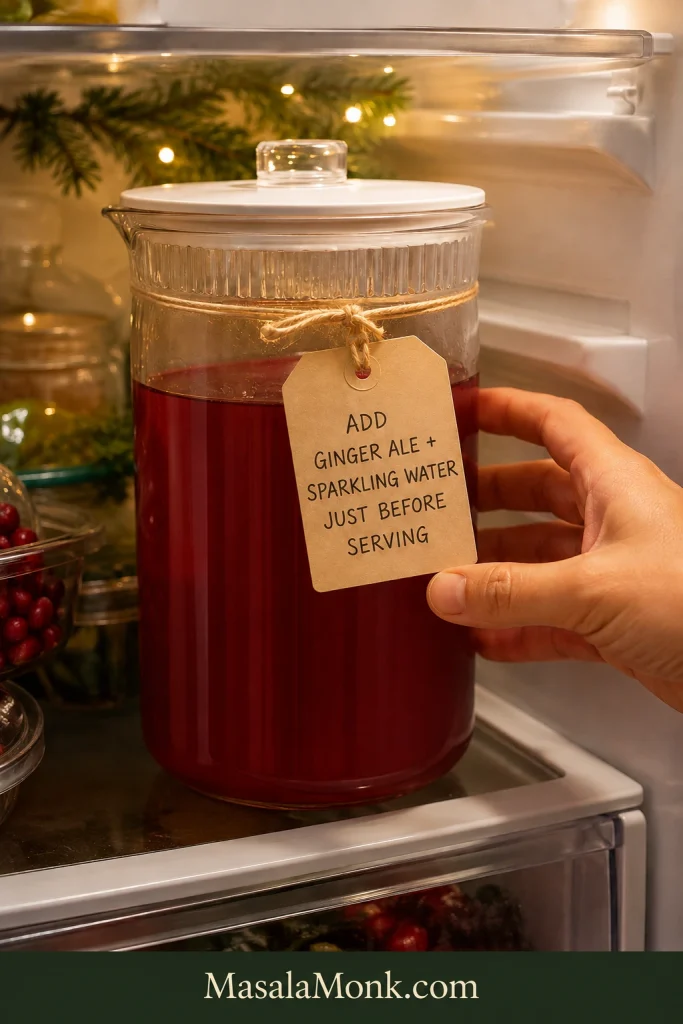
If someone else may finish the punch while you’re dealing with dinner, stick a note on the chilled juice mixture: “Add ginger ale + sparkling water just before serving.” That note is easier than trying to explain the punch from across the kitchen.
If someone else may finish the punch, leave only one decision: add the chilled fizzy mixers just before serving.
Use the Right Ice
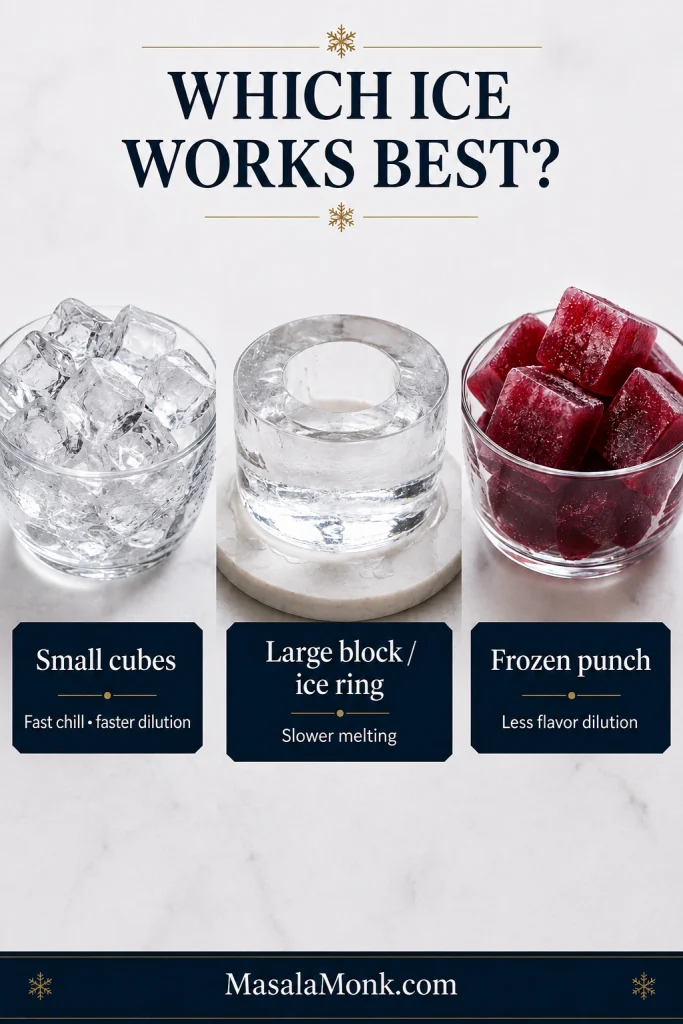
Small cubes chill quickly and melt quickly. A large block or ice ring is better suited to a bowl that will sit out for a while.
For less flavor dilution, freeze cranberry juice or diluted punch mixture instead of plain water.
Small cubes chill fast; a ring melts slower; frozen punch protects flavor as it melts.
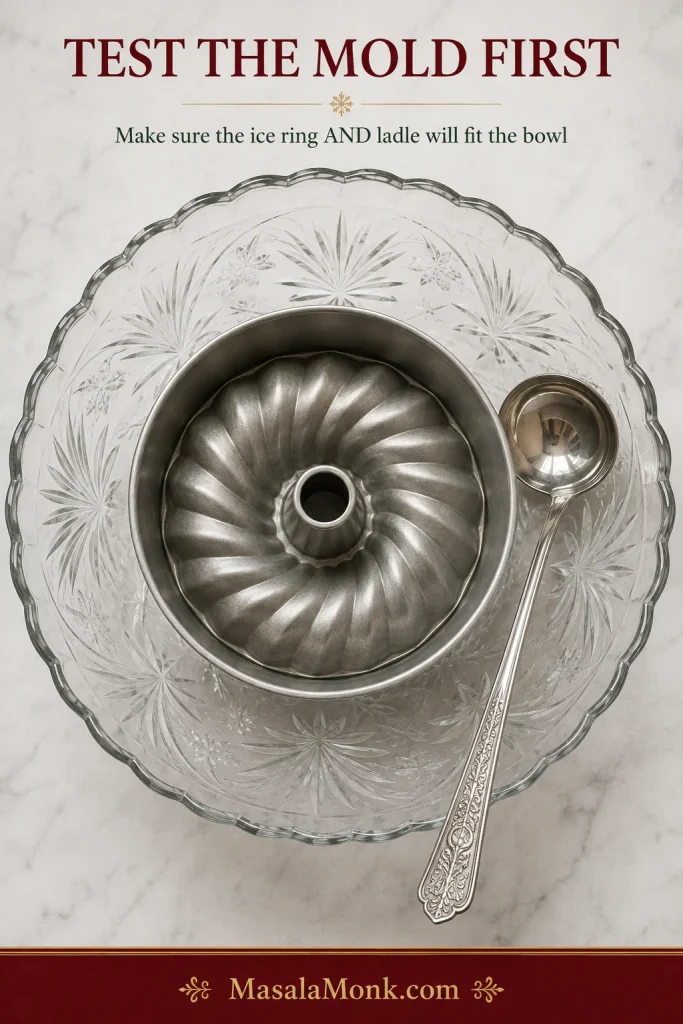
One tiny check can save a ridiculous problem later: put the empty Bundt pan or ring mold inside the actual punch bowl before freezing anything. Make sure the finished ring will fit and that the ladle still has room beside it.
A slightly smaller ice ring leaves room for the ladle to dip, turn and actually collect punch.
Set It Up So You Don’t Have to Babysit It
The real luxury of party punch is not that it takes five minutes to mix. It is that you can stop making drinks once the guests arrive.
Put everything people will need within reach before the first glass is poured:
Punch bowl, pitcher or dispenser
Ladle and a small plate or spoon rest
Glasses or cups
Ice and an ice scoop if guests add their own
Vodka or rum plus a small measure when alcohol is optional
A cold reserve of juice mixture and fizzy mixers for refills
Arrange the station in use order: glasses, ice, punch, then optional spirit and measure.
If you’re serving two bowls, label the alcoholic one clearly. “The adult punch is on the left” stops being useful the moment somebody rearranges the table.
A self-serve snack can work on the same principle as the drinks station. An easy cheese ball can sit beside crackers and vegetables without needing somebody to manage it.
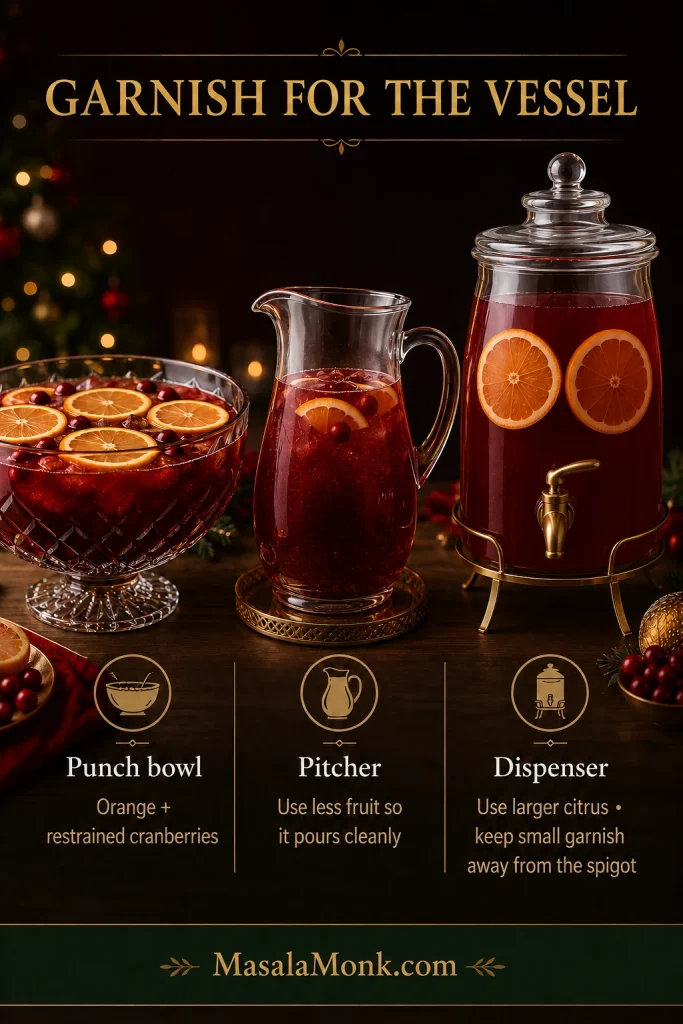
Garnish for the Vessel, Not Just the Photograph
Red cranberries and thin orange wheels are enough to make the bowl look unmistakably festive. You do not need to turn the punch into a floating fruit basket.
A punch bowl can comfortably carry orange wheels and a restrained scattering of cranberries. A pitcher needs less fruit so it still pours cleanly. In a beverage dispenser, larger citrus slices are safer than tiny fruit pieces, loose herbs or clusters of berries that can drift toward the spigot.
Save a little fresh orange and cranberry garnish for refills so later bowls still look newly made.
For cups going to young children, leave the whole cranberries in the bowl rather than ladling them into the drink.
Christmas Punch Troubleshooting
Punch is forgiving. The quickest rescue usually comes from figuring out what actually changed instead of adding a little of everything.
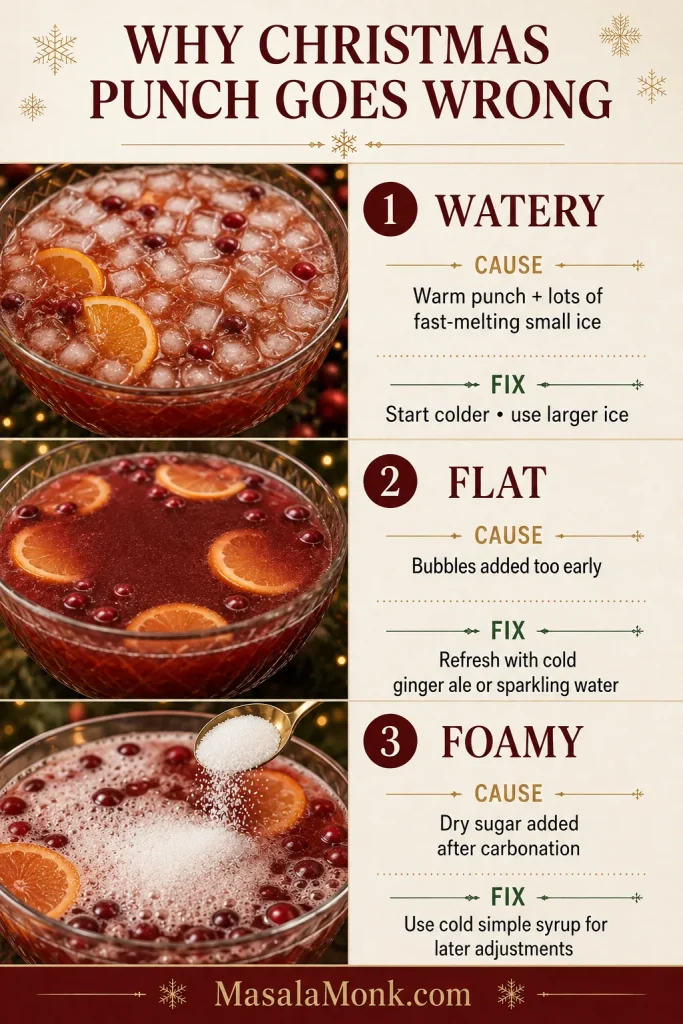
Watery is usually dilution, flat is carbonation timing, and foaming during adjustment is a mixing problem.
Flavor, Sweetness & Fizz Problems
Problem
Likely cause
Fix now
Way too tart
Pure unsweetened cranberry or very dry ingredients
Check the cranberry label, then add a sweeter complementary juice or cold simple syrup gradually.
Too sweet
Sweetened cranberry, sweet soda and sweet fruit stacked together
Add fresh lemon and/or plain sparkling water.
Tastes like ordinary juice
Not cold enough, bright enough or freshly carbonated
Chill it, add a little lemon if needed and finish with fresh bubbles.
Watery
Warm punch plus lots of fast-melting small ice
Stop adding plain ice. Chill the vessel externally if practical.
Flat
Carbonation went in too early
Refresh one pitcherful at a time with a little very cold ginger ale or sparkling water, tasting as you go.
Rum dominates
Too much spirit or a very assertive dark/spiced rum
Dilute with reserved alcohol-free juice mixture.
Doesn’t taste alcoholic
Cold fruit and fizz are masking the alcohol
Do not keep adding spirit based on taste. Check how much actually went into the bowl.
Foamed while sweetening
Dry sugar went directly into carbonated punch
Let it settle and use cold simple syrup for any further adjustment.
Cloudier than expected
Pulp-heavy orange juice or cloudy citrus
Harmless. Use pulp-free orange next time for a clearer ruby color.
Serving & Setup Problems
Problem
Likely cause
Fix now
Ice ring blocks the ladle
The mold was too wide for the bowl
Use a smaller ring next time and test the empty mold first.
Dispenser stops flowing
Small fruit or herbs collected around the spigot
Clear the outlet and keep small garnish out of the dispenser.
Running out too quickly
Recipe servings were mistaken for total party consumption
Finish the next cold batch and allow for refills when shopping next time.
Storage & Leftovers
For best quality, drink finished Christmas punch the day it is made or the next day. Refrigerate leftovers promptly and remove old citrus and floating garnish before storing.
The flavor may still be pleasant after refrigeration, but carbonation fades steadily. A little fresh ginger ale or sparkling water can brighten an individual leftover glass; it will not completely recreate a newly mixed batch.
If leftovers are likely, hold back some of the cranberry-pineapple-orange mixture before adding the fizzy ingredients, then carbonate only what you need.
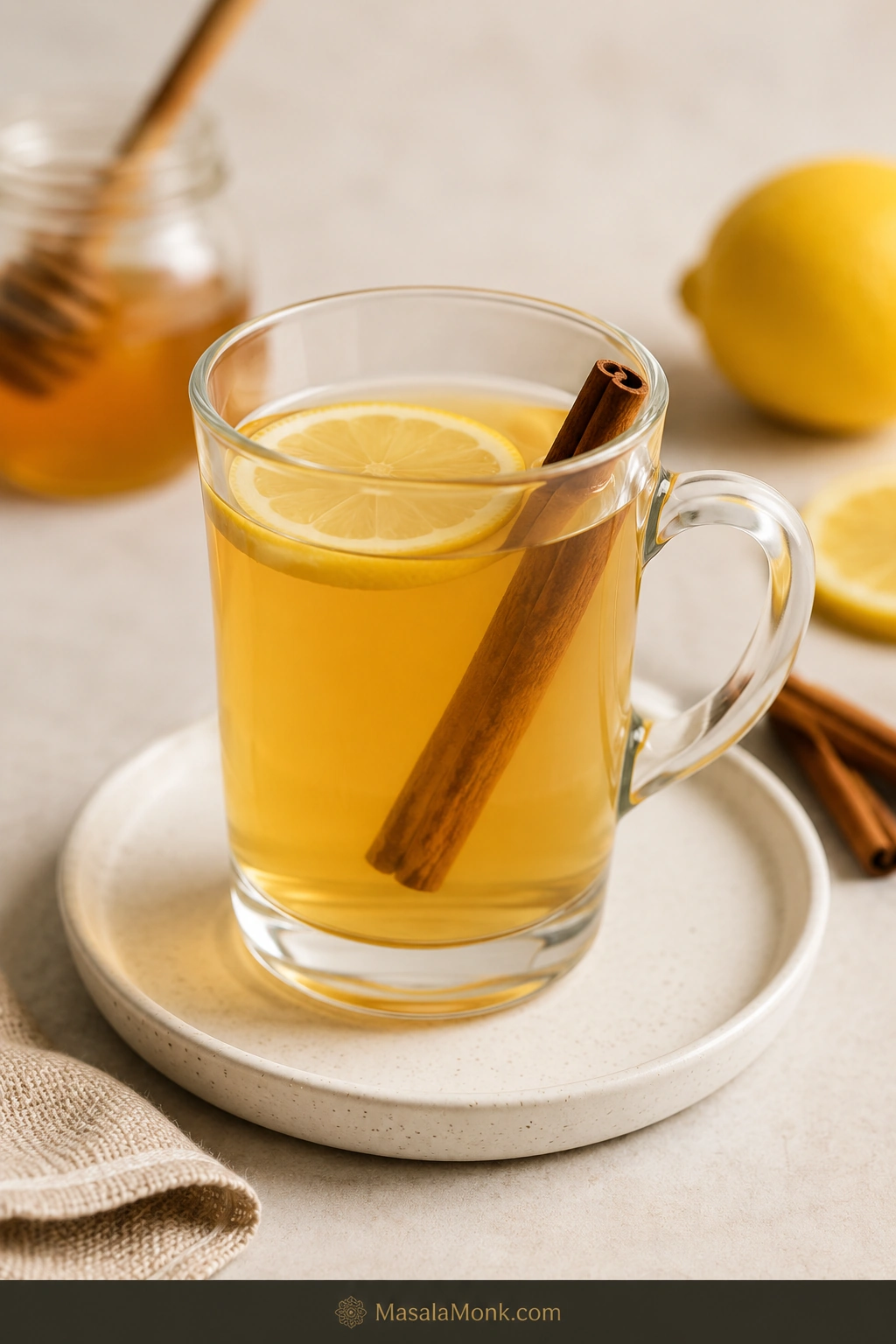
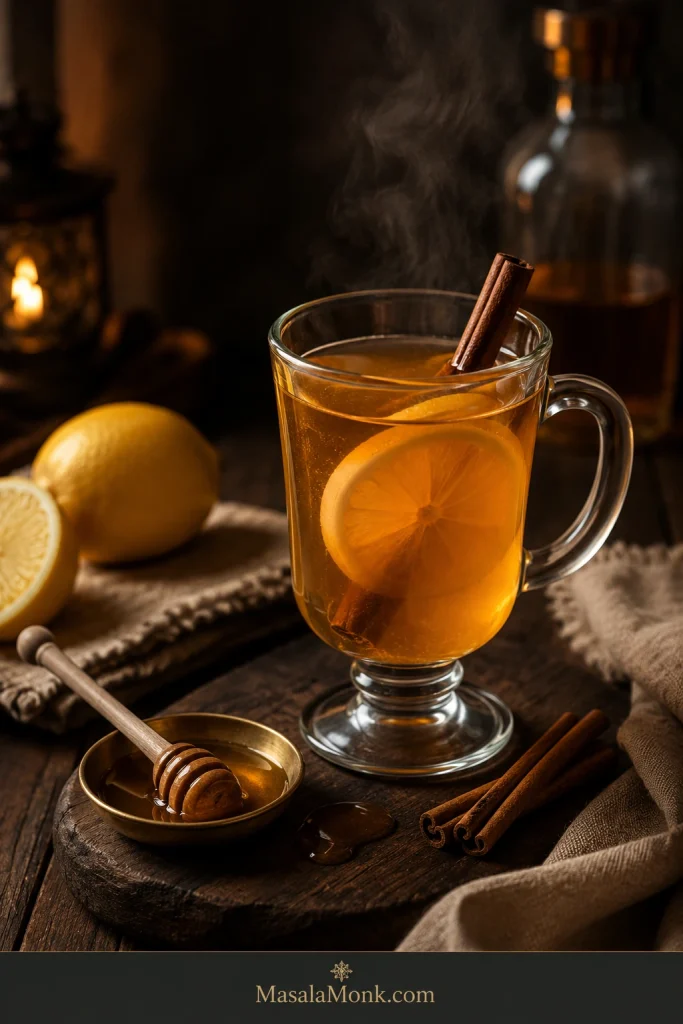
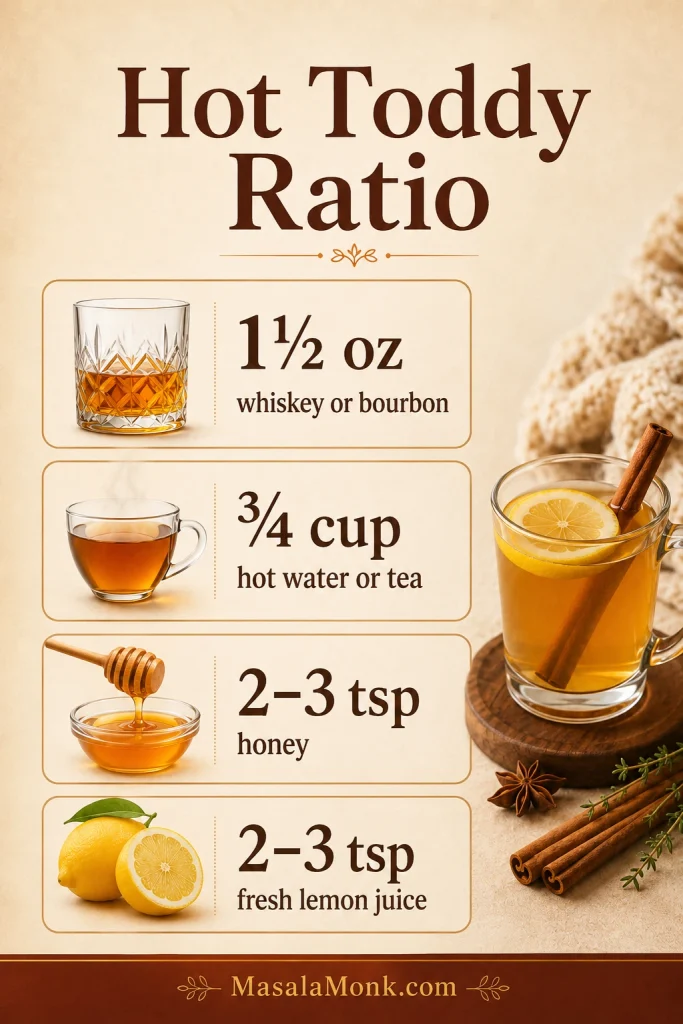
If the night moves from cold drinks to something warm, a Hot Toddy takes Christmas in the opposite direction with whiskey, honey and lemon in one warm glass.
The Final Pour
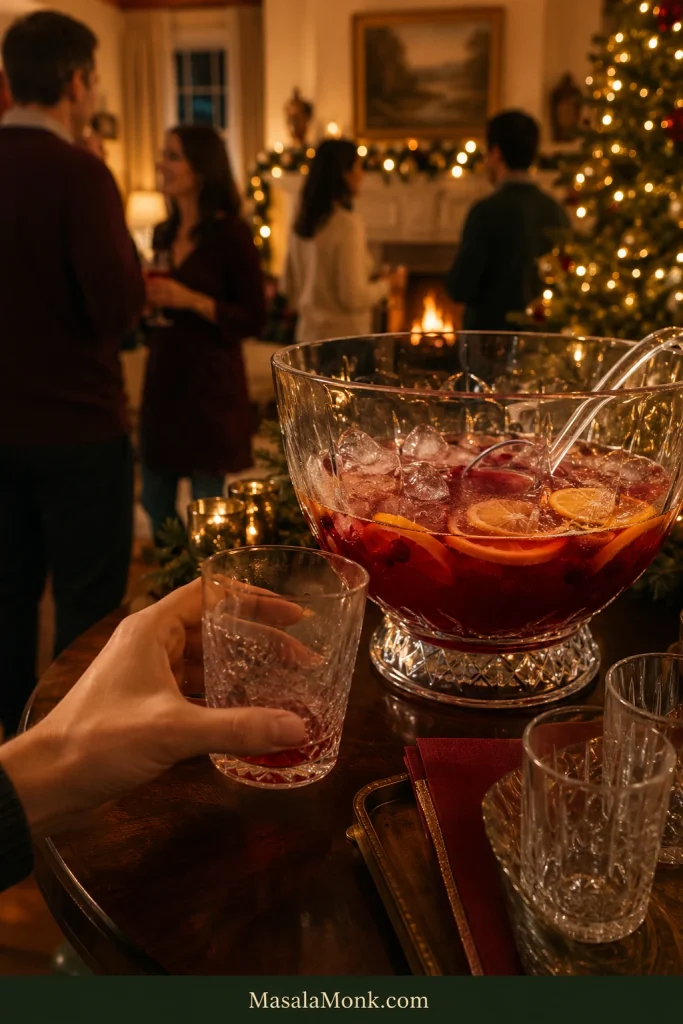
There is a nice moment when punch stops being a recipe and becomes part of the party: the bowl is glowing red on the table, the ice is still solid, orange slices are moving slowly between the bubbles, and somebody comes back carrying an empty glass.
An empty glass is useful feedback: the punch looked inviting, tasted refreshing and earned another pour.
You should not have to leave the conversation to start mixing another drink.
Make enough, keep the next batch cold, then leave the punch bowl to do its job. Christmas is happening somewhere other than the drinks table.
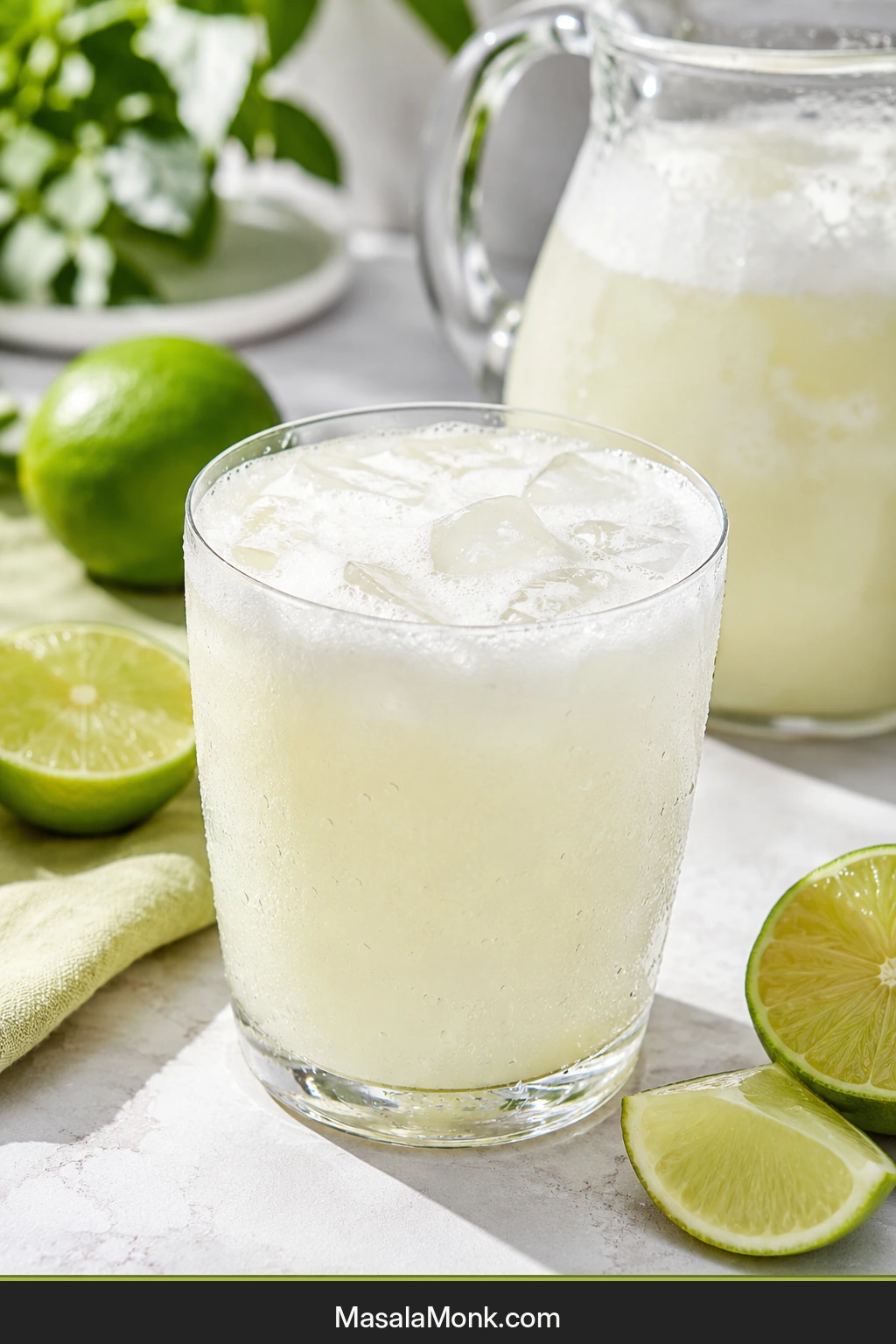
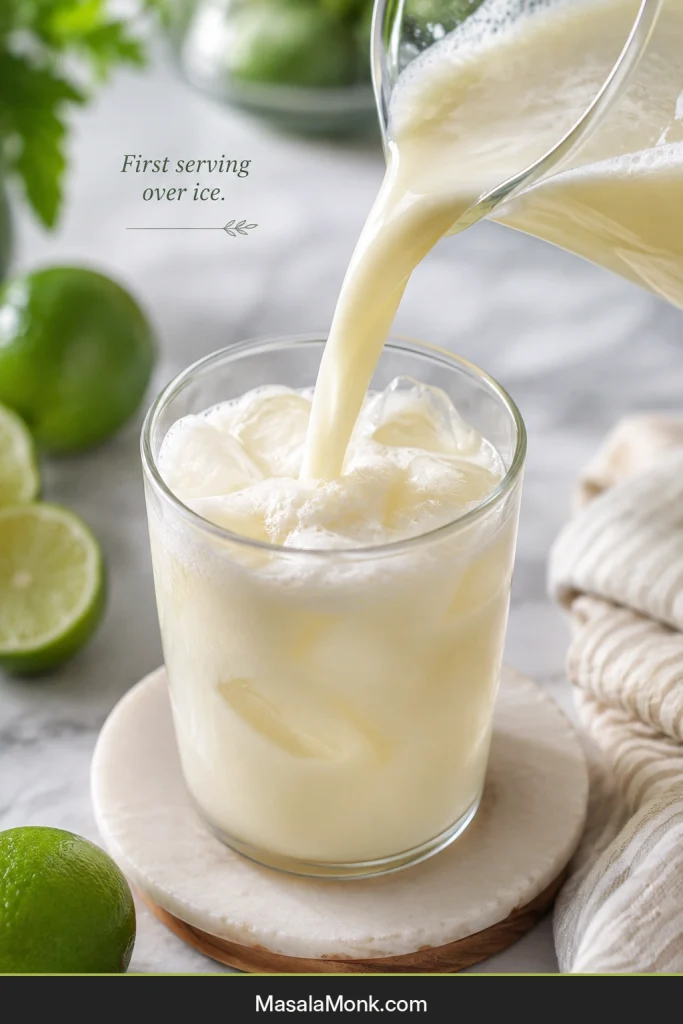
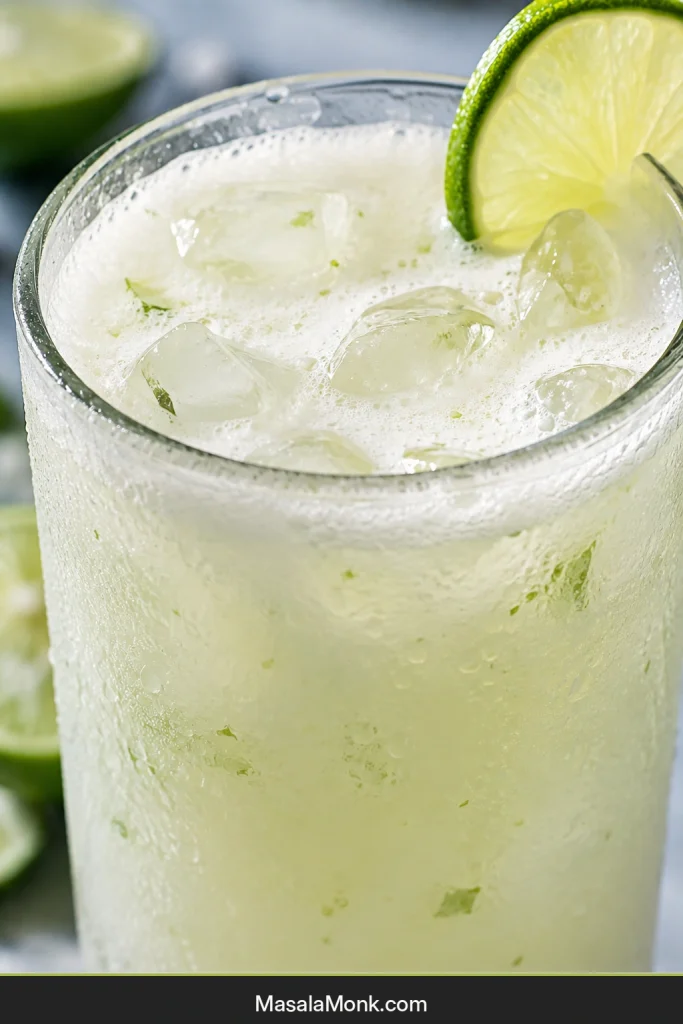
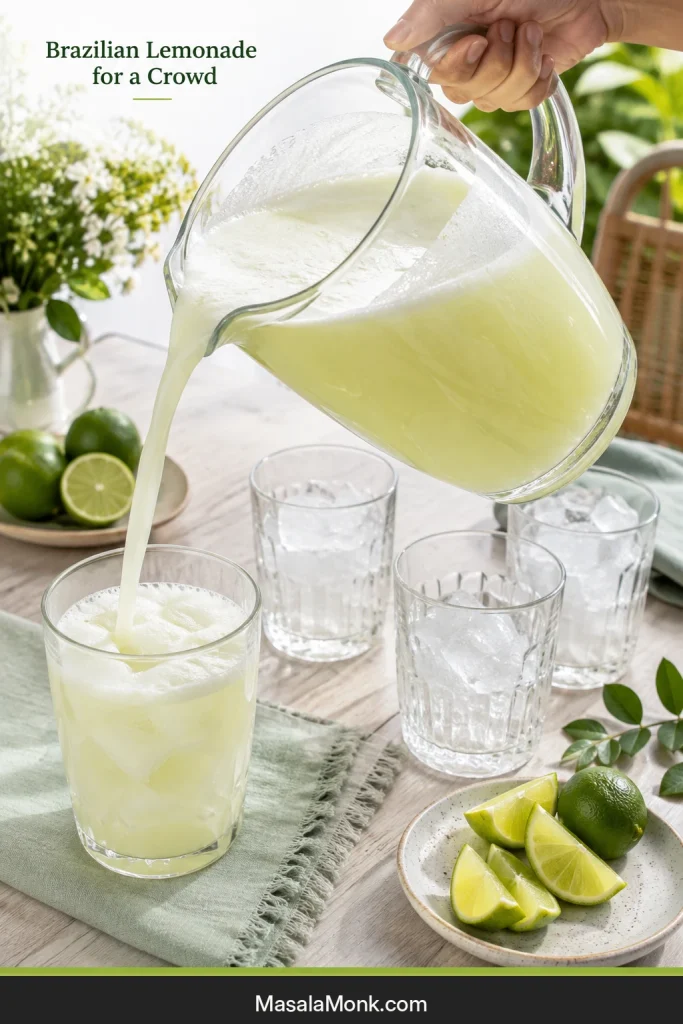
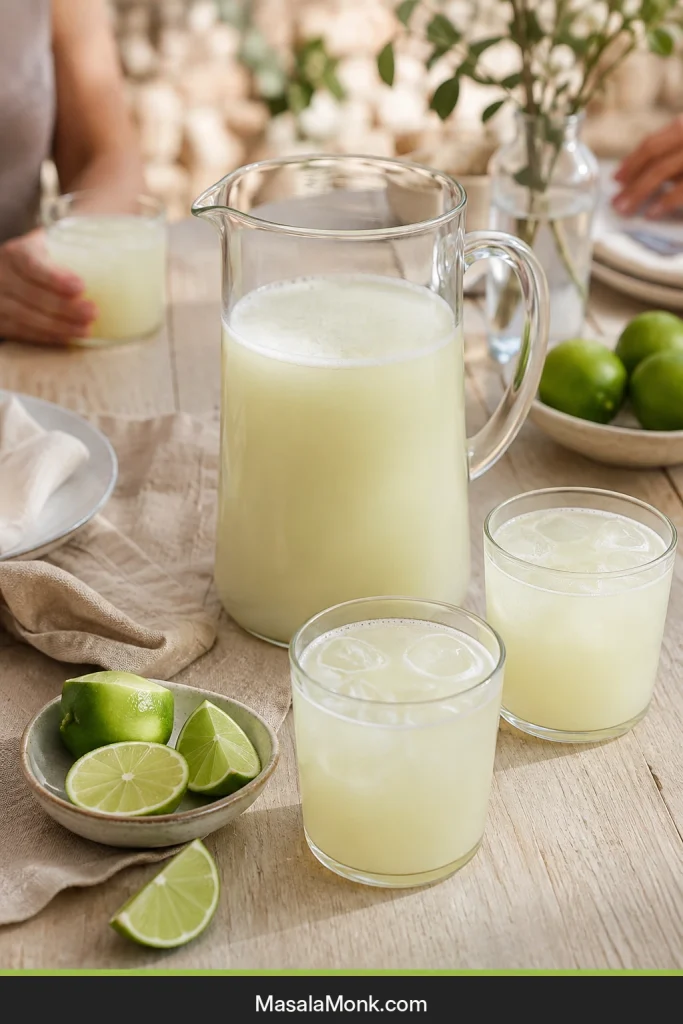
Brazilian lemonade should arrive like a cold lime cloud: pale green, lightly frothy, creamy through the middle and sharp enough at the end to make the next sip feel inevitable.
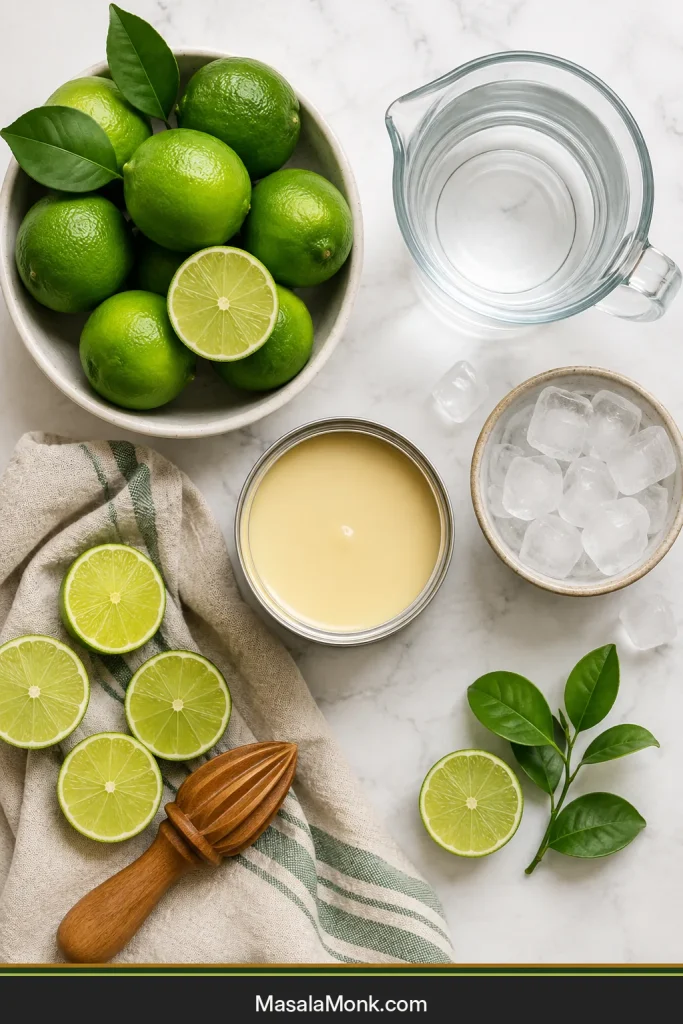
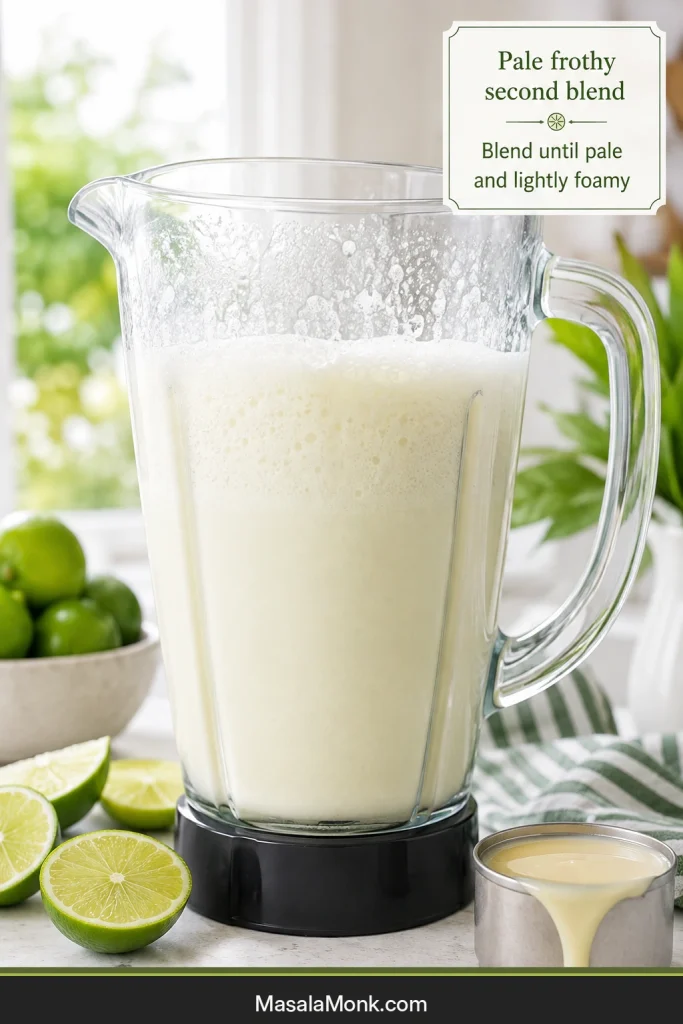
Three core ingredients—whole limes, cold water and condensed milk—become something surprisingly airy. The fruit briefly perfumes the water, the peel and pulp are strained away, and the green base turns pale and foamy in the second blend.
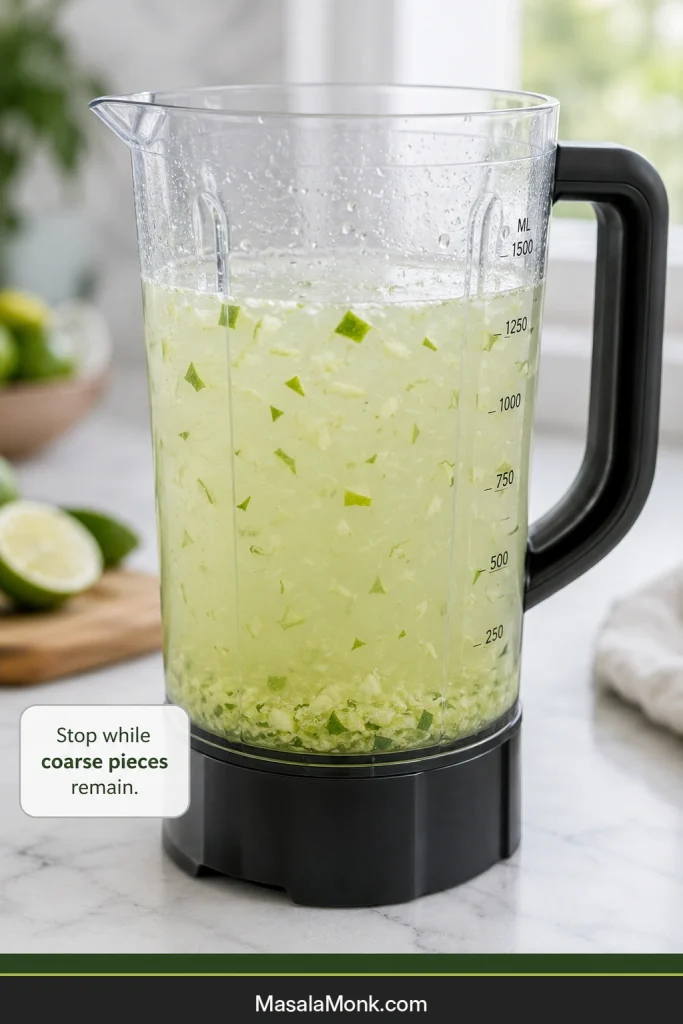
The ingredient list is almost suspiciously short, and the one moment that asks for care comes early. Stop while coarse pieces remain and the peel gives fragrance without taking over. For thick-skinned fruit or a pitcher that must wait, use one of the gentler methods below.
For 5–6 servings, briefly blend 4 medium thin-skinned limes—about 240–280 g total—trimmed, quartered, deseeded and cored, with 4 cups / 950 ml cold water. Strain gently, then blend the liquid with 300 g sweetened condensed milk until pale and lightly foamy.
1. Watch the pieces, not only the clock. Stop when the water is cloudy green and coarse lime pieces remain—usually after 8–12 seconds.
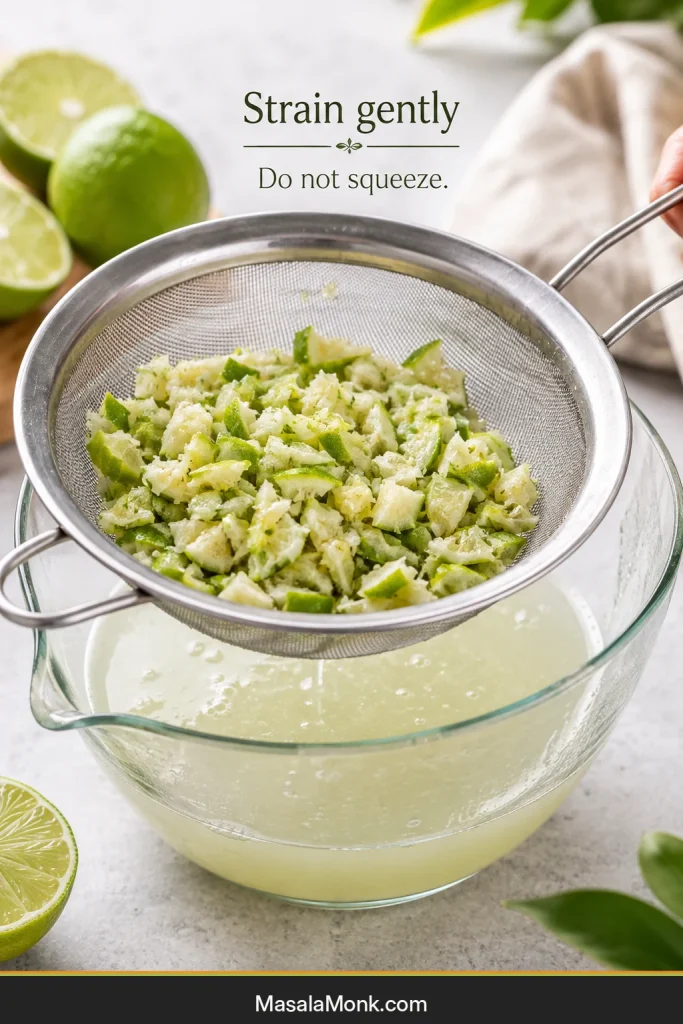
2. Strain; do not squeeze. Let the liquid drain, but leave the final spoonful of pulp behind.
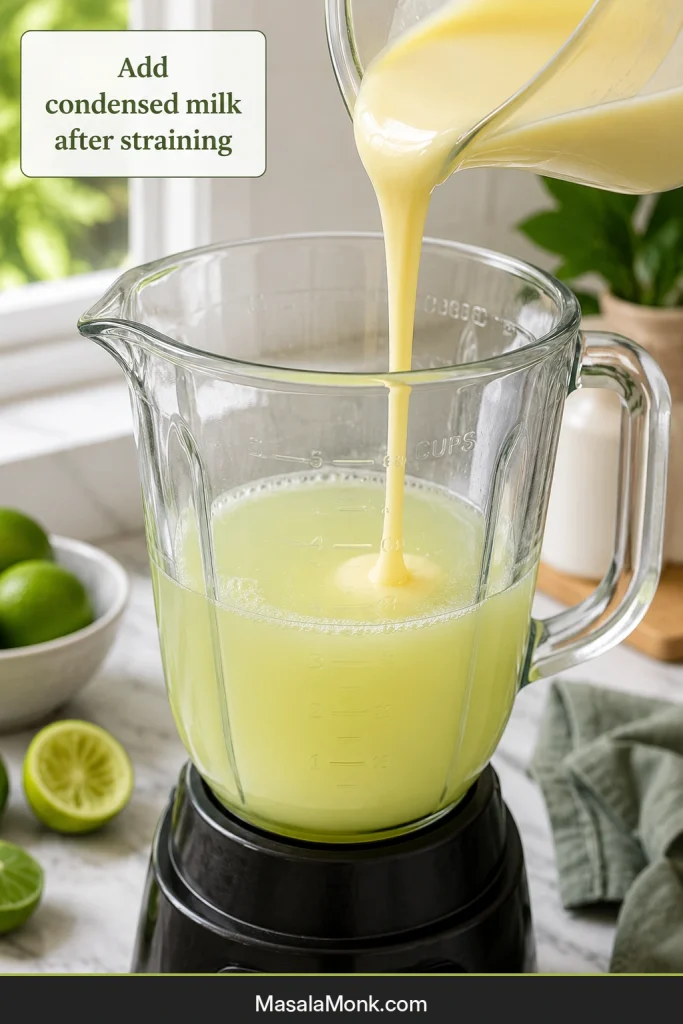
3. Let the first glass decide. Add the condensed milk only after the lime mixture has been strained, then take the first sip over ice before changing the pitcher.
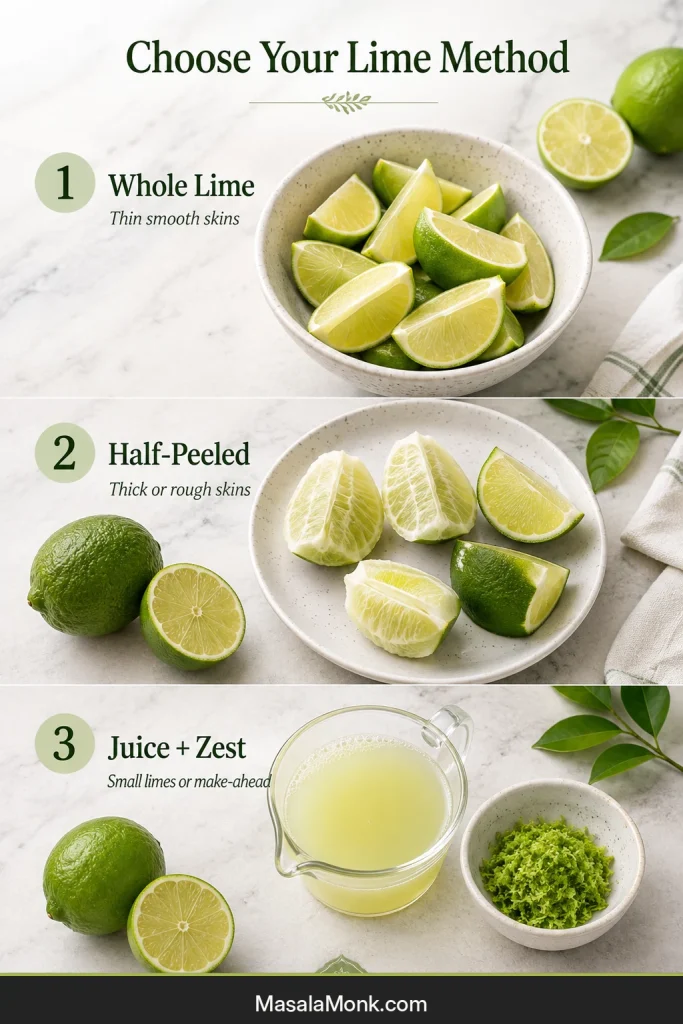
Choose Your Lime Method
Choose how to handle the limes first. Sweetness can always be adjusted after tasting; once too much peel has been blended in, it is much harder to take back.
When skins are uncertain, start gently; a mild pitcher is easier to brighten than a bitter one to rescue.
Lime method
Best when
How to prepare the fruit
Whole lime
You have smooth, thin-skinned Persian (Tahiti) limes and want the liveliest peel aroma
Keep the green peel and remove the ends, seeds and central white core
Half-peeled
The skins look thick, rough or unfamiliar
Peel two limes completely and keep the peel on two
Juice and zest
You have many small limes, need to make the drink ahead or prefer the smoothest texture
Use measured juice and finely grated green zest instead of blending many small peels
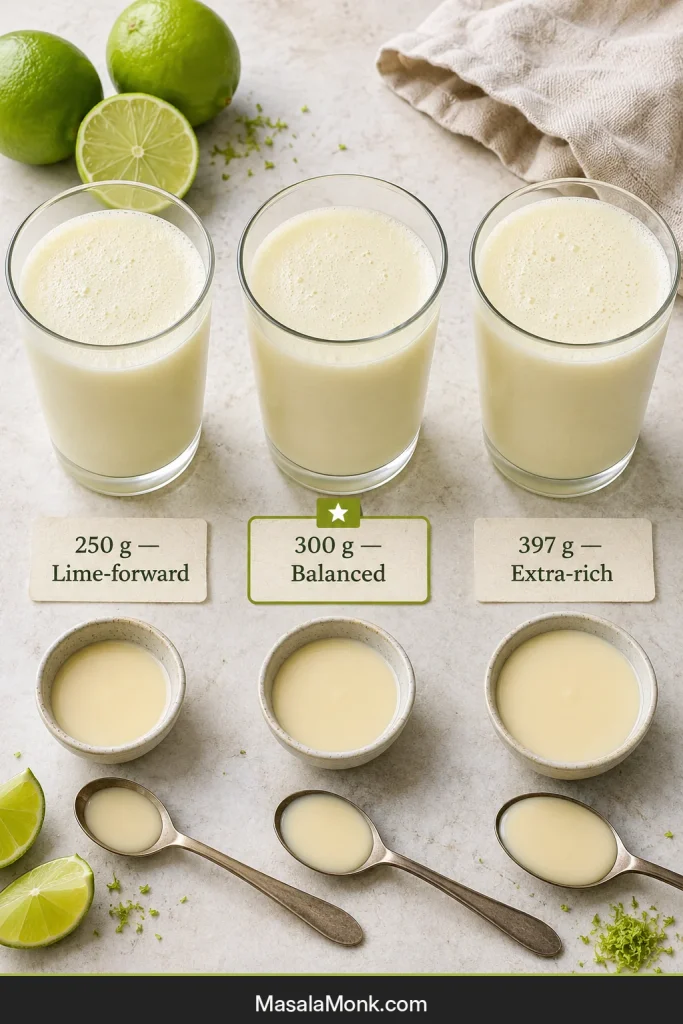
For the balanced pitcher, keep the water at 4 cups / 950 ml and use 300 g condensed milk. Drop to 250 g when you want the lime to lead, or use the full 397 g can for a sweeter, richer drink.
Brazilian Lemonade Recipe
This is the balanced main pitcher: lively lime, rounded sweetness and a pale, frothy finish.
Active time: About 10–12 minutes · Total time: About 12–15 minutes
First lime blend: Stop when the water is cloudy green and coarse lime pieces remain, usually 8–12 seconds · Second frothing blend: 10–15 seconds
Approximate yield: 4¾–5 cups / 1.1–1.2 liters before ice, depending on lime juiciness and how much drains through the sieve · Servings: 5–6
Best served: Immediately, while the fresh-peel aroma is lively and the foam is still light
Equipment
Blender with a 1.8–2-liter jar; with a 1.5-liter jar, process the limes and water in two equal batches
Sharp knife and stable cutting board
Fine-mesh sieve
Large bowl or 2-liter pitcher
Liquid measuring jug
Digital kitchen scale, recommended
Can opener and silicone spatula or large spoon
Ingredients
4 medium Persian (Tahiti) limes or similarly thin-skinned limes, about 8½–10 oz / 240–280 g total
4 cups refrigerator-cold water, 32 US fl oz / 950 ml
10½ oz / 300 g sweetened condensed milk, about 1 cup / 235 ml, plus more only after tasting; do not substitute unsweetened evaporated milk
Up to 1 tablespoon fresh lime juice, 15 ml, optional for finishing and added 1 teaspoon at a time
Ice, enough to fill each glass about halfway
Thin lime wheels or wedges, optional for serving
Measure the cold water first; melting serving ice should not determine the pitcher’s dilution.
Prefer it richer? Use the complete 14 oz / 397 g can of condensed milk. Want the lime to lead? Begin with 8¾ oz / 250 g while keeping the water at 4 cups / 950 ml.
Unfamiliar or thick-skinned limes? Peel two completely and keep the peel on two. Remove the central white core from all four. You still get the fresh-peel aroma, but the drink is gentler and more forgiving.
Method
Prepare the Limes
Wash the limes. Rinse them under cool running water and scrub the peel with a clean produce brush. Dry them so the knife does not slip.
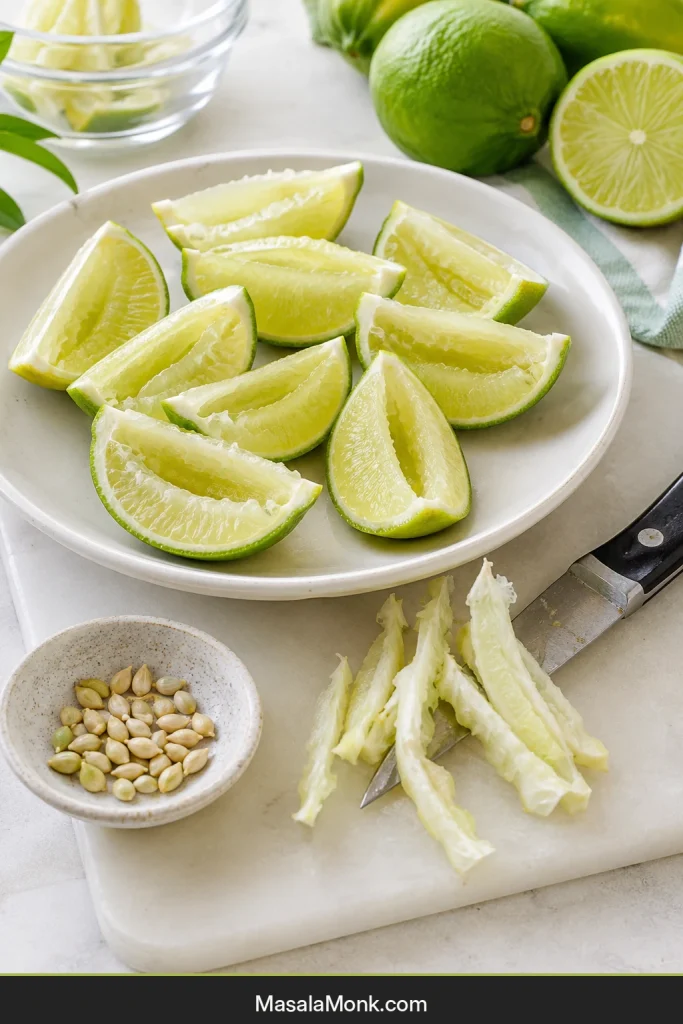
Trim and cut. Slice away both ends of every lime. Quarter each lime lengthwise, remove visible seeds and cut away the thick white strip through the center of every wedge.
A shallow V-cut removes the white core while preserving more juicy lime flesh.
Blend and Strain the Lime Base
Make the short lime blend. Put the prepared lime pieces in the blender with all 4 cups / 950 ml cold water. Pulse until the water turns cloudy green and coarse lime pieces remain, usually 8–12 seconds. Stop sooner in a powerful blender. When circulation is poor, divide the limes and water evenly between two batches instead of blending longer.
A few bottom fragments are normal; freely moving cloudy liquid is the real stopping cue.
Strain immediately. Pour the mixture through a fine-mesh sieve over a large bowl or pitcher. Tap or gently shake the sieve and stir the pulp once or twice. Leave the final spoonful behind instead of mashing it through.
Stop when flow slows to drops; pressing can push peel, pith and fine particles into the drink.
Finish the Brazilian Lemonade
Rinse the blender and add the condensed milk. Wash away any peel left in the jar, return the strained lime liquid and add 300 g sweetened condensed milk.
Once condensed milk disappears, extra blade time mainly adds air rather than useful body.
Blend until pale and softly foamy. Blend for 10–15 seconds. The green base should turn pale almost immediately, with a soft cap of fine bubbles rather than stiff foam.
Aim for fine, soft bubbles rather than stiff foam, then stop blending.
Let the first glass decide. Pour one glass over ice and take a sip before changing anything. When it tastes sweet but muted, add fresh lime juice 1 teaspoon at a time, up to 1 tablespoon. For excessive sharpness, add condensed milk 1 tablespoon at a time. A heavy texture needs cold water 2 tablespoons at a time.
Taste an ungarnished glass first, since fruit, herbs or spirits can hide the base balance.
Serve immediately. Fill each glass about halfway with ice, then pour in roughly 7 oz / 200 ml lemonade. Leave a little room for the light foam.
What Does Brazilian Lemonade Taste Like?
The lemonade is ready when it smells distinctly of fresh lime, pours pale and lightly foamy, and tastes creamy at first but clean and citrusy at the finish.
Fine foam signals a fresh blend, but sweetness and acidity still need tasting over ice.
The method is simple once the lime is under control. The name, however, needs a little explaining.
What Is Brazilian Lemonade?
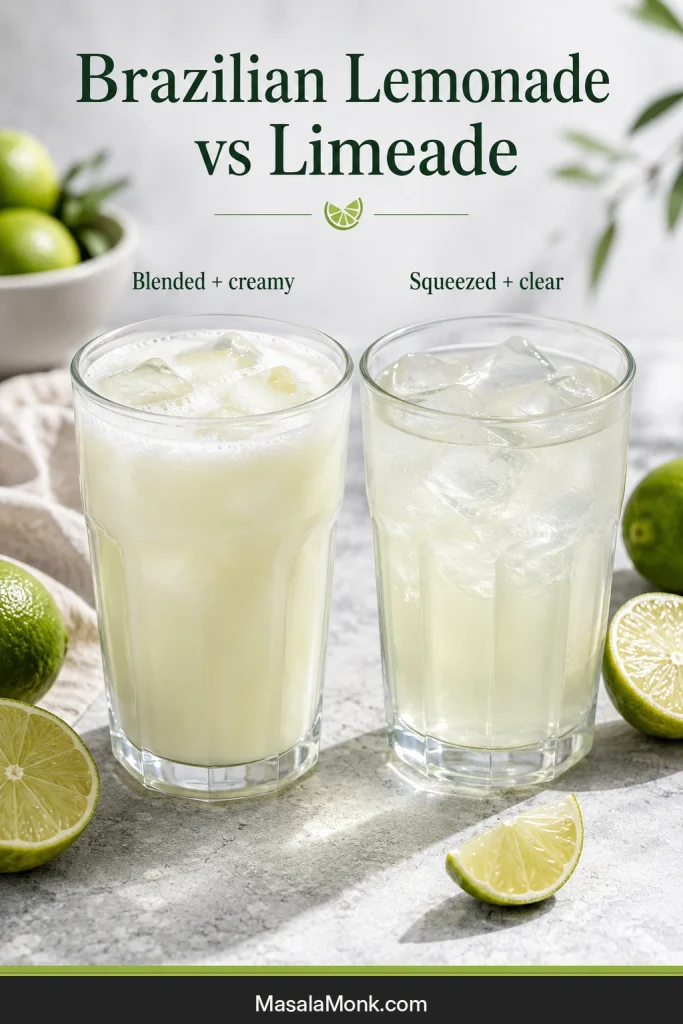
Brazilian lemonade is a cold blended lime drink made with fresh limes and water. Depending on the version, sugar, milk, sweetened condensed milk—or a combination—softens the lime and adds sweetness or creaminess. Brief contact with the peel gives it a greener aroma than ordinary squeezed limeade; straining removes the solids before the drink is sweetened and frothed.
Why call it lemonade when it uses limes? In Brazil, the familiar green fruit is commonly called limão-taiti, while a yellow lemon is limão-siciliano. That shared word helps explain why limonada becomes “lemonade” in English even when the drink uses green limes. You will also see it called Brazilian limeade or Brazilian limonada.
This creamy version turns pale and opaque through blending and condensed milk—not artificial color.
What Is Limonada Suíça?
Limonada suíça is not one fixed formula. The name covers blended, strained Brazilian lime drinks made in several ways: this Brazilian limonada suíça recipe uses sugar and milk, while other versions use condensed milk.
The “Swiss” part has no universally accepted origin. A common explanation connects it to Swiss condensed-milk branding, while other accounts point more broadly to Swiss influence in Brazil.
Is the Condensed-Milk Version Authentic?
Yes—it is a well-loved Brazilian style, but it is not the only one. Some recipes lean on sugar with a little milk or condensed milk, while richer versions use most or all of a can.
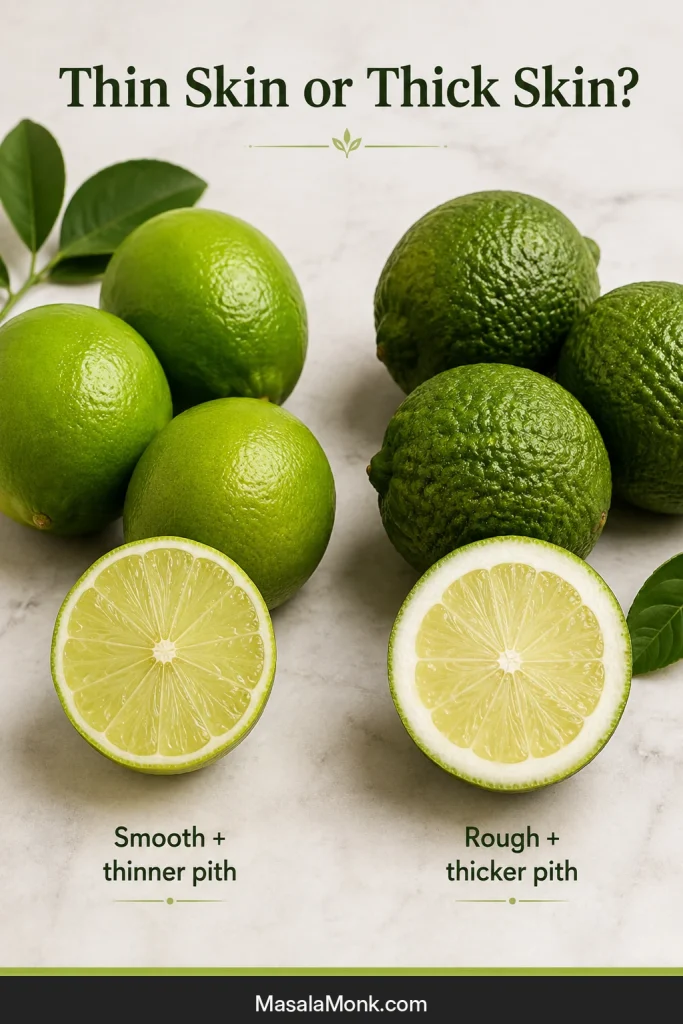
Choose medium Persian (Tahiti) limes that feel heavy for their size, with smooth or relatively thin-looking skins. Rough, thick-skinned limes are less forgiving in a whole-fruit blend because they contribute more peel and pith relative to their juice.
Weight is more dependable than count. Four medium limes should total about 8½–10 oz / 240–280 g. Equal fruit weight does not mean equal peel exposure, however. With small Key or Indian limes, peel most of the fruit and leave the peel on roughly one-quarter to one-half of the total amount. Small fruit is easiest to control with the measured juice-and-zest method.
Judge both outer texture and cut pith; green color alone reveals little about peel thickness.
Because the peel enters the drink, rinse and scrub the limes thoroughly under running water rather than using soap or detergent. The FDA produce-washing guidance also advises against soap and commercial produce washes.
How Condensed Milk Changes the Drink
Condensed milk does three jobs at once: it sweetens the lime, softens its sharp edges and gives the drink its creamy body. The balanced pitcher uses 300 g, added only after straining so the peel gets no more blade time.
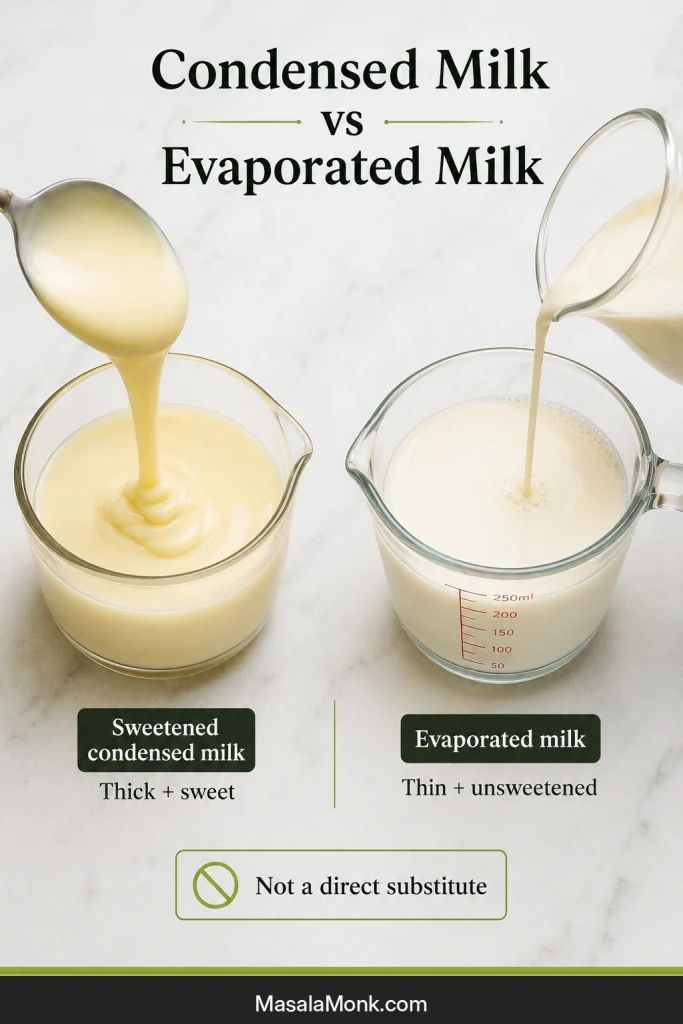
Use sweetened condensed milk, not evaporated milk. Evaporated milk is thinner and unsweetened, so it is not a direct substitute.
Evaporated milk needs separate sweetening and still creates a lighter body than condensed milk.
If that tart lime and condensed-milk pairing is the part you love most, this creamy key lime pie recipe carries the same contrast into a chilled, sliceable dessert.
Why Cold Water Works Better Than Blended Ice
Cold water keeps the base consistent. Save the ice for the glasses, where it can chill each serving without quietly watering down the pitcher.
Keep ice out of the whole-lime blend because it changes blade circulation and makes the extraction harder to judge. Add measured ice only when making the frozen variation.
Do You Need Extra Sugar?
Not automatically. Condensed milk already brings substantial sweetness. Taste a small glass over ice and add sugar or simple syrup only if the limes remain unusually sharp.
A thinner, more lemonade-like pitcher needs extra water as well as less condensed milk; simply reducing the condensed milk creates a brighter drink, not the same lighter formula.
That same lime-first balance is what keeps a classic mojito crisp rather than sugary.
Keep the Lime Bright, Not Bitter
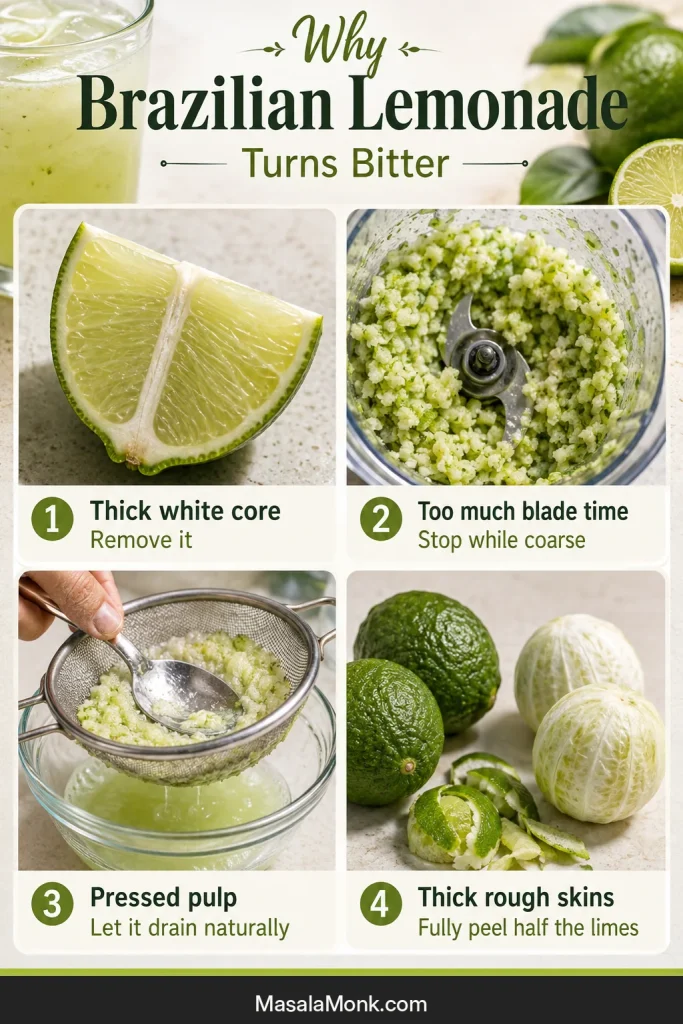
A slight, clean peel edge makes the lime taste brighter. The goal is not to erase the peel, but to stop before it becomes medicinal or mouth-drying. Too much white pith, too much blade time or hard pressing are the usual causes.
Bitterness is usually an extraction problem, not a sweetness problem.
The fruit brings more peel and pith relative to juice
Peel two of the four limes
Long blending
The peel becomes finer and extracts more aggressively
Stop while coarse lime pieces remain
Crushed seeds
Seed bitterness joins the peel bitterness
Remove visible seeds before blending
Hard pressing
Fine peel particles and concentrated pulp liquid pass through
Tap and stir the sieve instead of mashing it
Long holding
Fine particles continue changing the flavor
Serve the whole-lime version soon after blending
Overloaded blender
Poor circulation tempts you to blend longer
Process a double batch as two short lime batches
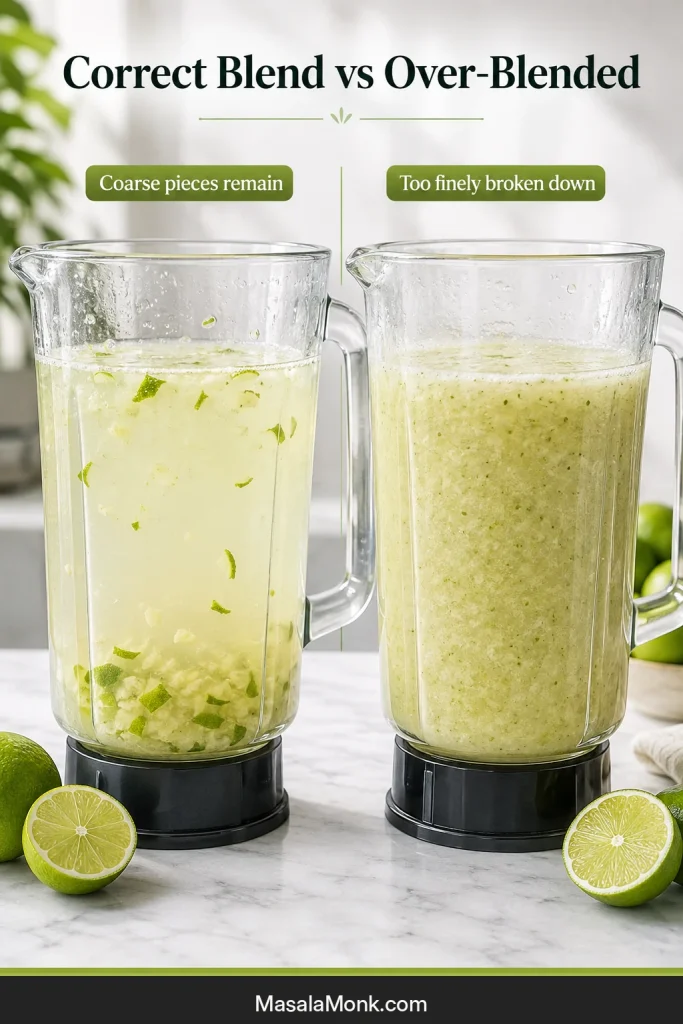
How to Recognize the Correct Lime Blend
The liquid should still move freely while visible coarse pieces remain. Fine suspended pulp and sluggish circulation show that the peel has been worked too far.
The correct blend circulates freely, while over-blended liquid hangs with fine suspended pulp.
When the blend stops at the coarse stage, the peel does exactly what you want: it gives the drink a vivid fresh-peel aroma that ordinary squeezed limeade does not usually have.
Can You Rescue a Bitter Pitcher?
A lightly bitter pitcher is often recoverable. Test the correction in one glass before changing the whole batch: add a splash of cold water and 1–2 teaspoons condensed milk, stir and taste over ice. If the edge softens, scale the same adjustment into the remaining pitcher. A heavily over-blended batch is harder to bring back.
Avoid adding sugar by itself. It can hide the first bitter impression while leaving the harsh finish in place.
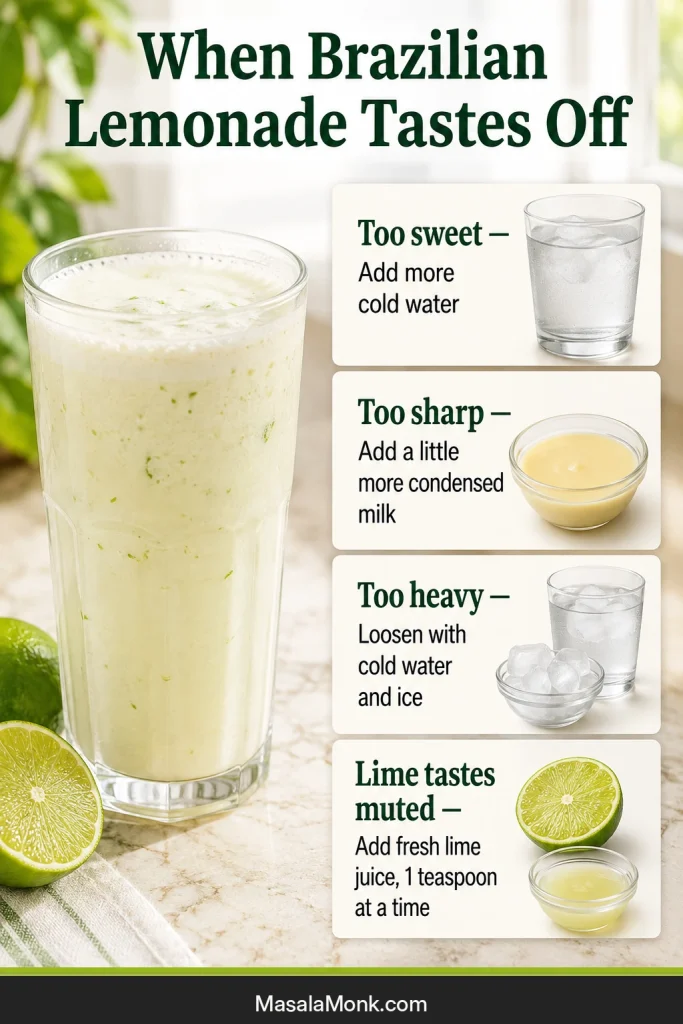
When Your Brazilian Lemonade Tastes Off
A pitcher that is slightly too sharp, sweet or heavy is usually one small adjustment away. Change one thing at a time, and try the first glass again before touching the whole batch.
Change one variable, retaste over fresh ice, and only then adjust again.
Problem
Likely cause
Try this first
Too sour
Very acidic limes or too little condensed milk
Add condensed milk 1 tablespoon at a time
Too sweet
Full can of condensed milk with mild limes
Add cold water, then fresh lime juice 1 teaspoon at a time
Heavy or thick
High condensed-milk ratio
Add cold water 2 tablespoons at a time
Thin or watery
Too much melted ice or excess dilution
Chill without adding more ice; add condensed milk only if the sweetness can take it
Sweet but flat
The citrus has been softened too far
Add fresh lime juice rather than blending more peel
Small peel particles
Coarse sieve or hard pressing
Pass the drink through a finer sieve once more
Once the lime tastes clear again, stop adjusting and pour the glasses.
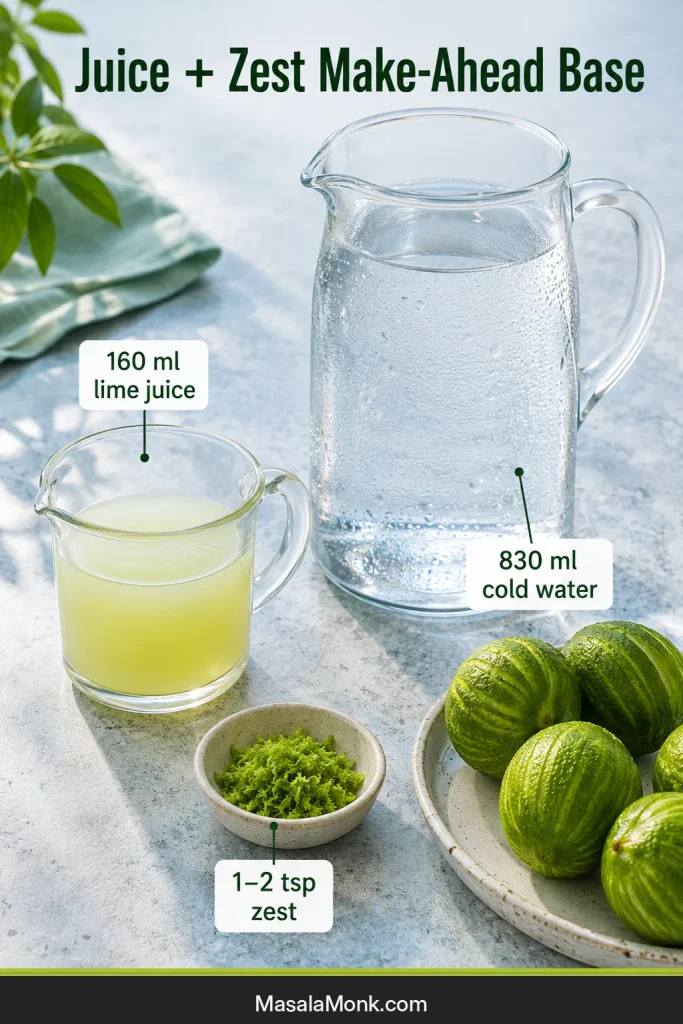
When dinner is still a few hours away—or guests are due before you want to stand at the blender—the juice-and-zest version keeps its balance more reliably until serving. It gives the drink a smoother, cleaner lime flavor with less peel edge.
Keep the chilled base tightly covered; otherwise, it can absorb refrigerator aromas before finishing.
Juice-and-Zest Ingredients
⅔ cup fresh lime juice, 5⅓ US fl oz / 160 ml; buy enough limes to produce this amount because the count varies widely with size and juiciness
1–2 teaspoons finely grated green zest, approximately the zest of 1 large lime, avoiding the white pith
3½ cups cold water, 28 US fl oz / 830 ml, plus up to ½ cup / 120 ml for adjustment
8¾–10½ oz sweetened condensed milk, 250–300 g
Ice, for serving
How to Make the Juice-and-Zest Version
Combine the lime juice and 3½ cups / 830 ml cold water. Cover and refrigerate earlier in the day, or overnight when necessary. For the brightest peel aroma, add the finely grated zest during the final blend rather than leaving it in the base.
Before adding condensed milk, try a spoonful of the chilled citrus base. It should taste bright and deliberately tart; add a little of the reserved water if it feels too intense.
Shortly before serving, blend the chilled citrus base, zest and 250 g condensed milk for 10–15 seconds.
Pour a small glass over ice. Add more condensed milk for softness or the remaining water when the flavor is still too concentrated.
This is the easier route when you want the lime work finished before the room fills up. A citrus press, microplane and even a small blender are enough.
No blender? Whisk the juice-and-zest version in a pitcher, shake small portions in a tightly sealed jar or use a handheld frother. Strain before serving when you want a completely smooth glass.
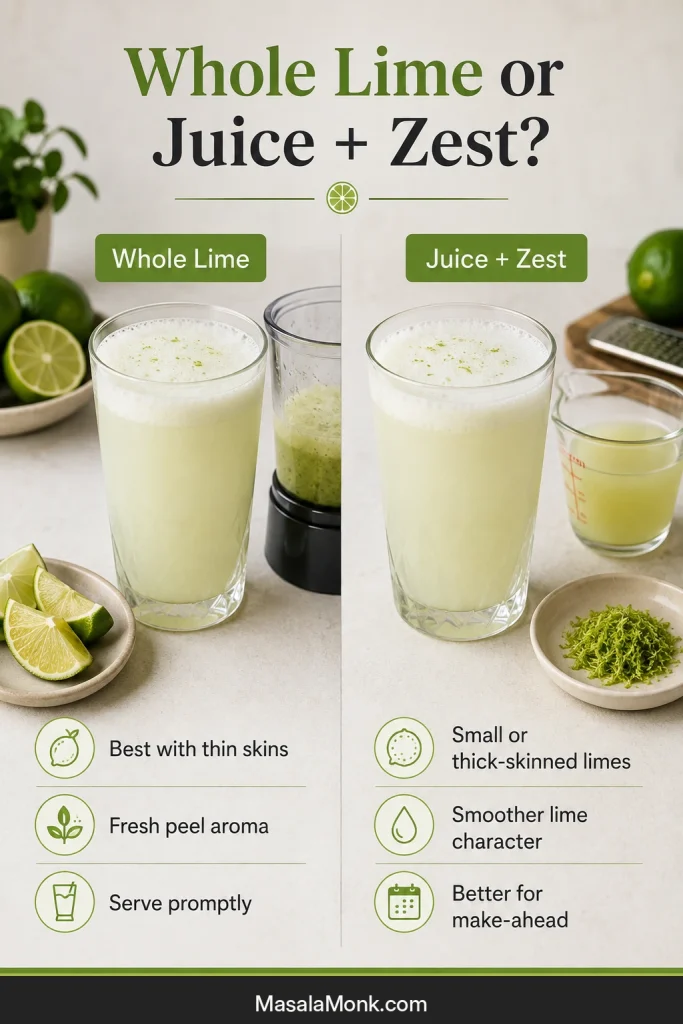
Whole Lime or Juice and Zest?
Both methods can make an excellent pitcher. Use the whole-lime route when the skins are thin and service is immediate; choose juice and zest when the fruit is small or the drink must wait.
Choose whole lime for immediate service; use juice and zest when the pitcher must wait.
Keep the short lime blend, then change the body, fruit or finish with one of these lighter, richer, tropical, frozen or cocktail options.
Adjust the Body and Sweetness
Keep the lime and water fixed while testing condensed-milk levels. That way, each glass shows a true change in richness rather than a different dilution.
Keep water and ice constant, so the condensed-milk levels remain fair to compare.
For a lighter pitcher: Use the standard 4 limes, 5 cups / 1.18 liters cold water and 8¾ oz / 250 g condensed milk. Add simple syrup only after tasting over ice.
For a richer pitcher: Keep the standard 4 limes and 4 cups / 950 ml water, but use the full 14 oz / 397 g can of condensed milk. Smaller glasses keep the sweetness from overwhelming the lime.
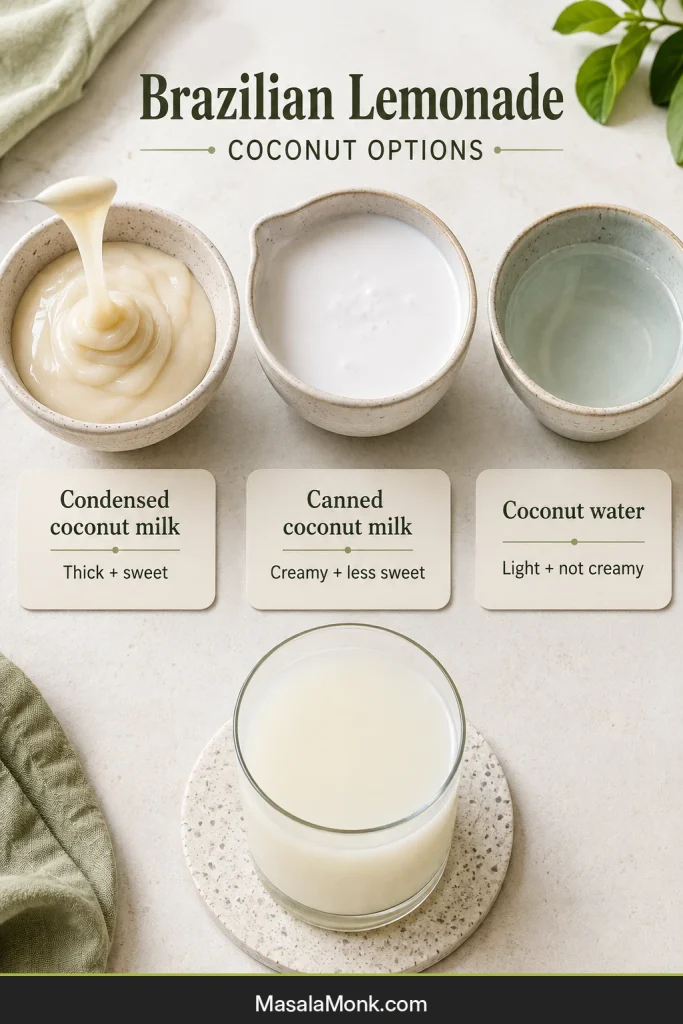
Coconut Version
Coconut ingredients change the drink in different ways: some replace sweetness and body, while others add only flavor or richness.
Chill before judging coconut sweetness, intensity or body because brands vary widely.
For dairy-free creaminess: Replace the sweetened condensed milk with sweetened condensed coconut milk by weight. Begin with 250 g because brands vary in sweetness and coconut intensity.
For a softer coconut finish: Begin with ½ cup / 120 ml full-fat canned coconut milk in place of the same amount of water.
For a lighter tropical drink: Replace up to half the water with coconut water; it adds flavor, not creaminess.
Add coconut products only after straining. Plain coconut milk softens the drink; condensed coconut milk also sweetens and thickens it.
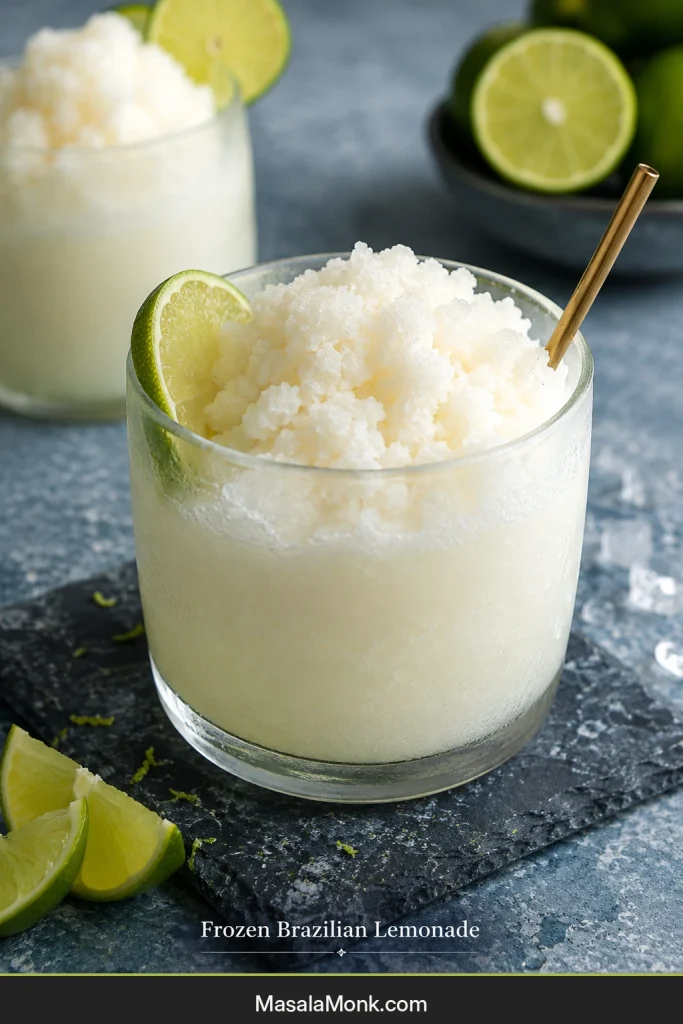
For two snowy servings, blend 2 cups / 475 ml prepared lemonade with 8–9 oz / 225–250 g ice after straining. It begins thick, then loosens into a creamy slush.
Pulse only until slushy; prolonged blending melts more ice and gradually thins the drink.
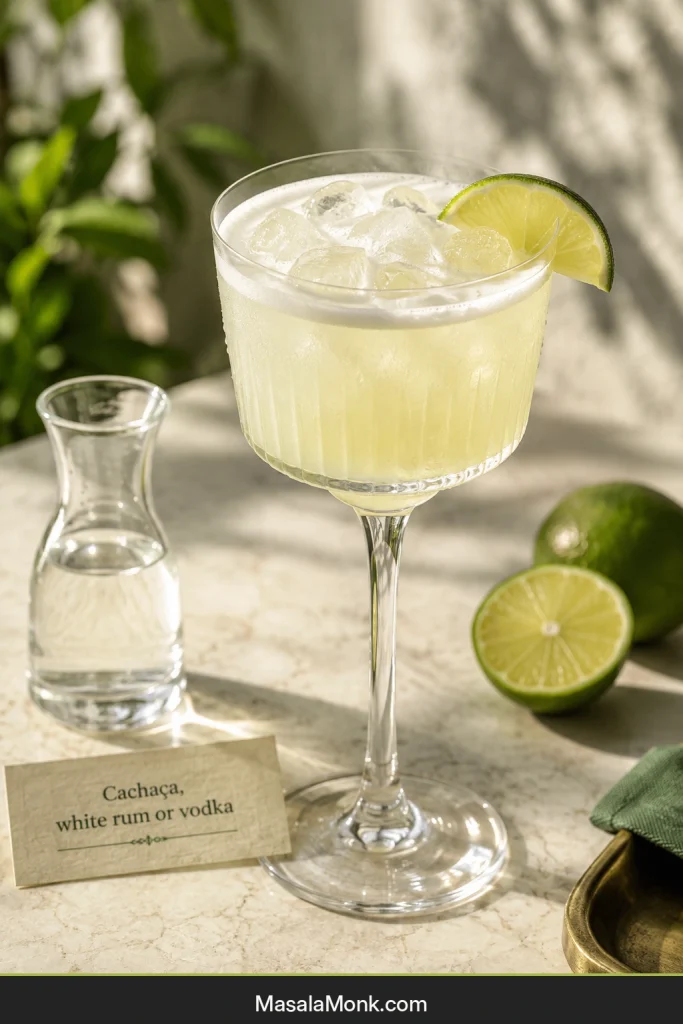
Cocktail With Cachaça, Rum or Vodka
Cachaça brings a grassy edge that cuts through the condensed milk. White rum tastes more tropical; vodka stays quieter.
Add spirit by the glass for mixed groups, or add it to the pitcher when every serving is alcoholic.
Serving
Spirit
One 7–8 oz glass
1 oz / 30 ml
Standard pitcher
4–6 oz / 120–180 ml, according to the strength you prefer
Stir the spirit into the pitcher after straining; do not extend the whole-lime blend. For a sharper lime cocktail without condensed milk, try the classic gimlet.
Serve alcoholic versions only to adults of legal drinking age and enjoy responsibly.
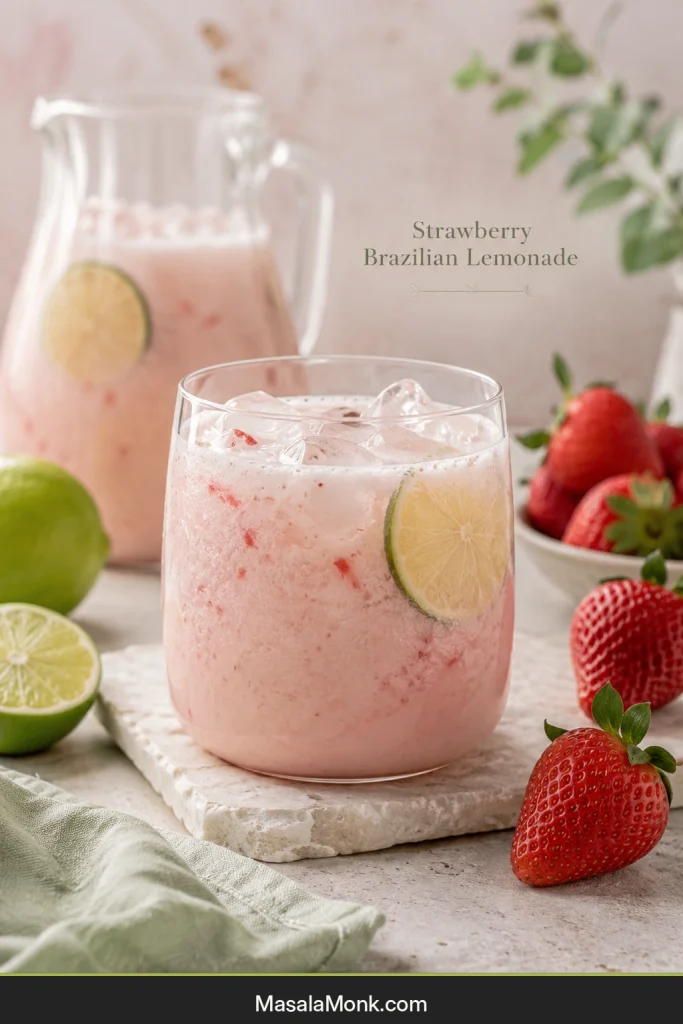
Strawberry Version
For a fruitier pitcher, begin with 1 cup hulled strawberries, about 5¼ oz / 150 g, blended with the strained lime base and condensed milk. The berries soften the acidity and turn the drink pale pink.
Taste before adding more condensed milk because ripe strawberries bring sweetness as well as color.
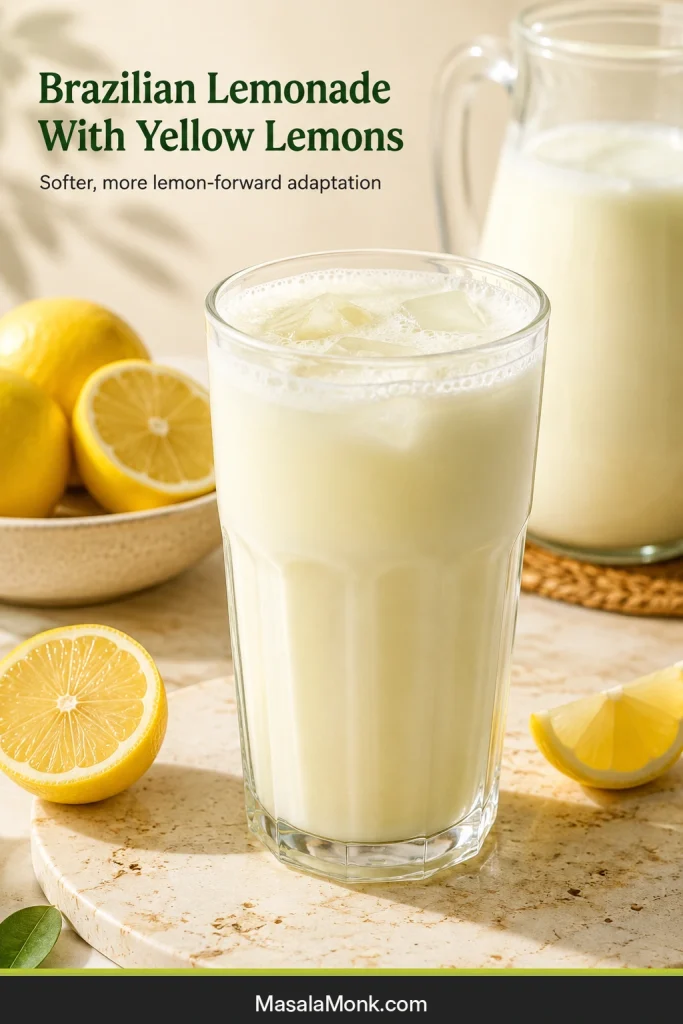
Can You Make It With Yellow Lemons?
Yes, but use the juice-and-zest method rather than blending whole lemons. Combine ½ cup plus 1 tablespoon / 135 ml fresh lemon juice, 1 teaspoon finely grated yellow zest, 3½ cups / 830 ml cold water and 8¾ oz / 250 g condensed milk. Adjust only after tasting over ice.
The result is pale yellow and familiar, without the fresh green-peel character of the lime version. Treat it as a Brazilian-lemonade-inspired lemon drink rather than an identical substitution.
Use only thin yellow zest because white pith can overwhelm the softer lemon profile.
Scale It for a Party
For a crowd, the challenge is room in the blender, not a longer extraction. Process large quantities in separate short batches while everyone gets the glasses ready with ice.
Pre-measure equal lime-and-water portions, so every blender load receives the same brief extraction.
Batch
Limes
Water
Condensed milk
Makes
Half
120–140 g / about 2 medium
2 cups / 475 ml
5¼ oz / 150 g
550–600 ml / 2–3 glasses
Standard
240–280 g / about 4 medium
4 cups / 950 ml
10½ oz / 300 g
1.1–1.2 liters / 5–6 glasses
Double
480–560 g / about 8 medium
8 cups / 1.9 liters
21 oz / 600 g
2.2–2.4 liters / 10–12 glasses
For a double batch, blend and strain two standard lime-and-water batches separately, then combine them and blend or whisk in the condensed milk. Stop each lime batch at the same cloudy-green, coarse-piece stage.
A double batch is usually enough for twelve guests when other drinks are available. Have the glasses filled with ice before the blender starts; Brazilian lemonade is at its best when it goes straight from blender to pitcher to table.
Before Guests Arrive
Wash and dry the limes ahead. Cut them as close to blending as practical; if necessary, refrigerate the cut fruit tightly covered for up to a couple of hours.
Measure the water and condensed milk before guests arrive.
Use the juice-and-zest version when the citrus base must be prepared earlier in the day or overnight.
Keep serving ice in a separate bowl or bucket instead of letting it melt into the pitcher.
For an alcoholic party pitcher, add the spirit only after the lime pulp has been strained.
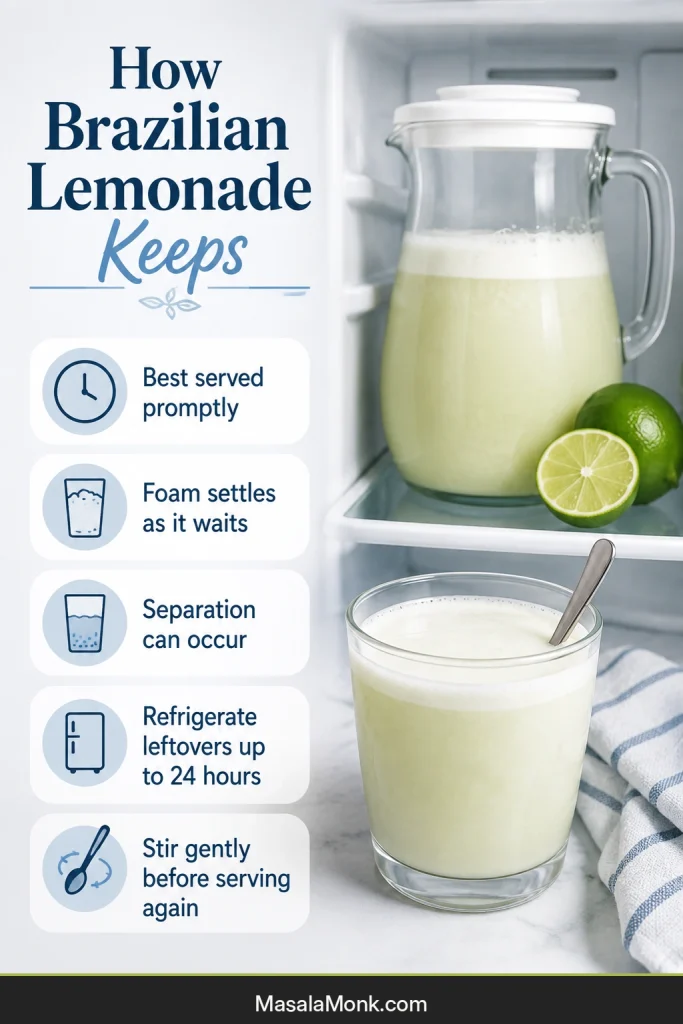
Whole-lime Brazilian lemonade is best served as soon as practical. Its foam settles as it waits, and the peel edge may become more noticeable.
Refrigerate without ice; melting cubes dilute leftovers and make next-day balance harder to restore.
Leftovers: Cover and refrigerate promptly; use within 24 hours, with some loss of foam and fresh-lime aroma.
Before serving again: Stir or briefly reblend, then taste before making any adjustment.
Expected changes: Separation, a softer aroma and a more noticeable peel edge.
Separation alone is normal. Discard the drink when its smell, appearance or flavor suggests spoilage rather than simple settling.
Can you freeze it? Freezing the finished dairy-based drink can change its texture. A better plan is to freeze the juice-and-zest citrus base in ice trays, then blend those cubes with fresh condensed milk when you want a frozen drink.
Frequently Asked Questions
Can You Use Bottled Lime Juice?
Yes, using the juice-and-zest method, though bottled juice will not match the aroma of fresh zest and juice. Bottled juice can taste sharper, flatter or more concentrated, so begin with ½ cup / 120 ml and increase only after tasting it over ice.
Can You Make Brazilian Lemonade Without Condensed Milk?
Yes, though the result will be closer to Brazilian-style limeade than the familiar creamy drink. Use the same 4 limes and 4 cups / 950 ml water, following the same short blend and gentle straining method. Replace the condensed milk with ⅓ cup / 65 g sugar or an equivalent amount of simple syrup, then adjust after tasting it over ice.
Can You Use Key Limes or Small Indian Limes?
Yes, but do not substitute by count or blend every small lime with its peel attached. For the easiest balance, use the juice-and-zest method. For a whole-fruit version, peel most of the limes and leave peel on roughly one-quarter to one-half of the total amount.
Can You Make Brazilian Lemonade the Night Before?
The whole-lime method is not the best overnight choice because its peel edge can strengthen. Prepare the juice-and-water base instead, refrigerate it covered overnight when necessary, and add the zest and condensed milk shortly before serving.
The Short Blend Protects the Final Sip
Brazilian lemonade looks almost too easy to need a rule. Then one over-blended pitcher explains why the rule matters.
Add lime wheels to glasses, not the pitcher, where peel keeps steeping during service.
Watch the pieces, not only the clock. Strain without squeezing, then let the first glass decide whether the pitcher needs more brightness or more softness.
A good pitcher feels generous without becoming heavy. The first sip is playful and creamy; the last should still taste unmistakably of lime.
Which method did you use, and what kind of limes were available where you live? Tell us which method worked best with your fruit.
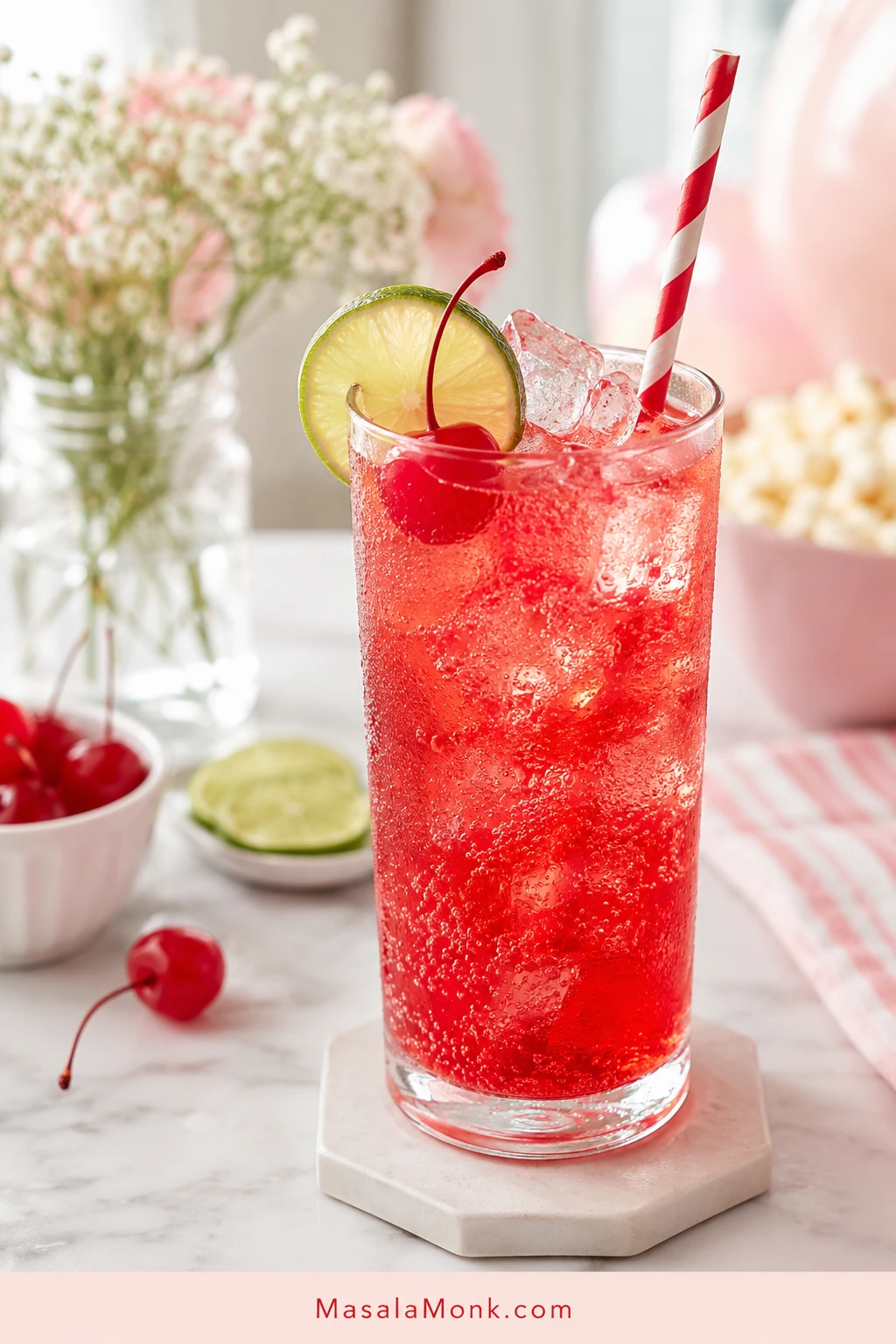
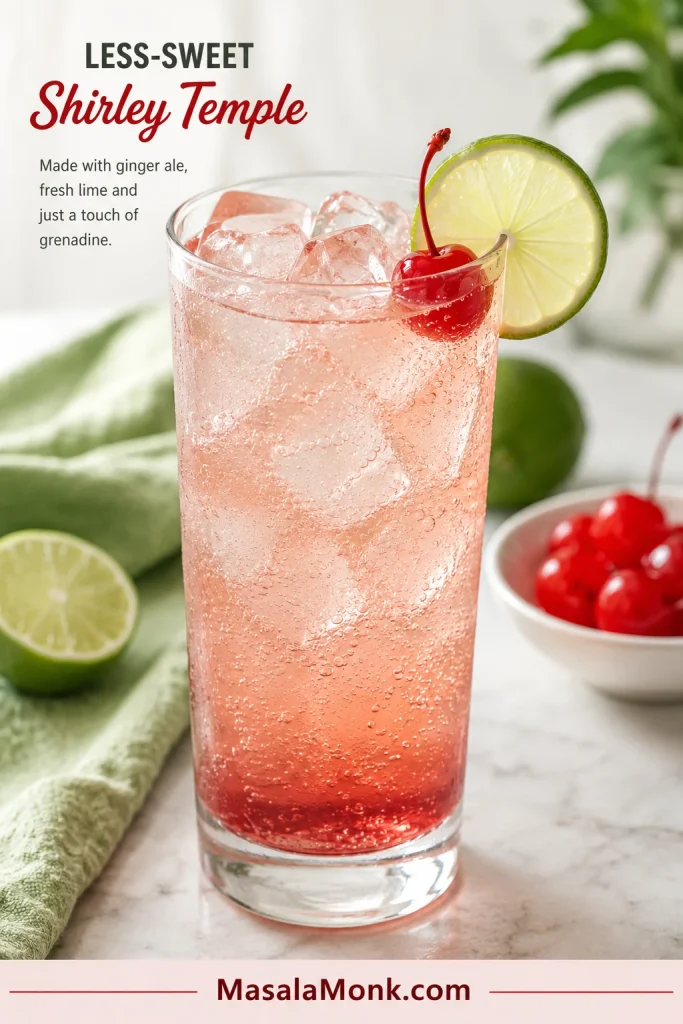
A Shirley Temple is the red fizzy drink that made a plain soda feel like an occasion. It is the glass with the cherry on top, the drink kids ask for when adults are ordering cocktails, and the no-alcohol mocktail that still looks cheerful on a party table.
But it is also easy to get wrong. Too much grenadine and the bottom tastes like syrup. Warm soda goes flat before the cherry is gone. The best version is cold, bubbly, cherry-red, and balanced enough that the last sip still feels refreshing.
This Shirley Temple recipe starts with the simple classic version, then shows you how to make it sweeter, lighter, more old-school with ginger ale, brighter with lemon-lime soda, or easy to pour as a party pitcher.
Quick Answer: What Is a Shirley Temple?
A Shirley Temple is a fizzy non-alcoholic drink made with lemon-lime soda or ginger ale, grenadine, ice, and maraschino cherries. Sprite or 7UP gives the familiar restaurant-style sweetness, while ginger ale makes the drink softer and a little more old-school.
Best starting ratio: use 1 cup / 240 ml soda and 1 tablespoon / 15 ml grenadine. Add more syrup only when you want the sweeter, brighter red version.
A cold, fizzy Shirley Temple made with lemon-lime soda or ginger ale, grenadine, ice, and maraschino cherries. This balanced version tastes classic without turning the last few sips heavy.
Prep time: 3 minutes
Cook time: 0 minutes
Total time: 3 minutes
Servings: 1 drink
Yield: 1 tall glass
Method: Built in the glass
Glass: Tall glass, highball glass, or Collins glass
Equipment: Tablespoon or jigger, long spoon or straw
Ingredients
1 cup / 8 oz / 240 ml chilled lemon-lime soda or ginger ale
1 tablespoon / 15 ml grenadine, or up to 2 tablespoons / 30 ml for a sweeter bright-red version
1 teaspoon / 5 ml fresh lime juice, optional
Ice, enough to fill the glass
1 to 3 maraschino cherries, for garnish
Optional: 1 teaspoon syrup from the maraschino cherry jar for extra cherry flavor
Instructions
Fill a tall glass with ice.
Add the grenadine.
Pour in the chilled lemon-lime soda or ginger ale slowly.
Add lime juice if using.
Stir gently, just until the syrup blends into the soda.
Garnish with maraschino cherries and serve immediately.
Recipe Notes
For a lighter version, use 1 teaspoon / 5 ml grenadine and add lime.
To create a red layered look, add soda first and drizzle the grenadine last so it sinks.
Serve right away. The fizz is part of the drink.
A cherry on top is fun, but the real win is the balance underneath it.
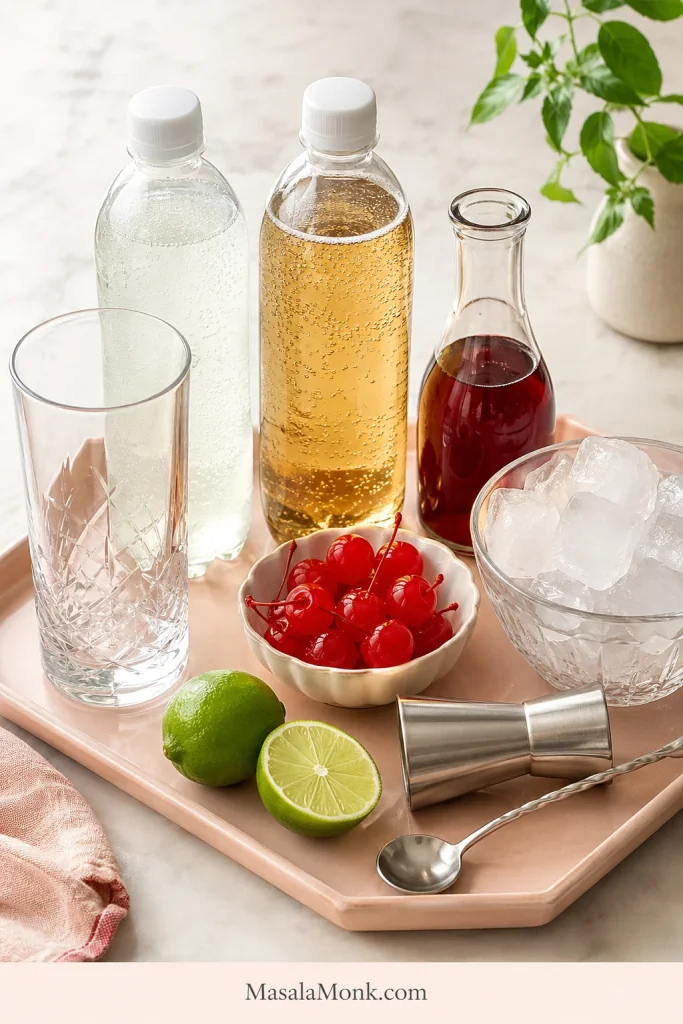
Before mixing, set up the simple Shirley Temple ingredients: chilled soda, grenadine, ice, and maraschino cherries. Keep lime nearby because a small squeeze makes the drink taste cleaner and less candy-sweet.
Part of the charm is the little ceremony: the ice, the red syrup, the slow pour, and the cherry dropped on top. Even when a Shirley Temple takes only three minutes, it feels like someone made you something on purpose.
Making one glass? Use the recipe card above. Want it sweeter, lighter, more classic, or party-ready? This quick guide gets you there faster.
For This Kind of Drink
Use This
Result
Classic flavor
Ginger ale + 1 tbsp grenadine
Softer, slightly warmer, less candy-like
Restaurant-style sweetness
Sprite or 7UP + 2 tbsp grenadine
Bright red, sweet, nostalgic
Balanced everyday version
Any soda + 1 tbsp grenadine
Sweet, fizzy, but not heavy
Less-sweet mocktail
Ginger ale or club soda blend + 1 tsp grenadine + lime
Lighter, cleaner, more grown-up
Party pitcher
Mix syrup base first, add soda last
Fresh bubbles and better serving texture
Fruitier version
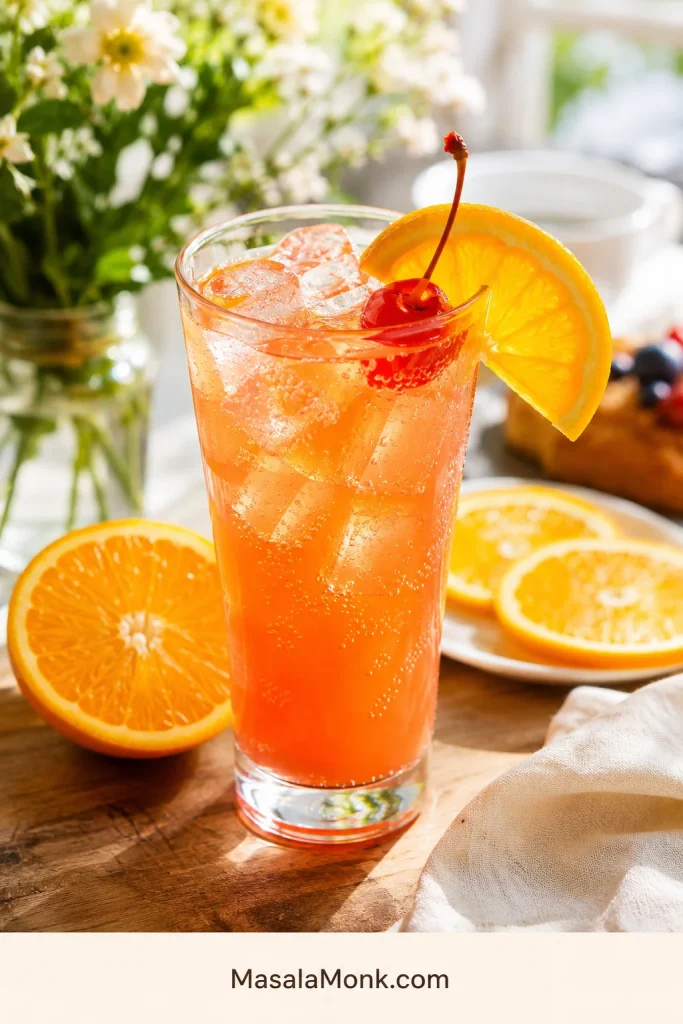
Add 1 tbsp to ¼ cup orange juice
More brunch or punch-style
If you just want the drink, stop at the recipe card. To tune the sweetness, soda choice, syrup, or party amounts, use the notes below to make the cherry-red mocktail fit your table.
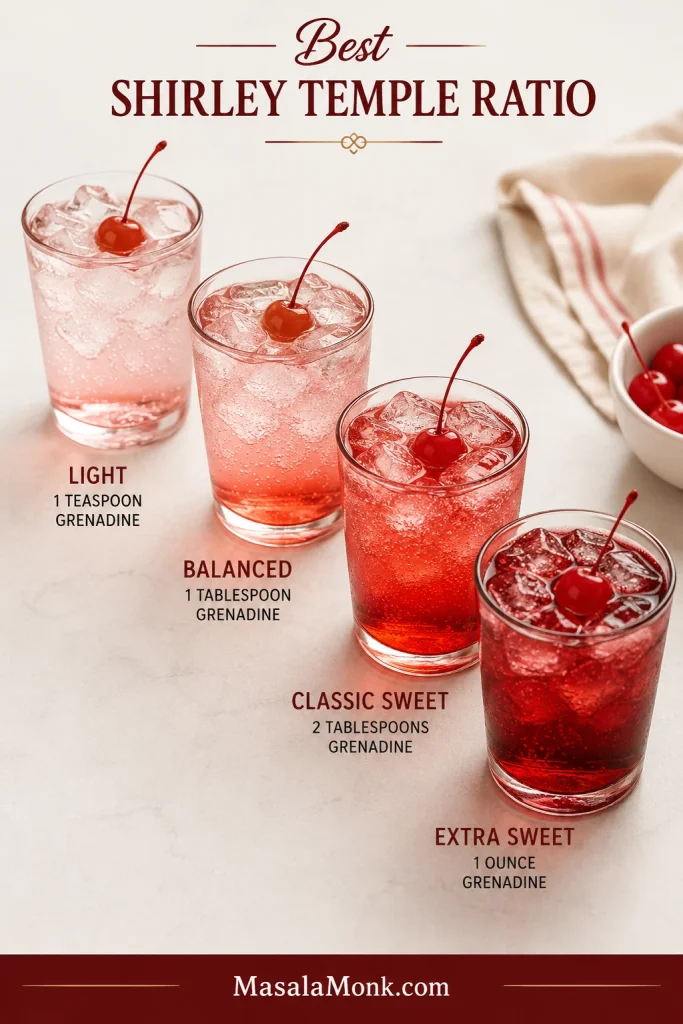
The ratio is what separates a refreshing Shirley Temple from a syrupy one. Too little grenadine and the drink tastes like plain soda with a red tint. Go too far, and the bottom turns heavy.
Best ratio: start with 1 cup / 240 ml soda and 1 tablespoon / 15 ml grenadine. From there, go lighter or sweeter depending on who is drinking it.
Use the ratio guide as your control point: 1 cup soda and 1 tablespoon grenadine makes a balanced Shirley Temple. Then, adjust by the teaspoon for a lighter, sweeter, or more cherry-red glass.
Style
Soda
Grenadine
Best For
Light
1 cup / 240 ml
1 teaspoon / 5 ml
Less-sweet mocktail
Balanced
1 cup / 240 ml
1 tablespoon / 15 ml
Best first drink
Classic sweet
1 cup / 240 ml
2 tablespoons / 30 ml
Bright-red nostalgic drink
Extra sweet
4 to 6 oz / 120 to 180 ml
1 oz / 30 ml
Only when you already like a very syrupy glass
Start balanced. Taste once. Add another teaspoon of grenadine only when the drink needs more color or sweetness. If you grew up with very red Shirley Temples, the sweeter version may taste familiar. When you are making it for yourself now, the balanced pour usually holds up better after the first few sips.
Success cue: the drink should look red and cheerful, but the soda should still feel lively. When the bottom tastes thick, use less grenadine next time or stir before serving.
Build the drink directly in the glass. No shaker, blender, saucepan, or bar setup is needed.
Start cold. A chilled glass is optional, but cold soda is not. Warm soda melts ice faster and loses fizz.
Fill the glass with ice. The drink should feel crisp from the first sip.
Add grenadine. Use 1 tablespoon for a balanced pour.
Pour the soda slowly. Lemon-lime soda, Sprite, 7UP, or ginger ale all work.
Add lime if using. A little citrus makes the sweetness feel brighter.
Stir gently. Mix the syrup through without flattening the bubbles.
Finish with cherries. Serve immediately while the drink is still fizzy and cold.
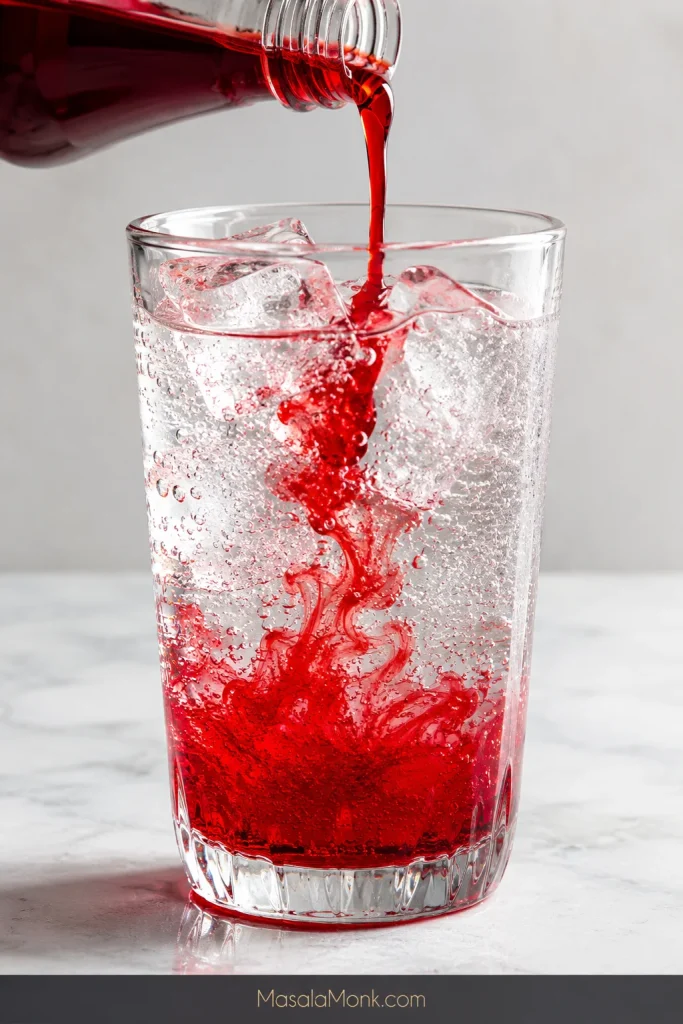
Notice how grenadine sinks through the bubbles because it is heavier than soda. That red layer gives the drink its classic look, but a gentle stir makes the flavor even from top to bottom.
For a red gradient, change the order. Add ice and soda first, then slowly pour grenadine down the inside of the glass. It will sink because it is heavier than soda. That layered look is pretty, but the drink tastes more even once stirred.
After the syrup amount, the soda choice is the next big decision. Neither option is wrong; they just make different memories.
Best soda: use Sprite or 7UP for the sweet restaurant-style version. Use ginger ale for a softer, more classic version.
Soda
Flavor
Use It When
Sprite or 7UP
Sweet, bright, lemon-lime
You want the familiar restaurant-style Shirley Temple
Ginger ale
Warmer, softer, lightly spiced
You want a more classic mocktail flavor
Half lemon-lime soda + half club soda
Lighter and less sweet
You want a cleaner non-alcoholic drink
Ginger beer
Sharper and spicier
You want a bold variation, not the soft classic version
Cola
Cherry-cola flavor
You are making a Roy Rogers, not a Shirley Temple
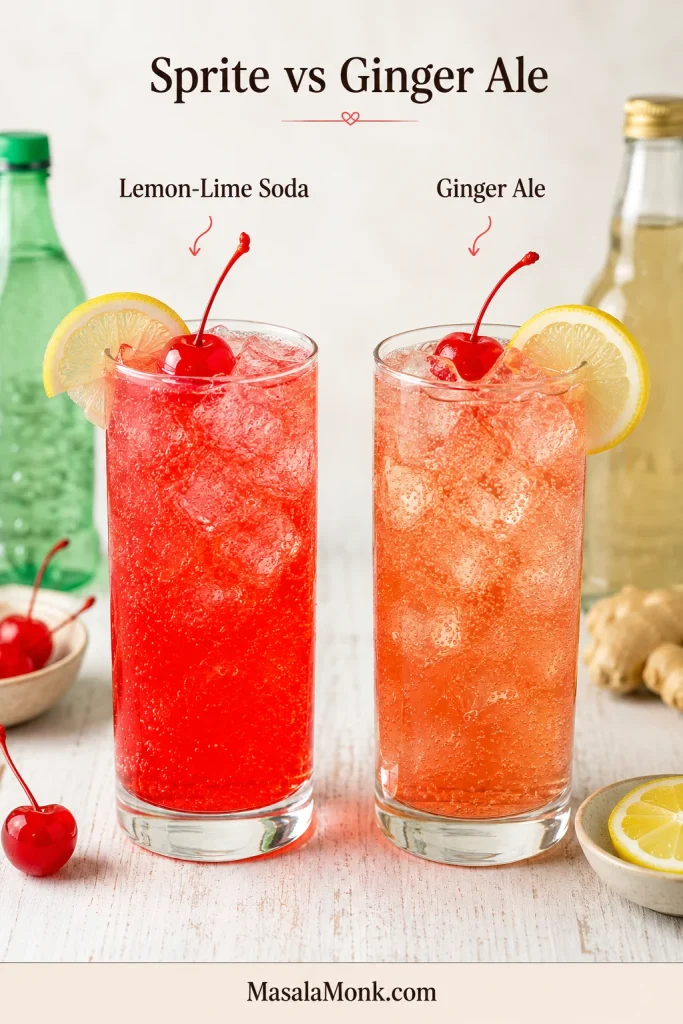
Compared side by side, lemon-lime soda makes a brighter, sweeter Shirley Temple, while ginger ale gives the mocktail a softer, more classic flavor. Choose the soda based on whether you want bold nostalgia or a gentler finish.
For kids, birthdays, and the version most people expect from restaurants, lemon-lime soda is usually the easiest win. A less sugary pour works better with ginger ale. The cleanest version splits the cup between lemon-lime soda and club soda, then adds lime.
A Shirley Temple should still taste like a treat, but it should not feel like syrup with bubbles on top. For a lighter glass, keep the fizz, pull back the grenadine, and let lime do some of the balancing.
Use 1 teaspoon to 1 tablespoon grenadine instead of 2 tablespoons.
Choose ginger ale instead of Sprite or 7UP.
Use half club soda and half lemon-lime soda.
Add 1 to 2 teaspoons fresh lime juice.
Fill the glass with plenty of ice.
Skip extra cherry syrup from the jar.
Use zero-sugar lemon-lime soda or diet ginger ale when you want a lighter drink.
A lighter Shirley Temple starts by pulling back the grenadine before cutting the bubbles. The color will be paler, but with cold soda, plenty of ice, and lime, the drink tastes cleaner and easier to finish.
This lighter version will not be neon red, and that is okay. It should taste like a drink, not a melted candy. You still get the nostalgia without the sugar-rush feeling.
Shirley Temple Pitcher for Parties
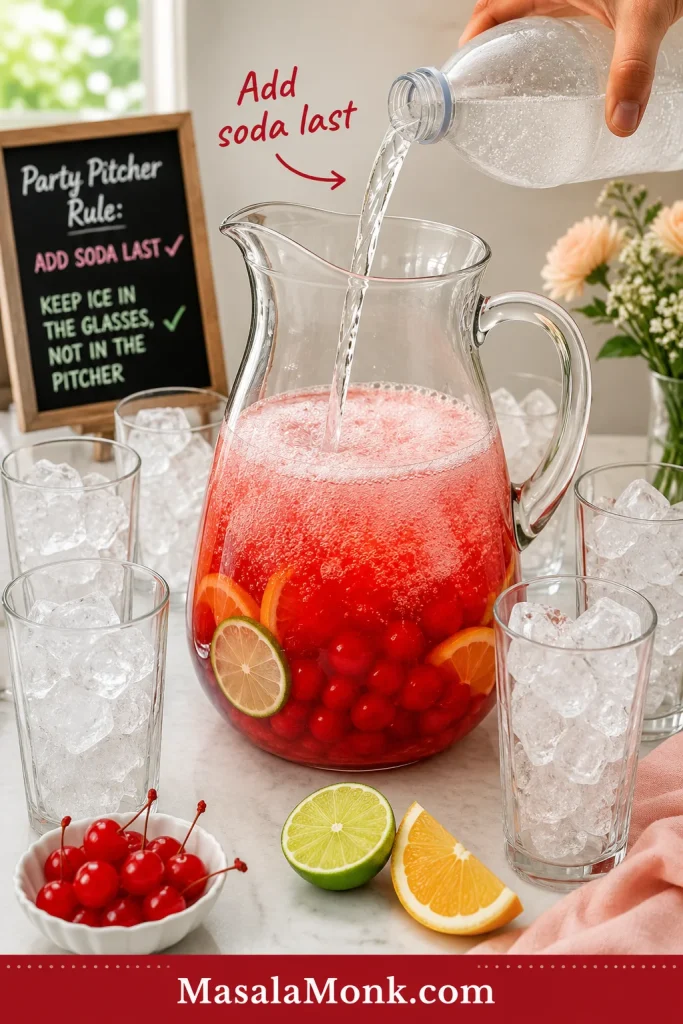
For a party pitcher, protect the bubbles. You can make the red syrup base ahead, but the soda should go in at the end. The syrup base can wait; bubbles cannot.
Pitcher rule: mix the grenadine and lime ahead, chill that base, then add the soda right before serving.
When scaling into a Shirley Temple pitcher, mix the grenadine base ahead, but add soda right before serving. Meanwhile, keep ice in the glasses so the pitcher stays fizzy, fresh, and party-ready instead of watered down.
Pitcher for 8 Drinks
8 cups / 64 oz / 1.9 L chilled lemon-lime soda or ginger ale
½ cup / 120 ml grenadine for a balanced pitcher
¾ cup / 180 ml grenadine for a sweeter but still easy-drinking pitcher
1 cup / 240 ml grenadine for a very sweet party-style pitcher
2 to 3 tablespoons / 30 to 45 ml fresh lime juice, optional
Maraschino cherries, to serve
Orange or lime slices, optional
Ice, added to glasses instead of the pitcher
Mix the grenadine and lime juice in the pitcher first. Keep that base chilled when preparing ahead. Add the soda just before serving, stir gently, and pour over ice-filled glasses with cherries.
Do not add ice directly to the pitcher unless the drinks will be served immediately. Ice melts, waters down the syrup, and flattens the soda faster.
This is the kind of pitcher that disappears quickly because everyone can pour from it: kids, non-drinkers, drivers, and adults who just want something cheerful.
Party cue: the soda should still sound lively when it is poured. If the pitcher has been sitting open for a while, the drink will taste sweeter and flatter.
Because the ingredient list is short, every part has a job. Cold soda brings lift, grenadine adds the red fruitiness, ice keeps the drink crisp, and the cherry makes it feel complete.
Grenadine: Start with 1 tablespoon per cup of soda. It gives color and flavor without making the drink heavy.
Lemon-lime soda: Best when you want the bright, sweet, birthday-party version.
Ginger ale: Softer and more old-school, especially when you want a less candy-like mocktail.
Lime juice: Optional, but useful when the drink tastes too sweet or flat.
Maraschino cherries: One is enough, but two or three make the glass feel more generous.
Ice: Use more than you think. A cold drink tastes lighter and stays fizzy longer.
What makes a Shirley Temple work is that it gives the non-drinker a glass that still feels chosen, garnished, and worth raising. Kids usually chase the cherry. Adults get a festive drink that does not have to taste cloying.
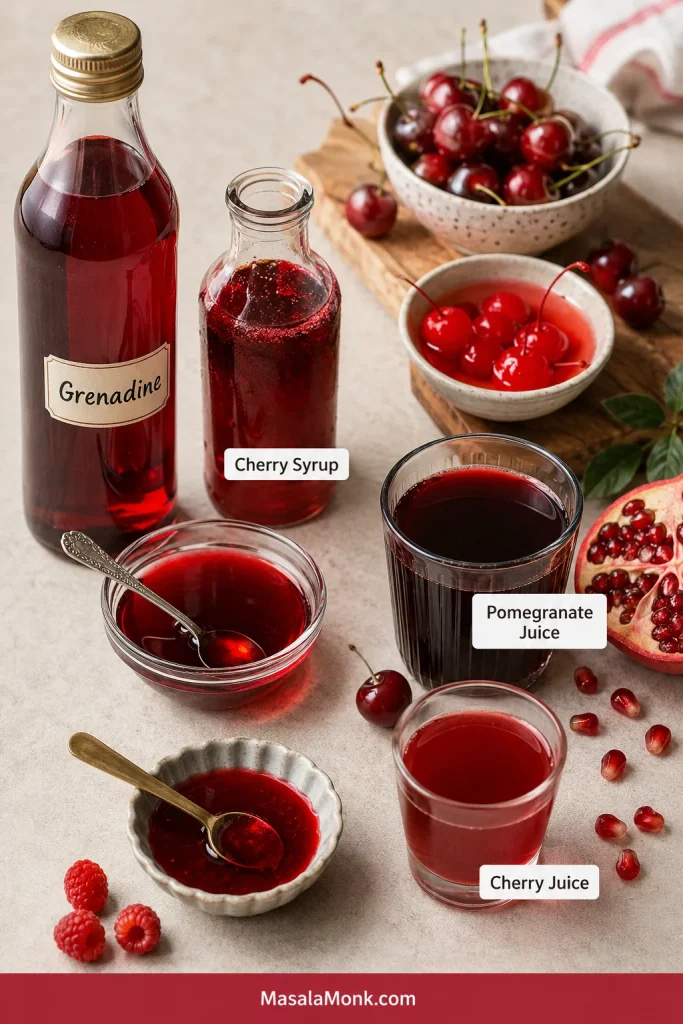
What Is Grenadine?
Grenadine is the red syrup used in a Shirley Temple. It adds color, sweetness, and fruity flavor. Traditional grenadine is pomegranate-based, though many modern store-bought versions taste more like cherry or mixed fruit.
So if you always thought grenadine was cherry syrup, you are not alone. It looks red, tastes fruity, and is served with a cherry, so the confusion makes sense. Still, cherry syrup is not the same thing, even though it can help when grenadine is missing.
Grenadine Substitutes for Shirley Temple
Without grenadine, the drink will not taste exactly classic, but you can still make something close. If grenadine is missing, decide what matters most: the red color, the fruitiness, or the sweetness.
No grenadine? Cherry syrup is the quickest substitute, while pomegranate juice gives a lighter, more tart flavor. Either way, add a little at a time so the drink stays balanced instead of turning too sweet.
Substitute
Works?
What to Know
Homemade grenadine
Best option
Closest to classic sweet-tart flavor
Maraschino cherry syrup
Good in a pinch
Sweeter and more candy-like
Pomegranate juice
Works lightly
Less sweet and less syrupy
Cherry juice
Works for color and flavor
Not classic grenadine, but useful
Raspberry syrup
Possible
Changes the flavor noticeably
The easiest quick substitute is syrup from the maraschino cherry jar. Start with 1 teaspoon, taste, and add more only when needed. Cherry syrup can make the drink sweet very quickly.
Orange juice is not required for a classic Shirley Temple, but a small splash can make the drink fruitier and more party-style. This version works especially well for brunches, birthdays, baby showers, and punch bowls.
At brunch, baby showers, or punch-style parties, a splash of orange juice makes the Shirley Temple fruitier and more citrusy. Keep the amount small so it still tastes like a cherry-red mocktail, not fruit punch.
For a light citrus note, add 1 tablespoon / 15 ml orange juice. A fruitier punch-style drink can use up to ¼ cup / 60 ml orange juice. More than that moves the mocktail away from a classic Shirley Temple and closer to fruit punch.
Lemon-lime soda usually works better than ginger ale here because the citrus flavors blend more naturally.
Classic vs Modern Shirley Temple
Older-style Shirley Temples often lean on ginger ale, while modern restaurant versions usually use Sprite, 7UP, or another lemon-lime soda. The drink’s exact origin story is a little messy, but the idea stayed simple: bubbles, red syrup, ice, and a cherry.
Shirley Temple Variations
Once the basic drink tastes right, variations are just small turns. Keep it cold, control the grenadine, and use citrus when the sweetness needs balance. For more red, bubbly ideas in the same lane, browse these mocktails with grenadine.
Orange juice Shirley Temple: Add 1 tablespoon to ¼ cup orange juice for brunches, baby showers, and punch bowls.
Frozen Shirley Temple: Blend ice, lemon-lime soda, grenadine, and a little lime juice until slushy, then serve immediately with cherries.
Holiday Shirley Temple: Add extra cherries, orange slices, lime wheels, or a sugared rim for Christmas, New Year’s Eve, Valentine’s Day, birthdays, and family parties.
Cherry-lime Shirley Temple: Add extra lime and a small spoon of maraschino cherry syrup for a sharper cherry-lime version.
Dirty Shirley vs Shirley Temple vs Roy Rogers
A classic Shirley Temple is non-alcoholic. These two related drinks are useful to know, especially when serving a mixed group:
Shirley Temple: lemon-lime soda or ginger ale, grenadine, ice, and cherries. No alcohol.
Dirty Shirley: the adult cocktail version, usually made with vodka, grenadine, lemon-lime soda or ginger ale, and a cherry.
Roy Rogers: a non-alcoholic cola drink made with grenadine and a cherry.
For a mixed group, keep the main pitcher alcohol-free and let adults prepare a separate Dirty Shirley only as needed. That keeps the drink family-friendly and avoids confusion.
Most problems come from one of three things: too much syrup, warm soda, or mixing too early. Match the problem to the fix before changing the whole drink.
Troubleshoot by reading the glass. A dark syrupy bottom usually means too much grenadine, while a dull flat drink usually means warm soda or soda added too early.
Problem
What Happened
How to Fix It
Too sweet
Too much grenadine or cherry syrup
Add more soda, a splash of club soda, and lime
Flat
Soda was warm, old, or mixed too early
Use chilled soda and serve immediately
Grenadine sank
Grenadine is heavier than soda
Stir for even flavor or leave layered for looks
Weak flavor
Too little grenadine or too much ice melt
Add 1 teaspoon grenadine or cherry syrup
Too pale
Very little grenadine or a lighter syrup
Add grenadine 1 teaspoon at a time
Watery
Ice melted before serving
Use chilled soda and fresh ice
No grenadine
Missing the classic syrup
Use cherry syrup, homemade grenadine, or pomegranate juice with sweetener
Think salty, crunchy, creamy, or citrusy. The drink is sweet and fizzy, so it does best beside foods that give it contrast. That makes Shirley Temples easy for birthday tables, family movie nights, brunches, holidays, and kid-friendly party spreads.
For adults who are not drinking alcohol, a less-sweet ginger ale Shirley Temple can feel more thoughtful than plain soda. It still looks festive, but with less syrup it feels polished enough for adults too.
FAQs
Is a Shirley Temple alcoholic?
No. A classic Shirley Temple is non-alcoholic. It is made with soda, grenadine, ice, and cherries.
Is a Shirley Temple a mocktail?
Yes. It is one of the classic mocktails: mixed, garnished, and served like a cocktail, but made without alcohol.
What are the ingredients in a Shirley Temple?
The basic ingredients are lemon-lime soda or ginger ale, grenadine, ice, and maraschino cherries. Lime juice is optional, but it helps balance the sweetness.
Do you make a Shirley Temple with Sprite or ginger ale?
You can use either. Sprite or 7UP gives the sweet lemon-lime flavor many people associate with restaurant Shirley Temples, while ginger ale tastes softer and more classic.
Can 7UP be used for a Shirley Temple?
Yes. 7UP works just like Sprite here, so use whichever lemon-lime soda you already like or have chilled.
Is grenadine the same as cherry syrup?
No. Grenadine is traditionally pomegranate-based, while cherry syrup comes from cherries. Many store-bought grenadines taste cherry-like, which is why the two are often confused.
What can replace grenadine in a Shirley Temple?
Maraschino cherry syrup is the easiest substitute. Homemade grenadine, pomegranate juice with a little sweetener, or cherry juice can also work, though the flavor will be slightly different.
How do you make a Shirley Temple less sweet?
Use less grenadine, choose ginger ale instead of Sprite, add a splash of club soda, and squeeze in fresh lime juice. Start with 1 teaspoon to 1 tablespoon grenadine per cup of soda.
What is a Dirty Shirley?
A Dirty Shirley is the alcoholic version of a Shirley Temple. It is usually made with vodka, grenadine, lemon-lime soda or ginger ale, and a cherry.
What is the difference between a Shirley Temple and a Roy Rogers?
Shirley Temples use lemon-lime soda or ginger ale. Roy Rogers uses cola. Both are non-alcoholic drinks made with grenadine and a cherry.
Can Shirley Temples be made ahead for a party?
Partly. You can mix the grenadine, lime, cherries, and garnishes ahead, but wait on the soda. The bubbles are what make the pitcher feel fresh.
A good Shirley Temple is not about pouring as much red syrup as the glass can take. It is about cold soda, enough ice, the right splash of grenadine, and a cherry that makes the drink feel special.
Use Sprite or 7UP for the familiar bright-red version, ginger ale for the more classic version, and lime or club soda when the drink needs to be lighter. Once the ratio feels right, you can make one glass in minutes or scale it into a party pitcher without losing the fizz.
A good hot toddy should feel warm before it tastes strong: lemon steam rising from the mug, honey softening the edges, a little whiskey warmth underneath, and enough hot water or tea to make the whole drink smooth and sippable. It is simple, but it should never taste flat, harsh, or thrown together.
This hot toddy recipe starts with the classic whiskey, honey, lemon, and hot water formula, then shows you how to adjust it for the toddy you actually want: softer with bourbon, fuller with tea, fruitier with apple cider, completely alcohol-free, or more aromatic with ginger, cardamom, cinnamon, and clove.
It is the kind of drink you make when you want something slower than a cocktail but more comforting than plain tea. One warm mug, a spoonful of honey, a squeeze of lemon, and a little heat are enough to change the mood of the evening.
Although a hot toddy is often talked about as a cold-weather comfort drink, it is not medicine or a cure. If you are under the weather, taking medication, avoiding alcohol, or serving someone who does not drink, use the non-alcoholic version below with hot tea, honey, lemon, ginger, and warming spices. The alcoholic version is for adults of legal drinking age only.
In a classic hot toddy, lemon and honey should balance the whiskey instead of hiding it, so the mug tastes bright, gently sweet, and warming.
Quick Answer: Hot Toddy Ratio
For one classic hot toddy, use 1½ ounces / 45 ml whiskey or bourbon, ¾ cup / 180 ml hot water or hot tea, 2 to 3 teaspoons honey, and 2 to 3 teaspoons fresh lemon juice. Stir the honey and lemon into the hot liquid first, then add the whiskey or bourbon and taste before serving.
Start with this hot toddy ratio, then adjust the mug by taste: more honey for softness, more lemon for brightness, or more tea for a longer sip.
The finished drink should taste bright at the front, gently sweet in the middle, and warming at the end. If it tastes like only whiskey, only lemon, or only honey, it needs one small adjustment.
Tastes too strong? Add more hot water or tea.
Sharp from lemon? Add a little more honey.
Overly sweet? Add more lemon juice.
Need it softer? Use bourbon or Irish whiskey.
Want more body? Use black tea or ginger tea instead of plain water.
Skipping alcohol? Use tea, honey, lemon, ginger, cinnamon, and cloves.
When the balance is right, it should feel like lemon tea with quiet whiskey warmth, not a mug of hot alcohol.
This classic hot toddy is made with whiskey or bourbon, hot water or tea, honey, fresh lemon, and optional warming spices. It is quick, cozy, and easy to adjust in the mug.
Prep Time
5 minutes
Heating Time
3 minutes
Total Time
8 minutes
Yield
1 drink
Mug Size
8 to 10 oz / 240 to 300 ml
Category
Drink
Cuisine
American
Method
Stirred hot drink
Ingredients
1½ ounces / 45 ml whiskey or bourbon
¾ cup / 180 ml hot water or hot tea
Honey: 2 to 3 teaspoons / 14 to 21 g
Fresh lemon juice: 2 to 3 teaspoons / 10 to 15 ml
Lemon round: 1, for garnish
Cinnamon stick: 1, optional
Whole cloves: 2 to 4, optional
Fresh ginger: 1 thin slice, optional
Equipment
Heatproof mug or Irish coffee glass
Kettle or small saucepan
Spoon
Jigger or small measuring cup
Measuring spoons
Citrus juicer, optional
Glass note: Use a heatproof mug or tempered glass. Avoid pouring very hot liquid into thin decorative glass, which can crack.
Instructions
Fill your mug with hot water for a minute to warm it, then discard that water.
Heat fresh water or brewed tea until steaming and just off the boil, about 190–205°F / 88–96°C. No thermometer needed; steam and a just-settled boil are the practical cues.
Honey and fresh lemon juice go into the warm mug first.
Pour in the hot water or tea and stir until the honey dissolves fully.
Add the whiskey or bourbon and stir again.
Garnish with a lemon round, cinnamon stick, cloves, or ginger if using.
Taste carefully. Add more honey for sweetness, lemon for brightness, or hot water/tea if the drink is too strong.
Let it cool for a moment before sipping. It should be steaming, not scalding.
Recipe note: Do not boil the whiskey. Add the spirit after the hot water or tea, so the drink stays smooth and balanced.
The first sip should be lemony, lightly sweet, and warm all the way through, with the whiskey in the background instead of shouting over everything.
Aim for a steaming, not scalding, mug with enough honey and lemon to make the whiskey feel smooth.
Keep this nearby for your first mug, then adjust by taste.
Time
8 minutes
Yield
1 drink
Mug
8 to 10 oz / 240 to 300 ml heatproof mug
Spirit
Whiskey or bourbon
Base
Hot water or brewed tea
Balance
Honey + fresh lemon
Temperature
Steaming, not boiling
Before You Sip
Is the honey fully dissolved?
Does the mug smell lemony, warm, and lightly spiced?
Is it steaming but not scalding?
Does it taste balanced, not like straight whiskey?
Need no alcohol? Use the same honey-lemon-spice base with tea.
Before you sip, check the balance: the mug should smell lemony and spiced, feel warm in your hands, and taste smooth instead of sharp.
Why This Hot Toddy Works
A hot toddy works when it feels like one smooth drink, not four ingredients sitting in the same mug. Honey softens the whiskey, lemon wakes it up, and hot water or tea carries everything without making it taste thin.
Whiskey or bourbon gives body and warmth.
Hot water or tea opens the aroma and keeps the drink gentle.
Honey softens the alcohol and rounds the lemon.
Fresh lemon juice keeps the flavor bright instead of heavy.
Warming the mug helps the drink stay hot longer.
Dissolving the honey first prevents a sticky layer at the bottom.
Adding whiskey last keeps the spirit from tasting cooked.
The result feels classic, but still gives you room to adjust. Make it with water for a clean whiskey toddy, tea for more body, bourbon for softness, apple cider for a festive twist, or no alcohol when you want the comfort without the spirit.
Avoid These Hot Toddy Mistakes
Add the whiskey last. Boiling it can make the drink taste harsh.
Go easy on the lemon at first. You can always add more after tasting.
Dissolve the honey fully. Otherwise it settles at the bottom instead of sweetening the drink.
Start with a warm mug. It keeps the toddy cozy longer.
Do not treat the alcoholic version as medicine. If you are sick or taking medication, make the alcohol-free version.
Small fixes usually improve a hot toddy more than extra ingredients: warm the mug, dissolve the honey, and taste before serving.
What Is a Hot Toddy?
A hot toddy is a warm drink usually made with whiskey or bourbon, hot water or tea, honey, lemon, and optional spices. It is served hot and is especially popular as a cozy cold-weather drink.
At its best, it is less like a cocktail and more like a warm, balanced honey-lemon drink with a little spirit underneath. The classic formula is simple: spirit, heat, sweetness, and brightness. Whiskey gives depth, honey softens the edges, lemon keeps it lively, and hot water or tea makes it easy to sip.
You may also see people write it as hot tottie, hottie tottie, hot tati, or hot toddy drink. The standard spelling is hot toddy, and those searches usually point to the same warm whiskey, honey, and lemon drink.
Hot Toddy Ingredients
Because the ingredient list is short, each part matters. Water gives you the cleanest whiskey-lemon flavor. Tea makes the drink feel slower and fuller, especially when you want something closer to an evening mug than a cocktail. Cider turns it sweeter, fruitier, and more seasonal.
Think of the ingredients as a balance system: spirit for warmth, citrus for lift, honey for roundness, and spice for aroma.
Whiskey or Bourbon
Whiskey is the classic choice. Bourbon works beautifully because it is naturally sweeter, with vanilla and caramel notes that blend well with honey and lemon. Irish whiskey makes a smoother, gentler toddy. Rye gives more spice and bite.
You do not need a rare bottle here. Use something you like drinking, but save the most delicate whiskey for sipping neat. Heat, honey, and lemon will soften the fine details.
Hot Water or Hot Tea
Hot water gives you the cleanest classic style. Tea turns it into something you settle into, not just something you mix. Black tea, ginger tea, lemon tea, chamomile, rooibos, chai, and decaf Earl Grey can all work, depending on the mood you want.
Use hot water for the cleanest whiskey-lemon flavor; meanwhile, tea gives a hot toddy more body and a slower evening feel.
Honey
Honey is not just sweetness here. It is what pulls the lemon and whiskey together so the drink tastes smooth instead of sharp. Start with 2 teaspoons if you prefer a cleaner sip, or use 1 tablespoon if you want it sweeter and more soothing.
Fresh Lemon Juice
Lemon juice keeps the drink from tasting heavy or flat. Use fresh lemon when you can, because the recipe is so simple. Bottled lemon juice can taste harsh when there are only a few ingredients involved. The same fresh-lemon balance is what makes a Lemon Drop Martini work in a colder, brighter way.
Cinnamon, Cloves, Ginger, and Other Spices
Spices are optional, but they are what make the mug smell like you meant to slow down. A cinnamon stick is the easiest addition. Cloves give an old-fashioned holiday flavor. Ginger adds gentle heat. Nutmeg, star anise, cardamom, and orange peel can make the drink feel deeper and more wintery.
Cinnamon, cloves, ginger, and cardamom deepen the aroma without adding much work.
Small Details That Make a Better Hot Toddy
The recipe card gives you the method. These are the little things that make the difference between a hot drink that tastes fine and one that feels smooth, fragrant, and properly balanced.
Building the drink in layers helps the honey dissolve fully, keeps the citrus balanced, and stops the whiskey from tasting harsh.
1. Warm the Mug
Fill the mug with hot water and let it sit for a minute while you gather the ingredients. Then discard that water. A warm mug keeps the drink hot for longer, especially if you are using glass or sipping slowly.
2. Heat the Water or Brew the Tea
Heat water until it is steaming and just off the boil, around 190–205°F / 88–96°C. Brewing tea first gives you a fuller base; plain water keeps the flavor cleaner. The alcohol goes in at the end, not while the tea is steeping.
3. Dissolve the Honey First
Honey and lemon go into the warm mug first, followed by the hot base. Stir until the honey dissolves fully so the sweetness runs through the drink instead of settling at the bottom.
4. Add the Whiskey Last
Once the honey has dissolved, add the whiskey or bourbon and stir again. This keeps the drink smooth and avoids a cooked-alcohol taste.
5. Taste Before Serving
The finished drink should taste balanced, not sugary or sour. More hot water or tea softens a strong pour. A little honey calms sharp lemon. Another squeeze of lemon wakes up a toddy that tastes too sweet.
Hot Toddy Measurements: Ounces, ML, and Grams
Measure the first one. After that, your taste will tell you whether you want it brighter, sweeter, stronger, or longer. These numbers are not rules; they are starting points for finding the mug you like best.
Use the first measured hot toddy as your baseline; after that, make it lighter, stronger, or longer by adjusting the whiskey and hot base.
Ingredient
US Measure
Metric
Whiskey or bourbon
1½ ounces
45 ml
Stronger whiskey pour
2 ounces
60 ml
Hot water or tea
¾ cup
180 ml
Long tea-style drink
1 cup
240 ml
Honey
2 teaspoons
about 14 g
Honey
1 tablespoon
about 21 g
Lemon juice
2 teaspoons
10 ml
Lemon juice
1 tablespoon
15 ml
Once the classic ratio makes sense, you can make the drink lighter, stronger, or longer without guessing.
Style
Whiskey
Hot Liquid
Best For
Light
1 oz / 30 ml
¾ cup / 180 ml
Gentle sipping
Classic
1½ oz / 45 ml
¾ cup / 180 ml
Balanced hot toddy
Strong
2 oz / 60 ml
½ cup / 120 ml
Cocktail-forward drink
Long & cozy
1½ oz / 45 ml
1 cup / 240 ml
Tea-style winter drink
Best Whiskey for a Hot Toddy
You do not need the fanciest bottle for a hot toddy. The best whiskey is the one that warms the drink without fighting the honey and lemon. If you are unsure, start with bourbon or Irish whiskey. Both are easy to like in a warm honey-lemon drink.
The best whiskey for a hot toddy depends on mood: bourbon is soft, Irish whiskey is smooth, rye is spicier, and brandy tastes fruitier.
Best Choices Fast
Classic choice: whiskey, hot water, honey, and lemon.
Beginner-friendly mug: bourbon, hot tea, honey, lemon, and cinnamon.
Smoothest option: Irish whiskey with hot water or tea.
No-alcohol pick: ginger tea, honey, lemon, cinnamon, and cloves.
MasalaMonk-style version: black tea, ginger, cardamom, cinnamon, clove, honey, and lemon.
Spirit
Flavor
Best Use
Bourbon
Sweet, rounded, vanilla, caramel
Best beginner-friendly hot toddy
Irish whiskey
Smooth, mellow, gentle
Best for a softer drink
Rye whiskey
Spicy, dry, sharper
Best with ginger, lemon, and clove
Blended whiskey
Balanced and affordable
Best everyday choice
Canadian whisky
Light, smooth, slightly sweet
Best with honey, lemon, and tea
Scotch
Malty or smoky
Best only if you enjoy smoky drinks
Dark rum
Sweet, rich, festive
Best with apple cider and cinnamon
Brandy or Cognac
Fruity, gentle, old-fashioned
Best with lemon, honey, and orange
Choosing a bottle only for this drink does not need to be complicated. Pick bourbon for the softest and easiest mug, Irish whiskey for something smooth and mellow, or rye if you want more spice. Save smoky Scotch for people who already enjoy smoky flavors, because heat can make that smoke feel stronger.
If the whiskey-and-lemon balance is your favorite part of this drink, save this Whiskey Sour Recipe for a colder, sharper cocktail later. Love ginger most? The Whiskey Ginger Recipe takes the same warming spirit in a simpler, fizzy direction.
Hot Toddy Variations: Bourbon, Tea, Cider, Non-Alcoholic, Rum, and Brandy
Once the classic ratio makes sense, choose the version by mood. Keep it clean with hot water, make it slower with tea, turn it festive with cider, deepen it with rum or brandy, or skip the alcohol and build the comfort around ginger, honey, lemon, and spice.
Once the classic hot toddy ratio makes sense, the variations become easy: choose bourbon for softness, tea for body, cider for fruit, or spices for aroma.
If You Want…
Make This
Best Starting Point
Classic and clean
Whiskey hot toddy
Whiskey, hot water, honey, lemon
Softer and sweeter
Bourbon hot toddy
Bourbon, hot water, honey, lemon
More body
Tea hot toddy
Black tea or ginger tea base
No alcohol
Non-alcoholic hot toddy
Tea, honey, lemon, ginger, spices
Festive and fruity
Apple cider hot toddy
Warm cider, bourbon or rum, cinnamon
More aromatic
Indian-spiced hot toddy
Ginger, cardamom, cinnamon, clove
Sweet and holiday-like
Rum hot toddy
Dark rum, cider, cinnamon, orange
Gentle and old-fashioned
Brandy or Cognac hot toddy
Brandy, Cognac, lemon, honey, orange
Light and smooth
Canadian whisky hot toddy
Canadian whisky, tea, honey, lemon
Whiskey Hot Toddy
The whiskey style is the clean, old-fashioned starting point: 1½ ounces / 45 ml whiskey, ¾ cup / 180 ml hot water, 2 teaspoons honey, and 2 teaspoons lemon juice. Add a cinnamon stick or lemon round if you want a simple garnish.
This is the one to make when you want the classic flavor without extra fruit, tea, or spices getting in the way.
Bourbon Hot Toddy
Bourbon is the softest place to start if whiskey usually feels sharp to you. Its vanilla, caramel, and oak notes melt naturally into honey and lemon, so the finished drink tastes rounder without needing much extra sugar. Use 1½ to 2 ounces / 45 to 60 ml bourbon, then begin with 2 teaspoons honey because bourbon already brings sweetness.
It pairs beautifully with cinnamon, orange peel, apple cider, and a small slice of ginger.
Bourbon is the gentlest place to start because it brings natural vanilla, caramel, and sweetness under the lemon.
Hot Toddy with Tea
A tea hot toddy is richer and more aromatic than one made with plain water. Brew the tea first, then add honey, lemon, and whiskey or bourbon after the tea has steeped.
Tea turns it into a slower evening drink, the kind you can hold for a few minutes while the lemon and spice open up.
For a fuller hot toddy with tea, brew the tea first so the base has depth before adding honey, lemon, and whiskey.
Black tea: classic and strong enough for whiskey.
Ginger tea: warming, spicy, and good with lemon.
Chamomile: gentle and floral.
Rooibos: naturally caffeine-free and slightly sweet.
Chai: spiced and bold; use less honey.
Decaf Earl Grey: fragrant and smooth for an evening drink.
Close to bedtime, use decaf black tea, rooibos, chamomile, or ginger tea. For a tea base that tastes more spiced and structured, MasalaMonk’s Masala Chai Masterclass goes deeper into black tea, ginger, cardamom, cinnamon, cloves, and whole-spice balance.
To make one tea-based toddy, use 1 cup / 240 ml brewed tea, 1½ ounces / 45 ml whiskey or bourbon, 1½ to 2 teaspoons honey, and 2 teaspoons lemon juice. If the tea is already spiced or sweet, start with less honey and adjust at the end.
Non-Alcoholic Hot Toddy
The non-alcoholic style should taste complete, not like a whiskey drink with something missing. This is not a lesser version. It is the one to make when you want comfort, warmth, and honey-lemon flavor without alcohol.
Non-Alcoholic Hot Toddy Ingredients
Hot black tea, ginger tea, lemon tea, or herbal tea: 1 cup / 240 ml
Honey: 1 tablespoon
Fresh lemon juice: 1 to 2 teaspoons
Cinnamon stick: 1
Whole cloves: 2
Fresh ginger: 1 thin slice
Orange slice: 1, optional
How to Make It
Brew the tea with ginger, cinnamon, and cloves. Stir in honey and lemon while the tea is still hot. Taste, then add more lemon for brightness or more honey for sweetness. This style is ideal when you want a soothing honey-lemon drink without alcohol.
A non-alcoholic hot toddy should taste complete on its own, using ginger tea, honey, lemon, and spices for warmth without alcohol.
For a deeper flavor, use ginger tea or black tea. Prefer a softer evening drink? Use chamomile, rooibos, or decaf tea. A creamier no-alcohol spiced tea path starts with this Chai Latte Recipe, especially if you want a café-style mug instead of a clear tea toddy.
An apple cider hot toddy is the fall and winter style. The cider brings fruit, sweetness, and a little tartness, so the drink feels rounder and more festive than the plain-water version. Bourbon makes it mellow, dark rum makes it richer, and brandy gives it an old-fashioned fruit warmth.
Apple cider makes a hot toddy fruitier and rounder, so start with less honey and let the cinnamon and citrus carry the warmth.
Use sweet, non-alcoholic apple cider here. If your cider is alcoholic, warm it gently and be extra careful not to boil the drink.
¾ cup / 180 ml apple cider
Bourbon, whiskey, dark rum, or brandy: 1½ ounces / 45 ml
Honey: 1 to 2 teaspoons
Fresh lemon juice: 2 teaspoons
Cinnamon stick: 1
Fresh ginger: 1 thin slice
Clove or star anise: 1, optional
Warm the apple cider with cinnamon, ginger, and clove until steaming. Let it sit for a few minutes so the spices can infuse. Add lemon juice and the spirit to the mug, then pour in the warm cider and stir. Because apple cider is already sweet, start with less honey and adjust at the end.
This is the mug that smells like cinnamon, citrus, and cold weather coming in from the door. A thin apple slice, orange peel, or cinnamon stick makes it feel finished without adding extra work. If apple drinks are your lane, the Appletini Recipe shows the colder, sharper side of apple and lemon.
Rum Hot Toddy
Dark rum turns the drink richer and more festive, especially with cinnamon, clove, nutmeg, orange, or apple cider. Use the same base ratio: 1½ ounces / 45 ml rum, ¾ cup / 180 ml hot water or cider, 2 teaspoons honey, and 2 teaspoons lemon juice.
Brandy or Cognac Hot Toddy
Brandy gives the drink a gentler, fruitier flavor. Cognac, including Hennessy, works the same way because it is a style of brandy. Use 1½ ounces / 45 ml brandy or Cognac in place of whiskey, then pair it with lemon, honey, orange peel, and a cinnamon stick.
Rum gives a hot toddy deeper spice and richness, while brandy or Cognac makes the mug softer, fruitier, and more after-dinner friendly.
Indian-Spiced Ginger Cardamom Hot Toddy
This is the MasalaMonk version: still a hot toddy, but with the ginger-cardamom warmth of an evening chai. It keeps the honey-lemon base and adds a deeper masala-style fragrance.
Layered with ginger, cardamom, cinnamon, and cloves, this Indian-spiced hot toddy gives the honey-lemon base a MasalaMonk-style finish.
For the alcoholic drink: use 1½ ounces / 45 ml whiskey or bourbon with ¾ cup / 180 ml hot water or tea. Alcohol-free: skip the whiskey and use 1 cup / 240 ml hot black tea or ginger tea.
Honey or brown sugar: 2 teaspoons
Fresh lemon juice: 2 teaspoons
Ginger slice: 1 thin piece
Green cardamom pod: 1, lightly crushed
Cinnamon stick: 1 small piece
Whole cloves: 1 to 2
Star anise: 1 small piece, optional
Simmer the water or tea briefly with ginger, cardamom, cinnamon, and cloves. Strain into a warm mug, stir in honey and lemon, then add whiskey or bourbon if using. This one is especially good when you want the drink to feel fragrant, layered, and quietly spiced.
Already Have Hennessy, Crown Royal, or Vodka?
If the bottle on your shelf is not whiskey or bourbon, you may still be able to make a good toddy. The trick is knowing whether that spirit brings flavor, softness, spice, or just alcohol.
Choose carefully when the bottle is not bourbon or whiskey: Cognac adds fruit, Canadian whisky stays light, and vodka needs tea and spice.
Hennessy / Cognac: A good choice if you want a softer, fruitier drink. Use it like brandy with honey, lemon, orange peel, and cinnamon.
Crown Royal / Canadian whisky: Smooth and light, so it works well when you want a gentler drink. Use tea instead of plain water if you want more body.
Vodka: Not ideal for a classic hot toddy because it adds alcohol without much flavor. If you use it, make the base stronger with tea, ginger, lemon, honey, and spices.
Tequila or gin: Possible, but not classic. Once you use these, the drink becomes more of a warm cocktail than a traditional hot toddy.
When in doubt, choose the spirit that already tastes good with lemon. That is why whiskey, bourbon, brandy, Cognac, and dark rum feel more natural here than vodka.
Make-Ahead Lemon Ginger Hot Toddy Mix
If hot toddies become your cold-evening habit, this lemon ginger mix makes the next mug almost automatic. Prepare a small jar and you only need hot water, tea, cider, or a splash of whiskey when serving.
Keep the lemon ginger mix separate from the alcohol so it works for tea, cider, whiskey, or an alcohol-free mug.
Lemon Ginger Hot Toddy Mix Formula
Ingredient
Amount
Honey
½ cup
Fresh lemon juice
¼ cup
Lemon peel
from 1 lemon
Fresh ginger
2-inch piece, thinly sliced
Cinnamon sticks
2
Whole cloves
8 to 10
Combine everything in a clean jar and stir well. Let it sit for at least 30 minutes before using, or refrigerate it for a stronger ginger-spice flavor. This makes about ¾ cup mix, enough for roughly 6 to 12 drinks depending on whether you use 1 or 2 tablespoons per serving.
You can spoon it straight from the jar, or strain out the ginger, lemon peel, cinnamon, and cloves after a day if you want a smoother syrup. Store covered in the fridge for about 5 to 7 days. Use a clean spoon each time and discard the mix if it smells fermented or looks cloudy.
To serve, stir 1 to 2 tablespoons of the mix into hot water, tea, or warm apple cider. Add 1½ ounces / 45 ml whiskey, bourbon, rum, brandy, or Cognac if desired. For a stronger base, warm the mix with water or tea and keep the alcohol separate until serving.
Hot Toddies for a Crowd
At a small gathering, make one warm honey-lemon-spice base and let everyone finish their own mug. Guests can build the drink they want, and you do not have to guess who wants whiskey, who wants rum, and who wants none at all.
A hot toddy bar works best when the base is shared and the final choice — whiskey, rum, tea, cider, or no alcohol — happens by the mug.
6-Drink Hot Toddy Batch Base
Ingredient
For 6 Drinks
Hot water, tea, or apple cider
4½ cups / about 1 liter
Honey
¼ to ⅓ cup
Fresh lemon juice
¼ to ⅓ cup
Cinnamon sticks
3
Whole cloves
8 to 12
Fresh ginger slices
6 to 8
Whiskey or bourbon
9 oz / 270 ml, added at serving
Warm the water, tea, or cider with honey, lemon, cinnamon, cloves, and ginger. Keep the base on low heat or the warm setting; it should steam gently, not boil. Add 1½ ounces / 45 ml whiskey or bourbon to each mug, then ladle the warm base over it. For non-drinkers, ladle the same base into a mug without alcohol.
Simple Hot Toddy Bar Ideas
Hot water, black tea, ginger tea, or warm apple cider
Honey, maple syrup, lemon wedges, and orange slices
Cinnamon sticks, cloves, fresh ginger, and cardamom pods
Whiskey, bourbon, dark rum, brandy, or Cognac
Non-alcoholic tea base for guests who do not drink
Hot Toddy for Cold, Cough, or Sore Throat?
A hot toddy is often associated with cold-weather comfort because it is warm and contains honey and lemon. That does not make it medicine, and it should not be treated as a cure for cough, cold, flu, or sore throat.
If you are sick, taking cold medicine, allergy medicine, sleep aids, or pain relievers, make the alcohol-free version. Alcohol can interact with some medicines and may not be a good choice when you are unwell. The National Institute on Alcohol Abuse and Alcoholism has a helpful overview of alcohol and medication interactions.
For alcohol-free comfort, keep the focus on ginger tea, honey, lemon, and warming spice.
For a cozy no-alcohol drink, brew ginger tea or black tea, add honey and lemon, and steep it with cinnamon or cloves. You still get the warm honey-lemon comfort without the whiskey.
What to Use If You’re Missing Something
A missing ingredient does not ruin the drink. It just changes the path. Use what you have, then taste and rebalance before serving.
Missing honey, lemon, whiskey, or cinnamon does not ruin the recipe; instead, swap what you need and rebalance the mug before serving.
Missing Ingredient
Use Instead
No whiskey
Bourbon, dark rum, brandy, Cognac, or hot tea for no alcohol
No bourbon
Whiskey, rum, brandy, or Canadian whisky
No honey
Maple syrup, brown sugar syrup, agave, or simple syrup
No lemon
Orange juice, lime juice, or a small splash of apple cider
No hot water
Hot tea or warm apple cider
No tea
Hot water with ginger, cinnamon, or cloves
No cinnamon
Clove, ginger, nutmeg, star anise, cardamom, or skip it
Serve a hot toddy in a heatproof mug, tempered glass, or Irish coffee glass while it is still steaming. A lemon round and cinnamon stick are enough, but orange peel, cloves, ginger, cardamom, or star anise make the drink smell more inviting before the first sip.
If you are making several, keep the tea, water, or cider base warm and mix each drink fresh. The toddy tastes best when the citrus is bright, the honey is fully dissolved, and the spirit has not been sitting over heat.
Hot Toddy FAQ
What is in a hot toddy?
A classic hot toddy is made with whiskey or bourbon, hot water or tea, honey, fresh lemon juice, and optional spices like cinnamon, cloves, ginger, or nutmeg.
Is a hot toddy made with whiskey or bourbon?
Both work. Whiskey is the broad classic choice, while bourbon gives the drink a sweeter, softer flavor. Irish whiskey, rye, blended whiskey, Canadian whisky, dark rum, brandy, and Cognac can also be used.
Does tea work in a hot toddy?
Yes. Tea works especially well when you want a fuller, slower hot toddy. Black tea, ginger tea, chamomile, rooibos, chai, and decaf Earl Grey are all good choices.
What is the best non-alcoholic hot toddy?
The best non-alcoholic hot toddy uses hot tea, honey, lemon, ginger, cinnamon, and cloves. Ginger tea or black tea gives the most body, while chamomile or rooibos makes a softer evening drink.
Is a hot toddy good for cough or cold?
A hot toddy is a warm comfort drink, not a cure. Honey, lemon, and hot tea can feel soothing, but alcohol is not necessary and may not be suitable when you are sick or taking medicine. The alcohol-free version is the better choice when you are unwell.
Which whiskey is best for a hot toddy?
Bourbon is the easiest choice, Irish whiskey is smooth and mellow, rye is spicier, and blended whiskey is practical for everyday hot toddies. Use smoky Scotch only if you already enjoy smoky drinks.
Is rum good in a hot toddy?
Yes. Dark rum or spiced rum gives the drink a warmer, sweeter, more holiday-like feel. It is especially good with apple cider, cinnamon, clove, orange, and nutmeg.
Does Hennessy work in a hot toddy?
Hennessy works because it is Cognac, so you can use it like brandy. It pairs well with honey, lemon, orange peel, cinnamon, and hot water or tea.
What replaces lemon in a hot toddy?
Orange juice, lime juice, or a small splash of apple cider can replace lemon. The flavor will change, but the drink still needs brightness to balance the honey and spirit.
What can replace honey?
Maple syrup is the easiest honey substitute, especially with bourbon or apple cider. Brown sugar syrup, agave, or simple syrup also work.
Is it hot toddy or hot tottie?
The standard spelling is hot toddy. Hot tottie, hottie tottie, hot tati, and similar spellings usually refer to the same warm whiskey, honey, and lemon drink.
How strong is a hot toddy?
A classic hot toddy usually has 1½ ounces / 45 ml whiskey or bourbon. For a lighter drink, use 1 ounce / 30 ml. Make it more cocktail-forward with 2 ounces / 60 ml.
The best hot toddy is not the strongest or the sweetest one. It is the one that tastes balanced in your mug. Start with the classic ratio, use fresh lemon, dissolve the honey properly, add the whiskey last, and adjust before serving.
Once you have the base down, the drink becomes easy to customize. Make it with bourbon for softness, tea for body, apple cider for a festive twist, rum or brandy for a warmer turn, Cognac for a fruitier old-fashioned feel, or skip the alcohol entirely and make a honey-lemon tea toddy instead.
However you make it, the goal is the same: a steaming mug that tastes balanced, smells inviting, and gives you a reason to slow down for a few minutes.