Posted on Leave a comment

Tequila Sunrise Recipe: Easy 3-Ingredient Cocktail With Perfect Layers

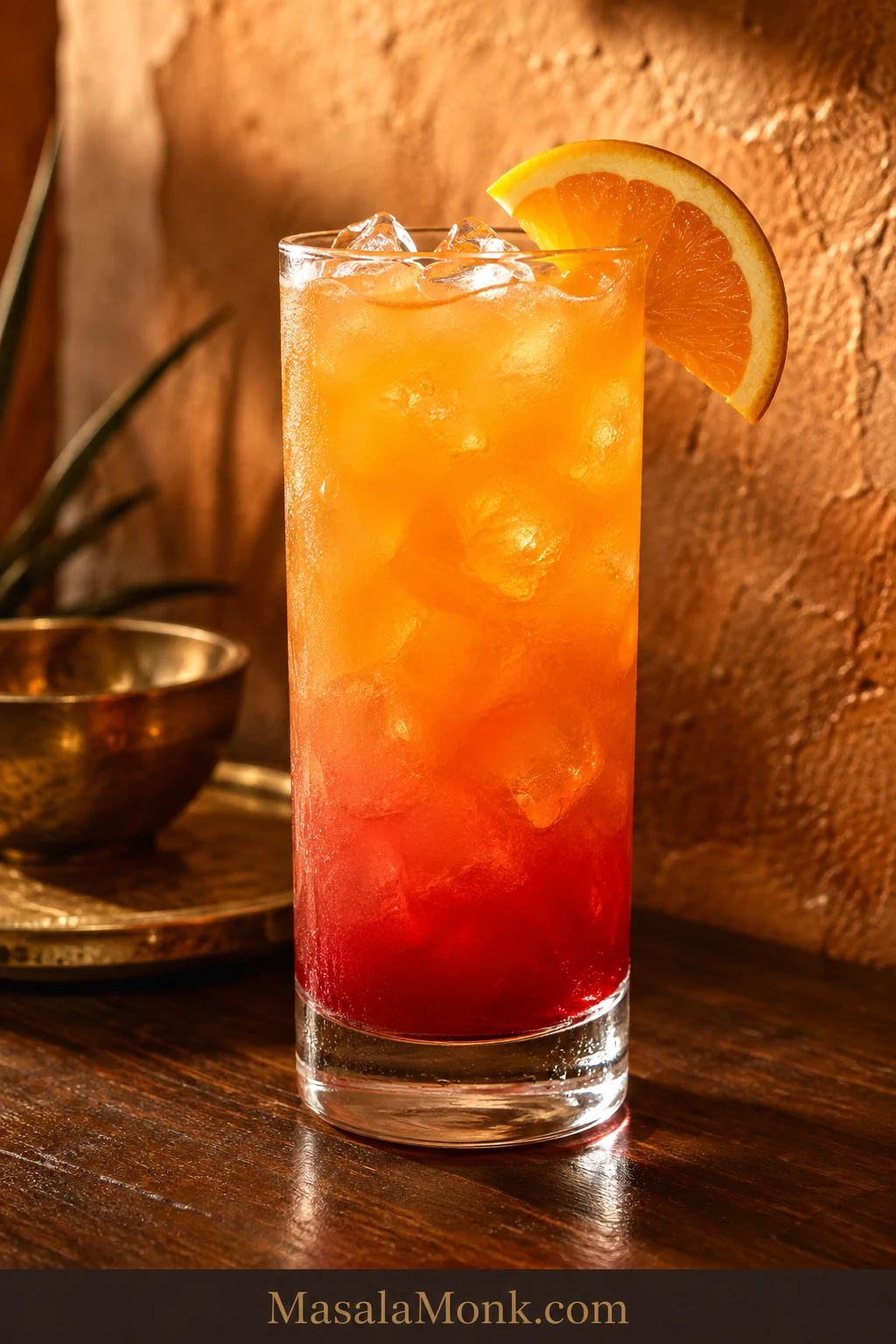
Tequila Sunrise in a tall clear glass with ice, deep red lower layer, coral fade, bright orange top and orange garnish.

A Tequila Sunrise looks like the sort of cocktail that needs a practiced hand. Then the grenadine slips beneath the orange juice, the bottom turns red, and you realize the entire effect came from one careful final pour.

The recipe itself is only tequila, orange juice and grenadine. The challenge is balance. Too much syrup makes the last sip sticky. Too much juice hides the tequila. A forceful pour turns the glass pink before anyone gets to see the sunrise.

Built around a 1:2 tequila-to-orange ratio, this version stays juicy and cold without hiding the agave beneath the orange. A Tequila Sunrise has a reputation for sweetness, but it does not have to taste syrupy. Grenadine is the dial: start with a small pour, deepen it when you want more red and sweetness, and add it slowly enough for the fade to appear.

The MasalaMonk rule

Stir the tequila and orange juice first. Add the grenadine last. Leave the glass alone until the sunrise appears—then stir only when you are ready to drink it.

Quick Answer: How to Make a Tequila Sunrise

Use a clear 12 oz / 350 ml highball or Collins glass and fill it about three-quarters full with firm ice. Add 2 oz / 60 ml 100% agave blanco tequila and 4 oz / 120 ml cold orange juice. Stir briefly.

Slowly pour ¼ oz / 7.5 ml grenadine down the inside wall of the glass or over the back of a teaspoon. Do not stir again. Garnish with an orange half-wheel and serve as soon as the red base, orange top and soft transition between them are visible.

Easy ratio to remember: 1 part tequila to 2 parts orange juice, followed by a much smaller grenadine pour.

Choose the Version You Want

Start with the balanced drink unless you already know you prefer a sweeter or lighter pour. The method stays the same; only the proportions change.

Balanced

2 oz / 60 ml tequila
4 oz / 120 ml orange juice
¼ oz / 7.5 ml grenadine

Orange-led but still recognizably tequila-forward, with enough red to form a clear base.

Deeper and sweeter

2 oz / 60 ml tequila
4 oz / 120 ml orange juice
½ oz / 15 ml grenadine

A wider red base, more fruit-syrup flavor and a noticeably sweeter finish.

Lighter long drink

1½ oz / 45 ml tequila
4½ oz / 135 ml orange juice
¼ oz / 7.5 ml grenadine

A gentler brunch or party pour when you want less spirit in each glass.
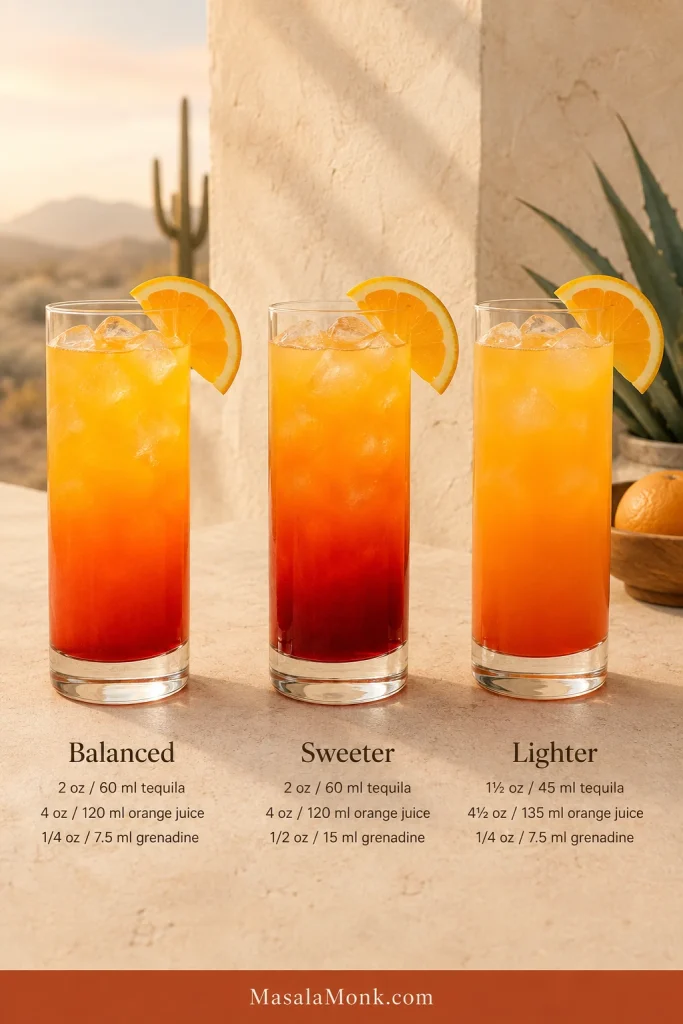
Three Tequila Sunrises compare balanced, sweeter and lighter versions, with progressively different red bases and orange intensity.
A darker Tequila Sunrise is not necessarily stronger. Grenadine deepens the color without adding alcohol, while the lighter version actually uses less tequila—so choose by taste, not redness alone.

Tequila Sunrise Recipe

A cold, juicy Tequila Sunrise with bright orange, fresh agave and just enough pomegranate sweetness at the base to make the color dramatic without turning the drink syrupy.

Prep
3 minutes

Total
3 minutes

Yield
1 cocktail

Method
Build in the glass

Equipment

  • 12 oz / 350 ml highball or Collins glass; a 10 oz / 300 ml glass also works with slightly less ice
  • Jigger or small liquid measuring cup
  • Bar spoon or ordinary teaspoon
  • Knife and small cutting board for the garnish

No jigger? Measure 2 oz / 60 ml tequila as 4 tablespoons, 4 oz / 120 ml orange juice as ½ cup or 8 tablespoons, and ¼ oz / 7.5 ml grenadine as 1½ teaspoons.

An ordinary teaspoon works in place of a bar spoon. Any clear tall glass of roughly the same size will do.

Ingredients

  • 2 oz / 60 ml 100% agave blanco tequila
  • 4 oz / 120 ml cold orange juice, preferably pulp-free or fine-strained
  • ¼ oz / 7.5 ml grenadine
  • Firm medium ice cubes
  • 1 orange half-wheel, for garnish
  • 1 maraschino cherry, optional

Instructions

  1. Fill the glass. Add firm ice until the glass is about three-quarters full, leaving room for the measured liquid.
  2. Add tequila and orange juice. Pour both over the ice.
  3. Stir briefly. Mix only until the tequila and juice are combined and cold. This is the last stir before presentation.
  4. Add the grenadine slowly. Pour it in a thin stream down the inside wall. For more control, pour it over the back of a teaspoon held just above the drink.
  5. Let the sunrise form. Stop stirring. The grenadine should settle around the ice and collect at the bottom, leaving orange above and a soft pink-orange transition between them.
  6. Garnish and serve. Add the orange half-wheel and optional cherry. Present the drink immediately; stir gently only when you are ready for an evenly sweet sip.

Recipe Notes

  • If the base looks pale, increase the grenadine to 10 ml. Use 15 ml / ½ oz only when you also want a noticeably sweeter drink.
  • For the cleanest-looking modern version, don’t shake the tequila and orange juice. Shaking aerates the juice and can make the orange layer frothy or cloudy. Once the grenadine is added, do not shake or vigorously stir the drink.
  • Fresh orange juice tastes brightest when fine-strained. Cold pulp-free refrigerated juice usually gives the cleanest-looking gradient.

Once you have watched the grenadine fall through the first glass, the recipe becomes much easier to adjust. The next decisions are about the tequila, the juice, how sweet you want the base and how to make the same satisfying pour work again.

Choose What You Need Next

Why This Balance Works

The modern Sunrise is tequila, orange juice and grenadine. Tequila brings the agave backbone, orange juice gives the drink its juicy body, and grenadine supplies sweetness and the red base.

Is Tequila and Orange Juice a Tequila Sunrise?

Not quite. Tequila and orange juice make a simple two-ingredient highball, sometimes ordered as tequila and OJ. Grenadine adds the signature red base, extra sweetness and the sunrise gradient. For the vodka-and-orange version of the same simple idea, use the Screwdriver recipe.

The 1:2 Tequila-to-Orange Ratio

At a 1:2 ratio, two parts orange juice soften one part tequila without burying it; longer pours become increasingly orange-led. Keep the grenadine pour small because each extra splash changes both color and sweetness. Cold juice and firm ice protect the balance by limiting early dilution.
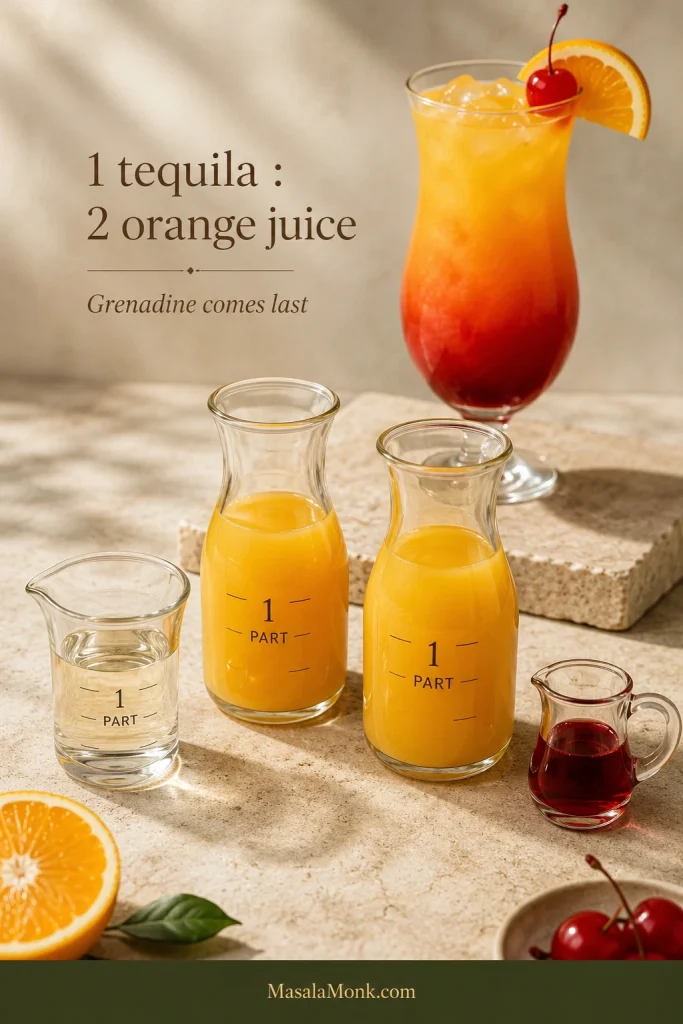
Measuring vessels show one part tequila to two parts orange juice, with a much smaller grenadine measure beside the finished cocktail.
Grenadine is not a third equal part of the ratio; treat it as a separate finishing adjustment.

Ingredients and What They Change

Which Tequila Works Best?

A 100% agave blanco tequila is the best all-purpose starting point. Its fresh agave, citrus and pepper notes stay lively beneath the orange juice, and there is little reason to hide an expensive sipping bottle under juice and syrup.

Reposado also works. It produces a rounder drink with light oak, vanilla or caramel notes and may make the orange portion look a little deeper. Añejo is not wrong, but it is usually more bottle than this simple cocktail needs.
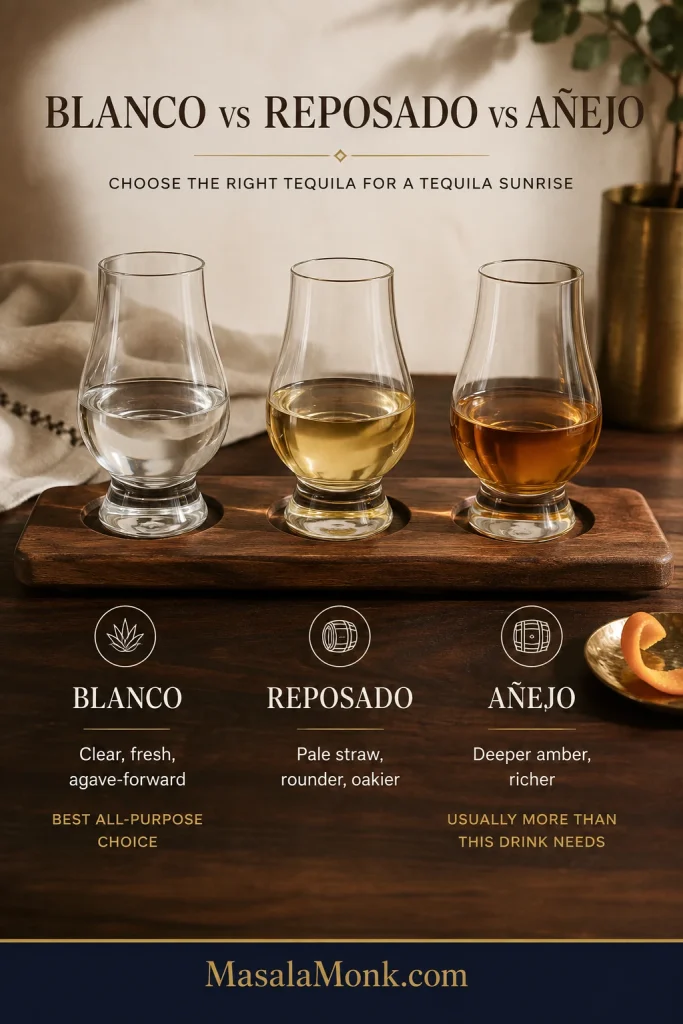
Blanco, reposado and añejo tequila samples progress from clear to pale gold to amber beside a Tequila Sunrise.
Blanco is the cleanest all-purpose fit; choose reposado or añejo only when you want their oakier character to remain in the finished drink.

“Gold” tequila describes color, not necessarily age or quality. Read the label and look for 100% agave rather than choosing by color alone.

Blanco also has more room to show in a Cadillac Margarita, where orange liqueur supports rather than buries the tequila.

Fresh or Bottled Orange Juice?

Use cold pulp-free juice when the cleanest gradient matters most. Use fine-strained fresh juice when brighter orange aroma matters more. Both work; they simply emphasize different strengths of the drink.

Pulp changes the picture more than the drink. It does not stop the Sunrise from working, but it makes the orange cloudier and the transition less distinct, so pass fresh juice through a fine strainer when you want a cleaner fade.
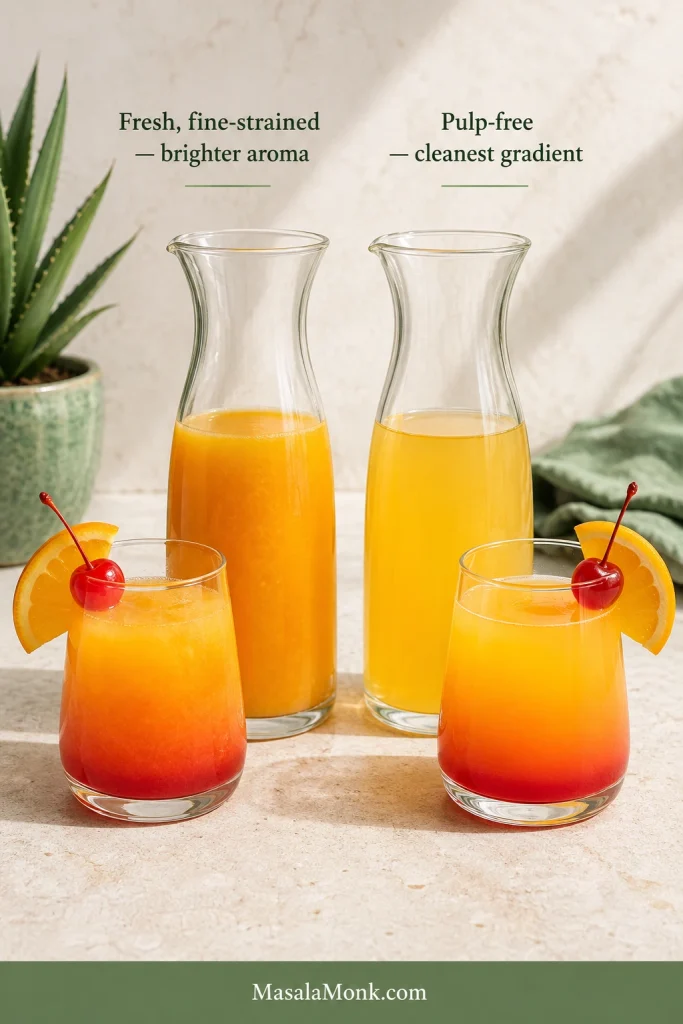
Fresh fine-strained orange juice and pulp-free orange juice compared beside Sunrise cocktails, with the pulp-free version appearing clearer.
Fresh fine-strained juice favors aroma; cold pulp-free juice favors a cleaner-looking gradient.

Taste the juice before adding syrup. With very sweet juice, start with the smaller grenadine pour. Sharper juice leaves a little more room to increase the syrup if the glass needs more color. When the finished drink tastes flat and sweet rather than bright, a small squeeze of lime can restore balance—but lime is a correction, not a required fourth ingredient.

If fresh orange is what you want to taste first, the Orange Crush recipe takes that idea in a colder, sparkling direction.

What Kind of Grenadine Should You Use?

Choose a pourable pomegranate-based grenadine. Bright commercial syrup gives vivid red color and plenty of sweetness. Pomegranate-forward grenadine often looks darker and can bring a more recognizable fruit flavor.

Grenadine is normally non-alcoholic. It adds sweetness and fruit, but density is what helps the sugar-rich syrup settle below the tequila-orange mixture; viscosity mainly affects how quickly it flows and disperses. Plain pomegranate juice and undiluted pomegranate molasses do not behave as direct replacements. The same syrup plays a completely different role with soda in the Shirley Temple recipe.

How Much Grenadine Should You Add?

Start with ¼ oz / 7.5 ml. If the red base looks pale, add another ½ teaspoon / 2.5 ml slowly near the glass wall. Adding syrup is easy; removing sweetness once it is in the drink is not. Treat the table as a practical range because grenadine brands vary in color, thickness and sugar concentration.
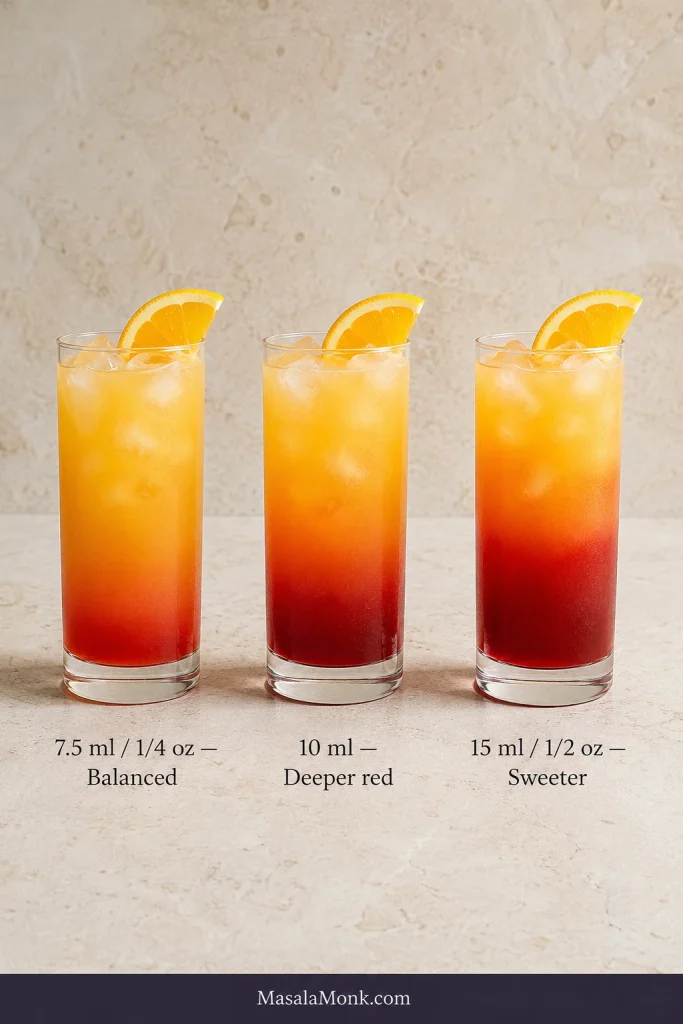
Three identical Tequila Sunrises compare 7.5, 10 and 15 milliliters of grenadine, with increasingly deep red bases.
Use this comparison as a direction-of-change guide, not a color guarantee. Two grenadines measured at the same volume can still produce different reds, so taste matters more than matching a photograph exactly.
Grenadine per drinkChoose it whenLikely result
3–5 mlYou want very little sweetnessA narrow red base that may look faint with pale syrup
7.5 ml / ¼ ozYou want the balanced defaultVisible color without a syrup-heavy finish
10 ml / about ⅓ ozYour syrup is light or you want more redA stronger base with a modest sweetness increase
15 ml / ½ ozYou prefer a noticeably sweeter pourA deeper red base and noticeably sweeter final sips
How grenadine quantity changes sweetness and color

The redder glass is not automatically the better glass. More grenadine deepens the color and the sweetness at the same time, so increase it in small steps rather than chasing the darkest possible base. If the glass is already pale, uniformly pink or syrup-heavy, use the troubleshooting guide before adding more.

How to Build a Cleaner Sunrise Gradient

A convincing Sunrise moves gradually from a defined red base through pink into a bright orange top. The transition should look soft and connected rather than sharply separated.

1. Chill the upper drink before the syrup arrives

Use cold orange juice and fresh ice. Add the tequila and juice, then stir just long enough to combine them. Once the grenadine enters, the mixing stage is over.

2. Pour the grenadine close to the glass

Keep the measure close to the inside wall and release a thin stream. The grenadine enters more quietly and is less likely to turn the whole glass pink. Pouring over the back of a teaspoon can help, but it is optional.
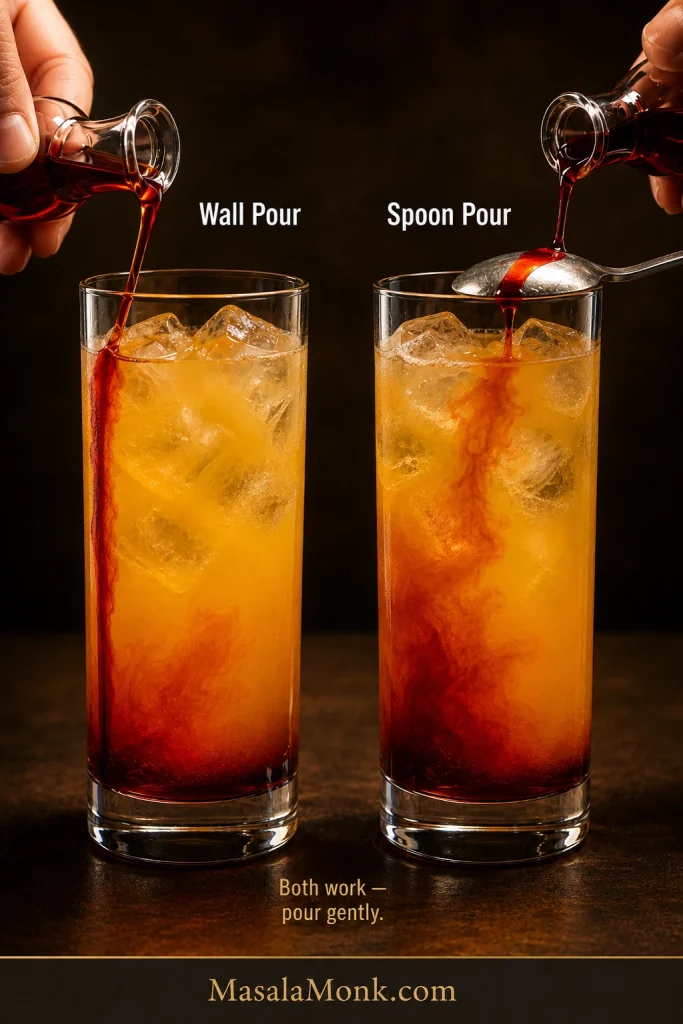
Grenadine is added to two highball glasses, once down the inside wall and once over the convex back of an upside-down spoon.
Both grenadine-pour methods solve the same problem: slowing the syrup before it enters the cocktail. Use the wall or spoon according to whichever gives you the gentlest, most controlled stream.

3. Let density do the work

Do not chase the syrup with a spoon or try to draw the gradient yourself. The grenadine should fall around the ice and settle naturally. The little pause after the pour does more work than any bar tool.
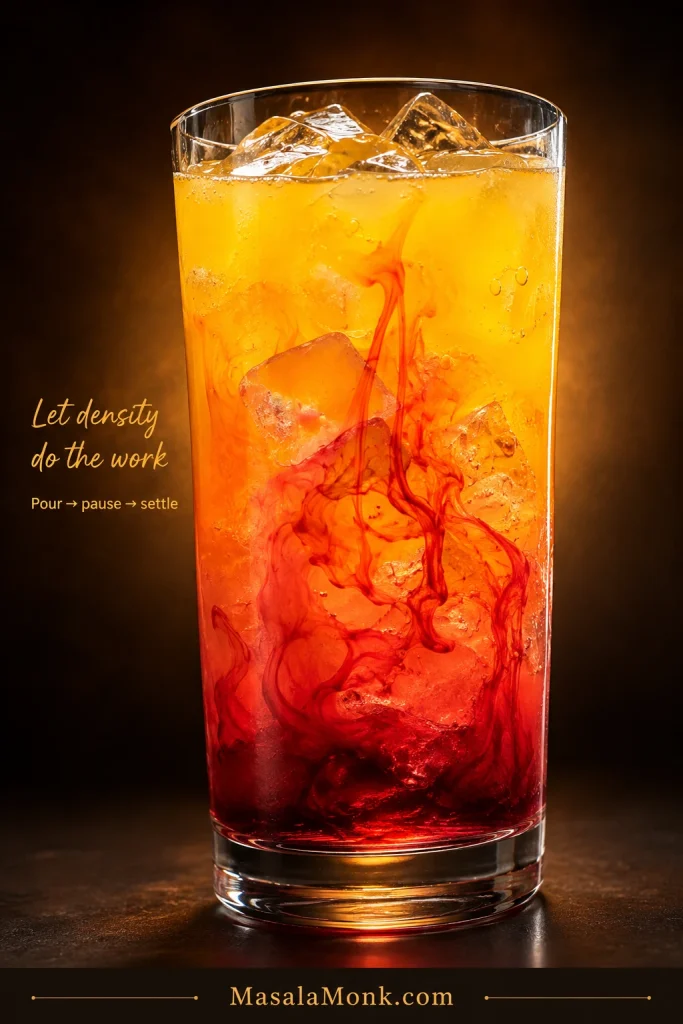
Close-up of grenadine descending through an orange cocktail around ice and collecting near the bottom of the glass.
Do not judge the layer the instant the syrup lands. Grenadine concentration and temperature can change how quickly it settles, so give the glass a moment before deciding the pour needs correcting.

4. Serve the look, then balance the sip

Carry the glass carefully and serve it while the color is visible. After the first look, the drink can be stirred gently. A Sunrise is not spoiled when the layers are mixed for drinking; it is simply moving from presentation to flavor.

Do not judge the drink by whether it forms perfectly straight bands. A broad red base and a gradual fade are more natural than a sharp line, and they usually drink better than a heavy pool of syrup.
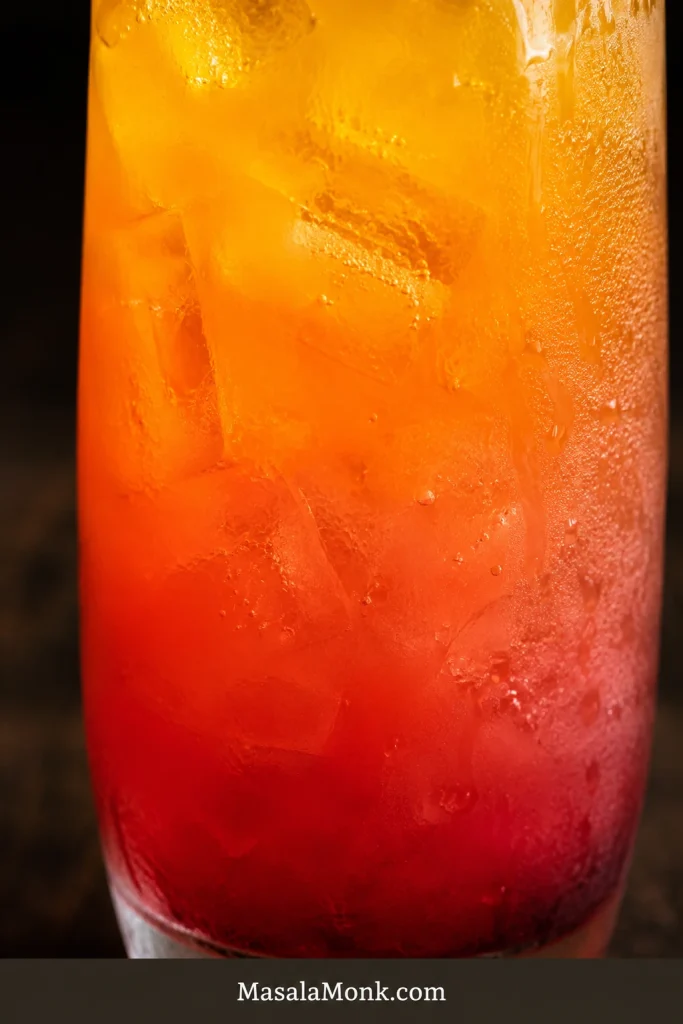
Close-up of a finished Tequila Sunrise with a red bottom, coral middle and bright orange upper layer visible through ice.
The Tequila Sunrise gradient keeps evolving after the pour as the liquids diffuse around the ice. Serve it soon after the red base and coral fade become clearly visible.

What a Good Tequila Sunrise Looks and Tastes Like

In the glass

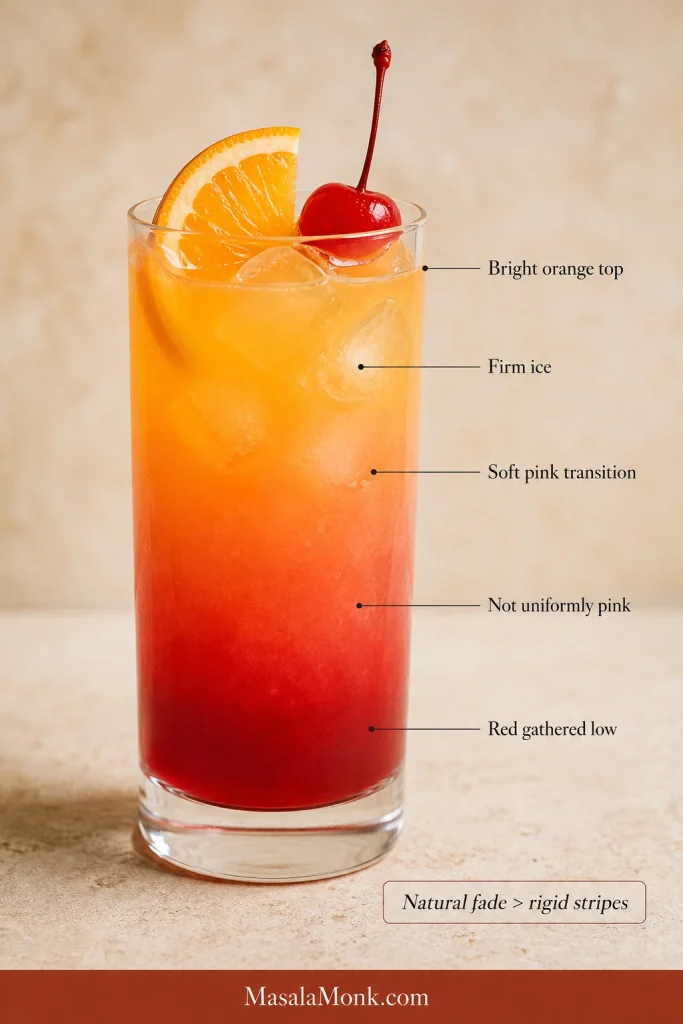
  • Red gathered low
  • Vivid orange at the top
  • A gradual pink edge between them
  • Not one uniform shade of pink

In the first sip

  • Orange arrives first
  • Tequila is still noticeable
  • The drink is cold, not watery
  • Sweetness builds toward the base
Annotated Tequila Sunrise identifying its bright orange top, coral transition, red base and firm ice.
A beautiful gradient only judges presentation, not the final sip. Once everyone has seen the sunrise, stir gently before drinking if you want the sweetness distributed more evenly from top to bottom.

A good first sip should feel cold and juicy rather than thick: orange leads, agave still shows underneath, and the sweetness becomes more noticeable as you reach the lower part of the glass. One gentle stir brings those layers of flavor back together.

Serve it as soon as the gradient is visible and before the ice begins softening. The colors will continue to move while the glass sits; that is part of the drink, not a sign that the layers failed.

Troubleshooting the Layers and Flavor

Start with the appearance before changing the recipe. A fully pink glass, a pale base and a heavy syrup shelf may all look wrong, but they need different responses.
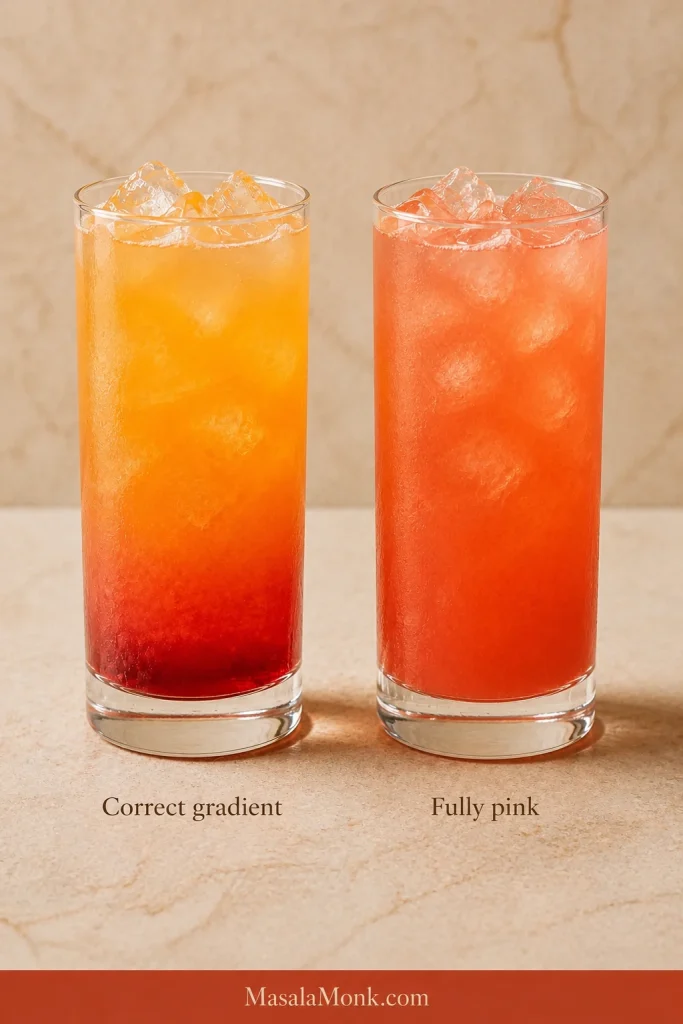
Two cocktails compare a defined red-to-orange Tequila Sunrise gradient with a completely mixed pink drink.
Do not chase a fully pink Tequila Sunrise with extra grenadine—that fixes neither the lost gradient nor the balance. Instead, enjoy it as a mixed cocktail and leave the appearance alone.

Four Visual Failure Signatures to Check First

These four visual failures are the quickest to recognize at a glance; the full table below also covers flavor, dilution and sweetness problems.
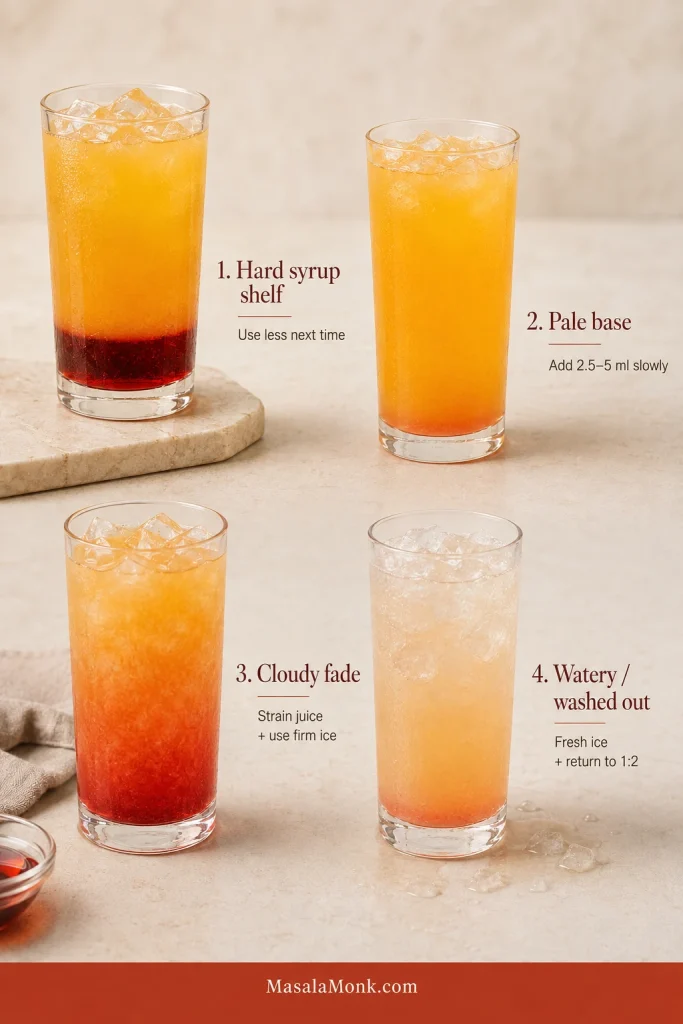
Four Tequila Sunrises show a hard syrup shelf, pale base, cloudy fade and watery washed-out appearance, each with a correction.
Diagnose before adjusting: more grenadine may rescue a pale base but makes a heavy syrup shelf worse. Cloudy and washed-out Sunrises point to different problems.

Tequila Sunrise Troubleshooting Table: Cause and Best Fix

What went wrongLikely causeBest correction
The whole drink turned pinkGrenadine was stirred, shaken or poured forcefullyCombine tequila and juice first; add syrup slowly at the end and stop stirring
There is no visible red baseToo little grenadine, pale syrup or opaque juiceAdd another 2.5–5 ml slowly near the wall of the glass
A hard syrup stripe sits at the bottomVery thick syrup or too much grenadineUse less next time; a softer fade is better than a heavy pool
The gradient looks cloudyPulpy juice, crushed ice, vigorous stirring or shakingFine-strain fresh juice and build over firm cubes
The drink is too sweetToo much grenadine or unusually sweet juiceReduce syrup first; add a small squeeze of lime only when needed
The tequila tastes too sharpWarm ingredients, a sharp-tasting tequila or too little orange juice for your preferenceUse cold ingredients and a tequila you enjoy; add another ½ oz / 15 ml orange juice if needed
The drink tastes weak or wateryToo much juice, wet ice or a long wait before servingReturn to the 1:2 ratio and build with fresh cold ice
The final sip is syrupyThe drink was never stirred after presentationGive it a gentle stir before or while drinking
Common Tequila Sunrise problems and practical fixes

What Can Be Fixed in the Current Glass?

A pale red base can be deepened with another 2.5–5 ml grenadine near the glass wall. A fully pink glass will not separate again, but nothing has been wasted. Serve it as a mixed drink, enjoy it, and use a slower grenadine pour for the next one. For the full sweetness-and-color range, return to how much grenadine to add.

Back to recipe ↑ · Back to top ↑

No Grenadine? Choose a Substitute by Flavor and How It Layers

A good replacement has to do more than add red color. It also needs sweetness and enough density to settle low; lower-density substitutes are more likely to blend through the orange layer than collect at the base.
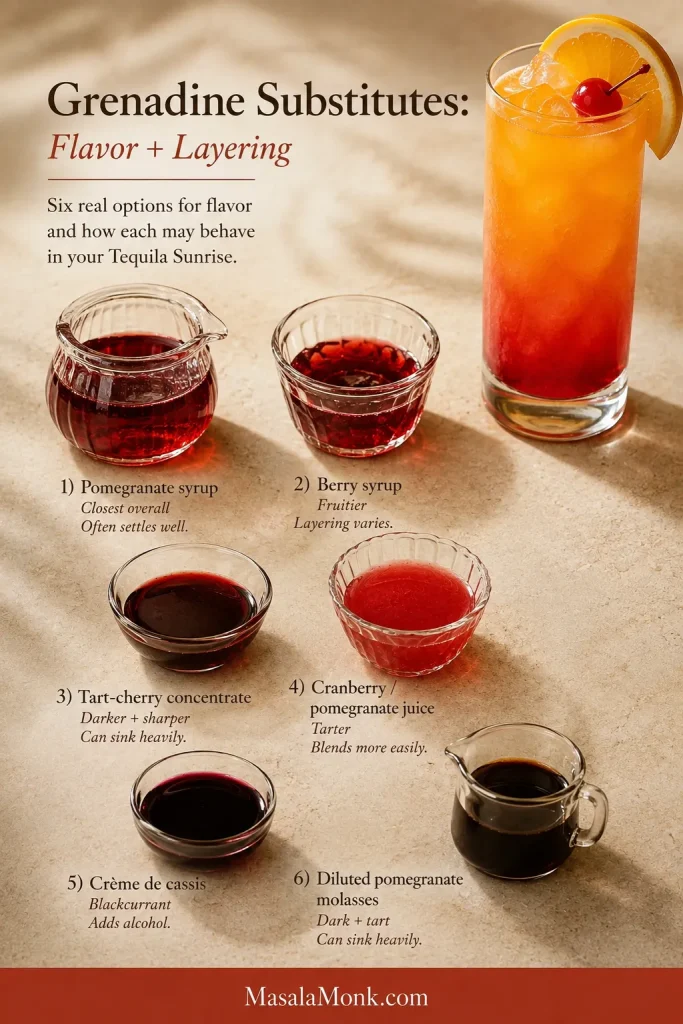
Grenadine substitute guide comparing several red syrups, juices and crème de cassis by flavor and how they layer in a Sunrise.
The closest-tasting grenadine substitute is not always the closest-layering substitute. A replacement can match the fruit character yet move through orange juice differently, so judge flavor and behavior separately.
SubstituteFlavor changeHow it behaves and how to use it
Homemade pomegranate syrupClosest overall flavorOften settles low when concentrated. Start with 5–7.5 ml and watch how it moves.
Strawberry, raspberry or cherry syrupBecomes berry-ledBehavior varies by sugar concentration and formulation. Begin with 5 ml because many are intensely sweet.
Tart-cherry concentrateDarker and sharperCan sink heavily. Dilute and sweeten it before adding a small amount.
Cranberry or pomegranate juiceFresher and tarterMore likely to blend through the orange layer than collect at the base.
Crème de cassisBlackcurrant flavor and extra alcoholOften settles low, but even a small pour creates a distinctly different cocktail.
Pomegranate molassesMuch darker, tarter and more concentratedCan sink too heavily. Dilute it with water and simple syrup; never swap it equally.
How grenadine substitutes change flavor and layering

Density influences where a substitute settles; viscosity affects how quickly it moves. Sugar concentration, alcohol and temperature can all shift the result. Sweetened pomegranate syrup is the closest overall match. Start small and watch the glass.

Pitcher Method for a Crowd

Pitcher rule: mix and chill the tequila with the orange juice; add grenadine separately to every glass.
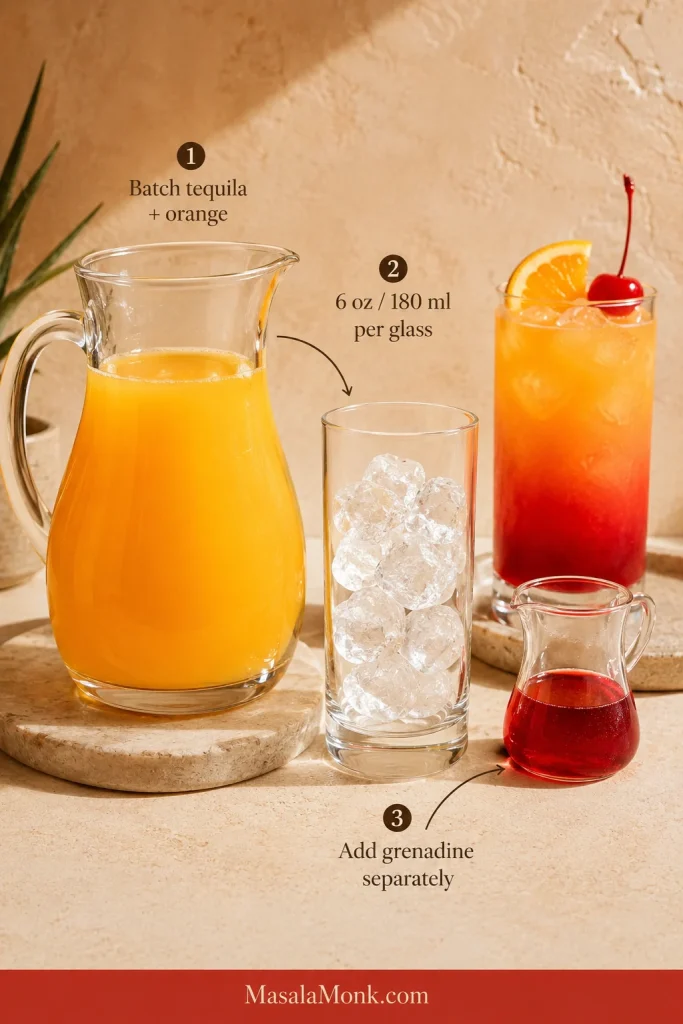
Pitcher of tequila-orange base beside ice-filled highballs and a separate grenadine vessel for finishing each drink individually.
Keeping grenadine outside the pitcher protects the gradient and lets guests choose a restrained or sweeter finish from the same chilled base.

Tequila Sunrise Pitcher Quantities for 4, 8 or 12 Drinks

Use the same 1:2 tequila-to-orange ratio as the single-glass recipe; the table simply scales the batch while keeping grenadine separate for each glass.

DrinksTequilaOrange juiceGrenadine held separately
48 oz / 240 ml16 oz / 480 ml1 oz / 30 ml
816 oz / 480 ml32 oz / 960 ml2 oz / 60 ml
1224 oz / 720 ml48 oz / 1.44 liters3 oz / 90 ml
Tequila Sunrise pitcher quantities

The table uses 7.5 ml grenadine per drink. Double it for the sweeter version. Use roughly a 1-liter pitcher for four drinks, 2 liters for eight and 2.5 liters for twelve.
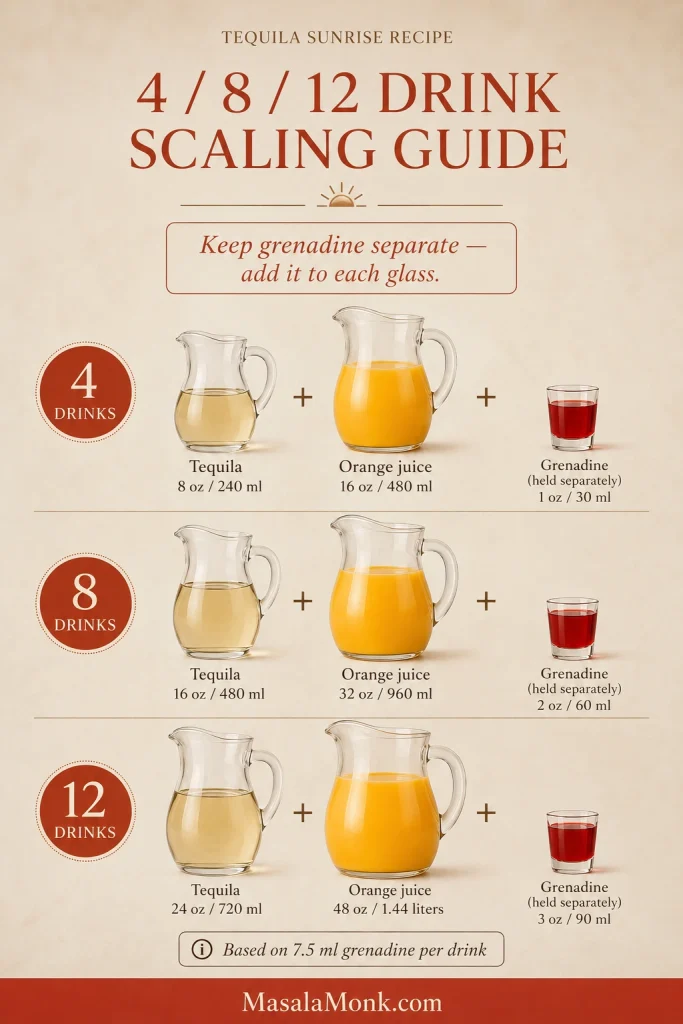
Scaling chart for 4, 8 and 12 Tequila Sunrises, with tequila and orange juice batched while grenadine remains separate.
Keep grenadine separate and pour each scaled serving over fresh ice; batching over ice quietly changes the later drinks.

How to Prepare and Serve the Batch

  1. Combine the tequila and orange juice in a clean pitcher.
  2. Cover and refrigerate the base until serving.
  3. Keep the grenadine in a small measuring jug or squeeze bottle.
  4. Fill each glass with fresh ice.
  5. Stir the chilled pitcher mixture and pour 6 oz / 180 ml into each ice-filled glass.
  6. Add the measured grenadine slowly to each glass.
  7. Garnish and serve immediately.

Do not store the batch over ice. Ice in the pitcher melts continuously and changes every serving. Do not add grenadine to the pitcher when visible layers matter; the batch will become a uniform orange-red punch.

The tequila-orange base can be prepared a few hours ahead and kept covered in the refrigerator. Prepare the garnishes before guests arrive, then let each person choose a restrained or sweeter grenadine finish. The nicest part of this setup is watching the grenadine fall into each glass just before it is handed over.
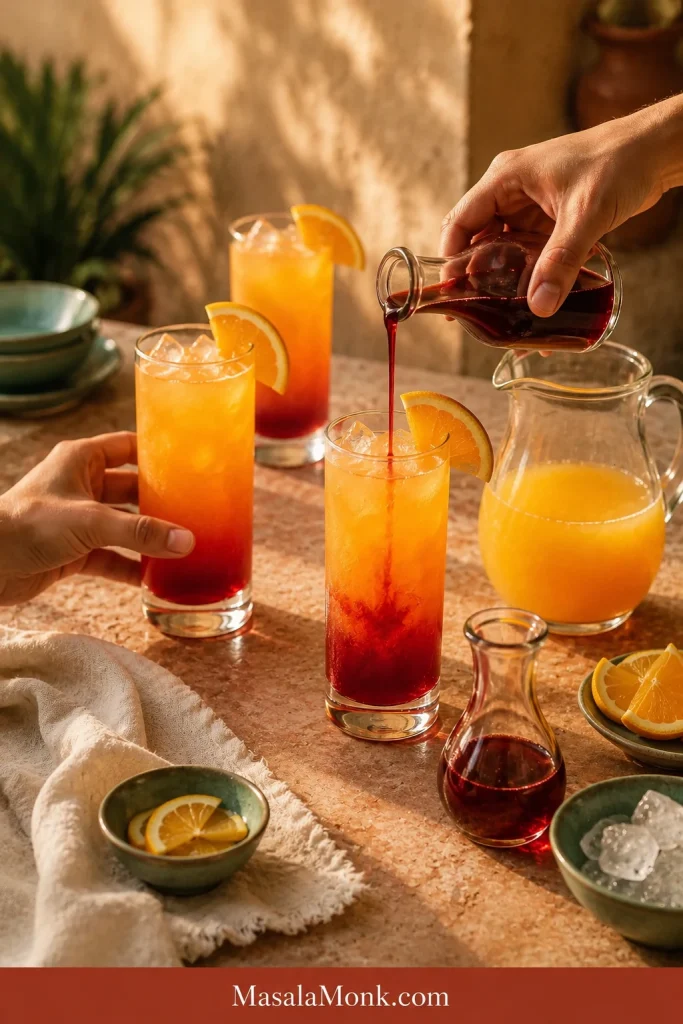
Several Tequila Sunrises being served as grenadine is added individually from a separate vessel beside the batched orange-tequila base.
Finish only the glasses that are ready to be served. Pre-filling an entire round too early gives the first and last drinks different amounts of ice melt and different-looking gradients.

For guests who aren’t drinking, make a separate alcohol-free pitcher. The mocktails with grenadine guide offers fruitier and sparkling directions for that jug.

Back to recipe ↑ · Back to top ↑

Glass, Ice, Garnish and Serving

Use a tall clear glass. A 12 oz / 350 ml highball or Collins glass gives the liquid, ice and garnish enough room while keeping the color transition easy to see.

Fresh, dry medium cubes chill the drink without immediately watering it down. Avoid ice sitting in meltwater; it begins diluting the cocktail before the glass reaches the table.
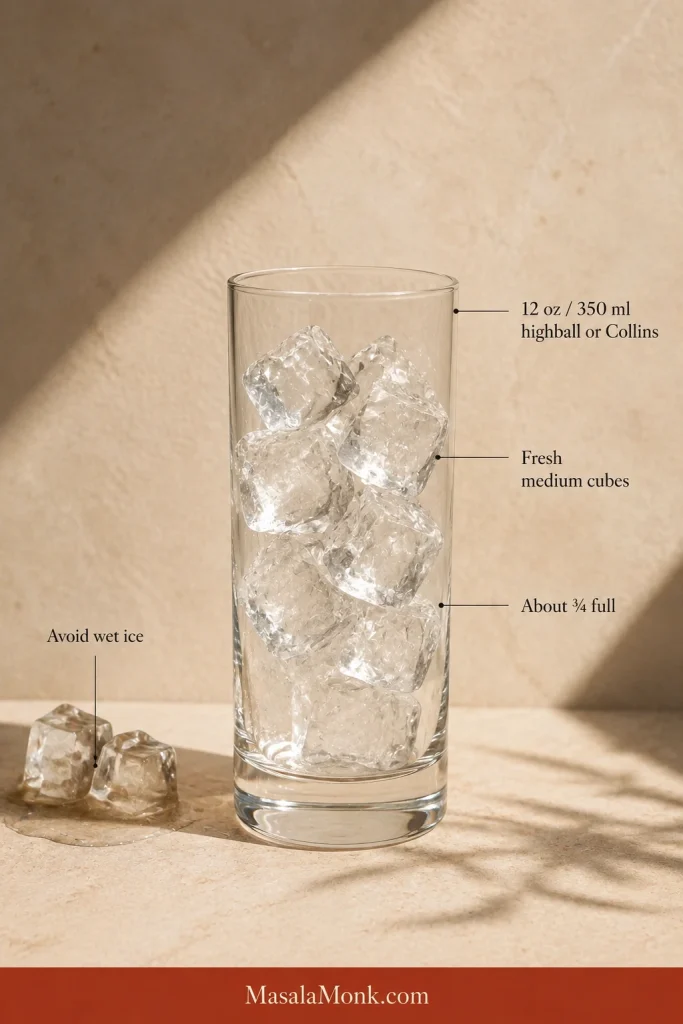
Tall highball glass filled about three-quarters with fresh medium ice, with wet melting ice shown separately as something to avoid.
Use a tall clear glass for the easiest-to-read gradient; in a 10-ounce glass, reduce the ice slightly rather than crowding the measured liquid.

For garnish, an orange half-wheel echoes the main flavor without hiding the color. A maraschino cherry is optional; keep the garnish at the rim rather than dropping it into the drink.

What to Serve With a Tequila Sunrise

The orange sweetness works especially well beside tortilla chips and salsa, tacos, grilled shrimp, spicy chicken, quesadillas, citrus salads or grilled corn. Rich or spicy food gives the drink something to push against. For a full taco-night pairing, the shrimp tacos recipe brings smoky shrimp, crisp slaw and lime to the same table.
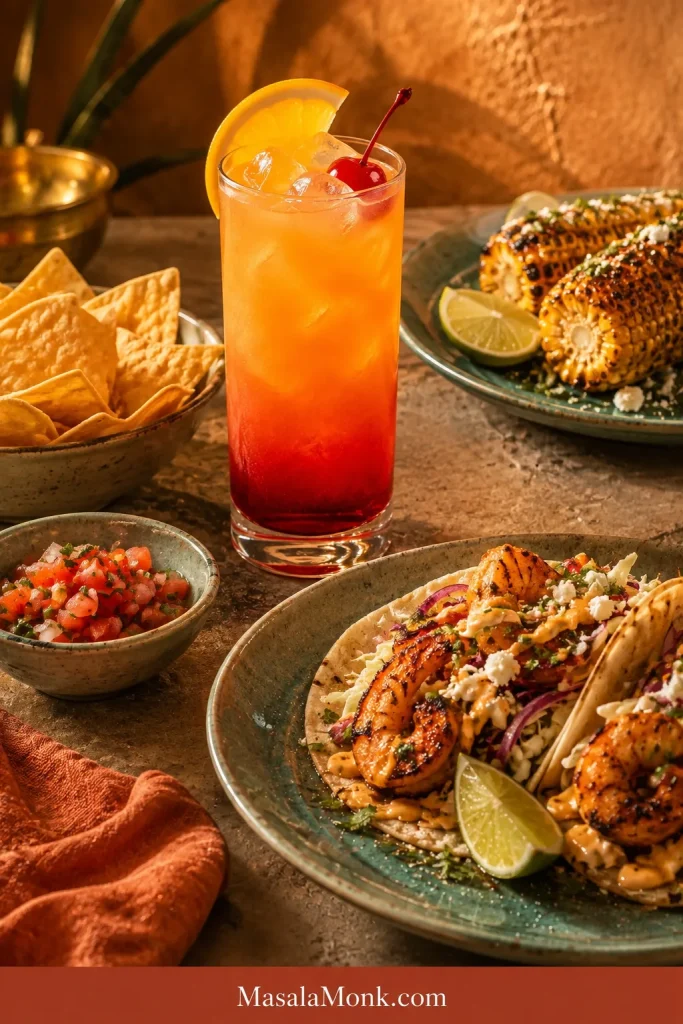
Tequila Sunrise served with tortilla chips and salsa, shrimp tacos and grilled corn on a warm dining table.
A useful Tequila Sunrise pairing rule is contrast: salt, heat, acidity or char usually helps more than another sweet element. That keeps orange and grenadine from making the whole meal feel one-note.

If brunch guests would rather have something lighter and sparkling, the Mimosa recipe guide gives you several easy alternatives beside the Sunrise.

Easy Variations

Make the main recipe once before changing it. After that, change one thing at a time so the drink still looks and tastes like a Sunrise.

Pineapple Sunrise

Split the juice evenly: use 2 oz / 60 ml tequila, 2 oz / 60 ml orange juice and 2 oz / 60 ml pineapple juice, then finish with a small grenadine pour. Keeping half the juice orange preserves the Sunrise color while pineapple adds body and a tropical edge.
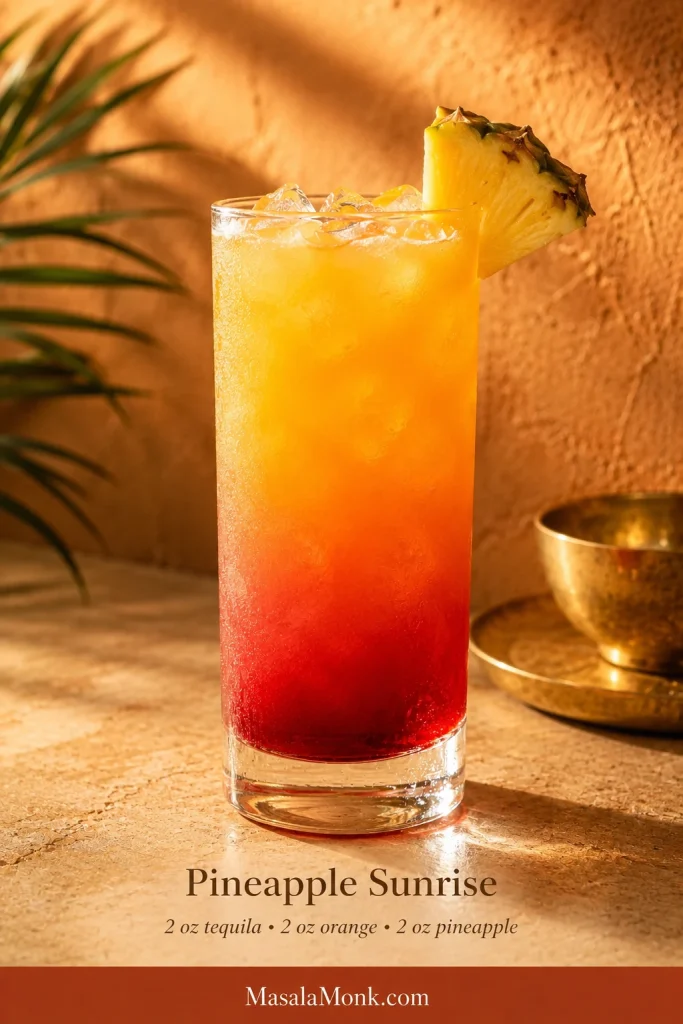
Pineapple Sunrise in a tall iced glass with a golden pineapple-orange upper layer, red base and pineapple garnish.
Pineapple makes a Sunrise fuller and naturally sweeter, so start conservatively with grenadine.

Sparkling Sunrise

For some fizz, use 2 oz / 60 ml tequila and 3 oz / 90 ml orange juice. Stir them over ice, add 1 oz / 30 ml chilled soda water gently, then pour in the grenadine. This keeps most of the fizz while preserving the final color change. Prefer grapefruit and bubbles? The Paloma recipe is the natural next drink.
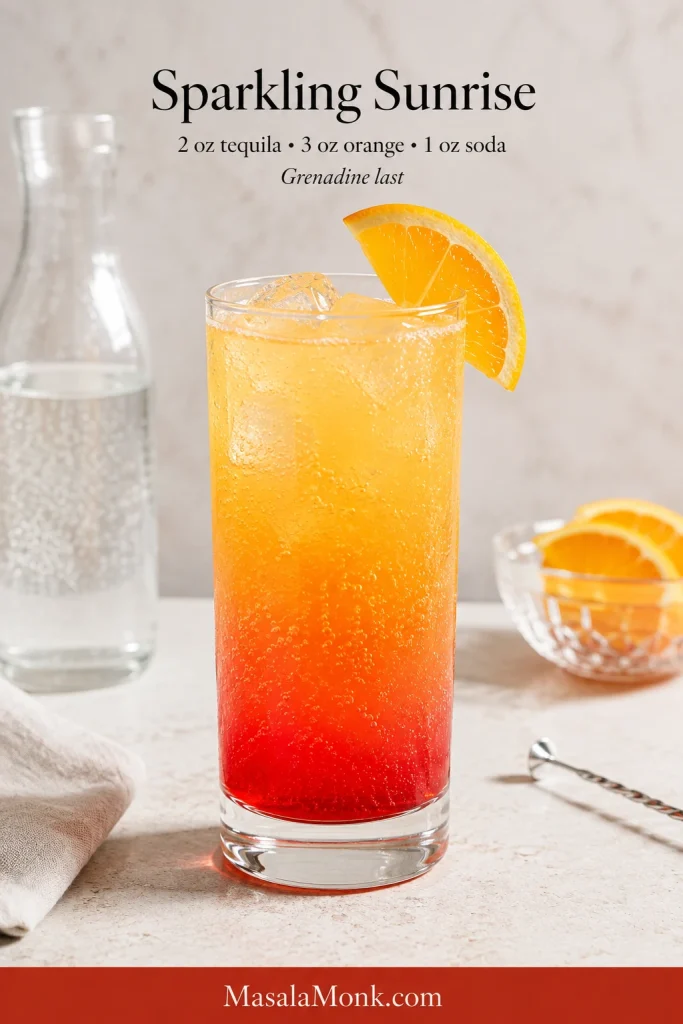
Sparkling Tequila Sunrise in a tall glass with visible bubbles, orange upper layer, red base and orange garnish.
Use very cold soda water and pour it gently. Colder liquid holds carbonation better, while less agitation helps a Sparkling Sunrise keep its fizz through the final grenadine addition.

Alcohol-Free Sunrise

For an alcohol-free version, replace the tequila with 2 oz / 60 ml zero-proof agave spirit for the most cocktail-like result, or use chilled sparkling water for a lighter drink. Add 4 oz / 120 ml orange juice and a small grenadine pour. When using sparkling water, 1–2 teaspoons / 5–10 ml fresh lime juice can keep the drink from tasting too soft or sweet.
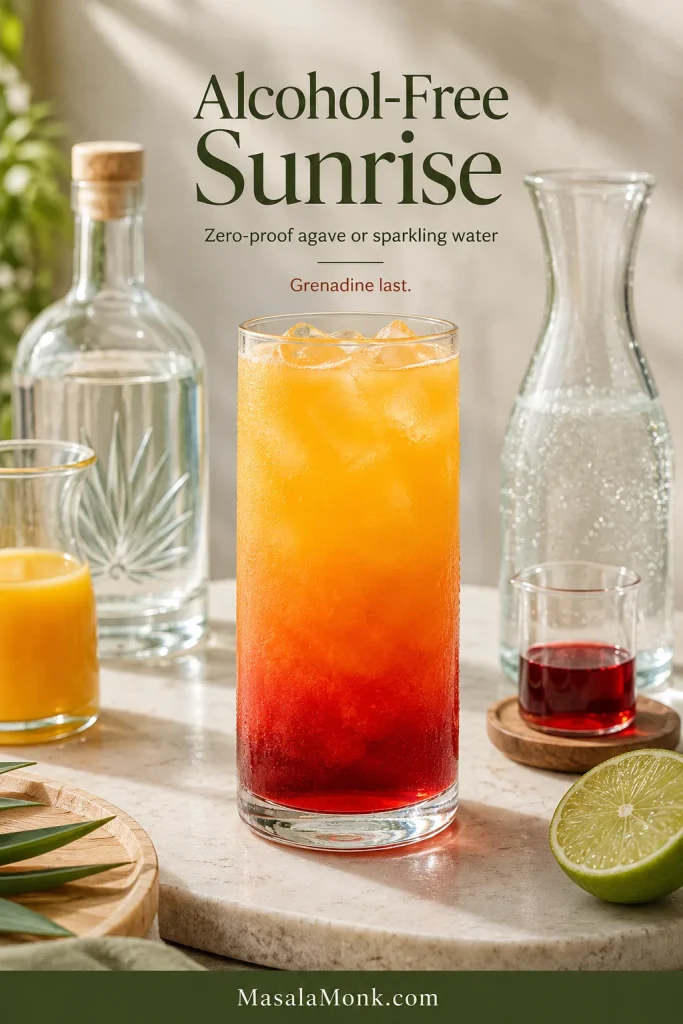
Alcohol-Free Sunrise beside zero-proof agave spirit, sparkling water, orange juice, grenadine and lime, showing two alternative nonalcoholic approaches.
Without tequila’s alcohol warmth and agave intensity, excess grenadine can take over quickly. Start with a restrained final pour, then adjust the next glass if you want a sweeter alcohol-free Sunrise.

Other ways to change the drink

  • Spicy: Let one paper-thin jalapeño slice sit in the measured tequila for about 30 seconds, then taste and remove it. Give it a few more seconds only if you want more heat.
  • Frozen: Treat it as a separate slushy recipe because blended ice changes the dilution. Expect grenadine marbling rather than a tall red-to-orange fade.
  • Vodka Sunrise: Replace tequila with the same amount of vodka for a cleaner, more neutral drink where orange and grenadine lead.
  • Tequila Sunset: The name is not standardized. Some versions use blackberry brandy or crème de cassis; others use grapefruit juice or a dark spirit float.

Back to recipe ↑ · Back to top ↑

Modern vs “Original” Tequila Sunrise

The history is not perfectly settled, and more than one early formulation has been documented. Most people now recognize the orange-juice-and-grenadine drink as the modern Tequila Sunrise and the version made here. For a standardized reference, the International Bartenders Association lists the modern formula (opens in a new tab).

A documented earlier version uses tequila, lime, grenadine, crème de cassis and soda water, with no orange juice. Lime and soda make it sharper and drier, while cassis adds a darker berry note. Difford’s Guide documents a reconstruction of that earlier drink (opens in a new tab).
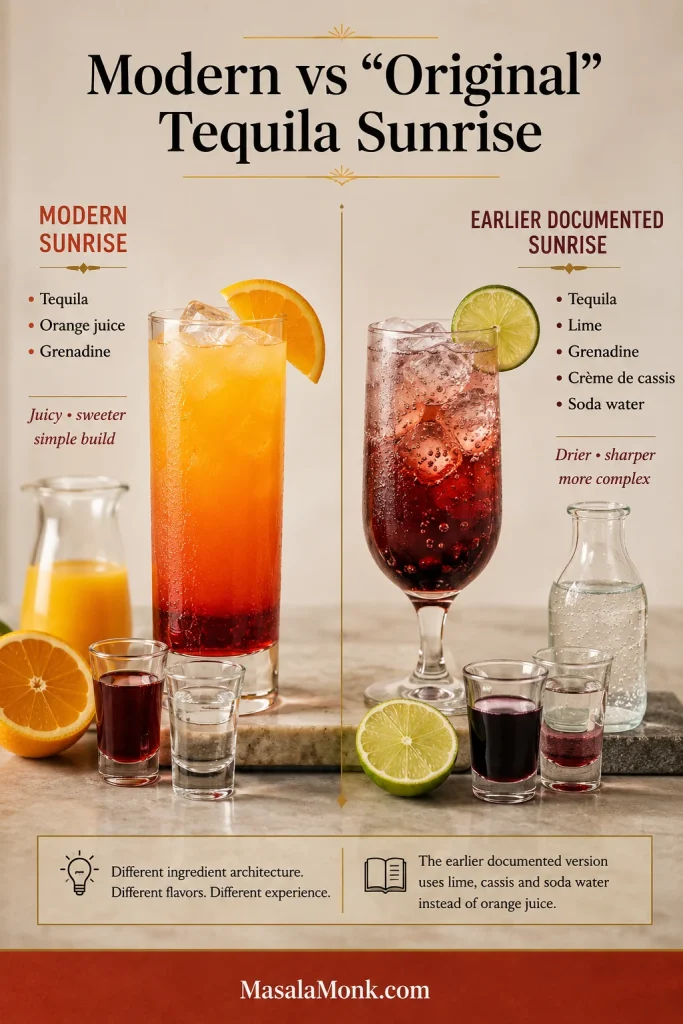
Modern orange-and-grenadine Tequila Sunrise beside an earlier documented lime, grenadine, crème de cassis and soda-water version.
The earlier documented drink is not merely the modern orange recipe with different proportions. Lime, cassis and soda create a different flavor structure as well as a visibly different cocktail.

Modern three-ingredient version

  • Tequila, orange juice and grenadine
  • Sweet, juicy and visually simple
  • Easy build in a tall glass

Earlier documented version

  • Tequila, lime, grenadine, crème de cassis and soda water
  • Brighter, drier and more spirit-forward
  • A more complex mixed drink

Online recipes often use “classic,” “traditional” and “original” loosely. Check the ingredient list rather than trusting the label alone.

Frequently Asked Questions

Does it contain triple sec?

Not in the standard three-ingredient version. Some modern recipes add triple sec or another orange liqueur, but that makes the drink sweeter and more complex. Tequila, orange juice and grenadine are enough for the modern Sunrise made here.

Can the grenadine go in first?

Yes, but it is easier to disturb when the remaining drink and ice are added. Pouring it last is simpler and more repeatable at home; the layering guide shows the controlled wall and spoon methods.

Is grenadine alcoholic?

Most grenadine is non-alcoholic, but check the label. Liqueur substitutes such as crème de cassis add alcohol and change the drink substantially.

Can bottled orange juice be used?

Yes. Cold pulp-free juice gives the clearest gradient. Fine-strained fresh juice brings brighter aroma when flavor matters more than a perfectly clean fade. For the full trade-off, see fresh versus bottled orange juice.

How strong is it?

With 2 oz / 60 ml of 40% tequila, the drink is roughly 13% ABV before ice dilution and contains about 1⅓ U.S. standard drinks. Juice and syrup can disguise the alcohol, but they do not reduce the amount in the glass.

Why do recipes use different amounts?

Most stay fairly close on tequila and orange juice. Grenadine varies more because brands differ in sweetness, color and thickness; the grenadine amount guide shows the practical range. Begin with the smaller pour, taste, and deepen the next glass only when you want more red and more sweetness.

The Final Pour Is the Whole Trick

A Tequila Sunrise does not need complicated bar technique. It needs cold juice, a measured 1:2 balance and enough restraint to leave the final pour alone.

Let the red settle beneath the orange, bring the glass to the table, and stir only when you are ready to drink it. Three ingredients are enough; the sunrise comes from their order.

Enjoy responsibly. Serve alcoholic drinks only to adults of legal drinking age, and remember that a sweet, juice-forward cocktail can taste milder than its actual alcohol content.
Back to the top ↑

Posted on Leave a comment

Orange Crush Recipe: Fresh Orange Vodka Cocktail, Pitcher & Mocktail

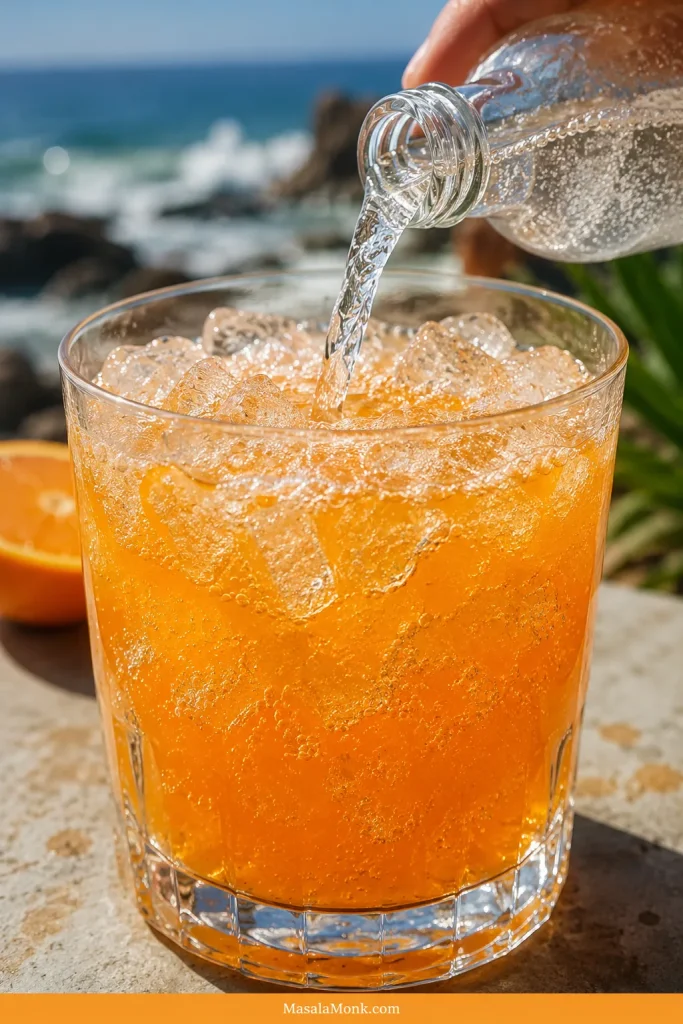
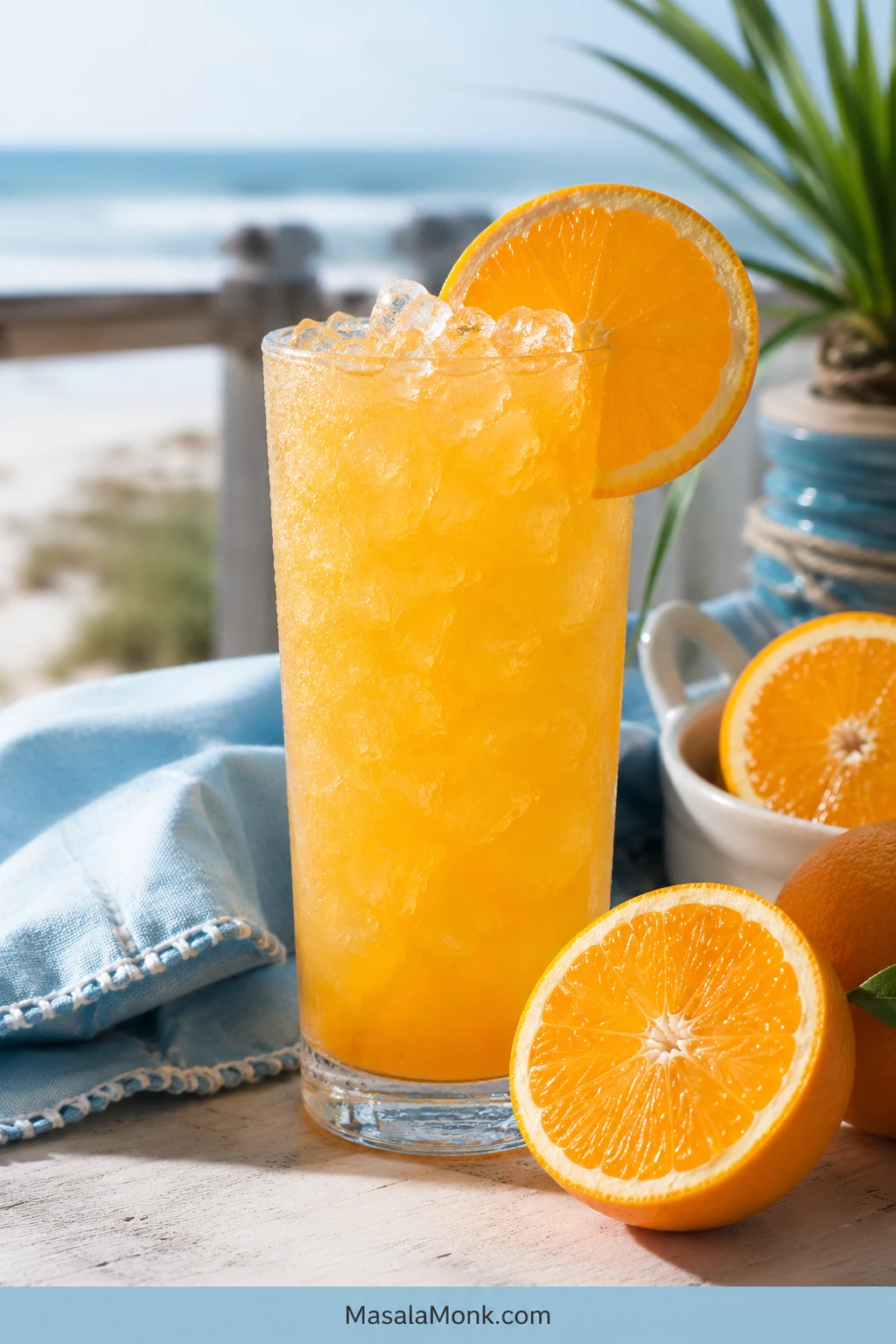
Tall Orange Crush cocktail in a clear glass with crushed ice, orange slice garnish, condensation, fresh oranges, and a coastal table setting.

An Orange Crush should smell like a just-cut orange before you taste the vodka. It should be cold, juicy, sparkling, and bright enough to feel like a beach-bar drink instead of plain vodka with orange soda. This version uses fresh-squeezed orange juice, vodka or orange vodka, triple sec, crushed ice, and just enough bubbles to keep every sip lively.

It is the kind of drink that works because it feels simple: squeeze, pour, fizz, sip. The same build is easy enough for one glass after work and bright enough for a whole tray of summer drinks.

If a Screwdriver is vodka and orange juice, an Orange Crush is the fresher, louder cousin. It adds orange liqueur, crushed ice, and soda, so the glass lands citrusy, cold, and easy to sip without feeling heavy.

This is the cocktail version, not the soda cake. You will get the classic drink first, then the choices that matter: regular vodka or orange vodka, triple sec or Cointreau, lemon-lime soda or club soda, one glass or a pitcher, plus frozen, lighter, shot, and mocktail versions.

Jump to Recipe · Make One Now · Pitcher · Variations · Fixes · FAQs

Quick Answer: What Is an Orange Crush?

An Orange Crush is a fresh orange vodka cocktail made with fresh-squeezed orange juice, vodka or orange vodka, triple sec or another orange liqueur, lemon-lime soda or club soda, and crushed ice.

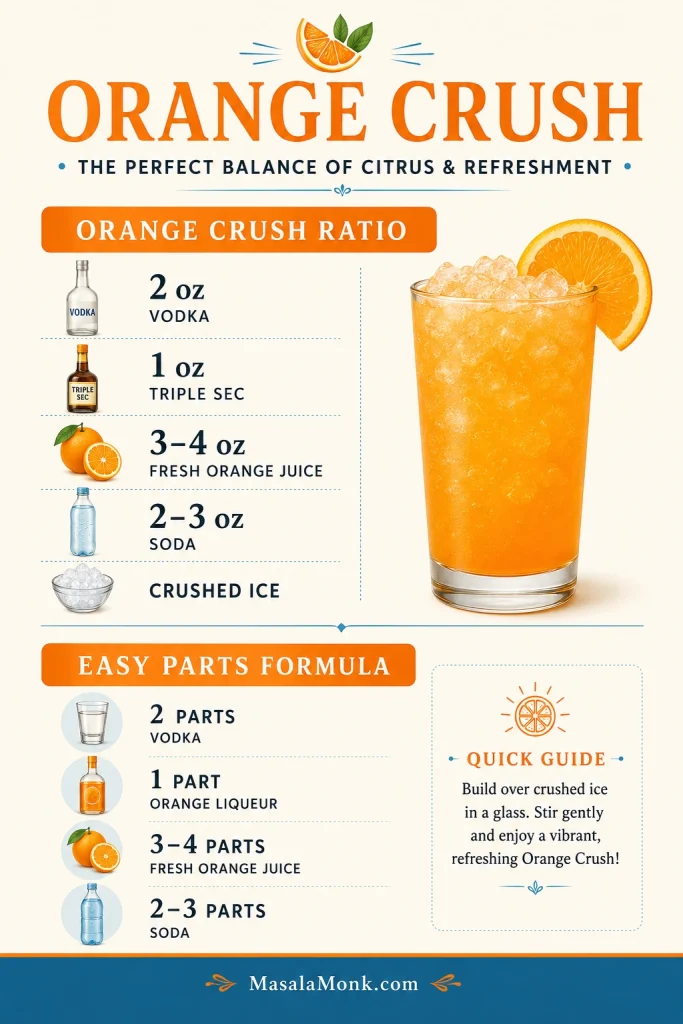
The best starting ratio is 2 oz / 60 ml vodka, 1 oz / 30 ml triple sec, 3–4 oz / 90–120 ml fresh orange juice, and 2–3 oz / 60–90 ml lemon-lime soda or club soda. Build it over crushed ice, add the soda last, and serve it while the glass is still cold and bubbly.

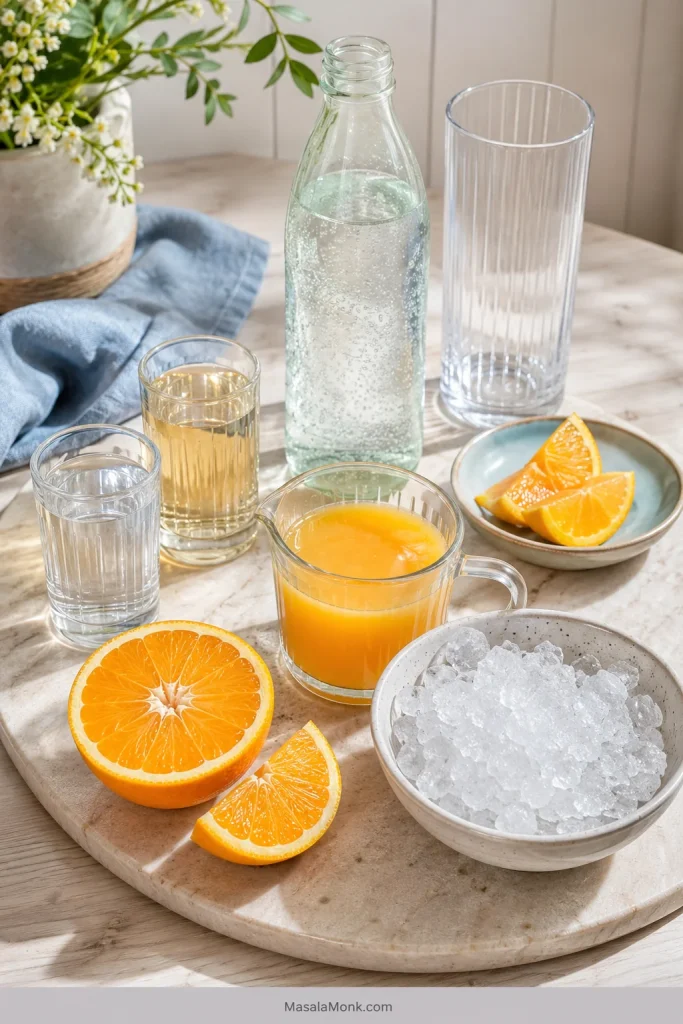
Orange Crush ingredients on a light tabletop, including fresh orange juice, vodka, orange liqueur, soda, crushed ice, orange wedges, and a tall glass.
The one-glass Orange Crush formula works because every ingredient has a clear role: juice brings brightness, vodka gives structure, orange liqueur adds depth, and soda lifts the finish.

Make One Now

Fill a highball, Collins, or pint glass with crushed ice. Add 2 oz / 60 ml vodka, 1 oz / 30 ml triple sec, and 3–4 oz / 90–120 ml fresh orange juice. Stir briefly, top with 2–3 oz / 60–90 ml lemon-lime soda or club soda, stir once more, garnish with orange, and drink while the ice is still crisp.

If the first sip tastes like orange first and alcohol second, you are in the right place. From there, adjust the next glass sweeter, drier, stronger, or more orange-forward.

Start here before you customize: vodka or orange vodka, triple sec, fresh-squeezed orange juice, lemon-lime soda, and a full glass of crushed ice.

Three things ruin the drink fast: warm juice, soda added too early, and finished cocktails sitting in a pitcher with ice.

Want this?Use this
Classic beach-bar Orange CrushOrange vodka + lemon-lime soda
Cleaner, less sweet drinkPlain vodka + club soda
Stronger orange flavorOrange vodka + Cointreau
Lighter party pourClub soda + extra fresh orange
MocktailFresh orange juice + lemon or lime + soda

You are not chasing a syrupy orange soda drink here. You want fresh citrus, cold ice, clean vodka, orange depth, and a bubbly finish.

Recipe Card: Orange Crush Cocktail

This is the balanced house version: cocktail-strength, orange-forward, bubbly, but not sticky. It is built to taste like fresh orange first, not lemon-lime soda first.

Prep time5 minutes
Cook time0 minutes
Total time5 minutes
Servings1
Yield1 cocktail
MethodBuilt in the glass
GlassHighball, Collins, or pint glass
EquipmentCitrus juicer, jigger or measuring cup, bar spoon

Ingredients

  • 3–4 oz / 90–120 ml fresh orange juice
  • 2 oz / 60 ml vodka or orange vodka
  • 1 oz / 30 ml triple sec or Cointreau
  • 2–3 oz / 60–90 ml lemon-lime soda, club soda, or orange sparkling water
  • Crushed ice, enough to fill the glass
  • Orange wheel or wedge, for garnish

Instructions

  1. Juice the oranges and measure 3–4 oz / 90–120 ml fresh orange juice.
  2. Fill a highball, Collins, or pint glass with crushed ice.
  3. Add vodka, triple sec, and fresh orange juice.
  4. Stir for 5–10 seconds, just enough to chill and combine.
  5. Top with lemon-lime soda, club soda, or orange sparkling water.
  6. Stir gently once or twice, garnish with orange, and serve immediately.

Notes

  • Orange vodka gives a stronger coastal bar-style orange flavor.
  • Plain vodka keeps the drink cleaner and less sweet.
  • Lemon-lime soda gives the classic finish.
  • Club soda or orange sparkling water makes it drier.
  • Add the soda last and serve right away.

What You Need

You only really need a citrus juicer, a jigger or small measuring cup, a tall glass, and crushed ice. A bar spoon helps, but a regular spoon is fine. Shakers are optional; use one only for the vodka, orange liqueur, and juice, never the soda.

A hand press makes the drink feel especially beach-bar style, but any citrus juicer works. What matters most is measuring the alcohol, filling the glass with enough ice, and adding the bubbles at the end.

Why This Ratio Works

A good Orange Crush is not vodka hidden under orange soda. It is fresh orange juice sharpened with vodka, deepened with orange liqueur, and lifted with bubbles.

Remember the Orange Crush rule: fresh orange carries the drink, orange liqueur deepens it, and soda only lifts it.

Infographic showing Orange Crush measurements for vodka, triple sec, fresh orange juice, soda, crushed ice, and a scalable parts formula.
The ounce ratio works for one cocktail, while the parts formula works for batching. That way, the Orange Crush stays balanced even when you scale it for guests.

This house ratio starts a little less sweet on purpose. You can always add more soda, but you cannot rescue a sticky glass once it is built.

The 2 oz / 60 ml vodka pour keeps it cocktail-strength, while 3–4 oz / 90–120 ml orange juice gives enough citrus to make the glass taste juicy instead of sharp. For a sweeter crush, add a little more orange liqueur or lemon-lime soda. To make a drier one, reduce the liqueur to ½ oz / 15 ml and use club soda.

Ingredients That Make the Drink Work

Because the cocktail is so simple, there is nowhere for dull juice or flat bubbles to hide. Good oranges and the right topper matter more than expensive bar tools.

Fresh orange juice

Fresh juice gives you that little burst of orange oil and perfume before the glass even reaches your mouth. That is the difference between a bright Orange Crush and a flat vodka-orange drink, and it is what bottled juice never quite gives you. Pulp is fine if you like a fuller texture.

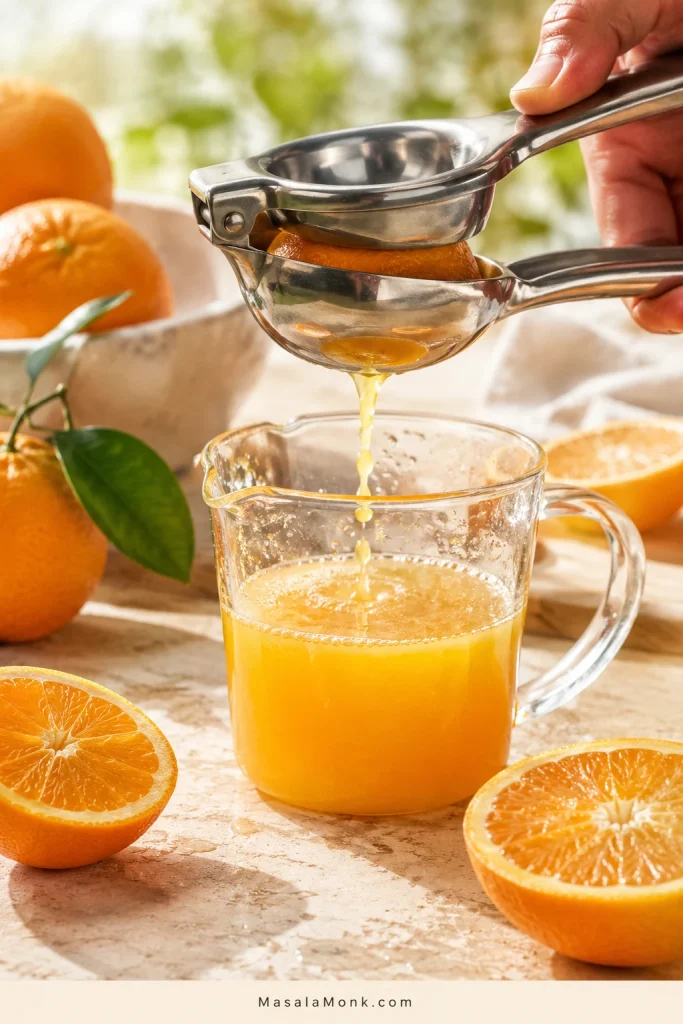
Fresh orange being squeezed in a metal citrus press, with juice dripping into a clear measuring cup and orange halves on a bright countertop.
The citrus press does more than save time. It pulls bright juice and aromatic orange oils into the drink, which is why fresh-squeezed orange juice tastes livelier in an Orange Crush.

One juicy orange may be enough for one drink, but plan on 1–2 oranges per cocktail so you are not short. Measure the juice and aim for 3–4 oz / 90–120 ml per glass. If one orange gives you less than 3 oz, squeeze another half.

Navel oranges are easy to find and usually sweet. Valencia oranges are especially juicy. Cara Cara oranges make a softer, sweeter pink-orange drink. Blood oranges also work, but they change the color and add a deeper berry-like edge.

If you bought a bag of oranges and have more citrus than you need for drinks, save a few for this orange marmalade recipe; it uses the same bright flavor in a slower, spoonable way.

Vodka or orange vodka

You do not need to buy a special bottle for one drink, but the vodka choice does change the mood of the glass. Plain vodka keeps the cocktail clean and citrus-led; orange vodka makes it taste more like the beach drink people remember.

Sweet, fragrant oranges are enough for plain vodka to work beautifully. When the fruit is mild, orange vodka helps the flavor along.

Vodka choiceBest forWhat it does
Plain vodkaA cleaner Orange CrushLets fresh orange juice stay in front
Orange vodkaBeach drink flavorAdds stronger orange aroma
Neutral vodkaEasy home mixingKeeps the drink simple and crowd-friendly
Vanilla or whipped vodkaDessert-style drinkCan taste creamsicle-like, but turns sweet quickly

Start with plain vodka and good oranges if you are unsure. The second glass can always get louder with orange vodka.

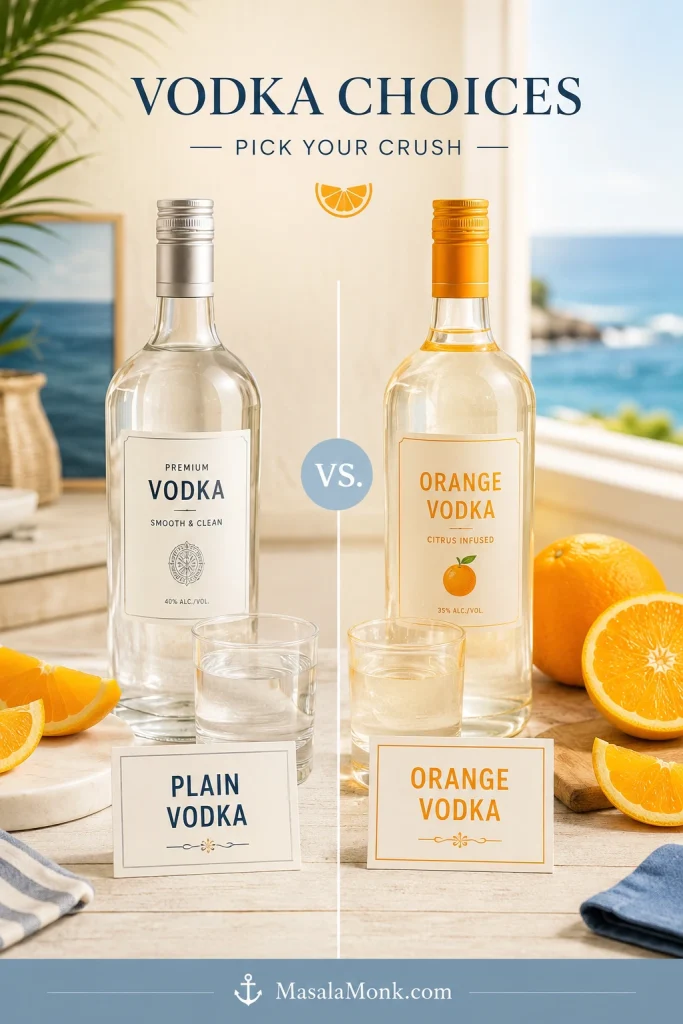
Side-by-side comparison of plain vodka and orange vodka with small pour glasses, orange slices, and labels on a coastal tabletop.
Plain vodka keeps the cocktail cleaner and more citrus-led. However, orange vodka helps when the fruit is mild or when you want a stronger beach-bar orange flavor.

Triple sec or orange liqueur

Orange liqueur is helpful, but it can take over fast. Measure it once, taste the drink, then adjust the next glass.

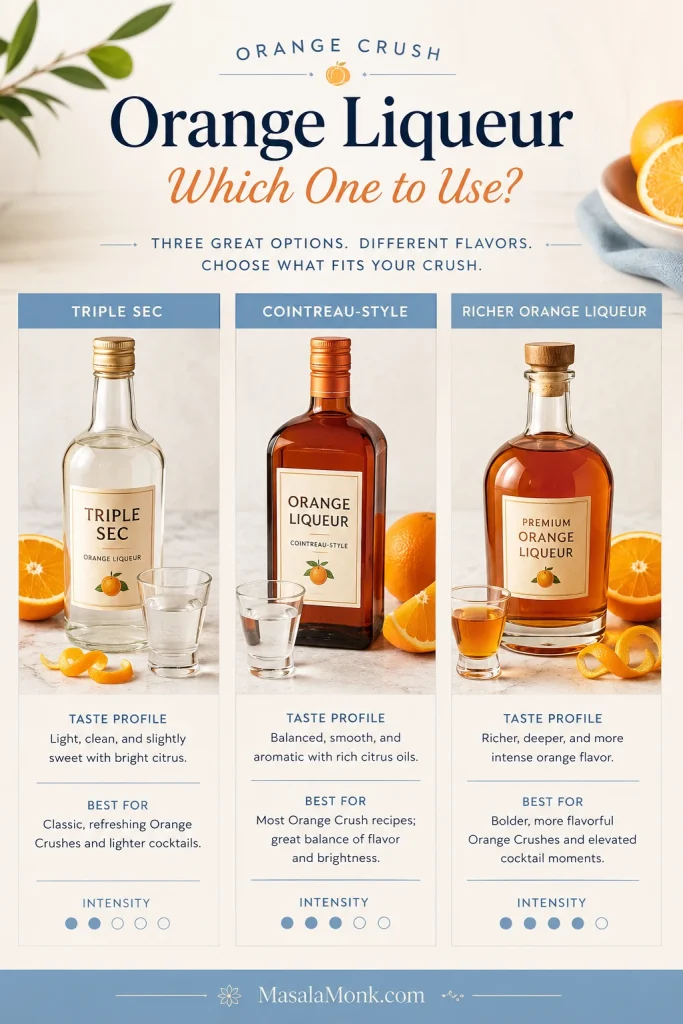
Triple sec adds sweetness and orange depth. Cointreau gives a cleaner orange flavor. Grand Marnier is richer and heavier, so use it when you want a rounder cocktail rather than the lightest possible glass.

Orange liqueurFlavorBest use
Triple secSweet, simple, classicStandard Orange Crush
CointreauCleaner, stronger orangePremium but still bright drink
Grand MarnierRicher, deeper, slightly brandy-likeRounder cocktail; use lightly

The safest first pour is still 1 oz / 30 ml. Once the drink is in your hand, you will know whether it needs more orange depth or less sweetness.

Orange liqueur comparison showing triple sec, Cointreau-style liqueur, and richer orange liqueur with bottles, small glasses, and orange props.
Orange liqueur should deepen the citrus, not turn the drink sticky. Start with a measured pour, then adjust only if the glass needs more orange flavor after tasting.

If you want another drink where orange liqueur has to stay balanced instead of taking over, this spicy margarita recipe uses that same sweet-citrus logic with lime, tequila, and heat.

Soda or sparkling water

The topper decides the mood of the glass: classic and sweet, clean and dry, or full-on orange soda. This is where many homemade versions go wrong. Too much sweet fizz, and the fresh orange disappears.

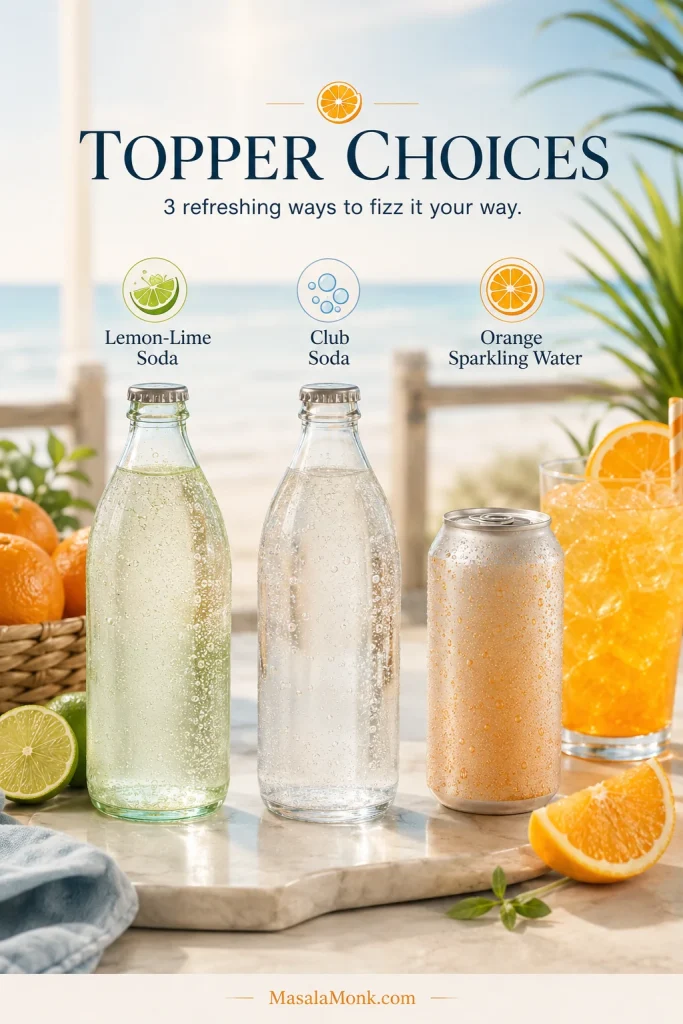
TopperResultUse it when
Sprite, 7UP, or lemon-lime sodaSweet, sparkling, classicYou want the beach-bar drink
Club sodaDryer and lighterYou want less sugar
Orange sparkling waterCitrusy but not syrupyYou want orange flavor without extra sweetness
Orange sodaVery sweet and candy-likeUse only for a soda-style twist

Start with less topper than you think. You can always add a splash more, but you cannot take sweetness back out.

Topper comparison showing lemon-lime soda, club soda, and orange sparkling water with an Orange Crush cocktail in the background.
The topper controls sweetness more than most people expect. Choose lemon-lime soda for a classic Orange Crush, club soda for a drier drink, or orange sparkling water for lighter citrus fizz.

Crushed ice

Crushed ice is part of the drink’s personality. It chills fast, softens the vodka, and gives the glass that loose, beach-bar feel you do not get from a few hard cubes.

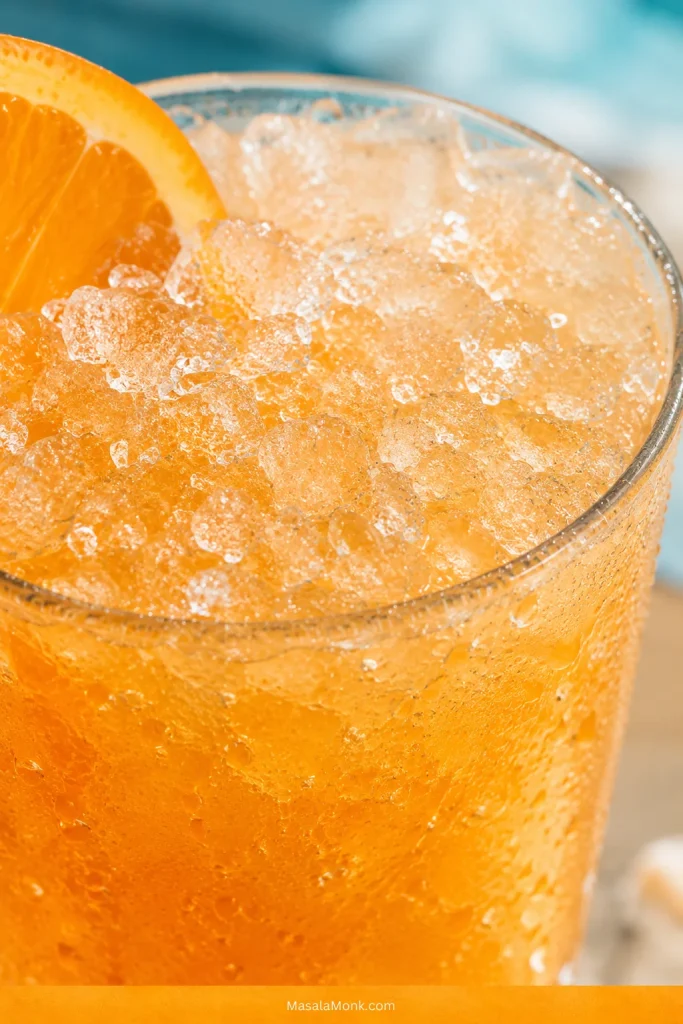
Close-up of crushed ice and condensation in a glass of orange cocktail with an orange slice garnish near the rim.
Crushed ice gives the cocktail its classic beach-bar texture. It chills the glass quickly, slightly softens the vodka, catches the bubbles, and makes each sip feel lighter.

Ready to mix? jump to the method · recipe card · back to top

How to Make It

The easiest home method is also the best one: build the drink right in the glass. It is fast, clean, and keeps the soda lively.

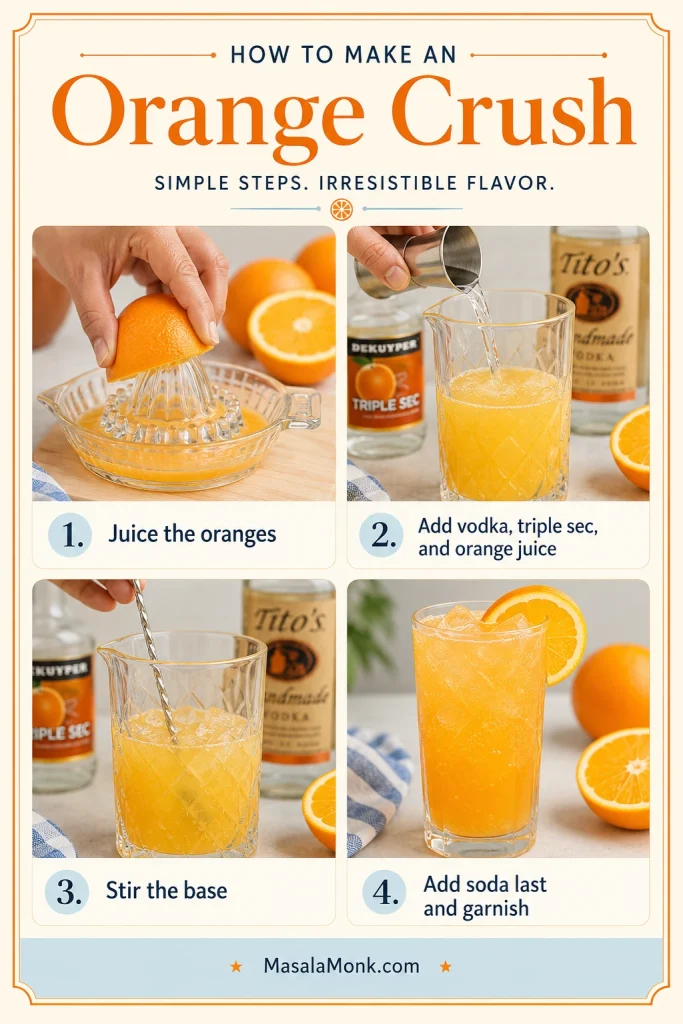
Step-by-step Orange Crush guide with panels showing oranges juiced, vodka and triple sec added, the base stirred, and soda added last with garnish.
The best method is simple: juice, build, stir, fizz, garnish. Most importantly, stir the base before adding soda so the final Orange Crush stays cold and lively.
  1. Juice first. Squeeze the oranges right before mixing if you can.
  2. Ice the glass. Fill the glass with crushed ice, not just a few cubes.
  3. Add the base. Pour in vodka, triple sec, and orange juice.
  4. Stir briefly. You want the base cold and even, not overworked.
  5. Add fizz last. Top with soda or sparkling water.
  6. Serve immediately. The drink is best before the bubbles fade and the ice melts.

Once the soda goes in, the drink is alive for a short window. The best sip is the first one: cold glass, sharp ice, orange aroma, and bubbles still lifting the citrus.

Add Soda Last for Better Fizz

Clear soda being poured into a golden orange cocktail over crushed ice, with bubbles rising around the ice in the glass.
Pour the soda after the orange-vodka base is mixed and chilled. That small delay protects the bubbles, so the Orange Crush tastes freshly built instead of dull by the time it reaches the table.

If you prefer a colder, slightly frothier drink, shake only the vodka, orange liqueur, and orange juice with ice for 10–15 seconds. Pour over crushed ice, then add the soda. Do not shake carbonated soda.

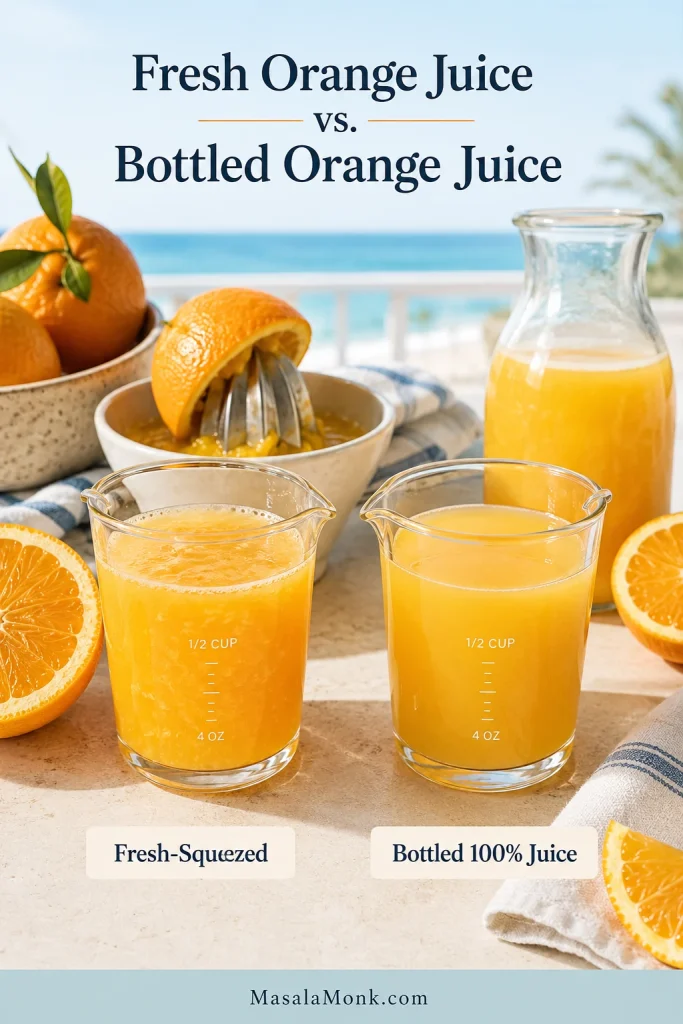
Fresh Orange Juice vs Bottled Orange Juice

Fresh orange juice gives the drink its best aroma. You smell the orange before the first sip, and the cocktail tastes juicy instead of flat. Bottled juice can make a decent quick drink, but it will not give the same just-cut orange aroma.

Choose chilled 100% orange juice with no added sugar if you use bottled juice. Club soda is usually the better topper there, because it keeps the glass from turning too sweet.

Fresh-squeezed orange juice and bottled 100% orange juice compared in measuring glasses with oranges, a citrus press, and a juice bottle nearby.
Fresh juice is best for one or two glasses because it brings brighter aroma and texture. For a larger pitcher, bottled 100% orange juice can help, but keep it well chilled.

When making one or two drinks, squeeze the oranges. In a large party pitcher, bottled juice can be practical, but just-squeezed citrus still gives the best flavor.

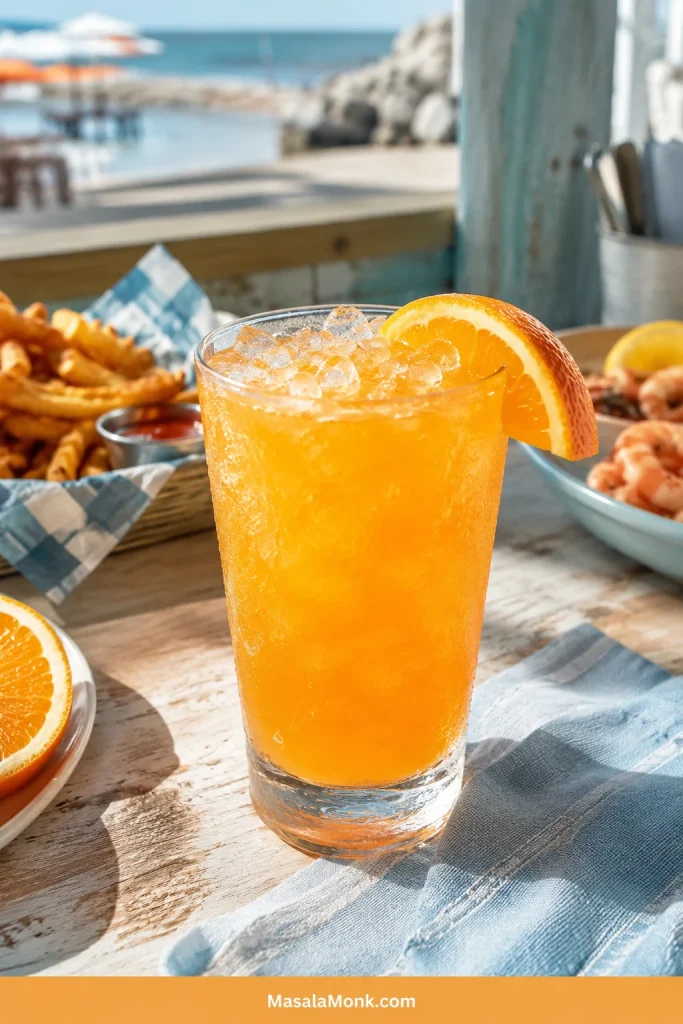
Beach-Bar Style Orange Crush

For an Ocean City-style Orange Crush, use orange vodka, fresh-squeezed orange juice, triple sec, lemon-lime soda, and a full glass of crushed ice. Build it fast, keep it cold, and serve it while the fizz is still lively.

Orange Crush cocktail on a rustic coastal table with crushed ice, orange garnish, fries, seafood snacks, blue napkin, and a beach-bar background.
A Mid-Atlantic-style Orange Crush should feel cold, casual, and fast-built. Look for fresh orange aroma, a full glass of crushed ice, and just enough fizz to keep it refreshing.

Beach-bar style is about cues, not fussy technique: orange scent first, crushed ice to the top, fizz added last, and enough soda to lift the drink without turning it into candy.

  • Orange smell first: fresh juice is doing its job.
  • Crushed ice to the top: the texture should feel cold, casual, and fast-melting.
  • Bubbles added last: the drink stays lively.
  • Orange vodka optional: use it for stronger coastal-bar flavor.
  • Not too much soda: the glass should still taste like orange, not candy.

The Easy Parts Formula

Once that ratio makes sense, you can scale the drink without doing bar math every time.

2 parts vodka + 1 part orange liqueur + 3–4 parts fresh orange juice + 2–3 parts soda.

For one drink, 1 part can be 1 oz. When batching, 1 part can be 1 cup. Use a smaller “part” for one drink and a larger “part” for a pitcher, but keep the soda separate until serving so the drink stays fizzy.

Pitcher Recipe

A pitcher should make hosting easier, not give everyone a flat drink. Mix the vodka, orange liqueur, and orange juice ahead. The pitcher should sit cold in the fridge; the fizz should happen in the glass.

Orange Crush Pitcher Amounts

ServingsVodkaTriple secFresh orange juiceSoda to add at serving
12 oz / 60 ml1 oz / 30 ml3–4 oz / 90–120 ml2–3 oz / 60–90 ml
48 oz / 240 ml4 oz / 120 ml12–16 oz / 360–480 ml8–12 oz / 240–360 ml
612 oz / 360 ml6 oz / 180 ml18–24 oz / 540–720 ml12–18 oz / 360–540 ml
816 oz / 480 ml8 oz / 240 ml24–32 oz / 720–960 ml16–24 oz / 480–720 ml

Keep the Pitcher Fizzy

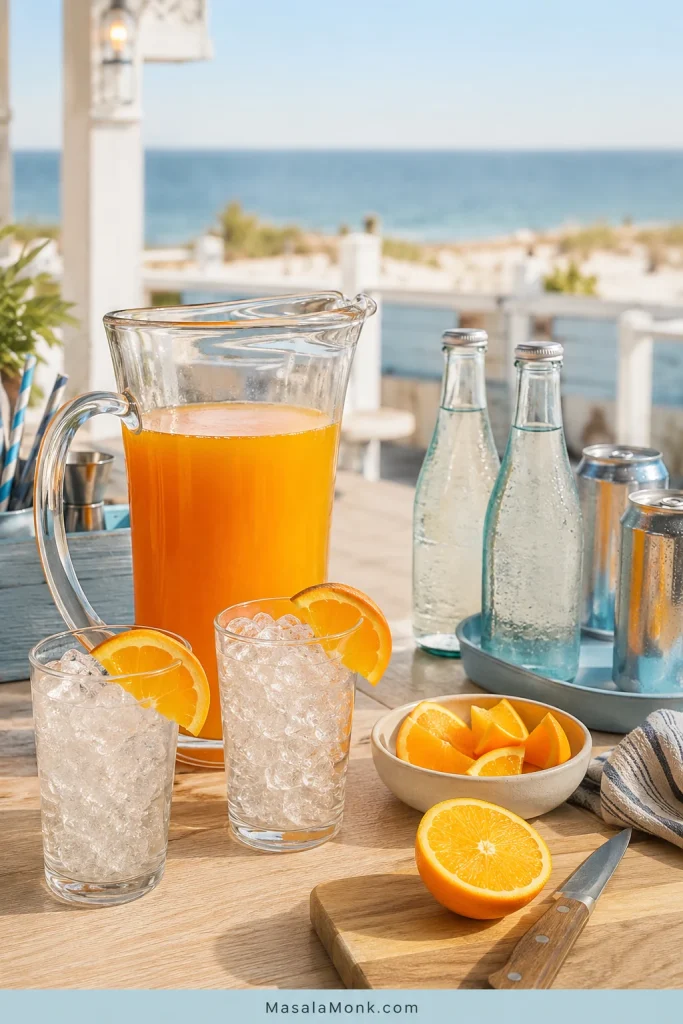
Best party setup: Chill the orange-vodka base in a pitcher, then set out crushed ice, orange wedges, lemon-lime soda, and club soda so guests can finish each glass sweeter or drier.

Orange Crush pitcher setup with orange base in a clear pitcher, crushed-ice glasses, orange wedges, a jigger, and separate bottles of soda.
A pitcher works best when only the orange-vodka base is made ahead. Then the soda and crushed ice stay fresh for each glass instead of fading in the pitcher.

Keep the base cold and let guests finish their own glasses; that way every pour still has fresh fizz instead of tasting like it waited around. For bigger party math, this jungle juice recipe has 1, 2, and 5 gallon guidance, including the same useful rule: add fizzy mixers near serving time.

Just-squeezed juice is still best for pitchers. Bottled juice can help when you need volume, but choose a good chilled 100% orange juice and use club soda or a lighter hand with the lemon-lime soda.

For a lighter pitcher, use the lower end of the vodka range or let guests top each glass with extra club soda. Serve pitcher drinks responsibly, especially because orange juice and soda can make the cocktail taste lighter than it is.

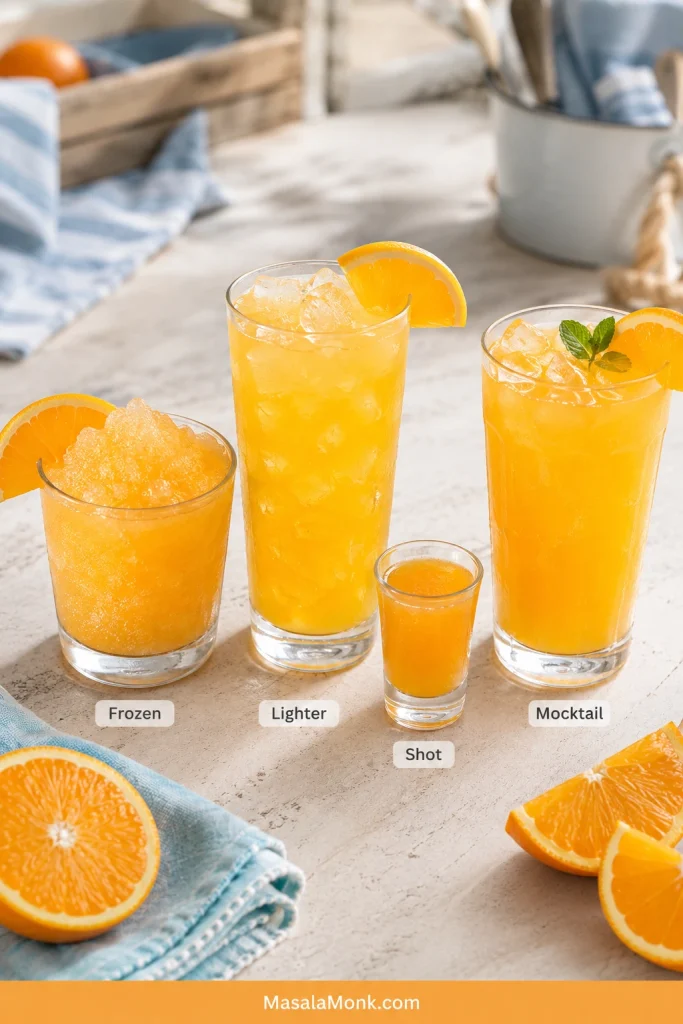
Variations: Frozen, Lighter, Shot, and Mocktail

Once the classic glass tastes right, the variations are just small turns of the same dial: colder, lighter, stronger, or alcohol-free.

Four Orange Crush variations labeled Frozen, Lighter, Shot, and Mocktail, served in different glasses with orange garnishes on a tabletop.
Once the classic version tastes right, the same fresh-orange base can become frozen, lighter, stronger, or alcohol-free. Still, each version should keep the citrus flavor in front.

Frozen Orange Crush

Blend 4 oz / 120 ml fresh orange juice, 2 oz / 60 ml vodka, 1 oz / 30 ml triple sec, and 1 to 1¼ cups crushed ice, about 120–150 g, until slushy. If your oranges are tart, add ½ oz / 15 ml simple syrup. Pour into a cold glass and finish with a small splash of soda.

Add soda after blending, not before. Too much soda in the blender loses its fizz and can foam up.

If you like frozen cocktails but hate icy, watery texture, this frozen strawberry daiquiri recipe goes deeper into blender balance, fruit body, and slushy texture.

Lighter Orange Crush

For a lighter, skinny-style drink, use plain vodka, reduce triple sec to ½ oz / 15 ml if needed, and top with club soda or orange sparkling water instead of lemon-lime soda. Keep the orange juice at 3–4 oz / 90–120 ml so the drink still tastes full.

Orange Crush Shot

Shake 1 oz vodka or orange vodka, ¼ oz triple sec, and ¾ oz fresh orange juice with ice. Strain into one large shot glass, or split between two smaller shot glasses. Add only a tiny splash of soda if you want fizz.

This keeps the shot in the same fresh-orange family as the cocktail instead of turning it into a candy-style party drink.

Orange Crush Mocktail

Combine 4 oz / 120 ml fresh orange juice, ½ oz / 15 ml lemon or lime juice, crushed ice, and 2–3 oz / 60–90 ml lemon-lime soda, club soda, or orange sparkling water. For a sweeter mocktail, add a little orange simple syrup. To keep it cleaner, use club soda and a little orange zest.

The mocktail should still taste like fresh orange with bubbles, not just a glass of orange soda.

For more light, refreshing drinks that do not feel heavy, this guide to coconut water cocktails has easy ideas that sit closer to the clean, cooling side of the drinks table.

Maryland, Ocean City, and Delaware

The Orange Crush belongs to Mid-Atlantic beach culture: Ocean City bars, crushed ice, fresh-squeezed juice, seafood tables, and a friendly Maryland-Delaware argument over who gets to claim it.

It has beach-bar DNA. This is not meant to be slow or precious. The drink is a fast-built glass: fresh orange squeezed in, vodka or orange vodka, orange liqueur, crushed ice, and lemon-lime fizz.

That regional pride is part of why the drink has stayed so specific. Fresh-squeezed orange, orange liqueur, cold ice, and a quick build are the identity.

Maryland’s official state-symbol page lists the Original Maryland Orange Crush as its state cocktail, and Delaware’s General Assembly page records HB 444 designating the Orange Crush as Delaware’s state cocktail. You can read those official notes from the Maryland State Archives and the Delaware General Assembly.

Orange Crush vs Screwdriver vs Mimosa

These three drinks all use orange juice, but they serve different moments.

DrinkWhat it isMain difference
Orange CrushVodka, orange liqueur, fresh orange juice, soda, crushed iceSparkling, fresh, summer-bar style
ScrewdriverVodka and orange juiceSimpler, no fizz, no orange liqueur
MimosaSparkling wine and orange juiceBrunch drink, lighter, wine-based

A Screwdriver is the simplest vodka-orange drink. Make a Mimosa when you want a wine-based brunch drink. Choose an Orange Crush when you want fresh orange juice, vodka, orange liqueur, fizz, and crushed ice in one bright summer glass.

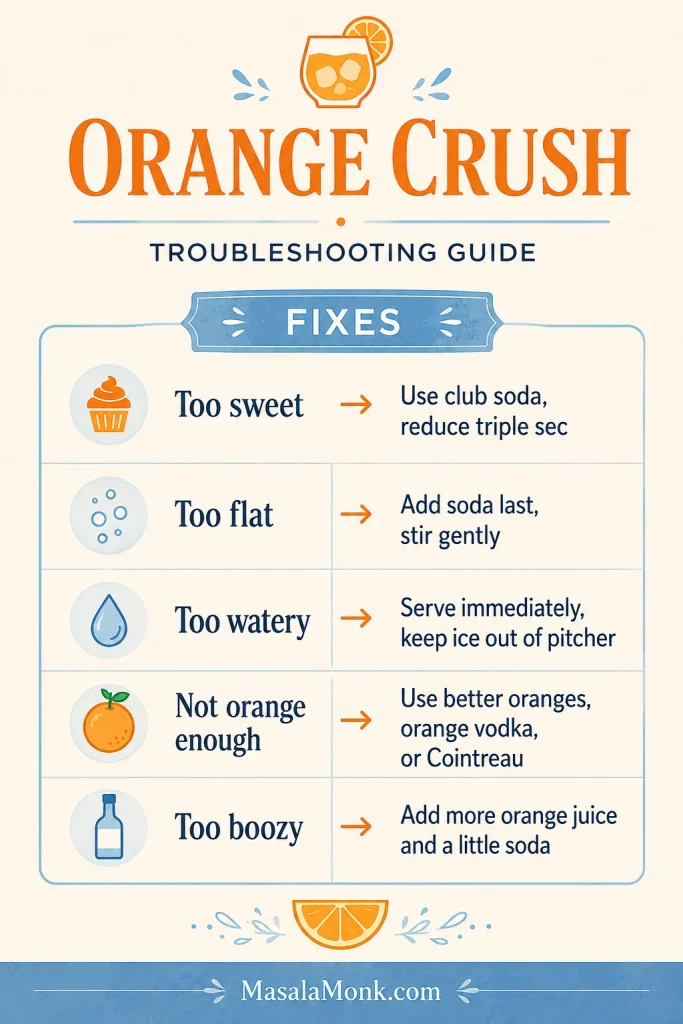
Fixes for a Drink That’s Too Sweet, Flat, or Watery

If the drink misses, it usually misses in one of a few predictable ways: too sweet, too flat, too watery, or not orange enough. Fix the glass before you start over.

Orange Crush troubleshooting chart listing problems such as too sweet, too flat, too watery, not orange enough, and too boozy, with simple fixes.
When an Orange Crush tastes off, adjust the cause instead of adding more of everything. Sweetness, flatness, watery texture, weak orange flavor, and harsh booze each need a different fix.
ProblemWhat happenedFix
Too sweetToo much lemon-lime soda or orange liqueurUse club soda and reduce triple sec to ½ oz / 15 ml
Too weakToo much soda or juiceUse less soda or add ½ oz / 15 ml more vodka
Too boozyAlcohol is louder than the orangeAdd more fresh orange juice and a little more soda
Too flatSoda was added early or stirred too hardAdd soda last and stir gently
Too wateryThe drink sat too long over crushed iceServe immediately and do not make finished drinks ahead
Not orange enoughMild oranges or plain vodkaUse orange vodka, better oranges, or Cointreau
Too bitterPith got into the juiceJuice gently and avoid crushing the white pith

The fastest rescue: add more orange juice if it tastes too boozy, club soda if it tastes too sweet, or a small splash of orange liqueur if it tastes thin.

Still tuning the glass? check the topper · check the ratio · recipe card

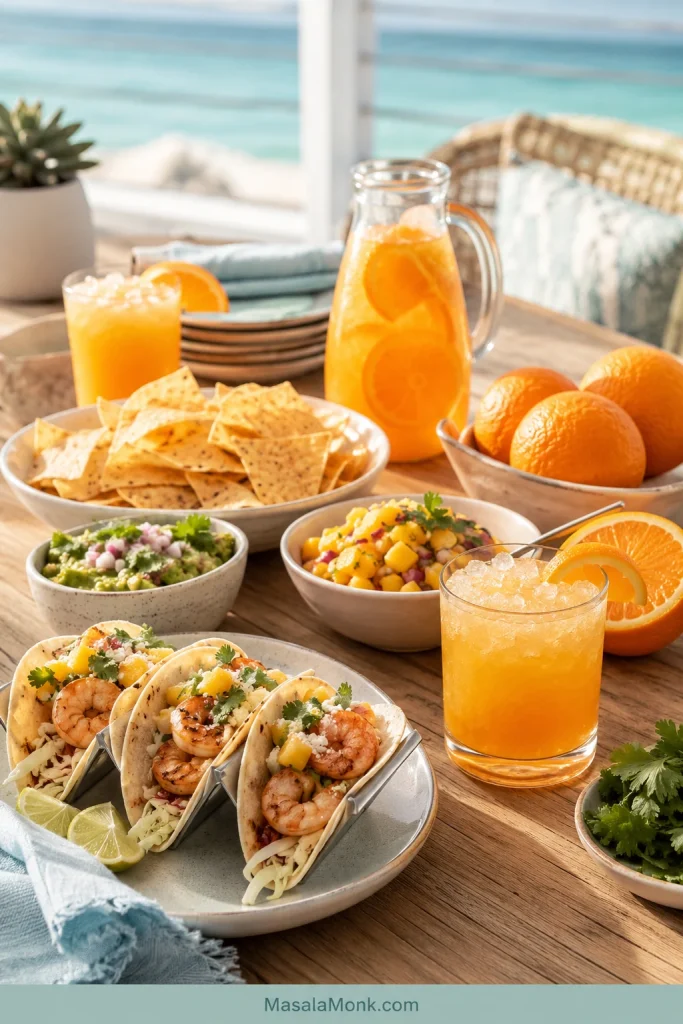
What to Serve With It

Think salty, spicy, grilled, and creamy. Orange Crush cocktails have enough sweetness to soften heat, enough citrus to cut through richness, and enough bubbles to keep snack food from feeling heavy. For a full summer-style plate, shrimp tacos with slaw and creamy cilantro-lime sauce are an easy pairing because the citrusy drink cuts through the creamy sauce and warm spices.

Orange Crush cocktail served on a bright coastal table with shrimp tacos, tortilla chips, mango salsa, guacamole, oranges, and a pitcher behind it.
This cocktail works well with salty, spicy, grilled, and creamy foods because citrus and bubbles cut through richness. Pair it with shrimp tacos, chips, salsa, guacamole, or seafood snacks.
  • Grilled shrimp, fish, or chicken
  • Tacos, nachos, or quesadillas
  • Crab cakes or seafood snacks
  • Salty chips, pretzels, and party mixes
  • Spicy appetizers
  • Fruit, cheese, and brunch boards
  • Guacamole or creamy dips for a rich contrast

If you are keeping the food snackier, a bowl of fresh mango salsa works with chips, tacos, fish, shrimp, and grilled chicken. For a sharper citrus cocktail at the same table, the Lemon Drop Martini brings more tartness, while the Orange Crush stays tall, juicy, and easygoing.

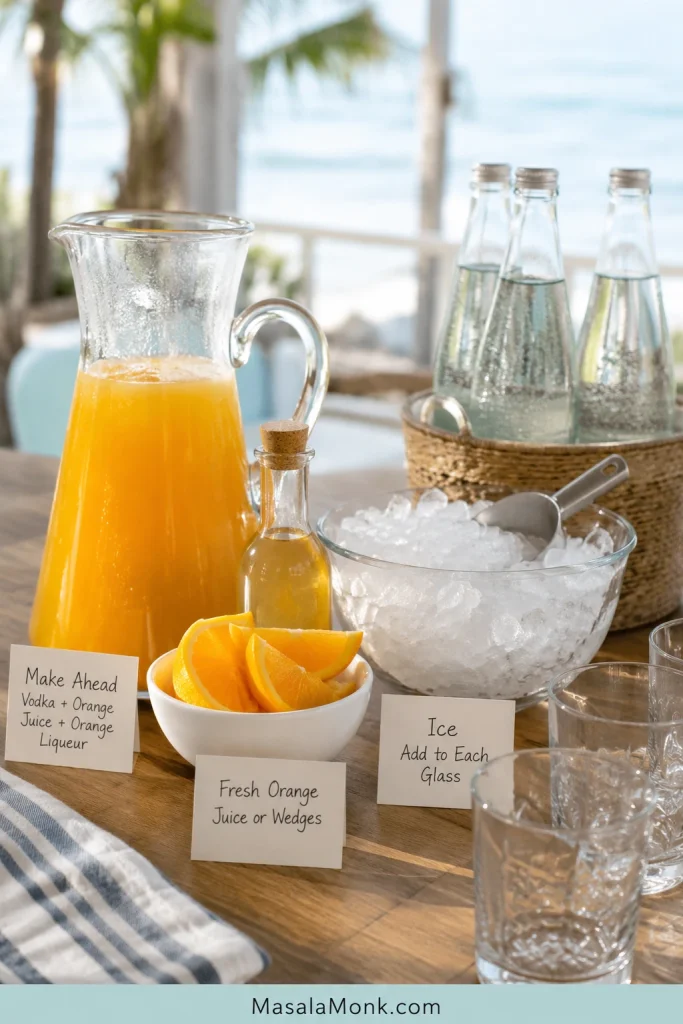
Make-Ahead Tips for Parties

An Orange Crush is best made right before serving, but you can prepare the parts ahead.

Make-ahead Orange Crush party setup with orange-vodka base in a pitcher, orange wedges, crushed ice bowl, empty glasses, and soda bottles kept separate.
Party prep is easier when the parts are ready but unfinished. Keep the base, ice, soda, glasses, and garnish separate, then build each Orange Crush to order.
  • Fresh orange juice: Juice a few hours ahead and keep chilled.
  • Pitcher base: Mix vodka, triple sec, and orange juice ahead, then refrigerate.
  • Soda: Add only when serving.
  • Crushed ice: Add to glasses, not the pitcher.
  • Finished cocktail: Do not store it. The soda goes flat and the ice waters it down.

If serving a group, keep the chilled base in a pitcher and let guests top their own glasses. That keeps every drink cold, sparkling, and adjustable.

FAQs

What alcohol is in an Orange Crush?

An Orange Crush usually contains vodka or orange vodka plus triple sec or another orange liqueur. It also includes fresh orange juice, soda, and crushed ice.

Is an Orange Crush the same as a Screwdriver?

No. A Screwdriver is vodka and orange juice. An Orange Crush adds orange liqueur, soda, and crushed ice, which makes it more sparkling and layered.

Is an Orange Crush made with Orange Crush soda?

The classic cocktail is usually made with fresh orange juice, vodka or orange vodka, orange liqueur, and lemon-lime soda or club soda. Orange Crush soda can make a sweeter twist, but it tastes more like candy orange and less like the fresh beach drink.

Fresh orange juice or bottled orange juice — which is better?

For one or two drinks, fresh-squeezed juice is best because you can taste the difference: brighter aroma, cleaner citrus, and less boxed sweetness. Bottled 100% orange juice can work for speed or pitchers, especially if it is well chilled.

Can you make it with regular vodka?

Yes. Regular vodka works well, especially with fresh orange juice. Orange vodka gives a stronger beach-bar orange flavor, but it is not required.

Do you need triple sec?

Triple sec is strongly recommended because it gives the drink orange depth, not just sweetness. Cointreau makes the flavor cleaner, while Grand Marnier makes it richer.

Sprite or club soda — which should you use?

Lemon-lime soda such as Sprite or 7UP gives the classic sweet finish. Club soda makes the drink drier, cleaner, and less sugary. Orange sparkling water sits between the two.

How do you make an Orange Crush less sweet?

Use club soda or orange sparkling water instead of lemon-lime soda, and reduce the triple sec to ½ oz / 15 ml. Keep enough fresh orange juice so the drink still tastes full.

How strong is an Orange Crush?

With 2 oz vodka and 1 oz orange liqueur, an Orange Crush is a real cocktail, not a low-alcohol spritz. The fresh juice and bubbles make it easy to sip, so use 1½ oz vodka or extra club soda if you want a lighter glass.

How many oranges do you need for one drink?

One juicy orange may be enough, but plan on 1–2 oranges per drink so you are not short. Measure the juice and aim for 3–4 oz / 90–120 ml per cocktail.

What makes it a Maryland or Ocean City Orange Crush?

The Ocean City-style identity comes from fresh-squeezed orange juice, vodka or orange vodka, triple sec, lemon-lime soda, and crushed ice. Maryland beach bars helped make it famous, and Delaware beach towns keep the same drink close to their own summer culture.

Is this the same as Orange Crush soda cake?

No. This recipe is for the fresh orange vodka cocktail. Orange Crush soda cake is a separate dessert usually made with orange soda and cake mix or cake batter.

Recipe card · Back to top

Final Sip

Make the first glass classic. Use fresh orange juice, vodka, triple sec, lemon-lime soda, and enough crushed ice to make the glass properly cold. Then taste and adjust from there.

A sweeter Orange Crush, a drier one, a pitcher, frozen drink, or mocktail all come from the same simple rule: let the orange lead, keep the bubbles lively, and serve it before the ice wins.

Try the classic glass first, then tell us which version became yours: sweeter, drier, stronger, or alcohol-free.

Posted on Leave a comment

Screwdriver Recipe: Vodka & Orange Juice Cocktail

Tall highball glass of Screwdriver cocktail with vodka, orange juice, clear ice, orange wheel garnish, jigger, and bar spoon on a light counter.

A screwdriver is only vodka and orange juice, which is exactly why the ratio matters. Too little juice and the vodka takes over. Too much juice, and it stops feeling like a cocktail at all. This screwdriver recipe keeps that simple balance clear: cold juice, enough ice, and the right pour, so the same two ingredients taste fresh, smooth, and properly mixed.

This screwdriver recipe gives you the classic vodka and orange juice cocktail first, then shows you how to adjust it for a stronger glass, a lighter brunch pour, or a pitcher for guests. You do not need syrup, liqueur, or a full home bar. You just need clean vodka, chilled orange juice, plenty of ice, and a ratio that fits the moment.

It is the kind of drink people make when they want something familiar, cold, and easy without turning the kitchen into a bar.

Vodka and orange juice is called a Screwdriver. Start with 2 oz / 60 ml vodka and 5 oz / 150 ml orange juice. The finished glass should smell like orange first, feel properly cold, and leave the vodka in the background rather than in charge.

Quick Answer: What Is Vodka and Orange Juice Called?

Vodka and orange juice is called a Screwdriver. The simple version is vodka and orange juice over ice, usually served in a highball or Collins glass with an optional orange slice, wedge, or wheel.

The easiest screwdriver ratio to start with is 1 part vodka to 2–3 parts orange juice. For one balanced drink, use 2 oz / 60 ml vodka and 5 oz / 150 ml orange juice. Build it directly in the glass and give it a brief stir.

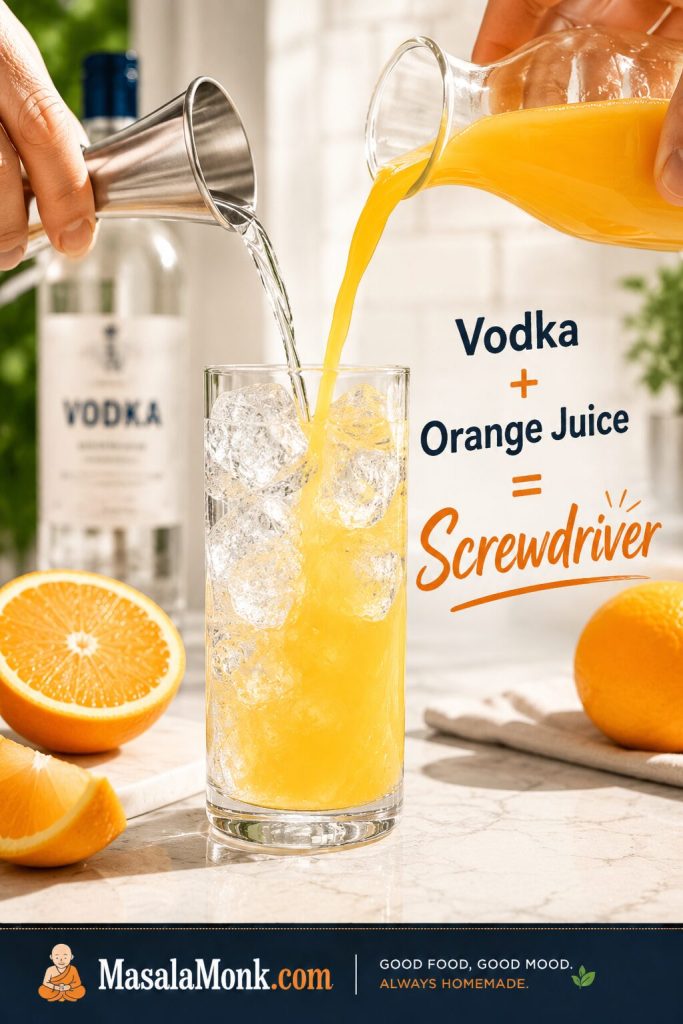
Vodka and orange juice being poured into an ice-filled highball glass to make a Screwdriver cocktail.
Vodka and orange juice becomes a Screwdriver when it is poured over ice, which is why the drink works best as a simple cold highball.

Make One Now

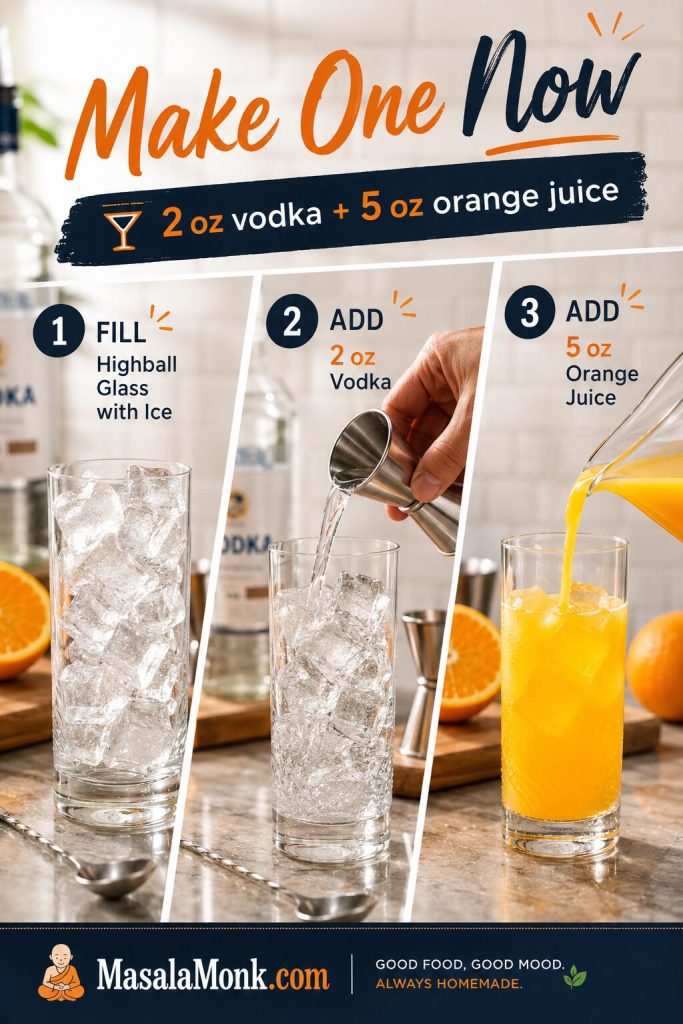
Fill a tall glass with ice. Add 2 oz / 60 ml vodka and 5 oz / 150 ml chilled orange juice. Stir just until combined, garnish with orange if you like, and serve right away.

Three-step Screwdriver recipe visual showing ice in a glass, vodka being measured, and orange juice being poured.
When you want one drink quickly, 2 oz vodka and 5 oz chilled orange juice gives you a reliable starting point before you fine-tune the strength.

Want it stronger or lighter? Use the ratio guide before your next pour.

Screwdriver Recipe

This is the balanced version: cold vodka, chilled orange juice, plenty of ice, and a simple orange garnish.

Prep time5 minutes
Cook time0 minutes
Total time5 minutes
Servings1
Yield1 cocktail
MethodBuilt in glass

Glass: highball or Collins glass
Ratio: 2 oz / 60 ml vodka to 5 oz / 150 ml orange juice
Method: build over ice and stir briefly

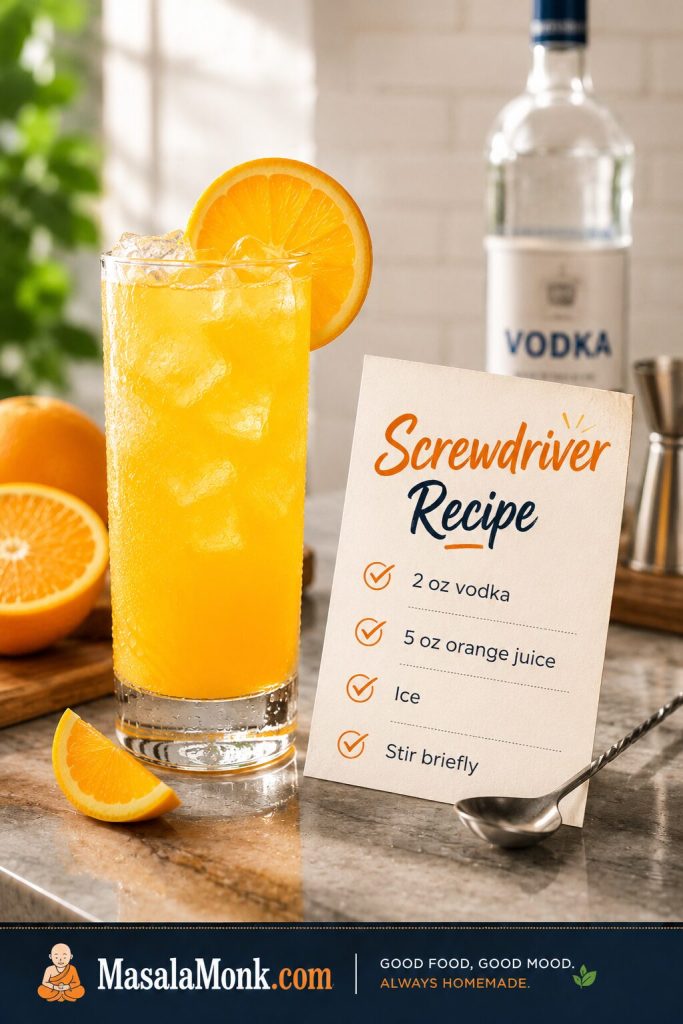
Saveable Screwdriver recipe card beside a finished orange cocktail with vodka, orange juice, ice, and brief stirring instructions.
Think of this as the base pour: once it tastes right in one glass, it becomes much easier to scale, lighten, or serve for guests.

Ingredients

  • 2 oz / 60 ml vodka
  • 5 oz / 150 ml orange juice, chilled
  • Ice, enough to fill the glass
  • Orange wedge, wheel, or slice, optional

Instructions

  1. Fill a highball or Collins glass with ice.
  2. Pour in the vodka.
  3. Add the chilled orange juice.
  4. Stir for 5–10 seconds, just enough to chill and combine. Do not churn it aggressively.
  5. Garnish with orange and serve immediately.

Notes

  • For a stronger screwdriver, use 4 oz / 120 ml orange juice.
  • For a lighter screwdriver, use 6 oz / 180 ml orange juice.
  • If the first sip tastes sharp, add another ounce or two of orange juice.
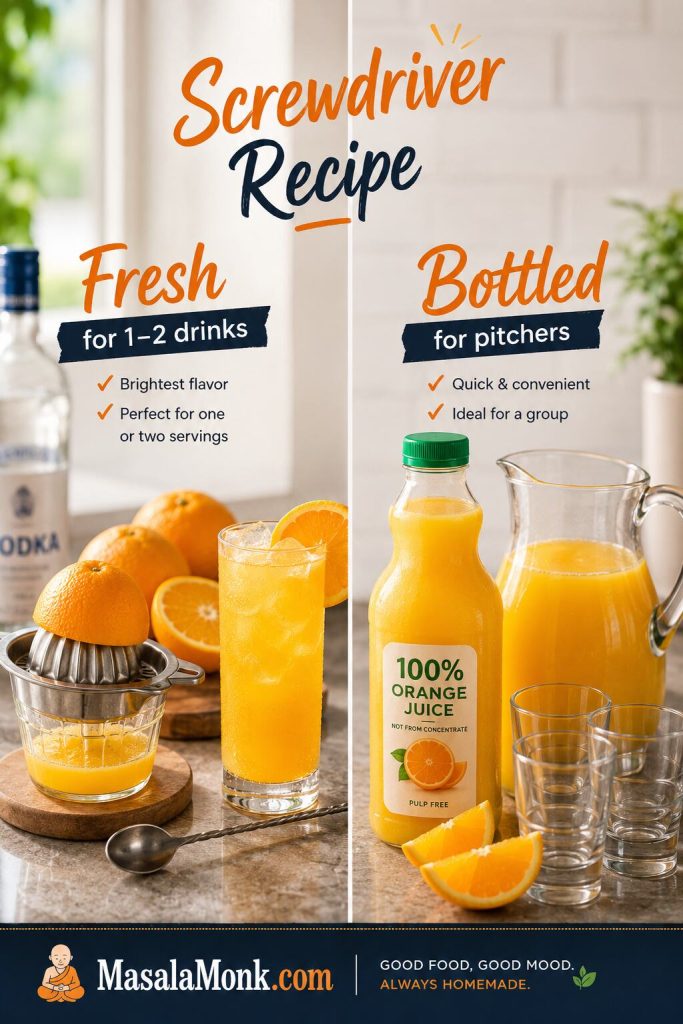
  • Fresh orange juice tastes brightest, but chilled 100% bottled orange juice works well when you need speed or consistency.
  • For pitchers, mix vodka and orange juice ahead, but add ice to individual glasses. Making more than one? Use the pitcher amounts.

If your glass already tastes right, you can stop there. But if the first sip is too sharp, too flat, too sweet, or too much like plain orange juice, the rest of this guide shows you how to adjust the pour, choose better juice, batch it for guests, or turn it into a variation.

Keep Reading For

Serve It Well

From here, the best version depends on the glass you want: stronger, lighter, fresher, easier to batch, or more playful.

What Is a Screwdriver Drink?

A screwdriver works because orange juice does most of the flavor work while vodka gives the drink structure. That is why temperature, ice, and ratio matter more than complicated technique.

In the UK, many people simply call the same drink “vodka and orange.”

That simplicity is the charm. A good one should taste orange first, with the vodka supporting it. A weak one tastes watery; a badly balanced one tastes like orange juice with a rough spirit edge. The ratio fixes both problems.

If you like simple vodka cocktails, this sits in the same easy-mixing world as a crisp Moscow Mule or a citrusy vodka with lemon. The screwdriver is even simpler because the orange juice does most of the work.

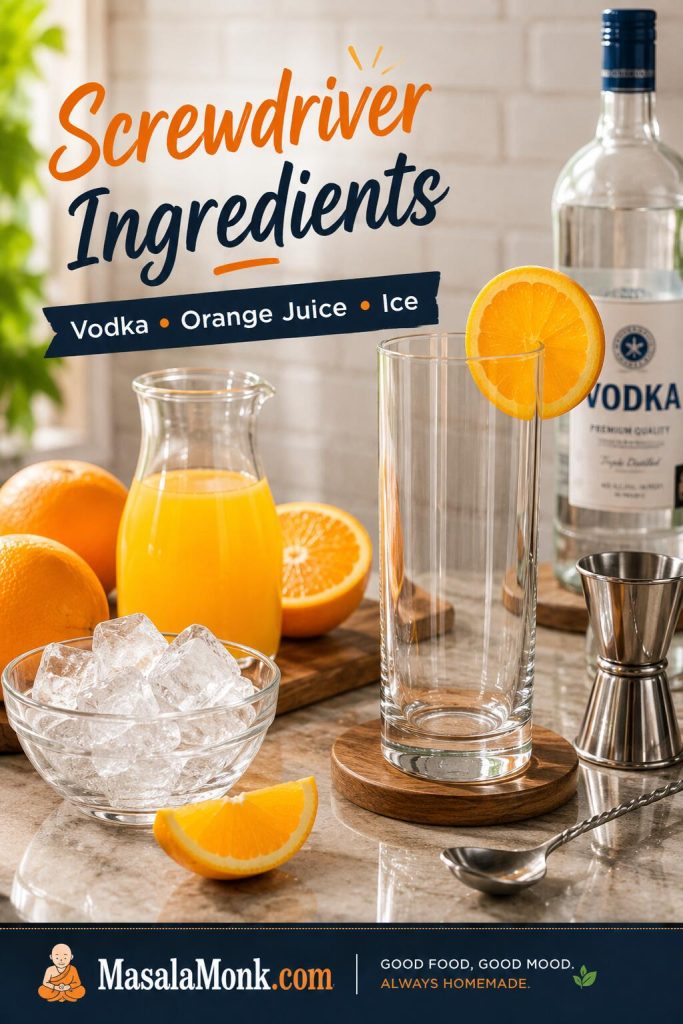
Screwdriver Ingredients

You only need a few ingredients, so keep them cold and choose them well. This is not a drink that rewards overthinking, but it does reward balance.

Screwdriver ingredients arranged on a light counter, including vodka, orange juice, oranges, ice, highball glass, jigger, and bar spoon.
Because a Screwdriver has only a few ingredients, vodka, orange juice, and ice each matter more than they would in a more complicated cocktail.

Vodka

Because orange juice is the only real mixer here, choose a vodka that tastes clean rather than one you need to hide. You do not need an expensive bottle, but avoid anything very harsh.

Plain vodka keeps the drink simple. Citrus vodka can push the orange flavor forward, while vanilla or whipped cream vodka turns the drink toward orange cream.

Orange Juice

Fresh orange juice gives you that lifted orange smell before the first sip; bottled juice gives you consistency and speed. Chilled 100% bottled orange juice is especially useful for pitchers. Pulp or no pulp is personal: pulp feels fuller, while no-pulp juice makes a smoother glass. Choosing juice for a bigger batch? See the fresh vs bottled guide.

Orange drink can work in a pinch, but it pushes the cocktail toward sweet punch instead of fresh orange. For the cleanest flavor, use orange juice that tastes good cold on its own.

Ice and Garnish

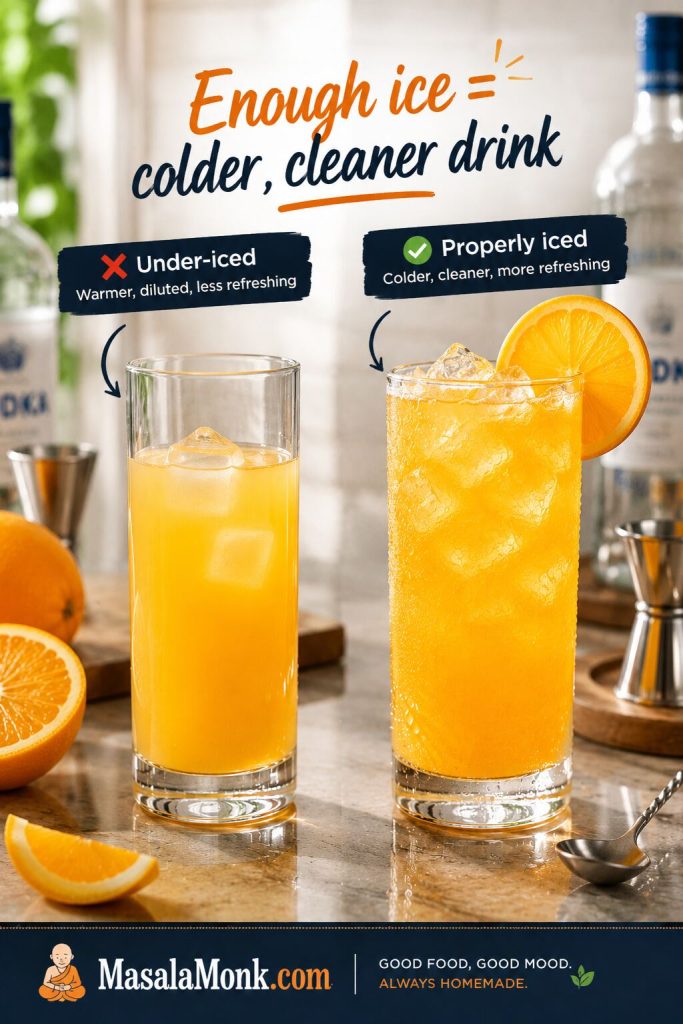
Do not be shy with the ice. A tall glass filled with ice keeps the drink colder for longer and helps avoid that thin, warm-orange-juice taste. An orange wedge, wheel, slice, or peel twist is optional, but it adds aroma and makes the glass feel finished.

Side-by-side comparison of an under-iced Screwdriver and a properly iced Screwdriver with clear ice and condensation.
Enough ice keeps a Screwdriver colder and cleaner; otherwise, the orange juice warms quickly and the drink starts to taste thin.

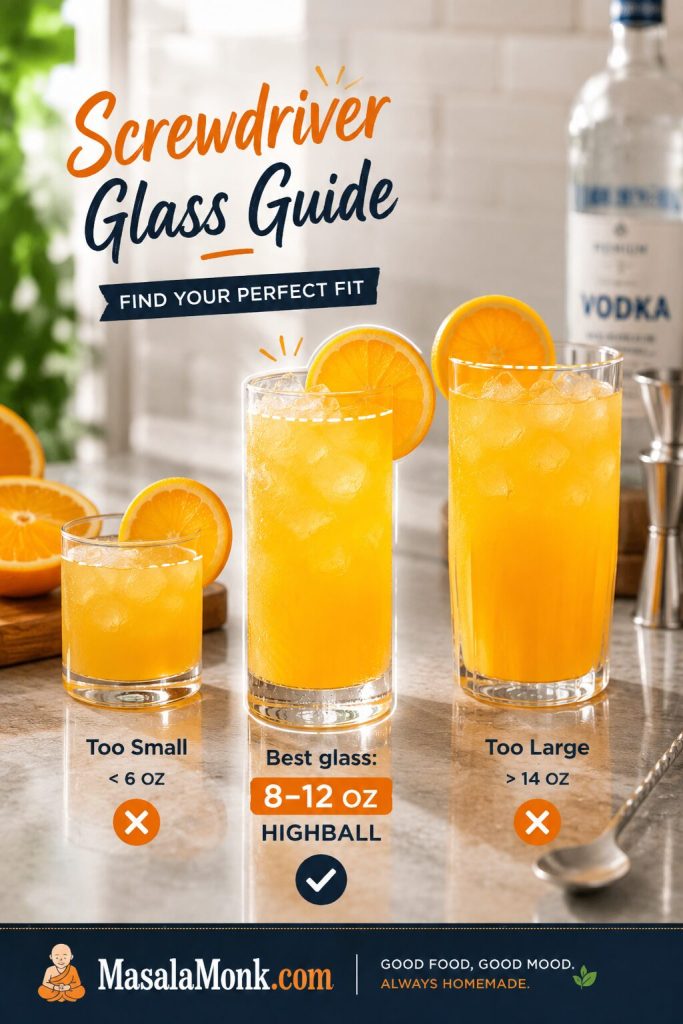
An 8–12 oz highball or Collins glass works best for the balanced pour. If your glass is smaller, use the stronger 2 oz vodka + 4 oz orange juice version or pour a slightly shorter drink.

Glass size comparison for a Screwdriver cocktail showing a small glass, an 8 to 12 ounce highball glass, and a larger glass.
An 8–12 oz highball or Collins glass leaves room for the vodka-orange mix, ice, and garnish without making the drink feel cramped.

What counts as the simple drink? Vodka, orange juice, ice, and optional orange garnish. Add-ins like Sprite, club soda, cranberry juice, pineapple juice, peach schnapps, Galliano, triple sec, grenadine, or bitters turn it into a twist.

Best Screwdriver Ratio

This is where screwdrivers usually go wrong: people pour by instinct, then wonder why the drink tastes either sharp or flat. The ratio decides whether the glass feels like a cocktail or just cold orange juice with a little vodka hiding in it.

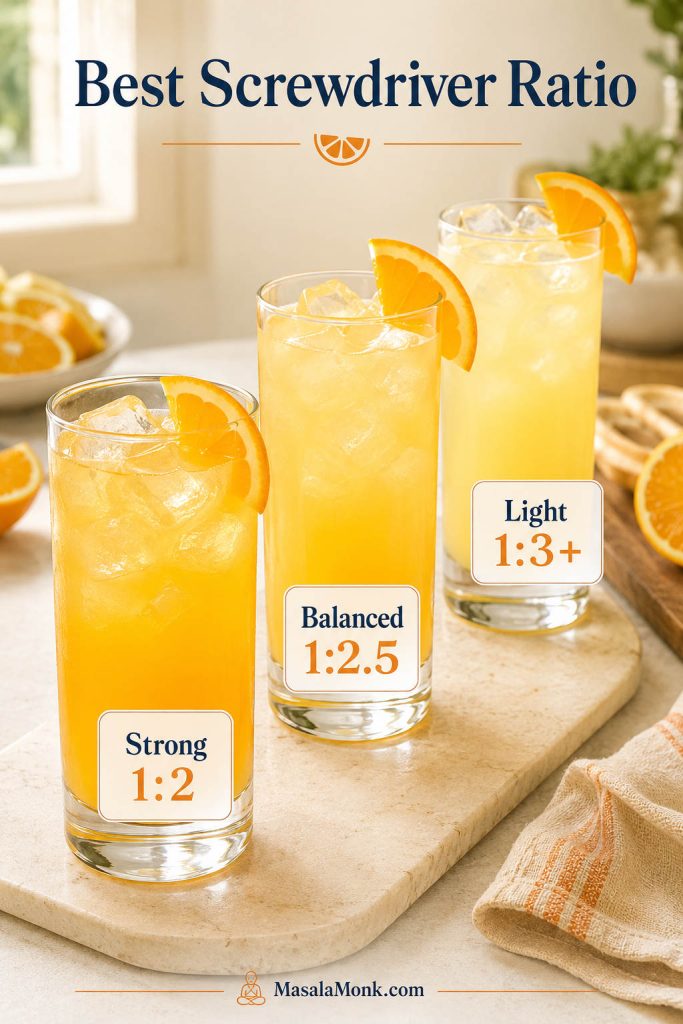
Classic Screwdriver recipes vary because the drink can be built as a stronger cocktail or a lighter brunch highball. A 1:2 pour tastes more cocktail-forward; 1:3 or 1:4 tastes lighter and more orange-led. This recipe uses 2 oz vodka to 5 oz orange juice because it sits in the middle: clearly a cocktail, but still fresh, cold, and orange-first.

Three highball glasses labeled strong, balanced, and light to show different vodka-to-orange-juice ratios for a Screwdriver.
The best Screwdriver ratio depends on the glass you want: stronger and cocktail-forward, balanced and orange-led, or lighter for brunch.

Choose your pour: Use 2 oz / 60 ml vodka + 4 oz / 120 ml orange juice for a stronger cocktail, 2 oz / 60 ml + 5 oz / 150 ml for the balanced house version, 1.5 oz / 45 ml + 5–6 oz / 150–180 ml for a lighter brunch glass, or mix the pitcher ahead and pour over ice in individual glasses.

Screwdriver Ratio Chart

A useful starting range is 1 part vodka to 2–3 parts orange juice; go closer to 1:4 when you want a very light, mostly-orange glass. Use 1:2 for a stronger pour, 1:2.5 for the most balanced glass, and 1:3 for a lighter drink. The easiest formula to remember is 2 oz / 60 ml vodka + 5 oz / 150 ml orange juice.

StyleVodkaOrange juiceRatioBest for
Strong2 oz / 60 ml4 oz / 120 ml1:2A stronger glass
Balanced2 oz / 60 ml5 oz / 150 ml1:2.5Start here
Light brunch1.5 oz / 45 ml5–6 oz / 150–180 mlAbout 1:3 to 1:4A lighter glass
Metric classic50 ml100 ml1:2A simple measured version
Very light1 oz / 30 ml4 oz / 120 ml1:4Mostly orange juice

How strong is it? Even when it tastes orange-forward, a balanced Screwdriver with 2 oz vodka is still a full cocktail. Use the lighter version for brunch, slow sipping, or a longer glass.

Treat the table as a starting point, not a rule. Orange juice changes from carton to carton and orange to orange. Very sweet juice may need a squeeze of lemon or lime. Sharper vodka may need more juice and ice. The right ratio is the one that tastes smooth in your glass. For a group, use the pitcher table instead of multiplying by eye.

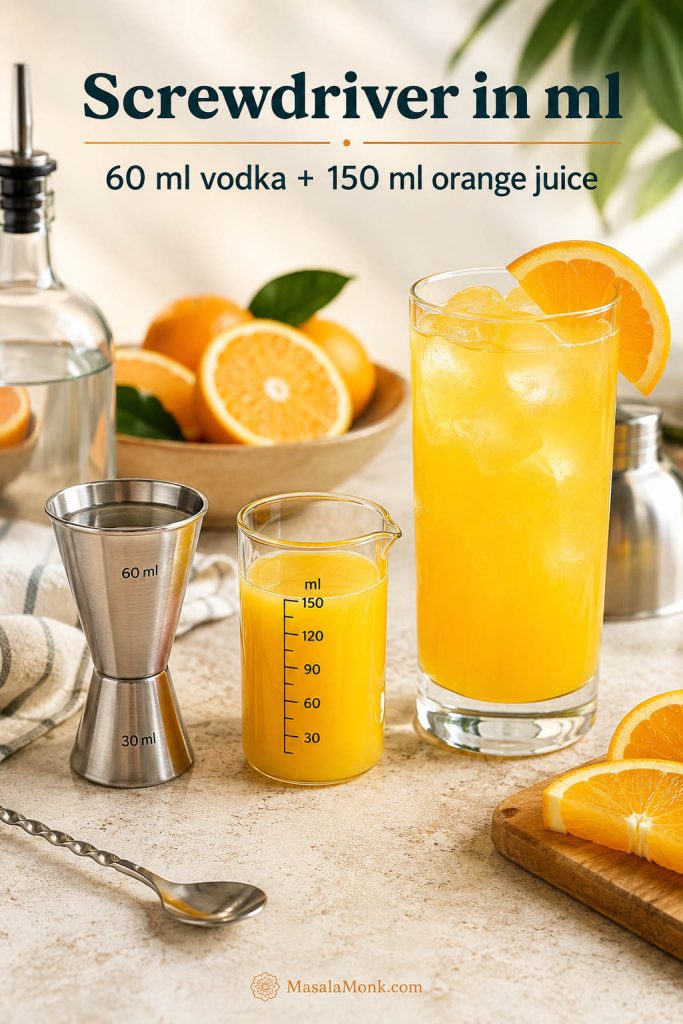
Screwdriver Measurements in ml

For metric measurements, start with the balanced version unless you already know you want a stronger or lighter glass.

Metric Screwdriver measurement setup with a jigger, measuring cup, orange juice, and a highball glass labeled 60 ml vodka and 150 ml orange juice.
For metric readers, 60 ml vodka and 150 ml orange juice gives the same balanced pour as the 2 oz / 5 oz version.
VersionVodkaOrange juice
Balanced60 ml150 ml
Stronger60 ml120 ml
Lighter45 ml150–180 ml
Classic 1:2 formula50 ml100 ml

Method Details

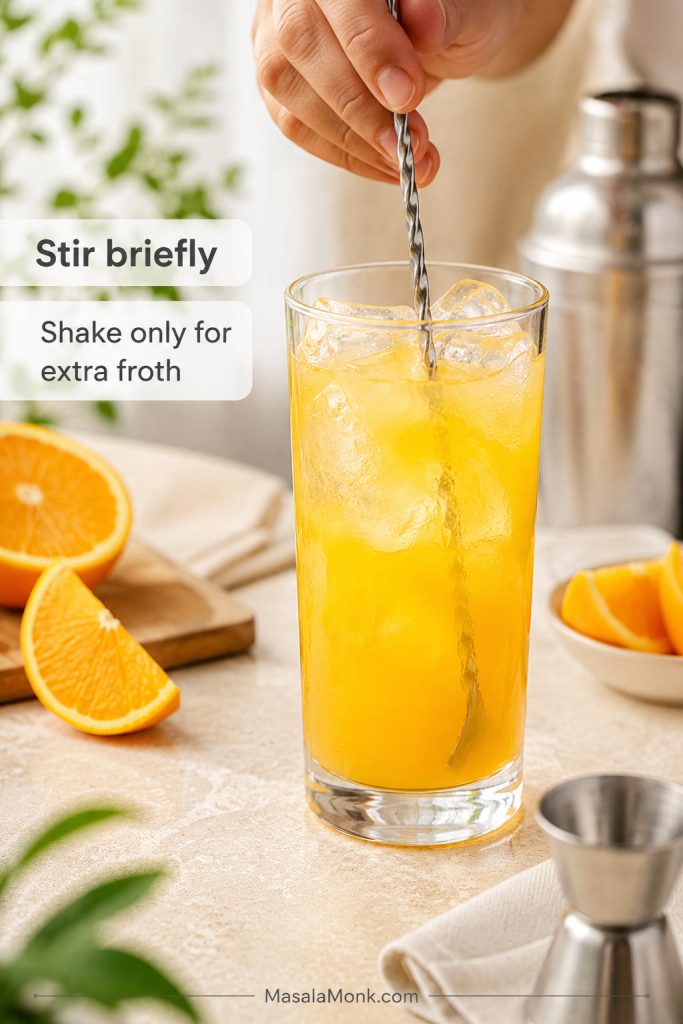
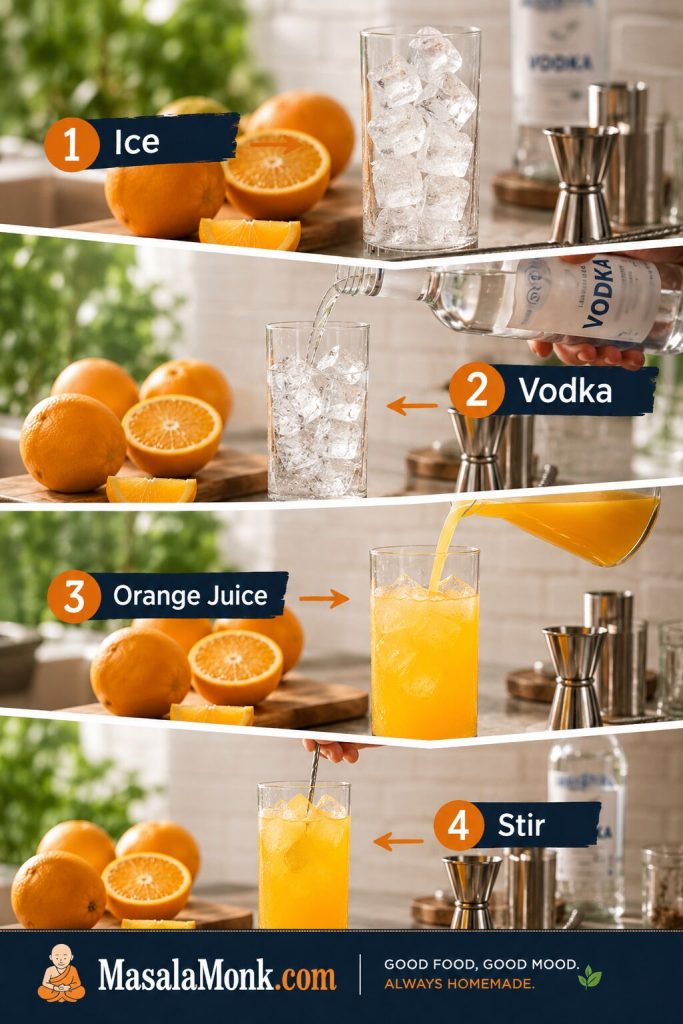
The standard order is ice first, vodka second, orange juice third, then a brief stir. Shaking is fine when you want it extra cold and slightly frothy, but the glass-built version is faster and cleaner.

Bar spoon stirring an orange Screwdriver cocktail in a tall highball glass with a cocktail shaker blurred in the background.
Stirring is the classic move because it keeps the Screwdriver smooth, while shaking is better reserved for extra chill and a slightly frothier texture.
  1. Fill the glass with ice. Use a highball or Collins glass if you have one.
  2. Add the vodka. Pour in 2 oz / 60 ml vodka for the balanced version.
  3. Add orange juice. Pour in 5 oz / 150 ml chilled orange juice.
  4. Stir briefly. Stir for 5–10 seconds, just enough to chill and combine. Do not churn it aggressively.
  5. Garnish and serve. Add an orange wedge, wheel, slice, or peel twist if you like.
Step-by-step Screwdriver cocktail guide showing ice, vodka, orange juice, and stirring in a highball glass.
The method stays simple for a reason: building in the glass keeps the drink fast, cold, and easy to adjust after the first sip.

You are not trying to whip or aerate the drink; you are just making the first sip taste even from top to bottom.

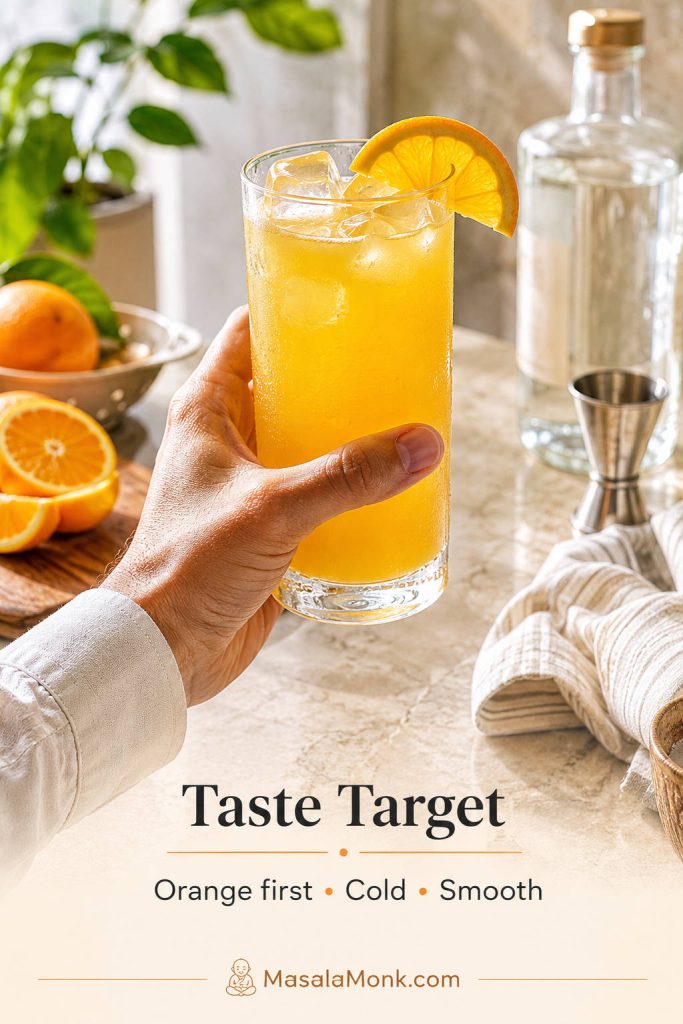
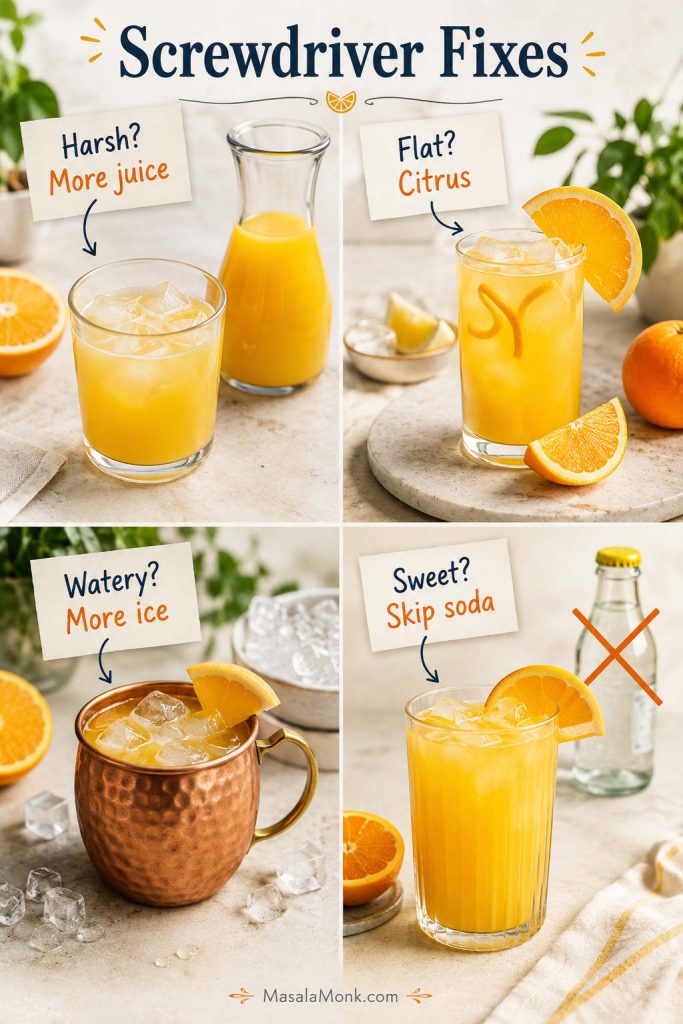
After stirring, the drink should smell like orange, feel cold against the glass, and taste citrusy first with the spirit supporting the orange, not dominating it. If the drink tastes too sharp, add more orange juice. For a flat glass, add a tiny squeeze of lemon or lime. If it tastes watery, use more ice next time and serve it right after mixing.

Hand holding a cold highball glass of Screwdriver cocktail with ice, orange garnish, and taste target text.
After mixing, the drink should smell like orange first, feel properly cold, and let the vodka sit in the background rather than take over.

If the first sip still tastes off, jump to the fixes instead of starting over.

Fresh Orange Juice vs Bottled Orange Juice

Fresh juice is worth it when you are making one or two drinks and want that first sip to smell like real orange, not just cold sweetness. But for a pitcher, bottled 100% orange juice is usually the smarter move: consistent, already strained, and easy to chill.

Fresh oranges with a juicer compared with bottled orange juice and a pitcher setup for making Screwdriver cocktails.
Fresh orange juice gives the brightest aroma for one or two cocktails; meanwhile, bottled 100% orange juice keeps pitcher prep easier and more consistent.
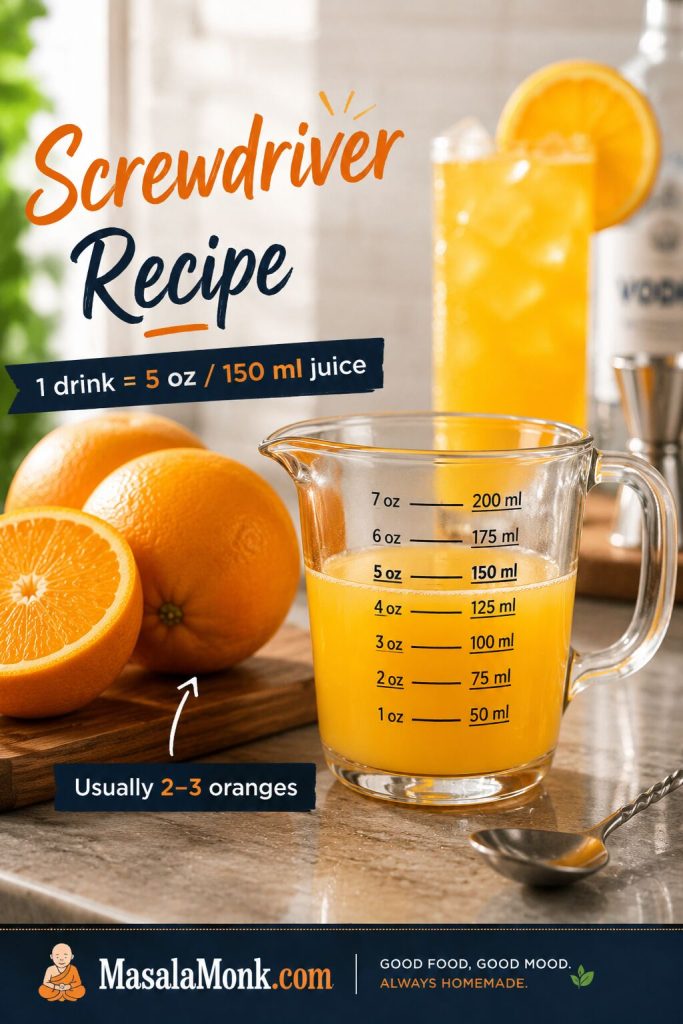
One balanced glass needs about 5 oz / 150 ml orange juice, which usually takes 2–3 medium oranges depending on size and juiciness.

Two to three oranges beside a measuring cup filled with 5 ounces or 150 milliliters of orange juice for one Screwdriver.
One balanced Screwdriver needs about 5 oz / 150 ml orange juice, so two to three medium oranges are usually enough for a single glass.

If you are already using orange juice for brunch, the same bottle can work for a simple mimosa beside the screwdriver pitcher. Whatever you use, keep it well chilled. Warm orange juice makes the whole drink feel dull, even when the ratio is right.
  • Freshly squeezed orange juice: brightest aroma and freshest finish for one or two drinks.
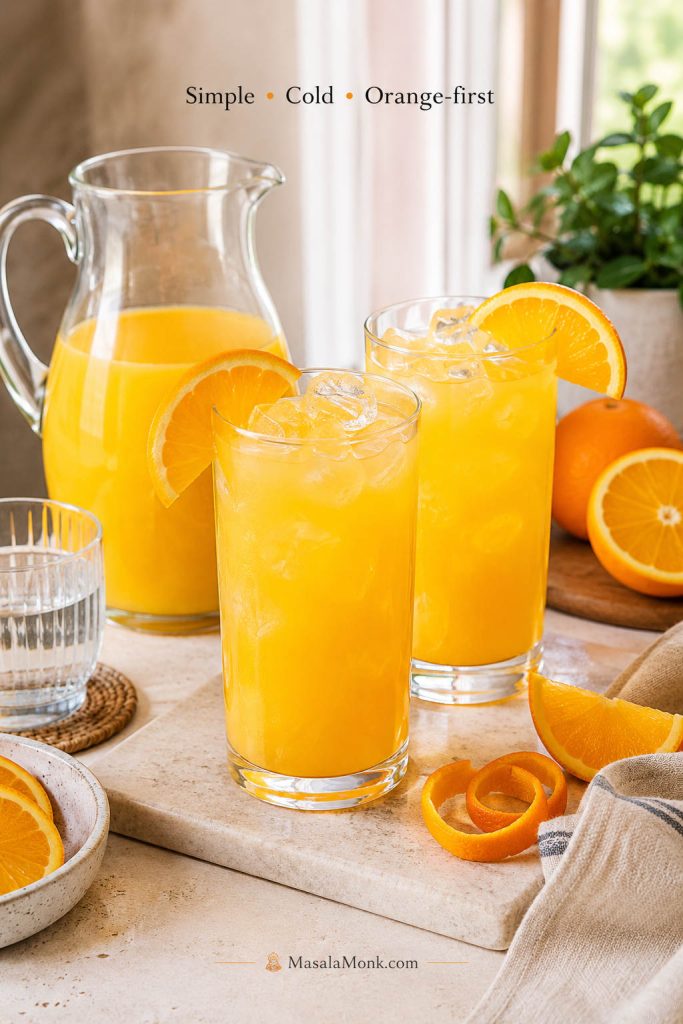
  • Chilled 100% bottled orange juice: practical, consistent, and easy to scale for pitchers.
  • No-pulp orange juice: smoother and cleaner in the glass.
  • Pulp orange juice: fuller texture and a more natural orange feel.
  • Blood orange juice: deeper color and a slightly tart twist.
  • Warm or overly sweet orange drink: avoid it when you want a cleaner, fresher screwdriver.

Flat bottled juice wakes up with a tiny squeeze of lemon or lime. Tart juice works better with the lighter 1:3 ratio or a little more orange juice. Very sweet juice is best kept simple, without grenadine or lemon-lime soda.

Best Vodka for a Screwdriver

You do not need a luxury vodka here, but you do need one that smells clean. If the vodka smells harsh before it reaches the glass, the orange juice will soften it, not erase it. Use a bottle you would not feel the need to bury.

Plain vodka keeps the drink classic. Citrus vodka makes the orange flavor more direct. Vanilla or whipped cream vodka turns it toward an orange-cream flavor. Chill the bottle if you can, then let the orange juice do most of the work.

Screwdriver Pitcher Recipe

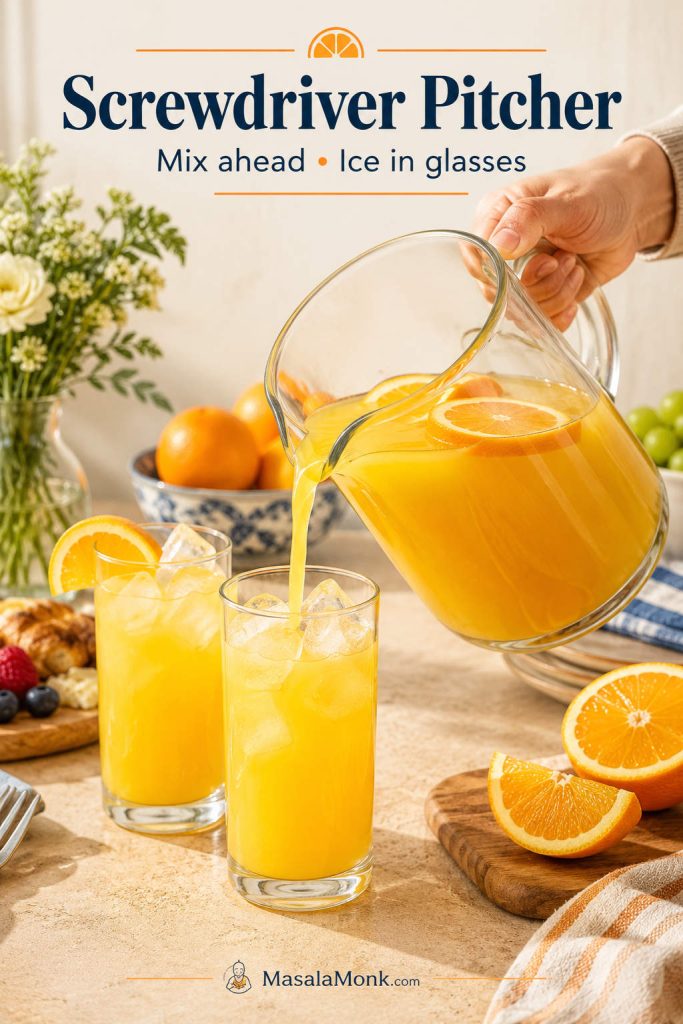
To make a pitcher, mix the vodka and orange juice ahead, but add ice to the glasses. That one choice keeps the batch fresher for longer and prevents a watered-down jug after ten minutes.

Clear pitcher of vodka and orange juice being poured into ice-filled highball glasses with orange slices nearby.
A Screwdriver pitcher works best when the batch is mixed ahead and poured over fresh ice, so the drink stays bright instead of watered down.

That is the version you want when people are arriving at different times, helping themselves, or choosing between a stronger and lighter pour. Keep a little extra orange juice nearby so guests can lighten their glass without remaking the batch.

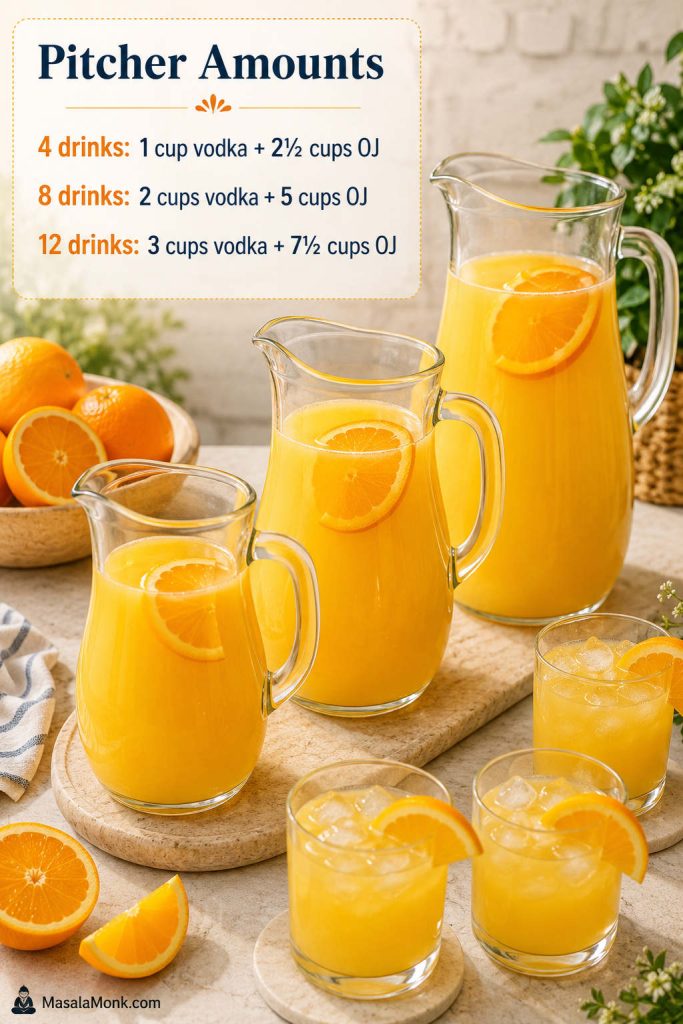
For exact batches, use these pitcher amounts as your starting point instead of multiplying by eye.

Three glass pitchers of orange Screwdriver mixture with text showing pitcher amounts for 4, 8, and 12 drinks.
These pitcher amounts scale the vodka-orange mix for 4, 8, or 12 drinks, so batching for guests stays consistent from the first pour to the last.
Servings / styleVodkaOrange juiceUse when
4 drinks, balanced1 cup / 240 ml2½ cups / 600 mlYou want a small pitcher
8 drinks, stronger2 cups / 480 ml4 cups / 960 mlYou want a bolder pitcher
8 drinks, balanced2 cups / 480 ml5 cups / 1.2 LStart here for a group
8 drinks, lighter1½ cups / 360 ml5–6 cups / 1.2–1.4 LYou want a lighter brunch pitcher
12 drinks, balanced3 cups / 720 ml7½ cups / 1.8 LYou are serving more guests

These cup amounts use U.S. cups; the ml measurements are included for precision.

How to Make a Screwdriver Pitcher

  1. Chill the vodka and orange juice first if possible.
  2. Stir the vodka and orange juice together in a pitcher.
  3. Add a few orange slices to the pitcher when serving soon.
  4. Keep the pitcher refrigerated until ready to serve.
  5. Pour into ice-filled glasses and garnish each glass separately.

Pitcher tip: Do not add ice directly to the pitcher unless you are serving the entire batch immediately. Instead, keep the pitcher cold and add ice to individual glasses.

For brunch, a screwdriver pitcher works well beside Bloody Marys when you want one savory option. If the table needs a fruitier batch drink too, add something like jungle juice and let the screwdriver stay the clean orange option.

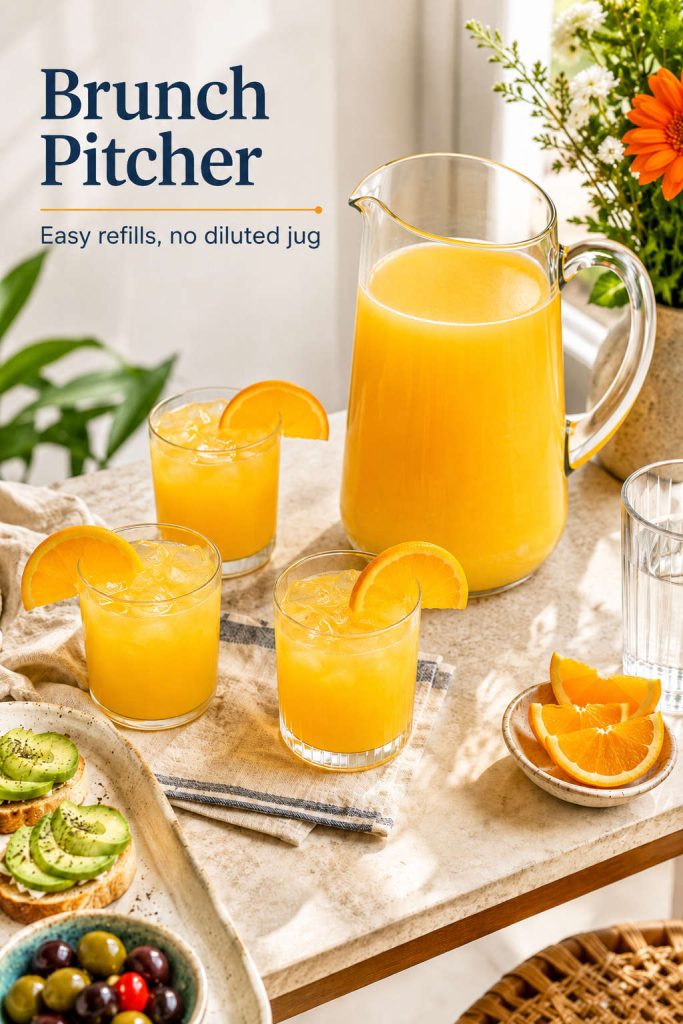
Brunch table with a Screwdriver pitcher, ice-filled glasses, orange slices, snacks, and a water glass.
A brunch pitcher works well because guests can refill their own glasses while the main batch stays cold and the ice melts only where it should.

Screwdriver Variations

Once you know the base drink, variations are easy. But do not turn it into mystery punch. Instead, add one change at a time so the drink still tastes like orange first.

Think about what you want from the glass before you add anything. Bubbles make it lighter. Pineapple makes it tropical. Cranberry makes it tart. Galliano or peach schnapps moves it toward a known cocktail variation. Colorful add-ins are best when you are intentionally making something playful. Not sure what a twist becomes? Check the drink-name guide.

Keep the first batch simple, then let the second glass become the playful one. That way, you still know what made the drink better instead of turning every add-in into one loud glass.

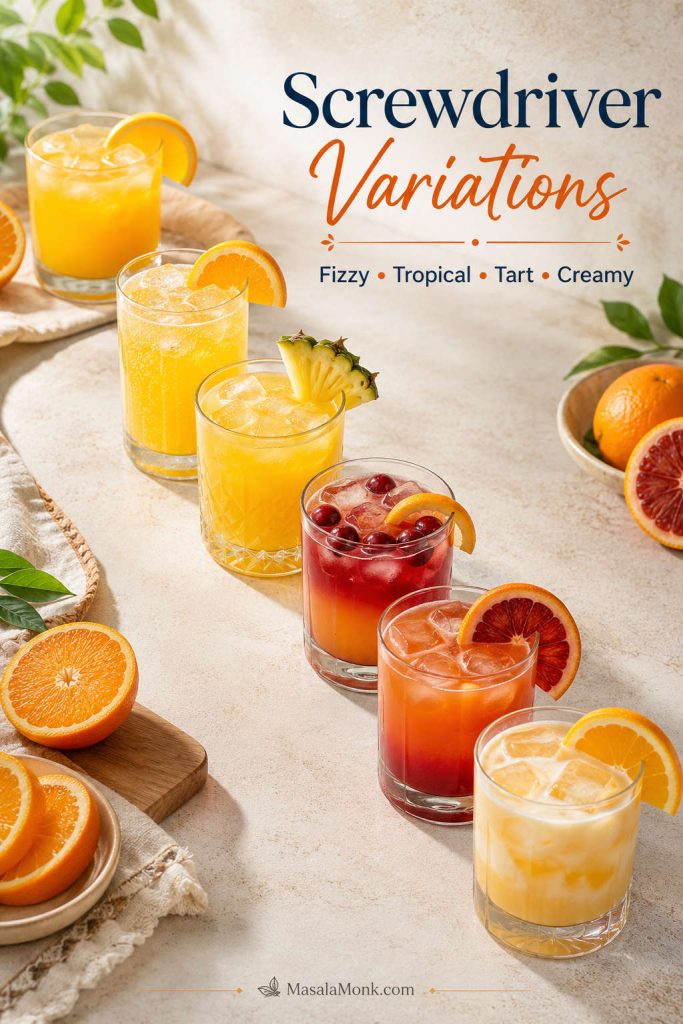
Six Screwdriver cocktail variations in tall glasses, including classic, fizzy, tropical, cranberry, blood orange, and orange-cream versions.
Once the classic glass tastes right, variations become easier to control, whether you want fizz, cranberry tartness, tropical fruit, or a creamier finish.
What you wantAdd thisHow to use it
Fizzy and lighterClub soda, Sprite, 7UP, or sparkling waterAdd after stirring the vodka and orange juice.
TropicalPineapple juiceReplace part of the orange juice with pineapple juice.
Tart and colorfulCranberry juiceUse about 3 oz orange juice and 2 oz cranberry juice with 2 oz vodka.
Sunrise-style colorGrenadineAdd a small splash for sweetness and red-orange color.
Harvey Wallbanger-styleGallianoAdd a small float to the finished drink.
Fuzzy / peachyPeach schnappsAdd a small pour and keep the orange juice cold.
FrozenIce and optional frozen orangeBlend vodka, orange juice, and ice until slushy.
Blood orangeBlood orange juiceUse it instead of regular orange juice or split the two.
Orange-creamVanilla or whipped cream vodkaUse in place of plain vodka for a dessert-like glass.
No alcoholOrange juice, soda water, citrus, and garnishNot a true screwdriver, but still a bright orange drink.

Fizzy, Pineapple, and Cranberry Versions

For fizz, make the drink first, then top with Sprite, 7UP, club soda, or sparkling water. Sprite and 7UP make it sweeter; club soda keeps it lighter and drier.

For a pineapple version, use 2 oz / 60 ml vodka, 3 oz / 90 ml orange juice, and 2 oz / 60 ml pineapple juice. If pineapple is the direction you like, a punch for a pitcher with pineapple juice gives you a fruitier batch option for guests.

For a cranberry version, use 2 oz / 60 ml vodka, 3 oz / 90 ml orange juice, and 2 oz / 60 ml cranberry juice. This moves the drink close to a Madras. If cranberry is your favorite part, a cranberry Moscow Mule gives you the same tart-vodka direction with ginger beer instead of orange juice.

Cranberry juice being poured into an orange Screwdriver cocktail, creating a red-orange swirl in a tall glass with ice.
Cranberry juice adds tartness and color to vodka and orange juice, moving the drink close to a Madras-style cocktail without losing the citrus base.

Frozen, Creamy, and Blood Orange Versions

For a frozen glass, blend vodka, orange juice, and ice until slushy. To make the orange flavor stronger, add frozen orange segments or a little frozen orange juice concentrate, then serve it immediately so it stays thick and cold.

For an orange-cream direction, use vanilla vodka or whipped cream vodka in place of plain vodka. Blood orange juice gives deeper color and a slightly tart edge, whether you use it alone or split it with regular orange juice.

Colorful and Non-Alcoholic Versions

Colorful versions are playful rather than standard. Pink can come from cranberry juice, blood orange juice, or grenadine. Blue or green versions usually depend on colored liqueurs or flavored mixers, so treat them as party-style riffs rather than classic Screwdrivers. For a no-alcohol orange drink, use orange juice, soda water, citrus, and a fresh garnish.

Vodka and Orange Juice Drink Names

Orange juice shows up in several familiar cocktails, so the names can blur together. Here is the quick way to keep the nearby drinks straight.

Circular drink-name map showing Screwdriver, Madras, Harvey Wallbanger, Fuzzy Navel, Hairy Navel, Tequila Sunrise, and Mimosa around an orange drink.
Since orange juice appears in several classic drinks, this map helps separate a Screwdriver from Madras, Harvey Wallbanger, Fuzzy Navel, and other close cousins.
If you mix…It is usually called…
Vodka + orange juiceScrewdriver
Vodka + orange juice + cranberry juiceMadras-style drink
Vodka + orange juice + GallianoHarvey Wallbanger
Peach schnapps + orange juiceFuzzy Navel
Vodka + peach schnapps + orange juiceHairy Navel / Fuzzy Screwdriver-style
Tequila + orange juice + grenadineTequila Sunrise
Sparkling wine + orange juiceMimosa

Names can vary by bar, region, and recipe style, but the screwdriver itself stays the straightforward vodka-orange drink.

Common Screwdriver Mistakes and Fixes

Most bad screwdrivers fail in obvious ways: the first sip burns, tastes dull, or feels like watered-down juice. The good news is that most fixes happen right in the glass.

Four-panel Screwdriver troubleshooting guide showing fixes for harsh, flat, watery, and too-sweet drinks.
If a Screwdriver tastes off, fix the cause instead of starting over: more juice for harshness, citrus for flatness, more ice for dilution, or less sweetness.
ProblemWhat to do
Tastes harshAdd more orange juice and stir briefly. Next time, use the 1:3 ratio.
Tastes flatAdd a tiny squeeze of lemon or lime, or use an orange peel twist.
Tastes wateryUse more ice and serve right after mixing.
Too sweetUse less sweet orange juice and skip soda or grenadine.
Too warmChill the vodka and orange juice before mixing.
Pulp settlesStir briefly before serving.
Pitcher is dilutingAdd ice to glasses, not the pitcher.
Garnish tastes bitterAvoid too much white pith on orange peel.

Screwdriver Recipe FAQs

These quick answers cover the questions that usually come up after you know the basic vodka-orange ratio.

What is vodka and orange juice called?

Vodka and orange juice is called a Screwdriver when it is served simply over ice. The name usually refers to the vodka-orange drink, not a bottled ready-to-drink product.

What is the best screwdriver ratio?

For this screwdriver recipe, start with 2 oz vodka and 5 oz orange juice for a balanced glass. Move to 4 oz juice if you want it stronger, 6 oz if you want it lighter, and adjust after one sip because orange juice varies.

What are screwdriver measurements in ml?

Use 60 ml vodka + 150 ml orange juice for the balanced version. Go to 60 ml + 120 ml for stronger, or 45 ml + 150–180 ml for lighter.

How many oranges do I need for one screwdriver?

For one balanced screwdriver, you need about 5 oz / 150 ml orange juice, which usually takes 2–3 medium oranges depending on size and juiciness.

Do you shake or stir a screwdriver?

Stir it in the glass for the easiest version. Shake only if you want it extra cold and slightly frothy.

Can I make a screwdriver ahead of time?

Yes, for a pitcher. Mix the vodka and orange juice the same day, keep it chilled, and add ice only to the glasses.

How do I make a screwdriver pitcher?

For 8 balanced drinks, mix 2 cups / 480 ml vodka with 5 cups / 1.2 L orange juice. Keep the pitcher chilled, then pour into ice-filled glasses. For exact 4, 8, and 12 drink batches, use the pitcher amounts table.

Can I use Sprite in a screwdriver?

Yes, but treat it as a twist. Sprite makes the drink sweeter and fizzy; club soda or sparkling water keeps it lighter and drier. Add bubbles right before serving.

What is a screwdriver with cranberry juice called?

A screwdriver-style drink with cranberry juice often moves toward a Madras, which is made with vodka, orange juice, and cranberry juice. A small splash of cranberry can also simply be treated as a cranberry version.

Is a Harvey Wallbanger the same as a screwdriver?

Think of a Harvey Wallbanger as the screwdriver’s liqueur-finished cousin: vodka, orange juice, and a float of Galliano. It is closely related, but not the same as the plain drink.

Is a Fuzzy Navel the same as a screwdriver?

Not quite. A Fuzzy Navel skips the vodka and uses peach schnapps with orange juice. Add vodka as well, and you move closer to a Hairy Navel or fuzzy screwdriver-style drink.

Is Smirnoff Ice Screwdriver the same as a homemade screwdriver?

Not quite. A homemade screwdriver is freshly mixed in the glass, while ready-to-drink screwdriver-style products may be carbonated, sweetened, flavored, or made with a different alcohol base.

Final Tips for a Better Screwdriver

Use this screwdriver recipe as your starting point, taste once, then adjust. More orange juice makes the drink lighter; less orange juice makes it stronger. Keep everything cold, garnish simply, and add extras only after the vodka and orange juice taste right together.

Two finished Screwdriver cocktails with ice and orange garnish, a pitcher behind them, orange peel, orange slices, and a water glass nearby.
When the ratio is right, a Screwdriver should feel easy to serve and easy to drink: fresh orange aroma, cold glass, and a pour people are happy to come back to.

The goal is not to make the fanciest cocktail in the room. It is to make the simple one people are happy to refill.

Good hosting is simple too: label the pitcher, keep food and water nearby, and offer a non-alcoholic option. For readers who want a reference point, the National Institute on Alcohol Abuse and Alcoholism U.S. standard-drink guide is useful.

Once the ratio is right, the drink should feel almost effortless: cold glass, fresh orange aroma, and a pour that tastes like a cocktail without asking much from you.

Back to top