Mexican horchata should be cold and creamy, with cinnamon you can smell before the first sip. This version keeps the sweetness in check, so the rice still comes through and the drink stays refreshing over ice.
The ingredient list is short. Texture is the part worth paying attention to: soften the rice before blending, strain the rice base in two stages, then wait until the pitcher is chilled before deciding whether it needs more water or sugar.
It is an easy homemade horchata in terms of actual work. Most of the time is hands-off—an overnight soak, a few minutes at the blender and strainer, then a good chill before serving.
Soak: Give the rice a full 8–12 hours in the refrigerator.
Strain: Use a fine-mesh sieve first, then a nut-milk bag or doubled cheesecloth.
Hold some back: Save the final water and extra sugar until the drink has chilled. It is much easier to add either than to undo too much.
Mexican Horchata Recipe
A smooth rice-and-cinnamon horchata with a little evaporated milk for body and enough water to keep the finished drink light and refreshing.
Active Time About 25–30 minutes
Soak Time 8–12 hours
Chill Time 1–2 hours
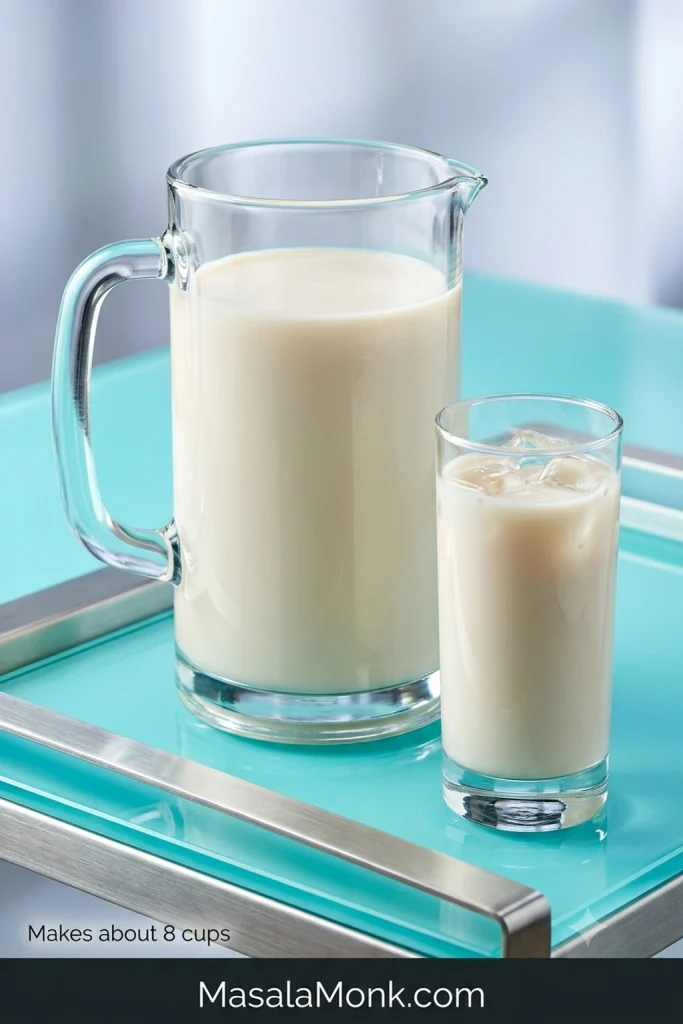
Yield About 7½–8 cups / 1.8–1.9 L
Total elapsed: about 10–14 hours, mostly hands-off. The final volume varies slightly with how much liquid stays with the discarded rice pulp and how much of the reserved water you use.
Equipment
Blender
Large covered bowl or container
Fine-mesh sieve
Nut-milk bag or doubled damp cheesecloth
Large pitcher
Ingredients
1 cup / 180 g uncooked long-grain white rice
2 small Mexican canela (Ceylon cinnamon) sticks, about 3 inches / 7–8 cm each, or 1 larger stick
4 cups / 950 ml cool water, for soaking
½ cup / 120 ml evaporated milk
4 cups / 950 ml cold water, divided, for finishing
¼ cup / 50 g granulated sugar, plus up to another ¼ cup / 50 g to taste
1 teaspoon / 5 ml vanilla extract
⅛ teaspoon fine salt, optional
Ice, for serving
How to Make Mexican Horchata
Rinse the rice. Give the uncooked rice a quick rinse under cool running water, then drain well. No need to rinse until the water runs completely clear.
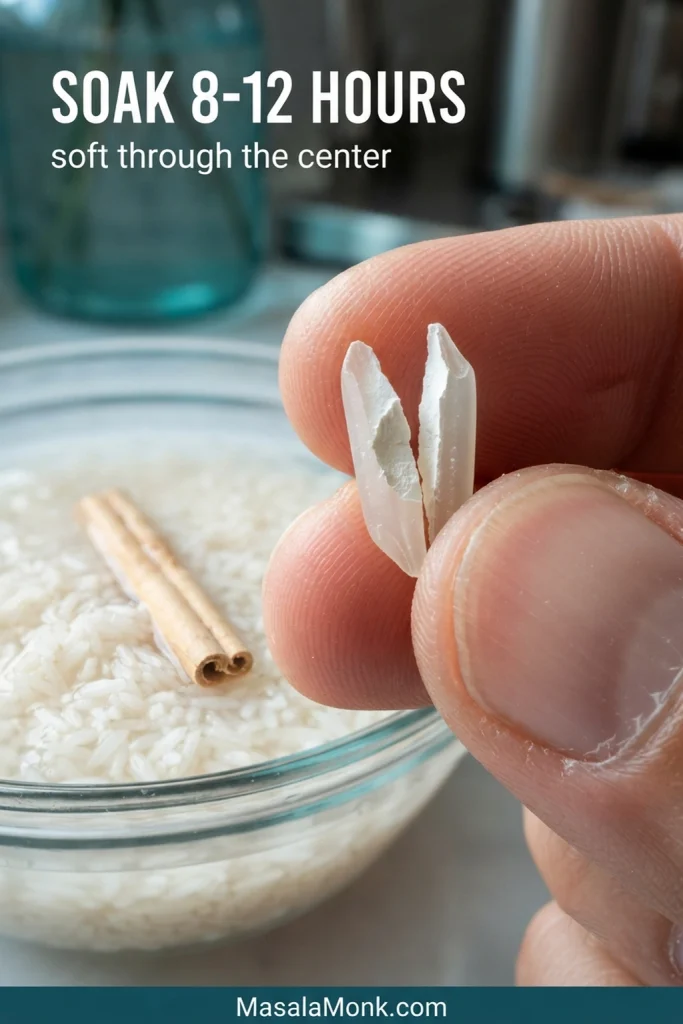
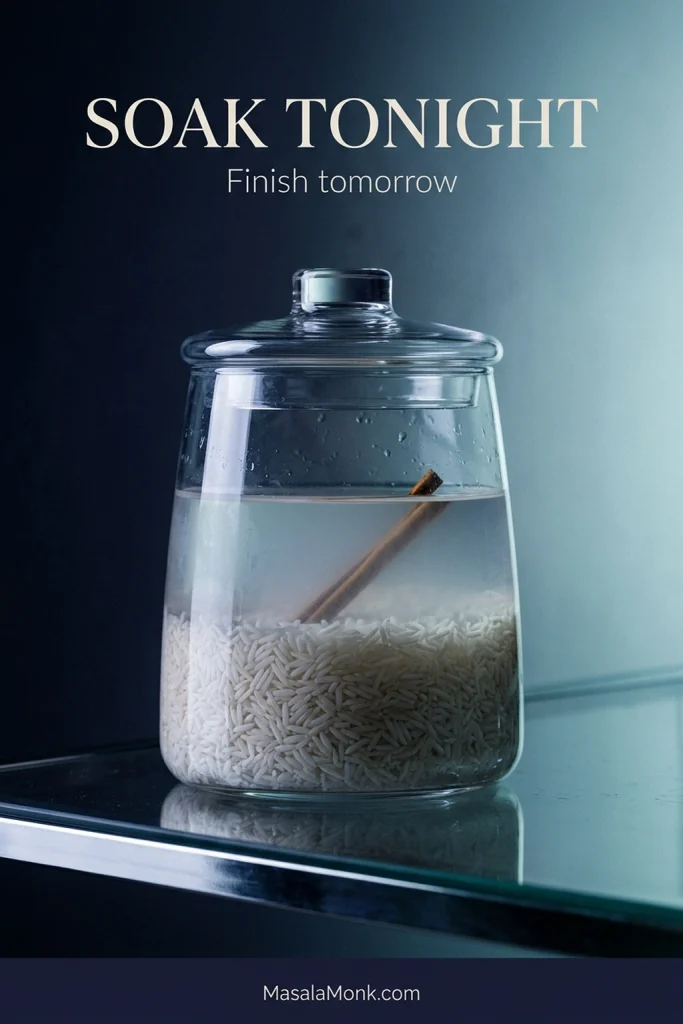
Soak overnight. Put the rice, cinnamon sticks and 4 cups / 950 ml cool water in a covered container. Refrigerate for 8–12 hours. At the end of the soak, pinch a grain between your fingers. It should split or crush fairly easily. If the center still feels very hard, give it more time.
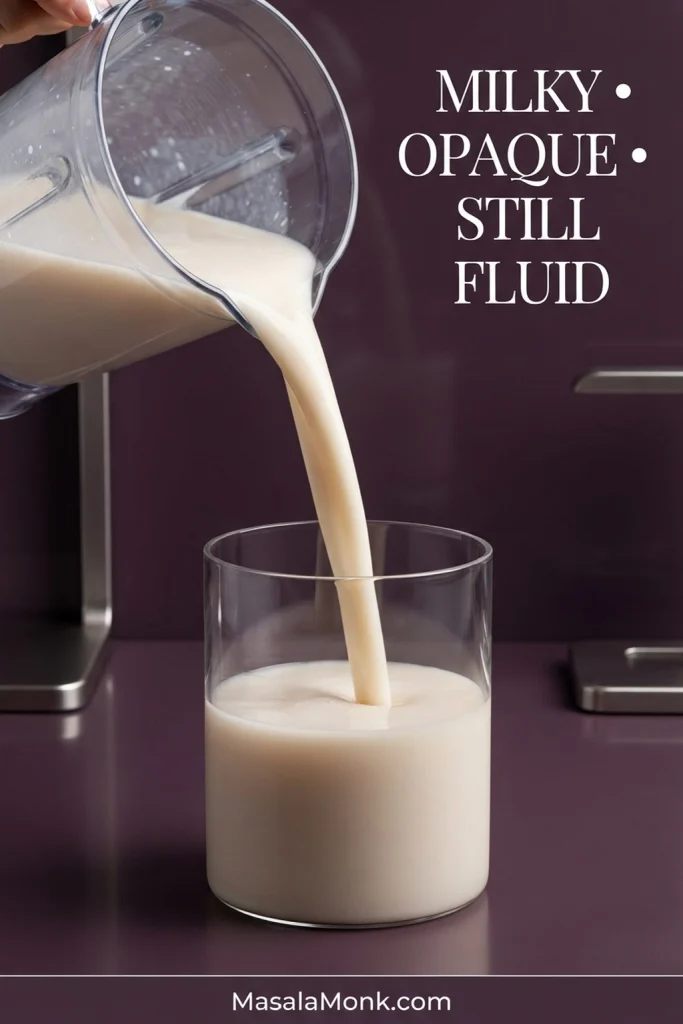
Blend the softened rice. Remove the cinnamon sticks. Blend the soaked rice with its soaking water until the liquid is strongly milky and opaque and the rice is finely broken down. Tip the blender jug; the mixture should still pour easily instead of falling in a thick ribbon. A powerful blender may take 60–90 seconds, while a standard blender may need closer to 2 minutes. If the jar is crowded, blend in two batches and combine them before straining.
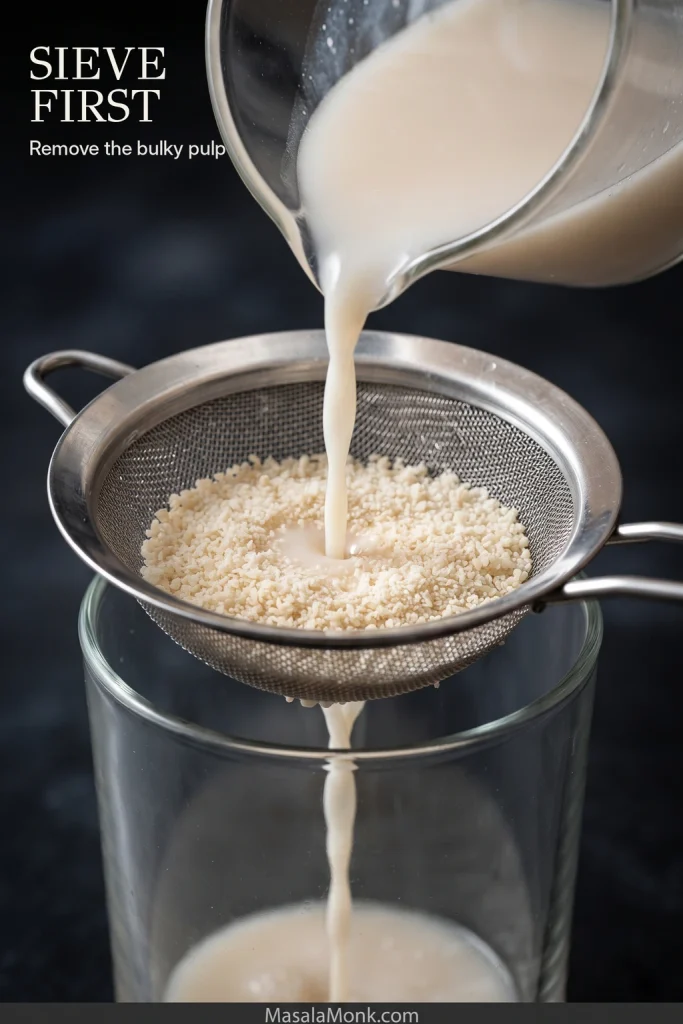
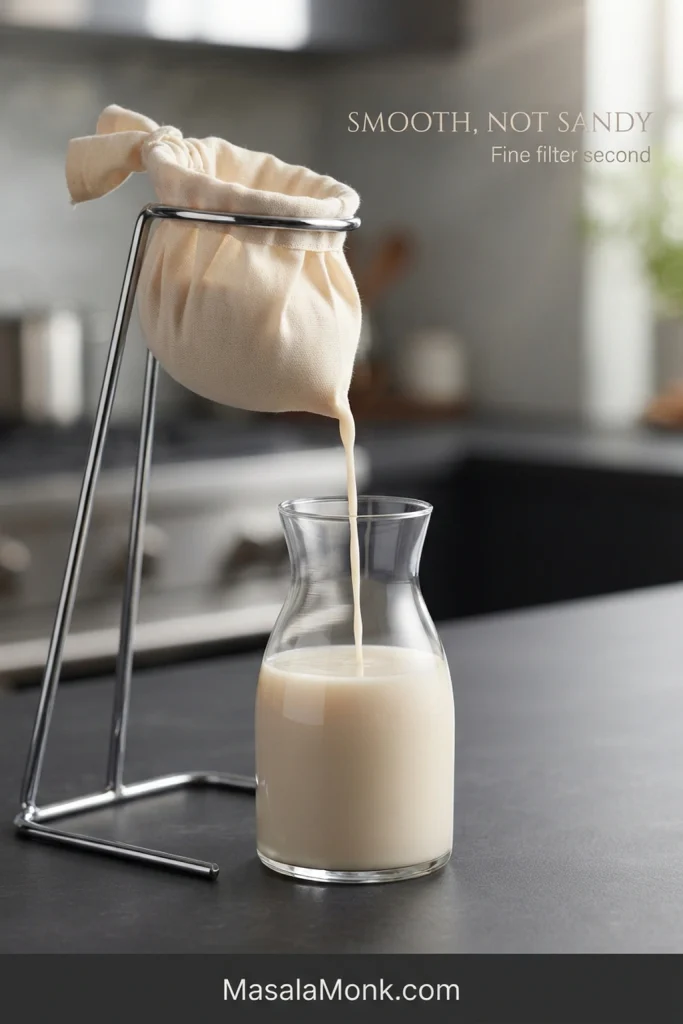
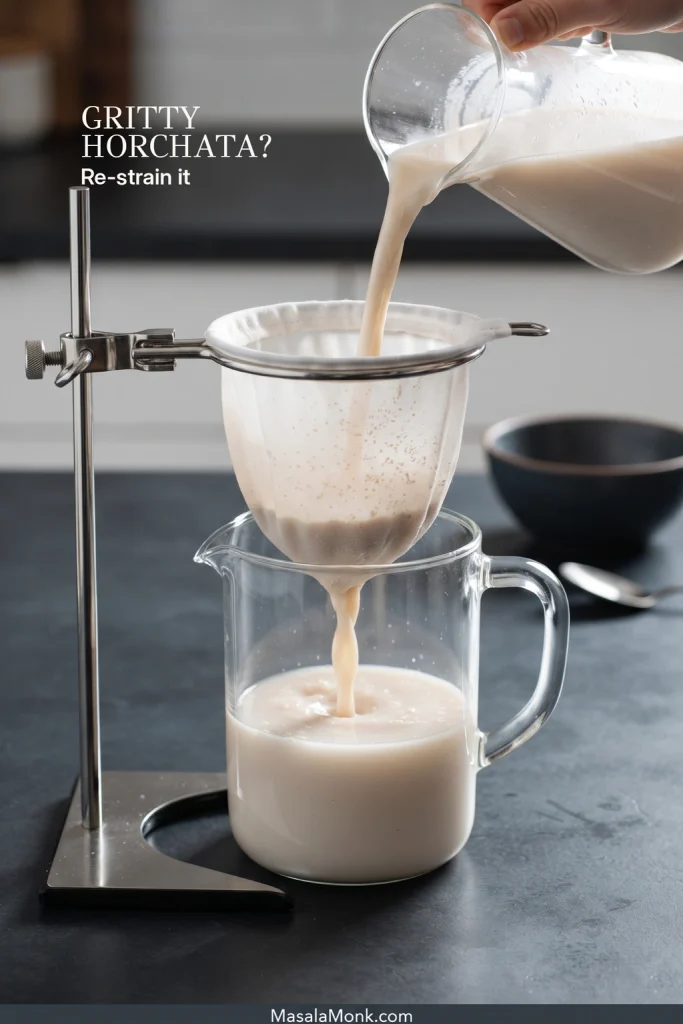
Strain twice. Pour the mixture through a fine-mesh sieve first. Let most of the liquid drain, then press the pulp gently. Next, pass the cloudy liquid through a nut-milk bag or a fine sieve lined with two layers of damp cheesecloth. Taste a spoonful. If you can still feel fine rice grit, run it through the fine filter once more. Discard the rice pulp.
Finish, chill and serve
Finish the base. Whisk in the evaporated milk, vanilla, optional salt and ¼ cup / 50 g sugar until the sugar dissolves.
Add most of the finishing water. Stir in 3½ cups / 830 ml cold water and hold back the final ½ cup / 120 ml. The horchata should pour freely with a little more body than whole milk.
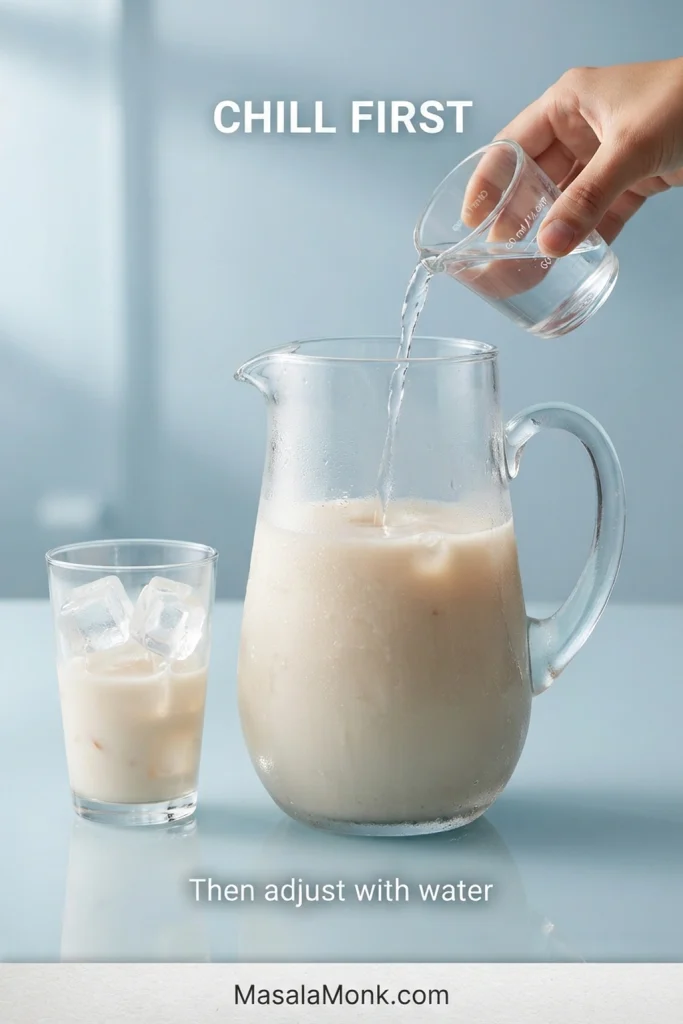
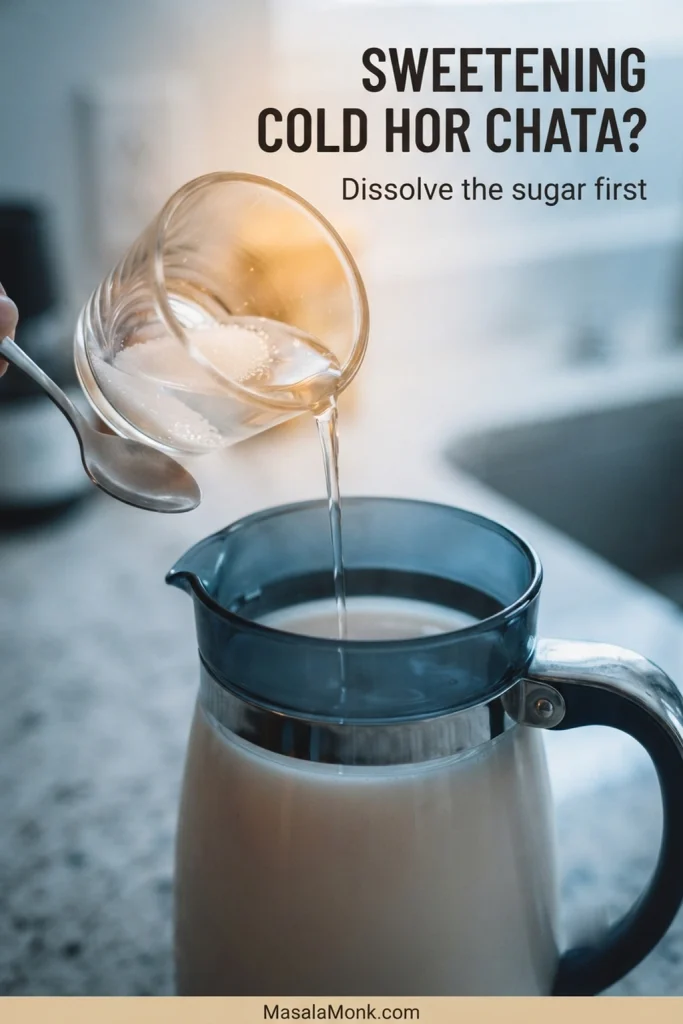
Chill, then taste. Refrigerate for 1–2 hours. Pour a little over ice before changing anything. Add some or all of the reserved water if you want it lighter. If you want it sweeter, dissolve 1 tablespoon sugar in a small splash of warm water, stir it into the chilled horchata, then taste again. Repeat only if needed.
Serve. Give the pitcher a gentle stir and pour over fresh ice.
Recipe Notes
Sweetness: The starting sugar gives a lightly sweet drink. Use the additional sugar only if you want a noticeably sweeter pitcher.
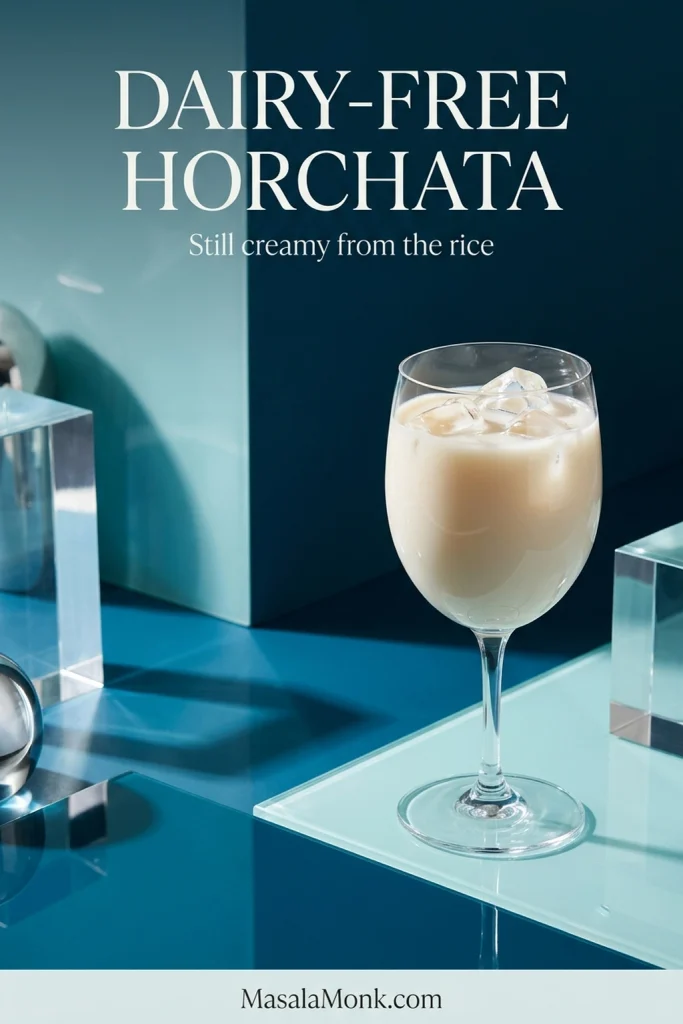
Dairy-free: Omit the evaporated milk and follow the same finishing-water method. After chilling, add a little extra cold water only if you want a lighter pitcher.
Richer version: Skip the starting granulated sugar and begin with 2–3 tablespoons / about 40–60 g sweetened condensed milk. Add more only after tasting.
Double batch: Double the ingredients, but blend in batches so the blender is not crowded. Combine the blended liquid before straining and finishing the pitcher.
Storage: Keep finished horchata covered and refrigerated and use within about 3 days for the best flavor and texture.
Research note: This recipe synthesizes established Mexican horchata methods and documented home-cook experience; MasalaMonk has not independently kitchen-tested this exact formula.
Use the finished pitcher as the final texture check. It should look creamy and opaque, yet still pour cleanly and stay refreshing over ice.
Leave a little working room in the horchata pitcher. Homemade rice drinks settle slightly as they chill, and that extra headspace makes a gentle stir much easier before you pour the next glass.
Mexican horchata is a chilled rice-and-cinnamon drink, usually sweetened with sugar; richer versions may also include milk, almonds or condensed milk.
It belongs to the broad family of Mexican aguas frescas, and there is no single richness level that every homemade or restaurant version follows. Here, the soaked rice supplies most of the body and a modest amount of evaporated milk softens the texture without making the drink heavy.
Spanish horchata de chufa is a different drink made from tiger nuts, so a Spanish horchata recipe is not interchangeable with this Mexican rice-based version.
Read the Pitcher: Four Horchata Checkpoints
The clock gets you close. These cues tell you when to move on.
Stage
What you are looking for
After soaking
A grain should crush fairly easily instead of staying hard through the center.
After blending
The liquid should be strongly milky, opaque and still fluid enough to pour easily.
After straining
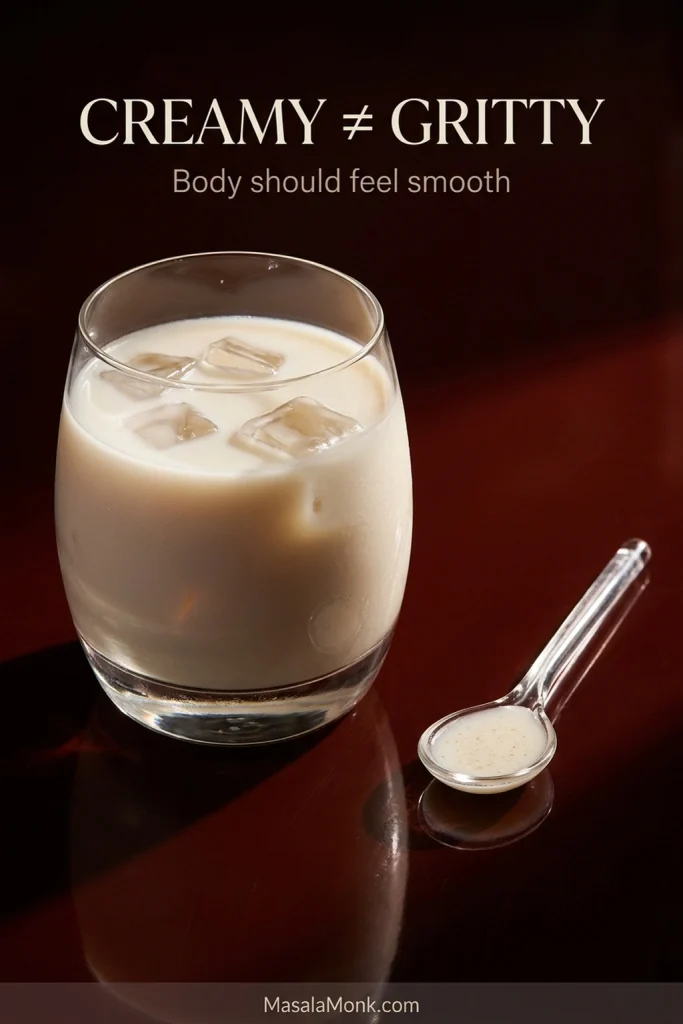
The base should feel creamy and clean across the tongue, without obvious rice grit.
Finished and chilled
The horchata should pour freely with a little more body than whole milk and stay refreshing over ice.
At the blender stage, stop once the mixture is strongly milky and still pours easily. More blending is not necessarily better; it can break the remaining rice into particles that are finer and harder to strain cleanly.
Judge the blended rice base by how it pours, not by the bubbles sitting on top. A little surface foam can make the mixture look heavier than it really is; the stream should still be fluid and easy-moving.
Starch gives the drink some body. Fine rice that slips through the strainer feels gritty. A little sediment after a night in the fridge is normal settling, not the same problem.
Rice grit often shows up in the finish rather than as obvious thickness. If a sip starts smooth but leaves a dusty or sandy trace on the tongue, that is a filtration problem—not desirable body.
When the pitcher is right, the first sip tastes of rice and cinnamon before sweetness takes over. The texture feels creamy, but the finish stays clean enough that another glass still sounds good. Ready to make it? Jump to the recipe card.
Mexican Horchata Ingredients: Why Rice, Cinnamon and a Little Milk Work
Use uncooked long-grain white rice
Long-grain white rice is a straightforward choice here: its flavor is neutral, it is easy to find, and it is commonly used for Mexican rice horchata. It starts uncooked, the opposite approach from rice pudding made with cooked rice, where the grains are already hydrated before they meet the milk.
A quick rinse is enough. There is no need to rinse until the water runs completely clear.
Let the rice soften before blending
The overnight soak softens the dry grains before blending. By morning, the soaking water should look cloudy and the rice noticeably softer.
Cloudy soaking water is expected, but it is not the readiness test. Instead, press a soaked long-grain rice kernel: it should crack without the hard, glassy center of dry rice.
Use Mexican cinnamon when you can
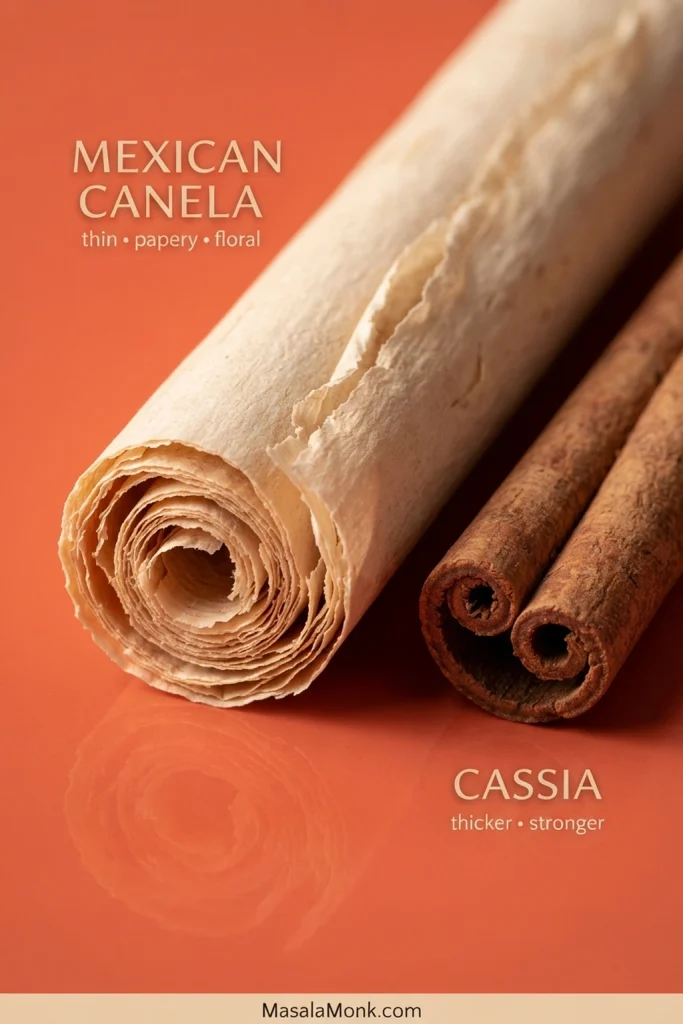
The thin, papery cinnamon sold in Mexican markets as canela is typically true or Ceylon cinnamon. It is softer and more floral than thick cassia bark. If cassia is what you have, use one stick for this batch rather than matching the canela quantity by volume.
Let the cinnamon infuse during the soak, then take the sticks out before blending. Keep ground cinnamon to a very light dusting over individual glasses; stirring a spoonful through the pitcher can make an otherwise smooth horchata feel dusty.
The cut end makes canela easier to identify than the label sometimes does. Mexican canela shows many thin papery layers, while cassia usually forms one or a few much thicker curls.
A little evaporated milk is enough
The soaked rice already gives the drink body. A modest amount of evaporated milk rounds out the texture without burying the rice and cinnamon. In tres leches cake, evaporated milk is deliberately pushed much further as part of a rich three-milk soak; horchata needs far less.
Sweeten after you know what you have
Start modestly with sugar. Make the final adjustment after chilling, when you can judge the drink the way it will actually be served.
The optional pinch of salt should never announce itself. If you can taste salt, there is too much; here it simply helps the rice, cinnamon and vanilla taste a little clearer.
Why Horchata Needs Two Different Strainers
For the smoothest horchata, strain through a fine-mesh sieve first, then through a nut-milk bag or doubled cheesecloth. The first catches the bulky rice pulp; the second catches the finer particles that affect the way the drink feels.
What remains in the first sieve should look like damp ground-rice meal rather than recognizable grains. That texture is a useful visual check that the soaked rice was broken down enough before fine filtering.
Let the liquid drain, press gently, and taste a spoonful. If you can still feel rice grit, give it one more pass through the fine filter.
Two damp layers of cheesecloth are more useful than one aggressive squeeze. The finer barrier catches the particles that create a sandy finish while the horchata drains through naturally.
The sieve removes the obvious pulp; the fine filter does the polishing. Once the fine grit is gone, the payoff is obvious: the rice feels creamy instead of dusty and the cinnamon tastes cleaner. Still fighting grit? Jump to Horchata Troubleshooting.
Tune the Pitcher After It Chills
Taste horchata fully chilled before making the final sweetness or thickness adjustment. Temperature changes the way both feel, and the glass over ice is the one that counts.
This is also when the drink starts to come together. The sweetness settles down, the cinnamon feels clearer and the whole glass becomes more refreshing.
Give the chilled pitcher a gentle stir before every tasting adjustment. Otherwise, normal rice settling can make the top of the batch seem thinner than the horchata actually is.
Adjust one thing at a time
Want it lighter? Add cold water in ¼-cup / 60-ml increments.
Want more body? Hold back more finishing water next time. For this batch, add only a small splash of evaporated milk if you also want a richer dairy finish.
Want it sweeter? Dissolve 1 tablespoon sugar in a small splash of warm water, stir it into the pitcher, then taste again. Repeat only if needed.
Already too sweet? Add cold water gradually until the rice and cinnamon come back into balance.
Tastes flat? Make sure the drink has not been over-diluted first. A few extra drops of vanilla or a very small pinch of salt can sharpen the flavor. If the cinnamon itself is weak, use a little more during the soak next time instead of stirring ground cinnamon into the finished pitcher.
Making a final sweetness adjustment? Keep it separate from the dilution decision so you can change one variable at a time and know what actually improved the pitcher.
Use only a small splash of warm water to dissolve extra sugar. You want enough liquid to clear the crystals without quietly adding enough water to change the carefully tuned horchata texture.
This is the version in the recipe card: creamy enough to soften the edges of rice and cinnamon, but light enough to stay refreshing with food.
2. Lighter dairy-free horchata
Omit the evaporated milk and follow the same finishing-water method as the main recipe. Taste the horchata after chilling, then add a little extra cold water only if you want a lighter pitcher. Rice, cinnamon, water and sugar make a complete horchata on their own.
Dairy-free horchata does not need a milk substitute just to have body. The rice base is already opaque and creamy-looking, so add another milk only if you actually want its flavor.
3. Richer condensed-milk horchata
Skip the starting granulated sugar and begin with 2–3 tablespoons / about 40–60 g sweetened condensed milk. Taste before adding more. This richer version is especially good with something equally full-flavored, such as crispy birria tacos with consommé.
Optional almond note: If you want almond in the background, soak about ¼ cup / 35 g blanched almonds with the rice, then blend and strain them together. Remember the tree-nut allergen if you are serving the pitcher to a group.
Horchata is easy to split across two days. Soak the rice and cinnamon at night; blend, strain and finish the pitcher the next day. You can also refrigerate the strained rice base and add the milk, sugar and final water closer to serving.
“Overnight” describes the schedule, not the temperature. Keep the rice and canela covered in the refrigerator for the long soak, then blend and strain the cold mixture the next day.
For best quality, refrigerate homemade horchata in a covered container and use it within about 3 days. Keep the refrigerator at 40°F / 4°C or colder, in line with FDA cold-storage guidance.
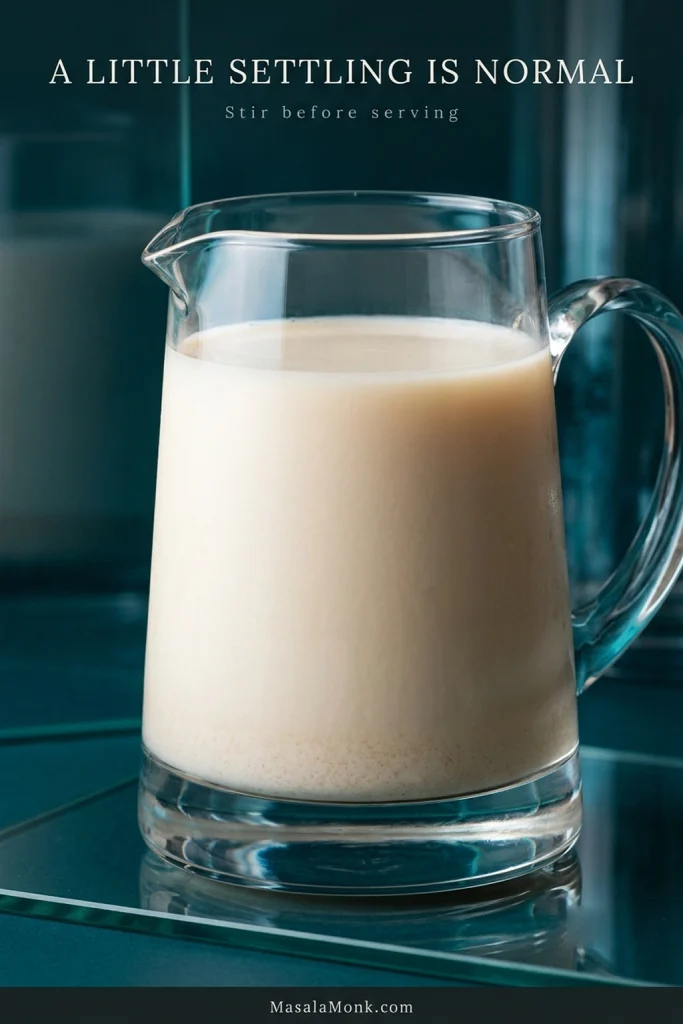
A light layer of fine sediment after chilling is normal. Give the pitcher a gentle stir before pouring. If a dense gritty layer collects at the bottom, you can re-strain the drink for a cleaner texture or pour carefully and leave the heaviest sediment behind.
The easiest test for normal rice sediment is what happens after a gentle stir. A soft layer should blend back into the horchata; coarse sandiness that remains points to particles that still need filtering.
Sour or otherwise unpleasant smells, unexpected bubbling, or a slimy or ropy texture are spoilage warning signs. Discard the drink if you notice them.
Keep the pitcher chilled and put fresh ice in each glass so the whole batch does not become steadily more diluted.
Horchata Troubleshooting
Small taste differences are easy to adjust. These are the problems worth stopping for.
What happened?
What to do
The drink feels gritty or chalky
Fine rice solids remain. Pass the horchata through the nut-milk bag or doubled cheesecloth again.
The blender mixture became very thick
Add cool water a little at a time until it pours freely again.
The cheesecloth barely drains
Coarse pulp is clogging it. Run the mixture through the fine-mesh sieve before using the finer filter.
A heavy gritty layer settles at the bottom
Re-strain the current batch if you want a cleaner texture, or pour carefully and leave the densest sediment behind. Use finer straining next time.
The horchata smells sour, bubbles unexpectedly or turns slimy
Discard the drink. Those are not signs of ordinary rice settling.
Fix the texture before changing the sweetness or dilution. Re-straining removes the troublesome rice solids without weakening the rice-and-cinnamon flavor, so you can retune the pitcher afterward only if it still needs it.
Give the chilled pitcher a gentle stir before you pour. If the cinnamon comes through, the sweetness feels right and the drink still tastes refreshing over ice, leave it alone.
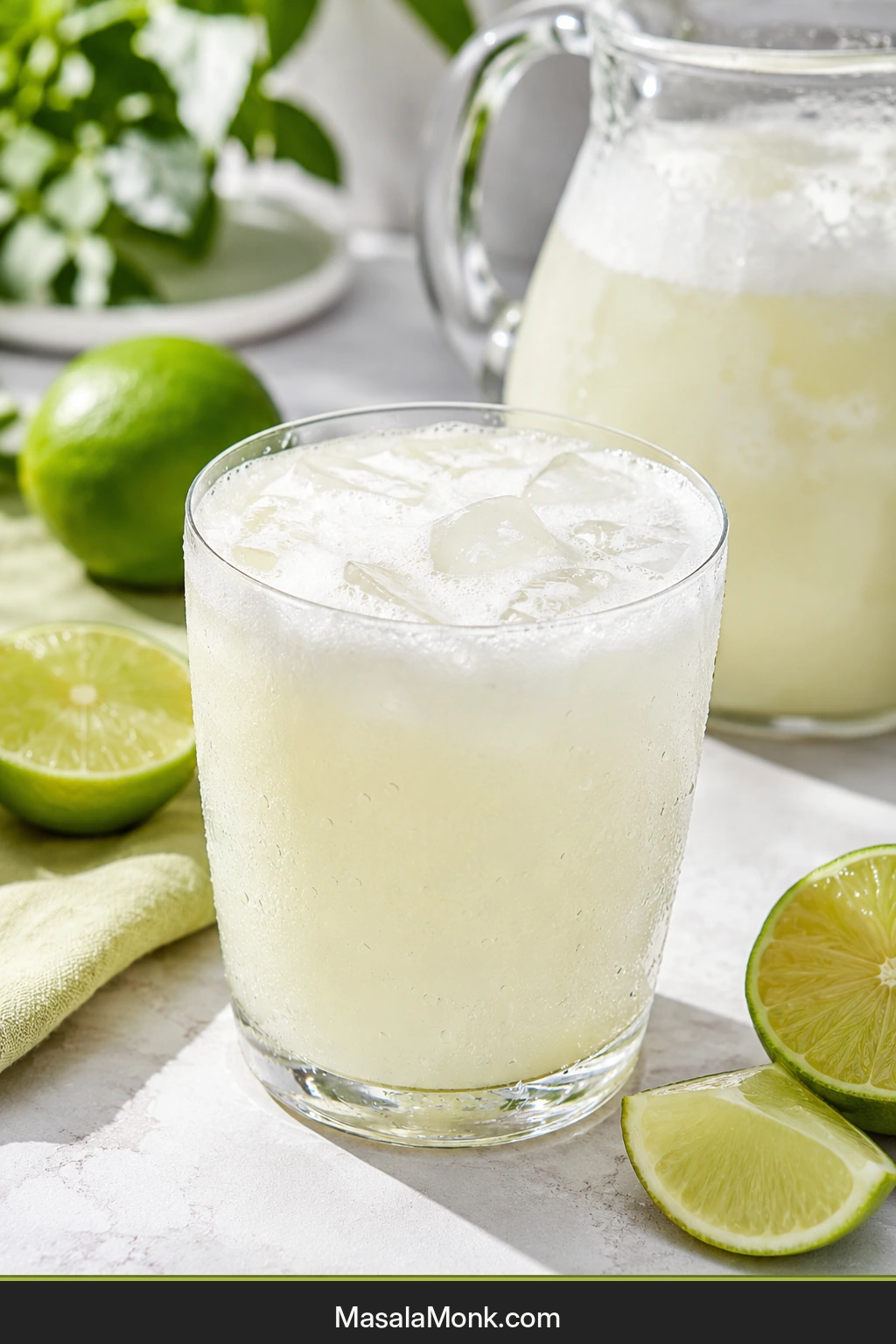
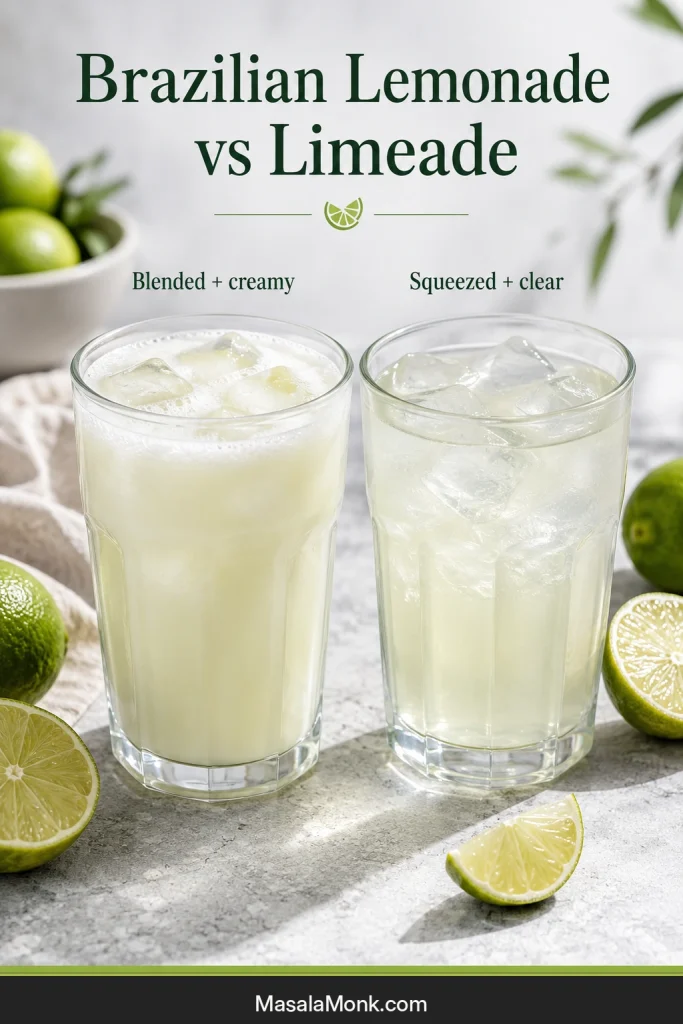
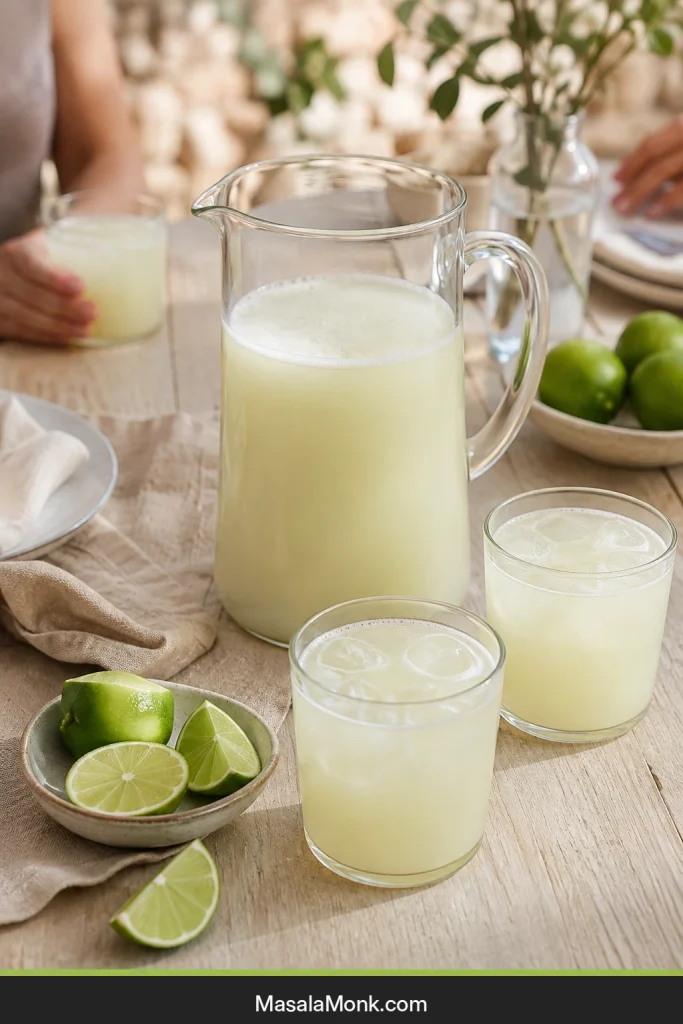
Brazilian lemonade should arrive like a cold lime cloud: pale green, lightly frothy, creamy through the middle and sharp enough at the end to make the next sip feel inevitable.
Three core ingredients—whole limes, cold water and condensed milk—become something surprisingly airy. The fruit briefly perfumes the water, the peel and pulp are strained away, and the green base turns pale and foamy in the second blend.
The ingredient list is almost suspiciously short, and the one moment that asks for care comes early. Stop while coarse pieces remain and the peel gives fragrance without taking over. For thick-skinned fruit or a pitcher that must wait, use one of the gentler methods below.
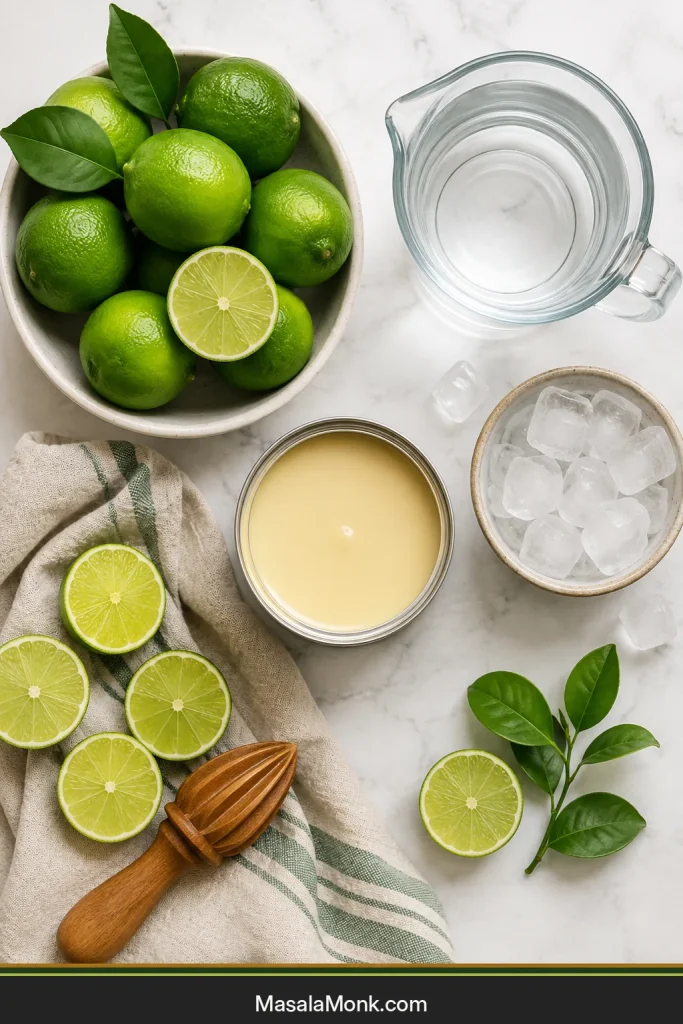
For 5–6 servings, briefly blend 4 medium thin-skinned limes—about 240–280 g total—trimmed, quartered, deseeded and cored, with 4 cups / 950 ml cold water. Strain gently, then blend the liquid with 300 g sweetened condensed milk until pale and lightly foamy.
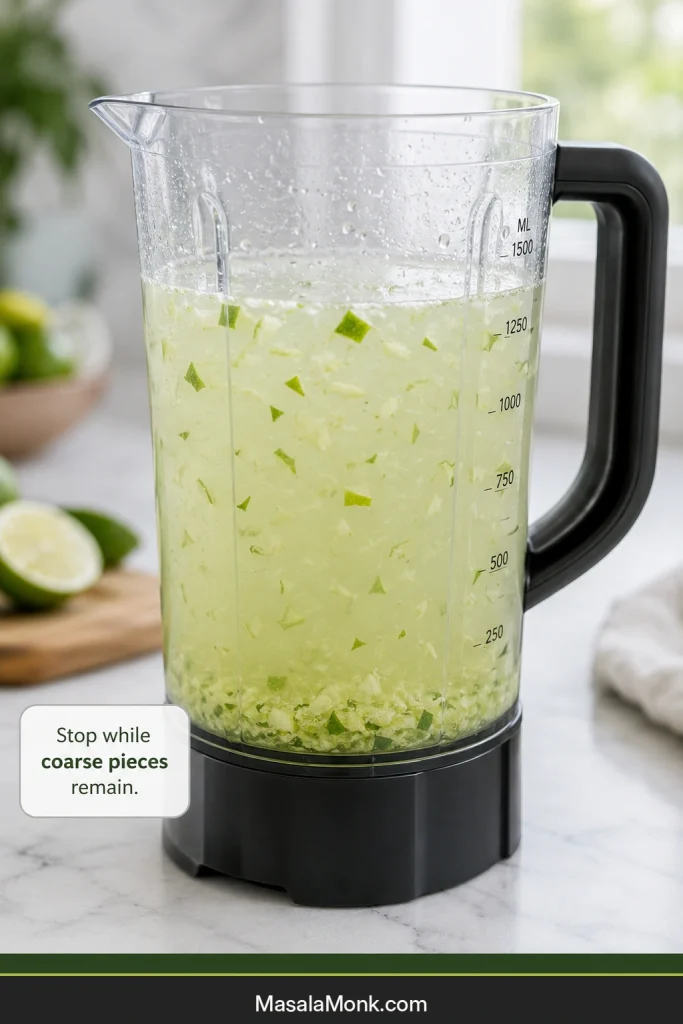
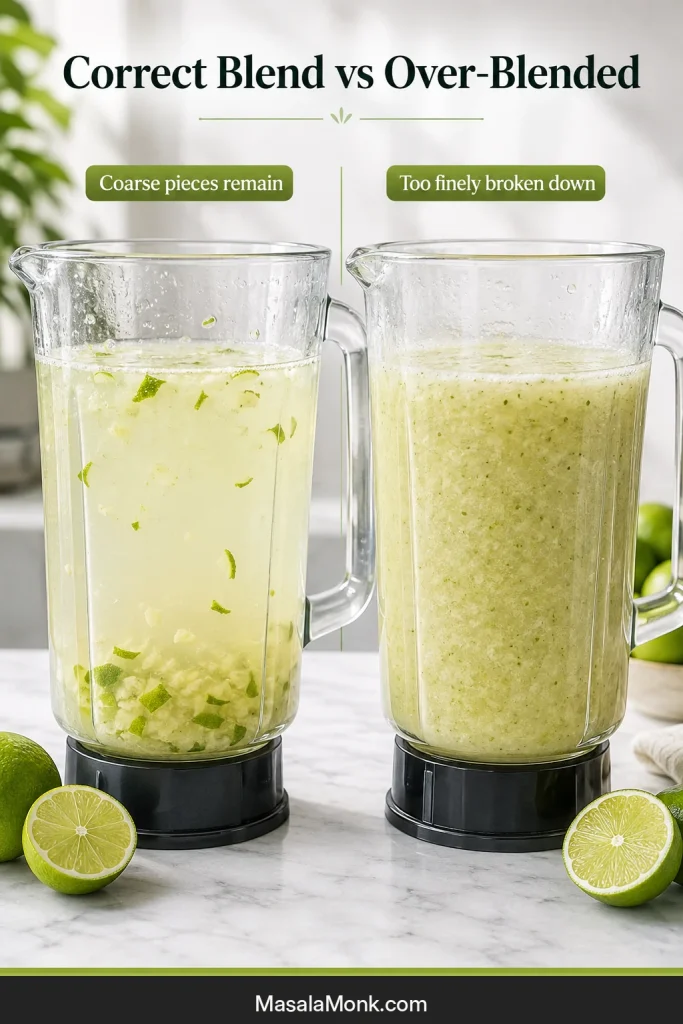
1. Watch the pieces, not only the clock. Stop when the water is cloudy green and coarse lime pieces remain—usually after 8–12 seconds.
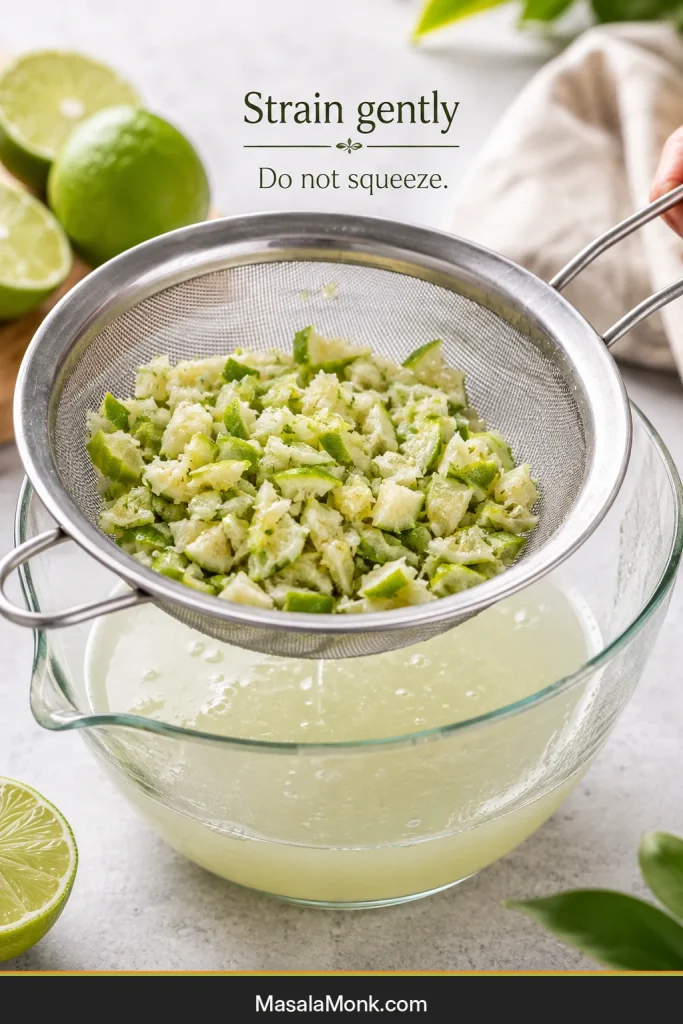
2. Strain; do not squeeze. Let the liquid drain, but leave the final spoonful of pulp behind.
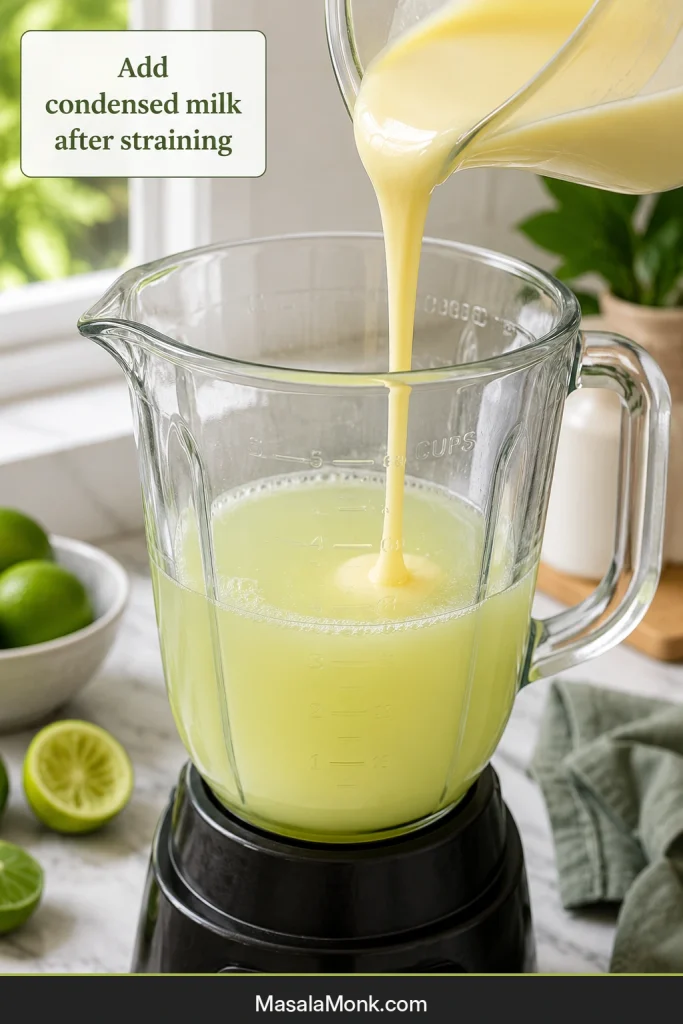
3. Let the first glass decide. Add the condensed milk only after the lime mixture has been strained, then take the first sip over ice before changing the pitcher.
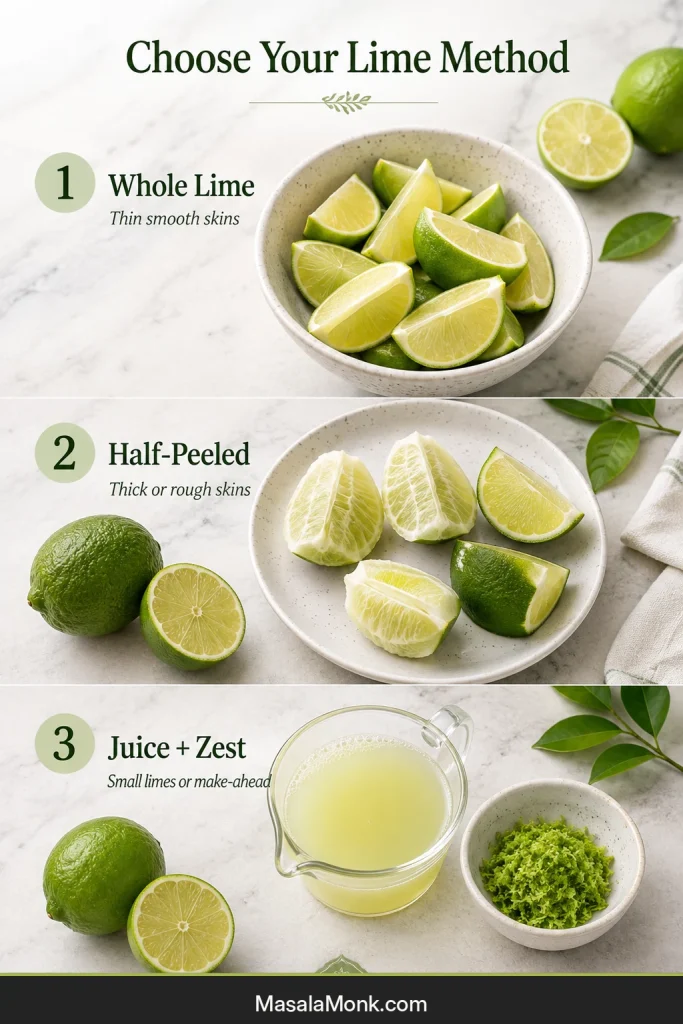
Choose Your Lime Method
Choose how to handle the limes first. Sweetness can always be adjusted after tasting; once too much peel has been blended in, it is much harder to take back.
When skins are uncertain, start gently; a mild pitcher is easier to brighten than a bitter one to rescue.
Lime method
Best when
How to prepare the fruit
Whole lime
You have smooth, thin-skinned Persian (Tahiti) limes and want the liveliest peel aroma
Keep the green peel and remove the ends, seeds and central white core
Half-peeled
The skins look thick, rough or unfamiliar
Peel two limes completely and keep the peel on two
Juice and zest
You have many small limes, need to make the drink ahead or prefer the smoothest texture
Use measured juice and finely grated green zest instead of blending many small peels
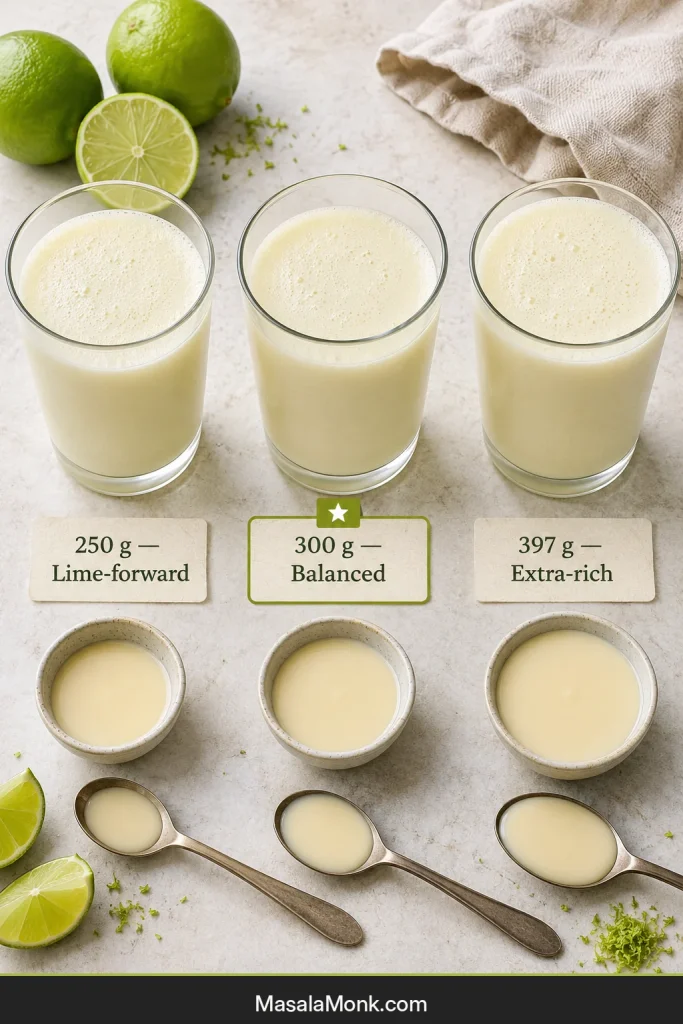
For the balanced pitcher, keep the water at 4 cups / 950 ml and use 300 g condensed milk. Drop to 250 g when you want the lime to lead, or use the full 397 g can for a sweeter, richer drink.
Brazilian Lemonade Recipe
This is the balanced main pitcher: lively lime, rounded sweetness and a pale, frothy finish.
Active time: About 10–12 minutes · Total time: About 12–15 minutes
First lime blend: Stop when the water is cloudy green and coarse lime pieces remain, usually 8–12 seconds · Second frothing blend: 10–15 seconds
Approximate yield: 4¾–5 cups / 1.1–1.2 liters before ice, depending on lime juiciness and how much drains through the sieve · Servings: 5–6
Best served: Immediately, while the fresh-peel aroma is lively and the foam is still light
Equipment
Blender with a 1.8–2-liter jar; with a 1.5-liter jar, process the limes and water in two equal batches
Sharp knife and stable cutting board
Fine-mesh sieve
Large bowl or 2-liter pitcher
Liquid measuring jug
Digital kitchen scale, recommended
Can opener and silicone spatula or large spoon
Ingredients
4 medium Persian (Tahiti) limes or similarly thin-skinned limes, about 8½–10 oz / 240–280 g total
4 cups refrigerator-cold water, 32 US fl oz / 950 ml
10½ oz / 300 g sweetened condensed milk, about 1 cup / 235 ml, plus more only after tasting; do not substitute unsweetened evaporated milk
Up to 1 tablespoon fresh lime juice, 15 ml, optional for finishing and added 1 teaspoon at a time
Ice, enough to fill each glass about halfway
Thin lime wheels or wedges, optional for serving
Measure the cold water first; melting serving ice should not determine the pitcher’s dilution.
Prefer it richer? Use the complete 14 oz / 397 g can of condensed milk. Want the lime to lead? Begin with 8¾ oz / 250 g while keeping the water at 4 cups / 950 ml.
Unfamiliar or thick-skinned limes? Peel two completely and keep the peel on two. Remove the central white core from all four. You still get the fresh-peel aroma, but the drink is gentler and more forgiving.
Method
Prepare the Limes
Wash the limes. Rinse them under cool running water and scrub the peel with a clean produce brush. Dry them so the knife does not slip.
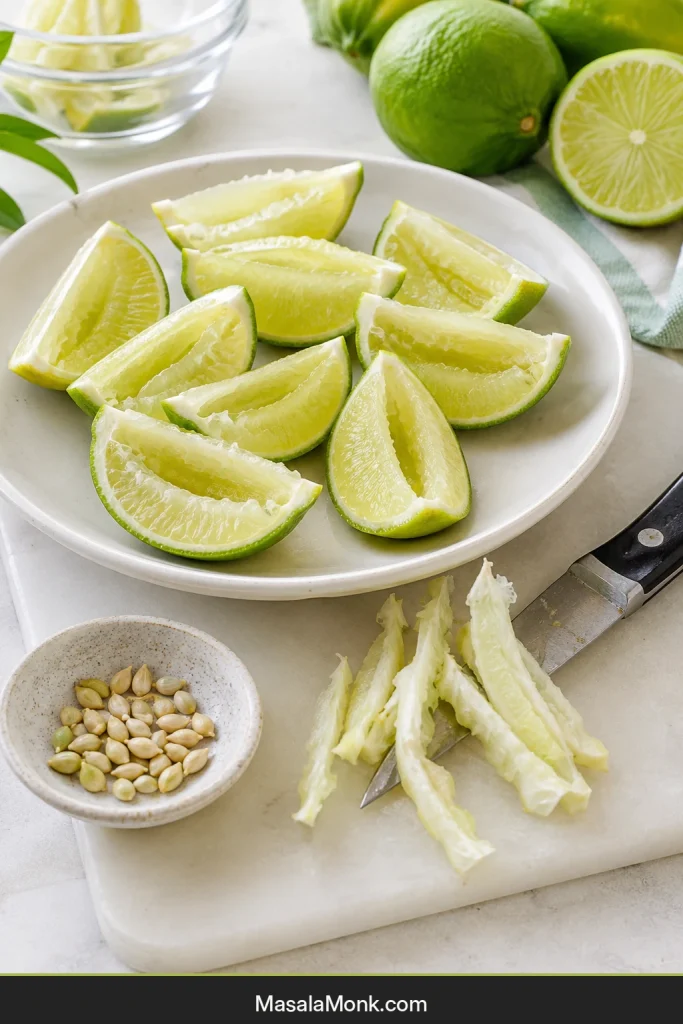
Trim and cut. Slice away both ends of every lime. Quarter each lime lengthwise, remove visible seeds and cut away the thick white strip through the center of every wedge.
A shallow V-cut removes the white core while preserving more juicy lime flesh.
Blend and Strain the Lime Base
Make the short lime blend. Put the prepared lime pieces in the blender with all 4 cups / 950 ml cold water. Pulse until the water turns cloudy green and coarse lime pieces remain, usually 8–12 seconds. Stop sooner in a powerful blender. When circulation is poor, divide the limes and water evenly between two batches instead of blending longer.
A few bottom fragments are normal; freely moving cloudy liquid is the real stopping cue.
Strain immediately. Pour the mixture through a fine-mesh sieve over a large bowl or pitcher. Tap or gently shake the sieve and stir the pulp once or twice. Leave the final spoonful behind instead of mashing it through.
Stop when flow slows to drops; pressing can push peel, pith and fine particles into the drink.
Finish the Brazilian Lemonade
Rinse the blender and add the condensed milk. Wash away any peel left in the jar, return the strained lime liquid and add 300 g sweetened condensed milk.
Once condensed milk disappears, extra blade time mainly adds air rather than useful body.
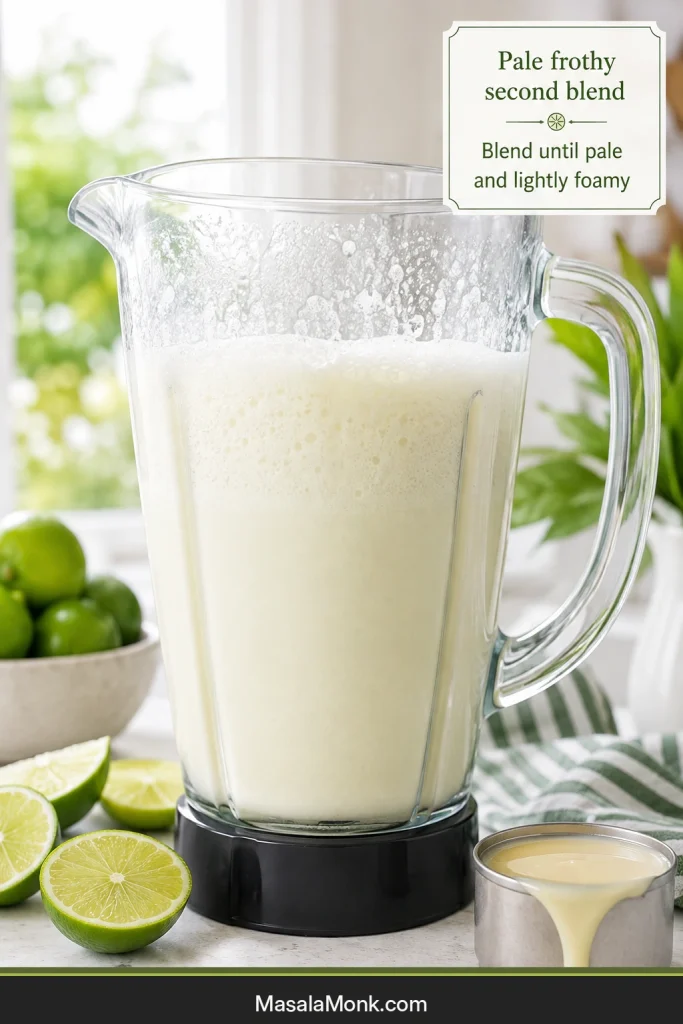
Blend until pale and softly foamy. Blend for 10–15 seconds. The green base should turn pale almost immediately, with a soft cap of fine bubbles rather than stiff foam.
Aim for fine, soft bubbles rather than stiff foam, then stop blending.
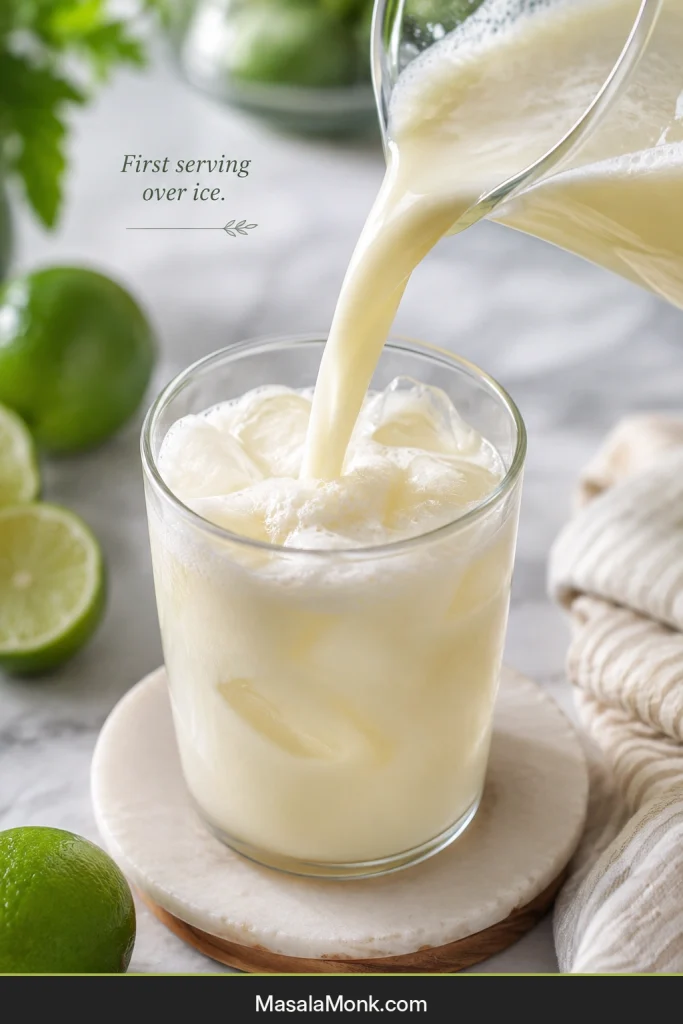
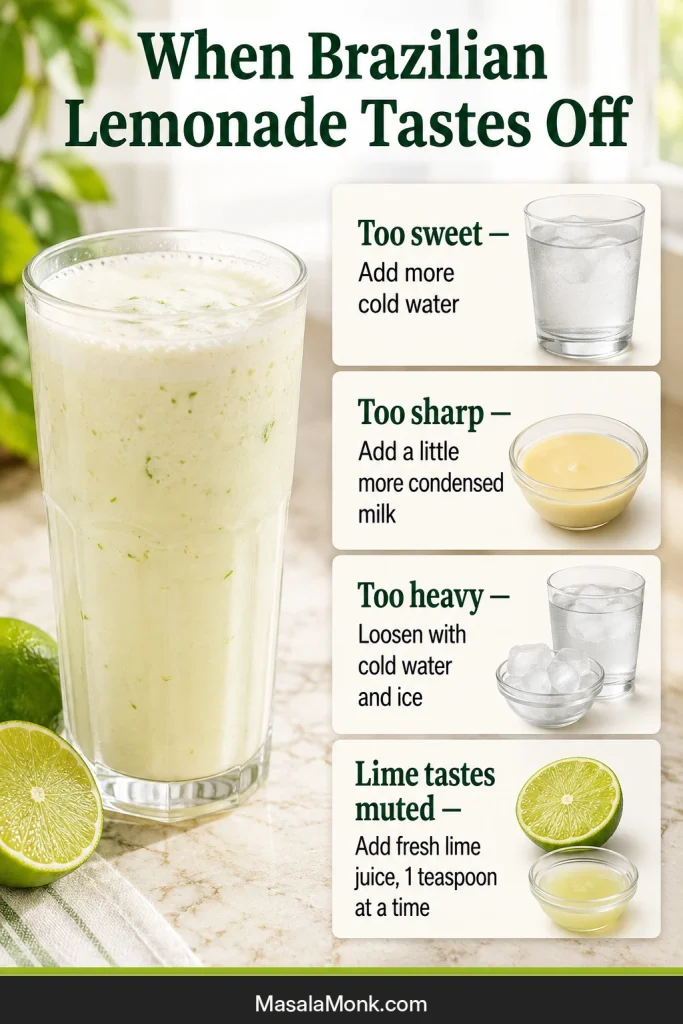
Let the first glass decide. Pour one glass over ice and take a sip before changing anything. When it tastes sweet but muted, add fresh lime juice 1 teaspoon at a time, up to 1 tablespoon. For excessive sharpness, add condensed milk 1 tablespoon at a time. A heavy texture needs cold water 2 tablespoons at a time.
Taste an ungarnished glass first, since fruit, herbs or spirits can hide the base balance.
Serve immediately. Fill each glass about halfway with ice, then pour in roughly 7 oz / 200 ml lemonade. Leave a little room for the light foam.
What Does Brazilian Lemonade Taste Like?
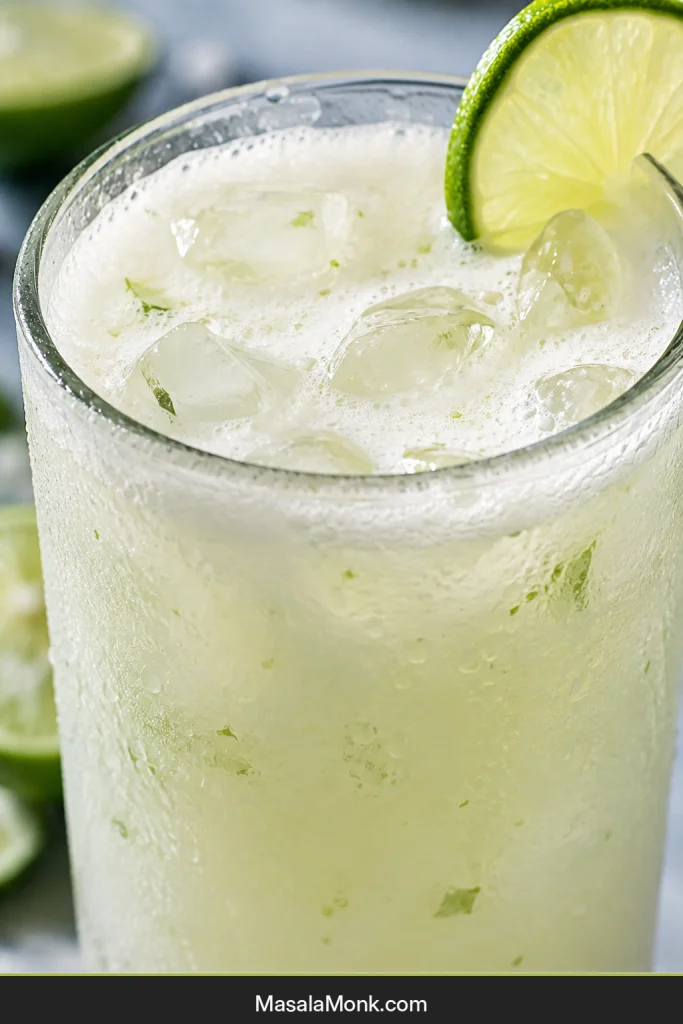
The lemonade is ready when it smells distinctly of fresh lime, pours pale and lightly foamy, and tastes creamy at first but clean and citrusy at the finish.
Fine foam signals a fresh blend, but sweetness and acidity still need tasting over ice.
The method is simple once the lime is under control. The name, however, needs a little explaining.
What Is Brazilian Lemonade?
Brazilian lemonade is a cold blended lime drink made with fresh limes and water. Depending on the version, sugar, milk, sweetened condensed milk—or a combination—softens the lime and adds sweetness or creaminess. Brief contact with the peel gives it a greener aroma than ordinary squeezed limeade; straining removes the solids before the drink is sweetened and frothed.
Why call it lemonade when it uses limes? In Brazil, the familiar green fruit is commonly called limão-taiti, while a yellow lemon is limão-siciliano. That shared word helps explain why limonada becomes “lemonade” in English even when the drink uses green limes. You will also see it called Brazilian limeade or Brazilian limonada.
This creamy version turns pale and opaque through blending and condensed milk—not artificial color.
What Is Limonada Suíça?
Limonada suíça is not one fixed formula. The name covers blended, strained Brazilian lime drinks made in several ways: this Brazilian limonada suíça recipe uses sugar and milk, while other versions use condensed milk.
The “Swiss” part has no universally accepted origin. A common explanation connects it to Swiss condensed-milk branding, while other accounts point more broadly to Swiss influence in Brazil.
Is the Condensed-Milk Version Authentic?
Yes—it is a well-loved Brazilian style, but it is not the only one. Some recipes lean on sugar with a little milk or condensed milk, while richer versions use most or all of a can.
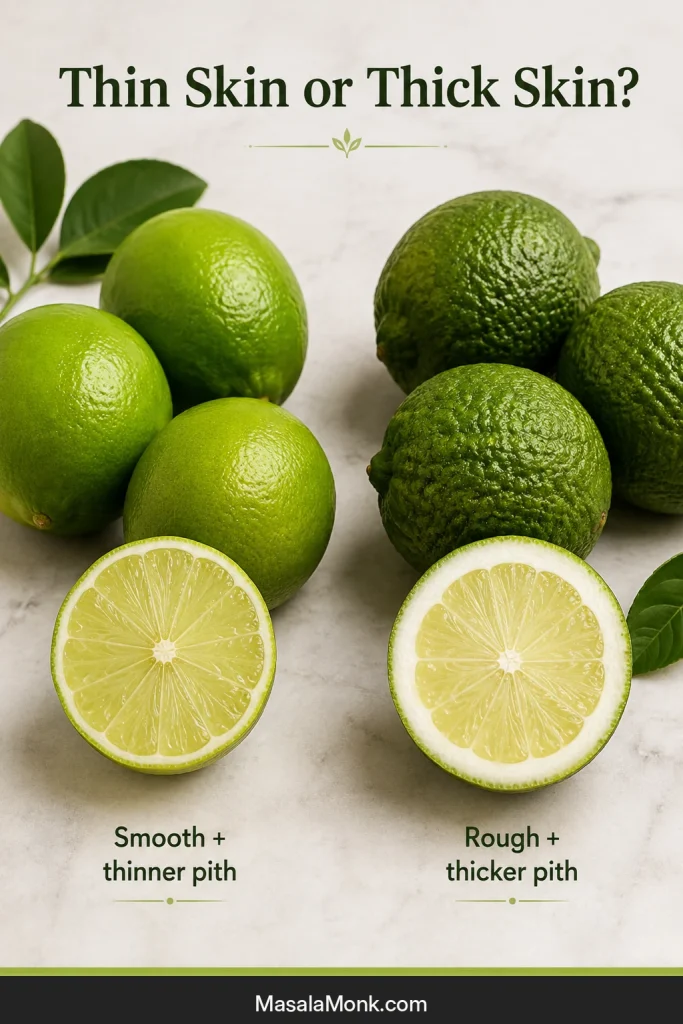
Choose medium Persian (Tahiti) limes that feel heavy for their size, with smooth or relatively thin-looking skins. Rough, thick-skinned limes are less forgiving in a whole-fruit blend because they contribute more peel and pith relative to their juice.
Weight is more dependable than count. Four medium limes should total about 8½–10 oz / 240–280 g. Equal fruit weight does not mean equal peel exposure, however. With small Key or Indian limes, peel most of the fruit and leave the peel on roughly one-quarter to one-half of the total amount. Small fruit is easiest to control with the measured juice-and-zest method.
Judge both outer texture and cut pith; green color alone reveals little about peel thickness.
Because the peel enters the drink, rinse and scrub the limes thoroughly under running water rather than using soap or detergent. The FDA produce-washing guidance also advises against soap and commercial produce washes.
How Condensed Milk Changes the Drink
Condensed milk does three jobs at once: it sweetens the lime, softens its sharp edges and gives the drink its creamy body. The balanced pitcher uses 300 g, added only after straining so the peel gets no more blade time.
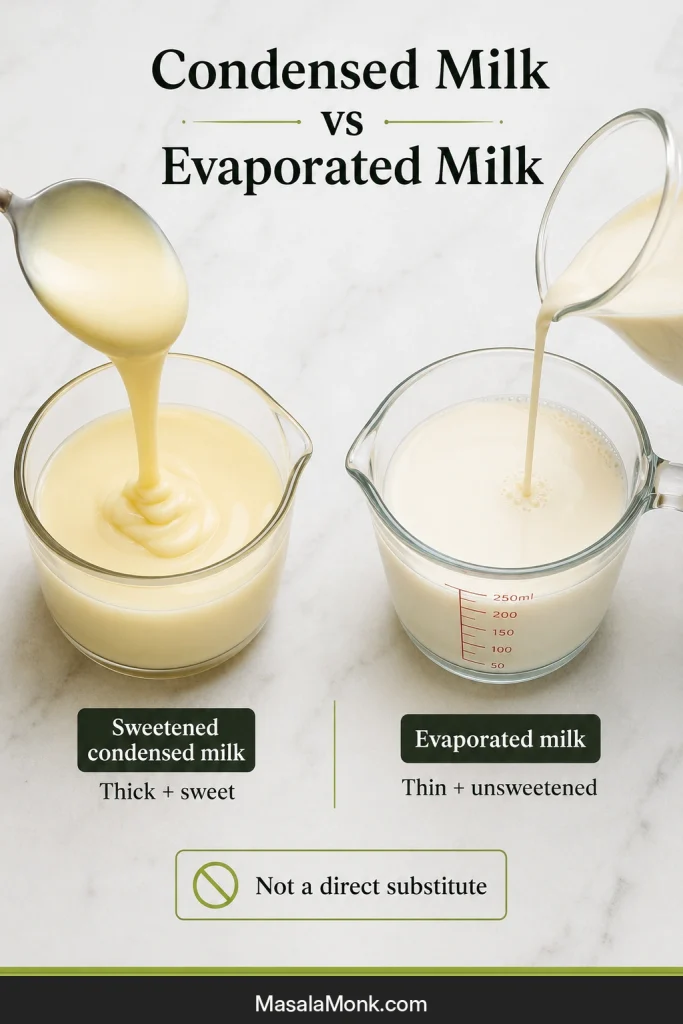
Use sweetened condensed milk, not evaporated milk. Evaporated milk is thinner and unsweetened, so it is not a direct substitute.
Evaporated milk needs separate sweetening and still creates a lighter body than condensed milk.
If that tart lime and condensed-milk pairing is the part you love most, this creamy key lime pie recipe carries the same contrast into a chilled, sliceable dessert.
Why Cold Water Works Better Than Blended Ice
Cold water keeps the base consistent. Save the ice for the glasses, where it can chill each serving without quietly watering down the pitcher.
Keep ice out of the whole-lime blend because it changes blade circulation and makes the extraction harder to judge. Add measured ice only when making the frozen variation.
Do You Need Extra Sugar?
Not automatically. Condensed milk already brings substantial sweetness. Taste a small glass over ice and add sugar or simple syrup only if the limes remain unusually sharp.
A thinner, more lemonade-like pitcher needs extra water as well as less condensed milk; simply reducing the condensed milk creates a brighter drink, not the same lighter formula.
That same lime-first balance is what keeps a classic mojito crisp rather than sugary.
Keep the Lime Bright, Not Bitter
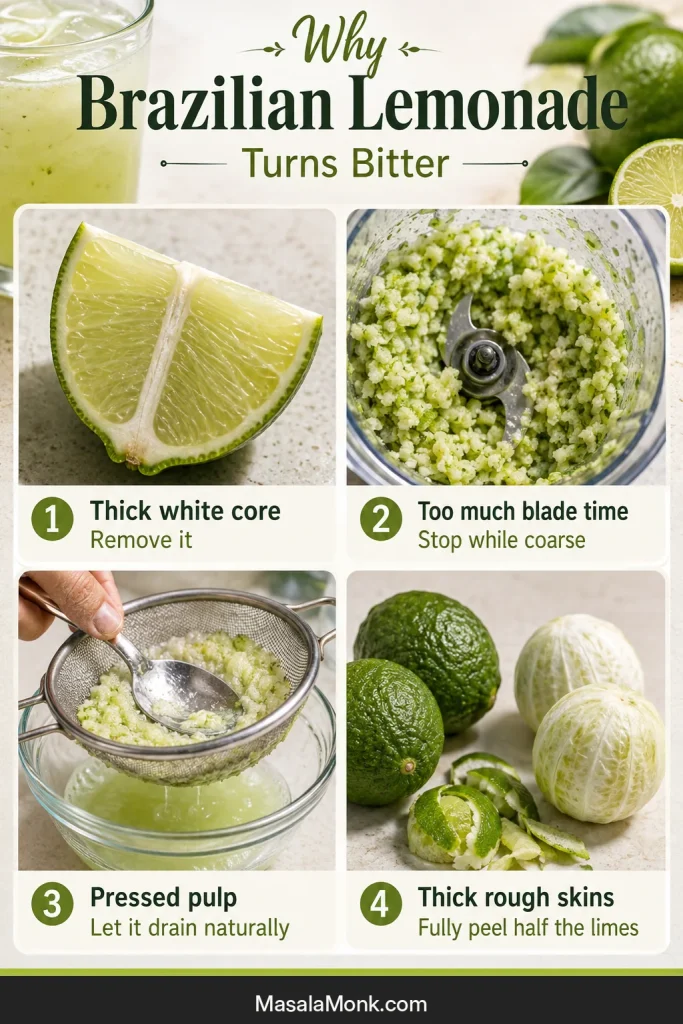
A slight, clean peel edge makes the lime taste brighter. The goal is not to erase the peel, but to stop before it becomes medicinal or mouth-drying. Too much white pith, too much blade time or hard pressing are the usual causes.
Bitterness is usually an extraction problem, not a sweetness problem.
The fruit brings more peel and pith relative to juice
Peel two of the four limes
Long blending
The peel becomes finer and extracts more aggressively
Stop while coarse lime pieces remain
Crushed seeds
Seed bitterness joins the peel bitterness
Remove visible seeds before blending
Hard pressing
Fine peel particles and concentrated pulp liquid pass through
Tap and stir the sieve instead of mashing it
Long holding
Fine particles continue changing the flavor
Serve the whole-lime version soon after blending
Overloaded blender
Poor circulation tempts you to blend longer
Process a double batch as two short lime batches
How to Recognize the Correct Lime Blend
The liquid should still move freely while visible coarse pieces remain. Fine suspended pulp and sluggish circulation show that the peel has been worked too far.
The correct blend circulates freely, while over-blended liquid hangs with fine suspended pulp.
When the blend stops at the coarse stage, the peel does exactly what you want: it gives the drink a vivid fresh-peel aroma that ordinary squeezed limeade does not usually have.
Can You Rescue a Bitter Pitcher?
A lightly bitter pitcher is often recoverable. Test the correction in one glass before changing the whole batch: add a splash of cold water and 1–2 teaspoons condensed milk, stir and taste over ice. If the edge softens, scale the same adjustment into the remaining pitcher. A heavily over-blended batch is harder to bring back.
Avoid adding sugar by itself. It can hide the first bitter impression while leaving the harsh finish in place.
When Your Brazilian Lemonade Tastes Off
A pitcher that is slightly too sharp, sweet or heavy is usually one small adjustment away. Change one thing at a time, and try the first glass again before touching the whole batch.
Change one variable, retaste over fresh ice, and only then adjust again.
Problem
Likely cause
Try this first
Too sour
Very acidic limes or too little condensed milk
Add condensed milk 1 tablespoon at a time
Too sweet
Full can of condensed milk with mild limes
Add cold water, then fresh lime juice 1 teaspoon at a time
Heavy or thick
High condensed-milk ratio
Add cold water 2 tablespoons at a time
Thin or watery
Too much melted ice or excess dilution
Chill without adding more ice; add condensed milk only if the sweetness can take it
Sweet but flat
The citrus has been softened too far
Add fresh lime juice rather than blending more peel
Small peel particles
Coarse sieve or hard pressing
Pass the drink through a finer sieve once more
Once the lime tastes clear again, stop adjusting and pour the glasses.
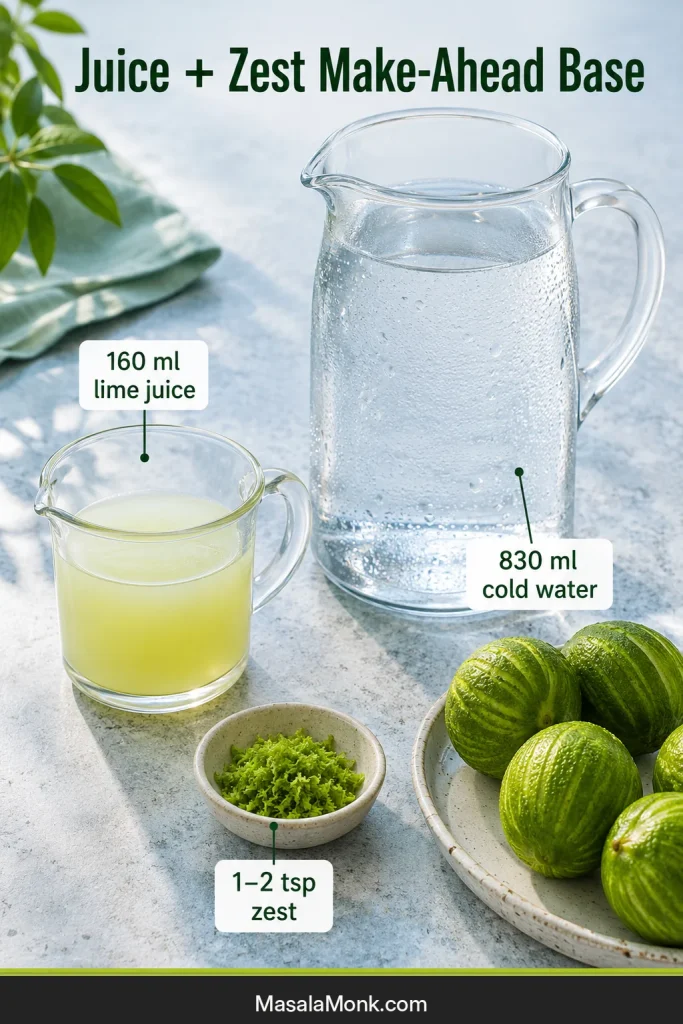
When dinner is still a few hours away—or guests are due before you want to stand at the blender—the juice-and-zest version keeps its balance more reliably until serving. It gives the drink a smoother, cleaner lime flavor with less peel edge.
Keep the chilled base tightly covered; otherwise, it can absorb refrigerator aromas before finishing.
Juice-and-Zest Ingredients
⅔ cup fresh lime juice, 5⅓ US fl oz / 160 ml; buy enough limes to produce this amount because the count varies widely with size and juiciness
1–2 teaspoons finely grated green zest, approximately the zest of 1 large lime, avoiding the white pith
3½ cups cold water, 28 US fl oz / 830 ml, plus up to ½ cup / 120 ml for adjustment
8¾–10½ oz sweetened condensed milk, 250–300 g
Ice, for serving
How to Make the Juice-and-Zest Version
Combine the lime juice and 3½ cups / 830 ml cold water. Cover and refrigerate earlier in the day, or overnight when necessary. For the brightest peel aroma, add the finely grated zest during the final blend rather than leaving it in the base.
Before adding condensed milk, try a spoonful of the chilled citrus base. It should taste bright and deliberately tart; add a little of the reserved water if it feels too intense.
Shortly before serving, blend the chilled citrus base, zest and 250 g condensed milk for 10–15 seconds.
Pour a small glass over ice. Add more condensed milk for softness or the remaining water when the flavor is still too concentrated.
This is the easier route when you want the lime work finished before the room fills up. A citrus press, microplane and even a small blender are enough.
No blender? Whisk the juice-and-zest version in a pitcher, shake small portions in a tightly sealed jar or use a handheld frother. Strain before serving when you want a completely smooth glass.
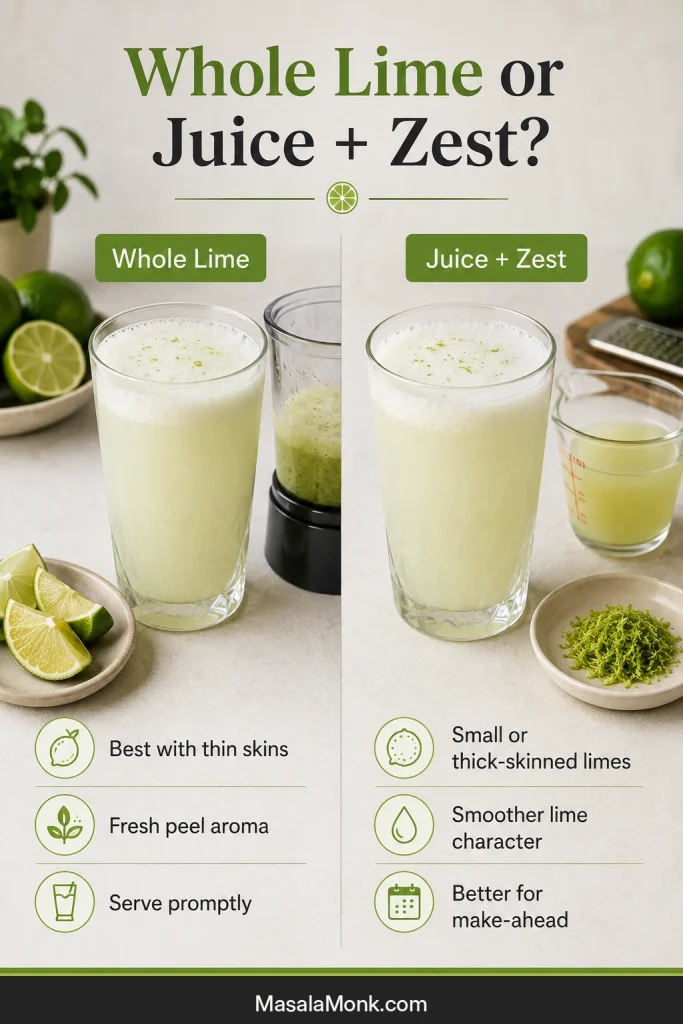
Whole Lime or Juice and Zest?
Both methods can make an excellent pitcher. Use the whole-lime route when the skins are thin and service is immediate; choose juice and zest when the fruit is small or the drink must wait.
Choose whole lime for immediate service; use juice and zest when the pitcher must wait.
Keep the short lime blend, then change the body, fruit or finish with one of these lighter, richer, tropical, frozen or cocktail options.
Adjust the Body and Sweetness
Keep the lime and water fixed while testing condensed-milk levels. That way, each glass shows a true change in richness rather than a different dilution.
Keep water and ice constant, so the condensed-milk levels remain fair to compare.
For a lighter pitcher: Use the standard 4 limes, 5 cups / 1.18 liters cold water and 8¾ oz / 250 g condensed milk. Add simple syrup only after tasting over ice.
For a richer pitcher: Keep the standard 4 limes and 4 cups / 950 ml water, but use the full 14 oz / 397 g can of condensed milk. Smaller glasses keep the sweetness from overwhelming the lime.
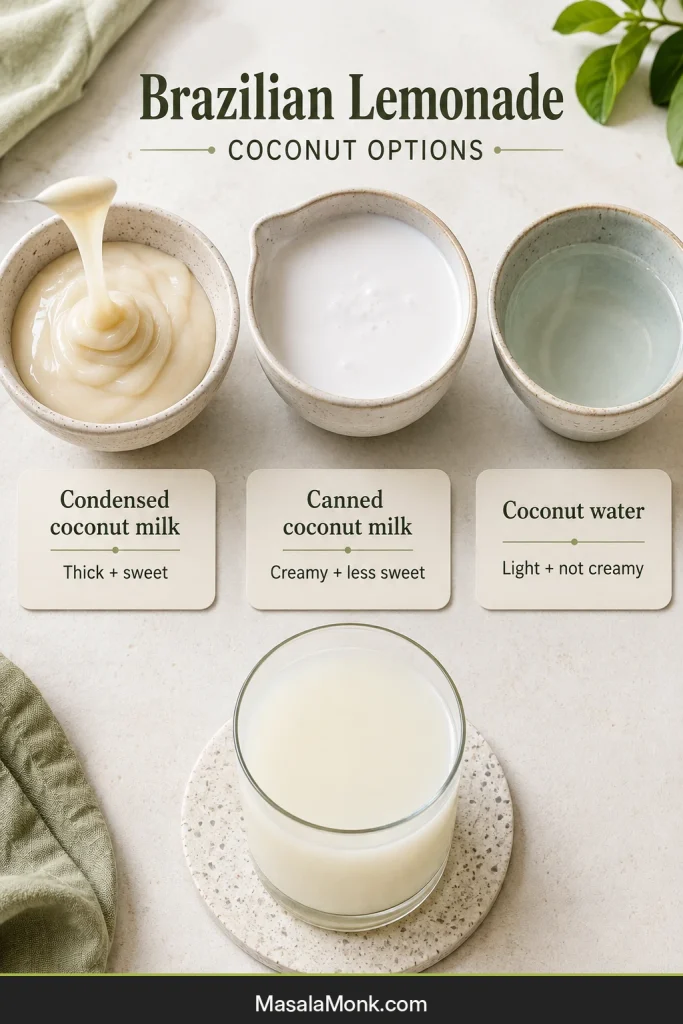
Coconut Version
Coconut ingredients change the drink in different ways: some replace sweetness and body, while others add only flavor or richness.
Chill before judging coconut sweetness, intensity or body because brands vary widely.
For dairy-free creaminess: Replace the sweetened condensed milk with sweetened condensed coconut milk by weight. Begin with 250 g because brands vary in sweetness and coconut intensity.
For a softer coconut finish: Begin with ½ cup / 120 ml full-fat canned coconut milk in place of the same amount of water.
For a lighter tropical drink: Replace up to half the water with coconut water; it adds flavor, not creaminess.
Add coconut products only after straining. Plain coconut milk softens the drink; condensed coconut milk also sweetens and thickens it.
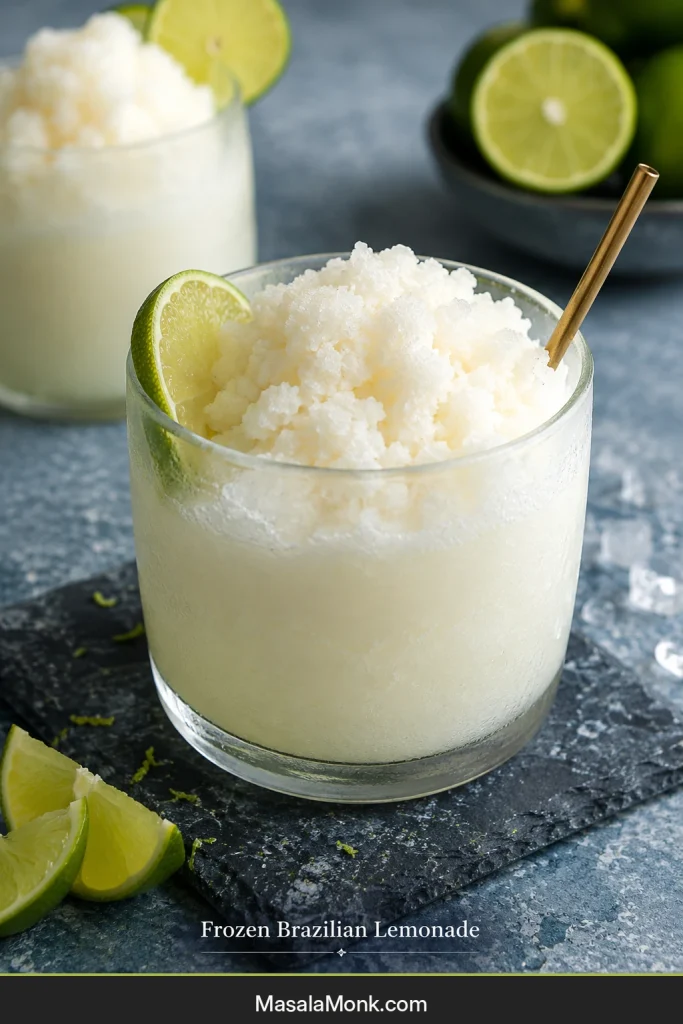
For two snowy servings, blend 2 cups / 475 ml prepared lemonade with 8–9 oz / 225–250 g ice after straining. It begins thick, then loosens into a creamy slush.
Pulse only until slushy; prolonged blending melts more ice and gradually thins the drink.
Cocktail With Cachaça, Rum or Vodka
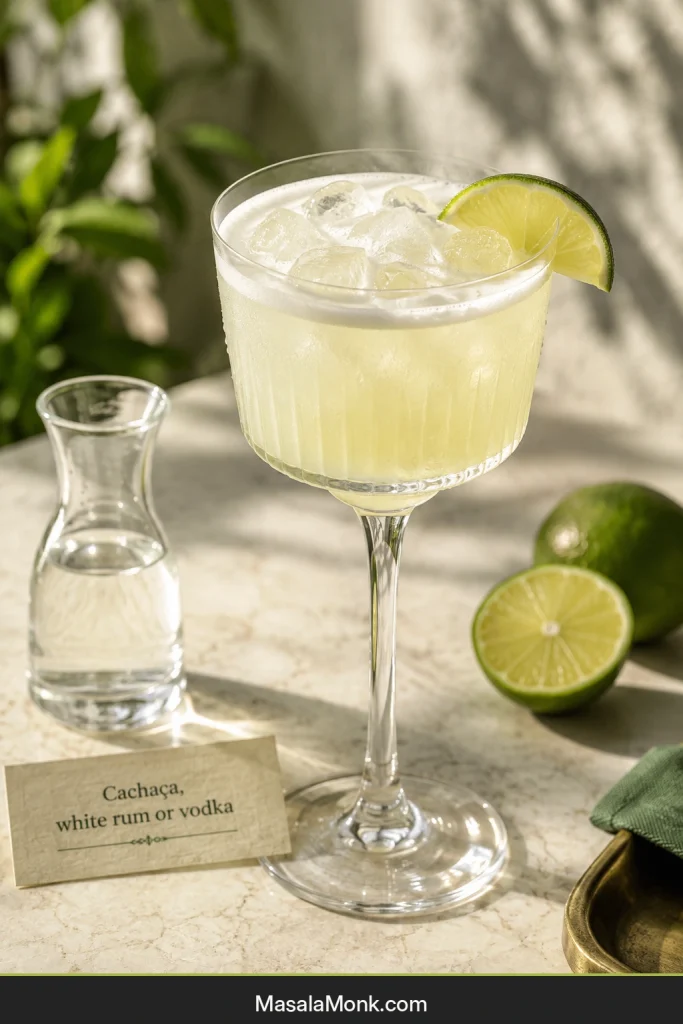
Cachaça brings a grassy edge that cuts through the condensed milk. White rum tastes more tropical; vodka stays quieter.
Add spirit by the glass for mixed groups, or add it to the pitcher when every serving is alcoholic.
Serving
Spirit
One 7–8 oz glass
1 oz / 30 ml
Standard pitcher
4–6 oz / 120–180 ml, according to the strength you prefer
Stir the spirit into the pitcher after straining; do not extend the whole-lime blend. For a sharper lime cocktail without condensed milk, try the classic gimlet.
Serve alcoholic versions only to adults of legal drinking age and enjoy responsibly.
Strawberry Version
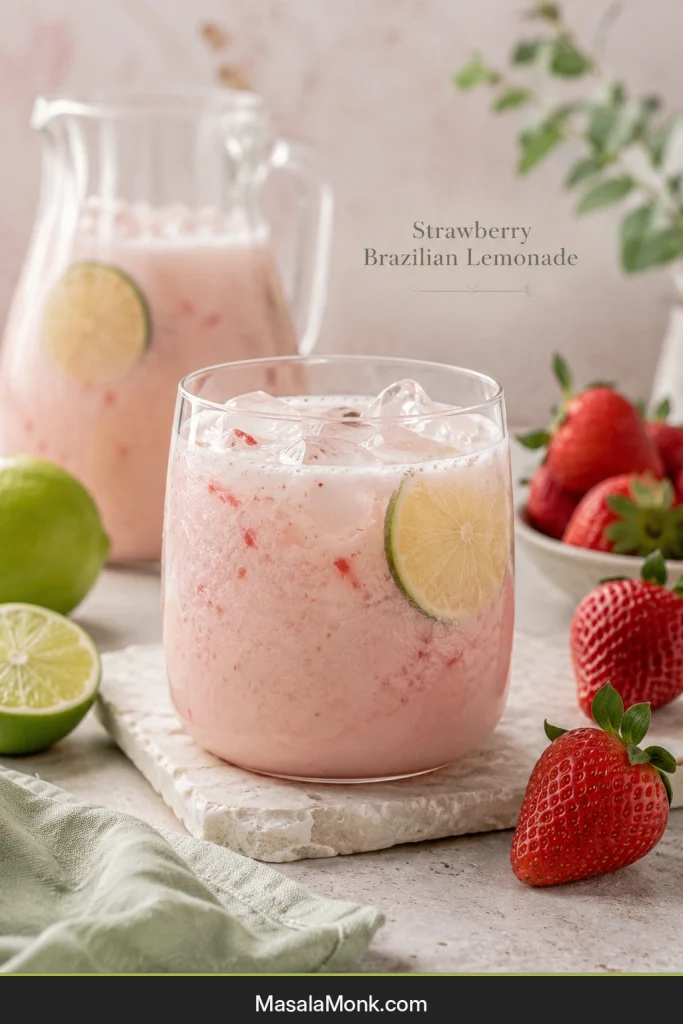
For a fruitier pitcher, begin with 1 cup hulled strawberries, about 5¼ oz / 150 g, blended with the strained lime base and condensed milk. The berries soften the acidity and turn the drink pale pink.
Taste before adding more condensed milk because ripe strawberries bring sweetness as well as color.
Can You Make It With Yellow Lemons?
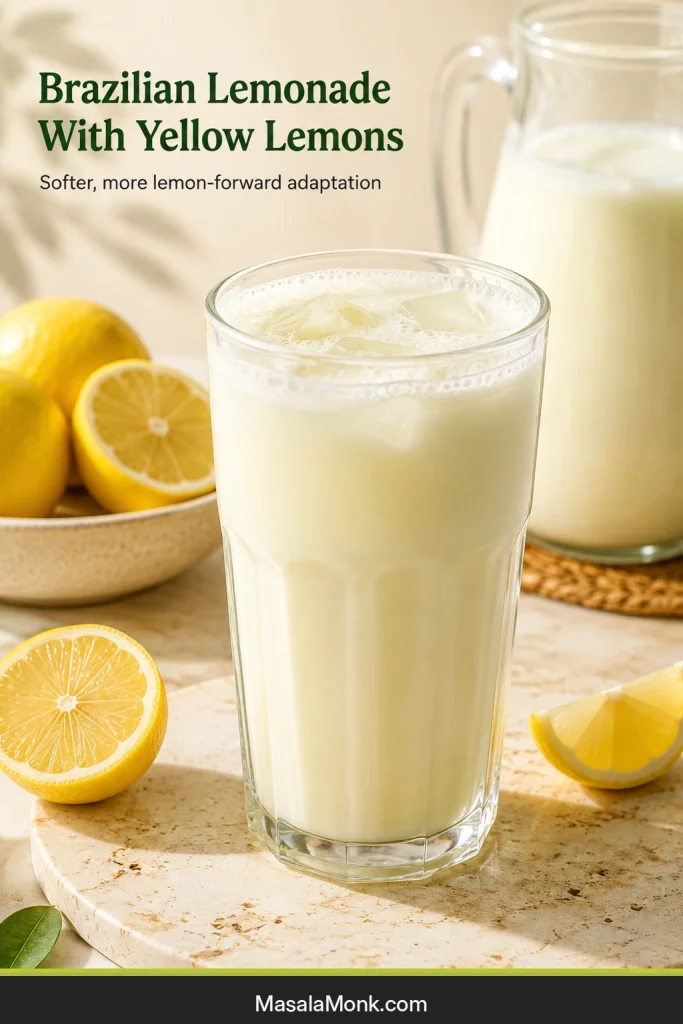
Yes, but use the juice-and-zest method rather than blending whole lemons. Combine ½ cup plus 1 tablespoon / 135 ml fresh lemon juice, 1 teaspoon finely grated yellow zest, 3½ cups / 830 ml cold water and 8¾ oz / 250 g condensed milk. Adjust only after tasting over ice.
The result is pale yellow and familiar, without the fresh green-peel character of the lime version. Treat it as a Brazilian-lemonade-inspired lemon drink rather than an identical substitution.
Use only thin yellow zest because white pith can overwhelm the softer lemon profile.
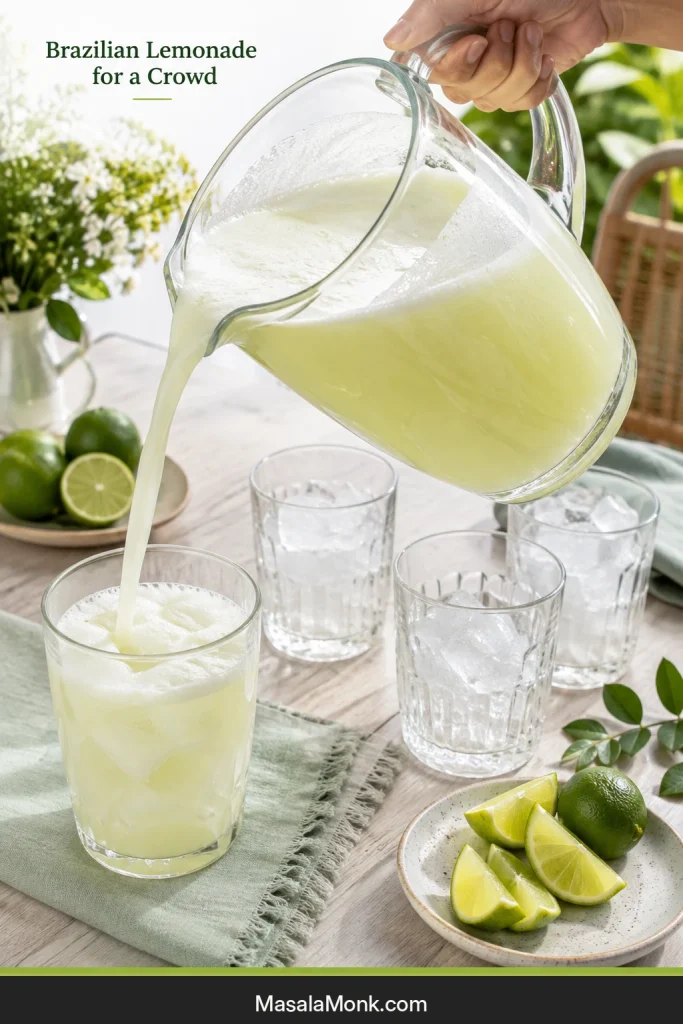
Scale It for a Party
For a crowd, the challenge is room in the blender, not a longer extraction. Process large quantities in separate short batches while everyone gets the glasses ready with ice.
Pre-measure equal lime-and-water portions, so every blender load receives the same brief extraction.
Batch
Limes
Water
Condensed milk
Makes
Half
120–140 g / about 2 medium
2 cups / 475 ml
5¼ oz / 150 g
550–600 ml / 2–3 glasses
Standard
240–280 g / about 4 medium
4 cups / 950 ml
10½ oz / 300 g
1.1–1.2 liters / 5–6 glasses
Double
480–560 g / about 8 medium
8 cups / 1.9 liters
21 oz / 600 g
2.2–2.4 liters / 10–12 glasses
For a double batch, blend and strain two standard lime-and-water batches separately, then combine them and blend or whisk in the condensed milk. Stop each lime batch at the same cloudy-green, coarse-piece stage.
A double batch is usually enough for twelve guests when other drinks are available. Have the glasses filled with ice before the blender starts; Brazilian lemonade is at its best when it goes straight from blender to pitcher to table.
Before Guests Arrive
Wash and dry the limes ahead. Cut them as close to blending as practical; if necessary, refrigerate the cut fruit tightly covered for up to a couple of hours.
Measure the water and condensed milk before guests arrive.
Use the juice-and-zest version when the citrus base must be prepared earlier in the day or overnight.
Keep serving ice in a separate bowl or bucket instead of letting it melt into the pitcher.
For an alcoholic party pitcher, add the spirit only after the lime pulp has been strained.
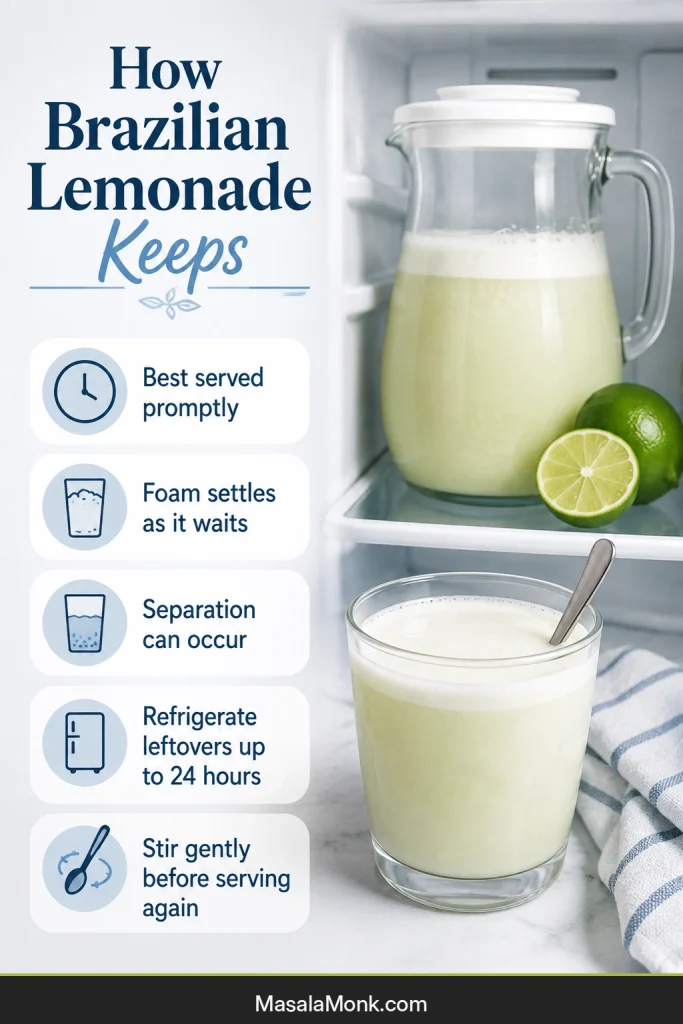
Whole-lime Brazilian lemonade is best served as soon as practical. Its foam settles as it waits, and the peel edge may become more noticeable.
Refrigerate without ice; melting cubes dilute leftovers and make next-day balance harder to restore.
Leftovers: Cover and refrigerate promptly; use within 24 hours, with some loss of foam and fresh-lime aroma.
Before serving again: Stir or briefly reblend, then taste before making any adjustment.
Expected changes: Separation, a softer aroma and a more noticeable peel edge.
Separation alone is normal. Discard the drink when its smell, appearance or flavor suggests spoilage rather than simple settling.
Can you freeze it? Freezing the finished dairy-based drink can change its texture. A better plan is to freeze the juice-and-zest citrus base in ice trays, then blend those cubes with fresh condensed milk when you want a frozen drink.
Frequently Asked Questions
Can You Use Bottled Lime Juice?
Yes, using the juice-and-zest method, though bottled juice will not match the aroma of fresh zest and juice. Bottled juice can taste sharper, flatter or more concentrated, so begin with ½ cup / 120 ml and increase only after tasting it over ice.
Can You Make Brazilian Lemonade Without Condensed Milk?
Yes, though the result will be closer to Brazilian-style limeade than the familiar creamy drink. Use the same 4 limes and 4 cups / 950 ml water, following the same short blend and gentle straining method. Replace the condensed milk with ⅓ cup / 65 g sugar or an equivalent amount of simple syrup, then adjust after tasting it over ice.
Can You Use Key Limes or Small Indian Limes?
Yes, but do not substitute by count or blend every small lime with its peel attached. For the easiest balance, use the juice-and-zest method. For a whole-fruit version, peel most of the limes and leave peel on roughly one-quarter to one-half of the total amount.
Can You Make Brazilian Lemonade the Night Before?
The whole-lime method is not the best overnight choice because its peel edge can strengthen. Prepare the juice-and-water base instead, refrigerate it covered overnight when necessary, and add the zest and condensed milk shortly before serving.
The Short Blend Protects the Final Sip
Brazilian lemonade looks almost too easy to need a rule. Then one over-blended pitcher explains why the rule matters.
Add lime wheels to glasses, not the pitcher, where peel keeps steeping during service.
Watch the pieces, not only the clock. Strain without squeezing, then let the first glass decide whether the pitcher needs more brightness or more softness.
A good pitcher feels generous without becoming heavy. The first sip is playful and creamy; the last should still taste unmistakably of lime.
Which method did you use, and what kind of limes were available where you live? Tell us which method worked best with your fruit.
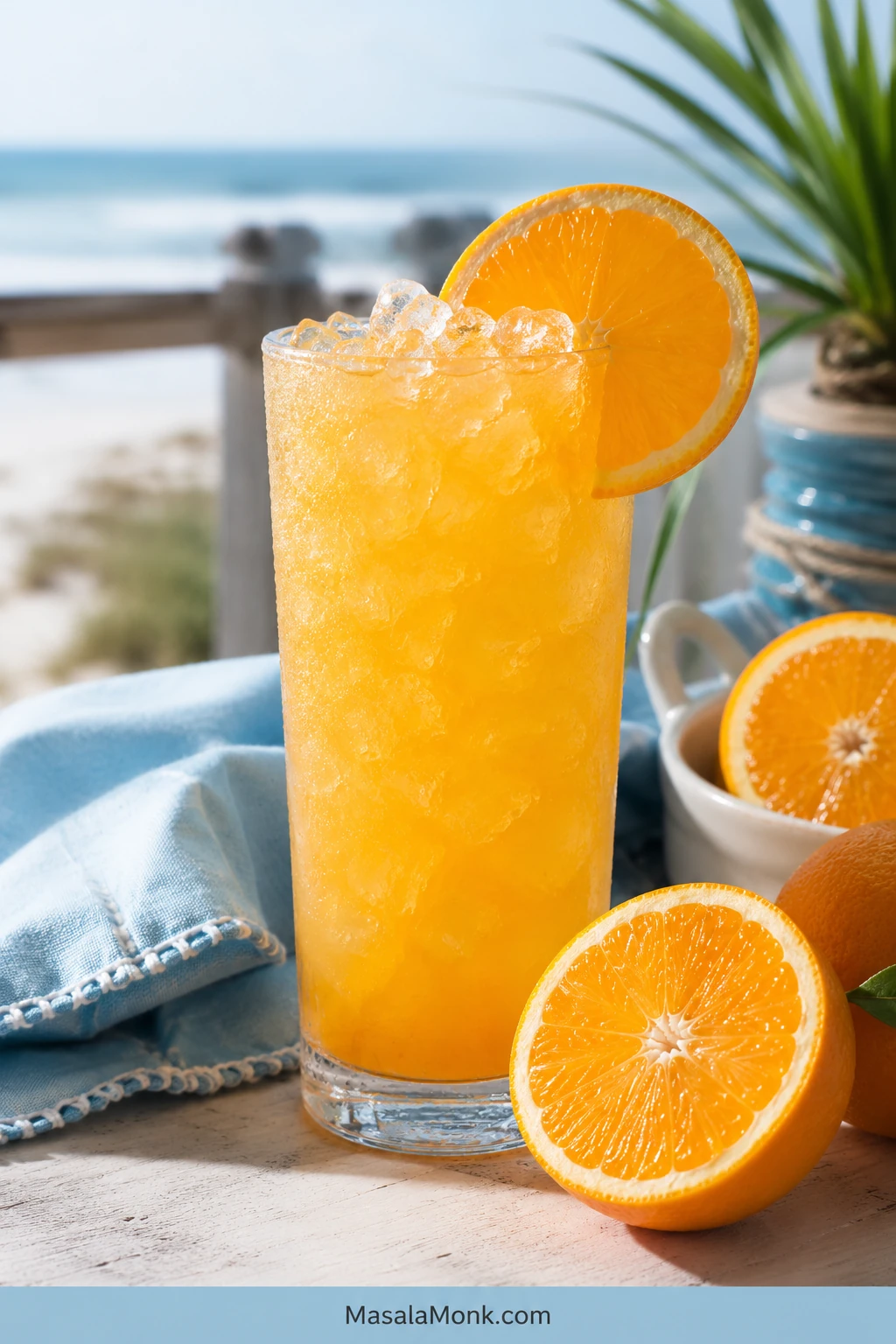
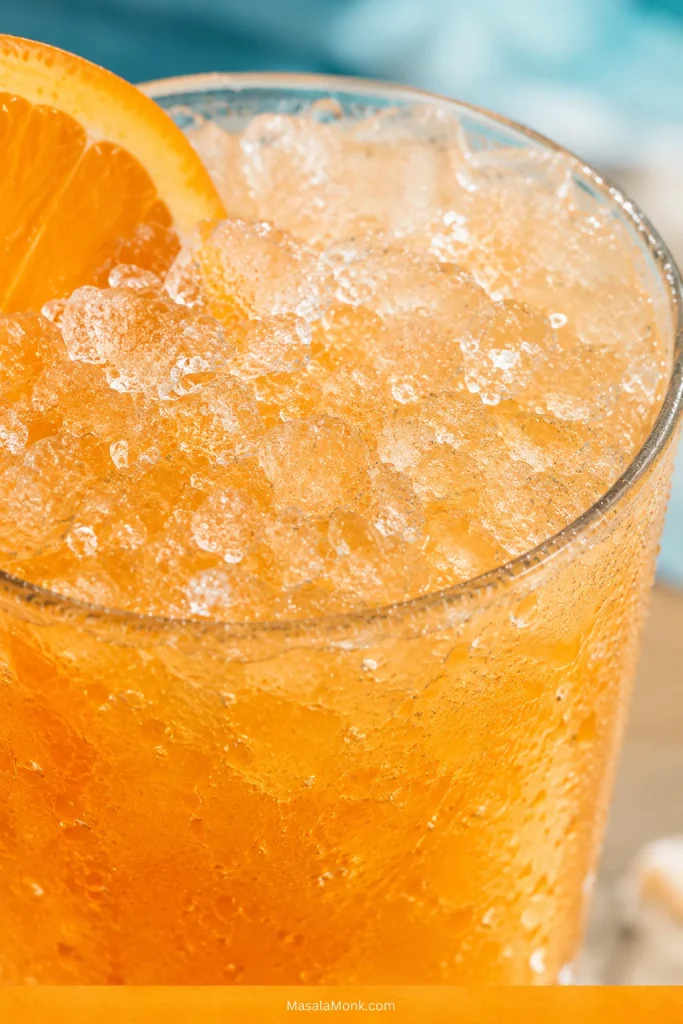
An Orange Crush should smell like a just-cut orange before you taste the vodka. It should be cold, juicy, sparkling, and bright enough to feel like a beach-bar drink instead of plain vodka with orange soda. This version uses fresh-squeezed orange juice, vodka or orange vodka, triple sec, crushed ice, and just enough bubbles to keep every sip lively.
It is the kind of drink that works because it feels simple: squeeze, pour, fizz, sip. The same build is easy enough for one glass after work and bright enough for a whole tray of summer drinks.
If a Screwdriver is vodka and orange juice, an Orange Crush is the fresher, louder cousin. It adds orange liqueur, crushed ice, and soda, so the glass lands citrusy, cold, and easy to sip without feeling heavy.
This is the cocktail version, not the soda cake. You will get the classic drink first, then the choices that matter: regular vodka or orange vodka, triple sec or Cointreau, lemon-lime soda or club soda, one glass or a pitcher, plus frozen, lighter, shot, and mocktail versions.
An Orange Crush is a fresh orange vodka cocktail made with fresh-squeezed orange juice, vodka or orange vodka, triple sec or another orange liqueur, lemon-lime soda or club soda, and crushed ice.
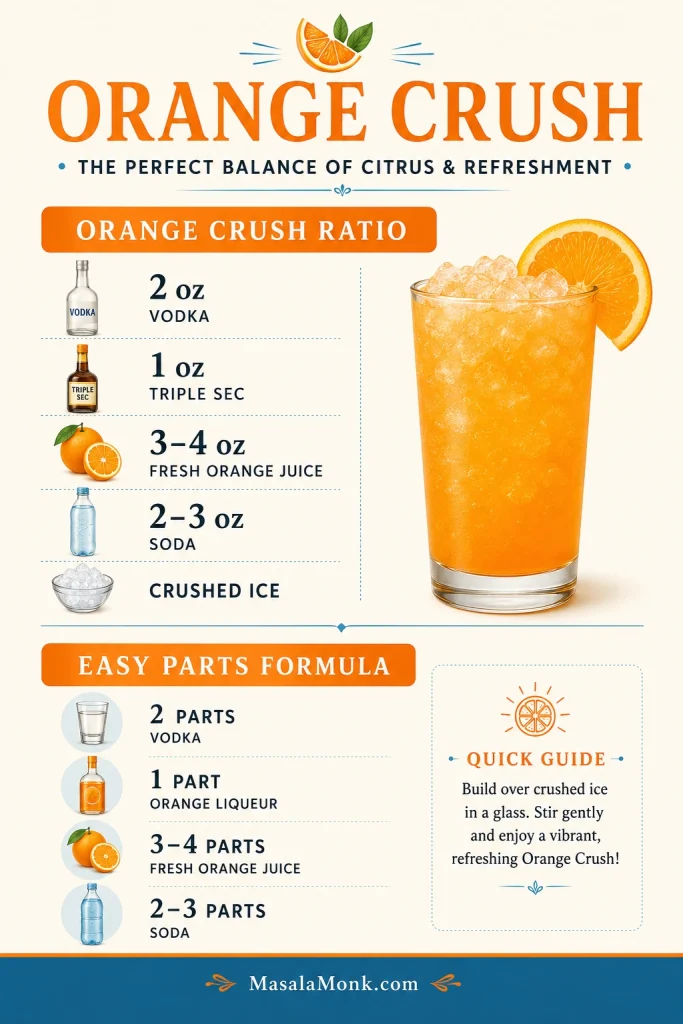
The best starting ratio is 2 oz / 60 ml vodka, 1 oz / 30 ml triple sec, 3–4 oz / 90–120 ml fresh orange juice, and 2–3 oz / 60–90 ml lemon-lime soda or club soda. Build it over crushed ice, add the soda last, and serve it while the glass is still cold and bubbly.
The one-glass Orange Crush formula works because every ingredient has a clear role: juice brings brightness, vodka gives structure, orange liqueur adds depth, and soda lifts the finish.
Make One Now
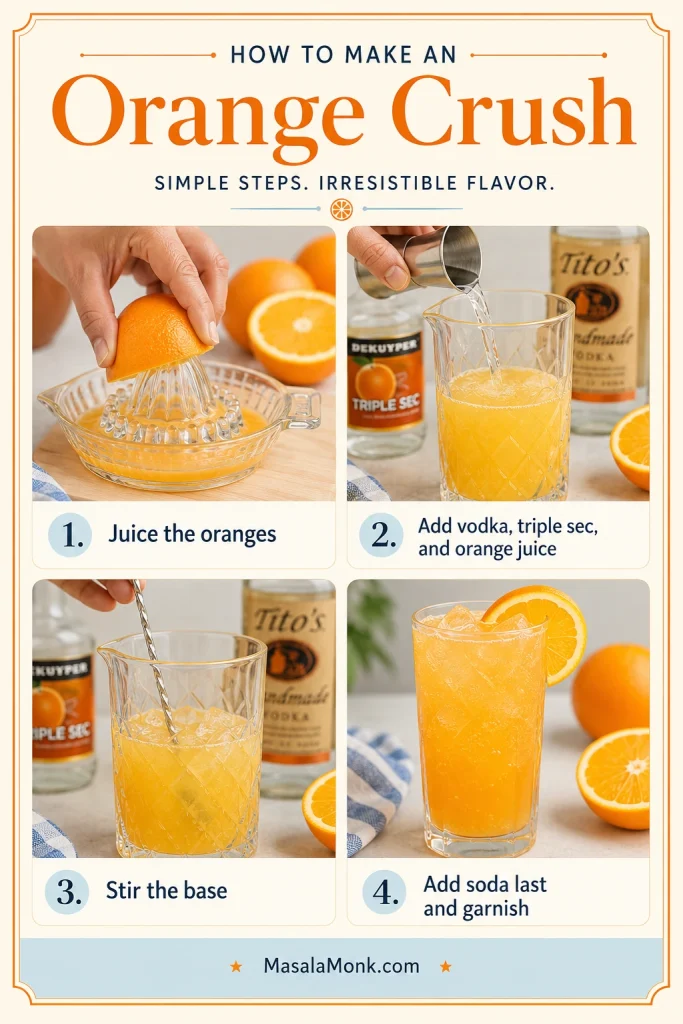
Fill a highball, Collins, or pint glass with crushed ice. Add 2 oz / 60 ml vodka, 1 oz / 30 ml triple sec, and 3–4 oz / 90–120 ml fresh orange juice. Stir briefly, top with 2–3 oz / 60–90 ml lemon-lime soda or club soda, stir once more, garnish with orange, and drink while the ice is still crisp.
If the first sip tastes like orange first and alcohol second, you are in the right place. From there, adjust the next glass sweeter, drier, stronger, or more orange-forward.
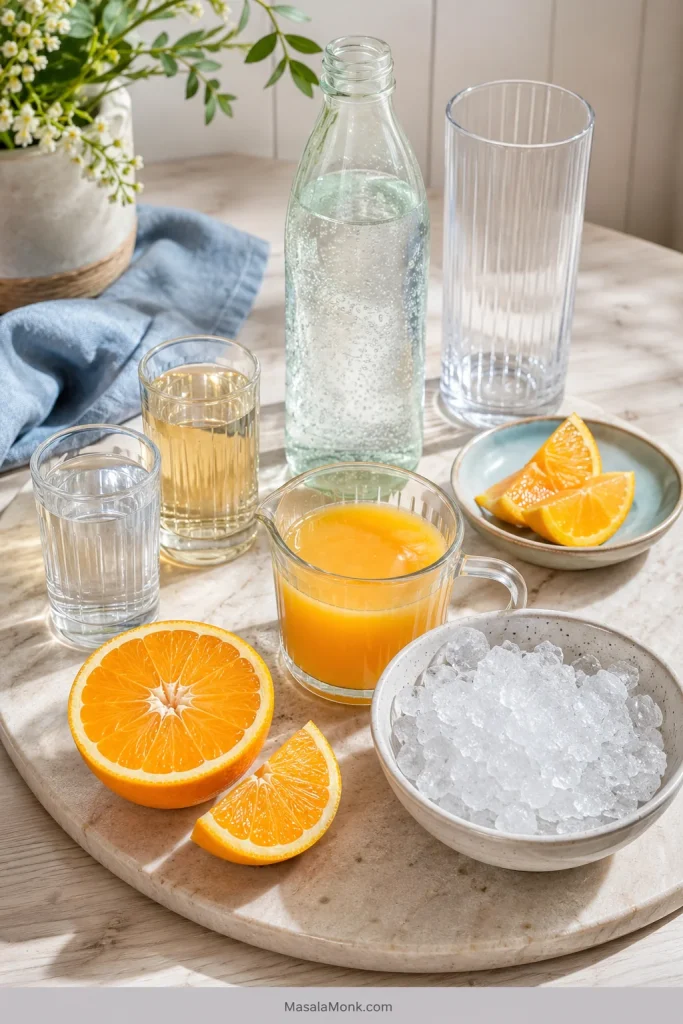
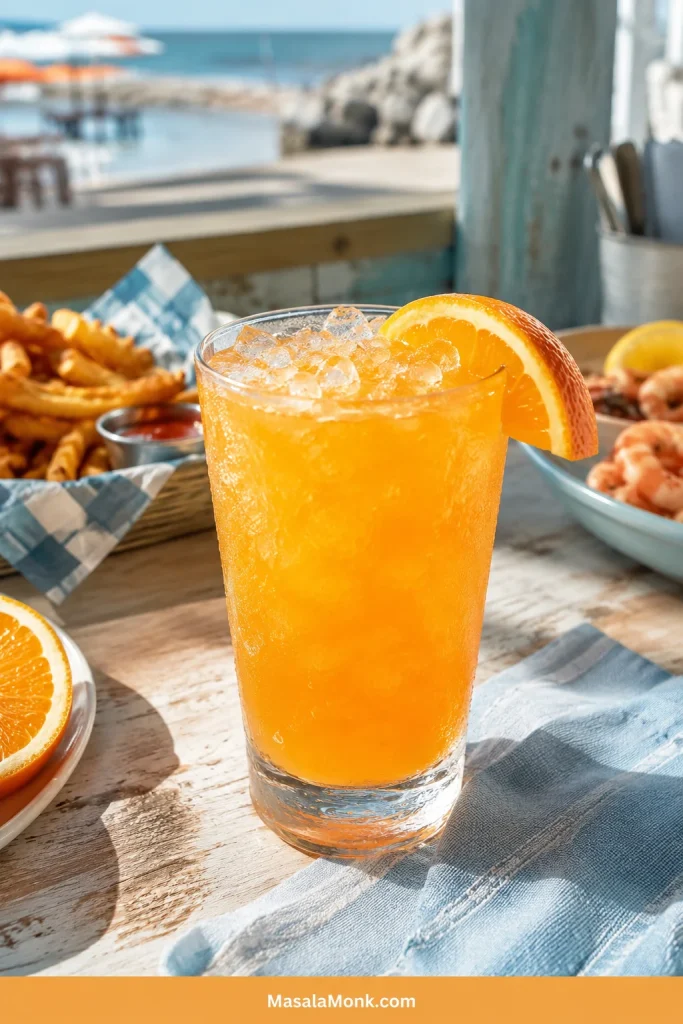
Start here before you customize: vodka or orange vodka, triple sec, fresh-squeezed orange juice, lemon-lime soda, and a full glass of crushed ice.
Three things ruin the drink fast: warm juice, soda added too early, and finished cocktails sitting in a pitcher with ice.
Want this?
Use this
Classic beach-bar Orange Crush
Orange vodka + lemon-lime soda
Cleaner, less sweet drink
Plain vodka + club soda
Stronger orange flavor
Orange vodka + Cointreau
Lighter party pour
Club soda + extra fresh orange
Mocktail
Fresh orange juice + lemon or lime + soda
You are not chasing a syrupy orange soda drink here. You want fresh citrus, cold ice, clean vodka, orange depth, and a bubbly finish.
Recipe Card: Orange Crush Cocktail
This is the balanced house version: cocktail-strength, orange-forward, bubbly, but not sticky. It is built to taste like fresh orange first, not lemon-lime soda first.
Prep time
5 minutes
Cook time
0 minutes
Total time
5 minutes
Servings
1
Yield
1 cocktail
Method
Built in the glass
Glass
Highball, Collins, or pint glass
Equipment
Citrus juicer, jigger or measuring cup, bar spoon
Ingredients
3–4 oz / 90–120 ml fresh orange juice
2 oz / 60 ml vodka or orange vodka
1 oz / 30 ml triple sec or Cointreau
2–3 oz / 60–90 ml lemon-lime soda, club soda, or orange sparkling water
Crushed ice, enough to fill the glass
Orange wheel or wedge, for garnish
Instructions
Juice the oranges and measure 3–4 oz / 90–120 ml fresh orange juice.
Fill a highball, Collins, or pint glass with crushed ice.
Add vodka, triple sec, and fresh orange juice.
Stir for 5–10 seconds, just enough to chill and combine.
Top with lemon-lime soda, club soda, or orange sparkling water.
Stir gently once or twice, garnish with orange, and serve immediately.
Notes
Orange vodka gives a stronger coastal bar-style orange flavor.
Plain vodka keeps the drink cleaner and less sweet.
Lemon-lime soda gives the classic finish.
Club soda or orange sparkling water makes it drier.
You only really need a citrus juicer, a jigger or small measuring cup, a tall glass, and crushed ice. A bar spoon helps, but a regular spoon is fine. Shakers are optional; use one only for the vodka, orange liqueur, and juice, never the soda.
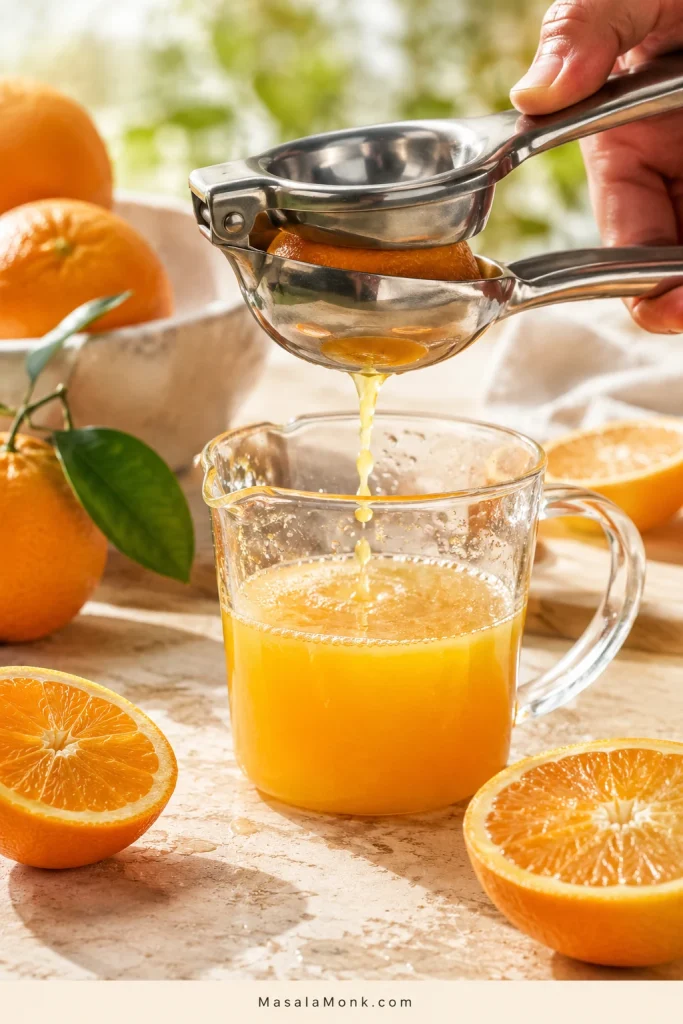
A hand press makes the drink feel especially beach-bar style, but any citrus juicer works. What matters most is measuring the alcohol, filling the glass with enough ice, and adding the bubbles at the end.
Why This Ratio Works
A good Orange Crush is not vodka hidden under orange soda. It is fresh orange juice sharpened with vodka, deepened with orange liqueur, and lifted with bubbles.
Remember the Orange Crush rule: fresh orange carries the drink, orange liqueur deepens it, and soda only lifts it.
The ounce ratio works for one cocktail, while the parts formula works for batching. That way, the Orange Crush stays balanced even when you scale it for guests.
This house ratio starts a little less sweet on purpose. You can always add more soda, but you cannot rescue a sticky glass once it is built.
The 2 oz / 60 ml vodka pour keeps it cocktail-strength, while 3–4 oz / 90–120 ml orange juice gives enough citrus to make the glass taste juicy instead of sharp. For a sweeter crush, add a little more orange liqueur or lemon-lime soda. To make a drier one, reduce the liqueur to ½ oz / 15 ml and use club soda.
Ingredients That Make the Drink Work
Because the cocktail is so simple, there is nowhere for dull juice or flat bubbles to hide. Good oranges and the right topper matter more than expensive bar tools.
Fresh orange juice
Fresh juice gives you that little burst of orange oil and perfume before the glass even reaches your mouth. That is the difference between a bright Orange Crush and a flat vodka-orange drink, and it is what bottled juice never quite gives you. Pulp is fine if you like a fuller texture.
The citrus press does more than save time. It pulls bright juice and aromatic orange oils into the drink, which is why fresh-squeezed orange juice tastes livelier in an Orange Crush.
One juicy orange may be enough for one drink, but plan on 1–2 oranges per cocktail so you are not short. Measure the juice and aim for 3–4 oz / 90–120 ml per glass. If one orange gives you less than 3 oz, squeeze another half.
Navel oranges are easy to find and usually sweet. Valencia oranges are especially juicy. Cara Cara oranges make a softer, sweeter pink-orange drink. Blood oranges also work, but they change the color and add a deeper berry-like edge.
If you bought a bag of oranges and have more citrus than you need for drinks, save a few for this orange marmalade recipe; it uses the same bright flavor in a slower, spoonable way.
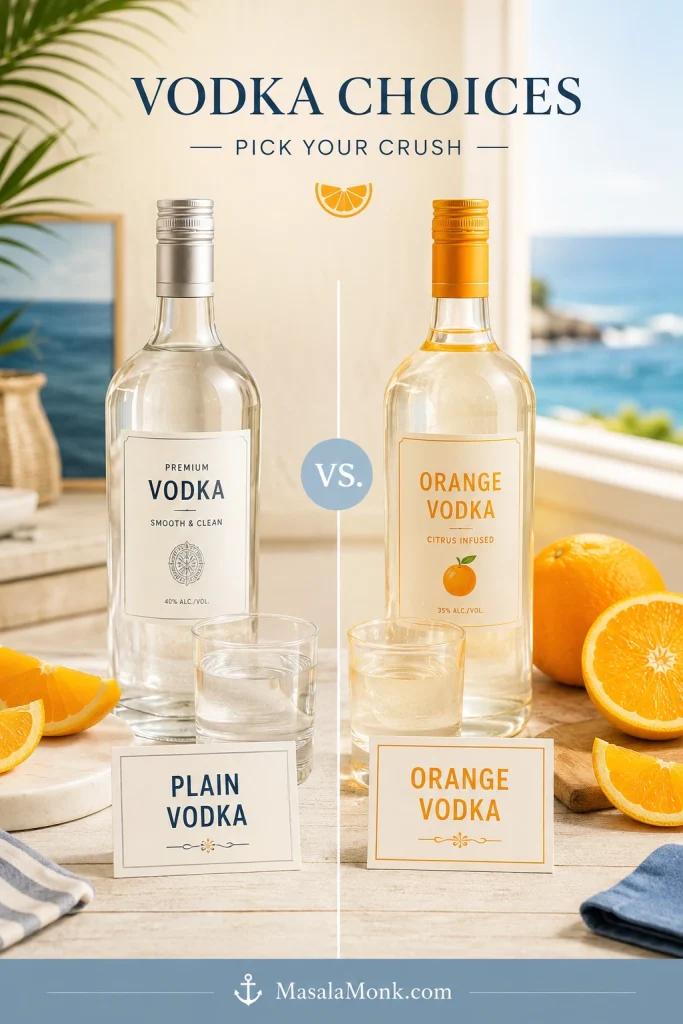
Vodka or orange vodka
You do not need to buy a special bottle for one drink, but the vodka choice does change the mood of the glass. Plain vodka keeps the cocktail clean and citrus-led; orange vodka makes it taste more like the beach drink people remember.
Sweet, fragrant oranges are enough for plain vodka to work beautifully. When the fruit is mild, orange vodka helps the flavor along.
Vodka choice
Best for
What it does
Plain vodka
A cleaner Orange Crush
Lets fresh orange juice stay in front
Orange vodka
Beach drink flavor
Adds stronger orange aroma
Neutral vodka
Easy home mixing
Keeps the drink simple and crowd-friendly
Vanilla or whipped vodka
Dessert-style drink
Can taste creamsicle-like, but turns sweet quickly
Start with plain vodka and good oranges if you are unsure. The second glass can always get louder with orange vodka.
Plain vodka keeps the cocktail cleaner and more citrus-led. However, orange vodka helps when the fruit is mild or when you want a stronger beach-bar orange flavor.
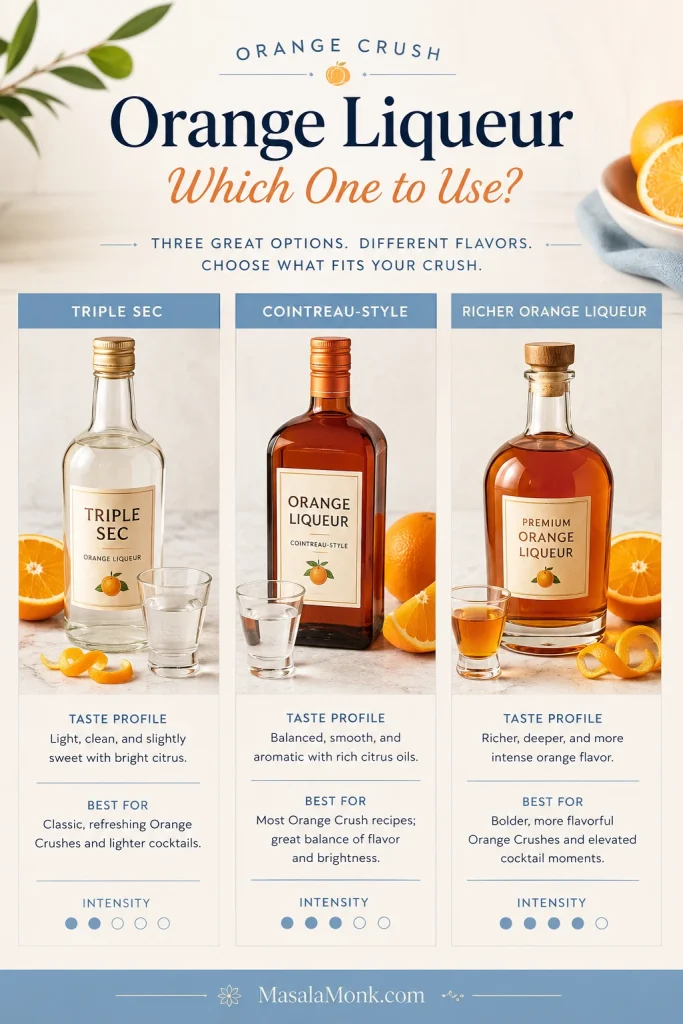
Triple sec or orange liqueur
Orange liqueur is helpful, but it can take over fast. Measure it once, taste the drink, then adjust the next glass.
Triple sec adds sweetness and orange depth. Cointreau gives a cleaner orange flavor. Grand Marnier is richer and heavier, so use it when you want a rounder cocktail rather than the lightest possible glass.
Orange liqueur
Flavor
Best use
Triple sec
Sweet, simple, classic
Standard Orange Crush
Cointreau
Cleaner, stronger orange
Premium but still bright drink
Grand Marnier
Richer, deeper, slightly brandy-like
Rounder cocktail; use lightly
The safest first pour is still 1 oz / 30 ml. Once the drink is in your hand, you will know whether it needs more orange depth or less sweetness.
Orange liqueur should deepen the citrus, not turn the drink sticky. Start with a measured pour, then adjust only if the glass needs more orange flavor after tasting.
If you want another drink where orange liqueur has to stay balanced instead of taking over, this spicy margarita recipe uses that same sweet-citrus logic with lime, tequila, and heat.
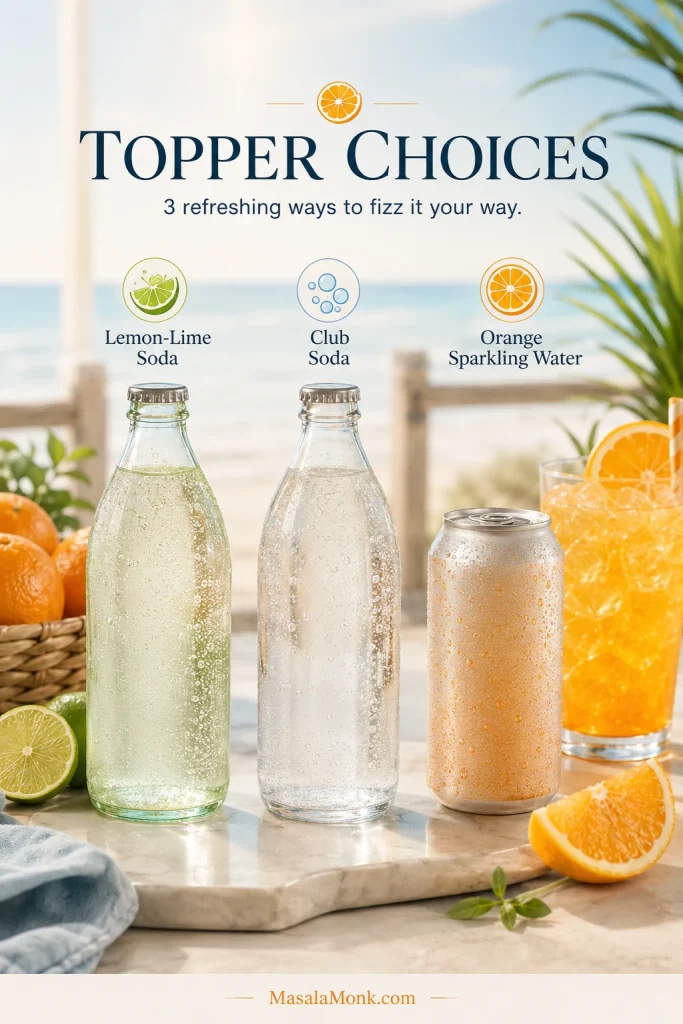
Soda or sparkling water
The topper decides the mood of the glass: classic and sweet, clean and dry, or full-on orange soda. This is where many homemade versions go wrong. Too much sweet fizz, and the fresh orange disappears.
Topper
Result
Use it when
Sprite, 7UP, or lemon-lime soda
Sweet, sparkling, classic
You want the beach-bar drink
Club soda
Dryer and lighter
You want less sugar
Orange sparkling water
Citrusy but not syrupy
You want orange flavor without extra sweetness
Orange soda
Very sweet and candy-like
Use only for a soda-style twist
Start with less topper than you think. You can always add a splash more, but you cannot take sweetness back out.
The topper controls sweetness more than most people expect. Choose lemon-lime soda for a classic Orange Crush, club soda for a drier drink, or orange sparkling water for lighter citrus fizz.
Crushed ice
Crushed ice is part of the drink’s personality. It chills fast, softens the vodka, and gives the glass that loose, beach-bar feel you do not get from a few hard cubes.
Crushed ice gives the cocktail its classic beach-bar texture. It chills the glass quickly, slightly softens the vodka, catches the bubbles, and makes each sip feel lighter.
The easiest home method is also the best one: build the drink right in the glass. It is fast, clean, and keeps the soda lively.
The best method is simple: juice, build, stir, fizz, garnish. Most importantly, stir the base before adding soda so the final Orange Crush stays cold and lively.
Juice first. Squeeze the oranges right before mixing if you can.
Ice the glass. Fill the glass with crushed ice, not just a few cubes.
Add the base. Pour in vodka, triple sec, and orange juice.
Stir briefly. You want the base cold and even, not overworked.
Add fizz last. Top with soda or sparkling water.
Serve immediately. The drink is best before the bubbles fade and the ice melts.
Once the soda goes in, the drink is alive for a short window. The best sip is the first one: cold glass, sharp ice, orange aroma, and bubbles still lifting the citrus.
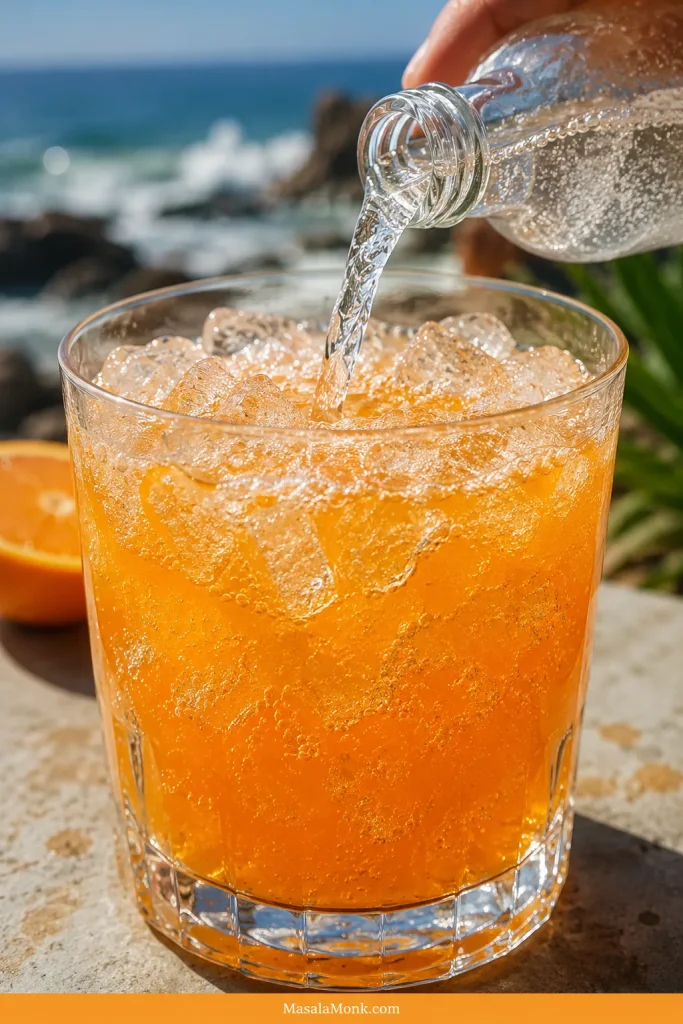
Add Soda Last for Better Fizz
Pour the soda after the orange-vodka base is mixed and chilled. That small delay protects the bubbles, so the Orange Crush tastes freshly built instead of dull by the time it reaches the table.
If you prefer a colder, slightly frothier drink, shake only the vodka, orange liqueur, and orange juice with ice for 10–15 seconds. Pour over crushed ice, then add the soda. Do not shake carbonated soda.
Fresh Orange Juice vs Bottled Orange Juice
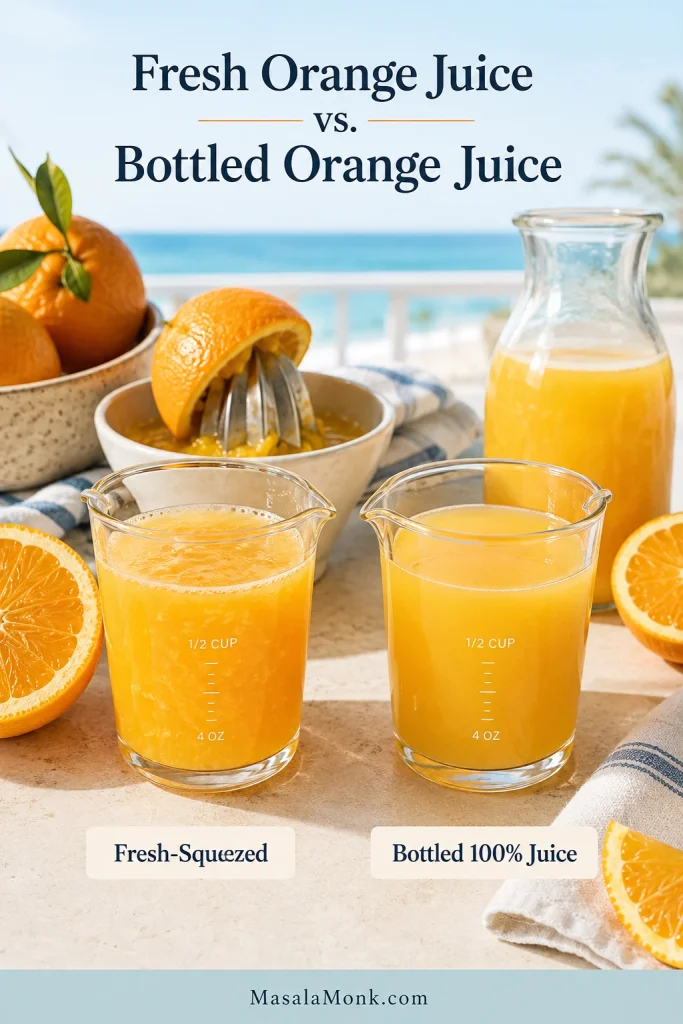
Fresh orange juice gives the drink its best aroma. You smell the orange before the first sip, and the cocktail tastes juicy instead of flat. Bottled juice can make a decent quick drink, but it will not give the same just-cut orange aroma.
Choose chilled 100% orange juice with no added sugar if you use bottled juice. Club soda is usually the better topper there, because it keeps the glass from turning too sweet.
Fresh juice is best for one or two glasses because it brings brighter aroma and texture. For a larger pitcher, bottled 100% orange juice can help, but keep it well chilled.
When making one or two drinks, squeeze the oranges. In a large party pitcher, bottled juice can be practical, but just-squeezed citrus still gives the best flavor.
Beach-Bar Style Orange Crush
For an Ocean City-style Orange Crush, use orange vodka, fresh-squeezed orange juice, triple sec, lemon-lime soda, and a full glass of crushed ice. Build it fast, keep it cold, and serve it while the fizz is still lively.
A Mid-Atlantic-style Orange Crush should feel cold, casual, and fast-built. Look for fresh orange aroma, a full glass of crushed ice, and just enough fizz to keep it refreshing.
Beach-bar style is about cues, not fussy technique: orange scent first, crushed ice to the top, fizz added last, and enough soda to lift the drink without turning it into candy.
Orange smell first: fresh juice is doing its job.
Crushed ice to the top: the texture should feel cold, casual, and fast-melting.
Bubbles added last: the drink stays lively.
Orange vodka optional: use it for stronger coastal-bar flavor.
Not too much soda: the glass should still taste like orange, not candy.
The Easy Parts Formula
Once that ratio makes sense, you can scale the drink without doing bar math every time.
2 parts vodka + 1 part orange liqueur + 3–4 parts fresh orange juice + 2–3 parts soda.
For one drink, 1 part can be 1 oz. When batching, 1 part can be 1 cup. Use a smaller “part” for one drink and a larger “part” for a pitcher, but keep the soda separate until serving so the drink stays fizzy.
Pitcher Recipe
A pitcher should make hosting easier, not give everyone a flat drink. Mix the vodka, orange liqueur, and orange juice ahead. The pitcher should sit cold in the fridge; the fizz should happen in the glass.
Orange Crush Pitcher Amounts
Servings
Vodka
Triple sec
Fresh orange juice
Soda to add at serving
1
2 oz / 60 ml
1 oz / 30 ml
3–4 oz / 90–120 ml
2–3 oz / 60–90 ml
4
8 oz / 240 ml
4 oz / 120 ml
12–16 oz / 360–480 ml
8–12 oz / 240–360 ml
6
12 oz / 360 ml
6 oz / 180 ml
18–24 oz / 540–720 ml
12–18 oz / 360–540 ml
8
16 oz / 480 ml
8 oz / 240 ml
24–32 oz / 720–960 ml
16–24 oz / 480–720 ml
Keep the Pitcher Fizzy
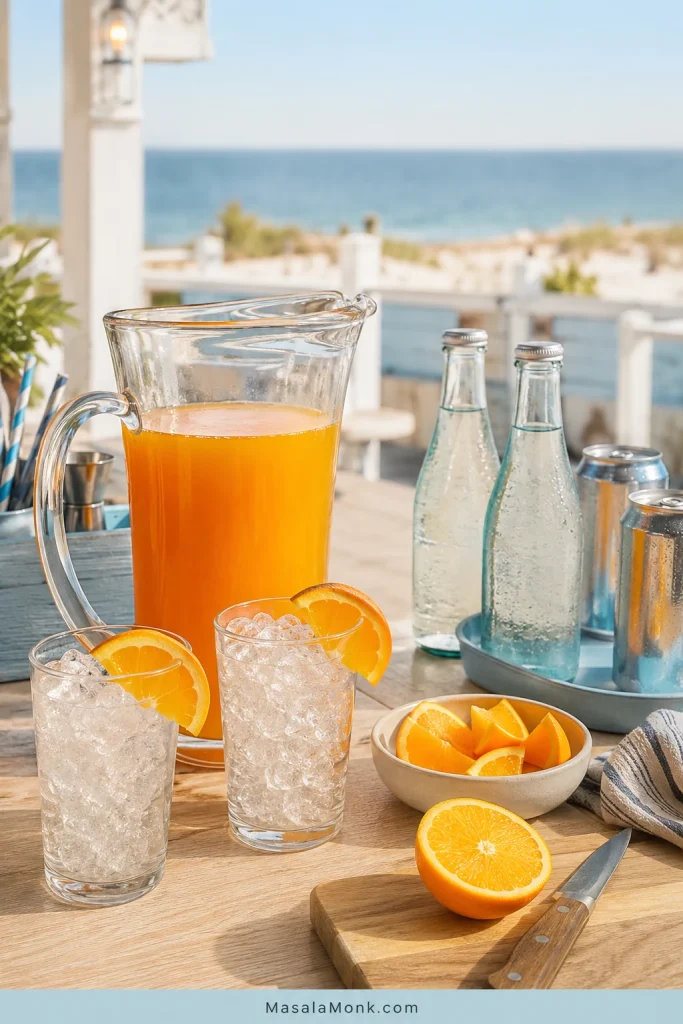
Best party setup: Chill the orange-vodka base in a pitcher, then set out crushed ice, orange wedges, lemon-lime soda, and club soda so guests can finish each glass sweeter or drier.
A pitcher works best when only the orange-vodka base is made ahead. Then the soda and crushed ice stay fresh for each glass instead of fading in the pitcher.
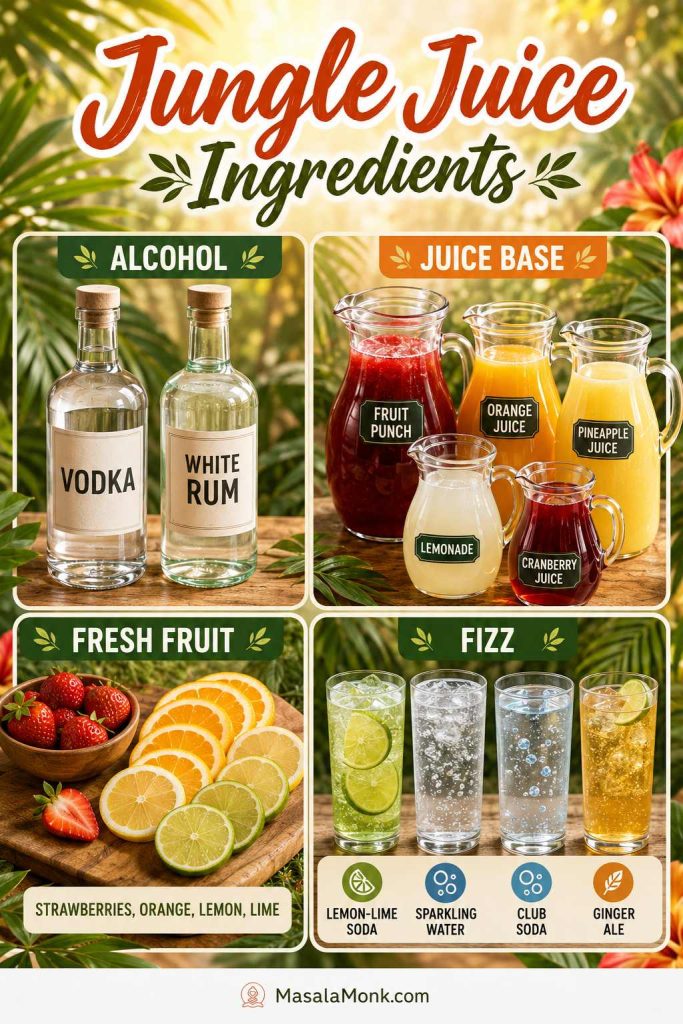
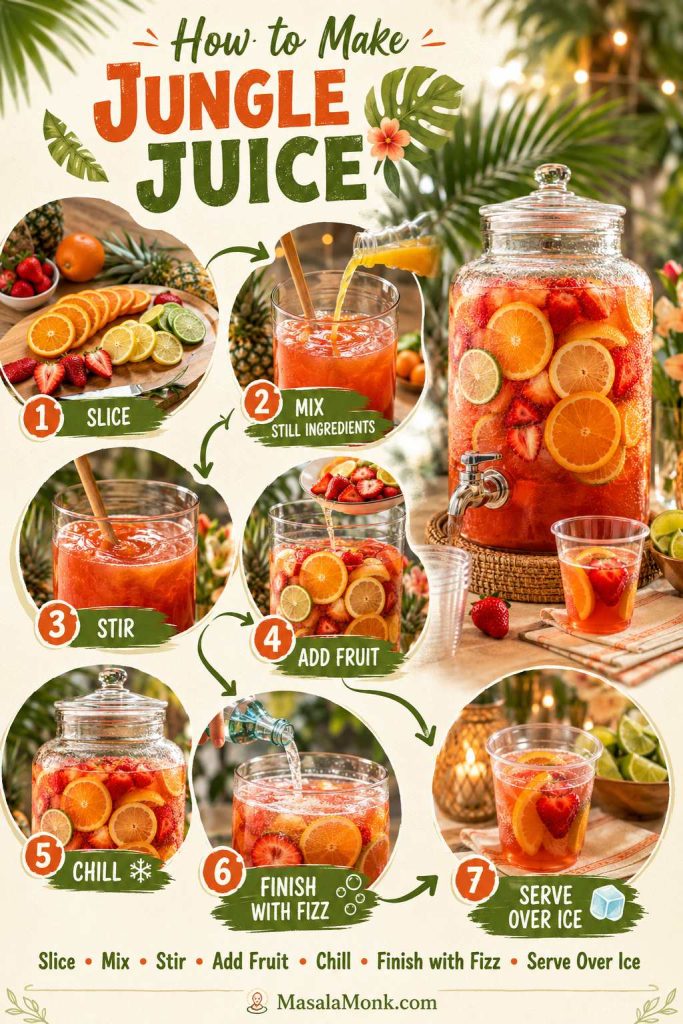
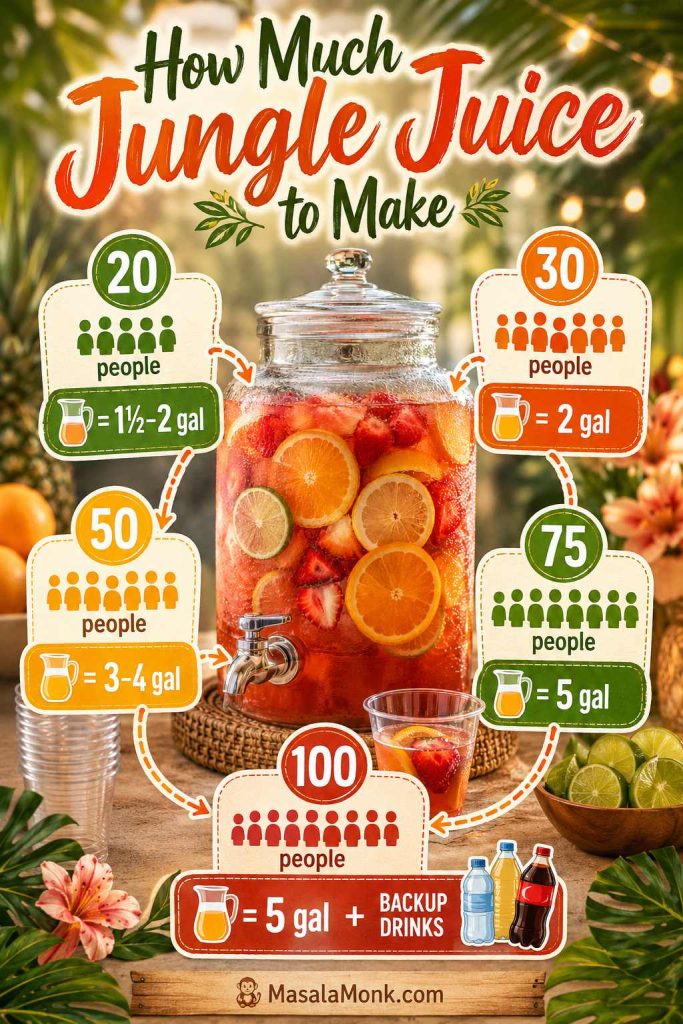
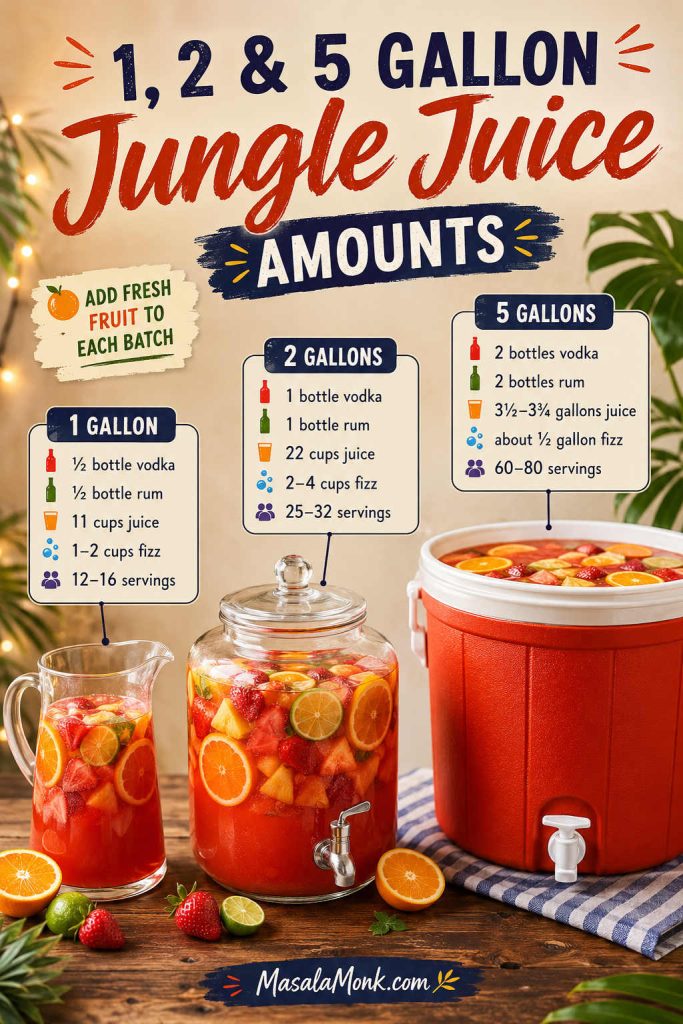
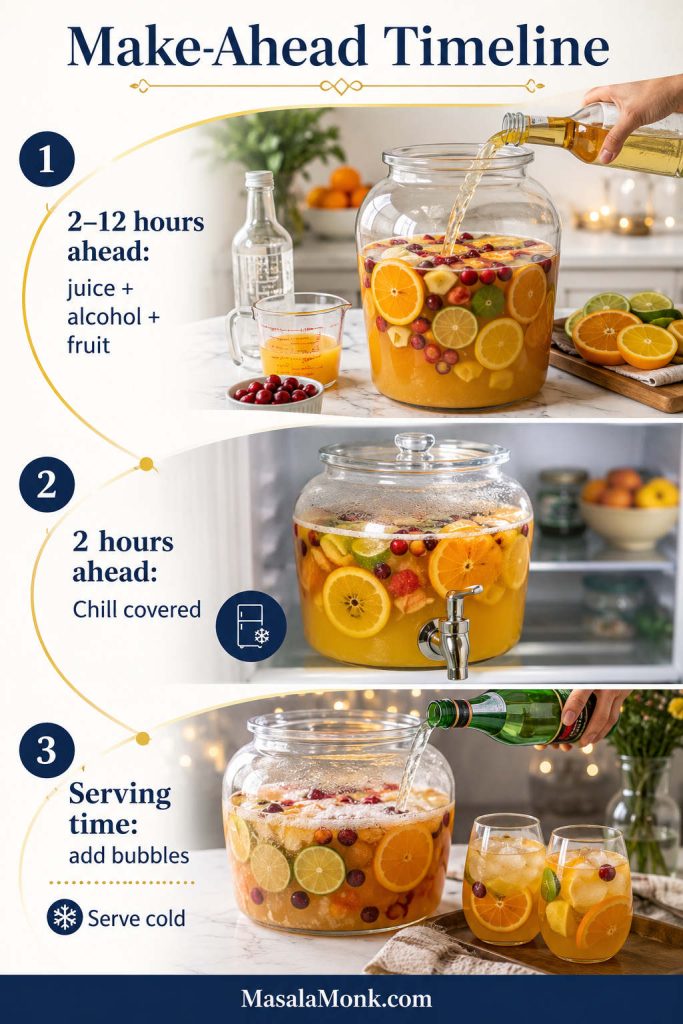
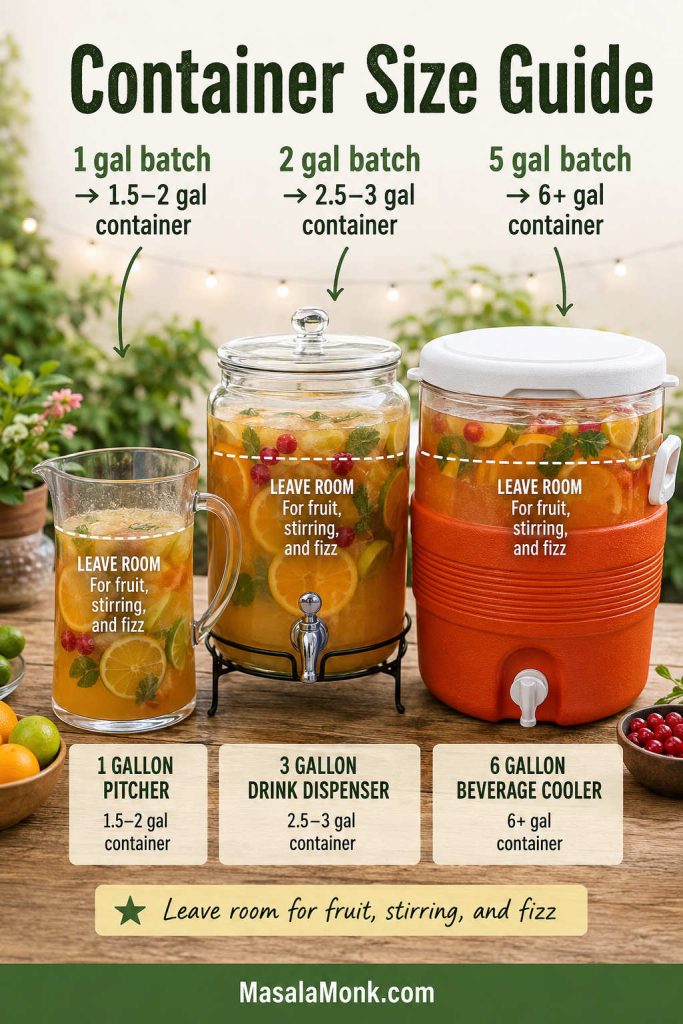
Keep the base cold and let guests finish their own glasses; that way every pour still has fresh fizz instead of tasting like it waited around. For bigger party math, this jungle juice recipe has 1, 2, and 5 gallon guidance, including the same useful rule: add fizzy mixers near serving time.
Just-squeezed juice is still best for pitchers. Bottled juice can help when you need volume, but choose a good chilled 100% orange juice and use club soda or a lighter hand with the lemon-lime soda.
For a lighter pitcher, use the lower end of the vodka range or let guests top each glass with extra club soda. Serve pitcher drinks responsibly, especially because orange juice and soda can make the cocktail taste lighter than it is.
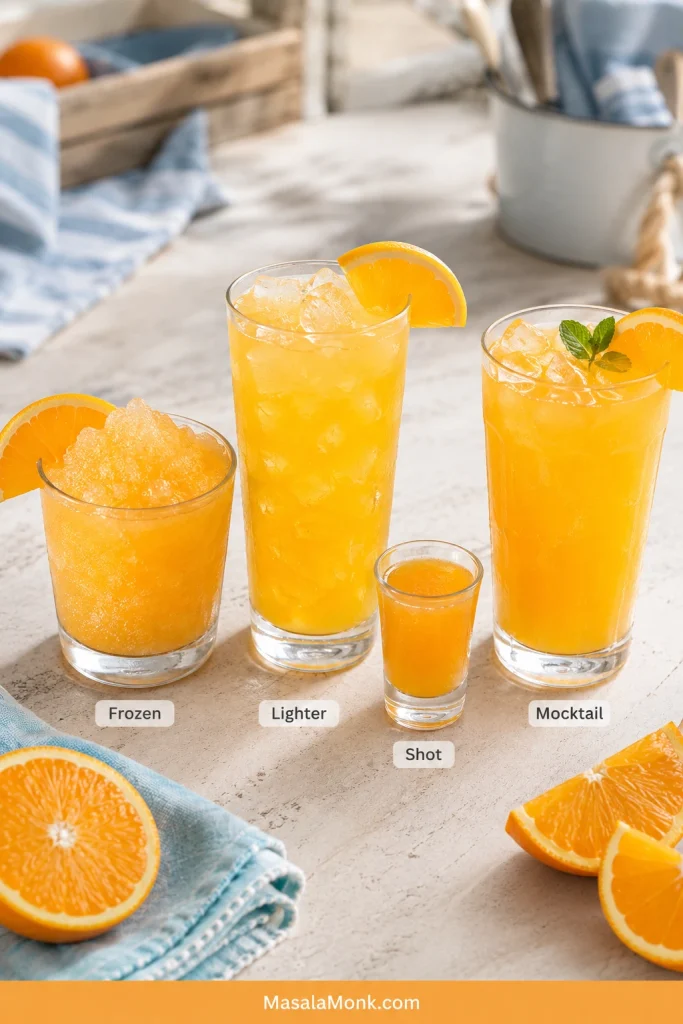
Variations: Frozen, Lighter, Shot, and Mocktail
Once the classic glass tastes right, the variations are just small turns of the same dial: colder, lighter, stronger, or alcohol-free.
Once the classic version tastes right, the same fresh-orange base can become frozen, lighter, stronger, or alcohol-free. Still, each version should keep the citrus flavor in front.
Frozen Orange Crush
Blend 4 oz / 120 ml fresh orange juice, 2 oz / 60 ml vodka, 1 oz / 30 ml triple sec, and 1 to 1¼ cups crushed ice, about 120–150 g, until slushy. If your oranges are tart, add ½ oz / 15 ml simple syrup. Pour into a cold glass and finish with a small splash of soda.
Add soda after blending, not before. Too much soda in the blender loses its fizz and can foam up.
If you like frozen cocktails but hate icy, watery texture, this frozen strawberry daiquiri recipe goes deeper into blender balance, fruit body, and slushy texture.
Lighter Orange Crush
For a lighter, skinny-style drink, use plain vodka, reduce triple sec to ½ oz / 15 ml if needed, and top with club soda or orange sparkling water instead of lemon-lime soda. Keep the orange juice at 3–4 oz / 90–120 ml so the drink still tastes full.
Orange Crush Shot
Shake 1 oz vodka or orange vodka, ¼ oz triple sec, and ¾ oz fresh orange juice with ice. Strain into one large shot glass, or split between two smaller shot glasses. Add only a tiny splash of soda if you want fizz.
This keeps the shot in the same fresh-orange family as the cocktail instead of turning it into a candy-style party drink.
Orange Crush Mocktail
Combine 4 oz / 120 ml fresh orange juice, ½ oz / 15 ml lemon or lime juice, crushed ice, and 2–3 oz / 60–90 ml lemon-lime soda, club soda, or orange sparkling water. For a sweeter mocktail, add a little orange simple syrup. To keep it cleaner, use club soda and a little orange zest.
The mocktail should still taste like fresh orange with bubbles, not just a glass of orange soda.
For more light, refreshing drinks that do not feel heavy, this guide to coconut water cocktails has easy ideas that sit closer to the clean, cooling side of the drinks table.
Maryland, Ocean City, and Delaware
The Orange Crush belongs to Mid-Atlantic beach culture: Ocean City bars, crushed ice, fresh-squeezed juice, seafood tables, and a friendly Maryland-Delaware argument over who gets to claim it.
It has beach-bar DNA. This is not meant to be slow or precious. The drink is a fast-built glass: fresh orange squeezed in, vodka or orange vodka, orange liqueur, crushed ice, and lemon-lime fizz.
That regional pride is part of why the drink has stayed so specific. Fresh-squeezed orange, orange liqueur, cold ice, and a quick build are the identity.
Maryland’s official state-symbol page lists the Original Maryland Orange Crush as its state cocktail, and Delaware’s General Assembly page records HB 444 designating the Orange Crush as Delaware’s state cocktail. You can read those official notes from the Maryland State Archives and the Delaware General Assembly.
Orange Crush vs Screwdriver vs Mimosa
These three drinks all use orange juice, but they serve different moments.
A Screwdriver is the simplest vodka-orange drink. Make a Mimosa when you want a wine-based brunch drink. Choose an Orange Crush when you want fresh orange juice, vodka, orange liqueur, fizz, and crushed ice in one bright summer glass.
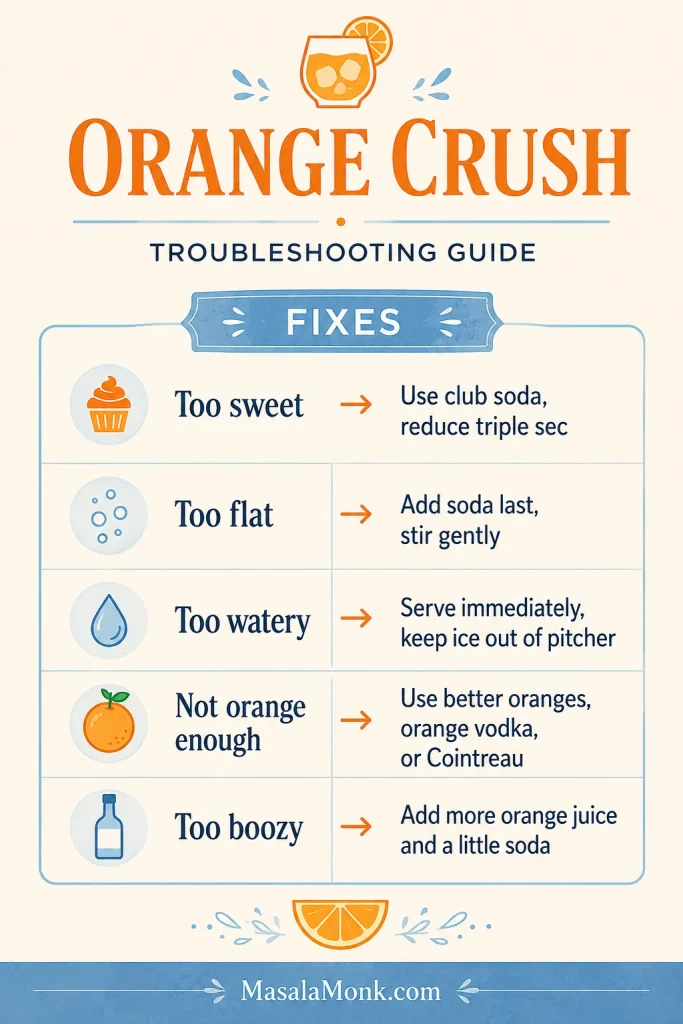
Fixes for a Drink That’s Too Sweet, Flat, or Watery
If the drink misses, it usually misses in one of a few predictable ways: too sweet, too flat, too watery, or not orange enough. Fix the glass before you start over.
When an Orange Crush tastes off, adjust the cause instead of adding more of everything. Sweetness, flatness, watery texture, weak orange flavor, and harsh booze each need a different fix.
Problem
What happened
Fix
Too sweet
Too much lemon-lime soda or orange liqueur
Use club soda and reduce triple sec to ½ oz / 15 ml
Too weak
Too much soda or juice
Use less soda or add ½ oz / 15 ml more vodka
Too boozy
Alcohol is louder than the orange
Add more fresh orange juice and a little more soda
Too flat
Soda was added early or stirred too hard
Add soda last and stir gently
Too watery
The drink sat too long over crushed ice
Serve immediately and do not make finished drinks ahead
Not orange enough
Mild oranges or plain vodka
Use orange vodka, better oranges, or Cointreau
Too bitter
Pith got into the juice
Juice gently and avoid crushing the white pith
The fastest rescue: add more orange juice if it tastes too boozy, club soda if it tastes too sweet, or a small splash of orange liqueur if it tastes thin.
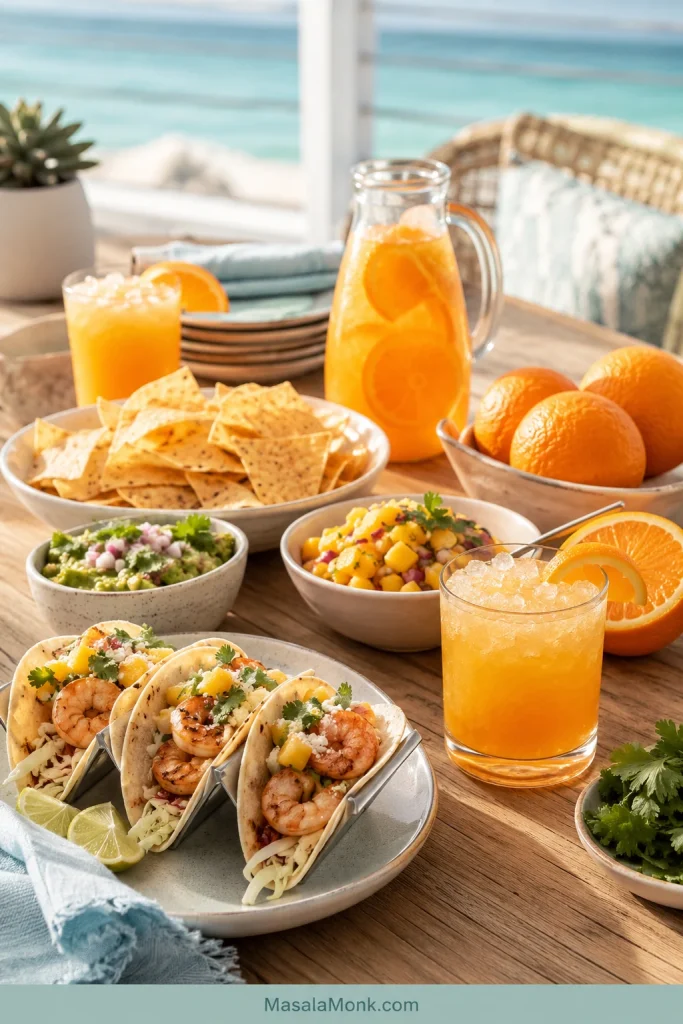
Think salty, spicy, grilled, and creamy. Orange Crush cocktails have enough sweetness to soften heat, enough citrus to cut through richness, and enough bubbles to keep snack food from feeling heavy. For a full summer-style plate, shrimp tacos with slaw and creamy cilantro-lime sauce are an easy pairing because the citrusy drink cuts through the creamy sauce and warm spices.
This cocktail works well with salty, spicy, grilled, and creamy foods because citrus and bubbles cut through richness. Pair it with shrimp tacos, chips, salsa, guacamole, or seafood snacks.
Grilled shrimp, fish, or chicken
Tacos, nachos, or quesadillas
Crab cakes or seafood snacks
Salty chips, pretzels, and party mixes
Spicy appetizers
Fruit, cheese, and brunch boards
Guacamole or creamy dips for a rich contrast
If you are keeping the food snackier, a bowl of fresh mango salsa works with chips, tacos, fish, shrimp, and grilled chicken. For a sharper citrus cocktail at the same table, the Lemon Drop Martini brings more tartness, while the Orange Crush stays tall, juicy, and easygoing.
Make-Ahead Tips for Parties
An Orange Crush is best made right before serving, but you can prepare the parts ahead.
Party prep is easier when the parts are ready but unfinished. Keep the base, ice, soda, glasses, and garnish separate, then build each Orange Crush to order.
Fresh orange juice: Juice a few hours ahead and keep chilled.
Pitcher base: Mix vodka, triple sec, and orange juice ahead, then refrigerate.
Soda: Add only when serving.
Crushed ice: Add to glasses, not the pitcher.
Finished cocktail: Do not store it. The soda goes flat and the ice waters it down.
If serving a group, keep the chilled base in a pitcher and let guests top their own glasses. That keeps every drink cold, sparkling, and adjustable.
FAQs
What alcohol is in an Orange Crush?
An Orange Crush usually contains vodka or orange vodka plus triple sec or another orange liqueur. It also includes fresh orange juice, soda, and crushed ice.
Is an Orange Crush the same as a Screwdriver?
No. A Screwdriver is vodka and orange juice. An Orange Crush adds orange liqueur, soda, and crushed ice, which makes it more sparkling and layered.
Is an Orange Crush made with Orange Crush soda?
The classic cocktail is usually made with fresh orange juice, vodka or orange vodka, orange liqueur, and lemon-lime soda or club soda. Orange Crush soda can make a sweeter twist, but it tastes more like candy orange and less like the fresh beach drink.
Fresh orange juice or bottled orange juice — which is better?
For one or two drinks, fresh-squeezed juice is best because you can taste the difference: brighter aroma, cleaner citrus, and less boxed sweetness. Bottled 100% orange juice can work for speed or pitchers, especially if it is well chilled.
Can you make it with regular vodka?
Yes. Regular vodka works well, especially with fresh orange juice. Orange vodka gives a stronger beach-bar orange flavor, but it is not required.
Do you need triple sec?
Triple sec is strongly recommended because it gives the drink orange depth, not just sweetness. Cointreau makes the flavor cleaner, while Grand Marnier makes it richer.
Sprite or club soda — which should you use?
Lemon-lime soda such as Sprite or 7UP gives the classic sweet finish. Club soda makes the drink drier, cleaner, and less sugary. Orange sparkling water sits between the two.
How do you make an Orange Crush less sweet?
Use club soda or orange sparkling water instead of lemon-lime soda, and reduce the triple sec to ½ oz / 15 ml. Keep enough fresh orange juice so the drink still tastes full.
How strong is an Orange Crush?
With 2 oz vodka and 1 oz orange liqueur, an Orange Crush is a real cocktail, not a low-alcohol spritz. The fresh juice and bubbles make it easy to sip, so use 1½ oz vodka or extra club soda if you want a lighter glass.
How many oranges do you need for one drink?
One juicy orange may be enough, but plan on 1–2 oranges per drink so you are not short. Measure the juice and aim for 3–4 oz / 90–120 ml per cocktail.
What makes it a Maryland or Ocean City Orange Crush?
The Ocean City-style identity comes from fresh-squeezed orange juice, vodka or orange vodka, triple sec, lemon-lime soda, and crushed ice. Maryland beach bars helped make it famous, and Delaware beach towns keep the same drink close to their own summer culture.
Is this the same as Orange Crush soda cake?
No. This recipe is for the fresh orange vodka cocktail. Orange Crush soda cake is a separate dessert usually made with orange soda and cake mix or cake batter.
Make the first glass classic. Use fresh orange juice, vodka, triple sec, lemon-lime soda, and enough crushed ice to make the glass properly cold. Then taste and adjust from there.
A sweeter Orange Crush, a drier one, a pitcher, frozen drink, or mocktail all come from the same simple rule: let the orange lead, keep the bubbles lively, and serve it before the ice wins.
Try the classic glass first, then tell us which version became yours: sweeter, drier, stronger, or alcohol-free.
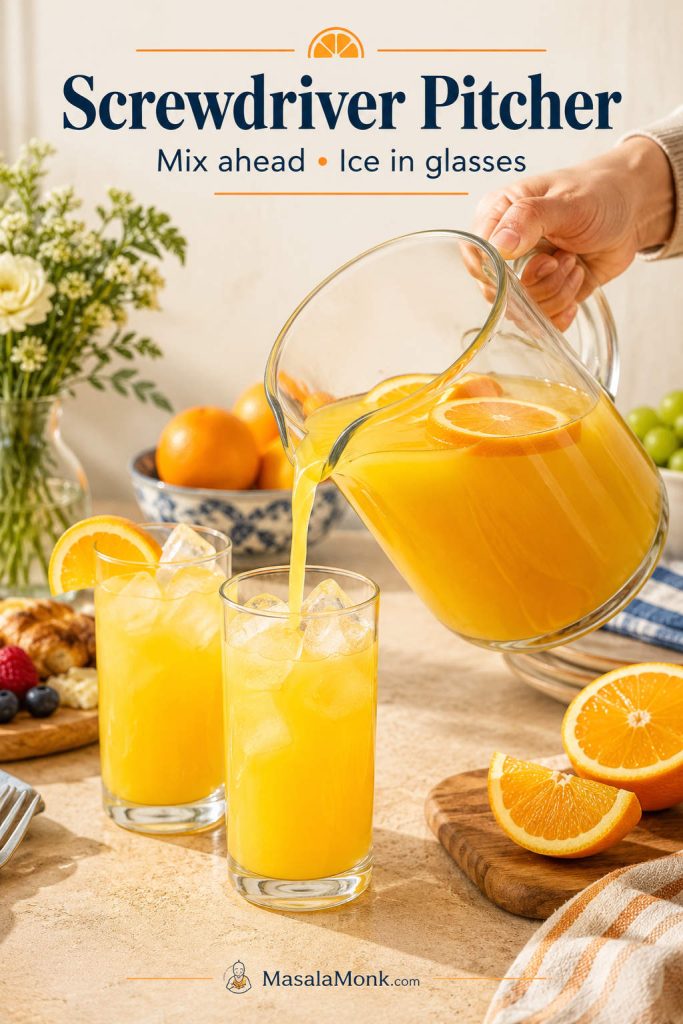
A screwdriver is only vodka and orange juice, which is exactly why the ratio matters. Too little juice and the vodka takes over. Too much juice, and it stops feeling like a cocktail at all. This screwdriver recipe keeps that simple balance clear: cold juice, enough ice, and the right pour, so the same two ingredients taste fresh, smooth, and properly mixed.
This screwdriver recipe gives you the classic vodka and orange juice cocktail first, then shows you how to adjust it for a stronger glass, a lighter brunch pour, or a pitcher for guests. You do not need syrup, liqueur, or a full home bar. You just need clean vodka, chilled orange juice, plenty of ice, and a ratio that fits the moment.
It is the kind of drink people make when they want something familiar, cold, and easy without turning the kitchen into a bar.
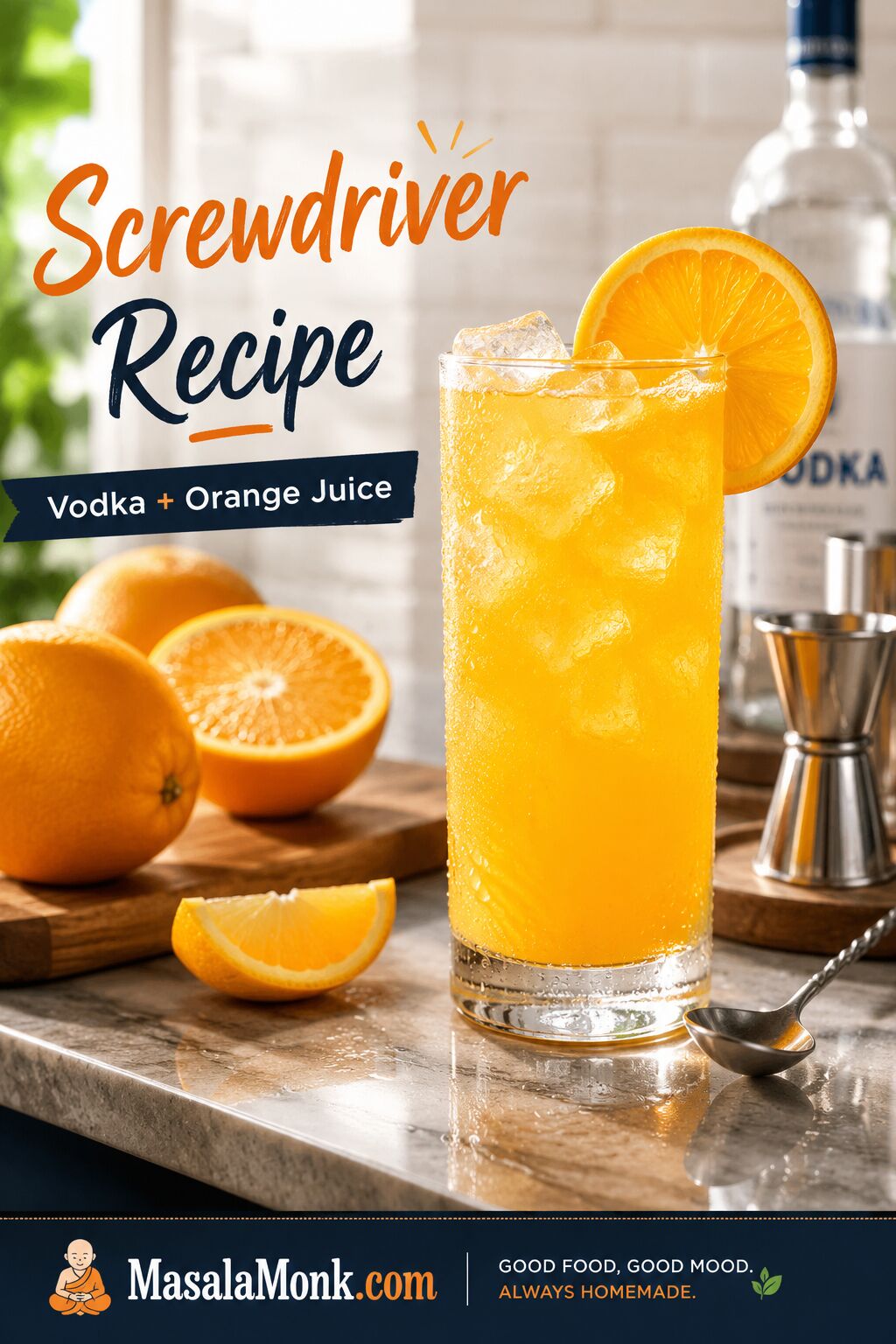
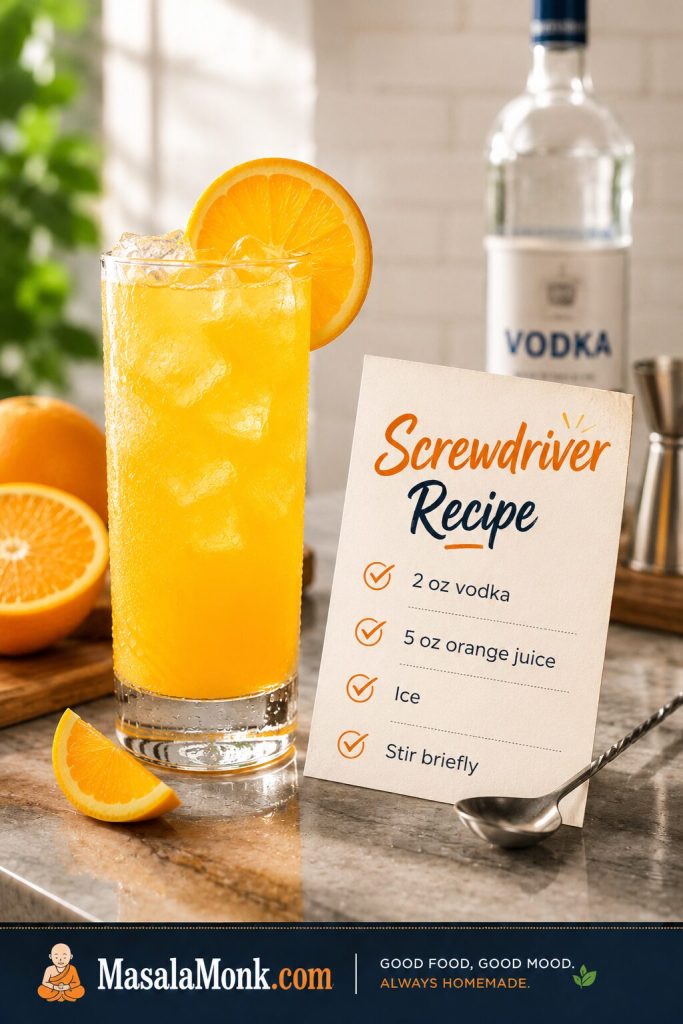
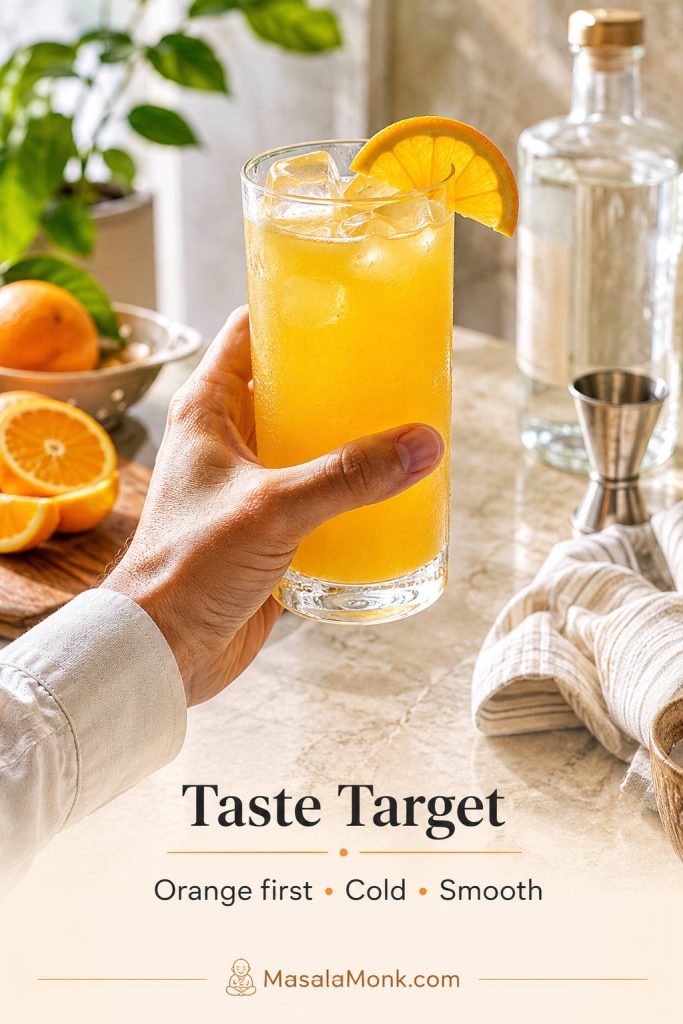
Vodka and orange juice is called a Screwdriver. Start with 2 oz / 60 ml vodka and 5 oz / 150 ml orange juice. The finished glass should smell like orange first, feel properly cold, and leave the vodka in the background rather than in charge.
Quick Answer: What Is Vodka and Orange Juice Called?
Vodka and orange juice is called a Screwdriver. The simple version is vodka and orange juice over ice, usually served in a highball or Collins glass with an optional orange slice, wedge, or wheel.
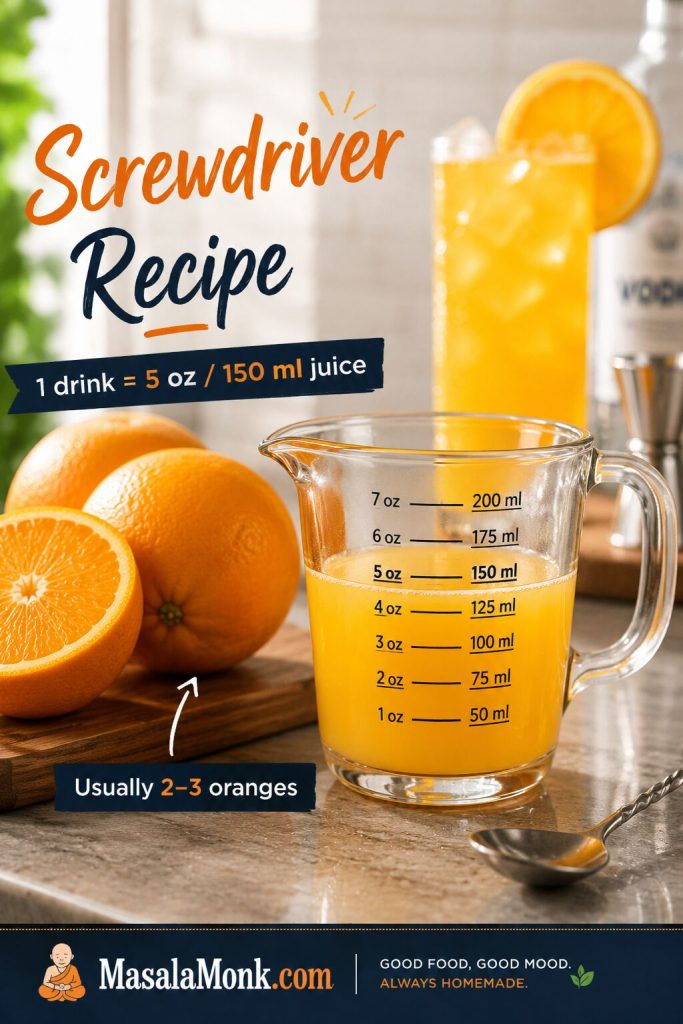
The easiest screwdriver ratio to start with is 1 part vodka to 2–3 parts orange juice. For one balanced drink, use 2 oz / 60 ml vodka and 5 oz / 150 ml orange juice. Build it directly in the glass and give it a brief stir.
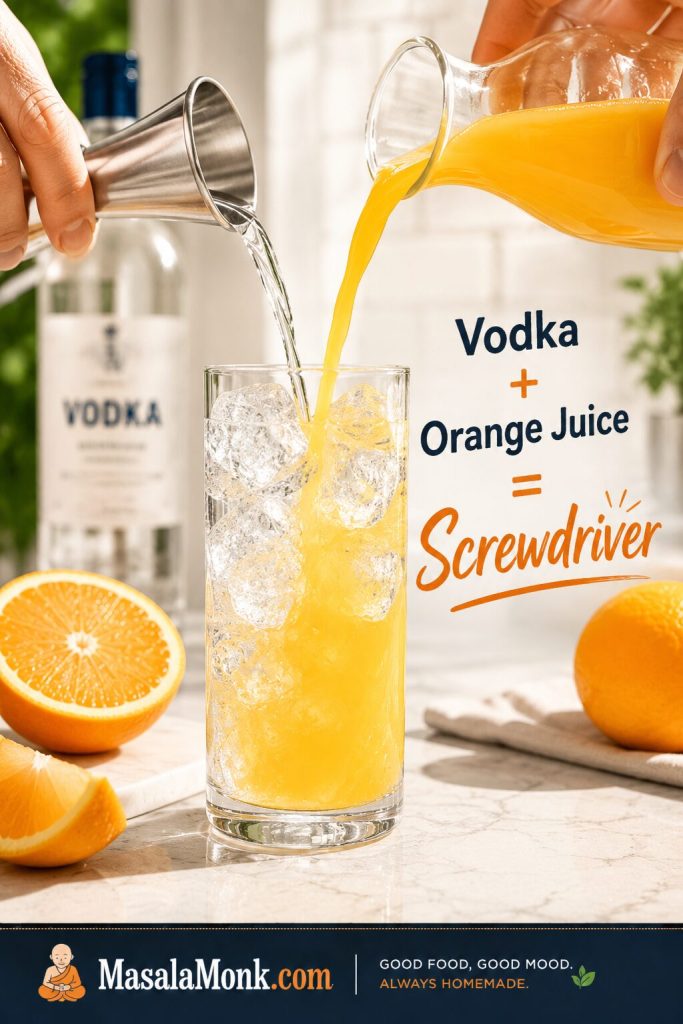
Vodka and orange juice becomes a Screwdriver when it is poured over ice, which is why the drink works best as a simple cold highball.
Make One Now
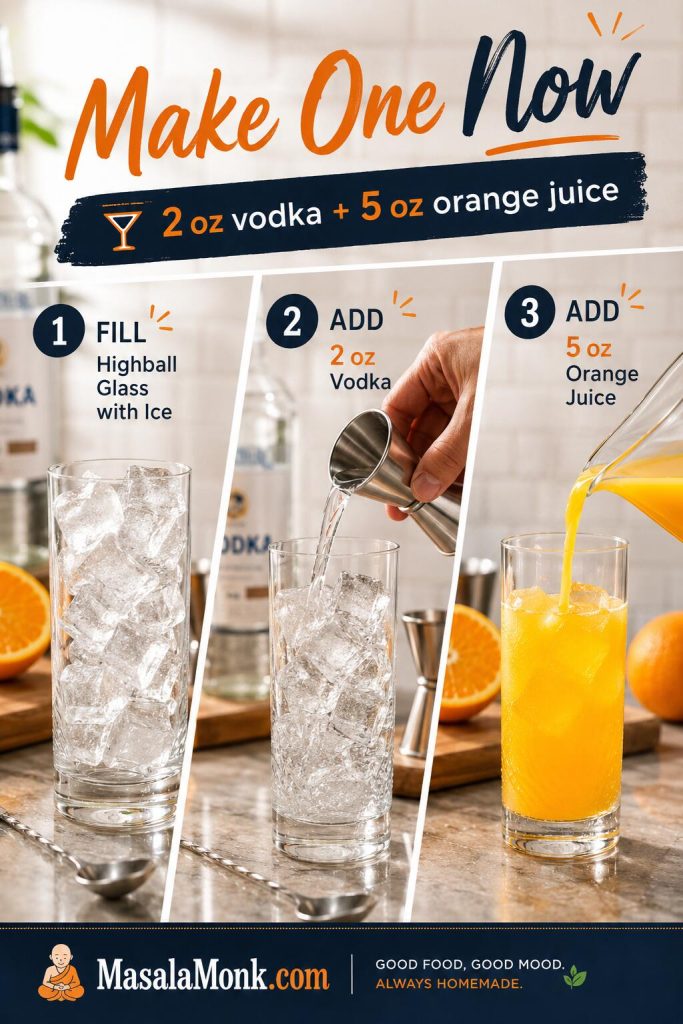
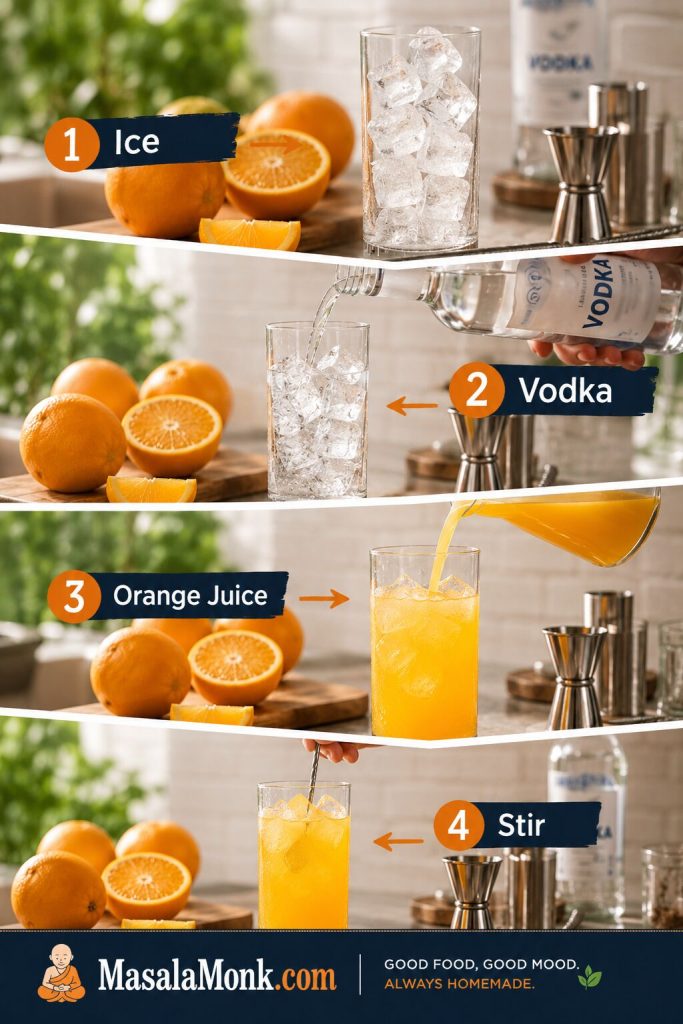
Fill a tall glass with ice. Add 2 oz / 60 ml vodka and 5 oz / 150 ml chilled orange juice. Stir just until combined, garnish with orange if you like, and serve right away.
When you want one drink quickly, 2 oz vodka and 5 oz chilled orange juice gives you a reliable starting point before you fine-tune the strength.
This is the balanced version: cold vodka, chilled orange juice, plenty of ice, and a simple orange garnish.
Prep time5 minutes
Cook time0 minutes
Total time5 minutes
Servings1
Yield1 cocktail
MethodBuilt in glass
Glass: highball or Collins glass Ratio: 2 oz / 60 ml vodka to 5 oz / 150 ml orange juice Method: build over ice and stir briefly
Think of this as the base pour: once it tastes right in one glass, it becomes much easier to scale, lighten, or serve for guests.
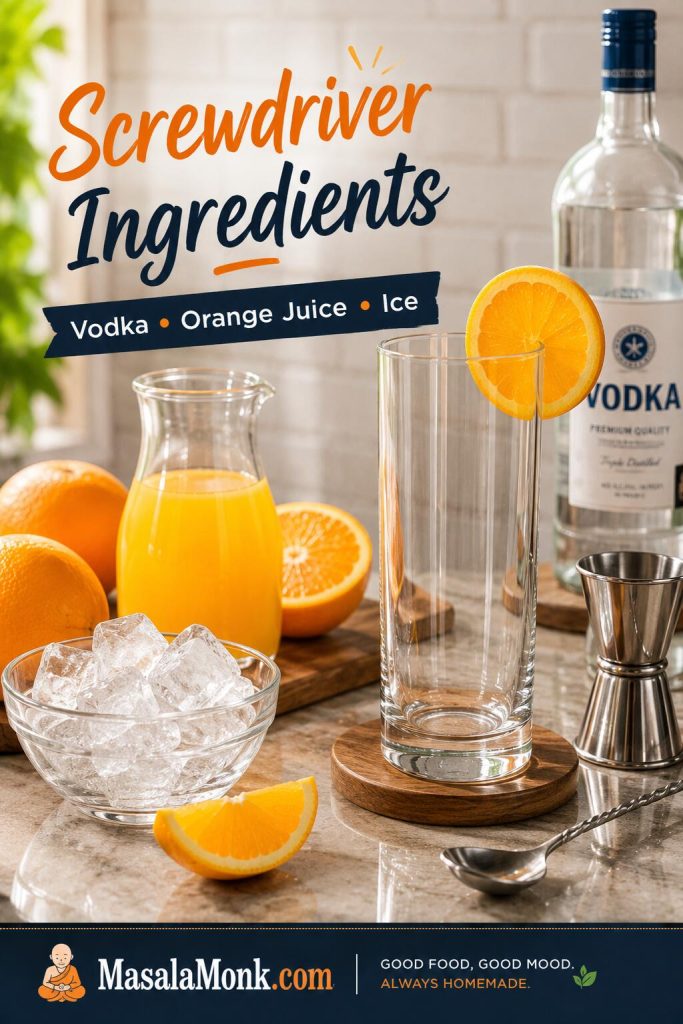
Ingredients
2 oz / 60 ml vodka
5 oz / 150 ml orange juice, chilled
Ice, enough to fill the glass
Orange wedge, wheel, or slice, optional
Instructions
Fill a highball or Collins glass with ice.
Pour in the vodka.
Add the chilled orange juice.
Stir for 5–10 seconds, just enough to chill and combine. Do not churn it aggressively.
Garnish with orange and serve immediately.
Notes
For a stronger screwdriver, use 4 oz / 120 ml orange juice.
For a lighter screwdriver, use 6 oz / 180 ml orange juice.
If the first sip tastes sharp, add another ounce or two of orange juice.
Fresh orange juice tastes brightest, but chilled 100% bottled orange juice works well when you need speed or consistency.
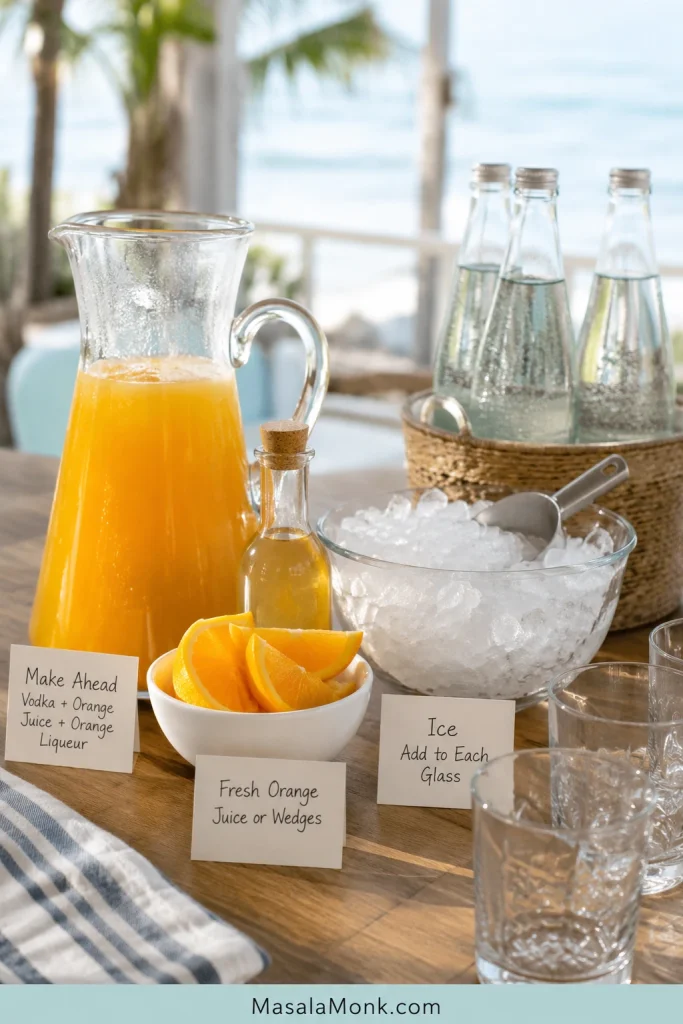
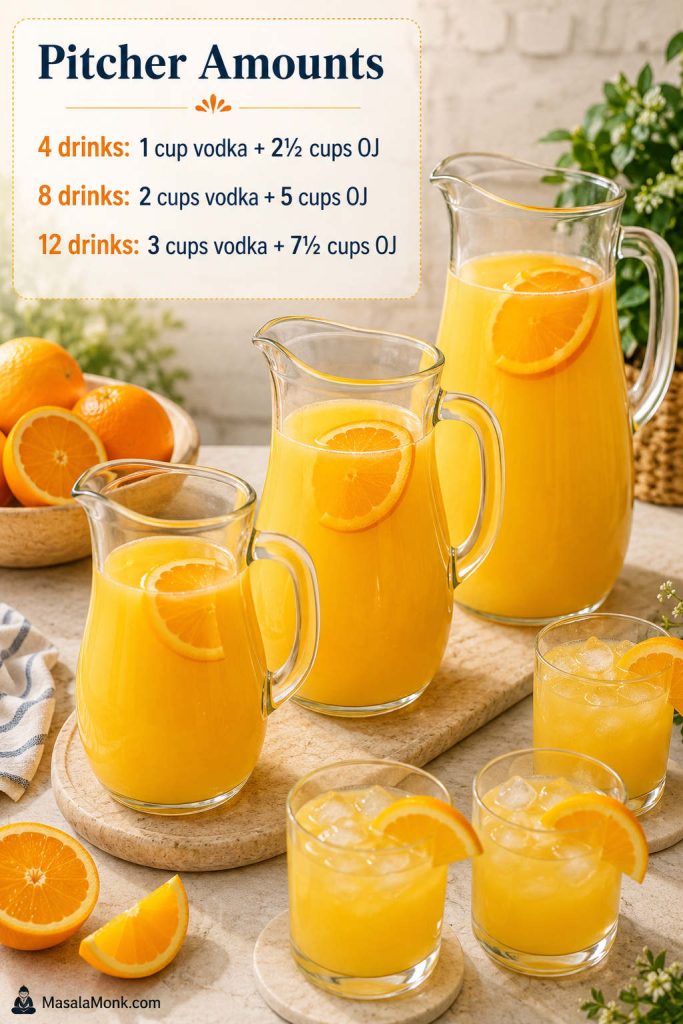
For pitchers, mix vodka and orange juice ahead, but add ice to individual glasses. Making more than one? Use the pitcher amounts.
If your glass already tastes right, you can stop there. But if the first sip is too sharp, too flat, too sweet, or too much like plain orange juice, the rest of this guide shows you how to adjust the pour, choose better juice, batch it for guests, or turn it into a variation.
From here, the best version depends on the glass you want: stronger, lighter, fresher, easier to batch, or more playful.
What Is a Screwdriver Drink?
A screwdriver works because orange juice does most of the flavor work while vodka gives the drink structure. That is why temperature, ice, and ratio matter more than complicated technique.
In the UK, many people simply call the same drink “vodka and orange.”
That simplicity is the charm. A good one should taste orange first, with the vodka supporting it. A weak one tastes watery; a badly balanced one tastes like orange juice with a rough spirit edge. The ratio fixes both problems.
If you like simple vodka cocktails, this sits in the same easy-mixing world as a crisp Moscow Mule or a citrusy vodka with lemon. The screwdriver is even simpler because the orange juice does most of the work.
Screwdriver Ingredients
You only need a few ingredients, so keep them cold and choose them well. This is not a drink that rewards overthinking, but it does reward balance.
Because a Screwdriver has only a few ingredients, vodka, orange juice, and ice each matter more than they would in a more complicated cocktail.
Vodka
Because orange juice is the only real mixer here, choose a vodka that tastes clean rather than one you need to hide. You do not need an expensive bottle, but avoid anything very harsh.
Plain vodka keeps the drink simple. Citrus vodka can push the orange flavor forward, while vanilla or whipped cream vodka turns the drink toward orange cream.
Orange Juice
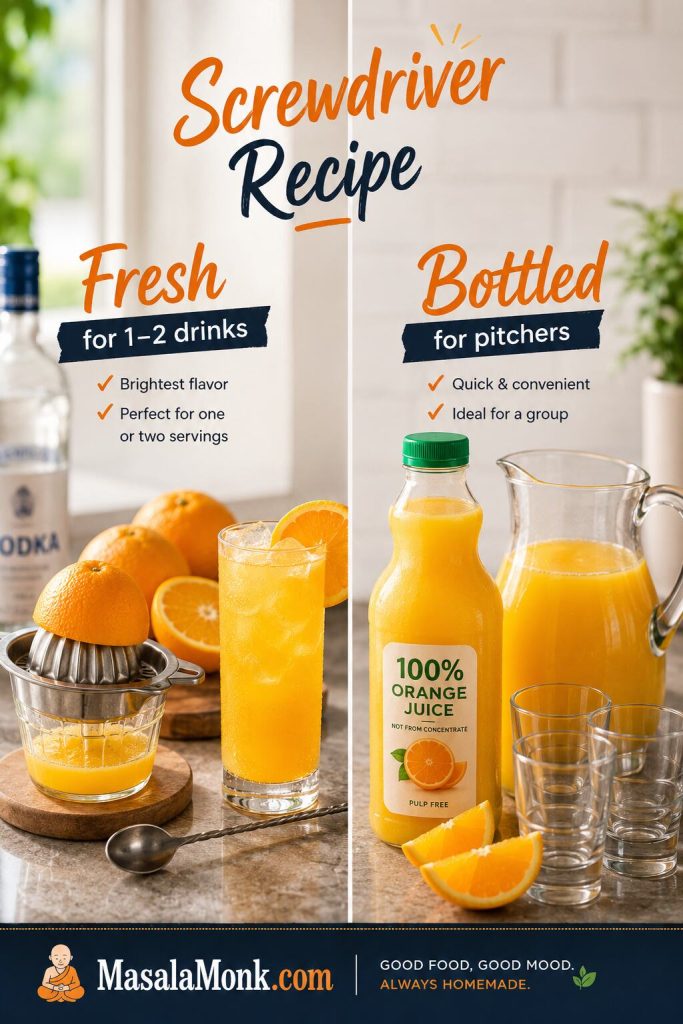
Fresh orange juice gives you that lifted orange smell before the first sip; bottled juice gives you consistency and speed. Chilled 100% bottled orange juice is especially useful for pitchers. Pulp or no pulp is personal: pulp feels fuller, while no-pulp juice makes a smoother glass. Choosing juice for a bigger batch? See the fresh vs bottled guide.
Orange drink can work in a pinch, but it pushes the cocktail toward sweet punch instead of fresh orange. For the cleanest flavor, use orange juice that tastes good cold on its own.
Ice and Garnish
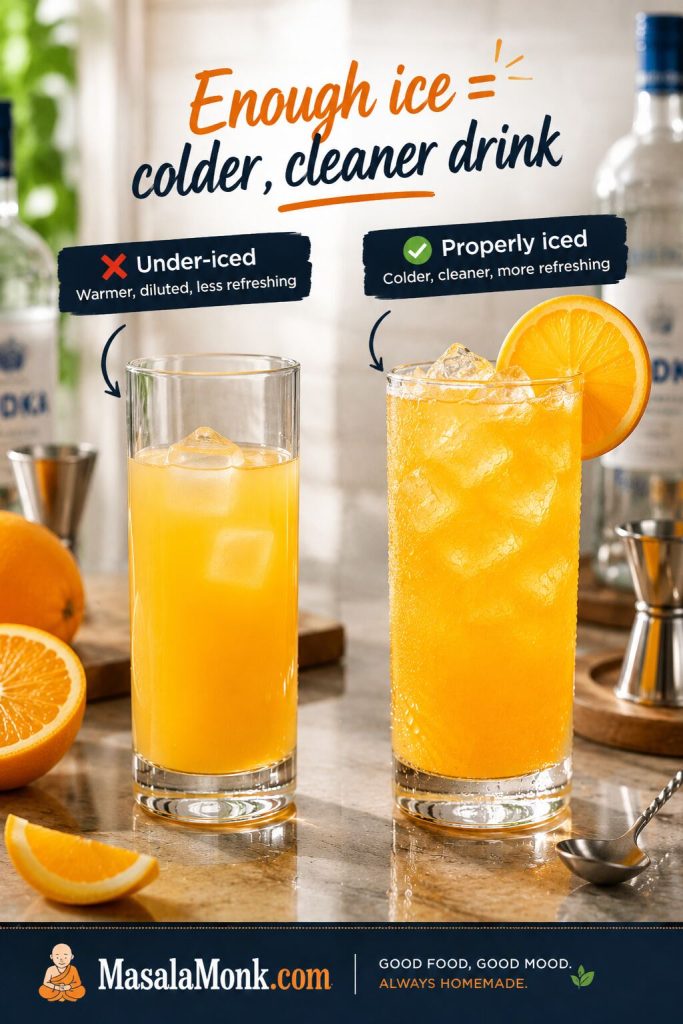
Do not be shy with the ice. A tall glass filled with ice keeps the drink colder for longer and helps avoid that thin, warm-orange-juice taste. An orange wedge, wheel, slice, or peel twist is optional, but it adds aroma and makes the glass feel finished.
Enough ice keeps a Screwdriver colder and cleaner; otherwise, the orange juice warms quickly and the drink starts to taste thin.
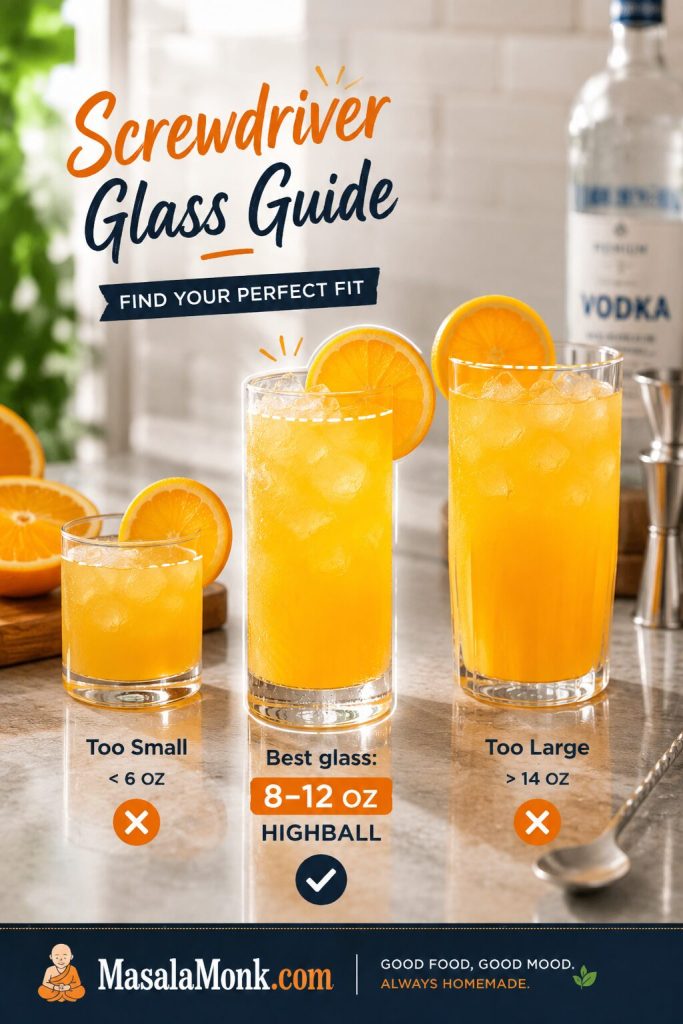
An 8–12 oz highball or Collins glass works best for the balanced pour. If your glass is smaller, use the stronger 2 oz vodka + 4 oz orange juice version or pour a slightly shorter drink.
An 8–12 oz highball or Collins glass leaves room for the vodka-orange mix, ice, and garnish without making the drink feel cramped.
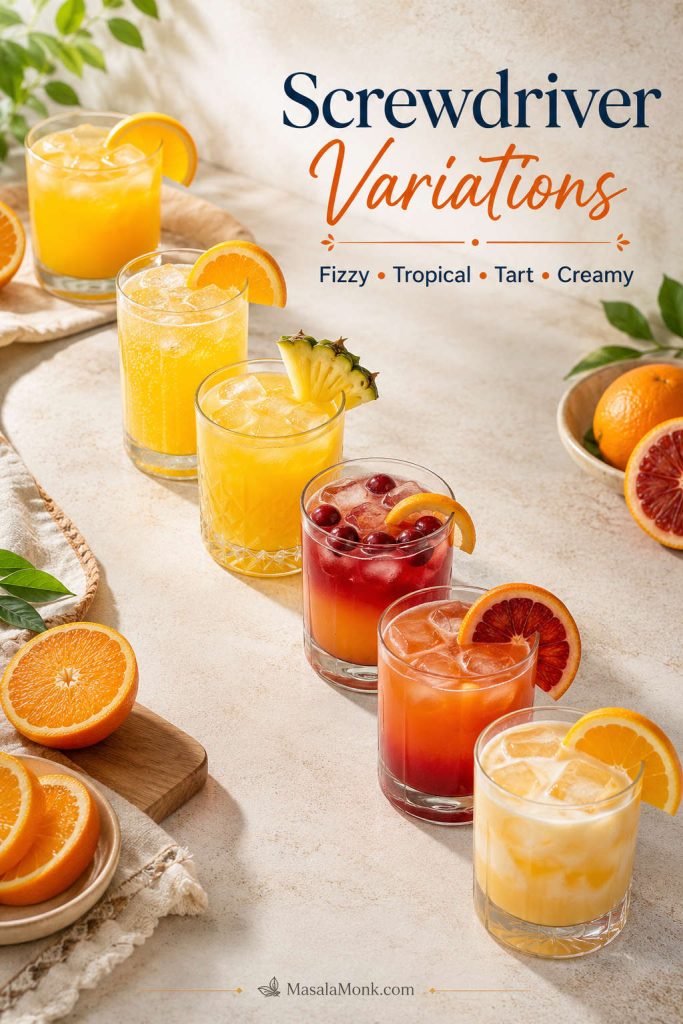
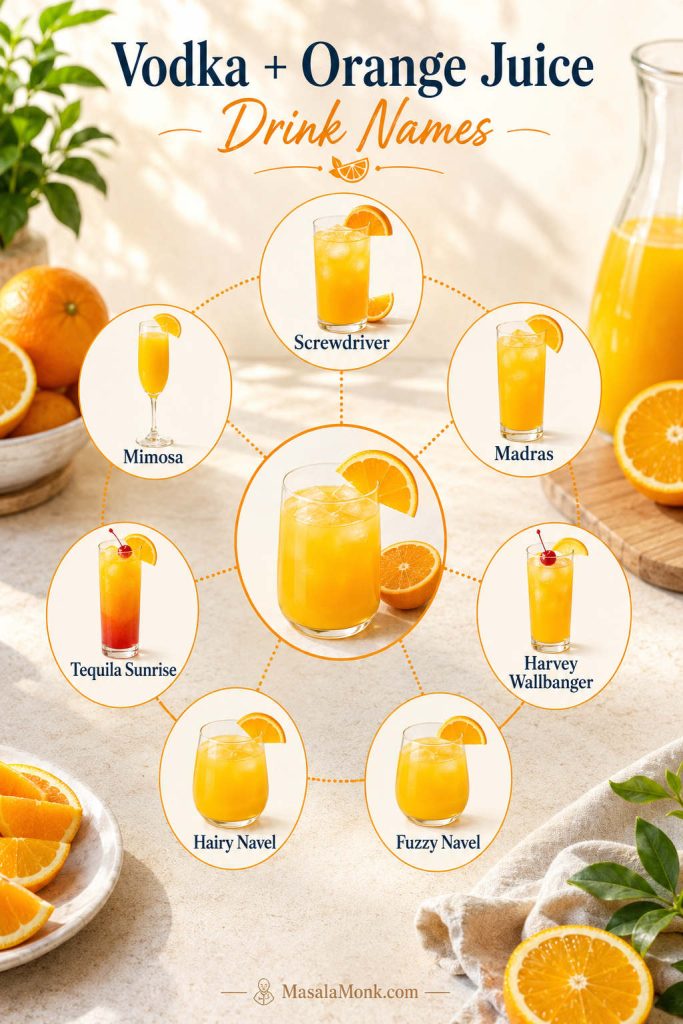
What counts as the simple drink? Vodka, orange juice, ice, and optional orange garnish. Add-ins like Sprite, club soda, cranberry juice, pineapple juice, peach schnapps, Galliano, triple sec, grenadine, or bitters turn it into a twist.
Best Screwdriver Ratio
This is where screwdrivers usually go wrong: people pour by instinct, then wonder why the drink tastes either sharp or flat. The ratio decides whether the glass feels like a cocktail or just cold orange juice with a little vodka hiding in it.
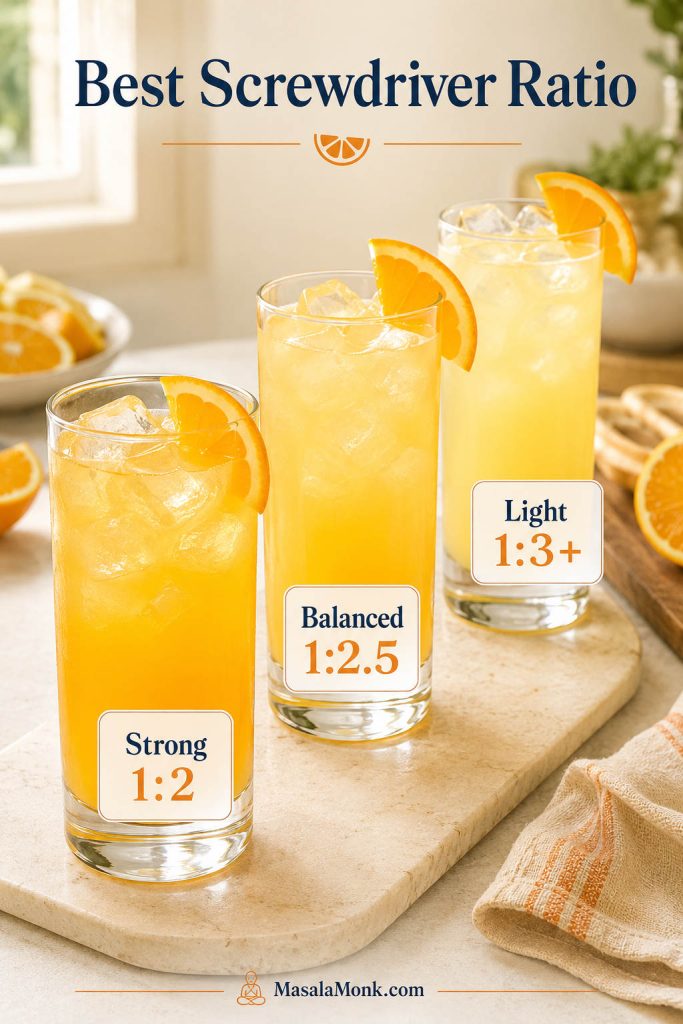
Classic Screwdriver recipes vary because the drink can be built as a stronger cocktail or a lighter brunch highball. A 1:2 pour tastes more cocktail-forward; 1:3 or 1:4 tastes lighter and more orange-led. This recipe uses 2 oz vodka to 5 oz orange juice because it sits in the middle: clearly a cocktail, but still fresh, cold, and orange-first.
The best Screwdriver ratio depends on the glass you want: stronger and cocktail-forward, balanced and orange-led, or lighter for brunch.
Choose your pour: Use 2 oz / 60 ml vodka + 4 oz / 120 ml orange juice for a stronger cocktail, 2 oz / 60 ml + 5 oz / 150 ml for the balanced house version, 1.5 oz / 45 ml + 5–6 oz / 150–180 ml for a lighter brunch glass, or mix the pitcher ahead and pour over ice in individual glasses.
Screwdriver Ratio Chart
A useful starting range is 1 part vodka to 2–3 parts orange juice; go closer to 1:4 when you want a very light, mostly-orange glass. Use 1:2 for a stronger pour, 1:2.5 for the most balanced glass, and 1:3 for a lighter drink. The easiest formula to remember is 2 oz / 60 ml vodka + 5 oz / 150 ml orange juice.
Style
Vodka
Orange juice
Ratio
Best for
Strong
2 oz / 60 ml
4 oz / 120 ml
1:2
A stronger glass
Balanced
2 oz / 60 ml
5 oz / 150 ml
1:2.5
Start here
Light brunch
1.5 oz / 45 ml
5–6 oz / 150–180 ml
About 1:3 to 1:4
A lighter glass
Metric classic
50 ml
100 ml
1:2
A simple measured version
Very light
1 oz / 30 ml
4 oz / 120 ml
1:4
Mostly orange juice
How strong is it? Even when it tastes orange-forward, a balanced Screwdriver with 2 oz vodka is still a full cocktail. Use the lighter version for brunch, slow sipping, or a longer glass.
Treat the table as a starting point, not a rule. Orange juice changes from carton to carton and orange to orange. Very sweet juice may need a squeeze of lemon or lime. Sharper vodka may need more juice and ice. The right ratio is the one that tastes smooth in your glass. For a group, use the pitcher table instead of multiplying by eye.
Screwdriver Measurements in ml
For metric measurements, start with the balanced version unless you already know you want a stronger or lighter glass.
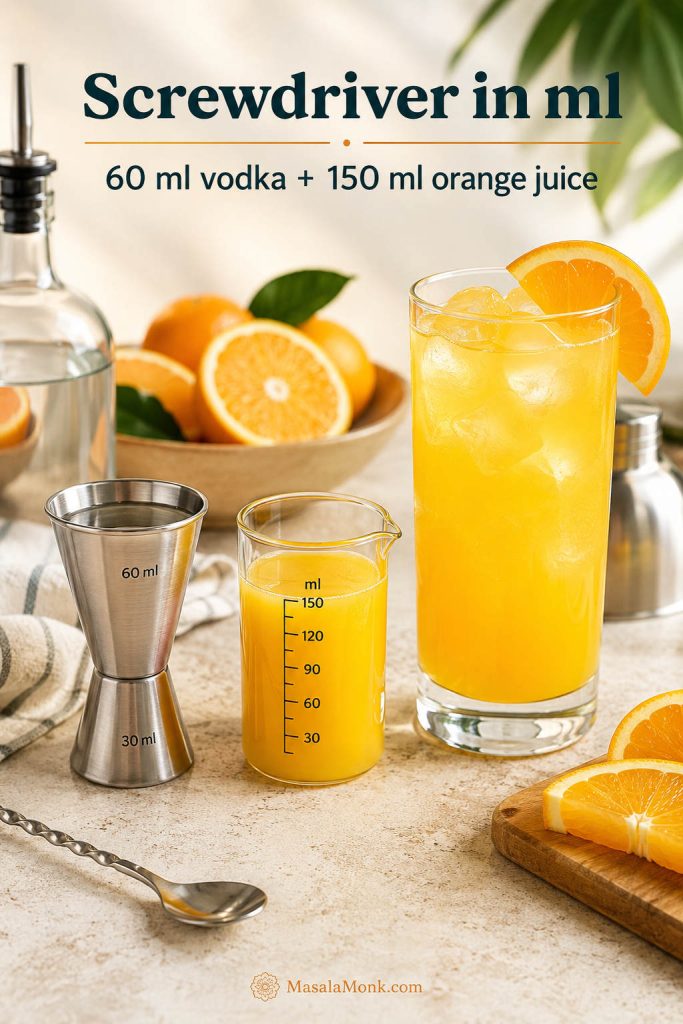
For metric readers, 60 ml vodka and 150 ml orange juice gives the same balanced pour as the 2 oz / 5 oz version.
Version
Vodka
Orange juice
Balanced
60 ml
150 ml
Stronger
60 ml
120 ml
Lighter
45 ml
150–180 ml
Classic 1:2 formula
50 ml
100 ml
Method Details
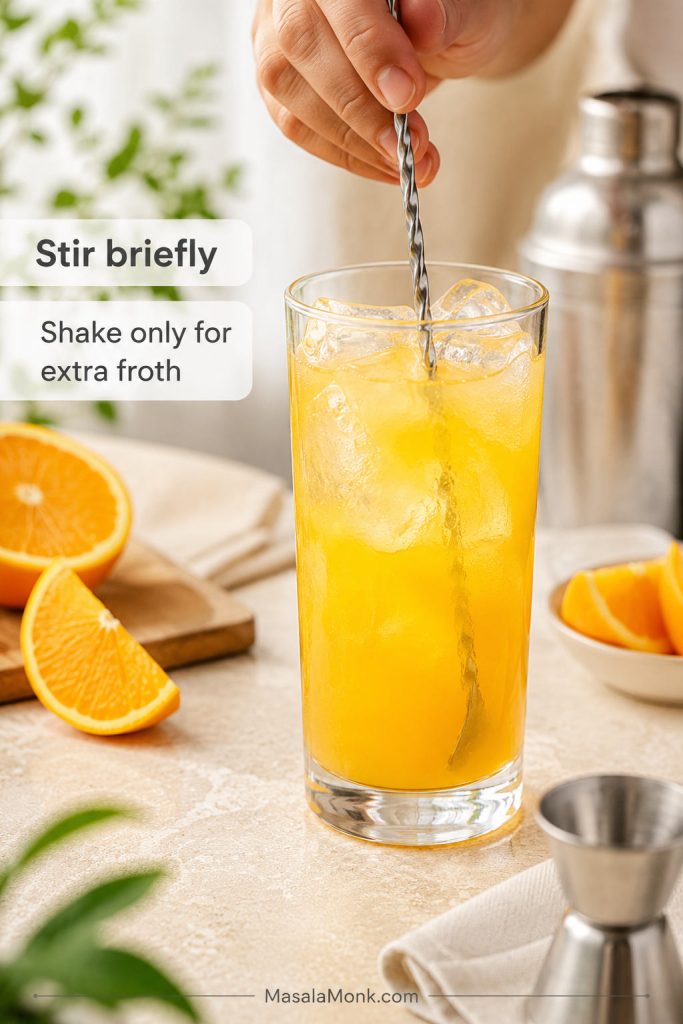
The standard order is ice first, vodka second, orange juice third, then a brief stir. Shaking is fine when you want it extra cold and slightly frothy, but the glass-built version is faster and cleaner.
Stirring is the classic move because it keeps the Screwdriver smooth, while shaking is better reserved for extra chill and a slightly frothier texture.
Fill the glass with ice. Use a highball or Collins glass if you have one.
Add the vodka. Pour in 2 oz / 60 ml vodka for the balanced version.
Add orange juice. Pour in 5 oz / 150 ml chilled orange juice.
Stir briefly. Stir for 5–10 seconds, just enough to chill and combine. Do not churn it aggressively.
Garnish and serve. Add an orange wedge, wheel, slice, or peel twist if you like.
The method stays simple for a reason: building in the glass keeps the drink fast, cold, and easy to adjust after the first sip.
You are not trying to whip or aerate the drink; you are just making the first sip taste even from top to bottom.
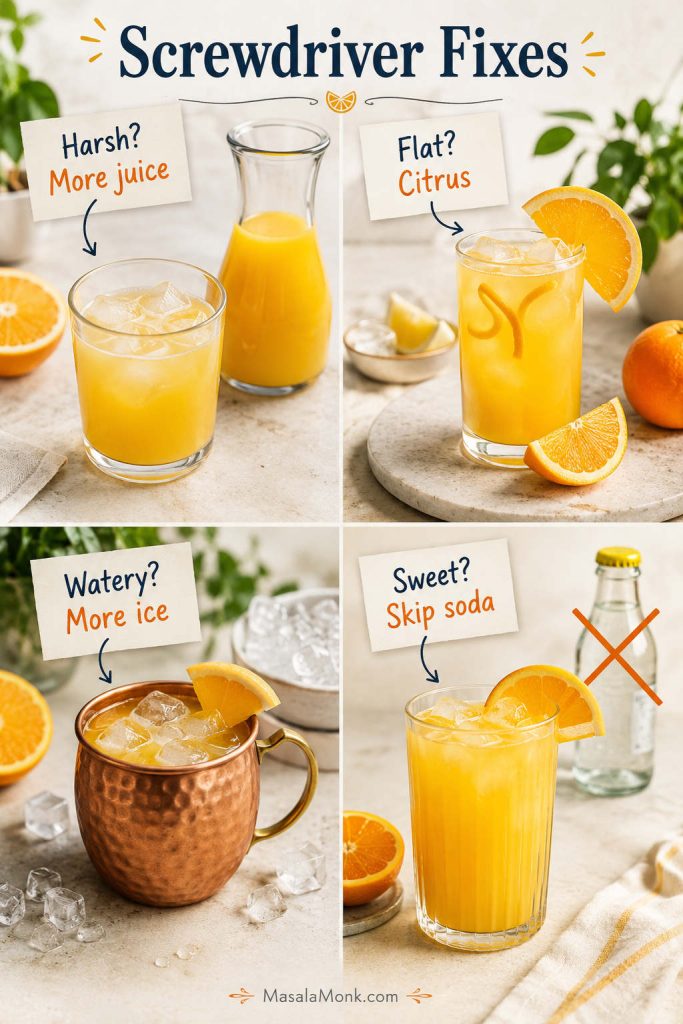
After stirring, the drink should smell like orange, feel cold against the glass, and taste citrusy first with the spirit supporting the orange, not dominating it. If the drink tastes too sharp, add more orange juice. For a flat glass, add a tiny squeeze of lemon or lime. If it tastes watery, use more ice next time and serve it right after mixing.
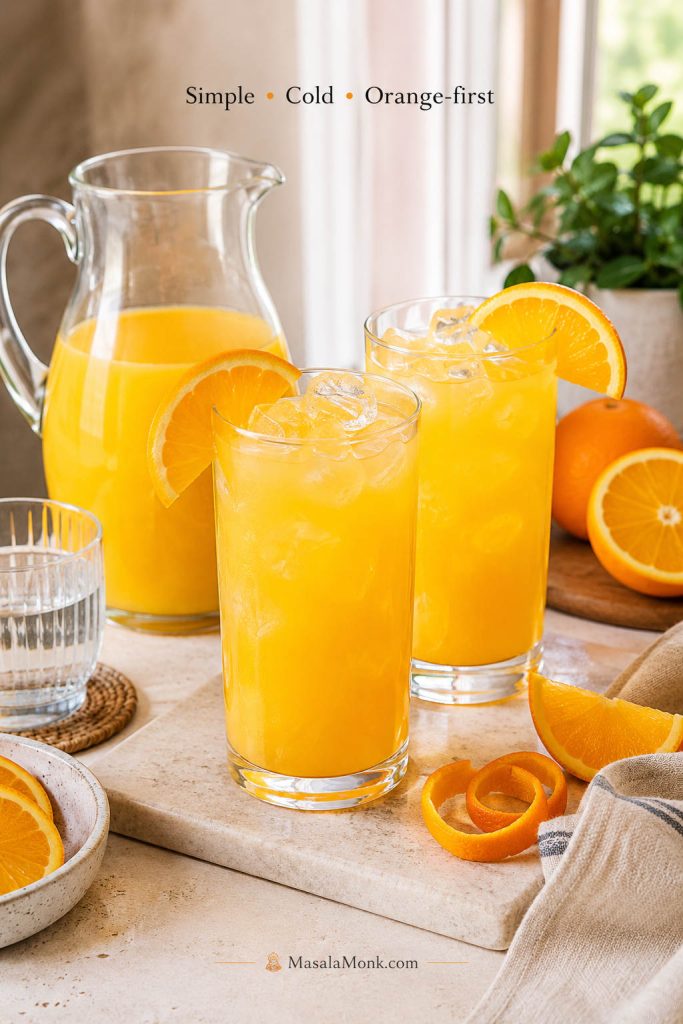
After mixing, the drink should smell like orange first, feel properly cold, and let the vodka sit in the background rather than take over.
If the first sip still tastes off, jump to the fixes instead of starting over.
Fresh Orange Juice vs Bottled Orange Juice
Fresh juice is worth it when you are making one or two drinks and want that first sip to smell like real orange, not just cold sweetness. But for a pitcher, bottled 100% orange juice is usually the smarter move: consistent, already strained, and easy to chill.
Fresh orange juice gives the brightest aroma for one or two cocktails; meanwhile, bottled 100% orange juice keeps pitcher prep easier and more consistent.
One balanced glass needs about 5 oz / 150 ml orange juice, which usually takes 2–3 medium oranges depending on size and juiciness.
One balanced Screwdriver needs about 5 oz / 150 ml orange juice, so two to three medium oranges are usually enough for a single glass.
If you are already using orange juice for brunch, the same bottle can work for a simple mimosa beside the screwdriver pitcher. Whatever you use, keep it well chilled. Warm orange juice makes the whole drink feel dull, even when the ratio is right.
Freshly squeezed orange juice: brightest aroma and freshest finish for one or two drinks.
Chilled 100% bottled orange juice: practical, consistent, and easy to scale for pitchers.
No-pulp orange juice: smoother and cleaner in the glass.
Pulp orange juice: fuller texture and a more natural orange feel.
Blood orange juice: deeper color and a slightly tart twist.
Warm or overly sweet orange drink: avoid it when you want a cleaner, fresher screwdriver.
Flat bottled juice wakes up with a tiny squeeze of lemon or lime. Tart juice works better with the lighter 1:3 ratio or a little more orange juice. Very sweet juice is best kept simple, without grenadine or lemon-lime soda.
Best Vodka for a Screwdriver
You do not need a luxury vodka here, but you do need one that smells clean. If the vodka smells harsh before it reaches the glass, the orange juice will soften it, not erase it. Use a bottle you would not feel the need to bury.
Plain vodka keeps the drink classic. Citrus vodka makes the orange flavor more direct. Vanilla or whipped cream vodka turns it toward an orange-cream flavor. Chill the bottle if you can, then let the orange juice do most of the work.
Screwdriver Pitcher Recipe
To make a pitcher, mix the vodka and orange juice ahead, but add ice to the glasses. That one choice keeps the batch fresher for longer and prevents a watered-down jug after ten minutes.
A Screwdriver pitcher works best when the batch is mixed ahead and poured over fresh ice, so the drink stays bright instead of watered down.
That is the version you want when people are arriving at different times, helping themselves, or choosing between a stronger and lighter pour. Keep a little extra orange juice nearby so guests can lighten their glass without remaking the batch.
For exact batches, use these pitcher amounts as your starting point instead of multiplying by eye.
These pitcher amounts scale the vodka-orange mix for 4, 8, or 12 drinks, so batching for guests stays consistent from the first pour to the last.
Servings / style
Vodka
Orange juice
Use when
4 drinks, balanced
1 cup / 240 ml
2½ cups / 600 ml
You want a small pitcher
8 drinks, stronger
2 cups / 480 ml
4 cups / 960 ml
You want a bolder pitcher
8 drinks, balanced
2 cups / 480 ml
5 cups / 1.2 L
Start here for a group
8 drinks, lighter
1½ cups / 360 ml
5–6 cups / 1.2–1.4 L
You want a lighter brunch pitcher
12 drinks, balanced
3 cups / 720 ml
7½ cups / 1.8 L
You are serving more guests
These cup amounts use U.S. cups; the ml measurements are included for precision.
How to Make a Screwdriver Pitcher
Chill the vodka and orange juice first if possible.
Stir the vodka and orange juice together in a pitcher.
Add a few orange slices to the pitcher when serving soon.
Keep the pitcher refrigerated until ready to serve.
Pour into ice-filled glasses and garnish each glass separately.
Pitcher tip: Do not add ice directly to the pitcher unless you are serving the entire batch immediately. Instead, keep the pitcher cold and add ice to individual glasses.
For brunch, a screwdriver pitcher works well beside Bloody Marys when you want one savory option. If the table needs a fruitier batch drink too, add something like jungle juice and let the screwdriver stay the clean orange option.
A brunch pitcher works well because guests can refill their own glasses while the main batch stays cold and the ice melts only where it should.
Screwdriver Variations
Once you know the base drink, variations are easy. But do not turn it into mystery punch. Instead, add one change at a time so the drink still tastes like orange first.
Think about what you want from the glass before you add anything. Bubbles make it lighter. Pineapple makes it tropical. Cranberry makes it tart. Galliano or peach schnapps moves it toward a known cocktail variation. Colorful add-ins are best when you are intentionally making something playful. Not sure what a twist becomes? Check the drink-name guide.
Keep the first batch simple, then let the second glass become the playful one. That way, you still know what made the drink better instead of turning every add-in into one loud glass.
Once the classic glass tastes right, variations become easier to control, whether you want fizz, cranberry tartness, tropical fruit, or a creamier finish.
What you want
Add this
How to use it
Fizzy and lighter
Club soda, Sprite, 7UP, or sparkling water
Add after stirring the vodka and orange juice.
Tropical
Pineapple juice
Replace part of the orange juice with pineapple juice.
Tart and colorful
Cranberry juice
Use about 3 oz orange juice and 2 oz cranberry juice with 2 oz vodka.
Sunrise-style color
Grenadine
Add a small splash for sweetness and red-orange color.
Harvey Wallbanger-style
Galliano
Add a small float to the finished drink.
Fuzzy / peachy
Peach schnapps
Add a small pour and keep the orange juice cold.
Frozen
Ice and optional frozen orange
Blend vodka, orange juice, and ice until slushy.
Blood orange
Blood orange juice
Use it instead of regular orange juice or split the two.
Orange-cream
Vanilla or whipped cream vodka
Use in place of plain vodka for a dessert-like glass.
No alcohol
Orange juice, soda water, citrus, and garnish
Not a true screwdriver, but still a bright orange drink.
Fizzy, Pineapple, and Cranberry Versions
For fizz, make the drink first, then top with Sprite, 7UP, club soda, or sparkling water. Sprite and 7UP make it sweeter; club soda keeps it lighter and drier.
For a pineapple version, use 2 oz / 60 ml vodka, 3 oz / 90 ml orange juice, and 2 oz / 60 ml pineapple juice. If pineapple is the direction you like, a punch for a pitcher with pineapple juice gives you a fruitier batch option for guests.
For a cranberry version, use 2 oz / 60 ml vodka, 3 oz / 90 ml orange juice, and 2 oz / 60 ml cranberry juice. This moves the drink close to a Madras. If cranberry is your favorite part, a cranberry Moscow Mule gives you the same tart-vodka direction with ginger beer instead of orange juice.
Cranberry juice adds tartness and color to vodka and orange juice, moving the drink close to a Madras-style cocktail without losing the citrus base.
Frozen, Creamy, and Blood Orange Versions
For a frozen glass, blend vodka, orange juice, and ice until slushy. To make the orange flavor stronger, add frozen orange segments or a little frozen orange juice concentrate, then serve it immediately so it stays thick and cold.
For an orange-cream direction, use vanilla vodka or whipped cream vodka in place of plain vodka. Blood orange juice gives deeper color and a slightly tart edge, whether you use it alone or split it with regular orange juice.
Colorful and Non-Alcoholic Versions
Colorful versions are playful rather than standard. Pink can come from cranberry juice, blood orange juice, or grenadine. Blue or green versions usually depend on colored liqueurs or flavored mixers, so treat them as party-style riffs rather than classic Screwdrivers. For a no-alcohol orange drink, use orange juice, soda water, citrus, and a fresh garnish.
Vodka and Orange Juice Drink Names
Orange juice shows up in several familiar cocktails, so the names can blur together. Here is the quick way to keep the nearby drinks straight.
Since orange juice appears in several classic drinks, this map helps separate a Screwdriver from Madras, Harvey Wallbanger, Fuzzy Navel, and other close cousins.
If you mix…
It is usually called…
Vodka + orange juice
Screwdriver
Vodka + orange juice + cranberry juice
Madras-style drink
Vodka + orange juice + Galliano
Harvey Wallbanger
Peach schnapps + orange juice
Fuzzy Navel
Vodka + peach schnapps + orange juice
Hairy Navel / Fuzzy Screwdriver-style
Tequila + orange juice + grenadine
Tequila Sunrise
Sparkling wine + orange juice
Mimosa
Names can vary by bar, region, and recipe style, but the screwdriver itself stays the straightforward vodka-orange drink.
Common Screwdriver Mistakes and Fixes
Most bad screwdrivers fail in obvious ways: the first sip burns, tastes dull, or feels like watered-down juice. The good news is that most fixes happen right in the glass.
If a Screwdriver tastes off, fix the cause instead of starting over: more juice for harshness, citrus for flatness, more ice for dilution, or less sweetness.
Problem
What to do
Tastes harsh
Add more orange juice and stir briefly. Next time, use the 1:3 ratio.
Tastes flat
Add a tiny squeeze of lemon or lime, or use an orange peel twist.
Tastes watery
Use more ice and serve right after mixing.
Too sweet
Use less sweet orange juice and skip soda or grenadine.
Too warm
Chill the vodka and orange juice before mixing.
Pulp settles
Stir briefly before serving.
Pitcher is diluting
Add ice to glasses, not the pitcher.
Garnish tastes bitter
Avoid too much white pith on orange peel.
Screwdriver Recipe FAQs
These quick answers cover the questions that usually come up after you know the basic vodka-orange ratio.
What is vodka and orange juice called?
Vodka and orange juice is called a Screwdriver when it is served simply over ice. The name usually refers to the vodka-orange drink, not a bottled ready-to-drink product.
What is the best screwdriver ratio?
For this screwdriver recipe, start with 2 oz vodka and 5 oz orange juice for a balanced glass. Move to 4 oz juice if you want it stronger, 6 oz if you want it lighter, and adjust after one sip because orange juice varies.
What are screwdriver measurements in ml?
Use 60 ml vodka + 150 ml orange juice for the balanced version. Go to 60 ml + 120 ml for stronger, or 45 ml + 150–180 ml for lighter.
How many oranges do I need for one screwdriver?
For one balanced screwdriver, you need about 5 oz / 150 ml orange juice, which usually takes 2–3 medium oranges depending on size and juiciness.
Do you shake or stir a screwdriver?
Stir it in the glass for the easiest version. Shake only if you want it extra cold and slightly frothy.
Can I make a screwdriver ahead of time?
Yes, for a pitcher. Mix the vodka and orange juice the same day, keep it chilled, and add ice only to the glasses.
How do I make a screwdriver pitcher?
For 8 balanced drinks, mix 2 cups / 480 ml vodka with 5 cups / 1.2 L orange juice. Keep the pitcher chilled, then pour into ice-filled glasses. For exact 4, 8, and 12 drink batches, use the pitcher amounts table.
Can I use Sprite in a screwdriver?
Yes, but treat it as a twist. Sprite makes the drink sweeter and fizzy; club soda or sparkling water keeps it lighter and drier. Add bubbles right before serving.
What is a screwdriver with cranberry juice called?
A screwdriver-style drink with cranberry juice often moves toward a Madras, which is made with vodka, orange juice, and cranberry juice. A small splash of cranberry can also simply be treated as a cranberry version.
Is a Harvey Wallbanger the same as a screwdriver?
Think of a Harvey Wallbanger as the screwdriver’s liqueur-finished cousin: vodka, orange juice, and a float of Galliano. It is closely related, but not the same as the plain drink.
Is a Fuzzy Navel the same as a screwdriver?
Not quite. A Fuzzy Navel skips the vodka and uses peach schnapps with orange juice. Add vodka as well, and you move closer to a Hairy Navel or fuzzy screwdriver-style drink.
Is Smirnoff Ice Screwdriver the same as a homemade screwdriver?
Not quite. A homemade screwdriver is freshly mixed in the glass, while ready-to-drink screwdriver-style products may be carbonated, sweetened, flavored, or made with a different alcohol base.
Final Tips for a Better Screwdriver
Use this screwdriver recipe as your starting point, taste once, then adjust. More orange juice makes the drink lighter; less orange juice makes it stronger. Keep everything cold, garnish simply, and add extras only after the vodka and orange juice taste right together.
When the ratio is right, a Screwdriver should feel easy to serve and easy to drink: fresh orange aroma, cold glass, and a pour people are happy to come back to.
The goal is not to make the fanciest cocktail in the room. It is to make the simple one people are happy to refill.
Once the ratio is right, the drink should feel almost effortless: cold glass, fresh orange aroma, and a pour that tastes like a cocktail without asking much from you.
A good jungle juice recipe should make hosting easier, not leave you guessing how many bottles, gallons, or cups you need while guests are walking in. This version is built as a measured party punch: fruity, cold, colorful, easy to pour, and scaled for 1-gallon, 2-gallon, and 5-gallon batches.
It is strong enough to feel like an adult party drink, but not built around the “dump every bottle in” approach that makes the punch taste harsh and unpredictable. Below, you’ll find the 2-gallon base recipe, shopping help, guest-count planning, alcohol math, lighter and more spirit-forward adjustments, plus alcohol-free, Halloween, color, and holiday-style variations.
The best batch is the one you can set out cold, point guests toward the cups, and stop worrying about mixing individual drinks all night.
Jungle juice is a large-batch fruit punch for adult parties, usually made with liquor, fruit juice, sliced fruit, and a fizzy mixer. It is the kind of drink you make in a dispenser, punch bowl, or food-safe cooler when you want something colorful, easy to pour, and simple enough for guests to serve themselves.
The best version should taste fruity and refreshing first. It should not taste like straight alcohol, and it should not be so sweet that one cup feels heavy. That is why this recipe uses fruit punch, citrus, pineapple, cranberry, fresh fruit, and a bubbly finish for balance.
Jungle juice at a glance: Good starting batch: 2 gallons for most parties Serves: about 25–32 pours, or fewer people if guests have more than one Alcohol: 1 bottle vodka + 1 bottle white rum for the 2-gallon batch Main flavor: fruit punch, orange juice, pineapple juice, lemonade, cranberry, citrus, and strawberries Container: 2.5- to 3-gallon drink dispenser, punch bowl, stockpot, or food-safe cooler Make-ahead: mix juice, alcohol, and fruit 2–12 hours ahead Add last: lemon-lime soda, ginger ale, club soda, or sparkling water
If you only remember one thing, start with the 2-gallon batch, chill it well, and add the carbonated mixer at the end. That gives you the easiest balance of flavor, serving size, and party convenience.
Once you understand the basic jungle juice formula, it becomes much easier to scale the recipe without guessing bottle math, juice volume, or fizz.
Easy Jungle Juice Recipe
Start with this 2-gallon batch for most parties. It fills a dispenser, but it is still easy to taste, chill, and adjust before guests arrive. Most importantly, it avoids the common mistake of making the punch too strong first and trying to fix it later.
Active Time10 minutes
Chill Time2 hours recommended
Total Time2 hours 10 minutes
YieldAbout 2 gallons
Servings: about 25 to 32 pours, depending on cup size
Yield note: The liquid amount lands around 2 gallons depending on how much fizz you add. Fresh fruit takes up extra room in the container, so use a larger dispenser than the final liquid yield.
Labeling tip: If you are serving alcoholic and non-alcoholic versions, label both dispensers clearly before guests arrive.
Ingredients
1 bottle vodka, 750 ml / about 25.4 fl oz / about 3.2 cups
1 bottle white rum, 750 ml / about 25.4 fl oz / about 3.2 cups
8 cups fruit punch / 64 fl oz / 1.9 L
4 cups orange juice / 32 fl oz / 950 ml
4 cups pineapple juice / 32 fl oz / 950 ml
4 cups lemonade or pink lemonade / 32 fl oz / 950 ml
2 cups cranberry juice / 16 fl oz / 475 ml
2 to 4 cups lemon-lime soda, club soda, sparkling water, or ginger ale, added last
1 lb / 450 g strawberries, sliced
2 oranges, sliced
1 lemon or lime, sliced
Ice, for serving
Instructions
Wash and slice the strawberries, oranges, and lemon or lime.
Add the fruit punch, orange juice, pineapple juice, lemonade, cranberry juice, vodka, and rum to a large food-safe drink dispenser, punch bowl, stockpot, or beverage cooler.
Stir well with a long-handled spoon.
Add the sliced fruit.
Cover and chill for at least 2 hours. For better fruit flavor, chill for 3 to 12 hours.
At serving time, stir in the lemon-lime soda, club soda, sparkling water, or ginger ale.
Serve cold over ice.
Container tip: Do not fill the container to the rim. Use a 2.5- to 3-gallon dispenser for the 2-gallon batch so there is room for fruit, stirring, fizz, and easy serving.
This quick jungle juice recipe card keeps the 2-gallon yield, serving range, timing, and core ingredients easy to check while you prep.
Here is the simple shopping list for the main 2-gallon batch, so you can shop once, chill everything, and set up the dispenser before guests start arriving.
1 bottle vodka, 750 ml
1 bottle white rum, 750 ml
1 large bottle fruit punch, at least 64 fl oz
1 carton orange juice, at least 32 fl oz
1 bottle or can pineapple juice, at least 32 fl oz
1 bottle lemonade or pink lemonade, at least 32 fl oz
1 small bottle cranberry juice, at least 16 fl oz
1 bottle lemon-lime soda, ginger ale, club soda, or sparkling water
1 lb strawberries
2 oranges
1 lemon or lime
Ice for serving
Before you shop, this 2-gallon jungle juice checklist helps you buy the right bottles, juices, fruit, fizz, and ice without doing recipe math in the store.
Why This Jungle Juice Recipe Works
Many party-punch recipes are vague: a bottle of this, a jug of that, some fruit, and maybe soda if you have it. That can work for a casual punch bowl, but it gets stressful when you are trying to shop for 20, 40, or 80 people.
This version is built around clean party math. The main recipe makes about 2 gallons, then the same formula is scaled into 1-gallon and 5-gallon amounts. You also get serving estimates, alcohol-strength notes, and a clear reminder to save the bubbly finish for the end so the punch tastes lively when guests start pouring.
Best basic formula: 1 bottle vodka + 1 bottle white rum + about 22 cups juice + 2–4 cups fizz + fresh fruit = about 2 gallons of jungle juice. Keep that formula in mind, then adjust sweetness, strength, and fizz after the punch has chilled.
It also keeps the flavor flexible. You can make it cheaper with fruit punch and lemonade, brighter with pineapple and citrus, lighter with sparkling water, or alcohol-free for a family party, baby shower, cookout, or mixed gathering.
What Does Jungle Juice Taste Like?
A good batch should taste like cold fruit punch with pineapple brightness, citrus lift, and a light bubbly finish. It should be fruity first, gently boozy second, and refreshing enough that one cup does not feel syrupy or heavy.
If the first sip tastes like straight liquor, add juice, citrus, or a bubbly mixer before serving. If it tastes flat, it probably needs fresh bubbles, colder bottles, or more ice in the cups. The best batch should look generous in the dispenser, pour easily over ice, and stay lively from the first glass to the last.
Jungle Juice Ingredients
Think of the ingredients in layers: a fruity base for volume, citrus for lift, fresh fruit for the party look, and bubbles at the end so the dispenser still feels fresh when guests start pouring. You do not need cocktail-bar precision, but you do need balance.
Each ingredient group has a job: the alcohol carries the punch, the juices build body, the citrus brightens it, and the fizz keeps it lively.
Alcohol
Vodka and white rum are the easiest base for classic jungle juice. Vodka keeps the drink clean and neutral, while rum gives it a rounder, fruitier party-punch flavor. Triple sec or orange liqueur can be added if you want more citrus, but it is optional.
Fruit punch gives the drink its classic party flavor. Orange juice, pineapple juice, lemonade, and cranberry juice make it taste brighter and less one-note. You do not need every juice in the store; you just need a good balance of sweet, tart, and tropical.
If you like pineapple-forward party drinks, this punch with pineapple juice guide has more ideas for pineapple, cranberry, ginger ale, lemon-lime soda, and make-ahead party punch combinations.
Fresh Fruit
Use fruit that can sit in punch without falling apart immediately. Strawberries, oranges, lemons, limes, and pineapple are the easiest choices. Apples, grapes, blueberries, raspberries, peaches, kiwi, and cranberries can also work, depending on the season and the look you want.
Slice citrus into wheels or half-moons, halve or slice strawberries, and cut pineapple into small chunks. The fruit should look generous in the dispenser, but it should not crowd out so much liquid that serving becomes difficult.
Fizz
Lemon-lime soda gives the sweetest, most familiar party-punch taste. Club soda or sparkling water keeps the punch lighter and less sugary. Ginger ale adds a softer spice and works especially well with pineapple and cranberry.
Save the carbonated mixer for the end so the punch tastes lively when guests start pouring.
How to Choose the Alcohol
Most batches work best with simple alcohol choices. Vodka gives the punch a clean base, while white rum adds a softer tropical note. Orange liqueur, tequila, or sparkling wine can work in variations, but they change the flavor quickly.
Alcohol
Use It For
Flavor Effect
Vodka
Clean base
Neutral, easy to mix, lets the fruit and juice lead
White rum
Classic partner for vodka
Rounder, fruitier, slightly tropical
Triple sec or orange liqueur
Optional citrus boost
Adds orange flavor and sweetness
Tequila
Small variation
Sharper and more noticeable; use carefully
Sparkling wine
Better for jingle juice than jungle juice
Festive and lighter, but changes the drink style
Hosting note: This recipe is framed as a balanced adult party punch, not a drinking-game drink. Label the punch clearly, serve moderate pours, and keep water or a non-alcoholic option nearby.
How to Make Jungle Juice
Jungle juice is easy to make, but the order matters if you want the fruit to taste fresh and the punch to stay lively.
Prepare the fruit. Wash everything well, then slice strawberries, citrus, and pineapple if using.
Mix the still ingredients first. Add the vodka, rum, fruit punch, orange juice, pineapple juice, lemonade, and cranberry juice to your container.
Stir before adding fruit. This helps the juices and alcohol blend evenly.
Add fruit and chill. Two hours is enough, but 3 to 12 hours gives the fruit more time to flavor the punch.
Finish with fizz. Lemon-lime soda, sparkling water, club soda, or ginger ale should go in once the punch has chilled.
Serve over ice. Put ice in glasses instead of dumping a large amount directly into the punch, unless you are using an ice ring.
The order matters: build the still punch first, give the fruit time to flavor it, then add bubbles at the end for a fresher pour.
How Much Jungle Juice to Make for 20, 30, 50, or 100 People
This is the table to check before you shop. A 30-person backyard party, a 50-person birthday, and a long 100-person event do not need the same batch. Use these amounts as a practical starting point, then keep extra juice, fizz, water, and ice chilled nearby.
Guest Count
Suggested Batch
Planning Notes
20 people
1½ to 2 gallons
Best if other drinks are available
30 people
2 gallons
Good starting point for most parties
50 people
3 to 4 gallons
Keep extra fizz chilled for topping up
75 people
5 gallons
Use a lighter batch for longer events
100 people
5 gallons plus backup drinks
Better with water and a non-alcoholic punch nearby
Instead of choosing a batch size by container alone, match the jungle juice amount to your guest count, party length, and backup drink options.
1-Gallon, 2-Gallon, and 5-Gallon Jungle Juice Amounts
This is the part that keeps you from overbuying, underbuying, or trying to scale a punch recipe in your head at the store. Use the table as a practical party guide, then adjust the final sweetness and strength before guests arrive.
One gallon equals 128 fl oz, or about 3.8 L. One standard 750 ml bottle is about 25.4 fl oz, or about 3.2 cups.
Batch Size
Vodka
Rum
Juice Base
Fizz, Added Last
Fruit
Approx. Servings
1 gallon
375 ml / ½ bottle
375 ml / ½ bottle
11 cups total juice
1 to 2 cups
½ lb strawberries + citrus
12 to 16
2 gallons
750 ml / 1 bottle
750 ml / 1 bottle
22 cups total juice
2 to 4 cups
1 lb strawberries + citrus
25 to 32
5 gallons, lighter large-party batch
2 bottles
2 bottles
3½ to 3¾ gallons total juice
About ½ gallon
2 to 3 lb fruit
60 to 80
Use this 1, 2, and 5-gallon jungle juice guide when you need to scale the recipe without guessing bottle amounts, juice volume, or final servings.
5-Gallon Jungle Juice: Lighter vs Exact-Scale Batch
A 5-gallon batch is 2.5 times the 2-gallon recipe. Matching the main recipe’s strength means using 2½ bottles of vodka and 2½ bottles of white rum. A lighter large-party batch uses 2 bottles of each with more juice, soda, or sparkling water.
That 2½-bottle amount means 2 full 750 ml bottles plus 375 ml from a third bottle. If you do not want a half bottle left over, the lighter 5-gallon version is the simpler choice.
5-Gallon Style
Vodka
Rum
Best For
Lighter large-party batch
2 bottles
2 bottles
Longer parties, mixed groups, easier sipping
Exact-scale batch
2½ bottles
2½ bottles
Matching the main 2-gallon recipe strength
If you are making a 5-gallon jungle juice batch, decide first whether you want an easier-sipping party punch or the same strength as the main recipe.
If you prefer a more spirit-forward punch, adjust gradually and keep the servings smaller rather than turning the whole batch into a harsh drink.
Important: fruit takes up space in the container, and ice melts if added directly to the punch. For the cleanest flavor and most accurate yield, chill the punch first, add fizz at serving time, and put ice in the glasses instead of the main dispenser.
How Much Jungle Juice Per Person?
Plan by pour size, not just by gallons. A small party cup may hold 6 oz, while a larger cup can easily hold 10 oz or more.
Batch
6 oz Pours
8 oz Pours
10 oz Pours
1 gallon
About 21
About 16
About 12
2 gallons
About 42
About 32
About 25
5 gallons
About 106
About 80
About 64
Serving count changes quickly once cup size changes, so plan jungle juice by pour size instead of relying only on total gallons.
For a party with other drinks available, estimate one or two smaller pours per adult guest. Longer events usually work better with a lighter batch, plenty of water, and at least one non-alcoholic option nearby.
How Strong Is Jungle Juice?
Because this punch is fruity and served cold, guests may drink it faster than they realize. The simplest host-friendly approach is to label the punch clearly, serve moderate pours, and keep water or a non-alcoholic drink nearby.
Standard Drink Math for This Batch
A 750 ml bottle of 80-proof vodka or rum contains about 17 standard U.S. drinks. The National Institute on Alcohol Abuse and Alcoholism defines one U.S. standard drink as about 0.6 fl oz / 14 g of pure alcohol.
The 2-gallon recipe above uses one 750 ml bottle of vodka and one 750 ml bottle of rum. That means the full batch contains roughly 34 standard drinks before it is divided into servings. At about 32 small 8 oz pours, each pour is roughly around one standard drink, though the exact strength depends on your spirits, final volume, pour size, and how much soda or ice you use.
Since jungle juice is fruity and easy to sip, standard-drink math helps you understand how proof, pour size, ice, and final volume change the strength.
This recipe intentionally skips grain alcohol or “dump every bottle in” formulas because the final strength becomes harder to estimate and easier to over-serve. A measured vodka-and-rum base is easier to balance, label, and adjust for a real party.
Lighter, Balanced, and Stronger Batches
Note: homemade punch strength is always approximate because bottle proof, final volume, ice melt, fruit displacement, and pour size all change the actual drink. Use the math as a planning guide, not a precise serving guarantee.
Style
How to Adjust
Best For
Lighter jungle juice
Use less alcohol and more juice or a lighter carbonated mixer.
Longer parties, outdoor cookouts, mixed groups
Balanced jungle juice
Use the recipe as written: vodka, rum, juice, fruit, and fizz.
Most adult parties
More spirit-forward jungle juice
Increase alcohol gradually and keep the fruit/juice base generous.
Cheap Jungle Juice for a Party That Still Tastes Good
Budget jungle juice should still feel like a real party drink, not a random mix of whatever was cheapest. Save money on the base, not on the balance: fruit punch gives volume, lemonade adds tartness, pineapple makes it taste more tropical, and fresh citrus makes the whole batch feel intentional.
The upgrade is not expensive ingredients; it is cold bottles, citrus, enough fruit to look generous, and a bubbly finish that makes the batch feel fresh.
A cheaper version can use:
Fruit punch as the main base
Lemonade or pink lemonade for tartness
Orange juice for body
Pineapple juice for tropical flavor, if budget allows
Store-brand lemon-lime soda, ginger ale, club soda, or sparkling water
Frozen strawberries and sliced citrus
Even on a budget, the batch should taste intentional, not like alcohol hiding under sugary drink mix. Cold bottles, fresh citrus, and the final fizzy splash make a big difference.
Cheap jungle juice tastes better when you save money on the base, then use cold bottles, citrus, fruit, and fizz to make the punch feel fresh instead of careless.
Jungle Juice Variations
Once you understand the basic formula, this party punch is easy to adjust for the season, color theme, and crowd.
Vodka Jungle Juice
Vodka jungle juice is a good option if you want a cleaner flavor and do not want rum in the batch. It tastes lighter and lets the fruit punch, pineapple, orange, and lemonade stand out more.
Vodka jungle juice is a cleaner-tasting variation because the fruit punch, pineapple, orange, lemonade, and citrus can stand out without rum in the background.
A 1-gallon vodka-only batch can use:
750 ml vodka
6 cups fruit punch
2 cups pineapple juice
2 cups orange juice
1 cup lemonade or cranberry juice
1 to 2 cups lemon-lime soda or sparkling water, added last
Sliced strawberries, oranges, lemons, or pineapple
If you like vodka-citrus drinks, this vodka with lemon guide has more bright, simple vodka drink ideas.
Non-Alcoholic Jungle Juice
A non-alcoholic jungle juice is worth making even when you are serving the regular version too. It gives kids, non-drinkers, designated drivers, and anyone taking a break something that still feels colorful, festive, and part of the party.
To make it alcohol-free, replace the vodka and rum with extra juice and a chilled fizzy mixer. Add the bubbles once the drink is cold so it stays lively.
A simple 2-gallon non-alcoholic batch can use:
8 cups fruit punch
4 cups pineapple juice
4 cups orange juice
4 cups lemonade
2 cups cranberry juice
8 to 10 cups ginger ale, lemon-lime soda, club soda, or sparkling water, added last
Strawberries, oranges, lemons, limes, and pineapple
If you are serving both versions, keep the non-alcoholic batch in a separate labeled dispenser so guests do not have to ask which one is which.
A non-alcoholic jungle juice dispenser keeps the party table welcoming for kids, non-drinkers, designated drivers, and anyone who wants a colorful alcohol-free pour.
For a lower-sugar alcohol-free option, these keto mocktails can sit alongside the fruit punch at a mixed party.
Cleaner, Less-Sweet Jungle Juice
For a cleaner, less sugary version, use 100% juices where possible and replace part of the fruit punch with cranberry juice, pomegranate juice, pineapple juice, or fresh citrus. Keep the fruit visible and use sparkling water instead of lemon-lime soda if you want it less sweet.
This version is still easy, but it tastes more like a proper party punch and less like a sugary last-minute mix.
For a cleaner, less-sweet jungle juice, use citrus and sparkling water to lighten the punch instead of relying on extra soda for balance.
Another lighter tropical direction is this collection of coconut water cocktails, especially if you want refreshing rum, vodka, tequila, or mocktail ideas that feel less heavy than a full punch bowl.
Color Variations: Blue, Green, and Bright Party Punch
Color variations are useful for parties because they make the dispenser feel more intentional. For blue jungle juice, use blue fruit punch or a blue sports drink with pineapple juice, lemonade, vodka or white rum, citrus slices, and a clear fizzy mixer. Keep darker juices like cranberry low so the color stays bright.
A green version works best with lemonade, pineapple juice, limeade, lemon-lime soda, and a small amount of blue curaçao or green-colored punch. Lime wheels, green grapes, and pineapple chunks help the drink look festive without relying only on food coloring.
Blue, green, and Halloween jungle juice variations work best when the color stays bright but the flavor still makes sense with citrus, pineapple, fruit, and fizz.
Halloween Jungle Juice
Halloween jungle juice is the version to make when you want the punch bowl to become part of the table. Keep the flavor fruity, then use color, citrus slices, and a little drama to make it feel spooky without making the recipe harder.
A Halloween version can use:
Vodka and white rum as the base
Pineapple juice and orange juice for color
Lemon-lime soda added at serving time
Blue curaçao for color and orange flavor
Lime slices, orange slices, and gummy candy garnish for serving cups
Dry ice safety: Dry ice should be handled only with proper tongs or insulated gloves. Never touch it bare-handed, never put solid pieces into individual cups, and do not drink punch while pieces of dry ice remain in the serving bowl. Use dry ice only in a well-ventilated area, never seal it inside an airtight container, and avoid using it in a closed drink dispenser.
Jungle Juice vs Jingle Juice
Jungle juice is a flexible fruity party punch made with liquor, juice, soda, and fresh fruit. Jingle juice is usually a Christmas punch built around cranberry, sparkling wine or Moscato, vodka, citrus, and holiday garnishes such as cranberries, mint, and lime.
Make jungle juice when you want a flexible year-round party punch. Make jingle juice when the party is specifically holiday-themed and cranberry, sparkling wine, mint, and citrus fit the table better.
Jungle juice works as a flexible year-round party punch, while jingle juice leans more holiday-focused with cranberry, citrus, mint, and festive sparkle.
Make-Ahead, Storage, and Serving Tips
You can make jungle juice ahead, but the timing matters. The best version tastes cold and settled, while the final fizz still feels fresh.
Best make-ahead window: mix the juice, alcohol, and fruit 2 to 12 hours ahead.
Save the bubbles: soda, sparkling water, club soda, or ginger ale should be added after chilling.
Keep it cold: refrigerate the punch or keep the dispenser chilled.
Use ice carefully: add ice to glasses, or use an ice ring, so the whole batch does not become watery.
Use a food-safe container: a drink dispenser, punch bowl, stockpot, or beverage cooler is better than any container not designed for food.
To make jungle juice ahead without losing freshness, chill the fruit and still liquids early, then add the carbonated mixer when guests are ready to pour.
Already mixed the punch and need a fix? Jump to troubleshooting for quick adjustments.
To keep the punch cold without watering it down, chill every bottle before mixing, keep the main batch refrigerated as long as possible, and serve over ice in cups. For a punch bowl, an ice ring melts more slowly than loose ice and looks better on the table.
Because this punch contains cut fruit, keep it cold. The FDA produce safety guidance recommends refrigerating fresh produce at 40°F / 4°C or below. As a practical party rule, keep the main batch chilled and refill serving containers as needed.
What to Serve with Jungle Juice
Because jungle juice is fruity and sweet, the best food pairings are salty, easy, and snackable. Think chips and salsa, sliders, wings, nachos, pizza, tacos, grilled skewers, or a big snack board.
During a longer party, simple and sturdy food works best. Salty snacks and easy finger foods balance the sweetness of the punch and help guests pace themselves without needing a formal meal.
Because jungle juice is fruity and sweet, salty snacks, sliders, wings, tacos, pizza, and easy finger foods help balance the table and keep guests satisfied.
Equipment You’ll Need for Jungle Juice
You do not need bar tools, but you do need a clean container large enough for the batch. Leave yourself more room than you think you need; fruit, fizz, stirring, and ladling all take space.
Container Size Guide
Batch Size
Minimum Container
More Comfortable Size
1 gallon
1.5 gallons
2 gallons
2 gallons
2.5 gallons
3 gallons
5 gallons
6 gallons
6+ gallons if using lots of fruit
A larger container gives the punch enough headspace for fruit, stirring, fizz, and serving without spills.
Large drink dispenser, punch bowl, stockpot, or food-safe beverage cooler
Long-handled spoon or spatula
Liquid measuring cup or jug
Knife and cutting board
Ladle, if using a punch bowl
Serving cups or glasses
Ice for glasses
Optional ice ring for the punch bowl
Avoid mixing jungle juice in a household trash can or any container that is not clearly food-safe. A clean beverage cooler, stockpot, punch bowl, or drink dispenser is a better choice.
Troubleshooting Jungle Juice
If the punch tastes a little off after mixing, do not panic. Jungle juice is one of the easiest party drinks to fix because you can adjust it by the cup: more citrus for sweetness, more juice for strength, more fizz for flatness, and more ice in the glass for serving.
Problem
Likely Cause
How to Fix It
Too strong
Too much alcohol for the amount of juice
Add fruit punch, pineapple juice, lemonade, club soda, or sparkling water.
Too sweet
Too much fruit punch or lemon-lime soda
Add cranberry juice, fresh lemon or lime juice, club soda, or sparkling water.
Too tart
Too much citrus, cranberry, or unsweetened juice
Add fruit punch, pineapple juice, lemonade, or a little simple syrup.
Flat
Fizz was added too early
Add fresh lemon-lime soda, sparkling water, club soda, or ginger ale just before serving.
Watery
Too much ice melted into the punch
Chill the punch first and serve over ice in individual glasses.
Fruit looks tired
Fruit sat too long or was sliced too thin
Add a fresh handful of citrus slices, strawberries, or pineapple before serving.
Most jungle juice problems are easy to fix one step at a time: juice for strength, citrus for sweetness, bubbles for flatness, and fresh fruit for presentation.
FAQs
What is jungle juice made of?
Jungle juice is usually made with liquor, fruit juice, fresh fruit, and a fizzy mixer. Vodka, white rum, fruit punch, orange juice, pineapple juice, lemonade, cranberry, strawberries, and citrus are common ingredients.
What alcohol works best in jungle juice?
Vodka and white rum are the easiest choices. Vodka keeps the flavor clean, while rum gives the punch a rounder, fruitier taste. Orange liqueur can be added for a citrus boost.
How much alcohol goes in jungle juice?
A balanced 2-gallon batch uses one 750 ml bottle of vodka and one 750 ml bottle of white rum. For a lighter batch, reduce the alcohol and add more juice, club soda, or sparkling water.
Do you pour the whole 750 ml bottle into jungle juice?
For the 2-gallon recipe, yes: use one full 750 ml bottle of vodka and one full 750 ml bottle of white rum. For a 1-gallon batch, use about half a bottle of each.
How many people does 1 gallon of jungle juice serve?
One gallon gives about 16 servings at 8 oz each, about 21 smaller 6 oz servings, or about 12 larger 10 oz servings.
How many people does 2 gallons serve?
Two gallons gives about 32 servings at 8 oz each, about 42 smaller 6 oz servings, or about 25 larger 10 oz servings.
How many people does 5 gallons serve?
Five gallons gives about 80 servings at 8 oz each. For smaller 6 oz pours, it can serve about 100. For larger cups, plan closer to 60 to 65 servings.
How much should I make for 30 people?
For 30 people, the 2-gallon recipe is a good starting point if other drinks are available. For a longer party, keep extra juice and fizz chilled for topping up.
How much do I need for 50 people?
For 50 people, plan around 3 to 4 gallons if other drinks are available, or a lighter 5-gallon batch for a longer event.
How far ahead should you make it?
Make the juice, alcohol, and fruit mixture 2 to 12 hours ahead. Add soda, sparkling water, club soda, or ginger ale when the punch is cold and ready to serve.
How long does jungle juice last in the fridge?
It is best the day it is made or the next day. Store leftovers covered in the refrigerator, and strain out tired fruit before serving again.
Can you freeze jungle juice?
You can freeze strained leftover punch without the fizzy mixer. It works better as a slushy-style leftover than a fresh party batch. Add fresh citrus or bubbles after thawing.
Should it be served over ice or mixed with ice?
Serve it over ice in individual cups. Loose ice in the main dispenser melts quickly and can make the whole batch watery.
What fruit is best?
Strawberries, oranges, lemons, limes, and pineapple are the easiest choices. They look good in the dispenser and add fresh flavor without falling apart too quickly.
Why does it taste too strong?
It usually has too much alcohol for the final amount of juice, fruit, fizz, and ice. Add juice or a sparkling mixer gradually, then serve smaller pours over ice.
How do you make it less sweet?
Use club soda or sparkling water instead of lemon-lime soda. Cranberry juice, fresh lime, lemon juice, or extra citrus slices also help balance sweetness.
Is jungle juice the same as trash can punch?
It is sometimes called trash can punch, but you should not mix it in a household trash can. Use a clean drink dispenser, punch bowl, stockpot, or food-safe beverage cooler.
Is jungle juice the same as jingle juice?
No. Jungle juice is a broad fruity party punch. Jingle juice is usually a Christmas punch with cranberry, sparkling wine or Moscato, vodka, citrus, and holiday garnishes.
Can jungle juice be made without alcohol?
Yes. Replace the vodka and rum with extra fruit punch, pineapple juice, orange juice, lemonade, ginger ale, club soda, or sparkling water. Keep the fresh fruit and serve it cold so it still feels like a real party punch.
Final Hosting Tips
Start with the 2-gallon recipe if you are making jungle juice for the first time. It is large enough for a party, easy to scale, and easier to control than a huge 5- or 6-gallon batch.
The best flavor comes from chilling the juice, alcohol, and fruit together, then adding the final fizz when the dispenser goes out. Keep the punch cold, serve it in moderate pours, and leave enough room for fruit and stirring.
When the dispenser is cold, the fruit looks bright, and guests can help themselves without asking you to play bartender, the whole party feels easier.
The best jungle juice is not the strongest one. It is the batch people can pour easily, sip comfortably, and come back to without you having to remix drinks all night. Keep it cold, leave room for fruit and stirring, add the fizz at the end, and the party punch takes care of itself.
When the punch is cold, balanced, and easy to pour, guests can keep serving themselves while you enjoy the party too.