Posted on Leave a comment

Grinch Punch Recipe: Easy Green Christmas Punch With Sherbet

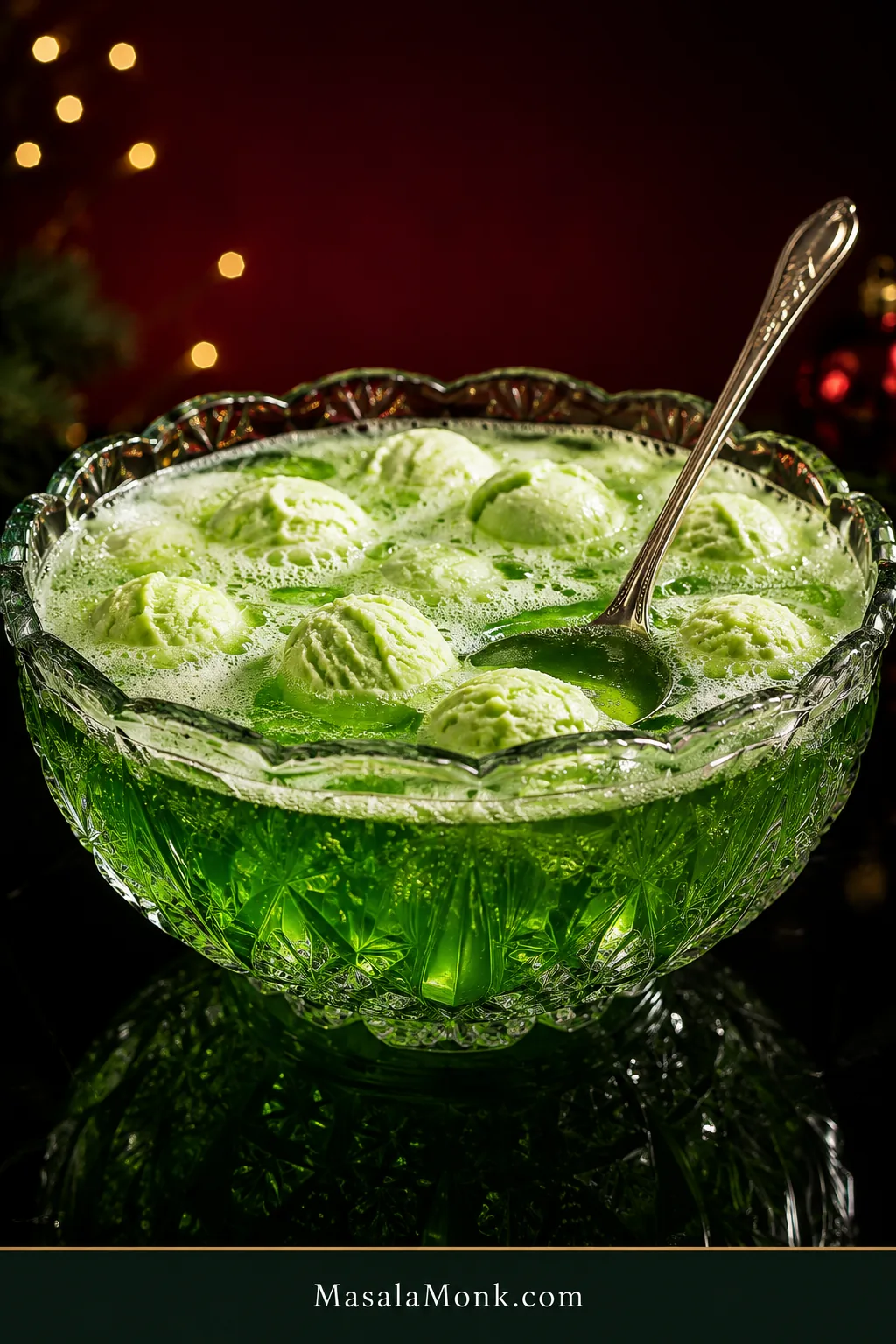
Crystal punch bowl filled with bright green fizzy punch, pale lime sherbet scoops, loose froth and a silver ladle against a dark red Christmas setting.

Set a bowl of bright green, frothy punch on a Christmas table and it rarely goes unnoticed for long. Lime sherbet floats across the top, bubbles gather around the scoops, and the kids are often lining up with cups before anyone has even asked what is in the bowl.

This non-alcoholic Grinch Punch is the family-friendly version: lime sherbet, green fruit punch, pineapple juice and lemon-lime soda. Four main ingredients, one punch bowl and about five minutes to put it together.

Quick Answer: How Do You Make Grinch Punch?

Combine 4 cups green fruit punch with 1 cup pineapple juice, add 1 quart lime sherbet, then slowly pour in 4 cups very cold Sprite or 7Up. Give the punch one or two gentle folds and serve while the soda is fizzy and the sherbet is floating on top.

  • Active prep: about 5 minutes
  • Alcohol: none
  • Best vessel: a roomy open punch bowl
  • Best timing: assemble shortly before serving

You may also see this same style of kid-friendly green Christmas drink called Grinch Juice.

Remember: Cold liquids. Scoopable sherbet. Slow soda.

Make this for: Christmas parties, Grinch movie nights, classroom celebrations, holiday buffets and family gatherings where one playful drink needs to work for both children and adults.

Grinch Punch Recipe

This recipe makes one standard party-bowl batch. Halve the quantities for movie night or repeat the standard batch when you need more.

Ingredients

  • 1 quart (32 fl oz / 946 mL) lime sherbet, cold and scoopable
  • 4 cups (32 fl oz / 946 mL) green fruit punch, preferably Hawaiian Punch Green Berry Rush
  • 1 cup (8 fl oz / 237 mL) 100% pineapple juice, chilled
  • 4 cups (32 fl oz / 946 mL) Sprite or 7Up, very cold
  • Red sanding sugar, as needed, optional
  • Lime wedges or maraschino cherries, as needed, optional

Shopping shortcut:

  • Lime sherbet: 1 quart, or about two-thirds of a 48-fl-oz tub.
  • Green punch: 32 fl oz, or one-quarter of a gallon jug.
  • Soda: 32 fl oz, just under half of a 2-liter bottle.
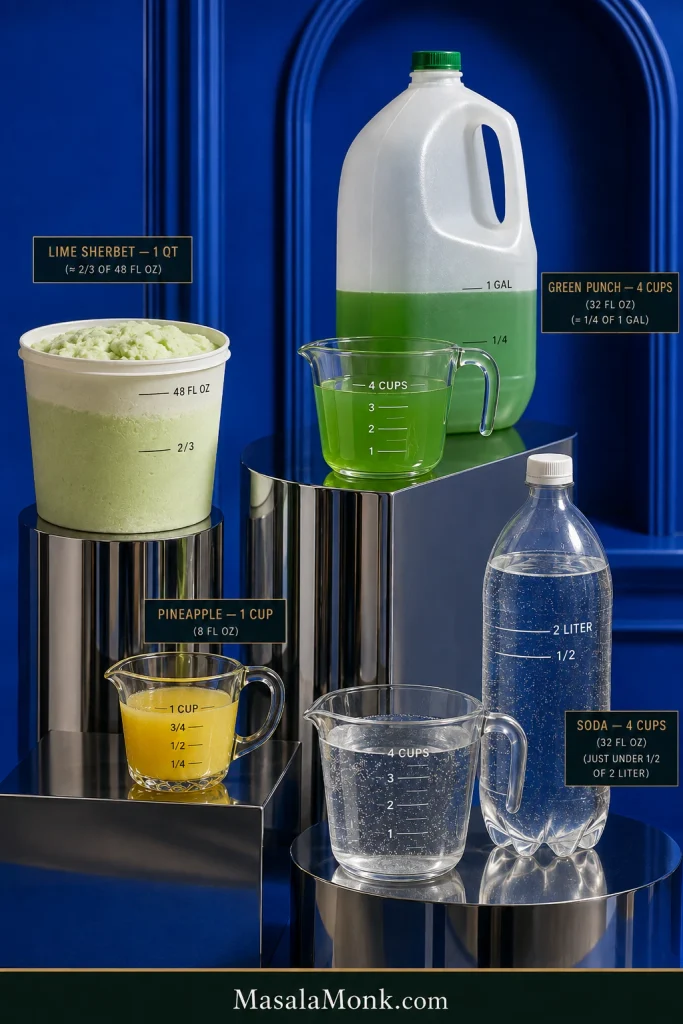
Lime sherbet tub, green fruit punch jug, pineapple juice and lemon-lime soda arranged with measuring vessels. Labels show 1 quart sherbet, 4 cups green punch, 1 cup pineapple juice and 4 cups soda, plus approximate package fractions used.
One 48-fl-oz sherbet tub covers a standard batch, but two full batches need another 16 fl oz of lime sherbet.

You’ll need: a large punch bowl, ladle, ice cream scoop and long spoon.

Instructions

  1. Chill the liquids. Keep the green punch, pineapple juice and soda refrigerated until needed. Leave the sherbet frozen until shortly before assembly.
  2. Get the sherbet scoopable. If it is rock-hard, leave it at room temperature for about 5 minutes—just long enough to scoop cleanly without becoming soft or slushy.
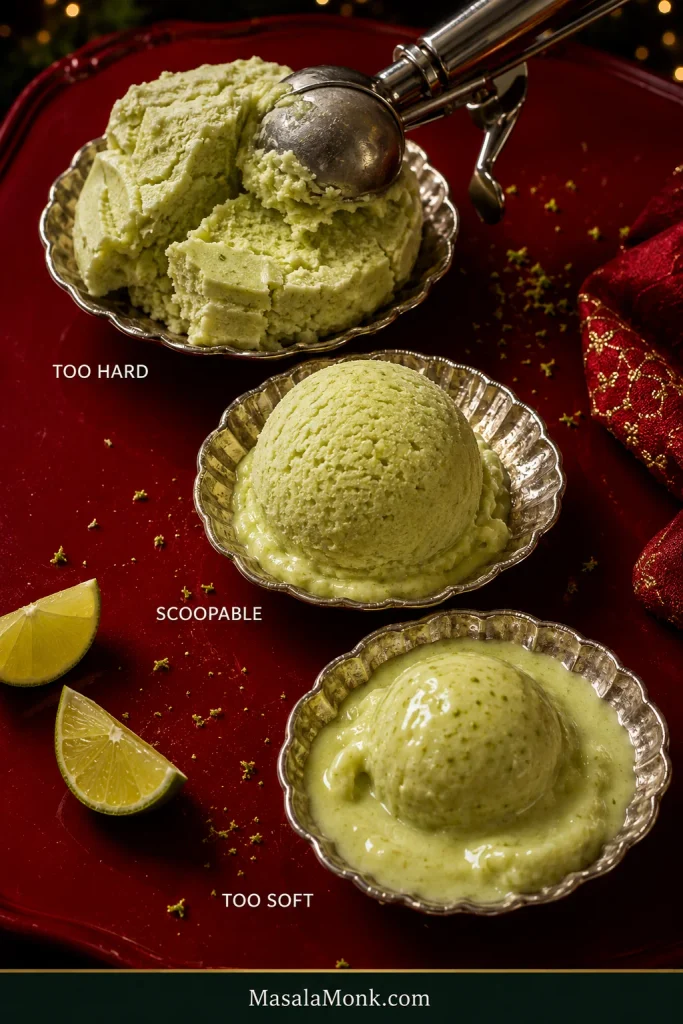
Three lime sherbet samples labeled Too Hard, Scoopable and Too Soft; the hard sample is fractured, the ideal scoop holds its shape, and the soft sample is beginning to melt.
If the sherbet is still too hard after a few minutes, warm the scoop under hot water, dry it, then scoop.
  1. Build the base. Pour the green fruit punch and pineapple juice into the punch bowl.
  2. Add the sherbet. Scoop it across the surface rather than dropping one solid block into the middle.
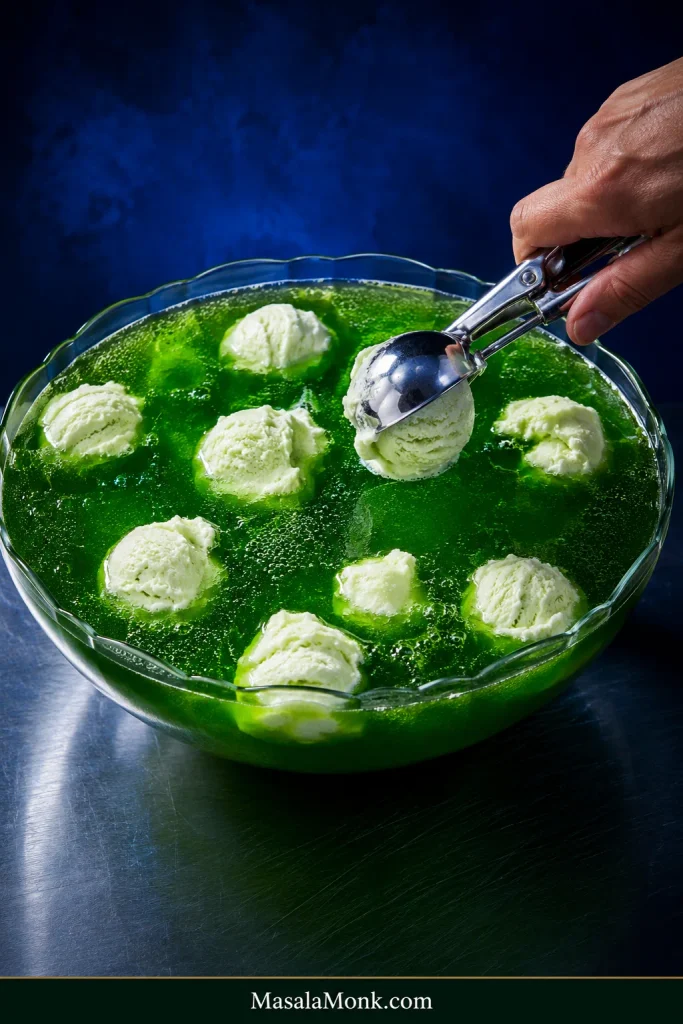
Hand placing a scoop of lime sherbet into a clear bowl of bright green punch, with several separate sherbet scoops distributed across the surface.
Spread smaller sherbet scoops across the surface so they soften gradually instead of melting from one large block.
  1. Add the fizz. Slowly pour the Sprite or 7Up around the bowl, letting some run over the sherbet for froth. If the foam climbs quickly, pause and let it settle before continuing.
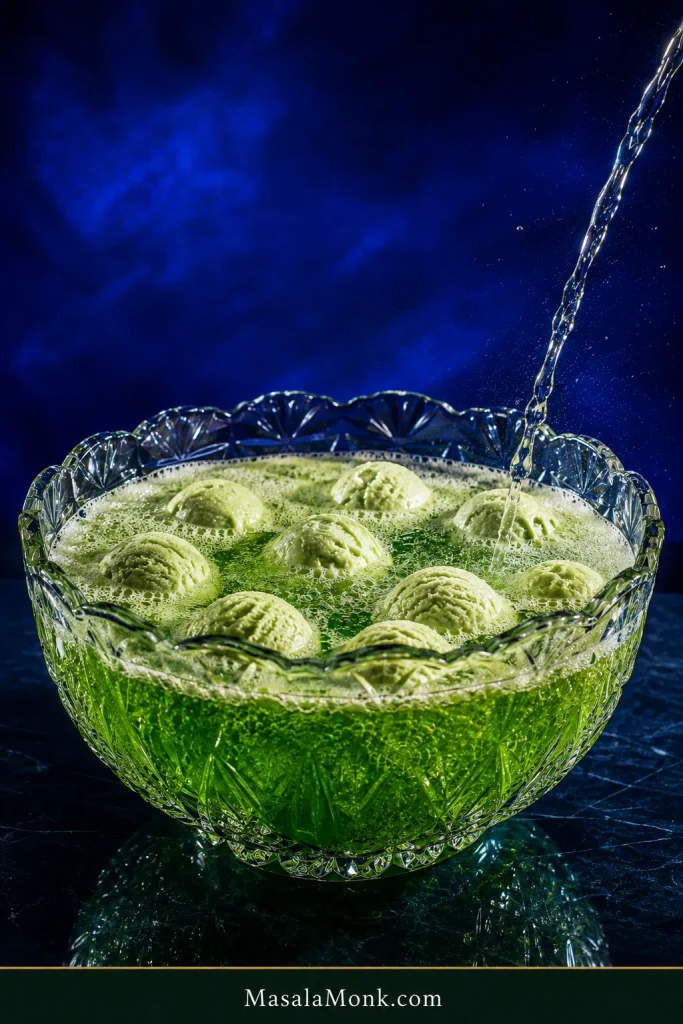
Thin stream of clear carbonated soda pouring near the edge of a glass bowl containing green punch and floating lime sherbet, with bubbles and light foam forming below the rim.
Move the soda stream around the bowl; spreading the first burst of froth helps prevent one tall foam mound.
  1. Finish gently. Give the punch one or two slow folds with a long spoon, then ladle it into cups and serve.

Check the Finished Punch

What should it look like? A bright green bowl with a loose frothy top, visible sherbet scoops and lively bubbles gathering around the edges.
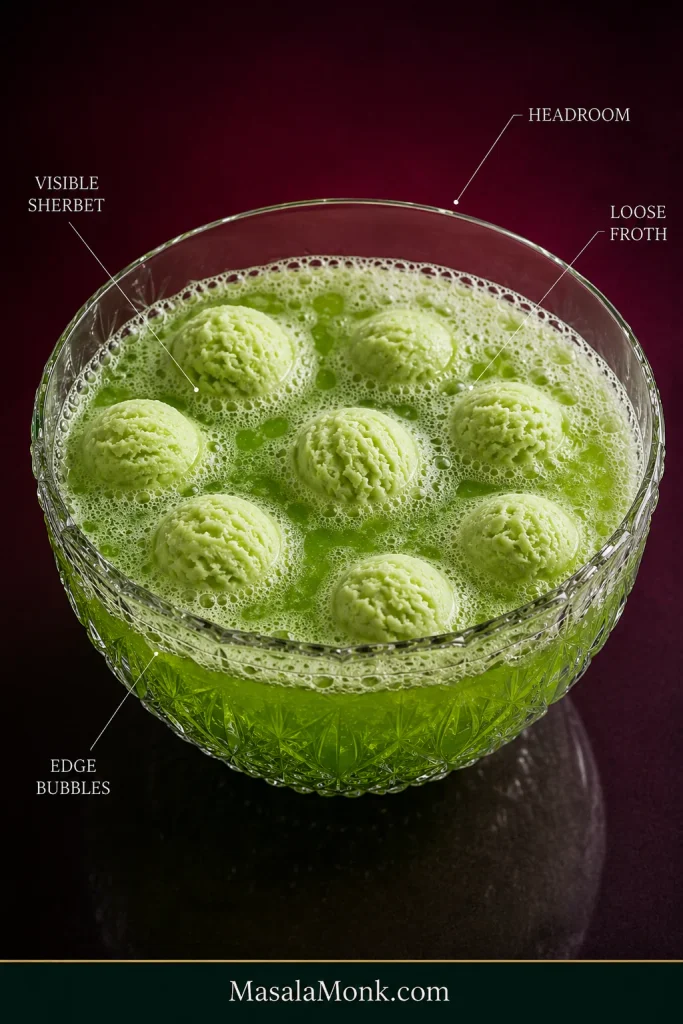
Overhead view of green sherbet punch with labels pointing to Visible Sherbet, Loose Froth, Edge Bubbles and Headroom.
Serve while green punch, pale sherbet and loose froth still look distinct instead of blending into one creamy layer.

In the cup, the first sip is fizzy and citrusy. As the sherbet softens, the drink becomes creamier, while the pineapple rounds out the fruitiness without taking over.
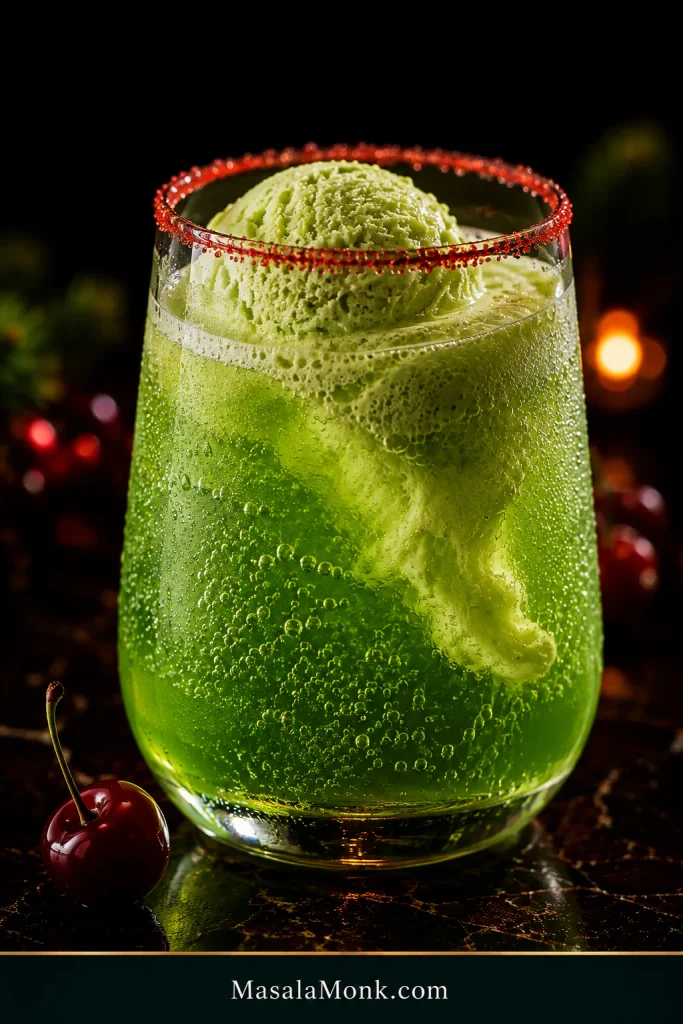
Close-up of a clear glass of green fizzy punch with a pale lime sherbet scoop softening into the drink, rising bubbles, condensation and a red sugar rim.
Sherbet-heavy pours drink creamier, while mostly liquid servings stay lighter and fizzier—so cups naturally vary a little.

Optional Grinch Garnish

For cups you are serving right away, rub a lime wedge lightly around the rim and dip it into red sanding sugar. Preparing the cups a few hours ahead? A very thin coat of corn syrup holds the sugar more securely. Test one disposable cup first, because some plastic rims are stubborn.
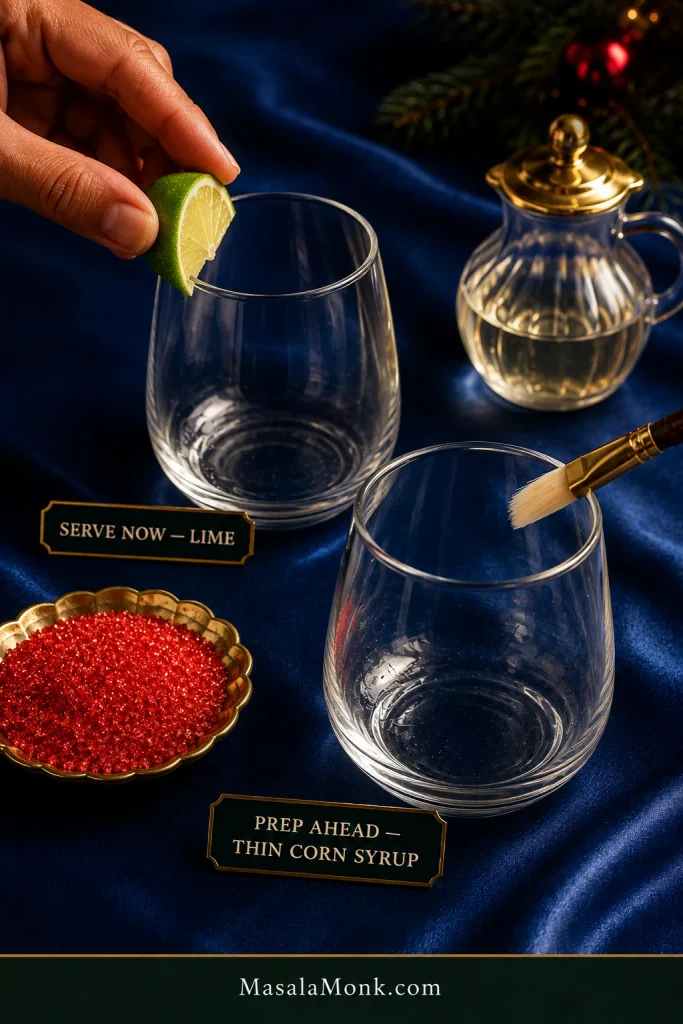
Two empty glasses demonstrating red sugar rims: a hand rubs lime around one rim labeled Serve Now — Lime, while the other is labeled Prep Ahead — Thin Corn Syrup beside red sanding sugar.
Coat only the cup’s outer edge; red sanding sugar stays decorative instead of dissolving into the first sip.

A maraschino cherry adds a simple red accent if you want a touch of Grinch-heart contrast without turning every glass into a craft project.

What Each Ingredient Does

Lime sherbet. This gives the punch its citrus flavor, creamy body and floating green scoops. Very soft sherbet disappears into the drink quickly; very hard sherbet is awkward to portion.

Sherbet contains some dairy, which is part of what makes it creamier than sorbet. If the freezer-case labels blur together, our guide to sherbet vs sorbet explains the difference. For school parties, check the sherbet label and your school’s allergy rules before serving.

Lime sherbet can be surprisingly hard to find around Christmas, so buy it when you see it rather than leaving it to the day of the party.

Green fruit punch. When recipes call for “green Hawaiian Punch,” Hawaiian Punch Green Berry Rush is the bright-green drink to look for. It supplies much of the color, fruit flavor and sweetness. Another green fruit punch works when Green Berry Rush is unavailable.

Sprite or 7Up. Lemon-lime soda brings the fizz. Use it straight from the refrigerator and open it close to serving so those bubbles end up in the bowl.

Pineapple juice. One cup adds fruitiness and some tartness without taking over the lime. Use ordinary 100% pineapple juice from a bottle or can, not frozen concentrate. If pineapple is a flavor you particularly enjoy, these punch recipes with pineapple juice explore it more fully.

For a three-ingredient version, replace the pineapple juice with another cup of green fruit punch. The result is sweeter and more straightforward.

Sherbet punch has an unmistakably old-school feel: a bright, bubbling bowl that somehow looks familiar before anyone has taken a sip. Turning it Grinch green simply gives that familiar party drink a Christmas twist.

Can’t Find Lime Sherbet or Green Berry Rush?

These are the two ingredients most likely to send you back around the supermarket. Both have workable substitutes.

If you can’t find…Try…What changes
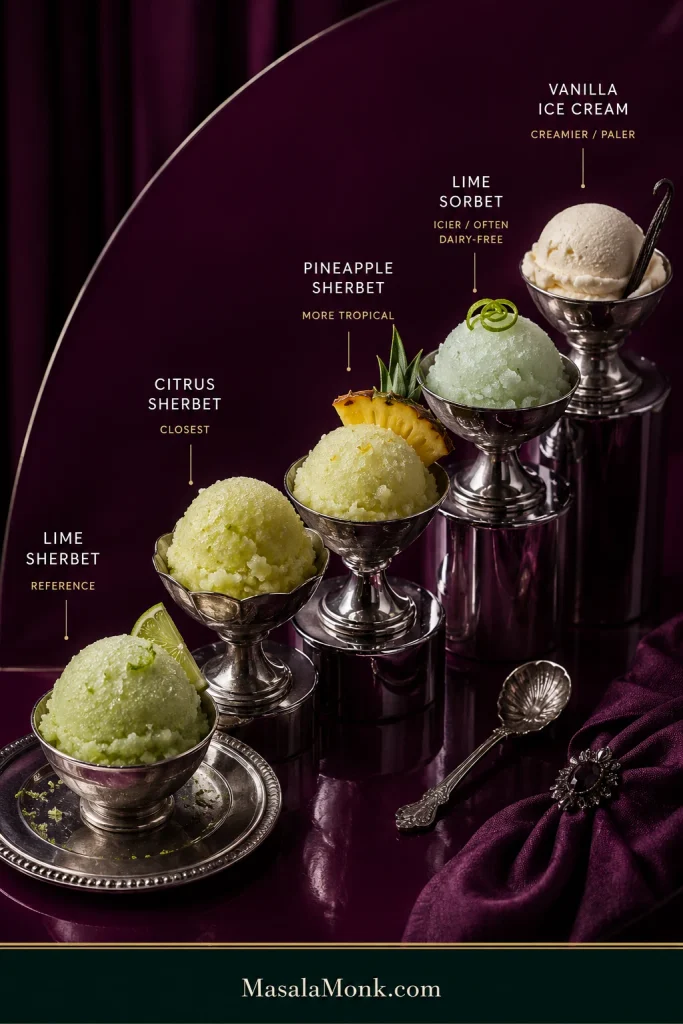
Lime sherbetAnother citrus sherbetClosest overall style; color may change
Lime sherbetPineapple sherbetMore tropical but still bright and fruity
Lime sherbetLime sorbetUsually dairy-free; icier, lighter and less creamy or frothy. Check the label if dairy must be avoided
Lime sherbetVanilla ice creamCreamier and sweeter, with much less lime flavor and a paler top
Green Berry RushSame amount of another green fruit punchUsually the simplest swap; sweetness varies
Green Berry RushPrepared green lemon-lime Kool-Aid or a similar drink mixMore citrus-forward; mix it as directed for drinking before using
Any green drinkLight-colored fruit drink plus green food coloringGets you the color; taste before adjusting sweetness
Five frozen-dessert scoops labeled Lime Sherbet, Citrus Sherbet, Pineapple Sherbet, Lime Sorbet and Vanilla Ice Cream, showing different colors and textures in silver dishes.
Another sherbet keeps the familiar body; sorbet turns icier, while vanilla ice cream pushes Grinch Punch toward a float.

When you change the green punch, taste the cold fruit-punch and pineapple mixture before adding the sherbet and soda. Some replacements are much sweeter than others.

Start with one drop of green food coloring, stir, and add more only if the bowl needs it.
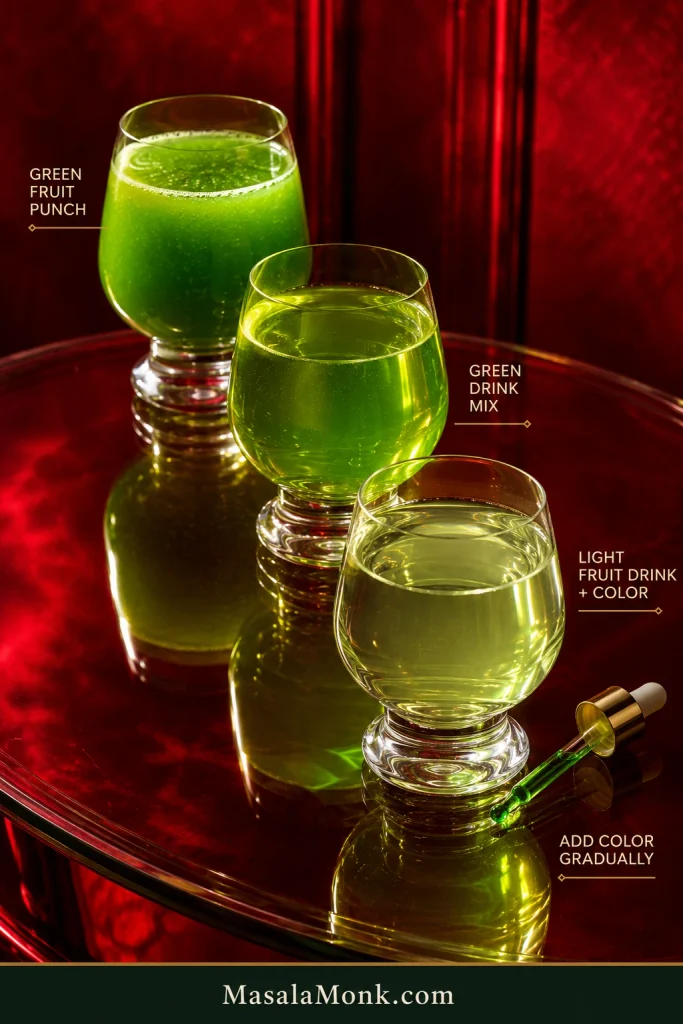
Three clear glasses contain different green drink bases labeled Green Fruit Punch, Green Drink Mix and Light Fruit Drink + Color, with a green dropper labeled Add Color Gradually.
Compare green drink bases before adding sherbet; melting sherbet lightens the color and makes opacity differences harder to judge.

Want Grinch Punch with no sherbet at all? That works better as a different punch formula because removing the sherbet also removes much of the body, citrus flavor and volume. This easy Christmas Punch uses cranberry, pineapple, orange, ginger ale and sparkling water instead.

Sprite, 7Up or Ginger Ale?

  • Sprite or 7Up: the familiar sweet lemon-lime version used in the main recipe.
  • Ginger ale: still fizzy, with a gentle ginger note in the background.
  • Sparkling water: useful for dialing back the sweetness.
  • Zero-sugar lemon-lime soda: reduces the sugar coming from the soda, although the sweetener flavor will be different.

For a less-sweet bowl, use 3 cups Sprite or 7Up plus 1 cup plain sparkling water. You keep most of the fizz while bringing the sweetness down a notch.
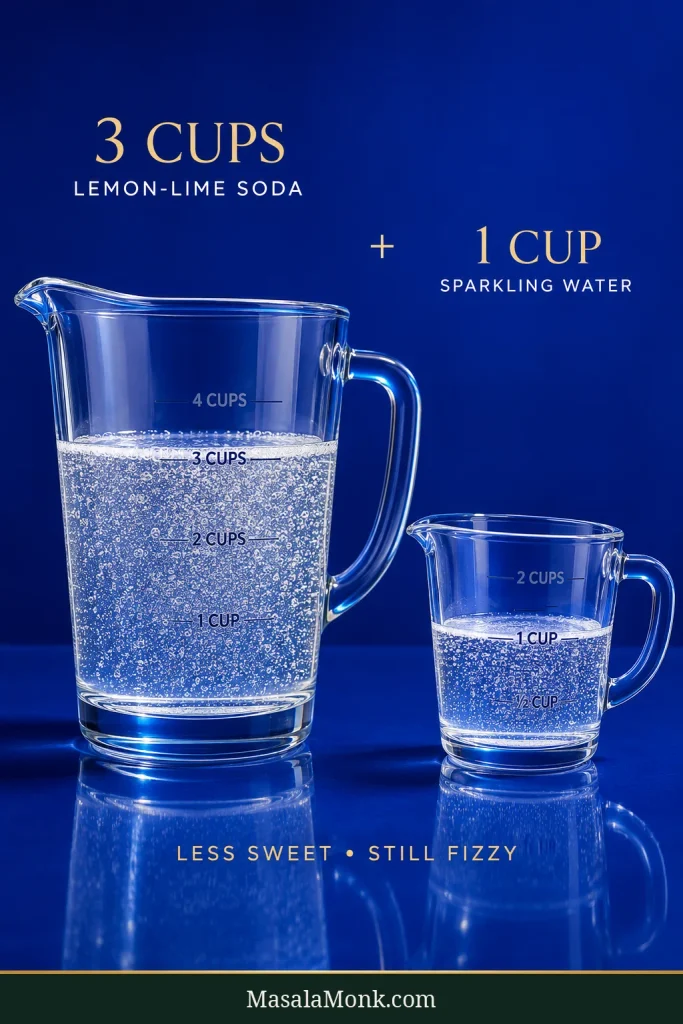
Two clear measuring vessels of carbonated liquid on a blue background. The larger is filled to the 3-cup mark and labeled Lemon-Lime Soda; the smaller is filled to 1 cup and labeled Sparkling Water.
Sparkling water reduces sweetness without changing the fruit-base or lime-sherbet ratio, so the punch keeps its balance.

Another kid-friendly fizzy option is a classic Shirley Temple, which uses grenadine and cherries with Sprite, 7Up or ginger ale.

How to Control the Foam

The froth is part of the fun. The foam climbing over the rim is not.

What separates a bubbly Grinch bowl from a green foam eruption mostly comes down to how the soda goes in. Start with well-chilled fruit punch and pineapple juice, add the sherbet, then pour the soda slowly around the bowl.
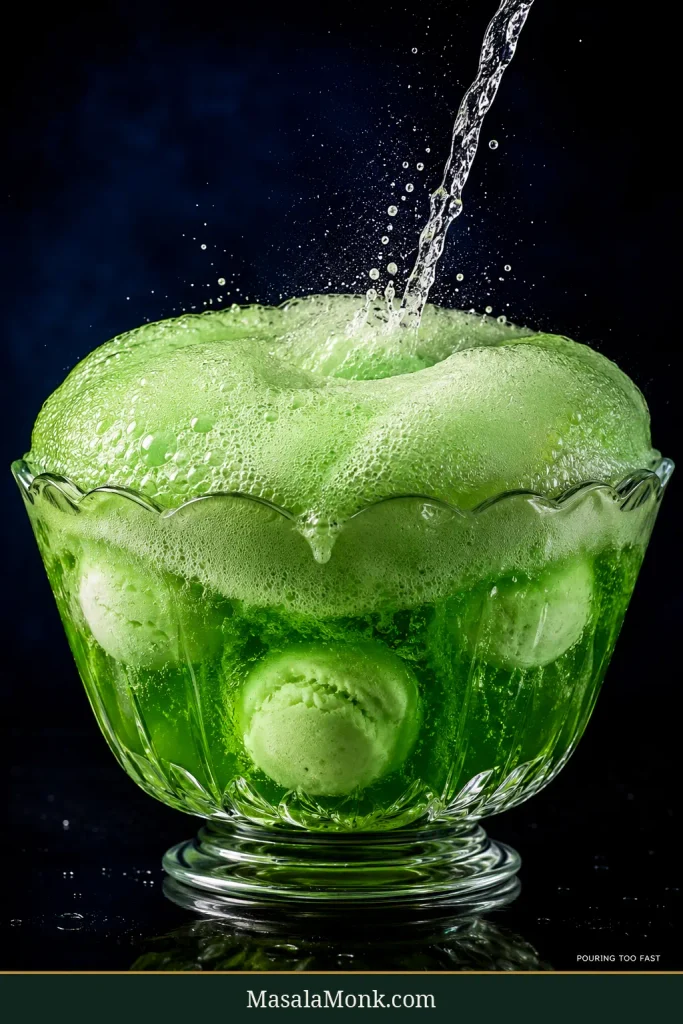
Green sherbet punch foaming rapidly above the rim of a clear punch bowl as a stream of soda pours into it.
Foam steals headroom quickly, so a comfortably underfilled punch bowl can become crowded as soon as soda hits sherbet.

If the foam begins climbing too quickly, stop pouring and give it a moment to settle. There is no prize for emptying the whole bottle into the bowl in one go.

For more froth at the end, save a small splash of soda and pour it gently over a few sherbet scoops. A loose bubbly layer is plenty; the sherbet should still be visible underneath.

The scoops naturally soften as the punch sits and gradually make the drink creamier. That is normal. The distinct floating scoops are simply the freshest-looking stage.
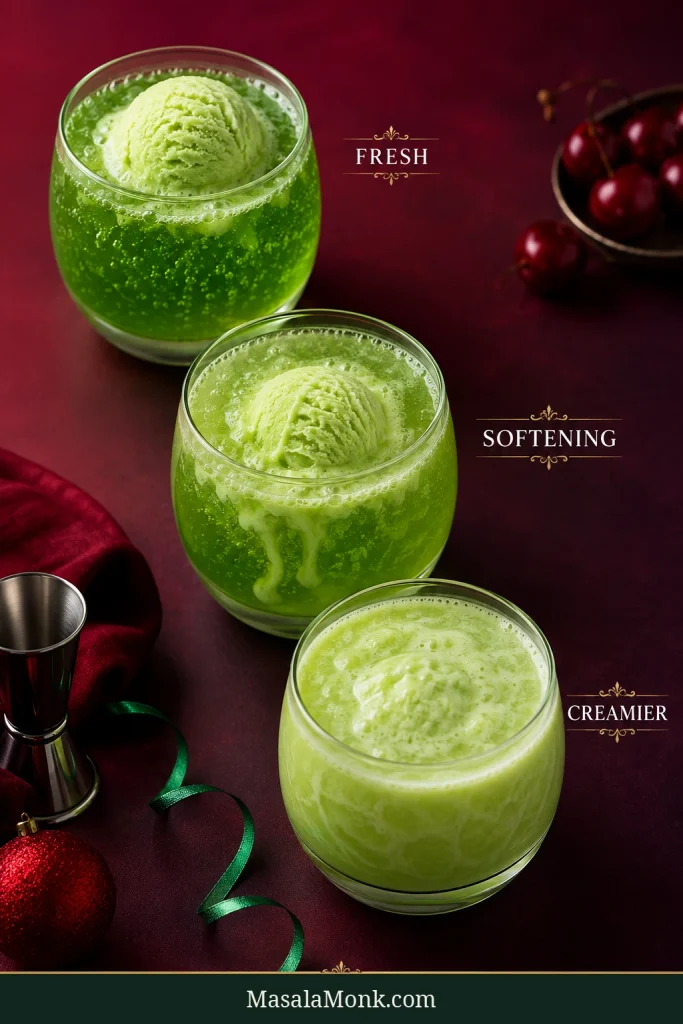
Three glasses labeled Fresh, Softening and Creamier show lime sherbet changing from a distinct scoop to partially melted ribbons and then a lighter, creamier green punch.
As the sherbet softens, the punch becomes creamier and more even in color while the floating scoops gradually disappear.

How Much Grinch Punch Do You Need?

“Serves 12” does not tell you much when one person is picturing a small punch cup and another is filling an eight-ounce glass.

Sherbet contains air, so the amount you can ladle into cups varies by brand and by how much sherbet lands in each serving. Use these as party-planning ranges.

How Many Cups Will One Batch Pour?

Pour sizeBest forPlanning range
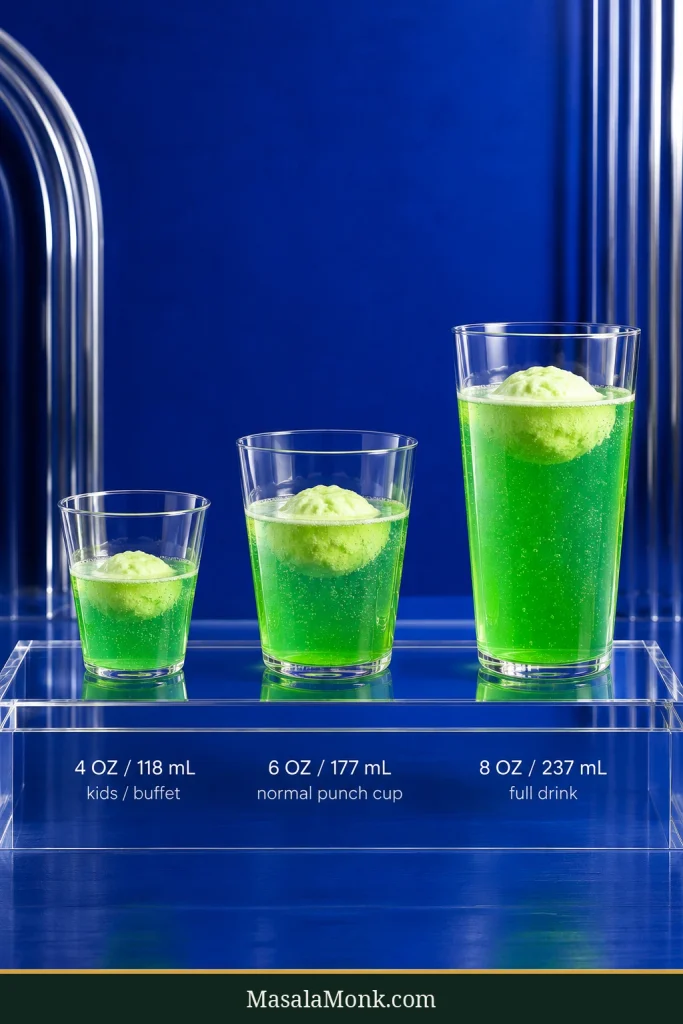
4 oz / 118 mLKids’ party, classroom, large buffetRoughly 22–26 small pours
6 oz / 177 mLNormal punch cupRoughly 15–17 pours
8 oz / 237 mLFull drinkRoughly 11–13 pours
Three clear glasses of green sherbet punch increase in size from left to right and are labeled 4 oz / 118 mL, 6 oz / 177 mL and 8 oz / 237 mL.
Moving from a 6-ounce to 8-ounce cup costs roughly four servings from a standard batch, so cup size matters.

Pours are not the same as guests. At a kids’ party, four-ounce first pours often make more sense. Anyone who wants more can come back, and you are less likely to collect half-full cups from every table afterward.

Planning for 20 people? One standard batch can cover one small first pour per guest. Keep ingredients ready for another batch when this is the main drink or you expect plenty of refills.

Small, Standard and Double Batches

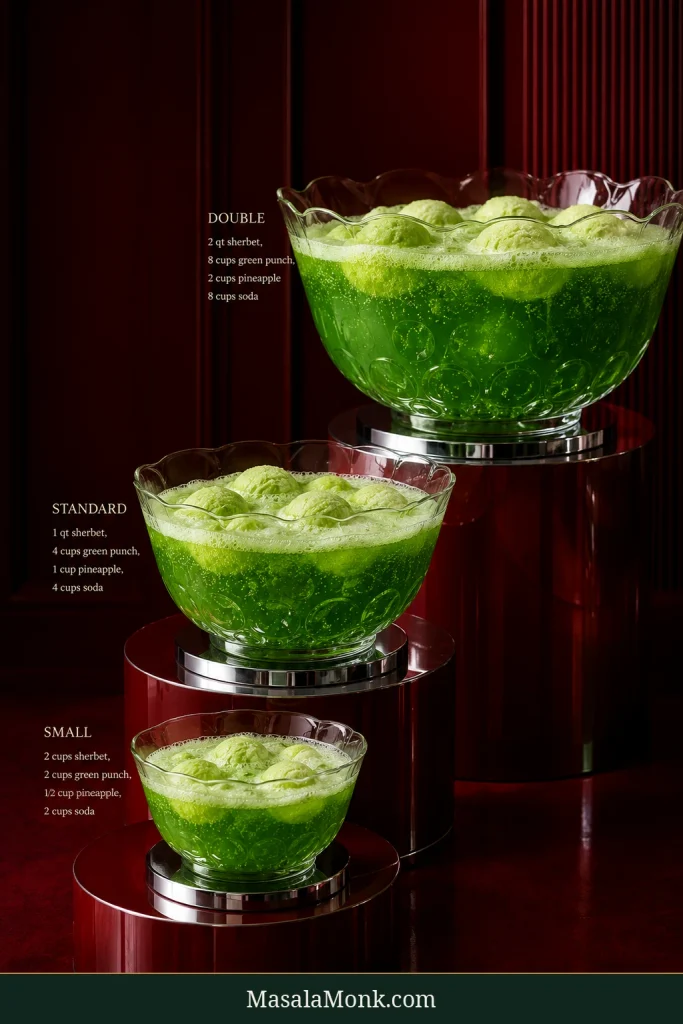
IngredientSmall BatchStandard BatchDouble Batch
Lime sherbet (volume)2 cups / 473 mL1 qt / 946 mL2 qt / 1.89 L
Green fruit punch2 cups / 473 mL4 cups / 946 mL8 cups / 1.89 L
Pineapple juice½ cup / 118 mL1 cup / 237 mL2 cups / 473 mL
Sprite or 7Up2 cups / 473 mL4 cups / 946 mL8 cups / 1.89 L
Three increasingly large bowls of green sherbet punch labeled Small, Standard and Double, with corresponding scaled ingredient quantities.
Remember 4:4:1:4 by cups—sherbet, green punch, pineapple juice and soda—to keep scaled batches balanced.

The small batch is plenty for movie night or a few people when the punch is part of the fun rather than the whole event. At most home parties, two standard batches made at different times are easier to manage than one enormous double batch.

For a very large crowd, buy enough ingredients for several standard batches and make them in rounds. Later batches stay fizzier, and you avoid committing everything to one bowl at the start.
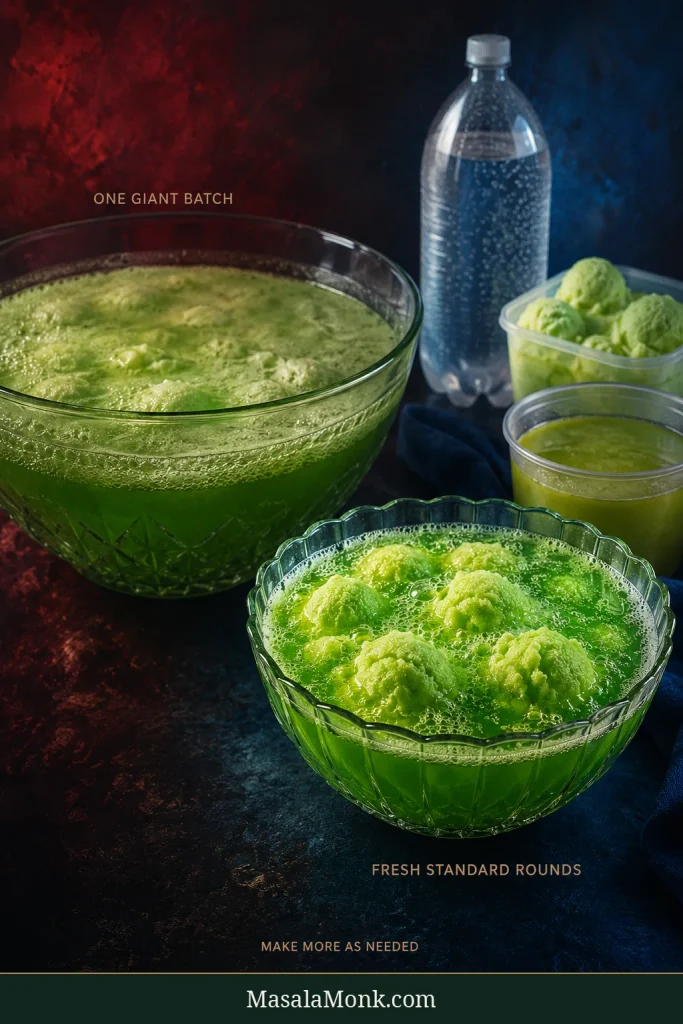
Large bowl of older green punch with softened sherbet beside a smaller fresh bowl with distinct sherbet scoops and bubbles; unbranded soda, reserved sherbet and chilled fruit base sit behind it.
Keep extra soda cold and unopened until the next round so every fresh batch starts with maximum fizz.

What Size Punch Bowl?

A bowl around 6 quarts / 5.7 liters or larger gives the standard batch useful headroom. Sherbet floats above the liquid and soda can build a temporary layer of foam, so the empty space matters.

With a smaller bowl, make the half batch or serve the punch in two rounds.
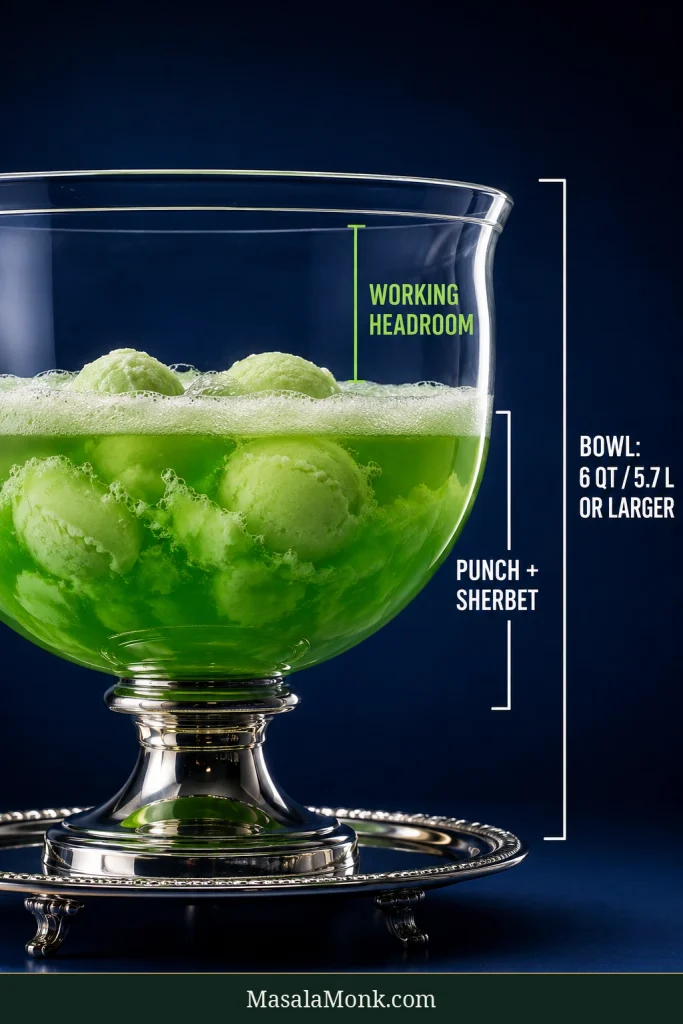
Side view of a clear punch bowl with green punch and lime sherbet. Brackets mark Punch + Sherbet, Working Headroom and Bowl: 6 qt / 5.7 L or Larger.
A wide bowl adds surface area, making floating sherbet and rising foam easier to manage than in a narrow vessel.

Keep It Cold and Fizzy

You can do nearly everything before the doorbell starts ringing. The only jobs worth saving for the end are putting the bowl together and opening the soda.

Prepare ahead, assemble late.

What to Prep Ahead

Earlier in the day, refrigerate the green punch, pineapple juice and soda, prepare the garnishes or sugar-rimmed cups, and put the bowl, ladle and glasses where you can find them. For a crowd, you can also pre-scoop the sherbet onto a lined tray or into a chilled muffin pan and return it to the freezer.
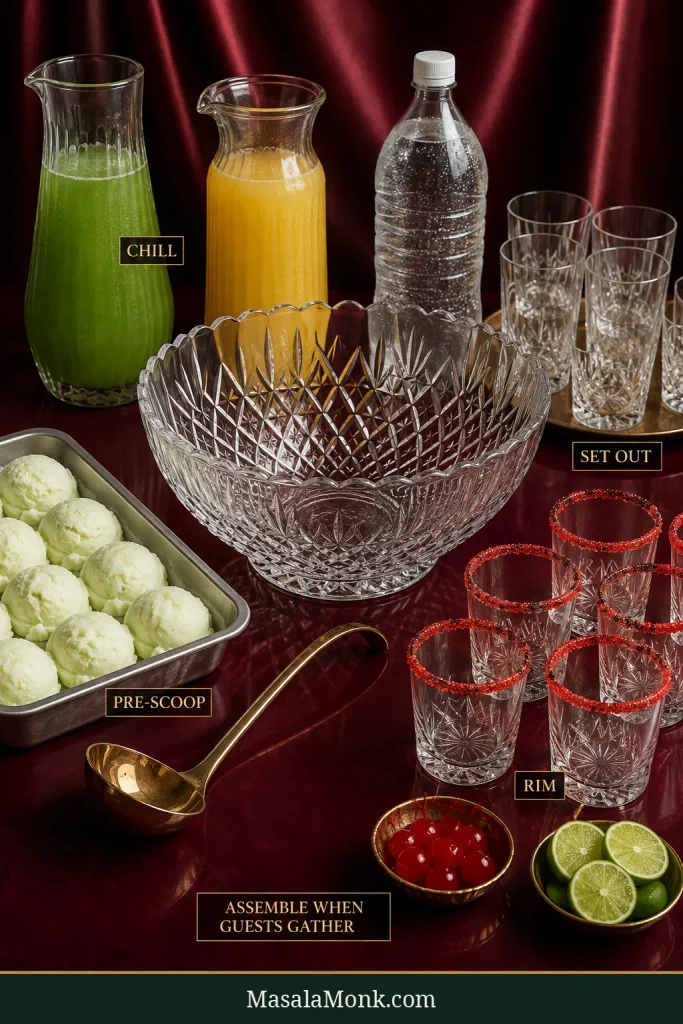
Empty crystal punch bowl surrounded by chilled green fruit punch, pineapple juice, unbranded soda, pre-scooped lime sherbet, glasses, red-sugar-rimmed glasses and a ladle. Labels mark Chill, Pre-Scoop, Set Out, Rim and Assemble When Guests Gather.
Leave space between pre-scooped portions; separate lime-sherbet scoops refreeze cleanly instead of joining into one awkward slab.

Once that is done, you are not wrestling with a frozen tub or hunting for the ladle while guests are walking through the door.

When to Assemble a Fresh Round

Put the punch together when people are beginning to gather around the drinks. That is a better cue than the clock—and certainly better than assembling it when you start setting up the buffet an hour earlier.

For a longer party, put out only part of the punch at first. Keep the remaining fruit base refrigerated, the sherbet frozen and the extra soda cold and unopened. When the first bowl runs low, make another. The bubbles are fresher, and there is usually less punch left sitting around at the end of the party.

Keep It Cold and Easy to Serve

Properly chilled ingredients usually make loose ice unnecessary, and melting ice dilutes the drink. For longer service, set the punch bowl inside a larger bowl or tray of ice. You can also freeze some green fruit punch into cubes if you want ice inside the bowl without adding plain water.

Because sherbet contains dairy, do not leave the finished punch at room temperature for more than 2 hours, or more than 1 hour when the temperature is above 90°F / 32°C. The USDA food-safety guidance has more detail.

A punch bowl is the easiest vessel because the sherbet and froth have room to float. For a small batch, a wide pitcher works. With a spigot dispenser, run only the chilled fruit base through the dispenser; add sherbet and soda to the cups or serving bowl so pieces do not interfere with the spout.

At a mixed-age party, keep the shared bowl alcohol-free so everyone can reach for the same festive drink. A fully alcoholic Grinch Punch is better treated as its own recipe instead of adding spirits to the family batch.
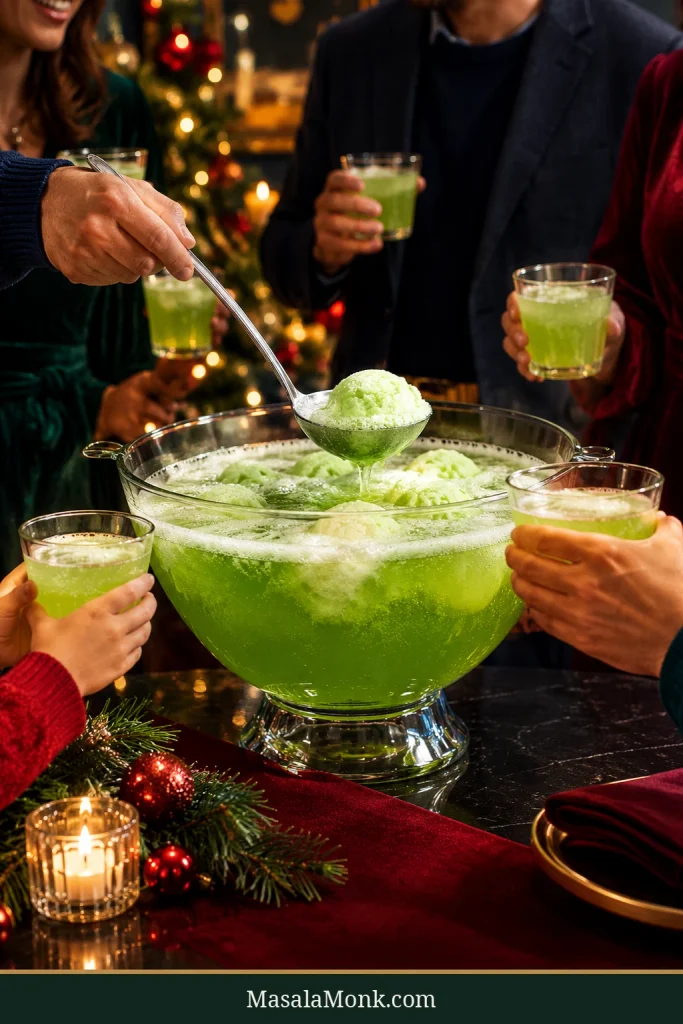
Guests gathered around a large crystal bowl of green fizzy punch with visible lime sherbet scoops. A ladle lifts sherbet and punch while several people hold ordinary clear punch cups in a warmly lit Christmas room.

Fix a Problem

Sherbet punch is forgiving, but it can still become too sweet, too foamy, too flat or simply too large for the bowl you grabbed. Most problems can be fixed without dumping the bowl and starting over.

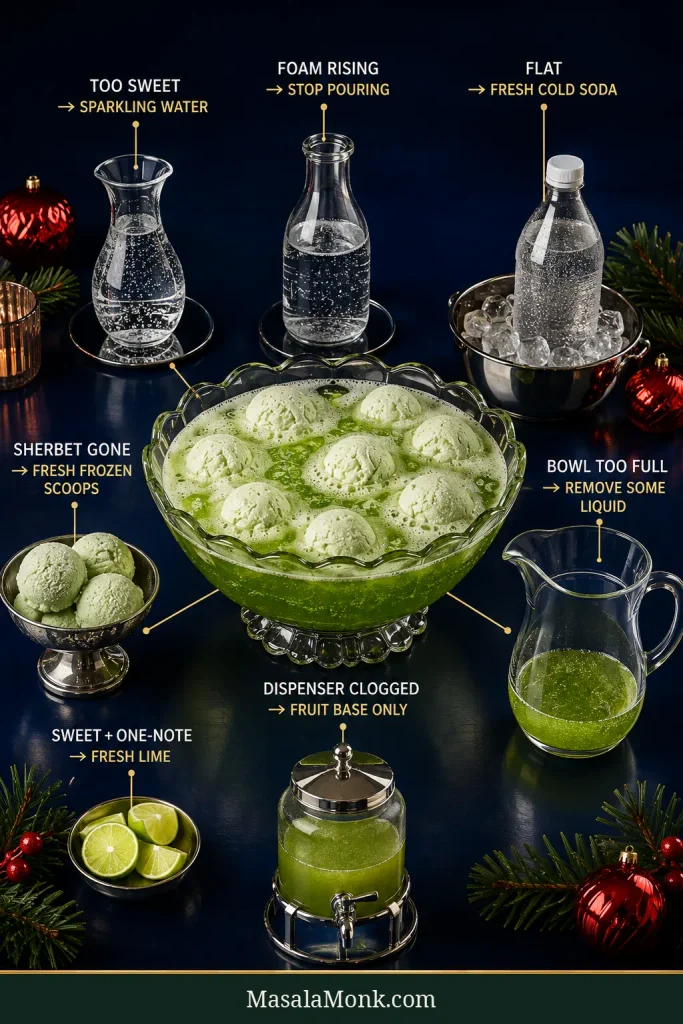
ProblemFix NowNext Time
Too sweetAdd cold sparkling waterUse 3 cups soda plus 1 cup sparkling water
Foam is overflowingStop pouring and let the foam settleChill the liquids well, pour the soda more slowly and leave more bowl headroom
Hardly any frothPour a small final splash of soda over a few scoopsLet some soda run directly over the sherbet during assembly
Punch went flatRefresh it with newly opened cold sodaOpen the soda close to serving and stir gently
Sherbet disappeared quicklyAdd a few fresh frozen scoops if you have themKeep the sherbet frozen until shortly before assembly
Punch is separatingGive the bowl one slow sweep with the ladleAvoid vigorous stirring that knocks out carbonation
Bowl is too fullRemove some liquid before adding the rest of the sodaUse a larger bowl or serve two rounds
Dispenser is cloggingMove the punch to an open bowl if possibleRun only the fruit base through a dispenser
Tastes sweet and one-noteAdd a small squeeze of fresh limeUse the lighter soda mix or taste the fruit base before finishing the bowl
Visual troubleshooting board showing common Grinch Punch problems and quick fixes around a bowl of green sherbet punch.
Change one variable at a time—sweetness, fizz, sherbet or volume—so a quick rescue does not create another problem.

Leftovers

Grinch Punch does not store especially well once assembled.

Refrigerate leftovers promptly if you want to keep them. By the next day, the bubbles are gone and the frothy top has disappeared, so expect a creamy fruit drink rather than freshly made punch.

The Final Ladle

Grinch Punch does not need a complicated ingredient list to make a Christmas table feel more fun. A vivid green bowl, a few lime-sherbet scoops and that first rush of bubbles already do most of the work—especially once someone comes back carrying an empty cup and asks for another.
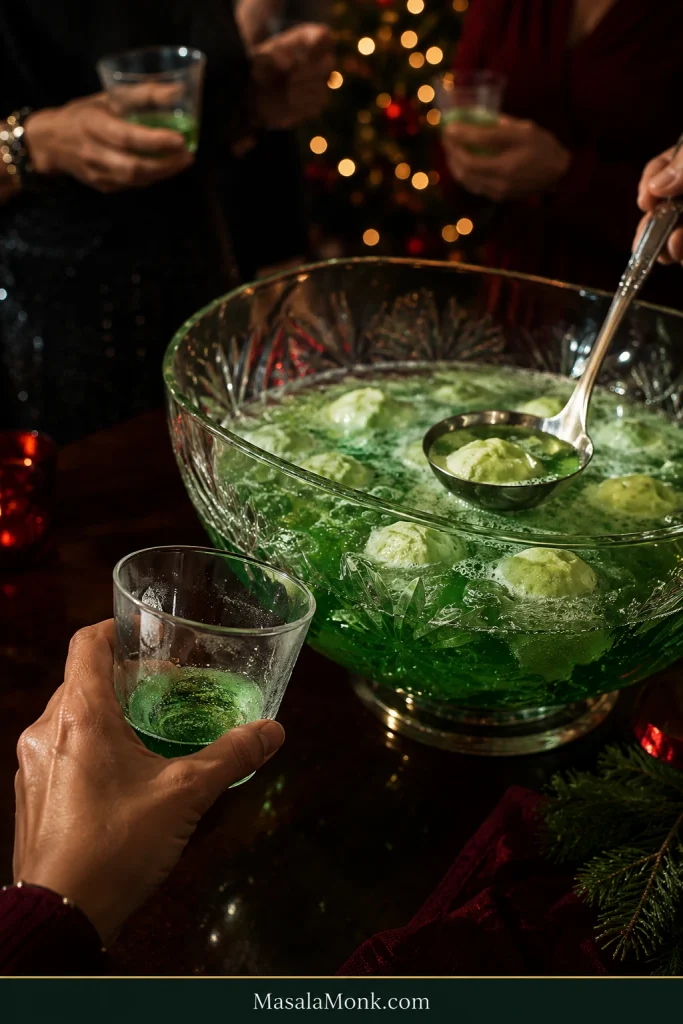
Hand holding a nearly empty glass of green punch beside a partially served crystal punch bowl with softened lime sherbet, bubbles and froth while a silver ladle lifts another scoop.

That is the charm of this punch: it looks like a celebration without becoming another hosting job. It gives the table color, gives the kids something to get excited about, and still leaves the person who made it free to enjoy the party.
Posted on Leave a comment

Christmas Punch Recipe: Easy, Festive & Made for a Crowd

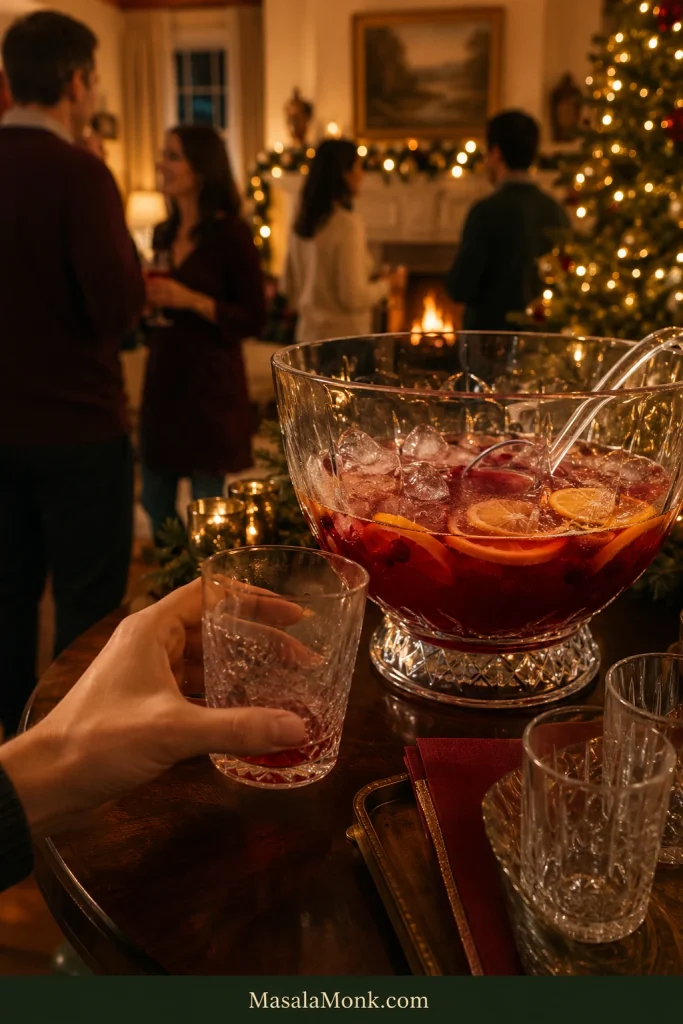
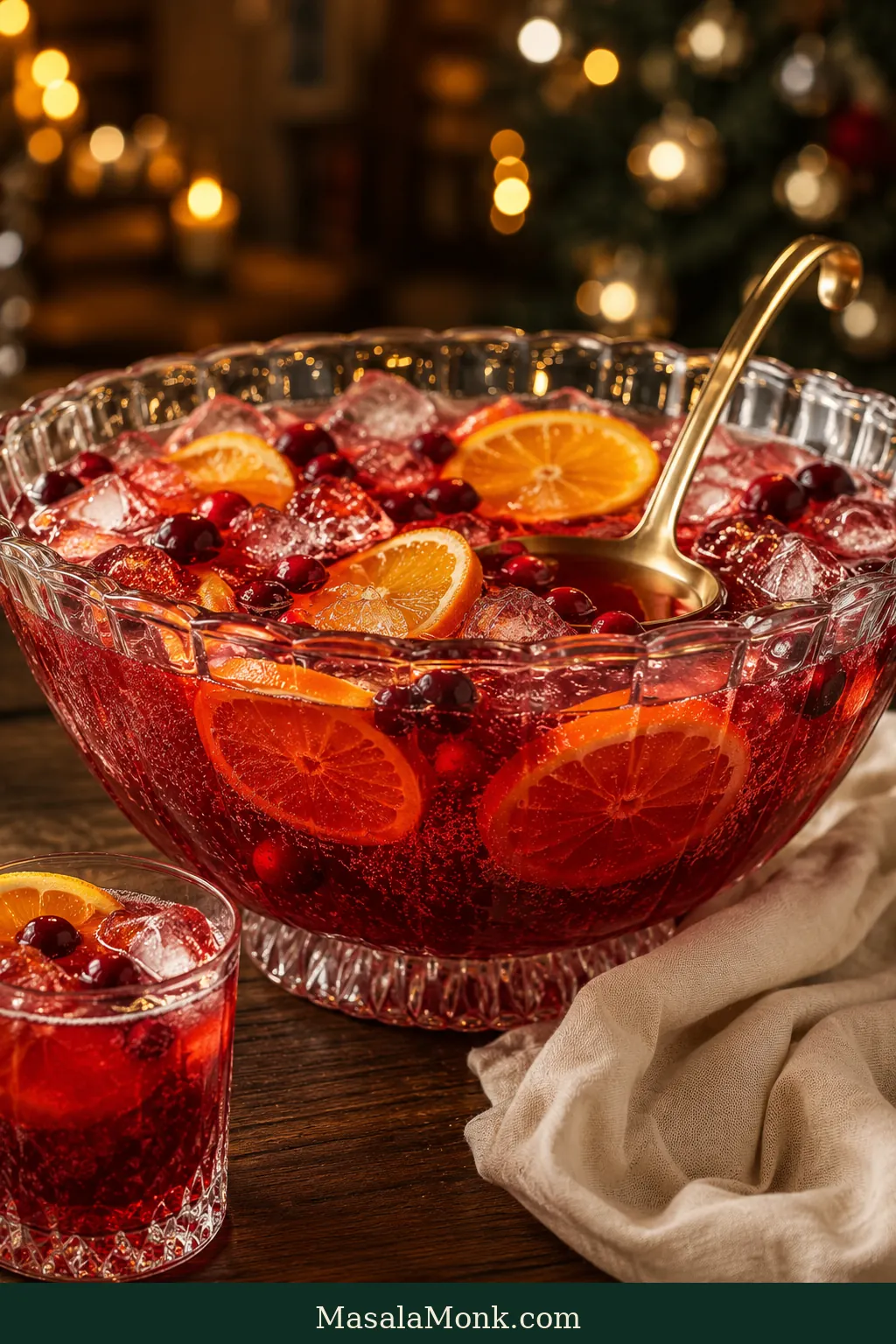
Large clear punch bowl filled with sparkling ruby-red Christmas punch, clear ice, orange slices and cranberries on a warmly lit holiday table.

Cold bubbles climbing around orange slices and ruby-red cranberries. Tart enough to cut through a rich Christmas dinner, fruity enough that people come back carrying an empty glass. That is the kind of Christmas punch worth putting in the middle of the table.

The trouble is that Christmas punch can go wrong surprisingly easily. Too sweet and the first glass feels like dessert. Too flat and it tastes like mixed fruit juice. Add alcohol carelessly and a drink that tastes gentle can become much stronger than anyone expected.

The idea here is simple: the recipe starts as a non-alcoholic Christmas punch, with ginger ale plus sparkling water so not all the fizz comes from sweet soda. Vodka or rum can be added where you want them, while brut Prosecco or Champagne can replace the ginger ale for a drier version.

Everyone gets the festive glass. Once the bowl is on the table, the host should be able to leave it there and get on with Christmas.

Quick Answer

This easy Christmas punch combines cranberry, pineapple and orange juice with ginger ale and sparkling water. It takes about five minutes to mix once everything is cold, makes about 1 US gallon / 128 US fl oz / 3.8 L, and can be served alcohol-free or spiked by the glass with vodka or rum.

The rule worth remembering is shorter than the ingredient list:

Chill first. Balance before bubbles. Carbonate last.

Choose Your Version

Mixed family gathering? Keep the bowl alcohol-free so children and adults can share the same festive punch. Adults who want vodka or rum can add it to their own glasses.

Adults only? Add a measured amount of vodka, light rum or gold rum to the whole bowl. The whole-bowl amounts below let you choose the strength without relying on guesswork.

Want a drier sparkling-wine version? Replace the ginger ale with brut Prosecco or Champagne.

Making your first batch? Keep the bowl alcohol-free and spike individual glasses. It gives you the most control without committing the whole gallon to one choice.

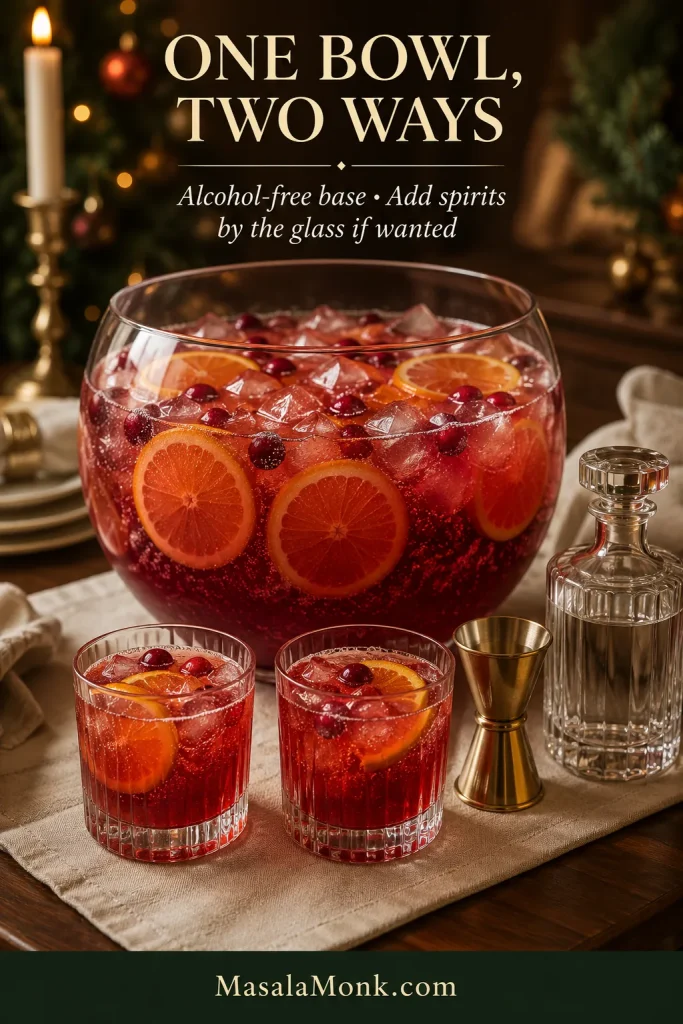
Alcohol-free Christmas punch bowl with two serving glasses, one served plain and one beside a jigger and clear spirit for optional individual spiking.
Keep the main bowl alcohol-free for mixed gatherings; place a spirit and jigger beside it for adults who want to spike their own glass.

Christmas Punch Recipe

The full batch makes about one gallon before optional lemon or alcohol. The scaling section below includes ready-made amounts for a single glass, pitcher and half batch.

Recipe at a Glance

PrepAbout 5 minutes
YieldAbout 1 US gallon / 128 US fl oz / 3.8 L
Small party poursAbout 21 × 6 fl oz / 180 ml
Generous servingsAbout 16 × 8 fl oz / 240 ml
Best bowl size6 qt / 5.7 L for most full batches
FlavorCranberry-forward, lightly sweet and sparkling
AlcoholOptional

Serving sizes: 6 fl oz / 180 ml is a small party pour; 8 fl oz / 240 ml is a generous serving. The 12 fl oz / 355 ml figure used later is a shopping allowance per guest, including refills—not one glass.

Ingredients

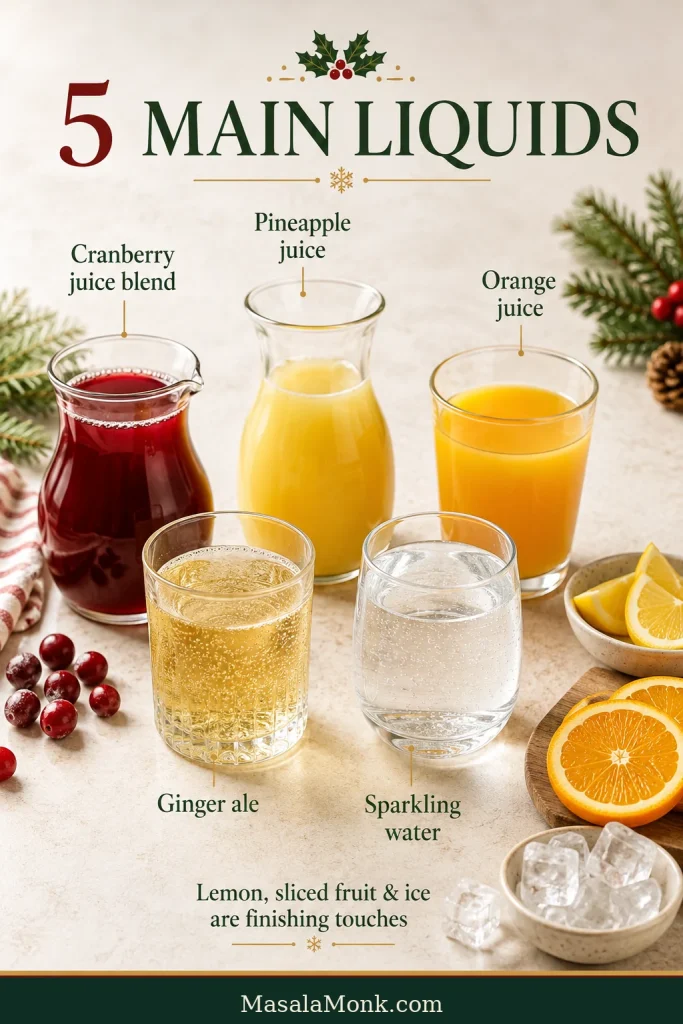
The punch itself uses five main liquids. Optional lemon juice, sliced fruit and ice are finishing touches.

Five ingredients for Christmas punch arranged on a light counter: cranberry juice blend, pineapple juice, orange juice, ginger ale and sparkling water, with lemon, fruit and ice nearby.
Three juices build the flavor; ginger ale and sparkling water supply the lift. Chill all five before mixing.
  • 8 cups / 64 fl oz / 1.9 L 100% cranberry juice blend, well chilled — not pure unsweetened cranberry juice
  • 3 cups / 24 fl oz / 710 ml 100% pineapple juice, well chilled
  • 1 cup / 8 fl oz / 240 ml 100% pulp-free orange juice, well chilled
  • 3 cups / 24 fl oz / 710 ml ginger ale, very cold
  • 1 cup / 8 fl oz / 240 ml plain sparkling water, very cold; club soda also works
  • Fresh lemon juice: 1–2 tbsp / 15–30 ml, only if the juice mixture needs more brightness after tasting
  • Orange: 1, thinly sliced
  • Up to 1 cup fresh or frozen cranberries, optional garnish
  • Large punch ice, an ice ring or ice for individual glasses, as needed

If you bought pure cranberry juice or cranberry juice cocktail instead, don’t swap it cup-for-cup. The cranberry guide below shows where to start.

How to Make Christmas Punch

Once everything is cold, the actual mixing takes about five minutes.

  1. Chill everything first. Start with refrigerator-cold juices and mixers so the ice is not doing all the chilling.
  2. Mix the juices. Pour the cranberry, pineapple and orange juice into the bowl and stir gently.
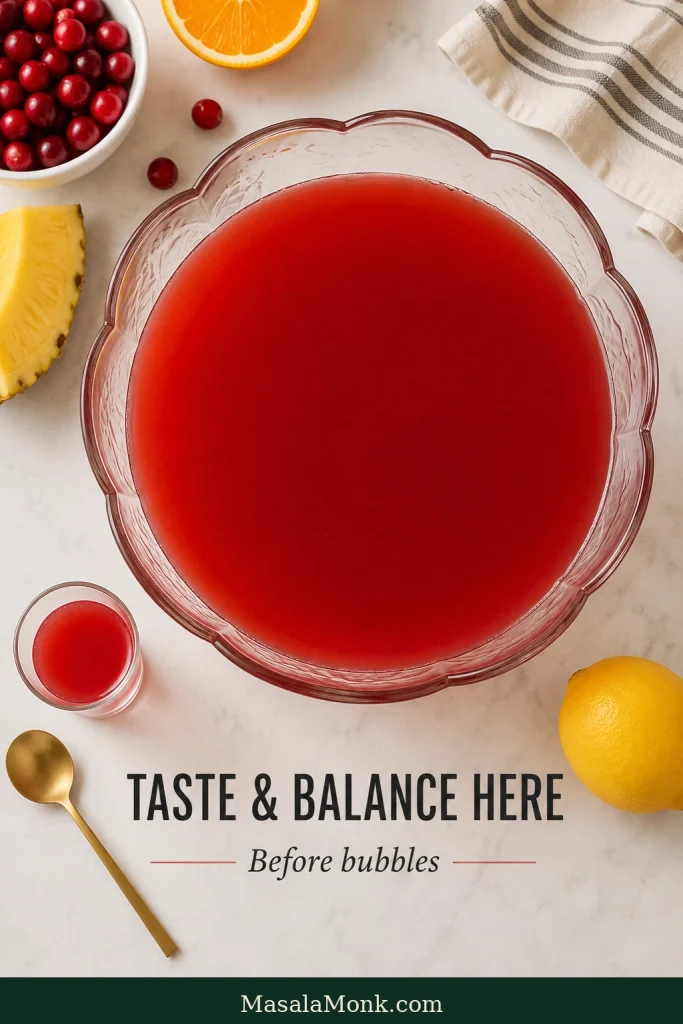
  3. Taste before the bubbles. Look for cranberry up front with enough fruit sweetness behind it that the mixture does not feel aggressively tart. If it feels heavy or sweeter than you want, try 1 tablespoon / 15 ml lemon juice. If it is unusually sharp, check the cranberry label first.
  4. Add whole-bowl alcohol now, if using. Choose one of the measured amounts below instead of free-pouring.
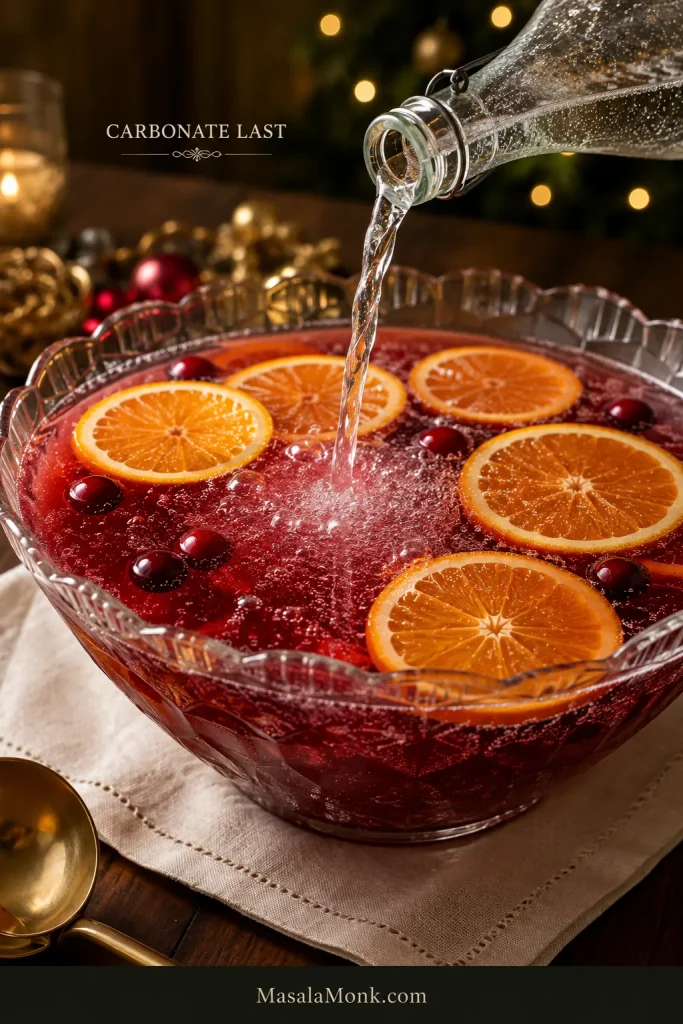
  5. Add the ginger ale and sparkling water last. Pour them in immediately before serving and give the punch one gentle stir.
  6. Finish and serve. Add ice and orange slices, plus a few cranberries, if using. Serve while everything is cold and fizzy.

Juice and ginger ale brands vary in sweetness. Make the smallest adjustment that solves the problem, then stop.

Overhead view of still cranberry, pineapple and orange juice base in a punch bowl before ice, garnish or carbonated mixers are added.
Taste the still base cold, before ice or fizz can soften what you are trying to judge.

The next ingredient is bubbles. Keep both fizzy mixers cold and add them only when the bowl is ready to serve.

Clear sparkling mixer being poured into ruby-red Christmas punch, creating fine bubbles at the surface.
Open the cold ginger ale and sparkling water only when you are ready to finish the bowl.

Make One Serving, a Pitcher or a Full Bowl

You should not need a calculator simply because fewer people are coming. Here are the amounts already worked out.

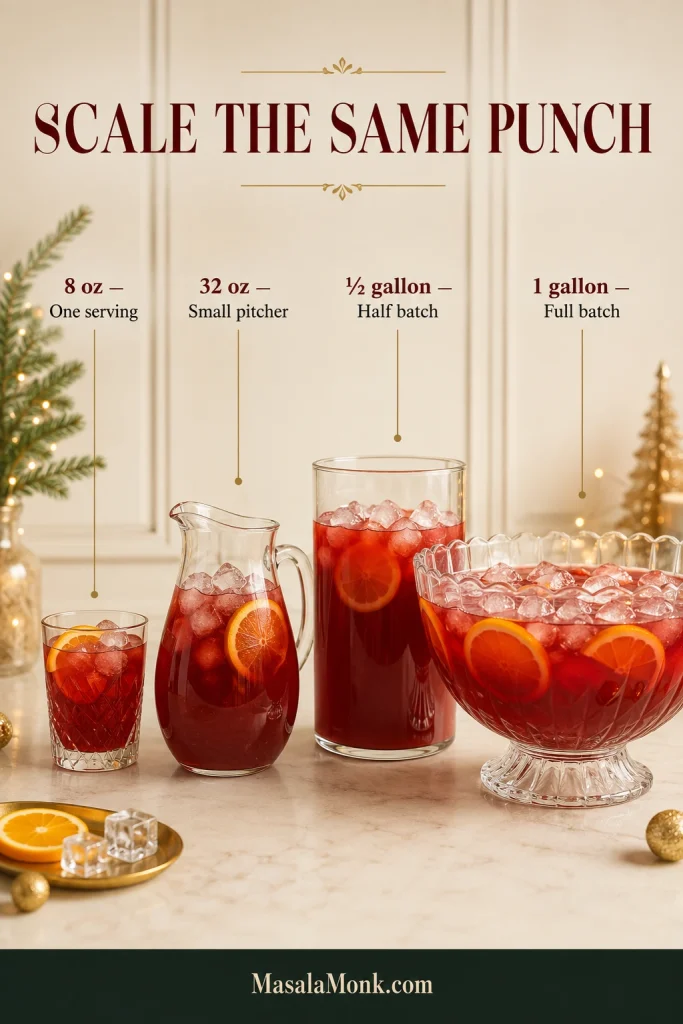
Scaling guide showing the same Christmas punch as an 8-ounce serving, 32-ounce pitcher, half-gallon batch and full one-gallon batch.
The same balance holds from one glass to a full bowl; only the quantities change.
SizeAmounts
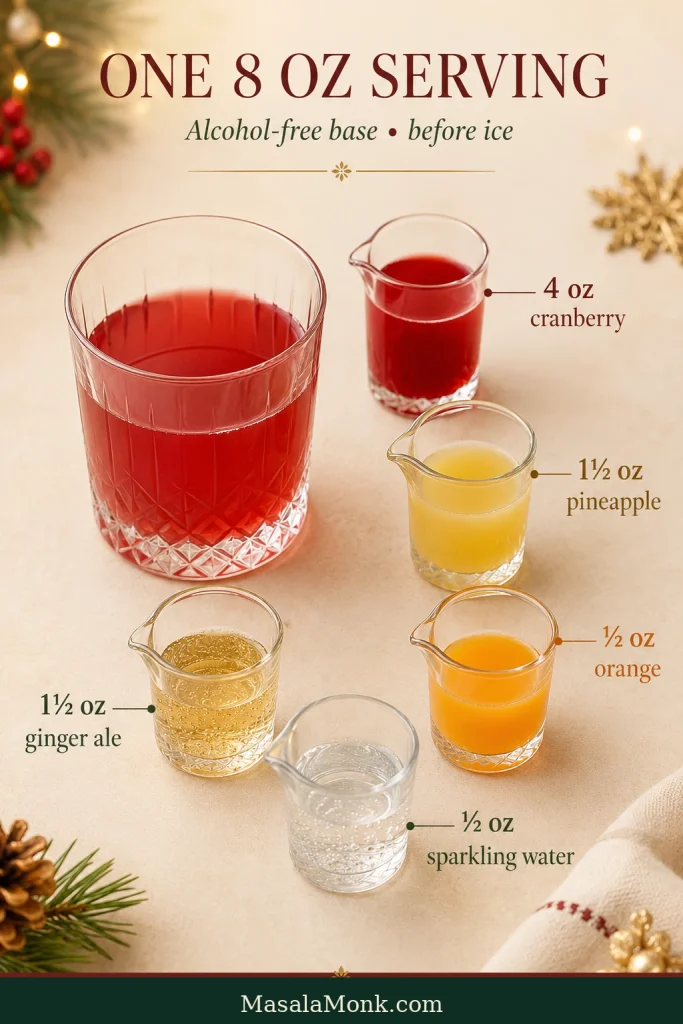
One 8-fl-oz / 240-ml serving4 fl oz / 120 ml cranberry + 1½ fl oz / 45 ml pineapple + ½ fl oz / 15 ml orange + 1½ fl oz / 45 ml ginger ale + ½ fl oz / 15 ml sparkling water
Small pitcher — about 32 fl oz / 950 ml2 cups / 475 ml cranberry + ¾ cup / 180 ml pineapple + ¼ cup / 60 ml orange + ¾ cup / 180 ml ginger ale + ¼ cup / 60 ml sparkling water
Half batch — about ½ US gallon / 1.9 L4 cups / 950 ml cranberry + 1½ cups / 355 ml pineapple + ½ cup / 120 ml orange + 1½ cups / 355 ml ginger ale + ½ cup / 120 ml sparkling water
Full batch — about 1 US gallon / 3.8 LUse the complete recipe above

For a single serving with ice or alcohol, use a 10–12 fl oz / 300–355 ml glass. For the small batch, choose a pitcher larger than 1 L. Don’t fill it to its advertised capacity when fruit or ice is going inside.

Single-serving Christmas punch guide with 4 ounces cranberry juice, 1.5 ounces pineapple, 0.5 ounce orange, 1.5 ounces ginger ale and 0.5 ounce sparkling water.
An 8-ounce serving is the cheapest place to test a new cranberry juice, mixer or substitution before a party.
Use the Ratio for Odd-Sized Batches

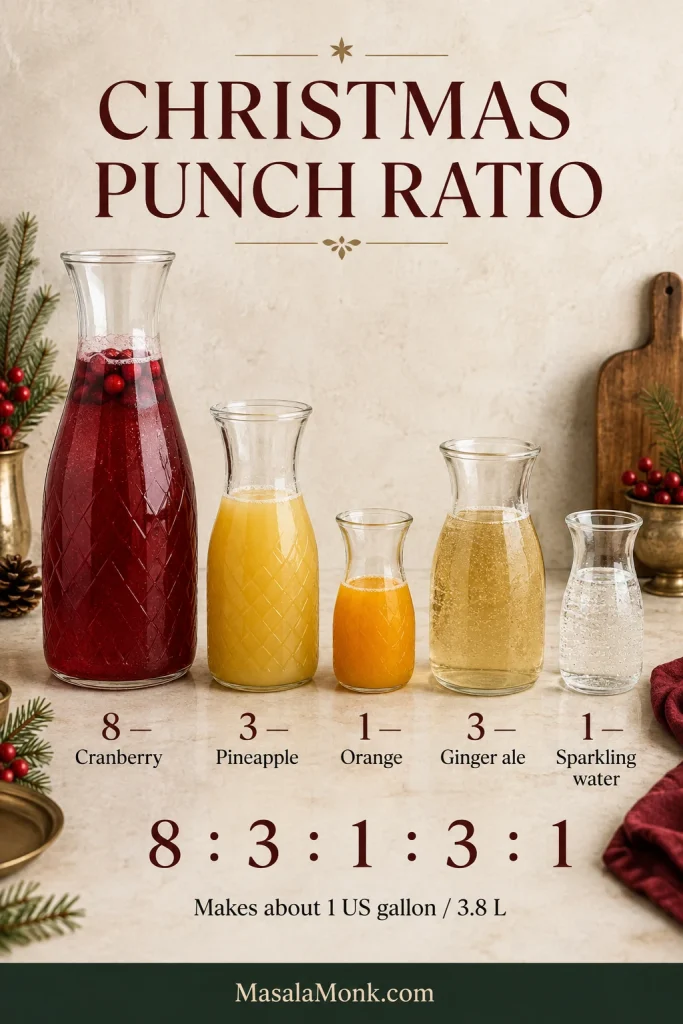
If your pitcher or dispenser does not match one of the sizes above, use 8 parts cranberry : 3 pineapple : 1 orange : 3 ginger ale : 1 sparkling water. Keep the same measure for every part.

Christmas punch ratio graphic showing 8 parts cranberry, 3 pineapple, 1 orange, 3 ginger ale and 1 sparkling water, making about 1 gallon or 3.8 liters.
For odd-sized vessels, 8:3:1:3:1 works with any consistent measure—ounces, milliliters, cups or a small jug.

Jump to What You Need

For a small gathering, everything you need is already above. The rest is here when you need help with cranberry labels, ingredient swaps, alcohol, crowd quantities, serving, ice or troubleshooting.

What Each Ingredient Is Doing

Cranberry leads. It gives the punch its tart backbone, deep red color and unmistakable holiday character. Because it makes up half the alcohol-free drink, choosing the right cranberry product matters far more than adding another handful of decorative fruit.

Pineapple brings body and fruit sweetness into the middle of the drink. Three cups are enough to soften cranberry without pulling everything too far into tropical-punch territory.

A smaller amount of orange connects cranberry’s tart edge with pineapple’s sweetness without taking over the color or flavor.

Ginger ale brings fizz, sweetness and a gentle ginger note. Sparkling water adds more bubbles without another full measure of sweet soda.

Together, those ingredients are meant to keep cranberry in front, soften its tartness with pineapple and citrus, and leave enough fizz that the punch feels refreshing rather than syrupy. Once the main ingredients are doing their jobs, adding more things rarely makes it better.

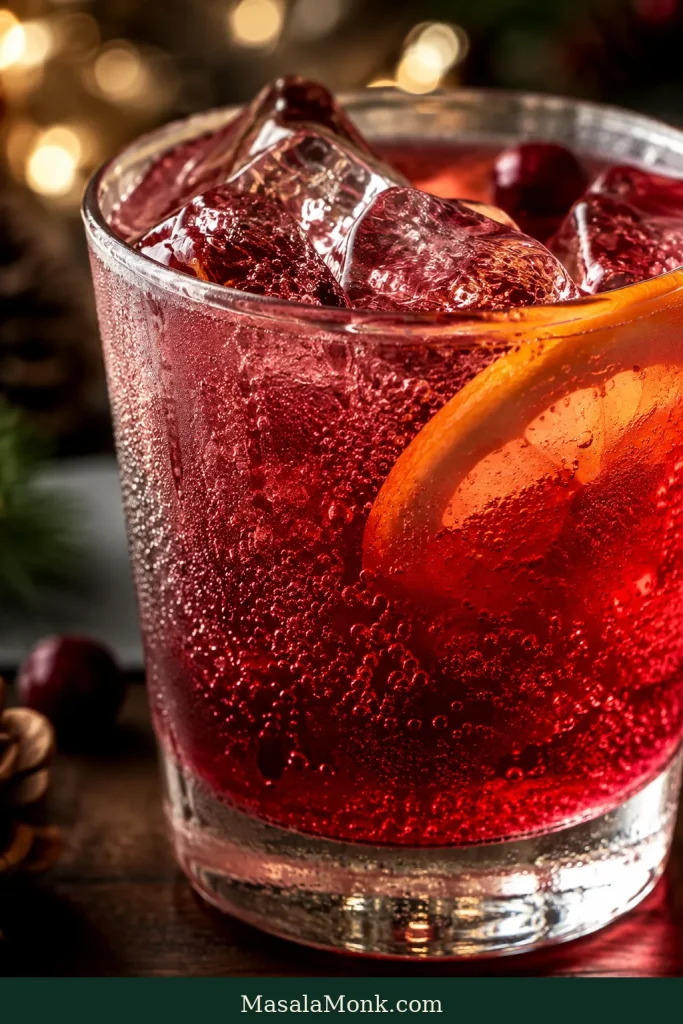
Close-up of a glass of sparkling cranberry Christmas punch with clear ice, condensation, bubbles, an orange slice and cranberries.
The target is cranberry-forward, bright and fizzy—not simply sweet.

Cranberry Juice: Read the Label Before You Pour

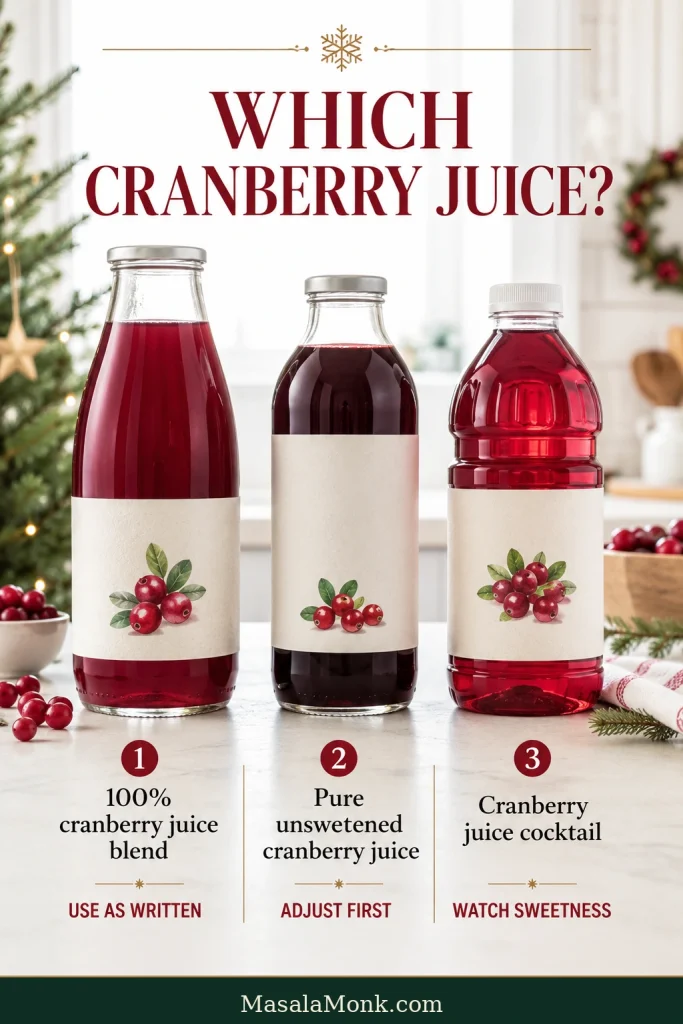
For the recipe as written, use 100% cranberry juice blend—not pure unsweetened cranberry juice and not automatically cranberry juice cocktail.

“Cranberry juice” sounds like one ingredient. At punch-bowl scale, the label can change the entire drink.

Comparison of three cranberry products for Christmas punch: 100 percent cranberry juice blend, pure unsweetened cranberry juice and cranberry juice cocktail.
If the label says 100% juice but lists apple, grape or pear too, you are likely looking at a cranberry juice blend.
What you boughtWhat to do
100% cranberry juice blend
Cranberry blended with naturally sweeter apple, grape or pear juice
Use 8 cups / 1.9 L as written. This is the intended version.
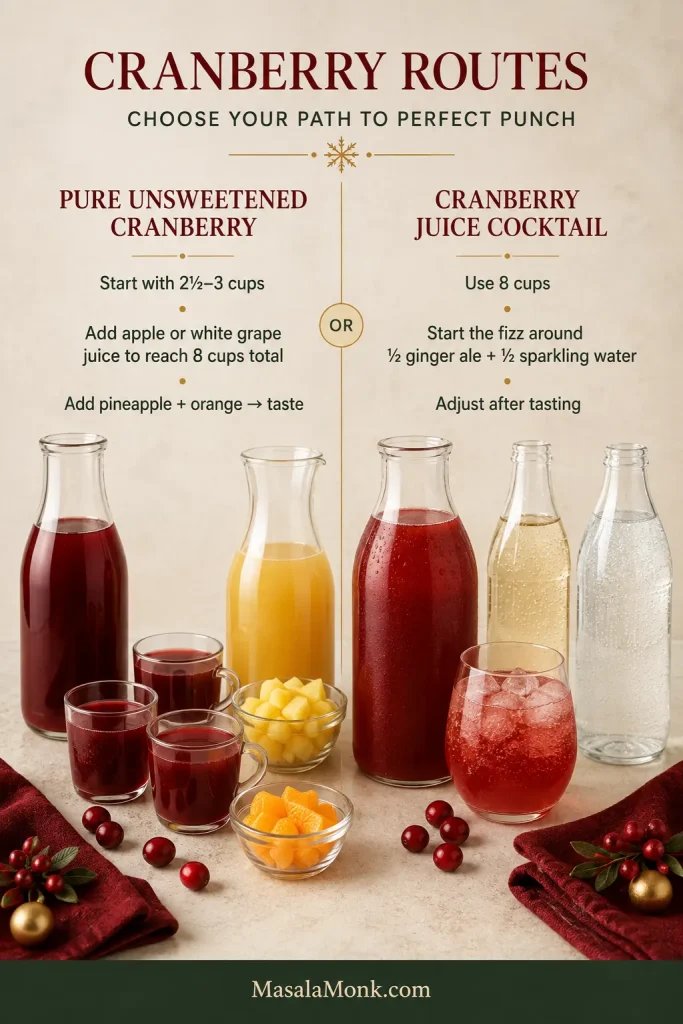
Pure unsweetened cranberry juiceDo not use it cup-for-cup. For the 8-cup cranberry portion, begin cautiously with about 2½–3 cups pure cranberry and enough apple or white grape juice to bring the total to 8 cups. Mix in the pineapple and orange, then taste.
Cranberry juice cocktailUse 8 cups / 1.9 L, but begin the fizzy portion with roughly equal parts ginger ale and sparkling water. Add more ginger ale only if the punch needs more sweetness.

If You Bought Pure Cranberry or Cranberry Cocktail

Start there, then taste. The difference between brands is large enough that one fixed number will not suit every bottle.

If the pure-cranberry version is still too sharp after the pineapple and orange are in, add a little more apple or white grape juice. If it only needs a small sweetness correction, cold simple syrup gives you finer control; add it 1 tablespoon / 15 ml at a time.

Cranberry cocktail can create the opposite problem. When the juice mixture is already sweet enough, plain sparkling water is more useful than another sweet mixer.

Two cranberry punch adjustment routes: pure unsweetened cranberry starts with 2.5 to 3 cups and is diluted with apple or white grape juice to 8 cups; cranberry cocktail uses 8 cups with about half ginger ale and half sparkling water for the fizz.
Fix the 8-cup cranberry portion first; once it tastes balanced, let pineapple, orange and fizz return to their normal jobs.

Before the Bubbles

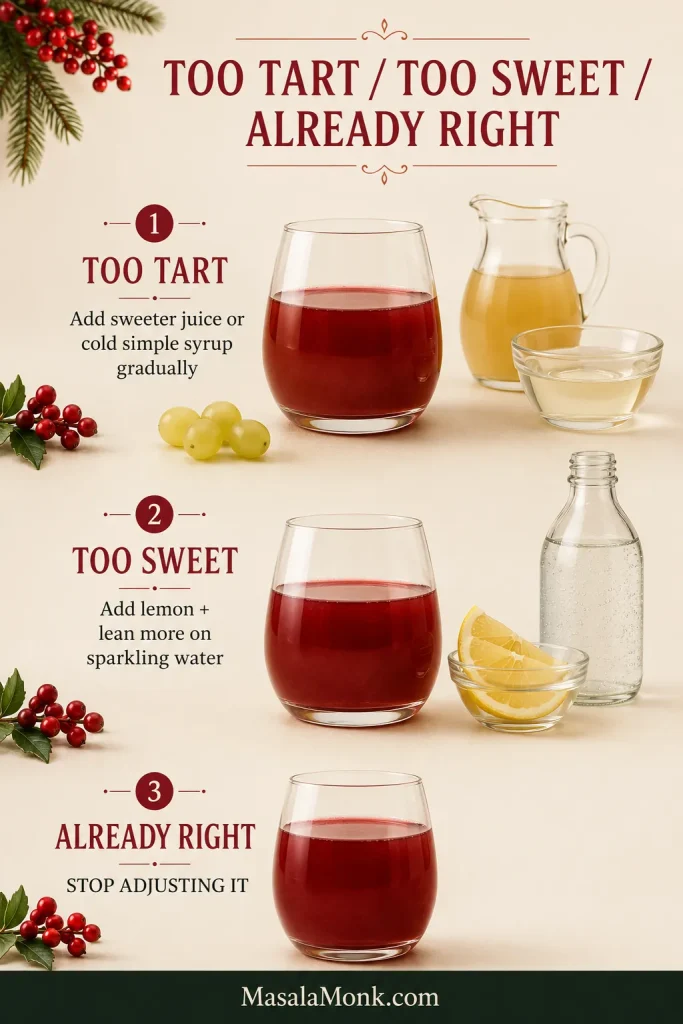
Too tart? Add a sweeter complementary juice or cold simple syrup in small measured amounts.

Too sweet? Add fresh lemon a tablespoon at a time and lean more heavily on sparkling water when you finish the bowl.

Already good? Stop adjusting it.

Christmas punch tasting guide showing fixes for punch that is too tart, too sweet or already balanced.
Make one correction, taste again, then decide whether the punch needs anything else.

Keep dry granulated sugar out of an already fizzy bowl. If the finished punch genuinely needs sweetness, cold simple syrup dissolves more easily and is much less likely to produce a sudden cap of foam.

Once the juice tastes right, you can stop thinking about cranberry labels. From there, the variations are mostly about the kind of punch you want.

Ingredient Swaps: What Changes

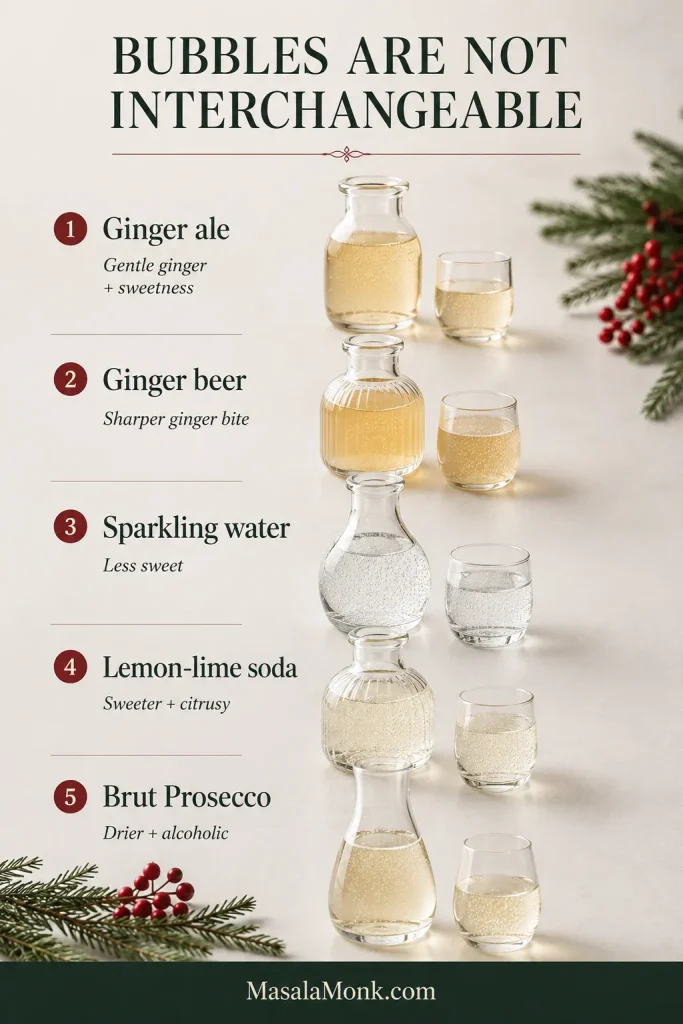
Ginger beer, Sprite, sparkling water and Prosecco all add bubbles, but they do very different things to the punch.

Mixer comparison for Christmas punch showing ginger ale, ginger beer, sparkling water, lemon-lime soda and brut Prosecco with their flavor effects.
Use sparkling water to pull sweetness back, ginger ale for sweetness plus lift, and ginger beer for a sharper ginger edge.
ChangeWhat happens
Replace some ginger ale with ginger beerMore ginger bite and a sharper finish
Use Sprite or 7Up instead of ginger aleSweeter and more lemon-lime forward, without the ginger character
Replace some ginger ale with sparkling waterLess sweetness while keeping the punch fizzy
Replace part of the cranberry with pomegranateDeeper fruit flavor and a more red-purple color
Replace some pineapple with orange or apple juiceLess pineapple body and a different kind of fruit sweetness
Replace ginger ale with brut ProseccoDrier, alcoholic and more wine-like; use the measured sparkling-wine version below

If the stronger ginger version is what appeals to you, a Cranberry Moscow Mule takes cranberry, lime, vodka and ginger beer into an individual cocktail rather than a punch-bowl variation.

Make It Alcoholic: Vodka, Rum or Sparkling Wine?

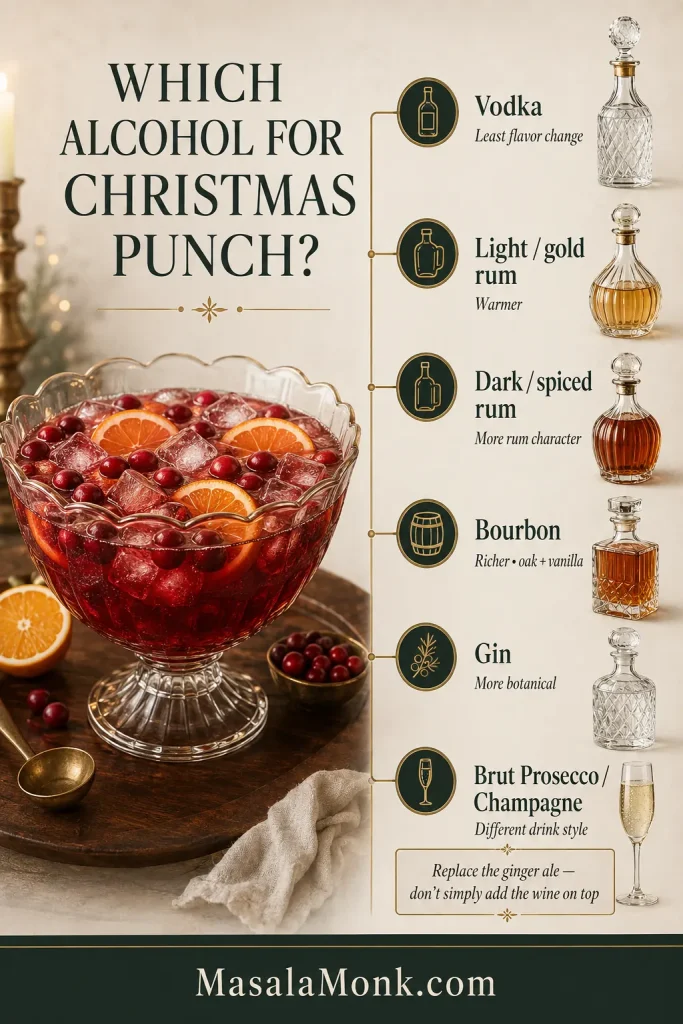
If the alcohol-free glass already tastes good, you can stop there. What matters is how much you want the alcohol to change the punch. Vodka stays mostly out of the fruit’s way; rum becomes more noticeable; sparkling wine changes the style of the drink altogether.

Alcohol guide for Christmas punch comparing vodka, light or gold rum, dark or spiced rum, bourbon, gin and brut Prosecco or Champagne.
Test a spirit in one measured glass before committing it to the whole bowl.
AlcoholWhat changes
VodkaClean and neutral; the fruit remains in front
Light or gold rumRounder and warmer without a heavy molasses flavor
Dark or spiced rumMore obvious rum, vanilla and spice; easier to overpower the fruit
Brut Prosecco or ChampagneDrier, lighter and more sparkling
BourbonOak, vanilla and a richer cranberry-orange profile
GinSharper and botanical; changes the character much more noticeably than vodka

Vodka is the easiest choice when you want the punch to keep tasting primarily of fruit. Light or gold rum adds more warmth, while coconut rum only makes sense when coconut is genuinely part of the flavor you want.

If cranberry and vodka are your favorite part of the punch, a classic Cosmopolitan takes that combination into a sharper lime-and-orange cocktail.

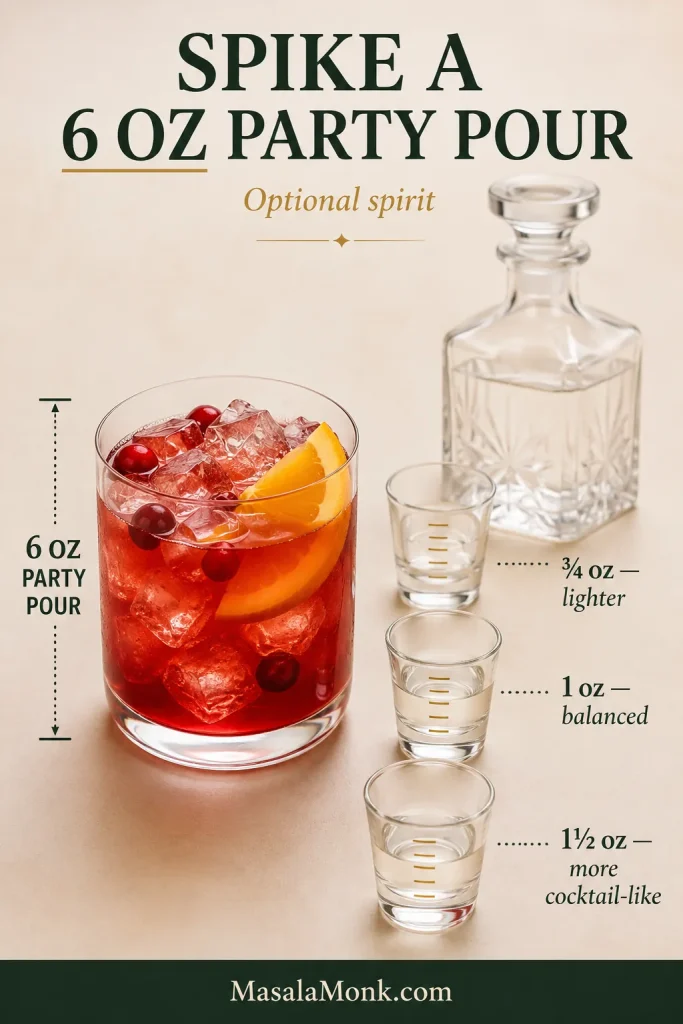
Spike Individual Glasses

For a 6 fl oz / 180 ml pour, start with 1 fl oz / 30 ml spirit. From there, move lighter or stronger depending on the glass you want.

  • Lighter: ¾ fl oz / 22 ml
  • Balanced: 1 fl oz / 30 ml
  • More cocktail-like: 1½ fl oz / 45 ml

With a typical 40% ABV spirit, the 1-fl-oz version is roughly 5.7% ABV before ice dilution; the 1½-fl-oz version is around 8%. Use a 10–12 fl oz glass so there is room for the spirit and ice.

Six-ounce Christmas punch serving with optional spirit amounts of three-quarter ounce for lighter, 1 ounce for balanced and 1.5 ounces for more cocktail-like strength.
Measure punch and spirit separately. A jigger keeps one party pour from quietly becoming a different drink.

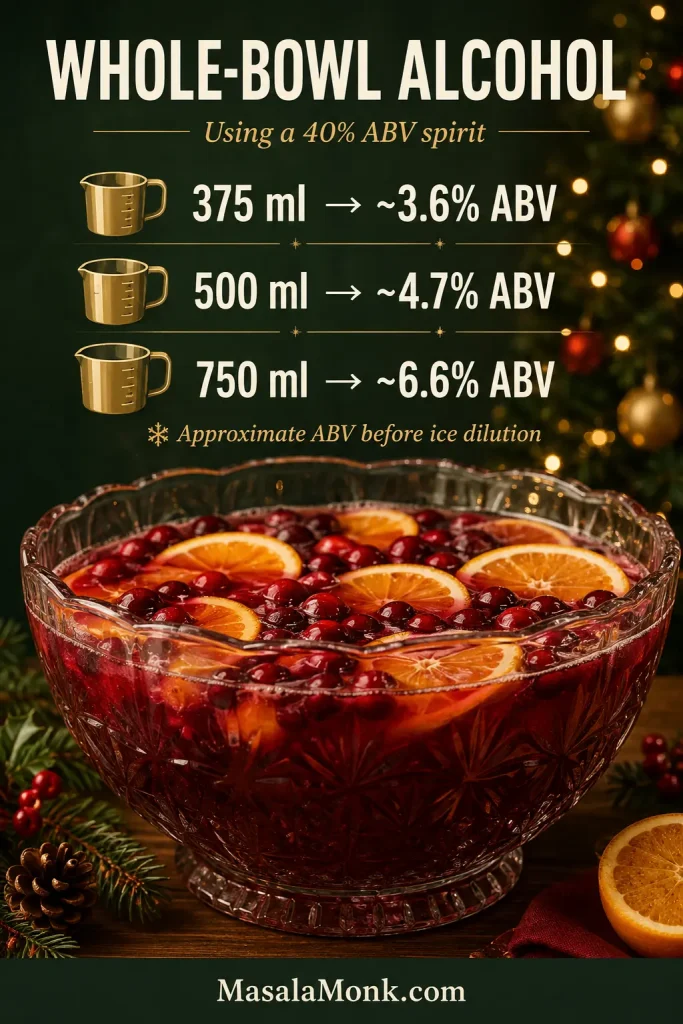
Spike the Whole Bowl

40% spirit added to one full batchApprox. ABV*
375 mlAbout 3.6%
500 mlAbout 4.7%
750 mlAbout 6.6%
*Calculated before ice dilution.
Whole-bowl Christmas punch alcohol guide showing 375 milliliters at about 3.6 percent ABV, 500 milliliters at 4.7 percent and 750 milliliters at 6.6 percent before ice dilution.
Serving several alcoholic batches? Record the first measured spirit amount and repeat it instead of matching later bowls by taste.

Cold fruit and carbonation can make alcohol seem gentler than it is. Measure how much went into the bowl instead of judging strength only by taste. The NIAAA guide to standard drinks is useful for comparing those pours with familiar servings of spirits and wine.

Adding the full 750 ml of spirit brings the total liquid to roughly 4.5 L before ice and garnish. Do not use a 5-quart bowl for that version; the bowl-size guide below shows the practical headroom for larger batches.

Prosecco or Champagne Version

Replace the 3 cups / 710 ml ginger ale with one chilled 750 ml bottle of brut Prosecco or Champagne. Keep the sparkling water. With a typical 12% sparkling wine, the finished bowl is roughly 2.4% ABV before ice dilution.

For a stronger sparkling version, about 375 ml vodka brings the bowl into roughly the mid-5% ABV range, depending on the bottles used.

If sparkling wine is really the main event, the Mimosa guide includes a cranberry version for individual Christmas-brunch glasses.

Christmas Punch for a Crowd: How Much Per Person?

For a party, recipe yield and shopping quantity are not quite the same thing. Nobody is thinking about the yield printed on the recipe once people start coming back for refills.

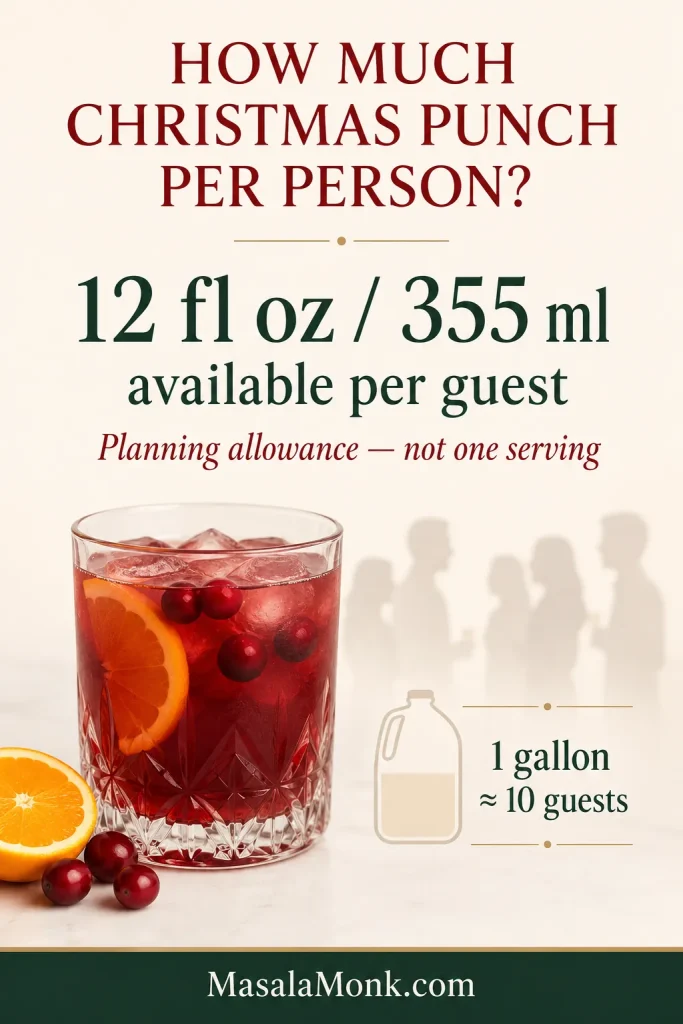
As a generous planning rule, allow about 12 fl oz / 355 ml of punch available per guest when punch is an important drink option. For planning, one gallon therefore covers roughly 10 people. Make less when beer, wine, cocktails, soft drinks and other beverages are also being served.

This is a shopping allowance, not a serving size. The extra volume simply gives people room to come back for another glass.

Christmas punch planning guide showing 12 fluid ounces or 355 milliliters available per guest and about 10 guests per gallon.
Round the total up by whole batches. A little cold reserve is easier to manage than running out mid-party.
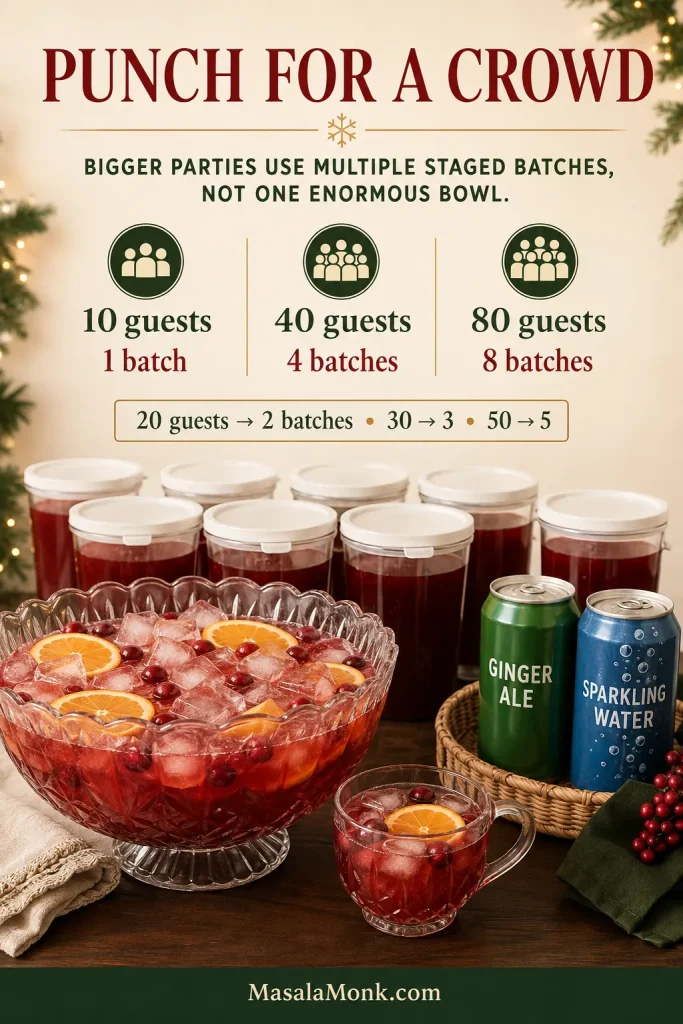
How Many Batches for 10–80 Guests?

For a quick planning rule, think roughly one gallon for every ten guests. That turns a large guest count into repeatable batches before you start shopping.

Christmas punch crowd guide showing 1 batch for 10 guests, 2 for 20, 3 for 30, 4 for 40, 5 for 50 and 8 for 80.
Treat these as planning milestones, not fixed drinking quotas; some guests will refill and others will barely touch a glass.
GuestsPunch to have available*1-gallon batches
10About 1 gallon1
20About 2 gallons2
30About 3 gallons3
40About 4 gallons4
50About 5 gallons5
80About 8 gallons8
*A generous planning amount. Reduce it when plenty of other beverages are available.

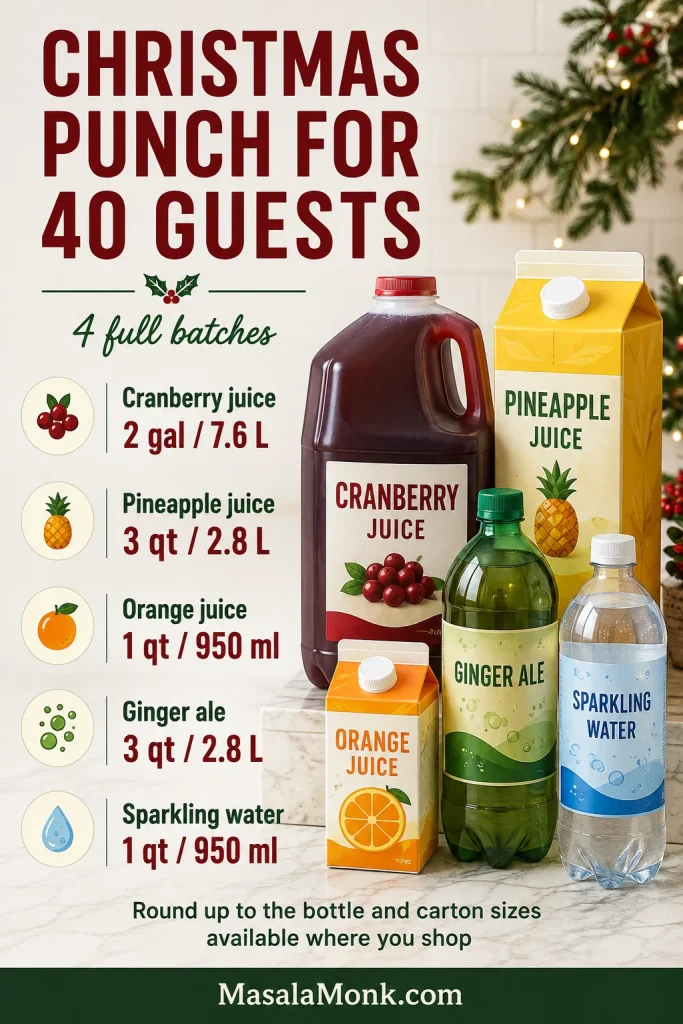
Shopping Math for 40 Guests

Every full batch needs roughly 2 qt / 1.9 L cranberry juice, 3 cups / 710 ml pineapple juice, 1 cup / 240 ml orange juice, 3 cups / 710 ml ginger ale and 1 cup / 240 ml sparkling water.

For 40 guests / four batches, shop for approximately:

  • Cranberry juice: 2 gal / 7.6 L
  • Pineapple juice: 3 qt / 2.8 L
  • Orange juice: 1 qt / 950 ml
  • Ginger ale: 3 qt / 2.8 L
  • Sparkling water: 1 qt / 950 ml

Round up to the carton and bottle sizes actually available where you shop.

Christmas punch shopping quantities for 40 guests: 2 gallons cranberry juice, 3 quarts pineapple juice, 1 quart orange juice, 3 quarts ginger ale and 1 quart sparkling water.
For multiple batches, smaller bottles of fizzy mixers can keep later refills sealed, cold and lively until needed.

Don’t Carbonate Everything at Once

The shopping is handled. Now the job is making gallon four taste as lively as gallon one.

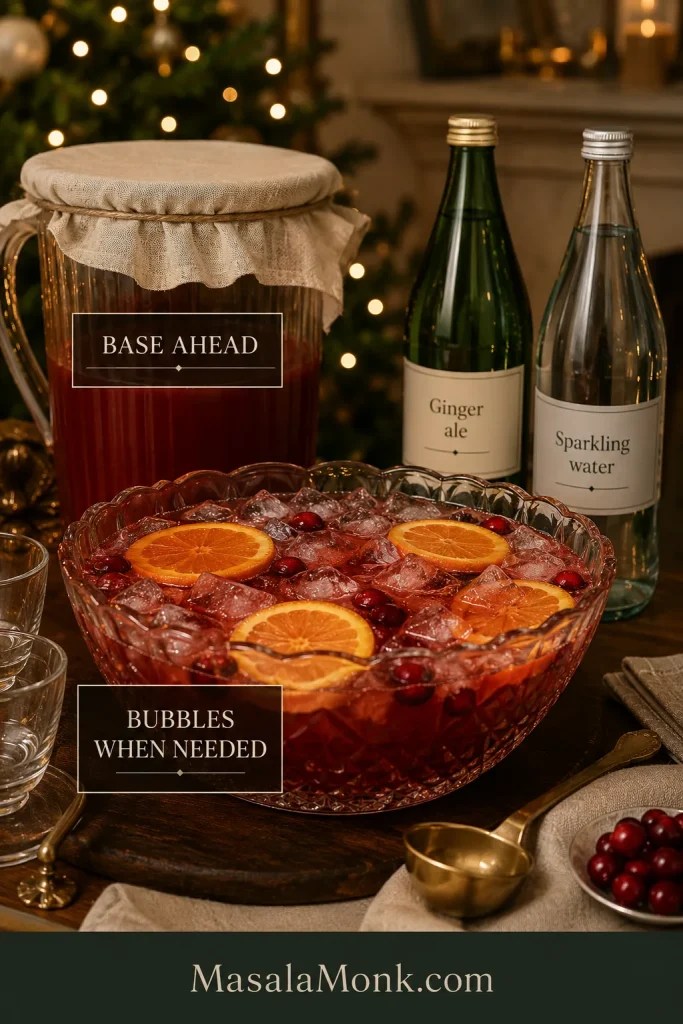
Prepare the cranberry-pineapple-orange mixture ahead and keep most of it covered in the refrigerator. Finish the first bowl with ginger ale and sparkling water when guests arrive; carbonate the next batch only when you need it.

The second half of the party gets fresh punch instead of whatever bubbles survived from the first half.

Finished Christmas punch bowl beside a covered container of still punch base and separate bottles of ginger ale and sparkling water for later batches.
Label each chilled reserve base with the exact ginger ale and sparkling water it still needs.

Recipe ↑ · Guide ↑ · Back to top ↑

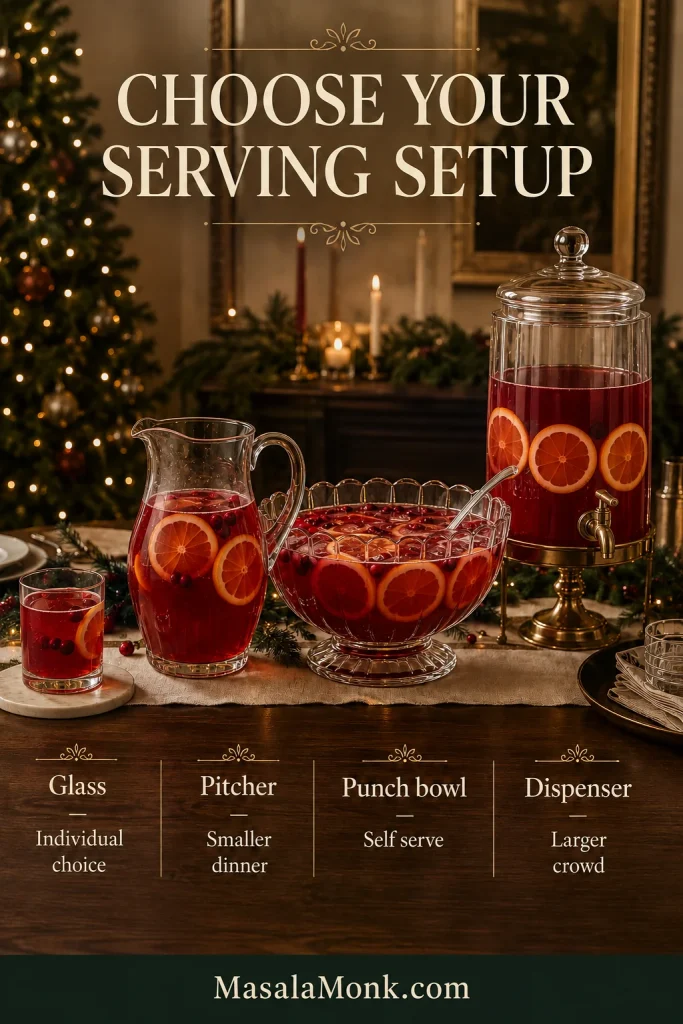
Choose Your Serving Setup

The best vessel depends on how people are drinking. A pitcher suits a smaller seated dinner—especially beside something rich such as honey glazed ham—while a bowl or dispenser makes more sense when guests are serving themselves.

Four Christmas punch serving options shown together: individual glass, pitcher, punch bowl and beverage dispenser.
Pitchers suit smaller seated meals; bowls and dispensers make self-service easier when guests are circulating.

By the Glass

This is easiest for a small group or when everyone is choosing their own alcohol. Use the 8-fl-oz / 240-ml single-serving formula from the scaling section, then add spirit and ice separately.
Pitcher

A pitcher makes more sense than a punch bowl for a smaller dinner. Don’t fill it to its advertised capacity, especially when fruit or ice is going inside.
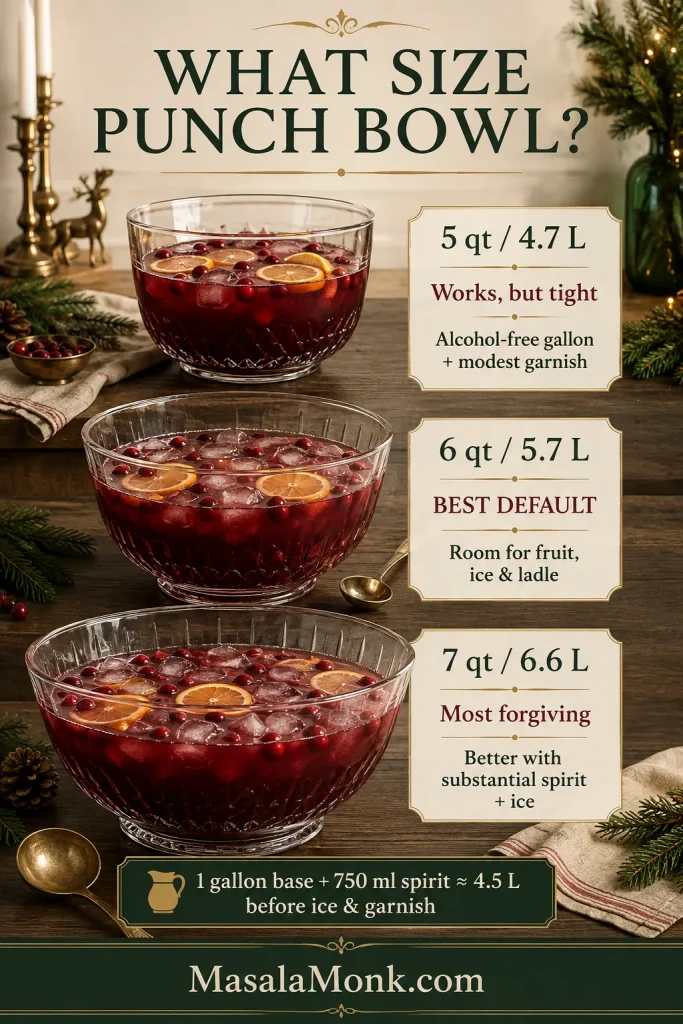
What Size Punch Bowl Do You Need?

A 6-quart / 5.7-L bowl is the best default for one full batch. It leaves useful room for fruit, ice and the ladle instead of filling the bowl almost to the rim.

  • Tight fit — 5 qt / 4.7 L: workable for the alcohol-free gallon with modest garnish and no large ice ring, but fairly full.
  • Best default — 6 qt / 5.7 L: the better choice for most full batches, especially with fruit or large ice.
  • Most forgiving — 7 qt / 6.6 L: preferable when adding a substantial amount of spirit plus an ice ring or generous punch ice.

A one-gallon bowl is not a sensible home for exactly one gallon of liquid plus an ice ring.

Punch bowl size comparison showing 5-quart, 6-quart and 7-quart bowls, with 6 quarts marked as the best default for a one-gallon Christmas punch batch.
Six quarts is the practical default for a one-gallon batch; substantial ice or spirit may justify more headroom.

Beverage Dispenser

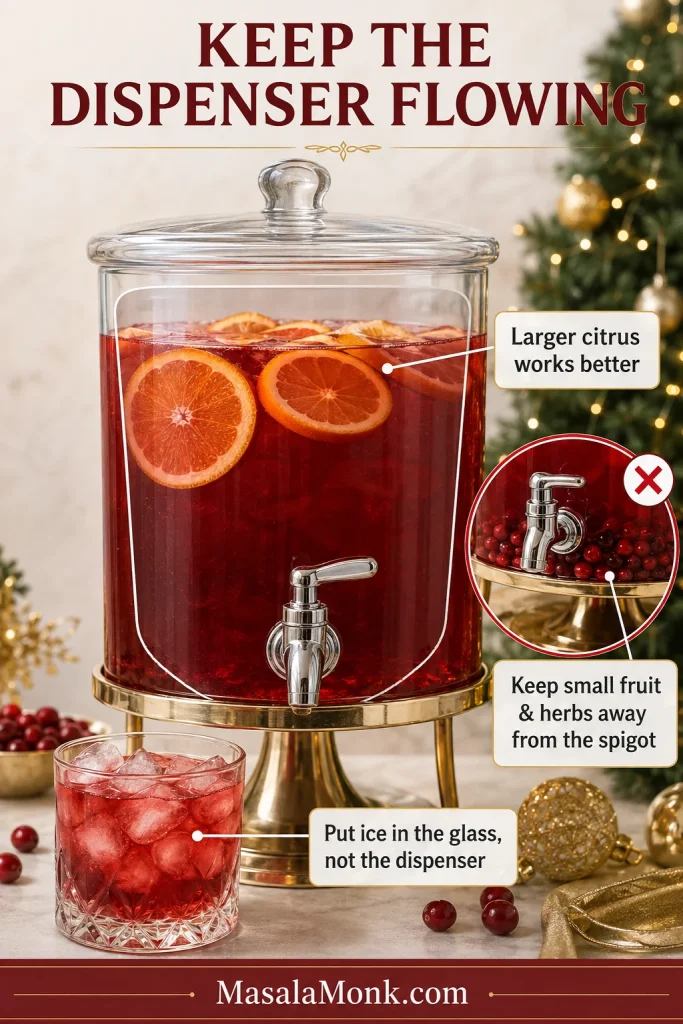
A dispenser is excellent for a larger group because guests can serve themselves without a ladle. Leave a little space at the top rather than filling it to the brim.

If the dispenser will be out for much of the party, let guests add ice to their own glasses instead of filling it with cubes that slowly weaken every remaining serving.

Christmas punch beverage dispenser with large orange slices floating above the spigot, a warning about small fruit blocking the outlet, and ice placed in the serving glass.
Test the empty dispenser with water and an actual serving glass before filling it with punch.

Can You Make Christmas Punch Ahead of Time?

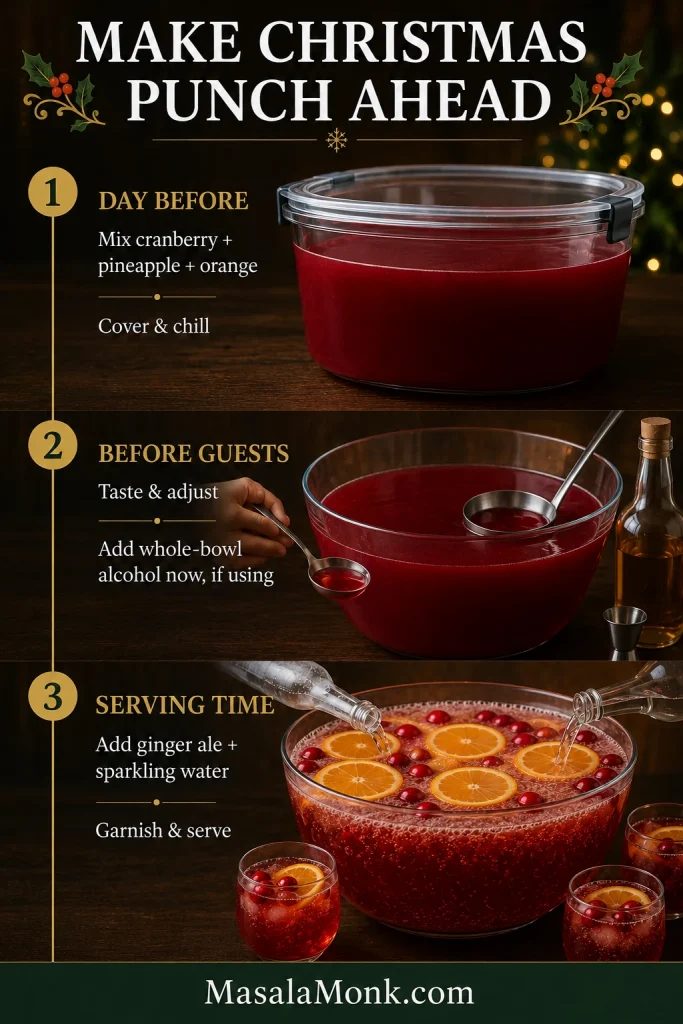
Yes. Mix and chill the cranberry, pineapple and orange juices the day before, but keep the ginger ale and sparkling water separate until serving time.

Before guests arrive, taste the cold juice mixture and make any final sweetness or acidity adjustment. Add whole-bowl alcohol now if you’re using it.

Then, just before serving, add the ginger ale and sparkling water.

Three-stage Christmas punch make-ahead timeline showing still juice base prepared the day before, tasting and optional alcohol before guests, and carbonation plus garnish at serving time.
Juices can wait overnight. Bubbles and garnish are serving-time jobs.

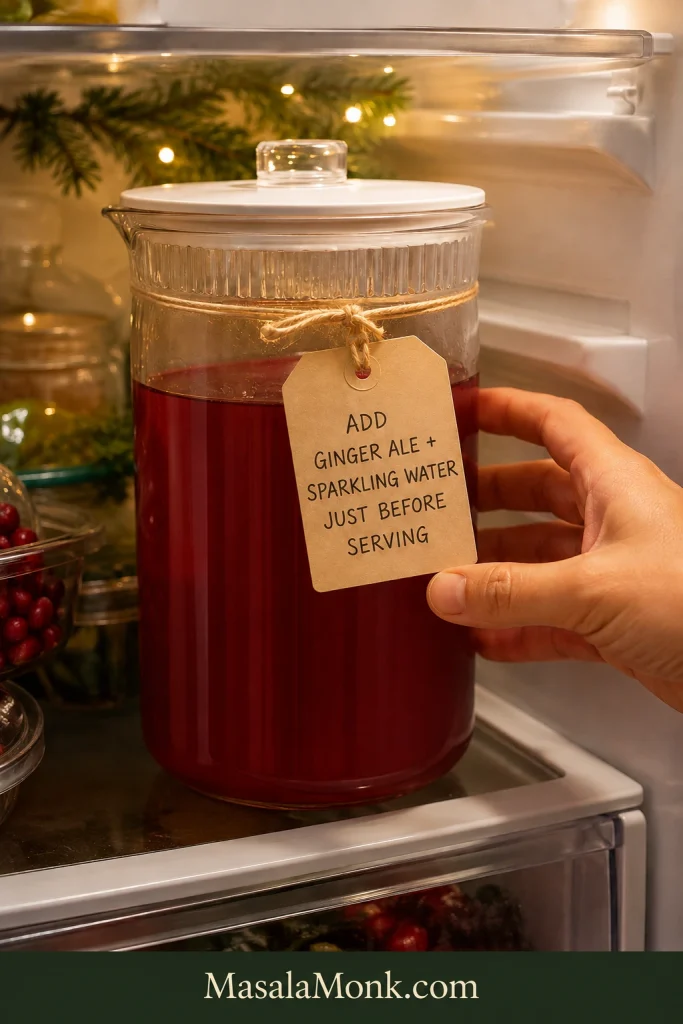
If someone else may finish the punch while you’re dealing with dinner, stick a note on the chilled juice mixture: “Add ginger ale + sparkling water just before serving.” That note is easier than trying to explain the punch from across the kitchen.

Covered container of still cranberry punch base in a refrigerator with a note reading, “Add ginger ale + sparkling water just before serving.”
If someone else may finish the punch, leave only one decision: add the chilled fizzy mixers just before serving.

Use the Right Ice

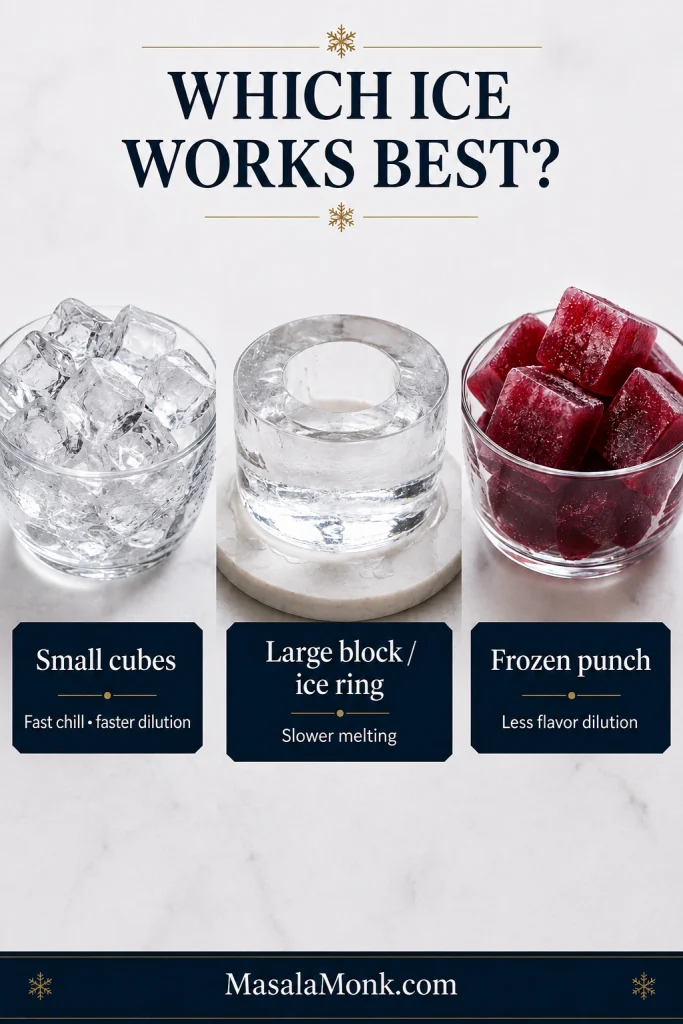
Small cubes chill quickly and melt quickly. A large block or ice ring is better suited to a bowl that will sit out for a while.

For less flavor dilution, freeze cranberry juice or diluted punch mixture instead of plain water.

Ice comparison showing small clear cubes, a large clear ice ring and frozen red punch cubes, with their relative effects on chilling and dilution.
Small cubes chill fast; a ring melts slower; frozen punch protects flavor as it melts.

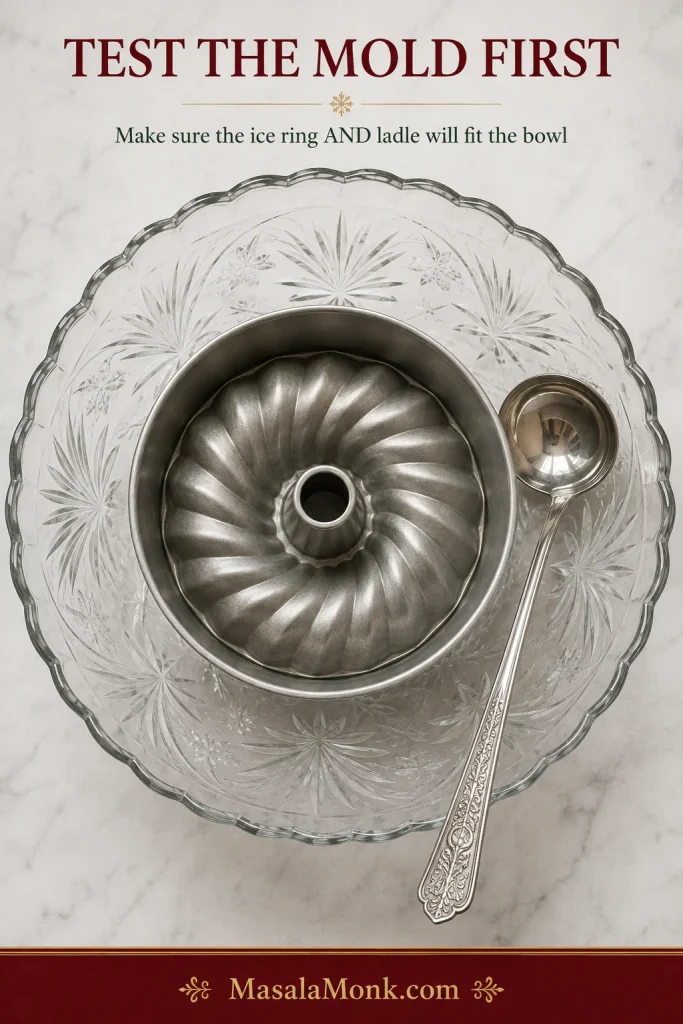
One tiny check can save a ridiculous problem later: put the empty Bundt pan or ring mold inside the actual punch bowl before freezing anything. Make sure the finished ring will fit and that the ladle still has room beside it.

Overhead view of an empty Bundt pan placed inside an empty glass punch bowl with a ladle beside it to check that both will fit.
A slightly smaller ice ring leaves room for the ladle to dip, turn and actually collect punch.

Set It Up So You Don’t Have to Babysit It

The real luxury of party punch is not that it takes five minutes to mix. It is that you can stop making drinks once the guests arrive.

Put everything people will need within reach before the first glass is poured:

  • Punch bowl, pitcher or dispenser
  • Ladle and a small plate or spoon rest
  • Glasses or cups
  • Ice and an ice scoop if guests add their own
  • Vodka or rum plus a small measure when alcohol is optional
  • A cold reserve of juice mixture and fizzy mixers for refills
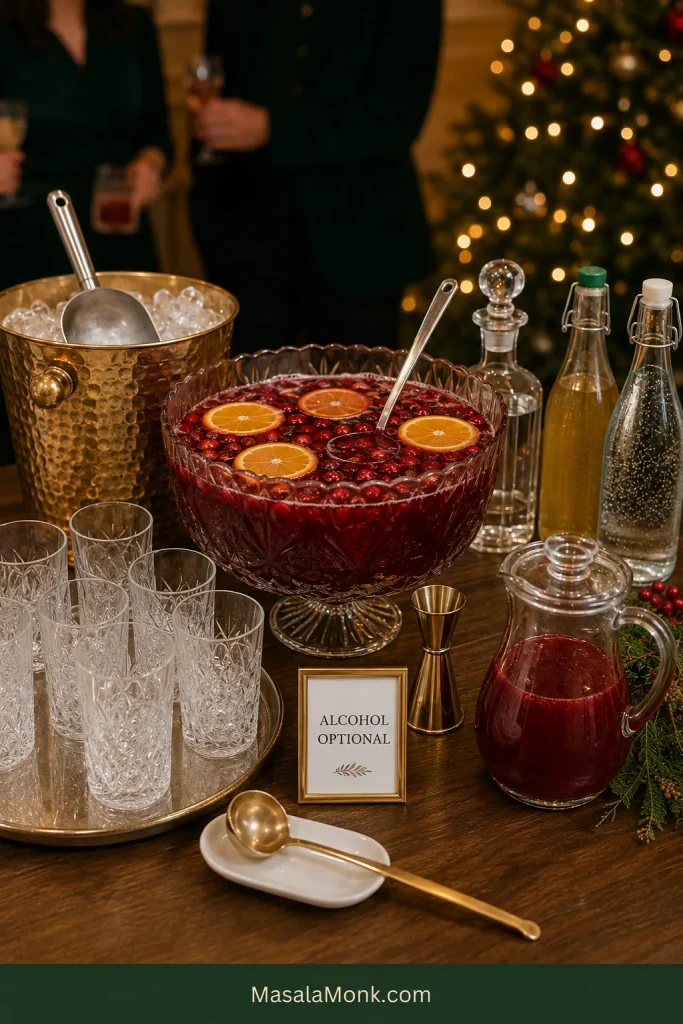
Self-serve Christmas punch station with punch bowl, glasses, separate ice bucket, ladle, jigger, optional spirit, reserve punch base and sparkling mixers, with guests in the background.
Arrange the station in use order: glasses, ice, punch, then optional spirit and measure.

If you’re serving two bowls, label the alcoholic one clearly. “The adult punch is on the left” stops being useful the moment somebody rearranges the table.

A self-serve snack can work on the same principle as the drinks station. An easy cheese ball can sit beside crackers and vegetables without needing somebody to manage it.

Garnish for the Vessel, Not Just the Photograph

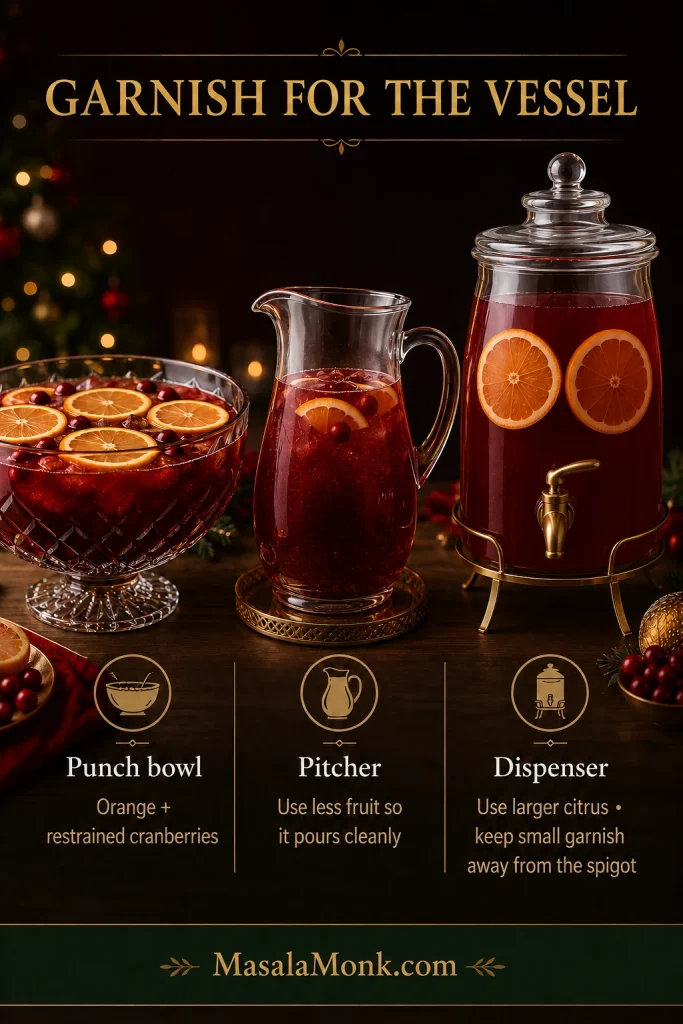
Red cranberries and thin orange wheels are enough to make the bowl look unmistakably festive. You do not need to turn the punch into a floating fruit basket.

A punch bowl can comfortably carry orange wheels and a restrained scattering of cranberries. A pitcher needs less fruit so it still pours cleanly. In a beverage dispenser, larger citrus slices are safer than tiny fruit pieces, loose herbs or clusters of berries that can drift toward the spigot.

Comparison of Christmas punch garnish in a bowl, pitcher and beverage dispenser, showing less fruit in the pitcher and only large citrus in the dispenser.
Save a little fresh orange and cranberry garnish for refills so later bowls still look newly made.

For cups going to young children, leave the whole cranberries in the bowl rather than ladling them into the drink.

Christmas Punch Troubleshooting

Punch is forgiving. The quickest rescue usually comes from figuring out what actually changed instead of adding a little of everything.

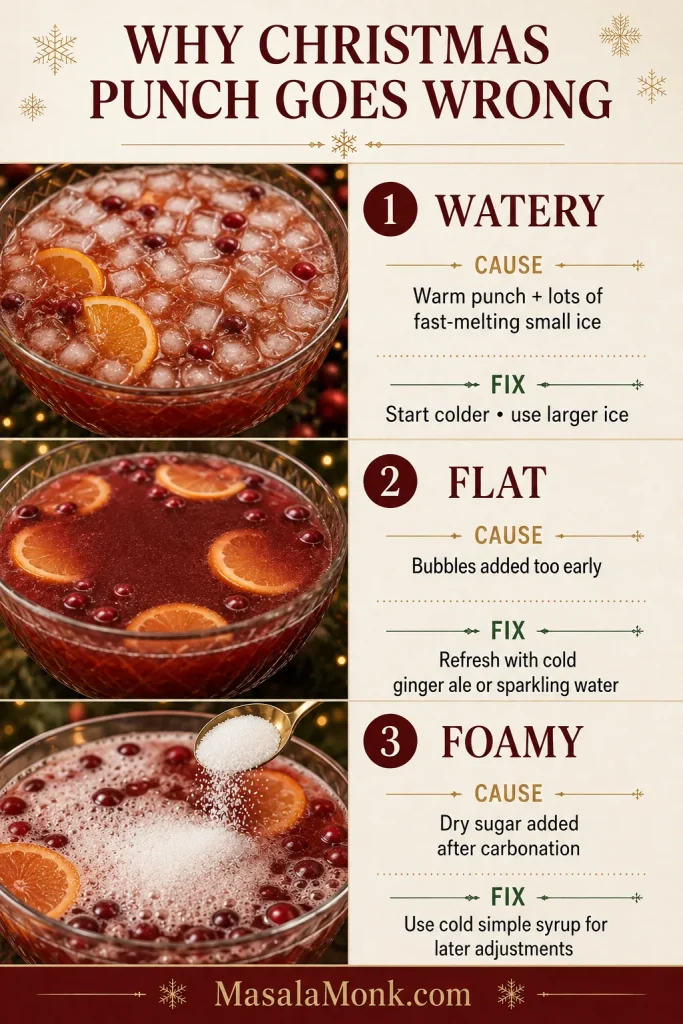
Troubleshooting guide showing watery Christmas punch from fast-melting small ice, flat punch from early carbonation and foamy punch caused by adding dry sugar after carbonation.
Watery is usually dilution, flat is carbonation timing, and foaming during adjustment is a mixing problem.

Flavor, Sweetness & Fizz Problems

ProblemLikely causeFix now
Way too tartPure unsweetened cranberry or very dry ingredientsCheck the cranberry label, then add a sweeter complementary juice or cold simple syrup gradually.
Too sweetSweetened cranberry, sweet soda and sweet fruit stacked togetherAdd fresh lemon and/or plain sparkling water.
Tastes like ordinary juiceNot cold enough, bright enough or freshly carbonatedChill it, add a little lemon if needed and finish with fresh bubbles.
WateryWarm punch plus lots of fast-melting small iceStop adding plain ice. Chill the vessel externally if practical.
FlatCarbonation went in too earlyRefresh one pitcherful at a time with a little very cold ginger ale or sparkling water, tasting as you go.
Rum dominatesToo much spirit or a very assertive dark/spiced rumDilute with reserved alcohol-free juice mixture.
Doesn’t taste alcoholicCold fruit and fizz are masking the alcoholDo not keep adding spirit based on taste. Check how much actually went into the bowl.
Foamed while sweeteningDry sugar went directly into carbonated punchLet it settle and use cold simple syrup for any further adjustment.
Cloudier than expectedPulp-heavy orange juice or cloudy citrusHarmless. Use pulp-free orange next time for a clearer ruby color.

Serving & Setup Problems

ProblemLikely causeFix now
Ice ring blocks the ladleThe mold was too wide for the bowlUse a smaller ring next time and test the empty mold first.
Dispenser stops flowingSmall fruit or herbs collected around the spigotClear the outlet and keep small garnish out of the dispenser.
Running out too quicklyRecipe servings were mistaken for total party consumptionFinish the next cold batch and allow for refills when shopping next time.

Storage & Leftovers

For best quality, drink finished Christmas punch the day it is made or the next day. Refrigerate leftovers promptly and remove old citrus and floating garnish before storing.

The flavor may still be pleasant after refrigeration, but carbonation fades steadily. A little fresh ginger ale or sparkling water can brighten an individual leftover glass; it will not completely recreate a newly mixed batch.

If leftovers are likely, hold back some of the cranberry-pineapple-orange mixture before adding the fizzy ingredients, then carbonate only what you need.

If the night moves from cold drinks to something warm, a Hot Toddy takes Christmas in the opposite direction with whiskey, honey and lemon in one warm glass.


The Final Pour

There is a nice moment when punch stops being a recipe and becomes part of the party: the bowl is glowing red on the table, the ice is still solid, orange slices are moving slowly between the bubbles, and somebody comes back carrying an empty glass.

Nearly empty punch glass being returned beside a partially used Christmas punch bowl while guests talk near a lit Christmas tree and fireplace.
An empty glass is useful feedback: the punch looked inviting, tasted refreshing and earned another pour.

You should not have to leave the conversation to start mixing another drink.

Make enough, keep the next batch cold, then leave the punch bowl to do its job. Christmas is happening somewhere other than the drinks table.

Recipe ↑ · Jump to what you need ↑ · Back to top ↑

Posted on Leave a comment

Shirley Temple Recipe

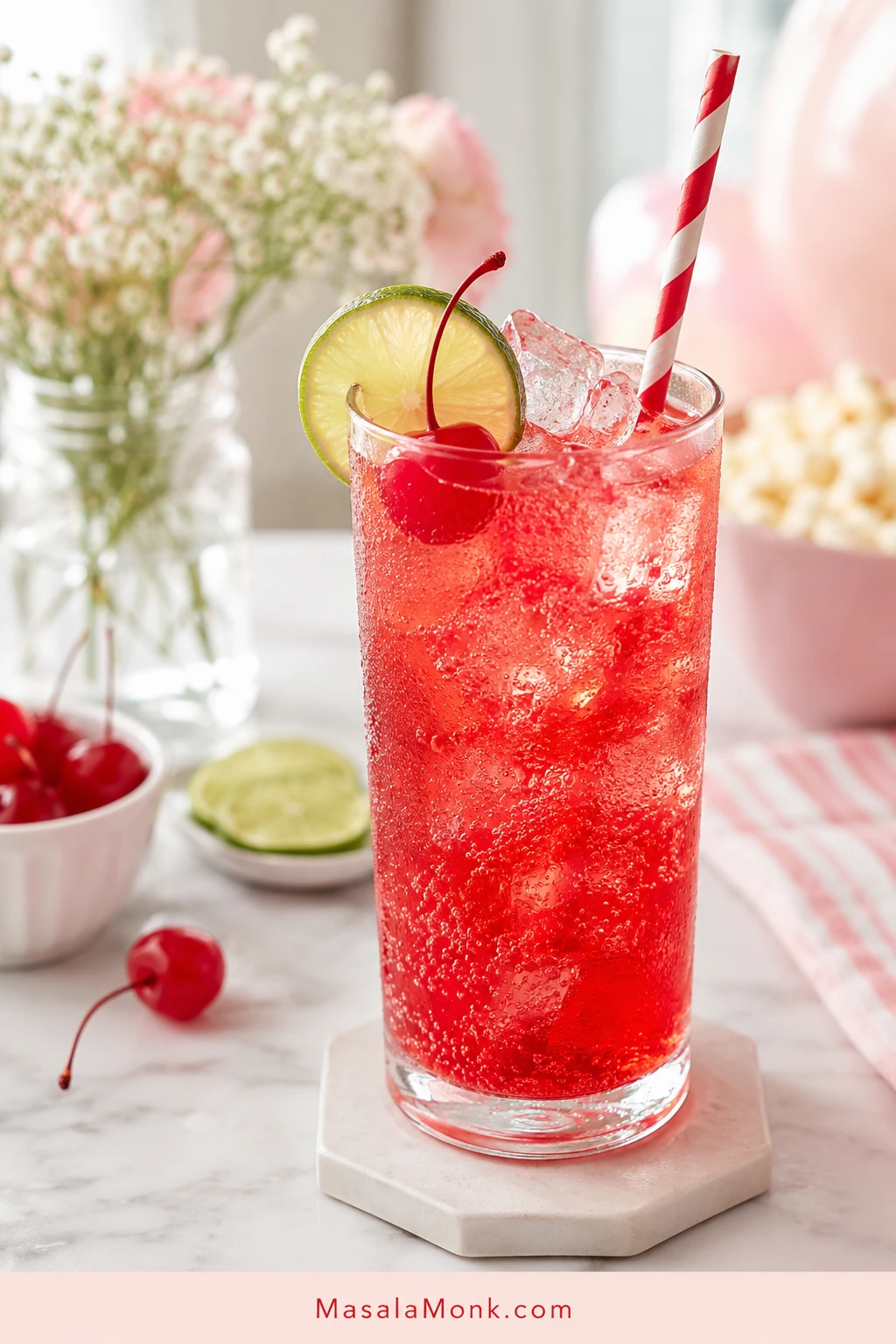
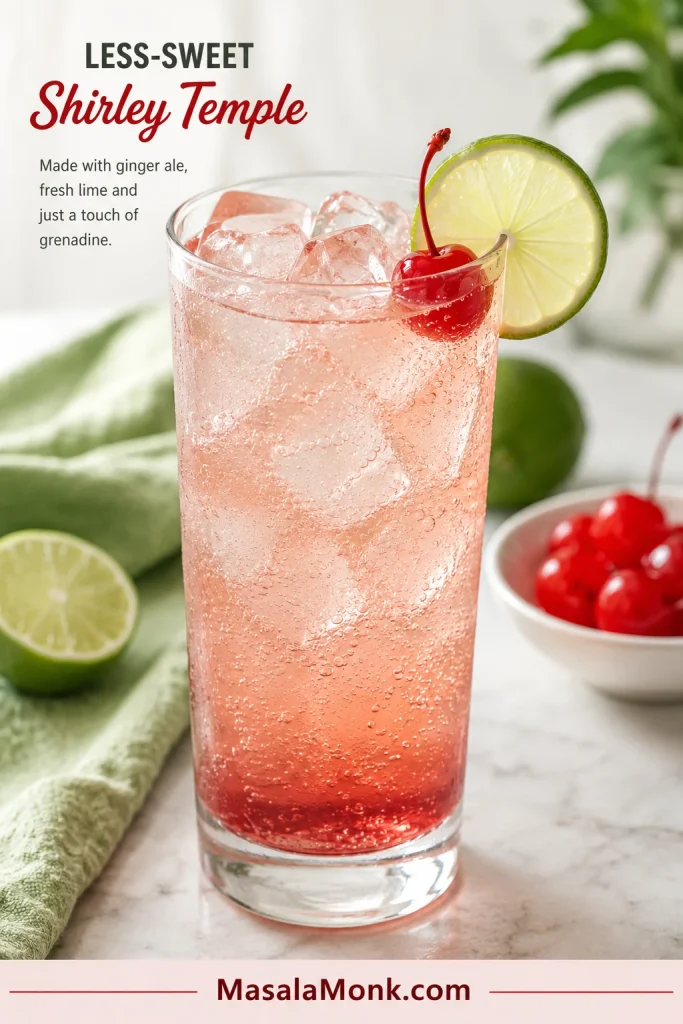
Tall glass of red Shirley Temple with ice, bubbles, a maraschino cherry, lime garnish, and a striped straw.

A Shirley Temple is the red fizzy drink that made a plain soda feel like an occasion. It is the glass with the cherry on top, the drink kids ask for when adults are ordering cocktails, and the no-alcohol mocktail that still looks cheerful on a party table.

But it is also easy to get wrong. Too much grenadine and the bottom tastes like syrup. Warm soda goes flat before the cherry is gone. The best version is cold, bubbly, cherry-red, and balanced enough that the last sip still feels refreshing.

This Shirley Temple recipe starts with the simple classic version, then shows you how to make it sweeter, lighter, more old-school with ginger ale, brighter with lemon-lime soda, or easy to pour as a party pitcher.

Quick Answer: What Is a Shirley Temple?

A Shirley Temple is a fizzy non-alcoholic drink made with lemon-lime soda or ginger ale, grenadine, ice, and maraschino cherries. Sprite or 7UP gives the familiar restaurant-style sweetness, while ginger ale makes the drink softer and a little more old-school.

Best starting ratio: use 1 cup / 240 ml soda and 1 tablespoon / 15 ml grenadine. Add more syrup only when you want the sweeter, brighter red version.

Shirley Temple Recipe Card

Classic Shirley Temple Mocktail

A cold, fizzy Shirley Temple made with lemon-lime soda or ginger ale, grenadine, ice, and maraschino cherries. This balanced version tastes classic without turning the last few sips heavy.

  • Prep time: 3 minutes
  • Cook time: 0 minutes
  • Total time: 3 minutes
  • Servings: 1 drink
  • Yield: 1 tall glass
  • Method: Built in the glass
  • Glass: Tall glass, highball glass, or Collins glass
  • Equipment: Tablespoon or jigger, long spoon or straw

Ingredients

  • 1 cup / 8 oz / 240 ml chilled lemon-lime soda or ginger ale
  • 1 tablespoon / 15 ml grenadine, or up to 2 tablespoons / 30 ml for a sweeter bright-red version
  • 1 teaspoon / 5 ml fresh lime juice, optional
  • Ice, enough to fill the glass
  • 1 to 3 maraschino cherries, for garnish
  • Optional: 1 teaspoon syrup from the maraschino cherry jar for extra cherry flavor

Instructions

  1. Fill a tall glass with ice.
  2. Add the grenadine.
  3. Pour in the chilled lemon-lime soda or ginger ale slowly.
  4. Add lime juice if using.
  5. Stir gently, just until the syrup blends into the soda.
  6. Garnish with maraschino cherries and serve immediately.

Recipe Notes

  • For a lighter version, use 1 teaspoon / 5 ml grenadine and add lime.
  • To create a red layered look, add soda first and drizzle the grenadine last so it sinks.
  • Serve right away. The fizz is part of the drink.
  • A cherry on top is fun, but the real win is the balance underneath it.
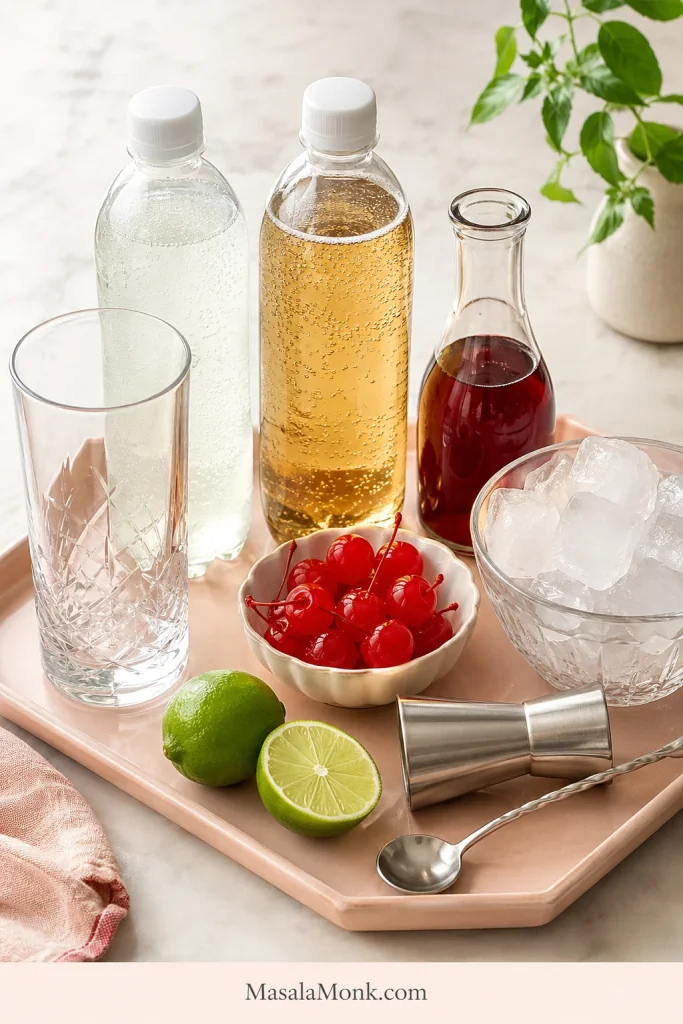
Shirley Temple ingredients arranged on a tray with grenadine, lemon-lime soda, ginger ale, cherries, lime, ice, and a glass.
Before mixing, set up the simple Shirley Temple ingredients: chilled soda, grenadine, ice, and maraschino cherries. Keep lime nearby because a small squeeze makes the drink taste cleaner and less candy-sweet.

Part of the charm is the little ceremony: the ice, the red syrup, the slow pour, and the cherry dropped on top. Even when a Shirley Temple takes only three minutes, it feels like someone made you something on purpose.

Back to quick answer

Choose Your Shirley Temple Version

Making one glass? Use the recipe card above. Want it sweeter, lighter, more classic, or party-ready? This quick guide gets you there faster.

For This Kind of DrinkUse ThisResult
Classic flavorGinger ale + 1 tbsp grenadineSofter, slightly warmer, less candy-like
Restaurant-style sweetnessSprite or 7UP + 2 tbsp grenadineBright red, sweet, nostalgic
Balanced everyday versionAny soda + 1 tbsp grenadineSweet, fizzy, but not heavy
Less-sweet mocktailGinger ale or club soda blend + 1 tsp grenadine + limeLighter, cleaner, more grown-up
Party pitcherMix syrup base first, add soda lastFresh bubbles and better serving texture
Fruitier versionAdd 1 tbsp to ¼ cup orange juiceMore brunch or punch-style

If you just want the drink, stop at the recipe card. To tune the sweetness, soda choice, syrup, or party amounts, use the notes below to make the cherry-red mocktail fit your table.

For festive but lighter options, these keto mocktails and sugar-free drink ideas are a good next stop.

Back to recipe card · See the exact ratio

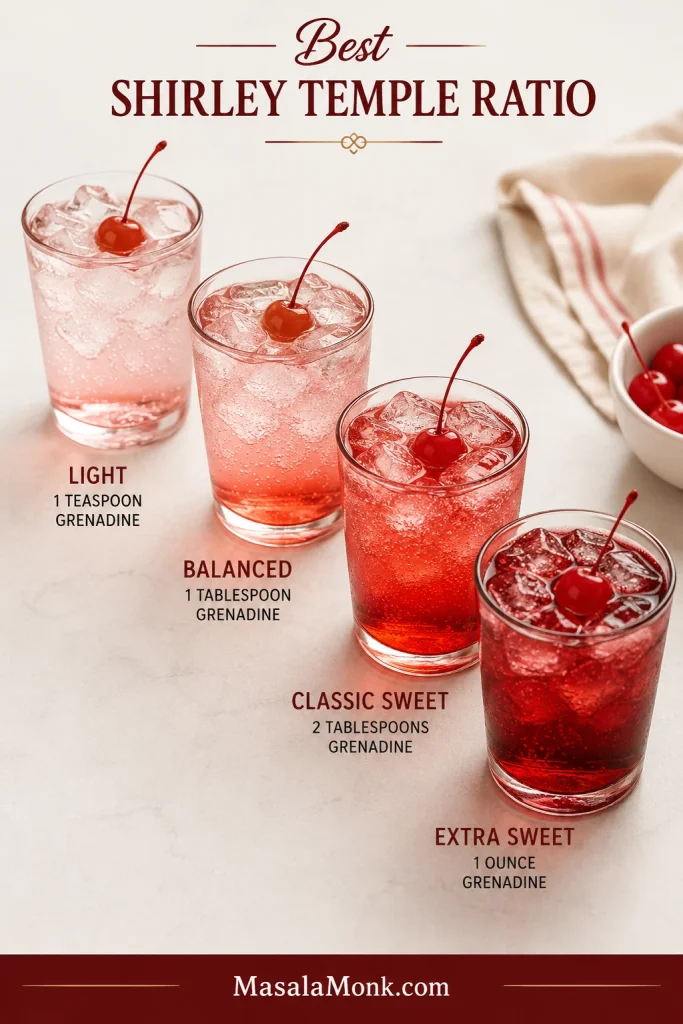
Best Shirley Temple Ratio

The ratio is what separates a refreshing Shirley Temple from a syrupy one. Too little grenadine and the drink tastes like plain soda with a red tint. Go too far, and the bottom turns heavy.

Best ratio: start with 1 cup / 240 ml soda and 1 tablespoon / 15 ml grenadine. From there, go lighter or sweeter depending on who is drinking it.

Four Shirley Temple glasses showing light, balanced, classic sweet, and extra sweet grenadine ratios.
Use the ratio guide as your control point: 1 cup soda and 1 tablespoon grenadine makes a balanced Shirley Temple. Then, adjust by the teaspoon for a lighter, sweeter, or more cherry-red glass.
StyleSodaGrenadineBest For
Light1 cup / 240 ml1 teaspoon / 5 mlLess-sweet mocktail
Balanced1 cup / 240 ml1 tablespoon / 15 mlBest first drink
Classic sweet1 cup / 240 ml2 tablespoons / 30 mlBright-red nostalgic drink
Extra sweet4 to 6 oz / 120 to 180 ml1 oz / 30 mlOnly when you already like a very syrupy glass

Start balanced. Taste once. Add another teaspoon of grenadine only when the drink needs more color or sweetness. If you grew up with very red Shirley Temples, the sweeter version may taste familiar. When you are making it for yourself now, the balanced pour usually holds up better after the first few sips.

Success cue: the drink should look red and cheerful, but the soda should still feel lively. When the bottom tastes thick, use less grenadine next time or stir before serving.

Back to recipe card · Choose Sprite or ginger ale · Make it less sweet

How to Make a Shirley Temple

Build the drink directly in the glass. No shaker, blender, saucepan, or bar setup is needed.

  1. Start cold. A chilled glass is optional, but cold soda is not. Warm soda melts ice faster and loses fizz.
  2. Fill the glass with ice. The drink should feel crisp from the first sip.
  3. Add grenadine. Use 1 tablespoon for a balanced pour.
  4. Pour the soda slowly. Lemon-lime soda, Sprite, 7UP, or ginger ale all work.
  5. Add lime if using. A little citrus makes the sweetness feel brighter.
  6. Stir gently. Mix the syrup through without flattening the bubbles.
  7. Finish with cherries. Serve immediately while the drink is still fizzy and cold.
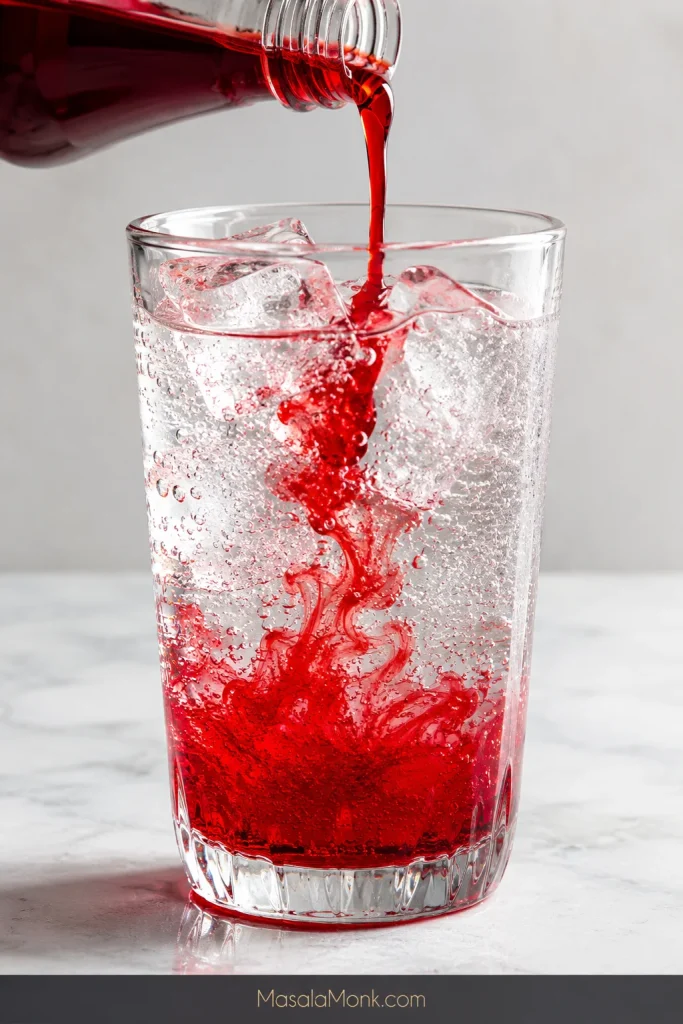
Red grenadine being poured into a glass of ice and clear soda, creating a red layer at the bottom.
Notice how grenadine sinks through the bubbles because it is heavier than soda. That red layer gives the drink its classic look, but a gentle stir makes the flavor even from top to bottom.

For a red gradient, change the order. Add ice and soda first, then slowly pour grenadine down the inside of the glass. It will sink because it is heavier than soda. That layered look is pretty, but the drink tastes more even once stirred.

Back to recipe card · Use the ratio guide

Sprite vs Ginger Ale for Shirley Temple

After the syrup amount, the soda choice is the next big decision. Neither option is wrong; they just make different memories.

Best soda: use Sprite or 7UP for the sweet restaurant-style version. Use ginger ale for a softer, more classic version.

SodaFlavorUse It When
Sprite or 7UPSweet, bright, lemon-limeYou want the familiar restaurant-style Shirley Temple
Ginger aleWarmer, softer, lightly spicedYou want a more classic mocktail flavor
Half lemon-lime soda + half club sodaLighter and less sweetYou want a cleaner non-alcoholic drink
Ginger beerSharper and spicierYou want a bold variation, not the soft classic version
ColaCherry-cola flavorYou are making a Roy Rogers, not a Shirley Temple
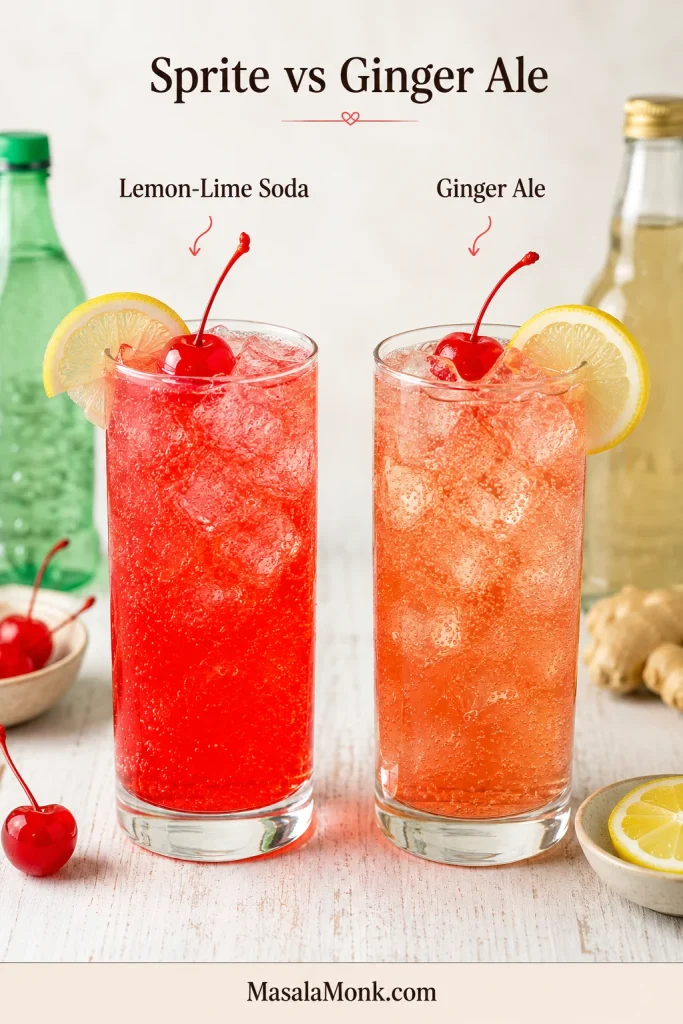
Two Shirley Temple drinks side by side comparing a lemon-lime soda version with a ginger ale version.
Compared side by side, lemon-lime soda makes a brighter, sweeter Shirley Temple, while ginger ale gives the mocktail a softer, more classic flavor. Choose the soda based on whether you want bold nostalgia or a gentler finish.

For kids, birthdays, and the version most people expect from restaurants, lemon-lime soda is usually the easiest win. A less sugary pour works better with ginger ale. The cleanest version splits the cup between lemon-lime soda and club soda, then adds lime.

Make it less sweet · Scale it for a party

How to Make a Shirley Temple Less Sweet

A Shirley Temple should still taste like a treat, but it should not feel like syrup with bubbles on top. For a lighter glass, keep the fizz, pull back the grenadine, and let lime do some of the balancing.

  • Use 1 teaspoon to 1 tablespoon grenadine instead of 2 tablespoons.
  • Choose ginger ale instead of Sprite or 7UP.
  • Use half club soda and half lemon-lime soda.
  • Add 1 to 2 teaspoons fresh lime juice.
  • Fill the glass with plenty of ice.
  • Skip extra cherry syrup from the jar.
  • Use zero-sugar lemon-lime soda or diet ginger ale when you want a lighter drink.
Pale pink less-sweet Shirley Temple with ice, lime, and a maraschino cherry in a clear glass.
A lighter Shirley Temple starts by pulling back the grenadine before cutting the bubbles. The color will be paler, but with cold soda, plenty of ice, and lime, the drink tastes cleaner and easier to finish.

This lighter version will not be neon red, and that is okay. It should taste like a drink, not a melted candy. You still get the nostalgia without the sugar-rush feeling.

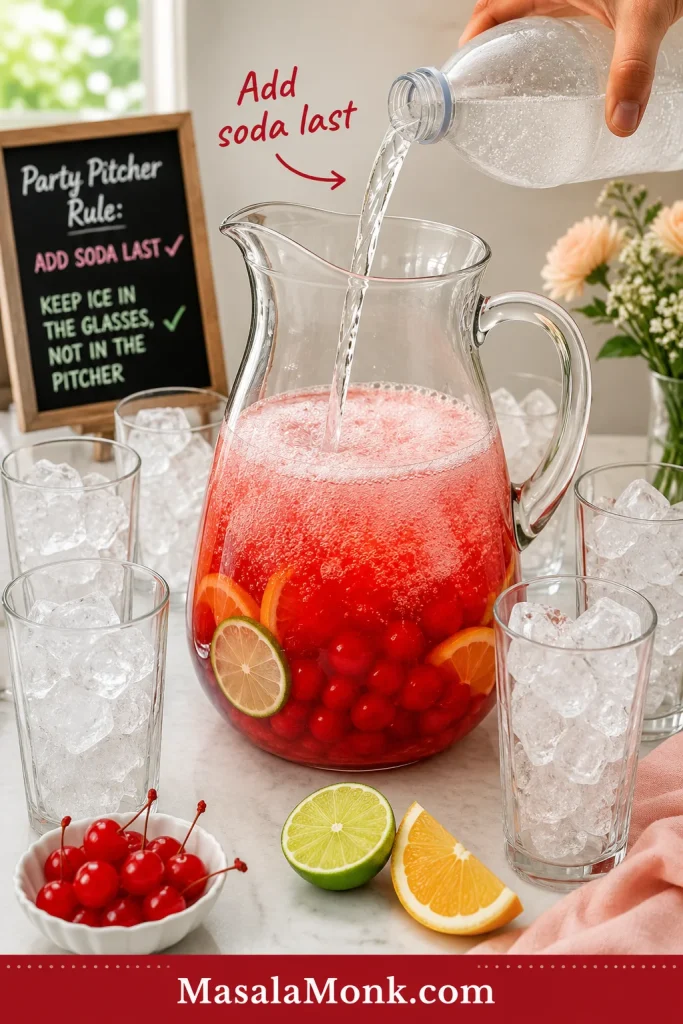
Shirley Temple Pitcher for Parties

For a party pitcher, protect the bubbles. You can make the red syrup base ahead, but the soda should go in at the end. The syrup base can wait; bubbles cannot.

Pitcher rule: mix the grenadine and lime ahead, chill that base, then add the soda right before serving.

Shirley Temple party pitcher with red syrup base, cherries, citrus, ice-filled glasses, and soda being added last.
When scaling into a Shirley Temple pitcher, mix the grenadine base ahead, but add soda right before serving. Meanwhile, keep ice in the glasses so the pitcher stays fizzy, fresh, and party-ready instead of watered down.

Pitcher for 8 Drinks

  • 8 cups / 64 oz / 1.9 L chilled lemon-lime soda or ginger ale
  • ½ cup / 120 ml grenadine for a balanced pitcher
  • ¾ cup / 180 ml grenadine for a sweeter but still easy-drinking pitcher
  • 1 cup / 240 ml grenadine for a very sweet party-style pitcher
  • 2 to 3 tablespoons / 30 to 45 ml fresh lime juice, optional
  • Maraschino cherries, to serve
  • Orange or lime slices, optional
  • Ice, added to glasses instead of the pitcher

Mix the grenadine and lime juice in the pitcher first. Keep that base chilled when preparing ahead. Add the soda just before serving, stir gently, and pour over ice-filled glasses with cherries.

Do not add ice directly to the pitcher unless the drinks will be served immediately. Ice melts, waters down the syrup, and flattens the soda faster.

This is the kind of pitcher that disappears quickly because everyone can pour from it: kids, non-drinkers, drivers, and adults who just want something cheerful.

Party cue: the soda should still sound lively when it is poured. If the pitcher has been sitting open for a while, the drink will taste sweeter and flatter.

Back to recipe card · What to serve with Shirley Temples

Why the Ratio Works + Ingredient Notes

Because the ingredient list is short, every part has a job. Cold soda brings lift, grenadine adds the red fruitiness, ice keeps the drink crisp, and the cherry makes it feel complete.

  • Grenadine: Start with 1 tablespoon per cup of soda. It gives color and flavor without making the drink heavy.
  • Lemon-lime soda: Best when you want the bright, sweet, birthday-party version.
  • Ginger ale: Softer and more old-school, especially when you want a less candy-like mocktail.
  • Lime juice: Optional, but useful when the drink tastes too sweet or flat.
  • Maraschino cherries: One is enough, but two or three make the glass feel more generous.
  • Ice: Use more than you think. A cold drink tastes lighter and stays fizzy longer.

What makes a Shirley Temple work is that it gives the non-drinker a glass that still feels chosen, garnished, and worth raising. Kids usually chase the cherry. Adults get a festive drink that does not have to taste cloying.

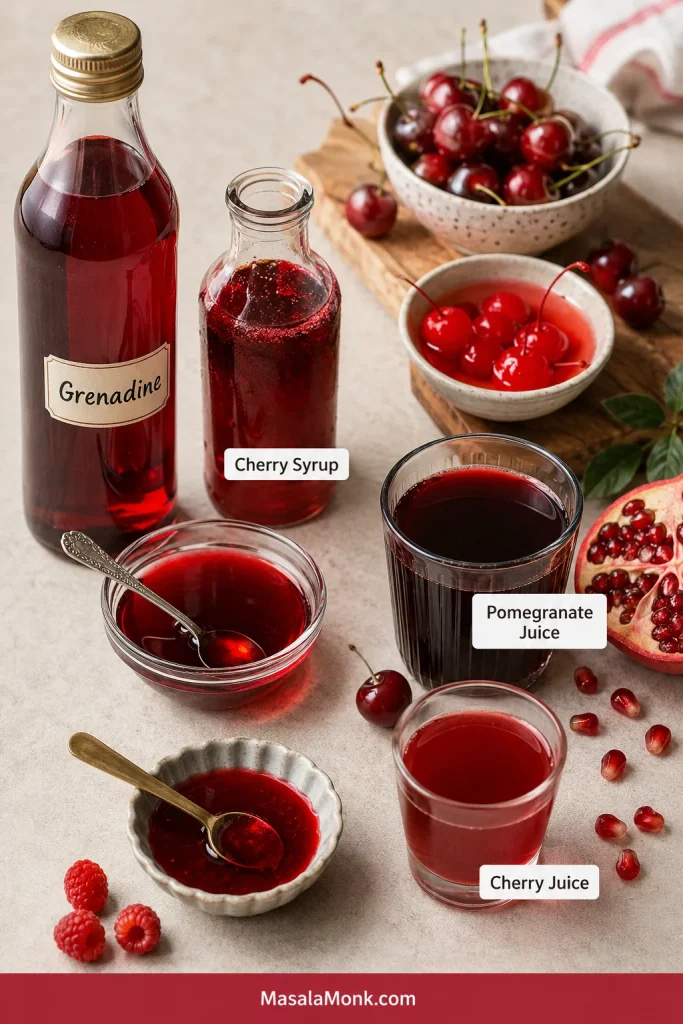
What Is Grenadine?

Grenadine is the red syrup used in a Shirley Temple. It adds color, sweetness, and fruity flavor. Traditional grenadine is pomegranate-based, though many modern store-bought versions taste more like cherry or mixed fruit.

So if you always thought grenadine was cherry syrup, you are not alone. It looks red, tastes fruity, and is served with a cherry, so the confusion makes sense. Still, cherry syrup is not the same thing, even though it can help when grenadine is missing.

Grenadine Substitutes for Shirley Temple

Without grenadine, the drink will not taste exactly classic, but you can still make something close. If grenadine is missing, decide what matters most: the red color, the fruitiness, or the sweetness.

Grenadine substitute board with red syrups, cherries, pomegranate juice, cherry juice, and small labeled bottles.
No grenadine? Cherry syrup is the quickest substitute, while pomegranate juice gives a lighter, more tart flavor. Either way, add a little at a time so the drink stays balanced instead of turning too sweet.
SubstituteWorks?What to Know
Homemade grenadineBest optionClosest to classic sweet-tart flavor
Maraschino cherry syrupGood in a pinchSweeter and more candy-like
Pomegranate juiceWorks lightlyLess sweet and less syrupy
Cherry juiceWorks for color and flavorNot classic grenadine, but useful
Raspberry syrupPossibleChanges the flavor noticeably

The easiest quick substitute is syrup from the maraschino cherry jar. Start with 1 teaspoon, taste, and add more only when needed. Cherry syrup can make the drink sweet very quickly.

Back to recipe card · Make it less sweet

Shirley Temple with Orange Juice

Orange juice is not required for a classic Shirley Temple, but a small splash can make the drink fruitier and more party-style. This version works especially well for brunches, birthdays, baby showers, and punch bowls.

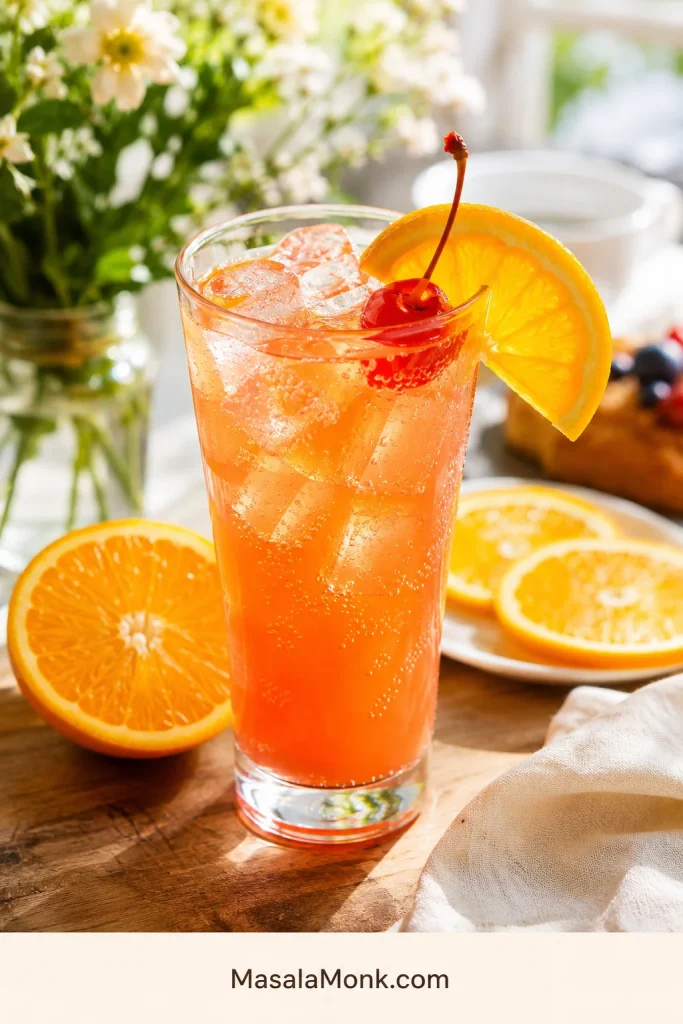
Red-orange Shirley Temple with orange juice, ice, orange garnish, cherries, and a straw on a brunch table.
At brunch, baby showers, or punch-style parties, a splash of orange juice makes the Shirley Temple fruitier and more citrusy. Keep the amount small so it still tastes like a cherry-red mocktail, not fruit punch.

For a light citrus note, add 1 tablespoon / 15 ml orange juice. A fruitier punch-style drink can use up to ¼ cup / 60 ml orange juice. More than that moves the mocktail away from a classic Shirley Temple and closer to fruit punch.

Lemon-lime soda usually works better than ginger ale here because the citrus flavors blend more naturally.

Classic vs Modern Shirley Temple

Older-style Shirley Temples often lean on ginger ale, while modern restaurant versions usually use Sprite, 7UP, or another lemon-lime soda. The drink’s exact origin story is a little messy, but the idea stayed simple: bubbles, red syrup, ice, and a cherry.

Shirley Temple Variations

Once the basic drink tastes right, variations are just small turns. Keep it cold, control the grenadine, and use citrus when the sweetness needs balance. For more red, bubbly ideas in the same lane, browse these mocktails with grenadine.

  • Orange juice Shirley Temple: Add 1 tablespoon to ¼ cup orange juice for brunches, baby showers, and punch bowls.
  • Frozen Shirley Temple: Blend ice, lemon-lime soda, grenadine, and a little lime juice until slushy, then serve immediately with cherries.
  • Holiday Shirley Temple: Add extra cherries, orange slices, lime wheels, or a sugared rim for Christmas, New Year’s Eve, Valentine’s Day, birthdays, and family parties.
  • Cherry-lime Shirley Temple: Add extra lime and a small spoon of maraschino cherry syrup for a sharper cherry-lime version.

Dirty Shirley vs Shirley Temple vs Roy Rogers

A classic Shirley Temple is non-alcoholic. These two related drinks are useful to know, especially when serving a mixed group:

  • Shirley Temple: lemon-lime soda or ginger ale, grenadine, ice, and cherries. No alcohol.
  • Dirty Shirley: the adult cocktail version, usually made with vodka, grenadine, lemon-lime soda or ginger ale, and a cherry.
  • Roy Rogers: a non-alcoholic cola drink made with grenadine and a cherry.

For a mixed group, keep the main pitcher alcohol-free and let adults prepare a separate Dirty Shirley only as needed. That keeps the drink family-friendly and avoids confusion.

Back to quick answer · Back to party pitcher

Troubleshooting Shirley Temples

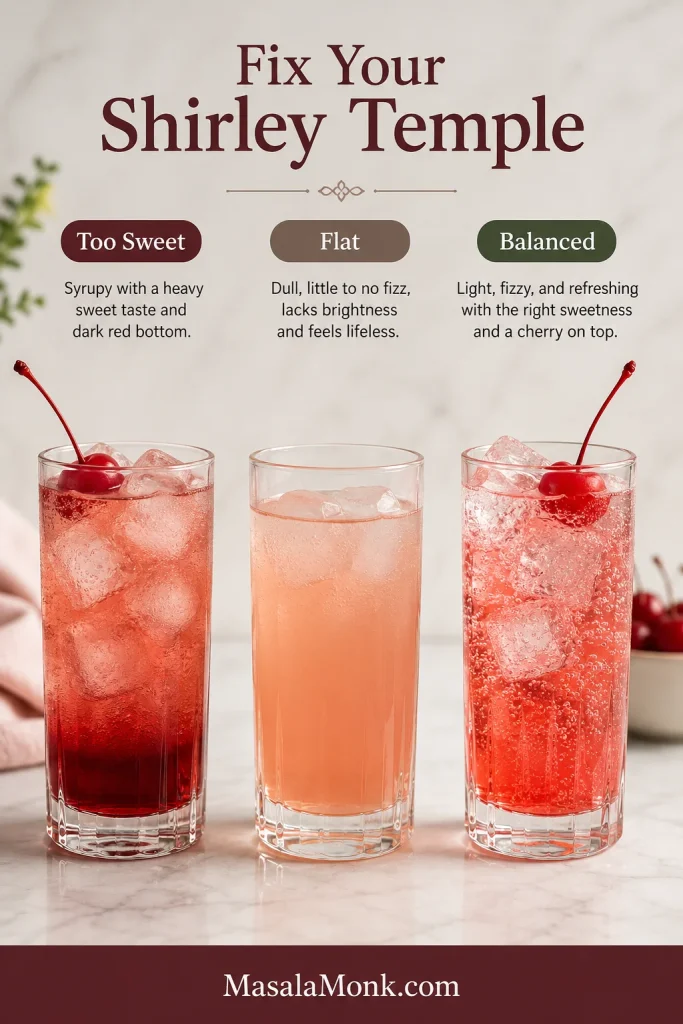
Most problems come from one of three things: too much syrup, warm soda, or mixing too early. Match the problem to the fix before changing the whole drink.

Three Shirley Temple glasses comparing a too-sweet drink, a flat drink, and a balanced fizzy drink.
Troubleshoot by reading the glass. A dark syrupy bottom usually means too much grenadine, while a dull flat drink usually means warm soda or soda added too early.
ProblemWhat HappenedHow to Fix It
Too sweetToo much grenadine or cherry syrupAdd more soda, a splash of club soda, and lime
FlatSoda was warm, old, or mixed too earlyUse chilled soda and serve immediately
Grenadine sankGrenadine is heavier than sodaStir for even flavor or leave layered for looks
Weak flavorToo little grenadine or too much ice meltAdd 1 teaspoon grenadine or cherry syrup
Too paleVery little grenadine or a lighter syrupAdd grenadine 1 teaspoon at a time
WateryIce melted before servingUse chilled soda and fresh ice
No grenadineMissing the classic syrupUse cherry syrup, homemade grenadine, or pomegranate juice with sweetener

Need the short version again? Return to the recipe card or the ratio guide.

What to Serve with Shirley Temples

Think salty, crunchy, creamy, or citrusy. The drink is sweet and fizzy, so it does best beside foods that give it contrast. That makes Shirley Temples easy for birthday tables, family movie nights, brunches, holidays, and kid-friendly party spreads.

For Pizza Night and Movie Night

  • Pizza
  • Popcorn
  • Chips and dips
  • Fries or potato wedges
  • Grilled cheese sandwiches

For Birthday Parties and Family Gatherings

For Brunch or Holiday Tables

For adults who are not drinking alcohol, a less-sweet ginger ale Shirley Temple can feel more thoughtful than plain soda. It still looks festive, but with less syrup it feels polished enough for adults too.

FAQs

Is a Shirley Temple alcoholic?

No. A classic Shirley Temple is non-alcoholic. It is made with soda, grenadine, ice, and cherries.

Is a Shirley Temple a mocktail?

Yes. It is one of the classic mocktails: mixed, garnished, and served like a cocktail, but made without alcohol.

What are the ingredients in a Shirley Temple?

The basic ingredients are lemon-lime soda or ginger ale, grenadine, ice, and maraschino cherries. Lime juice is optional, but it helps balance the sweetness.

Do you make a Shirley Temple with Sprite or ginger ale?

You can use either. Sprite or 7UP gives the sweet lemon-lime flavor many people associate with restaurant Shirley Temples, while ginger ale tastes softer and more classic.

Can 7UP be used for a Shirley Temple?

Yes. 7UP works just like Sprite here, so use whichever lemon-lime soda you already like or have chilled.

Is grenadine the same as cherry syrup?

No. Grenadine is traditionally pomegranate-based, while cherry syrup comes from cherries. Many store-bought grenadines taste cherry-like, which is why the two are often confused.

What can replace grenadine in a Shirley Temple?

Maraschino cherry syrup is the easiest substitute. Homemade grenadine, pomegranate juice with a little sweetener, or cherry juice can also work, though the flavor will be slightly different.

How do you make a Shirley Temple less sweet?

Use less grenadine, choose ginger ale instead of Sprite, add a splash of club soda, and squeeze in fresh lime juice. Start with 1 teaspoon to 1 tablespoon grenadine per cup of soda.

What is a Dirty Shirley?

A Dirty Shirley is the alcoholic version of a Shirley Temple. It is usually made with vodka, grenadine, lemon-lime soda or ginger ale, and a cherry.

What is the difference between a Shirley Temple and a Roy Rogers?

Shirley Temples use lemon-lime soda or ginger ale. Roy Rogers uses cola. Both are non-alcoholic drinks made with grenadine and a cherry.

Can Shirley Temples be made ahead for a party?

Partly. You can mix the grenadine, lime, cherries, and garnishes ahead, but wait on the soda. The bubbles are what make the pitcher feel fresh.

Back to quick answer · Back to recipe card

Final Sip

A good Shirley Temple is not about pouring as much red syrup as the glass can take. It is about cold soda, enough ice, the right splash of grenadine, and a cherry that makes the drink feel special.

Use Sprite or 7UP for the familiar bright-red version, ginger ale for the more classic version, and lime or club soda when the drink needs to be lighter. Once the ratio feels right, you can make one glass in minutes or scale it into a party pitcher without losing the fizz.

Posted on Leave a comment

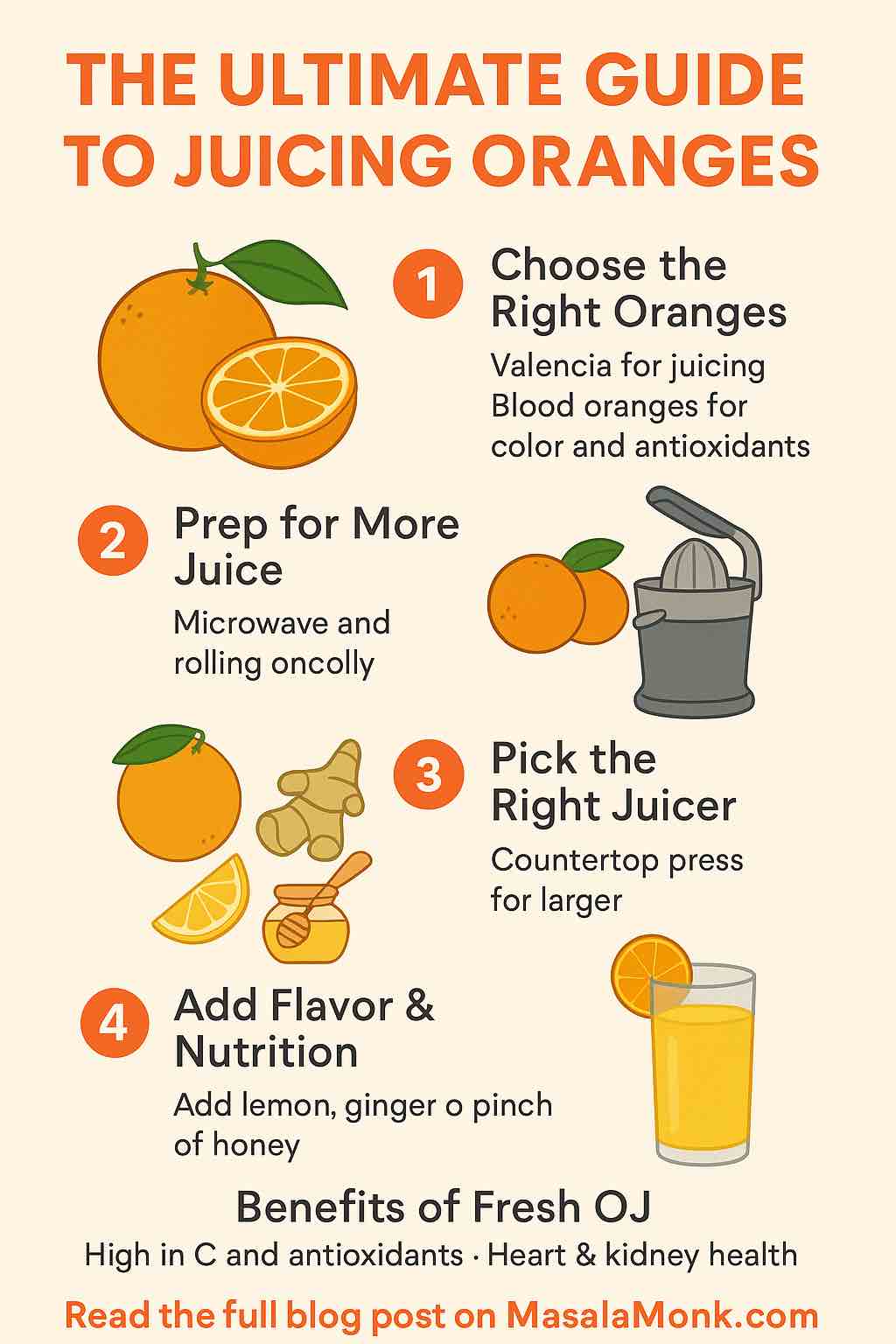
The Ultimate Guide to Juicing Oranges: Discover the 5 Top Tips

GUIDE TO JUICING ORANGES

“Orange juice is happiness in a glass — but only if you do it right.”

Juicing oranges is one of life’s simple pleasures. But if you think it’s as easy as slicing and squeezing — you’re missing out on a lot of flavor, nutrition, and even efficiency. In this 2025 deep-dive guide, we’ll explore not only how to juice oranges but how to perfect your technique — backed by science, modern tools, and a few pro secrets.

Let’s squeeze every drop out of your oranges. Literally.


Why Juice Oranges? (The Science Is Stronger Than Ever)

Oranges have been loved for centuries — but modern research continues to discover just how powerful they are:

  • High in Vitamin C
    A single 8 oz (240 ml) glass can provide over 100% of your daily Vitamin C requirement.
  • Packed With Flavonoids
    Particularly hesperidin, which is linked to improved cardiovascular health, lower blood pressure, and anti-inflammatory effects.
  • Supports Heart & Cognitive Health
    Recent clinical trials (2022–2024) have shown orange juice can reduce LDL (“bad”) cholesterol, increase HDL, and improve blood vessel function, even aiding cognition.
  • Kidney Stone Prevention
    Its natural citrates help reduce stone formation risk by alkalizing the urine.
  • Glycemic Stability
    Despite containing natural sugars, 100% orange juice causes lower glucose spikes compared to processed sugar beverages, especially when consumed with meals.

Pro Tip: Fresh orange juice offers maximum benefits versus store-bought juice that may be concentrated, frozen, or stored for long periods.


Selecting the Best Oranges for Juicing

🍊 Top Varieties

VarietyCharacteristicsBest Use
ValenciaSweet, juicy, few seedsBest for juicing
NavelSweet but can turn bitter after sittingGreat for quick consumption
Blood OrangesRed hue, tart-sweet, rich in antioxidantsGourmet blends
Cara CaraPink flesh, low acidSmooth, mild juices

Avoid: Overripe or underripe fruit. Overripe oranges yield bitter juice; underripe ones lack flavor and juice.


The Secret Prep Work Before You Juice

Yes — how you handle your oranges before juicing matters a lot:

1️⃣ Bring Oranges to Room Temperature

Cold oranges yield less juice. Let them sit at room temperature for at least 30 minutes.

2️⃣ Quick Microwave Hack

If you’re in a rush, microwave each orange for 10–15 seconds. This relaxes the juice sacs.

3️⃣ Roll & Press

Roll each orange firmly under your palm on the countertop for 10-15 seconds to break internal membranes gently.

4️⃣ Zest First

If you want to use the zest, do it before microwaving or cutting. It’s much easier when the skin is firm.


Choosing the Right Juicer: What Actually Works?

🥄 Manual Reamers

  • Cheap and simple.
  • Best for 1–2 servings.
  • Requires arm work.

✋ Handheld Press Juicers

  • Quick, minimal mess.
  • Excellent for small batches.

🏋 Countertop Manual Presses (Lever Style)

  • Ideal for frequent juicers.
  • High juice yield.
  • Gentle on delicate flavors.

⚡ Electric Juicers

  • Fast, very efficient.
  • Best for larger families or frequent use.
  • Look for models with pulp control.

Pro Pick 2025: Breville Citrus Press Pro (for serious home users). OXO Good Grips Citrus Squeezer (budget-friendly manual).


The Correct Cutting Technique

Always cut oranges crosswise (through the equator), not from stem to bottom. This exposes more juice sacs for extraction and fits most juicers better.

Avoid pressing the peel too hard to minimize bitter compounds like limonin seeping into your juice.


Pro Flavor & Nutrition Boosters

Orange juice is amazing on its own — but you can elevate both its taste and health profile:

  • Add Lemon or Lime
    Brightens flavor and adds extra Vitamin C.
  • Ginger or Turmeric Root
    Adds anti-inflammatory power.
  • Pinch of Salt
    Balances acidity and enhances sweetness.
  • Raw Honey
    Natural sweetener with antibacterial properties.
  • Blend with Other Fruits
    Kiwi, pineapple, or berries add fiber, enzymes, and new flavors.

Storage: Fresh vs. Preserved Juice

🍹 Fresh Juice

  • Best consumed within 2–3 days.
  • Store in airtight glass bottles in the fridge.
  • Always shake gently before drinking.

❄️ Freezing

  • Freeze in silicone ice trays for longer storage (up to 6 months).
  • Thaw slowly in the fridge for best flavor retention.

Important: Vitamin C degrades with time, light, and air exposure. The fresher, the better.


The Future of Juicing: What’s New in 2025?

Recent innovations have made juicing even more nutrient-rich:

  • Pectinase Enzyme Pre-treatment: Used in some commercial operations to boost juice yield up to 15% and preserve more antioxidants.
  • Non-Thermal Processing (HPP & PEF): High-pressure or pulsed electric field processing preserves vitamin C and natural cloudiness better than traditional pasteurization.
  • Cloud Stabilization Techniques: Adding pectin from kiwi or passion fruit can naturally keep homemade juice looking and tasting better longer.

While most of these remain industrial for now, it’s exciting to see home appliance companies starting to adapt some of these technologies.


Quick Troubleshooting Table

ProblemSolution
Bitter tasteAvoid over-squeezing peel; blend with lemon or honey
Low juice yieldWarm oranges; roll before cutting
Juice separatesShake before serving; add small amounts of pectin-rich fruits
Too sweetAdd lemon or blend with low-sugar fruits like berries
Too sourBlend in ripe bananas or mango

Conclusion: The Joy of Perfect Orange Juice

With just a little extra care, your morning glass of orange juice can be transformed into a nutrient powerhouse that’s fresher, healthier, and infinitely more flavorful than anything off the shelf. Juicing isn’t just about squeezing — it’s about unlocking the full potential of one of nature’s most perfect fruits.

🍊 10 Frequently Asked Questions (FAQs)

1️⃣ What type of oranges are best for juicing?

Answer:
Valencia oranges are ideal for juicing due to their high juice content and balanced sweetness. Navel oranges are good for immediate consumption but can become bitter if stored too long after juicing. For a unique taste and color, try blood oranges or Cara Cara oranges.


2️⃣ How can I get the maximum juice out of each orange?

Answer:
Bring oranges to room temperature or microwave for 10–15 seconds. Roll them under your palm before cutting to loosen the juice sacs. Always cut crosswise for the best yield.


3️⃣ Is fresh orange juice healthier than store-bought?

Answer:
Yes. Freshly squeezed juice retains more vitamin C, flavonoids, and antioxidants. Store-bought juice may undergo pasteurization, concentration, or extended storage, which reduces nutrient content.


4️⃣ How long can I store fresh orange juice?

Answer:
Fresh juice should be consumed within 2–3 days if refrigerated in an airtight container. For longer storage, freeze in ice cube trays and use within 3–6 months.


5️⃣ Why does my orange juice taste bitter sometimes?

Answer:
Over-squeezing the peel releases bitter compounds like limonin. Avoid pressing the peel too hard, and zest the oranges before juicing if zest is needed.


6️⃣ Can I mix other fruits with orange juice?

Answer:
Absolutely! Add lemon or lime for brightness, ginger or turmeric for anti-inflammatory benefits, and kiwi, pineapple, or berries for extra flavor and nutrients.


7️⃣ Does orange juice help prevent kidney stones?

Answer:
Yes. Orange juice raises urinary citrate levels, which can help prevent certain types of kidney stones. Daily consumption has been linked to a lower incidence of stone formation.


8️⃣ Is juicing better than eating whole oranges?

Answer:
Whole oranges provide more fiber, which aids digestion and slows sugar absorption. Juicing delivers concentrated nutrients quickly but with less fiber. Both have unique benefits depending on your health goals.


9️⃣ What’s the best type of juicer for oranges?

Answer:
For small batches, handheld squeezers or manual reamers work well. For frequent use, countertop lever presses or electric citrus juicers offer higher yields and convenience.


🔟 Does heating or freezing affect the nutrients in orange juice?

Answer:
Yes. Heat, light, and oxygen degrade vitamin C and antioxidants. Mild pasteurization retains most nutrients, but high-heat processing or long-term freezing can reduce some nutritional value. Always store juice properly.

Posted on 2 Comments

Mocktails with Grenadine

friends making a toast for their friendship

Let’s dive into the vibrant world of mocktails, with a special focus on grenadine – a non-alcoholic syrup cherished for its rich, sweet, and fruity flavor. This delightful concoction, characterized by its deep red hue, has been a staple in the mixology world for years, lending its unique flavor profile to countless beverages, both alcoholic and non-alcoholic.

Grenadine: A Flavorful Journey

Derived from the French word ‘grenade’ which means pomegranate, grenadine originated as a pomegranate syrup. The origins of this syrup can be traced back to 19th-century France, where it was commonly used to sweeten dishes.

Grenadine, in its traditional form, is a perfect blend of pomegranate juice and sugar. It’s worth noting that some modern variants of grenadine use blackcurrant juice or other fruit flavors instead of pomegranate. Despite these variations, grenadine remains an enchanting elixir, known for its rich sweetness and slightly tart undertones.

How to Use Grenadine in Mocktails

It’s clear that grenadine brings a world of possibilities to the mocktail-making scene. But you might be wondering, how exactly do you incorporate it? Here are the steps you should follow:

Step 1: Understand the Flavor Profile

The first thing to know about grenadine is its flavor profile. This syrup is made from pomegranate juice, sugar, and water, providing a sweet, slightly tart flavor that can add a burst of vibrancy to beverages. Recognizing the essence of grenadine is crucial to know how best to use it.

Step 2: Choose Complementary Ingredients

Next, you need to pick ingredients that go well with grenadine. Given its sweet-tart flavor, grenadine complements a range of flavors, particularly those found in citrus juices. It also works well with soda water, ginger ale, and a variety of other non-alcoholic beverages.

Step 3: Measure Correctly

A little grenadine goes a long way, so you don’t need a lot to make an impact. Use measuring spoons to add grenadine, usually, a dash or two is sufficient for a single serving of a mocktail. Remember, you can always add more, but you can’t take it out once it’s in the mix.

Step 4: Mix or Layer the Drink

Depending on the effect you want to achieve, you have a couple of options here. If you want the grenadine fully integrated into the drink, you can mix it with the other ingredients using a cocktail shaker. Alternatively, if you want a gradient effect in the drink (known as a ‘sunset’ or ‘sunrise’ effect), you can layer the grenadine after pouring the other ingredients.

Step 5: Taste and Adjust

This might be the most important step – taste your mocktail! If it’s too sweet, you can add more of the other beverage ingredients to balance it out. If it’s not sweet enough, a little more grenadine can do the trick.

Step 6: Serve Chilled and Garnished

Finally, pour your grenadine mocktail into a glass. If you want it chilled, add some ice. And for an extra touch of elegance, garnish it. A slice of fruit or a sprig of mint can make your mocktail look as delightful as it tastes.

And that’s it! Now you’re ready to take on the world of grenadine mocktails. Remember, the best part of creating mocktails is experimenting with flavors, so don’t be afraid to mix it up and try new combinations.

10 Mocktail Ideas with Grenadine

Grenadine, with its ruby-red allure, is a dynamic ingredient that can transform any mocktail into a visually stunning, tastebud-tickling delight. Let’s embark on a vibrant journey that introduces the stunning range of mocktails you can create with grenadine and other splendid ingredients.

1. Sunset Paradise – A Mocktail with Grenadine, Pineapple and Orange Juice

Imagine a tropical sunset in a glass. That’s exactly what Sunset Paradise captures. This mocktail layers orange juice over pineapple juice and tops it with a dreamy drizzle of grenadine, creating a stunning gradient of tropical hues.

Ingredients:

  • 1 part Pineapple juice
  • 1 part Orange juice
  • A dash of grenadine

Serving Suggestion: Serve chilled in a tall glass with a pineapple wedge and cherry for garnish.

Variation: Want a citrusy twist? Add a dash of lemon juice.

2. Ginger Grenadine Fizz – A Sparkling Fusion of Grenadine and Ginger Ale

As the name suggests, Ginger Grenadine Fizz offers a refreshing mix of spicy ginger ale with a dash of grenadine. Its effervescence tingles your senses while the hint of grenadine weaves in a sweet note, making it an invigorating drink.

Ingredients:

  • 2 parts Ginger ale
  • A dash of grenadine
  • A squeeze of lime

Serving Suggestion: Serve chilled in a highball glass. Garnish with a lime wheel.

Variation: Swap ginger ale with ginger beer for a more robust flavor.

3. Minty Sunrise – A Minty Fresh Mocktail with Grenadine and Club Soda

Minty Sunrise is a mocktail that strikes a fine balance between the invigorating freshness of mint and the sweet charm of grenadine. The addition of club soda introduces a subtle, bubbly texture, making it a perfect mocktail for warm, sunny days.

Ingredients:

  • Fresh mint leaves
  • A dash of lime juice
  • A dash of grenadine
  • Club soda to top

Serving Suggestion: Serve chilled in a Collins glass. Garnish with a sprig of fresh mint and a lime wheel.

Variation: Add a few slices of cucumber for a more refreshing twist.

4. Pink Grapefruit Sparkler – A Tangy-Sweet Mocktail with Grenadine and Grapefruit Juice

Pink Grapefruit Sparkler is an elegant mocktail that marries the tang of grapefruit juice with the sweet allure of grenadine. The result is a gorgeous pink beverage that is as delightful to look at as it is to drink.

Ingredients:

  • 2 parts Grapefruit juice
  • 1 part Club soda
  • A dash of grenadine

Serving Suggestion: Serve chilled in a champagne flute. Garnish with a grapefruit slice.

Variation: Add a pinch of sea salt to enhance the grapefruit’s tanginess.

5. Passion Spritzer – A Tropical Mocktail with Grenadine, Sprite, and Passion Fruit Juice

Passion Spritzer brings the tropical flavor of passion fruit juice into a light, bubbly, and refreshingly sweet drink. It’s a perfect mocktail to bring a slice of the tropics into your home.

Ingredients:

  • 1 part Passion fruit juice
  • 2 parts Sprite
  • A dash of grenadine

Serving Suggestion: Serve chilled in a mason jar. Garnish with a slice of passion fruit.

Variation: Swap Sprite with soda water for a less sweet option.

6. Tropical Cream – A Dreamy Mocktail with Grenadine, Coconut Milk, and Pineapple Juice

Tropical Cream is a dreamy, sweet mocktail that transports you straight to a sandy beach under a palm tree. It combines the creaminess of coconut milk with the tanginess of pineapple juice and the sweetness of grenadine.

Ingredients:

  • 1 part Coconut milk
  • 1 part Pineapple juice
  • A dash of grenadine

Serving Suggestion: Serve chilled in a coconut shell. Garnish with a pineapple slice and a cherry.

Variation: Add a scoop of coconut sorbet for a more indulgent twist.

7. Mango Basil Cooler – A Refreshing Mocktail with Grenadine, Basil, and Mango Juice

Mango Basil Cooler is a refreshing mocktail that combines the sweet, tropical taste of mango with the herbal hint of basil. Topped off with a splash of grenadine and club soda, it’s the perfect drink to keep you refreshed on hot summer days.

Ingredients:

  • Fresh basil leaves
  • 2 parts Mango juice
  • A dash of grenadine
  • Club soda to top

Serving Suggestion: Serve chilled in a tall glass. Garnish with a sprig of basil and a slice of mango.

Variation: Add a dash of lime juice for a citrusy touch.

8. Ginger Grenadine Punch – A Spicy-Sweet Mocktail with Grenadine and Ginger Beer

Ginger Grenadine Punch is a zesty, spicy-sweet mocktail that combines the punchy flavor of ginger beer with the sweetness of grenadine. It’s a delightful concoction that tickles your senses and leaves a warming aftertaste.

Ingredients:

  • 2 parts Ginger beer
  • A dash of lime juice
  • A dash of grenadine

Serving Suggestion: Serve chilled in a mule mug. Garnish with a lime wheel and a cherry.

Variation: Add a few slices of jalapeño for an extra kick.

9. Cranberry Blush – A Fruity Mocktail with Grenadine, Cranberry, and Orange Juice

Cranberry Blush is a vibrant, fruity mocktail that’s perfect for a festive celebration. The sweetness of grenadine perfectly complements the tartness of cranberry and the zesty flavor of orange juice.

Ingredients:

  • 1 part Cranberry juice
  • 1 part Orange juice
  • A dash of grenadine

Serving Suggestion: Serve chilled in a wine glass. Garnish with an orange wheel and a cranberry skewer.

Variation: Add a cinnamon stick for a touch of spice.

10. Sunrise Soda – A Citrusy Mocktail with Grenadine, Orange Juice, and Club Soda

Sunrise Soda is a simple yet flavorful mocktail that features the refreshing taste of orange juice, the sparkle of club soda, and the sweet depth of grenadine. It’s the perfect drink to enjoy a sunrise or a lazy afternoon.

Ingredients:

  • 1 part Orange juice
  • 2 parts Club soda
  • A dash of grenadine

Serving Suggestion: Serve chilled in a tall glass. Garnish with an orange wheel and a cherry.

Variation: Muddle in some fresh mint leaves for a refreshing twist.

Enjoy these wonderful mocktails with grenadine and dive into a world of refreshing, non-alcoholic delights. Each drink, with its unique flavor profile and stunning visual appeal, is sure to impress your guests and brighten your day. Cheers to good health and great taste!


Remember, the secret to a great mocktail lies in the balance of flavors. Whether you like your drink sweet, tangy, or somewhere in between, grenadine is a versatile addition that can help you achieve the perfect balance.

Experience the delight of these wonderful mocktails with grenadine, and bring an element of playfulness and versatility to your non-alcoholic beverage game. Whether you’re a mixology novice or a cocktail connoisseur, these grenadine-infused mocktails are sure to impress.

Happy mixing!


Blog tags: Mocktails, Grenadine, Non-Alcoholic Drinks, Mixology, Beverage Recipes, Healthy Drinks, Pomegranate Syrup, Antioxidants, Vitamin C.