
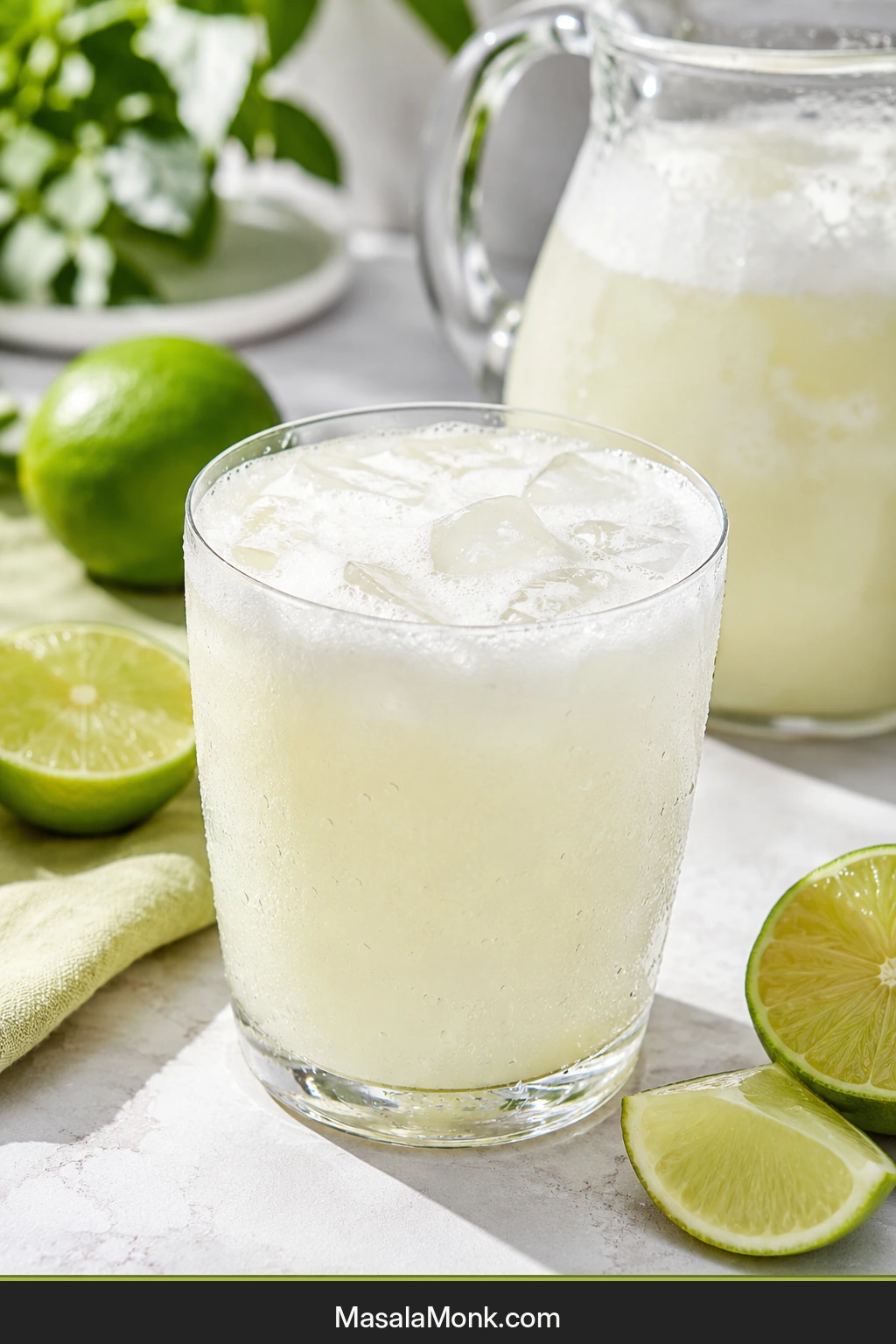
Brazilian lemonade should arrive like a cold lime cloud: pale green, lightly frothy, creamy through the middle and sharp enough at the end to make the next sip feel inevitable.
Three core ingredients—whole limes, cold water and condensed milk—become something surprisingly airy. The fruit briefly perfumes the water, the peel and pulp are strained away, and the green base turns pale and foamy in the second blend.
The ingredient list is almost suspiciously short, and the one moment that asks for care comes early. Stop while coarse pieces remain and the peel gives fragrance without taking over. For thick-skinned fruit or a pitcher that must wait, use one of the gentler methods below.
Brazilian Lemonade at a Glance
For 5–6 servings, briefly blend 4 medium thin-skinned limes—about 240–280 g total—trimmed, quartered, deseeded and cored, with 4 cups / 950 ml cold water. Strain gently, then blend the liquid with 300 g sweetened condensed milk until pale and lightly foamy.
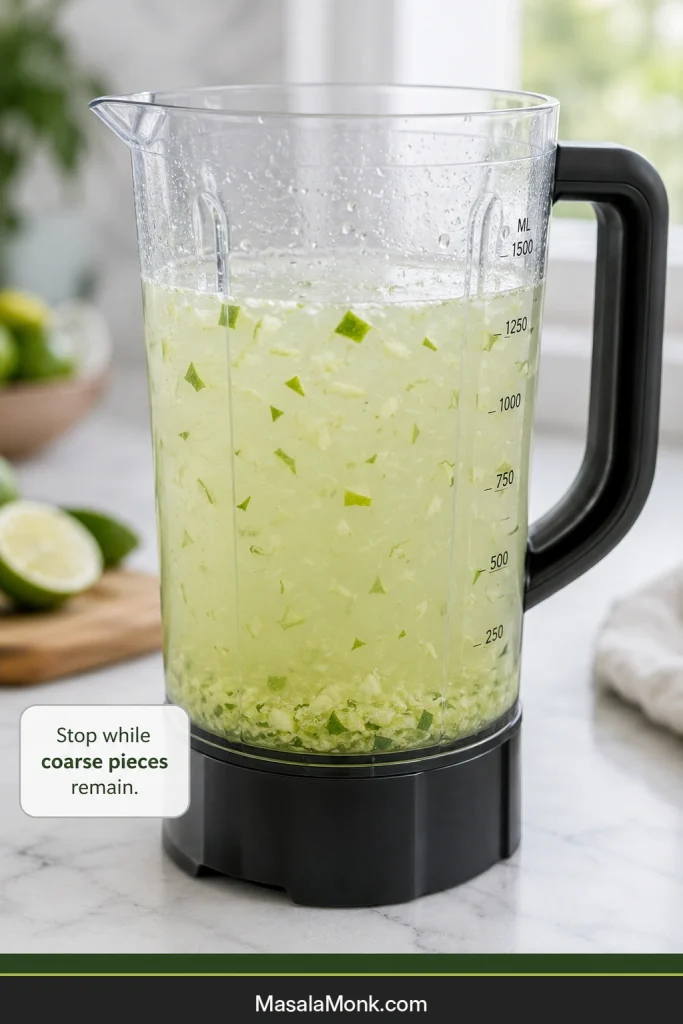
1. Watch the pieces, not only the clock. Stop when the water is cloudy green and coarse lime pieces remain—usually after 8–12 seconds.
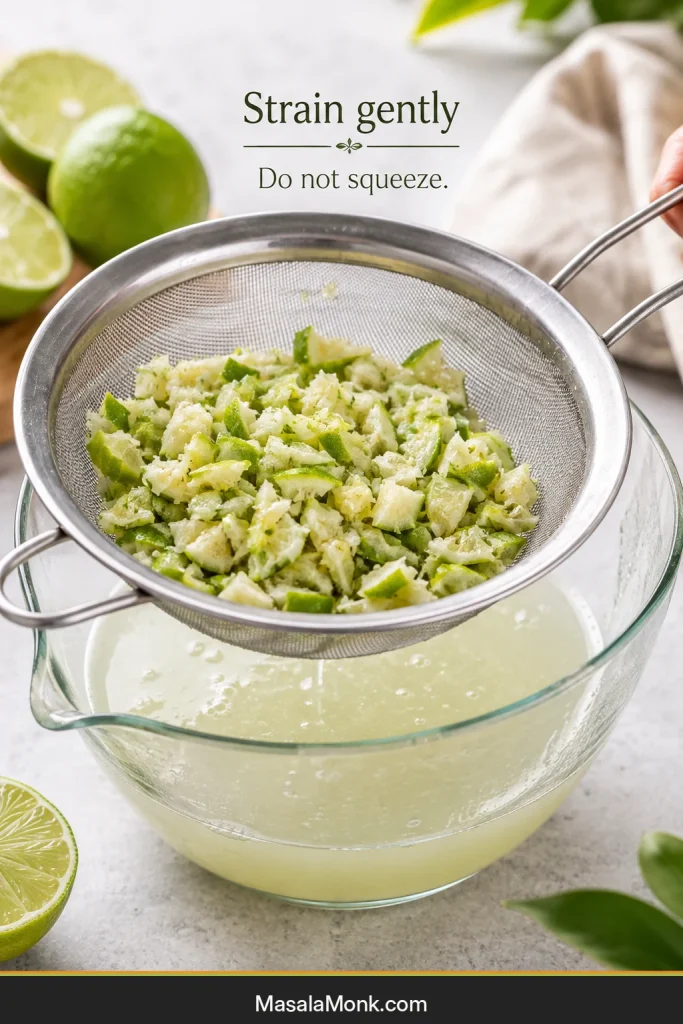
2. Strain; do not squeeze. Let the liquid drain, but leave the final spoonful of pulp behind.
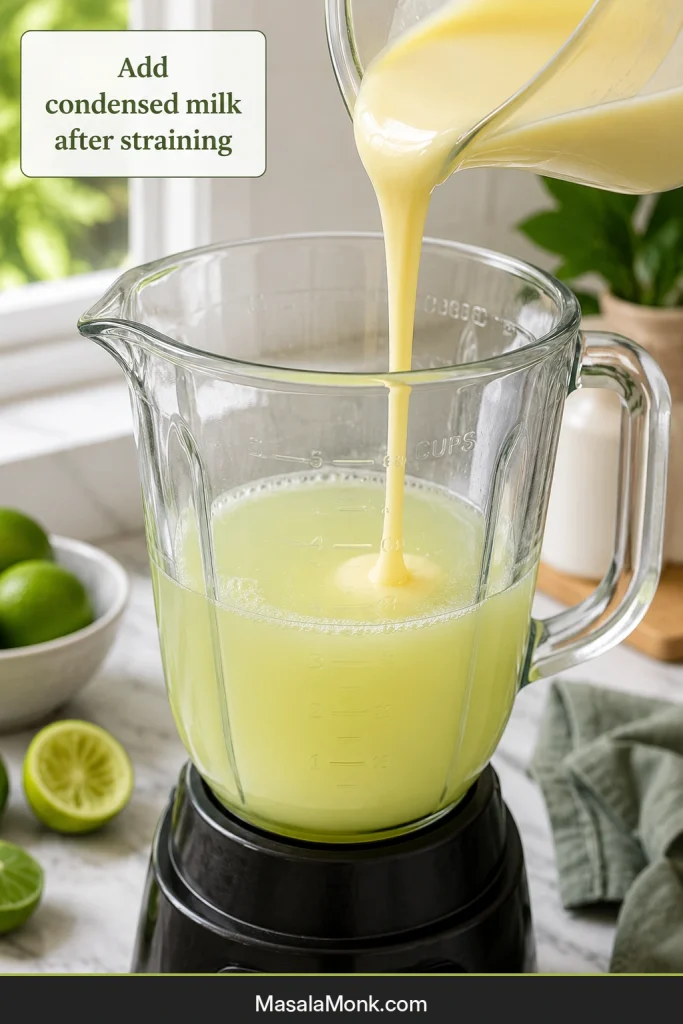
3. Let the first glass decide. Add the condensed milk only after the lime mixture has been strained, then take the first sip over ice before changing the pitcher.
Choose Your Lime Method
Choose how to handle the limes first. Sweetness can always be adjusted after tasting; once too much peel has been blended in, it is much harder to take back.
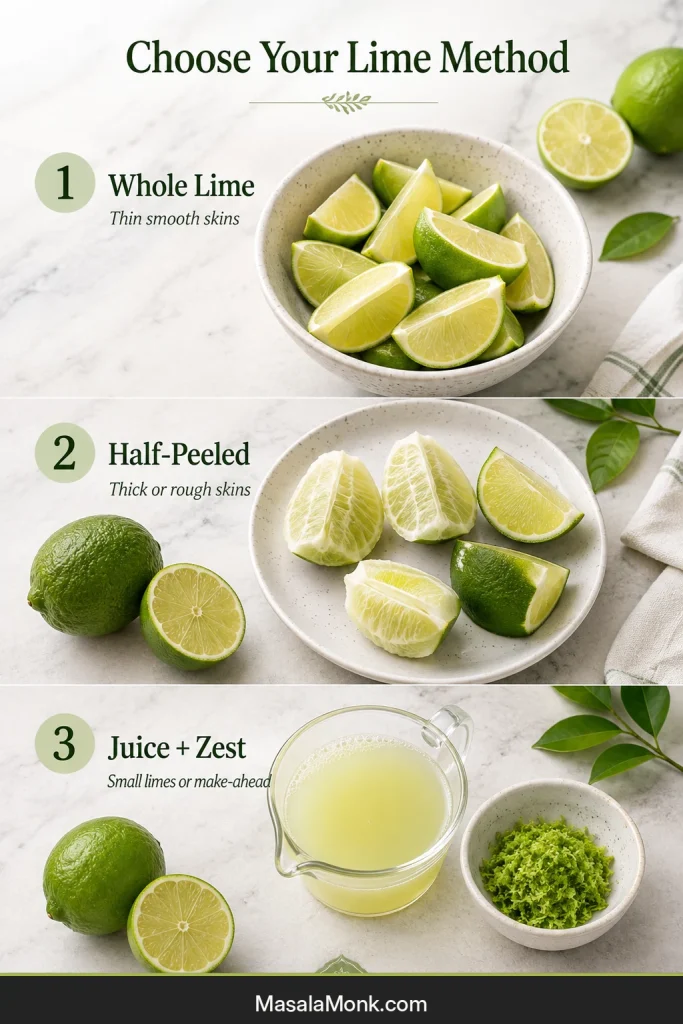
| Lime method | Best when | How to prepare the fruit |
|---|---|---|
| Whole lime | You have smooth, thin-skinned Persian (Tahiti) limes and want the liveliest peel aroma | Keep the green peel and remove the ends, seeds and central white core |
| Half-peeled | The skins look thick, rough or unfamiliar | Peel two limes completely and keep the peel on two |
| Juice and zest | You have many small limes, need to make the drink ahead or prefer the smoothest texture | Use measured juice and finely grated green zest instead of blending many small peels |
For the balanced pitcher, keep the water at 4 cups / 950 ml and use 300 g condensed milk. Drop to 250 g when you want the lime to lead, or use the full 397 g can for a sweeter, richer drink.
Brazilian Lemonade Recipe
This is the balanced main pitcher: lively lime, rounded sweetness and a pale, frothy finish.
Equipment
- Blender with a 1.8–2-liter jar; with a 1.5-liter jar, process the limes and water in two equal batches
- Sharp knife and stable cutting board
- Fine-mesh sieve
- Large bowl or 2-liter pitcher
- Liquid measuring jug
- Digital kitchen scale, recommended
- Can opener and silicone spatula or large spoon
Ingredients
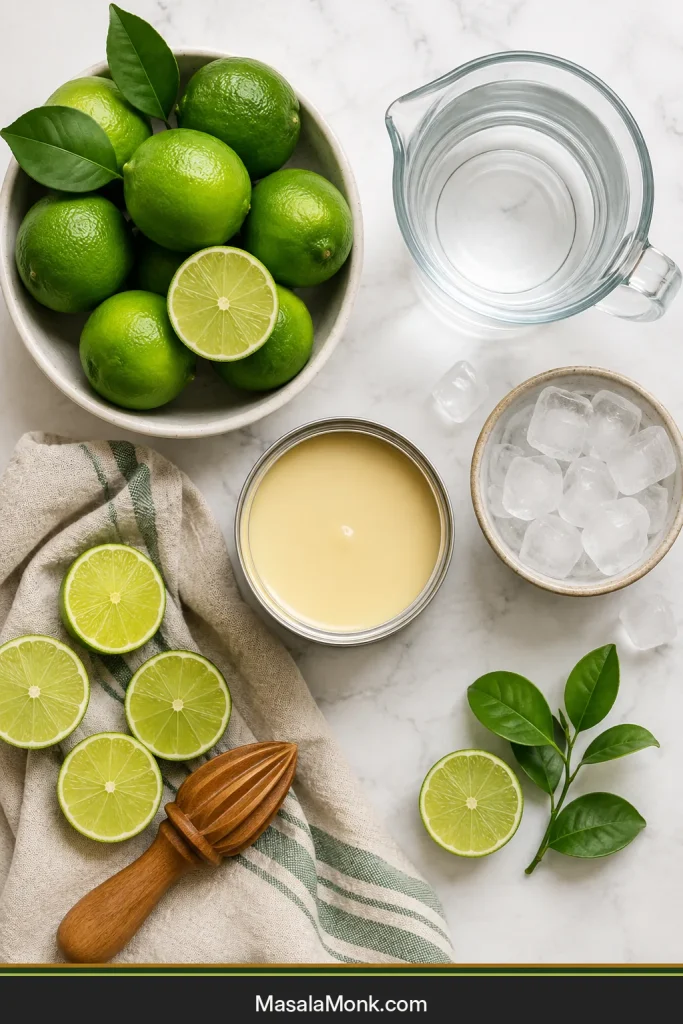
- 4 medium Persian (Tahiti) limes or similarly thin-skinned limes, about 8½–10 oz / 240–280 g total
- 4 cups refrigerator-cold water, 32 US fl oz / 950 ml
- 10½ oz / 300 g sweetened condensed milk, about 1 cup / 235 ml, plus more only after tasting; do not substitute unsweetened evaporated milk
- Up to 1 tablespoon fresh lime juice, 15 ml, optional for finishing and added 1 teaspoon at a time
- Ice, enough to fill each glass about halfway
- Thin lime wheels or wedges, optional for serving
Prefer it richer? Use the complete 14 oz / 397 g can of condensed milk. Want the lime to lead? Begin with 8¾ oz / 250 g while keeping the water at 4 cups / 950 ml.
Unfamiliar or thick-skinned limes? Peel two completely and keep the peel on two. Remove the central white core from all four. You still get the fresh-peel aroma, but the drink is gentler and more forgiving.
Method
Prepare the Limes
- Wash the limes. Rinse them under cool running water and scrub the peel with a clean produce brush. Dry them so the knife does not slip.
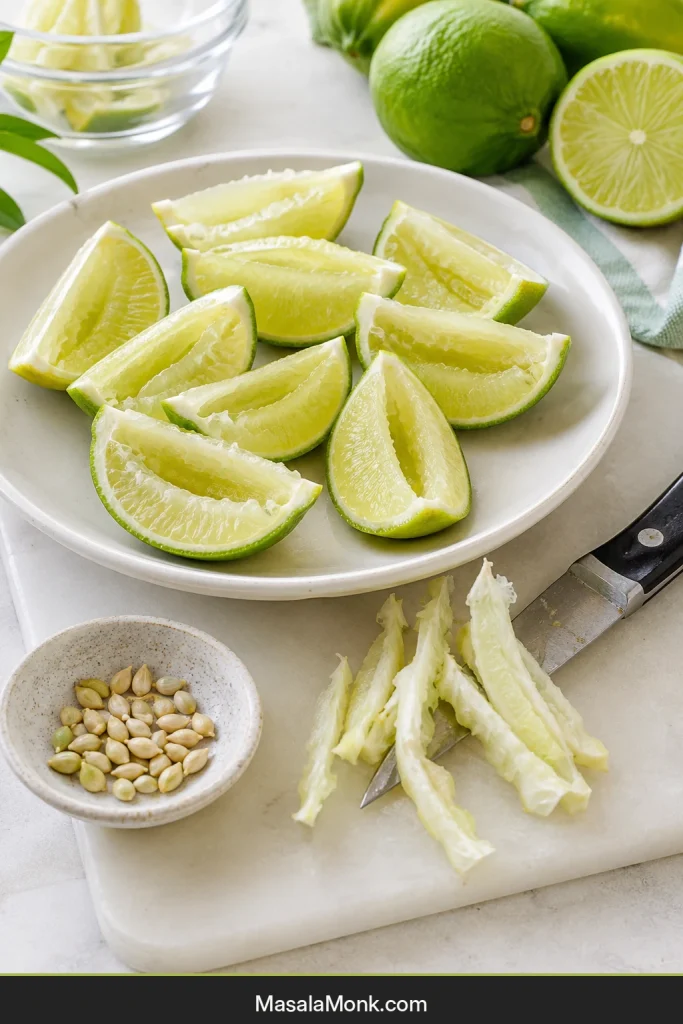
- Trim and cut. Slice away both ends of every lime. Quarter each lime lengthwise, remove visible seeds and cut away the thick white strip through the center of every wedge.
Blend and Strain the Lime Base
- Make the short lime blend. Put the prepared lime pieces in the blender with all 4 cups / 950 ml cold water. Pulse until the water turns cloudy green and coarse lime pieces remain, usually 8–12 seconds. Stop sooner in a powerful blender. When circulation is poor, divide the limes and water evenly between two batches instead of blending longer.
- Strain immediately. Pour the mixture through a fine-mesh sieve over a large bowl or pitcher. Tap or gently shake the sieve and stir the pulp once or twice. Leave the final spoonful behind instead of mashing it through.
Finish the Brazilian Lemonade
- Rinse the blender and add the condensed milk. Wash away any peel left in the jar, return the strained lime liquid and add 300 g sweetened condensed milk.
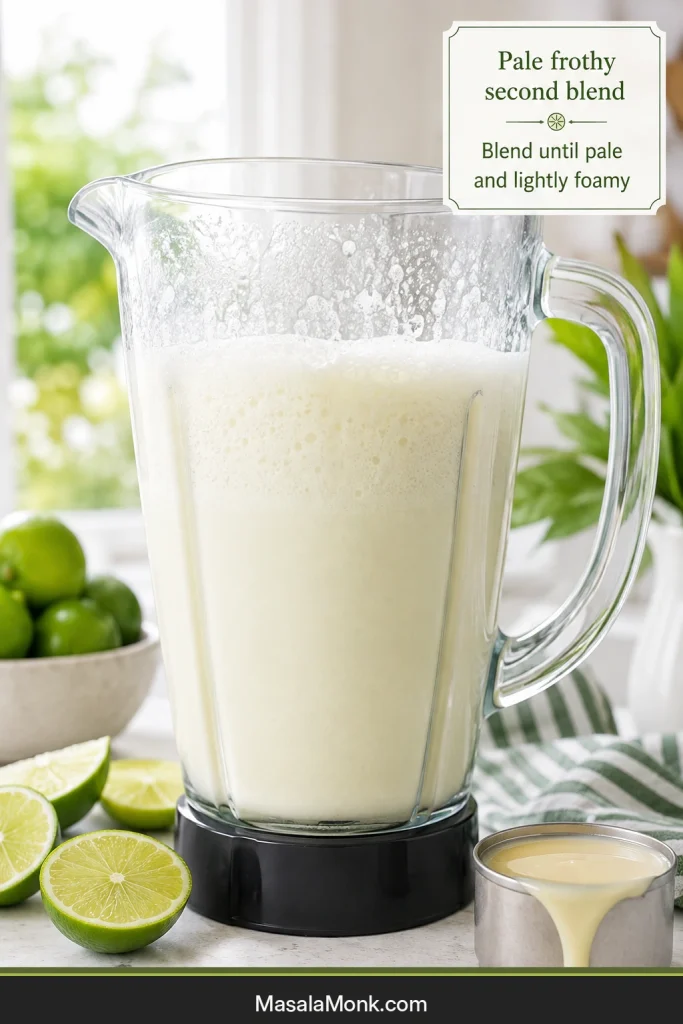
- Blend until pale and softly foamy. Blend for 10–15 seconds. The green base should turn pale almost immediately, with a soft cap of fine bubbles rather than stiff foam.
- Let the first glass decide. Pour one glass over ice and take a sip before changing anything. When it tastes sweet but muted, add fresh lime juice 1 teaspoon at a time, up to 1 tablespoon. For excessive sharpness, add condensed milk 1 tablespoon at a time. A heavy texture needs cold water 2 tablespoons at a time.
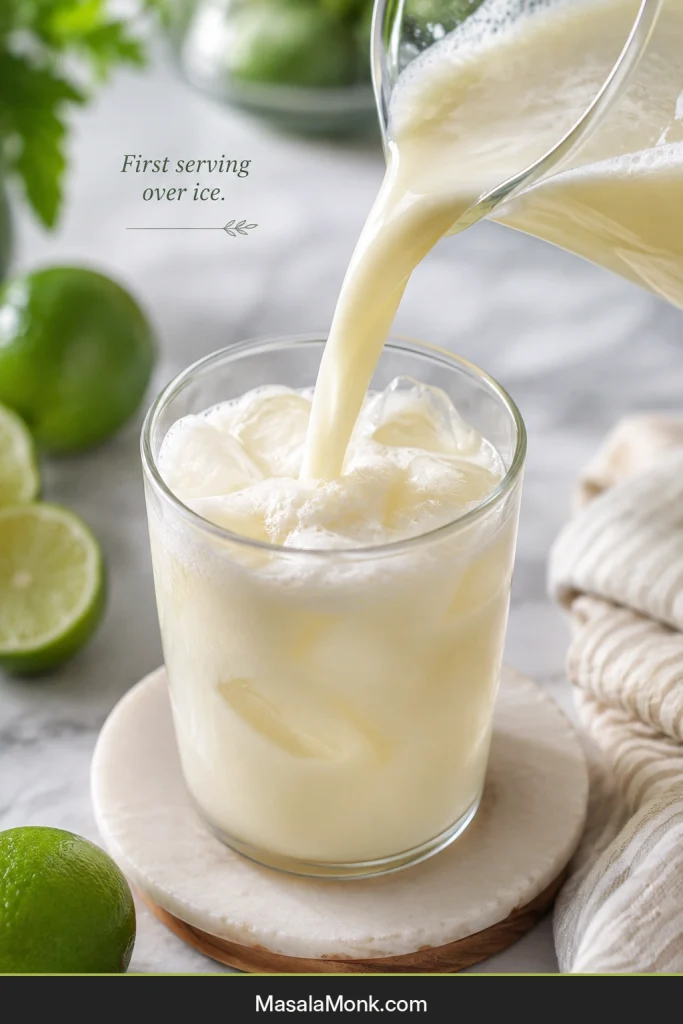
- Serve immediately. Fill each glass about halfway with ice, then pour in roughly 7 oz / 200 ml lemonade. Leave a little room for the light foam.
What Does Brazilian Lemonade Taste Like?
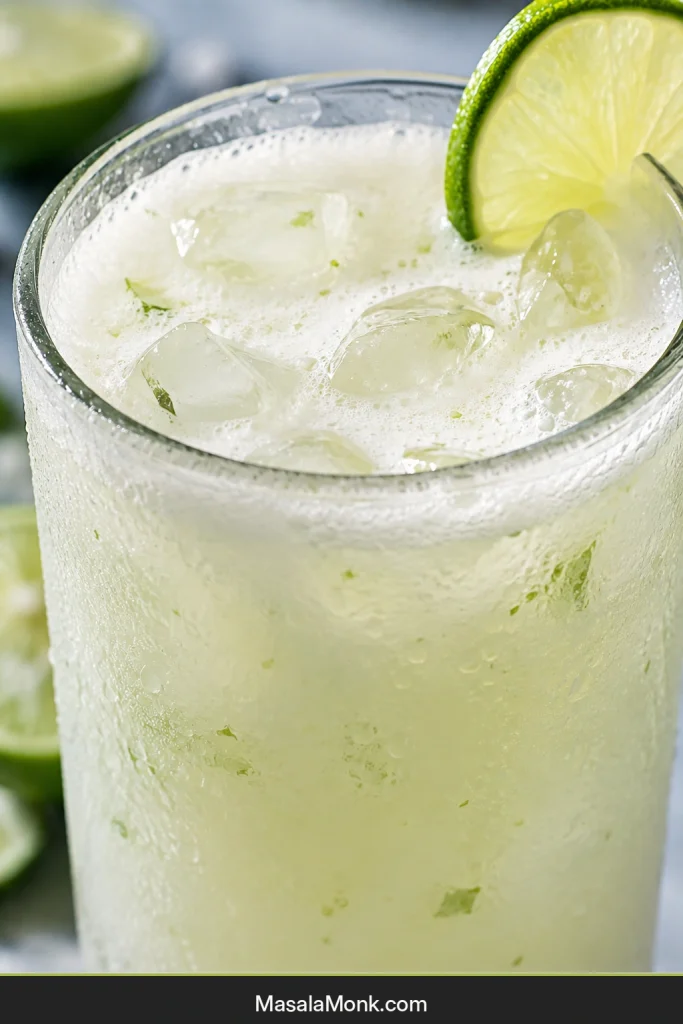
The lemonade is ready when it smells distinctly of fresh lime, pours pale and lightly foamy, and tastes creamy at first but clean and citrusy at the finish.
Brazilian Lemonade Guide
- Why it uses limes and what limonada suíça means
- Choose the limes, condensed milk and sweetness
- Keep the lime bright, not bitter
- Fix a pitcher that tastes wrong
- Make it ahead with juice and zest
- Try coconut, frozen, lemon or cocktail versions
- Scale it for a party
- Store leftovers and understand separation
The method is simple once the lime is under control. The name, however, needs a little explaining.
What Is Brazilian Lemonade?
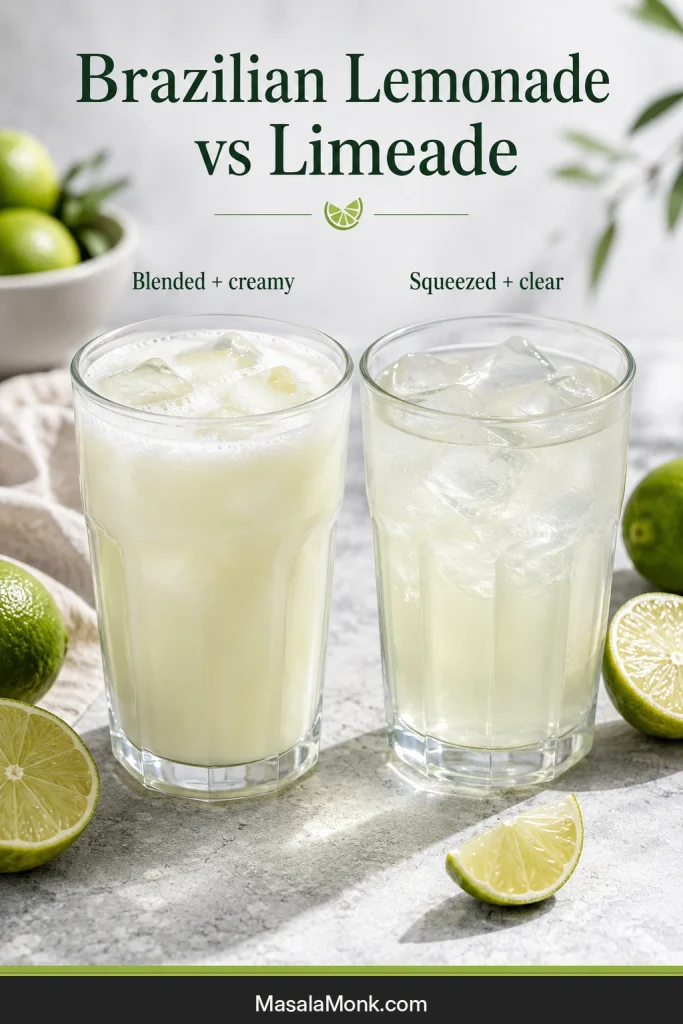
Brazilian lemonade is a cold blended lime drink made with fresh limes and water. Depending on the version, sugar, milk, sweetened condensed milk—or a combination—softens the lime and adds sweetness or creaminess. Brief contact with the peel gives it a greener aroma than ordinary squeezed limeade; straining removes the solids before the drink is sweetened and frothed.
Why call it lemonade when it uses limes? In Brazil, the familiar green fruit is commonly called limão-taiti, while a yellow lemon is limão-siciliano. That shared word helps explain why limonada becomes “lemonade” in English even when the drink uses green limes. You will also see it called Brazilian limeade or Brazilian limonada.
What Is Limonada Suíça?
Limonada suíça is not one fixed formula. The name covers blended, strained Brazilian lime drinks made in several ways: this Brazilian limonada suíça recipe uses sugar and milk, while other versions use condensed milk.
The “Swiss” part has no universally accepted origin. A common explanation connects it to Swiss condensed-milk branding, while other accounts point more broadly to Swiss influence in Brazil.
Is the Condensed-Milk Version Authentic?
Yes—it is a well-loved Brazilian style, but it is not the only one. Some recipes lean on sugar with a little milk or condensed milk, while richer versions use most or all of a can.
Ready to make it? Jump back to the Brazilian lemonade recipe.
Ingredients That Shape the Pitcher
Choose Limes by Weight and Skin
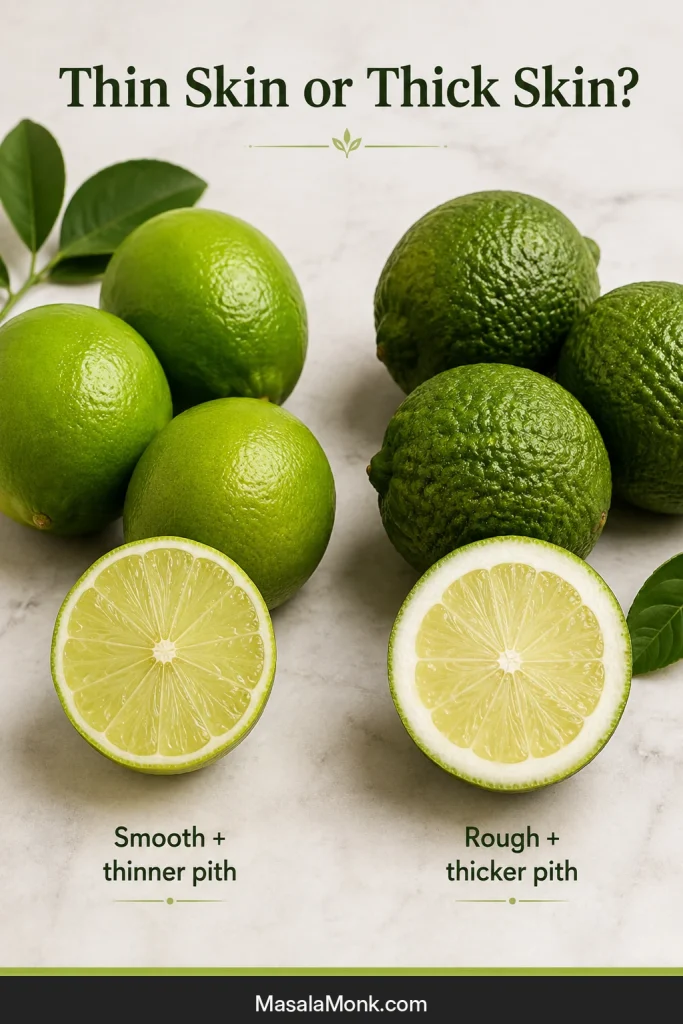
Choose medium Persian (Tahiti) limes that feel heavy for their size, with smooth or relatively thin-looking skins. Rough, thick-skinned limes are less forgiving in a whole-fruit blend because they contribute more peel and pith relative to their juice.
Weight is more dependable than count. Four medium limes should total about 8½–10 oz / 240–280 g. Equal fruit weight does not mean equal peel exposure, however. With small Key or Indian limes, peel most of the fruit and leave the peel on roughly one-quarter to one-half of the total amount. Small fruit is easiest to control with the measured juice-and-zest method.
Because the peel enters the drink, rinse and scrub the limes thoroughly under running water rather than using soap or detergent. The FDA produce-washing guidance also advises against soap and commercial produce washes.
How Condensed Milk Changes the Drink
Condensed milk does three jobs at once: it sweetens the lime, softens its sharp edges and gives the drink its creamy body. The balanced pitcher uses 300 g, added only after straining so the peel gets no more blade time.
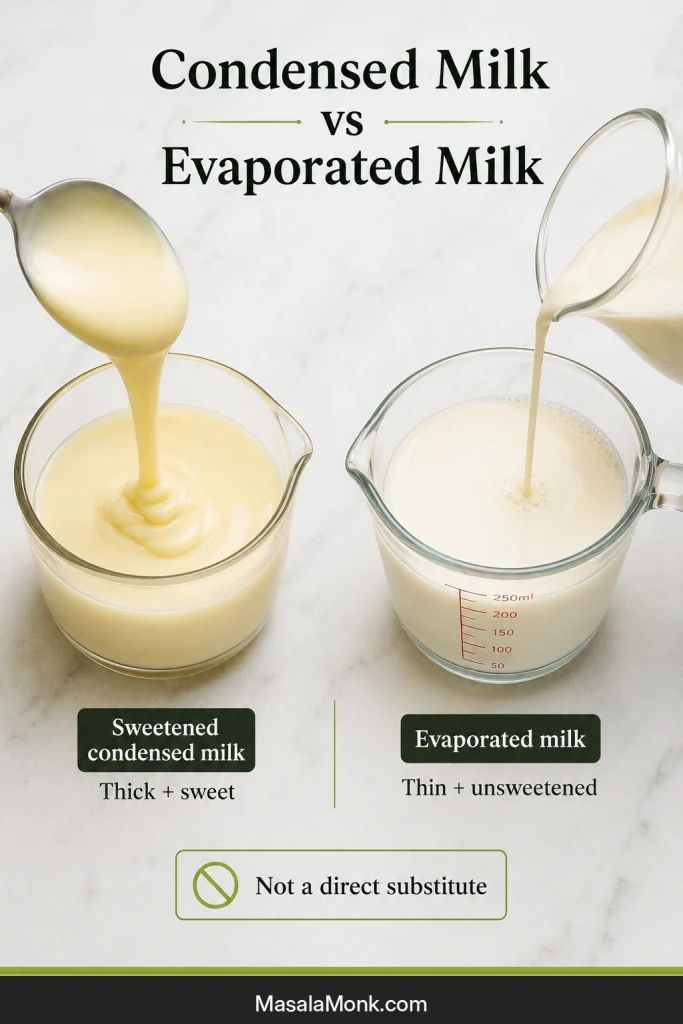
Use sweetened condensed milk, not evaporated milk. Evaporated milk is thinner and unsweetened, so it is not a direct substitute.
If that tart lime and condensed-milk pairing is the part you love most, this creamy key lime pie recipe carries the same contrast into a chilled, sliceable dessert.
Why Cold Water Works Better Than Blended Ice
Cold water keeps the base consistent. Save the ice for the glasses, where it can chill each serving without quietly watering down the pitcher.
Keep ice out of the whole-lime blend because it changes blade circulation and makes the extraction harder to judge. Add measured ice only when making the frozen variation.
Do You Need Extra Sugar?
Not automatically. Condensed milk already brings substantial sweetness. Taste a small glass over ice and add sugar or simple syrup only if the limes remain unusually sharp.
A thinner, more lemonade-like pitcher needs extra water as well as less condensed milk; simply reducing the condensed milk creates a brighter drink, not the same lighter formula.
That same lime-first balance is what keeps a classic mojito crisp rather than sugary.
Keep the Lime Bright, Not Bitter
A slight, clean peel edge makes the lime taste brighter. The goal is not to erase the peel, but to stop before it becomes medicinal or mouth-drying. Too much white pith, too much blade time or hard pressing are the usual causes.
Bitterness is usually an extraction problem, not a sweetness problem.
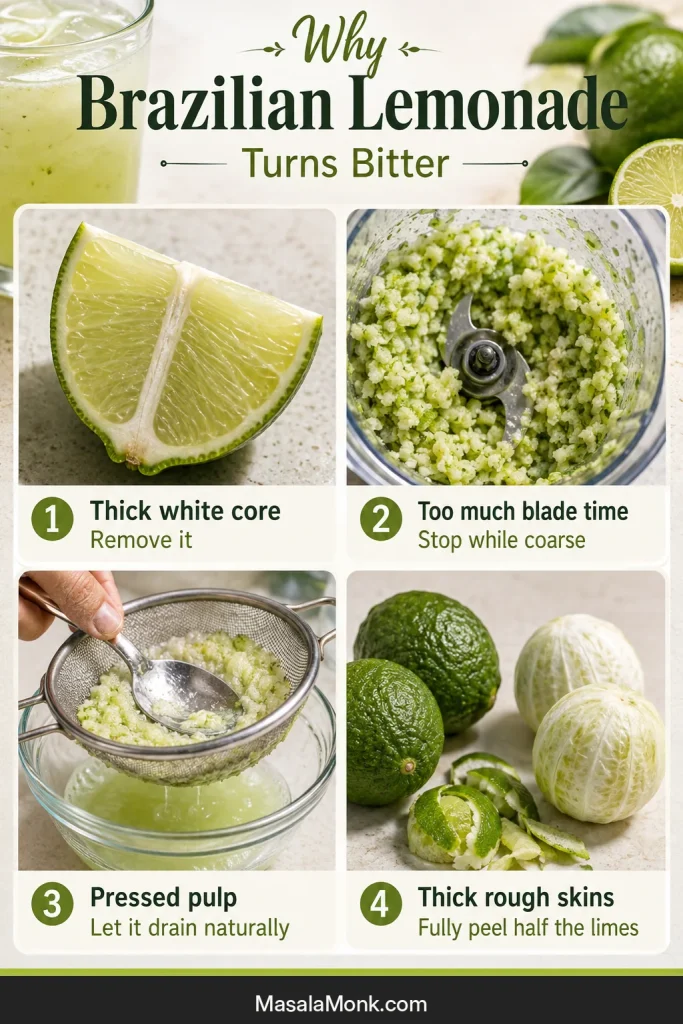
| Risk | Why it happens | What to do |
|---|---|---|
| Thick white core | A concentrated section of pith enters the blend | Cut away the central white strip from every wedge |
| Rough, thick skins | The fruit brings more peel and pith relative to juice | Peel two of the four limes |
| Long blending | The peel becomes finer and extracts more aggressively | Stop while coarse lime pieces remain |
| Crushed seeds | Seed bitterness joins the peel bitterness | Remove visible seeds before blending |
| Hard pressing | Fine peel particles and concentrated pulp liquid pass through | Tap and stir the sieve instead of mashing it |
| Long holding | Fine particles continue changing the flavor | Serve the whole-lime version soon after blending |
| Overloaded blender | Poor circulation tempts you to blend longer | Process a double batch as two short lime batches |
How to Recognize the Correct Lime Blend
The liquid should still move freely while visible coarse pieces remain. Fine suspended pulp and sluggish circulation show that the peel has been worked too far.
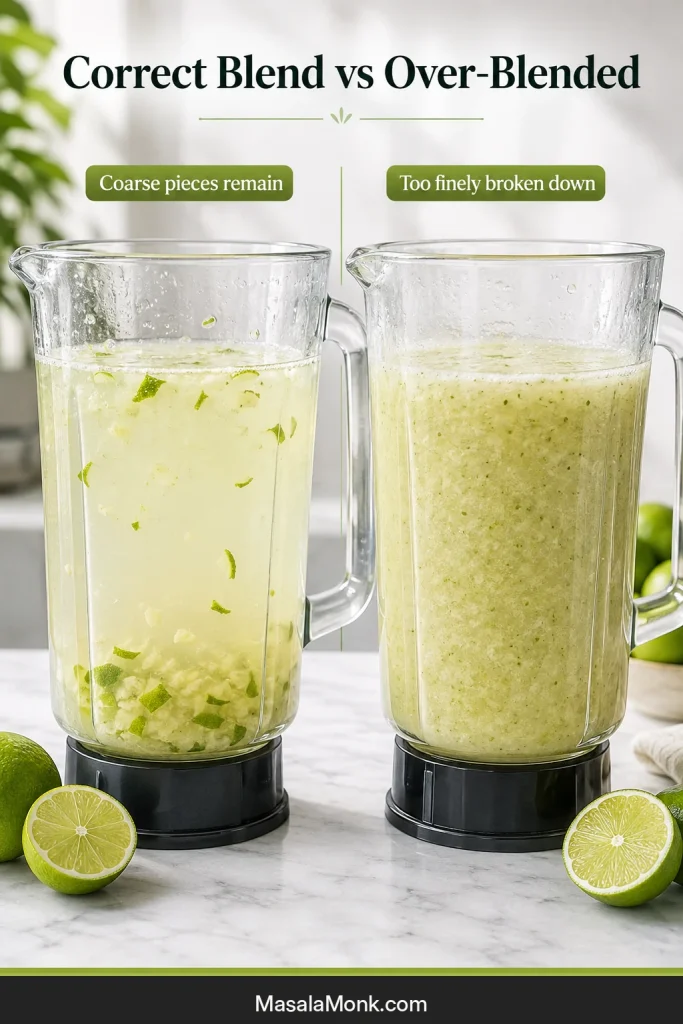
When the blend stops at the coarse stage, the peel does exactly what you want: it gives the drink a vivid fresh-peel aroma that ordinary squeezed limeade does not usually have.
Can You Rescue a Bitter Pitcher?
A lightly bitter pitcher is often recoverable. Test the correction in one glass before changing the whole batch: add a splash of cold water and 1–2 teaspoons condensed milk, stir and taste over ice. If the edge softens, scale the same adjustment into the remaining pitcher. A heavily over-blended batch is harder to bring back.
Avoid adding sugar by itself. It can hide the first bitter impression while leaving the harsh finish in place.
When Your Brazilian Lemonade Tastes Off
A pitcher that is slightly too sharp, sweet or heavy is usually one small adjustment away. Change one thing at a time, and try the first glass again before touching the whole batch.
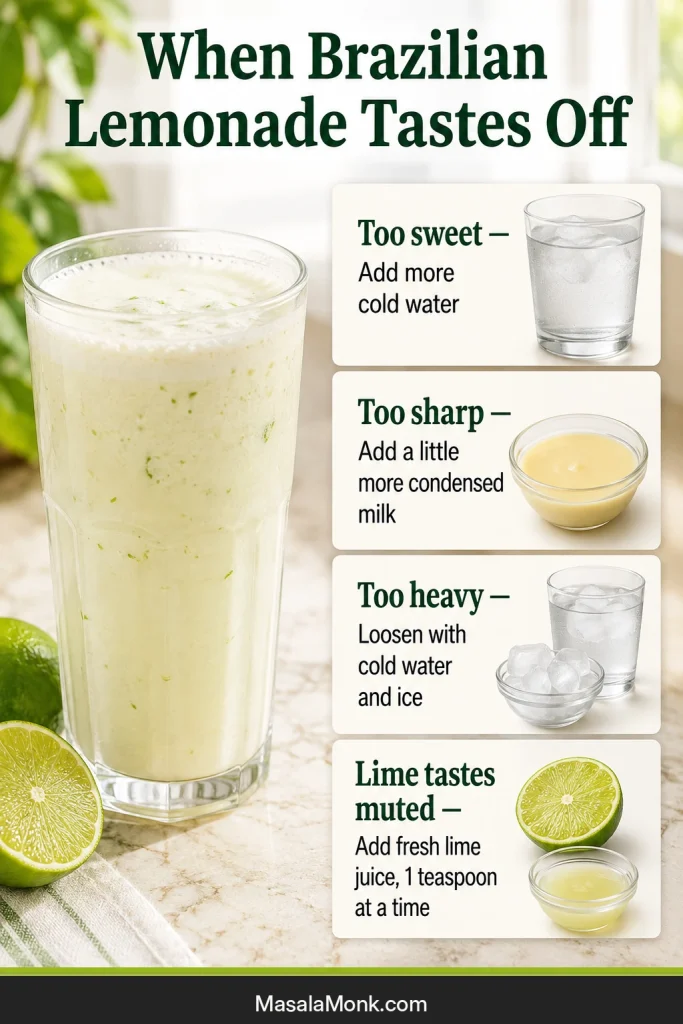
| Problem | Likely cause | Try this first |
|---|---|---|
| Too sour | Very acidic limes or too little condensed milk | Add condensed milk 1 tablespoon at a time |
| Too sweet | Full can of condensed milk with mild limes | Add cold water, then fresh lime juice 1 teaspoon at a time |
| Heavy or thick | High condensed-milk ratio | Add cold water 2 tablespoons at a time |
| Thin or watery | Too much melted ice or excess dilution | Chill without adding more ice; add condensed milk only if the sweetness can take it |
| Sweet but flat | The citrus has been softened too far | Add fresh lime juice rather than blending more peel |
| Small peel particles | Coarse sieve or hard pressing | Pass the drink through a finer sieve once more |
Once the lime tastes clear again, stop adjusting and pour the glasses.
Back to Recipe Make It Ahead Explore Variations
Make-Ahead Juice-and-Zest Method
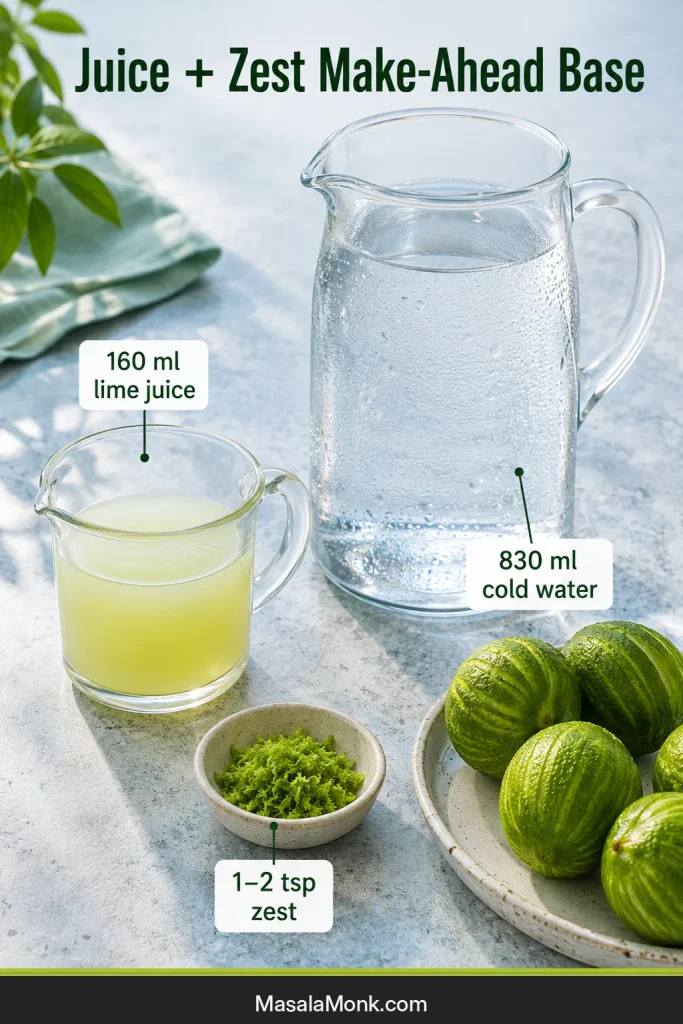
When dinner is still a few hours away—or guests are due before you want to stand at the blender—the juice-and-zest version keeps its balance more reliably until serving. It gives the drink a smoother, cleaner lime flavor with less peel edge.
Juice-and-Zest Ingredients
- ⅔ cup fresh lime juice, 5⅓ US fl oz / 160 ml; buy enough limes to produce this amount because the count varies widely with size and juiciness
- 1–2 teaspoons finely grated green zest, approximately the zest of 1 large lime, avoiding the white pith
- 3½ cups cold water, 28 US fl oz / 830 ml, plus up to ½ cup / 120 ml for adjustment
- 8¾–10½ oz sweetened condensed milk, 250–300 g
- Ice, for serving
How to Make the Juice-and-Zest Version
- Combine the lime juice and 3½ cups / 830 ml cold water. Cover and refrigerate earlier in the day, or overnight when necessary. For the brightest peel aroma, add the finely grated zest during the final blend rather than leaving it in the base.
- Before adding condensed milk, try a spoonful of the chilled citrus base. It should taste bright and deliberately tart; add a little of the reserved water if it feels too intense.
- Shortly before serving, blend the chilled citrus base, zest and 250 g condensed milk for 10–15 seconds.
- Pour a small glass over ice. Add more condensed milk for softness or the remaining water when the flavor is still too concentrated.
This is the easier route when you want the lime work finished before the room fills up. A citrus press, microplane and even a small blender are enough.
No blender? Whisk the juice-and-zest version in a pitcher, shake small portions in a tightly sealed jar or use a handheld frother. Strain before serving when you want a completely smooth glass.
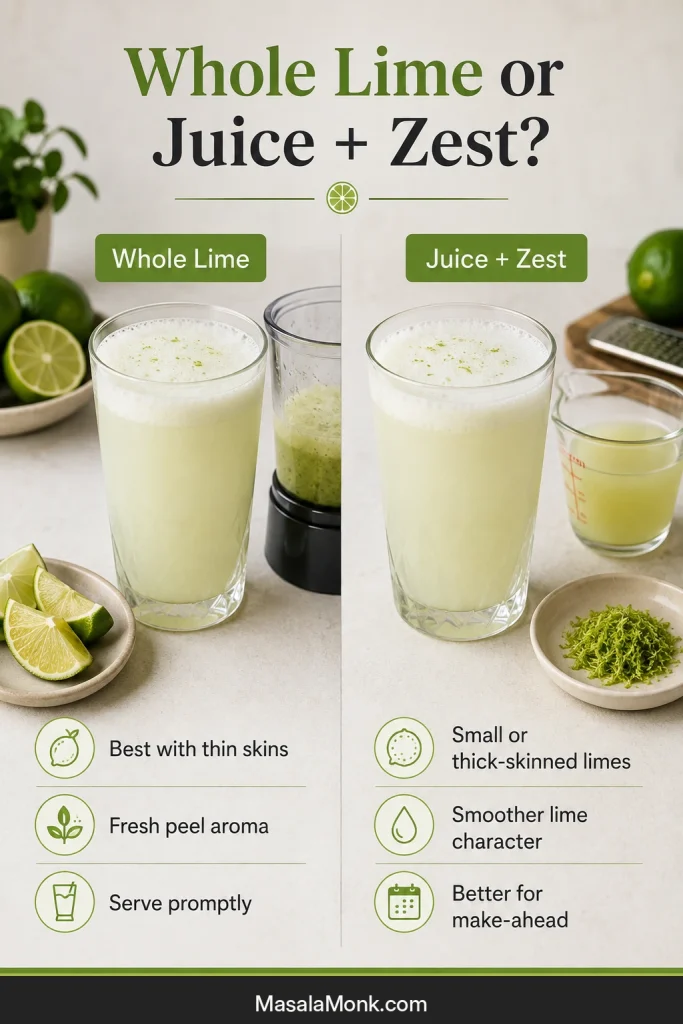
Whole Lime or Juice and Zest?
Both methods can make an excellent pitcher. Use the whole-lime route when the skins are thin and service is immediate; choose juice and zest when the fruit is small or the drink must wait.
Back to Recipe Explore Variations Scale for a Party
Brazilian Lemonade Variations
Keep the short lime blend, then change the body, fruit or finish with one of these lighter, richer, tropical, frozen or cocktail options.
Adjust the Body and Sweetness
Keep the lime and water fixed while testing condensed-milk levels. That way, each glass shows a true change in richness rather than a different dilution.
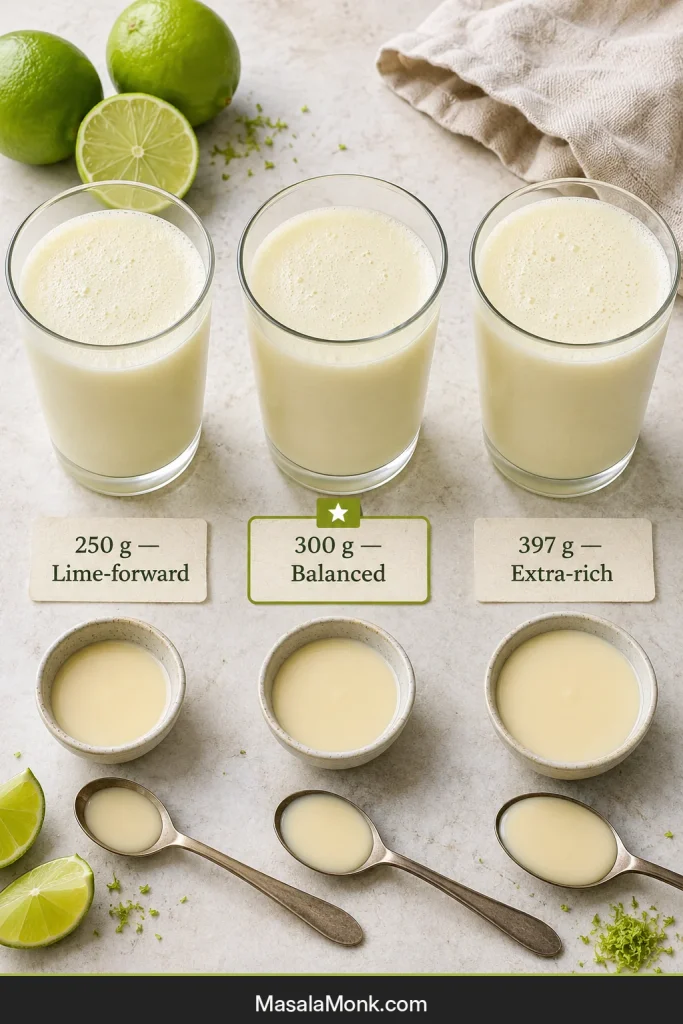
- For a lighter pitcher: Use the standard 4 limes, 5 cups / 1.18 liters cold water and 8¾ oz / 250 g condensed milk. Add simple syrup only after tasting over ice.
- For a richer pitcher: Keep the standard 4 limes and 4 cups / 950 ml water, but use the full 14 oz / 397 g can of condensed milk. Smaller glasses keep the sweetness from overwhelming the lime.
Coconut Version
Coconut ingredients change the drink in different ways: some replace sweetness and body, while others add only flavor or richness.
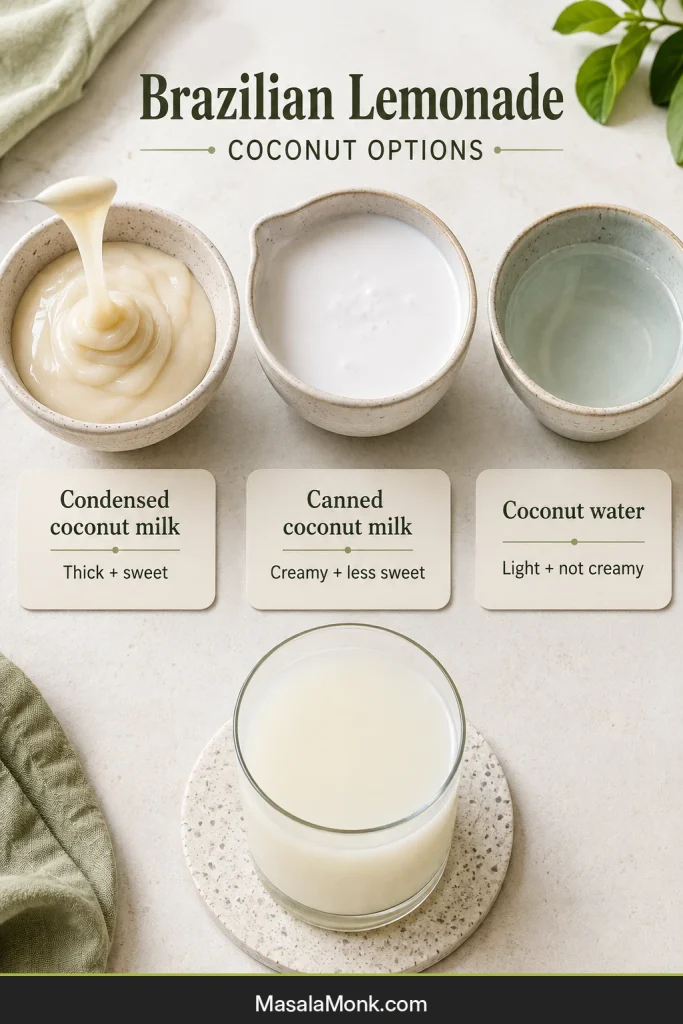
- For dairy-free creaminess: Replace the sweetened condensed milk with sweetened condensed coconut milk by weight. Begin with 250 g because brands vary in sweetness and coconut intensity.
- For a softer coconut finish: Begin with ½ cup / 120 ml full-fat canned coconut milk in place of the same amount of water.
- For a lighter tropical drink: Replace up to half the water with coconut water; it adds flavor, not creaminess.
Add coconut products only after straining. Plain coconut milk softens the drink; condensed coconut milk also sweetens and thickens it.
Prefer coconut to lime? The tender coconut shake recipe makes fresh coconut the main flavor.
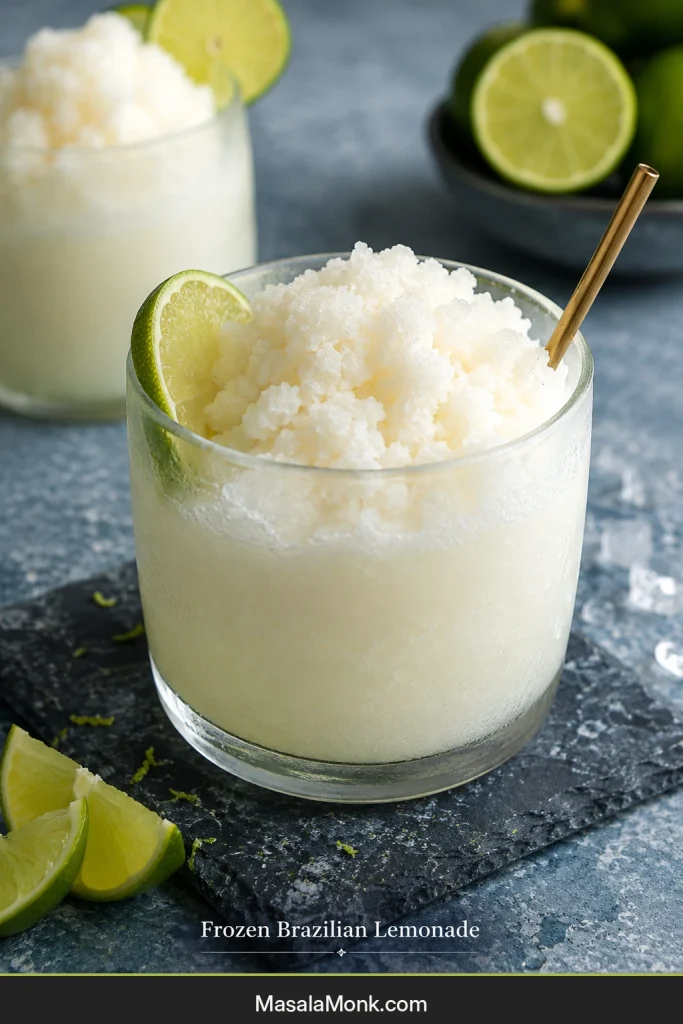
Frozen Version
For two snowy servings, blend 2 cups / 475 ml prepared lemonade with 8–9 oz / 225–250 g ice after straining. It begins thick, then loosens into a creamy slush.
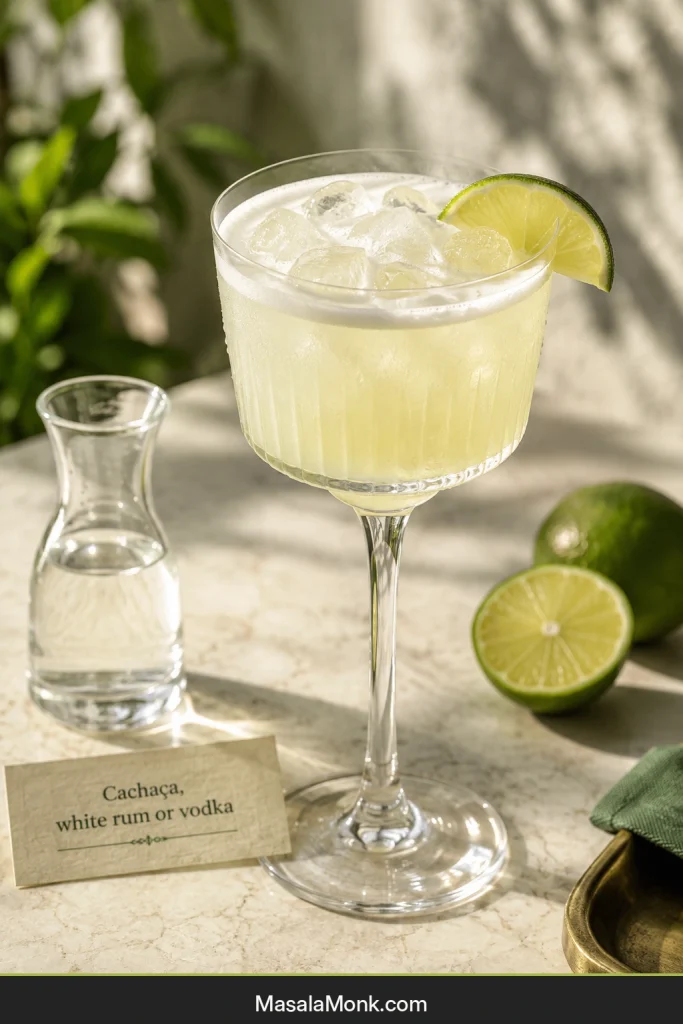
Cocktail With Cachaça, Rum or Vodka
Cachaça brings a grassy edge that cuts through the condensed milk. White rum tastes more tropical; vodka stays quieter.
| Serving | Spirit |
|---|---|
| One 7–8 oz glass | 1 oz / 30 ml |
| Standard pitcher | 4–6 oz / 120–180 ml, according to the strength you prefer |
Stir the spirit into the pitcher after straining; do not extend the whole-lime blend. For a sharper lime cocktail without condensed milk, try the classic gimlet.
Serve alcoholic versions only to adults of legal drinking age and enjoy responsibly.
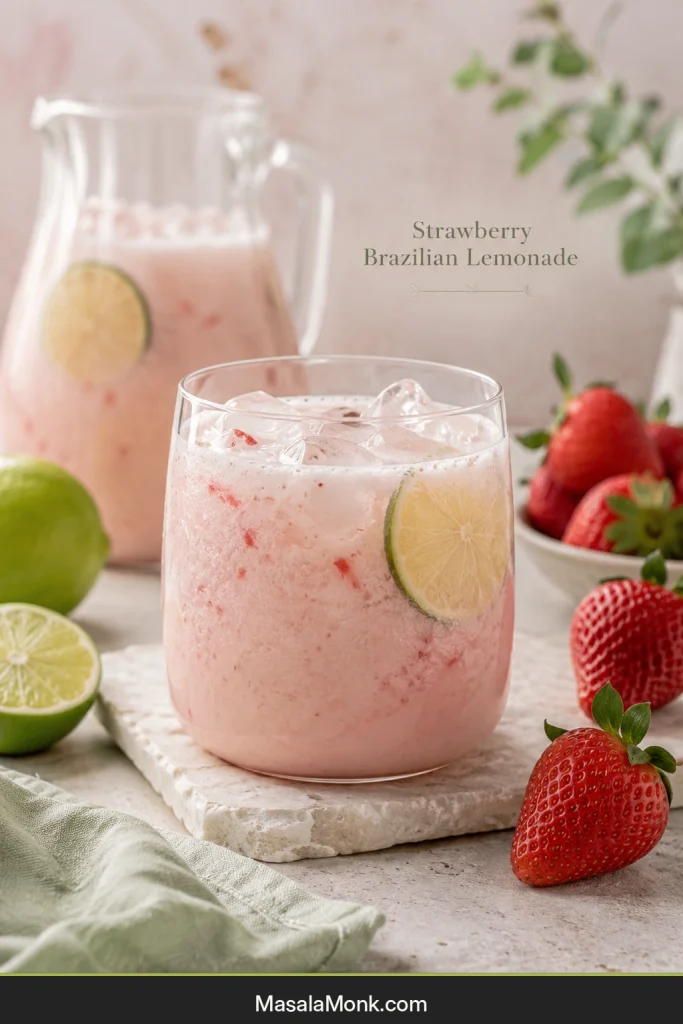
Strawberry Version
For a fruitier pitcher, begin with 1 cup hulled strawberries, about 5¼ oz / 150 g, blended with the strained lime base and condensed milk. The berries soften the acidity and turn the drink pale pink.
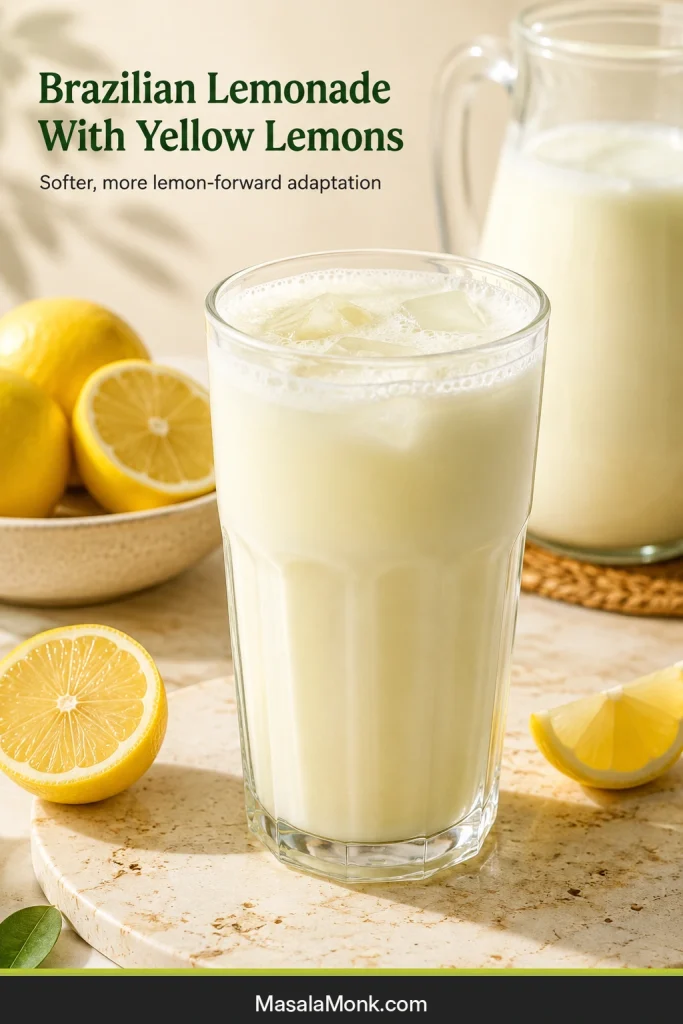
Can You Make It With Yellow Lemons?
Yes, but use the juice-and-zest method rather than blending whole lemons. Combine ½ cup plus 1 tablespoon / 135 ml fresh lemon juice, 1 teaspoon finely grated yellow zest, 3½ cups / 830 ml cold water and 8¾ oz / 250 g condensed milk. Adjust only after tasting over ice.
The result is pale yellow and familiar, without the fresh green-peel character of the lime version. Treat it as a Brazilian-lemonade-inspired lemon drink rather than an identical substitution.
Scale It for a Party
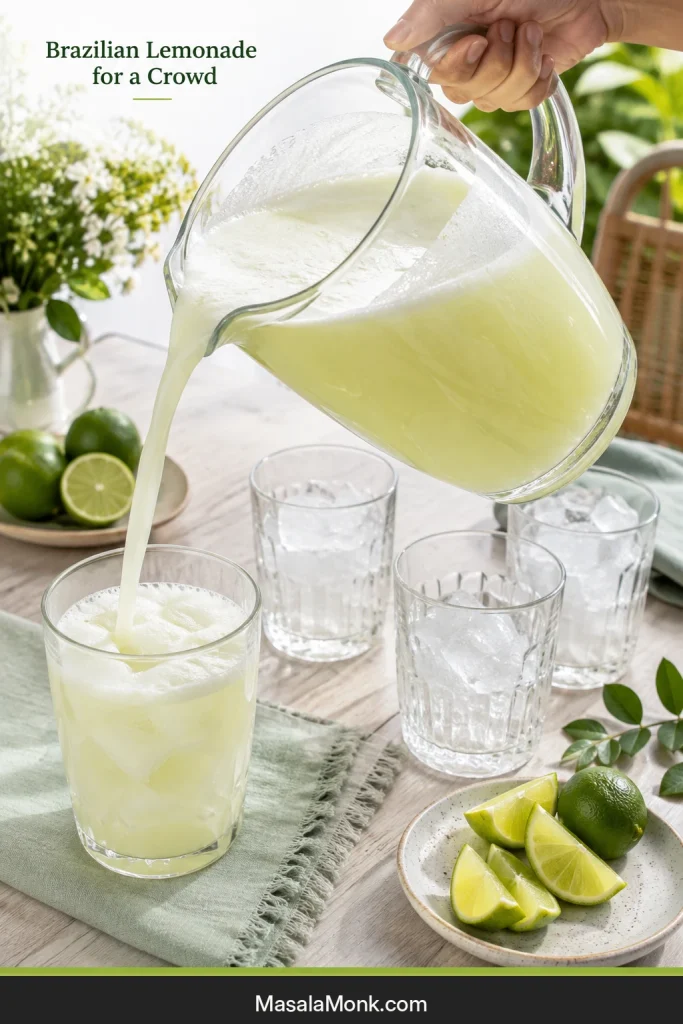
For a crowd, the challenge is room in the blender, not a longer extraction. Process large quantities in separate short batches while everyone gets the glasses ready with ice.
| Batch | Limes | Water | Condensed milk | Makes |
|---|---|---|---|---|
| Half | 120–140 g / about 2 medium | 2 cups / 475 ml | 5¼ oz / 150 g | 550–600 ml / 2–3 glasses |
| Standard | 240–280 g / about 4 medium | 4 cups / 950 ml | 10½ oz / 300 g | 1.1–1.2 liters / 5–6 glasses |
| Double | 480–560 g / about 8 medium | 8 cups / 1.9 liters | 21 oz / 600 g | 2.2–2.4 liters / 10–12 glasses |
For a double batch, blend and strain two standard lime-and-water batches separately, then combine them and blend or whisk in the condensed milk. Stop each lime batch at the same cloudy-green, coarse-piece stage.
A double batch is usually enough for twelve guests when other drinks are available. Have the glasses filled with ice before the blender starts; Brazilian lemonade is at its best when it goes straight from blender to pitcher to table.
Before Guests Arrive
- Wash and dry the limes ahead. Cut them as close to blending as practical; if necessary, refrigerate the cut fruit tightly covered for up to a couple of hours.
- Measure the water and condensed milk before guests arrive.
- Use the juice-and-zest version when the citrus base must be prepared earlier in the day or overnight.
- Keep serving ice in a separate bowl or bucket instead of letting it melt into the pitcher.
- For an alcoholic party pitcher, add the spirit only after the lime pulp has been strained.
Storage and Leftovers Back to Recipe Back to Top
How Long Brazilian Lemonade Keeps
Whole-lime Brazilian lemonade is best served as soon as practical. Its foam settles as it waits, and the peel edge may become more noticeable.
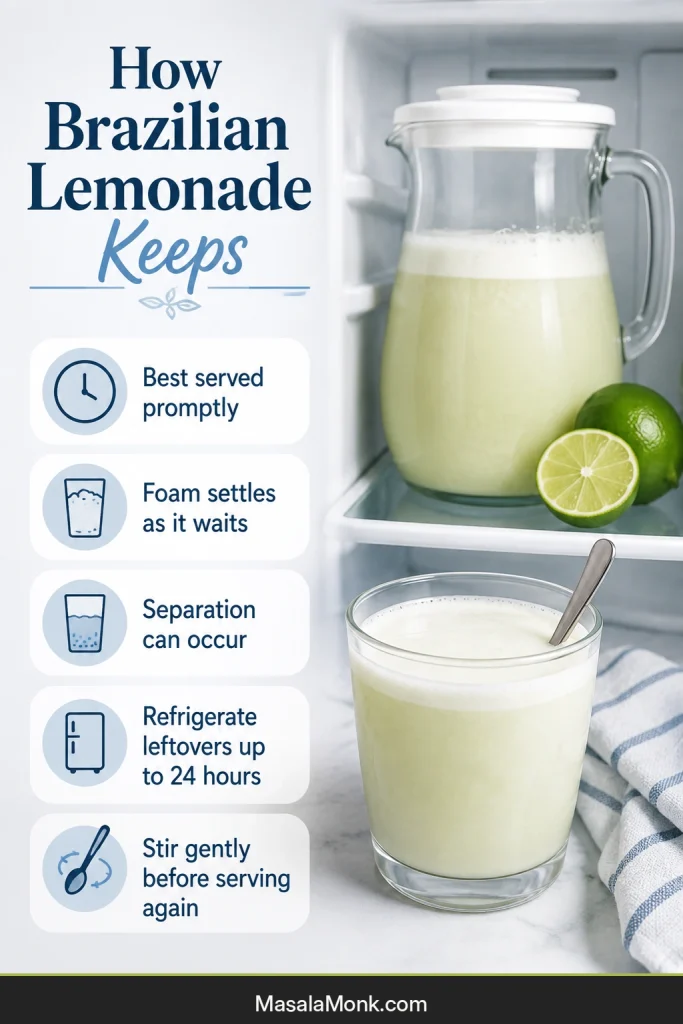
- Leftovers: Cover and refrigerate promptly; use within 24 hours, with some loss of foam and fresh-lime aroma.
- Before serving again: Stir or briefly reblend, then taste before making any adjustment.
- Expected changes: Separation, a softer aroma and a more noticeable peel edge.
Separation alone is normal. Discard the drink when its smell, appearance or flavor suggests spoilage rather than simple settling.
Can you freeze it? Freezing the finished dairy-based drink can change its texture. A better plan is to freeze the juice-and-zest citrus base in ice trays, then blend those cubes with fresh condensed milk when you want a frozen drink.
Frequently Asked Questions
Can You Use Bottled Lime Juice?
Yes, using the juice-and-zest method, though bottled juice will not match the aroma of fresh zest and juice. Bottled juice can taste sharper, flatter or more concentrated, so begin with ½ cup / 120 ml and increase only after tasting it over ice.
Can You Make Brazilian Lemonade Without Condensed Milk?
Yes, though the result will be closer to Brazilian-style limeade than the familiar creamy drink. Use the same 4 limes and 4 cups / 950 ml water, following the same short blend and gentle straining method. Replace the condensed milk with ⅓ cup / 65 g sugar or an equivalent amount of simple syrup, then adjust after tasting it over ice.
Can You Use Key Limes or Small Indian Limes?
Yes, but do not substitute by count or blend every small lime with its peel attached. For the easiest balance, use the juice-and-zest method. For a whole-fruit version, peel most of the limes and leave peel on roughly one-quarter to one-half of the total amount.
Can You Make Brazilian Lemonade the Night Before?
The whole-lime method is not the best overnight choice because its peel edge can strengthen. Prepare the juice-and-water base instead, refrigerate it covered overnight when necessary, and add the zest and condensed milk shortly before serving.
The Short Blend Protects the Final Sip
Brazilian lemonade looks almost too easy to need a rule. Then one over-blended pitcher explains why the rule matters.
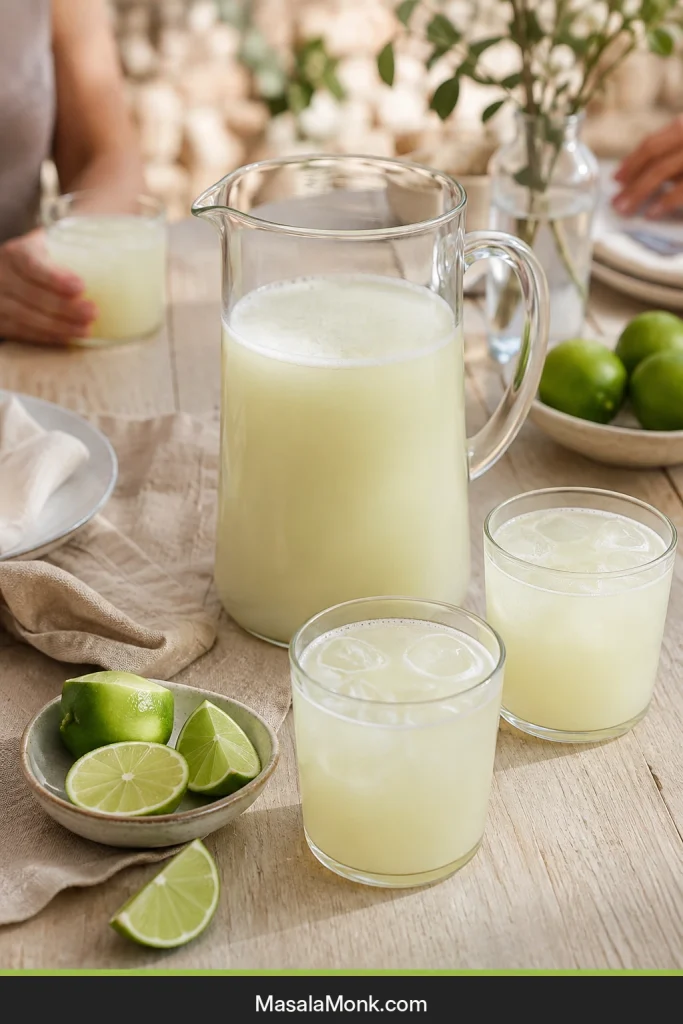
Watch the pieces, not only the clock. Strain without squeezing, then let the first glass decide whether the pitcher needs more brightness or more softness.
A good pitcher feels generous without becoming heavy. The first sip is playful and creamy; the last should still taste unmistakably of lime.
Which method did you use, and what kind of limes were available where you live? Tell us which method worked best with your fruit.








