
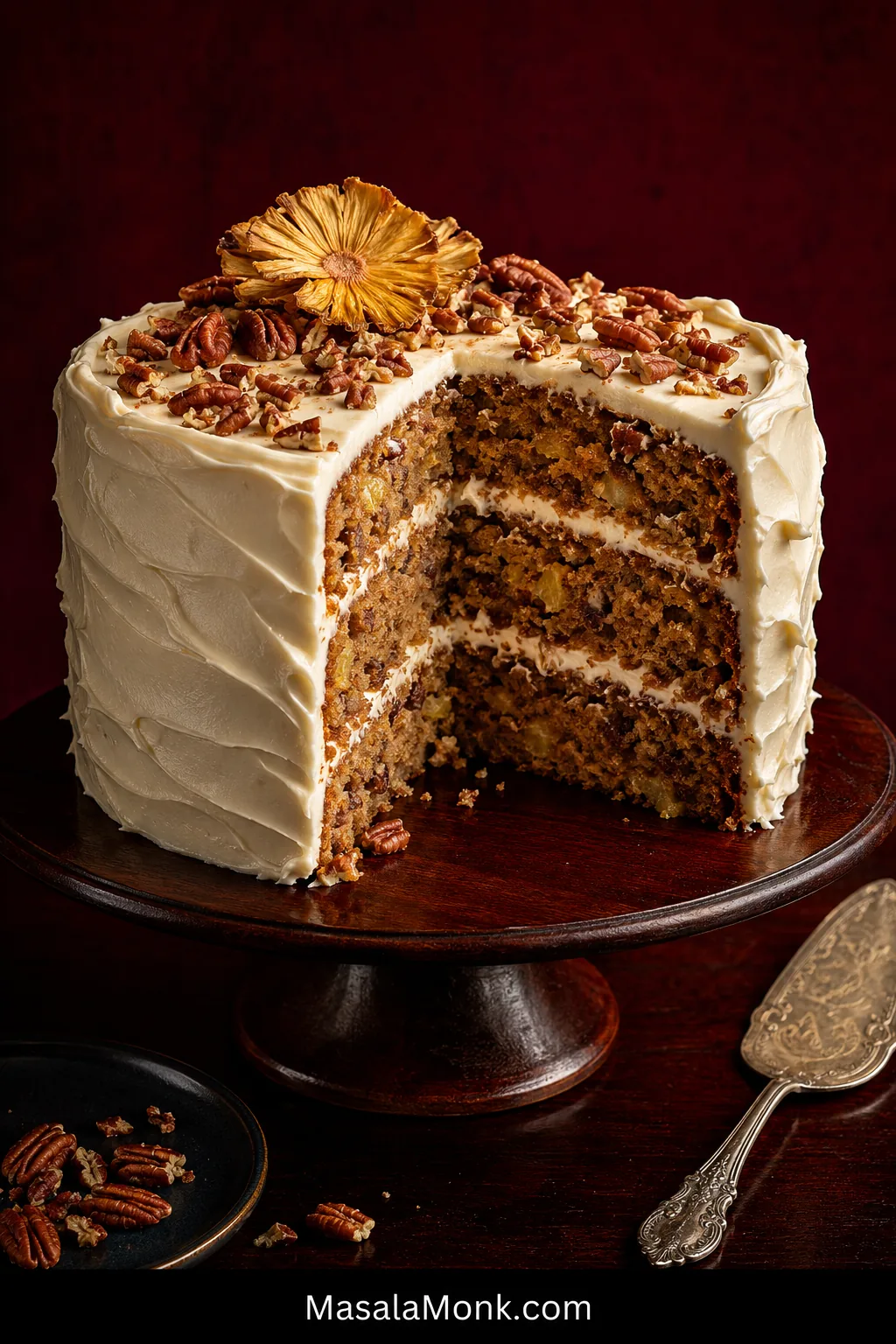
Hummingbird Cake has a delicate name for a decidedly generous cake. Beneath the cream cheese frosting are three fruit-rich layers where ripe banana leads, pineapple brings a little brightness, and toasted pecans break up the moist crumb with roasted crunch.
All that fruit is part of the appeal. It also leaves less room for guesswork: extra banana, too much free pineapple liquid, very deep pans or an underbaked center can take the crumb from lush to sticky. What you want is an abundant old-fashioned cake that stands tall enough to slice cleanly.
Rich is right. Gummy isn’t.
What Does Hummingbird Cake Taste Like?
Hummingbird Cake is a banana-and-pineapple spice layer cake with pecans and cream cheese frosting, now a Southern classic with roots in Jamaica’s Doctor Bird Cake.
Banana is usually the first flavor you notice, but it shouldn’t flatten everything else. Pineapple gives the crumb a brighter fruitiness, toasted pecans add little pockets of crunch, and cinnamon stays comfortably in the background. Cream cheese frosting brings the tang that keeps a generous slice from feeling simply sweet.
Carrot cake is an easy comparison, although the two eat quite differently. Carrot cake gets much of its character from grated carrot and a stronger spice profile; Hummingbird Cake is fruitier and more tropical, with banana and pineapple doing most of the work. If spice cake is your other reference point, Hummingbird Cake is its fruitier, less spice-led cousin.
Jump to: Recipe · Is it supposed to be dense? · Drain the pineapple? · Fix the frosting · Fix my cake
The Short Version
Despite the three layers, the cake batter itself is straightforward: two bowls, mixed by hand, no mixer needed. Most of the roughly four-hour total is waiting for the cake to bake, cool and firm up; the hands-on work is much shorter.
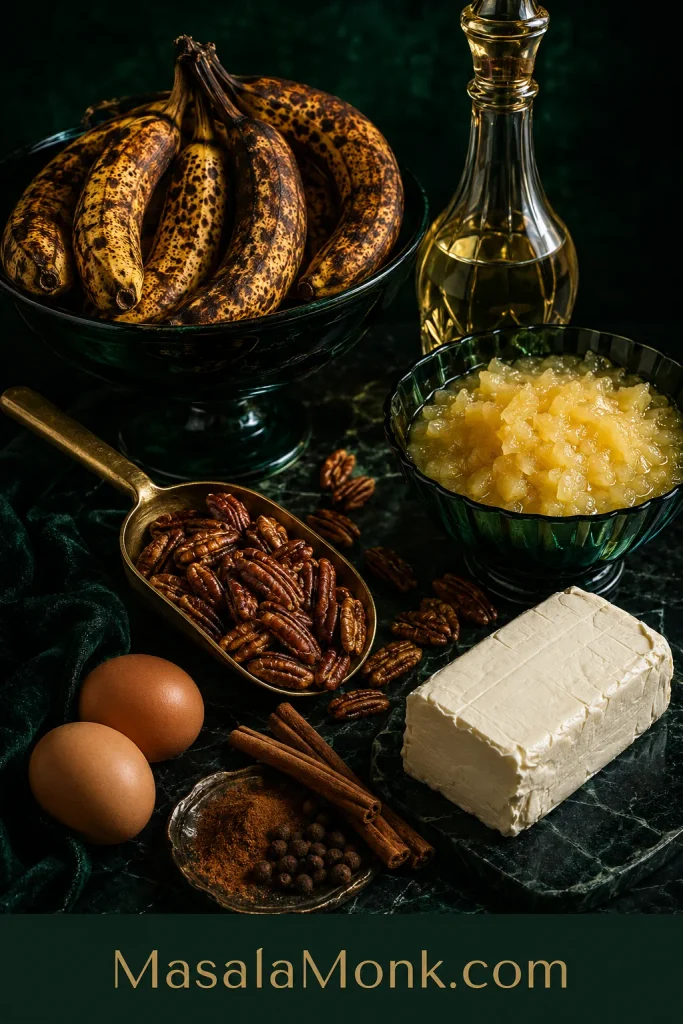
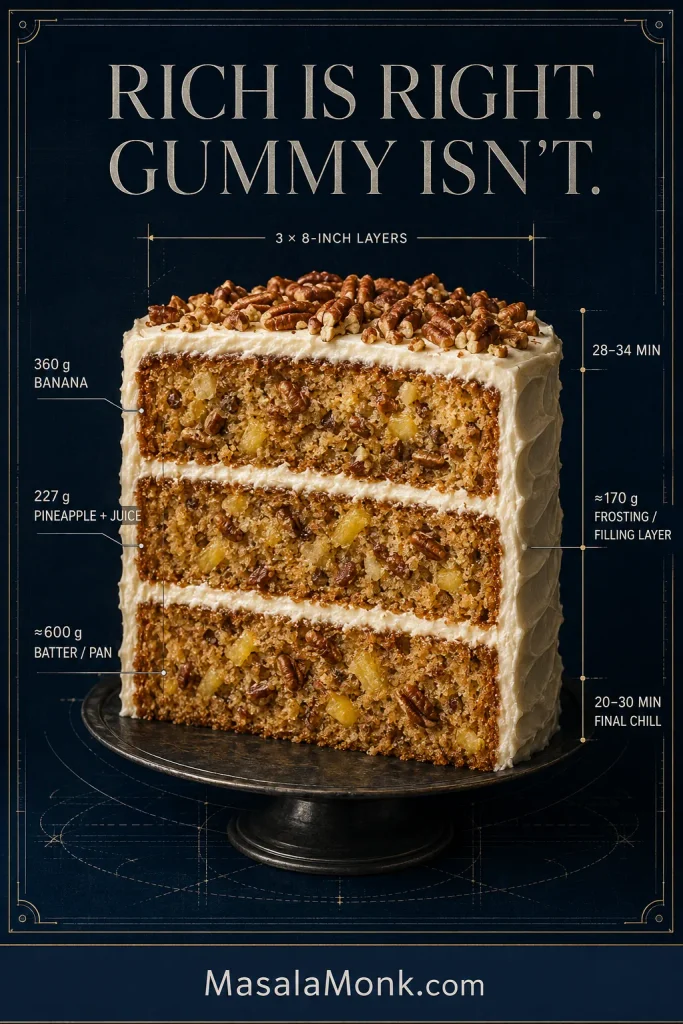
Use 360 g mashed very ripe banana, one 8-ounce / 227-g can crushed pineapple with its juice, neutral oil, cinnamon and toasted pecans. Divide the batter between three 8-inch / 20-cm pans and bake at 350°F / 177°C conventional / about 160°C fan. Start checking at 28 minutes; expect a bake somewhere around 28–34 minutes, depending on your pans and oven.
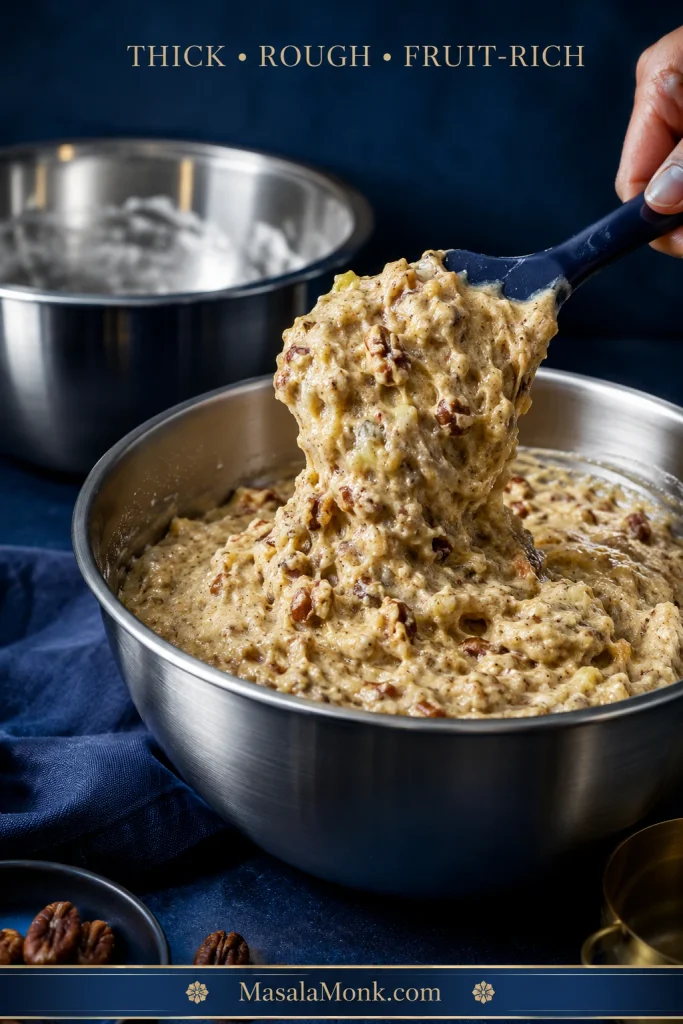
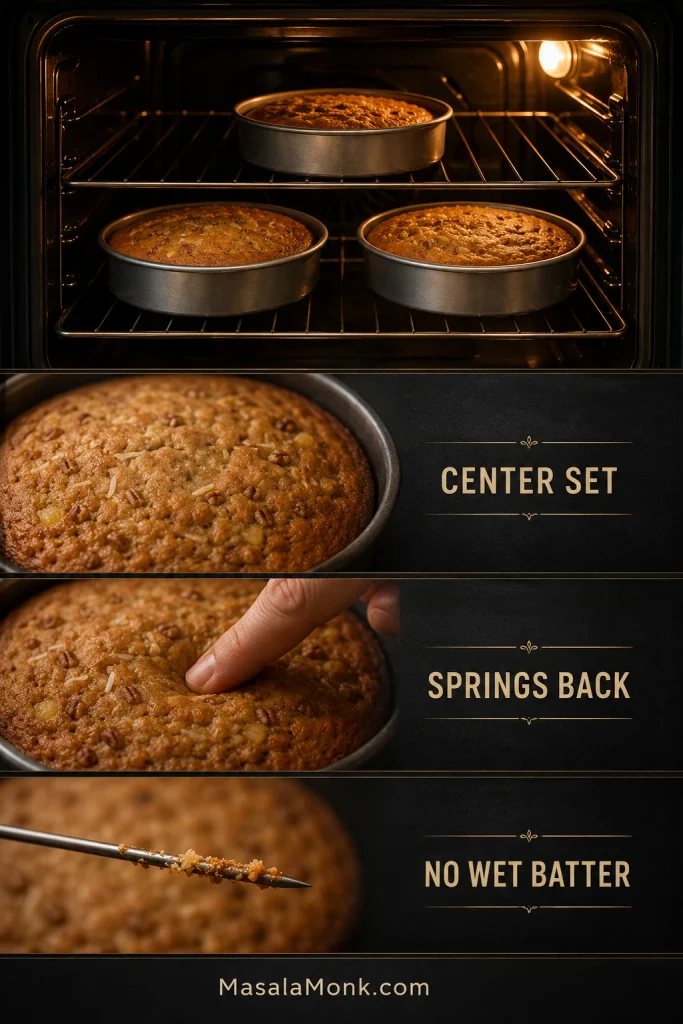
The batter should look thick, rough and visibly full of fruit. Stop folding once the flour disappears. The layers are ready when the centers look set, spring back gently under a fingertip and a skewer comes out without wet batter. Once cool, the crumb should be moist and tender, not glossy, gluey or pudding-like.
Three-Layer Hummingbird Cake: The Recipe
What this version is aiming for: the rich, fruit-heavy character that makes Hummingbird Cake distinctive, with a clear line between deeply moist and gummy. The banana is weighed, one small can of pineapple goes in with its juice, and the batter is spread across three relatively shallow layers. The cream cheese frosting relies on butter and cool handling for much of its structure, so its tang doesn’t have to disappear under a mountain of powdered sugar.
| Yield | One three-layer 8-inch / 20-cm cake |
| Serves | 12 generous or about 16 smaller slices |
| Active time | About 50 minutes |
| Bake | 28–34 minutes; begin checking at 28 |
| Total time | About 4 hours, including cooling and chilling |
| Oven | 350°F / 177°C conventional / about 160°C fan |
| Make ahead | Excellent prepared a day before serving |
Ingredients
Use the gram amounts if you have a kitchen scale. Cup measurements are included for convenience, but flour and mashed banana are both easy to misjudge by volume.
For the Cake
- 150 g chopped pecans — about 1⅓ cups, divided
- 375 g all-purpose flour — 3 cups, spooned and leveled
- 1 teaspoon baking soda
- 1 teaspoon baking powder
- ¾ teaspoon fine salt
- 1½ teaspoons ground cinnamon
- ¼ teaspoon ground allspice
- 3 large eggs, preferably at room temperature
- 1 cup / 240 ml neutral oil, such as vegetable or canola oil
- 1 cup / 200 g granulated sugar
- 125 g packed light brown sugar — about ½ cup + 2 tablespoons
- 2 teaspoons vanilla extract
- 360 g mashed very ripe banana — about 1½ cups or roughly 3 large bananas after peeling; use bananas that are soft, deeply spotted and fragrant
- 1 x 8-ounce / 227-g can crushed pineapple in juice, undrained; with a larger can, weigh out 227 g of fruit and juice together
For the Cream Cheese Frosting
- 300 g unsalted butter — about 1⅓ cups, softened but still cool
- 300 g confectioners’ / powdered sugar — about 2½ cups, sifted if lumpy
- 2 teaspoons vanilla extract
- ¼ teaspoon fine salt
- 16 ounces / 452 g full-fat block-style cream cheese, chilled and cut into small pieces
The frosting amount is enough for two sensible filling layers and a comfortable rustic coat over the top and sides. Make extra only if you want an unusually thick coat or elaborate piping.
Equipment: three 8-inch / 20-cm round cake pans, parchment, two large bowls, a whisk, flexible spatula, cooling racks and preferably a kitchen scale. The batter is mixed by hand; use a hand or stand mixer for the frosting.
Method
Prepare the Batter
- Heat the oven and prepare the pans. Preheat to 350°F / 177°C conventional / about 160°C fan. Grease three 8-inch / 20-cm round pans, line the bottoms with parchment and lightly grease the parchment.
- Toast the pecans. Spread the chopped pecans on a baking sheet and toast for 5–7 minutes, starting to watch closely at 5. Stir or shake the tray once. Take them out when they smell deeply nutty and have darkened slightly. Cool completely. Reserve about 30 g for the finished cake and use the remaining 120 g in the batter.
- Mix the dry ingredients. Whisk the flour, baking soda, baking powder, cinnamon, allspice and salt in a large bowl, breaking up any obvious flour lumps.
- Mix the wet ingredients. In another large bowl, whisk the eggs and oil together. Add both sugars and the vanilla, then stir in the mashed banana and crushed pineapple with all of its measured juice.
- Fold the batter gently. Pour the wet mixture into the flour mixture and fold with a flexible spatula. Add the 120 g toasted pecans while a few dry streaks remain, then stop as soon as the flour disappears. The finished batter should look thick, rough and crowded with fruit.
- Divide it evenly. The batch makes roughly 1.8 kg of batter, so aim for about 600 g per pan. Exact grams are not important; similar layer depths are.
Bake and Cool the Layers
- Bake the layers. Put all three pans on one rack near the center of the oven when they fit with some air around them. Otherwise stagger them across two racks. Begin checking at 28 minutes; expect the bake to fall somewhere around 28–34 minutes.
Using two racks? Leave the pans alone during the early bake. Once the centers have visibly begun to set, swap the upper and lower pans if your oven is browning unevenly.
They’re done when: the wet shine in the center has disappeared, a light fingertip press springs back and a thin skewer comes out without wet batter. A few moist crumbs are fine. - Cool completely. Leave the layers in their pans for about 10 minutes, then turn them onto wire racks and peel away the parchment. Let them cool fully before frosting. A 30–60 minute chill afterward can make the layers easier to handle and stack, but it isn’t a substitute for cooling them first.
Make the Cream Cheese Frosting
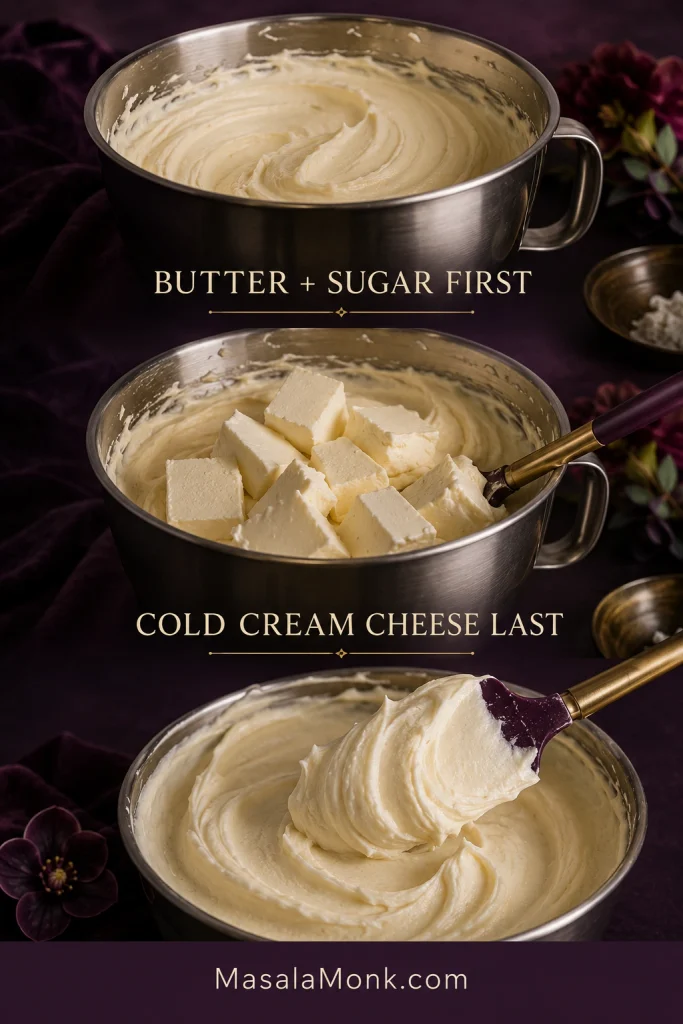
- Make the frosting base. Beat the slightly cool butter until smooth. Gradually beat in the powdered sugar, then add the vanilla and salt.
- Add the cream cheese last. Take the cream cheese from the refrigerator when you begin making the frosting. Add it to the finished butter-sugar base a few pieces at a time on low to medium-low speed. Stop once the frosting is smooth. Longer beating can make cream cheese frosting softer.
- Check the consistency. Lift your spatula. A soft peak should hold and a swipe of frosting should stay where you put it. When the frosting slowly slumps, refrigerate it for 20–30 minutes before deciding it needs more sugar.
Stack and Finish the Cake
- Stack the cake. Put the first layer on a cake plate or board and spread about 170 g frosting over the top. Repeat with the second layer, then add the third. Should the stack begin drifting sideways, refrigerate it for about 20 minutes before continuing.
- Frost and finish. Cover the top and sides with the remaining frosting. A relaxed coat suits Hummingbird Cake; nothing has gone wrong because the sides are not ruler-straight. Scatter over the reserved pecans, or add dried pineapple flowers for a more celebratory finish.
Refrigerate the assembled cake for about 20–30 minutes, or until the frosting feels firm enough for a clean first cut. For the best eating texture, give chilled slices about 15–20 minutes at a comfortable room temperature before eating.
If your pans are ready, that’s everything you need to bake the cake. The rest is here for the moment you cut into it and wonder whether the crumb looks right, where the pineapple went, or why the frosting isn’t behaving the way you expected.
Already baked it? Check the crumb · Find the pineapple · Fix the frosting · Troubleshooting
Is Hummingbird Cake Supposed to Be Dense?
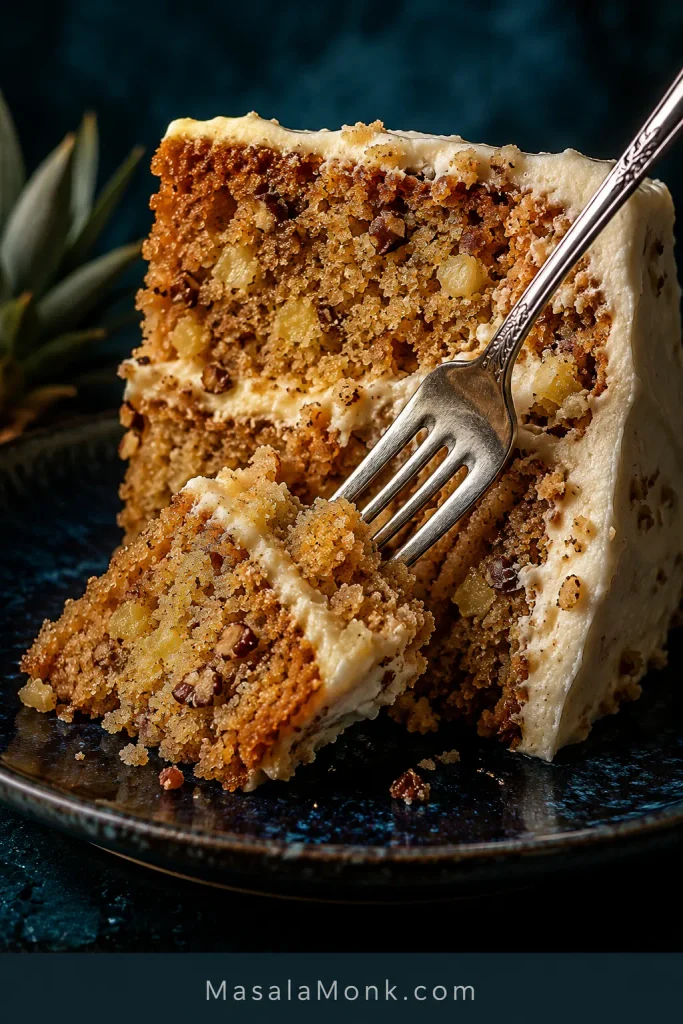
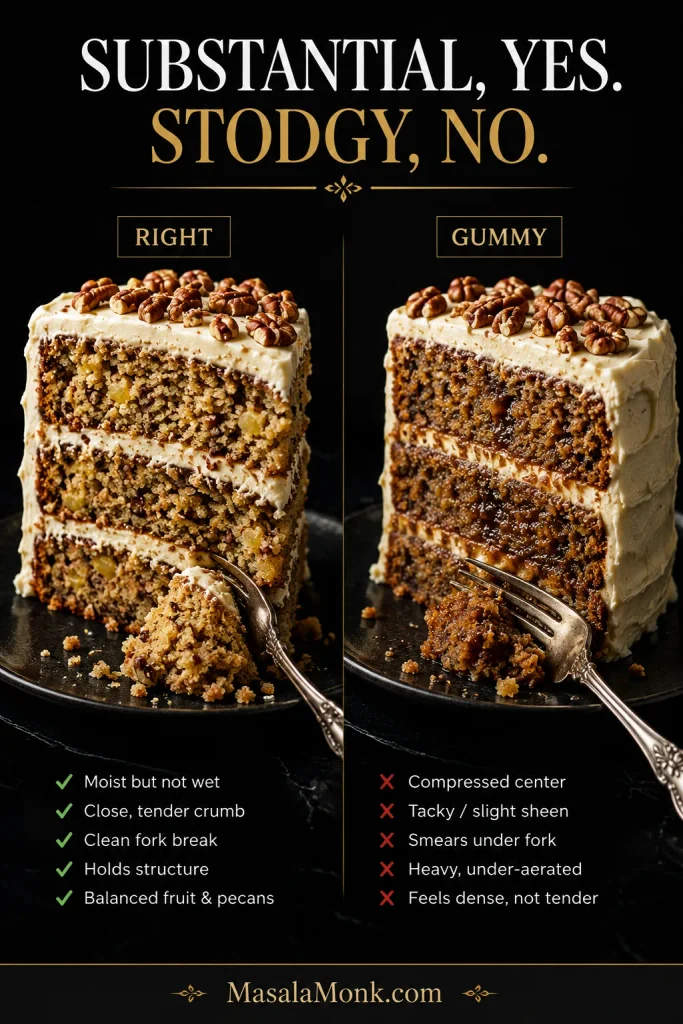
Substantial, yes. Stodgy, no. Hummingbird Cake naturally has more heft than a fluffy vanilla butter cake. Banana, pineapple, oil, eggs and pecans all contribute to a richer, closer crumb.
A good slice looks moist without looking shiny. Press a fork through the center and a piece comes away cleanly, with the occasional bit of pineapple or toasted pecan along the way. That’s the texture worth aiming for: generous and substantial, but still unmistakably cake.
A center that smears into paste is different. So is a rubbery, compressed crumb. Wetness usually points back toward bake time, fruit quantity or layers that were too deep; a tight, rubbery texture can point toward excess flour or too much mixing. A substantial layer that slices neatly and tastes good needs no fixing.
That’s the reassuring part of this cake: a layer can look lower and richer than the sponge cakes you may know and be exactly as it should be. The fork should meet cake, not wet paste.
Center looks genuinely wet or gummy? Jump to troubleshooting.
Why Does Hummingbird Cake Sometimes Taste Like Banana Bread?
Banana is the loudest fruit in the room. It brings aroma, sweetness, moisture and fruit solids all at once, which makes it easy for the pineapple to disappear into the background.
Hummingbird Cake shouldn’t simply eat like frosted banana bread. A wet or underbaked crumb can push it in that direction even when the banana quantity is reasonable, and extra banana makes the effect stronger.
Weigh the mashed banana and stop at 360 g. Any extra is better used in banana bread, where a strongly banana-forward crumb is exactly the point.
Pineapple in Hummingbird Cake: Drain It or Don’t?
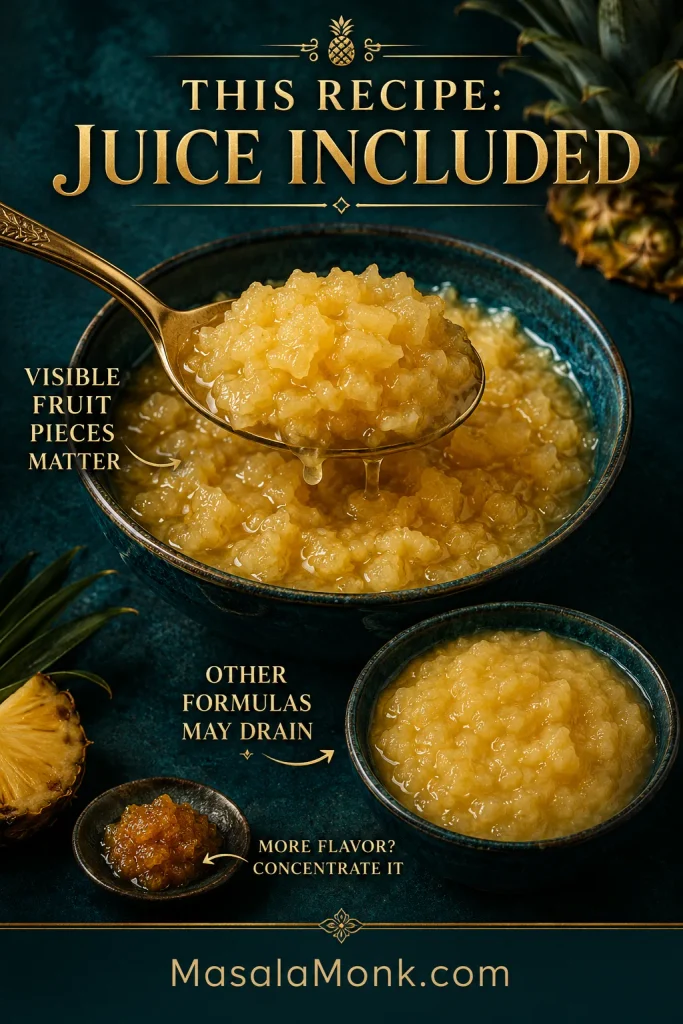
Use all 227 g here, juice included.
That isn’t a universal Hummingbird Cake rule. A wetter formula or one with more fruit may need the pineapple drained.
The stranger problem is putting a whole can of pineapple into a cake and barely tasting it afterward. Choose crushed pineapple that still resembles tiny pieces of fruit instead of smooth pulp. Those fragments have a better chance of surviving the bake as something you can actually notice in a slice.
For stronger pineapple flavor, concentrate it instead of making the batter wetter. A very thin layer of thick pineapple jam or pineapple curd between the layers gives you a brighter burst of fruit. Keep the filling restrained so the layers still stack comfortably.
The pineapple doesn’t need to dominate. Finding a small piece here and there against banana and toasted pecan is enough to keep the slice changing as you eat it.
Fresh pineapple: use it in a recipe designed for it. Chopped fresh pineapple does not bring exactly the same balance of fruit and liquid as canned crushed pineapple with juice, so canned remains the predictable choice for this batter.
Ready to bake? Back to the ingredient amounts.
Cream Cheese Frosting Should Taste Like Cream Cheese
Hummingbird Cake is already sweet and fruit-rich, so the frosting needs contrast. Its cream-cheese tang should be obvious when you eat it with the cake.
Runny frosting often sends bakers straight to the powdered-sugar bag. Temperature is a better first lever here. The generous amount of butter and cool cream cheese give the frosting the body it needs for a layer cake while letting the cream-cheese flavor remain clear.
Getting the Consistency Right
- Too soft: a swipe slowly slumps or the frosting creeps down the bowl. Refrigerate it for 20–30 minutes.
- Ready: a lifted spatula leaves a soft peak that holds, and the frosting spreads across a cooled layer without tearing it.
- Too stiff or too sweet: it becomes very firm or grainy and powdered sugar starts drowning out the cream-cheese flavor.
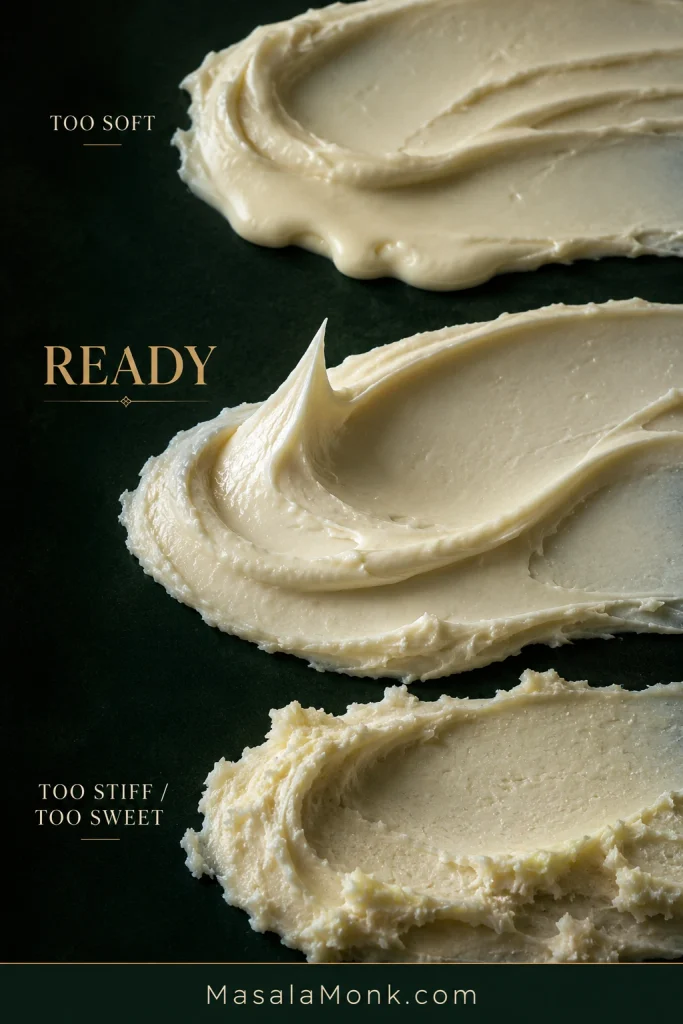
Firm American block cream cheese is easiest to work with. Where only softer spreadable cream cheese is available, choose the firmest full-fat version you can find and keep the frosting cool. Sometimes twenty minutes in the refrigerator is all a loose bowl needs.
The finished frosting should feel creamy against the fruit-rich crumb, not like a thick layer of sweetness sitting on top of it. For detailed piping or sharp edges that must hold for a long time at room temperature, a more structured buttercream is the better choice.
Frosting the cake now? Back to the frosting steps · Stack and finish · Troubleshooting
Hummingbird Cake Pan Sizes: Why Layer Depth Matters
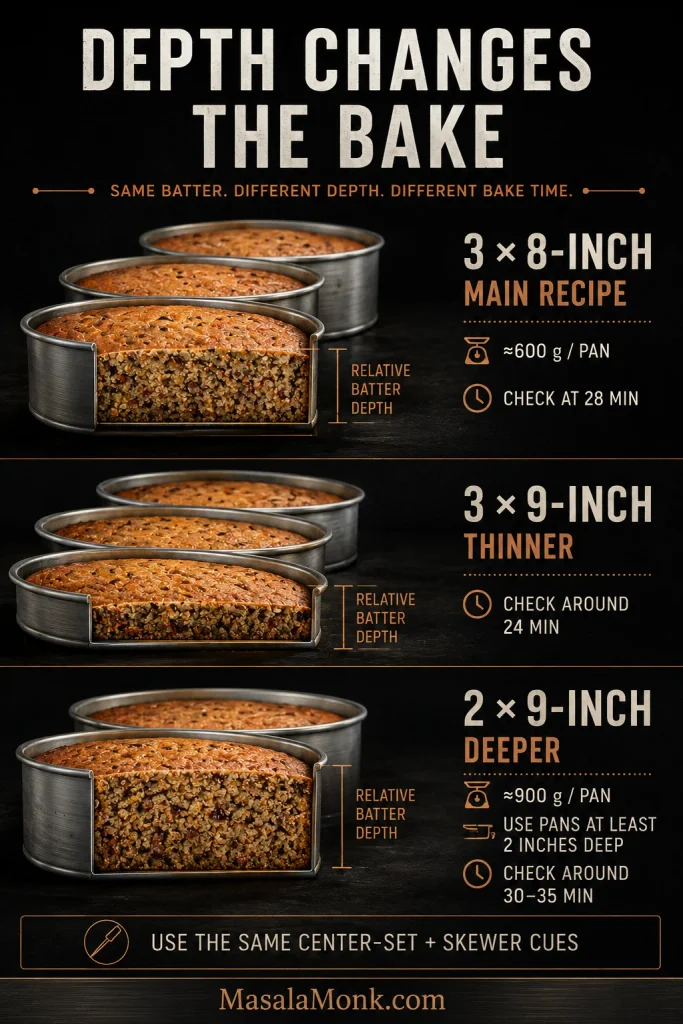
Three layers aren’t only about appearance. They keep this fruit-heavy batter relatively shallow, allowing the center to set before the outside has spent too long in the oven.
| Pan setup | What to expect |
|---|---|
| 3 x 8-inch / 20-cm rounds | Main recipe. About 600 g batter per pan; begin checking at 28 minutes. |
| 3 x 9-inch / 23-cm rounds | Thinner layers. Begin checking around 24 minutes and use the same center-set and skewer cues. |
| 2 x 9-inch / 23-cm rounds | Use pans at least 2 inches deep. Begin checking around 30–35 minutes and rely on the center-set cues for the endpoint. |
A 9×13 sheet cake, Bundt cake, cupcakes or a smaller 6-inch cake changes the layer depth enough to deserve directions written for that format instead of a guessed conversion.
The timer tells you when to start looking. Batter depth and the cake tell you when to stop baking.
Using the main three 8-inch pans? Back to baking the layers.
Troubleshooting: What Went Wrong?
If you’ve already cut the cake and something looks wrong, start here. The longer sections explain the details; this table is for the ten-second diagnosis.
| Problem | Most likely cause | Try this |
|---|---|---|
| Tastes like banana bread | Banana dominates or crumb is too wet | Weigh the banana; choose pineapple with visible fruit pieces |
| Dense but tender | Often normal | Judge the crumb, not the height |
| Gummy or stodgy | Underbaked, too wet, too deep or overmixed | Check fruit amounts, pan depth and doneness |
| Wet center | Needs more baking or batter is too deep | Keep baking until the center sets |
| Dry and heavy | Too much flour or oven time | Weigh flour; check earlier |
| Pineapple disappears | Fruit is mild or too finely processed | Use visible fruit pieces or concentrated filling |
| Bland | Unripe banana, weak pineapple, untoasted nuts or low seasoning | Use deeply spotted bananas and toast the pecans |
| Tastes too much like carrot cake | Spices are crowding out the fruit | Keep secondary spices restrained |
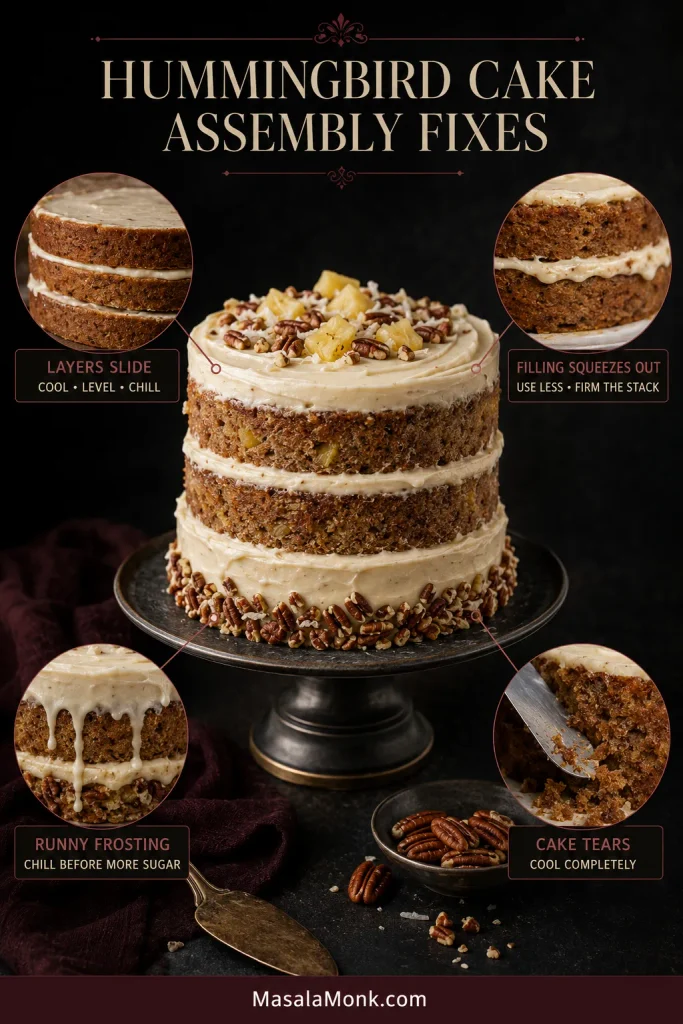
| Runny frosting | Warm/soft cream cheese, warm room or overmixing | Refrigerate before adding more sugar |
| Filling squeezes out | Too much loose frosting | Use less filling; firm the stack before continuing |
| Layers slide | Warm cake/frosting, domes or overfilling | Cool, level if needed, then continue |
| Cake tears while frosting | Layers are too warm or delicate | Cool completely; chill briefly if needed |
| Outside done, center raw | Deep batter or hot oven | Check pan setup; tent a browning top if needed |
Assembly Problems: Fix the Stack First
Back to the recipe method · Back to top
What You Can Change
- Walnuts: swap them for the pecans in the same amount and toast them first.
- No nuts: leave them out. Nothing structural needs replacing.
- Coconut: common in some versions, but not essential to the classic banana-pineapple-pecan cake.
- Frozen bananas: thaw completely, mash them with the liquid they release, then weigh out 360 g.
- Butter instead of oil: use a recipe built around butter or a butter-oil blend. Neutral oil is one reason these refrigerated layers remain moist.
- More pineapple: put concentrated fruit between the layers instead of another can of liquid-heavy pineapple in the batter.
Gluten-free, vegan and substantially reduced-sugar Hummingbird Cakes change the structure enough to deserve recipes of their own. At some point a substitution list simply becomes a different cake.
Why Hummingbird Cake Recipes Differ
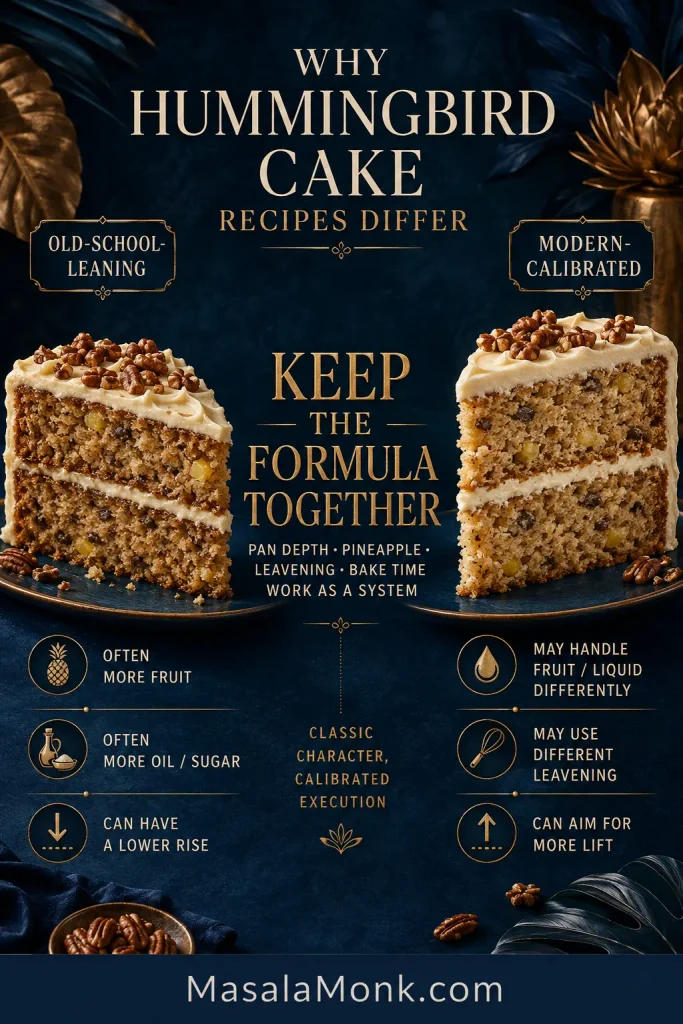
Hummingbird Cake recipes can look surprisingly different because they aren’t all working with the same balance of fruit, fat and liquid. Some old-school versions are exceptionally rich, with more banana, oil and sugar and sometimes no baking powder. Others pull back a little and rise somewhat higher.
The 1978 Hummingbird Cake made famous by Southern Living belongs firmly to that lavish old-school tradition. Modern versions may handle the pineapple, leavening or pans differently because the rest of the recipe changed too.
Keep the formula together. Pineapple handling, leavening, pan depth and bake time only make sense alongside the rest of the recipe they belong to. Borrow one instruction from a very different version and an otherwise sensible piece of advice can suddenly work against you.
Bake It Today, Serve It Tomorrow
Hummingbird Cake is unusually friendly for a three-layer celebration cake. The oil and fruit help the crumb stay moist, and an overnight rest does it no harm. That’s useful when the cake is for a birthday, holiday table or gathering and serving day already gives you plenty to think about.
Does Hummingbird Cake need to be refrigerated? Once it is covered with cream cheese frosting, yes. Keep the finished cake refrigerated and give chilled slices about 15–20 minutes at room temperature before serving.
Storage, Freezing and Serving
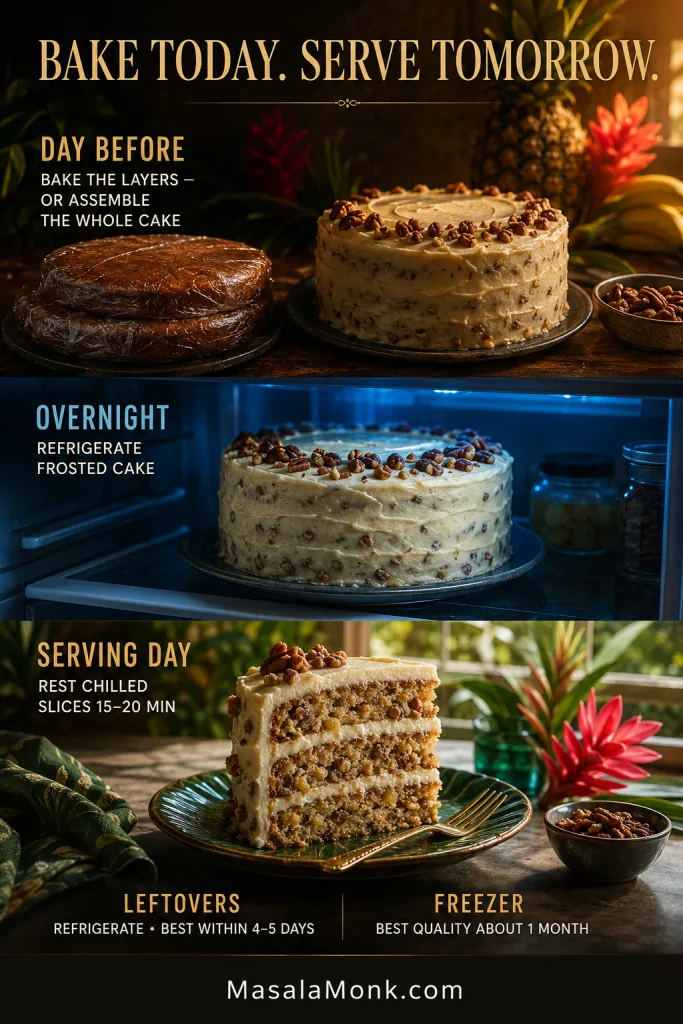
- The day before: bake and cool the layers completely, wrap them well and refrigerate. Or assemble and frost the entire cake, cover it and refrigerate overnight.
- Serving day: keep the cake cool until you need it, especially in a warm room. That short rest before eating brings the crumb and frosting back to a much better texture.
- Leftovers: cover and refrigerate. For the best texture and flavor, aim to finish the cake within about 4–5 days.
- Freezing: unfrosted layers are easiest. Cool them, wrap tightly and freeze, then thaw in the refrigerator while still wrapped. Firm chilled slices of frosted cake can also be wrapped and frozen. For best quality, use frozen cake or slices within about 1 month.
This is one of those celebration cakes that does not punish you for getting ahead. There is a great deal to be said for opening the refrigerator the next day and finding the difficult part already done.
Back to the recipe · Back to top
Why Is It Called Hummingbird Cake? The Jamaican Doctor Bird Story
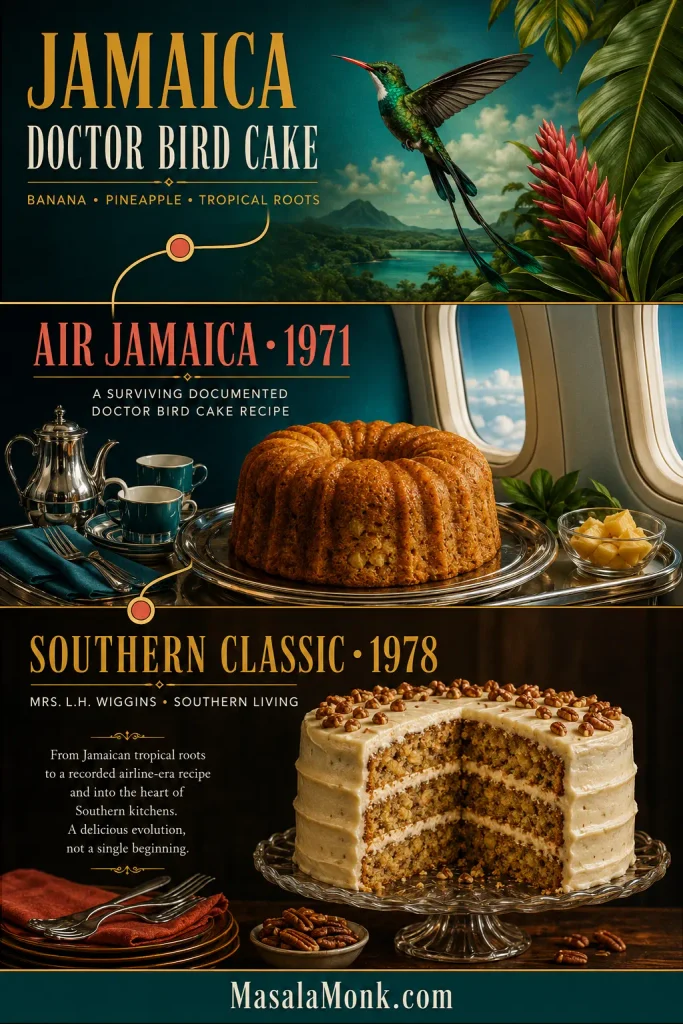
For a cake now so strongly associated with Southern baking, the earlier trail is wonderfully tropical. Its name points back to Jamaica and its national bird, the red-billed streamer-tail hummingbird known as the Doctor Bird.
The Jamaican Doctor Bird Cake
Versions of Doctor Bird Cake were already circulating in Jamaica-related promotional material by the late 1960s. Visit Jamaica’s archival account preserves an Air Jamaica recipe published in The Daily Gleaner on February 4, 1971. The feature covered dishes served on the airline’s in-flight menu, and the cake took its name from the Doctor Bird — both Jamaica’s national bird and a symbol used by Air Jamaica.
That version was described as a rich pineapple-and-banana dessert loaf. It’s a wonderful contrast with the cake many people picture today: the tropical fruit was already there, but the towering American layer cake came later.
The 1978 Southern Living Cake
In 1978, Mrs. L.H. Wiggins of Greensboro, North Carolina, submitted her Hummingbird Cake to Southern Living. The three-layer recipe became one of the magazine’s best-known desserts and helped turn Hummingbird Cake into a fixture of Southern celebration tables.
That gives the cake an identity that is hard to squeeze into one place. Its name and tropical fruit reach back toward Jamaica; the towering cream-cheese-frosted layer cake became deeply Southern. Both histories are sitting in the same slice.
For a cake named after something as tiny as a hummingbird, there is nothing timid about it. Three generous layers, soft under a fork and sturdy enough to stand proudly on the plate. Then someone cuts the first slice, and suddenly the cake doesn’t look quite so enormous after all.








