
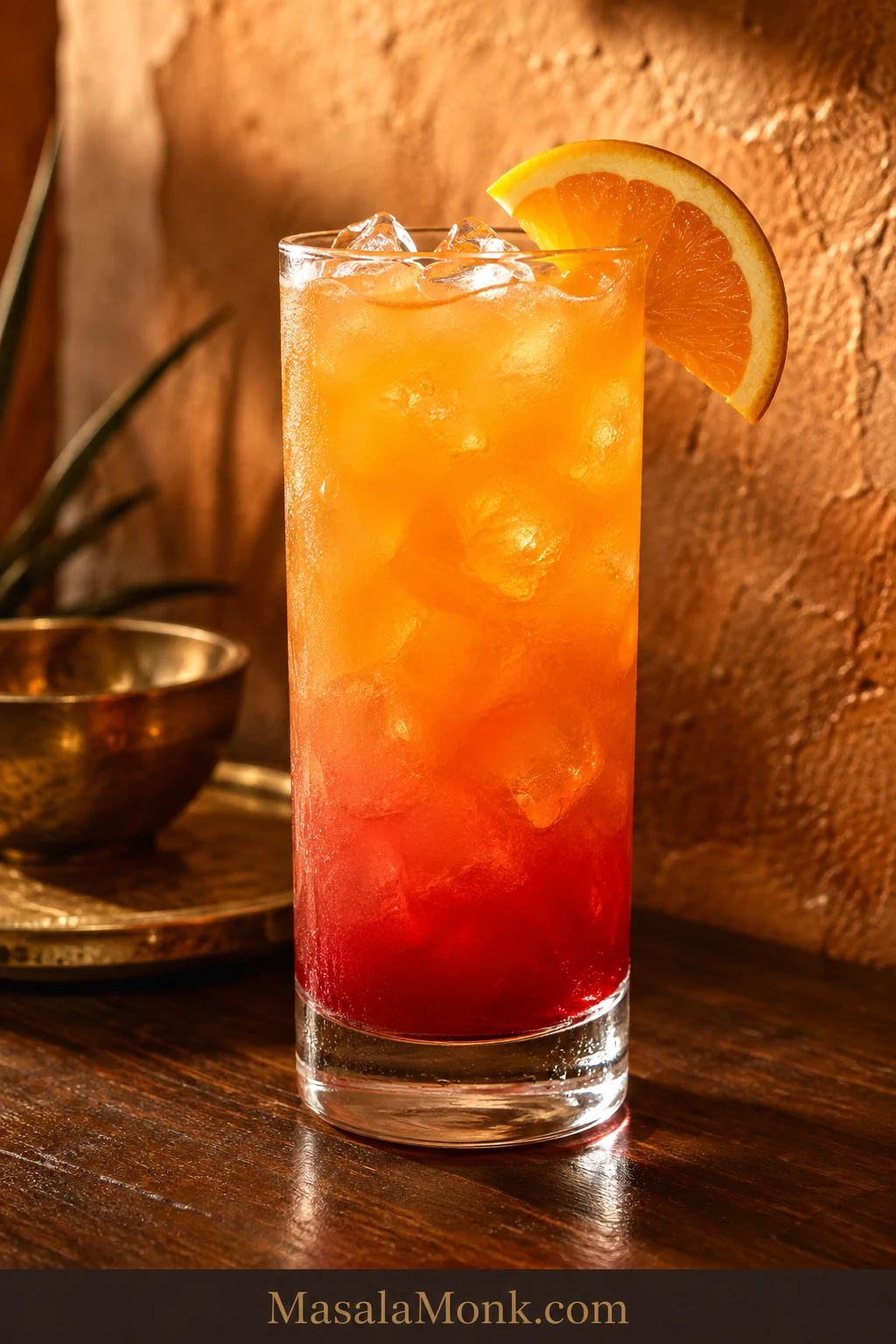
A Tequila Sunrise looks like the sort of cocktail that needs a practiced hand. Then the grenadine slips beneath the orange juice, the bottom turns red, and you realize the entire effect came from one careful final pour.
The recipe itself is only tequila, orange juice and grenadine. The challenge is balance. Too much syrup makes the last sip sticky. Too much juice hides the tequila. A forceful pour turns the glass pink before anyone gets to see the sunrise.
Built around a 1:2 tequila-to-orange ratio, this version stays juicy and cold without hiding the agave beneath the orange. A Tequila Sunrise has a reputation for sweetness, but it does not have to taste syrupy. Grenadine is the dial: start with a small pour, deepen it when you want more red and sweetness, and add it slowly enough for the fade to appear.
The MasalaMonk rule
Stir the tequila and orange juice first. Add the grenadine last. Leave the glass alone until the sunrise appears—then stir only when you are ready to drink it.
Quick Answer: How to Make a Tequila Sunrise
Use a clear 12 oz / 350 ml highball or Collins glass and fill it about three-quarters full with firm ice. Add 2 oz / 60 ml 100% agave blanco tequila and 4 oz / 120 ml cold orange juice. Stir briefly.
Slowly pour ¼ oz / 7.5 ml grenadine down the inside wall of the glass or over the back of a teaspoon. Do not stir again. Garnish with an orange half-wheel and serve as soon as the red base, orange top and soft transition between them are visible.
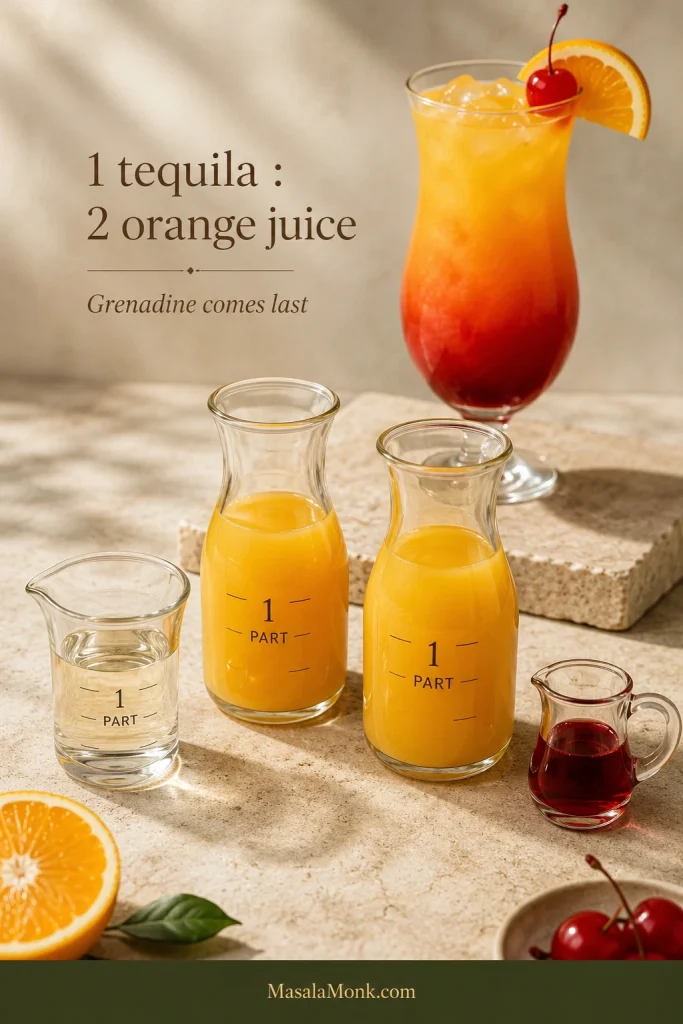
Easy ratio to remember: 1 part tequila to 2 parts orange juice, followed by a much smaller grenadine pour.
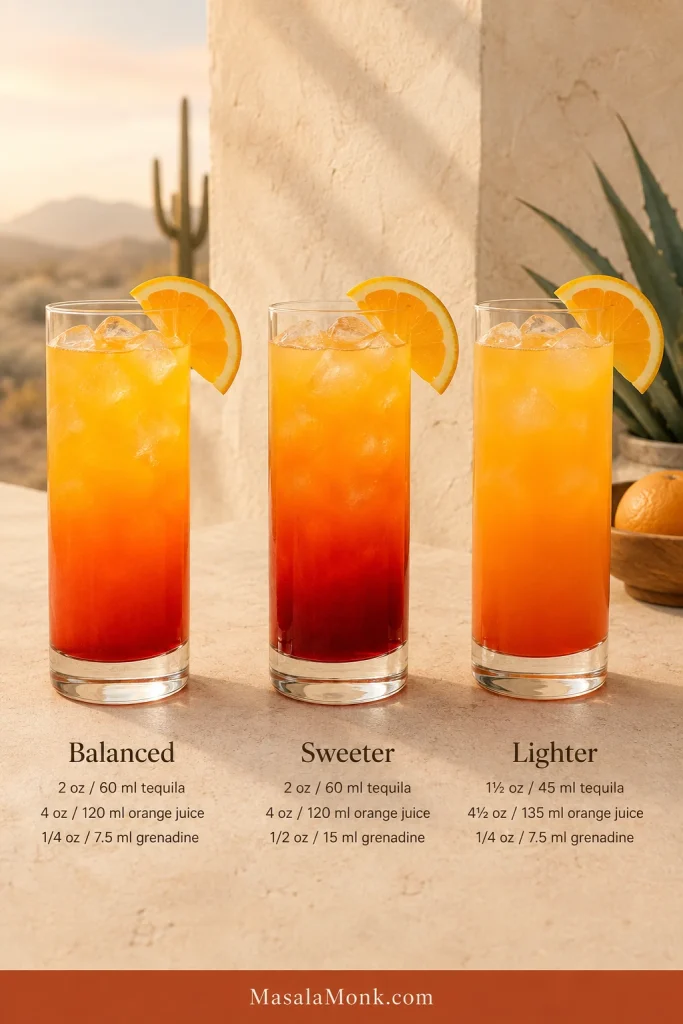
Choose the Version You Want
Start with the balanced drink unless you already know you prefer a sweeter or lighter pour. The method stays the same; only the proportions change.
Balanced
2 oz / 60 ml tequila
4 oz / 120 ml orange juice
¼ oz / 7.5 ml grenadine
Orange-led but still recognizably tequila-forward, with enough red to form a clear base.
Deeper and sweeter
2 oz / 60 ml tequila
4 oz / 120 ml orange juice
½ oz / 15 ml grenadine
A wider red base, more fruit-syrup flavor and a noticeably sweeter finish.
Lighter long drink
1½ oz / 45 ml tequila
4½ oz / 135 ml orange juice
¼ oz / 7.5 ml grenadine
A gentler brunch or party pour when you want less spirit in each glass.
Tequila Sunrise Recipe
A cold, juicy Tequila Sunrise with bright orange, fresh agave and just enough pomegranate sweetness at the base to make the color dramatic without turning the drink syrupy.
Equipment
- 12 oz / 350 ml highball or Collins glass; a 10 oz / 300 ml glass also works with slightly less ice
- Jigger or small liquid measuring cup
- Bar spoon or ordinary teaspoon
- Knife and small cutting board for the garnish
No jigger? Measure 2 oz / 60 ml tequila as 4 tablespoons, 4 oz / 120 ml orange juice as ½ cup or 8 tablespoons, and ¼ oz / 7.5 ml grenadine as 1½ teaspoons.
An ordinary teaspoon works in place of a bar spoon. Any clear tall glass of roughly the same size will do.
Ingredients
- 2 oz / 60 ml 100% agave blanco tequila
- 4 oz / 120 ml cold orange juice, preferably pulp-free or fine-strained
- ¼ oz / 7.5 ml grenadine
- Firm medium ice cubes
- 1 orange half-wheel, for garnish
- 1 maraschino cherry, optional
Instructions
- Fill the glass. Add firm ice until the glass is about three-quarters full, leaving room for the measured liquid.
- Add tequila and orange juice. Pour both over the ice.
- Stir briefly. Mix only until the tequila and juice are combined and cold. This is the last stir before presentation.
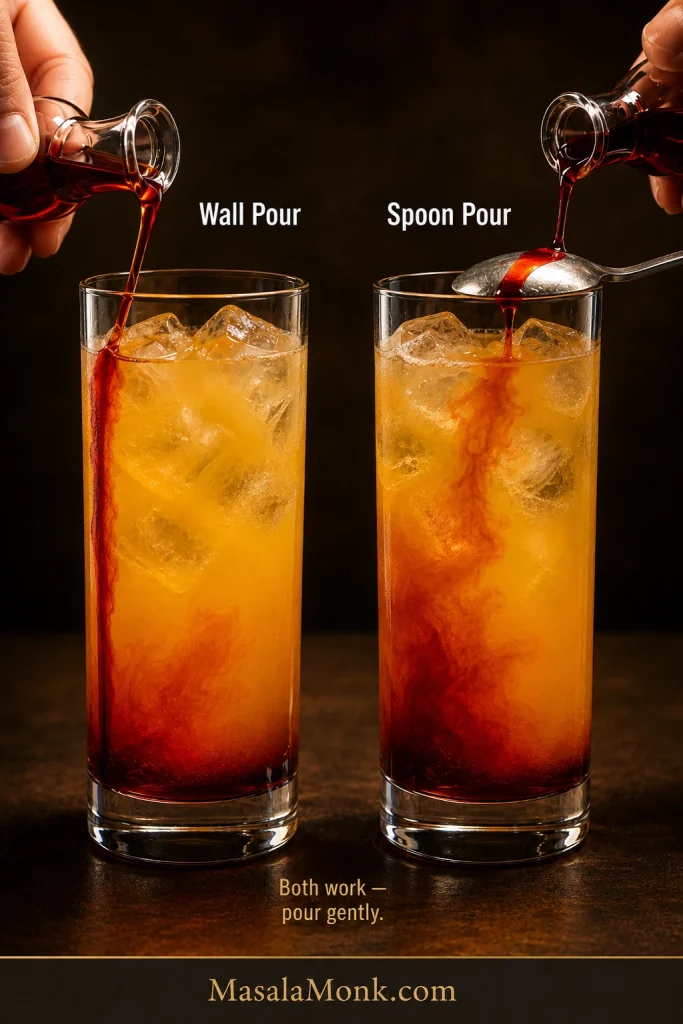
- Add the grenadine slowly. Pour it in a thin stream down the inside wall. For more control, pour it over the back of a teaspoon held just above the drink.
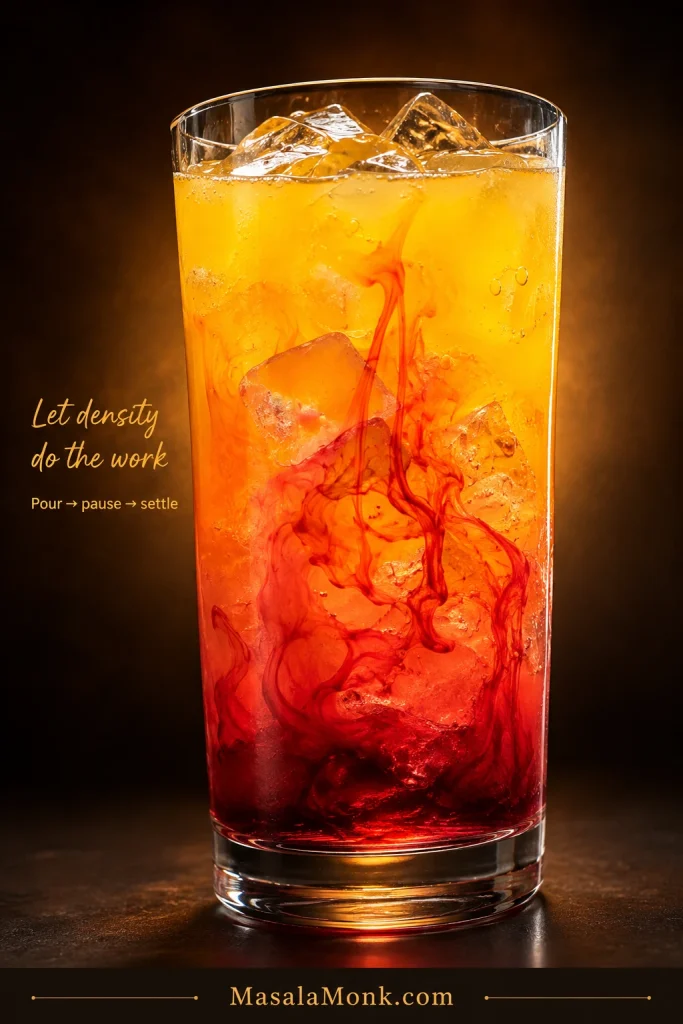
- Let the sunrise form. Stop stirring. The grenadine should settle around the ice and collect at the bottom, leaving orange above and a soft pink-orange transition between them.
- Garnish and serve. Add the orange half-wheel and optional cherry. Present the drink immediately; stir gently only when you are ready for an evenly sweet sip.
Recipe Notes
- If the base looks pale, increase the grenadine to 10 ml. Use 15 ml / ½ oz only when you also want a noticeably sweeter drink.
- For the cleanest-looking modern version, don’t shake the tequila and orange juice. Shaking aerates the juice and can make the orange layer frothy or cloudy. Once the grenadine is added, do not shake or vigorously stir the drink.
- Fresh orange juice tastes brightest when fine-strained. Cold pulp-free refrigerated juice usually gives the cleanest-looking gradient.
Once you have watched the grenadine fall through the first glass, the recipe becomes much easier to adjust. The next decisions are about the tequila, the juice, how sweet you want the base and how to make the same satisfying pour work again.
Choose What You Need Next
Why This Balance Works
The modern Sunrise is tequila, orange juice and grenadine. Tequila brings the agave backbone, orange juice gives the drink its juicy body, and grenadine supplies sweetness and the red base.
Is Tequila and Orange Juice a Tequila Sunrise?
Not quite. Tequila and orange juice make a simple two-ingredient highball, sometimes ordered as tequila and OJ. Grenadine adds the signature red base, extra sweetness and the sunrise gradient. For the vodka-and-orange version of the same simple idea, use the Screwdriver recipe.
The 1:2 Tequila-to-Orange Ratio
At a 1:2 ratio, two parts orange juice soften one part tequila without burying it; longer pours become increasingly orange-led. Keep the grenadine pour small because each extra splash changes both color and sweetness. Cold juice and firm ice protect the balance by limiting early dilution.
Ingredients and What They Change
Which Tequila Works Best?
A 100% agave blanco tequila is the best all-purpose starting point. Its fresh agave, citrus and pepper notes stay lively beneath the orange juice, and there is little reason to hide an expensive sipping bottle under juice and syrup.
Reposado also works. It produces a rounder drink with light oak, vanilla or caramel notes and may make the orange portion look a little deeper. Añejo is not wrong, but it is usually more bottle than this simple cocktail needs.
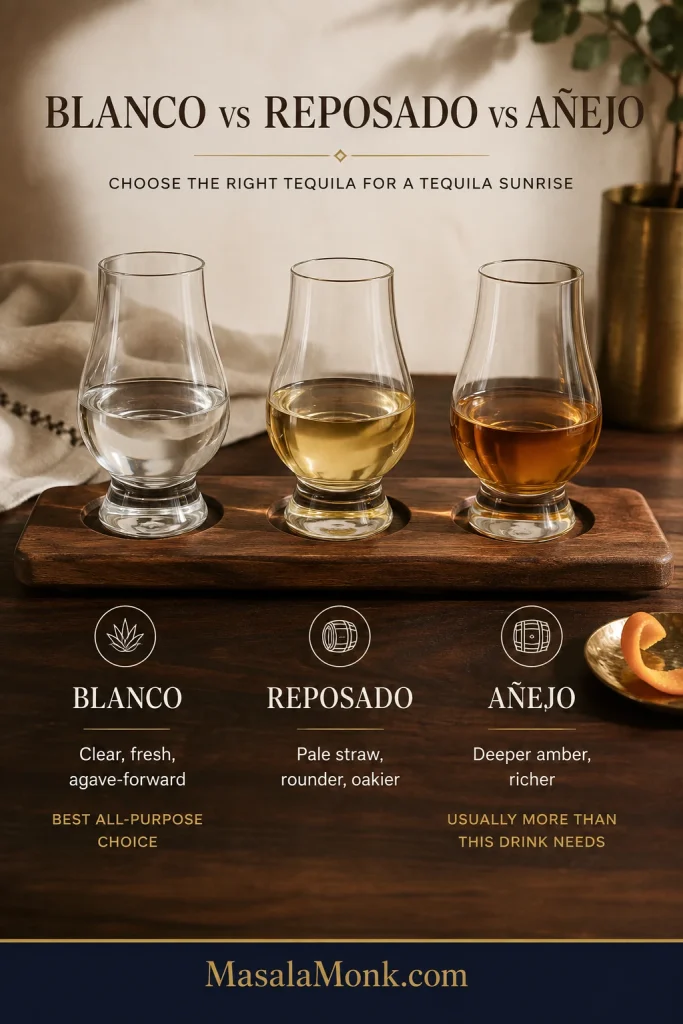
“Gold” tequila describes color, not necessarily age or quality. Read the label and look for 100% agave rather than choosing by color alone.
Blanco also has more room to show in a Cadillac Margarita, where orange liqueur supports rather than buries the tequila.
Fresh or Bottled Orange Juice?
Use cold pulp-free juice when the cleanest gradient matters most. Use fine-strained fresh juice when brighter orange aroma matters more. Both work; they simply emphasize different strengths of the drink.
Pulp changes the picture more than the drink. It does not stop the Sunrise from working, but it makes the orange cloudier and the transition less distinct, so pass fresh juice through a fine strainer when you want a cleaner fade.
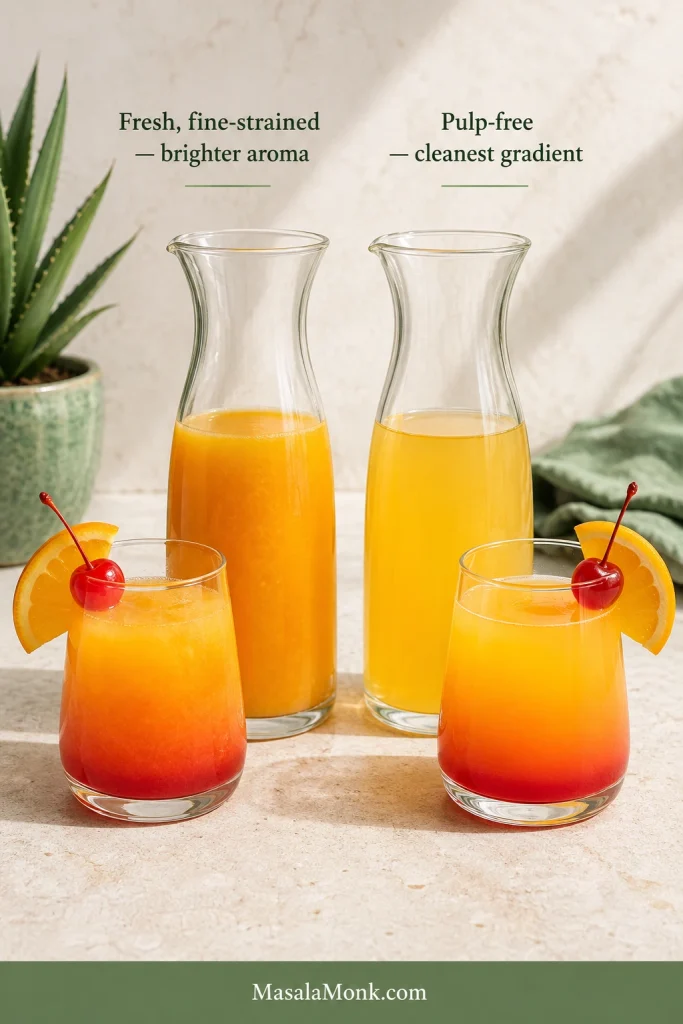
Taste the juice before adding syrup. With very sweet juice, start with the smaller grenadine pour. Sharper juice leaves a little more room to increase the syrup if the glass needs more color. When the finished drink tastes flat and sweet rather than bright, a small squeeze of lime can restore balance—but lime is a correction, not a required fourth ingredient.
If fresh orange is what you want to taste first, the Orange Crush recipe takes that idea in a colder, sparkling direction.
What Kind of Grenadine Should You Use?
Choose a pourable pomegranate-based grenadine. Bright commercial syrup gives vivid red color and plenty of sweetness. Pomegranate-forward grenadine often looks darker and can bring a more recognizable fruit flavor.
Grenadine is normally non-alcoholic. It adds sweetness and fruit, but density is what helps the sugar-rich syrup settle below the tequila-orange mixture; viscosity mainly affects how quickly it flows and disperses. Plain pomegranate juice and undiluted pomegranate molasses do not behave as direct replacements. The same syrup plays a completely different role with soda in the Shirley Temple recipe.
How Much Grenadine Should You Add?
Start with ¼ oz / 7.5 ml. If the red base looks pale, add another ½ teaspoon / 2.5 ml slowly near the glass wall. Adding syrup is easy; removing sweetness once it is in the drink is not. Treat the table as a practical range because grenadine brands vary in color, thickness and sugar concentration.
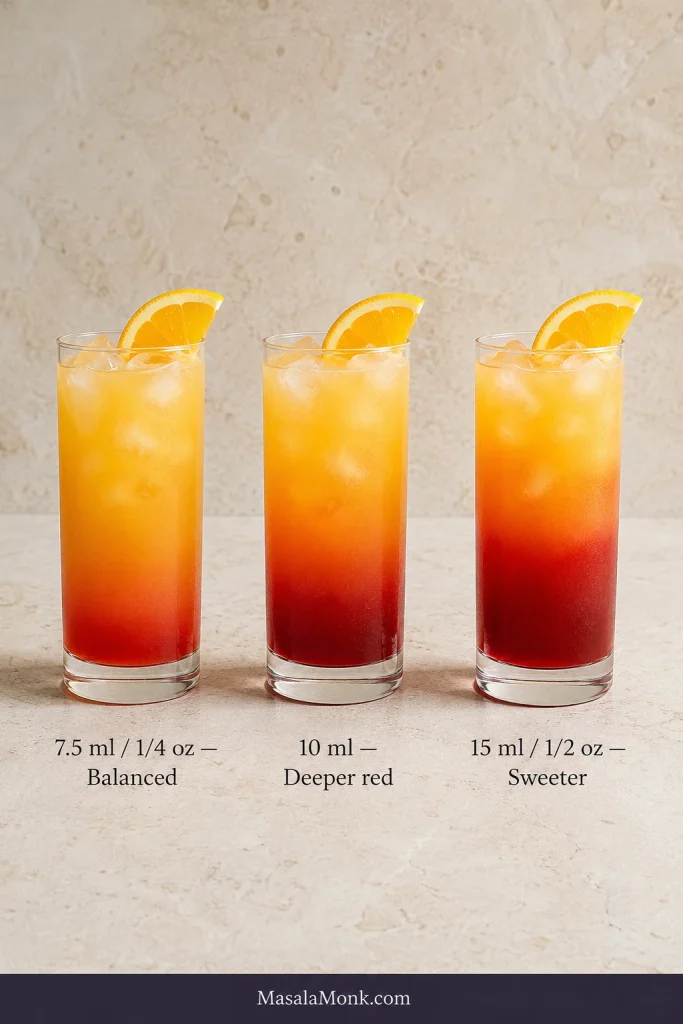
| Grenadine per drink | Choose it when | Likely result |
|---|---|---|
| 3–5 ml | You want very little sweetness | A narrow red base that may look faint with pale syrup |
| 7.5 ml / ¼ oz | You want the balanced default | Visible color without a syrup-heavy finish |
| 10 ml / about ⅓ oz | Your syrup is light or you want more red | A stronger base with a modest sweetness increase |
| 15 ml / ½ oz | You prefer a noticeably sweeter pour | A deeper red base and noticeably sweeter final sips |
The redder glass is not automatically the better glass. More grenadine deepens the color and the sweetness at the same time, so increase it in small steps rather than chasing the darkest possible base. If the glass is already pale, uniformly pink or syrup-heavy, use the troubleshooting guide before adding more.
How to Build a Cleaner Sunrise Gradient
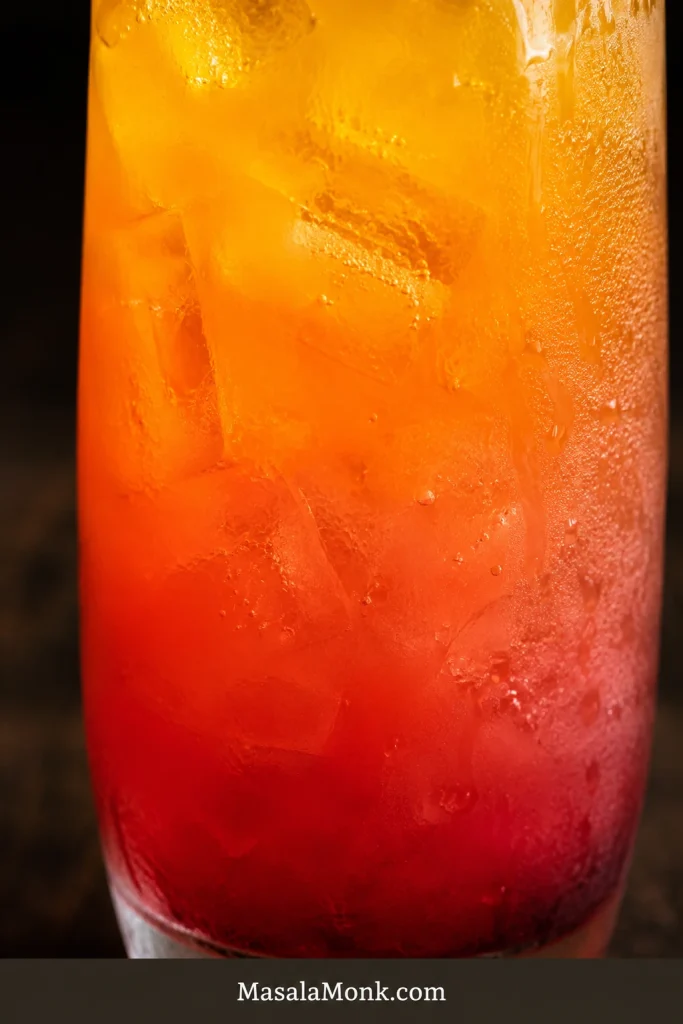
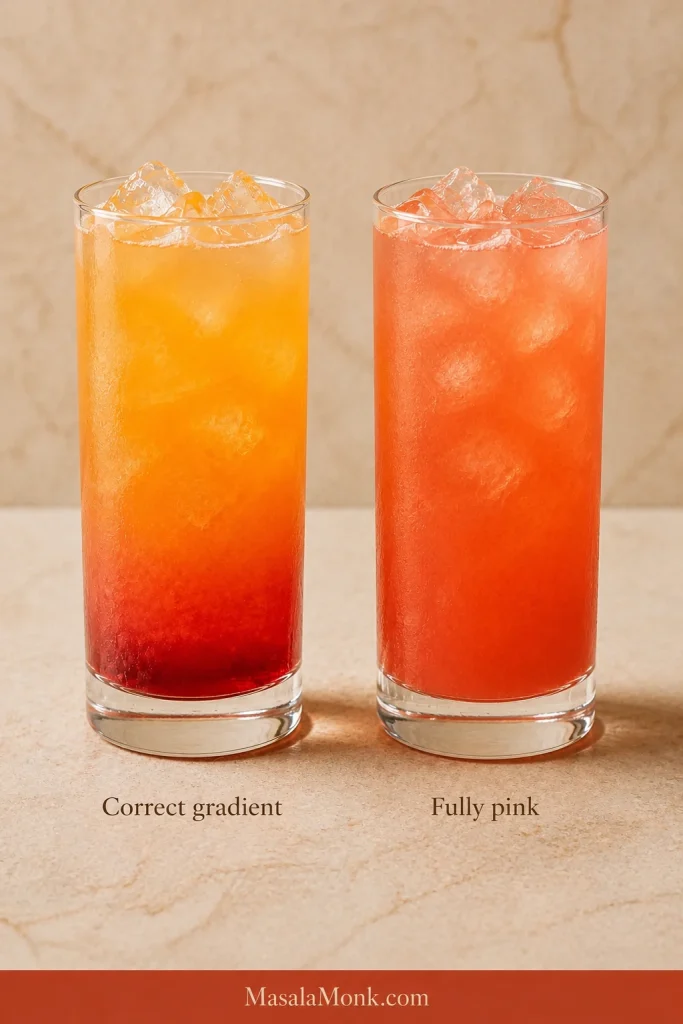
A convincing Sunrise moves gradually from a defined red base through pink into a bright orange top. The transition should look soft and connected rather than sharply separated.
1. Chill the upper drink before the syrup arrives
Use cold orange juice and fresh ice. Add the tequila and juice, then stir just long enough to combine them. Once the grenadine enters, the mixing stage is over.
2. Pour the grenadine close to the glass
Keep the measure close to the inside wall and release a thin stream. The grenadine enters more quietly and is less likely to turn the whole glass pink. Pouring over the back of a teaspoon can help, but it is optional.
3. Let density do the work
Do not chase the syrup with a spoon or try to draw the gradient yourself. The grenadine should fall around the ice and settle naturally. The little pause after the pour does more work than any bar tool.
4. Serve the look, then balance the sip
Carry the glass carefully and serve it while the color is visible. After the first look, the drink can be stirred gently. A Sunrise is not spoiled when the layers are mixed for drinking; it is simply moving from presentation to flavor.
Do not judge the drink by whether it forms perfectly straight bands. A broad red base and a gradual fade are more natural than a sharp line, and they usually drink better than a heavy pool of syrup.
What a Good Tequila Sunrise Looks and Tastes Like
In the glass
- Red gathered low
- Vivid orange at the top
- A gradual pink edge between them
- Not one uniform shade of pink
In the first sip
- Orange arrives first
- Tequila is still noticeable
- The drink is cold, not watery
- Sweetness builds toward the base
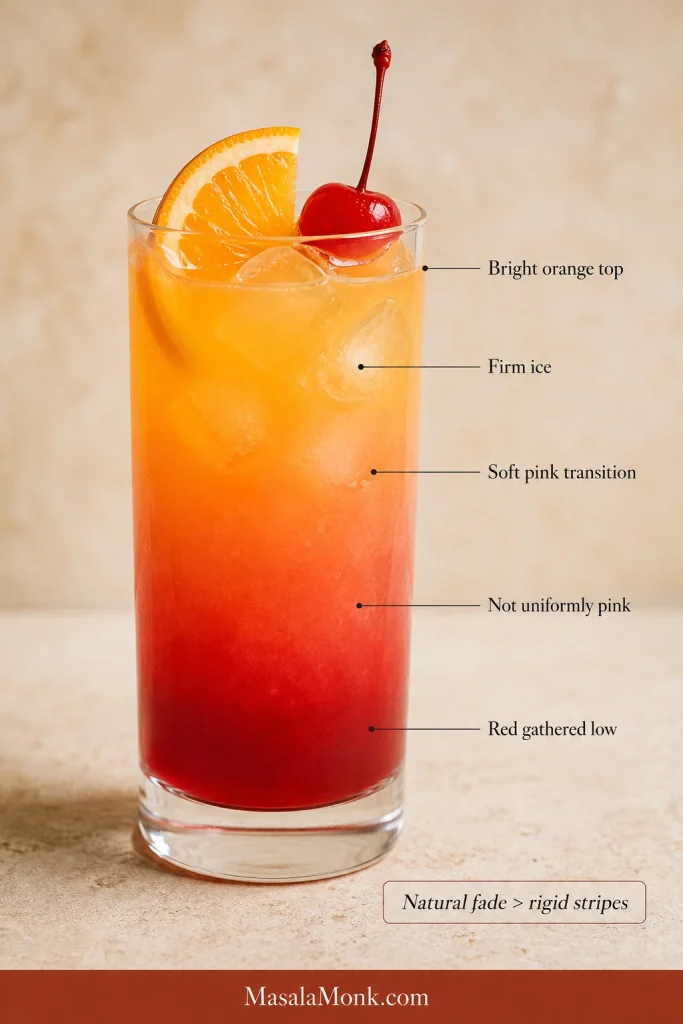
A good first sip should feel cold and juicy rather than thick: orange leads, agave still shows underneath, and the sweetness becomes more noticeable as you reach the lower part of the glass. One gentle stir brings those layers of flavor back together.
Serve it as soon as the gradient is visible and before the ice begins softening. The colors will continue to move while the glass sits; that is part of the drink, not a sign that the layers failed.
Troubleshooting the Layers and Flavor
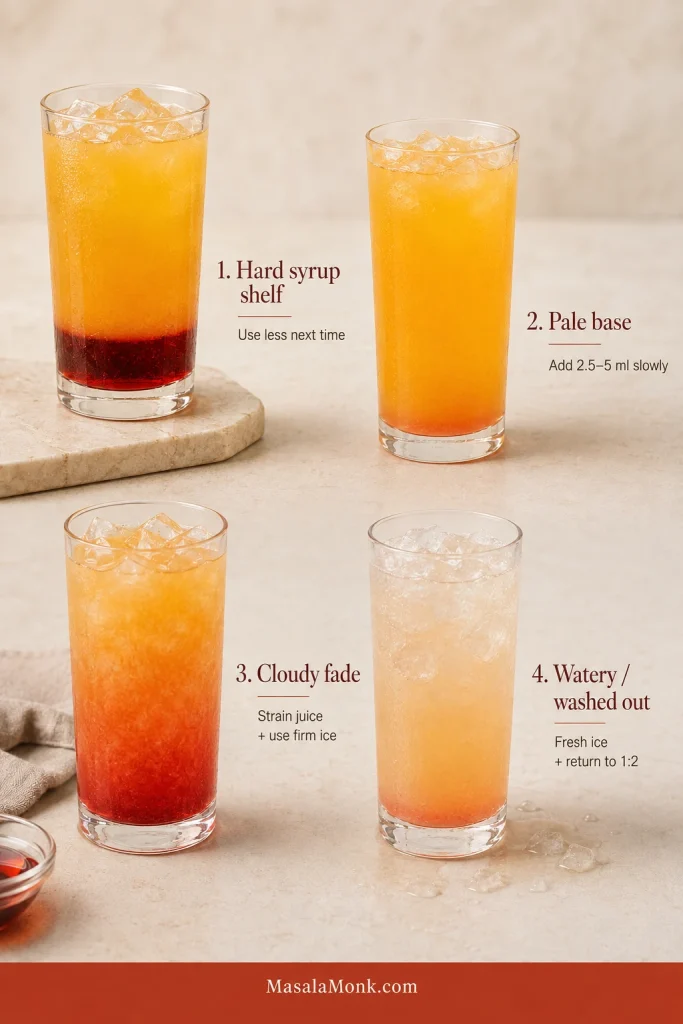
Start with the appearance before changing the recipe. A fully pink glass, a pale base and a heavy syrup shelf may all look wrong, but they need different responses.
Four Visual Failure Signatures to Check First
These four visual failures are the quickest to recognize at a glance; the full table below also covers flavor, dilution and sweetness problems.
Tequila Sunrise Troubleshooting Table: Cause and Best Fix
| What went wrong | Likely cause | Best correction |
|---|---|---|
| The whole drink turned pink | Grenadine was stirred, shaken or poured forcefully | Combine tequila and juice first; add syrup slowly at the end and stop stirring |
| There is no visible red base | Too little grenadine, pale syrup or opaque juice | Add another 2.5–5 ml slowly near the wall of the glass |
| A hard syrup stripe sits at the bottom | Very thick syrup or too much grenadine | Use less next time; a softer fade is better than a heavy pool |
| The gradient looks cloudy | Pulpy juice, crushed ice, vigorous stirring or shaking | Fine-strain fresh juice and build over firm cubes |
| The drink is too sweet | Too much grenadine or unusually sweet juice | Reduce syrup first; add a small squeeze of lime only when needed |
| The tequila tastes too sharp | Warm ingredients, a sharp-tasting tequila or too little orange juice for your preference | Use cold ingredients and a tequila you enjoy; add another ½ oz / 15 ml orange juice if needed |
| The drink tastes weak or watery | Too much juice, wet ice or a long wait before serving | Return to the 1:2 ratio and build with fresh cold ice |
| The final sip is syrupy | The drink was never stirred after presentation | Give it a gentle stir before or while drinking |
What Can Be Fixed in the Current Glass?
A pale red base can be deepened with another 2.5–5 ml grenadine near the glass wall. A fully pink glass will not separate again, but nothing has been wasted. Serve it as a mixed drink, enjoy it, and use a slower grenadine pour for the next one. For the full sweetness-and-color range, return to how much grenadine to add.
Back to recipe ↑ · Back to top ↑
No Grenadine? Choose a Substitute by Flavor and How It Layers
A good replacement has to do more than add red color. It also needs sweetness and enough density to settle low; lower-density substitutes are more likely to blend through the orange layer than collect at the base.
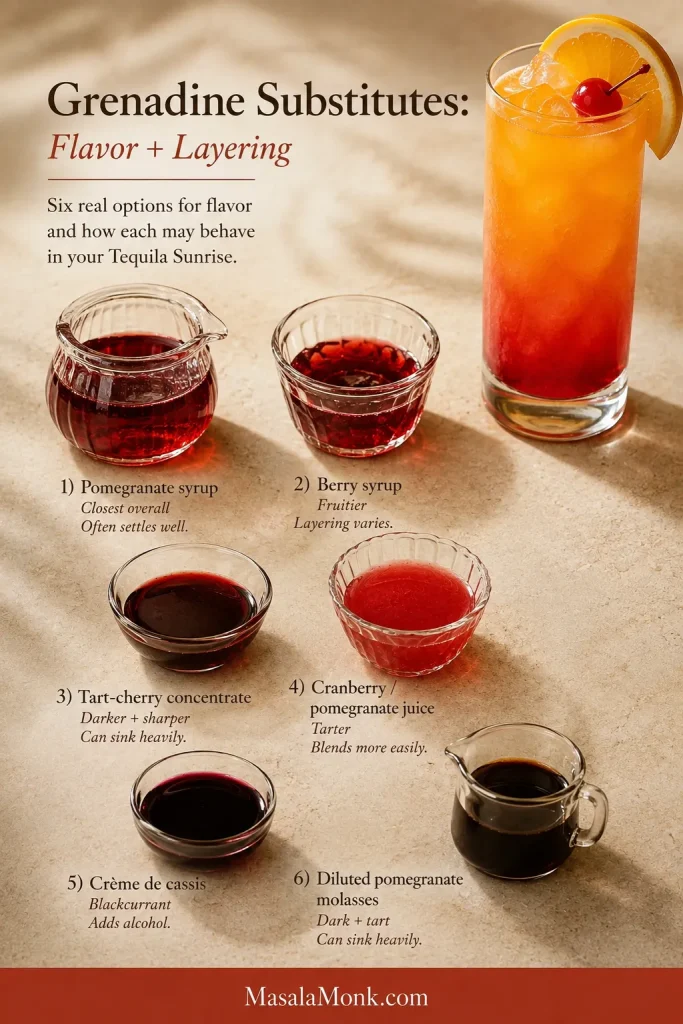
| Substitute | Flavor change | How it behaves and how to use it |
|---|---|---|
| Homemade pomegranate syrup | Closest overall flavor | Often settles low when concentrated. Start with 5–7.5 ml and watch how it moves. |
| Strawberry, raspberry or cherry syrup | Becomes berry-led | Behavior varies by sugar concentration and formulation. Begin with 5 ml because many are intensely sweet. |
| Tart-cherry concentrate | Darker and sharper | Can sink heavily. Dilute and sweeten it before adding a small amount. |
| Cranberry or pomegranate juice | Fresher and tarter | More likely to blend through the orange layer than collect at the base. |
| Crème de cassis | Blackcurrant flavor and extra alcohol | Often settles low, but even a small pour creates a distinctly different cocktail. |
| Pomegranate molasses | Much darker, tarter and more concentrated | Can sink too heavily. Dilute it with water and simple syrup; never swap it equally. |
Density influences where a substitute settles; viscosity affects how quickly it moves. Sugar concentration, alcohol and temperature can all shift the result. Sweetened pomegranate syrup is the closest overall match. Start small and watch the glass.
Pitcher Method for a Crowd
Pitcher rule: mix and chill the tequila with the orange juice; add grenadine separately to every glass.
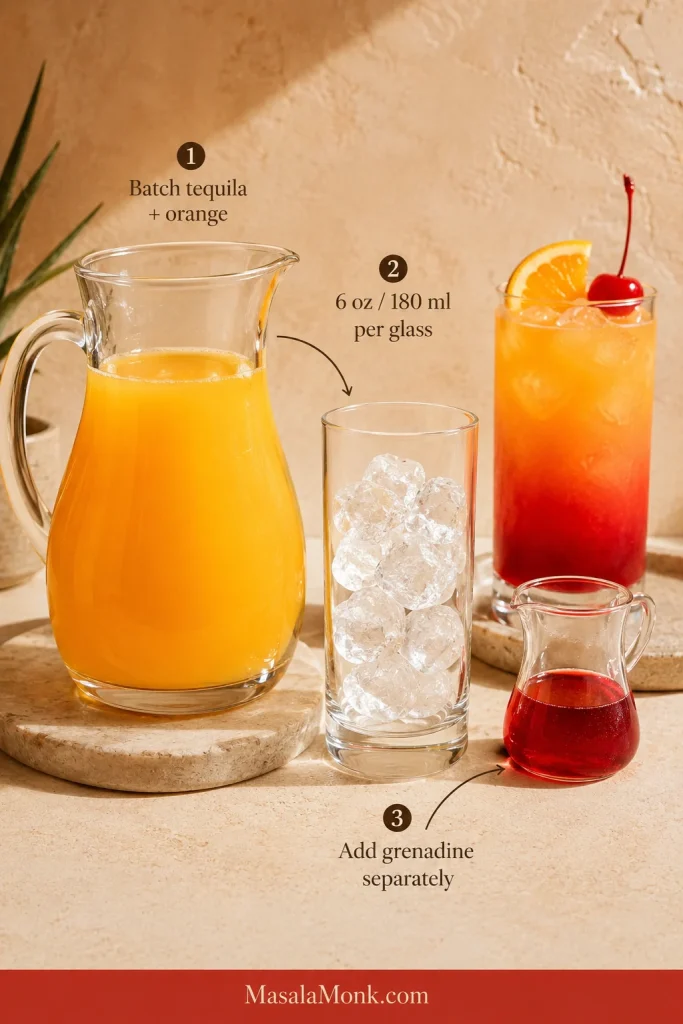
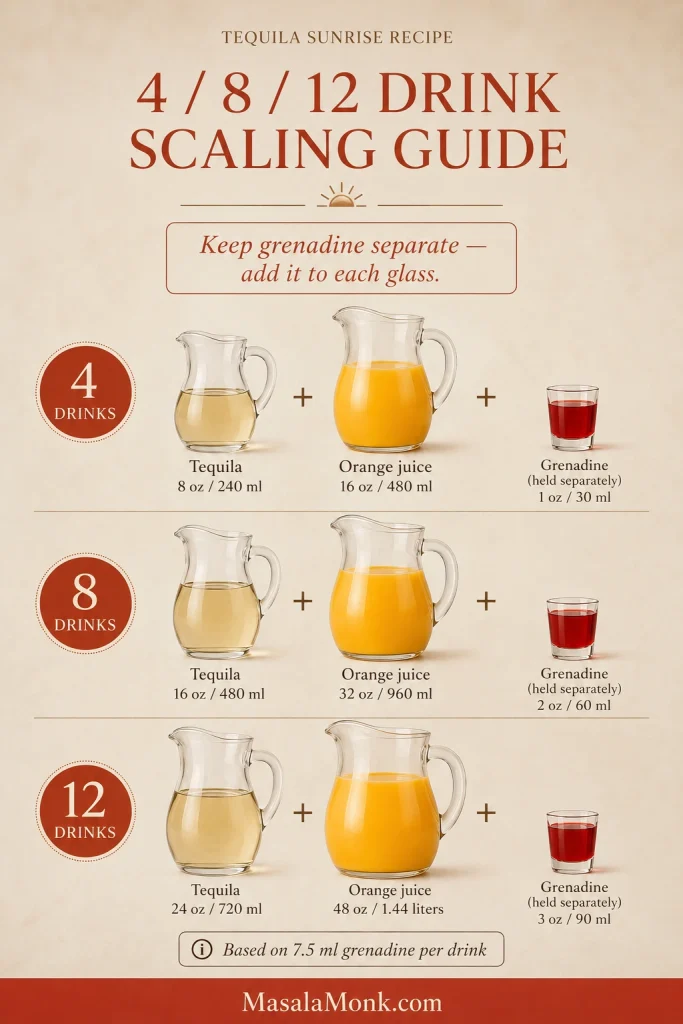
Tequila Sunrise Pitcher Quantities for 4, 8 or 12 Drinks
Use the same 1:2 tequila-to-orange ratio as the single-glass recipe; the table simply scales the batch while keeping grenadine separate for each glass.
| Drinks | Tequila | Orange juice | Grenadine held separately |
|---|---|---|---|
| 4 | 8 oz / 240 ml | 16 oz / 480 ml | 1 oz / 30 ml |
| 8 | 16 oz / 480 ml | 32 oz / 960 ml | 2 oz / 60 ml |
| 12 | 24 oz / 720 ml | 48 oz / 1.44 liters | 3 oz / 90 ml |
The table uses 7.5 ml grenadine per drink. Double it for the sweeter version. Use roughly a 1-liter pitcher for four drinks, 2 liters for eight and 2.5 liters for twelve.
How to Prepare and Serve the Batch
- Combine the tequila and orange juice in a clean pitcher.
- Cover and refrigerate the base until serving.
- Keep the grenadine in a small measuring jug or squeeze bottle.
- Fill each glass with fresh ice.
- Stir the chilled pitcher mixture and pour 6 oz / 180 ml into each ice-filled glass.
- Add the measured grenadine slowly to each glass.
- Garnish and serve immediately.
Do not store the batch over ice. Ice in the pitcher melts continuously and changes every serving. Do not add grenadine to the pitcher when visible layers matter; the batch will become a uniform orange-red punch.
The tequila-orange base can be prepared a few hours ahead and kept covered in the refrigerator. Prepare the garnishes before guests arrive, then let each person choose a restrained or sweeter grenadine finish. The nicest part of this setup is watching the grenadine fall into each glass just before it is handed over.
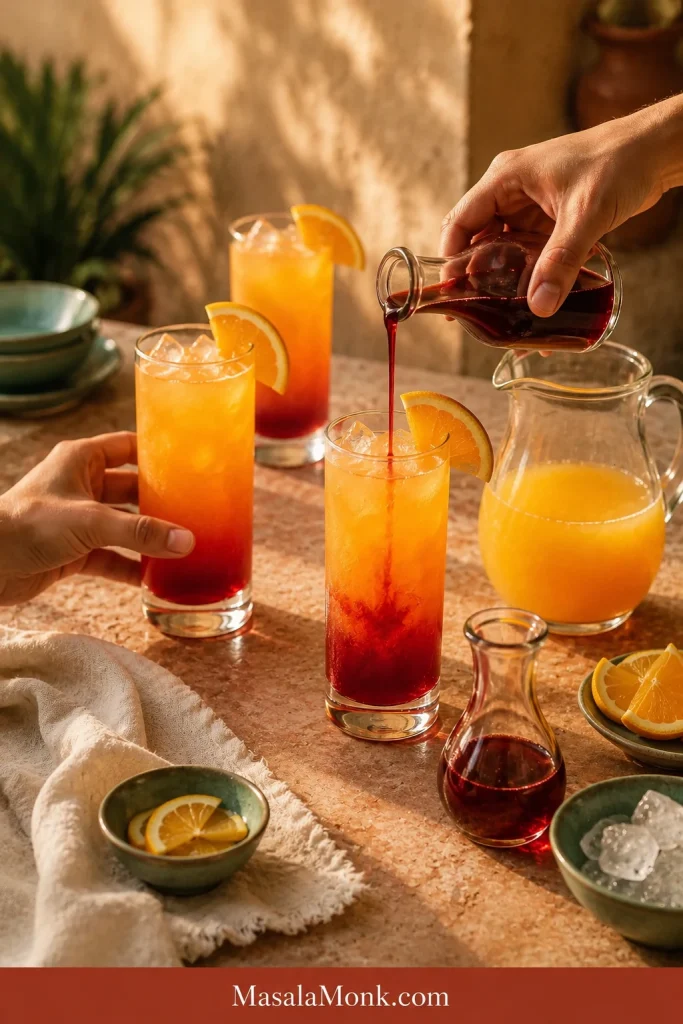
For guests who aren’t drinking, make a separate alcohol-free pitcher. The mocktails with grenadine guide offers fruitier and sparkling directions for that jug.
Back to recipe ↑ · Back to top ↑
Glass, Ice, Garnish and Serving
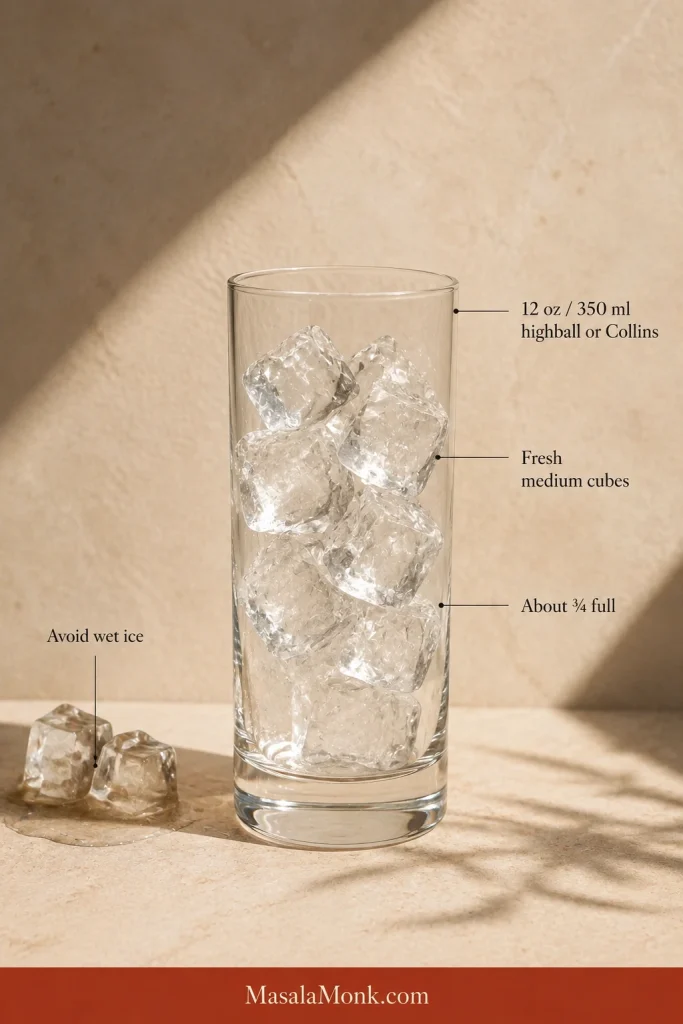
Use a tall clear glass. A 12 oz / 350 ml highball or Collins glass gives the liquid, ice and garnish enough room while keeping the color transition easy to see.
Fresh, dry medium cubes chill the drink without immediately watering it down. Avoid ice sitting in meltwater; it begins diluting the cocktail before the glass reaches the table.
For garnish, an orange half-wheel echoes the main flavor without hiding the color. A maraschino cherry is optional; keep the garnish at the rim rather than dropping it into the drink.
What to Serve With a Tequila Sunrise
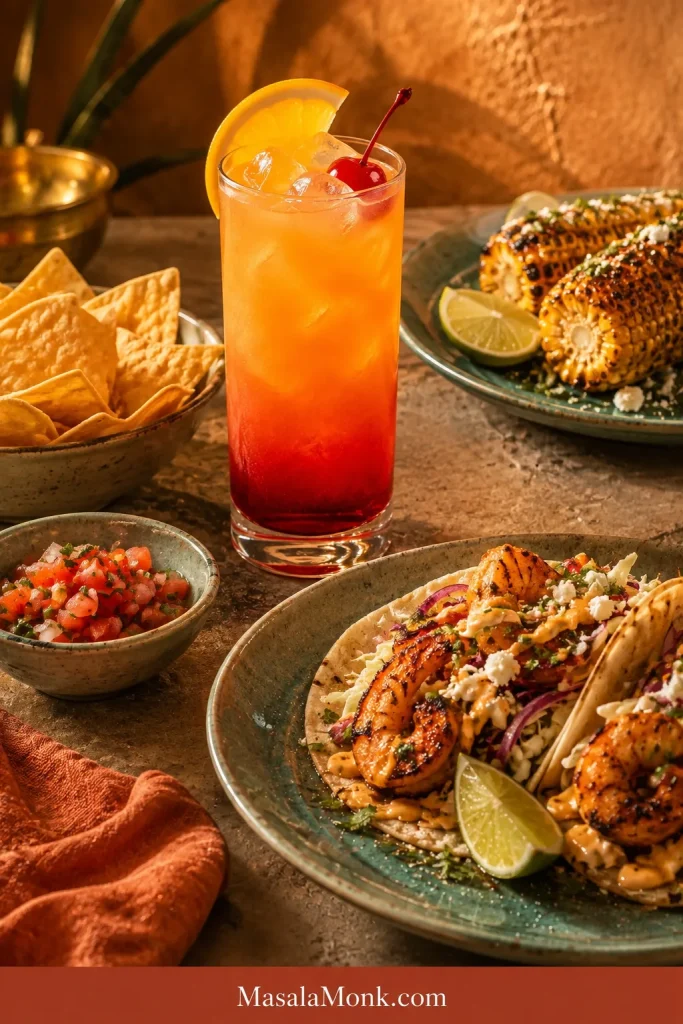
The orange sweetness works especially well beside tortilla chips and salsa, tacos, grilled shrimp, spicy chicken, quesadillas, citrus salads or grilled corn. Rich or spicy food gives the drink something to push against. For a full taco-night pairing, the shrimp tacos recipe brings smoky shrimp, crisp slaw and lime to the same table.
If brunch guests would rather have something lighter and sparkling, the Mimosa recipe guide gives you several easy alternatives beside the Sunrise.
Easy Variations
Make the main recipe once before changing it. After that, change one thing at a time so the drink still looks and tastes like a Sunrise.
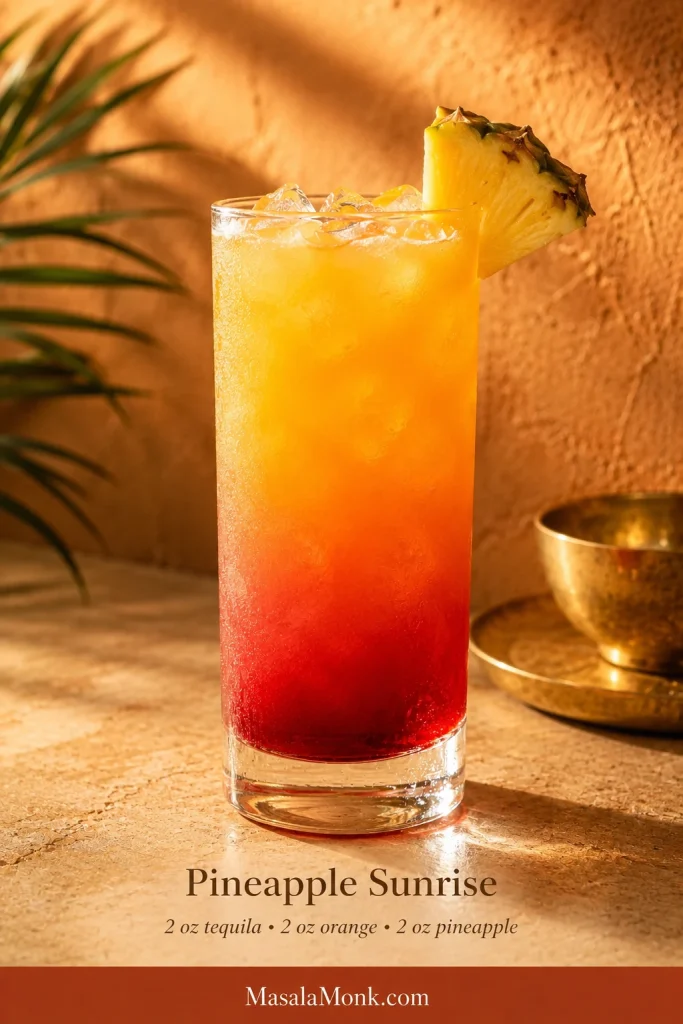
Pineapple Sunrise
Split the juice evenly: use 2 oz / 60 ml tequila, 2 oz / 60 ml orange juice and 2 oz / 60 ml pineapple juice, then finish with a small grenadine pour. Keeping half the juice orange preserves the Sunrise color while pineapple adds body and a tropical edge.
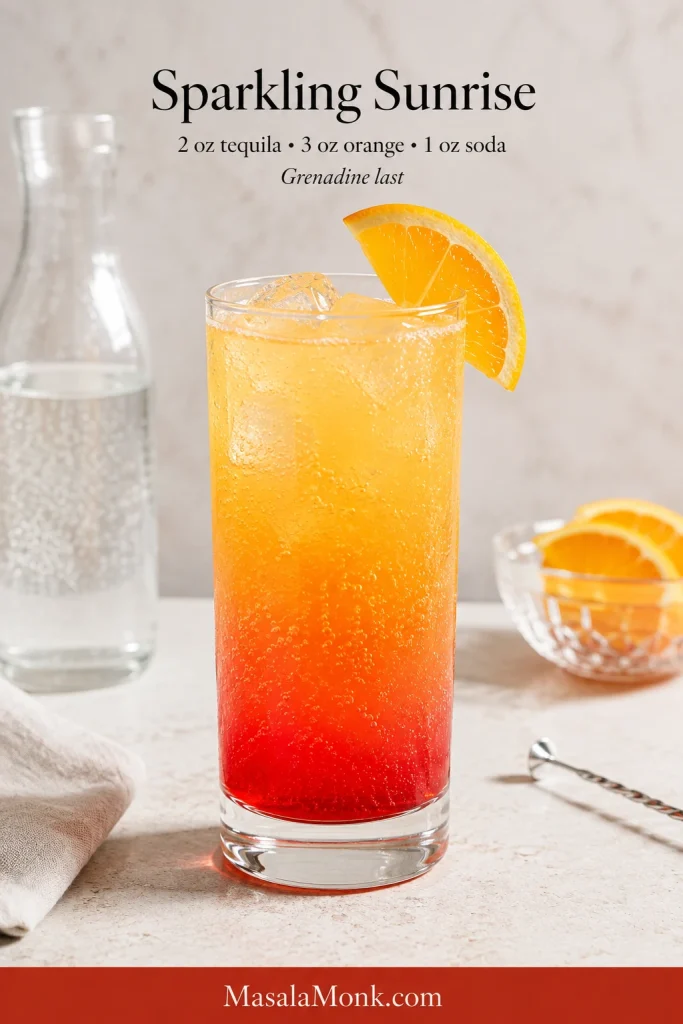
Sparkling Sunrise
For some fizz, use 2 oz / 60 ml tequila and 3 oz / 90 ml orange juice. Stir them over ice, add 1 oz / 30 ml chilled soda water gently, then pour in the grenadine. This keeps most of the fizz while preserving the final color change. Prefer grapefruit and bubbles? The Paloma recipe is the natural next drink.
Alcohol-Free Sunrise
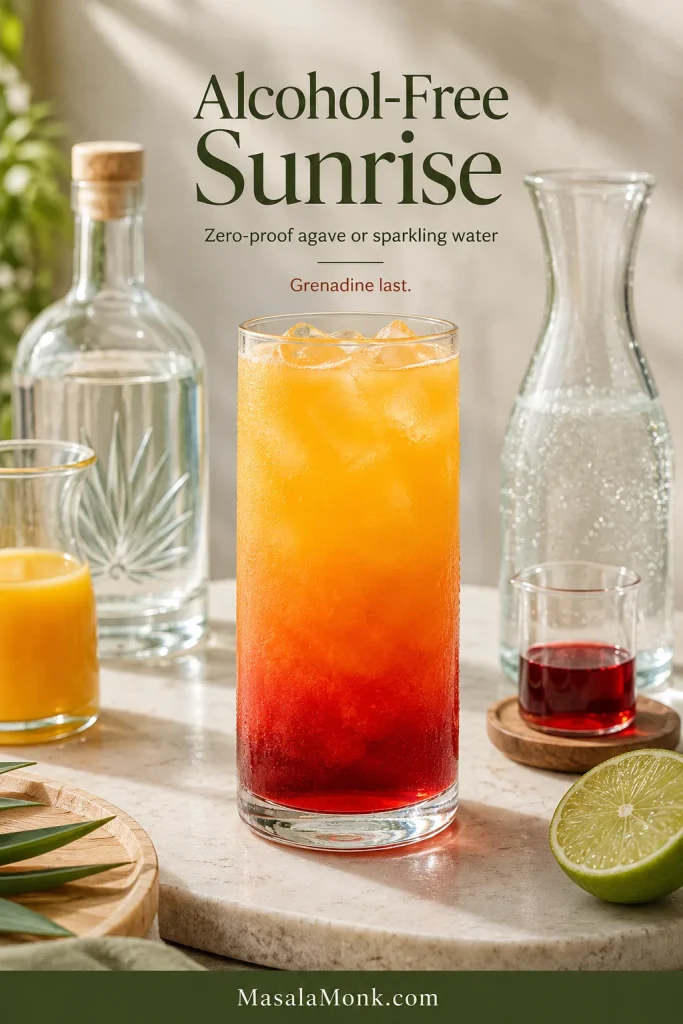
For an alcohol-free version, replace the tequila with 2 oz / 60 ml zero-proof agave spirit for the most cocktail-like result, or use chilled sparkling water for a lighter drink. Add 4 oz / 120 ml orange juice and a small grenadine pour. When using sparkling water, 1–2 teaspoons / 5–10 ml fresh lime juice can keep the drink from tasting too soft or sweet.
Other ways to change the drink
- Spicy: Let one paper-thin jalapeño slice sit in the measured tequila for about 30 seconds, then taste and remove it. Give it a few more seconds only if you want more heat.
- Frozen: Treat it as a separate slushy recipe because blended ice changes the dilution. Expect grenadine marbling rather than a tall red-to-orange fade.
- Vodka Sunrise: Replace tequila with the same amount of vodka for a cleaner, more neutral drink where orange and grenadine lead.
- Tequila Sunset: The name is not standardized. Some versions use blackberry brandy or crème de cassis; others use grapefruit juice or a dark spirit float.
Back to recipe ↑ · Back to top ↑
Modern vs “Original” Tequila Sunrise
The history is not perfectly settled, and more than one early formulation has been documented. Most people now recognize the orange-juice-and-grenadine drink as the modern Tequila Sunrise and the version made here. For a standardized reference, the International Bartenders Association lists the modern formula (opens in a new tab).
A documented earlier version uses tequila, lime, grenadine, crème de cassis and soda water, with no orange juice. Lime and soda make it sharper and drier, while cassis adds a darker berry note. Difford’s Guide documents a reconstruction of that earlier drink (opens in a new tab).
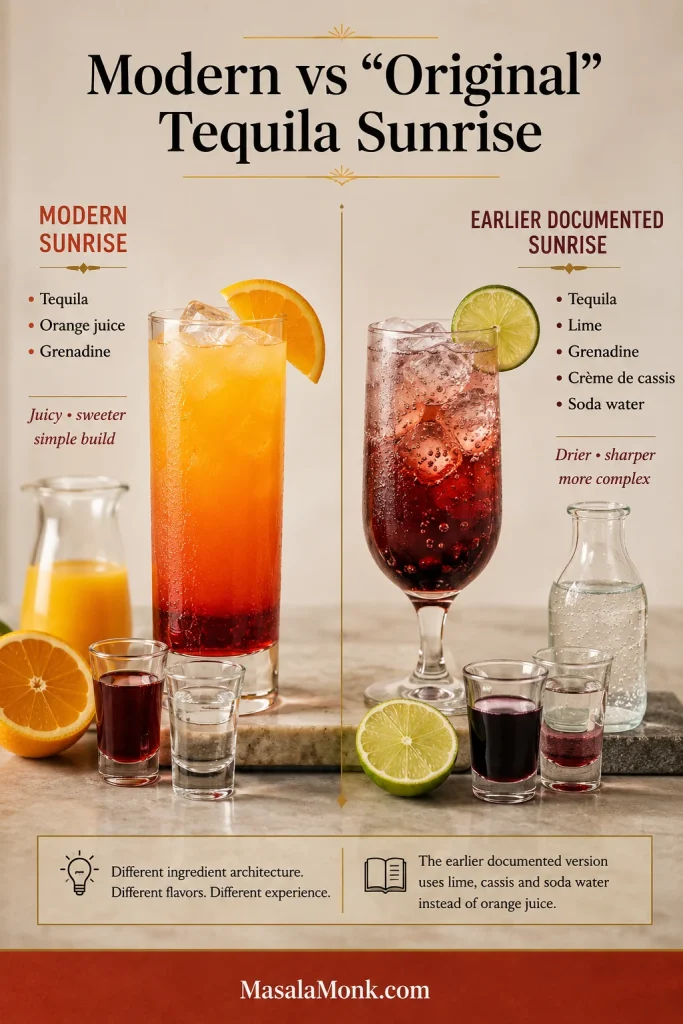
Modern three-ingredient version
- Tequila, orange juice and grenadine
- Sweet, juicy and visually simple
- Easy build in a tall glass
Earlier documented version
- Tequila, lime, grenadine, crème de cassis and soda water
- Brighter, drier and more spirit-forward
- A more complex mixed drink
Online recipes often use “classic,” “traditional” and “original” loosely. Check the ingredient list rather than trusting the label alone.
Frequently Asked Questions
Does it contain triple sec?
Not in the standard three-ingredient version. Some modern recipes add triple sec or another orange liqueur, but that makes the drink sweeter and more complex. Tequila, orange juice and grenadine are enough for the modern Sunrise made here.
Can the grenadine go in first?
Yes, but it is easier to disturb when the remaining drink and ice are added. Pouring it last is simpler and more repeatable at home; the layering guide shows the controlled wall and spoon methods.
Is grenadine alcoholic?
Most grenadine is non-alcoholic, but check the label. Liqueur substitutes such as crème de cassis add alcohol and change the drink substantially.
Can bottled orange juice be used?
Yes. Cold pulp-free juice gives the clearest gradient. Fine-strained fresh juice brings brighter aroma when flavor matters more than a perfectly clean fade. For the full trade-off, see fresh versus bottled orange juice.
How strong is it?
With 2 oz / 60 ml of 40% tequila, the drink is roughly 13% ABV before ice dilution and contains about 1⅓ U.S. standard drinks. Juice and syrup can disguise the alcohol, but they do not reduce the amount in the glass.
Why do recipes use different amounts?
Most stay fairly close on tequila and orange juice. Grenadine varies more because brands differ in sweetness, color and thickness; the grenadine amount guide shows the practical range. Begin with the smaller pour, taste, and deepen the next glass only when you want more red and more sweetness.
The Final Pour Is the Whole Trick
A Tequila Sunrise does not need complicated bar technique. It needs cold juice, a measured 1:2 balance and enough restraint to leave the final pour alone.
Let the red settle beneath the orange, bring the glass to the table, and stir only when you are ready to drink it. Three ingredients are enough; the sunrise comes from their order.
Enjoy responsibly. Serve alcoholic drinks only to adults of legal drinking age, and remember that a sweet, juice-forward cocktail can taste milder than its actual alcohol content.








