Posted on Leave a comment

Coconut Shake Recipe: Creamy Tender Coconut Milkshake

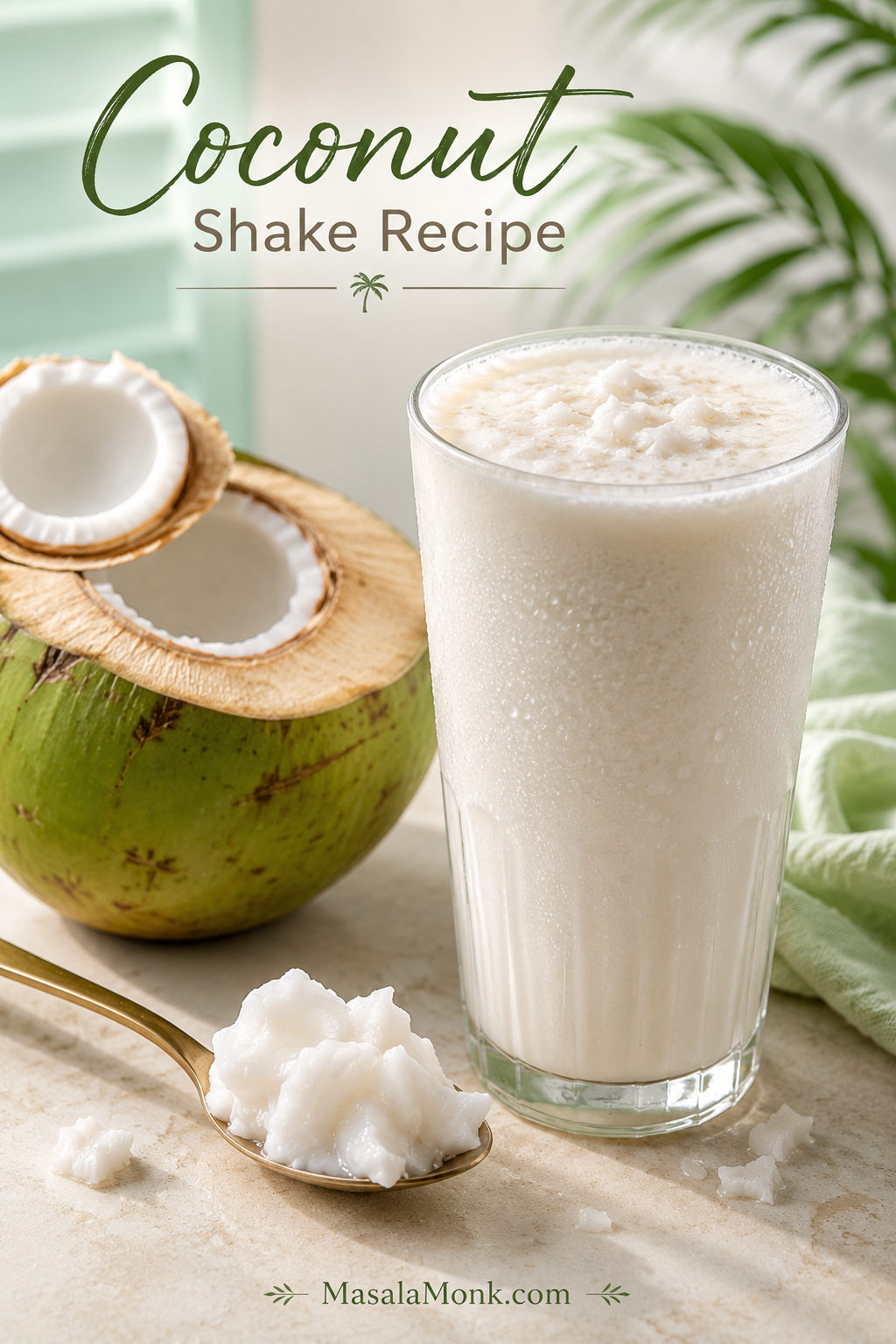
Tall chilled glass of coconut shake with tender coconut malai, coconut water, and an opened young coconut.

A good coconut shake recipe should give you a drink that tastes like opening a fresh tender coconut on a hot day, then turning that freshness into something colder, creamier, and more satisfying. The glass should taste clearly of coconut, feel lightly sweet, sip smoothly, and have enough thickness to feel like a real milkshake without becoming heavy or icy.

This coconut shake recipe starts with the best part of a tender coconut: the soft malai and the naturally sweet coconut water inside. From there, you can keep it light and fresh, make it creamy with chilled milk, or turn it into a dessert-style tender coconut milkshake with vanilla ice cream.

The problem with many coconut shakes is not the idea; it is the balance. Add too much ice and the drink turns watery. Pour in too much milk and the coconut disappears. Extra sugar can make the flavor taste flat instead of clean, while mature coconut can turn the whole glass grainy if it is not blended properly.

Start with the creamy tender coconut milkshake, then use the same base to make it lighter, dairy-free, no-ice-cream, or café-style without losing the fresh coconut taste. You will also find cup, ml, oz, and gram guidance for small 250 ml glasses, tall 16 oz café cups, and 500 ml bottles.

Quick Answer: Best Ratio for 2 Tall Glasses

Best ratio for 2 tall glasses: 1 cup tender coconut malai + ¾ cup coconut water + ¾ cup chilled milk + 1½–2 scoops vanilla ice cream.
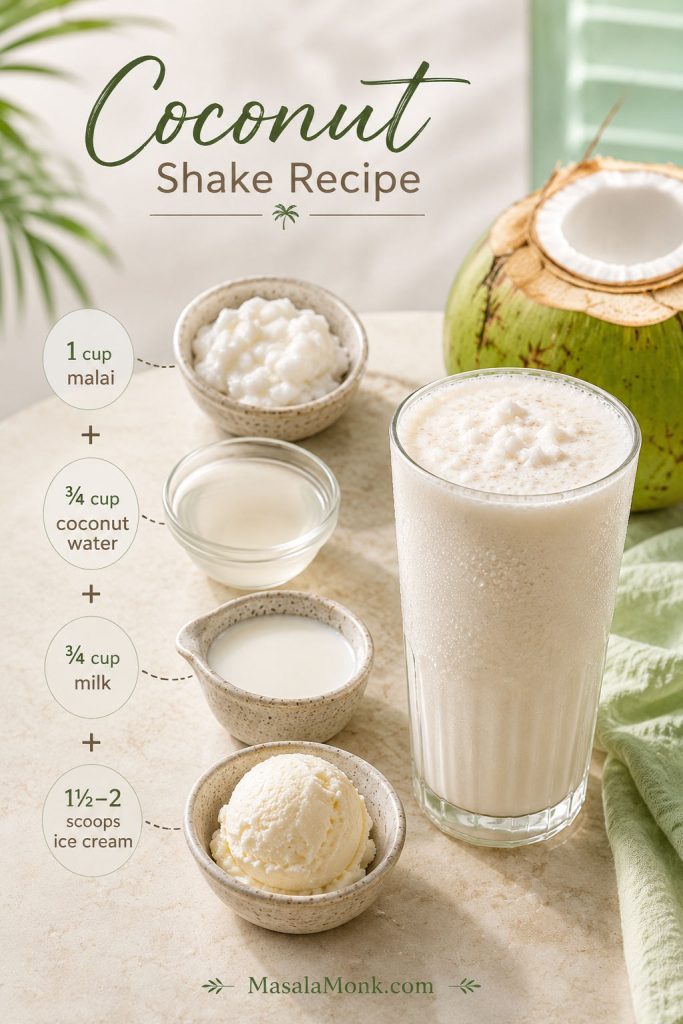
Recipe ratio board showing tender coconut malai, coconut water, chilled milk, vanilla ice cream, and a coconut shake glass.
Use this ratio for two tall glasses. Then adjust coconut water, milk, or ice cream to control texture.

For the creamiest result in this coconut shake recipe, blend the tender coconut flesh with coconut water first, then add chilled milk, ice cream, and sweetener only after tasting. For a lighter homemade glass, jump to the no-ice-cream version; for dairy-free, go to the vegan coconut shake.

This is also a handy recipe when you have already drunk the coconut water and have soft malai left behind. Instead of letting it sit in the fridge until it loses that fresh coconut aroma, blend it into a cold shake while it still tastes delicate and sweet.
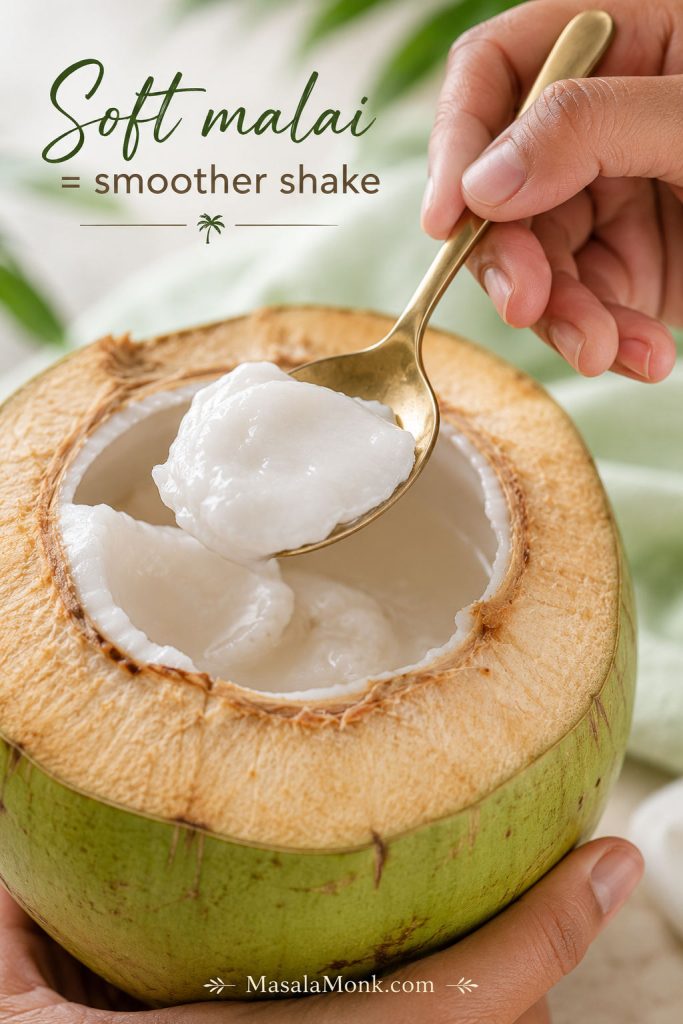
Spoon scooping soft tender coconut malai from a young coconut shell.
Soft, spoonable malai blends more smoothly than firm coconut, so it gives the shake a creamy texture without turning the drink grainy.

The best glass should feel cold from the first sip, but not icy and hollow. It should taste like tender coconut first, then creaminess.

Best coconutTender coconut malai/flesh
Main liquidCoconut water + chilled milk
Creamy versionAdd 1½–2 scoops vanilla ice cream
No-ice-cream versionUse frozen milk cubes or extra malai
Vegan versionUse chilled coconut milk
Prep time10 minutes
Cook time0 minutes
Yield2 tall glasses or 3 small glasses, about 600–750 ml / 20–25 fl oz

What Is Coconut Shake?

Coconut shake is a cold blended drink made with coconut flesh and a chilled liquid such as coconut water, milk, or coconut milk. In many Indian and South Asian kitchens, it usually means a tender coconut milkshake: soft coconut malai blended with tender coconut water, chilled milk, and sometimes ice cream.
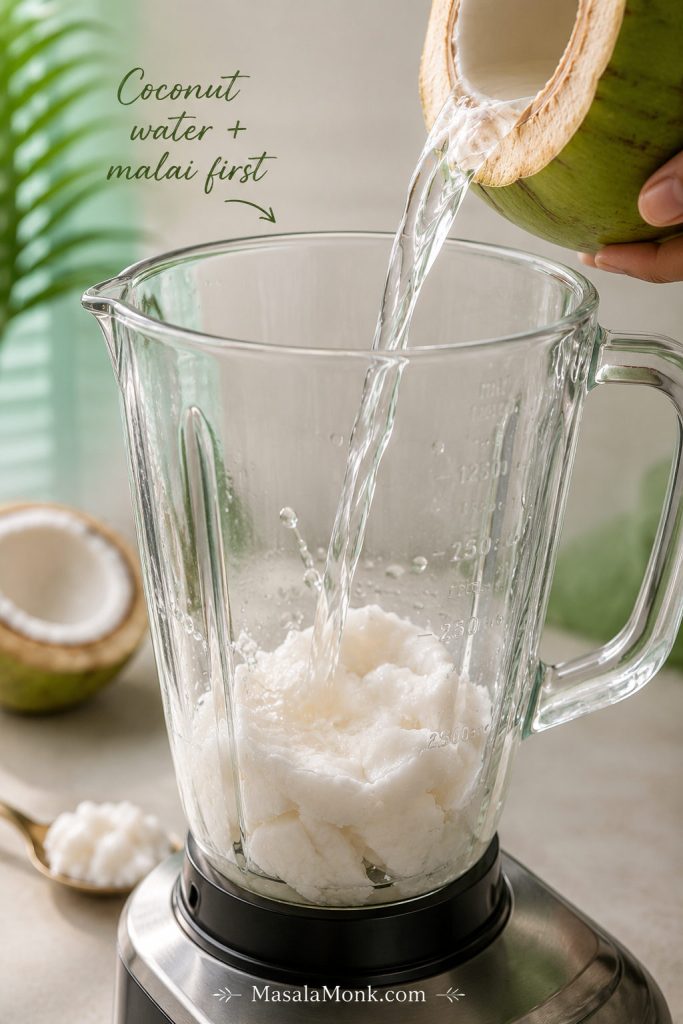
Coconut water being poured into a blender jar filled with tender coconut malai.
Blend coconut water with malai first. The tender coconut breaks down more easily before milk, ice cream, or coconut milk go in.

When coconut is the star, call it a shake. Once coconut milk becomes mostly the base for banana, berries, yogurt, protein powder, or greens, the drink starts behaving more like a smoothie. For fruitier coconut drinks, the flavor variations section covers banana, mango, pineapple, protein, and cardamom ideas.
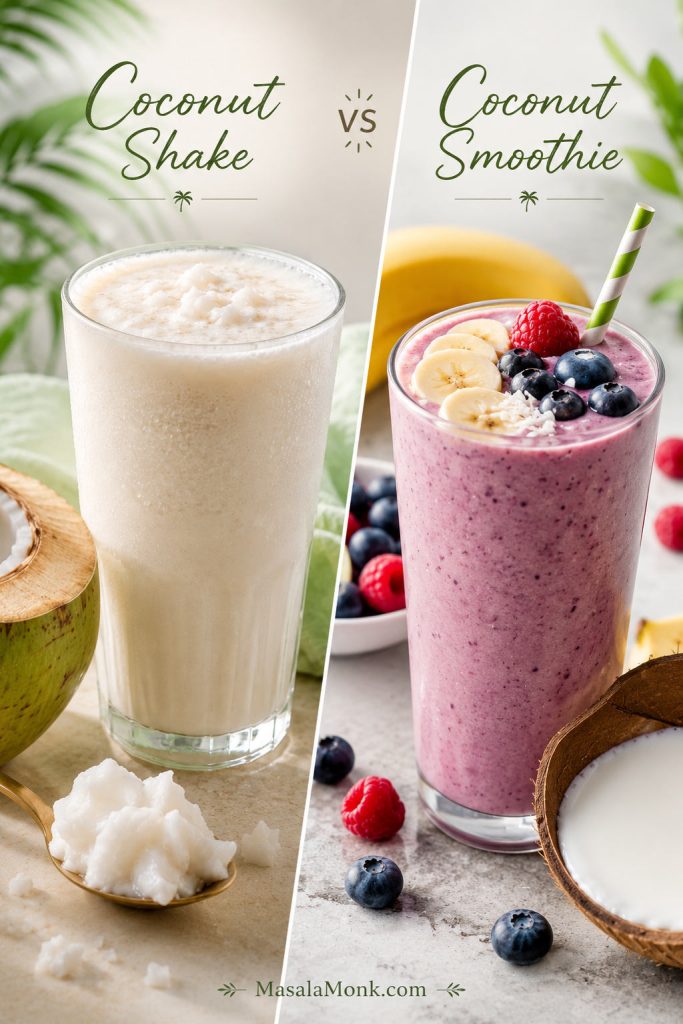
Comparison of a tender coconut shake and a fruit smoothie made with coconut milk.
A coconut shake keeps tender coconut as the main flavor, whereas a coconut smoothie usually uses coconut milk as a base for fruit, protein, or greens.

Coconut water and coconut milk are very different ingredients: coconut water is the clear liquid inside young coconuts, while coconut milk is made from coconut flesh and water. For more on using coconut water in drinks, read our guide to coconut water.

If plain coconut water feels too light and a full ice-cream milkshake feels too heavy, coconut shake sits right in the middle: fresh first, creamy second.

Why This Recipe Works

This is not just a matter of blending coconut and milk. Order, temperature, and balance all matter. The method below keeps coconut in front and creaminess in the background, so the shake tastes full without losing its fresh tender-coconut character.

  • Blending the malai with coconut water first helps the coconut break down before milk and ice cream make the jar heavier.
  • Chilled liquids reduce the need for ice, so the shake stays creamy instead of diluted.
  • Sweetening after tasting keeps the drink balanced when the coconut water is already naturally sweet.
  • Ice cream or frozen milk thickens without hollowing out the flavor, while plain ice mostly adds coldness and dilution. To get that thickness without ice cream, use the no-ice-cream formula instead of adding more plain ice.
  • A short final blend protects the chill, because overblending warms the shake and loosens the texture.

The core idea: Keep coconut water and malai in charge, then add only enough milk, coconut milk, ice cream, or frozen milk to match the glass you want.
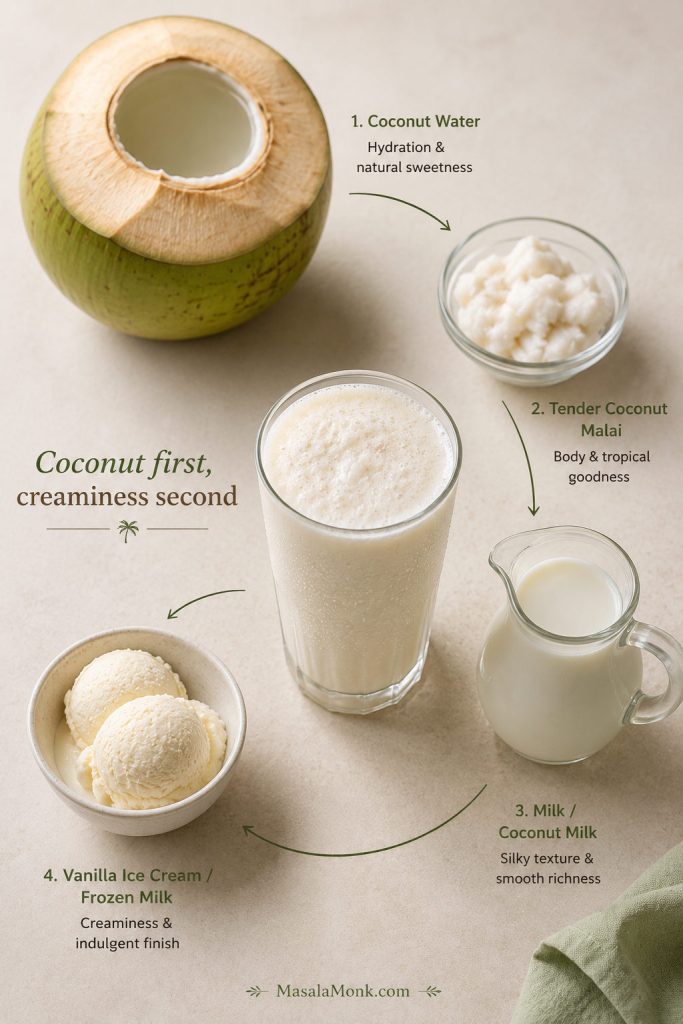
Circular ingredient guide showing coconut water, malai, milk, ice cream, and a finished coconut shake.
Keep coconut water and malai in charge first; then use milk, coconut milk, ice cream, or frozen milk to shape the final glass.

Ingredients That Matter

The ingredient list is short, but the balance matters. Start with fresh malai and coconut water, then decide how rich you want the glass to be. Milk, ice cream, coconut milk, frozen milk, and sweetener are all adjustable; the coconut should stay in charge.
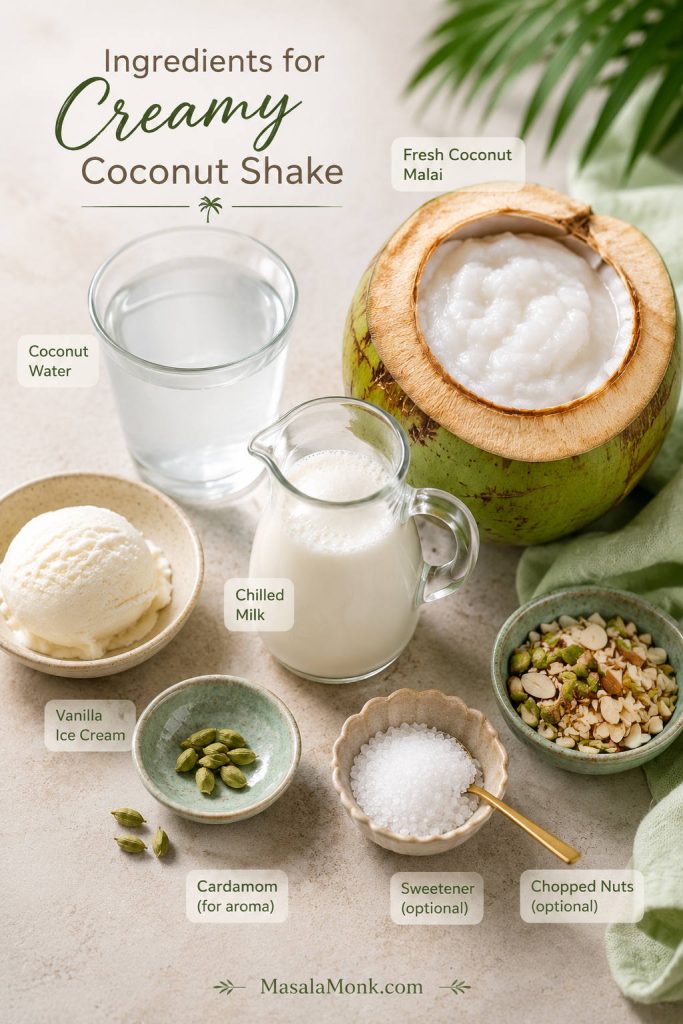
Ingredients for coconut shake including tender coconut malai, coconut water, milk, vanilla ice cream, cardamom, sweetener, and nuts.
Think of the ingredients as texture controls. Malai carries the coconut flavor, chilled liquid keeps it fresh, and ice cream or frozen milk decides thickness.
IngredientAmount for 2 tall glassesWhy it matters
Tender coconut flesh / malai1 cup / about 80–120 gCreates the soft, pulpy coconut base.
Tender coconut water¾–1 cup / 180–240 ml / 6–8 fl ozKeeps the shake light and unmistakably tender-coconut flavored.
Chilled milk¾–1 cup / 180–240 ml / 6–8 fl ozRounds the texture into milkshake territory.
Vanilla ice cream1½–2 scoops / about 90–130 gOptional, but gives dessert-style thickness and sweetness.
Sugar, honey, or dates1–2 tbsp, or to tasteUse only if the coconut water is not sweet enough.
Cardamom or vanilla⅛ tsp cardamom or ½ tsp vanillaAdds aroma without hiding the coconut.
Ice cubes2–4, only if neededChills the shake; use more only for a café-style icy version.
Chopped pistachios, almonds, or coconut bits1–2 tbsp, optionalAdds small bites that make the glass feel freshly blended.

Ingredient Measurement Notes

Measurement note: Tender coconut malai is not as predictable as flour, sugar, or mature grated coconut. Very soft malai can be watery and delicate, while firmer tender coconut flesh weighs more per cup. That is why this recipe gives a practical range of 80–120 g per cup instead of pretending every tender coconut measures the same.

Quick coconut note: Tender coconut is best here because the soft malai blends smoothly and the coconut water gives fresh aroma. If you are using mature coconut or only coconut milk, see which coconut works best so the drink does not turn grainy or too heavy.

Coconut Shake Recipe: Creamy Tender Coconut Milkshake

Classic texture cue: Make the creamy tender coconut milkshake first so you know the target balance before changing the recipe for no-ice-cream, vegan, or lighter versions.
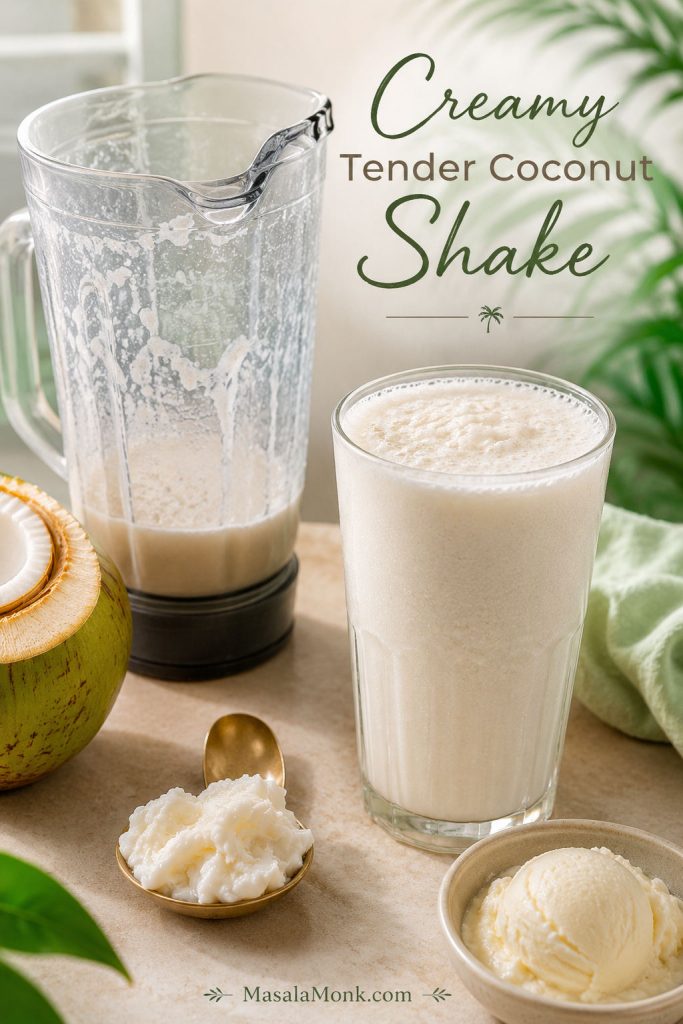
Creamy tender coconut shake in a glass beside a blender jar, malai, coconut water, and vanilla ice cream.
Make the classic tender coconut milkshake first so you know the balance: soft malai, cold coconut water, chilled milk, and optional vanilla ice cream.

Creamy Tender Coconut Shake

This is the coconut shake recipe to make first: soft malai, coconut water, chilled milk, and optional vanilla ice cream blended into a cold, drinkable tender coconut milkshake. It makes about 600–750 ml, depending on the amount of malai and ice cream, which is enough for 2 tall glasses or 3 smaller home glasses.

Prep Time10 minutes
Cook Time0 minutes
Total Time10 minutes
Yield2 tall glasses or 3 small glasses

Total quantity: About 600–750 ml / 20–25 fl oz, depending on the amount of malai and ice cream

Equipment: Blender, mixer-grinder, or high-speed blender; measuring cup; tablespoon; chilled serving glasses.

Ingredients

  • 1 cup tender coconut flesh/malai, about 80–120 g
  • ¾ cup tender coconut water, 180 ml / 6 fl oz, plus more if needed
  • ¾ cup chilled milk, 180 ml / 6 fl oz
  • 1½–2 scoops vanilla ice cream, about 90–130 g, optional but recommended for the creamy version
  • 1 tbsp sugar, honey, or date syrup, optional
  • ⅛ tsp cardamom powder or ½ tsp vanilla extract
  • 2–4 ice cubes, only if the ingredients are not already very cold; use more only for a café-style icy shake
  • 1 tbsp chopped pistachios, almonds, or tender coconut bits, optional

Method

  1. Chill the ingredients. Cold coconut water, cold milk, and chilled glasses give a better shake than a blender full of ice.
  2. Blend the coconut first. Add tender coconut flesh and coconut water to the blender. Blend for 20–30 seconds, until the malai breaks down and the mixture looks slightly cloudy and pulpy.
  3. Add the creamy ingredients. Add chilled milk, vanilla ice cream, cardamom or vanilla, and only a little sweetener.
  4. Blend briefly. Blend for 15–20 seconds, just until the shake looks creamy and moves as one smooth liquid in the blender. Do not overblend after adding ice cream.
  5. Taste and adjust. Add a little more sugar, honey, or date syrup only if the shake needs sweetness. If it is too thick, add coconut water 1–2 tbsp at a time.
  6. Add ice only if needed. Add a few ice cubes and pulse briefly if the shake is not cold enough. Use more ice only when you want a café-style icy shake.
  7. Pour and finish. Pour while the top is still cold and lightly frothy. Garnish with chopped nuts or a few tiny tender coconut bits if you like a little texture.

Recipe Notes

  • Best texture cue: The shake should pour easily but coat the glass lightly.
  • Sweetness cue: Taste before adding sugar because fresh coconut water can already be sweet.
  • No-ice-cream cue: Replace ice cream with ½ cup frozen milk cubes for a lighter but still creamy version.
  • Blending cue: After adding ice cream or frozen milk, blend only until creamy so the shake stays cold and thick.

Visual Method Cues

Chill cue: Cold ingredients protect the texture before the blender even starts.
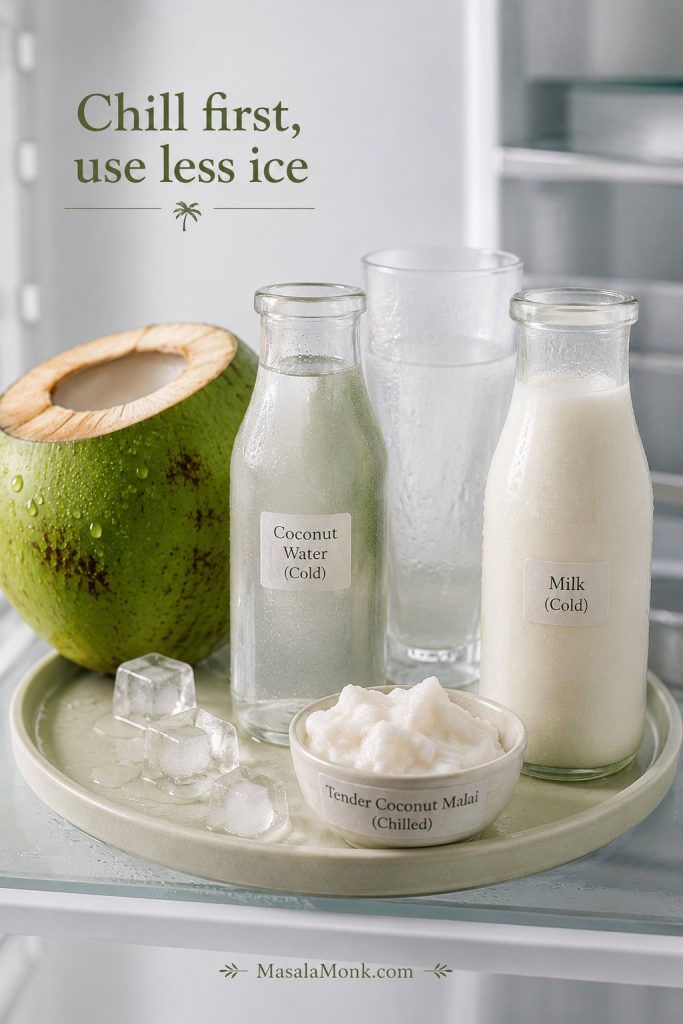
Chilled coconut water, milk, glasses, and tender coconut malai prepared for making coconut shake.
Cold ingredients do more than chill the drink: they protect the creamy texture, so you can use less plain ice and avoid a watery shake.

Blending cue: The coconut water and malai should move together before the heavier ingredients go in.
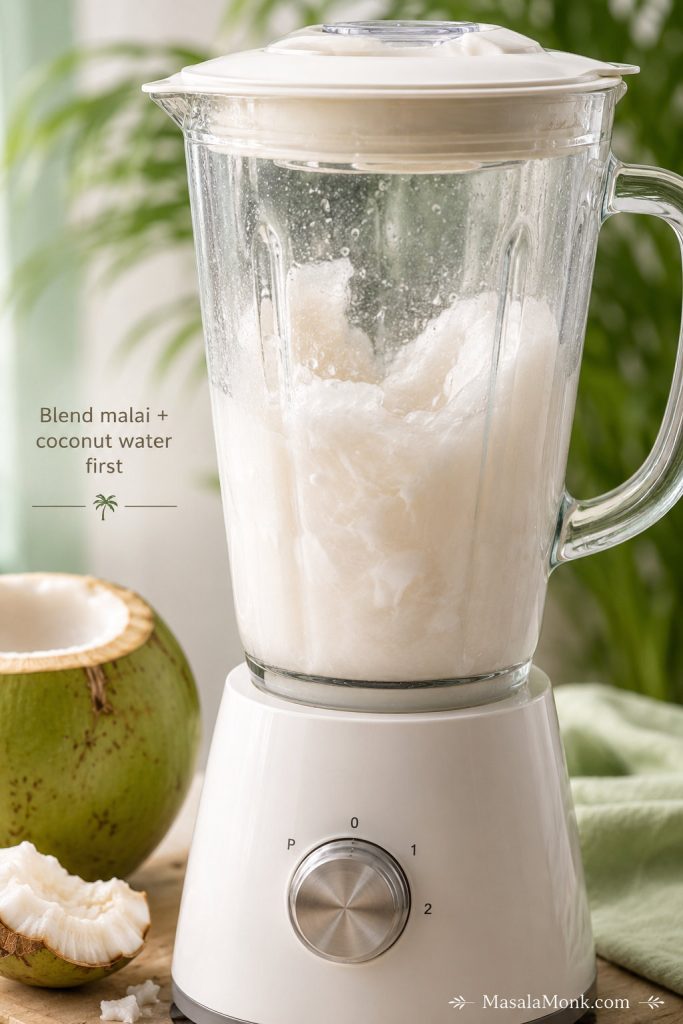
Blender jar with tender coconut malai and coconut water blended into a cloudy, pulpy base.
Once the malai and coconut water move smoothly together, the base is ready for milk, ice cream, or dairy-free coconut milk.

Creamy ingredient cue: Milk and ice cream work best after the coconut base is already loose and blended.
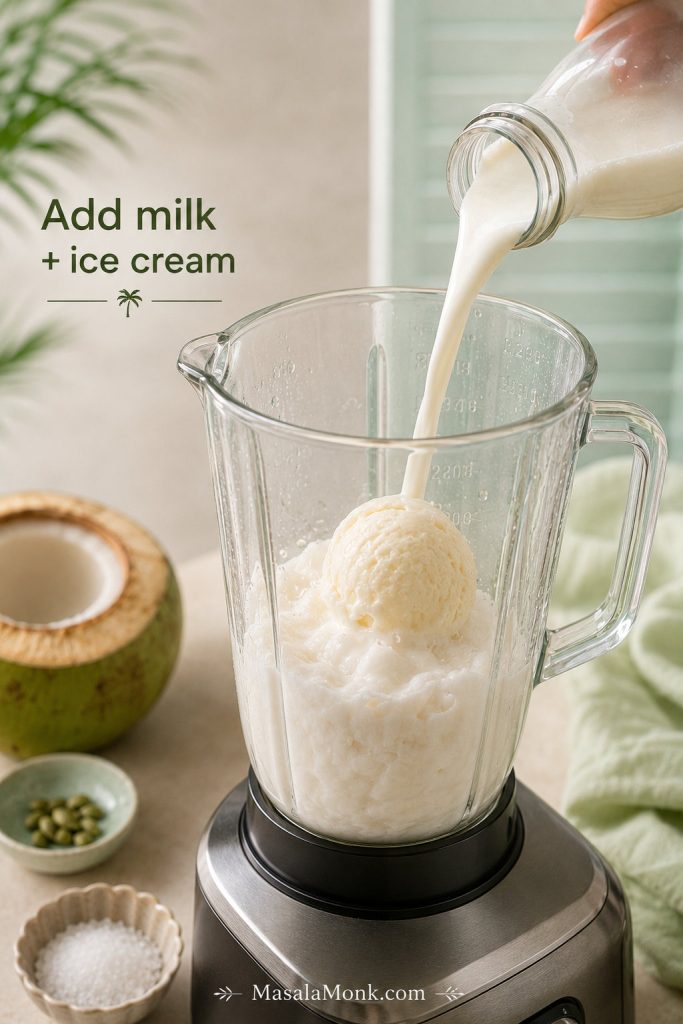
Chilled milk being poured into a blender with tender coconut base and a scoop of vanilla ice cream.
Add milk and ice cream after the coconut base is moving smoothly; otherwise, the blender can struggle before the malai breaks down.

Pouring cue: The best time to serve is when the shake still looks cold, smooth, and lightly frothy.
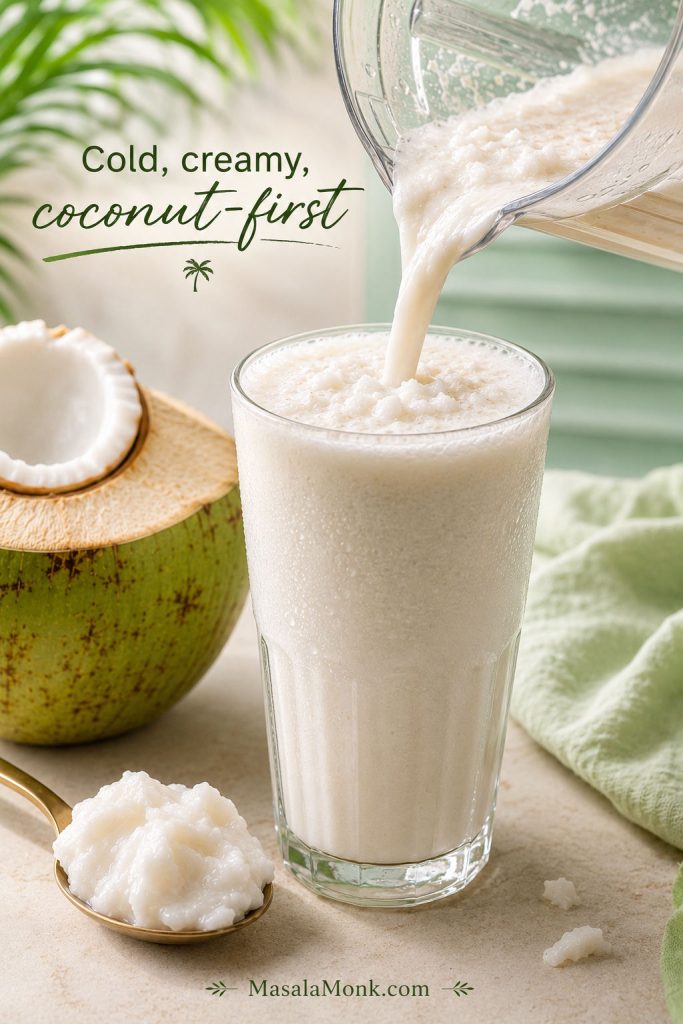
Creamy coconut shake being poured from a blender into a tall glass with light froth.
Pour as soon as the shake looks cold and lightly frothy. At this point, it should coat the glass without feeling heavy.

If your shake turns watery, grainy, too sweet, or too thick, use the troubleshooting table before changing the whole recipe.

You will know this coconut shake is right when it pours smoothly, smells like fresh coconut water, and tastes creamy without losing that tender coconut freshness.

Tender Coconut, Mature Coconut, or Coconut Milk: What Works Best?

Tender coconut gives the best flavor and texture, but the recipe can still work if you only have mature coconut, coconut milk, or coconut cream. The key is knowing what each option changes.
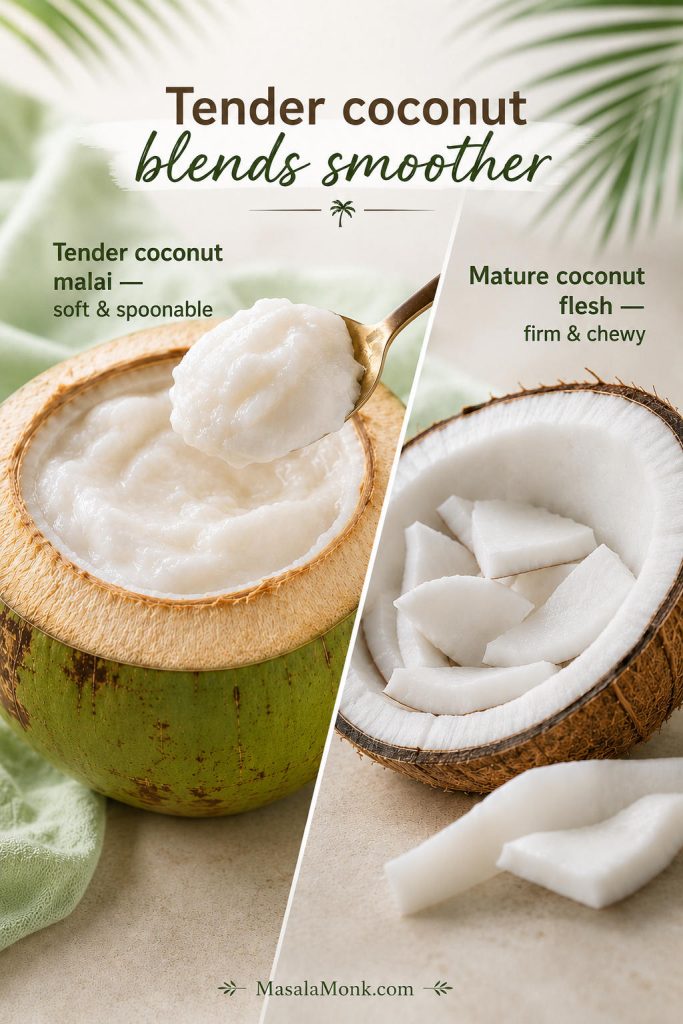
Comparison of soft tender coconut malai and firm mature coconut flesh for making coconut shake.
Tender coconut malai is soft and spoonable, while mature coconut flesh is firmer; therefore, mature coconut may need chopping, longer blending, or straining.

The best malai for this shake should be soft enough to scoop with a spoon. Very soft malai bends, tears, or slips easily, which helps it blend into a smoother drink. Chewy coconut can still work, but chop it small and expect a more pulpy finish.
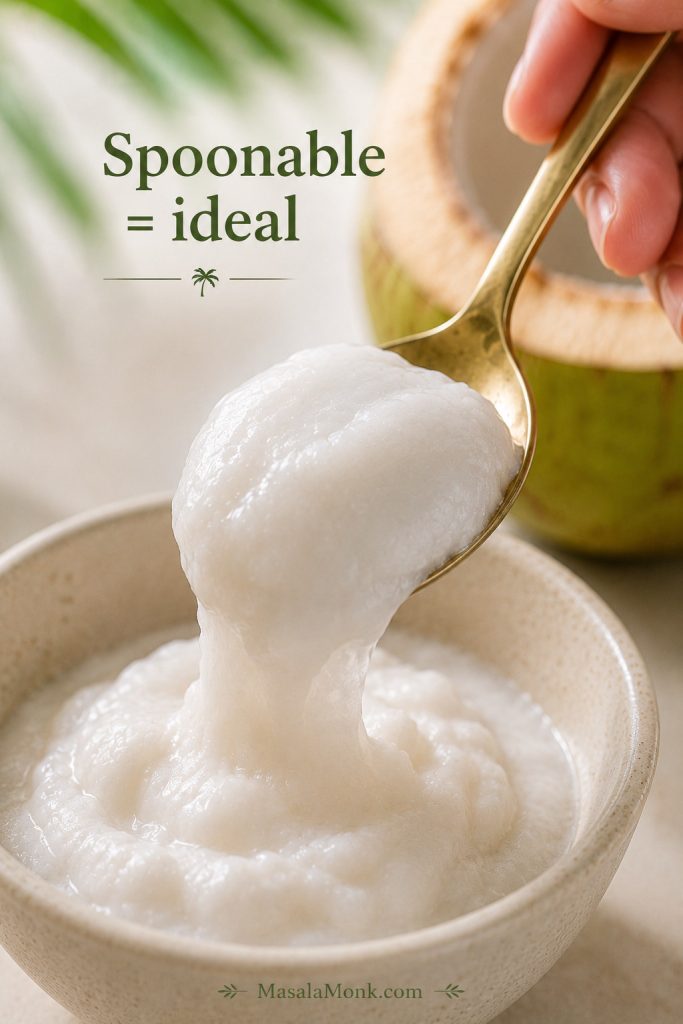
Spoon lifting soft tender coconut malai to show the ideal texture for blending.
A quick spoon test tells you what to expect: soft malai blends smoothly, while firmer coconut needs smaller pieces, longer blending, or straining.

For an outside ingredient comparison, this coconut milk vs coconut water guide explains why coconut water keeps drinks light while coconut milk adds body.

  • Tender coconut / young coconut is the best choice because the malai blends soft and the water adds fresh coconut aroma.
  • Mature fresh coconut is usable in a pinch, but it is firmer and more likely to turn grainy. Grate it finely, blend it longer with coconut water, and strain if needed.
  • Coconut milk is the easiest dairy-free route, but it should support the tender coconut rather than replace it completely when fresh malai is available.
  • Coconut cream makes the shake very thick and rich, so a little goes a long way. Use it when you want a dessert-style vegan shake.

What Should Coconut Shake Taste Like?

A well-made coconut shake should taste cold before it tastes sweet, and like coconut before it tastes like milk. It should sip smoothly through a straw, with just enough thickness to coat the glass lightly. A few tiny malai bits are welcome; grit is not.
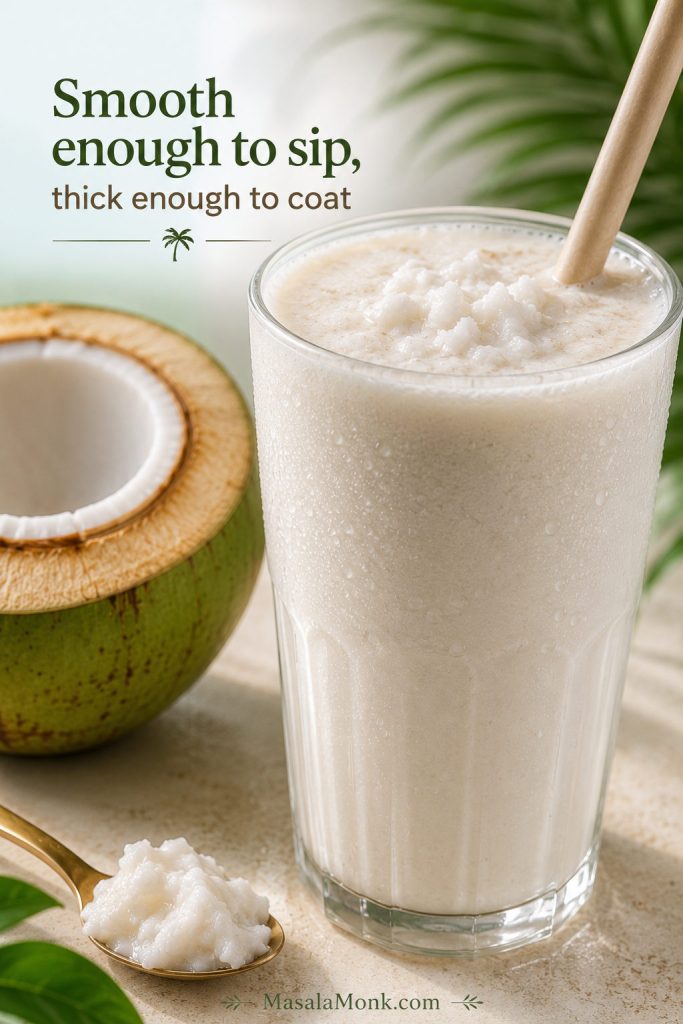
Close-up of coconut shake with a straw, lightly coated glass wall, froth, and tiny malai bits.
The right texture should sip through a straw and lightly coat the glass; if it feels gritty, heavy, or hollow, the balance needs adjusting.

A glass that tastes like melted vanilla ice cream with coconut hiding in the background needs less dairy next time. When the first sip tastes mostly like milk, the coconut ratio is too low. A cold but empty-tasting shake usually has too much ice. For flat flavor, use fresher coconut water, a pinch of cardamom or vanilla, and just a tiny pinch of salt.

Choose Your Style Before You Blend

The easiest way to avoid a disappointing shake is to choose the style before you blend. A café-style shake, a no-ice-cream homemade shake, and a fresh coconut-water shake use similar ingredients, but they should not taste the same.
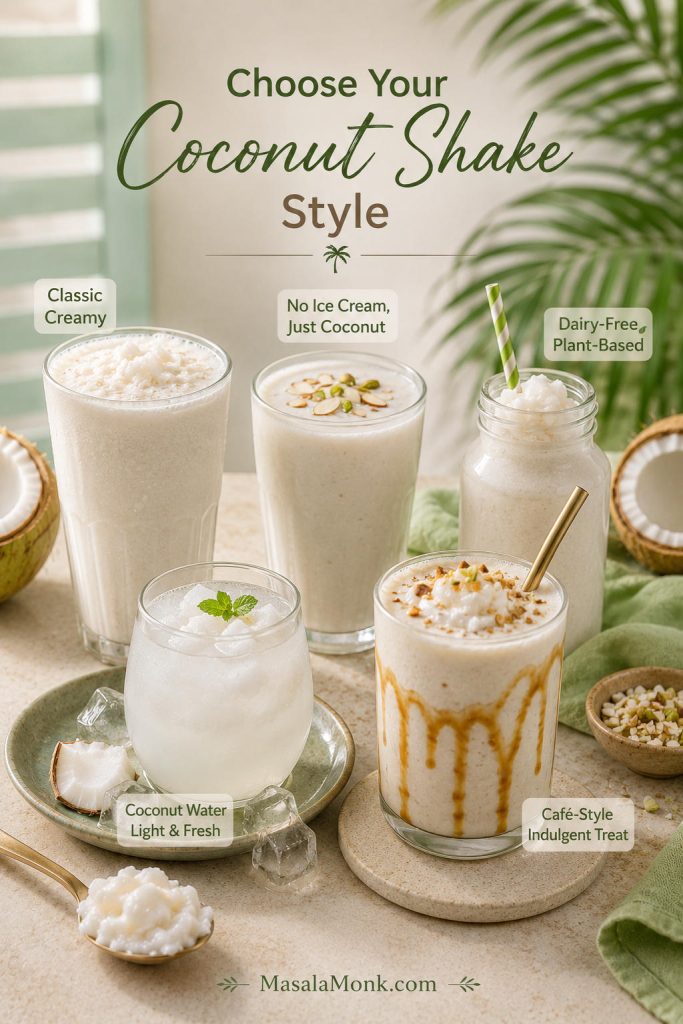
Five coconut shake styles arranged together: classic creamy, no ice cream, dairy-free, coconut water, and café-style.
Choose the style before you blend: café-style needs cold pulpy richness, while coconut water and no-ice-cream versions need a lighter balance.
You want…Make this versionUse this base
A creamy café-style shakeMain recipe with ice creamTender coconut + coconut water + milk + ice cream
A homemade shake without ice creamFrozen milk versionTender coconut + coconut water + milk + frozen milk cubes
A dairy-free coconut shakeVegan coconut shakeTender coconut + coconut water + coconut milk
No milk and no added sugarFresh coconut water shakeCoconut water + malai + optional dates
A lighter summer drinkCoconut water shakeCoconut water + tender coconut + optional yoghurt or coconut milk
A 500 ml bottleScaled bottle versionUse the measurement table and leave headspace
A thicker smoothie-like drinkBanana or extra-malai variationAdd frozen banana or more tender coconut flesh

Without Ice Cream

No ice cream does not mean thin or boring. The trick is to replace the cold thickness ice cream gives, not just its sweetness. Frozen milk cubes, extra malai, soaked cashews, coconut cream, or frozen banana can all make the shake feel full instead of thin.
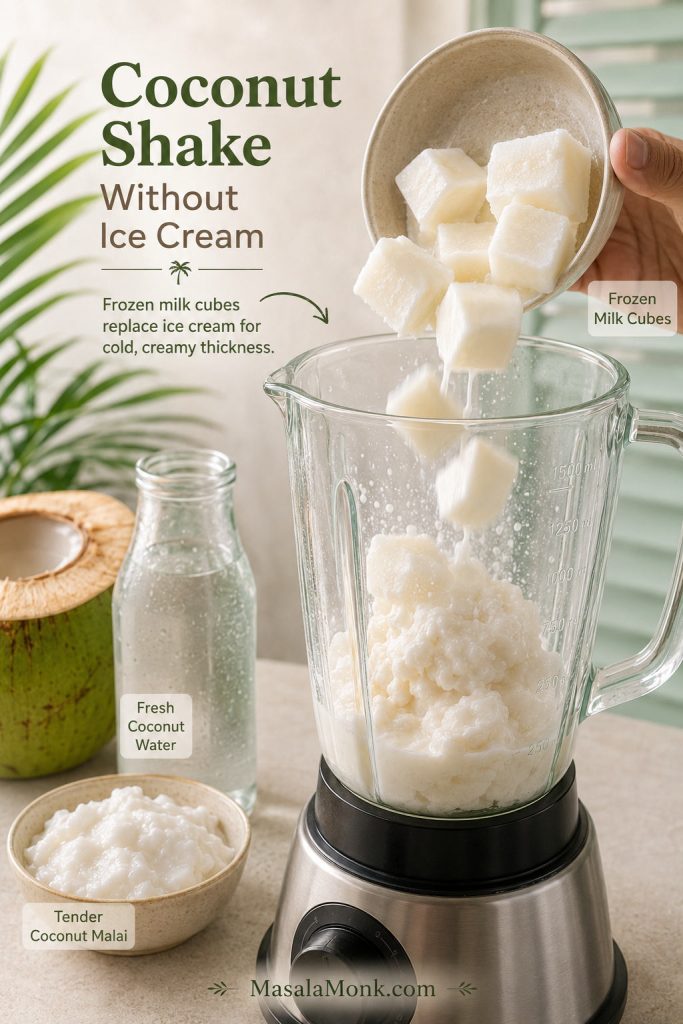
Frozen milk cubes being added to a blender with tender coconut malai and coconut water for a no-ice-cream coconut shake.
Frozen milk cubes replace the cold thickness that ice cream gives, so the shake stays creamy without turning into a dessert-style milkshake.

This version is for the days when you want homemade creaminess, not dessert. It feels lighter than the ice-cream shake but still has enough richness to taste deliberate.

No-Ice-Cream Formula

  • 1 cup tender coconut flesh/malai, about 80–120 g
  • ¾ cup tender coconut water, 180 ml
  • ½ cup chilled milk, 120 ml
  • ½ cup frozen milk cubes
  • 1–2 tbsp sugar, honey, date syrup, or 1–2 soft dates
  • Pinch of cardamom or ½ tsp vanilla

Blend the tender coconut and coconut water first. Add chilled milk, frozen milk cubes, sweetener, and cardamom. Blend briefly until creamy and serve immediately.

Texture cue: When you skip ice cream, the thickener matters more than extra ice because it decides whether the drink feels creamy, rich, or smoothie-like.
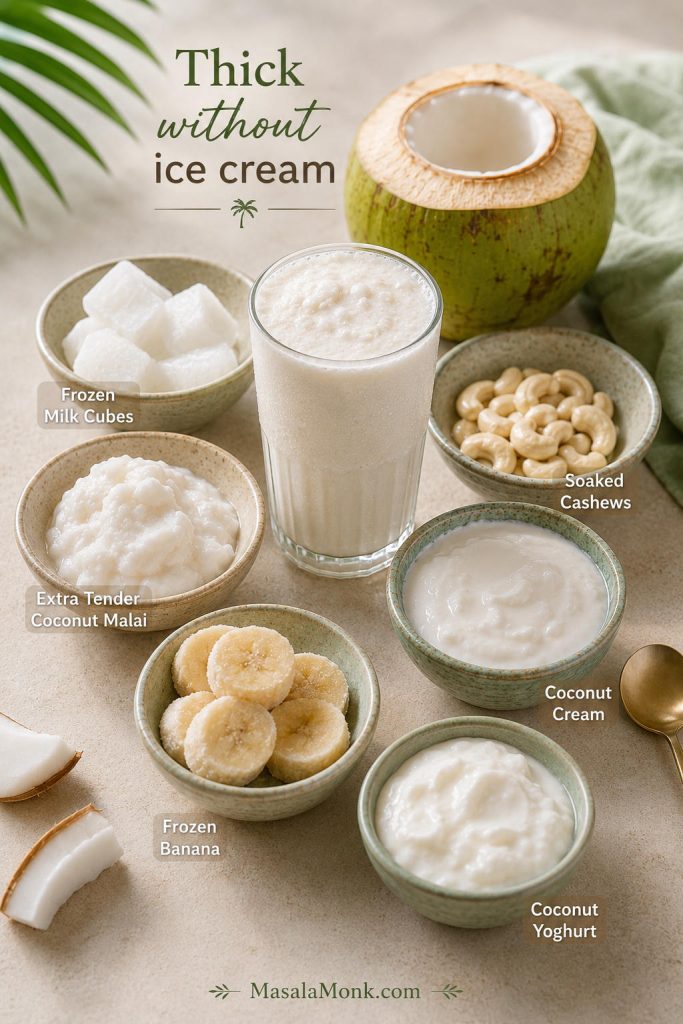
Thickener board with frozen milk cubes, malai, soaked cashews, coconut cream, frozen banana, coconut yoghurt, and coconut shake.
Without ice cream, choose the thickener by texture: frozen milk keeps it classic, cashews add richness, and banana makes it more smoothie-like.
ThickenerBest forAmount for 2 tall glasses
Frozen milk cubesClassic no-ice-cream shake½ cup
Extra tender coconut malaiMore coconut flavor¼ cup extra
Soaked cashewsRich Indian café texture1–2 tbsp
Coconut creamThick vegan shake2–4 tbsp
Frozen bananaDairy-free body½ banana
Coconut yoghurtLight tangy version2–3 tbsp

For a lighter drink, use fewer frozen milk cubes and more coconut water. To make it richer, add soaked cashews or a spoon of cream. Cold ingredients matter more here than extra ice, because frozen milk gives body while plain ice mostly dilutes.

Without Milk or Added Sugar

This is the cleanest version, but also the least forgiving. Because there is no milk, ice cream, or sugar to cover anything, the coconut itself has to taste good. When the coconut water is sweet and the malai is soft, the result is light, cold, and beautifully fresh.
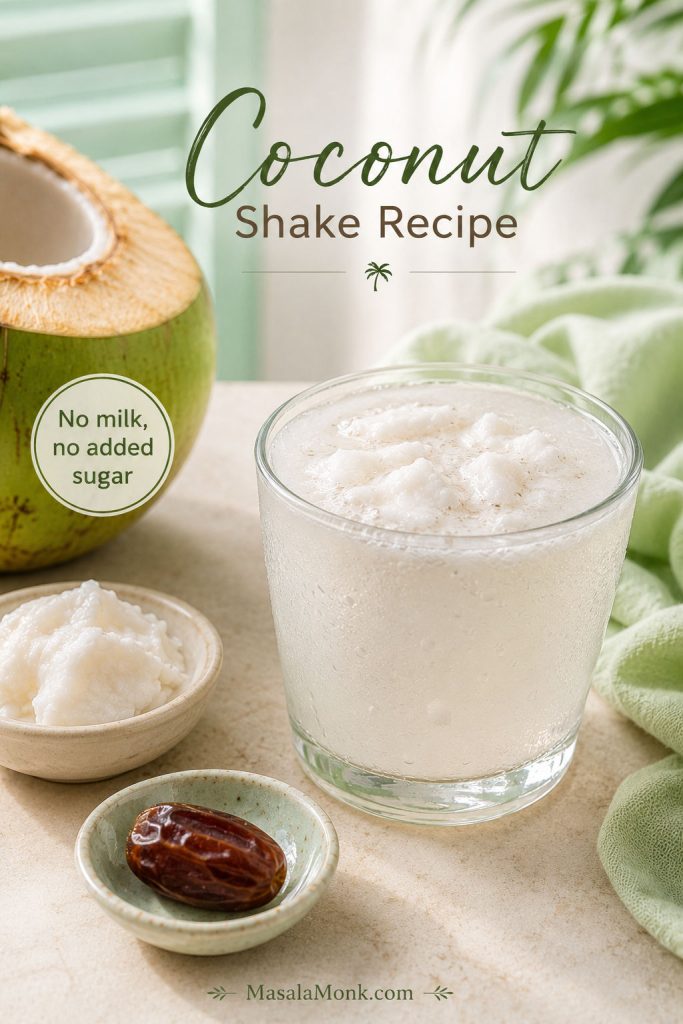
Light coconut shake made with coconut water, tender coconut malai, and an optional date, without milk or sugar.
This no-milk, no-added-sugar coconut shake works best when the coconut water is naturally sweet and the malai is soft enough to blend.
  • 1 cup tender coconut water, 240 ml / 8 fl oz
  • ¾–1 cup tender coconut flesh, about 80–120 g
  • 4–5 ice cubes, or use chilled coconut water instead
  • 1–2 soft dates, optional
  • Pinch of cardamom, optional

Blend the coconut water and tender coconut flesh until smooth. Add ice only if needed and pulse briefly. If the shake tastes flat, add one soft date or a tiny pinch of salt. Do not add sugar automatically; taste the coconut water first.

This version depends on the coconut more than any other. If the coconut water is sweet and the malai is soft, it tastes fresh and delicate. If the coconut is bland, add one date, a spoon of coconut cream, or a few frozen coconut-water cubes to give it more body without turning it into the rich ice-cream version.

Dairy-Free Version with Coconut Milk

For a vegan coconut shake, replace dairy milk with chilled coconut milk while keeping tender coconut at the center. Carton coconut milk keeps the drink lighter, canned coconut milk gives it more milkshake body, and coconut cream is the richest option, so treat it like a thickener rather than the main liquid.
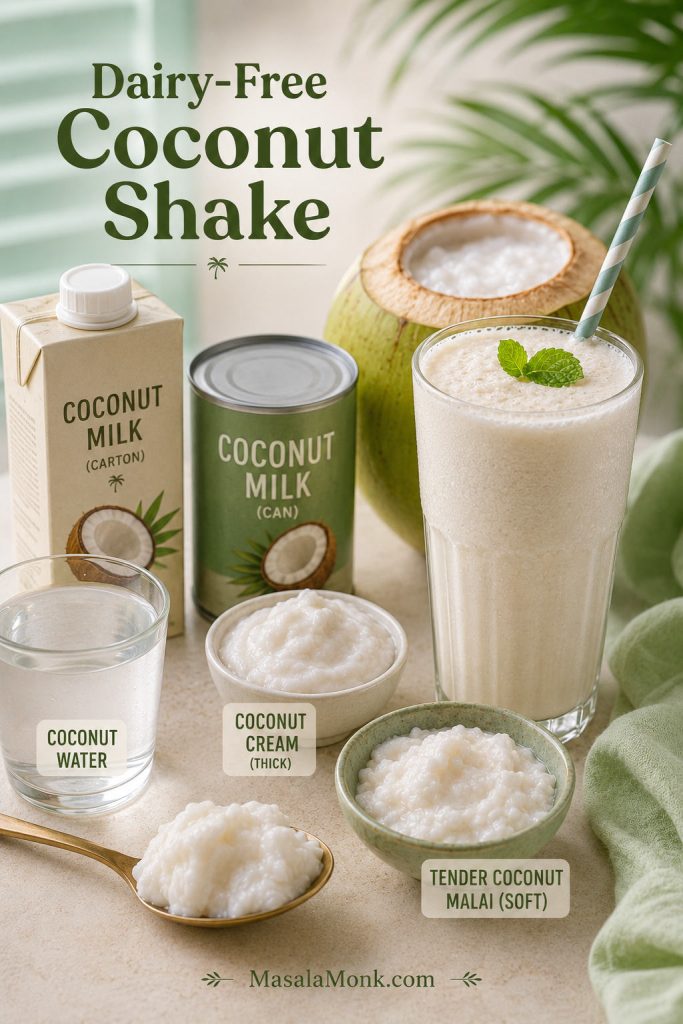
Dairy-free coconut shake with coconut milk options, coconut cream, tender coconut malai, and coconut water.
Carton coconut milk keeps a vegan coconut shake light, canned coconut milk adds body, and coconut cream makes it richer fast.
  • 1 cup tender coconut flesh/malai
  • ¾ cup tender coconut water
  • ¾ cup chilled coconut milk
  • 1–2 dates or 1 tbsp maple syrup, optional
  • ½ frozen banana or 2 tbsp coconut cream, optional for thickness
  • Pinch of cardamom or ½ tsp vanilla

Start with a smaller amount if you use canned coconut milk, then thin the shake with coconut water. Carton coconut milk may need frozen banana, extra malai, or a little coconut cream to get a thicker result. Keep tasting as you adjust; the drink should still feel fresh and coconut-forward, not like a heavy smoothie that has lost the tender coconut flavor.

The Lighter Coconut Water Version

A coconut water shake is lighter than a coconut milkshake, but it is not the lesser version. Make it when the coconut water is sweet, the malai is soft, and you want the drink to stay refreshing instead of rich.
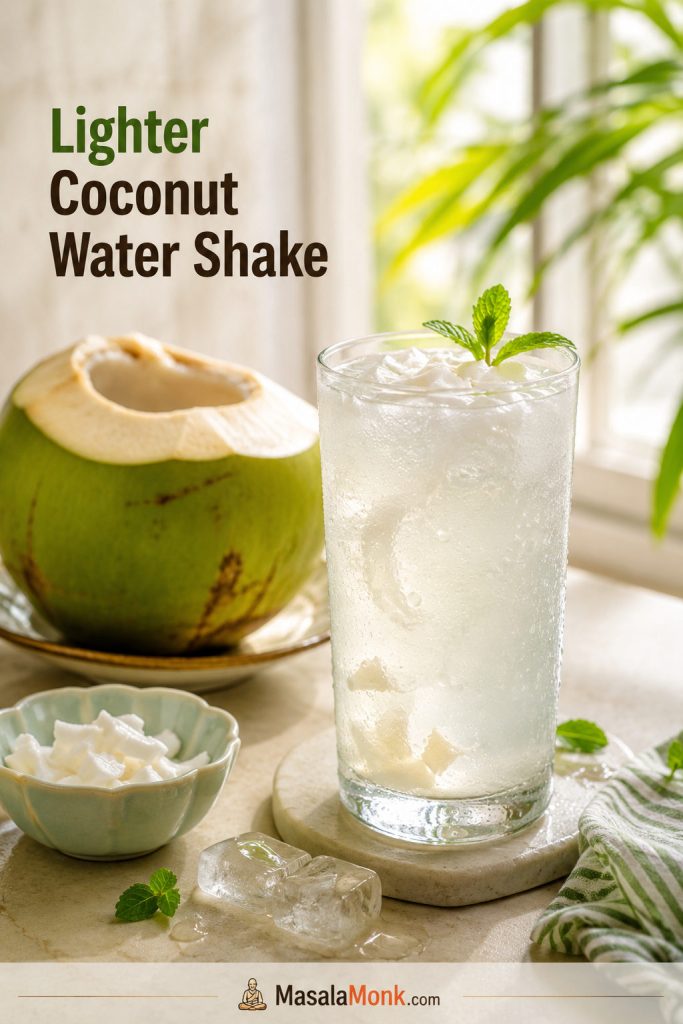
Lighter coconut water shake in a tall chilled glass with tender coconut malai and an opened young coconut.
The lighter coconut water version is not a compromise; instead, it lets sweet coconut water and soft malai taste clean, cold, and easy to finish.
  • 1 cup coconut water, 240 ml / 8 fl oz
  • ½–¾ cup tender coconut flesh
  • 1 tbsp cream, milk, coconut milk, or yoghurt, optional for body
  • 1 tsp sugar, honey, or date syrup, optional
  • Ice only if needed

Blend the coconut flesh with coconut water until smooth. Add the optional creamy ingredient only if you want more body. This lighter version also works well with mango, pineapple, berries, or banana when you want a fruitier coconut-water drink. For more ideas in that direction, see our coconut water smoothie and health drink ideas.

Once you have chosen the version you want, the next question is usually quantity. This coconut shake recipe is flexible because a small glass needs a different balance from a 500 ml bottle, especially when ice cream or frozen milk is involved.

Measurements: 250 ml, 16 oz, and 500 ml

Most coconut shake recipes give only “1 glass” or “2 servings,” but glass size changes everything. A small Indian glass, a tall café cup, and a 500 ml bottle do not need the same amount of coconut water, milk, or thickener. The numbers below are approximate blends for the final serving size.
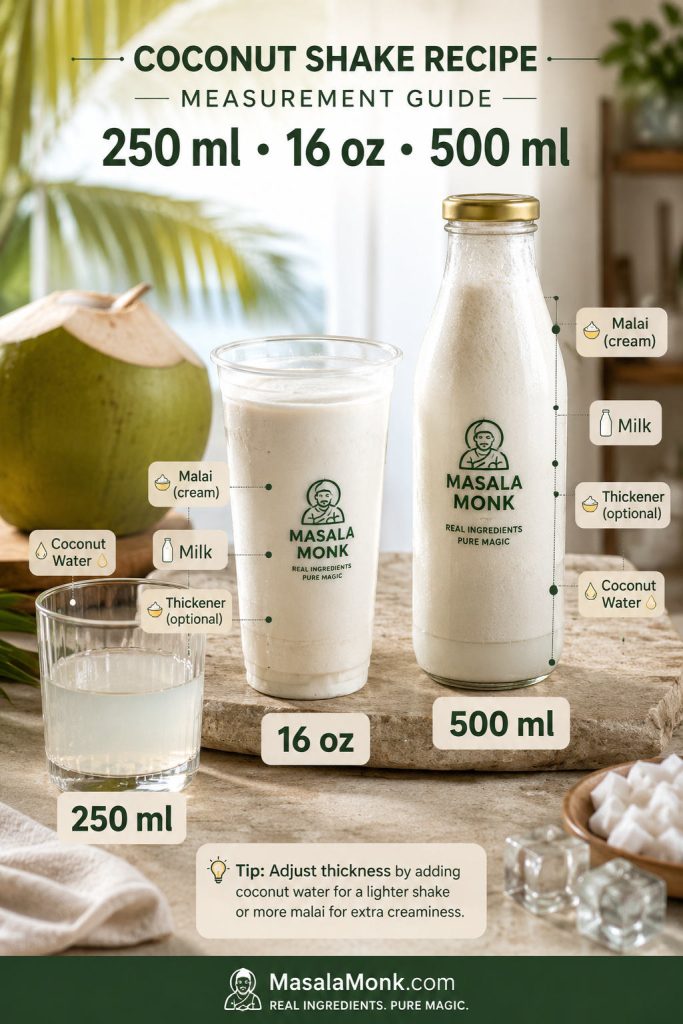
Measurement guide showing coconut shake portions for a 250 ml glass, 16 oz cup, and 500 ml bottle.
A 250 ml glass, 16 oz cup, and 500 ml bottle need different ratios. Malai, milk, ice cream, foam, and headspace all change the final pour.

If you are using ice cream, start with the lower end of the coconut water and milk range so the glass does not overflow.

Target servingCoconut waterTender coconut fleshMilk or coconut milkIce cream or thickener
250 ml glass70–90 ml35–50 g60–80 ml½ scoop ice cream or 2–3 tbsp frozen milk
16 oz / 475 ml cup140–180 ml70–90 g120–140 ml1–1½ scoops or ⅓–½ cup frozen milk
500 ml bottle160–200 ml80–100 g120–150 ml1½ scoops or ½ cup frozen milk
2 tall glasses / 600–750 ml180–240 ml80–120 g180–240 ml1½–2 scoops or ½ cup frozen milk

How to Adjust the Ratios

For a 500 ml bottle: Leave a little headspace if using ice cream or frozen milk. The shake can foam slightly after blending and may thicken as it sits. Shake the bottle before drinking.

Do not worry if your coconut does not match the table perfectly. Tender coconuts are not standardized ingredients; some give lots of water, some give thick malai, and some barely give enough flesh for one small glass. Blended drinks do not measure like water either: malai, ice cream, frozen milk, and foam can all change the final volume.

Treat these as starting ratios, then adjust by texture: malai or frozen milk for thickness, coconut water for loosening.
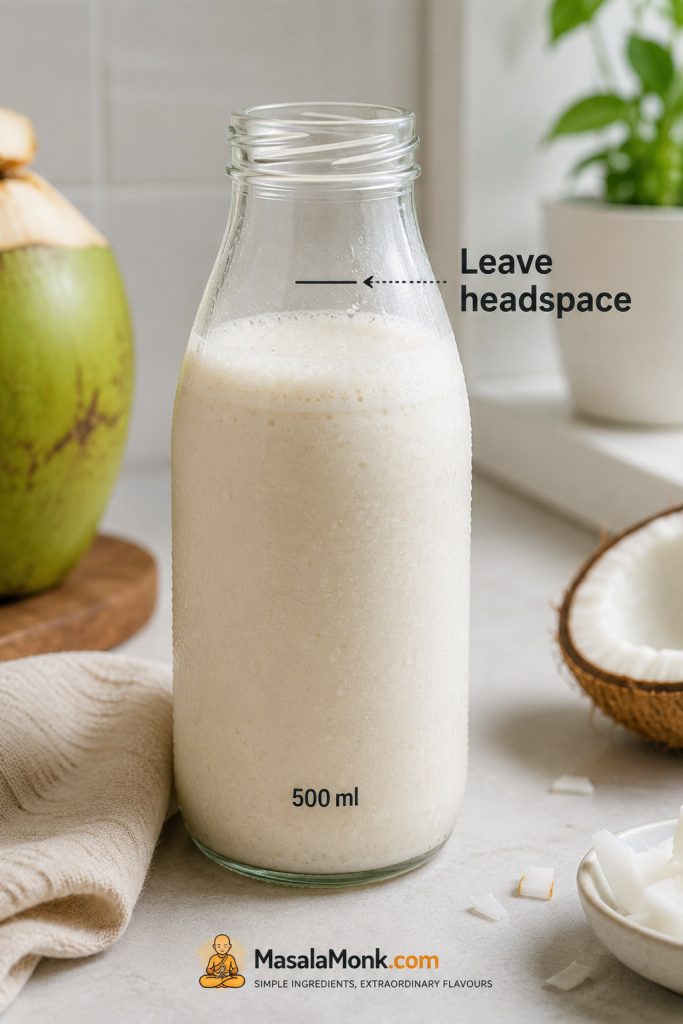
Clear 500 ml bottle of coconut shake filled below the shoulder with visible headspace and condensation.
For a 500 ml coconut shake bottle, stop below the shoulder so there is room for foam, shaking, and slight thickening as it sits.

Once you know your serving size, the next thing that affects texture is the blender itself. A powerful blender can make even firmer coconut smoother, while a small portable blender needs softer malai, smaller pieces, and more liquid to move properly. After scaling, check the texture ladder so the larger bottle does not turn watery or too heavy.

Equipment: Blender, Mixer-Grinder, or Portable Blender

You do not need special equipment, but the blender does affect texture. A small blender can still make a good coconut shake, but it needs a little kindness: smaller malai pieces, liquid first, and no overpacking.
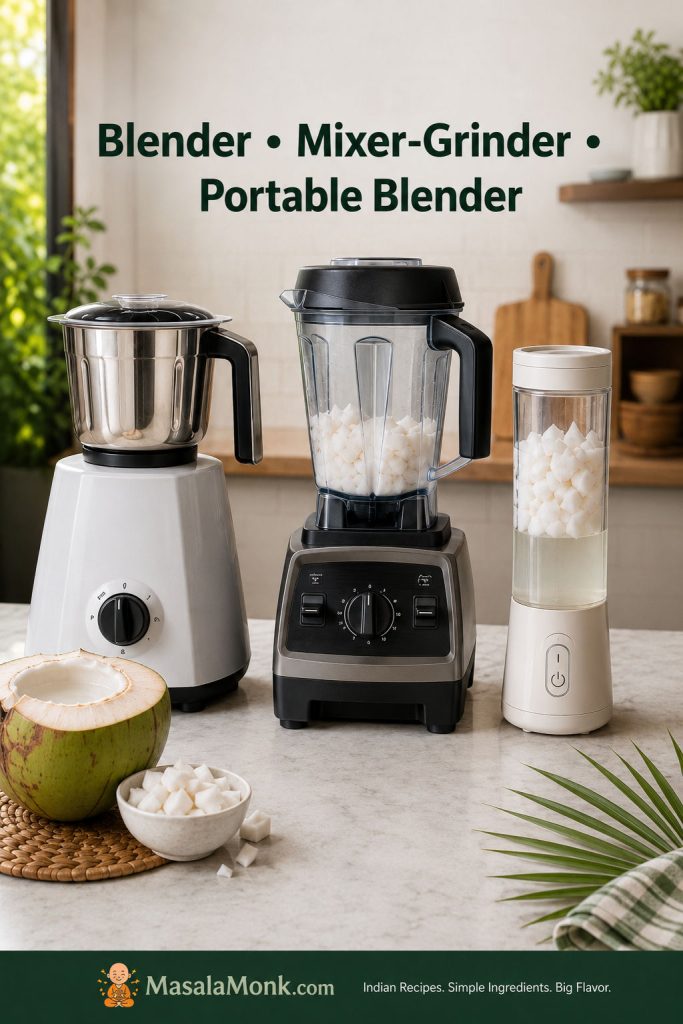
Mixer-grinder, high-speed blender, and portable blender set up for coconut shake with chopped malai and coconut water.
A mixer-grinder, blender, or portable blender can all work; however, smaller jars need liquid first so the malai can move.
  • Indian mixer-grinder: good for the everyday home version. Chop the malai first and blend it with coconut water before adding milk.
  • High-speed blender: gives the smoothest texture, especially if the coconut is slightly firmer or the shake is thick.
  • Portable blender: works for a small 300–500 ml shake if you add liquid first, then chopped malai, then ice or frozen milk. Do not pack the jar tightly.
  • Fine strainer: useful only if mature coconut makes the drink gritty. If you are using soft tender coconut, a little pulp is usually pleasant.

If the blades spin but the malai is not moving, the jar needs more liquid, not more blending time. Stop, shake the jar gently, add a splash more coconut water, and blend again. If your blender is small, make the shake in two short blends instead of forcing everything into one jar.

How to Make Coconut Shake Thick and Creamy

Thickness should come from coconut, milk, frozen milk, or ice cream — not from a blender full of plain ice. Use this as a texture ladder and stop when the shake matches the glass you want.
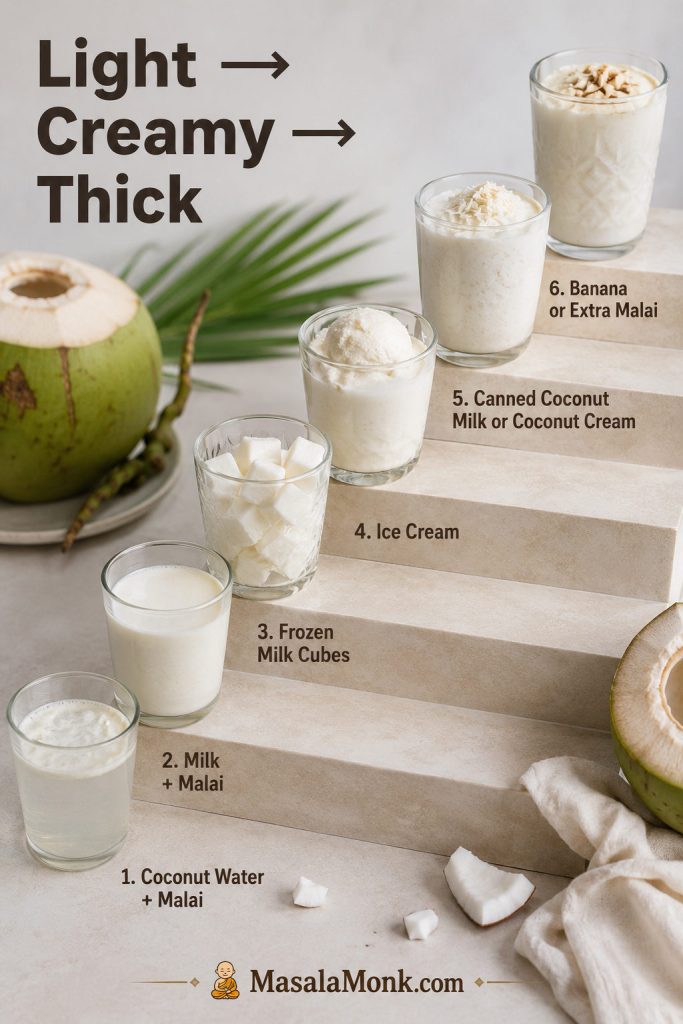
Texture ladder showing coconut shake styles from light coconut water to thicker milk, ice cream, coconut cream, and banana versions.
Thickness should come from malai, frozen milk, coconut milk, ice cream, or banana—not from filling the blender with plain ice.
Texture wantedBest baseWhat it tastes like
Light and freshCoconut water + soft malaiClean, cold, coconut-first
Creamy homemadeMilk + malaiSmooth and gentle, not too rich
Thick without ice creamFrozen milk cubesCold and full without dessert sweetness
Dessert-styleVanilla ice creamRicher, sweeter, café-like
Vegan thickCanned coconut milk or a spoon of coconut creamCreamy and dairy-free
Smoothie-likeFrozen banana or extra malaiThicker, softer, more filling

Texture check: before serving, compare the shake with what you wanted: light, creamy, thick, or dessert-style.
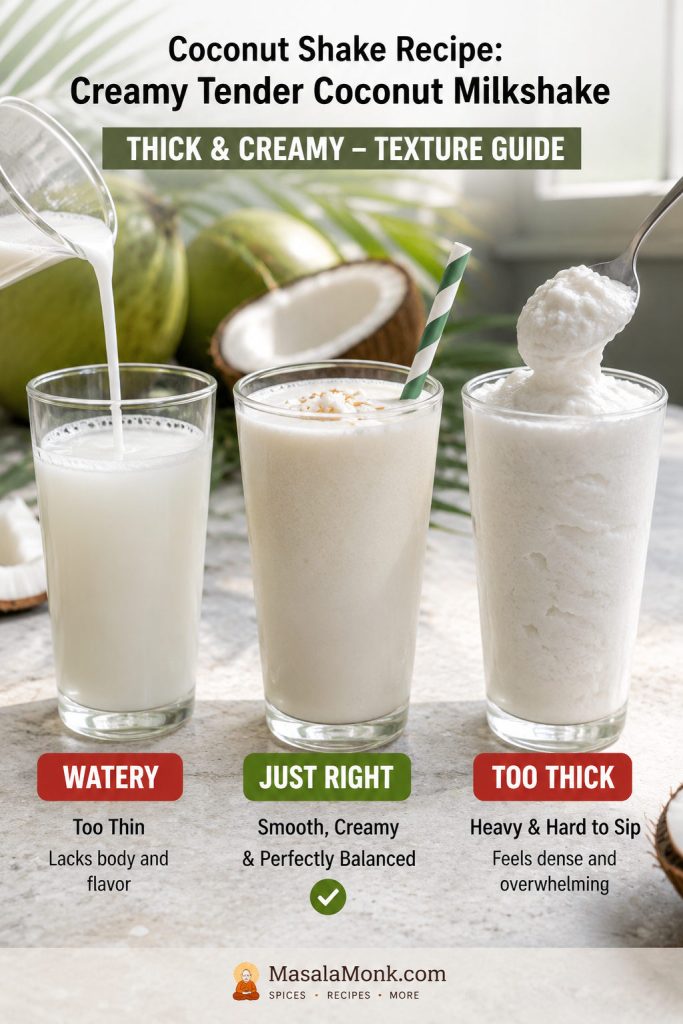
Three coconut shake glasses showing watery, just-right creamy, and too-thick textures.
A good coconut shake should pour easily, look creamy, and still taste like tender coconut; when it looks watery or heavy, adjust before serving.

If your homemade shake never tastes like the one from a juice shop, the answer is usually not more sugar. The shop-style glass is colder, slightly thicker, and a little pulpy. Chill the liquids, keep a spoonful of tiny malai bits for the end, and avoid blending the final shake until it turns warm.

After you make the plain coconut version once, variations become much easier. You will know how thick the base should feel, so fruit, protein powder, or extra flavorings become adjustments rather than guesses.

Flavor Variations

Once you understand the base, variations stop feeling random. Keep the coconut in charge, then add only enough fruit, spice, protein, or extra creaminess to change the mood of the glass.
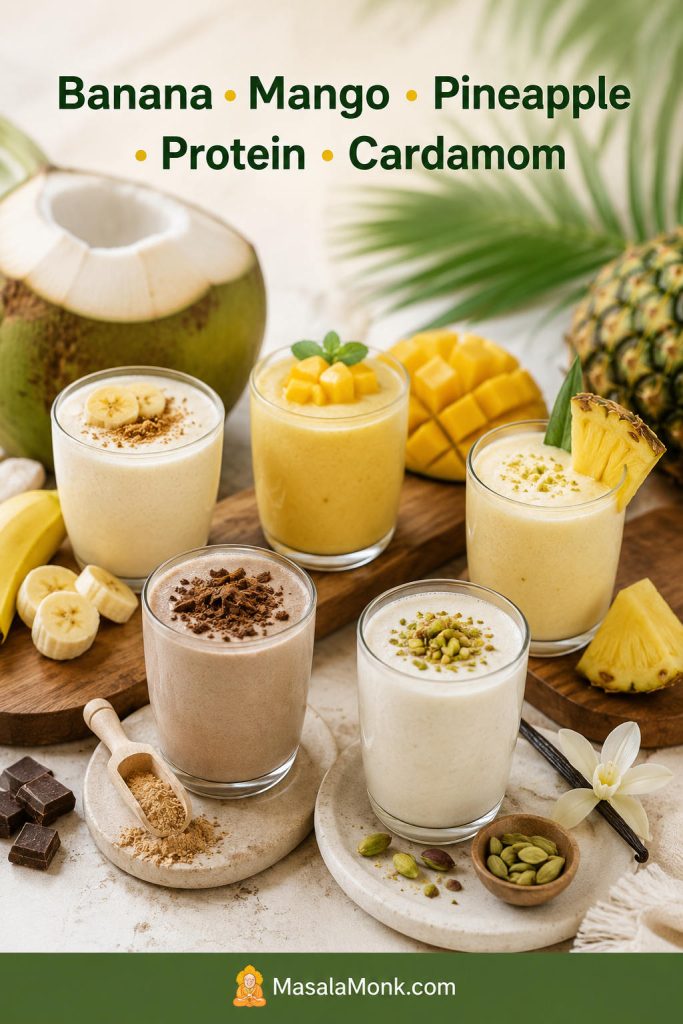
Flavor variation board with coconut shakes for banana, mango, pineapple, protein, and cardamom.
Once the base is balanced, banana, mango, pineapple, protein powder, cardamom, or vanilla can change the mood without hiding the coconut.

Banana Coconut Shake

For a thicker banana version, blend in ½ frozen banana. It adds natural sweetness and a soft smoothie-like texture, so start with little or no added sugar. This works especially well in no-ice-cream and vegan coconut shakes.

Mango Coconut Shake

Mango makes the shake sweeter, thicker, and more seasonal. Use ½ cup mango pulp or chopped ripe mango, then taste before adding sugar. If you want a classic Indian mango drink without the coconut angle, see our mango shake recipe.

Pineapple Coconut Shake

Pineapple changes the mood completely. Blend in ½ cup frozen pineapple for a colder, brighter, tropical version, especially if you are using coconut milk instead of dairy milk. For more pineapple-coconut inspiration, our piña colada drinks guide has classic, frozen, and virgin-style ideas.

Protein Coconut Shake

For a higher-protein version, blend in 1 scoop vanilla protein powder and add 2–4 tbsp extra coconut water or milk if the shake becomes too thick. Keep the flavor simple; chocolate or heavily flavored powders can easily overpower the tender coconut.

Cardamom, Vanilla, and Flavor Notes

Cardamom gives coconut shake a soft Indian milkshake flavor, especially with pistachios or almonds. Vanilla makes the drink taste more café-style, especially when you use vanilla ice cream. Use either lightly; the coconut should still be the first thing you notice.

Café-Style or Mr Coconut-Inspired Coconut Shake

For a café-style or Mr Coconut-inspired coconut shake, do not make it perfectly smooth or overly milky. The charm is cold coconut water, soft malai, a little vanilla richness, and tiny coconut bits that remind you it came from a real tender coconut.
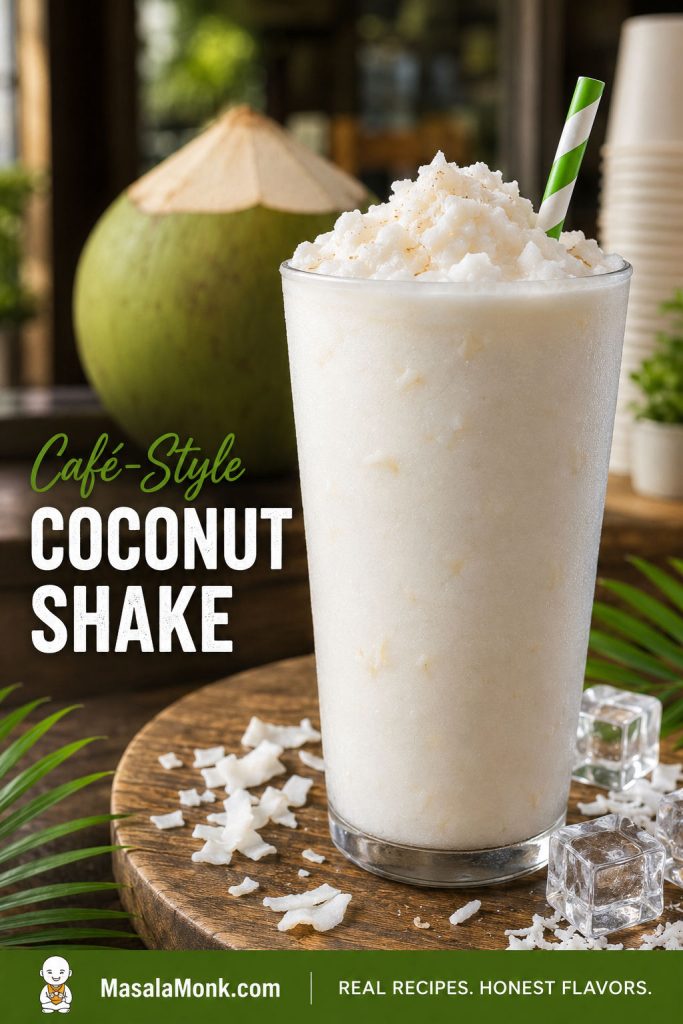
Café-style coconut shake in a tall chilled glass with icy texture, straw, froth, and tiny coconut bits.
A café-style coconut shake should feel colder, slightly pulpy, and more indulgent while still letting tender coconut stay noticeable.

If you are chasing the shop-style version, do not make it too polite. It should be colder, a little sweeter, and slightly pulpy, with more emphasis on cold refreshment than dairy creaminess.

To make one café-style glass, blend ¾ cup coconut water, ½ cup tender coconut malai, 1–1½ scoops vanilla ice cream, and 4–5 ice cubes. Blend until mostly smooth, then stir in 1 tablespoon tiny coconut bits for texture. The trick is not to make it perfectly smooth; those little coconut bits make each sip taste fresh instead of flat.

Thai-Style Coconut Shake

A Thai-style coconut shake is usually icier and sweeter than the classic tender coconut milkshake. Use coconut water, coconut milk, ice, sugar syrup, and a spoon of coconut cream if you want it richer. Serve it very cold so it stays refreshing rather than heavy.
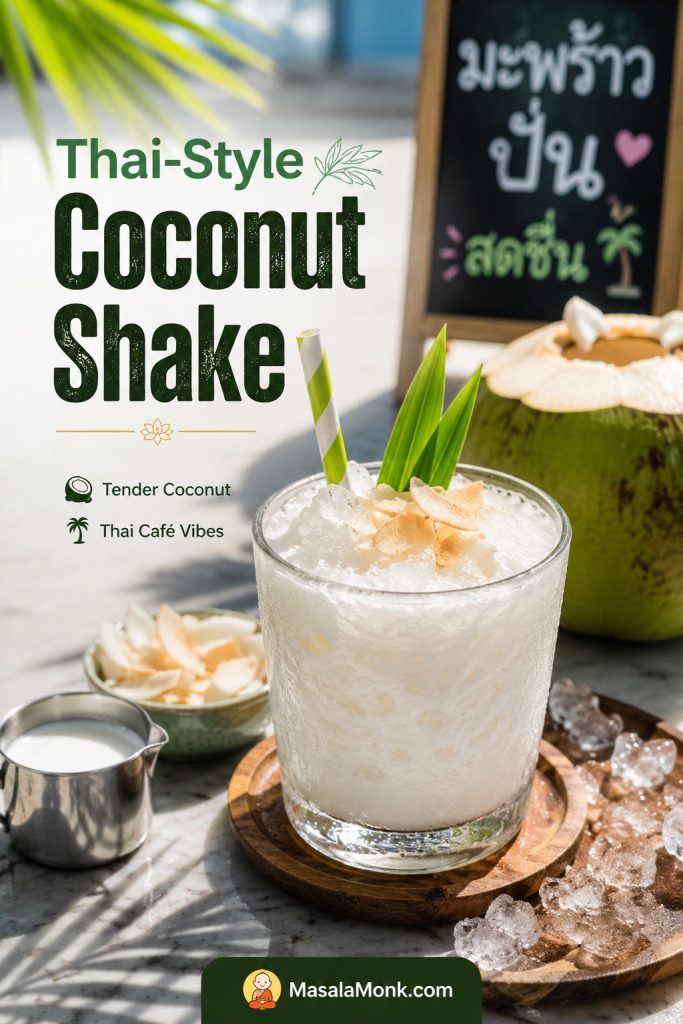
Thai-style coconut shake in a shorter icy glass with coconut milk, coconut cream, and tropical café styling.
Thai-style coconut shake is usually icier and sweeter, so serve it very cold and use coconut cream carefully to avoid making it too heavy.

Is Coconut Shake Light or Dessert-Like?

The lighter version is not the punishment version. On a very hot day, coconut water and soft malai can taste better than a heavy ice-cream shake because the coconut stays clean, cold, and easy to finish. If the coconut itself is sweet and fragrant, the lighter glass may taste more coconut-forward than the rich one.

For dessert-style richness, add milk, ice cream, cream, condensed milk, or nuts. For a lighter summer glass, stay closer to coconut water, malai, and just enough milk or coconut milk to round the texture.
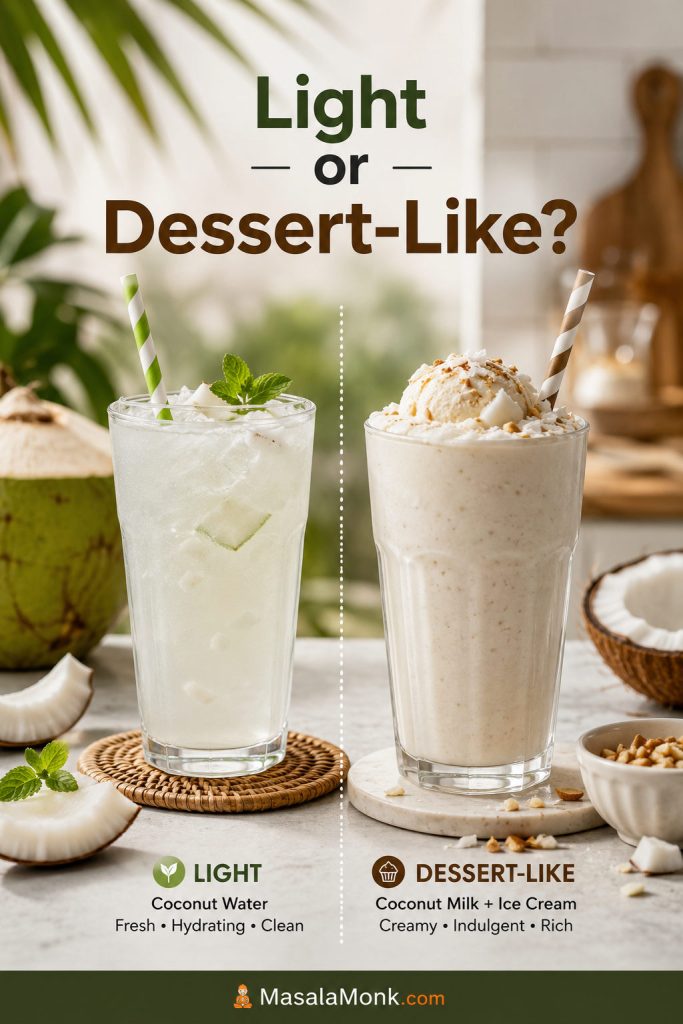
Comparison of a light coconut water shake and a richer dessert-style coconut milk and ice cream shake.
The lighter version is not the punishment version; meanwhile, the dessert-style shake is best when you want a richer, creamier glass.

How to Store Coconut Shake Without Losing the Fresh Taste

This is not a make-ahead milkshake. It rewards you for blending it right before serving, when it is still cold, creamy, and fragrant. Fresh tender coconut drinks lose their clean flavor quickly, and milkshake-style versions can separate as they sit. When you must hold it, keep it covered in the fridge and drink it the same day.
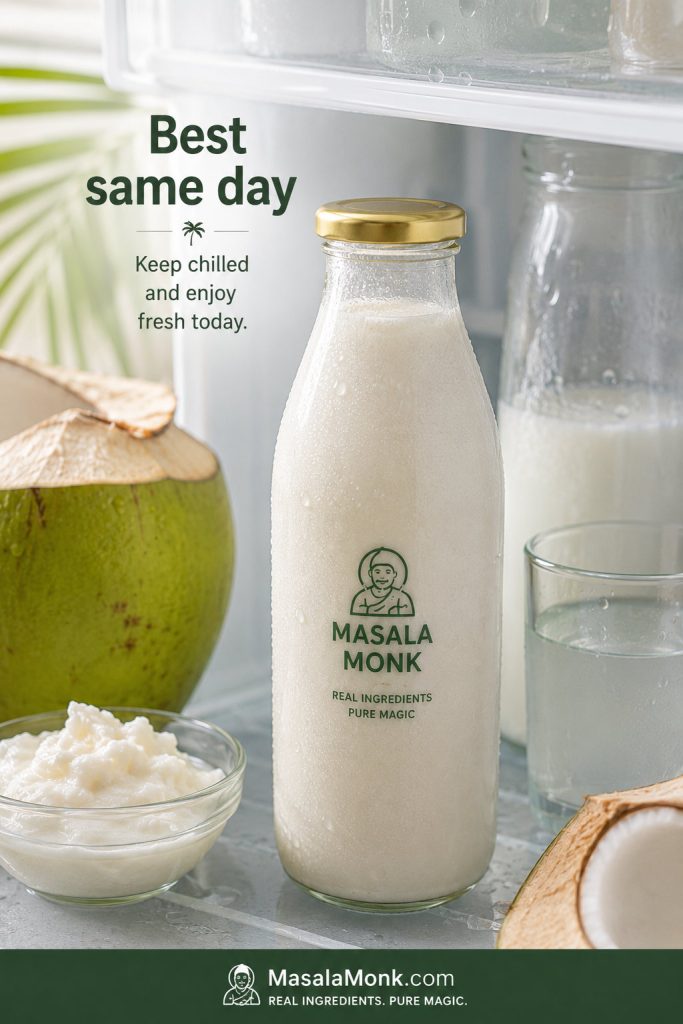
Covered bottle of coconut shake kept chilled with condensation, coconut water, malai, and tender coconut nearby.
Coconut shake is best blended fresh; when you need to hold it, keep it covered and cold, then drink it the same day for the cleanest flavor.

Discard the shake if it smells sour, stale, or fermented instead of trying to fix it with sugar or flavoring.

  • Keep the blended shake covered and cold until serving.
  • Refrigerate it briefly in a covered bottle or jar if needed.
  • Shake or blend again before serving if it separates.
  • Avoid leaving milk, ice cream, or coconut milk versions out at room temperature.
  • Freeze milk cubes or coconut water cubes instead of freezing the finished shake.

For prep-ahead ease, chill the coconut water, milk, and glasses. You can also freeze milk cubes ahead of time for the no-ice-cream version. Save the actual blending for the moment you want the shake to taste fresh.

Troubleshooting

Most problems come from warm ingredients, too much ice, mature coconut, or sweetness added too early. Use the table below to fix the glass you already made and improve the next batch.
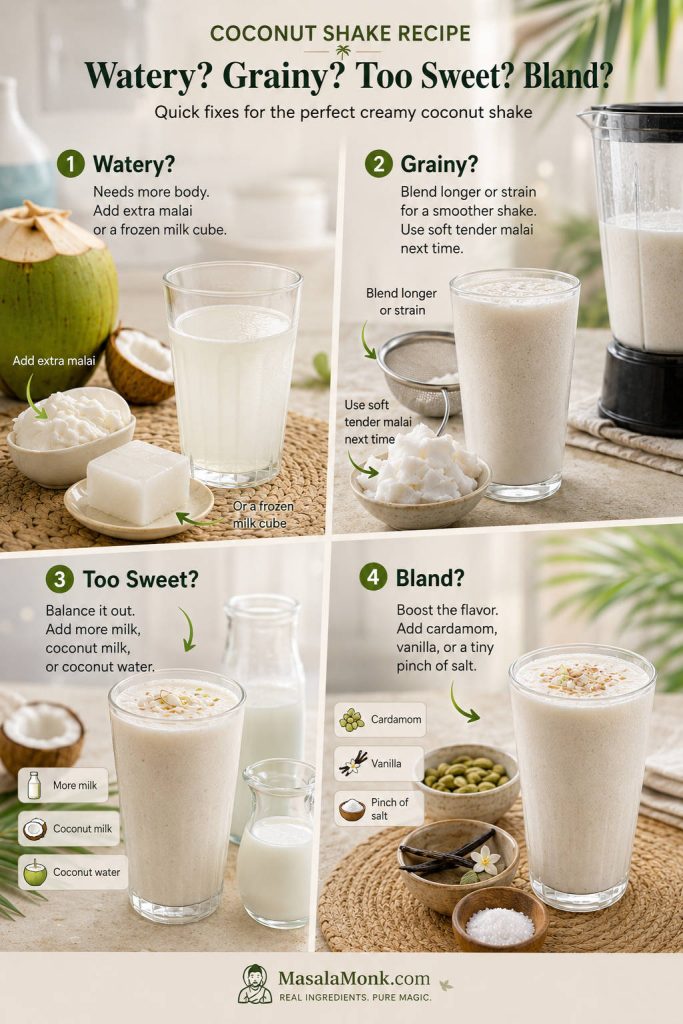
Troubleshooting guide for watery, grainy, too sweet, and bland coconut shake with visible fix ingredients.
Watery, grainy, too-sweet, and bland coconut shakes usually need one targeted correction. Add body, blend or strain, dilute, or brighten the flavor.

A coconut shake that tastes like sweet milk usually has too much milk or ice cream for the amount of malai. Thin texture, even after adding ice, means the problem is not coldness; the drink needs body from malai, frozen milk, ice cream, banana, or coconut cream. For dull flavor, a tiny pinch of salt can wake up the coconut without making the shake taste salty.

ProblemWhy it happenedFix nowFix next time
Watery shakeToo much coconut water or iceAdd ice cream, frozen milk, banana, or extra malaiChill ingredients and use less ice
Grainy shakeMature coconut or under-blendingBlend longer or strainUse soft tender coconut malai
Too sweetIce cream + sugar + sweet coconut waterAdd milk or coconut milkTaste before adding sugar
BlandWeak coconut, too much milk, no aromaAdd cardamom, vanilla, or a tiny pinch of saltUse fresh coconut water and less milk
Too thickToo much ice cream or frozen milkAdd coconut water 1–2 tbsp at a timeUse less thickener
SeparatedCoconut fat and liquid separatingReblend brieflyServe soon after blending
Warm or thinOverblending or warm ingredientsAdd a frozen milk cube and pulseChill everything first

Once you start adjusting the shake to your coconut, blender, and glass size, these are the questions that usually come up.

FAQs

What is the difference between coconut shake and coconut smoothie?

If the drink is built around tender coconut malai and coconut water, think of it as a coconut shake. The coconut should be the main flavor, not just the liquid in the blender. If coconut is mainly the base for banana, berries, mango, protein powder, or greens, the drink is closer to a coconut smoothie.

Which coconut is best for coconut shake?

A tender coconut with soft, spoonable malai and sweet coconut water is best. If the flesh is firm and chewy, the shake can still work, but you may need to chop it small, blend longer, and strain if the texture turns gritty.

Do I need ice cream for coconut shake?

No. Ice cream gives the fastest café-style thickness, but frozen milk cubes are the closest homemade substitute. They make the shake cold and creamy without watering it down or making it taste too much like dessert.

How do I make coconut shake without milk?

Use coconut water as the main liquid and tender coconut flesh for body. If you still want creaminess, add chilled coconut milk or a small spoon of coconut cream. If the coconut water is not naturally sweet, one soft date is usually enough.

Why did my coconut shake become watery?

The usual reason is too much ice or too much coconut water for the amount of malai. To fix the glass you already made, add more tender coconut flesh, frozen milk, a scoop of ice cream, coconut cream, or half a frozen banana.

Should coconut shake be strained?

Usually, no. Soft tender coconut malai blends into a pleasant, slightly pulpy drink. Strain only if you used mature coconut or the shake feels gritty. If you like café-style texture, keep a spoonful of tiny malai bits aside and stir them in after blending.

How much coconut shake does one tender coconut make?

It depends on the size of the coconut and how much soft malai it has. A coconut with plenty of malai can usually make 1 large glass or 2 smaller glasses when blended with its coconut water and some milk. If it has mostly water and very little malai, the shake will be lighter unless you add frozen milk, ice cream, banana, or coconut milk.

What can I do with leftover tender coconut malai?

Coconut shake is one of the easiest ways to use leftover tender coconut malai. Blend it with chilled coconut water, milk or coconut milk, and a little sweetener only if needed. If you also have extra coconut water, these creative coconut water recipes are useful for using it beyond a shake. If the malai still smells fresh and sweet, this shake is usually the fastest and best use for it.

How soon should I drink coconut shake after blending?

As soon as you can. The first 10–15 minutes are when the shake tastes coldest, freshest, and creamiest. After that, it can separate or lose some of the tender coconut aroma. If you need to hold it, keep it covered in the fridge and shake or reblend before serving.

Final Tips for the Best Coconut Shake
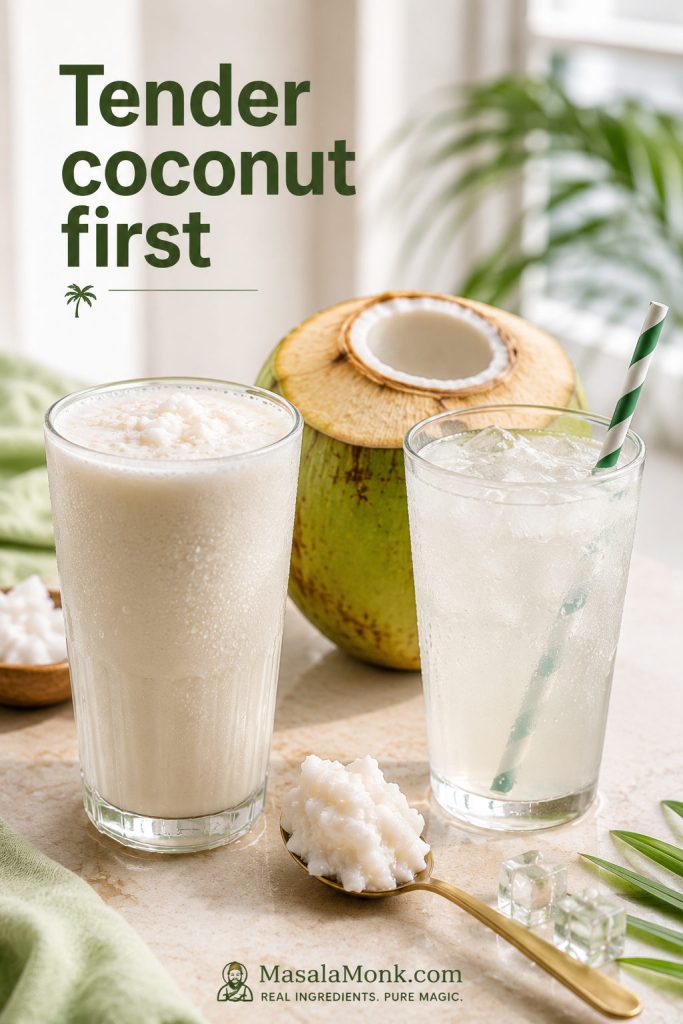
Final serving of one creamy coconut shake and one lighter coconut water shake with tender coconut and malai.
The best coconut shake is not always the thickest or sweetest; ultimately, the winning glass is the one that still tastes like tender coconut.

In this coconut shake recipe, tender coconut should lead the flavor. Blend the coconut flesh with coconut water first, then add the creamy ingredients. Ice should only finish the chill, not carry the whole texture.

Make it once with the classic balance, then adjust from there. More coconut water makes it lighter, frozen milk makes it thicker without ice cream, coconut milk makes it dairy-free, and ice cream makes it dessert-like. Still, the real test never changes: the best coconut shake is not the thickest one or the sweetest one. It is the glass that still tastes like tender coconut after you add everything else.
Back to top

Posted on Leave a comment

Kiwi Smoothie Recipe

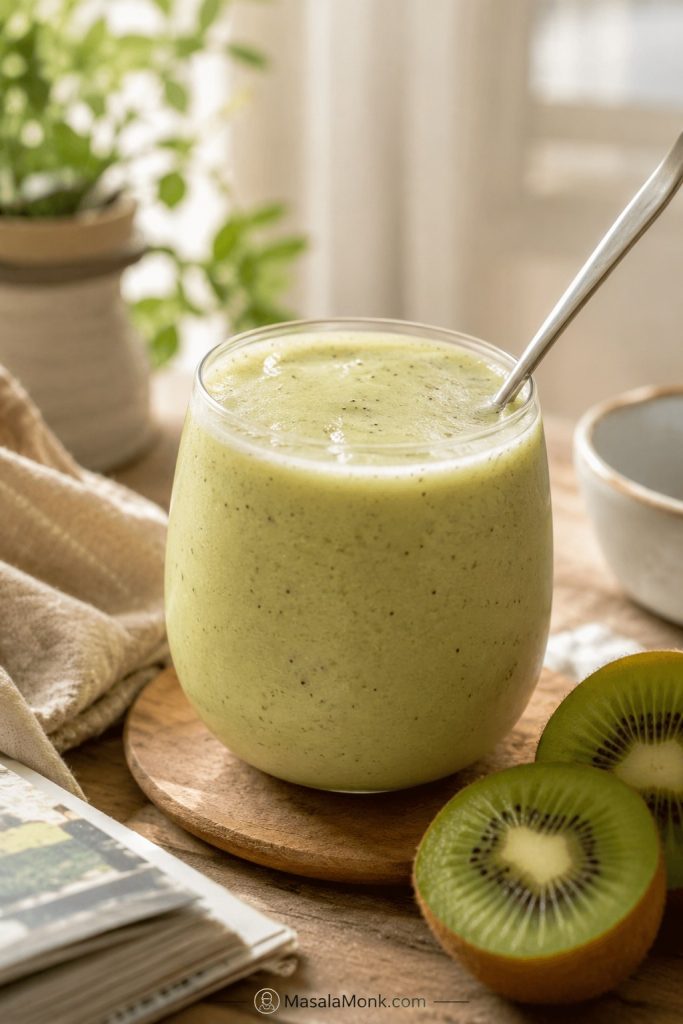
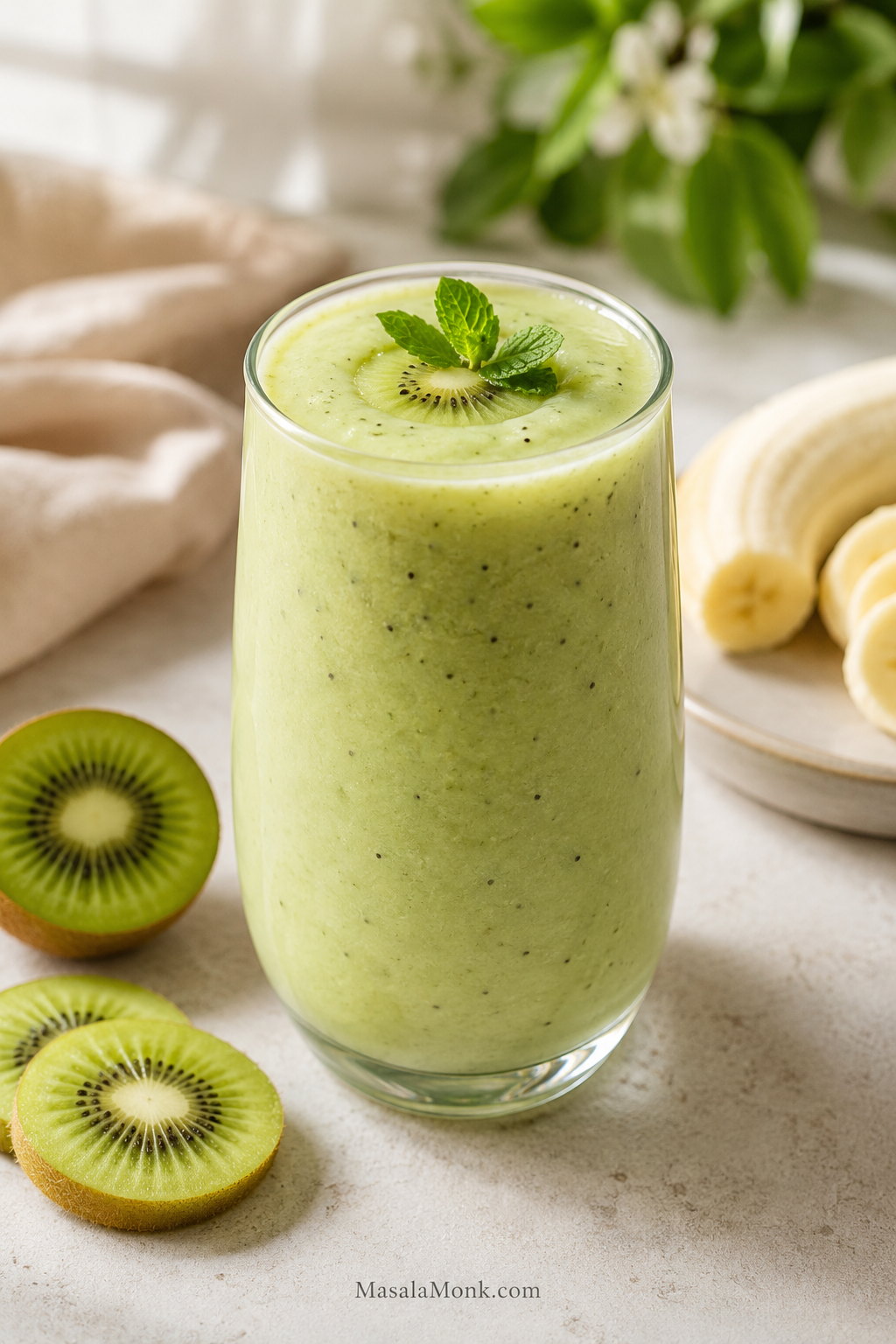
Creamy pale-green kiwi smoothie in a glass with sliced kiwi and banana on a breakfast counter.

This kiwi smoothie recipe is creamy, fresh, tangy-sweet, and easy to adjust with banana, yogurt, milk, strawberry, mango, or dairy-free swaps. It takes about 5 minutes, but it still gives you enough control to avoid the usual problems: a smoothie that tastes too sour, too thin, too watery, too seedy, or too bland.

Done right, it tastes bright and creamy at the same time — fresh enough for a warm morning, but filling enough to feel like breakfast.

The base is simple: ripe kiwi for brightness, frozen banana for creaminess, yogurt for body, and just enough liquid to help the blender move. From there, you can make it lighter with coconut water, fruitier with orange juice, thicker as a smoothie bowl, greener with spinach, or sweeter with mango and strawberries.

Start with the classic kiwi banana smoothie, then adjust it to fit what you have. If your kiwis are sharp, jump to the fixes section. If you want a no-yogurt smoothie, a no-banana version, or a kiwi shake-style drink, those options are built into the guide too.

Quick Answer: Best Kiwi Smoothie Recipe Ratio

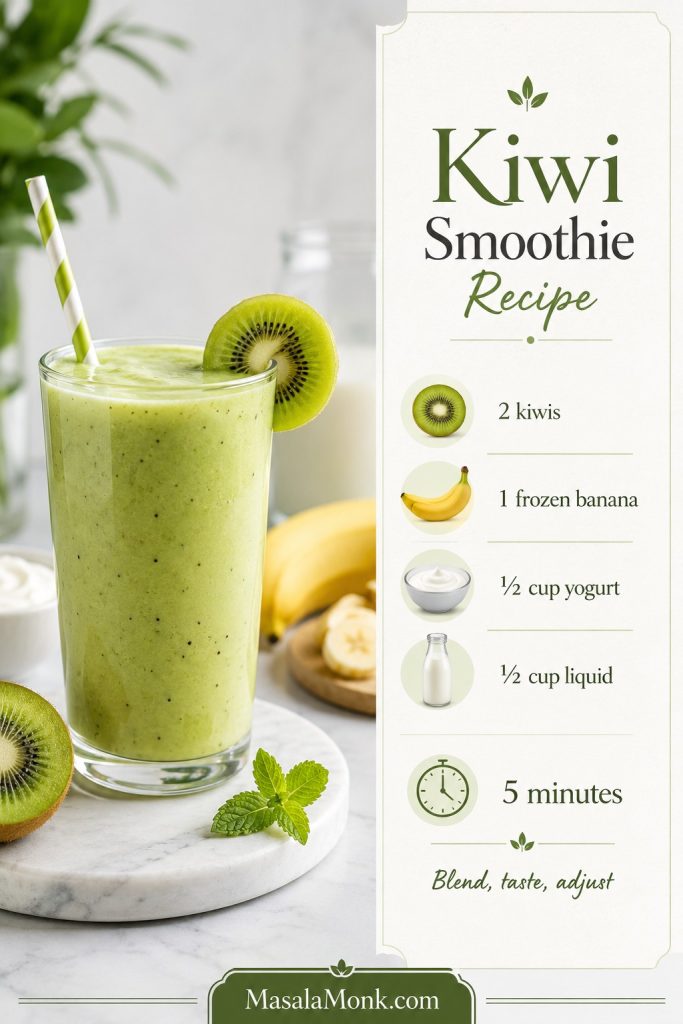
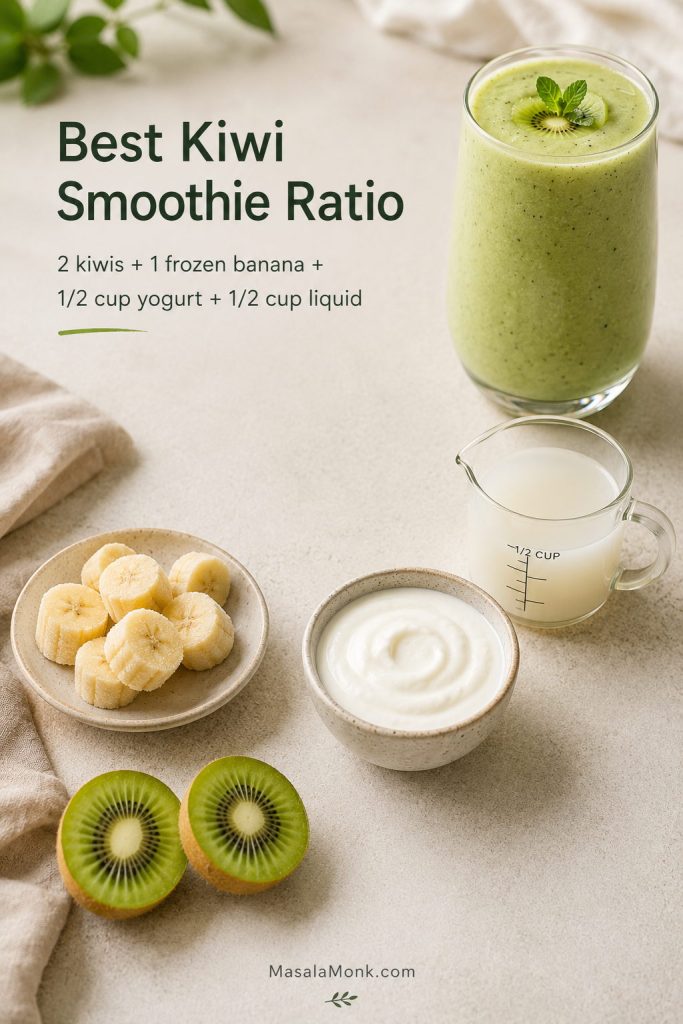
The best kiwi smoothie ratio is 2 ripe kiwis + 1 frozen banana + ½ cup yogurt + ½ cup liquid. Choose milk for a creamier smoothie, coconut water for a lighter smoothie, or orange juice for a brighter fruitier version. Add honey only if your kiwis taste sharp.

Kiwi smoothie ratio guide with kiwis, frozen banana, yogurt, liquid, and a finished smoothie
Start with this base kiwi smoothie ratio first; then taste before adding more fruit, liquid, or sweetener.

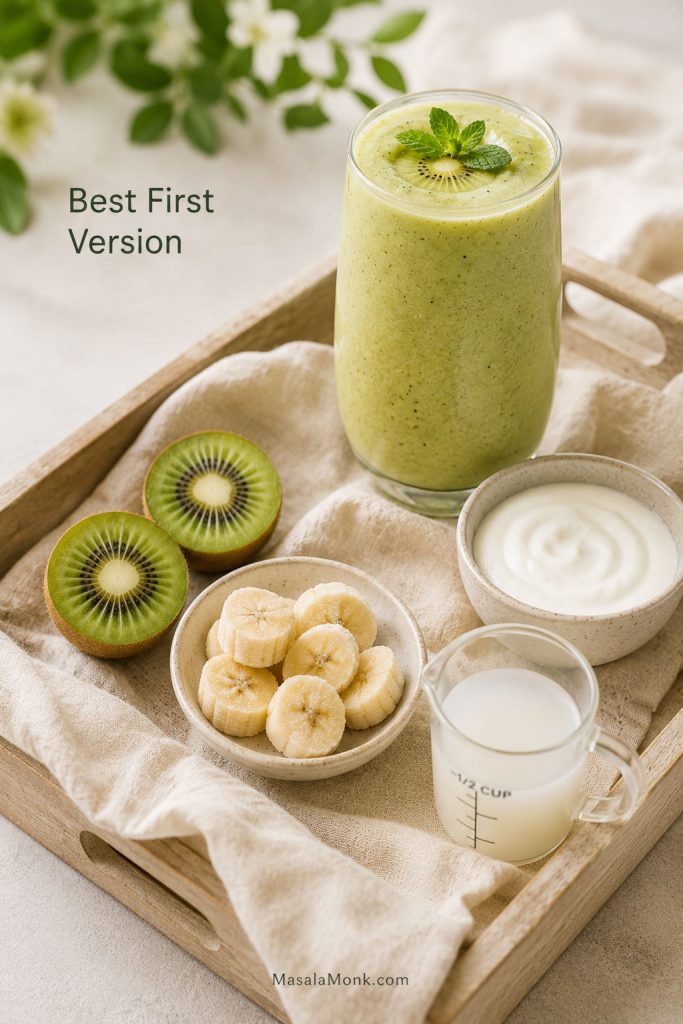
Best First Version to Try

Use 2 ripe kiwis, 1 frozen banana, ½ cup plain Greek yogurt, and ½ cup milk or coconut water. This gives you the cleanest creamy-tangy balance before you start changing the fruit, liquid, or sweetness.
Finished kiwi smoothie with ripe kiwis, frozen banana, Greek yogurt, and milk or coconut water
This first blend is the safest place to start because it gives you a creamy-tangy balance before you try strawberry, mango, no-yogurt, or no-banana versions.

For one large smoothie, the base recipe usually means 2 peeled kiwis, 1 medium frozen banana, ½ cup Greek yogurt or plain yogurt, and ½ cup milk, water, coconut water, or orange juice. Blend until smooth, taste, then adjust before pouring.

The formula works because each ingredient has a job. Kiwi brings the bright fruit flavor, banana softens the tartness, yogurt gives body, and the liquid helps everything blend. Once that balance is right, the smoothie tastes fresh instead of sharp or watery.

If you already know what went wrong with your last smoothie, the troubleshooting table will help you adjust sourness, thickness, sweetness, and texture quickly.

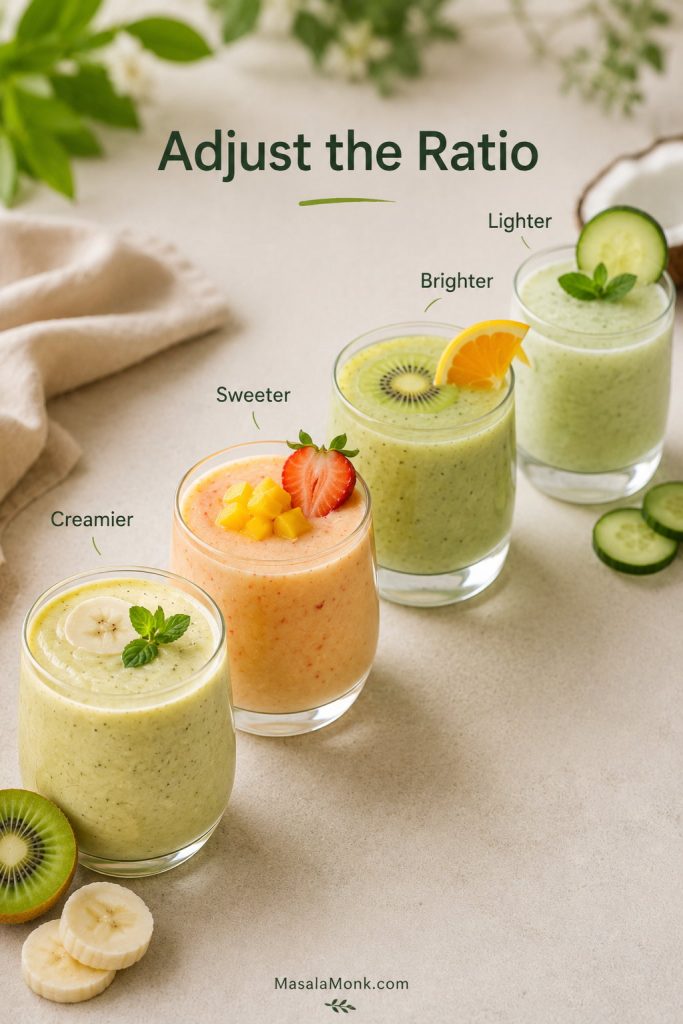
How to Adjust the Ratio

Want your kiwi smoothie… Add or adjust this
Creamier Frozen banana, Greek yogurt, avocado, or a splash of milk.
Sweeter Ripe banana, mango, strawberries, or 1–2 teaspoons honey.
Brighter Orange juice as the liquid or a tiny squeeze of lime.
Lighter Coconut water, water, cucumber, or spinach.
Thicker Frozen banana, frozen mango, chia seeds, or less liquid.
Dairy-free Almond milk, oat milk, coconut water, plant yogurt, mango, or avocado.
Four kiwi smoothie glasses showing creamier, sweeter, brighter, and lighter adjustment options
Small adjustments change the whole drink, so correct one thing at a time: body, sweetness, brightness, or overall lightness.

From there, the rest of the recipe is mostly about control. If your kiwi is very sweet, you may not need honey. If it tastes sharp, banana, mango, or yogurt will smooth it out quickly without changing the whole recipe.

Ingredients for a Creamy Kiwi Smoothie

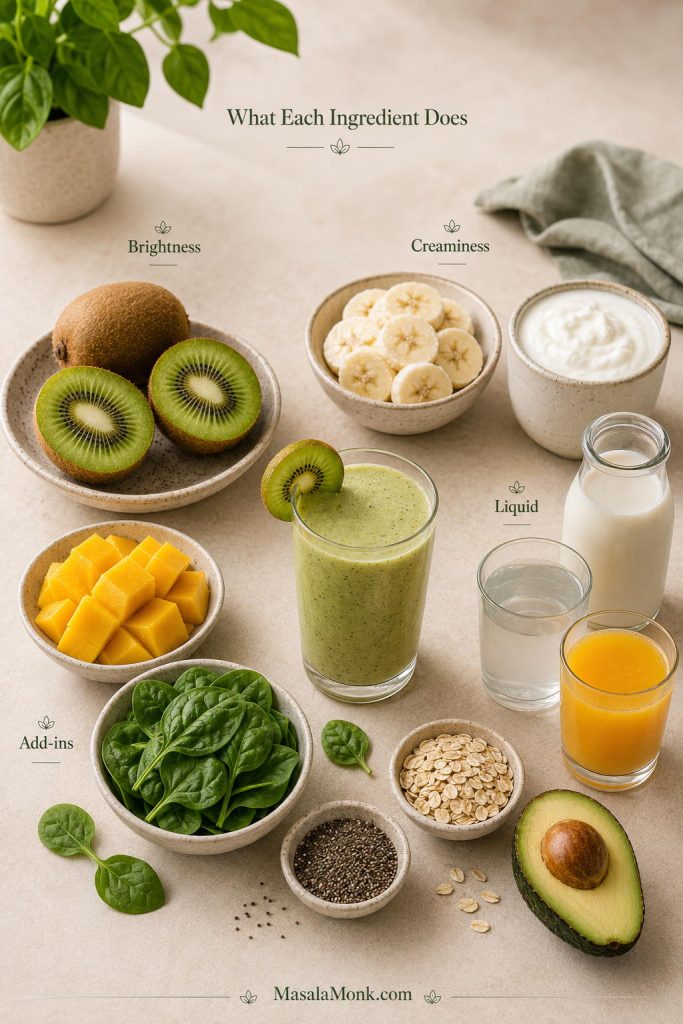
Kiwi smoothie ingredient guide with kiwi, banana, yogurt, liquid, mango, spinach, chia, oats, and avocado grouped by purpose
Each ingredient has a clear job: kiwi brings brightness, banana and yogurt add body, while the liquid decides whether the smoothie feels creamy, light, or bright.

A good smoothie recipe using kiwis needs balance. Kiwi gives the drink its bright, tangy flavor, but it needs something creamy or sweet beside it so the smoothie does not taste thin or harsh. The best version is not just about adding kiwi; it is about giving kiwi the right support.

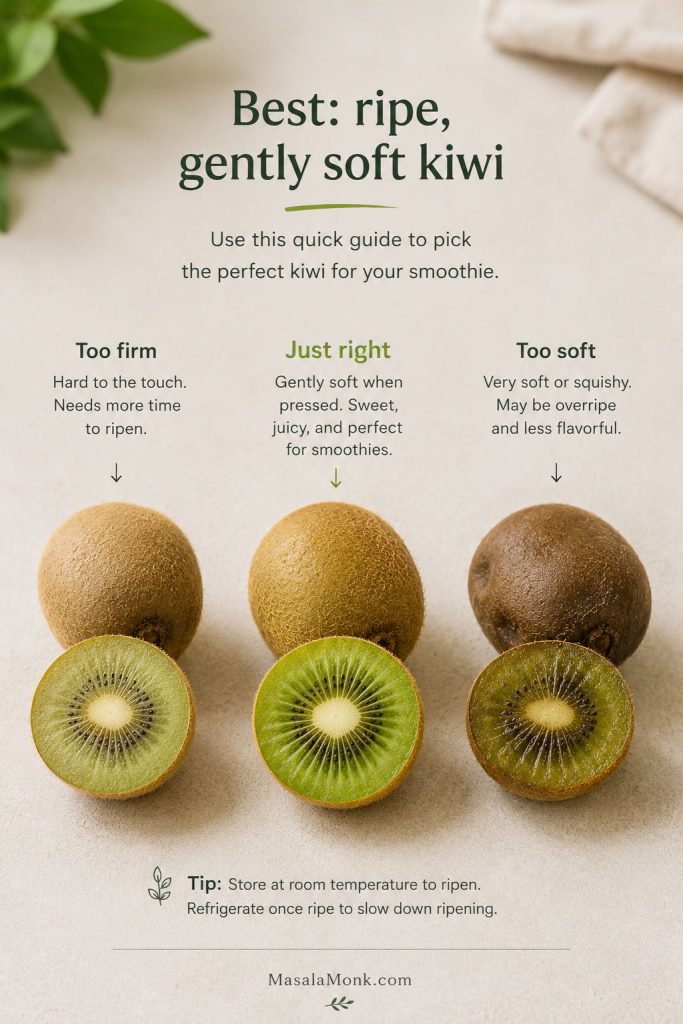
Kiwi

Kiwi ripeness guide showing firm kiwi, ripe kiwi, and very soft kiwi for smoothies
Ripe kiwis usually make a smoother, sweeter smoothie; however, firm kiwis can taste grassy or harsh once blended.

Ripe kiwis make the best smoothie. They should give slightly when pressed and smell fresh, not fermented. Hard kiwis can taste grassy, sour, or harsh once blended, while overripe kiwis can make the smoothie taste dull.

For the smoothest texture, peel the kiwi before blending. Kiwi skin is edible, but it can make a smoothie feel fibrous or slightly fuzzy, especially if your blender is not very powerful.

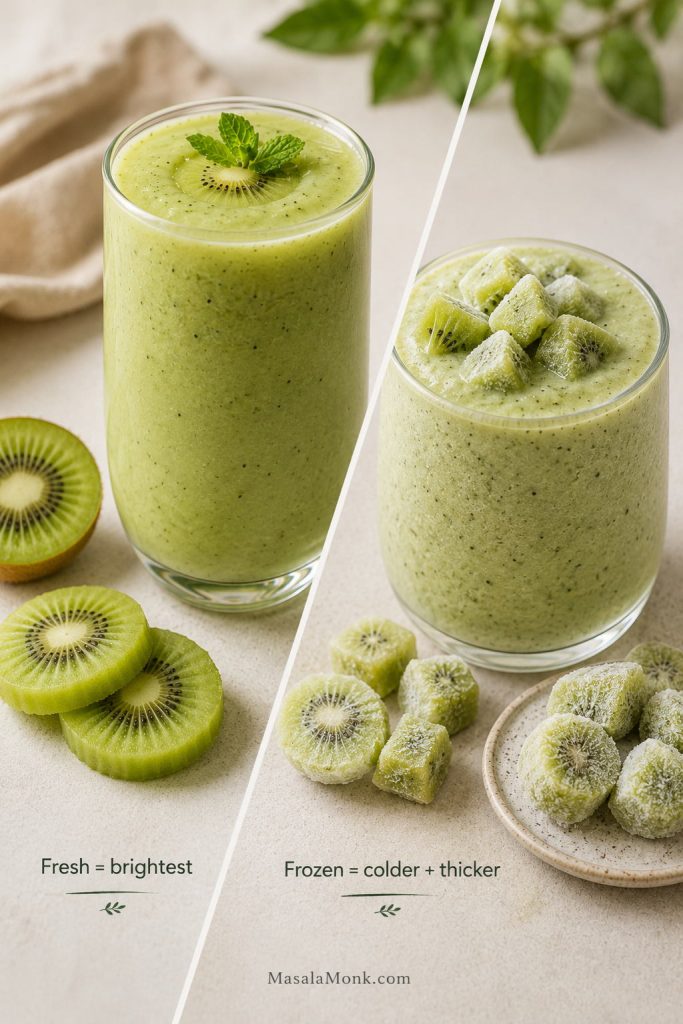
Fresh or frozen kiwi? Fresh kiwi gives the brightest flavor. Frozen kiwi makes the smoothie colder and thicker, but it works best with banana, mango, yogurt, or another creamy ingredient so the drink does not turn icy.
Fresh kiwi slices compared with frozen kiwi chunks for smoothie making
Fresh kiwi gives the brightest flavor, while frozen kiwi helps chill and thicken the smoothie when it is paired with banana, mango, yogurt, or another creamy ingredient.

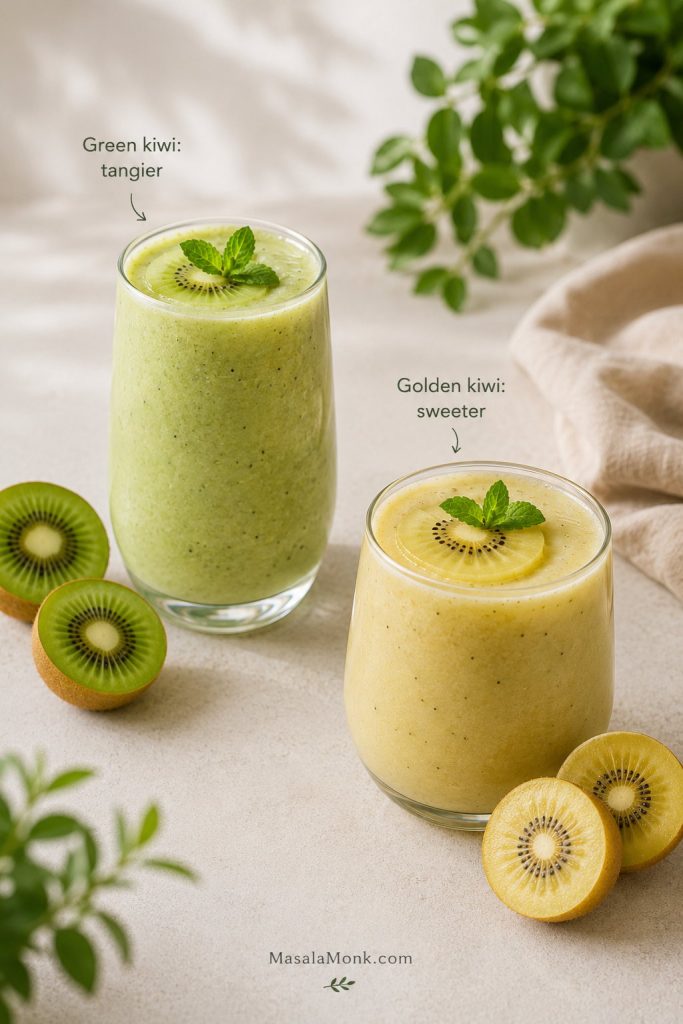
Green kiwi gives the classic tangy flavor. Golden kiwi is usually sweeter and softer, so it can work well if you want a milder smoothie with less added sweetener.

Green kiwi smoothie and golden kiwi smoothie shown side by side with matching fruit
Green kiwi gives the classic tangy smoothie flavor, whereas golden kiwi makes the drink softer, sweeter, and a little milder.

Banana

Banana is the easiest way to make the drink creamy, especially in a recipe where kiwis bring most of the tartness. A frozen banana works best because it chills and thickens the drink without needing lots of ice. For a less sweet smoothie, use half a banana and add more yogurt, mango, or avocado for body.

Yogurt

Plain Greek yogurt makes the smoothie thicker and more satisfying. Regular plain yogurt gives a softer, drinkable texture. For a dairy-free version, plant yogurt, almond milk, coconut water, avocado, chia, oats, and frozen mango can all help replace some of that body. The no-yogurt variation gives the easiest swaps.

Liquid

The liquid decides whether the smoothie tastes creamy, light, or bright. Milk makes it mellow, coconut water keeps it fresh, orange juice makes it fruitier, and water keeps it simple but thinner. Start with ½ cup and add more only if the blender needs help.

Optional Add-Ins

Spinach, mango, pineapple, chia seeds, oats, protein powder, avocado, mint, and lime can all work with kiwi. Add them with a purpose: mango for sweetness, avocado for creaminess, spinach for a green smoothie, chia or oats for thickness, and lime only when the smoothie needs a sharper finish.

How to Make a Kiwi Smoothie

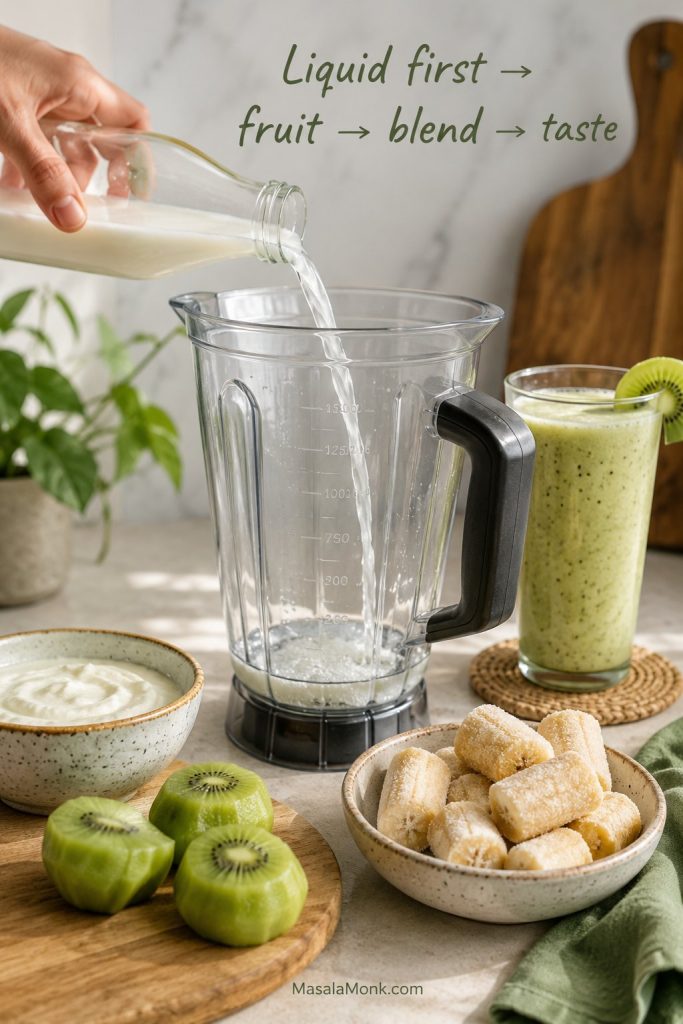
Liquid being poured into a blender with kiwi, banana, yogurt, and a finished smoothie nearby
Add the liquid first, because it helps the blender catch the fruit more easily and keeps the smoothie from getting watered down later.

The method is simple, but the order matters when you are blending kiwis with frozen banana, yogurt, and liquid. Add the liquid first so the blender can catch the ingredients more easily, especially if you are using frozen mango, frozen strawberries, oats, or greens.

  1. Peel and chop the kiwis. Cut away the fuzzy skin for the smoothest drink.
  2. Add the liquid first. Pour milk, coconut water, orange juice, or water into the blender.
  3. Add yogurt and soft ingredients. This helps the blender move before the frozen fruit goes in.
  4. Add kiwi and banana. Break the frozen banana into chunks if needed.
  5. Add frozen fruit or ice last. Use ice only if your fruit is fresh and the smoothie needs chilling.
  6. Blend until smooth. Most versions take 30–60 seconds. Green or frozen-heavy smoothies may need 60–120 seconds.
  7. Taste before pouring. Adjust sweetness, thickness, or brightness while the smoothie is still in the blender. The fixes table below shows the quickest adjustments.
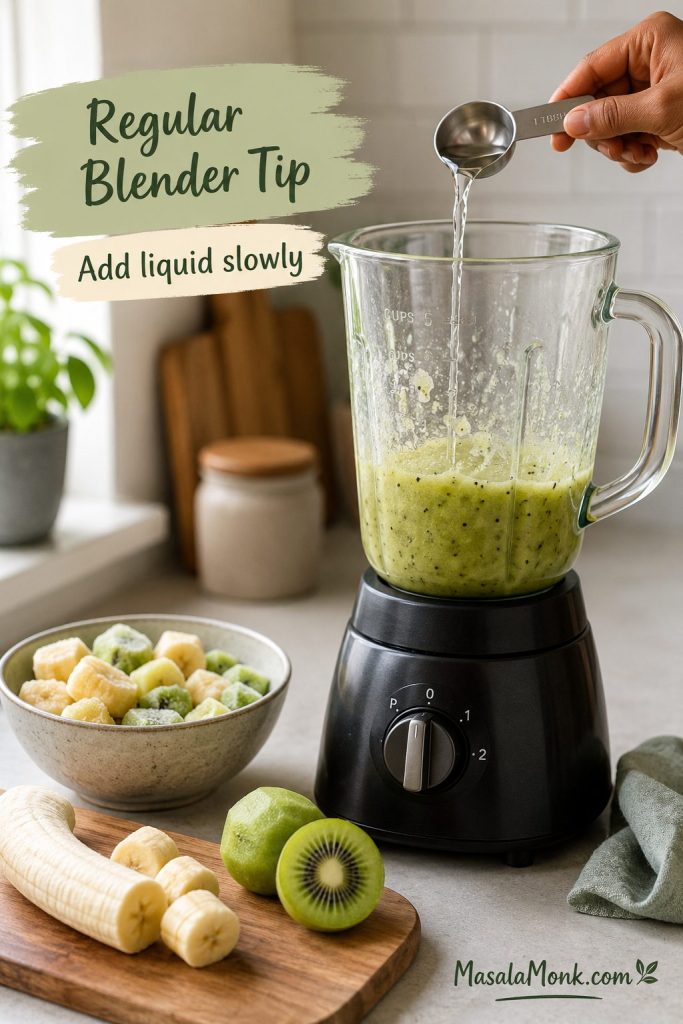
Blender tip: If the blender stalls, do not dump in a lot of liquid at once. Add 1 tablespoon at a time, blend again, and stop as soon as the smoothie moves smoothly.
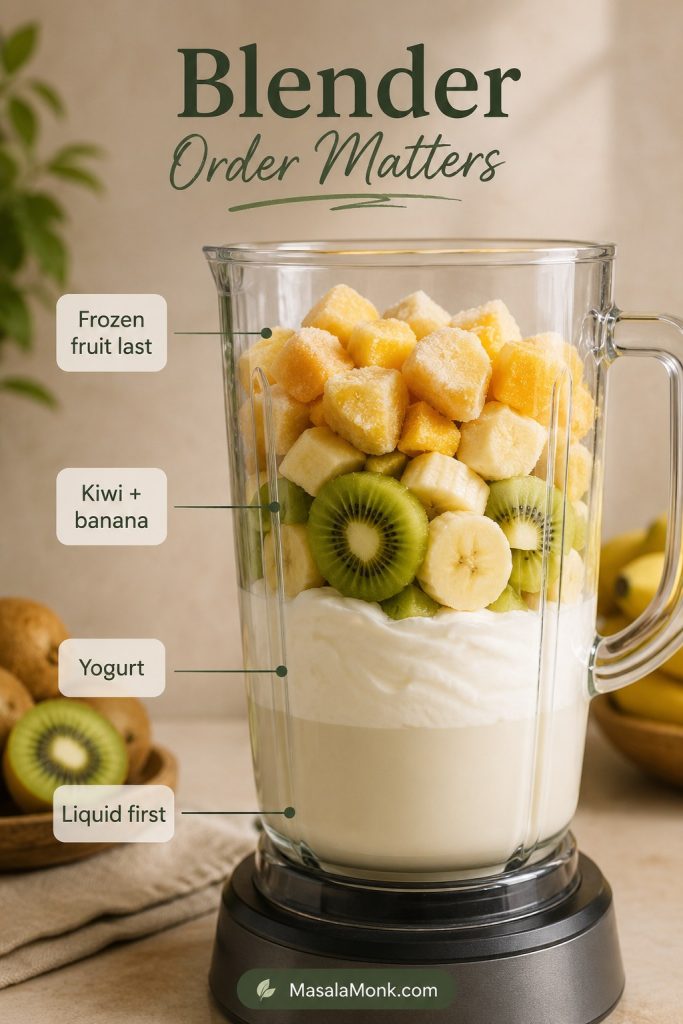
Blender jar layered with liquid, yogurt, kiwi, banana, and frozen fruit for a smoothie
The right blender order matters: liquid first, creamy ingredients next, and frozen fruit last so the blades can move smoothly.

If you are using a regular blender, chop the frozen banana smaller and let very hard frozen fruit sit at room temperature for 3–5 minutes before blending. Also, add liquid first, then increase the liquid by tablespoons only if the blades stop moving.

Regular blender with kiwi smoothie ingredients and liquid being added slowly
Even a regular blender can make a creamy kiwi smoothie when the frozen fruit is chopped smaller and the liquid is added gradually.

Kiwi Smoothie Recipe Card

Kiwi smoothie recipe card with a finished smoothie and the base ingredient ratio
Save this base recipe first; once the ratio is familiar, it becomes much easier to troubleshoot texture and build variations confidently.

Kiwi Smoothie Recipe

This creamy kiwi smoothie recipe is made with ripe kiwi, frozen banana, yogurt, and your choice of milk, coconut water, orange juice, or water. It is bright, fresh, tangy-sweet, and easy to adjust.

Prep Time5 minutes
Cook Time0 minutes
Total Time5 minutes
YieldAbout 1 large 16–20 oz smoothie or 2 small 8–10 oz smoothies

Equipment

  • Blender or high-speed blender
  • Knife and cutting board
  • Measuring cups and spoons
  • Glass or jar for serving

Ingredients

  • 2 medium ripe kiwis, peeled and chopped, about 140–160 g flesh
  • 1 medium frozen banana, about 100–120 g
  • ½ cup plain Greek yogurt or regular plain yogurt, about 120 g
  • ½ cup milk, coconut water, orange juice, or water, 4 fl oz / 120 ml
  • 1–2 teaspoons honey or maple syrup, optional, 7–14 g
  • ½ cup frozen mango, strawberries, or pineapple, optional, about 70–90 g
  • ¼–½ cup ice, optional, only if your fruit is fresh and the smoothie needs chilling
  • 1 teaspoon lime or lemon juice, optional, 5 ml

Method

  1. Add the liquid to the blender first.
  2. Add the yogurt, peeled kiwi, frozen banana, and any optional frozen fruit.
  3. Blend for 30–60 seconds, or until smooth. If using greens, oats, chia, protein powder, or a lot of frozen fruit, blend for 60–120 seconds.
  4. Taste the smoothie. Add honey if it is too tart, more liquid if it is too thick, or more frozen banana/mango if it is too thin.
  5. Pour into one large glass or two small glasses and drink right away.

Notes

  • For the creamiest smoothie, use frozen banana instead of fresh banana.
  • For a dairy-free smoothie, use plant yogurt, almond milk, coconut water, mango, or avocado.
  • For a smoothie bowl, reduce the liquid to ¼ cup / 60 ml and use frozen banana or frozen mango.
  • Kiwi smoothies with milk or yogurt are best enjoyed fresh because kiwi can change the texture as it sits. See the milk, yogurt, and juice guide for more detail.
  • The final yield depends on how much frozen fruit or ice you add.

Kiwi Smoothie Variations

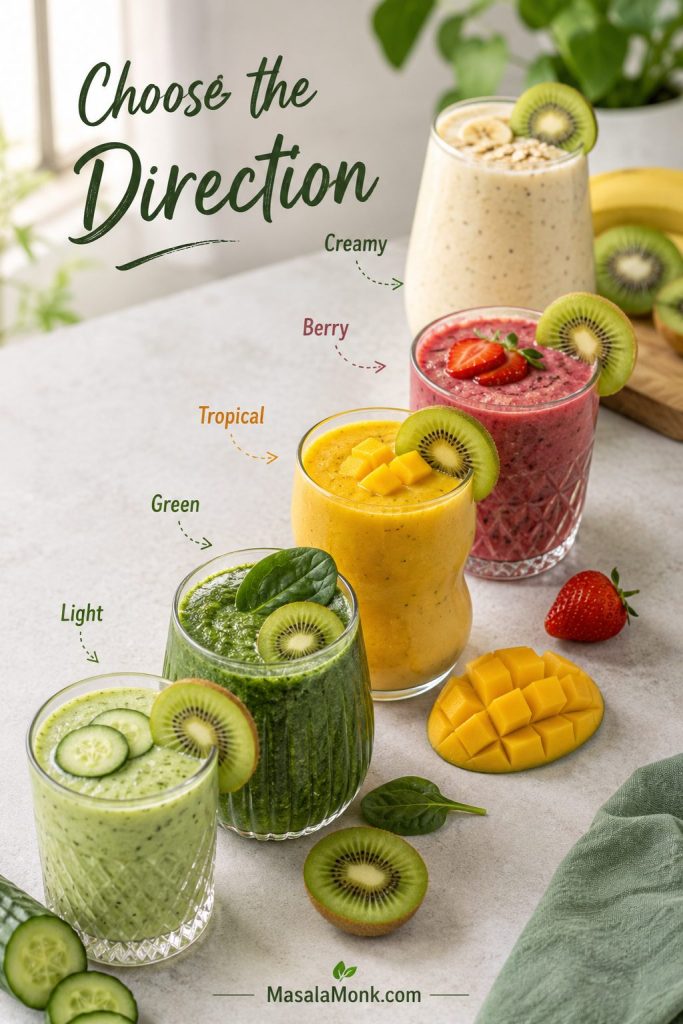
Five kiwi smoothie variations in different glasses with banana, strawberry, mango, spinach, and cucumber styles
A good base smoothie can move in several directions; however, changing one main ingredient at a time keeps the flavor balanced.

Once the base ratio tastes right, the fun part is choosing the direction. You can make it creamy and breakfast-like with banana, tropical with mango or pineapple, sharper with strawberries, greener with spinach, or lighter with cucumber and coconut water. Since kiwis bring most of the bright, tangy flavor, change one thing at a time so the blend stays balanced.

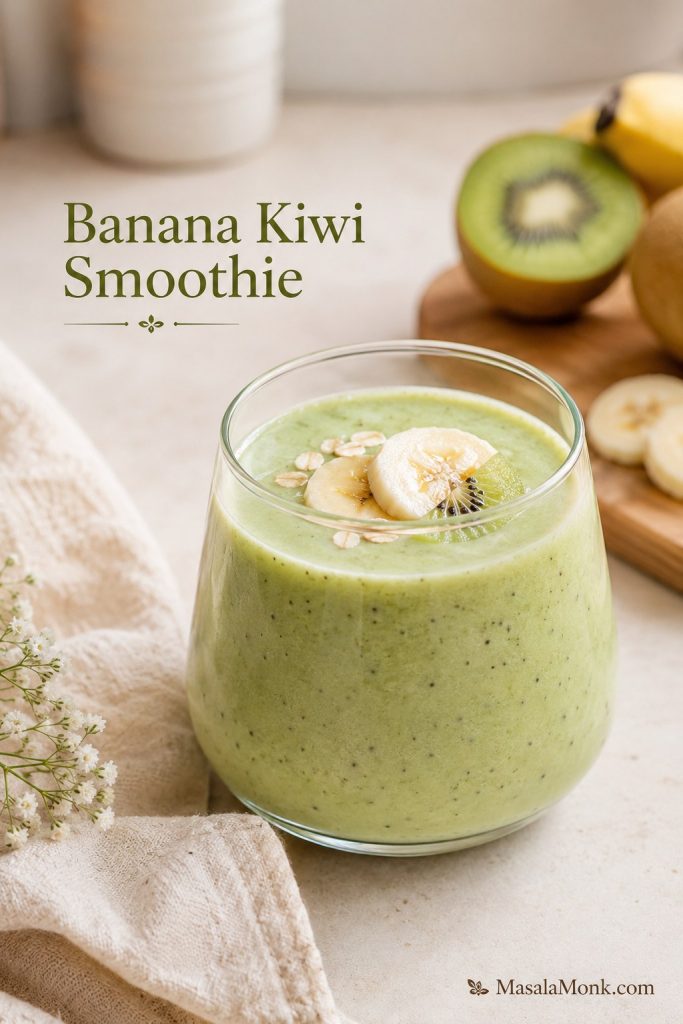
Banana Kiwi Smoothie

Creamy banana kiwi smoothie with banana slices and fresh kiwi garnish
Banana softens kiwi’s tartness and gives the smoothie a thicker breakfast-style texture without relying on extra ice.

This is the easiest and creamiest version. Make the base recipe with 2 ripe kiwis, 1 frozen banana, yogurt, and milk or coconut water. The banana softens kiwi’s tartness and gives the smoothie a smooth breakfast-style texture.

Strawberry Kiwi Smoothie

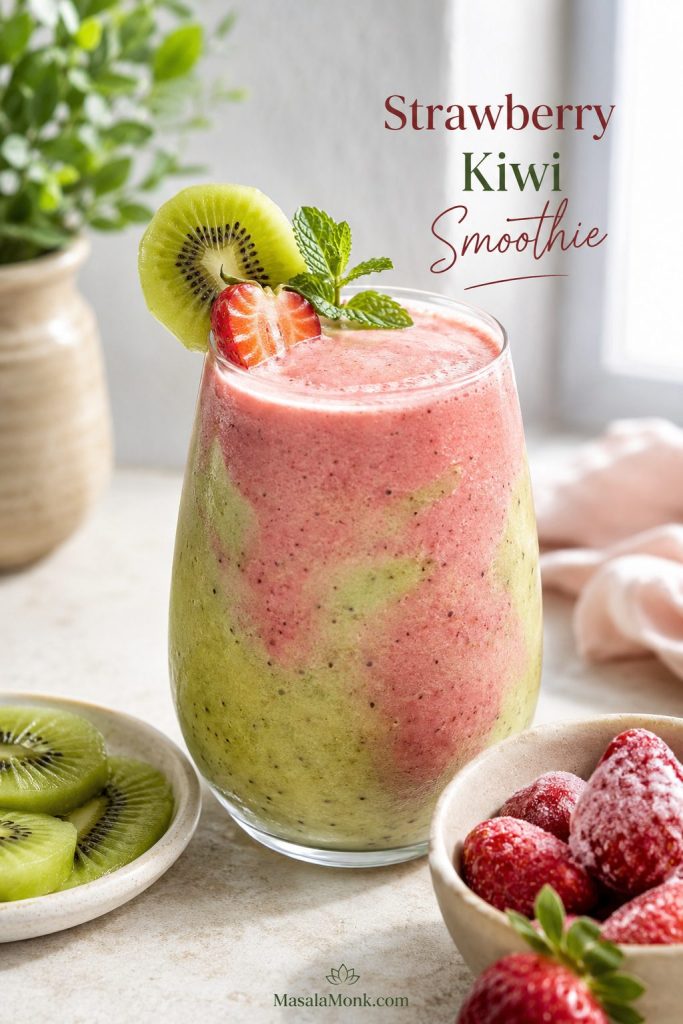
Strawberry kiwi smoothie with pink and green blended layers, kiwi, and strawberries
Strawberries make the drink brighter and more familiar, while kiwi keeps the smoothie fresh, tangy, and fruit-forward.

Strawberries make the smoothie taste brighter and more familiar, especially if you like a sweet-tart berry flavor. Add ½–1 cup frozen strawberries to the base recipe. Keep the banana if you want creaminess, or reduce it slightly if you want the strawberry and kiwi to taste sharper and fresher.

If you want to go deeper on the berry side, MasalaMonk also has a full strawberry smoothie guide with yogurt, no-yogurt, protein, and fruit variation ideas.

Kiwi Mango Smoothie

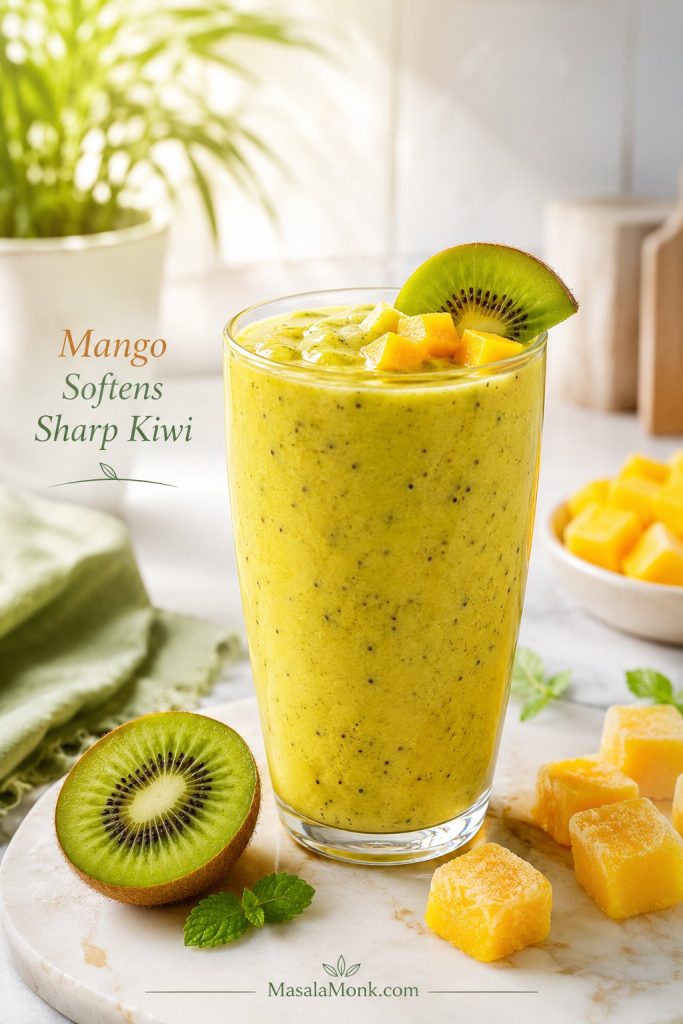
Golden-green kiwi mango smoothie with mango cubes and sliced kiwi
Mango is one of the best ways to soften sharp kiwi because it adds natural sweetness and body at the same time.

Mango is one of the easiest ways to tame sharp kiwi. It adds sweetness, body, and a tropical flavor without needing much extra sweetener. Blend ½–1 cup frozen mango with 2 kiwis, then use coconut water for a lighter drink or orange juice for a brighter one.

If mango is the fruit you use most often in smoothies, this mango smoothie recipe is a useful companion because it covers fresh mango, frozen mango, yogurt, milk, banana, no-banana, dairy-free, protein, and smoothie bowl versions.

Kiwi Pineapple Smoothie

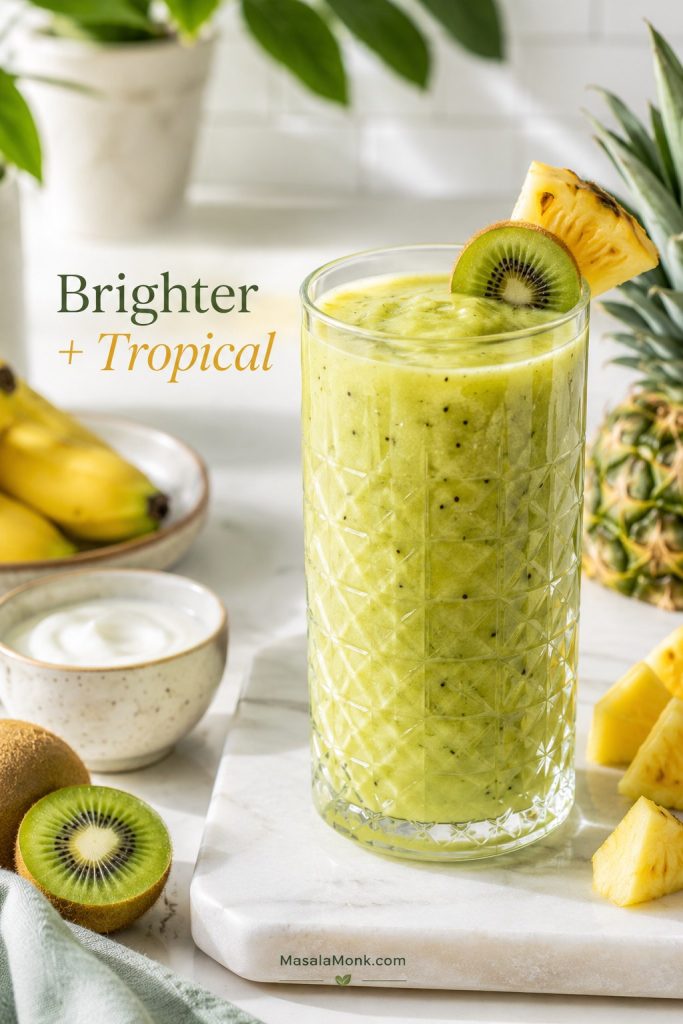
Kiwi pineapple smoothie in a tall glass with pineapple and kiwi garnish
Pineapple pushes the smoothie in a brighter tropical direction; because it can also taste tart, banana, mango, or yogurt helps keep it balanced.

Pineapple pushes the smoothie in a sharper, juicier, more tropical direction. Frozen pineapple is especially good when you want a colder, thicker drink. Because both kiwi and pineapple can taste tart, balance this version with banana, yogurt, mango, or a small amount of honey.

Green Kiwi Smoothie With Spinach

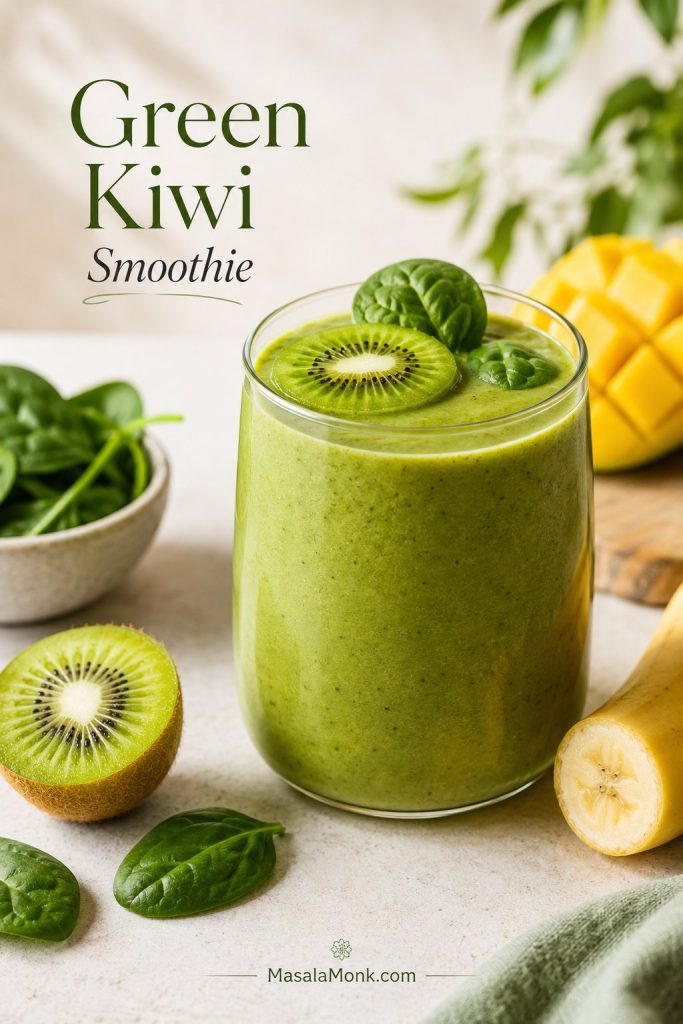
Green kiwi smoothie with spinach, banana, mango, and kiwi garnish
Fresh spinach blends into a kiwi smoothie more gently than frozen spinach, especially when banana or mango stays in the mix for sweetness.

Fresh baby spinach blends into kiwi smoothies more gently than frozen spinach. Add 1 cup to the base recipe, then keep banana or mango in the mix so the smoothie still tastes sweet enough. The color becomes greener, but the flavor stays mild when the spinach is fresh and not packed too heavily.

For more smoothie ideas built around fruit, greens, and vitamin C pairings, see MasalaMonk’s high-iron smoothies and shakes guide.

Kiwi Cucumber Smoothie

Light kiwi cucumber smoothie with cucumber slices, mint, lime, and kiwi
For a lighter version, cucumber, mint, lime, and coconut water make the smoothie feel crisp without turning it into a heavy breakfast blend.

This cucumber version is lighter and fresher than the banana-yogurt blend. Blend kiwi with cucumber, mint, lime, and coconut water for a crisp, cooling drink. Add a little banana, mango, or Greek yogurt if you want it to feel more filling.

Kiwi Protein Smoothie

Greek yogurt is the simplest protein boost because it also improves texture. You can add one scoop of plain or vanilla protein powder, but keep banana, mango, or yogurt in the mix so the smoothie does not taste chalky.

For another simple way to add texture to smoothies, see this guide on using hemp seeds in smoothies.

Kiwi Smoothie Without Yogurt

Kiwi smoothie without yogurt shown with mango, avocado, oats, chia seeds, and plant milk
Without yogurt, the smoothie needs another source of body, so mango, avocado, oats, chia, or plant milk become more important.

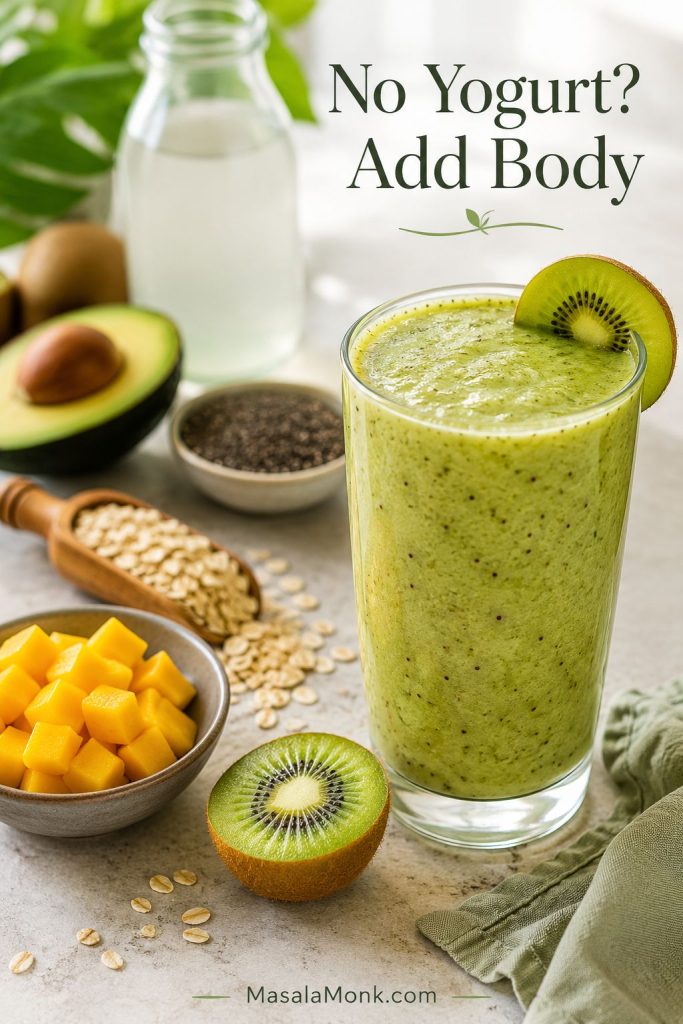
A no-yogurt version still needs body because kiwis alone can make the recipe taste sharp and thin. Keep the frozen banana and use almond milk, oat milk, coconut water, or orange juice as the liquid. For a thicker texture, add frozen mango, avocado, chia seeds, oats, or plant-based yogurt.

Kiwi Smoothie Without Banana

Kiwi smoothie without banana shown with mango, avocado, pear, yogurt, and kiwi
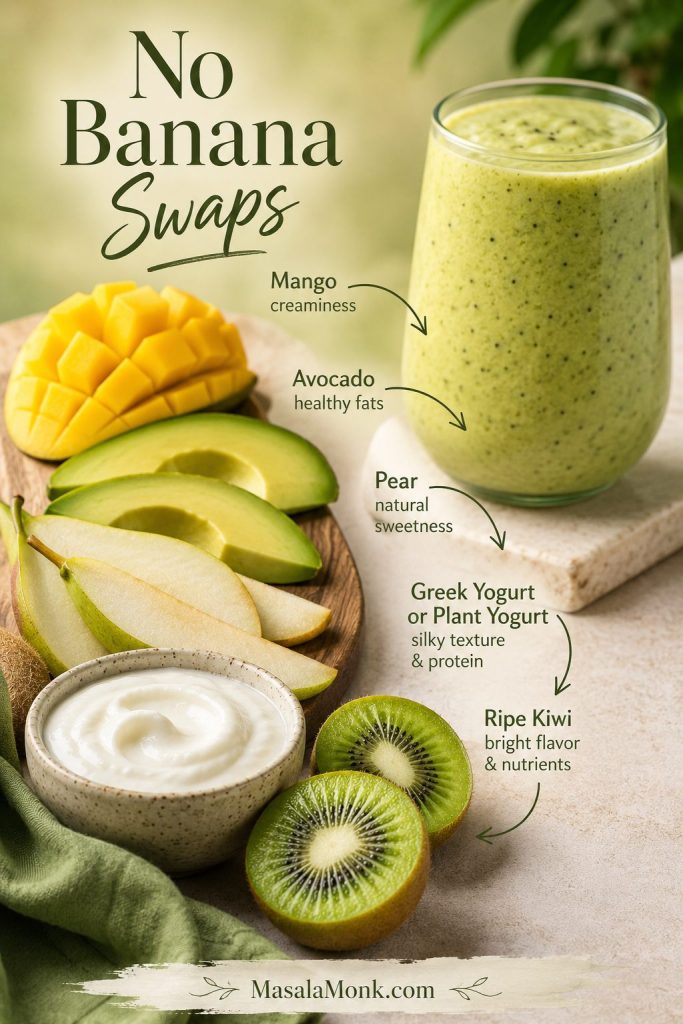
Banana is easy, but not essential; instead, use mango for sweetness or avocado and pear when you want creaminess with a different flavor profile.

Banana is helpful, but it is not mandatory. Frozen mango is the best swap when you still want sweetness and thickness. Avocado gives creaminess without sweetness, Greek yogurt adds body, and pear gives a softer fruit flavor. Without one of these replacements, kiwi can taste sharper and the smoothie may feel thinner.

Kiwi Smoothie Bowl

Thick kiwi smoothie bowl with sliced kiwi, berries, granola, coconut, chia, and a spooned texture
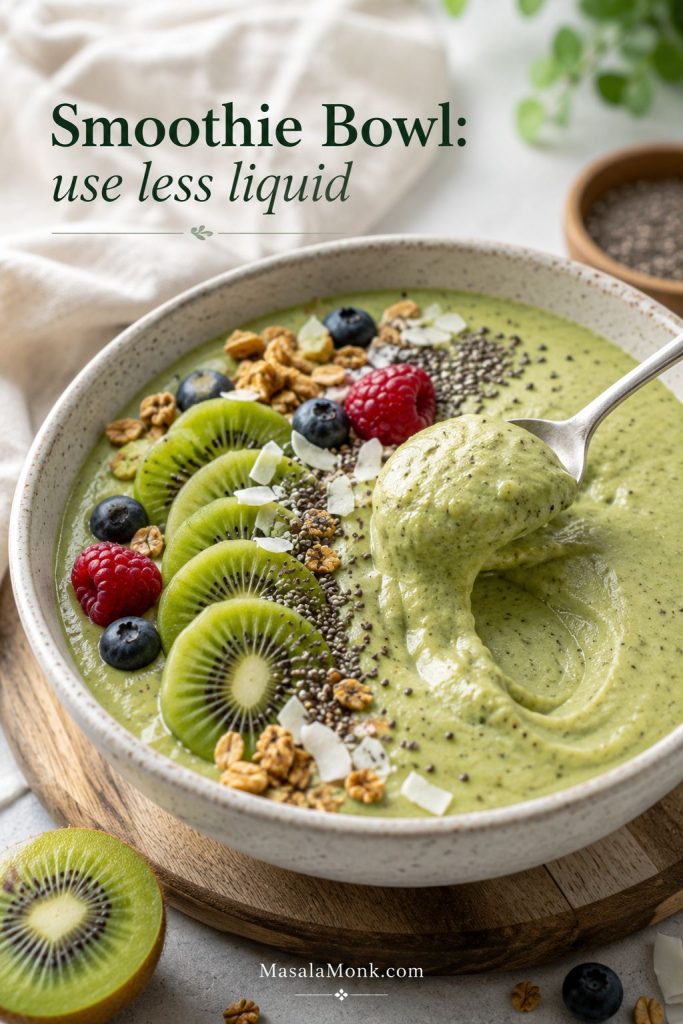
A kiwi smoothie bowl needs less liquid than a drinkable smoothie; otherwise, the toppings sink and the base becomes too loose.
A smoothie bowl needs much less liquid than a drinkable smoothie. Reduce the liquid to ¼ cup / 60 ml and use frozen banana, frozen mango, or frozen pineapple. Blend thick, then top with sliced kiwi, granola, coconut, chia seeds, berries, or pumpkin seeds.
Kiwi Milkshake or Kiwi Shake

Kiwi smoothie and kiwi milkshake compared in two different glasses
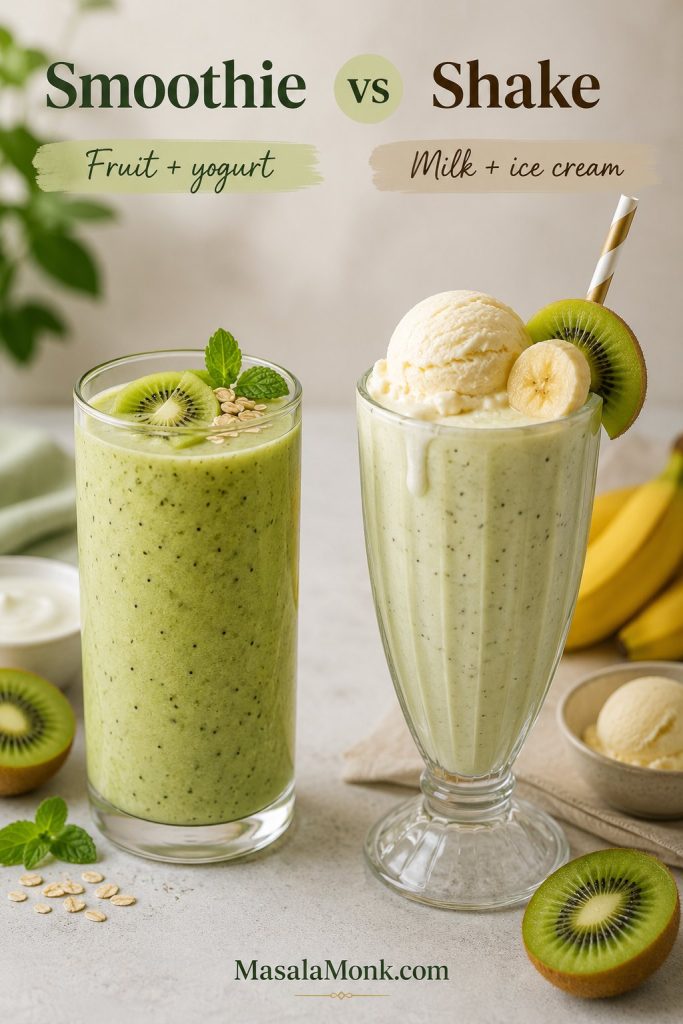
A kiwi smoothie is usually lighter and fruit-based, while a kiwi shake becomes richer and sweeter with milk, banana, and ice cream.

A kiwi shake is the dessert-style cousin of this smoothie. Blend 2–3 peeled kiwis with milk, banana, and a scoop of vanilla ice cream for a colder, sweeter drink. It is richer than the main recipe, so serve it right away and treat it more like a milkshake than a breakfast smoothie.

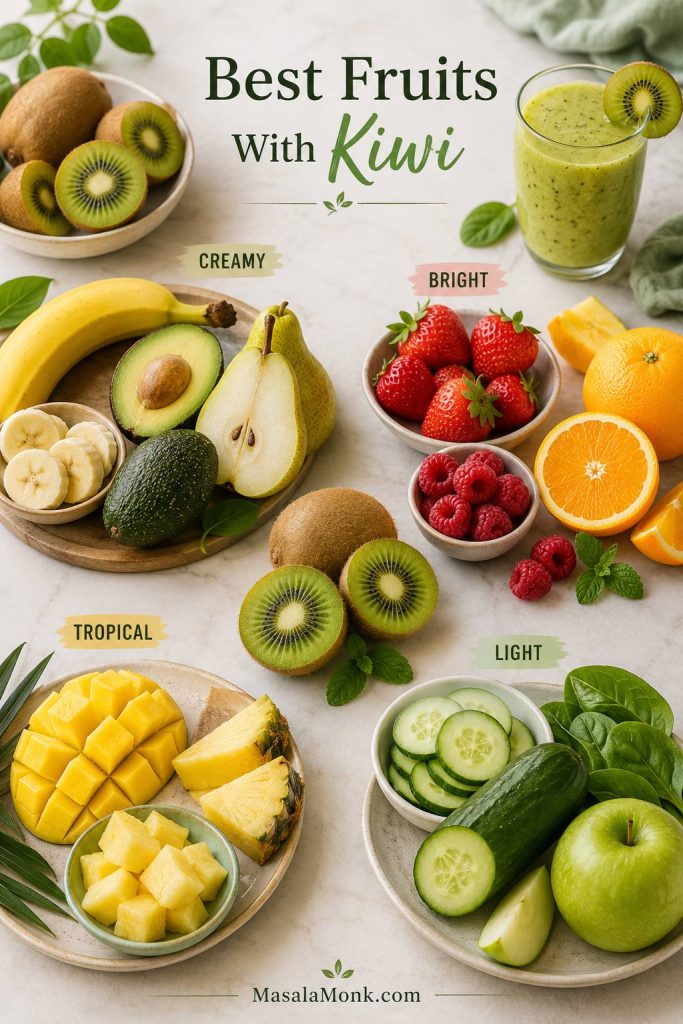
Best Fruits to Pair With Kiwi in Smoothies

Fruit pairing guide for kiwi smoothies with banana, avocado, pear, berries, orange, mango, pineapple, cucumber, spinach, and apple
Kiwi pairs best with fruits that either soften its tangy edge or echo its bright flavor, so choose the pairing based on the smoothie you want.

Because kiwi has a naturally bright edge, it works best with fruits that either soften its tartness or echo that fresh flavor. Banana and mango make it creamier. Strawberry and raspberry keep it tangy. Pineapple and orange make it tropical. Apple, pear, cucumber, and spinach keep it lighter.

Fruit or add-in Why it works with kiwi Best smoothie style
Banana Softens tartness and thickens the drink. Creamy breakfast smoothie
Strawberry Gives a familiar sweet-tart berry flavor. Berry kiwi smoothie
Mango Adds tropical sweetness and body. No-yogurt or tropical smoothie
Pineapple Makes the smoothie bright and juicy. Refreshing summer smoothie
Orange Adds citrus sweetness and makes the drink fruitier. Juice-based smoothie
Apple Keeps the flavor mild and fresh. Light breakfast smoothie
Blueberry Adds deeper berry flavor and color. Purple fruit smoothie
Raspberry Keeps the smoothie sharp and tangy. Tart berry smoothie
Pear Adds gentle sweetness without dominating. No-banana smoothie
Avocado Makes the smoothie creamy without banana. No-banana creamy smoothie
Spinach Adds green color with mild flavor. Green kiwi smoothie
Cucumber Makes the smoothie lighter and fresher. Cooling smoothie

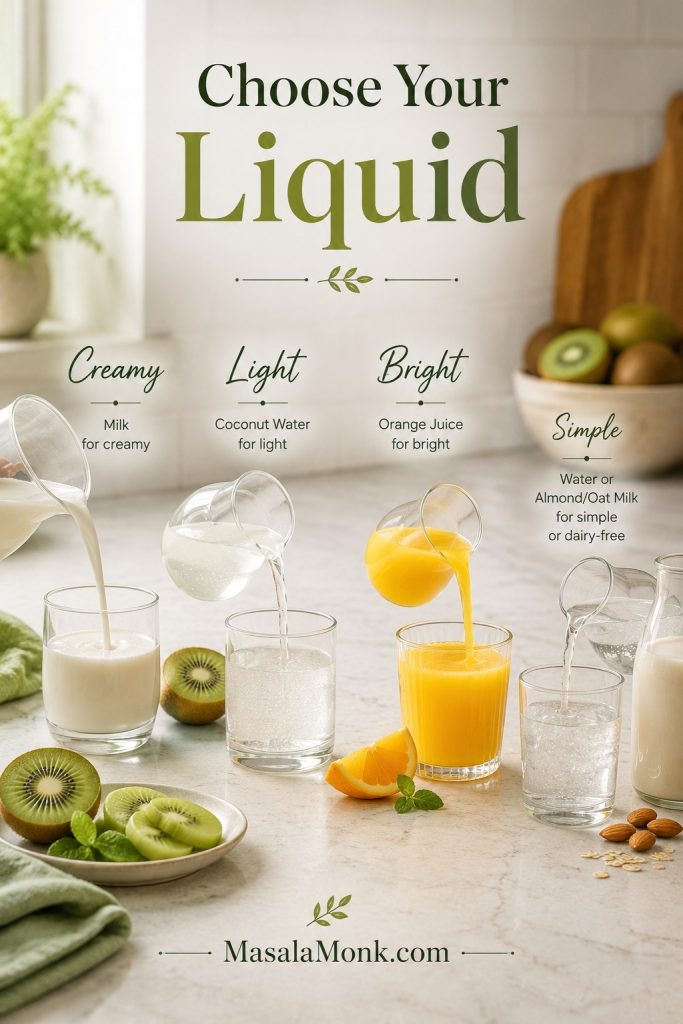
Kiwi Smoothie With Milk, Yogurt, or Juice

Liquid guide for kiwi smoothies showing milk, coconut water, orange juice, water, and plant milk
Liquid choice shapes the whole smoothie, so pick milk for creaminess, coconut water for lightness, orange juice for brightness, or water when the fruit already tastes sweet.

The liquid you choose changes the whole smoothie. There is no single correct option; the best one depends on whether you want the drink creamy, light, bright, dairy-free, or more filling.

Because the liquid changes the final texture so much, choose based on the smoothie you actually want instead of forcing one option.

Liquid Best use Watch-out
Milk Creamy, mellow smoothie. Best with banana or yogurt for balance.
Greek yogurt + water Thick texture without too much liquid. Can taste tangy if the kiwi is tart.
Almond milk or oat milk Dairy-free creaminess. Use unsweetened if you want more control.
Coconut water Light, refreshing, tropical-style smoothie. Thinner than milk or yogurt.
Orange juice Bright, fruity, tropical flavor. Can make a tart kiwi taste even sharper.
Water Cleanest and simplest option. Can taste thin unless you use banana or mango.
Canned coconut milk Rich tropical smoothie. Can get heavy fast; use a small amount.

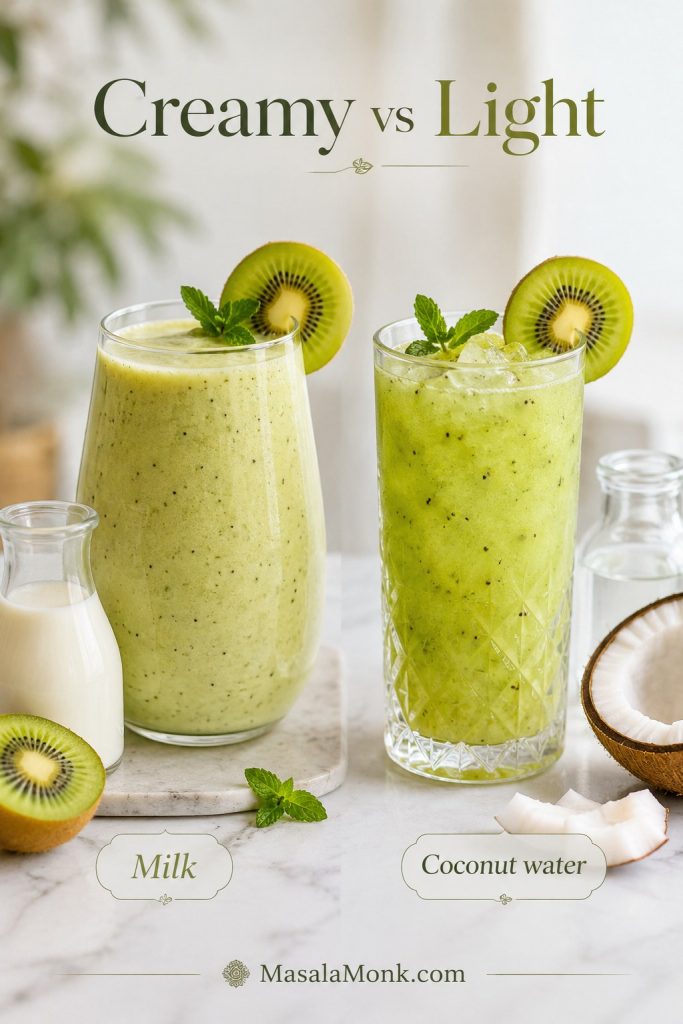
Milk vs Coconut Water

Milk-based kiwi smoothie and coconut-water kiwi smoothie shown side by side
Choose milk when you want a softer, creamier breakfast smoothie; meanwhile, coconut water works better for a lighter, fresher finish.

If you like the lighter tropical finish of coconut water, MasalaMonk’s coconut water smoothie ideas can give you more combinations beyond kiwi.

Kiwi works with milk and yogurt, but dairy-based versions are best enjoyed soon after blending. Green kiwifruit contains actinidin, a natural protein-digesting enzyme, so a milk- or yogurt-heavy smoothie can thin or separate more noticeably as it sits.

Is a Kiwi Smoothie Good for Weight Loss?

A smoothie recipe with kiwis can fit into a lighter breakfast or snack, but it is not magic on its own. The overall blend matters more than the word “kiwi.” Use whole fruit, keep juice and sweeteners modest, and add protein or fiber if you want the smoothie to feel more satisfying. The protein smoothie variation is a good place to start if you want a more filling version.

For example, a more balanced version could use 2 kiwis, ½ frozen banana, Greek yogurt or unsweetened plant milk, spinach or cucumber, and chia seeds. On the other hand, too much honey, sweetened yogurt, fruit juice, or ice cream can quickly turn it into a dessert drink.

Harvard Health notes that smoothies can become calorie-heavy when they include added sugar, syrup, honey, sweetened yogurt, frozen yogurt, or large amounts of juice. That is why this recipe keeps sweetener optional and uses whole fruit as the main base.

How to Fix a Kiwi Smoothie

Kiwi smoothie troubleshooting scene with small glasses labeled sour, thin, thick, flat, and watery
A kiwi smoothie that tastes off rarely needs a full remake; instead, one small fix for flavor or texture usually brings it back quickly.

Most problems in a smoothie recipe with kiwis are easy to fix while the drink is still in the blender. Taste before pouring, then adjust one thing at a time. Small changes work better than adding a lot of liquid, sugar, or ice all at once.

Do not throw out a smoothie just because the first sip is not perfect. Kiwi can taste different from fruit to fruit, and one small adjustment in the blender can turn a sharp, flat, or watery smoothie into something balanced.

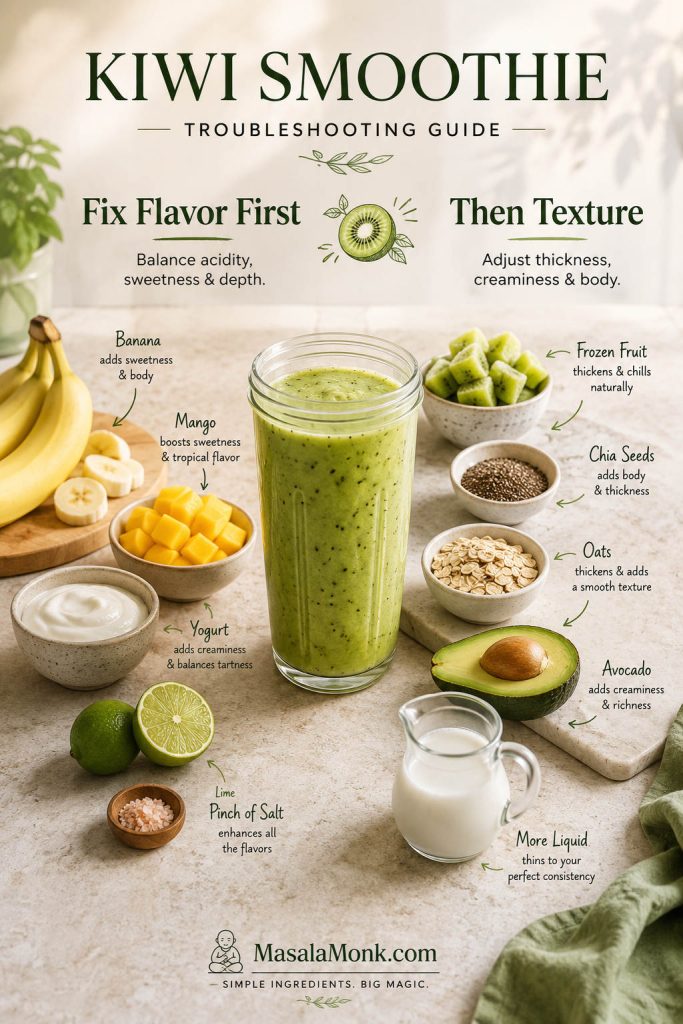
Fix the Flavor First

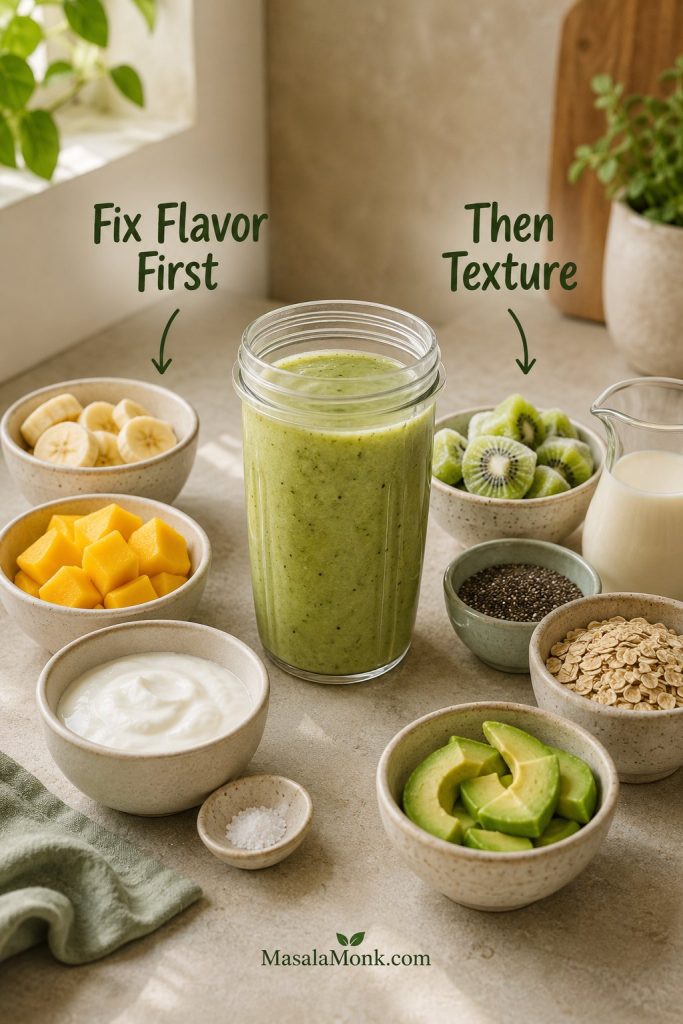
If the smoothie tastes sour, flat, bitter, or too sweet, fix the flavor before you change the texture. Usually, one small addition is enough: banana or mango for softness, yogurt for roundness, lime for brightness, or a tiny pinch of salt for a flat-tasting blend.

Kiwi smoothie fix guide with flavor ingredients on one side and texture ingredients on the other
Fix flavor before texture, because a smoothie that is sour or bland needs a different adjustment than one that is too thick or too thin.

Then Fix the Texture

Once the flavor tastes right, adjust the texture. Frozen fruit, banana, chia, oats, and avocado add body, while milk, coconut water, orange juice, or water loosen a thick smoothie. Add liquid slowly so the drink does not become watery.

Problem Best fix
Sour or sharp Blend in banana, mango, honey, maple syrup, or yogurt to soften the edge.
Thin texture Use frozen banana, frozen mango, chia seeds, oats, or avocado to bring back body. Next time, start with less liquid.
Overly thick Add milk, coconut water, orange juice, or water 1 tablespoon at a time until the blender moves smoothly.
Flat flavor A little more kiwi, a tiny squeeze of lime, orange juice, or even a small pinch of salt can wake it up.
Overly sweet Plain yogurt, cucumber, spinach, extra kiwi, or a little lemon/lime can pull the sweetness back into balance.
Seed-heavy texture Blend longer or use a high-speed blender. Kiwi seeds are edible, but a little texture is normal.
Watery smoothie Use frozen fruit instead of lots of ice, and keep the liquid lower at the start.
Bitter or harsh Use ripe, peeled kiwi. Hard kiwis and too much skin can make the drink taste rough.
Separation after sitting Shake or stir before drinking. For the next batch, use banana, yogurt, chia, or a less watery liquid.
Blender struggling Pour liquid in first, chop frozen fruit smaller, and add extra liquid by tablespoons instead of splashing in too much at once.

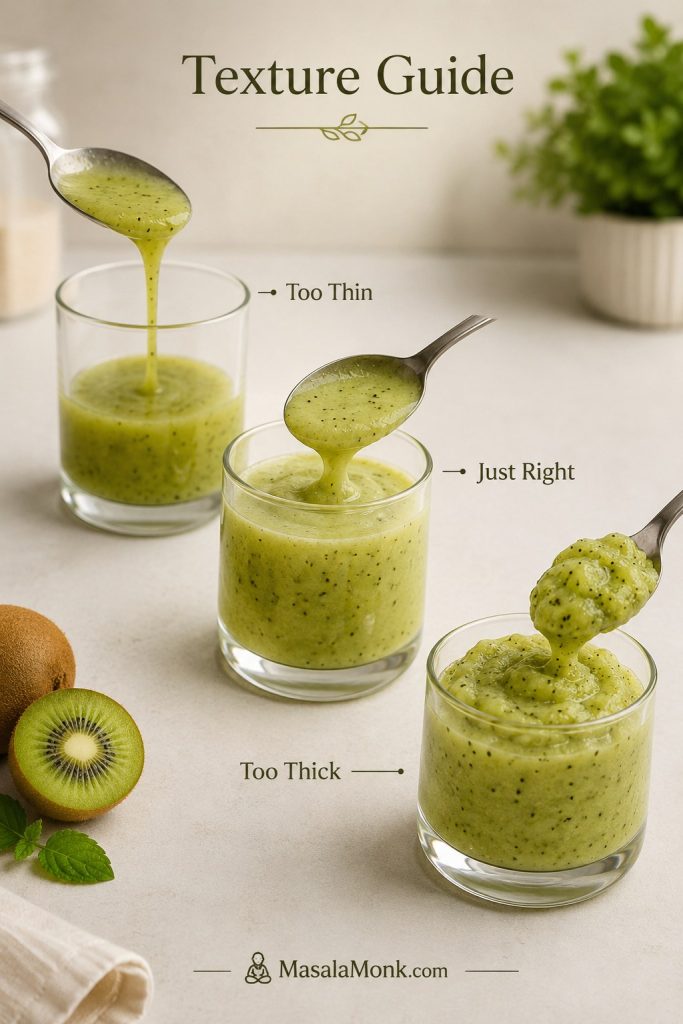
Kiwi Smoothie Thickness Guide

Kiwi smoothie texture guide showing too thin, just right, and too thick spoon textures
The sweet spot is thick enough to feel creamy, yet still loose enough to pour and sip comfortably without feeling heavy.

Make-Ahead, Freezing, and Storage Tips

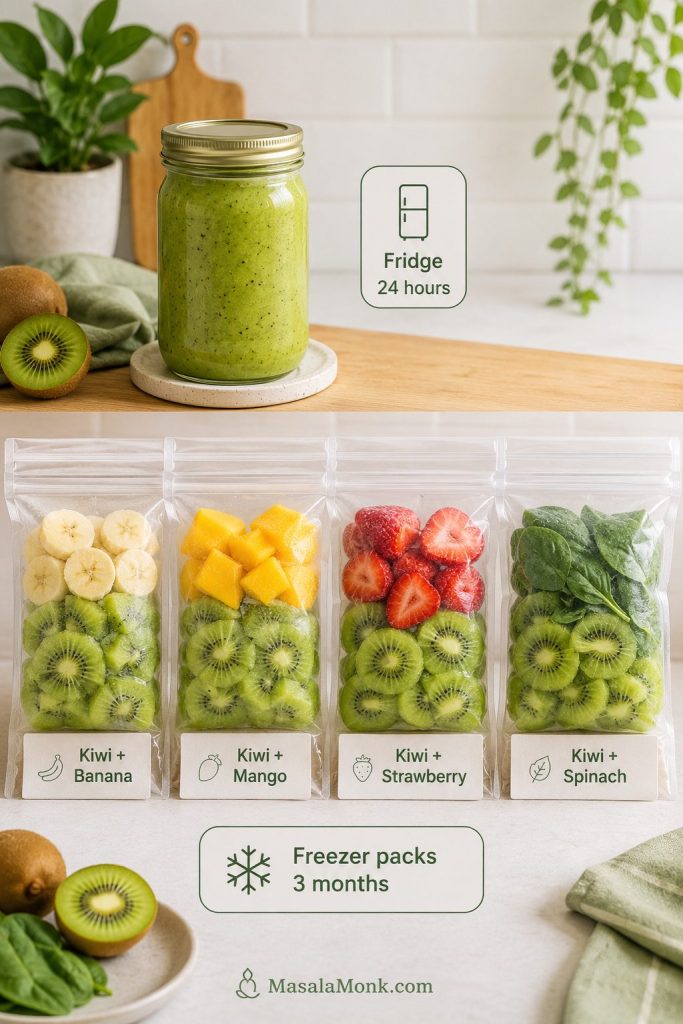
Kiwi smoothie storage image with a fridge jar and freezer packs for kiwi banana, kiwi mango, kiwi strawberry, and kiwi spinach
Blended smoothies taste best fresh, but freezer packs make it easier to prep kiwi, banana, mango, berries, or spinach ahead of time.

This smoothie tastes best right after blending. The flavor is brighter, the texture is smoother, and dairy-based versions are less likely to thin out. If you need to make it ahead, keep it short and practical.

Storing a Kiwi Smoothie in the Fridge

For the best texture, drink it within 24 hours. Store it in a sealed jar or bottle, refrigerate it, and shake or stir before drinking. The smoothie may separate slightly, especially if it has water, coconut water, or juice instead of yogurt.

Freezing Kiwi for Smoothies

Frozen kiwi works well in smoothies. Peel and chop ripe kiwi, freeze the pieces on a tray, then transfer them to a freezer bag or container. However, frozen kiwi works best with banana, mango, strawberry, or yogurt because kiwi alone can become icy.

Making Kiwi Smoothie Packs

Smoothie packs are the easiest make-ahead option. Add peeled kiwi, banana, mango, strawberries, spinach, or pineapple to freezer bags. Freeze for up to 3 months. When ready to blend, add the frozen pack to the blender with yogurt and liquid.

Kiwi Nutrition Notes for Smoothies

Kiwi is often used in smoothies because it brings bright flavor, gentle natural sweetness, fiber from the whole fruit, and vitamin C. It pairs especially well with banana, mango, strawberry, spinach, and yogurt because those ingredients balance the tartness.

The USDA vitamin C table lists raw green kiwifruit as a high-vitamin-C fruit per cup, which makes kiwi a useful ingredient in fruit smoothies. You can also explore MasalaMonk’s broader guide to vitamin C rich foods for more everyday fruit and vegetable ideas.

For a deeper look at kiwi beyond smoothies, MasalaMonk has a guide to kiwi nutrition, benefits, and practical uses. For this recipe, though, the most important thing is simple: ripe fruit, the right liquid, and enough body to keep the smoothie enjoyable.

FAQs About Kiwi Smoothies

These quick answers cover the most common questions readers have before changing the base recipe: milk or no milk, yogurt or no yogurt, banana or no banana, fresh kiwi or frozen kiwi.

Can you put kiwi in a smoothie?

Kiwi works very well in smoothies because it adds bright, tangy fruit flavor. It tastes best with creamy or sweet ingredients like banana, yogurt, mango, strawberry, milk, or coconut water.

Do you peel kiwi before putting it in a smoothie?

For the smoothest kiwi smoothie, peel it first. Kiwi skin is edible, but it can add a fuzzy, fibrous texture. If you want to blend kiwi with the skin on, wash it very well and use a strong blender.

What fruit goes well with kiwi in smoothies?

Banana, strawberry, mango, pineapple, orange, apple, blueberry, raspberry, pear, and avocado all pair well with kiwi. Banana and mango are best for sweetness and creaminess, while strawberry and pineapple keep the flavor brighter.

Can I make a kiwi smoothie with milk?

Milk makes the drink creamy and mild, especially when paired with banana or yogurt. For the best texture, drink milk-based versions soon after blending.

Can I make a kiwi smoothie without yogurt?

For a no-yogurt version, replace yogurt with frozen banana, mango, avocado, plant milk, coconut water, chia seeds, oats, or plant-based yogurt. Without yogurt, the smoothie usually needs frozen fruit or banana to stay thick.

Can I make a kiwi smoothie without banana?

Mango, avocado, pear, Greek yogurt, frozen pineapple, or chia seeds can all replace banana. Mango is the best swap when you want sweetness and thickness without changing the flavor too much.

How do you make a kiwi smoothie less sour?

Start with ripe kiwis, then add banana or mango if the smoothie still tastes sharp. Milk or yogurt can also soften the flavor better than water. If needed, add 1–2 teaspoons honey or maple syrup, but avoid too much lime, lemon, pineapple, or orange juice when the kiwi is already tart.

Why did my kiwi smoothie turn watery?

It may have too much liquid, too much ice, or not enough creamy fruit. Frozen banana, frozen mango, yogurt, avocado, chia seeds, or oats will help thicken it. Also, the texture can thin slightly as it sits, so it is best fresh.

Can I use frozen kiwi in a smoothie?

Frozen kiwi works well, especially with banana, mango, strawberry, yogurt, or another creamy ingredient. On its own, frozen kiwi can make a smoothie taste icy or sharp.

What is the difference between a kiwi smoothie and a kiwi milkshake?

The smoothie version is usually fruit-based and often made with yogurt, milk, coconut water, or juice. A kiwi milkshake is dessert-style and usually includes milk, ice cream, or extra sweetener.

Final Tips for the Best Kiwi Smoothie

The first time you make it, start with 2 ripe kiwis, 1 frozen banana, ½ cup yogurt, and ½ cup liquid. Then, taste it before pouring. That one small pause is what helps you catch a sharp kiwi, a thin texture, or a smoothie that needs one more spoonful of yogurt.

After that, the recipe becomes easy to adapt. Banana makes it creamy, mango makes it tropical, strawberry makes it brighter, cucumber makes it lighter, and ice cream turns it into a kiwi shake. Once you make it once, note which direction you liked best: creamy banana, tropical mango, lighter coconut water, or sharper strawberry kiwi.

The best version is not always the sweetest one. It is the one where the kiwi still tastes fresh, the texture feels creamy, and nothing sharp, watery, or heavy takes over.

Finished creamy kiwi smoothie served in a glass with sliced kiwi in a warm breakfast setting
At its best, this smoothie stays bright, creamy, and fresh-tasting, so the kiwi still leads without turning the drink watery or harsh.
Posted on 3 Comments

Mango Smoothie Recipe

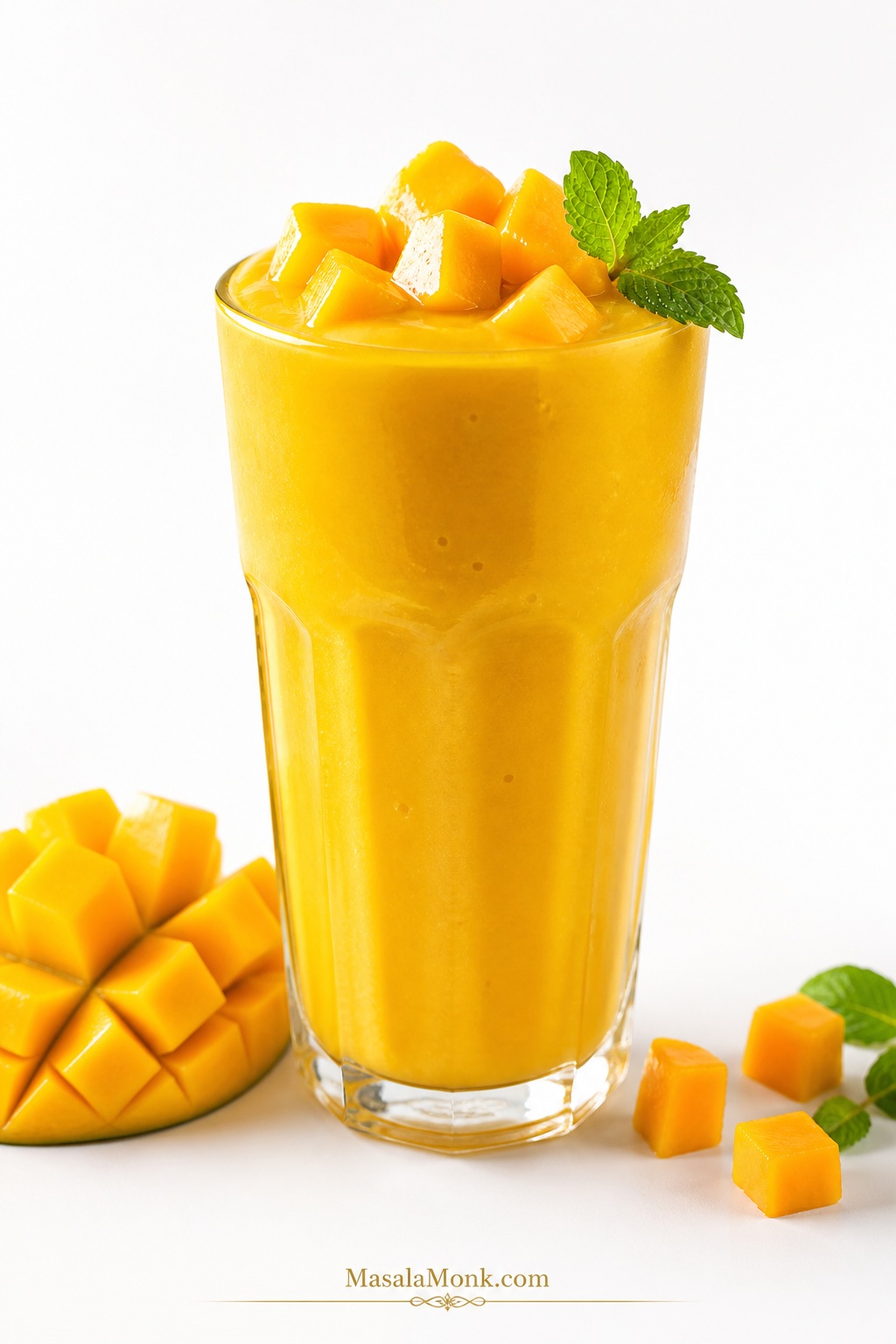
Thick mango smoothie in a glass topped with mango cubes and mint, served with fresh mango and lime.

A good mango smoothie recipe should taste cold, creamy, bright, and full of real mango flavor. It should not turn watery after a few sips, taste mostly like banana, or need a pile of ice just to feel thick.

This mango smoothie recipe starts with a simple base formula: ripe mango, just enough liquid, something creamy, and a small lift of lime if the fruit needs brightness. You can make it with fresh or frozen mango, yogurt or milk, banana or no banana, dairy or plant milk, and still end up with a smoothie that feels smooth, balanced, and easy to drink.

Once you understand the ratio, the same recipe can move in several directions. Make it thicker for a smoothie bowl, lighter for a breakfast drink, richer with Greek yogurt, tropical with pineapple, berry-bright with strawberries, or more filling with protein powder. The goal is not to memorize a dozen recipes. It is to know how to build the mango smoothie you actually want.

Mango Smoothie Recipe Quick Answer

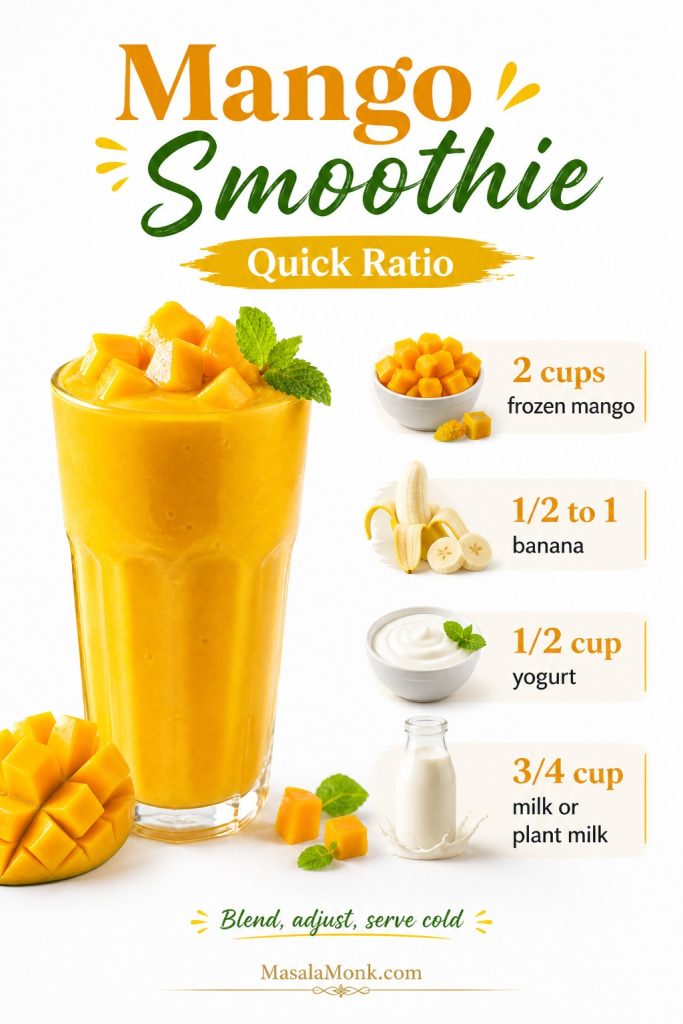
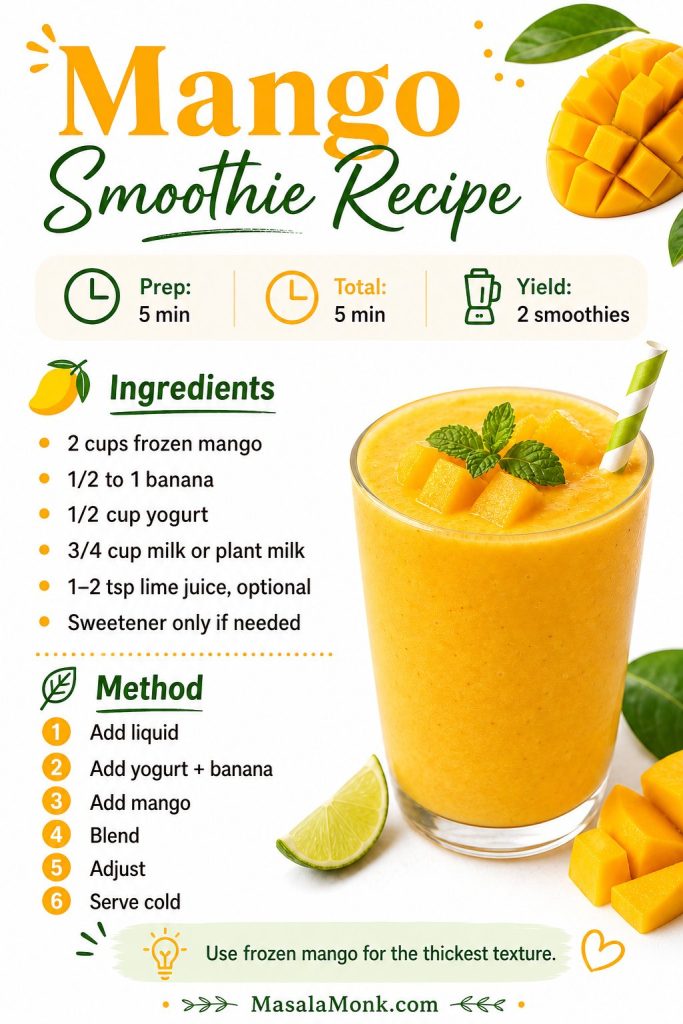
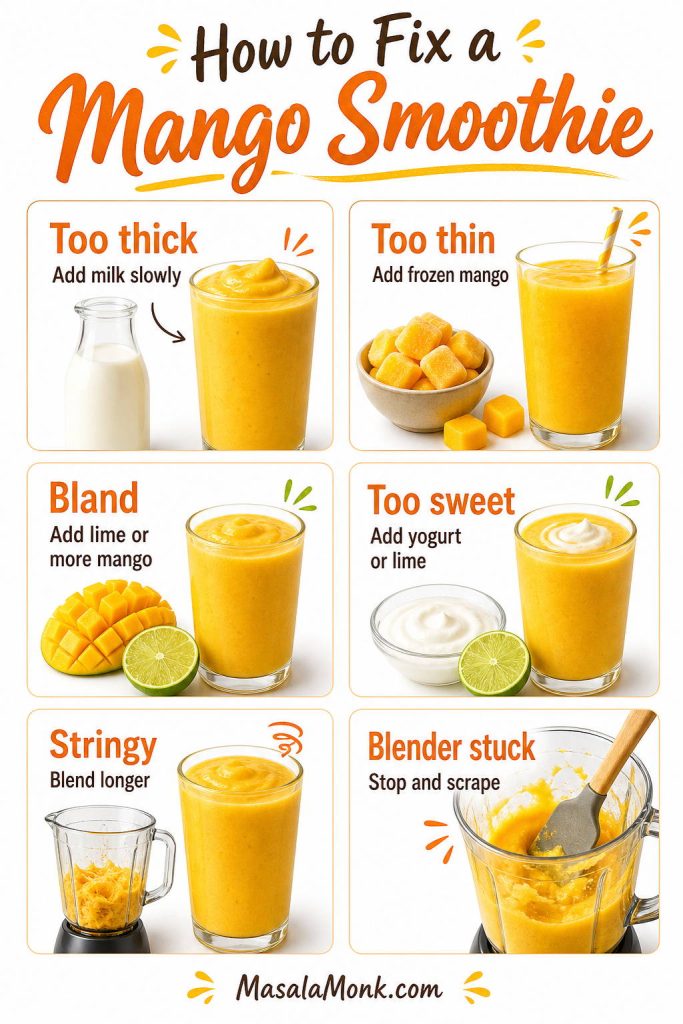
For a creamy, balanced mango smoothie, blend 2 cups frozen mango chunks, 1/2 to 1 small banana, 1/2 cup yogurt, and 3/4 cup milk or plant milk. Add 1 to 2 teaspoons lime juice when the mango tastes very sweet or slightly flat. To loosen a thick smoothie, add milk 1 tablespoon at a time. For a thin smoothie, add more frozen mango instead of piling in ice.

Best starting point: Use frozen mango, chilled yogurt, chilled milk, and no ice. This gives you a cold, creamy mango smoothie without diluting the fruit.
Quick mango smoothie ratio graphic showing frozen mango, banana, yogurt, milk or plant milk, and a finished smoothie.
Use this base ratio when you want a reliable starting point. Then, depending on whether you want a thinner drink or a thicker blend, adjust the liquid or frozen fruit in small steps.

Choose Your Mango Smoothie Version

The base mango smoothie recipe is flexible, so you can adjust it depending on what you have and how creamy you want the drink to be. Use this quick guide before you blend.

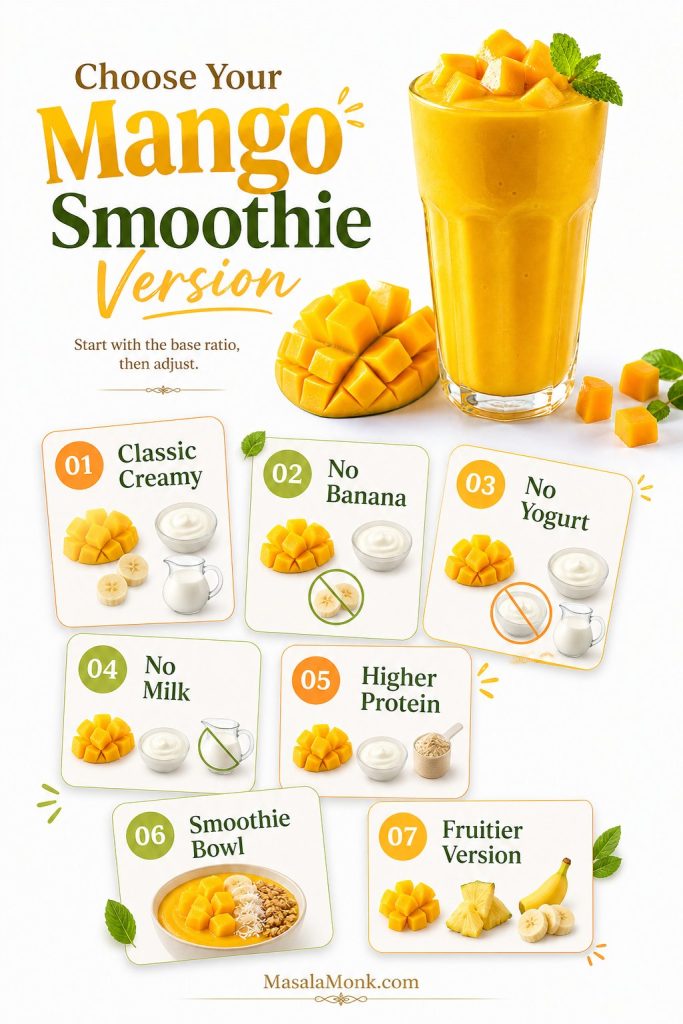
Visual guide showing classic, no banana, no yogurt, no milk, higher protein, smoothie bowl, and fruitier mango smoothie options.
This quick chooser helps you match the mango smoothie recipe to what you have on hand; as a result, you can move straight to the version that fits your ingredients and texture goal.
What You Want Best Adjustment Start With
Classic creamy mango smoothie Use frozen mango, banana, yogurt, and milk. Start with 2 cups mango, 1/2 banana, 1/2 cup yogurt, and 3/4 cup milk.
No banana Use extra frozen mango, Greek yogurt, avocado, or soaked cashews for body. Blend 2 1/2 cups frozen mango with 1/2 cup yogurt and 3/4 cup milk.
No yogurt Use banana, avocado, coconut milk, or extra frozen mango for creaminess. Try 2 cups mango, 1 banana, and 3/4 cup milk.
No milk Use coconut water, orange juice, water, or coconut milk depending on texture. Begin with 2 cups mango, 1/2 banana, 1/2 cup yogurt, and 1/2 to 3/4 cup liquid.
Higher protein Add protein powder, Greek yogurt, hemp seeds, chia seeds, soy milk, or dairy milk. Add 1 scoop protein powder to the base recipe, then blend in 2 to 4 tablespoons extra milk if needed.
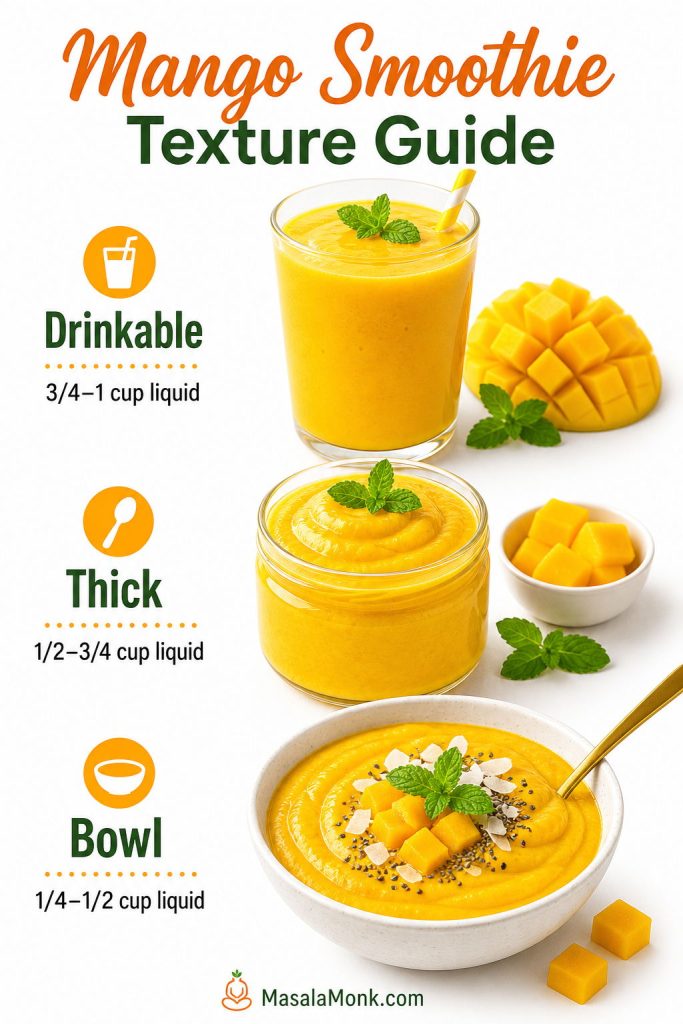
Smoothie bowl Use more frozen mango and much less liquid. For a spoonable bowl, use 2 1/2 to 3 cups frozen mango with only 1/4 to 1/2 cup milk.
Fruitier smoothie Replace half the mango with strawberries, pineapple, blueberries, or peaches. Use 1 cup mango, 1 cup second fruit, yogurt, and milk.

Mango Smoothie at a Glance

Before you start blending, here is the mango smoothie recipe in practical terms. This is the version to make first when you want a classic mango smoothie that is thick, smooth, and easy to adjust.

Detail What to Use
Prep time 5 minutes
Blend time 35–60 seconds, depending on blender strength
Servings 2 medium smoothies
Yield About 2 1/2 to 3 cups / 600–700 ml / 20–24 fl oz
Best mango Frozen ripe mango chunks for texture; fresh ripe mango for peak-season flavor
Best liquid Milk, almond milk, oat milk, cashew milk, or coconut milk
Best texture Thick but pourable
Ice? Skip it with frozen mango; use a little only with fresh mango

Why This Mango Smoothie Works

This mango smoothie recipe works because it is built around texture and balance, not just sweetness. Although mango gives the main flavor, it still needs the right support. Frozen mango thickens the drink without watering it down. Yogurt adds body and a little tang. Banana makes the smoothie naturally creamy, while milk or plant milk helps everything blend smoothly.

Most importantly, the recipe keeps the liquid modest at the start. It is always easier to thin a smoothie than to rescue one that has turned watery. That is why the method asks you to blend first, then adjust slowly with small splashes of milk only when needed.

Mango Smoothie Ingredients

This smoothie recipe is flexible, but mango still does the main work. Once you know what each ingredient brings, you can change the smoothie confidently without losing the thick, creamy texture.

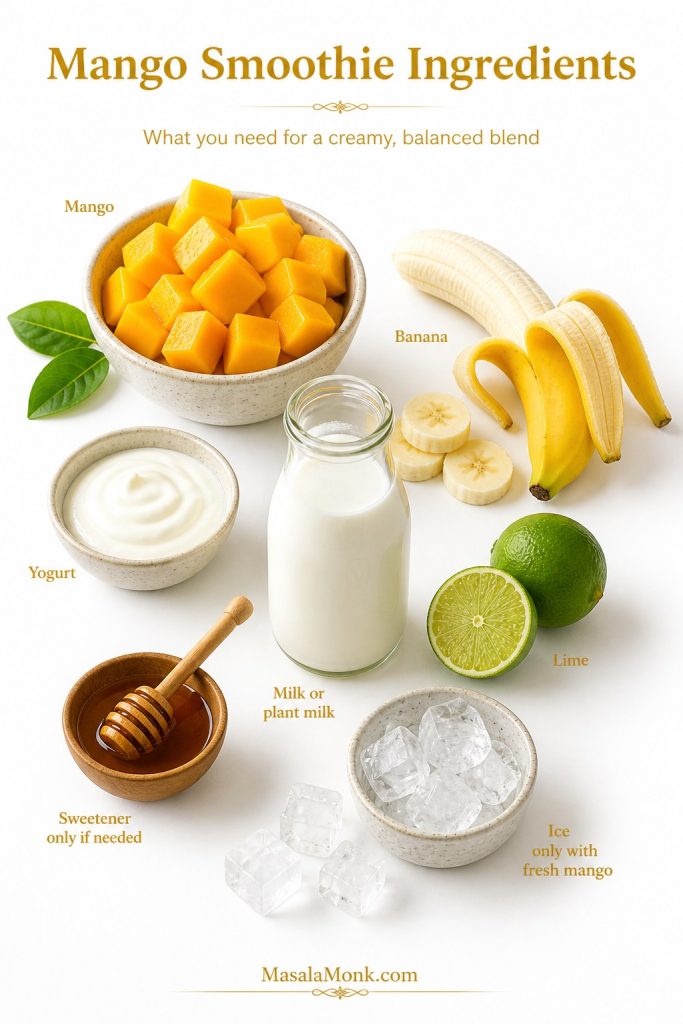
Mango smoothie ingredients arranged on a white background, including mango, banana, yogurt, milk, lime, sweetener, and ice.
Think of these ingredients as texture controls: mango builds the base, banana softens it, yogurt thickens it, milk loosens it, and lime keeps the flavor from tasting flat.

Mango

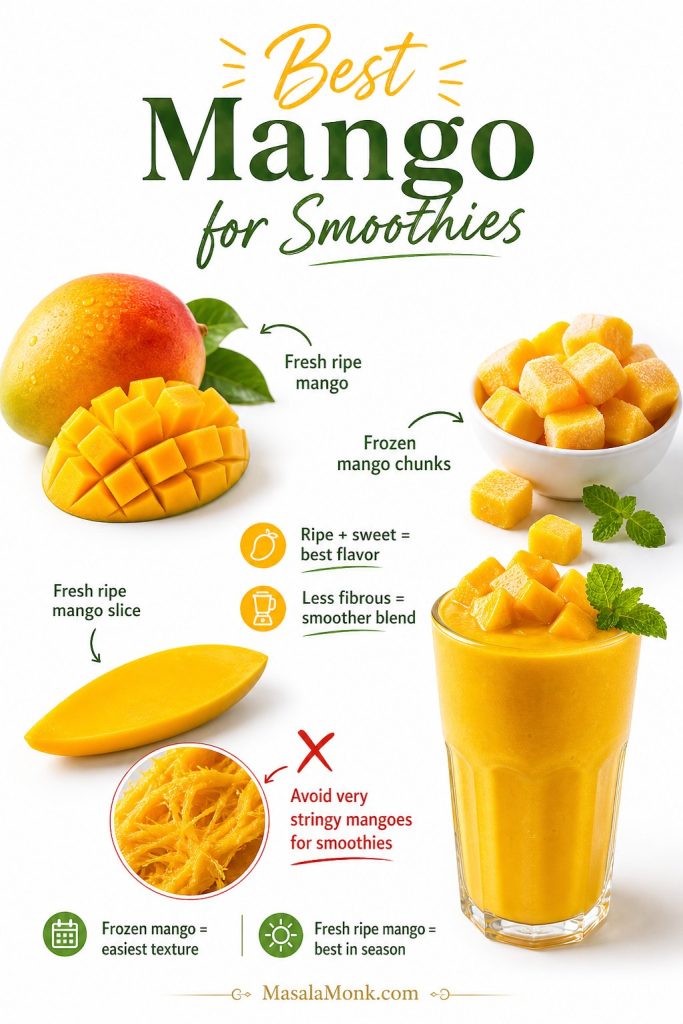
Mango is the heart of the recipe, so use ripe, sweet fruit whenever possible. Frozen mango chunks are the easiest option because they make the smoothie cold and thick right away. Fresh mango also works beautifully, especially during mango season. However, it needs a little help from chilled ingredients or a few ice cubes to feel just as cold.

If you are using Indian mangoes, ripe Alphonso, Kesar, Dasheri, or other sweet non-fibrous varieties work especially well. With supermarket mangoes, choose fruit that smells sweet near the stem and gives slightly when pressed. For a simple ripeness check, Mango.org recommends choosing mangoes by feel rather than color.

As a practical guide, 1 medium-large mango usually gives about 1 cup of chopped fruit, so this recipe needs about 2 medium-large mangoes if you are using fresh mango instead of frozen chunks.

Guide to choosing mango for smoothies, showing ripe mango, frozen mango chunks, smoothie texture, and stringy mango to avoid.
For the smoothest mango smoothie, choose ripe, sweet, less fibrous mangoes when possible. Meanwhile, frozen mango chunks are the easiest way to get thick, cold texture all year.

Banana

Banana makes the smoothie creamier, sweeter, and more filling. A frozen banana gives the thickest texture, while a fresh banana blends more easily. However, banana is still optional. To make a mango smoothie without banana, use extra frozen mango, Greek yogurt, avocado, coconut milk, or soaked cashews for body.

Yogurt

Yogurt adds creaminess, tang, and protein. Greek yogurt makes the smoothie thicker and more filling, while regular plain yogurt gives a lighter, more drinkable result. In addition, yogurt helps balance very sweet mangoes because it brings a little tang. For a dairy-free mango smoothie, use coconut yogurt, almond yogurt, cashew yogurt, or skip the yogurt and lean on banana or avocado instead.

Milk or Plant Milk

Milk loosens the smoothie just enough for the blender to run. Dairy milk gives a classic creamy flavor, almond milk keeps it light, oat milk makes it smooth, cashew milk adds richness, and coconut milk gives the drink a tropical edge. Orange juice also works, especially when you want a brighter fruit smoothie instead of a creamy one. However, it makes the drink sweeter and less creamy, so use it with frozen mango, pineapple, berries, or lime rather than treating it like a milk replacement in every version.

Milk and yogurt comparison for mango smoothies with dairy milk, almond milk, oat milk, coconut milk, Greek yogurt, and regular yogurt.
Choose the liquid based on the finish you want: almond milk keeps things lighter, oat milk feels rounder, coconut milk tastes richer, and Greek yogurt gives the most body.

Lime Juice

Lime juice is optional, but it can make a big difference. A small squeeze balances the sweetness and makes the mango taste fresher. Start with 1 teaspoon, blend, then add a little more only if the smoothie still tastes flat.

Sweetener

Sweeten only if your mango needs it. Very ripe mango and banana are often enough on their own. If the smoothie tastes sharp, bland, or not quite rounded, add honey, maple syrup, sugar, jaggery, or a soft date in small amounts.

For a no-added-sugar mango smoothie, use very ripe mango and banana, then skip the honey or sugar entirely. If the fruit is sweet enough, the smoothie does not need extra sweetener.

Ice

Ice is helpful only when you are using fresh mango and want a colder smoothie. With frozen mango, skip it. Too much ice weakens the flavor and can make the texture watery, so frozen fruit is usually the better way to thicken the drink.

Fresh vs Frozen Mango for Smoothies

Both fresh and frozen mango can make a good smoothie, but they behave differently in the blender. Frozen mango gives the most reliable thick texture. Fresh mango gives a softer, juicier, more seasonal flavor. Meanwhile, mango pulp is useful when ripe mangoes are not available, but it often needs less sweetener.

That is why this mango smoothie recipe gives you separate guidance for frozen mango, fresh mango, mango pulp, and fibrous mango.

Mango Type Best For How to Adjust
Frozen mango chunks Thick, cold, creamy smoothies Use little to no ice. Add milk slowly so the smoothie stays mango-forward.
Fresh ripe mango Peak-season flavor and softer smoothies Use chilled milk and yogurt, or add 1/2 cup ice. For better texture, freeze the mango cubes first.
Mango pulp Quick smoothies, shake-style drinks, and off-season mango flavor Use less sweetener because canned mango pulp is often already sweetened.
Fibrous mango Not ideal for very smooth drinks Blend longer, use yogurt for body, or choose a less fibrous mango next time.
Fresh and frozen mango comparison for smoothies, with fresh mango for flavor and frozen mango for thicker texture.
Fresh mango gives peak-season flavor, whereas frozen mango gives the thickest smoothie with less need for ice. Therefore, choose based on whether flavor or texture matters more that day.

Before using fresh mango, cut the fruit into cubes and chill it. For a thicker result, spread the cubes on a plate or tray and freeze them for 30 to 60 minutes. As a result, the smoothie turns colder and thicker without watering down the mango flavor.

If you are working with extra frozen mango and want a spoonable dessert instead of a drink, this mango sorbet recipe uses fresh or frozen mango with a similar fruit-forward approach.

How to Make a Mango Smoothie

The method is simple, but the order matters, especially if you are using a regular blender instead of a high-speed blender. First, liquid on the bottom helps the blades move. Then, frozen fruit on top keeps the smoothie thick. Because of that order, the blender needs less extra liquid.

For this mango smoothie, the recipe works best when the liquid goes in before the frozen fruit, especially in a standard blender.

Equipment You Need

  • Blender: A high-speed blender is best for frozen mango, but a regular blender works if you add the liquid first.
  • Measuring cups or kitchen scale: Helpful when you want the texture to stay consistent.
  • Knife and cutting board: Needed if you are using fresh mango.
  • Spatula or tamper: Useful for thick smoothie bowls or frozen-fruit blends.
  • Tall glasses or jars: Best for serving the smoothie right away.

Blender Method

  1. Add the liquid first. Pour milk, almond milk, oat milk, coconut milk, or orange juice into the blender. This helps the blades catch.
  2. Add the creamy ingredients. Add yogurt, banana, avocado, protein powder, or any soft add-ins next.
  3. Add mango last. Frozen mango can sit on top because the liquid underneath helps the blender start moving.
  4. Blend low, then high. Start on low for about 10 seconds, then increase to high and blend until smooth.
  5. Adjust slowly. If the smoothie is too thick, add milk 1 tablespoon at a time. If it is too thin, add more frozen mango.
  6. Serve right away. Mango smoothies taste best while cold, creamy, and freshly blended.
Step-by-step mango smoothie method showing liquid first, yogurt and banana next, mango last, blending, and serving.
This blending order prevents two common problems at once: the blender starts more easily, and the smoothie stays thick because the frozen fruit is not buried under too much liquid.
Blender tip: If the blender gets stuck, do not keep adding large splashes of liquid. Stop, scrape the sides, add 1 or 2 tablespoons liquid, then blend again. This keeps the smoothie thick instead of watery.
Blender tips for thick mango smoothies showing a blender jar, spatula, small liquid addition, and mango pieces.
If a thick smoothie gets stuck, do not flood the blender. Instead, scrape the sides and add a small splash of liquid so the mixture loosens without turning watery.

Here is the full mango smoothie recipe in one place, with the base version first and adjustment notes underneath.

Mango Smoothie Recipe

This creamy mango smoothie is cold, thick, and easy to adjust. Use frozen mango for the best texture, or fresh ripe mango with chilled ingredients when mangoes are in season.

Prep Time5 minutes
Total Time5 minutes
Servings2 smoothies
Yield600–700 ml

Ingredients

  • 2 cups frozen mango chunks, about 280–320 g
  • 1/2 to 1 small banana, preferably frozen, about 50–100 g peeled
  • 1/2 cup plain Greek yogurt or regular yogurt, about 120 g
  • 3/4 cup milk or plant milk, about 180 ml / 6 fl oz, plus more as needed
  • 1–2 teaspoons fresh lime juice, optional
  • 1–2 teaspoons honey, maple syrup, sugar, or jaggery, only if needed
  • 1/2 cup ice, only if using fresh mango instead of frozen mango

Instructions

  1. Add the milk or plant milk to the blender first.
  2. Add the yogurt, banana, lime juice, and sweetener if using.
  3. Add the frozen mango chunks.
  4. Blend on low for about 10 seconds, then increase to high and blend for 35–60 seconds, or until smooth.
  5. If the smoothie is too thick, add more milk 1 tablespoon at a time. If it is too thin, add more frozen mango and blend again.
  6. Taste and adjust with a little more lime juice or sweetener if needed.
  7. Pour into glasses and serve immediately.

Notes

  • For the thickest smoothie, use frozen mango and frozen banana.
  • For a mango smoothie without banana, use extra frozen mango, avocado, Greek yogurt, coconut milk, or soaked cashews.
  • For a dairy-free mango smoothie, use almond milk, oat milk, cashew milk, or coconut milk with coconut yogurt or no yogurt.
  • For a smoothie bowl, reduce the liquid to 1/4 to 1/2 cup and use extra frozen mango.
  • If using fresh mango, chill the mango and milk first, or add 1/2 cup ice.
  • To double the recipe, double all ingredients but start with slightly less liquid, then add more after blending.

Approximate Nutrition

Per smoothie, using frozen mango, 1/2 small banana, Greek yogurt, and unsweetened almond milk: about 180–230 calories, 6–10 g protein, and 3–5 g fiber. Exact nutrition will change depending on the milk, yogurt, banana amount, and sweetener you use.

Saveable mango smoothie recipe card with prep time, yield, ingredients, method, and a finished smoothie.
Save this mango smoothie recipe as your base version; afterward, you can return to the post for bowl, dairy-free, protein, or no-banana adjustments.

Serving Ideas

Serve the smoothie right after blending, while it is still cold, thick, and creamy. For a simple garnish, add diced mango, a few mint leaves, chia seeds, hemp seeds, toasted coconut, or a thin lime wheel. If it is a quick breakfast smoothie, keep it plain. If you want it to feel more finished, choose one small topping so the mango flavor still stays first.

Mango smoothie serving ideas with diced mango, mint, chia seeds, hemp seeds, toasted coconut, lime, and a finished smoothie.
A few simple toppings can make the smoothie feel more finished; still, keeping the garnish light helps the fresh mango flavor stay front and center.

Mango Smoothie vs Mango Shake vs Mango Lassi

Mango smoothie, mango shake, and mango lassi can overlap, but they are not exactly the same drink. The difference usually comes down to the base, texture, sweetness, and how rich you want the drink to feel.

Drink Main Base Texture Best For
Mango Smoothie Mango, milk or plant milk, yogurt, banana, fruit, greens, or protein add-ins Cold, creamy, flexible, breakfast-friendly Breakfast, snack, smoothie bowls, protein versions, dairy-free versions
Mango Shake Mango, chilled milk, sugar, sometimes ice cream or nuts Sweeter, milkier, richer Classic summer drink, dessert-style mango drink
Mango Lassi Mango, yogurt or curd, milk or water, sweetener Tangy, creamy, cooling Indian-style yogurt drink, restaurant-style pairing, cooling drink
Comparison image showing mango smoothie, mango shake, and mango lassi in three glasses with different textures and labels.
These mango drinks overlap, but they are not the same. A smoothie is more flexible, a shake is milkier and sweeter, and lassi tastes tangier because yogurt leads the blend.

For the richer milk-based version, see this mango shake recipe. For the yogurt-based Indian drink, use this mango lassi recipe. If you want a little background, Britannica describes lassi as a yogurt-based drink, which is why mango lassi tastes tangier and more yogurt-forward than a typical mango smoothie.

Mango Smoothie Variations

Once you have the base recipe, the mango smoothie variations are easy. In most cases, keep the total frozen fruit close to 2 cups for a drinkable smoothie, then adjust the liquid slowly. However, for smoothie bowls, use more frozen fruit and much less liquid.

Mango smoothie variations guide showing banana, strawberry, pineapple, protein, dairy-free, and spinach versions.
Use the base recipe as a template, then change only one direction at a time — fruitier, creamier, greener, higher-protein, or dairy-free — so the flavor stays balanced.

Mango Banana Smoothie

Banana is the classic way to make a mango smoothie creamier and more filling. Use 1 full banana instead of 1/2 banana, preferably frozen, and keep the rest of the base recipe the same. The result is sweeter, softer, and perfect for a quick breakfast smoothie.

Strawberry Mango Smoothie

Strawberries make the smoothie brighter, fruitier, and slightly tangy. Use 1 cup frozen mango and 1 cup frozen strawberries, then blend with the same yogurt and milk base. Taste before sweetening because tart strawberries may need a little honey, while sweet ones may need nothing at all. If you want more berry-based options, this strawberry smoothie guide has more smoothie ideas to explore.

Mango Pineapple Smoothie

Pineapple pushes the smoothie in a more tropical direction. Use 1 cup frozen mango with 1 cup frozen pineapple, then choose coconut milk or coconut water if you want that sunny, beachy flavor. If the pineapple tastes sharp, banana or a small spoon of honey will round it out.

Mango Blueberry Smoothie

Blueberries make the smoothie thicker, darker, and more berry-forward. Start with 1 cup frozen mango and 1 cup frozen blueberries, then loosen the blender with an extra splash of milk if needed. A little lime juice helps keep the flavor lively.

Mango Peach Smoothie

Peach gives the smoothie a softer, more floral sweetness. Use 1 cup mango and 1 cup frozen peaches. Vanilla yogurt can taste lovely here, although plain yogurt keeps the drink fresher and less dessert-like.

Fruit combo mango smoothies showing mango banana, strawberry mango, mango pineapple, and mango peach versions.
Fruit combinations change the whole mood of the smoothie: banana makes it creamier, strawberry brightens it, pineapple pushes it tropical, and peach keeps it softer and rounder.

Mango Yogurt Smoothie

To make yogurt the main creamy element, increase it to 3/4 cup and reduce the milk slightly. Greek yogurt gives a thicker, higher-protein smoothie, while regular yogurt keeps the texture lighter. This version sits close to a lassi-style mango drink, but it stays more flexible and smoothie-like.

Mango Protein Smoothie

Protein powder turns the smoothie into a more filling breakfast or post-workout drink. Add 1 scoop vanilla protein powder to the base recipe, then increase the milk by 2 to 4 tablespoons as needed. For a higher-protein mango smoothie, use Greek yogurt, add 1 tablespoon hemp seeds or chia seeds, and choose dairy milk or soy milk instead of a very light plant milk. Depending on the protein powder and yogurt you use, this version can move into the 20–25 g protein range.

Mango protein smoothie with protein powder, Greek yogurt, hemp or chia seeds, milk, mango cubes, and a finished smoothie.
For a more filling mango protein smoothie, pair protein powder with Greek yogurt, hemp, chia, or a higher-protein milk. That way, the drink feels more complete without losing its fruit-first taste.

Avocado Mango Smoothie

Avocado is a great choice when you want creaminess without banana. Use 1/4 to 1/2 ripe avocado in the base recipe and skip the banana. The flavor stays mellow, the texture turns silky, and the smoothie becomes less sweet but still rich. For more creamy fruit-and-nut ideas, you might also like these nut-infused smoothies.

Mango Spinach Smoothie

Baby spinach blends easily into mango smoothies because its flavor is mild. Add 1 to 2 cups spinach with the liquid and blend until smooth before adding the mango. That extra first blend keeps the texture cleaner and gives you a green mango smoothie that still tastes fruity.

Dairy-Free Mango Smoothie

A dairy-free mango smoothie works best when you replace both the liquid and the creamy element. Use almond milk, oat milk, cashew milk, or coconut milk, then add coconut yogurt, dairy-free yogurt, banana, avocado, or soaked cashews for body. Coconut milk gives the richest result, while almond milk keeps the smoothie lighter. For more on this tropical pairing, see this guide to mango with coconut milk.

Dairy-free mango smoothie options with almond milk, oat milk, coconut milk, coconut yogurt, avocado, and mango.
A dairy-free version works best when you replace both the liquid and the creamy element; otherwise, the smoothie can taste thin even when the mango flavor is strong.

Mango Smoothie Without Banana

Skipping banana is easy as long as you replace the body it normally gives. Use 2 1/2 cups frozen mango, 1/2 cup yogurt, and 3/4 cup milk. For an even creamier texture, add 1/4 avocado or 2 tablespoons soaked cashews. This keeps the smoothie thick without letting banana take over the flavor.

Mango Smoothie Without Yogurt

Without yogurt, the smoothie needs another ingredient for body. Banana, avocado, coconut milk, or extra frozen mango all work well. Start with 3/4 cup milk and add more only if the blender needs it. Since yogurt usually adds tang, a little lime juice helps keep this version from tasting too sweet or flat.

Substitution guide for making mango smoothies without banana, yogurt, or milk, with alternative ingredients in three sections.
If you are missing banana, yogurt, or milk, use this guide to swap with purpose. As a result, the smoothie stays balanced instead of becoming too thin, too sweet, or too flat.

Mango Smoothie Bowl

A mango smoothie bowl should be thick enough to spoon, not thin enough to sip through a straw. Use 2 1/2 to 3 cups frozen mango and only 1/4 to 1/2 cup milk. Blend slowly, scrape as needed, and top with granola, coconut, chia seeds, berries, banana slices, or chopped nuts. If you like make-ahead oat toppings, these homemade granola bars can also be crumbled over smoothie bowls.

Thick mango smoothie bowl topped with mango cubes, granola, coconut flakes, chia seeds, berries, banana slices, and a spoon.
The bowl version should mound slightly around the spoon and toppings; if it spreads like a drink, blend in more frozen mango before serving.

Mango Smoothie Texture Guide

The best mango smoothie texture depends on how you want to serve it. For example, a glass smoothie needs enough liquid to pour, while a smoothie bowl needs much less liquid and more frozen fruit. Meanwhile, a shake-like mango drink uses more milk and feels lighter.

Texture Use This Ratio Best For
Drinkable smoothie 2 cups mango + 3/4 to 1 cup liquid Breakfast glass, snack, quick smoothie
Thick smoothie 2 cups mango + 1/2 to 3/4 cup liquid Cold, creamy, spoonable-but-pourable texture
Smoothie bowl 2 1/2 to 3 cups frozen mango + 1/4 to 1/2 cup liquid Bowl with toppings
Shake-like smoothie 1 1/2 to 2 cups mango + 1 to 1 1/2 cups chilled milk Lighter, milkier mango drink
Mango smoothie texture guide showing drinkable, thick, and bowl-style versions with different liquid amounts.
Texture is easiest to control before blending: decide whether you want to sip it, pour it thick, or spoon it, then start with the matching liquid range.

How to Fix a Mango Smoothie

Most smoothie problems are easy to fix once you know whether the issue is texture, sweetness, or flavor balance. Start with one small adjustment, then blend and taste again.

Troubleshooting guide for fixing a mango smoothie that is too thick, too thin, bland, too sweet, stringy, or stuck in the blender.
Most mango smoothie problems need only one small fix. For example, frozen mango thickens, lime brightens, yogurt softens sweetness, and scraping helps a stuck blender move again.

If the Smoothie Is Too Thick

Add milk or plant milk 1 tablespoon at a time. Blend again before adding more. This keeps the smoothie from turning thin too quickly.

If the Smoothie Is Too Thin

Add more frozen mango, frozen banana, Greek yogurt, or avocado. Ice can help in a pinch, but frozen fruit gives a better mango flavor and a creamier finish.

If the Smoothie Tastes Bland

Add lime juice, a tiny pinch of salt, or more mango. Bland smoothies often need brightness, not just more sugar.

If the Smoothie Is Too Sweet

Add plain yogurt, lime juice, or a few more frozen mango pieces. Avoid adding too much extra milk because it can weaken the flavor.

If the Smoothie Is Not Sweet Enough

Add honey, maple syrup, sugar, jaggery, or a soft date in small amounts. Still, taste the mango first. Very ripe mangoes may not need any sweetener at all.

If the Smoothie Is Stringy

The mango may be fibrous. Blend longer, use a stronger blender, or choose smoother mango varieties next time. Frozen mango chunks are often more consistent for smoothies.

If the Blender Gets Stuck

Stop the blender, scrape the sides, and add 1 or 2 tablespoons liquid. Then blend again, starting low before increasing the speed.

Make Ahead, Storage, and Freezing

Mango smoothies are best right after blending because the texture is cold, creamy, and fresh. Even so, the recipe is easy to prep ahead when you freeze the mango for each smoothie in small packs. For example, you can freeze mango, banana, and spinach together so breakfast takes only a minute or two.

  • Refrigerator: Store leftover smoothie in a covered jar for up to 1 day. Shake or blend again before drinking.
  • Freezer smoothie packs: Add mango, banana, berries, pineapple, or spinach to freezer bags. When ready, blend with milk and yogurt.
  • Smoothie cubes: Freeze leftover smoothie in an ice cube tray, then re-blend the cubes with a splash of milk.
  • Best fresh: For the best texture, blend just before serving.
Make-ahead mango smoothie packs with freezer bags of mango, banana, greens, berries, smoothie cubes, and a finished smoothie.
Freezer packs make busy mornings easier; even so, the best texture still comes from blending the smoothie fresh instead of storing it fully blended.

More Mango and Smoothie Recipes

After you make this smoothie, you may want a richer mango drink, a tangier yogurt-based drink, or another fruit smoothie. Try this mango shake recipe when you want something creamier and sweeter, this mango lassi recipe when you want a cooling yogurt-based drink, or this strawberry smoothie guide when you want more berry-based variations.

Mango Smoothie FAQs

Can I make a mango smoothie without banana?

Yes. Use extra frozen mango, Greek yogurt, avocado, coconut milk, or soaked cashews to replace the creaminess banana normally gives. For a simple no-banana mango smoothie, blend 2 1/2 cups frozen mango, 1/2 cup yogurt, and 3/4 cup milk.

Can I make a mango smoothie without yogurt?

Yes. Use banana, avocado, coconut milk, oat milk, or extra frozen mango for body. The smoothie will taste less tangy, so a little lime juice can help balance the sweetness.

Is fresh or frozen mango better for smoothies?

Frozen mango is better for thick, cold smoothies because it chills and thickens the drink without ice. Fresh mango is excellent during mango season, but the smoothie may need chilled milk, chilled yogurt, or a few ice cubes.

Can I make a mango smoothie with frozen mango?

Yes, and it is usually the best option for texture. Frozen mango makes the smoothie thicker, colder, and creamier without watering it down.

Can I use mango pulp for a smoothie?

Yes. Mango pulp works well, especially when fresh mangoes are not in season. Since many canned mango pulps are sweetened, taste before adding honey, sugar, maple syrup, or jaggery.

How do I make a mango smoothie thicker?

Use frozen mango, frozen banana, Greek yogurt, avocado, or less liquid. For the thickest smoothie, start with only 1/2 cup liquid and add more slowly.

How do I make a mango smoothie dairy-free?

Use almond milk, oat milk, cashew milk, or coconut milk. Replace yogurt with coconut yogurt, dairy-free yogurt, banana, avocado, or soaked cashews.

Is a mango smoothie the same as a mango shake?

Not exactly. A mango smoothie is usually more flexible and may include yogurt, banana, plant milk, protein powder, greens, or other fruit. A mango shake is usually milkier, sweeter, and often made with chilled milk, mango, sugar, and sometimes ice cream.

What liquid is best for a mango smoothie?

Milk gives the creamiest classic result. Almond milk keeps it light, coconut milk makes it tropical, oat milk makes it smooth, and orange juice makes it brighter and fruitier.

Can I make a mango smoothie without milk?

Yes. Use coconut water, orange juice, or water instead of milk, but expect a lighter and less creamy smoothie. For a no-milk smoothie that still feels creamy, use coconut milk, dairy-free yogurt, avocado, banana, or extra frozen mango.

Can I add protein powder to a mango smoothie?

Yes. Add 1 scoop vanilla protein powder and increase the liquid slightly. Protein powder thickens smoothies, so add milk 1 or 2 tablespoons at a time until the blender runs smoothly.

Can I make a mango smoothie with water?

You can, but the smoothie will taste thinner and less creamy. For a lighter smoothie, coconut water is usually better than plain water. For a creamier smoothie, use milk, oat milk, cashew milk, coconut milk, or yogurt.

Final Tip

For the best mango smoothie recipe, start with ripe mango, keep the liquid modest, and adjust only after blending. Frozen mango gives you the easiest thick texture, while a little lime juice keeps the flavor bright. Once the recipe gives you a smoothie that is cold, creamy, and full of mango flavor, pour it right away and enjoy it at its best.

Finished mango smoothies in glasses with mango pieces, mint, and lime on a bright white background.
The finished drink should look cold, creamy, and ready to serve right away. In the end, that thick, mango-forward texture is what makes the recipe worth repeating.
Posted on Leave a comment

5 Ways to Make a Refreshing Watermelon Smoothie: Stay Cool and Nourished! 🍉🥤💚

5 Ways to Make a Refreshing Watermelon Smoothie: Stay Cool and Nourished!

When summer rolls in with its golden sun and rising temperatures, there’s nothing quite as satisfying as a cold, juicy watermelon. It’s nature’s own hydration hero. But what if you could take that cool relief to the next level? Enter the watermelon smoothie—a revitalizing, nutrient-packed drink that’s as delicious as it is energizing.

Whether you’re lounging by the pool, recovering after a workout, or just seeking a mid-day refresher, these five watermelon smoothie recipes will keep you feeling cool, nourished, and totally satisfied. Let’s dive into this hydrating fruit fiesta!


🌟 Why Watermelon?

Before we blend, let’s break down why watermelon is such a superstar in smoothies:

  • Hydrating: With 92% water content, it’s practically a drink in itself.
  • Low-Calorie: Perfect for light snacking without compromising flavor.
  • Rich in Lycopene: A powerful antioxidant linked to heart health and reduced inflammation.
  • Packed with Vitamin C & A: Boosts immunity and supports healthy skin.

Add in its natural sweetness, and you’ve got a versatile base for countless smoothie combinations.


🥤 1. The Classic Watermelon Mint Smoothie

Fresh, Cooling & Incredibly Simple

This is your go-to when you want something ultra-light and refreshing.

Ingredients:

  • 2 cups chilled watermelon (seedless, cubed)
  • A handful of fresh mint leaves
  • Juice of ½ lime
  • Ice cubes
  • Optional: 1 tsp honey or agave (if your watermelon isn’t super sweet)

Instructions:

Blend everything until smooth. Pour into a frosted glass and garnish with a mint sprig and lime slice. Instant chill!

Pro Tip: Freeze your watermelon cubes beforehand to make this extra slushy without watering it down.


🍓 2. Watermelon Berry Blast

Tart meets sweet for a berry-licious antioxidant punch.

Ingredients:

  • 1 cup watermelon
  • ½ cup strawberries
  • ½ cup blueberries
  • 1 banana (for creaminess)
  • 1 cup coconut water or almond milk

Instructions:

Blend until creamy. This smoothie is great post-workout, thanks to the berries’ antioxidants and banana’s potassium.

Nutrition Boost: Add a spoon of chia seeds or flaxseeds for fiber and omega-3s.


🥥 3. Tropical Watermelon Coconut Smoothie

A sip of paradise with every gulp.

Ingredients:

  • 2 cups watermelon
  • ½ cup pineapple
  • ½ cup coconut yogurt or coconut cream
  • Splash of coconut water or milk
  • A few ice cubes

Instructions:

Blend until smooth and creamy. This one feels indulgent, but it’s packed with vitamin C and tropical vibes.

Optional Add-on: A handful of baby spinach for a sneaky green boost—it won’t change the taste much, but adds nutrition.


🍌 4. Creamy Watermelon Banana Smoothie

Smooth, filling, and perfect for breakfast.

Ingredients:

  • 2 cups watermelon
  • 1 ripe banana
  • ½ cup Greek yogurt (or plant-based alternative)
  • A splash of oat or almond milk
  • Ice cubes

Instructions:

Blend until velvety. This smoothie is more substantial, making it ideal as a meal replacement or hearty snack.

Custom Twist: Add a scoop of vanilla protein powder for extra satiety.


🍋 5. Zesty Watermelon Ginger Detox Smoothie

Slightly spicy, incredibly cleansing, and ultra-refreshing.

Ingredients:

  • 2 cups watermelon
  • 1 small cucumber (peeled and chopped)
  • Juice of 1 lemon
  • ½ inch piece of fresh ginger (peeled)
  • A few mint leaves
  • Ice cubes

Instructions:

Blend thoroughly. This detox blend wakes up your taste buds and supports digestion and immunity.

Perfect for: Morning wake-up drink or post-indulgence reset.


💡 Bonus Tips to Elevate Any Watermelon Smoothie

  • Freeze your watermelon: Makes the texture thicker and colder.
  • Layer with flavor: Herbs like basil, mint, and cilantro can be surprisingly delicious.
  • Watch the sweetness: Watermelon is naturally sweet—taste before adding sweeteners.
  • Garnish for the ‘gram: A slice of lime, sprinkle of chia seeds, or a few berries on top makes your smoothie extra photo-worthy.

💚 Final Sip: Watermelon Smoothies Are a Summer Staple

Each of these smoothies offers something different—whether it’s a tropical twist, a protein-rich base, or a detoxifying blend. But they all share one thing in common: they’ll help you stay cool, hydrated, and nourished all summer long.

So grab that blender, slice up some watermelon, and give yourself the treat your body deserves. 🌞🍉

Which one will you try first?

🍉 10 Frequently Asked Questions (FAQs) About Watermelon Smoothies

1. Can I make watermelon smoothies ahead of time?

Yes, but for best taste and texture, watermelon smoothies should be consumed fresh. If you must prep in advance, store the smoothie in an airtight container in the fridge and consume within 24 hours. Separation is normal—just give it a quick shake or stir before drinking.


2. Can I freeze watermelon for smoothies?

Absolutely. Freezing watermelon cubes is a great way to chill your smoothie without diluting it. Spread cubes on a tray, freeze them individually, then transfer to a sealed bag or container.


3. What’s the best liquid base for watermelon smoothies?

Watermelon itself is very hydrating, but to adjust consistency or add flavor, try coconut water (extra hydration), almond or oat milk (for creaminess), or even plain water.


4. How do I know if my watermelon is sweet enough for a smoothie?

Taste a cube before blending. If it’s bland, a splash of lime juice and a teaspoon of honey or maple syrup can enhance the flavor naturally.


5. Are watermelon smoothies good for weight loss?

Yes, they can be. Watermelon is low in calories and high in water content. Combine it with nutrient-dense, low-calorie ingredients (like berries, cucumber, or leafy greens), and you’ve got a satisfying yet light option.


6. Can I add protein to a watermelon smoothie?

Definitely. A scoop of unflavored or vanilla protein powder blends well. Greek yogurt, chia seeds, or nut butter can also add a protein boost depending on your taste preferences.


7. What fruits pair best with watermelon in a smoothie?

Berries, pineapple, banana, mango, and citrus fruits like lime and lemon are top choices. Their acidity or creaminess complements watermelon’s sweet, watery profile.


8. Is it okay to blend watermelon seeds?

It’s best to use seedless watermelon or remove black seeds before blending. While small white seeds are usually fine, black seeds can create a gritty texture and slightly bitter taste.


9. Can I turn a watermelon smoothie into a popsicle?

Yes! Pour your smoothie into popsicle molds and freeze for a few hours. It’s a great way to enjoy a cooling treat with all the benefits of a smoothie.


10. How can I make my watermelon smoothie thicker?

Use frozen fruits (especially banana or watermelon), add yogurt, avocado, or chia seeds, or reduce the amount of liquid base. Blend until creamy and smooth.