Posted on 7 Comments

Low Carb Chia Pudding Recipes

Cover image showing a premium glass jar of low carb chia pudding with a smooth whipped topping on a warm-cream seamless background. Editorial food photography style for “Low Carb Chia Pudding” featuring 10 recipes including keto, high protein, dairy-free, and blended options, with MasalaMonk.com branding.

This post was last updated on

Looking for low carb chia pudding recipes for weight loss? The most useful place to start is the pudding itself. Chia is not a fat burner, but a make-ahead serving can be easy to portion, simple to build with protein, and satisfying without relying on much added sugar. Here you can make it light with almond milk, thick and tangy with Greek yogurt, rich with coconut milk, chocolatey with protein powder, or completely smooth after blending.

Here for the thick Greek-yogurt chia pudding? Start with ¾ cup plain Greek yogurt + 3 tablespoons chia seeds + ¼ cup / 60 ml unsweetened almond milk or water. Stir again after 10 minutes, then chill for at least 2 hours. Jump to the full Greek yogurt chia pudding recipe ↓
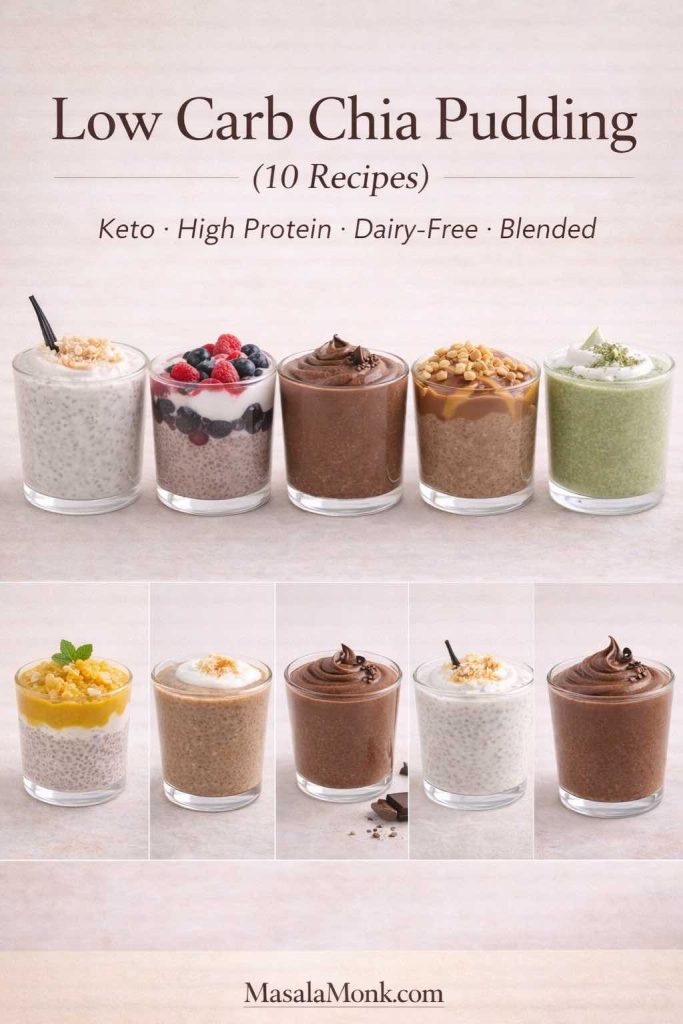
Collage showing ten low carb chia pudding cups including vanilla, Greek yogurt, chocolate, peanut butter, matcha, mango, coconut and blended mousse variations.
All 10 chia pudding recipes at a glance—from thick Greek yogurt and keto coconut milk to chocolate protein pudding, fruit layers and smooth blended mousse.

You do not need to read this guide from top to bottom. Use the jumps above if you already know what you want, or use the table of contents to solve the ratio, liquid, protein, meal-prep, or troubleshooting question that brought you here.


Low Carb Chia Pudding for Weight Loss: What Actually Matters

Chia pudding is not a fat burner, and a jar does not cause weight loss by itself. What makes it useful in a weight-management routine is practical: chia is easy to portion ahead, it creates a substantial gel-like texture when hydrated, and it can be paired with protein-rich ingredients such as Greek yogurt or protein powder.

The rest of the jar matters just as much. Canned coconut milk, nut butter, nuts, granola, fruit, sweeteners, and large portions can quickly change both calories and carbohydrates. A chia pudding that replaces a less satisfying breakfast is a different situation from adding a rich pudding on top of everything else you already eat.

  • Start unsweetened: choose unsweetened almond milk, plain Greek yogurt, or an unsweetened coconut base when keeping added sugar low matters.
  • Add protein when the jar needs to function as a meal: Greek yogurt or a protein powder you already tolerate well are the easiest routes.
  • Measure calorie-dense toppings: nut butter, nuts, seeds, coconut and granola are easy to overserve.
  • Use fruit deliberately: berries are easy to portion; mango and apple work better as measured flavor accents when carbs matter.
  • Do not confuse “keto” or “low carb” with automatically low-calorie: coconut milk and nut butter can make an excellent low-carb pudding while still creating a very energy-dense jar.

That is the reason this guide includes several styles rather than one “perfect” weight-loss pudding: the best jar is the one whose portion, protein, texture, and toppings fit the rest of your day.


Why Chia Pudding Works So Well as a Breakfast

A good chia pudding does two practical things well: it gives you a breakfast you can prepare ahead, and it creates a thick, substantial texture from very little morning work. Chia seeds absorb liquid as they hydrate, while Greek yogurt, protein powder, nuts, or richer milks can make the finished jar feel more complete.
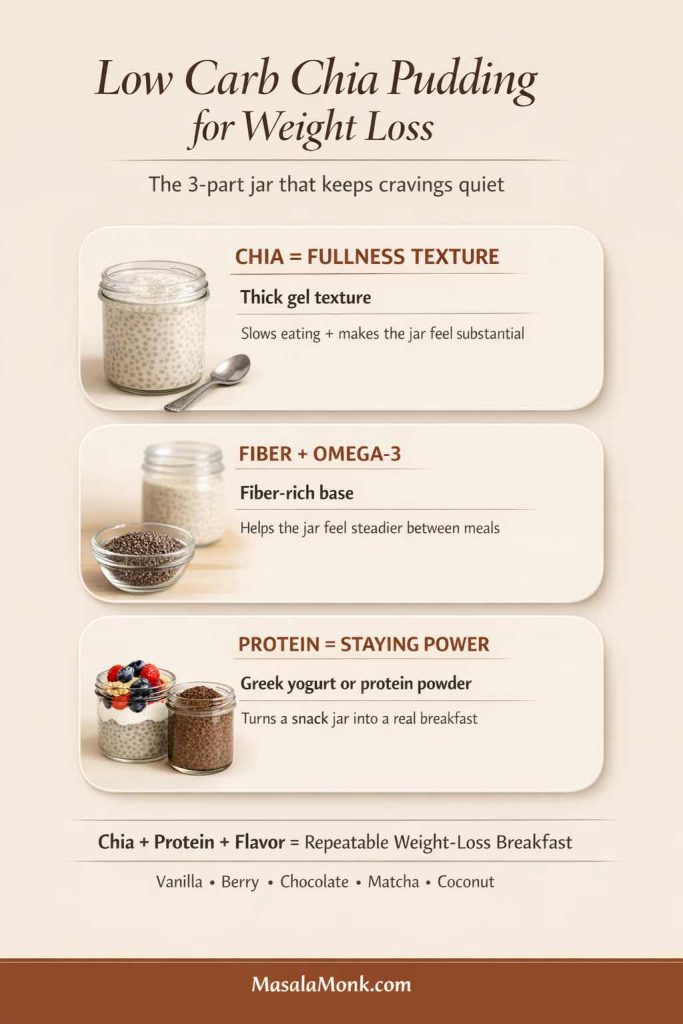
Infographic explaining how chia creates a thick gel texture and can be combined with protein such as Greek yogurt or protein powder.
Chia supplies the pudding structure; protein and the rest of the ingredients determine whether the jar behaves more like a snack or a full breakfast.

Chia seeds are naturally rich in fiber and contain alpha-linolenic acid, a plant-based omega-3 fat. For a useful evidence-based overview rather than exaggerated claims, see the Harvard Nutrition Source guide to chia seeds.

Protein is the easiest way to make the jar feel more meal-like

Plain chia and milk can work perfectly well as a snack, but Greek yogurt or protein powder gives you another lever when you want the jar to function as breakfast. Greek yogurt also changes the texture immediately: instead of waiting for milk alone to become pudding-like, you start with a thick, creamy base.
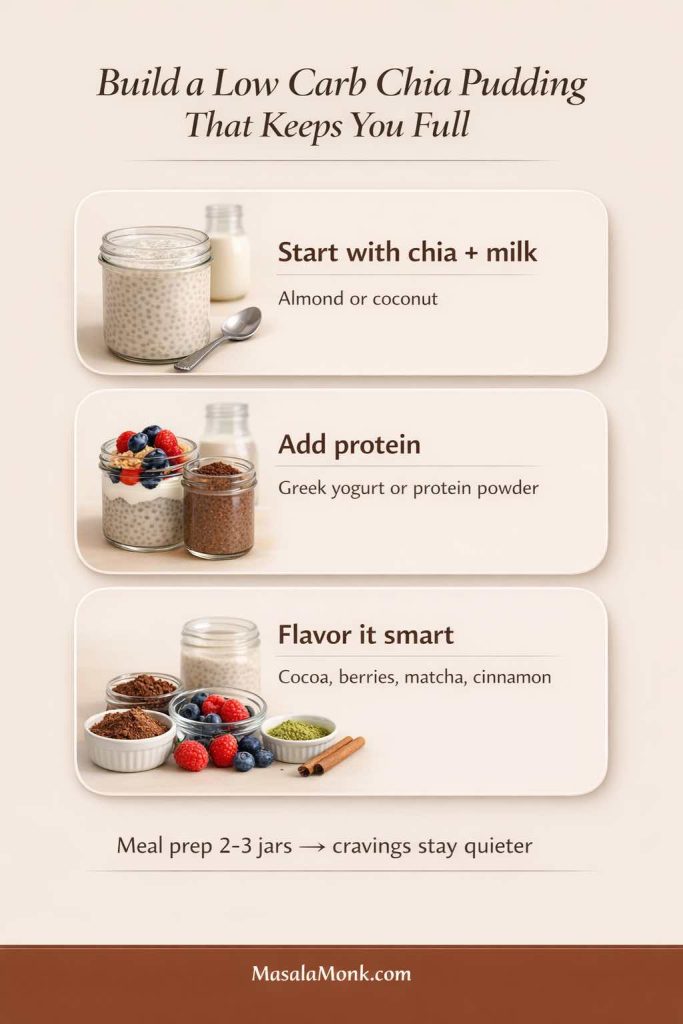
Three-step low carb chia pudding builder showing chia and milk, an optional protein addition, and flavor options such as cocoa, berries, matcha and cinnamon.
Think of the jar in three layers: chia + liquid for structure, an optional protein source for a more substantial breakfast, then flavors you genuinely want to eat.

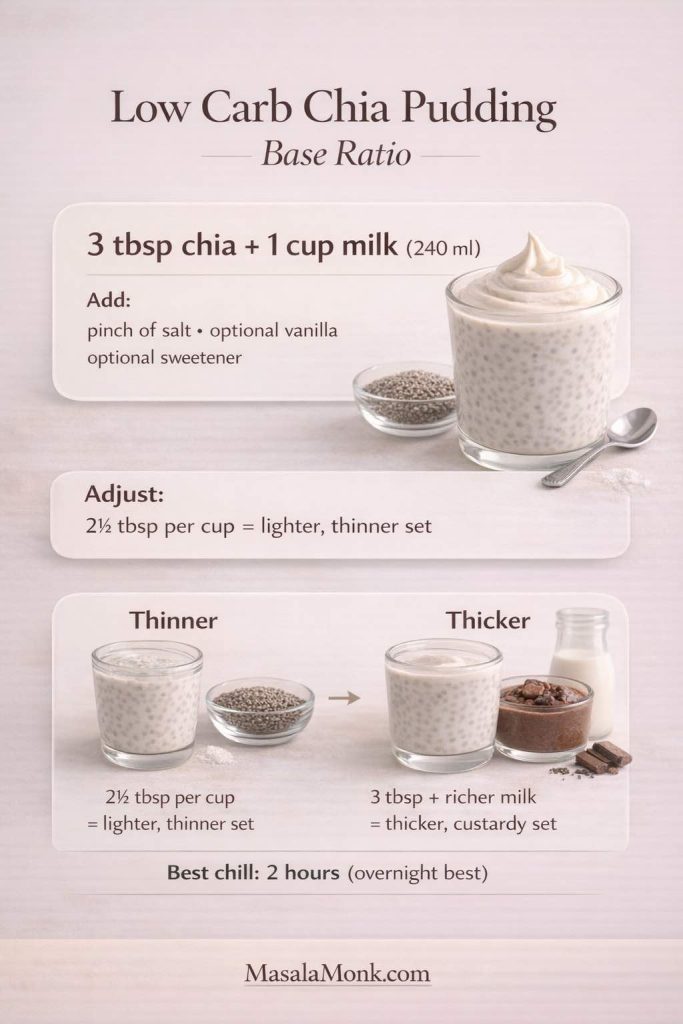
Low Carb Chia Pudding Ratio: The Base Recipe That Prevents Clumps

For a classic milk-based chia pudding, this is the dependable starting point:

  • 3 tablespoons chia seeds (roughly 30–35 g, depending on how you measure)
  • 1 cup / 240 ml liquid
  • Pinch of salt
  • ½ teaspoon vanilla, optional
  • Sweetener to taste, optional
Chia pudding ratio infographic showing 3 tablespoons chia seeds to 1 cup or 240 ml milk, with adjustments for thinner or thicker pudding.
Start with 3 tablespoons chia to 1 cup / 240 ml liquid. Use a little less chia for a softer set, or keep the full amount and use a richer liquid for a denser pudding.

The exact result changes with your liquid. Thin almond milk gives a lighter pudding, while canned coconut milk sets much richer. Greek yogurt needs far less added liquid because the yogurt already provides most of the body.

The stir-rest-stir method

  1. Whisk the liquid with vanilla, salt, sweetener, cocoa, protein powder, or other smooth flavorings first.
  2. Add the chia and whisk vigorously for 20–30 seconds.
  3. Let the mixture stand for 10 minutes.
  4. Whisk or stir thoroughly a second time.
  5. Cover and refrigerate for at least 2 hours; overnight gives the most settled texture.
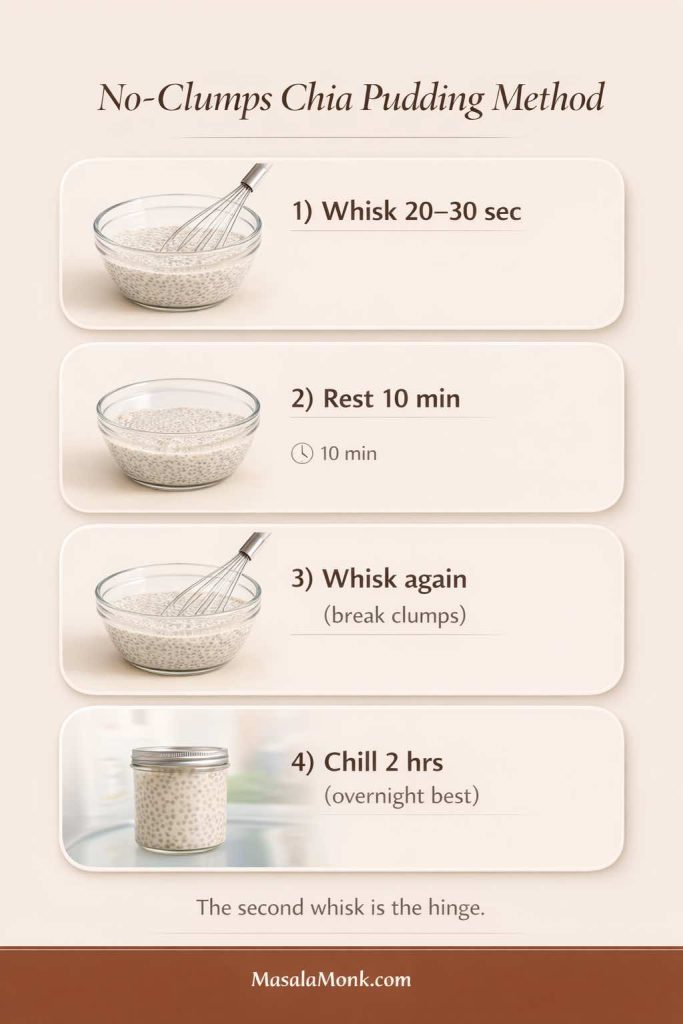
No-clumps chia pudding method showing whisking, a 10-minute rest, a second whisk and a final chill.
The second stir is the important one: the seeds have started hydrating but have not fully set, so this is your chance to break up clusters before they become permanent.

Can you make quick chia pudding?

Yes, although “quick” still means giving chia time to hydrate. Follow the same method and chill for 30–45 minutes. The texture will be softer than an overnight jar. Greek yogurt is particularly useful when you want a thick pudding sooner because much of the thickness is already present before the chia sets.

Give the chia enough time to hydrate

Chia thickens because the seeds absorb liquid over time. For pudding, use them fully hydrated rather than judging the mixture immediately after stirring. If the texture still seems thin after 30 minutes, give it more time before adding extra seeds; the biggest change usually happens during the longer refrigerator rest.


Choosing Your Liquid: Almond Milk, Coconut Milk, Yogurt, Oat Milk & More

Your liquid controls far more than flavor. It changes thickness, richness, carbohydrate content, and how much additional chia you may need. Choose the liquid first, then fine-tune the jar.
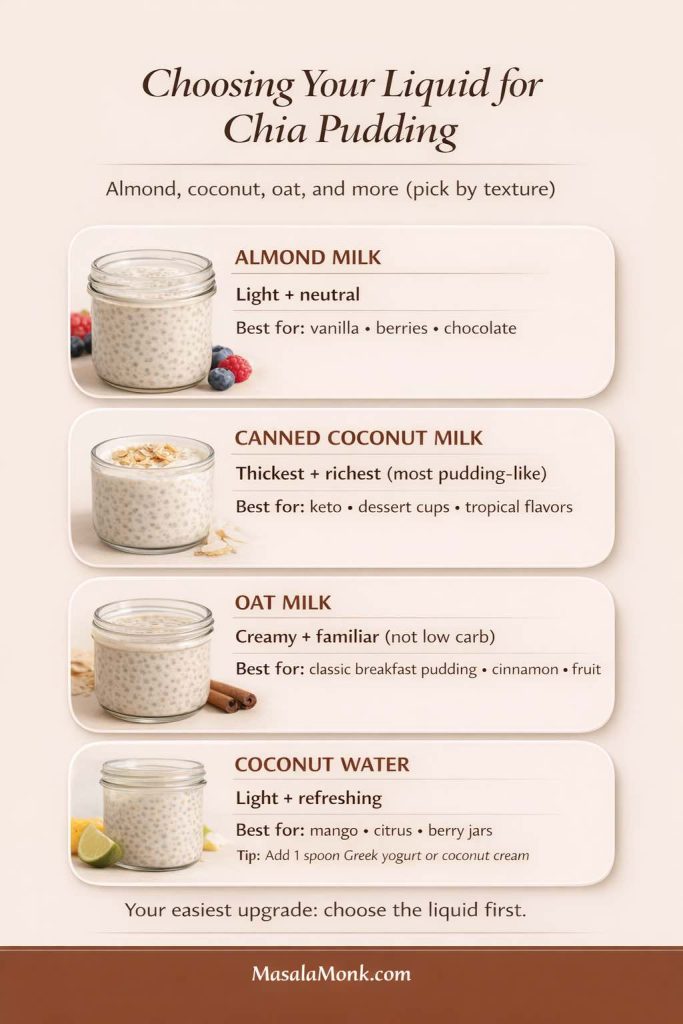
Guide comparing almond milk, canned coconut milk, oat milk and coconut water for chia pudding, including texture and best-use notes.
Almond milk stays light, canned coconut milk gives the richest set, oat milk is creamy but usually higher in carbohydrate, and coconut water creates a lighter fruit-friendly chia gel.

Almond milk: light and versatile

Unsweetened almond milk is an easy low-carb base because its flavor stays out of the way. It works especially well with vanilla, chocolate, cinnamon, berries, matcha, and nut butter.

Canned coconut milk: richest and thickest

If you want a pudding that feels especially rich, canned coconut milk is hard to beat. Because brands vary in thickness, whisk in enough water to make the mixture comfortably pourable before adding chia. Very thick coconut milk can otherwise produce dense pockets before the seeds hydrate evenly.

Greek yogurt: thick before it even chills

Greek yogurt works differently from milk. Instead of using a full cup of liquid, start with yogurt and loosen it gradually. For our full high-protein version, ¾ cup Greek yogurt + ¼ cup / 60 ml water or unsweetened almond milk creates a creamy starting mixture before the chia goes in.

Jump to the Greek yogurt chia pudding recipe →

Oat milk: creamy, but usually not low carb

Oat milk produces a mild, familiar breakfast-pudding flavor. It can still be used with any of the methods in this guide, but check the nutrition label if keeping carbohydrates low is an important part of your goal.

Coconut water: light and fruit-friendly

Coconut water produces a much lighter gel than milk. It pairs particularly well with mango, lime and berries, but it will not taste as creamy unless you add a spoonful of Greek yogurt or coconut cream. If you would rather drink your chia than turn it into pudding, our Chia Seed Water guide uses a much lighter chia-to-liquid ratio and covers plain, lemon, coconut-water and overnight versions.

Dairy-Free Chia Pudding: The Easiest Swaps

Several recipes in this collection are naturally dairy-free when you use plant milk and skip optional Greek yogurt. Unsweetened almond milk is the lightest neutral base; canned coconut milk gives the richest dairy-free texture; and a lighter coconut-milk beverage works well for matcha, mango, apple-cinnamon, and gingerbread.

If you use protein powder in a dairy-free jar, check the ingredient label: whey and casein are dairy proteins, while many pea, soy, rice, and blended plant proteins are dairy-free.


High Protein Chia Pudding: Greek Yogurt, Protein Powder & Collagen

There are three straightforward ways to increase the protein in a chia jar. Greek yogurt gives you protein and immediate thickness. Protein powder can add more protein and flavor but needs to be dissolved well. Collagen peptides dissolve easily, although they do not thicken the pudding the way yogurt does. If collagen is part of your routine, Harvard Health has a measured overview of what collagen supplements can and cannot reasonably claim.
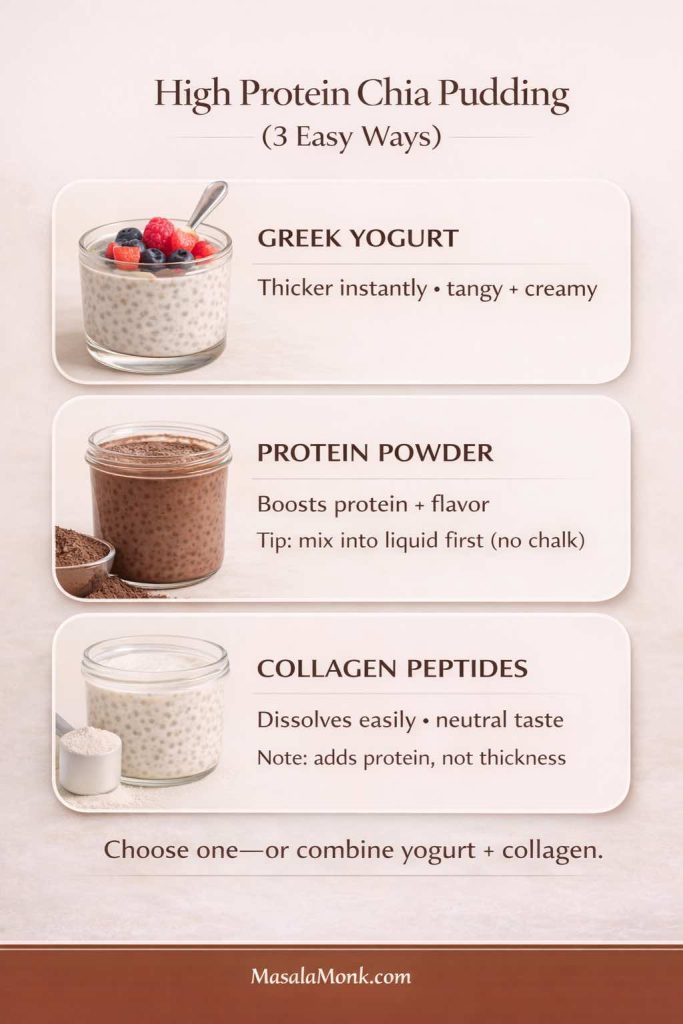
High protein chia pudding comparison showing Greek yogurt, protein powder and collagen peptides as three ways to add protein.
Greek yogurt changes both protein and texture; protein powder is a bigger flavor lever; collagen dissolves easily but contributes little to thickness.

How to add protein powder without a chalky texture

Do not dump dry protein powder into a finished chia pudding. Whisk it completely into the milk first, then add the chia. If your powder is stubborn, make a smooth paste with a small amount of liquid before gradually whisking in the rest.

Keep extra liquid nearby: protein powders absorb liquid very differently. After the 10-minute rest, add 2–4 tablespoons milk if the mixture has become unusually thick before it goes into the refrigerator.
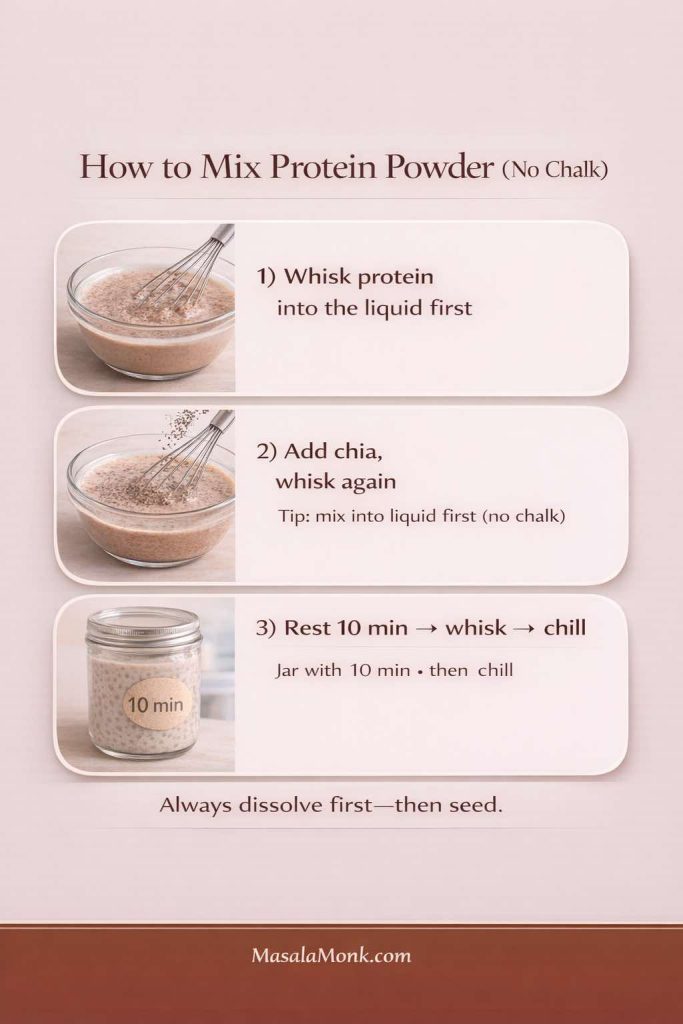
Three-step guide showing protein powder whisked into liquid first, followed by chia seeds and a final 10-minute rest and second stir.
For smooth protein chia pudding: dissolve the powder first, add the seeds second, then use the same 10-minute rest and second-stir method.

10 Low Carb Chia Pudding Recipes

Each recipe below makes roughly 2 small servings or 1 generous serving, depending on appetite and toppings. For meal prep, multiply the ingredients and portion the finished mixture into individual jars.

Low-carb vs keto: these recipes are not all equally low in carbohydrate. The unsweetened almond-milk, Greek-yogurt, chocolate, and coconut versions are the easiest to keep very low carb. Mango and apple are fruit-forward options; use the fruit as a measured accent if carbohydrate intake is a priority.
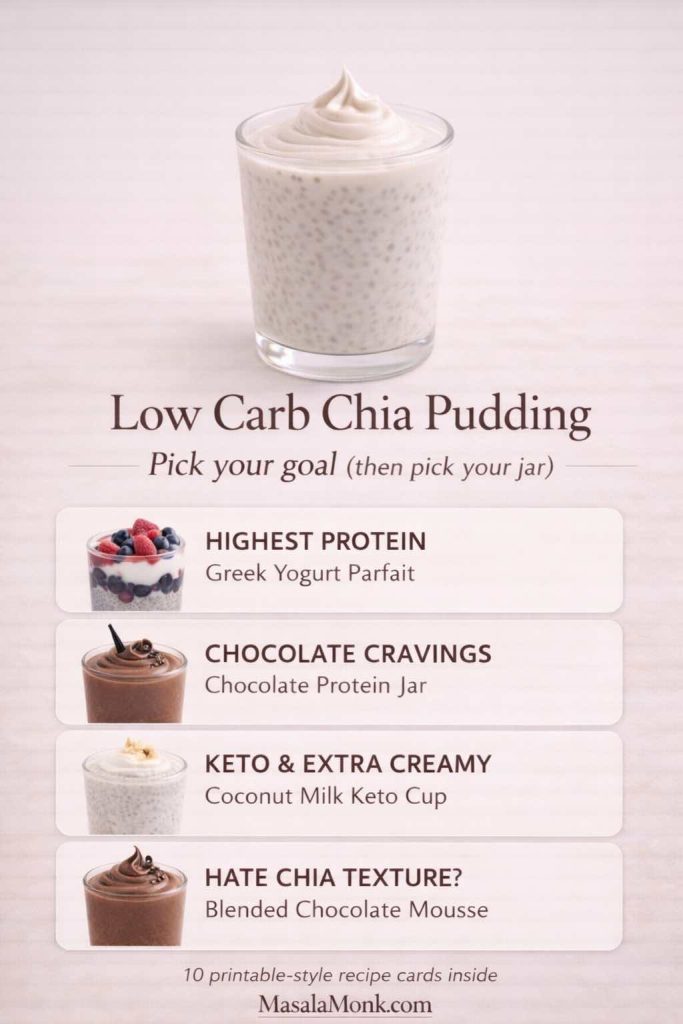
Goal-based chia pudding chooser showing Greek yogurt for highest protein, chocolate protein pudding for chocolate cravings, coconut milk for extra-creamy keto pudding and blended chocolate mousse for people who dislike whole chia texture.
Start with the result you want: Greek yogurt for thick and protein-forward, chocolate protein for cocoa cravings, coconut milk for the richest keto texture, or blended mousse if whole chia seeds are the problem.
If you want…Make this one
Thickest high-protein jarGreek Yogurt Chia Pudding
Simple everyday keto baseVanilla Almond Milk
Chocolate + proteinChocolate Protein
Chocolate dessert feelChocolate Peanut Butter
Fresh café-style flavorMatcha
Fruit-forwardMango
Cozy breakfastApple Cinnamon
Warm-spice dessert flavorGingerbread
Richest keto textureCoconut Milk
No whole-seed textureBlended Chocolate Mousse

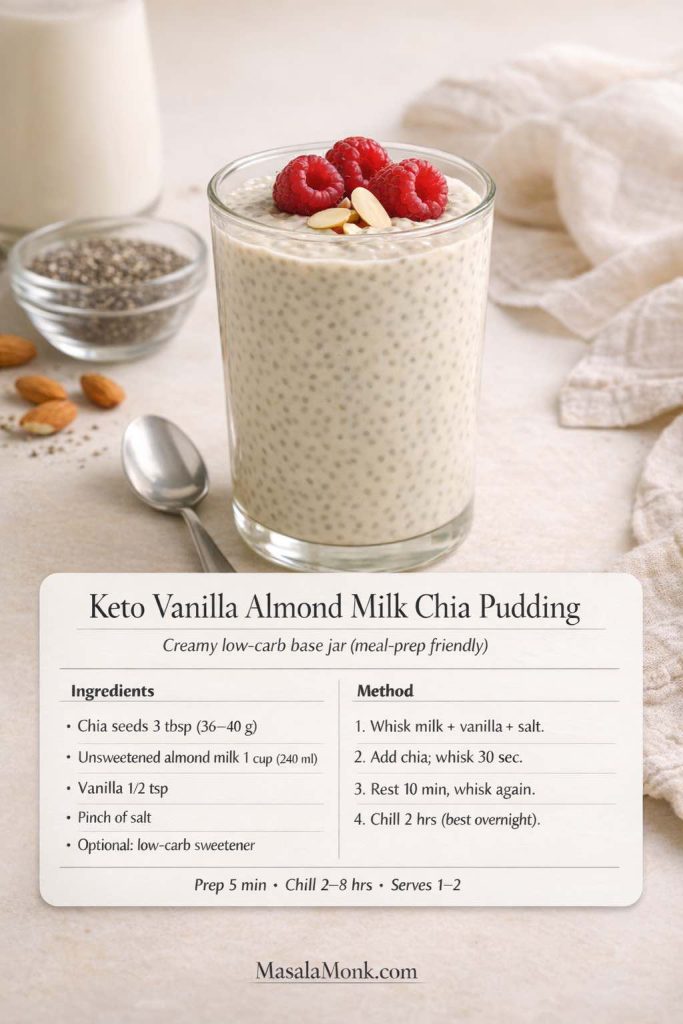
1) Keto Chia Pudding with Almond Milk

This is the easiest everyday low carb chia pudding to memorize. Vanilla keeps it neutral enough for berries, nuts, cocoa, cinnamon, or nut butter later.

Ingredients

  • 3 tablespoons chia seeds
  • 1 cup / 240 ml unsweetened almond milk
  • ½ teaspoon vanilla extract
  • Pinch of salt
  • Optional low-carb sweetener, to taste
Keto vanilla almond milk chia pudding topped with raspberries and sliced almonds.
The almond-milk jar is the useful blank canvas of the collection: light enough for fruit, but easy to make richer with yogurt, nuts or nut butter.

Method

  1. Whisk almond milk, vanilla, salt and sweetener, if using.
  2. Add the chia and whisk vigorously for 20–30 seconds.
  3. Rest 10 minutes, then whisk again.
  4. Cover and refrigerate for at least 2 hours or overnight.

Easy variations: add ½ teaspoon cinnamon; stir in 1 tablespoon unsweetened shredded coconut; or add 1–2 tablespoons Greek yogurt at serving time for a creamier finish.

For a deeper single-recipe treatment, see the keto chia pudding with almond milk.


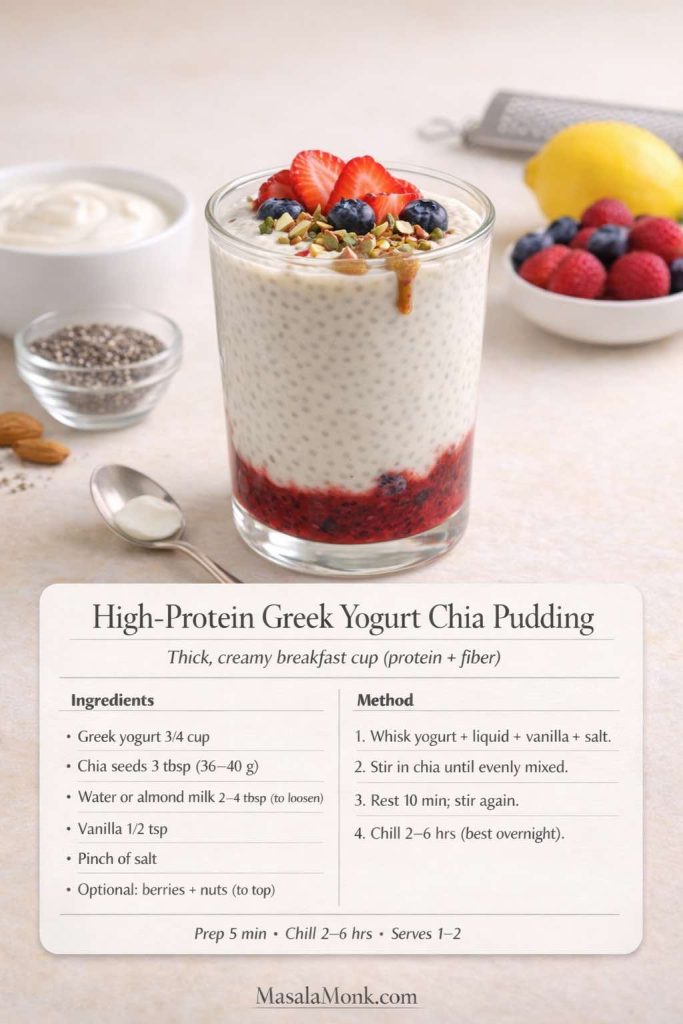
2) Chia Pudding with Greek Yogurt: High Protein & Ultra Creamy

If the chia pudding you want is thick, creamy and closer to cheesecake filling than a glass of soaked seeds, start here. Greek yogurt gives the jar body before the chia has even finished hydrating, while a small amount of liquid keeps the mixture creamy rather than pasty.

Ingredients

  • ¾ cup plain Greek yogurt
  • 3 tablespoons chia seeds
  • ¼ cup / 60 ml unsweetened almond milk or water, plus 1–2 tablespoons more after chilling if needed
  • ½ teaspoon vanilla extract
  • Pinch of salt
  • Optional sweetener, to taste
Thick high-protein Greek yogurt chia pudding layered with berries and topped with strawberries, blueberries, nuts and a small nut-butter drizzle.
This is the thickest protein-forward version in the collection: tangy Greek yogurt, hydrated chia and enough added liquid to keep the pudding creamy rather than stiff.

Method

  1. Whisk the Greek yogurt, vanilla, salt and ¼ cup / 60 ml water or almond milk until completely smooth.
  2. Stir in the chia seeds until evenly distributed.
  3. Rest for 10 minutes, then stir again so no dense chia pockets remain.
  4. Refrigerate for at least 2 hours. Overnight is fine.
  5. Stir before serving and add another 1–2 tablespoons liquid if you want it looser.

How thick should it look before chilling?

It should already be thick, but it should still move easily when stirred. If it looks like a stiff paste before going into the refrigerator, add another tablespoon or two of liquid. The chia will absorb more as it sits.

Can you use nonfat or regular yogurt?

Yes. Nonfat Greek yogurt works, although the finished pudding can taste a little sharper and less rich. Regular yogurt is thinner, so start with less added liquid and check the texture after hydration. Different yogurts vary enough that the final splash of liquid should be adjusted by texture rather than treated as an exact requirement.

Can you add protein powder too?

Yes. Whisk the protein powder into the yogurt and loosening liquid before adding chia. Protein powders absorb liquid differently, so expect to add another 1–3 tablespoons milk if the mixture becomes unusually stiff after the 10-minute rest.

Best toppings and variations

For a cheesecake-style jar, use vanilla, berries and a little lemon zest. For chocolate, whisk cocoa into the yogurt before adding chia. Peanut butter, chopped nuts, cacao nibs and a small berry layer all work well because they add contrast without turning the pudding watery.

If this thick, tangy, almost-cheesecake style is the chia pudding you actually want, keep going with our 10 Creative Chia Pudding Recipes. That collection branches into Greek-yogurt, cheesecake, chocolate, blueberry-lemon, mango and coconut-cream directions, so you can keep the texture you like and change the flavor.


3) Chocolate Protein Chia Pudding

This is the jar to make when you want chocolate flavor without turning breakfast into a sugar-heavy dessert. The important technique is dissolving the protein powder and cocoa before the chia goes in.

  • 1 cup / 240 ml unsweetened almond milk or dairy milk
  • 1 scoop chocolate protein powder, or vanilla protein plus extra cocoa
  • 2 tablespoons cocoa or cacao powder
  • 3 tablespoons chia seeds
  • Pinch of salt
  • Optional sweetener, to taste
  • Optional: 1 tablespoon Greek yogurt for extra creaminess
  • 2–4 tablespoons extra milk, only if your protein powder makes the mixture unusually thick
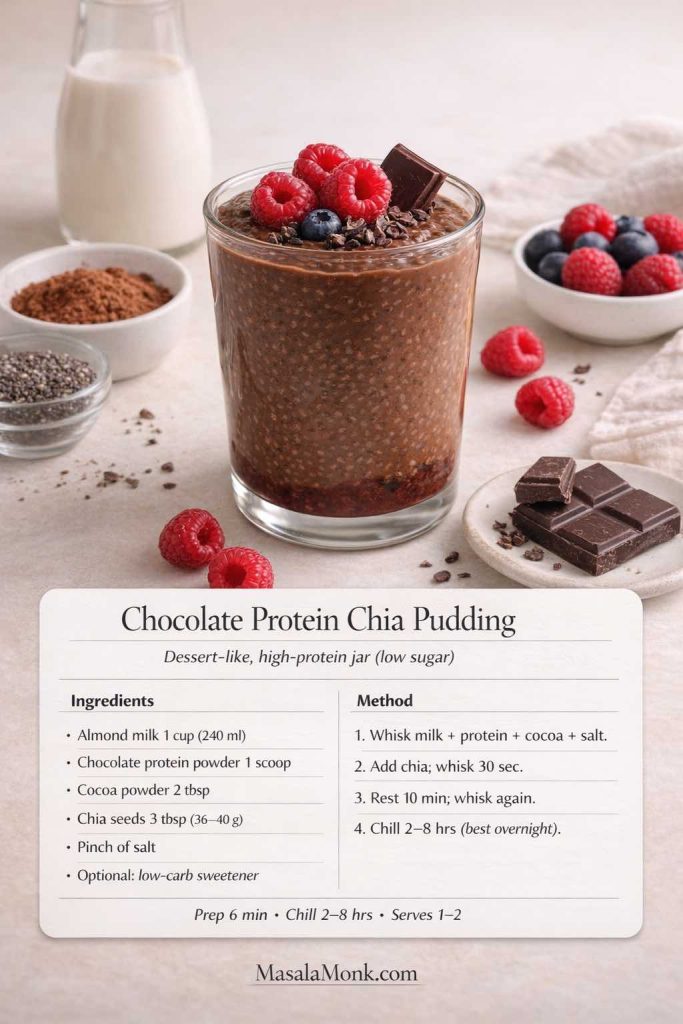
Chocolate protein chia pudding topped with raspberries, cacao nibs and dark chocolate.
Cocoa and protein powder make this the most direct chocolate-for-breakfast jar in the collection.
  1. Whisk the milk, protein powder, cocoa, salt and sweetener until completely smooth.
  2. Add chia and whisk again.
  3. Rest 10 minutes, then stir thoroughly. If it already looks very thick, add 2–4 tablespoons extra milk.
  4. Refrigerate for at least 2 hours; overnight gives the most settled texture.

If it tastes chalky: whisk the protein powder with a small amount of milk into a smooth paste first, then gradually add the rest of the milk.


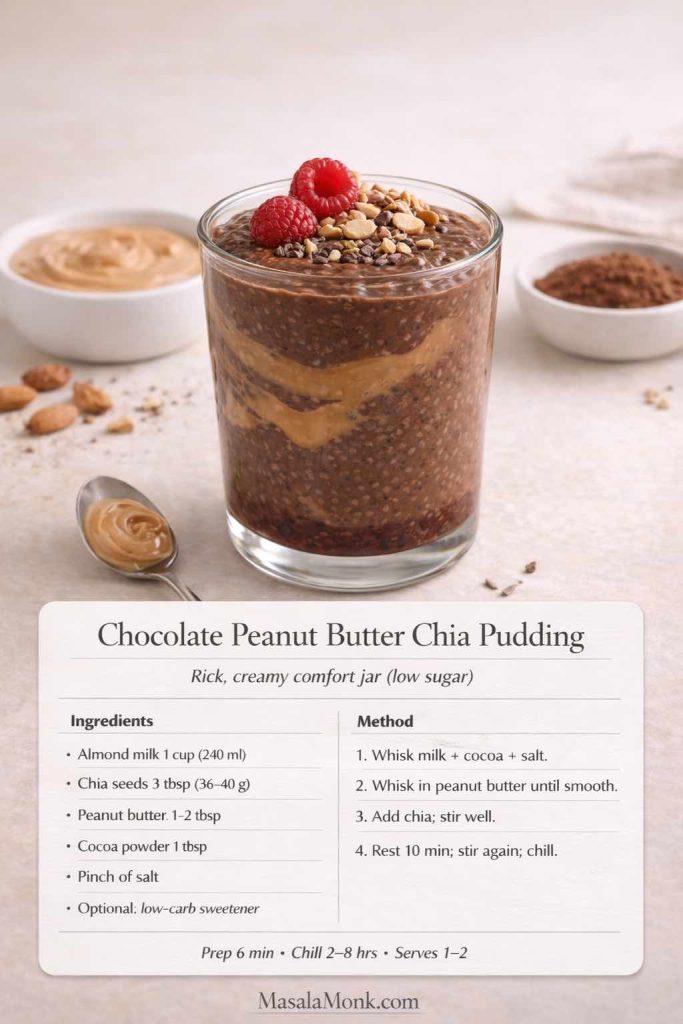
4) Chocolate Peanut Butter Chia Pudding

Peanut butter supplies richness and makes chocolate taste fuller even when you keep the pudding only lightly sweetened.

  • 1 cup / 240 ml almond milk or dairy milk
  • 3 tablespoons chia seeds
  • 1–2 tablespoons peanut butter
  • 1 tablespoon cocoa powder
  • Pinch of salt
  • Optional sweetener
Chocolate peanut butter chia pudding with a peanut butter swirl, raspberries, chopped peanuts and cacao nibs.
Chocolate and peanut butter create a richer dessert-style jar without needing much additional sweetness.
  1. Whisk milk, cocoa, salt and sweetener until smooth.
  2. Whisk in the peanut butter until evenly incorporated.
  3. Add chia, rest 10 minutes and stir again.
  4. Refrigerate for at least 2 hours.

A tiny splash of vanilla or pinch of cinnamon can make the cocoa taste deeper. Top with berries, roasted nuts or a few cacao nibs.


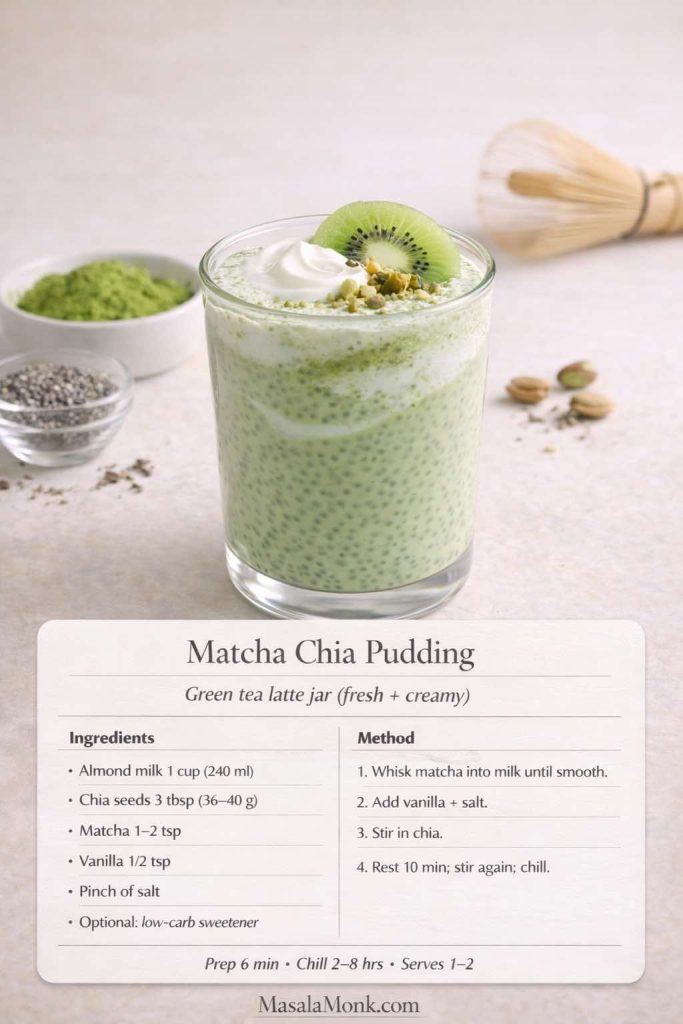
5) Matcha Chia Pudding

Matcha gives chia pudding a clean green-tea flavor that works especially well with vanilla and a small pinch of salt.

  • 1 cup / 240 ml unsweetened almond milk or light coconut-milk beverage
  • 3 tablespoons chia seeds
  • 1–2 teaspoons matcha powder
  • ½ teaspoon vanilla
  • Pinch of salt
  • Optional sweetener
Creamy matcha chia pudding topped with kiwi, pistachio and a small spoonful of yogurt.
Matcha creates a lighter, café-style change of pace between the richer chocolate and coconut puddings.
  1. Whisk or sift matcha into the milk until smooth.
  2. Add vanilla, salt and sweetener, if using.
  3. Add chia, rest 10 minutes, stir again and refrigerate.

If your matcha clumps, whisk it first with 1–2 tablespoons warm water to form a smooth paste. Matcha contains caffeine, so use less or enjoy it earlier in the day if you are sensitive to it.


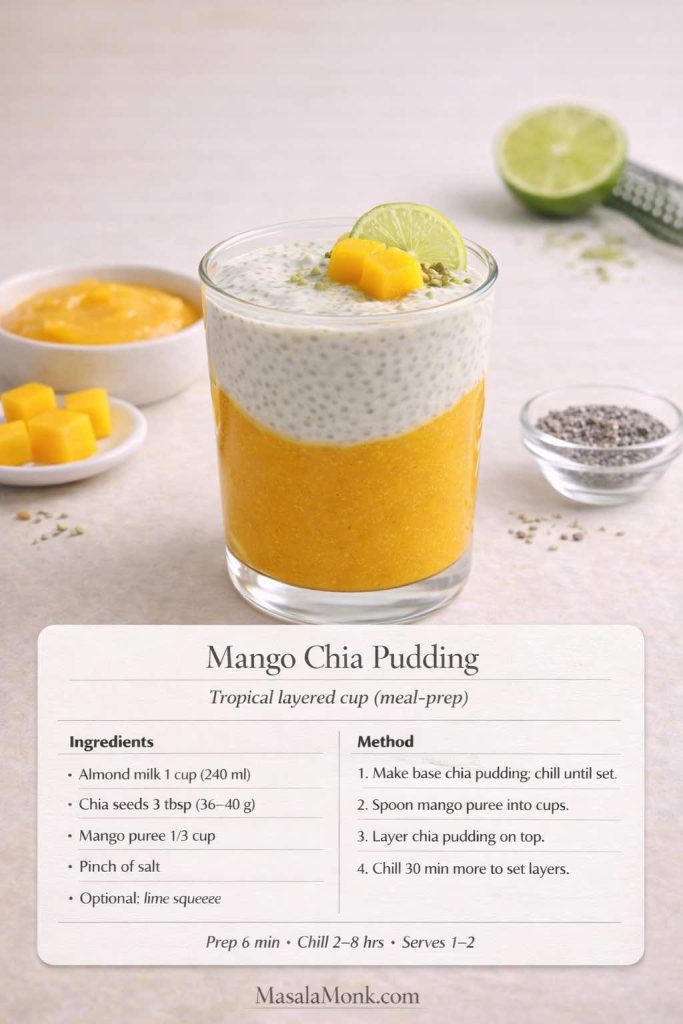
6) Mango Chia Pudding

Mango gives you plenty of flavor from a relatively small amount of fruit. Lime and a pinch of salt help the mango taste brighter, so you do not need to turn the whole jar into mango puree.

  • 1 cup / 240 ml almond milk or coconut-milk beverage
  • 3 tablespoons chia seeds
  • ⅓ cup mango puree or finely diced mango
  • Pinch of salt
  • Optional squeeze of lime
Layered mango chia pudding with bright mango puree, creamy chia pudding, mango pieces and lime.
Layering the mango rather than mixing a large quantity through the whole jar gives you strong tropical flavor without overwhelming the chia base.
  1. Make the chia base with milk, chia and salt.
  2. Chill until set.
  3. Fold in the mango just before eating, or layer the puree at the bottom of the jar.
  4. Finish with lime, if using.

If the tropical-fruit direction is what you like, try our pineapple chia pudding next. It uses the same two-stir logic but goes deeper on pineapple, yogurt, texture, and how to keep the pudding spoonable rather than watery.


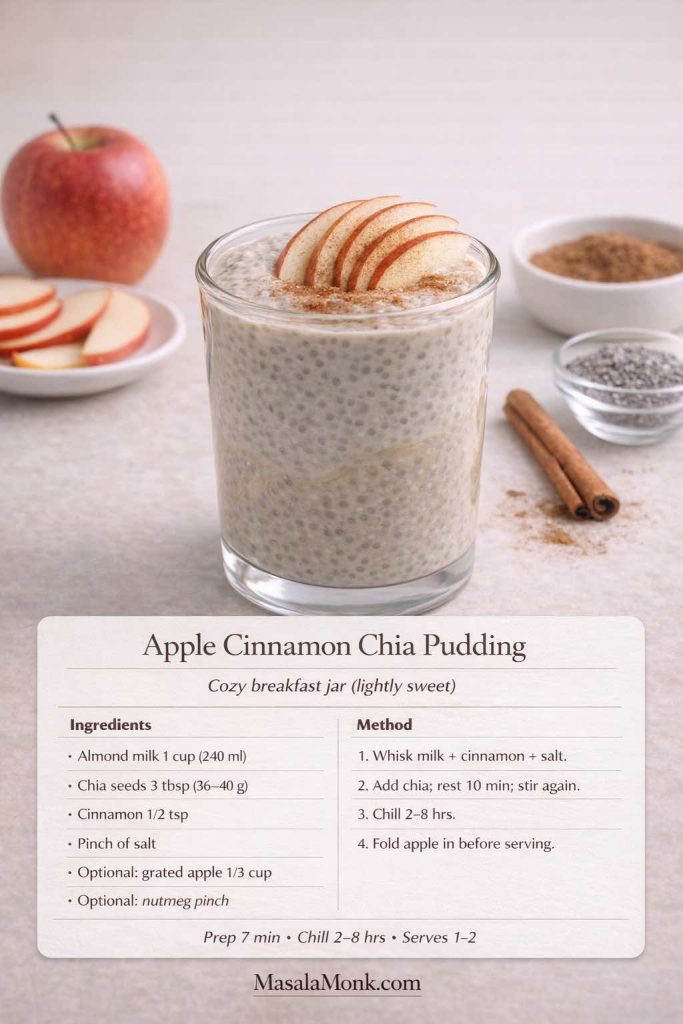
7) Apple Cinnamon Chia Pudding

This version gets most of its cozy character from cinnamon, vanilla and nutmeg, so the apple can stay a relatively small accent.

  • 1 cup / 240 ml unsweetened almond milk
  • 3 tablespoons chia seeds
  • ½ teaspoon cinnamon
  • Pinch of salt
  • Optional: ⅓ cup grated apple
  • Optional: pinch of nutmeg
Apple cinnamon chia pudding topped with thin apple slices and cinnamon.
For the freshest texture, add grated apple shortly before serving rather than letting it sit in the pudding for several days.
  1. Whisk milk, cinnamon, salt and nutmeg.
  2. Add chia, rest 10 minutes, stir again and chill.
  3. Fold in grated apple shortly before serving.

Stricter low-carb version: skip the apple and use cinnamon, vanilla and chopped pecans for a cinnamon-pecan jar.


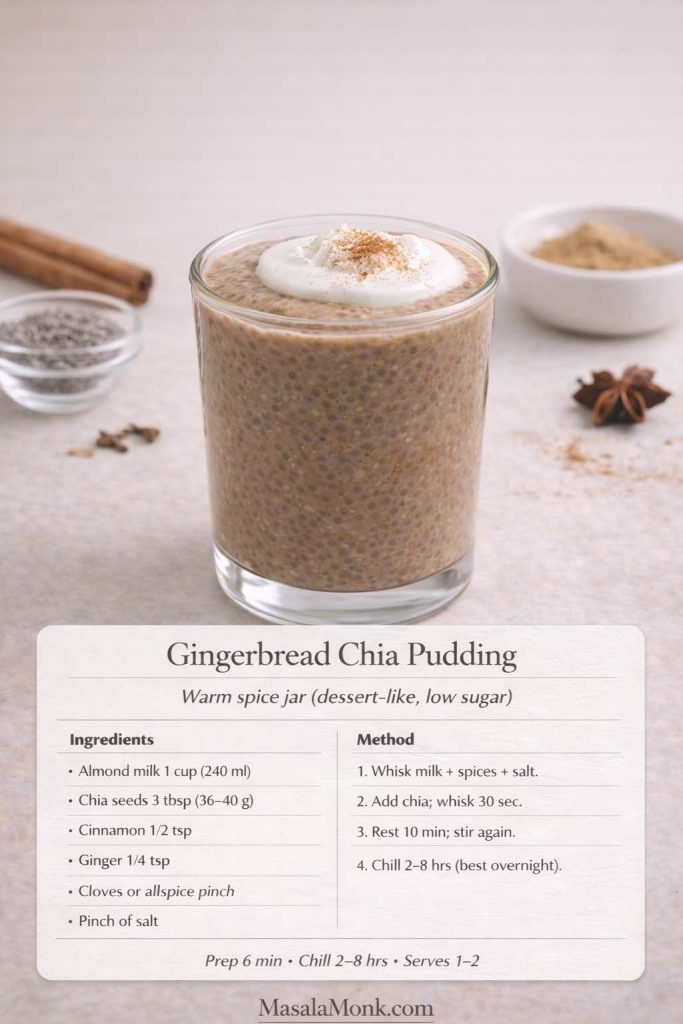
8) Gingerbread Chia Pudding

Gingerbread chia pudding is about warm-spice flavor rather than a health halo: cinnamon, ginger and cloves turn the same neutral base into something that feels much more dessert-like.

  • 1 cup / 240 ml almond milk or coconut-milk beverage
  • 3 tablespoons chia seeds
  • ½ teaspoon cinnamon
  • ¼ teaspoon ground ginger
  • Pinch of cloves or allspice
  • Pinch of salt
  • Optional sweetener
Gingerbread chia pudding topped with yogurt and cinnamon.
Warm spices transform a basic chia-and-milk jar without needing a complicated ingredient list.
  1. Whisk the spices, salt and sweetener into the milk.
  2. Add chia, rest 10 minutes, stir again and refrigerate.
  3. Serve with chopped nuts, Greek yogurt or coconut cream.

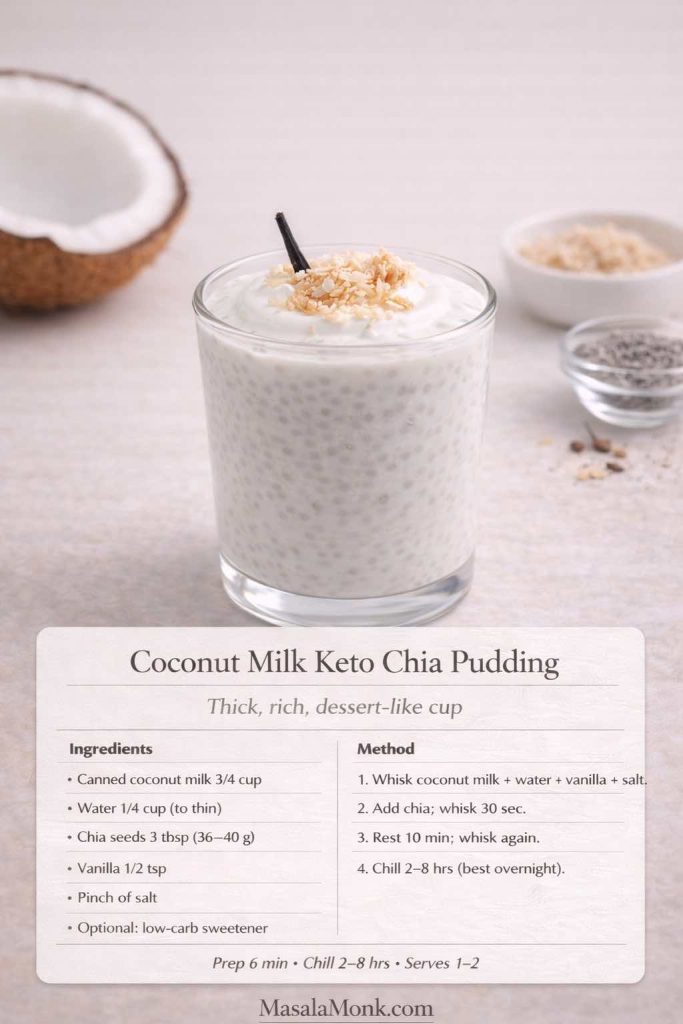
9) Keto Chia Pudding with Coconut Milk

This is the richest milk-based pudding in the collection. Canned coconut milk gives you much more body than almond milk, but thinning it slightly helps the chia hydrate evenly.

  • 3 tablespoons chia seeds
  • ¾ cup / 180 ml canned coconut milk
  • ¼ cup / 60 ml water, plus more if needed
  • ½ teaspoon vanilla
  • Pinch of salt
  • Optional sweetener
Rich coconut milk keto chia pudding topped with toasted coconut and vanilla.
Canned coconut milk produces the densest, richest milk-based chia pudding in this collection.
  1. Whisk coconut milk, water, vanilla, salt and sweetener until smooth.
  2. Add chia, rest 10 minutes and stir again.
  3. Refrigerate for at least 2 hours.
  4. If it becomes extremely thick overnight, loosen it with a splash of water before serving.

10) Blended Chia Pudding: Smooth Chocolate Mousse

If the idea of chia appeals to you but the whole-seed texture does not, this is the recipe worth trying. Let the chia hydrate first, then blend the finished pudding until glossy and smooth.

  • 1 cup / 240 ml almond milk or dairy milk
  • 3 tablespoons chia seeds
  • 1–2 tablespoons cocoa or cacao powder
  • Pinch of salt
  • Optional sweetener
  • Optional: 1 tablespoon peanut butter or 2 tablespoons Greek yogurt
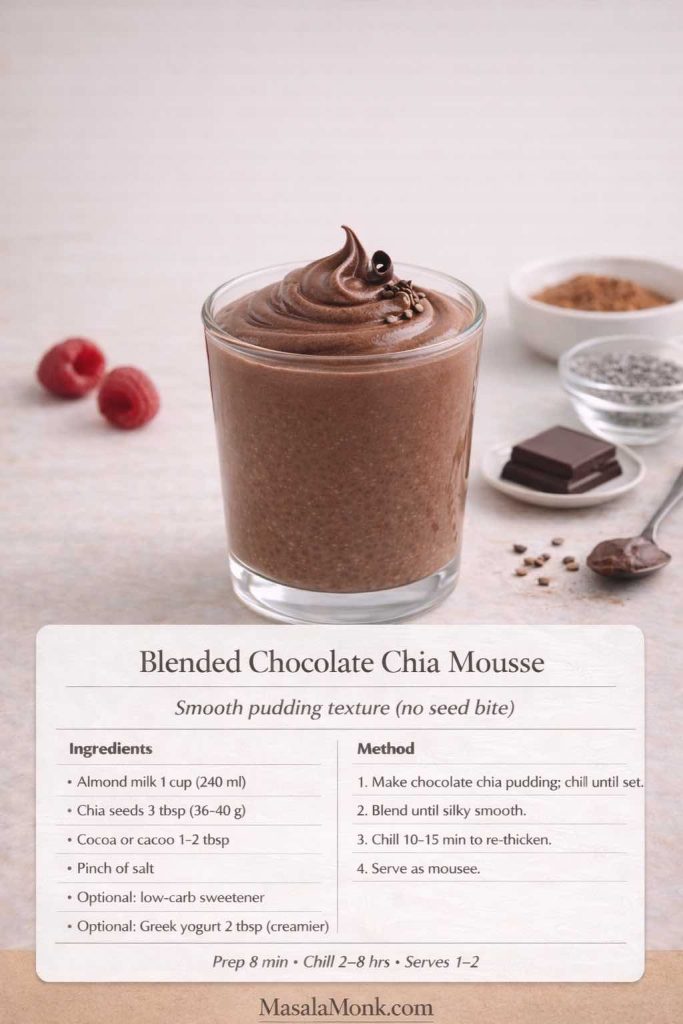
Silky blended chocolate chia mousse topped with dark chocolate and cacao nibs.
Hydrate first and blend second: that is what changes chia from a seedy pudding into a much smoother mousse-like texture.
  1. Make a standard chocolate chia pudding and refrigerate it for at least 2 hours.
  2. Blend until completely smooth and glossy.
  3. Add Greek yogurt or peanut butter if you want a richer finish.
  4. Chill for another 10–15 minutes before serving.

If protein powder is part of the recipe, blending after the chia has set can also smooth out small powdery pockets.

Whichever flavor you choose, texture is the part most likely to need adjusting. The fixes below are designed so you can rescue the pudding you already made instead of starting over.


Chia Pudding Troubleshooting: Runny, Too Thick, Lumpy or Bland

Most disappointing chia pudding can be traced to the ratio, hydration time, stirring pattern, or the thickness of the liquid you started with. Fix the texture before abandoning the jar.

ProblemWhat probably happenedWhat to do now
Runny after 2+ hoursToo much liquid, too little chia, or very thin milkAdd 1 teaspoon chia at a time, stir well and chill another 30–60 minutes.
Too thick or pastyRich coconut milk, thick yogurt, extra protein powder, or too much chiaStir in milk or water 1 tablespoon at a time until creamy.
Large chia clumpsThe seeds settled together before fully hydratingBreak them up thoroughly; next time use the 10-minute second stir.
Seeds still crunchyNot enough hydration time or liquidAdd a small splash of liquid and give the pudding more time.
Protein powder tastes chalkyPowder was added after the chia or not dissolved firstBlend the pudding, or next time dissolve powder completely before adding seeds.
Watery fruit layerJuicy fruit sat in the jar too longKeep berries and other watery toppings separate until serving.
Flavor is flatNot enough salt, aroma, richness or acidityAdd a pinch of salt plus vanilla, cinnamon, cocoa, nut butter, citrus zest or berries.
You hate the seed textureThe pudding may be fine; the texture simply is not for youBlend it into chocolate chia mousse.

One important correction: if a milk-based pudding is only slightly soft at the 30-minute mark, do not keep throwing chia into it. Give it the full two hours first. Chia continues absorbing liquid as it rests.


Chia Pudding Meal Prep & Storage

The easiest way to meal prep chia is to make one plain base and create several flavors from it rather than mixing four completely separate recipes.

  • Whisk the base in a bowl where you can easily break up clumps.
  • Do the 10-minute second stir.
  • Portion into three or four jars.
  • Flavor the jars in different directions—vanilla, cocoa, matcha, cinnamon, yogurt.
  • Keep crunchy toppings and watery fruit separate until serving.
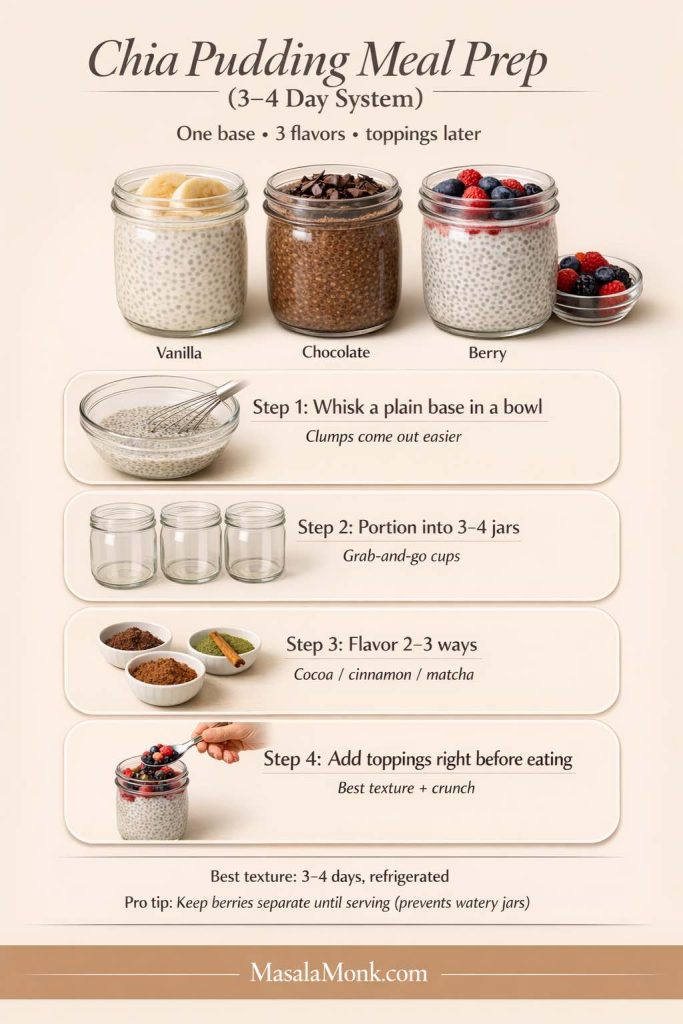
Chia pudding meal-prep system showing one base divided into several jars and flavored with vanilla, chocolate and berries, with toppings kept separate until serving.
One base, several flavors, toppings added later: this is much easier to repeat than making a completely different pudding every morning.

For quality, most chia puddings are best eaten within about 3–4 days when refrigerated. Yogurt- and milk-based versions should stay cold, and fruit is usually best added closer to serving. Follow normal refrigerated food-safety practices and discard anything that develops an unusual smell, appearance or signs of spoilage.

If what you really enjoy is the make-it-tonight, grab-it-tomorrow routine rather than chia specifically, our high protein overnight oats give you the same fridge-ready breakfast rhythm with oats, yogurt, protein-powder and dairy-free routes.


How to Make Chia Pudding Taste Better

If chia pudding tastes like a health chore, the problem is usually not the chia. A plain mixture of seeds and unsweetened milk needs flavor structure just like any other pudding.

  • Salt: a small pinch makes chocolate, vanilla, fruit and nut butter taste fuller.
  • Vanilla or warm spice: vanilla, cinnamon, ginger or nutmeg give the jar aroma without requiring much sweetness.
  • Depth: cocoa, cacao or matcha create a strong flavor identity.
  • Creaminess: Greek yogurt, canned coconut milk or nut butter changes both flavor and mouthfeel.
  • Contrast: berries, chopped nuts, toasted coconut and cacao nibs stop every spoonful feeling the same.
  • Acidity: lemon or lime zest can make fruit flavors brighter.
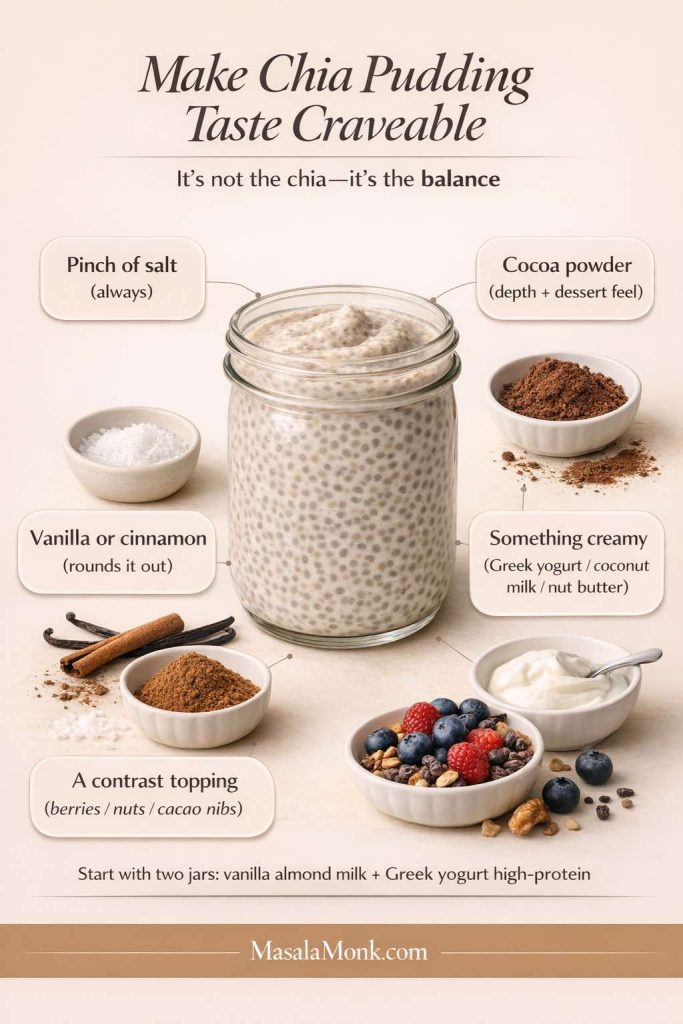
Flavor-balance guide for chia pudding showing salt, vanilla or cinnamon, cocoa, creamy ingredients and contrasting toppings.
Good chia pudding needs the same things other desserts do: seasoning, aroma, richness and contrast.

If you are making chia pudding for the first time, a useful two-jar experiment is one vanilla almond-milk jar and one Greek-yogurt jar. You will immediately learn whether you prefer a lighter gel-style pudding or a thicker, tangier texture.


Frequently Asked Questions

1) What is the best chia pudding ratio?

For a milk-based pudding, start with 3 tablespoons chia seeds to 1 cup / 240 ml liquid. Use a little less chia for a softer pudding. Greek-yogurt chia pudding uses a different ratio because yogurt already supplies most of the thickness.

2) How long does chia pudding need to set?

Give it at least 2 hours for a dependable set. A 30–45 minute quick version is possible but softer. Overnight works especially well for meal prep.

3) Why is my chia pudding watery?

It may need more time, more chia, or a better second stir. If it is still runny after at least two hours, add about 1 teaspoon chia, stir thoroughly and chill for another 30–60 minutes.

4) Why is my chia pudding too thick?

Thick Greek yogurt, canned coconut milk, protein powder and slightly heavy chia measurements can all produce an unexpectedly dense pudding. Stir in water or milk a tablespoon at a time until it becomes creamy again.

5) How do I stop chia seeds clumping together?

Whisk immediately after adding the seeds, then stir or whisk again after about 10 minutes. That second stir redistributes the seeds just as they begin to gel.

6) Can I make chia pudding with Greek yogurt and no milk?

Yes. Use water instead of milk to loosen the yogurt. Start with ¾ cup Greek yogurt, 3 tablespoons chia and ¼ cup / 60 ml water, then add another tablespoon or two after chilling if the pudding is too stiff.

7) Is Greek yogurt better than regular yogurt for chia pudding?

Neither is inherently better, but they behave differently. Greek yogurt is thicker and generally higher in protein, so it gives a firmer pudding. Regular yogurt starts looser, meaning you may need less added liquid or slightly more chia.

8) Can I add protein powder to chia pudding?

Yes. For the smoothest texture, dissolve the protein powder in the milk or yogurt mixture before adding the chia seeds. Because powders absorb liquid differently, keep a little extra milk nearby and adjust after the 10-minute rest.

9) Can I make chia pudding with almond milk?

Yes. Unsweetened almond milk is one of the easiest bases for low carb chia pudding because its flavor is mild and it works well with vanilla, cocoa, cinnamon, berries, matcha and nut butter.

10) Can I make chia pudding with coconut milk?

Yes. Canned coconut milk makes an especially rich pudding. If the coconut milk is very thick, dilute it with a little water before adding chia so the seeds hydrate evenly.

11) Can I make chia pudding with oat milk?

Yes. Oat milk creates a mild, creamy pudding, although many oat milks contain substantially more carbohydrate than unsweetened almond milk, so check the label if low carb is your priority.

12) Can I make dairy-free chia pudding?

Yes. Use unsweetened almond milk, coconut milk, or another dairy-free milk you enjoy. If adding protein powder, check whether it contains whey or casein; those are dairy proteins.

13) Can I make blended chia pudding?

Yes, and it is one of the best solutions if you dislike whole chia seeds. Let the pudding hydrate first, then blend until smooth. Cocoa, peanut butter or Greek yogurt can make the result even more mousse-like.

14) What is the easiest three-ingredient chia pudding?

A simple version is chia seeds + unsweetened almond milk + vanilla. Another is chia + coconut milk + cocoa. Add a pinch of salt if possible; it makes a surprisingly large difference to the finished flavor.

15) Can I use frozen berries in chia pudding?

Yes. Thawed berries release juice, which can be useful as a swirl or compote-style layer. For meal prep, keep very juicy berries separate until serving if you do not want them loosening the pudding.

16) How can I sweeten chia pudding without much sugar?

Start by improving flavor before simply increasing sweetness. Vanilla, cinnamon, cocoa, nut butter, coconut milk, berries, citrus zest and a pinch of salt can all make the pudding taste more complete. If you use a low-carb sweetener, add only enough to suit your taste.

17) Is chia pudding keto-friendly?

It can fit many low-carb or ketogenic eating patterns when made with ingredients such as unsweetened almond milk or coconut milk and appropriate toppings. The final carbohydrate content depends on your milk, yogurt, fruit, sweetener and serving size, so check the ingredients you actually use rather than relying on the word “keto” alone.

18) How long does chia pudding last in the fridge?

For quality, aim to eat most homemade chia pudding within about 3–4 days, refrigerated. Keep toppings such as nuts separate for crunch and add juicy fruit later if you want the pudding to stay thick.

19) Which chia pudding should I make first?

If you want the simplest base, start with vanilla almond milk chia pudding. If you came for the thick, creamy version, make the Greek yogurt chia pudding. And if chia’s seed texture has always bothered you, go directly to the blended chocolate mousse.
Posted on 2 Comments

Best Nuts and Seeds for Weight Loss (Chia, Flax, Almonds & More)

The Role of Nuts & Seeds in Weight Management and Overall Health

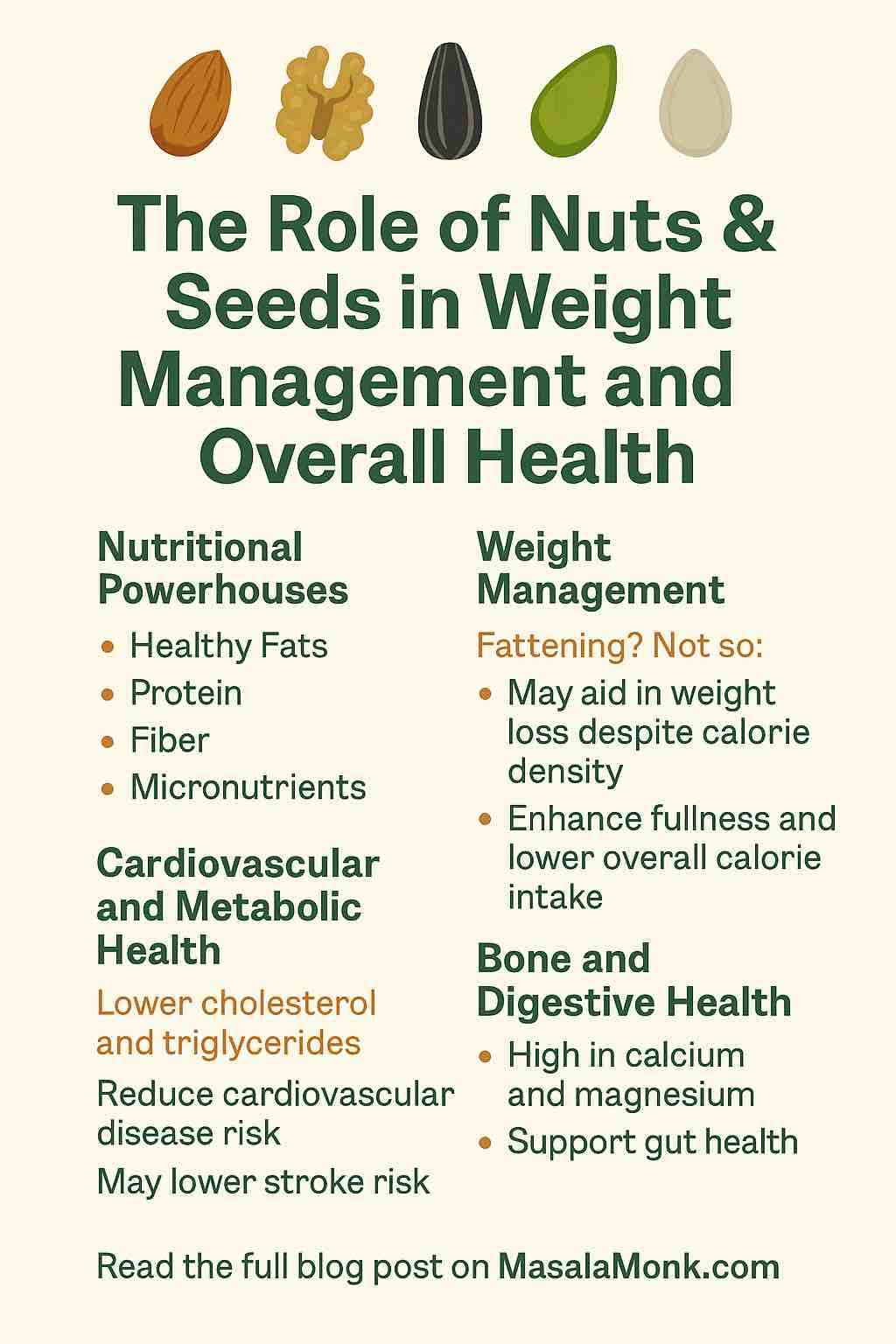
If you’re trying to shed pounds naturally, eating the best nuts and seeds for weight loss can give you a real advantage. For years, many people avoided these foods, believing their high fat and calorie content would lead to weight gain. However, modern research tells a different story.

Studies from Harvard and the University of South Australia show that including nuts in a calorie-controlled diet not only supports weight loss but often leads to greater fat loss compared to diets without nuts. Seeds like chia and flax add even more benefits, thanks to their fiber and omega-3 fatty acids, which keep you full and improve metabolism.

In this comprehensive guide, we’ll explore the top nuts and seeds for weight loss, why they work, how to eat them, and the science behind their benefits. By the end, you’ll know exactly how to make these tiny nutritional powerhouses a smart part of your weight-loss journey.


Why Nuts and Seeds Help With Weight Loss

Nuts and seeds are nutrient-dense, combining protein, fiber, and healthy fats. This unique balance explains why they support fat loss instead of hindering it:

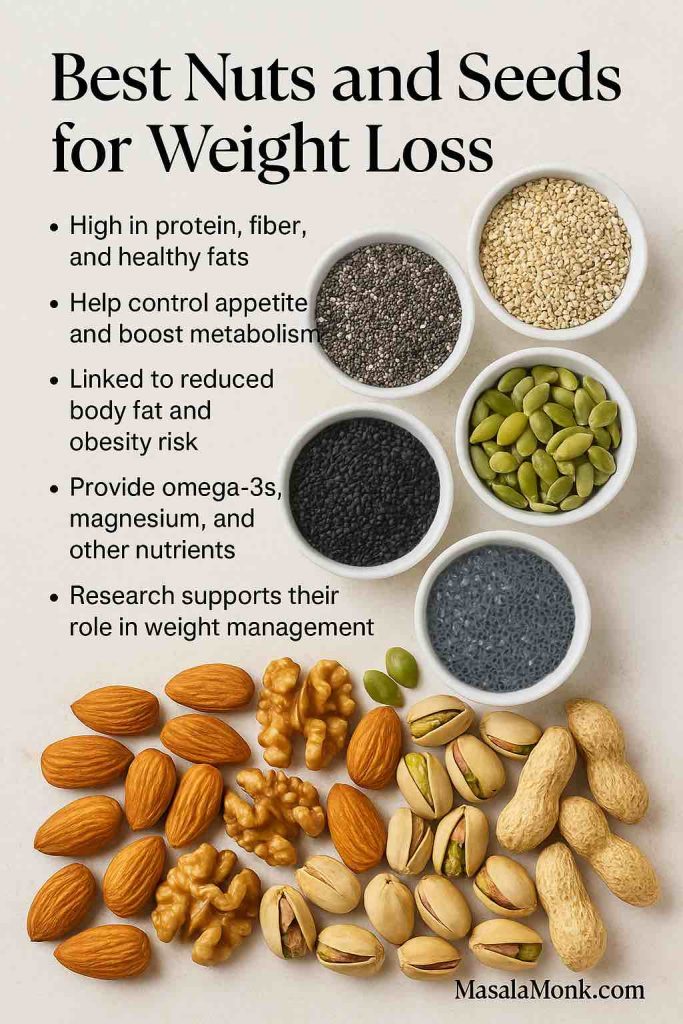
Best nuts and seeds for weight loss – almonds, walnuts, pistachios, peanuts, chia seeds, flax, pumpkin, sesame, and sabja – high in protein, fiber, and healthy fats for appetite control and metabolism.
Quick snapshot: Nuts and seeds are rich in protein, fiber, and healthy fats — helping reduce cravings, boost metabolism, and support weight management.
  1. Satiety & Reduced Appetite
    Their high fiber and protein slow digestion and keep you full, reducing cravings for processed snacks.
  2. Incomplete Calorie Absorption
    Research shows that not all calories in nuts are absorbed. For example, the metabolizable energy of walnuts is about 21% lower than what food labels suggest (Health.com).
  3. Improved Metabolism
    Healthy fats (especially omega-3s) support metabolic health, while protein helps preserve lean muscle during fat loss.
  4. Research Evidence
    • A Harvard study tracking 145,000 adults found that eating half a handful of nuts daily reduced obesity risk by 16%.
    • A 2024 systematic review showed nut-enriched diets led to 1.4–7.4 kg more weight loss than nut-free diets.
    • Meta-analyses confirm that nut consumption does not lead to weight gain (PMC).

📊 Nutritional Comparison: Nuts & Seeds (per 100 g)

FoodCaloriesProteinFiberFatKey Nutrients
Chia Seeds48617 g34 g31 gOmega-3s, Calcium, Magnesium
Flax Seeds53418 g27 g42 gLignans, Omega-3s, Fiber
Pumpkin Seeds (Pepitas)55930 g6 g49 gMagnesium, Zinc, Iron
Cumin Seeds37518 g11 g22 gIron, Antioxidants
Sesame Seeds57318 g12 g50 gCalcium, Magnesium, Lignans
Sabja (Basil) Seeds44220 g40 g25 gFiber, Iron, Plant Compounds
Almonds57921 g12.5 g50 gVitamin E, Magnesium
Walnuts65415 g7 g65 gOmega-3s (ALA), Antioxidants
Pistachios56020 g10 g45 gB6, Potassium, Lutein
Peanuts56725 g8.5 g49 gFolate, Niacin, Protein
Brazil Nuts65914 g7.5 g67 gSelenium, Magnesium
Macro Nutrition Comparison of Popular Nuts and Seeds discussed in this blog post.

💡 Insights at a Glance

  • Highest Protein: Pumpkin seeds (30 g/100 g).
  • Highest Fiber: Sabja (40 g/100 g), chia (34 g/100 g).
  • Highest Omega-3s: Flax, chia, walnuts.
  • Lowest Calories (comparatively): Chia and Sabja, though still energy-dense.
  • Nutrient Powerhouses: Brazil nuts (selenium), pumpkin seeds (magnesium & zinc), almonds (vitamin E).

Best Seeds for Weight Loss

Seeds may be tiny, but when it comes to nutrition, they pack an enormous punch. High in fiber, protein, and healthy fats, they help control appetite, stabilize blood sugar, and provide essential micronutrients that support metabolism. Incorporating the best seeds for weight loss into your daily diet is an easy, natural way to enhance fat loss while improving overall health.

Below, we’ll explore the top science-backed seeds that aid weight management — and how to use them.

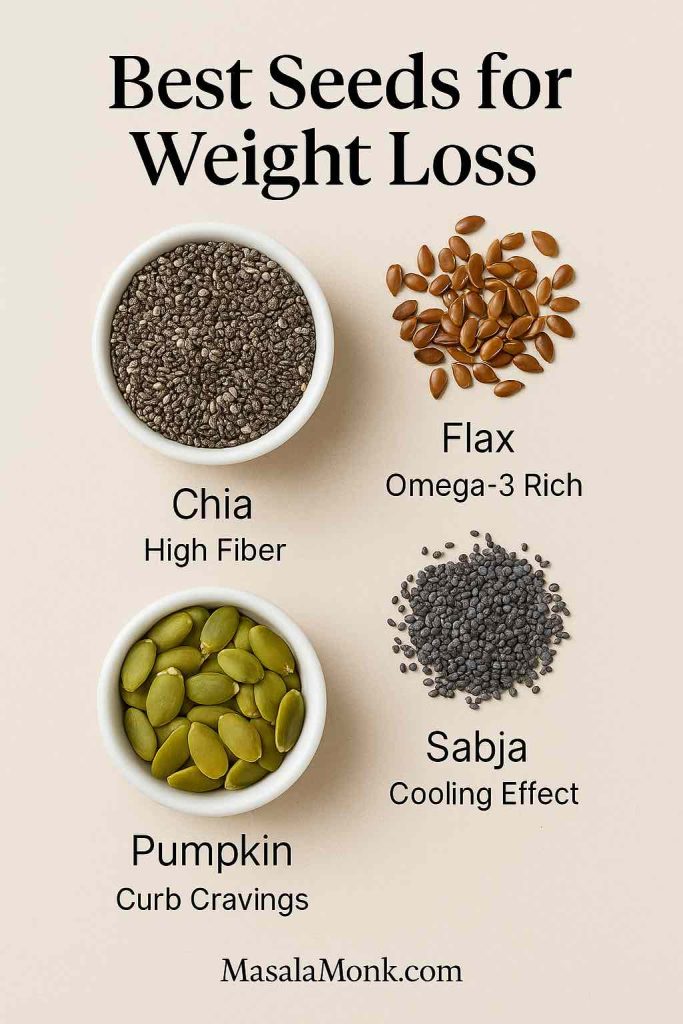
Best seeds for weight loss – chia, flax, pumpkin, and sabja seeds with benefits like high fiber, omega-3 fatty acids, appetite control, and digestive support.
Top seeds for weight loss: Chia for fiber, flax for omega-3s, pumpkin for curbing cravings, and sabja for cooling digestion and satiety.

🌱 Chia Seeds for Weight Loss

Chia seeds are one of the most popular seeds for weight loss — and for good reason. Just two tablespoons provide nearly 10 grams of fiber, which expands in the stomach and slows digestion, creating a feeling of fullness that reduces overeating.

Chia seeds are also rich in omega-3 fatty acids, protein, calcium, and magnesium, making them a nutrient-dense addition to any diet. Their ability to absorb water (up to 10x their weight) makes them particularly effective in appetite control.

👉 A Harvard Nutrition Guide highlights chia as an easy way to add fiber and omega-3s to meals without significantly raising calorie intake.

How to Eat Chia Seeds

  • Mix 1–2 tablespoons into smoothies or yogurt.
  • Prepare overnight chia pudding with milk or plant-based alternatives.
  • Soak in water for 20 minutes to make chia water, a simple pre-meal appetite suppressant.

💡 Tip: Always soak chia seeds before eating large amounts to prevent digestive discomfort.

For some creative Chia Pudding recipes, do read out post: 10 Creative Chia Pudding Recipes for Every Taste

🌱 Flax Seeds for Weight Loss

Flax seeds (or linseeds) are another fiber powerhouse, providing both soluble and insoluble fiber that promotes satiety and digestive health. They’re also rich in lignans, plant compounds with antioxidant and hormone-balancing effects.

Studies suggest flax may help lower cholesterol and support fat metabolism, making them a great addition to weight-loss diets.

How to Eat Flax Seeds

  • Always consume ground flax seeds (whole seeds may pass through undigested).
  • Add 1–2 tablespoons to oatmeal, pancakes, or baked goods.
  • Blend into protein shakes or smoothies.

💡 Tip: Store ground flax seeds in the fridge to prevent oxidation and preserve nutrients.

Do Read: How to Incorporate Flax Seeds for Weight Loss: Tips, Recipes, and Nutritional Benefits

🌱 Pumpkin Seeds for Weight Loss

Pumpkin seeds, also known as pepitas, are nutrient-dense and packed with protein, magnesium, zinc, and antioxidants. They help regulate blood sugar, support muscle mass, and improve satiety — all important for weight loss.

A gastroenterologist cited in Economic Times recommends pumpkin seeds for their ability to balance blood sugar levels and provide affordable nutrition.

How to Eat Pumpkin Seeds

  • Snack on roasted pumpkin seeds.
  • Add to salads, soups, or stir-fries.
  • Include in homemade trail mix or granola bars.

💡 Tip: Stick to a handful (¼ cup) to keep calories in check.

Also Read: The Benefits of Pumpkin Seeds for Weight Loss and Blood Sugar Control

🌱 Cumin Seeds for Weight Loss

While often used as a spice, cumin seeds have gained attention for potential weight-loss benefits. Some small trials suggest cumin may aid fat reduction and improve cholesterol when included in calorie-controlled diets.

How to Use Cumin Seeds

  • Brew cumin water: soak 1 teaspoon of seeds overnight, strain, and drink in the morning.
  • Add to soups, stews, or roasted vegetables for extra flavor and digestive support.

💡 Tip: Cumin should complement a balanced diet — it’s not a standalone solution for fat loss.

Also Read: Harness the Power of Cumin Seeds for Weight Loss: Unveiling the Potential

🌱 Sesame Seeds for Weight Loss

Sesame seeds are calorie-dense, but they provide calcium, magnesium, and lignans that support metabolic health. They are often consumed in the form of tahini, a sesame paste used in Mediterranean and Middle Eastern cooking.

How to Eat Sesame Seeds

  • Sprinkle toasted sesame seeds on stir-fries, noodles, or salads.
  • Use tahini as a base for salad dressings or dips like hummus.

💡 Tip: A teaspoon or two goes a long way — moderation is key due to calorie density.

Read More: Sesame Seeds for Weight Loss: Exploring the Nutritional Benefits, Cooking Methods, and Incorporation into a Healthy Diet

🌱 Sabja (Basil) Seeds for Weight Loss

Sabja seeds, also called tukmaria or basil seeds, are similar to chia in their ability to swell up in liquid. Rich in fiber and plant compounds, they slow digestion, promote fullness, and support gut health.

They’re a traditional ingredient in Indian summer drinks and desserts, prized for their cooling effect and digestive benefits.

How to Eat Sabja Seeds

  • Soak 1–2 teaspoons in water for 15 minutes before use.
  • Add to lemon water, smoothies, or milk-based drinks like falooda.

💡 Tip: Always soak sabja seeds before consuming — eating them dry can be a choking hazard.


✅ Summary: Seeds for Weight Loss

SeedKey BenefitsHow to EatPortion Size
ChiaHigh fiber, omega-3s, appetite controlPudding, smoothies, chia water1–2 tbsp/day
FlaxFiber, lignans, cholesterol-loweringGround in oats, baking, shakes1–2 tbsp/day
PumpkinProtein, magnesium, blood sugar supportRoasted snack, salads¼ cup/day
CuminMay aid fat metabolismCumin water, spice for meals1 tsp/day
SesameCalcium, lignans, flavor boostTahini, salad topping1–2 tsp/day
Sabja (Basil)Fiber, fullness, gut healthSoaked in water or drinks1–2 tsp/day
Table showing various seeds and how to consume them for weight loss.

🥜 Best Nuts for Weight Loss

Nuts often get a bad reputation because of their calorie and fat content, but science consistently shows the opposite: when eaten in moderation, they can support weight management. Rich in protein, fiber, and healthy fats, nuts keep you full, regulate blood sugar, and may even help your body burn calories more efficiently.

A Harvard study found that people who ate a handful of nuts daily had a 16% lower risk of obesity compared to those who rarely ate them. Another systematic review confirmed that nut consumption does not cause weight gain — and may enhance weight loss in calorie-controlled diets.

Here are the best nuts for weight loss, backed by research.

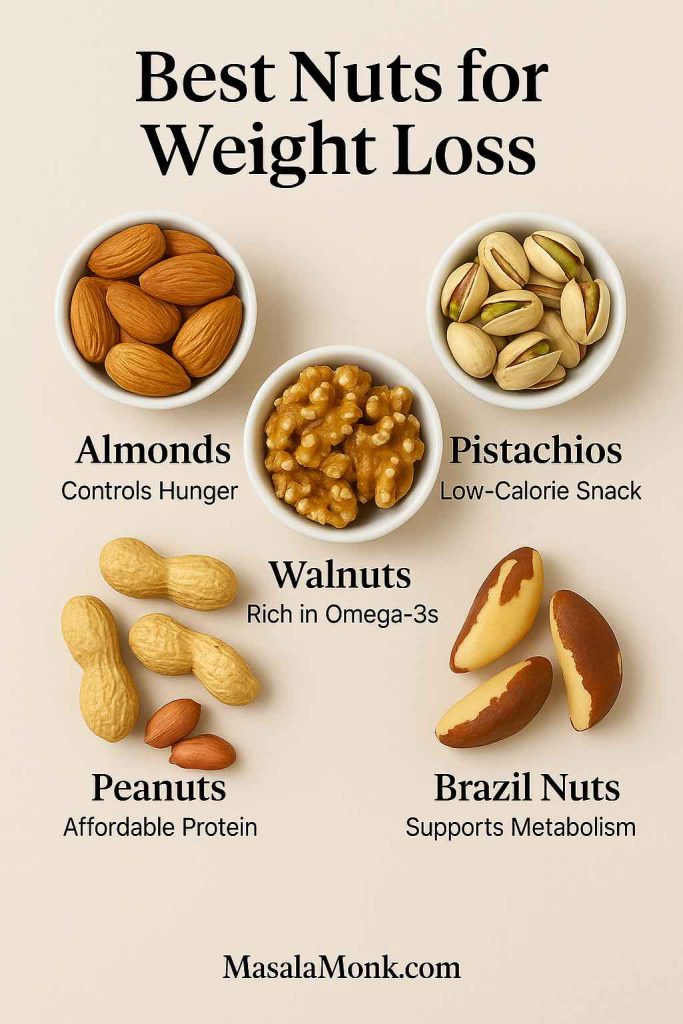
Best nuts for weight loss – almonds, walnuts, pistachios, peanuts, and Brazil nuts – rich in protein, fiber, omega-3s, and essential minerals to support fat loss and appetite control.
Top nuts for weight loss: Almonds to control hunger, walnuts for omega-3s, pistachios for low-calorie snacking, peanuts for affordable protein, and Brazil nuts for selenium and metabolism support.

🌰 Almonds

Almonds are one of the most effective nuts for weight management. They provide 6 grams of protein, 14 grams of healthy fats, and 3.5 grams of fiber per ounce (23 almonds), which helps curb hunger and stabilize blood sugar.

A study in the International Journal of Obesity found that participants on almond-enriched low-calorie diets lost 62% more weight compared to those on nut-free diets.

How to Eat Almonds for Weight Loss

  • Snack on a small handful (about 23 almonds).
  • Chop and add to oatmeal or yogurt.
  • Use almond butter (natural, no sugar added) on whole-grain toast.

💡 Tip: Almonds are calorie-dense. Stick to 1–2 servings daily.

Read More: Almonds for Weight Loss and Belly Fat Reduction: How to Eat, How Many to Eat, When to eat, and Why to Eat

🌰 Walnuts

Walnuts are unique because they’re rich in alpha-linolenic acid (ALA), a plant-based omega-3 fatty acid that supports brain and metabolic health. They may also help control appetite at a neurological level.

A study published in Diabetes, Obesity and Metabolism found that walnuts activate brain regions that regulate hunger and cravings (Harvard Health).

How to Eat Walnuts for Weight Loss

  • Eat 3–4 walnut halves as a snack.
  • Add to salads, oatmeal, or baked goods.

💡 Tip: Walnuts are rich but calorie-dense — limit to 1 oz per day.

Do Read: Walnuts and Weight Loss: Nurturing Health with Nature’s Powerhouse

🌰 Pistachios

Pistachios are one of the lowest-calorie nuts, with about 160 calories per ounce (49 nuts). They also provide 6 grams of protein and 3 grams of fiber, making them filling despite their small calorie load.

Nutritionists highlight that eating pistachios can help reduce visceral fat (harmful fat around organs), thanks to their healthy fat and antioxidant profile (EatingWell).

How to Eat Pistachios for Weight Loss

  • Snack on pistachios in the shell (slows eating, encourages mindful snacking).
  • Crush and use as a topping for yogurt, salads, or fish dishes.

💡 Tip: Choose unsalted, dry-roasted pistachios to avoid excess sodium.

Also Read: Pistachios and Weight Loss: The Green Powerhouse for a Healthy You

🌰 Peanuts

Although technically legumes, peanuts are nutritionally similar to tree nuts and are one of the most affordable sources of plant-based protein.

A review of randomized controlled trials found that peanut consumption does not lead to weight gain and may improve satiety when included in balanced diets (PMC).

How to Eat Peanuts for Weight Loss

  • Enjoy boiled or roasted peanuts as a snack.
  • Use natural peanut butter (no added sugar or oils) on whole-grain bread.
  • Add peanuts to stir-fries for crunch and protein.

💡 Tip: Avoid flavored or candied peanuts, which often contain added sugars and oils.

Do Read: Peanuts and Weight Loss: Separating Fact from Fiction

🌰 Brazil Nuts

Brazil nuts are among the best dietary sources of selenium, an essential mineral for thyroid health and metabolism. Just one nut provides your daily requirement.

However, too many can cause selenium toxicity, so they should be consumed sparingly.

How to Eat Brazil Nuts for Weight Loss

  • Eat 1–2 nuts per day.
  • Add to homemade nut mixes for variety.

💡 Tip: Think of Brazil nuts as a supplement, not a snack to eat by the handful.

Also Read: Brazil Nut Bliss: 5 Rich and Creamy Dinner Meal Replacement Shakes for a Keto Feast


✅ Summary: Nuts for Weight Loss

NutKey BenefitsHow to EatPortion Size
AlmondsHigh protein, fiber, supports weight loss in studiesSnack, oatmeal, almond butter23 almonds (1 oz)
WalnutsOmega-3 fats, appetite control, brain healthSnack, salads, oatmeal1 oz (7 halves)
PistachiosLowest-calorie nut, reduces visceral fatIn-shell snack, toppings49 pistachios (1 oz)
PeanutsAffordable protein, improves satietyBoiled, roasted, peanut butter1 oz (28 peanuts)
Brazil NutsSelenium for metabolism, thyroid health1–2 dailyVery small serving
Table showing various nuts and how to consume them for weight loss.

🥜 Peanut Butter and Other Nut Butters for Weight Loss

Nut butters can be an excellent addition to a weight-loss diet — but only if you choose the right kind. While some store-bought spreads are loaded with added sugars, hydrogenated oils, and salt, natural nut butters provide a nutrient-dense balance of protein, fiber, and healthy fats that support satiety and energy.

A tablespoon of natural peanut butter offers about 4 grams of protein, 2 grams of fiber, and 8 grams of healthy fats — enough to keep you full and energized without spiking blood sugar. In fact, a Harvard article highlights peanut butter as a smart snack when paired with whole foods like fruit or whole-grain bread.

🥜 Peanut Butter for Weight Loss

Peanut butter is the most popular nut butter, and when consumed in moderation, it can support fat loss by:

  • Reducing cravings due to protein and fat content.
  • Stabilizing blood sugar when paired with complex carbs.
  • Offering a portable, versatile snack option.

👉 Best choice: Natural or organic peanut butter with only peanuts (and maybe salt) in the ingredient list. Avoid “low-fat” versions, as they often add sugar.

Learn now How to make the Best Peanut Butter at Home.

🌰 Almond Butter

Almond butter is slightly higher in vitamin E, magnesium, and monounsaturated fats compared to peanut butter, making it a heart-healthy alternative. It may be especially useful for those who want a lower-carb option while still boosting protein intake.

Do Read: Almond Butter for Diabetes: Creamy, Clean & Blood Sugar Friendly

🌰 Other Nut Butters

  • Cashew Butter: Creamy and mild, though lower in protein compared to peanuts or almonds. Best in moderation.
  • Mixed Nut Butters: Provide a variety of nutrients and flavors, though calories remain high.
  • Hazelnut Butters: Often sold sweetened (e.g., chocolate spreads), which should be avoided for weight loss.

✅ Tips for Using Nut Butters in a Weight-Loss Diet

  • Stick to 1–2 tablespoons per serving (about 90–180 calories).
  • Pair with fiber-rich foods like apple slices, celery sticks, or whole-grain toast.
  • Use as a smoothie base instead of sweetened syrups.
  • Avoid heavily processed or flavored nut butters marketed as “healthy” but packed with sugar.

💡 Key Takeaway: Peanut butter, almond butter, and other natural nut butters can be part of a weight-loss-friendly snack strategy. The key is choosing minimally processed versions and controlling portions.


Best Way to Eat Nuts and Seeds for Weight Loss

Knowing which nuts and seeds support weight loss is only half the battle — the other half is learning how to eat them correctly. Because nuts and seeds are calorie-dense, the secret lies in portion control, timing, and smart pairings.

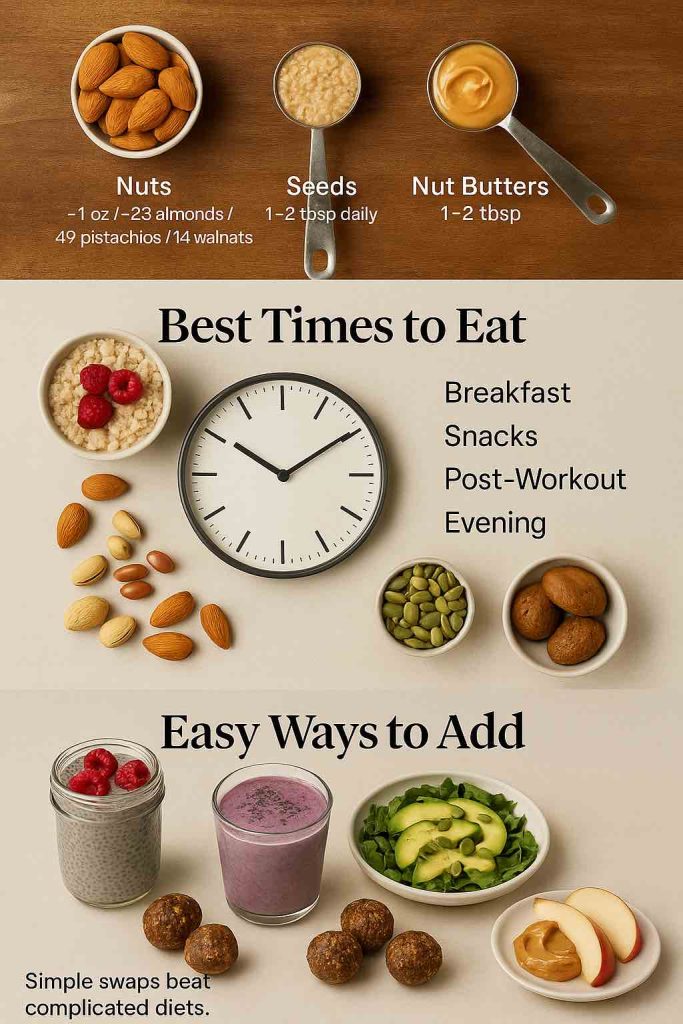
Infographic showing the best way to eat nuts and seeds for weight loss with serving sizes (nuts, seeds, nut butters), best times to eat (breakfast, snacks, post-workout, evening), and easy ways to add them (chia pudding, smoothies, energy bites, salad toppers, peanut butter with fruit).
The best way to eat nuts and seeds for weight loss: right portions, right timing, and simple swaps that make a big difference. Easy ways to add them – chia pudding, smoothies, energy bites, salad toppers, peanut butter with fruit, etc.

✅ Serving Sizes Matter

  • Nuts: 1 ounce (about a small handful or 23 almonds, 49 pistachios, or 14 walnut halves). This equals roughly 160–180 calories.
  • Seeds: 1–2 tablespoons daily (chia, flax, pumpkin, sesame, or sabja).
  • Nut Butters: 1–2 tablespoons (90–180 calories).

👉 Moderation is essential. Eating too many can lead to calorie surplus, which counteracts weight-loss efforts.

⏰ Best Times to Eat Nuts and Seeds

  • Breakfast: Add chia, flax, or almonds to oats, yogurt, or smoothies for a filling start.
  • Snacks: Replace chips or cookies with pistachios or peanuts for a protein boost.
  • Post-Workout: A smoothie with nut butter and seeds supports muscle repair.
  • Evening: A small serving of walnuts or pumpkin seeds can curb late-night cravings without spiking blood sugar.

🍴 Easy Ways to Add Them to Your Diet

  • Chia Pudding: Soak 2 tbsp chia in milk overnight, top with berries.
  • Almond & Date Energy Bites: Blend almonds, dates, and a sprinkle of flax.
  • Flax Smoothie: Add 1 tbsp ground flax to banana or berry smoothies.
  • Pumpkin Seed Salad Topper: Sprinkle roasted seeds over greens for crunch.
  • Peanut Butter Snack: Pair 1 tbsp natural peanut butter with apple slices or celery.

💡 Key Takeaway: Eating the best nuts and seeds for weight loss doesn’t mean endless handfuls — it means choosing the right portions, adding them to meals strategically, and using them as healthy replacements for processed snacks.


🌟 Other Health Benefits Beyond Weight Loss

While nuts and seeds are excellent for weight control, their benefits extend far beyond fat loss. Packed with essential nutrients, these tiny foods support overall health and disease prevention.

🧠 Rich in Magnesium

Many nuts and seeds — especially almonds, cashews, and pumpkin seeds — are excellent sources of magnesium, a mineral that supports energy production, blood sugar control, and muscle function. Low magnesium intake has been linked to higher risks of obesity and type 2 diabetes (NIH).

Do Read: Magnesium Deficiency? Add These 5 Foods to Your Diet

❤️ Heart and Metabolic Health

The healthy fats in nuts and seeds — particularly monounsaturated and polyunsaturated fats — help reduce LDL (“bad”) cholesterol and improve cardiovascular health. A large review published in the Journal of Nutrition found that regular nut consumption lowered the risk of heart disease by 15–23% (Journal of Nutrition).

💪 Omega-3 Fatty Acids

Walnuts, flax, and chia seeds are rich in plant-based omega-3 fatty acids, which help reduce inflammation, support brain health, and improve metabolic function. The Times of India highlights chia and flax seeds as some of the best vegetarian omega-3 sources.

Also Read: How Omega-3 Fatty Acids Help Fight Chronic Inflammation?

🛡️ Antioxidants and Plant Compounds

Sesame, flax, and chia seeds provide lignans and other antioxidants that fight oxidative stress, supporting hormonal balance and long-term disease prevention. Nuts like pistachios and walnuts also supply polyphenols with anti-inflammatory benefits (Verywell Health).

💡 Key Takeaway: Adding nuts and seeds to your diet not only helps with weight loss but also improves heart health, reduces inflammation, and provides long-lasting energy — making them a cornerstone of a balanced, healthy lifestyle.


🔬 Science-Backed Evidence: What Research Says

The role of nuts and seeds in weight management isn’t just a diet trend — it’s supported by decades of scientific research. Here are some of the strongest studies that back their benefits:

📉 Nuts and Lower Obesity Risk

A large-scale study from Harvard tracked nearly 145,000 adults over four years. Results showed that eating a handful of nuts daily was linked to a 16% lower risk of obesity and less long-term weight gain compared to people who rarely ate nuts.

⚖️ Nut-Inclusive Diets Enhance Weight Loss

A 2024 review published in Nutrition Research Reviews found that adding nuts like almonds, pistachios, and walnuts to calorie-restricted diets resulted in 1.4 to 7.4 kg more weight loss compared to similar diets without nuts (Health.com).

Similarly, a University of South Australia study confirmed across multiple trials that nut-inclusive weight-loss diets are at least as effective — and often more effective — than nut-free approaches.

🔥 Fewer Calories Absorbed Than Labels Suggest

Not all the calories in nuts are absorbed by the body. A study on walnuts found that their metabolizable energy was 21% lower than the standard calorie count listed on nutrition labels (Health.com). This means your body actually digests fewer calories than expected.

✅ No Evidence of Weight Gain from Nuts

Meta-analyses and randomized controlled trials consistently show that nut consumption does not cause weight gain. In fact, when nuts replace processed snacks, they support better weight control (PMC).

💡 Bottom Line: The science is clear — far from being fattening, nuts and seeds are proven allies in weight management, helping reduce obesity risk, enhance fat loss, and improve long-term health.


❓ FAQs About Nuts, Seeds, and Weight Loss


🥜 Are nuts fattening or good for weight loss?

Despite being high in calories, nuts are not fattening when eaten in moderation. Studies show that regular nut consumption does not lead to weight gain and may actually support fat loss thanks to their protein, fiber, and healthy fats (PMC).


🥗 Which nuts are best for weight loss?

Almonds, pistachios, and walnuts are among the best nuts for weight loss. They’re high in protein and fiber, help control appetite, and have been linked to reduced body fat in multiple studies (Harvard Health).


🌱 Which seeds are best for weight loss?

Chia seeds, flax seeds, and pumpkin seeds are top choices. They’re rich in fiber and omega-3s, which slow digestion, promote fullness, and support metabolism (Healthline).


🥄 How many almonds should I eat per day for weight loss?

A small handful — about 23 almonds (1 ounce) — is considered an ideal daily portion. This provides enough protein and fiber to support satiety without adding excess calories.


🥤 How should I eat chia seeds for weight loss?

Soak 1–2 tablespoons of chia seeds in water or milk for 15–20 minutes before eating. Popular options include chia pudding, chia smoothies, or simple chia water taken before meals (Harvard Health).


🍞 Can peanut butter help with weight loss?

Yes — if it’s natural peanut butter with no added sugar or oils, and eaten in moderation. Stick to 1–2 tablespoons paired with fruit or whole-grain toast for a filling snack (Harvard Health).


⚖️ Are seeds better than nuts for weight loss?

Both are beneficial. Seeds (like chia and flax) offer more fiber per serving, while nuts (like almonds and pistachios) are higher in protein. Including a mix of both provides the best balance for weight control and overall health.


🏁 Conclusion

Nuts and seeds are often misunderstood — many people avoid them for fear of gaining weight, but research shows the opposite. When eaten in moderation, the best nuts and seeds for weight loss — from chia and flax seeds to almonds, pistachios, and walnuts — are powerful tools for controlling hunger, boosting metabolism, and improving overall health.

These tiny foods provide the perfect balance of protein, fiber, and healthy fats, which keep you full for longer and help you avoid unhealthy snacking. On top of that, they offer additional benefits like heart protection, blood sugar control, and essential nutrients such as magnesium and omega-3 fatty acids.

The key is portion control and smart usage: a handful of nuts or a few tablespoons of seeds can go a long way. Swap processed snacks for natural options like chia pudding, almond butter on whole-grain toast, or roasted pumpkin seeds, and you’ll feel the difference in your energy, cravings, and weight goals.

👉 Start small today: add a tablespoon of chia to your breakfast or swap chips for a handful of pistachios. Over time, these small, sustainable choices can transform your health — one bite at a time.


Posted on 1 Comment

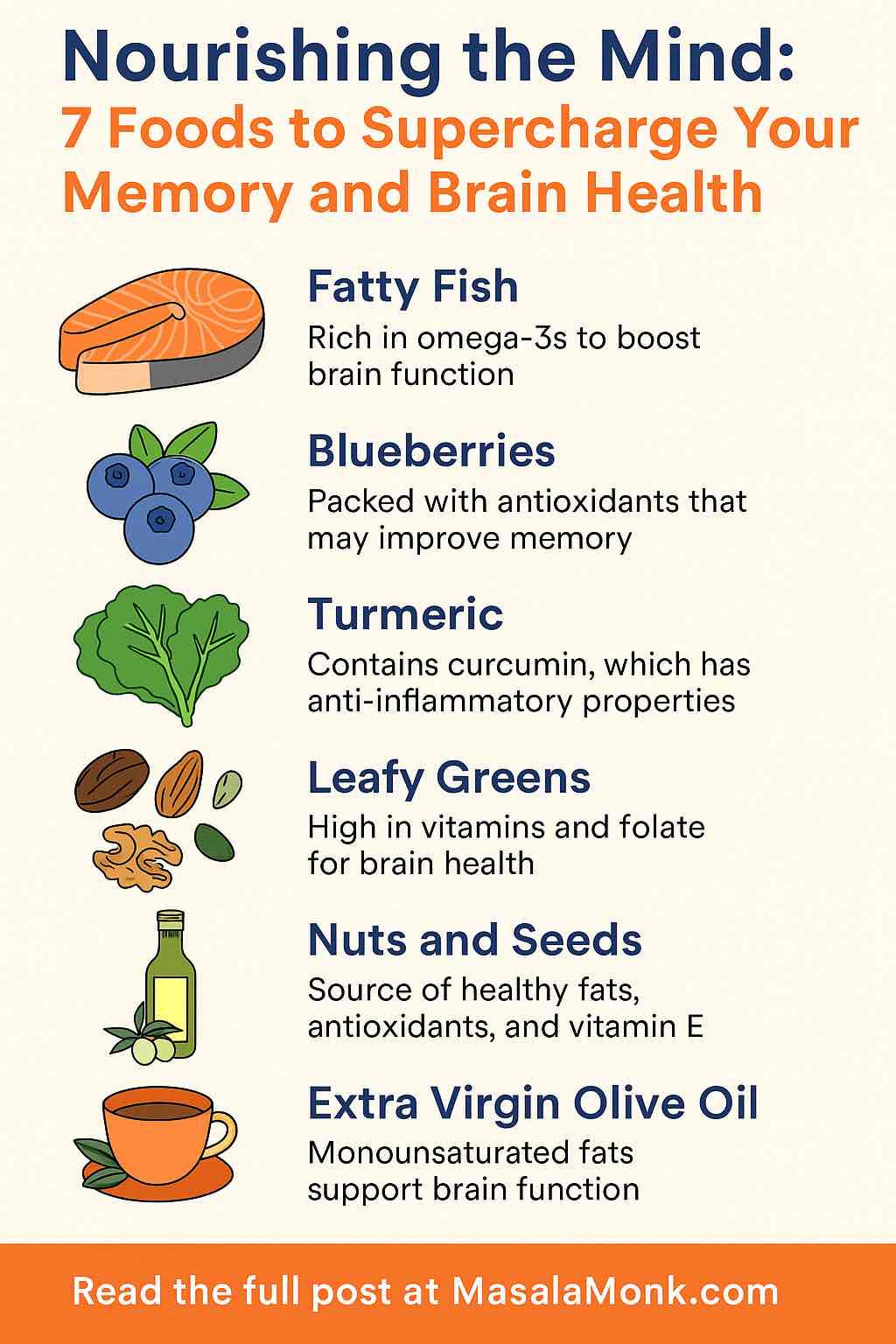
Nourishing the Mind: 7 Foods to Supercharge Your Memory and Brain Health

Foods to Supercharge Your Memory and Brain Health

Have you ever forgotten where you left your keys or struggled to recall a name that was on the tip of your tongue?
You’re not alone. In a fast-paced, information-loaded world, keeping our minds sharp is more important—and more possible—than ever. Exciting new research shows that what you eat can profoundly shape how your brain performs, not just now, but for years to come.

Welcome to your guide to nourishing the mind with seven science-backed superfoods that can help supercharge your memory, focus, and overall brain health.


1. Fatty Fish: The Brain’s Favorite Protein

When it comes to brain food, fatty fish like salmon, sardines, and mackerel top every list—and for good reason. These fish are packed with omega-3 fatty acids (especially DHA), critical building blocks for brain cells.

The Latest Science:
Recent meta-analyses and long-term studies show that people who eat omega-3-rich fish at least twice a week enjoy a 20–23% lower risk of dementia and cognitive decline. In clinical trials, omega-3 supplementation (notably DHA) even slowed cognitive aging and improved memory in adults showing early signs of decline.

How to Eat More:

  • Grill or bake salmon fillets with lemon and herbs.
  • Toss canned sardines into salads or whole-grain pasta.
  • Add smoked mackerel to open-faced sandwiches.

Tip: If you’re vegetarian, add ground flaxseeds, chia seeds, or walnuts for ALA, a plant-based omega-3.


2. Blueberries: Tiny Berries, Big Brain Benefits

Don’t let their size fool you—blueberries are a nutritional powerhouse for your brain. Rich in flavonoids and antioxidants, they help fight oxidative stress and inflammation—two key drivers of cognitive decline.

The Latest Science:
A 2024 clinical trial found that just half a cup of blueberries daily for 12 weeks improved memory, planning, and even blood sugar levels. Other studies suggest that regular blueberry consumption can delay short-term memory loss, especially as we age.

How to Eat More:

  • Blend into smoothies with spinach and yogurt.
  • Sprinkle on oatmeal or Greek yogurt.
  • Snack on them fresh or frozen, straight from the bag.

Practical Tip: Rotate with strawberries and blackberries for variety—these offer similar benefits.


3. Turmeric: The Golden Spice for a Golden Mind

Turmeric isn’t just for curries—it’s a brain health booster, thanks to curcumin, a compound that can cross the blood-brain barrier and fight inflammation.

The Latest Science:
A 2024 meta-analysis of 9 clinical trials showed that 0.8g curcumin daily for 6 months significantly improved overall cognition, particularly in older adults. Animal studies also point to enhanced memory and neuroplasticity.

How to Eat More:

  • Add to soups, stews, or scrambled eggs.
  • Whisk into “golden milk” (turmeric, milk, black pepper, and honey).
  • Mix into smoothies or rice dishes.

Pro Tip: For best absorption, combine with black pepper (which contains piperine).


4. Leafy Greens: Nature’s Multivitamin

Think spinach, kale, Swiss chard, and broccoli. These greens deliver lutein, folate, vitamin K, and sulforaphane—nutrients essential for neuron function and fighting brain inflammation.

The Latest Science:
Studies show that people who eat one serving of leafy greens daily have the cognitive ability of someone 11 years younger. They’re a core part of the “MIND” and Mediterranean diets, both proven to reduce cognitive decline by up to 25%.

How to Eat More:

  • Sauté spinach with garlic as a side.
  • Add chopped kale to soups, pastas, or omelets.
  • Use arugula or baby greens as the base for salads.

5. Nuts and Seeds: Crunchy Brain Fuel

Nuts (especially walnuts) and seeds (flax, chia, pumpkin) are loaded with healthy fats, vitamin E, magnesium, and plant polyphenols.

The Latest Science:
Regular nut and seed consumption is linked to improved memory, attention, and even mood. Walnuts are particularly rich in ALA omega-3s, shown to support neuron structure.

How to Eat More:

  • Keep a jar of mixed nuts and seeds at your desk.
  • Add chia or flaxseeds to smoothies or overnight oats.
  • Use almond or walnut butter as a spread for whole-grain toast.

Portion Tip: A handful (about 1 ounce) most days is ideal.


6. Extra Virgin Olive Oil: Liquid Gold for Your Brain

A staple of the Mediterranean diet, extra virgin olive oil is packed with monounsaturated fats and polyphenols that nourish your brain and protect against age-related decline.

The Latest Science:
A 2024 JAMA study found that daily olive oil use reduced dementia-related deaths by 28%, even in those genetically at risk.

How to Eat More:

  • Use as your main cooking oil for sautéing and roasting.
  • Drizzle over salads, vegetables, or whole grains.
  • Make homemade vinaigrettes with olive oil, lemon, and herbs.

7. Green Tea and Coffee: Sip for Smarts

Both beverages are rich in polyphenols (like catechins in green tea) and moderate caffeine—linked to improved focus, reaction time, and even lower risk of cognitive impairment.

The Latest Science:
Multiple recent studies support 2–3 cups daily for enhanced attention and protection against neurodegenerative diseases.

How to Drink More:

  • Enjoy green tea as a mid-morning pick-me-up.
  • Savor your coffee mindfully—skip the sugar!
  • Try matcha lattes or herbal teas with brain-boosting spices (like turmeric or ginger).

Foods to Limit: Protecting Your Gains

While you’re adding brain-nourishing foods, it’s just as important to cut back on ultra-processed foods and added sugars.
New data shows that every extra 10g of added sugar per day increases Alzheimer’s risk by 1.4%. That’s just two teaspoons!

Practical Tips:

  • Swap sugary snacks for fruit, nuts, or dark chocolate.
  • Choose whole-grain bread over white.
  • Cook more at home to avoid hidden sugars.

Pulling It All Together: Your Practical Brain-Boosting Routine

  1. Aim for two servings of fatty fish weekly.
  2. Eat berries daily—add to breakfast or snacks.
  3. Spice your food with turmeric (plus black pepper).
  4. Pile your plate with leafy greens—at least one serving a day.
  5. Grab a handful of nuts or seeds most days.
  6. Use olive oil as your primary fat.
  7. Enjoy coffee or tea in moderation.

Sample Brain-Boosting Day

  • Breakfast: Greek yogurt with blueberries and walnuts, green tea.
  • Lunch: Grilled salmon salad with baby spinach, arugula, olive oil, and pumpkin seeds.
  • Snack: Carrot sticks with hummus, a handful of almonds.
  • Dinner: Stir-fried broccoli, kale, and tofu with turmeric rice, drizzled with olive oil.
  • Dessert: Dark chocolate square and a cup of herbal tea.

Conclusion: Small Choices, Big Impact

The latest research is clear: you have real power to support your memory and protect your brain for years to come—one delicious bite at a time.

Eat smart, stay sharp, and enjoy the journey!


Frequently Asked Questions (FAQs)

1. How quickly can I notice improvements in memory or brain function from these foods?
Answer: Most studies show benefits from regular consumption over 8–12 weeks. Consistency is key—improvements are gradual, not instant.


2. Can supplements replace eating the actual foods?
Answer: Whole foods provide a complex mix of nutrients, fiber, and bioactive compounds. Supplements may help in certain cases (e.g., omega-3 or curcumin with enhanced bioavailability), but are not a substitute for a healthy, varied diet.


3. Are there risks to eating these foods daily?
Answer: For most people, these foods are safe when eaten in reasonable amounts. Watch for allergies (nuts, fish) or dietary restrictions. Excessive curcumin supplements may cause digestive upset or interact with medications.


4. What if I’m vegetarian or vegan?
Answer: Swap fatty fish for plant sources of omega-3s like walnuts, flaxseeds, chia seeds, and algae-based DHA supplements. All other foods on the list are plant-based.


5. How much is a “serving” of these foods?
Answer:

  • Fatty fish: 100–120g (3–4 oz) cooked
  • Blueberries: ½ cup
  • Leafy greens: 1 cup raw or ½ cup cooked
  • Nuts/seeds: 1 ounce (a small handful)
  • Olive oil: 1–2 tablespoons
  • Curcumin: Up to 0.8g from food or standardized supplement (with medical advice)
  • Coffee/tea: 1 cup (240ml)

6. Can kids and teens benefit from these foods too?
Answer: Yes! These foods support brain development and lifelong cognitive health. Adjust serving sizes for age and appetite.


7. What’s the best way to add turmeric to my diet for brain health?
Answer: Add to soups, curries, scrambled eggs, or “golden milk.” For best absorption, combine with black pepper and a source of fat.


8. How do I limit sugar and processed foods effectively?
Answer: Start by reducing sugary drinks and snacks, check labels for “added sugars,” and choose whole foods whenever possible. Swap sweet treats for berries or nuts.


9. Is it okay to drink both coffee and green tea daily?
Answer: Yes, as long as total caffeine intake remains moderate (up to 400mg daily for most adults). Both drinks offer brain benefits when unsweetened.


10. Can these foods really prevent dementia or Alzheimer’s?
Answer: No food can guarantee prevention, but consistent intake of these foods (especially within a healthy dietary pattern like the Mediterranean or MIND diet) is associated with significantly reduced risk and slower cognitive decline.

Posted on Leave a comment

Benefits of Chia Seeds & How to use then in Indian Diet?

Introduction
Welcome to the world of chia seeds, a superfood that’s stealthily making its way into the heart of Indian kitchens. Once unknown, these tiny seeds have now become a staple for those looking to add a nutritious punch to their diet. This post isn’t just about what chia seeds are; it’s an exploration of how they seamlessly blend with Indian cuisine, enhancing both the flavor and the nutritional value of traditional dishes.

What Are Chia Seeds?
Chia seeds, small and unassuming, are native to Central America but have found a global audience due to their impressive nutritional profile. Rich in omega-3 fatty acids, fiber, protein, and a host of vitamins and minerals, they are a powerhouse of health benefits. But how do they fit into the Indian diet, known for its diverse flavors and textures? Let’s dive in.

Health Benefits: More Than Just a Seed

  1. Heart Health: These seeds are a boon for cardiovascular health, thanks to their high omega-3 content.
  2. Weight Management: The fiber in chia seeds keeps you full for longer, aiding in weight control.
  3. Bone Strength: Rich in calcium, magnesium, and phosphorus, chia seeds are great for bone health.
  4. Blood Sugar Regulation: Their ability to slow down digestion helps in stabilizing blood sugar levels.

Incorporating Chia Seeds into Indian Cuisine
The versatility of chia seeds means they can be included in any meal, adding a nutritional kick without compromising on taste.

  1. Chia Seed Parfait: Start your day with layers of chia pudding, fruits, yogurt, and granola. A delightful and nutritious breakfast option.
  2. Energy Bars: Combine chia seeds with dates, nuts, and dried fruits for a homemade energy bar – perfect for those mid-day hunger pangs.
  3. Chia Seed Upma: Give your regular upma a nutritious twist by adding chia seeds to the mix.
  4. Chia Seed Raita: Enhance this cooling side dish with a sprinkle of chia seeds for added texture and health benefits.
  5. Chia Seed Chapati: Integrate chia seeds into your chapati dough to make this staple more nutritious.
  6. Chia Seed Lassi: A refreshing drink made more healthful with the addition of chia seeds.

Chia Seeds: Beyond the Kitchen
Apart from their culinary uses, chia seeds also offer benefits for skin hydration and protection against oxidative stress. They’re a multi-faceted ingredient that transcends the boundaries of cooking.

Conclusion
The integration of chia seeds into Indian cuisine is not just a trend, but a testament to their versatility and health benefits. Whether you’re sprinkling them over your breakfast or mixing them into your dough, these tiny seeds can make a big impact on your health. So, next time you’re whipping up an Indian dish, remember to add a sprinkle of chia seeds for that extra nutritional punch!

Experiment and Share
We encourage you to experiment with chia seeds in your cooking and share your creations with us. Whether it’s a traditional dish with a chia twist or something entirely new, let’s celebrate the fusion of good health and great taste. Share your recipes and experiences in the comments below or on social media using #ChiaInIndianCuisine.

Remember, with chia seeds, a little goes a long way in making your meals healthier and more flavorful. Happy cooking!

10 FAQs About Chia Seeds in Indian Cuisine

1. What are chia seeds and where do they come from?

  • Chia seeds are tiny, nutrient-dense seeds from the Salvia hispanica plant, native to Central America. They’ve gained global popularity for their health benefits.

2. Can chia seeds be used in traditional Indian cooking?

  • Absolutely! Chia seeds can be incorporated into various Indian dishes like parfaits, upma, chapatis, and lassi, enhancing their nutritional value without altering their traditional flavors.

3. How do chia seeds benefit health?

  • Chia seeds are a rich source of omega-3 fatty acids, dietary fiber, protein, and essential minerals, contributing to improved heart health, digestion, bone strength, and blood sugar regulation.

4. Are chia seeds suitable for weight loss diets?

  • Yes, their high fiber content helps in feeling full for longer periods, aiding in weight management.

5. How can I add chia seeds to my breakfast?

  • Chia seeds can be added to breakfast dishes like smoothies, parfaits, and oatmeal, or used to make energy bars for a nutritious start to the day.

6. Do chia seeds have any side effects?

  • In general, chia seeds are safe for most people, but overconsumption can lead to gastrointestinal issues. It’s always best to consume them in moderation.

7. Can chia seeds be cooked, or are they eaten raw?

  • Chia seeds can be eaten raw or added to cooked dishes. They can be soaked in liquids like milk or water, which makes them swell and attain a gel-like consistency.

8. Are chia seeds gluten-free?

  • Yes, chia seeds are naturally gluten-free, making them a great option for those with gluten sensitivities or celiac disease.

9. How do I store chia seeds, and how long do they last?

  • Store chia seeds in an airtight container in a cool, dry place. They can last up to two years if stored properly.

10. Can chia seeds be used in desserts?

  • Definitely! They can be used in puddings, as a topping for desserts, or incorporated into baked goods like cakes and cookies for added nutrition.

Blog Tags

Chia Seeds, Indian Cuisine, Healthy Eating, Superfoods, Nutritional Cooking, Heart Health, Weight Management, Gluten-Free, Vegetarian Recipes, Breakfast Ideas

Posted on Leave a comment

Top Foods for Optimal Cognitive Health

The human brain, a marvel of nature, is responsible for our thoughts, emotions, memories, and actions. As we age, maintaining cognitive health becomes paramount. While genetics and lifestyle play a role, the foods we consume can significantly impact our brain’s functionality. In this comprehensive guide, we’ll explore the top foods known to enhance memory, focus, and overall brain health, ensuring that your mind remains sharp and agile throughout the years.

Introduction: The Brain-Food Connection

The intricate relationship between the foods we eat and our brain’s performance is an area of growing interest and research. Certain nutrients, found abundantly in specific foods, have been identified as potent brain boosters. These nutrients not only nourish the brain but also protect it from oxidative stress and inflammation, factors that can contribute to cognitive decline.

An enlightening exploration by Live Healthy Over 50, delving into the best foods for brain health and their transformative effects on cognitive function.

Omega-3s: The Brain’s Building Blocks

Fatty fish, such as salmon and mackerel, are rich in omega-3 fatty acids. These essential fats are crucial for brain health, aiding in memory, focus, and even mood regulation. Omega-3s are integral to the construction of brain and nerve cells, and a deficiency can lead to learning impairments and feelings of depression.

Broccoli: The Green Brain Guardian

This cruciferous vegetable is a powerhouse of nutrients, including vitamin K, which plays a pivotal role in brain function and memory. Additionally, broccoli’s anti-inflammatory and antioxidant properties protect the brain from potential damage.

Blueberries: Nature’s Brain Berries

Packed with antioxidants, blueberries are champions in combating oxidative stress and inflammation, factors that can accelerate brain aging. The anthocyanins in blueberries also enhance communication between brain cells, fostering better cognitive function.

Turmeric: The Golden Spice of Memory

Curcumin, the active ingredient in turmeric, is known for its brain-boosting properties. It can cross the blood-brain barrier, acting as an antioxidant and anti-inflammatory agent. Curcumin has shown potential in enhancing memory and even clearing amyloid plaques linked to Alzheimer’s disease.

Coffee: The Brain’s Wake-Up Call

Beyond its role as a morning ritual, coffee contains caffeine and antioxidants that benefit the brain. Caffeine blocks adenosine, a chemical that induces sleepiness, and boosts neurotransmitters like dopamine, enhancing alertness and mood.

Nuts and Seeds: Brainy Snacks

Regular consumption of nuts, especially walnuts, has been linked to better cognitive health. Nuts are rich in healthy fats, antioxidants, and vitamin E. Pumpkin seeds, in particular, are loaded with magnesium, iron, zinc, and copper, essential minerals for brain health.

Conclusion: Nourishing the Mind

The journey to optimal brain health is multifaceted, with diet playing a crucial role. By incorporating these brain-boosting foods into your daily meals, you’re not only tantalizing your taste buds but also ensuring that your brain remains vibrant and healthy. Remember, the brain is a powerful organ, and with the right nourishment, its potential is limitless.

Engage with Us: Have you experienced the benefits of these brain-boosting foods? Share your stories, recipes, and questions in the comments below. Let’s cultivate a community dedicated to cognitive well-being.

Spread the Knowledge: If you found this guide valuable, consider sharing it with your network. Together, we can champion a culture of health, knowledge, and lifelong learning.


This detailed guide is based on insights from the video “7 Foods That Supercharge Your Memory And BRAIN Health” by Live Healthy Over 50. All credits to the creator and the channel. For a visual breakdown and more in-depth discussions, watch the video above.


Blog Tags: Brain foods, cognitive health, omega-3 fatty acids, brain-boosting nutrients, antioxidants, inflammation, memory enhancement, brain aging, turmeric, blueberries, coffee, nuts, seeds, brain health, Live Healthy Over 50, dietary choices, cognitive function.