Posted on 2 Comments

Strawberry Matcha Latte Recipe

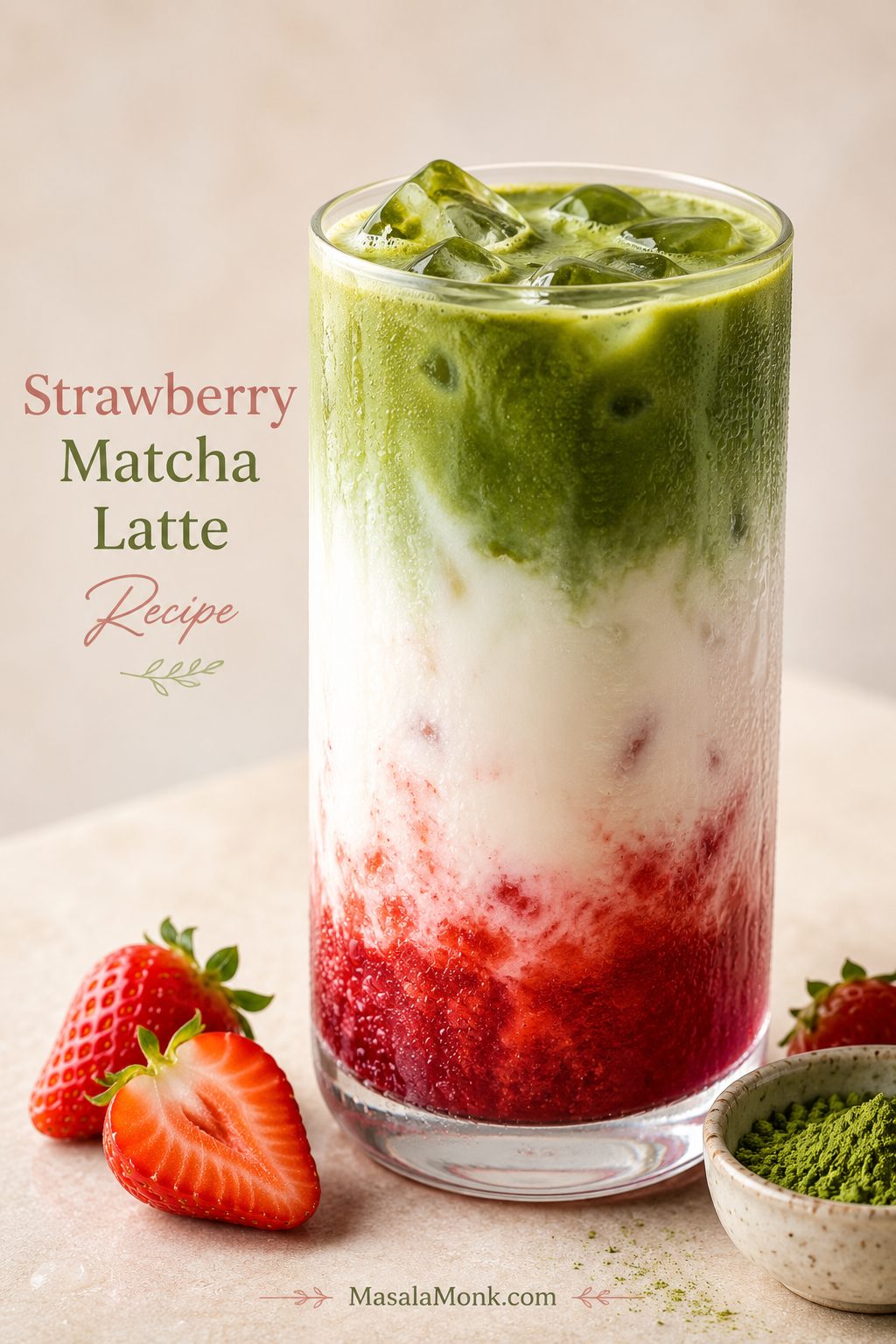
Tall iced strawberry matcha latte in a clear glass with red strawberry base, cold milk, green matcha, ice, strawberries, and matcha powder nearby.

The first thing you notice is the color: juicy red strawberry at the bottom, cold milk turning pale and creamy in the middle, and a glossy green matcha pour floating over the top. Then you stir it, take a sip, and the drink finally makes sense: fresh strawberry, smooth milk, and earthy green tea all in one cold glass.

It is the kind of iced drink that feels like a small afternoon reset: pretty enough to slow down for, but simple enough to make before the ice in your glass even thinks about melting.

This strawberry matcha latte recipe is for the drink you want when a plain iced matcha feels a little too serious and strawberry milk feels a little too sweet. It gives you the pretty layered look, but more importantly, it gives you a balanced glass that tastes creamy, fruity, refreshing, and smooth.

It takes about 10 minutes, needs no cooking for the main version, and feels much more special than the effort suggests. Make the strawberry base, whisk the matcha separately, build the glass over ice, and pour slowly. Warm—not boiling—water keeps the matcha gentler, a thicker berry mixture helps the colors stay separated, and enough ice slows the pour.

Quick Answer: Best Ratio

For one tall iced strawberry matcha latte, use 4–5 strawberries, 2 teaspoons to 1 tablespoon sweetener, 1½ teaspoons matcha, 3 tablespoons hot water, ¾ cup milk, and plenty of ice.

At a glance: 10 minutes, no cooking for the main version, 1 tall glass, fresh or frozen strawberries, dairy or non-dairy milk.

Quick method

Muddle or blend the strawberries with sweetener, spoon them into the bottom of a clear glass, add ice, pour in the milk, then slowly pour whisked matcha over the top. The gentlest flavor comes from whisking the matcha with hot water around 175°F / 80°C, not boiling water.

Matcha strength

A milder drink works best with 1 teaspoon matcha. For a stronger, more matcha-forward latte, use 2 teaspoons. Serve it layered if you want the dramatic red-white-green look, then stir before drinking so the strawberry, milk, and matcha taste balanced in every sip.

16 oz ratio

For 1 tall 16 oz drink Use this amount Why it works
Strawberries 4–5 medium / 70–90 g Enough fruit for a visible base and real strawberry flavor.
Sweetener 2 tsp to 1 tbsp Start lower. Add more only if the berries are tart.
Matcha 1½ tsp / about 3 g Balanced strength for milk and strawberry.
Hot water 3 tbsp / 45 ml Makes a concentrated matcha pour without thinning the latte.
Milk ¾ cup / 180 ml Creamy enough for a tall iced latte.
Ice 1 cup, or enough to fill the glass halfway to three-quarters full Helps keep the strawberry, milk, and matcha separated.

Keep the simple rule in mind: thick berries, warm-not-boiling matcha, plenty of ice, a slow pour, and one good stir before judging the flavor.

After one round, you will know exactly where your taste sits: more strawberry if you want it fruitier, more milk if you want it softer, or a little more matcha if you want that green tea finish to lead.

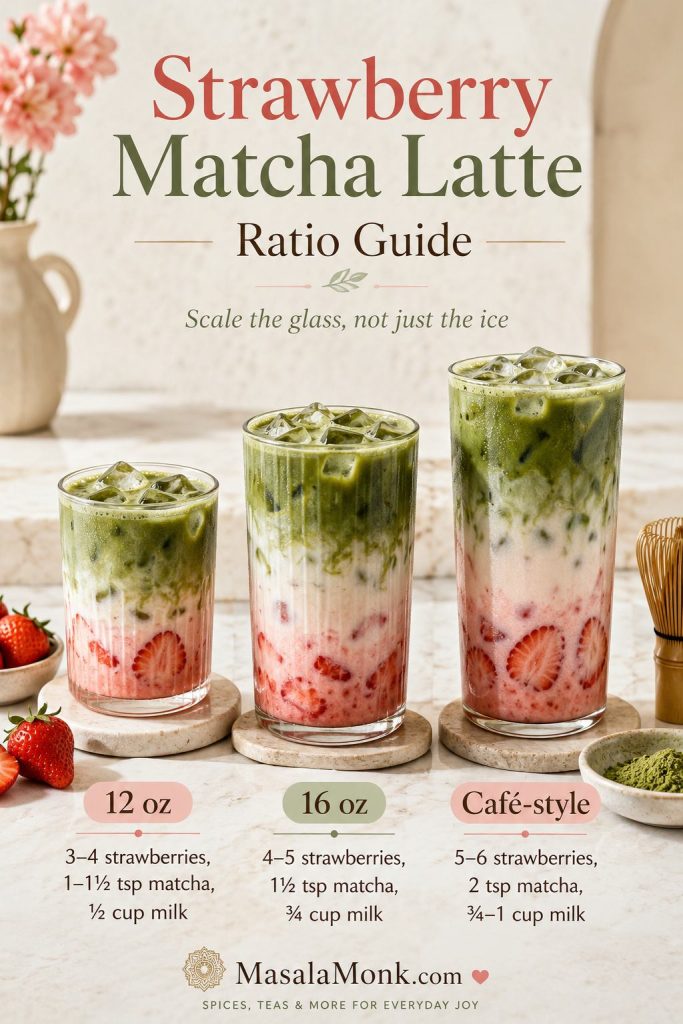
Need to scale the drink up or down? See the 12 oz, 16 oz, and café-style ratio guide.
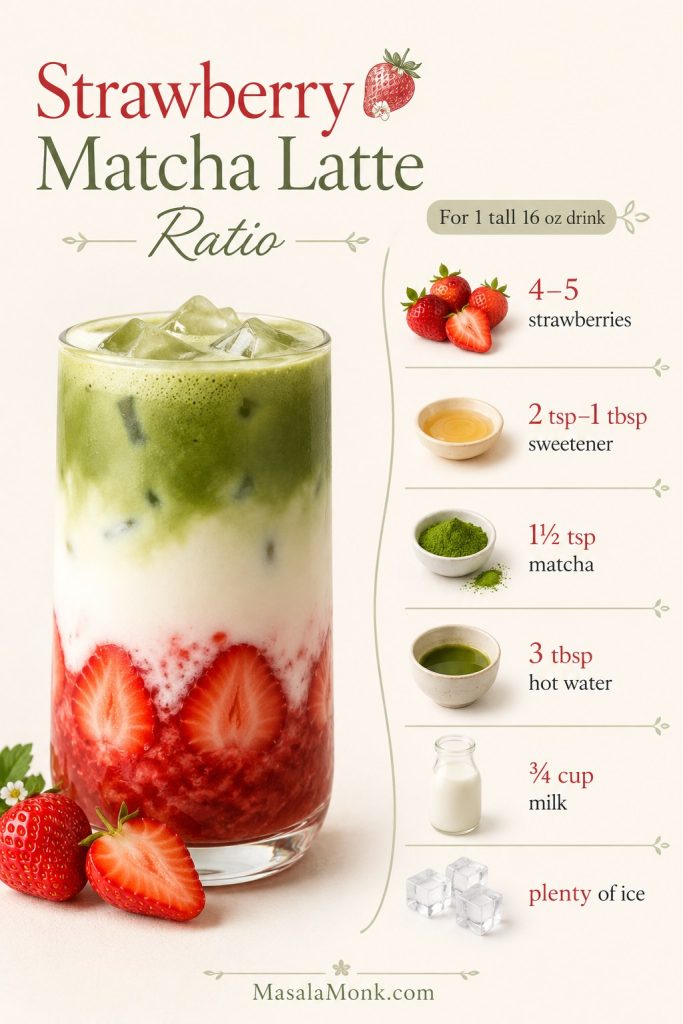
Strawberry matcha latte ratio guide showing one layered drink with strawberries, sweetener, matcha, hot water, milk, and ice amounts.
Start with this 16-ounce strawberry matcha latte ratio, then adjust sweetness, berry flavor, or matcha strength after tasting the drink stirred.

Strawberry Matcha Latte Recipe

Creamy Iced Strawberry Matcha Latte

A layered café-style latte with a bright berry base, cold milk, and glossy whisked matcha — pretty enough for a café moment, easy enough for home.

Yield1 tall drink
Prep Time10 minutes
Cook Time0 minutes
Total Time10 minutes

Ingredients

  • 4–5 medium strawberries, hulled and chopped, about 70–90 g
  • 2 teaspoons sweetener, plus up to 1 tablespoon total if the berries are tart
  • 1½ teaspoons matcha powder, about 3 g
  • 3 tablespoons / 45 ml hot water, about 175°F / 80°C
  • ¾ cup / 180 ml cold milk, dairy or non-dairy
  • 1 cup ice, or enough to fill the glass halfway to three-quarters full

Instructions

  1. Make the strawberry base. Add chopped strawberries and sweetener to a small bowl or glass. Muddle until juicy, or blend for a smoother base.
  2. Prepare the matcha. Sift matcha into a small bowl. Add hot water and whisk until glossy and lightly frothy.
  3. Build the drink. Spoon the strawberry mixture into a tall clear glass. Add ice. Pour milk slowly over the ice.
  4. Pour the matcha. Slowly pour the whisked matcha over the back of a spoon or directly over the ice so it settles on top.
  5. Serve and stir. Serve layered, then stir before drinking so the strawberry, milk, and matcha taste balanced.

Notes

  • Use 1 teaspoon matcha for mild, 1½ teaspoons for balanced, or 2 teaspoons for strong.
  • For clear layers, keep the berry base thick and pour over plenty of ice.
  • If using jam, start with 1 tablespoon and reduce the added sweetener.
  • The matcha is concentrated on purpose; more water makes the latte thinner.

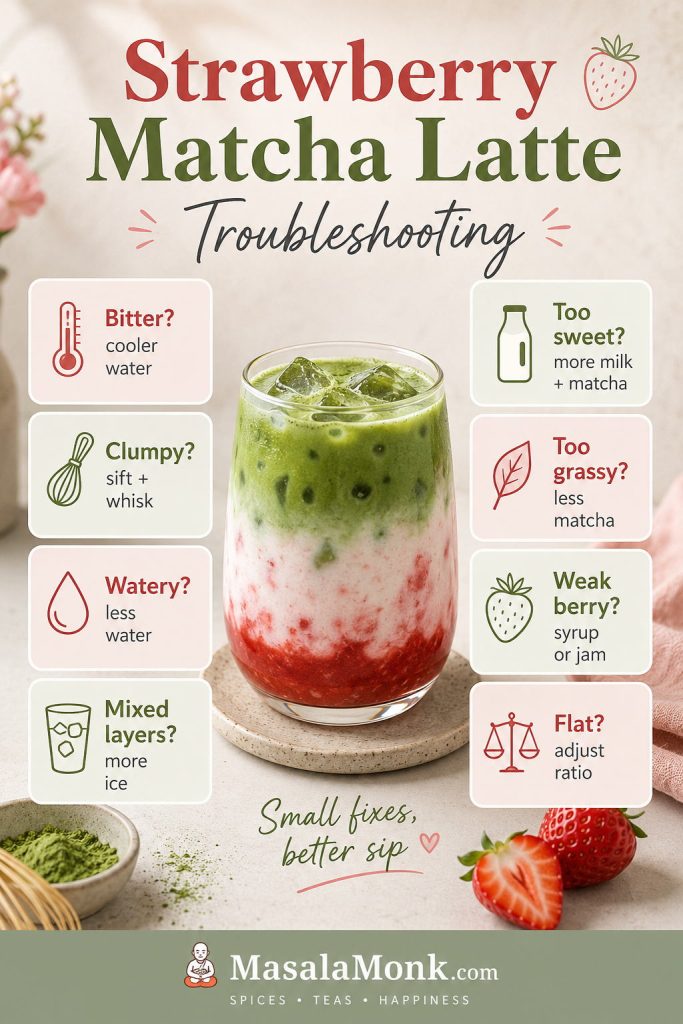
If the matcha turns clumpy, bitter, watery, or the layers mix too fast, use the troubleshooting guide.

What Is a Strawberry Matcha Latte?

A strawberry matcha latte is an iced matcha drink made with a strawberry base, milk, ice, and whisked matcha. The popular version is layered: red strawberry at the bottom, white milk in the middle, and green matcha on top.
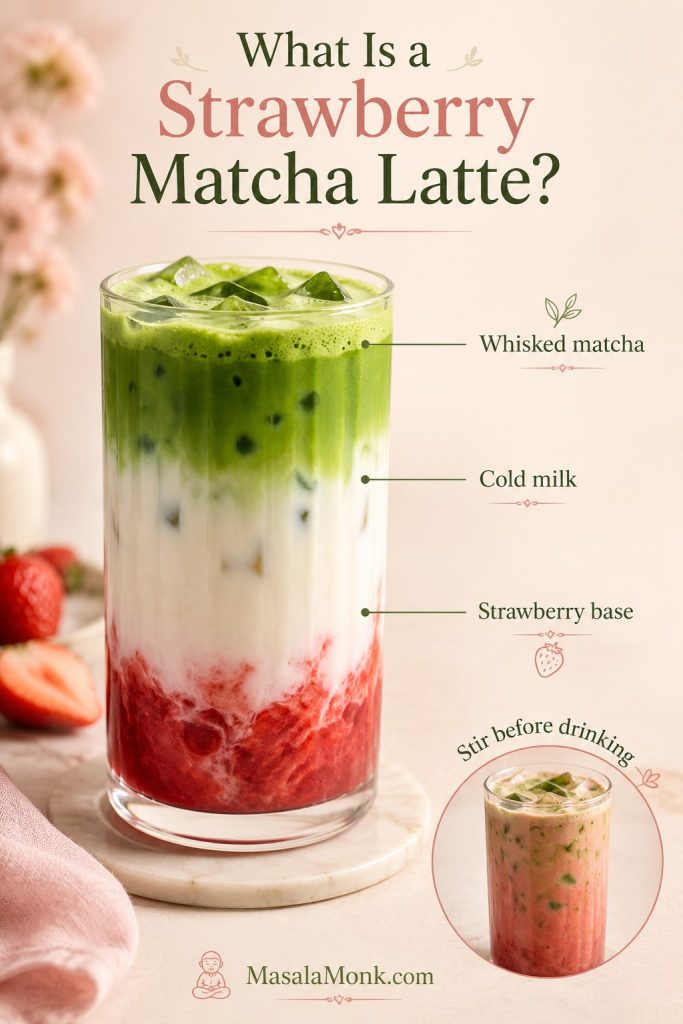
Labeled strawberry matcha latte showing strawberry base, cold milk, whisked matcha, and a small stirred drink inset.
Think of the layers as a map: fruit gives the base, milk softens the middle, and matcha brings the green tea finish.

It is not just strawberry milk with matcha poured over it, and it is not only a plain iced matcha with syrup. The best version keeps each part doing a job: strawberry brings fruit and color, milk softens the sip, and matcha gives the clean green tea finish.

The layered look is mostly for the first impression; the real flavor happens after stirring.

Homemade also gives you control. You can keep the strawberry base fresh instead of candy-sweet, make the matcha stronger or softer, and choose a milk that makes the whole glass taste the way you like it.

Why This Latte Works

This latte works because it is pretty without being fussy, sweet without becoming syrupy, and creamy without hiding the matcha. You get the pretty layered look, but the real win is the way the flavors come together after stirring.

  • The fruit base is thick enough to stay visible. It gives the drink real strawberry flavor instead of a candy-syrup taste.
  • The sweetness starts low. You can adjust based on your berries instead of making the latte syrupy from the start.
  • The matcha is whisked separately. That keeps dry green clumps out of the milk.
  • The water is warm, not boiling. This helps the matcha taste smoother and less harsh.
  • The ice does real work. It slows the milk and matcha as they pour, which helps the colors stay separated.

The best part of making it at home is control: the strawberry can taste like real fruit, the matcha can stay smooth instead of harsh, and the sweetness does not have to hit like a syrup pump.

That balance is the goal; here is what to taste for once the drink is stirred.

What It Should Taste Like

Once stirred, the latte should taste cold and creamy first, then bright with strawberry, with matcha finishing gently instead of taking over. It should not taste like strawberry syrup with green tea on top, or like bitter matcha hiding behind milk. The sweet spot is fruit, creaminess, and a smooth green-tea finish in the same sip.
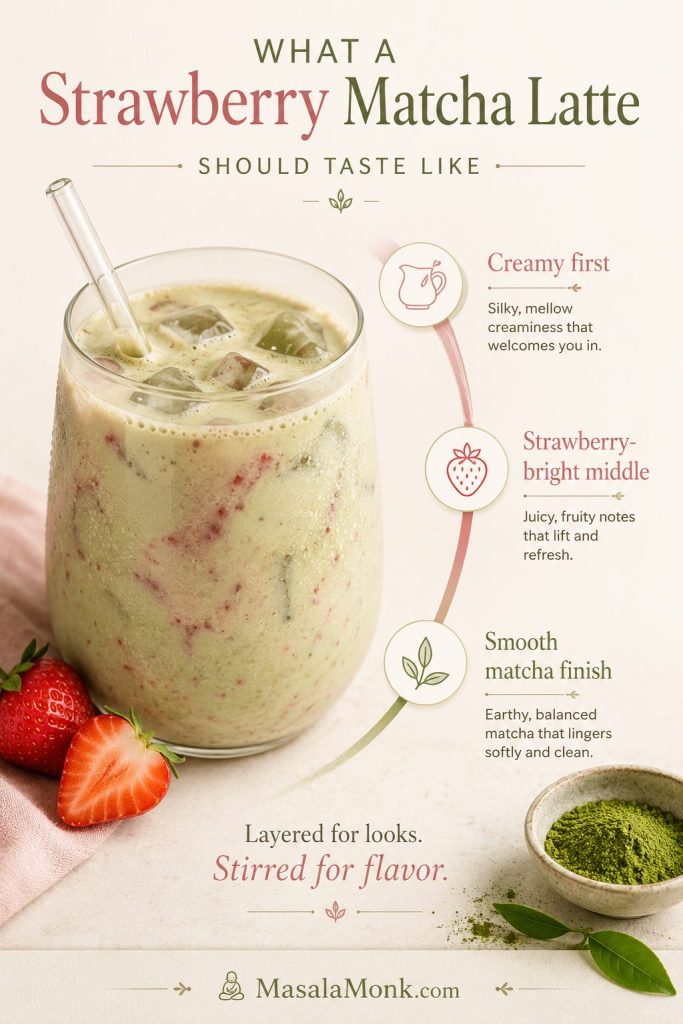
Stirred strawberry matcha latte with flavor callouts for creamy first, strawberry-bright middle, and smooth matcha finish.
A balanced strawberry matcha latte should taste like one drink after stirring, not three separate layers competing in the glass.

Ingredients You Need

You only need a few ingredients, but each one changes the final latte. Choose the strawberries, matcha, milk, and sweetener with the kind of sip you want in mind.
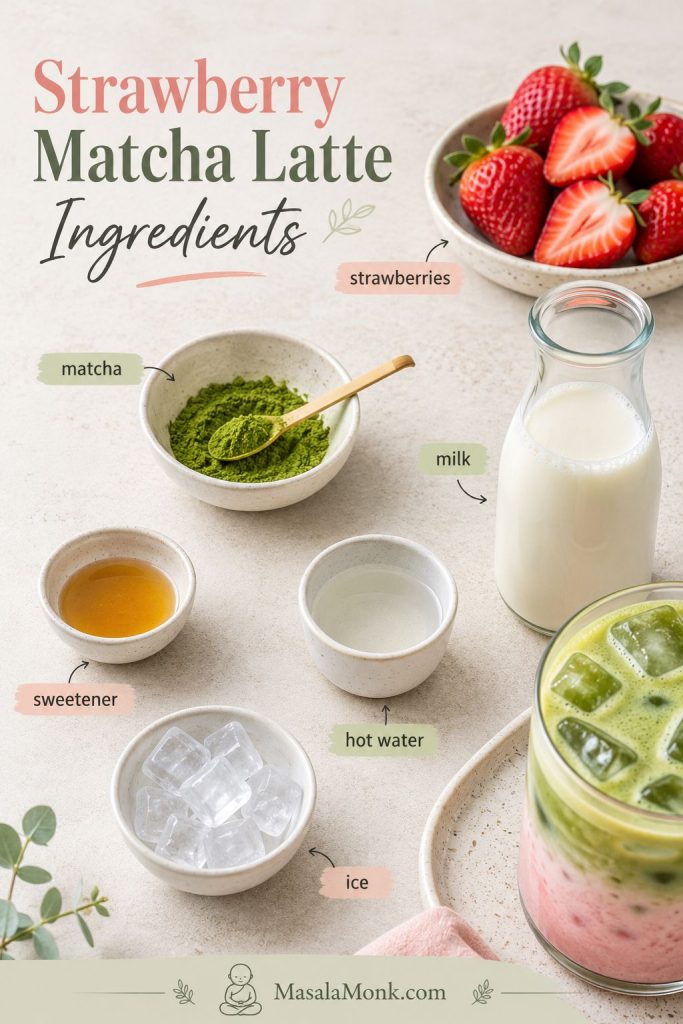
Ingredients for strawberry matcha latte including strawberries, matcha powder, milk, sweetener, hot water, ice, and a partial finished drink.
Because the ingredient list is short, each choice matters: ripe berries, fresh matcha, cold milk, and restrained sweetness shape the final sip.

Strawberries

Fresh strawberries give this latte the brightest flavor and color. If the berries smell sweet before you cut them, the drink will taste fresher and need less sugar. Pale, watery, or tart berries can still work, but they usually need a little more sweetener or a quick syrup treatment.

Frozen strawberries are useful when fresh berries are out of season. Thaw them first, then blend or mash them with sweetener. For the silkiest red base, strain the puree so it sits evenly at the bottom of the cup.

For a deeper comparison of muddled berries, puree, syrup, and jam, see the strawberry base options.
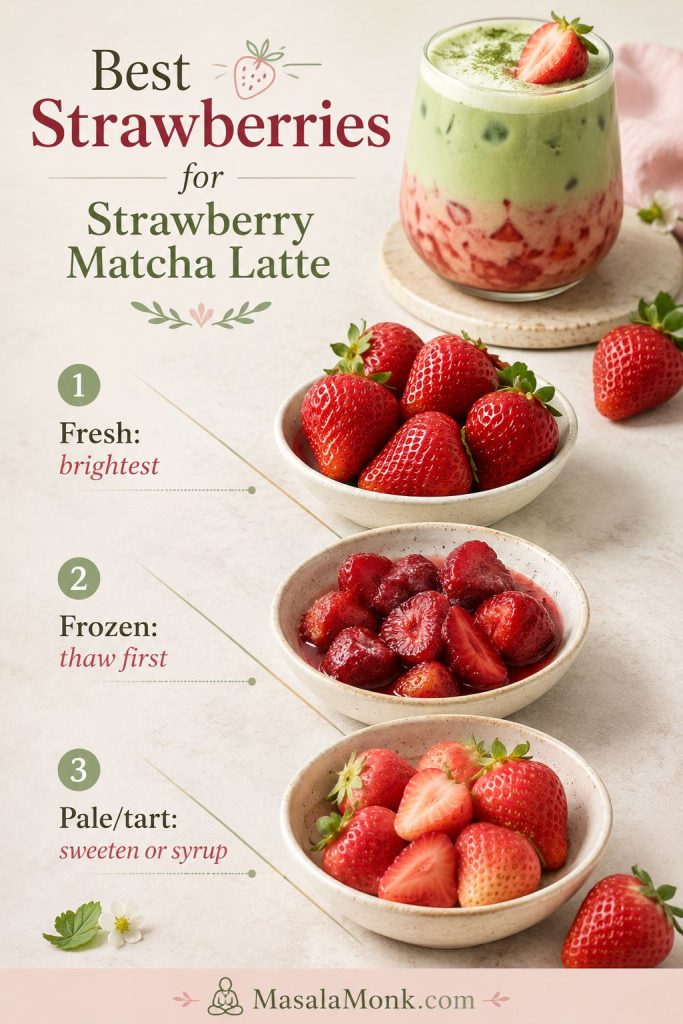
Comparison of fresh ripe strawberries, thawed frozen strawberries, and pale tart strawberries for strawberry matcha latte.
Ripe fresh strawberries give the brightest flavor, while frozen berries need thawing and pale berries usually need extra sweetness or syrup.

If your strawberries are especially ripe and you have extra, this strawberry shortcake recipe is another simple way to use them while they are still fresh and juicy.

Matcha powder

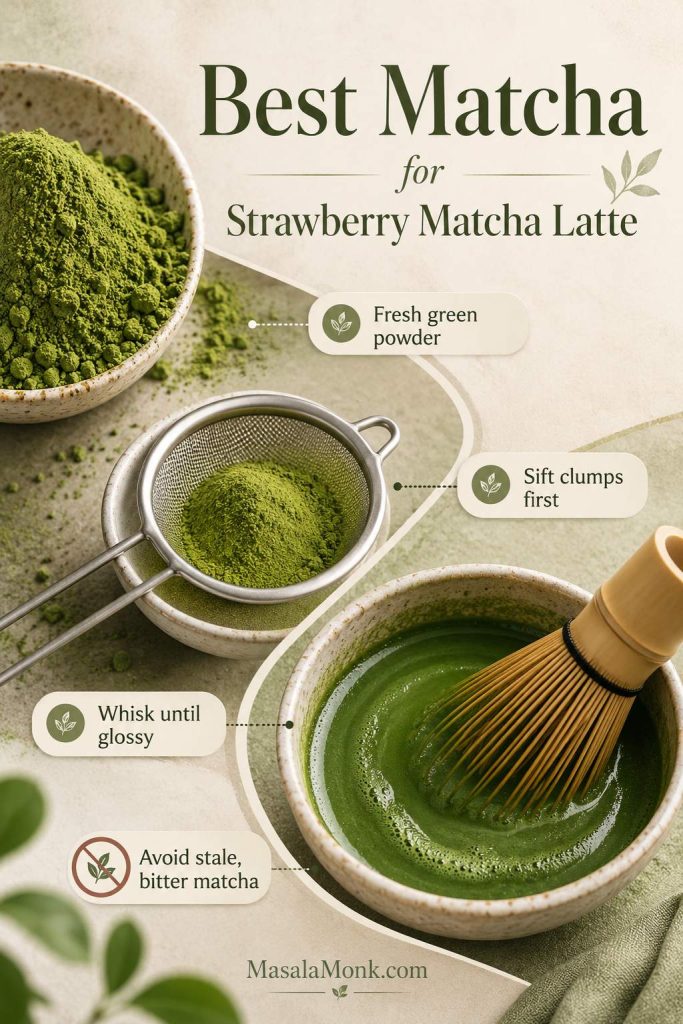
Choose a matcha powder you enjoy drinking, not the stale green powder hiding at the back of the pantry. Ceremonial-style matcha gives the smoothest flavor, but a good latte-grade matcha is usually enough for an iced drink with milk and strawberry.

Sift the matcha before whisking if it looks clumpy. Matcha does not dissolve like instant coffee; it suspends in water, so whisking matters. The goal is a smooth, balanced sip, not a bitter powdery one.
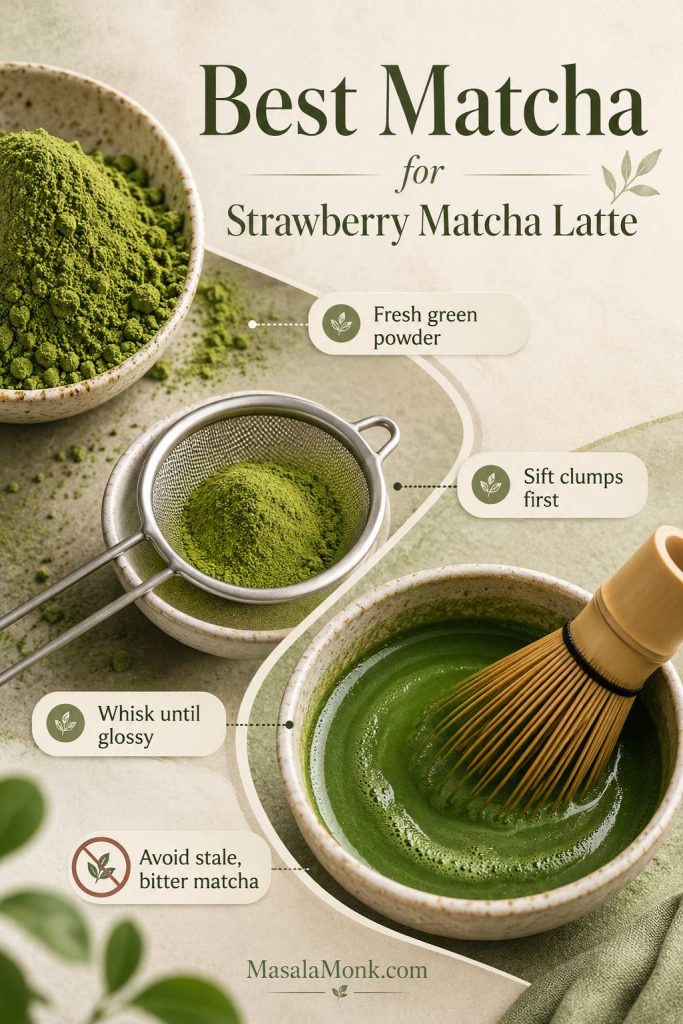
Matcha guide with fresh matcha powder, sifted matcha, glossy whisked matcha, and a clump-prevention cue.
Fresh matcha and proper whisking matter because milk can soften bitterness, but it cannot fully hide stale powder or dry green clumps.
Matcha temperature tip: Use hot water around 175°F / 80°C, not boiling water. This keeps the matcha smoother and less sharp; Ippodo’s matcha latte guide uses the same 80°C / 176°F benchmark.

If matcha usually tastes harsh to you, this one change helps most: let boiling water cool for a minute before whisking. The finished latte should taste fresh instead of flat or sharp.

Why the main recipe uses only 3 tablespoons water: This is a concentrated matcha pour for one 16 oz iced strawberry latte, not a full plain matcha tea. The drink already has strawberry, milk, and ice, so less water keeps the final glass creamy instead of thin. If you use 2 teaspoons matcha for a larger glass, you can increase the water to ¼ cup / 60 ml.

If clumps are your main problem, the step-by-step matcha whisking section is the fastest fix.

Milk

Oat milk gives the creamiest dairy-free version. Dairy milk tastes clean and rich. Almond milk makes a lighter drink, while coconut milk gives a sweeter, more tropical flavor that works well with strawberry.

Think of the milk as the soft middle. It should round out the fruit and matcha without making the latte taste flat. Cold milk and plenty of ice also help the colors stay separated.
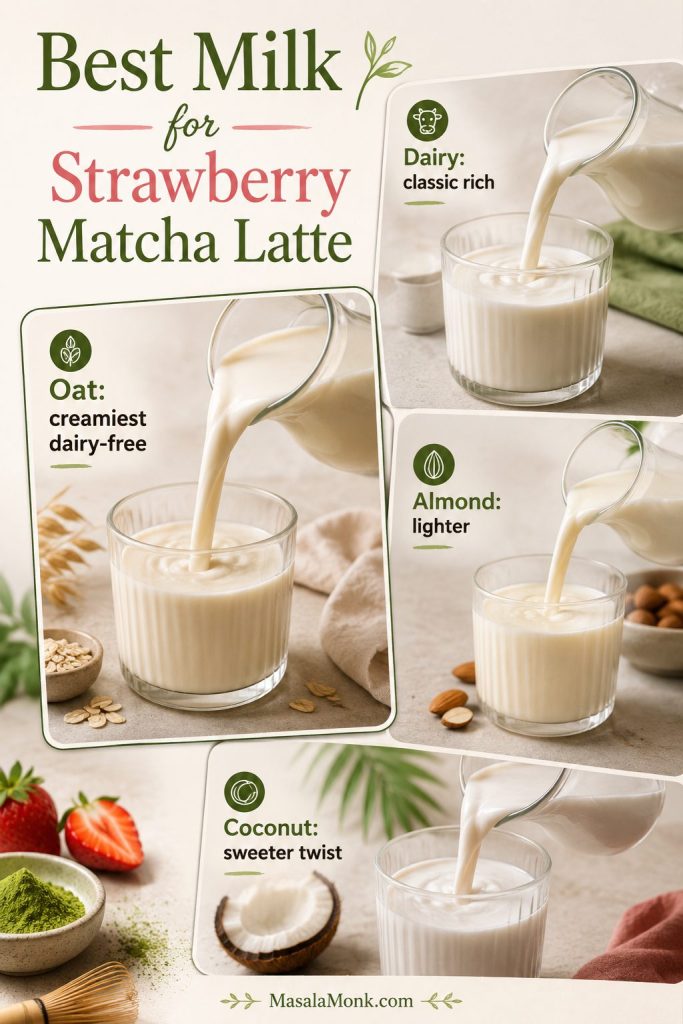
Milk comparison for strawberry matcha latte with dairy milk, oat milk, almond milk, and coconut milk options.
Milk changes the body of the latte: oat milk tastes creamiest, dairy feels classic, almond keeps it lighter, and coconut adds a sweeter twist.

Sweetener

Sugar, honey, maple syrup, or simple syrup all work. Granulated sugar is fine if you muddle it into juicy strawberries. Simple syrup mixes fastest. Honey and maple syrup add their own flavor, so they are better when you want a softer, rounder sweetness.

Start with 2 teaspoons for one drink. Add more only after tasting the fruit. Many café-style versions are very sweet, but this homemade latte tastes better when the berries, milk, and matcha stay in balance.

Before adding more sweetener, stir and taste once. The strawberry tastes sweetest at the bottom, the matcha tastes strongest at the top, and the final flavor only makes sense after everything is mixed.
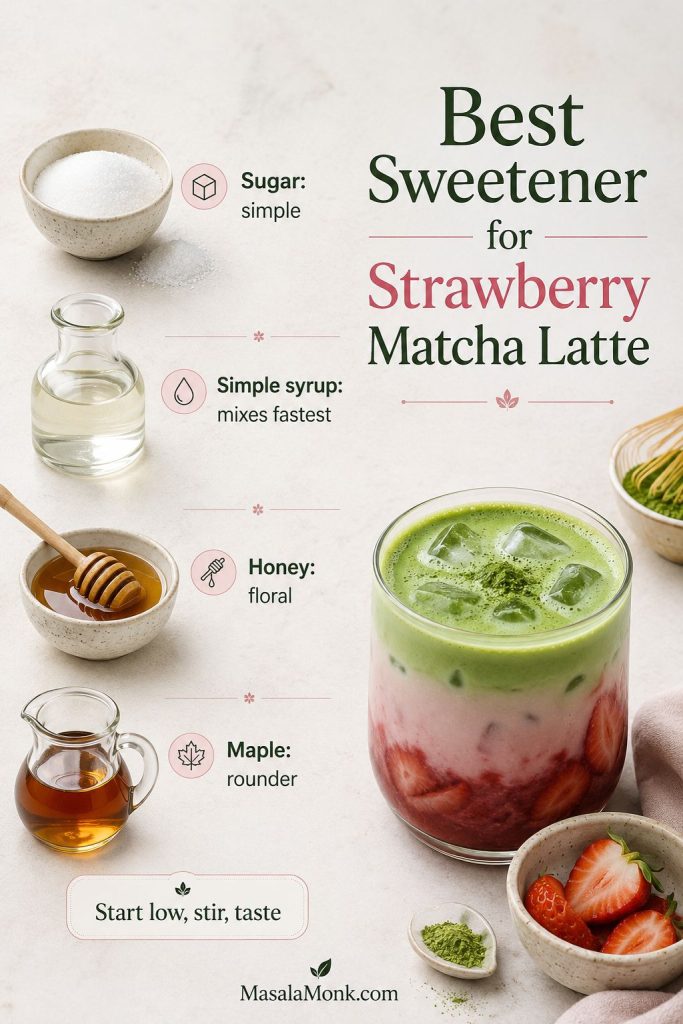
Sweetener guide for strawberry matcha latte with sugar, simple syrup, honey, maple syrup, and a small drink cue.
Start with less sweetener than you think, because the strawberry base tastes stronger once the latte is fully stirred.

If the latte still tastes too sweet, weak, or flat after stirring, check the troubleshooting table before changing the whole recipe.

Helpful Tools

You do not need special equipment for this drink. A clear glass, small bowl, and whisk or frother are enough; a sieve, blender, thermometer, and long spoon simply make the finish smoother and neater.

  • Clear glass: Shows the layers and gives you room for ice.
  • Small bowl: Makes it easier to whisk matcha before pouring.
  • Whisk or frother: Helps prevent dry green clumps.
  • Muddler, fork, or blender: Use whichever fits the strawberry texture you want.
  • Fine-mesh sieve: Optional, but useful for sifted matcha or smoother puree.
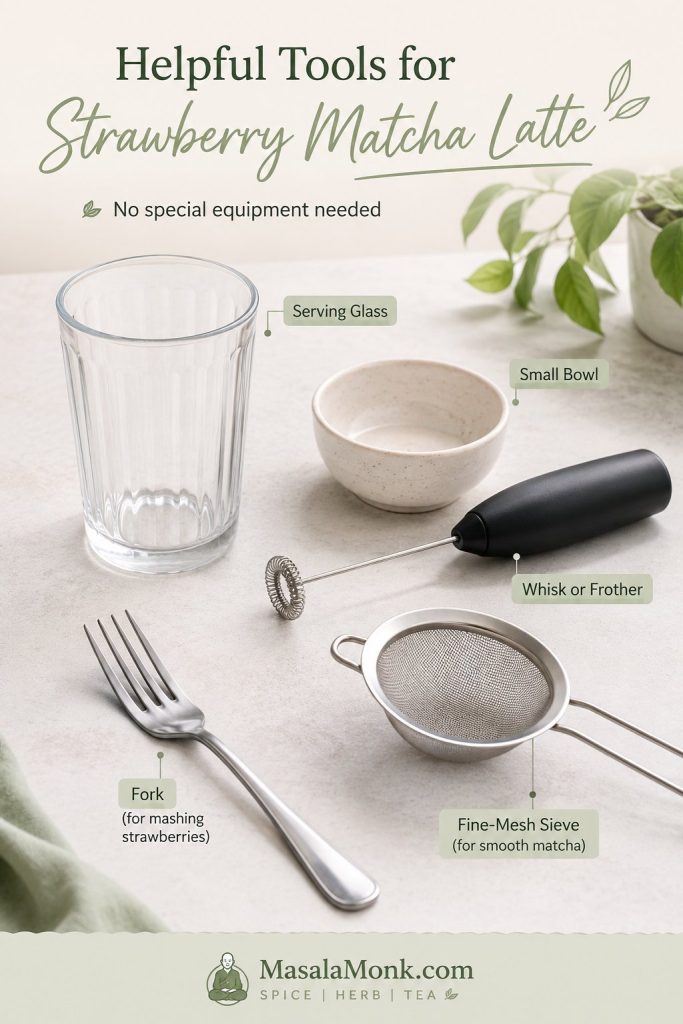
No matcha whisk? Use a handheld frother or shake the sifted matcha with hot water in a small jar. The goal is a glossy matcha pour with no dry green clumps.
Tools for making strawberry matcha latte including clear glass, small bowl, whisk or frother, fork, and fine-mesh sieve.
You do not need café equipment; a clear glass, small bowl, and whisk or frother are enough to build clean layers.

Ratio Guide for 12 oz, 16 oz, and Café-Style Drinks

The right ratio depends on your cup size and how strong you like matcha. A 12 oz serving needs less milk and ice. A 16 oz serving gives you more room for dramatic colors and a creamier drink.

Glass size Strawberry base Matcha Hot water Milk Ice
12 oz 3–4 strawberries + 1½–2 tsp sweetener 1–1½ tsp 2½–3 tbsp / 37–45 ml ½ cup / 120 ml About ¾ cup
16 oz 4–5 strawberries + 2 tsp–1 tbsp sweetener 1½ tsp 3 tbsp / 45 ml ¾ cup / 180 ml About 1 cup
Large café-style 5–6 strawberries + 1 tbsp sweetener 2 tsp ¼ cup / 60 ml ¾–1 cup / 180–240 ml Enough to fill the glass
Three strawberry matcha lattes in 12-ounce, 16-ounce, and café-style sizes with ratio labels for berries, matcha, and milk.
Once the 16-ounce strawberry matcha latte tastes right, scaling up or down is easier than guessing with extra ice.

Do not treat the numbers like a test. The 16 oz version is your baseline; the next glass is where you make it yours.

To make two drinks, double the strawberries, milk, matcha, and sweetener, but whisk the matcha in one slightly larger bowl so it stays even. Build each serving separately if you want the colors to stay clear.

Mild, Balanced, or Strong Matcha?

New to matcha? Start mild. Already love iced matcha? Use the balanced amount. Want the green tea flavor to lead even after milk and strawberry are added? Go stronger.

Matcha strength Amount for 1 drink Works well for
Mild 1 tsp / about 2 g Beginners, sweeter strawberry drinks, lighter almond milk versions.
Balanced 1½ tsp / about 3 g Most 16 oz iced strawberry matcha lattes.
Strong 2 tsp / about 4 g Oat milk drinks, extra ice, and stronger matcha flavor.

Start with the balanced 16 oz version once, then adjust by taste: more berries for a fruitier sip, more milk for a softer sip, or more matcha when you want the green tea flavor to lead.
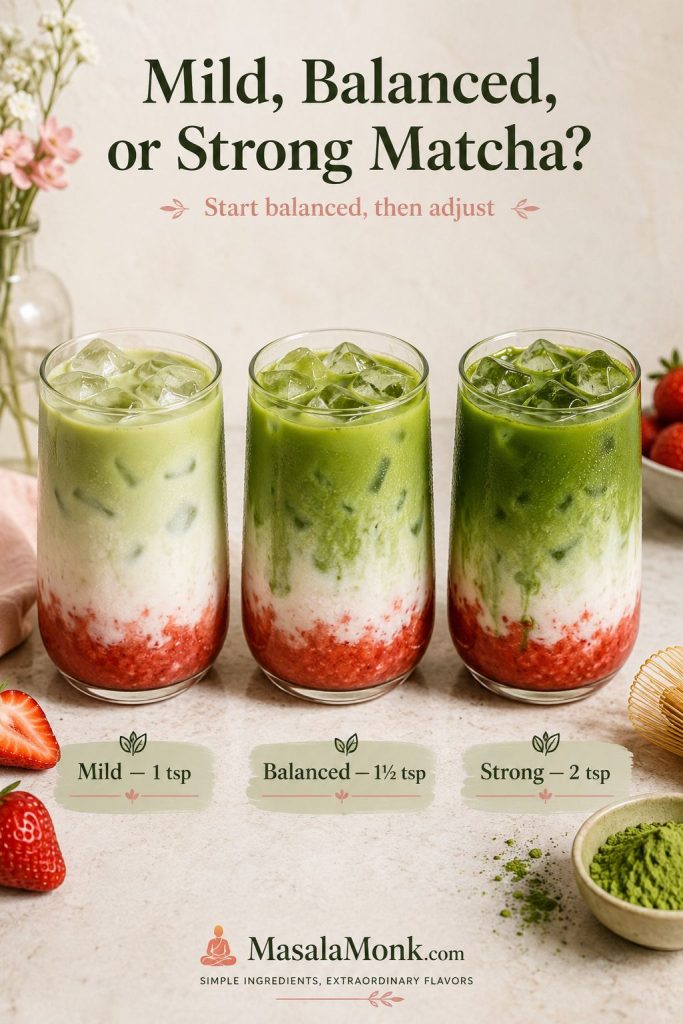
Three strawberry matcha lattes showing mild, balanced, and strong matcha levels from 1 teaspoon to 2 teaspoons.
Matcha strength changes the whole drink, so begin balanced and move stronger only when you want the green tea flavor to lead.

How to Make an Iced Strawberry Matcha Latte

The order matters. If everything goes in at once, the drink will taste fine but look muddy. For clear separation, build from heaviest to lightest: strawberry, ice, milk, then matcha.

There is also a small pleasure in the pour: the milk softens the red strawberry base, then the matcha slides over the ice and settles into green. It looks fancy, but it is really just a few careful steps.

Build it like a little stack: fruit first, ice next, milk slowly, matcha last.
Step-by-step strawberry matcha latte process showing strawberry base, ice, milk pour, and matcha pour ending with a finished drink.
Build from heavy to light so the strawberry stays low, the milk cushions the middle, and the matcha finishes on top.

Step 1: Make the strawberry base

Hull and chop 4–5 medium strawberries. Add them to a small bowl or directly to the bottom of a sturdy glass with 2 teaspoons sweetener. Muddle until the berries release their juice and look saucy.

For a smoother base, blend the strawberries with the sweetener, then spoon the puree into the cup. Strain it if you want the neatest red stripe at the bottom.
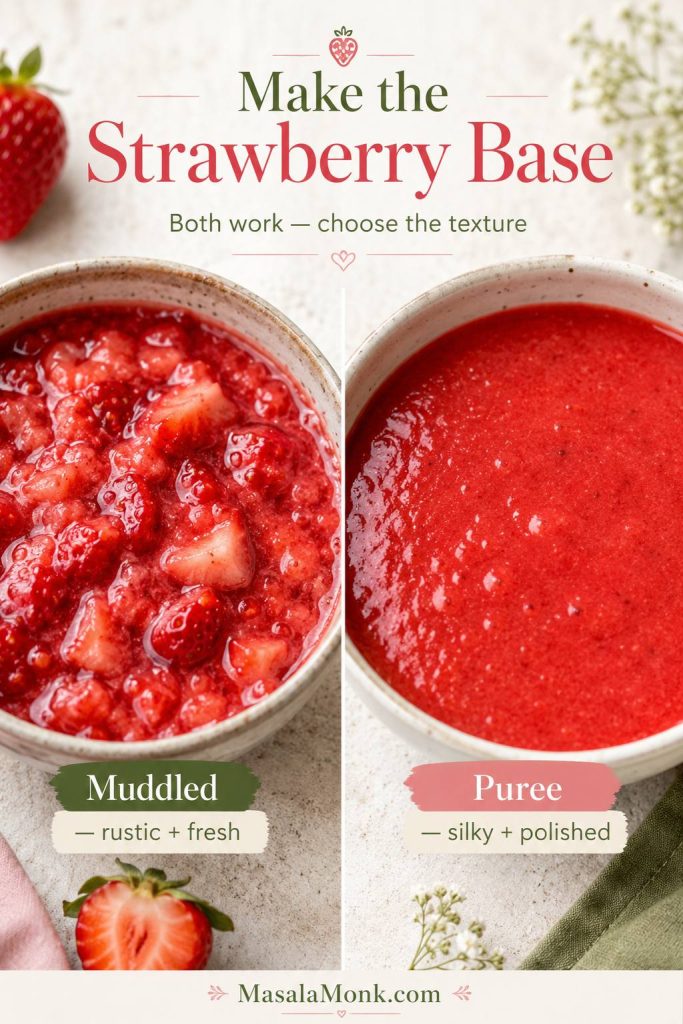
Close-up comparison of muddled strawberry base with fruit pieces and smooth strawberry puree in bowls.
Muddled berries taste fresh and rustic, while puree gives a smoother strawberry base for cleaner layers and a more polished finish.

Step 2: Whisk the matcha

Sift 1½ teaspoons matcha into a small bowl. Add 3 tablespoons hot water around 175°F / 80°C. Whisk until the matcha is glossy and lightly frothy. There should be no dry clumps left at the bottom of the bowl.

A bamboo whisk works beautifully, but a small whisk, handheld frother, or shaker jar can also do the job. With a frother, keep the head fully submerged at first so the matcha does not splash.
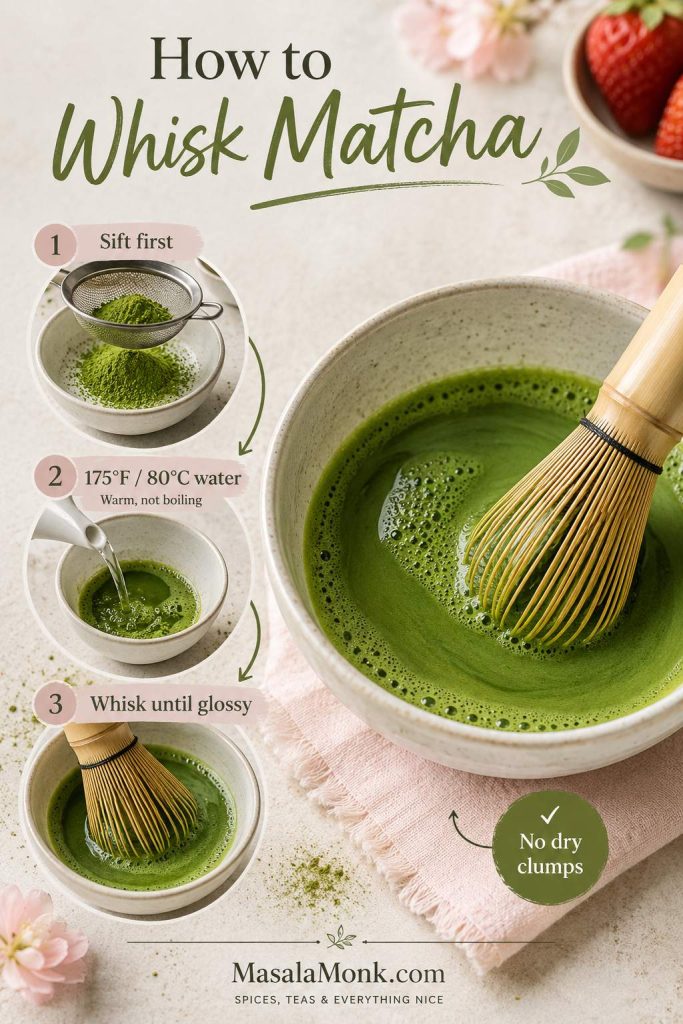
Matcha whisking guide showing sifted matcha, warm water, whisking, glossy matcha, and no dry clumps.
Sift first and use warm-not-boiling water, because smooth matcha before pouring means a better latte after stirring.

Step 3: Build the drink

Spoon the strawberry mixture into the bottom of a tall clear glass. Add ice until the glass is at least halfway full. Pour the milk slowly over the ice, not directly into the fruit.

Finally, pour the whisked matcha over the ice or over the back of a spoon. This slows the pour and helps the green matcha sit above the milk for that red-white-green look.
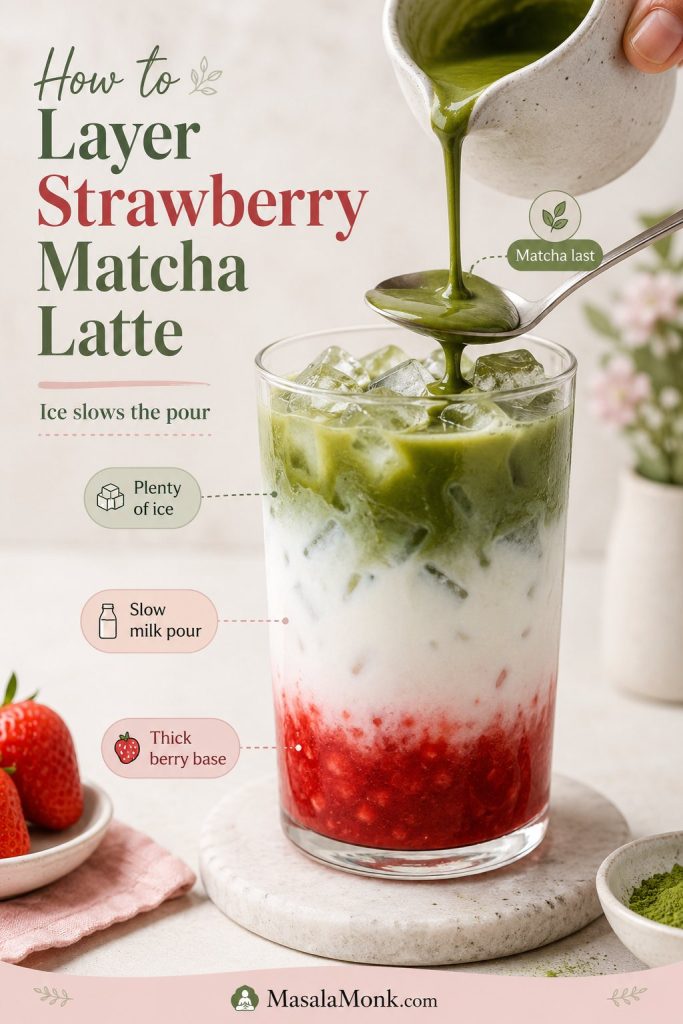
Tall strawberry matcha latte being layered with strawberry base, milk, ice, and matcha poured slowly over a spoon.
Plenty of ice slows the pour, which helps the milk and matcha settle into layers instead of turning muddy immediately.

Step 4: Serve, then stir

Serve it layered for the first beautiful moment, then stir before drinking. The sip gets better once the berry, milk, and matcha stop sitting in separate lanes.

If you do not care about visible colors, simply stir the strawberry, milk, and matcha together after building the drink. The flavor will be just as good, and the drink is easier to sip evenly from the start.

Do not worry if the first pour is not perfect. The colors are fun, but this latte is forgiving; once you stir it, the flavor matters much more than the stripes.
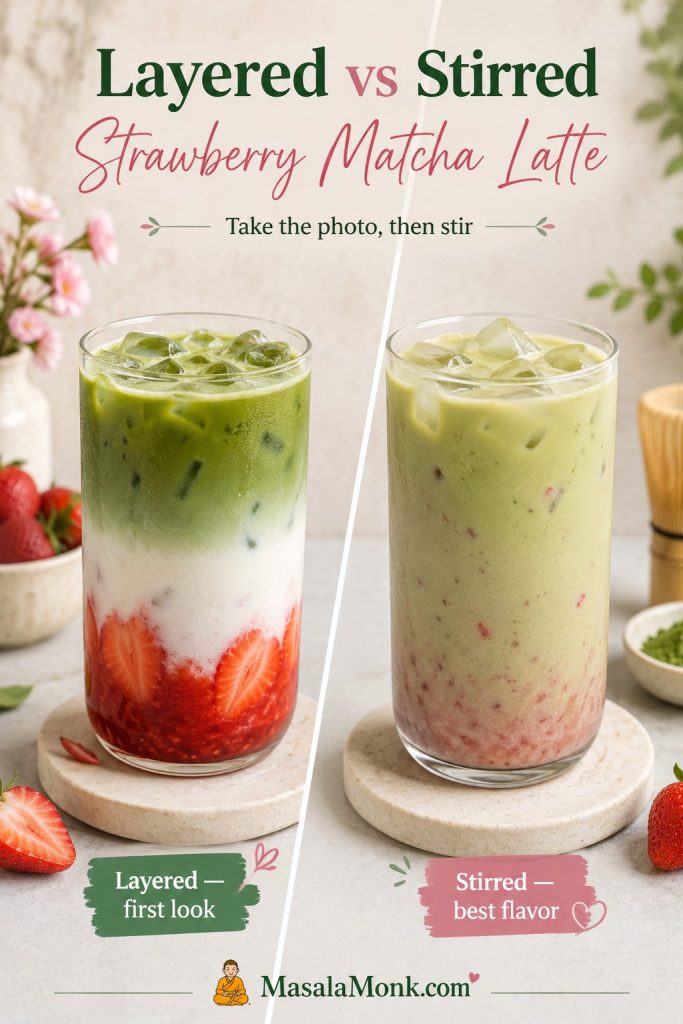
Side-by-side comparison of a layered strawberry matcha latte and a stirred strawberry matcha latte ready to drink.
The layered version wins the first look, while the stirred version gives you strawberry, milk, and matcha in one balanced sip.

If the layers disappear too quickly, the fixes section covers ice, pouring speed, and berry thickness.

Which Version Should You Make?

For your first try, start with muddled berries. For the cleanest layers, strain the puree. On a busy day, jam is completely fine; the point is a balanced latte you would actually make again.

  • Best everyday version: fresh muddled berries for the brightest, quickest flavor.
  • Best pretty layered version: strained strawberry puree for a cleaner red base.
  • Best make-ahead version: cooked strawberry syrup chilled in a jar.
  • Best busy-day shortcut: 1–2 tablespoons strawberry jam with less extra sweetener.
  • Best café-style version: smooth puree or syrup with oat milk, stronger matcha, and optional cold foam.
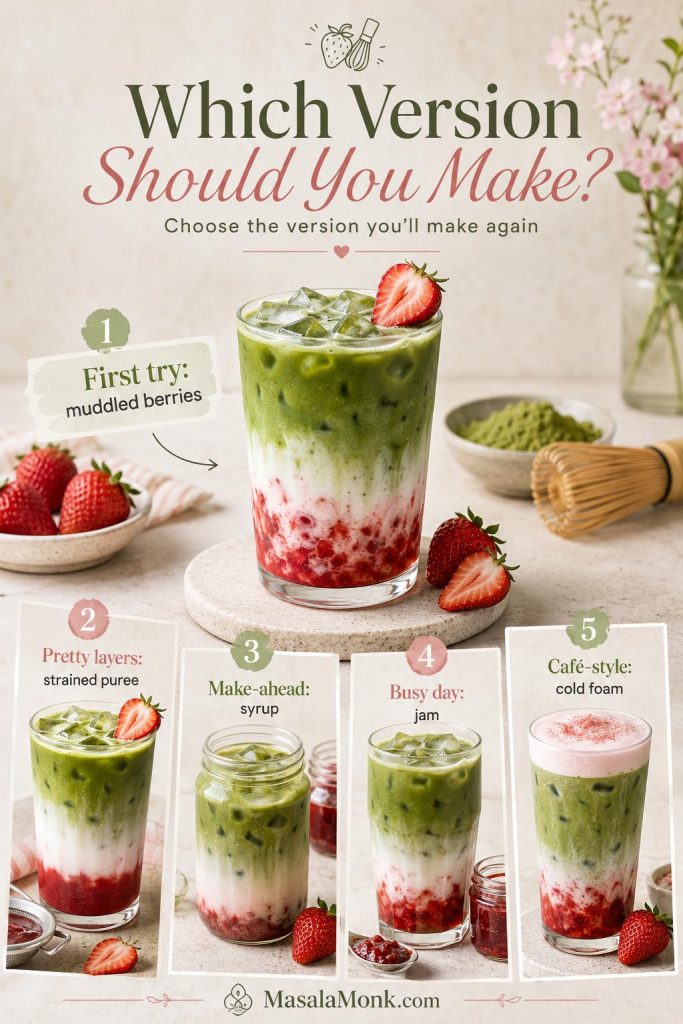
Version chooser for strawberry matcha latte with first try, pretty layers, make-ahead syrup, busy-day jam, and café-style cold foam.
Choose the version that fits the moment: fresh berries for everyday, puree for layers, syrup for prep, jam for speed, or cold foam for café style.

Strawberry Base Options

Once you know which direction you want, the strawberry base is where the latte gets its personality: rustic and fresh, smooth and polished, syrupy and make-ahead, or fast and jammy.
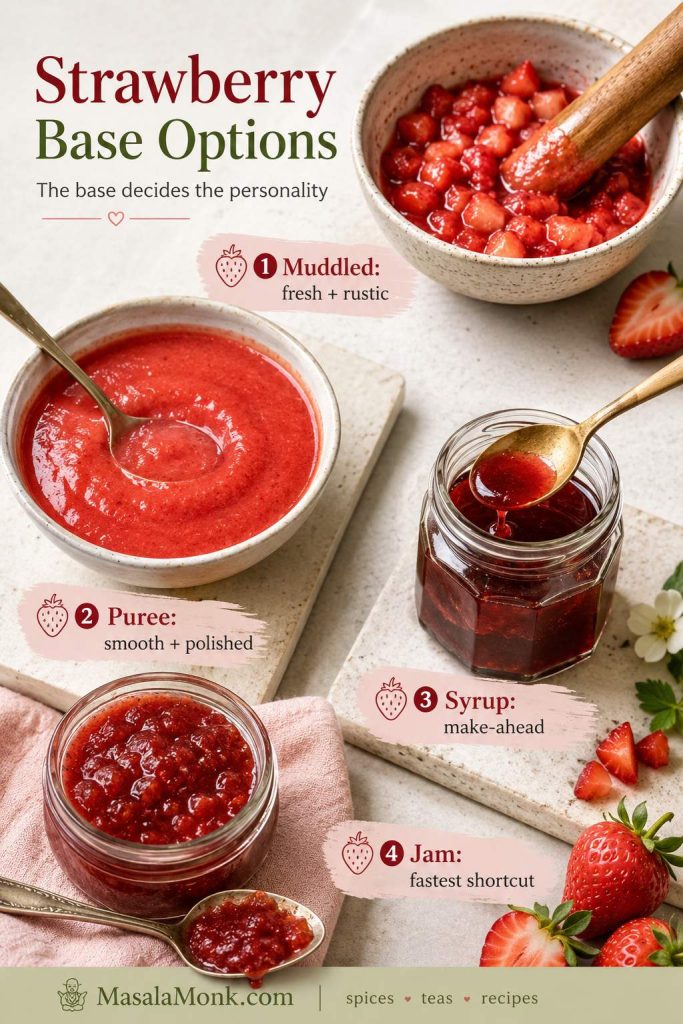
Four strawberry base options for strawberry matcha latte including muddled berries, puree, syrup, and jam shortcut.
The strawberry base decides the personality of the drink, from fresh and rustic to silky, syrupy, or fast and jammy.

Fresh muddled strawberries

Ripe strawberries are where this version shines. It tastes fresh, takes only a few minutes, and keeps the drink from feeling too syrupy. The texture is slightly rustic, which can be lovely if you enjoy real fruit in the glass.

Smooth strawberry puree

Blend strawberries with sweetener for a silkier fruit base. This gives the latte a more polished look and makes the strawberry flavor spread more evenly once stirred. If seeds bother you, strain the puree before adding it to the glass.

Make-ahead strawberry syrup

To make syrup ahead, simmer 1 cup chopped strawberries, about 140–160 g, with ¼ cup sugar and ¼ cup water for 5–8 minutes, until the fruit softens and the liquid turns red. Mash, strain if desired, cool, and refrigerate. Use 2–3 tablespoons syrup per drink.

This makes roughly enough syrup for 3–4 drinks, depending on how much you reduce it. Syrup stores well and gives stronger strawberry flavor, but it tastes sweeter and less fresh than muddled berries. Store-bought syrup can work in a pinch; start with less than you think you need.

That jammy berry flavor also works beautifully in desserts; this strawberry ice cream recipe uses the same idea of concentrating juicy strawberries before they water things down.
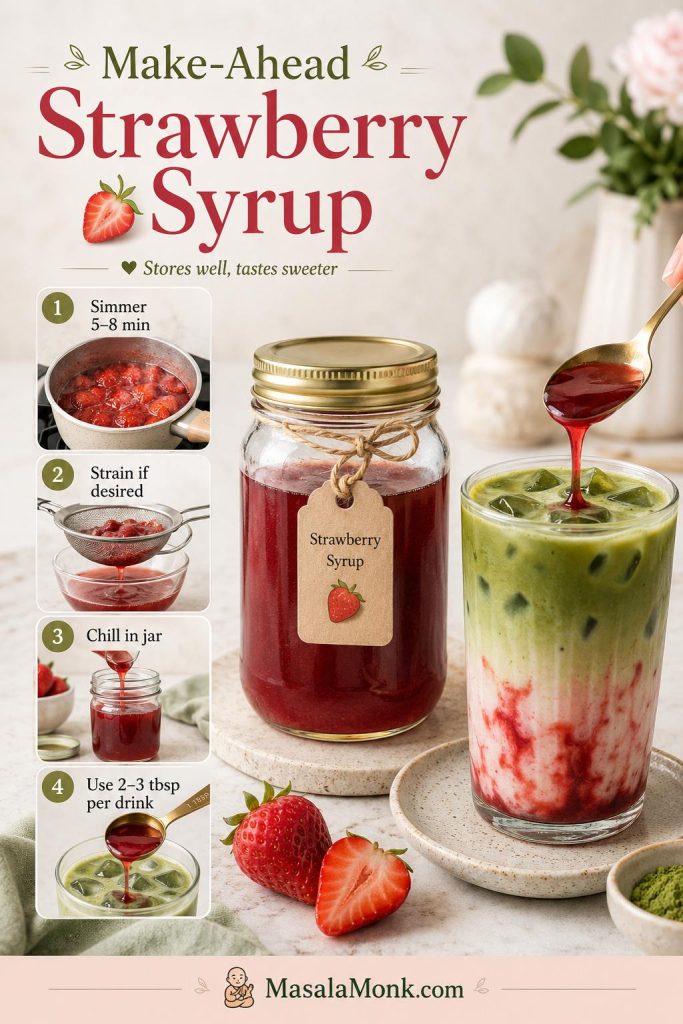
Make-ahead strawberry syrup guide with simmered strawberries, straining, syrup in a jar, and syrup spooned into a matcha latte.
Use strawberry syrup when convenience matters more than fresh berry texture, especially for repeat lattes during the week.

Strawberry jam shortcut

Jam works when speed matters, but it gives the drink more candy-shop sweetness than fresh berry lift. Start with 1 tablespoon, stir or blend it with a spoonful of milk, then add the rest of the milk and matcha.
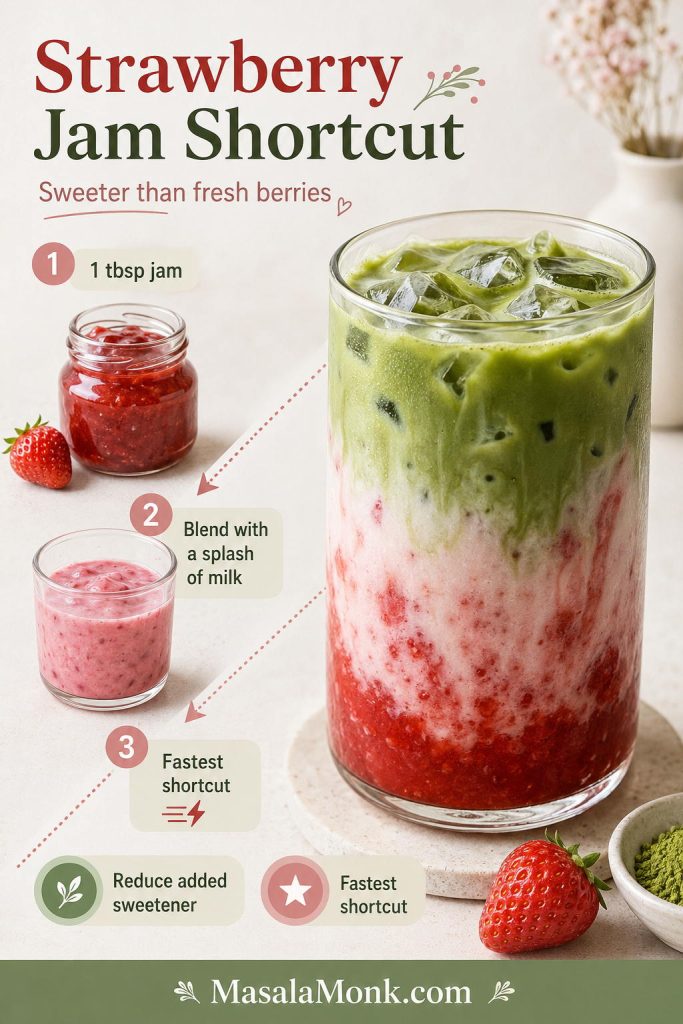
Strawberry jam shortcut guide showing jam, jam mixed with milk, and a finished strawberry matcha latte.
Jam is the fastest shortcut when fresh berries are not available, but reduce added sweetener because the base is already sweet.

Starbucks-Style Notes

For a Starbucks-style strawberry matcha latte, use smooth strawberry puree or syrup, oat milk or coconut milk, 1½–2 teaspoons matcha, and strawberry cold foam if you want the café-style finish.

Puree or syrup gives you more café polish; muddled berries give you the fresher homemade sip.

For the homemade version that fits your situation, compare the fresh, syrup, jam, and café-style options.

The exact Starbucks version can vary by country, season, and custom order. Starbucks EMEA announced an Iced Strawberry Matcha Tea Latte with strawberry cream cold foam, while in other places people often recreate the flavor through custom orders or homemade copycat versions.
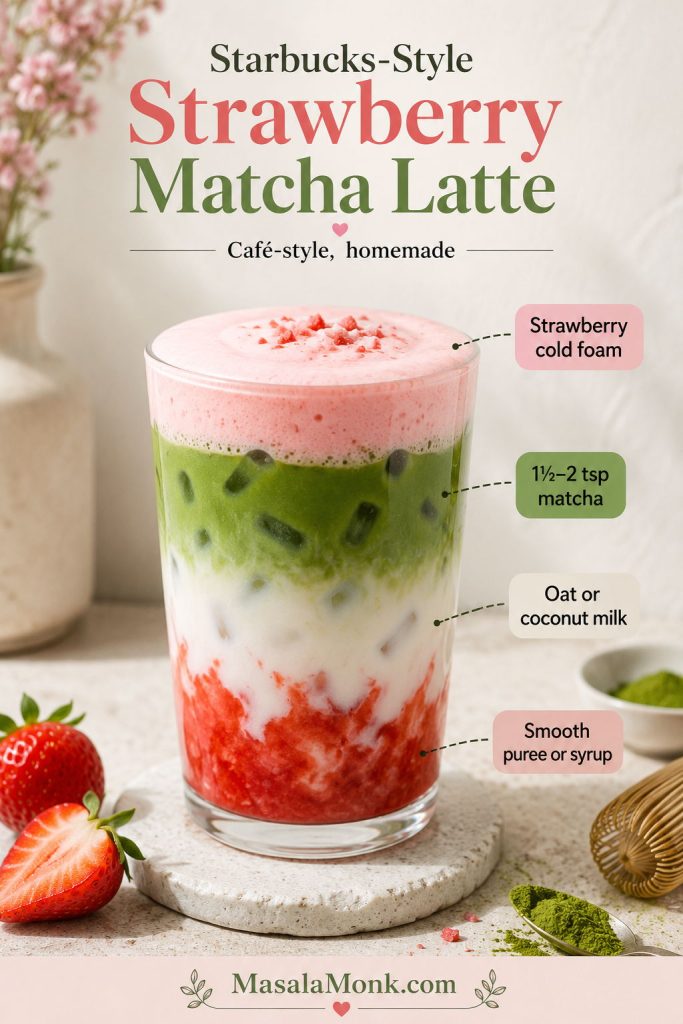
Café-style strawberry matcha latte with strawberry cold foam, matcha layer, milk, strawberry base, and callouts for puree, milk, and matcha.
For a Starbucks-style direction, use a smoother strawberry base, slightly stronger matcha, creamy milk, and strawberry cold foam on top.

Variations

Once you know the base ratio, this iced matcha drink is easy to adapt. Keep the same building order, then change the milk, fruit base, or topping.

For the basic build before changing the milk, foam, or fruit base, start with the main method.

Strawberry Milk Matcha

Blend strawberries or strawberry jam directly into the milk, then pour whisked matcha over the top. Choose this when you care more about a creamy, evenly fruity latte than the dramatic red-white-green layers.

Creamiest Dairy-Free Version

Oat milk gives you the creamiest dairy-free glass. Because it is naturally a little sweet and rich, it works especially well with 1½–2 teaspoons matcha and a lightly sweetened strawberry base.
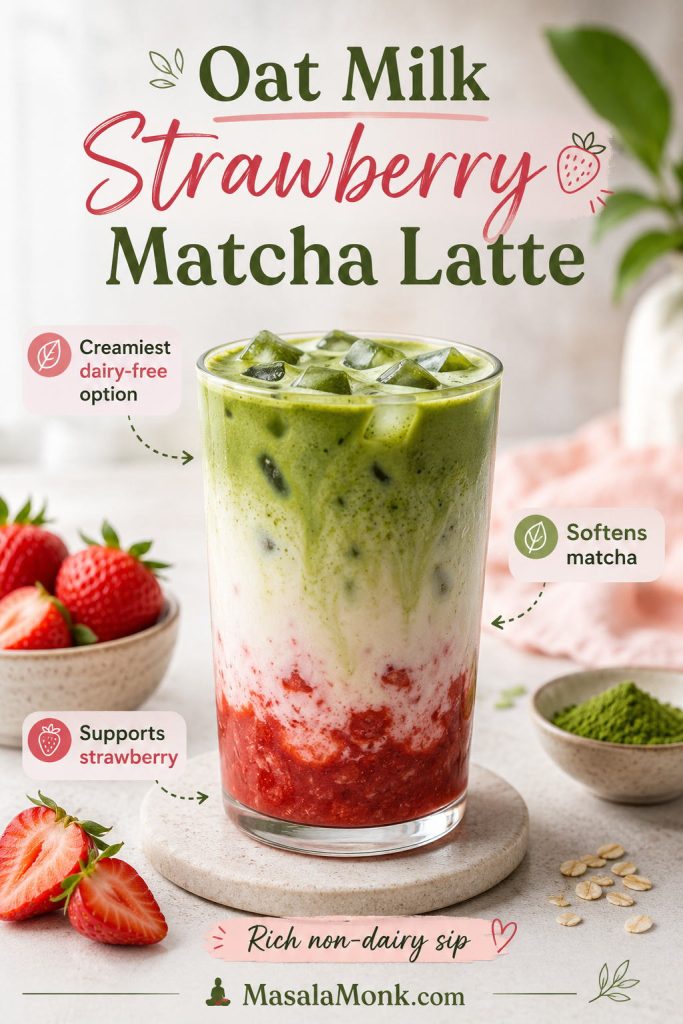
Oat milk strawberry matcha latte in a clear glass with strawberry base, milk, matcha, ice, and dairy-free callouts.
Oat milk is usually the easiest dairy-free choice because it softens matcha while keeping the strawberry layer creamy and full.

Strawberry Cold Foam Matcha

For a creamier cold foam variation, froth 3 tablespoons heavy cream or barista-style milk with 1 tablespoon strawberry puree or jam and ½ teaspoon vanilla. Spoon it over an iced matcha latte, or use it on top of the layered strawberry-matcha drink.

If fresh strawberry puree makes the foam too loose, use freeze-dried strawberry powder or a small amount of thick strawberry jam instead. The goal is a pink, lightly sweet foam that tastes like strawberry without sinking straight into the glass.

For a thicker topping, the same timing cues from this whipped cream recipe can help you stop before the foam turns heavy.
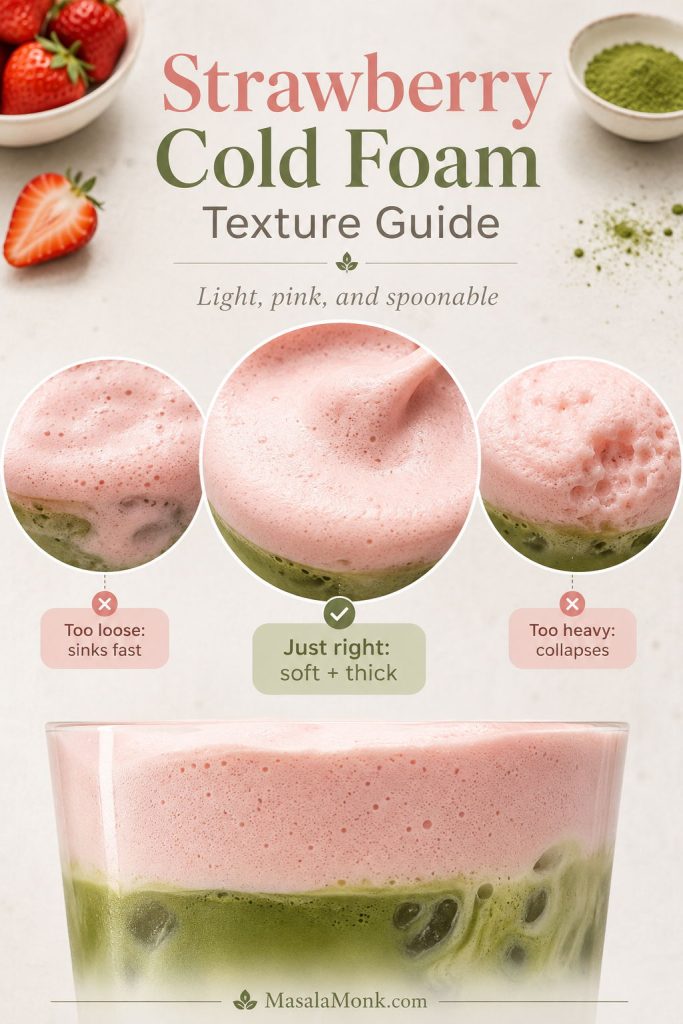
Strawberry cold foam texture guide showing too loose, just right, and too heavy foam on matcha drinks.
Good strawberry cold foam should be light and spoonable, not runny enough to sink or heavy enough to feel like frosting.

Boba-Shop Style Strawberry Matcha

Add cooked tapioca pearls to the bottom before the strawberry base, then build with ice, milk, and matcha. Use a smooth puree or jam so the cup does not feel too busy, and add boba fresh because cooked tapioca pearls lose their bounce as they sit.
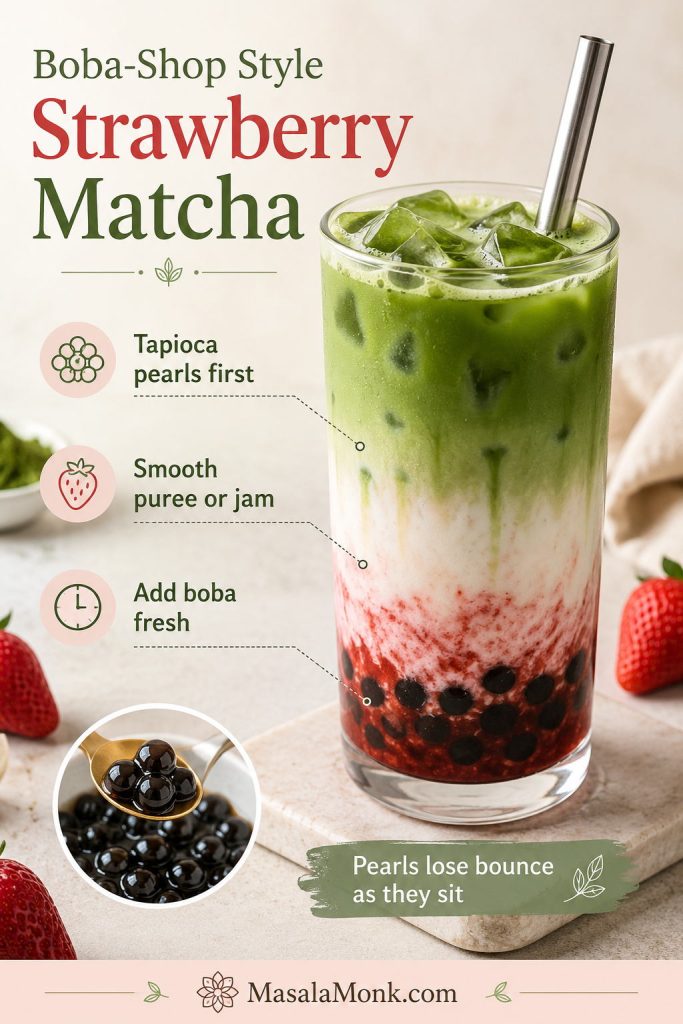
Boba-style strawberry matcha drink with tapioca pearls, strawberry base, milk, matcha, ice, and a wide straw.
Add tapioca pearls fresh and keep the strawberry base smooth, because boba already brings plenty of texture to the glass.

Strawberry Matcha Lemonade, Not a Latte

For a brighter refresher-style variation, replace the milk with cold lemonade and keep the strawberry base at the bottom. This is a separate summer drink, not a creamy latte. Use 1 teaspoon matcha because the acidity makes the green tea taste stronger.
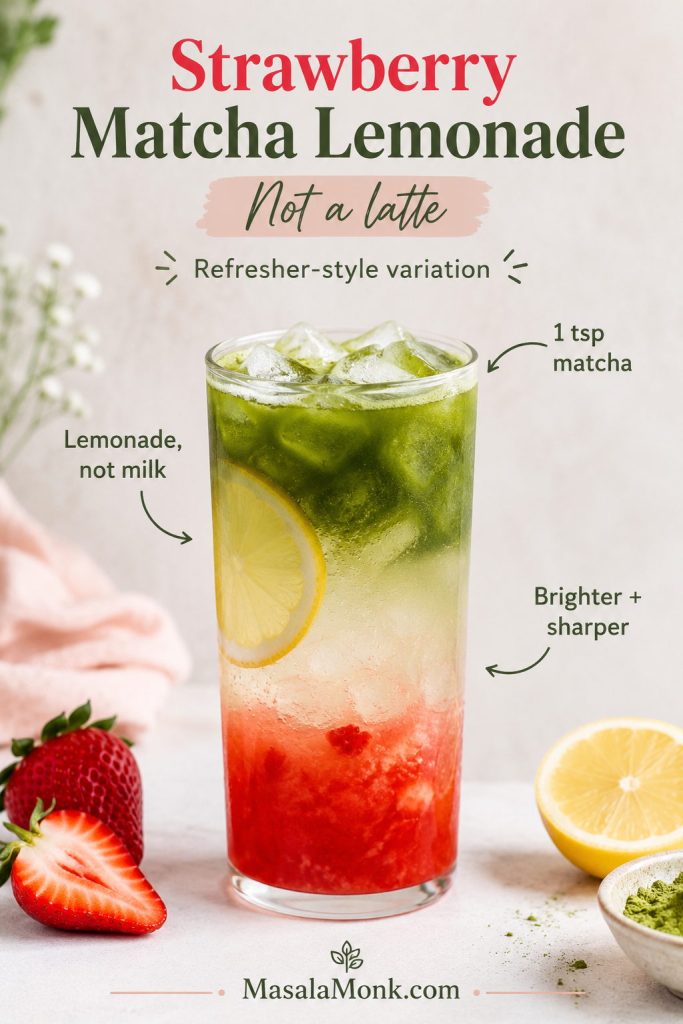
Strawberry matcha lemonade with strawberry base, lemonade layer, matcha top, ice, lemon slice, and not-a-latte label.
This variation leaves latte territory; instead of creamy milk, lemonade makes the drink brighter, sharper, and more refreshing.

More Filling Protein Version

Use vanilla protein milk or a vanilla protein shake for part of the milk. This is the version to make when you want the drink to act more like a light breakfast than a pretty afternoon sip. For a more fruit-forward breakfast drink, this berry smoothie recipe is a better direction.
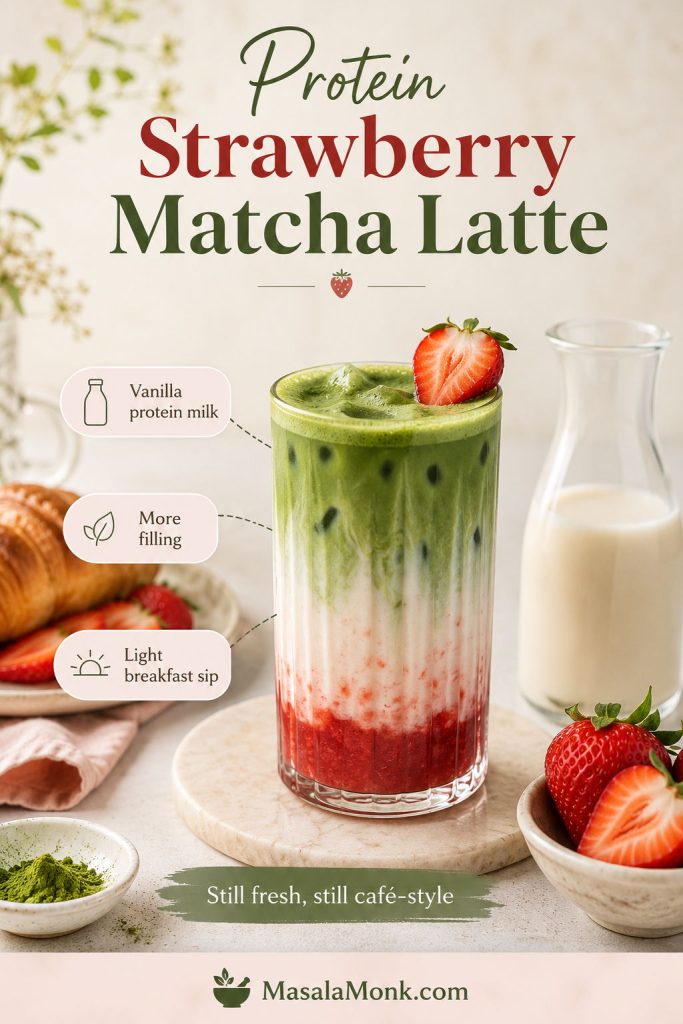
Protein strawberry matcha latte with vanilla protein milk, strawberry base, milk layer, matcha, ice, strawberries, and breakfast props.
Vanilla protein milk turns the drink into a more filling option, while the strawberry and matcha keep it tasting fresh rather than heavy.

Make-Ahead and Storage

This drink tastes best right after it is assembled, but you can prepare the parts ahead. Keep the strawberry mixture and matcha separate until you are ready to build the glass.

The best make-ahead plan is simple: prep the strawberry part, chill the milk, and leave the matcha for the last minute. The matcha is the part worth making fresh; whisk it at the end so the top tastes bright instead of dull.

Component Make-ahead timing Storage tip
Fresh strawberry mixture Up to 1 day Refrigerate in a covered jar. Stir before using.
Cooked strawberry syrup 3–5 days Refrigerate in a clean jar and use a clean spoon each time.
Whisked matcha Best fresh Whisk right before serving for the smoothest texture.
Fully assembled drink Serve immediately The colors fade and the ice waters it down over time.

If you want to make several drinks for guests, prepare the strawberry base ahead and chill the milk. Whisk the matcha fresh, then assemble each serving just before serving.
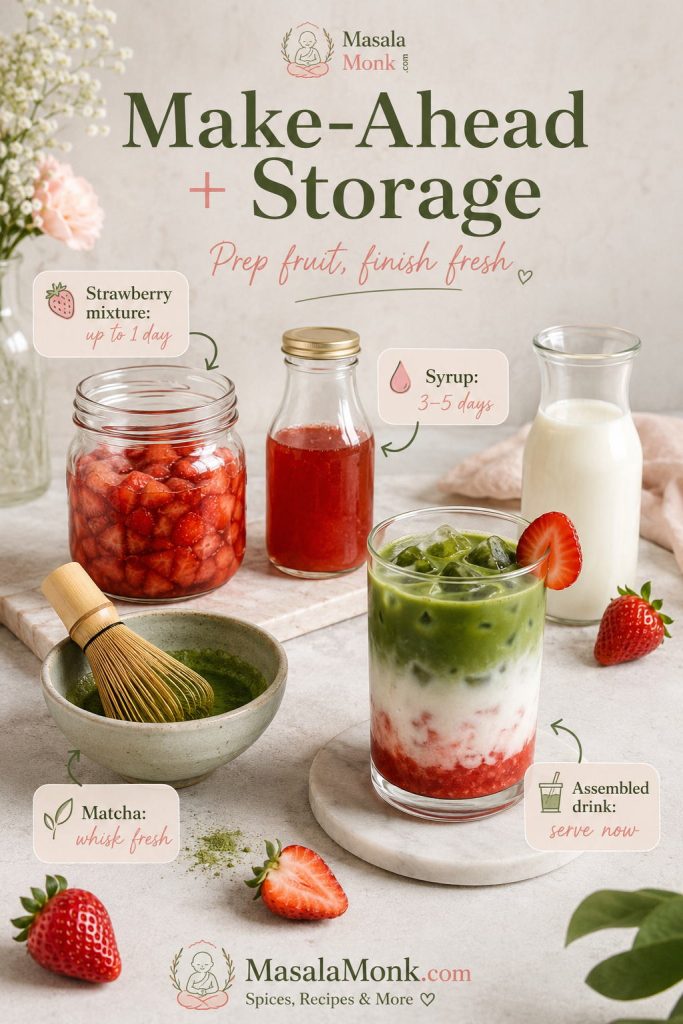
Make-ahead and storage guide with strawberry mixture, strawberry syrup, milk, fresh-whisked matcha, and assembled strawberry matcha latte.
Make-ahead works best when the fruit is ready and the matcha is fresh, so the drink still tastes bright when assembled.
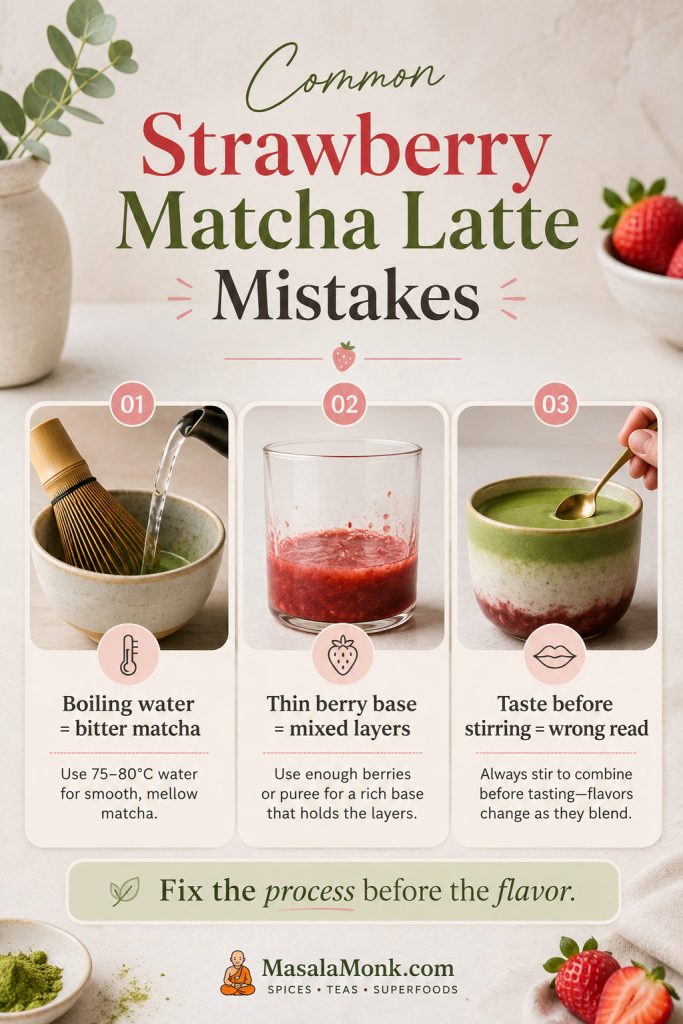
Avoid the three easiest mistakes: do not use boiling water for matcha, do not pour milk directly into a thin strawberry mixture if you want visible separation, and do not judge the sweetness until the drink has been stirred.
Common strawberry matcha latte mistakes showing boiling water, thin berry base, and tasting before stirring.
Most mistakes happen before the first sip, so fix the process: avoid boiling water, thicken the berry base, and stir before judging.

Troubleshooting: Bitter, Clumpy, Watery, or Mixed Layers

Even if the glass does not look perfect, it is usually easy to fix the flavor. Most problems come down to heat, sweetness, ice, or how fast everything was poured.

A messy glass is not a failed latte. If the flavor is balanced, you are already close.

Fix matcha problems first

When a strawberry matcha latte tastes bitter, clumpy, or watery, start with the matcha. The water temperature, whisking, and dilution usually explain the problem.

Problem Likely cause How to fix it
Matcha tastes bitter Water was too hot, matcha was low quality, or too much matcha was used. Use water around 175°F / 80°C, start with 1 tsp matcha, and add more milk if needed.
Matcha is clumpy Powder was not sifted or whisked enough. Sift first, add hot water gradually, and whisk until glossy before pouring.
Drink tastes watery Too much water in the matcha or too much melted ice. Use 3 tbsp water for the matcha and serve immediately after building.

Fix layers, sweetness, and berry flavor

If the matcha is smooth but the latte still feels off, check the strawberry base, ice, sweetness, and milk balance next.

Problem Likely cause How to fix it
Colors disappeared Not enough ice, thin strawberry mixture, or pouring too fast. Use more ice, make the fruit base thicker, and pour milk and matcha slowly over the ice.
Too sweet Too much syrup, jam, or sweetened milk. Use fresh strawberries next time. For this glass, add more milk and a little extra matcha.
Too grassy Matcha is too strong for your taste. Use 1 tsp matcha, add more milk, or sweeten the fruit base slightly.
Not enough strawberry flavor Berries were pale or watery. Use a cooked syrup, add 1 extra strawberry, or mix in 1 tsp strawberry jam.
Drink tastes flat Not enough strawberry, weak matcha, or too much milk. Add a spoonful of strawberry mixture, use 1½–2 tsp matcha, or reduce the milk slightly next time.
Troubleshooting guide for strawberry matcha latte with fixes for bitter, clumpy, watery, mixed layers, too sweet, too grassy, weak berry, and flat flavor.
If the latte tastes off, the fix is usually small: cooler water, more ice, better whisking, or a quick adjustment to sweetness and matcha.

When it is right, the first sip is creamy and cool, then berry-bright, with just enough matcha to keep the sweetness in check.

Make it from memory

After the troubleshooting guide, this saveable card brings the core ratio, build order, taste target, and quick fixes into one easy reference.
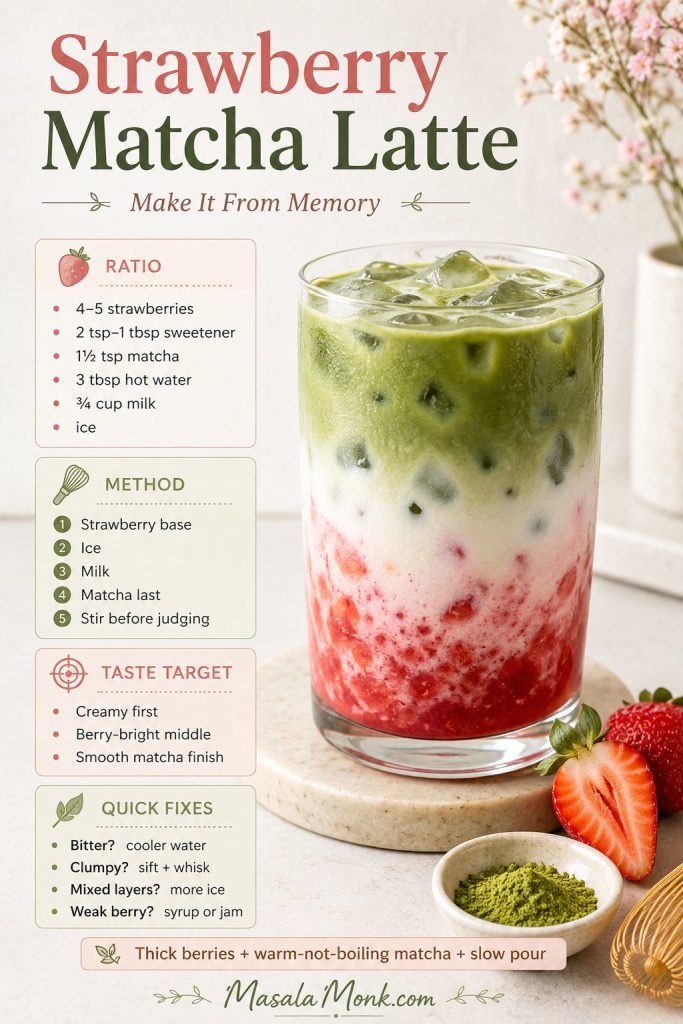
Saveable strawberry matcha latte recipe card with ratio, method order, taste target, quick fixes, and a layered drink.
This card turns the full recipe into a memory system: ratio, build order, flavor target, and the fixes that matter most.

FAQs

These quick answers cover the practical questions readers usually have once they start making the drink, from whisking matcha to using jam, oat milk, and make-ahead parts.
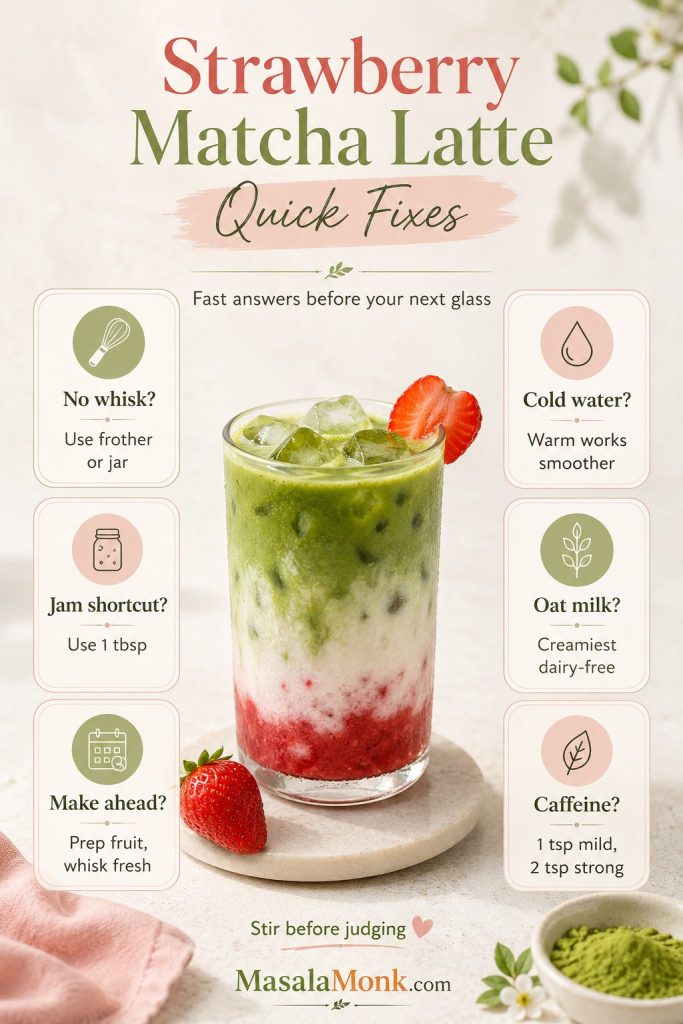
Quick fixes board for strawberry matcha latte with answers about whisking, warm water, jam, oat milk, make-ahead prep, and caffeine strength.
These quick answers help the next glass taste better, especially if you need a no-whisk method, jam shortcut, oat milk option, or caffeine adjustment.

Does strawberry taste good with matcha?

Strawberry works well with matcha because its sweet-tart flavor softens matcha’s grassy edge. Milk brings the two together, so the drink tastes fruity, creamy, and lightly earthy instead of sharp.

No bamboo whisk?

A bamboo whisk gives the best traditional texture, but a small whisk, handheld milk frother, blender, or shaker jar can also make glossy matcha. Sifting the powder first helps no matter which tool you use.

Cold water or warm water for matcha?

Cold water can work with a shaker or handheld frother, but warm water usually makes matcha easier to whisk smooth. For this recipe, a small amount of hot water gives the matcha a smoother texture before it hits the ice.

Fresh strawberries or jam?

Fresh berries or puree usually taste brighter and less sugary. Strawberry jam is the fastest shortcut. Use 1–2 tablespoons and blend or stir it with a little milk before adding the rest.

Why is my latte bitter?

The matcha may have been whisked with water that was too hot, or you may have used too much matcha for your taste. Use hot water around 175°F / 80°C, avoid boiling water, and start with 1 teaspoon matcha if you are new to the flavor.

Why did the colors mix together?

The glass probably needed more ice, a thicker strawberry mixture, or a slower pour. Add the strawberries first, fill the glass with ice, pour milk slowly over the ice, then pour matcha gently over the top.

Do I have to layer the drink?

No. The layered look is pretty, but the best flavor comes after stirring. Take the beautiful first look, then mix it so the strawberry, milk, and matcha land in the same sip.

If you want a fully blended matcha drink instead of an iced latte, these matcha smoothie recipes are a better fit.

Oat milk and vegan options

Oat milk works especially well because it is creamy enough to soften the matcha and naturally sweet enough to pair with strawberries. For a vegan version, use oat milk, almond milk, coconut milk, or another non-dairy milk, and sweeten the strawberries with sugar, maple syrup, or simple syrup instead of honey.

Is this the same as strawberry milk matcha?

Not exactly. A layered version keeps the strawberry at the bottom, milk in the middle, and matcha on top. Strawberry milk matcha blends the strawberry into the milk first, so the drink tastes creamier and more evenly fruity but looks less dramatic.

How strong is the caffeine?

The caffeine depends on the matcha powder and how much you use, but this is definitely a caffeinated latte. A 1-teaspoon version is gentler; a 2-teaspoon version tastes closer to the stronger café-style matcha people expect when they want the green tea to show up.

Make-ahead plan

Prepare the strawberry mixture or syrup ahead, but whisk the matcha and assemble the latte fresh. Once ice, milk, fruit, and matcha sit together, the colors fade and the texture turns watery.

How to double it

Double the strawberry mixture, milk, matcha, and sweetener, then build two glasses separately. If everything goes into one pitcher, the flavor will still be good, but the layered look will disappear.

Start with the fresh strawberry version first. Stir before judging, then adjust only one thing in the next glass: more berry, stronger matcha, oat milk, cold foam, or the jam shortcut on a busy day. Once the balance clicks, this becomes the kind of small café drink you can make from memory.


Back to top

Posted on 1 Comment

Natural Solutions for Erectile Dysfunction: Does Green Tea help in ED?

Close-up of male hands holding a glass cup of green tea, magazine-style portrait cover about green tea and erectile dysfunction.

When people type “green tea erectile dysfunction” into a search bar, they’re usually after two things: a straight answer and a practical plan. Fortunately, we can offer both. In brief, green tea isn’t a stand-alone cure for ED; nevertheless, it can support the underlying physiology that erections depend on—namely, vascular health and nitric-oxide signaling. As you’ll see, the science is strongest around blood-vessel function, and, when paired with sensible lifestyle steps, a consistent green-tea habit becomes a low-friction way to help the system that powers sexual performance.

Before anything else, it helps to remember what an erection actually is: a coordinated vascular event. Arteries must dilate on cue, endothelial cells need to produce nitric oxide in the moment, and smooth muscle has to relax so blood can enter and remain. Interestingly, green tea is rich in catechins (especially EGCG) that repeatedly show benefits for endothelial function—the same system. In fact, in a controlled study of smokers, two weeks of green tea increased flow-mediated dilation (FMD), a standard ultrasound measure of how well arteries expand; that improvement doesn’t prove a direct ED fix, yet it does strengthen the biologic plausibility behind green tea for ED as supportive care (green tea reversed endothelial dysfunction in smokers).

Does green tea help erectile dysfunction—or is that wishful thinking?

Put simply: yes, as vascular support; no, as a magic bullet. Mechanistically, catechins reduce oxidative stress, calm inflammatory signaling, and enhance eNOS activity to raise nitric-oxide availability. Crucially, those aren’t just test-tube effects. In tightly designed human studies, both acute and short-term green-tea intake improved FMD in groups with impaired endothelial function—again, the same pathway erections rely on (acute FMD improvement after green tea). Consequently, while no randomized trial shows green tea single-handedly “curing” ED, the physiologic alignment is real, relevant, and actionable.

Moreover, ED rarely has a single cause. Sleep debt, chronic stress, blood pressure, and metabolic health all push in either direction. Because of that, many readers pair daytime tea with evening routines that protect rest and dial down sympathetic overdrive. For complementary, lifestyle-friendly context you can integrate gently, see our on-site pieces like clove-infused tea for erectile dysfunction and the companion guide to enhancing intimacy with clove-infused massage. Those ideas don’t replace care; nevertheless, they often make a routine more human and sustainable.

Green tea for ED: where the signal is strongest—and where we should be cautious

First, the human vascular signal is consistent: brewed green tea improves FMD in settings of endothelial dysfunction, and that matters because endothelial health is upstream of erection quality. Second, preclinical data—for example, in diabetic or aged animals—often show EGCG preserving cavernosal smooth muscle and improving erectile physiology; informative, yes, though we should avoid over-extrapolating. Third, direct ED outcomes in humans after a green-tea intervention remain under-studied; hence, we position green tea as a supportive habit, not a replacement for guideline-based therapies.

Does green tea cause erectile dysfunction?

Short answer: there’s no evidence it does. If anything, broader caffeine research points the other way. In a large U.S. dataset, men consuming roughly 170–375 mg/day of caffeine had lower odds of prevalent ED than very-low consumers after adjusting for common confounders—an association, not proof, but reassuring nonetheless (NHANES analysis on caffeine and ED). Furthermore, more recent genetic work designed to probe causality has not supported a harmful link between habitual coffee/caffeine intake and ED risk. In other words, moderate caffeine—like what you’d get from a few cups of tea spread intelligently through the day—does not appear to be an ED villain.

Naturally, personal tolerance still matters. Overshooting your own caffeine ceiling can nudge anxiety up and sleep down; paradoxically, that will worsen performance for many people. Therefore, keeping most of your tea earlier in the day, then switching to calming, caffeine-free options in the evening, tends to balance the equation.

Matcha vs brewed tea in a green tea for erectile dysfunction routine

At first glance, the choice between matcha and brewed green tea seems cosmetic; however, it meaningfully changes catechin exposure. Because matcha is powdered whole leaf whisked into water, you ingest more of the plant per cup, often translating to higher catechin intake. That’s why some readers lean on matcha when focusing closely on green tea erectile dysfunction strategies. Nevertheless, matcha also delivers more caffeine per serving, which is terrific before a midday walk or workout but not ideal late at night.

Even so, there’s another wrinkle worth noting: several vascular studies that showed FMD improvements used brewed tea, not isolated EGCG capsules—suggesting the whole-tea matrix (minor polyphenols, L-theanine, and other constituents) may be important (overview of endothelial benefits with brewed tea). Consequently, there’s no need to chase megadoses or fancy extracts. A steady rhythm of well-brewed cups captures most of what you’re after.

Green tea in erectile dysfunction routine: timing, brewing, and iron-savvy habits

Adherence hinges on simplicity. Accordingly, try a routine that slides into ordinary life:

  • Morning: brew one cup with water around 75–85°C; steep 2–3 minutes, then taste and remove leaves. Use roughly 2 g tea leaves (about a teaspoon) per 250 ml cup. Because tea polyphenols can blunt non-heme iron absorption, drink your cup between meals, not with an iron-rich breakfast (classic research on tea and iron absorption).
  • Early afternoon: enjoy a second brewed cup—or whisk a small bowl of matcha—especially before a brisk walk or short resistance session. The slight stimulation often improves mood and training adherence, both of which indirectly benefit sexual health.
  • Evening: pivot to caffeine-free comfort so sleep can do its quiet work. For ideas that connect relaxation, scent, and touch (without stimulants), have a look at enhancing intimacy with clove-infused massage and the companion clove-infused tea piece. Both are gentle, sensory ways to reduce tension—the sort of context erections actually appreciate.

Just as importantly, build iron awareness into your habit. If you’re vegetarian, an endurance athlete, or someone with marginal ferritin, separate tea and main meals by an hour or two. When convenient, pair plant-based iron sources with vitamin C (think lemon over greens or a citrusy salad) to offset tea’s inhibitory effect. These small timing tweaks allow you to keep your green tea for ED routine without nudging iron status the wrong way.

Also Read: Iron Deficiency Anemia Symptoms: 15 Signs You Are Iron Deficient

Safety first: the nadolol interaction, plainly explained

Most people tolerate green tea well; still, one clinically documented interaction deserves a spotlight. In a carefully executed study, repeated green-tea intake caused an approximately 80% reduction in nadolol exposure, likely by inhibiting OATP1A2 transport in the gut—an effect that can blunt the drug’s blood-pressure benefits. If you take nadolol for hypertension or heart rhythm, don’t guess; speak with your clinician about tea timing and total intake to avoid under-treating your condition (green tea markedly lowers nadolol exposure). This is not theoretical; it’s been measured.

Beyond that, common-sense cautions apply: if caffeinated tea worsens reflux or sleep, dial the timing earlier; if you’re iron-deficient, prioritize recovery first, then re-introduce tea with smart spacing; and if you live with complex medical issues, a brief conversation with your care team is never wasted.

Green tea for erectile dysfunction meets the rest of your life: stacking gentle companions

Because ED is usually a multifactorial pattern rather than a single-switch problem, readers often stack tea with other low-risk, context-wise choices. We’ve written several practical, non-gimmicky pieces you can thread into your evenings or weekends:

  • For a warm, aromatic option that feels winter-friendly and ritual-rich, read our guide to clove-infused tea for erectile dysfunction.
  • To bring touch and presence back into the mix—without numbing creams or edgy supplements—try the step-by-step clove-infused massage for erectile dysfunction relief.
  • If you’re curious about botanicals with a longer cultural history, our roundup on saffron as an aphrodisiac explores dosing ranges used in research and, importantly, sets realistic expectations.
  • Meanwhile, for men who enjoy culinary-to-intimacy crossovers, the explainer on cardamom benefits for men connects circulation-leaning spices with daily habits in a balanced, non-hyped way.
  • And because sensual context matters as much as chemistry, our practical overview of best oils for erectile dysfunction (ED) translates scent, warmth, and massage into routines that couples actually keep—no unrealistic promises, just simple practices that lower friction and build momentum.

None of these are “musts.” Nevertheless, they make it easier to keep a routine going, which is usually what separates good intentions from tangible change.

Green tea erectile dysfunction: what about stamina, libido, and energy?

Here’s where nuance helps. People sometimes expect a single beverage to change stamina on contact. Realistically, indirect pathways matter more. Moderate caffeine can heighten alertness, smooth effort during workouts, and improve subjective energy—effects that compound across weeks into better mood, better fitness, and better blood-pressure control. Those are all upstream of better erections. At the same time, overshooting your personal tolerance invites a different story: racing thoughts, restless nights, and next-day irritability, none of which help. Thus, a smart green tea for ED pattern spreads cups earlier, keeps evenings quiet, and protects sleep as the ultimate performance enhancer.

Additionally, green tea’s L-theanine likely softens the feel of caffeine, producing a calmer focus than coffee for many people. That qualitative difference is hard to quantify in trials, but countless readers notice it. From a practical standpoint, if your mornings feel smoother on tea than coffee, lean into the thing you’ll actually sustain.

Brewing for benefits without getting precious

Although catechins deserve attention, brew method quietly decides whether you will enjoy your cup enough to drink it daily. Fortunately, you don’t need gadgets. Heat water just below a boil, aiming for 75–85°C; measure roughly 2 g of leaves per 250 ml cup; steep 2–3 minutes and taste. If you prefer matcha, whisk 1–2 g into hot (not boiling) water until lightly frothy, then sit for a moment—literally—before sipping. The brief pause isn’t fluff; slowing down cues your parasympathetic system, which blends seamlessly with the intimacy-supporting direction of everything else we’ve discussed.

As for timing, keep your iron guardrails in mind. Drinking tea between meals usually solves the absorption issue for most people, while a squeeze of lemon over greens or beans at lunch helps your body capture more plant-based iron despite tea’s polyphenols. With those small adjustments, your green tea erectile dysfunction routine becomes both safe and pleasantly habitual.

Bringing it all together—so you know exactly what to do next

Taken as a whole, the evidence points toward a grounded, hopeful conclusion: green tea supports the vascular foundation of erectile function, even though it does not—and should not be sold as—a cure for ED. Therefore, the smartest approach is both modest and consistent:

  1. Adopt a daily rhythm of 1–2 brewed cups earlier in the day; add a small matcha serving when you want an extra nudge.
  2. Brew well, not long: 75–85°C water, 2–3 minutes, then remove the leaves.
  3. Mind iron by separating tea from meals, especially if you’re vegetarian or have borderline ferritin.
  4. Protect sleep by switching to caffeine-free, sensory routines in the evening; for ideas that combine warmth, scent, and touch, explore clove-infused tea and clove-guided massage.
  5. Check medications, particularly nadolol, with your clinician so tea doesn’t undermine treatment (green tea–nadolol interaction explained).
  6. Give it weeks, not days; meanwhile, address the basics—movement, blood pressure, stress, and intimacy cues—because erections follow the health of your cardiovascular system.

Lastly, if you want to widen the lens without spinning into hype, our on-site resources round out the picture gracefully: browse the thoughtfully skeptical best oils for ED guide, skim the culinary-meets-intimacy angle in cardamom benefits for men, or, when you feel curious, dip into saffron as an aphrodisiac for a balanced take on a classic botanical. None of these pieces promise miracles; instead, they offer workable layers that play nicely with a daily green tea erectile dysfunction habit—precisely the sort of ecological approach that tends to produce steady, real-world gains.

FAQs

1) Does green tea help erectile dysfunction?

In brief, green tea can support erectile function by improving blood-vessel health and nitric-oxide availability; however, it isn’t a stand-alone ED cure. For most readers, making green tea for ED a steady habit works best alongside sleep, exercise, and medical advice when needed.

2) Is green tea good for ED on a daily basis?

On balance, yes—daily green tea for ED is reasonable. Moderate intake (2–3 cups earlier in the day) tends to aid vascular tone while keeping caffeine side effects in check.

3) Can green tea cause erectile dysfunction?

For clarity, there’s no solid evidence that green tea causes ED. Typically, moderate tea intake fits comfortably within a heart-healthy routine that supports erection pathways rather than harming them.

4) Does green tea make you last longer in bed?

In reality, no direct trials prove stamina benefits. Still, many find that better vascular function, improved mood, and consistent training—habits often paired with a green tea erectile dysfunction routine—can indirectly help performance.

5) Which tea is good for erectile dysfunction besides green tea?

Notably, some choose ginseng tea or pomegranate/hibiscus infusions as adjuncts. Even so, green tea for ED remains the most researched option for vascular support, so start there and layer others cautiously.

6) What’s the best way to brew green tea for ED benefits?

Importantly, use water around 75–85°C, steep 2–3 minutes, and taste before over-extracting. This preserves catechins while keeping bitterness low—making a green tea erectile dysfunction habit easier to sustain.

7) How much green tea should I drink for erectile function?

As a rule, 2–3 cups per day is a practical target. All told, consistency matters more than chasing high doses; let your body’s caffeine tolerance guide timing.

8) Is matcha better than regular green tea for ED?

By contrast, matcha often delivers more catechins per serving, which some people prefer for a focused matcha green tea erectile dysfunction plan. At the same time, matcha also contains more caffeine, so keep it earlier in the day.

9) Does green tea boost libido directly?

Ultimately, libido is multifactorial. Green tea for ED mainly supports circulation and may steady energy and mood; it doesn’t act as a classic aphrodisiac for everyone.

10) Can I drink green tea at night if I have ED?

For most, evening caffeine can disrupt sleep—an ED antagonist. Therefore, keep green tea erectile dysfunction cups earlier, and choose caffeine-free options later to protect recovery.

11) Will green tea interact with ED medications or heart drugs?

Crucially, green tea can reduce absorption of nadolol, a beta-blocker; discuss timing with your clinician. As needed, review all meds with a professional before locking in a green tea for ED routine.

12) Does green tea affect testosterone?

Meanwhile, typical intakes show no meaningful testosterone changes in healthy adults. The benefit of green tea for ED comes from vascular effects rather than hormone boosts.

13) Can green tea improve blood flow to help erections quickly?

Sometimes, yes—acute improvements in endothelial function have been observed after tea intake. Still, green tea erectile dysfunction routines work best over weeks, not hours.

14) What about side effects of green tea for ED?

Altogether, side effects are uncommon at moderate doses. That said, sensitive individuals may notice jitters, reflux, or sleep disruption; adjust timing—or choose lower-caffeine varieties—while keeping the green tea for ED plan intact.

15) Does tea reduce iron absorption and affect ED indirectly?

Indeed, polyphenols can inhibit non-heme iron absorption. To stay safe, drink green tea for ED between meals, particularly if you’re vegetarian or have low ferritin.

16) Is decaf green tea useful for erectile dysfunction?

Even without much caffeine, decaf green tea retains many catechins. Consequently, it can still complement a green tea erectile dysfunction approach—especially for evening cups.

17) How long until I notice benefits from a green tea ED routine?

Typically, readers report subtle changes within a few weeks as overall cardiovascular habits improve. Nevertheless, persistent ED warrants medical evaluation—tea is a helper, not a replacement.

18) Can I combine green tea for ED with exercise and weight management?

Absolutely. In practice, green tea erectile dysfunction strategies pair well with brisk walks, resistance training, and blood-pressure control—each reinforcing the others for better outcomes.

19) Are there specific foods to pair or avoid with green tea for ED?

Preferably, separate tea from iron-rich meals by an hour or two. Conversely, pair plant-based iron with vitamin C at mealtimes, then enjoy green tea for ED mid-morning or mid-afternoon.

20) What if anxiety contributes to my ED—will green tea help?

At times, yes: many find tea’s gentler caffeine-theanine profile less jangly than coffee. However, if anxiety remains high, shift green tea erectile dysfunction cups earlier and emphasize relaxation practices at night.

21) Is “tea for ED” different from “green tea for ED”?

Functionally, tea for ED is a broad phrase; nonetheless, green tea for ED is specific to catechin-rich Camellia sinensis. Start there, then evaluate other teas as supportive extras, not substitutes.

22) Can green tea improve morning erections?

Possibly, over time. As cardiovascular health settles, some notice stronger green tea and erection patterns in the morning. Even so, individual responses vary; keep expectations realistic.

23) Will switching from coffee to green tea help my ED?

Often, yes. Some feel steadier energy and better sleep quality after switching, which indirectly benefits erections. Try replacing one coffee with green tea for ED first, then reassess.

24) Is there a best time to drink green tea for ED results?

Preferably, earlier in the day—morning and early afternoon—so you gain vascular support without disturbing sleep. That timing keeps a green tea erectile dysfunction plan sustainable.

25) Should I choose loose-leaf or tea bags for ED support?

Either works if quality is high. Nevertheless, loose-leaf often tastes better and encourages proper brewing—making a green tea for ED habit easier to maintain day after day.

Posted on 2 Comments

 Is Energy drink Gatorade Worth the Hype?

Female athlete in a locker room holding a Gatorade bottle — is Gatorade an energy drink? Hydration, caffeine and real use-cases cover image.

You’ve probably stood in front of a cooler, glanced at the neon bottles, and wondered—is Gatorade an energy drink or something else entirely? On busy training days, the difference matters. Classic Gatorade is formulated as a sports drink: it helps replace fluids and electrolytes while supplying quick carbohydrates during longer or sweatier efforts. Energy drinks, by contrast, exist to stimulate with caffeine (often alongside other actives). That may sound like a small distinction, yet in practice it changes when each beverage makes sense, how your body responds, and what outcomes you can expect over a season.

To set the stage, consider purpose. A sports drink supports hydration under load; an energy drink boosts alertness through central nervous system stimulation. Although both can coexist in an athlete’s toolkit, they solve different problems. Consequently, your choice should follow your training context, not the color of the bottle or the marketing vibe.

Also Read: Electrolyte Drinks for Hangovers: 5 Easy DIY Recipes to Rehydrate Fast


Is Gatorade an Energy Drink—or a Sports Drink?

At its core, the flagship Gatorade Thirst Quencher line is built for performance hydration. The brand’s pages describe formulations centered on sodium, potassium, and carbohydrate to help maintain fluid balance and supply fuel when sweat losses climb (see the concise Gatorade product overview). Meanwhile, energy drinks are typically framed around measurable caffeine doses—commonly 80–200 mg per serving—to raise alertness quickly. In other words, one is designed to keep you going when conditions are tough; the other is designed to perk you up when you’re dragging.

Nevertheless, brands evolve. Under the same umbrella, Gatorade Fast Twitch exists as a clearly caffeinated option, positioned for pre-workout or competitive sharpness (here’s the Fast Twitch product page). So while the family includes something that acts like an energy drink, the classic bottle that most of us associate with sidelines and tournaments remains a sports drink first and foremost.

From a lifestyle perspective, it helps to remember public-health basics as well. For day-to-day hydration outside training, water is usually enough, a point repeatedly emphasized in the CDC’s water & healthier drinks guidance. However, as workouts lengthen, heat and humidity rise, or sweat becomes copious, a carbohydrate-electrolyte solution can play a useful role.

Also Read: Is Coffee or Caffeine Bad for GERD?


Does Gatorade Have Caffeine?

Here’s where confusion starts. Classic Gatorade (Thirst Quencher) contains 0 mg caffeine across flavors and formats; you can verify this on PepsiCo Product Facts for representative SKUs (for instance, Cool Blue shows “Caffeine: 0 mg”). So the common bottle you see in coolers is not a stimulant beverage.

By contrast, Gatorade Fast Twitch delivers 200 mg caffeine per 12 oz, a dose that clearly places it in energy-drink territory regarding stimulation. It’s also zero sugar and includes B-vitamins; even so, caffeine tolerance varies widely, so timing and dose deserve attention. Early-morning sessions, back-to-back matches, or long drives to tournaments might be scenarios where that edge helps; late-evening training or recovery days probably aren’t.

Also Read: Pedialyte and Electrolytes for Diarrhea


Does Gatorade “Give You Energy”?

Carb-Based Fuel vs Stimulant Energy

Language trips us up here. In everyday conversation, “energy” can mean pep, buzz, or motivation. Physiologically, however, energy for your working muscles comes from carbohydrate, fat, and (to a lesser extent) protein. Classic Gatorade provides carbohydrates, so it can absolutely fuel efforts that extend in duration or intensity. That said, it isn’t meant to produce a nervous-system jolt—that’s caffeine’s job. Accordingly, separate these ideas: fuel supports muscular work; stimulation sharpens alertness.

When Carbohydrate-Electrolyte Drinks Make Sense

As a practical rule, if your session is short and light—say, a brisk 30-minute jog—water is ideal. If workouts stretch beyond ~60 minutes, conditions are hot/humid, or you notice heavy sweating, a carbohydrate-electrolyte solution can help you maintain pace and reduce late-session drop-off. For those who like to read the underlying framework, the ACSM’s fluid replacement position stand (summary PDF) lays out athlete-oriented rationale without drowning you in jargon.

When a Caffeinated Option Fits (and When It Doesn’t)

Occasionally, alertness is your bottleneck. Perhaps a dawn strength block, a tournament double-header, or a long drive after an event leaves you a bit foggy. In those cases, caffeine can be strategic. Still, 200 mg—the Fast Twitch dose—is substantial for many people. It can improve vigilance, yet it may also undermine sleep or aggravate jitters if mistimed. If you do experiment, consider lower total daily caffeine, keep doses earlier in the day, and pay attention to how your heart rate, sleep quality, and mood respond.

Also Read: Boosting Hydration: The Key Benefits of Drinking More Water


Gatorade vs Energy Drinks: What Actually Differs?

Ingredients & Intent

Sports drinks lean into electrolytes (especially sodium) and carbohydrate to support hydration and performance during extended, sweaty sessions. Energy drinks, on the other hand, center on caffeine (sometimes alongside taurine, guarana, or other actives) to elevate alertness. Consequently, the smartest way to choose is to look at the label: caffeine content, sugar amount, and serving size tell you what job a drink is built to do. For everyday choices outside sport, the CDC’s “Rethink Your Drink” explainer is a simple anchor—water first most of the time, with beverages that fit your context layered on top.

Use-Cases & Timing

In practice, choose a sports drink during 90-minute trainings, tournament days, long runs, or sweltering practices—especially when you can feel salt on your skin or see sweat lines on clothing. Choose an energy drink only if alertness is the limiting factor, and only when you can control caffeine timing so it doesn’t collide with sleep or recovery. During sessions, small, regular sips generally beat infrequent gulps; after, continue with water and a balanced meal so you restore total fluid, electrolytes, and glycogen.

Sugar, Sweeteners, and Preference

Another real-world variable is sweetness. Some athletes prefer the classic sugar-containing profile in the thick of training because it’s both fuel and flavor—a nudge to keep drinking. Others want lower-calorie options for lighter sessions. If you’re in the latter group, you can look at Gatorade Zero on the official site for a no-sugar electrolyte approach (Gatorade Official Site). Meanwhile, if you’d rather keep control in your own kitchen, you can tailor ingredients with our DIY electrolyte roundup—useful when you want a gentler flavor or need to adjust sodium to your sweat rate.

Also Read: Refresh and Recharge: DIY Non-Caffeinated Energy Drinks for Productive Afternoons


Is Gatorade Good for Acid Reflux or Heartburn?

Acidity Considerations

Many sports drinks are acidic and frequently contain citric acid. For some people living with GERD, acidic drinks can aggravate symptoms; caffeinated beverages can be problematic as well. None of this means you must avoid sports drinks entirely, yet it does suggest a more mindful approach. Sip slowly rather than chugging, avoid drinking on an empty stomach if that reliably triggers discomfort, and observe patterns in your own response. For accessible medical context, the American College of Gastroenterology’s GERD page is a helpful primer.

Gentler Hydration Ideas (Practical, Tasty, Flexible)

If you’re reflux-prone, you might favor lower-acid options on easier days. Coconut water offers a naturally potassium-rich profile and a softer mouthfeel; our ultimate guide to coconut water covers benefits, nutrition, and picking a quality brand. Prefer a more precise approach? Build your own drink at home and control the acidity from the start. Try the DIY electrolyte roundup for straightforward base formulas, then pivot to cooling cucumber electrolyte quenchers when you want ultra-light, hot-weather refreshment. Additionally, if you’re experimenting with lower-sugar blocks for specific training phases, these fasting-friendly electrolyte templates make it easy to match sodium and fluid without overshooting carbs on rest days.


When to Choose Gatorade vs Water

On ordinary days—commutes, desk work, errands—water is the effortless baseline. It’s inexpensive, accessible, and aligned with the CDC’s hydration basics. Yet once your training crosses certain thresholds, a sports drink earns its place. Consider the combination of duration, intensity, environment, and sweat rate. If you’re tackling a two-hour football practice in peak summer, a long tempo run in sticky humidity, or a day-long tournament with limited recovery windows, the trio of fluid + electrolytes + carbohydrate becomes practical rather than optional.

Furthermore, think seasonally. Early in a training cycle, you may be recalibrating to heat, and sweat sodium concentration can vary among individuals. Some athletes notice salt crystals on the skin or brine-like sweat taste; others don’t. Tuning the sodium you drink to how you actually sweat is more impactful than defaulting to “one size fits all.” If you prefer to fine-tune with food you already love, try layering post-workout electrolyte recipes from your pantry staples—our post-workout electrolyte recipes collection offers flexible blueprints that you can scale up for tournament weeks.

Moreover, hydration isn’t just about what you drink during a session. What you do before and after matters. Arrive at practice well-hydrated, sip early and regularly through the session, and continue with water afterward as you eat a proper meal. Over time, those simple rhythms beat last-minute fixes every single time.

Also Read: Benefits of Lemon and Lime Water: Refreshing Hydration with a Citrus Twist


Is Gatorade an Energy Drink—Yes, No, or “It Depends”?

The Everyday Bottle vs the Caffeinated Outlier

It’s tempting to want a binary answer, but the reality is slightly nuanced. Classic Gatorade is not an energy drink; it’s a sports drink with 0 mg caffeine (again, the PepsiCo Product Facts listing for Cool Blue is a simple verification point). That’s the bottle you’ll see most often on sidelines. Fast Twitch, however, is a caffeinated product under the same brand family; at 200 mg per 12 oz, it behaves like a typical high-caffeine energy drink (see Fast Twitch here). Both can be useful, provided you pick the right one for the job.

Choosing Based on the Job You Need Done

Ask yourself: What problem am I solving today? If you need hydration + electrolytes + carbs to maintain effort in heat, the classic sports drink makes sense. If you need alertness, and you can time caffeine without compromising sleep or recovery, a caffeinated option may be appropriate. Conversely, if it’s a short, light session, water is still the simplest, cleanest answer. When you match beverage to job, you’ll feel it in the quality of your training, not just on the scale or in the mirror.

Personalization Without the Hype

Finally, remember you’re not a lab rat; you’re a person with preferences, constraints, and a life outside training. If a particular flavor encourages you to drink enough during a punishing match in June, that’s valuable. If your stomach is happier with a lower-acid mix you blend at home, that’s equally valid. Our readers often start with a base from the DIY electrolyte roundup, then tweak sodium and carb levels to fit their sessions. Others rely on coconut water because it feels gentler on the gut (learn how to choose a good one in the coconut water guide). The point isn’t perfection; it’s fit-for-purpose.


The Bottom Line

If you’re asking is Gatorade an energy drink, the straightforward answer for the everyday bottle is no—it’s a sports drink made to hydrate and fuel through carbohydrates, with 0 mg caffeine. That said, the brand family also includes Fast Twitch, a caffeinated product that functions more like an energy drink at 200 mg per 12 oz. Choose based on the job at hand: water for short and light, sports drink for long and sweaty, and caffeine strategically (and sparingly) when alertness is the true limiter. Along the way, listen to your body, respect your stomach, and keep options you actually enjoy—whether that’s a classic bottle, a no-sugar electrolyte like Gatorade Zero, or a home-mixed solution from our post-workout electrolyte recipes.

Because in training—as in life—consistency beats drama. Hydrate on purpose, and your performance follows.


FAQs

1) Is Gatorade an energy drink?

In short, no. It’s primarily a sports drink designed for hydration and carbohydrate replacement during longer or sweat-heavy activity.

2) Is Gatorade an energy drink—yes or no?

Yes-or-no version: No. Classic Gatorade is a sports drink, not an energy drink, because it doesn’t rely on caffeine for stimulation.

3) Is Gatorade considered an energy drink by athletes?

Strictly speaking, it isn’t. Athletes use it for electrolytes and quick carbs, while energy drinks are chosen for caffeine-driven alertness.

4) Does Gatorade have caffeine?

Generally, classic Gatorade contains 0 mg of caffeine. A separate product line with caffeine exists, but the regular bottle on sidelines is caffeine-free.

5) Does Gatorade give you energy?

Functionally, it provides carbohydrate fuel, which your muscles can use during extended efforts. That’s different from the “buzz” you get from caffeine.

6) Is Gatorade good for energy before a workout?

For short or easy sessions, water typically suffices. For longer, hotter, or more intense workouts, Gatorade’s carbs and electrolytes can help maintain pace.

7) Gatorade vs energy drinks: which is better for training?

It depends on the goal. Choose Gatorade when hydration and electrolytes matter most; choose a caffeinated beverage only when alertness is the limiter.

8) Is Gatorade good for acid reflux or heartburn?

Sometimes it can aggravate symptoms due to acidity; sensitivity varies. If you’re reflux-prone, sip slowly, avoid chugging, and assess personal tolerance.

9) Is Gatorade a good “energy drink” alternative?

Indeed, for sport-specific needs, yes. It supports hydration and fueling without caffeine, which many people prefer during long practices or matches.

10) Is Gatorade an energy drink for everyday use?

Day to day, water is usually the best choice. Reserve Gatorade for workouts, hot conditions, tournaments, or heavy-sweat scenarios.

11) What are Gatorade “energy drink” benefits people talk about?

Chiefly: fluid replacement, electrolytes (notably sodium), and quick carbs to reduce late-session fade during sustained efforts.

12) Is Gatorade Zero an energy drink?

Not at all. It’s a zero-sugar sports drink variant intended for hydration without carbohydrate calories; it still isn’t a caffeine product.

13) Can Gatorade help with cramps?

Potentially, when cramps are related to heavy sweating and electrolyte losses. Nonetheless, total hydration, training status, and pacing also matter.

14) Is Gatorade better than water for a 30-minute workout?

Typically, no. For short, light activity, water is sufficient. Gatorade shines when duration, heat, or sweat rate increase.

15) Is Gatorade an energy drink for students or office days?

Ordinarily, no—there’s no need for sports-drink carbs at a desk. If you’re not sweating or exercising, choose water most of the time.

16) Is Gatorade an energy drink in India?

Designation doesn’t change by country. It remains a sports drink; flavors and availability vary by region.

17) Does Gatorade help with endurance events?

Yes, during marathons, football tournaments, or long rides, the combination of fluid, electrolytes, and carbs can support sustained output.

18) Is Gatorade a good choice if I’m watching sugar?

Sometimes. Consider serving size and timing relative to training. For lighter days, choose lower-sugar hydration or zero-sugar variants.

19) Is Gatorade an energy drink for weight loss?

That’s not its purpose. It’s built for performance hydration. For weight management, prioritize overall diet, activity, and total calorie balance.

20) Can kids use Gatorade during sports?

When practices are long or in hot weather, a sports drink can be appropriate. Otherwise, water remains the default for routine play.

21) Is Gatorade an energy drink review—what’s the verdict?

As a sports drink, it performs as intended: hydration + electrolytes + carbs. As an “energy drink,” the classic version isn’t meant to stimulate.

22) When is Gatorade not necessary?

Short, low-intensity sessions; cool environments; minimal sweating; or non-training contexts—water covers those situations well.

23) Is Gatorade an energy drink compared to pre-workouts?

Pre-workouts focus on stimulants (caffeine) and sometimes other actives. Gatorade focuses on hydration and fueling; they serve different roles.

24) Can Gatorade upset the stomach?

Occasionally, yes—especially if chugged quickly, consumed on an empty stomach, or if you’re sensitive to acidity. Trial strategies and adjust.

Posted on 5 Comments

Hemorrhoids High Fiber Diet: Best Foods, What to Avoid, and a 7-Day Plan

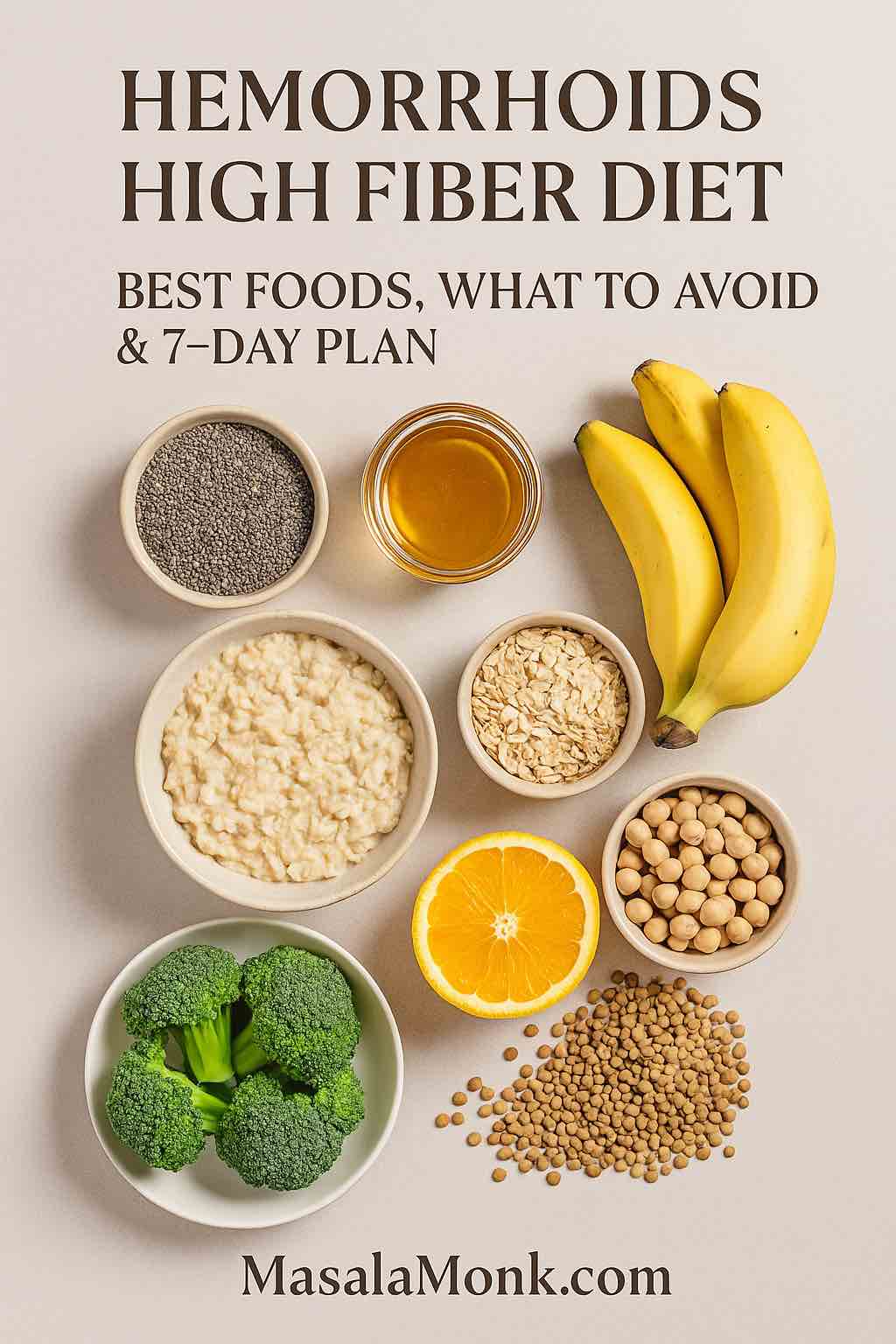
Hemorrhoids high fiber diet cover with chia, oats, oatmeal, banana, orange, broccoli, chickpeas and lentils—best foods, what to avoid & 7-day plan.

A hemorrhoids high fiber diet is the most dependable way to soften stools, reduce straining, and calm flare-ups. When you shape everyday meals around fruits, vegetables, whole grains, legumes, nuts, and seeds—and when you steadily sip fluids—bowel movements typically become easier and less painful. Moreover, small bathroom-habit tweaks make a surprisingly big difference: keep toilet time brief, avoid straining, and respond to the urge promptly. For the medical basics behind this approach, see the NIDDK’s guidance on eating, diet, and nutrition for hemorrhoids and the ASCRS patient page.

In short, diet and simple habits are your foundation. Everything else—creams, cushions, even procedures—usually works better once your food, fiber, and fluids are dialed in.


Why fiber (and water) matter in a hemorrhoids high fiber diet

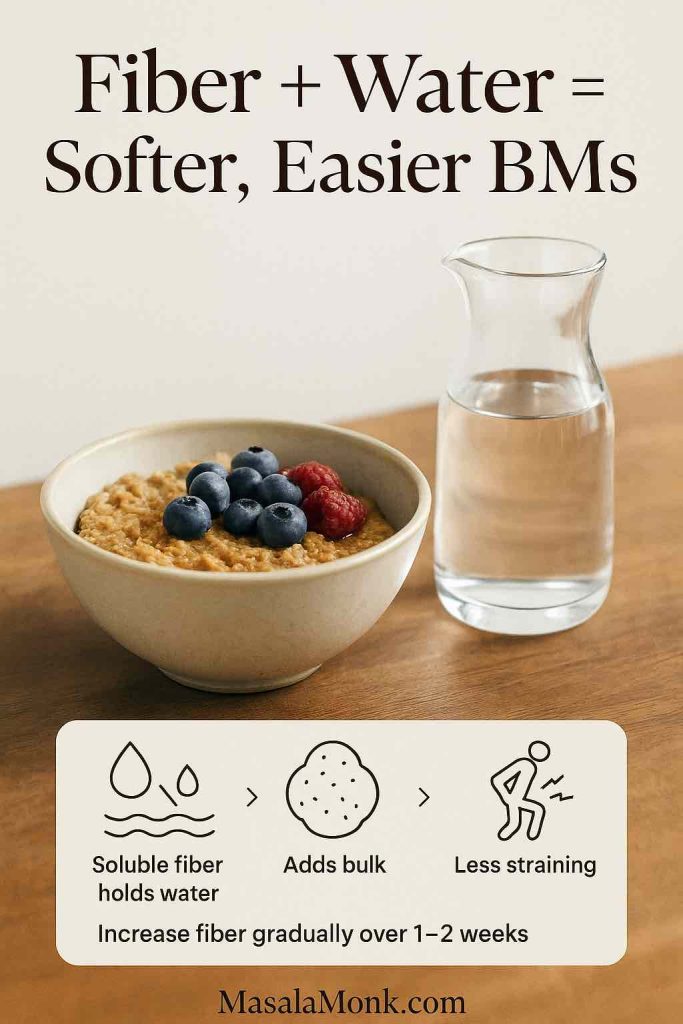
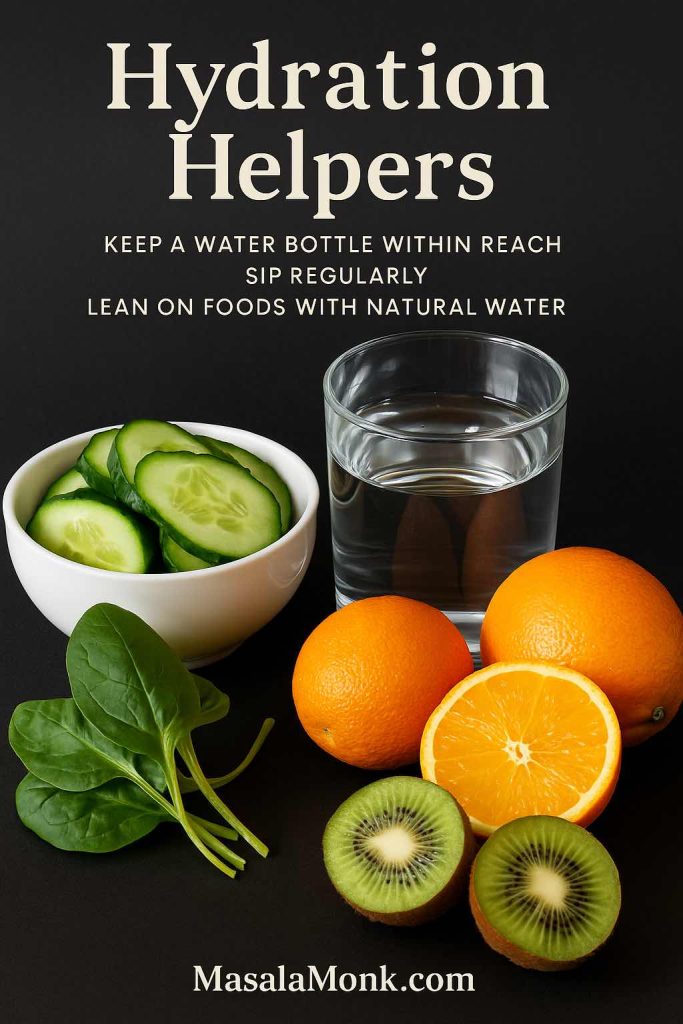
To put it plainly, fiber pulls water into stool and adds bulk; as a result, stool moves with less scraping and fewer long pushes. Additionally, water helps that fiber function smoothly; without enough fluid, even a “high-fiber” plate can feel sluggish. Therefore, keep a water bottle within reach, sip regularly, and lean on foods with natural water—citrus, cucumbers, leafy greens, soups, and stews. Finally, increase fiber gradually over a week or two so your gut adapts without gas and bloating. If you’d like an authoritative refresher, review NIDDK’s diet guidance and the Mayo Clinics’ Food Sources of Fiber list.

Explainer for a hemorrhoids high fiber diet showing how fiber and water soften stool and reduce straining.
A high fiber diet and hemorrhoids relief go together: fiber holds water → softer stool → less straining. Start low, go slow, and hydrate.

Bottom line: fiber makes stool softer and easier to pass; fluids make fiber work

Also Read: Significance of Fiber in Diet: Understanding Its Health Benefits


How much fiber is “enough,” and how fast should you increase it?

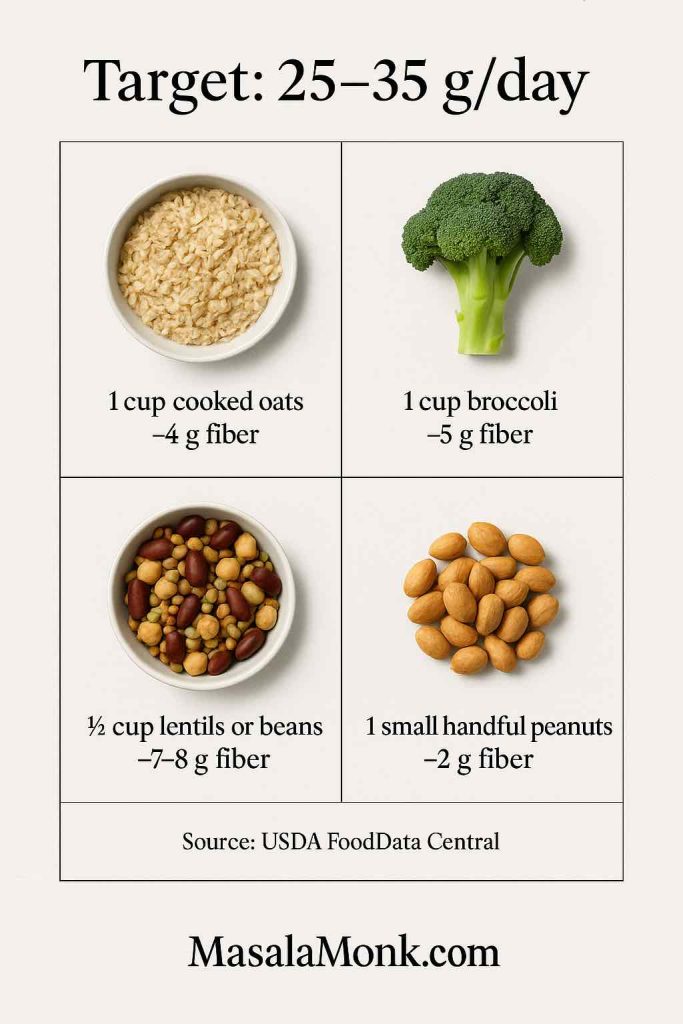
Typically, the sweet spot is 25–35 grams of fiber per day, which aligns with common surgical-society guidance (see ASCRS). However, your gut comfort matters as much as the number. Consequently, start where you are and move up in small steps—say, an extra 5 grams every few days—while drinking enough fluid. Furthermore, consider splitting fiber evenly across meals and snacks; distributing intake helps your gut adapt and keeps stools consistently soft.

High fiber foods for hemorrhoids with portions: oats, broccoli, lentils/beans, peanuts—daily 25–35 g fiber target.
Easy fiber rich foods for hemorrhoids: oats (~4 g/cup cooked), broccoli (~5 g/cup), lentils/beans (~7–8 g/½ cup), peanuts (~2 g/handful).

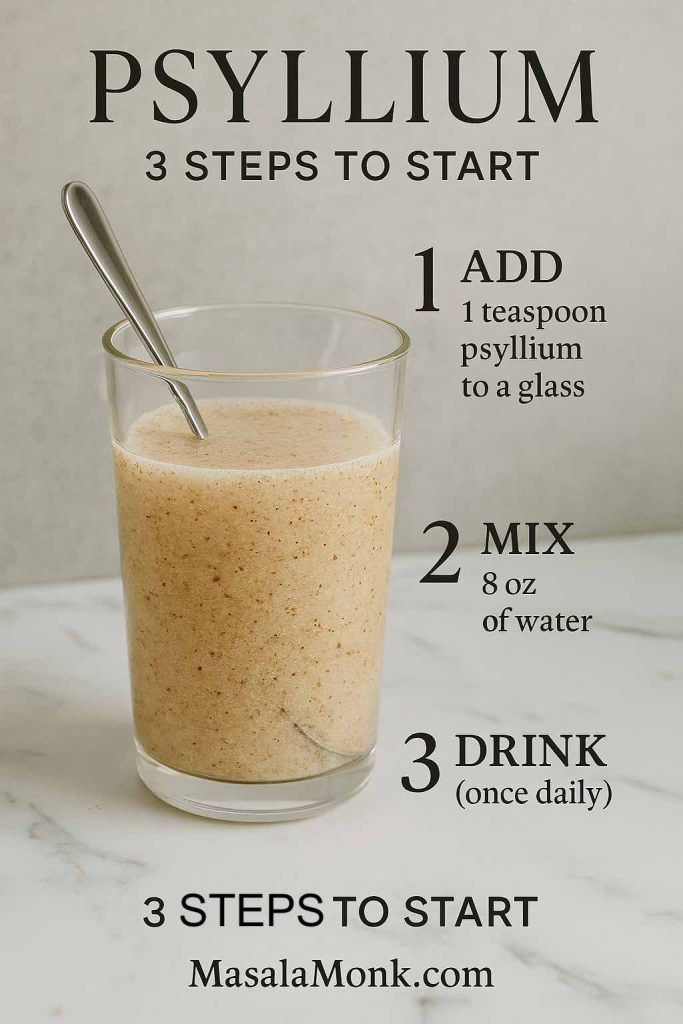
If you want to “top up” intake, a teaspoon of psyllium mixed in water (once daily to start) is a gentle way to close the gap. Notably, randomized trials and a Cochrane review show that adding fiber reduces persistent symptoms and improves bleeding over several weeks; a meta-analysis indexed on PubMed reports similar benefits.


High-fiber foods for hemorrhoids (piles)

To build a hemorrhoids high fiber diet, stack your plate with three dependable pillars, then season and swap to taste.

1) Whole grains and legumes

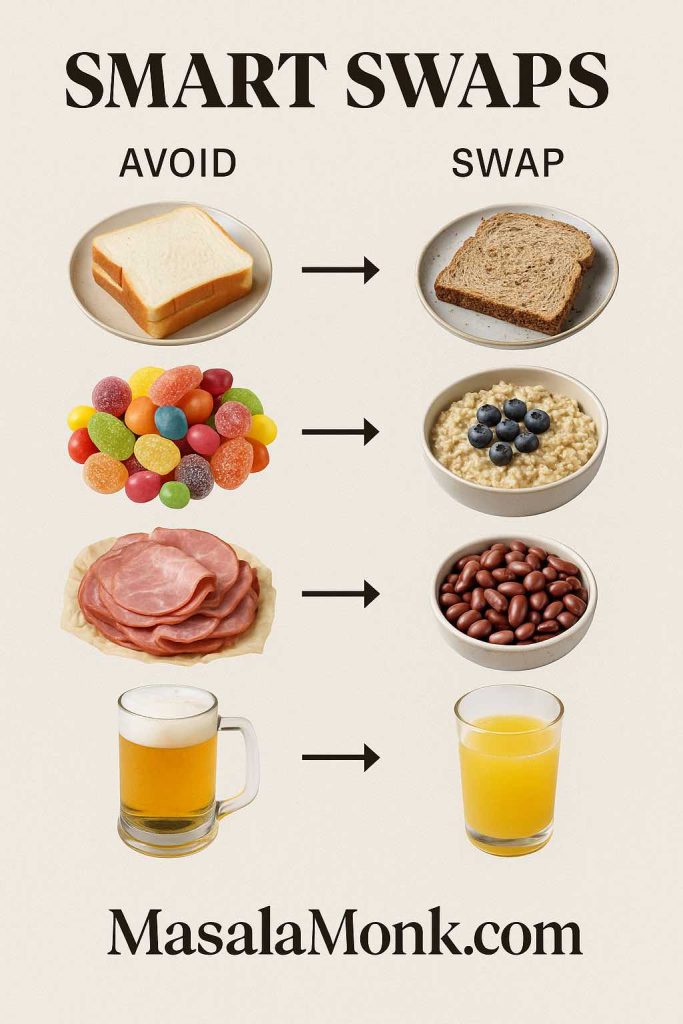
Oats, barley, brown rice, whole-wheat roti/wraps, lentils, chickpeas, kidney beans, split peas, and black beans are your “anchors.” As a guide, ½ cup cooked lentils/beans adds ~7–8 g of fiber; 1 cup cooked barley ~6 g; 1 cup cooked oats ~4 g. Mix and match: oats at breakfast, beans at lunch, barley or brown rice at dinner. For an easy bake to keep around, try Oatmeal Bread (great with soups and salads).

2) Vegetables and fruits

Aim to fill half your plate with plants. Notably, broccoli, green beans, carrots, squash, sweet potato, and leafy greens bring both fiber and water. Meanwhile, pears, apples (skin on), berries, oranges, kiwis, and prunes add gentle sweetness and regularity. For soothing sides, see Spinach (Palak) Raita; for heat-free options, skim these no-cook cucumber raita ideas.

3) Nuts and seeds

Small portions, big payoff. Two tablespoons of chia deliver ~8–10 g of fiber; one tablespoon of ground flaxseed adds ~2 g; a small handful of peanuts or roasted chana contributes ~2–3 g. Sprinkle seeds into curd or oats, or stir them into smoothies and batters. For breakfast inspiration, rotate Chia Pudding (almond milk) and this round-up of 10 creative chia puddings. For a flavorful snack bowl, try Vegan Som Tam Salad Recipe | Raw Papaya Salad.

If you like precise numbers for labels and meal planning, double-check portions in USDA FoodData Central.

In practice: aim for one fiber “anchor” each meal (for example, oats → beans → barley), then add two to three produce servings across the day. Gradually, you’ll settle into that comfortable 25–35 g/day range.

Also Read: Fiber in Food


Foods to avoid (and smart swaps)—including “bleeding hemorrhoids foods to avoid”

There isn’t a single villain food. However, low-fiber patterns and dehydration make stools firmer—and that’s the real problem. Consequently, it helps to dial down:

Hemorrhoids foods to eat and avoid—swap white bread, candy, processed meats, and alcohol for whole grains, oatmeal, beans, and pulp-rich drinks.
Patterns beat perfection: these swaps reduce “fiber 5 foods to avoid with hemorrhoids” issues and keep stools soft.
  • Ultra-processed, low-fiber meals (white breads, refined snacks, fast food).
    Swap: whole-grain breads/wraps, oats, barley, or brown rice—then double the veg side.
  • Excess alcohol or heavy caffeine (can dehydrate some people).
    Swap: water, diluted juices, clear soups, herbal teas, and fruit with pulp.
  • Very spicy foods (if they irritate you).
    Swap: milder spice blends and cooling sides like curd/raita while you recover.

Therefore, aim for pattern over perfection. Nudge lunches and dinners toward whole grains and plants, and relief usually follows. For fundamentals, revisit NIDDK’s eating & hydration tips.

“Fiber 5” foods to avoid with hemorrhoids (quick hit):

  1. White breads and crackers;
  2. Low-fiber desserts and candies;
  3. Processed meats-heavy meals without veg;
  4. Large portions of cheese or cream-heavy dishes (if they constipate you);
  5. Alcohol binges.

    These don’t “cause” hemorrhoids, but they can stall a hemorrhoids high fiber diet and firm up stools when you least want it.

Common food questions (bananas, curd/yogurt, chicken, cucumber, milk, juices)

Because searchers ask these constantly, here are fast, practical answers:

  • Banana and hemorrhoids/piles: generally gentle and helpful; include it within the daily fiber target.
  • Curd/yogurt and piles: soothing for many; add ground flaxseed or chopped fruit to keep fiber front and center.
  • Chicken and hemorrhoids: lean protein is fine—just balance the plate with vegetables and whole grains so fiber still leads.
  • Cucumber and piles: hydrating and cooling, especially useful as a raita or salad component.
  • Milk is good for piles? It depends. If dairy constipates you, limit it or switch to smaller servings and add fiber-rich sides. If it suits you, pair milk/curd with oats, chia, or fruit to keep the overall meal fiber-forward.
  • Best fruit/juice for hemorrhoids: pears, apples (skin on), berries, oranges with pulp, kiwis, and small prune portions. Prefer pulp-rich juices or smoothies; pair any juice with whole foods so total fiber stays high.
Water-rich foods—cucumber, oranges, kiwis—plus a glass of water to support a fiber diet for hemorrhoids.
Fluids make fiber work. Pair fiber and hemorrhoids strategies with steady sipping and water-rich foods—great for foods to eat with hemorrhoids.

Liquid diet for hemorrhoids—when (and when not) to use it

Occasionally, during severe pain or immediately after a procedure, clinicians suggest briefly using liquids and very soft foods. Nevertheless, this is a short-term comfort strategy, not a cure. As symptoms ease, transition back to a hemorrhoids high fiber diet—soft high-fiber meals (khichdi-style rice + lentils, vegetable soups with barley, oats with fruit, raitas) plus fluids. For step-by-step self-care that often accompanies these phases, see Mayo Clinic’s hemorrhoids page.


Fiber supplements for hemorrhoids: what actually helps

Food first, supplements second. If you still fall short, psyllium is a reliable first choice; methylcellulose or wheat dextrin can also help. Start low, go slow, and always pair with water. Notably, randomized trials and a Cochrane review show that adding fiber reduces persistent symptoms and improves bleeding over several weeks; a meta-analysis on PubMed reaches similar conclusions. Practically, many people do well with 1 tsp psyllium daily to “top up” what they’re eating.

Glass of psyllium mixed with water—hemorrhoids dietary supplement and fiber supplements for piles guide.
Best-supported hemorrhoids dietary supplement: start ~1 tsp psyllium, mix with water, drink another glass after. Food first; supplements top up.

Also Read: Psyllium Husk (Isabgol/Ispaghula) Side Effects: Risks, Benefits & How to Take It Safely


Relief add-ons: icing, petroleum jelly, seating, and “hemorrhoid donuts”

Diet does the heavy lifting, but a few comfort measures can make each day easier:

  • Warm sitz baths for 10–15 minutes, two or three times daily, often reduce pain and itching. See the routine on Mayo Clinic’s hemorrhoids page.
  • Brief icing or cool packs can ease swelling—use a thin cloth barrier and keep sessions short.
  • A thin layer of petroleum jelly can protect irritated skin during bowel movements; it’s an adjunct, not a cure. You’ll see this suggestion across many clinician handouts.
  • Seating choices: soft seats help. However, limit long sessions on donut cushions because they can redistribute pressure in unhelpful ways. Instead, take frequent standing and walking breaks. (This balanced stance reflects many colorectal clinics’ practical advice.)
How to use petroleum jelly on hemorrhoids and brief icing for swelling—thin layer before BM, ice 10–15 minutes with cloth barrier.
Petroleum jelly can reduce friction during BMs; icing 10–15 minutes (with a cloth barrier) helps swelling. Adjuncts—not cures—alongside a hemorrhoids high fiber diet.
Hemorrhoid donut cushion with guidance to use briefly and take walking breaks to avoid pressure build-up.
Donut cushions can feel good short-term—use briefly and take walking breaks; long sits may redistribute pressure.

Hemorrhoids Diet Plan: 7-Day Menu (≈28–35 g/day)

To begin, treat this as a flexible scaffold for a hemorrhoids high fiber diet. Additionally, sip fluids consistently, avoid straining, and limit toilet time to 1–2 minutes. Finally, adjust portions to your appetite and add a fiber “plug” (beans, fruit, or chia) to any meal that needs a boost.

Day 1

  • Breakfast: Masala oats with mixed vegetables; add a kiwi for extra fiber.
  • Lunch: Brown rice with kidney beans and a crisp salad; squeeze lemon for brightness.
  • Snack: Chia pudding (2 tablespoons chia); keep sipping water.
  • Dinner: Grilled chicken or paneer, sautéed broccoli and carrots, plus a whole-grain wrap.

Day 2

  • Breakfast: Curd parfait with chia and an apple; stir in ground flaxseed.
  • Lunch: Whole-grain flatbread with lentil stew and salad; keep fluids up.
  • Snack: Roasted chickpeas with lemon; add a small orange.
  • Dinner: Rice-and-lentil “khichdi-style” bowl with a cooling spinach raita.

Day 3

  • Breakfast: Vegetable upma and orange segments; sip warm water.
  • Lunch: Whole-wheat roti with chickpea curry and mixed vegetables; add cucumber for hydration.
  • Snack: Five prunes plus a few nuts.
  • Dinner: Barley “risotto” or quinoa pilaf with sautéed green beans.

Day 4

  • Breakfast: Two slices of Oatmeal Bread with cucumber raita; add a small fruit.
  • Lunch: Brown rice and vegetable sambar with a side salad.
  • Snack: Curd with 1 tablespoon ground flaxseed.
  • Dinner: Tofu or paneer stir-fry, leafy greens, and whole-grain roti.

Day 5

  • Breakfast: Poha with peas and papaya; keep portions moderate yet fiber-rich.
  • Lunch: Millet or whole-grain roti, mixed dal, and salad; sprinkle seeds on top.
  • Snack: A handful of roasted peanuts or roasted chana.
  • Dinner: Grain-legume-veg bowl (Mediterranean or Thai style) with plenty of vegetables.

Day 6

  • Breakfast: Overnight oats with berries; add chia if you need a boost.
  • Lunch: Lemon brown rice with a yogurt-based side; keep the meal soft and soothing.
  • Snack: Higher-fiber oat cookies (no refined flour) (occasional treat).
  • Dinner: Lean chicken or tofu, sautéed greens, and a whole-grain flatbread.

Day 7

  • Breakfast: Dalia (broken wheat) porridge with a banana; start gently.
  • Lunch: Jeera brown rice with lentils and salad; cover both protein and fiber.
  • Snack: Buttermilk plus a small nut-and-roasted-chana mix.
  • Dinner: Vegetable barley soup with whole-grain toast; finish the week light.

Helpful “fiber plugs”: ½ cup lentils or beans ≈ 7–8 g; 2 tablespoons chia ≈ 8–10 g; one apple or pear ≈ 4–6 g. Therefore, add one plug to any meal that looks light on fiber.


Hemorrhoids dietary supplement: how to choose (and what to avoid)

Because supplement aisles can be confusing, here’s a quick filter:

  • Best-supported: psyllium husk. It’s a soluble fiber that’s well-studied for stool softening and symptom relief (see Cochrane review).
  • Reasonable alternatives: methylcellulose or wheat dextrin, especially if psyllium feels too “gel-like” for you.
  • What to avoid: “Detox” laxatives, harsh stimulant teas, or anything promising overnight miracles. These often worsen cramping or lead to rebound constipation.

Start with ½–1 tsp once daily for a few days; if you feel good, increase slowly. Always drink a full glass of water with each dose.


Post-procedure and post-flare diet (gently back to fiber)

If you’ve just had a procedure or you’re in a bad flare, your team’s advice comes first. That said, most leaflets echo the same basics—soft, high-fiber foods, steady fluids, sitz baths, brief icing, and gentle activity. For a representative example of post-op tips, see this UHCW NHS hemorrhoidectomy leaflet. Gradually, you’ll move from liquids and smooth foods back to your regular hemorrhoids high fiber diet. In other words: keep meals soft, hydrating, and fiber-forward; layer on comfort measures; and avoid long bathroom sessions.


Daily habits that reinforce a hemorrhoids high fiber diet

Small changes compound:

  • Respond to the urge—don’t delay.
  • Avoid straining; if stools feel firm, add a fiber plug and a glass of water.
  • Limit toilet time to 1–2 minutes; take the phone/book outside the bathroom.
  • Move your body: gentle walks stimulate gut motility.
  • Avoid heavy lifting during flares; rebuild gradually with core-friendly routines.
Habits to pair with a hemorrhoids diet plan: increase fiber gradually, avoid straining, limit toilet time, hydrate, and walk.
A good diet for hemorrhoids works best with these habits—brief toilet time (1–2 min), no straining, respond to the urge, gentle walks.

Collectively, these habits amplify what your hemorrhoids high fiber diet is already doing for you.


Recipes and Resources


External medical references

FAQs

1) What is a “hemorrhoids high fiber diet,” and why does it help?

A hemorrhoids high fiber diet simply means eating enough fiber (generally 25–35 g/day) alongside steady fluids. Consequently, stools stay softer and bulkier, which reduces straining and irritation. Moreover, when you increase fiber gradually and hydrate consistently, bowel movements tend to feel easier, gentler, and more regular.

2) Which high-fiber foods for hemorrhoids should I prioritize daily?

Start with dependable anchors: oats, barley, brown rice, whole-wheat rotis/wraps, and legumes (lentils, chickpeas, kidney beans). Additionally, pile on vegetables (leafy greens, green beans, broccoli, carrots, gourds, sweet potato) and fruits (pears, apples with skin, berries, oranges, kiwis, prunes). Finally, add small boosters like chia or ground flaxseed.

3) What are fiber-rich foods for hemorrhoids that are easy to add?

Convenient choices include overnight oats, bean bowls, dal-rice combos, vegetable soups with barley, fruit + chia puddings, roasted chana, and whole-grain toast with soft veggie sides. Furthermore, sprinkling a tablespoon of ground flaxseed into curd or oatmeal is a painless upgrade.

4) Is there a difference between a high fiber diet and hemorrhoids relief?

Yes. A high-fiber diet is the eating pattern; hemorrhoids relief is the outcome you’re aiming for. In practice, both rely on the same levers: more fiber, more fluids, less straining, and shorter toilet time. Therefore, the diet is the method; relief is the measurable result.

5) What foods are good for hemorrhoids right now if I’m in a flare?

Choose gentle, fiber-forward meals: soft dal-rice, vegetable soups, oats with fruit, and curd with ground flaxseed. Additionally, emphasize ripe fruit, cooked vegetables, and whole grains that you tolerate well. Ultimately, keep meals simple, moist, and easy to chew.

6) Which foods should I avoid with bleeding hemorrhoids?

Avoid patterns that firm stools: ultra-processed, low-fiber meals; large amounts of cheese or cream-heavy dishes (if constipating for you); and heavy alcohol sessions. Instead, pivot toward whole grains, legumes, vegetables, and fruit with pulp. As a result, stool softness improves and aggravation usually decreases.

7) What’s the “best diet for hemorrhoids” or “best diet for piles”?

Practically, it’s the plan you can follow: one fiber anchor each meal (oats → beans → barley), two to three produce servings per day, steady hydration, and brief bathroom sessions. Moreover, add small “fiber plugs” (½ cup beans, one apple/pear, or 2 Tbsp chia) whenever a meal looks light.

8) What should a hemorrhoids diet plan include day-to-day?

Aim for variety and rhythm: whole-grain breakfasts, legume-based lunches, veggie-heavy dinners, and fruit-plus-seed snacks. Additionally, schedule water sips between meals, not only at meals. Consequently, your gut sees a steady flow of fiber and fluid rather than sporadic spikes.

9) Are fiber supplements for piles worth it?

Often, yes—especially when food alone falls short. Psyllium is a strong first choice; methylcellulose or wheat dextrin are reasonable alternatives. Nevertheless, start low, increase slowly, and always take with water. Ultimately, supplements “top up” your fiber; they don’t replace fiber-rich meals.

10) What is the best “hemorrhoids dietary supplement” to start with?

Begin with a small daily dose of psyllium (for example, ~1 teaspoon) and assess comfort for a few days. Then, if needed, titrate upward. Additionally, watch your hydration; without water, even the best supplement can feel heavy.

11) Do “hemorrhoid donuts” help or hurt?

They can feel comfortable temporarily; however, prolonged sitting on donut-shaped cushions may shift pressure in unhelpful ways. Therefore, if you use one, do so briefly, stand up regularly, walk around, and vary your seating. Ultimately, diet, hydration, and bathroom habits still drive long-term relief.

12) Is petroleum jelly on hemorrhoids safe or useful?

Yes—as a thin barrier it can reduce friction and help stools pass more comfortably. Even so, it’s an adjunct, not a cure. Consequently, keep the spotlight on fiber, fluids, and habits, and use petroleum jelly sparingly as needed.

13) Should I try icing hemorrhoids?

Brief icing can ease swelling and pain, particularly during flares or after procedures. Meanwhile, place a cloth between skin and ice and keep sessions short. Additionally, combine this with warm sitz baths at other times of day for balanced comfort.

14) When would a liquid diet for hemorrhoids be appropriate?

Occasionally, during severe pain or immediately after a procedure, a short phase of liquids and very soft foods is suggested. Nevertheless, transition back to a fiber-rich diet as symptoms settle. In short, liquids are a bridge; high fiber is the destination.

15) Does manuka honey help hemorrhoids?

Evidence is limited and mixed. Although honey can feel soothing topically for some skin conditions, it is not a substitute for a hemorrhoids high fiber diet, hydration, and smart bathroom habits. Accordingly, prioritize proven basics first.

16) What is a good breakfast for a piles patient?

Think “soft and fiber-forward”: oats with fruit, chia-curd parfaits, dalia (broken wheat) porridge with banana, or whole-grain toast with a cooling veggie side. Additionally, sip water or buttermilk to keep the meal moist and balanced.

17) What are the best fruits for piles?

Pears, apples (with skin), berries, oranges (with pulp), kiwis, and small portions of prunes. Crucially, rotate options through the week; variety helps you hit fiber targets without boredom.

18) What are the best vegetables for piles?

Leafy greens, cruciferous vegetables (like broccoli and cabbage), gourds/squash, carrots, green beans, and sweet potato. Furthermore, lightly cooking vegetables can make them easier to tolerate during flares while preserving fiber.

19) What is the best juice for hemorrhoids?

Prefer pulp-rich juices or veggie-fruit smoothies. However, do not rely on juice alone; pair it with whole foods so total fiber remains high. Ultimately, it’s the combination—liquid plus solids—that keeps stools soft.

20) Are bananas good for hemorrhoids?

Generally, yes. Bananas are gentle, portable, and easy to digest. Even so, they’re more effective when paired with other fiber sources across the day (for instance, oats at breakfast and beans at lunch).

21) Is chicken okay in a hemorrhoids high fiber diet?

Yes—lean chicken is fine. Nevertheless, balance the plate with vegetables and whole grains so the overall meal remains fiber-forward. Conversely, a meat-heavy, low-fiber plate can work against your goals.

22) Is curd/yogurt good for piles?

Often yes, particularly as a cooling side. Additionally, you can stir in ground flaxseed or add chopped fruit to keep the meal fiber-balanced. During flares, many people appreciate curd’s soothing texture.

23) Is cucumber good for piles?

Yes. Cucumber is hydrating and refreshing; therefore, it’s a helpful addition in salads or raitas. Moreover, its high water content complements a fiber-rich plate by supporting stool softness.

24) Is milk good for piles?

It depends. If milk tends to constipate you, keep portions modest and pair it with fiber-rich foods. Alternatively, consider fermented dairy (like curd) or non-dairy options you tolerate better. As always, notice how your own body responds.

25) What is a proper diet for hemorrhoids during recovery after a procedure?

Begin with liquids and very soft foods as advised, then progressively reintroduce whole grains, legumes, vegetables, and fruit. Meanwhile, maintain hydration, continue sitz baths, and limit toilet time. Ultimately, returning to a fiber-rich routine supports healing and comfort.

26) What are the best foods to eat in hemorrhoids for quick relief?

Start with gentle staples: oats with fruit, dal-rice bowls, vegetable soups with barley, and curd with ground flaxseed. Additionally, use small “fiber plugs” (½ cup beans, 2 tablespoons chia, or one apple/pear) to bring any light meal up to target.

27) Which foods to stay away from with hemorrhoids long-term?

As a pattern: low-fiber refined carbs, heavy processed meals, and frequent alcohol binges. Nevertheless, occasional treats are fine—just counterbalance them with produce-dense meals and plenty of water. In the end, consistency matters more than perfection.

28) How do I prevent piles with diet?

Consistently hit your fiber target, drink water throughout the day, move your body, and avoid straining. Additionally, keep toilet sessions brief (about one to two minutes) and respond to the urge promptly. Consequently, flare frequency and intensity typically decline.

29) What if I need a “diet change for hemorrhoids” but don’t know where to start?

Begin with one swap per meal: oats instead of refined cereal at breakfast; beans + salad with your usual lunch; and a whole-grain side plus cooked vegetables at dinner. Furthermore, add one fruit and one seed serving daily. Gradually, your totals will reach the fiber zone with very little friction.

30) Is there a “best food to cure hemorrhoids”?

No single food cures hemorrhoids. However, the combination of fiber-rich meals, steady fluids, smart bathroom habits, and—when needed—gentle fiber supplements is what reliably improves comfort. Therefore, think “routine,” not “magic bullet.”

31) What’s a good “diet plan for piles” if I travel a lot?

Plan simple anchors you can find almost anywhere: oats or whole-grain toast at breakfast; bean-based salads or bowls at lunch; whole-grain sides plus cooked vegetables at dinner. Meanwhile, carry easy snacks like roasted chana, nuts, or a banana. Hence, travel stops become manageable rather than disruptive.

32) Do chia seeds help with hemorrhoids?

Yes—indirectly. Chia adds soluble fiber and holds water, which supports stool softness. Nevertheless, chia works best as part of a broader routine with grains, legumes, vegetables, fruits, and fluids.

33) What about “diet to avoid piles” if I’ve never had symptoms?

Proactively aim for fiber in the 25–35 g/day range, hydrate well, move daily, and keep toilet time short. In addition, avoid habitual low-fiber patterns (refined snacks, ultra-processed meals). By and large, prevention mirrors treatment.

34) Is “anus pie” related to hemorrhoids or diet?

No. That term pops up as a stray or mistaken search phrase; it isn’t a recognized diet, food, or therapy for hemorrhoids. Instead, focus on the proven fundamentals above.

Posted on 2 Comments

Green Tea for Weight Loss: The No-Hype, Done-For-You Guide

Steaming green tea poured into a glass with lemon, mint and cinnamon—“Green Tea for Weight Loss” cover.

Let’s set the vibe right away: if a single cup of tea could flatten your stomach by Friday, the internet would have run out of tea by Saturday. Green Tea for Weight Loss isn’t magic—it’s a nudge. But when you stack that nudge with the basics (a calorie deficit, some movement, decent sleep), the dial starts to move. Slowly? Yes. Reliably? Also yes.

Here’s everything you actually need: what green tea does (and doesn’t) do, how to brew it so it works for you, when to drink it for a gentle appetite edge, how matcha fits in, how to stay safe with extracts, and practical plans, recipes, and FAQs you can act on today. Let’s go.


Why Green Tea for Weight Loss Works (in real life)

First things first, the science in one breath: the catechins in green tea—especially EGCG—plus a bit of caffeine can gently increase energy expenditure and fat oxidation. It’s not a fat torch; it’s a quiet assist. The National Center for Complementary and Integrative Health has a good plain-English summary of where green tea helps, where it’s mixed, and when to be cautious with supplements. Read their overview once, and you’ll see why our approach here is “ritual first, hype never.” NCCIH overview on green tea. NCCIH

Bowl of loose green tea leaves with brew thermometers—Science, Not Magic overlay.
Catechins + mild caffeine = a small, steady nudge—expect modest changes that add up with routine.

Now, here’s what matters for results:

  • Expect modest changes on the scale from tea alone—think of it as background support rather than the main event. Over weeks, though, those small differences compound when you’re also eating to your goal and moving your body. As the NCCIH notes, product composition (how much catechin, how much caffeine) and your activity level influence outcomes. As that overview puts it, this is a nudge, not a shortcut.
  • Where the magic shows up more visibly: your waistline. In a randomized trial, people who drank a catechin-rich tea while following an exercise plan saw greater reductions in total and subcutaneous abdominal fat versus the exercise-only group over 12 weeks. That’s the famous synergy: tea + movement. Randomized exercise study. PubMed
  • Appetite effects are mild. For many people, a cup 30–60 minutes before a meal takes the edge off. For others, there’s no big difference. We’ll show you how to time it and test it.
Cup of steaming green tea on a stool with black training shoes in soft background—overlay “Better With Movement.”
Pair your cup with a 10–20 min walk or short lift—small, repeatable sessions compound over ~12 weeks.

So yes, Green Tea for Weight Loss works—just not the “lose 10 kg in 10 days” kind of “works.” It’s the grown-up version: consistent, modest, additive.


Medical Disclaimer

This article is educational and not medical advice. Green tea and green tea extracts can interact with medicines (e.g., beta-blockers like nadolol, statins like atorvastatin) and high-dose extracts carry rare liver risks. If you’re pregnant, breastfeeding, have liver disease, or take prescription meds, talk to your clinician first. Avoid extract dosing on an empty stomach; keep total EGCG well under 800 mg/day. Stop and seek care if you notice nausea, abdominal pain, dark urine, or unusual fatigue. Caffeine affects sleep, anxiety, and blood pressure—time your intake accordingly.
Last updated: 16 September 2025 (IST)


How to Use Green Tea for Weight Loss (simple, actionable)

You don’t need a lab, a kitchen scale, or a secret import source. You just need decent tea, hot water, and a repeatable routine. Pick one of these to start, then layer more if you enjoy them.

Option A — The Two-Cup Anchor (your everyday base)

  • How much: 2–4 cups/day (about 400–600 ml total), spread from morning to mid-afternoon.
  • Brew smart: Use 80–85°C water (not boiling), steep 2–3 minutes. This preserves catechins and keeps bitterness low.
  • When to drink:
    • 30–60 min before meals to experiment with a subtle appetite effect.
    • 30–45 min before a walk or workout to ride the exercise synergy we just talked about (as that study found, this combo helps abdominal fat over time).
  • Sleep matters: If caffeine makes you buzzy, keep your last caffeinated cup 6–8 hours before bed and switch to decaf green tea or a calming herbal in the evening.
Cup of green tea with steam; text shows 30–60 min pre-meal or 30–45 min pre-workout.
For appetite testing, sip 30–60 min before your biggest meal; for synergy, 30–45 min before a walk or workout.

Need flavor without sugar? Rotate spice infusions so the habit stays interesting:

Option B — Matcha: a stronger “green” for busy humans

Matcha is powdered whole green tea leaf, so you drink the leaf itself (hello, catechins). It’s an easy win if you like lattes or smoothies.

  • Dose: ½–1 tsp (1–2 g) once or twice daily.
  • Prep: Whisk with hot (not boiling) water for a straight cup; or blend into a matcha protein shake (recipe below) for better satiety and workout support.
  • Timing: Morning for focus, early pre-workout for a gentle kick; decaf versions at night if you’re caffeine-sensitive.

Managing stress while cutting? Smart move. For broader “tea + stress” help, see How Your Favorite Brew Can Help Manage Cortisol and 5 Herbal Teas That Help Lower Cortisol. Stress down, adherence up. Win-win.

Frothy matcha in a glass with bamboo whisk and mound of powder—Matcha: Stronger Green.
Use 1–2 g matcha in water or a protein shake for a higher-catechin option that supports satiety.

Option C — Capsules/Extracts: advanced only (read safety before you buy)

If you struggle to get enough catechins from beverages, standardized green tea extract can be an option—but supplements are where safety needs guardrails.

  • Typical labels: 200–300 mg EGCG per capsule. Most people split 1–2 caps/day with food.
  • Safety lines you should actually know: The European Food Safety Authority concluded that doses ≥800 mg/day of EGCG from supplements were associated with statistically significant increases in liver enzymes; traditional brewed tea, on the other hand, is generally safe (rare idiosyncratic reactions can occur). Start low, avoid empty-stomach dosing, and stop if you feel unwell. EFSA scientific opinion. European Food Safety Authority
  • The UK’s Committee on Toxicity reiterated caution with high-dose extracts and multi-herb stacks. TL;DR: go gentle, go with food, and don’t stack with mystery “fat burner” blends. UK COT 2024 background. cot.food.gov.uk

If you’re supplement-curious in general, browse NCCIH’s notes on interactions and who should be careful; it’s short and worth your time (as the overview explains).

Medical Disclaimer

This article is educational and not medical advice. Green tea and green tea extracts can interact with medicines (e.g., beta-blockers like nadolol, statins like atorvastatin) and high-dose extracts carry rare liver risks. If you’re pregnant, breastfeeding, have liver disease, or take prescription meds, talk to your clinician first. Avoid extract dosing on an empty stomach; keep total EGCG well under 800 mg/day. Stop and seek care if you notice nausea, abdominal pain, dark urine, or unusual fatigue. Caffeine affects sleep, anxiety, and blood pressure—time your intake accordingly.
Last updated: 16 September 2025 (IST)

Amber bottle of green tea extract beside a small meal and a cup of tea—overlay reads “Extracts: Safety First; Keep EGCG well < 800 mg/day; Take with food.”
Prefer brewed tea. If you use extracts, stay well under 800 mg/day EGCG, take with food, and avoid empty-stomach dosing.

“Okay, but what results can I expect?”

Let’s be very clear and very adult about expectations:

  • On the scale: Green tea by itself leads to modest weight changes. It’s the kind of quiet helper you barely notice week to week… until you compare month to month, especially when paired with a reasonable calorie deficit and movement (as that overview states).
  • At the waist: This is where Green Tea for Weight Loss shows up better. Over about 12 weeks, catechin-rich tea—especially when paired with exercise—has repeatedly led to small but meaningful reductions in abdominal fat in controlled trials (as the randomized exercise study found).
  • Appetite: Some folks swear a pre-meal cup tames the mindless munching. Others shrug. Try it for a week and keep it if it helps.

Bottom line: treat tea like a daily ritual that keeps you pointed in the right direction.


Recipes you’ll actually make (and keep making)

Let’s make this effortless. Two hot, two cold; all quick.

Ginger + Green Tea (5 minutes, big flavor)

  • 250 ml hot water (80–85°C)
  • 1 tsp loose green tea (or 1 bag)
  • 3–4 thin ginger slices
  • Optional: lemon wedge
    Steep 2–3 minutes, strain, sip. Simple. (And if you want a weekly rotation, peek at our Green Tea & Spice Infusions collection.)
Glass of green tea with thermometer reading 80–85°C—Brew Like a Pro.
Use ~80–85°C water and a 2–3 min steep for more catechins and less bitterness—simple and repeatable.

Cinnamon Green Tea (comforting, subtly sweet)

  • 250 ml hot water + 1 tsp green tea
  • ½ small Ceylon cinnamon stick while steeping (2–3 min); remove stick
    Prefer deeper spice? This walk-through is short and useful: Cinnamon-Green Tea.

Matcha Protein Shake (satiety + muscle-friendly)

  • 1 tsp matcha
  • 200 ml chilled milk/alt-milk
  • 20–30 g whey/plant protein
  • Ice + optional handful spinach
    Blend 20 seconds. Breakfast, nailed.

Iced “Flat Tummy” Refresher (pre-meal ritual)

  • Brew 2 cups green tea; chill
  • Add lemon, mint, and ice
    Drink before lunch for a small satiety nudge. Habit + timing = quiet win.
Overhead of four options—ginger slices, cinnamon tea, creamy matcha shake, and iced lemon refresher—with “Easy, Tasty, Repeatable” overlay.
Rotate these four low-effort flavors to keep the habit enjoyable—adherence beats intensity for results.

Matcha vs Green Tea for Weight Loss (which should you choose?)

Short version: both work if you use them. Matcha often has more catechins per serving because you consume the whole leaf; regular brewed green tea is gentler and endlessly sippable. Choose based on your routine:

  • Crave a morning ritual and like lattes or smoothies? Matcha wins.
  • Prefer many small sips through the day? Brewed green tea is your friend.
  • Sensitive to caffeine? Use decaf versions later in the day (keep the ritual, protect sleep).

If stress and sleep are getting in the way (they always do), rotate in evening herbals from this cortisol-friendly short list. Better sleep = better appetite control tomorrow.


Safety & Side Effects of Green Tea for Weight Loss (quick but essential)

  • Brewed tea (most people): Generally safe. Watch your caffeine cutoff time. As the NCCIH overview notes, green tea can interact with certain meds (e.g., nadolol, atorvastatin), so check with your clinician if you’re on prescriptions, pregnant, or breastfeeding. NCCIH overview.
  • Extracts/capsules: This is where rare liver issues show up, especially at higher doses and in multi-herb stacks. Keep supplemental EGCG well under 800 mg/day, take with food, avoid empty-stomach dosing, and stop immediately if you notice nausea, abdominal pain, dark urine, or unusual fatigue. As the EFSA opinion concluded, ≥800 mg/day is the range where liver enzymes rise in trials; and as the UK COT background notes, concentrated extracts are the main concern—not your normal brewed tea. EFSA opinion; UK COT 2024.

Green Tea for Weight Loss: A 12-Week Blueprint (repeat as needed)

This plan respects how the body changes—gradually. It’s light on rules, heavy on rhythm.

1–2 Weeks : Build the ritual (keep it easy)

  • Pick Option A (Two-Cup Anchor) or Option B (Matcha).
  • Set phone alarms for Cup 1 (mid-morning) and Cup 2 (pre-walk/workout).
  • Walk 8–10k steps/day (break it into chunks—three 10-minute walks count).
  • Lift 2–3×/week (20–30 minutes: push/pull/legs; simple beats perfect).

3–6 Weeks : Layer tiny improvements (small hinges, big doors)

  • Keep your two tea anchors.
  • Add pre-meal timing before your largest meal (tea 30–60 min prior).
  • Protein to 1.6–2.2 g/kg target body weight; fiber to 25–35 g/day.
  • Bedtime: consistent, screens down, decaf or herbal after dinner.

Also Read: The Science of Protein: Maximizing Muscle Growth and Recovery

Green tea beside a spiral notebook and pen—overlay “12-Week Blueprint for Green Tea Success; Daily tea + subtle progressions = gradual results.”
Weeks 1–2: build two daily tea anchors • 3–6: add pre-meal timing • 7–12: add a third cup on hungry days and one interval/hill session.

7–12 Weeks : Turn the dial (just a click or two)

  • Add a third cup on higher-hunger afternoons (or a decaf if it’s late).
  • Introduce one interval or hill session weekly (short, honest effort).
  • Track waist and photos more than the scale; as the exercise study found, abdominal fat shifts are the tell here.

Want food scaffolding? Start with 5 Foods that Reduce Belly Fat and Spinach—Nutrition, Benefits & 5 Practical Ways. Plant-heavy, protein-forward—boringly effective.

Curious about ACV as a sidekick? Keep expectations realistic and try ACV on an Empty Stomach, or, if you’re supplement-curious, skim ACV Gummies: Pros, Cons & FAQs. Use what helps you adhere; skip what doesn’t.


Frequently Asked (Real) Questions about Green Tea for Weight Loss

1) Is green tea an appetite suppressant?

Sort of, sometimes. Many people notice a gentle reduction in appetite if they drink a cup 30–60 minutes before meals. Others don’t. That’s why we test. Keep it if it helps.

2) What’s the “best” green tea for weight loss?

The one you’ll drink daily. Practically speaking, matcha tends to deliver more catechins per serving (whole leaf), while brewed green tea wins on sip-ability. You don’t need to overthink it.

3) Will this flatten my stomach?

No drink targets belly fat in isolation—but over about 12 weeks, catechin-rich tea paired with exercise has produced small reductions in abdominal/visceral fat in controlled studies. That’s why our plan treats tea as a pre-workout ritual as often as a pre-meal one (as that study found).

4) Can I stack green tea with other “fat burners”?

You can, but should you? Most stacks add side effects faster than they add benefits, and concentrated blends are where safety issues pop up. If you want “stronger,” do it safely and sanely: a standardized extract with food, staying well under 800 mg/day EGCG (as the EFSA opinion concluded). And only if you’re already nailing the basics.

5) What about decaf—is it worth it?

Decaf green tea keeps the ritual, hydration, and some polyphenols. You lose the small caffeine boost, but if it protects sleep, it may help you more overall. Use decaf after lunch and herbals at night—your future self will thank you.

6) Can I combine green tea with ACV, cinnamon, ginger, etc.?

Absolutely—if it helps you stick to the plan. Try the spice infusions linked above for taste without sugar, or the matcha protein shake for actual fullness. If it feels like a treat, you’ll keep doing it.

7) Any interactions or “don’ts”?

Yes—green tea can interact with some meds (e.g., nadolol, atorvastatin), and high-dose extracts carry liver risk, especially on an empty stomach or in multi-herb stacks. If you take prescriptions, are pregnant/breastfeeding, or have liver concerns, talk to your clinician first (as the NCCIH overview advises).


Green Tea for Weight Loss: Quick Reference (pin this)

  • Brewed green tea: 2–4 cups/day; 80–85°C, 2–3 min steep; last caffeinated cup 6–8 h before bed.
  • Matcha: ½–1 tsp (1–2 g) once or twice daily; whisk (not boiling water) or blend into a protein shake.
  • Timing: 30–60 min pre-meal for appetite testing; 30–45 min pre-workout for the exercise synergy.
  • Extracts (advanced): 200–300 mg EGCG/cap; keep total well under 800 mg/day; with food; stop if unwell.
  • Evening: switch to decaf or calming herbals for better sleep (and better appetite control tomorrow).
  • Food frame: protein + fiber + plants. For easy ideas, see 5 Foods that Reduce Belly Fat and Spinach—5 Practical Ways.

Sources


Final word (and then go brew)

Green Tea for Weight Loss” really means: a small, daily ritual that helps you make better choices, train a little more consistently, and feel a little more in control. That’s the stuff that adds up. Brew your first cup, take a 10-minute walk after lunch, and repeat tomorrow. Boring? Maybe. Effective? Absolutely.

Medical Disclaimer

This article is educational and not medical advice. Green tea and green tea extracts can interact with medicines (e.g., beta-blockers like nadolol, statins like atorvastatin) and high-dose extracts carry rare liver risks. If you’re pregnant, breastfeeding, have liver disease, or take prescription meds, talk to your clinician first. Avoid extract dosing on an empty stomach; keep total EGCG well under 800 mg/day. Stop and seek care if you notice nausea, abdominal pain, dark urine, or unusual fatigue. Caffeine affects sleep, anxiety, and blood pressure—time your intake accordingly.
Last updated: 16 September 2025 (IST)