Posted on — Leave a comment

Creamed Spinach Recipe: Easy, Creamy, Fresh or Frozen

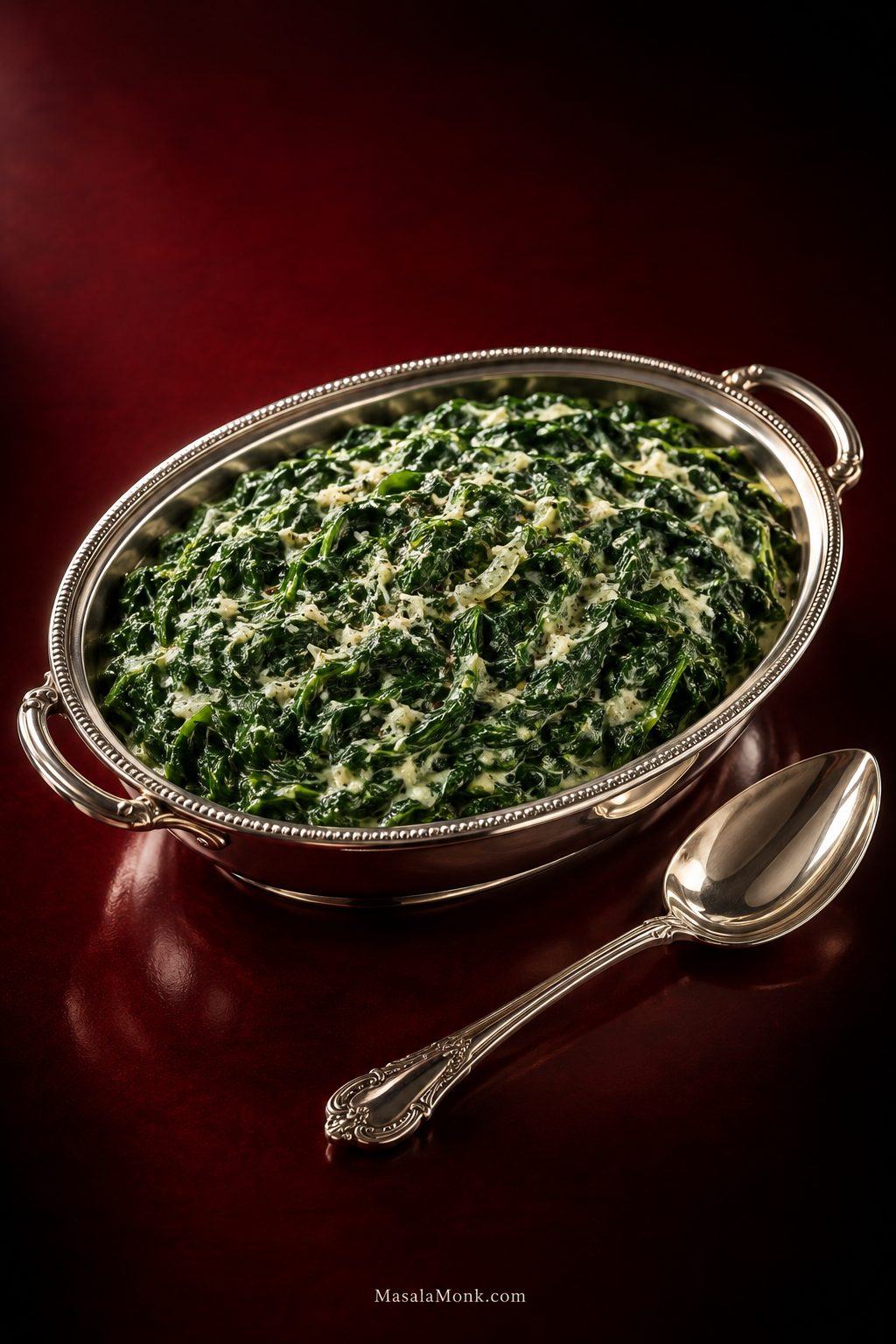
Creamed spinach with visible leafy greens coated in a smooth cream sauce, served in an oval silver dish on a deep red background.

Spoon creamed spinach onto a plate and it should settle softly—not spread into a puddle or sit there like a scoop of dip. The leaves should still taste unmistakably of spinach, with butter, Parmesan, garlic, and cream wrapped around them rather than taking over.

If creamed spinach makes you picture stringy greens buried under too much dairy, that is exactly the result to avoid. Good creamed spinach tastes green and savory, with cream softening the spinach instead of smothering it.

Parmesan brings a nutty edge, while black pepper cuts through the cream. Put that beside steak, roast chicken, or a holiday dinner and the spinach feels like part of the meal rather than something green added to the side.
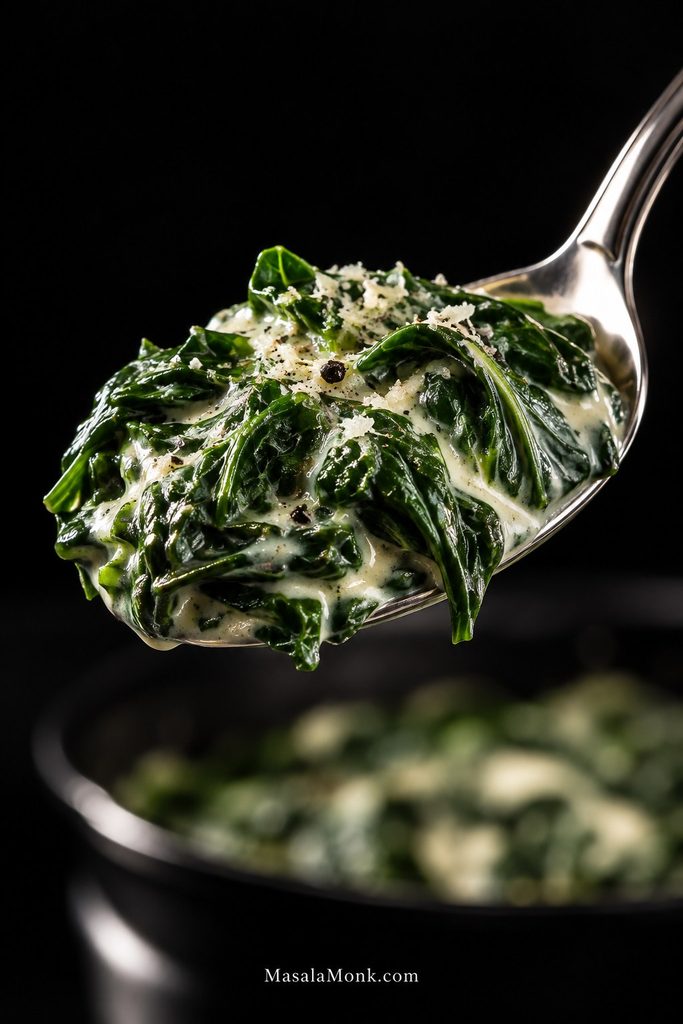
Close-up of leafy creamed spinach on a silver spoon, showing cream coating the leaves while their edges remain distinct.
Look at the leaf edges: they should stay distinct under the cream. That visible structure is a quick check that the spinach has not been cooked into a paste.

For a dependable creamed spinach recipe, use 16 oz / 1 lb / 454 g fresh spinach or 10 oz / 283 g frozen spinach. Drain it well, then add it only after the cream sauce has thickened. With prewashed fresh spinach or already-thawed frozen spinach, dinner is about 20–25 minutes away. Allow longer for bunch spinach that needs washing and trimming.

The recipe gives you times, but the checkpoints tell you when to move on. The spinach needs to lose water while the sauce gains body; once those two things meet in the skillet, the dish becomes much easier to judge by sight.

Before You Start: Two Things Matter

Drain the Spinach

Fresh spinach releases moisture as it wilts, while frozen spinach gives up plenty once thawed. Before either reaches the cream sauce, remove enough water that the leaves feel damp, not dripping.

Rough chopping keeps the spinach leafier. A finer chop gives you a tighter, more steakhouse-like texture.

Thicken the Sauce First

Let the sauce thicken before the spinach goes in. It should coat the back of a spoon and look thicker than the result you want on the plate.

The spinach may loosen it briefly. That’s normal. Uncovered cooking lets the last moisture escape.

Creamed Spinach Recipe

Start here. This formula uses mostly whole milk, a modest amount of heavy cream, and just enough roux to stay silky after the spinach joins the pan. There is enough sauce to coat the greens generously, but not enough to make you hunt for them.

Easy Creamed Spinach With Fresh or Frozen Spinach

Fresh or frozen spinach in a balanced Parmesan cream sauce, with clear texture cues that keep the spinach tender and the sauce glossy—not watery or buried under dairy.

Method: Stovetop
Prep: 10 minutes
Cook: 12–15 minutes
Total: About 20–25 minutes with prewashed fresh or already-thawed frozen spinach
Yield: About 2 cups / 480 ml
Servings: 4 side servings
Spinach: Fresh or frozen
Pan: 12-inch / 30-cm deep skillet or wide sauté pan

Spinach — Choose One

  • Fresh: 16 oz / 1 lb / 454 g baby spinach or trimmed mature spinach
  • Frozen: 10 oz / 283 g frozen spinach, fully thawed

After wilting or thawing and removing the excess water, you’ll usually have roughly 6–7 oz / 170–200 g spinach. Don’t chase the number too hard. Different leaves and frozen brands hold different amounts of moisture.

Cream Sauce

  • Unsalted butter: 2 tbsp / 1 oz / 28 g
  • Shallot or yellow onion: 1/3 cup / about 1.5 oz / 45 g, finely chopped
  • Garlic: 2 cloves / about 6 g, finely minced
  • All-purpose flour: 1 1/2 tbsp / about 12 g
  • Whole milk: 3/4 cup / 6 fl oz / 180 ml
  • Heavy cream: 1/4 cup / 2 fl oz / 60 ml
  • Parmesan: 1/4 cup / 1 oz / 28 g, finely grated
  • Ground nutmeg: 1/8 tsp
  • Fine salt: 1/4 tsp to start, plus more to taste
  • Freshly ground black pepper: 1/4 tsp, plus more to taste
  • Cayenne: pinch, optional
  • Fresh lemon juice: optional, to finish

Equipment

  • 12-inch / 30-cm deep skillet or wide sauté pan
  • Fine-mesh strainer or colander
  • Tongs
  • Whisk
  • Clean kitchen towel or cheesecloth, optional

Instructions

1. Prepare the Spinach

Fresh spinach: Wash it thoroughly unless it is already washed and ready to cook. Remove thick, fibrous stems from mature bunch spinach. Tender baby-spinach stems can stay.

A pound of fresh spinach looks slightly ridiculous beside one skillet. Don’t worry—it collapses fast. Heat the pan over medium-high and add the leaves in batches as room opens up, turning them with tongs.

The leaves normally release enough moisture on their own. Add 1 tbsp / 15 ml water only when the first batch threatens to catch before it begins wilting.

Cook for about 2–4 minutes total, just until everything has collapsed and remains vivid green. Transfer to a strainer. After it cools enough to handle, press or gently squeeze away the extra water, then chop roughly or finely.
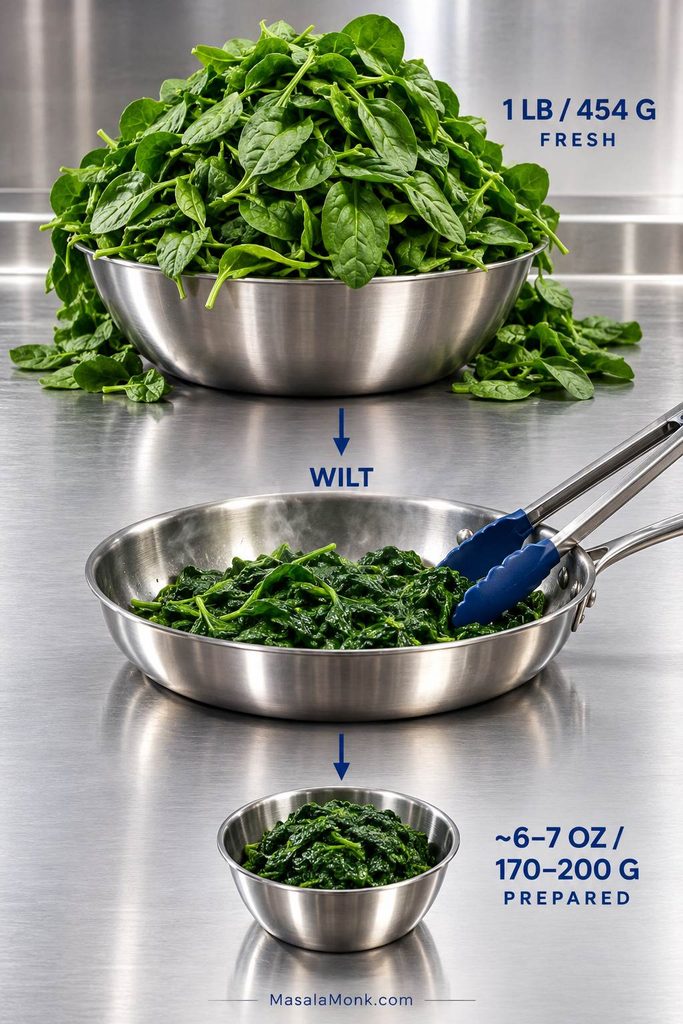
Three-stage visual showing a large pile of fresh spinach collapsing in a skillet and ending as a much smaller portion of drained cooked spinach.
For **fresh spinach**, the useful comparison is the drained yield, not the intimidating raw pile. That makes fresh and frozen much easier to scale side by side.

Frozen spinach: Thaw it completely, then drain off the obvious liquid. Squeeze firmly by hand, press it against a fine-mesh strainer, or wrap it in a clean towel.

It may look surprisingly compact afterward. That’s fine. Pull it apart with your fingers so it spreads through the sauce instead of landing in one dense lump.

Checkpoint 1: damp is fine; dripping is not. A firm squeeze should no longer send out a stream of water.
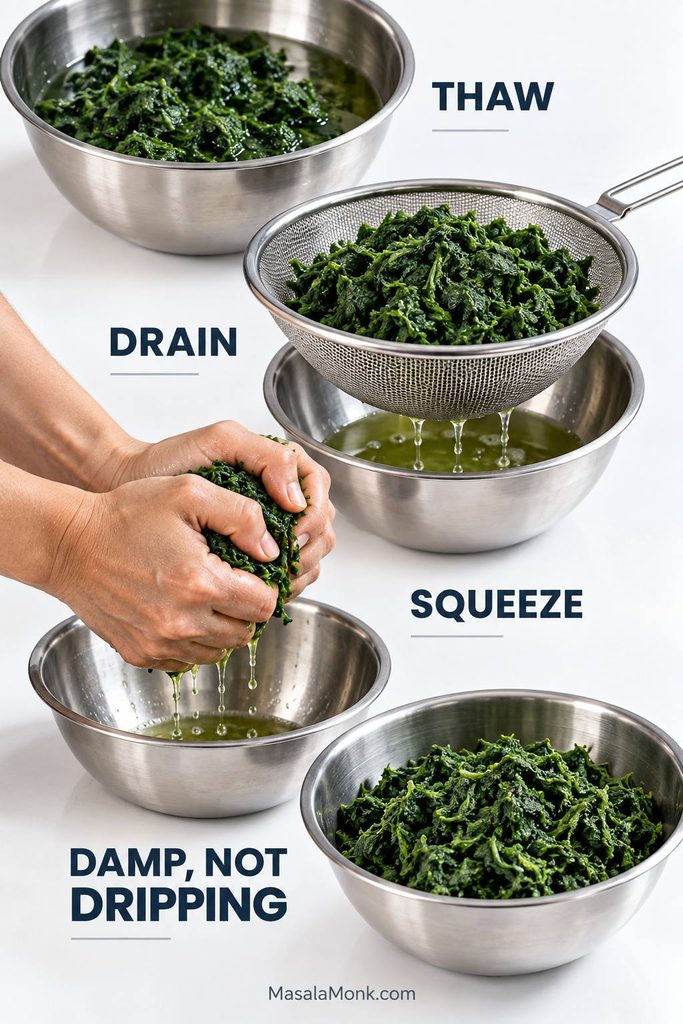
Four-step frozen spinach process showing thawing, draining in a strainer, squeezing by hand, and loosening the drained greens.
With **frozen spinach**, drain first and squeeze second. That separates surface liquid from the moisture held inside the compacted leaves without drying the greens unnecessarily.
2. Soften the Onion and Garlic

Wipe any standing water from the skillet and return it to medium heat. Melt the butter, add the shallot or onion, and cook for 2–3 minutes until soft and translucent.

Add the garlic and cook for about 30 seconds, just until its sharp raw smell softens into the butter and onion. Deeply browned or scorched garlic can make the cream sauce bitter.

3. Add the Flour

Sprinkle in the flour and stir for 30–45 seconds. It should absorb the butter and bubble gently.

There is no need to brown the roux. That small amount of flour gives the dairy enough body to cling to the spinach instead of pooling around it.

4. Whisk in the Milk and Cream

Whisk in the milk a little at a time. Add the cream once the mixture is smooth. Bring the pan to a gentle simmer and cook for about 2–4 minutes, stirring regularly.

Don’t rely on the clock alone. A broad skillet may get there quickly, while cold dairy or a gentler burner can need another minute.

Checkpoint 2: dip in a spoon. The sauce should cling to the back instead of running straight off like milk. Let it get thicker than you want the finished spinach.

Three-stage sauce guide showing a pale roux, milk whisked into it, and a smooth sauce thick enough to coat the back of a spoon.
The finished sauce should coat the spoon evenly, with no loose milk running away from the edges.
5. Add the Spinach

Fold in the drained spinach and lower the heat to medium-low. Cook for another 2–3 minutes.

Everything may suddenly look looser. Give it a moment. Moisture is still leaving the leaves, and an uncovered skillet lets it escape. Adding flour or more cheese immediately can leave you with a stiff pan a few minutes later.

Creamed spinach in a skillet before final reduction, with visible liquid between the leaves and steam rising from the pan.
Watch the liquid itself. Clear moisture gathering around the greens points toward spinach water; meanwhile, a uniformly creamy but loose pan usually needs a little more uncovered reduction.
6. Finish With Parmesan

Turn the heat to low or take the skillet off the burner. Stir in the Parmesan, black pepper, nutmeg, optional cayenne, and the first 1/4 tsp salt.

Now taste. More salt may be all it needs. Parmesan can deepen the flavor, while a few drops of lemon can lift a sauce that tastes heavy even after the seasoning is right.

Checkpoint 3: drag a spatula across the bottom. The gap should stay open for a moment before the sauce slowly moves back in. Spoon some onto a plate; it should settle without leaking cream around the edges.
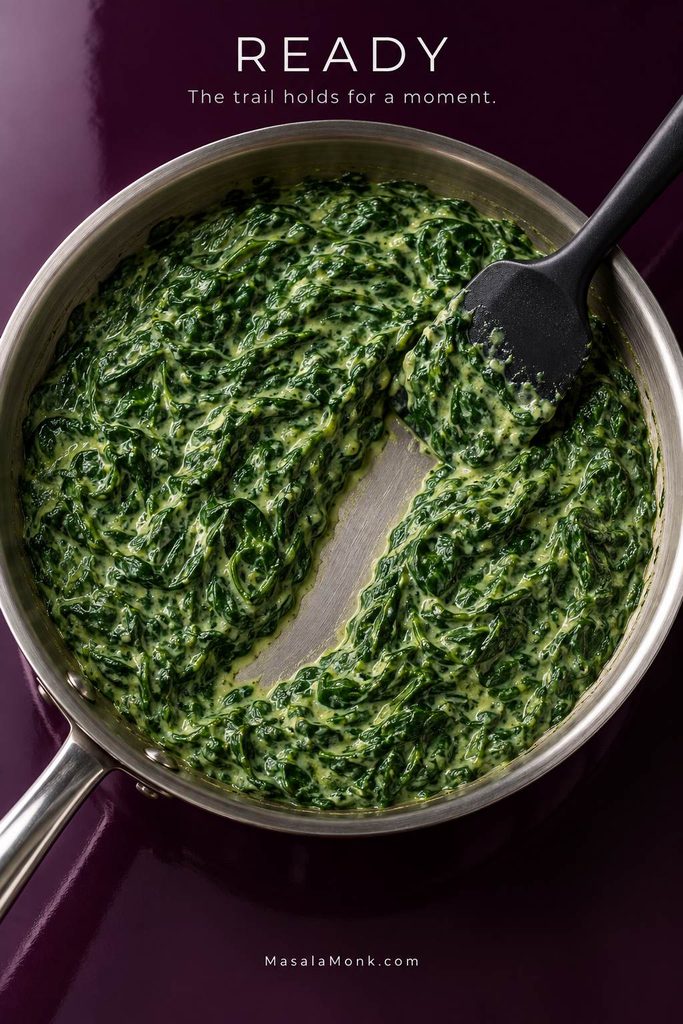
Spatula drawn through finished creamed spinach, leaving a temporary open trail that exposes the bottom of the skillet.
Drag the spatula through the center of the skillet, where the sauce is deepest. The outer edge reduces faster and can make a still-loose pan look more finished than it really is.
7. Adjust the Texture

Too thick? Stir in warm milk or cream 1 tbsp / 15 ml at a time. Still loose? Give it another minute or two uncovered.

Stop while it is creamy and relaxed. It will tighten on the way to the table.

Recipe Notes

  • No heavy cream: use 1 cup / 240 ml whole milk total.
  • Have half-and-half? Use 1 cup / 240 ml half-and-half in place of the milk and heavy cream, keeping the same roux.
  • Want a finer texture? Chop the spinach more finely before adding it to the sauce.
  • Once the cheese goes in: keep the heat gentle. A hard boil makes graininess more likely.
In This Creamed Spinach Guide

Fresh, Frozen or Canned Spinach?

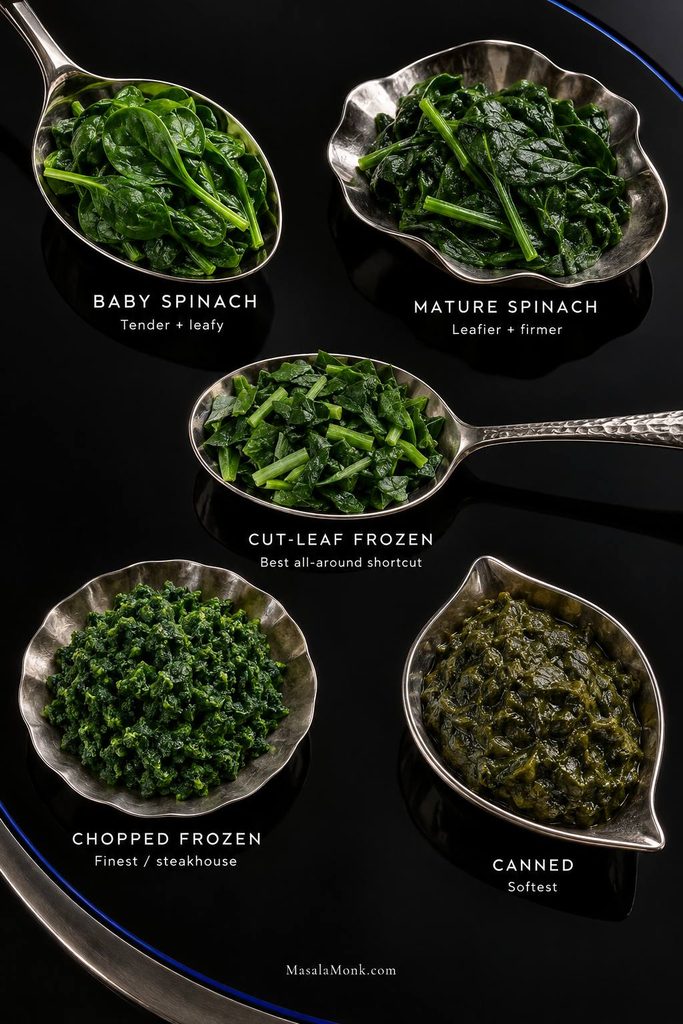
All three can work, but they don’t eat the same. Fresh baby spinach gives the leafiest result, while frozen cut-leaf is the best all-around shortcut. The table shows where the other options fit.

SpinachPreparationFinished textureBest use
Fresh baby spinachWilt, drain, then chopTender and leafyEasiest fresh option
Fresh mature spinachWash well, remove tough stems, wilt or blanchLeafier and slightly firmerWhen you want stronger spinach character
Frozen cut-leaf spinachThaw, drain and squeezeSoft but visibly leafyBest all-around frozen choice
Frozen chopped spinachThaw and squeeze thoroughlyFine and compactSteakhouse-style texture
Canned spinachDrain very well; rinse if very saltyVery soft and finePantry convenience
Five prepared spinach textures compared: baby, mature, cut-leaf frozen, chopped frozen, and canned, from leafier to softer and finer textures.
Cut size changes the sauce-to-spinach ratio in every bite. Finer pieces carry cream and seasoning more evenly, while larger leaves preserve more contrast between vegetable and sauce.

How Much Frozen Spinach Replaces Fresh?

For this recipe, 10 oz / 283 g frozen spinach works well in place of 1 lb / 454 g fresh spinach. Package size matters less after draining: roughly 6–7 oz / 170–200 g prepared spinach fits the main sauce nicely.
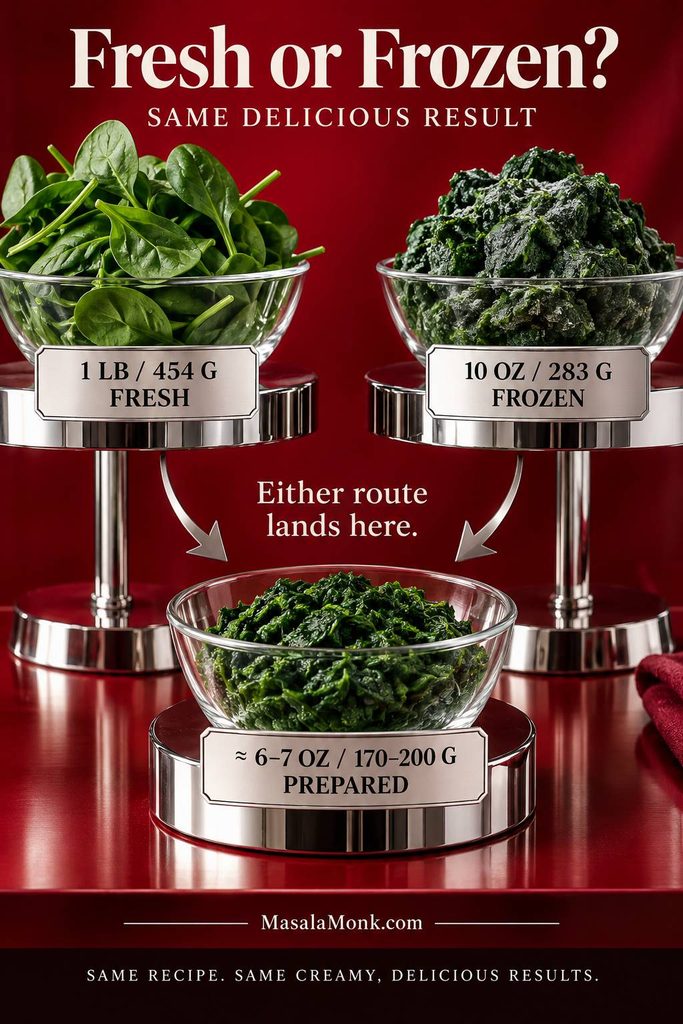
Quantity guide showing 1 pound of fresh spinach and 10 ounces of frozen spinach converging on about 6 to 7 ounces of prepared spinach after draining.
Think of fresh and frozen spinach as yield equivalents, not gram-for-gram substitutes. Very different starting weights can produce similar amounts once excess water is removed.

Cut-leaf is the best frozen choice when you want convenience without losing the feel of the leaves. Chopped frozen spinach is better when you deliberately want a denser, finer texture.

When Does Blanching Fresh Spinach Help?

Baby spinach does not need it; wilt it straight in the skillet. Blanching helps with a very large pile of greens or tougher mature spinach. For a finer steakhouse texture, squeeze the cooked spinach well afterward and chop it finely.

Canned spinach needs even less cooking. Drain enough to end up with roughly 6–7 oz / 170–200 g well-drained spinach for this amount of sauce. Rinse first if the packing liquid is especially salty, then fold the spinach into the sauce only after it has thickened.

Water Out, Body In

Watery creamed spinach has two main causes: excess water from the leaves or a sauce that was too thin before they met. Fresh and frozen spinach release that water differently, while a wide skillet helps steam escape faster.

If the finished pan still looks loose, the troubleshooting section shows which side needs attention.

Read the Pan: Troubleshooting Creamed Spinach

A loose skillet looks alarming when dinner is almost ready, but don’t start throwing flour into it yet. First work out whether the trouble began with the spinach or the sauce.

Why Is My Creamed Spinach Watery?

Was the sauce already thick before the spinach went in?

A sauce that looked right until the spinach joined it probably isn’t broken. The leaves simply brought more water than expected. Keep the skillet uncovered over medium-low heat and let that moisture cook away.

A pan that was thin and milky beforehand needs more cooking of its own. Roux-thickened sauce gains body as it gently simmers; flourless cream needs time to reduce.
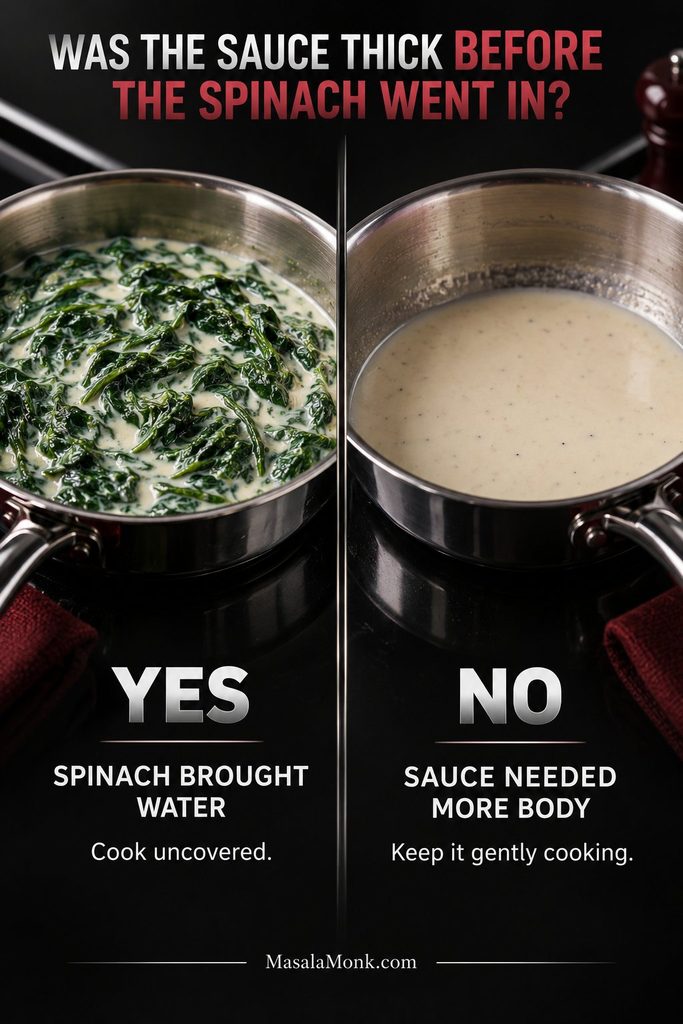
Troubleshooting decision graphic separating watery creamed spinach caused by moisture from the spinach from sauce that was too thin before the spinach was added.
With watery creamed spinach, fix the source before adding another thickener. Evaporate excess leaf moisture uncovered; however, a sauce that never developed body needs more cooking of its own.

Quick Fixes

ProblemWhat probably happenedFix / Next time
Too thickToo much reduction or a cold, tightened sauceAdd warm milk or cream 1 tbsp / 15 ml at a time
Tastes flatUsually under-seasonedFix the salt first; then consider Parmesan, pepper, cayenne, or a few drops of lemon
Grainy or brokenCheese or dairy overheatedTake the pan off the heat. Warm dairy may improve it, though a badly split sauce may not become perfectly smooth again
Too much sauceNot enough spinach for the dairyWilt and drain extra spinach separately, then fold it in
Too saltySalt stacked with Parmesan or another salty ingredientAdd unsalted cooked spinach or a splash of unsalted dairy
BitterStrong mature leaves, scorched garlic, or excessive cookingScorched garlic and badly overcooked greens are difficult to rescue; avoid deep browning and shorten the spinach cook next time
Lumpy white sauceMilk did not mix smoothly into the rouxWhisk firmly; strain before adding spinach if necessary
Tough or stringyCoarse leaves or thick stemsRemove stems and chop the cooked spinach more finely
Soft and slimyThe spinach cooked too longThe leaf structure will not fully recover; shorten the initial wilt or blanch next time
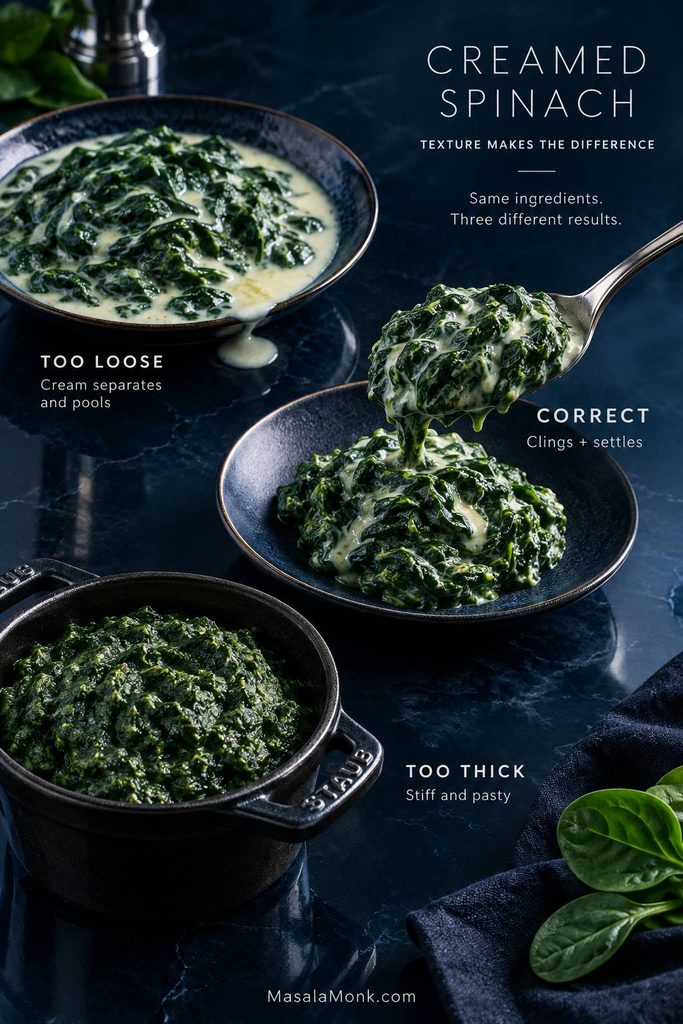
Three creamed spinach consistency examples: loose with pooling cream, correctly coated and relaxed, and overly thick and stiff.
Correct the texture before making the final seasoning call. Further reduction concentrates salt and Parmesan, whereas loosening an over-thick pan with dairy dilutes them again.

One rescue deserves special care. A dairy-heavy pan may need more spinach, but raw leaves added straight to the finished sauce release fresh water. Wilt the extra spinach separately, drain it well, then fold it in. You fix the ratio without creating another puddle.

Three Ways to Make Creamed Spinach Sauce

The choice is straightforward: use a light roux for the best all-around version, reduced heavy cream when you want no flour, or cream cheese when you want the fastest route.

MethodWhat gives it bodyFinished feel
Milk + light rouxFlourBalanced and silky
Reduced heavy creamReductionSofter and creamier
Cream cheeseCheeseThick and tangy
Three creamed spinach sauce methods compared: milk with light roux, reduced heavy cream, and thick cream cheese sauce.
The three creamed spinach sauce methods also shift the flavor balance: roux keeps spinach forward, reduced cream leans richer, and cream cheese brings more tang.

Lighter Creamed Spinach With Milk, No Heavy Cream

Use 1 cup / 240 ml whole milk instead of the milk-and-cream combination, keeping the butter and flour exactly as written in the main recipe. The result is lighter, but the roux gives the milk the body it needs to cling to the leaves.

It’s the same basic technique behind a smooth béchamel sauce, only with much less sauce because the spinach should remain the point of the dish.

Flourless Creamed Spinach

Heavy cream is the straightforward flourless choice when you want a softer, creamier coating. Melt 1 tbsp / 14 g butter, soften the onion and garlic, then add 1/2 cup / 120 ml heavy cream.

Simmer gently for about 4–7 minutes, stirring now and then. The cream is ready when it visibly thickens and coats a spoon. Fold in the drained spinach from the main recipe, warm it through, take the pan off the heat, and stir in 1/4 cup / 28 g Parmesan.

The finished sauce is softer and richer than the roux version. If it tightens too far, loosen it with cream a tablespoon at a time.

Don’t simply remove the flour from the milk method. With that amount of milk and such a short cooking time, the sauce needs something else to thicken it. Heavy cream works because it reduces more readily.

Cream Cheese Creamed Spinach

Cream cheese is the fastest route to a thick, tangy sauce without building a roux. Use 3 oz / 85 g softened cream cheese and 1/4 cup / 60 ml whole milk instead of the flour, milk, and cream from the main sauce.

Soften the onion and garlic in 1 tbsp / 14 g butter, lower the heat, and melt in the cream cheese. Add the milk gradually, then fold in the spinach. Finish with up to 1/4 cup / 28 g Parmesan.

Three ounces keeps this firmly in side-dish territory. Push the cream cheese much higher and the pan starts drifting toward spinach dip.

3-Ingredient Creamed Spinach

If speed matters more than aromatics or a separate sauce, strip that same cream-cheese idea down to its essentials. This weeknight version uses spinach, cream cheese, and Parmesan, with salt and pepper added to taste.

  • 10 oz / 283 g frozen spinach, thawed and squeezed well, or 16 oz / 454 g fresh spinach, wilted and drained
  • 3 oz / 85 g cream cheese, softened
  • 1/4 cup / 1 oz / 28 g finely grated Parmesan

Warm the spinach over medium-low heat and fold in the cream cheese. A stiff mixture can be loosened with 1 tbsp / 15 ml hot water. Take the pan off the heat, stir in the Parmesan, then season.

Three-ingredient creamed spinach visual showing spinach, cream cheese and grated Parmesan above the finished thick sauce.
For 3-ingredient creamed spinach, cream cheese supplies the body quickly. Choose the roux version when you want a lighter sauce and more control over the spinach-to-sauce balance.

Steakhouse-Style Creamed Spinach

For steakhouse-style creamed spinach, chop the cooked spinach finely, take the sauce slightly thicker, and lean on Parmesan, black pepper, restrained nutmeg, and a fuller cream sauce.

Steakhouse character comes more from texture and seasoning than from one magic ingredient. Restaurants use different formulas, from seasoned white sauces to cream-heavy versions, so chasing one supposed “secret” matters less than getting the finish right.

Finely chopped steakhouse-style creamed spinach in a silver serving dish, with browned steak softly blurred in the background.
For steakhouse creamed spinach, squeeze the cooked greens before chopping them finely. Drier leaves chop more cleanly and bring less unwanted moisture into the richer sauce.

A few quick pulses in a food processor can give you the fine chop, but stop before the leaves become a smooth green purée.
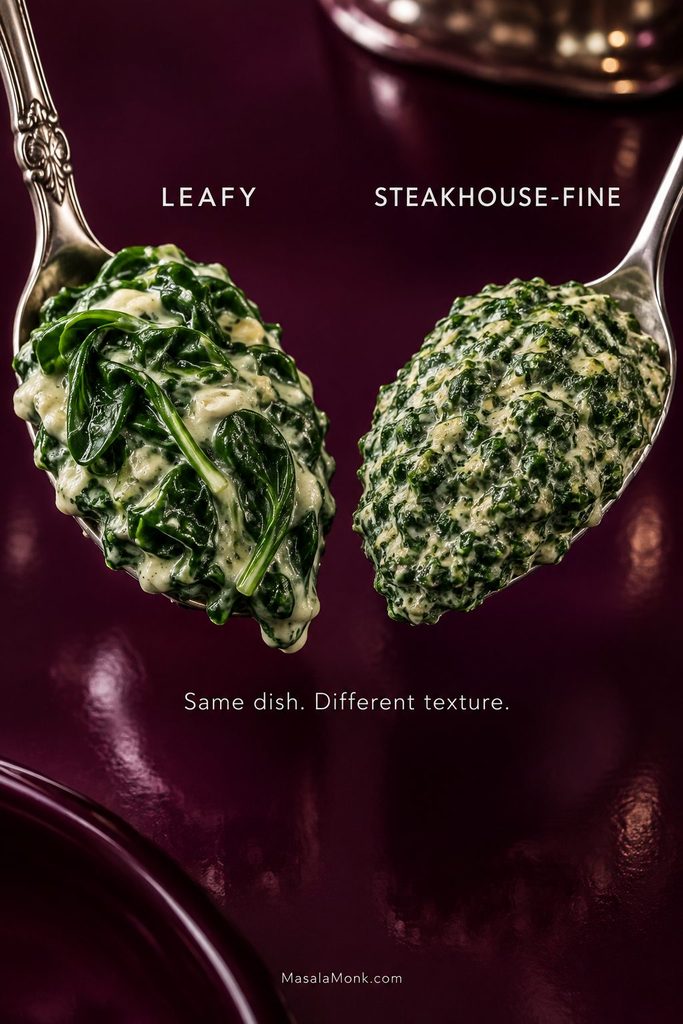
Two spoonfuls compare leafy creamed spinach with a finer, denser steakhouse-style chop.
Chop size changes more than appearance. Fine spinach distributes cream, pepper, and Parmesan through almost every bite, while larger leaves create stronger contrasts of spinach and sauce.

For more creaminess, add another 2 tbsp / 30 ml heavy cream with the other dairy and let the sauce reach the same spoon-coating stage before adding the spinach. Or finish with another 2 tbsp finely grated Parmesan.

A pinch of cayenne gives quiet warmth, while about 1/2 tsp Dijon mustard gives the sauce a sharper edge. Keep the nutmeg subtle.

This style is especially good with steak or a prime rib roast, where peppery cream and finely chopped greens balance the browned crust of the meat.

For a Golden Top

Spoon the finished spinach into a shallow oven-safe dish, then mix 2 tbsp breadcrumbs with 2 tbsp / about 10–12 g finely grated Parmesan and scatter them over the top.

Broil until golden, usually only a minute or two depending on your broiler. Stay close. The crisp top is a good contrast to the soft spinach underneath, but breadcrumbs can go from pale to burned very quickly.

Flavor and Cheese Options

Parmesan is the best default. It brings saltiness and a nutty edge without making the dish feel cheese-heavy.

For a more noticeable Gruyère note, replace half of the Parmesan: use 1/2 oz / 14 g Parmesan + 1/2 oz / 14 g finely grated Gruyère instead of the full 1 oz / 28 g Parmesan.

Boursin is better treated as a cream-cheese variation than as an extra cheese piled onto the main sauce. Use 3 oz / 85 g Boursin in place of the cream cheese in the cream-cheese method. Taste before adding Parmesan or extra salt because Boursin is already seasoned.

For seasoning, think Parmesan and black pepper first, nutmeg quietly behind them. Cayenne adds warmth. Dijon adds sharpness. Lemon belongs at the end, and only in drops; obvious lemon flavor quickly takes over.

Whatever cheese you choose, keep the heat gentle once it goes in. The same rule matters in a smooth cheese sauce: prolonged boiling makes a glossy sauce much more likely to turn grainy.

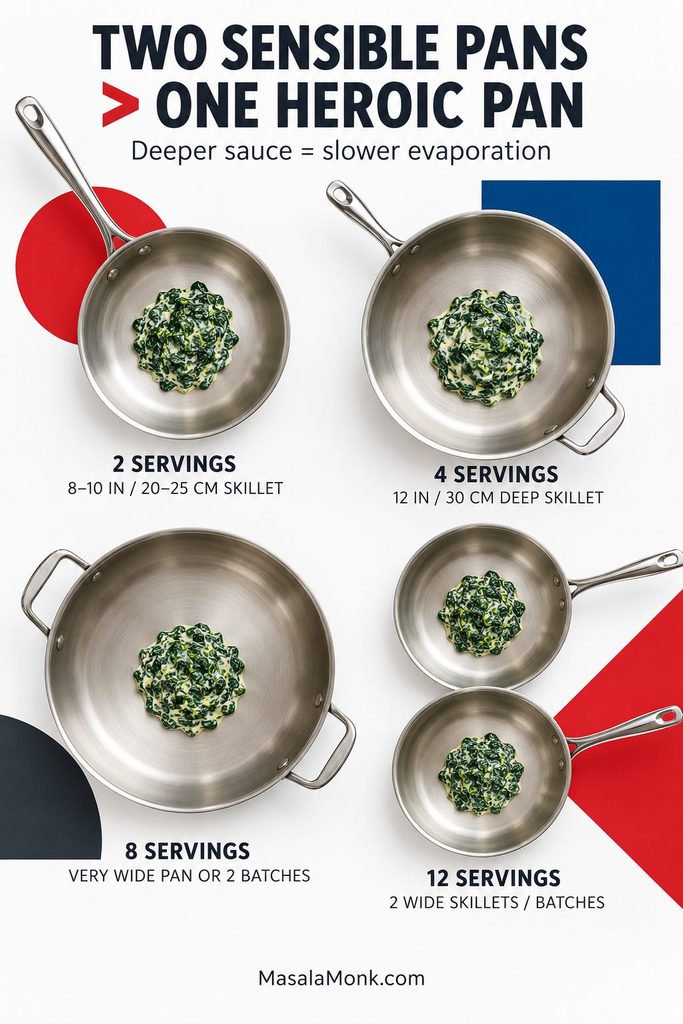
Scaling for 2, 4, 8 or 12

Doubling the ingredients is simple. The pan is where big batches get tricky.

Side servingsFresh spinachFrozen spinachSauceCookware
28 oz / 227 g5 oz / 142 g1/2 recipe8–10 inch / 20–25 cm skillet
416 oz / 454 g10 oz / 283 g1 recipe12-inch / 30-cm deep skillet
832 oz / 907 g20 oz / 567 g2 recipesVery wide sauté pan or two batches
1248 oz / 1.36 kg30 oz / 850 g3 recipesTwo wide skillets or cook in batches
Pan-size guide showing 2 servings in a small skillet, 4 in a 12-inch skillet, 8 in a wide pan or two batches, and 12 in two wide skillets or batches.
When scaling creamed spinach, cooking time does not rise neatly with ingredient quantity. Once the sauce sits deeper, evaporation slows; therefore, wider pans or separate batches are more predictable.

Crowd twice as much sauce into the same skillet and it sits deeper, so it takes longer to reduce. For eight or more servings, two sensible pans are often easier than one heroic pan.

Fresh spinach behaves better in batches too. Wilt it, drain it, set it aside, and keep going until the pile of leaves has collapsed into something manageable.

When this is one of several sides, plan roughly 3–4 oz / 85–115 g finished creamed spinach per person. Serve more when it is the main vegetable on the plate.

Make Ahead, Store and Reheat

What You Can Make Ahead

Spinach: Wilt or thaw, drain, squeeze, and chop it up to 1 day ahead.

Cream sauce: Make the roux-based sauce separately up to 2 days ahead. Cool and refrigerate it, then rewarm gently before adding the spinach and Parmesan.

Complete dish: The whole pan can be made 1 day ahead. Cool it promptly, cover, and refrigerate. The sauce firms up when cold, so loosen it during reheating only if it needs it.

On a holiday table, that means one less creamy side demanding attention just as everything else needs to be carved, drained, or carried to the table.
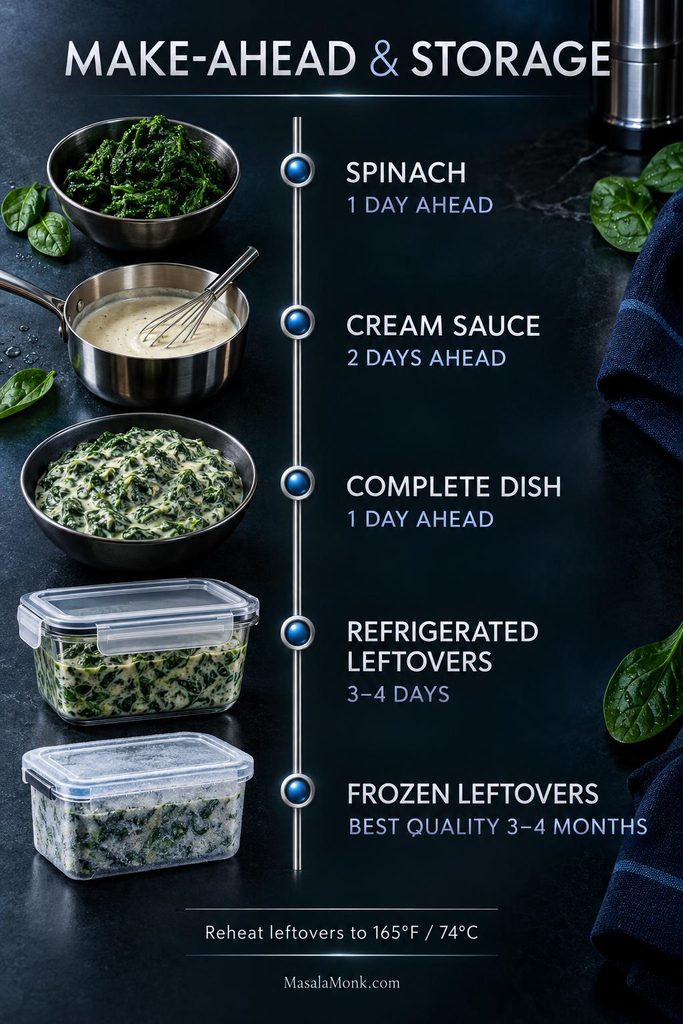
Make-ahead timeline showing spinach 1 day ahead, sauce 2 days ahead, the finished dish 1 day ahead, refrigerated leftovers for 3 to 4 days, and frozen leftovers for about 3 to 4 months.
With make-ahead creamed spinach, do not thin the dish while it is still refrigerator-cold. Reheat gently first, because the sauce often loosens naturally as the dairy warms.

Reheating

Stovetop: warm over low heat, stirring regularly. Loosen with warm milk or cream 1 tbsp / 15 ml at a time.

Microwave: heat in 30-second intervals and stir between them.

Oven: reheat covered at 350°F / 177°C. Start checking a chilled shallow dish around 20 minutes; deeper dishes can take longer.

Storage safety: Refrigerate promptly and use within 3–4 days. Reheat leftovers to 165°F / 74°C. Don’t leave the dish out for more than 2 hours, or more than 1 hour above 90°F / 32°C. See the USDA leftover-safety guidance for details.

Freezing Creamed Spinach

You can freeze creamed spinach, though the sauce may be less smooth after thawing. Cool it promptly, pack it airtight, thaw overnight in the refrigerator, then reheat gently.

For best quality, USDA recommends using frozen leftovers within about 3–4 months. Creamy sauces can lose smoothness during storage, so creamed spinach is usually nicest sooner.

What to Serve With Creamed Spinach

Steak and roast beef are the obvious matches, but pork chops, roast chicken, lamb, salmon, and simply cooked fish work too. The creamy greens are especially useful beside something deeply browned or crisp.

Add garlic mashed potatoes or crisp roasted potatoes for the classic plate. Browned meat, fluffy or crunchy potato, and glossy spinach each bring a different texture.

Creamed spinach also earns its place on Thanksgiving and Christmas tables. Because it is heavier than plain greens, a modest spoonful is plenty beside stuffing, potatoes, roast meat, and everything else competing for space.

Creamed spinach served with sliced roast chicken and golden roasted potatoes as part of a complete dinner.
Serve the spinach late in the plating sequence because it tightens as it cools. A last-minute spoonful keeps the sauce glossy instead of stiff.

Leftover Ideas

Stir leftovers through hot pasta with a splash of pasta water, spoon them over a baked potato, fold them into eggs, tuck them into stuffed mushrooms, or use a thick batch in a toasted sandwich or pastry.

For something deliberately scoopable with bread, crackers, or chips, make a proper spinach dip.

Creamed Spinach FAQs

1. Can I Use Frozen Spinach Instead of Fresh?

Absolutely. For this recipe, use about 10 oz / 283 g frozen spinach in place of 1 lb / 454 g fresh. Thaw it completely, then drain and squeeze well.

2. Can I Use Milk or Half-and-Half Instead of Heavy Cream?

Yes. Use 1 cup / 240 ml whole milk with the same roux for a lighter sauce, or 1 cup / 240 ml half-and-half for a richer one.

3. Why Is My Creamed Spinach Watery?

If the sauce was thick before the spinach went in, extra moisture from the spinach is usually responsible. Keep the skillet uncovered and let it reduce. A sauce that was already thin needs more cooking of its own.

4. Can I Make Creamed Spinach Ahead or Freeze It?

Yes. Prepare the spinach a day ahead, the roux-based sauce up to 2 days ahead, or the whole dish 1 day ahead. Leftovers can be frozen too, although the sauce may be less smooth after thawing.

5. Why Does Spinach Make My Teeth Feel Gritty or Chalky?

Thoroughly washed spinach can still leave a temporary rough or chalky sensation often called “spinach teeth.” Spinach naturally contains oxalate, which is associated with that mouthfeel. Cornell discusses the same phenomenon in its research on spinach and its gritty sensation. Actual soil or sand is different, so fresh bunch spinach still needs careful washing.

6. Is Creamed Spinach the Same as Spinach Dip?

No. Creamed spinach is a vegetable side with sauce coating the greens. Spinach dip contains a much larger proportion of creamy ingredients and is designed for scooping.

When a spoonful settles softly without leaking cream around the edges, you’re there: tender spinach that still tastes green, Parmesan and black pepper, and cream supporting the vegetable instead of hiding it.

Posted on — 2 Comments

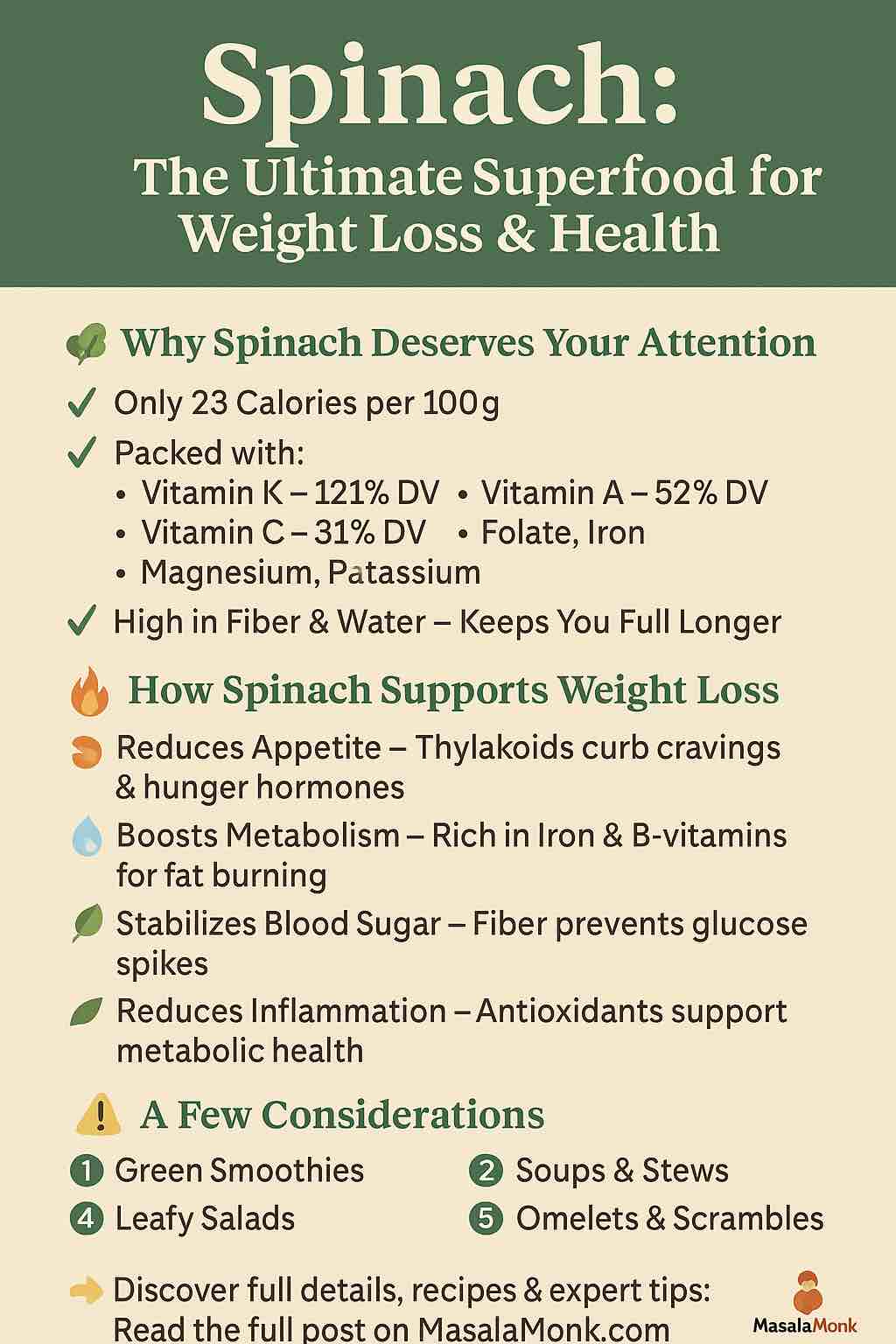
Spinach Nutrition and Weight Loss Benefits

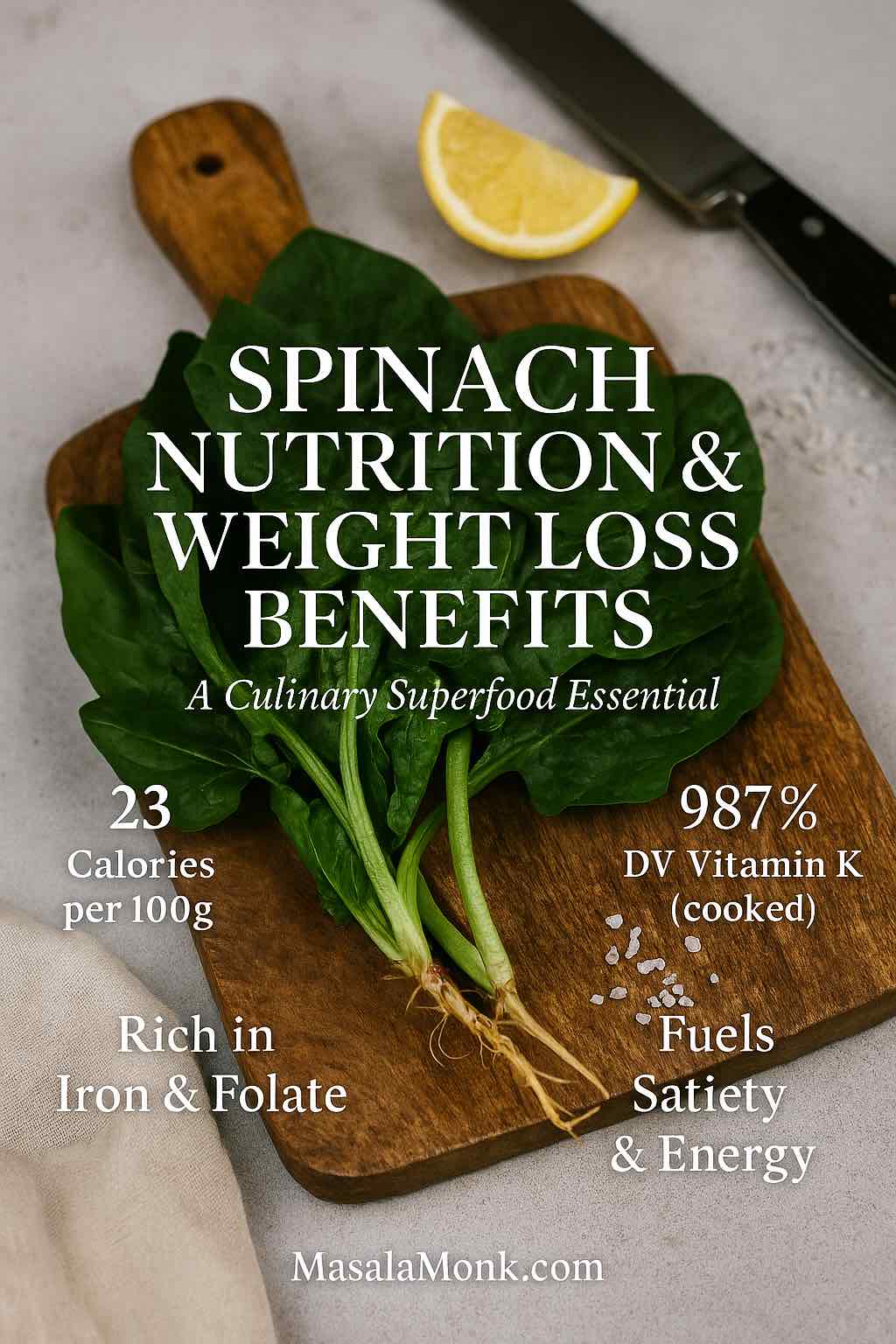
Fresh spinach on a chopping board with lemon and salt, overlaid with facts highlighting its nutrition and weight loss benefits — only 23 calories per 100g, rich in vitamin K, iron, and folate.

If there’s one leafy green that deserves its reputation as a true superfood, it’s spinach. For centuries, it has been celebrated in kitchens and traditional medicine across the world — from Mediterranean salads to Indian palak paneer – this humble green delivers powerful spinach nutrition and weight loss benefits backed by modern science.. And while Popeye may have exaggerated its instant muscle-building powers, modern science confirms what generations before us instinctively knew: spinach is incredibly good for you.

What makes it even more exciting is how well spinach nutrition and weight loss benefits go hand in hand. This humble green is nutrient-dense yet astonishingly low in calories, making it the kind of food you can eat generously without derailing your health goals.

In this feature, we’ll explore spinach’s nutrition profile, its role in supporting weight management, and the many delicious ways you can weave it into your everyday meals.


Spinach Nutrition Facts (100g, 1 Cup, Raw vs Cooked)

The numbers tell a story that nutritionists love: spinach gives you a lot for very little.

  • 100 grams of raw spinach: ~23 calories, ~2.9g protein, ~2.2–2.9g fiber, ~92–94% water. (My Food Data)
  • 1 cup raw spinach (30g): ~7 calories, with hefty doses of vitamin K, vitamin A, folate, and manganese. (University of Rochester Medical Center)
  • 1 cup cooked spinach (180g): ~41 calories; as water cooks off, minerals concentrate, especially calcium and iron. (My Food Data)

Spinach is particularly famous for its vitamin K content — one serving can overshoot your daily requirement many times over, with cooked spinach providing ~987% DV per cup. (My Food Data) It also provides vitamin C for immunity, beta-carotene (vitamin A) for eye health, folate for cell repair, and iron for energy production. (My Food Data) In short: it’s a tiny calorie “investment” with a massive nutritional return.

Micronutrient Highlights

  • Magnesium: Supports energy production and muscle health.
  • Potassium: Helps regulate blood pressure and fluid balance.
  • Manganese: Important for metabolism and bone development.
  • B vitamins (B6, riboflavin): Contribute to brain function and energy metabolism.

These micronutrients often get overlooked but are critical for overall health — and spinach delivers them in abundance. (My Food Data)

Suggested Reading: Magnesium Deficiency? The 5 Best Foods (and Drinks) to Boost Your Levels


Spinach vs Other Greens

How does spinach compare to its leafy rivals?

  • Spinach vs Lettuce: Spinach offers significantly more vitamins A, C, K, and iron, while lettuce is mostly water and fiber.
  • Spinach vs Kale: Kale has more vitamin C, but spinach wins on iron and folate. Know more about Kale in Kale – Nutrition, Benefits, and 5 Practical Ways for Weight Loss.
  • Spinach vs Cabbage: Cabbage provides more vitamin C, but spinach is more nutrient-dense calorie for calorie.

It is essentially the “all-rounder” — not the highest in every nutrient, but consistently strong across the board. (My Food Data)


Spinach Nutrition and Weight Loss Benefits Explained

Spinach isn’t a magic bullet, but it’s about as close as real food gets. For anyone focused on maintaining or losing weight, the spinach nutrition and weight loss benefits are especially compelling.

Here’s why spinach is such a powerful ally:

  1. Volume with Few Calories
    You can eat a whole bowl of spinach and still barely crack 50 calories. This means you fill your stomach without overloading your plate. (University of Rochester Medical Center)
  2. Fiber and Water for Satiety
    The combination of dietary fiber and high water content slows down digestion and prolongs feelings of fullness, naturally reducing overeating. (My Food Data)
  3. Thylakoids and Appetite Regulation
    Spinach contains plant compounds called thylakoids,early human studies using spinach thylakoid extract report delayed fat digestion, increased GLP-1, and lower hedonic hunger/cravings in the short term. (PMC, PubMed). Some research shows that people who consume spinach extracts feel less hungry and have fewer cravings for sugary foods.
  4. Nutrient Density Without Deprivation
    Many diets fail because they leave people feeling deprived. Spinach, however, packs vitamins, minerals, and antioxidants into every bite, meaning you get more nutrition for fewer calories. (My Food Data)

Suggested Read: Hearty and Nourishing: 5 Vegan Lentil Soup Recipes for Weight Loss


Real-Life Weight Loss Scenarios

  • Swap a 300-calorie side of fries with a spinach salad topped with grilled chicken and vinaigrette — you’ll cut calories in half while doubling your nutrient intake.
  • Add a handful of spinach to a smoothie instead of an extra scoop of protein powder — you’ll still feel full, but with added fiber, folate, and iron.
  • Replace refined tortillas with spinach wraps or lettuce cups — lowering carbs and calories without giving up the “wrap” experience.
  • Or just enjoy this healthy hung curd spinach cheese sandwich as a protein-packed, low-calorie snack.

These swaps might seem small, but done consistently, they embody how spinach nutrition and weight loss benefits compound over time.


Is Spinach Good for Weight Loss? Benefits Explained

In a word: absolutely.

Spinach shines in the weight loss conversation because it satisfies two of the biggest hurdles dieters face: staying full and staying nourished. A food that is both low in calories and rich in vitamins is rare — but spinach checks both boxes effortlessly.

When you load your plate with spinach, you’re essentially eating bulk without the calorie burden. At just 23 calories per 100 grams, you can enjoy heaping portions without worrying about undoing your day’s effort. Add to that a meaningful amount of fiber, water, iron, folate, vitamin A, and vitamin K – and you’ve got a vegetable that actively works to slow digestion and stabilize hunger. (My Food Data)

But satiety is only half the story. Spinach delivers iron for energy, folate for cell repair, vitamin A for skin and vision, and vitamin K for bone health. These aren’t “bonus” nutrients — they’re the very things your body craves to function well. Diets often fail because people feel deprived; spinach flips that script by offering abundance without excess.

So yes — spinach is good for weight loss. Or rather, the spinach nutrition and weight loss benefits make it more than good: they make it a weight management essential.

Also Read: Spinach Chicken Curry| Palak Chicken| Murg Saagwala Recipe


How to Eat Spinach for Weight Loss (5 Practical Tips Expanded)

Spinach’s versatility is what transforms it from “just another vegetable” into a diet ally. Here are five proven ways to weave it into your meals — each expanded with practical examples so you can start today.

1. Smoothies That Don’t Taste “Green”

Spinach blends seamlessly into fruit-based smoothies. Try:

  • 1 cup baby spinach
  • ½ banana
  • ½ cup frozen mango
  • 1 scoop protein powder
  • 1 cup almond milk

The fruit masks the greens, but you still get fiber, vitamins, and minerals. For extra satiety, add chia seeds or oats or gt inspiration from one our fragrant cardamom-spinach power drinks for a refreshing twist.

2. Simple Soups and Stews

Add spinach to the pot during the final 2–3 minutes of cooking. It wilts instantly and boosts the nutrient profile without changing the flavor dramatically. A bowl of lentil soup with spinach delivers protein, fiber, and iron in one warming meal.

3. Protein-Packed Salads

Spinach leaves are sturdier than lettuce and pair well with lean proteins. A classic combo:

  • 2 cups fresh spinach
  • 2 boiled eggs or 100g grilled chicken
  • ½ avocado
  • A sprinkle of seeds (pumpkin or sunflower)
  • Lemon-olive oil dressing

The vitamin C from lemon juice also enhances non-heme iron absorption from spinach — a win-win. (My Food Data)

4. Eggs and Stir-Fries

A handful of spinach in scrambled eggs adds volume, fiber, and nutrients with almost no extra calories. In stir-fries, spinach is a last-minute addition that bulks up the dish while soaking up savory sauces.

5. Spinach Drinks and Juices

Cold-pressed spinach juice has become trendy, but smoothies are more balanced since they retain fiber. For a refreshing green drink: blend spinach with cucumber, apple, and ginger. Need more inspiration? Fuel your mornings with these matcha-spinach energizing drinks which are hydrating, low-calorie, and loaded with antioxidants.


A 7-Day Spinach Weight Loss Meal Idea

Here’s how a week of small swaps can highlight the spinach nutrition and weight loss benefits without boredom:

DayBreakfastLunchDinnerSnack
MonSpinach & egg omeletSpinach salad with chickpeasGrilled salmon + sautéed spinachSpinach + mango smoothie
TueSpinach smoothie bowlTurkey & spinach wrapLentil soup with spinachSpinach hummus + carrots
WedGreek yogurt with spinach powderPalak paneer (light version)Brown rice + stir-fried spinach & tofuSpinach + apple juice
ThuOats with spinach powderSpinach quinoa bowlChicken curry with spinach sabjiSpinach + pineapple smoothie
FriScrambled eggs with spinachSpinach chickpea saladPasta tossed with spinach & veggiesFrozen spinach added to soup
SatSpinach + banana smoothieSpinach tortilla wrap with beansGrilled shrimp + spinach sautéSpinach + cucumber juice
SunSpinach feta omeletPalak dal with riceSpanakopita (in moderation)Spinach dip (yogurt-based)

This isn’t a “spinach-only” plan — it’s about weaving spinach into meals in creative, enjoyable ways.


Spinach Benefits Beyond Weight Loss: Nutrition and Health

While spinach is a friend to anyone managing weight, its influence goes much further. Eating spinach consistently supports nearly every system in the body.

  • Bone Health
    Vitamin K and calcium in spinach are essential for bone density. In fact, one cup of cooked spinach provides over 30% of your daily calcium needs. (My Food Data)
  • Heart Health
    Spinach is naturally high in nitrates; a 7-day randomized crossover trial in healthy adults found nitrate-rich spinach soup reduced arterial stiffness and lowered blood pressure versus a low-nitrate control. (PMC, PubMed)
  • Eye Protection
    Spinach provides lutein and zeaxanthin, pigments linked with reduced progression of age-related macular degeneration in human studies/reviews. (PMC)
  • Brain and Mood
    Folate, magnesium, and vitamin B6 in spinach support neurotransmitter function, which may help regulate mood and reduce risk of cognitive decline. (My Food Data)
  • Anti-Inflammatory Power
    Spinach is packed with antioxidants, including flavonoids and carotenoids, which combat inflammation — a root cause of many chronic diseases. (My Food Data)

In short, the spinach nutrition and weight loss benefits are just one slice of the story. This vegetable is more than a diet trick — it’s a long-term health investment.


Baby Spinach and Red Spinach

When you walk into a grocery store, you’ll often see two standouts: baby spinach and, occasionally, red spinach. While they share the same leafy family, each brings something unique to the table.

Baby spinach is simply spinach harvested earlier, when the leaves are smaller, more tender, and milder in taste. Nutritionally, it’s almost identical to mature spinach — rich in vitamin K, vitamin A, folate, and iron — but its delicate leaves make it especially popular in salads and smoothies. For those new to greens, baby spinach is often the easiest entry point.

Red spinach, less common in Western supermarkets but widely used in parts of Asia, has a striking crimson hue thanks to betalains, the same antioxidant pigments found in beets. These compounds may support heart health and reduce oxidative stress. Red spinach also tends to have a slightly earthier, more robust flavor, making it excellent in stir-fries and sautés.

Both varieties reinforce the case that spinach isn’t just one thing — it’s a versatile family of greens with overlapping but distinctive health perks.


Spinach Powder and Supplements

For those who want the benefits of spinach without the daily washing and chopping, spinach powder has become a popular option. Made by drying and pulverizing fresh spinach, it’s often marketed as a nutrient-dense addition to smoothies, soups, and even baked goods.

Here’s what you should know:

  • Nutrient retention: Spinach powder preserves many of the vitamins and minerals found in fresh spinach, especially vitamin K, iron, and plant antioxidants.
  • Convenience: It’s lightweight, shelf-stable, and easy to scoop into drinks or recipes.
  • Cautions: It won’t provide the same water content or fiber as fresh spinach, so it’s best viewed as a supplement, not a replacement.

If you’re traveling, on a tight schedule, or looking to boost smoothies without bulk, spinach powder can be a handy addition. But nothing beats a crisp bunch of fresh spinach on your plate.


Calories in Spinach: Portion and Nutrition Guide

Spinach’s nutrition can sound abstract until you see it broken down into practical portions. Here’s a simple guide to common serving sizes:

PortionCaloriesProteinFiberVitamin KVitamin AIron
1 cup raw (30g)70.9g0.7g181% DV56% DV5% DV
100g raw232.9g2.9g604% DV188% DV15% DV
1 cup cooked (180g)415.4g4.3g987% DV377% DV36% DV
200g raw (about 6 cups)465.8g5.8g1,200% DV376% DV30% DV

(Sources: University of Rochester Medical Center, for raw Spinach My Food Data, for cooked Spinach My Food Data)

This chart answers queries like “calories in spinach,” “100g spinach nutrition,” “1 cup spinach nutrition facts,” and makes it easy for readers to visualize exactly what they’re getting on their plate.


Spinach Nutrition: Vitamins and Nutrients It’s High In

Spinach isn’t just a “green” — it’s a nutrient pharmacy. Here’s a closer look at the vitamins and minerals that dominate its profile:

  • Vitamin K: Spinach is one of the richest natural sources. Just one cup raw covers nearly 200% of your daily needs, critical for bone strength and healthy blood clotting.
  • Vitamin A (as beta-carotene): Essential for vision and skin health. Spinach provides more than half your daily intake in a single cup.
  • Vitamin C: Supports your immune system, collagen production, and helps your body absorb iron.
  • Folate: Important for cell growth and repair, particularly during pregnancy — and spinach is a star in these folate-focused chicken and spinach snacks, which make nutrition easy even on busy days.
  • Iron: While plant-based iron isn’t as easily absorbed as animal sources, spinach still contributes meaningfully, especially when paired with vitamin-C-rich foods. In fact, it ranks among the top iron-rich vegetables for boosting hemoglobin.
  • Magnesium & Potassium: Support energy production, muscle health, and blood pressure regulation.

So, when someone asks “What is spinach high in?” or “Spinach vitamins?”, the answer is: a lot — with a special emphasis on K, A, C, folate, and iron. (My Food Data)

Also Read: Symptoms of Vitamin B12 Deficiency


Palak Nutrition and Indian Spinach Dishes

In India, spinach goes by a more familiar name: palak. This term covers the same leafy green, but the cultural context changes how it’s enjoyed.

  • Palak nutrition: Nutritionally identical to spinach — low in calories, high in vitamins K, A, C, and folate.
  • Palak paneer: A classic dish combining spinach puree with cottage cheese (paneer). A typical serving delivers protein from paneer plus spinach’s iron and folate. One bowl (250g) averages around 320–350 calories depending on preparation.
  • Palak sabji: A simpler stir-fried or sautéed version, often under 150 calories per bowl, making it a weight-loss-friendly staple.

For readers searching “palak nutrition” or “palak for weight loss,” this section bridges the gap between global spinach facts and the local way people eat it daily.


Spinach in Everyday Dishes: Dips, Frozen, and More

Beyond wraps and salads, spinach pops up in comfort foods and pantry staples that many people Google before indulging:

  • Spinach artichoke dip: A creamy favorite, but calorie-heavy — restaurant versions often top 250–300 calories per ½ cup, with significant fat from cheese and mayonnaise. Homemade versions with Greek yogurt can be a lighter spin.
  • Frozen spinach: Nutritionally comparable to fresh, and in some cases even higher in vitamin C due to flash-freezing. (PubMed). A budget-friendly, year-round option that makes it easier to add spinach to soups and curries.
  • Canned spinach: Convenient but less vibrant in taste and texture. It retains minerals but loses some vitamin C in the canning process.

Frozen spinach: about 26 calories per 100g; Canned spinach: about 19 calories per 100g, though sodium may be higher due to preservation.


Can You Eat Spinach Every Day?

It’s one of the most common questions, and the answer is: yes, for most people. Eating spinach daily provides a steady supply of essential nutrients, especially vitamin K, iron, and folate.

The only caveat is oxalates, natural compounds in spinach that can bind to calcium and contribute to kidney stones in susceptible individual. For most healthy people, daily spinach provides a steady supply of vitamin K, folate, and iron. If you’re prone to kidney stones, just be oxalate-smart: moderate very large raw portions, rotate in cooked spinach (cooking lowers oxalates), hydrate well, and pair with calcium-rich foods like Cheese, Paneer or Yogurt. (Mayo Clinic)

So yes — you can absolutely eat spinach every day. The trick is variety in preparation: raw salads, sautéed sides, blended smoothies, and hearty curries all keep your spinach habit sustainable and enjoyable.


Spinach Juice, Smoothies, and Raw Spinach Nutrition

Should you eat spinach raw or cooked? The answer is: both.

  • Raw spinach keeps vitamin C intact and works beautifully in salads and smoothies.
  • Cooked spinach reduces oxalate levels (which can block calcium absorption), making minerals like calcium and iron more available.

Balance is best: raw for freshness, cooked for minerals. Alternate between salads, sautéed sides, and blended smoothies, and you’ll cover all bases.


Spinach in Popular Foods (Wraps, Spanakopita, Starbucks Feta Wrap)

Spinach also sneaks into some of our favorite comfort foods — sometimes with a healthy twist, other times less so.

  • Starbucks Spinach, Feta & Egg White Wrap: Officially listed at ~290 calories per wrap (notable protein and fiber) — a balanced grab-and-go option compared to many fast-food breakfasts. (Starbucks)
  • Spanakopita: A delicious Greek pastry filled with spinach and feta. While nutritious, the buttery phyllo adds extra calories — enjoy as a treat, not a daily staple.
  • Spinach tortillas/wraps: Marketed as “healthy,” but often made with refined flour and just a sprinkle of spinach. Always check the label for whole grains and actual spinach content.

By being label-savvy, you can enjoy spinach in many forms without derailing your nutrition goals.


Final Thoughts

Spinach is one of those rare foods that ticks every box: nourishing, low in calories, endlessly versatile, and backed by decades of nutritional science. From bone health to heart protection, from satiety to long-term weight management, the spinach nutrition and weight loss benefits make it a true kitchen essential.

Whether you’re aiming to slim down or simply to feel stronger and healthier, spinach is an easy, affordable step in the right direction. Next time you’re at the market, skip past the fad foods and reach for a bunch of spinach — your future self will thank you.

FAQs on Spinach Nutrition and Weight Loss Benefits

1) Is spinach good for weight loss?

Absolutely. Thanks to low calories, high water, and fiber, spinach helps you feel full without piling on energy. Moreover, when you focus on spinach nutrition and weight loss benefits, you get vitamins and minerals that make lighter eating feel satisfying—not deprived.

2) How do I eat spinach for weight loss?

Start simple: add a handful to smoothies, toss it into soups at the end, build salads with protein (eggs, chicken, chickpeas), and fold it into omelets or stir-fries. Additionally, pairing spinach with lemon or other vitamin-C foods boosts iron absorption—another quiet win for overall spinach nutrition and weight loss benefits.

3) Does spinach burn fat?

Spinach doesn’t “melt” fat directly; however, it supports a calorie deficit by enhancing fullness. Early research on spinach thylakoids suggests they may help curb cravings—so, indirectly, spinach nutrition and weight loss benefits make sticking to your plan easier.

4) What are the top spinach nutrition facts (per 100g and per cup)?

Per 100g, spinach has roughly 23 kcal, ~3g protein, ~2–3g fiber, and is ~92% water. Meanwhile, a cup of raw leaves (~30g) has about 7 kcal—tiny calories for big micronutrients like vitamin K, vitamin A, folate, and iron. That’s the “more for less” magic behind spinach nutrition and weight loss benefits.

5) What vitamins is spinach high in?

Spinach is rich in vitamin K, vitamin A (beta-carotene), vitamin C, and folate; it also offers iron, magnesium, and potassium. And because these come packaged with water and fiber, the spinach nutrition and weight loss benefits extend beyond vitamins to real-world satiety.

6) Is raw spinach better than cooked?

Both have advantages. Raw spinach preserves delicate vitamin C, while cooked spinach lowers oxalates and concentrates minerals like calcium and iron. Therefore, alternating raw and cooked gives you the best of both worlds—and maximizes spinach nutrition and weight loss benefits.

7) What are the benefits of eating raw spinach?

Raw spinach is crisp, hydrating, and bright with vitamin C and folate—great for salads and smoothies. Plus, it’s effortless to add daily. However, for mineral availability, rotate in cooked options too; that balance keeps spinach nutrition and weight loss benefits steady.

8) Is baby spinach healthier than regular spinach?

Nutritionally, they’re very similar. Baby spinach is just younger—tender, mild, and perfect for raw dishes—while mature leaves stand up beautifully to cooking. Consequently, choose based on texture and recipe; either way, you’ll capture spinach nutrition and weight loss benefits.

9) What are the benefits of red spinach?

Red spinach (common in parts of Asia) brings betalain antioxidants along with the familiar spinach vitamins. Moreover, its slightly earthier flavor shines in sautés and stir-fries, adding variety while preserving core spinach nutrition and weight loss benefits.

10) What are the calories in spinach (1 cup vs 100g)?

A cup of raw spinach (~30g) has ~7 kcal; 100g has ~23 kcal. Meanwhile, a cup of cooked spinach (~180g) is ~41 kcal because water cooks off and nutrients concentrate. Low energy, high nutrients—that’s the heart of spinach nutrition and weight loss benefits.

11) Is spinach high in fiber?

Yes. While fiber amounts are modest per serving, spinach’s high water + fiber combo really helps with fullness. Additionally, layering spinach with beans, seeds, or whole grains multiplies the effect—practical synergy for spinach nutrition and weight loss benefits.

12) What are the benefits of spinach powder?

Spinach powder is convenient and shelf-stable; you can stir it into smoothies or soups for a micronutrient bump. However, it lacks fresh spinach’s full water and fiber, so use it as a supplement, not a replacement, to keep spinach nutrition and weight loss benefits intact.

13) Is spinach good to eat every day?

For most people, yes. Daily spinach offers reliable vitamin K, folate, and iron. Nevertheless, if you’re prone to kidney stones, moderate raw portions and include cooked spinach (lower oxalates). This balanced approach sustains spinach nutrition and weight loss benefits long-term.

14) What is “palak nutrition,” and is palak good for weight loss?

“Palak” is simply spinach in India—the nutrition is the same. Palak paneer, palak sabji, and dal palak are delicious ways to eat it. And because palak is low-calorie yet nutrient-dense, it aligns beautifully with spinach nutrition and weight loss benefits in everyday Indian meals.

15) How many calories are in a Starbucks spinach feta egg white wrap—and is it a smart choice?

It’s roughly ~290 calories with notable protein and some fiber, so it’s a more balanced on-the-go option than many fast-food breakfasts. Still, check local nutrition info and, if you like, pair it with fruit or a side salad to lean into spinach nutrition and weight loss benefits without overdoing extras.

🌿 Research & Sources on Spinach Nutrition and Weight Loss Benefits

If you’d like to dive deeper into the numbers and science behind spinach nutrition and its role in weight loss, here are the most reliable resources we’ve drawn on. They’re easy to explore, trustworthy, and align perfectly with the spinach nutrition and weight loss benefits covered in this article.

1. Spinach Nutrition Facts

For exact calories, protein, fiber, vitamins, and minerals in both raw and cooked spinach, MyFoodData provides clear breakdowns:

2. Thylakoids and Appetite Control

Research on spinach’s natural compounds called thylakoids shows they may help reduce cravings and increase satiety — one reason spinach is such a powerful ally for weight management.

3. Spinach Nitrates and Heart Health

Studies show spinach’s naturally high nitrates can help improve blood flow and lower blood pressure.

4. Lutein & Zeaxanthin for Eye Protection

These antioxidants in spinach are strongly linked to protecting against age-related macular degeneration.

5. Oxalates and Kidney Stones

For most people spinach is safe daily, but for those prone to kidney stones, here’s Mayo Clinic’s guidance on oxalates:

6. Fresh vs. Frozen Spinach

Frozen spinach is not a downgrade — in fact, flash-freezing often helps retain key nutrients like vitamin C.

7. Everyday Spinach Choices

Even quick-service meals like Starbucks’ spinach wrap can give you a balanced on-the-go option.


✨ Takeaway: These sources show that the spinach nutrition and weight loss benefits are not hype but supported by credible data and real science. Whether you’re tracking calories, exploring antioxidants, or just trying to eat healthier, spinach earns its place on your plate.

Posted on — 2 Comments

5 Energizing Matcha Smoothie Recipes with Spinach for Healthy Mornings

A collection of five different matcha spinach smoothies arranged in unique glasses with fruits, protein, and matcha props, styled on dark marble.

If you’ve ever struggled to find the perfect morning drink that’s both energizing and nourishing, you’re not alone. Coffee might wake you up fast, but it can also leave you with jitters or a mid-morning crash. That’s why more and more people are turning to matcha smoothie recipes with spinach. They don’t just taste amazing — they deliver steady, focused energy and a serious boost of nutrients in every sip.

The beauty of these smoothies is how flexible they are. Creamy bananas, sweet strawberries, tropical mango, or even a scoop of protein powder can all blend seamlessly with spinach and matcha. The result is a drink that feels indulgent, but is secretly loaded with health benefits. And as science shows, both matcha and spinach bring some powerful advantages to your body and mind.


The Science Behind Matcha + Spinach Smoothies

Before we get into recipes, let’s unpack why this duo is worth adding to your routine. Because while smoothies should taste good, it’s even better when they work hard for your health too.

Matcha: Calm Energy Meets Antioxidant Power

Unlike regular green tea, where the leaves are steeped and removed, matcha is made by whisking whole powdered leaves into water or milk. This means you’re consuming all the nutrients the leaf has to offer. According to Harvard Health, matcha delivers a higher concentration of catechins — powerful plant compounds that act as antioxidants and may help lower blood pressure, protect heart health, and support insulin sensitivity (Harvard Health).

One antioxidant in particular, EGCG (epigallocatechin gallate), has been studied for its role in metabolism and fat oxidation. Research suggests green tea catechins like EGCG may help with weight management, though results are still mixed in humans (PMC study).

What makes matcha especially unique is its combination of caffeine and L-theanine. Together, they deliver steady alertness without the nervous edge of coffee. A review in the Cleveland Clinic notes that this balance can improve focus, memory, and attention while promoting a sense of calm (Cleveland Clinic). It’s why so many people describe matcha energy as “calm focus” rather than a quick buzz.

Spinach: A Green You’ll Actually Enjoy

Spinach may be humble, but it’s a nutritional powerhouse that deserves more credit. Just a handful provides vitamin K for bone strength, iron for healthy blood, folate for cell growth, and magnesium for muscles and nerves. It’s also a good source of vitamin C and plant-based antioxidants, which support immunity and skin health.

What makes spinach so easy to add to smoothies is its taste — or rather, its lack of one. Unlike bitter greens like kale, spinach blends smoothly with fruits and nut milks without overpowering them. The Times of India even calls spinach-based smoothies some of the easiest “green drinks” for people who don’t usually like leafy flavors (Times of India).

Together: Why This Combo Works

When you bring these two ingredients together, you get the best of both worlds: the antioxidants and calm energy of matcha plus the vitamins, minerals, and fiber of spinach. One nutrition site even points out that matcha contains up to 125 times more antioxidants than spinach alone, which makes pairing them a no-brainer (Veganced).

The result? A smoothie that helps your body fight oxidative stress, supports steady energy, aids digestion, and fills nutritional gaps — all while tasting creamy and refreshing. No wonder matcha + spinach smoothies are becoming a go-to choice for people looking to balance wellness with convenience.


5 Healthy Matcha Smoothie Recipes

Now that you know the science behind why matcha and spinach make such a powerful pair, it’s time to put that knowledge into practice. These five recipes are simple, versatile, and can be made in just a few minutes. Each one has its own personality — whether you’re in the mood for creamy banana, refreshing berries, tropical mango, a protein-packed boost, or a lighter breakfast blend for weight management.

Think of these as base recipes you can play with. Swap milks, add seeds, toss in extra fruit — the options are endless. The best part? Every sip delivers the calm energy of matcha and the nutritional lift of spinach.


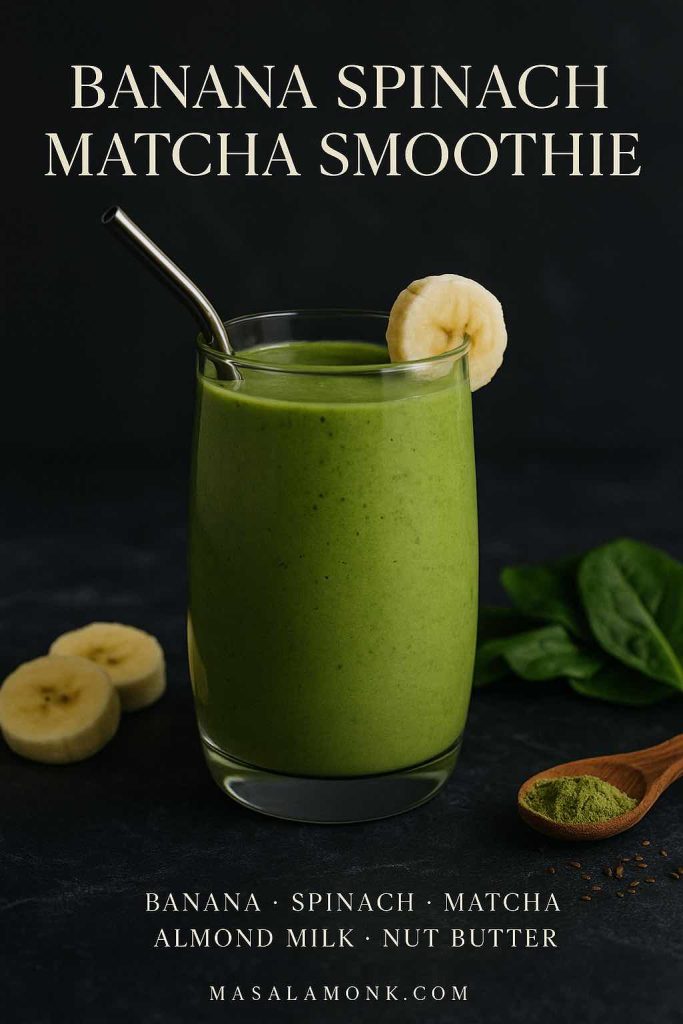
Banana Spinach Matcha Smoothie Recipe

There’s something undeniably comforting about bananas in a smoothie — creamy, naturally sweet, and always satisfying. When you pair banana with vibrant green matcha and a handful of spinach, you get a drink that feels indulgent while being sneakily healthy. The banana masks the “green” taste of spinach, making this a great option if you’re just starting out with green smoothies.

A tall glass of banana spinach matcha smoothie with banana slices and spinach leaves, styled in a classy magazine look.
Start your mornings with this creamy Banana Spinach Matcha Smoothie — packed with antioxidants, fiber, and natural energy.

This smoothie is perfect for breakfast on busy mornings because it gives you sustained energy without a sugar crash. Bananas provide quick-release carbs for an instant boost, while matcha’s caffeine and L-theanine combination offers focus and calm energy throughout the morning. Add in spinach for fiber, iron, and vitamins, and you’ve got a simple but powerful smoothie that ticks all the boxes.

Want to play around with flavors? Add a spoonful of cocoa powder for a chocolate banana matcha smoothie, sprinkle in cinnamon for warmth, or swap dairy milk for almond or oat milk if you prefer a vegan version. For an extra protein boost, toss in a spoon of Greek yogurt or nut butter — it turns this into a filling, meal-worthy shake.

Ingredients:

  • 1 ripe banana (frozen for extra creaminess)
  • 1 teaspoon matcha powder (culinary grade works best in smoothies)
  • 1 cup fresh spinach leaves, washed and packed
  • 1 cup almond or oat milk (or dairy milk if you prefer)
  • 1 tablespoon nut butter (optional, for protein and healthy fats)
  • Ice cubes (optional, for texture)

Method:

  1. Place all ingredients in a blender.
  2. Blend on high until smooth and creamy.
  3. Adjust thickness with more milk if needed.
  4. Serve immediately — garnish with a sprinkle of matcha powder or chia seeds.

Pro Tip: Freeze banana slices ahead of time for a creamier texture and a naturally chilled smoothie without watering it down.


Strawberry Spinach Matcha Smoothie (Berry Boost)

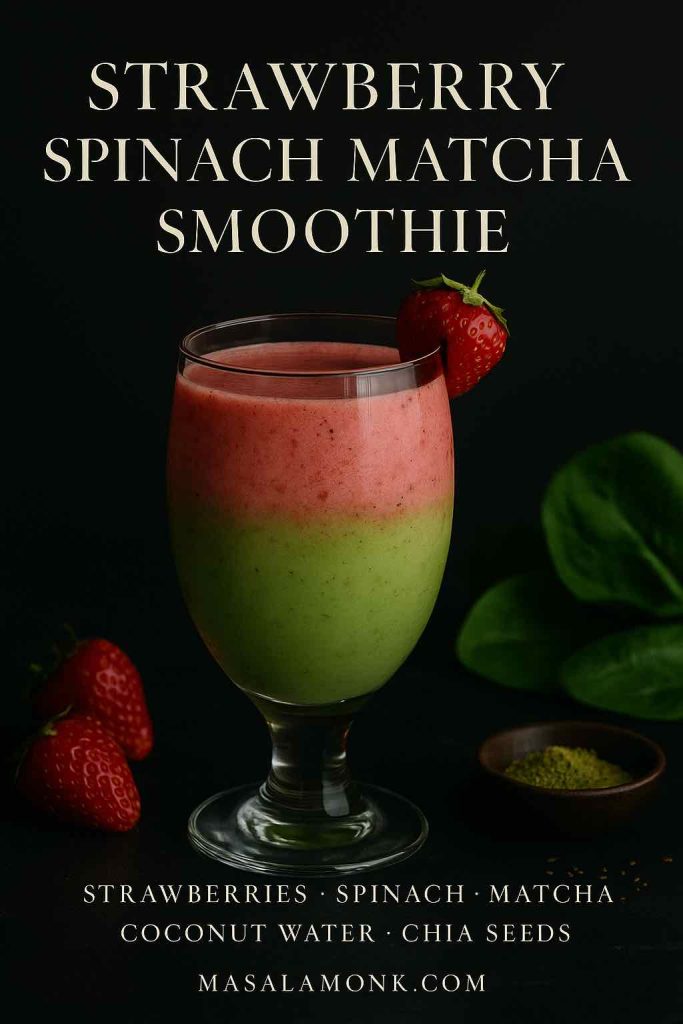
Strawberries and matcha may sound like an unusual pairing, but once you try it, you’ll see why it works so well. The sweetness and slight tang of strawberries balance matcha’s earthy notes, while spinach blends in seamlessly, adding nutrients without altering the taste. The result is a refreshing, vibrant pink-green smoothie that feels like a treat but delivers serious nutrition.

A layered strawberry spinach matcha smoothie in a stemmed glass with fresh strawberries and spinach on a dark background.
A refreshing Strawberry Spinach Matcha Smoothie, blending leafy greens with fruity sweetness for a vibrant, energizing drink.

This smoothie is ideal as a mid-morning pick-me-up or an afternoon refresher. Berries are loaded with vitamin C and antioxidants, which not only support your immune system but also help your body absorb the iron from spinach more effectively — a win-win. Together with matcha’s catechins, this drink is a powerhouse of anti-inflammatory compounds.

For variety, try swapping strawberries for blueberries or raspberries to create different versions of a berry matcha smoothie. Adding a spoonful of chia seeds makes it more filling, while coconut water instead of milk gives it a lighter, tropical edge. You can even blend in a few frozen banana slices for extra creaminess.

Ingredients:

  • 1 cup strawberries (fresh or frozen)
  • 1 teaspoon matcha powder
  • 1 cup fresh spinach leaves
  • 1 cup coconut water or almond milk
  • 1 tablespoon chia seeds (optional, for fiber)
  • ½ frozen banana (optional, for creaminess)

Method:

  1. Blend spinach, liquid base, and matcha first to avoid clumps.
  2. Add strawberries, chia seeds, and banana if using.
  3. Blend until smooth, adjusting liquid for consistency.
  4. Pour into a chilled glass and enjoy immediately.

Pro Tip: Use frozen berries instead of ice cubes — they’ll thicken your smoothie while keeping the flavor concentrated and sweet.


Mango Spinach Matcha Smoothie (Tropical Energy)

If you’ve ever wished your breakfast could taste like vacation, this smoothie is for you. Juicy, golden mango pairs beautifully with the grassy notes of matcha, while spinach provides a subtle green boost. The result is a creamy, tropical matcha green smoothie that feels indulgent but is light on calories.

A golden mango spinach matcha smoothie in a tumbler glass, with mango cubes and matcha powder styled elegantly.
Bright and tropical, this Mango Spinach Matcha Smoothie delivers creamy texture, immune-boosting vitamins, and a morning energy kick.

Mango is rich in vitamin A and vitamin C, making this smoothie especially good for skin health and immunity. Paired with matcha’s antioxidants and spinach’s minerals, it becomes a nutrient-dense drink that can replace sugary tropical juices with a much healthier option. It’s also naturally sweet, so you don’t need added sugar.

For an extra twist, add coconut milk or pineapple chunks to create a tropical matcha smoothie. If you’re looking for a more filling version, blend in a scoop of protein powder or flax seeds to turn it into a post-workout recovery drink.

Ingredients:

  • 1 cup mango chunks (fresh or frozen)
  • 1 teaspoon matcha powder
  • 1 cup spinach leaves
  • 1 cup coconut milk (or coconut water for lighter option)
  • 1 tablespoon flax seeds or hemp seeds (optional, for omega-3s)
  • Ice cubes (optional)

Method:

  1. Blend spinach, liquid, and matcha first.
  2. Add mango and seeds, then blend until silky smooth.
  3. Serve chilled, with a sprinkle of shredded coconut on top if desired.

Pro Tip: If your mango isn’t super ripe, add half a banana to balance the flavor and enhance creaminess.


Protein-Packed Spinach Matcha Smoothie

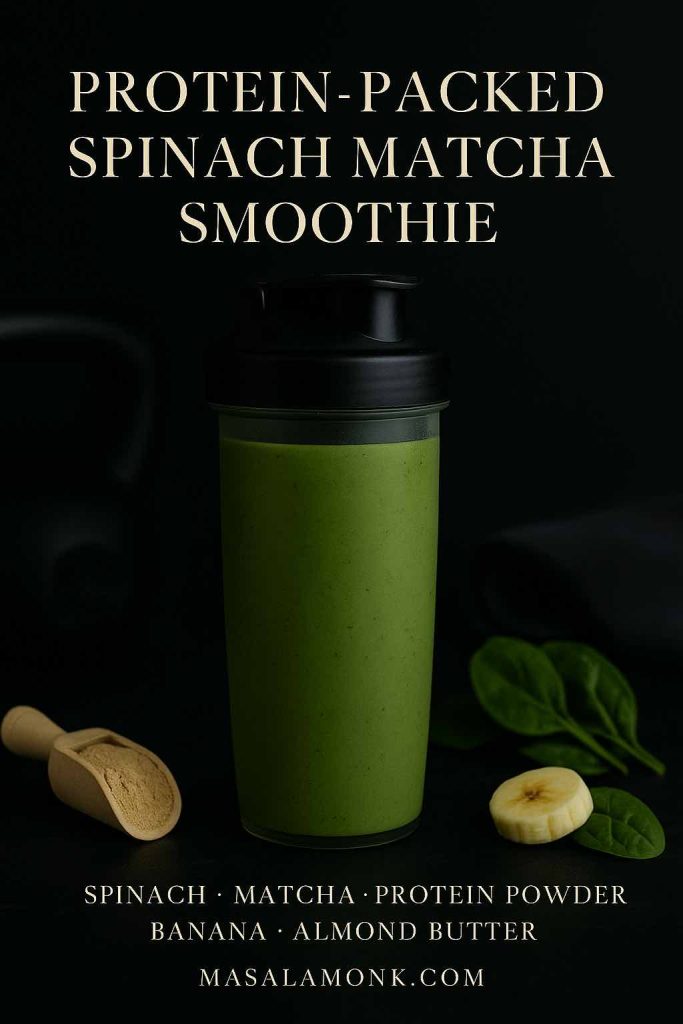
Sometimes you need a smoothie that does more than just refresh you — it needs to fill you up. This protein-packed version is exactly that. With a scoop of protein powder or Greek yogurt, it transforms into a balanced meal that keeps you satisfied for hours. Matcha fuels your mind with clean energy, spinach delivers micronutrients, and the protein helps repair muscles and maintain satiety.

A protein-packed spinach matcha smoothie served in a sleek shaker bottle with protein scoop and spinach leaves.
Boost your workout recovery with this Protein-Packed Spinach Matcha Smoothie — rich in plant-based protein and antioxidants.

This smoothie works beautifully as a post-workout drink. The combination of carbs from fruit and protein from powders or yogurt is ideal for recovery, while matcha helps sharpen your focus for the rest of the day. Spinach adds magnesium and potassium, which also support muscle function.

The best part? You can adapt it endlessly. Go with vanilla whey for creaminess, collagen for skin and joint support, or plant-based protein for a vegan twist. Blend in banana or avocado for texture, add nut butter for richness, or stir in cacao for a chocolate matcha protein shake.

Ingredients:

  • 1 scoop protein powder (whey, plant-based, or collagen)
  • 1 teaspoon matcha powder
  • 1 cup fresh spinach
  • 1 banana or ½ avocado
  • 1 tablespoon almond butter (optional)
  • 1 cup milk of choice (dairy, oat, or almond)

Method:

  1. Blend spinach, matcha, and milk first.
  2. Add protein powder, banana/avocado, and almond butter.
  3. Blend until smooth and creamy.
  4. Serve immediately as a satisfying meal replacement.

Pro Tip: For best results, blend the spinach and matcha with liquid first, then add the protein powder — this prevents clumping and ensures a silky finish.


Weight-Loss Morning Matcha Spinach Smoothie

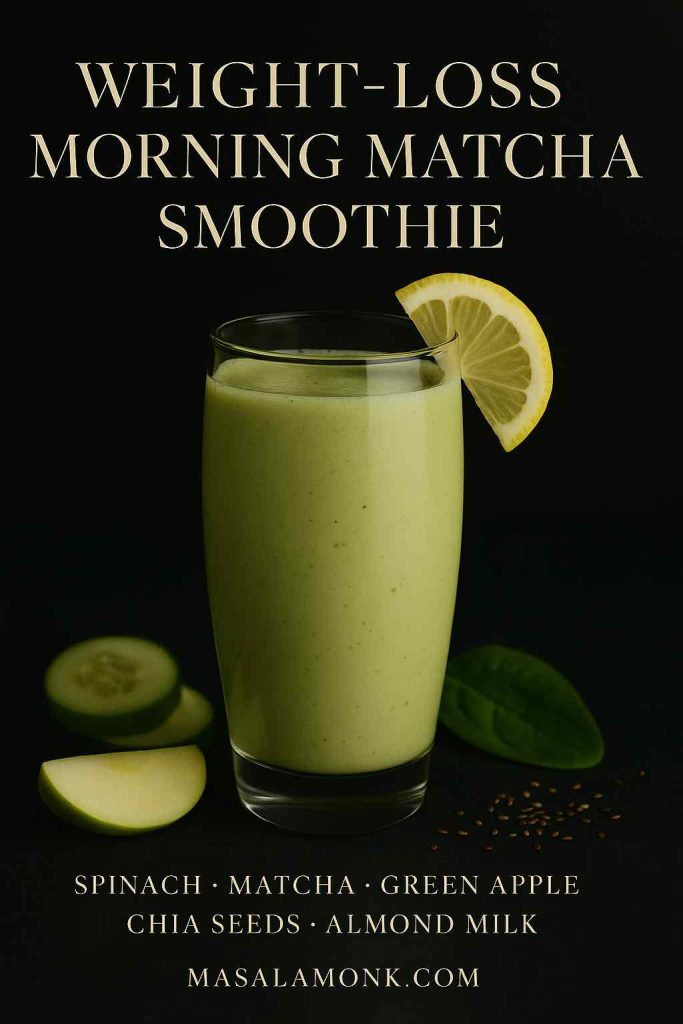
Light, hydrating, and metabolism-friendly, this is one of those Matcha Smoothie Recipes, that is designed for those mornings when you want something refreshing yet filling enough to keep cravings at bay. Matcha has been studied for its potential role in fat oxidation, while spinach provides fiber to support digestion and satiety. Add chia seeds, which expand in liquid, and you’ve got a smoothie that helps you feel full longer without piling on extra calories.

A tall slim glass of weight-loss morning matcha smoothie with lemon wedge garnish, cucumber slices, and chia seeds.
Light and refreshing, this Weight-Loss Morning Matcha Smoothie combines green apple, cucumber, and matcha for a low-calorie wellness drink.

This blend is especially good first thing in the morning, as it hydrates and energizes without being heavy. The crisp flavors of apple or cucumber keep it light and refreshing, while lemon juice adds brightness and helps balance the grassy notes of matcha. It’s also a great option if you’re trying intermittent fasting and need a nutrient-rich but light first meal.

For more staying power, you can add a quarter avocado, a scoop of protein powder, or even some Greek yogurt. These tweaks turn it from a simple snack into a smart, weight-conscious breakfast smoothie that supports your goals.

Ingredients:

  • 1 teaspoon matcha powder
  • 1 cup fresh spinach
  • ½ green apple or cucumber
  • 1 tablespoon chia seeds (or flax seeds)
  • 1 cup unsweetened almond milk
  • Juice of ½ lemon (optional, for brightness)
  • Ice cubes

Method:

  1. Blend spinach, almond milk, and matcha first until smooth.
  2. Add apple/cucumber, chia seeds, and lemon juice.
  3. Blend again until creamy and light.
  4. Pour into a tall glass and enjoy immediately.

Pro Tip: Soak the chia seeds in almond milk for 10–15 minutes before blending — it makes the smoothie creamier and more filling.


Tips for Making the Best Matcha Smoothies at Home

By now, you’ve seen just how versatile and delicious these matcha smoothie recipes can be. But before you start blending on autopilot, it’s worth taking a moment to think about how to get the most out of your matcha smoothie routine. A few simple choices can make your drinks not only tastier, but also healthier and more satisfying.

A flat-lay still life of smoothie ingredients including matcha powder, spinach leaves, banana slices, strawberries, mango cubes, chia seeds, and a lemon wedge.
Ready to blend wellness into your day? Fresh matcha, spinach, fruits, and seeds — the perfect base for healthy smoothie recipes.

First, let’s talk about the matcha itself. Not all matcha powders are created equal. If you’re new to making smoothies, look for a culinary-grade matcha. It’s affordable, blends well, and is made for mixing into recipes. Ceremonial grade is a bit more delicate and often reserved for traditional tea ceremonies, but if that’s what you have, it will still work beautifully. Just remember to sift your matcha before blending to avoid clumps.

Next, consider your base liquid. While regular milk is always an option, plant-based milks like almond, oat, or coconut add unique flavors and textures that can transform a smoothie. Coconut milk, for example, makes your drink richer and tropical, while oat milk adds a natural sweetness and creamy consistency. If you’re keeping calories low, unsweetened almond milk or coconut water are excellent choices.

Add-in and Add-ons for Matcha Smoothie Recipes

Another thing to think about is add-ins. The recipes above are strong on their own, but you can make them even more powerful by including extras like:

  • Chia seeds or flax seeds → for fiber and omega-3s.
  • Nut butters → for creaminess and healthy fats.
  • Protein powders → for satiety and muscle recovery.
  • Cacao or cinnamon → for extra flavor and antioxidants.

And finally, don’t forget texture. If you like your smoothies thick and spoonable, use frozen fruit and less liquid. If you prefer them light and drinkable, add more liquid and use fresh fruit. Over time, you’ll figure out the balance that works best for your taste and routine.

When you keep these tips in mind, you’ll find that your matcha smoothie recipes become less of a one-off treat and more of a daily ritual you look forward to.


📚 Further Reading on Health & Wellness

Looking for more ways to nourish your mornings and support your health? Here are a few handpicked posts from MasalaMonk you might enjoy:


Conclusion – Blending Flavor, Health, and Energy

As you can see, a simple smoothie can be so much more than just a quick drink. By combining spinach with matcha, you’re layering nutrients, antioxidants, and natural energy into something that also tastes genuinely delicious. Whether you reach for the banana version on a busy morning, the berry boost for an afternoon refresh, or the protein-packed blend after a workout, each one of these matcha smoothie recipes has a role to play in your day.

What makes them even better is how customizable they are. With just a few tweaks — switching up your fruit, adding seeds, or trying different plant-based milks — you can create endless variations without ever getting bored. It’s this flexibility, along with the proven health benefits of both matcha and spinach, that makes these smoothies such a smart addition to your lifestyle.

So the next time you’re debating between reaching for a cup of coffee or skipping breakfast altogether, consider giving one of these vibrant green blends a try instead. You’ll get the calm, sustained energy of matcha, the nutritional boost of spinach, and the satisfaction of knowing you’re nourishing your body with every sip. In other words, you’re not just drinking a smoothie — you’re fueling your day the smart, delicious way.


FAQs About Matcha Smoothie Recipes

1. Can you put matcha powder in smoothies?

Absolutely! Adding matcha powder to smoothies is one of the easiest ways to enjoy its benefits. Because matcha is powdered green tea leaves, you’re consuming the whole leaf — which means more antioxidants and nutrients compared to regular steeped tea. Just a teaspoon blended with fruit, spinach, and your favorite milk turns into a vibrant matcha smoothie recipe that’s both energizing and nourishing.


2. What fruit goes best with matcha in smoothies?

Bananas, strawberries, blueberries, and mango are some of the best fruits to pair with matcha in smoothies. Bananas add creaminess and natural sweetness, berries bring antioxidants and tang, and mango creates a tropical twist. These pairings not only balance matcha’s earthy flavor but also make your matcha smoothie recipes taste like a treat.


3. What is the best matcha for smoothies?

For smoothies, culinary-grade matcha is the best choice. It’s more affordable than ceremonial grade and designed to be mixed into foods and drinks. Look for high-quality organic matcha that’s bright green in color, as that usually indicates freshness and good nutrient content. This will make your matcha green tea smoothies both flavorful and effective.


4. Are matcha smoothies good for weight loss?

They can be. Matcha contains catechins like EGCG that may support metabolism and fat oxidation, while spinach and seeds add fiber to keep you full. When combined with low-calorie fruits like cucumber, apple, or berries, these weight-loss matcha smoothie recipes can help control cravings and keep your energy steady throughout the day.


5. Can matcha smoothies replace coffee in the morning?

Yes, many people use matcha smoothies as a coffee alternative. Matcha contains caffeine, but it’s balanced by L-theanine, which promotes calm focus instead of jitters. When blended into a smoothie with spinach, fruit, and protein, it makes a balanced breakfast that powers your morning without the crash that coffee often brings.


6. How often should you drink matcha smoothies?

Most people can enjoy one of the matcha smoothie recipes per day without issues, depending on their caffeine sensitivity. A typical serving (1 teaspoon of matcha powder) contains about 60–70 mg of caffeine, which is less than coffee but enough to boost energy. If you’re sensitive to caffeine, try having your smoothie earlier in the day.

Posted on — 3 Comments

The Best Greens for Gut Health and Digestive Wellness

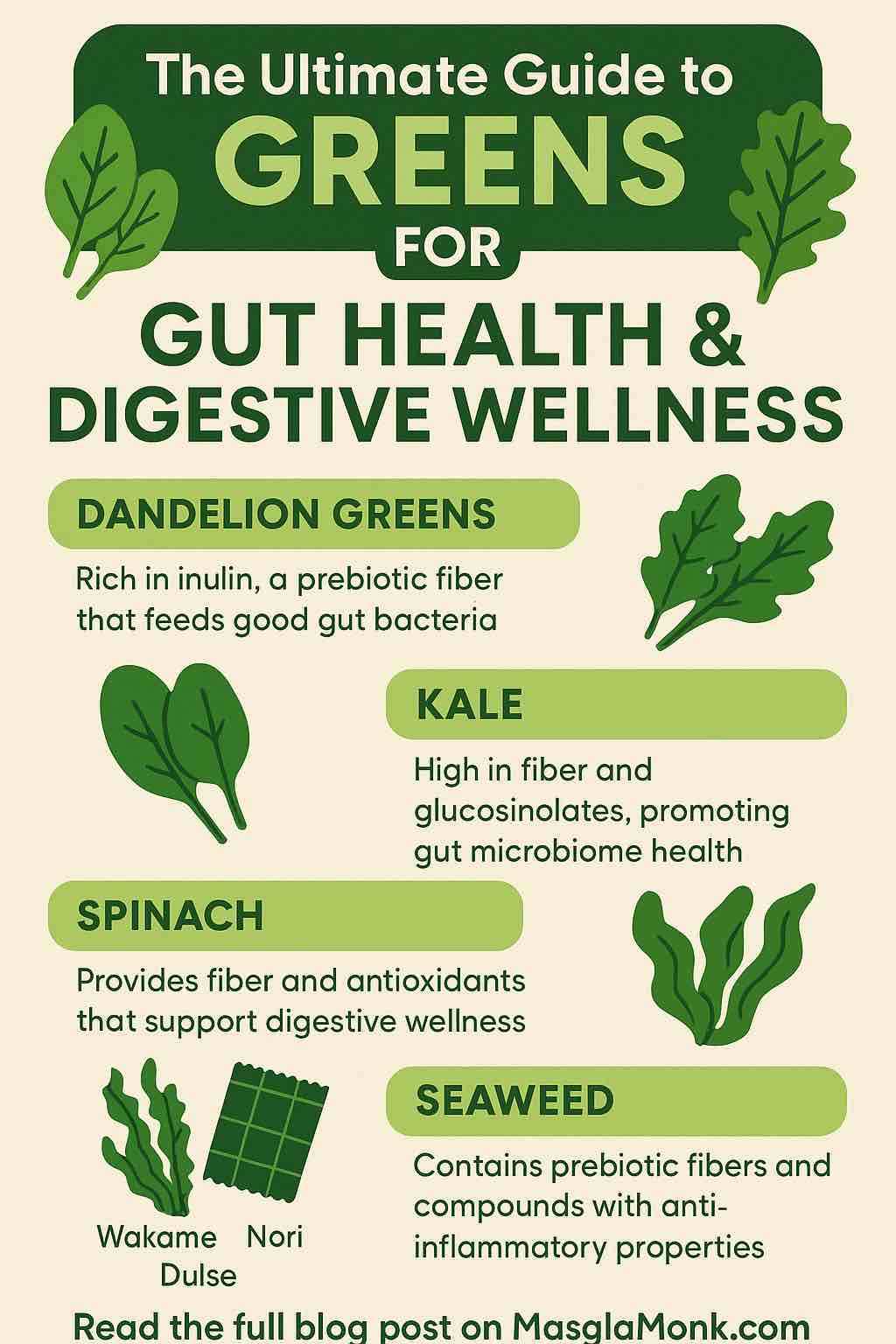
GREENS FOR GUT HEALTH & DIGESTIVE WELLNESS

Gut health is having a moment—and for good reason. The human gut isn’t just where food is digested; it’s the command center for immunity, mood, metabolism, and long-term disease prevention. The star of the show? Your gut microbiome, a vibrant ecosystem of trillions of bacteria, yeasts, and other microorganisms. And what you eat is the single biggest factor influencing your microbiome’s balance.

Of all the foods available, greens—from leafy vegetables to edible seaweeds—stand out for their prebiotic fibers, unique plant compounds, and ability to support digestive wellness. In this post, you’ll discover which greens science says are best for your gut, the reasons why, and exactly how to get more of them on your plate.


Section 1: The Science—How Greens Feed Your Gut

1.1. Fiber: Fuel for Friendly Bacteria

Greens are loaded with dietary fiber, but not all fiber is the same. The fibers in greens act as prebiotics—special food for beneficial bacteria like Bifidobacteria and Lactobacillus. As these bacteria feast on fiber, they create short-chain fatty acids (SCFAs), especially butyrate, which soothes inflammation, strengthens your gut lining, and may lower your risk of diseases ranging from IBS to colon cancer.

1.2. Unique Plant Compounds

Beyond fiber, greens contain:

  • Sulfoquinovose (in leafy greens like spinach & kale): a rare sugar that feeds gut bacteria and increases microbial diversity.
  • Glucosinolates (in cruciferous greens like kale): plant chemicals broken down into anti-inflammatory molecules.
  • Inulin & Oligofructans (especially in dandelion greens): powerful prebiotic fibers that have been shown to significantly boost beneficial bacteria.
  • Polyphenols (found in microgreens and seaweed): antioxidants that encourage good bacteria and inhibit bad ones.

1.3. Seaweed: The Next-Gen Gut Food

Edible seaweeds like nori, wakame, and brown seaweed contain unique fibers—alginates, carrageenans, ulvans—that most land vegetables simply don’t have. These fibers support rare gut bacteria and are linked to improved gut barrier function and a stronger immune system. Brand new research (2025) even shows certain seaweeds can increase SCFA-producing bacteria and may protect against colon cancer in animal models.


Section 2: The Best Greens for Gut Health—What’s Backed by Research?

2.1. Dandelion Greens

  • Star compound: Inulin
  • Gut benefit: Massive prebiotic boost—one of the highest inulin concentrations of any green. Studies show dandelion inulin increases Bifidobacteria, improves regularity, and supports gut lining repair.
  • How to eat: Raw in salads, sautéed, or blended in smoothies. If the flavor is too strong, mix with milder greens.

2.2. Kale & Spinach

  • Star compounds: Fiber, sulfoquinovose, glucosinolates (kale)
  • Gut benefit: Kale and spinach increase SCFA production, enhance microbial diversity, and support anti-inflammatory gut bacteria. Kale also helps the liver detoxify and may reduce colon inflammation.
  • How to eat: Raw, steamed, massaged with olive oil, or baked as chips. Add to soups, omelets, and grain bowls.

2.3. Swiss Chard & Collard Greens

  • Star compounds: Soluble and insoluble fiber, polyphenols
  • Gut benefit: Feed both major groups of gut bacteria; polyphenols have antioxidant and anti-inflammatory effects.
  • How to eat: Sautéed with garlic, in wraps, or chopped into stews.

2.4. Microgreens (Broccoli, Mustard, Radish)

  • Star compounds: Concentrated vitamins, polyphenols
  • Gut benefit: Microgreens can have up to 40x more nutrients than mature plants. Their polyphenols support good gut bacteria and may reduce inflammation.
  • How to eat: On salads, sandwiches, in smoothies, or as a garnish.

2.5. Seaweed (Nori, Wakame, Dulse, Brown Seaweed)

  • Star compounds: Alginates, fucoidan, ulvans, unique polyphenols
  • Gut benefit: Human clinical trials (2024-2025) show brown seaweed increases SCFA-producing bacteria and can even lower markers of inflammation. Seaweed fibers help “train” the microbiome in ways land veggies cannot.
  • How to eat: Sprinkle nori flakes on rice, add wakame to soups, or blend seaweed into smoothies. Opt for food-grade, tested seaweed to avoid contaminants.

Section 3: Practical Tips—How to Eat More Greens for Gut Health

3.1. Rotate Your Greens

Different greens feed different bacteria. Variety matters! Rotate between dandelion, kale, spinach, microgreens, chard, and seaweed to support a broad spectrum of microbes.

3.2. Pair with Healthy Fats

Many green nutrients (like vitamins A, E, K) are fat-soluble. Drizzle with olive oil or toss with avocado for better absorption—and a more satisfying meal.

3.3. Start Low, Go Slow

If you’re new to fiber-rich greens, introduce them gradually. This gives your gut time to adjust, reducing the risk of bloating or gas.

3.4. Try Fermented Greens

Fermenting greens (like kimchi or sauerkraut) adds a probiotic boost, delivering live bacteria alongside the prebiotic fiber.

3.5. Be Cautious with Wild Seaweed

Some wild seaweed can harbor bacteria like Vibrio. Always choose tested, food-grade products (usually labeled as such in health stores or from reputable online suppliers).


Section 4: Real-World Meal Ideas

Breakfast:

  • Green smoothie (spinach, microgreens, avocado, banana, oat milk, chia seeds)
  • Omelet with sautéed kale, dandelion greens, and feta

Lunch:

  • Massaged kale salad with olive oil, lemon, walnuts, and roasted sweet potatoes
  • Collard green wraps stuffed with hummus, carrots, and microgreens

Snack:

  • Nori seaweed snacks
  • Swiss chard chips (baked with olive oil)

Dinner:

  • Stir-fry with dandelion greens, tofu, and brown rice
  • Miso soup with wakame seaweed and tofu

Section 5: Frequently Asked Questions

1. Which green is the single best for gut health?
Dandelion greens are considered one of the best for gut health due to their high inulin content, a prebiotic fiber that specifically nourishes beneficial gut bacteria.


2. Can I eat greens raw, or should they be cooked for gut health?
Both raw and cooked greens are valuable. Raw greens retain more enzymes and vitamin C, while cooking can increase bioavailability of some nutrients and make fibers easier to digest for sensitive guts. Try to include a mix of both in your diet.


3. Is seaweed safe to eat every day?
Food-grade, tested seaweed is generally safe in moderate amounts. However, excessive consumption can lead to high iodine intake. Most health authorities recommend 2–3 servings per week for adults.


4. Are green powders or supplements as good as fresh greens?
While green powders can supplement your diet, they lack the water and full fiber content of fresh greens. Use them as a backup, not a replacement for whole foods.


5. What if I experience bloating when increasing greens?
This is common when introducing more fiber. Increase your intake gradually, drink plenty of water, and consider lightly cooking greens to reduce bloating. If symptoms persist, consult a healthcare provider.


6. What are the best greens for people with sensitive digestion or IBS?
Spinach, romaine lettuce, and cooked Swiss chard are typically well-tolerated. If you’re sensitive to FODMAPs, introduce inulin-rich greens like dandelion very slowly and monitor your response.


7. Can children and seniors benefit from eating more greens for gut health?
Yes! Greens support gut health at all ages. Just ensure the greens are prepared in an age-appropriate way—chopped small for kids, cooked soft for seniors.


8. How can I add more greens to my diet if I don’t like the taste?
Blend greens into smoothies with fruit, add them to sauces or soups, or bake them as chips. Combining greens with flavorful dressings or spices can make them more palatable.


9. Are fermented greens better for gut health?
Fermented greens (like sauerkraut and kimchi) provide both prebiotics (fiber) and probiotics (live beneficial bacteria), making them an excellent choice for gut health.


10. Do I need to wash store-bought greens and seaweed?
Yes. Even pre-washed greens should be rinsed before eating. For seaweed, buy food-grade, certified products and follow any preparation instructions on the packaging.


Section 6: The Future—Greens, Seaweed, and Microbiome Medicine

The research is moving fast. Human trials now show seaweed and diverse greens can:

  • Increase the abundance of beneficial SCFA-producing bacteria
  • Reduce inflammation
  • Support colon health, even lowering markers of cancer risk in preliminary studies

The bottom line? A daily habit of rotating leafy greens and adding a few servings of safe, food-grade seaweed could be one of the simplest ways to support lifelong gut health and wellness.


Conclusion: Simple Steps for a Happier Gut

  1. Eat greens daily, and rotate types for max benefit
  2. Try adding food-grade seaweed to your diet weekly
  3. Pair with healthy fats for better absorption
  4. Start slow, listen to your body, and enjoy the journey!

Your gut—and the rest of your body—will thank you.


What are your favorite greens—or questions about gut health? Drop them in the comments!

Posted on — 1 Comment

The Spinach – Nutrition, Benefits, and 5 Practical Ways for Weight Loss

Spinach: The Ultimate Superfood for Weight Loss & Health

“In a world full of processed, calorie-dense foods, spinach remains nature’s simple yet powerful solution to health and weight management.”


Introduction: Why Spinach Deserves the Spotlight

In the vast world of superfoods, spinach often gets overshadowed by trendy new arrivals — but this humble leafy green remains one of the most nutrient-packed, calorie-efficient, and versatile foods available. Whether you’re looking to shed a few pounds, enhance your energy levels, or simply nourish your body with clean, dense nutrition, spinach checks all the boxes.

Backed by both ancient wisdom and modern scientific research, spinach delivers a remarkable combination of vitamins, minerals, antioxidants, and unique plant compounds that offer profound health benefits — particularly for those aiming to lose weight without compromising nutrition.

In this comprehensive guide, we’ll explore:

  • Spinach’s detailed nutritional profile
  • How it specifically supports weight loss
  • Its wide-ranging health benefits
  • Important cautions and considerations
  • 5 practical, easy ways to incorporate spinach into your daily routine

1️⃣ Spinach Nutrition Breakdown: Small Calories, Huge Nutrients

Let’s start by looking at exactly why spinach is often called a “nutrient powerhouse.” Here’s what 100 grams (roughly 3.5 ounces) of raw spinach provides:

NutrientAmount% Daily Value (DV)
Calories23 kcal–
Water~91%–
Protein2.9 g–
Carbohydrates3.6 g–
Fiber2.2 g–
Sugars0.4 g–
Vitamin K483 mcg121%
Vitamin A469 mcg52%
Vitamin C28 mg31%
Folate (B9)194 mcg49%
Iron2.7 mg15%
Magnesium79 mg20%
Calcium99 mg10%
Potassium558 mg12%
Vitamin E2 mg13%

✅ Key Takeaway:
Spinach delivers an extraordinary amount of essential nutrients with negligible calories. This makes it one of the most nutrient-dense foods on the planet.


2️⃣ How Spinach Aids Weight Loss

Spinach isn’t a magical weight-loss solution by itself — but science shows that it creates the perfect environment for sustainable fat loss. Here’s why:

a) Low in Calories, High in Volume

Spinach contains only 23 calories per 100 grams, but thanks to its high fiber and water content, it adds significant bulk to meals. This allows you to eat larger portions and feel full while consuming fewer calories.

b) Rich in Fiber: Natural Appetite Control

The 2.2 grams of fiber per 100 grams of spinach slow digestion, stabilize blood sugar, and keep you feeling fuller longer. Fiber reduces the likelihood of binge-eating or unhealthy snacking between meals.

c) Thylakoids: Spinach’s Hidden Weapon

Recent research highlights that spinach contains thylakoids — microscopic structures found in plant cells that may play a major role in appetite suppression.

  • Thylakoids stimulate satiety hormones like GLP-1 and CCK.
  • They help reduce cravings for sweet and fatty foods.
  • Clinical studies have shown that consuming spinach extracts rich in thylakoids can reduce hunger and lower caloric intake over time.

d) Supports Metabolism

Spinach is rich in iron, magnesium, and B vitamins — all critical for energy production and metabolic efficiency. When your metabolism is running optimally, your body burns calories more effectively.

e) Balances Blood Sugar

Thanks to its fiber and antioxidant content, spinach helps maintain steady blood sugar levels — a crucial factor for anyone trying to manage hunger and avoid insulin spikes that can lead to fat storage.

f) Reduces Inflammation

Obesity and weight gain are often linked to chronic inflammation. Spinach’s antioxidants (like quercetin, lutein, and zeaxanthin) actively reduce inflammation markers, supporting overall metabolic health.

📌 Summary:
Spinach helps reduce calorie intake, promotes satiety, balances hormones, and supports metabolic health — all of which create the perfect conditions for sustained weight loss.


3️⃣ Spinach’s Broader Health Benefits

Beyond weight loss, spinach offers numerous other advantages for overall health:

✅ Cardiovascular Protection

  • High nitrate content supports healthy blood pressure by increasing nitric oxide, which relaxes blood vessels.
  • Antioxidants help prevent arterial plaque buildup.
  • Folate contributes to lower homocysteine levels, a heart risk marker.

✅ Bone Strength

  • Spinach is one of the best sources of vitamin K, which is essential for bone mineralization.
  • Magnesium, calcium, and vitamin C also support skeletal health.

✅ Eye Health

  • Rich in lutein and zeaxanthin — carotenoids that protect the retina and prevent macular degeneration and cataracts.

✅ Skin, Hair, and Nail Health

  • Vitamins A, C, and E promote collagen synthesis, reduce oxidative stress, and support healthy hair and skin.
  • Iron supports oxygenation of hair follicles, preventing hair thinning.

✅ Cognitive and Mental Well-being

  • Antioxidants may reduce age-related cognitive decline.
  • Magnesium plays a role in mood regulation, stress reduction, and sleep quality.

✅ Immune System Support

  • Vitamin C, beta-carotene, and other micronutrients enhance immune defense.

4️⃣ Cautions and Considerations

While spinach is extremely healthy, certain groups should exercise caution:

➔ Oxalate Content

  • Spinach is high in oxalates, which can contribute to kidney stone formation in susceptible individuals.
  • Cooking (especially boiling and discarding water) reduces oxalate levels significantly.

➔ Vitamin K Interference

  • Those on blood thinners (e.g., warfarin) should maintain a consistent spinach intake and consult with their physician to avoid affecting medication efficacy.

➔ Digestive Issues

  • Its high fiber content may cause bloating or discomfort in individuals with sensitive digestive systems. Start with small amounts and gradually increase intake.

➔ Purines and Gout

  • Spinach contains purines, but current research shows it has a minimal effect on gout risk compared to animal-based purine sources.

5️⃣ 5 Practical Ways to Add Spinach to Your Weight Loss Diet

One of spinach’s biggest advantages is its flexibility in cooking. Here are 5 simple, delicious ways to include it daily:

1️⃣ Leafy Green Salads

  • Base your salads with fresh baby spinach leaves.
  • Add lean proteins (grilled chicken, tuna, tofu).
  • Include healthy fats (olive oil, avocado).
  • Top with seeds or nuts for added crunch.

2️⃣ Smoothies

  • Blend spinach with bananas, berries, Greek yogurt, and almond milk.
  • Its mild flavor blends well without overpowering the taste.
  • A nutrient-packed breakfast or post-workout snack.

3️⃣ Soups & Stews

  • Toss fresh or frozen spinach into soups and stews during the last few minutes of cooking.
  • This enriches both the nutrition and the texture of the dish.

4️⃣ Omelets & Scrambles

  • Add a generous handful of spinach to scrambled eggs or omelets.
  • Combines high-quality protein with the benefits of spinach’s fiber and micronutrients.

5️⃣ Pasta & Stir-Fries

  • Mix sautéed spinach into whole-grain pasta or stir-fries.
  • Pair with lean protein sources like shrimp, chicken, or tempeh for a balanced meal.

Conclusion: Small Leaf, Big Impact

Spinach isn’t flashy. It’s not exotic. But it’s highly effective.

Incorporating spinach into your daily routine offers you a simple, affordable, and research-backed way to:

  • Cut calories without cutting nutrients.
  • Support weight loss while improving overall health.
  • Add versatility and color to almost any meal.

If you’re serious about your weight loss or health journey, let spinach be one of your daily green allies. Small habits — like adding spinach — create lasting change.


Bonus Tip 🌿

Frozen spinach retains almost all of its nutrients, is budget-friendly, and makes year-round consumption easier than ever. Don’t hesitate to keep a stash in your freezer!

📌 10 Frequently Asked Questions (FAQs)

1️⃣ Is spinach good for weight loss?

Yes. Spinach is very low in calories while being high in fiber, water, and essential nutrients. Its fiber and thylakoid content help control hunger and cravings, making it an excellent food to include in weight loss diets.


2️⃣ How much spinach should I eat daily for weight loss?

There’s no strict rule, but 1–2 cups of fresh spinach daily is a safe and effective amount for most people. If using cooked spinach, ½–1 cup is sufficient, since cooking reduces its volume significantly.


3️⃣ Can I eat spinach every day?

Yes, for most people. Daily spinach consumption is generally safe and beneficial. However, individuals prone to kidney stones, or those on blood-thinning medication, should monitor intake and consult with a healthcare provider.


4️⃣ Does cooking spinach reduce its nutritional value?

Cooking spinach reduces certain water-soluble nutrients like vitamin C and folate, but increases absorption of others such as iron, calcium, and carotenoids. Both raw and cooked spinach have unique nutritional advantages.


5️⃣ Is frozen spinach as healthy as fresh spinach?

Yes. Frozen spinach retains most of its nutrients and is an excellent, convenient, and budget-friendly alternative. It’s especially useful for soups, stews, and cooked dishes.


6️⃣ Does spinach help with belly fat specifically?

While no food directly targets belly fat, spinach supports overall weight loss through appetite control, better metabolism, and improved blood sugar management — all of which indirectly help reduce abdominal fat over time.


7️⃣ Are there any side effects of eating too much spinach?

Excessive spinach intake may contribute to:

  • Kidney stone risk (due to oxalates)
  • Gastrointestinal discomfort (bloating, gas)
  • Vitamin K interference (for those on blood thinners)

Moderation is key, and cooking spinach can help minimize oxalate levels.


8️⃣ Is spinach suitable for people with diabetes?

Absolutely. Spinach’s fiber content helps stabilize blood sugar levels, while its low glycemic load makes it a safe choice for diabetics. Always discuss any dietary changes with your healthcare provider.


9️⃣ Can spinach improve skin and hair health?

Yes. Spinach provides vitamins A, C, and E — crucial for collagen production, skin repair, and scalp health. Iron in spinach also supports healthy blood flow to hair follicles, potentially improving hair growth.


🔟 What is the best time to eat spinach for weight loss?

There’s no “best” time — spinach can be beneficial at any meal. Many prefer it in:

  • Breakfast smoothies (for appetite control)
  • Lunch salads (to stay full longer)
  • Evening stir-fries or soups (light, nutrient-rich dinner)