Posted on Leave a comment

Protein Cookie Dough Recipe

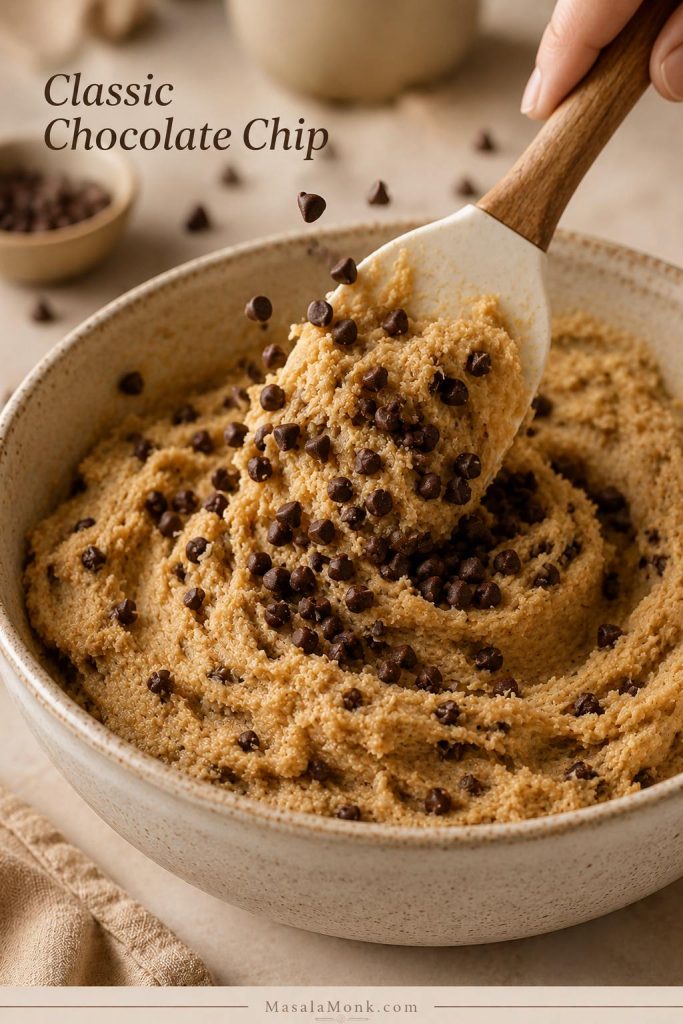
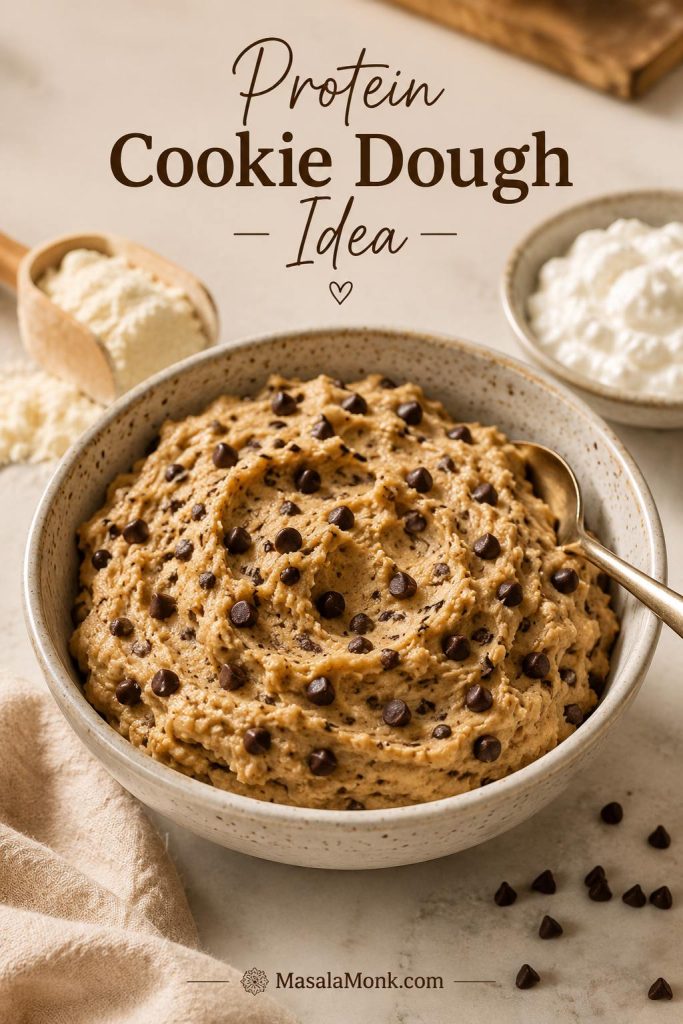
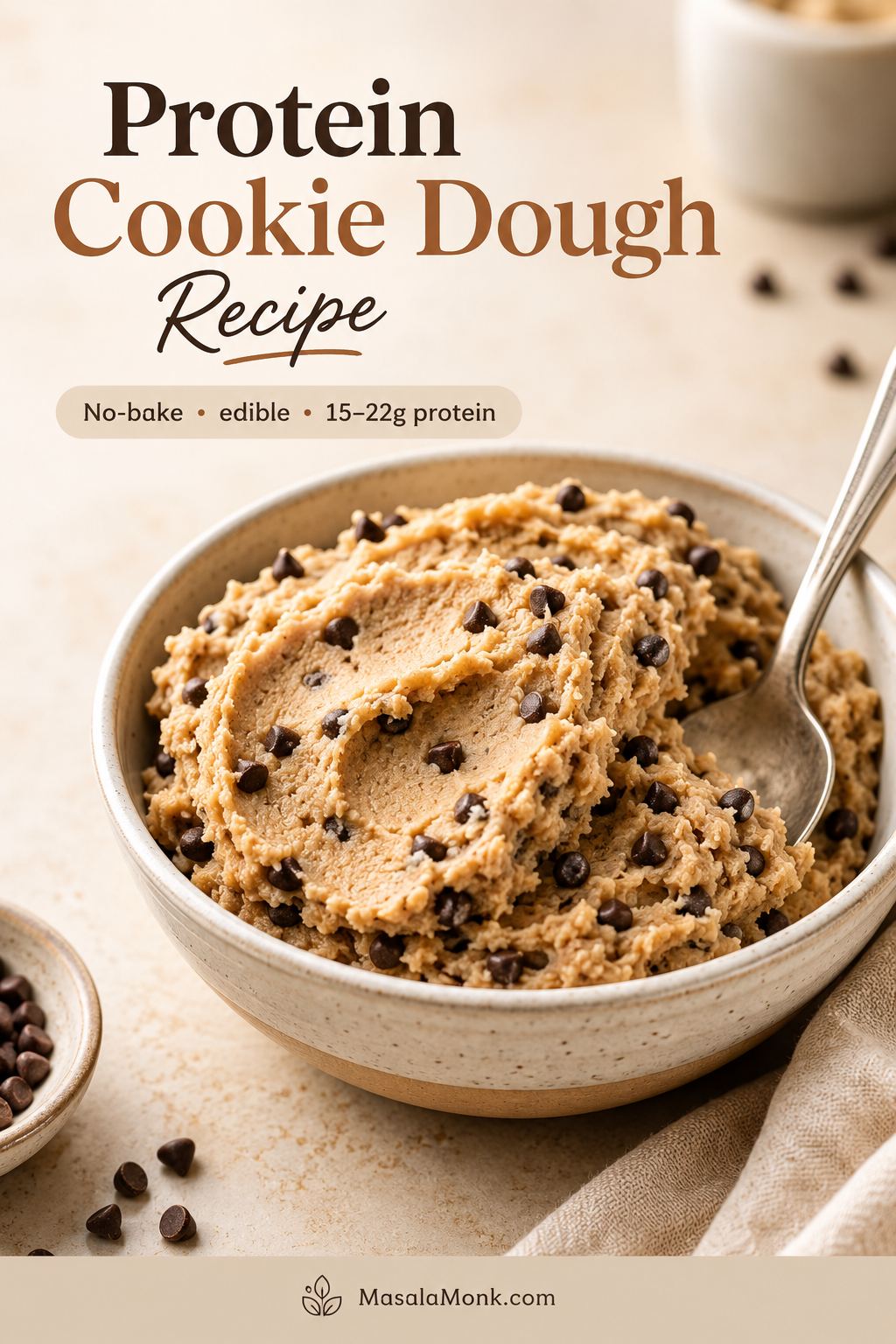
Thick protein cookie dough recipe in a bowl with mini chocolate chips, spoon marks, and a scoopable texture.

This protein cookie dough recipe is edible, no-bake, ready in about 5 minutes, and built to taste like cookie dough — not protein paste. It is egg-free, made without raw all-purpose flour, and gives you a scoopable, chocolate-studded dough with about 15–22g protein per serving when divided into 3–4 portions.

No oven, no mixer, no waiting for cookies to cool — just one bowl, a spoon, and a sweet snack that feels more like dessert than a protein shake.

The difference between good protein cookie dough and chalky protein paste is balance. Protein powder adds structure, nut butter gives richness, Greek yogurt softens the dough, and almond flour or oat flour makes it thick enough to scoop. Then vanilla, salt, and mini chocolate chips bring it closer to a real cookie dough bite. If you like this kind of high-protein dessert, this dough gives you the same treat-like feeling without needing a freezer or blender.

It should feel like sneaking a spoonful of cookie dough from the bowl, only with enough protein to make it feel more satisfying than a random bite of dessert.

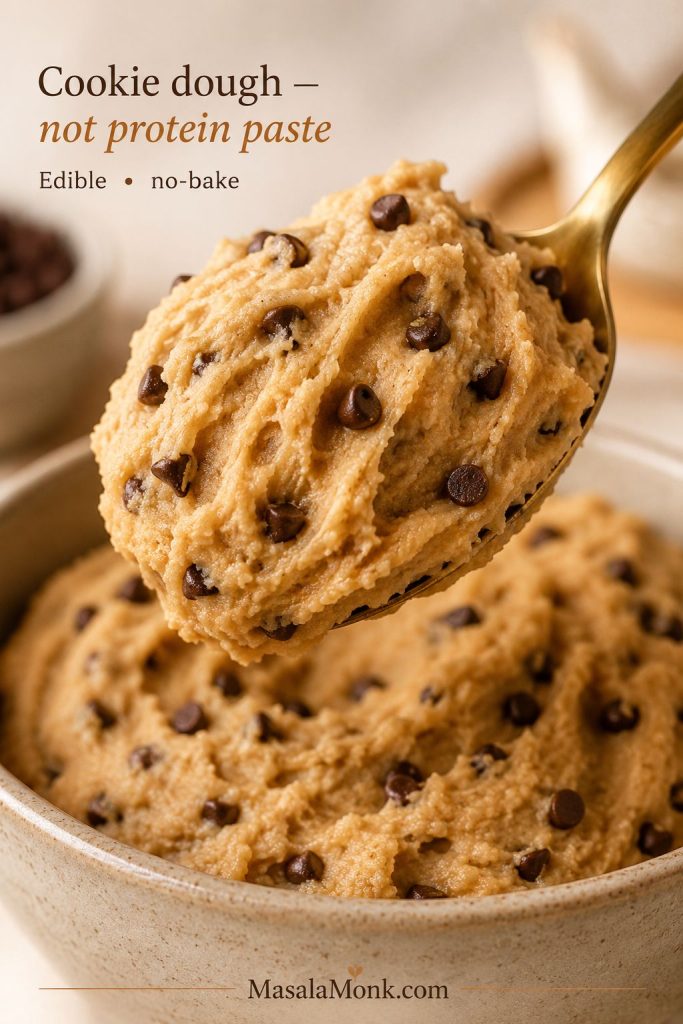
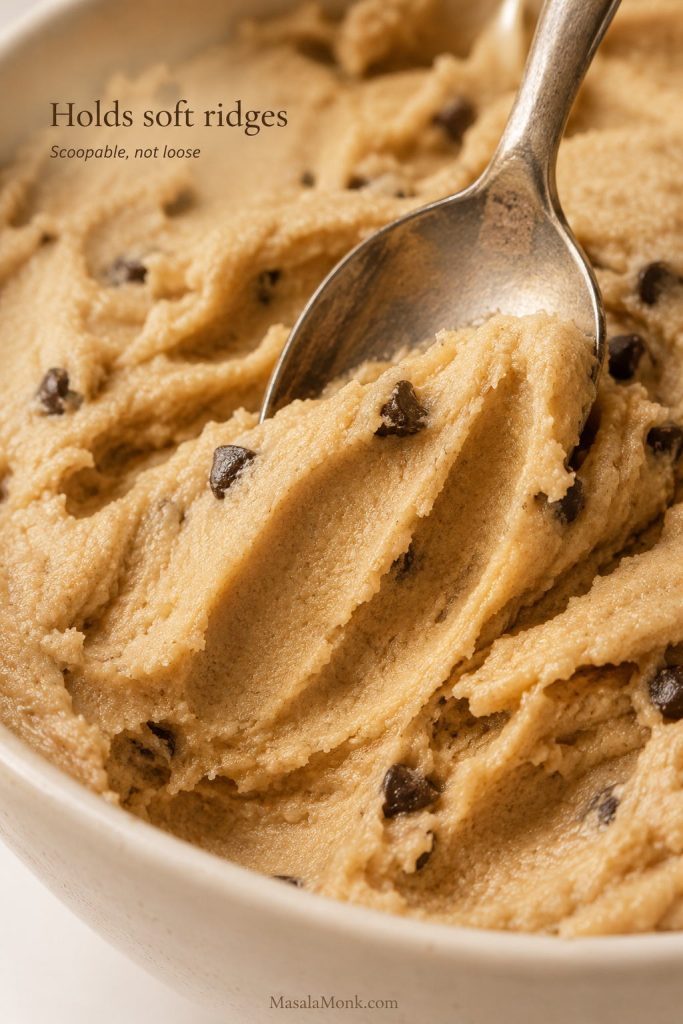
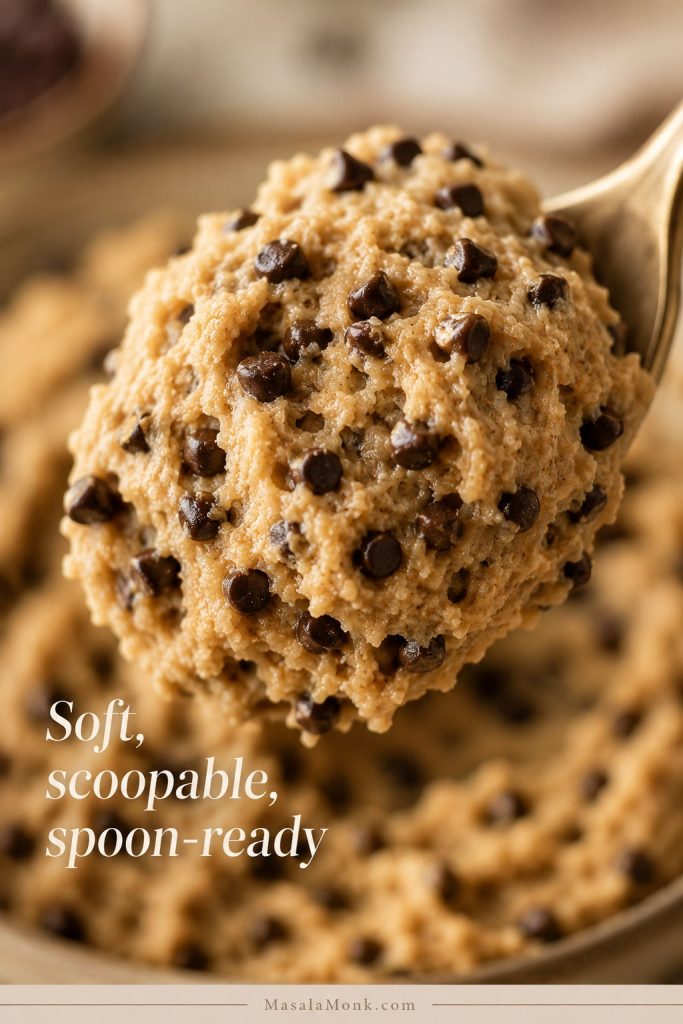
Spoon lifting edible protein cookie dough with mini chocolate chips and soft ridges showing the scoopable texture
This spoon-lift shows the texture you want: creamy, sturdy, and able to hold its shape without turning stiff.

Quick Answer: The Best Protein Cookie Dough Ratio

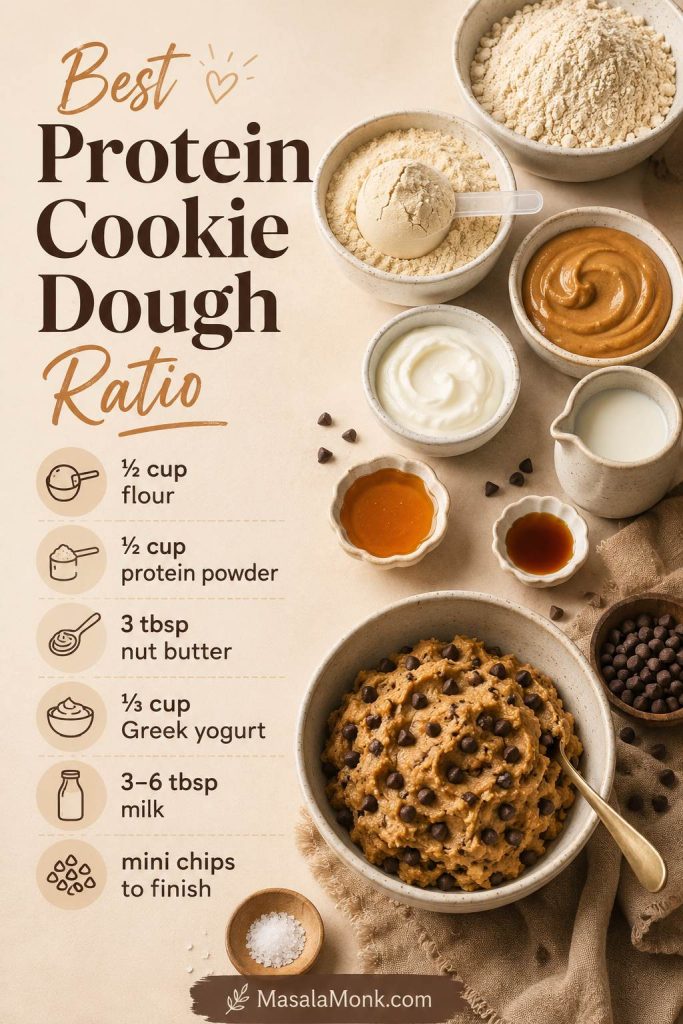
Protein cookie dough ratio board with protein powder, flour, nut butter, Greek yogurt, milk, and mini chocolate chips
This quick ratio works because the dry base, creamy ingredients, and milk are balanced before the chocolate chips go in.

Use less milk for a firmer dough and more milk for a softer, scoop-and-eat texture. Divide the batch into 3 portions for a higher-protein snack, or 4 portions for smaller dessert-style servings.

Best first version: Use a vanilla whey-casein blend if you have one, almond flour for a softer rich dough, and mini chocolate chips for the most cookie-dough-like bite.
Do not add all the milk at once. Protein powders absorb moisture differently, and a dough that looks dry at first can loosen quickly after mixing. Add liquid gradually and stop as soon as the dough holds together.

Not sure how your powder will behave? See the protein powder guide before adding all the milk.

Protein Cookie Dough at a Glance

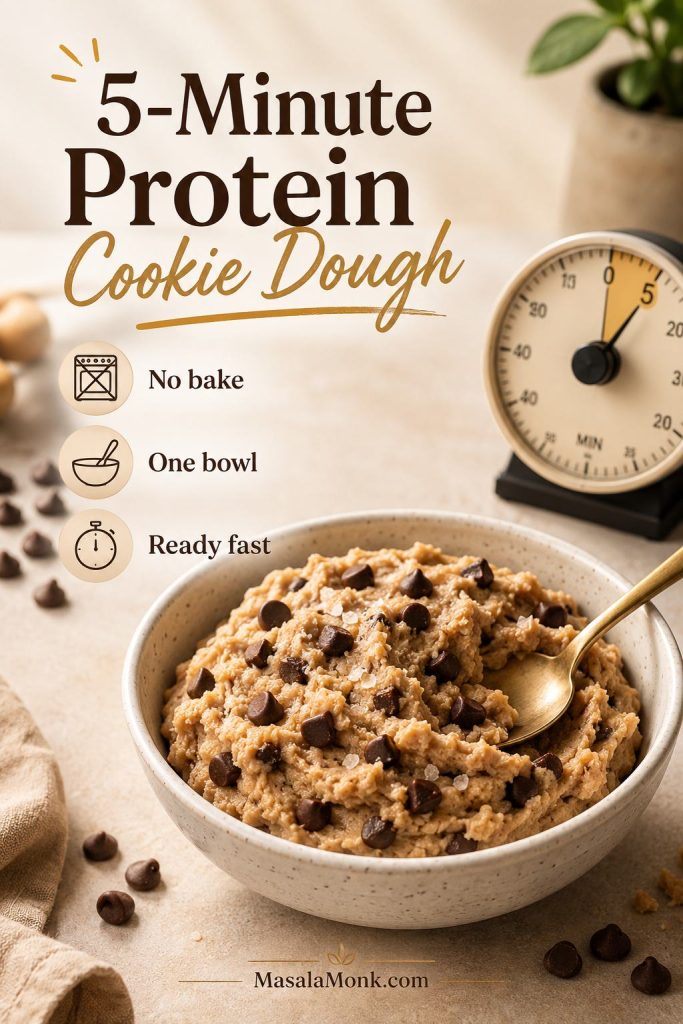
One-bowl five-minute no-bake protein cookie dough with a timer, spoon, and thick chocolate chip dough
Since this is a 5-minute no-bake recipe, the key is adjusting texture in the bowl instead of relying on baking time.
Prep time 5 minutes
Cook time 0 minutes
Chill time Optional 20–30 minutes for firmer dough
Servings 3–4 servings
Protein estimate About 15–22g per serving, depending on powder and serving size
Best texture Scoopable, sturdy, and easy to eat with a spoon
Best flour Almond flour for soft/rich, oat flour for more cookie-like
Main fix Add liquid slowly, then fine-tune the texture in small spoonfuls
Storage 4–5 days in the fridge or 2–3 months frozen in portions

The best part is that the recipe is forgiving. If the first mix looks too dry, too sticky, or too thick, you do not have to start over — you just adjust the bowl in small steps.

Estimated Protein, Calories, and Serving Size

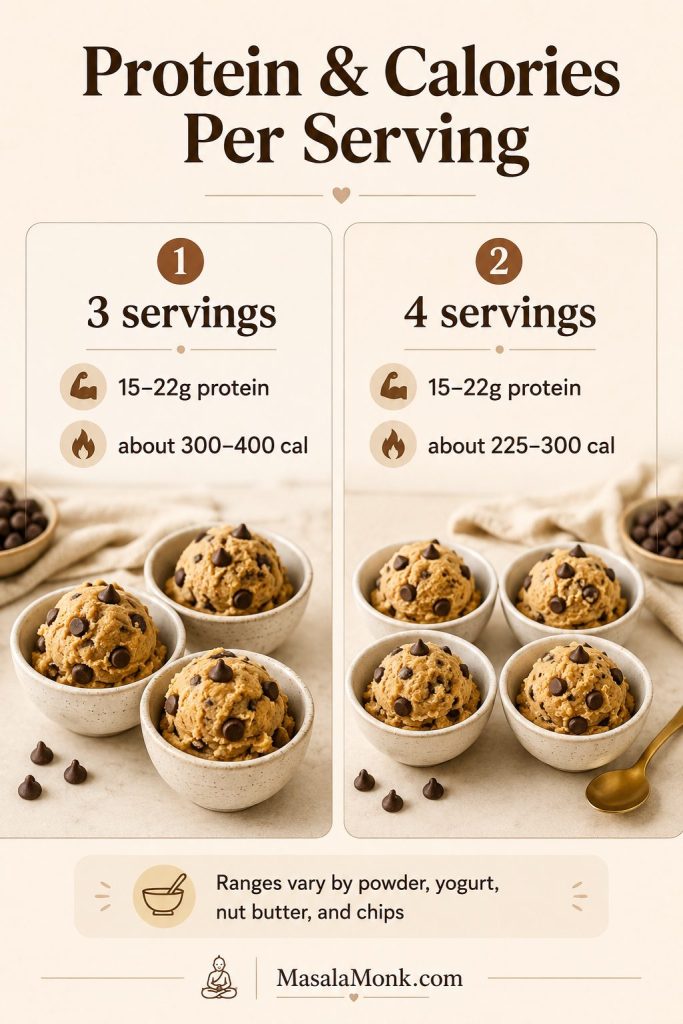
Protein and calorie guide for protein cookie dough showing three-serving and four-serving portion estimates
For macro tracking, portion size matters: three larger servings feel more snack-like, while four smaller servings keep the calories lighter.

As a rough range, the full batch often lands around 900–1,200 calories, depending on the protein powder, nut butter, yogurt, milk, syrup, and chocolate chips used. That works out to about 300–400 calories if divided into 3 larger servings, or about 225–300 calories if divided into 4 smaller servings. Use your own ingredient labels for the most accurate number.

Calories vary most from the nut butter, chocolate chips, protein powder, syrup, and yogurt you use. A richer dessert bowl usually comes from regular nut butter, maple syrup or honey, and the full chocolate chip amount. If you want a lighter version, use powdered peanut butter, nonfat Greek yogurt, almond milk, and fewer mini chocolate chips.

To keep the bowl lighter without making it taste flat, jump to the low-calorie protein cookie dough version and use the swaps there.

Why This Protein Cookie Dough Works

A good high-protein cookie dough has to solve the real problem: it needs enough protein to feel worth making, but it still has to satisfy the part of you that wanted cookie dough in the first place. When the balance is off, the texture changes quickly. Extra protein powder can make the dough dry or chalky, too much liquid can turn it sticky, and not enough fat can make it taste like sweet paste instead of cookie dough.

This version works because each ingredient protects the dough from the usual protein-dessert problems: dry, sticky, chalky, or bland. Protein powder gives the snack its purpose, almond flour or oat flour keeps it from turning loose, nut butter makes it taste richer, and Greek yogurt softens the bite so it feels more like dessert than a scoop of powder. Vanilla, salt, and mini chocolate chips finish the flavor so it tastes more like cookie dough and less like a protein shake in a bowl.

When that balance is right, the dough tastes sweet and familiar instead of “healthy” in the disappointing way.

The finished dough should hold ridges when stirred, scoop cleanly, and firm up slightly after chilling. It should not pour like batter, crumble like dry powder, or cling aggressively to the spoon.

Why readers usually love this: It gives you the cookie-dough feeling without turning into a full baking project. No oven, no mixer, no waiting for cookies to cool — just a thick, sweet, chocolate-studded bowl you can adjust until it tastes right.

Ingredients You Need

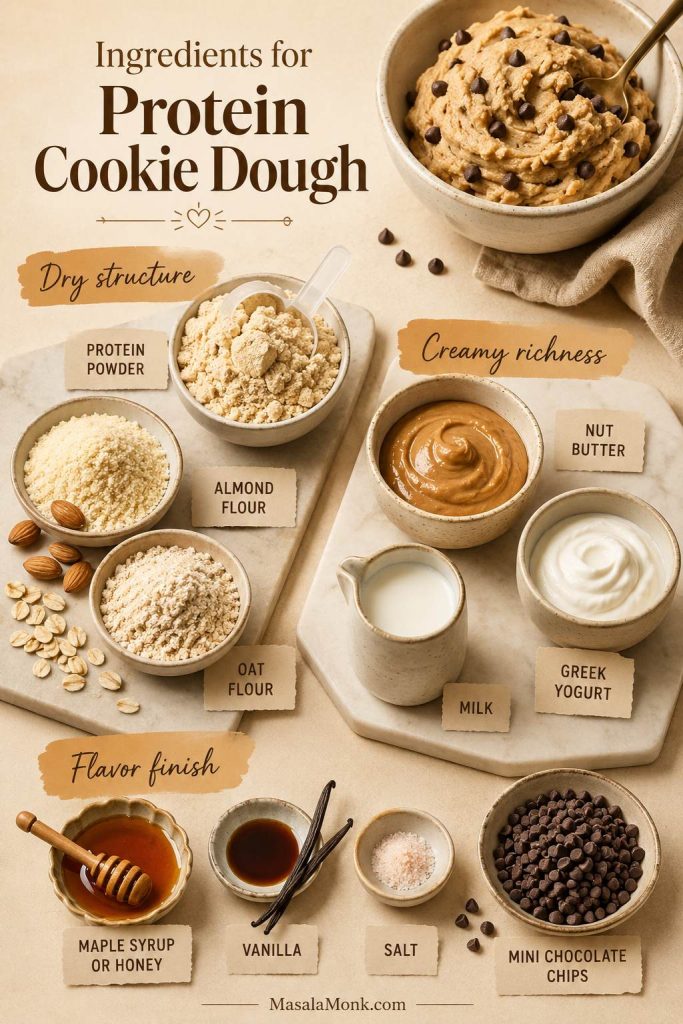
Protein cookie dough ingredients arranged by texture role, including protein powder, flour, yogurt, nut butter, and chocolate chips
Each ingredient controls something important: body, creaminess, sweetness, flavor, or chocolate in every bite.

Protein powder

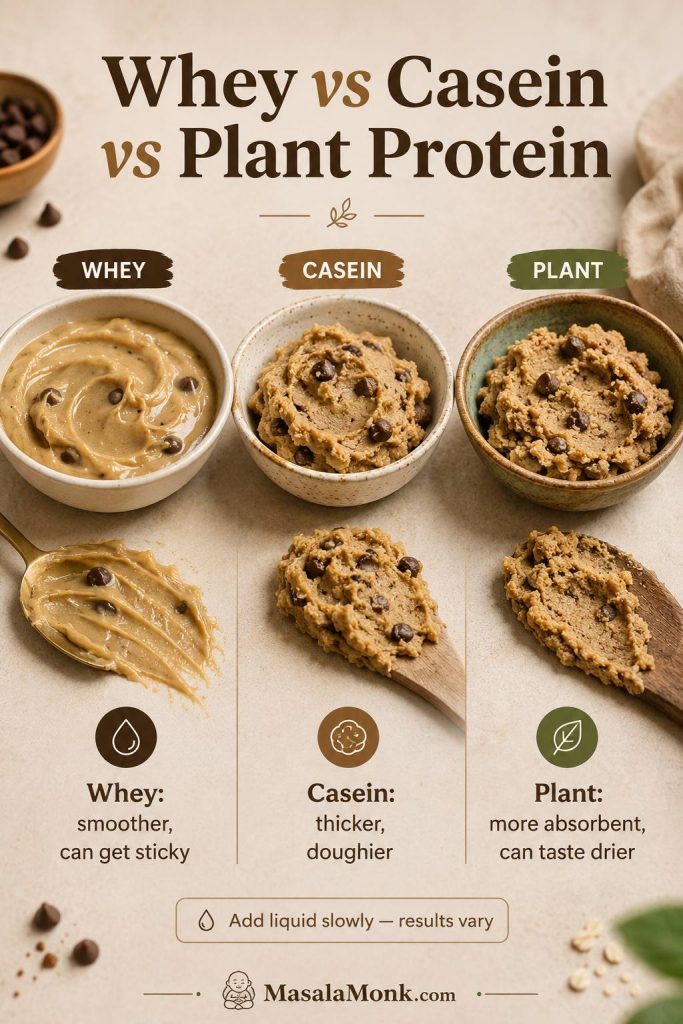
Vanilla protein powder is the easiest choice because it already brings sweetness and dessert flavor. Whey protein can make a smoother dough, but it may become sticky if you add too much liquid. Casein and plant protein usually thicken more aggressively, so they often need extra milk or yogurt. A whey-casein blend is often the easiest option for a classic cookie dough texture.

Almond flour or oat flour

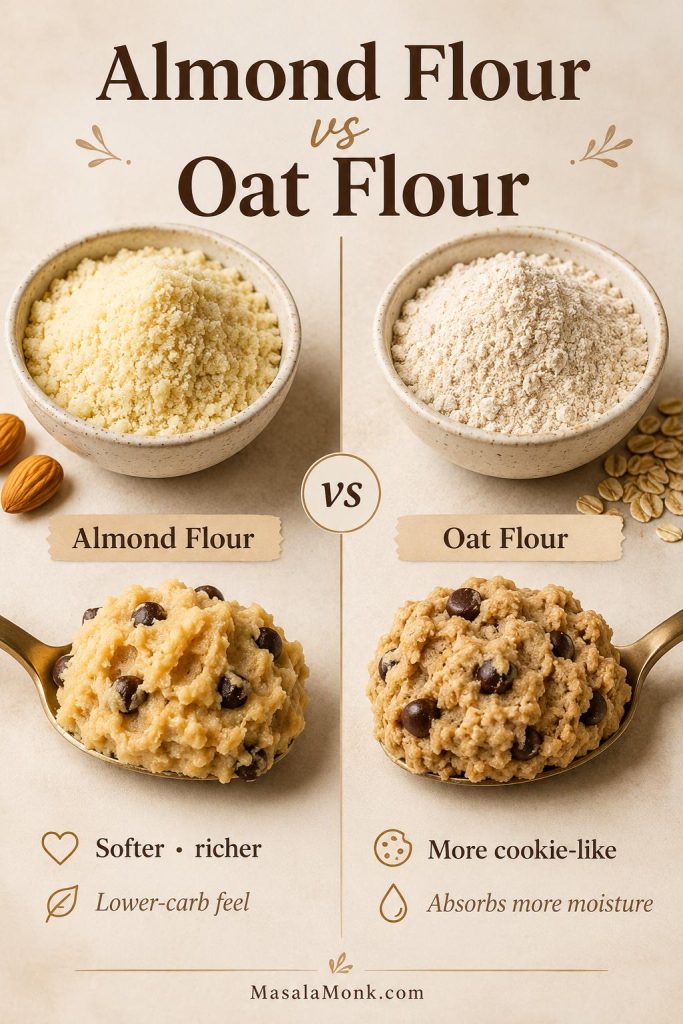
Almond flour versus oat flour comparison for protein cookie dough showing softer rich dough and more cookie-like dough
Almond flour gives a softer, richer dough; meanwhile, oat flour brings a more cookie-like chew and usually needs a little more moisture.

Do not use regular raw all-purpose flour in this no-bake recipe. The safety section below explains why.

For the raw-dough details, read the edible cookie dough safety section before swapping flours.

Nut butter

Peanut butter gives the strongest flavor and the richest dough. Almond butter is milder. Cashew butter gives a softer, almost bakery-style sweetness. Sunflower seed butter works if you need a nut-free option, though it has a more noticeable flavor.

Greek yogurt

Greek yogurt keeps the dough creamy while adding more protein. Thick plain Greek yogurt works best. If your yogurt is thin or watery, start with less milk. If your yogurt is very thick, you may need an extra spoonful of milk to bring the dough together.

Maple syrup or honey

Maple syrup and honey do more than sweeten the dough. They also add moisture and help the texture feel less powdery. Sugar-free syrup can work, but the texture may be thinner or less rich depending on the brand.

Vanilla, salt, and mini chocolate chips

These small ingredients make a big difference. Vanilla gives the dough a dessert-like aroma, salt keeps the flavor from tasting flat, and mini chocolate chips spread more evenly than large chips, especially in a single-serving bowl.

Is Protein Cookie Dough Safe to Eat Raw?

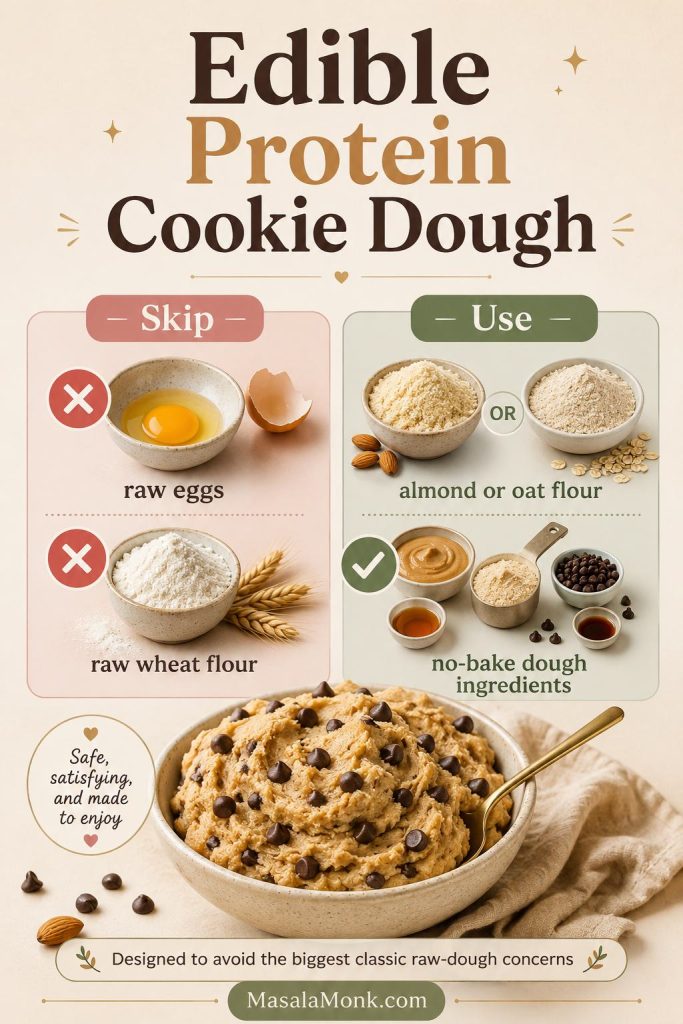
Edible protein cookie dough safety board showing no raw eggs, no raw wheat flour, and almond or oat flour instead
Edible protein cookie dough works best when the no-bake base avoids raw eggs and raw wheat flour from the start.

The FDA explains that most flour is raw and has not been treated to kill germs. The CDC also warns against eating raw dough made with uncooked flour because flour can carry germs that are killed only when the flour is baked or cooked.

For this no-bake dough, use fresh almond flour, oat flour from a trusted package, or a flour product specifically labeled for edible dough. Do not swap in regular raw wheat flour.

If you want the classic version without protein powder, this edible cookie dough recipe follows the same no-bake, spoonable dessert idea with a more traditional cookie-dough flavor.

Important: This recipe avoids raw all-purpose wheat flour. Keep the finished dough chilled, use fresh ingredients, and do not leave yogurt-based cookie dough sitting out for long.

Best Protein Powder for Cookie Dough

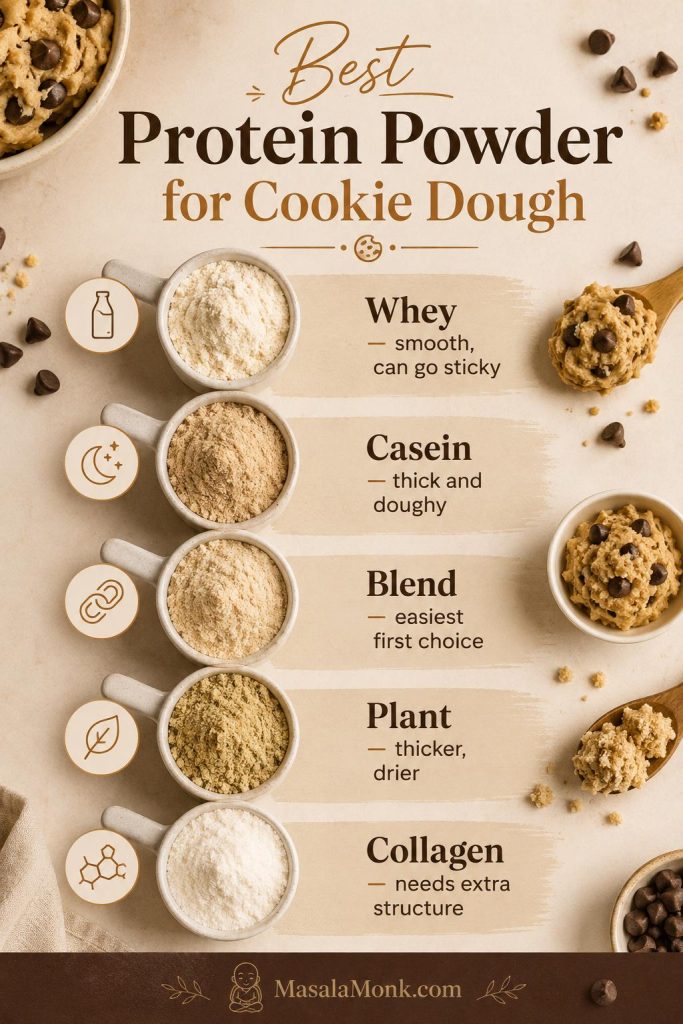
Best protein powder for cookie dough guide comparing whey, casein, blended, plant, and collagen protein powders
The best powder depends on texture as much as flavor, because each type thickens the bowl differently.

Texture matters just as much as flavor. Whey, casein, plant protein, collagen, and blends all absorb moisture at a different pace, which is why the recipe gives a range for milk instead of one fixed amount.

This is why two people can use the same recipe and get different results. The recipe may not be the problem — the powder may simply need more or less moisture.

Protein powder texture guide

Protein powder Texture in cookie dough Best fix
Whey protein Smooth, but can become sticky or wet if overhydrated. Add milk slowly. Thicken with almond flour, oat flour, or a little more protein powder.
Casein protein Thick, doughy, and very absorbent. Add milk or Greek yogurt 1 teaspoon at a time until spoonable.
Whey-casein blend Usually the most balanced cookie dough texture. Best first choice for a balanced, cookie-dough-like texture.
Plant protein Thick, sometimes chalky or earthy. Add nut butter, yogurt, vanilla, salt, and enough milk to soften the texture.
Collagen powder Adds protein but does not give much dough structure. Use it with almond flour or oat flour, not as the only dry ingredient.
Powdered peanut butter Lower in fat, peanut-forward, and slightly dry. Pair with Greek yogurt or milk to keep the dough creamy.
Whey, casein, and plant protein cookie dough comparison showing smoother, thicker, and more absorbent dough textures
Whey, casein, and plant protein can all work, but each one changes how much liquid the bowl needs before it becomes scoopable.

For the first batch, use the recipe as written but hold back some of the milk. Once you see how your protein powder thickens, the recipe becomes easy to repeat.

If your dough already turned dry, sticky, or loose, go straight to the texture fixes instead of guessing.

How to Make Protein Cookie Dough

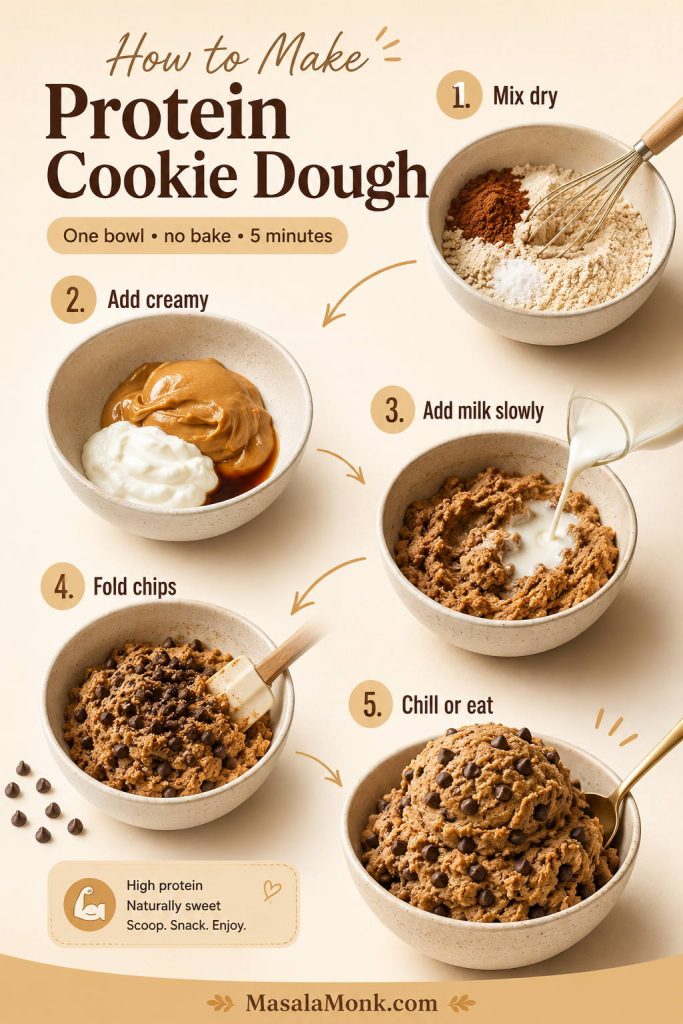
Step-by-step protein cookie dough method showing dry ingredients, creamy ingredients, slow milk addition, chocolate chips, and finished dough
The method stays simple: build the dry base, add richness, loosen carefully, fold in chocolate, then chill only if you want a firmer bite.

Step 1: Mix the dry ingredients

Place the almond flour or oat flour, protein powder, and salt in a medium bowl. Stir them together first so the protein powder is evenly distributed before the wet ingredients go in.

Step 2: Add the creamy ingredients

Stir in the nut butter, Greek yogurt, maple syrup or honey, and vanilla. The dough may start to clump together and look too thick at this point, which is fine.

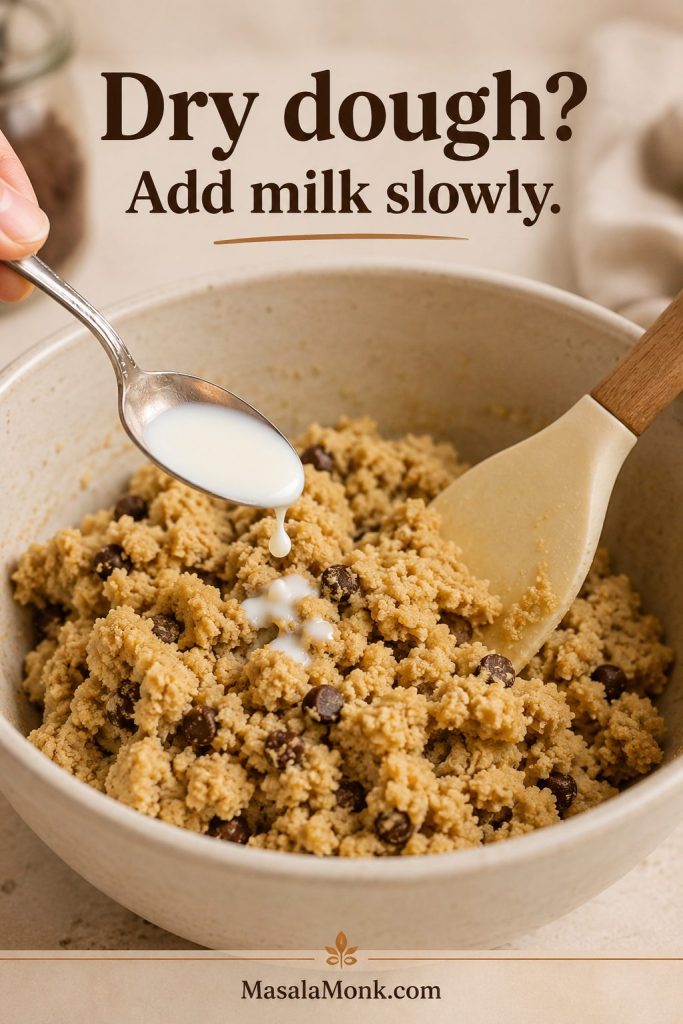
Pour in milk or almond milk 1 tablespoon / 15ml at a time. Mix well after each addition and stop when the dough is soft but sturdy. You may not need all the milk, especially if your yogurt is loose or your protein powder is whey-based.
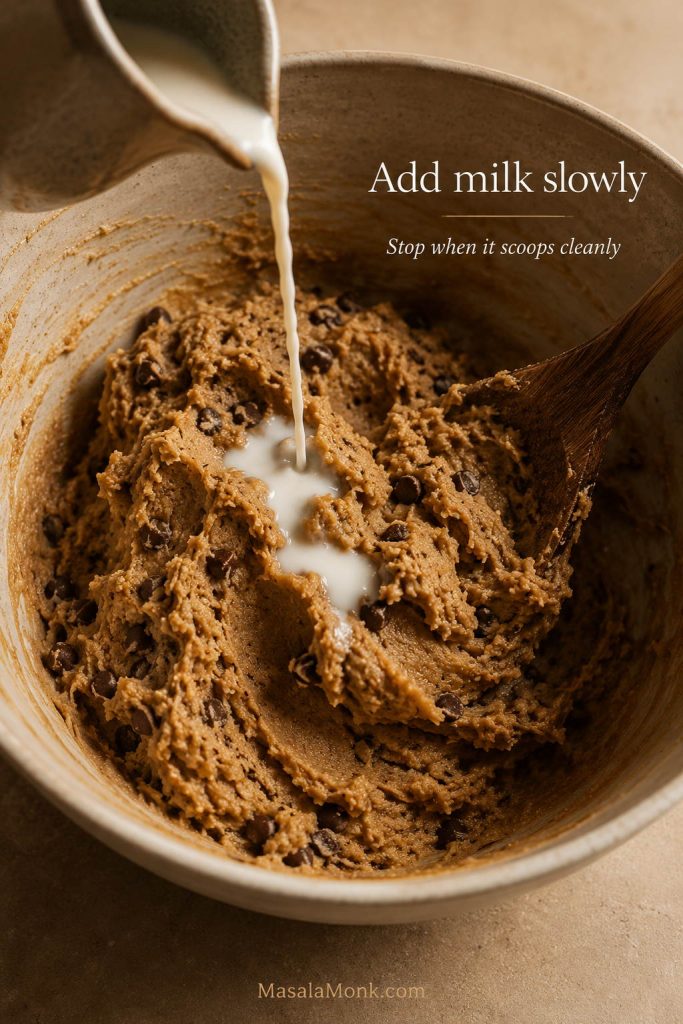
Milk being added slowly to thick protein cookie dough in a mixing bowl to control the final texture
Add milk slowly so the dough softens gradually; otherwise, a small bowl can turn loose before the protein powder has time to absorb it.
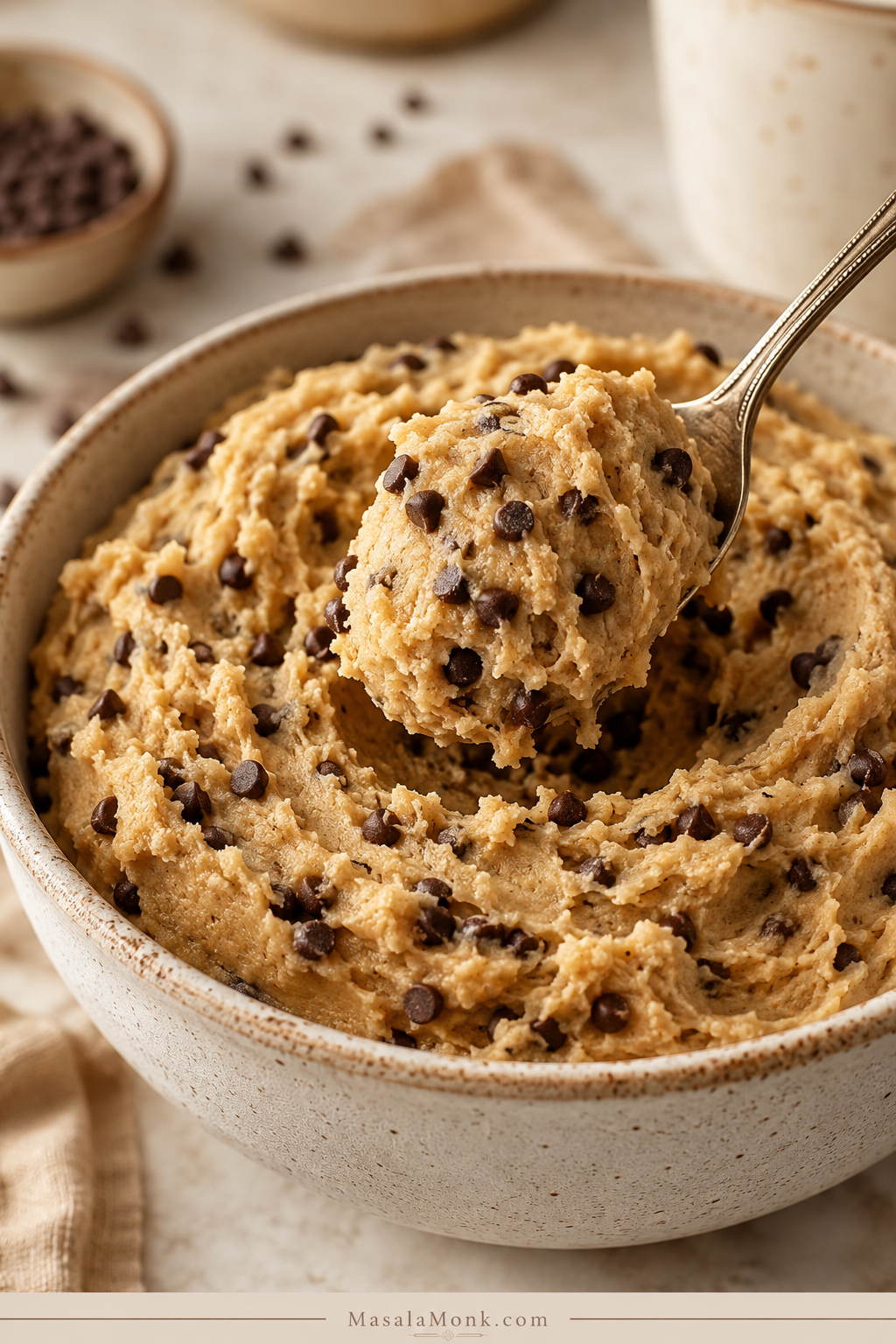
Close-up of protein cookie dough holding soft spoon ridges to show the ideal thick but scoopable texture
Look for spoon marks that stay visible for a moment; that is the easiest sign your protein cookie dough is thick enough without being dry.

If your dough does not look like this yet, use the texture guide to fix it before folding in the chocolate chips.

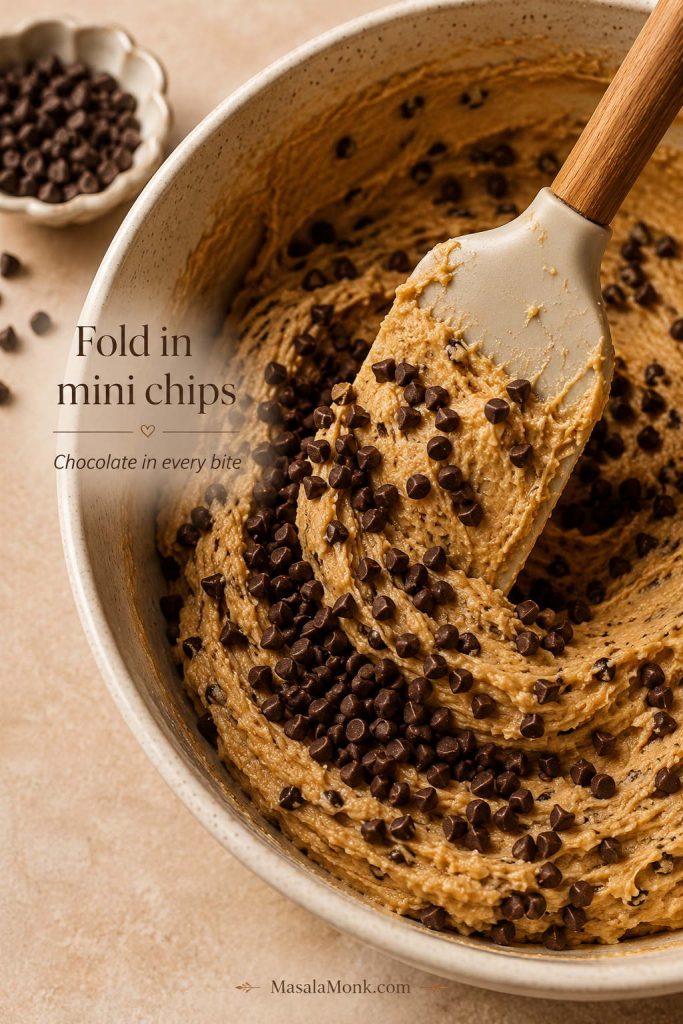
Step 4: Fold in mini chocolate chips

Mini chocolate chips being folded into thick protein cookie dough so the chips spread evenly through the bowl
Mini chocolate chips work better than larger chips because they spread through the dough evenly and make each spoonful taste more like dessert.

Step 5: Eat right away or chill

You can eat the dough immediately if you like a softer, freshly mixed texture. For a firmer, more classic cookie dough feel, cover the bowl and chill it for 20–30 minutes.

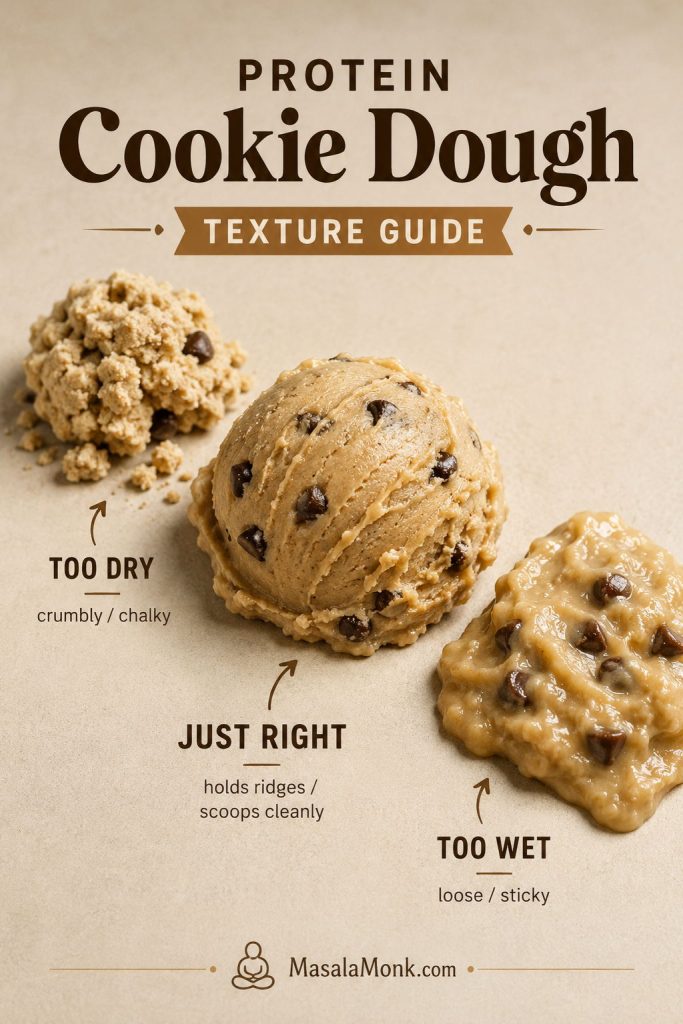
Protein Cookie Dough Texture Guide

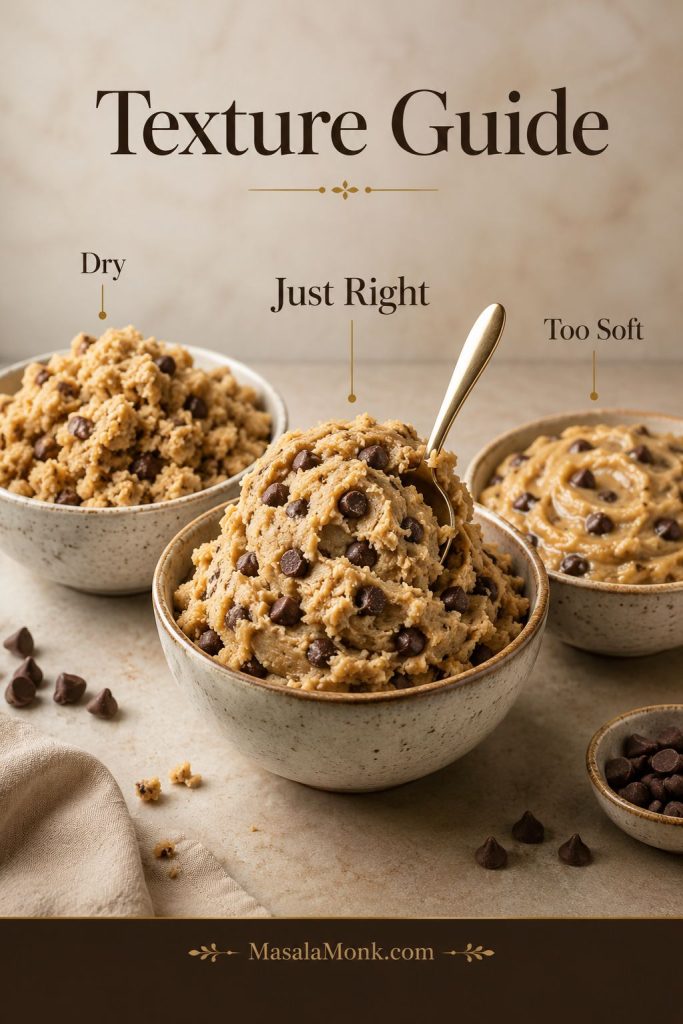
Protein cookie dough texture guide comparing crumbly dry dough, scoopable just-right dough, and loose wet dough
Once you recognize the difference between crumbly, scoopable, and loose, fixing the texture becomes much easier.
Problem Why it happened How to fix it
Too wet Too much milk, loose yogurt, or a whey protein that does not absorb much liquid. Stir in 1 teaspoon almond flour, oat flour, or protein powder at a time.
Too dry Casein or plant protein absorbed the liquid quickly. Loosen it with 1 teaspoon milk or Greek yogurt at a time.
Chalky Too much protein powder, plant protein, or not enough fat/moisture. Work in 1–2 teaspoons nut butter or Greek yogurt, plus vanilla and a pinch of salt.
Too sticky Too much syrup, nut butter, or liquid. Chill 20–30 minutes, or sprinkle in a little almond/oat flour.
Not sweet enough Unsweetened protein powder or not enough syrup. Sweeten with 1 teaspoon maple syrup, honey, or your preferred sweetener.
Too protein-y The protein powder flavor is too strong. Balance it with vanilla, salt, mini chocolate chips, or a better-tasting vanilla protein powder next time.
Best texture rule: Adjust slowly. One teaspoon can change a small batch more than you expect.

Once the texture is right, the bowl stops feeling like a protein workaround and starts feeling like what you actually wanted: cold, sweet cookie dough with little pockets of chocolate in every spoonful.

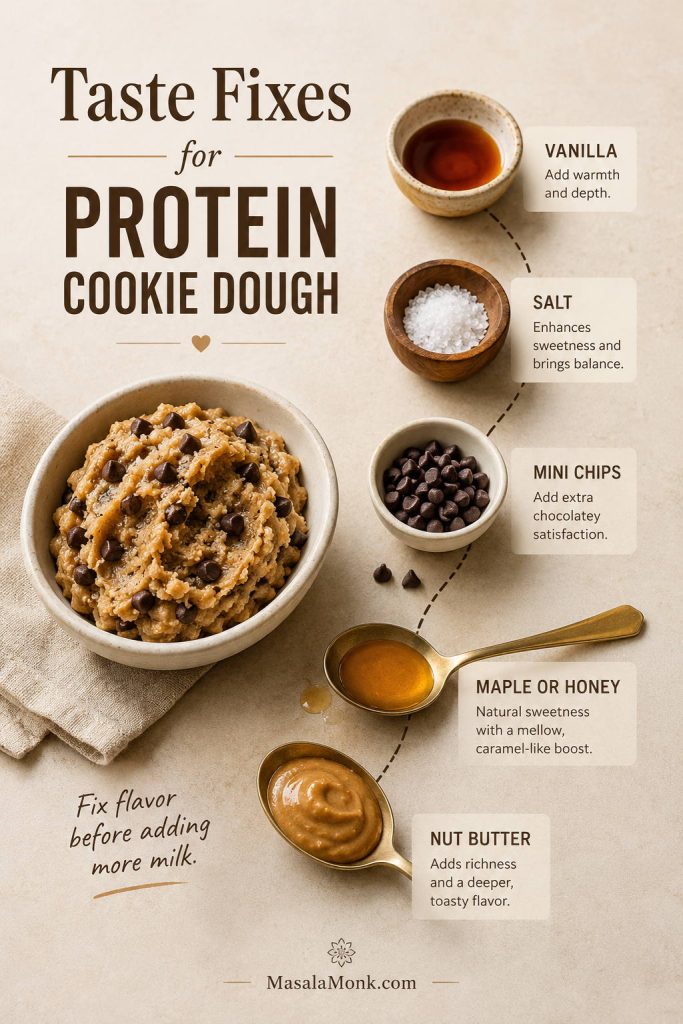
How to Make It Taste More Like Cookie Dough

Protein cookie dough taste-fix board with vanilla, salt, chocolate chips, syrup, and nut butter for better flavor
If the flavor feels too protein-heavy, vanilla, salt, nut butter, syrup, and mini chips can improve the dough without making it runnier.
  • Add a little more vanilla if the flavor tastes flat.
  • Add a tiny pinch of salt if the dough tastes too sweet, bland, or protein-heavy.
  • Use mini chocolate chips so every spoonful gets chocolate.
  • Add 1 teaspoon maple syrup or honey if your protein powder is not very sweet.
  • Add 1 teaspoon nut butter if the dough tastes chalky or thin.
  • Chill the dough for 20–30 minutes if the flavor feels sharp right after mixing.
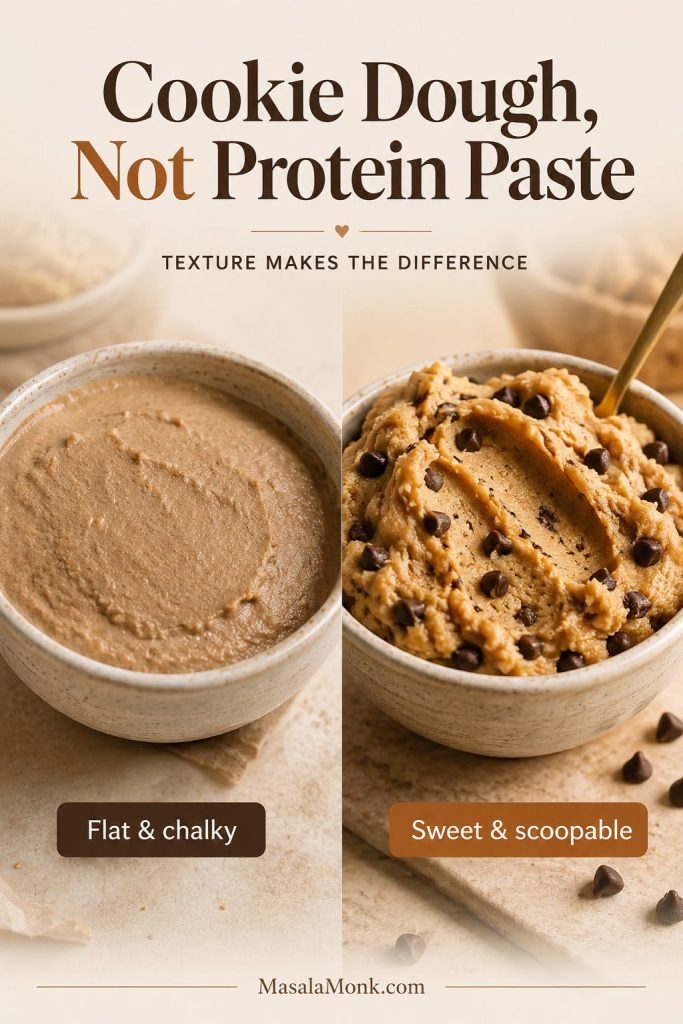
Cookie dough versus protein paste comparison showing dull chalky dough beside sweet scoopable chocolate chip dough
The best high-protein cookie dough still needs dessert appeal, so texture and flavor matter just as much as the protein number.

Once the base flavor tastes right, try one of the flavor variations to make the dough more dessert-like.

Protein Cookie Dough Flavor Variations

Protein cookie dough flavor variation board with peanut butter chip, birthday cake, double chocolate, cookies and cream, and cinnamon roll
Once the base dough is balanced, small mix-ins can take it toward peanut butter chip, birthday cake, double chocolate, cookies and cream, or cinnamon roll.
  • Peanut butter chocolate chip: Use peanut butter as the nut butter and keep the mini chocolate chips.
  • Birthday cake: Use vanilla protein powder, cashew butter, and a small spoonful of sprinkles.
  • Double chocolate: Add 1 tablespoon cocoa powder and a little extra milk if the dough gets too thick.
  • Cookies and cream: Fold in crushed chocolate sandwich cookies or a lighter cookie-style mix-in.
  • Cinnamon roll: Add cinnamon, vanilla, and a tiny pinch more salt.

For any dry mix-in like cocoa powder or crushed cookies, add a tiny splash of milk only after the dough is mixed so you do not accidentally make it loose.

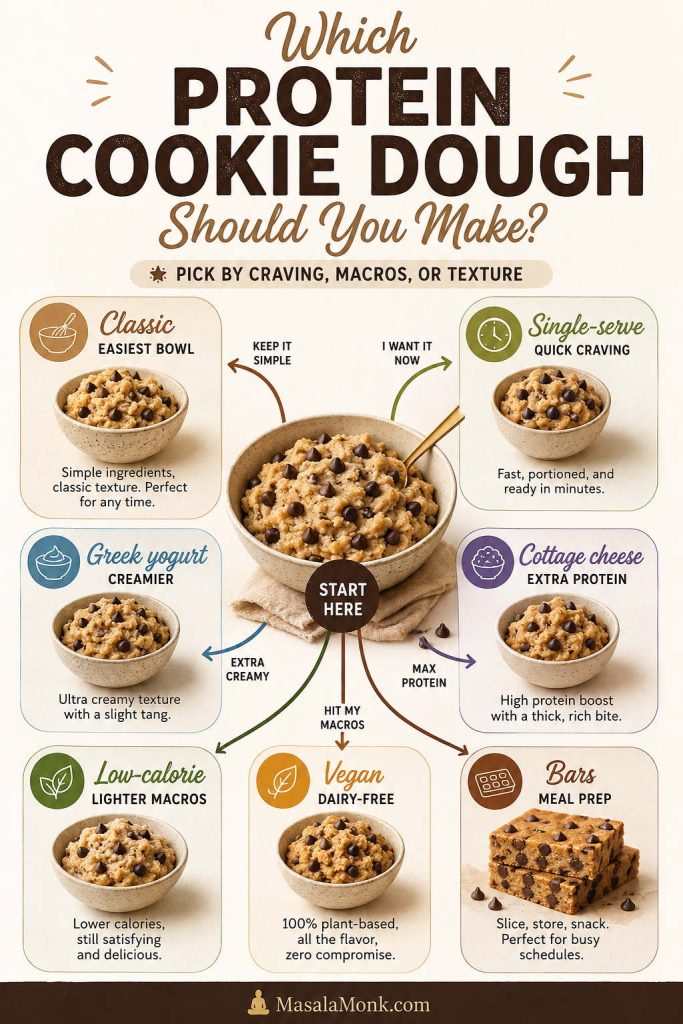
Which Protein Cookie Dough Version Should You Make?

Protein cookie dough version chooser showing classic, single-serve, Greek yogurt, cottage cheese, low-calorie, vegan, and bars
Use this guide by need: single-serve for speed, Greek yogurt or cottage cheese for creaminess, low-calorie for lighter macros, vegan for dairy-free, or bars for meal prep.
Version Best for Texture Use this base
Classic protein cookie dough Best overall Thick enough to scoop, soft enough to eat with a spoon Protein powder + flour + nut butter + Greek yogurt
Single serve Quick craving Small-batch dough 30g protein powder + nut butter
Greek yogurt Creamier snack Smoother, tangier, and more spoonable Greek yogurt + protein powder
Cottage cheese Extra creamy, higher-protein variation Smooth and creamy when blended first Blended cottage cheese
Low calorie Macro-friendly snack Lighter and less rich Powdered peanut butter + nonfat Greek yogurt
Vegan Dairy-free version Thick, sometimes chalkier Plant protein + dairy-free milk
Chickpea Plant-based/fiber-rich Thicker and dip-like Chickpeas + protein powder
Bars Meal prep Firm and sliceable Thicker dough + pan chill

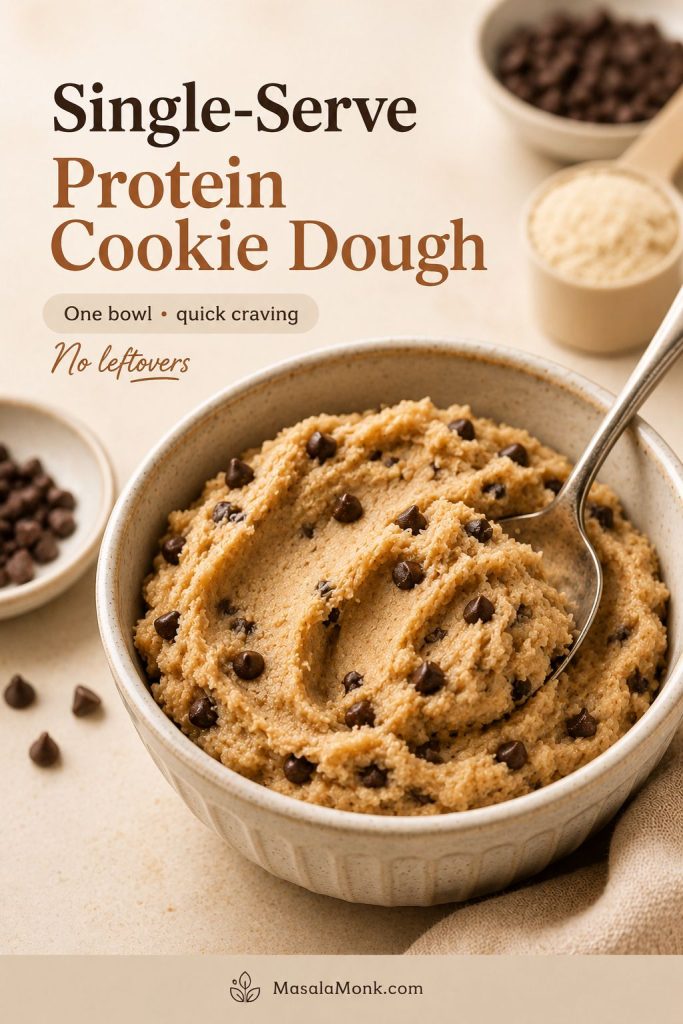
Single-Serve Protein Cookie Dough

Single-serve protein cookie dough in a small bowl with mini chocolate chips, spoon, and quick snack portion
The single-serve version is ideal when you want one quick bowl now, especially if you do not want extra dough waiting in the fridge.
Ingredient Amount
Vanilla protein powder 30g
Almond flour or oat flour 2–3 tablespoons
Nut butter 1½ tablespoons
Greek yogurt or milk 1–2 tablespoons
Maple syrup or honey 1–2 teaspoons, optional
Vanilla extract ¼ teaspoon
Salt Pinch
Mini chocolate chips 1–2 tablespoons

Mix the dry ingredients first, stir in the nut butter and yogurt, then adjust with tiny splashes of milk until the dough is scoopable but not loose. This version can be higher in protein than the main recipe because it uses a full scoop of protein powder in one serving.

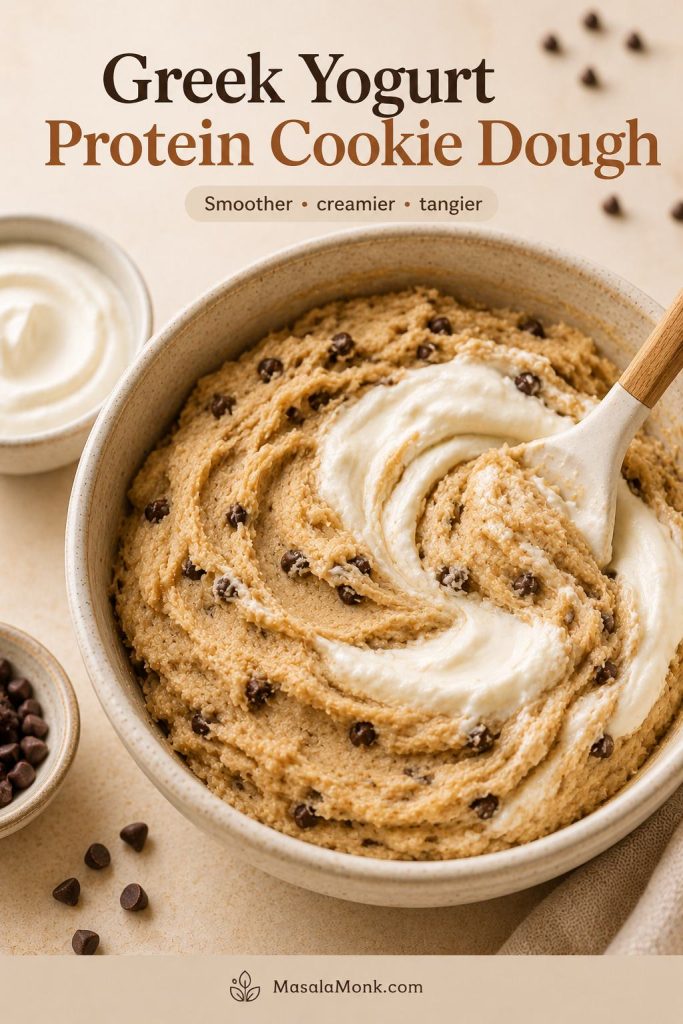
Greek Yogurt Protein Cookie Dough

Greek yogurt protein cookie dough with thick Greek yogurt being mixed in for a smoother and creamier texture
Greek yogurt gives the dough a softer, tangier bite, which helps balance the dryness some protein powders can bring.

To make the Greek yogurt version, increase the Greek yogurt to ½ cup and reduce the milk. Stir the dough well, then chill it for 20–30 minutes so the flour and protein powder can absorb the moisture. If the yogurt is very thick, add milk 1 teaspoon at a time. If the yogurt is loose, add a little more almond flour or oat flour.

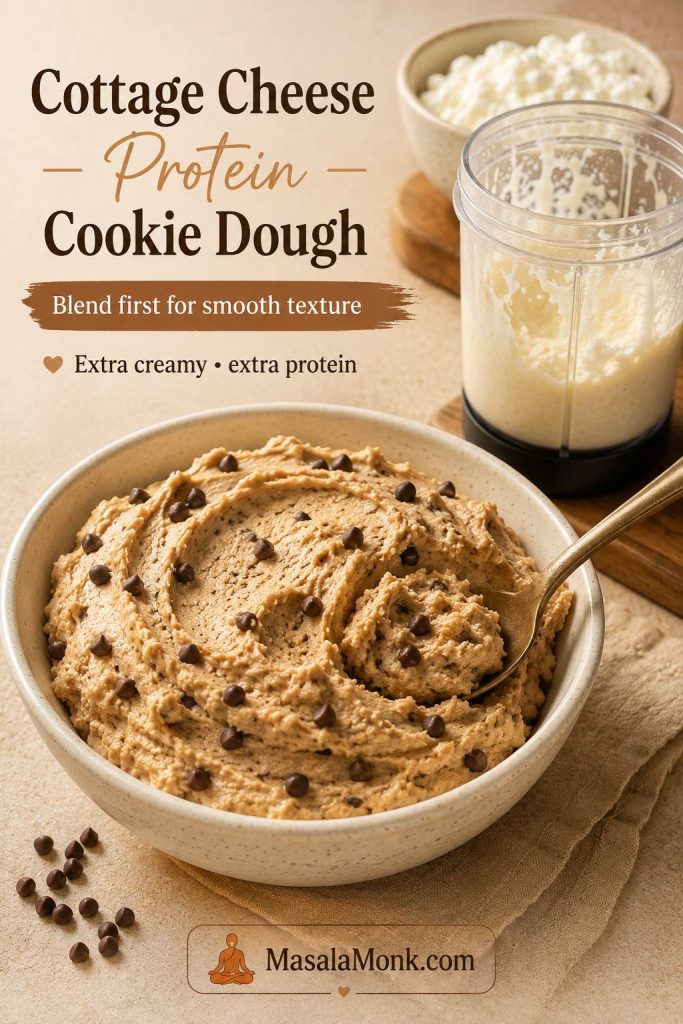
Cottage Cheese Protein Cookie Dough

Cottage cheese protein cookie dough showing blended cottage cheese, finished dough, and the smooth texture after blending
The cottage cheese version depends on one important step: blend the cottage cheese smooth before mixing it into the dry base.

For a cottage cheese version, blend ½ cup cottage cheese with vanilla and 2–3 teaspoons maple syrup until smooth. Then stir it by hand into the protein powder, almond flour or oat flour, nut butter, salt, and chocolate chips. Add the chips after blending, not before.

If your blended cottage cheese is very loose, start with less milk or skip the milk completely until the dough is mixed.

Cottage cheese texture tip: Blend the cottage cheese first, then mix by hand after the dry ingredients go in. Over-blending the full dough can make it runnier.

If you enjoy creamy low-carb desserts, this keto cheesecake recipe is another good one to keep nearby, especially when you want something chilled and richer than a snack bowl.

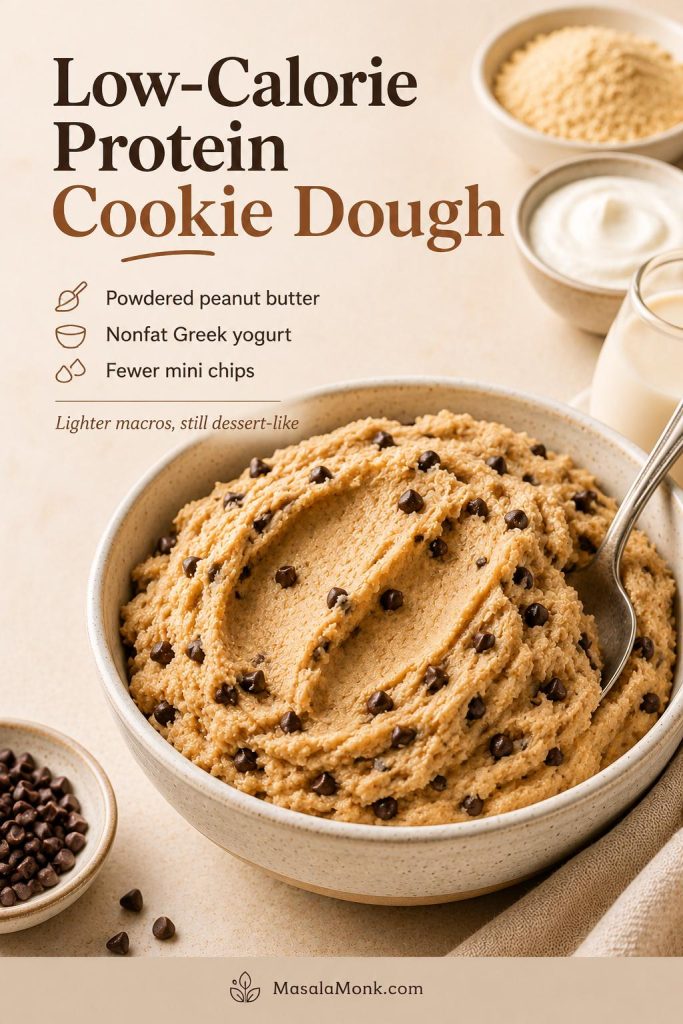
Low-Calorie Protein Cookie Dough

Low-calorie protein cookie dough with powdered peanut butter, nonfat Greek yogurt, almond milk, and fewer mini chocolate chips
A lighter bowl should still taste satisfying, so use macro-friendly swaps without removing all the creaminess and chocolate.
Swap What it does
Powdered peanut butter Reduces fat and calories while keeping peanut flavor.
Nonfat Greek yogurt Adds creaminess and protein with fewer calories.
Mini chocolate chips Gives more chocolate in every bite with a smaller amount.
Sugar-free syrup, carefully Can reduce sugar, but may make the dough thinner or less rich.
Single-serving batch Helps with portion control and avoids extra leftovers.

For one lighter serving, start with 30g vanilla protein powder, 2 tablespoons powdered peanut butter, ¼ cup nonfat Greek yogurt, 1–2 teaspoons syrup or sweetener, vanilla, salt, and 1 tablespoon mini chocolate chips. Add almond milk 1 teaspoon at a time until the dough becomes scoopable.

For another creamy dessert with a lighter, healthier feel, this avocado chocolate mousse is a good next option when you want chocolate without baking.

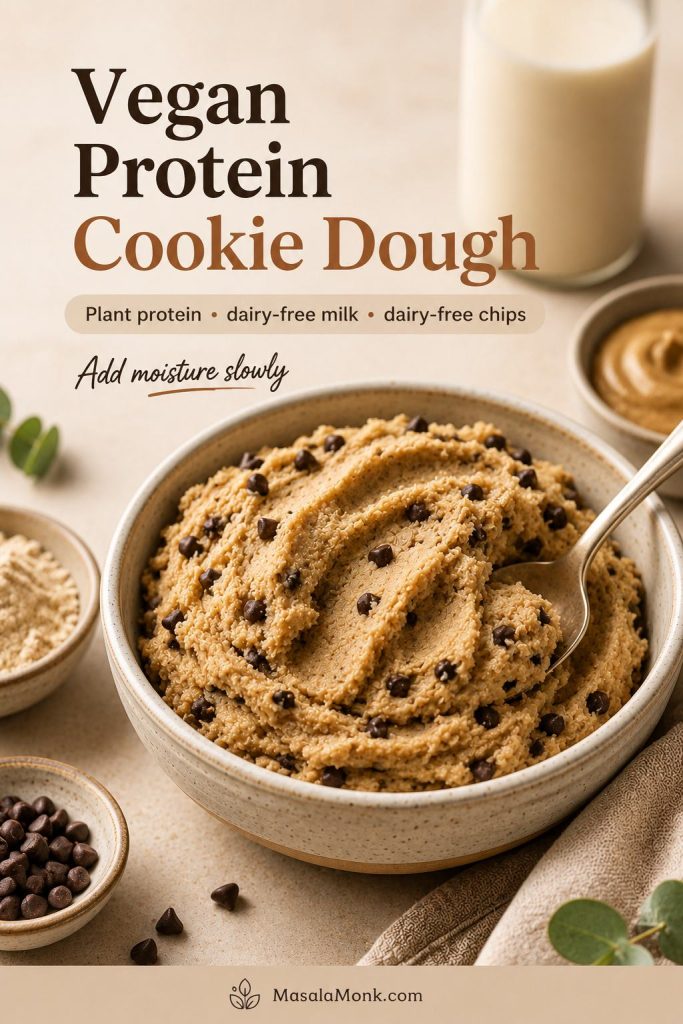
Vegan Protein Cookie Dough

Vegan protein cookie dough with plant protein powder, dairy-free milk, nut butter, and dairy-free chocolate chips
The vegan version usually needs a little more moisture and fat because plant protein can thicken quickly as it sits.

For a vegan batch, use ½ cup almond or oat flour, ½ cup plant protein powder, 2–3 tablespoons almond or cashew butter, 2–3 teaspoons maple syrup, vanilla, salt, dairy-free milk as needed, and dairy-free mini chocolate chips. Add the milk slowly because plant protein often thickens fast.

When plant protein tastes earthy, extra vanilla, a tiny pinch of salt, and mini chocolate chips help a lot. A little more nut butter can also soften the chalky edge without making the dough too loose.

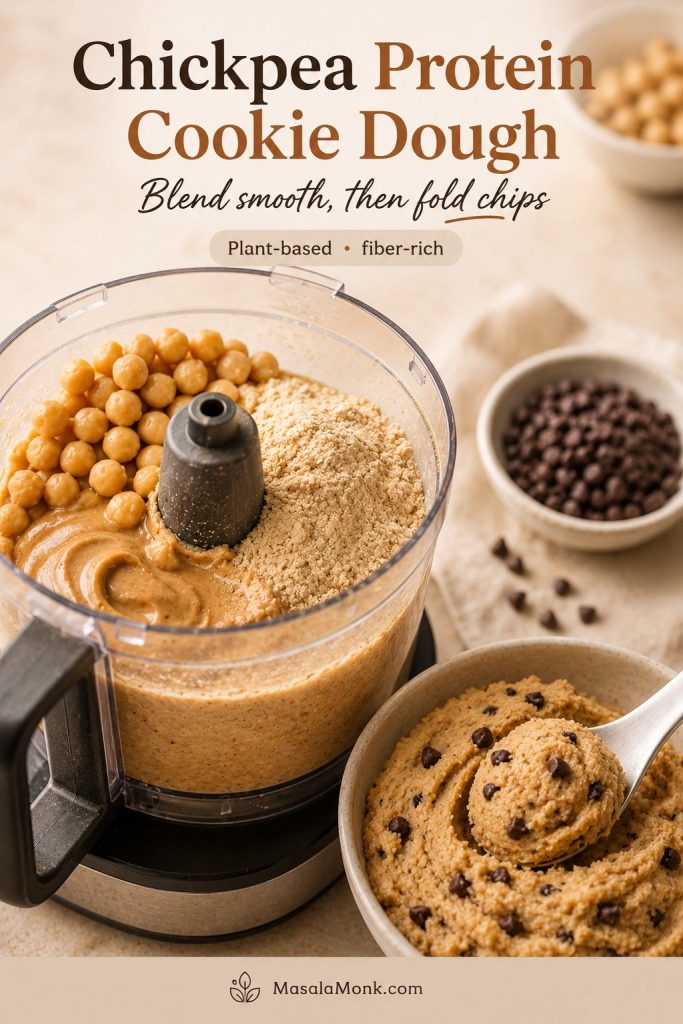
Chickpea Protein Cookie Dough

Chickpea protein cookie dough being made in a food processor with chickpeas, protein powder, nut butter, and chocolate chips
The chickpea version works best as a blended variation, since a food processor gives the base a smoother, dip-like texture.

For a chickpea version, start with 1 cup well-rinsed chickpeas, 30g vanilla protein powder, 2 tablespoons nut butter or sunflower seed butter, 1–2 tablespoons maple syrup, vanilla, salt, and 1–2 tablespoons milk as needed. Blend everything except the chocolate chips until smooth, then fold in the chips.

For the smoothest texture, rinse the chickpeas very well and remove the skins if you have time. Chilling the dough for 20–30 minutes also helps the flavor mellow and the texture thicken.

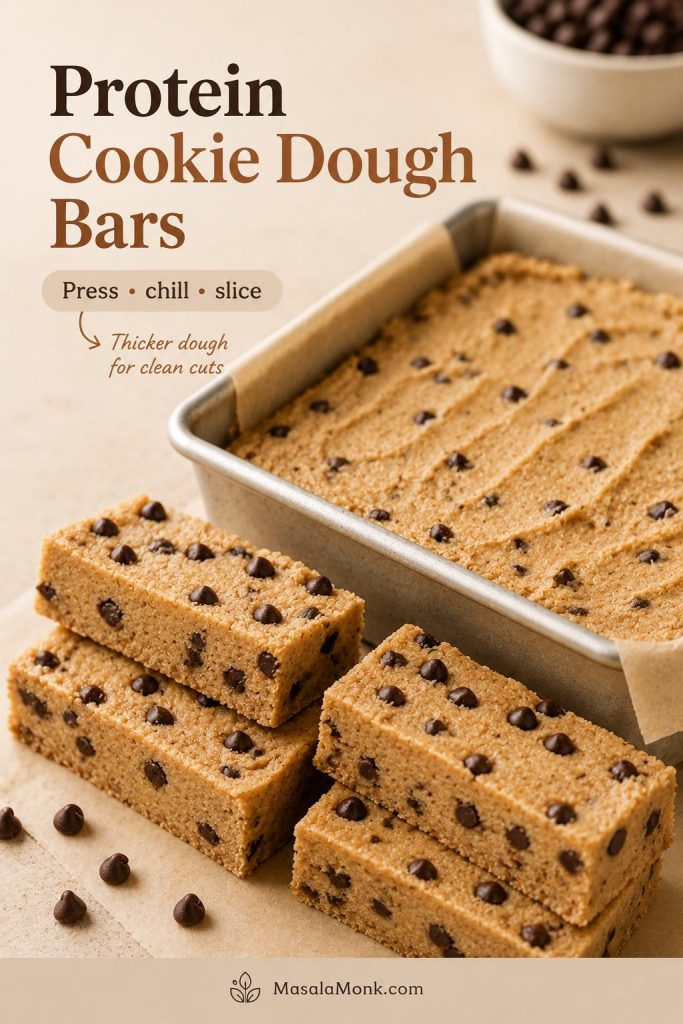
No-bake protein cookie dough bars sliced from a chilled parchment-lined loaf pan with mini chocolate chips visible
Protein cookie dough bars need a firmer base than the spoonable version, so they can chill, hold their shape, and slice cleanly.

After slicing, use the storage guide so the bars stay firm instead of drying out.

A loaf pan works well for a thicker small batch. Use an 8-inch square pan only if you are doubling the recipe, otherwise the bars may be too thin.

For a more dessert-like bar, spread melted chocolate over the chilled dough and chill again until set. For a softer snack bar, skip the chocolate coating and keep the chocolate chips mixed into the dough.

Storage and Freezer Tips

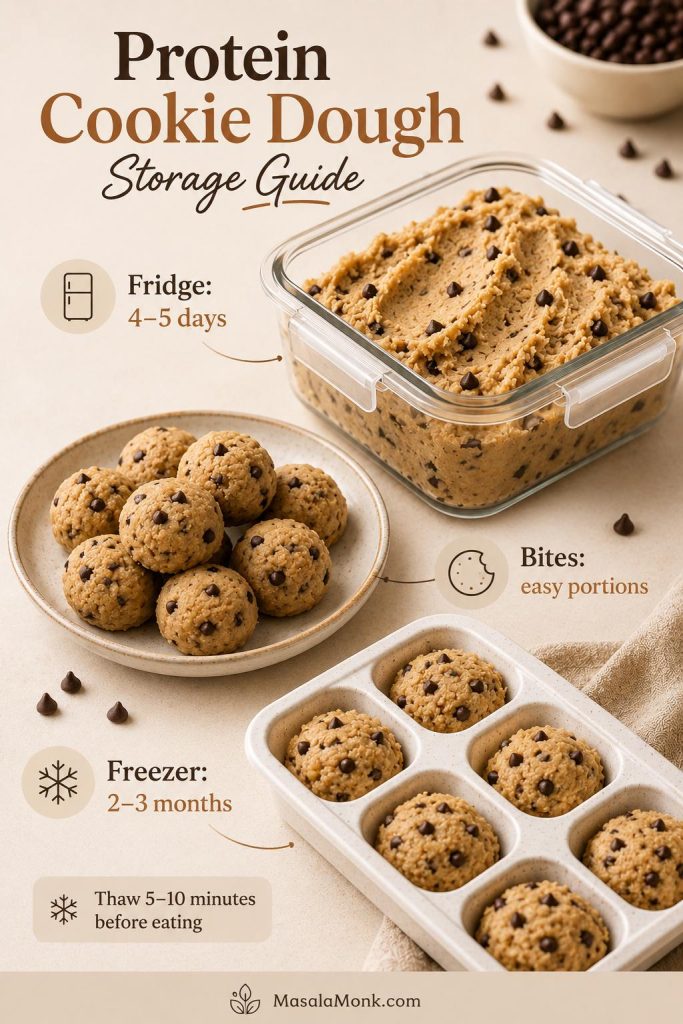
Protein cookie dough storage guide showing an airtight fridge container, rolled snack bites, and freezer portions
For easy snack prep, keep protein cookie dough chilled in a container or freeze small portions that soften after a few minutes.
Storage method How long Best tip
Airtight container in the fridge 4–5 days Stir before serving if it firms up.
Rolled balls in the fridge 4–5 days Use a small cookie scoop for even portions.
Freezer portions 2–3 months Freeze on a tray first, then move to a container.
Cookie dough bars Up to 1 week chilled Keep parchment between layers if stacking.

For bites, chill the dough until it is firm enough to scoop, then roll it into small balls and store them in the fridge or freezer. They are easier to portion than a full bowl and work well for snack prep.

Frozen portions taste best after sitting at room temperature for 5–10 minutes. They should soften slightly but still hold their shape.

What to Eat With Protein Cookie Dough

You can absolutely eat this straight from the bowl. That is the point. But if you make extra, it also turns into an easy topping, dip, or freezer snack.

Think of it as a spoonable snack first, then use leftovers anywhere you would normally want a sweet, cookie-dough-style topping.

  • Scoop it into small snack balls.
  • Serve it with apple slices.
  • Swirl it into Greek yogurt.
  • Crumble it over smoothie bowls.
  • Press it into bars.
  • Freeze it into bite-size portions.
  • Use it as a high-protein dessert dip.

Once you understand the texture, this becomes the kind of recipe you can make by feel: a little more milk for spoonable, a little more flour for scoopable, and a little more vanilla and salt when the protein powder tries to take over.

Different protein powders can change this dough a lot. If you try it with whey, casein, collagen, or plant protein, note how much milk it needed and whether the final texture turned out scoopable, sticky, dry, or firm. That is the kind of detail other readers actually want before they open a new tub of protein powder, so it is worth sharing if your powder behaved differently.

After one batch, you will probably know exactly how your protein powder behaves. From there, this becomes an easy fridge snack you can make by feel — thicker for cookie dough bites, softer for spooning, sweeter when it is dessert, and lighter when you just want a quick protein treat.

Ready to make it now? Jump to the full protein cookie dough recipe card.

FAQs About Protein Cookie Dough

Why is my protein cookie dough dry?

Your protein powder probably absorbed more liquid than expected. Casein and plant-based protein powders are especially thirsty, so add milk or Greek yogurt 1 teaspoon at a time until the dough softens.

Why did my protein cookie dough turn sticky?

Sticky dough usually means too much syrup, nut butter, or milk. First, chill it for 20–30 minutes. After that, add almond flour or oat flour 1 teaspoon at a time if the mixture still feels too loose.

Which protein powder tastes best in cookie dough?

A good vanilla whey-casein blend is usually the easiest choice for a balanced dough texture. Whey can be smooth but sticky, casein can be thick and dry, and plant protein may need more moisture and flavor support.

Best peanut butter substitutes for protein cookie dough

Peanut butter is not required. Almond butter, cashew butter, sunflower seed butter, tahini, or a mix of Greek yogurt and powdered peanut butter can all work. The flavor and texture will change slightly, but the recipe still holds together.

Using powdered peanut butter in protein cookie dough

Powdered peanut butter works best in the low-calorie version because it keeps peanut flavor while reducing fat. Since it can taste drier than regular nut butter, pair it with Greek yogurt and add milk slowly until the dough is scoopable.

No Greek yogurt? Use this texture fix

Greek yogurt helps with creaminess, but the recipe can work without it. Replace it with more nut butter and a little milk, or use dairy-free yogurt for a vegan version. Since yogurt also adds thickness, add the liquid slowly so the dough does not become loose.

Is almond flour safe in no-bake cookie dough?

This recipe avoids raw all-purpose wheat flour, which is the main flour concern in classic raw cookie dough. Use fresh almond flour or oat flour from a reputable source, keep the finished dough chilled, and do not swap in regular raw wheat flour unless it is specifically labeled for edible dough.

Freezing protein cookie dough without ruining the texture

Roll the dough into balls or portion it into small scoops, freeze on a tray, then transfer to an airtight container. Let frozen portions sit for 5–10 minutes before eating so they soften slightly without turning mushy.

Should you bake this dough into cookies?

This recipe is designed as edible no-bake dough. Protein powder behaves differently when baked, so a dedicated protein cookie recipe will give you a better baked texture.

Lower-calorie protein cookie dough swaps that still taste good

Use powdered peanut butter, nonfat Greek yogurt, sugar-free syrup if you like it, and a smaller amount of mini chocolate chips. A single-serving batch is usually the easiest way to keep the calories controlled without making a large bowl of leftovers.

Vegan protein cookie dough: what changes?

Plant-based protein powder usually thickens more and can taste earthier than whey. Use almond or oat flour, nut butter, maple syrup, dairy-free milk, and dairy-free chocolate chips, then add extra milk or nut butter if the dough tastes chalky.

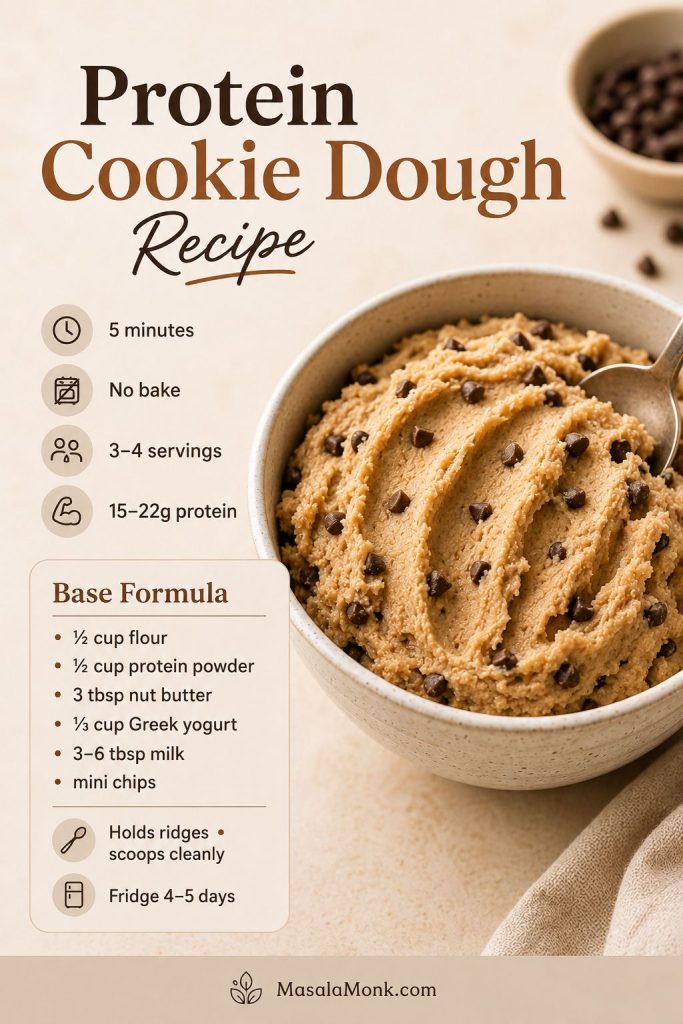
Protein cookie dough recipe card showing the base formula, five-minute prep time, protein estimate, texture target, and storage
Save the base formula as a texture guide: equal parts flour and protein powder, creamy ingredients for richness, then milk only until scoopable.

Protein Cookie Dough Recipe Card

This edible protein cookie dough is no-bake, egg-free, creamy, and ready in about 5 minutes. Chill it for a firmer cookie-dough bite, or eat it right away while it is softer and freshly mixed.

Texture target: The dough should hold ridges when stirred, scoop cleanly, and feel thick but not dry. Pourable dough needs more dry structure, while crumbly dough needs a little more moisture.

Servings 3–4
Prep Time 5 minutes
Chill Time Optional 20–30 minutes
Cook Time 0 minutes

Equipment

  • Medium mixing bowl
  • Spatula or sturdy spoon
  • Measuring cups and spoons
  • Kitchen scale, optional but helpful
  • Airtight container for storage

Ingredients

Ingredient US amount Metric amount
Almond flour or oat flour ½ cup 50–56g
Vanilla protein powder ½ cup 50–60g
Creamy peanut, almond, or cashew butter 3 tablespoons About 48g
Plain thick Greek yogurt ⅓ cup About 80g
Maple syrup or honey 2–3 teaspoons 10–15ml
Milk or almond milk 3–6 tablespoons, added gradually 45–90ml
Vanilla extract ½ teaspoon 2.5ml
Fine salt ¼ teaspoon About 1.5g
Mini chocolate chips 3 tablespoons 30–40g

Instructions

  1. Stir the almond flour or oat flour, protein powder, and salt together in a medium bowl.
  2. Mix in the nut butter, Greek yogurt, maple syrup or honey, and vanilla until a thick dough starts to form.
  3. Add milk or almond milk 1 tablespoon / 15ml at a time, mixing well after each addition, until the dough holds ridges when stirred and scoops cleanly.
  4. Fold in the mini chocolate chips.
  5. Eat immediately for a softer dough, or cover and chill for 20–30 minutes for a firmer cookie-dough bite.

Notes

  • Protein powders absorb liquid differently, so start with less milk and add more gradually.
  • Chilling is optional, but it improves both texture and flavor because the flour and protein powder have time to hydrate.
  • Divide the batch into 3 servings for a higher-protein snack or 4 servings for smaller dessert portions.
  • Use 3 teaspoons maple syrup or honey for a sweeter dessert-style dough, or start with 2 teaspoons for a less sweet snack.
  • When the dough is wet, build it back up with almond flour, oat flour, or protein powder 1 teaspoon at a time.
  • For dry dough, add milk or Greek yogurt 1 teaspoon at a time until it softens.
  • Strong protein-powder flavor usually improves with extra vanilla, a tiny pinch of salt, or 1 teaspoon nut butter before adding more milk.
  • Do not use regular raw all-purpose flour in this no-bake recipe.

Storage

Store protein cookie dough in an airtight container in the fridge for 4–5 days. For longer storage, portion it into balls or scoops and freeze for 2–3 months. Let frozen portions sit for 5–10 minutes before eating.

Estimated Protein and Calories

Protein and calories will vary by powder, yogurt, flour, nut butter, milk, syrup, chocolate chips, and serving size. As a rough guide, this batch usually lands around 15–22g protein per serving when divided into 3–4 portions, with about 225–400 calories per serving depending on portion size and ingredients. Use your own labels for the most accurate numbers.
Posted on Leave a comment

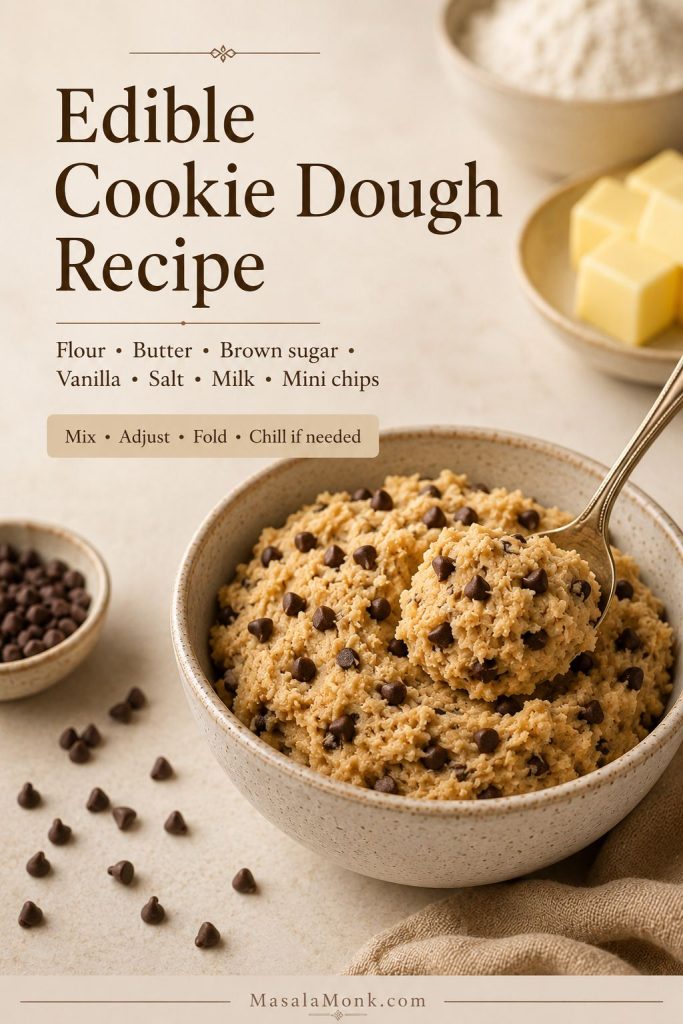
Edible Cookie Dough Recipe

A spoon lifts soft chocolate chip edible cookie dough from a bowl, showing a creamy texture with mini chocolate chips throughout.

This edible cookie dough recipe is for the spoonful you wanted before the cookies ever reached the oven: soft brown-sugar dough, creamy butter, vanilla, a little salt, and tiny chocolate chips in every bite. It tastes like classic chocolate chip cookie dough, but it is made for eating straight from the bowl — no baking tray, no waiting, no pretending you only wanted “one taste.”

The important difference is safety. This version skips raw eggs and treats flour as something that needs attention, not an ingredient to casually stir in raw. For the most cautious batch, use commercially heat-treated flour labeled ready-to-eat; if you use a home flour-heating method, the notes below explain the limits clearly.

Before You Start: Texture and Safety

The good news is that edible cookie dough does not need to be complicated. Once you understand the flour piece, the rest is simple: cream butter and sugar, add vanilla and salt, mix in the flour, then adjust the texture until it tastes like the middle of a chocolate chip cookie.

Once the base is right, you can keep it classic with mini chocolate chips, make a single-serving bowl, turn it into sugar cookie dough, add peanut butter, roll it into bites, or chill little pieces for ice cream. Start with the chocolate chip version first; it teaches you what the texture should feel like.

Before you start mixing, use the texture cue below as your visual target: the dough should look thick, creamy, and spoonable, not dry, runny, or frosting-soft.

Close-up spoonful of edible cookie dough held above a bowl, showing a thick, creamy texture with mini chocolate chips.
For the smoothest result, the dough should look dense but not dry; in other words, it should stay on the spoon without turning crumbly, stiff, or frosting-soft.

If the craving is really for warm cookies from the oven, use a proper cookie recipe like MasalaMonk’s double chocolate chip cookies instead. This one is built for one job: cookie dough you can enjoy by the spoonful.

What You’ll Find in This Edible Cookie Dough Guide

Use the quick answer if you already know the basics, or go straight to the safety notes if you want to understand the flour and egg issue before mixing.

Quick Answer: How to Make This Edible Cookie Dough Recipe

To make this edible cookie dough recipe, start with ready-to-eat flour or handle the flour using the safety notes below. Let the flour cool completely, then sift it so the dough does not taste lumpy or floury. Cream softened butter with brown sugar and a little granulated sugar, mix in vanilla and salt, add the flour, loosen the dough with milk or cream, and fold in mini chocolate chips.

The texture should be soft and scoopable, like the center of chocolate chip cookie dough before baking. It should not be runny, greasy, sandy, or crumbly. If it feels too thick, add milk one teaspoon at a time. If it feels too soft, chill it for 15 to 20 minutes before serving.

Quick texture cue: the dough should hold on a spoon, but still press easily when you scoop it. If it cracks apart, it needs a little more milk. If it slumps like frosting, it needs chilling or a spoonful of sifted flour.
  • Best flour option: commercially heat-treated flour labeled ready-to-eat
  • Eggs: none
  • Texture: creamy, spoonable, and thick enough to hold on a spoon
  • Best chips: mini semisweet chocolate chips
  • Chill time: optional, 10–20 minutes if the dough feels soft
  • Storage: 4–5 days refrigerated, 1–2 months frozen
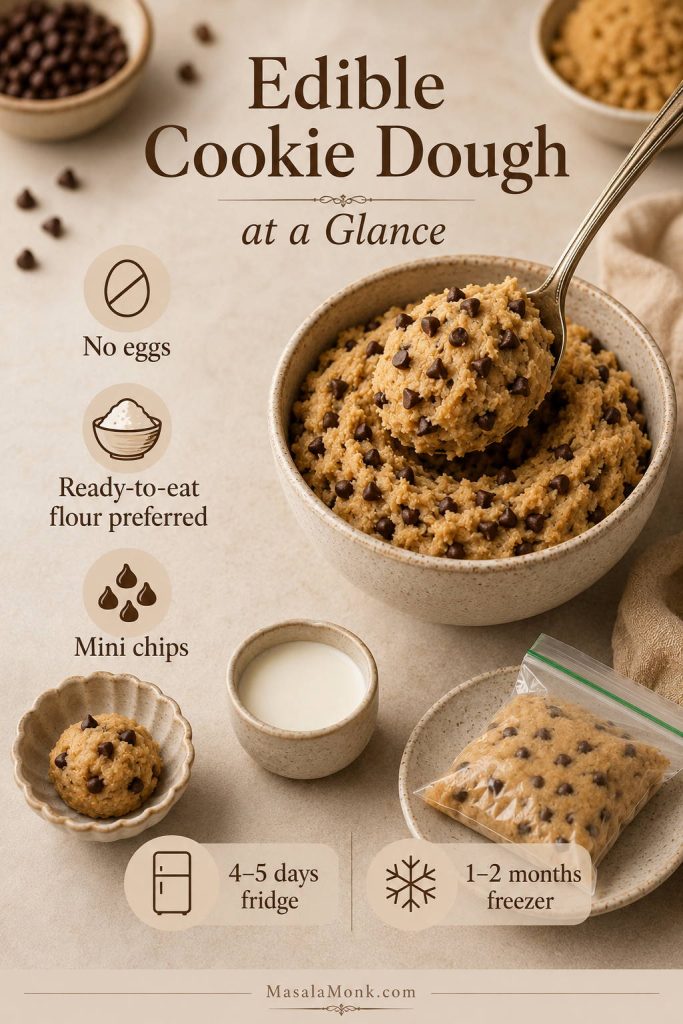
At-a-glance edible cookie dough guide showing no eggs, ready-to-eat flour preferred, mini chocolate chips, and fridge and freezer storage times.
If you only remember the essentials, keep these in mind first: no eggs, ready-to-eat flour preferred, mini chips for a better bite, and short cold storage for the best texture.

Why This Edible Cookie Dough Works

A good edible cookie dough recipe should not taste like sweet flour paste. It should taste like the spoonful you wanted from a real chocolate chip cookie batch: buttery, brown-sugary, vanilla-scented, lightly salty, and soft enough to scoop.

  • No eggs: the dough is made for eating, not baking, so eggs are left out completely.
  • Better flour handling: ready-to-eat flour is the cleanest choice, and the home flour-heating note is explained honestly.
  • Brown sugar leads: it gives the deeper chocolate chip cookie flavor that plain white sugar cannot.
  • Softened butter, not melted: softened butter keeps the texture creamy instead of greasy or loose.
  • Mini chips: smaller chips spread through the dough better, so every spoonful tastes balanced.
  • Adjustable milk: flour behaves differently after heating, so milk is added slowly instead of dumped in all at once.

The safety piece gets much less confusing once you remember one thing: regular cookie dough is meant to be baked, and this dough is not. A safer edible cookie dough recipe starts with no raw eggs and a better flour choice from the beginning.

According to the CDC, raw dough and batter should not be eaten because uncooked flour and raw eggs can contain germs that may cause food poisoning. Commercial edible dough products, the CDC notes, are made with heat-treated flour and pasteurized eggs or no eggs.

So, is this kind of dough safer than sneaking a spoonful from a regular cookie batch? Yes, when it is made without raw eggs and with ready-to-eat flour. The safest route is commercially heat-treated flour labeled ready-to-eat. Home flour-heating methods are common in recipes, but they are not the same as validated commercial heat-treatment.

Why This Recipe Has No Eggs

Eggs stay out because the bowl is not going into the oven. They help baked cookies with structure, richness, and spread, but raw or lightly cooked eggs can carry food-safety risks. Since this is a spoonable dessert, the simplest direction is to leave eggs out completely.

That also means the dough will not bake like regular cookie dough. It has no eggs for structure and no leavening for lift, so treat it as a no-bake dessert rather than a shortcut cookie recipe.

What to Know About Raw Flour

Flour is easy to overlook because it does not look like a risky ingredient. However, the FDA explains that most flour is a raw food and has not been treated to kill bacteria. Baking or cooking is what normally makes flour-containing doughs safe to eat.

That is why the flour choice matters here. If you can get commercially heat-treated flour labeled ready-to-eat, use it. It gives you the cleanest safety story and keeps the method simple.

The Most Cautious Flour Option

For the most cautious batch, use flour labeled commercially heat-treated or ready-to-eat. SDSU Extension explains that commercial heat-treatment uses validated controls, while home flour heating is harder to control perfectly.

That does not mean homemade edible cookie dough is off the table; it just means the flour step deserves a little honesty. Ready-to-eat flour is the strongest option. If you choose to heat flour yourself, treat that step as risk reduction rather than the same thing as commercially processed flour.

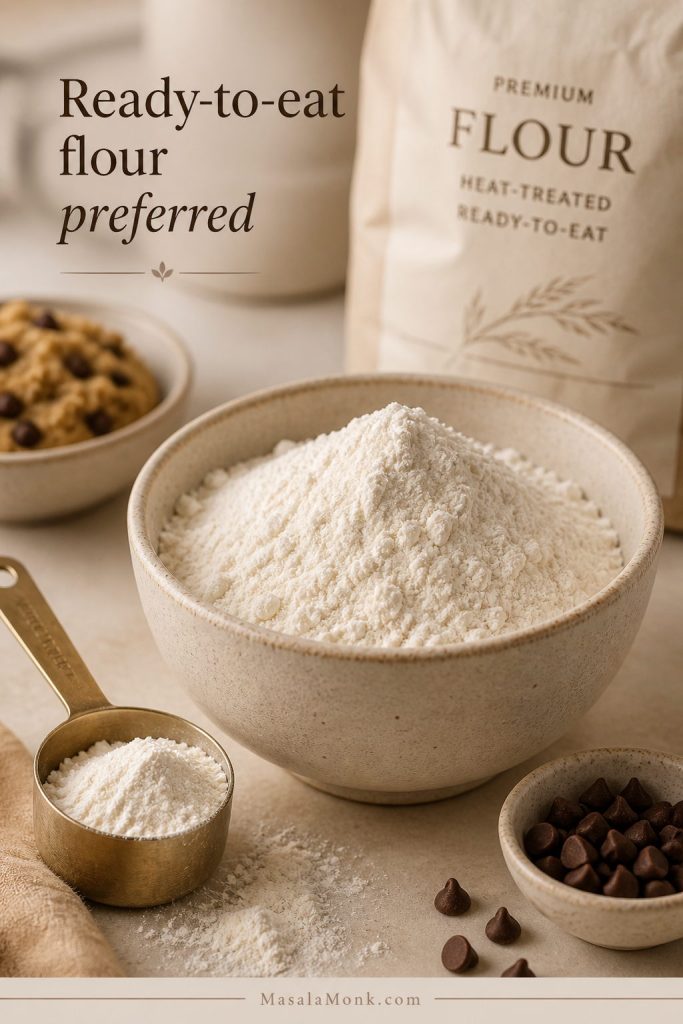
Ready-to-eat flour displayed beside edible cookie dough ingredients as the preferred flour choice for no-bake cookie dough.
Commercially heat-treated ready-to-eat flour keeps the no-bake dough approach cleaner, especially because regular flour is normally made safer through baking or cooking.

About Heating Flour at Home

Many edible cookie dough recipes include a home flour-heating step, but this should be framed carefully. The most cautious choice is still commercially heat-treated flour labeled ready-to-eat. The FDA notes that home flour treatments may not reliably kill all bacteria or make raw flour safe to eat, so treat any home method as a recipe-blog risk-reduction step rather than a validated food-safety process.

For readers who still choose to follow a home flour-heating method, use an instant-read thermometer, spread the flour thinly, stir it during heating, check more than one spot, cool it completely, and sift before mixing.

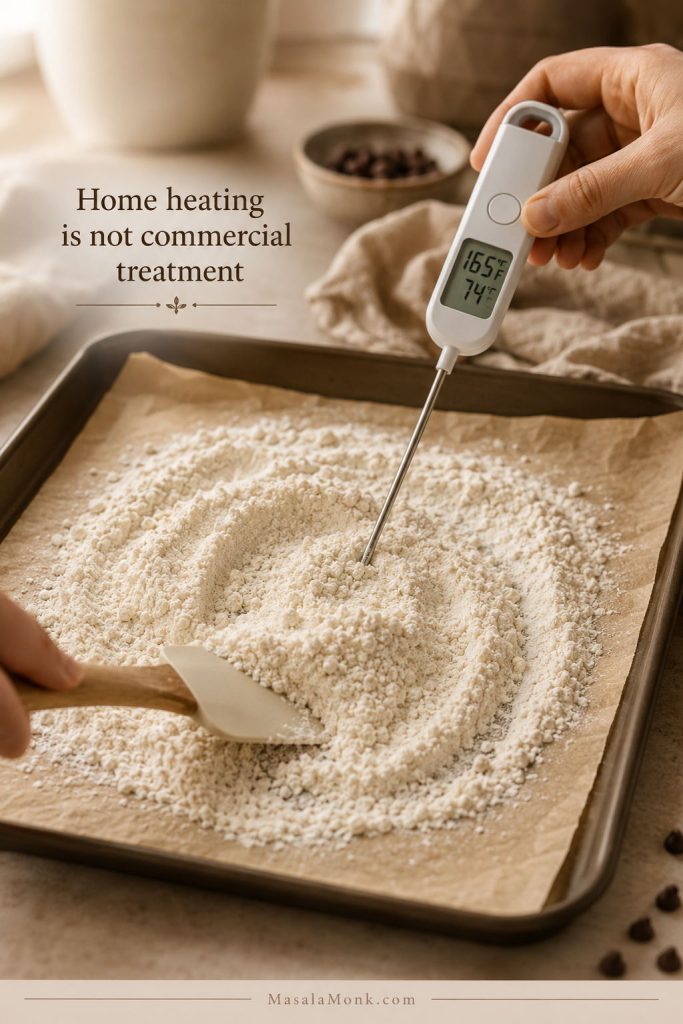
Flour spread on a parchment-lined baking tray with an instant-read thermometer inserted, illustrating a home flour-heating method.
If you heat flour at home, use the thermometer cue as a careful kitchen step, not a promise; the safest route is still flour processed for ready-to-eat use.

Oven Method Used by Many Recipe Blogs

Preheat the oven to 350°F / 175°C. Spread a little more flour than you need in a thin layer on a parchment-lined rimmed baking sheet. Bake for 7 to 10 minutes, stirring once or twice, until the flour reaches 165°F / 74°C when checked in multiple spots with an instant-read thermometer. Cool completely, sift, then measure or weigh the amount needed for the dough.

Microwave Method Used by Many Recipe Blogs

Place flour in a wide microwave-safe bowl. Microwave for 30 seconds, stir well, then continue in 15-second bursts, stirring and checking the temperature in more than one spot. Let it cool completely and sift before using.

Simple takeaway: use ready-to-eat flour if you can find it. If not, read the home-heating note carefully and understand that it is a common recipe-blog risk-reduction step, not the same as commercial heat treatment.

Ingredients for Edible Cookie Dough

The ingredient list stays close to classic chocolate chip cookie dough, but each item has a job. Since the dough is not baked, little details matter more than usual: softened butter works better than melted butter, mini chips are easier to eat than large chips, and milk should be added slowly.

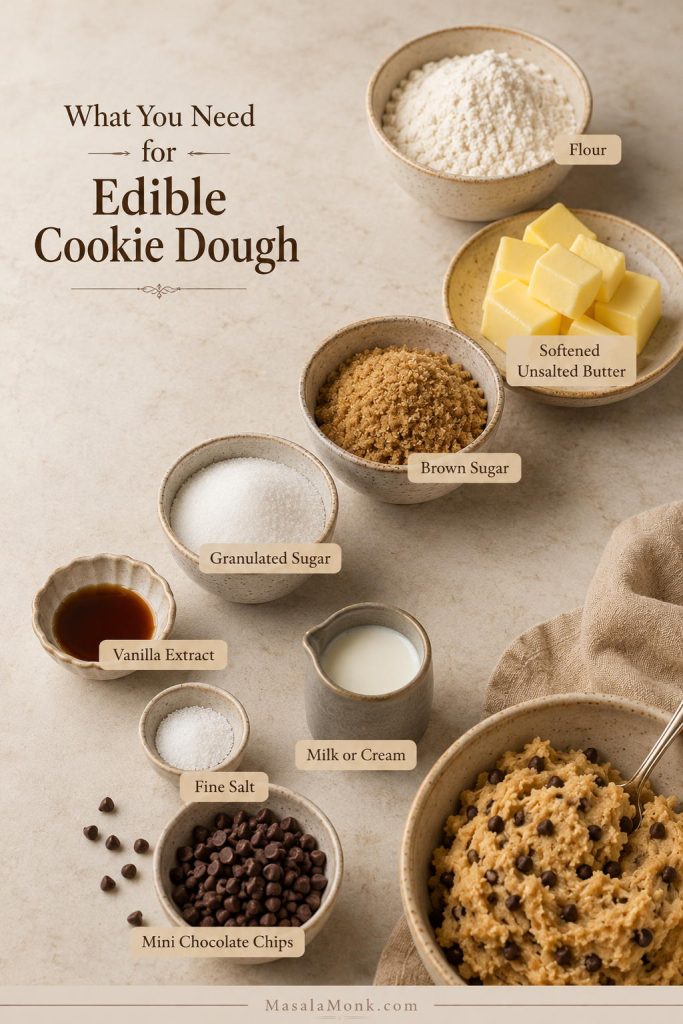
Ingredients for edible cookie dough arranged on a counter, including flour, softened butter, brown sugar, granulated sugar, vanilla, salt, milk, and mini chocolate chips.
Because this no-bake dough is eaten as-is, the ingredient balance matters more than usual: softened butter keeps it creamy, brown sugar adds depth, and milk helps fine-tune the consistency.

Ready-to-Eat or Properly Handled Flour

Flour gives the dough its familiar body. Use 1¼ cups / 150g commercially heat-treated all-purpose flour if you can find it. If you use a home flour-heating method, cool the flour completely, sift it, and then measure the final amount into the bowl.

Softened Butter

Use ½ cup / 113g / 4 oz unsalted butter, softened but not melted. Softened butter creams into the sugar and gives the dough a classic texture. Melted butter can make it greasy, loose, or frosting-like.

Brown Sugar and Granulated Sugar

Brown sugar gives the dough that deep chocolate chip cookie flavor. Granulated sugar adds familiar sweetness, but too much can make the texture gritty. This recipe uses mostly brown sugar with just a small amount of granulated sugar for balance.

Vanilla and Salt

Vanilla makes the dough taste like dessert instead of sweet butter and flour. Salt is just as important because it keeps the sweetness from feeling flat. Do not skip it, especially if you are using unsalted butter.

Milk or Cream

Milk or cream loosens the dough after the flour goes in. Start with 1 tablespoon and add more only if needed. Flour can absorb differently after heating, so the best amount is the one that gives you a scoopable texture.

Mini Chocolate Chips

Mini chocolate chips work better than large chips because this dough is eaten soft, not baked. They distribute evenly, so each spoonful has chocolate without turning the bowl into mostly hard chunks.

Optional Baking Soda for Flavor Only

A tiny pinch of baking soda can make the dough taste more like classic cookie dough, but it is optional. If you use it, add only ⅛ teaspoon. It is there for flavor, not because the dough should be baked.

Tools That Make the Texture Better

You can make this with a bowl and spatula, so do not let the tool list make the recipe feel fussy. A few extras simply make the result more reliable: an instant-read thermometer for the flour if you are using a home-heating method, a fine-mesh sieve for lumps, and a scale so the dough does not turn dry from too much flour.

  • Rimmed baking sheet
  • Parchment paper
  • Instant-read thermometer
  • Mixing bowl
  • Electric hand mixer or stand mixer
  • Rubber spatula
  • Fine-mesh sieve
  • Digital scale, strongly recommended
  • Small cookie scoop, optional
  • Airtight container for storage

A scale is especially useful because flour gets compacted easily. If you scoop too much into the bowl, the dough can turn dry, chalky, or too thick before you even start troubleshooting.

The method is easy, but the order makes a big difference. Handle the flour first, let it cool, then build the dough slowly. Warm flour and melted butter are two of the fastest ways to turn a good bowl of cookie dough into something greasy.

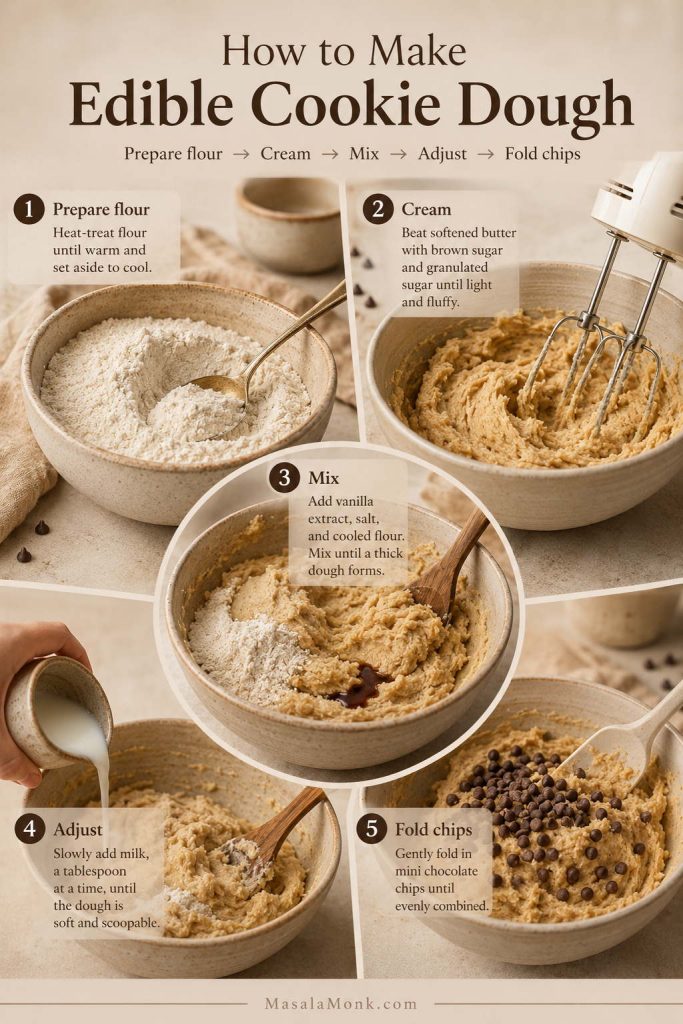
Step-by-step edible cookie dough process showing flour preparation, creaming butter and sugar, mixing ingredients, adjusting texture, and folding in mini chocolate chips.
The method works best in sequence: prepare the flour first, cream the butter and sugars well, then mix, adjust, and fold in the chips once the texture already feels close.

Step 1: Prepare the Flour

If you are using commercially heat-treated flour, measure or weigh it and move on. If you are using a home flour-heating method, follow the note above, cool the flour completely, and sift it before mixing. Do not add warm flour to the butter mixture.

Step 2: Cream the Butter and Sugars

Add softened butter, brown sugar, and granulated sugar to a bowl. Beat until the mixture looks creamy, lighter, and slightly fluffy. You should still see a thick butter-sugar mixture, not melted butter pooling around the edges. This step helps soften the sugar crystals and gives the dough a smoother bite.

Mix in the vanilla and salt, then add the cooled, sifted flour. Add the flour gradually if you are mixing by hand. At first, the mixture may look a little thick; that is normal.

Step 4: Adjust the Texture

Add milk or cream one teaspoon at a time. Stir, pause, and check the texture before adding more. The dough should hold its shape on a spoon but still press easily when you scoop it. Stop before it starts looking like frosting.

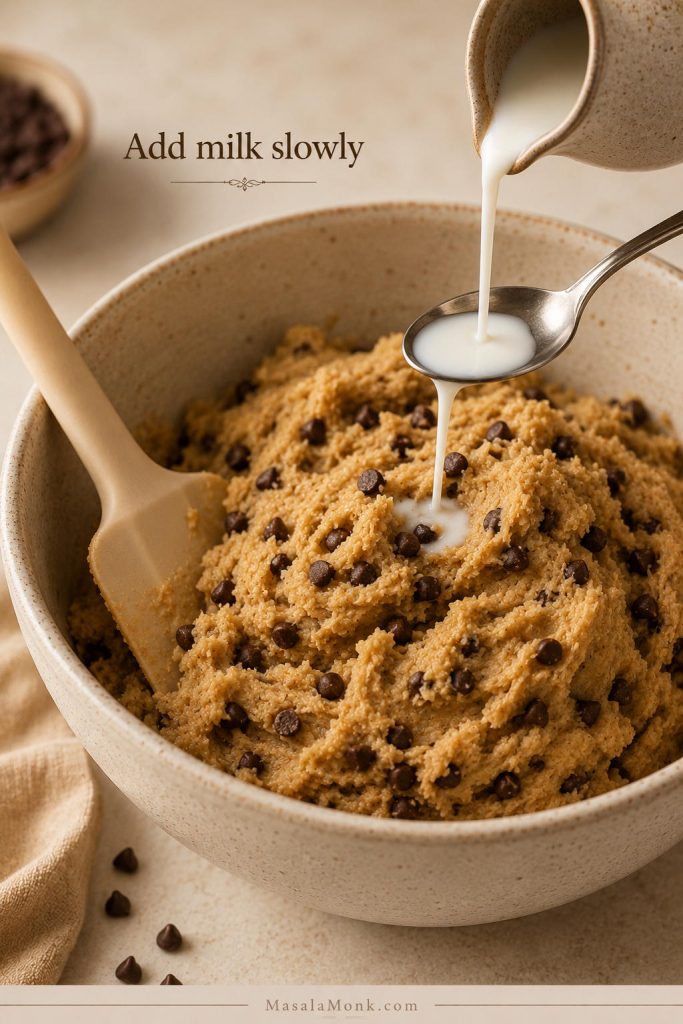
A small amount of milk is being added to thick edible cookie dough in a bowl while a spoon rests nearby.
Add milk slowly, then stir before deciding on more; the dough often softens after a few turns, so patience helps keep it thick and spoonable.

Step 5: Fold in Mini Chocolate Chips

Fold in the mini chocolate chips with a spatula. Taste and adjust with a tiny pinch of salt if it tastes too sweet, or a few extra drops of vanilla if it tastes flat.

Serving cue: this dough is best after a 10-minute rest. That short pause lets the sugar soften slightly and the flour hydrate, so each spoonful tastes smoother.

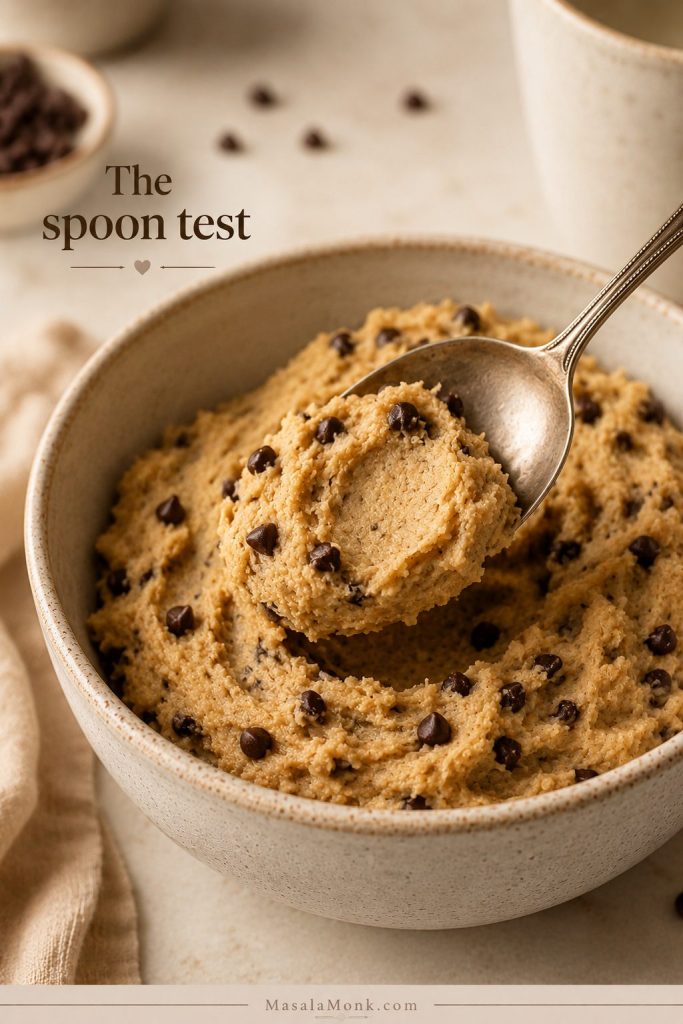
Spoon test: The dough should lift cleanly and still look creamy before you move to the recipe card.

A spoon presses into and lifts edible cookie dough, showing a soft texture that holds its shape.
The spoon test is one of the easiest checks in the whole recipe: if the dough lifts cleanly and still looks creamy, you are usually very close to the ideal finish.

Edible Cookie Dough Recipe Card

This edible cookie dough recipe is a classic chocolate chip version made without eggs and with a safer flour approach. It is designed for eating by the spoonful, rolling into bites, or folding into desserts.

YieldAbout 2½ cups
Servings12–16 small servings
Prep Time10 minutes
Total Time20–25 minutes

Ingredients

  • 1¼ cups / 150g commercially heat-treated all-purpose flour, preferred; or flour handled using the home-heating note above, cooled completely and sifted
  • ½ cup / 113g / 4 oz unsalted butter, softened
  • ½ cup / 100–110g packed light brown sugar
  • 2 tablespoons / 25g granulated sugar
  • 1½ teaspoons / 7ml vanilla extract
  • ½ teaspoon fine salt, or to taste
  • 1–2 tablespoons / 15–30ml milk or cream, added as needed
  • ¾ cup / 120–130g mini semisweet chocolate chips
  • Optional: ⅛ teaspoon baking soda, for classic cookie-dough flavor only

Method

  1. Prepare the flour. Use commercially heat-treated flour if available. If using a home flour-heating method, follow the safety note above, cool the flour completely, sift it, then measure 150g for the recipe.
  2. Cream the butter and sugars. In a mixing bowl, beat softened butter, brown sugar, and granulated sugar until creamy and slightly fluffy.
  3. Add flavor. Mix in vanilla, salt, and optional baking soda if using.
  4. Add flour. Add the cooled, sifted flour and mix until a thick dough forms.
  5. Adjust texture. Add milk or cream 1 teaspoon at a time until the dough is soft and scoopable.
  6. Add chocolate. Fold in mini chocolate chips. Let the dough rest for about 10 minutes before serving for the smoothest texture.

Notes

  • This dough is for eating as edible cookie dough, not for baking into cookies.
  • For the most cautious version, use commercially heat-treated flour labeled ready-to-eat.
  • Home flour-heating methods are common in recipe blogs, but FDA guidance says home treatments may not reliably make raw flour safe to eat. Use commercially heat-treated ready-to-eat flour for the most cautious version.
  • If you choose to heat flour at home, use an instant-read thermometer, stir well, check multiple spots, cool completely, and sift before mixing.
  • If the dough is too dry, add milk 1 teaspoon at a time. If it is too sticky, chill it for 15–20 minutes.
  • Store refrigerated in an airtight container for 4–5 days, or freeze portions for 1–2 months.
Recipe card image for edible cookie dough showing the main ingredients and a simple method beside a bowl of cookie dough.
Use the recipe card as your baseline, then adjust only the milk or chill time first; those two small changes usually fix the texture without changing the flavor.

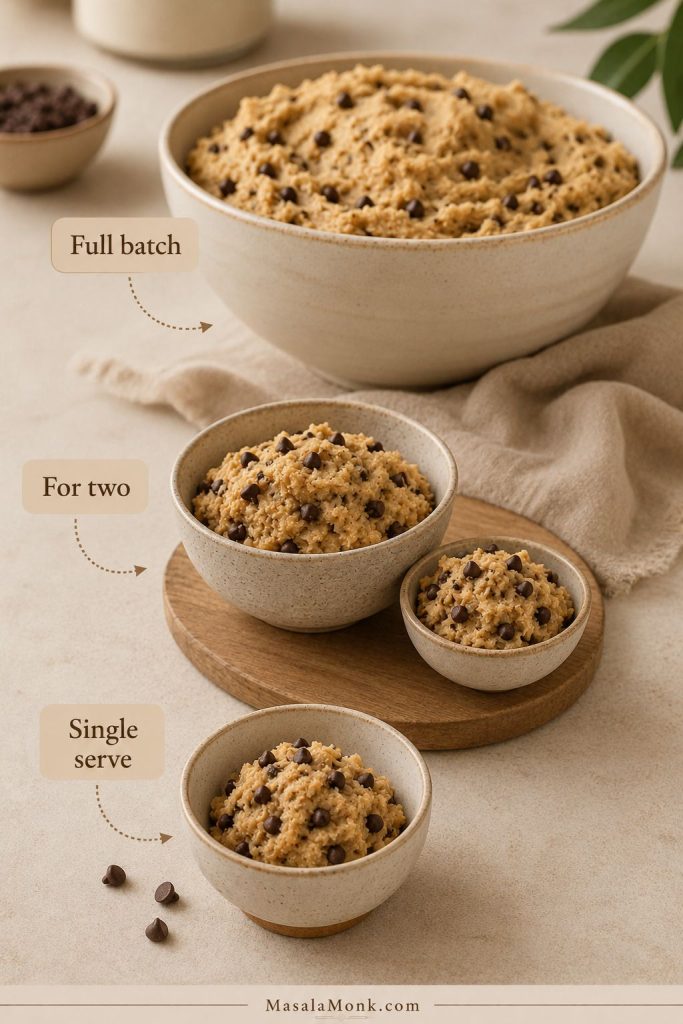
Which Batch Size Should You Make?

Choose the batch based on the kind of cookie dough moment you want. The single-serve version is best for one quick craving, the for-two version is perfect for a small dessert, and the full edible cookie dough recipe works better when you want cookie dough bites, ice cream mix-ins, dessert cups, or a make-ahead treat in the fridge.

Three edible cookie dough portion sizes are shown, representing single serve, for two, and full batch amounts.
Batch size changes the experience as much as flavor does: a single serve suits one craving, a for-two version feels more dessert-like, while a full batch works better for bites or mix-ins.
Make This Best For Texture Tip
Single serve One craving, no leftovers Add milk slowly because small bowls loosen fast.
For two Movie night, date night, small dessert Rest 10 minutes before eating for a smoother bite.
Full batch Cookie dough bites, dessert cups, ice cream mix-ins Chill before rolling or portioning.

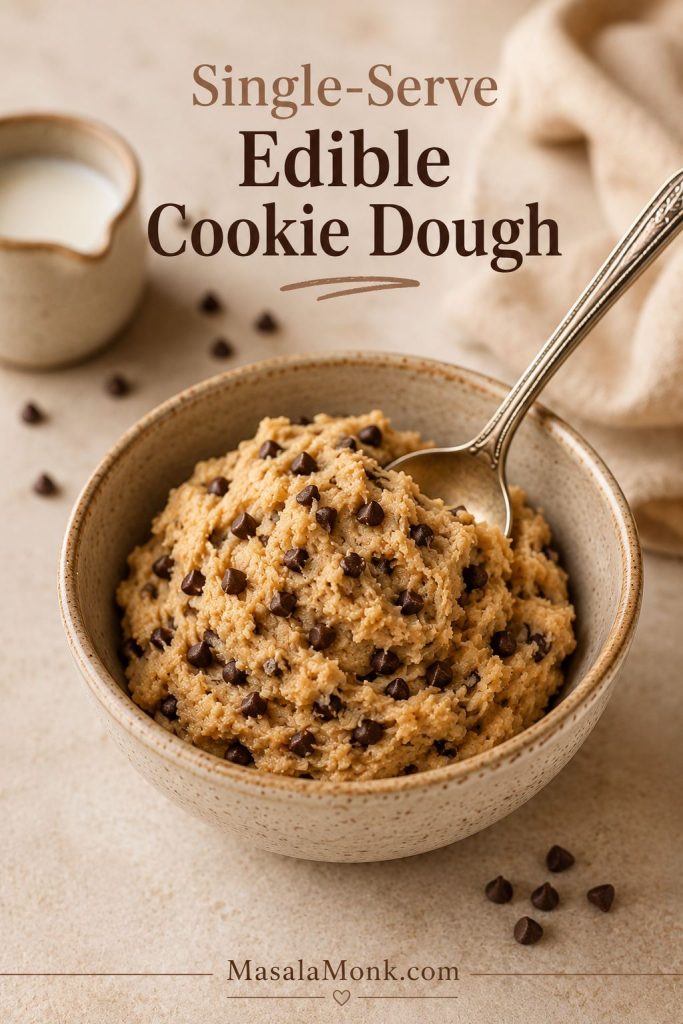
The single-serve version is the bowl to make when you want cookie dough now and do not want leftovers calling your name from the fridge. Because the batch is small, measure the flour and milk carefully; a tiny extra splash can change the texture quickly.

Single-serve edible cookie dough in a small bowl with mini chocolate chips and a spoon.
Choose the single-serve bowl when you want cookie dough for one and nothing left over, but add milk carefully because small batches loosen faster than larger ones.

Single-Serve Formula

  • 6 tablespoons / 48g ready-to-eat flour, preferred; or flour handled using the safety note above
  • 2 tablespoons / 28g / 1 oz softened butter
  • 2 tablespoons / 25–28g light brown sugar
  • 1 tablespoon / 12g granulated sugar
  • ¼–½ teaspoon vanilla extract
  • Small pinch of fine salt
  • ½–1 tablespoon / 7–15ml milk or cream
  • 2 tablespoons / 20–25g mini chocolate chips

Mix it the same way as the main batch: cream the softened butter and sugars, add vanilla and salt, stir in the flour, loosen with milk, and fold in the chips. If you want a firmer scoop, chill it for 10 minutes before eating.

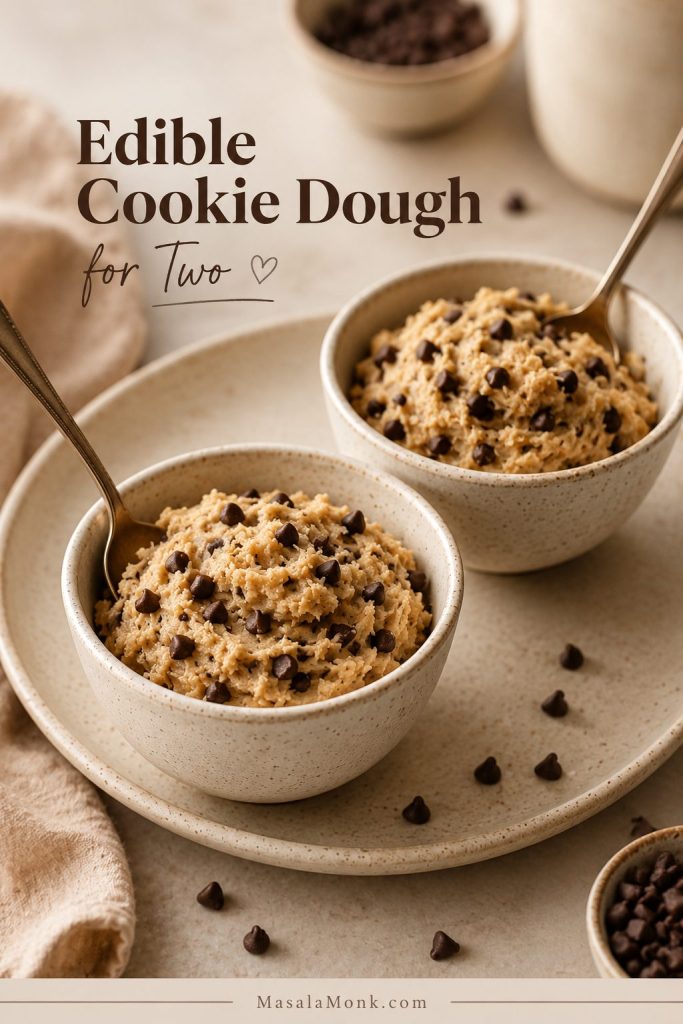
This small-batch version makes enough for two dessert portions without leaving a full container in the fridge. That size works especially well for a movie night, date night, or quick no-bake dessert when you want something sweet without baking a tray of cookies.

Two small bowls of edible cookie dough with spoons, arranged as a dessert for two.
This small batch is a practical middle ground: enough for a shared dessert, yet still easy to mix without committing to a full container in the fridge.

For-Two Formula

  • ½ cup + 1 tablespoon / about 68g ready-to-eat flour, preferred; or flour handled using the safety note above
  • 4 tablespoons / 56g / 2 oz softened butter
  • ¼ cup / 50–55g light brown sugar
  • 1½–2 tablespoons / 18–25g granulated sugar
  • ½–1 teaspoon vanilla extract
  • ⅛–¼ teaspoon fine salt
  • 1–1½ tablespoons / 15–22ml milk or cream
  • ¼ cup / 40–45g mini chocolate chips

Start with the lower amount of milk, then add more only if the mixture feels too thick. Small batches can go from crumbly to loose quickly, so adjust slowly and give the bowl a minute before adding another splash.

Edible Cookie Dough Variations

Once the base is right, the dough is easy to customize. Keep the same safety logic: no raw eggs, avoid regular raw flour, and adjust the texture slowly because different add-ins change how soft or thick the mixture feels.

Not sure where to start? Make the classic chocolate chip version first, then decide what you want more of next time: extra vanilla, more chocolate, a salty peanut butter edge, a firmer bite for rolling, or a lighter dairy-free version.

Variation guide showing several edible cookie dough styles, including chocolate chip, peanut butter, vegan, protein, keto, and sprinkle-topped options.
Once the base recipe feels right, use the variations to choose your next direction, whether that means sweeter, nuttier, dairy-free, higher-protein, or lower-carb.
If You Want… Make This Variation Small Adjustment
Classic chocolate chip flavor Chocolate chip edible cookie dough Use mostly brown sugar and mini chips.
A sweeter bakery-style bowl Sugar cookie dough Use more granulated sugar and add sprinkles at the end.
A richer, saltier bite Peanut butter cookie dough Add creamy peanut butter and reduce the milk slightly.
A firmer bite for rolling Cookie dough bites Chill before scooping or dipping.
A lighter dairy-free option Vegan edible cookie dough Use vegan butter, dairy-free milk, and dairy-free chips.

Start here if you want the classic chocolate chip version. Brown sugar, vanilla, salt, softened butter, and mini chocolate chips give you the familiar cookie dough flavor without needing to bake anything.

Mini chocolate chips are being folded into edible cookie dough with a spatula.
Classic chocolate chip remains the best place to start, since brown sugar, vanilla, and mini chips come closest to the flavor most people expect from cookie dough.

For deeper chocolate flavor, add 1 to 2 tablespoons of cocoa powder and a splash more milk. For a chunkier bowl, use a mix of mini chips and finely chopped chocolate.

Choose this variation when you want the vanilla-sprinkle side of cookie dough instead of the brown-sugar chocolate chip side. It tastes lighter, sweeter, and more bakery-style.

Use more granulated sugar and less brown sugar. You can replace the brown sugar with granulated sugar for a cleaner vanilla flavor, then add a tiny splash of almond extract if you like bakery-style sugar cookies. Sprinkles, white chocolate chips, and a little extra vanilla work well here. Add sprinkles at the end so they do not bleed too much color into the dough.

This is the richer, saltier variation — the one that tastes like peanut butter cookie dough met chocolate chip cookie dough in the same bowl. Mix ¼ cup creamy peanut butter into the butter and sugar mixture, then reduce the milk slightly. Peanut butter adds richness and salt, so taste before adding extra salt.

Peanut butter is swirled into edible cookie dough with chocolate chips and chopped peanuts visible on top.
Meanwhile, the peanut butter version turns richer and slightly firmer, so it is a smart choice when you want a saltier edge and a more substantial bite.

Mini chocolate chips are great here, but chopped roasted peanuts also work if you want crunch. For a baked version of this flavor, MasalaMonk’s peanut butter cookies are the better route.

For a gluten-free version, use a gluten-free flour blend you already like in no-bake or raw-style applications. Different blends behave differently when they are not baked, so texture matters more than usual here.

If the dough tastes gummy, try a gum-free gluten-free blend next time. If it tastes grainy, let it rest for 10 to 15 minutes before serving. Almond flour can also work, but it gives a softer, nuttier dough rather than a classic all-purpose-flour texture.

To make the dough vegan or dairy-free, use vegan butter, dairy-free milk, and dairy-free chocolate chips. The same method works, but the mixture may soften faster depending on the vegan butter you use.

Vegan edible cookie dough in a bowl with dairy-free milk and chocolate chips shown nearby.
The dairy-free version should still feel like dessert first: creamy, scoopable, and close to the original texture, just made with vegan butter, dairy-free milk, and dairy-free chips.

If you want a dairy-free frozen dessert to pair with cookie dough bites, MasalaMonk’s coconut ice cream is a natural next recipe.

The protein version goes in a different direction from the classic butter-and-brown-sugar dough, but it is useful when you want the cookie dough idea in a higher-protein snack. For a quick version, blend cottage cheese until completely smooth, then stir it with almond flour or oat flour, vanilla protein powder, a little maple syrup or sweetener, vanilla, salt, and mini chocolate chips.

A bowl of protein-style edible cookie dough with mini chocolate chips, a scoop of protein powder, and a small bowl of creamy white protein base nearby.
Protein cookie dough goes in a different direction from the classic bowl; still, it can be useful when you want the same dessert idea in a more filling, snack-like version.

Chill it before eating so the texture firms up. If you like high-protein desserts, MasalaMonk’s protein ice cream goes deeper into protein powder, Greek yogurt, dairy-free, low-calorie, and sugar-free frozen dessert options.

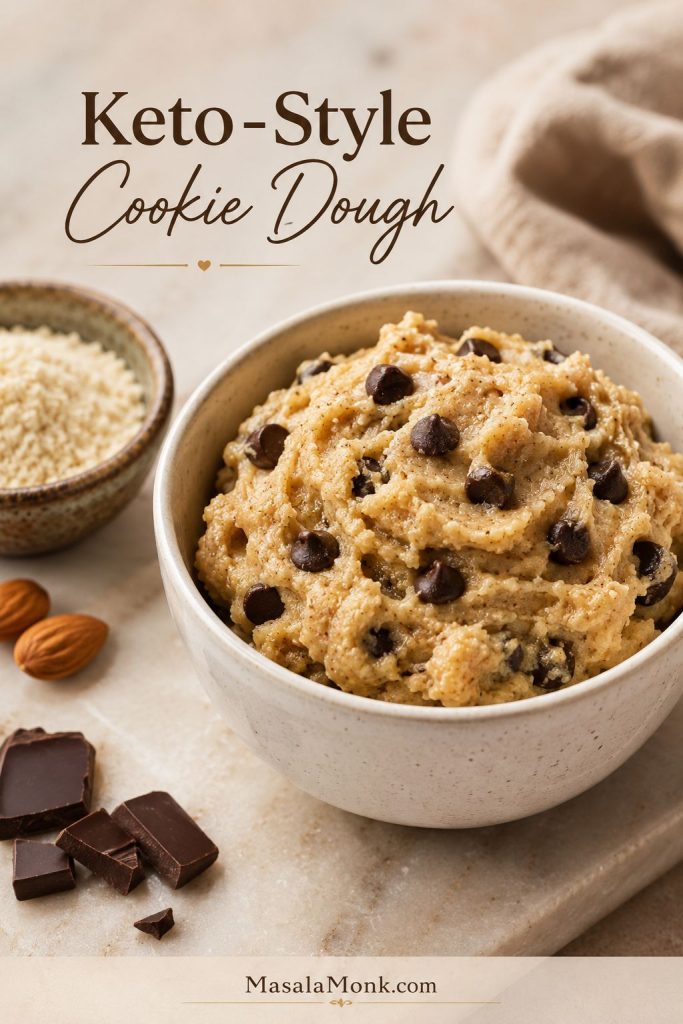
Expect a nuttier, softer dough than the classic chocolate chip version. For a keto-style bowl, use almond flour instead of wheat flour, a low-carb sweetener instead of sugar, and sugar-free chocolate chips. Because almond flour has more fat and less starch than all-purpose flour, start with less added milk and adjust slowly.

Keto-style edible cookie dough in a bowl with almond flour, almonds, and dark chocolate pieces nearby.
Because almond flour behaves differently from all-purpose flour, keto edible cookie dough usually turns out softer and nuttier, with a flavor that feels less classic but still satisfying.

For another low-carb dessert direction, MasalaMonk’s keto hot chocolate is a good companion recipe.

How to Fix Edible Cookie Dough Texture

If your first spoonful is not perfect, do not panic. Edible cookie dough is one of the easiest desserts to adjust because nothing has been baked yet. Most texture problems come down to flour, butter temperature, or adding the milk too quickly.

The easiest way to fix the dough is to change only one thing at a time. Add milk slowly, chill before adding more flour, and taste again after a short rest.

Three bowls compare edible cookie dough textures labeled dry, just right, and too soft.
Look at the texture before changing the recipe: crumbly dough needs slow moisture, loose dough needs chilling, and the best bowl sits somewhere in between.
Problem Likely Cause Fix
Dry or crumbly texture Too much flour, packed flour, or not enough milk Add milk or cream 1 teaspoon at a time until scoopable.
Sticky dough Butter too warm or too much milk Chill 15–20 minutes, or add 1 tablespoon sifted flour.
Gritty bite Sugar has not softened into the butter enough Cream the butter and sugars longer, or let the dough rest 10 minutes.
Floury flavor Flour was overmeasured or not sifted after heating Use grams, sift after heating, and add a little vanilla or salt to balance.
Overly sweet dough Too much sugar or too many chips Add a pinch of salt and 1–2 tablespoons flour.
Greasy or soupy texture Butter was melted instead of softened Chill, then stir. Next time, use softened butter.
Very firm after chilling Butter hardened in the fridge Let the dough sit at room temperature for 10–15 minutes before serving.

Start with a teaspoon of milk or cream, then stir before adding more. Small corrections work better here because dry dough can move from crumbly to loose surprisingly quickly.

A teaspoon of milk is being added to dry, crumbly edible cookie dough to improve the texture.
If the dough turns dry or crumbly, fix it gradually rather than all at once; a teaspoon of milk or cream is usually enough to start bringing it back together.

Chill first so the butter firms up before you add more flour. After a short rest in the fridge, the same bowl often becomes scoopable without turning heavy or floury.

Soft edible cookie dough is shown with a fridge cue, illustrating chilling as a fix for sticky dough.
Chilling gives the butter time to firm up again; as a result, soft dough often becomes scoopable without needing extra flour.

No, this edible cookie dough is made for spooning, scooping, and rolling into bites — not for baking. It has no eggs and no leavening, so it will not behave like regular cookie dough in the oven. Instead of turning into chewy cookies, it may spread, turn greasy, stay dense, or bake up flat.

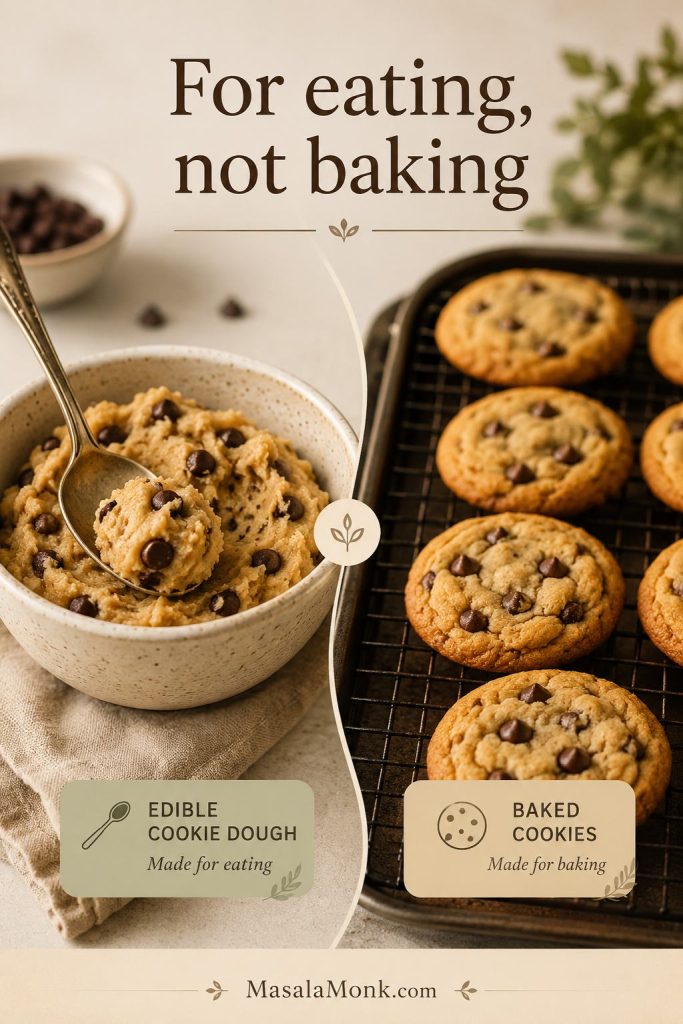
Edible cookie dough in a bowl is shown beside baked cookies on a tray to compare dough for eating with dough for baking.
Edible cookie dough is made for spooning and scooping, not for baking; therefore, use a proper cookie recipe whenever the goal is warm cookies from the oven.

Think of this as a no-bake dessert, not a shortcut cookie dough. If the craving is really for warm cookies from the oven, use a recipe designed for baking, like MasalaMonk’s double chocolate chip cookies. If you want a roll-and-cut dough, MasalaMonk’s gingerbread cookies are a better example of dough built for shaping and baking.

Eating it by the spoonful is the obvious answer, but this dough can do more. Because it is eggless and made with a safer flour approach, you can use it as a no-bake dessert component instead of treating it like leftover raw cookie dough.

Easy No-Bake Ways to Serve It

  • Eat it by the spoonful after a 10-minute rest for smoother texture.
  • Roll it into bites and chill until firm.
  • Dip the bites in melted chocolate and finish with flaky salt.
  • Fold chilled pieces into ice cream for homemade cookie dough ice cream.
  • Blend a spoonful into a milkshake for cookie dough flavor.
  • Use it as a brownie topping after brownies have cooled.
  • Layer it into dessert cups with whipped cream, chocolate sauce, or berries.
  • Press it into mini tart shells for a no-bake cookie dough dessert.
Several ways to use edible cookie dough are shown, including bites, ice cream mix-ins, milkshake, brownie topping, and dessert cups.
Beyond the spoonful, this dough can become bites, brownie topping, milkshake flavor, or ice cream mix-ins, so one batch can stretch into several no-bake dessert ideas.

Cookie Dough Ice Cream and Mix-In Safety

Ice cream note: only use dough made with ready-to-eat ingredients for ice cream mix-ins. Do not fold regular raw cookie dough into ice cream; the pieces should be made without raw eggs and with a safer flour approach.

Small chilled pieces are especially good folded into homemade ice cream. For a chocolate-chip frozen dessert direction, see MasalaMonk’s mint chocolate chip ice cream.

If you want another no-bake spoonable dessert, MasalaMonk’s avocado chocolate mousse gives you a chocolate-rich option with a completely different texture.

How to Store and Freeze Edible Cookie Dough

Because the dough contains butter and milk or cream, it should be stored cold. Do not leave it sitting out for long serving windows, especially in a warm kitchen.

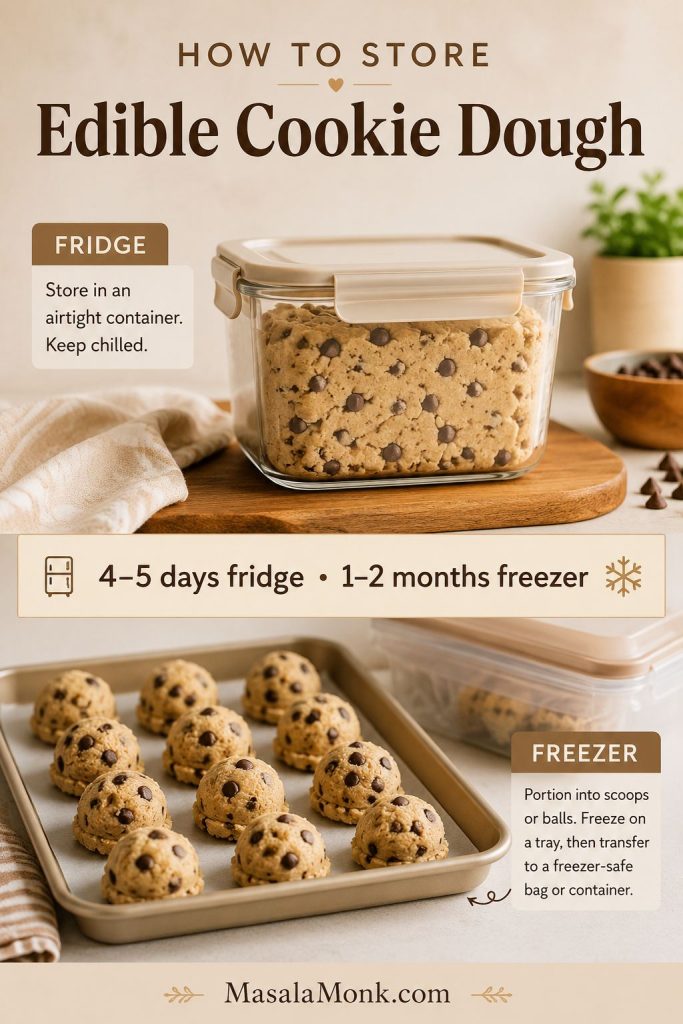
  • Refrigerator: Store in an airtight container for 4–5 days.
  • Freezer: Freeze portioned balls or scoops for 1–2 months.
  • To serve from the fridge: Let it sit at room temperature for 10 minutes so the butter softens slightly.
  • To freeze neatly: Scoop into balls, freeze on a lined tray until firm, then transfer to a freezer-safe container.
Storage guide for edible cookie dough showing an airtight container for the fridge and portioned scoops for the freezer, with timing notes.
Cold storage firms the butter, so let refrigerated scoops rest briefly before serving; meanwhile, freezing in portions makes later dessert bowls much easier.

If you are making cookie dough bites for a party, keep them chilled until close to serving time. For the best texture, portion them small enough that people can eat them in one or two bites.

Protein versions made with cottage cheese or yogurt should be treated as more perishable. Keep them refrigerated, use clean utensils, and aim to eat them within 2–3 days rather than keeping them as long as the classic butter-based version.

FAQs

Is this edible cookie dough recipe safe to eat?

Edible cookie dough is safest when it is made without raw eggs and with commercially heat-treated flour labeled ready-to-eat. Regular raw cookie dough is not meant to be eaten because it usually contains raw flour and raw eggs. Home flour-heating methods are common in recipes, but they are not the same as commercially validated heat treatment.

What is the safest flour for edible cookie dough?

The safest flour choice is commercially heat-treated flour labeled ready-to-eat. Regular all-purpose flour is raw and is normally made safe through baking or cooking, not by being stirred directly into a no-bake dessert.

Why does edible cookie dough need safer flour handling?

Most flour is raw and has not been treated to kill bacteria. Regular cookie dough becomes safer when baked, but edible cookie dough is not baked. That is why this recipe uses ready-to-eat flour guidance instead of asking you to stir plain raw flour into dessert.

How do I make edible cookie dough without eggs?

This recipe is eggless by design. Eggs are useful in baked cookies, but they are not needed here because the dough is made for spooning, not for going into the oven.

How does almond flour change the texture?

Almond flour makes a softer, nuttier dough and works best in keto, gluten-free, or vegan-style edible cookie dough. It will not taste exactly like classic chocolate chip cookie dough made with all-purpose flour, so start with less milk and adjust slowly.

How do I make this edible cookie dough recipe gluten-free?

Use a gluten-free flour blend you already like in no-bake applications, or use almond flour for a softer variation. If your gluten-free dough feels gummy, try a gum-free blend next time. If it feels grainy, let it rest for 10 to 15 minutes before eating.

How do I make a vegan version?

For a vegan version, use vegan butter, dairy-free milk, and dairy-free chocolate chips. The dough may soften more quickly depending on the vegan butter, so chill it if it feels too loose.

How do I make edible cookie dough for one?

For one serving, use 6 tablespoons / 48g ready-to-eat flour, preferred; or flour handled using the safety note above, plus 2 tablespoons softened butter, 2 tablespoons brown sugar, 1 tablespoon granulated sugar, vanilla, salt, ½ to 1 tablespoon milk, and 2 tablespoons mini chocolate chips. Mix, adjust the texture, and chill briefly if needed.

Why should this dough not be baked?

This dough is made for eating, not baking. It has no eggs and no leavening, so it can bake up flat, greasy, dense, or crumbly. Use a real cookie recipe if you want baked cookies.

How long does edible cookie dough last in the fridge?

Store edible cookie dough in an airtight container in the refrigerator for 4–5 days. Let it sit at room temperature for about 10 minutes before eating if it becomes too firm.

How should you freeze edible cookie dough?

Freezing works best when the dough is portioned first. Scoop it into small balls, freeze them on a lined tray until firm, then move them to a freezer-safe container. Use within 1–2 months for the best texture.

Once you have the base texture right, this edible cookie dough recipe becomes the kind of dessert you can make your own: extra vanilla, darker chocolate, sprinkles, peanut butter, or chilled bite-size scoops tucked into ice cream. Start with the classic chocolate chip version first, then let the next batch follow your craving.

Make a quick note of what you changed — more salt, less milk, extra chips, longer chill time. The best edible cookie dough is the one you can repeat exactly when the craving hits again.

Back to the top

Posted on 2 Comments

No Bake Mango Cheesecake Recipe

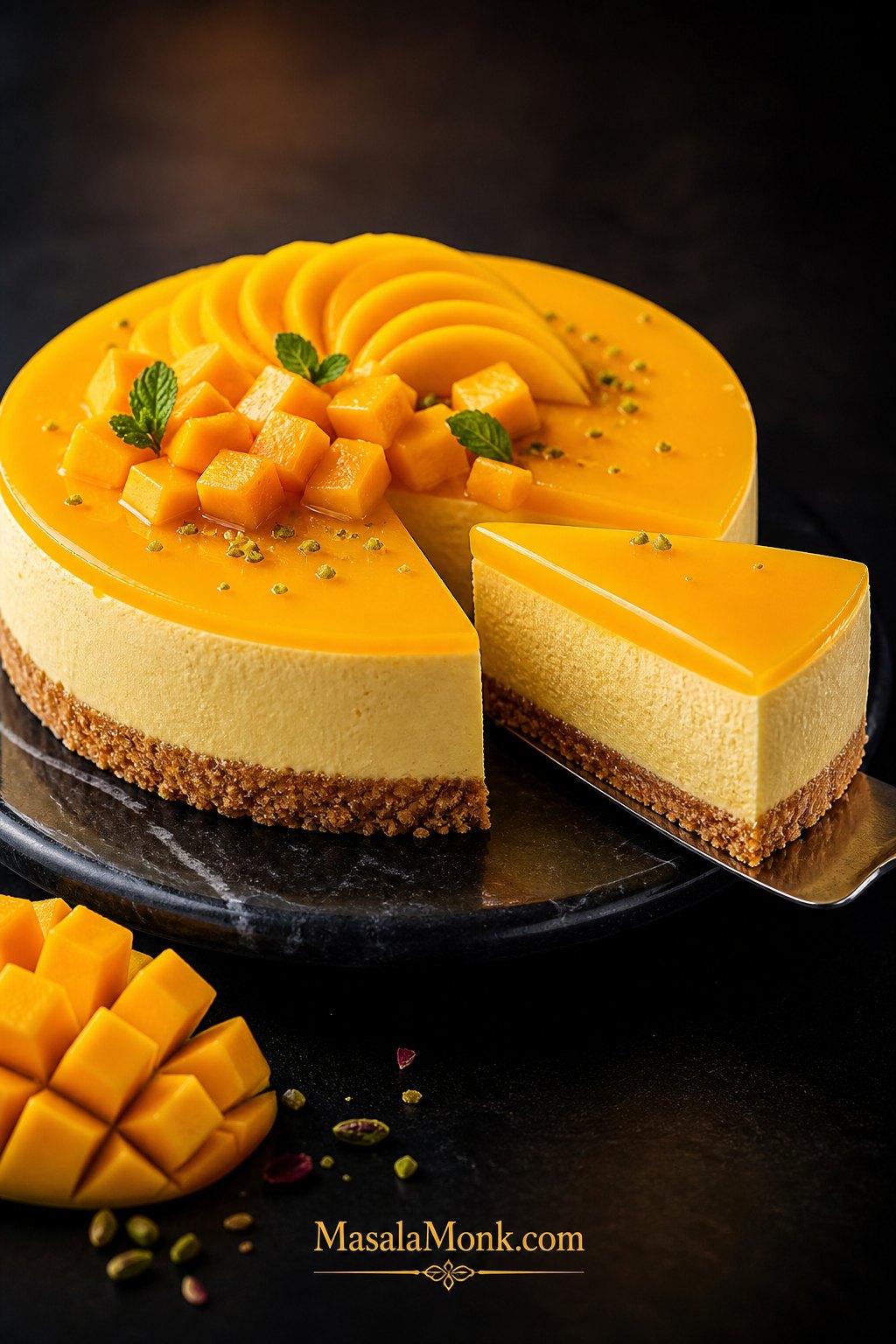
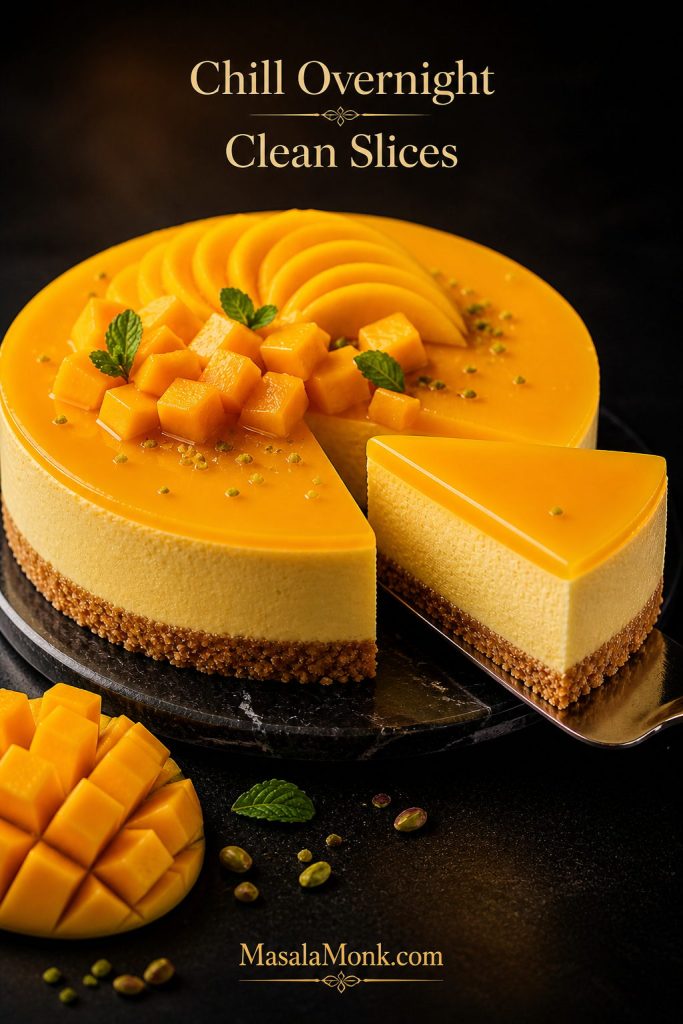
Whole no bake mango cheesecake with one slice lifted, showing a biscuit base, creamy mango filling, and glossy mango topping on a dark surface.

This no bake mango cheesecake recipe is creamy, bright, and deeply mango-forward, with a buttery biscuit base and a glossy mango topping that makes it feel special without turning on the oven. Because mango can make no-bake cheesecake fillings loose, this recipe also shows you how to control the texture so the final dessert stays creamy, sliceable, and not watery.

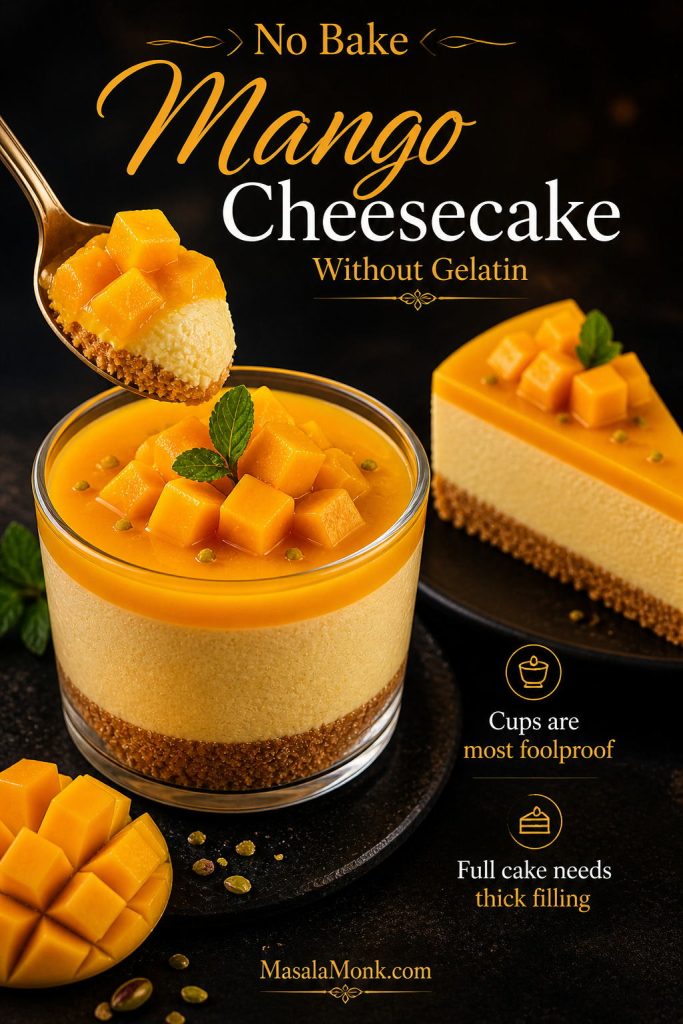
Before you start, choose the right setting method. For a full sliceable cheesecake, agar agar or gelatin gives the cleanest result. However, for a softer mango cheesecake without gelatin, cups or jars are usually the safer and easier option. This no bake mango cheesecake recipe shows you all three routes, so you can make the version that fits your kitchen, diet, and serving style.

Quick Answer: How to Make No Bake Mango Cheesecake

To make no bake mango cheesecake, start with a biscuit base, a cream cheese and whipped cream filling, mango pulp or fresh mango puree, and a setting method such as agar agar or gelatin. For clean slices, use agar agar or gelatin and chill the cheesecake overnight. However, for a softer mango cheesecake without gelatin, make it in cups, jars, or bowls instead of relying on a full cake to slice neatly.

For the easiest version, use canned Alphonso or Kesar mango pulp because the flavor, color, and sweetness are consistent. Meanwhile, fresh ripe mangoes also work beautifully when they are sweet, smooth, and not watery. If you want the plain base formula first, start with this no-bake cheesecake guide, then come back to this mango version for the fruit, setting, and topping details.

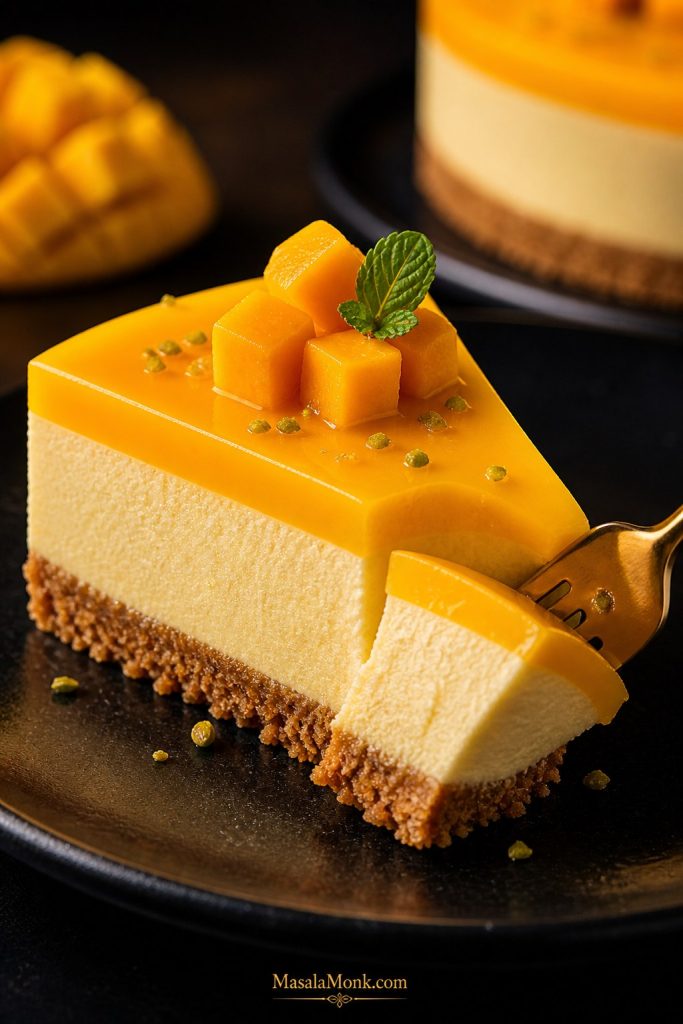
Close-up slice of no bake mango cheesecake on a plate with a fork, showing the crumb crust, creamy mango cheesecake layer, and shiny mango topping.
This close-up shows the texture goal more clearly than words can: the slice is creamy and tender, yet stable enough to lift cleanly from the cake.

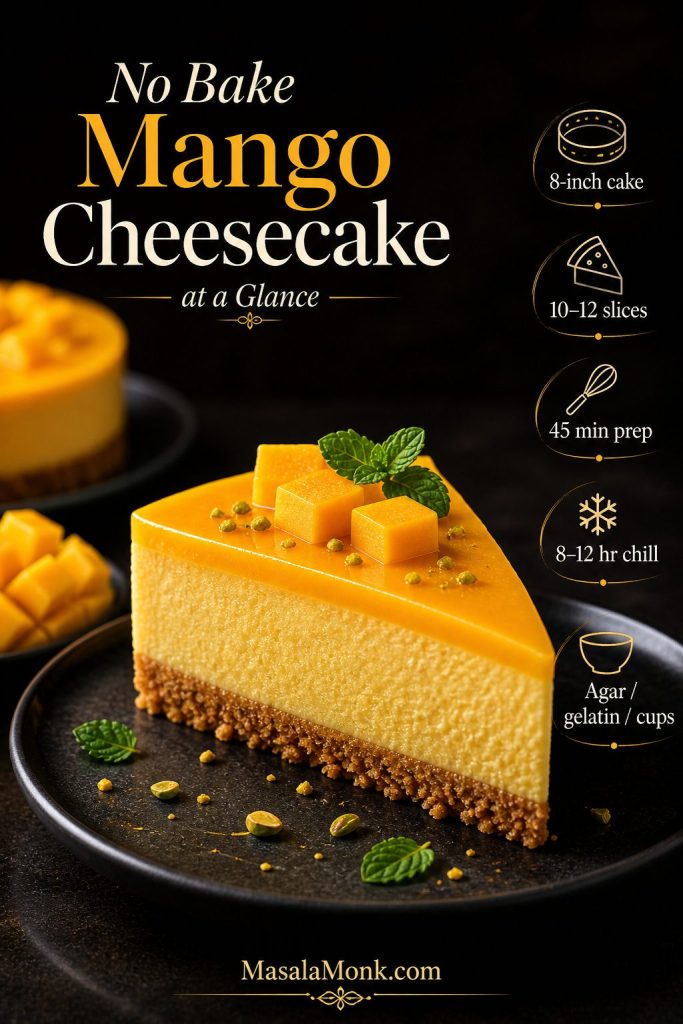
No Bake Mango Cheesecake at a Glance

Best pan 8-inch / 20 cm springform or loose-bottom pan
Best full-cake setting method Agar agar for a vegetarian cake; gelatin for a classic creamy set
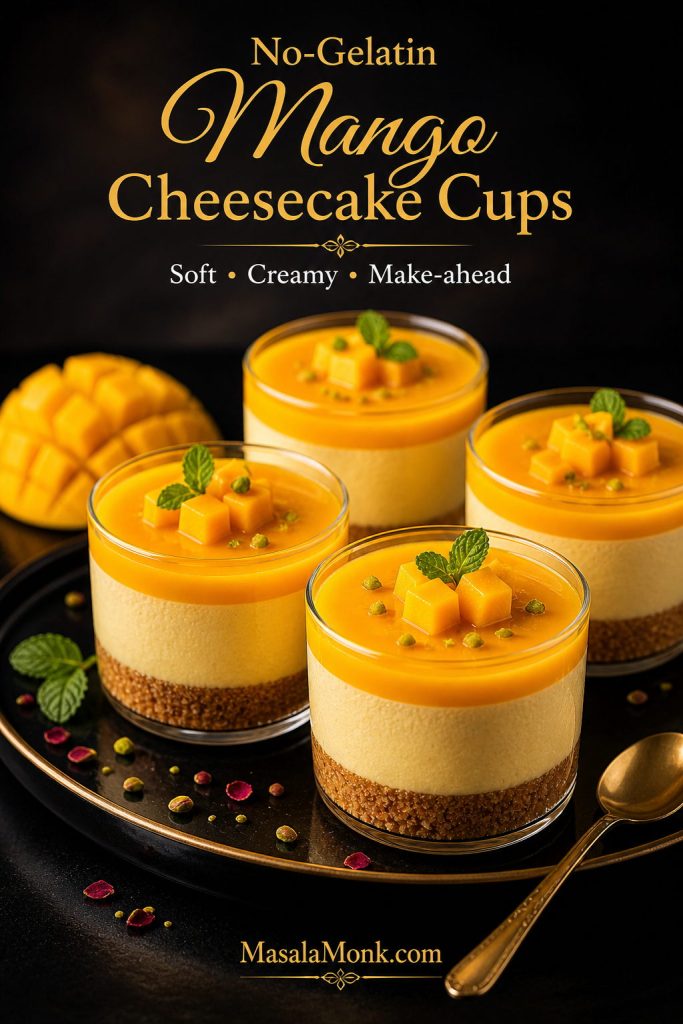
Best no-gelatin format Cups, jars, or bowls
Best mango option Alphonso/Kesar mango pulp or ripe non-fibrous fresh mango
Chill time 8–12 hours for a full cake; at least 6 hours for cups
Texture goal Creamy, mango-forward, sliceable for a full cake; soft and spoonable for cups
Informational graphic with a slice of no bake mango cheesecake and text noting 8-inch cake, 10–12 slices, 45 minutes prep, 8–12 hours chill, and agar, gelatin, or cups.
Use this quick guide before starting so the pan size, yield, chill time, and setting options are clear from the beginning.

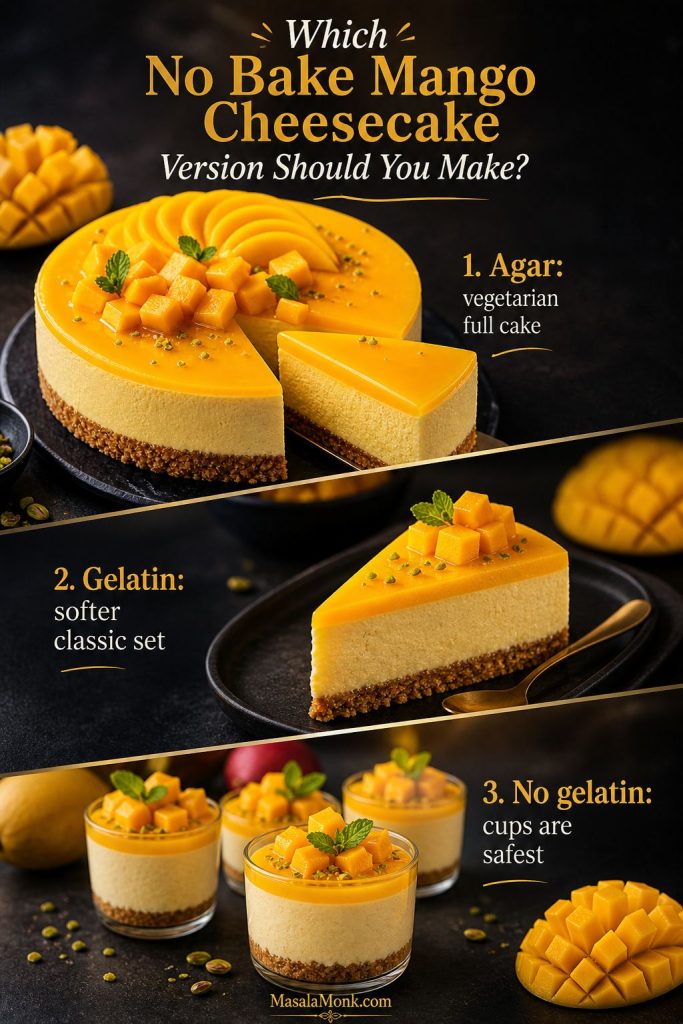
Which No Bake Mango Cheesecake Version Should You Make?

The best version depends on how you want to serve it. A full cake needs enough structure to unmold and slice. In contrast, cups and jars can stay softer, so they are more forgiving if you want a no-gelatin mango cheesecake. Therefore, this no bake mango cheesecake recipe gives you both the full-cake route and the easier cup-style option.

What you want Make this version Why
Clean full-cake slices Agar agar or gelatin full cake Both give enough structure for slicing.
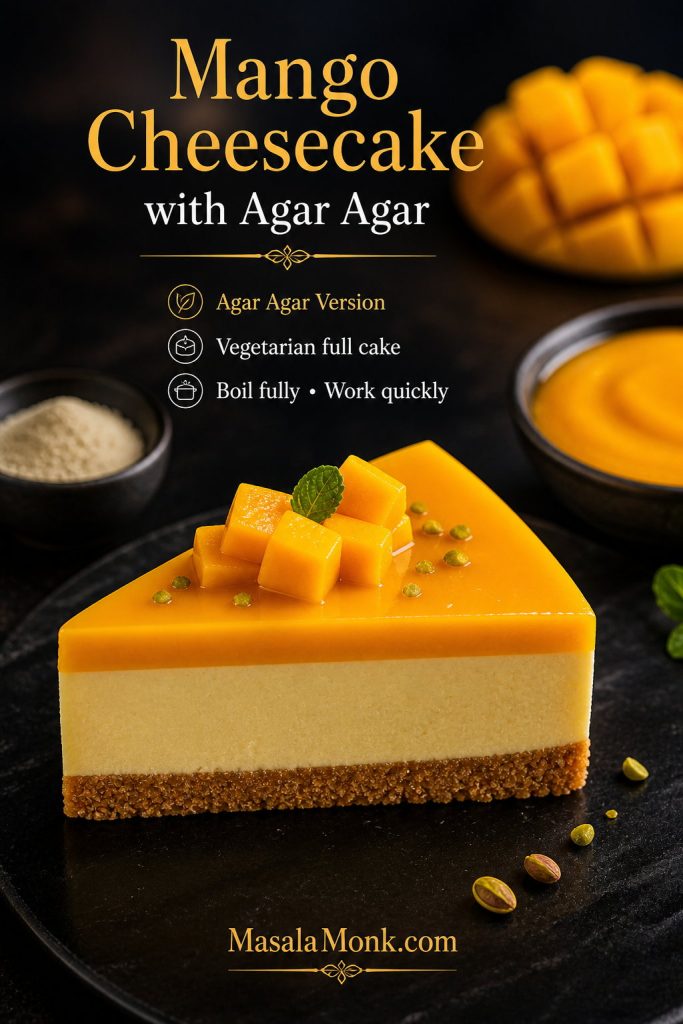
Vegetarian full cake Agar agar version Agar is plant-based and sets firmly.
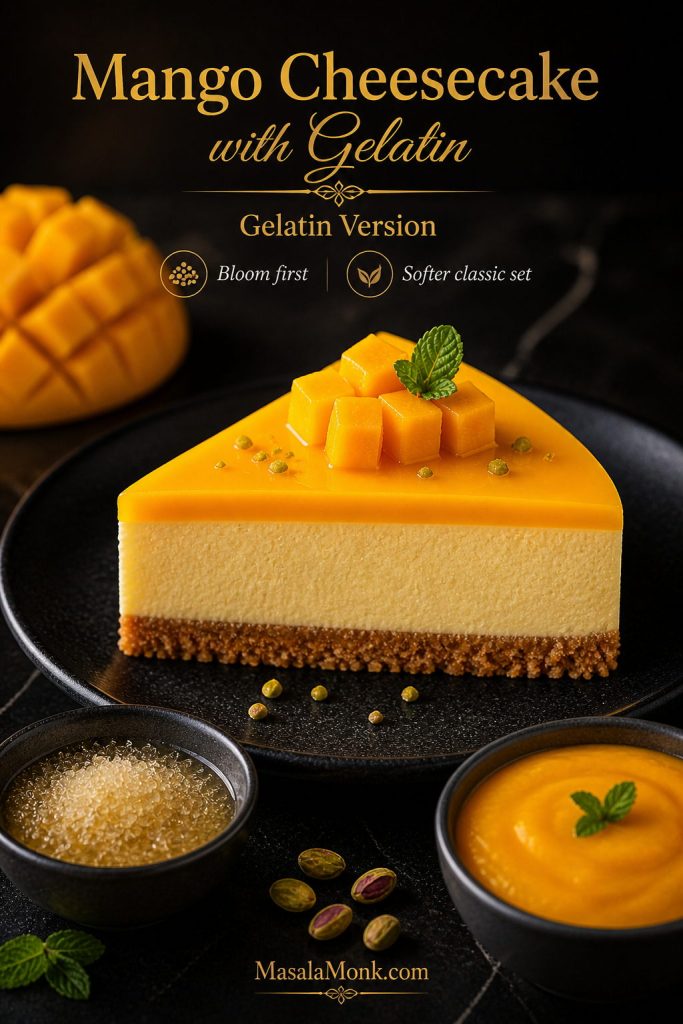
Classic creamy texture Gelatin version Gelatin gives a softer mousse-like set.
No gelatin and no agar Cups, jars, or bowls The filling can stay soft without needing to slice.
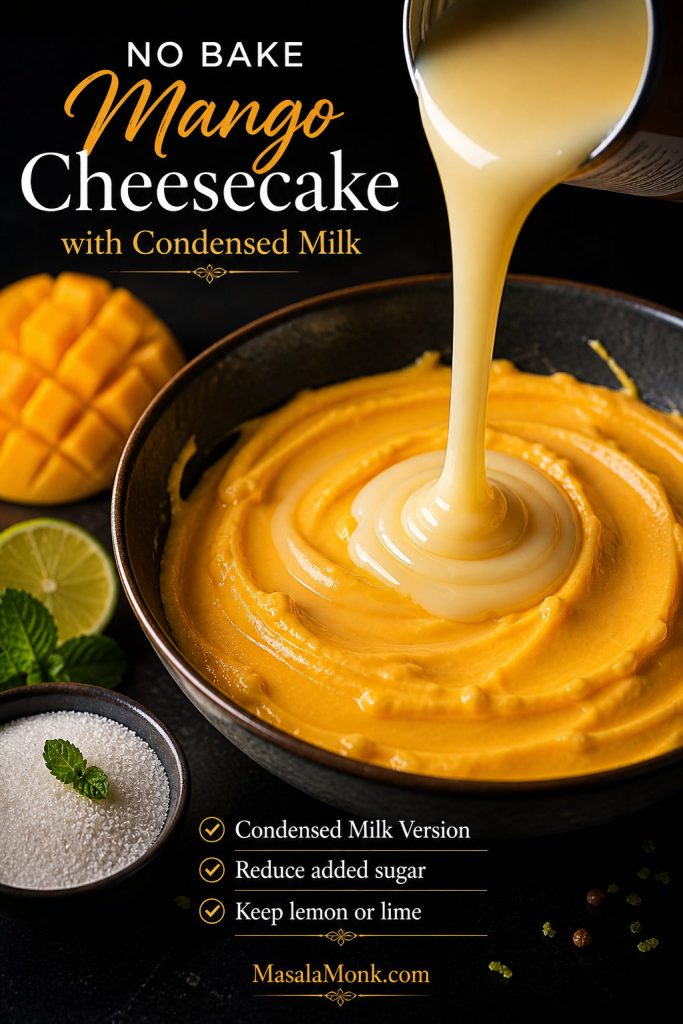
Richer shortcut Condensed milk version It adds sweetness and creaminess quickly.
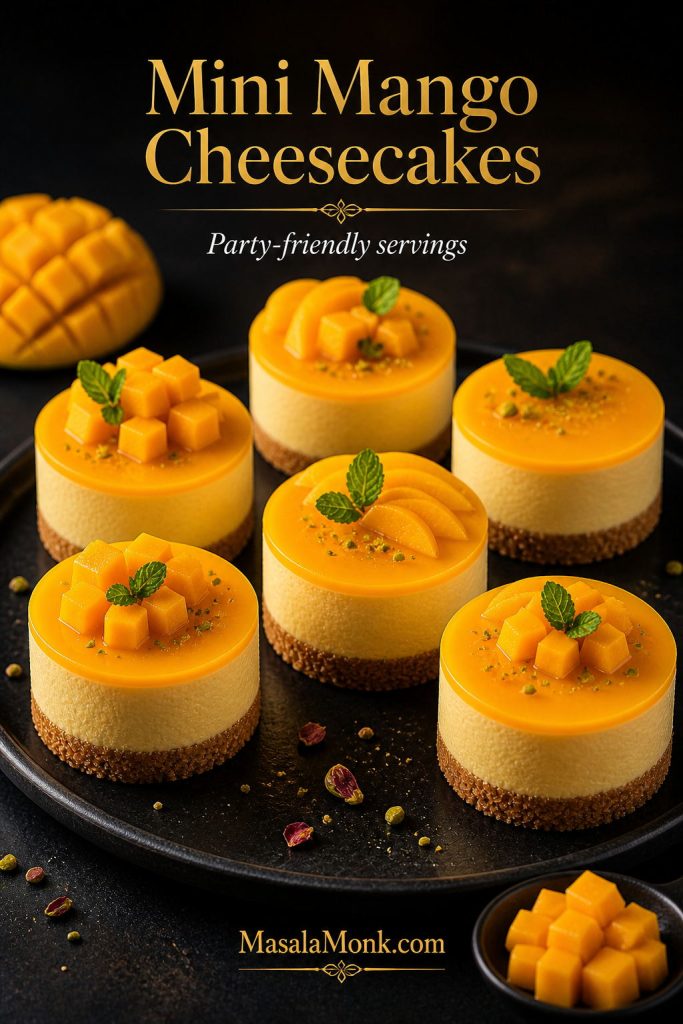
Party-friendly servings Mini cheesecakes or cups They are easier to serve and more forgiving.
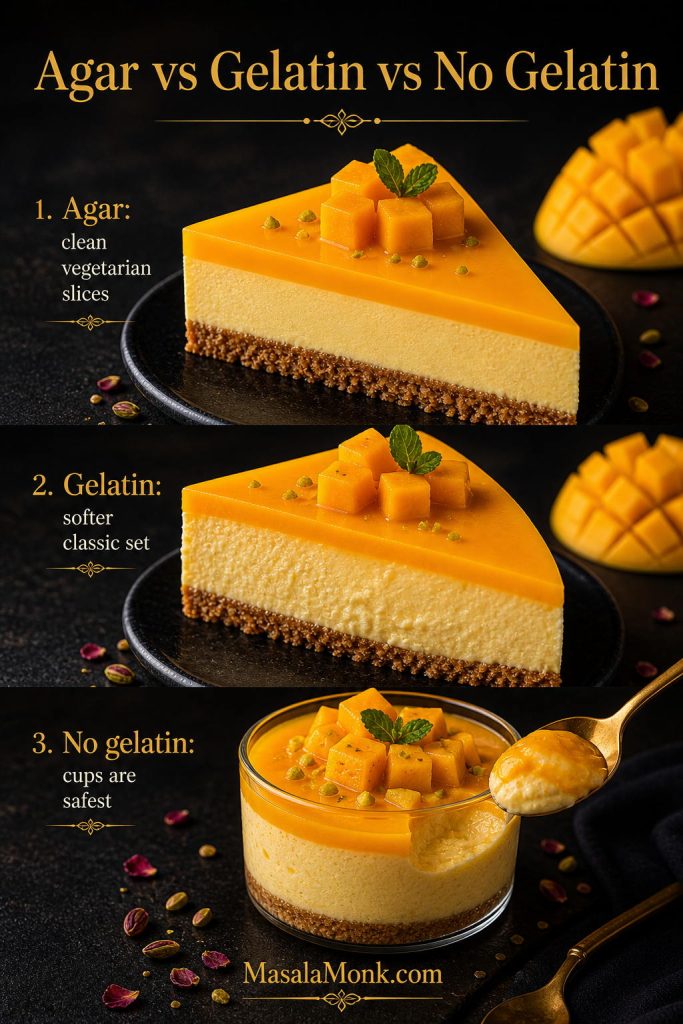
Comparison graphic showing three no bake mango cheesecake options: agar set full cake, gelatin set full cake, and no-gelatin cheesecake cups.
Choose the version before mixing the filling: agar agar is best for a vegetarian full cake, gelatin gives a softer classic set, and cups are the easiest no-gelatin option.
Best default version: Make the 8-inch agar agar version if you want an eggless, vegetarian-friendly cake that slices. Choose the gelatin version if you prefer a softer classic cheesecake texture. Choose cups if you want no gelatin and no agar.

Why This No Bake Mango Cheesecake Works

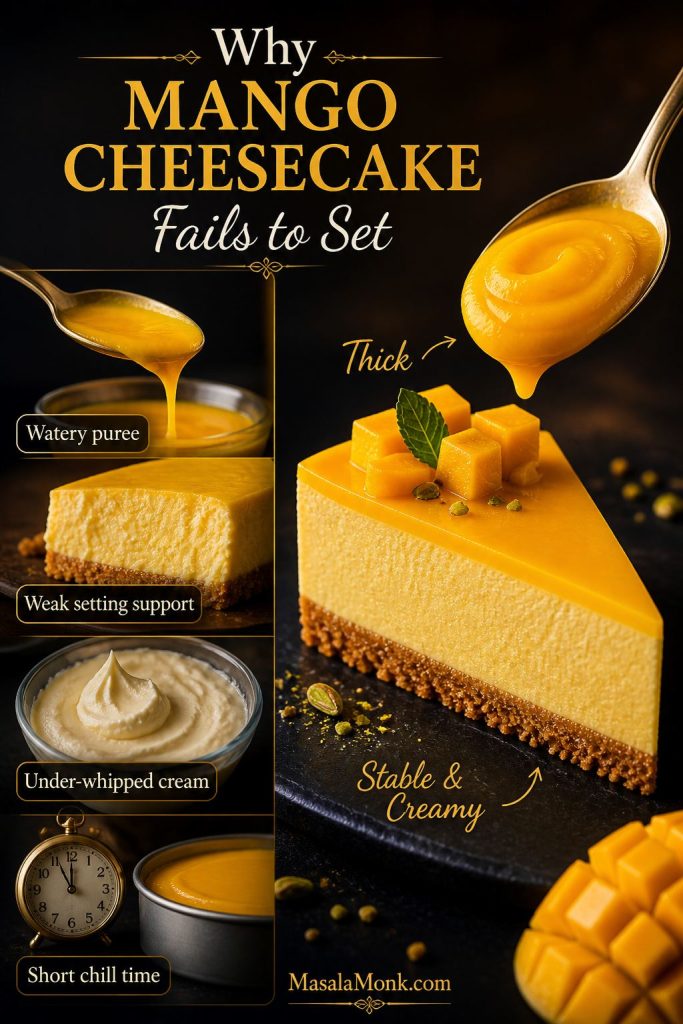
This mango cheesecake is built around the two things that matter most in a no-bake dessert: enough mango flavor and enough structure. Mango adds color, fragrance, and fruitiness, but too much watery puree can stop a no-bake cheesecake from setting properly. As a result, this recipe gives you a reliable full-cake method, plus clear adjustments for gelatin, agar agar, and no-gelatin cups.

Comparison graphic showing common reasons mango cheesecake fails to set, including watery puree, under-whipped cream, weak setting support, and short chill time.
Most setting problems begin before the cheesecake reaches the fridge; watery mango puree, weak structure, and rushed chilling can all lead to a loose filling.
  • No oven is needed. The cheesecake sets in the fridge, which makes it ideal for warm weather and make-ahead entertaining.
  • Mango is used in the filling and topping. This gives the cheesecake a stronger mango flavor than a plain cheesecake with fruit only on top.
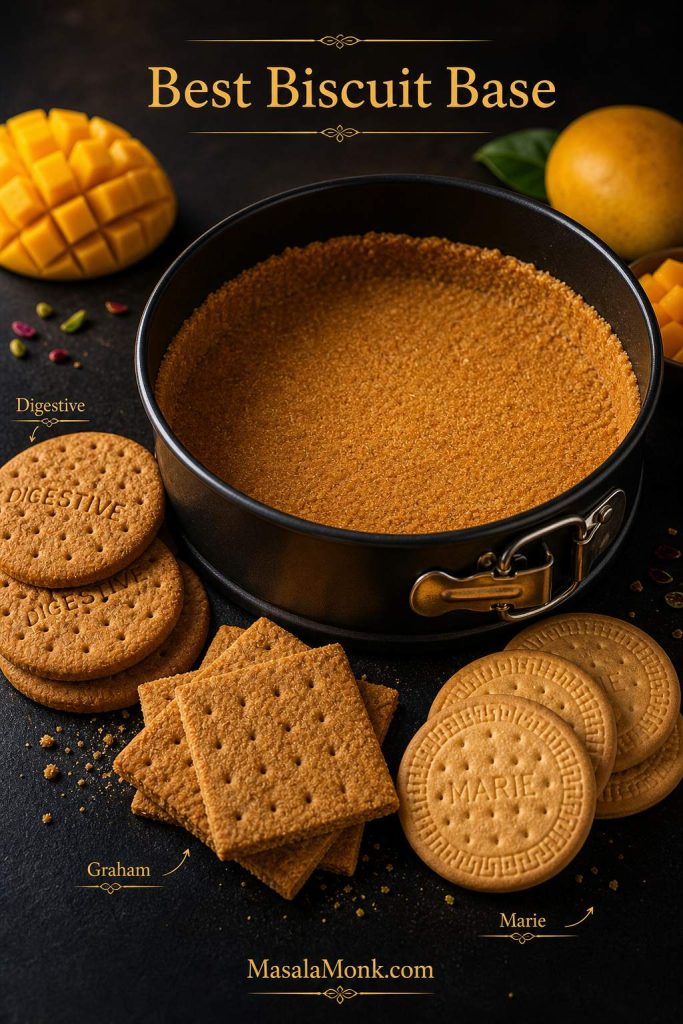
  • The biscuit base is simple and sturdy. Digestive biscuits, graham crackers, or Marie biscuits all work.
  • The setting method is flexible. Use agar agar for a vegetarian full cake, gelatin for a classic creamy set, or cups for a softer no-gelatin version.
  • It works with fresh mango or mango pulp. The post explains how to adjust sweetness and texture for both.
  • It is make-ahead friendly. Overnight chilling gives the cleanest slices and the best flavor.

The key is not adding more mango puree than the filling can hold. Too much watery mango can give you stronger fruit flavor at first, but it can also stop the cheesecake from slicing cleanly after chilling.

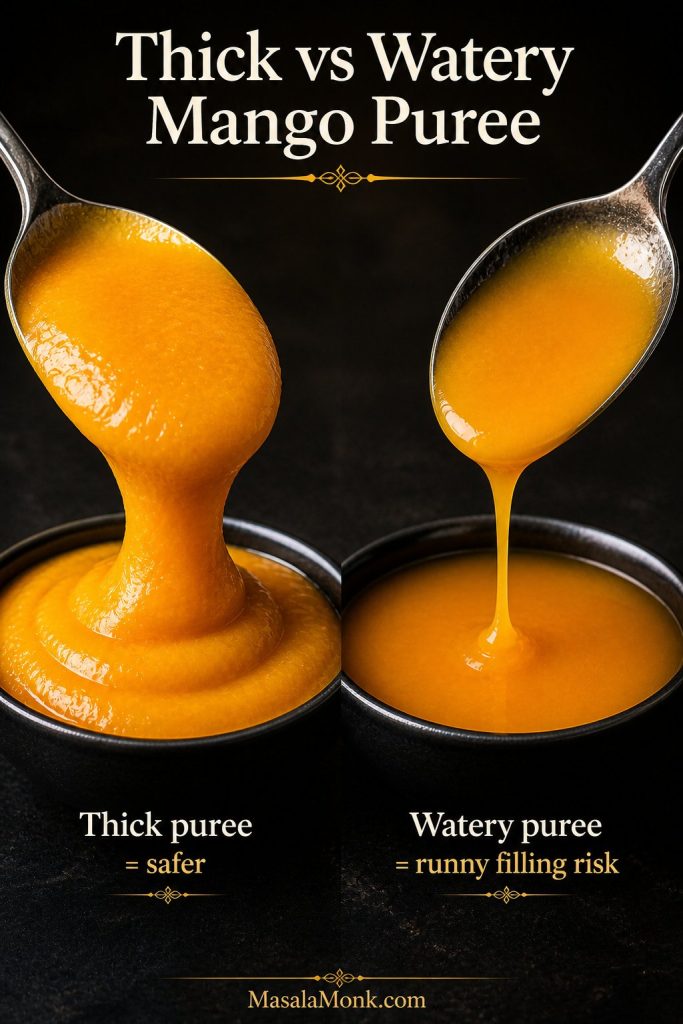
The same thick-puree logic matters in homemade mango ice cream, where watery mango can weaken both flavor and texture. In cheesecake, the problem is even more obvious because the filling has to hold its shape once sliced.

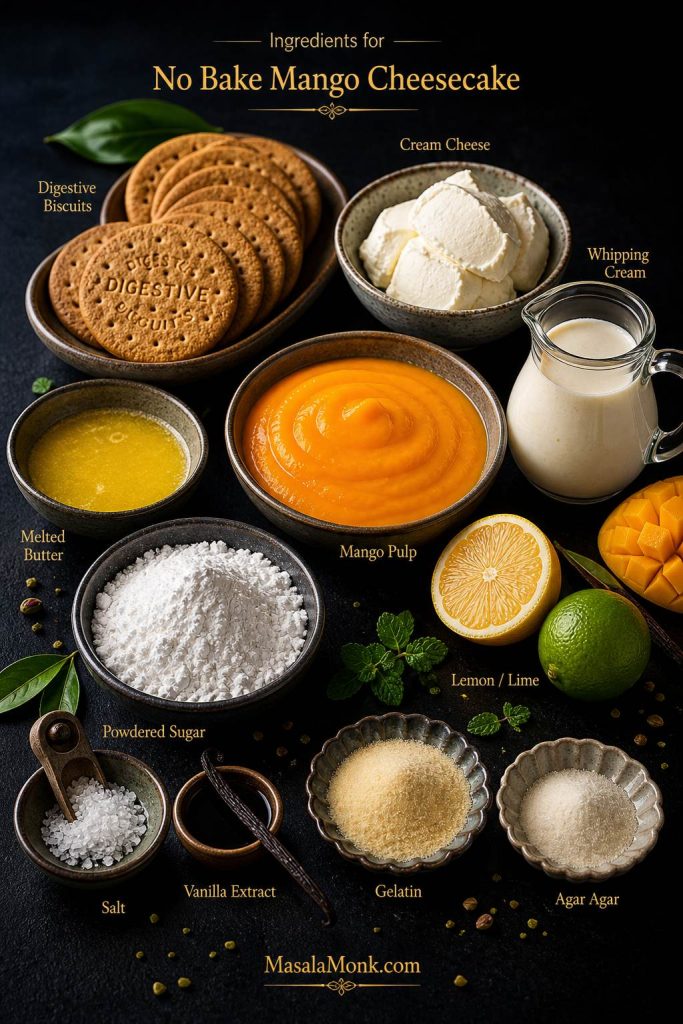
Ingredients for No Bake Mango Cheesecake

Although the ingredient list is simple, the ratios matter. The filling needs enough cream cheese and whipped cream for body, enough mango for flavor, and the right setting method for the serving style you want. Otherwise, it can taste good but still fail to slice cleanly.

Ingredient spread for no bake mango cheesecake with biscuits, butter, cream cheese, cream, mango pulp, sugar, lemon or lime, agar agar, and gelatin.
These simple ingredients work best when each one has a clear job: cream cheese gives body, mango gives flavor, cream adds lightness, and agar or gelatin controls the final set.

Biscuit Base

  • Digestive biscuits, graham crackers, or Marie biscuits: these make the crumb base.
  • Melted butter: binds the crumbs and helps the base hold together.
  • Fine salt: balances the sweetness.
  • Sugar: optional, especially if the biscuits are already sweet.
  • Cardamom or cinnamon: optional, but useful if you want a warmer flavor.

Mango Cheesecake Filling

  • Full-fat cream cheese: gives the cheesecake structure and tang. Avoid low-fat cream cheese spread for a full cake.
  • Whipping cream or heavy cream: makes the filling lighter and creamier.
  • Mango pulp or mango puree: gives flavor, color, and sweetness.
  • Powdered sugar or caster sugar: sweetens the filling. Use weight when possible because cup measures vary by sugar type.
  • Lemon or lime juice: brightens the mango and balances the richness.
  • Vanilla: rounds out the flavor.
  • Agar agar or gelatin: helps a full cake slice cleanly.

Mango Topping

The topping can be a clean mango jelly, a softer mango coulis, or a simple layer of fresh mango. Choose mango jelly for a polished cake top, coulis for a spoonable finish, and fresh mango for the quickest decoration.

Fresh Mango vs Mango Pulp for No Bake Mango Cheesecake

In this recipe, mango quality can make or break the final texture. Sweet, smooth mango gives a bright filling, while watery or fibrous mango can make the cheesecake weak, bland, or difficult to set. Therefore, the safest choice is either thick mango pulp or ripe, non-fibrous fresh mango.

Comparison image showing fresh mango pieces and puree on one side and thick mango pulp in a bowl on the other side.
Fresh mango gives the brightest seasonal flavor, while mango pulp offers consistent sweetness and color; in both cases, thickness matters more than volume.
Mango option Best for Notes
Fresh ripe mango Best seasonal flavor Use sweet, non-fibrous mangoes. Blend smooth and sieve if needed.
Alphonso or Kesar mango pulp Strong color and consistent flavor Reduce sugar if the pulp is already sweetened.
Canned mango puree Easiest year-round option Check sweetness before adding the full amount of sugar.
Frozen mango Backup option Thaw and drain first so the filling does not become watery.
Watery mango puree Risky for a full cake Cook it down briefly or use a stronger setting method.
Mango tip: If your mango puree is thin, watery, or bland, do not add more and more puree to the filling. That can stop the cheesecake from setting. Use a thicker pulp, cook the puree down briefly, or add extra mango flavor through the topping instead.
Side-by-side comparison of thick mango puree coating a spoon and watery mango puree running off a spoon.
The spoon test is one of the easiest ways to judge mango puree: thick puree supports the filling, whereas watery puree can make the cheesecake too soft.

For a drinkable mango recipe where texture can stay softer, this mango smoothie is the better route; for cheesecake, the mango puree needs to be thicker and more controlled.

Best Biscuit Base for No Bake Mango Cheesecake

A good biscuit base should hold together without tasting greasy. After the melted butter is mixed in, the crumbs should look like wet sand. If the mixture is dry and dusty, the crust may crumble. On the other hand, if it looks shiny or oily, there may be too much butter.

  • Digestive biscuits: slightly malty and sturdy.
  • Graham crackers: classic for cheesecake and easy to use.
  • Marie biscuits: lighter and common in Indian kitchens.
  • Biscoff-style biscuits: sweeter and more caramel-like.
  • Plain cookies: useful when you want a softer dessert-style base.
Graphic showing a pressed crumb crust in a springform pan with digestive biscuits, graham crackers, and Marie biscuits nearby.
Digestive biscuits, graham crackers, and Marie biscuits all work, but the best biscuit base is the one that presses firmly and balances the sweet mango filling.
Base tip: Press the crumb mixture firmly with the bottom of a flat glass or measuring cup, then chill it for 30 minutes before adding the filling.

Similarly, if you like biscuit-base desserts, this Banoffee Pie uses the same no-bake crumb-base idea in a banana, caramel, and cream direction.

How to Make No Bake Mango Cheesecake

This no bake mango cheesecake recipe is written for an 8-inch / 20 cm full cake using agar agar as the default setting method. However, the gelatin and no-gelatin cup options are also included after the main method, so you can choose the version that suits your kitchen.

Step 1: Prepare the Pan

Line the base of an 8-inch / 20 cm springform or loose-bottom pan with parchment paper. For cleaner sides, line the inner wall with a strip of parchment or acetate.

Step 2: Make the Biscuit Base

Crush the biscuits into fine crumbs, mix with melted butter, salt, and any optional sugar or spice, then press the mixture firmly into the pan. Chill for 30 minutes.

Close-up of a glass pressing biscuit crumbs into a springform pan, with loose crumbs nearby showing a wet sand texture.
Once the crumbs look like wet sand, press them firmly into the pan so the base slices neatly instead of falling apart.

Step 3: Make the Mango Puree

If using fresh mango, blend until smooth and sieve if the mango is fibrous. If using canned mango pulp, stir it well and taste before adding sugar to the filling. For the agar version, the mango puree should be at room temperature, not fridge-cold.

Smooth mango puree being pushed through a sieve into a bowl, with mango pieces nearby on a dark surface.
Sieving the mango puree removes fibrous bits and gives the filling a smoother finish, especially when using fresh mango.

Step 4: Beat the Cream Cheese

Beat softened cream cheese with sugar, lemon or lime juice, vanilla, and salt until completely smooth. Do not add the mango puree yet. Keeping the mango separate makes it easier to mix in the agar without shocking it against cold dairy.

Bowl of cream cheese being mixed until smooth with a hand mixer, with citrus and sugar nearby.
Beat the cream cheese base until it is completely smooth first; after mango is added, small lumps become much harder to fix.

Step 5: Whip the Cream

Whip cold cream to medium-stiff or stiff peaks. In warm weather, chill the bowl and beaters first so the cream holds better.

Whipped cream forming medium-stiff peaks on a beater above a mixing bowl.
Medium-stiff whipped cream gives the filling lift and structure, while still keeping the mango cheesecake creamy rather than heavy.

Step 6: Activate the Agar Agar

Simmer the agar agar powder with water until it fully dissolves, then boil gently for about 60–90 seconds. Agar must be heated properly to activate. Let it cool slightly, but do not let it set.

Small saucepan with agar agar mixture simmering, with a bowl of mango puree and agar powder nearby.
Agar agar must be boiled properly before it can set the cheesecake, so this step is more important than simply stirring powder into the filling.

Step 7: Mix the Mango Filling

Whisk the warm agar mixture into room-temperature mango puree first. Then beat this mango-agar mixture into the cream cheese mixture until smooth. Fold in the whipped cream and pour the filling over the chilled biscuit base right away, because agar starts setting quickly.

Warm agar mixture being whisked into mango puree in a bowl on a dark counter.
Mixing warm agar into mango puree first helps prevent stringy agar and protects the cream cheese mixture from sudden heat.
Spatula folding whipped cream into mango cheesecake filling with visible pale and orange swirls.
Fold gently at this stage so the whipped cream lightens the mango filling without knocking out all the air.
Thick mango cheesecake filling being poured into a springform pan with a prepared biscuit crust.
The filling should pour in a thick ribbon, not run like juice; that texture is a good sign before the cheesecake goes into the fridge.

Step 8: Chill the Cheesecake Layer

Smooth the top, then chill the cheesecake layer for 60–90 minutes before adding a separate mango jelly or topping layer. The surface should feel lightly set before the topping goes on.

Step 9: Add the Mango Topping

Pour the mango topping gently and close to the surface so it does not disturb the cheesecake layer. A spoon can help soften the pour. The topping should be lukewarm, not hot.

Topping tip: Let the mango topping cool until lukewarm before pouring. If it is too hot, it can soften the cheesecake layer; if it is too cool, an agar-based topping may begin setting before it spreads evenly.
Mango topping being poured gently onto the surface of a chilled cheesecake layer in a pan.
Let the mango topping cool until lukewarm before pouring, because a hot topping can soften the cheesecake layer underneath.

Step 10: Chill Overnight

Chill the finished cheesecake for 8–12 hours, or overnight, before unmolding and slicing. Use a warm sharp knife and clean the blade between cuts for neater slices.

Finished mango cheesecake on a dark surface with one clean slice cut and lifted, showing defined layers and a glossy topping.
After an overnight chill, the cheesecake should release cleanly and show defined layers when sliced with a warm knife.

Gelatin vs Agar Agar vs No Gelatin for Mango Cheesecake

For this no bake mango cheesecake recipe, the setting method decides whether you get clean slices, a vegetarian full cake, or a softer cup-style dessert. In other words, this is the choice that matters most before you start mixing the filling.

Comparison image showing agar-set mango cheesecake slices, gelatin-set mango cheesecake slices, and a no-gelatin mango cheesecake cup.
This comparison shows why the setting method matters: agar gives cleaner vegetarian slices, gelatin gives a softer classic texture, and no-gelatin cups stay spoonable.
Why mango cheesecake can fail: Mango puree adds flavor, but it also adds moisture. If the puree is thin, the cream is under-whipped, or the setting method is weak, the cheesecake may taste good but refuse to slice cleanly.
Version Best for Texture Watch out for
Agar agar Vegetarian full cake Clean, sliceable, slightly firmer Must be boiled and sets fast
Gelatin Classic full cake Creamy, mousse-like Can clump and is not vegetarian
No gelatin/no agar Cups, jars, bowls Soft and creamy Usually too soft for clean full-cake slices
White chocolate Rich no-gelatin cake Firmer and sweeter Changes flavor and sweetness
Condensed milk Cups, jars, and richer shortcut versions Sweet, creamy, softer Does not set a full cake by itself

No Bake Mango Cheesecake Without Gelatin

You can make mango cheesecake without gelatin, but the final texture depends on the format. For the most foolproof result, use the no-gelatin version in cups, jars, or bowls. A full no-gelatin cake can work, but it needs thick mango puree, full-fat cream cheese, properly whipped cream, and an overnight chill.

Graphic showing no-gelatin mango cheesecake cups in the foreground and a softer no-gelatin cheesecake slice in the background.
A no-gelatin mango cheesecake is easiest in cups because the filling can stay creamy without needing to stand tall as a full cake.
  • Start with full-fat cream cheese, not low-fat spread.
  • Whip the cream properly so it gives the filling structure.
  • Choose thick mango pulp or puree instead of watery mango juice.
  • Chill overnight for the best texture.
  • Serve it in cups or jars if you want a fully no-gelatin, no-agar dessert.
  • For a firmer no-gelatin full cake, add melted white chocolate.
Best no-gelatin approach: Cups or jars are the most foolproof choice because the filling can stay creamy and spoonable without needing to stand tall. For a full no-gelatin cake, keep the puree thick and chill overnight.

No Bake Mango Cheesecake with Agar Agar

Agar agar is the best vegetarian setting option for a sliceable mango cheesecake. However, it sets more firmly than gelatin and starts setting quickly, so the method matters. As a result, you need to dissolve it fully and mix it into room-temperature mango puree before it reaches the dairy base.
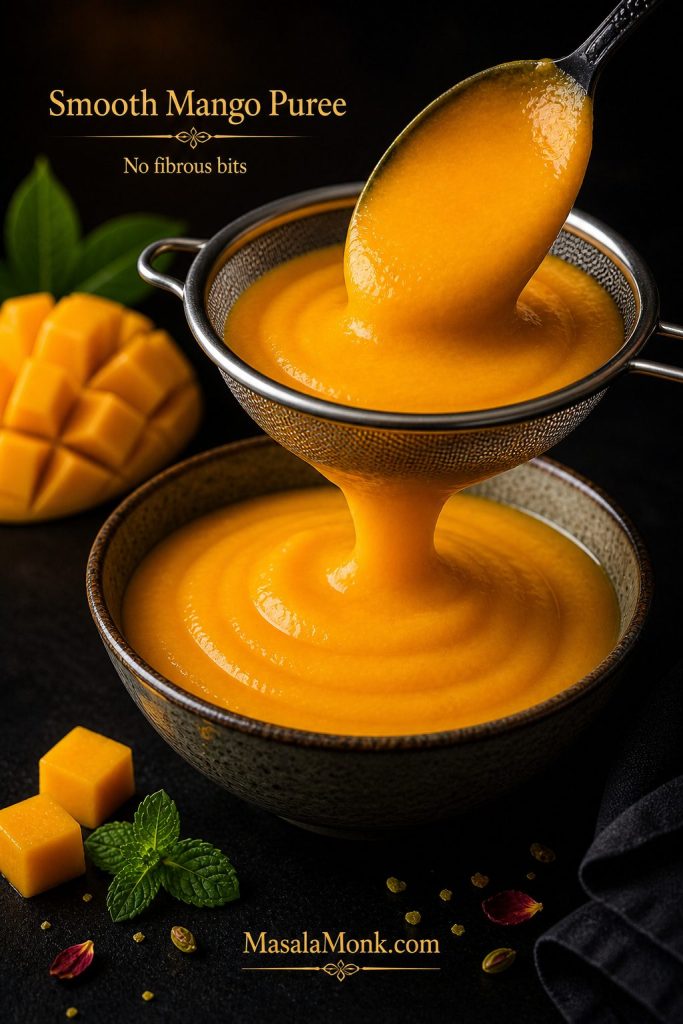
Slice of mango cheesecake with agar agar powder and mango puree, labeled as a vegetarian full cake option.
Agar agar is the strongest choice for an eggless full cake, provided it is dissolved fully and mixed before it begins to set.
  • Choose agar agar powder for the easiest measuring.
  • Measure by weight when possible because agar strength and spoon volume can vary.
  • Boil agar with water until it fully dissolves.
  • Avoid adding hot agar directly into cold cream cheese.
  • Instead, mix agar into room-temperature mango puree first.
  • Work quickly once agar is added.
  • Use a light hand, because too much agar can make the texture too firm or jelly-like.
Agar tip: Do not mix hot agar into fridge-cold mango puree or cold cream cheese. The agar can seize, turn stringy, or set unevenly. Room-temperature mango puree is much safer.

For more background on how agar differs from gelatin, this guide to agar-agar explains why it needs boiling and why it sets firmer than gelatin.

No Bake Mango Cheesecake with Gelatin

Gelatin gives a classic creamy set and works well for a full mango cheesecake. However, it is not vegetarian. Compared with agar agar, it usually gives a softer, more mousse-like texture.

Slice of mango cheesecake with bloomed gelatin and mango puree, labeled as a softer gelatin-set version.
Gelatin works best when it is bloomed first, then dissolved gently, so it blends smoothly into the mango cheesecake filling.
  • For the filling, use 2¼–2½ tsp / about 7–8 g unflavored powdered gelatin with 60 ml / ¼ cup cold water.
  • First, sprinkle gelatin over cold water and let it bloom for 5–10 minutes.
  • After blooming, dissolve it gently without boiling it hard.
  • Then mix the dissolved gelatin into mango puree before adding it to the dairy base.
  • For the mango topping, use ¾ tsp / about 2–2.5 g gelatin with 30 ml / 2 tbsp cold water.
  • Finally, chill overnight for the cleanest slices.
Fresh mango and gelatin tip: If using fresh mango with gelatin, use thick puree, bloom the gelatin properly, and chill overnight. If your fresh mango puree is very thin, reduce it slightly before using it.

For a deeper general guide to blooming gelatin before using it in desserts, King Arthur Baking has a useful explainer on how to use gelatin in baking and desserts.

Full Cake vs Cups, Jars, and Mini Mango Cheesecakes

Format matters because the filling has to behave differently in each version. A full cake needs more structure because it has to unmold and slice. By comparison, cups and jars are more forgiving because they can stay soft and creamy. Therefore, choose the format before you choose the setting method.

Format Best setting method Best for
8-inch full cake Agar agar or gelatin Birthdays and clean slices
9-inch full cake Agar or gelatin, slightly flatter Larger gatherings
Mini cheesecakes Agar, gelatin, or firmer no-gelatin filling Parties and individual servings
Cups or jars No gelatin/no agar works well Easiest version
Bowls Soft-set no-gelatin filling Make-ahead dessert
Tray of layered mango cheesecake cups with crumb bases, creamy mango filling, and glossy mango topping.
Mango cheesecake cups are ideal for make-ahead serving because each portion has its own biscuit base, creamy filling, and glossy topping.
Several mini mango cheesecakes on a tray, each with a crumb base, creamy filling, and glossy mango topping.
Mini mango cheesecakes give the polish of a full cake in individual portions, which makes them especially useful for parties and dessert tables.

If you want an even softer mango dessert without worrying about clean slices, this quick mango pudding is a simpler spoonable option.

No Bake Mango Cheesecake with Condensed Milk

Condensed milk makes mango cheesecake sweeter, creamier, and richer. Because of that, it works especially well in cups, jars, and shortcut versions. However, if you use condensed milk, reduce the added sugar and keep the lemon or lime juice so the filling does not taste flat.

  • Replace part or all of the sugar with condensed milk.
  • Use 100–150 g condensed milk for a richer filling, then sweeten to taste.
  • Reduce sugar if using sweetened mango pulp.
  • Add lemon or lime juice for balance.
  • Use a setting method if making a full cake.
  • Use cups or jars for the easiest condensed milk version.
Condensed milk adjustment: For the full cake, start with 100–150 g condensed milk and reduce the added sugar to 0–30 g, depending on how sweet your mango pulp is.
Thick condensed milk being poured into mango cheesecake filling with citrus nearby.
Condensed milk adds richness and sweetness, so the filling usually needs less added sugar and a little citrus to stay balanced.

Mango Topping: Jelly, Coulis, or Fresh Mango

The topping can change both the look and texture of the cheesecake. For example, a mango jelly gives a polished top, while a mango coulis gives a softer sauce-like finish. Alternatively, fresh mango pieces give the fastest decoration.

Topping Best for Texture
Mango jelly Clean cake top and neat slices Set, smooth, glossy
Mango coulis Cups, jars, and softer cakes Spoonable and saucy
Fresh mango cubes Quick decoration Fresh and juicy
Mango passionfruit topping Tangier variation Bright, tropical, slightly tart
Graphic comparing three mango topping styles for cheesecake: jelly, coulis, and fresh mango cubes.
The topping changes the final style: mango jelly looks neat and sliceable, coulis feels softer, and fresh mango cubes add the quickest finish.

For a lighter fruit-first dessert, this mango sorbet keeps mango at the center without cream cheese or a biscuit base.

No Bake Mango Cheesecake Variations

These variations keep the same basic structure but adjust the flavor. However, avoid adding large amounts of extra liquid unless you also adjust the setting method. Otherwise, the filling may become too loose to slice.

Graphic showing four no bake mango cheesecake variations labeled passionfruit, lime, coconut, and graham.
Keep variations controlled so the filling does not loosen; passionfruit, lime, coconut, and graham all add flavor without changing the whole recipe.

Mango Passionfruit Cheesecake

For a sharper tropical flavor, add passionfruit to the topping or swirl it through a mango coulis. This is especially good if your mango pulp is very sweet.

Mango Lime or Key Lime Cheesecake

For a brighter version, use lime zest and a little extra lime juice. Keep the extra juice modest so the filling does not become too loose.

Mango Coconut Cheesecake

For a richer tropical variation, add coconut cream, coconut milk powder, or toasted coconut as a topping. Coconut milk powder can also add a little body to cup-style cheesecakes.

Mango White Chocolate Cheesecake

Melted white chocolate can help a no-gelatin cheesecake set more firmly, but it also makes the filling sweeter and heavier. Reduce sugar if you use it.

Melted white chocolate being added to mango cheesecake filling, with a finished mango cheesecake slice in the background.
White chocolate can help a no-gelatin filling firm up, but it also adds sweetness, so reduce the sugar before adjusting anything else.

Mango Graham Cheesecake

Use a graham cracker crust and a mango cream cheese filling for a classic mango graham cheesecake direction. This works especially well in cups or a 9-inch full cake.

Vegan No Bake Mango Cheesecake

A vegan version needs a different base formula, usually with cashews, coconut cream, vegan cream cheese, or another dairy-free structure. Treat it as a separate variation rather than a direct swap. For a naturally softer dairy-free mango dessert, this mango chia pudding is a better fit than trying to force a direct vegan cheesecake swap.

Mistakes to Avoid

  • Do not use watery mango puree. It can make the filling loose and bland.
  • Do not rush the chill time. A full cake needs overnight chilling for clean slices.
  • Do not pour hot topping over the cheesecake layer. It can soften or disturb the filling.
  • Do not add agar directly to cold dairy. Mix it with room-temperature mango puree first.
  • Do not use the no-gelatin cups formula as a full cake. It is meant to be soft and spoonable.
Graphic showing common mango cheesecake mistakes, including watery puree, short chill time, hot topping, agar added to cold dairy, and using a cup formula as a cake.
Avoiding watery puree, short chilling, hot topping, and the wrong setting method prevents most mango cheesecake problems before they happen.

Troubleshooting No Bake Mango Cheesecake

Most no bake mango cheesecake problems come from watery mango, weak setting, under-whipped cream, or not enough chilling time. Therefore, use this table before changing the whole recipe. In many cases, a longer chill or a cup-style serving can save the dessert.

Troubleshooting graphic for mango cheesecake with issues such as runny filling, stringy agar, clumped gelatin, messy slices, and cheesecake that did not set.
When a mango cheesecake does not set, check the puree thickness, agar or gelatin method, and chill time before deciding how to fix or serve it.
Problem Likely cause Fix
Cheesecake did not set Too much mango, weak setter, or not enough chill time Chill overnight, freeze briefly before slicing, or use cups next time.
Filling is runny Watery mango puree or under-whipped cream Reduce puree, whip cream properly, or add a setting method.
Agar turned stringy Agar was not dissolved or hit cold filling Boil fully and mix with room-temperature mango puree first.
Gelatin clumped Gelatin was not bloomed properly Sprinkle over cold water, let it bloom, then dissolve gently.
Topping is runny Too little agar or watery puree Cook down the puree or add the correct amount of setting agent.
Crust crumbles Too little butter or loose pressing Add enough butter and press the base firmly with a flat cup.
Cheesecake is too sweet Sweetened pulp or condensed milk Add lemon or lime and reduce sugar next time.
Mango flavor is weak Bland mango or too little puree Use Alphonso or Kesar pulp, or add a mango coulis layer.
Slices are messy Not chilled enough or no setter Chill overnight and wipe the knife between cuts.
Water on top Condensation Chill uncovered first, then cover loosely once set.

Make Ahead, Storage, and Freezing

No bake mango cheesecake is a make-ahead dessert. In fact, the texture is usually better after a full overnight chill because the filling firms up and the mango flavor settles into the cream cheese base. For best results, keep it cold until shortly before serving. Also, add fresh mango decoration closer to serving so it stays bright.

Storage method Time Notes
Fridge 3–4 days Keep covered after the cheesecake has fully set.
Freezer Up to 1 month Freeze without fresh fruit topping for the cleanest result.
Room temperature 30–45 minutes max Keep chilled as much as possible, especially in warm weather.
Make ahead 1 day ahead is ideal Overnight chilling gives the cleanest slices.
Mango cheesecake in a covered storage container with a plated slice nearby, plus text showing fridge and freezer storage times.
This dessert improves with planning: make it one day ahead, keep it chilled, and store leftovers covered so the layers stay fresh.

No Bake Mango Cheesecake Recipe Card

Because this no bake mango cheesecake recipe includes agar, gelatin, and no-gelatin cup options, read the notes once before starting so you do not mix the wrong setting method into the filling.

Default version: This recipe card uses agar agar for a vegetarian, eggless full cake. Use the gelatin option below if you prefer a classic mousse-like set, or the cup version if you want no gelatin and no agar.
Texture cue: The filling should be thick, smooth, and pourable when it goes into the pan. If it looks loose and watery before chilling, the mango puree may be too thin or the cream may not be whipped enough.
Recipe card graphic for no bake mango cheesecake showing an 8-inch cake formula with cream cheese, mango pulp, cream, agar, and 8 to 12 hours chill time.
This recipe card keeps the core formula easy to scan, while the full post explains when to use agar, gelatin, or no-gelatin cups.

No Bake Mango Cheesecake Recipe

This creamy no bake mango cheesecake recipe has a buttery biscuit base, mango cream cheese filling, and mango topping. The default version uses agar agar for an eggless, vegetarian-friendly full cake, with exact notes for gelatin and no-gelatin cups.

Yield10–12 slices
Pan8-inch / 20 cm
Prep Time45 minutes
Chill Time8–12 hours

Cook Time: 5 minutes
Total Time: 9–13 hours, including chilling
Best for: make-ahead dessert, summer dessert, eggless cheesecake, mango dessert

Equipment

  • 8-inch / 20 cm springform or loose-bottom pan
  • Parchment paper
  • Food processor, mixer-grinder, or rolling pin for crumbs
  • Blender, if using fresh mango
  • Electric hand mixer or stand mixer
  • Saucepan
  • Rubber spatula
  • Offset spatula or flat spoon
  • Fine sieve, optional
  • Digital scale, recommended

Biscuit Base

  • 200 g / 7 oz digestive biscuits, graham crackers, or Marie biscuits, about 2 cups crumbs
  • 80 g / 2.8 oz / about 5½ tbsp unsalted butter, melted
  • 1–2 tbsp sugar, optional
  • ¼ tsp fine salt
  • ¼ tsp cardamom or cinnamon, optional

Mango Cheesecake Filling

  • 450 g / 16 oz full-fat cream cheese, softened
  • 250 ml / 1 cup cold whipping cream or heavy cream
  • 300 g / 10.5 oz / about 1¼ cups mango pulp or thick mango puree, room temperature for agar version
  • 80–100 g powdered sugar or caster sugar, added to taste
  • 1½–2 tbsp / 22–30 ml lemon or lime juice
  • 1 tsp vanilla extract
  • ⅛ tsp fine salt
  • 3 g agar agar powder / about 1½ tsp
  • 100–125 ml / about ⅓–½ cup water, for agar

Mango Jelly Topping

  • 200–250 g / about ¾–1 cup mango pulp
  • 1–2 tbsp sugar, optional
  • 1–2 tsp lemon or lime juice
  • 1 g agar agar powder / about ½ tsp
  • 80–100 ml / about ⅓ cup water

Method

  1. Line the base of an 8-inch / 20 cm springform pan with parchment paper. Line the sides if you want a cleaner finish.
  2. Crush the biscuits into fine crumbs. Mix with melted butter, salt, and optional sugar or spice until the texture looks like wet sand.
  3. Press the crumb mixture firmly into the pan. Chill for 30 minutes.
  4. Blend fresh mango into a smooth puree, or stir canned mango pulp until even. For the agar version, keep the mango puree at room temperature rather than fridge-cold.
  5. Beat softened cream cheese with sugar, lemon or lime juice, vanilla, and salt until completely smooth. Keep the mango puree separate for now.
  6. Whip cold cream to medium-stiff or stiff peaks in a separate bowl.
  7. Simmer agar agar powder with water until fully dissolved, then boil gently for about 60–90 seconds. Let it cool slightly, but do not let it set.
  8. Whisk the warm agar mixture into the room-temperature mango puree first. Then beat this mango-agar mixture into the cream cheese mixture until smooth.
  9. Fold in the whipped cream and pour the filling over the chilled biscuit base right away.
  10. Smooth the top and chill for 60–90 minutes before adding the mango topping.
  11. For the topping, simmer the agar agar powder with water until fully dissolved, then whisk in the mango pulp, sugar, and lemon or lime juice. Simmer briefly until smooth, then cool until lukewarm.
  12. Pour the topping gently over the cheesecake layer.
  13. Chill for 8–12 hours, or overnight, before unmolding and slicing.

Gelatin Option for Full Cake

To make a classic gelatin-set version, replace the agar in the filling with 2¼–2½ tsp / about 7–8 g unflavored powdered gelatin and 60 ml / ¼ cup cold water. First, sprinkle gelatin over the cold water and let it bloom for 5–10 minutes. After that, dissolve it gently, then mix it into the mango puree before adding it to the cream cheese mixture. Do not boil gelatin hard.

For the mango topping, use ¾ tsp / about 2–2.5 g gelatin bloomed in 30 ml / 2 tbsp cold water instead of agar. Then, stir the dissolved gelatin into the warm mango topping, cool until lukewarm, and pour gently over the cheesecake layer.

No-Gelatin Mango Cheesecake Cups

To make 6–8 no-gelatin mango cheesecake cups, use 150 g biscuit crumbs, 60 g melted butter, 300 g full-fat cream cheese, 200 ml cold whipping cream, 200–225 g thick mango pulp, 50–70 g powdered sugar or 100–120 g condensed milk, 1 tbsp lemon or lime juice, 1 tsp vanilla, and a pinch of salt.

Press the biscuit base into cups or jars. Beat cream cheese with mango, sugar or condensed milk, lemon or lime, vanilla, and salt. Fold in whipped cream, spoon into cups, and chill for at least 6 hours, preferably overnight. This version is soft and creamy, not designed for clean full-cake slices.
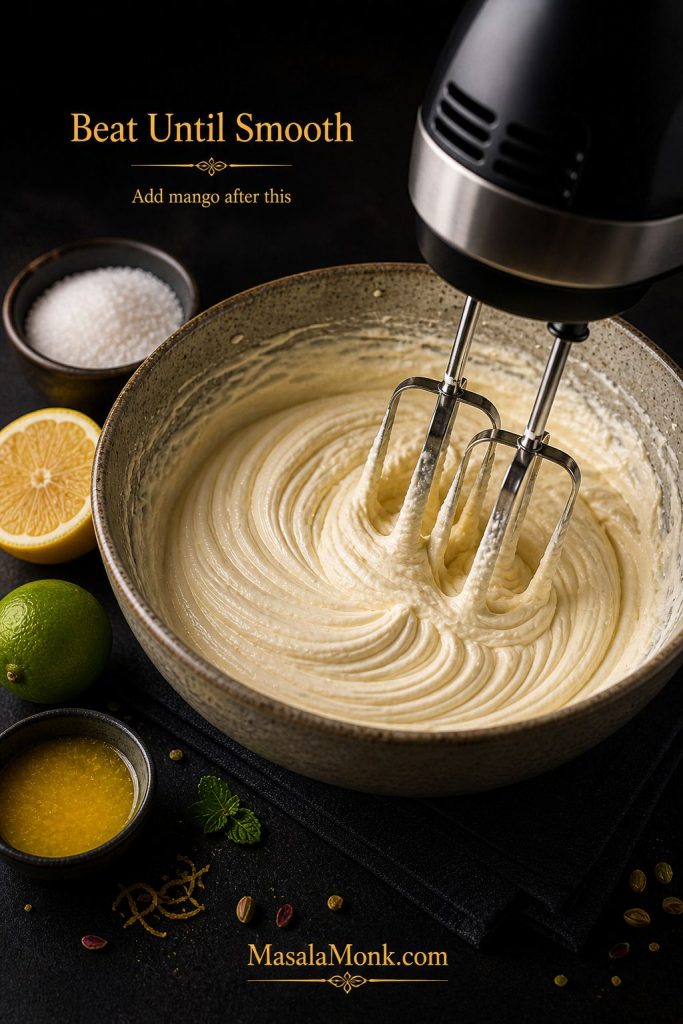
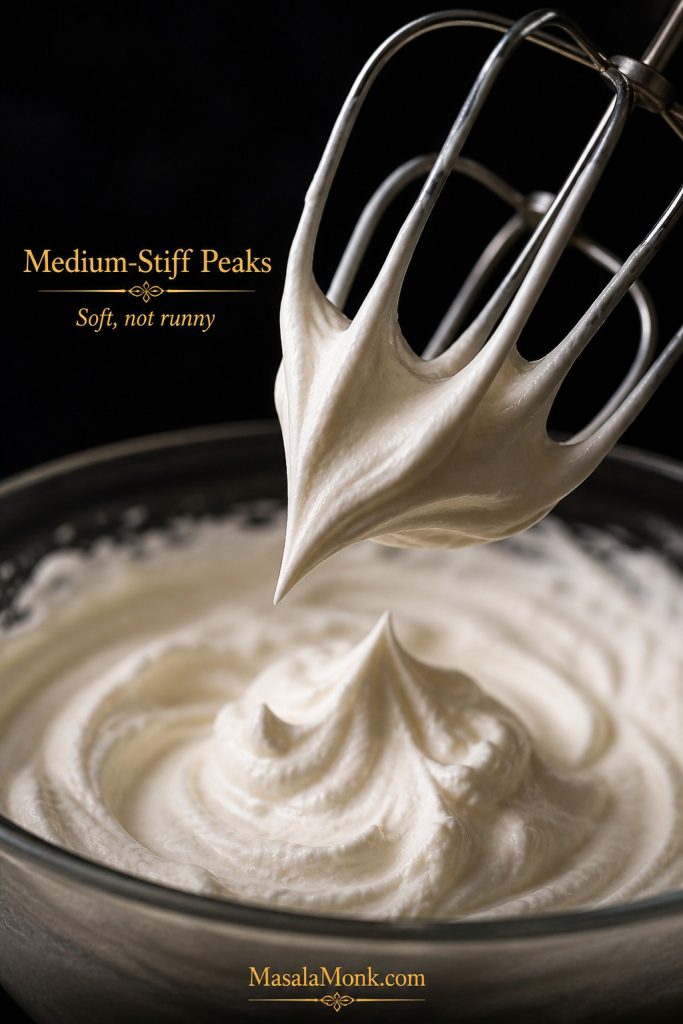
Serve these directly from the cups with mango coulis, fresh mango cubes, or crushed biscuit crumbs on top.
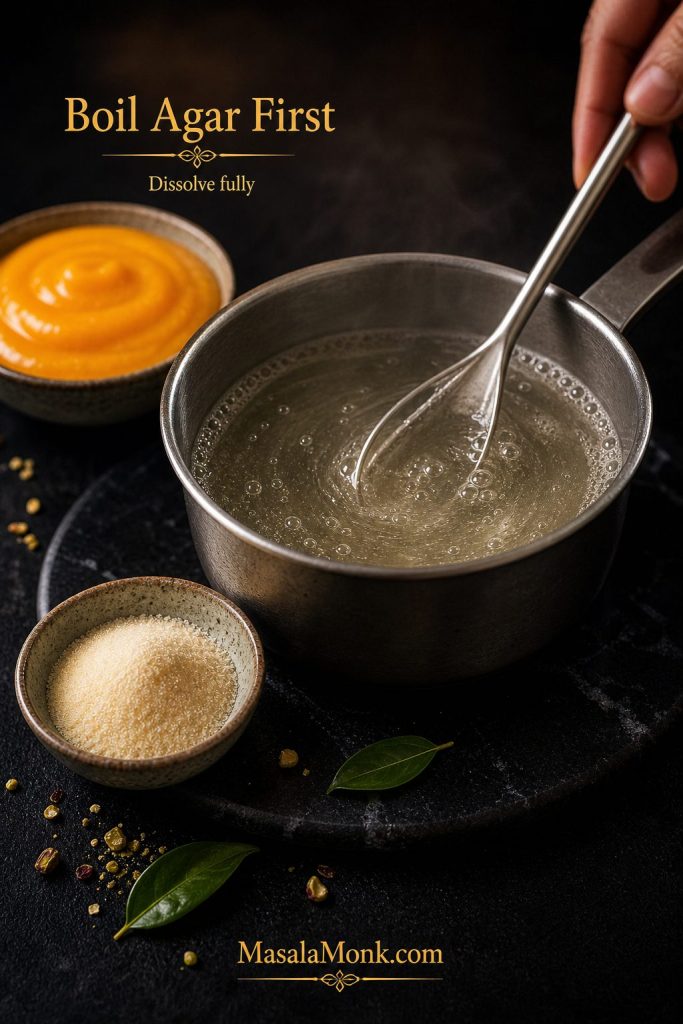
Do not use this no-gelatin cups formula as a full cake unless you are comfortable with a soft, mousse-like texture that may not slice neatly.

Condensed Milk Adjustment

For a condensed milk full-cake version, start with 100–150 g condensed milk and reduce the added sugar to 0–30 g, depending on how sweet your mango pulp is. Keep the lemon or lime juice so the filling stays balanced.

Agar Note

Agar strength can vary by brand, so weight is more reliable than spoon measure. Start with 3 g for this 8-inch cake. If your agar is very strong or you prefer a softer texture, use the lower end next time.

Pan Notes

This recipe is best in an 8-inch / 20 cm pan. A 9-inch pan will work, but the cheesecake will be slightly flatter. For a taller 9-inch cheesecake, increase the filling and base by about 25%.

Slicing Note

For clean slices, chill overnight, loosen the sides gently, use a warm sharp knife, and wipe the blade between cuts.

Storage

Refrigerate for 3–4 days. Freeze for up to 1 month without fresh fruit topping. Keep chilled until serving.

FAQs About No Bake Mango Cheesecake

How do you make this no bake mango cheesecake recipe without gelatin?

The safest way is to make it in cups or jars. A full no-gelatin cake can be softer and may not slice as cleanly unless the filling is very thick or supported with another ingredient such as white chocolate.

Is agar agar a good substitute for gelatin in mango cheesecake?

Agar agar works well as a vegetarian setting option, but it behaves differently from gelatin. It must be boiled to activate, sets faster, and can become too firm if you use too much.

Why did my mango cheesecake not set?

The most common reasons are watery mango puree, too much mango, weak setting agent, under-whipped cream, or not enough chilling time. Before changing the recipe, chill it overnight and check the texture again.

What kind of mango pulp works best?

Canned Alphonso or Kesar mango pulp is one of the easiest options because it gives consistent sweetness, color, and mango flavor. However, if the pulp is already sweetened, reduce the sugar in the filling.

Fresh mango or canned mango pulp: which is better?

Both work. Fresh mango gives the best seasonal flavor when the fruit is ripe, sweet, and non-fibrous. Meanwhile, canned mango pulp gives more consistent color and sweetness throughout the year.

How does condensed milk change the filling?

Condensed milk makes the cheesecake sweeter, creamier, and richer. Therefore, reduce the added sugar and keep the lemon or lime juice so the filling stays balanced instead of flat.

How long should mango cheesecake chill?

A full cake should chill for 8–12 hours, or overnight, for the cleanest slices. Cups and jars usually need at least 6 hours, although overnight is still better for texture.

Does mango cheesecake freeze well?

It freezes best without fresh fruit topping. For the cleanest texture, freeze the whole cake or slices tightly wrapped, then thaw in the fridge before serving.

When should I make mango cheesecake cups instead of a full cake?

Cups are the better choice when you want a no-gelatin dessert, a softer texture, or easier party servings. They are also more forgiving because the filling does not need to unmold or slice cleanly.

Which biscuits are best for the crust?

Digestive biscuits, graham crackers, and Marie biscuits all work. Choose digestive biscuits for a sturdier base, graham crackers for a classic cheesecake flavor, or Marie biscuits for a lighter base.

Is this no bake mango cheesecake recipe eggless?

It is eggless because it is no bake and does not rely on eggs for structure. In addition, the default agar agar version is vegetarian-friendly.

Can I use paneer instead of cream cheese?

Paneer can work only if it is blended very smooth with a little cream, yogurt, or milk, but the flavor will be less tangy than cream cheese. For the most reliable cheesecake texture, full-fat cream cheese is still the better choice.

What happens if I skip cream cheese?

You can make mango mousse cups or mango dessert cups without cream cheese, but the result will not taste like classic cheesecake. For proper cheesecake flavor and structure, cream cheese is the best choice.

Why is my cheesecake too soft?

The filling may have too much mango, watery puree, under-whipped cream, or too little setting support. First, chill it longer. If it still does not slice cleanly, serve it as cups instead.

How do I get clean slices?

Chill the cheesecake overnight, use a warm sharp knife, and wipe the blade between cuts. Also, remember that agar agar or gelatin will give cleaner slices than a no-setter filling.

How far ahead should I make it for a party?

Make it one day ahead and keep it refrigerated. Finally, add fresh mango decoration closer to serving so the fruit stays bright and fresh.

Posted on 15 Comments

How to make No-Bake Banana Pudding: No Oven Required Recipe

A square slice of no-bake banana pudding is lifted from a glass baking dish, showing neat layers of creamy vanilla pudding, banana slices, and vanilla wafers with cookie crumble on top. Text overlay reads “No-Bake Banana Pudding,” “Perfect Set • No Oven Required,” and “Classic / Condensed / Custard,” with MasalaMonk.com in the footer.

Some desserts ask you to measure, mix, bake, cool, frost, and pray nothing cracks. Banana pudding doesn’t demand that kind of ceremony. Instead, it leans into a simpler rhythm: slice bananas, whip something creamy, stack it with cookies, and let the fridge do the patient work. By the time you come back, the layers have transformed—cookies soften into cake-like sheets, bananas mellow into perfume, and the pudding turns thicker, silkier, and somehow more “finished” than it had any right to be.

That’s the heart of banana pudding (no bake). It’s comforting without being fussy, familiar without feeling boring, and flexible enough to match whatever your pantry—and mood—happen to be today. You can keep it classic with vanilla wafers and pudding mix, push it richer with sweetened condensed milk, go fully homemade with a stovetop custard (still no oven required), or make a dairy-free version that doesn’t taste like a compromise.

If you’re building a no-oven dessert lineup, you can round out the table with something bright and tangy like this no-bake blueberry cheesecake or something spiced and crunchy like these Lotus Biscoff dessert cups. Still, banana pudding is the one that disappears first—because it feels like home in a bowl.


No-bake banana pudding, five recipes (pick the vibe before you start)

Before you pull out a dish, decide what you want your banana pudding to be: airy and light, thick and tangy, extra creamy, old-fashioned, or plant-based. Once you choose, everything else—milk amount, cookie choice, chill time—falls neatly into place.

No-bake banana pudding in a glass dessert dish with layered bananas, vanilla wafers, and creamy pudding. Text overlay reads “No-Bake Banana Pudding – Choose Your Base” with five options: classic, condensed milk, cream cheese, from-scratch custard, and vegan/dairy-free. No oven required.
Not sure which no-bake banana pudding to make? Start here—pick your base (classic, condensed milk, cream cheese, custard, or vegan) and the rest falls into place. Scroll down & get the full step-by-step options in this blog post.

The classic (light, fluffy banana pudding, reliably set)

This is the “banana pudding recipe” most people picture: instant vanilla pudding, whipped cream, bananas, and vanilla wafers. It’s easy, and it still tastes like a celebration.
The condensed milk version (extra creamy banana pudding, no-cook)

If you love a richer spoon and a dessert that holds up longer at gatherings, banana pudding with sweetened condensed milk is the move. It’s no-bake, no oven, and still feels indulgent.

The cream cheese banana pudding recipe (thick, tangy, cheesecake-style)

Cream cheese makes the layers sturdier and adds a gentle tang that keeps the sweetness from feeling heavy. It also nods toward a banana pudding cheesecake no bake style without turning the whole thing into a separate dessert.

The from-scratch custard (homemade, old-fashioned, no oven required)

This one tastes the most “made.” You’ll cook a simple stovetop custard, chill it, then layer as usual. The payoff is deeper vanilla flavor and a silkier texture that feels unmistakably homemade.

The vegan/dairy-free banana pudding (still creamy, still classic recipe)

A well-made vegan banana pudding can be every bit as satisfying. The secret is a pudding base that sets firmly, plus a chill long enough to knit the layers together.

Also Read: Sweetened Condensed Milk Fudge: 10 Easy Recipes


Close-up of a spoon lifting a creamy bite of no-bake banana pudding from a glass dessert bowl. The pudding shows layers of vanilla pudding, banana slices, and crushed cookie crumbs. Text overlay reads “No-Bake Banana Pudding,” “Perfect Layers • No Oven Required,” and “Start with cookies (no soggy bottom),” plus a small “Layer Map” inset listing cookies, pudding, bananas, pudding, and crumble (serve). Bottom text says “Chill 6 hrs (best overnight)” and “MasalaMonk.com.”
If your no-bake banana pudding ever turns watery at the bottom, this is the fix: start with a cookie layer, then build upward so the crumbs absorb slowly instead of collapsing fast. Keep bananas tucked under pudding, chill long enough for everything to set, and you’ll get thick, scoopable layers that taste richer and look far more “finished” when you serve.

The ingredients that matter (and why each one changes the texture)

Banana pudding can look like a simple list on paper, yet a few small choices decide whether you end up with clean, scoopable layers or a soft, slumped bowl of sweetness. Luckily, the fixes are straightforward.

Bananas: ripe, but not collapsing

Aim for bananas that are yellow with light freckles—fragrant, sweet, and tender without being watery. If they’re very ripe (lots of brown), they’ll still taste great; however, they can release more moisture as they sit. In that case, you’ll want a thicker pudding base and a little more chill time.

Three bananas in different ripeness stages on a light gray surface with labels for banana pudding: yellow with faint freckles for best layers, more freckles for sweeter flavor, and very brown bananas that can weep (use thicker pudding). Includes tips to slice bananas last and keep slices covered under pudding. MasalaMonk.com footer.
The easiest way to keep no-bake banana pudding thick (not watery) is choosing the right banana. Yellow with light freckles gives the cleanest layers, while extra-freckled bananas taste sweeter but benefit from a longer chill. Very brown bananas can release more moisture—so if you use them, keep your pudding base thicker and don’t rush the fridge time. Slice bananas last, then cover the layer fully with pudding to slow browning and keep the bottom from “swimming.”

Creamy base: pudding mix, custard, or condensed milk

  • Instant pudding mix gives a consistent set and keeps the method truly no-cook.
  • Stovetop custard brings the “homemade banana pudding” depth, and it still stays no oven required.
  • Condensed milk adds body and richness, which helps the pudding stay thick even after hours in the fridge.

Cream: optional, but it changes everything

Whipped cream folded into the pudding base makes the texture lighter, almost mousse-like. It also softens the sweetness so each bite feels more balanced. If you’ve ever wondered about the difference between heavy cream and whipping cream for desserts, this quick explainer on heavy cream is a helpful reference—especially when you’re deciding what will whip most reliably.

Cookies: the quiet backbone of the whole dessert

Cookies aren’t just garnish here. They’re structure. They’re sponge. And then they’re the reason banana pudding becomes cohesive instead of just “bananas with pudding.”

Also Read: Kahlua Drinks: 10 Easy Cocktail Recipes (Milk, Vodka, Coffee)


Cookies for banana pudding (vanilla wafers, plus the best swaps)

If you want the most classic finish, vanilla wafers are hard to beat. They soften into tidy layers rather than dissolving instantly, and their gentle vanilla flavor keeps the dessert focused on bananas and cream.

Cookie guide for no-bake banana pudding showing five options: vanilla wafers (classic), butter cookies/tea biscuits (richer), graham crackers (great for wide dishes), shortbread (needs thicker pudding), and spiced cookies (dessert-cup vibe). Note at bottom: thinner cookies need thicker pudding and a longer chill. MasalaMonk.com footer.
Cookies are the backbone of banana pudding. Vanilla wafers give the most classic, tidy layers, while butter cookies make it taste more bakery-rich. Graham crackers are great in wider dishes, shortbread holds up best with a thicker pudding base, and spiced cookies turn jars into cozy dessert cups. If your layers ever go too soft, it’s usually not “your fault”—it’s a cookie thickness + chill-time mismatch.

Banana pudding with vanilla wafers (the classic layering cookie)

Vanilla wafers create that signature texture: soft, cake-like, and spoonable, yet still layered. They also look beautiful through glass if you serve banana pudding in jars.
Vanilla wafer alternatives that still behave well in banana pudding

Sometimes you want a different cookie, either for flavor or because you’re working with what you have.

  • Butter cookies or tea biscuits: richer, more “bakery” tasting
  • Graham crackers: slightly honeyed; great for wide dishes and jars
  • Shortbread: dense and buttery; best paired with a thicker pudding base
  • Spiced cookies: cozy, dramatic, and excellent in dessert cups

If you lean toward delicate cookies, keep your pudding thicker and don’t rush the chill. Otherwise, the layers can turn too soft before serving.

Also Read: Sourdough Recipe: 10 Easy Bread Bakes (Loaves, Rolls & Bagels)


No-bake banana pudding: the classic recipe (vanilla wafers + whipped pudding)

This is the version to make when you want the most reliable outcome with the least effort. It also gives you the cleanest foundation for variations later.

Ingredients (serves 8–10)

  • 3–4 medium ripe bananas
  • 1 box instant vanilla pudding mix (about 90–100 g)
  • Cold milk (use the amount on the box as your starting point)
  • 250–350 ml whipping cream, chilled
  • 1–2 teaspoons vanilla extract (optional)
  • Vanilla wafers (or your cookie choice)
  • A small pinch of salt (optional, but surprisingly important)
Classic no-bake banana pudding in a glass dish with visible layers of vanilla wafers, banana slices, and creamy pudding, topped with cookie crumble and a spoon lifting a bite. Text overlay shows a 6-step recipe: whisk pudding mix with cold milk, rest 3–5 minutes, whip cream, fold, layer cookies–pudding–bananas, then chill 4 hours (best overnight). Tip: start with cookies.
This is the most reliable no-bake banana pudding—classic vanilla wafers, fluffy whipped pudding, and clean layers that hold. The quick 6-step card makes it easy to build: whisk, fold, layer, then let the fridge do the magic (overnight = bakery-level texture). If you’ve ever had a soggy bottom, the one change that fixes it is right here: start with cookies.
Method

  1. Make the pudding base. Whisk pudding mix with cold milk until it thickens, then let it stand for a few minutes so it sets properly.
  2. Whip the cream. Beat chilled cream until soft peaks. Add vanilla if you want a warmer, dessert-shop aroma.
  3. Fold gently. Fold whipped cream into the pudding base until it looks airy and uniform. Don’t stir aggressively; instead, turn the mixture over itself so you keep the lift.
  4. Slice bananas at the last moment. This keeps them fresher and helps reduce browning.
  5. Layer. In a dish: cookies → pudding → bananas. Repeat until you run out, finishing with pudding on top.
  6. Chill. Refrigerate for at least 4 hours. Overnight is even better because the cookies soften evenly and the pudding tightens into a more cohesive slice-and-scoop texture.

A small finishing move that changes the whole dessert

Right before serving, crumble a handful of cookies over the top. The contrast—soft layers underneath, crunchy crumb on top—makes each bite feel more alive.

Instructional graphic titled “Cookie Crumble Finish” showing a hand sprinkling crushed vanilla wafer crumbs over a jar of no-bake banana pudding with visible layers. Text overlay says it’s a 1-minute upgrade for better texture: crush cookies (fine plus a few chunks), sprinkle right before serving, and it adds crunch and looks bakery-made. It also notes to save extra crumble for Day 2–3. Footer reads MasalaMonk.com.
If you want banana pudding to feel more “finished” without adding new ingredients, this is the move: a fresh cookie crumble right before serving. Crushing wafers into a mix of fine crumbs and a few bigger chunks gives you contrast—soft cake-y layers underneath, crisp texture on top. It also makes the dessert look bakery-made in seconds. If you’re storing leftovers, keep a small bowl of crumble aside and add it at serving time; it brings Day 2 (and even Day 3) right back to life.

If you enjoy layered puddings and want another “simple but elegant” idea, this savoiardi chocolate vanilla pudding has a similarly satisfying spoon texture, just with a more dramatic chocolate-and-cream vibe.

Also Read: Cold Brew Espresso Martini: How to Make It (Step-by-Step Recipe)


No-cook banana pudding with sweetened condensed milk (extra creamy, no oven required)

When you want banana pudding that tastes richer and holds up longer—especially if it’s sitting out for a while at a gathering—condensed milk is the shortcut that feels like a secret.

This variation also makes it easier to keep the pudding thick even after chilling, which is helpful if you’re using cookies that soften quickly.

Ingredients

  • 1 can sweetened condensed milk (about 395–400 g)
  • 1 box instant vanilla pudding mix (about 90–100 g)
  • Cold milk (start with slightly less than the box suggests)
  • Whipped cream (optional but recommended)
  • Bananas
  • Vanilla wafers or other cookies
Condensed milk banana pudding (no-bake) in a glass dish with visible layers of bananas, vanilla wafers, and creamy pudding, topped with cookie crumble and a spoon lifting a bite. Text overlay shows a simple 6-step method: whisk sweetened condensed milk with cold milk, add pudding mix, fold in whipped cream (optional), layer cookies–pudding–bananas, chill 6 hours (best overnight), then crumble to serve. Tip: use slightly less milk for a thicker set.
If you want banana pudding that tastes richer and holds its shape longer, this sweetened condensed milk version is the upgrade. The condensed milk adds body, which helps the layers stay thick after chilling—especially useful if your cookies soften quickly. One small move makes it even more reliable: start with slightly less milk than your pudding box suggests, then let it rest overnight so the wafers turn cake-y without the bottom getting watery.

Method

  1. Whisk condensed milk and cold milk until smooth and glossy.
  2. Add the pudding mix and whisk until thickened.
  3. Fold in whipped cream if you want a lighter finish.
  4. Layer cookies, bananas, pudding, repeating until the dish is full.
  5. Chill longer than the classic—aim for 6 hours or overnight—so the layers become neatly sliceable.

If you’re the type who loves make-ahead fridge sweets, you might also enjoy peanut butter fudge. It’s a different texture entirely, yet it hits that same “chill, slice, share” convenience.

Also Read: 10 Vegan Chocolate Cake Recipes (Easy, Moist, & Dairy-Free)


Cream cheese no-bake banana pudding (thick, tangy, cheesecake-style recipe)

Cream cheese changes the personality of banana pudding. The dessert becomes thicker and slightly tangy, with a richer mouthfeel that feels closer to a cheesecake filling. It’s a wonderful choice if you like desserts that scoop cleanly and don’t slump.

Ingredients (serves 8–10)

  • 225 g cream cheese, softened
  • 1 box instant vanilla pudding mix
  • Cold milk (use a little less to keep it thick)
  • 250–350 ml whipping cream, whipped to soft peaks
  • Optional: 1 can sweetened condensed milk for extra richness
  • Bananas
  • Cookies (vanilla wafers are perfect here)
Cream cheese banana pudding (no-bake) in a glass dish with layered bananas, vanilla wafers, and thick creamy pudding, topped with cookie crumble and a spoon lifting a bite. Text overlay lists steps: beat cream cheese until smooth, whisk pudding mix with cold milk until thick, mix pudding into cream cheese, fold in whipped cream (optional), layer cookies–pudding–bananas, then chill overnight for clean scoops. Tip: beat cream cheese first to avoid lumps.
This is the banana pudding to make when you want thick, scoop-clean layers with a gentle cheesecake tang. Cream cheese adds structure, so the dessert slumps less and holds up better on a table. The only non-negotiable is texture: beat the cream cheese until completely smooth before anything else goes in—once lumps hide in the base, they’re hard to fix. After an overnight chill, the layers tighten, the wafers turn cake-y, and every spoonful stays creamy instead of runny.

Method

  1. Beat the cream cheese until completely smooth. Take your time—lumps are stubborn once you add everything else.
  2. Blend in condensed milk if using, until creamy and glossy.
  3. Whisk pudding mix with cold milk separately until thick, then fold or beat it into the cream cheese mixture.
  4. Fold in whipped cream to lighten the base.
  5. Layer with bananas and cookies, then chill overnight for the best structure.

If you want to lean into the cheesecake mood, serve this version alongside no-bake blueberry cheesecake for a dessert table that feels intentional rather than accidental.

Also Read: Cranberry Moscow Mule Recipe: A Festive Holiday Cocktail With Easy Variations


Homemade banana pudding from scratch (stovetop custard, still no oven needed)

This is the method that turns banana pudding into something you might proudly bring to a holiday dinner. It tastes deeper, it feels silkier, and it carries a quiet confidence that instant mix can’t quite replicate.

Even so, it’s still simple. You’re making a vanilla custard thickened with egg yolks and cornstarch, then chilling it until cold and spoonable. After that, you layer it exactly the same way.

For a dependable reference on how stovetop pudding thickens, King Arthur’s simple stovetop vanilla pudding is a useful baseline. If you enjoy understanding the “why” behind the method, Serious Eats has a clear explanation in their guide to vanilla pastry cream, which shares many of the same principles.

Step-by-step infographic titled “Homemade Banana Pudding From Scratch” showing a 2x2 grid of stovetop custard steps: whisk egg yolks with sugar and cornstarch until smooth, temper with warm milk while whisking, cook and whisk on low heat until thick and coating a spoon, then chill with plastic wrap pressed on the surface to prevent a skin. Note reads “Low heat + nonstop whisking.” MasalaMonk.com appears in the footer.
If you want banana pudding that tastes unmistakably homemade, the stovetop custard is the difference—and it’s easier than it sounds once you see the rhythm. This quick guide covers the two make-or-break moments: tempering (so yolks don’t scramble) and steady whisking on low heat (so the custard thickens smoothly instead of turning lumpy). Finish by chilling with wrap pressed directly on the surface to prevent a skin, then layer with bananas and wafers once it’s fully cold for the cleanest, most “old-fashioned” texture.

Ingredients (serves 8–10)

  • 500 ml milk (2 cups)
  • 90–120 g sugar (adjust to taste)
  • 3 egg yolks
  • 20–25 g cornstarch (about 3 tablespoons)
  • Pinch of salt
  • 2 teaspoons vanilla extract
  • 25–30 g butter (optional, for extra silkiness)
  • Bananas
  • Vanilla wafers (or cookie of choice)

Method

  1. Whisk the yolks, sugar, cornstarch, and salt until smooth and slightly thickened. This mixture should look pale and glossy.
  2. Warm the milk in a saucepan until steaming. Do not boil—you want it hot enough to temper the eggs, not hot enough to scramble them.
  3. Temper slowly. Whisk a little warm milk into the yolk mixture, then a little more, building the temperature gradually.
  4. Return to the pan and cook. Pour the tempered mixture back into the saucepan and cook on medium heat, whisking constantly. In a few minutes, it will shift from thin to thick. Keep whisking until it’s pudding-like and coats the back of a spoon.
  5. Finish off the heat. Remove the pan from the heat and stir in butter (if using) and vanilla.
  6. Cool correctly. Press a sheet of plastic wrap directly onto the surface so a skin doesn’t form. Let it cool to room temperature, then refrigerate until fully cold.
  7. Layer and chill again. Once the custard is cold and thick, layer cookies, bananas, and custard. Chill at least 4–6 hours, ideally overnight.

To make it “old fashioned” banana pudding without an oven

Keep the custard thicker and skip folding in whipped cream. The result is dense, silky, and unmistakably homemade—very much the old-fashioned homemade banana pudding feeling, while still staying no oven required.

Also Read: Baked Ziti Recipe Collection: 15 Easy Variations


Vegan and dairy-free banana pudding (no-bake, no oven, still satisfying)

A dairy-free banana pudding shouldn’t feel like a side quest. It should taste like banana pudding—fragrant bananas, vanilla warmth, and a creamy base that sets properly.

The key is choosing a plant milk that thickens well (oat and soy are excellent), then cooking a quick pudding base with cornstarch. After that, you chill it fully before layering.

If you like fridge-set desserts, you might also enjoy the textures in this collection of chia pudding recipes. The flavors differ, yet the “make it, chill it, enjoy it” rhythm is beautifully similar.

Ingredients (serves 6–8)

  • 500 ml plant milk (oat or soy recommended)
  • 50–70 g sugar (adjust to taste)
  • 20–25 g cornstarch (about 3 tablespoons)
  • Pinch of salt
  • 2 teaspoons vanilla extract
  • 1–2 tablespoons vegan butter (optional)
  • Bananas
  • Vegan-friendly cookies (vanilla-style if possible)
Vegan banana pudding (dairy-free) in a clear glass bowl with layered bananas, cookies, and creamy plant-based pudding, topped with cookie crumble and a spoon lifting a bite. Text overlay shows steps: whisk sugar, cornstarch, and salt with a splash of plant milk, add remaining milk and cook while whisking until thick and glossy, stir in vanilla (and vegan butter optional), chill until fully cold and set, then layer cookies–pudding–bananas and chill overnight. Tip: oat or soy sets best. MasalaMonk.com footer.
A dairy-free banana pudding only feels “compromised” when the base doesn’t set. This version fixes that by cooking a quick cornstarch pudding until it turns thick and glossy, then chilling it fully before you build the layers. Oat or soy milk tends to set more reliably than thinner plant milks, and the overnight rest does double duty: it firms the pudding and softens the cookies into that classic cake-y texture. Assemble once, chill, and you’ll get clean scoops that still taste like real banana pudding.

Method

  1. Make a slurry. Whisk cornstarch, sugar, and salt with a splash of the plant milk until smooth.
  2. Add the remaining milk and cook in a saucepan on medium heat, whisking constantly.
  3. Cook until thick. Once it turns glossy and pudding-like, remove from the heat.
  4. Stir in vanilla and vegan butter if using.
  5. Cool with wrap on the surface, then refrigerate until cold and set.
  6. Layer with bananas and cookies, then chill overnight so the cookie layers soften and the pudding becomes cohesive.

Also Read: Rob Roy Drink Recipe: Classic Scotch Cocktail (Perfect + Dry + Sweet Variations)


Banana pudding cheesecake no-bake style (a variation without changing the whole plan)

If you love cheesecake desserts but still want the nostalgic banana pudding texture, you can build a banana pudding cheesecake no bake variation by combining the cream cheese base with a crumb layer.

  • Crush cookies and press them into the bottom of your dish (a little melted butter helps, though it’s optional if your cookie crumbs are already buttery).
  • Add a thick cream cheese pudding layer, then bananas, then more pudding, then cookies.
  • Chill overnight so it slices cleanly.

For another easy, fruit-forward no-bake dessert that feels “party ready,” keep no-bake blueberry cheesecake in your back pocket—it complements banana pudding beautifully without competing for the same flavor space.

Also Read: Green Chutney Recipe (Coriander–Mint / Cilantro Chutney)


How to layer no-bake banana pudding so it turns cake-y, not soggy

Layering seems obvious until you scoop and realize the cookies dissolved too fast or the bananas slid around like they were on ice. A few simple habits fix that.

No-bake banana pudding in a clear glass trifle bowl with visible layers of cookies, creamy vanilla pudding, and banana slices. Text overlay reads “No-Bake Banana Pudding Layer Map” and “Cake-y layers, not soggy,” with callouts showing the order: cookies, pudding, bananas (covered—slice last), repeat layers, and finish with cookie crumble right before serving. Bottom note says “Chill 6 hrs (best overnight)” and “MasalaMonk.com.”
This quick no-bake banana pudding layer map is the difference between neat, cake-y layers and a soggy bottom. Start with cookies, seal the bananas under pudding (slice them last), then repeat until the dish is full. Finish with a fresh cookie crumble right before serving, and give it a long chill (overnight is the real upgrade) so every scoop stays thick, creamy, and clean.

Start with cookies, not pudding

Cookies at the base give the dessert structure. They also absorb moisture from the pudding gradually, which helps the bottom layer set rather than swim.

Keep banana slices medium-thick

Thin slices vanish into the pudding; thick slices can feel slippery. Aim for coins that hold their identity without taking over.

Seal bananas under pudding

Bananas brown when exposed to air. Covering them with pudding slows that down while keeping the layers tidy.

Instructional graphic titled “Perfect Layer Thickness (No-Bake Banana Pudding)” showing a glass dish with visible cookie, pudding, and banana layers plus a ruler-style guide. Text explains: cookies should be a single even layer; pudding should be a thick “seal” layer that fully covers bananas; bananas should be one coin layer, not stacked; repeat layers and finish with pudding; add crumble at serving. Notes say thicker pudding gives cleaner layers. Footer: MasalaMonk.com.
Layer order matters, but layer thickness is what keeps banana pudding from turning soft and messy. Think of pudding as a “seal”: it should be thick enough to fully cover the bananas so they don’t brown quickly or leak moisture into the cookie base. Keep banana slices to a single coin layer (no stacking), then repeat and finish with pudding so the top stays smooth. Save the cookie crumble for serving time—this one step gives you that perfect contrast between cake-y layers underneath and a crisp finish on top.

Chill longer than you think you need

Four hours works. Overnight is better. The difference isn’t subtle: cookies soften evenly, the pudding firms, and the flavors knit into a single, harmonious spoonful.

If you’re serving in jars, build thinner layers. That way, every bite picks up banana, cookie, and pudding together.

Also Read: Paper Plane Cocktail Recipe + Best Amaro Substitutes & Tips


No-bake banana pudding in jars (dessert cups that look as good as they taste)

Banana pudding served in a dish feels nostalgic. Banana pudding served in jars feels modern and intentional—especially if you’re bringing dessert to a gathering or setting up a dessert table.

Infographic titled “Banana Pudding in Jars (No-Bake)” showing three glass dessert jars filled with layered banana pudding and cookie crumbs, plus a spoon lifting a bite. A layering guide lists: crumbs/cookies, pudding, bananas, pudding, and crumble to serve. Tips say “Slice bananas last” and “Top with fresh crumble right before serving.” Footer reads MasalaMonk.com.
Jars make banana pudding feel instantly more “party-ready,” and they also protect the layers so each serving stays neat. Use this simple jar layer order—crumbs/cookies → pudding → bananas → pudding → crumble (serve)—and you’ll get the best texture in every bite. Two small details matter most: slice bananas right before assembling (so they stay fresher) and save the final crumble for the last minute so the top stays crisp instead of turning soft in the fridge.

Why jars work so well

  • They protect the layers so the pudding stays neat
  • They’re easy to portion and transport
  • They look beautiful through the glass

If you love the “dessert cup” presentation, you’ll also like the vibe of these Lotus Biscoff dessert cups. They’re different in flavor, yet they share the same layered, chilled charm.

Jar layering rhythm

Cookies (or crumbs) → pudding → bananas → pudding → cookie crumble on top.
Then chill.
Just before serving, add fresh crumble again so the top stays crisp.

Also Read: Sandwich for Breakfast: Breakfast Sandwich Recipe + 10 Variations


Make-ahead timing (how to plan banana pudding without stress)

Banana pudding is at its best when it has time to rest, which makes it a natural make-ahead dessert. Still, timing matters—especially if you want bananas to look good and layers to hold.

Vertical infographic titled “Make-Ahead Timing: how to plan banana pudding without stress” with a timeline. It recommends assembling banana pudding the night before for best texture, chilling at least 4 hours (overnight best) so cookies turn cake-y and pudding sets. If making 24–36 hours ahead, assemble base and cookies, then add bananas later or keep bananas sealed under thick pudding. On serving day, add fresh crumble/topping right before serving. Footer: MasalaMonk.com.
Banana pudding is one of those desserts that actually improves with a little planning. The simplest win is assembling it the night before: the pudding firms, the cookies soften into that cake-y layer, and the whole dish scoops more cleanly. If you need to make it farther ahead, treat bananas as the variable—either add them closer to serving or keep them fully covered under a thicker pudding layer to reduce browning and excess moisture. Right before serving, add a fresh crumble on top so the finish stays crisp.

The sweet spot: assemble the night before

When you assemble banana pudding the evening before, you get the best of everything: the cookies soften, the pudding sets, and the bananas mellow without turning watery.

If you need to assemble earlier

If you’re making it more than a day in advance, consider one small adjustment: assemble the pudding and cookies first, then add bananas closer to serving time. Alternatively, you can keep bananas protected under thicker pudding layers so air exposure stays minimal.

Food safety basics for fridge desserts

Since banana pudding contains dairy—and sometimes eggs, if you make custard—good refrigeration habits matter. The general guidance on keeping perishable foods safe (including cooling and refrigeration) from FoodSafety.gov is a solid reference to follow. For egg-based custards in particular, the FDA’s overview of egg safety is worth a quick read if you want extra peace of mind.

For leftovers, the USDA’s advice on leftovers and food safety is a reliable guide for how long chilled desserts typically stay safe in the fridge.

Also Read: Classic Rum Punch + 9 Recipes (Pitcher & Party-Friendly)


Storage (how to keep banana pudding tasting fresh)

Cover it tightly

Banana pudding absorbs fridge odors easily. A tight lid or well-sealed wrap keeps the flavor clean and keeps the top from drying out.

Triptych infographic titled “Storage: how to keep banana pudding tasting fresh” showing banana pudding in a jar over three days. Day 1 notes distinct layers and best contrast; Day 2 notes softer cookies and more melded flavor; Day 3 notes still tasty but very soft, with a tip to add fresh crumble to revive texture. Another tip says “Keep covered tight.” Footer reads MasalaMonk.com.
Banana pudding changes as it sits, and that’s normal—not a mistake. On day one, the layers are the most distinct and the contrast is strongest. By day two, the cookies soften further and everything tastes more blended (often the sweet spot). By day three, it’s still delicious, just much softer overall. The easiest way to keep it tasting “fresh” is sealing it tightly so it doesn’t pick up fridge odors—and saving a little cookie crumble to sprinkle right before serving for a crisp finish.

Keep it cold, consistently

Avoid leaving the pudding out for long stretches, especially in warm rooms. Serve what you need, then return the dish to the fridge.

Expect the texture to evolve

On day one, layers are distinct. By day two, the cookies soften further. By day three, it’s still delicious—just more uniformly soft. If you like a bit of crunch, save extra cookie crumble to add at the end.


Serving ideas that make banana pudding feel “new” again

Banana pudding is classic for a reason, yet it also welcomes a few thoughtful finishing touches.

Infographic titled “What to Serve With Banana Pudding” with the subtitle “Easy pairings that balance the sweetness.” A four-tile grid shows: iced coffee or cappuccino, tres leches (chilled cake), peanut butter fudge (slice-and-share sweet), and peach cobbler pudding (another pudding dessert). Each tile includes a photo and a short label. Footer reads MasalaMonk.com.
Banana pudding is rich and soft, so it shines brightest next to something that adds contrast—either bitterness, chill, or a different texture. Coffee (iced coffee or cappuccino) cuts the sweetness and makes dessert feel café-like. A chilled cake such as tres leches turns the table into a “real dessert spread” without extra work. If you want something sliceable and giftable, peanut butter fudge is a great partner. And if you’re keeping the theme cozy, peach cobbler pudding gives a warm-spiced counterpoint while staying in the same spoon-dessert lane.

A light drizzle (without turning it into a chocolate dessert)

A small drizzle can make the surface look glossy and special, particularly when you’re serving guests. This 3-minute chocolate syrup works beautifully if you keep it subtle—just enough to accent the bananas and vanilla, not drown them.

A cookie “snow” finish

Crumble cookies over the top right before serving. It’s simple, yet it adds crunch and makes the presentation more inviting.

A dessert table that feels balanced

If you’re putting together multiple sweets, pair banana pudding with something that contrasts its creamy softness:

For even more ideas in the same cozy category, this Pudding Palooza dessert roundup is a fun way to keep the theme going without repeating the same flavors.

Pair it with coffee (cold or foamy)

Banana pudding loves coffee. The sweetness and vanilla play nicely against roasted notes, especially after a meal.

  • If you want something refreshing, browse these iced coffee recipes and pick a cold brew or latte-style option.
  • If you’d rather keep it warm and classic, a homemade cappuccino makes the whole dessert moment feel café-like.

Strawberry Smoothie Recipes (12 Easy Blends + Bowls & Protein Shakes)Also Read:


Troubleshooting (so your banana pudding turns out thick, creamy, and layered)

Even a simple dessert can misbehave. Fortunately, banana pudding is forgiving, and the fixes are usually quick.

Infographic titled “Banana Pudding Troubleshooting (No-Bake)” with two columns: “Watery bottom?” and “Brown bananas?” The watery-bottom tips say to start with cookies, use less milk or a thicker base, choose ripe bananas that are still firm, and chill longer. The browning tips say to slice bananas last, cover them fully under pudding, and optionally brush lightly with lemon juice. Two jar photos illustrate the layers. Footer reads MasalaMonk.com.
Most banana pudding “problems” come down to two things: moisture and air. If you see liquid pooling at the bottom, it usually means the bananas were very ripe or the pudding base was a bit thin—starting with a cookie layer and using a thicker base (often just slightly less milk) helps the dessert set into clean, scoopable layers. If bananas turn brown, it’s simply exposure: slice them right before layering and keep them fully covered under pudding so air can’t reach the fruit. A tiny brush of lemon juice is optional, but keep it subtle so the pudding still tastes purely vanilla-banana.

If the pudding feels runny

Most often, it’s too much milk or not enough time in the fridge. Next time, reduce the milk slightly. For now, chill it longer—covered—so it can finish setting properly.

If a watery layer appears at the bottom

Overripe bananas can release moisture, and thin pudding can’t hold it. Use slightly firmer ripe bananas and make a thicker pudding base, especially if you’re layering with delicate cookies.

If the cookies dissolved into mush

That’s usually a thickness issue. Thicker pudding slows down cookie breakdown. Vanilla wafers, butter cookies, and shortbread also hold up better than delicate biscuits.

Infographic titled ‘How to Fix Runny Banana Pudding’ showing a spoon lifting loose banana pudding over a bowl. It lists three fixes: use slightly less milk than the pudding box amount, chill longer (minimum 4 hours, best overnight), and thicken the base by choosing one add-in—sweetened condensed milk, cream cheese, whipped cream, or a cooked custard with cornstarch/yolks. Note says delicate cookies need thicker pudding. MasalaMonk.com at bottom.
Runny banana pudding is almost always a ratio + chill-time problem—not a failure. Start with slightly less milk, then give it a proper fridge rest (overnight is the real glow-up). If you want a thicker, cleaner scoop, pick one base booster: condensed milk for body, cream cheese for thick + tangy, whipped cream for lighter stability, or a simple custard for the firmest set. (Perfect for the Troubleshooting section when your layers feel too soft.)

If the bananas browned

Slice bananas right before layering, then cover them with pudding so air can’t reach them. If you need extra protection, a very light brush of lemon juice can help; keep it subtle so the pudding doesn’t taste citrusy.

If your from-scratch custard turned lumpy

Heat was likely too high, or whisking paused. You can strain the custard through a fine sieve, then return it to gentle heat briefly while whisking to smooth it out. After that, chill as usual.

Also Read: Daiquiri Recipe (Classic, Strawberry & Frozen Cocktails)


A few variations that keep the banana pudding recipe feeling fresh

Once you’ve made banana pudding once, it becomes dangerously easy to make it again—so it helps to rotate small changes that make it feel new.

Infographic titled “Banana Pudding Variations (No-Bake)” with the subtitle “Quick swaps • same method.” A grid lists easy add-ins and swaps for no-bake banana pudding: Biscoff cookie swap, Oreo cookie swap, Chessman or butter cookie swap, Nutter Butter (peanut) swap, strawberry + banana layer, protein version (Greek yogurt + less sugar), sugar-free option (sugar-free pudding mix + sweetener), a light chocolate drizzle, and optional jar cups party style. Footer reads MasalaMonk.com.
Once you know the basic layering rhythm, banana pudding becomes a template you can remix. This quick variation board helps you choose a direction without rewriting the whole recipe: swap cookies for Biscoff, Oreo, Chessman, or Nutter Butter; add a strawberry layer for a fruitier twist; or go lighter with a protein-friendly version using Greek yogurt and less sugar. If you’re serving guests, a small chocolate drizzle or jar-cup presentation makes the same pudding feel brand new—without changing the method that keeps it thick and reliable.

Make it more “vanilla-forward”

Use a little extra vanilla extract, and add a pinch of salt to sharpen the flavor. It’s still banana pudding, just brighter and more aromatic.

Make it more “cookie-forward”

Double down on the cookie layers and finish with a generous crumble on top. You’ll get more contrast between soft and crisp.

Make it richer without adding fuss

Use sweetened condensed milk in the base. It adds richness and a thicker finish without requiring custard-making.

Make it more homemade (without using an oven)

Go the stovetop custard route. It takes a little longer, yet the flavor payoff is worth it—especially when you want a truly homemade banana pudding from scratch feeling.

Make it plant-based

Use a thick dairy-free pudding base and vegan-friendly cookies. Given enough chill time, the dessert becomes cohesive and satisfying.

Also Read: Oat Pancakes Recipe (Healthy Oatmeal Pancakes)


Bringing it all together (the no-oven dessert you’ll make again and again)

No-bake banana pudding is one of those desserts that meets you where you are. It can be a quick weeknight treat made from a banana pudding mix and a box of wafers. Then can be a party-ready dish made with sweetened condensed milk for extra creaminess. And it can even be an old-fashioned, homemade banana pudding from scratch with stovetop custard—still no oven required, still wonderfully simple once you learn the rhythm.

Most importantly, it’s the kind of dessert that invites seconds without demanding perfection. So make it classic, make it creamy, make it tangy, or make it dairy-free. Either way, give it time in the fridge, spoon it generously, and let the layers do what they do best: turn a few humble ingredients into something that feels like comfort you can share.

Also Read: What to Mix with Jim Beam: Best Mixers & Easy Cocktails


FAQs

1) Can I make banana pudding with no oven required?

Yes. Banana pudding is naturally a no-oven dessert because the pudding sets in the fridge. Whether you use instant pudding mix, a no-cook condensed milk base, or a stovetop custard, you can still finish the entire dish without turning on the oven.

2) What’s the difference between no-bake banana pudding and no-cook banana pudding?

No-bake banana pudding simply means you don’t bake it. Meanwhile, no-cook banana pudding usually means you also skip stovetop cooking—so you rely on instant pudding mix (and sometimes sweetened condensed milk) to thicken everything.

3) How long does banana pudding need to chill to set properly?

In most cases, banana pudding needs at least 4 hours to set; however, overnight chilling gives the best texture. As it rests, the pudding firms up and the cookies soften into a cake-like layer.

4) How do I keep bananas from turning brown in banana pudding?

First, slice bananas right before layering. Next, cover the banana layer completely with pudding so less air reaches the fruit. If you want extra protection, lightly brushing banana slices with a tiny amount of lemon juice can help—just use it sparingly so the pudding doesn’t taste citrusy.

5) What are the best bananas for banana pudding?

Choose bananas that are yellow with a few brown freckles. They’re sweet and aromatic, yet still firm enough to hold their shape. On the other hand, bananas that are very brown can release more moisture, which may thin the layers.

6) What are the best cookies for banana pudding?

Vanilla wafers are the classic choice because they soften evenly and keep the layers structured. That said, butter cookies, graham crackers, and shortbread also work well—especially if you prefer a richer, more buttery base.

7) Can I make banana pudding with vanilla wafers and still keep it from getting soggy?

Absolutely. Use a thicker pudding base, layer cookies evenly, and chill long enough so the moisture absorbs gradually rather than flooding the cookies. Additionally, adding a fresh cookie crumble on top right before serving brings back a crisp contrast.

8) Can I make banana pudding with sweetened condensed milk?

Yes, and it’s one of the creamiest no-oven options. Sweetened condensed milk adds richness and body, so the pudding holds its shape more reliably. Even so, it’s best to chill it longer—ideally 6 hours or overnight—for the cleanest scoops.

9) Can I make banana pudding from scratch without baking?

You can. Instead of baking, you cook a quick stovetop custard (milk, sugar, egg yolks, and cornstarch), then chill it until thick. After that, you layer it with bananas and cookies just like any banana pudding (no bake) version.

10) Why is my banana pudding runny?

Usually, it comes down to one of three things: too much milk, not enough chill time, or a pudding base that didn’t fully thicken before layering. To fix it next time, reduce the milk slightly and let the pudding stand a few minutes before assembling.

11) Why does banana pudding get watery at the bottom?

Most often, very ripe bananas release liquid as they sit. Similarly, a thinner pudding base can’t “hold” that moisture. Therefore, using slightly firmer ripe bananas and a thicker pudding base helps keep the layers stable.

12) Can I make banana pudding ahead of time?

Yes—banana pudding is one of the best make-ahead desserts. In fact, making it the night before usually improves the texture because the cookies soften evenly and the flavors meld.

13) How long does banana pudding last in the fridge?

Typically, banana pudding tastes best within 24–48 hours. After that, it’s still enjoyable, though the cookies can become very soft and the bananas may darken slightly. Keep it tightly covered to maintain freshness.

14) Can I freeze banana pudding?

Freezing isn’t ideal. Although it may be safe, the texture often suffers because pudding can separate when thawed, and bananas can become mushy. Instead, it’s better to refrigerate and enjoy within a couple of days.

15) How do I make banana pudding thicker without changing the flavor?

Start by using a little less milk, then chill longer. Moreover, folding in whipped cream after the pudding thickens can help the dessert feel thicker and more stable. For an even denser option, try the cream cheese variation.

16) Can I make banana pudding with cream cheese?

Yes. Cream cheese makes banana pudding thicker, slightly tangy, and more “cheesecake-like.” As a result, it holds its shape well and scoops cleanly, especially after an overnight chill.

17) What’s the easiest banana pudding recipe for beginners?

A classic no-bake banana pudding using instant vanilla pudding mix, milk, whipped cream, bananas, and vanilla wafers is the easiest. Since it’s no-cook and no oven required, it’s also the most forgiving.

18) Can I make vegan banana pudding that still tastes creamy?

Yes. A dairy-free banana pudding can be creamy if the pudding base is thickened properly (often with cornstarch) and chilled until fully set. Also, choosing a vanilla-style vegan cookie keeps the flavor closer to traditional banana pudding.

19) Can I make banana pudding without vanilla wafers?

Definitely. You can use butter cookies, graham crackers, shortbread, or similar crisp cookies. Just keep in mind that thinner cookies soften faster, so a thicker pudding base and a longer chill can make a big difference.

20) How do I layer banana pudding so every scoop has all the layers?

Use evenly spaced cookie layers, slice bananas to a similar thickness, and spread pudding all the way to the edges each time. Finally, let it chill long enough so the layers settle—then scoop straight down to capture cookie, banana, and pudding in one bite.

Posted on 7 Comments

Sweetened Condensed Milk Fudge: 10 Easy Recipes

Dark marble food photo of sweetened condensed milk fudge in a parchment-lined tin, cut into squares, with “Base + 10 Variations” text overlay and MasalaMonk.com footer.

Some desserts are worth the effort. Fudge is worth it precisely because it doesn’t demand much effort at all—at least not in the versions you’ll make here. With fudge made from sweetened condensed milk, you get a shortcut that still tastes rich and finished: glossy, sliceable, and the kind of treat that looks at home on a festive platter or tucked into a small gift box.

Better yet, one dependable approach can branch into a whole set of flavors. That’s why this post is built like a guide you’ll actually use: a simple master method, then 10 full recipes that share the same rhythm. As you move through them, you’ll see the same ideas repeating in fresh ways—chocolate and sweetened condensed milk, peanut butter and condensed milk, cocoa powder structure, white chocolate as a firming backbone, and marshmallow crème for that plush “fantasy” bite.

Although the recipes vary, the goal stays the same: a smooth set, clean cuts, and a texture that feels creamy rather than crumbly or gritty. So, before we dive into the flavors, let’s set the stage properly—because a few small choices at the start make every pan easier to nail.


The simple rule that makes condensed milk fudge feel “no-fail”

Fudge is one of those candies where texture is everything. When it’s right, it’s firm but tender, dense yet smooth. When it’s off, it can turn sticky-soft, oddly greasy, or grainy in a way that makes you wish you’d just eaten a spoonful straight from the saucepan and called it a day.

In the condensed milk style, the easiest way to stay on the “right” side of that line is to remember one practical rule:

Sweetened condensed milk needs a strong setting partner.

Most often, that partner is melted chocolate (dark, milk, or white). Sometimes it’s a mix of cocoa powder and sugar for structure. In the marshmallow crème version, the fluff helps the mixture hold together while keeping the bite soft and cohesive. However it shows up, the setting partner is what turns a thick sauce into a sliceable square.

This is also why some “two ingredient” ideas—like condensed milk plus peanut butter—can feel unpredictable in warm kitchens. Peanut butter is rich, yes, but it doesn’t always firm up enough on its own. Once you add white chocolate (or another firming element), the entire batch becomes more stable, and the texture shifts from spoonable to sliceable.

If you’re curious about the classic condensed milk fudge baseline that inspired a lot of these modern shortcuts, you can glance at the traditional-style formula in Eagle Brand’s chocolate fudge recipe. It’s the same general idea you’ll use here—melt, stir, spread, chill—just translated into a full set of variations.

Also Read: Sourdough Recipe: 10 Easy Bread Bakes (Loaves, Rolls & Bagels)


Your setup (and why it matters more than you think)

Tin size (keep it consistent)

Every recipe below is written for a 20 × 20 cm (8 × 8-inch) square tin. You can use a slightly larger pan for thinner pieces, but consistency makes life easier—especially when you’re moving between flavors and you want them to set similarly.

Lining the tin

Line the pan with baking paper so it overhangs on two sides. That overhang becomes your handle later. As a result, you can lift the whole slab out cleanly, then slice it neatly without scraping corners.

Infographic titled “Line Your Pan for Perfect Fudge Squares (Sweetened Condensed Milk Fudge — Lift-Out Method)”. Shows four steps with photos: 1) cut parchment to fit base and sides, 2) press into the pan and leave a two-side overhang, 3) clip corners with small snips for sharp edges, 4) lift out after chilling and slice on a board. Includes specs: pan 20×20 cm, overhang two sides, best cuts with a warm knife. Pro tip says to lightly butter the pan first so parchment stays in place while spreading the fudge. MasalaMonk.com branding appears in the footer.
If you want clean, gift-box fudge squares, don’t skip the parchment overhang. This sweetened condensed milk fudge pan-lining guide shows the lift-out method that prevents stuck corners and broken edges: cut parchment, leave a two-side handle, snip corners for sharp sides, then lift and slice on a board. Save it once and you’ll use it for every condensed milk fudge batch—especially when you’re making multiple flavors for holiday trays.

Heat level

Low heat is your friend. Chocolate scorches quickly when pushed, and white chocolate is especially sensitive. So, even though it’s tempting to rush, keep the flame gentle and stir steadily.

A note on “chips”

You’ll see two roles in these recipes: chopped chocolate is for a smoother, more reliable melt in the base, while chocolate chips are best used as fold-ins when you want real chocolate pockets in each bite. Also, chips can look stubborn in the microwave and then suddenly melt once stirred—that’s why short bursts and frequent stirring matter. If you’d like a dependable microwave reference for the rhythm, King Arthur Baking’s easy microwave fudge demonstrates the stop-and-stir approach that prevents scorching.

Split infographic titled “Chocolate vs Chocolate Chips for Condensed Milk Fudge (Use the right one for the texture you want)”. Left side says “Best for the base: Chopped chocolate (bar/chunks)” with notes that it melts smoother, is best for classic condensed milk chocolate fudge, and gives a glossy uniform set, shown with a photo of melted fudge base with chopped chocolate. Right side says “Best as fold-ins: Chocolate chips” with notes that chips hold shape longer, should be folded in after a 2–3 minute cool-down, and create real chocolate chip pockets, shown with a photo of fudge topped with chips. A rule line reads “Base = chopped chocolate. Pockets = chips.” Pro tip box: “If chips start melting, your base is too hot—wait 2 minutes, then fold.” MasalaMonk.com branding is in the footer.
If you’re making fudge with sweetened condensed milk and chocolate chips, this quick guide prevents the most common mistake. Use chopped chocolate when you want a smooth, glossy base that sets cleanly—then use chocolate chips as fold-ins when you want real chip pockets in every bite. Save this card for any condensed milk fudge recipe so you get the texture you intended (uniform fudge vs chocolate-chip fudge) without scorching or melting your chips into streaks.

Cooling and slicing sweetened condensed milk fudge

Chill until firm—usually 2 to 4 hours—then slice with a warm knife. Warm doesn’t mean blazing hot; rather, run the knife under hot water, wipe it dry, and cut. Repeat as needed. Consequently, you get sharp edges instead of ragged cracks.

Also Read: Peanut Butter Fudge: Recipes & Guide (8 Methods + Easy Variations)

Step-by-step infographic titled “How to Cut Fudge Cleanly (Sweetened Condensed Milk Fudge — Gift-Box Neat Slices)”. Shows four photo steps: (1) chill fudge fully 3–4 hours (overnight cleanest), (2) warm knife with hot water then wipe dry, (3) cut straight down with no sawing, (4) wipe blade between cuts and repeat warm + wipe. Includes a “Too soft?” tip (chill longer and slice cold; next time add 30–50 g chocolate) plus storage guidance: cool room temperature 2–3 days airtight, fridge up to 7 days (best in warm weather), freezer up to 2 months with parchment between layers. MasalaMonk.com branding appears in the footer.
Want gift-box neat slices every time? Save this “warm knife” cutting guide for sweetened condensed milk fudge (and every other fudge, honestly). The difference between ragged edges and clean squares is simple: chill fully, warm the knife, cut straight down, wipe between cuts. It also includes the quick fix for warm kitchens—if fudge feels soft, slice it cold now, and next batch add 30–50 g extra chocolate for a firmer set. Keep this pinned for holiday trays, edible gifts, and Christmas fudge season.

The master method you’ll reuse (stovetop + microwave)

Most of the recipes below follow one of two paths:

  1. Melted chocolate + sweetened condensed milk, then flavor and set
  2. A structured cocoa base (cocoa + sugar + butter + condensed milk), then set

Because the steps repeat, you’ll get faster with every batch. In fact, after you make the first pan, the others feel almost effortless.

Infographic reference card titled “2-Ingredient Condensed Milk Fudge (Foolproof Ratio — Sliceable Every Time)”. Shows the ratio: 1 can sweetened condensed milk (397 g) + 340 g chocolate, with guidance for choosing dark/semi-sweet, milk, or white chocolate. Includes quick method steps (microwave or stove), pan size (20×20 cm), prep time (12 min), chill time (3–5 hrs), yield (~36 squares), a pro tip to add 30–50 g extra chocolate for a firmer set in warm kitchens, and MasalaMonk.com branding in the footer.
Save this 2 ingredient fudge with condensed milk ratio card for the moment you need an instant dessert that actually sets. The “foolproof” formula is simple: 1 can sweetened condensed milk + 340 g chocolate—then you can choose dark for a firmer, balanced bite, milk for a softer candy-bar vibe, or white as the base for flavors like maple and brown sugar. The pro tip is your safety net for warm kitchens: add a little extra chocolate for a clean, sliceable set every time.

Stovetop master method (best for control)

  1. Line the tin and set it aside.
  2. Add your chocolate (or white chocolate) plus sweetened condensed milk to a saucepan.
  3. Place on low heat and stir slowly but consistently until glossy.
  4. Remove from heat, then stir in salt, vanilla, and any flavor additions.
  5. Spread into the tin and smooth the top.
  6. Chill until firm.

Microwave master method (best for speed)

  1. Put chopped chocolate in a large microwave-safe bowl.
  2. Microwave in 20–30 second bursts, stirring very well each time, until the chocolate is mostly melted (a few soft lumps are fine).
  3. Keep stirring until those last lumps disappear and the chocolate turns smooth and shiny.
  4. Add sweetened condensed milk and mix until the mixture becomes thick and glossy.
  5. Warm for 10–15 seconds only if needed, then stir again until fully smooth. Stir in flavor additions, spread, and chill.

One reminder worth repeating: in microwave batches, stirring finishes the melt. Stop when the chocolate is mostly melted, then stir until smooth. That’s how you get a glossy set without scorched edges or greasy separation.

Also Read: 10 Vegan Chocolate Cake Recipes (Easy, Moist, & Dairy-Free)


Microwave sweetened condensed milk fudge (3–5 minute method that won’t scorch)

If you’re looking for microwave fudge with condensed milk, the trick isn’t “longer cooking.” It’s short bursts + aggressive stirring. Chocolate keeps melting from residual heat, so stirring is what finishes the job without scorching the edges or splitting the mixture.

Step-by-step infographic titled “3-Ingredient Microwave Milk Fudge (Sweetened Condensed Milk — 3–5 Minute ‘Stop & Stir’ Method)”. Shows pan size 20×20 cm (8×8), hands-on time 5 minutes, chill time 3–4 hours, yield about 36 squares. Lists ingredients: sweetened condensed milk 397 g (1 can), dark/semi-sweet chocolate 340 g, fine salt 1 g, optional vanilla 5 ml and butter 20–28 g. Includes a “Rhythm” timeline with timers: 30 seconds stir hard, 30 seconds stir hard, 20 seconds stir until smooth (thick + glossy), mix in condensed milk + salt, then 10 seconds only if needed and final stir. Troubleshooting notes: let sit 60 seconds if oily; add 30–50 g extra chocolate next time if too soft. MasalaMonk.com branding appears in the footer.
This 3 ingredient microwave fudge with sweetened condensed milk is the fast method that prevents scorching: short bursts + aggressive stirring. Save this “stop & stir” rhythm card for the days you want easy microwave fudge that sets cleanly—because the chocolate keeps melting from residual heat, and stirring is what makes it glossy (not grainy or oily). Bonus tip built in: if your kitchen runs warm, adding 30–50 g extra chocolate gives you a firmer, sliceable set without changing the flavor.

What you need (for a 20 × 20 cm tin)

  • Sweetened condensed milk: 397 g
  • Dark / semi-sweet chocolate, chopped: 340 g
  • Fine salt: 1 g
  • Optional (smoother bite): 20–28 g unsalted butter
  • Optional (rounds sweetness): 5 ml vanilla extract

Microwave method (the reliable rhythm)

  1. Line the tin with baking paper (overhang on two sides).
  2. Put the chopped chocolate in a large microwave-safe bowl.
  3. Microwave in 20–30 second bursts, stirring very well each time, until the chocolate is mostly melted (it can look lumpy, but should feel soft).
  4. Add the sweetened condensed milk + salt. Stir firmly until the mixture turns thick and glossy.
  5. If it still looks streaky or stubborn, microwave 10–15 seconds, then stir again until fully smooth.
  6. Stir in butter (if using) until melted, then vanilla.
  7. Spread into the tin, smooth the top, and chill until firm.

How long does it take?

  • Total microwave time is usually 60–120 seconds (plus stirring).
  • The more important number is how many times you stir: 4–8 proper stirs beats “one long blast” every time.

Microwave troubleshooting (quick fixes)

  • Grainy or oily look: the chocolate got too hot. Next time use shorter bursts. For now, let it sit 1 minute, then stir steadily; it often re-emulsifies as it cools slightly.
  • Too soft after chilling: you didn’t have enough “setting partner” (chocolate/white chocolate), or your add-ins softened the ratio. Chill longer, then store in the fridge. Next batch: increase chocolate by 30–50 g if your kitchen is warm.
  • Chocolate seized or clumped: Chocolate chips and some chocolates can clump before smoothing out because of stabilizers and uneven heating. Don’t blast it longer—let it sit 30–60 seconds, then stir steadily. Next time, use shorter bursts and a larger bowl for gentler heat.

Also Read: Kahlua Drinks: 10 Easy Cocktail Recipes (Milk, Vodka, Coffee)


Why fudge turns grainy (and how these recipes avoid it)

Graininess in fudge is almost always about sugar crystallization: you get crystals, but they’re too large to feel smooth. The interesting twist is that fudge actually wants crystals—just tiny ones that make the texture creamy rather than sandy. The science explanation in Exploratorium’s “What’s Special About Fudge?” is a surprisingly readable deep dive into that microcrystal sweet spot.

Vertical troubleshooting infographic titled “Sweetened Condensed Milk Fudge Troubleshooting (Grainy • Oily • Too Soft — Fast Fixes)”. It’s laid out as a 3-row table with columns for Problem, Cause, and Fix. Row 1 covers grainy/sandy fudge (overheated chocolate or cocoa/powdered sugar not fully mixed) with fixes: low heat, sift cocoa, stir until glossy, and stop microwaving when mostly melted—stir to finish. Row 2 covers oily/separated fudge (chocolate got too hot, often from long microwave blasts) with fixes: let sit 60 seconds, stir steadily to re-emulsify, and use shorter bursts next time. Row 3 covers fudge too soft after chilling (not enough setting chocolate, warm kitchen, too many mix-ins/liquid add-ins) with fixes: chill longer + refrigerate, next time add 30–50 g chocolate, and keep syrup/extract additions tiny. A callout reads “Golden rule: Stirring finishes the melt — heat is the risk.” Includes three small example photos along the bottom and MasalaMonk.com branding in the footer.
Save this sweetened condensed milk fudge troubleshooting card for the batch that goes sideways. It gives you fast fixes for the three most common problems—grainy fudge, oily/separated fudge, and fudge that’s too soft after chilling—plus the one rule that prevents most fails: stirring finishes the melt; too much heat is the risk. If you’re making holiday trays or gifting, this is the cheat sheet that helps every condensed milk fudge recipe set glossy and slice cleanly.

In condensed milk fudge, you usually sidestep the worst crystallization issues because you’re not boiling sugar syrup to a precise stage. Still, graininess can happen if:

  • the mixture overheats and separates,
  • you stir aggressively after it’s already thickening in a cooked style,
  • or dry ingredients clump and never fully dissolve.

That’s why these recipes emphasize gentle heat, steady stirring, and sifting cocoa where needed. In other words, the “no-fail” feeling isn’t magic—it’s good handling.

Also Read: Hot Chocolate Coffee: 3 Easy Recipes (Cocoa, Mix, or Espresso)


1) Sweetened condensed milk chocolate fudge (classic 3-ingredient style recipe)

This is the one you’ll come back to when you want something simple and dependable. It’s the core condensed milk fudge recipe—smooth, glossy, and sliceable without drama. It also adapts easily: change your chocolate, add nuts, switch the aroma with vanilla, and you still end up with a finished candy.

Ingredients (20 × 20 cm tin)

  • Sweetened condensed milk: 397 g
  • Dark or semi-sweet chocolate, chopped: 340 g
  • Fine salt: 1 g

Optional, but genuinely worth it:

  • Unsalted butter: 28 g
  • Vanilla extract: 5 ml
Recipe card image showing glossy 3-ingredient chocolate fudge made with sweetened condensed milk. Includes pan size (20×20 cm), prep and chill time, ingredient amounts in grams, 5-step stovetop/microwave method, a no-fail tip (“stirring finishes the melt”), and MasalaMonk.com branding in the footer.
This 3-ingredient chocolate fudge with sweetened condensed milk is the baseline “no-fail” recipe for the entire guide: one can of condensed milk + chopped dark/semi-sweet chocolate + a pinch of salt. Use the stovetop or microwave method, then chill until firm for clean slices. The key tip is simple but crucial—stop heating when the chocolate is mostly melted and let stirring finish the melt to avoid oily or grainy fudge. Save this card for quick holiday trays, edible gifts, or anytime you want dependable fudge without candy thermometers.

Method (stovetop)

  1. Line the tin and set it aside.
  2. Combine chocolate, sweetened condensed milk, and salt in a saucepan.
  3. Warm on low heat, stirring until the mixture becomes glossy and uniform.
  4. Remove from heat. Add butter (if using) and stir until fully melted. Then add vanilla.
  5. Spread into the tin, smooth the top, and chill until firm.

Microwave version (fast and clean)

Use the microwave master method above: melt chopped chocolate in short bursts, stirring until it’s mostly melted, then stir until fully smooth. Add sweetened condensed milk and salt and mix until the mixture turns thick and glossy. If it looks streaky, warm it for 10–15 seconds and stir again. Finish with vanilla, spread, and chill.

How it tastes (so you can choose your chocolate)

  • Dark chocolate makes the sweetness feel balanced and grown-up.
  • Milk chocolate makes it softer and sweeter—more “candy bar.”
  • A blend lands in the middle, which is often the safest crowd-pleaser.
Guide-style infographic titled “Best Chocolate for Sweetened Condensed Milk Fudge (Dark vs Milk vs White — How the Set Changes)”. Three columns compare dark/semi-sweet, milk chocolate, and white chocolate with photos of fudge squares. Dark/semi-sweet notes: most balanced sweetness, firmest clean slices, best for classic fudge. Milk chocolate notes: sweeter softer bite, can set softer in warm kitchens, best for candy-bar style. White chocolate notes: sweet creamy base, best for flavors like maple, peanut butter, and brown sugar, needs gentle heat because it scorches faster. A rule line says “Base = chopped chocolate. Pockets = chips.” A tip box says “Warm kitchen or softer chocolate? Add +30–50 g chocolate for a firmer set.” MasalaMonk.com branding appears in the footer.
Save this best chocolate for sweetened condensed milk fudge guide before you swap ingredients. Dark/semi-sweet gives the firmest, cleanest slices with balanced sweetness, milk chocolate makes a softer candy-bar style fudge (especially in warm kitchens), and white chocolate is the best base for flavors like maple fudge, peanut butter fudge, and brown sugar fudge—just melt it gently. If you want a firmer set, the card includes the simplest adjustment: add 30–50 g extra chocolate.

A serving direction that feels intentional

Instead of just stacking squares, treat it like a dessert plate. A thin drizzle of cocoa syrup and a pinch of flaky salt makes each piece feel “finished.” If you want a quick drizzle that’s already designed to stay smooth, try MasalaMonk’s 3-minute homemade chocolate syrup. It pairs beautifully with condensed milk chocolate fudge, especially when the fudge is slightly chilled and the syrup is warm.

Also Read: Cappuccino Recipe: How to Make a Perfect Cappuccino at Home


2) Chocolate chip and sweetened condensed milk fudge (quick set, classic flavor)

Sometimes you want that familiar holiday-tray vibe: a smooth chocolate fudge base with real chocolate chips baked right into the bite. This version delivers exactly that—rich, straightforward, and full of little chocolate pockets—because the chips are folded in at the end, not melted into the base.

Ingredients (20 × 20 cm tin)

Fudge base

  • Sweetened condensed milk: 397 g
  • Dark or semi-sweet chocolate, chopped: 300 g
  • Fine salt: 1 g
  • Vanilla extract: 7.5 ml (1½ tsp)

Fold-in chips (kept as chips)

  • Chocolate chips (semi-sweet or milk): 150 g

Optional (smoother bite)

  • Unsalted butter: 20 g
Recipe card showing chocolate chip fudge made with sweetened condensed milk. The image includes a photo of fudge squares with visible chocolate chips, pan size (20×20 cm), prep time (12 min), chill time (2–4 hrs), yield (~36 squares), ingredient amounts in grams, a 5-step method, a pro tip to rest before folding in chips so they don’t melt, and MasalaMonk.com branding in the footer.
This chocolate chip fudge with sweetened condensed milk is the “holiday tray” version of the classic—smooth chocolate base, plus real chocolate chip pockets in every bite. The key move is simple: rest the warm fudge base for 2–3 minutes before folding in the chips, so they stay as chips instead of melting into streaks. Save this card when you want an easy, sliceable fudge that looks impressive and tastes like a familiar chocolate-chip dessert—without candy thermometers or complicated steps.

Method (stovetop)

  1. Line the tin with baking paper and set it aside.
  2. In a saucepan on low heat, melt the chopped chocolate with sweetened condensed milk and salt, stirring steadily until glossy and completely smooth.
  3. Remove from heat. Stir in butter (if using), then vanilla.
  4. Let the mixture sit 2–3 minutes so it’s still warm but not scorching hot.
  5. Fold in the chocolate chips quickly so they stay intact rather than melting into streaks.
  6. Spread into the tin, smooth the top, and chill until firm.

Method (microwave)

  1. Melt the chopped chocolate in short bursts, stirring between bursts until smooth.
  2. Stir in sweetened condensed milk and salt until thick and glossy (warm briefly only if needed).
  3. Stir in butter (if using) and vanilla.
  4. Rest 2–3 minutes, then fold in chips.
  5. Spread and chill.

Why this stays a separate recipe from the chopped-chocolate classic

Even though the base is similar, the experience is different: instead of one uniform chocolate bite, you get bursts of chocolate from the chips. That “chip pop” is what people expect from chocolate chip fudge, and it’s the reason this version earns its own spot.

A small shift that makes it feel “new”

Add a handful of chopped walnuts or toasted pecans—about 60 g—and fold them in just before spreading. Then, once it’s set, slice and serve with hot coffee or iced coffee. If you’re building a “dessert and drink” pairing moment, the condensed milk angle flows naturally into MasalaMonk’s iced coffee recipes collection, which includes condensed milk-style coffee variations for that café feel.

Also Read: Cold Brew Espresso Martini: How to Make It (Step-by-Step Recipe)


3) Cocoa powder fudge with sweetened condensed milk (deep chocolate, no melted chocolate required)

This one leans into cocoa powder and structure. It’s bold, dark, and intensely chocolatey without relying on a mountain of melted chocolate. The texture is slightly more “fudge-like” in a traditional way—dense and smooth, with a clean slice.

Ingredients

  • Sweetened condensed milk: 397 g
  • Unsalted butter: 60 g
  • Cocoa powder (unsweetened), sifted: 60 g
  • Icing sugar (powdered sugar), sifted: 120 g
  • Fine salt: 1 g
  • Vanilla extract: 5 ml
Recipe card image for cocoa powder fudge made with sweetened condensed milk (no chocolate bars needed). Shows cocoa-dusted fudge squares plus pan size (20×20 cm), prep time (15 min), chill time (2–4 hrs), yield (~30–36 squares), ingredient amounts in grams (condensed milk, butter, cocoa powder, icing sugar, salt, vanilla), a 5-step low-heat method, a pro tip to sift cocoa and sugar for a silky texture, and MasalaMonk.com branding in the footer.
If you’re searching for a condensed milk cocoa powder fudge recipe, this is the reliable pantry version—no chocolate bars required. Sweetened condensed milk + butter builds a smooth base, while sifted cocoa powder and icing sugar give the fudge its structure and deep chocolate flavor. Save this card for those days when you want a bold, sliceable cocoa fudge fast—and remember the one detail that changes everything: sifting keeps the texture silky instead of lumpy.

Method

  1. Line the tin and set it aside.
  2. In a saucepan on low heat, warm condensed milk and butter until the butter melts and the mixture is unified.
  3. Add sifted cocoa and salt. Stir until smooth.
  4. Add sifted icing sugar gradually, stirring until the mixture thickens and becomes glossy.
  5. Remove from heat, stir in vanilla, then press into the tin.
  6. Chill until firm.

What to expect

This version sets quickly and tastes strongly of cocoa. Therefore, it’s a smart choice when you want the chocolate flavor to feel clear rather than candy-sweet.

A satisfying way to serve it

Cut into small squares and plate it with something crisp. Churros are especially good because they bring warmth, crunch, and cinnamon. If you want a full churros guide with sauces and variations, MasalaMonk’s churros recipe gives you plenty of options for turning fudge into a dip or a dessert board centerpiece.

Also Read: Cranberry Moscow Mule Recipe: A Festive Holiday Cocktail With Easy Variations


4) White chocolate fudge with sweetened condensed milk recipe (smooth, creamy, and versatile)

White chocolate condensed milk fudge is the quiet powerhouse of this collection. It’s creamy, sweet, and a perfect base for vanilla, maple, and “holiday tray” flavors. The key is gentle heat. White chocolate scorches faster than dark chocolate, so take your time.

Ingredients

  • Sweetened condensed milk: 397 g
  • White chocolate, chopped: 340 g
  • Fine salt: 1 g
  • Vanilla extract: 5 ml

Optional:

  • Unsalted butter: 20 g
Recipe card image for white chocolate fudge made with sweetened condensed milk. Shows creamy white fudge squares with vanilla flecks, pan size (20×20 cm), prep time (10 min), chill time (2–4 hrs), yield (~36 squares), ingredient amounts in grams (condensed milk, white chocolate, salt, vanilla, optional butter), a 5-step very-low-heat method, a pro tip to keep heat very low to prevent scorching, and MasalaMonk.com branding in the footer.
This white chocolate fudge with sweetened condensed milk is the smooth, sliceable base that powers the “non-dark-chocolate” side of the guide—think vanilla, maple, brown sugar, and butterscotch-style variations. The only rule that matters here is heat control: white chocolate scorches fast, so keep the flame very low and stir until glossy. Save this card when you want a creamy, gift-box-friendly fudge that sets cleanly and cuts into neat squares every time.

Method

  1. Line the tin and set it aside.
  2. Melt white chocolate with condensed milk and salt on very low heat, stirring often.
  3. Remove from heat and stir in butter (if using), then vanilla.
  4. Spread, smooth, chill.

Why this base matters

White chocolate fudge is the bridge between candy and dessert. It also behaves beautifully with add-ins like nuts, dried fruit, or maple. So, even if you make only one “non-chocolate” fudge from this post, make it this one—because it becomes several other recipes with minor shifts.

A gentle, natural pairing link

If you like desserts that lean creamy and layered rather than purely chocolate, you’ll probably love MasalaMonk’s savoiardi chocolate vanilla pudding. It’s a different format, yet it hits the same comfort-dessert note, especially after a meal.

Also Read: Baked Ziti Recipe Collection: 15 Easy Variations


5) Vanilla fudge (sweetened condensed milk) recipe with a clean, classic finish

Vanilla fudge often gets dismissed as “just white chocolate,” but it doesn’t have to taste vague. The difference comes from how you build the flavor: more vanilla, a pinch of salt, and an option for vanilla bean paste if you want that speckled bakery look.

Ingredients

  • Sweetened condensed milk: 397 g
  • White chocolate, chopped: 340 g
  • Fine salt: 1 g
  • Vanilla extract: 10 ml (2 tsp)

Optional:

  • Vanilla bean paste: 5 ml
  • Unsalted butter: 20 g
Recipe card image for vanilla fudge made with sweetened condensed milk. Shows pale vanilla-speckled fudge squares with vanilla beans and a spoon of vanilla paste. The card includes pan size (20×20 cm), prep time (10 min), chill time (2–4 hrs), yield (~36 squares), ingredients in grams (condensed milk, white chocolate, salt, vanilla extract, optional vanilla bean paste and butter), a 5-step very-low-heat method, a pro tip to add vanilla off the heat for stronger flavor, and MasalaMonk.com branding in the footer.
This vanilla fudge recipe using sweetened condensed milk is the “clean finish” version of white chocolate fudge—same easy method, but with the flavor turned up so it tastes unmistakably vanilla, not just sweet. The trick is timing: add vanilla (and vanilla bean paste, if using) off the heat so the aroma stays bold and fresh. Save this card for gift boxes, holiday trays, and quick make-ahead desserts when you want a creamy, sliceable fudge that feels bakery-level without extra work.

Method

  1. Melt white chocolate, condensed milk, and salt on very low heat.
  2. Remove from heat. Stir in vanilla extract (and paste if using).
  3. Spread into the tin. Chill until firm.

Make it feel special without making it complicated

Once set, sprinkle a light dusting of cinnamon or cardamom on top and press gently so it clings. It reads like a deliberate flavor choice rather than “plain.” Even more, it pairs beautifully with fruit-forward desserts, which makes it a nice companion to something like MasalaMonk’s no-bake blueberry cheesecake if you’re building a dessert table with variety.

Also Read: Manhattan Cocktail Recipe (Classic + 6 Variations)


6) Peanut butter fudge using sweetened condensed milk (firm, creamy, and sliceable)

This is where a lot of people get disappointed when they improvise: peanut butter and condensed milk taste wonderful, but the set can be too soft. So, this recipe uses white chocolate as the structure. The result is creamy, stable, and easy to cut—even when your kitchen runs warm.

For a broader peanut butter fudge universe (including old fashioned cooked versions, marshmallow crème methods, and more), MasalaMonk’s peanut butter fudge guide is a great companion read.

Ingredients

  • Sweetened condensed milk: 397 g
  • White chocolate, chopped: 300 g
  • Peanut butter (creamy): 180 g
  • Fine salt: 1 g
  • Vanilla extract: 5 ml

Optional:

  • Roasted peanuts, chopped: 50–60 g
Recipe card image for peanut butter fudge made with sweetened condensed milk. Shows tan peanut butter fudge squares drizzled with dark chocolate and topped with chopped peanuts. The card lists pan size (20×20 cm), prep time (12 min), chill time (3–5 hrs), yield (~36 squares), ingredients in grams (condensed milk, white chocolate, peanut butter, salt, vanilla, optional chopped peanuts), a 5-step method using very low heat, a pro tip explaining white chocolate as the “set partner” to prevent soft fudge, and MasalaMonk.com branding in the footer.
This peanut butter fudge with sweetened condensed milk is the sliceable, reliable version people are actually trying to get when they search “easy peanut butter fudge condensed milk.” The secret is structure: white chocolate acts as the setting partner, so the fudge firms up cleanly instead of staying soft—especially in warm kitchens. Save this card for quick batches, edible gifts, and dessert trays when you want that classic peanut-butter flavor with neat, gift-box cuts every time.

Method

  1. Line the tin and set it aside.
  2. Melt white chocolate with condensed milk on very low heat until smooth.
  3. Remove from heat and stir in peanut butter until glossy.
  4. Add salt and vanilla. Fold in peanuts if using.
  5. Spread into the tin and chill.

What the texture should look like

When you stir in the peanut butter, the mixture should turn silky and cohesive, not greasy or separated. If it looks oily, keep stirring gently until it emulsifies. In most cases, it comes together with patience rather than extra heat.

A dessert-board idea

Peanut butter fudge is fantastic with crisp cookies, bananas, or even spooned onto toast. If you want a no-oven dessert that shares the same “layer and chill” ease, MasalaMonk’s banana pudding sits in the same comfort zone and pairs well on a dessert spread.

Also Read: Green Chutney Recipe (Coriander–Mint / Cilantro Chutney)


7) Chocolate peanut butter fudge recipe (Sweetened condensed milk) — swirl or layers

Chocolate and peanut butter together are always a win, yet you can choose the vibe: swirled for a casual look, layered for that clean “buckeye” feel. Either way, this version is built to set firmly and slice beautifully.

Ingredients (two mixtures)

Peanut butter base

  • Sweetened condensed milk: 220 g
  • White chocolate: 170 g
  • Peanut butter: 150 g
  • Fine salt: 0.5 g
  • Vanilla extract: 2.5 ml

Chocolate layer/swirl

  • Sweetened condensed milk: 177 g
  • Dark or semi-sweet chocolate: 190 g
  • Fine salt: 0.5 g
  • Vanilla extract: 2.5 ml
Recipe card image for chocolate peanut butter fudge made with sweetened condensed milk, showing both swirl and layered versions. The image includes stacked two-layer fudge squares and one marbled swirl piece, pan size (20×20 cm), prep time (18 min), chill time (3–5 hrs), yield (~36 squares), separate ingredient lists with grams for the peanut butter layer and chocolate layer, a 5-step layered method, a short swirl option note, and MasalaMonk.com branding in the footer.
This chocolate peanut butter fudge with sweetened condensed milk is the showstopper version of the guide—choose clean layers for gift-box-perfect slices or a quick swirl for that bakery-style marbled top. The recipe is built to set firmly (thanks to the white-chocolate peanut-butter base) while still tasting rich and balanced. Save this card for holiday trays, edible gifts, or anytime you want a reliable “wow” fudge that cuts neatly and looks impressive with minimal effort.

Method (layered)

  1. Make the peanut butter mixture: melt white chocolate with condensed milk, then stir in peanut butter, salt, and vanilla. Press it into the tin.
  2. Make the chocolate mixture: melt dark chocolate with condensed milk and salt, then stir in vanilla.
  3. Pour the chocolate layer over the peanut butter base.
  4. Chill until firm, then slice with a warm knife.

Method (swirled)

Instead of pouring the chocolate as one layer, drop spoonfuls of chocolate mixture over the peanut butter base and swirl with a knife. Then chill.

Make it feel a bit more “dessert-like”

Serve a square with a spoonful of lightly sweetened cream, or drizzle with cocoa syrup. A warm cocoa drizzle (even a simple cocoa + sugar + hot water syrup) makes the swirl taste more ‘dessert’ than candy—especially when the fudge is chilled.

Also Read: Rob Roy Drink Recipe: Classic Scotch Cocktail (Perfect + Dry + Sweet Variations)


8) Nutella fudge with sweetened condensed milk (rich, glossy, and hazelnut-forward)

Nutella and condensed milk are an intuitive match: creamy, sweet, and deeply comforting. However, the best Nutella condensed milk fudge still benefits from real chocolate for structure and depth. This version keeps the hazelnut flavor clear without becoming overly sweet.

Ingredients

  • Sweetened condensed milk: 397 g
  • Dark or semi-sweet chocolate: 260 g
  • Nutella: 180 g
  • Fine salt: 1 g

Optional:

  • Toasted hazelnuts, chopped: 60 g
Recipe card image for Nutella fudge made with sweetened condensed milk, shown on a teal textured background. The card features stacked glossy Nutella-chocolate fudge squares topped with toasted chopped hazelnuts, plus a jar of Nutella and chocolate pieces in the scene. Text overlay includes pan size (20×20 cm), prep time (12 min), chill time (3–5 hrs), yield (~36 squares), ingredients in grams (condensed milk, dark/semi-sweet chocolate, Nutella, salt, optional hazelnuts), a 5-step low-heat method, a pro tip to stir Nutella in off heat for the smoothest set, and MasalaMonk.com branding in the footer.
This Nutella fudge with sweetened condensed milk is the glossy, hazelnut-forward variation people look for when they want something richer than plain chocolate fudge. The method stays simple—melt chocolate with condensed milk, then stir Nutella in off the heat so it emulsifies smoothly and sets into neat, sliceable squares. Finish with toasted hazelnuts for crunch, and you’ve got a gift-box-ready fudge that feels special without extra effort. Save this card for holiday trays, edible gifts, or anytime you want a quick Nutella dessert that actually slices cleanly.

Method

  1. Line the tin and set it aside.
  2. Melt chocolate with condensed milk and salt on low heat until glossy.
  3. Remove from heat and stir in Nutella until fully emulsified.
  4. Fold in hazelnuts if using, then spread and chill.

A festive pairing suggestion

Nutella fudge sits beautifully next to truffles on a holiday tray. If you want a second bite-sized chocolate treat that doesn’t require baking, MasalaMonk’s Irish rum truffles add variety while staying in the same “rich and celebratory” mood.

Also Read: Sandwich for Breakfast: Breakfast Sandwich Recipe + 10 Variations


9) Maple fudge recipe (sweetened condensed milk) with a warm caramel edge

Maple fudge can be tricky if you rely on maple syrup alone—too much liquid can affect the set. So, this recipe uses white chocolate as the structure and a balanced amount of syrup for flavor, then finishes with maple extract (optional but helpful) for that unmistakable maple aroma.

Ingredients

  • Sweetened condensed milk: 397 g
  • White chocolate: 300 g
  • Maple syrup: 60 g
  • Fine salt: 1 g
  • Maple extract: 2–3 ml (optional, to taste)

Optional:

  • Toasted pecans or walnuts: 60 g
Recipe card image for maple fudge made with sweetened condensed milk. Shows creamy maple fudge squares topped with chopped pecans and a maple syrup drizzle on a warm wooden background, plus a small cup of maple syrup and white chocolate pieces. Text overlay includes pan size (20×20 cm), prep time (12 min), chill time (3–5 hrs), yield (~36 squares), ingredients in grams (condensed milk, white chocolate, maple syrup, salt, optional maple extract and nuts), a 5-step method, a pro tip noting maple syrup adds liquid so white chocolate keeps the set firm, and MasalaMonk.com branding in the footer.
This maple fudge recipe with sweetened condensed milk is the cozy, sliceable version that actually sets cleanly—because maple syrup adds liquid, and white chocolate provides the structure. The result is creamy, warm-maple flavored fudge that looks gift-box ready with a simple pecan topping. Save this card for holidays, dessert trays, or anytime you want maple flavor without candy-thermometer stress—then use the pro tip as your “insurance” for neat squares.

Method

  1. Line the tin and set it aside.
  2. Melt white chocolate with condensed milk on very low heat.
  3. Remove from heat and stir in maple syrup and salt.
  4. Add maple extract gradually if using. Fold in nuts if you like.
  5. Spread into the tin and chill.

Make it feel seasonal without forcing it

Maple fudge pairs beautifully with coffee. If you enjoy desserts that lean into creamy sweetness and milk flavors, it also connects naturally to a three-milks dessert like MasalaMonk’s tres leches cake guide, which uses sweetened condensed milk in a completely different (and equally comforting) way.

Also Read: Paper Plane Cocktail Recipe + Best Amaro Substitutes & Tips


10) Marshmallow fluff fudge (sweetened condensed milk + chocolate) — plush “fantasy” texture

This is the soft, cohesive style that feels especially giftable because it stays tender and creamy. Marshmallow crème (or fluff) adds body and that signature “pull” to the bite. Meanwhile, chocolate provides structure so it still slices cleanly.

Ingredients

  • Sweetened condensed milk: 397 g
  • Dark or semi-sweet chocolate: 300 g
  • Marshmallow fluff/crème: 200 g
  • Unsalted butter: 28 g
  • Fine salt: 1 g
  • Vanilla extract: 5 ml
Recipe card image for marshmallow fluff fudge made with sweetened condensed milk. Shows chocolate fudge squares with visible marshmallow swirls, topped with mini marshmallows and cocoa dust on a grey background. The card lists pan size (20×20 cm), prep time (15 min), chill time (3–5 hrs), yield (~36 squares), ingredients in grams (condensed milk, dark/semi-sweet chocolate, marshmallow fluff/crème, butter, salt, vanilla), a 5-step method, a pro tip to add fluff off heat for a plush texture, and MasalaMonk.com branding in the footer.
If you’re searching for “never fail fudge” with sweetened condensed milk, this is the one to save. Marshmallow fluff + butter gives the fudge that plush, creamy bite people expect from classic holiday-tray fudge, while chocolate keeps the set firm enough for clean squares. The most important step is timing: stir the fluff in off the heat so it stays fluffy and smooth instead of melting away. Keep this card for edible gifts, dessert boards, and quick make-ahead fudge that slices neatly every time.

Method

  1. Line the tin and set it aside.
  2. Melt chocolate with condensed milk and salt on low heat until glossy.
  3. Remove from heat. Stir in butter until melted.
  4. Add marshmallow fluff and stir until fully combined and smooth.
  5. Stir in vanilla, spread into the tin, and chill.

How to make the slices look “clean”

Because this style is softer, it benefits even more from a warm knife. Chill thoroughly, warm the knife, wipe it dry, and cut with confident, straight pressure. If the edges smear, pause and rewarm the blade.

Also Read: Classic Rum Punch + 9 Recipes (Pitcher & Party-Friendly)


Sweetened condensed milk fudge variations (brown sugar, butterscotch, rocky road, peppermint, eggnog)

These are built on the same “strong setting partner” rule, so you don’t need a whole new method each time. Start with the base recipe that matches the flavor, then swap in the add-ins below.

1) Brown sugar sweetened condensed milk fudge (caramel-ish, holiday-tray friendly recipe)

Start with: White chocolate fudge with sweetened condensed milk (Recipe #4)
Add:

  • Brown sugar: 70–90 g
  • Unsalted butter: 30 g (use it here even if you skip it elsewhere)
  • Vanilla: 5 ml
  • Optional: toasted pecans/walnuts 60 g
Recipe card image for brown sugar fudge made with sweetened condensed milk. Shows caramel-colored fudge squares stacked on parchment with chopped nuts on top, plus bowls of brown sugar and butter in the background. Text overlay includes pan size (20×20 cm), prep time (15 min), chill time (3–5 hrs), yield (~36 squares), ingredients in grams (condensed milk, brown sugar, butter, white chocolate, salt, vanilla, optional pecans/walnuts), a 5-step very-low-heat method, a pro tip to dissolve brown sugar first for smooth (not gritty) fudge, and MasalaMonk.com branding in the footer.
This brown sugar condensed milk fudge is the caramel-ish, gift-box favorite—sweetened condensed milk makes it creamy, while white chocolate helps it set firm enough to slice cleanly. The key step is what most recipes skip: dissolve the brown sugar gently in condensed milk + butter first, then add white chocolate off the heat for a smooth, glossy finish (no gritty texture). Save this card for holiday trays, edible gifts, or whenever you want “butterscotch vibes” without candy thermometers.

How:
Warm sweetened condensed milk + butter + brown sugar on very low heat, stirring until the sugar feels fully dissolved and the mixture looks uniform. Remove from heat, add white chocolate, and stir until completely melted and glossy. Add salt and vanilla, fold in nuts if using, then spread and chill.

Why this works: brown sugar brings moisture; the white chocolate keeps the set firm and sliceable.

2) Butterscotch fudge with sweetened condensed milk (easy “gift box” flavor)

Start with: White chocolate fudge (Recipe #4)
Swap/Add:

  • Replace 100–120 g of the white chocolate with butterscotch chips (or butterscotch pieces)
  • Optional salt bump: add an extra pinch (butterscotch loves salt)
Recipe card image for butterscotch fudge made with sweetened condensed milk. Shows golden butterscotch fudge squares topped with butterscotch chips and flaky salt on a light background. Text overlay includes pan size (20×20 cm), prep time (12 min), chill time (3–5 hrs), yield (~36 squares), ingredients in grams (condensed milk, white chocolate, butterscotch chips, salt, vanilla, optional butter), a 5-step very-low-heat method, a pro tip warning that butterscotch chips scorch quickly so keep heat very low, and MasalaMonk.com branding in the footer.
This butterscotch fudge with sweetened condensed milk is the easiest “gift box” flavor—creamy, golden, and nostalgic, yet still firm enough to cut into neat squares. The success trick is temperature: butterscotch chips scorch faster than chocolate, so melt everything on very low heat and stir until glossy. Save this card for holiday trays, edible gifts, or quick make-ahead desserts when you want that classic butterscotch candy vibe without a thermometer.

How:
Melt gently (butterscotch scorches easily). Stir until fully smooth, then chill as usual.
Optional: top with flaky salt or crushed toasted nuts.

3) Rocky road sweetened condensed milk fudge (chocolate + marshmallow + crunch)

Start with: Sweetened condensed milk chocolate fudge (Recipe #1)
Fold in (off heat):

  • Mini marshmallows: 80–100 g
  • Toasted nuts (walnuts/almonds/peanuts): 60–80 g
  • Optional biscuit pieces: 40–50 g
Recipe card image for rocky road fudge made with sweetened condensed milk. Shows chunky chocolate fudge squares on a dark slate background with visible mini marshmallows and toasted nuts, plus extra marshmallows scattered around. Text overlay includes pan size (20×20 cm), prep time (15 min), chill time (3–5 hrs), yield (~36 squares), base ingredients in grams (sweetened condensed milk, dark/semi-sweet chocolate, salt, optional vanilla), fold-ins (mini marshmallows, toasted nuts, optional crushed biscuits/wafer), a 5-step method, a pro tip to cool 2–3 minutes before adding marshmallows so they stay as pockets, and MasalaMonk.com branding in the footer.
This rocky road fudge with sweetened condensed milk is the “texture contrast” superstar—rich chocolate base, chewy marshmallow pockets, and crunchy nuts in every bite. The make-or-break detail is simple: rest the melted fudge base for 2–3 minutes before folding in marshmallows, so they stay as soft pockets instead of melting into the chocolate. Save this card for dessert boards, edible gifts, and Christmas trays when you want a crowd-pleaser that looks chunky, festive, and bakery-style with almost zero effort.

How:
Make the chocolate base. Let it cool 2–3 minutes so it’s thick but not scorching hot, then fold in marshmallows + nuts (+ biscuit). Spread, chill.
Tip: if you fold marshmallows while the base is too hot, they’ll melt into the fudge instead of staying as pockets.

4) Peppermint fudge recipe condensed milk (clean, festive, not toothpaste-y)

Start with: Chocolate fudge (Recipe #1) or White chocolate fudge (Recipe #4)
Add:

  • Peppermint extract: 1–2 ml (start tiny, then adjust)
  • Crushed peppermint candy/candy cane: 25–40 g (sprinkle on top or fold in last)
Recipe card image for peppermint fudge made with sweetened condensed milk, showing two versions side-by-side: white peppermint fudge and chocolate peppermint fudge, both topped with crushed candy cane pieces. The card includes pan size (20×20 cm), prep time (12 min), chill time (3–5 hrs), yield (~36 squares), ingredients for each base in grams (condensed milk, white chocolate or dark chocolate, salt), flavor/topping amounts (peppermint extract 1–2 ml, crushed candy cane 30 g), a 5-step low-heat method, a pro tip to start with 1 ml peppermint extract and adjust, and MasalaMonk.com branding in the footer.
This peppermint fudge recipe with sweetened condensed milk is the easiest way to get that classic Christmas candy vibe—cool, minty, and perfectly sliceable. The card gives you two options (white peppermint or chocolate peppermint) so you can match your tray, then nails the one detail that matters: peppermint extract is powerful, so start tiny and adjust. Save this for holiday trays, edible gifts, and last-minute Christmas desserts when you want festive flavor with a reliable condensed milk fudge set.

How:
Stir extract in off heat. If using crushed candy, either press it on top (cleaner slices) or fold in at the very end (more candy bits inside).

5) Eggnog fudge recipe condensed milk (holiday flavor without extra work)

Start with: Vanilla fudge (Recipe #5)
Add:

  • Nutmeg: ¼ tsp
  • Cinnamon: ⅛ tsp
  • Vanilla: keep as written (don’t reduce)
  • Optional: rum extract 1–2 ml (only if you want that “eggnog” aroma)
Recipe card image for eggnog fudge made with sweetened condensed milk. Shows creamy white chocolate fudge squares dusted with nutmeg on a parchment-lined wooden board, with cinnamon sticks, whole nutmeg, and a glass of eggnog in the background. Text overlay includes pan size (20×20 cm), prep time (12 min), chill time (3–5 hrs), yield (~36 squares), ingredients in grams (sweetened condensed milk, white chocolate, salt, vanilla, nutmeg, cinnamon, optional rum extract), a 5-step method using very low heat, a pro tip to use spices + extract for eggnog flavor without adding extra liquid, and MasalaMonk.com branding in the footer.
This eggnog fudge with sweetened condensed milk is the cozy holiday flavor without the usual set problems—because it gets “eggnog” taste from nutmeg + cinnamon + vanilla (and optional rum extract), not extra liquid. The result is a creamy, sliceable white-chocolate fudge that looks gift-box ready with a simple nutmeg dusting. Save this card for Christmas trays and edible gifts when you want something festive that still behaves like a reliable condensed milk fudge.

How:
Make vanilla fudge as written, then stir spices in off heat. Chill.
Tip: spice blooms better if you stir it into the warm mixture, not after it’s cooling.

Also Read: 7 Pizza Sauce Recipes | Marinara, White Garlic, Alfredo, Buffalo, BBQ, Vodka & Ranch


A few gentle dessert connections (so the fudge isn’t alone on the table)

Even though fudge can be the star, it also plays well with other easy, make-ahead sweets. So, if you’re building a spread—especially for holidays—these pairings keep the table interesting without adding stress:

  • Something fruity and chilled like no-bake blueberry cheesecake complements the richness of chocolate and peanut butter fudge.
  • Something crisp and warm like homemade churros turns fudge into a dipping moment, especially if you soften a spoonful gently.
  • Something creamy and layered like savoiardi chocolate vanilla pudding offers a different texture while staying in the same comfort-dessert family.
  • Something cake-like with the same pantry charm, such as peach condensed milk cake, keeps the condensed milk theme running without repeating the same bite.

Sweetened condensed milk fudge add-ins that keep the set reliable

Once you’ve made one or two batches, it’s tempting to start improvising—and you should. Still, it helps to choose add-ins that don’t fight the texture.

Infographic titled “Condensed Milk Fudge Add-Ins That Set Reliably (Keep It Sliceable — No ‘Too Soft’ Surprises)”. It instructs to fold mix-ins in off heat after the base cools 2–3 minutes and lists safe add-in amounts for a 20×20 cm pan: nuts (pecans/walnuts/hazelnuts) 50–80 g (toasted best), mini marshmallows 40–60 g (add when base is warm, not hot), crushed biscuits/wafers 40–60 g, and chopped dried fruit 40–60 g (pat dry if sticky). It warns to avoid or limit big spoonfuls of syrup/extra liquid and too many mix-ins (over 150 g total). Includes a pro tip: if the kitchen is warm, add 30–50 g extra chocolate for a firmer set, plus MasalaMonk.com branding in the footer.
Save this sweetened condensed milk fudge add-ins cheat sheet before you start “just throwing things in.” These are the mix-ins that keep fudge sliceable—with the exact gram ranges for nuts, mini marshmallows, crushed biscuits, and dried fruit (for a 20×20 cm pan). The biggest win is timing: fold add-ins off heat after a 2–3 minute cool-down so marshmallows stay as pockets and your base doesn’t loosen. If you’re making Christmas trays or gifting, this one card helps every condensed milk fudge variation set cleanly.

Mix-ins that work beautifully with sweetened condensed milk fudge

  • Toasted nuts (pecans, walnuts, hazelnuts): 50–80 g
  • Crushed biscuits or wafer pieces: 40–60 g
  • Mini marshmallows (best in chocolate bases): 40–60 g
  • Dried fruit (chopped): 40–60 g

Fold these in at the end, off the heat, right before spreading.

Flavor additions that lift sweetened condensed milk fudge without changing texture

  • Vanilla, of course (especially in white chocolate bases)
  • A small pinch of cinnamon or cardamom in vanilla fudge
  • Espresso powder (½ to 1 tsp) in chocolate fudge for deeper flavor
  • Orange zest in dark chocolate fudge for a bright edge

When you keep add-ins modest, the fudge still sets cleanly and slices neatly.

Also Read: How to Cook Tortellini (Fresh, Frozen, Dried) + Easy Dinner Ideas


How to build a 10-flavor sweetened condensed milk fudge tray without chaos

Making one batch is easy. Making several batches in a row can still feel easy if you set up the flow.

Guide-style infographic titled “Sweetened Condensed Milk Fudge Tray (10 Flavors) — The Easy Plan” with a photo strip of assorted fudge squares at the top. The card explains how to make multiple batches without muddy flavors and lists a clean-to-strong batch order: 1) Vanilla/Eggnog (white base), 2) Maple/Brown Sugar/Butterscotch (white base variations), 3) Peanut Butter (white base + PB), 4) Chocolate Classic/Chocolate Chip, 5) Rocky Road/Peppermint (strong mix-ins last). A setup checklist recommends lining 2–3 pans (20×20 cm) or reusing with parchment overhang, keeping one “white chocolate” pot and one “dark chocolate” pot, and chilling slabs first before slicing everything with a warm knife. Portion guide notes 1 pan makes about 36 squares and a gift box holds 9–12 pieces (3–4 flavors). Pro tip: make mix-in flavors last to keep everything tasting clean. MasalaMonk.com is branded in the footer.
Planning a Christmas fudge tray with sweetened condensed milk? Save this 10-flavor game plan. It shows the best batch order (clean-to-strong) so your vanilla/maple flavors don’t get “muddy,” plus a simple setup checklist for making multiple pans efficiently. You’ll also get a portion guide for gift boxes (9–12 pieces across 3–4 flavors), so you can build a tray that looks intentional—without turning your kitchen into a full-day project.

Start with the “clean pan” flavors

Begin with vanilla or white chocolate fudge, then move into peanut butter, then finish with dark chocolate. That order keeps flavors distinct and reduces lingering aromas.

Line multiple tins, even if you reuse them

If you only have one tin, line it, chill the slab until firm enough to lift, then transfer it to a board to finish chilling while you line the tin again. You don’t need perfection—just a steady rhythm.

Keep your slicing moment separate

Let everything chill fully first, then slice all slabs at once. This makes your pieces more uniform and reduces the “warm kitchen” effect that can soften edges.


Storage (so your fudge stays the right texture)

Fudge is forgiving, but storage still matters because temperature affects texture.

  • Room temperature (cool climate): keep in an airtight container for 2–3 days.
  • Refrigerator (best in warm kitchens): store in an airtight container up to a week. Let pieces sit for a few minutes before serving so the bite softens slightly.
  • Freezer: wrap the slab (or individual squares) tightly and freeze for up to 2 months. Thaw in the fridge overnight, then bring to cool room temperature before serving.

If you’re making several flavors at once, keep strong aromas (like peppermint or heavy extracts) sealed separately so the flavors stay distinct.

Also Read: How to Cook Bacon in the Oven (Crispy, No-Mess, Crowd-Ready Recipe)


How to make this your “forever” Sweetened Condensed Milk Fudge guide

The best thing about sweetened condensed milk fudge is that it doesn’t ask for a special occasion—yet it still feels like one when you serve it. Once you’ve made a couple of these, you’ll notice something satisfying: you’re no longer “following a recipe,” you’re using a method. That method is what gives you freedom.

On a busy day, you can make condensed milk chocolate fudge and be done. Then on a festive week, you can stack your fridge with vanilla, peanut butter, Nutella, maple, and marshmallow crème slabs, then slice them into tidy squares that look like a gift. On a cozy weekend, you can build a dessert board with churros for dipping, a drizzle of chocolate syrup, and a few different fudge flavors so every bite feels slightly different.

If you’re in the mood to keep the condensed milk theme going beyond fudge, it’s worth pairing this with one creamy chilled dessert like no-bake blueberry cheesecake or a layered comfort dessert like banana pudding. That way, you get contrast in texture and style without adding stress.

Most importantly, don’t feel like you need to “save” these for holidays. Fudge is at its best when it’s part of real life—one square after dinner, a small box shared with someone you like, a sweet bite with coffee on an ordinary afternoon. Make one batch first, then choose the next flavor based on your mood. The guide will still be here when you’re ready to build the full ten. Whenever you want to expand beyond the core ten, use the white chocolate base for brown sugar and butterscotch, and the classic chocolate base for rocky road and peppermint.


Sweetened condensed milk fudge FAQ

1) What is sweetened condensed milk fudge, exactly?

Sweetened condensed milk fudge is a quick fudge method where sweetened condensed milk provides sweetness and creaminess, while chocolate (or other setting ingredients) helps the fudge firm up into sliceable squares. In other words, you get a rich, classic fudge texture without boiling sugar syrup to a specific temperature.

2) Is condensed milk fudge the same as sweetened condensed milk fudge?

Most of the time, yes. When recipes say “condensed milk fudge,” they usually mean sweetened condensed milk fudge. However, evaporated milk is sometimes confused with condensed milk, and it’s not the same product—so check the can before you start. Also, any brand of sweetened condensed milk works, but low-fat versions can set softer than expected.

3) Can I make fudge with condensed milk and chocolate chips?

Absolutely. Fudge with sweetened condensed milk and chocolate chips is one of the easiest versions: melt, stir, spread, and chill. That said, for a cleaner set, use enough chocolate so the mixture firms properly, especially if your kitchen is warm.

4) What’s the best condensed milk fudge recipe for beginners?

A simple sweetened condensed milk chocolate fudge with three ingredients—sweetened condensed milk, chocolate, and salt—is the most beginner-friendly. After that, peanut butter fudge with condensed milk or Nutella fudge with sweetened condensed milk are excellent next steps because they’re still straightforward.

5) Can I make two ingredient fudge with condensed milk?

You can, although “2 ingredient fudge condensed milk” often works best when one ingredient is chocolate (or white chocolate) and the other is sweetened condensed milk. On the other hand, condensed milk and peanut butter alone can turn out softer than expected, so many reliable versions include white chocolate for structure.

6) How do I make three ingredient fudge with condensed milk?

Three ingredient fudge with condensed milk typically uses sweetened condensed milk + chocolate + a pinch of salt (or vanilla). First, melt gently, then stir until glossy, and finally chill until firm. As a result, you get a no-fuss fudge that slices cleanly.

7) Can I make easy microwave fudge with sweetened condensed milk?

Yes—microwave sweetened condensed milk fudge is one of the fastest ways to make it. Still, the method works best with short bursts and frequent stirring so the chocolate melts evenly and doesn’t scorch.

8) Why is my sweetened condensed milk fudge too soft?

Usually it’s because there wasn’t enough setting ingredient (like chocolate or white chocolate), or the ratio shifted due to add-ins. Additionally, warm kitchens can keep fudge softer. To fix it next time, increase the chocolate slightly, chill longer, and store in the fridge if needed.

9) Why did my condensed milk fudge turn grainy?

Graininess typically comes from sugar crystallizing in larger grains or from dry ingredients not dissolving smoothly. Therefore, keep heat low, stir steadily, and sift cocoa or powdered sugar in cocoa-based versions so the mixture stays uniform.

10) Why is my fudge oily or separated?

Most often, the mixture got too hot or was heated too quickly. Instead of increasing heat, melt slowly and stir continuously. Also, when adding peanut butter or Nutella, stir them in off the heat so they emulsify smoothly.

11) Can I use cocoa powder and sweetened condensed milk instead of chocolate?

Yes. Cocoa powder condensed milk fudge is a popular option, yet it usually needs additional structure—commonly butter plus powdered sugar—so it sets properly and doesn’t taste dry. As long as cocoa is sifted and fully mixed, the texture can be smooth and dense.

12) Can I make chocolate fudge with condensed milk and marshmallows?

You can, and it’s a classic style. Marshmallow crème or fluff helps create a plush, creamy bite, which is why “marshmallow fudge recipe condensed milk” and “fluff fudge sweetened condensed milk” are so loved for gift trays.

13) What is “never fail” fudge with sweetened condensed milk?

“Never fail” usually refers to a very forgiving method—often a sweetened condensed milk fudge that uses chocolate plus marshmallow crème (or sometimes butter) to keep the texture creamy and stable. Consequently, it sets reliably and stays tender.

14) Can I make peanut butter fudge using sweetened condensed milk?

Yes, and it’s one of the most requested flavors. However, for a firm set, many peanut butter and condensed milk fudge recipes add white chocolate as the setting backbone. Otherwise, the fudge may stay too soft, especially in warm weather.

15) How do I make chocolate peanut butter fudge with sweetened condensed milk?

Use a chocolate condensed milk fudge mixture and a peanut butter condensed milk fudge mixture, then layer or swirl them before chilling. That way, you get distinct flavors in every bite and a clean slice once it’s firm.

16) Can I make Nutella fudge with sweetened condensed milk?

Yes—Nutella fudge condensed milk style is rich and glossy. Still, it works best with some real chocolate included for structure and depth, so the squares set cleanly and don’t become overly soft.

17) How do I make maple fudge with sweetened condensed milk?

Maple fudge condensed milk versions usually set best with white chocolate. Then, add maple syrup for flavor and, if you want a stronger aroma, a small amount of maple extract. As a result, you get a clear maple taste without a runny texture.

18) What about brown sugar fudge with sweetened condensed milk?

Brown sugar condensed milk fudge has a deeper, caramel-like sweetness. Typically, it works well as a variation of a white chocolate condensed milk fudge base, with brown sugar and butter helping create that butterscotch-style flavor.

19) Can I make white chocolate fudge with condensed milk?

Definitely. White chocolate and sweetened condensed milk fudge is one of the easiest non-dark-chocolate options. Even so, melt it gently—white chocolate can scorch faster—then chill until firm for clean squares.

20) Can I make vanilla fudge with sweetened condensed milk?

Yes. Vanilla condensed milk fudge is often based on white chocolate plus sweetened condensed milk, then boosted with extra vanilla (and a pinch of salt) so it tastes intentionally “vanilla” rather than just sweet.

21) Can I use evaporated milk instead of sweetened condensed milk?

Not in the same way. Evaporated milk fudge is a different method because evaporated milk isn’t sweetened and doesn’t have the same thickness. So, if a recipe calls for sweetened condensed milk, swapping evaporated milk usually won’t set correctly without other changes.

22) Can I make fudge without sweetened condensed milk?

Yes, but it becomes a different style of fudge—often old fashioned fudge made with sugar, milk (or evaporated milk), butter, and careful cooking. Therefore, if your goal is quick condensed milk fudge, it’s better to use the intended ingredient.

23) How long does sweetened condensed milk fudge take to set?

Most batches firm up in 2–4 hours in the refrigerator. Meanwhile, a thicker pan or a softer flavor (like peanut butter-heavy versions) may take longer. If you want the neatest cuts, chilling overnight is ideal.

24) Should I store condensed milk fudge in the fridge or at room temperature?

If your kitchen is cool, room temperature works for a couple of days in an airtight container. Otherwise, refrigeration keeps the texture firm and stable. For longer storage, freezing also works well once pieces are wrapped tightly.

25) Can I freeze sweetened condensed milk fudge?

Yes. Freeze it in layers with parchment between pieces, sealed well to prevent freezer smells. Then thaw in the fridge and let it sit a few minutes before serving so the texture softens slightly.

26) How do I scale a sweetened condensed milk fudge recipe up or down?

Start by scaling based on the sweetened condensed milk amount, then keep the chocolate ratio consistent. For example, doubling the batch usually means using two cans of sweetened condensed milk and roughly double the chocolate, then using a larger tin.

27) What’s the easiest way to cut fudge neatly?

First, chill until fully firm. Next, use a warm knife (run it under hot water, wipe dry). Then slice with steady pressure, wiping the blade between cuts. As a result, edges stay clean and the pieces look gift-box ready.

28) Why does my condensed milk fudge taste too sweet?

Milk chocolate and some white chocolates are very sweet on their own, and sweetened condensed milk adds more sugar. Instead, use darker chocolate, add a pinch more salt, or balance the flavor with nuts. Additionally, vanilla and espresso powder can make the sweetness feel more rounded.

29) Can I make a “creamy fudge recipe with condensed milk” on the stove without overcooking it?

Yes—low heat is the safest route. Stir constantly until the mixture is glossy and smooth, then remove it from heat promptly. Overheating is what most often causes separation or a dull, greasy texture.

30) What’s a good “Christmas fudge recipe condensed milk” approach without extra fuss?

Choose one dark chocolate batch, one white chocolate or vanilla batch, and one peanut butter batch for contrast. Then add simple mix-ins—nuts, crushed biscuits, or a peppermint sprinkle—so the tray feels festive while the method stays easy.