Posted on Leave a comment

Grape Jelly Meatballs Recipe | Crockpot, Chili Sauce, BBQ & Ketchup

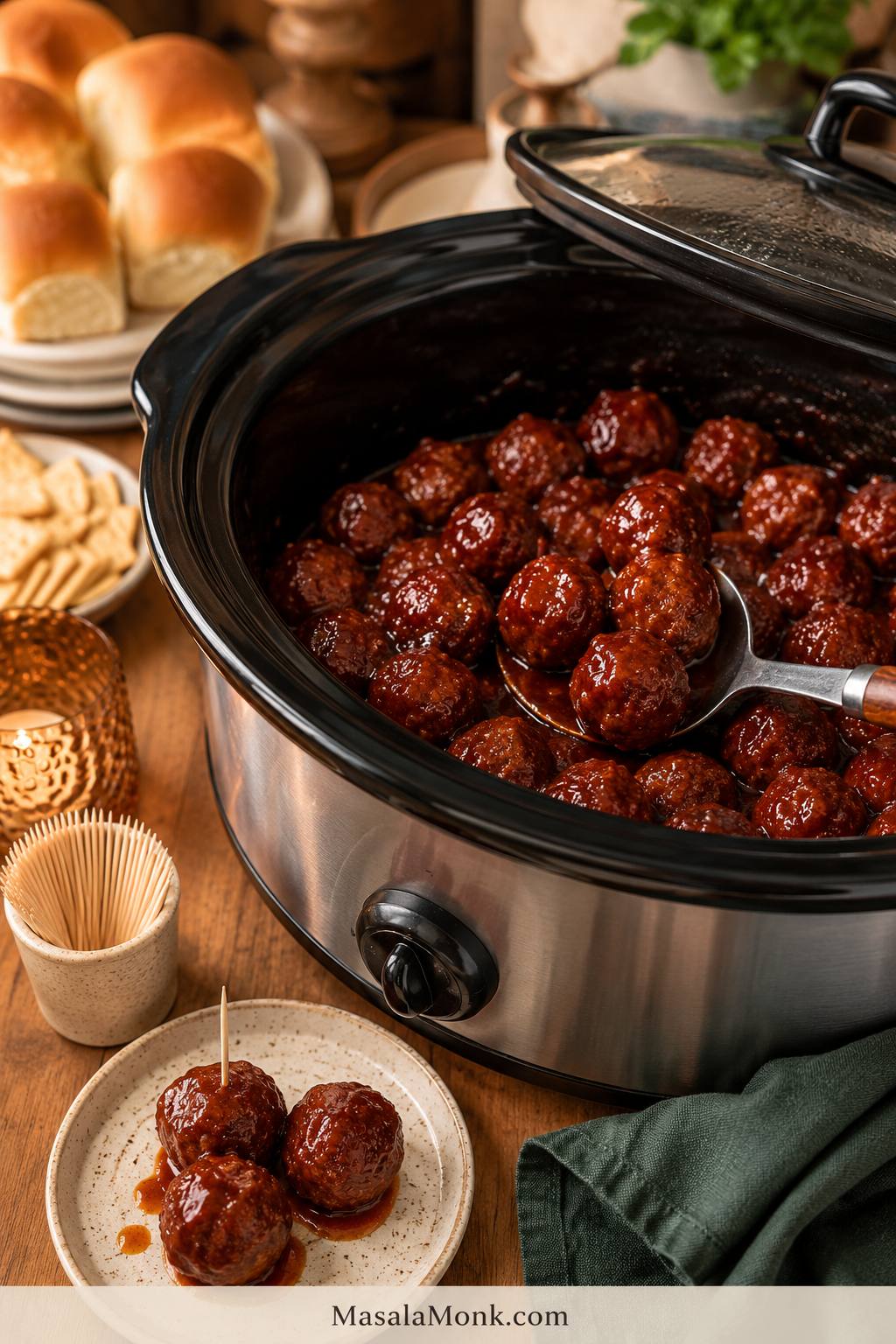
Slow cooker filled with glossy red-brown meatballs, with a serving spoon, toothpicks, small plates, slider buns, and folded napkins on a party table.

Grape jelly meatballs are the kind of party food that makes people suspicious for about five seconds, then sends them back for another toothpick. The ingredient list sounds strange until the sauce starts bubbling: sweet grape jelly, tangy chili sauce, and tender meatballs turning glossy in the slow cooker while you finish the rest of the table.

Keep the classic version simple: fully cooked meatballs, grape jelly, and bottled chili sauce in the crockpot. As the batch warms, the jelly melts into the sauce, the chili sauce balances the sweetness, and the slow cooker holds everything until people are ready to serve themselves.

It is old-school, low-stress, and very good at doing what party food should do: stay warm, taste familiar, and disappear quietly while people keep talking. Once the lid goes on, you get a hot appetizer that can take care of itself while you finish the rest of the food.

Quick Answer: The 3 Ingredients for Grape Jelly Meatballs

To make grape jelly meatballs, combine 2 lb / 900 g fully cooked frozen meatballs, 10–12 oz / 280–340 g grape jelly, and 12 oz / 340 g bottled chili sauce, the tomato-based kind usually found near ketchup, in a slow cooker. Cook on HIGH for 2–3 hours or LOW for 4–5 hours, stirring once or twice, until the sauce has melted together, the coating clings, and the meatballs are heated through.

IngredientAmountRole
Fully cooked frozen homestyle meatballs32 oz / 2 lb / 900 gEasy party base, usually about 48–50 small meatballs.
Grape jelly10–12 oz / 280–340 gSweetness, shine, and sticky body.
American-style bottled chili sauce12 oz / 340 gTangy tomato balance.

What the three ingredients do

This is the moment where the recipe looks stranger than it tastes. Seeing the ingredients together makes the grape jelly less confusing before the sauce melts.
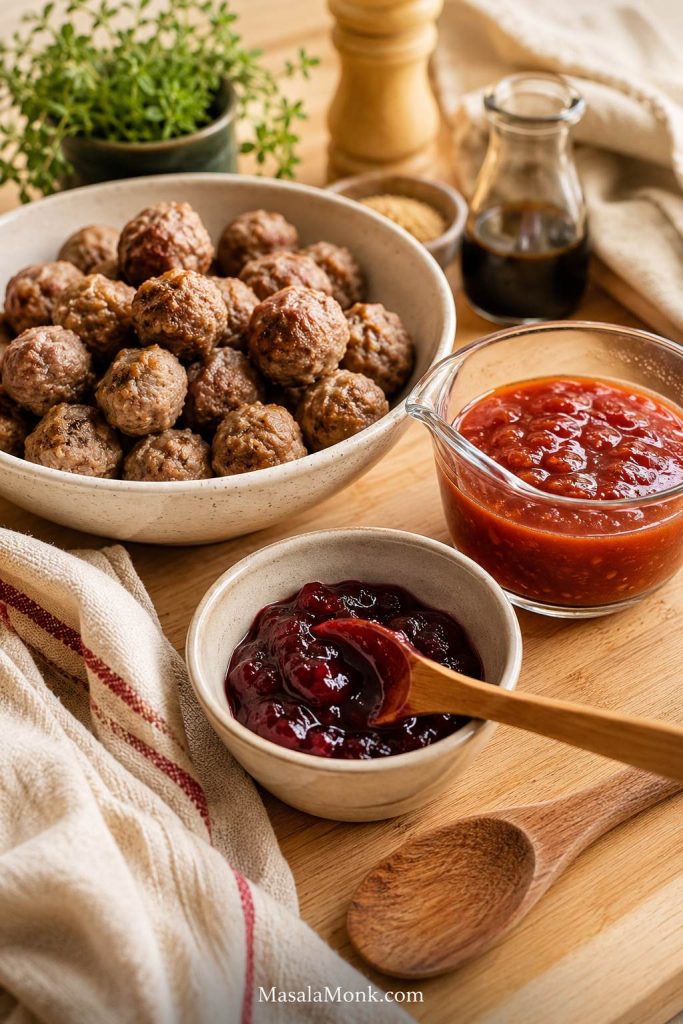
Ingredients for grape jelly meatballs with cooked meatballs, grape jelly, chili sauce, Worcestershire sauce, and seasonings on a wooden surface.
The base is simple: cooked meatballs, grape jelly, and bottled chili sauce. Once warm, Worcestershire, pepper, vinegar, or mustard can fine-tune the flavor.

Increase the grape jelly to 18–20 oz / 510–565 g for a sweeter, stickier potluck glaze. Go with BBQ sauce for a smoky version. For the mildest pantry batch, ketchup works too, especially with a splash of Worcestershire sauce or vinegar.

At a glance: 5 minutes prep, 2–3 hours on HIGH or 4–5 hours on LOW, 12–16 appetizer servings, best with fully cooked frozen homestyle meatballs.
A quick reassurance: The mixture may look lumpy, separated, or too thin before it heats. That is normal. The jelly melts slowly, the chili sauce turns it savory, and the final sauce should taste balanced rather than candy-sweet. Taste only after everything has warmed together.

Choose Your Sauce Version

You can keep the meatballs exactly the same and change only the sauce to fit the crowd. Start with the classic chili sauce version if this is your first time. Choose BBQ sauce for game day. Use ketchup when you want the mildest, most pantry-friendly version.

SituationBest versionWhat to use
First time making theseClassic chili sauce version2 lb meatballs + 10–12 oz grape jelly + 12 oz chili sauce
Sweet potluck glazeExtra grape jelly version2 lb meatballs + 18–20 oz grape jelly + 12 oz chili sauce
Game day or BBQ crowdBBQ version2 lb meatballs + 1 cup grape jelly + 1 1/2 to 2 cups BBQ sauce
Pantry-only versionKetchup version2 lb meatballs + 3/4 to 1 cup grape jelly + 1 1/2 cups ketchup
Less sweet / more balancedClassic ratio + sharpenerAdd vinegar, Dijon, Worcestershire, black pepper, or hot sauce after tasting

Sauce comparison: chili sauce, BBQ, or ketchup

The meatballs stay the same; the sauce decides whether the batch tastes classic, smoky, or mild.
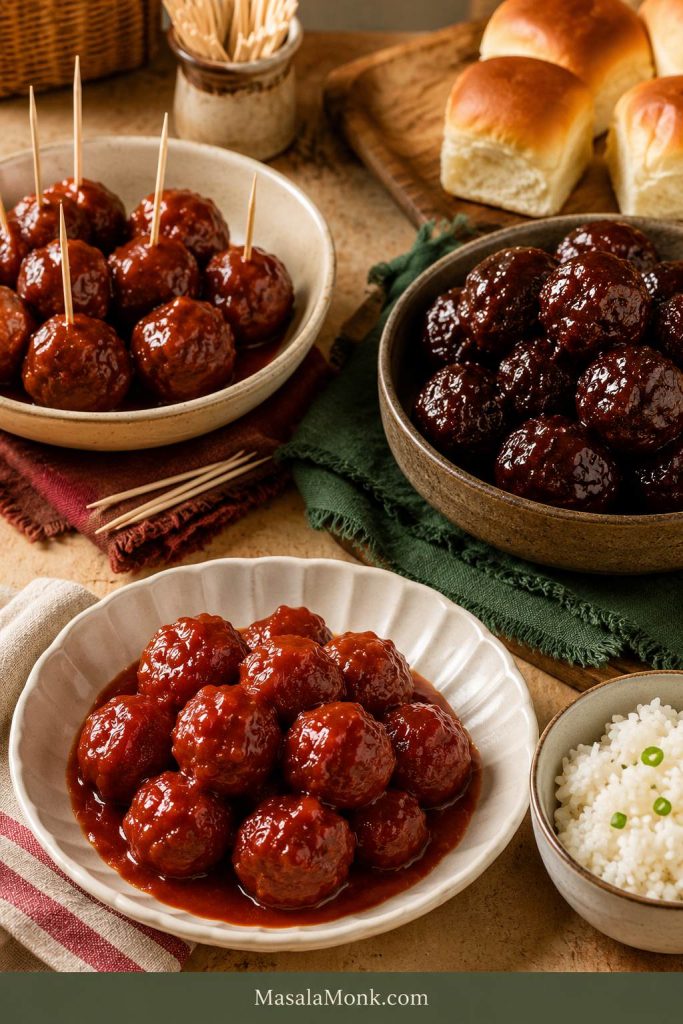
Three grape jelly meatball sauce versions with chili sauce, BBQ sauce, and ketchup served with party sides.
Choose the sauce by the crowd: chili sauce for classic tang, BBQ sauce for smoky game-day flavor, and ketchup for a milder family batch.
Best default: First time making these? Use 2 lb fully cooked homestyle meatballs, 10–12 oz grape jelly, and 12 oz bottled chili sauce. It is the safest balance for most parties: sweet enough to feel classic, tangy enough to avoid tasting like candy.

BBQ sauce gives the friendliest game-day flavor. BBQ sauces vary a lot, so if yours is already sweet and thick, start with less grape jelly and add more only after tasting. Ketchup is not a failure version; it is simply softer, sweeter, and milder. Add vinegar or Worcestershire if you want it closer to the tang of chili sauce.

The chili sauce version tastes most classic, but BBQ sauce is the one many families grew up with. This is exactly the kind of recipe where the “right” version depends on whose slow cooker you remember.

The Best Ratio for Grape Jelly Meatballs

The best all-purpose ratio is 2 lb / 900 g fully cooked meatballs, 10–12 oz / 280–340 g grape jelly, and 12 oz / 340 g bottled chili sauce. It gives you enough sauce to coat the meatballs without turning the slow cooker into a bowl of syrup.

You will see two common versions: a balanced version with 10–12 oz grape jelly and a sweeter potluck version with an 18–20 oz jar. Neither is wrong. Use the smaller amount when you want savory-sweet balance; use the larger jar when you want the sticky retro party glaze.

Save this ratio: 2 lb meatballs + 12 oz chili sauce + 10–12 oz grape jelly for balance.

The Visual Ratio: Balanced First, Sweeter Later

Start balanced first. You can always make the glaze sweeter, but pulling back too much jelly is harder once the whole jar is in the pot.
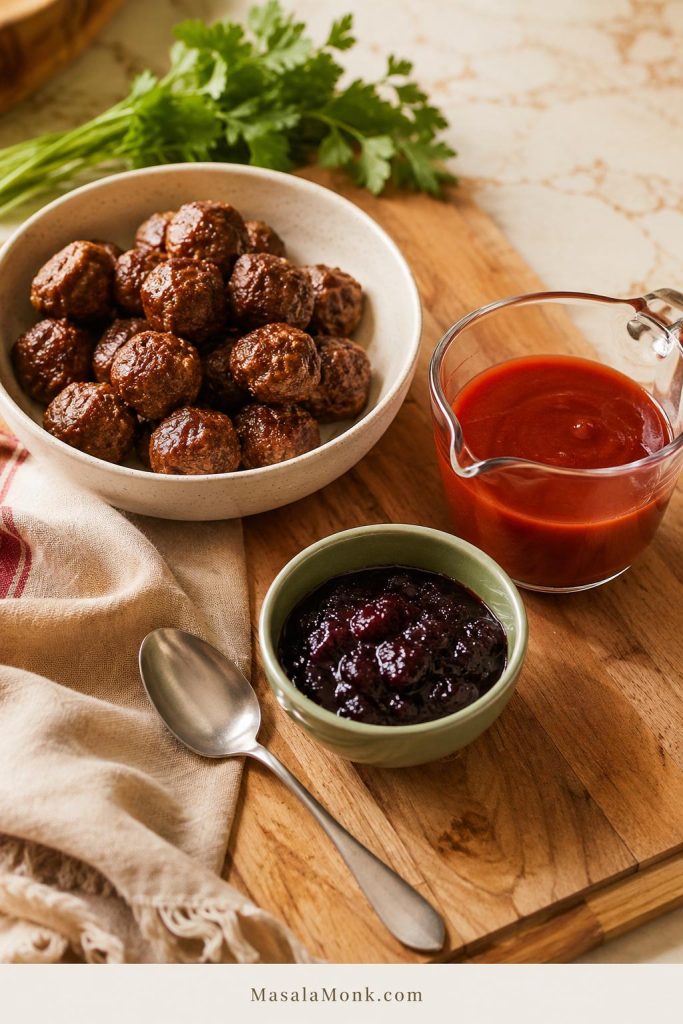
Measured ingredients for the best grape jelly meatball ratio with grape jelly, chili sauce, cooked meatballs, and a spoon.
Start with 2 lb meatballs, 10–12 oz grape jelly, and 12 oz chili sauce; add more jelly only if you want a sweeter potluck glaze.

Recipe Card: Grape Jelly Meatballs

Grape Jelly Meatballs Recipe

Glossy, sweet-tangy grape jelly meatballs made in the slow cooker with fully cooked meatballs, grape jelly, and bottled chili sauce. Easy to keep warm for parties, potlucks, holidays, and game day, with notes for BBQ sauce, ketchup, stovetop, oven, and Instant Pot versions.

Prep Time
5 minutes
Cook Time
2–3 hours HIGH or 4–5 hours LOW
Total Time
About 2 hr 5 min to 5 hr 5 min
Yield
12–16 appetizer servings

Ingredients

  • 32 oz / 2 lb / 900 g fully cooked frozen homestyle meatballs
  • 10–12 oz / 280–340 g grape jelly
  • 12 oz / 340 g American-style bottled chili sauce
  • Add 1 teaspoon Worcestershire sauce, optional
  • Use 1/2 teaspoon garlic powder, optional
  • Finish with 1/4 to 1/2 teaspoon black pepper, optional

Instructions

  1. Add grape jelly and chili sauce to a 4–5 quart slow cooker.
  2. Stir lightly. The jelly does not need to be fully melted yet.
  3. Add the fully cooked meatballs and turn them through the mixture.
  4. Cover and cook on HIGH for 2–3 hours or LOW for 4–5 hours.
  5. Stir once or twice while the meatballs heat.
  6. When the sauce has melted together and the meatballs are hot, switch to WARM and serve.

Notes

  • For a sweeter party glaze, increase grape jelly to 18–20 oz / 510–565 g.
  • BBQ version: combine 1 1/2 to 2 cups BBQ sauce with 1 cup grape jelly.
  • Ketchup version: combine 1 1/2 cups ketchup with 3/4 to 1 cup grape jelly.
  • Use American-style bottled chili sauce, not chili garlic sauce, Thai sweet chili sauce, or sriracha as a direct replacement.
  • If using homemade meatballs, cook them fully before adding them to the sauce.
  • The sauce is ready when there are no streaks of jelly left and the coating clings to the meatballs.

What the Finished Sauce Should Look Like

After the recipe card, use this as the visual target: saucy, spoonable, and glossy without being watery.
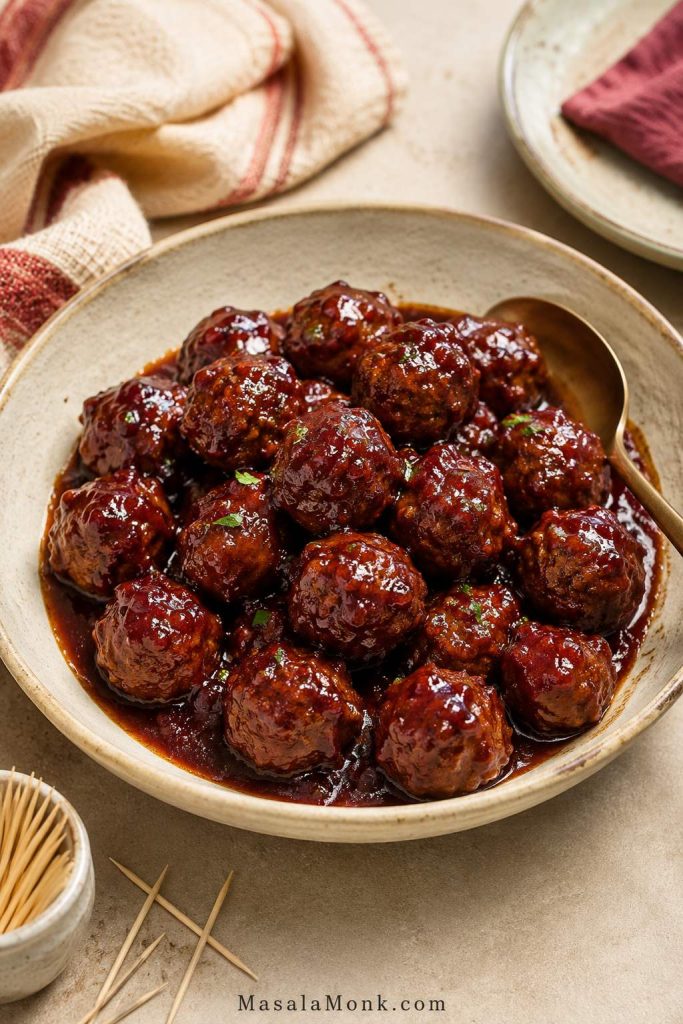
Finished grape jelly meatballs in a serving bowl with sauce, toothpicks, a spoon, folded napkins, and a small plate.
The finished sauce should lightly pool without turning soupy, so the meatballs are easy to spoon or hold warm in a crockpot.

That is the whole basic recipe. From here, use only what you need: scale the batch for a party, choose the sauce version your crowd will like best, make it without a crockpot, or fix the sauce if it tastes too sweet, too thin, or too sharp.

Back to top ↑

Ingredients You Need

Fully cooked meatballs

A 32 oz / 2 lb / 900 g bag of fully cooked frozen homestyle meatballs is the easiest choice. Most bags this size contain around 48–50 small meatballs, though the exact count depends on the brand.

For the most classic flavor, choose plain homestyle cocktail meatballs rather than strongly seasoned Italian meatballs. Beef, pork, turkey, chicken, or mixed meatballs can all work, but the sauce tastes most familiar with mild beef or beef-pork style meatballs.

If your bag is closer to 26–28 oz instead of 32 oz, you can still use the recipe. Hold back a few spoonfuls of sauce at first, then add more if the meatballs need extra coating. If your meatballs are larger than cocktail-size, give them more time to heat through.

For crowds, it is worth checking the meatball label for breadcrumbs, egg, dairy, soy, or gluten, since frozen meatballs vary by brand.

Grape jelly

Grape jelly gives the sauce sweetness, shine, and thickness. Concord grape jelly has the most familiar flavor, but any regular grape jelly works.

The grape jelly is the part that makes people pause, but it is also the part that makes the sauce work. It melts into sweetness and body, not a grape-flavored coating.

For a balanced sauce, use 10–12 oz / 280–340 g. For a sweeter, extra-saucy version, use 18–20 oz / 510–565 g.

If your jar is 10 oz, use the whole thing for a balanced batch. If your jar is 18–20 oz, start with about half to two-thirds of the jar, then add more after tasting if you want the sweeter potluck glaze.

Bottled chili sauce

Choose American-style bottled chili sauce, the tomato-based sauce usually sold near ketchup. The bottle may say “chili sauce,” but the flavor should be tangy and mildly spiced, not fiery hot.

Important chili sauce note: For this recipe, chili sauce means American-style bottled chili sauce, usually found near ketchup. Heinz chili sauce is a common reference point, but store brands are fine as long as the sauce is smooth, tomatoey, tangy, and mildly spiced. It is not the same as Asian chili garlic sauce, Thai sweet chili sauce, or sriracha.

If you cannot find it, BBQ sauce or ketchup can still make a good batch. The flavor changes, but the method stays simple.

Optional flavor boosters

The basic 3-ingredient version works on its own. Use these only if the warm sauce tastes like it needs a little more depth, sharpness, or heat:

  • Add 1 teaspoon Worcestershire sauce for savory depth
  • Use 1/2 teaspoon garlic powder for a rounder flavor
  • Sprinkle in 1/4 to 1/2 teaspoon black pepper for mild heat
  • Stir in 1 teaspoon Dijon mustard if the sauce is too sweet
  • Brighten with 1 teaspoon vinegar or lemon juice if it needs brightness
  • Hot sauce or sriracha if you want more heat

How to Make Grape Jelly Meatballs in the Crockpot

A 4–5 quart slow cooker works well for a standard 2 lb batch. For a double batch, use a 6 quart slow cooker so the meatballs heat evenly and you still have room to stir.

Before cooking: why the sauce looks uneven

Do not worry if the slow cooker looks patchy at the start. Heat is what turns the separate sauce pockets into one coating.
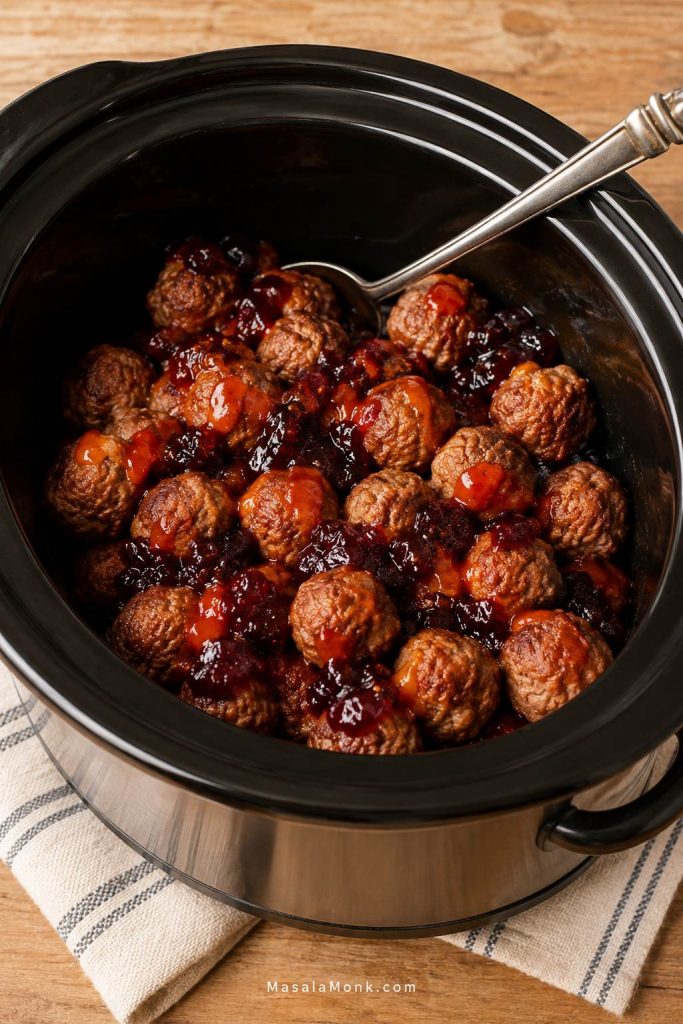
Cooked meatballs in a slow cooker with grape jelly and chili sauce before the sauce has melted together.
This uneven start is normal. Heat turns the separate jelly and chili sauce into a smooth coating.
  1. Add the grape jelly and chili sauce to the slow cooker.
  2. Stir roughly. The jelly does not need to be fully smooth yet.
  3. Add the fully cooked meatballs.
  4. Turn them through the mixture until coated.
  5. Cover and cook on HIGH for 2–3 hours or LOW for 4–5 hours.
  6. Stir once or twice during cooking.
  7. When the meatballs are hot and there are no streaks of jelly left, switch the slow cooker to WARM for serving.
Texture cue: The sauce is ready when it coats the spoon and clings to the meatballs instead of sitting in separate streaks of jelly and chili sauce. If the edges of the slow cooker start getting sticky, stir and add a splash of water or broth.

If the mixture looks thin halfway through, do not panic. It thickens as the jelly melts, the meatballs warm through, and the edges of the slow cooker begin to bubble.

Halfway through: wait before adjusting

This is the stage where people often adjust too early. Wait until the jelly melts before adding more sweetness, tang, or thickener.
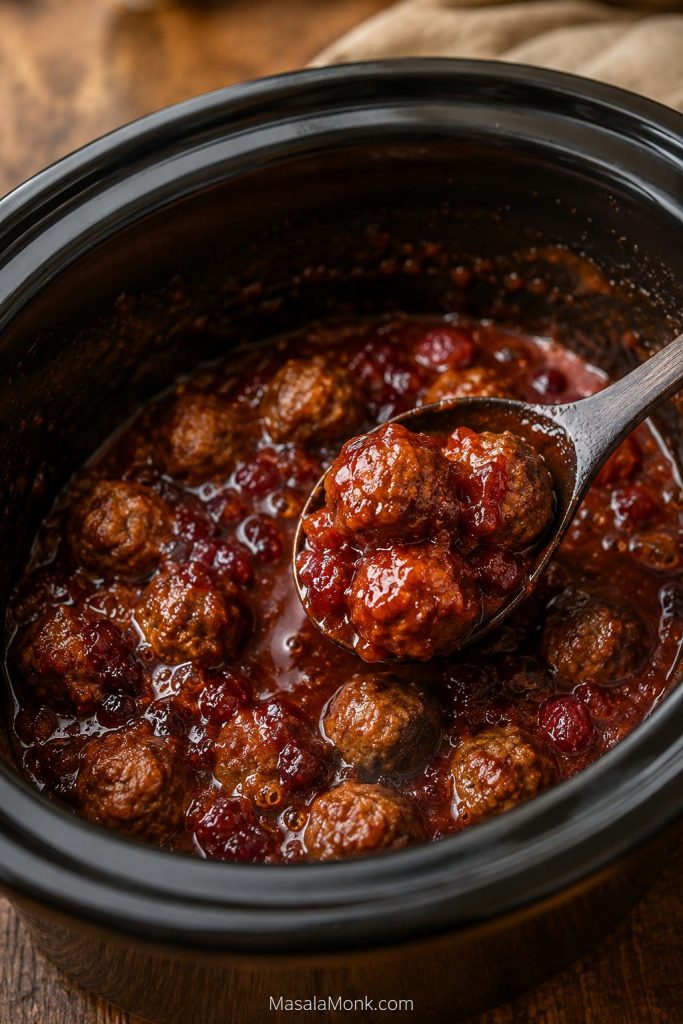
A spoon lifting grape jelly meatballs from a slow cooker while the sauce is partly melted and uneven.
At the halfway point, look for partial coating rather than perfect gloss; the sauce smooths out as the jelly melts.

Once the meatballs are hot, avoid leaving them on HIGH for too long. The sauce can reduce around the edges, become overly sticky, and make the meatballs taste drier. WARM is the better setting for serving.

How to know the meatballs are done

The meatballs are ready when the sauce has fully melted, the coating looks unified, and the meatballs are heated through. Around the edges of the slow cooker, the mixture may bubble gently and thicken slightly.
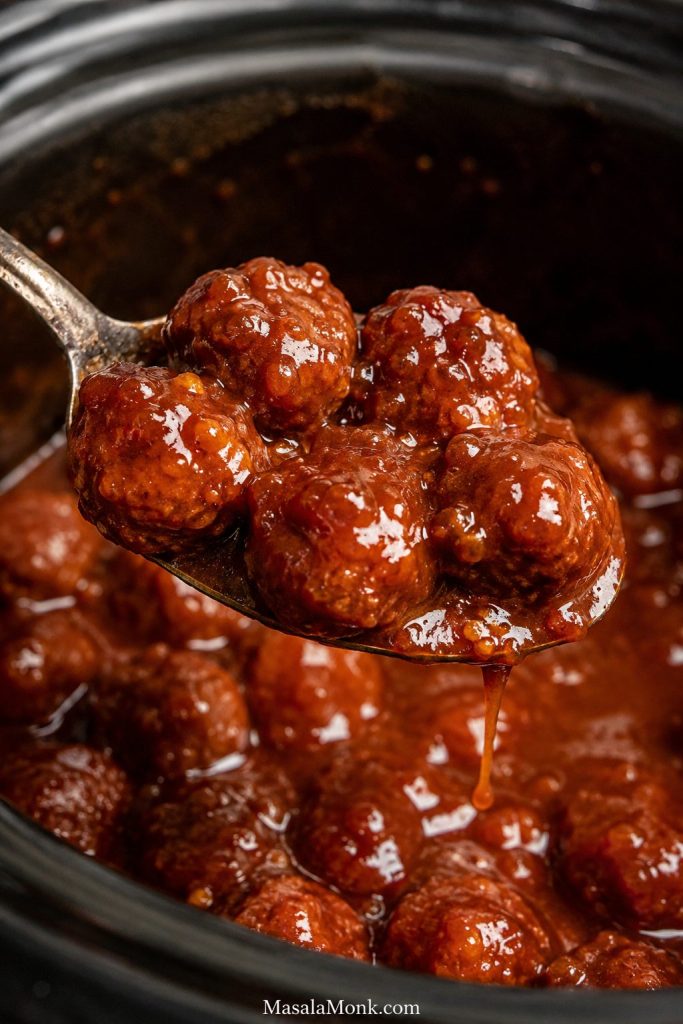
Finished grape jelly meatballs lifted on a spoon with glossy red-brown sauce clinging to them.
Look for an even coating on the spoon; that means the sauce has come together and the meatballs are heated through.

If you use homemade meatballs, cook them through before adding them to the sauce. Some homemade slow-cooker meatball recipes cook raw meatballs in sauce, but this party version is easier to control when the meatballs are cooked first. You get better texture, simpler timing, and less guesswork.

Why This Ratio Works

This version starts with 10–12 oz grape jelly instead of a full 18–20 oz jar, so the sauce still tastes like a savory appetizer instead of a candy glaze. It is also easier to adjust: if the sauce needs more sweetness, you can add it, but if it starts too sweet, you have fewer ways to pull it back.

What Balanced Sauce Should Look Like

This is the sauce check: it should move easily from the spoon while still holding onto the meatballs.
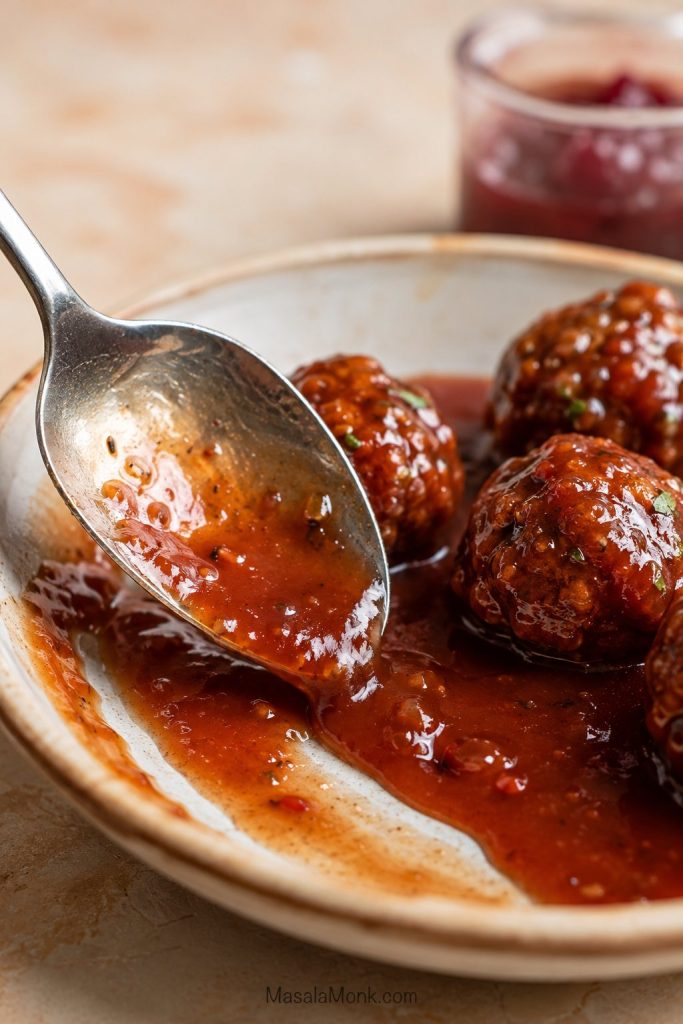
Spoon dragging through grape jelly meatball sauce to show sauce that is thick enough to cling but still pourable.
A good sauce should flow but still cling. Starting with moderate jelly gives you more control than dumping in a full jar.

The method stays honest to what this recipe is supposed to be: one slow cooker, fully cooked meatballs, and no extra pan unless you want to thicken the sauce faster. The result is glossy, sweet-tangy, and easy to hold warm without turning the edges into syrup.

When These Meatballs Work Best

These meatballs work three ways: as cocktail meatballs with toothpicks, as a slow cooker appetizer for game day, or as a saucy dinner over rice or mashed potatoes. They are built for fully cooked meatballs, a warm sauce, and a slow cooker that can hold everything on a buffet table.

They are small, warm, saucy, and easy to take without committing to a full plate. That is why they disappear slowly at first, then suddenly all at once.

Once the meatballs are heated through, the crockpot keeps them warm while people serve themselves. If you like this kind of hands-off party food, this slow cooker pulled pork recipe works for the same reason: the slow cooker handles the timing, and the sauce does the heavy lifting.

The recipe works because the sauce pulls in two directions at once: grape jelly gives sweetness and shine, while chili sauce, BBQ sauce, or ketchup keeps it from tasting one-note. A little vinegar, mustard, Worcestershire, or hot sauce can fine-tune the flavor once everything is warm.

Why the Jelly and Chili Sauce Work

The jelly melts into a glossy glaze

At first, the grape jelly may sit in thick spoonfuls beside the chili sauce. That is normal. Give it heat and time, and it melts into a spoon-coating sauce instead of tasting like meatballs in jam. The mixture may look separated for the first 20–30 minutes, so do not judge it too early.
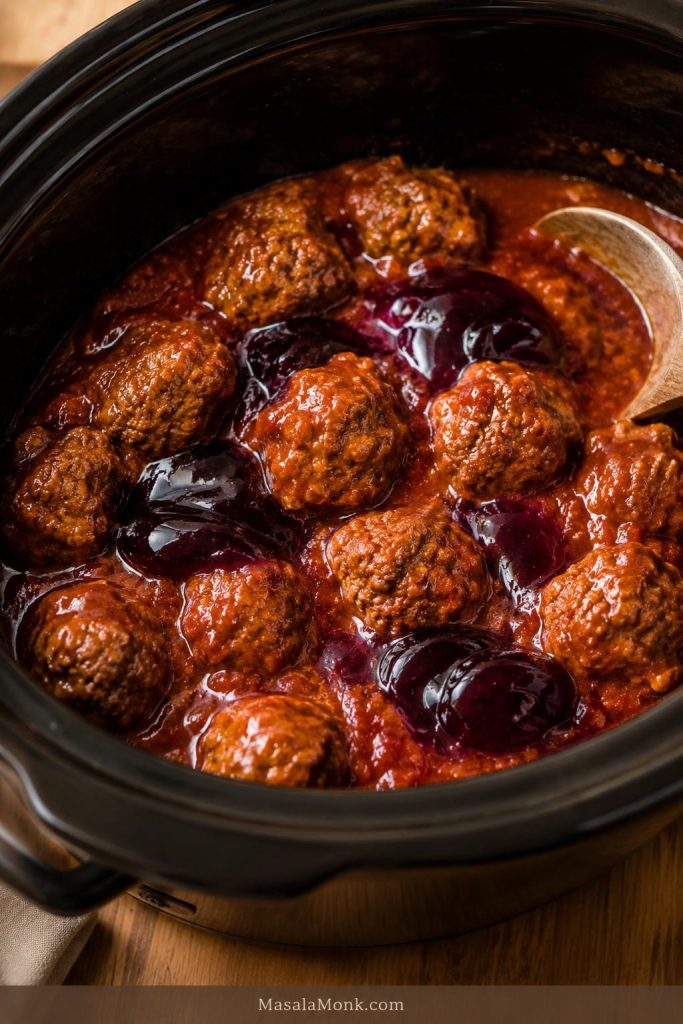
Grape jelly melting into chili sauce around cooked meatballs in a black slow cooker.
Those dark jelly pockets melt into the chili sauce, building shine and sweetness without leaving a jammy coating.

Chili sauce keeps the sweetness in check

Grape jelly alone would be too sweet. Bottled chili sauce brings tomato, vinegar, mild spice, and enough tang to make the sauce taste savory. If it smells sharp at first, wait until everything warms through before adjusting.

Fully cooked meatballs make it party-proof

Frozen fully cooked meatballs are already shaped, cooked, and ready to heat. You do not need to thaw, sear, or fuss with anything if the package says they can be heated from frozen.

The crockpot holds everything without babysitting

The slow cooker warms the meatballs gently, melts the jelly into the sauce, and holds everything ready until people start serving themselves. Once the batch is hot, switch to WARM so the coating stays saucy instead of reducing too far around the edges.

Crockpot Time Chart

Slow cookers do vary, so use the times below as a guide and the visual cues as your final check. You are looking for hot meatballs, melted sauce, and a coating that clings instead of pooling at the bottom.

Batch sizeSlow cooker sizeHIGHLOW
1 lb / 450 g meatballs2–3 quart1.5–2 hours3–4 hours
2 lb / 900 g meatballs4–5 quart2–3 hours4–5 hours
4 lb / 1.8 kg meatballs6 quart3–4 hours5–6 hours

Stir occasionally, but avoid lifting the lid too often. Once the meatballs are fully hot, switch to WARM for serving.

Serving safety note: The slow cooker is great for keeping hot food warm, but it should not be used to reheat cold leftovers straight from the fridge. USDA slow cooker food safety guidance recommends reheating leftovers first on the stovetop, in the oven, or in the microwave, then moving them to the slow cooker for serving.

Before You Start: Sauce Mistakes to Avoid

  • Use the right chili sauce. Bottled tomato-based chili sauce is not the same as chili garlic sauce, Thai sweet chili sauce, or sriracha.
  • Let the jelly melt before judging the flavor. The sauce tastes different once the jelly has fully melted into the chili sauce.
  • Switch from HIGH to WARM once the meatballs are hot. This keeps the edges from over-thickening.
  • Mix cornstarch with cold water first. Adding dry cornstarch directly to hot sauce can make it clump.
  • Cook homemade meatballs before saucing. This version is for heating and coating fully cooked meatballs, not cooking raw meat from scratch.

Chili Sauce vs BBQ Sauce vs Ketchup

If you already picked a version above, use this section to fine-tune it. Chili sauce keeps things classic and balanced, BBQ sauce brings smoke, and ketchup needs a little sharpening when you want a pantry-only batch.

Chili sauce tastes like a tangier, bolder ketchup-style sauce. Ketchup makes the meatballs softer and sweeter, while chili sauce gives the classic version more tomato tang and mild spice.

VersionMeatballsSauceFlavor
Classic chili sauce2 lb / 900 g10–12 oz grape jelly + 12 oz chili sauceTangy, classic, balanced
Sweeter party glaze2 lb / 900 g18–20 oz grape jelly + 12 oz chili sauceStickier, sweeter, extra saucy
BBQ version2 lb / 900 g1 cup grape jelly + 1 1/2 to 2 cups BBQ sauceSmoky and sweet
Ketchup version2 lb / 900 g3/4 to 1 cup grape jelly + 1 1/2 cups ketchupMild and sweet-tangy

If using ketchup, add Worcestershire sauce, vinegar, mustard, black pepper, or chili powder if the sauce tastes flat. If using BBQ sauce, start with the lower amount of jelly and add more only if you want a sweeter coating.

No Crockpot? Make Them on the Stovetop, in the Oven, or in the Instant Pot

The crockpot is still the easiest choice when guests are coming, but you are not stuck if it is already full. The same grape jelly mixture works on the stovetop, in the oven, and in the Instant Pot with a few small adjustments.

Stovetop method

  1. Add grape jelly and chili sauce to a Dutch oven, deep skillet, or large saucepan.
  2. Warm over medium-low heat until the jelly melts into the chili sauce.
  3. Add the meatballs and stir to coat.
  4. Cover and simmer for 15–20 minutes, stirring occasionally.
  5. If the meatballs are large or still very frozen, allow 25–30 minutes.

Use the stovetop when you need them faster or when the sauce needs a few extra minutes to tighten into a thicker coating.
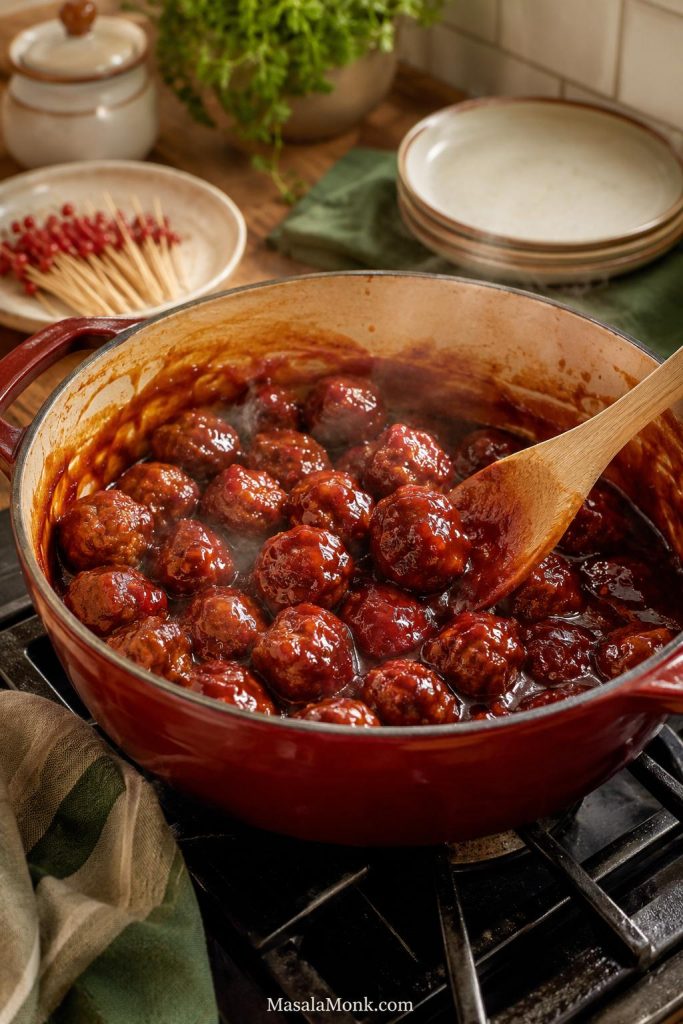
Grape jelly meatballs simmering in glossy red sauce in a red Dutch oven on a stovetop with a wooden spoon.
On the stovetop, gentle simmering melts the jelly and tightens the sauce faster than a slow cooker.

Oven method

  1. Heat the oven to 350°F / 175°C.
  2. Add meatballs, grape jelly, and chili sauce to a covered baking dish or Dutch oven.
  3. Stir to coat.
  4. Cover and bake for 45–60 minutes.
  5. Stir halfway through.
  6. Uncover for the last 10 minutes if the coating looks too thin.

Reach for the oven when the slow cooker is already busy or when a wide baking dish is easier than stirring a crowded crockpot.
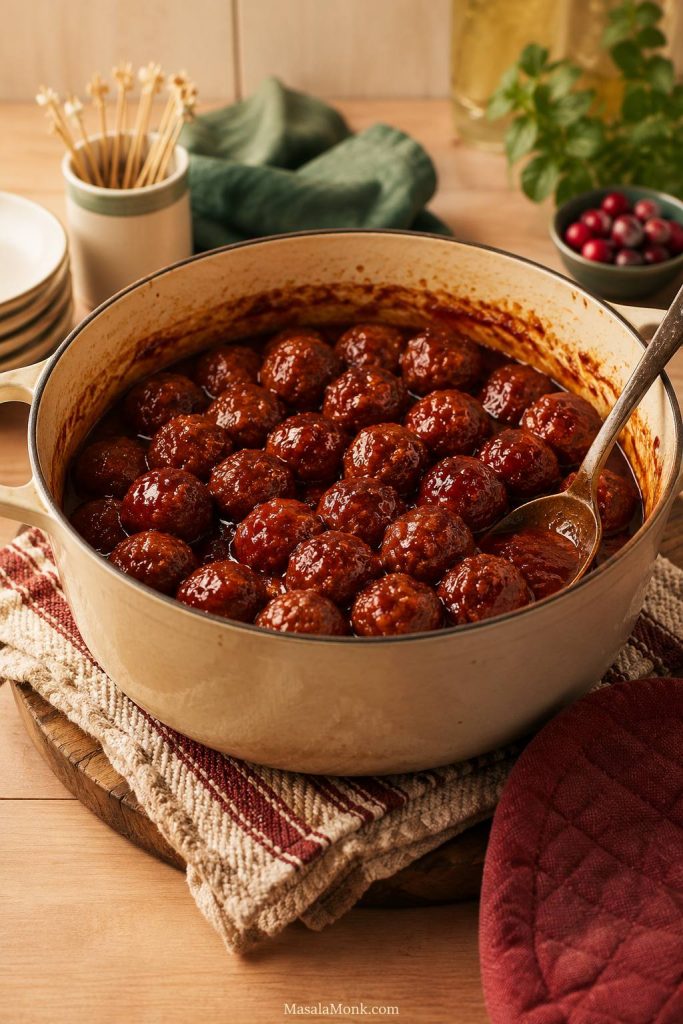
Oven-baked grape jelly meatballs in a cream-colored baking dish with a spoon, oven mitt, folded towel, and kitchen counter.
A covered baking dish keeps the meatballs saucy when the slow cooker is already busy.

Instant Pot method

The Instant Pot works, but it is not the best method for the glossiest sauce or for holding meatballs during a party. Use it when speed matters, then transfer the meatballs to a slow cooker on WARM or to a serving dish.

  1. Add the meatballs, grape jelly, chili sauce, and 1/2 to 3/4 cup water to the Instant Pot.
  2. Pressure cook for 5–10 minutes, depending on meatball size.
  3. Quick release carefully.
  4. Use the sauté function to simmer uncovered until the mixture thickens and coats the spoon.

Do not skip the sauté step if you want a sticky coating. The mixture will look thinner at first because of the added water.
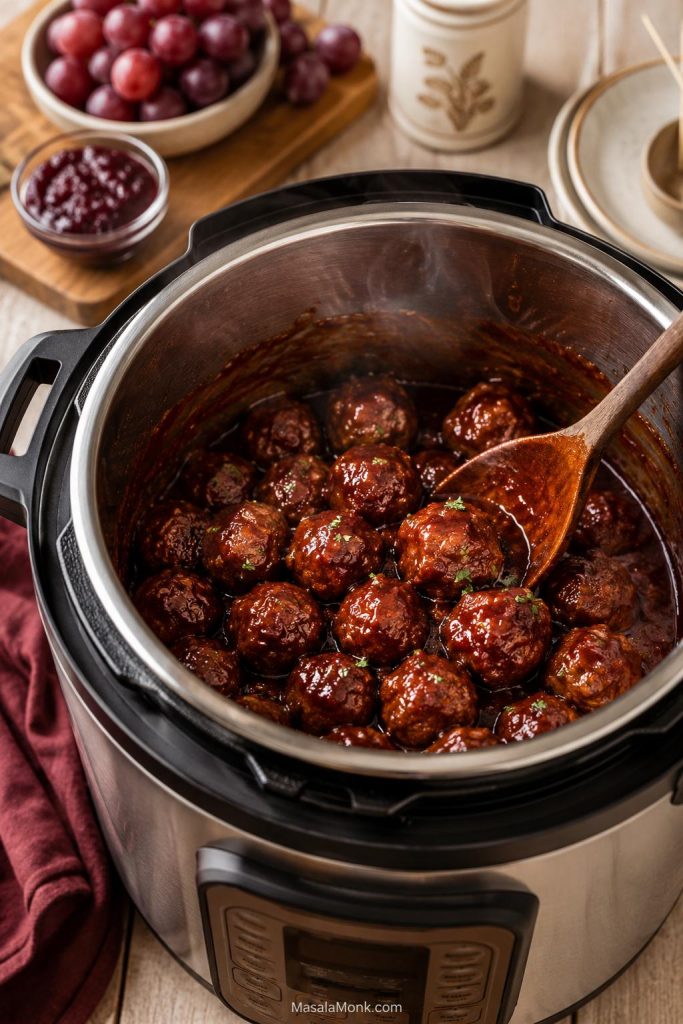
Grape jelly meatballs inside a pressure cooker insert with steam rising and a wooden spoon stirring the sauce.
After pressure cooking, use sauté to reduce the sauce from loose to spoon-coating.

Can You Use Homemade Meatballs?

You do not need homemade meatballs for this recipe to work. Frozen fully cooked meatballs are the point when you need an easy party appetizer. Homemade meatballs are simply an upgrade if you have the time.

Cooked meatballs before sauce

Homemade meatballs are an upgrade, but they should be cooked first so the sauce is only heating and coating them, not cooking raw meat.
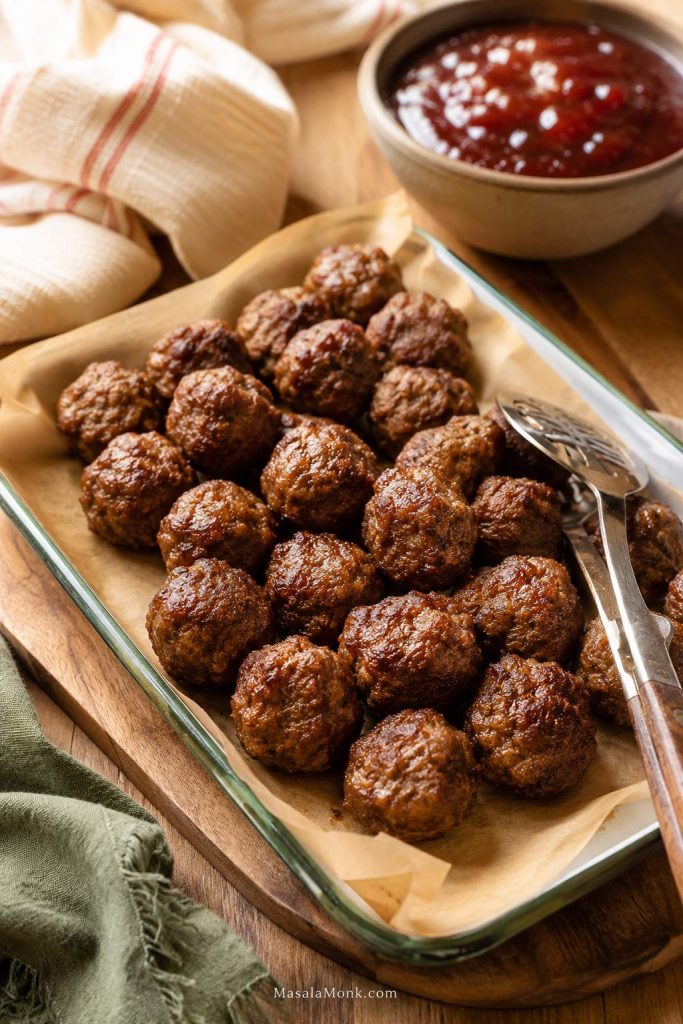
Cooked homemade meatballs on parchment paper in a glass baking dish with tongs and a bowl of red sauce in the background.
Cook homemade meatballs first, then sauce them; the texture stays firmer and timing is easier.

For a simple homemade batch, use:

  • Ground beef or beef-pork mix, 2 lb / 900 g
  • Breadcrumbs or panko, 1 cup
  • Milk, 1/2 cup
  • Eggs, 2
  • Finely chopped onion, 1/2 cup
  • Garlic powder, 1 teaspoon
  • Salt, 1 teaspoon
  • Black pepper, 1/2 teaspoon

Mix gently, shape into 1-inch meatballs, then bake or brown them before adding them to the sauce. Ground beef or pork meatballs should be cooked through to 160°F / 71°C. Poultry meatballs should reach 165°F / 74°C.

Best practical choice: Use frozen fully cooked meatballs for parties. Choose homemade meatballs when you want better texture and have time to cook them before saucing.

How Much to Make for a Party

A 2 lb bag usually gives about 48–50 small meatballs. If you are serving several appetizers, people will take fewer. If these are the main hot snack, plan for more.

Use caseAmount to plan
Light appetizer with other snacks3–4 meatballs per person
Heavier appetizer5–6 meatballs per person
Dinner over rice, noodles, or potatoes6–8 meatballs per person
2 lb / 900 g bagAbout 12–16 appetizer servings
4 lb / 1.8 kg double batchAbout 24–32 appetizer servings

What a Double Batch Looks Like

Use this as the capacity check: the slow cooker can look full, but it still needs room for stirring.
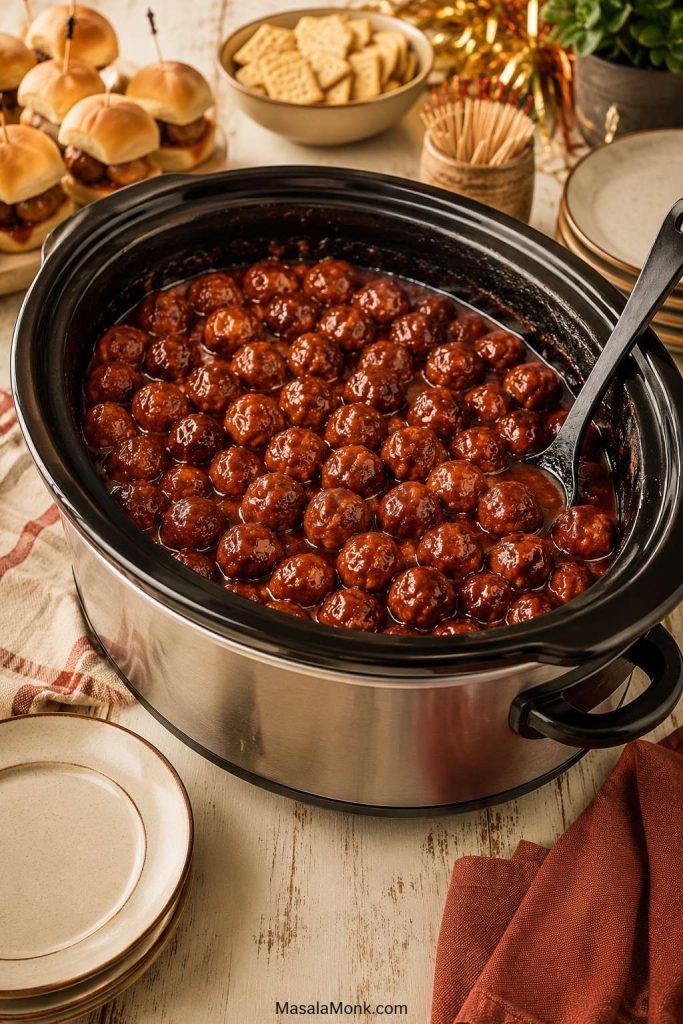
Large slow cooker filled with a double batch of grape jelly meatballs on a party table with slider buns, crackers, toothpicks, and plates.
A double batch needs room to stir. Crowding slows heating and makes the sauce harder to manage.

If you are not sure how much your crowd will eat, make the double batch. These are exactly the kind of appetizers people keep taking one at a time until the slow cooker is suddenly empty.

Sauce Scaling Chart

Use this chart when your bag size is smaller, larger, or when you want a sweeter party-style batch. The standard batch is saucy enough for a party bowl, but not so heavy that the meatballs swim in sauce.

BatchMeatballsGrape jellyChili sauce
Small bag26–28 oz / 740–800 g8–10 oz / 225–280 g10–12 oz / 280–340 g
Half batch1 lb / 450 g5–6 oz / 140–170 g6 oz / 170 g
Standard balanced batch2 lb / 900 g10–12 oz / 280–340 g12 oz / 340 g
Sweeter party batch2 lb / 900 g18–20 oz / 510–565 g12 oz / 340 g
Double balanced batch4 lb / 1.8 kg20–24 oz / 560–680 g24 oz / 680 g
Double sweeter batch4 lb / 1.8 kg36–40 oz / about 1–1.1 kg, or roughly two 18–20 oz jars24 oz / 680 g

Simple Party Timeline

If you are serving these for a party, start the slow cooker about 3 hours before guests arrive if cooking on HIGH, or 5 hours before if cooking on LOW. That gives the meatballs time to heat through and gives you a little buffer before serving.

WhenWhat to do
Night beforeMix the grape jelly and chili sauce, or cook the full batch and refrigerate it after cooling.
Before serving a refrigerated batchReheat on the stovetop, in the oven, or in the microwave until hot, then move to the slow cooker on WARM.
3–5 hours before serving a fresh batchCook the meatballs in the slow cooker, depending on HIGH or LOW timing.
When guests arriveSwitch to WARM, stir, and set out toothpicks plus a spoon for extra sauce.
During servingStir occasionally and loosen the sauce with a splash of water or broth if the edges thicken.

Taking Them to a Potluck

If you are taking grape jelly meatballs to another house, the easiest option is to cook or reheat them before you leave, keep the slow cooker covered during the trip, then plug it in as soon as you arrive and keep the meatballs on WARM.

How to Hold Them Warm at a Potluck

The covered slow cooker shines as a holding tool. For best texture and safety, bring the meatballs hot before you rely on WARM.
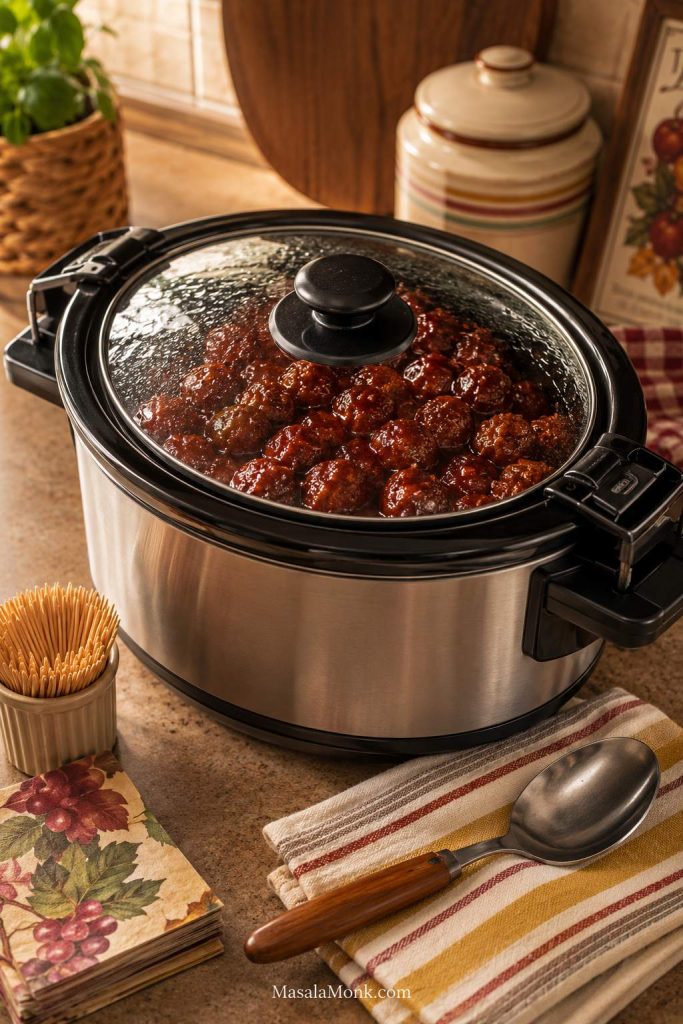
Covered slow cooker with grape jelly meatballs visible through the lid beside a spoon, napkins, toothpicks, and towels.
Bring the meatballs hot, then use the covered slow cooker to hold them warm once you arrive.

For a longer trip, transport the meatballs chilled in a sealed container, reheat them until hot when you arrive, then move them to the slow cooker for serving. Do not rely on a cold slow cooker full of refrigerated meatballs to reheat the batch quickly.

How to Fix Grape Jelly Meatball Sauce

If your first taste makes you think, “this is too sweet,” do not start over. Wait until the jelly has melted, then adjust the hot sauce in the direction it needs to go.

The good news is that this sauce is forgiving. Once it is warm, small adjustments make a big difference.

ProblemFix
Too sweetAdd more chili sauce, Dijon, vinegar, lemon juice, Worcestershire sauce, black pepper, or hot sauce.
Too tangyAdd more grape jelly or a spoonful of BBQ sauce.
Too thinSimmer uncovered or add a cornstarch slurry.
Too thickAdd water, broth, pineapple juice, or a little BBQ sauce.
Flat flavorAdd Worcestershire sauce, Dijon, black pepper, vinegar, hot sauce, or a pinch of salt.
Coating not clingingCook longer, stir well, or reduce slightly.
Too spicyAdd more grape jelly or BBQ sauce.
Meatballs drying outAdd a splash of water and keep them on WARM, not HIGH.

If the sauce gets too thick

Sauce that drags instead of spoons needs loosening before serving, especially after sitting on WARM or thickening around the slow cooker edges.
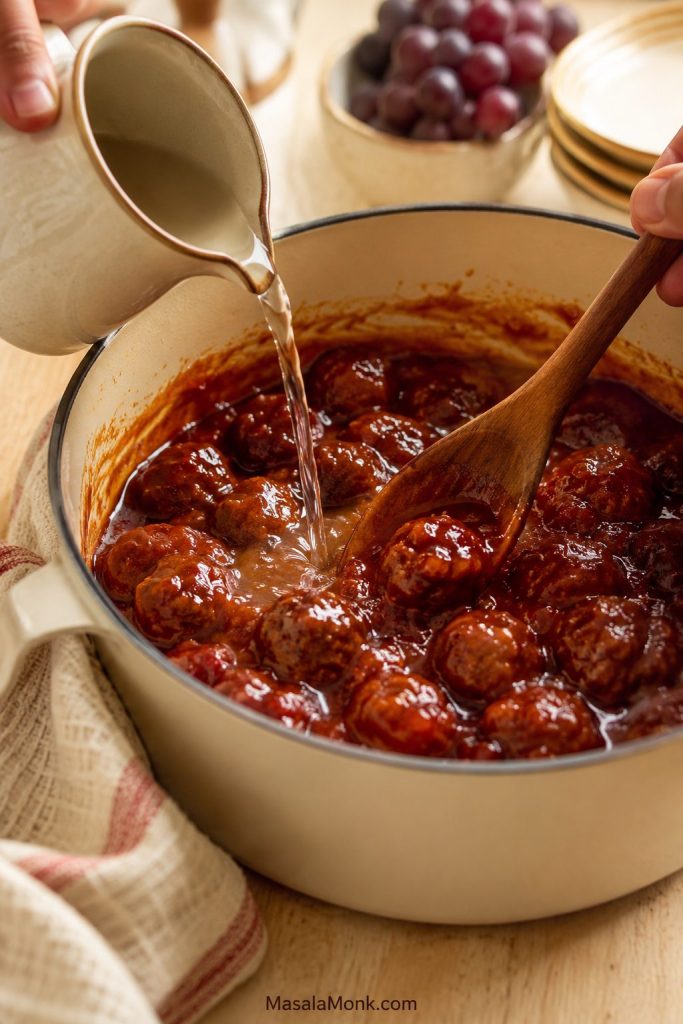
Clear liquid being poured into thick grape jelly meatball sauce while a wooden spoon stirs the meatballs.
If the sauce thickens around the edges, loosen it with a small splash of water or broth so the glaze stays spoonable.

If the sauce drags instead of pours, loosen it before serving. These meatballs should feel glossy and easy to spoon, not sticky enough to fight with.

How to thicken the sauce

For light thickening, mix 1 teaspoon cornstarch with 1 teaspoon cold water. For a thicker glaze, mix 2 teaspoons cornstarch with 2 teaspoons cold water.

Stir the slurry into the hot mixture and cook until it turns shiny and coats the spoon. In a slow cooker, add the slurry near the end and cook on HIGH for another 15–20 minutes. For faster thickening, transfer the sauce to a saucepan and simmer for a few minutes.

How to make the sauce less sweet

Add something tangy, savory, or spicy. A splash of vinegar, a little Dijon mustard, extra chili sauce, Worcestershire sauce, black pepper, lemon juice, or hot sauce can pull the sauce back into balance.

Start small, stir, taste, and adjust again. It is much easier to add more sharpness than to fix a sauce that has gone too sour.

Substitutions: Grape Jelly, Chili Sauce, and Meatballs

Grape jelly substitutes

Grape jelly is classic, but other fruit preserves can work with the same sweet-savory idea. The mixture may look less smooth if you use jam or preserves with fruit pieces.

SubstituteFlavor result
Cranberry sauceTangier, holiday-style, and good with chili sauce.
Apricot preservesLighter, fruity, and good with BBQ sauce.
Orange marmaladeCitrus-sweet with a slight bitter edge.
Raspberry preservesSweeter berry flavor.
Hot pepper jellySpicy-sweet and stronger in flavor.
Strawberry jellyWorks, but tastes sweeter and less classic.
Grape jamSimilar flavor, but thicker and less smooth than jelly.

For a holiday-style version, cranberry sauce is the most natural swap. If you already like sweet-tart cranberry sauce with savory food, that same flavor direction works beautifully with cocktail meatballs. This cranberry sauce with orange juice has the kind of bright, tangy-sweet profile that pairs well with warm appetizers.

Chili sauce substitutes

Go with BBQ sauce when you want a smoky, game-day flavor. Use ketchup when you want the mildest pantry version, then add Worcestershire sauce, vinegar, Dijon, black pepper, or chili powder if it tastes flat.

Meatball substitutes

Turkey, chicken, beef, pork, beef-pork, and plant-based meatballs can all work as long as they are fully cooked before going into the sauce. Choose mild meatballs if you want the classic party flavor.

Can you use low-sugar or sugar-free grape jelly?

Yes, but the sauce may be thinner, less shiny, or slightly sharper depending on the sweetener. Taste after the jelly melts before adding vinegar, mustard, or hot sauce. If the coating looks thin, use the cornstarch slurry method to help it cling to the meatballs.

Can You Use Little Smokies Instead of Meatballs?

Little Smokies can go straight into this sauce too. Use 2–3 lb cocktail sausages with the same grape jelly and chili sauce mixture, then cook until hot and well coated.

How the Little Smokies Version Looks

Use this version when you want the same sauce but a snappier cocktail-sausage bite instead of soft meatballs.
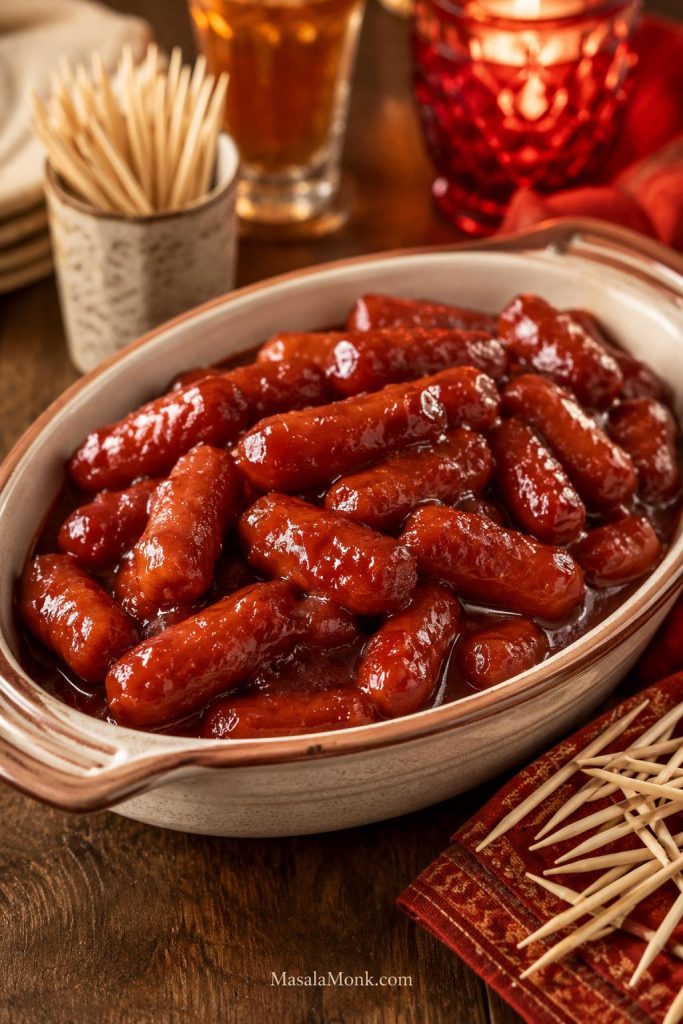
Little Smokies cocktail sausages coated in glossy grape jelly chili sauce in a shallow bowl with toothpicks nearby.
Little Smokies turn the same glaze into a saltier, snappier cocktail-sausage appetizer.

What to Serve with Grape Jelly Meatballs

For parties, let these be the warm, saucy anchor on the table. Surround them with something crunchy, something creamy, and something easy to grab.

For a slow-cooker setup, set out toothpicks plus a small spoon or ladle. Toothpicks are easy for grabbing meatballs, but a spoon helps people get enough sauce.

What to Serve With Party Meatballs

A good party spread gives the warm meatballs contrast: something soft, something crunchy, something tangy, and something creamy.
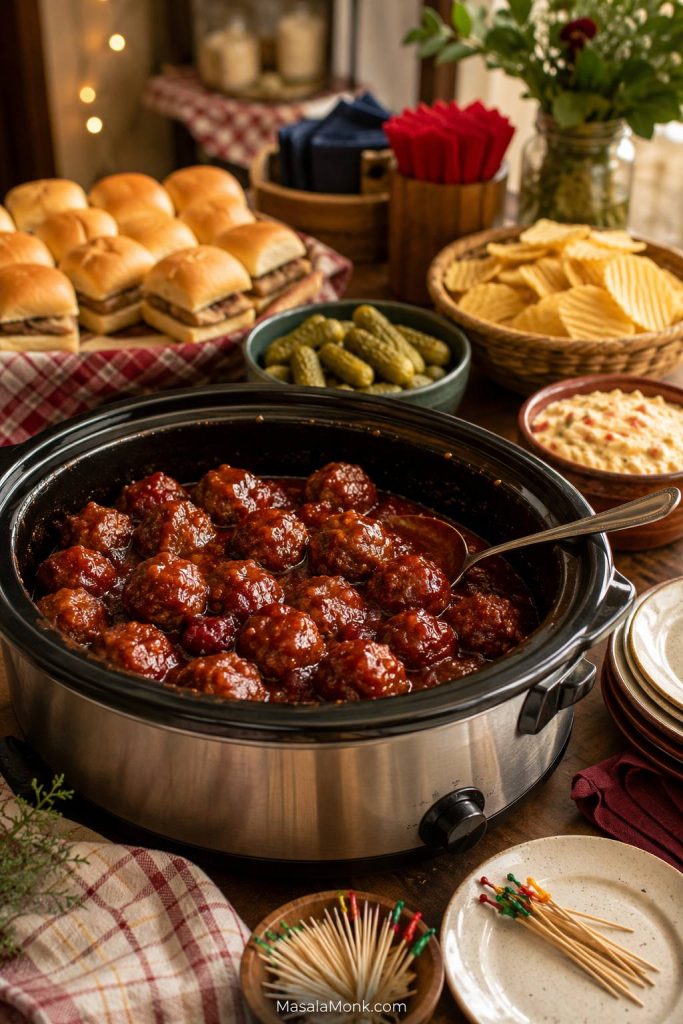
Grape jelly meatballs on a party table with slider buns, pickles, chips, dip, toothpicks, napkins, and small plates.
Balance the warm saucy meatballs with soft buns, crunchy chips, tangy pickles, and a creamy dip.

For parties

  • Toothpicks or cocktail forks
  • Slider buns
  • Pull-apart bread
  • Cheese ball with crackers or pretzels
  • 7 layer dip with sturdy chips
  • Pickles
  • Raw vegetables and dip

Turn Them Into Dinner

To make this feel like a main dish, give the sauce something soft to land on instead of serving the meatballs alone.
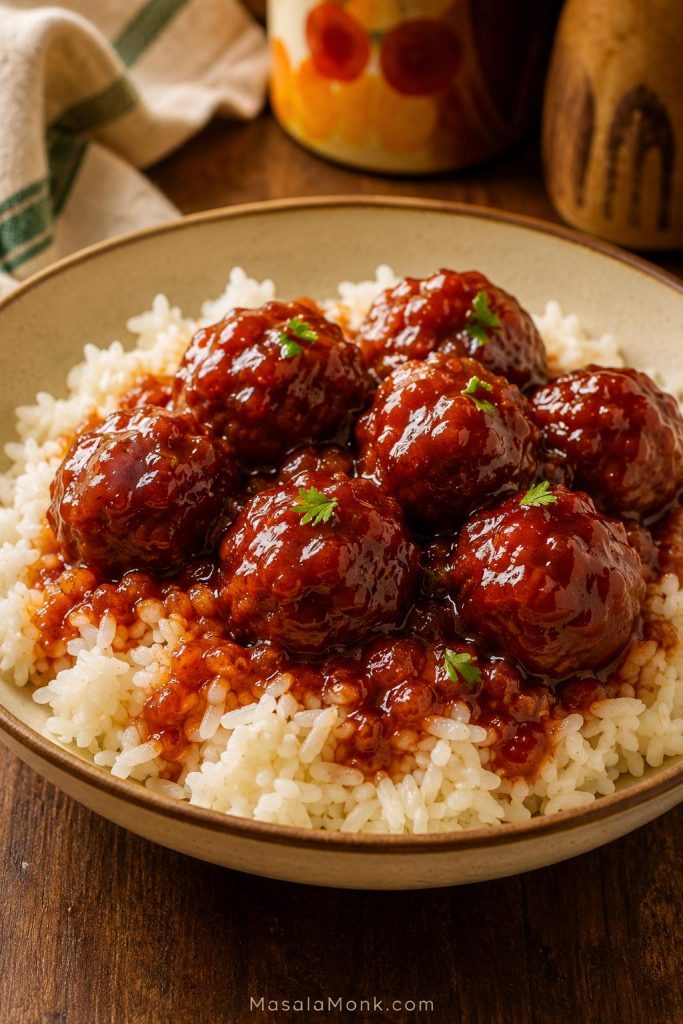
Grape jelly meatballs served over steamed white rice in a shallow bowl with sauce soaking into the rice.
Rice, noodles, or mashed potatoes turn the appetizer into a simple main dish by catching the sweet-tangy sauce.

Because the sauce is bold and a little sweet, it pairs best with something simple and starchy. Rice, potatoes, and noodles all work because they soak it up without competing with it.

Can You Make Grape Jelly Meatballs Ahead?

Yes. You can make grape jelly meatballs ahead for parties, holidays, and game day. Cook the meatballs in the sauce, let them cool, then store them in an airtight container in the fridge.

Before serving, reheat them on the stovetop, in the oven, or in the microwave until hot. Once reheated, move them to the slow cooker on WARM. If the sauce has thickened in the fridge, stir in a splash of water, broth, or BBQ sauce until it loosens again.

Do not ask the slow cooker to bring cold leftovers up to temperature. Reheat first, then use the slow cooker to hold them warm for serving.

You can also mix the grape jelly and chili sauce ahead of time and keep the sauce refrigerated. When ready to cook, add the sauce and meatballs to the slow cooker and continue with the recipe.

For a cold make-ahead appetizer beside the hot meatballs, this cheese ball recipe works well because it can chill while the slow cooker handles the warm food.

Storage, Freezing, and Reheating

Leftovers keep well because the sauce thickens around the meatballs as it chills. Store them in an airtight container in the fridge for 3–4 days.

To freeze, cool the meatballs completely, then freeze them with the sauce in a freezer-safe container for up to 2–3 months. Thaw overnight in the fridge before reheating.

Reheat on the stovetop, in the microwave, or in the oven until hot. The sauce thickens when cold, so do not panic if leftovers look stiff from the fridge. Add a splash of water if needed, then move the meatballs to a slow cooker on WARM if you want to serve them at a party.

FAQs

What are grape jelly meatballs made of?

Classic grape jelly meatballs use fully cooked meatballs, grape jelly, and bottled chili sauce. The jelly gives sweetness and shine, while the chili sauce keeps the sauce tangy instead of candy-sweet.

Why do people put grape jelly in meatballs?

Grape jelly melts into the sauce and acts like the sweet part of a sweet-and-sour glaze. Once it mixes with chili sauce, it tastes more savory-sweet than fruity.

Do grape jelly meatballs taste like grape jelly?

Not exactly. The jelly adds sweetness, shine, and body, but the chili sauce turns the flavor sweet, tangy, and savory instead of jammy.

What kind of chili sauce do you use?

Use American-style bottled chili sauce, usually found near ketchup. It is tomato-based, tangy, and mildly spiced. Do not use chili garlic sauce, Thai sweet chili sauce, or sriracha as a direct replacement.

What is the difference between chili sauce and ketchup in this recipe?

Chili sauce tastes like a tangier, bolder ketchup-style sauce. Ketchup makes the meatballs softer and sweeter, while chili sauce gives the classic version more tomato tang and mild spice.

Can BBQ sauce replace chili sauce?

Yes. Use 1 1/2 to 2 cups BBQ sauce and 1 cup grape jelly for 2 lb / 900 g meatballs. The flavor will be smokier and sweeter.

Does ketchup work instead of chili sauce?

Yes. Use 1 1/2 cups ketchup and 3/4 to 1 cup grape jelly for 2 lb / 900 g meatballs. Add Worcestershire sauce, vinegar, mustard, or chili powder if it tastes too sweet or flat.

Is grape jam okay instead of grape jelly?

Yes. Grape jam has a similar flavor, but it may be thicker and less smooth because it contains more fruit pulp. Add a splash of water if needed.

What can I use instead of grape jelly?

Cranberry sauce, apricot preserves, orange marmalade, raspberry preserves, hot pepper jelly, strawberry jelly, or grape jam can work. Jam and preserves may make the sauce less smooth than jelly.

Do I thaw frozen meatballs first?

Most fully cooked frozen meatballs can go straight into the slow cooker, but check the package instructions. If a brand recommends thawing first, follow the package.

Do Italian meatballs work?

Yes, but homestyle meatballs taste more like the classic party version. Italian meatballs can work, though the herbs and cheese may make the sauce taste more dinner-style.

Should raw meatballs go into this recipe?

This recipe assumes the meatballs are already cooked. Cook raw or homemade meatballs first, then add them to the sauce for heating and coating.

What size slow cooker do I need?

A 4–5 quart slow cooker works well for 2 lb / 900 g meatballs. Use a 6 quart slow cooker for a double batch.

How long do grape jelly meatballs cook in the crockpot?

For a standard 2 lb / 900 g batch, cook on HIGH for 2–3 hours or LOW for 4–5 hours, until the meatballs are hot and the sauce has melted together.

How do I double grape jelly meatballs?

Yes. Use 4 lb / 1.8 kg fully cooked meatballs, 20–24 oz / 560–680 g grape jelly, and 24 oz / 680 g chili sauce. Use a 6 quart slow cooker and stir once or twice.

How do I keep them warm for a party?

Once the meatballs are fully hot, switch the slow cooker to WARM and stir occasionally. If the sauce thickens around the edges, add a splash of water or broth.

How long can grape jelly meatballs stay on WARM?

Once fully hot, they can sit on WARM as long as the slow cooker keeps them hot, ideally at 140°F / 60°C or above. For best texture, serve within 2–4 hours.

How do I make them without a crockpot?

Yes. Simmer them on the stovetop for 15–20 minutes, or bake covered at 350°F / 175°C for 45–60 minutes. You can also use an Instant Pot with added water, then reduce the sauce after pressure cooking.

How do I thicken grape jelly meatball sauce?

Mix 1 teaspoon cornstarch with 1 teaspoon cold water, then stir it into the hot sauce. For a thicker glaze, use 2 teaspoons cornstarch with 2 teaspoons cold water.

How do I make grape jelly meatballs less sweet?

Add chili sauce, vinegar, lemon juice, Dijon mustard, Worcestershire sauce, hot sauce, black pepper, or chili flakes. Add a little at a time and taste before adding more.

Does low-sugar or sugar-free grape jelly work?

Yes, but the sauce may be thinner, less shiny, or slightly sharper. Taste after the jelly melts, then thicken with a cornstarch slurry if needed.

Do homemade meatballs work?

Yes. Cook homemade meatballs first, then add them to the grape jelly sauce. Frozen fully cooked meatballs are easier for parties, but homemade meatballs give you more control over texture.

Can Little Smokies replace the meatballs?

Yes. Use 2–3 lb Little Smokies or cocktail sausages with the same sauce, then cook until hot and coated. They will taste saltier and snappier than meatballs.

What do you serve with grape jelly meatballs?

For parties, serve them with toothpicks, slider buns, chips and dip, pickles, raw vegetables, or a cheese board. For dinner, spoon them over rice, mashed potatoes, egg noodles, or macaroni and cheese.

Can you freeze grape jelly meatballs?

Yes. Cool them completely, then freeze with the sauce in a freezer-safe container for up to 2–3 months. Thaw overnight in the fridge and reheat until hot.

Final Thoughts

The easiest ratio to remember is simple: 2 lb meatballs, 10–12 oz grape jelly, and 12 oz bottled chili sauce. Let the jelly melt fully, then taste before adjusting.

Once you know that base, the rest is easy: more jelly for sweetness, BBQ sauce for smoke, vinegar or mustard for tang, and a splash of water if the sauce gets too thick. It is not a fancy appetizer, and that is exactly why it works: people know what to do with it, the slow cooker keeps it ready, and the bowl usually empties before anyone admits how simple it was.
Back to top ↑

Posted on Leave a comment

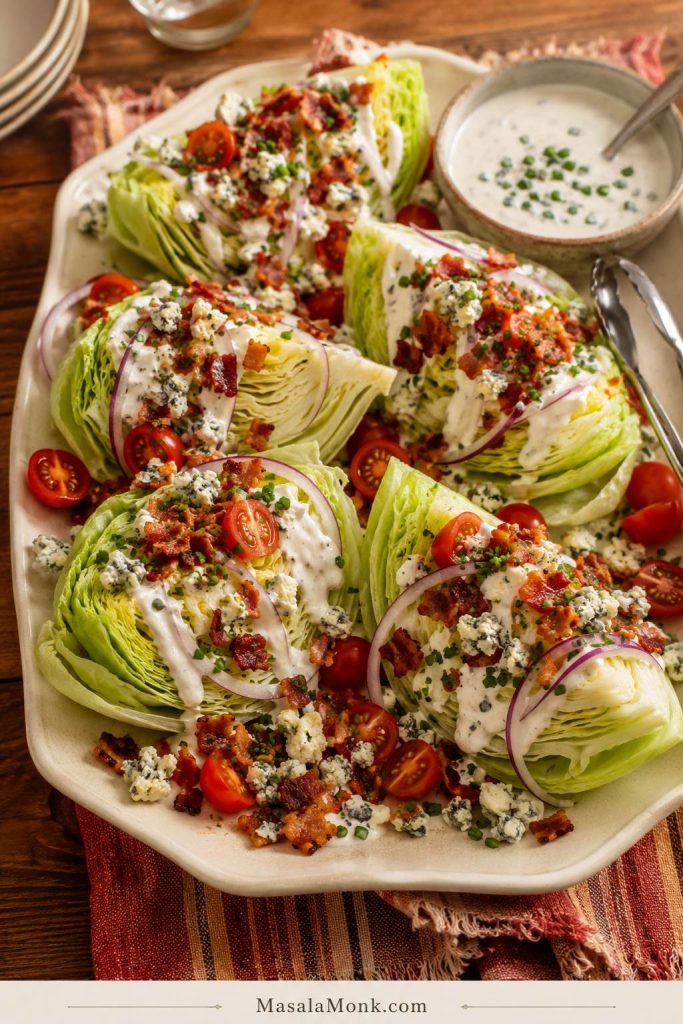
Wedge Salad Recipe: Classic Iceberg Wedge with Blue Cheese, Bacon & Ranch Variations

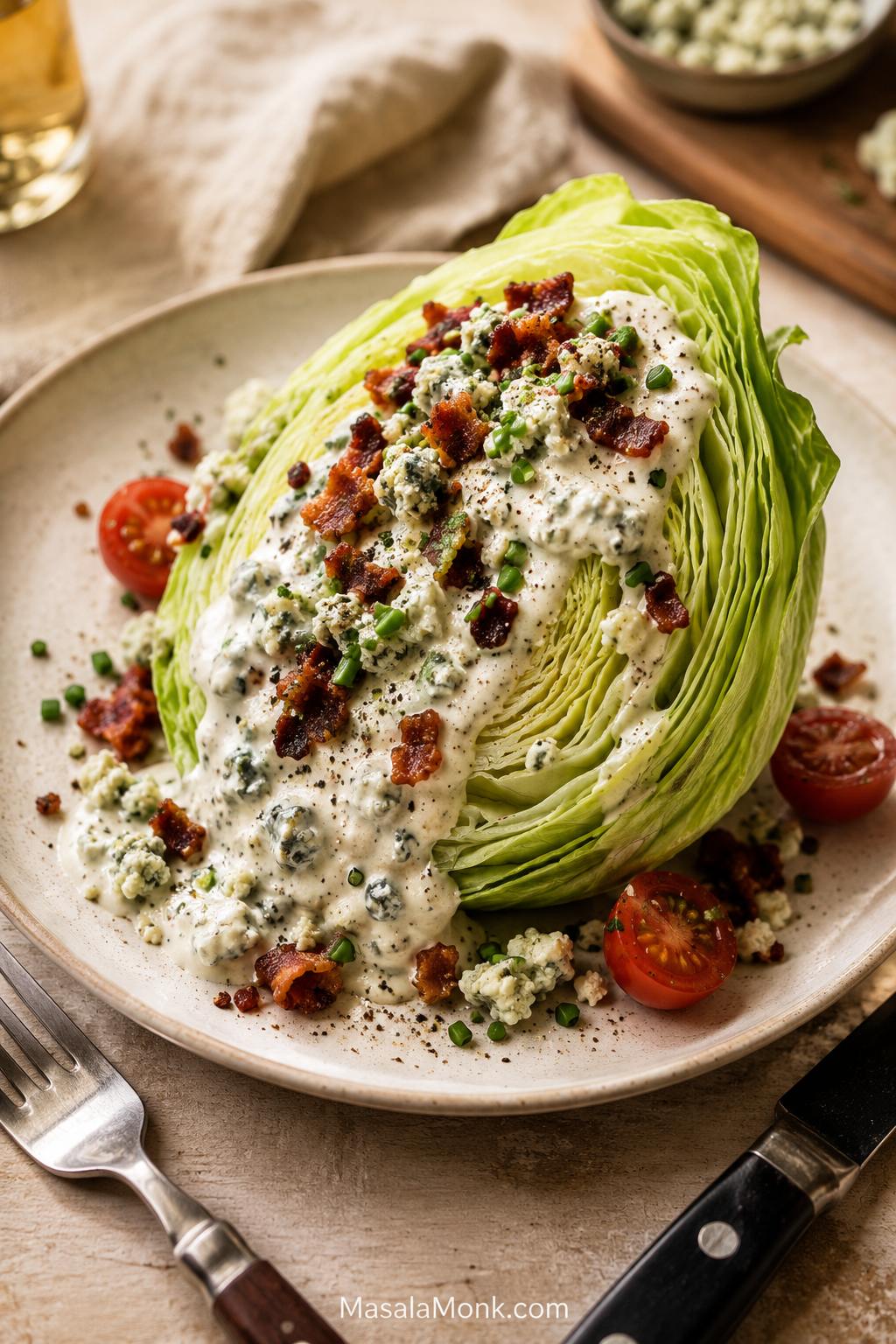
Iceberg lettuce wedge on a cream plate with blue cheese dressing, bacon, cherry tomatoes, chives, blue cheese crumbles, black pepper, and a fork and knife nearby.

A wedge salad is funny because it looks almost too simple: a quarter of iceberg lettuce, a spoonful of dressing, and a few toppings. Then you cut into it and remember why steakhouses never let it disappear.

The lettuce snaps cold under the knife, the dressing settles into the layers, the bacon hits salty and crisp, and suddenly the plainest lettuce in the fridge feels like the best side on the table.

A wedge salad is not a tossed salad. It is a cold, knife-and-fork salad where the details matter: dry lettuce, thick dressing, crisp bacon, and toppings small enough to stay put. The trick is not doing more; it is doing those simple things properly.

What Makes a Good Wedge Salad?

Most disappointing wedge salads fail for the same reason: wet lettuce, thin dressing, warm bacon, and toppings that slide off. This version fixes those small things first, so the salad stays crunchy, creamy, and easy to eat.

This is the kind of recipe to keep in your back pocket for nights when you want a salad that feels special without making the meal harder. Start with the blue cheese wedge salad, then use the ranch, Outback-style, chopped, grilled, keto, vegetarian, no-bacon, and no-blue-cheese options whenever you want a slightly different version.

It also looks more impressive than the work it takes, which is exactly why it is such a good starter for guests, burger nights, steak dinners, and summer meals from the grill.

Make it now: Cut 1 cold iceberg head into 4 wedges. Make or choose a thick blue cheese or ranch dressing, then top each wedge with crisp cooled bacon, small tomatoes, fine onion or chives, blue cheese crumbles, and black pepper. Keep a little core attached, dry the lettuce well, and dress just before serving. Serves: 4 large wedges. Total time: about 30–40 minutes.
What matters most: Dry lettuce, spoonable dressing, cooled bacon, and toppings chopped small enough to stay on the wedge. That is the difference between a crisp steakhouse-style salad and a plate that slides apart.

If you are building a fresh salad spread, this sits nicely next to a crisp cucumber salad or a colorful beet salad.

Quick Answer: What Is a Wedge Salad?

A wedge salad is a cold quarter of iceberg lettuce topped with creamy dressing, crisp bacon, tomatoes, onion or chives, blue cheese crumbles, and black pepper. It is usually served as a knife-and-fork salad, which is part of its old-school charm.

Blue cheese dressing is traditional, while ranch is the easiest milder swap. Iceberg works because it stays crunchy and sturdy under creamy dressing and toppings.

Start here: Choose the blue cheese version for steakhouse flavor, ranch for a milder family version, and balsamic glaze when you want that sweet-tangy Outback-style finish.

Why This Recipe Works

The salad works because the textures stay in balance: crisp iceberg, creamy dressing, salty bacon, juicy tomatoes, and a sharp little finish from onion and blue cheese.

That is why a good wedge salad never feels like a sad side salad. It is fresh enough to reset the plate and rich enough to belong beside burgers, steak, grilled chicken, or a baked potato.

  • Iceberg brings the snap. Its tight layers hold the wedge shape and stand up to a rich dressing.
  • The dressing grips the layers. It should fall from a spoon in thick ribbons, not pour like milk.
  • Crisp bacon gives salty crunch. Soft bacon disappears, but crisp bits make every bite better.
  • The toppings are small on purpose. Think confetti, not chunks.
  • Everything comes together at the end. Last-minute assembly keeps the wedge fresh instead of soggy.
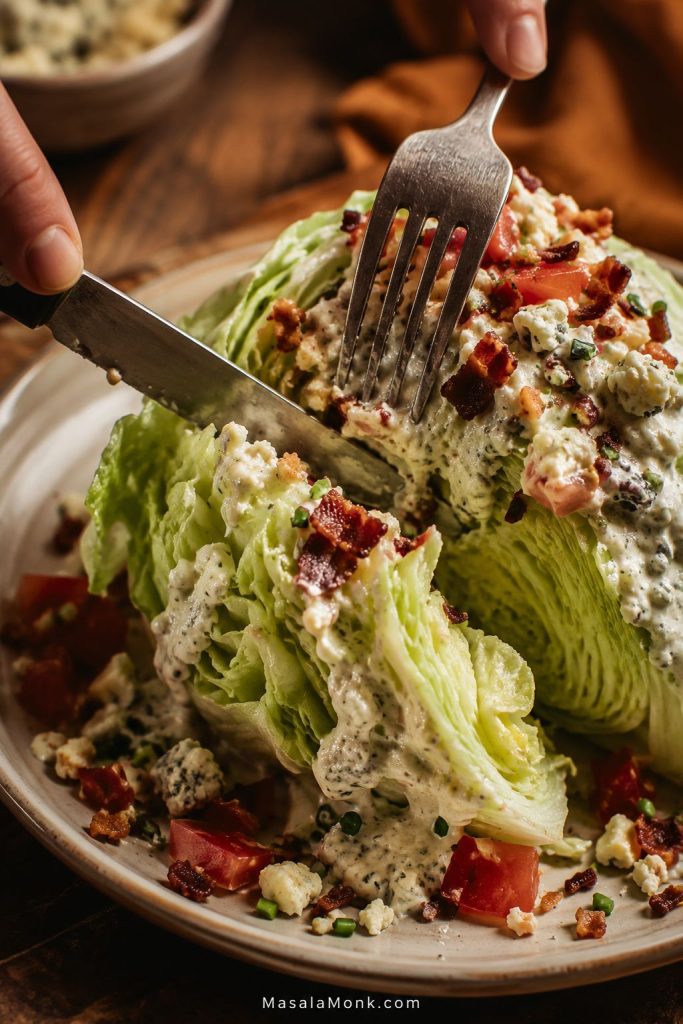
Fork and knife cutting into a dressed iceberg wedge salad with visible lettuce layers, blue cheese dressing, bacon, tomatoes, and crumbles.
Cut straight down through the iceberg layers so each bite gets cold lettuce, creamy dressing, bacon, tomato, and blue cheese together.

What Makes It Taste Like the One You’d Order Out?

A great wedge salad is cold, neat, generous, and balanced. The lettuce is chilled, the dressing is thick enough to coat, the bacon is crisp but not hot, and the toppings stay where they belong.

  • Use cold plates if you can. They help the iceberg stay crisp longer.
  • Dress the cut sides, not just the top. A little dressing in the layers makes better bites.
  • Add toppings after the dressing. The dressing helps hold bacon, tomatoes, onion, and crumbles in place.
  • Finish with black pepper. It cuts through the creamy dressing and sharpens the whole salad.

Wedge Salad Ingredients

The ingredient list is short, so each part has to earn its place.

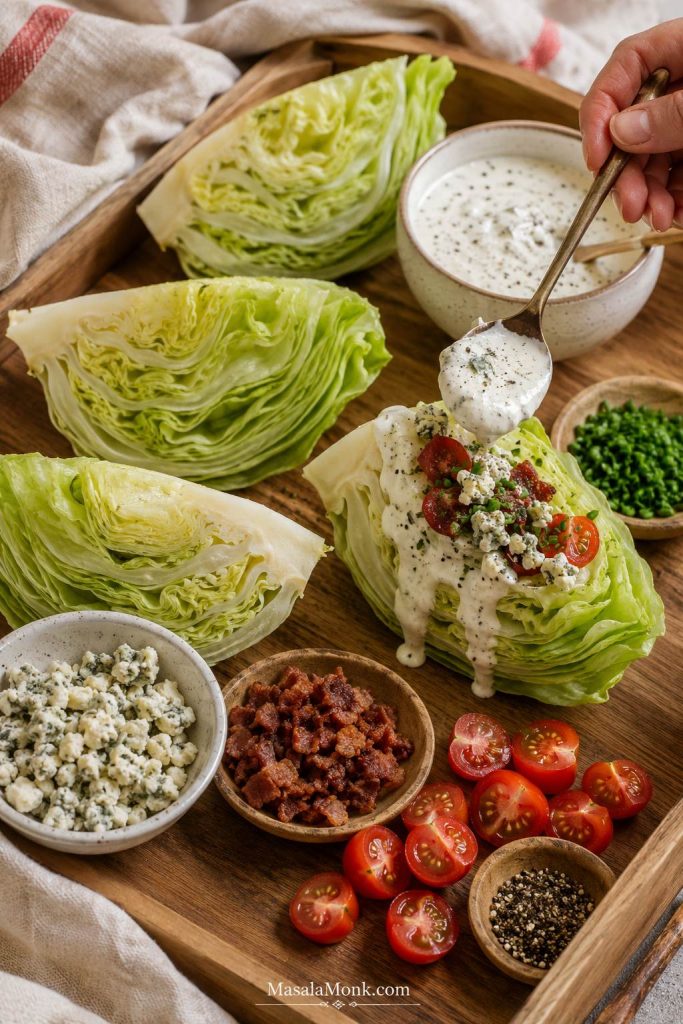
Iceberg lettuce wedges on a wooden tray with blue cheese dressing, bacon bits, cherry tomatoes, chives, blue cheese crumbles, black pepper, and one wedge being dressed.
Prep the wedge salad ingredients like a small station: dry iceberg wedges, thick dressing, crisp bacon, tomatoes, chives, blue cheese crumbles, and pepper. Then assembly stays fast and clean.

Iceberg Lettuce

Iceberg is the heart of the recipe. It is crisp, mild, refreshing, and sturdy enough to cut into wedges. One medium head gives you 4 large wedges or 6 smaller starter wedges.

Look for a head that feels heavy for its size, with tight leaves and no slimy or brown patches.

Bacon

Thick-cut bacon gives the strongest salty crunch. Cook it until crisp, drain it well, and chop it small so the bits catch in the dressing instead of sliding off the plate.

You can also cook the bacon in the oven. Arrange it on a lined sheet pan and bake at 400°F / 200°C until crisp, usually 15–20 minutes depending on thickness.

Let the bacon cool before adding it. Warm bacon fat can soften the lettuce and loosen the dressing.

Tomatoes

Cherry or grape tomatoes are the easiest win here: sweet, tidy, easy to halve, and less likely to flood the plate than large chopped tomatoes.

If they are very juicy, sprinkle them lightly with salt and let them drain for 5–10 minutes before adding them to the salad. This keeps the finished plate fresher and cleaner.

Red Onion, Chives, or Scallions

Red onion gives a sharp bite, but it can be strong. Dice it finely, or soak it briefly in cold water for a milder flavor.

Chives are the gentlest option. Scallions are fresh and easy, with a little more bite than chives but less intensity than red onion.

Blue Cheese Dressing

Blue cheese, sometimes written as bleu cheese on steakhouse menus, is the classic flavor for a wedge. For the best version, the dressing should sit on the lettuce, not run away from it.

Blue Cheese Crumbles

Extra crumbles make the salad feel richer and more old-school. Use a creamy, tangy blue cheese if you like a smoother bite, or a sharper blue cheese if you want more punch. Either way, use it lightly so the flavor stays balanced.

Shopping note: If you are making the dressing and adding extra crumbles on top, buy about 3–4 oz / 85–115 g blue cheese total.

Black Pepper

Freshly cracked black pepper cuts through the creamy dressing and gives the finished salad a little bite.

Optional Toppings

Balsamic glaze, avocado, hard-boiled egg, cucumber, crispy breadcrumbs, fried shallots, grilled chicken, steak strips, shrimp, croutons, roasted chickpeas, and toasted nuts all work well.

Easy topping rule: Choose one creamy element, one salty or crunchy element, one juicy element, and one sharp or fresh element. That is usually enough.

The Best Lettuce to Use

Iceberg is the classic choice because it has tight layers, clean crunch, and enough structure to hold dressing and toppings. Softer greens can taste good, but they collapse faster.

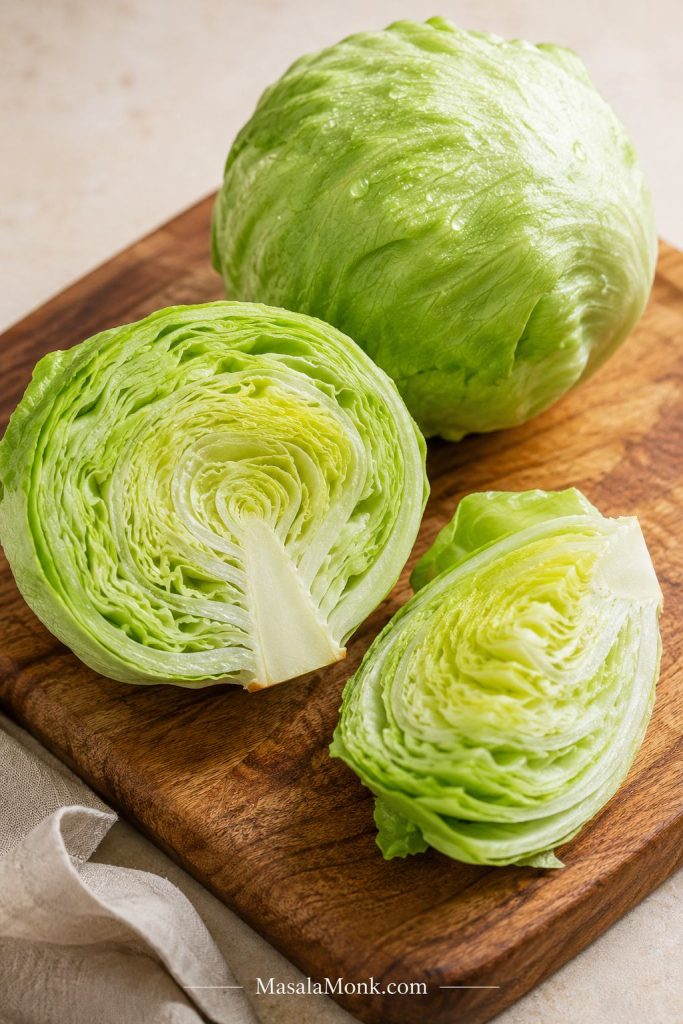
Whole iceberg lettuce, a halved iceberg head, and a quarter wedge on a wooden board showing the tight inner layers and core.
Iceberg lettuce works best because it stays cold, crisp, and structured. Softer greens collapse faster under creamy dressing and toppings.
  • Iceberg lettuce: the most reliable choice because it is crisp, sturdy, and tightly layered.
  • Romaine hearts: good for grilled wedge salads or Caesar-style wedges.
  • Little gem lettuce: useful for mini wedges or appetizer-style servings.
  • Butter lettuce or green leaf lettuce: better for tossed salads than wedge salads because they are softer.

For the main version, iceberg is still the one to buy. Romaine can work if you want a grilled or Caesar-style variation, but iceberg gives the true chilled crunch.

How to Wash and Cut Iceberg Lettuce for Wedge Salad

The wedge holds together because you cut through the core, not around it. Remove the core too early and the leaves can fall apart before they ever reach the plate.

Hands using a chef’s knife to cut iceberg lettuce through the core on a wooden cutting board.
When cutting iceberg lettuce, slice through the core first. That small anchor keeps each wedge from opening up before it reaches the plate.
  1. Remove damaged or wilted outer leaves.
  2. Rinse the outside of the iceberg head under cold water.
  3. Pat the outside dry with a clean towel.
  4. Trim only the brown end of the stem if needed.
  5. Place the lettuce on a cutting board with the core facing down.
  6. Cut the head in half through the core.
  7. Cut each half through the core again to make 4 wedges.
  8. Keep a small part of the core attached so each wedge holds together.
  9. Gently rinse between the layers only if needed.
  10. Drain the wedges cut-side down.
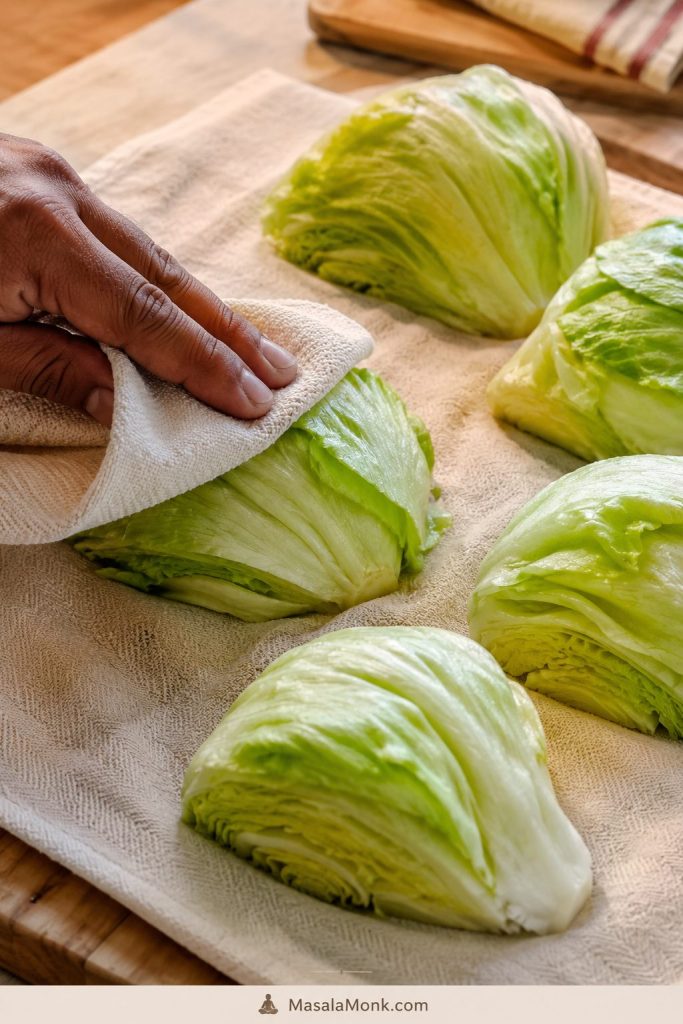
  11. Pat very dry with paper towels or a clean kitchen towel.
  12. Chill until you are ready to assemble.
Important: Keep a little core attached while cutting the wedges. Once each wedge is on the plate, you can trim away the hard inner piece if needed.

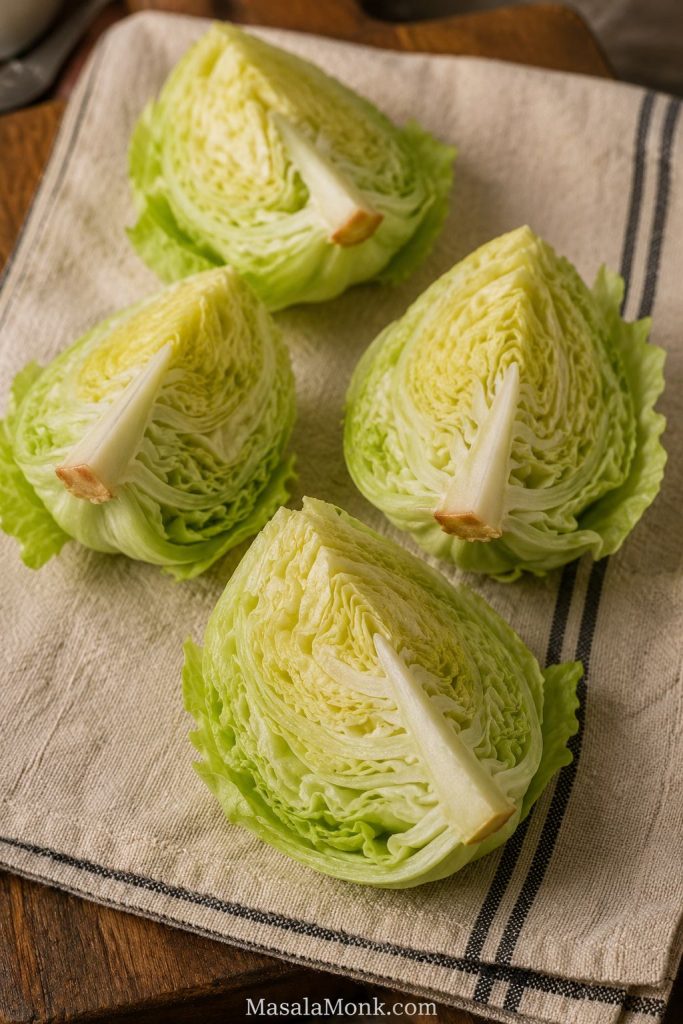
Core Attached Cue

Use this visual check after cutting: each iceberg wedge should still have enough core to hold the layers together, but not so much that the hard center dominates the bite.

Four iceberg lettuce wedges resting on a towel with a small piece of core still attached to each wedge.
Leave a little core attached until serving. It keeps the iceberg wedge neat while you dry the lettuce, move it, and add dressing.

If the lettuce already looks clean inside, avoid forcing water deep between every layer. Rinse what needs rinsing, dry it well, and keep the wedges cold.

Quick produce note: rinse lettuce under plain running water. The FDA also advises skipping soap or produce wash for fruits and vegetables.

The Dressing Should Be Thick, Not Runny

Blue cheese dressing gives this version its creamy, tangy steakhouse flavor. Texture matters as much as taste here.

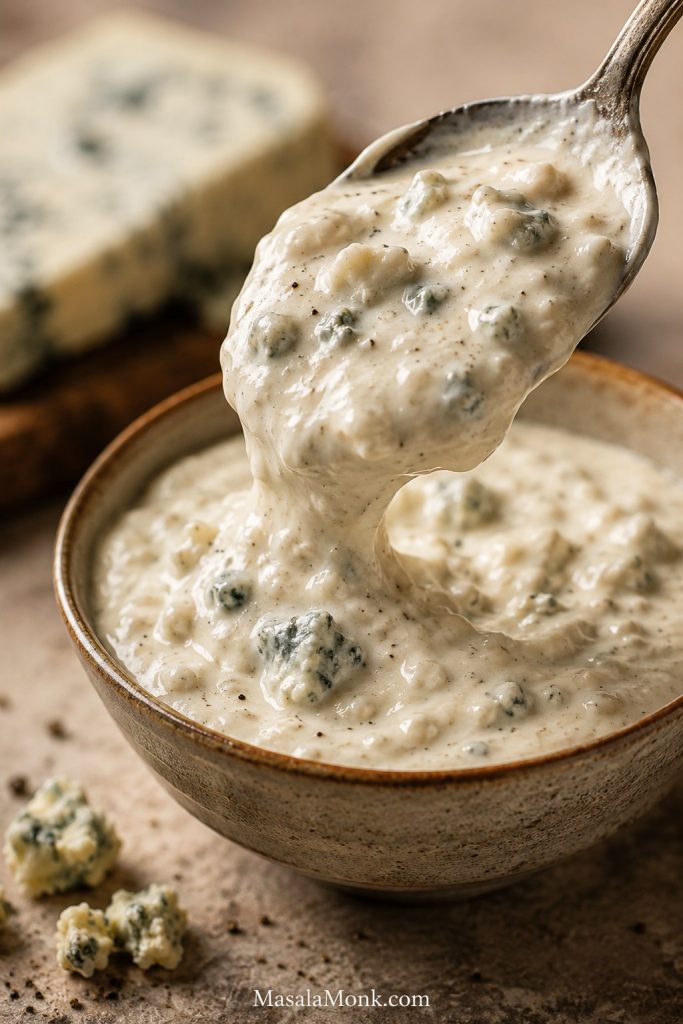
Think creamy dressing, not pourable dressing. It should fall from a spoon in thick ribbons. Add milk or buttermilk one tablespoon at a time, because it is much easier to thin a thick dressing than rescue a watery one.

Spoon lifting thick, chunky blue cheese dressing from a ceramic bowl with visible blue cheese pieces.
For blue cheese wedge salad, texture matters as much as flavor. Thick, spoonable dressing coats the lettuce instead of running off.

Blue Cheese Dressing Ingredients

Ingredient US Measure Metric
Sour cream ½ cup 120 g
Mayonnaise ¼ cup 55 g
Buttermilk or milk 2–3 tbsp 30–45 ml
Lemon juice or red wine vinegar 1½–2 tsp 7–10 ml
Worcestershire sauce ½ tsp 2–3 ml
Garlic powder ¼ tsp About 1 g
Freshly cracked black pepper ¼–½ tsp 1–2 g
Blue cheese, crumbled 2 oz 56 g
Salt To taste, optional To taste

How to Make the Dressing

Whisk together the sour cream, mayonnaise, buttermilk or milk, lemon juice or vinegar, Worcestershire sauce, garlic powder, and black pepper. Stir in the crumbled blue cheese.

For a smoother dressing, mash some of the cheese into the mixture with the back of a spoon. For a chunkier version, fold the crumbles in gently at the end.

Chill the dressing for 20–30 minutes before serving. If it becomes too thick in the fridge, loosen it with a small splash of buttermilk or milk.

To soften a sharp dressing, add a spoonful more sour cream. For a flat dressing, add a little more lemon juice or black pepper. Taste before adding salt, because blue cheese varies a lot; add only a small pinch if needed.

This makes about 1 to 1¼ cups dressing. Start with ¾ cup for the salad and serve extra on the side if needed.

If you use store-bought dressing, choose a thick one, preferably refrigerated. To make it taste fresher, stir in black pepper, a squeeze of lemon, and a spoonful of blue cheese crumbles. Thin bottled dressing is better served on the side; a wedge needs dressing with some body.

No buttermilk? Use regular milk with a small squeeze of lemon juice, or use milk alone and adjust the tang with lemon juice or vinegar.
No blue cheese? Use ranch, creamy garlic dressing, buttermilk herb dressing, green goddess, or Caesar dressing instead.

How to Make Wedge Salad

Once the lettuce, dressing, bacon, and toppings are ready, assembly takes only a few minutes.

1. Make the Dressing

Whisk together the blue cheese dressing ingredients and chill the dressing for 20–30 minutes. This gives it better flavor and a colder, creamier texture.

2. Cook the Bacon

Cook the bacon in a skillet over medium heat until crisp, about 8–10 minutes. Transfer it to paper towels to drain, then chop or crumble it. Let it cool before it touches the lettuce.

3. Prepare the Toppings

Halve the tomatoes, finely dice the onion, chop the chives, and crumble the blue cheese. If the tomatoes are juicy, salt and drain them for a few minutes.

4. Wash, Dry, and Cut the Lettuce

Cut the iceberg through the core into wedges. Rinse only as needed, drain well, pat dry, and keep the wedges chilled until serving.

5. Plate the Wedges

Place one cold wedge on each plate. Trim the hard core if needed, but keep the wedge intact.

6. Add Dressing and Toppings

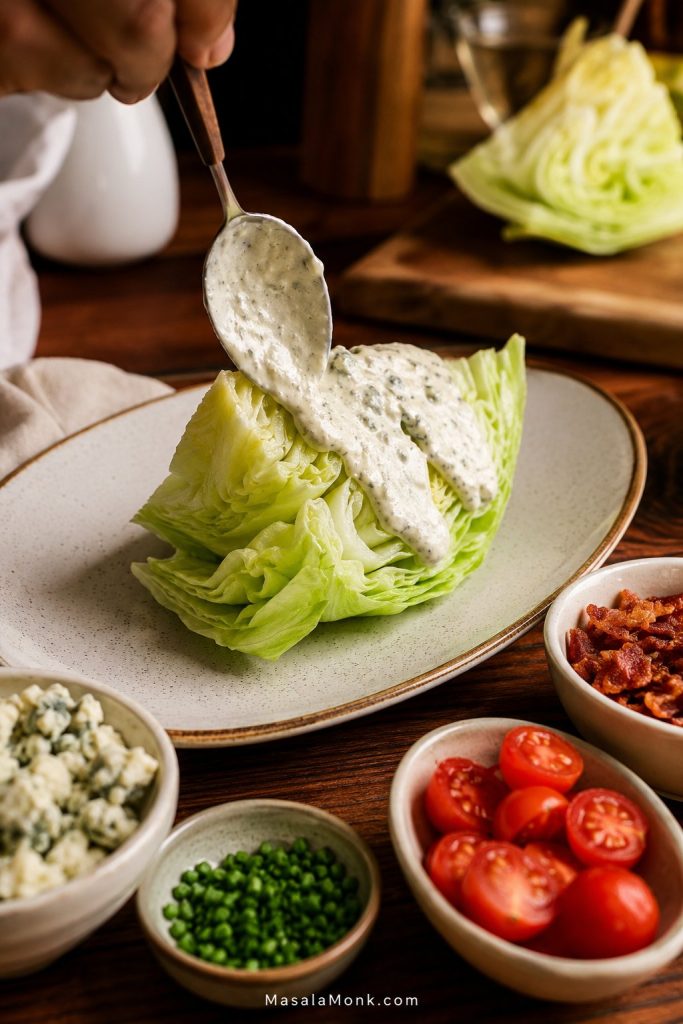
Spoon the dressing over each wedge. Add bacon, tomatoes, red onion or chives, blue cheese crumbles, and black pepper.

Hand spooning thick blue cheese dressing over an iceberg wedge before adding bacon, tomatoes, chives, and blue cheese crumbles.
Add dressing first, then toppings. The creamy layer catches bacon, tomatoes, onion, chives, and blue cheese crumbles before they slide away.

7. Serve Immediately

Serve as soon as it is dressed, before the lettuce starts to soften.

How to Plate It So It Looks Good

Place each wedge with one cut side facing up. Spoon dressing over the top and into the layers, then add toppings while the dressing is still sitting on the lettuce. Finish with pepper and chives.

Recipe Card: Wedge Salad Recipe

Wedge Salad with Iceberg Lettuce, Bacon & Blue Cheese Dressing

A crisp steakhouse-style wedge salad with cold iceberg lettuce, thick blue cheese dressing, smoky bacon, juicy tomatoes, chives, and extra crumbles — simple enough for weeknights, polished enough for steak night.

Servings:
4 large side salads
Active Prep Time:
About 20 minutes
Cook Time:
8–10 minutes
Chill Time:
20–30 minutes, while you prep
Total Time:
About 30–40 minutes
Course:
Salad, Side Dish, Starter
Cuisine:
American, Steakhouse-style
Serve It:
Cold and freshly assembled

Equipment

  • Chef’s knife
  • Cutting board
  • Mixing bowl
  • Whisk
  • Skillet or sheet pan for bacon
  • Paper towels or clean kitchen towel
  • Serving plates
  • Optional: small saucepan for balsamic glaze

Ingredients for the Salad

Ingredient US Measure Metric
Iceberg lettuce 1 medium head About 500–700 g
Thick-cut bacon 4–6 strips About 115–170 g raw
Cherry or grape tomatoes, halved 1–1½ cups 150–225 g
Red onion, finely diced ¼ cup 35–40 g
Chives or scallions, chopped 2 tbsp About 6 g
Blue cheese crumbles 1–2 oz 28–56 g
Blue cheese dressing, recipe below ¾–1 cup 180–240 ml
Freshly cracked black pepper To taste To taste

Ingredients for the Blue Cheese Dressing

Ingredient US Measure Metric
Sour cream ½ cup 120 g
Mayonnaise ¼ cup 55 g
Buttermilk or milk 2–3 tbsp 30–45 ml
Lemon juice or red wine vinegar 1½–2 tsp 7–10 ml
Worcestershire sauce ½ tsp 2–3 ml
Garlic powder ¼ tsp About 1 g
Freshly cracked black pepper ¼–½ tsp 1–2 g
Blue cheese, crumbled 2 oz 56 g
Salt To taste, optional To taste

Instructions

  1. Make the dressing. In a bowl, whisk together sour cream, mayonnaise, buttermilk or milk, lemon juice or vinegar, Worcestershire sauce, garlic powder, and black pepper. Stir in the crumbled blue cheese.
  2. Chill the dressing. Refrigerate for 20–30 minutes. If it becomes too thick, loosen it with a small splash of buttermilk or milk. Taste before adding salt.
  3. Cook the bacon. Cook bacon in a skillet over medium heat until crisp, about 8–10 minutes, or bake at 400°F / 200°C until crisp, about 15–20 minutes. Drain, crumble, and let it cool.
  4. Prep the toppings. Halve the tomatoes, finely dice the onion, chop the chives, and crumble extra blue cheese. If the tomatoes are very juicy, salt and drain them for 5–10 minutes.
  5. Prepare the lettuce. Remove damaged outer leaves from the iceberg. Rinse, dry, and cut through the core into 4 wedges. Keep a little core attached so each wedge holds together.
  6. Plate the wedges. Place one cold lettuce wedge on each plate. Trim the hard core if needed.
  7. Add dressing. Spoon blue cheese dressing over each wedge and into the layers.
  8. Add toppings. Sprinkle with bacon, tomatoes, onion or chives, blue cheese crumbles, and black pepper.
  9. Serve immediately. Serve while the lettuce is still cold and crisp.

Recipe Notes

  • Use thick ranch instead of blue cheese dressing for a milder version.
  • Add a light drizzle of balsamic glaze for the Outback-style finish.
  • Chop the iceberg for bowls, potlucks, or easier eating.
  • Briefly grill the wedges for a smoky summer side.
  • For keto, skip sweet glaze or use only a tiny drizzle.
  • For vegetarian, replace bacon with crispy chickpeas, fried onions, smoked almonds, or toasted breadcrumbs.

How to Keep the Salad from Getting Watery

The fastest way to make a wedge salad disappointing is to let water sneak in. Wet lettuce, juicy tomatoes, and thin dressing all work against that cold crunch.

Cut iceberg lettuce wedges drying on a cream towel while a hand pats one wedge dry.
Dry iceberg is the quiet trick behind a better wedge salad. Water between the layers thins the dressing and makes the plate messy.
Problem Likely Cause Fix
Dressing slides off Lettuce is wet Pat the wedges dry and chill them before serving.
Salad tastes watery Tomatoes are too juicy Salt and drain tomatoes for 5–10 minutes.
Wedge falls apart Core was removed too early Cut through the core and trim only after plating if needed.
Toppings roll off Pieces are too large Chop bacon, onion, and tomatoes smaller.
Bacon softens Salad was assembled too early or bacon was added warm Cool the bacon and add it right before serving.
Dressing pools on the plate Dressing is too thin Use less milk or buttermilk, or stir in more sour cream.

Thick vs Thin Dressing Test

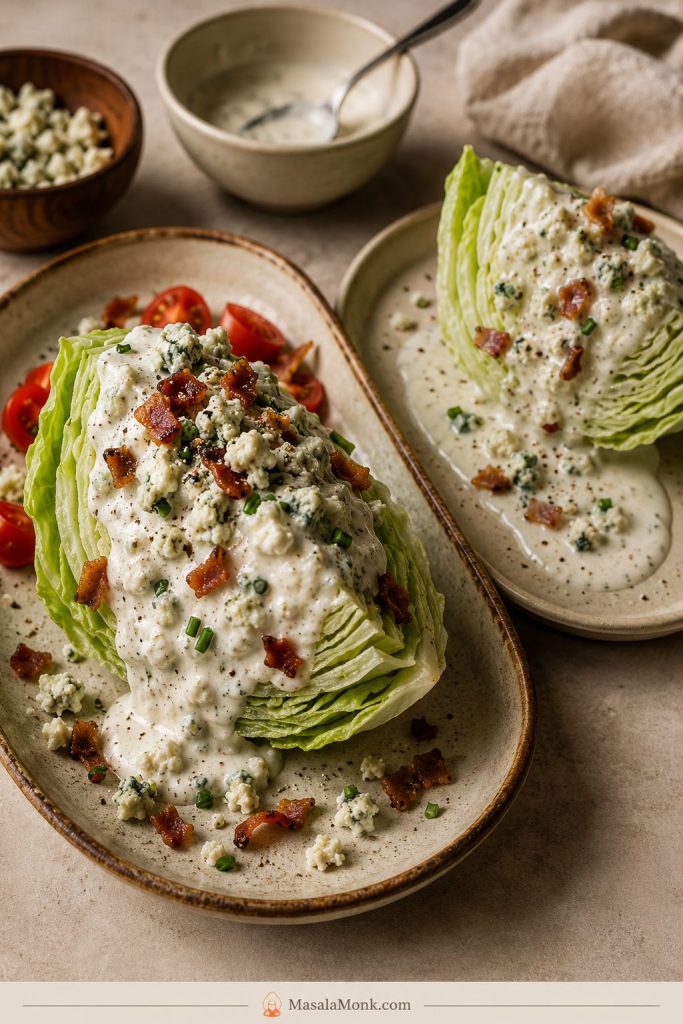
Use this cue before serving: thick dressing should sit on the iceberg wedge, while thin dressing will run down the layers and collect on the plate.

Two plated iceberg wedge salads showing thick dressing clinging to one wedge and thinner dressing pooling around another wedge.
Use this dressing test: thick dressing sits on the wedge, while thin dressing runs down the sides. Add milk or buttermilk slowly.

Get those details right and the salad stays crisp instead of sliding apart on the plate.

Simple rule: Make the components ahead, but do not dress the lettuce until you are ready to serve.

Toppings That Actually Stay Put

This is where the wedge becomes fun. Keep it old-school with bacon and blue cheese, make it fresher with cucumber and avocado, or turn it into lunch with chicken, shrimp, egg, or crispy chickpeas.

Choose one direction first: steakhouse, fresh, crunchy, meal-worthy, lighter, or spicy. That keeps the salad balanced instead of overloaded.

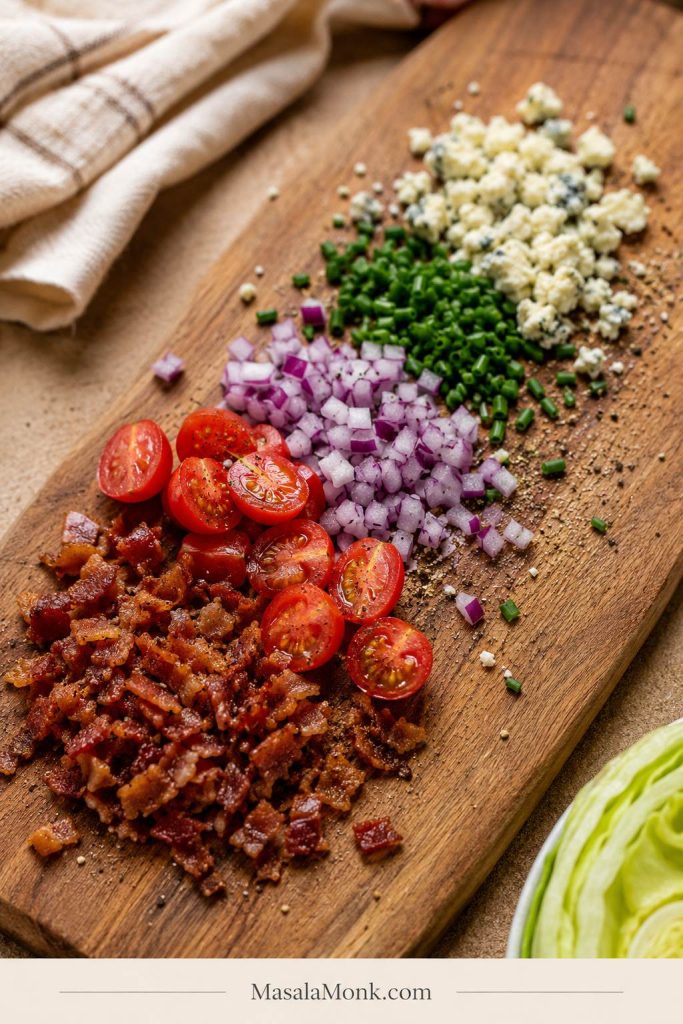
Small bacon bits, halved cherry tomatoes, diced red onion, chopped chives, blue cheese crumbles, and black pepper arranged on a wooden board.
For wedge salad toppings, smaller is better. Bacon bits, halved tomatoes, diced onion, chives, and crumbles cling better than large pieces.
Style Topping Ideas
Classic Bacon, tomatoes, red onion, chives, blue cheese crumbles
Steakhouse Balsamic glaze, cracked pepper, fried shallots, extra blue cheese
Crunchy Croutons, toasted breadcrumbs, fried onions, smoked almonds
Make it a meal Grilled chicken, steak strips, shrimp, hard-boiled egg
Fresh Cucumber, avocado, radish, herbs, scallions
Vegetarian Crispy chickpeas, toasted nuts, avocado, roasted corn
Lighter Greek yogurt dressing, turkey bacon, extra tomatoes, cucumber
Spicy Jalapeños, spicy ranch, chili crisp, hot honey drizzle

The goal is not to pile on everything. The goal is to make each bite feel complete: creamy, crunchy, juicy, salty, and fresh.

If you want the salad to eat more like lunch, chickpeas are an easy add-in. For that direction, this chickpea salad recipe is a useful companion.

Wedge Salad Variations

The main version is the one to learn first. After that, the variations are just swaps: change the dressing, add glaze, chop the lettuce, grill the cut sides, or build everything on a platter.

Not sure which version to make? Make blue cheese for the classic steakhouse flavor, ranch for a milder family version, chopped for easier eating, grilled for smoky edges, and Outback-style when you want a sweet-tangy balsamic finish.

Ranch Wedge Salad

Ranch is the easiest alternative if you do not like blue cheese. Start with a thicker ranch base and loosen it slowly; thin ranch slips off before you get a good bite.

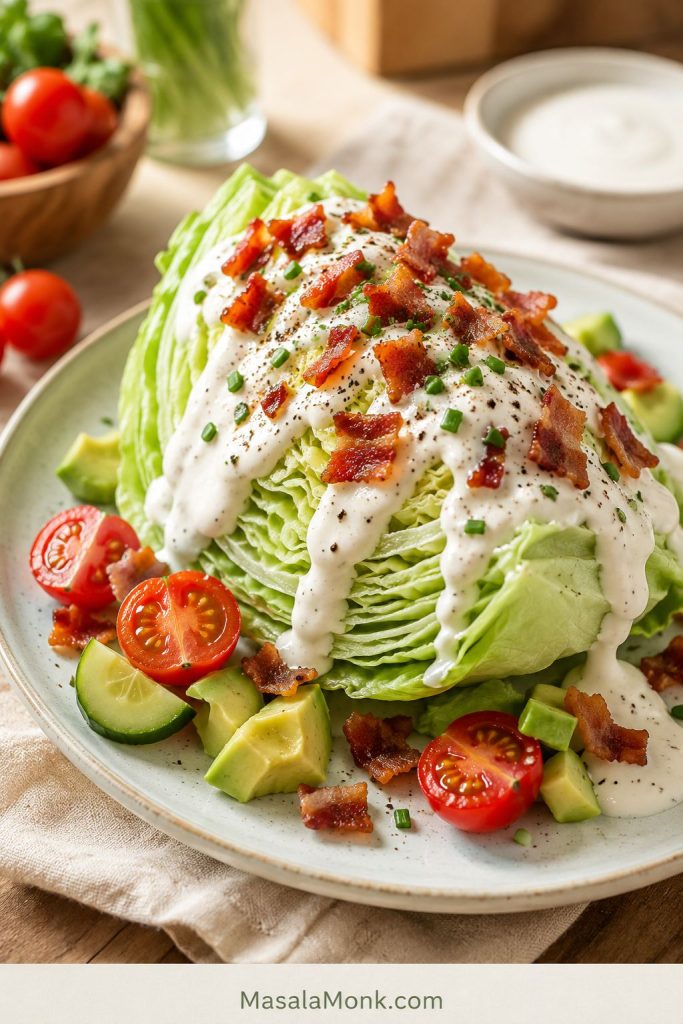
Iceberg wedge salad with ranch dressing, bacon, cherry tomatoes, cucumber, chives, avocado pieces, and black pepper on a light plate.
Ranch wedge salad is the easy no-blue-cheese version. Use thick ranch, then add bacon, tomatoes, cucumber, chives, avocado, and pepper.
Quick Ranch Ingredient US Measure Metric
Sour cream ½ cup 120 g
Mayonnaise ¼ cup 55 g
Buttermilk ¼ cup, plus more as needed 60 ml, plus more as needed
Lemon juice 2 tsp 10 ml
Garlic powder 1 tsp 3 g
Dried dill 1–1½ tsp 1–2 g
Chives 2 tbsp About 6 g
Salt ½ tsp 3 g
Black pepper To taste To taste

Whisk everything together and chill before using. Add more buttermilk one tablespoon at a time until the ranch is spoonable. For a fresh ranch version, top the iceberg with bacon, tomatoes, chives, cucumber, black pepper, and optional avocado.

Outback-Style Blue Cheese Wedge Salad with Balsamic Glaze

This is not the official restaurant recipe. It is a home-style version built around the same steakhouse idea: iceberg lettuce, blue cheese dressing, bacon, tomatoes, red onion, crumbles, and a light balsamic glaze drizzle.

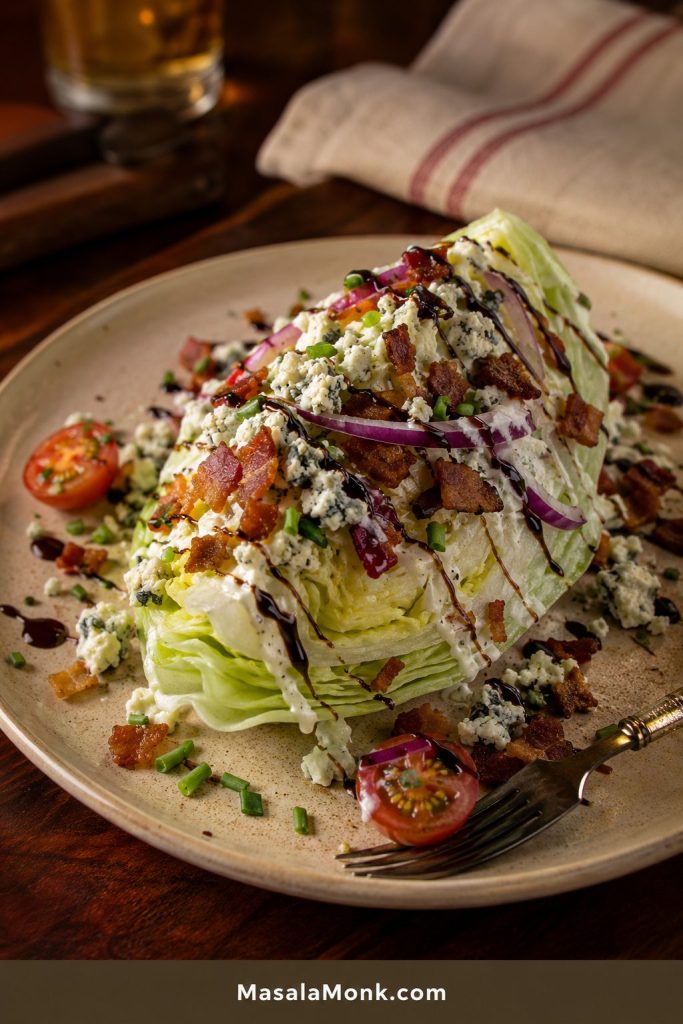
Outback-style iceberg wedge salad with blue cheese dressing, bacon, tomatoes, red onion, blue cheese crumbles, chives, and thin balsamic glaze lines.
An Outback-style wedge salad gets its steakhouse finish from balsamic glaze. Keep the drizzle thin so it brightens the blue cheese dressing without taking over.
Balsamic Glaze Ingredient US Measure Metric
Balsamic vinegar ½ cup 120 ml
Brown sugar or honey 2 tbsp 25 g brown sugar or 30 ml honey
Salt Pinch Pinch

Simmer the balsamic vinegar, sugar or honey, and salt over medium-low heat for 5–8 minutes, until it lightly coats the back of a spoon. Let it cool for a few minutes, then drizzle lightly over the finished salad.

This makes more glaze than you need for 4 wedges. Drizzle it last in thin lines, not a heavy pour. Balsamic glaze is a drizzle, not a sauce; too much makes the salad sweet, sticky, and heavy.

Chopped Wedge Salad

A chopped version uses the same ingredients but cuts the iceberg into bite-size pieces. It is easier to eat, easier to pack into bowls, and often the better choice if a full wedge feels awkward.

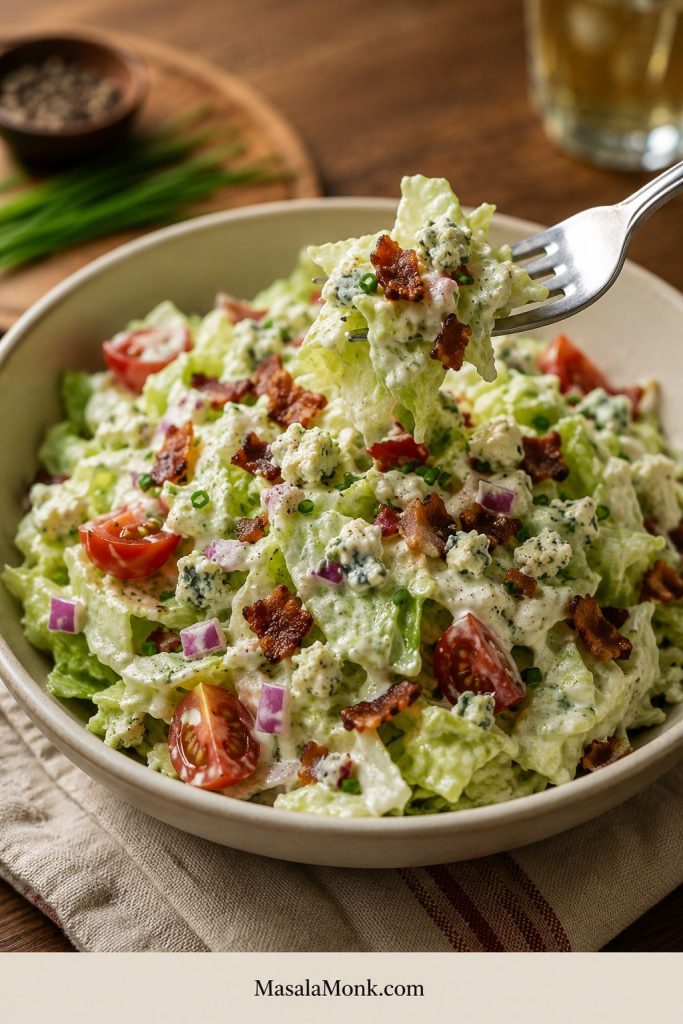
Chopped wedge salad in a shallow bowl with iceberg lettuce, bacon, tomatoes, red onion, chives, blue cheese crumbles, dressing, and a fork lifting a bite.
A chopped wedge salad keeps the steakhouse flavor but makes it easier to eat. It works well for lunches, potlucks, meal prep, and casual bowls.

Chop the lettuce into large pieces, then add bacon, tomatoes, red onion, chives, blue cheese crumbles, and dressing. Toss lightly or drizzle the dressing over the top. Add hard-boiled egg, grilled chicken, avocado, cucumber, or crispy breadcrumbs if you want it to feel more like a meal.

Grilled Wedge Salad

A grilled version gives the lettuce a smoky edge. Romaine hearts are easiest to grill, but iceberg can work if you keep the core attached and dry the wedges well.

  1. Cut the lettuce into wedges through the core.
  2. Dry the cut sides very well.
  3. Brush the cut sides lightly with oil.
  4. Place the wedges cut-side down on the grill.
  5. Grill just until the edges pick up color.
  6. Serve immediately with blue cheese dressing, ranch, or spicy ranch.

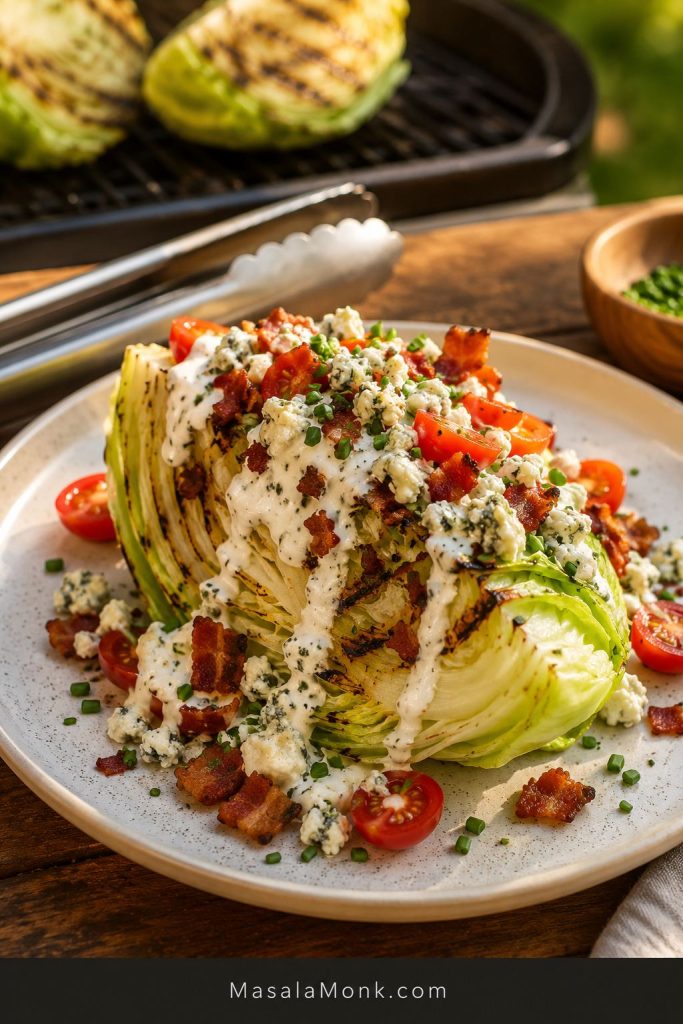
Grill only the cut sides. Leave the rounded outside mostly untouched so the wedge keeps some cool crunch. If your grill is very hot, start with 30–45 seconds per cut side. If it is medium-hot, 1–2 minutes may be enough. The wedges should pick up color at the edges, not wilt all the way through. Grill them last, after the rest of the meal is ready.

Grilled iceberg wedge salad with light char marks, creamy dressing, bacon, tomatoes, chives, blue cheese crumbles, and grill tongs nearby.
Briefly char the cut sides for grilled wedge salad, then stop. You want smoky edges, not cooked lettuce.

Loaded Wedge Salad for a Crowd

For parties, cut the iceberg into 6 smaller wedges and arrange them on a chilled platter. Put dressing in a bowl and toppings in small piles or bowls so guests can build their own plates without the lettuce wilting.

Loaded wedge salad platter with several iceberg wedges, blue cheese dressing, bacon, tomatoes, red onion, chives, blue cheese crumbles, and a dressing bowl.
Serving wedge salad for a crowd is easier with smaller wedges on a platter. Keep dressing and toppings nearby so the lettuce stays fresh.

Good loaded toppings include bacon, cherry tomatoes, red onion, chives, blue cheese crumbles, hard-boiled egg, avocado, cucumber, crispy breadcrumbs, fried onions, grilled chicken, steak strips, shrimp, ranch, blue cheese dressing, and balsamic glaze.

Lighter, Keto, Vegetarian, and No-Blue-Cheese Options

The blue cheese version is rich, but it is easy to adjust without losing the point of the salad: cold crunch, dressing that grips the layers, and toppings with texture.

Lighter Wedge Salad

For a lighter-feeling wedge salad, use a Greek yogurt-based dressing, reduce the bacon, and add more fresh toppings like tomatoes, cucumber, radish, herbs, or grilled chicken. Keep the dressing creamy enough that the salad still feels satisfying.

For a simple protein to turn it into a fuller plate, slice in some juicy baked chicken breast.

Keto Wedge Salad

The main version can be keto-friendly with iceberg lettuce, full-fat blue cheese dressing, bacon, blue cheese, and low-carb toppings. Skip sweet balsamic glaze or use only a tiny drizzle.

Check bottled dressing labels if you are strict keto, and keep tomatoes, onions, and any balsamic glaze modest.

For a fuller low-carb meal, serve it with bunless burgers or burger bowls from these keto burger ideas.

Vegetarian Wedge Salad

Skip the bacon and add crunch with crispy chickpeas, smoked almonds, toasted walnuts, fried onions, roasted corn, or crispy breadcrumbs. Avocado adds richness if you are also skipping blue cheese.

For a strict vegetarian version, use vegetarian Worcestershire or skip it, and choose a vegetarian-friendly blue cheese if needed.

Wedge Salad Without Blue Cheese

Go with ranch, creamy garlic dressing, green goddess, buttermilk herb dressing, Caesar dressing, or a vinaigrette. Ranch is the closest creamy substitute.

Wedge Salad Without Bacon

Replace bacon with crispy chickpeas, croutons, toasted breadcrumbs, fried shallots, toasted nuts, roasted seeds, or smoked almonds for crunch.

Dairy-Free Wedge Salad

Choose a dairy-free ranch or a vinaigrette-style dressing. Skip the blue cheese crumbles and add avocado, crispy chickpeas, or nuts for richness.

What to Serve with Wedge Salad

This is the salad to make when dinner is already rich and hot, but you still want something cold, crisp, and a little showy on the plate.

It is especially good beside a burger, steak, baked potato, roast chicken, or anything smoky from the grill.

  • Steakhouse-style dinners: steak, grilled shrimp, mashed potatoes, and anything finished with a rich creamy mushroom sauce.
  • Casual meals: burger patties, air fryer burgers, and barbecue meals.
  • Comfort dinners: roast chicken, pork chops, casseroles, baked potatoes, and slow-cooked mains.
  • Lighter plates: baked chicken, roasted vegetables, soups, or simple pasta dinners.

For lunch, a cold wedge also works well beside sandwiches, especially when you want something fresher than chips.

Make-Ahead and Storage Tips

The finished salad is best assembled right before serving, but the parts can be prepared ahead.

Component Make Ahead? Notes
Blue cheese dressing Yes, 2–3 days Keep refrigerated and stir before using.
Ranch dressing Yes, 2–3 days Keep cold and thin slightly if needed before serving.
Bacon Yes, 1–2 days Store chilled and re-crisp briefly if needed.
Lettuce wedges Same day ideal Wash, dry, wrap, and chill.
Tomatoes and onion Same day ideal Store separately so they do not water down the lettuce.
Fully assembled salad No Dress right before serving.

A simple prep schedule works best: make the dressing and cook the bacon earlier in the day, wash and dry the wedges about an hour before serving, then assemble the plates just before serving.

Once dressed, the lettuce wilts, the bacon softens, and the dressing becomes watery.

This make-ahead style works well when the main dish is already taking care of itself, like a slow cooker pork loin.

For broader cold-storage guidance beyond this salad, FoodSafety.gov has a helpful cold food storage chart.

Common Mistakes

Most wedge salad problems come from water, weak texture, or assembling too early. Use this as a final checklist.

  • Wet lettuce: dressing slides off instead of sitting on the wedge.
  • Core removed too early: the wedge falls apart.
  • Thin dressing: it pools on the plate.
  • Warm bacon: it softens the lettuce and loosens the dressing.
  • Large toppings: they roll off instead of sticking to the wedge.
  • Early assembly: the salad turns watery before serving.
  • Too much balsamic glaze: the plate becomes sweet and sticky.

How to Eat a Wedge Salad

This is a knife-and-fork salad, so do not fight it. Cut down through the wedge so each bite has lettuce, dressing, bacon, tomato, onion, and blue cheese.

If the large wedge feels awkward, make the chopped version instead. It has the same flavor but is easier to eat from a bowl.

FAQs

These quick answers cover dressing swaps, cutting iceberg, make-ahead timing, toppings, and ways to keep the salad crisp.

What is a wedge salad?

It is a cold quarter of iceberg lettuce topped with creamy dressing, bacon, tomatoes, onion or chives, blue cheese, and black pepper. It is usually served as a knife-and-fork side salad or starter.

Why is it called a wedge salad?

It is called a wedge salad because the lettuce is served as a wedge, usually a quarter of a head of iceberg, instead of being chopped or tossed.

How many wedge salads does one head of iceberg make?

One medium head of iceberg makes 4 large wedges or 6 smaller starter wedges.

What lettuce is best for wedge salad?

Iceberg is the classic choice because it is crisp, sturdy, and tightly layered. It holds its shape under dressing better than softer greens.

Why is iceberg lettuce used?

Iceberg has a mild flavor, high crunch, and compact structure, which is why it holds up so well as a wedge.

How do you cut iceberg lettuce for wedge salad?

Remove damaged outer leaves, rinse and dry the head, then cut it in half through the core. Cut each half through the core again to make 4 wedges.

Why does my wedge salad fall apart?

It usually falls apart because the core was removed too early or the lettuce was cut across the head. Cut through the core, keep a small piece attached, and trim the hard part only after plating.

Do you wash iceberg lettuce before making this salad?

Yes. Rinse the head or wedges under cold water, drain well, and pat very dry. Wet lettuce makes the dressing slide off.

What dressing goes on wedge salad?

Blue cheese dressing is traditional. Ranch is the easiest milder swap. Creamy garlic, buttermilk herb, green goddess, Caesar, or vinaigrette can also work.

Can I use store-bought blue cheese dressing?

Yes. Choose a thick dressing, preferably refrigerated. To improve it, stir in extra black pepper, lemon juice, and a spoonful of blue cheese crumbles.

What can I use instead of buttermilk?

Use regular milk with a small squeeze of lemon juice, or use milk alone and adjust the tang with lemon juice or vinegar.

Is wedge salad better with blue cheese or ranch?

Blue cheese gives the traditional steakhouse flavor: tangy, rich, and sharp. Ranch is milder and easier for a crowd. Serve both if you are not sure.

Can I make it with ranch?

Yes. Ranch works well if you want a milder dressing. Choose a thick ranch so it stays on the lettuce.

What toppings go on wedge salad?

Classic toppings include bacon, tomatoes, red onion, chives, blue cheese crumbles, and black pepper. Avocado, egg, cucumber, fried onions, crispy breadcrumbs, chicken, steak, shrimp, and balsamic glaze also work.

Can I cook the bacon in the oven?

Yes. Bake bacon on a lined sheet pan at 400°F / 200°C until crisp, usually 15–20 minutes depending on thickness.

What is in an Outback-style wedge salad?

An Outback-style version usually includes iceberg lettuce, blue cheese dressing, bacon, grape or cherry tomatoes, red onion, blue cheese crumbles, and balsamic glaze.

Is this an Outback copycat wedge salad?

No. It is not an official restaurant recipe, but the Outback-style variation uses the same general idea: iceberg, blue cheese dressing, bacon, tomatoes, red onion, crumbles, and a light balsamic glaze drizzle.

Can I make it without blue cheese?

Yes. Use ranch, creamy garlic dressing, buttermilk herb dressing, green goddess, Caesar, or vinaigrette. Skip the crumbles or add avocado for richness.

Can I make it without bacon?

Yes. Use crispy chickpeas, toasted breadcrumbs, fried shallots, smoked almonds, croutons, roasted seeds, or toasted nuts for crunch.

Is wedge salad keto?

It can be keto-friendly with iceberg lettuce, full-fat blue cheese dressing, bacon, blue cheese, and low-carb toppings. Check bottled dressing labels and keep tomatoes, onions, and balsamic glaze modest if you are strict keto.

Is wedge salad healthy?

It can be lighter or richer depending on the dressing and toppings. For a fresher version, use less bacon, choose a lighter dressing, and add cucumber, tomatoes, herbs, or grilled chicken.

Can I make it ahead of time?

You can make the dressing, cook the bacon, and prep toppings ahead. Wash, dry, and chill the lettuce the same day, then assemble just before serving.

How long does wedge salad last after dressing?

It is best served immediately. Once dressed, the lettuce softens, the bacon loses crunch, and the plate can become watery.

How do I keep it from getting watery?

Dry the lettuce well, use thick dressing, drain juicy tomatoes, and dress the wedges right before serving.

How do you eat a wedge salad?

Use a knife and fork. Cut the wedge into bite-size pieces on the plate so each bite gets lettuce, dressing, bacon, tomatoes, onion, and cheese.

What do you serve with it?

Serve it with steak, burgers, grilled chicken, roast chicken, barbecue meals, baked potatoes, pasta, sandwiches, soups, or grilled shrimp.

Once the lettuce is cold and dry, the dressing has body, and the toppings are crisp and small, wedge salad becomes what steakhouses know it can be: simple, dramatic, refreshing, and far more satisfying than a quarter of iceberg has any right to be.