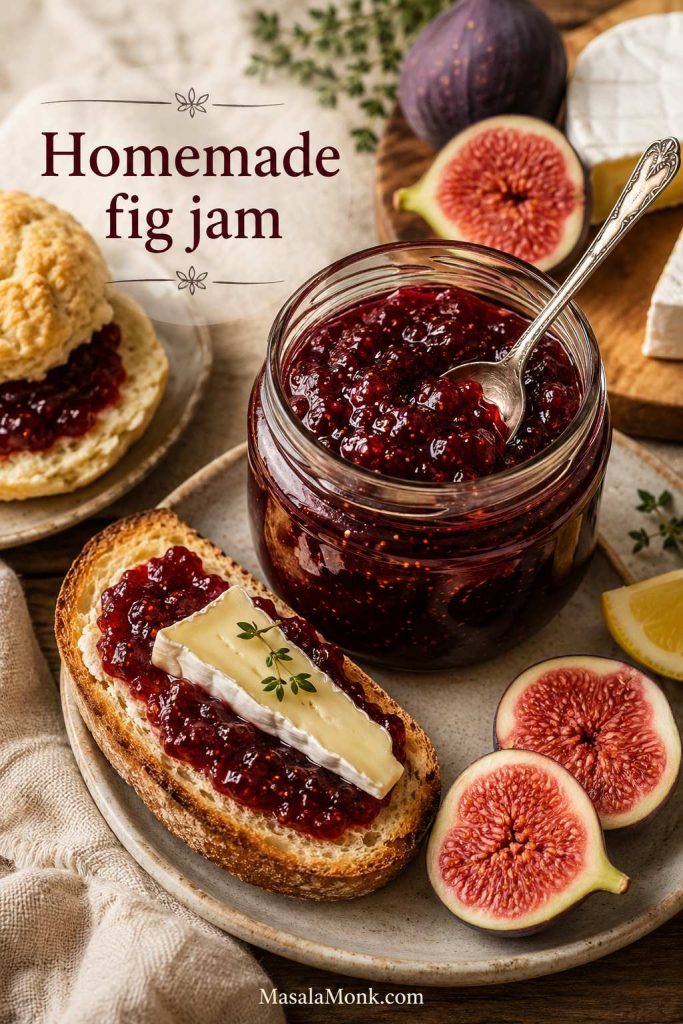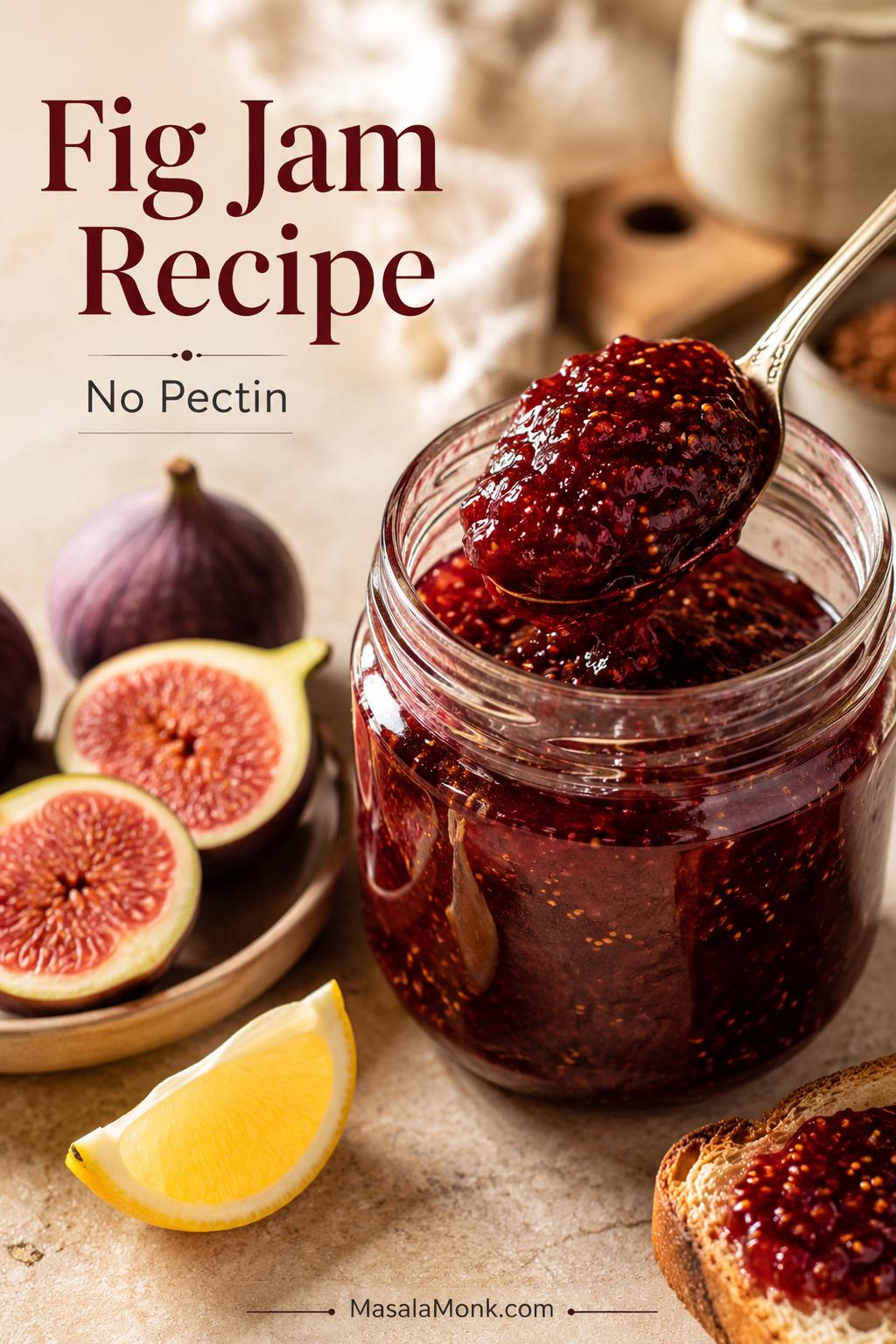
When figs are good, they do not wait. They soften quickly, bruise easily, split at the seams, and can go from perfect to overripe almost overnight. Fig jam is one of the best ways to save that short, honeyed moment before it slips away.
This is the recipe for the day the figs finally give in — too soft to ignore, too fragrant to waste, and exactly ready for a pot of glossy, spoonable jam. The finished jar should taste like figs first: gently sweet, lifted by lemon instead of dulled by sugar, thick enough to spread, and soft enough to spoon over toast, yogurt, brie, goat cheese, cakes, cookies, sandwiches, flatbreads, and roasted meats.
The main method stays simple: fresh figs, sugar, lemon, a little water, and no commercial pectin. This is a fresh fig jam recipe first — soft-set, fruit-forward, and written for the refrigerator or freezer. Once the main method is clear, you will find dried fig, frozen fig, low-sugar, honey, cheese-board, and canning-safe notes clearly separated so you do not have to guess your way through substitutions.
So instead of giving you only one pot of jam, this guide shows you how to choose the right version for the figs you actually have.
In This Guide
Start with the quick answer, or use the deeper sections for dried figs, lower sugar, canning questions, cheese-board ideas, and quick fixes if a batch looks too loose or too thick.
Make the Jam
Quick Answer: How to Make Fig Jam
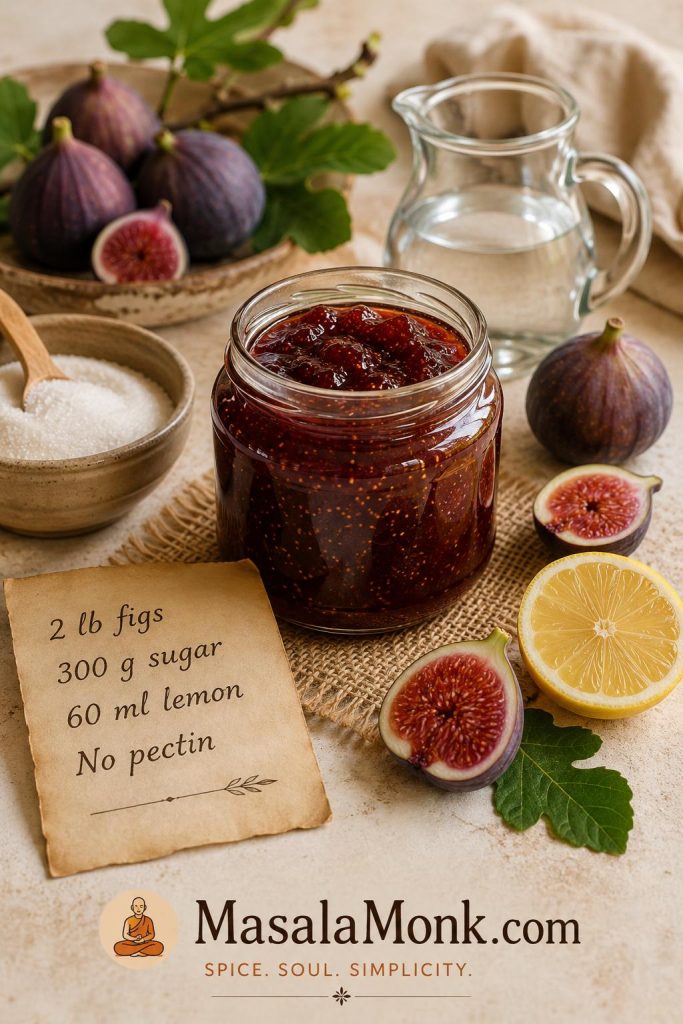
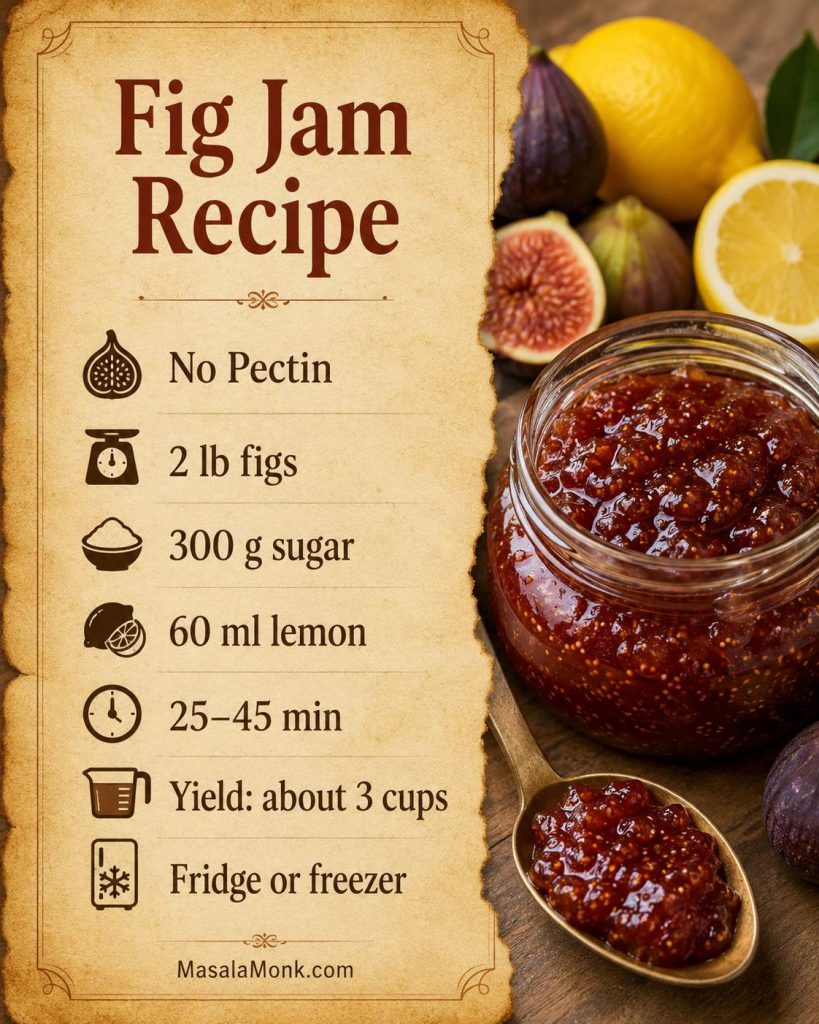
To make easy homemade fig jam, combine 2 lb / 900 g ripe fresh figs, 1½ cups / 300 g sugar, ¼ cup / 60 ml lemon juice, and ¼–½ cup / 60–120 ml water as needed. Start with the smaller amount of water.
Simmer uncovered until the figs soften, collapse, and turn shiny enough to coat the spoon, then mash or blend to your preferred texture. You do not need to peel the figs or add commercial pectin. The jam usually takes 25–45 minutes to cook, yields about 3 cups / 720 ml, and thickens more as it cools.
Keep these four things in mind as you cook: the figs should still smell sweet, the water should start low, the finish should be slow-moving rather than stiff, and this batch belongs in the fridge or freezer unless you use a tested canning recipe.
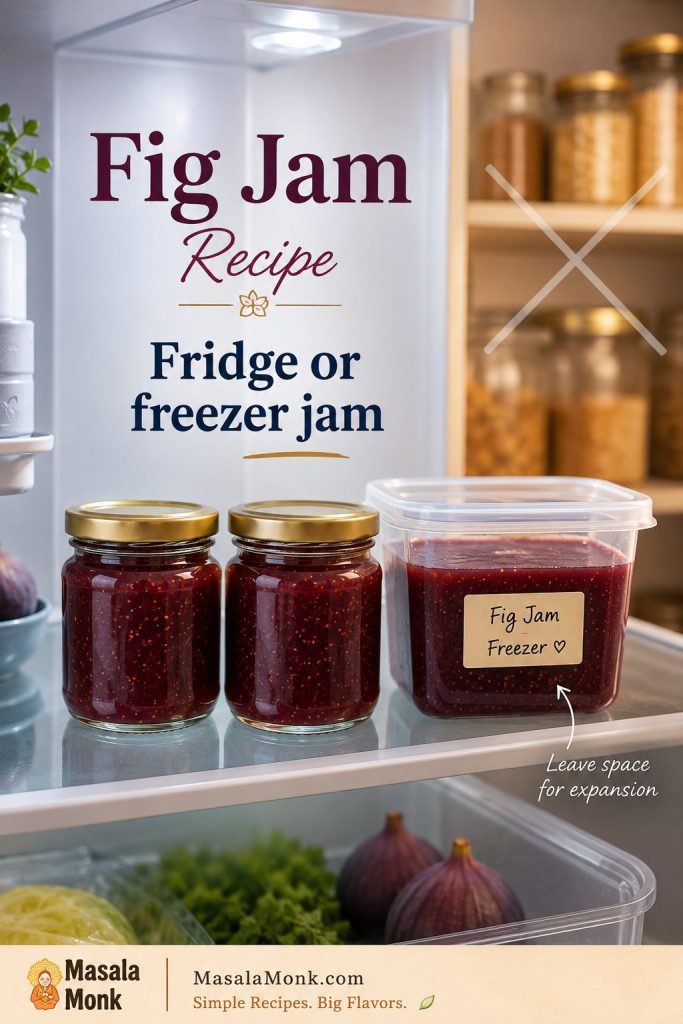
This recipe is written for the fridge or freezer. Do not water-bath can it unless you switch to a tested canning formula with exact acid, sugar, jar size, headspace, and processing instructions.
That may sound strict, but it keeps the recipe low-stress: make the jam, chill it, use it generously, and freeze the extra.
If the pan still looks loose near the end, use the doneness tests before cooking it much longer.
Recipe Snapshot
Here is the whole batch at a glance before the deeper choices begin.
| Figs to use | Ripe fresh figs that smell sweet and feel soft, but not sour, fizzy, or moldy |
|---|---|
| Base ratio | 900 g figs : 300 g sugar : 60 ml lemon juice : 60–120 ml water |
| Pectin | Not needed for this soft-set version |
| Peel figs? | No. Remove stems, but leave the skins on. |
| Cook time | Usually 25–45 minutes, depending on fig moisture and pan width |
| Texture to aim for | Loose enough to spoon, thick enough to stay on toast |
| Storage | Refrigerator or freezer, unless using a tested canning recipe |
| Full recipe | Jump to the recipe card |
Before You Start: What This Recipe Gives You
Good fit if you want…
- A fresh fig jam recipe first
- No commercial pectin
- A soft-set, fruit-forward jar
- Refrigerator or freezer storage
- Clear notes for dried figs, honey, and lower sugar
Not the right fit if you want…
- A stiff store-bought jelly set
- Shelf-stable canning as written
- Traditional whole-fig preserves
- No-sugar pantry storage
- Peeling, deseeding, or a firm jelly finish
With that boundary clear, the actual cooking is simple. Start with ripe figs, use just enough water to protect the pan, and let the fruit tell you when it has softened into jam.
What Is Fig Jam?
Fig jam is made by cooking figs with sugar and acid, usually lemon juice, until the fruit softens and the mixture thickens into a spread. Because figs are full of tiny edible seeds, the texture is naturally a little rustic. It is not usually clear or glassy like jelly. Instead, it is rich, slightly seedy, and naturally honeyed, with a texture that can lean chunky or smooth depending on how much you mash it.
It will not set like a stiff jelly, and it is not supposed to. This is a softer, fruit-forward jar — the kind that spreads on toast but still spoons over yogurt, cheese, cake, or roasted meat.
The best version has balance. Figs are naturally sweet, so lemon stops the jar from tasting like flat sugar syrup. Sugar gives body and shine. A small pinch of salt can make the fruit taste rounder, especially if you plan to serve the finished spread with cheese or savory food.
Fig Jam vs Fig Preserves vs Fig Spread
Fig jam, fig preserves, fig spread, fig jelly, and fig confiture often overlap in everyday use. Still, the texture and best use can be slightly different.
| Name | Usual Texture | Where It Shines |
|---|---|---|
| Jam | Cooked figs, usually mashed or partly broken down | Toast, yogurt, cheese, pastries, desserts, sandwiches |
| Preserves | Chunkier, often with larger pieces of fig or whole small figs | Biscuits, cheese boards, spooning over desserts |
| Spread | Smoother and softer, often less stiff than classic jam | Crackers, brie, sandwiches, flatbreads, charcuterie boards |
| Jelly | Clearer and more strained, with less fruit pulp | Classic jelly use, though figs are more commonly made into jam or preserves |
| Confiture | A French-style word often used for jam or preserves | Breakfast, pastry, cheese, gifting |
| Paste or butter | Thicker, denser, and more concentrated | Cookies, fig bars, cheese plates, baking fillings |
The finished texture sits between classic jam and a softer fig spread: fruit-forward, spoonable, and easy to adapt. Cook it less for a softer spread, longer for a thicker set, or mash lightly for a preserve-style texture.
Fresh Figs vs Dried Figs: Which Should You Use?
Fresh figs and dried figs both work well, but they make different jars. And then fresh figs also give you a brighter, softer, more seasonal jam. Dried figs make a deeper, denser, more concentrated spread that is useful year-round. Neither is wrong; fresh figs are for a lighter fruit-forward batch, while dried figs are especially good when you want a rich cheese-board spread.
Fresh fig jam is the version you make because the fruit is already asking for it — soft at the neck, fragrant on the counter, and too delicate to keep waiting. Dried fig jam belongs to a different mood: less about saving summer, more about building a rich pantry spread for cheese, toast, and cooler-weather boards.
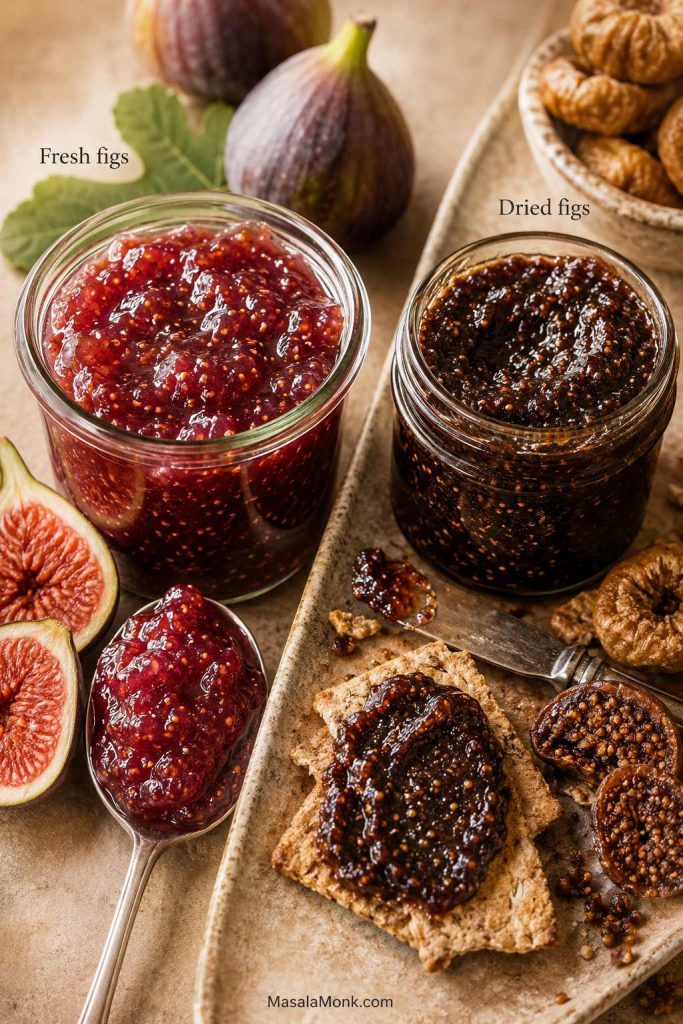
| Use This | When | What to Expect |
|---|---|---|
| Fresh figs | You want a brighter, softer, seasonal jam | Quick cook time, fresh fruit flavor, soft set |
| Dried figs | You want a darker, thicker, year-round cheese-board spread | Deeper flavor, denser texture, more water needed |
| Frozen figs | You already have figs in the freezer | More released liquid and usually a longer simmer |
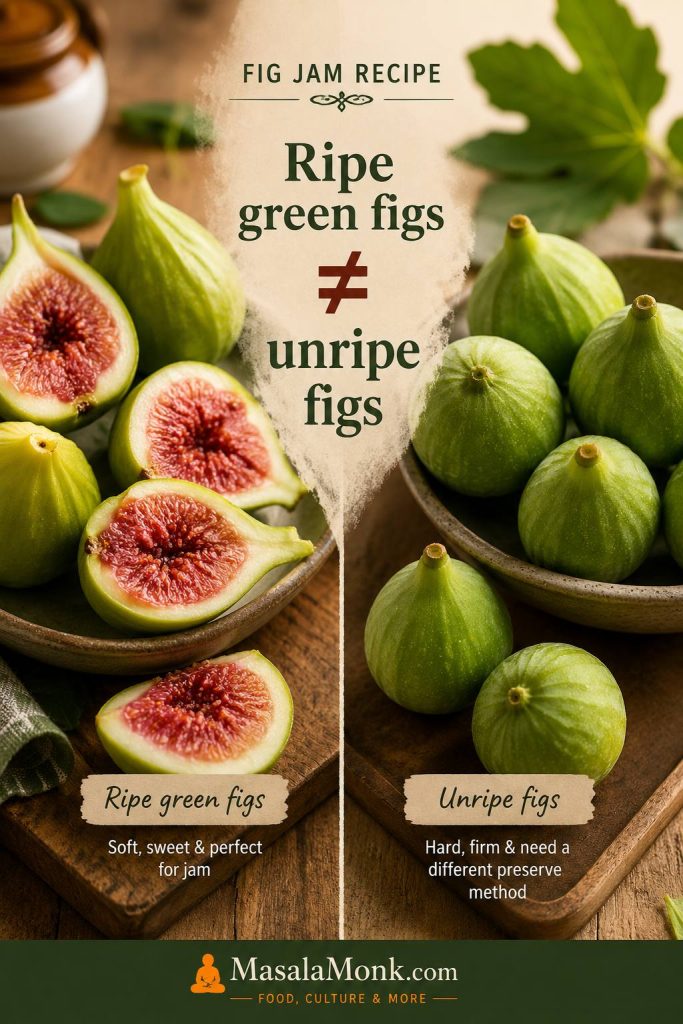
| Ripe green-skinned figs | They are soft, sweet, and ripe inside | Use them like any other ripe fig |
| Truly unripe figs | They are hard, dry, bitter, or not sweet yet | Use a dedicated green fig preserve method instead |
Using dried figs instead of fresh? Go straight to the dried fig jam variation once you understand the main texture cues.
Fresh figs
Fresh figs are the best choice for a classic, bright homemade batch. They are tender, juicy, and quick to cook down when ripe. The flavor can be floral, honeyed, berry-like, or lightly caramelized depending on the variety and ripeness.
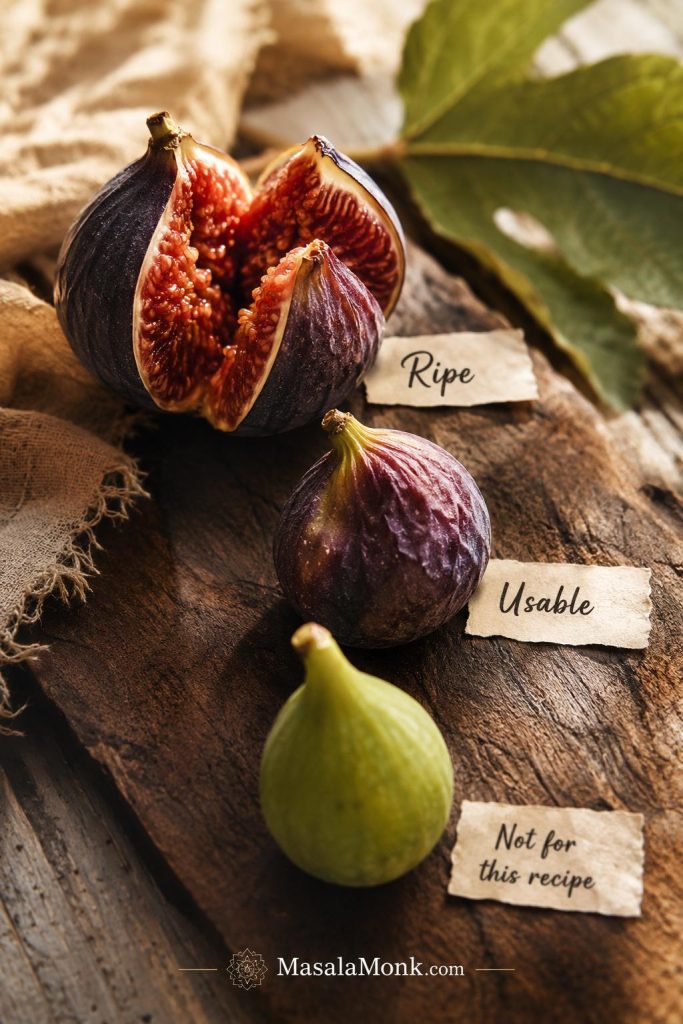
- Use ripe figs that feel soft but not fermented.
- Remove the stems, but do not peel the figs.
- Quarter or chop them so they cook evenly.
- Add water only as needed; very juicy figs may need little or none.
Dried figs
Dried figs are sweeter, denser, and lower in moisture. They need water to soften before they can become jam. Once cooked and blended, they make a thick fig spread that gives brie, goat cheese, blue cheese, crackers, toast, and sandwiches a darker, almost caramel-like contrast.
- Remove any tough stems before cooking.
- Chop the figs so they soften faster.
- Simmer with water until very tender before blending or mashing.
- Use less sugar if the dried figs are already very sweet.
Frozen figs
Frozen figs can work for jam. Thaw them first if possible, then use the fruit and any juices that collect. Frozen figs often release extra liquid, so the batch may need a slightly longer cook time. If you are using a weight-based recipe, weigh the figs consistently either before freezing or after thawing and draining lightly.
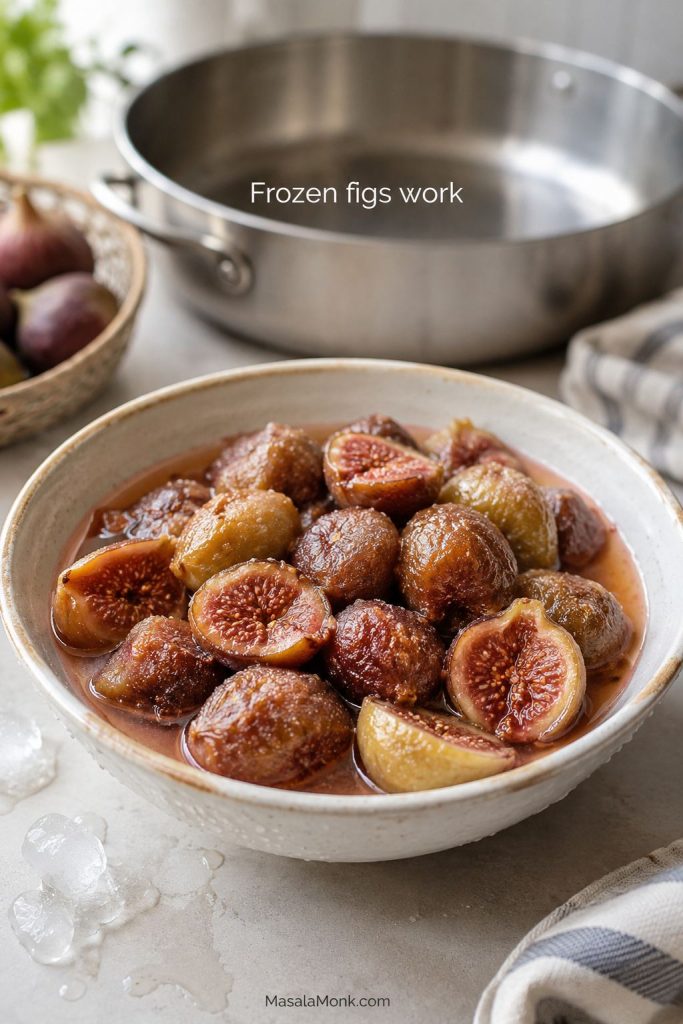
Because thawed figs release extra liquid, check the doneness tests carefully before deciding the batch is finished.
What about green or unripe figs?
Green-skinned ripe figs are fine. Truly unripe figs are different. They can be firmer, less sweet, and sometimes bitter or latex-like. Green fig preserves are usually a separate style of recipe and often involve soaking, boiling, draining, and then cooking in syrup. If your figs are ripe but green on the outside, use them here. If they are hard and unripe, use a dedicated green fig preserve method instead.
Ingredients You Need
The ingredient list is short, which is part of the charm: ripe figs, enough sugar to make them shine, lemon to wake them up, and just enough water to keep the pot moving before the fruit releases its own syrup.
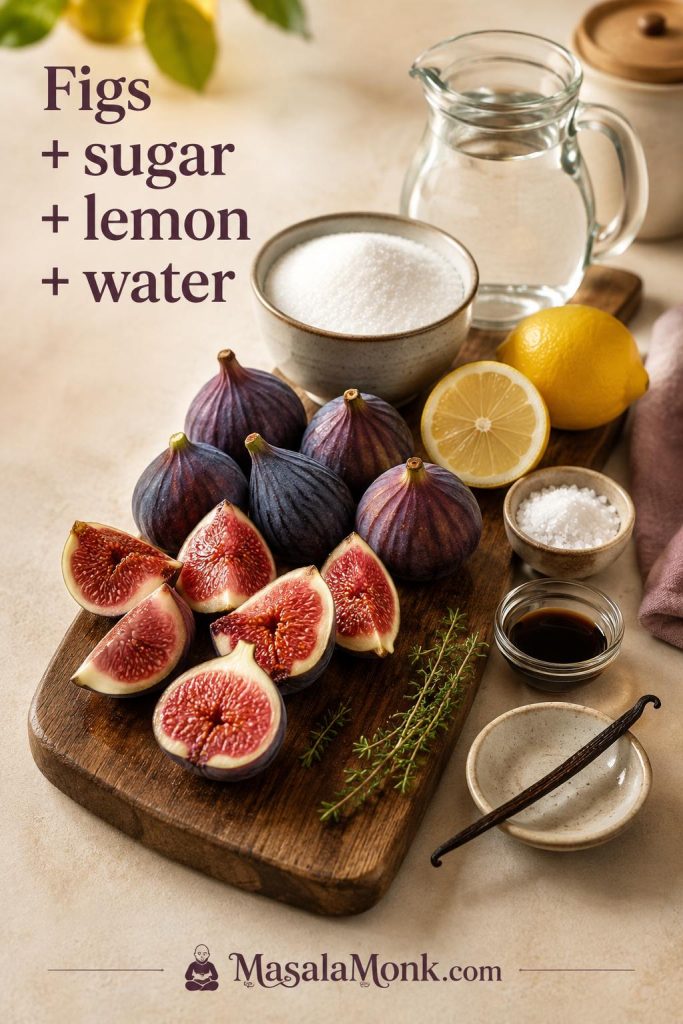
Fresh figs
Use ripe fresh figs for the main version. Black Mission, Brown Turkey, Kadota, Adriatic, or other edible fig varieties can all work. The exact flavor will change, but the method stays the same. Trim away the stems and any spoiled spots. The skins and seeds are edible, so there is no need to peel or deseed the fruit.
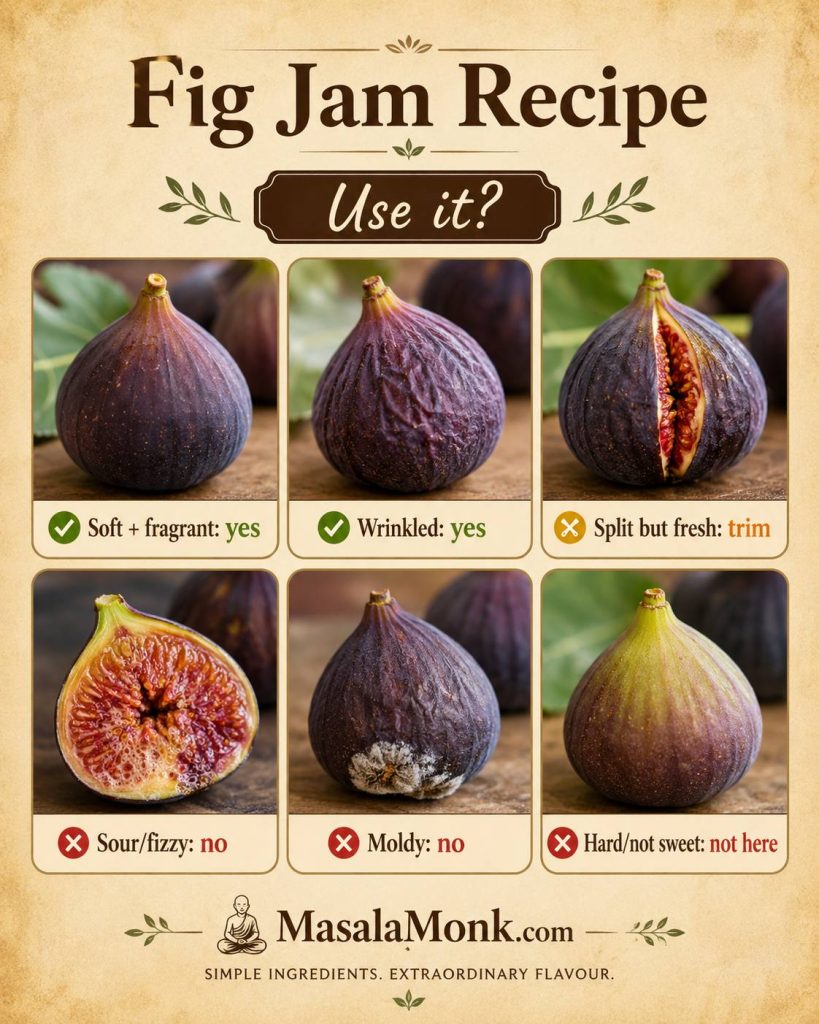
Fig condition guide: Fig jam is forgiving, but spoiled fruit is not. Use the table below when the figs are soft enough to make you wonder.
| Fig Condition | Use It? | What to Do |
|---|---|---|
| Soft, fragrant, and sweet | Yes | Perfect for jam |
| Slightly wrinkled | Yes | Trim stems and use |
| Split but fresh-smelling | Usually | Trim dry or exposed spots first |
| Sour, fizzy, or fermented smell | No | Discard |
| Mold | No | Discard |
| Hard and not sweet | Not for this recipe | Use a green fig preserve method instead |
Sugar
Sugar is not just there for sweetness; it gives the syrup its shine, helps the fruit look glossy instead of dull, and gives the finished jar a little more body. The amount here is moderate compared with many old-fashioned preserves, so the figs still lead. If your fruit is extremely sweet, you can reduce the sugar, but the batch will usually set softer, cook longer, and have a shorter refrigerator life.
Lemon juice
Lemon is what keeps the jar from tasting heavy. It lifts the fig flavor, sharpens the sweetness, and helps the mixture thicken. For refrigerator jam, fresh lemon juice works well. For pantry jars, switch to a tested preservation recipe and follow it exactly; many canning formulas call for bottled lemon juice because its acidity is standardized.
Water
Water keeps the figs from scorching before they release their own juices. Very ripe, juicy figs may need only a splash. Firmer figs, drier figs, or dried figs need more. Start with the smaller amount first; you can always add a little more if the pot looks dry.
Salt
A small pinch of salt is optional, but it makes the fig flavor taste rounder and less flat. It is especially useful if you plan to serve the jam with cheese or savory dishes.
Vanilla, citrus zest, balsamic, or herbs
These are optional, not required. Vanilla makes the jam more dessert-like. Lemon or orange zest adds fragrance. Balsamic pulls the jam into savory territory, where it tastes less like breakfast and more like something you would spoon beside brie, pork, or sharp cheese. Rosemary or thyme makes it more savory.
Equipment That Makes Fig Jam Easier
You do not need special jam gear here, but the pan matters more than most people expect. A wide pan is not fancy equipment; it lets steam escape quickly, so the figs thicken before their flavor turns dull. A masher or blender simply lets you choose whether the fruit stays chunky or turns smooth.
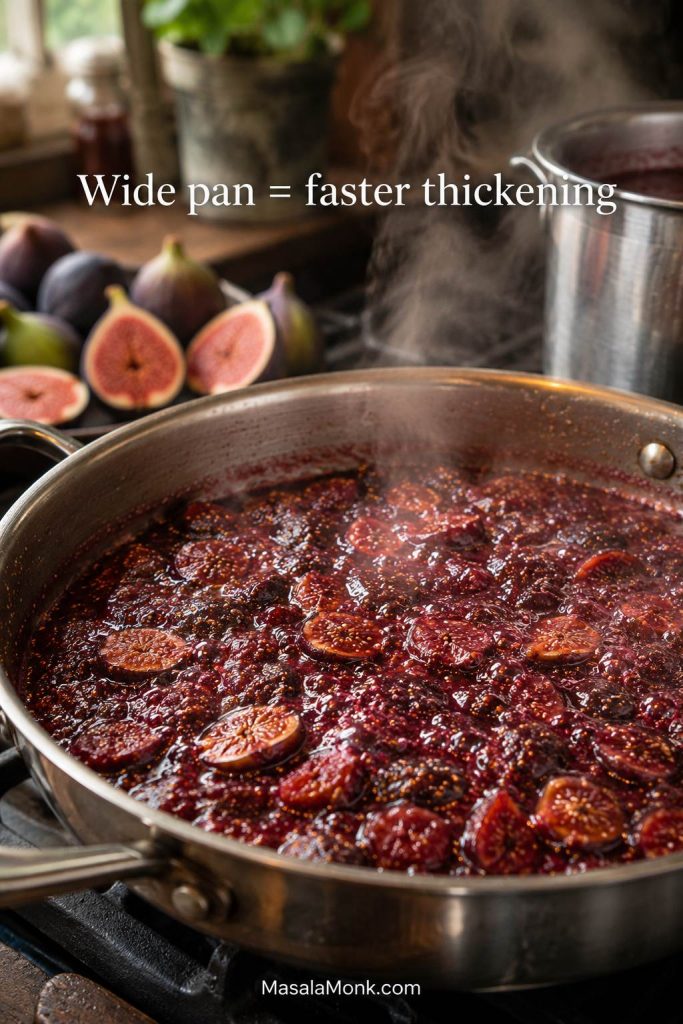
- Wide heavy-bottomed pan: a saucepan, sauté pan, or Dutch oven with enough surface area for steady evaporation.
- Non-reactive material: stainless steel or enameled cast iron is best because the recipe includes lemon juice.
- Wooden spoon or silicone spatula: useful for stirring and checking whether the jam leaves a trail on the bottom of the pan.
- Potato masher or immersion blender: use a masher for rustic texture or an immersion blender for a smoother spread.
- Small plate or spoon: chill it in the freezer for a simple doneness test.
- Clean jars and a kitchen scale: clean jars help with storage, and a scale helps because figs vary so much in size.
A ladle and funnel are helpful but not essential. A narrow pot can still work, but the jam will usually need more time because evaporation is slower. If your pan is thin, keep the heat moderate and stir often so the sugar and fruit do not scorch before the mixture thickens.
The Best Fig Jam Ratio
The sweet spot is enough sugar to make the figs shine, enough lemon to keep the flavor bright, and only enough water to keep the fruit moving. This is not meant to be a stiff, candy-sweet preserve. It is a softer, fruit-forward jar you can use generously.
900 g fresh figs : 300 g sugar : 60 ml lemon juice : 60–120 ml water
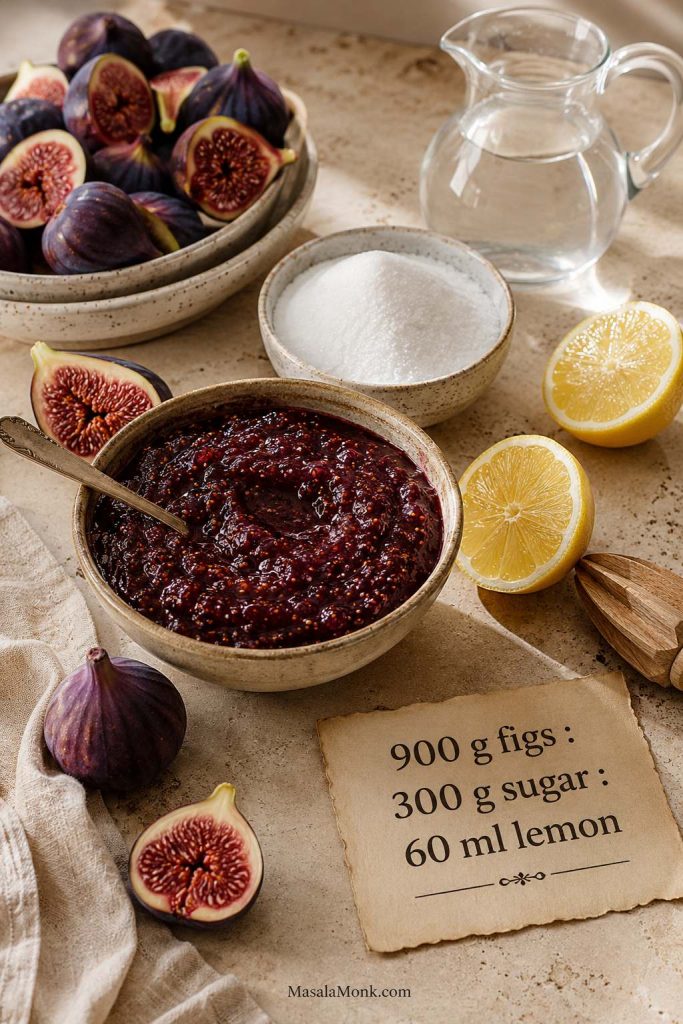
In US kitchen measurements, that is about 2 lb fresh figs, 1½ cups sugar, ¼ cup lemon juice, and ¼–½ cup water. The result is sweet enough to feel like jam, but still fig-forward enough that you taste the fruit, not just sugar.
Because this is less sugar-heavy than many old-fashioned preserves, it is best treated as a refrigerator or freezer batch.
| Batch | Fresh Figs | Sugar | Lemon Juice | Water | Approx. Yield |
|---|---|---|---|---|---|
| Small batch | 1 lb / 450 g | ¾ cup / 150 g | 2 tbsp / 30 ml | 2–4 tbsp / 30–60 ml | About 1½ cups / 360 ml |
| Standard batch | 2 lb / 900 g | 1½ cups / 300 g | ¼ cup / 60 ml | ¼–½ cup / 60–120 ml | About 3 cups / 720 ml |
| Large batch | 3 lb / 1.35 kg | 2¼ cups / 450 g | 6 tbsp / 90 ml | ⅓–¾ cup / 80–180 ml | About 4½ cups / 1 liter |
The yield is approximate because figs vary in moisture. Very juicy fruit cooks down differently from firmer, drier fruit.
Small-Batch Fig Jam
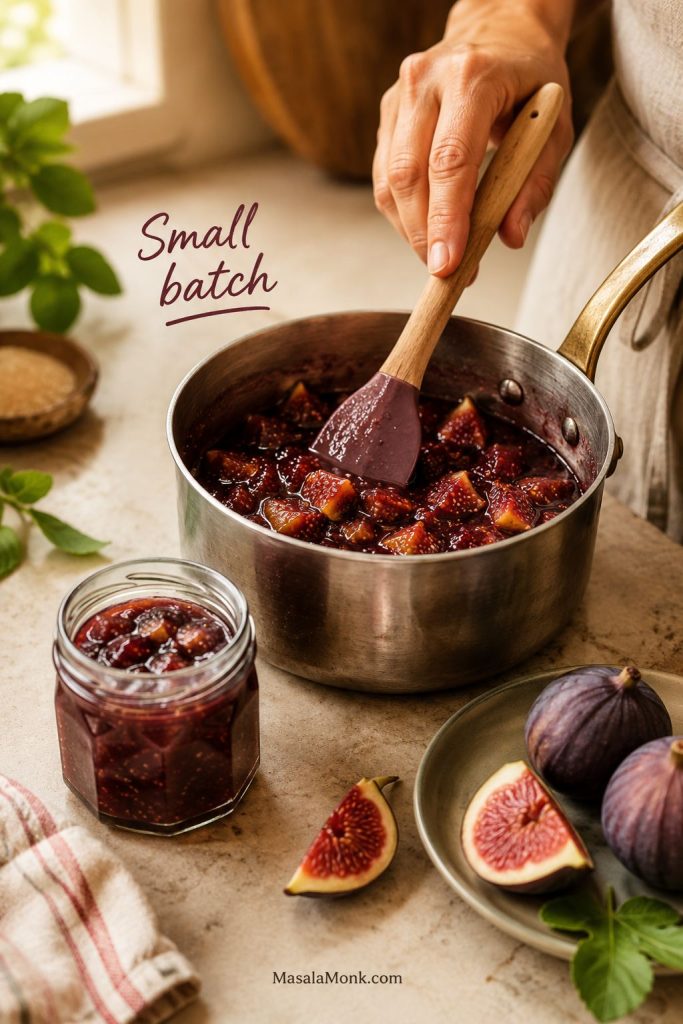
If you only have a small basket of figs, make a half batch. Use 1 lb / 450 g fresh figs, ¾ cup / 150 g sugar, 2 tbsp / 30 ml lemon juice, and 2–4 tbsp / 30–60 ml water. A small batch usually cooks faster, often in about 20–30 minutes, especially in a wide pan.
This is a good option when you have a few ripe figs that need using immediately. It gives you enough jam for toast, yogurt, a small cheese board, or a quick baked brie without committing to several jars.
Why This Fig Jam Recipe Works
The pot does most of the work once the balance is right: enough sugar for gloss, enough lemon for brightness, and enough time for the figs to thicken naturally.
- Moderate sugar keeps the fig flavor clear. The jam tastes sweet and glossy, but not like sugar syrup.
- Lemon keeps the flavor bright. Without enough acid, the finished jar can taste heavy, flat, or overly sweet.
- A short maceration helps the figs release juice. This makes the jam easier to start and reduces scorching risk.
- A wide pan thickens the jam faster. More surface area means better evaporation and less overcooking.
- No pectin keeps the texture soft and homemade. The jam thickens through cooking, but stays spoonable rather than stiff.
- Stopping slightly early prevents over-thick jam. It continues to firm as it cools.
Figs are delicate. If you cook them too hard for too long, the flavor can move from honeyed and rounded to dull and sticky. The goal is to reduce the syrup, not punish the fruit.
How to Make Fig Jam
Start with ripe fresh figs and let simmering, lemon, sugar, and evaporation do the thickening. Read through the steps once before starting, especially the texture cues, because the jam thickens more after it cools.
Step 1: Prep the figs
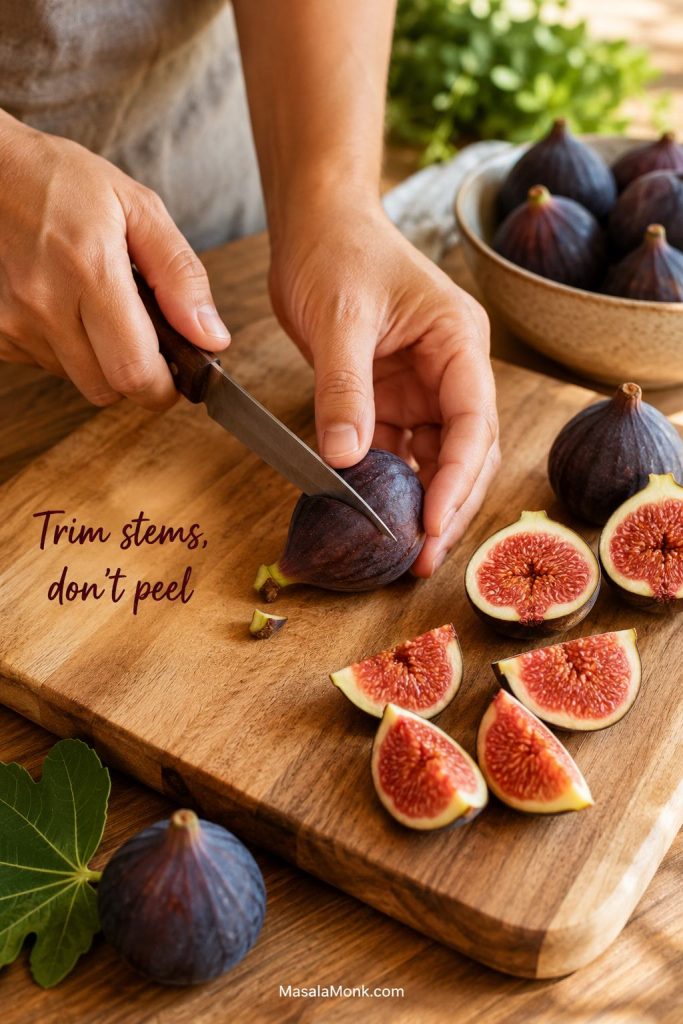
Rinse the figs gently and pat them dry. Trim off the tough stems. Quarter small figs or chop larger figs into small pieces. You do not need to peel them. The skins soften as the jam cooks, and the seeds are part of its natural texture.
Step 2: Combine figs, sugar, lemon, and water
Add the figs, sugar, lemon juice, a pinch of salt if using, and ¼ cup / 60 ml water to a wide heavy pan. Stir well so the sugar, lemon, and fruit are evenly distributed before heat goes on.
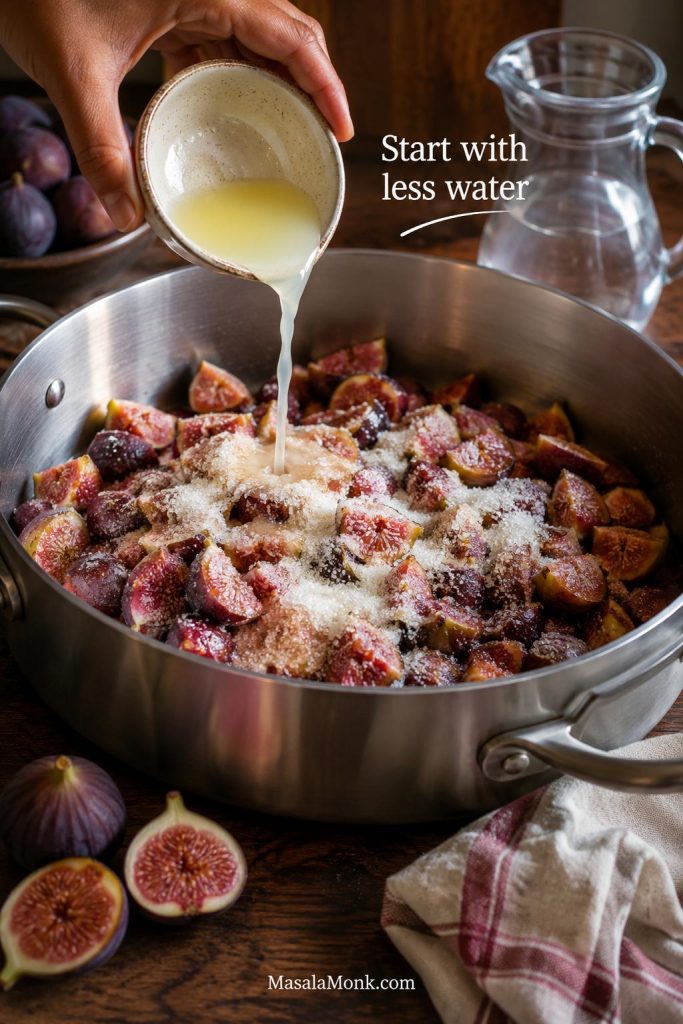
If you have time, let the mixture sit for 15–30 minutes before cooking. This short rest helps the sugar draw juice from the figs, so the fruit starts cooking in its own syrup instead of scorching against the pan.
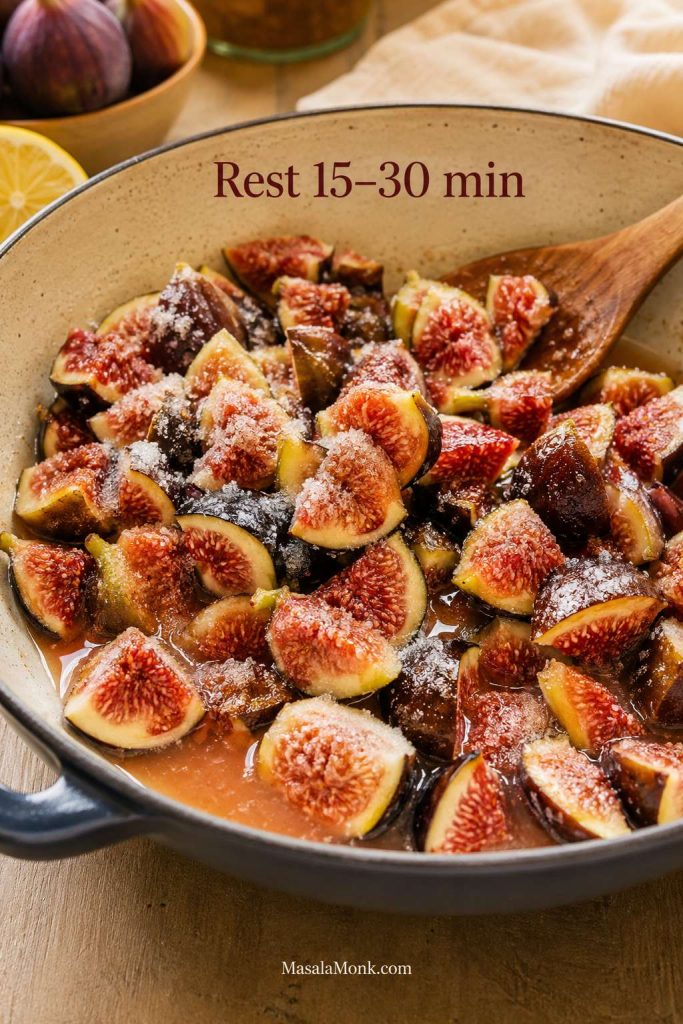
Add the remaining water only if the figs look dry, stick before releasing juices, or need a little help softening. Starting with less water prevents a thin batch that needs extra time to reduce.
Step 3: Bring the mixture to a simmer
Set the pan over medium heat and stir until the sugar dissolves. Once the mixture starts bubbling, reduce the heat as needed to maintain a steady simmer. You want active bubbling, but not a violent boil that splashes, scorches, or caramelizes too fast.
At this point the pan should look syrupy around the edges, not dry and sandy. If the figs are still sitting in dry sugar, add a splash more water and give them time.
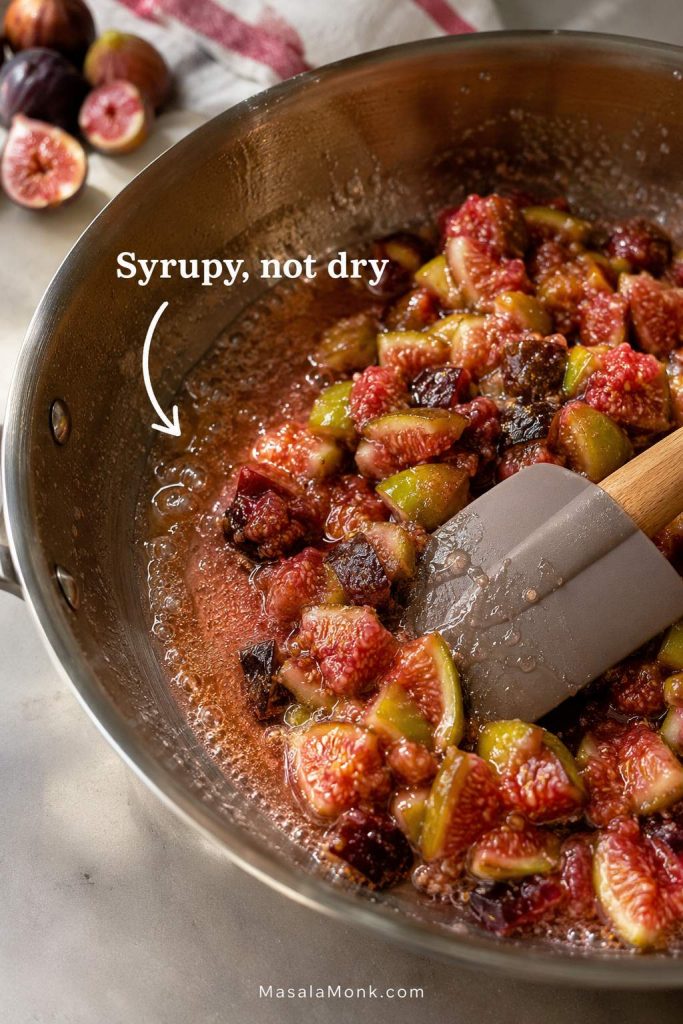
Cook uncovered once the figs are simmering. Covering the pan traps moisture and slows thickening.
Step 4: Cook until the figs soften and collapse
Simmer the jam, stirring often, until the figs soften, slump, and begin to collapse into the syrup. The kitchen should smell like warm figs and lemon, not burnt sugar. This usually takes 25–45 minutes. The exact time depends on fig ripeness, moisture, pan width, and heat level.
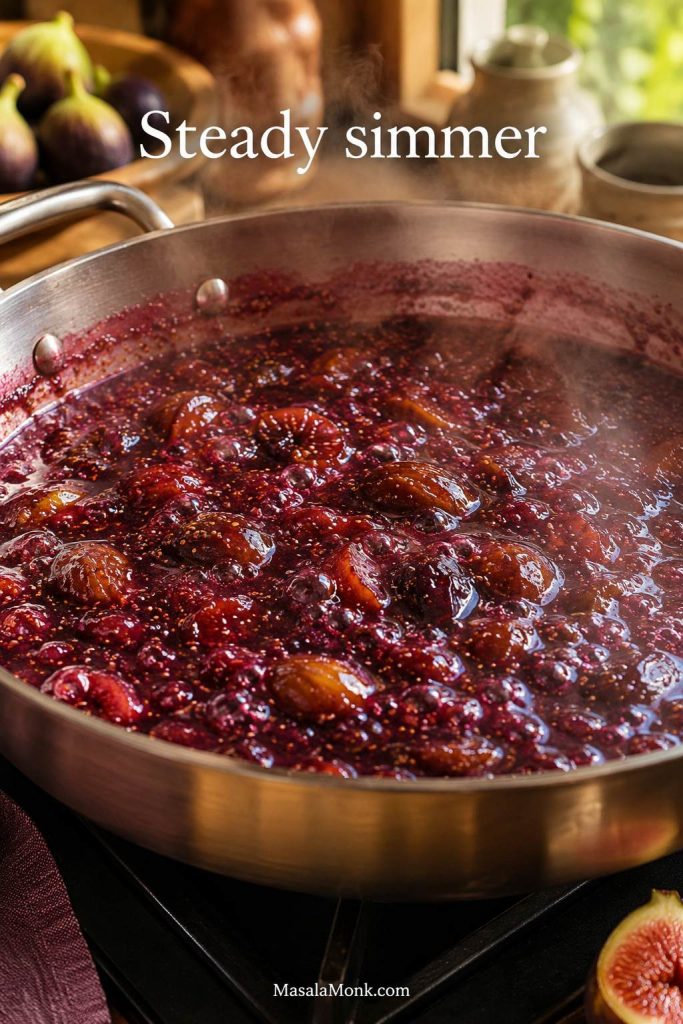
As the fruit softens, mash it with the back of a spoon or a potato masher. For a chunky preserve-style texture, mash lightly and leave some pieces intact. For a smoother spread, mash more thoroughly or blend briefly later.
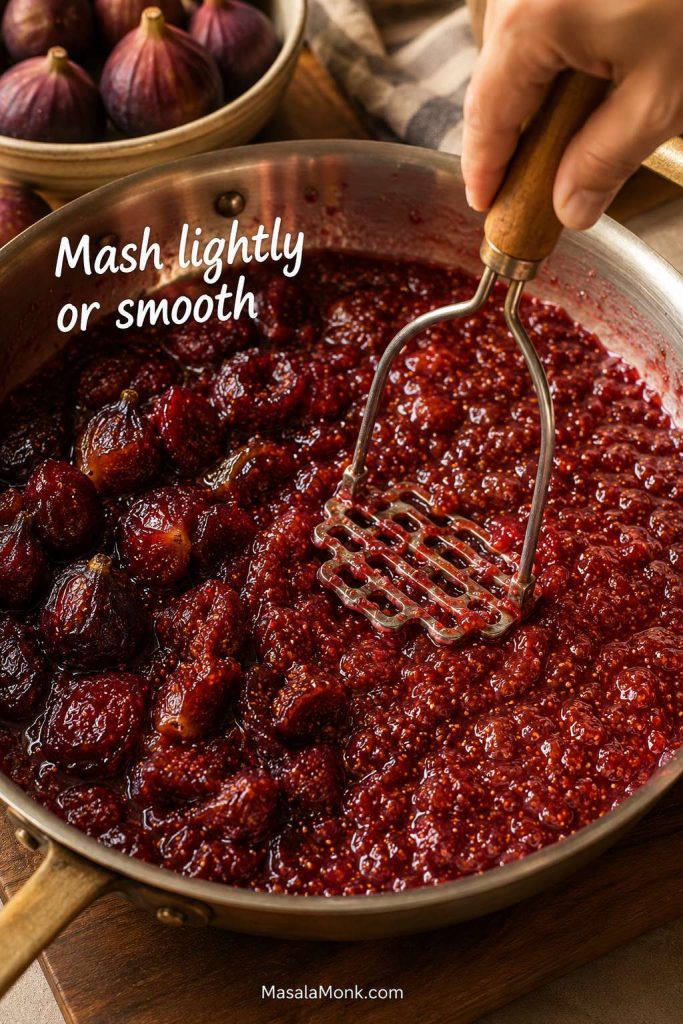
If foam gathers on the surface, you can skim it off for a clearer finish. A little foam is not a problem for refrigerator jam.
Step 5: Adjust the texture
If you like a rustic jam, leave it slightly chunky. For a smoother fig spread for crackers, cheese boards, sandwiches, or cookies, use an immersion blender for a few short pulses. Do not overblend unless you want a very smooth paste.
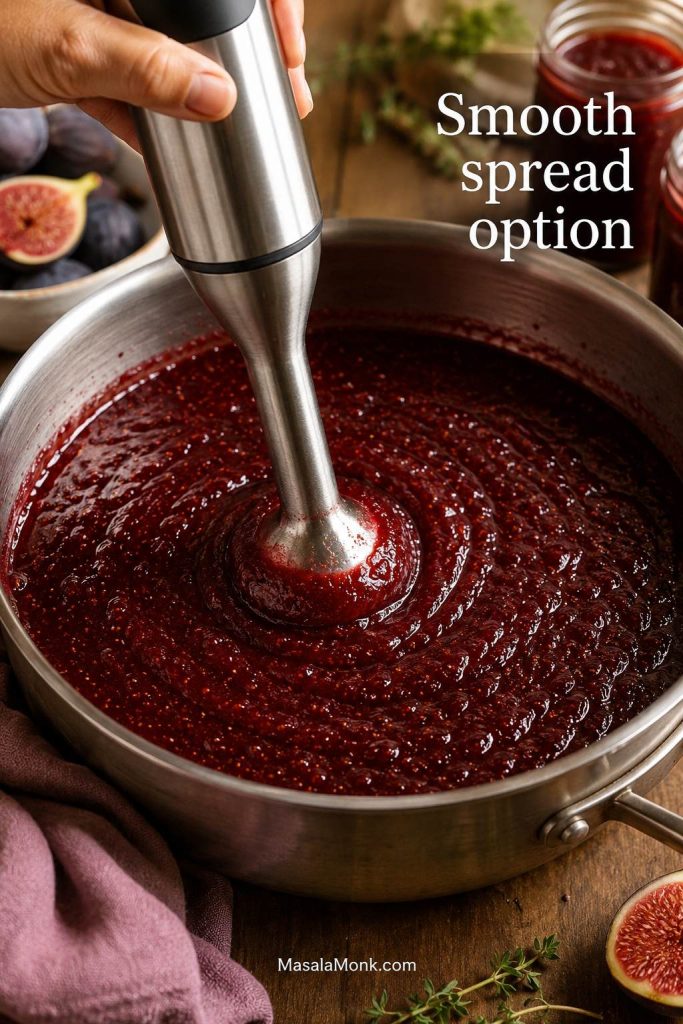
After blending, simmer for another few minutes so the texture settles and any extra moisture evaporates.
Step 6: Test the jam
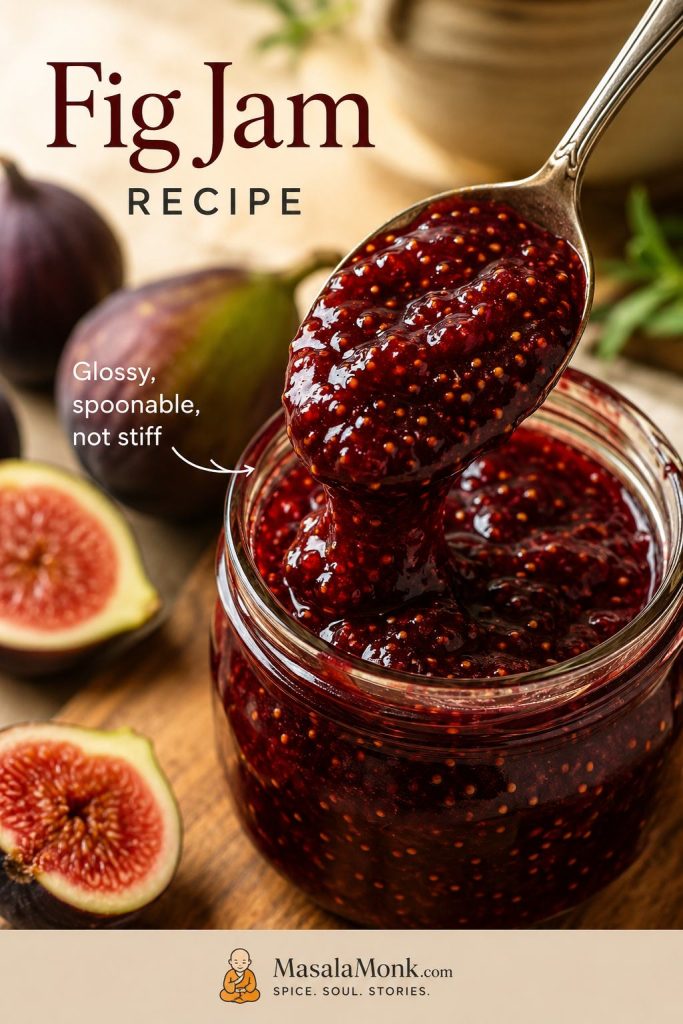
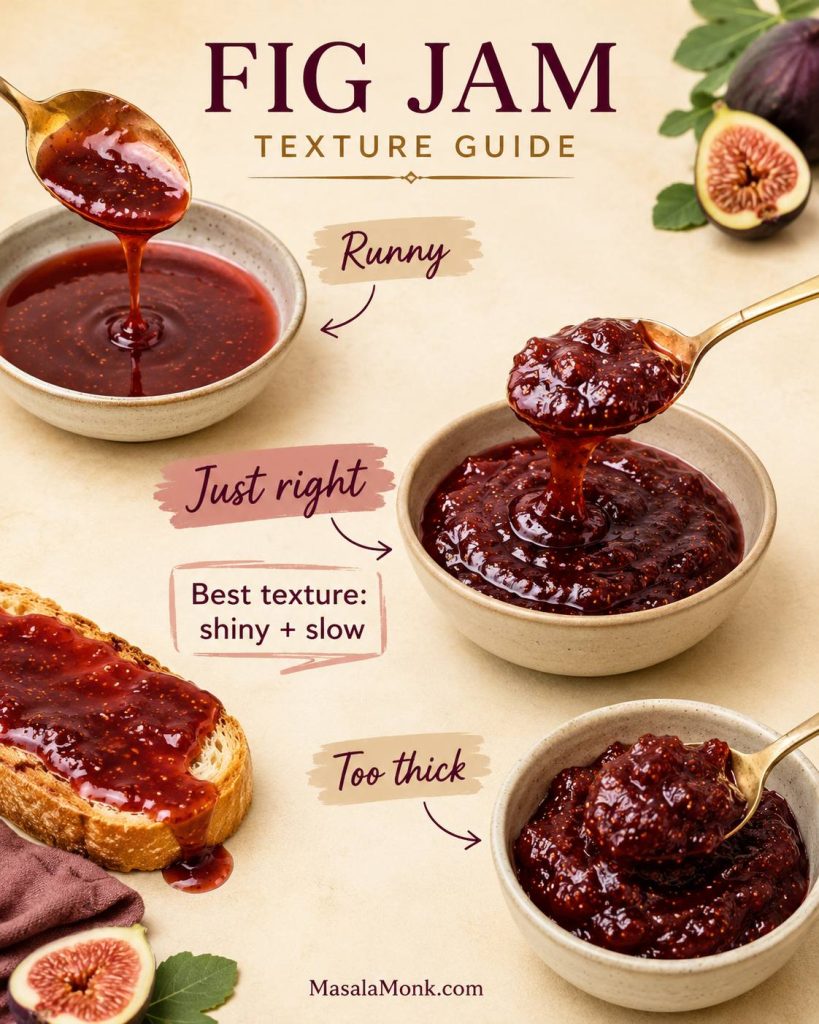
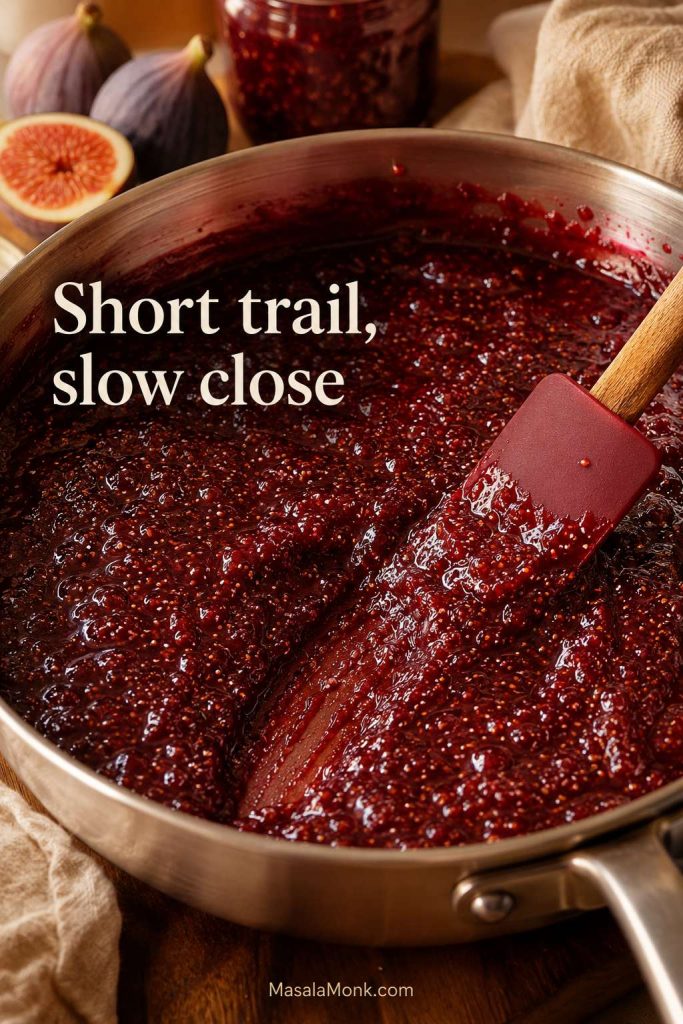
It is ready when it looks shiny, moves slowly, and mounds softly on a spoon. The syrup should bubble slowly, not splash like water. A spoonful should fall slowly, not pour like syrup or sit like paste. A spatula dragged through the pan should leave a short trail before the mixture flows back. You can also use a cold plate test or a thermometer; both are explained below.
If the jam looks too loose or too stiff at this point, use the troubleshooting guide before changing the recipe.
Step 7: Jar, cool, and store
Spoon the hot jam into clean jars. Let it cool, then refrigerate. Do not worry if it looks slightly loose while hot; it will thicken more as it cools. For longer storage, freeze it in freezer-safe containers with headspace.
Texture Target
The target is not a firm jelly set. The best texture for this recipe is thick enough to spread on toast, but loose enough to spoon over yogurt or cheese. Stop when the jam looks shiny and slow, not stiff. If it looks firm in the boiling pan, it will likely cool too thick.
How to Tell When Fig Jam Is Done
The tricky part is that jam can look loose while hot and much thicker after cooling. Look for several signs together rather than relying on one exact minute mark.
- Shiny look: the liquid around the figs should look syrupy, not watery.
- Soft fruit: the figs should be tender, slumped, and partly collapsed.
- Slow bubbles: the bubbles become thicker and slower as water evaporates.
- Spatula trail: a spoon or spatula should leave a short path through the jam before it closes.
- Spoon mound: the jam should mound lightly on a spoon instead of running off like juice.
- Cold plate test: a small spoonful on a chilled plate should move slowly when tilted.
- Temperature cue: at sea level, a firmer jam set is often around 220°F / 104°C, but texture matters more than the thermometer reading.
- Aroma: the jam should smell bright and honeyed, not burnt or overly caramelized.
Spatula Trail Test
Drag a spatula through the pan when the jam looks close. If the path opens briefly and then closes slowly, the texture is moving toward a soft set.
Cold Plate Test
Chill a small plate, add a spoonful of jam, and tilt it. The cooled jam should move slowly, which helps you avoid overcooking the hot batch.
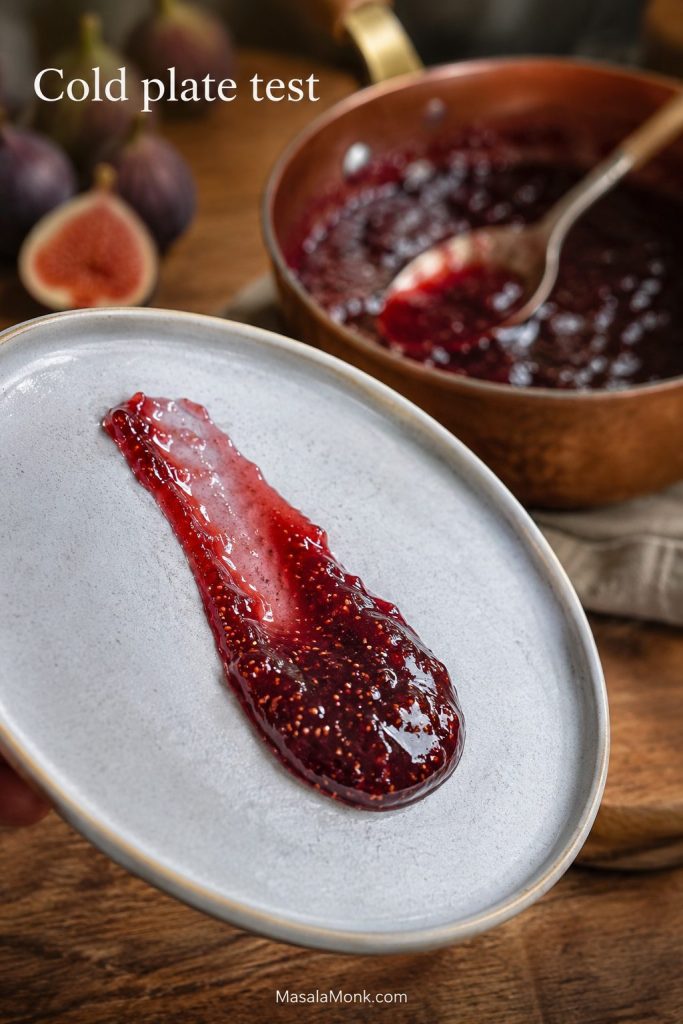
Important: Stop slightly before the jam looks perfect in the pot. If it looks stiff while boiling, it may cool into something too thick or sticky. You can always simmer a loose batch a little longer, but it is much harder to undo a stiff, overcooked one.
Do You Need Pectin for Fig Jam?
No, you do not need commercial pectin for this style of fig jam. Figs, sugar, lemon juice, and evaporation can create a soft, spoonable jam on their own. The finished texture will usually be softer than a firm store-bought jelly, but that is exactly why it works so well as both a jam and a fig spread.
Do not chase a store-bought jelly wobble here. For a homemade spread, a softer set is often better because it spoons more easily over cheese, yogurt, toast, desserts, and savory dishes. A soft no-pectin set is not a failure; it is part of what makes the jar so useful.
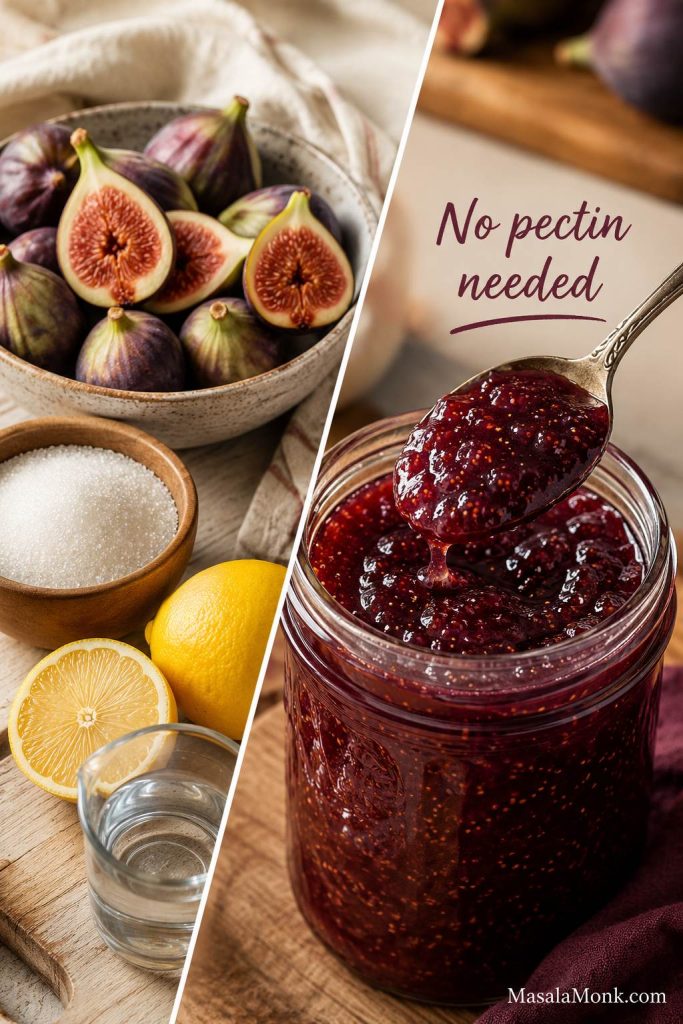
If you want a very firm set, commercial pectin can help, but it changes the method. Boxed pectin and products like Sure-Jell often require specific sugar and liquid ratios, so follow the instructions for that product rather than adding it casually to this recipe.
Let the pan do the work: steady simmering, a wide surface, and a few spoon tests matter more than extra thickeners.
Dried Fig Jam Variation
Dried figs are not second-best; they simply make a different kind of jar. The flavor is deeper, darker, and more concentrated, closer to a thick fig spread than a bright fresh-fruit jam. This is the version to make when fresh figs are out of season, expensive, or hard to find.
Think of it as a pantry-friendly spread with a darker mood: less fresh summer fruit, more rich fig, caramel, and cheese-board depth.
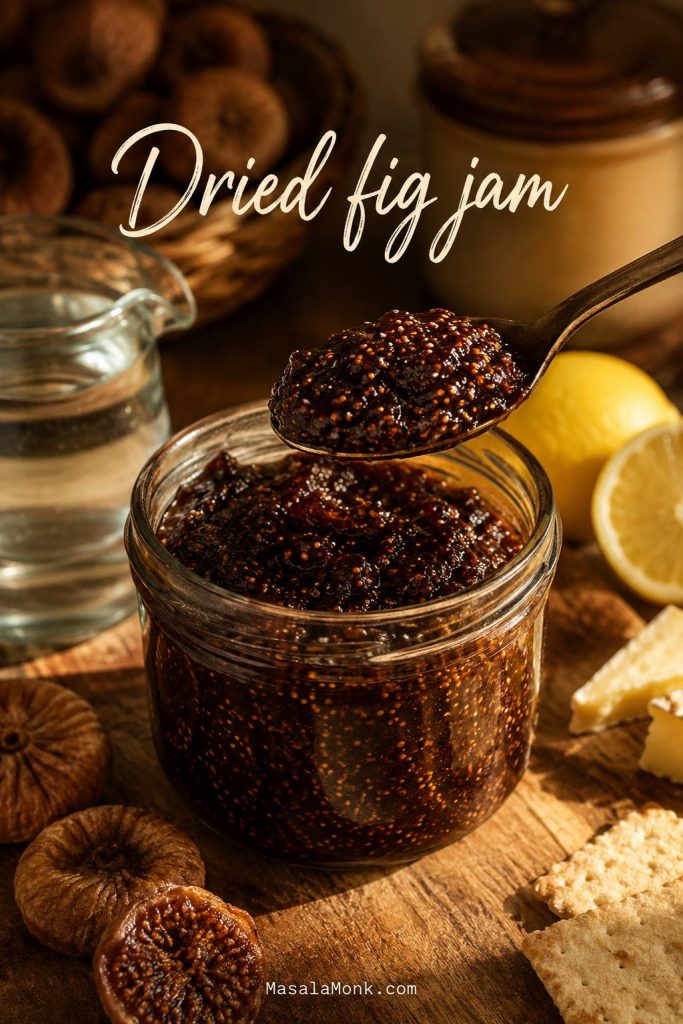
Dried Fig Jam Formula
- Dried figs: 12–14 oz / 340–400 g, stems removed and chopped
- Water: 2 cups / 480 ml, plus more if needed
- Sugar: ½–1 cup / 100–200 g to start, plus more to taste
- Lemon juice: 2 tbsp / 30 ml
- Optional flavorings: orange zest, vanilla, balsamic vinegar, rosemary, thyme, or a pinch of salt
To make it, simmer the chopped dried figs with water until very soft, usually 20–40 minutes depending on how dry they are. Blend or mash the softened figs, then add sugar and lemon juice. Simmer again until thick and spoonable. Add more hot water if it becomes too dense before the figs fully soften, especially before adding more sugar.
Start with ½ cup / 100 g sugar for a less-sweet fig spread, or 1 cup / 200 g sugar for a sweeter jam. Add more only after tasting. Dried figs are already concentrated, so use up to 1½ cups / 300 g sugar only if you want a very sweet, glossy jam.
The dried fig version thickens quickly after blending, so keep it slightly looser than you want while it is hot. If it looks perfect in the pot, it may cool into a paste.
Low-Sugar, Honey, and No-Added-Sugar Options
Lower sugar changes more than sweetness. It changes set, cook time, and storage life. Figs are naturally sweet, so reducing sugar can work, but the batch will usually be softer, a little less glossy, and shorter-lived in the refrigerator.
Low-sugar fig jam
For a lower-sugar version, use 150–200 g sugar per 900 g figs instead of 300 g. Cook the jam a little longer and expect a softer, more fruit-spread-like texture. A lower-sugar batch may never pass the cold-plate test as firmly as a higher-sugar jam. If it is shiny, thick, and spoonable, it can still be done.
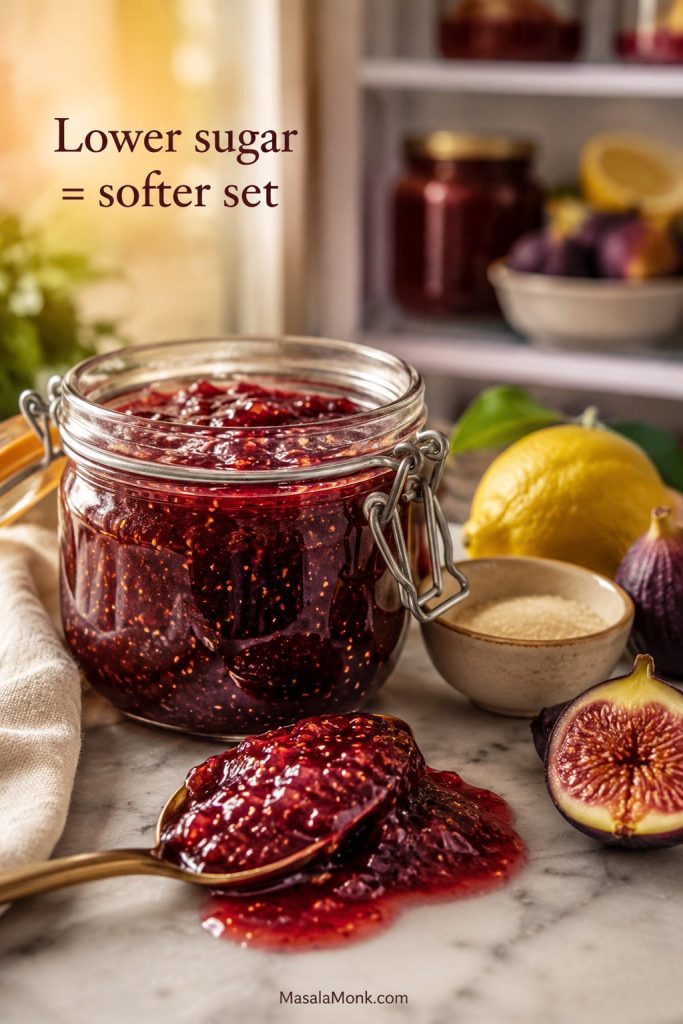
Store low-sugar batches in the refrigerator and use within 1–2 weeks for best quality, or freeze for longer storage.
Honey fig jam
Honey adds a floral sweetness that works beautifully with figs. Replace part of the sugar with honey rather than all of it for the best texture. For example, use 200 g sugar plus ¼ cup honey for 900 g figs. Honey-sweetened jam may be softer, darker, and more aromatic than the granulated-sugar version.
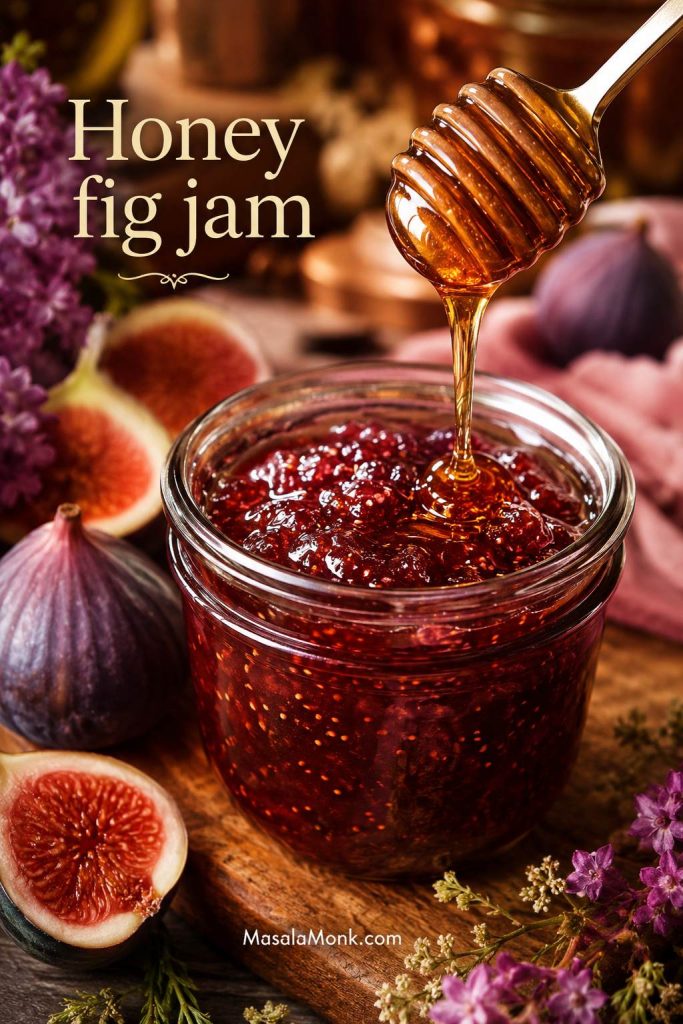
Keep honey-sweetened batches refrigerated or frozen for the best texture and freshness.
No-added-sugar fig spread
If you are searching for no-sugar fig jam, think of this version as a no-added-sugar fig spread instead of a classic jam. Cook ripe figs with lemon juice and a splash of water until very soft and thick, then mash or blend. Refrigerate and use within about 5–7 days, or freeze for longer storage.
Storage note: Low-sugar, honey, and no-added-sugar versions are softer, shorter-life batches. Keep them refrigerated or frozen rather than treating them like pantry preserves.
Before reducing sugar further, read the storage and canning safety notes so you choose the right storage path.
Fig Jam Variations
Once you understand the base recipe, the flavor is easy to adjust. Start small with add-ins because figs are delicate and can be overwhelmed by strong spices, vinegar, or herbs.
The Best First Variations
- Lemon-orange: brighter and more fragrant for breakfast and desserts.
- Vanilla: softer, rounder, and more dessert-like.
- Balsamic: deeper and better for cheese, pork, chicken, and sandwiches.
- Rosemary or thyme: savory enough for boards, baked brie, and grilled cheese.
- Chili: just enough heat for cheese, flatbreads, and sandwiches.
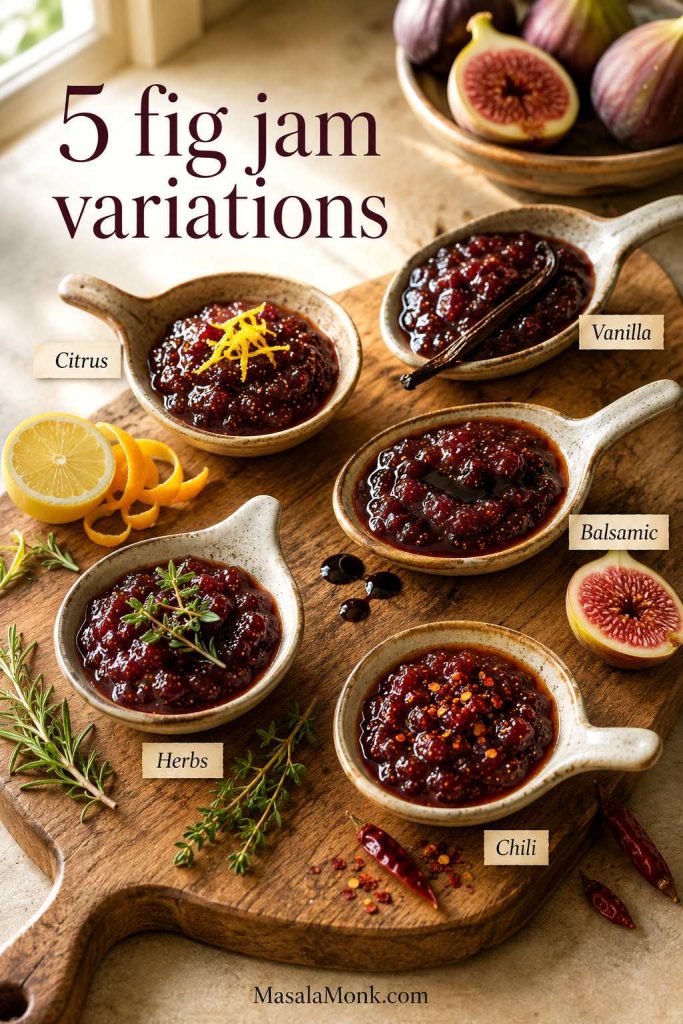
| Variation | What to Add | Where It Shines |
|---|---|---|
| Lemon | Extra lemon zest or a little extra lemon juice | Toast, yogurt, scones, breakfast boards |
| Orange | Orange zest, or a mix of orange and lemon | Croissants, cakes, desserts, cheese boards |
| Vanilla | Vanilla bean or vanilla extract | Pastries, cakes, ice cream, cheesecake |
| Balsamic | 1–2 tbsp balsamic vinegar near the end | Brie, goat cheese, blue cheese, pork, chicken, sandwiches |
| Honey | Replace part of the sugar with honey | Soft floral jam, yogurt, toast, cheese |
| Brown sugar | Replace part or all of the white sugar with light brown sugar | A deeper caramel note, toast, baking, cheese boards |
| Ginger | Fresh grated ginger or a pinch of ground ginger | Winter breakfasts, cheese boards, roasted meats |
| Rosemary or thyme | A small herb sprig while cooking, removed before jarring | Savory boards, baked brie, grilled cheese |
| Chili | A small pinch of chili flakes | Cheese, sandwiches, flatbreads |
| Strawberry | Replace part of the figs with strawberries | A fruitier Southern-style jam |
| Fig onion-style condiment | Onions, vinegar, and savory cooking | A separate condiment, better treated as its own recipe |
For cheese boards, the best directions are balsamic, rosemary, thyme, honey, orange, brown sugar, and chili. For breakfast and desserts, vanilla, lemon, orange, ginger, and strawberry are especially good.
How to Store Fig Jam
Think of this as the kind of jam you keep in the fridge and actually use: spooned over breakfast, tucked beside cheese, or frozen in small jars for later. It is flexible, lower-stress, and less sugar-heavy than a shelf-stable canning preserve.
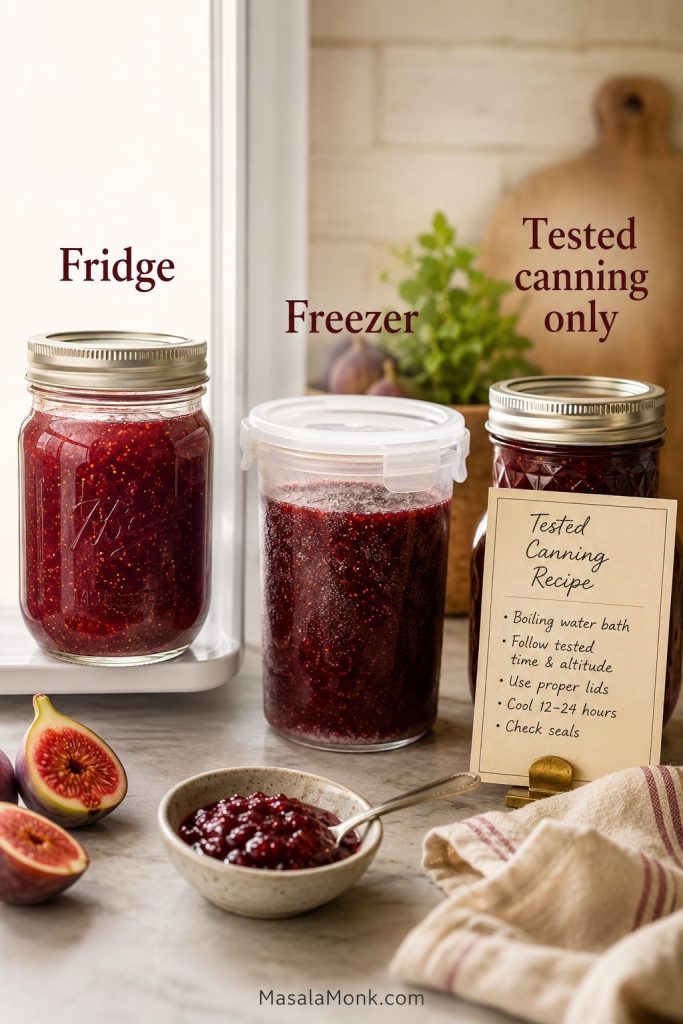
Refrigerator storage
Cool the jam, transfer it to clean jars, and refrigerate. For best quality, use the main version within 2–3 weeks. Always use a clean spoon, keep the jar chilled, and discard it if you see mold, fermentation, off smells, or unusual bubbling.
Freezer storage
The jam freezes well. Spoon it into freezer-safe jars or containers, leaving headspace because it expands as it freezes. Freeze for up to 3 months for best quality. Thaw overnight in the refrigerator and stir before using.
Canning fig jam
For pantry jars, switch to a tested preservation recipe and follow it exactly. Canning safety depends on the exact fruit, sugar, acid, headspace, jar size, and processing time. Figs also need proper acidification for safe boiling-water canning.
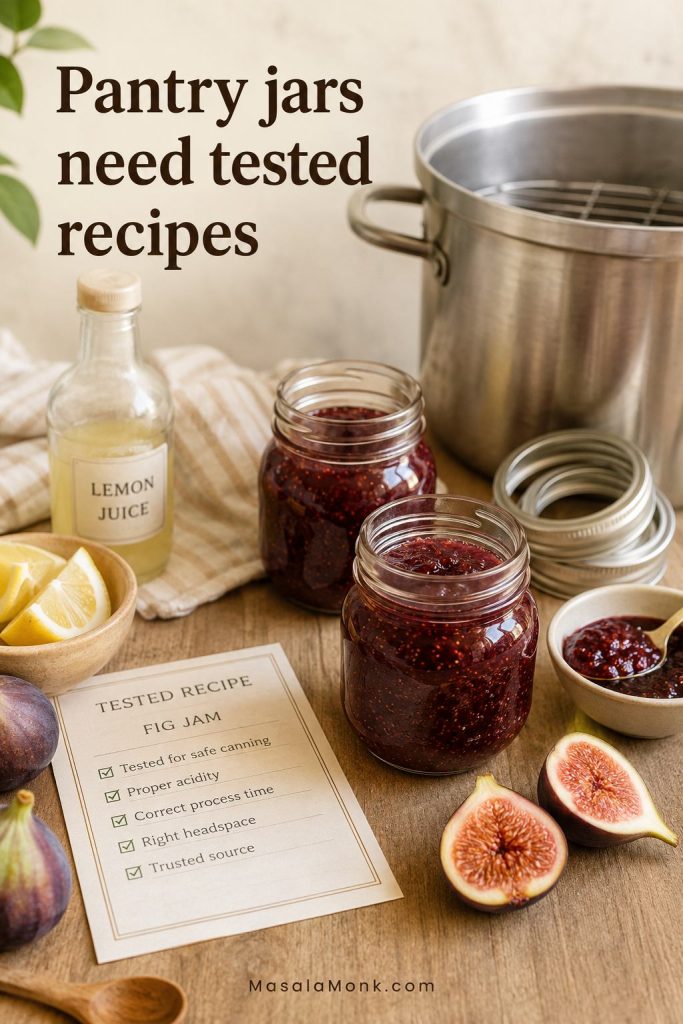
Canning safety: Do not can this version as written. Sterilized jars do not make an untested refrigerator jam shelf-stable.
For shelf-stable jars, use a tested canning recipe and follow its processing instructions exactly. The National Center for Home Food Preservation has a tested fig jam without pectin formula, and Oregon State University Extension explains why figs need added acid for safe preservation.
Do not use low-sugar, honey-sweetened, or no-added-sugar variations for room-temperature storage unless you are following a tested recipe designed for that exact style.
What to Eat With Fig Jam
This is where the jar earns its space in the fridge. A spoonful can rescue plain yogurt, make toast feel planned, or turn a last-minute cheese plate into something generous. The easiest rule: pair it with something creamy, salty, tangy, smoky, or crisp so the sweetness has contrast.
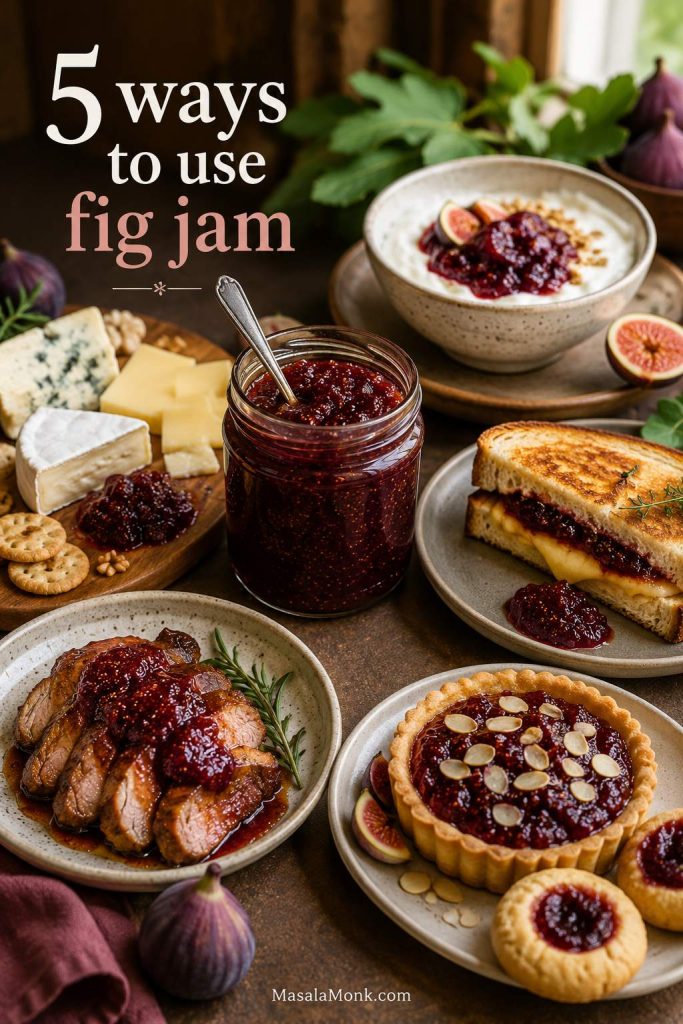
| Use | Texture to Aim For | Flavor Direction |
|---|---|---|
| Toast, yogurt, oatmeal | Soft and spoonable | Lemon, vanilla, honey |
| Brie or goat cheese | Slightly thicker spread | Balsamic, orange, rosemary |
| Sandwiches and grilled cheese | Smooth or lightly chunky | Chili, balsamic, thyme |
| Cookies, cakes, tarts | Thicker jam | Vanilla, orange, brown sugar |
| Pork or chicken glaze | Loosened with acid or pan juices | Balsamic, chili, thyme |
For cheese-specific serving ideas, jump to fig jam with brie and cheese boards.
Breakfast ideas
At breakfast, use it where you would use berry jam, but expect a deeper, honeyed flavor.
- Spread on toast, English muffins, biscuits, or croissants
- Spoon over Greek yogurt or labneh
- Swirl into oatmeal or overnight oats
- Serve with pancakes, waffles, or French toast
- Add to a bowl of granola, nuts, and fruit
If you like breakfast bowls, fig jam pairs naturally with nuts, oats, yogurt, and dried fruit. Spoon it into overnight oats, or serve it with a crunchy bowl of this homemade granola recipe.
It is also excellent with warm toast, biscuits, or English scones, especially when the jam is soft enough to spoon rather than slice.
Cheese and board ideas
On a cheese board, fig jam gives you the sweet-tart contrast that makes salty, creamy, sharp, and funky cheeses taste better. Brie loves lemon, orange, balsamic, or rosemary. Goat cheese works beautifully with honey or vanilla. Blue cheese needs a smaller spoonful and a stronger direction like balsamic, orange, or chili.
- Brie or baked brie
- Goat cheese or whipped goat cheese
- Blue cheese or Gorgonzola
- Camembert
- Manchego
- Cream cheese
- Sharp cheddar
- Charcuterie boards with crackers, nuts, fruit, and cured meats
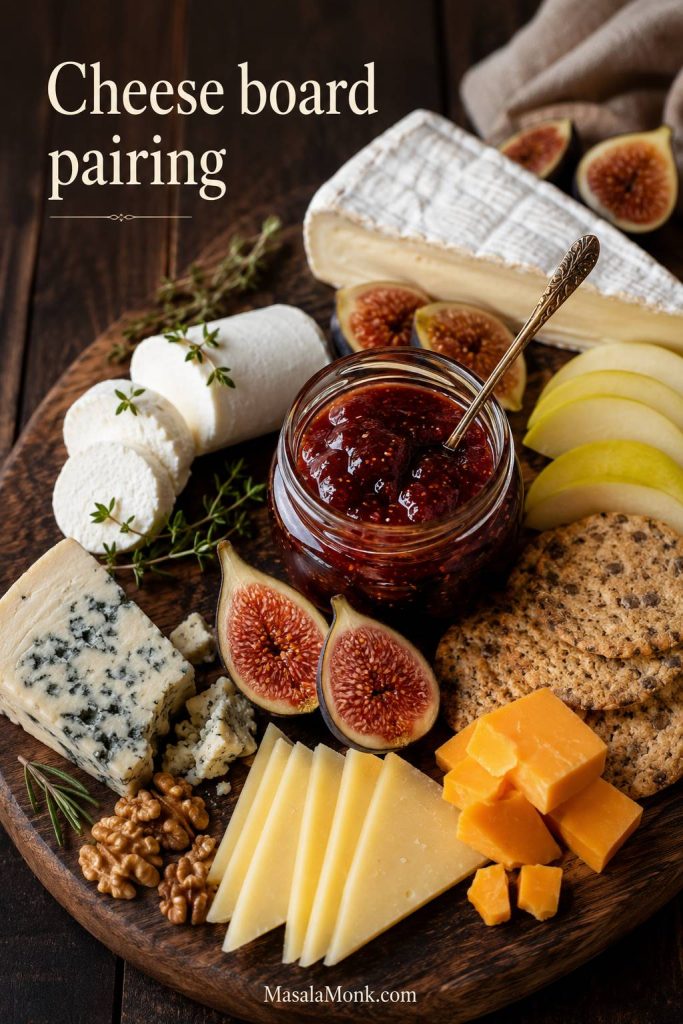
For party boards, fig jam fits naturally into a larger spread like this charcuterie board guide.
Savory uses
In savory food, use fig jam like a sweet-tart glaze or condiment, especially with salty, smoky, roasted, or sharp flavors.
Fig jam grilled cheese: Spread a thin layer inside the sandwich so the jam melts into the salty cheese instead of overwhelming it.
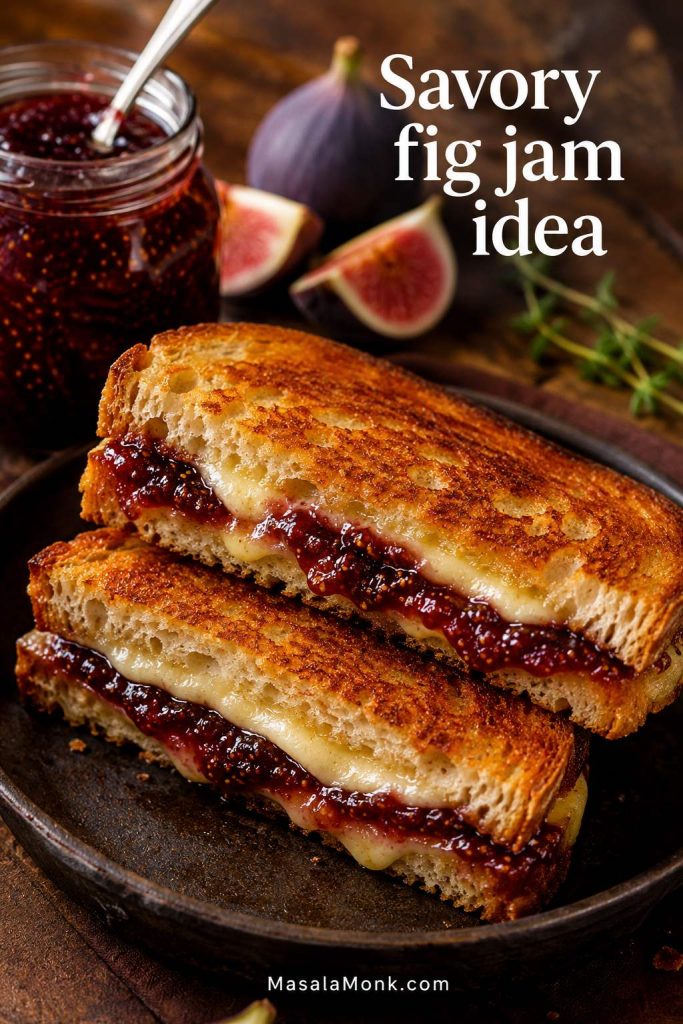
- Use in turkey, ham, or chicken sandwiches
- Brush over pork or chicken as a glaze
- Spoon onto pizza or flatbread with cheese and herbs
- Serve with roasted vegetables
- Stir into a pan sauce with vinegar or mustard
For meat, loosen the jam with lemon juice, vinegar, or pan juices and brush it over something simple like pork tenderloin in oven.
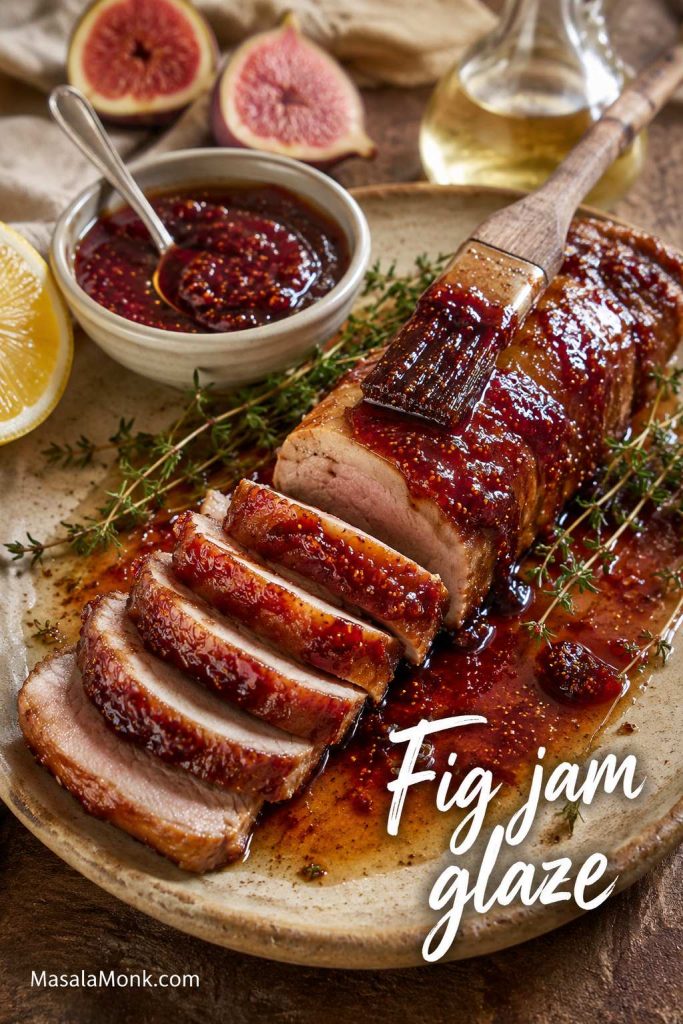
Dessert uses
For desserts, choose a thicker batch or simmer the jam a little longer so it holds its place in cookies, cakes, and tarts.
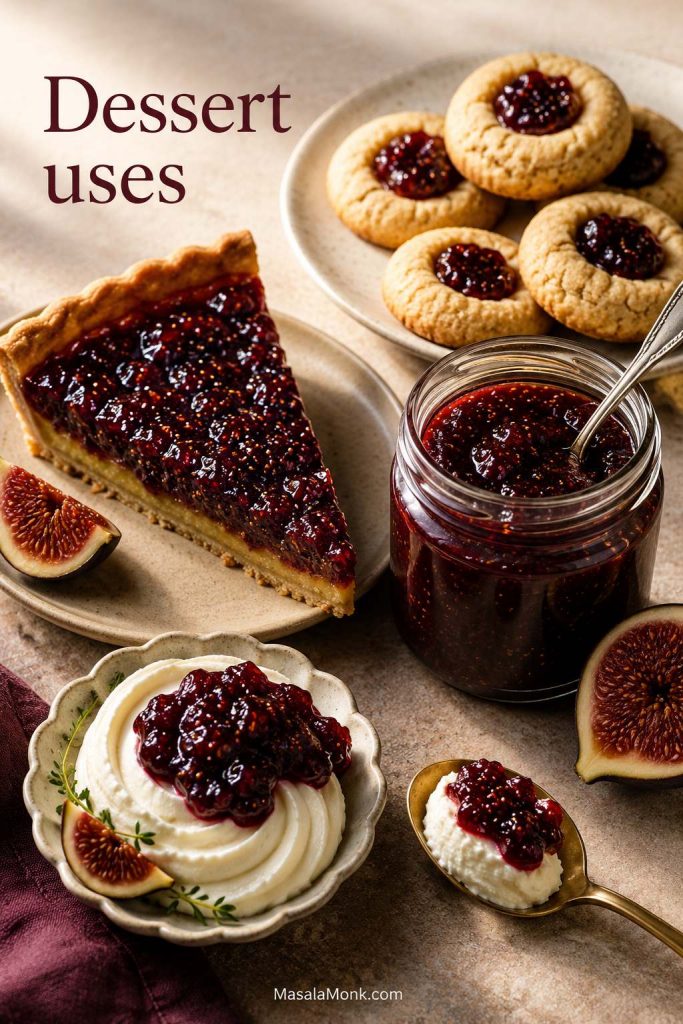
- Fill thumbprint cookies
- Use in fig bars or Fig Newton-style cookies
- Layer into cakes
- Spoon over cheesecake
- Serve with vanilla ice cream
- Use as a tart or galette filling
- Swirl into whipped cream or mascarpone
For tart-style desserts, use a thicker batch the way you would use a glossy fruit layer in an apple tart recipe.
Fig Jam With Brie, Goat Cheese, and Cheese Boards
With cheese, the sweetness and texture do the heavy lifting. The jam brings fruit, acidity, and softness, while the cheese brings salt, fat, and creaminess. The combination tastes generous without needing much work.
For an easy baked brie-style appetizer, use about 2–3 tablespoons per 8 oz brie wheel. Place the brie in a small oven-safe dish, warm it until soft but not completely melted and leaking, then spoon the jam over the top. Add toasted walnuts, pecans, or pistachios. Finish with honey, thyme, rosemary, orange zest, or a few drops of balsamic vinegar. Serve with crackers, baguette slices, apple slices, or pear wedges.
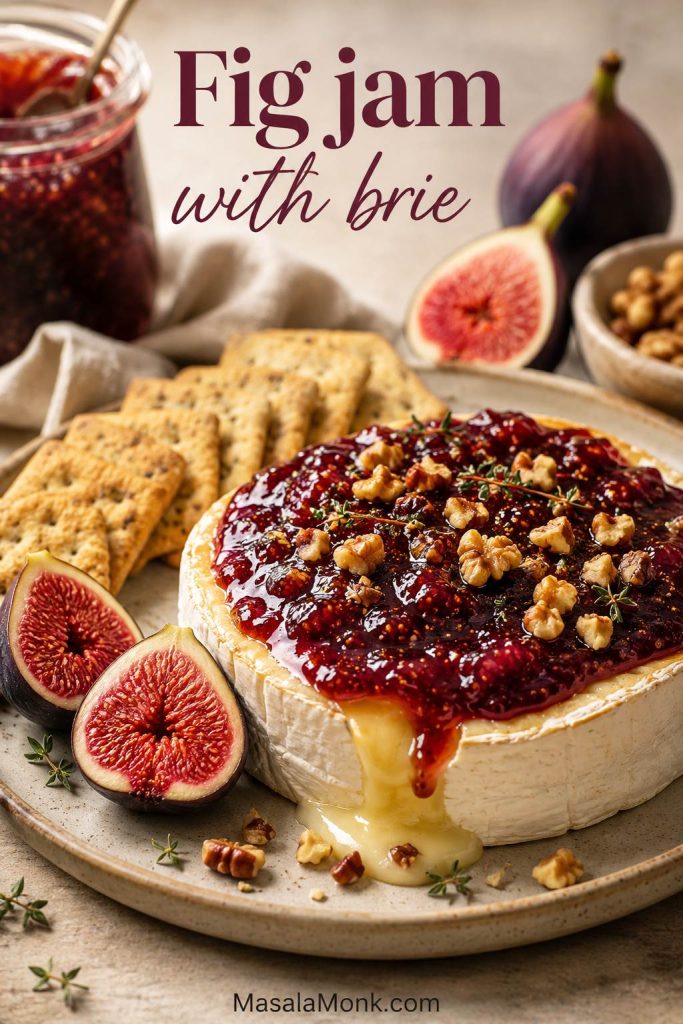
If you are serving the brie as part of a drinks-and-snacks spread, a bright French 75 works well because lemon and bubbles cut through creamy cheese and sweet jam.
Add nuts after warming if you want them to stay crisp. A balsamic variation is especially good with stronger cheeses because the vinegar keeps the sweetness from becoming heavy.
Goat cheese is especially good with a spoonful of jam, cracked pepper, toasted nuts, and a drizzle of olive oil or honey. Blue cheese is stronger, so use a smaller spoonful and choose a sharper variation like balsamic, orange, or chili. Sharp cheddar and Manchego work best with a thicker batch, crackers, and crisp fruit.
Want a savory path instead? Use the fig jam glaze idea for pork or chicken.
Fig Jam Troubleshooting
Most jam problems look dramatic while the pot is hot. Usually, they are texture problems — and texture problems can often be fixed before the jar cools. Use this table before adding thickeners or throwing anything away.
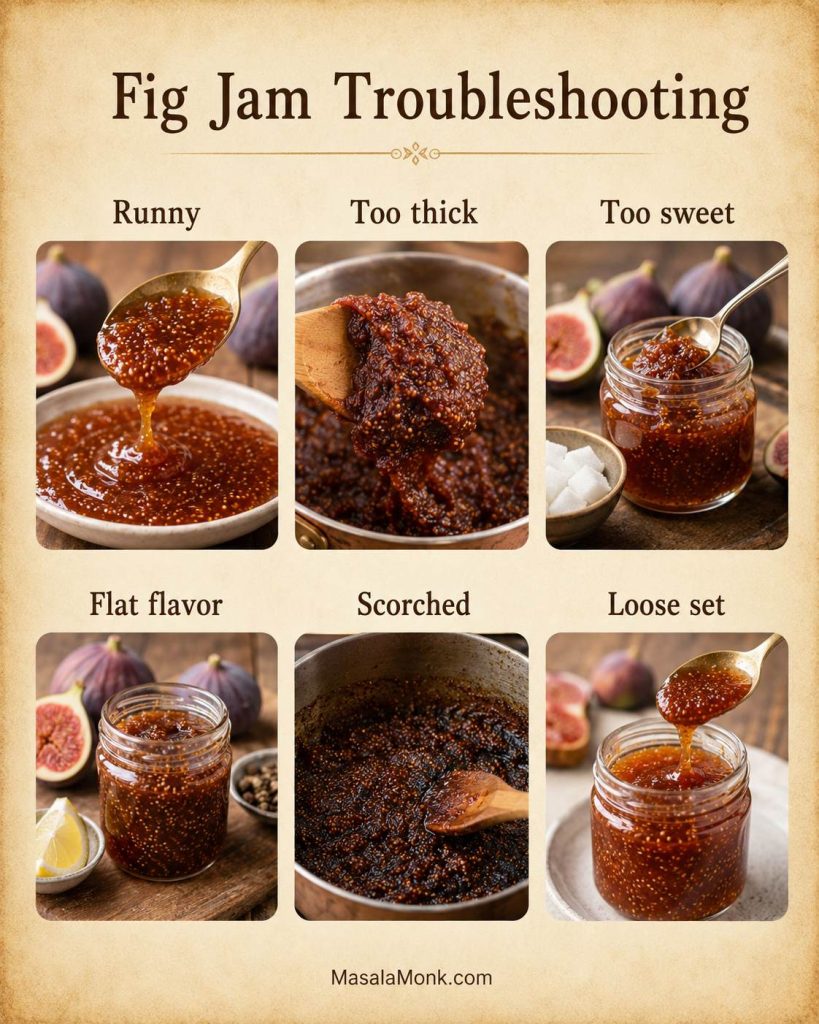
If you are unsure whether the batch is actually done, compare it with the doneness tests before making a fix.
Common Problems and Fixes
| Problem | Likely Cause | Fix Now | Next Time |
|---|---|---|---|
| Runny | Too much water, undercooking, very juicy figs, or low sugar | Simmer longer in a wide pan, stirring often | Start with less water, cook to the doneness tests, and avoid rushing |
| Too thick | Overcooking or too much evaporation | Stir in a spoonful of hot water or lemon juice until loosened | Stop cooking when the jam is shiny and spoonable, not stiff |
| Too sweet | Very ripe figs or too much sugar | Add lemon juice a teaspoon at a time | Choose the lower end of the sugar range |
| Flat flavor | Not enough acid or salt | Add lemon juice and a tiny pinch of salt | Build in zest, lemon juice, or a small balsamic finish |
| Scorched | Heat too high, pan too thin, or not enough stirring | Do not scrape burnt bits into the jam; move unburnt jam to a clean pot | Keep the heat lower, use a heavier pan, and stir more often |
| Loose set | No pectin, low sugar, or not enough reduction | Treat it as fig spread or simmer longer | Check with the cold plate test or thermometer cue |
| Noticeable seeds | Figs naturally have many tiny seeds | Blend the jam smoother | Choose a smoother fig spread texture from the start |
| Dried fig version too dense | Dried figs absorbed too much liquid or cooked down too far | Blend in hot water a spoonful at a time | Simmer figs until fully soft before reducing hard |
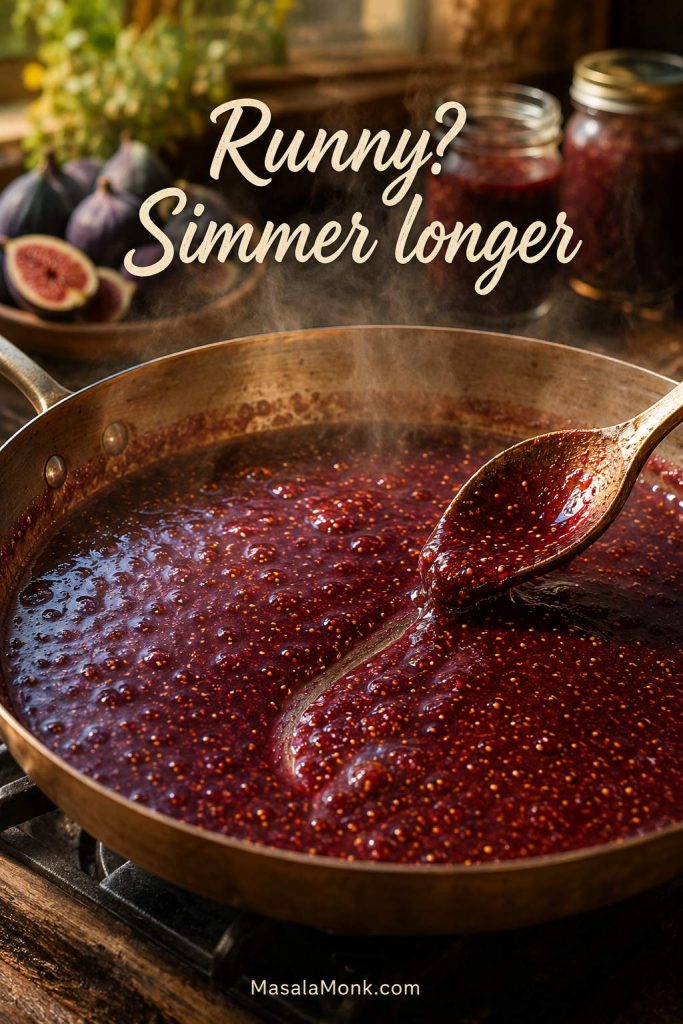
Runny Fig Jam Fix
A loose batch usually needs more evaporation before it needs anything else, so return it to a wide pan and simmer gently.
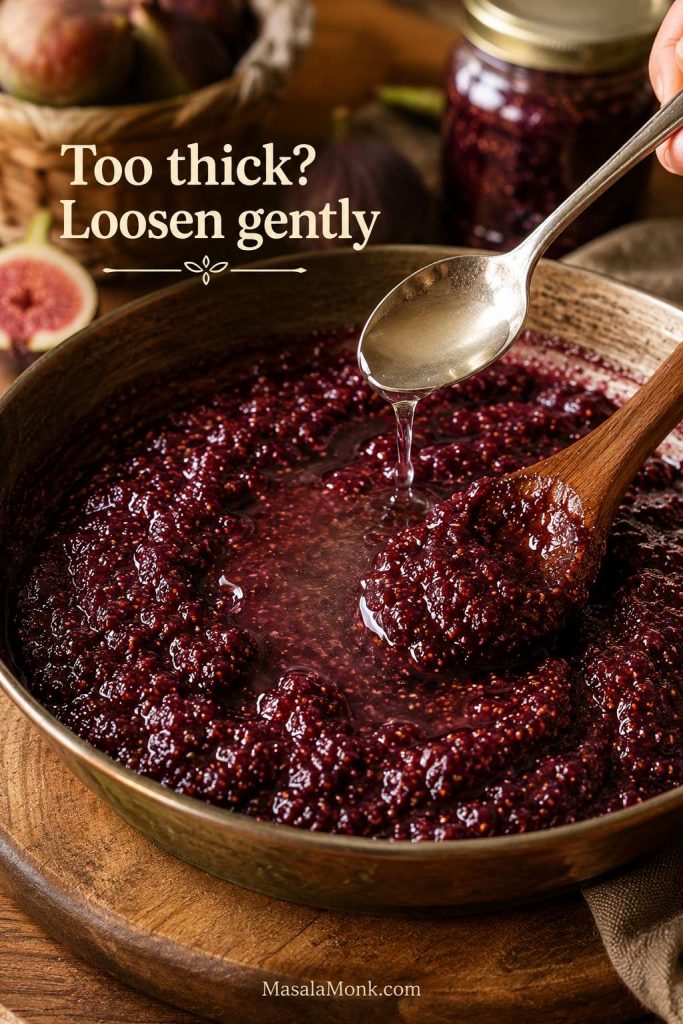
Too-Thick Fig Jam Fix
A stiff batch can often be saved while warm if you add liquid slowly and stop as soon as the jam relaxes.
About cornstarch: Cornstarch can thicken many fruit sauces, but it is not the best fix for classic fig jam and should not be used in anything you plan to can. If the jam is runny, simmering longer is usually the better solution.
FAQs About Fig Jam
Do figs need to be peeled before making jam?
No. The skins are edible and soften as the fruit cooks. Remove the stems and any damaged spots, but leave the skins on for better texture, color, and flavor.
What kind of figs are best for fig jam?
Use ripe, flavorful figs. Black Mission, Brown Turkey, Kadota, Adriatic, and other edible varieties can all work. Ripeness matters more than the exact variety: the fruit should be sweet and soft, not hard, dry, sour, or spoiled.
Fresh figs or dried figs — which makes better jam?
Fresh figs make a brighter, more classic batch. Dried figs make a darker, denser spread that is available year-round and excellent with cheese. If fresh figs are in season, use them. If not, dried figs are a very good option.
Can green figs be used for fig jam?
Ripe green-skinned figs can be used. Truly unripe figs are different and usually need a separate green fig preserve method with soaking or boiling steps to reduce bitterness and firmness. If the figs are hard, dry, and not sweet yet, do not treat them like ripe figs in this quick jam.
Why is lemon juice used in fig jam?
Lemon juice balances the natural sweetness of figs, brightens the flavor, and helps the mixture thicken. It also matters in canning safety, although shelf-stable canning requires a tested recipe rather than casual adjustments.
Does fig jam need pectin?
No, not for a soft homemade version. This recipe thickens through sugar, lemon juice, and evaporation. Commercial pectin gives a firmer set, but it requires different ratios and instructions.
Why is my fig jam runny?
It may need more cooking time. Runny jam usually comes from too much water, very juicy figs, low sugar, a narrow pot, or stopping before enough moisture has evaporated. Simmer it longer in a wide pan and test again.
How long does homemade fig jam last?
For the main refrigerator version, use it within 2–3 weeks for best quality. Low-sugar batches are best within 1–2 weeks, and no-added-sugar spread is best within about 5–7 days. You can also freeze it for about 3 months. Room-temperature jars require a tested preservation method and proper processing.
Is this fig jam recipe safe for canning?
The version here is meant for refrigerator and freezer storage. For shelf-stable canning, use a tested canning formula and processing time from a trusted source. Sterilized jars alone do not make refrigerator jam safe for room-temperature storage. Do not can low-sugar, honey, or no-added-sugar versions unless the recipe is specifically tested for that method.
Can frozen figs be used for jam?
Frozen figs work well, but they usually bring extra liquid. Thaw the fruit first if possible and include the juices unless they seem excessive. The batch may need a longer simmer to thicken.
Can I double this recipe?
Yes, but use a very wide pan and expect a longer cook time. Jam thickens through evaporation, so one large deep pot can take much longer and may cook unevenly. For the best texture control, two smaller batches are usually easier than one oversized batch.
Brown sugar in fig jam — does it work?
Yes. You can replace part or all of the white sugar with light brown sugar for a deeper, warmer, slightly caramel-like flavor. The finished jar will taste less bright, so lemon juice becomes even more important.
What cheese goes best with fig jam?
Brie, goat cheese, blue cheese, Camembert, Manchego, cream cheese, sharp cheddar, and Gorgonzola all pair well with it. Use a balsamic or herb variation for a more savory board.
Final Tips Before You Make It
- Do not peel the figs; the skins soften during cooking.
- Start with less water and add more only if the pot looks dry.
- Cook uncovered so moisture can evaporate.
- Use a wide pan so the jam reduces efficiently.
- Stop cooking before the jam looks stiff; it thickens as it cools.
Once the figs soften and the kitchen smells warm and lemony, the rest is patience: stir, test, stop early, and let the jar finish thickening as it cools.
Fig Jam Recipe
A soft-set fresh fig jam made without commercial pectin. It cooks down into a shiny, fruit-forward spread for toast, yogurt, cheese boards, baked brie, desserts, sandwiches, and savory glazes. Keep it refrigerated or frozen unless you switch to a tested canning recipe.
Ingredients
- Ripe fresh figs: 2 lb / 900 g, stems removed, chopped or quartered
- Granulated sugar: 1½ cups / 300 g
- Fresh lemon juice: ¼ cup / 60 ml, plus more to taste
- Water: ¼–½ cup / 60–120 ml, as needed
- Fine salt: ⅛ tsp, optional
- Lemon or orange zest: 1 tsp finely grated, optional
- Vanilla: 1 tsp vanilla extract or ½ vanilla bean, optional
- Balsamic vinegar: 1–2 tbsp, optional for a cheese-board variation
Instructions
- Prep the figs. Rinse gently, pat dry, remove stems, and chop or quarter the figs. Do not peel them; fig skins soften during cooking.
- Combine the ingredients. Add figs, sugar, lemon juice, ¼ cup / 60 ml water, and salt if using to a wide heavy-bottomed pan. Stir well. Let sit for 15–30 minutes if you have time.
- Start cooking. Set the pan over medium heat and stir until the sugar dissolves and the figs begin to release juice. Add the remaining water only if the pot looks dry or the figs start sticking before they soften.
- Simmer uncovered. Reduce the heat to maintain a steady simmer. Cook uncovered, stirring often, until the figs soften, slump, and begin to collapse, about 25–45 minutes.
- Mash or blend. Mash lightly for fig preserves-style texture with visible pieces. Mash more for rustic jam. For a smoother fig spread, pulse briefly with an immersion blender.
- Cook to thickness. Continue simmering until the jam looks shiny, mounds softly on a spoon, and moves slowly on a chilled plate. At sea level, a thermometer may read around 220°F / 104°C for a firmer set, but texture matters more than temperature alone.
- Adjust flavor. Add more lemon juice if the jam tastes too sweet or flat. Stir in vanilla, zest, or balsamic vinegar near the end if using.
- Jar and cool. Spoon into clean jars. Cool, then refrigerate. The jam will thicken more as it cools.
Dried Fig Variation
Use 12–14 oz / 340–400 g dried figs, 2 cups / 480 ml water, ½–1 cup / 100–200 g sugar to start, and 2 tbsp / 30 ml lemon juice. Simmer the chopped dried figs with water until very soft, 20–40 minutes. Mash or blend, add sugar and lemon, then simmer until thick and spoonable. Add more sugar only after tasting. Keep the jam slightly loose while hot because dried fig jam firms quickly as it cools.
Small-Batch Version
Use 1 lb / 450 g fresh figs, ¾ cup / 150 g sugar, 2 tbsp / 30 ml lemon juice, and 2–4 tbsp / 30–60 ml water. Cook time is usually shorter, about 20–30 minutes.
Sugar Notes
For a lower-sugar version, use 150–200 g sugar per 900 g fresh figs and expect a softer set; refrigerate and use within 1–2 weeks. For no-added-sugar fig spread, cook ripe figs with lemon juice and a splash of water until thick, then refrigerate and use within about 5–7 days or freeze.
Storage and Canning
Keep this batch refrigerated and use within 2–3 weeks for best quality, or freeze for up to 3 months. Do not can this version as written. For shelf-stable jars, switch to a tested canning formula.
Once the jars are cool, keep one where you can reach it easily. This is the spoonful that turns plain toast, cheese, or a quick dessert into something finished.