Bagel dough is supposed to feel a little strange if you are used to ordinary bread. It is firm and pushes back when you knead it. The shaped rings puff without turning soft and pillowy. Then, just when most bread dough would be heading for the oven, these rings go into boiling water first.
Those steps give a chewy New York-style bagel its browned, slightly taut crust, compact, springy crumb with just enough air inside, and that unmistakable bit of pull when you bite through it.
Here, New York-style means a lean yeast dough made with strong flour, controlled fermentation, hand-shaped rings, boiling before baking, and enough oven heat to build real crust. You do not need professional bakery equipment to make that happen at home.
This recipe for homemade bagels gives you exact quantities and useful time ranges, but the most important cues are physical. You will know what the dough should feel like, when it has risen enough, what the rings should look like after boiling, and when the crust has gone far enough in the oven.
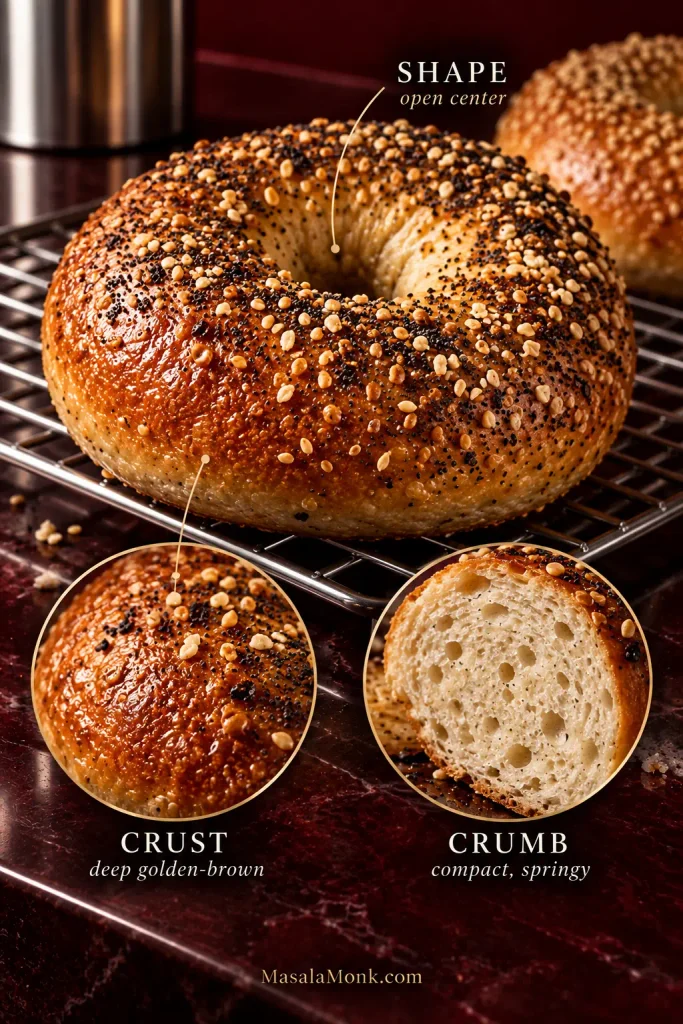
The texture and flavor to aim for: compact but not solid, with some irregular air inside and a springy chew. With barley malt, the flavor should be lightly malty rather than sweet, with much of the toasted character coming from the deeply browned crust.
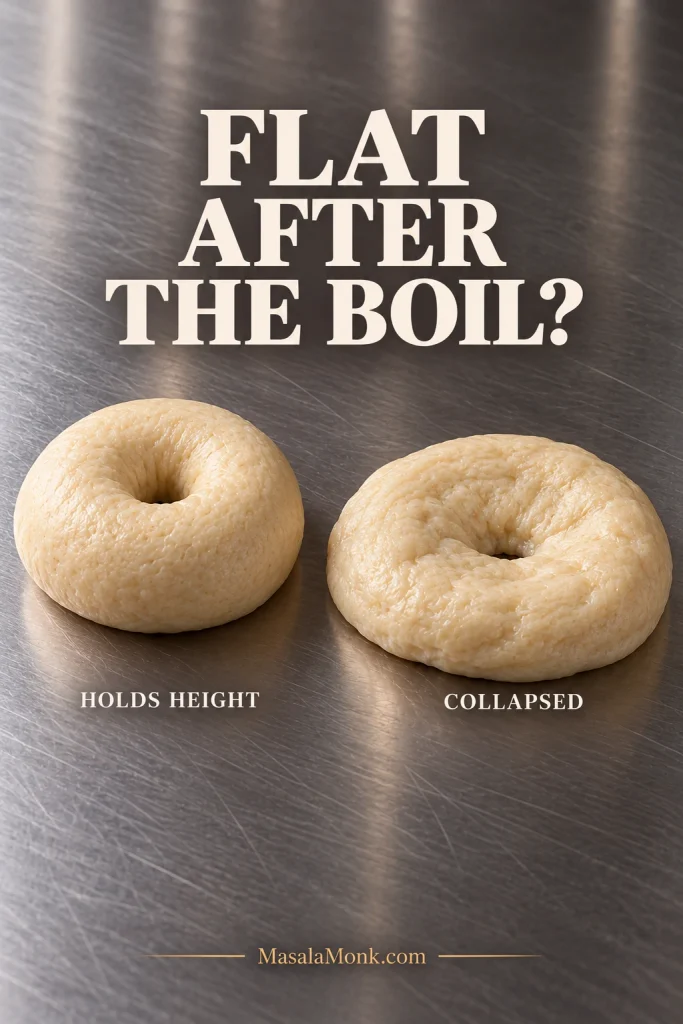
Strong sidewalls, a properly browned crust and a compact but aerated crumb are the three visual targets to look for.
Homemade New York-Style Bagels Recipe
This is the same-day version. All-purpose flour, active dry yeast, and overnight adjustments are included here too, so you do not have to leave the recipe halfway through a batch.
Yield 8 bagels
Size About 125 g / 4.4 oz each
Active time About 45 minutes
Total About 2 1/2–3 1/2 hours including cooling; longer in a cool kitchen
First rise Usually 45–75 minutes
Final proof About 15–30 minutes
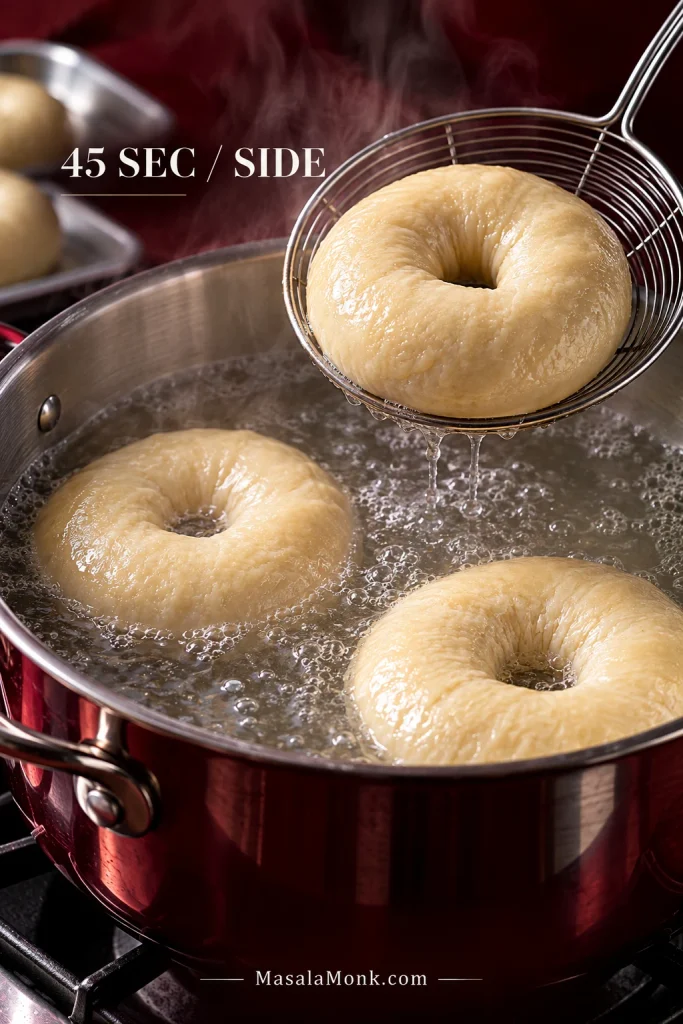
Boil 45 seconds per side
Bake 425°F / 220°C for 20–24 minutes
What you’ll need
You’ll need a large mixing bowl, digital kitchen scale, two half-sheet pans (about 18 × 13 inches / 46 × 33 cm each), parchment paper, a wide pot, a spider or slotted spoon, and a cooling rack. A stand mixer with a dough hook is helpful but optional.
Weigh the flour if you can. Firm bagel dough has less room for error than a loose bread dough, and a heavily scooped cup of flour can change the texture noticeably.
For the dough
600 g / 21.2 oz bread flour, roughly 5 cups when spooned and leveled
360 g water (360 ml / 12.2 US fl oz), about 1 1/2 cups
4 g instant yeast, about 1 1/4 teaspoons
12 g fine salt, about 2 teaspoons depending on the salt
20 g barley malt syrup, about 1 tablespoon, or honey
In a comfortable kitchen, room-temperature to mildly warm water works well. Use somewhat warmer water in a cool room so fermentation does not crawl, then let the dough’s rise and feel—not the starting water temperature alone—tell you when it is ready.
For the boiling water
2 US quarts / about 1.9 liters water
40 g barley malt syrup, about 2 tablespoons, or honey
Optional toppings and extras
Everything bagel seasoning
Sesame seeds
Poppy seeds
Dried minced onion
Coarse salt
1 egg + 1 teaspoon water for optional egg wash
Semolina or cornmeal, optional, for dusting the parchment
Egg wash is optional. Seeds and seasoning will still cling to the damp surface after boiling; egg gives you more shine and a little extra holding power. Dried onion needs different handling because it can scorch during a full bake.
Useful Adjustments and Substitutions
All-purpose flour: keep the flour at 600 g, but hold back 20–30 g of the water when you begin mixing. Add some or all of it later if the dough needs it. Expect a slightly softer chew.
Overnight bagels: reduce the instant yeast to 2 g. After kneading, rest the dough for about 20 minutes, then divide, shape, cover and refrigerate using the method below.
Active dry yeast: use the same 4 g. If your brand recommends dissolving it first, stir it into the recipe water before mixing. Follow the dough rather than expecting the rise to match the clock exactly.
Method
Mix, knead and complete the first rise
Mix. Combine the bread flour, yeast and salt. Stir the barley malt syrup or honey into the water, then add it to the flour. Mix until there are no obvious dry pockets. If the dough looks surprisingly dry, cover it for 5 minutes before adding extra water.
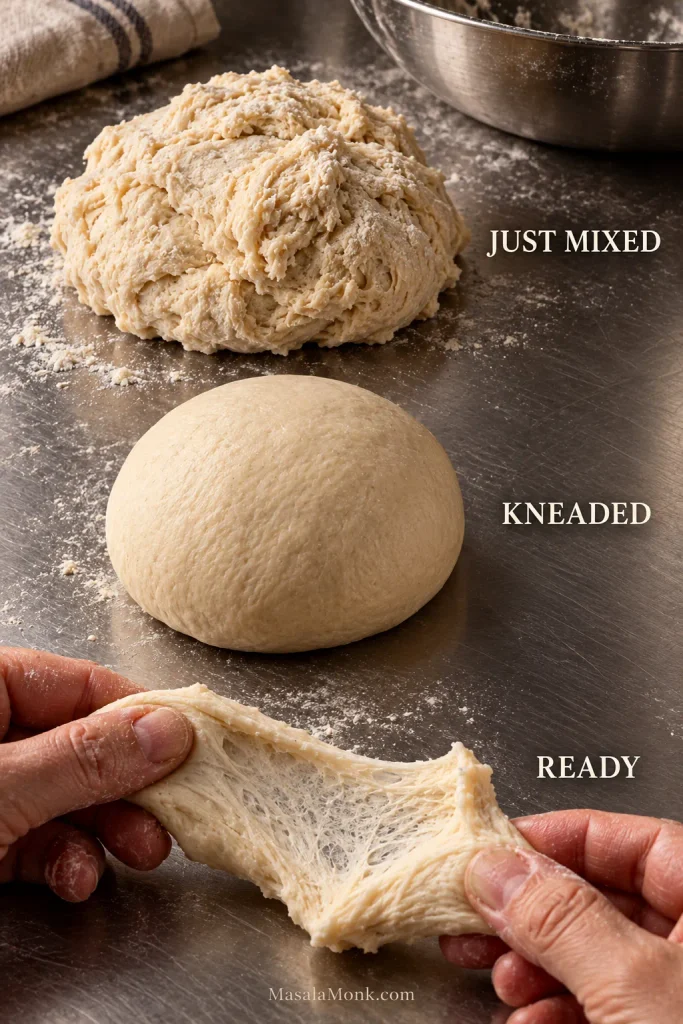
Knead until smooth and elastic. Begin checking around 8–10 minutes in a stand mixer or about 10 minutes by hand; hand kneading can take closer to 15. The dough is ready when it feels smooth and springy and a small piece stretches thin before tearing.
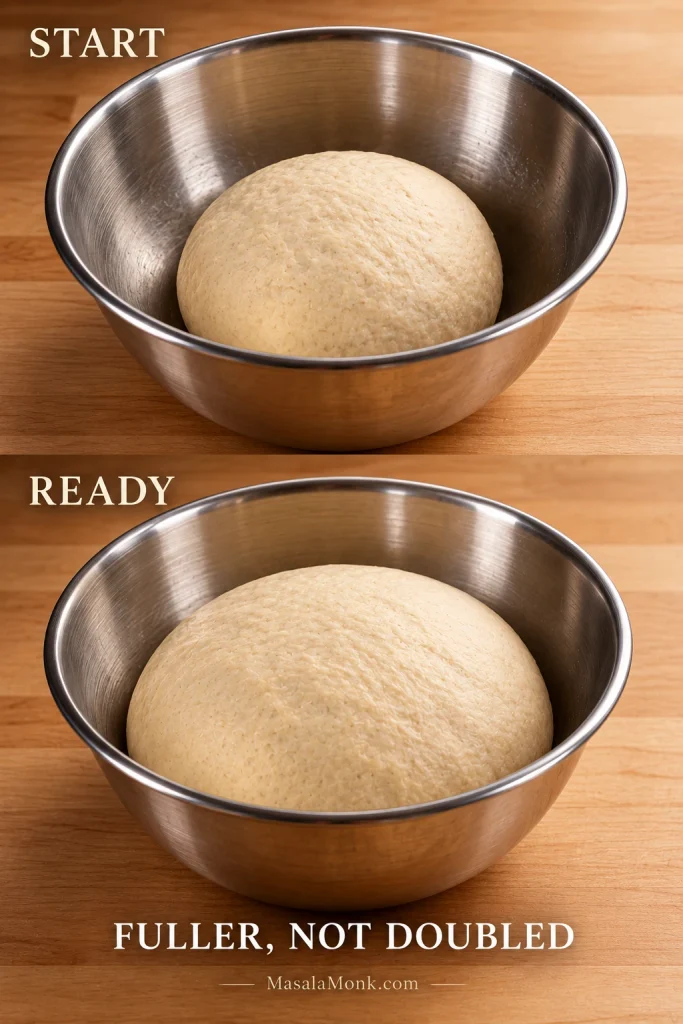
Let it rise until clearly fuller. Cover the dough and begin checking around 40–45 minutes. Move on when it looks roughly 50–75% larger and still feels resilient. A cool kitchen can take longer than 75 minutes.
Preheat, divide, shape and proof
Position the racks, preheat and divide. Arrange oven racks in the upper and lower thirds, then preheat the oven to 425°F / 220°C. Cut the dough into 8 pieces of about 125 g / 4.4 oz each.
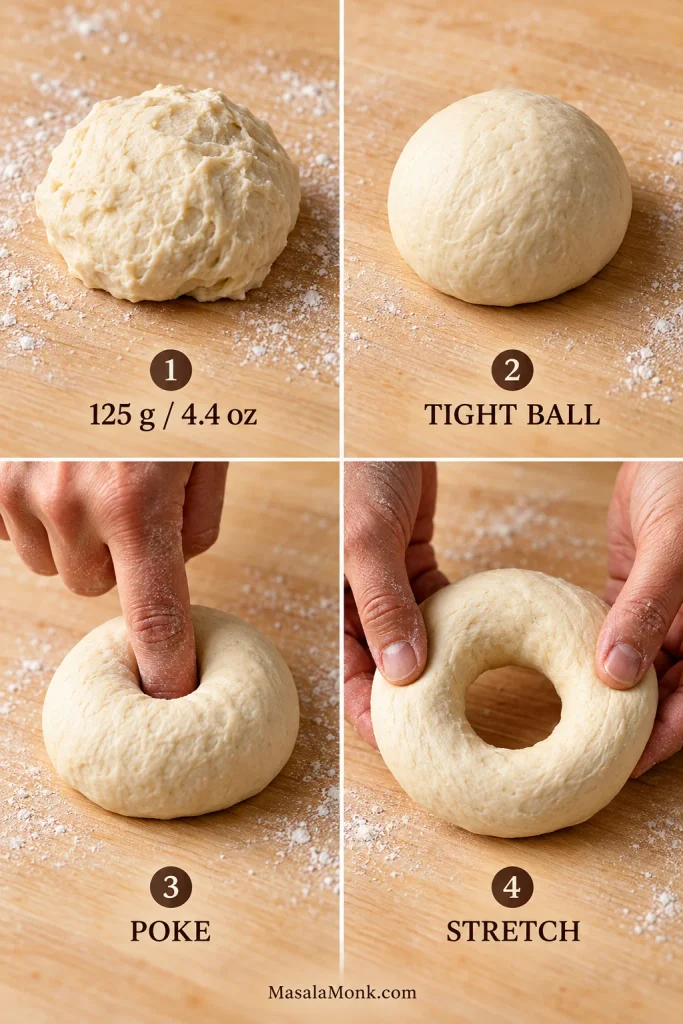
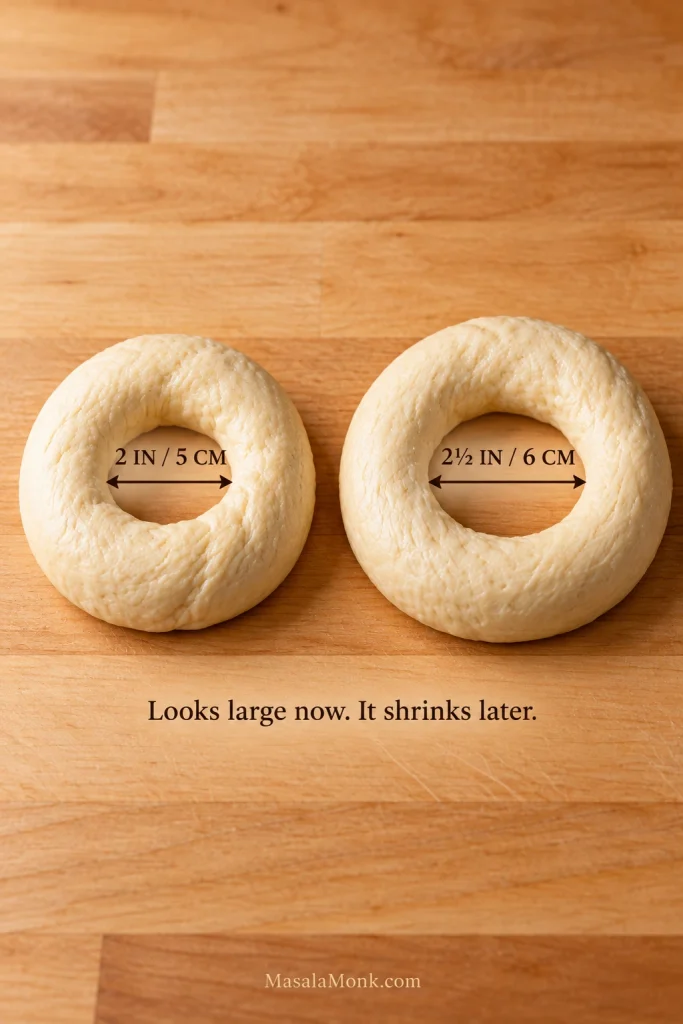
Shape. Form each piece into a smooth, tight ball, push a finger through the center, and stretch the hole to about 2 inches / 5 cm. Go toward 2 1/2 inches / 6 cm if you particularly want a clearly open center after baking.
Start the final proof and water bath. Arrange four rings on each prepared half-sheet pan. Lightly grease the parchment or dust it very lightly with semolina or cornmeal if sticking has been a problem. Cover without letting plastic cling to the dough. Immediately put the 2 quarts / 1.9 liters water and 40 g barley malt syrup or honey in the pot and begin heating toward a gentle boil while the rings proof. Have the toppings ready. The final proof usually takes 15–30 minutes; look for rings that are a little puffier and lighter but still sturdy enough to handle. If the water reaches a boil first, lower the heat until the bagels are ready.
Boil, bake and cool
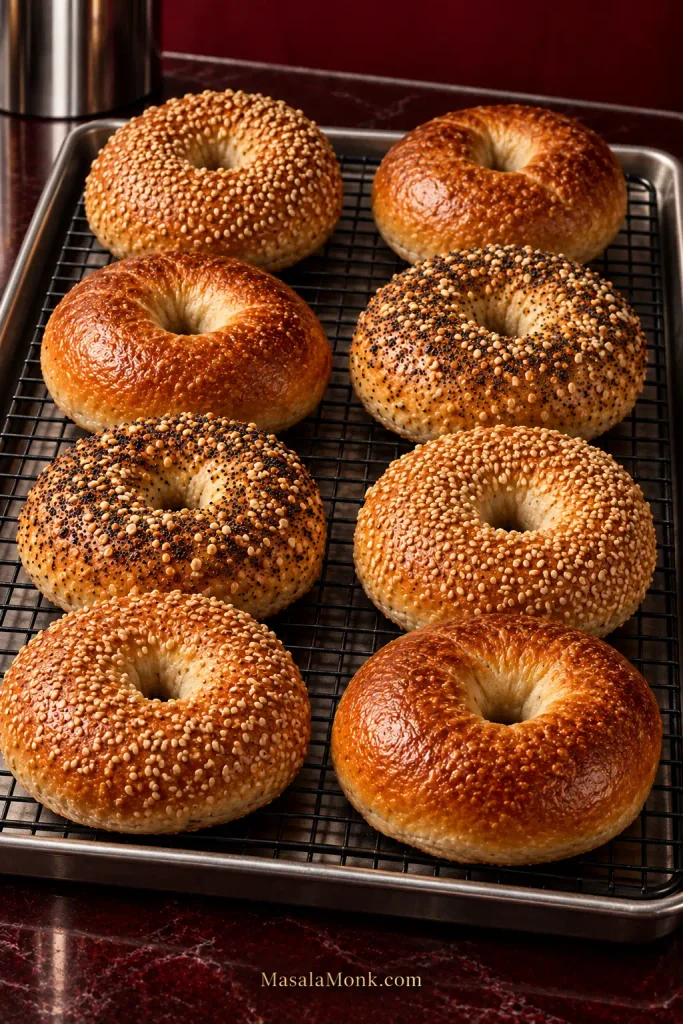
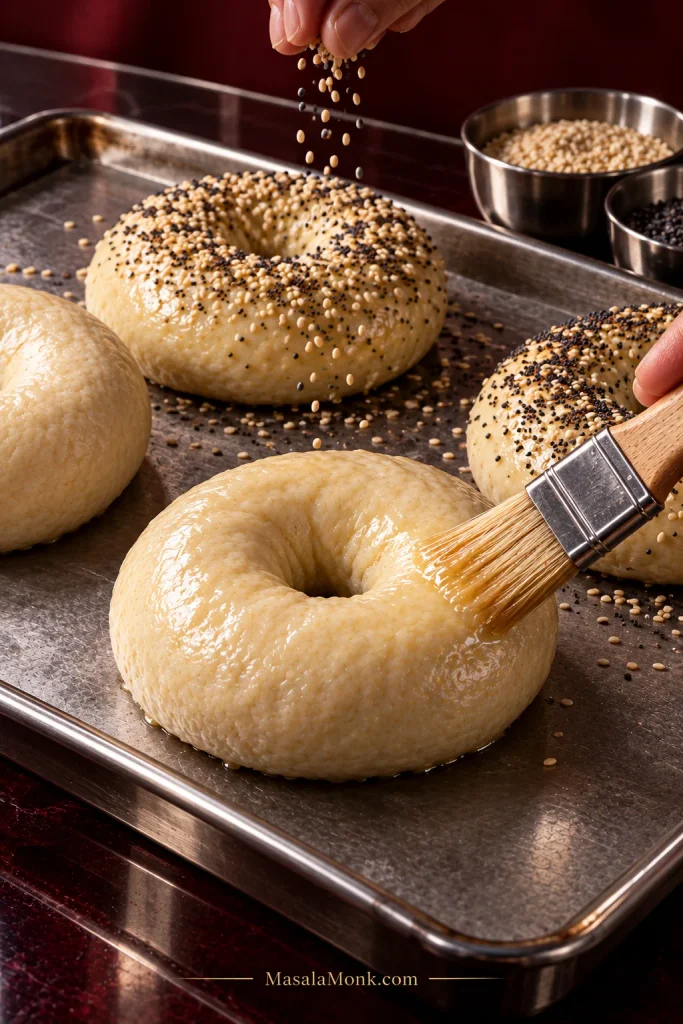
Boil for 45 seconds per side. Work with 2–3 bagels at a time. Lift them out, drain briefly and return them to the baking sheet. If using egg wash, brush it over the boiled bagels before adding the toppings, reserving a little if you plan to add dried onion later. Add sesame, poppy seeds, coarse salt or a seed-heavy everything blend while the surface is still damp. Save dried onion or onion-heavy seasoning for the end of baking. Let the water return to a gentle boil before adding the next batch.
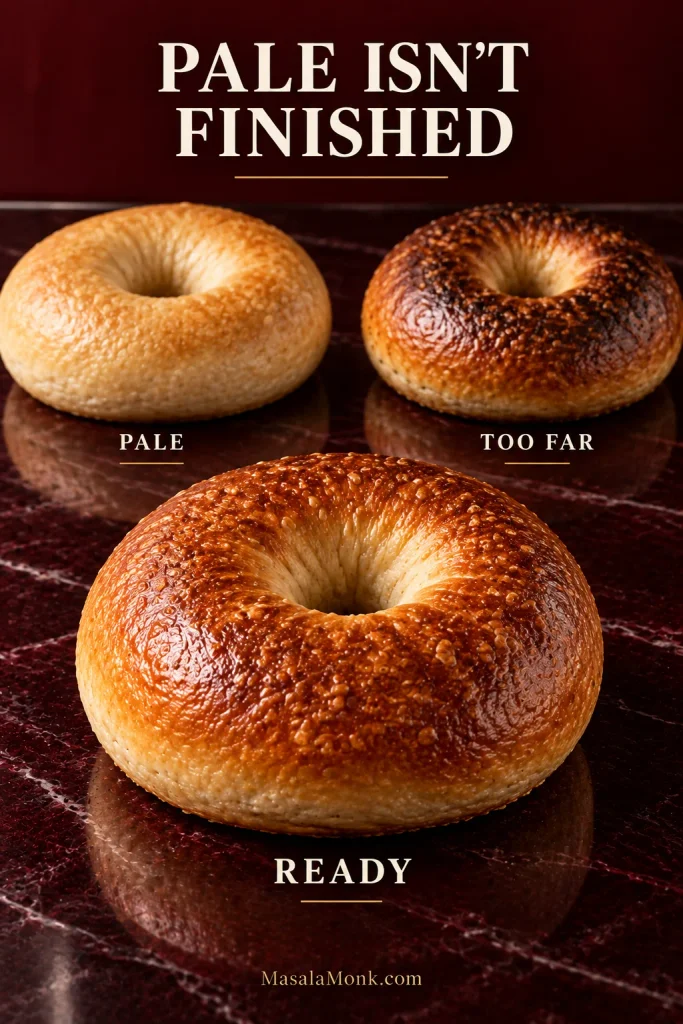
Bake both trays until deeply golden. Once all eight bagels are boiled and topped, get both trays into the oven promptly. Bake for 20–24 minutes, swapping the trays top-to-bottom and rotating them front-to-back about halfway through if your oven browns unevenly.
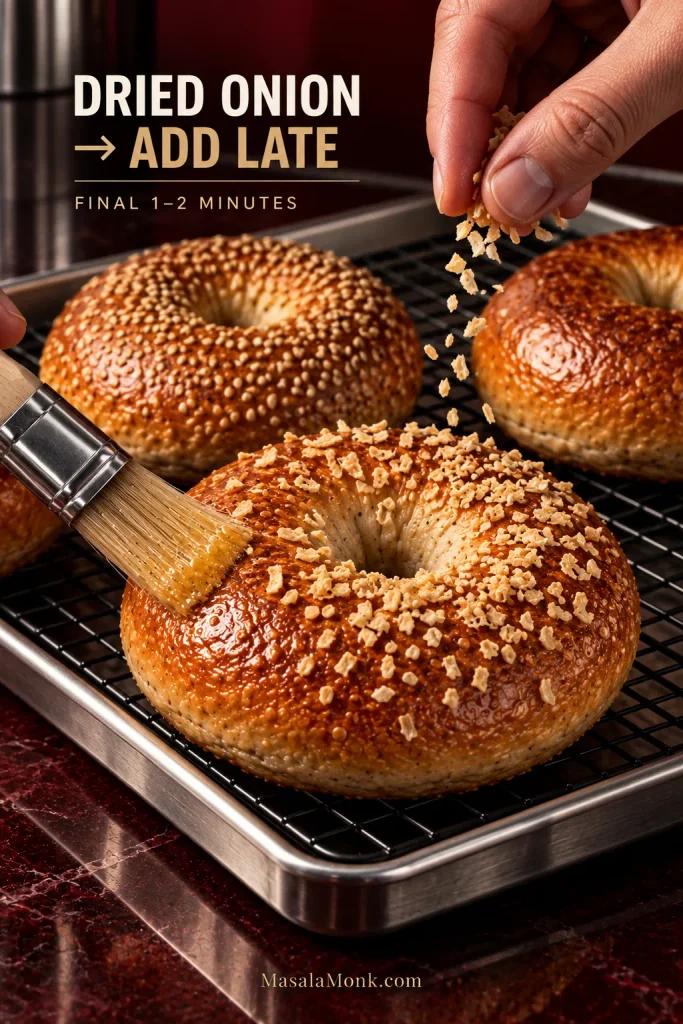
Add dried onion late, if using. When the bagels are nearly browned, pull the trays out briefly. Brush the bagels you want to top with a little reserved egg wash, add dried minced onion or an onion-heavy everything blend, then return the trays to the oven for about 1–2 minutes, just long enough for the topping to toast without scorching.
Cool before slicing. Transfer the bagels to a rack and give them at least 20–30 minutes. A steaming-hot crumb can look gummy even when it is properly baked.
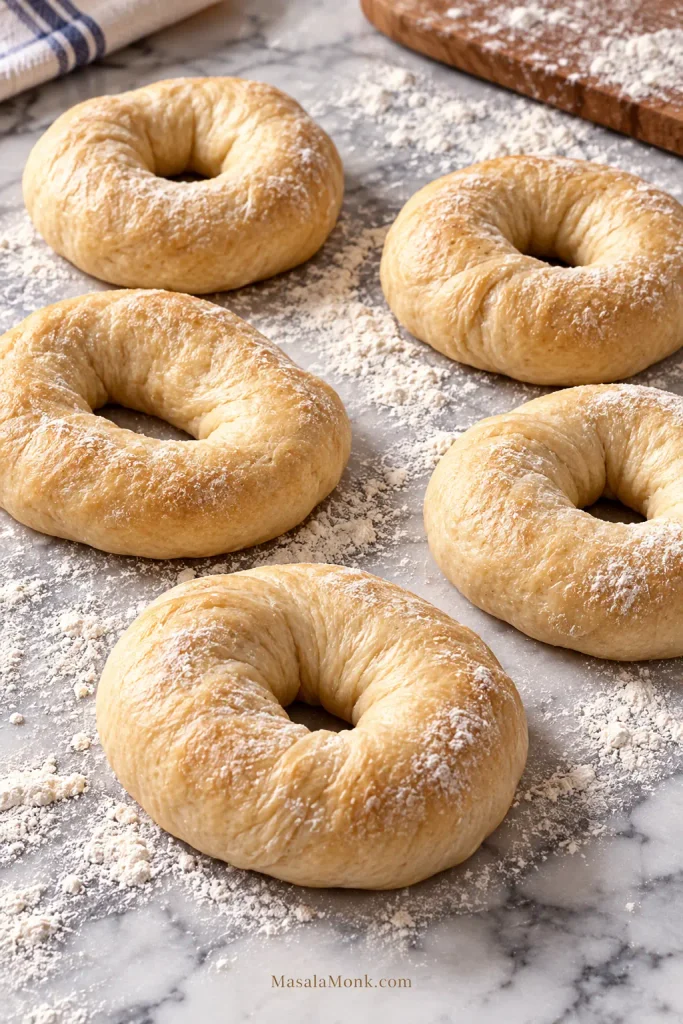
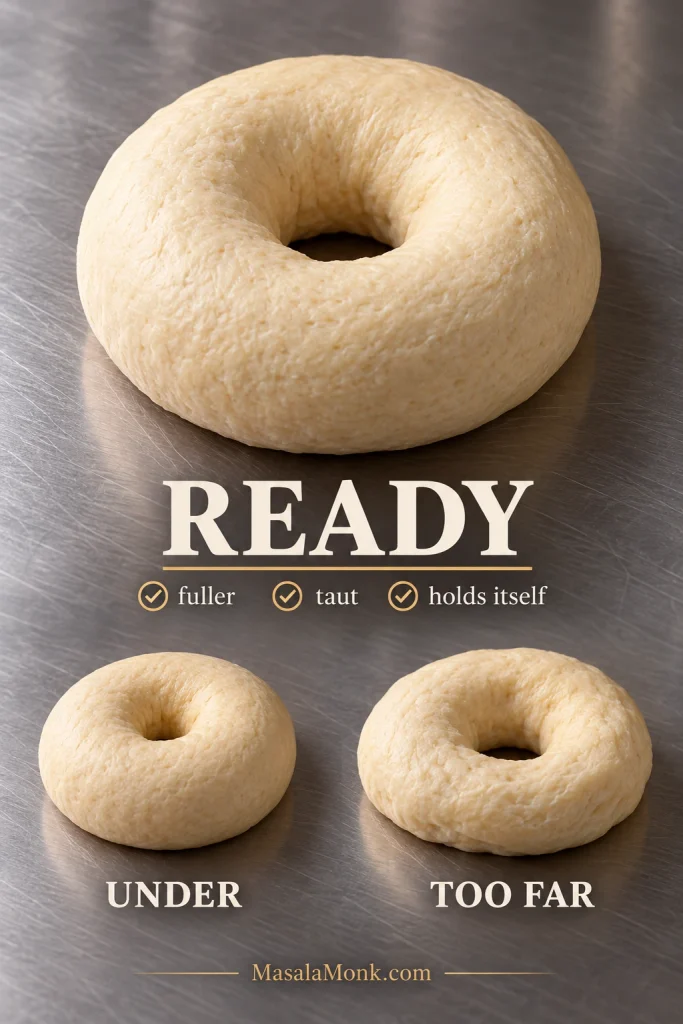
Before the boil: pick up one ring. It should feel lighter than when you shaped it but still hold itself confidently. Puffy is good. Floppy and fragile is too far.
A simple same-day schedule
Stage
Typical time
Mix and knead
About 20 minutes
First rise
Usually 45–75 minutes; longer in a cool kitchen
Divide and shape
About 10–15 minutes; preheat the oven as you begin
Final proof
15–30 minutes while the water bath heats
Boil and top
About 10–15 minutes
Bake
20–24 minutes
Cool
20–30 minutes
The dough still gets the final say.
Same-Day or Overnight Bagels?
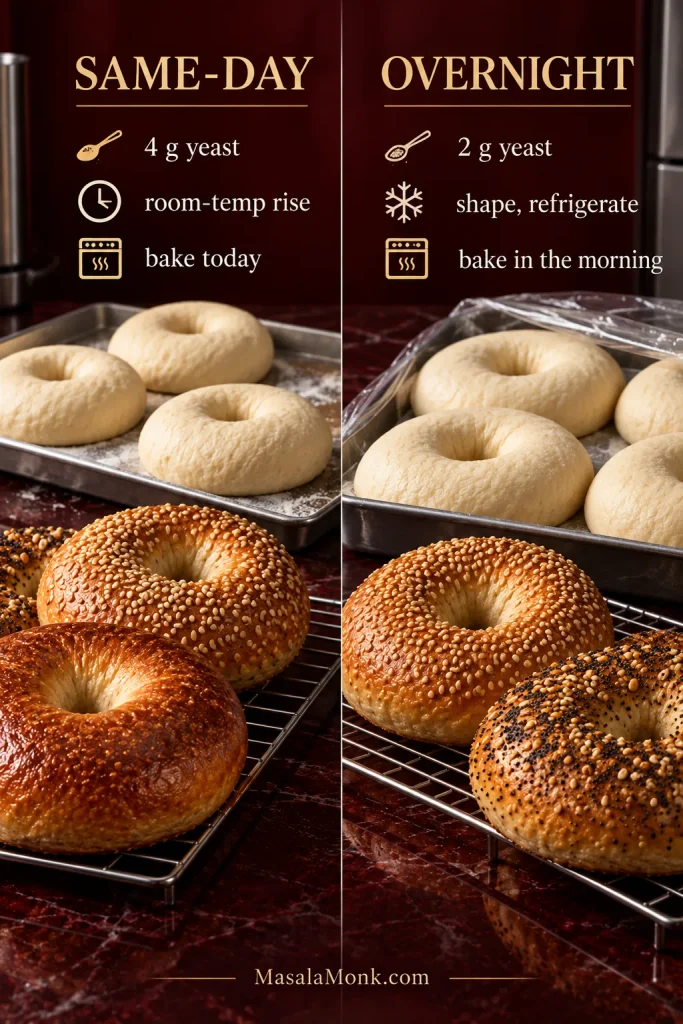
Choose the same-day route when you want good chewy bagels in a few hours. The overnight route gives you more schedule flexibility, firmer cold dough to handle in the morning, and more fermentation time for flavor development.
Route
Best for
What changes
Same-day
The quickest route
4 g instant yeast and a room-temperature first rise
Overnight
Morning baking, cold handling and longer fermentation
2 g instant yeast, a short rest, then refrigerated proofing
For the overnight version
Use 2 g instant yeast. After kneading, cover the dough and leave it for about 20 minutes. Divide and shape the rings, place them on the prepared trays, cover well and refrigerate.
For a refrigerator around 37–39°F / 3–4°C, start by planning on about 8–12 hours. A colder refrigerator slows the dough; a warmer one shortens the window.
In the morning, look at the rings before looking at the clock. They should be somewhat fuller than when they went into the refrigerator while remaining firm and easy to lift. Dramatic swelling is not necessary.
Same-day uses more yeast and finishes in one session; overnight uses less yeast and shifts most of the waiting time into the refrigerator.
If the chilled rings already look fuller and remain sturdy enough to lift cleanly, boil them cold. Rings that still look tight and almost unchanged can stay covered at room temperature until those readiness cues appear. When they are ready, return to the recipe method.
Bagel dough should gather into a firm mass that needs real kneading and holds its shape on the counter. If most of your bread-making experience is with pizza, focaccia or soft sandwich bread, the resistance can be surprising.
At first it may feel stubborn enough to make you wonder whether there is enough water. Give it a few minutes. As the gluten develops, that stubbornness should turn springy instead of crumbly.
Early bagel dough can look craggy because the flour has not fully hydrated. After kneading, that roughness should organize into a smoother, tighter mass rather than becoming loose or sticky.
Bread Flour Gives This Dough Its Chewy Structure
Bread flour’s higher protein content gives the dough enough elasticity to hold its shape through proofing, shaping and boiling.
All-purpose flour works too
Keep the flour at 600 g and hold back 20–30 g of water at the start. Add a little of that reserved water only if the dough still feels genuinely too dry after it has begun to smooth out.
The finished bagels will usually have a softer bite than the bread-flour version. Very strong high-gluten flour often absorbs more water, so it may need a small splash extra.
The dough should fight back a little
Pull on the dough and it should resist, then stretch. Press it and it should spring back. Once kneaded, it should sit as a compact mass instead of slowly slumping across the bowl or counter.
The contrast is especially obvious if you have made focaccia. Focaccia wants a loose, sticky dough and large pockets of air; bagels need enough firmness to keep their shape through proofing and boiling.
How do you know when bagel dough is kneaded enough?
Bagel dough is kneaded enough when it is smooth and elastic and a small piece can stretch thin before tearing. Start checking after about 8–10 minutes in a stand mixer or 10 minutes by hand.
If a lightweight mixer starts laboring, heating up or walking across the counter, finish by hand. Stiff dough can give a small machine a serious workout.
Barley malt is traditional, not mandatory
Barley malt syrup adds restrained sweetness, browning and the familiar malty note found in many classic bagels. It is the preferred choice here, although honey works well when malt is difficult to find.
Diastatic malt powder is a different ingredient because it contains active enzymes, so it is not a spoon-for-spoon substitute for malt syrup. King Arthur Baking’s guide to malt explains the differences between the common forms clearly.
Let the Dough Rise Without Taking It Too Far
A beautifully doubled, feather-soft dough may be exactly right for another loaf. With bagels, stop sooner.
What matters here is the change in the dough: it becomes fuller and visibly lighter but still feels resilient rather than pillowy. It does not need to double.
The dough should occupy noticeably more space while still looking strong and resilient rather than airy and pillowy.
Once it reaches that point, divide it before it drifts toward the soft texture you would want from a sandwich loaf.
Shape for Height and an Open Center
A taut ring is better equipped to hold its height through the final proof, the water bath and the first few minutes in the oven.
For a first batch, use poke-and-stretch
Shape each 125 g / 4.4 oz portion into a smooth, tight ball. Push your thumb or finger through the middle, then rotate and gently widen the hole to about 2 inches / 5 cm.
Rotate the ring through your hands as you stretch it instead of pulling hard from two opposite sides. That spreads the tension around the circle and helps prevent one thin weak spot.
If you especially like a clearly open center, stretch toward 2 1/2 inches / 6 cm. The hole looks generous at first. Leave it that way. It will shrink as the dough relaxes, proofs and bakes.
A slightly generous opening leaves room for the dough to expand inward without closing the center completely.
The first ring may be lopsided. By the third or fourth, your hands usually understand the dough much better. An uneven bagel can still have a terrific crust and crumb, so do not keep reworking it just to chase perfect symmetry.
Small differences in shape are cosmetic. Weak seams, very thin sections or collapsed rings matter much more than perfect symmetry.
Rope shaping gives a more traditional hand-rolled look
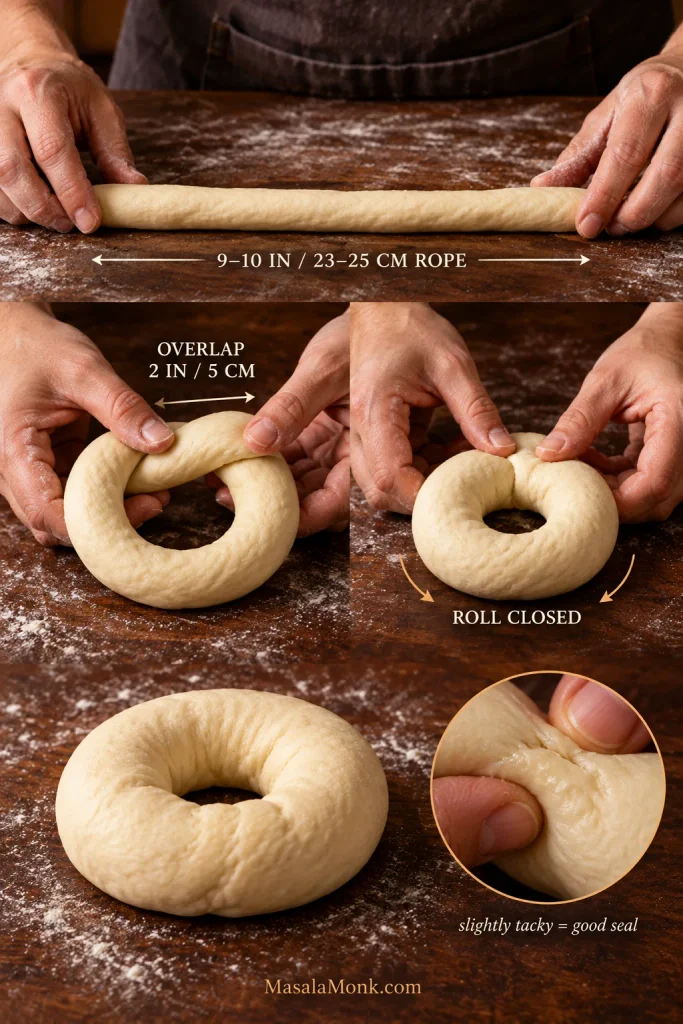
Roll each portion into a rope about 9–10 inches / 23–25 cm long. Wrap it around your hand, overlap the ends by roughly 2 inches / 5 cm, then roll the joined section firmly against the counter until it becomes one continuous ring.
Keep flour away from the seam. A little stickiness helps the ends bond. If they have dried out, dampen your fingertips lightly before sealing.
The join should feel continuous rather than like two ends pressed together. Keep rolling gently until the seam disappears into the ring.
A ready ring looks fuller but still feels firm enough to lift cleanly. You want that extra volume without losing the sturdy feel.
A ready ring should lift cleanly and hold its shape. If it starts stretching under its own weight, the dough has moved beyond the sturdy proof you want.
Use the float test as a clue
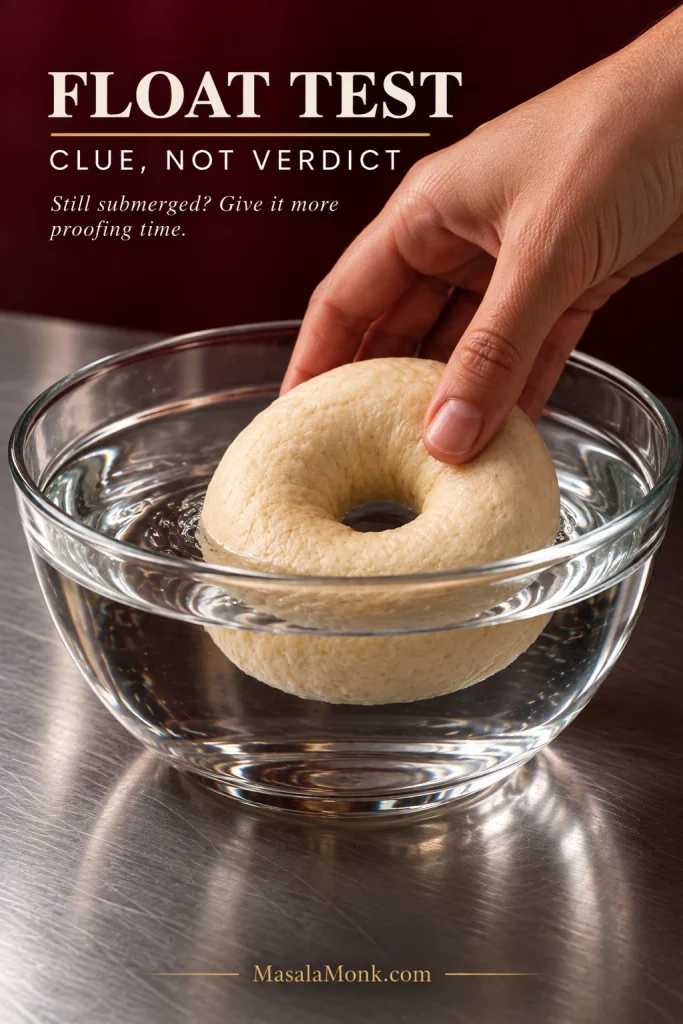
If you’re unsure, lower one shaped ring into a small bowl of cool water. A sufficiently fermented ring will usually float within several seconds. If it stays submerged, lift it out, pat it dry, return it to the tray and give the rings more proofing time before checking again.
Treat the float test as one clue rather than a verdict. A cold bagel can take longer to become buoyant, while an overproofed ring may float immediately and still be too fragile.
Test one ring rather than soaking the whole tray, and pat it dry before returning it to the parchment if it needs more time.
Once the rings are puffy but sturdy, move straight into the water bath.
The Boil: Set the Surface Without Flattening the Ring
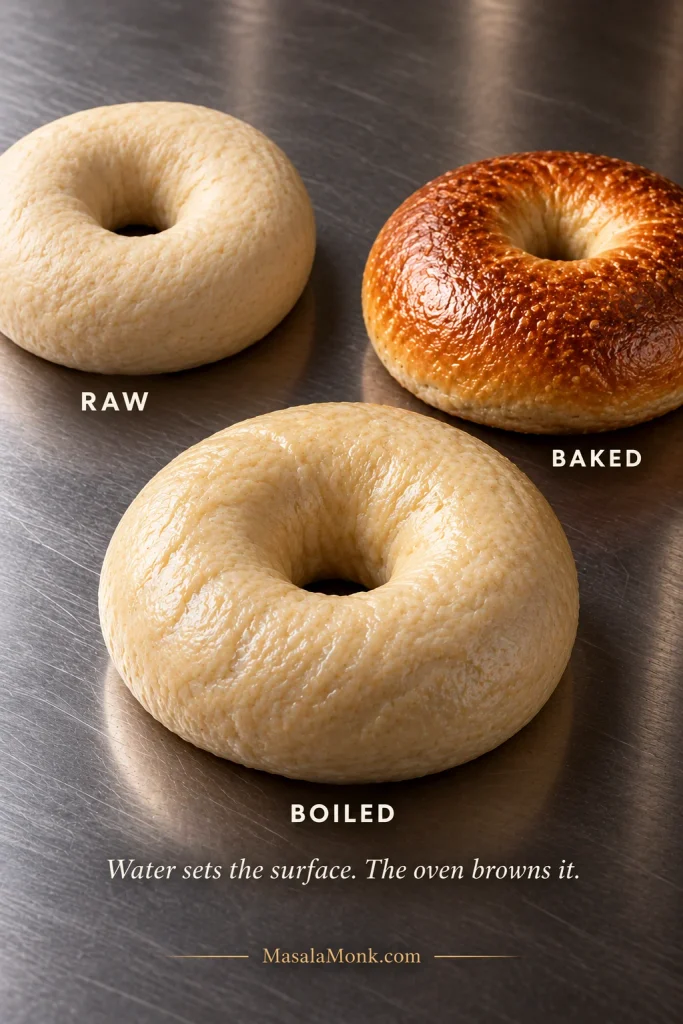
Boil these bagels for 45 seconds per side. The hot water gelatinizes starch at the surface, creating the skin that later bakes into the bagel’s characteristic crust.
Some bagel recipes use much longer water baths. A shorter boil leaves more room for oven expansion while still setting that surface.
This is the moment the dough finally starts looking unmistakably like a bagel. The rings swell slightly, the surface tightens, and the raw matte finish begins to disappear.
Boiling tightens the outside while the center remains raw; oven heat then turns that set surface into the finished chewy crust.
What should go in the water?
Barley malt adds a mild malty note and helps the surface brown; honey is the practical substitute when malt is unavailable.
Other recipes use sugar, brown sugar or baking soda. Baking soda increases alkalinity and encourages deeper browning; in larger amounts, it moves the crust toward pretzel-like characteristics.
Keep the water steady, not violent
A gentle, steady boil is enough. You want heat, not a pot that throws delicate proofed rings around.
Work in small batches and let the water recover before adding more. Cold dough can pull the temperature down quickly.
A calm, uncrowded pot makes boil time and water temperature easier to keep consistent from batch to batch.
After boiling: slightly swollen is right. Ballooned is not the goal. A few wrinkles are fine; the oven still has work to do.
The first boiled ring is usually the moment the process clicks. It comes out plumper, smoother and suddenly recognizably bagel-like. Once the batch is boiled and topped, continue to baking.
Bake Until the Crust Has Real Color
The oven finishes what the water started. That pale boiled skin tightens, turns glossy in places, and deepens toward a proper golden brown.
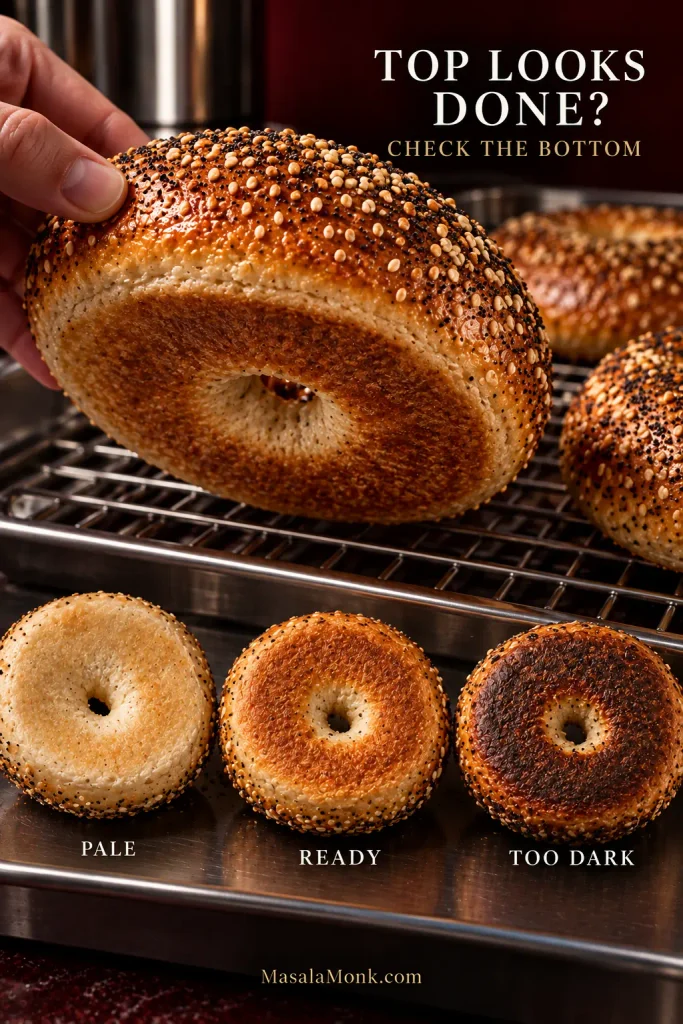
Bake at 425°F / 220°C for about 20–24 minutes. When the bagels first look “done” at pale gold, they usually still have more flavor to develop. Pale isn’t finished.
More color brings toasted, malty flavor and a firmer crust; beyond deep mahogany, bitterness can arrive quickly.
Check the bottoms too. They should be browned rather than white and soft.
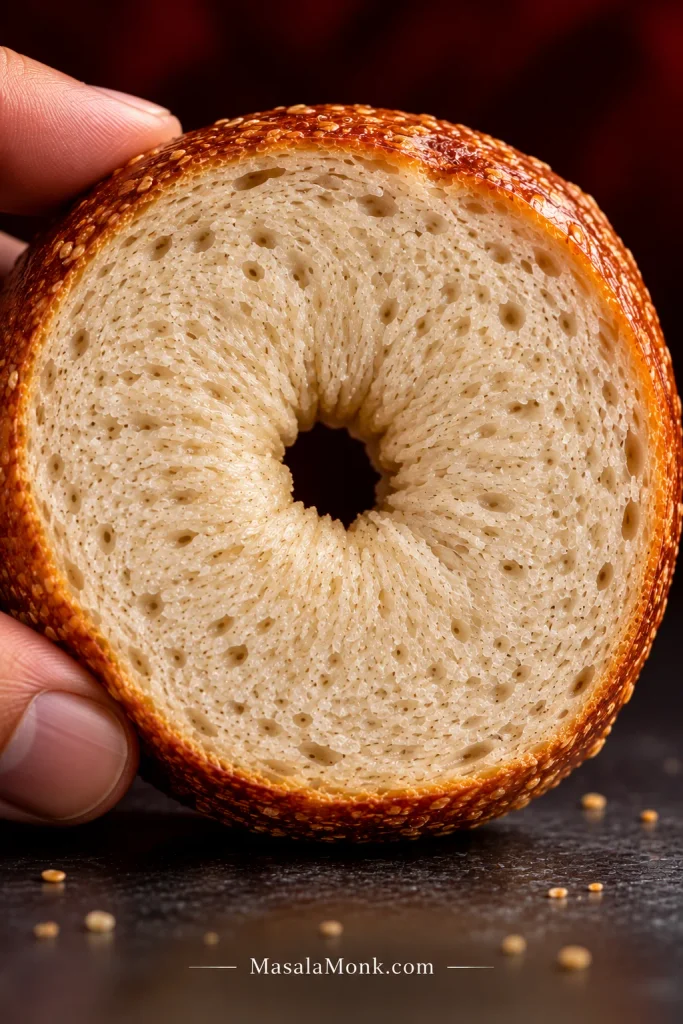
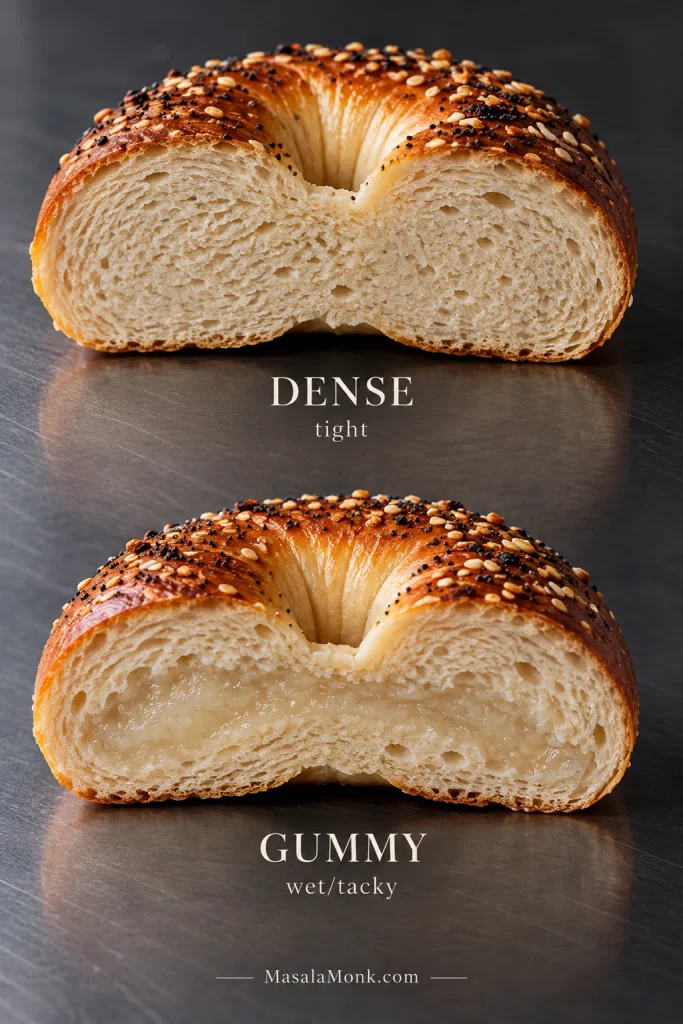
What the inside should look like
A compact overall crumb
Small-to-medium irregular air pockets
No wet or gummy line through the center
No giant bread-like cavities
A springy, substantial chew
Wait 20–30 minutes before cutting one open. Once cooled, the knife should meet a little resistance at the crust before passing through the springy center.
Look for a compact crumb with small and medium cells—not a solid center, but not the open web of a high-hydration loaf either.
If the crust, shape or crumb does not match what you expected, jump to bagel troubleshooting and start with the first stage where the batch looked wrong.
Think back to the first moment the batch looked wrong. That usually tells you more than the finished bagel does.
Consistency matters more than perfect uniformity: the bagels can vary slightly in shape while still finishing within the same general range of height and browning.
And not every imperfect-looking bagel is a failed one. A lopsided ring, a slightly closed center or a few wrinkles are mostly cosmetic. Severe collapse, a nearly solid crumb or a gummy middle point to a real process problem.
The problem started before boiling
The shaped rings are already flat. Overproofing is the first thing to check. Rings that were never especially puffy point more toward dough that was too soft or not developed enough to hold its shape. Recheck dough development and the final proof before changing the formula.
The dough barely rose. If you’ve seen almost no fermentation after a reasonable amount of time, check the yeast instead of simply waiting hour after hour. Room temperature matters too; a cool kitchen can slow an otherwise healthy dough considerably.
The dough is sticky and spreading. Make sure it is fully kneaded before adding more flour. If the dough is fully kneaded and still cannot hold its shape, add flour in small amounts rather than throwing in a large handful.
The dough cracks or crumbles. Cover it for five minutes and knead again. If it still breaks instead of bending, add water about 5 g / 1 teaspoon at a time.
The rings stick to the parchment. Lightly grease the paper or dust it very lightly with semolina or cornmeal. Lift stubborn rings from underneath with a thin bench scraper rather than peeling them up by the edge.
The problem started during handling or boiling
The rings collapse when lifted. They have probably proofed farther than ideal, especially if they already feel soft and fragile. Support them from underneath and move them gently.
Why did my bagels flatten after boiling?
Bagels that enter the pot tall but come out flat are most likely overproofed. Rough handling, a violent boil or a much longer water bath can make an already fragile ring collapse further.
The useful clue is when the height disappeared: before the water points upstream, while collapse during handling or boiling narrows the problem to that stage.
A few wrinkles appeared. Usually cosmetic. Dramatic deflation is the sign to investigate.
Why won’t my bagels float?
Persistent sinking can mean the dough needs more fermentation, but a cold ring may sink briefly before floating. A properly proofed ring should also feel lighter than when it was shaped without becoming fragile.
The rope seam opened. Use a larger overlap next time, keep flour off the join, and roll the seam firmly. Slightly damp ends seal more easily than dry ones; the shaping section shows both methods again.
The problem appeared in the oven
The bagels spread instead of rising. If they survived the boil in good shape, look first at dough strength and shaping tension. When both seemed right, check whether the oven is actually reaching its set temperature.
The bottoms burn while the tops stay pale. Dark pans, baking steels and strong bottom heat can all be responsible. Move the rack higher, use a lighter pan or double-pan if needed.
The bottoms stay pale. Give them a little more baking time. Silicone mats can also insulate the base more than parchment over metal.
Pan color and lower oven heat can change the underside faster than the top, so bottom browning deserves its own check.
The center hole disappeared. Mostly cosmetic. Stretch it wider next time and enjoy the bagel you have.
They look good, but the texture is wrong
Why are my bagels too dense?
A New York-style bagel is supposed to be tighter than sandwich bread. If the crumb is almost solid, underproofing or weak yeast is the first place to look. Dough that is too dry, underdeveloped or underbaked can make the problem worse.
They are fluffy and bread-like. In that case, the rings probably proofed farther than this style needs. Stop while they are still sturdy and give the crust enough time to brown deeply.
They are tough or rubbery. Rubbery or excessively chewy bagels can come from dough that was too dry or a much longer boil. If the bagels are simply dry and hard, check the bake time too.
Why is the center gummy?
First, let the bagel cool completely. If the crumb is still wet, check the oven temperature and bake time. Underbaking is the most common place to start.
Dense can still be dry and fully set. Gummy crumb compresses, clings to the knife or fingers, and often shows a damp-looking band that does not spring back cleanly.
A few smaller surface problems
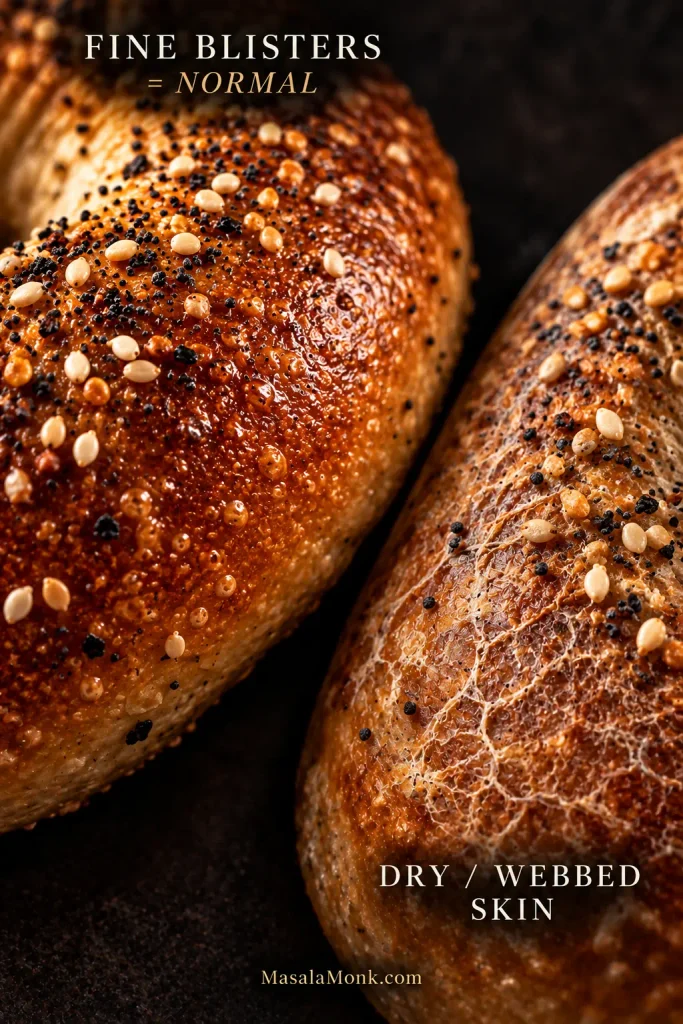
Rough or webbed crust. Fine surface blisters are normal and can be desirable. A dry, rough or webbed-looking skin is different; the dough may have dried out during proofing or may not have been kneaded enough.
Fine blisters are small and integrated into the browned crust. Drying damage forms broader pale cracks or webbing across the surface.
Cracks or splits. Check for a dried skin, uneven shaping tension or a weak rope seam.
Toppings falling off. Add them while the boiled surface is still damp; egg wash gives extra hold and shine.
Once a batch is baked, there is very little value in judging it by perfect bakery geometry. Slice one, check the crumb, and taste it. That tells you what actually needs changing next time.
Most seed toppings go on as soon as the bagels leave the water, while the surface is still damp. Sesame and poppy seeds adhere well this way. A seed-heavy everything blend works too.
An egg wash is optional. Brush it on before the toppings when you want a glossier crust or a little extra help keeping seeds in place.
Use only enough egg wash to leave a thin film; heavy pooling can glue seeds to the parchment instead of the bagel.
Dried minced onion needs different handling. It can scorch during a full bake, so reserve a little egg wash. When the bagels are nearly browned, pull the trays out briefly, brush the bagels you want to top, add the dried onion or onion-heavy blend, and return them to the oven for about 1–2 minutes.
Dried onion scorches much faster than sturdier seeds, which is why it goes on near the end of baking.
Use coarse salt sparingly; a little goes a long way on a chewy bagel.
For a much broader set of cream cheese mixtures, smoked salmon combinations, savory toppings and sweeter options, see the bagel toppings and spreads guide.
Day-old bagels also make excellent breakfast sandwiches; the breakfast sandwich guide has more combinations. If you are saving the rest of the batch, continue to storage and freezing.
Store Them Like Bread, Not Cake
Bagels are at their best on the day they are baked. Once completely cool, keep them tightly wrapped or sealed at room temperature for about 1–2 days. By the second day, toasting brings back much of the crispness and chew.
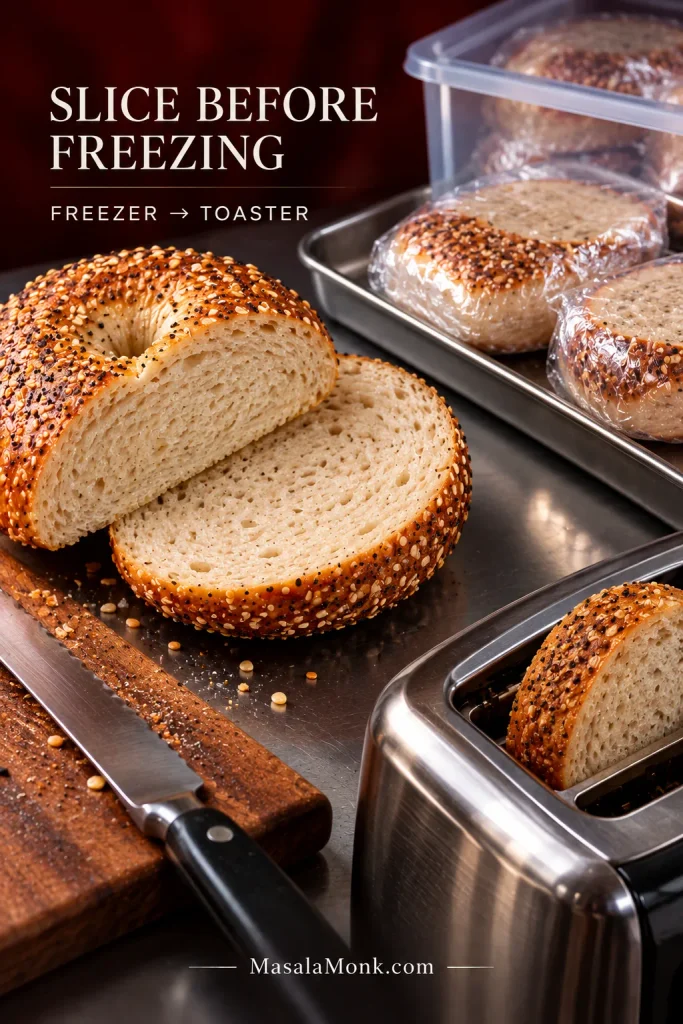
For longer storage, slice before freezing. Wrap well and freeze for up to about 3 months for best quality. A pre-sliced half can go straight from freezer to toaster.
Cool completely before slicing and freezing so trapped steam does not soften the crust or create extra surface ice.
No. Water chemistry can influence dough, but you do not need New York water to make an excellent bagel at home. For most home bakers, flour, fermentation, shaping, boiling and baking are the variables worth controlling first.
Can I double the recipe?
Yes, but this is unusually stiff dough. If your mixer is small or starts laboring, two separate batches are safer than forcing a double batch through the machine. Keep dividing by weight and continue boiling in small batches so the water stays hot.
Can I make smaller bagels?
Yes. For 10 smaller bagels, divide the dough into pieces of about 100 g / 3.5 oz each and begin checking the bake several minutes earlier.
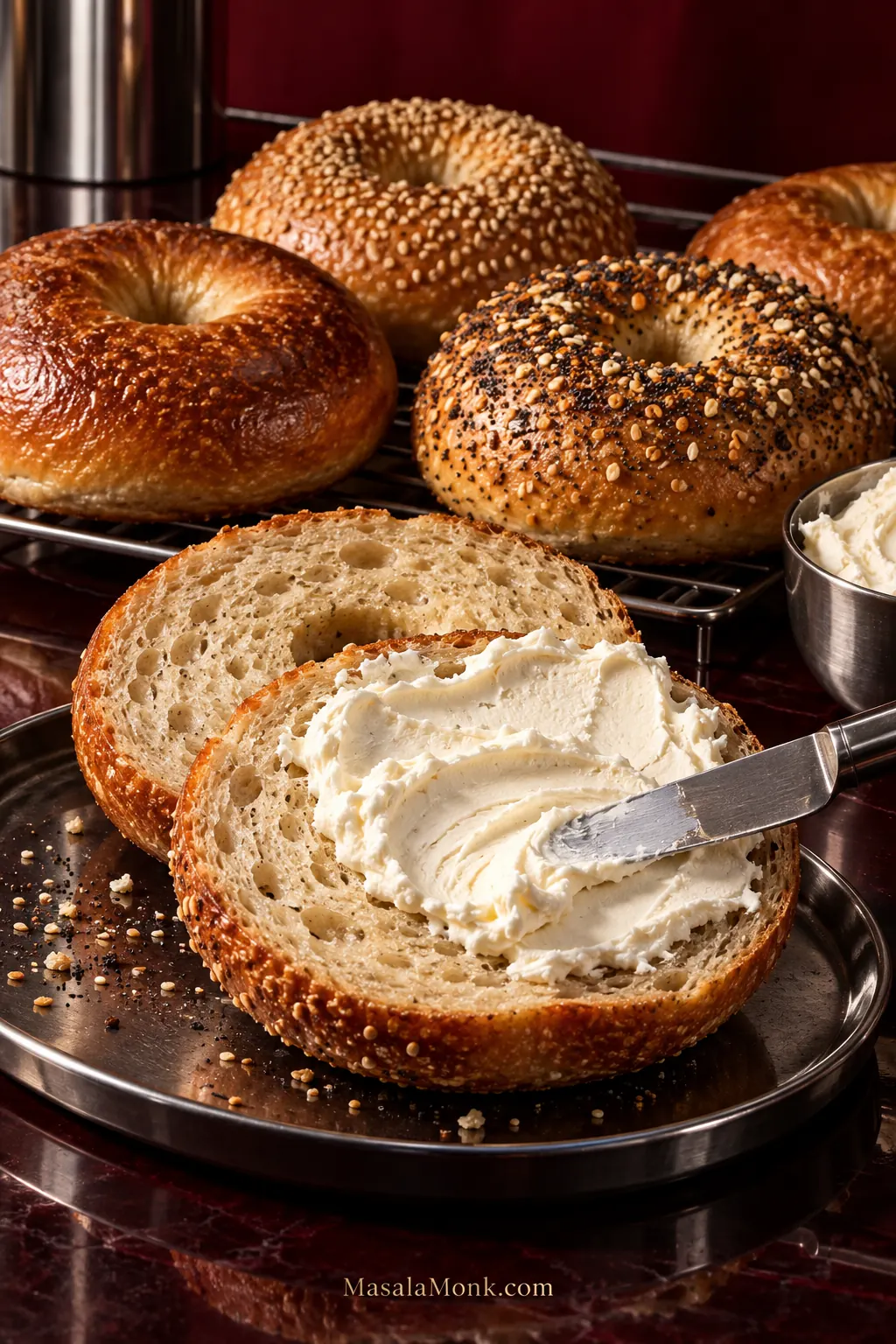
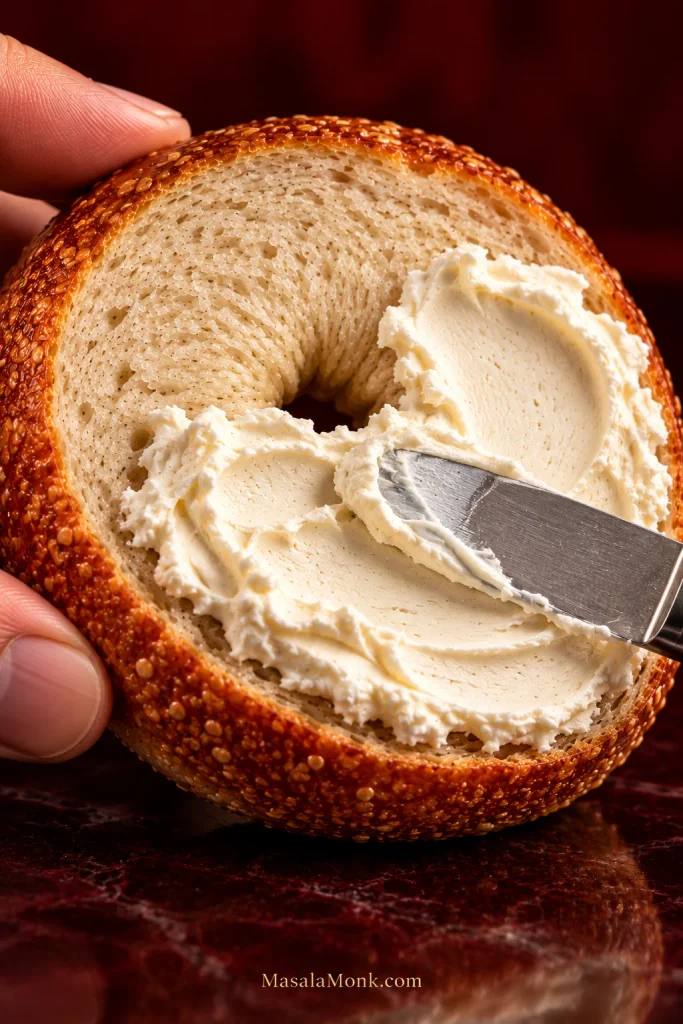
Once the bagels are cool, split one and look for that contrast between the browned crust and the springy center.
A simple schmear lets the crust, maltiness and chew stay noticeable.
Then comes the payoff: feel the knife catch slightly on the browned crust and drag cream cheese across the springy center. At that point the boiling water and stiff dough stop feeling like bakery tricks. They are simply how you make a really good bagel.
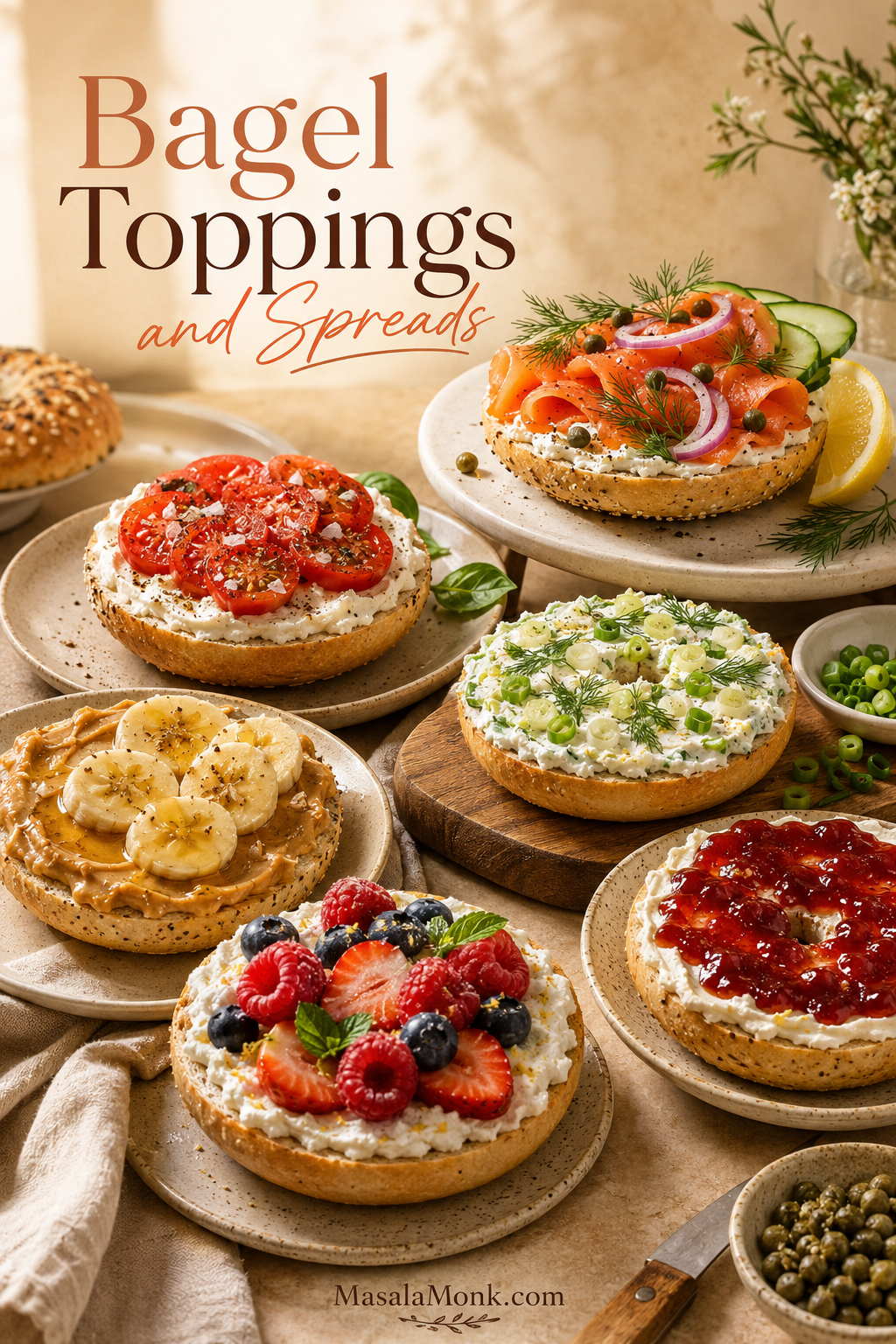
Bagel toppings and spreads can make the difference between dry bread with stuff on it and the bagel everyone reaches for first. A plain bagel can become breakfast, lunch, a sweet snack, or a full brunch board with one good spread, one useful topping, and one small finish. Usually, the best ones have the right mix of creamy, crisp, salty, sweet, fresh, or bright.
Along the way, this guide covers the best bagel toppings and spreads for every kind of craving: classic cream cheese schmear, smoked salmon and lox, sweet bagel toppings, savory combinations, healthy ideas, breakfast bagels, and bagel bar toppings for brunch. You will also get an easy homemade bagel schmear recipe with sweet and savory flavor variations, plus exact amounts for schmear, smoked salmon, and brunch boards.
Whether you are using a fresh bakery bagel, a freezer bagel, or the last plain bagel in the bag, the right spread and one good finish can make it feel intentional. In practice, the spread does more than add flavor; it gives the toppings something to hold onto and helps the whole bagel eat better.
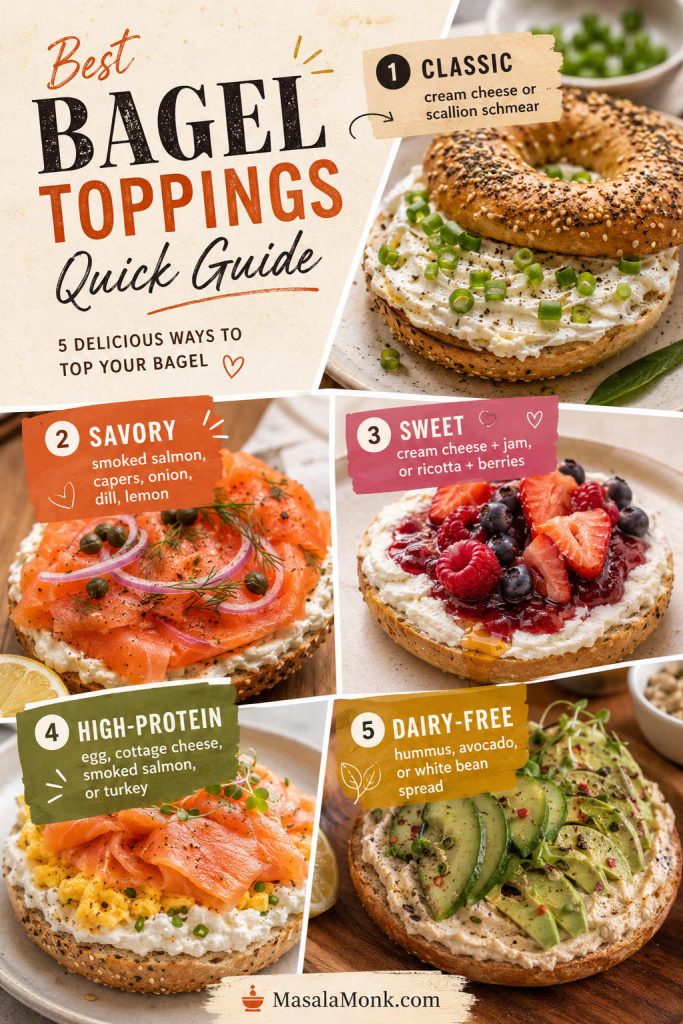
Start a classic bagel with cream cheese or scallion schmear. When you want something savory, it is hard to beat a tangy spread with smoked salmon, capers, red onion, dill, and lemon. For a sweet bagel, try cream cheese with jam, peanut butter with banana and honey, or ricotta with berries.
If you only remember one rule, choose the spread first. The best bagel toppings and spreads usually work together: the spread gives moisture, while the toppings add flavor, texture, and a final finish.
Beyond that, other easy bagel toppings include butter, avocado, eggs, hummus, tuna salad, egg salad, turkey, cucumber, tomato, cottage cheese, Nutella, berries, apple slices, honey walnut cream cheese, and everything bagel seasoning.
Use this quick guide when you know you want a bagel but not the direction. A classic schmear, smoked salmon, ricotta berries, egg, hummus, or avocado can each turn the same bagel into a different kind of meal.
Craving
Reliable bagel topping idea
Classic
Cream cheese, scallion schmear, butter, or jam
Deli-style
Cream cheese, smoked salmon, capers, red onion, dill, lemon
Breakfast
Egg, cheese, bacon, avocado, tomato, sausage, or turkey
Sweet
Cream cheese and jam, peanut butter and banana, ricotta and honey, Nutella and strawberries
Dairy-free pick: hummus with cucumber, tomato, sprouts, olive oil, and paprika.
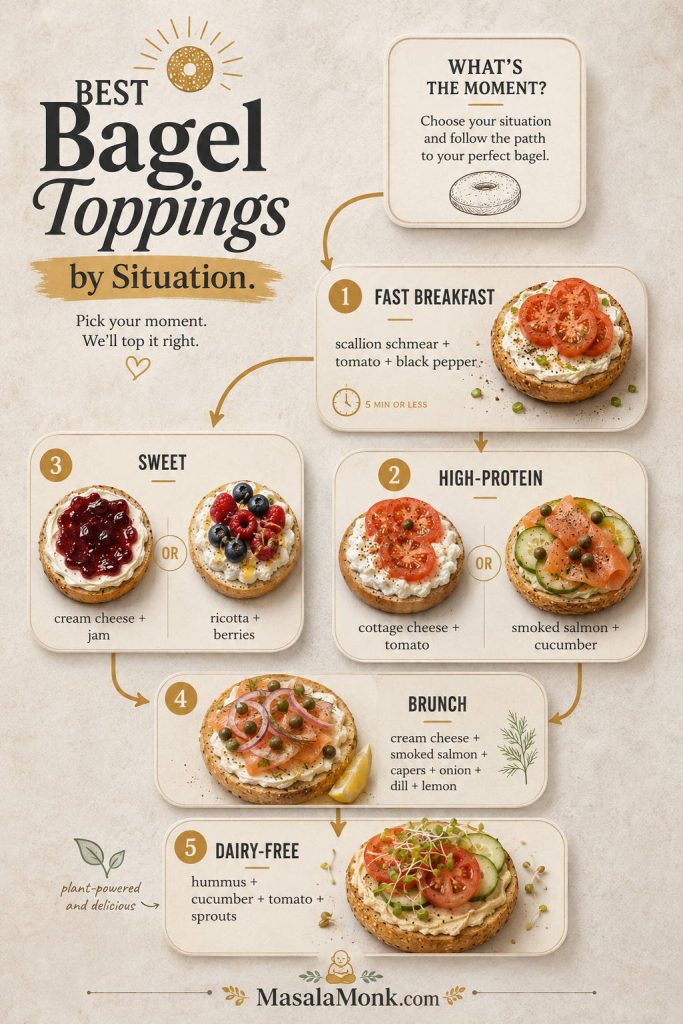
Instead of choosing toppings at random, start with the situation: fast breakfast, brunch, packed lunch, sweet snack, or dairy-free meal. From there, the best bagel toppings become much easier to narrow down.
Quick fix: if a bagel tastes unfinished, do not automatically add more toppings. Instead, add the missing piece: lemon for lift, capers for sharpness, flaky salt for tomato, herbs for creaminess, honey for sweet spreads, or crunch for soft fillings.
How to Build a Better Bagel
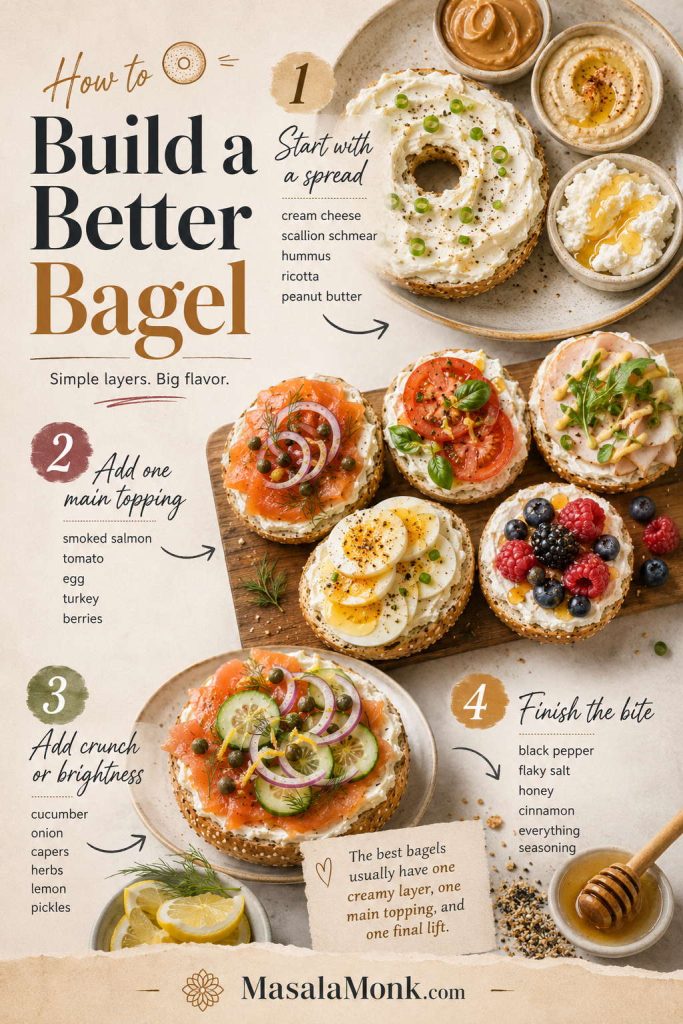
A good bagel is not just a pile of toppings. It tastes better when the layers make sense together. Use this simple formula:
Spread + main topping + crunch + brightness + seasoning.
Once the spread is chosen, the bagel becomes easier to build. Add one main topping, then use cucumber, onion, lemon, capers, honey, herbs, or seasoning to shape the final bite.
However, you do not need all five parts every time. Even two or three good layers can keep the bagel from becoming dry, heavy, soggy, or one-note.
Start with a bagel spread
The spread gives the bagel moisture and flavor. It also helps small toppings stay in place.
The main topping decides whether the bagel feels like breakfast, lunch, snack, or brunch. It can be as simple as an egg, a few slices of tomato, smoked salmon, tuna salad, turkey, banana, berries, or roasted vegetables.
For a quick weekday bagel, one spread and one main topping may be enough. However, for a brunch bagel or open-faced bagel, a finishing layer helps every bite feel more complete.
Finish bagel toppings with crunch, brightness, or seasoning
This is the small step that makes a bagel taste finished. A plain schmear becomes brighter with chives or lemon. Smoked salmon becomes cleaner and sharper with capers, onion, and a squeeze of lemon. Peanut butter becomes more interesting with banana, honey, cinnamon, or a tiny pinch of salt.
When a bagel tastes dull, it usually needs a small finisher rather than another full topping. Lemon, capers, pepper, herbs, honey, cinnamon, or everything seasoning can add lift without crowding the bagel.
Brightness: lemon, pickled onions, capers, tomatoes, berries, apple slices
Seasoning: black pepper, chili flakes, flaky salt, everything bagel seasoning, cinnamon, herbs
The bagel test: When the bite feels too rich, add cucumber, tomato, herbs, lemon, or pickled onion. An unfinished bite usually needs one small finish: flaky salt, black pepper, capers, chili flakes, honey, cinnamon, or everything seasoning. Messy builds are easier to control when toppings are sliced thinner and the spread works like glue.
When bagels turn soggy, messy, or dull, the bagel topping mistakes section will help you fix the texture before adding more ingredients.
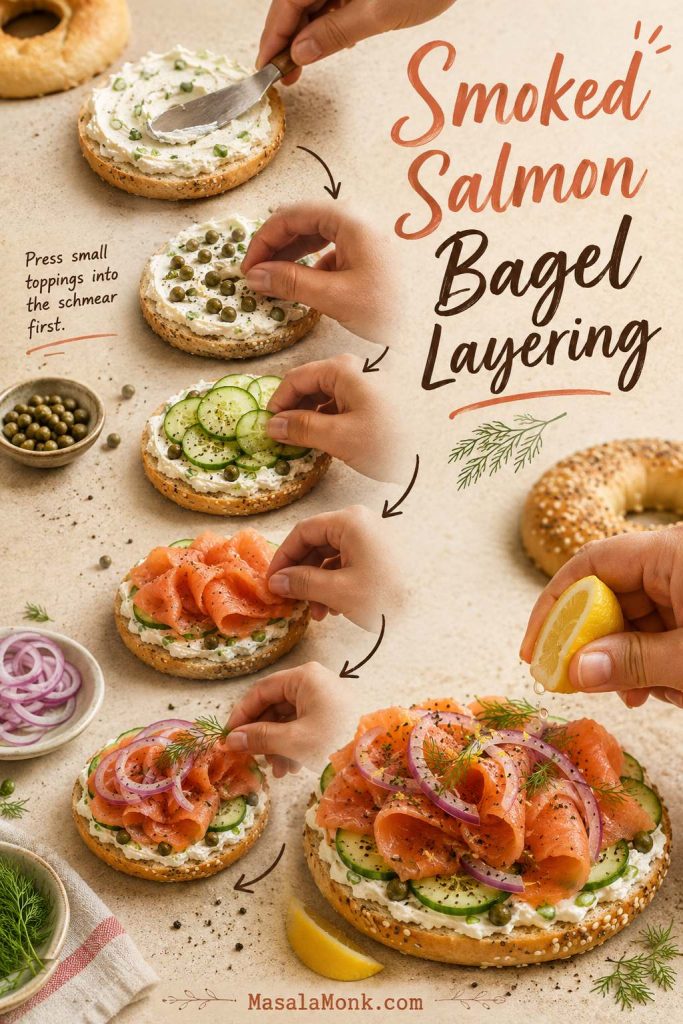
One small detail makes a big difference: press capers gently into the creamy layer before adding smoked salmon so they stick instead of rolling off. For wet toppings like tomato or cucumber, slice thinly and pat dry before layering.
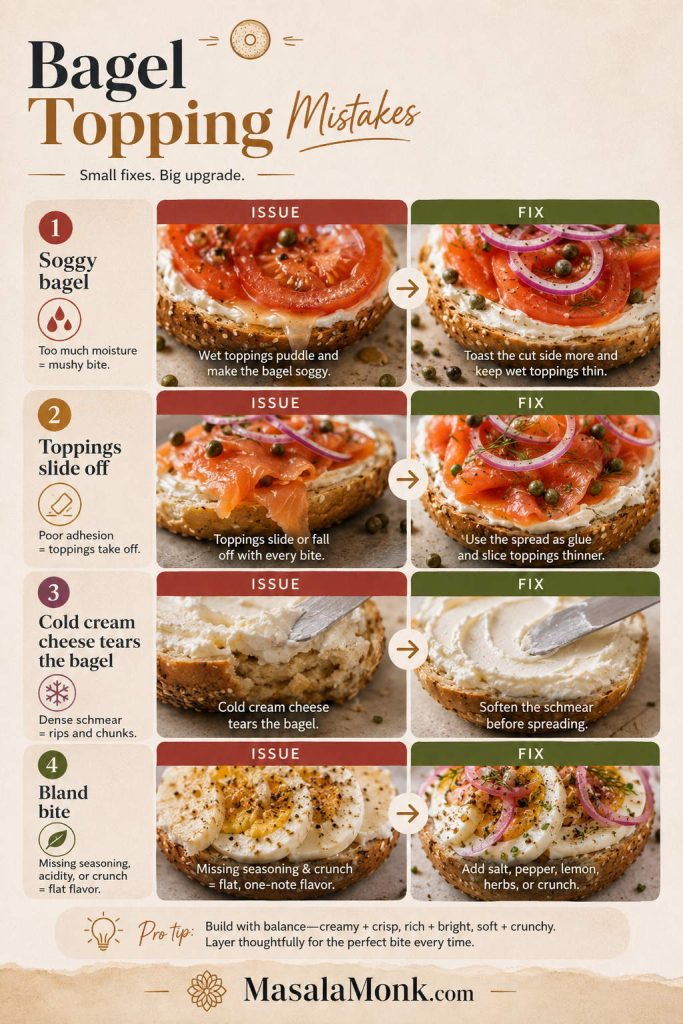
Bagel Topping Mistakes That Make Bagels Soggy, Messy, or Flat
A bagel can have great toppings and still eat badly if the texture is off. These are the small mistakes that turn a good idea into a soggy, slippery, or bland bagel.
Most disappointing bagels fail because of texture, not flavor. Toast the cut side, soften the schmear, slice wet toppings thinly, and use small finishes so the bagel stays crisp, stable, and satisfying.
Mistake
What happens
Better move
Using cold block cream cheese
It tears the bagel and spreads unevenly.
Let cream cheese soften first, or beat it into a schmear.
Piling on wet tomatoes or cucumbers
The cut side gets soggy before you finish eating.
Slice thinly, pat dry, and use a thick spread, hummus, avocado, or butter as a barrier.
Adding delicate toppings to a piping-hot bagel
The spread melts, herbs wilt, and smoked salmon can feel greasy.
Let the bagel cool for a minute before adding schmear, fish, herbs, or fresh vegetables.
Overloading a closed sandwich
The filling slides out and the bagel becomes hard to bite.
Keep tall builds open-faced, or use fewer toppings and slice them thinner.
Skipping the final finish
The bagel tastes like bread plus spread instead of a finished bite.
Add lemon, herbs, black pepper, flaky salt, capers, honey, cinnamon, or chili flakes.
Using loose tuna, egg, or chicken salad
The filling slides off the bagel.
Use a thicker salad, add lettuce as a barrier, or serve it open-faced.
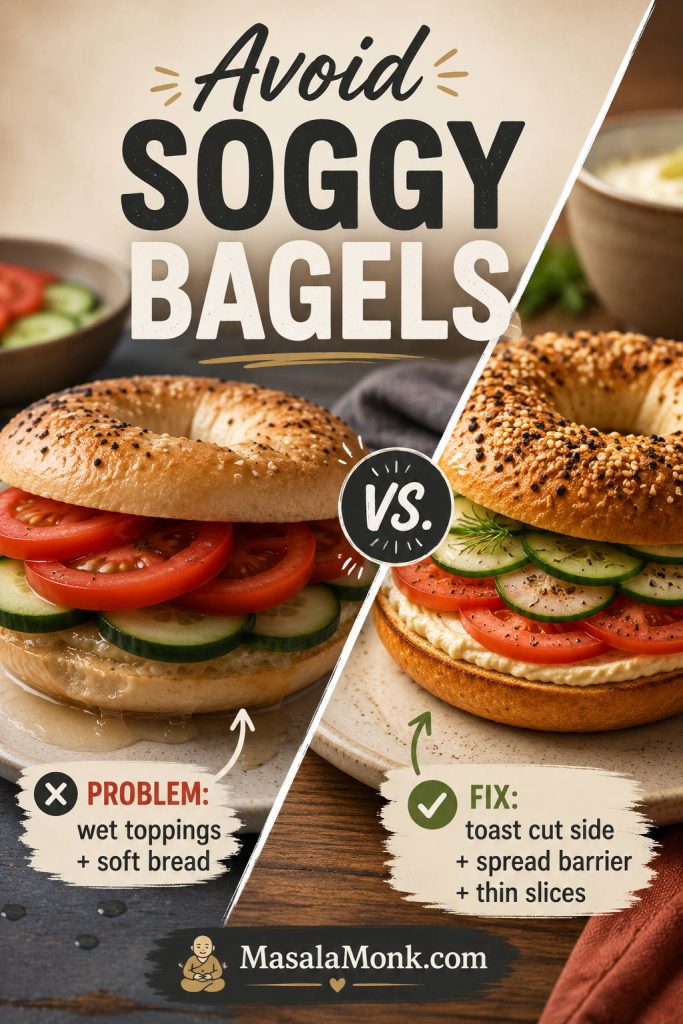
How to keep wet toppings from making bagels soggy
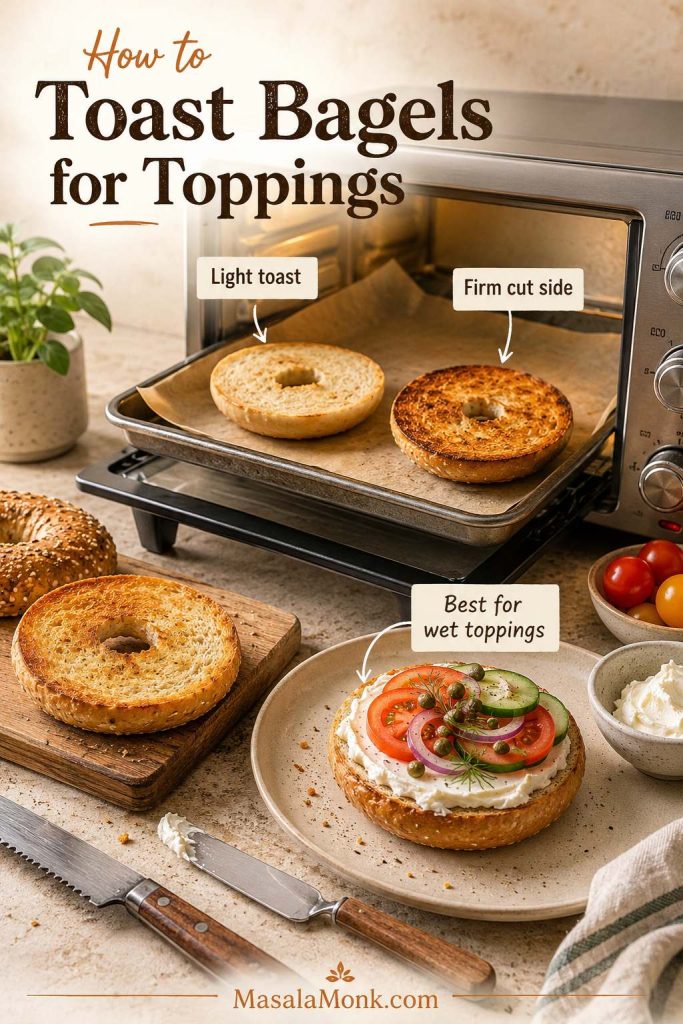
In most cases, the two biggest fixes are simple: toast the cut side enough to create a barrier, and keep wet toppings thin. Tomato, cucumber, avocado, pickles, and loose salads are all good on bagels, but they need structure underneath them. A thick schmear, hummus, avocado, butter, or even lettuce can help protect the bread from turning soft too quickly.
For more detail on getting the cut side sturdy, see the toasting guide before adding tomato, cucumber, eggs, avocado, hummus, or smoked salmon.
Juicy tomato and cucumber are great on bagels, but they need a toasted surface and a creamy barrier underneath so the bread stays firm.
Texture rule: the wetter the topping, the sturdier the bagel needs to be. Toast a little longer, use a thicker spread, and keep juicy toppings thin.
15 Bagel Topping Ideas to Try First
Think of these as the safe bets — the combinations to try before you start inventing anything complicated. They cover the classics, quick breakfasts, sweet cravings, and the “I need this to feel like lunch” moments.
These are the bagels I would put in front of someone who says, “Just tell me what works.” They are not the weirdest ideas; instead, they are the bagel toppings and spreads that taste complete without needing ten toppings.
To keep this practical, effort is rated from 1 to 5, with 1 being almost no prep and 5 needing more cooking or assembly.
Classic bagel toppings and spreads to try first
Start with these before getting creative; each one gives the bagel a clear base, one main topping, and a small detail that makes the bite feel intentional.
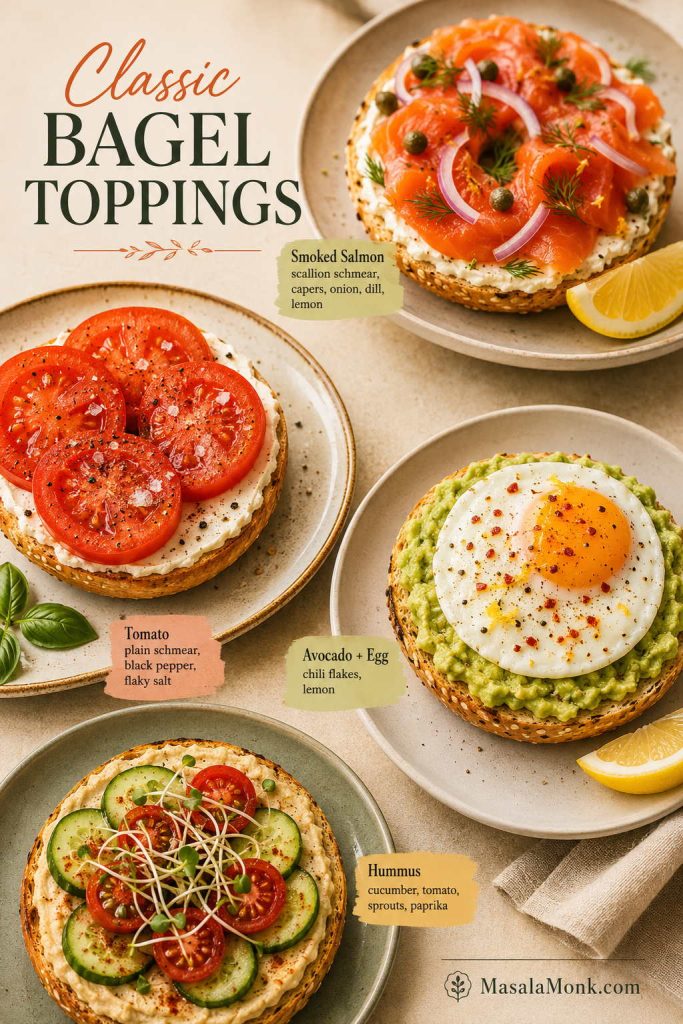
Classic bagel toppings work because they cover the essentials: creamy schmear, salty or fresh toppings, crisp vegetables, and a small finish. Start here before moving into more creative spreads.
Salmon brings salt, capers and onion add bite, and the schmear keeps the bagel rich without feeling dry.
Plain schmear + tomato + black pepper + flaky salt
Fast breakfast
1/5
Plain, sesame, onion
Juicy tomato, creamy spread, and enough salt make it feel complete.
Avocado + fried egg + chili flakes + lemon
Filling breakfast
3/5
Everything, whole wheat, sesame
Egg makes it filling, avocado keeps it creamy, and lemon/chili stop it from feeling heavy.
Hummus + cucumber + tomato + sprouts
Light lunch
1/5
Sesame, whole wheat, plain
Cool cucumber and sprouts keep the hummus from feeling dense.
Breakfast and lunch bagel topping ideas
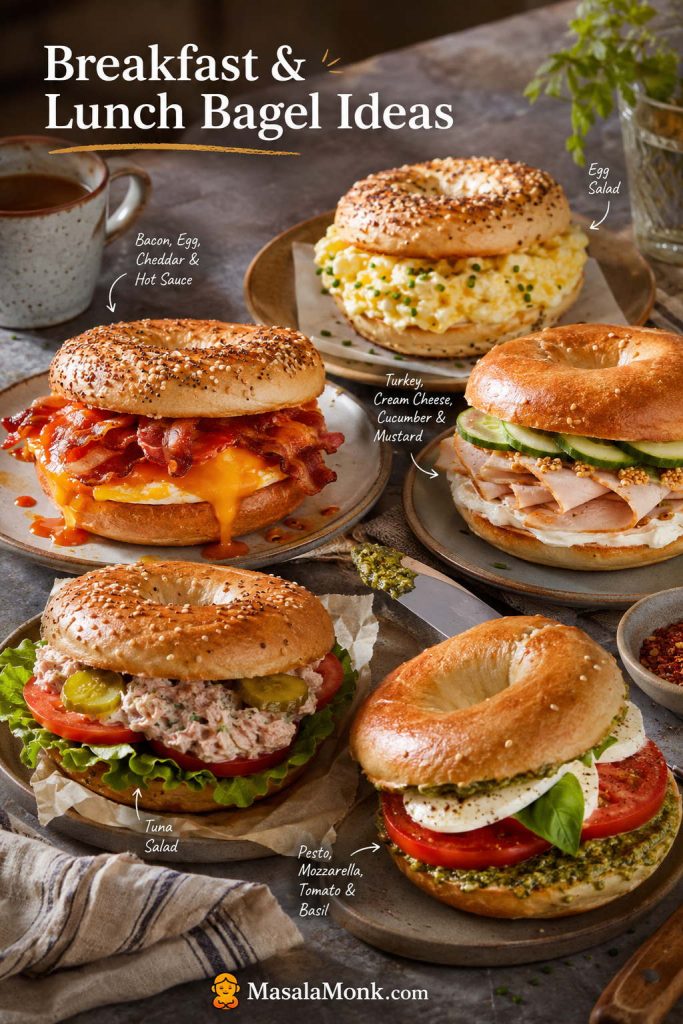
These builds are meant to eat like real meals, so the spread, protein, vegetables, and toast level need to help the bagel hold together.
Meal-style bagels hold together better when the cut side is toasted, the spread is thick, and crisp vegetables sit between the bread and creamy fillings.
Bagel combination
Best moment
Effort
Good bagel choices
Why it tastes balanced
Bacon + egg + cheddar + hot sauce
Weekend breakfast
3/5
Plain, everything, Asiago
Cheddar and egg make it rich; hot sauce cuts through the breakfast heaviness.
Turkey + cream cheese + cucumber + mustard
Easy lunch
1/5
Plain, sesame, whole wheat
Cucumber keeps the turkey from eating dry, while mustard gives the sandwich some bite.
Tuna salad + tomato + lettuce + pickles
Meal-style lunch
2/5
Plain, poppy, whole wheat
Creamy filling tastes better with crisp, briny, and juicy layers.
Egg salad + chives + everything seasoning
Make-ahead lunch
2/5
Plain, everything, poppy
Chives and everything seasoning make soft egg salad taste more like a proper deli bagel.
Pesto + mozzarella + tomato + basil
Vegetarian lunch
2/5
Plain, sesame, Asiago
Pesto seasons the cheese, tomato adds juiciness, and basil keeps it from feeling flat.
Sweet bagel toppings and spreads to try
Sweet bagels taste better when the topping has a little tang, salt, nuttiness, or fruit instead of only more sugar.
A sweet bagel should still feel like breakfast, not frosting on bread. Tangy cream cheese, soft ricotta, berries, toasted nuts, cinnamon, lemon zest, or a pinch of salt keep the sweetness in check.
Bagel combination
Best moment
Effort
Good bagel choices
Why it tastes balanced
Honey walnut cream cheese + banana
Sweet breakfast
1/5
Cinnamon raisin, plain, whole wheat
Banana makes it filling, honey walnut schmear adds sweetness, and cinnamon keeps it cozy.
Peanut butter + banana + honey + cinnamon
Fast filling snack
1/5
Plain, cinnamon raisin, whole wheat
Peanut butter gives staying power, banana softens the bite, and honey/cinnamon make it feel finished.
Ricotta + berries + honey + lemon zest
Sweet brunch
1/5
Plain, blueberry, whole wheat
Ricotta gives softness, berries add juice, and lemon zest keeps the sweetness clean.
Strawberry cream cheese + fresh berries
Bakery-style breakfast
1/5
Plain, blueberry
Fresh berries keep the strawberry spread from tasting too candy-sweet.
Butter + cinnamon sugar + toasted walnuts
Cozy snack
1/5
Cinnamon raisin, plain
Butter melts into the toasted cut side, while cinnamon sugar and walnuts add cozy crunch.
Nutella + strawberries + pinch of salt
Dessert-style bagel
1/5
Plain, blueberry, mini bagels
Strawberries brighten the chocolate spread, and salt keeps it from tasting one-note.
How to choose from this list
If the Caprese-style bagel is the one you want to build, use a thick pesto rather than a loose sauce so it spreads cleanly. This homemade pesto recipe and variations guide has basil pesto, red pesto, vegan pesto, nut-free pesto, pesto dip, pesto butter, and sandwich-friendly ideas.
Creative bagel upgrades when you want something different
After the basics, these are the bagels to try when plain cream cheese is not enough and you want something more snacky, brunchy, global, or restaurant-style without making the whole thing complicated.
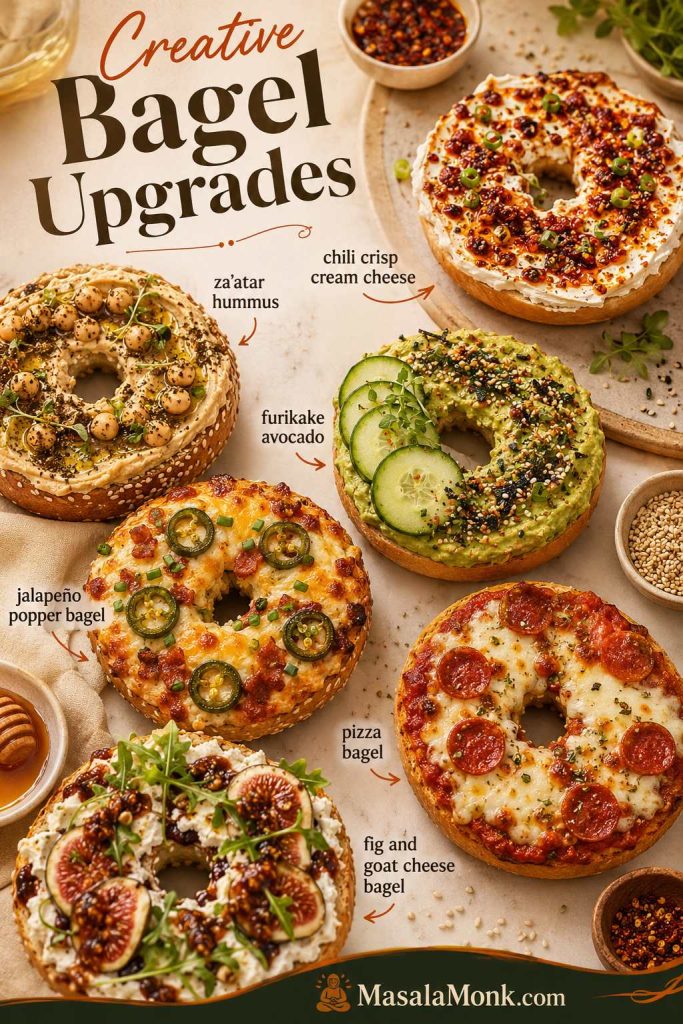
After the classics, creative bagel upgrades make a simple bagel feel restaurant-style. Chili crisp, za’atar, furikake, fig, goat cheese, jalapeño, and pizza toppings bring big flavor without needing a complicated build.
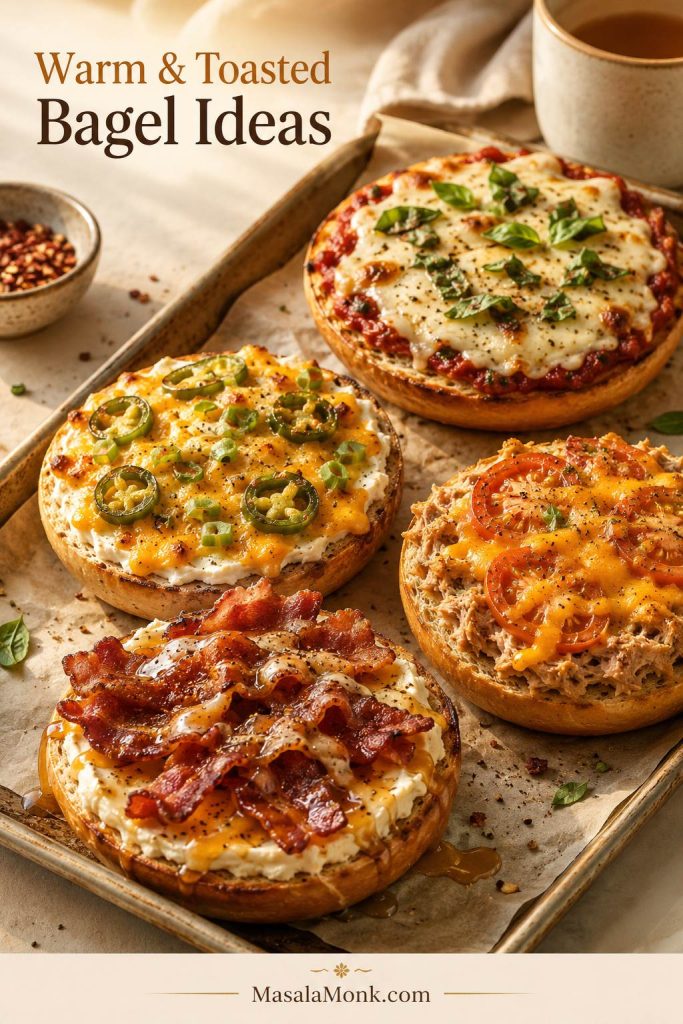
Pizza bagel: marinara, mozzarella, Parmesan, basil, and a quick toast until the cheese melts.
Maple bacon breakfast bagel: cream cheese, crispy bacon, maple drizzle, and black pepper.
Tuna melt bagel: thick tuna salad, cheddar, tomato, and a short toast until the cheese softens.
Warm toppings taste best when they melt into a firm toasted cut side. That is why pizza bagels, tuna melts, jalapeño popper bagels, and bacon breakfast bagels need heat before the toppings go on.
Roasted red pepper bagel: goat cheese or hummus, roasted red peppers, basil, and a little olive oil.
Bold and snacky
Chili crisp cream cheese bagel: plain schmear, chili crisp, scallions, cucumber, and sesame seeds.
Furikake avocado bagel: mashed avocado, furikake, cucumber, lime, and a little chili oil.
Pickle-everything schmear: cream cheese, chopped pickles, everything seasoning, and scallion.
Sun-dried tomato cream cheese: cream cheese, chopped sun-dried tomatoes, basil, black pepper, and lemon zest.
Sweet-salty
Honey pecan bagel: cream cheese, honey, cinnamon, and toasted pecans.
Fig and goat cheese bagel: goat cheese, fig jam, walnuts, honey, and black pepper.
Easy Bagel Schmear Recipe
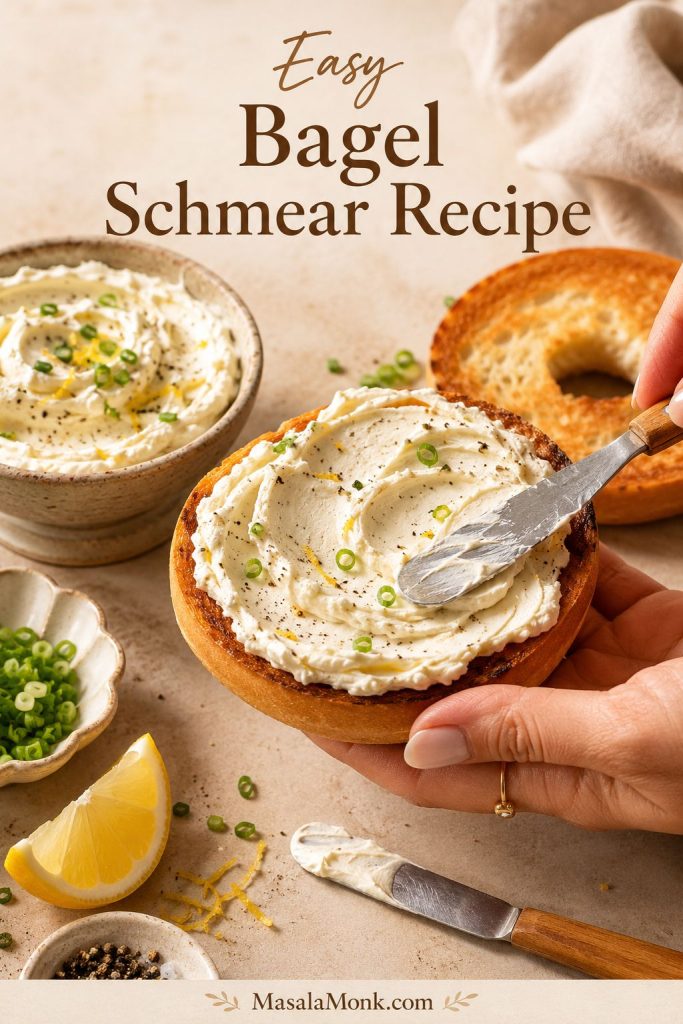
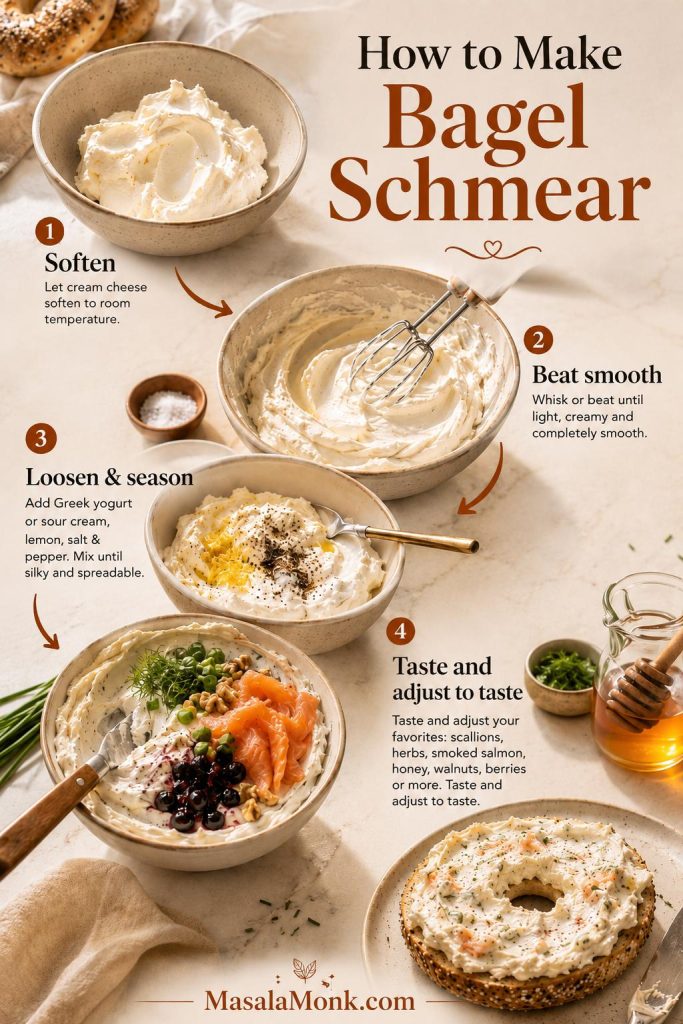
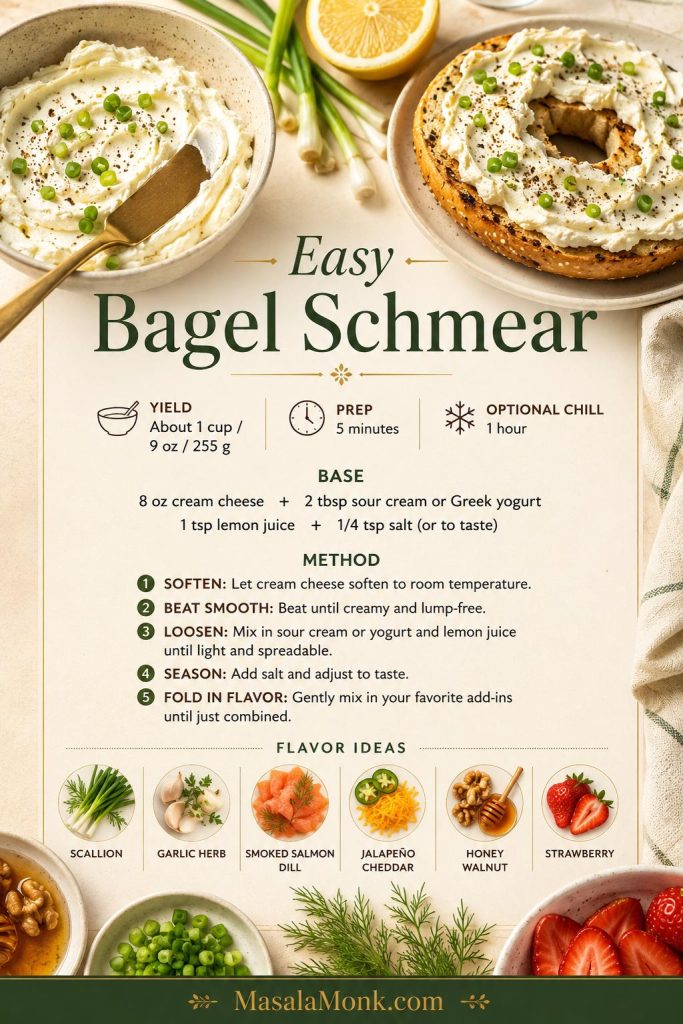
A good bagel schmear is softer and more spreadable than cold cream cheese straight from the block. It should glide over a toasted bagel without tearing it apart, and it should taste lightly seasoned even before you add toppings.
Soft schmear should spread in smooth strokes instead of tearing the bagel. Let the cream cheese soften first, then loosen it with lemon, herbs, or tangy dairy before adding toppings.
This base recipe makes about 1 cup / 9 oz / 255 g, enough for roughly 4 to 6 bagels, depending on how generously you spread it. Because schmear is one of the most useful bagel spreads, it also works as the base for many sweet and savory toppings.
The finished texture should be soft enough to spread easily but thick enough to hold herbs, capers, onions, or chopped salmon without turning loose.
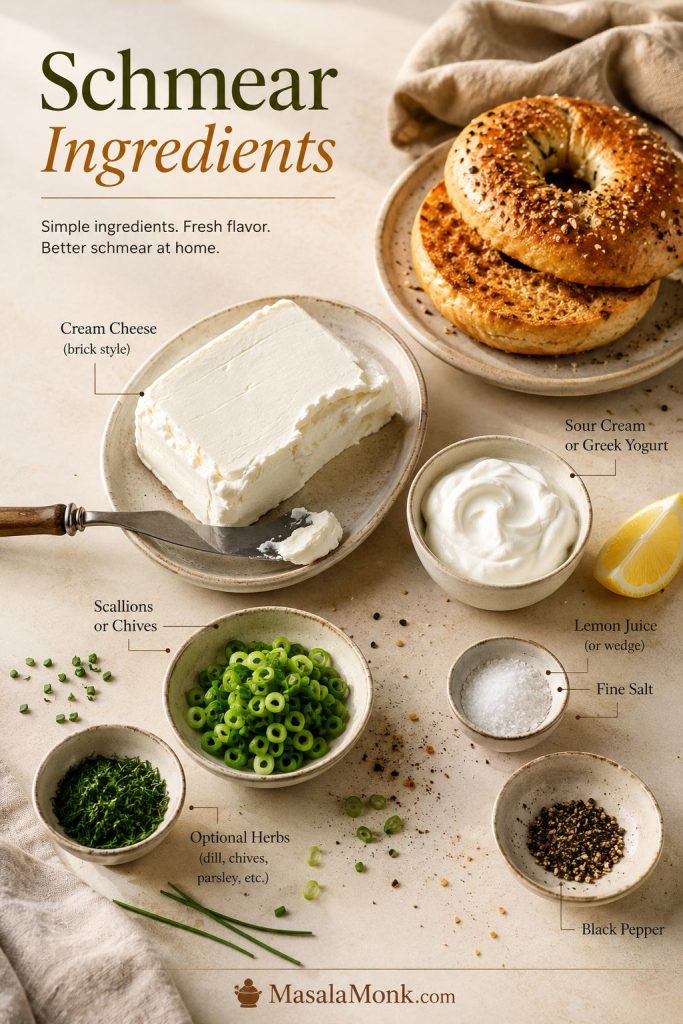
Bagel schmear ingredients
The base is simple, but each small addition changes how the schmear spreads, tastes, and holds toppings.
A simple bagel schmear does not need many ingredients. However, lemon, salt, pepper, scallions, and a little Greek yogurt or sour cream make cream cheese softer, brighter, and easier to pair with toppings.
Ingredient
US amount
Metric amount
Brick cream cheese, softened
8 oz
225 g
Sour cream, Greek yogurt, or crème fraîche
2 tbsp
30 g / 30 ml
Fresh lemon juice
½ tsp
2.5 ml
Fine salt
Pinch to ⅛ tsp
To taste
Black pepper
Optional
Optional
How to make bagel schmear
The goal is a spreadable texture first; once the base is smooth, herbs, smoked salmon, honey walnut, or berries fold in more evenly.
Homemade schmear is easiest when you build it in stages: soften, beat smooth, loosen and season, then fold in flavor. After that, the same base can become scallion, smoked salmon dill, honey walnut, or berry schmear.
Soften the cream cheese. Leave it at room temperature for about 30 minutes, or until it gives slightly when pressed.
Beat until smooth. Use a hand mixer, stand mixer, or sturdy spoon. The texture should look creamy, not lumpy.
Loosen it slightly. Mix in sour cream, Greek yogurt, or crème fraîche.
Season it. Add lemon juice and salt. Then taste before adding more salt, especially if you plan to add smoked salmon, capers, bacon, cheddar, or everything seasoning.
Keep it plain or add flavor. Finally, fold in one of the flavored cream cheese ideas below.
Once the base is smooth, use the flavored cream cheese ideas to turn one batch into savory, sweet, or smoked salmon schmear.
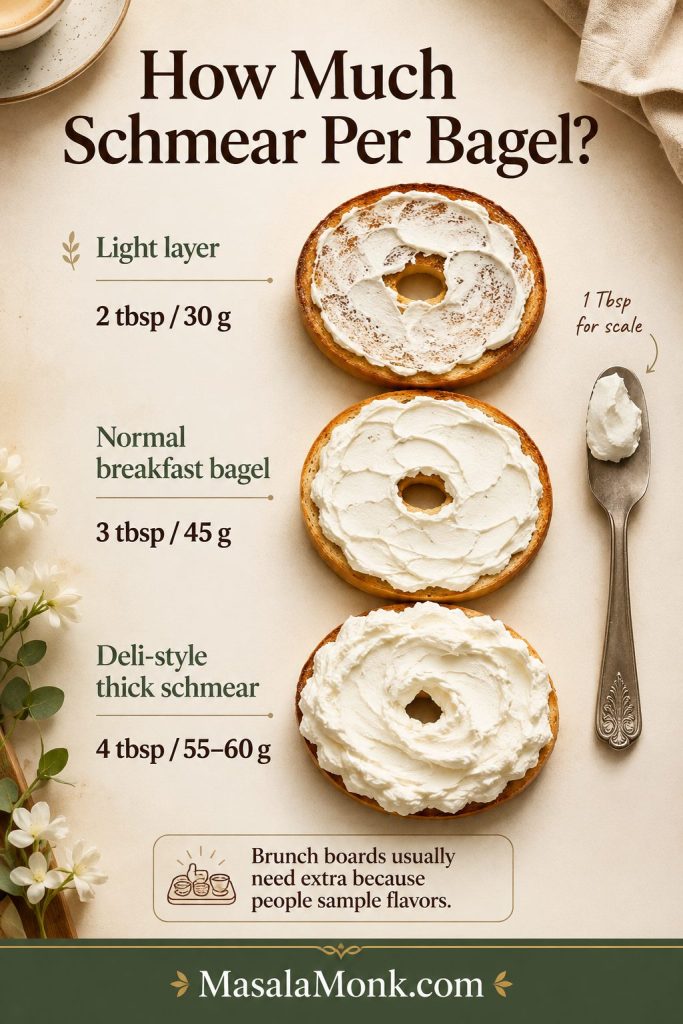
How much schmear do you need per bagel?
Use the amount as a texture decision: lighter for everyday breakfasts, thicker for deli-style bagels, and a little extra when guests are sampling flavors.
Schmear amount changes the whole bagel. Use a light layer for quick breakfasts, a normal layer for everyday bagels, and a thicker deli-style schmear for smoked salmon bagels or brunch boards.
Style
Amount per whole bagel
Light layer
2 tbsp / 30 g
Normal breakfast bagel
3 tbsp / 45 g
Deli-style thick schmear
4 tbsp / 55–60 g
Open-faced bagel halves
1–2 tbsp / 15–30 g per half
If you are serving a bagel bar, plan slightly more spread than you think you need. People usually take more schmear when there are several flavors to try.
Flavored Cream Cheese Ideas for Bagels
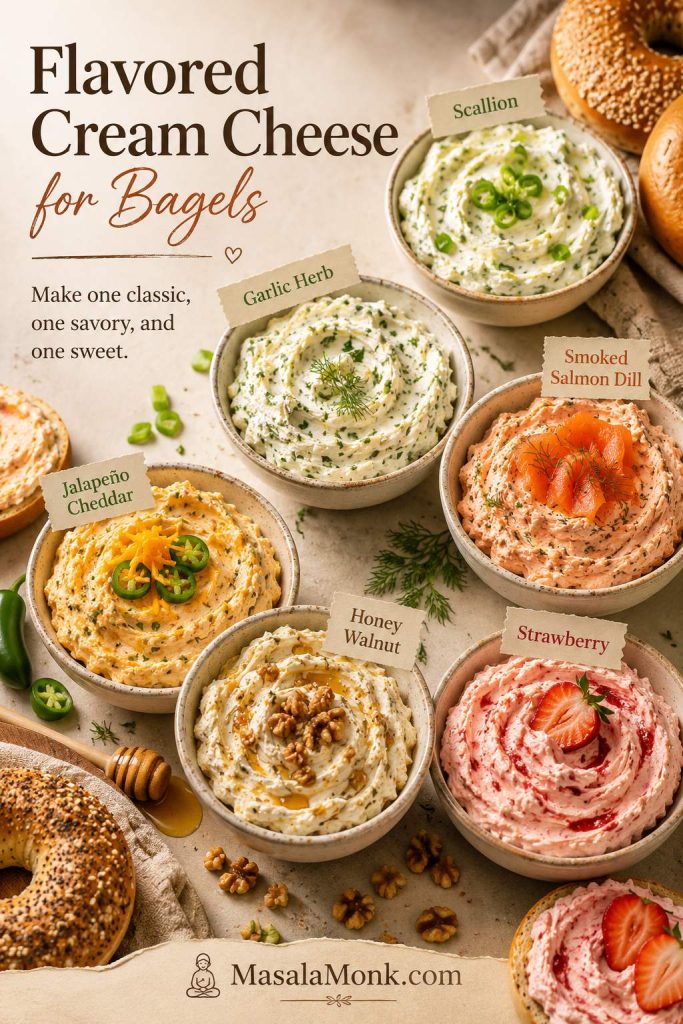
Think of flavored cream cheese as the easiest way to make a plain bagel feel planned. One good mix-in can do the work of several loose toppings.
Flavored cream cheese can do the work of several loose toppings. For a balanced bagel bar, make one classic flavor, one savory flavor, and one sweet flavor so every guest has an easy starting point.
Once the base is smooth, flavored cream cheese is easy. Start with 8 oz / 225 g cream cheese, then fold in one flavor direction. If you are making more than one flavor, keep one plain or scallion, one savory, and one sweet. That way, the board works for both breakfast people and dessert-leaning people.
If you are only making two flavors, make one scallion or garlic-herb schmear and one honey walnut or strawberry cream cheese. That way, you cover the savory people, the sweet people, and the person who wants to try both.
Best flavored cream cheese ideas for bagels
Flavor
Add to 8 oz / 225 g schmear base
Good bagel choices
Scallion schmear
¼ cup finely sliced scallions or chives + black pepper
Everything, sesame, plain
Garlic herb
1 small grated garlic clove + 2 tbsp chopped dill, parsley, or chives + lemon zest
Plain, sesame, whole wheat
Smoked salmon dill
3–4 oz / 85–115 g chopped smoked salmon + dill + lemon
Plain, poppy, pumpernickel
Jalapeño cheddar
1 minced jalapeño + ½ cup shredded cheddar + scallion
Everything, cheese, plain
Honey walnut
2 tbsp honey + ¼ cup chopped walnuts + pinch of cinnamon
Cinnamon raisin, plain, whole wheat
Strawberry
2–3 tbsp strawberry jam or ½ cup chopped berries + 1 tbsp powdered sugar if needed
Plain, blueberry, whole wheat
Everything bagel
1–2 tbsp everything bagel seasoning
Plain, sesame
Veggie cream cheese
⅓ cup finely diced cucumber, carrot, bell pepper, or celery + herbs
Plain, whole wheat, sesame
How to make one cream cheese base work harder
Once you understand the base formula, you can also play with sun-dried tomato, olive-herb, maple cinnamon, cranberry orange walnut, lemon pepper, or pickle-everything cream cheese. One simple base can cover several bagel toppings and spreads without much extra work.
Make-ahead tip: flavored cream cheese usually tastes better after chilling for at least 1 hour. For brunch, make the schmears the night before, then let them soften for 15–30 minutes before serving.
Bagel Spreads Besides Cream Cheese When You Want Something Different
What bagel spreads to use when cream cheese is not the answer
This is the section for the morning when the cream cheese tub is empty, or when you want the bagel to feel more like lunch than a bakery breakfast.
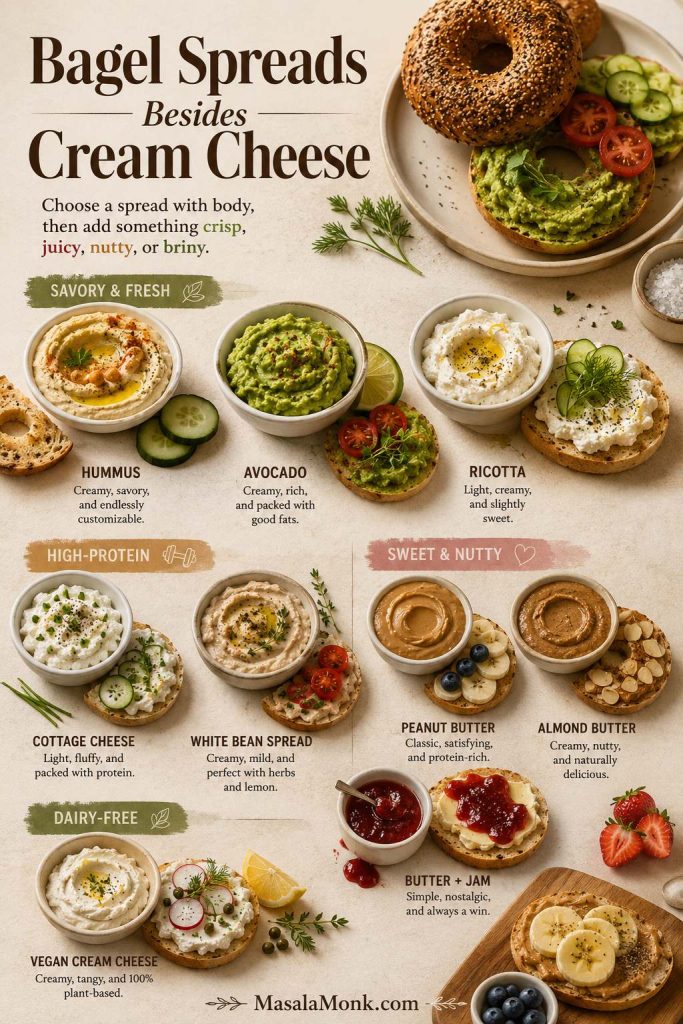
Cream cheese is classic, although hummus, avocado, ricotta, cottage cheese, nut butter, white bean spread, jam, and vegan cream cheese can each push the same bagel in a new direction.
Of course, cream cheese is the classic, but it is not the only spread that belongs on a bagel. The easiest way to replace it is to choose another spread that gives the bagel moisture: hummus for savory crunch, avocado for breakfast, ricotta for sweet toppings, peanut butter for a filling snack, and white bean spread for a dairy-free lunch bagel.
If you want the bagel to feel like lunch, choose hummus, avocado, white bean spread, tuna salad, turkey, or a thick savory salad. On the other hand, if you want it to feel like breakfast, choose butter, ricotta, peanut butter, cottage cheese, egg, or a fruit-friendly spread.
For plant-based builds, the vegan bagel toppings section has hummus, avocado, tofu cream cheese, white bean spread, and nut butter ideas.
For example, hummus works best when cucumber, tomato, sprouts, or paprika keep the bite from feeling dense. Meanwhile, ricotta and cottage cheese work better when fruit, honey, lemon zest, pepper, or herbs give them a clear direction.
Best bagel spreads to pair with toppings
Spread
Toppings to add
Good bagel choices
Hummus
Cucumber, tomato, sprouts, paprika, olive oil
Sesame, plain, whole wheat
Avocado
Egg, chili flakes, lemon, tomato, everything seasoning
Everything, sesame, whole wheat
Ricotta
Honey, berries, lemon zest, pistachios
Plain, blueberry, whole wheat
Peanut butter
Banana, honey, cinnamon, chia seeds, jam
Plain, cinnamon raisin, whole wheat
Cottage cheese
Tomato, black pepper, cucumber, berries, honey
Plain, whole wheat, sesame
Butter
Jam, cinnamon sugar, honey, flaky salt
Plain, cinnamon raisin, blueberry
White bean spread
Tomato, herbs, olive oil, lemon, roasted peppers
Plain, sesame, whole wheat
Mascarpone
Berries, honey, citrus zest, toasted nuts
Plain, blueberry, mini bagels
How to make mild bagel spreads taste finished
Spread first, then toppings: a mild spread like ricotta, cottage cheese, or white bean spread usually needs a stronger finish. Add lemon, herbs, pepper, honey, cinnamon, flaky salt, or fruit so the bagel does not taste unfinished.
Savory Bagel Toppings
If your savory bagel tastes heavy after three bites, it usually does not need more meat or more cheese. Instead, it needs something crisp, sharp, juicy, or herbal to cut through the richness. A classic schmear and smoked salmon are iconic, but hummus, avocado, eggs, tuna salad, turkey, chicken salad, pesto, goat cheese, and crisp vegetables can be just as satisfying.
Savory bagel toppings taste better with contrast: crisp cucumber, juicy tomato, sharp onion, lemon, herbs, mustard, or capers can cut through smoked salmon, turkey, pesto, tuna, or egg salad.
At the same time, the lunch bagel should not collapse halfway through. If you are using tomato, cucumber, pickles, roasted peppers, or avocado, keep the slices thin and use a creamy spread underneath to protect the toasted surface.
Classic savory topping ideas
Plain schmear + tomato + black pepper
Scallion schmear + cucumber + dill
Smoked salmon + capers + red onion + lemon
Hummus + cucumber + tomato + paprika
Avocado + fried egg + chili flakes
Tuna salad + lettuce + pickles
Egg salad + chives + everything seasoning
Turkey + cream cheese + cucumber + mustard
Chicken salad + celery + herbs
Pesto + tomato + mozzarella
Goat cheese + roasted peppers + basil
Bacon + cream cheese + tomato
If tuna salad is your easy lunch topping, this healthy tuna salad guide has lighter deli-style, avocado, Mediterranean, no-mayo, tuna-and-egg, and sandwich-friendly variations you can spoon onto toasted bagels.
Savory combinations worth making
Use these when you want a bagel that eats more like a meal than a snack. Each one has creaminess, a main topping, and a sharper or fresher finish. In other words, these bagel toppings and spreads are built to hold up beyond the first bite.
Combination
Build
Lox-style bagel
Cream cheese, smoked salmon, capers, red onion, dill, lemon
Avocado egg bagel
Mashed avocado, fried or scrambled egg, chili flakes, lemon, salt
Cream cheese, turkey, cucumber, lettuce, mustard, black pepper
Tuna melt bagel
Tuna salad, cheddar, tomato, toasted until warm
Caprese bagel
Mozzarella, tomato, pesto, basil, black pepper
Chicken salad, tuna salad, and egg salad all need the same thing on a bagel: a thick enough texture to stay put. If the filling is loose, serve the bagel open-faced or add lettuce as a barrier.
Packing a savory bagel for later? Use the work and lunchbox toppings guide so juicy or slippery toppings do not soak the bread.
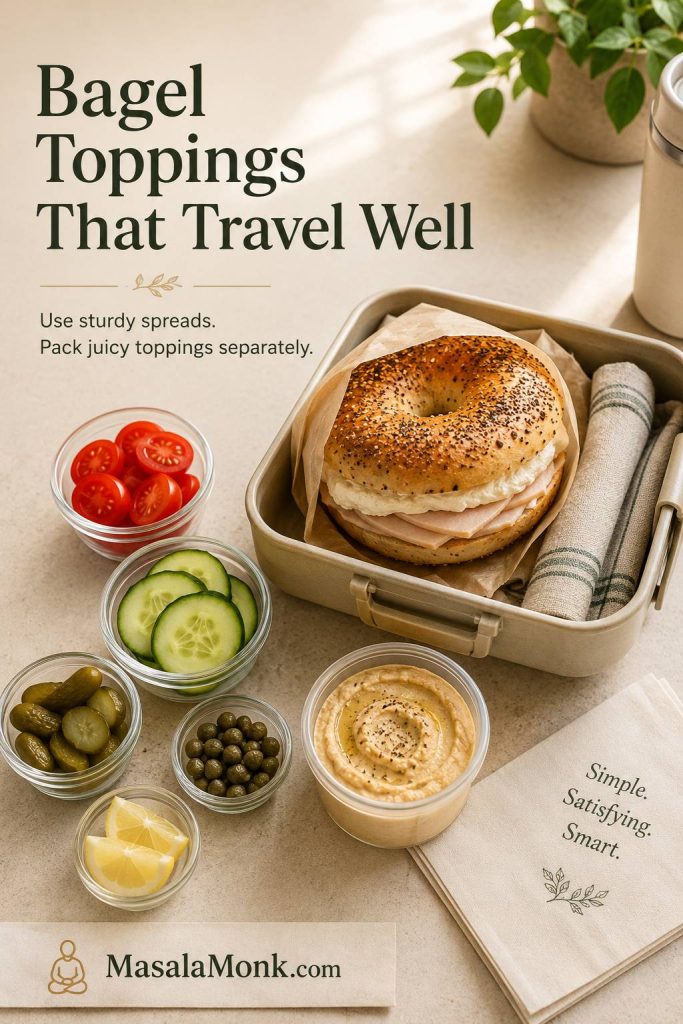
Bagel Toppings That Travel Well for Work or Lunchboxes
For packed lunches, choose bagel toppings that stay firm and do not leak into the bread. Thick hummus, cream cheese, turkey, peanut butter, firm egg salad, thick tuna salad, and sliced cheese travel better than watery tomatoes, loose salads, avocado, or overfilled smoked salmon builds.
A good lunchbox bagel should still taste good a few hours later: a sturdy toasted base, a spread that acts like a barrier, and fresh toppings packed separately when they are juicy or slippery.
For work or lunchbox bagels, sturdy spreads matter most. Pack tomato, cucumber, pickles, capers, lemon, and other juicy toppings separately so the bread stays firm until lunch.
Watery tomatoes, loose salads, overfilled lox bagels, very wet spreads
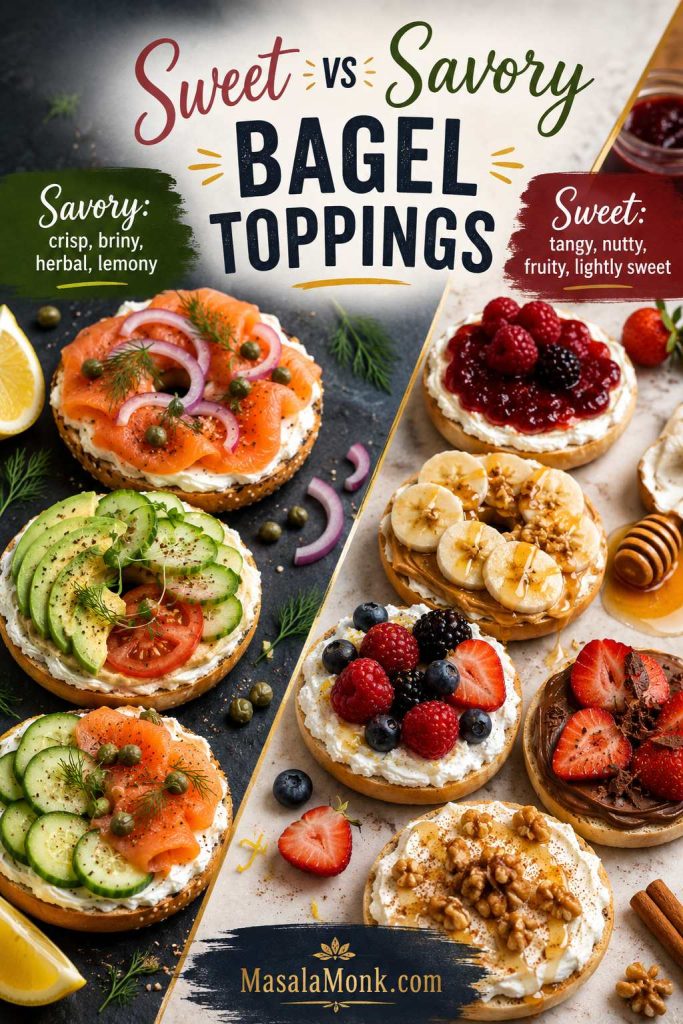
Sweet Bagel Toppings
In general, sweet bagel toppings are more satisfying when they have a little contrast instead of tasting only sweet. Tangy cream cheese, toasted nuts, salt, lemon zest, cinnamon, berries, and honey can make a sweet bagel feel more like breakfast and less like frosting on bread.
Sweet and savory bagel toppings need different kinds of contrast. Savory bagels usually want crunch, herbs, lemon, or briny toppings, while sweet bagels benefit from tangy cheese, fruit, nuts, honey, cinnamon, or salt.
That said, sweet bagels need a lighter hand when the bagel itself already has cinnamon, raisins, or blueberries. Start with tangy or lightly salted toppings first, then move sweeter only if the bagel itself is plain.
If you are starting with cinnamon raisin, blueberry, or another flavored bagel, check the bagel type pairings before adding a very sweet spread.
Easy sweet bagel ideas
Plain cream cheese + strawberry jam
Butter + cinnamon sugar
Peanut butter + banana + honey
Almond butter + apple slices + cinnamon
Ricotta + honey + pistachios
Mascarpone + berries
Nutella + strawberries
Cream cheese + brown sugar + cinnamon
Greek yogurt cream cheese + berries + granola
Honey walnut cream cheese + banana
Apple butter + cream cheese
Peanut butter + jam + flaky salt
If you want a fruit spread that feels brighter than regular strawberry jam, this pineapple jam recipe makes a glossy sweet-tart spread for toast, scones, waffles, yogurt, and breakfast-style bagels.
Fruit spreads are especially good on plain or lightly toasted bagels because they bring both sweetness and brightness. A warm toasted cut side with cream cheese and glossy fruit spread feels completely different from a cold, overloaded sweet bagel.
Sweet topping tip: cinnamon raisin and blueberry bagels already bring sweetness, so they usually taste best with tangy or lightly salted toppings like plain cream cheese, butter, peanut butter, ricotta, or honey walnut cream cheese rather than very sugary spreads alone.
In fact, for sweet bagels, a tiny pinch of salt often does more than extra sugar. It makes peanut butter, honey, berries, chocolate-hazelnut spread, and sweet cream cheese taste fuller without making the bagel heavy.
Sweet bagel combinations by mood
Choose the topping based on whether you want the bagel to feel like breakfast, dessert, or something in between. This is also where bagel spreads matter most, because a tangy or lightly salted base keeps sweet toppings from becoming too much.
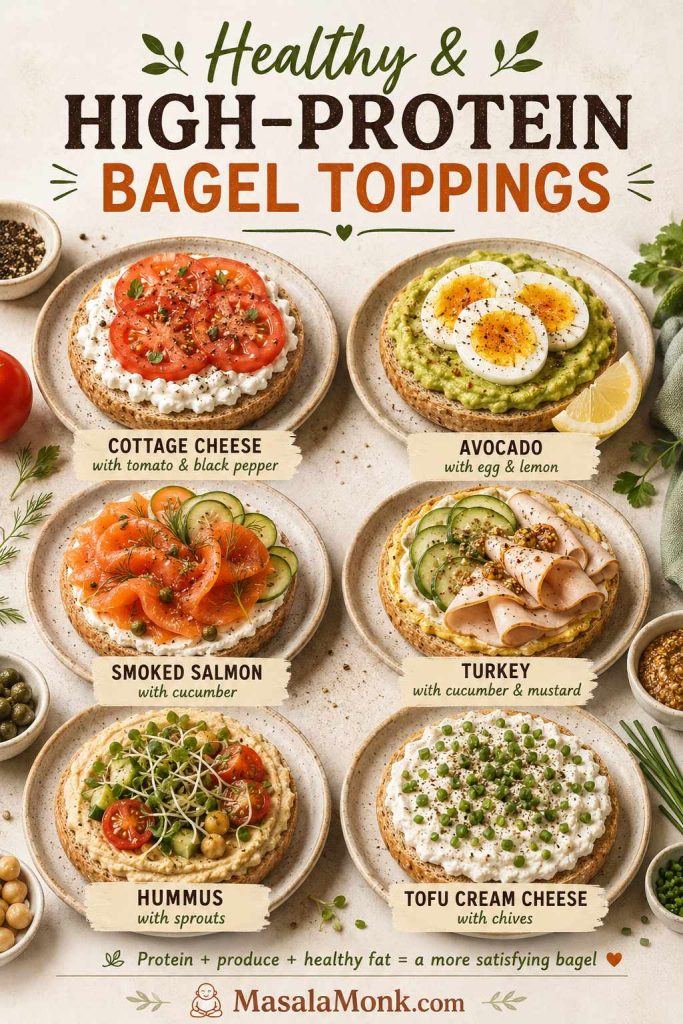
Healthy and High-Protein Bagel Toppings That Still Taste Good
A bagel is best treated like a bigger, denser bread base, not a breakfast problem to apologize for. The toppings matter because they decide whether it feels like a quick carb moment or a breakfast that holds you for a while. For a lighter plate, use one half open-faced instead of building a heavy closed sandwich.
The goal is not to make the bagel smaller; it is to make the topping smarter, more satisfying, and still good enough to look forward to.
Healthy bagel toppings should still taste like something you want to eat. Cottage cheese, egg, smoked salmon, turkey, hummus, tofu cream cheese, avocado, and vegetables add protein, texture, and staying power.
For dairy-free or higher-protein variations, tofu cream cheese, cashew cream cheese, white bean spread, egg whites, turkey slices, smoked salmon, and Greek yogurt-style spreads all work with the same spread-plus-finish formula.
Balanced bagel toppings for protein, produce, and healthy fats
Idea
Why it feels balanced
Cottage cheese + tomato + pepper
Creamy, fresh, and high in protein
Avocado + egg + lemon
Rich, filling, and bright
Hummus + cucumber + sprouts
Dairy-free, crunchy, and easy
Smoked salmon + cucumber
Protein-rich and classic
Greek yogurt cream cheese
Tangier and lighter than a heavy spread
Tuna salad with Greek yogurt
More protein and less heaviness
Turkey + cucumber + mustard
Lean, savory, and crisp
Ricotta + berries
Sweet, creamy, and lighter than frosting-like spreads
White bean spread + tomato
Vegan, filling, and good with herbs
Tofu cream cheese + chives
Dairy-free and bagel-friendly
If you want a warmer high-protein breakfast bagel, spoon soft eggs over a toasted half and finish with chives, tomato, or hot sauce. These scrambled eggs with cottage cheese are especially useful when you want creamy eggs with more protein.
Balance tip: if the bagel itself is large, use an open-faced style. One bagel split into two halves with protein and vegetables often feels more satisfying than a closed sandwich overloaded with spread.
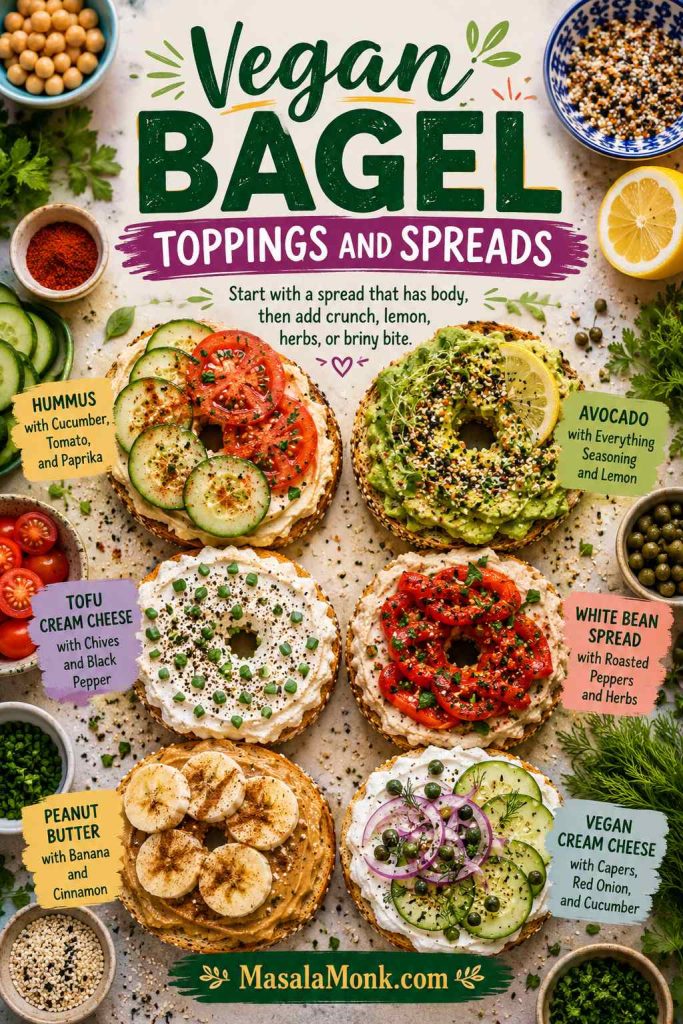
Vegan bagel toppings and spreads
Vegan bagel toppings do not need to feel like substitutes. A thick swipe of hummus with cucumber and paprika, avocado with lemon and everything seasoning, or white bean spread with roasted peppers can taste just as complete as a cream cheese bagel.
Vegan bagel toppings do not need to feel like substitutes. Start with hummus, avocado, tofu cream cheese, white bean spread, or nut butter, then add crunch, lemon, herbs, or briny bite.
Start with a spread that already has body, then add something crisp, juicy, nutty, or briny. Hummus, avocado, tofu cream cheese, white bean spread, peanut butter, almond butter, jam, olive tapenade, and vegan cream cheese all give the bagel enough moisture before you add fresh toppings.
Hummus + cucumber + tomato + paprika
Avocado + everything seasoning + lemon
Tofu cream cheese + chives + black pepper
White bean spread + roasted peppers + herbs
Peanut butter + banana + cinnamon
Vegan cream cheese + capers + red onion + cucumber
How to Toast Bagels for Toppings and Boards
Because many toppings are wet, creamy, or warm, toasting matters more than it seems. A lightly toasted bagel is fine for butter and jam, but a bagel with cream cheese, tomato, egg, avocado, smoked salmon, or hummus needs a firmer surface.
Toast level should match the toppings. Butter and jam only need light toast, but wet or creamy toppings like tomato, cucumber, avocado, hummus, eggs, or smoked salmon need a firmer cut side.
For a soft-but-sturdy bagel, toast only the cut side. For a loaded open-faced bagel, toast a little longer so the surface can hold cream cheese, tomato, cucumber, avocado, or eggs without going soggy.
Day-old bagels only need enough heat to firm the cut side. Over-toasting makes thick schmear and dry toppings feel heavier.
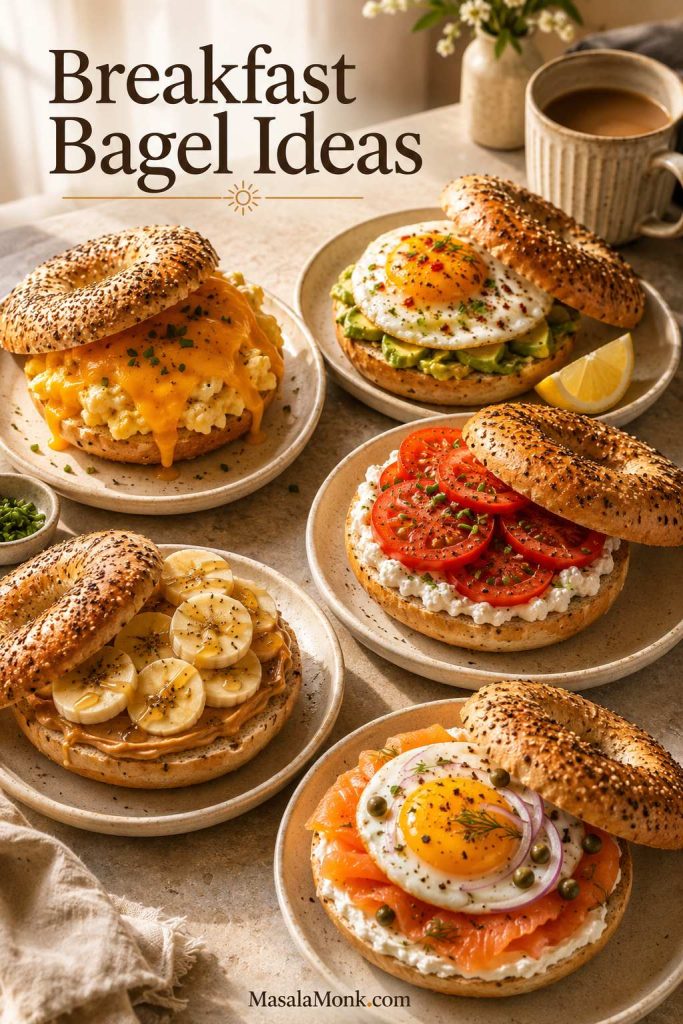
Breakfast Bagel Ideas
For breakfast, the bagel needs to do a little more than taste good for five minutes. A spread plus protein — eggs, smoked salmon, cottage cheese, turkey, peanut butter, or Greek yogurt cream cheese — makes it feel more like a real meal.
Breakfast bagels become more satisfying when protein, fruit, vegetables, or warmth join the spread. Egg, cheese, avocado, cottage cheese, peanut butter, banana, tomato, and smoked salmon all make the bite more filling.
This is where a bagel is especially useful: it can hold eggs, cheese, avocado, hash browns, or smoked salmon without needing much cooking beyond the filling.
For more morning ideas, this breakfast sandwich recipe guide has more ways to build a hearty breakfast around eggs, cheese, spreads, and add-ons.
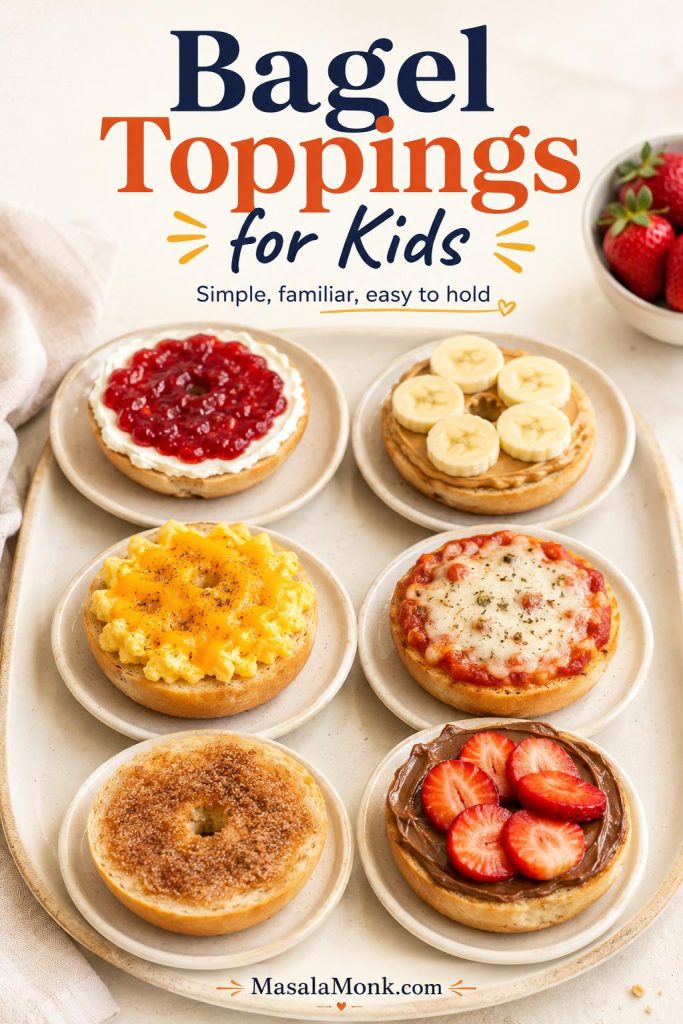
For kids, keep the bagel toppings simple, familiar, and easy to hold. Cream cheese with jam, peanut butter with banana, butter with cinnamon sugar, strawberry cream cheese, egg and cheese, mini bagel pizzas, and Nutella with strawberries all work because they are flavorful without being hard to bite.
Kid-friendly bagel toppings should be simple, familiar, and easy to hold. Cream cheese with jam, peanut butter banana, egg and cheese, mini pizza bagels, cinnamon sugar, and strawberry chocolate spread all keep the choices approachable.
For a crisp diner-style breakfast bagel, add a small hash brown patty or a thin layer of crispy shredded potatoes with egg and cheese. This air fryer hash browns guide is useful when you want golden potatoes without babysitting a skillet.
Toasting tip: toast the cut sides well if you are adding egg, avocado, tomato, or warm fillings. A firmer toasted surface keeps the bagel from turning soggy.
Smoked Salmon, Lox, and Cream Cheese Bagels
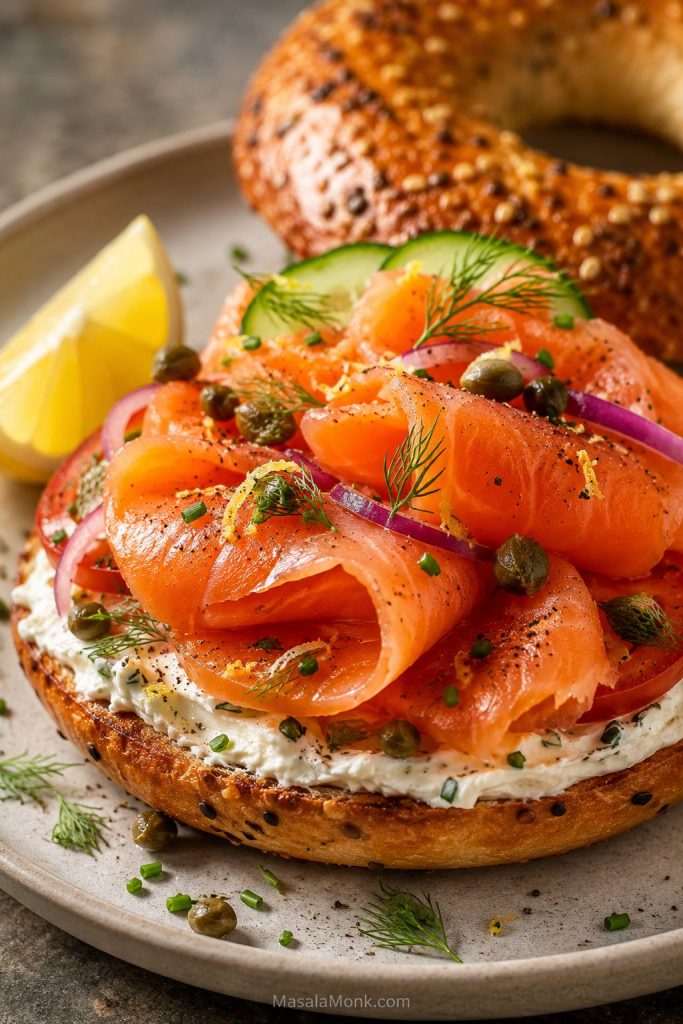
A smoked salmon bagel is one of the most reliable savory combinations because every piece has a job. Cream cheese adds richness, salmon adds salt and protein, cucumber or tomato adds freshness, capers add sharpness, onion adds bite, dill adds fragrance, and lemon wakes everything up.
Ideally, the best bites have cool cucumber, soft cream cheese, salty salmon, sharp onion, and a little lemon all at once. A smoked salmon bagel should taste like a deli order, not just fish on bread.
A smoked salmon bagel should taste creamy, salty, crisp, sharp, and lemony in the same bite. Thin onion, capers, cucumber, dill, pepper, and lemon keep the silky salmon feeling fresh.
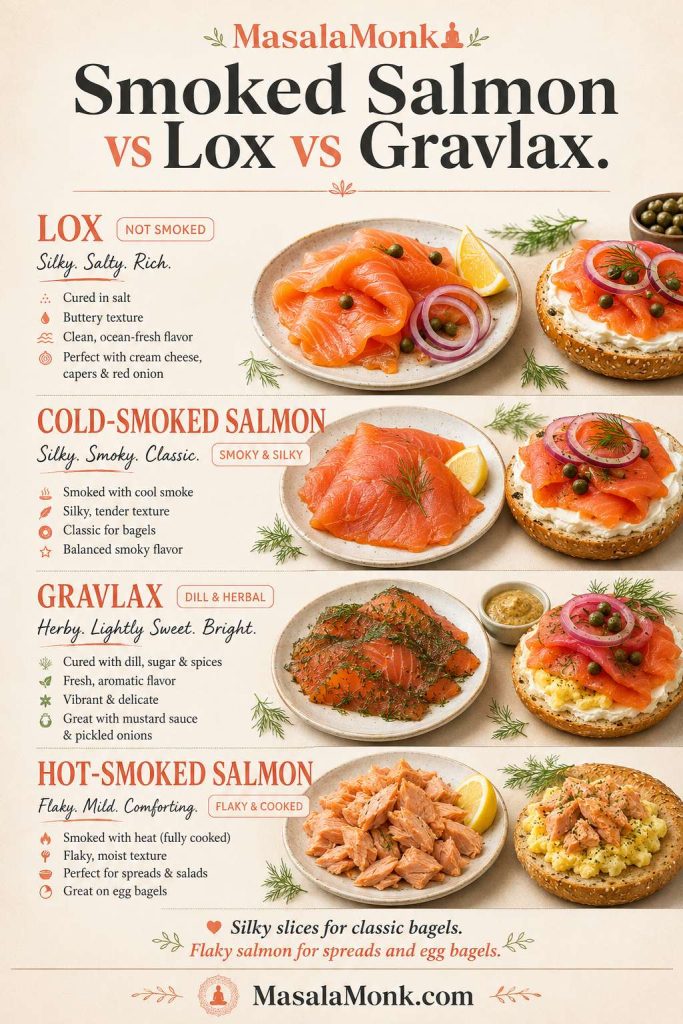
Smoked salmon vs lox vs gravlax: which one goes on a bagel?
People often use these names loosely, but they do not taste exactly the same. The best choice depends on whether you want smoky, salty, herbal, or flaky fish.
Lox, cold-smoked salmon, gravlax, and hot-smoked salmon are not interchangeable. Silky slices suit classic cream cheese bagels, while flaky hot-smoked salmon works better in spreads, salads, and egg bagels.
Type
What it tastes like
Best bagel build
Smoked salmon
Silky or firmer depending on style, with a smoky flavor
Cream cheese, cucumber, red onion, capers, dill, lemon
Lox
Salty, silky, rich, and usually not smoky
Plain schmear, tomato or cucumber, red onion, capers
Gravlax
Herbal, slightly sweet, and dill-forward
Labneh or cream cheese, cucumber, dill, lemon zest
Hot-smoked salmon
Flaky, cooked-tasting, and more robust
Flaked into schmear, added to egg bagels, or served on brunch boards
For the easiest first smoked salmon bagel, buy cold-smoked salmon or lox-style salmon if you want silky folds. Use hot-smoked salmon when you want a flakier, more filling brunch spread, egg bagel, or smoked salmon schmear. For a deeper breakdown of the terms, this Food & Wine guide to lox, gravlax, and smoked salmon explains how the curing and smoking methods differ.
Layering matters because the smallest toppings are the easiest to lose; press them into the schmear before adding larger salmon folds.
Layer a smoked salmon bagel from small to large. Press capers and herbs into the schmear first, then add cucumber, salmon folds, onion, dill, pepper, and lemon so the toppings stay in place.
Toast the bagel and let it cool for a minute so the spread does not melt immediately.
Spread cream cheese or scallion schmear on both cut sides.
Press capers lightly into the creamy layer.
Add cucumber or tomato if using.
Layer smoked salmon in loose folds instead of flat sheets.
Finish with red onion, dill, black pepper, and lemon.
Loose folds of salmon make the bagel feel fuller without needing a huge amount of fish. For a softer, spreadable version, chop smoked salmon and fold it into the schmear base with dill, lemon zest, and chives. This is especially useful for a bagel bar because guests can spread it quickly without pulling apart delicate salmon slices.
If you have extra smoked salmon, cucumber, avocado, or lemony sauce after brunch, turn the same flavors into a simple bowl later. This salmon bowl recipe includes a no-cook smoked salmon direction with cucumber, avocado, and a bright yogurt-style sauce.
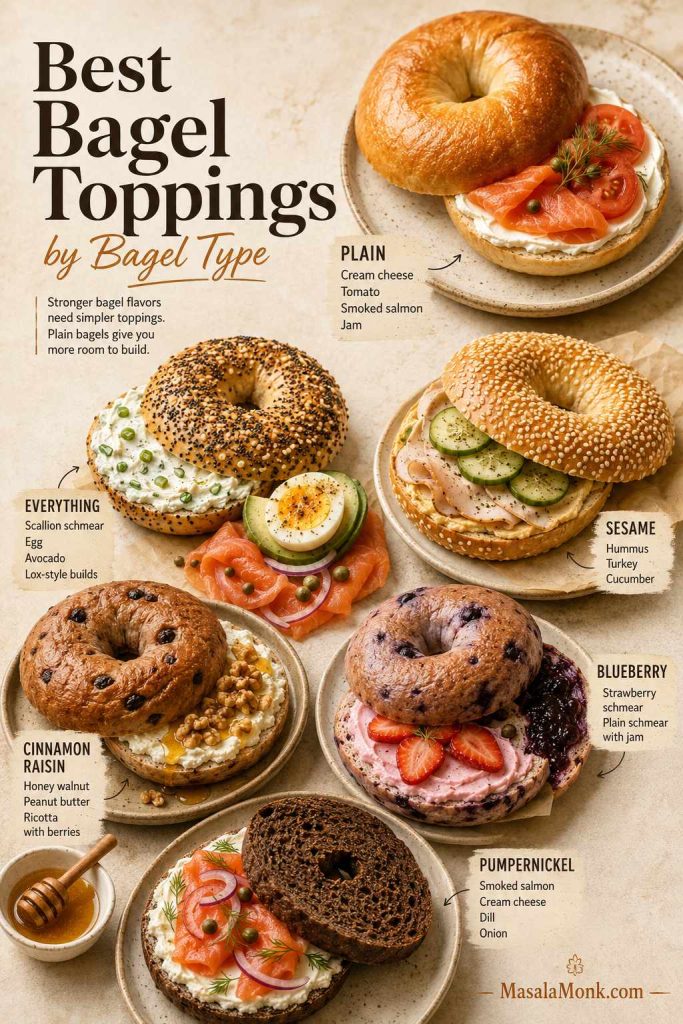
Best Bagel Toppings by Bagel Type
At this point, bagel choice really matters. A cinnamon raisin bagel needs a different topping than an everything bagel, and a pumpernickel bagel can handle stronger, saltier flavors.
The bagel itself already brings flavor. Plain bagels can handle almost anything, while everything, cinnamon raisin, blueberry, sesame, and pumpernickel bagels usually shine with more focused toppings.
Because stronger bagels already have personality, the topping should usually be simpler. Everything, onion, cheese, cinnamon raisin, blueberry, and pumpernickel bagels bring flavor on their own; plain and whole wheat bagels give you more room to build.
If the bagel is already salty or garlicky, keep the spread calmer and let the toppings do less work. If the bagel is sweet, use tangy, creamy, or lightly salted toppings so the whole bite does not become sugary.
Bagel type
Toppings that pair well
Plain
Any cream cheese, smoked salmon, egg, avocado, butter, jam
Everything
Scallion cream cheese, lox, egg and cheese, avocado, hummus
When in doubt, let the bagel lead. Plain and whole wheat bagels are flexible; everything, onion, cheese, blueberry, cinnamon raisin, and pumpernickel bagels already have a point of view.
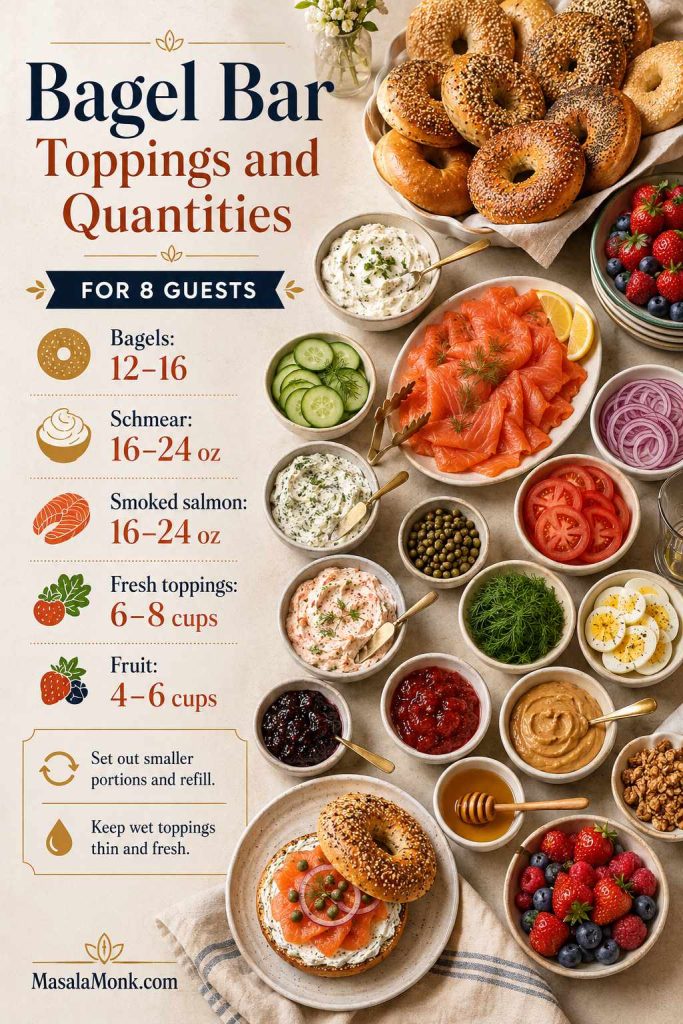
Bagel Bar Toppings, Spreads, and Brunch Board Quantities
A bagel bar should feel generous without becoming chaotic. You do not need every topping on the table at once; you need the right mix of bagels, spreads, proteins, fresh toppings, and small bowls that are easy to refill.
This is low-pressure brunch food. Instead of cooking every guest a separate breakfast, you are giving everyone enough good pieces to build the bagel they actually want.
A bagel bar should look generous without turning messy. For eight guests, plan 12–16 bagels, 16–24 oz schmear, 16–24 oz smoked salmon, and plenty of fresh toppings, then refill smaller bowls as needed.
How many bagels per person?
Serving style
Bagels per person
Good for
Light brunch
1 bagel
When serving fruit, salad, eggs, pastries, or sides
Main meal
1½ bagels
Hungry guests or fewer side dishes
Mini bagels
2 mini bagels
Grazing boards and mixed toppings
Bagel bar quantity table
The bagels are easy. The part people misjudge is the spread, salmon, and fresh toppings. A good board should look full when it lands on the table, but still be easy to refill without everything getting wet or messy.
The exact mix depends on your crowd, but these numbers keep you from underbuying the expensive parts and overbuying the things that wilt or get soggy. If your guests love smoked salmon, eggs, or thick cream cheese, round up slightly.
Sliced fresh toppings means cucumber, tomato, onion, radish, lettuce, herbs, fruit, or similar add-ons.
For make-ahead timing, use the storage and prep guide so schmear, salmon, sliced vegetables, and bagels stay fresh.
Mini Bagel Toppings for Brunch Boards and Kids
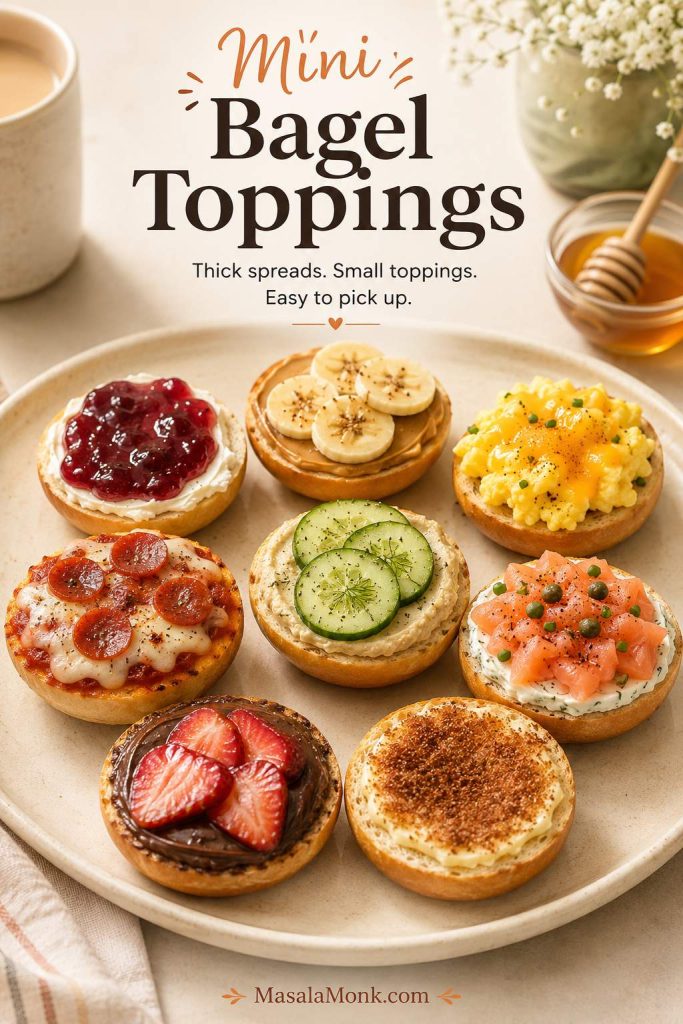
Mini bagels work best with toppings that do not slide around. Use thick schmears, small slices, and easy spreads so guests can pick them up without losing half the topping on the board.
Mini bagels are best for brunch boards, kids, and grazing because guests can try more than one topping. Use thick spreads, small slices, and toppings that stay put when picked up.
The board should look abundant, but it should still feel easy to use: spreads in bowls, wet toppings contained, bagels sliced, and the brightest ingredients where people can see them.
For the egg option on a bagel bar, cook the eggs ahead and slice them right before serving. This air fryer hard-boiled eggs guide is handy when you want easy peeled eggs for brunch plates, toast, deviled eggs, or snack boards.
Bagel bar equipment
Large board, tray, platter, or sheet pan
Small bowls or ramekins for capers, onions, jams, nuts, and seasonings
Spreader knives for each cream cheese flavor
Serrated knife for slicing bagels
Toaster or toaster oven
Serving spoons and small tongs
Parchment paper for easy cleanup
Airtight containers for make-ahead spreads
For a bagel bar, smaller bowls are not just prettier. They keep wet toppings from soaking into the bread and make the board easier to refill.
Hosting tip: do not put every topping directly on the board if it will make things wet. Keep capers, jams, honey, pickled onions, and chopped herbs in small bowls so guests can build cleaner bagels.
Make-Ahead, Storage, and Food Safety
Most bagel toppings are easy to prep ahead. However, they do not all hold the same way. Cream cheese spreads are great make-ahead items, while sliced tomatoes, cucumbers, avocado, and toasted bagels are better closer to serving time.
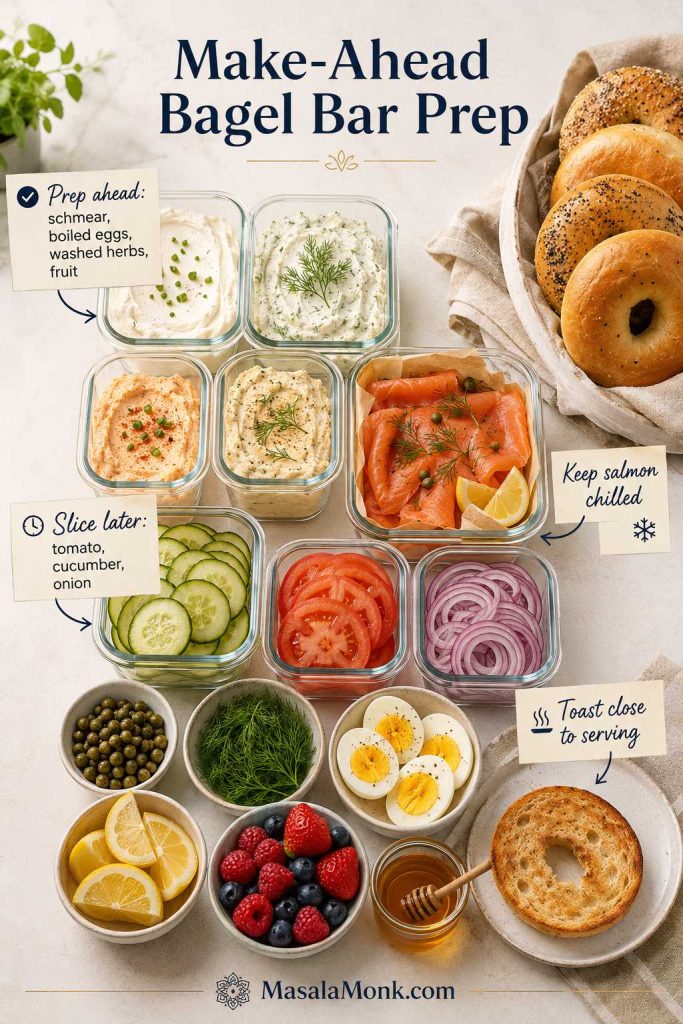
To keep a bagel bar calm, prep the sturdy things early and leave the wet, fresh, or delicate things for last.
Make-ahead bagel bar prep works best when sturdy items are done early and delicate toppings wait. Prep schmear, eggs, herbs, and fruit ahead; slice wet toppings later, keep salmon chilled, and toast bagels close to serving.
Storage guide
Item
Best storage
Plain schmear
About 5–7 days refrigerated in an airtight container
Flavored cream cheese
Best within 3–5 days
Smoked salmon cream cheese
Best within 2–3 days, or sooner if the smoked salmon package says so
Cut tomatoes and cucumbers
Best same day; pat dry before serving
Pickled onions
3–5 days refrigerated
Toasted bagels
Best fresh
Frozen bagels
Slice first, then freeze in a sealed bag
What to prep ahead
1 day ahead: schmear flavors, pickled onions, boiled eggs, washed herbs, washed fruit
Morning of serving: slice tomatoes, cucumbers, onions, radishes, fruit, and bagels
Right before serving: toast bagels, slice avocado, arrange smoked salmon, add lemon wedges
How long can a bagel bar sit out?
If your bagel bar includes cream cheese, smoked salmon, eggs, meat, or cut produce, keep everything chilled until serving. According to FDA food safety guidance, perishable foods that need refrigeration should not sit at room temperature for more than 2 hours, or more than 1 hour when the temperature is above 90°F / 32°C.
During a longer brunch, set out smaller portions and refill from the refrigerator as needed. That keeps the board fresher and the toppings do not sit out longer than they should.
Recipe Card: Easy Bagel Schmear with 6 Flavor Variations
Use this as the base recipe for the schmear ideas above. It starts with softened cream cheese, a little sour cream or Greek yogurt, lemon, and salt, then turns into sweet or savory flavored cream cheese.
Keep one batch of plain schmear, then flavor smaller portions for different bagel toppings. That way, one easy cream cheese base can support savory, sweet, smoked salmon, and brunch-board combinations.
Prep Time5 minutes
Optional Chill1 hour
YieldAbout 1 cup / 9 oz / 255 g
Serves4–6 bagels
Equipment
Medium mixing bowl
Hand mixer, stand mixer, or sturdy spoon
Rubber spatula
Measuring spoons
Airtight container
Ingredients
8 oz / 225 g brick cream cheese, softened
2 tbsp / 30 g sour cream, Greek yogurt, or crème fraîche
½ tsp / 2.5 ml fresh lemon juice
Pinch to ⅛ tsp fine salt, to taste
Black pepper, optional
Instructions
Add softened cream cheese to a mixing bowl.
Beat until smooth, creamy, and slightly lighter.
Add sour cream, Greek yogurt, or crème fraîche.
Add lemon juice and salt, then mix again until spreadable.
Fold in one flavor variation from the list below.
Taste and adjust with more lemon, salt, herbs, honey, or seasoning as needed.
Chill for 1 hour if you want the flavor to deepen.
3–4 oz / 85–115 g chopped smoked salmon + dill + lemon
Jalapeño cheddar schmear
1 minced jalapeño + ½ cup shredded cheddar + scallion
Honey walnut schmear
2 tbsp honey + ¼ cup chopped walnuts + pinch of cinnamon
Strawberry cream cheese
2–3 tbsp strawberry jam or ½ cup chopped berries + 1 tbsp powdered sugar if needed
Notes
Use brick-style cream cheese for the thickest, creamiest result.
Greek yogurt makes the schmear tangier; sour cream makes it softer and richer.
Add salty mix-ins slowly. Smoked salmon, capers, bacon, cheddar, and everything seasoning can make the spread salty fast.
For a bagel bar, make 2–3 different schmear flavors so guests can build sweet and savory bagels.
For a full bagel build, pair this schmear with one main topping, one crunchy or fresh topping, and one finishing detail such as lemon, pepper, herbs, honey, or flaky salt.
Still deciding? Start with the bagel type, then choose the spread. Plain bagels give you the most freedom, everything bagels want creamy or savory toppings, and sweet bagels usually need something tangy, salty, or nutty to stay balanced.
FAQs About Bagel Toppings and Spreads
What are the most popular bagel toppings?
The most popular bagel toppings are cream cheese, butter, jam, smoked salmon or lox, capers, red onion, egg and cheese, avocado, peanut butter, tuna salad, egg salad, hummus, tomato, cucumber, and everything bagel seasoning. However, the best choice depends on the bagel itself: plain bagels can take almost anything, while everything, cinnamon raisin, blueberry, and pumpernickel bagels usually need more thoughtful pairings.
What goes on a bagel besides cream cheese?
For a simple breakfast bagel, use butter or jam. For a savory dairy-free option, choose hummus or white bean spread; for something filling, use avocado or eggs; and for sweet or high-protein builds, try ricotta, cottage cheese, peanut butter, or almond butter. Tuna salad, egg salad, turkey, smoked salmon, pesto, goat cheese, honey, Nutella, and fresh fruit also work when the spread and toppings support each other.
What is schmear?
Schmear usually means a spread for bagels, especially cream cheese. In everyday bagel-shop language, asking for a schmear usually means you want a generous layer of cream cheese, not a thin scrape. A good homemade schmear is softer and easier to spread because it is mixed until creamy and sometimes loosened with sour cream, Greek yogurt, crème fraîche, lemon, herbs, or seasonings.
What is the best spread for an everything bagel?
Everything bagels pair especially well with scallion cream cheese, plain schmear, lox spread, garlic herb cream cheese, avocado, egg, hummus, or tuna salad. Since the bagel already has garlic, onion, sesame, poppy, and salt, the spread can stay simple.
What goes best on a plain bagel?
Plain bagels are the most flexible because they do not compete with the toppings. Use them when you want the spread or filling to stand out: scallion schmear, smoked salmon, egg and cheese, avocado, butter and jam, hummus with cucumber, ricotta and honey, or peanut butter with banana.
What goes best on an everything bagel?
Everything bagels already bring garlic, onion, sesame, poppy, and salt, so the best toppings are creamy, fresh, or protein-rich rather than heavily seasoned. Scallion cream cheese, smoked salmon, egg and cheese, avocado, hummus, tuna salad, cucumber, and plain spread with tomato all work because they support the seasoning instead of fighting it.
What goes best on a cinnamon raisin bagel?
Cinnamon raisin bagels are already sweet and spiced, so they usually need tangy, creamy, nutty, or lightly salted toppings. Plain cream cheese, butter, peanut butter, ricotta, honey walnut schmear, apple slices, and a small pinch of flaky salt all keep the sweetness from feeling too heavy.
What goes best on a blueberry bagel?
Blueberry bagels work best with toppings that either sharpen the fruit or keep it creamy. Try plain schmear, lemon cream cheese, strawberry cream cheese, butter, ricotta, mascarpone, honey, fresh berries, or almond butter.
What are good sweet bagel toppings?
Good sweet bagel toppings include cream cheese and jam, honey walnut cream cheese, peanut butter and banana, almond butter and apple, ricotta and honey, Nutella and strawberries, butter and cinnamon sugar, mascarpone with berries, and Greek yogurt cream cheese with granola. That said, a pinch of salt, lemon zest, cinnamon, or toasted nuts helps sweet toppings taste more complete.
What are healthy bagel toppings?
The healthiest bagel toppings are usually the ones that add protein, produce, or healthy fat instead of only more spread. Eggs, avocado, smoked salmon, hummus, cottage cheese, Greek yogurt cream cheese, turkey, tuna, tofu cream cheese, white bean spread, cucumber, tomato, sprouts, herbs, and fresh fruit can all make a bagel more satisfying.
How much cream cheese do you need per bagel?
Use about 2 tbsp / 30 g for a light layer, 3 tbsp / 45 g for a normal breakfast bagel, and 4 tbsp / 55–60 g for a thick deli-style schmear. For open-faced bagel halves, use 1–2 tbsp / 15–30 g per half.
Should bagels be toasted before adding toppings?
Toast bagels when the toppings are wet, creamy, warm, or heavy. A firmer cut side helps hold cream cheese, tomato, cucumber, eggs, avocado, hummus, tuna salad, and smoked salmon without turning soggy.
How do you keep bagel toppings from sliding off?
Use the spread as glue, slice toppings thinly, and press small toppings like capers, scallions, herbs, seeds, or everything seasoning into the creamy layer. If the build is tall, wet, or slippery, serve the bagel open-faced instead of closing it.
How long can a bagel bar sit out?
A bagel bar with cream cheese, smoked salmon, eggs, meat, or cut produce should not sit out for more than 2 hours. In hot weather above 90°F / 32°C, keep it to 1 hour. For longer gatherings, set out smaller portions and refill from the refrigerator.
Final Thoughts
Ultimately, a better bagel does not always need more toppings. Often, it needs one smarter finishing detail: lemon on smoked salmon, flaky salt on tomato, cinnamon with peanut butter, herbs in cream cheese, or cucumber with hummus.
Start with the spread, then let the rest of the bagel answer one simple question: what would make this bite more satisfying? A plain bagel with cream cheese and tomato may only need black pepper and flaky salt. A smoked salmon bagel comes alive with capers, onion, dill, and lemon. Peanut butter feels more finished with banana, cinnamon, and a tiny pinch of salt.
Once you know the rhythm, almost any bagel in the kitchen can become something worth sitting down for: a fast breakfast, a proper lunch, a sweet snack, or a brunch board that feels generous without being complicated.