Posted on Leave a comment

Crispy Zucchini Chips Recipe: Air Fryer, Oven, Panko, Keto & Dehydrator Methods

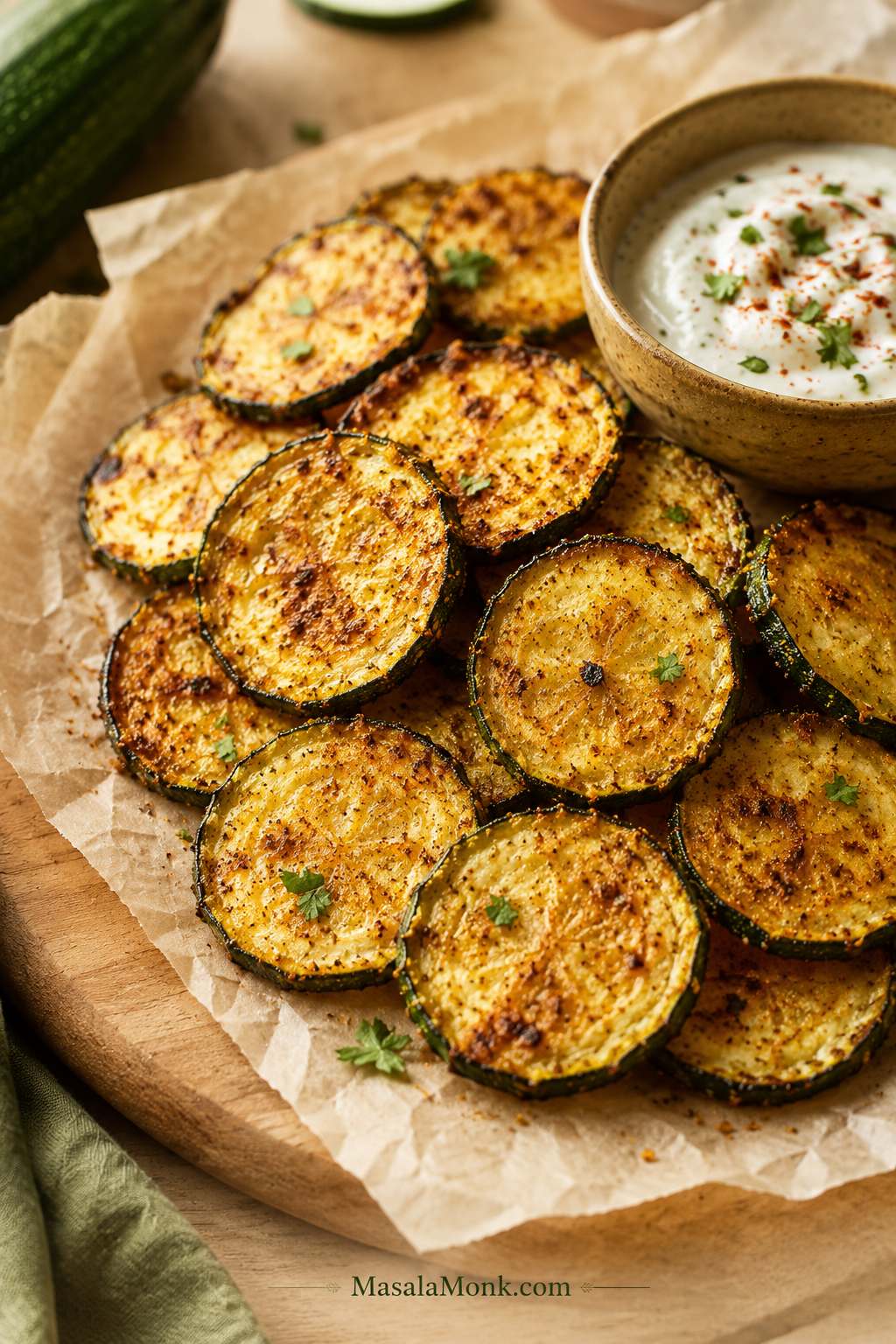
These crispy zucchini chips are golden at the edges, tender in the center, and best dipped while the parmesan still has its crunch.

Zucchini chips sound easy until you pull them from the oven or air fryer and find the same annoying problem: browned edges, soft centers, and slices that look like chips but bend like roasted zucchini.

If that has happened to you, the problem was probably not just the cooking time. Zucchini is naturally tender and water-rich, so it needs a little help before it can become crisp. Even slicing, a short salting step, proper drying, light oil, enough space, and the right heat make the difference between limp slices and a snack you actually want to keep reaching for.

Most zucchini chips recipes are not actually disagreeing with each other. They are making different snacks. This guide starts with the easiest crisp-edged air fryer parmesan version, then shows when to use the oven, panko, keto/no-breadcrumb, or dehydrator method for the texture you actually want. If you already know the texture you want, compare the styles first.

These will not behave exactly like packaged potato chips, and that is okay. The win is a crisp-edged, salty bite that lets zucchini be zucchini without turning limp.

Quick Answer: How to Make Crispy Zucchini Chips

To make crispy zucchini chips, slice the zucchini evenly, salt the slices briefly, pat them very dry, season lightly, and cook in a single layer. Start with air fryer parmesan zucchini chips at 370°F / 188°C for 10–12 minutes, then cool them spread out for a few minutes so the cheese can firm. Need amounts and steps? Jump to the recipe card.

Seasoning helps, but the real win happens before the zucchini hits the heat. If the slices go in wet, they soften before the edges can firm up. Use only a little oil or oil spray, avoid crowding, and do not judge the final texture until the chips have cooled for a few minutes.
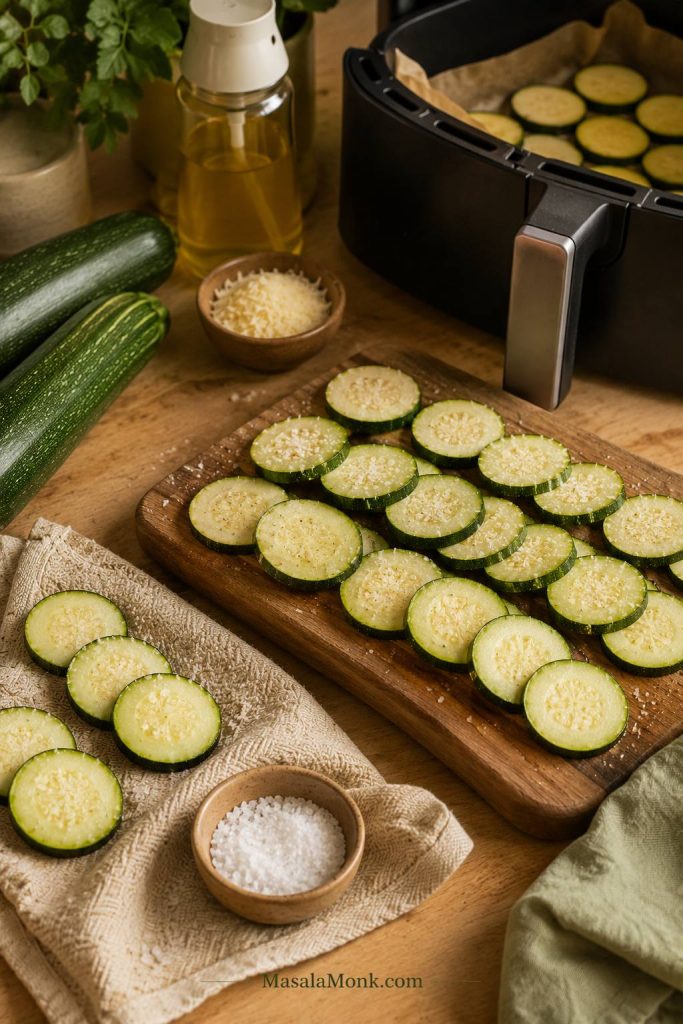
Sliced zucchini, salt, parmesan, oil spray, towel, and air fryer basket arranged on a wooden surface.
Before the air fryer or oven does any work, set the zucchini up for success with even slices, salt, towels, light oil, and parmesan.

Best first batch: air fryer parmesan zucchini chips.

The crispness rule: slice evenly, salt briefly, pat very dry, cook in one layer, and cool spread out.

Crispy Air Fryer Parmesan Zucchini Chips Recipe

This is the first batch to make because parmesan gives zucchini a shortcut to crisp edges. The slices still need salting and drying, but the cheese browns quickly, firms as it cools, and turns a soft vegetable into something snackable without breadcrumbs or a long oven bake.

Texture: crisp parmesan edges, tender centers, and a salty snack bite. Not packaged potato-chip snap, but much better than limp zucchini rounds.

Yield4 servings

Prep Time20 minutes

Cook Time10–12 minutes

Total Time30–35 minutes

Ingredients

  • 2 medium zucchini, about 400 g / 14 oz total
  • ½ tsp fine salt, about 3 g, for salting the zucchini
  • 1 tbsp olive oil or avocado oil, 15 ml, or use oil spray
  • ½ tsp garlic powder, about 1.5 g
  • ½ tsp paprika or smoked paprika, about 1 g
  • ¼ tsp black pepper, about 0.5 g
  • ⅓ cup finely grated parmesan, about 30 g
  • Extra salt only if needed, after cooking

Instructions

  1. Slice the zucchini. Slice into even rounds, about ⅛ inch / 3 mm for thinner chips or slightly thicker if your air fryer tends to blow thin slices around.
  2. Salt the slices. Arrange the zucchini on a towel or in a colander. Sprinkle with the salt and let rest for 15–20 minutes.
  3. Dry very well. Pat the slices dry with a clean kitchen towel or paper towels. The surface should look matte, not shiny-wet.
  4. Season lightly. Toss the zucchini with oil, garlic powder, paprika, black pepper, and finely grated parmesan. The slices should look lightly glossy, with seasoning clinging to the surface instead of sliding around.
  5. Arrange in the air fryer. Place slices in a single layer in the basket. Cook in batches if needed; it is better to cook two quick batches than one crowded soft batch.
  6. Air fry. Cook at 370°F / 188°C for 10–12 minutes, flipping or shaking gently halfway, until the parmesan smells toasted, the edges look dry, and the slices feel lighter. Start checking around 8 minutes.
  7. Remove finished chips early. If some slices are golden before others, remove them and keep cooking the softer pieces.
  8. Cool before serving. Spread the chips out for a few minutes. The parmesan firms up and the edges crisp more as they cool.
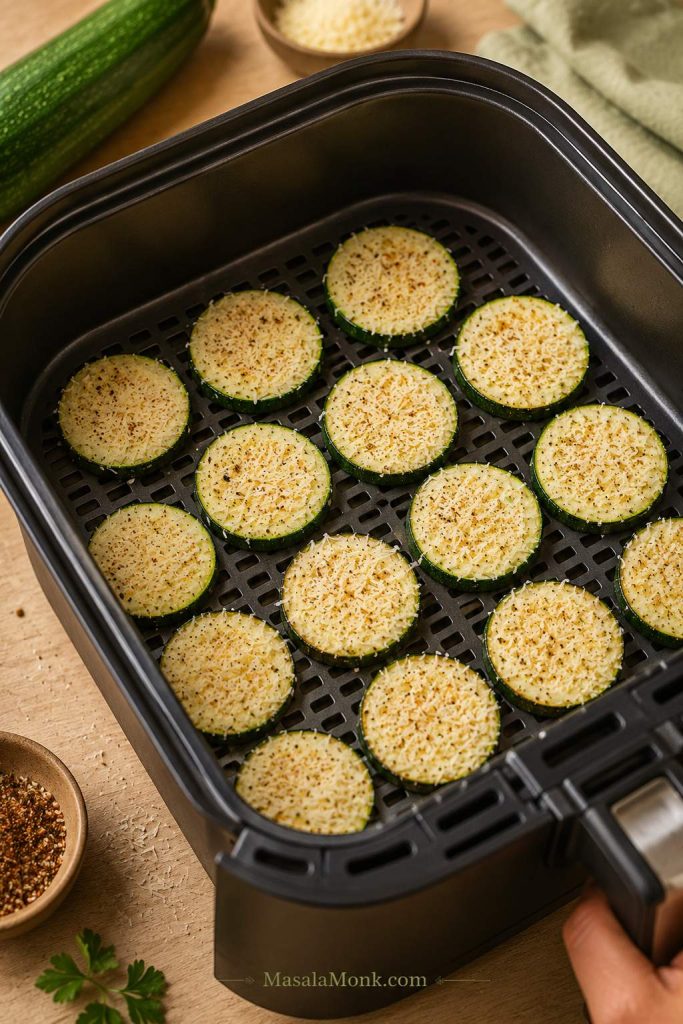
Parmesan-coated zucchini rounds arranged in one layer inside an air fryer basket.
For air fryer zucchini chips, keep the rounds in one layer. Hot air needs open gaps to dry the edges instead of steaming the centers.

Recipe Notes

  • Use finely grated parmesan for the most reliable crisping.
  • Smaller or thinner slices may finish first; pull them out early.
  • Do not add extra salt until after cooking, especially if using parmesan.
  • No air fryer? Use the hot oven parmesan method.
  • Serve soon after cooling, while the parmesan edges are still crisp.
  • Re-crisp leftovers in the air fryer or oven, not the microwave.

Why this works: salting gives the slices a better start, parmesan browns quickly, and cooling lets the cheese firm up. That is why the chips often feel crisper after a few minutes on the plate than they do straight from the air fryer. If they still come out soft, use the soggy-chip fixes.
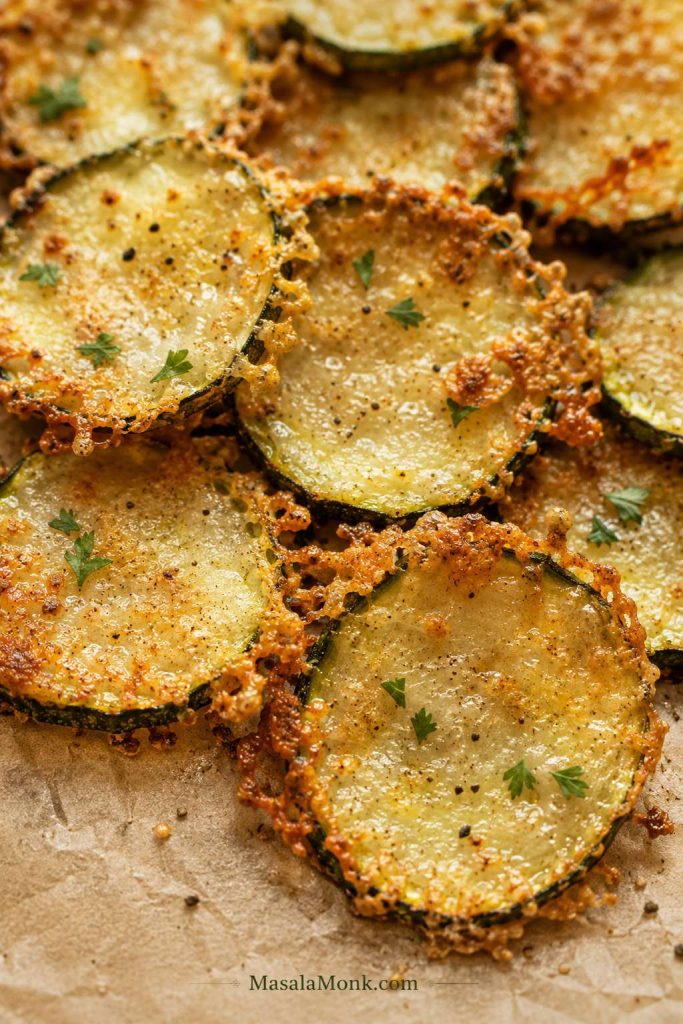
Close-up of parmesan zucchini chips with golden lacy cheese edges on parchment.
With parmesan zucchini chips, the best sign is a lacy golden edge. Let them cool briefly so the cheese can firm and crisp.

The first successful batch feels obvious in hindsight: the slices look lighter, the parmesan smells toasted, and the edges firm up while you are getting the dip. A few softer pieces are normal. At their best, they taste salty and cheesy, with crisp edges and tender centers.

The first crisp one is the cook’s tax. Eat it while the edges are still at their best.

Want a Different Texture? Choose Your Zucchini Chip Style

From here, the same idea can shift into oven trays, panko coating, keto chips, or make-ahead dehydrated chips. You do not need to master every version today. Choose the one that matches what you want to eat: the air fryer method for speed, the panko method for crunch, or the dehydrator method for make-ahead chips.

Thin chips dry. Parmesan rounds crisp. Panko rounds crunch. Once you know which style you are making, the times stop looking random.
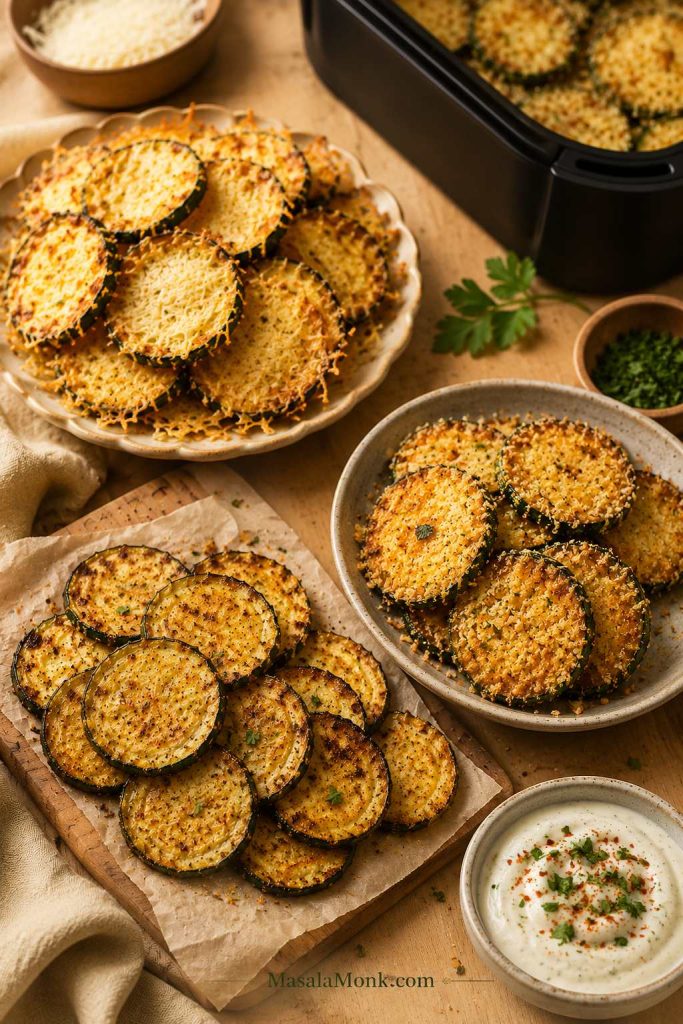
Three zucchini chip styles shown together: thin plain chips, parmesan rounds, and panko-coated rounds.
Not every zucchini chip should look the same: thin chips dry, parmesan rounds crisp at the edges, and panko rounds bring the loudest crunch.
If You Want…Make ThisWhy It Works
The easiest first tryFast cheesy: air fryer parmesanParmesan helps the edges crisp quickly and adds salty, snacky flavor.
The crunchiest appetizerCrunchy appetizer: panko roundsPanko creates a crisp coating while the zucchini stays tender inside.
Keto or no-breadcrumb snackLow-carb: plain or parmesanParmesan gives better low-carb crispness than almond flour alone.
Larger sheet-pan batchSheet-pan: oven-bakedA baking sheet gives the slices more room than most air fryer baskets.
The most chip-like thin slicesThin veggie chips: low oven or dehydratorSlower heat gives thin slices time to turn light and crisp.
A sturdy dipperSturdy dippers: panko or thick parmesanThin plain chips are delicate; coated rounds hold up better.

Best choice guide: air fryer parmesan for the first batch, low oven or dehydrator for the most chip-like thin texture, panko for party crunch, parmesan for keto, and dehydrator or low-and-slow oven for better storage.

This is the kind of tray that disappears by the edges first: the lacy parmesan pieces, the extra-golden rounds, the ones everyone says they are “just testing.”

Why Zucchini Chips Turn Soggy

Most failed batches come down to one problem: the slices steam before they crisp. Already dealing with a limp tray? Skip to the troubleshooting table.

Zucchini carries a lot of moisture. When the slices are too thick, too crowded, or too wet, that moisture gets trapped. Instead of crisping at the edges, the zucchini softens. That is how you get chips that look browned but still bend in the middle.

If your last batch came out limp, you are not alone. This vegetable can make even a good recipe feel unpredictable until you give the slices a better start.
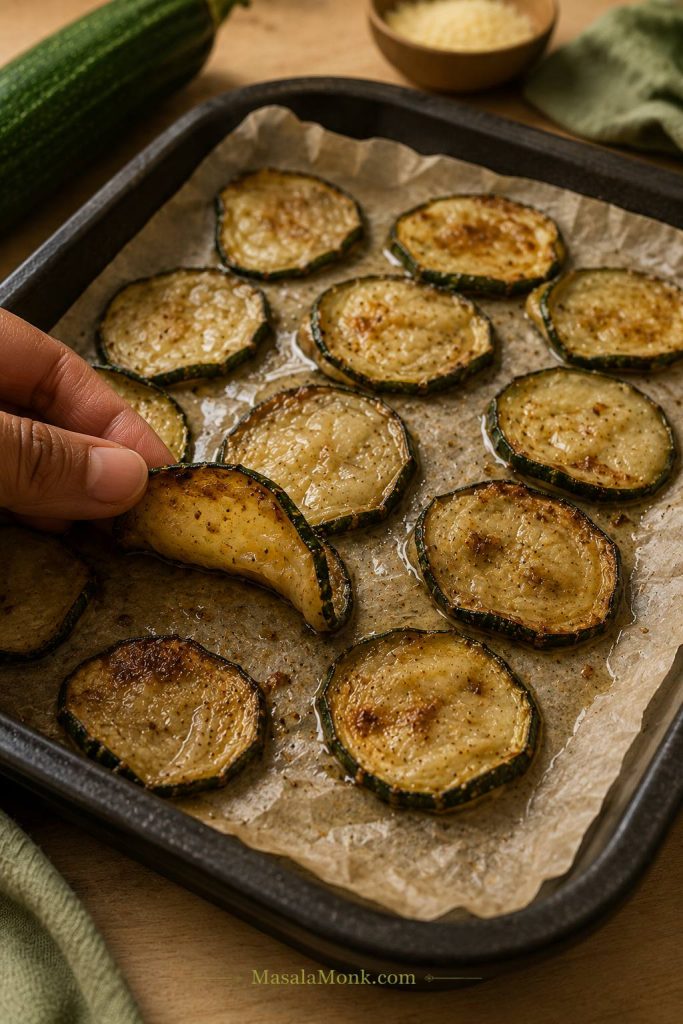
Soft browned zucchini chip being bent above a tray of limp zucchini slices.
If zucchini chips brown but still bend, they probably steamed before they crisped. Next time, go thinner, drier, or less crowded.

The rule that saves most batches: slice evenly, salt briefly, pat very dry, cook with space, and cool the chips spread out. That matters more than adding extra oil.

Once you solve that, the reward is simple: golden edges, better seasoning, and chips that feel like a snack instead of a side dish.

The Mistakes That Keep Zucchini Chips Soft

If a batch stays limp, the fix usually points back to one of these habits. This is not about being fussy; it is about giving zucchini a fair chance to crisp.

  • You salted but did not dry. Salting brings moisture to the surface; drying removes it. If the slices still look shiny, press them between towels before cooking.
  • You used too much oil. Glossy is good. Wet or slick is not. Too much oil coats the surface and keeps the chip soft.
  • You crowded the basket or pan. Overlapping slices steam each other. Cook in batches if needed.
  • You sliced unevenly. Thin pieces brown first while thick pieces stay soft. Pull the crisp ones early instead of waiting for the whole tray to match.
  • You used wet flavors too early. Lemon juice, hot sauce, fresh garlic paste, and watery marinades belong after cooking.
  • You piled them hot. Stacked chips lose their edge quickly. Spread them out for a few minutes first.
  • You expected every method to crunch the same way. Thin chips dry, parmesan rounds crisp, and panko rounds crunch. Choose the texture first.

Why These Ingredients Help Zucchini Chips Crisp

The ingredient list is short, but every item has a job. Medium zucchini gives you neat slices, salt draws moisture to the surface so you can pat it away, oil helps browning, parmesan firms into crisp edges, and panko gives the loudest crunch.
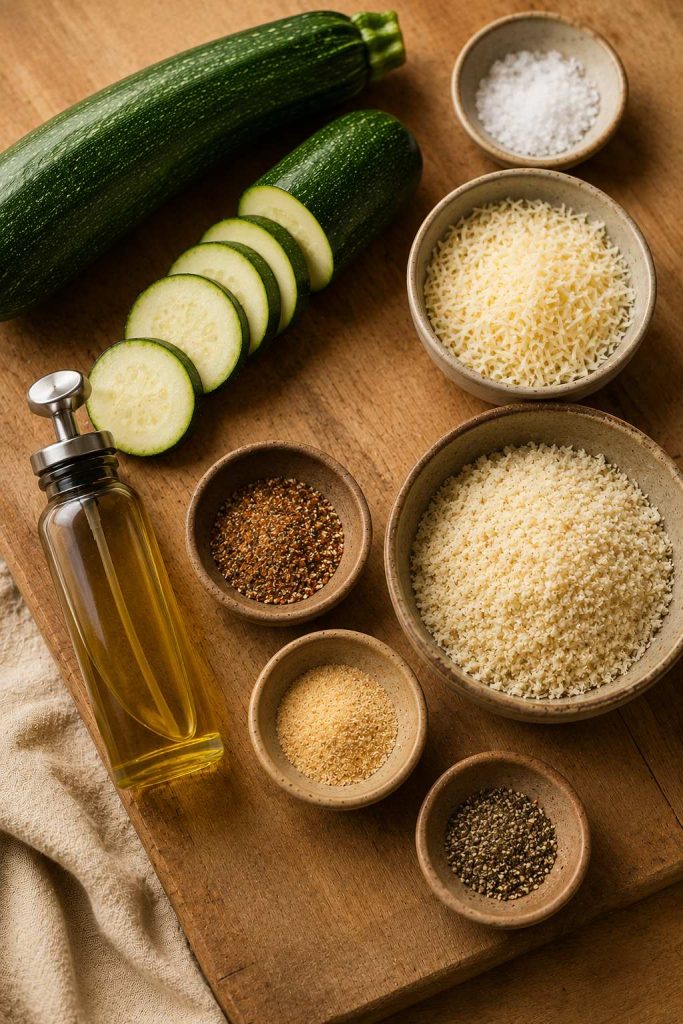
Zucchini, salt, grated parmesan, panko, oil spray, and spices arranged on a wooden board.
Keep the ingredient list simple, but choose each one for a job: salt manages moisture, parmesan builds crisp edges, and panko adds crunch.
  • Best zucchini: medium, firm zucchini with fewer watery seeds. Oversized zucchini can stay soft in the center.
  • Best crisping helper: finely grated parmesan. It clings better than large shreds and sets as it cools.
  • Best crunch coating: panko. Use it for appetizer-style rounds, not thin delicate chips that need to stay light.
  • Best oil approach: a light toss or spray. Glossy is enough; greasy slices soften.
  • Best seasoning type: dry spices and dried herbs. Save lemon juice, hot sauce, and fresh garlic paste for after cooking.

If you only have a very large zucchini, cut it lengthwise and scoop out the soft, seedy center if it looks watery. Use the firmer outer flesh for chips. And if you are comparing it with cucumber, remember that zucchini and cucumber are different vegetables, even though they can look similar at first glance.

Equipment That Actually Helps

You do not need a perfect kitchen setup here. A sharp knife, a clean towel, and enough space on the tray will get you most of the way there.

  • Mandoline or sharp knife: for even thickness.
  • Kitchen towels or paper towels: for drying after salting.
  • Parchment or wire rack: for oven batches and cooling.
  • Oil spray: for a light coating without greasiness.
  • Tongs: for pulling finished chips early.
  • Dehydrator: optional, but helpful for dry, make-ahead veggie chips.

Dry towels, even slices, and a little patience will do more for crispness than another spoonful of seasoning.

How Thin Should You Slice Zucchini for Chips?

Thickness decides whether you get a delicate chip, a cheesy round, or a sturdy dipper.
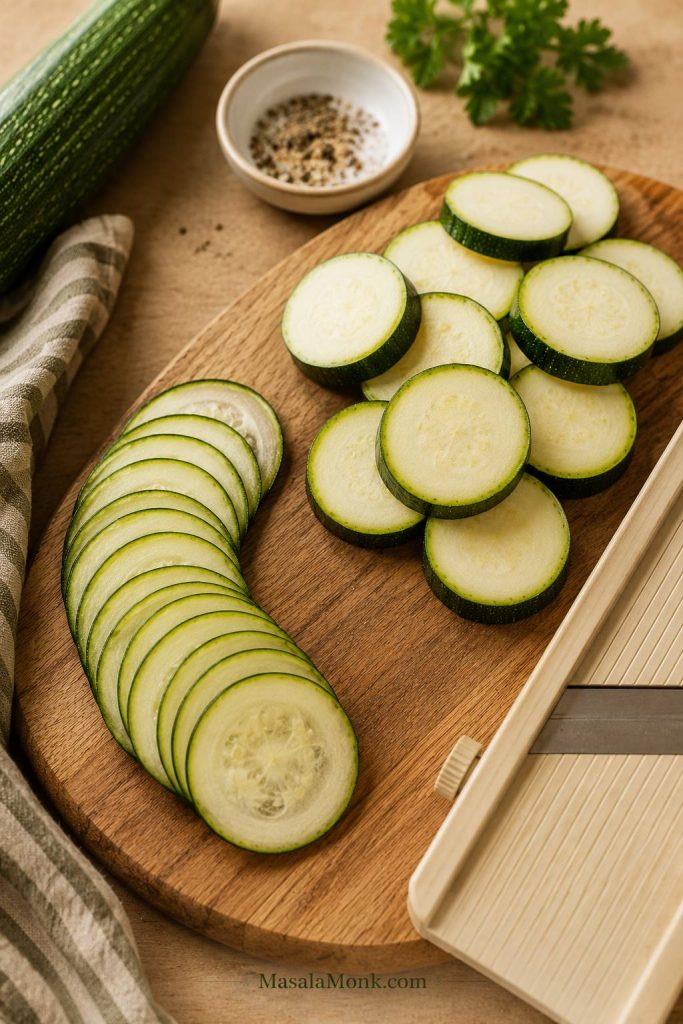
Thin zucchini slices and thicker zucchini rounds shown on a cutting board with a slicing tool.
Slice thickness decides the snack: thin rounds make delicate chips, while thicker rounds hold parmesan or panko coatings better.

For thin plain chips, aim for about ⅛ inch / 3 mm. These slices dry better, but they can burn quickly or fly around in some air fryer baskets.

For breaded or panko chips, slice closer to ¼ inch / 6 mm. Thicker rounds hold the coating better and are less fragile. They will be crunchy outside and tender inside, not dry all the way through; see the panko method if that is the texture you want.

For parmesan chips, either thickness can work. Choose thinner slices for a more chip-like result, or slightly thicker slices for a snacky zucchini round with crisp cheese edges.

A good batch will not all finish at the same second. Pull the crisp ones early. That is not fussiness; that is how zucchini behaves.

Should You Salt Zucchini First?

Yes. It is the small step that makes the biggest difference, especially if your zucchini is juicy or your last batch came out soft.

Salt draws moisture to the surface so you can pat it away before the zucchini hits the air fryer, oven, or dehydrator. It also helps breaded coatings stick because the slices are not slippery.

Here is the simple way to do it:

  1. Slice the zucchini evenly.
  2. Spread the slices on a clean towel or place them in a colander.
  3. Sprinkle with salt.
  4. Let them rest for 15–30 minutes.
  5. Pat very dry with a clean kitchen towel or paper towels.

You should see moisture on the surface after the rest. That is good. It means the water is on the towel instead of trapped in the chip.
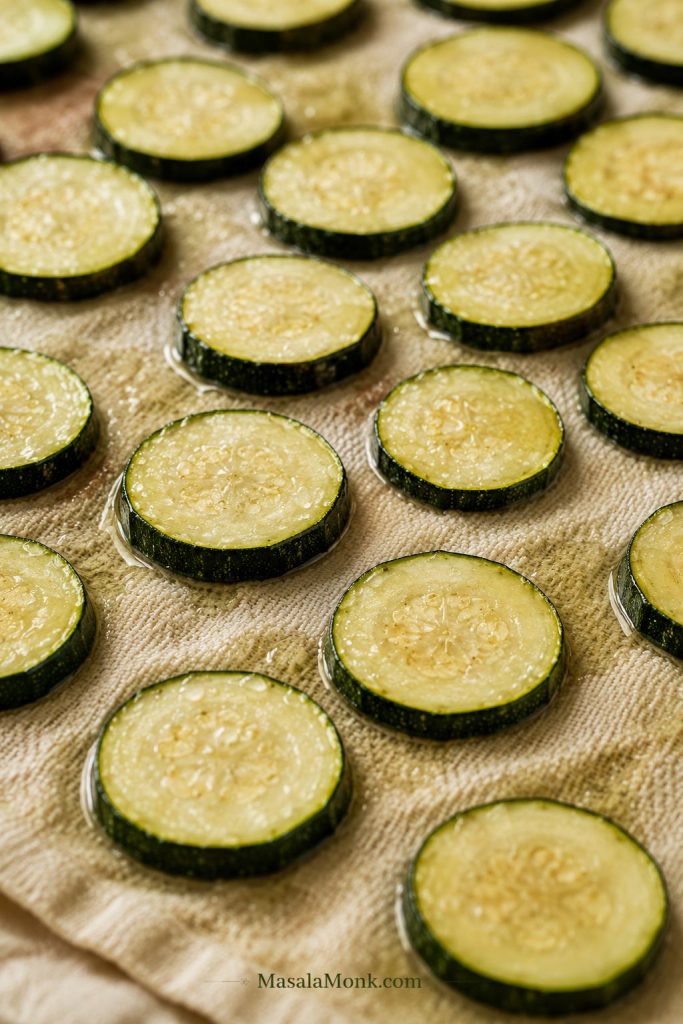
Salted zucchini rounds resting on a towel with moisture beads visible on the surface.
After salting, moisture should bead on the zucchini surface. That is the water you want on the towel, not trapped inside the chip.

You do not need to rinse if you used a light amount of salt. If you salted heavily, rinse quickly and dry extremely well. For thin low-and-slow chips, you can rest the zucchini longer, even up to 45–60 minutes, but for most batches, 20–30 minutes is enough.
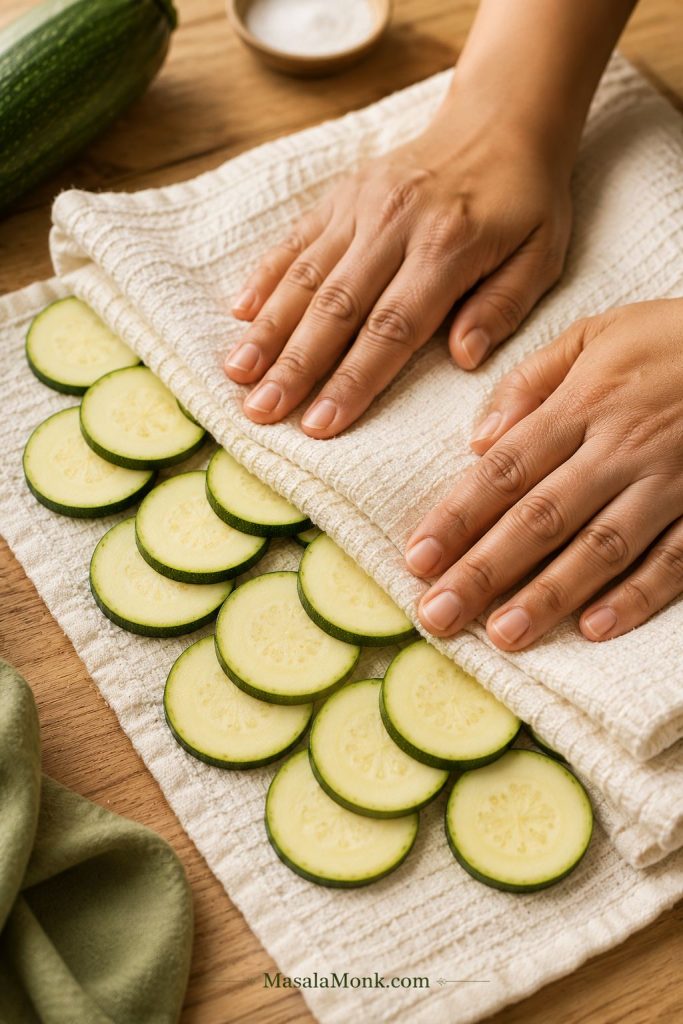
Do not skip the drying after salting. Pat away the surface moisture before cooking, or the slices will steam. Next, see how spacing changes the result in the air fryer and oven methods.

Hands patting zucchini rounds dry between clean towels before cooking.
Once the slices release moisture, press them until they look matte. Shiny zucchini usually means softer chips later.

Air Fryer Zucchini Chips: What Matters Most

The air fryer moves hot air, not magic. If the slices overlap, steam wins.
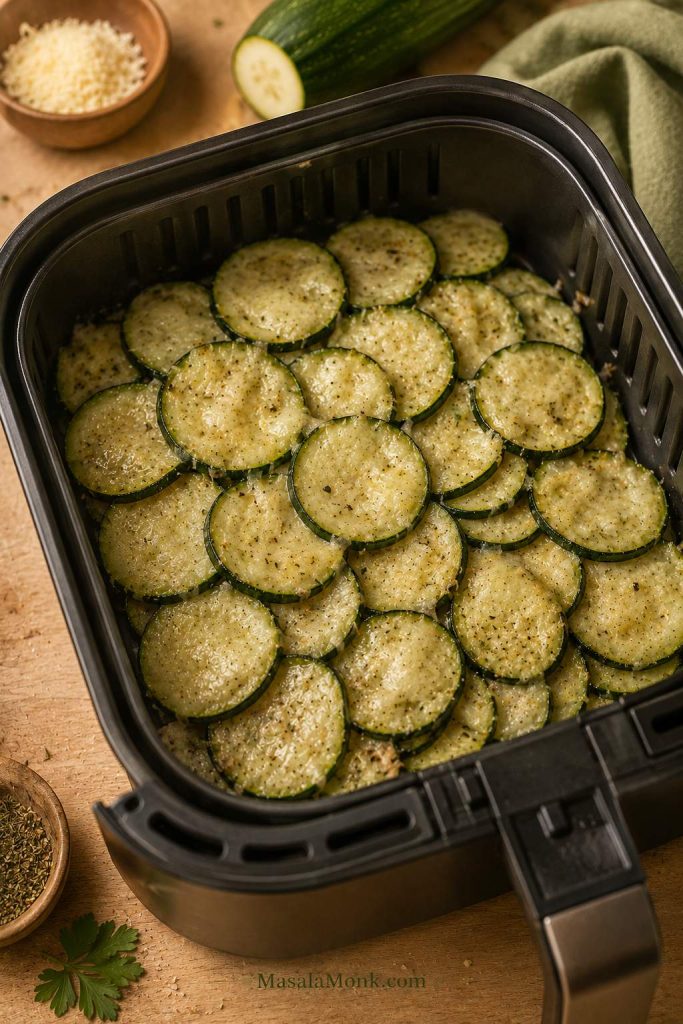
Overlapping zucchini rounds crowded inside an air fryer basket.
A crowded air fryer basket traps steam fast. Even well-seasoned zucchini chips stay soft when the slices overlap this much.

This is the weeknight version: quick heat, toasted parmesan, and a snack that is ready before anyone gets impatient. Good air fryer chips have browned parmesan around the edges, a garlic-paprika aroma, and enough firmness to dip gently after they cool for a few minutes.

Air Fryer StyleTemperatureTimeWhat to Look For
Plain thin chips370°F / 188°C12–18 minutesEdges dry and lightly browned
Parmesan chips370°F / 188°C10–12 minutesCheese is golden and edges are crisp
Panko chips400°F / 204°C10–12 minutesPanko is golden and crunchy

Very thin slices may finish early; thicker slices may need a few more minutes. Pull the early winners. Waiting for the whole basket to match is how the best chips become bitter.

The second batch is usually better because you already know how fast your air fryer runs.

If very thin chips fly around: slice them slightly thicker next time or use an air fryer rack or mesh insert if your model allows it. Overcrowding the basket will hold them down, but it will also trap steam.

Oven Zucchini Chips: Hot and Fast vs Low and Slow

The oven only looks confusing because thin chips and coated rounds need completely different treatment. Use a hot oven, around 425°F / 218°C, for parmesan or panko-coated rounds that need quick browning. For thin plain slices, a low oven around 225–235°F / 107–113°C gives the zucchini time to dry out.

Hot oven batches should smell toasted and look golden at the edges. Low oven batches should look drier, lighter, and slightly curled.
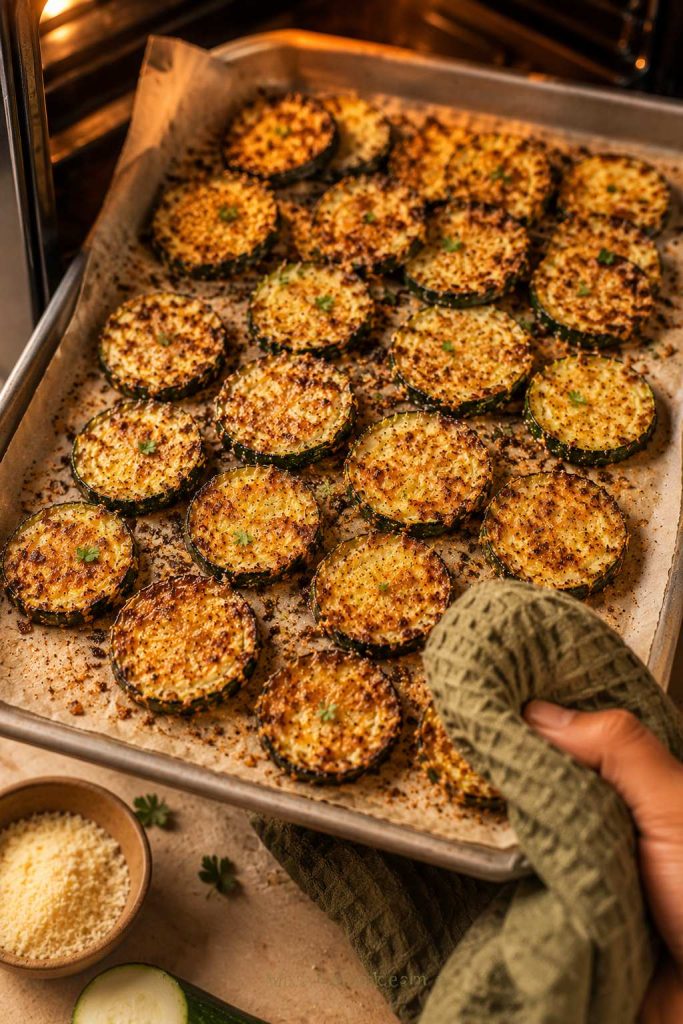
Golden baked zucchini chips on a parchment-lined sheet pan being pulled from the oven.
Baked zucchini chips need steady heat and enough tray room. Look for golden tops, drier centers, and edges that lift slightly.

Hot Oven Parmesan or Panko Chips

  1. Preheat the oven to 425°F / 218°C.
  2. Slice zucchini into ¼-inch / 6 mm rounds for panko chips, or slightly thinner for parmesan chips.
  3. Salt, rest, and dry the slices.
  4. Coat with parmesan or panko mixture.
  5. Arrange in a single layer on a parchment-lined baking sheet.
  6. Spray lightly with oil.
  7. Bake for 25–30 minutes, flipping halfway, until golden and crisp at the edges.

The chips should look lighter, slightly curled at the edges, and golden where the cheese or coating touches the heat. If they only look browned but still bend like roasted zucchini, give them more time.
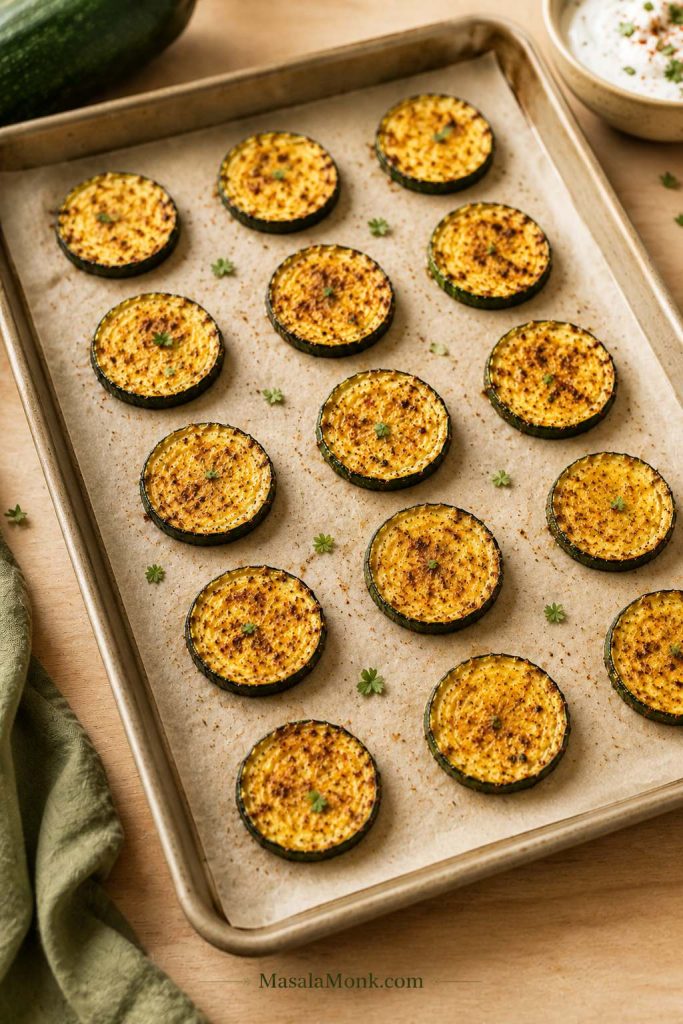
Zucchini rounds arranged with space between them on a parchment-lined sheet pan.
On a sheet pan, visible gaps are not wasted space. They let heat move around each zucchini slice so the edges can firm.

Low-and-Slow Thin Zucchini Chips

  1. Preheat the oven to 225–235°F / 107–113°C.
  2. Slice zucchini thinly, about ⅛ inch / 3 mm.
  3. Salt for 20–30 minutes, then pat very dry.
  4. Use very little oil, or just a light spray, then add dry seasoning.
  5. Spread in a single layer on parchment or a wire rack set over a baking sheet.
  6. Bake for 70–120 minutes, rotating trays halfway.
  7. Start checking around 70 minutes, then remove dry pieces every 10–15 minutes as needed.
  8. Cool completely before serving.

They are done when the centers stop looking wet, the edges curl slightly, and the slices feel light. If they still bend like roasted zucchini, they need more time.
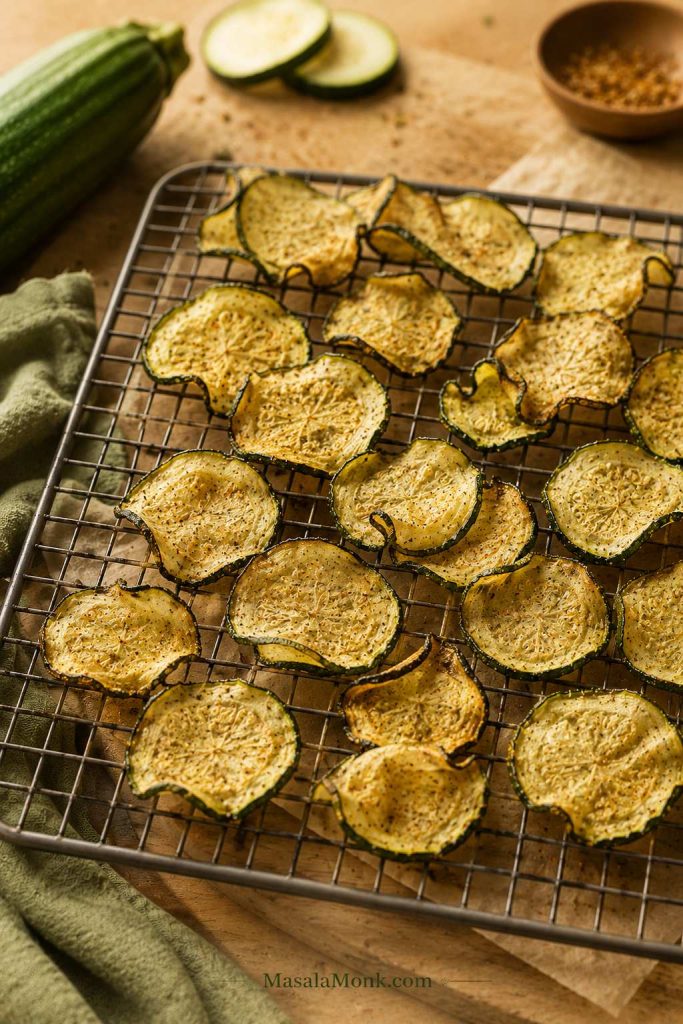
Thin lightly curled zucchini chips cooling on a wire rack.
Low-and-slow zucchini chips should look light, thin, and slightly curled. Cooling them on a rack keeps the undersides from softening.

Dehydrator Zucchini Chips

The dehydrator is not the fastest route, but it is the one to choose if you want chips that stay crisp after the first hour. This is the quiet, patient version: less hot-snack energy, more crisp pantry-snack payoff.

  1. Slice zucchini very thin and even.
  2. Salt lightly for 20–30 minutes, then pat dry very well.
  3. Use very little oil or skip oil completely.
  4. Season lightly with garlic powder, paprika, pepper, or dried herbs.
  5. Arrange in a single layer on dehydrator trays.
  6. Dehydrate at 135–150°F / 57–66°C for 4–8 hours.
  7. Rotate trays if your dehydrator heats unevenly.
  8. Cool completely before storing.
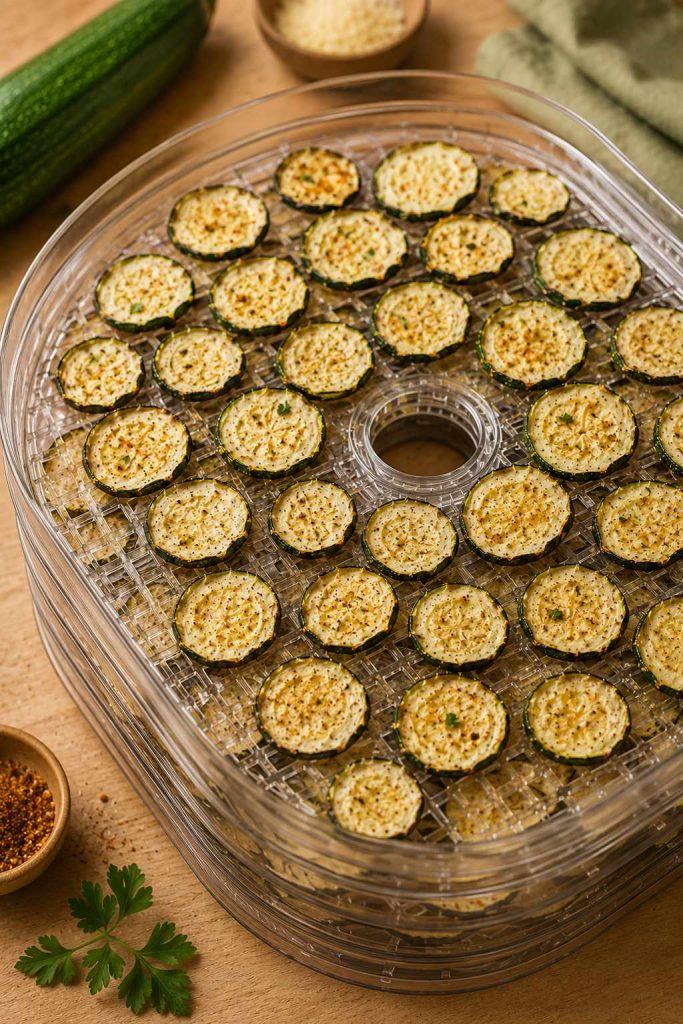
Thin zucchini slices arranged in a single layer on a dehydrator tray.
For dehydrator zucchini chips, single-layer spacing is the method. Thin slices dry more evenly and store better after they cool.

Use salt lightly here; dehydrated chips taste saltier as they dry. Humid kitchens, thicker slices, and crowded trays will push the timing toward the longer end.

Home-drying guidance supports the same idea used here: a single layer and steady dehydrator temperature help the slices dry evenly.

Cool one chip, then test it. Warm zucchini can lie to you. Fully dried chips should snap or feel crisp after cooling, not leathery. For keeping that texture, use the storage and re-crisping guide.
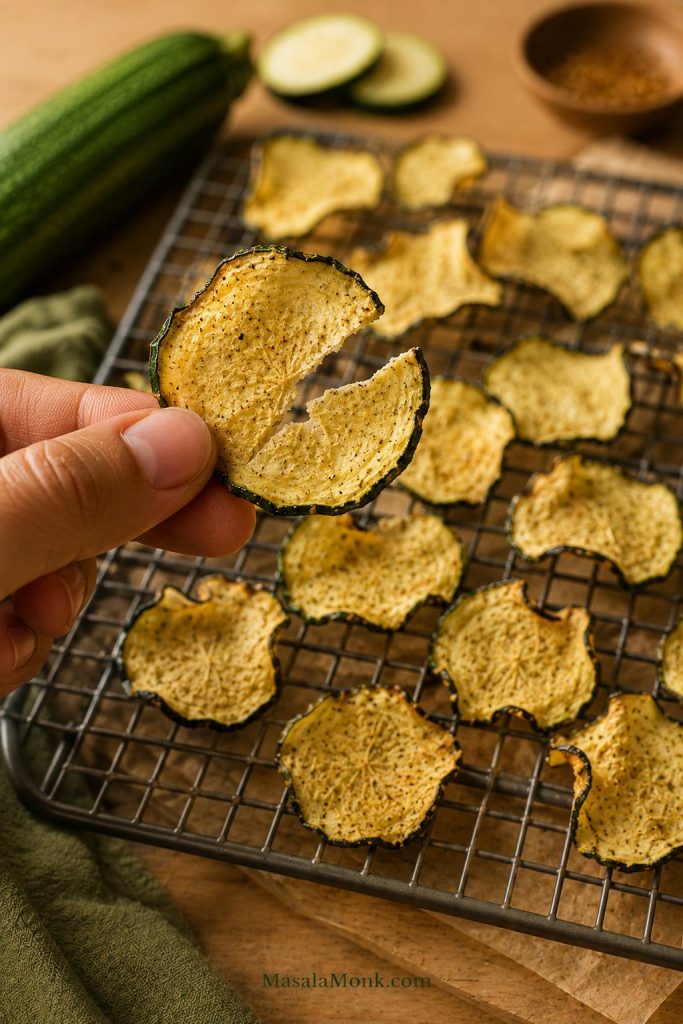
Hand holding a thin dried zucchini chip above a rack of dehydrated zucchini chips.
Cool one chip before testing. A dehydrated zucchini chip should feel dry and crisp, not warm, leathery, or bendy.

Parmesan Zucchini Chips: How to Get Lacy, Crisp Edges

Parmesan chips are done when the cheese looks golden and lacy at the edges, not pale and melted. If the parmesan smells sharp, bitter, or turns dark brown before the zucchini looks lighter, the heat is too high or the slices need more drying before cooking.

Finely grated parmesan works best because it clings in a thin layer and firms as it cools. Big shreds melt into patches. Too much cheese can also form a heavy blanket instead of a crisp edge, so use enough to coat lightly, not bury the zucchini.
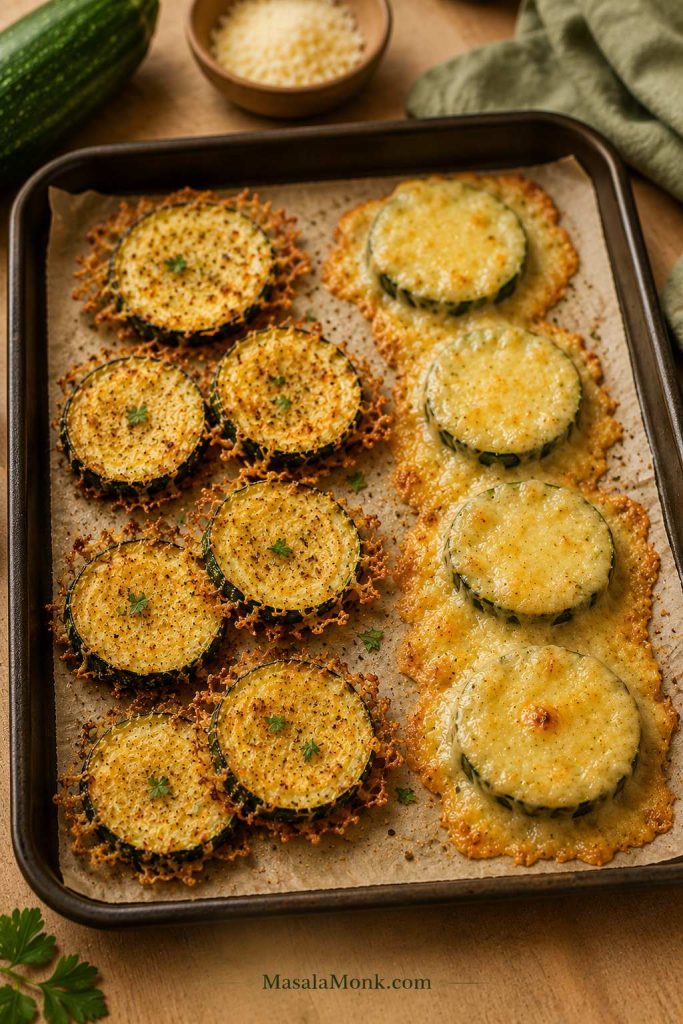
Zucchini rounds on a tray showing light lacy parmesan coating beside heavy melted cheese coating.
Parmesan helps, but too much can act like a blanket. A lighter coating gives zucchini chips better lacy edges and cleaner crisping.
  • Use finely grated parmesan, not big shreds.
  • Look for golden, lacy edges instead of dark brown spots.
  • Pull the tray or basket if the cheese smells bitter.
  • Let the chips cool spread out so the cheese can firm.
  • Add extra salt only after tasting; parmesan already brings salt.

Parmesan chips are especially good with something tomatoey on the side. A small bowl of marinara sauce makes them feel closer to a crispy zucchini appetizer than a plain vegetable snack.

Breaded or Panko Zucchini Chips

When you want the kind of crunch people hear across the table, use panko. Treat this version as crispy zucchini rounds, not thin vegetable chips. They are golden outside, tender inside, and strong enough for thick dips.

Panko crisps better than regular breadcrumbs because the flakes are larger and airier. Finished panko rounds should sound crisp when tapped with tongs, even though the zucchini inside stays tender.

This is the party version: golden crumbs outside, soft zucchini inside, and enough crunch to scoop a thick dip without collapsing.
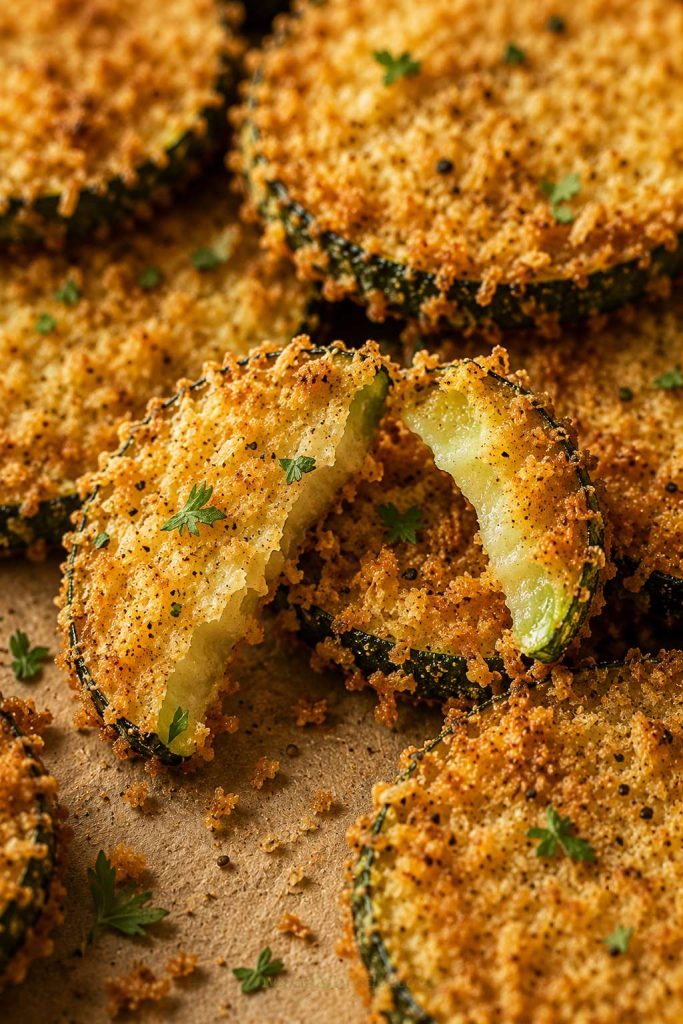
Broken panko-coated zucchini chip showing a crunchy golden coating and tender zucchini center.
With panko zucchini chips, the coating turns golden and crisp while the zucchini inside stays tender.

Panko Ingredients

  • 2 medium zucchini, sliced into ¼-inch / 6 mm rounds
  • ½ cup all-purpose flour, about 60 g
  • 2 large eggs, beaten
  • 1 cup panko breadcrumbs, about 55–60 g
  • ½ cup finely grated parmesan, about 45 g
  • 1 tsp Italian seasoning or dried oregano
  • ½ tsp garlic powder
  • Oil spray

Panko Method

  1. Salt the zucchini rounds briefly and pat them dry.
  2. Set up three bowls: flour, beaten eggs, and panko mixed with parmesan and seasoning.
  3. Coat each slice in flour, then egg, then panko mixture.
  4. Press gently so the coating sticks.
  5. Arrange in a single layer and spray lightly with oil.
  6. Bake at 425°F / 218°C for 25–30 minutes, or air fry at 400°F / 204°C for 10–12 minutes, checking early because panko can brown quickly.
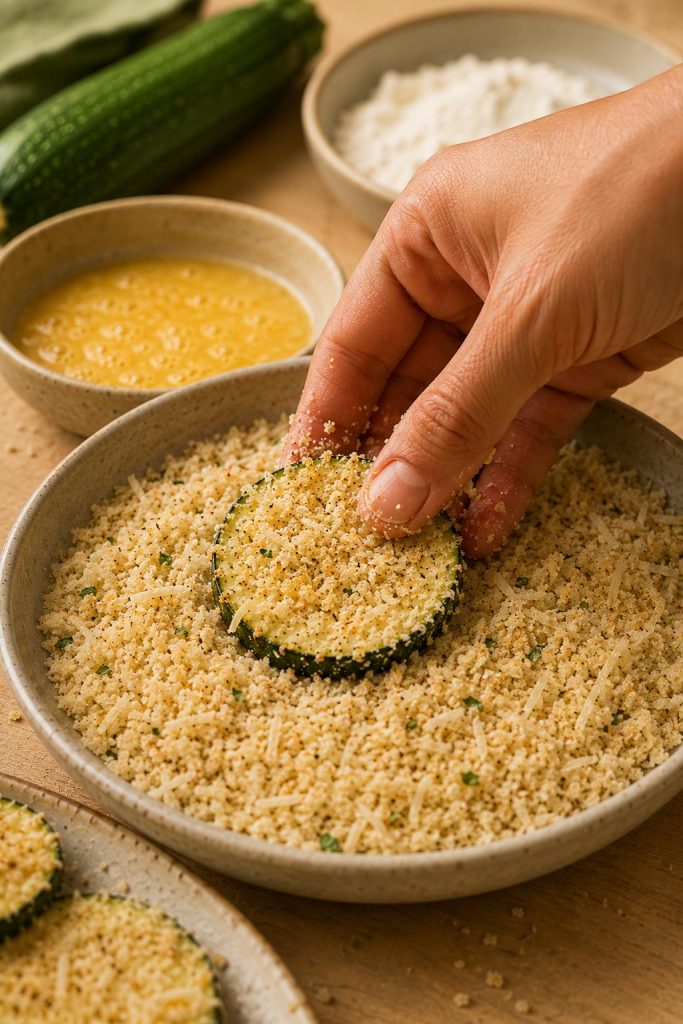
Hand pressing a zucchini round into panko crumbs during breading.
For panko zucchini chips, press the crumbs onto dry slices gently. That contact helps the coating cling and brown into a crunchy shell.

If the coating falls off, the zucchini was probably too wet before breading. Salt, drain, and dry the slices well before coating. For more soft-chip fixes, check the troubleshooting table.

The panko version is especially good with buffalo chicken dip or spinach artichoke dip. If you want something simpler, a warm cheese sauce works too.

Keto and No-Breadcrumb Zucchini Chips

If breadcrumbs are off the table, parmesan is the easiest way to get real edge crispness. Plain zucchini can dry nicely, but parmesan gives the snack more structure and a salty bite.

Almond flour can work, but it does not behave like panko. It tends to feel heavier and less crisp, so use it lightly or pair it with parmesan instead of expecting a breadcrumb-style crunch.

If you are building a bigger low-carb snack plate, these parmesan chips can sit alongside other keto chips, cucumber sticks, olives, cheese, and a creamy ranch or garlic yogurt dip.

Dry Seasonings That Work Best

Keep the wet flavors for later. Before cooking, dry spices are your friend.

  • Garlic parmesan: garlic powder, black pepper, and finely grated parmesan.
  • Ranch-style: garlic powder, onion powder, dried dill, parsley, and black pepper.
  • Chili lime: chili powder, garlic powder, lime zest, and a squeeze of lime after cooking.
  • Smoky paprika: smoked paprika, garlic powder, black pepper, and a little parmesan.
  • Italian herb: dried oregano, basil, garlic powder, black pepper, and parmesan.
  • Spicy parmesan: garlic powder, paprika, cayenne, black pepper, and finely grated parmesan.

Taste before adding more salt at the end, especially with parmesan. If you like heat, keep hot sauce or other wet sauces for after cooking; they work better as a finishing touch than as a pre-cook coating.

What to Serve with Zucchini Chips

The dip depends on the style of chip. Thin plain chips are delicate, so they work better with lighter dips like ranch, garlic yogurt, or tzatziki. Parmesan chips are great with marinara or salsa verde. If you want something sweeter and brighter, mango salsa also works.

For a snack board, pair warm zucchini chips with one creamy dip, one bright dip, and a few crunchy extras like cucumber sticks, carrot sticks, crackers, or olives. The contrast is what makes the board work: warm chips, cool dip, crisp edge, creamy finish.

How to Store and Re-Crisp Zucchini Chips

Fresh is best, but leftovers are not hopeless. You just have to bring the dry heat back.

They are best while the cheese has just firmed, the edges still crackle lightly, and the centers are still warm. As they sit, zucchini continues to soften, so even a crisp batch can lose some texture.

Do not seal in the steam you just worked so hard to remove. Spread hot chips out for a few minutes before piling them into a bowl or container.

Same-Day Storage

If you are serving them within a few hours, cool them completely first. Keep them loosely covered rather than sealing them while warm.

Overnight Storage

Refrigerate parmesan or panko chips in an airtight container once fully cool. They will lose some crispness, but you can revive them in the oven or air fryer.

Make-Ahead Chips

Choose low-and-slow oven chips or dehydrator chips if you need something that stores better. They hold up longer because they are dried more thoroughly.

How to Re-Crisp Them
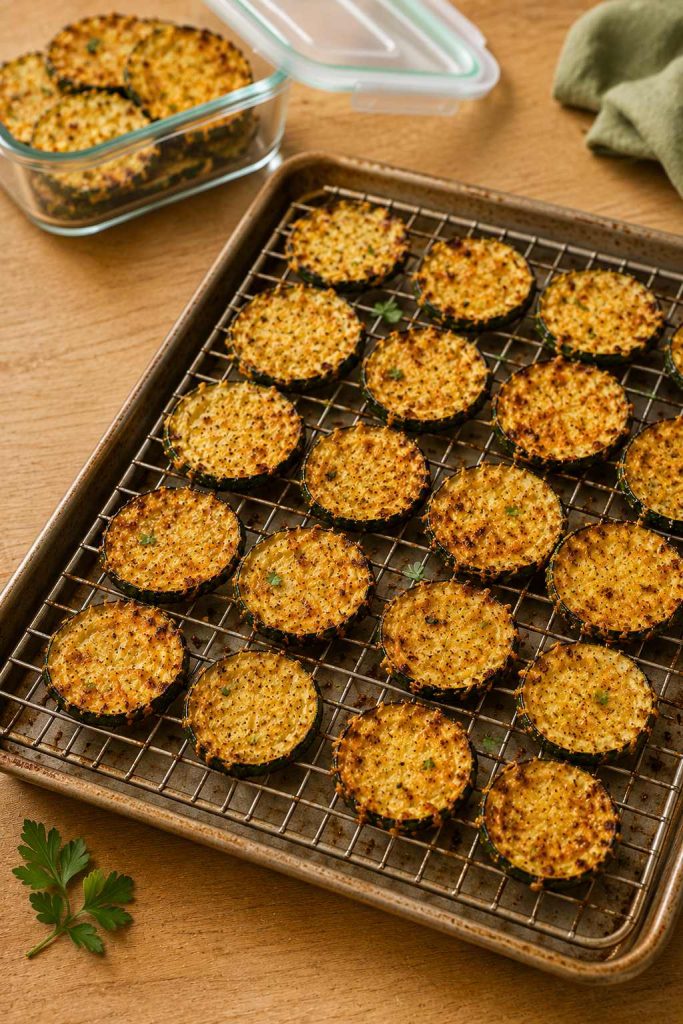
Leftover zucchini chips spread on a rack with an open storage container nearby for re-crisping.
To re-crisp zucchini chips, spread them out and bring back dry heat. The air fryer or oven works better than a microwave.
  • Air fryer: re-crisp at 350–370°F / 175–188°C for 3–5 minutes, checking often.
  • Oven: bake at 350°F / 175°C for 8–10 minutes, uncovered, until the edges crisp again.

Re-crisped chips will not be exactly like fresh, but dry heat can still bring back that salty edge. The microwave is the one option to skip; it softens zucchini instead of reviving it.

Troubleshooting: Soggy, Burnt, Oily, or Uneven Chips

A soft tray is not a failed recipe. It is usually one adjustment away: drier slices, less oil, more space, or a few more minutes.

Quick Fixes for Soft or Uneven Zucchini Chips

ProblemRight NowNext Batch
Chips are soggyRe-crisp uncovered in the air fryer or oven.Salt longer, pat very dry, use less oil, and avoid crowding.
Chips are soft in the middleCook a few minutes longer at moderate heat.Slice thinner or use a lower, slower oven method.
Edges burned but centers stayed softRemove the burnt pieces and lower the heat slightly.Slice more evenly and check earlier.
Chips stayed softSpread them out and cook a few minutes more.Use a single layer and cook in batches.
Chips feel oilyDrain briefly on a towel and re-crisp with dry heat.Use oil spray or toss with less oil.

Fixes for Coating, Salt, and Air Fryer Problems

ProblemRight NowNext Batch
Parmesan burnedPull the basket or tray before the cheese turns bitter.Use finely grated parmesan, less cheese, or slightly lower heat.
Parmesan stuck to the trayLet it cool briefly before lifting.Use parchment for oven chips or a light oil spray for air fryer chips.
Panko coating fell offServe the loose crumbs as a crunchy topping.Dry zucchini well before breading and press the coating gently.
Panko browned but zucchini stayed wateryReturn the soft pieces to the oven or air fryer for a few minutes.Use ¼-inch / 6 mm slices and dry them better before coating.
Chips taste too saltyServe with an unsalted dip or yogurt sauce.Use less salt before cooking, especially with parmesan.
Chips taste bitterRemove dark pieces and serve the lighter ones.Lower heat slightly and add delicate seasonings after cooking.
Air fryer chips flew aroundPause and settle the chips if needed.Slice slightly thicker or use a rack/mesh insert.
Chips softened after coolingRe-crisp in the air fryer or oven.Cool spread out before storing or serving.

If the first tray bends, do not panic. Moisture usually won the first round, and the next batch often only needs one or two adjustments.

Frequently Asked Questions

Why are my zucchini chips soggy?

Zucchini chips turn soggy when moisture gets trapped. Slice evenly, salt briefly, pat very dry, use little oil, and cook in a single layer.

Why are my air fryer zucchini chips not crispy?

The slices may be wet, thick, crowded, or coated with too much oil. Cook in batches and pull finished pieces early instead of waiting for every slice to match.

Do you have to salt zucchini first?

You do not absolutely have to, but it helps a lot. Even a 15–20 minute rest gives the slices a better start before they hit the heat.

Do they get crispier as they cool?

Yes, especially parmesan chips. The cheese firms as it cools, so give the chips a few minutes before judging the texture.

Air fryer or oven: which is better?

Choose the air fryer for speed and small batches. Use the oven for larger trays, panko-coated chips, and low-and-slow thin chips.

Can I bake zucchini chips without breadcrumbs?

Yes. Use thin slices, salt and dry them well, then bake low and slow at 225–235°F / 107–113°C. Add finely grated parmesan if you want crisp edges without breadcrumbs.

What is the best no-breadcrumb coating?

Finely grated parmesan is the easiest no-breadcrumb coating because it browns, firms as it cools, and adds salty flavor.

How thin should I slice the zucchini?

Slice about ⅛ inch / 3 mm for thin plain chips and about ¼ inch / 6 mm for breaded or panko rounds.

Are zucchini chips keto?

Plain and parmesan versions can be keto-friendly. Panko or regular breadcrumb-coated chips are not keto unless you use a low-carb coating.

Can I use yellow squash or courgette?

Yes. Courgette is another name for zucchini, and yellow summer squash can also work. If you actually have cucumber, use it fresh in a cucumber salad instead of baking it into chips.

Should I peel the zucchini?

No. The skin adds color, helps the slices hold together, and gives better texture.

Can I use frozen zucchini?

Frozen zucchini is not ideal for chips because it releases too much liquid after thawing. Use fresh zucchini for this recipe.

Are these the same as zucchini fries?

No. Chips are usually sliced into rounds, while zucchini fries are cut into thicker sticks and often breaded.

Can I use a dehydrator for zucchini chips?

Yes. Slice very thin, salt and dry the slices, season lightly, and dehydrate at 135–150°F / 57–66°C for 4–8 hours.

How do I store zucchini chips?

Cool them completely first. Store fully dried chips airtight, refrigerate parmesan or panko leftovers, and re-crisp in the air fryer or oven.

Final Thoughts

Zucchini chips stop feeling random once you stop treating every version like the same snack. Thin chips need drying time, parmesan rounds need a light coating and a cool-down, and panko rounds need enough thickness to hold their crunch.

Your first batch teaches you what your zucchini and air fryer are doing. Usually, the next one is the keeper.

When the edges finally crisp, the whole thing clicks: not a packaged potato chip, not a limp roasted round, but a golden, salty zucchini snack that actually earns its dip.
Back to top

Posted on Leave a comment

Candied Yams Recipe

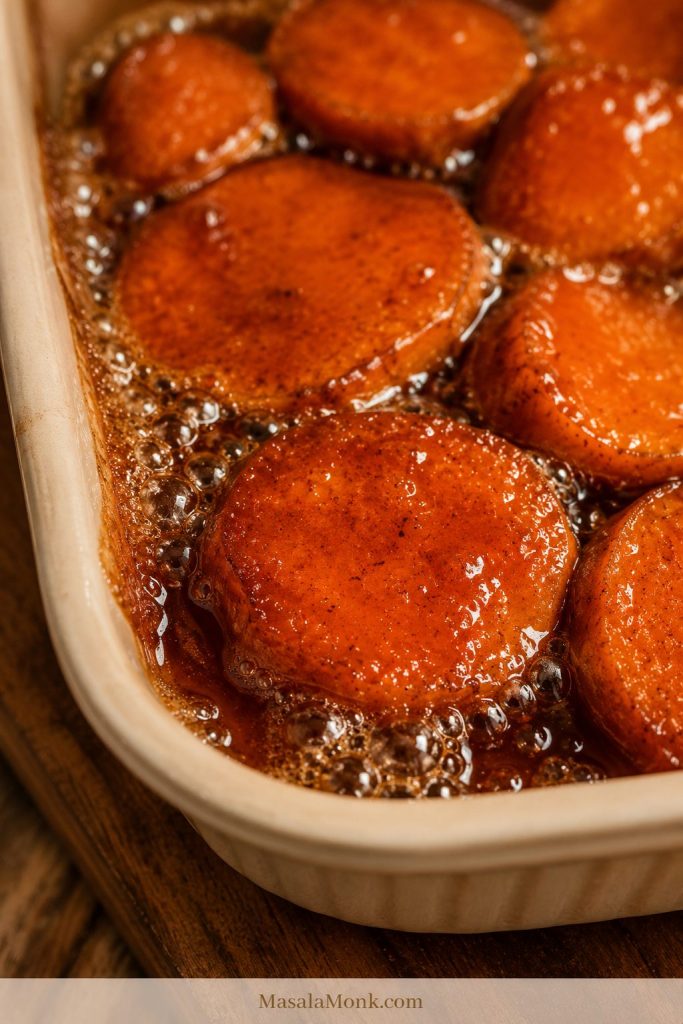
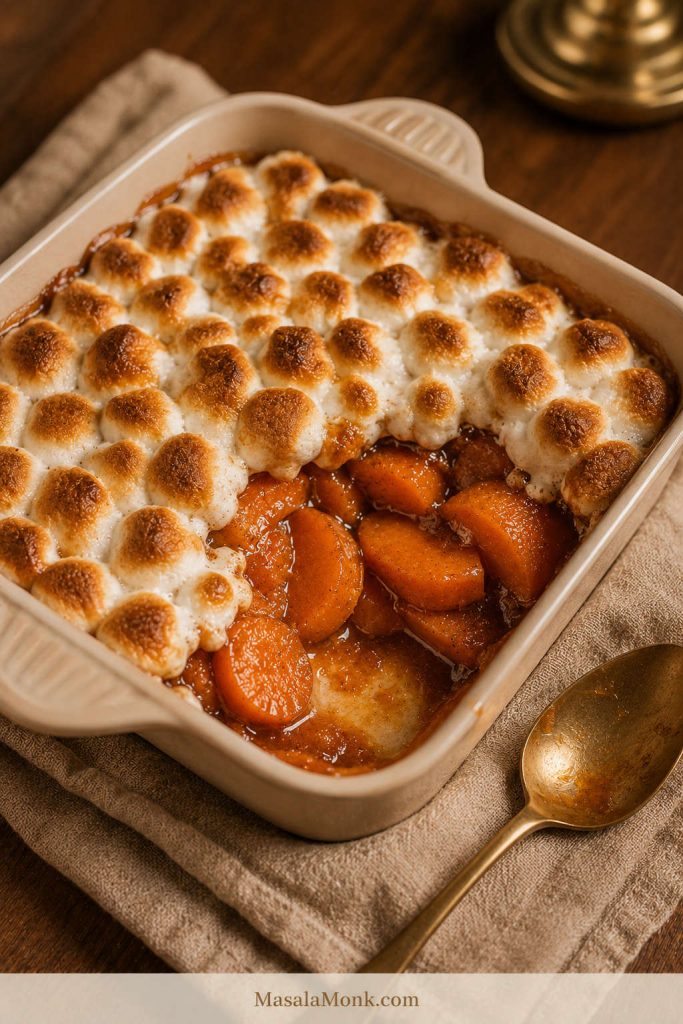
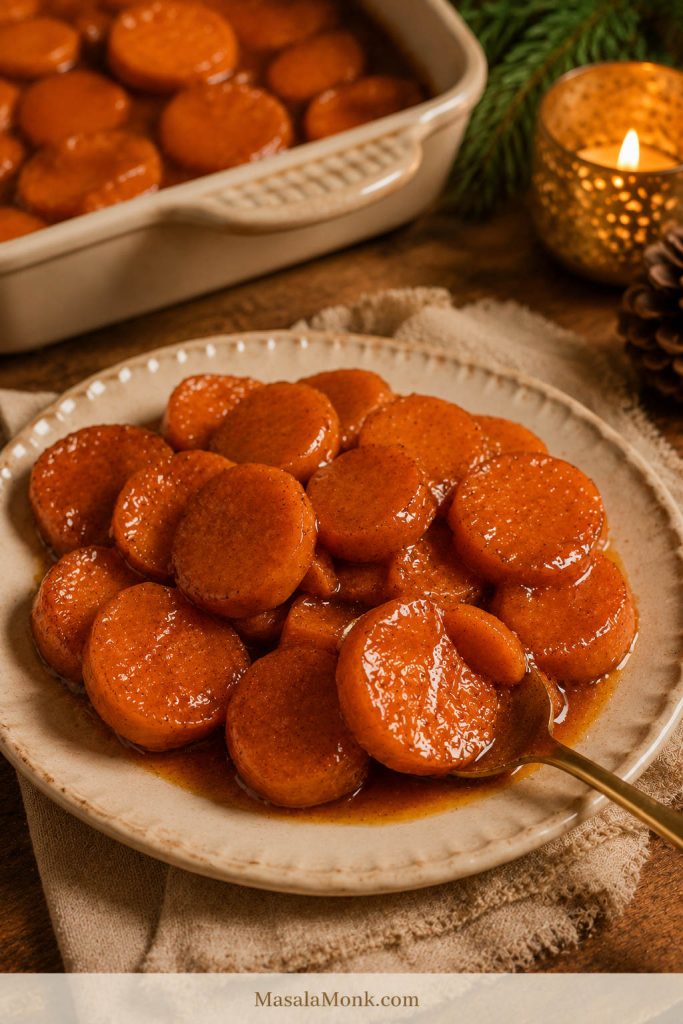
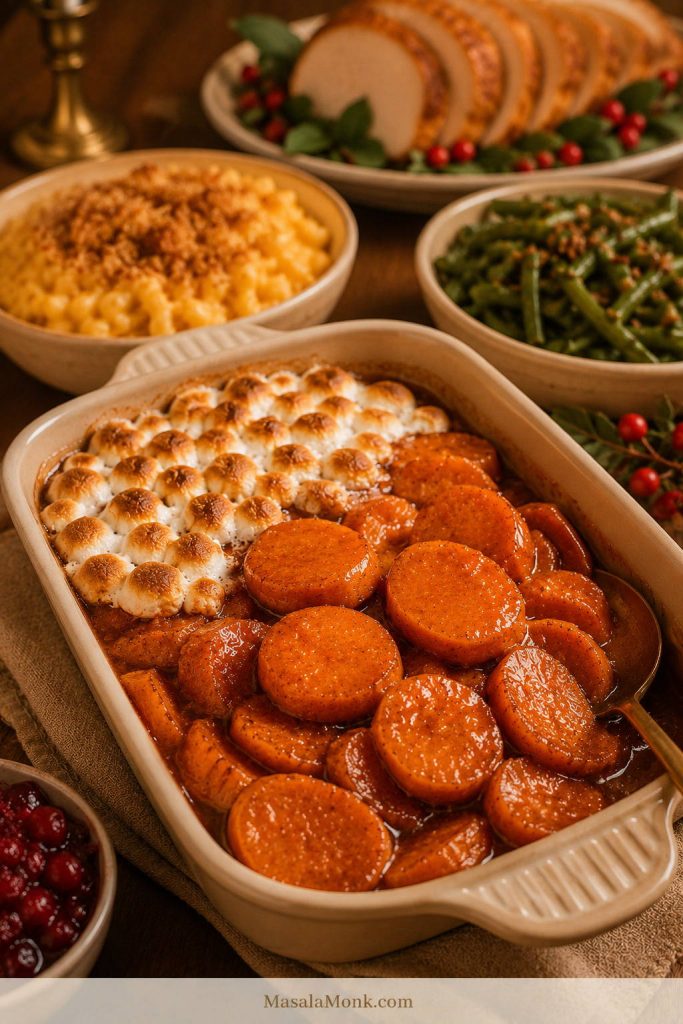
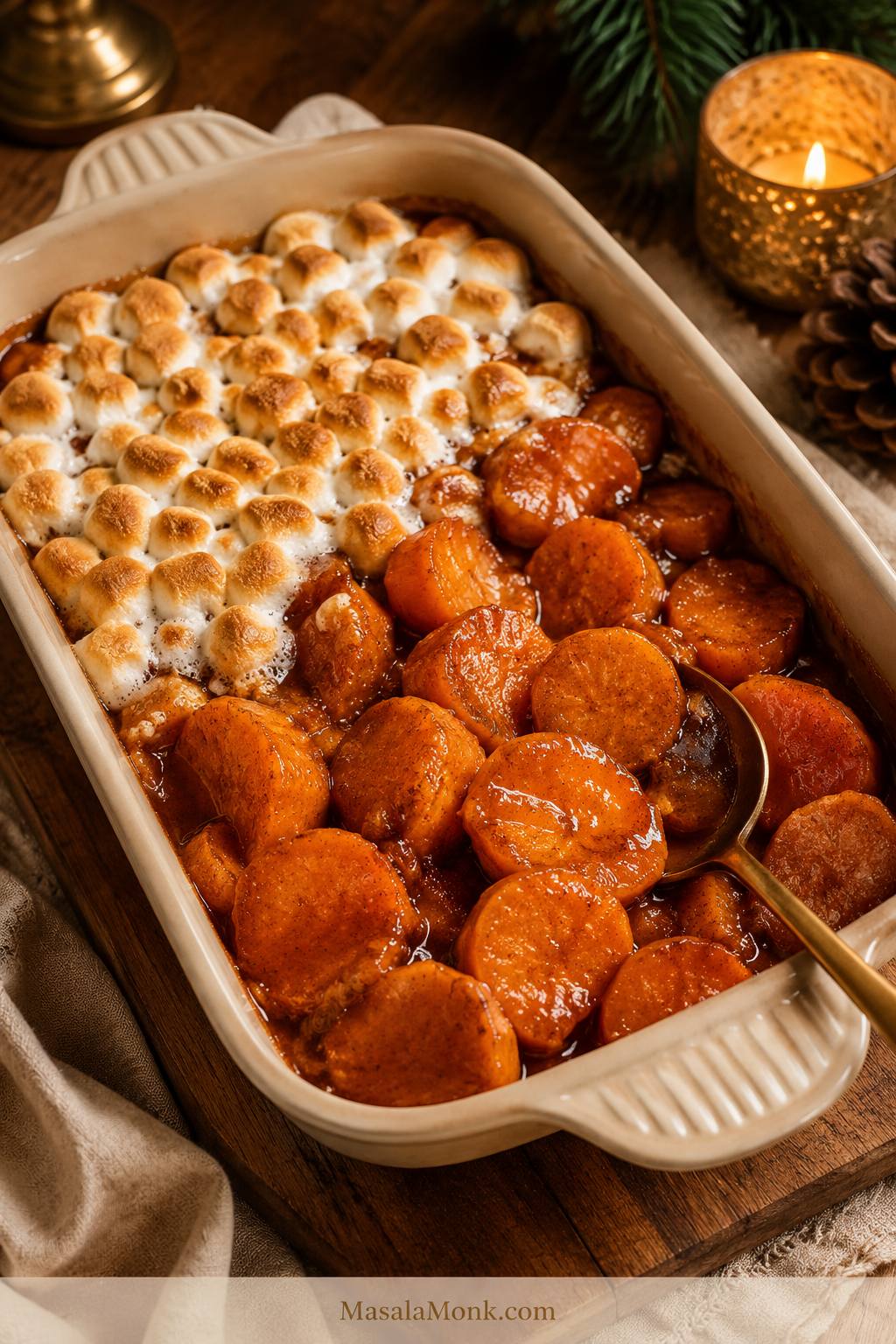
Classic candied yams should show tender orange slices, not mashed sweet potatoes. Keeping one side plain and one side topped with marshmallows is an easy way to satisfy both holiday-table preferences.

Candied yams are one of those sides people remember by texture: soft orange slices, a shiny brown sugar glaze, warm spice, and maybe a toasted marshmallow topping. This version keeps that familiar comfort, but gives you the cues that prevent watery sauce, mushy canned yams, burnt sugar, or marshmallows that disappear into the dish.

Fresh or canned, oven or stovetop, marshmallows or not — this recipe is built around the same goal: soft, buttery yams, a spoonable brown sugar glaze, and no thin liquid pooling at the bottom of the pan. This is the kind of side dish people expect to taste familiar, not reinvented.

For many tables, candied yams are not the place for wild reinvention. Use this recipe as a steady base, then finish it the way your family remembers it.

Best quick method: for classic candied yams, use fresh orange sweet potatoes sliced 1/2 inch thick.
  1. Make a smooth butter, brown sugar, and spice glaze, then stir in vanilla off the heat.
  2. Bake covered at 350°F / 175°C for 35–40 minutes.
  3. Uncover and bake 20–25 minutes more, basting once.
  4. Add marshmallows only during the final 8–12 minutes, if using.
  5. Rest 10 minutes so the sauce turns shiny and spoonable.

The full guide below covers fresh, canned, stovetop, marshmallow, no-marshmallow, and make-ahead versions, but the basic idea stays the same: soften the yams, thicken the sauce, and give it a short rest.

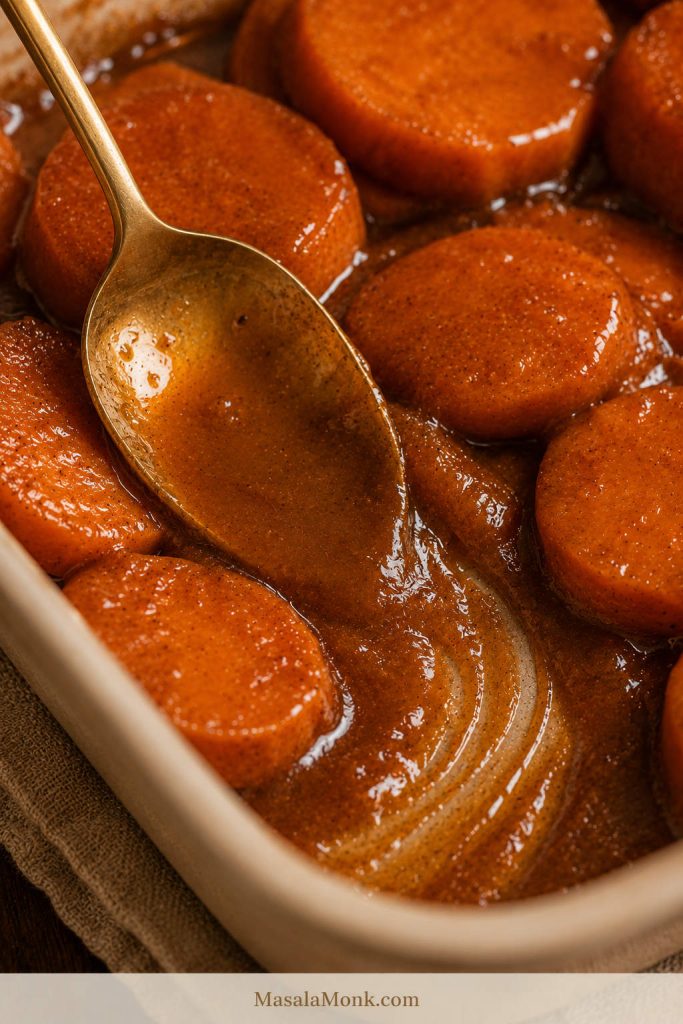
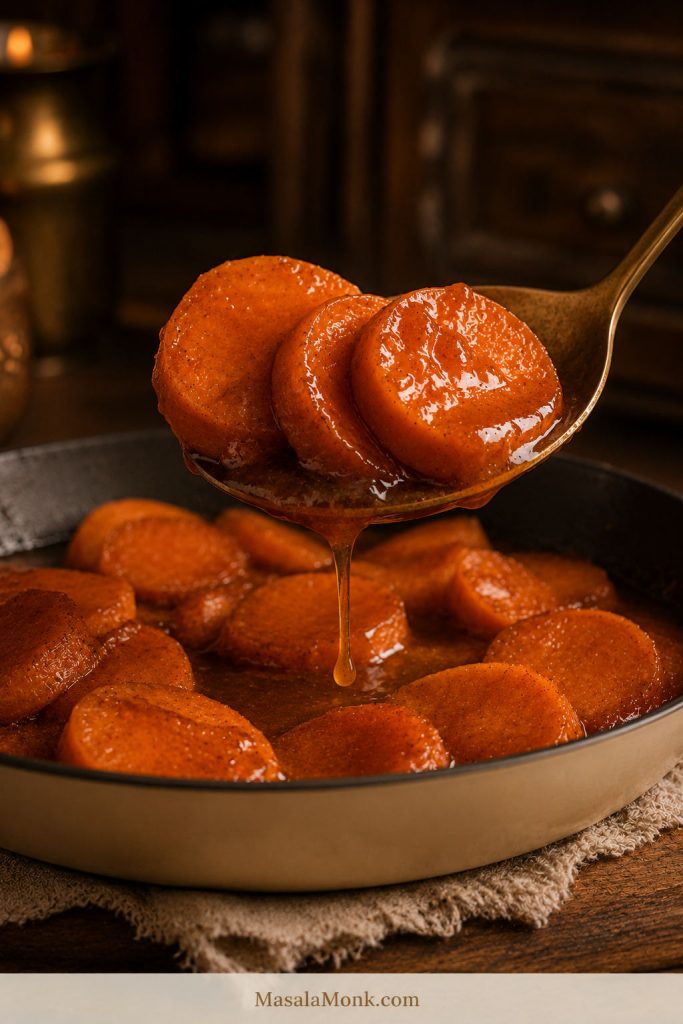
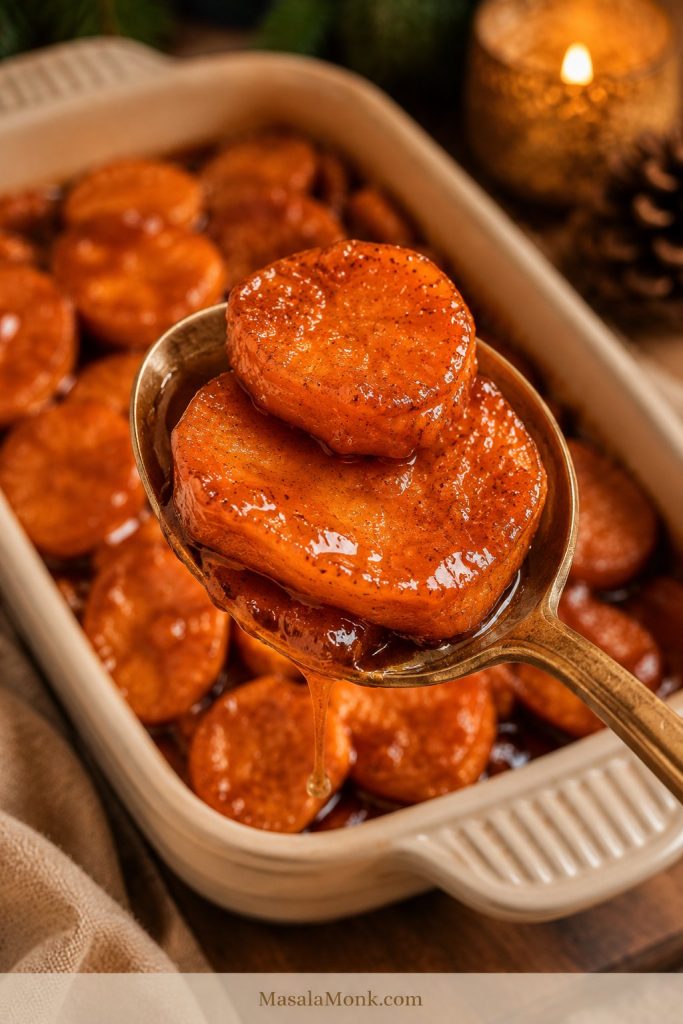
Spoon lifting soft orange candied yam slices from a cream baking dish with sauce coating the pieces.
Aim for a soft but still sliceable texture. If the yams lift cleanly and the syrup clings to the spoon, they are ready to rest before serving.

Quick Answer: What Are Candied Yams?

Candied yams are a sweet side dish made with orange-fleshed sweet potatoes, butter, brown sugar, cinnamon, nutmeg, vanilla, and sometimes marshmallows. At the table, they eat like soft sweet potatoes in a buttery brown sugar sauce.

In most U.S. grocery stores, the “yams” used for candied yams are actually sweet potatoes, and they are exactly what you want here. For the classic orange color and soft texture, look for sweet potatoes labeled as garnet yams, jewel yams, red yams, or simply yams.

Here, there is no need to hunt for true yams. Buy orange-fleshed sweet potatoes, even if your store labels them yams. They soften into the glaze instead of staying dry or starchy.

Why This Recipe Works

The difference here is that the recipe is built around texture cues, not just time: covered heat to soften, uncovered heat to reduce, and a short rest so the sauce clings.

Thick slices hold their shape, a smooth saucepan glaze prevents grainy sugar, covered baking softens the yams, uncovered baking reduces the extra liquid, and resting helps the brown sugar butter mixture cling instead of pool.

Think of it as steam first, reduction second, rest last. That order keeps the yams tender without leaving a watery pool underneath.

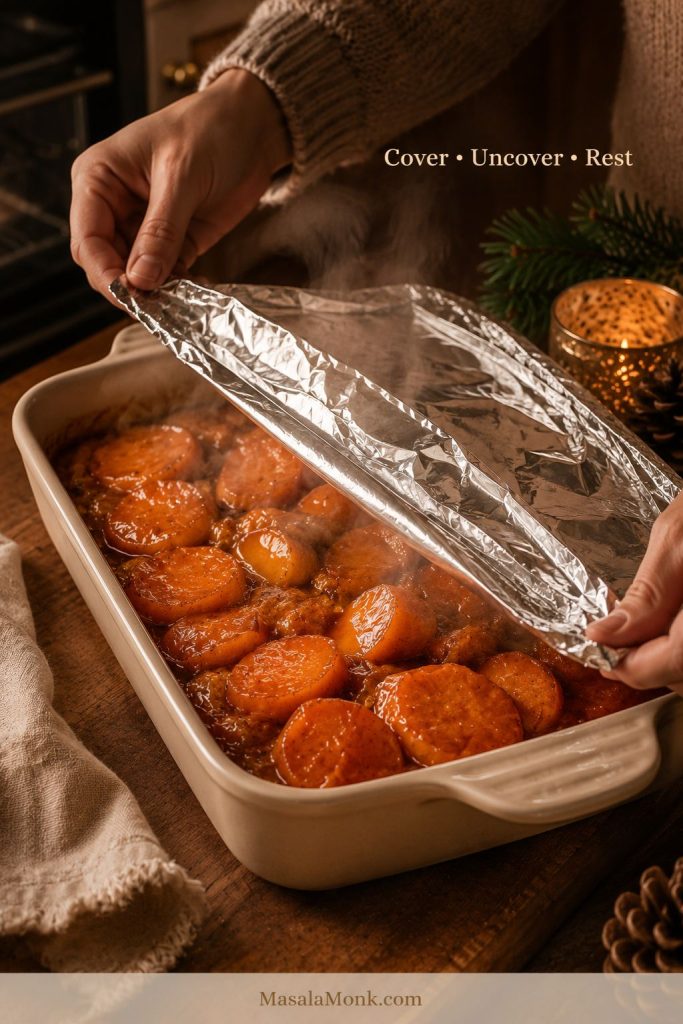
Hands peeling foil from a baking dish of candied yams with visible text reading Cover, Uncover, Rest.
Think of the bake in three stages: steam, reduce, settle. Covered heat softens the slices, uncovered heat concentrates the syrup, and the short rest helps the sauce cling.

The watery batches usually have one thing in common: too much liquid and not enough uncovered time. Often, the best batches look a little loose straight from the oven, then settle into a glossy coating after the rest.

The simple rhythm:
  • Fresh yams: cover, uncover, rest.
  • Canned yams: drain, coat, heat, stop.
  • Marshmallows: tender first, toast last.
  • Sauce: shiny and spoonable, not watery or caramel-thick.

Candied Yams Quick Facts

Fact Detail
Servings 8
Main oven temp 350°F / 175°C for fresh sweet potatoes
Fresh bake time 35–40 minutes covered, then 20–25 minutes uncovered
Best baking dish 9×13-inch / 23×33 cm glass or ceramic dish
Rest time 10 minutes before serving
Marshmallow timing Final 8–12 minutes for fresh yams; 5–8 minutes for canned yams

Which Candied Yams Method Should You Use?

Start with the method that fits the day. Maybe you have time for fresh sweet potatoes. Or maybe the oven is crowded with turkey, ham, stuffing, green bean casserole, or another side. You may already have canned yams in the pantry.

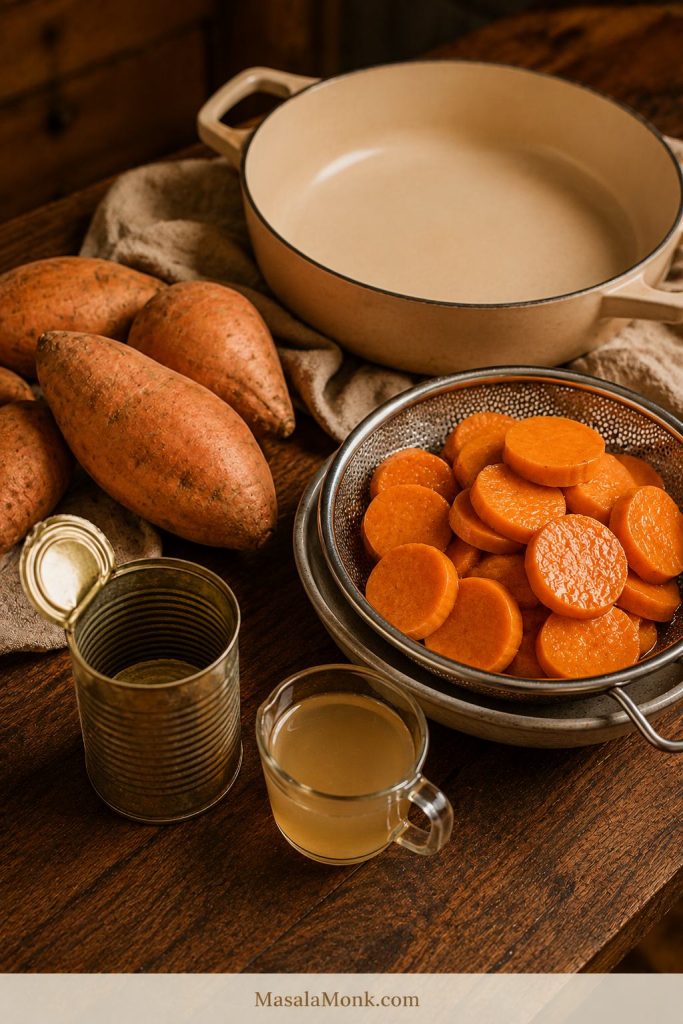
Fresh sweet potatoes, drained canned yams, an opened unbranded can, and a Dutch oven arranged on a warm kitchen counter.
Fresh sweet potatoes, canned yams, and stovetop candied yams can all work well. However, fresh slices need time, canned yams need gentleness, and stovetop yams need steady low heat.

Fresh yams give you the prettiest slices. Canned yams give you speed. Stovetop cooking gives you control. Marshmallows give you nostalgia. None of those choices are wrong.

Method Best For Approx. Time Key Cue
Fresh baked candied yams Best texture, neat slices, holiday table presentation 60–70 minutes Uncover long enough for the sauce to reduce
Canned baked candied yams Fast shortcut, pantry version, smaller batch 20–30 minutes Drain well and heat gently
Stovetop candied yams Oven is full, spoon-coated finish, Southern-style cooking 50–65 minutes Keep the heat medium-low
Crockpot candied yams Freeing oven space and holding a side dish warm 3–4 hours on low Expect a thinner syrup
Marshmallow finish Classic Thanksgiving-style topping 5–12 minutes Add only at the end

As a default, use the fresh baked version when texture matters, canned yams when speed matters, and stovetop cooking when the oven is full. If you are starting with cans, keep the rhythm even simpler: drain, coat, heat, stop.

Are Candied Yams Actually Sweet Potatoes?

Most of the time, yes. In the United States, the orange “yams” sold in regular grocery stores are usually orange-fleshed sweet potatoes. True yams are starchier, drier, and less common in everyday U.S. supermarkets. The Library of Congress explanation of sweet potatoes and yams is useful if you want the longer background.

For this recipe, buy orange sweet potatoes or yams labeled garnet, jewel, red yam, or simply yam. That naming confusion matters less than the flesh color here. Orange, moist sweet potatoes give the classic color, sweetness, and soft texture people expect in candied yams.

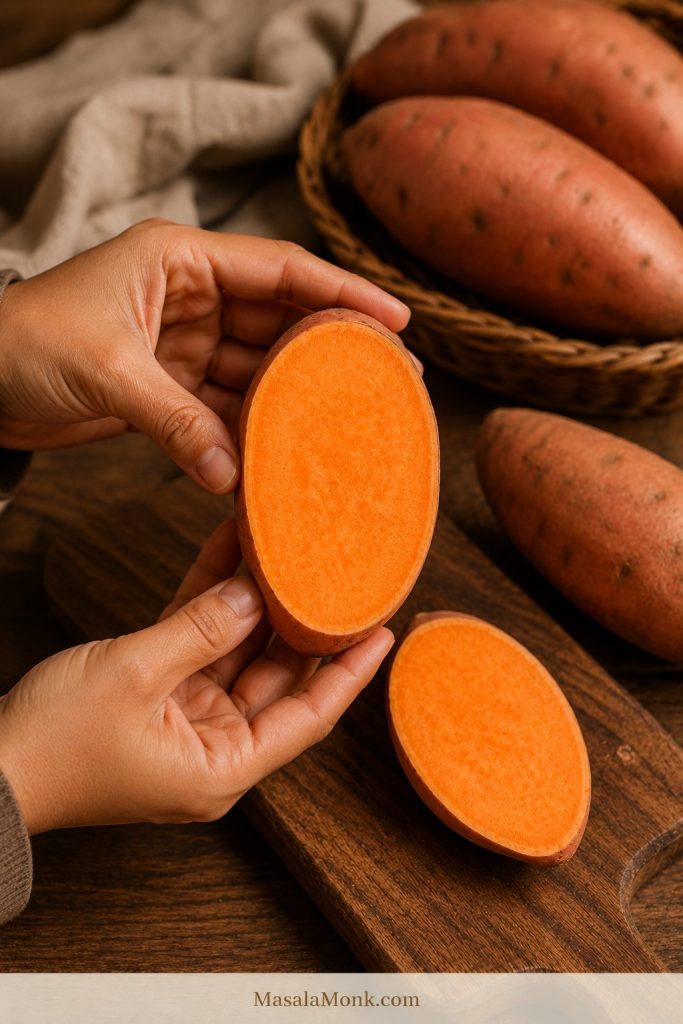
Hands holding a freshly cut raw orange sweet potato half with whole sweet potatoes in the background.
For most candied yams recipes, orange-fleshed sweet potatoes are the right choice even when the store labels them “yams.” Their color, sweetness, and soft texture create the familiar holiday side dish.
Simple shopping rule: if the inside is deep orange and the label says sweet potato, yam, jewel, garnet, or red yam, it will work for this recipe.

Ingredients You’ll Need

The ingredient list is simple because candied yams are not trying to be fancy. What matters is balance: enough brown sugar to feel candied, enough butter to feel rich, enough salt and citrus to keep the sweetness from going flat.

Brown sugar gives the sauce depth, butter gives it body, and salt keeps the dish balanced. Vanilla, warm spices, and a little orange juice or lemon juice round out the flavor. If you like that orange-bright flavor, the same idea works beautifully in cranberry sauce with orange juice.

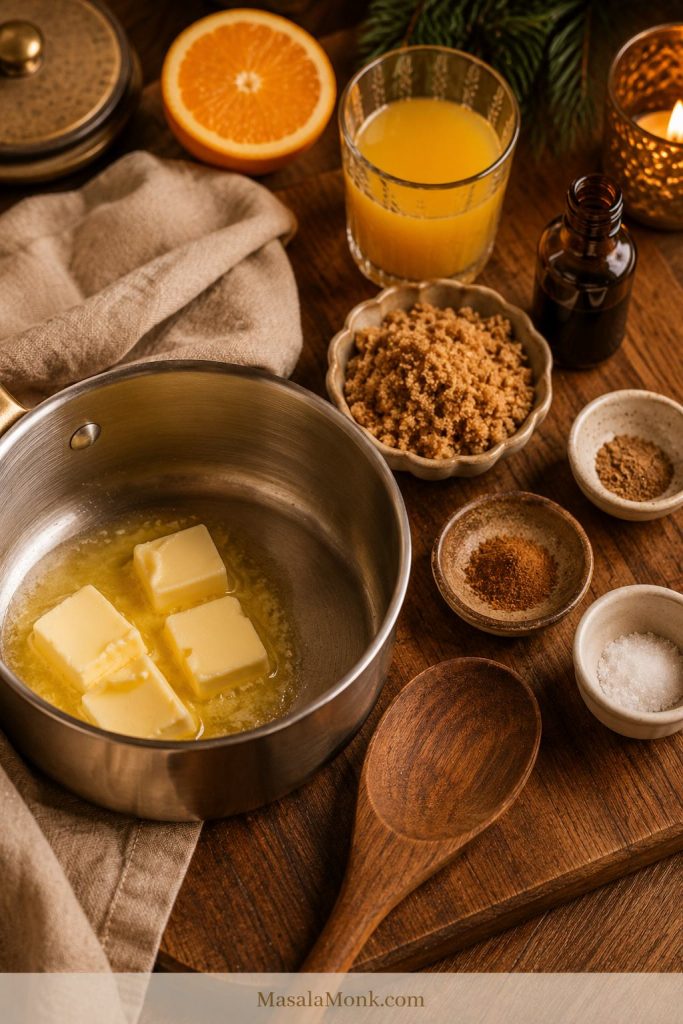
Butter, brown sugar, cinnamon, nutmeg, orange juice, vanilla, and salt arranged beside a small saucepan.
A good candied yams sauce needs more than sweetness. Butter and brown sugar bring richness, while salt, vanilla, warm spices, and citrus keep the flavor rounded.

Ingredient Amounts and Cues

Ingredient Amount Why It Matters
Orange sweet potatoes / yams 3 lb / 1.35 kg The base of the dish. Use orange sweet potatoes for the classic color and texture.
Unsalted butter 1/2 cup / 113 g Makes the sauce rich and smooth.
Brown sugar 3/4 cup / 150 g, or up to 1 cup / 200 g for a sweeter style Gives the deep caramel-like sweetness.
Maple syrup or orange juice 1/4 cup / 60 ml Maple gives deeper flavor; orange juice gives brightness.
Water 2–4 tbsp / 30–60 ml Helps the sugar dissolve into a smooth sauce.
Cinnamon 1 tsp The main warm spice.
Nutmeg 1/4 tsp Adds classic warmth.
Ginger 1/4 tsp, optional Adds a little extra spice without taking over.
Salt 1/2 tsp Balances the sugar and butter.
Vanilla extract 1–2 tsp Rounds out the brown sugar mixture. Add it off the heat.
Lemon juice or apple cider vinegar 1–2 tsp, optional Useful if you want a sweet-but-not-cloying finish.
Mini marshmallows 2–3 cups, optional Add at the end for a toasted topping.
Chopped pecans 1/2 cup, optional Adds crunch. Best added near the end so they stay crisp.

Small Ingredient Choices That Matter

When the balance is right, the coating tastes buttery and warm, not just sugary, and the sweet potatoes stay tender enough to spoon but firm enough to hold.

Less sweet version: use 3/4 cup brown sugar instead of 1 cup, choose orange juice instead of maple syrup, and add 1–2 teaspoons lemon juice or apple cider vinegar to balance the sauce.

If you are tempted to use a ready spice blend, keep it gentle. A small pinch of apple pie spice can work because it usually leans on cinnamon, nutmeg, and warm baking spices, but too much can make the yams taste more like dessert than a side dish.

Best dish: use a deep 9×13-inch / 23×33 cm glass or ceramic baking dish for the fresh version. Use an 8×8-inch / 20×20 cm dish for one 29 oz / 822 g can. Avoid sheet pans because the syrup spreads too thin and can burn before the yams soften.

How to Make Candied Yams

This is the version to make when you want the dish to look generous on the table: tender slices, glossy sauce, and enough structure that the yams do not collapse when you spoon them out. For the fresh baked version, the rhythm is simple: cover, uncover, rest.

1. Prep the sweet potatoes

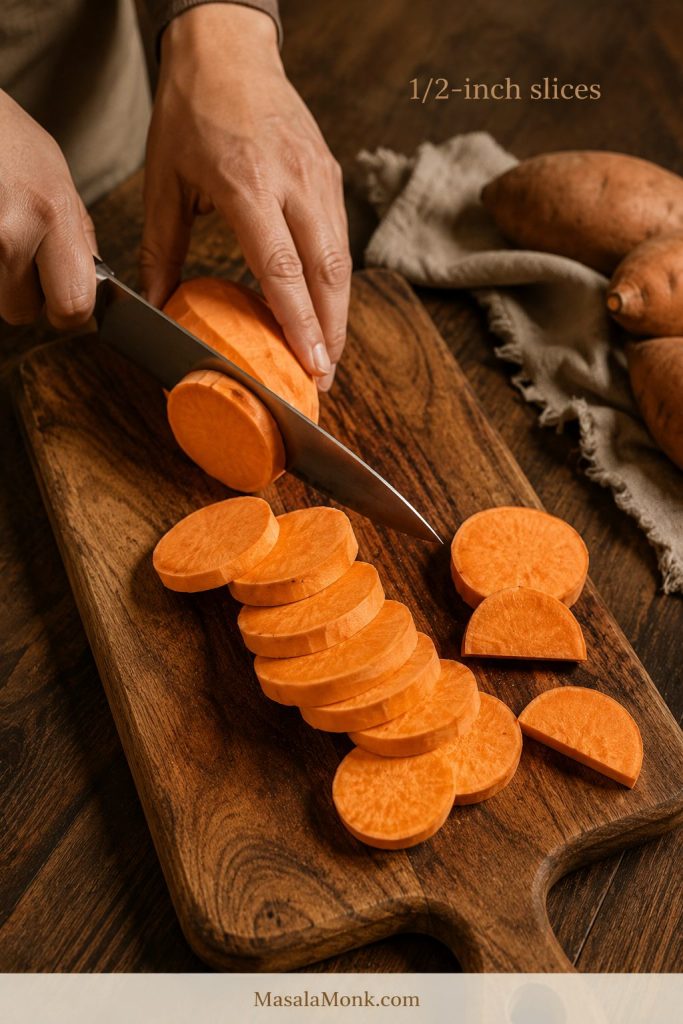
Peel the sweet potatoes and slice them into 1/2-inch / 1.25 cm rounds. If the sweet potatoes are very wide, cut the rounds into half-moons so they are easier to serve.

Thin slices tend to soften before the syrup has time to reduce, while very thick slices need longer and can make the edges overcook. The best texture comes from slices that are thick enough to hold together but thin enough to soften in the covered bake.

Hands slicing peeled orange sweet potatoes into half-inch rounds on a wooden cutting board.
Even slices make the whole dish easier to control. Around 1/2 inch gives the sweet potatoes enough body to stay intact while still softening into the sauce.

2. Make the brown sugar butter glaze

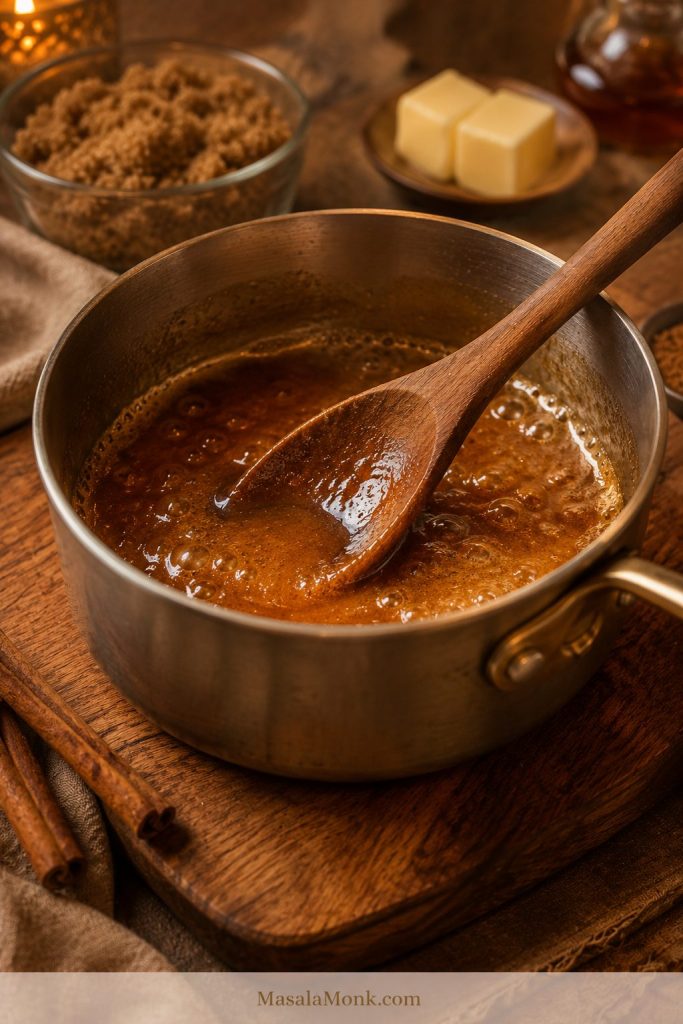
Melt the butter in a saucepan over medium heat. Add the brown sugar, maple syrup or orange juice, water, cinnamon, nutmeg, ginger if using, and salt. Stir until the sugar dissolves and the mixture looks smooth and shiny.

Let it bubble gently for 1–2 minutes, then remove it from the heat and stir in the vanilla. If using lemon juice or apple cider vinegar, stir it in now.

Brown sugar butter sauce simmering in a saucepan while a wooden spoon moves through the mixture.
Before it goes over the sweet potatoes, the butter and brown sugar mixture should look smooth and shiny. If it looks grainy, warm it gently until the sugar dissolves.
Glaze cue: the mixture should look shiny and pourable, not grainy or separated. It does not need to be thick like caramel at this stage. The oven will reduce it more.

3. Arrange and coat the yams

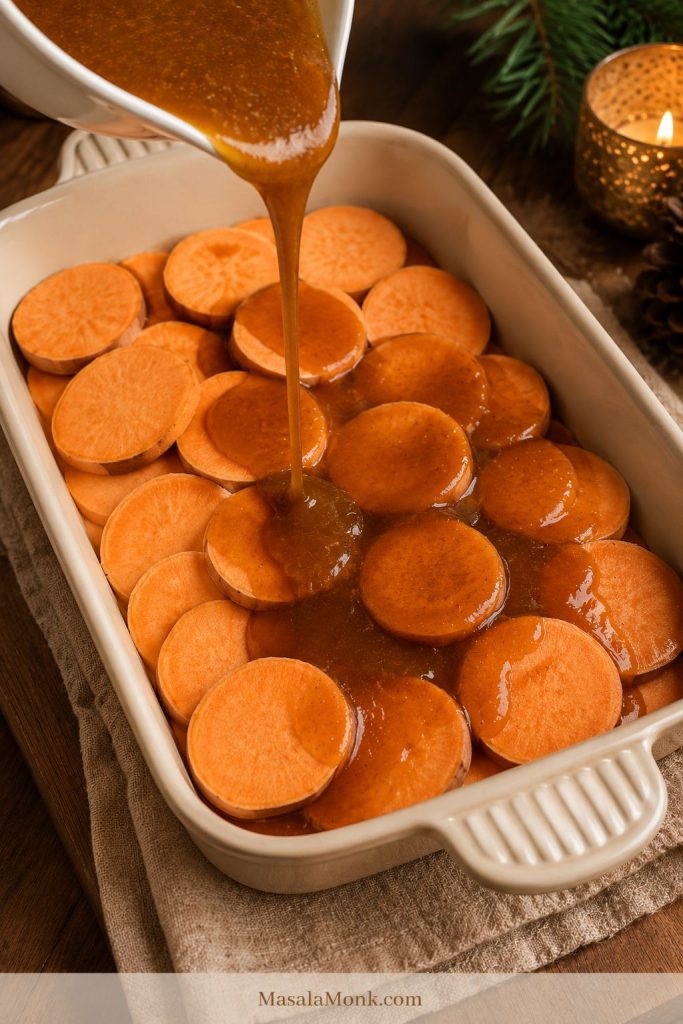
Place the sliced sweet potatoes in a greased 9×13-inch / 23×33 cm baking dish. Pour the warm glaze over the top, then gently turn the slices or spoon the brown sugar mixture over them so they are coated.

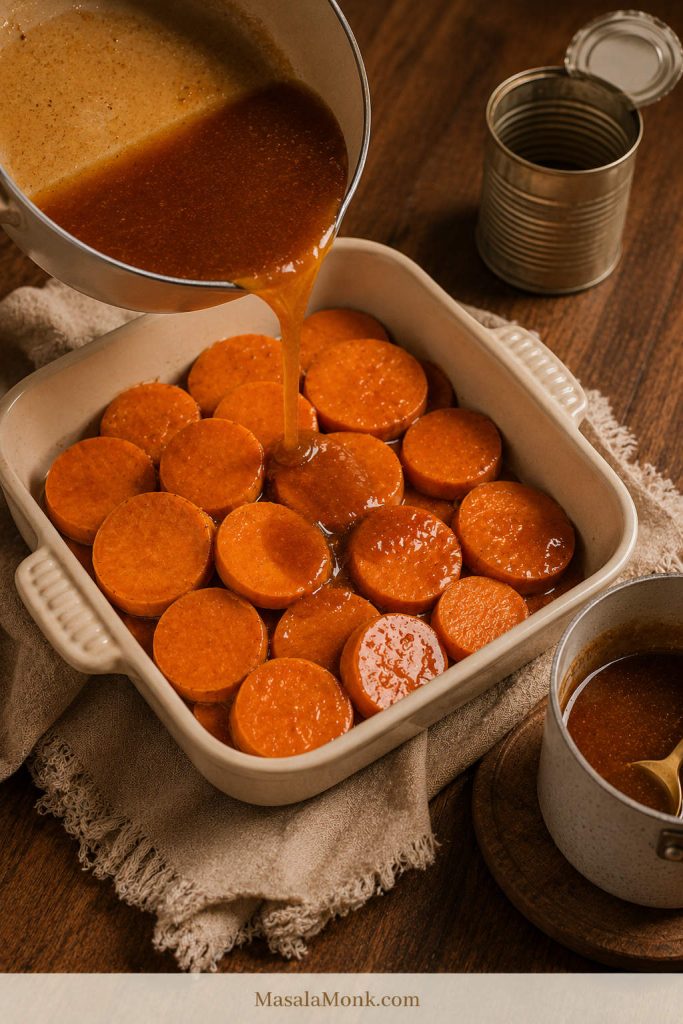
Brown sugar butter sauce being poured over arranged orange sweet potato slices in a cream baking dish.
Coat every slice before the dish goes into the oven. As a result, the sweet potatoes bake into the sauce instead of drying out on top.

The slices do not have to be in one perfect layer, but avoid packing them so tightly that the sauce cannot move around them. A little space helps the edges bubble slowly and the syrupy coating thicken without scorching.

4. Bake covered

Cover the dish tightly with foil and bake at 350°F / 175°C for 35–40 minutes. The yams should begin to soften, but they should not be falling apart yet.

During the covered stage, steam softens the sweet potatoes without drying them out. It also gives the buttery syrup time to soak into the slices.

5. Bake uncovered

Remove the foil, spoon the sauce over the yams, and bake uncovered for another 20–25 minutes. By the end of baking, the edges should bubble slowly and the top slices should look lacquered, not dry.

The yams are ready when they are fork-tender and a spoon drags a shiny trail over the slices instead of leaving thin liquid behind. They do not need to look perfect at every stage; by the time they rest, they should be tender, coated, and sitting in a glossy coating. If the dish still looks loose, give it another 5–10 minutes uncovered.

Candied yams bubbling uncovered in a cream baking dish as the sauce reduces around the orange slices.
The uncovered bake is where the sauce tightens. Look for gentle bubbling around the edges and shiny slices instead of thin liquid sitting underneath.

If the edges darken too quickly or the syrup starts to smell scorched instead of buttery and spiced, move the dish away from the hottest part of the oven.

What success looks like: the yams are fork-tender but still holding together, the edges bubble slowly, a spoon drags a shiny trail through the coating, and there is no thin liquid pooling at the bottom.
Spoon dragging through thick brown sugar sauce between candied yam slices in a baking dish.
A spoon trail is one of the clearest doneness cues. When the sauce leaves a shiny path before slowly settling back, the candied yams are close to ready.

6. Add marshmallows if you want them

If using marshmallows, scatter them over the yams during the final 8–12 minutes of baking. They should puff into a soft golden blanket, with toasted tops and a little give underneath. For deeper browning, use the broiler for a few seconds at the end.

Marshmallows brown fast, so this is the one moment to stay by the oven.

7. Rest before serving

Let the dish rest for about 10 minutes before serving. Give the brown sugar sauce a chance to settle before deciding it is too thin. A short rest is part of the recipe, not just waiting time, and the resting section explains why it works.

After that rest, the slices are easier to lift and the sauce clings better. Serve the yams warm, not straight-from-the-oven hot, so the glossy coating has time to settle. The dish should smell like butter, brown sugar, cinnamon, and sweet potatoes — not scorched sugar.

How to Make Candied Yams with Canned Yams and Marshmallows

Canned yams are not a shortcut you need to apologize for. For many families, they are the version that actually tastes familiar. The only trick is to remember that they are already cooked, so you are simply warming, coating, and finishing them.

With canned yams, keep the rhythm even simpler: drain, coat, heat, stop. Add marshmallows at the end if you want that classic topping.

Small cream baking dish of canned candied yams with toasted mini marshmallows and a scooped corner showing orange yams underneath.
With canned yams, the best result is a warm coated center and a toasted finish. The scooped corner should still show orange pieces underneath, not a mashed layer hidden by marshmallows.

Canned-Yam Timing

Batch Size Canned Yams Dish Oven Timing
Small batch 1 can, 29 oz / 822 g, drained 8×8-inch / 20×20 cm 375°F / 190°C 15 minutes, then 5–8 minutes with marshmallows
Larger batch 1 large can, 40 oz / 1.13 kg, drained 9×13-inch / 23×33 cm 375°F / 190°C 18–20 minutes, then 5–8 minutes with marshmallows
Double-can batch 2 cans, 29 oz / 822 g each, drained 9×13-inch / 23×33 cm 375°F / 190°C 20–22 minutes, then 5–8 minutes with marshmallows
Mini canned-yam version: for one 29 oz / 822 g can, drain well, use 3 tbsp butter, 1/3–1/2 cup brown sugar, 1/2 tsp cinnamon, a pinch of nutmeg, a pinch of salt, and 1 tsp vanilla. Bake at 375°F / 190°C for 15 minutes, then add marshmallows for 5–8 minutes if using.
Small cream baking dish filled with canned yams as brown sugar sauce is poured over them.
For a one-can batch, scale the dish and sauce down together. Since canned yams are already cooked, the goal is warming and coating, not long baking.

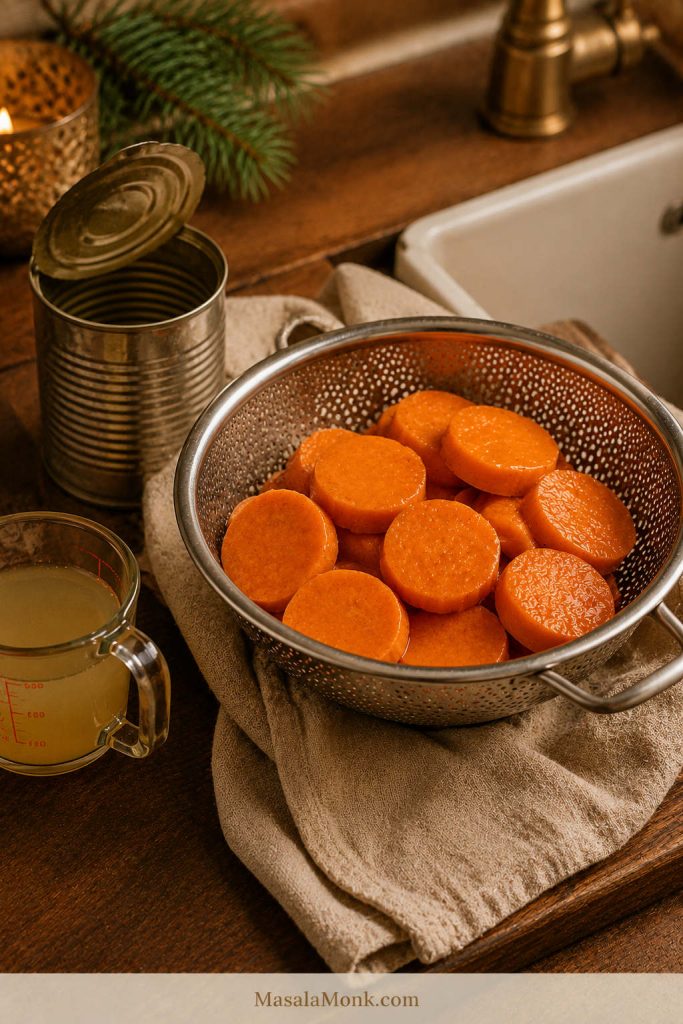
Drain well. A few tablespoons of canning liquid can loosen a thick sauce; the full can usually makes the dish watery.

Drained canned yams in a metal colander with an opened unbranded can and a small measuring cup of liquid nearby.
Canned yams save time, but the liquid in the can can thin the sauce quickly. Drain first, then add back only a spoonful or two if the mixture needs loosening.

Warm the butter, brown sugar, cinnamon, nutmeg, salt, and vanilla into a quick glaze, pour it over the drained canned yams, and bake only until hot. With canned yams, gentleness matters most. Stirring breaks them down faster than baking does.

How to keep canned yams from getting mushy

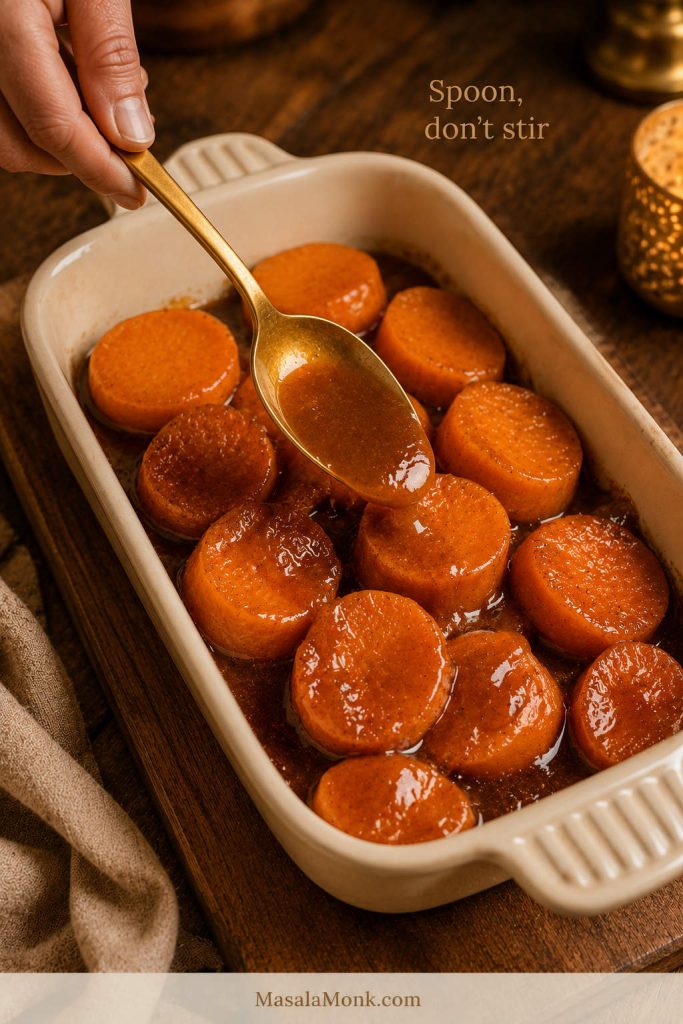
Spoon gently pouring sauce over intact canned yam pieces with visible text reading Spoon, don’t stir.
Instead of stirring canned yams, spoon the sauce over the top. This keeps the pieces intact and helps prevent the dish from turning into sweet potato mash.
  • Leave large pieces large. Smaller pieces break down faster.
  • Use less sugar if the yams are packed in syrup. Start lower, then adjust next time if you want them sweeter.
  • Rinse only if the syrup is very heavy. Draining is usually enough. Rinsing helps only if you want a less sweet version.
  • Spoon instead of stirring. Tilt the dish gently or ladle sauce over the top.
  • Bake uncovered if the syrup looks loose. This helps extra moisture evaporate.
  • Make canned yams closer to serving time if presentation matters. They soften more as they sit.

Quick glaze for canned yams

Can Size Butter Brown Sugar Spices and Vanilla
29 oz / 822 g can 3 tbsp 1/3 cup if packed in syrup, 1/2 cup if packed in water or light syrup 1/2 tsp cinnamon, pinch nutmeg, pinch salt, 1 tsp vanilla
40 oz / 1.13 kg can 4 tbsp 1/2 cup 3/4 tsp cinnamon, pinch nutmeg, pinch salt, 1 tsp vanilla
2 cans, 29 oz / 822 g each 5–6 tbsp 2/3 cup if packed in syrup, 3/4 cup if packed in water or light syrup 1 tsp cinnamon, 1/4 tsp nutmeg, 1/4 tsp salt, 2 tsp vanilla

If your canned yams are very sweet already, start with the lower sugar amount. You can always make the next batch sweeter, but it is harder to rescue a dish that has become cloying.

Stovetop Candied Yams, Southern-Style

Southern-style candied yams are often less about a casserole and more about tender sweet potatoes coated in a buttery brown sugar syrup. Some versions are baked, some are made on the stovetop, some finish with marshmallows, and some stay plain and glossy.

When the oven is full, the stovetop is often the easiest way to stay in control of the sauce. It is also a good choice if you like a spoon-coated finish because you can watch it reduce in real time, baste the slices, and stop when the yams are tender but still holding together.

The flavor usually leans brown sugar, butter, cinnamon, nutmeg, vanilla, and sometimes citrus. Done well, it tastes rich without becoming flat: enough sugar to feel candied, enough salt and spice to keep every bite balanced.

Use the widest heavy-bottomed skillet or Dutch oven you have. A wide pan gives the sweet potatoes enough room to cook evenly, and a heavy base helps protect the sugar from scorching.

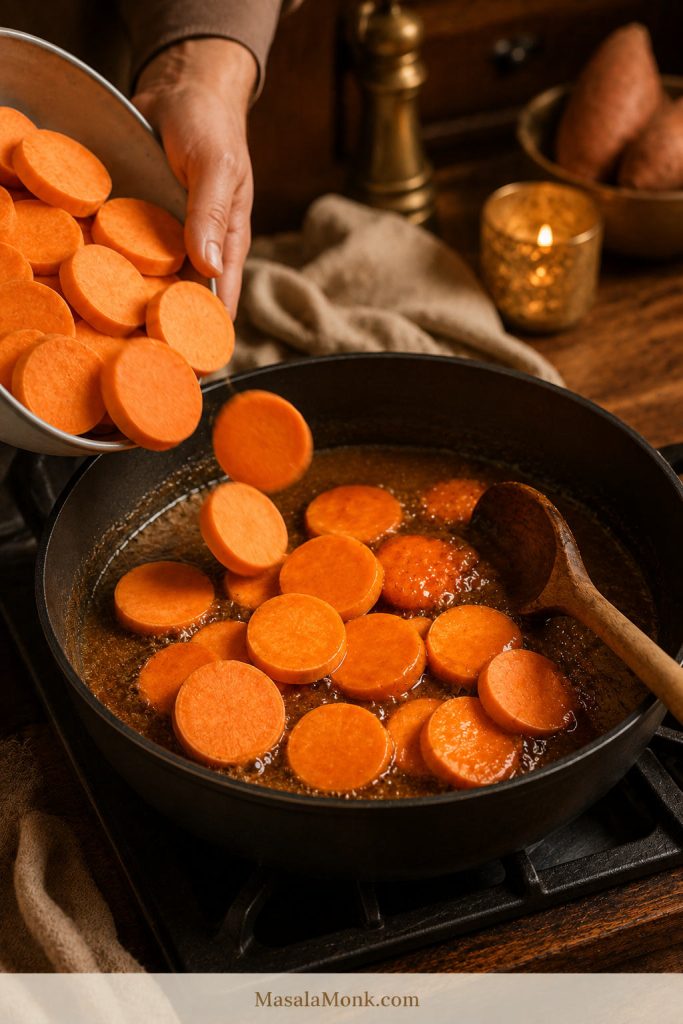
Fresh orange sweet potato slices being added by hand to a dark skillet with a shallow butter and sugar mixture.
For stovetop candied yams, use a wide pan so the slices have room to cook evenly. A shallow butter-sugar mixture also helps the syrup reduce without crushing the sweet potatoes.

How to make candied yams on the stove

  • Melt the butter in a wide skillet or Dutch oven over medium-low heat.
  • Add brown sugar, maple syrup or orange juice, water, cinnamon, nutmeg, ginger if using, and salt.
  • Stir until the sugar starts to dissolve and the glaze looks smooth.
  • Add the 1/2-inch / 1.25 cm sweet potato slices and gently coat them.
  • Cover and cook over medium-low heat for 35–45 minutes, basting every 10–15 minutes. Start checking at 35 minutes.
  • When the yams are almost tender, uncover and simmer for 7–15 minutes more so the syrup thickens.
  • Finish with vanilla off the heat. Add lemon juice or apple cider vinegar if the sauce tastes too sweet.

Stovetop Reduction Cues

Keep the stovetop version patient and gentle; high heat can burn the sugar before the potatoes soften. If the pan looks dry at any point, lower the heat before adding more liquid.

Spoon basting brown sugar syrup over orange candied yam rounds in a dark skillet.
Once the stovetop syrup begins to thicken, baste gently instead of stirring hard. This coats the tops while the sweet potato rounds stay whole.

Stay close during the uncovered reduction stage. The syrup can move from shiny to scorched quickly once the extra moisture cooks off.

Stovetop cue: the yams are done when they are fork-tender and the sauce coats the back of a spoon. If the syrup thickens before the yams are soft, add 1–2 tablespoons water and keep cooking covered. When the yams are soft but the sauce is thin, uncover and simmer a little longer.

Stir as little as possible. Use a spoon to baste the slices or gently shake the pan instead of stirring like a stir-fry. This keeps the sweet potatoes from breaking apart.

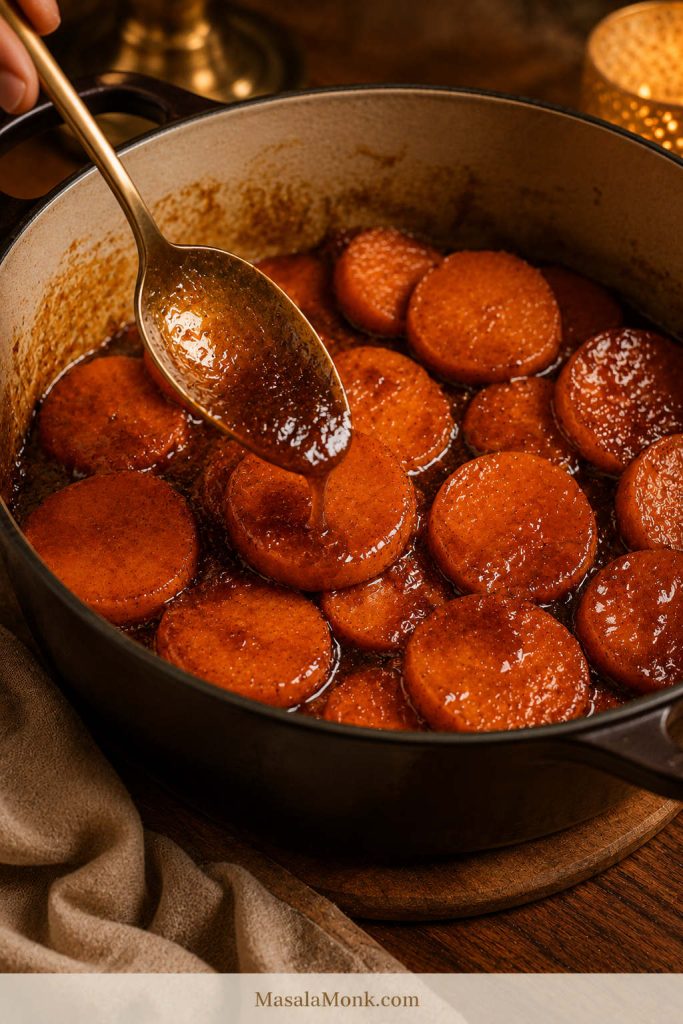
Spoon lifting stovetop candied yam slices from a dark skillet with thick syrup dripping back into the pan.
Finished stovetop candied yams should look rich and syrupy, with a darker, deeper glaze than the baked version. Keep the heat gentle so the sugar thickens without scorching.

Can I Bake Candied Yams at 375°F?

Yes. The main recipe uses 350°F / 175°C for steady, even softening, but 375°F / 190°C works if you need a slightly faster bake. Check earlier, baste once or twice, and watch the edges so the sugar does not dry out before the yams are tender.

Candied Yams with Marshmallows

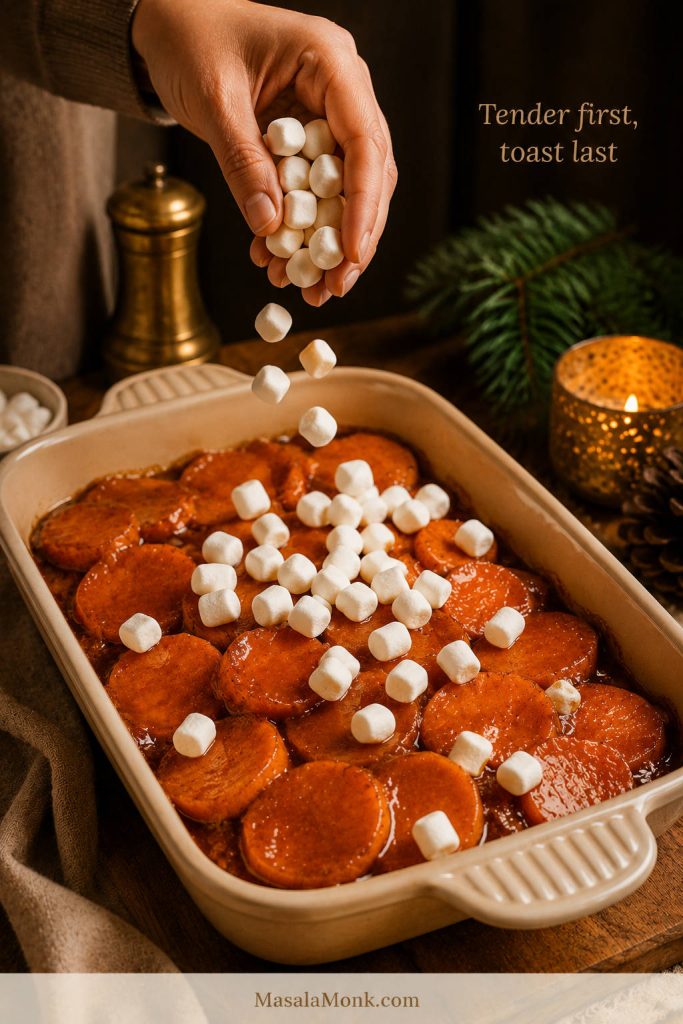
For marshmallows, the timing is everything: tender first, toast last. Marshmallows are the part people notice first, so they deserve a little timing. Add them too early and they disappear into the sauce; add them at the end and you get the soft, golden topping people remember.

Mini marshmallows being sprinkled over hot candied yams with visible text reading Tender first, toast last.
Marshmallows are a finish, not a cooking ingredient. Add them when the yams are already tender so they puff on top instead of disappearing into the sauce.

If your family expects marshmallows, let them be the finish, not the sauce.

When to Add Marshmallows

  • At 350°F / 175°C, add marshmallows for the final 8–12 minutes.
  • For 375°F / 190°C, add them for the final 5–8 minutes.
  • In a 400°F / 200°C oven, watch closely and check after 5 minutes.
  • Under the broiler, they may brown in 30–90 seconds.

You want the topping puffed, soft, and lightly golden — not fully dissolved into the glaze.

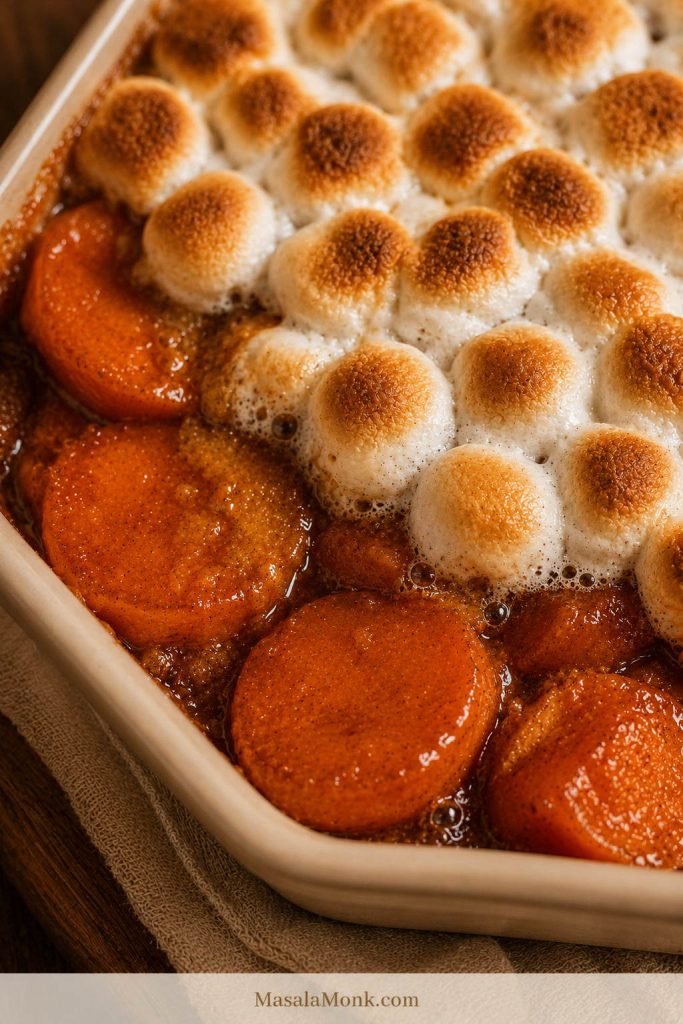
Close-up of toasted mini marshmallows on candied yams with orange yam slices visible underneath.
The marshmallow topping is ready when it is puffed, soft, and lightly golden. Importantly, you should still see orange yams and a little sauce underneath.

The best marshmallow topping comes from adding them when the yams are already hot, so they puff quickly instead of sinking into the sauce.

Mini marshmallows are easiest because they scatter evenly and brown quickly. Large marshmallows can work, but cut them in half or use fewer so the topping does not become too thick.

For pecans and marshmallows together, add the pecans near the end, then scatter marshmallows over the top. This keeps the nuts from sitting under foil for too long and turning soft.

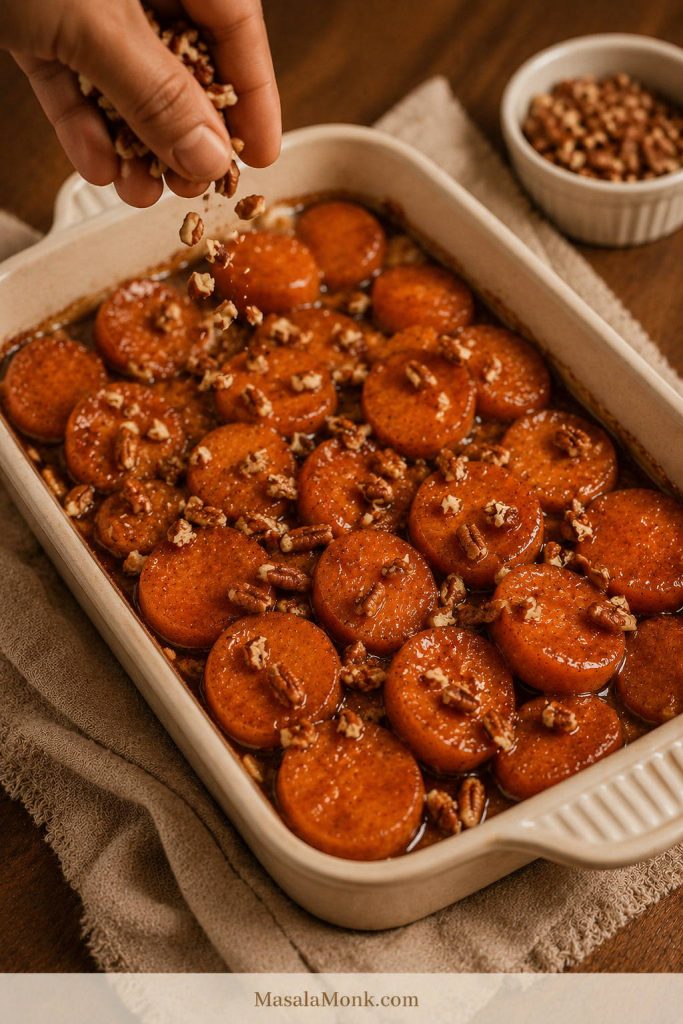
Hand sprinkling chopped pecans over candied yam slices in a cream baking dish.
Add pecans near the end so they stay crisp instead of steaming under foil. They bring crunch and nuttiness without taking over the brown sugar flavor.

How to make candied yams without marshmallows

To make candied yams without marshmallows, simply skip the topping and focus on the glaze. Bake uncovered until the yams are tender and the brown sugar butter sauce looks shiny and spoonable. For a little finish without marshmallows, add pecans near the end, a small pinch of orange zest, or nothing at all.

Candied yams without marshmallows served on a cream plate with brown sugar sauce.
No-marshmallow candied yams rely on the sauce for their finish. The flavor should be buttery, warmly spiced, and complete without needing a topping.

If your table loves the glossy plain version, stop before the topping and let the brown sugar butter sauce shine. The plain version is often the best choice when you want the sweet potatoes, butter, brown sugar, and warm spices to be the main flavor.

Small Things That Make a Big Difference

These are the small choices that prevent most candied-yam problems before they start.

  • Keep slices about 1/2 inch thick. Thin slices soften quickly and can fall apart before the sauce thickens.
  • Drain canned yams well. A few tablespoons of liquid can loosen the syrup, but the full can may make it watery.
  • Handle canned yams gently. Spoon sauce over them instead of stirring hard.
  • Save marshmallows for the end. They need just enough time to puff and brown.
  • Let the sauce rest before judging it. It thickens after the dish cools slightly.
  • Use a deeper baking dish. A flat sheet pan spreads the syrup too thin for this style.

Thanksgiving Timing Plan

On a holiday table, candied yams should not be the dish that makes the day harder. They can wait, reheat, hold their sauce, and still feel special when they come to the table warm and glossy.

The best part of this dish is that it does not need to be dramatic at the last minute. Make it ahead, reheat it gently, and save the marshmallows for the final finish.

For storage and reheating details, use the make-ahead section before planning the serving-day schedule, especially if your oven also needs time for macaroni and cheese or other baked sides.

When What to Do
2 days before Buy sweet potatoes or yams, butter, brown sugar, spices, marshmallows, and pecans if using.
1 day before Bake the fresh candied yams without marshmallows. Cool, cover, and refrigerate.
Serving day Reheat covered at 350°F / 175°C until hot, usually 20–25 minutes.
Final 8–12 minutes Add marshmallows or pecans and bake until puffed, golden, and hot.
When the oven is full Use the stovetop method, or reheat the baked yams once the oven opens up.
Using canned yams Make them closer to serving time for the best texture and cleanest presentation.

If you are transporting candied yams, keep the marshmallows off until you reheat, if possible. Marshmallows soften as they sit, and they look best when added close to serving.

Crockpot Candied Yams

Crockpot candied yams are helpful when the oven is full, but the sauce will usually stay thinner than baked or stovetop versions. Use fresh sweet potatoes, not canned, for the best shape. Cook on low for 3–4 hours, then reduce extra liquid in a small saucepan if needed. Add marshmallows only before serving.

Variations

  • No marshmallows: keep the top plain and let the brown sugar butter sauce shine.
  • Pecan topping: add chopped pecans near the end so they stay crisp instead of steaming under the foil.
  • Orange juice glaze: use it instead of maple syrup for a brighter, less heavy glaze.
  • Maple finish: use maple syrup for a deeper, rounder flavor.
  • Pineapple version: add well-drained pineapple near the end so it does not thin the sauce too much.
  • Less sweet: reduce brown sugar to 3/4 cup and add lemon juice or apple cider vinegar.
  • Vegan version: use plant-based butter and skip marshmallows unless they are vegan.

Keep variations simple. Candied yams are already rich, so one or two upgrades are usually enough. Pecans and marshmallows work well together. Orange juice and maple syrup are both good, but you do not need every sweet ingredient in the same dish.

Troubleshooting Candied Yams

Most candied-yam problems are fixable because they usually come from one of four things: too much liquid, too much heat, too much time, or too much stirring.

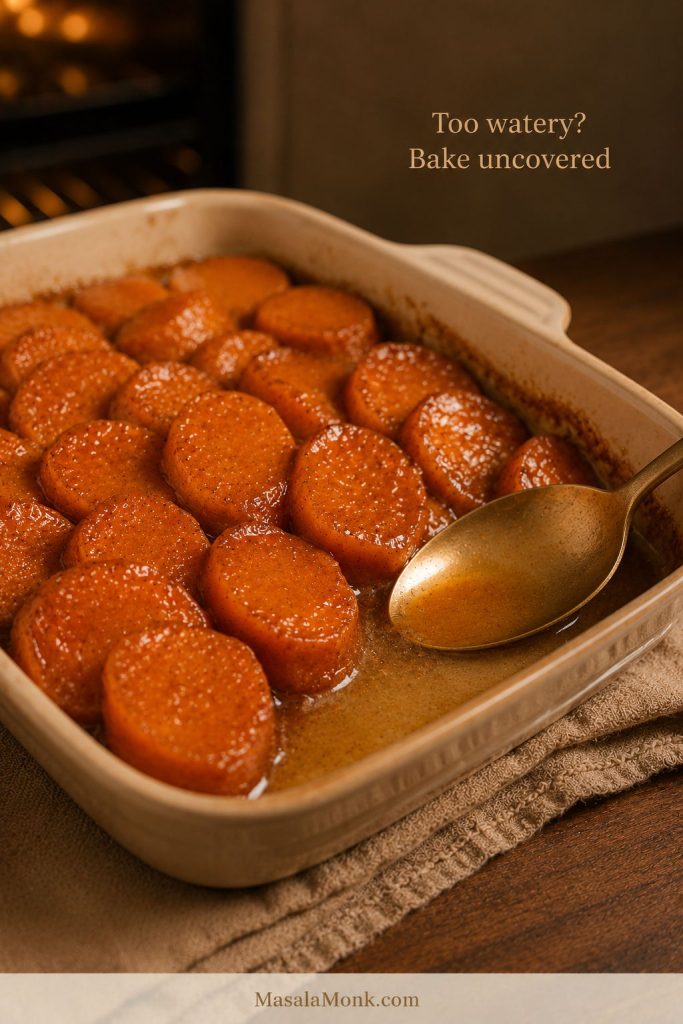
Candied yams in a baking dish with a spoon lifting thin liquid from one corner and visible text reading Too watery? Bake uncovered.
For watery candied yams, a thin pool at the edge usually means more uncovered time, not a full rescue. Let extra moisture evaporate, then give the sauce a few minutes to settle.

They often look worse in the pan than they taste on the plate. If the dish tastes good but looks loose, pause before changing anything. Rest it, then reduce it if needed. Hot sauce almost always looks thinner than settled sauce, so check why the sauce thickens after resting before extending the bake time.

Quick Fixes by Problem

Problem Why It Happened How to Fix It
Yams are watery Too much liquid, canned yams were not drained, or the dish stayed covered too long Bake or simmer uncovered until the sauce reduces. Spoon out extra liquid if needed.
Yams are mushy Slices were too thin, overcooked, or canned yams were stirred too much Use 1/2-inch slices for fresh yams and handle canned yams gently.
Sauce is thin It has not reduced enough, or it is still very hot Bake uncovered longer and let the dish rest for 10 minutes before serving.
Sugar burned Heat was too high or the pan was too shallow Use a deeper baking dish or lower heat. Spoon sauce over the yams during baking.
Butter separated The sugar did not dissolve fully into the butter mixture Simmer the glaze until smooth before pouring it over the yams.
Too sweet Heavy syrup canned yams or too much sugar Add a little salt, orange juice, lemon juice, or apple cider vinegar. Use less sugar next time.
Marshmallows disappeared They were added too early Add marshmallows only in the final 5–12 minutes.
Pecans got soggy They were baked under foil too long Add pecans near the end or sprinkle them on before the marshmallows.

Why the sauce thickens after resting

The sauce often looks loose when the dish first comes out of the oven. That does not mean it failed. As the butter-sugar mixture cools slightly, it becomes thicker and clings better to the sweet potatoes. Give the dish 10 minutes before deciding it is too thin.

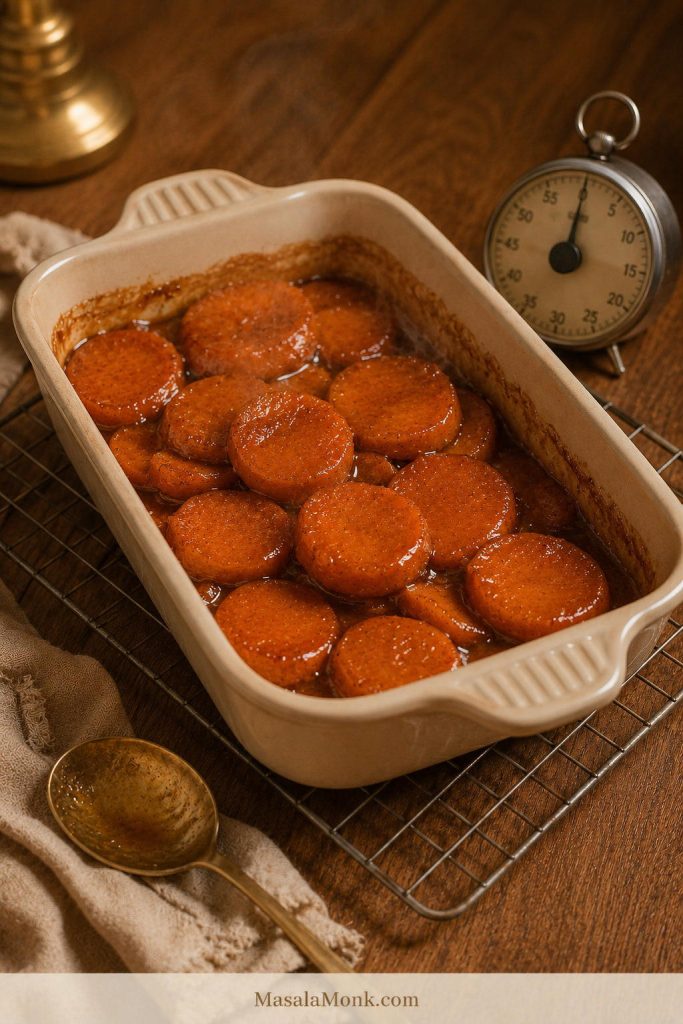
Candied yams resting on a wire cooling rack in a cream baking dish with a kitchen timer nearby.
The sauce often looks looser when it is boiling hot. A short rest lets the bubbles calm down and turns the syrup into a better coating for the sweet potato slices.

Make Ahead, Storage, and Reheating

Can you make candied yams ahead?

Yes. For the best texture, make the fresh version up to 1 day ahead. Bake the yams without marshmallows, cool, cover, and refrigerate. Add marshmallows only when reheating before serving.

Canned yams are more delicate, so they are best made closer to serving time. If you do make them ahead, reheat gently and avoid stirring.

How to reheat candied yams

Reheat covered at 350°F / 175°C for 20–25 minutes, or until hot. If the sauce is very thick, add a small splash of water or orange juice before reheating. Add marshmallows near the end and bake until puffed and golden.

How long do leftovers last?

Store leftover candied yams in an airtight container in the refrigerator for 3–4 days. The texture will soften as they sit, especially if you used canned yams or marshmallows. For general leftover safety, the USDA FSIS leftovers guide is a helpful reference.

Can you freeze candied yams?

You can freeze them without marshmallows, but the texture may soften after thawing. For a special meal, refrigeration and reheating usually gives a better result than freezing.

What to do with leftovers

Leftover candied yams can be served again as a side dish, mashed into oatmeal, spooned over pancakes or waffles, folded into muffin batter, or used like a sweet potato pie-style filling. If they have marshmallows on top, the texture will be softer, but the flavor will still be good.

What to Serve with Candied Yams

Because candied yams are sweet and buttery, they work best beside something savory, salty, green, or tangy.

They pair well with roast turkey, baked ham, roast chicken, stuffing or dressing, green beans, cranberry sauce, collard greens, mac and cheese, garlic mashed potatoes, and cornbread.

Candied yams in a cream serving dish on a Thanksgiving table with green beans, mac and cheese, cranberry sauce, and sliced turkey in the background.
Thanksgiving candied yams bring sweetness and warmth to the plate. They work especially well beside savory sides like green beans, mac and cheese, cranberry sauce, turkey, or ham.

For a Southern-style plate, candied yams also work beside richer mains like smothered pork chops, especially when you want something sweet to balance gravy, greens, and cornbread.

Candied Yams vs Sweet Potato Casserole

Candied yams are usually sliced or chunked sweet potatoes cooked in a brown sugar butter glaze. Sweet potato casserole is usually mashed or whipped, then baked with marshmallows, pecans, or streusel on top.

The two dishes can overlap, especially when marshmallows are involved, but candied yams are more about tender pieces in sauce, while casserole is creamy and scoopable. If you want that creamy version instead, use this sweet potato casserole recipe.

Frequently Asked Questions

Are candied yams actually sweet potatoes?

In most U.S. grocery stores, yes. The orange “yams” used for this dish are usually sweet potatoes, and they are exactly what you want for soft, classic candied yams.

Do you peel sweet potatoes for candied yams?

Yes, peel them for the classic soft, glossy dish. Sweet potato skins can turn chewy in a brown sugar glaze, and peeled slices give candied yams their traditional smooth texture.

Is brown sugar or white sugar better for candied yams?

Brown sugar is better for this version because it gives the glaze deeper flavor and a softer caramel-like finish. White sugar makes a cleaner, sweeter glaze with less depth. You can use a mix if you want a more candy-sweet style.

Can I make candied yams with canned yams?

Yes. Drain canned yams well, use a smaller sauce, bake at 375°F / 190°C only until hot, and avoid stirring. Canned yams are already cooked, so the goal is coating and warming, not softening.

Do I drain canned yams before making candied yams?

Yes, drain them first. A few tablespoons of the liquid can loosen a thick glaze, but the full can usually makes the dish watery.

Should I rinse canned yams?

Usually, no. Draining is enough unless the yams are packed in very heavy syrup and you want a less sweet dish.

Can I make candied yams on the stove?

Yes. Cook fresh 1/2-inch sweet potato slices in a wide skillet with the glaze over medium-low heat, covered until tender and uncovered at the end until the glaze coats the slices.

Do I need to boil sweet potatoes first?

No, not for this baked version. Slicing the sweet potatoes evenly and baking them covered first lets them soften in the sauce. Boiling first can save time, but it also makes the pieces easier to overcook.

When do I add marshmallows?

Add marshmallows near the end, once the yams are tender and the sauce has started to thicken. At 350°F / 175°C, the final 8–12 minutes is usually enough. If you add them too early, they melt into the sauce instead of forming a toasted topping.

Can I use large marshmallows?

Large marshmallows work, but mini marshmallows brown more evenly. If using large ones, cut them in half or use fewer so the topping does not become too thick.

How do I keep candied yams from getting watery?

Drain canned yams well, keep added liquid modest, bake uncovered long enough for the sauce to reduce, and let the dish rest before judging the texture.

How do I keep canned yams from getting mushy?

Handle them gently and do not bake them too long. Canned yams need heat, not more cooking, so spoon the sauce over them instead of stirring.

Can I make candied yams ahead for Thanksgiving?

Yes. Make the fresh version 1 day ahead without marshmallows, refrigerate, then reheat covered at 350°F / 175°C until hot. Add marshmallows only during the final few minutes before serving.

Can I double this recipe?

You can double it, but use two baking dishes instead of piling everything too deeply into one pan. Crowding the yams traps steam and makes it harder for the sauce to reduce.

Candied Yams Recipe

Soft orange sweet potatoes baked in a brown sugar butter glaze until tender, shiny, and spoon-coated — with canned-yam, stovetop, marshmallow, no-marshmallow, and make-ahead notes included.

Prep Time20 minutes
Cook Time60–70 minutes
Rest Time10 minutes
Servings8

Ingredients

  • 3 lb / 1.35 kg orange-fleshed sweet potatoes or yams
  • 1/2 cup / 113 g unsalted butter
  • 3/4 cup / 150 g packed brown sugar, or up to 1 cup / 200 g for a sweeter style
  • 1/4 cup / 60 ml maple syrup or orange juice
  • 2–4 tbsp / 30–60 ml water
  • 1 tsp ground cinnamon
  • 1/4 tsp ground nutmeg
  • 1/4 tsp ground ginger, optional
  • 1/2 tsp salt
  • 1–2 tsp vanilla extract
  • 1–2 tsp lemon juice or apple cider vinegar, optional
  • 2–3 cups mini marshmallows, optional
  • 1/2 cup chopped pecans, optional

Instructions

  1. Preheat the oven to 350°F / 175°C. Grease a 9×13-inch / 23×33 cm glass or ceramic baking dish.
  2. Peel the sweet potatoes and slice them into 1/2-inch / 1.25 cm rounds or half-moons.
  3. In a saucepan over medium heat, melt the butter. Add brown sugar, maple syrup or orange juice, water, cinnamon, nutmeg, ginger if using, and salt. Stir until smooth and shiny.
  4. Simmer the glaze gently for 1–2 minutes. Remove from heat and stir in vanilla. Add lemon juice or apple cider vinegar if using.
  5. Arrange the sweet potatoes in the baking dish. Pour the glaze over the top and gently coat the slices.
  6. Cover tightly with foil and bake for 35–40 minutes, until the yams begin to soften.
  7. Remove foil, spoon sauce over the yams, and bake uncovered for another 20–25 minutes, until fork-tender and shiny.
  8. If using marshmallows, add them during the final 8–12 minutes of baking. Bake until puffed and lightly golden.
  9. Rest for 10 minutes before serving so the sauce can thicken slightly. Serve warm, not piping hot.

Notes

  • Main cue: fresh or canned, the yams should be fork-tender and coated in sauce, not sitting in watery liquid.
  • Canned yams: bake drained canned yams at 375°F / 190°C: 15 minutes for a 29 oz / 822 g can, 18–20 minutes for a 40 oz / 1.13 kg can, or 20–22 minutes for two 29 oz / 822 g cans. Add marshmallows for the final 5–8 minutes. Canned yams need heat, not more cooking.
  • Stovetop method: cook sliced fresh sweet potatoes with the glaze ingredients in a wide skillet over medium-low heat for 35–45 minutes covered, then uncover and reduce for 7–15 minutes.
  • No marshmallows: skip the topping and bake uncovered until the sauce is glossy and spoonable.
  • Make-ahead: bake without marshmallows, refrigerate, reheat covered, and add marshmallows before serving.
  • Less sweet: use 3/4 cup brown sugar and add lemon juice or apple cider vinegar for balance.

Final Thoughts

Candied yams do not need to be complicated. Once the slices are soft, the sauce is shiny, and the marshmallows go on only at the end, the dish feels exactly how it should: familiar, sweet, buttery, and ready to be passed around the table.

When it works, the dish lands exactly where it should: soft slices, glossy sauce, warm spice, and that familiar sweet-buttery smell that makes people reach for the spoon.

Some families want the glossy plain version. Others want marshmallows browned until the corners catch. A few want pecans, orange juice, stovetop yams, or the canned version because that is the one that was always on the table.

Use this recipe as the steady base, then finish it the way your table remembers it. If your family has a must-have candied-yam tradition, I’d love to hear which version shows up every year.

Posted on Leave a comment

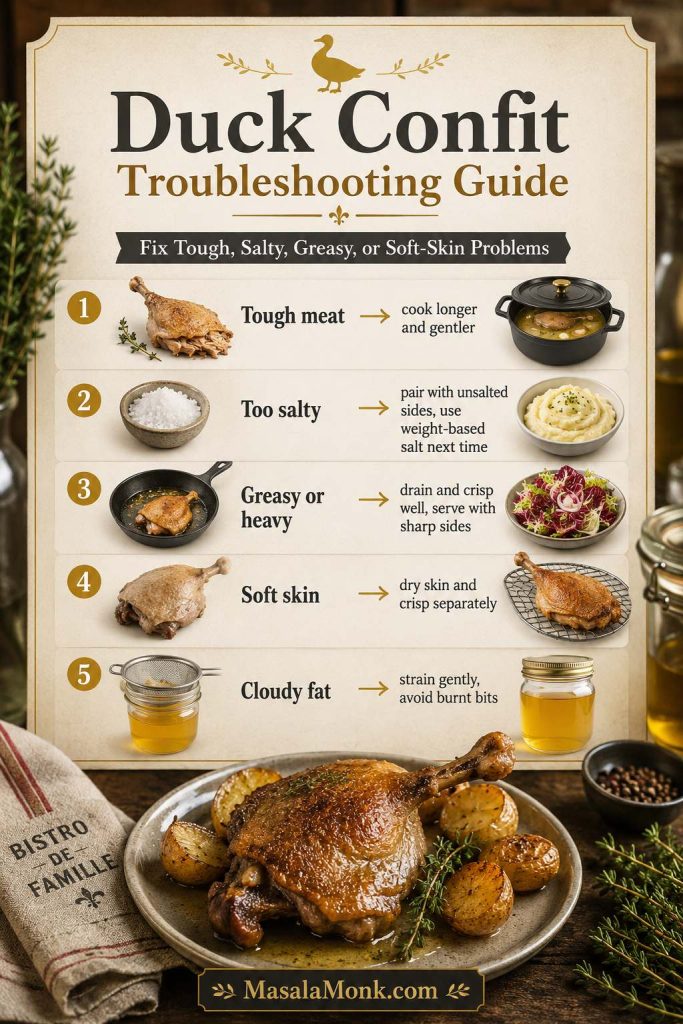
Duck Confit Recipe: Crispy Duck Legs, Easy Oven Method & Duck Fat Guide

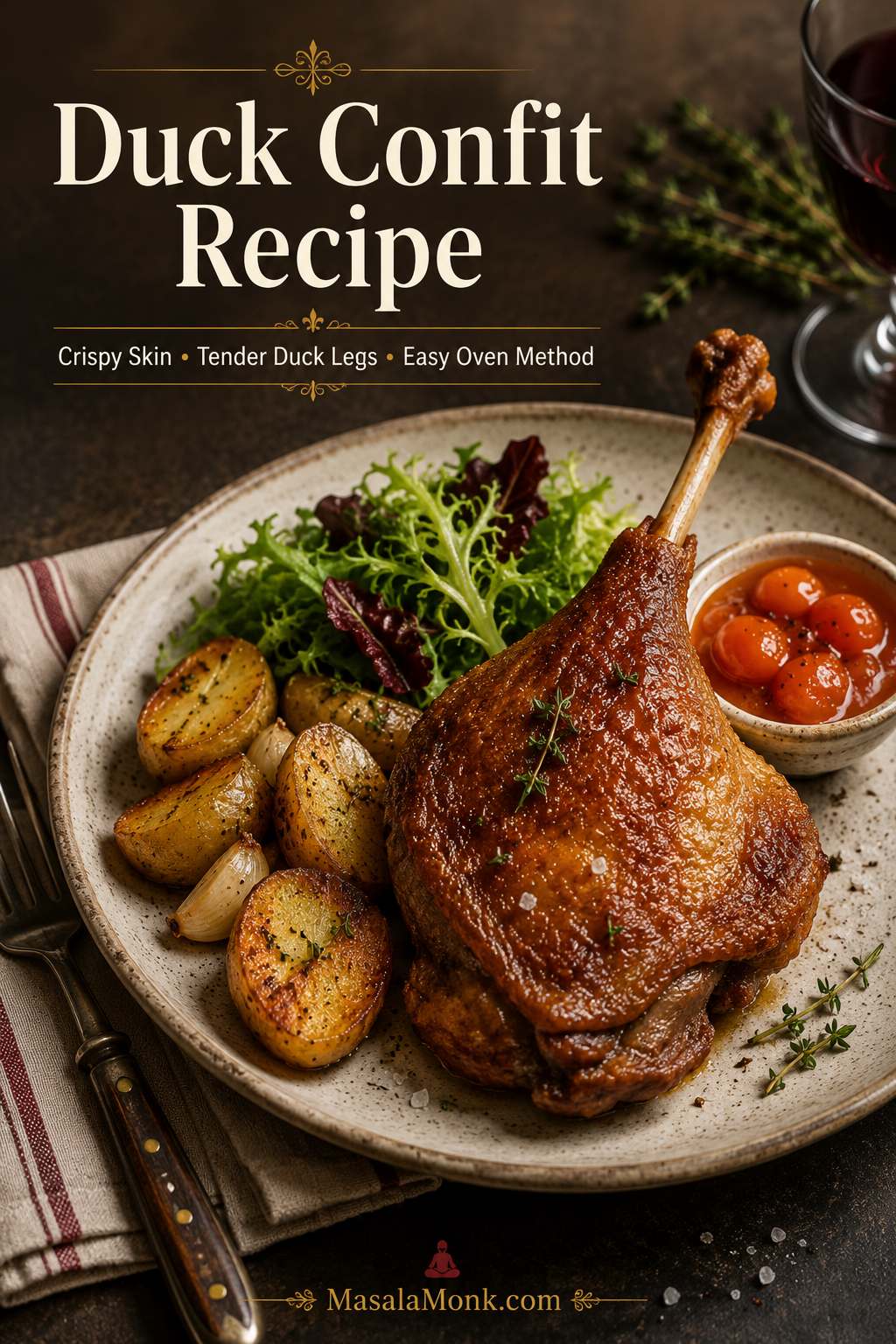
Crispy duck confit leg served with roasted potatoes, salad greens, and a small bowl of sauce.

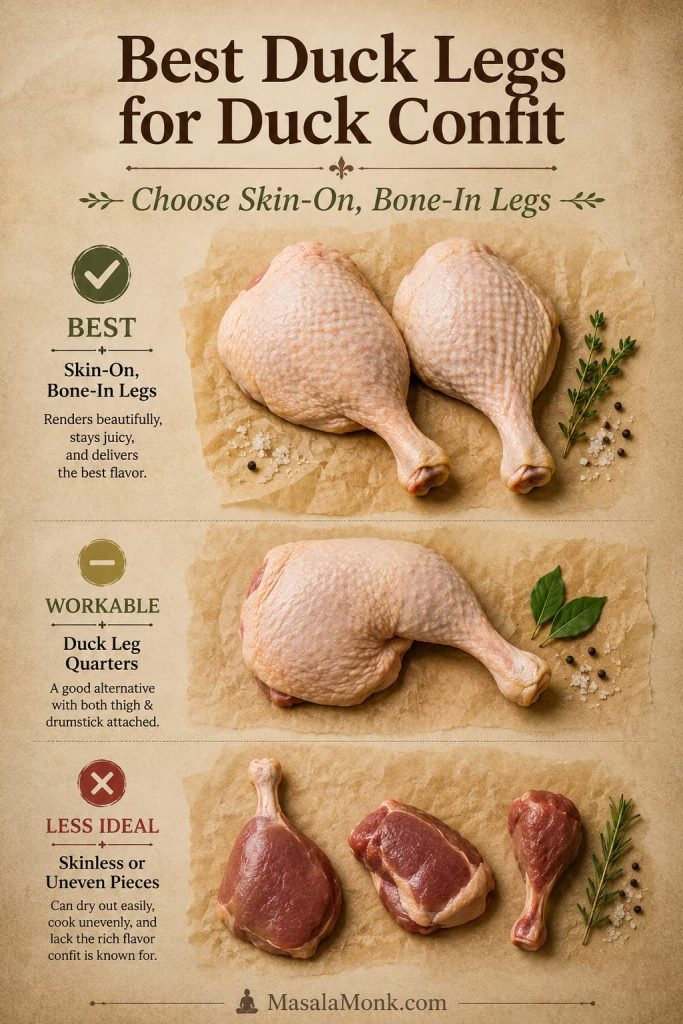
Duck confit sounds like the kind of dish that belongs in a French restaurant kitchen: heavy pans, jars of duck fat, a long wait, and someone at the stove who already knows exactly what “done” feels like. But the scary part is not really the cooking. It is the uncertainty: how much fat is enough, whether the cure will make the duck too salty, why the skin looks soft after hours in the oven, and whether the meat is tender enough before you try to crisp it.

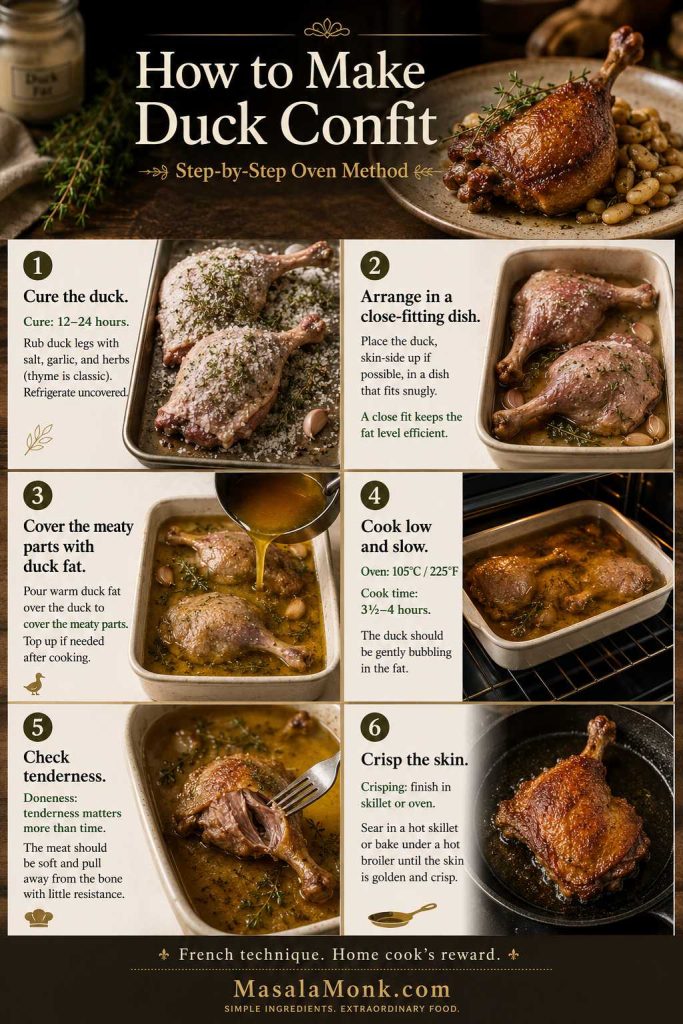
Once you understand the rhythm, the method becomes much less intimidating. You salt the duck legs, cook them slowly in fat until the meat turns silky, and then crisp the skin at the end. The slow cook is for tenderness. The final hot finish is for crackly skin. When those two jobs are separated, the recipe becomes calmer, more predictable, and much easier to repeat.

A Classic Oven Method Built for Home Cooks

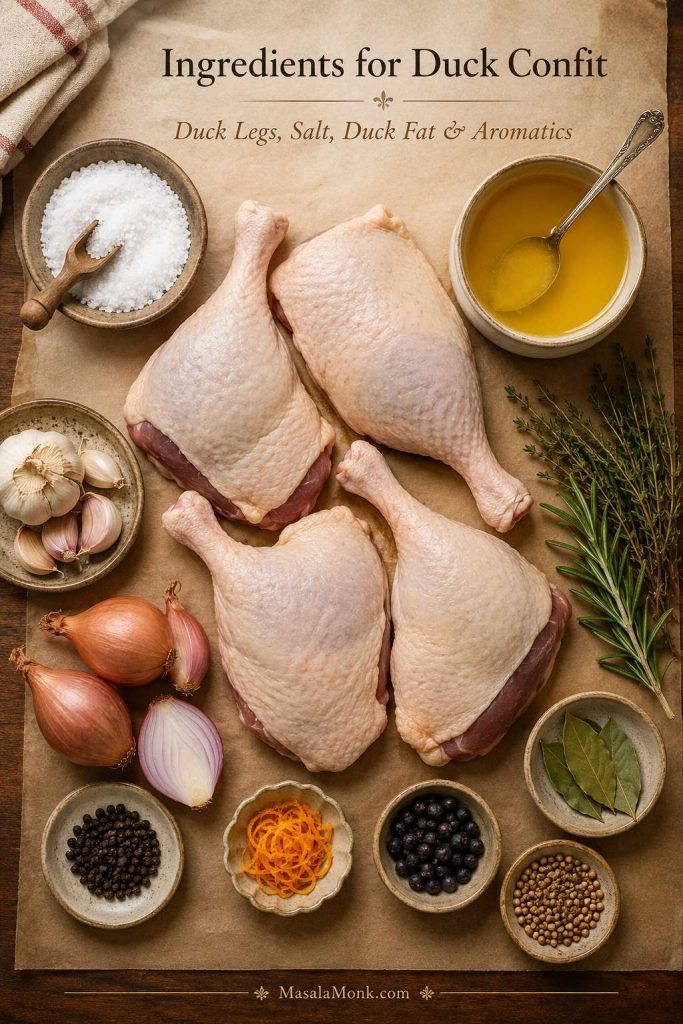
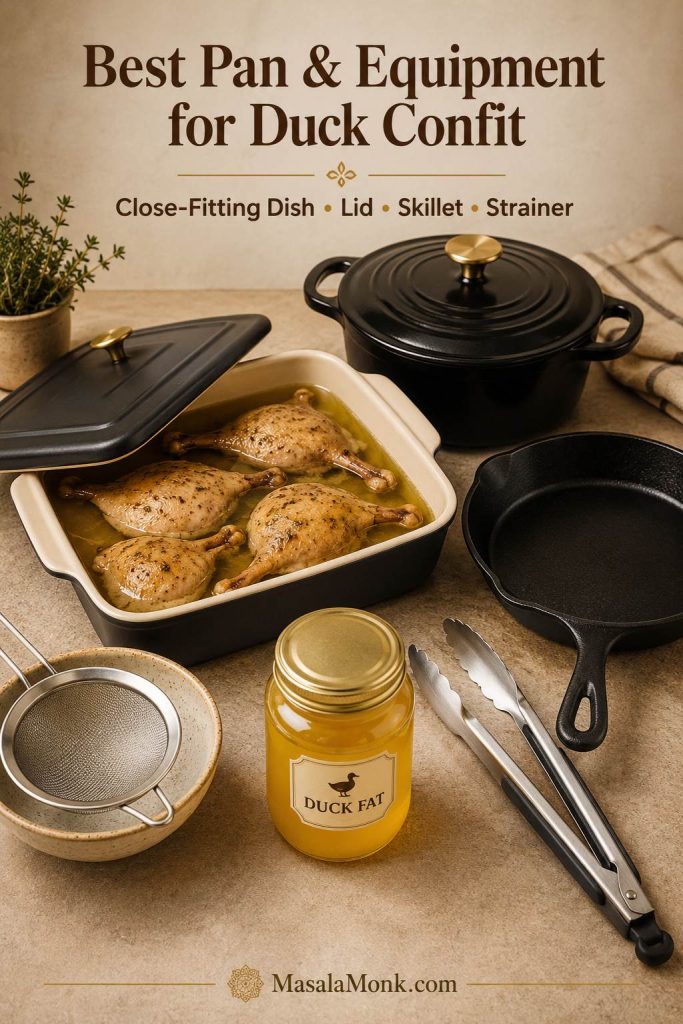
This duck confit recipe gives you a classic-style oven method first: skin-on, bone-in duck legs, a measured salt cure, aromatics, duck fat, a low oven, and a crisp golden finish. Then it walks you through the parts that usually make home cooks hesitate: duck fat, pan size, salt, tenderness, storage, and crisping the skin without drying the meat.

The finished leg should arrive at the table with crackly skin, tender meat that pulls easily from the bone, and enough savory duck fat left behind to make potatoes, mushrooms, eggs, beans, and vegetables feel like part of the reward.

This version is built for home cooks: classic enough to taste right, practical enough for a normal kitchen, and detailed enough that you always know whether the duck is on track.

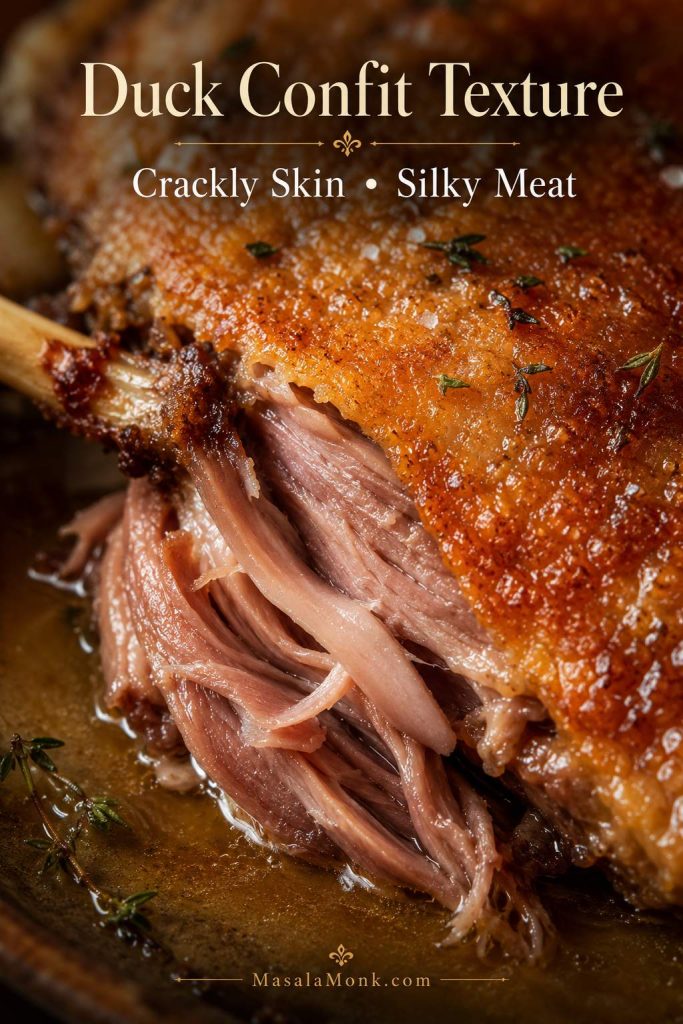
What duck confit should feel like: The slow cook is for tender meat, while the final heat is what makes the skin crackly.

Close-up of duck confit with crisp golden skin pulled back to show tender shredded meat underneath.
First, the slow oven cook makes the meat silky; then the final crisping step turns the skin golden, crackly, and deeply satisfying.

Quick Answer: The Most Reliable Duck Confit Method

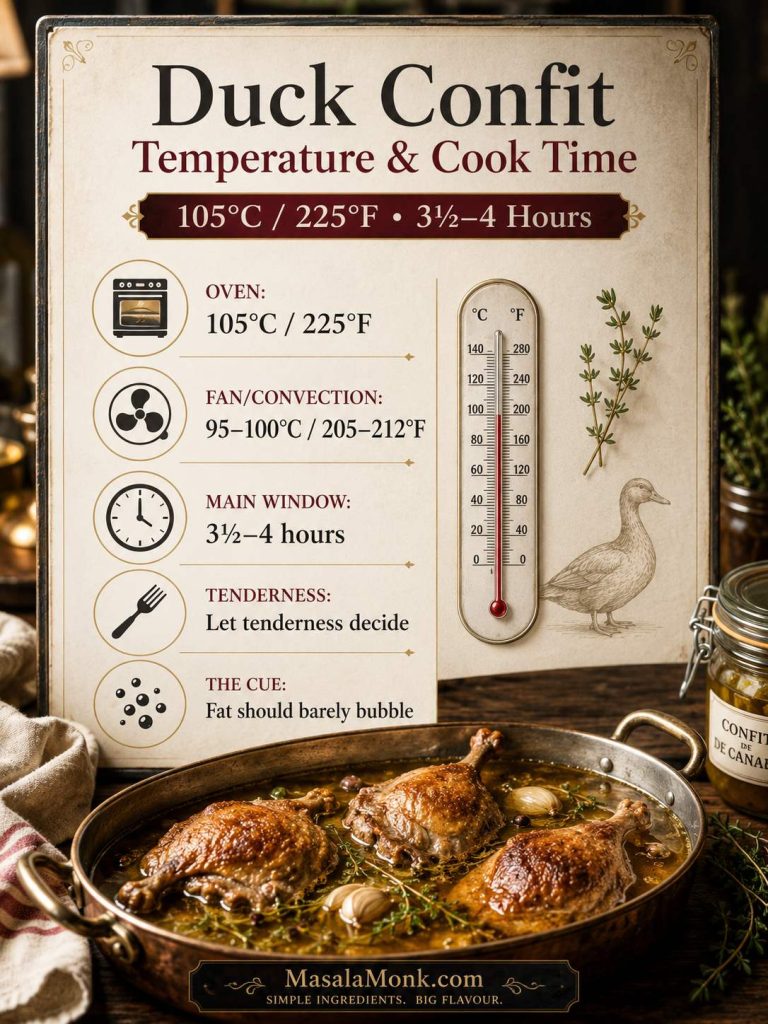
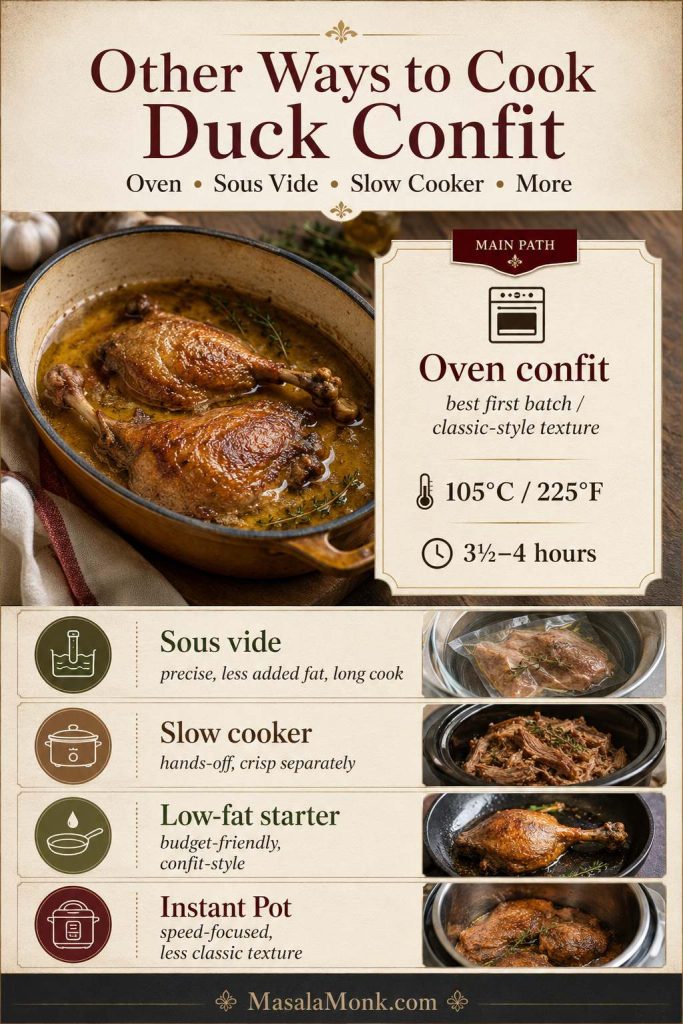
The most reliable way to make duck confit at home is to use skin-on, bone-in duck legs. Cure them with salt and aromatics for 12 to 24 hours, then cook them slowly in duck fat in a close-fitting dish at 105°C / 225°F for 3½ to 4 hours, until the meat is tender enough to pull easily from the bone. After that, lift the legs from the fat and crisp them skin-side down in a skillet or roast them in a hot oven until the skin turns golden.

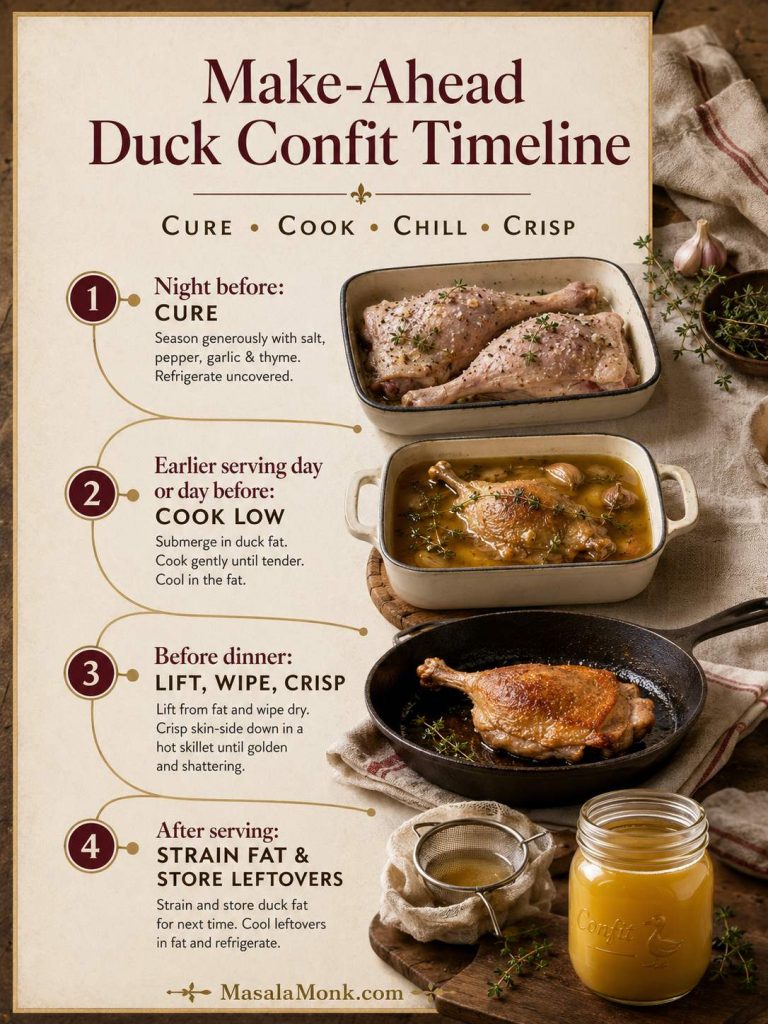
The full recipe card is below, but if you are cooking now, the oven method is the main path to follow. From start to table, duck confit usually takes overnight to about 1¼ days, but most of that time is inactive. The hands-on work is closer to 35–45 minutes, split between curing, arranging the duck, handling the fat, and crisping before serving.

Best path for most cooks: start with the oven method, the lower salt range, and the skillet crisp. Treat lower-fat or gadget methods as fallbacks after you understand the main method.

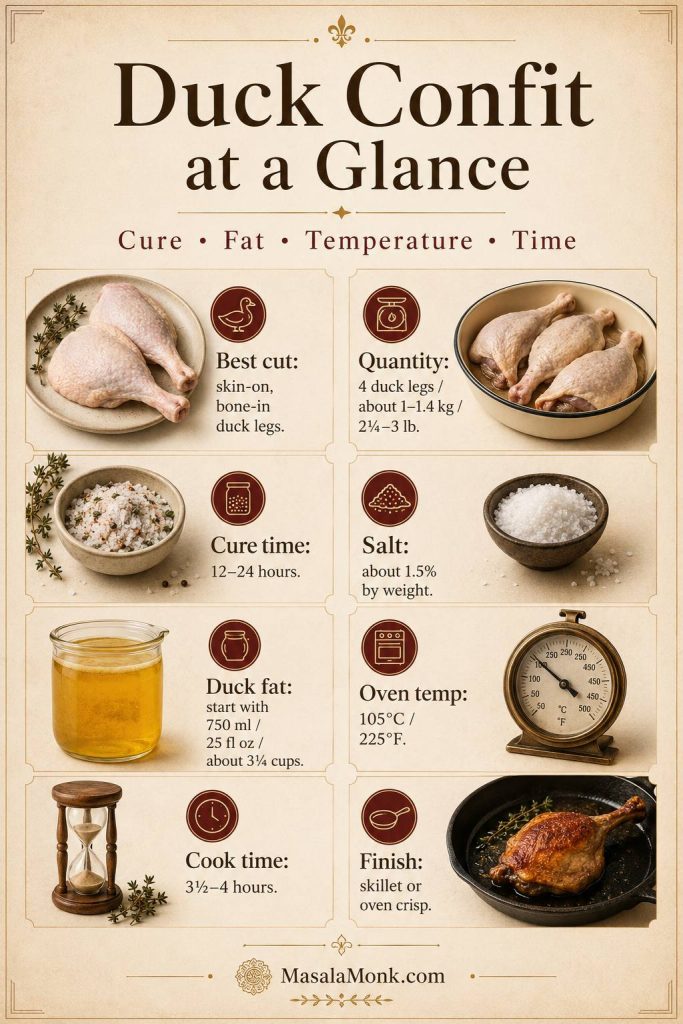
Duck Confit at a Glance

Best cutSkin-on, bone-in duck legs
ServingsPlan on 1 duck leg per person; very large legs can serve 2 lighter portions with sides
Quantity4 duck legs, about 1–1.4 kg / 2¼–3 lb total
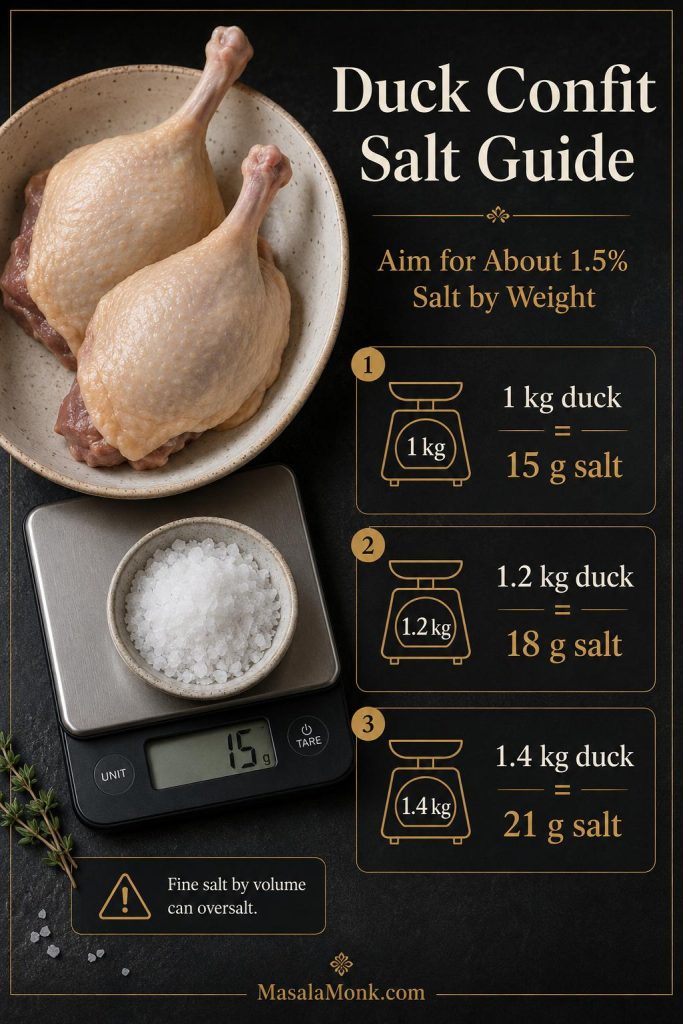
Salt guideAbout 1.5% of the duck’s weight, usually 15–21 g kosher salt for 4 legs
Cure time12–24 hours
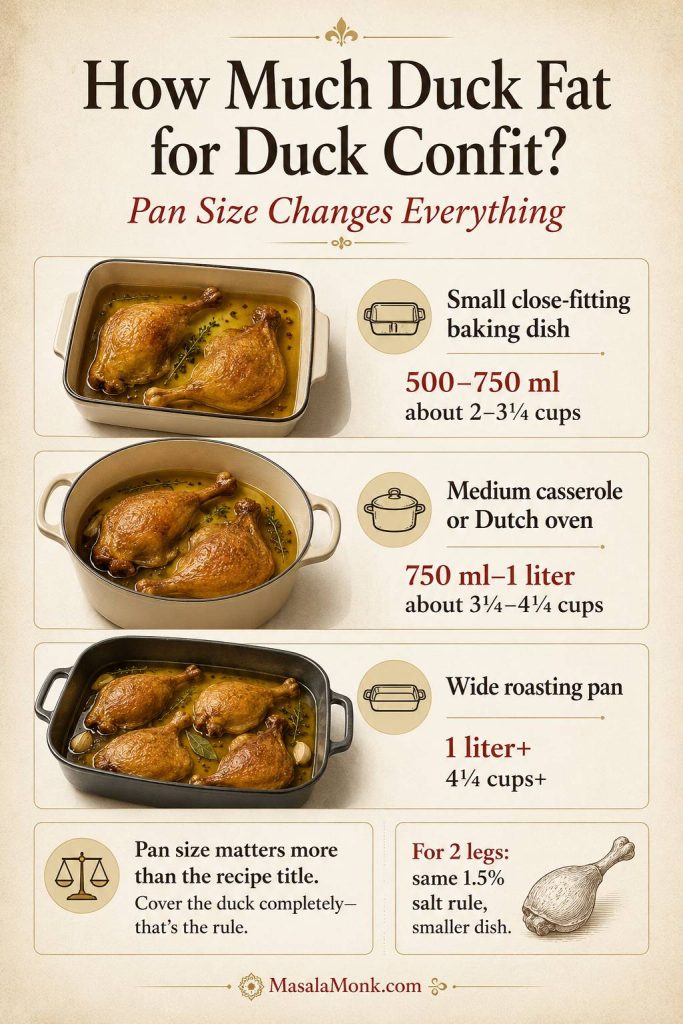
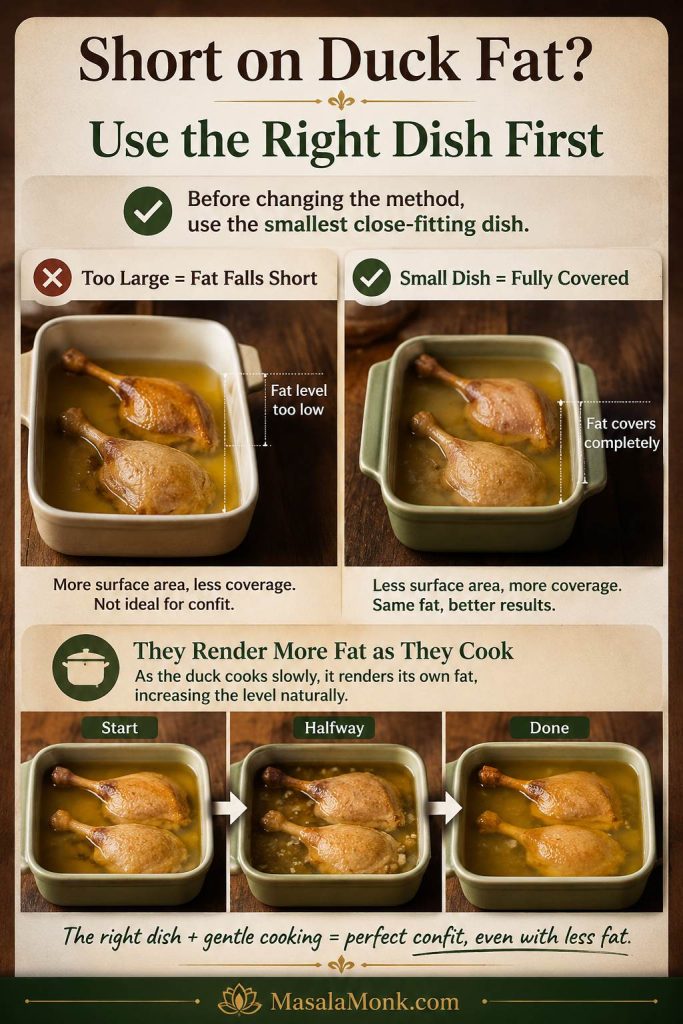
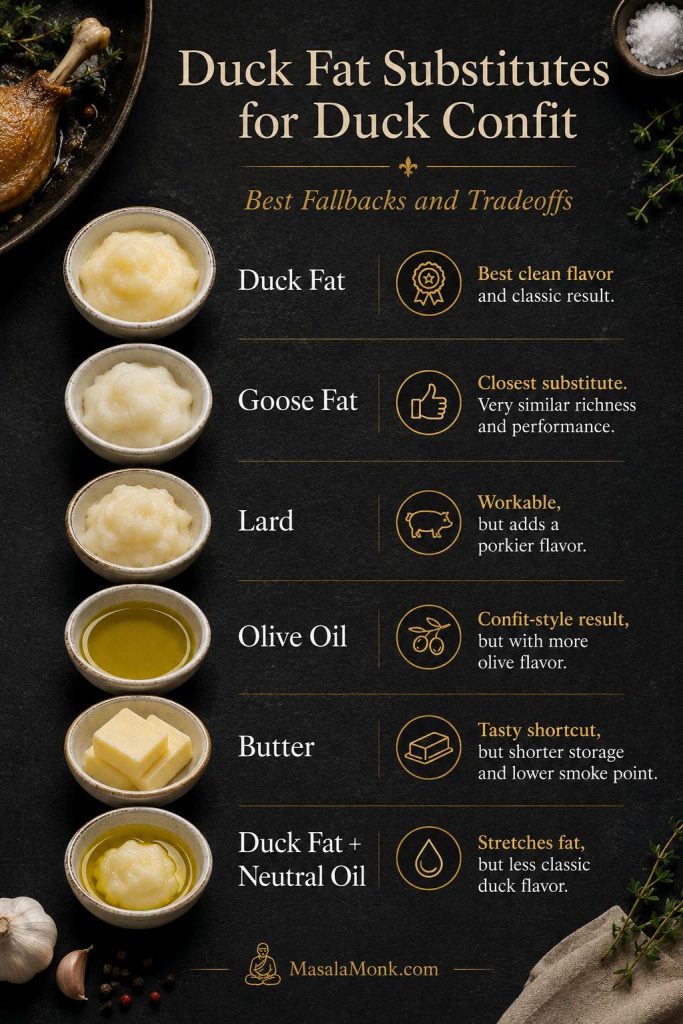
Duck fatStart with 750 ml / 25 US fl oz / about 3¼ cups; exact amount depends on pan size
Oven temperature105°C / 225°F, or about 95–100°C / 205–212°F for fan/convection ovens
Cook time3½–4 hours, or until very tender; fan ovens may need 30–60 minutes more
FinishSkillet crisp for the most controlled skin, or hot oven crisp for several legs
Total timeOvernight to 1¼ days, mostly inactive
Duck confit guide showing duck legs, salt, duck fat, oven temperature, cure time, cook time, and crisping method.
Before you start, these duck confit basics prevent confusion: measured salt, low oven heat, gentle fat coverage, and a final crisp for the skin.

Common mistakes to avoid: using a pan that is too wide, measuring fine salt by volume, letting the fat bubble hard, trying to crisp wet skin, and judging doneness only by time. Get those five things right, and the method becomes much calmer.

Success cues: after curing, the skin feels a little firmer; during cooking, the fat barely moves; when done, the leg feels loose and the meat pulls back slightly from the bone; after crisping, the skin is golden, dry, and crackly.

Why This Duck Confit Recipe Works

Good confit is not about complicated technique. Each stage has a clear job: the cure seasons the meat, low oven heat tenderizes it, duck fat protects it from harsh heat, and the final crisping step gives the skin that golden finish people remember. That contrast is the reason duck confit feels special: the meat is gentle and rich, while the skin gives you the crisp edge that keeps the whole plate from feeling heavy.

  • A measured salt cure seasons the legs deeply. Instead of a vague handful of salt, this recipe gives a weight-based range so the duck tastes seasoned, not aggressively salty.
  • Low oven heat keeps the cooking controlled. Duck legs need time for connective tissue to soften. A low oven lets that happen without the fat bubbling hard around the meat.
  • Duck fat surrounds the legs and regulates heat. The fat is not there to make the meat greasy. It creates a steady cooking environment.
  • A close-fitting pan reduces the amount of fat needed. Dish shape can save you from buying far more duck fat than necessary.
  • Crisping happens after the slow cook. Skin that looks soft after confit is normal; the skillet or hot oven creates the crackly finish right before serving.

What Is Duck Confit?

Duck confit is a classic method where duck legs are salted, slowly cooked in fat, and then crisped before serving. Traditionally, confit was also a preservation technique: the cooked duck was stored under a protective layer of fat. Today, most home cooks make it because it creates an incredible contrast of textures — deeply tender meat under crisp, golden skin.

The word confit can make the process sound complicated, but the actual cooking is quiet and controlled. You are not deep-frying the duck. You are cooking it slowly in warm fat, almost like a rich, careful braise. The fat surrounds the meat, protects it from harsh heat, and helps the connective tissue soften gradually.

This is a classic-style oven version, not a pressure-cooker shortcut or a duck breast confit. Those methods can work, but the main recipe here is built around duck legs, a salt cure, duck fat, low heat, and a final crisp.

Duck leg confit works so well because legs have more connective tissue than breast meat. Duck breast is better cooked quickly to medium-rare with crisp skin. For that style, see this duck breast recipe instead.

Duck Confit vs Roast or Braised Duck Legs

All three can be delicious, but they do not cook the same way. Roast duck legs go straight into dry oven heat, braised duck legs soften in liquid, and confit legs are slowly cooked in fat before they are crisped. That fat-cook-first, crisp-later rhythm is what gives the dish its silky meat and golden skin.

Ingredients for Duck Confit

The most reliable version does not need a long, intimidating ingredient list. Duck legs, salt, fat, and a few aromatics are enough. The aromatics should support the duck, not bury it.

Before you cure the duck: use this as a quick check: duck legs, measured salt, clean fat, and simple aromatics are doing most of the work.

Raw duck legs arranged with duck fat, salt, garlic, shallots, herbs, bay leaves, peppercorns, orange zest, and spices.
Duck confit uses a short ingredient list, but each part matters: duck legs bring collagen and fat, salt seasons deeply, and aromatics perfume the slow cook.

Duck Legs

Use 4 skin-on, bone-in duck legs, about 1–1.4 kg / 2¼–3 lb total. The skin is important because it becomes crisp at the end. The bone protects the meat and gives the finished legs a better texture.

If your duck legs are very large, expect the cooking time to sit closer to 4 hours. Smaller legs may be tender earlier, so start checking them after about 3 hours. The timer is useful, but tenderness is the real test.

Plan on one duck leg per person for a main course. If the legs are especially large and you are serving several sides, one leg can sometimes serve two lighter portions.

Duck leg buying visual: Skin-on, bone-in legs are the safest choice because they bring the fat, skin, bone, and connective tissue that make confit work.

Guide comparing skin-on bone-in duck legs, duck leg quarters, and less ideal skinless or uneven duck pieces.
For reliable oven duck confit, choose skin-on, bone-in duck legs of similar size so they cure, cook, and crisp more evenly.
  • Fresh or frozen both work. If using frozen duck legs, thaw them fully in the refrigerator before curing.
  • Choose similar sizes if possible. Legs that are close in size will cure and cook more evenly.
  • Keep the skin on. Skinless duck legs will not give you classic texture.
  • Fatty-looking legs are useful here. Some of that fat renders into the dish and can be strained for later cooking.
  • Skip pre-marinated duck legs. They may already be salty or sweetened, which makes the cure harder to control.

Duck Confit Salt Guide

Use about 1.5% salt by weight of the duck legs. That means about 15 g salt for 1 kg duck legs, 18 g for 1.2 kg, and 21 g for 1.4 kg. For most batches of 4 duck legs, 15–21 g kosher salt lands in the right range.

Duck confit salt guide with duck legs, kosher salt, a kitchen scale, and examples for 1.5 percent salt by weight.
A 1.5% salt cure gives you repeatable control, so the duck tastes seasoned and rich without becoming aggressively salty after resting.

Weighing the salt is better than using spoons because different salts vary dramatically by volume. Fine salt packs more tightly and tastes saltier by the spoonful, so use the lower end if you are not weighing.

For a gentler first try, use the lower end of the range and cure for 12 hours. You can always finish the cooked duck with a little flaky salt, but it is harder to fix a cure that was too heavy.

Duck Fat

Start with about 750 ml / 25 US fl oz / 3¼ cups rendered duck fat for 4 duck legs. You may need less if your pan is close-fitting, or more if your pan is wide. The exact quantity depends on the shape of your dish more than the recipe itself.

For the visual version, see the duck fat guide. Aim to cover the meaty parts with fat. Bone tips can poke out, and a tiny patch of skin above the fat is not a disaster. However, if a large patch of meat is exposed, switch to a smaller dish. If you cannot, turn the legs once halfway through cooking while they are still firm enough to handle.

Aromatics

For a classic but not fussy flavor, use garlic, shallots, thyme, rosemary, bay leaves, and black peppercorns. Orange zest, juniper berries, or coriander seeds are optional. They add a more restaurant-style aroma, but the recipe still works beautifully without them.

  • Garlic gives warmth and depth.
  • Shallots add gentle sweetness.
  • Thyme and rosemary give the duck a classic savory backbone.
  • Bay leaves add quiet background aroma.
  • Black peppercorns give mild spice without making the duck taste peppery.
  • Orange zest is optional, but especially good if you plan to serve the legs with orange sauce.

About the aromatics: use thyme, peppercorns, orange zest, juniper, or coriander in the cure. Use fresh garlic, thickly sliced shallots, bay leaves, rosemary, and more thyme in the cooking fat. Discard the wet cure aromatics before cooking, especially if they are covered in salt or moisture.

Equipment and Pan Size

You do not need restaurant equipment, but the right pan makes the whole recipe easier and cheaper because it reduces the amount of duck fat you need.

Best Pan and Equipment for Duck Confit

A close-fitting vessel is the key piece: it keeps the fat level higher around the legs and makes the rest of the equipment feel simple.

Duck confit equipment setup with a close-fitting baking dish, Dutch oven, skillet, strainer, tongs, and jar of duck fat.
The right pan saves both fat and stress: a close-fitting dish raises the duck fat level, keeps the legs close together, and makes the home oven method easier.
  • Close-fitting oven-safe baking dish, casserole, or small Dutch oven: the most important piece of equipment.
  • Lid, foil, or parchment: keeps the duck covered during the slow cook.
  • Tongs or a wide spatula: for lifting tender legs without tearing them.
  • Heavy skillet: for crisping the skin before serving.
  • Fine-mesh strainer and clean jar: for saving clean duck fat after cooking.

The duck legs should fit in one layer. They can sit close together, but they should not be piled on top of each other. A compact casserole or small Dutch oven usually works better than a wide roasting tray for a first batch.

  • Strongest choice: a small Dutch oven or compact ceramic baking dish.
  • Good choice: a medium casserole with a tight lid.
  • Use only if needed: a wide roasting pan, because it requires more fat.
  • Skip: shallow trays where the duck cannot be mostly covered.

A heatproof jug can make warm fat easier to pour, and a digital thermometer is useful if you want to check that the fat is staying low and steady. A nonstick skillet is helpful for crisping if you are nervous about the skin sticking or tearing.

How Much Duck Fat Do You Really Need?

Duck fat is usually the moment people pause — not because the recipe is hard, but because the jar looks expensive and the instructions often sound vague about how much you really need. This is the part worth making practical.

Recipes say “cover the duck with fat,” but that can mean very different amounts depending on the pan. The practical rule is simple: use the smallest oven-safe dish that fits the duck legs in a single layer without stacking them. A compact pan saves fat and keeps the duck more evenly covered.

Pan Size and Duck Fat Amount

Use this pan-size guide before buying more duck fat, because the same four legs can need very different amounts in different dishes.

Duck fat guide comparing a small baking dish, medium casserole or Dutch oven, and wide roasting pan with different fat amounts.
Duck fat needs change with the dish, not just the number of legs; a narrow pan raises the fat level and reduces waste.
Pan setupLikely duck fat needed for 4 legsMost useful for
Small close-fitting baking dish500–750 ml / about 2–3¼ cupsSaving duck fat
Medium casserole or Dutch oven750 ml–1 liter / about 3¼–4¼ cupsMost home batches
Wide roasting pan1 liter+ / 4¼ cups+Only when you have enough fat

This is usually the moment the recipe starts to feel less extravagant and more manageable: the duck does not need a dramatic pot of fat, just the right dish and enough quiet heat.

Scaling the recipe: for 2 duck legs, keep the salt at about 1.5% of the duck’s weight and use the smallest dish that fits them. For 6–8 legs, keep them in one layer or use two dishes. The fat amount changes with the dish, not just the number of legs, and the cook time still depends on tenderness.

How to Cure Duck Legs for Confit

The cure should feel controlled, not like you are packing the duck in salt. You are seasoning the meat deeply and giving the surface time to firm slightly before the slow cook.

What the Cure Should Look Like

The surface should look evenly seasoned, with aromatics adding flavor rather than burying the duck under salt.

Raw duck legs in a baking dish being sprinkled with salt, herbs, peppercorns, bay leaves, and orange zest.
Curing duck legs should feel measured, not intimidating: salt seasons the meat while herbs, bay, pepper, garlic, and citrus add quiet background flavor.
  1. Pat the duck legs dry. Moisture on the surface makes the cure less even.
  2. Rub with salt. Use about 1.5% salt by weight, or 15–21 g kosher salt for 4 duck legs, depending on their total weight.
  3. Add cure aromatics. Use thyme, peppercorns, optional orange zest, and optional juniper or coriander here if you like.
  4. Cover and refrigerate. Cure for 12–24 hours.
  5. Remove excess cure. Wipe off aromatics and visible salt. Rinse only if there are clumps of salt or the cure looks heavy.
  6. Dry very thoroughly. If you have time, let the legs sit uncovered in the refrigerator for 30–60 minutes after wiping or rinsing. The drier the surface, the cleaner the cooking fat and the better the final crisping.

For most home cooks, 12 hours gives balanced seasoning and 24 hours gives deeper flavor. A 1–2 hour cure can work for shortcut versions, but for this recipe, 12–24 hours is the safest and most balanced range. For a first batch, choose 12 hours and the lower salt range.

How to Make Duck Confit in the Oven

Start with this oven method if this is your first batch. It gives you the most reliable balance of classic texture, steady heat, and kitchen sanity. Once the legs are in the fat and the oven is low, your job is mostly to leave them alone.

The duck cooks at 105°C / 225°F for 3½ to 4 hours, then gets crisped at the end. If you are using a fan or convection oven, reduce the temperature to about 95–100°C / 205–212°F and check the fat after the first hour. The fat is right when it barely bubbles instead of boiling hard.

Duck confit recipes vary because oven temperature, pan shape, leg size, and how deeply the meat is submerged all change the timing; use 3½–4 hours as the main window, but let tenderness decide.

Before you start the oven method: this step-by-step image shows the full rhythm: cure, arrange, cover with fat, cook low, test tenderness, and crisp.

Step-by-step duck confit guide showing curing, arranging in a close dish, adding duck fat, slow cooking, checking tenderness, and crisping.
The oven method works because each stage has one job: season the duck, cook it gently in fat, test tenderness, and crisp only at the end.

Duck Confit Temperature and Cook Time

The low oven target keeps the fat calm; the clock gives you a window, but tenderness still decides the finish.

Duck confit temperature guide showing 105°C or 225°F, fan oven adjustment, 3½ to 4 hour cook time, and tenderness cues.
The 105°C / 225°F oven target keeps the fat calm, but real cook time still depends on leg size, dish shape, and fat depth.

Step 1: Melt the Duck Fat

Warm the duck fat just until liquid. It only needs to be fluid enough to pour around the duck legs. If it is hot enough to sputter, it is hotter than it needs to be.

Step 2: Arrange the Duck in a Close-Fitting Dish

Place the cured, dried legs in the smallest oven-safe dish that holds them in one layer without stacking. Add fresh garlic, thickly sliced shallots, bay leaves, rosemary, thyme, and peppercorns around the legs. Discard the wet cure aromatics rather than carrying all of that salt and moisture into the cooking fat.

Step 3: Cover with Duck Fat

Pour warm fat over the legs until the meaty parts are mostly submerged. If you are just short, press a piece of parchment directly over the duck before covering the dish. This helps keep the legs tucked under the fat. If a large patch of meat remains exposed, move everything to a smaller dish or check the short-on-duck-fat guide before adding more fat.

Step 4: Cover and Cook Low

Cover the dish with a lid, foil, or parchment plus foil. Cook at 105°C / 225°F for 3½ to 4 hours. Keep the fat nearly still, with only a few lazy bubbles at the edges. Hard bubbling means the heat is too aggressive.

What the Fat Should Look Like During the Slow Cook

This is the visual cue to watch for: the fat should be warm and quiet, not boiling around the duck.

Duck legs cooking gently in golden duck fat with garlic, shallots, bay leaves, thyme, and only a few small bubbles.
During the slow cook, the duck fat should barely bubble. Hard bubbling means the oven heat is too aggressive for silky confit texture.

Step 5: Check for Tenderness

Use the timer as a checkpoint; tenderness decides when the duck is ready. The legs are done when the meat offers almost no resistance when pierced, the joint bends easily, and the meat starts to pull back from the bone.

If the meat still feels tight, use the doneness cues and give it more time. This method is forgiving when the heat is low and steady. It is much better to cook the legs a little longer in quiet fat than to pull them before the connective tissue has softened.

Step 6: Cool in the Fat or Crisp Right Away

If serving immediately, lift the legs carefully from the fat and let the excess drip away before crisping. If making ahead, cool them until they are no longer steaming, transfer to a clean container with enough fat to cover, and refrigerate promptly. Move the duck and fat into shallow storage once they are no longer steaming so they chill faster.

How to Know It Is Done

This dish is done by texture, not by a neat internal temperature target. The legs need enough time for connective tissue to soften. That is why the most useful cues are physical.

How to Know Duck Confit Is Done

Look for looseness, not drama: the leg should bend easily and the meat should give way without force.

Cooked duck confit leg being tested with a fork, with tender meat, exposed bone, and a small close-up of pulled meat.
A done duck confit leg should feel relaxed: the joint loosens, the meat pulls from the bone, and a fork meets very little resistance.
  • Meat offers almost no resistance when pierced with a skewer or small knife.
  • At the joint, the leg bends easily.
  • You may see the meat pull back slightly from the bone.
  • A fork can loosen the meat without force.
  • The skin may still look soft and pale; that is normal before crisping.

If the meat still feels tight, return the legs to the fat and cook for another 30–45 minutes. Because the heat is low, an extra half hour is usually safer than serving duck that has not fully relaxed.

How to Crisp the Skin

The crisping step is where the recipe starts to feel special. The meat is already cooked; you are not trying to cook the duck again. You are slowly waking up the skin.

Before crisping, lift the legs from the fat and wipe away any thick clinging fat from the skin. Let them drain on a rack for a few minutes if they look especially glossy. Skin that is wet or coated in too much fat will take longer to crisp and may brown unevenly.

For the crispest skin, make the legs ahead, chill them in the fat, then lift, wipe, and crisp when cool or cold. The skin is easier to handle once the fat has set, and it is less likely to tear in the pan.

Crisp the legs as close to serving as possible. The meat can wait in the fat, but the skin is at its best within minutes of crisping.

How to Crisp Duck Confit Skin

The slow cook is already done, so the final heat should focus on dry skin, steady browning, and a crisp finish right before serving.

Duck confit crisping guide showing one leg in a skillet and several legs on a rack in the oven.
The duck is already cooked, so crisping is only about texture: dry the skin first, then use a skillet or hot oven until it turns deeply golden.

Most Reliable Method: Skillet Crisp

Place the legs skin-side down in a heavy skillet or nonstick skillet over medium heat. Cook for 6–10 minutes, or until the skin is crisp and deeply golden. Nonstick is especially forgiving if you are nervous about the skin sticking or tearing.

If the skin seems stuck, it usually needs more time. Once enough fat renders, it loosens more easily. Let it crisp until it naturally releases from the pan; this is a patience step, not a high-heat step.

This is where the quiet, slow recipe finally turns dramatic.

Hands-Off Method: Hot Oven Crisp

Place the legs on a rack set over a tray and roast at 200°C / 400°F for 20–30 minutes, until the skin is crisp and the meat is hot. This method is useful when cooking several legs at once.

Fast Finish: Broiler or Grill

A broiler or grill can help finish stubborn skin, but use it carefully. Duck skin can go from golden to burnt quickly. Keep the legs several inches from the heat and watch closely for the last 2–5 minutes.

If You Are Short on Duck Fat

Classic confit uses rendered duck fat because it gives the cleanest, fullest flavor. However, if the price of duck fat is the only thing stopping you, you can still make a useful confit-style version. Duck fat is still the best choice for clean flavor and silky meat, while substitutes are practical fallbacks when budget or availability gets in the way.

When the Duck Fat Looks Too Low

A compact dish is often the difference between exposed meat and good coverage, especially when you are trying to avoid buying another jar of fat.

Comparison showing duck legs in a large dish with low fat coverage and a smaller dish where the fat covers the meat better.
When duck fat looks low, the fix is often simple: move the legs into a snug dish so the fat surrounds more of the meat.

A small amount of duck fat can still work when the dish is compact enough, because the legs will render more fat as they cook. Some easy confit-style methods add a small splash of water or stock at the beginning to prevent scorching while the fat renders. This can be delicious, but it is closer to a confit-style braise than full duck-fat confit.

Duck Fat Substitutes for Duck Confit

Substitute fats can help when duck fat is expensive or unavailable, but the flavor and storage behavior will not be exactly the same.

Comparison of duck fat, goose fat, lard, olive oil, butter, and duck fat mixed with neutral oil for duck confit.
Duck fat gives the cleanest classic flavor, but goose fat, lard, olive oil, butter, or mixed fats can work when you understand the tradeoffs.
Fat optionHow it worksTradeoff
Duck fatClassic choice with the cleanest duck flavorMost traditional, but can be expensive
Goose fatClosest substitute if duck fat is unavailableRich and poultry-friendly, but not identical
LardWorks as a cooking fatAdds a porkier flavor
Olive oilCan create a confit-style resultFlavor becomes more olive-oil-forward
ButterTasty shortcut when duck fat is unavailableContains water and milk solids, so storage is shorter
Duck fat + neutral oilCan stretch a small amount of duck fatLess classic flavor; treat leftovers conservatively

If using butter, strain and store the leftover fat separately and treat the cooked duck like normal leftovers rather than traditional fat-preserved confit.

Other Ways to Cook Duck Confit

Once you understand the oven method, the shortcuts and gadget versions are easier to judge. These are useful when they solve a real problem — less duck fat, less oven time, or more hands-off cooking — but they should not distract from the main method if this is your first batch.

Method comparison visual: The oven method stays the main path here, while the other approaches are practical alternatives for specific kitchens.

Duck confit method guide comparing oven confit with sous vide, slow cooker, low-fat starter, and Instant Pot approaches.
Oven duck confit is the best first path for classic texture, while sous vide, slow cooker, low-fat, and pressure-cooker versions solve different kitchen problems.
MethodBest forTradeoff
Oven confitFirst batch and silky meat with crisp skinNeeds enough fat and time
Sous videLess added fat and precise temperatureLong cook; no traditional fat storage
Slow cookerHands-off tendernessSkin must be crisped separately
Low-fat starterBudget cooking or limited duck fatMore confit-style braise than classic confit
Instant PotSpeed-focused experimentLess classic texture and control

Make-Ahead Timeline

This is one of those dishes that rewards planning ahead. You do not need to stand over the stove all day; you just need to give the cure and slow cook enough time to do their work.

How the timing works: the cure and slow cook are mostly inactive, while the final crisping happens just before serving.

Make-ahead duck confit timeline showing curing, cooking low, crisping before dinner, and straining duck fat after serving.
Duck confit rewards planning because most of the work is inactive; after the legs are cooked, the final crisping step makes them taste freshly finished.
WhenWhat to do
Night before or up to 24 hours before servingSalt-cure the duck legs with aromatics.
Earlier on serving day or the day beforeCook the legs slowly in duck fat until tender.
Before dinnerLift the chilled legs from the fat, wipe the skin well, and crisp.
After servingStrain the fat, store leftovers, and save clean duck fat for later cooking.

What to Serve with Duck Confit

Because the legs are savory and full-flavored, the best sides either absorb the duck juices, cut through the fat, or add a little sweetness and acidity. You do not need many sides. One potato or bean dish, one bright salad or vegetable, and one sauce are enough.

My favorite way to serve it is simple: one crisp leg, potatoes that have met a spoonful of duck fat, a bitter green salad with a sharp dressing, and a small spoon of orange or cherry sauce. That plate gives you richness, crunch, acidity, and enough restraint that the duck remains the reason everyone is at the table.

The best plate gives you crackly skin, tender meat, something starchy, and something sharp enough to make you want the next bite.

How to build the plate: use the sides to balance the richness: something starchy, something green or sharp, and a sauce that wakes up the plate.

Duck confit served with roasted potatoes, bitter greens, beans or lentils, red cabbage, and several sharp sauces.
Because duck confit is rich, the best sides either absorb fat, add freshness, or bring acidity through potatoes, greens, beans, cabbage, or sharp sauces.

Easy Plate Ideas

  • Bistro-style plate: one crisp duck leg, duck fat potatoes, bitter greens, and orange or cherry sauce.
  • Rustic plate: duck confit with white beans, braised cabbage, and mustard vinaigrette.
  • Lighter plate: crisp duck over lentils, herbs, and something cold and sharp, such as a simple cucumber salad.
  • Cold-weather plate: duck legs with potatoes, roasted carrots, and a red wine or cherry sauce.

Potatoes, Beans, and Starches

  • Duck fat potatoes — the most obvious and probably the most memorable pairing.
  • Mashed potatoes — if you want a softer side, these garlic mashed potatoes give the duck a creamy, buttery base.
  • White beans — especially with garlic, herbs, and a little stock.
  • Lentils — earthy, simple, and excellent with full-flavored duck.
  • Potato salad — for a make-ahead side, choose a mustardy or vinegar-leaning potato salad rather than a very heavy creamy one.

Vegetables and Greens

  • Bitter greens such as arugula, frisée, endive, or radicchio.
  • Braised cabbage, especially red cabbage with a little vinegar.
  • Roasted carrots with herbs or citrus.
  • Green beans with garlic and lemon.
  • Mushrooms sautéed in a little duck fat.
  • Lemony chickpea salad if you want the meal to feel fresh but still filling.

Sauces and Fruit Pairings

The dish does not need a heavy sauce, but a small spoonful of something sharp, fruity, or winey can make the plate feel complete. Orange sauce is a classic pairing; this orange sauce for duck works especially well if you use orange zest in the cure.

Choose orange or cherry sauce for a sweet-sharp plate, red wine sauce for a deeper dinner-party feel, mustard vinaigrette for a lighter salad-style plate, and plum sauce if you want a sweeter, fruitier direction. For a cheese-board-style plate, a small spoon of fig jam can work beside crisp duck, bitter greens, and something salty.

Recipes Using Duck Confit

The quiet advantage of duck confit is that tomorrow’s dinner is already halfway done. Once the duck is cooked, the meat can be shredded and folded into quick meals that taste far more luxurious than the effort involved.

Best Ways to Use Leftover Duck Confit

A small amount of shredded duck can carry a whole meal, especially when it is crisped briefly before being folded into pasta, beans, hash, or salad.

Leftover duck confit used in pasta, potato hash with egg, salad, tacos, and beans.
Leftover duck confit is powerful in small amounts; fold it into pasta, hash, salad, tacos, or beans to make simple meals taste rich and restaurant-worthy.

To use leftover duck confit, lift the meat from the fat, remove the bone, shred the meat, and crisp it in a skillet with a spoonful of duck fat. Add it near the end of cooking so it stays savory and textured instead of disappearing into the dish.

The easiest wins are pasta, hash, beans, and salads because they let a small amount of shredded duck flavor the whole dish.

  • Pasta with duck confit: toss shredded duck with garlic, mushrooms, herbs, and a little pasta water.
  • Warm duck salad: serve crisp shredded duck over bitter greens with a sharp vinaigrette.
  • Potato hash with duck confit: crisp potatoes in duck fat, then add shredded duck and herbs.
  • Crispy duck tacos: crisp the shredded meat and serve with pickled onions.
  • Grilled cheese with duck confit: use a small amount of shredded duck with sharp cheese and mustard.
  • White beans with duck confit: fold the meat into white beans with garlic, thyme, and stock.
  • Ramen with duck confit: add shredded duck to broth, noodles, greens, and a soft egg.
  • Crisp duck over fries: for an occasional comfort-food plate, pile crisp shredded duck over hot fries and add a sharp sauce or pickled onions.

What to Do with Leftover Duck Fat

Leftover duck fat is part of the reward. Strain it, chill it, and use it wisely. It turns ordinary potatoes into something memorable and adds depth to vegetables, eggs, mushrooms, beans, and seared meats.

Best Uses for Leftover Duck Fat

Clean, strained duck fat is worth saving because even a spoonful can make simple vegetables, eggs, or beans taste richer.

Jar of clean golden duck fat surrounded by roast potatoes, eggs, mushrooms, cabbage, green beans, roasted vegetables, strainer, and jars.
After cooking, strain and chill the leftover duck fat; then use small spoonfuls to add deep savory flavor to potatoes, eggs, mushrooms, cabbage, beans, and vegetables.
  • Strain it through a fine-mesh sieve while warm, not scorching hot.
  • Remove spent aromatics such as herbs, garlic, shallots, bay leaves, and peppercorns before storing the fat.
  • Let juices settle if the fat looks cloudy; watery juices can collect underneath.
  • Separate the clean fat from the juices after chilling if a darker layer settles at the bottom.
  • Store in a clean jar in the fridge.
  • Use clean utensils each time you scoop fat out.
  • Do not pour hot fat down the sink. Let unwanted fat solidify, then discard it properly.

After chilling, clean fat will set on top and darker juices may settle underneath. The pale solid layer is fat. The darker layer underneath is meat juice, salt, and aromatics. Save the clean fat for cooking; use the darker juices quickly in beans, pan sauce, or gravy, or discard them.

Use duck fat for roast potatoes, fried eggs, mushrooms, cabbage, beans, carrots, Brussels sprouts, and pan-seared meats. Discard it if it smells off, looks moldy, or has been contaminated with crumbs or meat juices over time.

Storage, Freezing, and Reheating

This is one of those dishes that rewards making ahead, but home storage should be handled carefully. Traditional confit was preserved under fat, but modern kitchens vary in cleanliness, temperature control, salt levels, and handling. This recipe is written as a modern dinner recipe, not a long-term preservation project.

The fat helps protect the texture, but this recipe uses a regular salt cure, not curing salt for long-term preservation. In a home kitchen, it is safest to treat the cooked legs like cooked poultry unless you are deliberately following a tested preservation method. Once the duck and fat are no longer steaming, move them into shallow storage so they cool evenly and safely.

Storage visual guide: This image keeps the storage advice modern and safe: chill promptly, store airtight, freeze when needed, and crisp after reheating.

Duck confit storage guide showing a refrigerated container, freezer bag, reheating pan, crisping skillet, date labels, and safety notes.
For home cooks, duck confit should be treated as cooked food, not shelf-stable preservation: cool promptly, store airtight, freeze if needed, and crisp after reheating.

How Long to Store Duck Confit

For normal home storage, refrigerate the cooked legs for 3–4 days. When in doubt, freeze instead of stretching fridge storage.

SituationBest methodNotes
Normal cooked duck confitRefrigerate 3–4 daysKeep covered and chilled
Traditional fat-covered storageOnly for careful cooks using very clean containersFor everyday home cooking, use 3–4 days or freeze
Low-fat or butter shortcut versionTreat as normal cooked duckUse 3–4 days in the fridge; do not rely on long fat-covered storage
FreezingFreeze up to 3 monthsFreeze with some fat to protect the meat
Reheating whole legsSkillet or ovenReheat slowly, then crisp the skin
Reheating shredded meatSkillet with a little duck fatBest for pasta, hash, tacos, and beans

How to Reheat Without Losing Crisp Skin

For best texture, skip the microwave for whole legs. The meat may warm, but the skin will turn soft. If you are shredding the duck for pasta or hash, reheating in a skillet with a little duck fat is much better.

When storage feels uncertain — especially if the duck cooled slowly or sat out longer than planned — treat it like cooked poultry and follow standard leftovers guidance rather than relying on old-style confit storage. The USDA leftovers and food safety guide is a useful reference.

Duck Confit Troubleshooting

If something goes wrong, start here; this section is also worth checking before you change the oven temperature, salt, or pan. Most duck confit problems are fixable because the cooking is slow.

How to Fix Common Duck Confit Problems

Most problems point back to the same few causes: salt, heat, pan size, surface moisture, or how the fat was strained.

Duck confit troubleshooting guide showing fixes for tough meat, too salty duck, greasy texture, soft skin, and cloudy duck fat.
Most duck confit problems are fixable: cook tough meat longer, balance salt with plain sides, drain excess fat, dry the skin, and strain cloudy fat gently.
ProblemLikely causeFix nowFix next time
Duck is too saltyCure was too long, or fine salt was used by volumeServe with unsalted potatoes, beans, lentils, or bitter greensWeigh the salt and use a shorter cure
Meat is toughDuck was not cooked long enoughReturn to the fat for 30–45 minutesCook to tenderness, not just time
Meat is dryFat was too hot or bubbling hardServe with sauce or shred into pasta/beansLower the oven temperature and keep the fat barely moving
Final duck tastes greasyToo much fat clinging to the skin before crispingWipe the skin and drain on a rack after crispingLet excess fat drip off before skillet or oven finishing
Skin will not crispSurface is wet or coated with too much fatWipe well and crisp skin-side down in a skilletChill uncovered or wipe very well before crisping
Skin browns but stays softHeat is too high or the skin is still dampLower heat and keep cooking skin-side downDry the legs better before crisping
Skin tearsMoved too soon or pan was too hotLet the rest of the skin release naturallyUse medium heat and wait before turning
Not enough duck fatPan is too wideMove duck to a smaller dishChoose a compact dish from the start
Fat looks cloudyMoisture and juices mixed into the fatStrain, chill, and separate carefullyStore clean strained fat separately from juices

Duck Confit FAQs

Is duck confit hard to make?

Not really. Duck confit asks for time more than skill. Most of the recipe is inactive: salt the legs, let them rest, cook them slowly in fat, then crisp the skin before serving.

Which cut of duck is best for confit?

Skin-on, bone-in legs are the cut to buy because they have the fat, skin, bone, and connective tissue that make confit work. Duck breast is better cooked quickly and is not the classic cut for confit.

How much duck fat do I really need?

For 4 duck legs, start with about 750 ml / 25 US fl oz / 3¼ cups rendered duck fat, but pan size matters more than the number. A compact dish may need less, while a wide roasting pan may need much more.

Does duck confit need to be fully submerged in fat?

The meaty parts should be covered by fat for the most even cooking. Bone tips or a very small patch of skin can sit above the fat, especially if you use parchment and a tight cover. If too much meat is exposed, move the legs to a smaller pan before adding more fat.

What temperature should duck confit cook at?

This recipe uses 105°C / 225°F for 3½–4 hours. For fan or convection ovens, reduce the temperature to about 95–100°C / 205–212°F. The goal is low, steady heat: the fat should barely bubble, not boil aggressively.

Why is my duck confit not crispy?

Soft skin after the slow cook is normal — the crisping happens at the end, not during the fat cook. Wipe away excess fat, use medium heat, and give the skin enough time in the pan before moving it.

Can I make duck confit without duck fat?

You can make a confit-style duck leg with goose fat, lard, olive oil, butter, or a mix of duck fat and neutral oil, but duck fat gives the cleanest classic flavor. Treat substitute-fat versions like normal cooked leftovers rather than long fat-preserved confit.

Can I make duck confit with only 2 legs?

Yes. Keep the salt at about 1.5% of the duck’s weight and use the smallest oven-safe dish that fits the legs in one layer. The duck fat amount will depend more on the dish size than the number of legs.

Can I reuse duck fat after making confit?

Yes, if it is clean and smells fresh. Strain it, chill it, separate the pale fat from darker juices underneath, and use clean utensils each time. Discard it if it smells off, looks moldy, or has been contaminated with crumbs or meat juices.

What can I make with leftover duck confit?

Use leftovers in pasta, salads, tacos, hash, white beans, risotto, ramen, grilled cheese, or warm grain bowls. Shred the meat and crisp it in a skillet with a little duck fat for the best flavor.

At this point, the method is simple: cure, cover with fat, cook low, crisp. The recipe card below keeps the steps tight so you can cook from it.

Duck Confit Recipe

This duck confit recipe turns skin-on, bone-in duck legs into silky, pull-apart meat with golden crisp skin. The method is slow but mostly hands-off, with clear guidance for salt, duck fat, pan size, make-ahead storage, and final crisping.

Yield
4 servings
Total Hands-On Time
35–45 minutes
Prep Time
25 minutes
Inactive Cure Time
12–24 hours
Oven Cook Time
3½–4 hours
Finish Time
10–30 minutes
Total Time
Overnight to 1¼ days, mostly inactive
Method
Oven confit

Before you start: use a close-fitting oven-safe dish. Pan size affects how much duck fat you need.

Ingredients

For the Duck and Cure

  • 4 skin-on, bone-in duck legs, about 1–1.4 kg / 2¼–3 lb total
  • 15–21 g kosher salt, or about 1.5% of the duck’s weight
  • 2–4 small thyme sprigs
  • 1 teaspoon black peppercorns, lightly crushed
  • Optional: 2 strips orange zest
  • Optional: 4–6 juniper berries or 1 teaspoon coriander seeds

For Cooking

  • 750 ml / 25 US fl oz / about 3¼ cups rendered duck fat, plus more if needed depending on pan size
  • 6 garlic cloves, lightly smashed
  • 1–2 shallots, halved or thickly sliced
  • 4 small thyme sprigs
  • 1–2 small rosemary sprigs
  • 2 bay leaves
  • Optional: a few extra black peppercorns

Instructions

Cure and Cook the Duck

  1. Cure the duck. Pat the duck legs dry. Rub evenly with salt, then add thyme, peppercorns, and any optional cure aromatics. Cover and refrigerate for 12–24 hours.
  2. Prepare for cooking. Remove the duck from the cure. Wipe off aromatics and visible salt. Rinse only if there are clumps of salt or the cure looks heavy, then pat very dry. Discard the wet cure aromatics.
  3. Heat the oven. Preheat to 105°C / 225°F. If using a fan/convection oven, use about 95–100°C / 205–212°F and expect the cook time to run slightly longer.
  4. Melt the duck fat. Warm the duck fat just until liquid. It should be fluid enough to pour, not sputtering hot.
  5. Arrange and cover. Place the legs in the smallest close-fitting oven-safe dish or Dutch oven that holds them in one layer without stacking. Add fresh garlic, shallots, herbs, bay leaves, and optional peppercorns. Pour warm duck fat over the legs until the meaty parts are mostly submerged. Use parchment directly over the duck if needed, then cover with a lid or foil.
  6. Cook low and slow. Bake for 3½–4 hours, until the meat is very tender, pulls back slightly from the bone, and offers almost no resistance when pierced. The fat should barely bubble, not boil hard.

Cool, Crisp, and Serve

  1. Cool or finish. If making ahead, cool the legs until no longer steaming, transfer them to a clean container with enough fat to cover, and refrigerate promptly. If serving now, carefully lift them from the fat and let excess fat drip away.
  2. Crisp the skin. Wipe excess fat from the skin. Crisp skin-side down in a heavy or nonstick skillet over medium heat for 6–10 minutes, or roast on a rack at 200°C / 400°F for 20–30 minutes.
  3. Serve. Serve with duck fat potatoes, beans, lentils, bitter greens, braised cabbage, or a sharp fruit sauce such as orange, cherry, or plum.

Recipe Notes

  • Keep the fat quiet: the duck should cook slowly, not fry.
  • Judge the skin at the end: it will look soft after the slow cook; it crisps only during the final skillet or oven finish.
  • Salt carefully: weigh the salt if possible. If measuring by volume instead of weight, use coarse kosher salt; fine salt can make the cure too salty.
  • Leftover fat: strain, chill, and reuse clean duck fat for potatoes, eggs, mushrooms, beans, and vegetables.
  • Butter shortcut note: if you used butter instead of duck fat, the leftover fat will contain milk solids and water, so store it separately and use it sooner.

Storage

Refrigerate cooked duck confit for 3–4 days or freeze for up to 3 months. This recipe is for modern home storage, not long-term preservation. Reheat slowly, then crisp before serving.

Final texture visual: By the end of the process, the plate should show both parts of the method: tender meat from the slow cook and crisp skin from the final finish.

Duck confit leg served with pulled tender meat, crisp skin, roasted potatoes, salad greens, sauce, and a jar of duck fat.
By the end, this recipe gives you two rewards: crisp duck confit for dinner and clean golden duck fat for potatoes, eggs, vegetables, and beans.

The first time you make duck confit, the process feels mysterious. The second time, you know the rhythm: salt, rest, cover, cook, crisp. By then, the mystery is gone — and what is left is tender duck, crackly skin, and a jar of golden fat waiting for the next meal.

Back to top ↑

Posted on Leave a comment

Japanese Pancakes Recipe: Tall, Fluffy Soufflé Pancakes

Tall Japanese soufflé pancakes stacked on a pale plate with whipped cream, powdered sugar, and syrup nearby.

Japanese pancakes look magical until you try to make them at home. They rise like little clouds, jiggle when the plate moves, and seem soft enough to collapse under a spoon. Then the real fear arrives: what if they spread flat, burn on the bottom, stay raw in the center, or puff up beautifully in the pan and sink the second you serve them?

The real challenge is technique, not ingredients. That is the moment this Japanese pancakes recipe is built for. The ingredients are simple, but the method matters. These are not regular pancakes with extra baking powder. They are small soufflés cooked like pancakes, and once you treat them that way, the method starts to make sense.

The secret is a stable meringue, gentle folding, controlled heat, a little steam, and patience. In this guide, you will get exact grams and spoon measures, the right batter texture, the meringue stage to aim for, ring-mold and no-mold methods, a pancake-mix shortcut, and clear fixes for deflating, spreading, burning, shrinking, and raw centers. If you only remember one framework, start with the 3 checks that decide whether Japanese pancakes rise or collapse.

By the time you reach the pan, you will know what the meringue should look like, how the batter should stand, when to flip, and why a pancake that looks almost ready often needs one more covered minute. That extra minute is not hesitation; it is usually the difference between a pancake that holds and one that sinks as it cools.

If you want a more classic pancake stack instead of the tall soufflé style, you may also like these fluffy buttermilk pancakes with stewed cinnamon apples. This recipe is for the café-style Japanese soufflé pancakes that are tall, soft, jiggly, and best eaten right away.

This is the home-cook target: soft, tall pancakes that feel special without needing every edge to look like a perfect café cylinder.

Homemade fluffy Japanese soufflé pancakes stacked on a plate with powdered sugar and a fork nearby.
A home batch does not need perfect café edges; instead, aim for fluffy soufflé pancakes with height, softness, and a fully set center.

Quick Answer: How Do You Make Fluffy Japanese Pancakes?

Japanese pancakes, often called Japanese soufflé pancakes, are tall pancakes made by folding whipped egg whites into a small yolk batter and cooking the batter slowly in a covered pan. The fluff comes mostly from meringue, not from baking powder alone.

For the best height, beat the egg whites to glossy stiff peaks, fold gently, scoop the batter into tall mounds, cook on gentle heat, and use a little steam so the center sets before the outside over-browns. A ring mold gives the neatest shape, but the no-mold Japanese pancake method works by stacking the batter in layers. If your first batch spreads, burns, or sinks, use the troubleshooting guide before changing the whole recipe. Serve them immediately because this soufflé-style texture naturally settles as it cools.

What Jiggly but Cooked Through Looks Like

The pancake should move softly, but it should still feel set. Think gentle spring, not wet batter hiding under a browned top.

A fork gently pressing into a soft Japanese soufflé pancake to show its springy texture.
Jiggly should mean soft and bouncy, not wet. If the pancake springs back gently, the center is much closer to ready.

Japanese Pancakes at a Glance

Yield2–3 thick pancakes
Texture goalTall, soft, airy, gently jiggly, cooked through
Meringue targetGlossy firm/stiff peaks
Batter textureThick and spoonable; it should mound, not pour
Pan targetAbout 300°F / 150°C
Workable pan range285–320°F / 140–160°C
First side6–8 minutes covered, depending on size
Second side4–6 minutes covered
Cook timeAbout 12–15 minutes per batch
MoldOptional; no-mold method included
Best servedImmediately, ideally within 5–10 minutes
Japanese pancake quick guide showing two eggs, a 300°F pan cue, a lid, a water spoon, and pancakes.
Before cooking, remember the working numbers: two eggs, low heat near 300°F, a covered pan, steam, and quick serving.

What Are Japanese Pancakes?

In this tall, café-style version, Japanese pancakes means Japanese soufflé pancakes: soft, airy pancakes made with whipped egg whites and cooked gently until they rise into a thick, delicate stack.

They are different from regular pancakes. A normal pancake batter is mixed, poured, and cooked fairly quickly. Japanese soufflé pancake batter is built around foam. The egg whites are beaten into a meringue, folded into a yolk mixture, then cooked low and slow so the foam has time to set.

That is why the method feels more precise than a usual pancake recipe. You are not only browning batter on a pan. You are setting a fragile structure full of air. Once that idea clicks, the recipe stops feeling mysterious and starts feeling manageable.

Regular pancakes compared with taller Japanese soufflé pancakes and a meringue bowl in the background.
Because this batter is lifted by whipped egg whites, it behaves more like a delicate pan-cooked soufflé than a regular pancake.

Japanese Hotcakes vs Japanese Soufflé Pancakes vs Fuwa Fuwa Pancakes

The names can get confusing because several styles of Japanese pancakes appear in cafés, cookbooks, and social videos. Here is the simple difference.

TermWhat it usually meansTexture
Japanese hotcakesThicker, sweeter, more regular-style pancakes, often made from a batter or mixSoft, cakey, and sturdy
Japanese soufflé pancakesTall pancakes lifted with whipped egg whites and cooked slowlyAiry, jiggly, delicate, and cloudlike
Fuwa fuwa pancakesA texture-focused name for soft, fluffy pancakesLight, soft, and pillowy
Jiggly pancakesA social-media-friendly name for Japanese soufflé pancakesWobbly and tall, but still cooked through
Japanese hotcakes, Japanese soufflé pancakes, and a soft fuwa fuwa pancake texture shown together.
Japanese hotcakes are sturdier and more cake-like; soufflé pancakes need meringue, low heat, and steam for their tall café-style texture.

This recipe focuses on the tall, meringue-based pancake version. Japanese soufflé cake is a different dessert, usually closer to Japanese cheesecake or cotton cheesecake, which is baked rather than cooked on a skillet. There is a short note on that difference later in the post.

So if you came here for the tall, jiggly café pancakes, you are in the right place. If you wanted a sturdier everyday hotcake, treat this as the soufflé-style weekend version instead.

What Does Fuwa Fuwa Mean?

Fuwa fuwa is a Japanese expression used for something soft, airy, and fluffy. In a pancake context, it describes the texture people want from café-style Japanese pancakes: tall, tender, light, and gently wobbly.

Fuwa fuwa texture does not come from making the batter sweeter or loading it with baking powder. It comes from air. The egg whites trap tiny bubbles, sugar helps stabilize those bubbles, and gentle heat gives the pancake enough time to cook without collapsing too quickly.

Texture target: A good Japanese soufflé pancake should feel soft and airy, with a gentle jiggle. It should not be wet, runny, or raw in the center.

A Japanese pancake being pulled open to show a soft airy interior crumb.
Fuwa fuwa is the soft, airy texture you are chasing, so protect the foam from mixing bowl to pan.

Before You Start: Set Yourself Up to Win

This small setup step makes the recipe much easier. Once the meringue is folded into the batter, the clock starts. The batter slowly loses air as it sits, so you do not want to stop halfway through to find a lid, wash a spatula, or clear space on the stove.

  • Use clean, dry bowls and beaters. Grease or yolk in the egg whites can weaken the meringue; the meringue guide shows what the right texture should look like.
  • Have the pan, lid, spatula, water, and serving plates ready. The batter should be cooked soon after folding.
  • Start with gentle heat. You can always cook a little longer, but you cannot un-burn the outside.
  • Make only 2–3 pancakes at once. Crowding makes flipping harder and lowers control.
  • Serve immediately. These pancakes are meant to be eaten fresh, while the structure is still warm and lifted.

Why the Egg White Bowl Must Be Clean

Before you beat the whites, check the bowl and beaters. This tiny setup detail protects the foam that gives the pancakes their height.

Egg whites in a clean bowl with separated yolks and beaters nearby for making meringue.
Start with spotless egg whites. Even a small streak of yolk or grease can keep the meringue from whipping properly.

Beginner reassurance: Your first batch may not look like a café stack, and that is completely normal. If the pancakes taste good but sit a little lower, you are already close. The next batch usually improves once you understand your pan heat and meringue texture.

Why This Japanese Pancakes Recipe Works

Home kitchens are messy in the best way: one stove runs hot, another pan holds heat differently, and not everyone has a ring mold. Instead of asking you to trust the timer blindly, this method shows you what to look for at each stage.

  • Meringue gives height. The whipped egg whites are the main lift in this style. Baking powder helps a little, but it cannot replace a strong foam.
  • A small amount of flour keeps the pancakes light. Too much flour makes them cakey and heavy; too little structure makes them fragile.
  • Cornstarch gives extra support. A teaspoon helps the delicate foam hold together without making the pancake dense.
  • Slow covered cooking sets the middle. Tall pancakes need more time than normal pancakes. High heat gives you a browned outside and a wet center.
  • Steam helps the pancake set. A covered pan traps moisture and heat around the tall batter so the inside cooks through.
  • Layered scooping builds height without a mold. Instead of pouring all the batter at once, you add it in mounds so the pancake rises upward, not outward.

The 3 Checks That Decide Whether They Rise or Collapse

If the recipe starts to feel fussy, bring it back to three checks: the meringue should hold itself, the batter should stand in a mound, and the heat should be gentle enough that the middle sets before the bottom browns too deeply.

CheckWhat you wantWhat it tells you
MeringueShiny, firm peaks that hold their shapeA drooping meringue usually leads to spread; a dry, clumpy one is hard to fold smoothly.
BatterThick, airy, and able to mound on a spoonA batter that slides off the spoon instead of sitting in a mound will usually cook flatter.
HeatGentle enough to cook slowly under a lidThe bottom should set and lightly color while the center has time to catch up.

Meringue Stages for Japanese Pancakes

Use the meringue stage as your first checkpoint. Foam is too early, soft peaks are usually weak, glossy firm peaks are the target, and dry clumps mean you went too far.

Four meringue stages for Japanese pancakes showing foamy, soft, glossy stiff, and overbeaten egg whites.
Use the stages as a checkpoint: keep beating past foam and soft peaks, then stop at glossy firm peaks before the meringue breaks.

A pancake that looks tall but feels liquid under the spatula needs more covered time, not a brave flip. In testing, the pancakes that looked almost ready were usually the ones that needed one more covered minute.
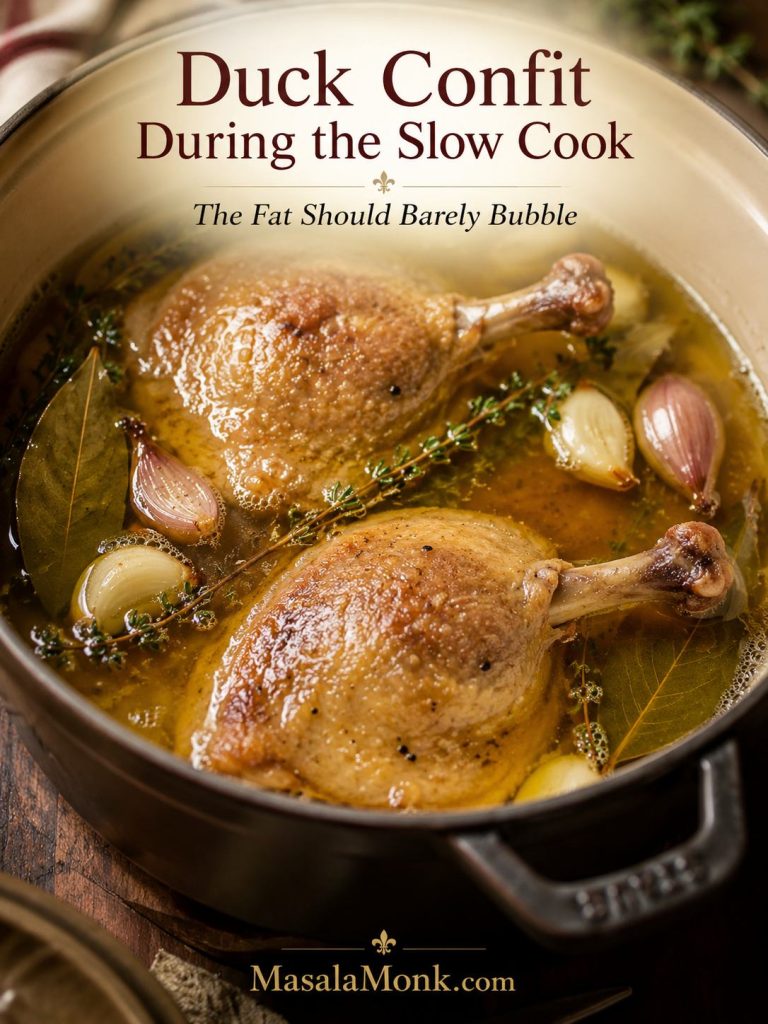
Ingredients for Japanese Soufflé Pancakes

Use a scale if you have one. This is a tiny batter, so small changes matter. An extra splash of milk can make the batter slide instead of mound, and a heavy scoop of flour can make the pancakes feel cakey instead of cloudlike. The gram amounts in this recipe are the ones to follow here. After mixing, compare your bowl with the batter texture cues before scooping.

Ingredients for Japanese soufflé pancakes arranged on a counter with eggs, milk, flour, sugar, cornstarch, and a cake flour swap note.
Small measurements matter here: too much milk loosens the batter, while careful flour and cornstarch balance keeps the texture light.
IngredientAmountWhy it matters
Large egg yolks2 yolks, about 35–40gMake the rich base of the batter
Large egg whites2 whites, about 60–65gCreate the main soufflé lift
Whole milk20ml / 1 tbsp + 1 tspLoosens the yolk batter without making it runny
Vanilla extract½ tspSoftens the eggy flavor
Cake flour30g / about ¼ cup spooned and leveledGives light structure
Cornstarch1 tsp / about 3gHelps support the delicate foam
Baking powder¼ tspAdds a little backup lift
Fine saltPinchBalances the sweetness
Granulated sugar24–25g / 2 tbspSweetens and stabilizes the meringue
Cream of tartar¼ tspHelps stabilize the egg whites
Neutral oil or melted butterFor greasingPrevents sticking without frying the pancake
Water1–2 tbsp totalCreates steam under the lid

Ingredient Notes and Substitutions

Cake flour: Cake flour gives a lighter pancake. If you do not have it, measure 30g all-purpose flour, remove 1 teaspoon, and replace that teaspoon with cornstarch.

Cream of tartar: This helps the egg whites whip into a more stable meringue. If you do not have it, use 1 teaspoon lemon juice or ½ teaspoon white vinegar instead.

Egg temperature: Cold eggs can be easier to separate cleanly, while room-temperature whites usually whip faster. Either works here as long as the bowl is clean and the whites are beaten to the right stage.

Milk: Whole milk gives the best body. Add more only if the yolk batter is too stiff to mix. The finished batter should feel light but not loose.

Optional taller version: For a taller café-style pancake, use 3 egg whites and 2 yolks. Keep the other ingredients the same, but fold carefully because the batter becomes more delicate. Start with the basic 2-white version if this is your first try.

Equipment: What You Need and What You Don’t

You do not need a professional kitchen to make fluffy Japanese pancakes. The most important “equipment” is really control: a clean bowl for the whites, a pan that heats gently, and a lid that traps steam around the tall batter. If you have molds, see how to use a ring mold; if not, the no-mold method is built for a normal home pan.

Equipment for Japanese soufflé pancakes including mixing bowls, beaters, a pan, lid, spatula, ring mold, and thermometer.
The most useful tools are the ones that give control: clean bowls, steady heat, a lid for steam, and a thin spatula.

Essential Equipment

  • Electric hand mixer or stand mixer
  • Two clean mixing bowls
  • Fine mesh sieve
  • Nonstick pan or electric griddle
  • Tight-fitting lid, preferably tall enough not to touch the pancakes
  • Thin flexible spatula
  • Paper towel for spreading a thin film of oil

Helpful but Optional

  • Cookie scoop or disher for even mounds
  • Piping bag for cleaner shaping
  • Ring molds for straighter sides
  • Infrared thermometer for checking pan surface temperature
  • Instant-read thermometer for checking the center of the pancake

Choose Your Method: Ring Mold, No Mold, or Pancake Mix

There is more than one way to make these pancakes, and the best path depends on your tools and comfort level. A ring mold gives the neatest sides, the no-mold method is friendlier for home cooks, and pancake mix is a convenience shortcut rather than a magic fix.

MethodBest forWhat to watch
Basic 2-white batterFirst attempts and best controlStart here before trying a taller, more delicate version.
No moldHome cooks who want fewer toolsThe batter must be thick enough to mound; the shape will be softer.
Ring moldVery tall, straight-sided pancakesGrease the mold well and fill only halfway to two-thirds full.
Pancake mix shortcutConvenienceThe mix replaces the dry base, not the whipped egg whites.
3-white versionExtra height after you know the methodFold carefully because the batter becomes more delicate.
A straight-sided ring mold Japanese pancake beside a softer no-mold Japanese pancake on plates.
Ring molds give cleaner sides, but a strong no-mold batter can still make fluffy Japanese pancakes worth serving proudly.

A ring mold can make the pancakes look more like café cylinders, but it is not required for a lovely plate. Without a mold, expect softer café-style mounds rather than perfectly vertical sides. The texture can still be airy, tender, and special.

How to Make Japanese Pancakes Without a Mold

For the no-mold method, scoop the batter into tall mounds instead of pouring it. Use about two-thirds of the batter for the first mounds and reserve the rest for topping them after the base starts to set.

No-Mold First Layer

The first scoop should sit tall in the pan. Once that base begins to set, it can hold more batter without spreading as much.

Three no-mold Japanese pancake batter mounds cooking in a pan with a bowl of batter behind them.
For the no-mold method, start with thick first-layer mounds; once they begin to set, they can support the second scoop.
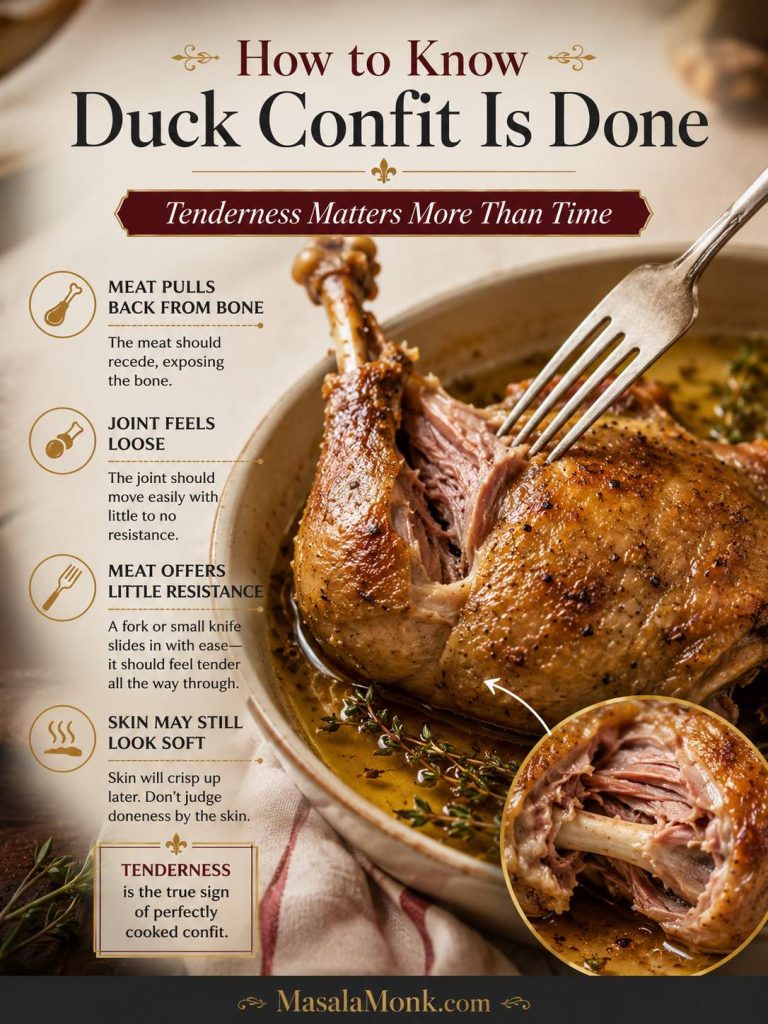
  1. Preheat the pan on gentle heat and wipe it with a thin film of oil.
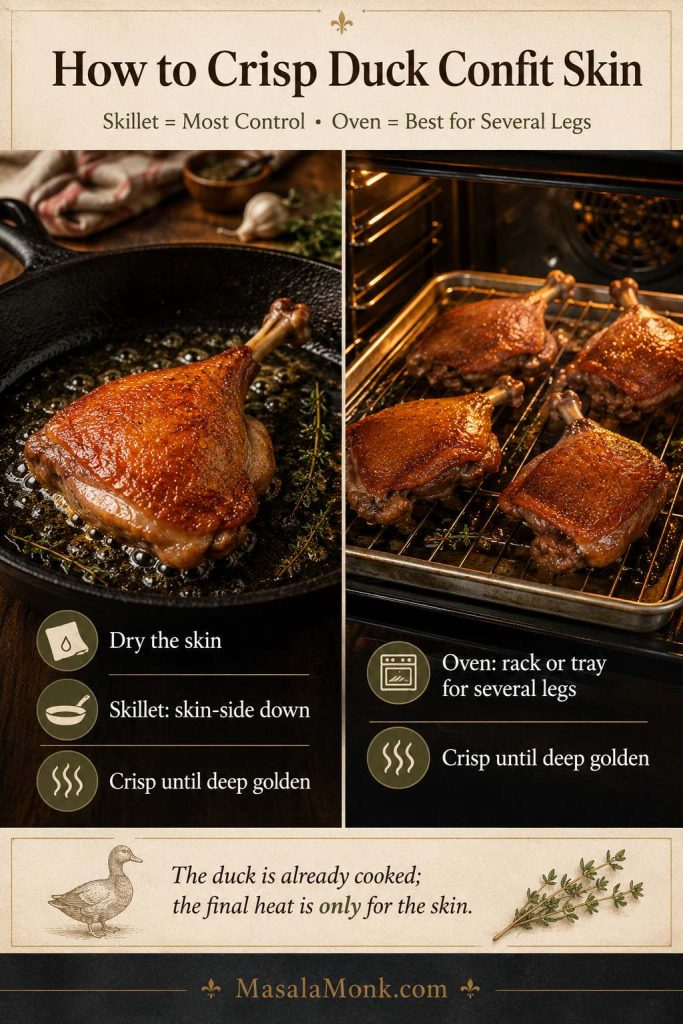
  2. Scoop 2–3 tall mounds of batter into the pan, leaving space between them.
  3. Add 2 teaspoons water to the empty space in the pan, away from the batter.
  4. Cover and cook for 3–4 minutes, until the bottom layer starts to set.
  5. Add the reserved batter on top of each pancake.
  6. Cover again and cook until the sides look less glossy and the base releases cleanly.
  7. Flip gently, add another small splash of water, cover, and finish cooking.

How to Layer No-Mold Japanese Pancakes

Add the reserved batter after the first layer has started to hold its shape. This gives the pancake height without needing a ring mold.

Reserved batter being spooned on top of a partially set no-mold Japanese pancake in a pan.
Add the second layer only after the base starts to set; otherwise, the batter spreads outward instead of stacking upward.

The no-mold pancakes may lean a little, and their edges may look softer. That is not failure. The win is a pancake that rises upward, cooks through, and lands on the plate warm and tender.

How to Use a Ring Mold

Use a ring mold about 2.5–3 inches wide and roughly 2 inches high. Grease the inside very well, place it in the pan, and fill it only halfway to two-thirds full. The batter needs room to rise.

How High to Fill a Ring Mold

Leave visible headroom in the mold. Filling to the top looks dramatic, but it gives the batter nowhere to rise.

Japanese pancake batter inside a metal ring mold in a pan with a fill-height guide line.
Fill the ring mold only halfway to two-thirds full. The batter needs headroom to rise without spilling or compressing.

When flipping, slide a thin spatula under the mold and use tongs to steady the ring. A pancake that resists or looks wet at the sides is asking for more time. Ring molds get hot, so use tongs or a towel when adjusting them.

Meringue Guide: The Most Important Step

The meringue is where these pancakes get their height. Think of it as the scaffolding inside the pancake: too soft and the batter spreads; too dry and it becomes hard to fold smoothly.

A good meringue looks shiny and confident. It should not slide around the bowl like foam, and it should not break into dry chunks. When the peak stands with only a small bend at the tip, you are in the right zone. In testing, batter made with soft peaks spread quickly, even when the pan heat was right.

The Glossy Firm Peak Target

The target is not just “fluffy.” It is glossy, structured foam that can hold the batter up once it reaches the pan.

Glossy stiff meringue peak lifted from a bowl with a mixer beater.
This is the target texture: shiny, strong, and stable enough to help the batter mound in the pan instead of spread.

Soft Peaks vs Stiff Peaks

Soft peaks may seem close, but this batter needs a stronger foam. A drooping peak often becomes a spreading pancake.

Soft meringue peaks compared with stiff glossy peaks for Japanese pancake batter.
Soft peaks can look promising, but they often collapse after folding. Beat a little longer until the peaks stand firmly.
Meringue stageWhat it looks likeUse it?
FoamyBubbles with no real shapeNo. Too early.
Soft peaksPeak forms but droops overUsually too weak for tall pancakes.
Firm/stiff glossy peaksPeak stands upright or nearly upright; meringue looks smooth and shinyYes. This is the target.
Dry or clumpy peaksGrainy, dull, broken-looking foamNo. Overbeaten and harder to fold.

What Overbeaten Meringue Looks Like

The other mistake is going too far. Once the meringue looks dry, dull, and broken, it becomes harder to fold into a smooth, airy batter.

Dry clumpy overbeaten meringue in a bowl with a glossy peak comparison in the background.
Once meringue turns dry and clumpy, it becomes harder to fold evenly; next time, stop at glossy firm peaks.
  1. Use a clean, dry bowl. Any grease or yolk can weaken the foam.
  2. Start beating the egg whites with cream of tartar until foamy.
  3. Add the sugar gradually, not all at once.
  4. Beat until the meringue is shiny and structured enough to hold strong peaks.
  5. Stop before it turns dry, grainy, or chunky.

If the whites refuse to foam after a minute or two, it is usually better to start over in a clean bowl than to keep trying to rescue them. A little yolk or grease can quietly ruin the lift.

What the Batter Should Look Like

The batter should be thick, airy, and spoonable. It should hold its shape when dropped into the pan. It should not pour like crepe batter or spread immediately into a flat circle.

Thick Japanese pancake batter holding a mound on a spoon above a mixing bowl.
The batter should sit in a soft mound on the spoon. If it slides away quickly, the pancakes will likely spread.

When folding, keep the movement calm and broad. Sweep under the batter, turn it over itself, and stop before you flatten the air out of it. A few faint streaks are better than a perfectly smooth batter that has lost its lift.

Batter cueWhat it means
Thick and mounds on a spoonGood. The meringue is holding structure.
Loose and pourableMeringue may be underwhipped, overfolded, or the batter has too much liquid.
Lumpy with dry white clumpsMeringue may be overbeaten or not folded evenly.
Watery at the bottomBatter has started breaking down. Cook immediately, but expect less height.

Runny vs Moundable Batter

Before the pan gets involved, the bowl already tells you a lot. Batter that sits in a mound has structure; batter that flows quickly is already warning you it may spread.

Runny Japanese pancake batter compared with thicker moundable batter in two bowls.
Check texture before cooking: moundable batter rises upward, while runny batter usually flattens before it can set.

How to Make Japanese Soufflé Pancakes Step by Step

Read through the method once before starting. The batter is best cooked soon after folding, so it helps to have the pan, lid, spatula, water, and serving plates ready.

First-batch reality check: The first pancake is where you learn your pan. A quick-browning bottom means the heat needs to come down. A spreading mound points back to the meringue or batter texture. A shorter but cooked-through pancake is still progress.

1. Separate the Eggs

Separate 2 large eggs into yolks and whites. Keep the whites completely free of yolk. If you separated the eggs while cold, let the whites sit for a few minutes while preparing the yolk batter. They do not need to be perfectly room temperature; the final meringue stage matters more.

2. Make the Yolk Batter

In a medium bowl, whisk the egg yolks, milk, vanilla, and salt until smooth. Sift in the cake flour, cornstarch, and baking powder. Whisk just until the batter is smooth and thick. Add extra milk only if the batter is too stiff to mix.

3. Beat the Meringue

In a clean bowl, beat the egg whites and cream of tartar until foamy. Add the sugar gradually while beating. Continue until the meringue is smooth, shiny, and firm enough to stand. If the peak stage feels unclear, check the glossy firm peak cue before folding. Soft peaks make soft pancakes; firm peaks give the batter a chance to rise tall.

4. Fold the Batter

Add about one-third of the meringue to the yolk batter and mix it in more freely to lighten the base. Add the remaining meringue in two additions, folding with a spatula until the batter is mostly even, thick, and airy.

Before scooping, the batter should match the moundable batter cues. A batter that sits proudly on the spoon is ready for the pan; one that slides away quickly will usually cook flatter, so move quickly and keep the mounds smaller.

A spatula gently folding whipped meringue into Japanese pancake batter in a glass bowl.
Fold with broad, gentle strokes. A few faint streaks are better than a smooth batter that has lost its air.

5. Preheat the Pan Gently

Set a nonstick pan over gentle heat. If using an infrared thermometer, aim for about 300°F / 150°C, with a workable range of 285–320°F / 140–160°C. Wipe the pan with a very thin film of oil.

If your lid is low, use smaller mounds so the batter does not touch the lid as it rises.

6. Scoop and Steam

Scoop the batter into 2 or 3 tall mounds. Use about two-thirds of the batter for this first layer and reserve the rest for building height. Add 2 teaspoons water to the empty area of the pan, away from the batter, and cover immediately.

Thick Japanese pancake batter being scooped into a tall mound in a nonstick pan.
Scoop upward, not outward. Tall mounds give no-mold Japanese pancakes a better chance to rise instead of spreading flat.

7. Build Height

After 3–4 minutes, the first layer should look slightly more set around the base. Add the reserved batter on top of each mound. Cover again and continue cooking.

8. Flip Gently

Flip when the sides look less glossy, the bottom is lightly golden, and the pancake feels like it has a body of its own. The spatula should slide under with support, not drag through wet batter.

How to Know When Japanese Pancakes Are Ready to Flip

This is the part where most people want to move too soon. Wait for the sides to lose their wet gloss and for the pancake to feel supported under the spatula.

Two Japanese pancakes in a pan showing a glossy pancake that needs more time and a set pancake ready for a spatula.
Flip when the sides lose their wet gloss and the spatula slides underneath with support. If it drags, wait longer.

If you are nervous here, that is normal. The safer move is usually one more covered minute, not forcing the spatula under a pancake that is still wet at the sides. Use the flip-readiness cues before trying again.

After flipping, add another small splash of water, cover, and cook until the second side is set. Let the pancake keep the air you built into it; a gentle flip is enough.

A tall Japanese soufflé pancake being lifted gently with a thin spatula in a pan.
Use a thin spatula and a calm hand. A rough flip can press out the air you worked so hard to keep.
9. Serve Immediately
These pancakes have a short golden window. Bring the plate to the table first, then bring the pancakes. A little settling is normal because the hot air inside cools, but they are at their softest and tallest right away.

The best bite is warm, soft, and custard-tender in the center without being wet. The pancake should give under the fork, then spring back just a little. That is the café-at-home moment you are cooking toward.

Low Heat and Steam: Time, Temperature, and Doneness

Most failed Japanese pancakes come down to heat. Tall batter needs time. When the pan is too hot, the outside browns before the inside cooks. When the pan is too cool and the lid is lifted too often, the center can stay gummy.

Best Pan Temperature for Japanese Pancakes

Think gentle surface heat, not a hot pancake rush. A pan near 300°F gives the foam time to set before the bottom goes too dark.

Infrared thermometer aimed at a nonstick pan to check the temperature for Japanese soufflé pancakes.
Keep the pan gentle, not blazing hot. Around 300°F gives the center time to cook before the outside browns too fast.

The bottom should not race ahead of the middle. A sweet, warm pancake smell is fine; a toasted smell before the sides look set is your cue to lower the heat. The batches that browned fastest were also the ones most likely to stay wet inside. If the outside is browning while the middle stays wet, go straight to the raw center fix.

Cooking cueBest target
Pan surface temperature285–320°F / 140–160°C
Ideal targetAbout 300°F / 150°C
First side6–8 minutes total, covered
Second side4–6 minutes, covered
Steam water2 teaspoons to 1 tablespoon at a time
Optional center temperatureAbout 160°F / 71°C
Best serving windowImmediately, ideally within 5–10 minutes

The water should go into the empty space in the pan, not on top of the batter. You only need enough to create a quiet puff of steam under the lid, not a puddle.

Where to Add Water for Steam

Place the water beside the batter so the steam can circulate around the pancakes. Pouring on top can thin or disturb the mounds you just built.

A spoon adding water to the empty space beside Japanese pancake batter in a pan.
Add water to the empty pan space, then cover. That way, steam surrounds the pancakes without thinning the batter.

Why Covered Steam Cooking Matters

Once covered, the pan becomes a small steam chamber. Keep the lid on long enough for the center to set instead of chasing color too early.

Japanese soufflé pancakes cooking under a clear glass lid with steam and condensation.
Once the lid goes on, let the steam work. Opening too often releases heat and slows the center from setting.

How to Tell If the Pan Is Too Hot or Too Cool

What you seeWhat it meansWhat to do
Bottom browns deeply in 2–3 minutesPan is too hotLower the heat and move the pan off the burner briefly
Edges look cooked but center feels liquidHeat is too high or pancake is too thickCover longer on low heat and make smaller mounds next time
Pancake barely colors after 8 minutesPan may be too coolIncrease heat very slightly, but keep it gentle
Pancake deflates when lid opensStructure is not set yetCover again and give it more time before flipping

Keep the lid on as much as possible. Every time you lift it, you release heat and steam, and the pancakes may take longer to set.

Optional safety cue: If using a thermometer, aim for about 160°F / 71°C in the center. The pancake should also feel softly bouncy, not liquid, when touched gently. For general egg-dish temperature guidance, see the USDA egg safety guide.

Can You Make Japanese Soufflé Pancakes With Pancake Mix?

Yes, you can make a shortcut version with pancake mix, but use it for fewer dry ingredients, not to skip the soufflé technique. The height still comes from whipped egg whites.

Think of pancake mix as a replacement for the flour, baking powder, and part of the dry base. It does not replace separated eggs, meringue, slow covered cooking, steam, or gentle folding.

Japanese hotcake mix or regular pancake mix can both work, but the result may be a little sweeter, cakier, or more mix-flavored than the main recipe. Keep the heat low because mixes with sugar can brown faster.

If you want a more everyday pancake-mix direction instead of the soufflé method, this guide to blueberry pancakes and homemade pancake mix is the better place to go.

Simple Pancake Mix Shortcut Formula

IngredientAmount
Large eggs2, separated
Pancake mix3 tablespoons / about 25–30g
Milk1½–2 tablespoons / 22–30ml, added gradually
Vanilla½ teaspoon
Sugar2 tablespoons / 24–25g
Cream of tartarPinch to ¼ teaspoon, or a few drops of lemon juice

Start with 1½ tablespoons milk. Add the remaining ½ tablespoon only if the yolk batter is too stiff to mix. Pancake mixes vary, and a looser shortcut batter is harder to stack tall.

Make the yolk batter with the yolks, milk, vanilla, and pancake mix. Beat the whites with the acid and sugar until the meringue is glossy and holds its shape, then fold and cook the same way as the main recipe.

Shortcut truth: Pancake mix can make the dry ingredients easier, but it will not save a weak meringue. If the egg whites are not whipped well, the pancakes will still spread or deflate.

What Success Looks Like

A good batch does not have to look identical to a café pancake. Look for these signs instead.

  • The batter rises upward more than it spreads outward.
  • The sides look set instead of glossy-wet.
  • The pancake releases from the pan without tearing.
  • The center feels softly bouncy, not liquid.
  • The inside is moist and airy, not raw.
  • The pancakes settle slightly after serving, but do not collapse into flat rounds.

Normal settling means the pancakes soften and lower slightly as they cool. A failure collapse means they flatten quickly, slump into the plate, or look wet in the middle.

Save the batch: If the first pancakes are shorter than expected but cooked through and soft, serve them proudly with toppings. A slightly shorter pancake with a set center is better than a dramatic tall pancake that is wet inside.

Troubleshooting Japanese Pancakes

Most pancake problems are not disasters. They are clues. Find the problem you actually saw, not the problem you are afraid of, and the next batch becomes much easier.

This style is technique-sensitive, but the fixes are usually simple: strengthen the meringue, fold less, lower the heat, cook longer covered, or make smaller mounds.

Troubleshooting board showing Japanese pancakes that spread flat, burned on the bottom, collapsed, and stuck to a ring mold.
Use the failure shape as a clue: spreading points to batter, burning points to heat, collapse points to structure, and sticking points to mold prep.

Rise, Spread, and Collapse Problems

ProblemLikely causeFix nowNext time
Pancakes never roseMeringue was too soft, batter was overfolded, or the pan was too hot too soonCook them through, stack with toppings, and serve as soft pancakesBeat to firm peaks that hold their shape and fold more gently
Pancakes rose in the pan but collapsed on the plateCenter was undercooked or structure was too weakServe quickly; texture may still be pleasantCook longer covered and make slightly smaller mounds
Batter spread flatMeringue was underwhipped, batter was too loose, or too much milk was addedUse a ring mold if you have oneBatter should hold a mound, not pour

Heat, Doneness, and Texture Problems

ProblemLikely causeFix nowNext time
Outside burnedPan was too hotLower heat immediately and move pan briefly off the burnerUse gentle heat and aim for 285–320°F / 140–160°C
Center stayed rawPancakes were too tall, flipped early, or cooked too hot outsideCover and cook longer on low heatMake smaller mounds and use steam
Pancakes wrinkled or shrank at the sidesSudden cooling, undercooked center, or weak structureServe quickly while still warmCook until the center is set and avoid opening the lid too often
Eggy flavorUnderseasoned batter or undercooked centerAdd toppings such as fruit, cream, or syrupUse vanilla, salt, and enough cook time

Flipping, Batch, and Mold Problems

ProblemLikely causeFix nowNext time
Pancake cracked while flippingIt was flipped before the base setSupport with a second spatula if neededWait until the sides look less glossy and the base releases cleanly
Second batch was flatterBatter sat too long and lost airCook immediately if possibleMake a small batch or use two pans
Pancakes stuck to moldMold was not greased well enoughLoosen gently with a thin knifeGrease the inside of the ring generously before filling

Why Did My Japanese Pancakes Deflate?

The most common reasons are weak meringue, overfolded batter, heat that was too high, or an undercooked center. Some settling is normal after cooking, but a full collapse usually means the pancake did not have enough structure to hold itself.

Why Are My Pancakes Raw Inside?

The pan was probably too hot or the pancakes were too large. High heat browns the outside before the center has time to set. Lower the heat, cover the pan, use a little steam, and make slightly smaller mounds next time.

Cut Japanese pancakes showing an undercooked raw center beside a properly cooked airy center.
A raw center usually means the outside cooked too quickly. Lower the heat, cover longer, and let steam help next time.

Why Is My Batter Runny?

Runny batter usually means the meringue was underwhipped, overmixed into the yolk batter, or left sitting too long. The batter should look airy and thick enough to hold a mound.

Why Are They Not Jiggly?

They may be too thin, overcooked, or made with batter that lost too much air. The jiggle comes from height, moisture, and a set-but-soft center. Aim for thick mounds, gentle heat, and a center that feels bouncy rather than dry.

Why Was the Second Pancake Worse Than the First?

Soufflé pancake batter loses air as it sits. If the first pancake was tall and the later ones were flatter, the batter probably waited too long. For best results, cook all the batter at once in one large pan, use two pans, or make a smaller batch.

Best Toppings for Japanese Pancakes

Japanese soufflé pancakes are delicate, so the best toppings should make them feel café-special without crushing them. Think light cream, soft fruit, a little syrup, or a sauce served mostly to the side. The pancakes are the drama; the toppings should frame them.

Classic Café-Style Toppings

  • Powdered sugar
  • Softened butter
  • Maple syrup
  • Whipped cream
  • Fresh strawberries or mixed berries

For a warmer fruit topping, spoon over a little homemade apple pie filling; keep the portion light so it does not flatten the stack.

Japanese-Inspired Toppings

  • Matcha whipped cream
  • Sweet red bean paste
  • Black sesame cream
  • Kinako sugar
  • Yuzu honey

Dessert-Style Toppings

For the tallest look, finish with powdered sugar, berries, or a light cream first. Add heavier sauces at the table, after the pancakes have had their moment.

Can You Make Japanese Pancakes Ahead?

This is a cook-and-eat-now recipe, and that is part of its charm. The batter should not be made ahead because the meringue loses air as it sits. Cooked pancakes also deflate as they cool, which is normal for this style.

If you have leftovers, refrigerate them in an airtight container for up to 1 day. Reheat gently in a covered pan over low heat or microwave briefly at low power. They will still be soft, but they will not be as tall or jiggly as freshly cooked pancakes.

Japanese Soufflé Pancakes vs Japanese Soufflé Cake

Japanese soufflé pancakes and Japanese soufflé cake sound similar, but they are different recipes. The pancake version is cooked in a pan or on a griddle and served like breakfast pancakes. Japanese soufflé cake usually refers to Japanese cheesecake or cotton cheesecake, which is baked, sliced, and served as a dessert.

Both use meringue logic, so they share that soft, airy personality. However, the method, texture, and serving style are different. If you wanted the cake version, see this Japanese cheesecake recipe.

FAQs About Japanese Pancakes

Are Japanese pancakes and soufflé pancakes the same thing?

For this tall, café-style version, yes. Here, Japanese pancakes means Japanese soufflé pancakes: thick pancakes made with whipped egg whites and cooked slowly until soft, airy, and jiggly.

Do I need a ring mold?

No. A ring mold gives cleaner sides and more dramatic height, but the no-mold method still works if the batter is thick enough to mound. The shape will be softer, but the pancakes can still be fluffy and tender.

Why did my pancakes collapse after cooking?

A little settling is normal. A dramatic collapse usually means the meringue was too weak, the batter was overmixed, or the center needed more covered cooking time. The fix is usually stronger peaks, gentler folding, and a lower, slower pan.

How do I know when to flip them?

Flip when the bottom is lightly golden, the sides look less glossy, and the pancake releases cleanly from the pan. If the spatula drags through wet batter, cover the pan again and give it another minute.

Can I use pancake mix?

Yes, but pancake mix only replaces the dry base. You still need separated eggs, whipped egg whites, gentle folding, steam, and slow covered cooking for the soufflé height.

Can I make the batter ahead?

No. Once the meringue is folded in, the batter starts losing air. Make it, scoop it, and cook it right away for the best rise.

Can I double this recipe?

You can, but only if your pan or griddle can cook the batter right away. Soufflé pancake batter loses air as it waits, so a small fresh batch is usually better than a large bowl sitting on the counter.

Can I make them without cake flour?

Yes. Use 30g all-purpose flour, remove 1 teaspoon, and replace that teaspoon with cornstarch. The pancakes may be slightly less delicate than the cake-flour version, but the swap works well for this small batch.

Can I make them gluten-free?

A cup-for-cup gluten-free flour blend is the safest first experiment, but this batter is delicate, so results can vary. Almond flour is heavier and can make soufflé pancakes collapse more easily. For a more reliable gluten-free-style pancake, try almond flour pancakes instead.

Can I make these eggless or vegan?

Classic Japanese soufflé pancakes depend on egg-white meringue, so eggless or vegan versions need a separate tested formula. For an easier egg-free or vegan-friendly pancake direction, a recipe like oat pancakes is a better place to start.

Can I make keto Japanese soufflé pancakes?

Not cleanly with this exact recipe. Low-carb flours and sweeteners change the batter structure, and soufflé pancakes are already delicate. Use a dedicated keto pancake formula rather than adapting this one directly.

Why do they taste eggy?

Eggy flavor usually comes from undercooking, skipping vanilla or salt, or using a formula with a very high egg ratio. Cook the center through, keep the vanilla and salt, and serve with fruit, cream, or syrup.

What does fuwa fuwa mean?

Fuwa fuwa means soft, fluffy, and airy. For Japanese pancakes, it describes the cloudlike texture created by whipped egg whites and gentle cooking.

Once you understand the three checks — meringue that holds, batter that mounds, and heat that stays gentle — these pancakes stop feeling like a café trick. They become a small weekend project you can actually pull off, one covered minute at a time.

Serve Japanese Pancakes While They Are Tall and Warm

Bring the plate to the table first, then bring the pancakes. The reward is that first soft bite while the stack is still warm, lifted, and a little magical.

Tall Japanese soufflé pancakes with syrup, whipped cream, and a forkful showing the soft cooked interior.
Once the meringue, batter, and heat checks click, the final stack feels less like a café trick and more like a weekend win.

Japanese Pancakes Recipe Card

Japanese Pancakes Recipe: Fluffy Soufflé Pancakes

Tall, soft, jiggly Japanese soufflé pancakes made with whipped egg whites, a light yolk batter, gentle heat, and steam. Use the no-mold method for a simple home version or ring molds for straighter café-style sides.

Yield2–3 thick pancakes
Prep Time20 minutes
Cook Time12–15 minutes per batch
Total Time35–50 minutes

Ingredients

Yolk Batter
  • 2 large egg yolks, about 35–40g
  • 20ml whole milk, about 1 tablespoon + 1 teaspoon
  • ½ teaspoon vanilla extract
  • 30g cake flour, about ¼ cup spooned and leveled
  • 1 teaspoon cornstarch, about 3g
  • ¼ teaspoon baking powder
  • Pinch of fine salt
Meringue
  • 2 large egg whites, about 60–65g
  • 24–25g granulated sugar, about 2 tablespoons
  • ¼ teaspoon cream of tartar, or 1 teaspoon lemon juice, or ½ teaspoon white vinegar
For Cooking
  • Neutral oil or melted butter, for greasing
  • 1–2 tablespoons water, for steam, used in small splashes
  • Powdered sugar, whipped cream, berries, maple syrup, or toppings of choice

Instructions

Make the Batter
  1. Prepare the pan and tools. Set out the pan, lid, spatula, water, and serving plates before mixing.
  2. Separate the eggs. Place the yolks in one bowl and the whites in a clean, dry mixing bowl. Make sure no yolk gets into the whites.
  3. Make the yolk batter. Whisk the yolks, milk, vanilla, and salt. Sift in the cake flour, cornstarch, and baking powder. Whisk just until thick and smooth.
  4. Start the meringue. Beat the egg whites with cream of tartar until foamy. Add the sugar gradually.
  5. Beat to glossy stiff peaks. Continue beating until the meringue is shiny and holds strong peaks. Stop before it turns dry or clumpy.
  6. Fold the batter. Lighten the yolk batter with one-third of the meringue, then fold in the rest until the batter is thick, airy, and mostly even.
Cook and Serve
  1. Preheat gently. Heat a nonstick pan over low heat. If using a thermometer, aim for about 300°F / 150°C. Wipe with a thin film of oil.
  2. Scoop the pancakes. Add 2 or 3 tall mounds of batter, using about two-thirds first and reserving the rest. Add 2 teaspoons water away from the batter and cover.
  3. Build height. After 3–4 minutes, add the reserved batter on top. Cover again and cook until the sides look less glossy and the bottom releases cleanly.
  4. Flip carefully. Slide a thin spatula under each pancake and flip gently. Add another small splash of water, cover, and cook for 4–6 minutes more.
  5. Check doneness. The pancakes should be lightly golden, softly bouncy, and set in the center. If using a thermometer, aim for about 160°F / 71°C.
  6. Serve immediately. Dust with powdered sugar and add toppings. Some settling is normal as the pancakes cool.

Recipe Notes

  • Best cue: The batter should hold a soft mound, and the cooked pancakes should feel gently bouncy in the center.
  • If the batter spreads: The meringue was likely too soft, the batter was overfolded, or too much liquid was added.
  • If the center is raw: Lower the heat, cover longer, and make smaller mounds next time.
  • No-mold layering: Use about two-thirds of the batter for the first mounds and reserve the rest for topping.
  • For ring molds: Grease well and fill only halfway to two-thirds full.
  • For taller pancakes: Use 3 egg whites and 2 yolks, keeping the other ingredients the same, but fold carefully.
  • Pancake mix shortcut: Use the shortcut formula in the guide above; the mix replaces the dry base, not the whipped egg whites.
  • Storage: Best fresh. Leftovers can be refrigerated for 1 day, but they will lose height and jiggle.

Back to top

Posted on Leave a comment

Fig Jam Recipe

Open jar of homemade fig jam with a spoon lifting glossy no-pectin jam, fresh halved figs, lemon, and toast nearby.

When figs are good, they do not wait. They soften quickly, bruise easily, split at the seams, and can go from perfect to overripe almost overnight. Fig jam is one of the best ways to save that short, honeyed moment before it slips away.

This is the recipe for the day the figs finally give in — too soft to ignore, too fragrant to waste, and exactly ready for a pot of glossy, spoonable jam. The finished jar should taste like figs first: gently sweet, lifted by lemon instead of dulled by sugar, thick enough to spread, and soft enough to spoon over toast, yogurt, brie, goat cheese, cakes, cookies, sandwiches, flatbreads, and roasted meats.

The main method stays simple: fresh figs, sugar, lemon, a little water, and no commercial pectin. This is a fresh fig jam recipe first — soft-set, fruit-forward, and written for the refrigerator or freezer. Once the main method is clear, you will find dried fig, frozen fig, low-sugar, honey, cheese-board, and canning-safe notes clearly separated so you do not have to guess your way through substitutions.

So instead of giving you only one pot of jam, this guide shows you how to choose the right version for the figs you actually have.

Close-up spoonful of glossy fresh fig jam with visible fig seeds and soft fruit pieces.
Because fig jam firms as it cools, the best stopping point is shiny, slow-moving, and spoonable rather than stiff.

In This Guide

Start with the quick answer, or use the deeper sections for dried figs, lower sugar, canning questions, cheese-board ideas, and quick fixes if a batch looks too loose or too thick.

Quick Answer: How to Make Fig Jam

To make easy homemade fig jam, combine 2 lb / 900 g ripe fresh figs, 1½ cups / 300 g sugar, ¼ cup / 60 ml lemon juice, and ¼–½ cup / 60–120 ml water as needed. Start with the smaller amount of water.

Simmer uncovered until the figs soften, collapse, and turn shiny enough to coat the spoon, then mash or blend to your preferred texture. You do not need to peel the figs or add commercial pectin. The jam usually takes 25–45 minutes to cook, yields about 3 cups / 720 ml, and thickens more as it cools.

Keep these four things in mind as you cook: the figs should still smell sweet, the water should start low, the finish should be slow-moving rather than stiff, and this batch belongs in the fridge or freezer unless you use a tested canning recipe.

This recipe is written for the fridge or freezer. Do not water-bath can it unless you switch to a tested canning formula with exact acid, sugar, jar size, headspace, and processing instructions.

That may sound strict, but it keeps the recipe low-stress: make the jam, chill it, use it generously, and freeze the extra.

If the pan still looks loose near the end, use the doneness tests before cooking it much longer.

Recipe Snapshot

Here is the whole batch at a glance before the deeper choices begin.

Fig jam recipe snapshot with fresh figs, sugar, lemon, water, and a no-pectin measurement card.
The simplest fig jam recipe starts with ripe fruit, measured sugar, enough lemon for lift, and only enough water to protect the pan.
Figs to useRipe fresh figs that smell sweet and feel soft, but not sour, fizzy, or moldy
Base ratio900 g figs : 300 g sugar : 60 ml lemon juice : 60–120 ml water
PectinNot needed for this soft-set version
Peel figs?No. Remove stems, but leave the skins on.
Cook timeUsually 25–45 minutes, depending on fig moisture and pan width
Texture to aim forLoose enough to spoon, thick enough to stay on toast
StorageRefrigerator or freezer, unless using a tested canning recipe
Full recipeJump to the recipe card

Before You Start: What This Recipe Gives You

Good fit if you want…

  • A fresh fig jam recipe first
  • No commercial pectin
  • A soft-set, fruit-forward jar
  • Refrigerator or freezer storage
  • Clear notes for dried figs, honey, and lower sugar

Not the right fit if you want…

  • A stiff store-bought jelly set
  • Shelf-stable canning as written
  • Traditional whole-fig preserves
  • No-sugar pantry storage
  • Peeling, deseeding, or a firm jelly finish

With that boundary clear, the actual cooking is simple. Start with ripe figs, use just enough water to protect the pan, and let the fruit tell you when it has softened into jam.

Fig jam jars shown for refrigerator storage, freezer storage, and tested canning only.
Treat this as fridge or freezer fig jam unless you are following tested canning directions with exact acid, jar size, and processing time.

What Is Fig Jam?

Fig jam is made by cooking figs with sugar and acid, usually lemon juice, until the fruit softens and the mixture thickens into a spread. Because figs are full of tiny edible seeds, the texture is naturally a little rustic. It is not usually clear or glassy like jelly. Instead, it is rich, slightly seedy, and naturally honeyed, with a texture that can lean chunky or smooth depending on how much you mash it.

It will not set like a stiff jelly, and it is not supposed to. This is a softer, fruit-forward jar — the kind that spreads on toast but still spoons over yogurt, cheese, cake, or roasted meat.

The best version has balance. Figs are naturally sweet, so lemon stops the jar from tasting like flat sugar syrup. Sugar gives body and shine. A small pinch of salt can make the fruit taste rounder, especially if you plan to serve the finished spread with cheese or savory food.

Fig Jam vs Fig Preserves vs Fig Spread

Fig jam, fig preserves, fig spread, fig jelly, and fig confiture often overlap in everyday use. Still, the texture and best use can be slightly different.

NameUsual TextureWhere It Shines
JamCooked figs, usually mashed or partly broken downToast, yogurt, cheese, pastries, desserts, sandwiches
PreservesChunkier, often with larger pieces of fig or whole small figsBiscuits, cheese boards, spooning over desserts
SpreadSmoother and softer, often less stiff than classic jamCrackers, brie, sandwiches, flatbreads, charcuterie boards
JellyClearer and more strained, with less fruit pulpClassic jelly use, though figs are more commonly made into jam or preserves
ConfitureA French-style word often used for jam or preservesBreakfast, pastry, cheese, gifting
Paste or butterThicker, denser, and more concentratedCookies, fig bars, cheese plates, baking fillings

The finished texture sits between classic jam and a softer fig spread: fruit-forward, spoonable, and easy to adapt. Cook it less for a softer spread, longer for a thicker set, or mash lightly for a preserve-style texture.

Fresh Figs vs Dried Figs: Which Should You Use?

Fresh figs and dried figs both work well, but they make different jars. And then fresh figs also give you a brighter, softer, more seasonal jam. Dried figs make a deeper, denser, more concentrated spread that is useful year-round. Neither is wrong; fresh figs are for a lighter fruit-forward batch, while dried figs are especially good when you want a rich cheese-board spread.

Fresh fig jam is the version you make because the fruit is already asking for it — soft at the neck, fragrant on the counter, and too delicate to keep waiting. Dried fig jam belongs to a different mood: less about saving summer, more about building a rich pantry spread for cheese, toast, and cooler-weather boards.

Fresh fig jam compared with darker dried fig jam, with fresh figs on one side and dried figs on the other.
Fresh fig jam tastes brighter and softer, while dried fig jam turns deeper, darker, and more spread-like for year-round use.
Use ThisWhenWhat to Expect
Fresh figsYou want a brighter, softer, seasonal jamQuick cook time, fresh fruit flavor, soft set
Dried figsYou want a darker, thicker, year-round cheese-board spreadDeeper flavor, denser texture, more water needed
Frozen figsYou already have figs in the freezerMore released liquid and usually a longer simmer
Ripe green-skinned figsThey are soft, sweet, and ripe insideUse them like any other ripe fig
Truly unripe figsThey are hard, dry, bitter, or not sweet yetUse a dedicated green fig preserve method instead

Using dried figs instead of fresh? Go straight to the dried fig jam variation once you understand the main texture cues.

Fresh figs

Fresh figs are the best choice for a classic, bright homemade batch. They are tender, juicy, and quick to cook down when ripe. The flavor can be floral, honeyed, berry-like, or lightly caramelized depending on the variety and ripeness.

Fresh fig ripeness guide showing ripe, usable wrinkled, and hard unripe figs for jam.
Sweet-smelling, soft figs make the best fresh fig jam; meanwhile, hard green figs need a slower preserve-style method.
  • Use ripe figs that feel soft but not fermented.
  • Remove the stems, but do not peel the figs.
  • Quarter or chop them so they cook evenly.
  • Add water only as needed; very juicy figs may need little or none.

Dried figs

Dried figs are sweeter, denser, and lower in moisture. They need water to soften before they can become jam. Once cooked and blended, they make a thick fig spread that gives brie, goat cheese, blue cheese, crackers, toast, and sandwiches a darker, almost caramel-like contrast.

  • Remove any tough stems before cooking.
  • Chop the figs so they soften faster.
  • Simmer with water until very tender before blending or mashing.
  • Use less sugar if the dried figs are already very sweet.

Frozen figs

Frozen figs can work for jam. Thaw them first if possible, then use the fruit and any juices that collect. Frozen figs often release extra liquid, so the batch may need a slightly longer cook time. If you are using a weight-based recipe, weigh the figs consistently either before freezing or after thawing and draining lightly.

Thawed frozen figs in a bowl with released juices and a jam pan in the background.
Frozen figs are useful for jam, although their extra thawed juices usually need more time to simmer down.

Because thawed figs release extra liquid, check the doneness tests carefully before deciding the batch is finished.

What about green or unripe figs?

Green-skinned ripe figs are fine. Truly unripe figs are different. They can be firmer, less sweet, and sometimes bitter or latex-like. Green fig preserves are usually a separate style of recipe and often involve soaking, boiling, draining, and then cooking in syrup. If your figs are ripe but green on the outside, use them here. If they are hard and unripe, use a dedicated green fig preserve method instead.

Ripe green-skinned figs with pink centers compared with hard unripe green figs.
Ripe green-skinned figs can go straight into this recipe; hard unripe figs are less sweet and belong in a different preserve.

Ingredients You Need

The ingredient list is short, which is part of the charm: ripe figs, enough sugar to make them shine, lemon to wake them up, and just enough water to keep the pot moving before the fruit releases its own syrup.

Fresh figs, sugar, lemon, water, salt, vanilla, balsamic, and herbs arranged as ingredients for fig jam.
Figs provide body, sugar helps the jam set, lemon keeps the flavor awake, and small add-ins should stay in the background.

Fresh figs

Use ripe fresh figs for the main version. Black Mission, Brown Turkey, Kadota, Adriatic, or other edible fig varieties can all work. The exact flavor will change, but the method stays the same. Trim away the stems and any spoiled spots. The skins and seeds are edible, so there is no need to peel or deseed the fruit.

Fig condition guide: Fig jam is forgiving, but spoiled fruit is not. Use the table below when the figs are soft enough to make you wonder.

Fig ConditionUse It?What to Do
Soft, fragrant, and sweetYesPerfect for jam
Slightly wrinkledYesTrim stems and use
Split but fresh-smellingUsuallyTrim dry or exposed spots first
Sour, fizzy, or fermented smellNoDiscard
MoldNoDiscard
Hard and not sweetNot for this recipeUse a green fig preserve method instead
Guide showing which figs to use or discard for jam, including soft, wrinkled, split, sour, moldy, and hard figs.
Slightly wrinkled or very soft figs can still work, but sour, fizzy, or moldy fruit should be discarded before cooking.

Sugar

Sugar is not just there for sweetness; it gives the syrup its shine, helps the fruit look glossy instead of dull, and gives the finished jar a little more body. The amount here is moderate compared with many old-fashioned preserves, so the figs still lead. If your fruit is extremely sweet, you can reduce the sugar, but the batch will usually set softer, cook longer, and have a shorter refrigerator life.

Lemon juice

Lemon is what keeps the jar from tasting heavy. It lifts the fig flavor, sharpens the sweetness, and helps the mixture thicken. For refrigerator jam, fresh lemon juice works well. For pantry jars, switch to a tested preservation recipe and follow it exactly; many canning formulas call for bottled lemon juice because its acidity is standardized.

Water

Water keeps the figs from scorching before they release their own juices. Very ripe, juicy figs may need only a splash. Firmer figs, drier figs, or dried figs need more. Start with the smaller amount first; you can always add a little more if the pot looks dry.

Salt

A small pinch of salt is optional, but it makes the fig flavor taste rounder and less flat. It is especially useful if you plan to serve the jam with cheese or savory dishes.

Vanilla, citrus zest, balsamic, or herbs

These are optional, not required. Vanilla makes the jam more dessert-like. Lemon or orange zest adds fragrance. Balsamic pulls the jam into savory territory, where it tastes less like breakfast and more like something you would spoon beside brie, pork, or sharp cheese. Rosemary or thyme makes it more savory.

Equipment That Makes Fig Jam Easier

You do not need special jam gear here, but the pan matters more than most people expect. A wide pan is not fancy equipment; it lets steam escape quickly, so the figs thicken before their flavor turns dull. A masher or blender simply lets you choose whether the fruit stays chunky or turns smooth.

Wide pan of fig jam beginning to simmer with steam rising and a narrower pot in the background.
A wide pan gives steam room to escape, helping the jam thicken before the fig flavor turns dull.
  • Wide heavy-bottomed pan: a saucepan, sauté pan, or Dutch oven with enough surface area for steady evaporation.
  • Non-reactive material: stainless steel or enameled cast iron is best because the recipe includes lemon juice.
  • Wooden spoon or silicone spatula: useful for stirring and checking whether the jam leaves a trail on the bottom of the pan.
  • Potato masher or immersion blender: use a masher for rustic texture or an immersion blender for a smoother spread.
  • Small plate or spoon: chill it in the freezer for a simple doneness test.
  • Clean jars and a kitchen scale: clean jars help with storage, and a scale helps because figs vary so much in size.

A ladle and funnel are helpful but not essential. A narrow pot can still work, but the jam will usually need more time because evaporation is slower. If your pan is thin, keep the heat moderate and stir often so the sugar and fruit do not scorch before the mixture thickens.

The Best Fig Jam Ratio

The sweet spot is enough sugar to make the figs shine, enough lemon to keep the flavor bright, and only enough water to keep the fruit moving. This is not meant to be a stiff, candy-sweet preserve. It is a softer, fruit-forward jar you can use generously.

900 g fresh figs : 300 g sugar : 60 ml lemon juice : 60–120 ml water

Fig jam ratio guide with measured fresh figs, sugar, lemon, and water on a warm kitchen surface.
A reliable fig jam ratio gives the fruit enough sugar for body, enough lemon for balance, and no excess water to cook off later.

In US kitchen measurements, that is about 2 lb fresh figs, 1½ cups sugar, ¼ cup lemon juice, and ¼–½ cup water. The result is sweet enough to feel like jam, but still fig-forward enough that you taste the fruit, not just sugar.

Because this is less sugar-heavy than many old-fashioned preserves, it is best treated as a refrigerator or freezer batch.

BatchFresh FigsSugarLemon JuiceWaterApprox. Yield
Small batch1 lb / 450 g¾ cup / 150 g2 tbsp / 30 ml2–4 tbsp / 30–60 mlAbout 1½ cups / 360 ml
Standard batch2 lb / 900 g1½ cups / 300 g¼ cup / 60 ml¼–½ cup / 60–120 mlAbout 3 cups / 720 ml
Large batch3 lb / 1.35 kg2¼ cups / 450 g6 tbsp / 90 ml⅓–¾ cup / 80–180 mlAbout 4½ cups / 1 liter

The yield is approximate because figs vary in moisture. Very juicy fruit cooks down differently from firmer, drier fruit.

Small-Batch Fig Jam

If you only have a small basket of figs, make a half batch. Use 1 lb / 450 g fresh figs, ¾ cup / 150 g sugar, 2 tbsp / 30 ml lemon juice, and 2–4 tbsp / 30–60 ml water. A small batch usually cooks faster, often in about 20–30 minutes, especially in a wide pan.

This is a good option when you have a few ripe figs that need using immediately. It gives you enough jam for toast, yogurt, a small cheese board, or a quick baked brie without committing to several jars.

Small saucepan of chopped figs cooking into jam beside a small finished jar.
Small-batch fig jam is the right move when a few ripe figs need saving but you do not want multiple jars.

Why This Fig Jam Recipe Works

The pot does most of the work once the balance is right: enough sugar for gloss, enough lemon for brightness, and enough time for the figs to thicken naturally.

  • Moderate sugar keeps the fig flavor clear. The jam tastes sweet and glossy, but not like sugar syrup.
  • Lemon keeps the flavor bright. Without enough acid, the finished jar can taste heavy, flat, or overly sweet.
  • A short maceration helps the figs release juice. This makes the jam easier to start and reduces scorching risk.
  • A wide pan thickens the jam faster. More surface area means better evaporation and less overcooking.
  • No pectin keeps the texture soft and homemade. The jam thickens through cooking, but stays spoonable rather than stiff.
  • Stopping slightly early prevents over-thick jam. It continues to firm as it cools.

Figs are delicate. If you cook them too hard for too long, the flavor can move from honeyed and rounded to dull and sticky. The goal is to reduce the syrup, not punish the fruit.

How to Make Fig Jam

Start with ripe fresh figs and let simmering, lemon, sugar, and evaporation do the thickening. Read through the steps once before starting, especially the texture cues, because the jam thickens more after it cools.

Step 1: Prep the figs

Rinse the figs gently and pat them dry. Trim off the tough stems. Quarter small figs or chop larger figs into small pieces. You do not need to peel them. The skins soften as the jam cooks, and the seeds are part of its natural texture.

Hands trimming stems and quartering fresh figs on a cutting board for homemade jam.
Trim the stems and cut the figs evenly, but skip peeling because the skins soften into the finished jam.

Step 2: Combine figs, sugar, lemon, and water

Add the figs, sugar, lemon juice, a pinch of salt if using, and ¼ cup / 60 ml water to a wide heavy pan. Stir well so the sugar, lemon, and fruit are evenly distributed before heat goes on.

Fresh figs and sugar in a pan while lemon juice is poured in and water waits nearby.
Start with less water, then add a splash only if the figs stick before their own juices release.

If you have time, let the mixture sit for 15–30 minutes before cooking. This short rest helps the sugar draw juice from the figs, so the fruit starts cooking in its own syrup instead of scorching against the pan.

Chopped figs resting with sugar and lemon juice as syrup begins forming in the bowl.
A short rest with sugar and lemon draws juice from the figs, so the batch begins glossy instead of dry.

Add the remaining water only if the figs look dry, stick before releasing juices, or need a little help softening. Starting with less water prevents a thin batch that needs extra time to reduce.

Step 3: Bring the mixture to a simmer

Set the pan over medium heat and stir until the sugar dissolves. Once the mixture starts bubbling, reduce the heat as needed to maintain a steady simmer. You want active bubbling, but not a violent boil that splashes, scorches, or caramelizes too fast.

At this point the pan should look syrupy around the edges, not dry and sandy. If the figs are still sitting in dry sugar, add a splash more water and give them time.

Chopped figs in a pan with syrupy edges forming as a spatula pulls through the mixture.
When syrup forms around the pan edges, the figs are ready to soften evenly without scorching on dry sugar.

Cook uncovered once the figs are simmering. Covering the pan traps moisture and slows thickening.

Step 4: Cook until the figs soften and collapse

Simmer the jam, stirring often, until the figs soften, slump, and begin to collapse into the syrup. The kitchen should smell like warm figs and lemon, not burnt sugar. This usually takes 25–45 minutes. The exact time depends on fig ripeness, moisture, pan width, and heat level.

Fig jam simmering in a wide pan with steady bubbles and softened fruit.
A steady simmer concentrates the syrup gently, which keeps homemade fig jam glossy, rounded, and fruit-forward.

As the fruit softens, mash it with the back of a spoon or a potato masher. For a chunky preserve-style texture, mash lightly and leave some pieces intact. For a smoother spread, mash more thoroughly or blend briefly later.

Potato masher pressing softened figs in a pan to adjust the jam texture.
Mash lightly for a chunky fig preserve feel, or mash longer when you want a smoother spoonable jam.

If foam gathers on the surface, you can skim it off for a clearer finish. A little foam is not a problem for refrigerator jam.

Step 5: Adjust the texture

If you like a rustic jam, leave it slightly chunky. For a smoother fig spread for crackers, cheese boards, sandwiches, or cookies, use an immersion blender for a few short pulses. Do not overblend unless you want a very smooth paste.

Immersion blender smoothing fig jam in a pan into a glossy fig spread.
A brief blend makes fig spread smoother for crackers, cheese boards, cookies, and sandwiches without losing its homemade texture.

After blending, simmer for another few minutes so the texture settles and any extra moisture evaporates.

Step 6: Test the jam

It is ready when it looks shiny, moves slowly, and mounds softly on a spoon. The syrup should bubble slowly, not splash like water. A spoonful should fall slowly, not pour like syrup or sit like paste. A spatula dragged through the pan should leave a short trail before the mixture flows back. You can also use a cold plate test or a thermometer; both are explained below.

If the jam looks too loose or too stiff at this point, use the troubleshooting guide before changing the recipe.

Step 7: Jar, cool, and store

Spoon the hot jam into clean jars. Let it cool, then refrigerate. Do not worry if it looks slightly loose while hot; it will thicken more as it cools. For longer storage, freeze it in freezer-safe containers with headspace.

Texture Target

The target is not a firm jelly set. The best texture for this recipe is thick enough to spread on toast, but loose enough to spoon over yogurt or cheese. Stop when the jam looks shiny and slow, not stiff. If it looks firm in the boiling pan, it will likely cool too thick.

Fig jam texture guide comparing runny, just right, and too thick jam on spoons or toast.
Aim for a texture that clings to toast but still spoons easily over yogurt, brie, pancakes, or desserts.

How to Tell When Fig Jam Is Done

The tricky part is that jam can look loose while hot and much thicker after cooling. Look for several signs together rather than relying on one exact minute mark.

  • Shiny look: the liquid around the figs should look syrupy, not watery.
  • Soft fruit: the figs should be tender, slumped, and partly collapsed.
  • Slow bubbles: the bubbles become thicker and slower as water evaporates.
  • Spatula trail: a spoon or spatula should leave a short path through the jam before it closes.
  • Spoon mound: the jam should mound lightly on a spoon instead of running off like juice.
  • Cold plate test: a small spoonful on a chilled plate should move slowly when tilted.
  • Temperature cue: at sea level, a firmer jam set is often around 220°F / 104°C, but texture matters more than the thermometer reading.
  • Aroma: the jam should smell bright and honeyed, not burnt or overly caramelized.

Spatula Trail Test

Drag a spatula through the pan when the jam looks close. If the path opens briefly and then closes slowly, the texture is moving toward a soft set.

Spatula dragged through thick fig jam in a pan, leaving a short trail that slowly closes.
The spatula trail is a visual doneness cue: it should open briefly, then close slowly as the jam settles.

Cold Plate Test

Chill a small plate, add a spoonful of jam, and tilt it. The cooled jam should move slowly, which helps you avoid overcooking the hot batch.

Spoonful of fig jam on a tilted chilled plate during a cold plate doneness test.
The cold plate test shows the cooled texture, so it prevents overcooking a batch that still looks loose while hot.

Important: Stop slightly before the jam looks perfect in the pot. If it looks stiff while boiling, it may cool into something too thick or sticky. You can always simmer a loose batch a little longer, but it is much harder to undo a stiff, overcooked one.

Do You Need Pectin for Fig Jam?

No, you do not need commercial pectin for this style of fig jam. Figs, sugar, lemon juice, and evaporation can create a soft, spoonable jam on their own. The finished texture will usually be softer than a firm store-bought jelly, but that is exactly why it works so well as both a jam and a fig spread.

Do not chase a store-bought jelly wobble here. For a homemade spread, a softer set is often better because it spoons more easily over cheese, yogurt, toast, desserts, and savory dishes. A soft no-pectin set is not a failure; it is part of what makes the jar so useful.

No-pectin fig jam shown with fresh figs, sugar, lemon, water, and a spoonful of finished jam.
With enough simmering and lemon balance, no-pectin fig jam thickens naturally without needing a boxed setting mix.

If you want a very firm set, commercial pectin can help, but it changes the method. Boxed pectin and products like Sure-Jell often require specific sugar and liquid ratios, so follow the instructions for that product rather than adding it casually to this recipe.

Let the pan do the work: steady simmering, a wide surface, and a few spoon tests matter more than extra thickeners.

Dried Fig Jam Variation

Dried figs are not second-best; they simply make a different kind of jar. The flavor is deeper, darker, and more concentrated, closer to a thick fig spread than a bright fresh-fruit jam. This is the version to make when fresh figs are out of season, expensive, or hard to find.

Think of it as a pantry-friendly spread with a darker mood: less fresh summer fruit, more rich fig, caramel, and cheese-board depth.

Dried fig jam served on a spoon with dried figs, lemon, water, crackers, and cheese-board elements nearby.
Dried fig jam is darker and denser than fresh fig jam, which makes it especially good with crackers and cheese.

Dried Fig Jam Formula

  • Dried figs: 12–14 oz / 340–400 g, stems removed and chopped
  • Water: 2 cups / 480 ml, plus more if needed
  • Sugar: ½–1 cup / 100–200 g to start, plus more to taste
  • Lemon juice: 2 tbsp / 30 ml
  • Optional flavorings: orange zest, vanilla, balsamic vinegar, rosemary, thyme, or a pinch of salt

To make it, simmer the chopped dried figs with water until very soft, usually 20–40 minutes depending on how dry they are. Blend or mash the softened figs, then add sugar and lemon juice. Simmer again until thick and spoonable. Add more hot water if it becomes too dense before the figs fully soften, especially before adding more sugar.

Start with ½ cup / 100 g sugar for a less-sweet fig spread, or 1 cup / 200 g sugar for a sweeter jam. Add more only after tasting. Dried figs are already concentrated, so use up to 1½ cups / 300 g sugar only if you want a very sweet, glossy jam.

The dried fig version thickens quickly after blending, so keep it slightly looser than you want while it is hot. If it looks perfect in the pot, it may cool into a paste.

Low-Sugar, Honey, and No-Added-Sugar Options

Lower sugar changes more than sweetness. It changes set, cook time, and storage life. Figs are naturally sweet, so reducing sugar can work, but the batch will usually be softer, a little less glossy, and shorter-lived in the refrigerator.

Low-sugar fig jam

For a lower-sugar version, use 150–200 g sugar per 900 g figs instead of 300 g. Cook the jam a little longer and expect a softer, more fruit-spread-like texture. A lower-sugar batch may never pass the cold-plate test as firmly as a higher-sugar jam. If it is shiny, thick, and spoonable, it can still be done.

Low-sugar fig jam in a jar with lemon and a smaller amount of sugar nearby.
Lower-sugar fig jam often tastes fruitier, although the softer set makes fridge or freezer storage more important.

Store low-sugar batches in the refrigerator and use within 1–2 weeks for best quality, or freeze for longer storage.

Honey fig jam

Honey adds a floral sweetness that works beautifully with figs. Replace part of the sugar with honey rather than all of it for the best texture. For example, use 200 g sugar plus ¼ cup honey for 900 g figs. Honey-sweetened jam may be softer, darker, and more aromatic than the granulated-sugar version.

Honey being drizzled into glossy fig jam with fresh figs nearby.
Honey brings floral sweetness to fig jam, but it also softens the set and works best as a chilled variation.

Keep honey-sweetened batches refrigerated or frozen for the best texture and freshness.

No-added-sugar fig spread

If you are searching for no-sugar fig jam, think of this version as a no-added-sugar fig spread instead of a classic jam. Cook ripe figs with lemon juice and a splash of water until very soft and thick, then mash or blend. Refrigerate and use within about 5–7 days, or freeze for longer storage.

Storage note: Low-sugar, honey, and no-added-sugar versions are softer, shorter-life batches. Keep them refrigerated or frozen rather than treating them like pantry preserves.

Before reducing sugar further, read the storage and canning safety notes so you choose the right storage path.

Fig Jam Variations

Once you understand the base recipe, the flavor is easy to adjust. Start small with add-ins because figs are delicate and can be overwhelmed by strong spices, vinegar, or herbs.

The Best First Variations

  1. Lemon-orange: brighter and more fragrant for breakfast and desserts.
  2. Vanilla: softer, rounder, and more dessert-like.
  3. Balsamic: deeper and better for cheese, pork, chicken, and sandwiches.
  4. Rosemary or thyme: savory enough for boards, baked brie, and grilled cheese.
  5. Chili: just enough heat for cheese, flatbreads, and sandwiches.
Five fig jam variations in small bowls labeled citrus, vanilla, balsamic, herbs, and chili.
Use fig jam flavor variations sparingly: citrus brightens, vanilla rounds, balsamic deepens, herbs turn savory, and chili adds heat.
VariationWhat to AddWhere It Shines
LemonExtra lemon zest or a little extra lemon juiceToast, yogurt, scones, breakfast boards
OrangeOrange zest, or a mix of orange and lemonCroissants, cakes, desserts, cheese boards
VanillaVanilla bean or vanilla extractPastries, cakes, ice cream, cheesecake
Balsamic1–2 tbsp balsamic vinegar near the endBrie, goat cheese, blue cheese, pork, chicken, sandwiches
HoneyReplace part of the sugar with honeySoft floral jam, yogurt, toast, cheese
Brown sugarReplace part or all of the white sugar with light brown sugarA deeper caramel note, toast, baking, cheese boards
GingerFresh grated ginger or a pinch of ground gingerWinter breakfasts, cheese boards, roasted meats
Rosemary or thymeA small herb sprig while cooking, removed before jarringSavory boards, baked brie, grilled cheese
ChiliA small pinch of chili flakesCheese, sandwiches, flatbreads
StrawberryReplace part of the figs with strawberriesA fruitier Southern-style jam
Fig onion-style condimentOnions, vinegar, and savory cookingA separate condiment, better treated as its own recipe

For cheese boards, the best directions are balsamic, rosemary, thyme, honey, orange, brown sugar, and chili. For breakfast and desserts, vanilla, lemon, orange, ginger, and strawberry are especially good.

How to Store Fig Jam

Think of this as the kind of jam you keep in the fridge and actually use: spooned over breakfast, tucked beside cheese, or frozen in small jars for later. It is flexible, lower-stress, and less sugar-heavy than a shelf-stable canning preserve.

Fig jam storage guide showing a refrigerator jar, freezer container, and tested canning-only jar cue.
For this recipe, choose fridge or freezer storage; pantry jars need tested canning instructions, not casual adjustments.

Refrigerator storage

Cool the jam, transfer it to clean jars, and refrigerate. For best quality, use the main version within 2–3 weeks. Always use a clean spoon, keep the jar chilled, and discard it if you see mold, fermentation, off smells, or unusual bubbling.

Freezer storage

The jam freezes well. Spoon it into freezer-safe jars or containers, leaving headspace because it expands as it freezes. Freeze for up to 3 months for best quality. Thaw overnight in the refrigerator and stir before using.

Canning fig jam

For pantry jars, switch to a tested preservation recipe and follow it exactly. Canning safety depends on the exact fruit, sugar, acid, headspace, jar size, and processing time. Figs also need proper acidification for safe boiling-water canning.

Canning safety setup for fig jam with jars, lemon juice, jar lids, water-bath pot, and a tested recipe checklist.
Shelf-stable fig jam depends on tested acidity, headspace, jar size, and processing time, so do not guess with canning.

Canning safety: Do not can this version as written. Sterilized jars do not make an untested refrigerator jam shelf-stable.

For shelf-stable jars, use a tested canning recipe and follow its processing instructions exactly. The National Center for Home Food Preservation has a tested fig jam without pectin formula, and Oregon State University Extension explains why figs need added acid for safe preservation.

Do not use low-sugar, honey-sweetened, or no-added-sugar variations for room-temperature storage unless you are following a tested recipe designed for that exact style.

What to Eat With Fig Jam

This is where the jar earns its space in the fridge. A spoonful can rescue plain yogurt, make toast feel planned, or turn a last-minute cheese plate into something generous. The easiest rule: pair it with something creamy, salty, tangy, smoky, or crisp so the sweetness has contrast.

Fig jam served with yogurt, cheese and crackers, grilled cheese, pork, tart, and cookies.
After chilling, fig jam moves easily from breakfast to cheese boards, savory glazes, sandwiches, and simple desserts.
UseTexture to Aim ForFlavor Direction
Toast, yogurt, oatmealSoft and spoonableLemon, vanilla, honey
Brie or goat cheeseSlightly thicker spreadBalsamic, orange, rosemary
Sandwiches and grilled cheeseSmooth or lightly chunkyChili, balsamic, thyme
Cookies, cakes, tartsThicker jamVanilla, orange, brown sugar
Pork or chicken glazeLoosened with acid or pan juicesBalsamic, chili, thyme

For cheese-specific serving ideas, jump to fig jam with brie and cheese boards.

Breakfast ideas

At breakfast, use it where you would use berry jam, but expect a deeper, honeyed flavor.

  • Spread on toast, English muffins, biscuits, or croissants
  • Spoon over Greek yogurt or labneh
  • Swirl into oatmeal or overnight oats
  • Serve with pancakes, waffles, or French toast
  • Add to a bowl of granola, nuts, and fruit

If you like breakfast bowls, fig jam pairs naturally with nuts, oats, yogurt, and dried fruit. Spoon it into overnight oats, or serve it with a crunchy bowl of this homemade granola recipe.

It is also excellent with warm toast, biscuits, or English scones, especially when the jam is soft enough to spoon rather than slice.

Cheese and board ideas

On a cheese board, fig jam gives you the sweet-tart contrast that makes salty, creamy, sharp, and funky cheeses taste better. Brie loves lemon, orange, balsamic, or rosemary. Goat cheese works beautifully with honey or vanilla. Blue cheese needs a smaller spoonful and a stronger direction like balsamic, orange, or chili.

  • Brie or baked brie
  • Goat cheese or whipped goat cheese
  • Blue cheese or Gorgonzola
  • Camembert
  • Manchego
  • Cream cheese
  • Sharp cheddar
  • Charcuterie boards with crackers, nuts, fruit, and cured meats
Cheese board with fig jam, brie, goat cheese, blue cheese, cheddar, crackers, nuts, figs, and sliced fruit.
On a cheese board, fig jam bridges creamy, salty, sharp, and tangy cheeses with one sweet-tart spoonful.

For party boards, fig jam fits naturally into a larger spread like this charcuterie board guide.

Savory uses

In savory food, use fig jam like a sweet-tart glaze or condiment, especially with salty, smoky, roasted, or sharp flavors.

Fig jam grilled cheese: Spread a thin layer inside the sandwich so the jam melts into the salty cheese instead of overwhelming it.

Grilled cheese sandwich with melted cheese and a visible layer of fig jam, served with a jar and fresh figs.
Inside grilled cheese, a thin layer of fig jam melts into the salty cheese and adds sweet-tart contrast.
  • Use in turkey, ham, or chicken sandwiches
  • Brush over pork or chicken as a glaze
  • Spoon onto pizza or flatbread with cheese and herbs
  • Serve with roasted vegetables
  • Stir into a pan sauce with vinegar or mustard

For meat, loosen the jam with lemon juice, vinegar, or pan juices and brush it over something simple like pork tenderloin in oven.

Pork tenderloin brushed with glossy fig jam glaze beside lemon, herbs, and a small bowl of jam.
For a quick fig jam glaze, loosen the jam with lemon, vinegar, or pan juices before brushing it over pork or chicken.

Dessert uses

For desserts, choose a thicker batch or simmer the jam a little longer so it holds its place in cookies, cakes, and tarts.

Fig jam used in a tart slice, thumbprint cookies, cream topping, and a spoonful of dessert.
A thicker fig jam holds its shape in cookies, tarts, and cream desserts while adding a glossy fruit center.
  • Fill thumbprint cookies
  • Use in fig bars or Fig Newton-style cookies
  • Layer into cakes
  • Spoon over cheesecake
  • Serve with vanilla ice cream
  • Use as a tart or galette filling
  • Swirl into whipped cream or mascarpone

For tart-style desserts, use a thicker batch the way you would use a glossy fruit layer in an apple tart recipe.

Fig Jam With Brie, Goat Cheese, and Cheese Boards

With cheese, the sweetness and texture do the heavy lifting. The jam brings fruit, acidity, and softness, while the cheese brings salt, fat, and creaminess. The combination tastes generous without needing much work.

For an easy baked brie-style appetizer, use about 2–3 tablespoons per 8 oz brie wheel. Place the brie in a small oven-safe dish, warm it until soft but not completely melted and leaking, then spoon the jam over the top. Add toasted walnuts, pecans, or pistachios. Finish with honey, thyme, rosemary, orange zest, or a few drops of balsamic vinegar. Serve with crackers, baguette slices, apple slices, or pear wedges.

Warm brie topped with glossy fig jam, nuts, crackers, and fresh figs.
Fig jam with brie works because sweet fruit, lemon brightness, creamy cheese, and crunchy nuts balance one another.

If you are serving the brie as part of a drinks-and-snacks spread, a bright French 75 works well because lemon and bubbles cut through creamy cheese and sweet jam.

Add nuts after warming if you want them to stay crisp. A balsamic variation is especially good with stronger cheeses because the vinegar keeps the sweetness from becoming heavy.

Goat cheese is especially good with a spoonful of jam, cracked pepper, toasted nuts, and a drizzle of olive oil or honey. Blue cheese is stronger, so use a smaller spoonful and choose a sharper variation like balsamic, orange, or chili. Sharp cheddar and Manchego work best with a thicker batch, crackers, and crisp fruit.

Want a savory path instead? Use the fig jam glaze idea for pork or chicken.

Fig Jam Troubleshooting

Most jam problems look dramatic while the pot is hot. Usually, they are texture problems — and texture problems can often be fixed before the jar cools. Use this table before adding thickeners or throwing anything away.

Fig jam troubleshooting guide with examples of runny, too thick, too sweet, flat, scorched, and loose-set jam.
Troubleshooting fig jam is easier once you know whether the problem is moisture, heat, sweetness, acid, or cook time.

If you are unsure whether the batch is actually done, compare it with the doneness tests before making a fix.

Common Problems and Fixes

ProblemLikely CauseFix NowNext Time
RunnyToo much water, undercooking, very juicy figs, or low sugarSimmer longer in a wide pan, stirring oftenStart with less water, cook to the doneness tests, and avoid rushing
Too thickOvercooking or too much evaporationStir in a spoonful of hot water or lemon juice until loosenedStop cooking when the jam is shiny and spoonable, not stiff
Too sweetVery ripe figs or too much sugarAdd lemon juice a teaspoon at a timeChoose the lower end of the sugar range
Flat flavorNot enough acid or saltAdd lemon juice and a tiny pinch of saltBuild in zest, lemon juice, or a small balsamic finish
ScorchedHeat too high, pan too thin, or not enough stirringDo not scrape burnt bits into the jam; move unburnt jam to a clean potKeep the heat lower, use a heavier pan, and stir more often
Loose setNo pectin, low sugar, or not enough reductionTreat it as fig spread or simmer longerCheck with the cold plate test or thermometer cue
Noticeable seedsFigs naturally have many tiny seedsBlend the jam smootherChoose a smoother fig spread texture from the start
Dried fig version too denseDried figs absorbed too much liquid or cooked down too farBlend in hot water a spoonful at a timeSimmer figs until fully soft before reducing hard

Runny Fig Jam Fix

A loose batch usually needs more evaporation before it needs anything else, so return it to a wide pan and simmer gently.

Runny fig jam simmering again in a wide pan to thicken.
Runny fig jam usually needs patience, not cornstarch; simmer it in a wide pan until the extra moisture leaves.

Too-Thick Fig Jam Fix

A stiff batch can often be saved while warm if you add liquid slowly and stop as soon as the jam relaxes.

Thick fig jam being loosened with a small amount of liquid from a spoon.
If the jam becomes too thick, loosen it while warm with a small splash of hot water or lemon juice.

About cornstarch: Cornstarch can thicken many fruit sauces, but it is not the best fix for classic fig jam and should not be used in anything you plan to can. If the jam is runny, simmering longer is usually the better solution.

FAQs About Fig Jam

Do figs need to be peeled before making jam?

No. The skins are edible and soften as the fruit cooks. Remove the stems and any damaged spots, but leave the skins on for better texture, color, and flavor.

What kind of figs are best for fig jam?

Use ripe, flavorful figs. Black Mission, Brown Turkey, Kadota, Adriatic, and other edible varieties can all work. Ripeness matters more than the exact variety: the fruit should be sweet and soft, not hard, dry, sour, or spoiled.

Fresh figs or dried figs — which makes better jam?

Fresh figs make a brighter, more classic batch. Dried figs make a darker, denser spread that is available year-round and excellent with cheese. If fresh figs are in season, use them. If not, dried figs are a very good option.

Can green figs be used for fig jam?

Ripe green-skinned figs can be used. Truly unripe figs are different and usually need a separate green fig preserve method with soaking or boiling steps to reduce bitterness and firmness. If the figs are hard, dry, and not sweet yet, do not treat them like ripe figs in this quick jam.

Why is lemon juice used in fig jam?

Lemon juice balances the natural sweetness of figs, brightens the flavor, and helps the mixture thicken. It also matters in canning safety, although shelf-stable canning requires a tested recipe rather than casual adjustments.

Does fig jam need pectin?

No, not for a soft homemade version. This recipe thickens through sugar, lemon juice, and evaporation. Commercial pectin gives a firmer set, but it requires different ratios and instructions.

Why is my fig jam runny?

It may need more cooking time. Runny jam usually comes from too much water, very juicy figs, low sugar, a narrow pot, or stopping before enough moisture has evaporated. Simmer it longer in a wide pan and test again.

How long does homemade fig jam last?

For the main refrigerator version, use it within 2–3 weeks for best quality. Low-sugar batches are best within 1–2 weeks, and no-added-sugar spread is best within about 5–7 days. You can also freeze it for about 3 months. Room-temperature jars require a tested preservation method and proper processing.

Is this fig jam recipe safe for canning?

The version here is meant for refrigerator and freezer storage. For shelf-stable canning, use a tested canning formula and processing time from a trusted source. Sterilized jars alone do not make refrigerator jam safe for room-temperature storage. Do not can low-sugar, honey, or no-added-sugar versions unless the recipe is specifically tested for that method.

Can frozen figs be used for jam?

Frozen figs work well, but they usually bring extra liquid. Thaw the fruit first if possible and include the juices unless they seem excessive. The batch may need a longer simmer to thicken.

Can I double this recipe?

Yes, but use a very wide pan and expect a longer cook time. Jam thickens through evaporation, so one large deep pot can take much longer and may cook unevenly. For the best texture control, two smaller batches are usually easier than one oversized batch.

Brown sugar in fig jam — does it work?

Yes. You can replace part or all of the white sugar with light brown sugar for a deeper, warmer, slightly caramel-like flavor. The finished jar will taste less bright, so lemon juice becomes even more important.

What cheese goes best with fig jam?

Brie, goat cheese, blue cheese, Camembert, Manchego, cream cheese, sharp cheddar, and Gorgonzola all pair well with it. Use a balsamic or herb variation for a more savory board.

Final Tips Before You Make It

  • Do not peel the figs; the skins soften during cooking.
  • Start with less water and add more only if the pot looks dry.
  • Cook uncovered so moisture can evaporate.
  • Use a wide pan so the jam reduces efficiently.
  • Stop cooking before the jam looks stiff; it thickens as it cools.

Once the figs soften and the kitchen smells warm and lemony, the rest is patience: stir, test, stop early, and let the jar finish thickening as it cools.

Fig Jam Recipe

A soft-set fresh fig jam made without commercial pectin. It cooks down into a shiny, fruit-forward spread for toast, yogurt, cheese boards, baked brie, desserts, sandwiches, and savory glazes. Keep it refrigerated or frozen unless you switch to a tested canning recipe.

YieldAbout 3 cups / 720 ml, or three 8 oz jars
Prep Time15 minutes
Cook Time25–45 minutes
Total Time40–60 minutes, plus optional resting and cooling
Saveable fig jam recipe card with no pectin, 2 pounds figs, 300 grams sugar, 60 milliliters lemon, cook time, yield, and fridge or freezer storage.
Keep this no-pectin fig jam card handy for the core ratio, cook-time window, yield, and fridge-or-freezer reminder.

Ingredients

  • Ripe fresh figs: 2 lb / 900 g, stems removed, chopped or quartered
  • Granulated sugar: 1½ cups / 300 g
  • Fresh lemon juice: ¼ cup / 60 ml, plus more to taste
  • Water: ¼–½ cup / 60–120 ml, as needed
  • Fine salt: ⅛ tsp, optional
  • Lemon or orange zest: 1 tsp finely grated, optional
  • Vanilla: 1 tsp vanilla extract or ½ vanilla bean, optional
  • Balsamic vinegar: 1–2 tbsp, optional for a cheese-board variation

Instructions

  1. Prep the figs. Rinse gently, pat dry, remove stems, and chop or quarter the figs. Do not peel them; fig skins soften during cooking.
  2. Combine the ingredients. Add figs, sugar, lemon juice, ¼ cup / 60 ml water, and salt if using to a wide heavy-bottomed pan. Stir well. Let sit for 15–30 minutes if you have time.
  3. Start cooking. Set the pan over medium heat and stir until the sugar dissolves and the figs begin to release juice. Add the remaining water only if the pot looks dry or the figs start sticking before they soften.
  4. Simmer uncovered. Reduce the heat to maintain a steady simmer. Cook uncovered, stirring often, until the figs soften, slump, and begin to collapse, about 25–45 minutes.
  5. Mash or blend. Mash lightly for fig preserves-style texture with visible pieces. Mash more for rustic jam. For a smoother fig spread, pulse briefly with an immersion blender.
  6. Cook to thickness. Continue simmering until the jam looks shiny, mounds softly on a spoon, and moves slowly on a chilled plate. At sea level, a thermometer may read around 220°F / 104°C for a firmer set, but texture matters more than temperature alone.
  7. Adjust flavor. Add more lemon juice if the jam tastes too sweet or flat. Stir in vanilla, zest, or balsamic vinegar near the end if using.
  8. Jar and cool. Spoon into clean jars. Cool, then refrigerate. The jam will thicken more as it cools.

Dried Fig Variation

Use 12–14 oz / 340–400 g dried figs, 2 cups / 480 ml water, ½–1 cup / 100–200 g sugar to start, and 2 tbsp / 30 ml lemon juice. Simmer the chopped dried figs with water until very soft, 20–40 minutes. Mash or blend, add sugar and lemon, then simmer until thick and spoonable. Add more sugar only after tasting. Keep the jam slightly loose while hot because dried fig jam firms quickly as it cools.

Small-Batch Version

Use 1 lb / 450 g fresh figs, ¾ cup / 150 g sugar, 2 tbsp / 30 ml lemon juice, and 2–4 tbsp / 30–60 ml water. Cook time is usually shorter, about 20–30 minutes.

Sugar Notes

For a lower-sugar version, use 150–200 g sugar per 900 g fresh figs and expect a softer set; refrigerate and use within 1–2 weeks. For no-added-sugar fig spread, cook ripe figs with lemon juice and a splash of water until thick, then refrigerate and use within about 5–7 days or freeze.

Storage and Canning

Keep this batch refrigerated and use within 2–3 weeks for best quality, or freeze for up to 3 months. Do not can this version as written. For shelf-stable jars, switch to a tested canning formula.

Once the jars are cool, keep one where you can reach it easily. This is the spoonful that turns plain toast, cheese, or a quick dessert into something finished.

Open jar of homemade fig jam with a spoon, toast with brie, fresh halved figs, lemon, and a linen cloth.
Once cooled, homemade fig jam becomes the jar you reach for at breakfast, with cheese, or when dessert needs fruit.

Back to top