
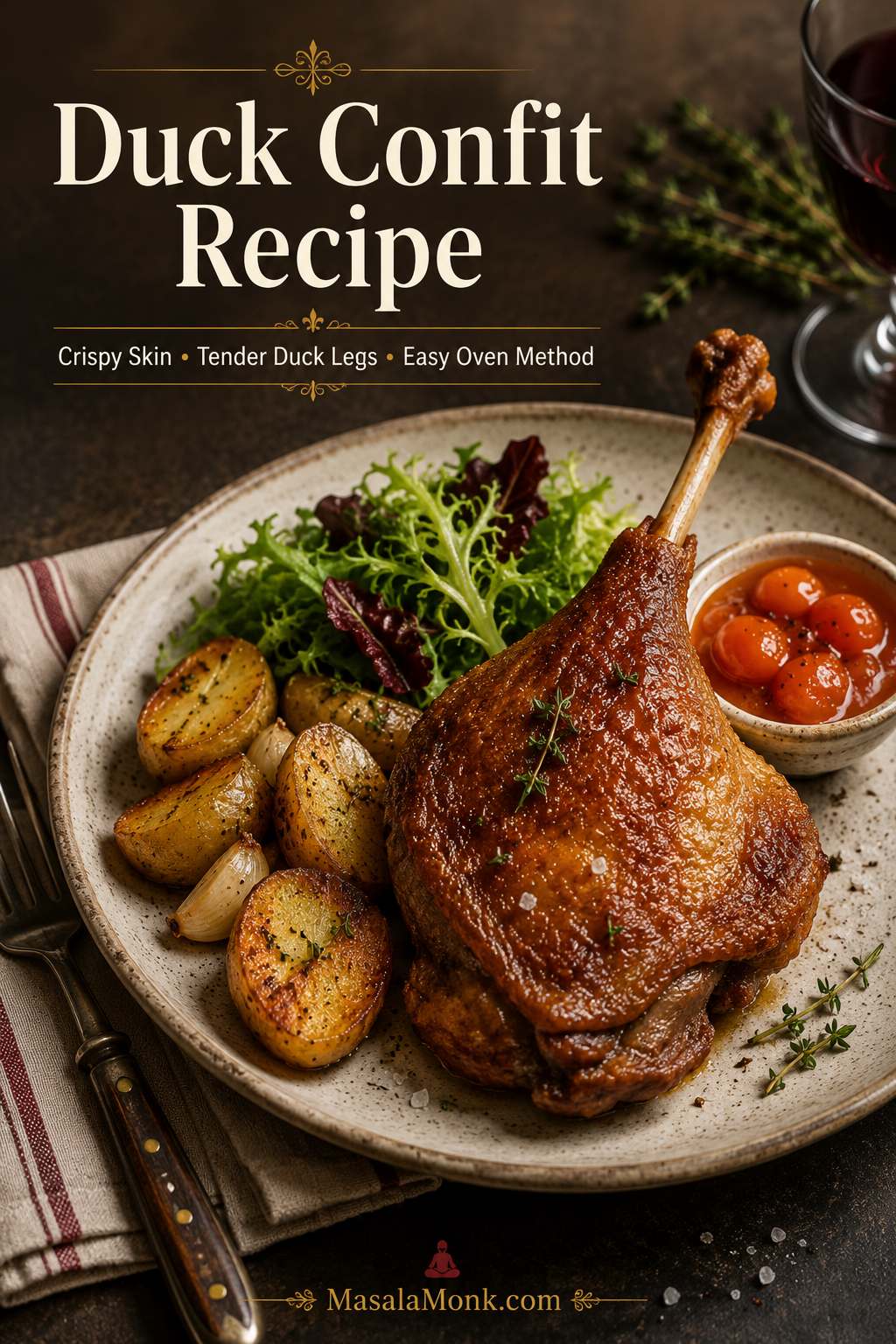
Duck confit sounds like the kind of dish that belongs in a French restaurant kitchen: heavy pans, jars of duck fat, a long wait, and someone at the stove who already knows exactly what “done” feels like. But the scary part is not really the cooking. It is the uncertainty: how much fat is enough, whether the cure will make the duck too salty, why the skin looks soft after hours in the oven, and whether the meat is tender enough before you try to crisp it.
Once you understand the rhythm, the method becomes much less intimidating. You salt the duck legs, cook them slowly in fat until the meat turns silky, and then crisp the skin at the end. The slow cook is for tenderness. The final hot finish is for crackly skin. When those two jobs are separated, the recipe becomes calmer, more predictable, and much easier to repeat.
A Classic Oven Method Built for Home Cooks
This duck confit recipe gives you a classic-style oven method first: skin-on, bone-in duck legs, a measured salt cure, aromatics, duck fat, a low oven, and a crisp golden finish. Then it walks you through the parts that usually make home cooks hesitate: duck fat, pan size, salt, tenderness, storage, and crisping the skin without drying the meat.
The finished leg should arrive at the table with crackly skin, tender meat that pulls easily from the bone, and enough savory duck fat left behind to make potatoes, mushrooms, eggs, beans, and vegetables feel like part of the reward.
This version is built for home cooks: classic enough to taste right, practical enough for a normal kitchen, and detailed enough that you always know whether the duck is on track.
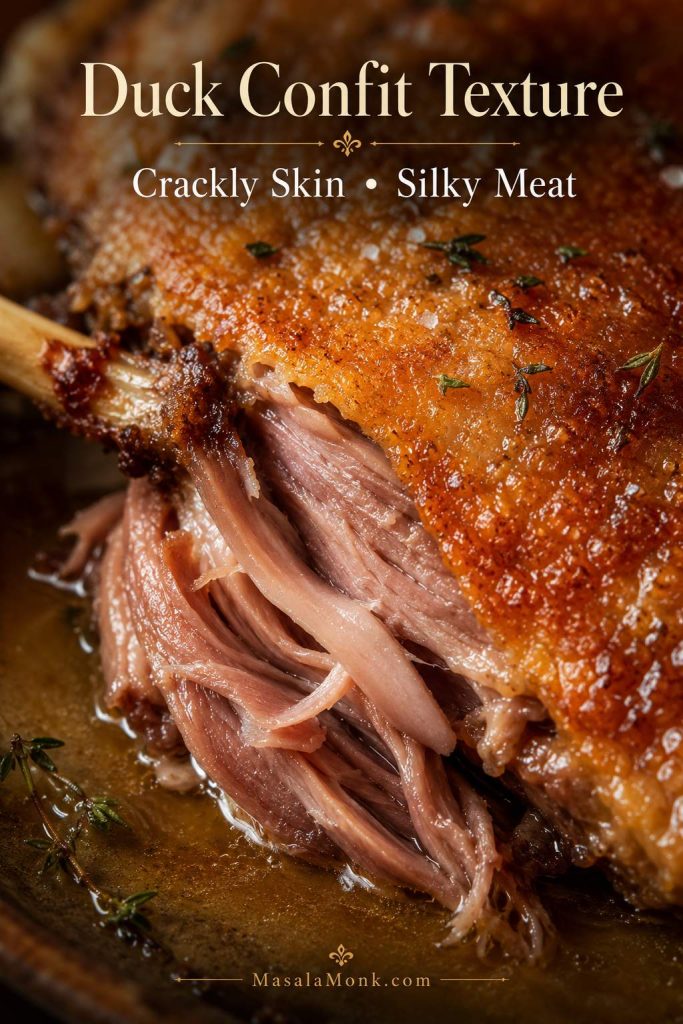
What duck confit should feel like: The slow cook is for tender meat, while the final heat is what makes the skin crackly.
What You’ll Learn
Quick Answer: The Most Reliable Duck Confit Method
The most reliable way to make duck confit at home is to use skin-on, bone-in duck legs. Cure them with salt and aromatics for 12 to 24 hours, then cook them slowly in duck fat in a close-fitting dish at 105°C / 225°F for 3½ to 4 hours, until the meat is tender enough to pull easily from the bone. After that, lift the legs from the fat and crisp them skin-side down in a skillet or roast them in a hot oven until the skin turns golden.
The full recipe card is below, but if you are cooking now, the oven method is the main path to follow. From start to table, duck confit usually takes overnight to about 1¼ days, but most of that time is inactive. The hands-on work is closer to 35–45 minutes, split between curing, arranging the duck, handling the fat, and crisping before serving.
Best path for most cooks: start with the oven method, the lower salt range, and the skillet crisp. Treat lower-fat or gadget methods as fallbacks after you understand the main method.
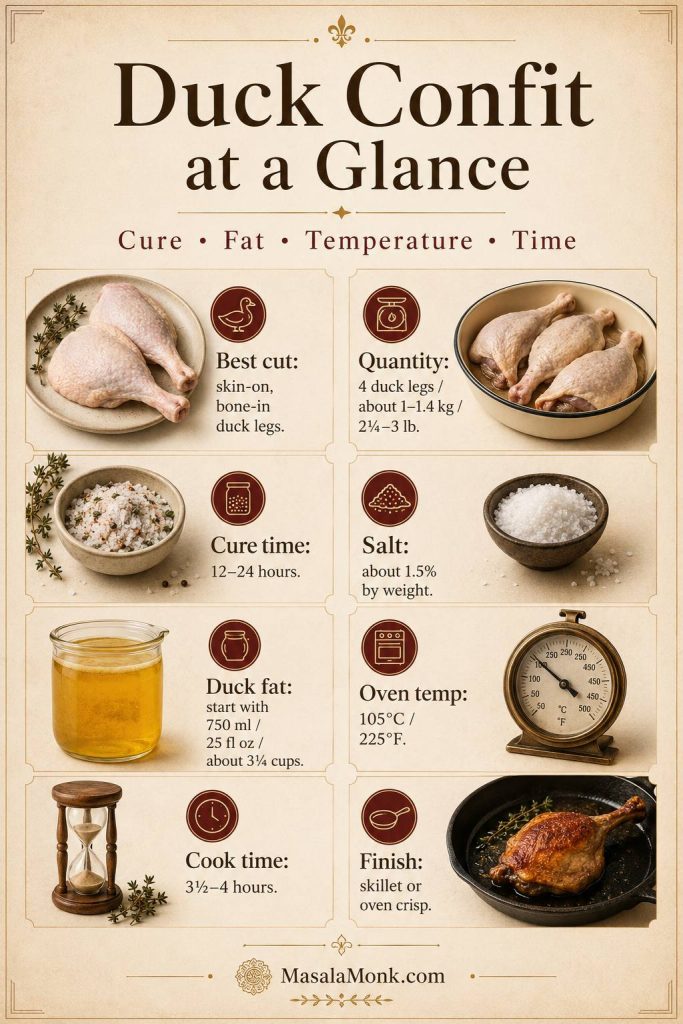
Duck Confit at a Glance
| Best cut | Skin-on, bone-in duck legs |
|---|---|
| Servings | Plan on 1 duck leg per person; very large legs can serve 2 lighter portions with sides |
| Quantity | 4 duck legs, about 1–1.4 kg / 2¼–3 lb total |
| Salt guide | About 1.5% of the duck’s weight, usually 15–21 g kosher salt for 4 legs |
| Cure time | 12–24 hours |
| Duck fat | Start with 750 ml / 25 US fl oz / about 3¼ cups; exact amount depends on pan size |
| Oven temperature | 105°C / 225°F, or about 95–100°C / 205–212°F for fan/convection ovens |
| Cook time | 3½–4 hours, or until very tender; fan ovens may need 30–60 minutes more |
| Finish | Skillet crisp for the most controlled skin, or hot oven crisp for several legs |
| Total time | Overnight to 1¼ days, mostly inactive |
Common mistakes to avoid: using a pan that is too wide, measuring fine salt by volume, letting the fat bubble hard, trying to crisp wet skin, and judging doneness only by time. Get those five things right, and the method becomes much calmer.
Success cues: after curing, the skin feels a little firmer; during cooking, the fat barely moves; when done, the leg feels loose and the meat pulls back slightly from the bone; after crisping, the skin is golden, dry, and crackly.
Why This Duck Confit Recipe Works
Good confit is not about complicated technique. Each stage has a clear job: the cure seasons the meat, low oven heat tenderizes it, duck fat protects it from harsh heat, and the final crisping step gives the skin that golden finish people remember. That contrast is the reason duck confit feels special: the meat is gentle and rich, while the skin gives you the crisp edge that keeps the whole plate from feeling heavy.
- A measured salt cure seasons the legs deeply. Instead of a vague handful of salt, this recipe gives a weight-based range so the duck tastes seasoned, not aggressively salty.
- Low oven heat keeps the cooking controlled. Duck legs need time for connective tissue to soften. A low oven lets that happen without the fat bubbling hard around the meat.
- Duck fat surrounds the legs and regulates heat. The fat is not there to make the meat greasy. It creates a steady cooking environment.
- A close-fitting pan reduces the amount of fat needed. Dish shape can save you from buying far more duck fat than necessary.
- Crisping happens after the slow cook. Skin that looks soft after confit is normal; the skillet or hot oven creates the crackly finish right before serving.
What Is Duck Confit?
Duck confit is a classic method where duck legs are salted, slowly cooked in fat, and then crisped before serving. Traditionally, confit was also a preservation technique: the cooked duck was stored under a protective layer of fat. Today, most home cooks make it because it creates an incredible contrast of textures — deeply tender meat under crisp, golden skin.
The word confit can make the process sound complicated, but the actual cooking is quiet and controlled. You are not deep-frying the duck. You are cooking it slowly in warm fat, almost like a rich, careful braise. The fat surrounds the meat, protects it from harsh heat, and helps the connective tissue soften gradually.
This is a classic-style oven version, not a pressure-cooker shortcut or a duck breast confit. Those methods can work, but the main recipe here is built around duck legs, a salt cure, duck fat, low heat, and a final crisp.
Duck leg confit works so well because legs have more connective tissue than breast meat. Duck breast is better cooked quickly to medium-rare with crisp skin. For that style, see this duck breast recipe instead.
Duck Confit vs Roast or Braised Duck Legs
All three can be delicious, but they do not cook the same way. Roast duck legs go straight into dry oven heat, braised duck legs soften in liquid, and confit legs are slowly cooked in fat before they are crisped. That fat-cook-first, crisp-later rhythm is what gives the dish its silky meat and golden skin.
Ingredients for Duck Confit
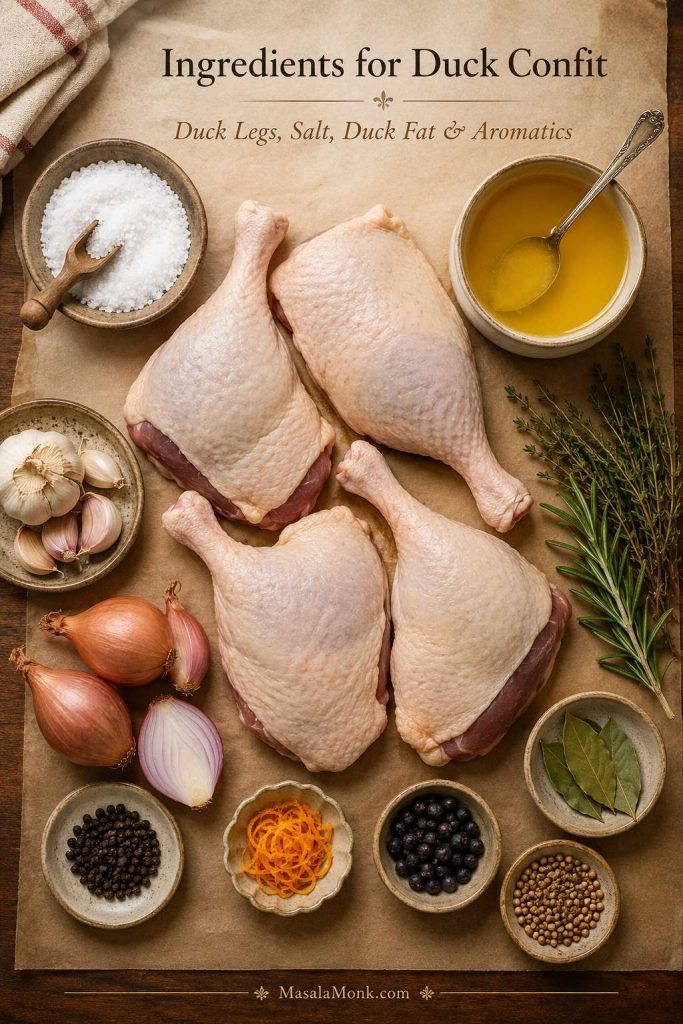
The most reliable version does not need a long, intimidating ingredient list. Duck legs, salt, fat, and a few aromatics are enough. The aromatics should support the duck, not bury it.
Before you cure the duck: use this as a quick check: duck legs, measured salt, clean fat, and simple aromatics are doing most of the work.
Duck Legs
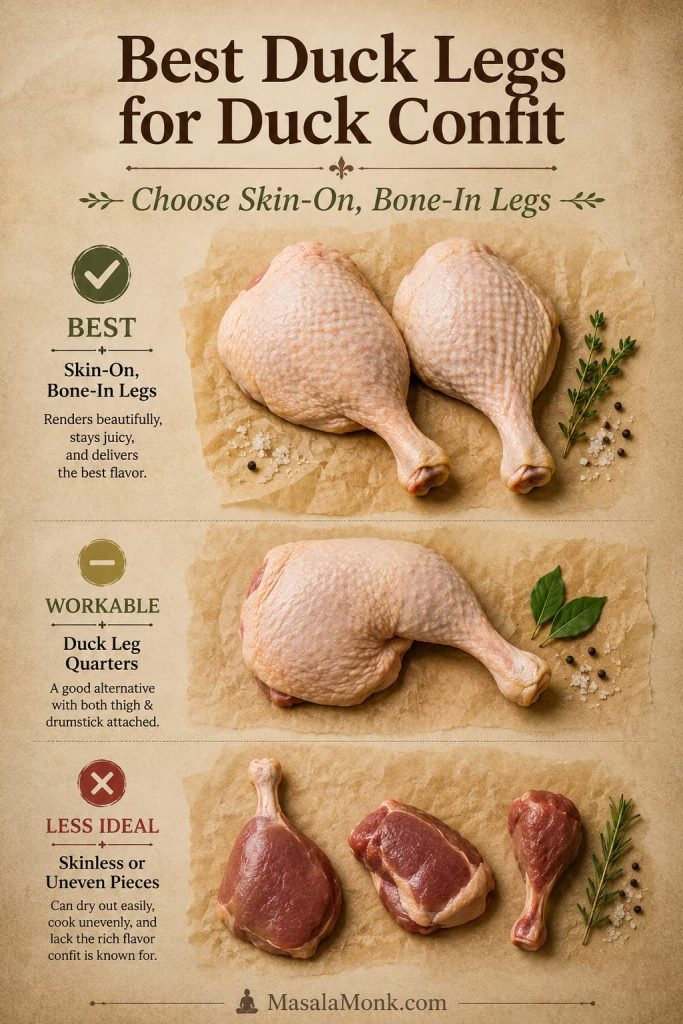
Use 4 skin-on, bone-in duck legs, about 1–1.4 kg / 2¼–3 lb total. The skin is important because it becomes crisp at the end. The bone protects the meat and gives the finished legs a better texture.
If your duck legs are very large, expect the cooking time to sit closer to 4 hours. Smaller legs may be tender earlier, so start checking them after about 3 hours. The timer is useful, but tenderness is the real test.
Plan on one duck leg per person for a main course. If the legs are especially large and you are serving several sides, one leg can sometimes serve two lighter portions.
Duck leg buying visual: Skin-on, bone-in legs are the safest choice because they bring the fat, skin, bone, and connective tissue that make confit work.
- Fresh or frozen both work. If using frozen duck legs, thaw them fully in the refrigerator before curing.
- Choose similar sizes if possible. Legs that are close in size will cure and cook more evenly.
- Keep the skin on. Skinless duck legs will not give you classic texture.
- Fatty-looking legs are useful here. Some of that fat renders into the dish and can be strained for later cooking.
- Skip pre-marinated duck legs. They may already be salty or sweetened, which makes the cure harder to control.
Duck Confit Salt Guide
Use about 1.5% salt by weight of the duck legs. That means about 15 g salt for 1 kg duck legs, 18 g for 1.2 kg, and 21 g for 1.4 kg. For most batches of 4 duck legs, 15–21 g kosher salt lands in the right range.
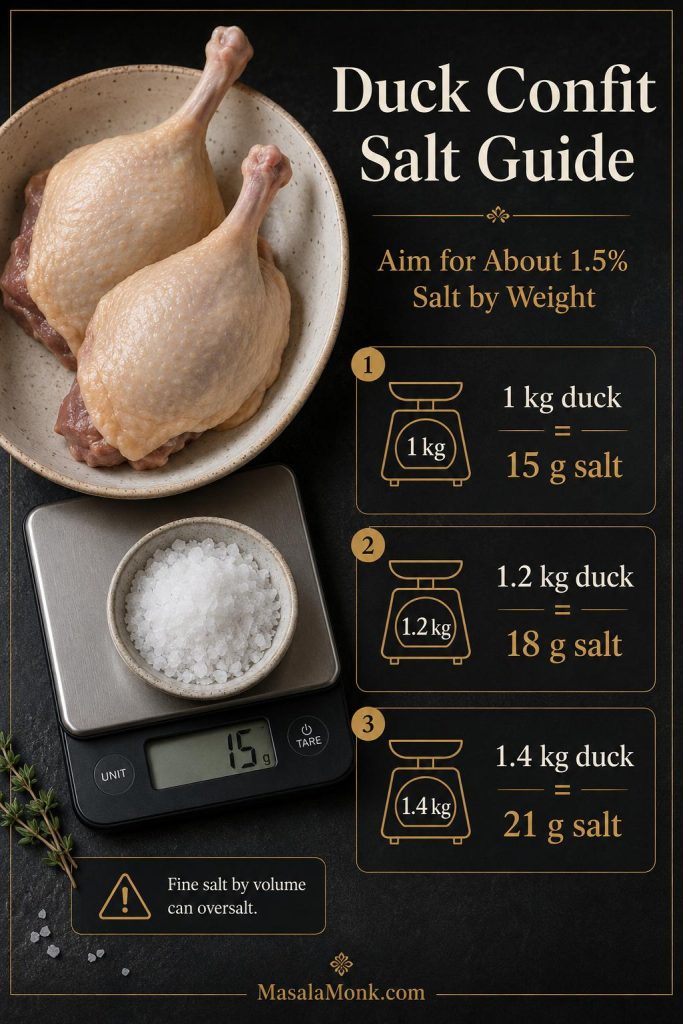
Weighing the salt is better than using spoons because different salts vary dramatically by volume. Fine salt packs more tightly and tastes saltier by the spoonful, so use the lower end if you are not weighing.
For a gentler first try, use the lower end of the range and cure for 12 hours. You can always finish the cooked duck with a little flaky salt, but it is harder to fix a cure that was too heavy.
Duck Fat
Start with about 750 ml / 25 US fl oz / 3¼ cups rendered duck fat for 4 duck legs. You may need less if your pan is close-fitting, or more if your pan is wide. The exact quantity depends on the shape of your dish more than the recipe itself.
For the visual version, see the duck fat guide. Aim to cover the meaty parts with fat. Bone tips can poke out, and a tiny patch of skin above the fat is not a disaster. However, if a large patch of meat is exposed, switch to a smaller dish. If you cannot, turn the legs once halfway through cooking while they are still firm enough to handle.
Aromatics
For a classic but not fussy flavor, use garlic, shallots, thyme, rosemary, bay leaves, and black peppercorns. Orange zest, juniper berries, or coriander seeds are optional. They add a more restaurant-style aroma, but the recipe still works beautifully without them.
- Garlic gives warmth and depth.
- Shallots add gentle sweetness.
- Thyme and rosemary give the duck a classic savory backbone.
- Bay leaves add quiet background aroma.
- Black peppercorns give mild spice without making the duck taste peppery.
- Orange zest is optional, but especially good if you plan to serve the legs with orange sauce.
About the aromatics: use thyme, peppercorns, orange zest, juniper, or coriander in the cure. Use fresh garlic, thickly sliced shallots, bay leaves, rosemary, and more thyme in the cooking fat. Discard the wet cure aromatics before cooking, especially if they are covered in salt or moisture.
Equipment and Pan Size
You do not need restaurant equipment, but the right pan makes the whole recipe easier and cheaper because it reduces the amount of duck fat you need.
Best Pan and Equipment for Duck Confit
A close-fitting vessel is the key piece: it keeps the fat level higher around the legs and makes the rest of the equipment feel simple.

- Close-fitting oven-safe baking dish, casserole, or small Dutch oven: the most important piece of equipment.
- Lid, foil, or parchment: keeps the duck covered during the slow cook.
- Tongs or a wide spatula: for lifting tender legs without tearing them.
- Heavy skillet: for crisping the skin before serving.
- Fine-mesh strainer and clean jar: for saving clean duck fat after cooking.
The duck legs should fit in one layer. They can sit close together, but they should not be piled on top of each other. A compact casserole or small Dutch oven usually works better than a wide roasting tray for a first batch.
- Strongest choice: a small Dutch oven or compact ceramic baking dish.
- Good choice: a medium casserole with a tight lid.
- Use only if needed: a wide roasting pan, because it requires more fat.
- Skip: shallow trays where the duck cannot be mostly covered.
A heatproof jug can make warm fat easier to pour, and a digital thermometer is useful if you want to check that the fat is staying low and steady. A nonstick skillet is helpful for crisping if you are nervous about the skin sticking or tearing.
How Much Duck Fat Do You Really Need?
Duck fat is usually the moment people pause — not because the recipe is hard, but because the jar looks expensive and the instructions often sound vague about how much you really need. This is the part worth making practical.
Recipes say “cover the duck with fat,” but that can mean very different amounts depending on the pan. The practical rule is simple: use the smallest oven-safe dish that fits the duck legs in a single layer without stacking them. A compact pan saves fat and keeps the duck more evenly covered.
Pan Size and Duck Fat Amount
Use this pan-size guide before buying more duck fat, because the same four legs can need very different amounts in different dishes.

| Pan setup | Likely duck fat needed for 4 legs | Most useful for |
|---|---|---|
| Small close-fitting baking dish | 500–750 ml / about 2–3¼ cups | Saving duck fat |
| Medium casserole or Dutch oven | 750 ml–1 liter / about 3¼–4¼ cups | Most home batches |
| Wide roasting pan | 1 liter+ / 4¼ cups+ | Only when you have enough fat |
This is usually the moment the recipe starts to feel less extravagant and more manageable: the duck does not need a dramatic pot of fat, just the right dish and enough quiet heat.
Scaling the recipe: for 2 duck legs, keep the salt at about 1.5% of the duck’s weight and use the smallest dish that fits them. For 6–8 legs, keep them in one layer or use two dishes. The fat amount changes with the dish, not just the number of legs, and the cook time still depends on tenderness.
How to Cure Duck Legs for Confit
The cure should feel controlled, not like you are packing the duck in salt. You are seasoning the meat deeply and giving the surface time to firm slightly before the slow cook.
What the Cure Should Look Like
The surface should look evenly seasoned, with aromatics adding flavor rather than burying the duck under salt.

- Pat the duck legs dry. Moisture on the surface makes the cure less even.
- Rub with salt. Use about 1.5% salt by weight, or 15–21 g kosher salt for 4 duck legs, depending on their total weight.
- Add cure aromatics. Use thyme, peppercorns, optional orange zest, and optional juniper or coriander here if you like.
- Cover and refrigerate. Cure for 12–24 hours.
- Remove excess cure. Wipe off aromatics and visible salt. Rinse only if there are clumps of salt or the cure looks heavy.
- Dry very thoroughly. If you have time, let the legs sit uncovered in the refrigerator for 30–60 minutes after wiping or rinsing. The drier the surface, the cleaner the cooking fat and the better the final crisping.
For most home cooks, 12 hours gives balanced seasoning and 24 hours gives deeper flavor. A 1–2 hour cure can work for shortcut versions, but for this recipe, 12–24 hours is the safest and most balanced range. For a first batch, choose 12 hours and the lower salt range.
How to Make Duck Confit in the Oven
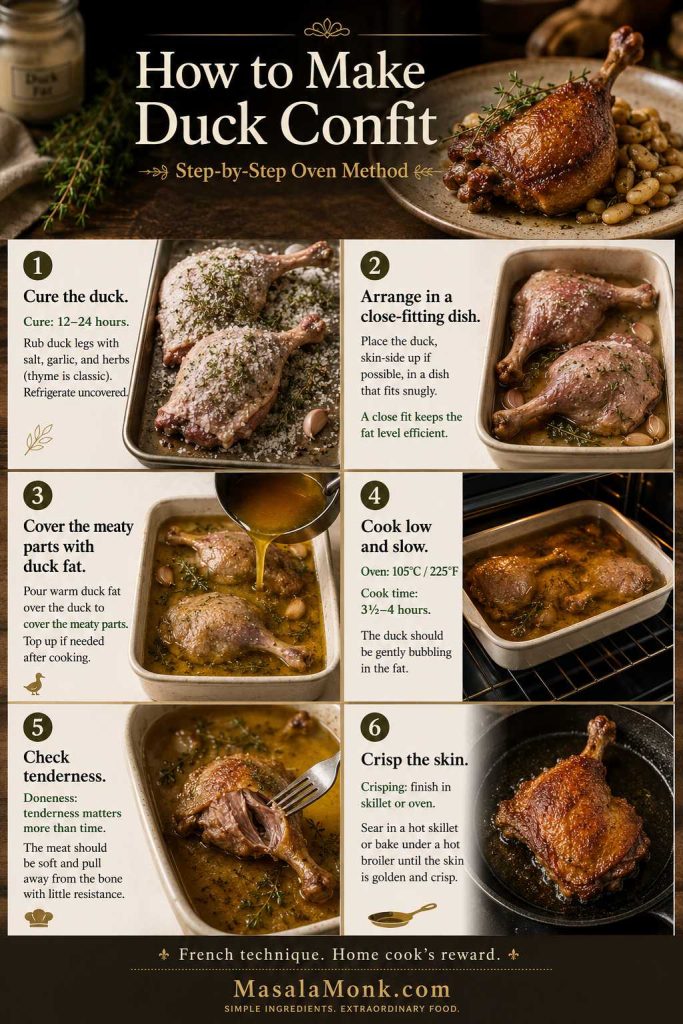
Start with this oven method if this is your first batch. It gives you the most reliable balance of classic texture, steady heat, and kitchen sanity. Once the legs are in the fat and the oven is low, your job is mostly to leave them alone.
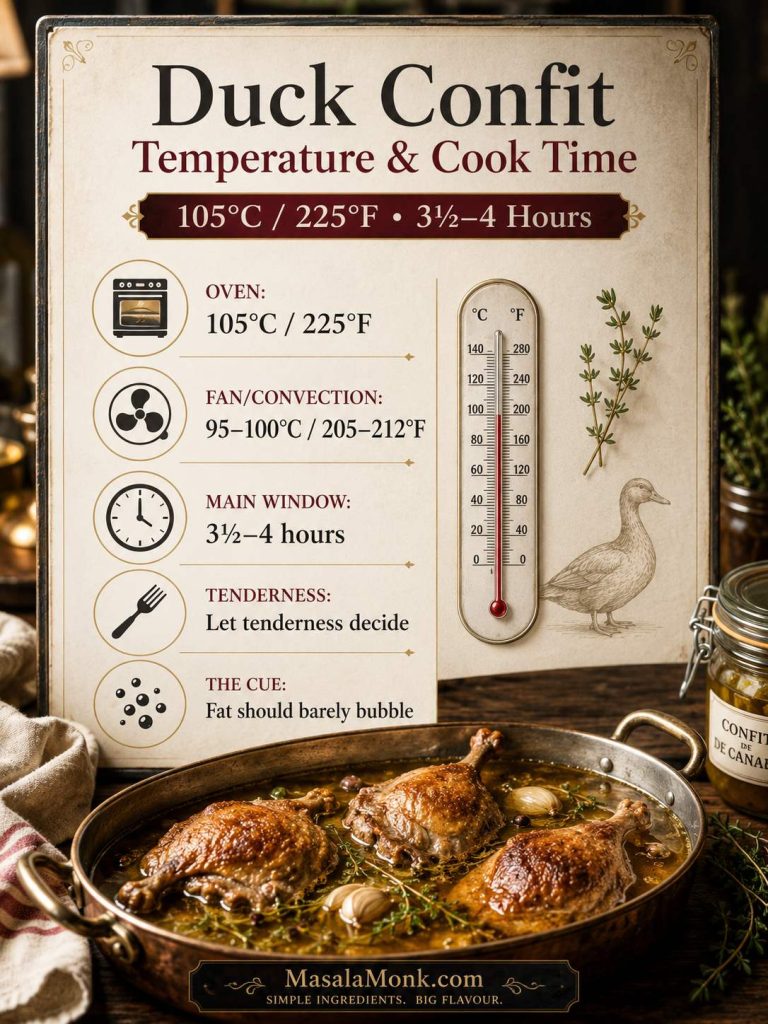
The duck cooks at 105°C / 225°F for 3½ to 4 hours, then gets crisped at the end. If you are using a fan or convection oven, reduce the temperature to about 95–100°C / 205–212°F and check the fat after the first hour. The fat is right when it barely bubbles instead of boiling hard.
Duck confit recipes vary because oven temperature, pan shape, leg size, and how deeply the meat is submerged all change the timing; use 3½–4 hours as the main window, but let tenderness decide.
Before you start the oven method: this step-by-step image shows the full rhythm: cure, arrange, cover with fat, cook low, test tenderness, and crisp.
Duck Confit Temperature and Cook Time
The low oven target keeps the fat calm; the clock gives you a window, but tenderness still decides the finish.
Step 1: Melt the Duck Fat
Warm the duck fat just until liquid. It only needs to be fluid enough to pour around the duck legs. If it is hot enough to sputter, it is hotter than it needs to be.
Step 2: Arrange the Duck in a Close-Fitting Dish
Place the cured, dried legs in the smallest oven-safe dish that holds them in one layer without stacking. Add fresh garlic, thickly sliced shallots, bay leaves, rosemary, thyme, and peppercorns around the legs. Discard the wet cure aromatics rather than carrying all of that salt and moisture into the cooking fat.
Step 3: Cover with Duck Fat
Pour warm fat over the legs until the meaty parts are mostly submerged. If you are just short, press a piece of parchment directly over the duck before covering the dish. This helps keep the legs tucked under the fat. If a large patch of meat remains exposed, move everything to a smaller dish or check the short-on-duck-fat guide before adding more fat.
Step 4: Cover and Cook Low
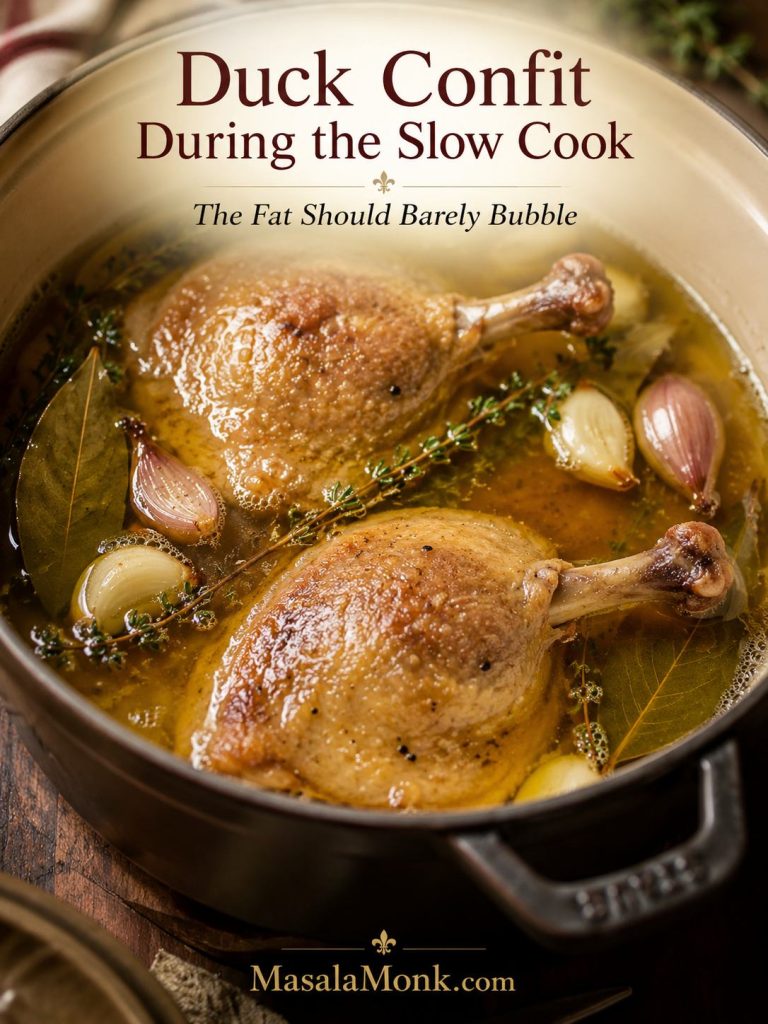
Cover the dish with a lid, foil, or parchment plus foil. Cook at 105°C / 225°F for 3½ to 4 hours. Keep the fat nearly still, with only a few lazy bubbles at the edges. Hard bubbling means the heat is too aggressive.
What the Fat Should Look Like During the Slow Cook
This is the visual cue to watch for: the fat should be warm and quiet, not boiling around the duck.
Step 5: Check for Tenderness
Use the timer as a checkpoint; tenderness decides when the duck is ready. The legs are done when the meat offers almost no resistance when pierced, the joint bends easily, and the meat starts to pull back from the bone.
If the meat still feels tight, use the doneness cues and give it more time. This method is forgiving when the heat is low and steady. It is much better to cook the legs a little longer in quiet fat than to pull them before the connective tissue has softened.
Step 6: Cool in the Fat or Crisp Right Away
If serving immediately, lift the legs carefully from the fat and let the excess drip away before crisping. If making ahead, cool them until they are no longer steaming, transfer to a clean container with enough fat to cover, and refrigerate promptly. Move the duck and fat into shallow storage once they are no longer steaming so they chill faster.
How to Know It Is Done
This dish is done by texture, not by a neat internal temperature target. The legs need enough time for connective tissue to soften. That is why the most useful cues are physical.
How to Know Duck Confit Is Done
Look for looseness, not drama: the leg should bend easily and the meat should give way without force.
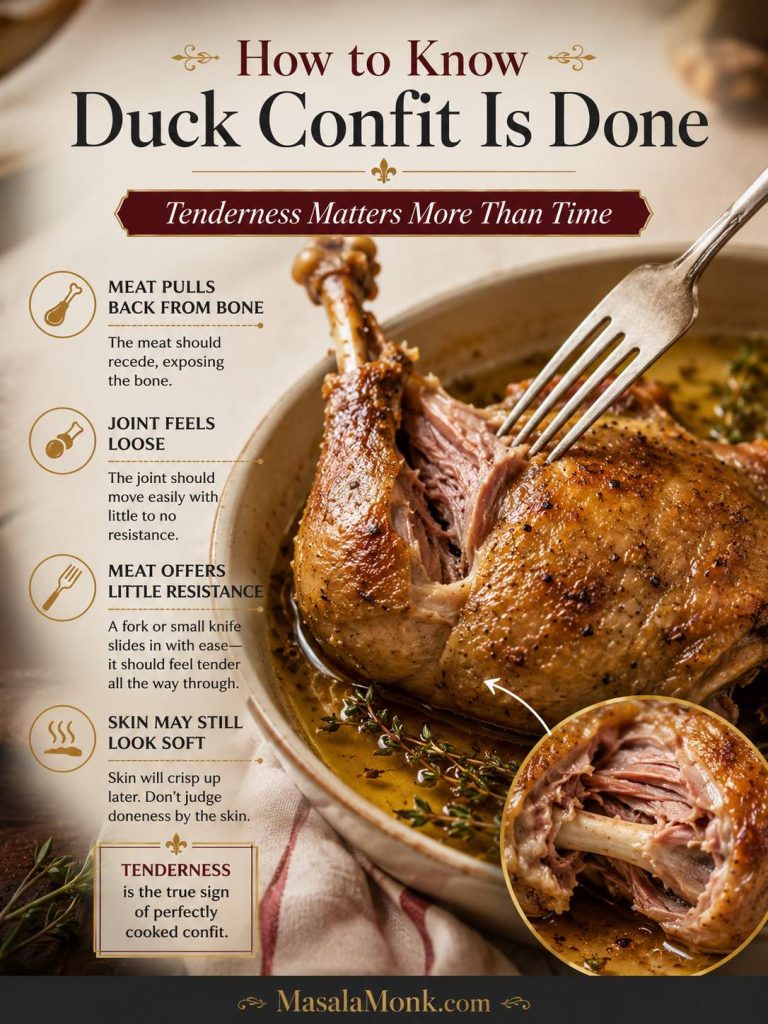
- Meat offers almost no resistance when pierced with a skewer or small knife.
- At the joint, the leg bends easily.
- You may see the meat pull back slightly from the bone.
- A fork can loosen the meat without force.
- The skin may still look soft and pale; that is normal before crisping.
If the meat still feels tight, return the legs to the fat and cook for another 30–45 minutes. Because the heat is low, an extra half hour is usually safer than serving duck that has not fully relaxed.
How to Crisp the Skin
The crisping step is where the recipe starts to feel special. The meat is already cooked; you are not trying to cook the duck again. You are slowly waking up the skin.
Before crisping, lift the legs from the fat and wipe away any thick clinging fat from the skin. Let them drain on a rack for a few minutes if they look especially glossy. Skin that is wet or coated in too much fat will take longer to crisp and may brown unevenly.
For the crispest skin, make the legs ahead, chill them in the fat, then lift, wipe, and crisp when cool or cold. The skin is easier to handle once the fat has set, and it is less likely to tear in the pan.
Crisp the legs as close to serving as possible. The meat can wait in the fat, but the skin is at its best within minutes of crisping.
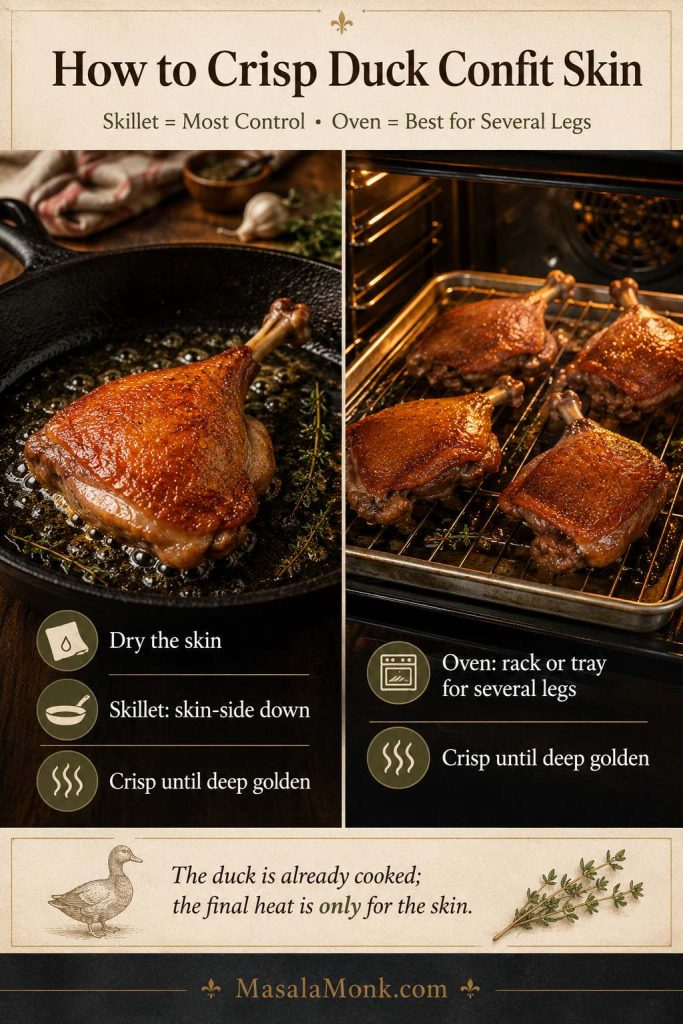
How to Crisp Duck Confit Skin
The slow cook is already done, so the final heat should focus on dry skin, steady browning, and a crisp finish right before serving.
Most Reliable Method: Skillet Crisp
Place the legs skin-side down in a heavy skillet or nonstick skillet over medium heat. Cook for 6–10 minutes, or until the skin is crisp and deeply golden. Nonstick is especially forgiving if you are nervous about the skin sticking or tearing.
If the skin seems stuck, it usually needs more time. Once enough fat renders, it loosens more easily. Let it crisp until it naturally releases from the pan; this is a patience step, not a high-heat step.
This is where the quiet, slow recipe finally turns dramatic.
Hands-Off Method: Hot Oven Crisp
Place the legs on a rack set over a tray and roast at 200°C / 400°F for 20–30 minutes, until the skin is crisp and the meat is hot. This method is useful when cooking several legs at once.
Fast Finish: Broiler or Grill
A broiler or grill can help finish stubborn skin, but use it carefully. Duck skin can go from golden to burnt quickly. Keep the legs several inches from the heat and watch closely for the last 2–5 minutes.
If You Are Short on Duck Fat
Classic confit uses rendered duck fat because it gives the cleanest, fullest flavor. However, if the price of duck fat is the only thing stopping you, you can still make a useful confit-style version. Duck fat is still the best choice for clean flavor and silky meat, while substitutes are practical fallbacks when budget or availability gets in the way.
When the Duck Fat Looks Too Low
A compact dish is often the difference between exposed meat and good coverage, especially when you are trying to avoid buying another jar of fat.
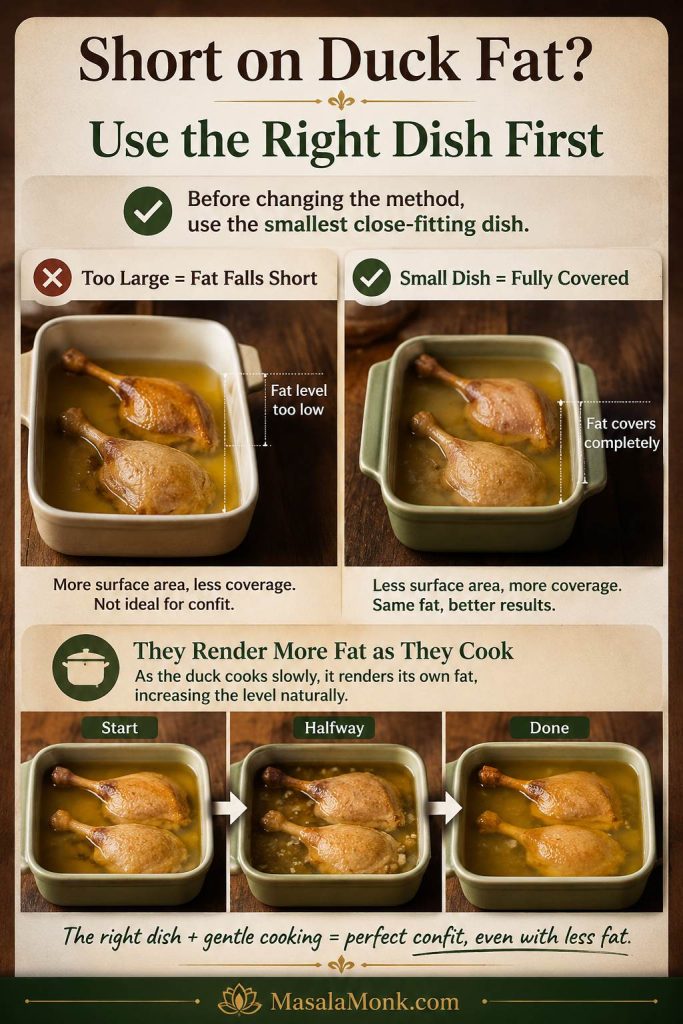
A small amount of duck fat can still work when the dish is compact enough, because the legs will render more fat as they cook. Some easy confit-style methods add a small splash of water or stock at the beginning to prevent scorching while the fat renders. This can be delicious, but it is closer to a confit-style braise than full duck-fat confit.
Duck Fat Substitutes for Duck Confit
Substitute fats can help when duck fat is expensive or unavailable, but the flavor and storage behavior will not be exactly the same.
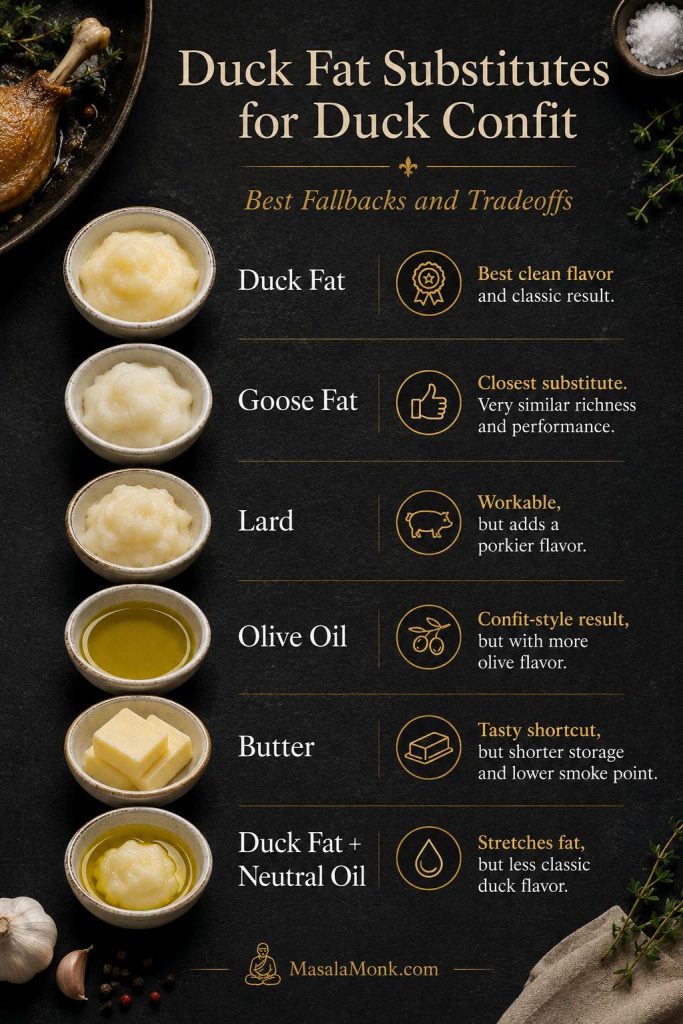
| Fat option | How it works | Tradeoff |
|---|---|---|
| Duck fat | Classic choice with the cleanest duck flavor | Most traditional, but can be expensive |
| Goose fat | Closest substitute if duck fat is unavailable | Rich and poultry-friendly, but not identical |
| Lard | Works as a cooking fat | Adds a porkier flavor |
| Olive oil | Can create a confit-style result | Flavor becomes more olive-oil-forward |
| Butter | Tasty shortcut when duck fat is unavailable | Contains water and milk solids, so storage is shorter |
| Duck fat + neutral oil | Can stretch a small amount of duck fat | Less classic flavor; treat leftovers conservatively |
If using butter, strain and store the leftover fat separately and treat the cooked duck like normal leftovers rather than traditional fat-preserved confit.
Other Ways to Cook Duck Confit
Once you understand the oven method, the shortcuts and gadget versions are easier to judge. These are useful when they solve a real problem — less duck fat, less oven time, or more hands-off cooking — but they should not distract from the main method if this is your first batch.
Method comparison visual: The oven method stays the main path here, while the other approaches are practical alternatives for specific kitchens.
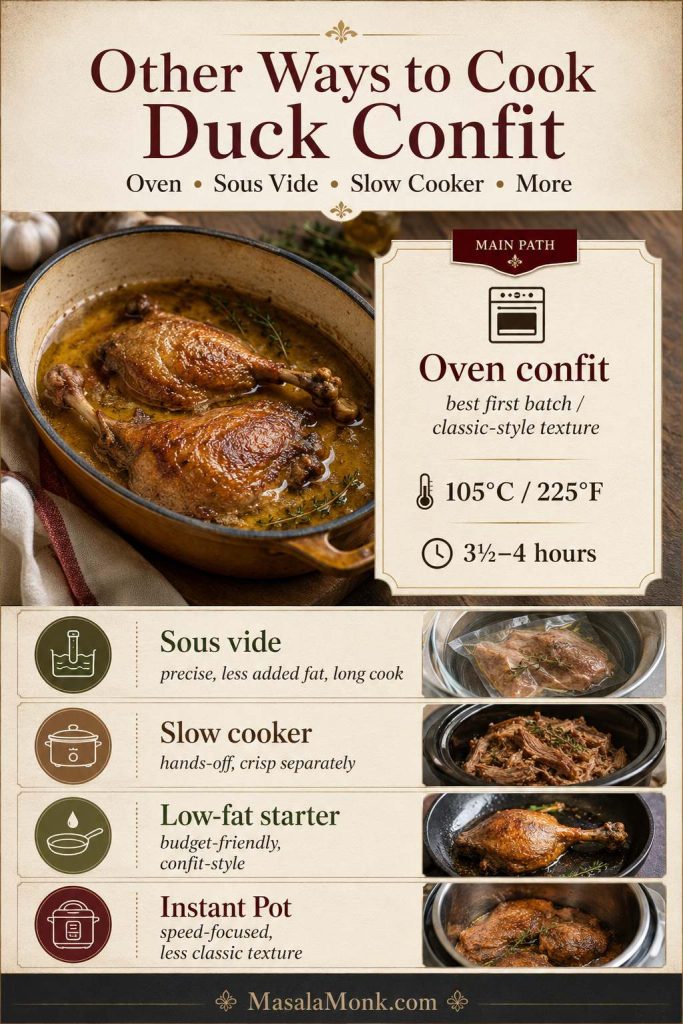
| Method | Best for | Tradeoff |
|---|---|---|
| Oven confit | First batch and silky meat with crisp skin | Needs enough fat and time |
| Sous vide | Less added fat and precise temperature | Long cook; no traditional fat storage |
| Slow cooker | Hands-off tenderness | Skin must be crisped separately |
| Low-fat starter | Budget cooking or limited duck fat | More confit-style braise than classic confit |
| Instant Pot | Speed-focused experiment | Less classic texture and control |
Make-Ahead Timeline
This is one of those dishes that rewards planning ahead. You do not need to stand over the stove all day; you just need to give the cure and slow cook enough time to do their work.
How the timing works: the cure and slow cook are mostly inactive, while the final crisping happens just before serving.
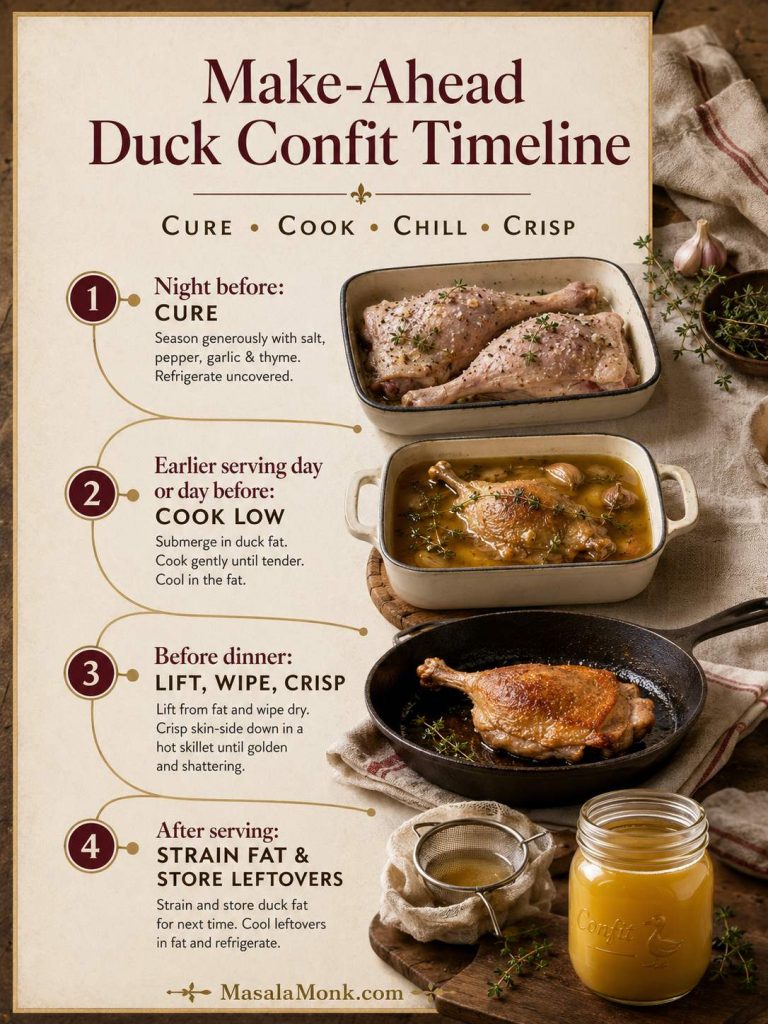
| When | What to do |
|---|---|
| Night before or up to 24 hours before serving | Salt-cure the duck legs with aromatics. |
| Earlier on serving day or the day before | Cook the legs slowly in duck fat until tender. |
| Before dinner | Lift the chilled legs from the fat, wipe the skin well, and crisp. |
| After serving | Strain the fat, store leftovers, and save clean duck fat for later cooking. |
What to Serve with Duck Confit
Because the legs are savory and full-flavored, the best sides either absorb the duck juices, cut through the fat, or add a little sweetness and acidity. You do not need many sides. One potato or bean dish, one bright salad or vegetable, and one sauce are enough.
My favorite way to serve it is simple: one crisp leg, potatoes that have met a spoonful of duck fat, a bitter green salad with a sharp dressing, and a small spoon of orange or cherry sauce. That plate gives you richness, crunch, acidity, and enough restraint that the duck remains the reason everyone is at the table.
The best plate gives you crackly skin, tender meat, something starchy, and something sharp enough to make you want the next bite.
How to build the plate: use the sides to balance the richness: something starchy, something green or sharp, and a sauce that wakes up the plate.

Easy Plate Ideas
- Bistro-style plate: one crisp duck leg, duck fat potatoes, bitter greens, and orange or cherry sauce.
- Rustic plate: duck confit with white beans, braised cabbage, and mustard vinaigrette.
- Lighter plate: crisp duck over lentils, herbs, and something cold and sharp, such as a simple cucumber salad.
- Cold-weather plate: duck legs with potatoes, roasted carrots, and a red wine or cherry sauce.
Potatoes, Beans, and Starches
- Duck fat potatoes — the most obvious and probably the most memorable pairing.
- Mashed potatoes — if you want a softer side, these garlic mashed potatoes give the duck a creamy, buttery base.
- White beans — especially with garlic, herbs, and a little stock.
- Lentils — earthy, simple, and excellent with full-flavored duck.
- Potato salad — for a make-ahead side, choose a mustardy or vinegar-leaning potato salad rather than a very heavy creamy one.
Vegetables and Greens
- Bitter greens such as arugula, frisée, endive, or radicchio.
- Braised cabbage, especially red cabbage with a little vinegar.
- Roasted carrots with herbs or citrus.
- Green beans with garlic and lemon.
- Mushrooms sautéed in a little duck fat.
- Lemony chickpea salad if you want the meal to feel fresh but still filling.
Sauces and Fruit Pairings
The dish does not need a heavy sauce, but a small spoonful of something sharp, fruity, or winey can make the plate feel complete. Orange sauce is a classic pairing; this orange sauce for duck works especially well if you use orange zest in the cure.
Choose orange or cherry sauce for a sweet-sharp plate, red wine sauce for a deeper dinner-party feel, mustard vinaigrette for a lighter salad-style plate, and plum sauce if you want a sweeter, fruitier direction. For a cheese-board-style plate, a small spoon of fig jam can work beside crisp duck, bitter greens, and something salty.
Recipes Using Duck Confit
The quiet advantage of duck confit is that tomorrow’s dinner is already halfway done. Once the duck is cooked, the meat can be shredded and folded into quick meals that taste far more luxurious than the effort involved.
Best Ways to Use Leftover Duck Confit
A small amount of shredded duck can carry a whole meal, especially when it is crisped briefly before being folded into pasta, beans, hash, or salad.

To use leftover duck confit, lift the meat from the fat, remove the bone, shred the meat, and crisp it in a skillet with a spoonful of duck fat. Add it near the end of cooking so it stays savory and textured instead of disappearing into the dish.
The easiest wins are pasta, hash, beans, and salads because they let a small amount of shredded duck flavor the whole dish.
- Pasta with duck confit: toss shredded duck with garlic, mushrooms, herbs, and a little pasta water.
- Warm duck salad: serve crisp shredded duck over bitter greens with a sharp vinaigrette.
- Potato hash with duck confit: crisp potatoes in duck fat, then add shredded duck and herbs.
- Crispy duck tacos: crisp the shredded meat and serve with pickled onions.
- Grilled cheese with duck confit: use a small amount of shredded duck with sharp cheese and mustard.
- White beans with duck confit: fold the meat into white beans with garlic, thyme, and stock.
- Ramen with duck confit: add shredded duck to broth, noodles, greens, and a soft egg.
- Crisp duck over fries: for an occasional comfort-food plate, pile crisp shredded duck over hot fries and add a sharp sauce or pickled onions.
What to Do with Leftover Duck Fat
Leftover duck fat is part of the reward. Strain it, chill it, and use it wisely. It turns ordinary potatoes into something memorable and adds depth to vegetables, eggs, mushrooms, beans, and seared meats.
Best Uses for Leftover Duck Fat
Clean, strained duck fat is worth saving because even a spoonful can make simple vegetables, eggs, or beans taste richer.

- Strain it through a fine-mesh sieve while warm, not scorching hot.
- Remove spent aromatics such as herbs, garlic, shallots, bay leaves, and peppercorns before storing the fat.
- Let juices settle if the fat looks cloudy; watery juices can collect underneath.
- Separate the clean fat from the juices after chilling if a darker layer settles at the bottom.
- Store in a clean jar in the fridge.
- Use clean utensils each time you scoop fat out.
- Do not pour hot fat down the sink. Let unwanted fat solidify, then discard it properly.
After chilling, clean fat will set on top and darker juices may settle underneath. The pale solid layer is fat. The darker layer underneath is meat juice, salt, and aromatics. Save the clean fat for cooking; use the darker juices quickly in beans, pan sauce, or gravy, or discard them.
Use duck fat for roast potatoes, fried eggs, mushrooms, cabbage, beans, carrots, Brussels sprouts, and pan-seared meats. Discard it if it smells off, looks moldy, or has been contaminated with crumbs or meat juices over time.
Storage, Freezing, and Reheating
This is one of those dishes that rewards making ahead, but home storage should be handled carefully. Traditional confit was preserved under fat, but modern kitchens vary in cleanliness, temperature control, salt levels, and handling. This recipe is written as a modern dinner recipe, not a long-term preservation project.
The fat helps protect the texture, but this recipe uses a regular salt cure, not curing salt for long-term preservation. In a home kitchen, it is safest to treat the cooked legs like cooked poultry unless you are deliberately following a tested preservation method. Once the duck and fat are no longer steaming, move them into shallow storage so they cool evenly and safely.
Storage visual guide: This image keeps the storage advice modern and safe: chill promptly, store airtight, freeze when needed, and crisp after reheating.
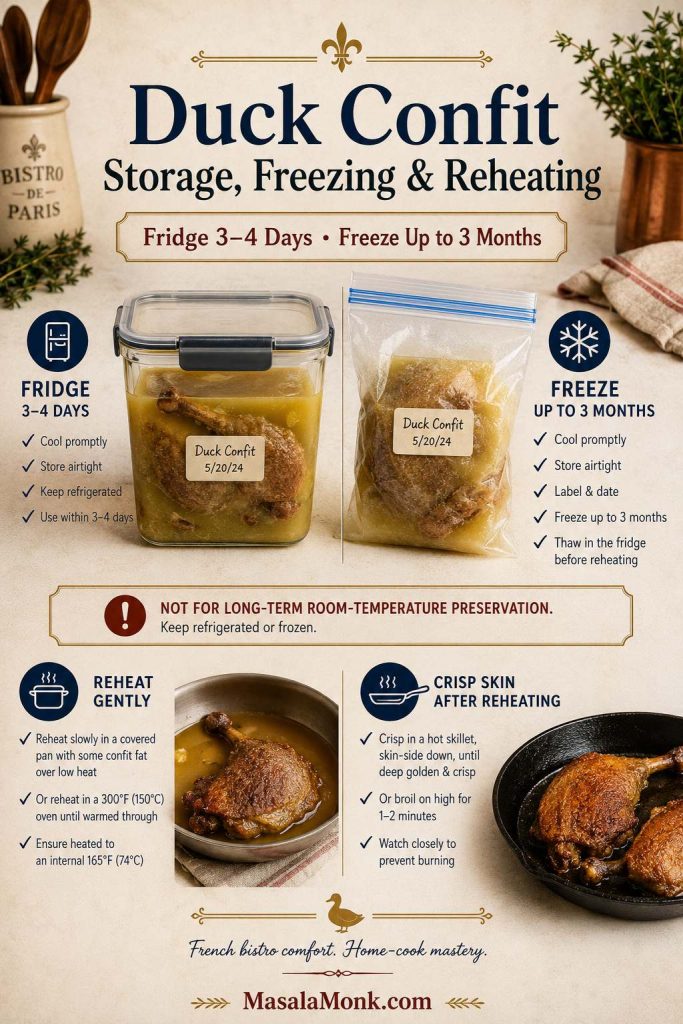
How Long to Store Duck Confit
For normal home storage, refrigerate the cooked legs for 3–4 days. When in doubt, freeze instead of stretching fridge storage.
| Situation | Best method | Notes |
|---|---|---|
| Normal cooked duck confit | Refrigerate 3–4 days | Keep covered and chilled |
| Traditional fat-covered storage | Only for careful cooks using very clean containers | For everyday home cooking, use 3–4 days or freeze |
| Low-fat or butter shortcut version | Treat as normal cooked duck | Use 3–4 days in the fridge; do not rely on long fat-covered storage |
| Freezing | Freeze up to 3 months | Freeze with some fat to protect the meat |
| Reheating whole legs | Skillet or oven | Reheat slowly, then crisp the skin |
| Reheating shredded meat | Skillet with a little duck fat | Best for pasta, hash, tacos, and beans |
How to Reheat Without Losing Crisp Skin
For best texture, skip the microwave for whole legs. The meat may warm, but the skin will turn soft. If you are shredding the duck for pasta or hash, reheating in a skillet with a little duck fat is much better.
When storage feels uncertain — especially if the duck cooled slowly or sat out longer than planned — treat it like cooked poultry and follow standard leftovers guidance rather than relying on old-style confit storage. The USDA leftovers and food safety guide is a useful reference.
Duck Confit Troubleshooting
If something goes wrong, start here; this section is also worth checking before you change the oven temperature, salt, or pan. Most duck confit problems are fixable because the cooking is slow.
How to Fix Common Duck Confit Problems
Most problems point back to the same few causes: salt, heat, pan size, surface moisture, or how the fat was strained.

| Problem | Likely cause | Fix now | Fix next time |
|---|---|---|---|
| Duck is too salty | Cure was too long, or fine salt was used by volume | Serve with unsalted potatoes, beans, lentils, or bitter greens | Weigh the salt and use a shorter cure |
| Meat is tough | Duck was not cooked long enough | Return to the fat for 30–45 minutes | Cook to tenderness, not just time |
| Meat is dry | Fat was too hot or bubbling hard | Serve with sauce or shred into pasta/beans | Lower the oven temperature and keep the fat barely moving |
| Final duck tastes greasy | Too much fat clinging to the skin before crisping | Wipe the skin and drain on a rack after crisping | Let excess fat drip off before skillet or oven finishing |
| Skin will not crisp | Surface is wet or coated with too much fat | Wipe well and crisp skin-side down in a skillet | Chill uncovered or wipe very well before crisping |
| Skin browns but stays soft | Heat is too high or the skin is still damp | Lower heat and keep cooking skin-side down | Dry the legs better before crisping |
| Skin tears | Moved too soon or pan was too hot | Let the rest of the skin release naturally | Use medium heat and wait before turning |
| Not enough duck fat | Pan is too wide | Move duck to a smaller dish | Choose a compact dish from the start |
| Fat looks cloudy | Moisture and juices mixed into the fat | Strain, chill, and separate carefully | Store clean strained fat separately from juices |
Duck Confit FAQs
Is duck confit hard to make?
Not really. Duck confit asks for time more than skill. Most of the recipe is inactive: salt the legs, let them rest, cook them slowly in fat, then crisp the skin before serving.
Which cut of duck is best for confit?
Skin-on, bone-in legs are the cut to buy because they have the fat, skin, bone, and connective tissue that make confit work. Duck breast is better cooked quickly and is not the classic cut for confit.
How much duck fat do I really need?
For 4 duck legs, start with about 750 ml / 25 US fl oz / 3¼ cups rendered duck fat, but pan size matters more than the number. A compact dish may need less, while a wide roasting pan may need much more.
Does duck confit need to be fully submerged in fat?
The meaty parts should be covered by fat for the most even cooking. Bone tips or a very small patch of skin can sit above the fat, especially if you use parchment and a tight cover. If too much meat is exposed, move the legs to a smaller pan before adding more fat.
What temperature should duck confit cook at?
This recipe uses 105°C / 225°F for 3½–4 hours. For fan or convection ovens, reduce the temperature to about 95–100°C / 205–212°F. The goal is low, steady heat: the fat should barely bubble, not boil aggressively.
Why is my duck confit not crispy?
Soft skin after the slow cook is normal — the crisping happens at the end, not during the fat cook. Wipe away excess fat, use medium heat, and give the skin enough time in the pan before moving it.
Can I make duck confit without duck fat?
You can make a confit-style duck leg with goose fat, lard, olive oil, butter, or a mix of duck fat and neutral oil, but duck fat gives the cleanest classic flavor. Treat substitute-fat versions like normal cooked leftovers rather than long fat-preserved confit.
Can I make duck confit with only 2 legs?
Yes. Keep the salt at about 1.5% of the duck’s weight and use the smallest oven-safe dish that fits the legs in one layer. The duck fat amount will depend more on the dish size than the number of legs.
Can I reuse duck fat after making confit?
Yes, if it is clean and smells fresh. Strain it, chill it, separate the pale fat from darker juices underneath, and use clean utensils each time. Discard it if it smells off, looks moldy, or has been contaminated with crumbs or meat juices.
What can I make with leftover duck confit?
Use leftovers in pasta, salads, tacos, hash, white beans, risotto, ramen, grilled cheese, or warm grain bowls. Shred the meat and crisp it in a skillet with a little duck fat for the best flavor.
At this point, the method is simple: cure, cover with fat, cook low, crisp. The recipe card below keeps the steps tight so you can cook from it.
Duck Confit Recipe
This duck confit recipe turns skin-on, bone-in duck legs into silky, pull-apart meat with golden crisp skin. The method is slow but mostly hands-off, with clear guidance for salt, duck fat, pan size, make-ahead storage, and final crisping.
Before you start: use a close-fitting oven-safe dish. Pan size affects how much duck fat you need.
Ingredients
For the Duck and Cure
- 4 skin-on, bone-in duck legs, about 1–1.4 kg / 2¼–3 lb total
- 15–21 g kosher salt, or about 1.5% of the duck’s weight
- 2–4 small thyme sprigs
- 1 teaspoon black peppercorns, lightly crushed
- Optional: 2 strips orange zest
- Optional: 4–6 juniper berries or 1 teaspoon coriander seeds
For Cooking
- 750 ml / 25 US fl oz / about 3¼ cups rendered duck fat, plus more if needed depending on pan size
- 6 garlic cloves, lightly smashed
- 1–2 shallots, halved or thickly sliced
- 4 small thyme sprigs
- 1–2 small rosemary sprigs
- 2 bay leaves
- Optional: a few extra black peppercorns
Instructions
Cure and Cook the Duck
- Cure the duck. Pat the duck legs dry. Rub evenly with salt, then add thyme, peppercorns, and any optional cure aromatics. Cover and refrigerate for 12–24 hours.
- Prepare for cooking. Remove the duck from the cure. Wipe off aromatics and visible salt. Rinse only if there are clumps of salt or the cure looks heavy, then pat very dry. Discard the wet cure aromatics.
- Heat the oven. Preheat to 105°C / 225°F. If using a fan/convection oven, use about 95–100°C / 205–212°F and expect the cook time to run slightly longer.
- Melt the duck fat. Warm the duck fat just until liquid. It should be fluid enough to pour, not sputtering hot.
- Arrange and cover. Place the legs in the smallest close-fitting oven-safe dish or Dutch oven that holds them in one layer without stacking. Add fresh garlic, shallots, herbs, bay leaves, and optional peppercorns. Pour warm duck fat over the legs until the meaty parts are mostly submerged. Use parchment directly over the duck if needed, then cover with a lid or foil.
- Cook low and slow. Bake for 3½–4 hours, until the meat is very tender, pulls back slightly from the bone, and offers almost no resistance when pierced. The fat should barely bubble, not boil hard.
Cool, Crisp, and Serve
- Cool or finish. If making ahead, cool the legs until no longer steaming, transfer them to a clean container with enough fat to cover, and refrigerate promptly. If serving now, carefully lift them from the fat and let excess fat drip away.
- Crisp the skin. Wipe excess fat from the skin. Crisp skin-side down in a heavy or nonstick skillet over medium heat for 6–10 minutes, or roast on a rack at 200°C / 400°F for 20–30 minutes.
- Serve. Serve with duck fat potatoes, beans, lentils, bitter greens, braised cabbage, or a sharp fruit sauce such as orange, cherry, or plum.
Recipe Notes
- Keep the fat quiet: the duck should cook slowly, not fry.
- Judge the skin at the end: it will look soft after the slow cook; it crisps only during the final skillet or oven finish.
- Salt carefully: weigh the salt if possible. If measuring by volume instead of weight, use coarse kosher salt; fine salt can make the cure too salty.
- Leftover fat: strain, chill, and reuse clean duck fat for potatoes, eggs, mushrooms, beans, and vegetables.
- Butter shortcut note: if you used butter instead of duck fat, the leftover fat will contain milk solids and water, so store it separately and use it sooner.
Storage
Refrigerate cooked duck confit for 3–4 days or freeze for up to 3 months. This recipe is for modern home storage, not long-term preservation. Reheat slowly, then crisp before serving.
Final texture visual: By the end of the process, the plate should show both parts of the method: tender meat from the slow cook and crisp skin from the final finish.

The first time you make duck confit, the process feels mysterious. The second time, you know the rhythm: salt, rest, cover, cook, crisp. By then, the mystery is gone — and what is left is tender duck, crackly skin, and a jar of golden fat waiting for the next meal.








