Posted on Leave a comment

Duck Confit Recipe: Crispy Duck Legs, Easy Oven Method & Duck Fat Guide

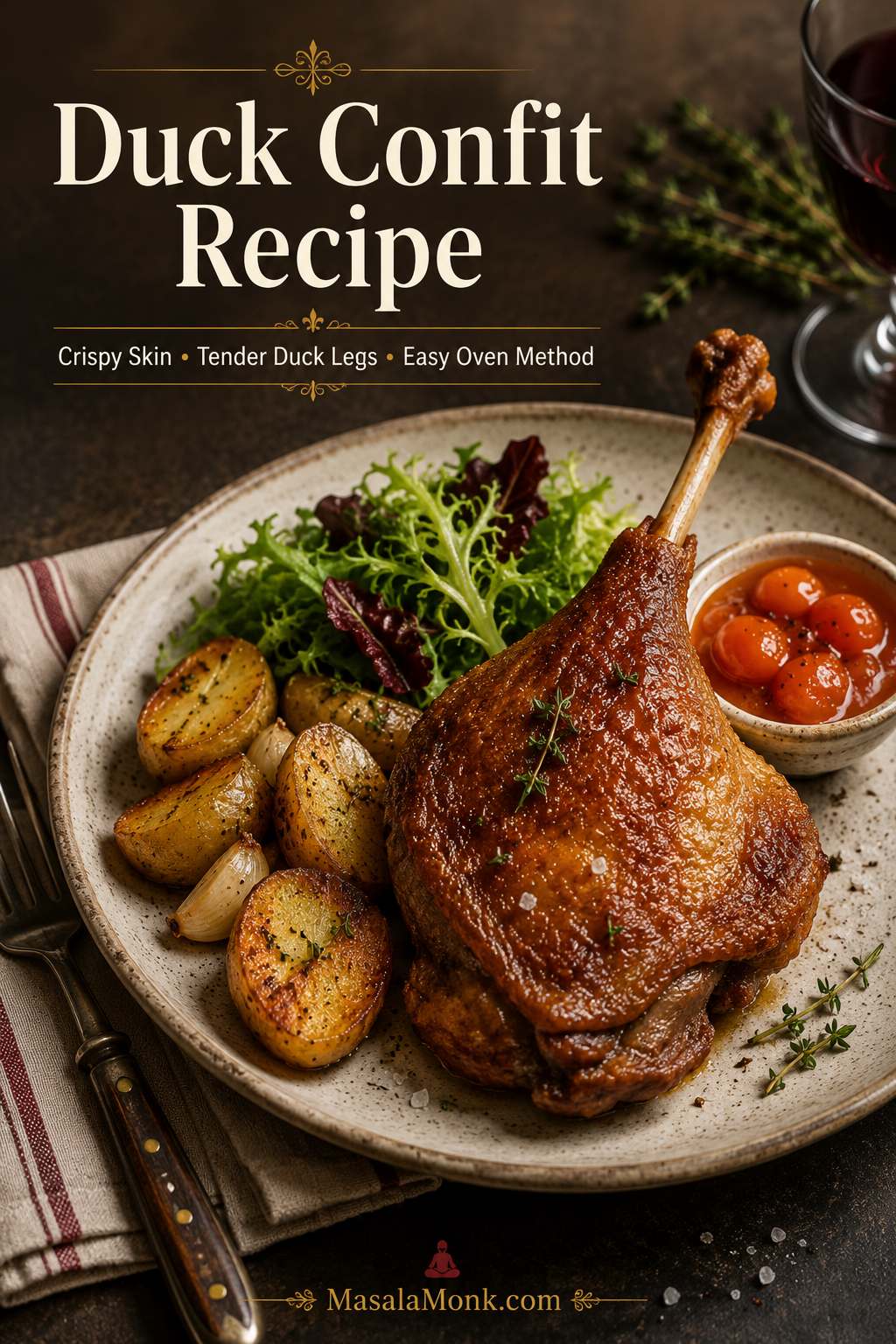
Crispy duck confit leg served with roasted potatoes, salad greens, and a small bowl of sauce.

Duck confit sounds like the kind of dish that belongs in a French restaurant kitchen: heavy pans, jars of duck fat, a long wait, and someone at the stove who already knows exactly what “done” feels like. But the scary part is not really the cooking. It is the uncertainty: how much fat is enough, whether the cure will make the duck too salty, why the skin looks soft after hours in the oven, and whether the meat is tender enough before you try to crisp it.

Once you understand the rhythm, the method becomes much less intimidating. You salt the duck legs, cook them slowly in fat until the meat turns silky, and then crisp the skin at the end. The slow cook is for tenderness. The final hot finish is for crackly skin. When those two jobs are separated, the recipe becomes calmer, more predictable, and much easier to repeat.

A Classic Oven Method Built for Home Cooks

This duck confit recipe gives you a classic-style oven method first: skin-on, bone-in duck legs, a measured salt cure, aromatics, duck fat, a low oven, and a crisp golden finish. Then it walks you through the parts that usually make home cooks hesitate: duck fat, pan size, salt, tenderness, storage, and crisping the skin without drying the meat.

The finished leg should arrive at the table with crackly skin, tender meat that pulls easily from the bone, and enough savory duck fat left behind to make potatoes, mushrooms, eggs, beans, and vegetables feel like part of the reward.

This version is built for home cooks: classic enough to taste right, practical enough for a normal kitchen, and detailed enough that you always know whether the duck is on track.

What duck confit should feel like: The slow cook is for tender meat, while the final heat is what makes the skin crackly.
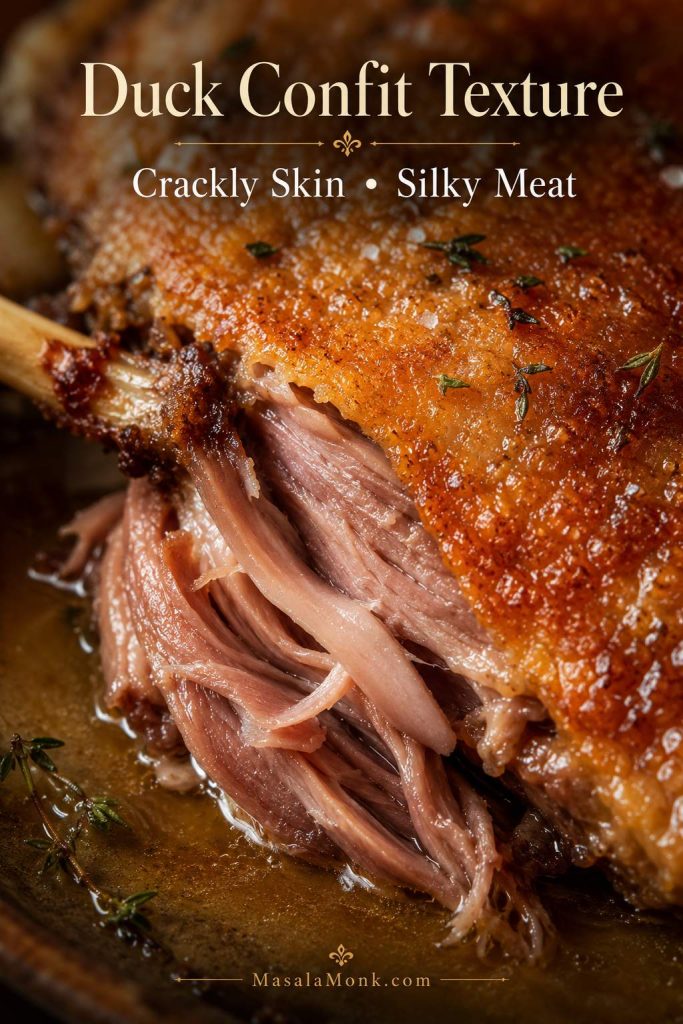
Close-up of duck confit with crisp golden skin pulled back to show tender shredded meat underneath.
First, the slow oven cook makes the meat silky; then the final crisping step turns the skin golden, crackly, and deeply satisfying.

Quick Answer: The Most Reliable Duck Confit Method

The most reliable way to make duck confit at home is to use skin-on, bone-in duck legs. Cure them with salt and aromatics for 12 to 24 hours, then cook them slowly in duck fat in a close-fitting dish at 105°C / 225°F for 3½ to 4 hours, until the meat is tender enough to pull easily from the bone. After that, lift the legs from the fat and crisp them skin-side down in a skillet or roast them in a hot oven until the skin turns golden.

The full recipe card is below, but if you are cooking now, the oven method is the main path to follow. From start to table, duck confit usually takes overnight to about 1¼ days, but most of that time is inactive. The hands-on work is closer to 35–45 minutes, split between curing, arranging the duck, handling the fat, and crisping before serving.

Best path for most cooks: start with the oven method, the lower salt range, and the skillet crisp. Treat lower-fat or gadget methods as fallbacks after you understand the main method.

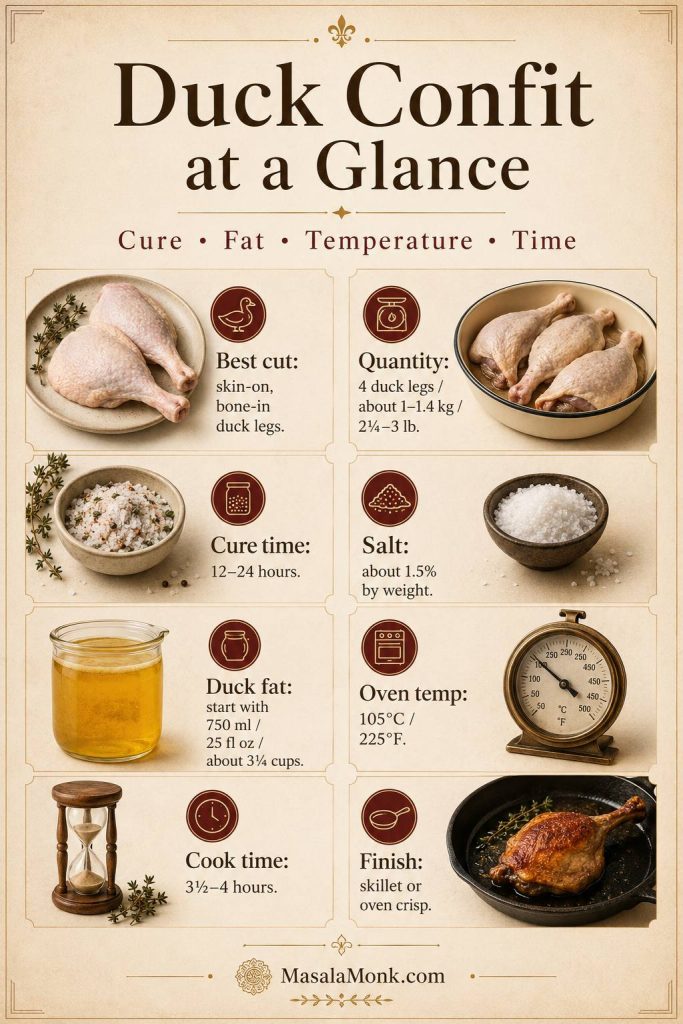
Duck Confit at a Glance

Best cutSkin-on, bone-in duck legs
ServingsPlan on 1 duck leg per person; very large legs can serve 2 lighter portions with sides
Quantity4 duck legs, about 1–1.4 kg / 2¼–3 lb total
Salt guideAbout 1.5% of the duck’s weight, usually 15–21 g kosher salt for 4 legs
Cure time12–24 hours
Duck fatStart with 750 ml / 25 US fl oz / about 3¼ cups; exact amount depends on pan size
Oven temperature105°C / 225°F, or about 95–100°C / 205–212°F for fan/convection ovens
Cook time3½–4 hours, or until very tender; fan ovens may need 30–60 minutes more
FinishSkillet crisp for the most controlled skin, or hot oven crisp for several legs
Total timeOvernight to 1¼ days, mostly inactive
Duck confit guide showing duck legs, salt, duck fat, oven temperature, cure time, cook time, and crisping method.
Before you start, these duck confit basics prevent confusion: measured salt, low oven heat, gentle fat coverage, and a final crisp for the skin.

Common mistakes to avoid: using a pan that is too wide, measuring fine salt by volume, letting the fat bubble hard, trying to crisp wet skin, and judging doneness only by time. Get those five things right, and the method becomes much calmer.

Success cues: after curing, the skin feels a little firmer; during cooking, the fat barely moves; when done, the leg feels loose and the meat pulls back slightly from the bone; after crisping, the skin is golden, dry, and crackly.

Why This Duck Confit Recipe Works

Good confit is not about complicated technique. Each stage has a clear job: the cure seasons the meat, low oven heat tenderizes it, duck fat protects it from harsh heat, and the final crisping step gives the skin that golden finish people remember. That contrast is the reason duck confit feels special: the meat is gentle and rich, while the skin gives you the crisp edge that keeps the whole plate from feeling heavy.

  • A measured salt cure seasons the legs deeply. Instead of a vague handful of salt, this recipe gives a weight-based range so the duck tastes seasoned, not aggressively salty.
  • Low oven heat keeps the cooking controlled. Duck legs need time for connective tissue to soften. A low oven lets that happen without the fat bubbling hard around the meat.
  • Duck fat surrounds the legs and regulates heat. The fat is not there to make the meat greasy. It creates a steady cooking environment.
  • A close-fitting pan reduces the amount of fat needed. Dish shape can save you from buying far more duck fat than necessary.
  • Crisping happens after the slow cook. Skin that looks soft after confit is normal; the skillet or hot oven creates the crackly finish right before serving.

What Is Duck Confit?

Duck confit is a classic method where duck legs are salted, slowly cooked in fat, and then crisped before serving. Traditionally, confit was also a preservation technique: the cooked duck was stored under a protective layer of fat. Today, most home cooks make it because it creates an incredible contrast of textures — deeply tender meat under crisp, golden skin.

The word confit can make the process sound complicated, but the actual cooking is quiet and controlled. You are not deep-frying the duck. You are cooking it slowly in warm fat, almost like a rich, careful braise. The fat surrounds the meat, protects it from harsh heat, and helps the connective tissue soften gradually.

This is a classic-style oven version, not a pressure-cooker shortcut or a duck breast confit. Those methods can work, but the main recipe here is built around duck legs, a salt cure, duck fat, low heat, and a final crisp.

Duck leg confit works so well because legs have more connective tissue than breast meat. Duck breast is better cooked quickly to medium-rare with crisp skin. For that style, see this duck breast recipe instead.

Duck Confit vs Roast or Braised Duck Legs

All three can be delicious, but they do not cook the same way. Roast duck legs go straight into dry oven heat, braised duck legs soften in liquid, and confit legs are slowly cooked in fat before they are crisped. That fat-cook-first, crisp-later rhythm is what gives the dish its silky meat and golden skin.

Ingredients for Duck Confit

The most reliable version does not need a long, intimidating ingredient list. Duck legs, salt, fat, and a few aromatics are enough. The aromatics should support the duck, not bury it.

Before you cure the duck: use this as a quick check: duck legs, measured salt, clean fat, and simple aromatics are doing most of the work.
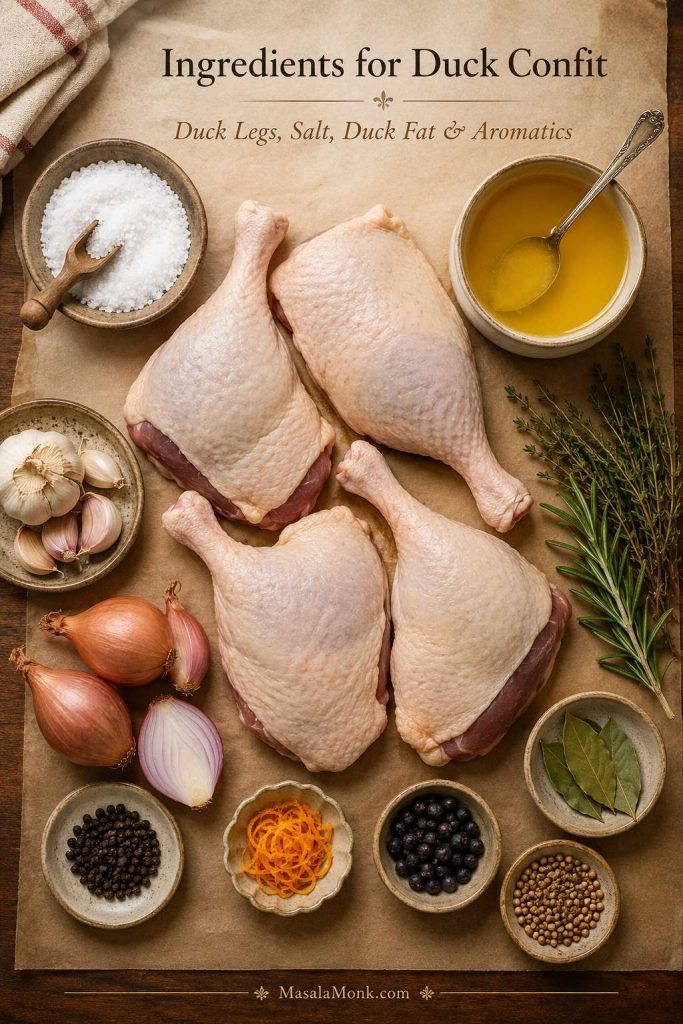
Raw duck legs arranged with duck fat, salt, garlic, shallots, herbs, bay leaves, peppercorns, orange zest, and spices.
Duck confit uses a short ingredient list, but each part matters: duck legs bring collagen and fat, salt seasons deeply, and aromatics perfume the slow cook.

Duck Legs

Use 4 skin-on, bone-in duck legs, about 1–1.4 kg / 2¼–3 lb total. The skin is important because it becomes crisp at the end. The bone protects the meat and gives the finished legs a better texture.

If your duck legs are very large, expect the cooking time to sit closer to 4 hours. Smaller legs may be tender earlier, so start checking them after about 3 hours. The timer is useful, but tenderness is the real test.

Plan on one duck leg per person for a main course. If the legs are especially large and you are serving several sides, one leg can sometimes serve two lighter portions.

Duck leg buying visual: Skin-on, bone-in legs are the safest choice because they bring the fat, skin, bone, and connective tissue that make confit work.
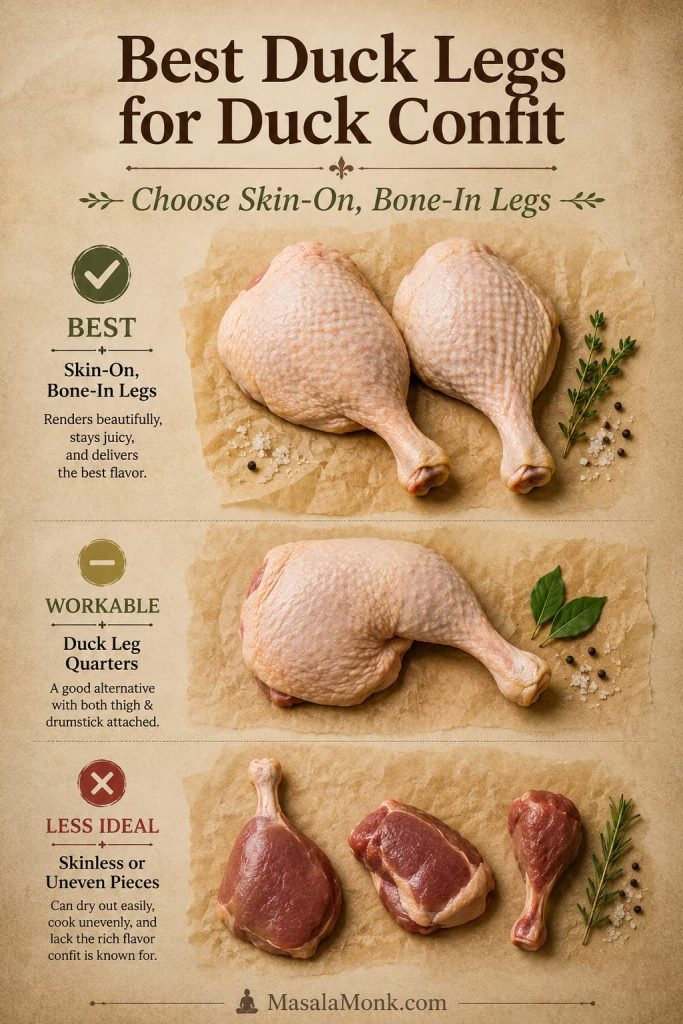
Guide comparing skin-on bone-in duck legs, duck leg quarters, and less ideal skinless or uneven duck pieces.
For reliable oven duck confit, choose skin-on, bone-in duck legs of similar size so they cure, cook, and crisp more evenly.
  • Fresh or frozen both work. If using frozen duck legs, thaw them fully in the refrigerator before curing.
  • Choose similar sizes if possible. Legs that are close in size will cure and cook more evenly.
  • Keep the skin on. Skinless duck legs will not give you classic texture.
  • Fatty-looking legs are useful here. Some of that fat renders into the dish and can be strained for later cooking.
  • Skip pre-marinated duck legs. They may already be salty or sweetened, which makes the cure harder to control.

Duck Confit Salt Guide

Use about 1.5% salt by weight of the duck legs. That means about 15 g salt for 1 kg duck legs, 18 g for 1.2 kg, and 21 g for 1.4 kg. For most batches of 4 duck legs, 15–21 g kosher salt lands in the right range.
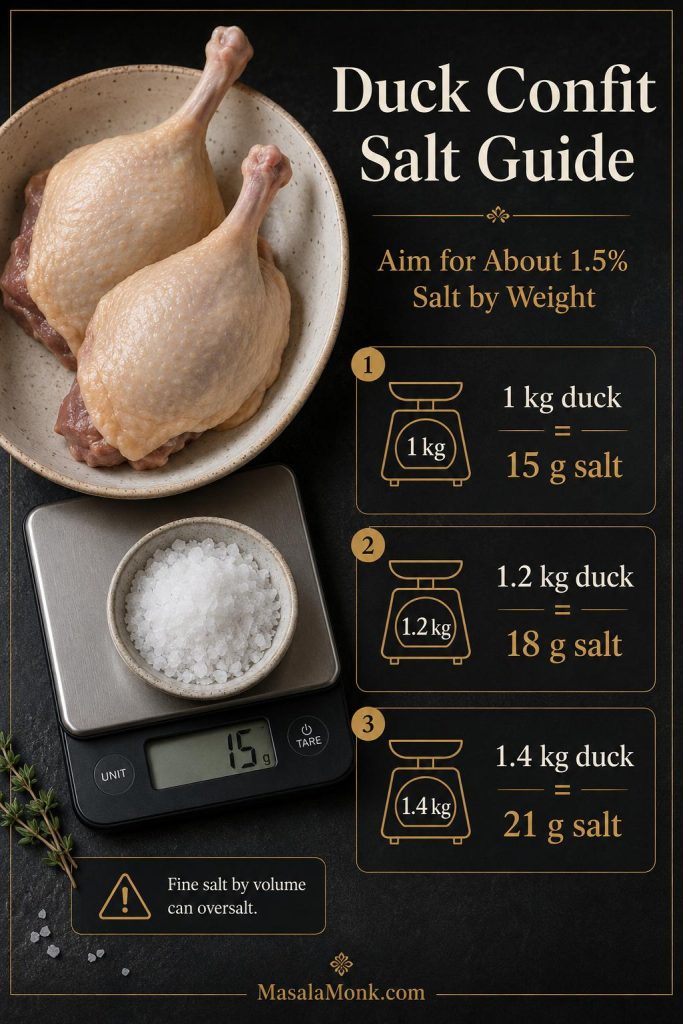
Duck confit salt guide with duck legs, kosher salt, a kitchen scale, and examples for 1.5 percent salt by weight.
A 1.5% salt cure gives you repeatable control, so the duck tastes seasoned and rich without becoming aggressively salty after resting.

Weighing the salt is better than using spoons because different salts vary dramatically by volume. Fine salt packs more tightly and tastes saltier by the spoonful, so use the lower end if you are not weighing.

For a gentler first try, use the lower end of the range and cure for 12 hours. You can always finish the cooked duck with a little flaky salt, but it is harder to fix a cure that was too heavy.

Duck Fat

Start with about 750 ml / 25 US fl oz / 3¼ cups rendered duck fat for 4 duck legs. You may need less if your pan is close-fitting, or more if your pan is wide. The exact quantity depends on the shape of your dish more than the recipe itself.

For the visual version, see the duck fat guide. Aim to cover the meaty parts with fat. Bone tips can poke out, and a tiny patch of skin above the fat is not a disaster. However, if a large patch of meat is exposed, switch to a smaller dish. If you cannot, turn the legs once halfway through cooking while they are still firm enough to handle.

Aromatics

For a classic but not fussy flavor, use garlic, shallots, thyme, rosemary, bay leaves, and black peppercorns. Orange zest, juniper berries, or coriander seeds are optional. They add a more restaurant-style aroma, but the recipe still works beautifully without them.

  • Garlic gives warmth and depth.
  • Shallots add gentle sweetness.
  • Thyme and rosemary give the duck a classic savory backbone.
  • Bay leaves add quiet background aroma.
  • Black peppercorns give mild spice without making the duck taste peppery.
  • Orange zest is optional, but especially good if you plan to serve the legs with orange sauce.

About the aromatics: use thyme, peppercorns, orange zest, juniper, or coriander in the cure. Use fresh garlic, thickly sliced shallots, bay leaves, rosemary, and more thyme in the cooking fat. Discard the wet cure aromatics before cooking, especially if they are covered in salt or moisture.

Equipment and Pan Size

You do not need restaurant equipment, but the right pan makes the whole recipe easier and cheaper because it reduces the amount of duck fat you need.

Best Pan and Equipment for Duck Confit

A close-fitting vessel is the key piece: it keeps the fat level higher around the legs and makes the rest of the equipment feel simple.

Duck confit equipment setup with a close-fitting baking dish, Dutch oven, skillet, strainer, tongs, and jar of duck fat.
The right pan saves both fat and stress: a close-fitting dish raises the duck fat level, keeps the legs close together, and makes the home oven method easier.
  • Close-fitting oven-safe baking dish, casserole, or small Dutch oven: the most important piece of equipment.
  • Lid, foil, or parchment: keeps the duck covered during the slow cook.
  • Tongs or a wide spatula: for lifting tender legs without tearing them.
  • Heavy skillet: for crisping the skin before serving.
  • Fine-mesh strainer and clean jar: for saving clean duck fat after cooking.

The duck legs should fit in one layer. They can sit close together, but they should not be piled on top of each other. A compact casserole or small Dutch oven usually works better than a wide roasting tray for a first batch.

  • Strongest choice: a small Dutch oven or compact ceramic baking dish.
  • Good choice: a medium casserole with a tight lid.
  • Use only if needed: a wide roasting pan, because it requires more fat.
  • Skip: shallow trays where the duck cannot be mostly covered.

A heatproof jug can make warm fat easier to pour, and a digital thermometer is useful if you want to check that the fat is staying low and steady. A nonstick skillet is helpful for crisping if you are nervous about the skin sticking or tearing.

How Much Duck Fat Do You Really Need?

Duck fat is usually the moment people pause — not because the recipe is hard, but because the jar looks expensive and the instructions often sound vague about how much you really need. This is the part worth making practical.

Recipes say “cover the duck with fat,” but that can mean very different amounts depending on the pan. The practical rule is simple: use the smallest oven-safe dish that fits the duck legs in a single layer without stacking them. A compact pan saves fat and keeps the duck more evenly covered.

Pan Size and Duck Fat Amount

Use this pan-size guide before buying more duck fat, because the same four legs can need very different amounts in different dishes.

Duck fat guide comparing a small baking dish, medium casserole or Dutch oven, and wide roasting pan with different fat amounts.
Duck fat needs change with the dish, not just the number of legs; a narrow pan raises the fat level and reduces waste.
Pan setupLikely duck fat needed for 4 legsMost useful for
Small close-fitting baking dish500–750 ml / about 2–3¼ cupsSaving duck fat
Medium casserole or Dutch oven750 ml–1 liter / about 3¼–4¼ cupsMost home batches
Wide roasting pan1 liter+ / 4¼ cups+Only when you have enough fat

This is usually the moment the recipe starts to feel less extravagant and more manageable: the duck does not need a dramatic pot of fat, just the right dish and enough quiet heat.

Scaling the recipe: for 2 duck legs, keep the salt at about 1.5% of the duck’s weight and use the smallest dish that fits them. For 6–8 legs, keep them in one layer or use two dishes. The fat amount changes with the dish, not just the number of legs, and the cook time still depends on tenderness.

How to Cure Duck Legs for Confit

The cure should feel controlled, not like you are packing the duck in salt. You are seasoning the meat deeply and giving the surface time to firm slightly before the slow cook.

What the Cure Should Look Like

The surface should look evenly seasoned, with aromatics adding flavor rather than burying the duck under salt.

Raw duck legs in a baking dish being sprinkled with salt, herbs, peppercorns, bay leaves, and orange zest.
Curing duck legs should feel measured, not intimidating: salt seasons the meat while herbs, bay, pepper, garlic, and citrus add quiet background flavor.
  1. Pat the duck legs dry. Moisture on the surface makes the cure less even.
  2. Rub with salt. Use about 1.5% salt by weight, or 15–21 g kosher salt for 4 duck legs, depending on their total weight.
  3. Add cure aromatics. Use thyme, peppercorns, optional orange zest, and optional juniper or coriander here if you like.
  4. Cover and refrigerate. Cure for 12–24 hours.
  5. Remove excess cure. Wipe off aromatics and visible salt. Rinse only if there are clumps of salt or the cure looks heavy.
  6. Dry very thoroughly. If you have time, let the legs sit uncovered in the refrigerator for 30–60 minutes after wiping or rinsing. The drier the surface, the cleaner the cooking fat and the better the final crisping.

For most home cooks, 12 hours gives balanced seasoning and 24 hours gives deeper flavor. A 1–2 hour cure can work for shortcut versions, but for this recipe, 12–24 hours is the safest and most balanced range. For a first batch, choose 12 hours and the lower salt range.

How to Make Duck Confit in the Oven

Start with this oven method if this is your first batch. It gives you the most reliable balance of classic texture, steady heat, and kitchen sanity. Once the legs are in the fat and the oven is low, your job is mostly to leave them alone.

The duck cooks at 105°C / 225°F for 3½ to 4 hours, then gets crisped at the end. If you are using a fan or convection oven, reduce the temperature to about 95–100°C / 205–212°F and check the fat after the first hour. The fat is right when it barely bubbles instead of boiling hard.

Duck confit recipes vary because oven temperature, pan shape, leg size, and how deeply the meat is submerged all change the timing; use 3½–4 hours as the main window, but let tenderness decide.

Before you start the oven method: this step-by-step image shows the full rhythm: cure, arrange, cover with fat, cook low, test tenderness, and crisp.
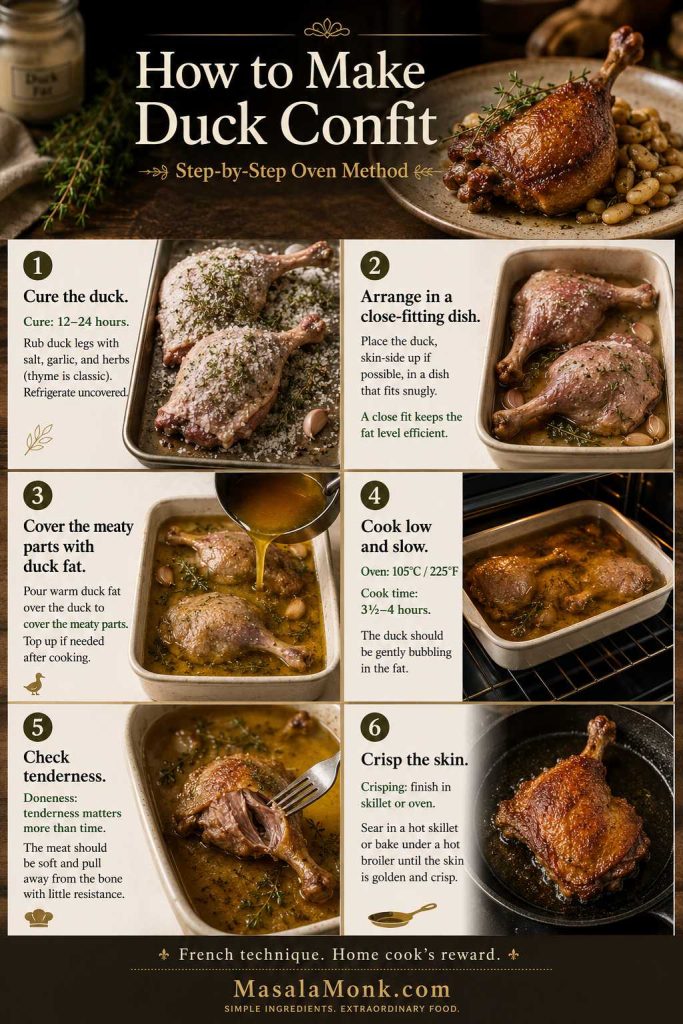
Step-by-step duck confit guide showing curing, arranging in a close dish, adding duck fat, slow cooking, checking tenderness, and crisping.
The oven method works because each stage has one job: season the duck, cook it gently in fat, test tenderness, and crisp only at the end.

Duck Confit Temperature and Cook Time

The low oven target keeps the fat calm; the clock gives you a window, but tenderness still decides the finish.
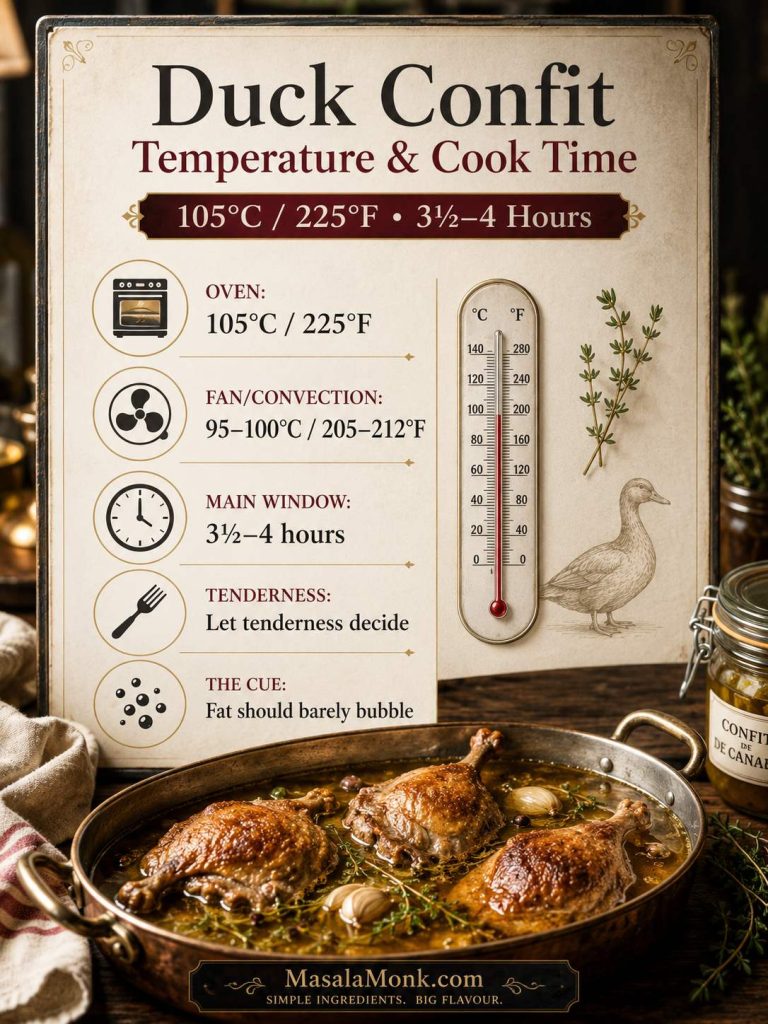
Duck confit temperature guide showing 105°C or 225°F, fan oven adjustment, 3½ to 4 hour cook time, and tenderness cues.
The 105°C / 225°F oven target keeps the fat calm, but real cook time still depends on leg size, dish shape, and fat depth.

Step 1: Melt the Duck Fat

Warm the duck fat just until liquid. It only needs to be fluid enough to pour around the duck legs. If it is hot enough to sputter, it is hotter than it needs to be.

Step 2: Arrange the Duck in a Close-Fitting Dish

Place the cured, dried legs in the smallest oven-safe dish that holds them in one layer without stacking. Add fresh garlic, thickly sliced shallots, bay leaves, rosemary, thyme, and peppercorns around the legs. Discard the wet cure aromatics rather than carrying all of that salt and moisture into the cooking fat.

Step 3: Cover with Duck Fat

Pour warm fat over the legs until the meaty parts are mostly submerged. If you are just short, press a piece of parchment directly over the duck before covering the dish. This helps keep the legs tucked under the fat. If a large patch of meat remains exposed, move everything to a smaller dish or check the short-on-duck-fat guide before adding more fat.

Step 4: Cover and Cook Low

Cover the dish with a lid, foil, or parchment plus foil. Cook at 105°C / 225°F for 3½ to 4 hours. Keep the fat nearly still, with only a few lazy bubbles at the edges. Hard bubbling means the heat is too aggressive.

What the Fat Should Look Like During the Slow Cook

This is the visual cue to watch for: the fat should be warm and quiet, not boiling around the duck.
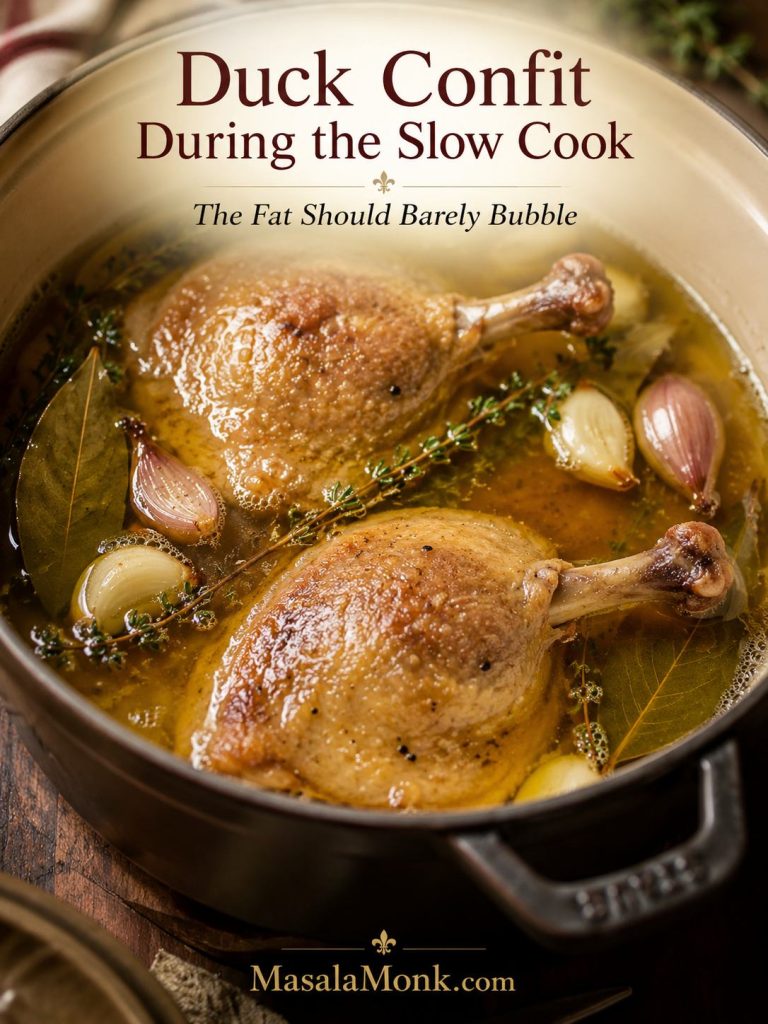
Duck legs cooking gently in golden duck fat with garlic, shallots, bay leaves, thyme, and only a few small bubbles.
During the slow cook, the duck fat should barely bubble. Hard bubbling means the oven heat is too aggressive for silky confit texture.

Step 5: Check for Tenderness

Use the timer as a checkpoint; tenderness decides when the duck is ready. The legs are done when the meat offers almost no resistance when pierced, the joint bends easily, and the meat starts to pull back from the bone.

If the meat still feels tight, use the doneness cues and give it more time. This method is forgiving when the heat is low and steady. It is much better to cook the legs a little longer in quiet fat than to pull them before the connective tissue has softened.

Step 6: Cool in the Fat or Crisp Right Away

If serving immediately, lift the legs carefully from the fat and let the excess drip away before crisping. If making ahead, cool them until they are no longer steaming, transfer to a clean container with enough fat to cover, and refrigerate promptly. Move the duck and fat into shallow storage once they are no longer steaming so they chill faster.

How to Know It Is Done

This dish is done by texture, not by a neat internal temperature target. The legs need enough time for connective tissue to soften. That is why the most useful cues are physical.

How to Know Duck Confit Is Done

Look for looseness, not drama: the leg should bend easily and the meat should give way without force.
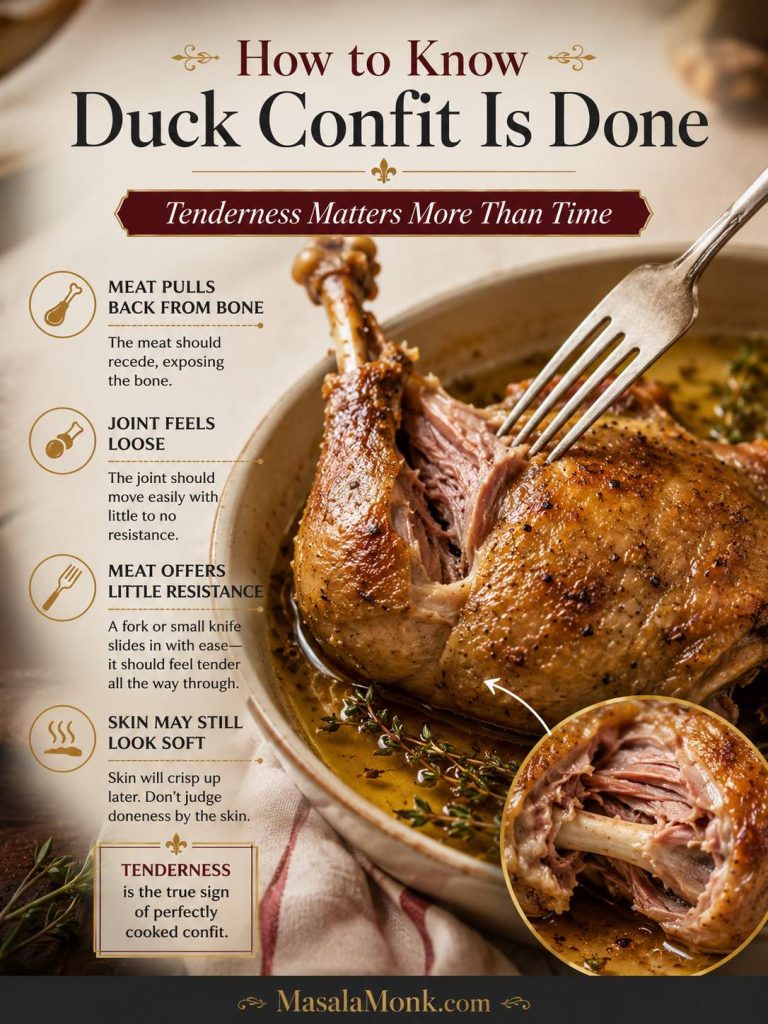
Cooked duck confit leg being tested with a fork, with tender meat, exposed bone, and a small close-up of pulled meat.
A done duck confit leg should feel relaxed: the joint loosens, the meat pulls from the bone, and a fork meets very little resistance.
  • Meat offers almost no resistance when pierced with a skewer or small knife.
  • At the joint, the leg bends easily.
  • You may see the meat pull back slightly from the bone.
  • A fork can loosen the meat without force.
  • The skin may still look soft and pale; that is normal before crisping.

If the meat still feels tight, return the legs to the fat and cook for another 30–45 minutes. Because the heat is low, an extra half hour is usually safer than serving duck that has not fully relaxed.

How to Crisp the Skin

The crisping step is where the recipe starts to feel special. The meat is already cooked; you are not trying to cook the duck again. You are slowly waking up the skin.

Before crisping, lift the legs from the fat and wipe away any thick clinging fat from the skin. Let them drain on a rack for a few minutes if they look especially glossy. Skin that is wet or coated in too much fat will take longer to crisp and may brown unevenly.

For the crispest skin, make the legs ahead, chill them in the fat, then lift, wipe, and crisp when cool or cold. The skin is easier to handle once the fat has set, and it is less likely to tear in the pan.

Crisp the legs as close to serving as possible. The meat can wait in the fat, but the skin is at its best within minutes of crisping.

How to Crisp Duck Confit Skin

The slow cook is already done, so the final heat should focus on dry skin, steady browning, and a crisp finish right before serving.
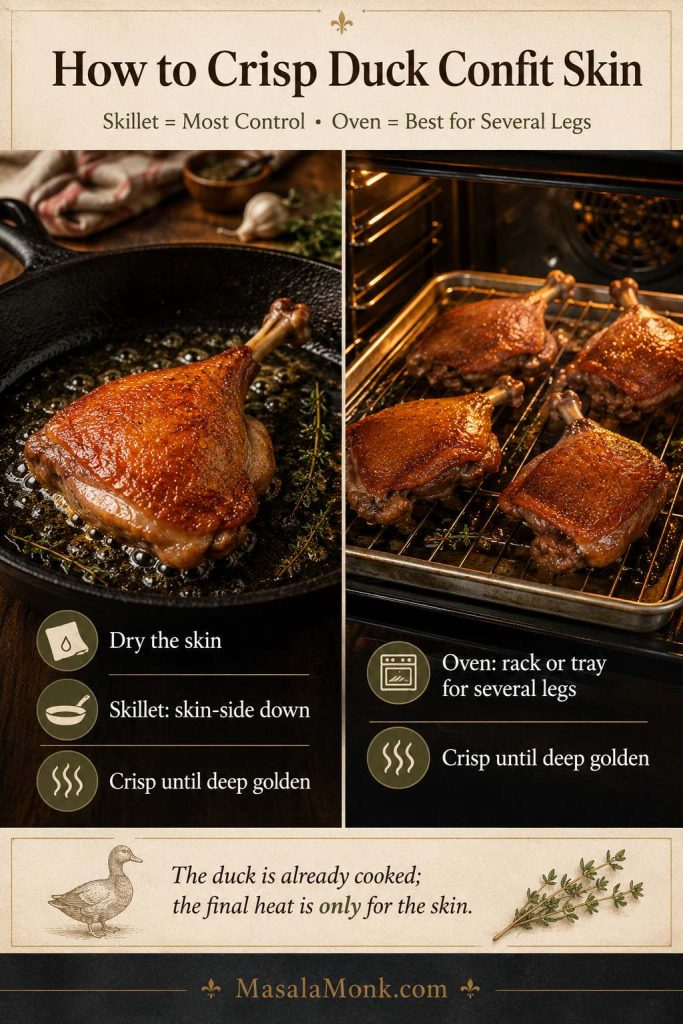
Duck confit crisping guide showing one leg in a skillet and several legs on a rack in the oven.
The duck is already cooked, so crisping is only about texture: dry the skin first, then use a skillet or hot oven until it turns deeply golden.

Most Reliable Method: Skillet Crisp

Place the legs skin-side down in a heavy skillet or nonstick skillet over medium heat. Cook for 6–10 minutes, or until the skin is crisp and deeply golden. Nonstick is especially forgiving if you are nervous about the skin sticking or tearing.

If the skin seems stuck, it usually needs more time. Once enough fat renders, it loosens more easily. Let it crisp until it naturally releases from the pan; this is a patience step, not a high-heat step.

This is where the quiet, slow recipe finally turns dramatic.

Hands-Off Method: Hot Oven Crisp

Place the legs on a rack set over a tray and roast at 200°C / 400°F for 20–30 minutes, until the skin is crisp and the meat is hot. This method is useful when cooking several legs at once.

Fast Finish: Broiler or Grill

A broiler or grill can help finish stubborn skin, but use it carefully. Duck skin can go from golden to burnt quickly. Keep the legs several inches from the heat and watch closely for the last 2–5 minutes.

If You Are Short on Duck Fat

Classic confit uses rendered duck fat because it gives the cleanest, fullest flavor. However, if the price of duck fat is the only thing stopping you, you can still make a useful confit-style version. Duck fat is still the best choice for clean flavor and silky meat, while substitutes are practical fallbacks when budget or availability gets in the way.

When the Duck Fat Looks Too Low

A compact dish is often the difference between exposed meat and good coverage, especially when you are trying to avoid buying another jar of fat.
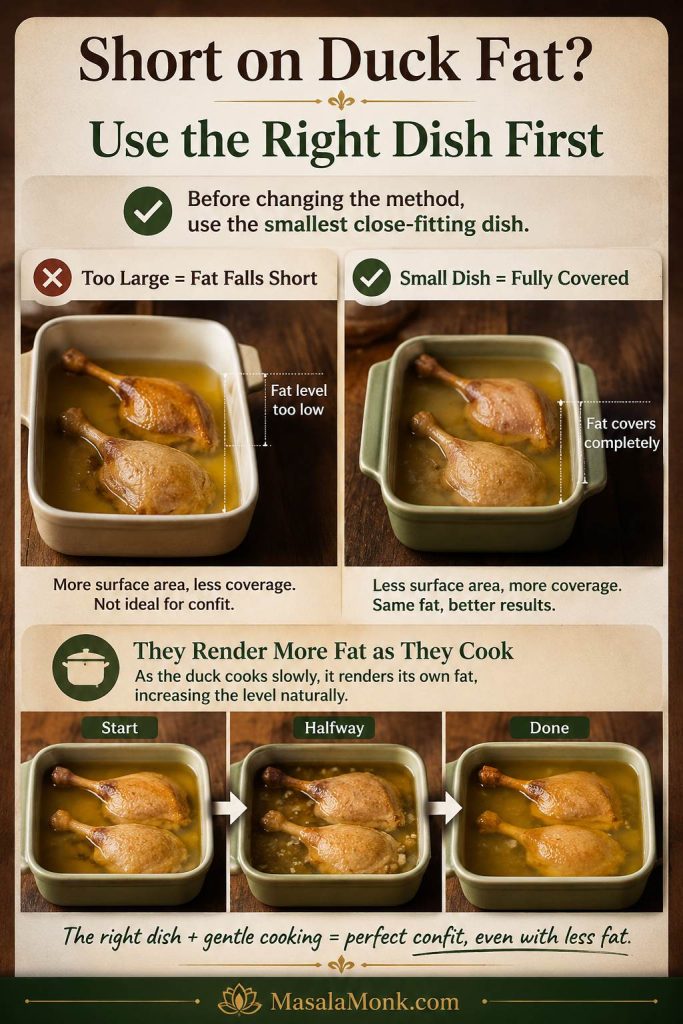
Comparison showing duck legs in a large dish with low fat coverage and a smaller dish where the fat covers the meat better.
When duck fat looks low, the fix is often simple: move the legs into a snug dish so the fat surrounds more of the meat.

A small amount of duck fat can still work when the dish is compact enough, because the legs will render more fat as they cook. Some easy confit-style methods add a small splash of water or stock at the beginning to prevent scorching while the fat renders. This can be delicious, but it is closer to a confit-style braise than full duck-fat confit.

Duck Fat Substitutes for Duck Confit

Substitute fats can help when duck fat is expensive or unavailable, but the flavor and storage behavior will not be exactly the same.
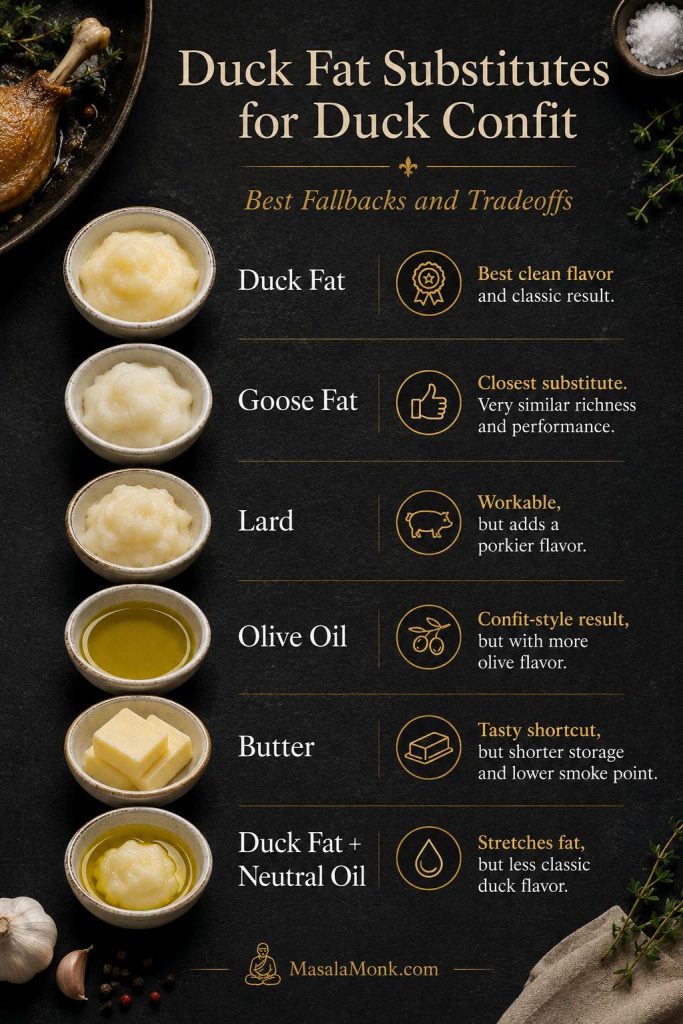
Comparison of duck fat, goose fat, lard, olive oil, butter, and duck fat mixed with neutral oil for duck confit.
Duck fat gives the cleanest classic flavor, but goose fat, lard, olive oil, butter, or mixed fats can work when you understand the tradeoffs.
Fat optionHow it worksTradeoff
Duck fatClassic choice with the cleanest duck flavorMost traditional, but can be expensive
Goose fatClosest substitute if duck fat is unavailableRich and poultry-friendly, but not identical
LardWorks as a cooking fatAdds a porkier flavor
Olive oilCan create a confit-style resultFlavor becomes more olive-oil-forward
ButterTasty shortcut when duck fat is unavailableContains water and milk solids, so storage is shorter
Duck fat + neutral oilCan stretch a small amount of duck fatLess classic flavor; treat leftovers conservatively

If using butter, strain and store the leftover fat separately and treat the cooked duck like normal leftovers rather than traditional fat-preserved confit.

Other Ways to Cook Duck Confit

Once you understand the oven method, the shortcuts and gadget versions are easier to judge. These are useful when they solve a real problem — less duck fat, less oven time, or more hands-off cooking — but they should not distract from the main method if this is your first batch.

Method comparison visual: The oven method stays the main path here, while the other approaches are practical alternatives for specific kitchens.
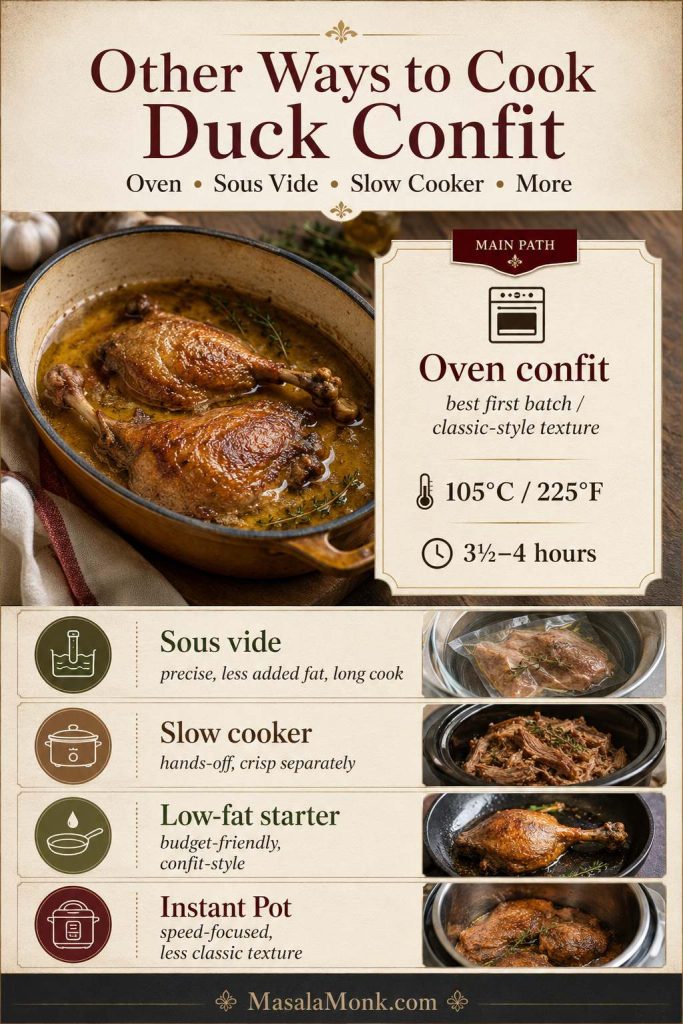
Duck confit method guide comparing oven confit with sous vide, slow cooker, low-fat starter, and Instant Pot approaches.
Oven duck confit is the best first path for classic texture, while sous vide, slow cooker, low-fat, and pressure-cooker versions solve different kitchen problems.
MethodBest forTradeoff
Oven confitFirst batch and silky meat with crisp skinNeeds enough fat and time
Sous videLess added fat and precise temperatureLong cook; no traditional fat storage
Slow cookerHands-off tendernessSkin must be crisped separately
Low-fat starterBudget cooking or limited duck fatMore confit-style braise than classic confit
Instant PotSpeed-focused experimentLess classic texture and control

Make-Ahead Timeline

This is one of those dishes that rewards planning ahead. You do not need to stand over the stove all day; you just need to give the cure and slow cook enough time to do their work.

How the timing works: the cure and slow cook are mostly inactive, while the final crisping happens just before serving.
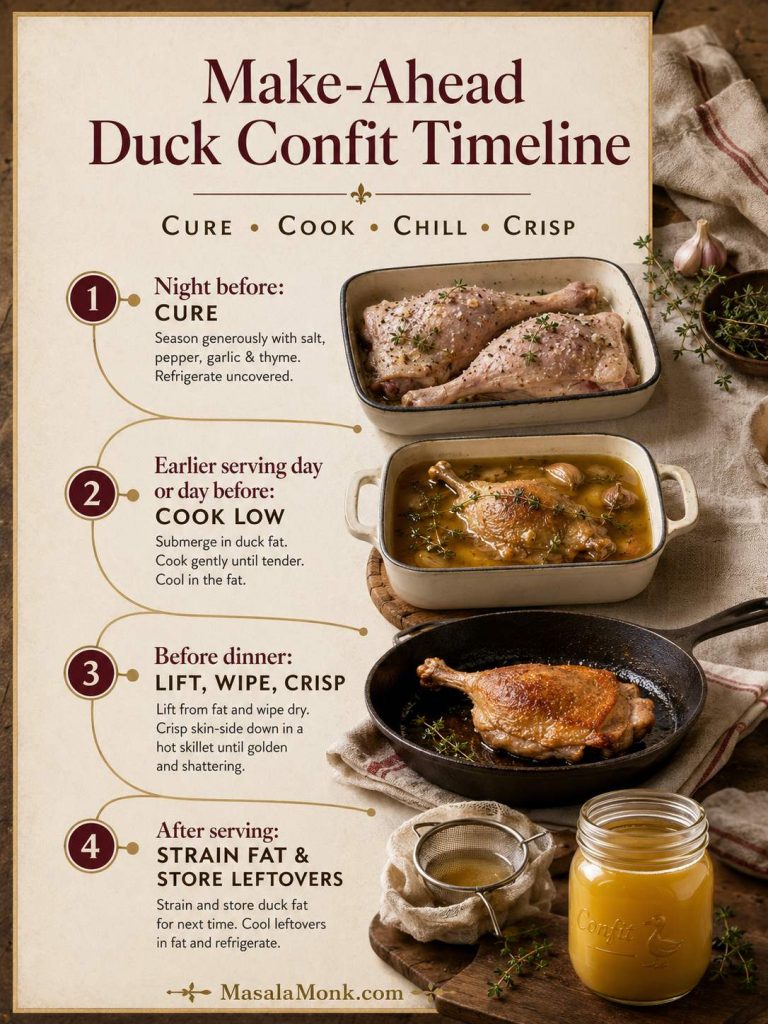
Make-ahead duck confit timeline showing curing, cooking low, crisping before dinner, and straining duck fat after serving.
Duck confit rewards planning because most of the work is inactive; after the legs are cooked, the final crisping step makes them taste freshly finished.
WhenWhat to do
Night before or up to 24 hours before servingSalt-cure the duck legs with aromatics.
Earlier on serving day or the day beforeCook the legs slowly in duck fat until tender.
Before dinnerLift the chilled legs from the fat, wipe the skin well, and crisp.
After servingStrain the fat, store leftovers, and save clean duck fat for later cooking.

What to Serve with Duck Confit

Because the legs are savory and full-flavored, the best sides either absorb the duck juices, cut through the fat, or add a little sweetness and acidity. You do not need many sides. One potato or bean dish, one bright salad or vegetable, and one sauce are enough.

My favorite way to serve it is simple: one crisp leg, potatoes that have met a spoonful of duck fat, a bitter green salad with a sharp dressing, and a small spoon of orange or cherry sauce. That plate gives you richness, crunch, acidity, and enough restraint that the duck remains the reason everyone is at the table.

The best plate gives you crackly skin, tender meat, something starchy, and something sharp enough to make you want the next bite.

How to build the plate: use the sides to balance the richness: something starchy, something green or sharp, and a sauce that wakes up the plate.

Duck confit served with roasted potatoes, bitter greens, beans or lentils, red cabbage, and several sharp sauces.
Because duck confit is rich, the best sides either absorb fat, add freshness, or bring acidity through potatoes, greens, beans, cabbage, or sharp sauces.

Easy Plate Ideas

  • Bistro-style plate: one crisp duck leg, duck fat potatoes, bitter greens, and orange or cherry sauce.
  • Rustic plate: duck confit with white beans, braised cabbage, and mustard vinaigrette.
  • Lighter plate: crisp duck over lentils, herbs, and something cold and sharp, such as a simple cucumber salad.
  • Cold-weather plate: duck legs with potatoes, roasted carrots, and a red wine or cherry sauce.

Potatoes, Beans, and Starches

  • Duck fat potatoes — the most obvious and probably the most memorable pairing.
  • Mashed potatoes — if you want a softer side, these garlic mashed potatoes give the duck a creamy, buttery base.
  • White beans — especially with garlic, herbs, and a little stock.
  • Lentils — earthy, simple, and excellent with full-flavored duck.
  • Potato salad — for a make-ahead side, choose a mustardy or vinegar-leaning potato salad rather than a very heavy creamy one.

Vegetables and Greens

  • Bitter greens such as arugula, frisée, endive, or radicchio.
  • Braised cabbage, especially red cabbage with a little vinegar.
  • Roasted carrots with herbs or citrus.
  • Green beans with garlic and lemon.
  • Mushrooms sautéed in a little duck fat.
  • Lemony chickpea salad if you want the meal to feel fresh but still filling.

Sauces and Fruit Pairings

The dish does not need a heavy sauce, but a small spoonful of something sharp, fruity, or winey can make the plate feel complete. Orange sauce is a classic pairing; this orange sauce for duck works especially well if you use orange zest in the cure.

Choose orange or cherry sauce for a sweet-sharp plate, red wine sauce for a deeper dinner-party feel, mustard vinaigrette for a lighter salad-style plate, and plum sauce if you want a sweeter, fruitier direction. For a cheese-board-style plate, a small spoon of fig jam can work beside crisp duck, bitter greens, and something salty.

Recipes Using Duck Confit

The quiet advantage of duck confit is that tomorrow’s dinner is already halfway done. Once the duck is cooked, the meat can be shredded and folded into quick meals that taste far more luxurious than the effort involved.

Best Ways to Use Leftover Duck Confit

A small amount of shredded duck can carry a whole meal, especially when it is crisped briefly before being folded into pasta, beans, hash, or salad.

Leftover duck confit used in pasta, potato hash with egg, salad, tacos, and beans.
Leftover duck confit is powerful in small amounts; fold it into pasta, hash, salad, tacos, or beans to make simple meals taste rich and restaurant-worthy.

To use leftover duck confit, lift the meat from the fat, remove the bone, shred the meat, and crisp it in a skillet with a spoonful of duck fat. Add it near the end of cooking so it stays savory and textured instead of disappearing into the dish.

The easiest wins are pasta, hash, beans, and salads because they let a small amount of shredded duck flavor the whole dish.

  • Pasta with duck confit: toss shredded duck with garlic, mushrooms, herbs, and a little pasta water.
  • Warm duck salad: serve crisp shredded duck over bitter greens with a sharp vinaigrette.
  • Potato hash with duck confit: crisp potatoes in duck fat, then add shredded duck and herbs.
  • Crispy duck tacos: crisp the shredded meat and serve with pickled onions.
  • Grilled cheese with duck confit: use a small amount of shredded duck with sharp cheese and mustard.
  • White beans with duck confit: fold the meat into white beans with garlic, thyme, and stock.
  • Ramen with duck confit: add shredded duck to broth, noodles, greens, and a soft egg.
  • Crisp duck over fries: for an occasional comfort-food plate, pile crisp shredded duck over hot fries and add a sharp sauce or pickled onions.

What to Do with Leftover Duck Fat

Leftover duck fat is part of the reward. Strain it, chill it, and use it wisely. It turns ordinary potatoes into something memorable and adds depth to vegetables, eggs, mushrooms, beans, and seared meats.

Best Uses for Leftover Duck Fat

Clean, strained duck fat is worth saving because even a spoonful can make simple vegetables, eggs, or beans taste richer.

Jar of clean golden duck fat surrounded by roast potatoes, eggs, mushrooms, cabbage, green beans, roasted vegetables, strainer, and jars.
After cooking, strain and chill the leftover duck fat; then use small spoonfuls to add deep savory flavor to potatoes, eggs, mushrooms, cabbage, beans, and vegetables.
  • Strain it through a fine-mesh sieve while warm, not scorching hot.
  • Remove spent aromatics such as herbs, garlic, shallots, bay leaves, and peppercorns before storing the fat.
  • Let juices settle if the fat looks cloudy; watery juices can collect underneath.
  • Separate the clean fat from the juices after chilling if a darker layer settles at the bottom.
  • Store in a clean jar in the fridge.
  • Use clean utensils each time you scoop fat out.
  • Do not pour hot fat down the sink. Let unwanted fat solidify, then discard it properly.

After chilling, clean fat will set on top and darker juices may settle underneath. The pale solid layer is fat. The darker layer underneath is meat juice, salt, and aromatics. Save the clean fat for cooking; use the darker juices quickly in beans, pan sauce, or gravy, or discard them.

Use duck fat for roast potatoes, fried eggs, mushrooms, cabbage, beans, carrots, Brussels sprouts, and pan-seared meats. Discard it if it smells off, looks moldy, or has been contaminated with crumbs or meat juices over time.

Storage, Freezing, and Reheating

This is one of those dishes that rewards making ahead, but home storage should be handled carefully. Traditional confit was preserved under fat, but modern kitchens vary in cleanliness, temperature control, salt levels, and handling. This recipe is written as a modern dinner recipe, not a long-term preservation project.

The fat helps protect the texture, but this recipe uses a regular salt cure, not curing salt for long-term preservation. In a home kitchen, it is safest to treat the cooked legs like cooked poultry unless you are deliberately following a tested preservation method. Once the duck and fat are no longer steaming, move them into shallow storage so they cool evenly and safely.

Storage visual guide: This image keeps the storage advice modern and safe: chill promptly, store airtight, freeze when needed, and crisp after reheating.
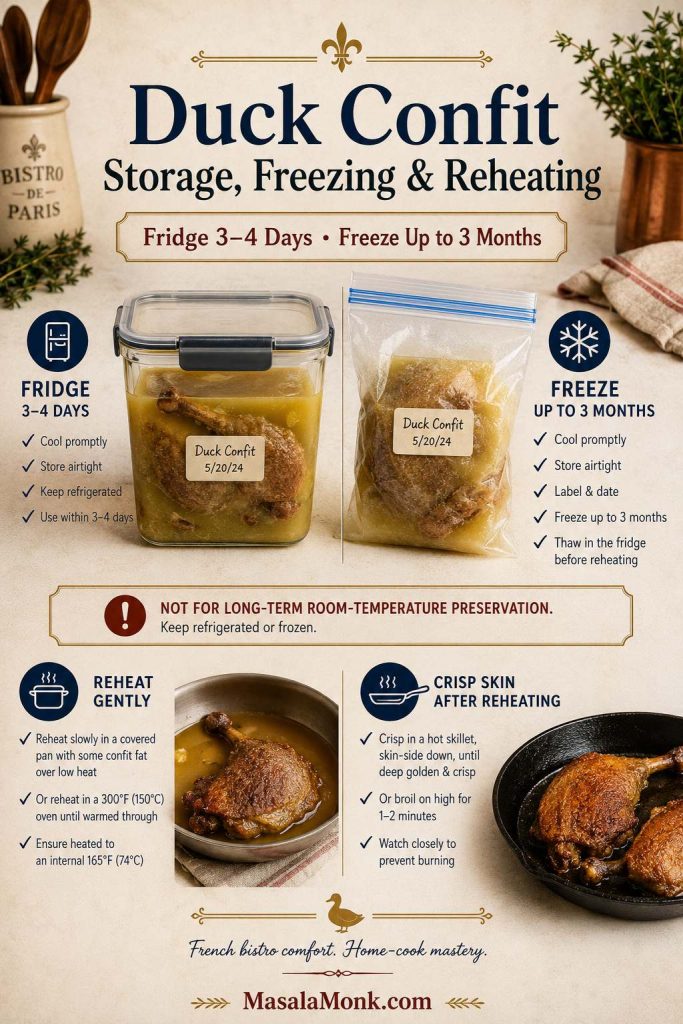
Duck confit storage guide showing a refrigerated container, freezer bag, reheating pan, crisping skillet, date labels, and safety notes.
For home cooks, duck confit should be treated as cooked food, not shelf-stable preservation: cool promptly, store airtight, freeze if needed, and crisp after reheating.

How Long to Store Duck Confit

For normal home storage, refrigerate the cooked legs for 3–4 days. When in doubt, freeze instead of stretching fridge storage.

SituationBest methodNotes
Normal cooked duck confitRefrigerate 3–4 daysKeep covered and chilled
Traditional fat-covered storageOnly for careful cooks using very clean containersFor everyday home cooking, use 3–4 days or freeze
Low-fat or butter shortcut versionTreat as normal cooked duckUse 3–4 days in the fridge; do not rely on long fat-covered storage
FreezingFreeze up to 3 monthsFreeze with some fat to protect the meat
Reheating whole legsSkillet or ovenReheat slowly, then crisp the skin
Reheating shredded meatSkillet with a little duck fatBest for pasta, hash, tacos, and beans

How to Reheat Without Losing Crisp Skin

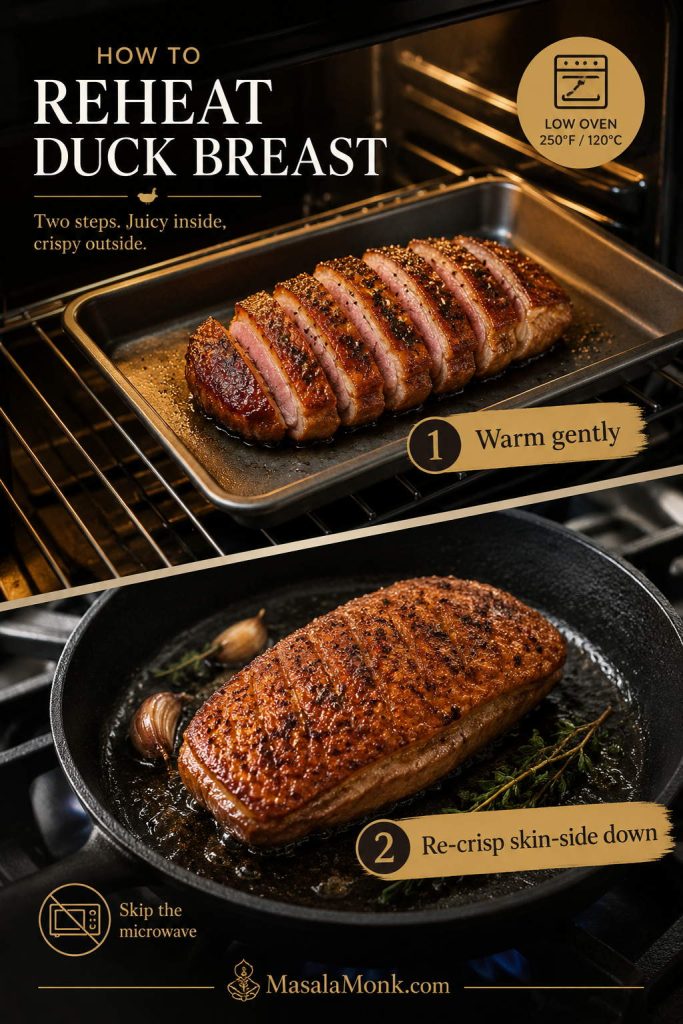
For best texture, skip the microwave for whole legs. The meat may warm, but the skin will turn soft. If you are shredding the duck for pasta or hash, reheating in a skillet with a little duck fat is much better.

When storage feels uncertain — especially if the duck cooled slowly or sat out longer than planned — treat it like cooked poultry and follow standard leftovers guidance rather than relying on old-style confit storage. The USDA leftovers and food safety guide is a useful reference.

Duck Confit Troubleshooting

If something goes wrong, start here; this section is also worth checking before you change the oven temperature, salt, or pan. Most duck confit problems are fixable because the cooking is slow.

How to Fix Common Duck Confit Problems

Most problems point back to the same few causes: salt, heat, pan size, surface moisture, or how the fat was strained.

Duck confit troubleshooting guide showing fixes for tough meat, too salty duck, greasy texture, soft skin, and cloudy duck fat.
Most duck confit problems are fixable: cook tough meat longer, balance salt with plain sides, drain excess fat, dry the skin, and strain cloudy fat gently.
ProblemLikely causeFix nowFix next time
Duck is too saltyCure was too long, or fine salt was used by volumeServe with unsalted potatoes, beans, lentils, or bitter greensWeigh the salt and use a shorter cure
Meat is toughDuck was not cooked long enoughReturn to the fat for 30–45 minutesCook to tenderness, not just time
Meat is dryFat was too hot or bubbling hardServe with sauce or shred into pasta/beansLower the oven temperature and keep the fat barely moving
Final duck tastes greasyToo much fat clinging to the skin before crispingWipe the skin and drain on a rack after crispingLet excess fat drip off before skillet or oven finishing
Skin will not crispSurface is wet or coated with too much fatWipe well and crisp skin-side down in a skilletChill uncovered or wipe very well before crisping
Skin browns but stays softHeat is too high or the skin is still dampLower heat and keep cooking skin-side downDry the legs better before crisping
Skin tearsMoved too soon or pan was too hotLet the rest of the skin release naturallyUse medium heat and wait before turning
Not enough duck fatPan is too wideMove duck to a smaller dishChoose a compact dish from the start
Fat looks cloudyMoisture and juices mixed into the fatStrain, chill, and separate carefullyStore clean strained fat separately from juices

Duck Confit FAQs

Is duck confit hard to make?

Not really. Duck confit asks for time more than skill. Most of the recipe is inactive: salt the legs, let them rest, cook them slowly in fat, then crisp the skin before serving.

Which cut of duck is best for confit?

Skin-on, bone-in legs are the cut to buy because they have the fat, skin, bone, and connective tissue that make confit work. Duck breast is better cooked quickly and is not the classic cut for confit.

How much duck fat do I really need?

For 4 duck legs, start with about 750 ml / 25 US fl oz / 3¼ cups rendered duck fat, but pan size matters more than the number. A compact dish may need less, while a wide roasting pan may need much more.

Does duck confit need to be fully submerged in fat?

The meaty parts should be covered by fat for the most even cooking. Bone tips or a very small patch of skin can sit above the fat, especially if you use parchment and a tight cover. If too much meat is exposed, move the legs to a smaller pan before adding more fat.

What temperature should duck confit cook at?

This recipe uses 105°C / 225°F for 3½–4 hours. For fan or convection ovens, reduce the temperature to about 95–100°C / 205–212°F. The goal is low, steady heat: the fat should barely bubble, not boil aggressively.

Why is my duck confit not crispy?

Soft skin after the slow cook is normal — the crisping happens at the end, not during the fat cook. Wipe away excess fat, use medium heat, and give the skin enough time in the pan before moving it.

Can I make duck confit without duck fat?

You can make a confit-style duck leg with goose fat, lard, olive oil, butter, or a mix of duck fat and neutral oil, but duck fat gives the cleanest classic flavor. Treat substitute-fat versions like normal cooked leftovers rather than long fat-preserved confit.

Can I make duck confit with only 2 legs?

Yes. Keep the salt at about 1.5% of the duck’s weight and use the smallest oven-safe dish that fits the legs in one layer. The duck fat amount will depend more on the dish size than the number of legs.

Can I reuse duck fat after making confit?

Yes, if it is clean and smells fresh. Strain it, chill it, separate the pale fat from darker juices underneath, and use clean utensils each time. Discard it if it smells off, looks moldy, or has been contaminated with crumbs or meat juices.

What can I make with leftover duck confit?

Use leftovers in pasta, salads, tacos, hash, white beans, risotto, ramen, grilled cheese, or warm grain bowls. Shred the meat and crisp it in a skillet with a little duck fat for the best flavor.

At this point, the method is simple: cure, cover with fat, cook low, crisp. The recipe card below keeps the steps tight so you can cook from it.

Duck Confit Recipe

This duck confit recipe turns skin-on, bone-in duck legs into silky, pull-apart meat with golden crisp skin. The method is slow but mostly hands-off, with clear guidance for salt, duck fat, pan size, make-ahead storage, and final crisping.

Yield
4 servings
Total Hands-On Time
35–45 minutes
Prep Time
25 minutes
Inactive Cure Time
12–24 hours
Oven Cook Time
3½–4 hours
Finish Time
10–30 minutes
Total Time
Overnight to 1¼ days, mostly inactive
Method
Oven confit

Before you start: use a close-fitting oven-safe dish. Pan size affects how much duck fat you need.

Ingredients

For the Duck and Cure

  • 4 skin-on, bone-in duck legs, about 1–1.4 kg / 2¼–3 lb total
  • 15–21 g kosher salt, or about 1.5% of the duck’s weight
  • 2–4 small thyme sprigs
  • 1 teaspoon black peppercorns, lightly crushed
  • Optional: 2 strips orange zest
  • Optional: 4–6 juniper berries or 1 teaspoon coriander seeds

For Cooking

  • 750 ml / 25 US fl oz / about 3¼ cups rendered duck fat, plus more if needed depending on pan size
  • 6 garlic cloves, lightly smashed
  • 1–2 shallots, halved or thickly sliced
  • 4 small thyme sprigs
  • 1–2 small rosemary sprigs
  • 2 bay leaves
  • Optional: a few extra black peppercorns

Instructions

Cure and Cook the Duck

  1. Cure the duck. Pat the duck legs dry. Rub evenly with salt, then add thyme, peppercorns, and any optional cure aromatics. Cover and refrigerate for 12–24 hours.
  2. Prepare for cooking. Remove the duck from the cure. Wipe off aromatics and visible salt. Rinse only if there are clumps of salt or the cure looks heavy, then pat very dry. Discard the wet cure aromatics.
  3. Heat the oven. Preheat to 105°C / 225°F. If using a fan/convection oven, use about 95–100°C / 205–212°F and expect the cook time to run slightly longer.
  4. Melt the duck fat. Warm the duck fat just until liquid. It should be fluid enough to pour, not sputtering hot.
  5. Arrange and cover. Place the legs in the smallest close-fitting oven-safe dish or Dutch oven that holds them in one layer without stacking. Add fresh garlic, shallots, herbs, bay leaves, and optional peppercorns. Pour warm duck fat over the legs until the meaty parts are mostly submerged. Use parchment directly over the duck if needed, then cover with a lid or foil.
  6. Cook low and slow. Bake for 3½–4 hours, until the meat is very tender, pulls back slightly from the bone, and offers almost no resistance when pierced. The fat should barely bubble, not boil hard.

Cool, Crisp, and Serve

  1. Cool or finish. If making ahead, cool the legs until no longer steaming, transfer them to a clean container with enough fat to cover, and refrigerate promptly. If serving now, carefully lift them from the fat and let excess fat drip away.
  2. Crisp the skin. Wipe excess fat from the skin. Crisp skin-side down in a heavy or nonstick skillet over medium heat for 6–10 minutes, or roast on a rack at 200°C / 400°F for 20–30 minutes.
  3. Serve. Serve with duck fat potatoes, beans, lentils, bitter greens, braised cabbage, or a sharp fruit sauce such as orange, cherry, or plum.

Recipe Notes

  • Keep the fat quiet: the duck should cook slowly, not fry.
  • Judge the skin at the end: it will look soft after the slow cook; it crisps only during the final skillet or oven finish.
  • Salt carefully: weigh the salt if possible. If measuring by volume instead of weight, use coarse kosher salt; fine salt can make the cure too salty.
  • Leftover fat: strain, chill, and reuse clean duck fat for potatoes, eggs, mushrooms, beans, and vegetables.
  • Butter shortcut note: if you used butter instead of duck fat, the leftover fat will contain milk solids and water, so store it separately and use it sooner.

Storage

Refrigerate cooked duck confit for 3–4 days or freeze for up to 3 months. This recipe is for modern home storage, not long-term preservation. Reheat slowly, then crisp before serving.

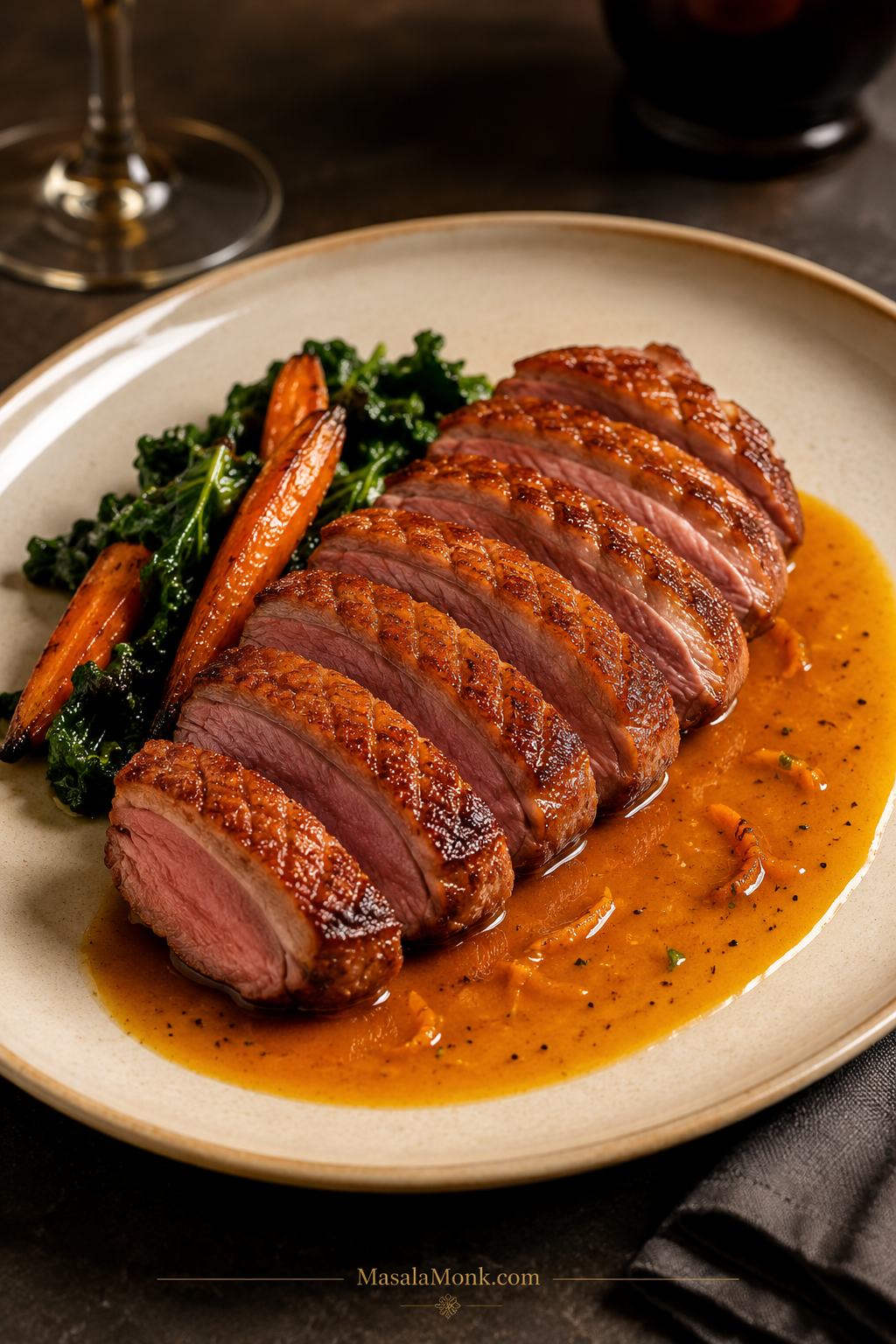
Final texture visual: By the end of the process, the plate should show both parts of the method: tender meat from the slow cook and crisp skin from the final finish.

Duck confit leg served with pulled tender meat, crisp skin, roasted potatoes, salad greens, sauce, and a jar of duck fat.
By the end, this recipe gives you two rewards: crisp duck confit for dinner and clean golden duck fat for potatoes, eggs, vegetables, and beans.

The first time you make duck confit, the process feels mysterious. The second time, you know the rhythm: salt, rest, cover, cook, crisp. By then, the mystery is gone — and what is left is tender duck, crackly skin, and a jar of golden fat waiting for the next meal.
Back to top ↑

Posted on 1 Comment

Duck Breast Recipe

Sliced duck breast with crispy scored skin, pink center, orange sauce, greens, and potatoes on a dinner plate

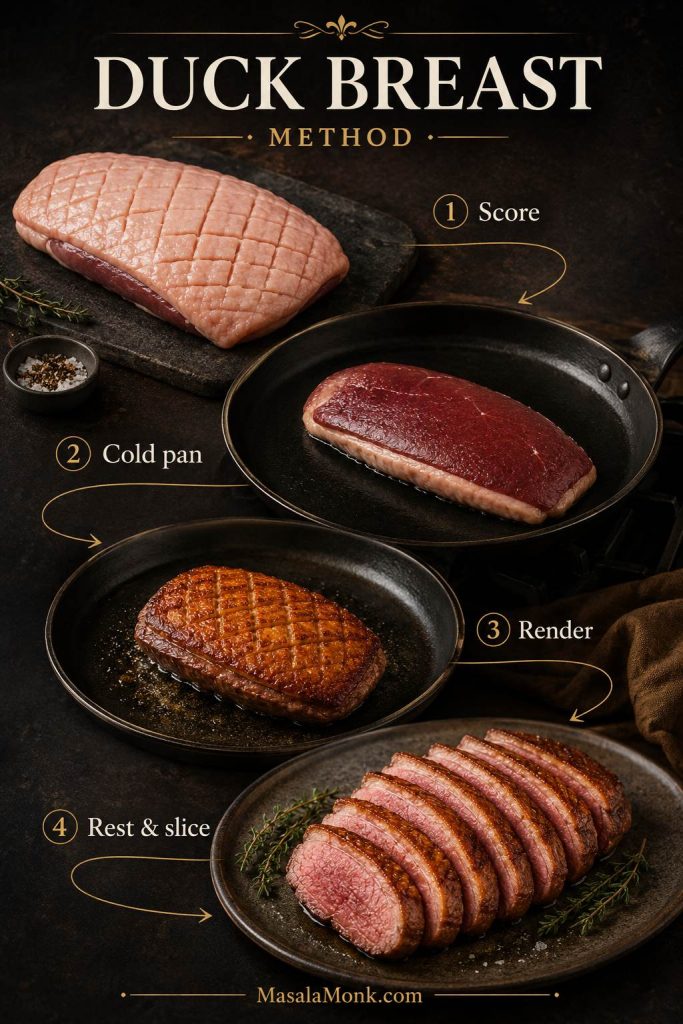
Duck breast can feel intimidating the first time: beautiful when it works, frustrating when the skin turns rubbery or the meat dries out. The good news is that the method is much calmer than it looks. You do not need a complicated marinade or a chef’s trick. You need to score the skin, start in a cold pan, render the fat slowly, finish gently, rest, and slice.

This duck breast recipe gives you crisp golden skin, a tender center, and a quick orange sauce you can make while the duck rests. More importantly, it shows you what to look for at each stage: how deep to score, how the fat should bubble, when the skin is ready to flip, and how to choose the right temperature for your table.

Because duck breast is rich and easy to overthink, this guide also covers sauces, sides, air fryer and sous vide notes, storage, reheating, leftovers, and troubleshooting. By the end, you should know how to avoid rubbery skin, greasy fat, and dry meat — and what to do if something starts going wrong.

The payoff is a plate that feels special without being frantic: crisp salted skin, a thin rendered fat layer, juicy slices, and a glossy sauce you make while the duck rests.

Before you start: the slow part is the skin-side render. It may feel like nothing is happening for the first few minutes, but that quiet start is exactly what helps the fat melt instead of trapping a chewy layer under the skin.

Quick Answer: Best Way to Cook Duck Breast

Duck breast usually cooks best when you score the skin, season it well, place it skin-side down in a cold dry pan, and slowly render the fat over low to medium-low heat until the skin is golden and crisp. Once most of the fat has melted, flip the breast briefly to cook the meat side, then finish in a 350°F / 180°C oven if the breast is thick or still under your preferred temperature.

Rest the duck skin-side up for 5–10 minutes, then slice it against the grain. Many cooks prefer duck breast medium-rare to medium for juicier slices, while the official poultry safety benchmark is 165°F / 74°C. Use a thermometer and choose the doneness that feels right for you and the people you are serving.

Not sure which doneness to choose? Use the duck breast temperature guide before you start cooking.

Four-step duck breast method showing scored breast, cold pan start, rendered skin, and sliced cooked duck
The method feels simpler when you see the rhythm: score the skin, start cold, render patiently, rest, and slice only after the juices settle.

What success looks like: the skin should be deeply golden and crisp, the white fat layer should look much thinner, and the sliced meat should be juicy rather than dry. If the skin is browning fast but the fat still looks thick, lower the heat and keep rendering.

Close-up guide showing crispy duck skin, thin rendered fat layer, and juicy sliced duck breast
Before you rely on timing alone, check the visual cues: crisp skin, a thinner fat layer, and meat that still looks moist after slicing.

Quick cooking formula: score the skin, season, start skin-side down in a cold dry pan, render gently for 10–18 minutes, flip for 1–2 minutes, oven-finish thick breasts if needed, rest skin-side up for 5–10 minutes, then slice against the grain.

For the visual stage-by-stage version, jump to the duck breast rendering cues before you start cooking.

Duck Breast Recipe at a Glance

Best methodCold-pan pan-seared
Serves2
Total time35–50 minutes
Oil needed?No
Best panHeavy skillet, preferably oven-safe
Oven finishOptional, 350°F / 180°C
Best sauceOrange, cherry, plum, or red wine sauce
Main mistakeCooking too hot before the fat renders

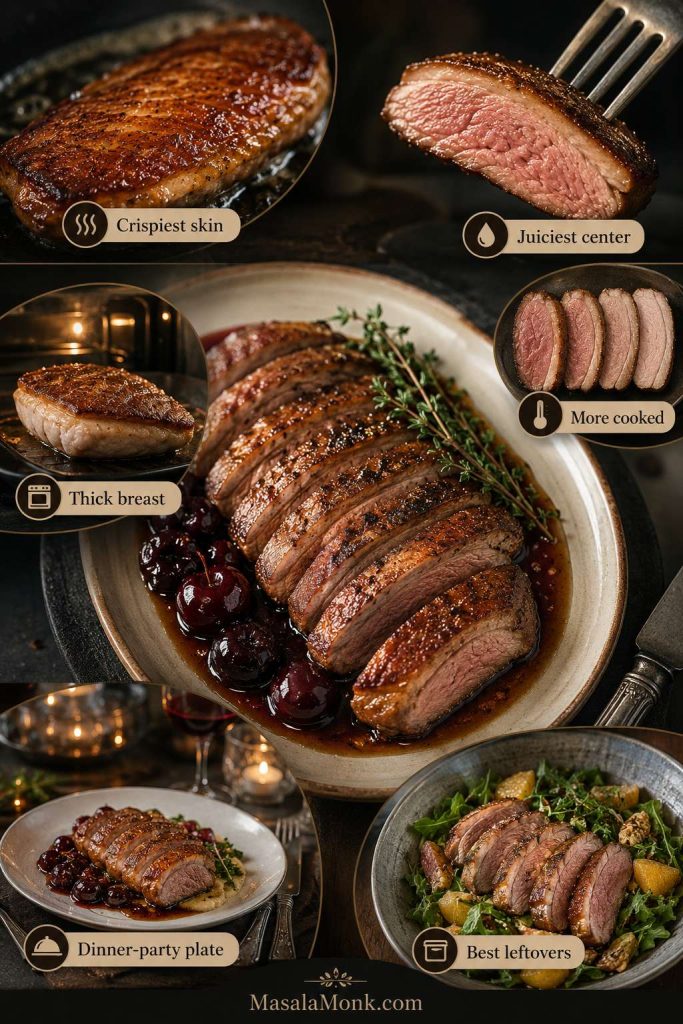
Choose Your Duck Breast Goal

Your goal Best move
Crispiest skin Render longer over low to medium-low heat, and spoon sauce around the slices rather than over the skin.
Juiciest center Use a thermometer, pull the duck a few degrees before your final target, and rest it skin-side up.
Less pink / more cautious doneness Cook closer to the official poultry benchmark, knowing the meat will be firmer.
Thick magret-style breast Render the skin on the stovetop first, then finish gently in a 350°F / 180°C oven.
Date-night or dinner-party plate Use orange or cherry sauce, crisp potatoes, and bitter greens to balance the richness.
Nervous beginner Trust the cues more than the clock: thinner fat layer, golden skin, gentle bubbling, and thermometer-confirmed doneness.
Best leftovers Slice cold or reheat gently, then add cooked duck near the end of rice, noodles, salads, or pasta.
Duck breast goal guide for crispy skin, juicy center, cautious doneness, thick breast, dinner plate, and leftovers
Before the pan heats up, decide what matters most: crispest skin, juiciest slices, cautious doneness, or a more polished dinner-party plate.

Why This Duck Breast Recipe Works

Duck breast cooks differently from chicken breast because it has a thick layer of fat under the skin. If you start with high heat, the skin can brown before that fat melts, leaving a chewy layer underneath. Starting in a cold pan gives the fat time to render gradually, so the skin crisps while the meat stays protected from harsh heat.

Scoring the skin gives the fat more places to escape. Drying the skin helps it brown instead of steam. Pouring off excess fat keeps the duck from sitting in a deep pool of hot fat. Resting skin-side up protects the crisp surface while the juices settle.

Once you understand those four ideas — score, dry, render slowly, rest properly — this cut becomes much easier to cook consistently.

That contrast is why duck breast feels special: the knife taps through crisp skin, the center stays tender, and the sauce belongs beside the slices instead of drowning them.

Ingredients for Duck Breast

You do not need much to make excellent duck breast. Salt, pepper, and a good pan do most of the work. The optional orange sauce makes the plate feel complete, but the cooking technique matters more than the sauce.

For the Duck Breast

  • 2 skin-on boneless duck breasts, about 6–8 oz / 170–225 g each
  • 1 tsp kosher salt, or about ½ tsp fine salt
  • ¼ tsp black pepper
  • Optional: 1 small thyme or rosemary sprig
  • Optional: 1 small garlic clove, lightly crushed

For the Optional Orange Sauce

  • ¼ cup / 60 ml fresh orange juice
  • ½ cup / 120 ml chicken stock
  • 1 tbsp white wine vinegar or red wine vinegar
  • 1–2 tsp honey or sugar
  • 1 tsp orange zest
  • 1 tbsp / 14 g cold butter
  • Salt and black pepper, to taste
Raw skin-on duck breasts with salt, pepper, orange, butter, stock, vinegar, honey, herbs, garlic, and orange zest
With duck breast, a short ingredient list works because salt, controlled heat, and a bright orange sauce do more than a complicated marinade.

No oil needed: Duck breast brings its own cooking fat. Starting in a dry pan lets that fat melt naturally, so the skin can crisp without adding oil.

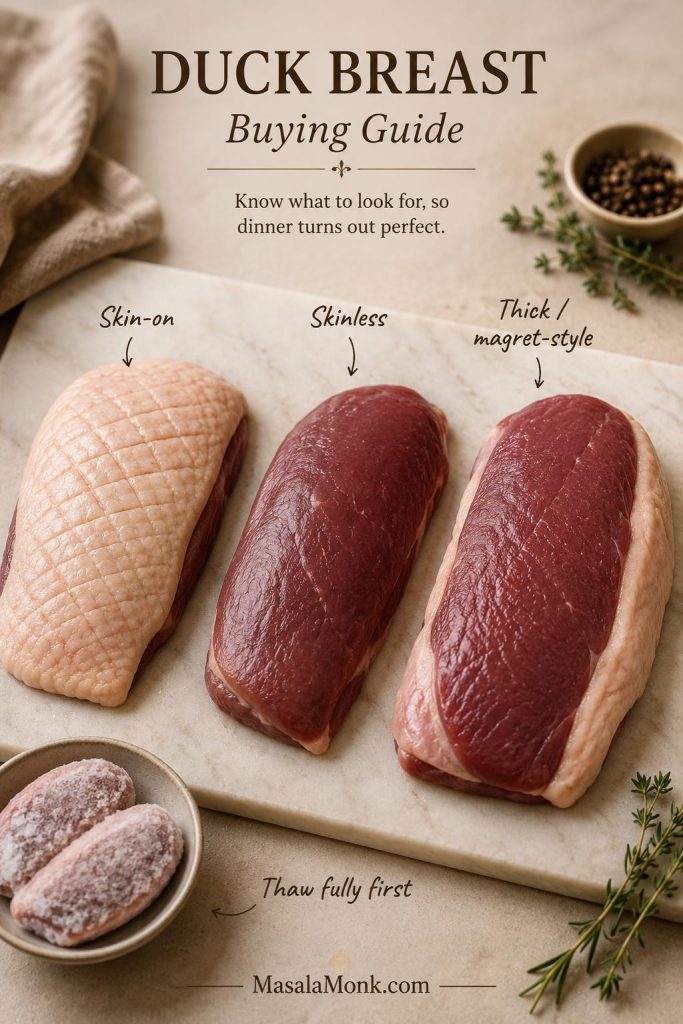
What Kind of Duck Breast to Buy

For this recipe, the best choice is skin-on boneless duck breast. The skin and fat are not a problem to avoid; they are the reason the recipe works. The goal is to slowly melt that fat so the skin becomes crisp and the meat stays juicy.

Type Best use What to know
Skin-on duck breast Best for this recipe The fat renders slowly and the skin crisps in the pan.
Skinless duck breast Leaner preparations It will not give crispy skin and cooks more like a lean steak.
Duck fillet Same general use Often another name for boneless duck breast.
Magret or moulard duck breast Larger, richer portions Usually fattier and thicker, so it often needs a longer render and oven finish.
Frozen duck breast Fine if thawed properly Thaw fully in the fridge and pat very dry before cooking.
Duck breast buying guide showing skin-on duck breast, skinless duck breast, frozen duck, and thick magret-style duck breast
Skin-on duck breast is the right starting point for crispy skin; thicker magret-style pieces simply need more rendering time and a gentler finish.

Smaller duck breasts, around 4–5 oz / 112–140 g each, may finish entirely on the stovetop. Larger breasts, around 7–8 oz / 200–225 g or more, often benefit from a short oven finish after the skin has rendered.

If the package has very different-sized breasts, cook to temperature rather than trying to make both pieces follow the same timing. The smaller one may need to come out of the pan first.

Equipment You Need

You do not need many tools, but a few of them make the recipe much easier to control. The most helpful one is an instant-read thermometer, especially if you are nervous about doneness.

  • Sharp knife: for scoring the skin cleanly.
  • Paper towels: for drying the skin very well.
  • Heavy skillet: cast iron, stainless steel, carbon steel, or heavy nonstick all work.
  • Instant-read thermometer: the easiest way to avoid overcooking.
  • Small pan, spatula, or cooking weight: useful if the duck breast curls as it renders.
  • Heatproof bowl: for pouring off rendered duck fat.
  • Small saucepan: optional, if making sauce separately.

Best pan choice: Use an oven-safe skillet if possible. That way, if the skin is crisp but the center is still under your target temperature, you can move the whole pan into the oven without transferring the duck.

How to Score Duck Breast

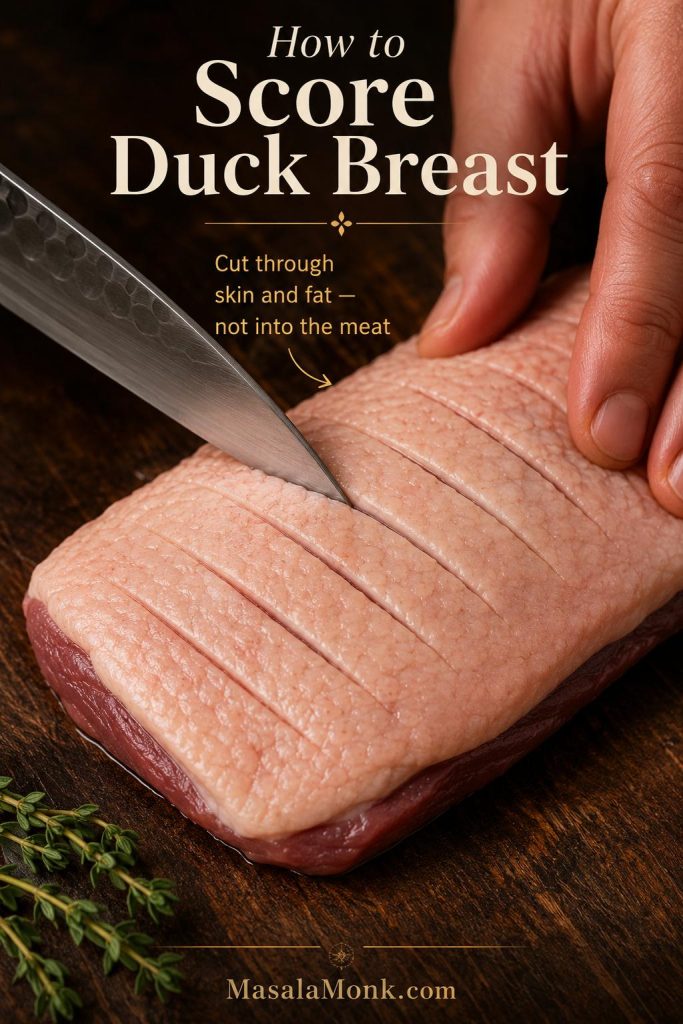
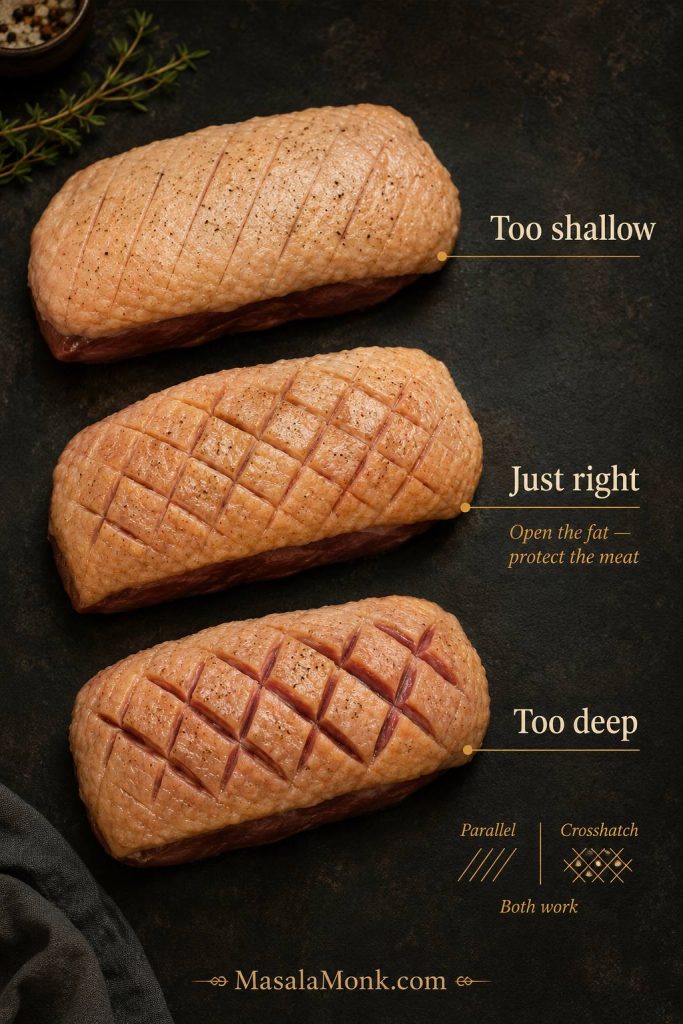
Scoring means making shallow cuts through the skin and fat so the fat can render more evenly. The goal is to cut through the skin and fat, not into the meat. If you see red flesh through the cuts, you have gone too deep.

Knife scoring the skin and fat of a raw duck breast without cutting into the meat
Score through the skin and fat only, because cutting into the meat can release juices before the duck breast has finished cooking.

Parallel Score vs Crosshatch Score

A parallel score is easier for beginners: make diagonal lines across the skin about ¼ inch apart. A crosshatch score adds a second set of diagonal lines in the opposite direction. Both work, as long as the cuts are shallow enough to protect the meat.

How Deep Should the Cuts Be?

Deep enough to open the fat layer, but not so deep that the meat is exposed. This matters because cutting into the meat lets juices escape and can make the duck cook unevenly.

Scoring result What happens
Too shallow The fat does not render as evenly, so the skin can stay thick and chewy.
Just right The fat melts slowly, the skin crisps, and the meat stays juicy.
Too deep Juices leak out, the meat can cook too fast, and the skin may steam instead of crisp.
Duck breast scoring depth guide comparing too shallow, just right, and too deep cuts in the skin
The best scoring depth opens the fat layer without exposing the meat, which helps the skin render while the center stays protected.

How to Cook Duck Breast with Crispy Skin

Once you know what to look for, the method becomes much less stressful. Dry the skin, score the fat, start in a cold pan, let the fat render slowly, then flip, finish, rest, and slice. Each step has a visible cue, so you are not just guessing by the clock.

If you only remember one thing: do not rush the skin side. Crisp duck breast comes from slow rendering, not aggressive searing.

1. Pat the Duck Dry

Dry skin browns better. Pat the duck breasts very well with paper towels, especially on the skin side. For an even better result, season the duck and leave it uncovered in the fridge for a few hours or overnight, then bring it out for about 20–30 minutes before cooking.

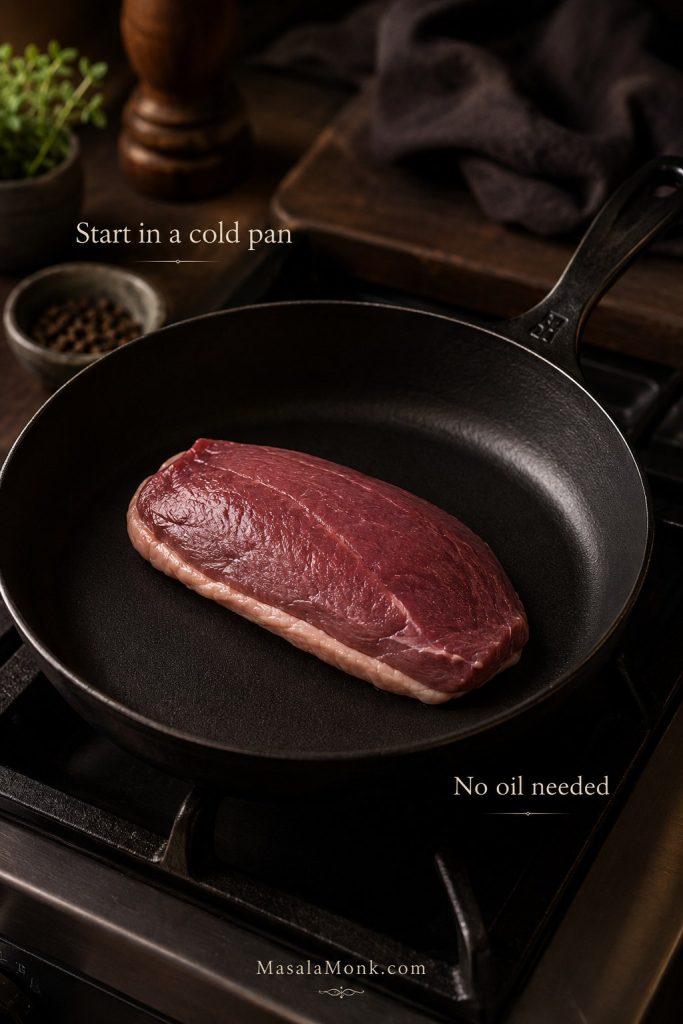
2. Start in a Cold Pan

Place the duck breasts skin-side down in a cold, dry skillet. Do not add oil. Turn the heat to low or medium-low.

Raw duck breast placed skin-side down in a dry skillet for a cold pan start with no added oil
Start cold and dry; the pan should look quiet before the fat begins to pool.

It will feel strange if you are used to searing steak in a ripping-hot pan, but duck breast is different. The pan starts quiet, then the fat gradually pools and the skin begins to crisp. If the heat is too high too early, the outside browns before the fat underneath has time to melt.

Cold Pan vs Hot Pan for Duck Breast

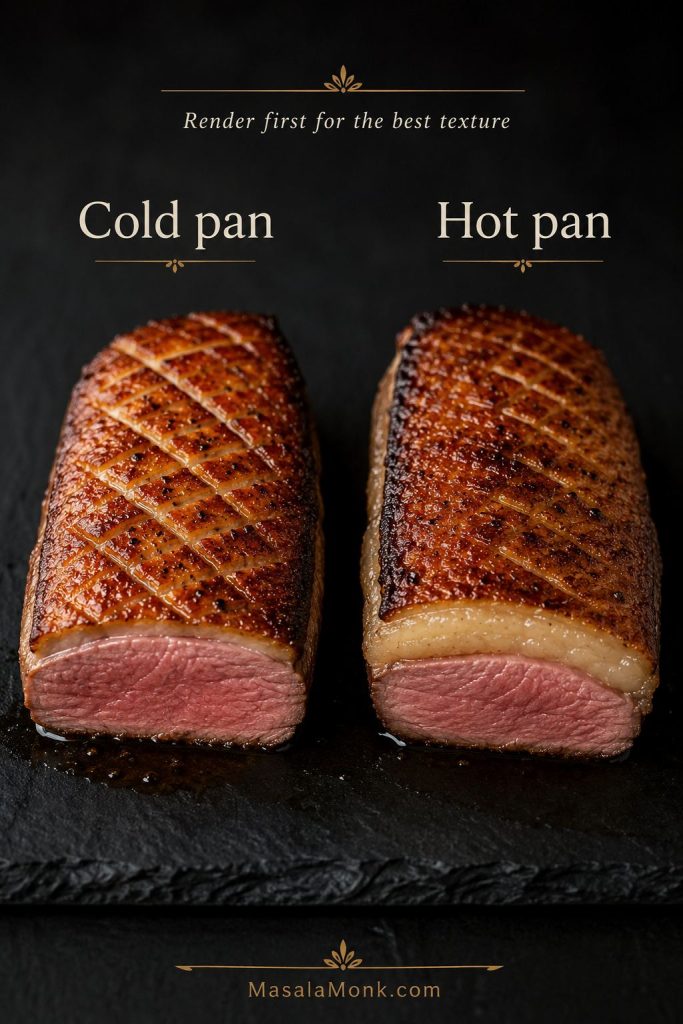
A hot pan can make duck breast look browned before it is actually well rendered. That is the trap. The skin may turn golden, but the fat underneath can stay thick and chewy. A cold pan gives the fat time to melt slowly before the skin gets too dark.

Method What happens Result
Cold pan The fat melts slowly before the skin browns too much. Crispier skin, thinner fat layer, juicier meat.
Hot pan The skin browns quickly while fat stays trapped underneath. Golden-looking skin with chewy fat and a higher risk of overcooked meat.
Comparison of cold pan duck breast with thin rendered fat and hot pan duck breast with thicker fat under browned skin
High heat can brown duck skin before the fat has melted; meanwhile, a cold-pan start gives the fat time to render more evenly.

For crisp skin, render first: before relying on the oven, grill, or air fryer, let the fat layer thin in a pan. Otherwise, the meat can cook before the skin has a chance to become properly crisp.

If the duck breast curls and the edges lift away from the pan, press gently with a spatula for the first few minutes or place a lighter pan on top. This keeps the skin flat against the pan so it crisps evenly instead of leaving pale, rubbery patches.

3. Render the Fat Slowly

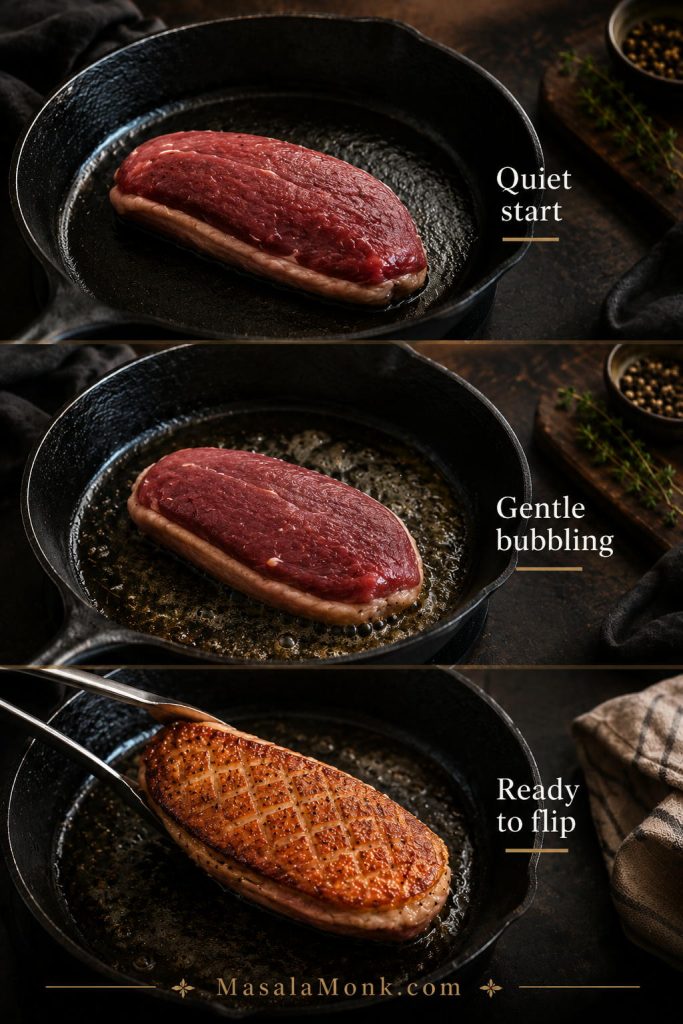
Cook the duck skin-side down for about 10–18 minutes, depending on the size of the breast, the pan, and the heat level. Use the clock as a guide, but trust the visual cues more.

Duck Breast Rendering Cues

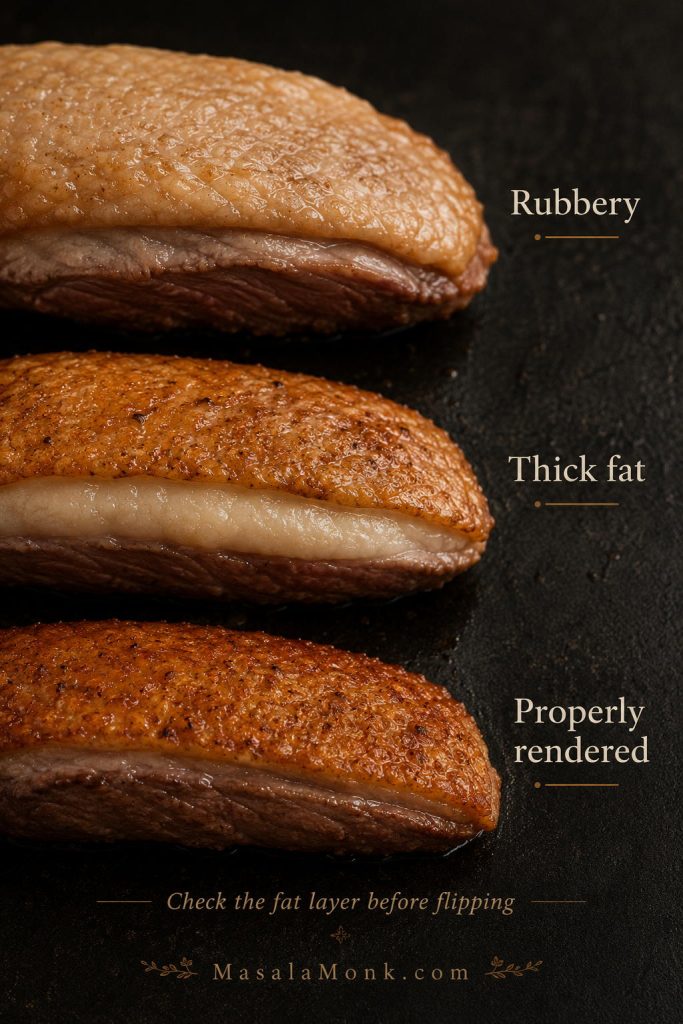
Before you flip, ask three things: is the skin golden, has the white fat layer thinned, and does the skin release from the pan? If yes, you are probably ready.

If you are standing over the pan wondering whether to turn up the heat, wait a little longer first. Duck fat starts slowly, then suddenly the pan becomes more active. That slow change is normal.

Stage What you should see What it means
First few minutes Little fat, quiet pan, skin beginning to warm Normal. The fat has not fully started rendering yet.
Mid-render Gentle bubbling and a shallow pool of clear fat The heat is working. Pour off excess fat if it pools deeply.
Almost ready to flip Golden skin, thinner white fat layer, skin releases from pan The skin is crisp and most of the fat has rendered.
Too hot Smoke, dark patches, loud spitting Lower the heat and pour off excess fat.
Too cool No bubbling after several minutes Increase the heat slightly, but do not jump to high heat.
Duck breast rendering guide showing quiet start, gentle bubbling fat, and golden skin ready to flip
The render starts quietly, then gentle bubbling appears; once the fat layer thins and the skin turns golden, the duck is ready to flip.

Save the duck fat: Pour rendered duck fat into a heatproof bowl, let it cool, then refrigerate it in a clean covered jar. Use it for roasted potatoes, fried rice, sautéed greens, eggs, or roasted vegetables.

Tiny heat adjustments matter here: if the fat is bubbling gently, stay patient. If it smokes or spits hard, lower the heat before the skin darkens.

4. When to Flip Duck Breast

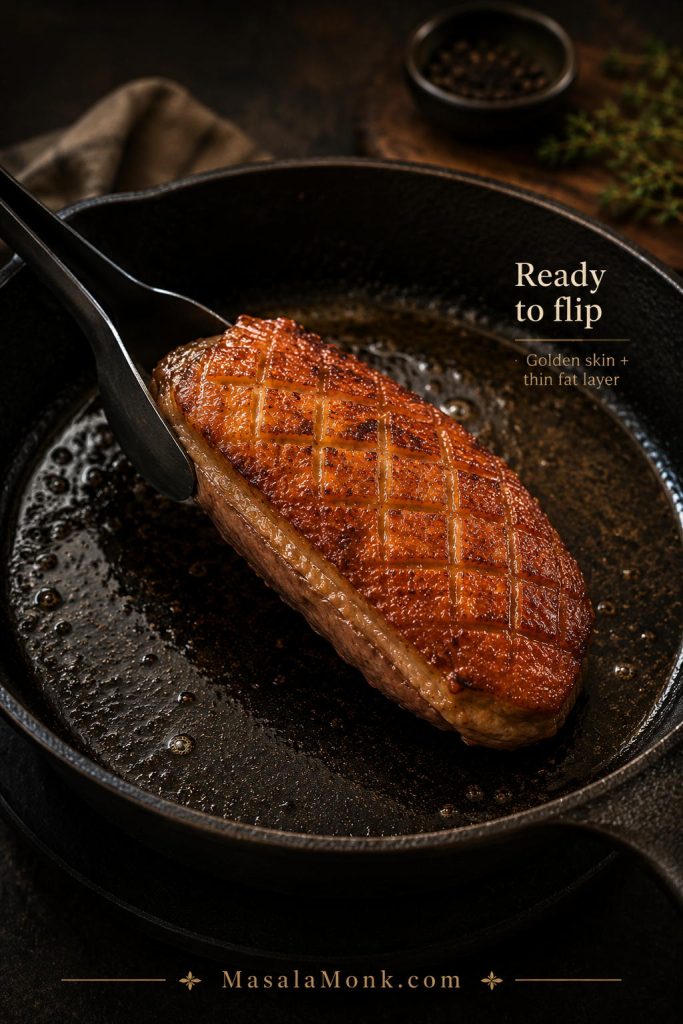
Flip the duck when the skin is golden, crisp, and releases from the pan. The thick white fat layer should look much thinner than when you started.

Duck breast lifted from a skillet to show golden crispy scored skin and a thin rendered fat layer
Wait for the skin to release easily from the pan; forcing the flip too early can tear the crust and leave fat under-rendered.

Cook the flesh side for 1–2 minutes if you are aiming for medium-rare to medium. Smaller breasts may finish here. Thicker breasts usually need the oven finish below.

If the skin is browning but the fat still looks thick, check the skin and fat troubleshooting table before flipping.

Stovetop Only vs Oven Finish

Use this finish Best for What to do
Stovetop only Smaller duck breasts, about 4–5 oz / 112–140 g Render the skin fully, flip, and cook the flesh side briefly until the center reaches your target.
Oven finish Larger or thicker breasts, about 6–8 oz / 170–225 g or more Render until the skin is crisp, flip briefly, then move the oven-safe pan to 350°F / 180°C.

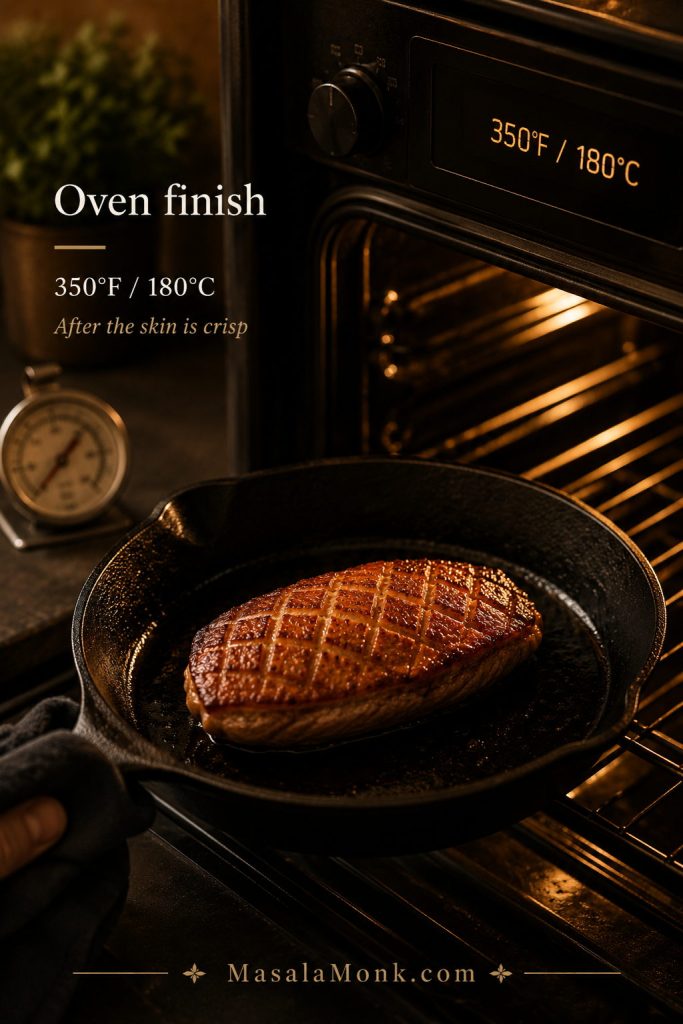
5. Oven-Finish Option

When the skin is crisp but the center is still under your preferred temperature, transfer the oven-safe skillet to a 350°F / 180°C oven.

Crisp-skinned duck breast in an oven-safe skillet being finished in a 350°F oven with a thermometer nearby
Once the skin is already crisp, the oven can gently finish a thicker duck breast without forcing the pan to overcook the outside.

Once you choose the oven finish, use the times below as a starting point and confirm with a thermometer.

Doneness preference Approximate oven finish after rendering
Medium-rare 5–6 minutes
Medium 7–8 minutes
More cooked 10–12 minutes, checking with a thermometer

These times are only guides. Duck breast size varies a lot, so a thermometer is much more reliable than the clock.

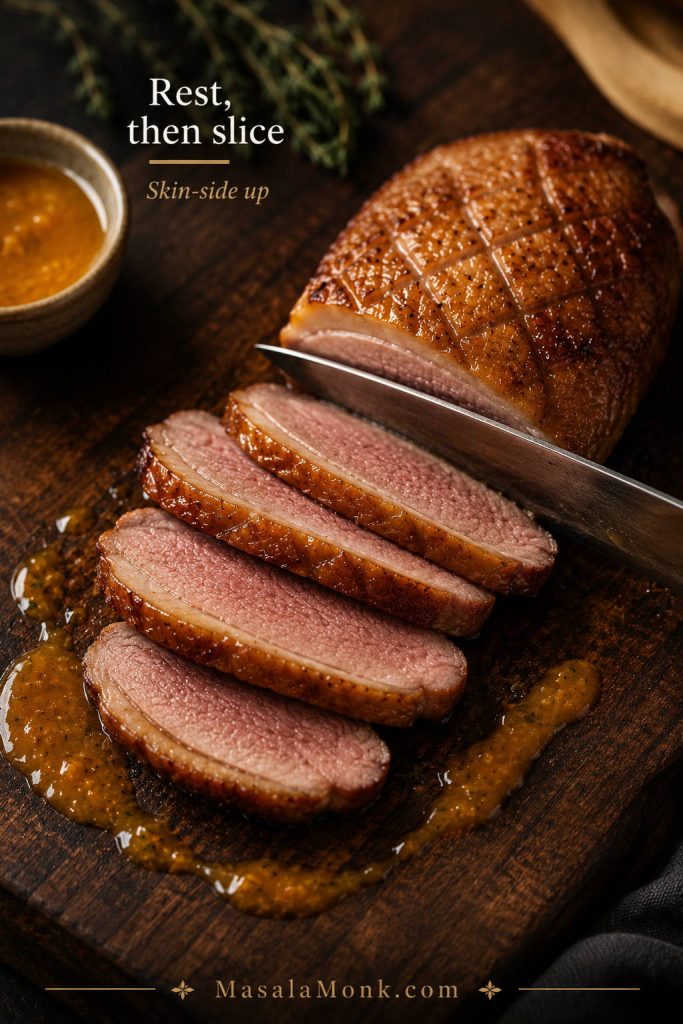
6. Rest and Slice

Transfer the duck to a cutting board and rest it skin-side up for 5–10 minutes. Resting lets the juices settle. Keeping the skin side up helps preserve the crisp surface.

This is the moment to be patient. Cut too early and the juices run; wait a few minutes and the slices look cleaner, calmer, and more luxurious.

Do not cover the duck tightly while it rests. Trapped steam can soften the skin you worked so carefully to crisp.

Slice against the grain into neat pieces. If you are serving with sauce, spoon the sauce around the duck rather than flooding the skin.

Rested duck breast being sliced against the grain with crispy skin, pink meat, and orange sauce nearby
Resting skin-side up protects the crisp surface, while slicing against the grain gives cleaner pieces with better texture.

Duck Breast Temperature Guide

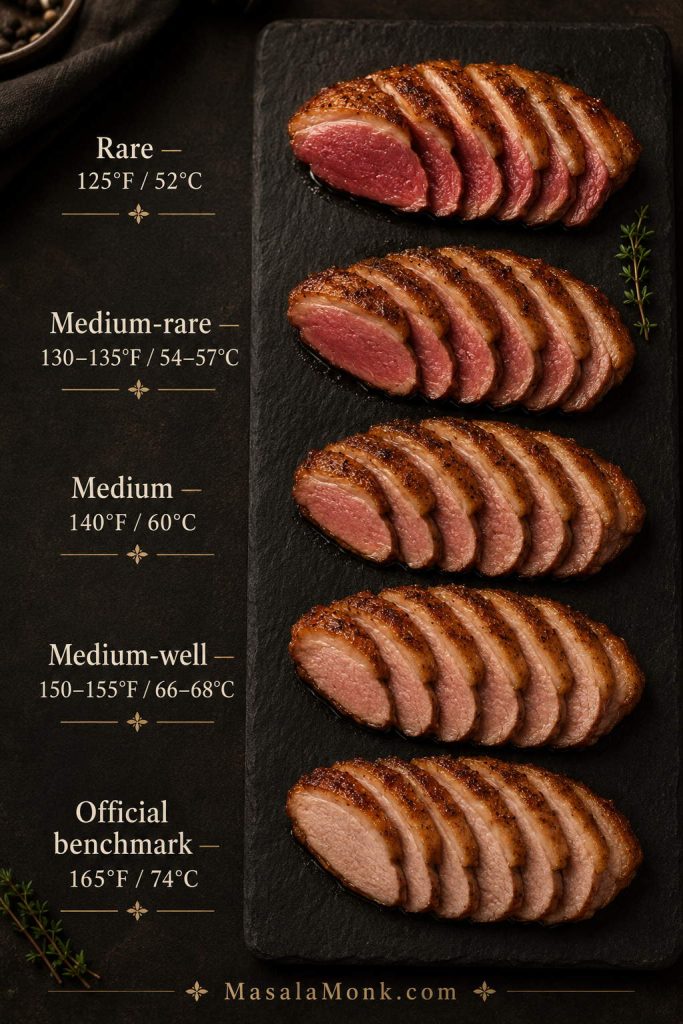
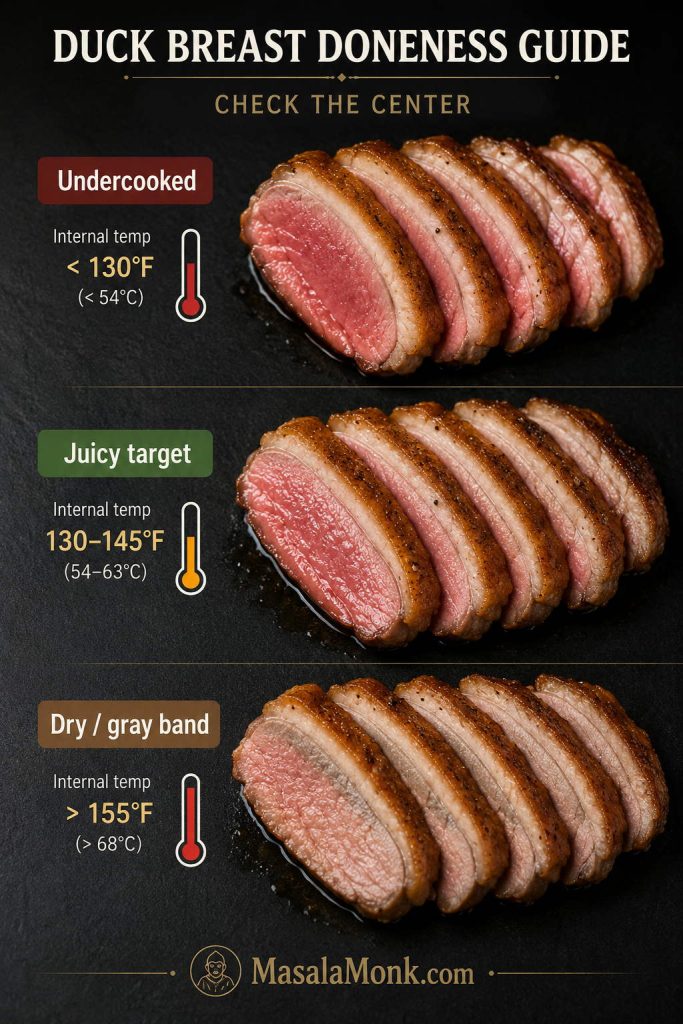
Duck breast temperature can feel confusing because duck is poultry, but many cooks treat the breast more like steak for texture. The table below separates texture preferences from the official safety benchmark so you can make a clear choice.

Doneness Internal temperature Result
Rare 125°F / 52°C Deep pink and very soft; less common for cautious home cooks.
Medium-rare 130–135°F / 54–57°C Pink, juicy, and tender.
Medium 140°F / 60°C Lightly pink and firmer.
Medium-well 150–155°F / 66–68°C Much firmer, less pink, less juicy.
Official poultry safety benchmark 165°F / 74°C Meets the official poultry safety guideline; the meat will be much firmer.
Duck breast temperature guide with sliced examples for rare, medium-rare, medium, medium-well, and 165°F benchmark
Use duck breast temperatures as a guide, then choose the doneness that fits your table, texture preference, and food-safety comfort level.

For the neatest result, pull the duck a few degrees before your final target. The internal temperature can rise slightly as it rests, especially if the breast is thick or has been oven-finished.

Food safety note: Duck is poultry, and the official USDA/FSIS safe minimum for poultry is 165°F / 74°C, measured with a food thermometer. Many duck breast recipes use lower temperatures for a pinker, more tender result, so consider who you are serving and choose the doneness that feels appropriate. You can read the USDA/FSIS safe temperature chart.

Instant-read thermometer inserted from the side into the thickest part of a cooked duck breast
Check the thickest part from the side for the most accurate reading, instead of probing through the fat cap or touching the pan.

Quick Orange Sauce for Duck Breast

Once the duck is resting, you have the perfect window to make sauce. Keep it simple: a few minutes in the pan is enough.

Small pan of orange sauce with orange juice, zest, vinegar, stock, honey, and butter for duck breast
Orange sauce works best when it stays bright and savory, because duck needs acidity and gloss more than heavy sweetness.

Orange sauce works because duck needs brightness. The meat is rich, the skin is salty and crisp, and the sauce should bring citrus, acidity, and a little gloss without turning sticky or candy-sweet.

This should not taste like marmalade poured over meat. It should be bright, savory, and just sweet enough to round the edges of the vinegar. The pan drippings bring depth, the orange brings lift, and the butter gives it a glossy finish.

How to Make It

  1. After removing the duck to rest, pour off most of the fat from the pan.
  2. Add orange juice, chicken stock, vinegar, and honey.
  3. Scrape up the browned bits from the pan, avoiding any burnt bits.
  4. Simmer until the sauce is lightly syrupy.
  5. Turn off the heat and whisk in cold butter and orange zest.
  6. Taste and adjust with salt, pepper, vinegar, or honey.

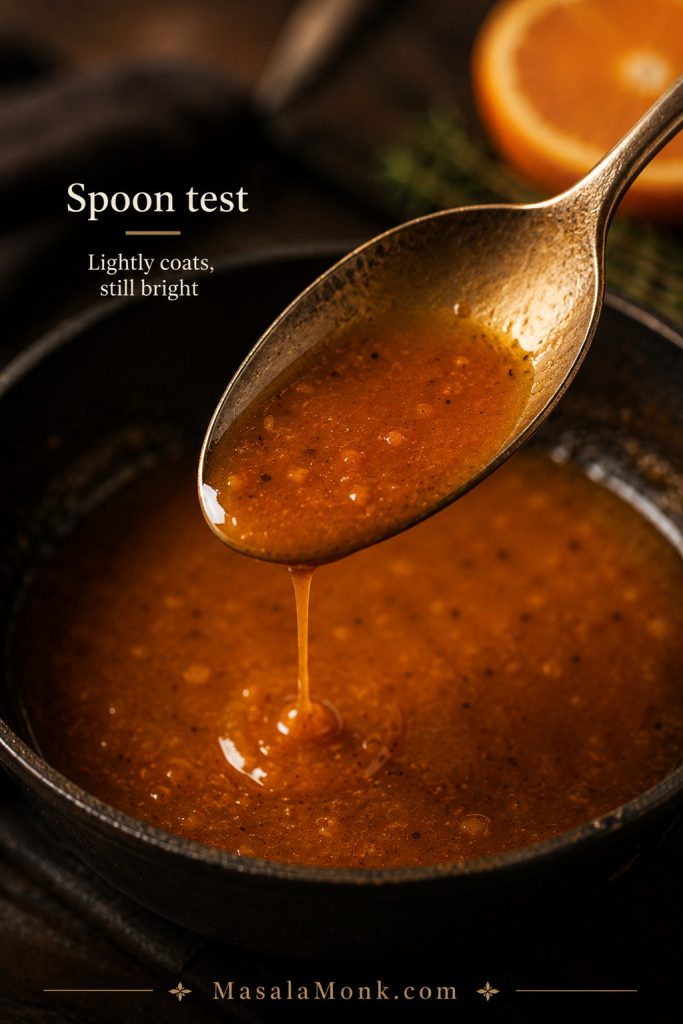
The sauce is ready when it lightly coats a spoon but still tastes bright. If it starts tasting sticky or jammy, loosen it with a splash of stock or orange juice.

Spoon lifted from orange sauce showing a light glossy coating on the back of the spoon
The sauce is ready when it lightly coats a spoon but still moves easily; reduce it too far and it can turn sticky.

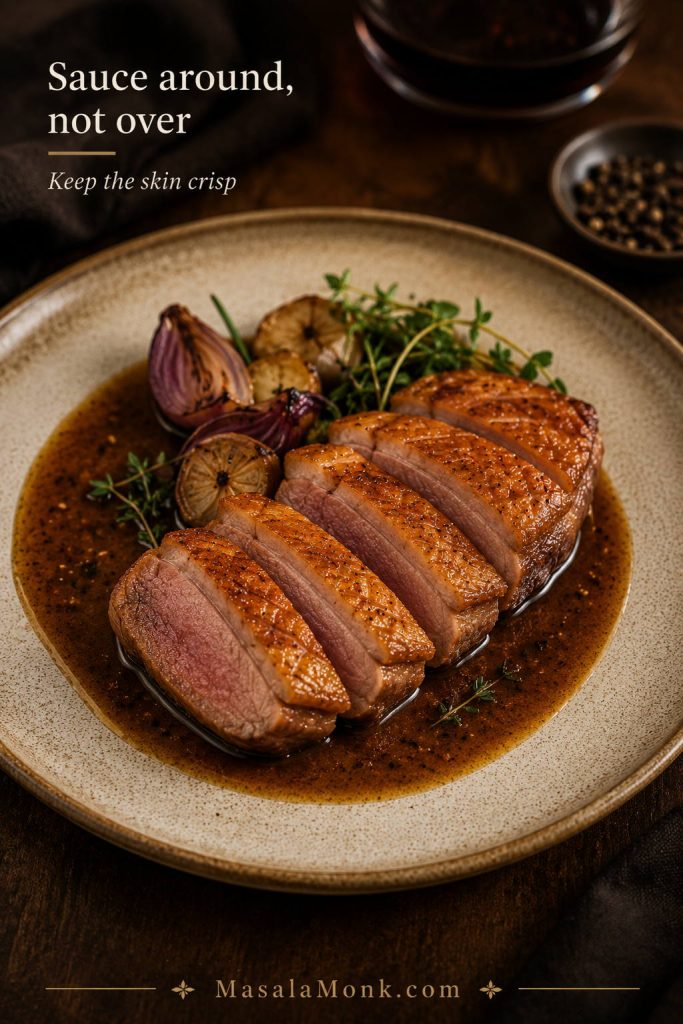
Sauce Around the Duck, Not Over the Skin

The sauce should flatter the duck, not hide it. Spoon it around the slices instead of over the crisp top, especially if you want the first bite to keep that rendered skin texture.

Sliced duck breast plated with orange sauce around the slices while the crispy skin stays uncovered
Spoon sauce around the slices instead of over the skin, so the crisp rendered top survives the first bite.

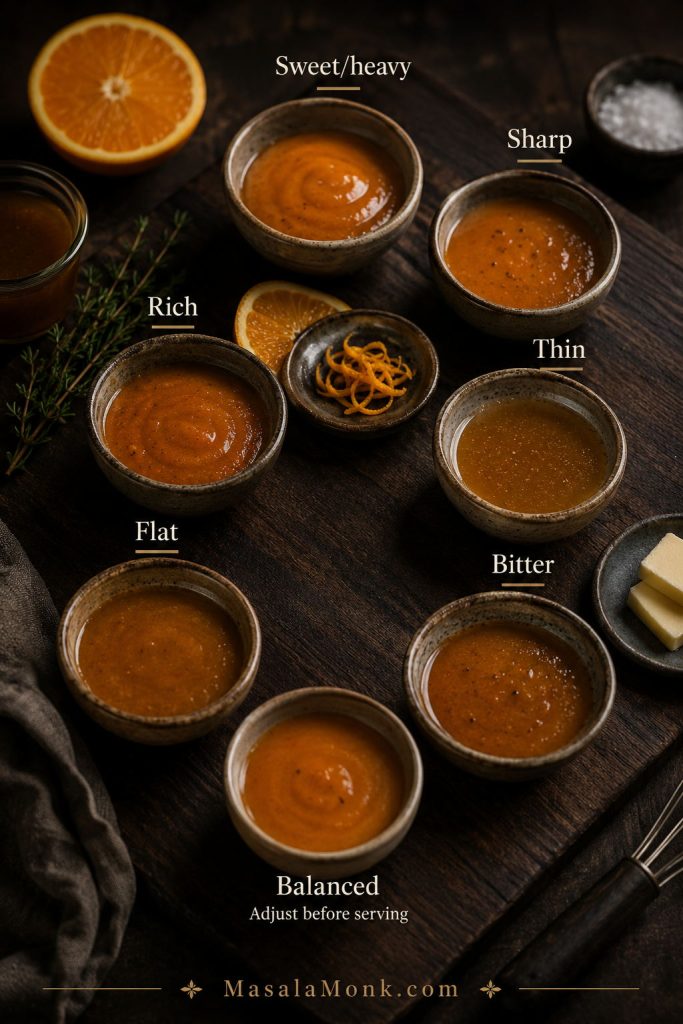
If the sauce tastes too sweet, sharp, thin, or flat, use the orange sauce fixes before serving.

How to Fix the Sauce

Sauce issue Fix
Sweet and heavy Balance it with a splash of vinegar, more orange zest, or a small pinch of salt.
Sharp or vinegary Round the edges with a little honey, sugar, or cold butter.
Thin and watery Keep simmering until the sauce lightly coats a spoon.
Rich or greasy Loosen it with a splash of orange juice, stock, or vinegar.
Flat tasting Wake it up with salt, black pepper, orange zest, or a tiny splash of vinegar.
Bitter edge Soften the bitterness with stock, butter, or a little honey, and avoid scraping up burnt pan bits.
Orange sauce troubleshooting guide with sweet, sharp, thin, rich, flat, bitter, and balanced sauce cues
If the pan sauce tastes off, adjust before serving: acid sharpens sweetness, butter softens edges, and salt wakes up flat flavors.

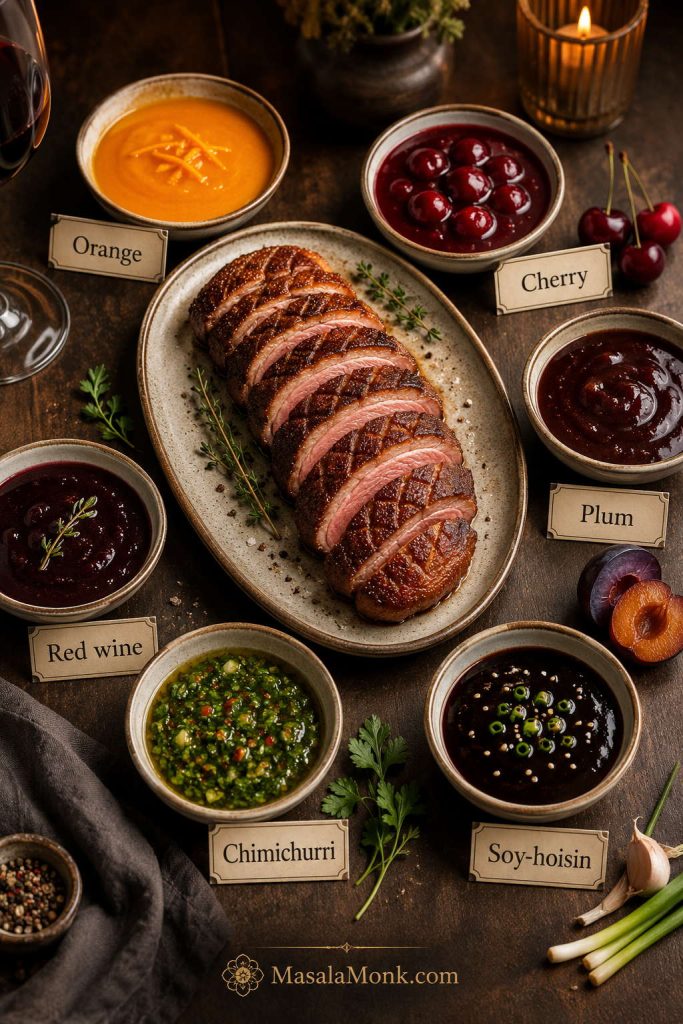
Best Sauces for Duck Breast

Because the meat is rich, the best sauces usually bring acidity, fruit, wine, herbs, spice, or a salty-sweet contrast. Orange sauce is the classic first choice, but the best sauce depends on the mood of the meal.
Sauce Choose it when Flavor direction
Orange sauce You want the classic bright version. Citrusy, lightly sweet, and balanced.
Cherry sauce You want a holiday, date-night, or dinner-party plate. Tart-sweet, rich, and elegant.
Plum sauce You want a sweet-sharp Asian-style direction. Fruity, glossy, and good with five-spice.
Red wine sauce You want less sweetness and more savory depth. Deep, wine-rich, and restaurant-style.
Berry sauce You want a quick fruit sauce without making orange sauce. Works with blackberries, raspberries, or mixed berries.
Chimichurri You want freshness instead of fruit. Herby, garlicky, acidic, and bright.
Soy-hoisin glaze You want duck with rice, noodles, pancakes, or cucumber. Salty-sweet, glossy, and Asian-style.
Sliced duck breast with bowls of orange, cherry, plum, red wine, chimichurri, and soy-hoisin sauces
From orange sauce to chimichurri, the best sauce should balance duck’s richness while leaving the crispy skin as the main event.

If fruit sauces are not your thing, a green herb sauce can make the plate feel fresher and less heavy. MasalaMonk’s chimichurri recipe is a useful direction when you want garlic, herbs, vinegar, and brightness instead of sweetness.

For an Asian-style duck breast, keep the glaze glossy but controlled. MasalaMonk’s teriyaki sauce recipe is a useful base to adapt with orange, ginger, garlic, sesame, chili, or extra vinegar so the duck stays balanced rather than overly sweet.

What to Serve with Duck Breast

Think in contrasts. Duck breast likes something crisp, something fresh, and something that can catch sauce. Potatoes make the plate cozy, bitter greens keep it from feeling heavy, and rice or noodles turn it into an easy bowl-style dinner.

Sliced duck breast served with potatoes, bitter greens, rice or noodles, and bright orange sauce
A balanced duck breast dinner needs contrast: something rich, something fresh, and something that catches sauce without making the plate heavy.

For complete meal ideas, jump to the easy duck breast plate formulas.

Classic Dinner Sides

  • Duck fat potatoes, when you want the richest bistro-style plate.
  • Mashed potatoes, when you want something soft to catch sauce.
  • Potato gratin, when the meal should feel more like a special dinner.
  • Roasted carrots, when you want sweetness without adding another sauce.
  • Green beans, when you need a familiar holiday-style vegetable.
  • Brussels sprouts, when you want bitterness and crisp edges against the rich duck.

If you want the plate to feel more like a holiday dinner than a weeknight skillet meal, MasalaMonk’s hashbrown casserole recipe gives you the creamy, golden potato side that can stand up to duck’s richness.

Fresh Sides

  • Arugula salad, especially with orange, lemon, or a sharp vinaigrette.
  • Orange and fennel salad, especially with orange sauce or cherry sauce.
  • Cabbage slaw, when you want crunch and acidity.
  • Cucumber salad, especially with soy-hoisin or plum sauce.
  • Bitter greens with vinaigrette, when the duck breast is very rich.

For a holiday-style green vegetable side, MasalaMonk’s green bean casserole recipe ideas give you a classic direction plus lighter and richer variations, depending on how heavy the rest of the meal feels.

Rice, Noodles, and Asian-Style Sides

  • Jasmine rice, especially with orange, plum, soy-hoisin, or ginger-garlic sauce.
  • Fried rice, when you have leftover sliced duck.
  • Garlic noodles, when you want something rich but fast.
  • Stir-fried greens, when you want a lighter plate.
  • Thin pancakes with plum or hoisin sauce, cucumber, and scallions.

If you are serving duck with orange sauce, plum sauce, or a soy-hoisin glaze, rice is one of the easiest bases. MasalaMonk’s how to cook rice guide is useful when you want fluffy rice that will not turn gummy under the sauce.

For a bowl-style meal, think rice, sliced duck, cucumber, scallions, sauce, and something crisp. Keep the duck sliced on top rather than buried under sauce so the skin stays the star.

Sliced duck breast over jasmine rice with cucumber, scallions, and dark soy-hoisin or plum glaze on the side
For an Asian-style duck breast bowl, keep the glaze controlled and the skin visible so the rice catches flavor without hiding texture.

Easy Duck Breast Plate Formulas

Plate style What to serve
Classic bistro plate Duck breast, duck fat potatoes, green beans or bitter greens, and orange sauce.
Date-night plate Duck breast, potato gratin, arugula salad, and cherry or red wine sauce.
Fresh citrus plate Duck breast, orange-fennel salad, roasted carrots, and light orange pan sauce.
Asian-style plate Duck breast, jasmine rice, cucumber, scallions, and plum or soy-hoisin glaze.
Leftover lunch plate Cold sliced duck, bitter greens, potato salad, pickles, and a sharp vinaigrette.
Five duck breast meal ideas labeled bistro, date night, citrus, Asian-style, and leftover lunch
Once the duck is cooked well, the same method can become a bistro plate, date-night dinner, citrus salad, rice bowl, or next-day lunch.

Build the plate: for a classic dinner, pair duck breast with crisp potatoes and bitter greens. For a brighter plate, use orange sauce with rice or fennel salad. For an Asian-style version, slice the duck over rice or noodles and keep the glaze light.

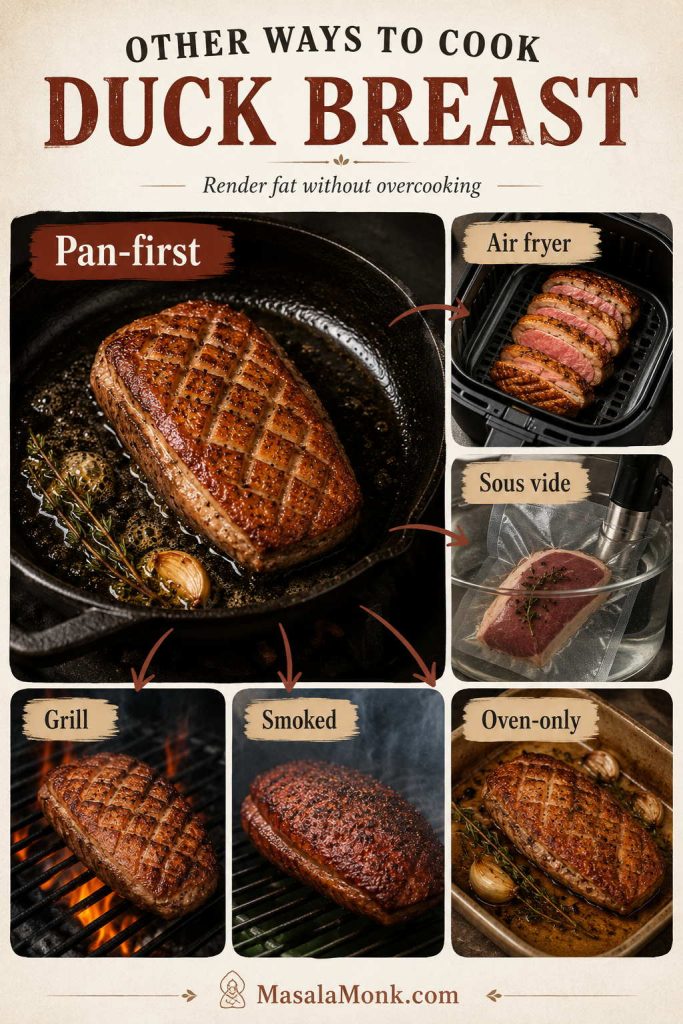
Other Ways to Cook Duck Breast

After you learn the cold-pan method, the other versions make more sense. Each one still has to answer the same question: how do you render the fat without overcooking the meat?

Duck breast cooking methods guide with pan-first, air fryer, sous vide, grill, smoked, and oven-only options
Air fryer, sous vide, grill, smoked, and oven-only methods can all work, but each one still has to manage the fat layer carefully.

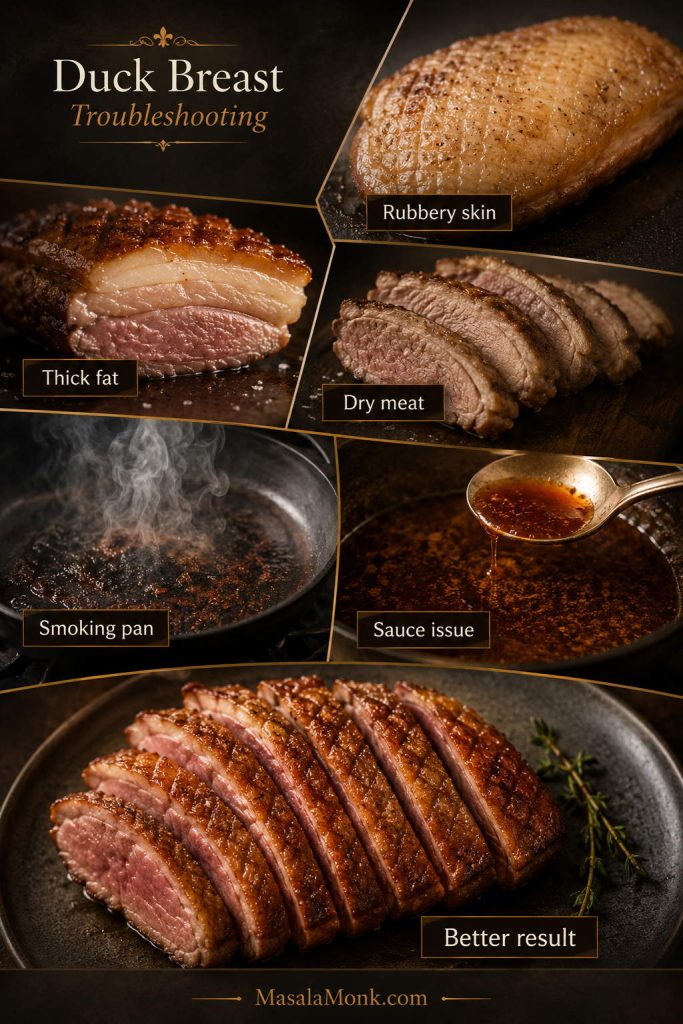
If any method leaves the skin soft or the center dry, check common duck breast problems before changing the recipe.

Air Fryer Duck Breast

Air fryer duck breast is best for convenience, not necessarily for the crispiest skin. The fat still needs time to render, so thick duck breasts usually do better if you pre-render the skin in a pan before using the air fryer to finish. Use a thermometer because air fryer timing varies by model and breast size.

Sous Vide Duck Breast

Sous vide is best for precise doneness. The weakness is skin texture: the skin comes out soft, so the final pan render is not optional if you want crisp skin. Cook the duck sous vide to your preferred temperature, pat it very dry, then render and crisp the skin in a pan.

Grilled Duck Breast

Grilled duck breast is best for smoky flavor, but duck fat can flare over direct heat. Render some fat first or grill over controlled heat, then finish to temperature. Avoid blasting the skin over high heat before the fat layer has thinned.

Smoked Duck Breast

Smoked duck breast has a deeper flavor and works well when you want a richer, more savory result. The challenge is balancing smoke, rendered fat, and final skin texture. For the best finish, smoke gently and crisp the skin separately if needed.

Oven-Only Duck Breast

Oven-only duck breast is best avoided if crispy skin is the goal. Oven heat cooks the meat, but it does not manage the fat layer as precisely as a pan. If you want crisp skin, render the fat in a pan first, then use the oven only to finish the center.

How to Fix Common Duck Breast Problems

Start by diagnosing the problem in order: skin first, fat layer second, center temperature third, sauce last. Rubbery skin usually points to moisture or rushed heat. A thick white fat layer usually means the pan got too hot too soon. Dry meat usually means the duck stayed on the heat after the center was already close to your target temperature.

If something looks off, do not panic. Most duck breast problems are fixable technique problems: wet skin, uneven pan contact, heat that climbed too fast, or sauce that reduced too far.

Duck breast troubleshooting guide showing rubbery skin, thick fat, dry meat, smoking pan, sauce issue, and better result
Most duck breast problems trace back to moisture, rushed heat, uneven pan contact, missed temperature, or sauce that reduced too far.

Skin and Fat Problems

Problem Why it happened Fix
Rubbery skin The skin was wet, the heat climbed too fast, or the fat layer needed more time. Dry the skin well, start in a cold pan, and keep cooking skin-side down over lower heat.
Brown skin with thick fat underneath The pan was too hot before the fat had time to melt. Lower the heat and continue rendering skin-side down until the white layer looks thinner.
Pale patches on the skin The breast curled or did not touch the pan evenly. Press gently early in cooking or use a light pan or cooking weight to keep the skin flat.
Crisp skin that softens on the plate The duck was covered tightly, sauced over the skin, or rested skin-side down. Rest skin-side up, keep it uncovered, and spoon sauce around the slices instead of over the crisp top.
Close-up comparison of rubbery duck skin, thick fat under browned skin, and properly rendered thin fat layer
Brown skin does not always mean rendered fat, so check the side of the breast before deciding it is ready to flip.

Meat and Doneness Problems

Problem Why it happened Fix
Crisp skin but undercooked center The breast is thick, or the meat side did not get enough gentle finishing time. Move the oven-safe pan to a 350°F / 180°C oven and finish to your preferred internal temperature.
Dry or overcooked meat The duck stayed on the heat after the center was already near target. Use a thermometer and pull the duck a few degrees early, especially before resting.
Gray band around the meat The heat was too aggressive or the oven finish went too long. Use gentler heat, avoid rushing the render, and check earlier with a thermometer.
Juices running across the board The duck was sliced before it had time to rest. Rest 5–10 minutes skin-side up, then slice against the grain.
Duck breast doneness guide comparing undercooked center, juicy target slices, and dry gray band
Timing helps, but the center tells the truth; checking doneness prevents both an undercooked middle and a dry gray band.

Pan and Cooking Problems

Problem Why it happened Fix
Smoking pan The heat is too high or too much rendered fat has pooled in the skillet. Lower the heat and carefully pour excess fat into a heatproof bowl.
Greasy-tasting duck The fat layer did not render enough before the meat finished cooking. Score more carefully next time and give the skin side more time over lower heat.
Duck breast curling in the pan The edges lifted away from the hot surface. Press gently with a spatula during the first few minutes or use a small pan as a light weight.
Skin sticking to the pan The duck was moved too early or the skin had not released naturally. Give it more time. Properly rendered skin usually releases more easily once it is ready.

Orange Sauce Problems

Problem Why it happened Fix
Thin sauce It has not reduced long enough. Simmer until it lightly coats a spoon.
Over-sweet sauce Too much honey, sugar, or sweet orange juice made it taste heavy. Add vinegar, orange zest, a pinch of salt, or a splash of stock.
Bitter sauce Orange pith, zest, or pan bits cooked too hard. Add stock, butter, or a little honey, and avoid scraping up burnt bits from the pan.
Flat sauce It needs more salt, acid, or brightness. Add a small splash of vinegar, more orange zest, black pepper, or a pinch of salt.

Make-Ahead, Storage, and Reheating

Duck breast is best right after cooking, when the skin is crisp and the meat is freshly rested. However, you can prep parts of the recipe ahead and store leftovers safely.

What You Can Prep Ahead

  • Score the duck breast up to 1 day ahead.
  • Season it and leave it uncovered on a plate or small rack in the fridge for a few hours or overnight to help dry the skin.
  • Make orange sauce, cherry sauce, plum sauce, or red wine sauce ahead and reheat gently.
  • Prep sides before cooking the duck, because duck breast is best served soon after resting.

How to Store Cooked Duck Breast

  • Cool cooked duck breast promptly.
  • Refrigerate within 2 hours of cooking, or within 1 hour if the room is very hot.
  • Store in an airtight container in the refrigerator.
  • Use within 3–4 days.
  • Keep sauce separate if possible so the skin does not soften.

How to Reheat Duck Breast Without Ruining the Skin

  • For best texture, reheat gently in a low oven until warmed through, then re-crisp the skin in a skillet.
  • Place the duck skin-side down in a dry skillet over medium-low heat to bring back some crispness.
  • Avoid microwaving if you care about crisp skin; it softens the skin quickly.
  • For the official USDA/FSIS leftover safety guideline, reheat leftovers to 165°F / 74°C.
Two-step reheating guide showing duck breast warmed in a low oven and re-crisped skin-side down in a skillet
Warm leftover duck gently first, then re-crisp it skin-side down in a skillet instead of relying on the microwave.

For broader leftover storage and reheating safety, the USDA/FSIS food safety basics guide is a useful reference.

What to Do with Leftover Duck Breast

Leftovers are not a downgrade here. Thin slices of cooked duck can turn into excellent lunches as long as you add them gently and avoid cooking them a second time.

Planning to warm the duck later? Read how to reheat duck breast without ruining the skin before you start.

  • Add slices to salad with orange, arugula, and vinaigrette.
  • Use in fried rice with scallions and a little soy sauce. For the best rice texture, borrow the cold-rice method from MasalaMonk’s Spam fried rice recipe and fold sliced duck in near the end so it does not overcook.
  • Add to noodles with greens and chili oil.
  • Tuck into wraps or thin pancakes with plum sauce.
  • Serve cold with mustard, pickles, or fruit chutney.
  • Add to pasta at the very end, just to warm through. Duck works especially well with bright herb sauces, so MasalaMonk’s pesto recipe and variations can give you a fresh sauce direction for leftover duck pasta.
Leftover duck breast served in salad, fried rice, noodles, and a wrap or pasta dish
Add leftover duck near the end of salads, fried rice, noodles, wraps, or pasta so the slices warm without drying out.

For a cold lunch plate, leftover sliced duck also works with potato salad, pickles, bitter greens, and a sharp dressing. MasalaMonk’s potato salad recipes are useful if you want a creamy, tangy, or lighter side to build around.

Duck Breast Recipe with Crispy Skin

This duck breast recipe starts in a cold pan so the fat can render slowly and the skin can crisp without overcooking the meat. Serve it with the quick orange pan sauce, or use the sauce guide above to take it in a cherry, plum, red wine, herb-bright, or Asian-style direction.

Servings2
Prep Time10 minutes
Cook Time18–28 minutes
Rest Time5–10 minutes

Ingredients

  • 2 skin-on boneless duck breasts, about 6–8 oz / 170–225 g each
  • 1 tsp kosher salt, or about ½ tsp fine salt
  • ¼ tsp black pepper
  • Optional: 1 thyme or rosemary sprig
  • Optional: 1 garlic clove, lightly crushed

Optional Orange Sauce

  • ¼ cup / 60 ml fresh orange juice
  • ½ cup / 120 ml chicken stock
  • 1 tbsp white wine vinegar or red wine vinegar
  • 1–2 tsp honey or sugar
  • 1 tsp orange zest
  • 1 tbsp / 14 g cold butter
  • Salt and black pepper, to taste

Duck Breast Method

  1. Pat the duck breasts very dry with paper towels.
  2. Score the skin in diagonal lines or a crosshatch pattern, cutting through the skin and fat but not into the meat.
  3. Season both sides with salt and pepper, using a little more salt on the skin side.
  4. Place the duck breasts skin-side down in a cold, dry skillet.
  5. Turn the heat to low or medium-low. Cook slowly for 10–18 minutes, pouring off excess fat as needed, until the skin is golden and crisp and much of the fat has rendered.
  6. Flip the duck and cook the flesh side for 1–2 minutes.
  7. If the breast is thick or still below your preferred temperature, transfer the oven-safe skillet to a 350°F / 180°C oven for 5–8 minutes.
  8. Rest the duck skin-side up for 5–10 minutes.
  9. Slice against the grain and serve with orange sauce or your preferred duck breast sauce.

Orange Sauce Method

  1. Pour off most of the fat from the pan after removing the duck.
  2. Add orange juice, stock, vinegar, and honey.
  3. Scrape up browned bits and simmer until lightly syrupy, avoiding any burnt bits.
  4. Turn off the heat and whisk in cold butter and orange zest.
  5. Season to taste with salt, pepper, vinegar, or honey.

Notes

  • Use an instant-read thermometer for best results.
  • Pull the duck a few degrees before your final target because the internal temperature can rise slightly as it rests.
  • Rest the duck skin-side up and do not cover it tightly.
  • Keep sauce around the slices, not over the skin, if you want the crispest bite.
  • Save rendered duck fat for potatoes, vegetables, fried rice, greens, or eggs.
Duck breast recipe card with cold-pan method, timing, temperature, orange sauce, and sauce placement note
Keep the core method simple: score shallowly, start cold, render patiently, rest skin-side up, and spoon sauce around the crisp top.

Once the cold-pan render clicks, duck breast stops feeling like a restaurant trick. You are not forcing it; you are letting the fat melt, the skin crisp, and the center come up gently. Serve it with a light sauce, slice it cleanly, and it feels like a special-occasion dinner you can actually repeat.

FAQs About Duck Breast

Do you start duck breast in a cold pan?

Start duck breast in a cold pan when you want crisp skin. The gradual heat gives the fat time to melt before the surface browns, which helps prevent a golden-looking but chewy skin layer.

How long does duck breast take to cook?

Duck breast usually takes 18–28 minutes of cooking time: 10–18 minutes skin-side down to render the fat, 1–2 minutes on the flesh side, plus 5–8 minutes in the oven if the breast is thick. Use timing as a guide, but let the thermometer make the final decision.

Do you have to finish duck breast in the oven?

No. Smaller duck breasts can finish on the stovetop after the skin has rendered. Thicker breasts are easier to control with a short oven finish at 350°F / 180°C after the skin is already crisp.

Should duck breast be pink?

Many cooks prefer duck breast pink because the texture stays tender and juicy. However, duck is poultry, and the official safe minimum is 165°F / 74°C, so use a thermometer and choose based on your comfort level and who you are serving.

What temperature is best for duck breast?

For a softer, juicier texture, many cooks prefer 130–135°F / 54–57°C for medium-rare or about 140°F / 60°C for medium. The official poultry safety benchmark is 165°F / 74°C.

What sauce goes best with duck breast?

Orange sauce is the classic pairing for duck breast because citrus cuts through the fat without hiding the flavor of the meat. Cherry, plum, red wine, berry, chimichurri, and soy-hoisin sauces also work, depending on whether you want fruity, savory, fresh, or Asian-style flavors.

Why is my duck skin rubbery?

Rubbery duck skin usually means the surface was wet, the heat was too high too early, or the fat layer needed more time. Dry the breast well, start in a cold pan, and keep cooking skin-side down until the white fat layer looks much thinner.

Do you need oil to cook duck breast?

No. Duck breast has enough fat under the skin. Starting it in a dry cold pan lets that fat melt naturally and crisp the skin.

Can you cook duck breast from frozen?

Thaw it first for this method. Frozen duck breast releases moisture as it cooks, which makes crisp skin much harder to achieve.

How do you reheat duck breast and keep the skin crispy?

Reheat gently in a low oven until warmed through, then place the duck skin-side down in a dry skillet over medium-low heat to re-crisp the skin. Microwaving is faster, but it softens the skin.

What can I make with leftover duck breast?

Use thin slices in salads, fried rice, noodles, wraps, sandwiches, or pasta. Add cooked duck near the end so it warms without overcooking.

Is duck breast the same as duck fillet?

In many shops and recipes, duck fillet means boneless duck breast. For this crispy-skin method, choose skin-on duck breast or skin-on duck fillet.

Final Thoughts

Good duck breast is not about rushing a dramatic sear. It is about giving the fat enough time to render, watching the skin, checking the temperature, and resting the meat before you slice.

Once that rhythm makes sense, duck breast becomes one of the most satisfying restaurant-style dinners to cook at home: crisp skin, tender slices, a sauce that brightens the plate, and enough confidence to make it again.

What is your favorite way to serve duck breast — orange sauce, cherry sauce, potatoes, rice, bitter greens, or something else? Share it in the comments so other readers can try it too.

Posted on 7 Comments

Carbonara Recipe: Italian Pasta (Creamy, Veggie, Chicken, Shrimp, Tuna & Keto)

Chef tossing spaghetti alla carbonara in a black pan, glossy pasta with crispy guanciale, steam rising over a dark wooden table with cheese, cracked eggs and pepper mill.

There’s a moment, just after you toss hot pasta through eggs and cheese and pork fat, when everything goes quiet. The noodles glisten, the sauce thickens, and suddenly you’re staring at a bowl of carbonara that looks like it fell out of a tiny Roman kitchen and landed on your table. That’s the magic we’re going for here in this Carbonara Recipe.

This is a complete, reader-first guide to making carbonara at home: starting with a classic, no-cream version, then branching into creamy, veggie, chicken, shrimp, tuna and even keto-friendly twists. Along the way you’ll see a few helpful links—some to deeper technique or ingredient guides on MasalaMonk, others to recipes from sites that specialise in vegetarian or low-carb spins—so you can wander off and explore whatever version fits your mood.


What Carbonara Really Is (And What It Isn’t)

Carbonara is one of those dishes that seems simple until you try to explain it. On paper, it’s almost suspiciously basic: pasta, cured pork, eggs, hard cheese, black pepper. That’s it. Yet when you read through classic Roman versions and careful modern explanations—like the foolproof method in Serious Eats’ spaghetti with carbonara sauce —you start to notice the same core ideas repeated:

  • The meat is guanciale (cured pork jowl) or sometimes pancetta, not random ham.
  • The cheese is Pecorino Romano, often with a little Parmesan mixed in.
  • The “sauce” is an emulsion of egg, grated cheese, pork fat and starchy pasta water.
  • There is plenty of black pepper, enough to be noticeable.
Overhead view of classic carbonara ingredients like spaghetti, guanciale, Pecorino, eggs and black pepper on one side and modern variations such as mushrooms, chicken, shrimp, tuna, cream and zucchini noodles on the other.
Classic Roman carbonara begins with spaghetti, guanciale, Pecorino, eggs and pepper; from there it stretches into creamy, veggie, tuna and zucchini variations in kitchens around the world.

Notice what’s missing: cream. Traditional versions rely on the natural richness of egg yolks plus emulsified fat. The creaminess you see on the plate is closer to a glossy custard than a thick white sauce. Guides like the vegetarian carbonara from The Mediterranean Dish also keep that egg-based structure even when they swap out the meat for mushrooms, precisely because that’s what makes carbonara feel like carbonara in the first place.

That said, carbonara is a living dish. Home cooks all over the world slip cream into the mix, use bacon instead of guanciale, add vegetables, throw in chicken or shrimp, stir in a can of tuna, or swap the pasta entirely for zucchini “noodles”. Rather than pretending those versions don’t exist, this guide starts with the most recognisable Roman-style base, then shows you how to bend it in ways that still feel coherent and delicious.

Also Read: 10 Most Popular Mediterranean Breakfasts


Ingredients: The Backbone of a Good Carbonara Recipe

Even before you pick up a knife, good carbonara depends on good ingredients. You don’t need anything fancy, but a couple of choices really change the outcome.

Overhead view of carbonara ingredients on a dark table, with nests of spaghetti and linguine, cubes of pancetta and guanciale, eggs, Pecorino, Parmesan, salt and a hand holding a pepper mill.
The backbone of every good carbonara: a few pasta shapes to choose from, guanciale or pancetta, rich egg yolks, Pecorino with a little Parmesan, freshly ground black pepper and just enough salt.

Pasta

Spaghetti is the classic, and it behaves beautifully in this dish. Nonetheless, you can absolutely make excellent carbonara with:

  • Bucatini (for an extra-chewy slurp)
  • Linguine (a flatter noodle that holds sauce well)
  • Fettuccine (if you like something edging toward Alfredo territory)
  • Short shapes like penne or rigatoni (great in baked carbonara casseroles)

We’ll circle back to shape choices later, because they’re an easy way to vary your pasta carbonara without changing the core recipe.

Pork

If you can find guanciale, use it at least once; it’s worth it. The fat has a deep, almost floral savouriness that gives everything a distinct Roman character. Pancetta is the next best option, and streaky bacon works perfectly fine for most weeknight bowls.

Cut it into small batons or lardons, rather than tiny bits, so you get a mix of crisp edges and softer, fatty centres.

Eggs

Eggs are the heart of the sauce. Yolks give you richness and that deep yellow colour; whole eggs bring a little extra volume and looseness. A great starting point for two portions is:

  • 2 egg yolks + 1 whole egg

You can adjust from there. More yolks make your carbonara deeper and silkier; more whole egg makes it a touch lighter.

Cheese

Pecorino Romano is traditional: it’s salty, sharp and tangy, which cuts beautifully through the richness of pork and egg. Parmesan (or Parmigiano Reggiano) adds nuttiness and a slightly gentler flavour. A lot of home cooks use a mix.

If you enjoy going down cheese rabbit holes, MasalaMonk has a detailed guide to Parmesan cheese and its varieties as well as a helpful comparison of Parmesan and Parmigiano Reggiano with other hard cheeses. Those are worth skimming if you’re choosing cheeses at a well-stocked deli and wondering how far you can stray.

Pepper and Salt

You want freshly cracked black pepper, not the dusty pre-ground stuff at the back of the cupboard. It should be aromatic and obvious in the finished dish—you’re aiming for a gentle pepper heat, not just dots of colour.

Salt mainly lives in the pasta water here. Remember your pork and cheeses are already salty; it’s easy to overdo it if you also heavily season the eggs.

Also Read: 10 Best Espresso Martini Recipe Variations (Bar-Tested)


The Classic Carbonara Method (Step by Step Recipe)

Now that the ingredients are clear, it’s time to build the base recipe. This method works for two generous servings; scaling up is straightforward once you understand the rhythm.

1. Set up your workspace

Before you start cooking, have these ready:

  • A large pot for boiling pasta
  • A wide, heavy pan (or skillet) for the pork
  • A heatproof mixing bowl for eggs and cheese
  • Tongs or a pasta fork
  • A ladle or measuring cup for pasta water

Lining everything up in advance might feel fussy, yet it makes the most important moment—tossing the pasta with the eggs—much calmer.

Vertical photo of a carbonara cooking station with a pot on the stove, a skillet, glass mixing bowl, tongs, measuring cup of water, an egg and a wedge of cheese on a dark counter as a hand sets the tools in place.
Step 1 is all about calm prep: line up your pot, pan, bowl, tongs and pasta water so the carbonara comes together smoothly later on.

2. Mix the egg and cheese “sauce” for this Recipe of Carbonara

In the heatproof bowl, whisk together:

  • 2 egg yolks
  • 1 whole egg
  • About 60 g finely grated hard cheese, ideally a mix of Pecorino and Parmesan
  • A generous pinch of freshly ground black pepper

Whisk until the mixture is smooth and thick, with no streaks of egg white. Set this bowl near the stove; it will be your landing zone for the hot pasta later.

Many detailed recipes, such as the Serious Eats carbonara method, use a sort of double boiler approach to gently warm the egg mixture and guarantee a glossy emulsion. You don’t have to do that, though keeping the bowl near (but not on) the stove naturally warms it a little and helps the sauce come together.

Hand whisking egg yolks, grated Pecorino, Parmesan and black pepper in a glass bowl to make silky carbonara sauce.
In Step 2, egg yolks, Pecorino, a little Parmesan and fresh black pepper come together into the creamy base that makes carbonara rich without any cream.

3. Render the pork in Carbonara Recipe

Place the guanciale, pancetta or bacon into a cold pan, then put the pan on medium-low heat. Starting cold gives the fat time to melt out slowly, which both crisps the meat and leaves you with a good amount of flavourful fat to coat the pasta.

Let it sizzle gently, stirring occasionally, until the pieces are golden at the edges and starting to crisp but not rock-hard. Turn off the heat and leave everything in the pan.

At this stage, the kitchen should smell like a trattoria. Try not to eat all the pork out of the pan with your fingers.

Cubes of guanciale and pancetta slowly crisping in a black skillet, with rendered fat and steam rising for a classic carbonara recipe.
In Step 3, the guanciale or pancetta sizzles gently so the fat renders slowly, giving you crisp edges, soft centres and enough porky oil to coat every strand of carbonara.

4. Cook the pasta

Bring a large pot of well-salted water to a rolling boil. The water should taste pleasantly seasoned, like a mild broth.

Add your spaghetti (or other pasta) and cook until just shy of al dente. While the pasta cooks, stir it from time to time so it doesn’t clump.

A minute or two before the pasta is done, scoop out a good 1–1½ cups of starchy pasta water with a ladle or measuring cup. This step is non-negotiable: that water is crucial to turning your egg-and-cheese mixture into a smooth, pourable sauce.

Large pot of boiling salted water on the stove, with spaghetti being lowered in and a ladle scooping out starchy pasta water for carbonara
Step 4 locks in texture and flavour: cook the pasta in well-salted water, then ladle out some of that starchy liquid to turn eggs, cheese and pork fat into a smooth carbonara sauce.

5. Marry pasta and pork

Turn the pork pan back on to low heat and add a small splash of the pasta water. This loosens any sticky bits on the bottom.

Using tongs, transfer the drained pasta straight from the pot into the pan. A little water clinging to the noodles is helpful. Toss the pasta with the pork and its fat for a minute or so, letting the flavours mingle.

Once the pasta looks glossy with fat, turn off the heat completely. This is important; you don’t want the eggs to hit a screaming-hot pan.

Hand using tongs to lift glossy spaghetti in a skillet, tossing it with crisp pancetta and rendered pork fat for carbonara.
In Step 5, the hot spaghetti is tossed through the rendered pork fat so every strand picks up flavour before it meets the egg-and-cheese sauce.

6. Emulsify the sauce

Now comes the magic.

Quickly lift the pan and pour the hot pasta and pork into the egg-and-cheese bowl. As you do this, toss constantly with tongs, coating every strand. The residual heat from the pasta will gently thicken the eggs.

Add a small splash of hot pasta water and keep tossing. Then another splash. You’re looking for the sauce to loosen and turn silky enough to cling in a thin, shiny layer rather than clumping.

With a bit of practice, you’ll feel when the balance is right. The noodles should gleam, with no visible streaks of raw egg or puddles of liquid at the bottom of the bowl.

Hand using tongs to toss hot spaghetti and pancetta in a glass bowl of egg-and-cheese mixture off the heat, forming a glossy carbonara sauce.
In Step 6, the pasta leaves the pan and gets tossed off the heat with eggs, Pecorino and a splash of pasta water until the carbonara sauce turns thin, shiny and perfectly silky.

7. Taste and adjust your Carbonara Recipe

Now is the time to fine-tune:

  • Add more black pepper if you want extra warmth.
  • Grate on a little extra Pecorino or Parmesan for a salty finish.
  • If the sauce feels too thick, whisk in another spoonful of hot pasta water.

Serve immediately. Carbonara waits for no one; it keeps cooking in its own heat, and the sauce thickens as it sits.

Hand grating Pecorino Romano over a bowl of glossy spaghetti carbonara with crisp pancetta, ready to serve immediately.
Step 7 is all about timing: a hot bowl of carbonara, a last snowfall of Pecorino and black pepper, and straight to the table before the sauce thickens.

The same basic approach—pork cooked gently, eggs and cheese beaten in a bowl, pasta tossed off the heat with a bit of starchy water—shows up across careful recipes and tutorials, including many “how to” breakdowns on Italian cooking sites and in teaching platforms. Once you’ve done it once, you’ll see why the method doesn’t change much.

Also Read: Cheesy Chicken Broccoli Rice – 4 Ways Recipe (One Pot, Casserole, Crockpot & Instant Pot)


Recipe of Creamy Carbonara (With a Little Cream)

In plenty of Italian kitchens, cream in carbonara is a sacrilege. In plenty of non-Italian kitchens, it’s simply what people grew up eating. If cream is part of your personal comfort bowl, you can absolutely incorporate it gracefully.

The easiest way to do that is to keep the method identical and tweak only the egg mixture.

For two portions:

  • Use 2 egg yolks instead of 2 yolks + 1 whole egg.
  • Whisk in 60–80 ml of heavy cream or single cream along with the cheese and pepper.
Recipe card showing a bowl of creamy spaghetti carbonara with guanciale alongside ingredients and quick instructions for making carbonara with cream.
This creamy carbonara card shows the small twist on the classic: extra yolks whisked with a splash of cream, Pecorino and Parmesan, then tossed with hot pasta and guanciale until silky.

Everything else stays the same: same pork, same pasta, same off-heat tossing with a bit of starchy water. The cream makes the sauce more forgiving and a touch richer, especially when you’re still learning.

If you enjoy comparing different kinds of creamy pasta, MasalaMonk’s collection of chicken Alfredo pasta recipes and their deep dive into classic versus “authentic” Alfredo-style sauces are useful contrasts. They highlight the difference between cream-based white sauces and egg-based emulsions, which helps you understand what’s happening in your own pan.


Vegetarian Carbonara (Recipe With Mushrooms and Veg)

Sometimes you want the comfort of carbonara without the meat. Rather than dumping the eggs and cheese onto plain noodles, it’s worth building a proper vegetarian carbonara that still delivers a savoury hit.

Mushrooms are the natural substitute: they brown, they concentrate, and they bring umami. Courgettes (zucchini) or peas also fit in beautifully, and you can see that approach in dishes like the healthier veggie carbonara at BBC Good Food, which keeps the egg-based sauce but piles on vegetables.

Recipe card showing a bowl of vegetarian carbonara made with spaghetti, browned mushrooms and peas beside ingredients and directions for a smoky mushroom carbonara.
This vegetarian carbonara swaps guanciale for deeply browned mushrooms and peas, keeping the same silky egg-and-cheese sauce while adding hearty plant-based flavour.

Here’s one way to do it:

  1. Replace the pork with mushrooms
    • Slice 200 g of cremini, chestnut or button mushrooms.
    • Add a tablespoon or two of olive oil to your pan.
    • Cook the mushrooms over medium-high heat until they are deeply browned and have given up their moisture.
    • Season with salt, pepper, and (if you want a faint smoky note) a tiny pinch of smoked paprika.
  2. Follow the classic method
    • Mix eggs and cheese as before.
    • Boil the pasta and save your pasta water.
    • Toss the hot pasta with the browned mushrooms and their juices instead of pork.
    • Transfer everything to the egg bowl and emulsify with splashes of pasta water.

The result is a veggie carbonara that still looks and behaves like the original: creamy, glossy, with a savoury depth that comes from browned mushrooms rather than cured meat.

If you’d like more inspiration, the vegetarian carbonara with smoky mushrooms from The Mediterranean Dish shows a similar idea with extra olive oil and pasta water standing in for pork fat. Meanwhile, for nights when you want to lean more heavily into plant-based eating beyond cheese and egg, MasalaMonk’s collection of high-protein pasta dishes built around lentils and beans gives you additional options that feel hearty but not heavy.


Chicken Carbonara: Protein-Heavy & Crowd-Pleasing Recipe

Chicken sneaks into carbonara in plenty of modern recipes because it makes the dish feel more like a full “meat and pasta” meal, especially if you’re feeding people who expect visible protein on the plate.

Recipe card showing a bowl of chicken carbonara with creamy spaghetti, browned chicken pieces and crisp bacon beside ingredients and quick steps for chicken carbonara pasta.
This chicken carbonara recipe card turns the classic into a full meat-and-pasta meal, with bacon-rendered chicken tossed through silky egg-and-cheese sauce for extra protein and comfort.

To integrate chicken gracefully:

  • Cut 150–200 g of boneless chicken thigh or breast into small pieces.
  • Season lightly with salt and pepper.

Then:

  1. Render a small amount of bacon or pancetta in your pan to keep that smoky baseline.
  2. Scoop the bacon out and set it aside, leaving the fat.
  3. Sear the chicken pieces in that fat until they’re browned and cooked through.
  4. Return the bacon to the pan, then proceed as usual when you add the pasta.

When you toss the noodles through the egg mixture, you’ll have a pan full of chicken and bacon pieces waiting to be coated, giving you a bona fide chicken carbonara pasta that still echoes the original dish.

If you like the idea of chicken in a creamy, saucy context, it’s also worth exploring other comfort-pasta territory. MasalaMonk’s one-pot chicken bacon ranch pasta is a great example of how bacon, chicken and cream can play together in a single pan without the egg element, while their macaroni and cheese recipe shows how to build a proper cheese sauce from a different angle entirely.


Shrimp and Seafood Carbonara Recipe

Swapping the pork for shrimp (or using the two together) pushes carbonara in a seafood direction without abandoning the classic egg-and-cheese base.

Recipe card showing a bowl of shrimp carbonara with creamy spaghetti, pink shrimp and pancetta beside ingredients and directions for seafood carbonara.
This shrimp carbonara recipe card keeps the classic egg-and-cheese base but layers in sweet, just-cooked shrimp and pancetta for a rich seafood twist on the original pasta.

For two servings, you’ll want:

  • 150–200 g raw shrimp, peeled and deveined
  • Optional: 40–50 g pancetta, finely diced

Here’s how to make it work:

  1. If using pancetta, render it first just as you would for the classic version. Scoop the bits out and leave the fat in the pan.
  2. Add a drizzle of olive oil if needed, then sauté the shrimp over medium heat until just pink and barely cooked through.
  3. Season with a tiny pinch of salt and pepper; remember the cheese will add more salt later.
  4. Return the pancetta to the pan, add your hot pasta and a splash of pasta water, and toss.
  5. Tip the whole mixture into the egg-and-cheese bowl and emulsify.

You end up with a shrimp carbonara that still feels like the real dish—egg-based sauce, plenty of cheese, glossy strands of pasta—but accented by sweet bites of seafood instead of, or alongside, the traditional pork.

Also Read: Whole Chicken in Crock Pot Recipe (Slow Cooker “Roast” Chicken with Veggies)


Recipe of Carbonara with Tuna: The Pantry Hero

Tuna doesn’t show up in classic Roman recipes, yet it might be the variation you cook most often simply because everything comes from the cupboard. It’s an especially good answer when you want something that tastes more involved than it actually was.

Recipe card showing a bowl of tuna carbonara with creamy spaghetti, flaked tuna, capers and lemon beside ingredients and quick instructions for pantry tuna pasta.
This tuna carbonara recipe card proves you can turn a can of tuna, eggs and cheese into a silky, lemony pantry pasta that tastes far more special than the effort it takes.

To build a simple tuna carbonara:

  • Use the standard egg-and-cheese base.
  • Swap the pork for one can of good tuna in olive oil, lightly drained.

Then:

  1. Warm a spoonful of the tuna oil in your pan.
  2. Add the tuna and break it up gently over low heat, just until fragrant.
  3. Toss in your hot pasta and a splash of pasta water; the tuna should coat the strands lightly.
  4. Move everything to the egg bowl and toss vigorously, adding more pasta water as needed.

You can brighten this variation with a bit of lemon zest or a teaspoon of capers, although you don’t have to. The eggs, cheese and tuna already make a satisfying tuna pasta carbonara without extra embellishment.

Also Read: Authentic Louisiana Red Beans and Rice Recipe (Best Ever)


Keto and Low-Carb Carbonara Recipe with Zucchini Noodles

If you’re eating low-carb or following a keto approach, the main challenge in carbonara isn’t the sauce at all; it’s the pasta. Fortunately, the flavour profile of eggs, cheese, bacon and pepper works beautifully with vegetables like zucchini.

Recipe card showing a bowl of keto zucchini carbonara with spiralised zucchini noodles, crispy bacon and creamy egg-and-cheese sauce beside ingredients and method for low-carb carbonara.
This keto zucchini carbonara swaps pasta for zoodles but keeps the smoky bacon, eggs and cheese, so you still get a creamy, salty carbonara hit with far fewer carbs.

A straightforward path is to replace the spaghetti with spiralised zucchini “noodles”, also known as zoodles. Recipes such as the keto carbonara with zoodles at Diet Doctor show exactly how well that combination can work, keeping the bacon and creamy sauce while ditching the wheat. Likewise, Cooking LSL’s low-carb zucchini carbonara demonstrates a similar idea with courgette strands in place of pasta.

To try a simple version at home:

  1. Spiralise 2 medium zucchini and salt them lightly. Let them sit in a colander for 10–15 minutes, then pat dry; this removes excess moisture.
  2. Render your bacon or pancetta in a pan as usual.
  3. Add the zucchini to the pan and cook briefly—just enough to soften slightly while still keeping some bite.
  4. Whisk your eggs and cheese in a bowl.
  5. Transfer the hot zucchini and bacon into the bowl and toss, adding a couple of spoonfuls of hot water (or a splash of stock) to create a creamy coating.

The texture is different, of course; you won’t get the same chew as traditional semolina pasta. Nonetheless, the overall experience—creamy, salty, porky, peppery—lands recognisably in keto carbonara territory.

For days when you’re balancing richer meals with more careful hydration or fasting routines, MasalaMonk’s guide to homemade electrolyte drink recipes is a useful extra resource you can dip into as well.


Playing with Pasta Shapes: Spaghetti, Linguine, Fettuccine, Penne

Once you’re comfortable with the base method, changing the shape of the pasta is an easy way to keep carbonara interesting without rewriting the recipe.

Vertical photo of four pasta shapes for carbonara—nests of spaghetti, linguine and fettuccine plus a pile of penne—arranged on a dark background with a small baked carbonara dish.
Spaghetti is the classic for carbonara, but linguine, fettuccine and short shapes like penne or rigatoni each change the experience, from twirlable strands to bake-ready tubes with bubbly cheese on top.
  • Spaghetti: the classic; it twirls beautifully and holds just enough sauce.
  • Linguine: slightly flatter, gives you more surface area for the sauce to cling to.
  • Fettuccine: verges on creamy Alfredo territory, especially in the cream-enhanced version.
  • Penne or rigatoni: tubes that capture bits of bacon and pools of sauce inside; wonderful in baked carbonara gratins.

Short shapes are especially good when you want a baked carbonara pasta. You can follow the same egg-and-cheese structure, toss it all together, then slide everything into a buttered dish, sprinkle with extra cheese and bake briefly until the top is just set and lightly browned.

Meanwhile, switching to whole-wheat or legume-based pastas—like chickpea or lentil noodles—can gently tilt your bowl toward higher fibre and protein. For more ideas along those lines, you can look at MasalaMonk’s round-up of high-protein, plant-based pasta meals, which explore exactly that balance.


What to Serve with Carbonara

Carbonara itself is rich and savoury. So, the best companions usually contrast that: fresh, crunchy, tangy or slightly bitter flavours that reset your palate between bites.

A few ideas:

  • Simple green salad: toss leaves with lemon juice, olive oil, salt and pepper. The acidity cuts through the sauce nicely.
  • Garlicky vegetables: roast or sautéed broccoli, green beans or asparagus with a squeeze of lemon.
  • Bread and dips: think toasted sourdough and a dish of something creamy yet lighter than the pasta.
Vertical photo of a carbonara meal with a bowl of spaghetti carbonara, green salad, roasted broccoli, toasted sourdough slices and small bowls of spinach dip and tzatziki on a wooden table.
A rich bowl of carbonara pairs beautifully with fresh, lemony salad, garlicky green vegetables, toasted sourdough and lighter dips like spinach or tzatziki to keep every bite feeling balanced.

If you enjoy putting sharable starters on the table, MasalaMonk’s collection of spinach dip recipes covers everything from cold, tangy dips to hot, baked ones that sit comfortably next to a carbonara night spread. On the other hand, if you’d like something fresher and more Mediterranean, their Greek tzatziki sauce variations make a cooling side for grilled chicken or vegetables served alongside your pasta.

For dessert, you don’t have to do anything complicated. Fruit and a little whipped cream, a scoop of gelato, or even just a square of good dark chocolate with coffee is often enough after such a rich main.

Also Read: How to Make Churros (Authentic + Easy Recipe)


Leftovers and Reheating

Purists will say carbonara should never see the inside of a fridge. In an ideal world, you would cook exactly the amount you plan to eat and enjoy it all while it’s at its silkiest. Real life is messier, of course, and sometimes you’ll have leftovers.

To store them:

  • Let the pasta cool quickly.
  • Transfer it to an airtight container.
  • Refrigerate for up to 2 days.
Instructional image showing leftover carbonara being cooled and stored in a lidded glass container and gently reheated in a pan with added water or milk, with text tips on cooling, refrigerating and using low heat.
Cool leftover carbonara quickly, seal it in an airtight container for up to two days, then bring it back to life over low heat with a spoonful of water or milk, stirring often so the sauce turns creamy again instead of scrambling.

Reheating takes a bit of care. Instead of microwaving on full blast (which risks scrambling the eggs), try this:

  1. Add a spoonful or two of water or milk to a pan over low heat.
  2. Tip in the leftover carbonara and break up any large clumps.
  3. Stir gently as it warms, adding another splash of liquid if it seems dry.

The sauce will never be quite as glossy as when it was first tossed, yet you can still coax it into something creamy rather than rubbery. If you like, you can grate over a little fresh cheese and crack some more pepper on top to revive the flavour.


Bringing It All Together

At its core, carbonara is one of the simplest pastas you can make: a handful of ingredients, a single pot of boiling water, and one crucial moment where you toss hot pasta into eggs and cheese and trust the heat to do its work. Once that movement feels familiar, you’re free to adapt:

  • Swap cured pork for browned mushrooms and vegetables for a vegetarian carbonara.
  • Double down on comfort with a splash of cream.
  • Turn it into a more obviously protein-focused meal with chicken or shrimp.
  • Raid the cupboard and build dinner around a can of tuna.
  • Trade the wheat pasta for zucchini noodles when you’re eating low-carb.

Alongside those variations, you can keep exploring adjacent dishes—whether that’s another creamy pasta from MasalaMonk’s Alfredo and mac-and-cheese repertoire, or low-carb zoodle ideas from places like Diet Doctor and Cooking LSL—to build your own little universe of comfort meals.

However you choose to spin it, once you’ve made this dish a few times, you’ll have more than a recipe. You’ll have a reliable, deeply comforting ritual: boil pasta, crisp something savoury in a pan, whisk eggs and cheese in a bowl, then bring everything together in one quiet, perfect toss.

Overhead photo of a central bowl of classic spaghetti carbonara surrounded by smaller bowls of creamy, vegetarian mushroom, chicken, shrimp, tuna and keto zucchini carbonara on a wooden table.
Start with one simple carbonara ritual—boil pasta, crisp something savoury, whisk eggs and cheese, then toss it all together—and spin it into classic, creamy, vegetarian, chicken, shrimp, tuna or keto bowls depending on what you’re craving.

FAQs about Carbonara

1. What are the main ingredients in a traditional carbonara recipe?

A classic carbonara recipe usually includes just a few ingredients: dried pasta (most often spaghetti), guanciale or pancetta, egg yolks, hard cheese such as Pecorino Romano (sometimes with a little Parmesan), freshly ground black pepper and salt for the pasta water. Taken together, these create a rich, glossy sauce without any cream at all. In other words, if you have pasta, cured pork, eggs, cheese and pepper, you already have everything you need for an authentic Italian carbonara.


2. Does real carbonara use cream, or is creamy carbonara always without it?

In traditional pasta carbonara, there is no cream; the creaminess comes from egg yolks, cheese, pork fat and starchy pasta water whisked together into an emulsion. Even so, in many homes around the world people enjoy a creamy carbonara recipe that includes a small splash of cream for extra richness and stability. So, if you want a strictly authentic Italian carbonara recipe, you skip the cream; if you prefer the familiar restaurant-style creamy carbonara, a modest amount of cream can be stirred into the egg-and-cheese mixture without changing the basic method.


3. How do I stop the eggs from scrambling in spaghetti carbonara?

To keep the eggs silky instead of scrambled, the key is temperature control. Firstly, take the pan off the heat before you add the egg mixture; the pasta should be hot, but there should be no direct flame underneath. Secondly, whisk the eggs with cheese in a separate bowl, then add the hot pasta and pork into that bowl and toss constantly. Thirdly, pour in small splashes of hot pasta water as you stir, which loosens the mixture and helps the sauce coat each strand. When you treat the sauce gently like this, spaghetti carbonara becomes creamy and glossy rather than clumpy or eggy.


4. What’s the difference between carbonara and Alfredo pasta?

Although both dishes feel rich and comforting, they are built quite differently. Traditional carbonara sauce ingredients are eggs, hard cheese, cured pork, pepper and pasta water; the sauce is created by emulsifying these together off the heat. Conversely, Alfredo is usually based on butter, cream and cheese, sometimes with garlic or herbs, and often contains no egg at all. Therefore a pasta Alfredo recipe is a cream sauce that simmers on the stove, whereas an authentic spaghetti carbonara recipe is an egg-and-cheese emulsion that thickens only when it comes into contact with hot pasta.


5. Which pasta shape is best for pasta carbonara?

Spaghetti is the most common choice and works beautifully for almost every carbonara recipe. Nevertheless, other shapes also behave well: linguine gives slightly more surface area for the sauce; fettuccine feels luxurious, especially in a creamy carbonara recipe; and short shapes like penne or rigatoni trap sauce and tiny pieces of pork inside their tubes. Ultimately, any pasta that holds the sauce and cooks to a pleasant bite can be used, so you can alternate between spaghetti carbonara, linguine carbonara and penne carbonara depending on what you have in the pantry.


6. Can I make a simple carbonara recipe without pork or bacon?

Yes, you can absolutely prepare a simple carbonara recipe without pork, although the flavour profile changes. Instead of guanciale or bacon, you can brown mushrooms in olive oil until they are deeply golden, then use them as the savoury base for a vegetarian carbonara. Likewise, you might add peas, courgette or spinach for extra colour and texture. Because the egg-and-cheese sauce remains the same, pasta carbonara vegetarian versions still feel creamy and satisfying even when they contain no meat at all.


7. Is there a good vegetarian or veggie carbonara option?

There are several. A popular approach is to build a veggie carbonara with mushrooms, onions and a generous amount of black pepper, then fold in the usual egg and cheese mixture off the heat. Additionally, you can create a spaghetti carbonara vegetarian dish by using olive oil in place of pork fat, adding grilled or roasted vegetables and finishing with Pecorino or Parmesan as usual. For those who prefer a lighter plate, pasta carbonara vegetarian recipes often include extra greens like peas or kale, turning the bowl into a full vegetable-and-pasta meal rather than just a sauce replacement.


8. How can I make an easy chicken carbonara recipe?

For an easy chicken carbonara recipe, you simply add small pieces of chicken to the standard method. Sear bite-sized chunks of chicken breast or thigh in a little oil or in the rendered fat from a small amount of bacon, then set them aside while you cook the pasta. Afterward, return the chicken (and bacon, if using) to the pan, toss with the hot pasta and then combine everything with the egg-and-cheese mixture off the heat. As a result, you get a chicken carbonara pasta that keeps the silky sauce of classic spaghetti carbonara but delivers extra protein and chew in every forkful.


9. How do I adapt carbonara for shrimp or seafood?

To adapt the dish for shrimp, you cook peeled shrimp quickly in a little olive oil or bacon fat until just pink, then follow the usual carbonara steps. After the pasta is cooked, you toss it with the shrimp, add a ladle of hot pasta water and finally fold everything into the egg-and-cheese mixture. In this way, shrimp carbonara (or a broader seafood carbonara) keeps the creamy sauce and peppery bite of the original pasta carbonara while swapping the pork flavour for the sweetness of shellfish.


10. Can I make carbonara without egg, or is egg always essential?

Egg is the core of a traditional carbonara recipe; it provides both richness and structure, so a classic pasta carbonara without egg is no longer really carbonara in the strict sense. That said, there are creamy pasta dishes inspired by carbonara that use cream, cheese and starchy cooking water to imitate the texture while omitting egg entirely, which can be useful for people with allergies. In that case, you would still cook bacon or mushrooms, stir in cream and cheese, and toss with pasta water until the sauce is silky, even though it becomes more of a carbonara-style cream pasta than a true carbonara.


11. What cheese is best for spaghetti carbonara, and can I mix different cheeses?

Pecorino Romano is the classic choice for spaghetti carbonara because it’s salty, tangy and assertive enough to cut through the richness of the egg and pork. Nevertheless, many home cooks like to add some Parmesan or Parmigiano Reggiano for extra nuttiness and a slightly milder edge. Generally, a mix works very well: for example, you might use two-thirds Pecorino and one-third Parmesan in your carbonara sauce recipe. Provided the cheese is hard, dry and finely grated, it will melt smoothly into the egg mixture and help form a stable sauce.


12. How can I make a lighter or healthier carbonara recipe?

A healthier carbonara recipe doesn’t have to sacrifice comfort. One option is to use a smaller amount of bacon or pancetta, focusing on crisp texture and flavour rather than large chunks. Another possibility is to combine whole-wheat or legume-based pasta with plenty of vegetables, turning the dish into a high-fibre, high-protein pasta carbonara. Furthermore, you can favour extra egg whites over yolks to decrease fat slightly while maintaining body in the sauce. Paired with a crisp salad or steamed greens, this style of carbonara feels indulgent but more balanced.


13. Is keto carbonara possible, and what can I use instead of regular pasta?

Keto carbonara is very achievable, since the sauce ingredients—eggs, cheese, bacon and pepper—are naturally low in carbohydrates. The main change lies in the “pasta”. Many people spiralise zucchini into zoodles and treat them as a stand-in for spaghetti, while others use hearts-of-palm noodles or other low-carb alternatives. After you cook the courgette strands briefly in bacon fat, you simply toss them with the egg-and-cheese mixture and a spoonful of hot water, exactly as you would with wheat pasta. Consequently, keto carbonara with zucchini noodles offers the same savoury, creamy flavours in a carb-conscious format.


14. Why is my carbonara dry or clumpy instead of smooth and glossy?

A dry or clumpy carbonara usually signals either too little liquid or too much heat. If you don’t add enough hot pasta water when you toss the pasta with the egg mixture, the sauce can seize and cling in thick patches rather than forming a thin coating. Also, if the pan or bowl is too hot, the eggs can overcook and turn grainy. To prevent this, remove the pan from direct heat, transfer the pasta immediately into the egg bowl, and gradually add hot water while you stir. By adjusting the consistency little by little, you can rescue a stiff sauce and turn it into the smooth, shiny carbonara you’re aiming for.


15. How long does carbonara last, and can I reheat it safely?

Carbonara is best eaten fresh, yet it can be stored for a short time. Typically, leftover pasta carbonara keeps for up to two days in the fridge if you cool it quickly and seal it in an airtight container. When reheating, gentle heat is crucial; otherwise, the eggs can scramble and the sauce may become oily. A practical method is to warm a splash of water or milk in a pan over low heat, then add the cold carbonara and stir constantly until it loosens and heats through. Although the texture won’t be identical to a freshly made spaghetti carbonara recipe, it will still be tasty and comforting enough for a quick lunch.