Posted on Leave a comment

Cacio e Pepe Recipe: Silky, Authentic Roman Pasta Without Cream

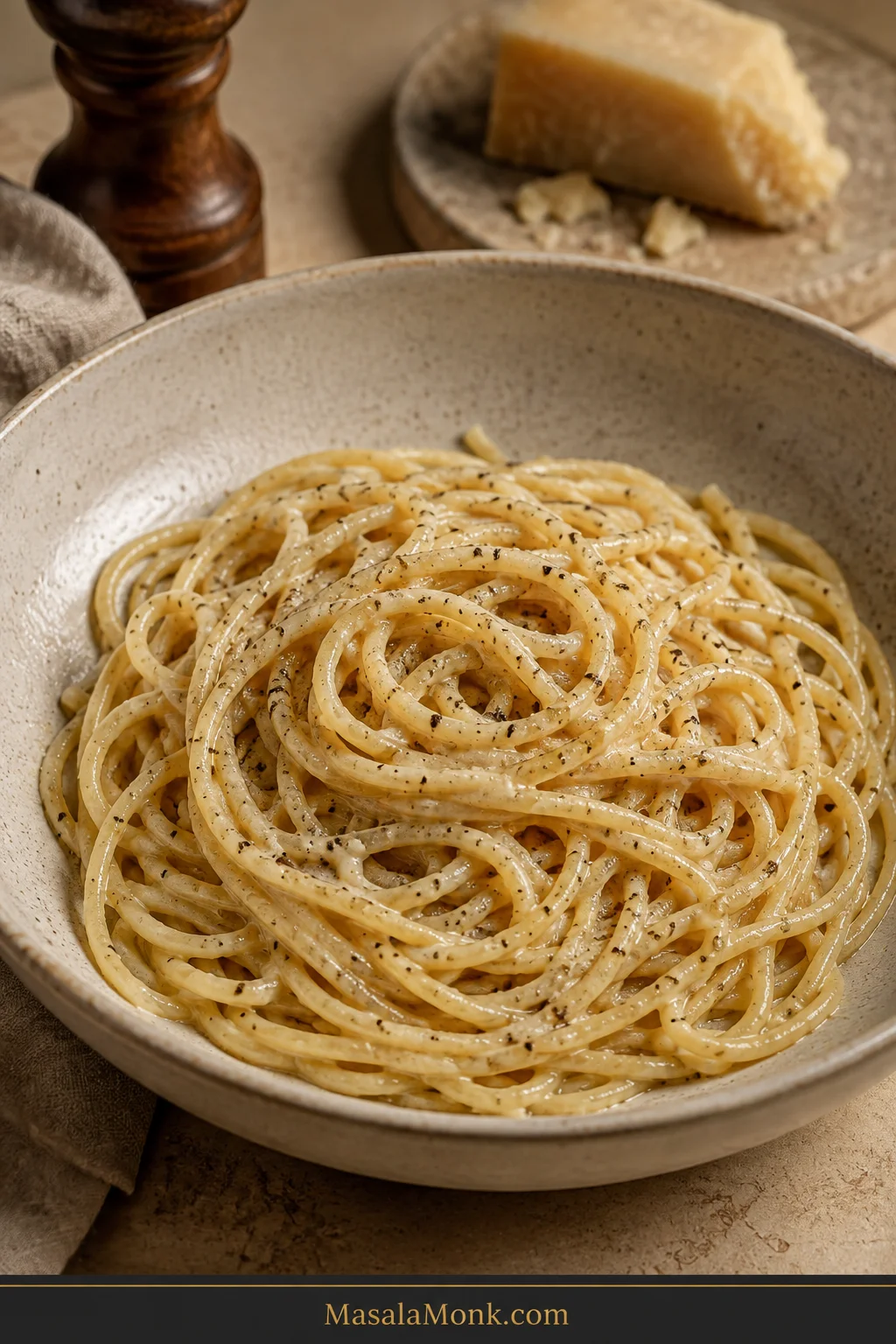
Bowl of glossy cacio e pepe spaghetti lightly coated with Pecorino Romano and speckled with cracked black pepper, with cheese and a pepper mill in the background.

Cacio e pepe looks like the sort of pasta you should be able to make half-awake: noodles, Pecorino Romano, black pepper. Then the cheese hits a pan that is a little too hot and suddenly you are staring at rubbery knots surrounded by watery pasta.

When it works, nothing looks forced. The spaghetti still moves under the tongs, pepper freckles the strands, and the Pecorino turns the cloudy pasta water into a glossy coating that feels creamy even though it contains no cream, butter or oil.

Fixing it does not take another ingredient. It means giving these simple ingredients the right conditions: finely grated cheese, concentrated pasta water, gentler finishing heat and small adjustments instead of big ones. This recipe stays with the Roman essentials and gives you visible cues for the moments when a clock alone is not enough.

Quick Answer: The Cacio e Pepe Method in One Minute

The method at a glance

Cook the pasta in relatively shallow water so the liquid becomes properly cloudy and starchy. While the pasta still has time, use some of that water—cooled until warm and only faintly steaming—to turn finely grated Pecorino into a thick paste.

Toast the pepper just before the skillet stage, then finish the underdone pasta in the peppery starch. Once the pasta is al dente, move the skillet completely off the burner and give the pan a brief cooling pause before adding the cheese.

Rule to remember: build the starch while the pan is hot; build the cheese sauce after the harsh heat has passed. Add any extra pasta water by tablespoons and stop while the sauce still looks a touch loose.
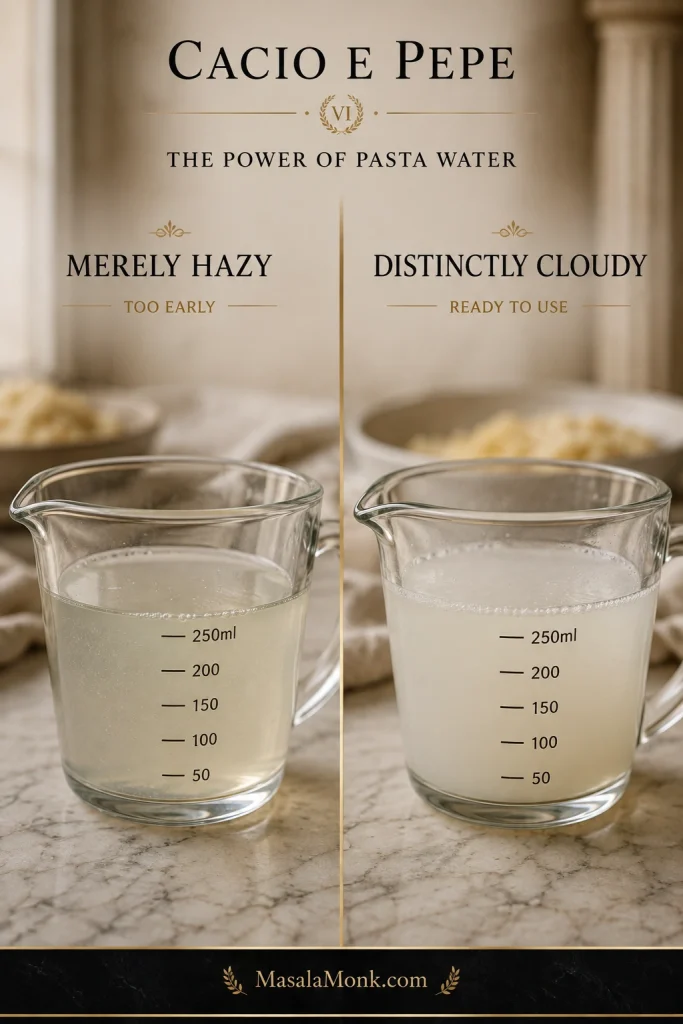
Two measuring jugs of pasta water compared side by side: lightly hazy water on the left and noticeably cloudier, starchier water on the right.
Watch the opacity change as the pasta cooks. Merely hazy water is still relatively weak; noticeably cloudier water carries more suspended starch and gives the cacio e pepe emulsion more support.

Cacio e Pepe Recipe

This cacio e pepe recipe uses dried bronze-cut spaghetti, Pecorino Romano, black pepper and concentrated pasta water to make a silky sauce. The quantities make two generous bowls. Build the starch first, have the Pecorino paste ready, then bring everything together only after the pan is away from direct heat.

Prep Time10 minutes
Cook Time12–15 minutes
Total TimeAbout 25 minutes
Yield2 generous servings

Also serves: 3 smaller first-course portions
Method: Stovetop
Best starting pasta: Bronze-cut dried spaghetti
Final cue: Glossy, fluid sauce that is slightly looser than serving consistency

Ingredients

  • 200 g / 7 oz bronze-cut dried spaghetti (dried tonnarelli also works; fresh tonnarelli needs different timing)
  • 110 g / 3.9 oz Pecorino Romano PDO, very finely grated
  • 3 g whole black peppercorns, about 1½ teaspoons before crushing, plus more to finish
  • About 1 L / 4¼ cups water, or just enough to cover the pasta in a wide pan
  • 4 g fine sea salt, about ¾ teaspoon, using less if your Pecorino tastes especially salty

Equipment

  • Wide pan for cooking the pasta in relatively shallow water
  • 10- to 12-inch / 25- to 30-cm skillet for finishing
  • Fine or star side of a box grater
  • Heatproof bowl plus a small heatproof cup for cooling pasta water
  • Tongs and a ladle or heatproof measuring cup
  • Digital scale, strongly recommended for the Pecorino

Instructions

Build the starch and Pecorino base

  1. Grate and divide the Pecorino. Finely grate all 110 g. Reserve about 10 g for serving and put the remaining 100 g in a heatproof bowl. It should look fine and powdery, not like long shreds.
  2. Start the pasta in shallow water. Bring about 1 L / 4¼ cups water to a boil in a wide pan. Add the measured salt and the pasta. Stir frequently during the first few minutes. If the tips sit above the water at first, let the submerged ends soften briefly and ease the rest under instead of breaking the spaghetti. If your pan still needs more water to cover the strands, add only what is necessary.
  3. Make the Pecorino paste while the pasta still has time. Once the pasta has cooked long enough for the water to become distinctly cloudy—not merely hazy—scoop some into a small heatproof cup and let it cool until warm and only faintly steaming. Gradually stir about 3 tablespoons / 45 ml into the 100 g Pecorino. Add another tablespoon only if needed. The paste should be smooth, thick and spreadable, with enough body to hold its shape on a spoon. Set it beside the stove.
  4. Toast the pepper just before the skillet stage. Coarsely crush the peppercorns. Warm the finishing skillet over medium-low heat and toast the pepper for about 45–60 seconds, stirring or shaking, until deeply aromatic. Stop before it smokes or develops a burnt smell.
  5. Start the pepper base and transfer the pasta. Add about ¼ cup / 60 ml cloudy pasta water to the toasted pepper and let it bubble gently. When the dried spaghetti is still about 2–3 minutes shy of al dente, transfer it to the skillet with tongs.

Finish the pasta and make the sauce off heat

  1. Finish the pasta in the skillet. Toss while it finishes cooking, adding small splashes of pasta water only when needed. At al dente, you want a shallow amount of glossy, cloudy liquid slipping around the strands—not a dry pan and not pasta swimming in water.
  2. Let the skillet cool. Move it completely off the burner. Start checking after about 30 seconds and wait until the strongest steaming has visibly eased; a heavy skillet may need closer to a minute or longer.
  3. Make the sauce off heat. Add the Pecorino paste in two or three additions, tossing vigorously after each. If the sauce tightens, add warm pasta water 1 tablespoon / 15 ml at a time, tossing fully before adding more.
  4. Plate it loose. Stop when every strand is glossy and coated, the pasta still moves easily under the tongs, and there are no visible cheese clumps or watery puddles. Taste one strand: the pepper should be clearly present and the Pecorino sharp and salty without becoming harsh. If it needs more punch, reach for pepper before automatically adding more salt or cheese. Take cacio e pepe to the table a little too loose rather than a little too tight—the trip from skillet to fork fixes the first problem and worsens the second. Serve immediately on warm plates with the reserved Pecorino and more pepper.

Recipe Notes

  • Keep the cheese step off direct heat. Residual heat is enough; if your skillet is heavy and holds heat well, give it a longer cooling pause.
  • Weigh the Pecorino when possible. Grated-cheese volume changes dramatically with grater style and packing.
  • Salt lightly. Pecorino Romano supplies much of the final seasoning.

What should good cacio e pepe taste like? The first bite should have a clear black-pepper bite, followed by the salty, savory sharpness of Pecorino. Richness should come from the way the sauce clings to the pasta, not from a buttery or creamy taste. A good bowl still tastes unmistakably of pasta underneath all that cheese and pepper.
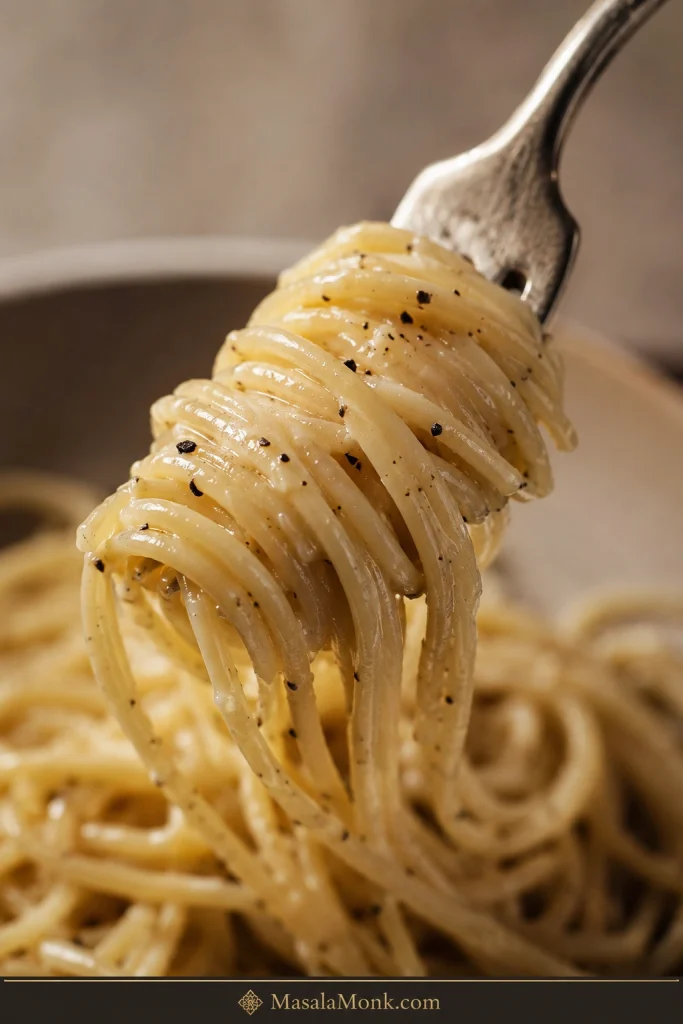
Close-up of cacio e pepe spaghetti twirled around a fork, showing separate glossy strands with a light cheese coating and black pepper flecks.
Lift a forkful and the coating becomes easier to judge. Look for separate spaghetti strands carrying the same thin, silky Pecorino emulsion from center to edge, without bare noodles or thick cheese patches.

Cacio e Pepe Guide: Jump to What You Need

What Makes This Cacio e Pepe Authentic?

Here, “authentic” refers to the ingredient core, not one rigid motion every Roman cook must follow. The classical dish is built from pasta, Pecorino Romano and black pepper, with starch-rich pasta water helping those ingredients become sauce. This recipe does not add cream, butter, olive oil, garlic or Parmesan.

Cacio e pepe is commonly grouped with carbonara, amatriciana and gricia as Rome’s four classic pasta dishes. They share a Roman pantry and a knack for turning a short ingredient list into something much larger than it looks.

The technique can vary. Some cooks work grated Pecorino directly into the pasta; others make a cheese paste first or cool the pan for longer.

Making a Pecorino paste and finishing off heat gives the cheese a gentler path into the sauce while keeping the Roman essentials intact. Butter, Parmesan, cream and added starch can all make good pasta too; they simply lead to different versions of the dish.

Cacio e Pepe Ingredients: Choosing Pecorino, Pepper and Pasta

Before you cook, two choices matter disproportionately: use real Pecorino Romano and grate it much finer than you might expect. Pasta shape matters too, while water management becomes the bigger decision once you start cooking.
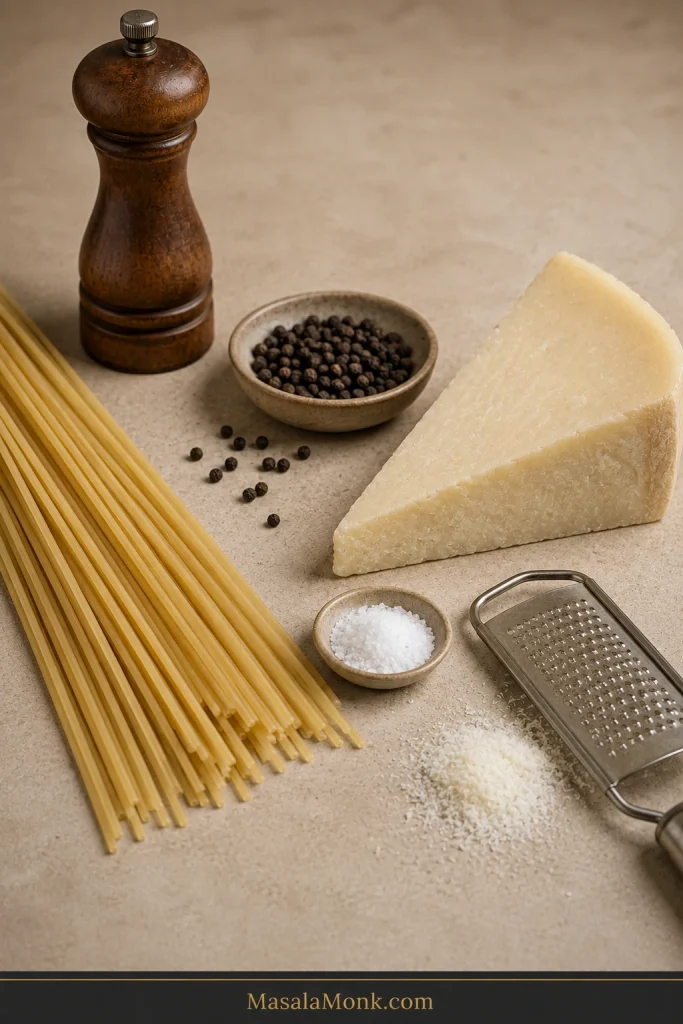
Dried spaghetti, a wedge of hard Pecorino Romano cheese, finely grated cheese, black peppercorns, salt, a pepper mill and a fine grater arranged on a neutral work surface.
With so little in the recipe, preparation matters as much as shopping: grate Pecorino Romano fresh, crack whole black pepper when needed, and use concentrated pasta water as the sauce’s built-in source of starch.

Best Cheese for Cacio e Pepe: Pecorino Romano PDO

Use Pecorino Romano PDO (DOP on Italian labels): the firm, salty sheep’s-milk cheese that defines the Roman sauce. Its sharp, savory bite is a big reason such a short ingredient list tastes so full.

Buy a wedge and grate it shortly before cooking when you can. You do not need to hunt down Pecorino of one particular age; genuine Pecorino Romano PDO, very fine grating and careful heat matter more here.

Use the fine or star side of a box grater and aim for small, powdery particles rather than long ribbons. A Microplane can work, though its very fluffy shreds make volume especially misleading. That is why the recipe uses grams first. If you are comparing Pecorino with Parmigiano Reggiano, Grana Padano or generic Parmesan, MasalaMonk’s Parmesan vs. Parmigiano Reggiano guide explains how those hard cheeses differ.
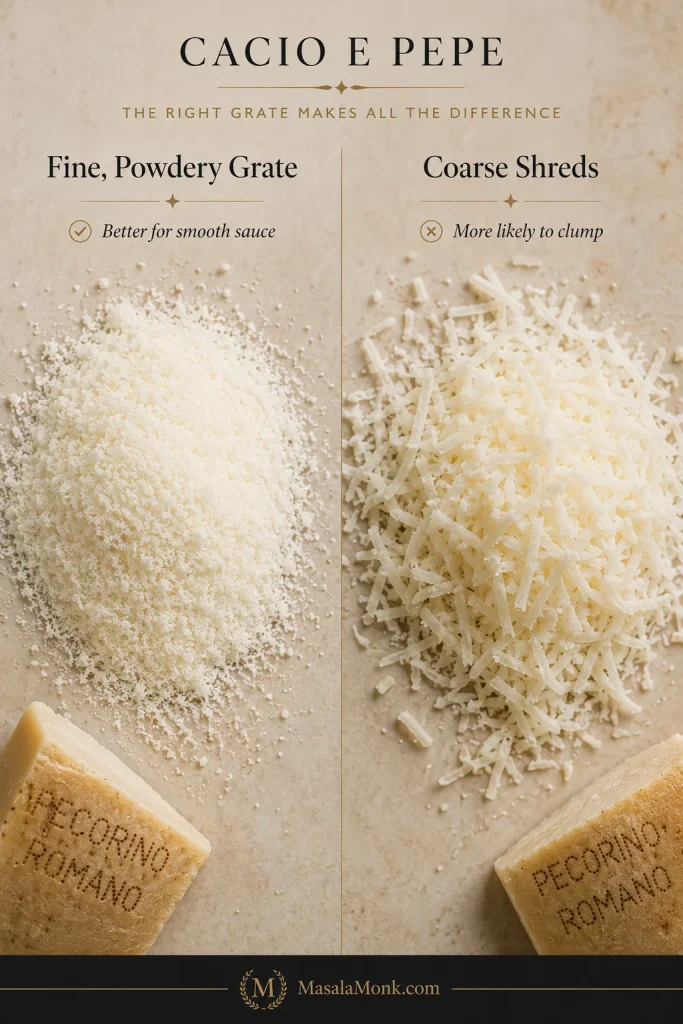
Side-by-side comparison of very finely grated powdery Pecorino on the left and long coarse cheese shreds on the right, labeled “Fine, Powdery Grate” and “Coarse Shreds.”
Fine Pecorino is easier to disperse evenly—it hydrates quickly, before individual pieces have time to seize together. Coarse shreds need longer to soften, which narrows the margin for a smooth emulsion.

Black pepper should taste like an ingredient. Use whole peppercorns and crush them shortly before cooking. The measured amount gives the sauce a clear pepper bite; you can always grind more over the finished bowl. You want coarse, irregular flecks that stay aromatic in the pasta. As they toast, the skillet should smell unmistakably peppery before the color changes much. Stop there; once pepper starts smelling scorched, there is nowhere for that bitterness to hide.

Use less water than a normal pasta pot
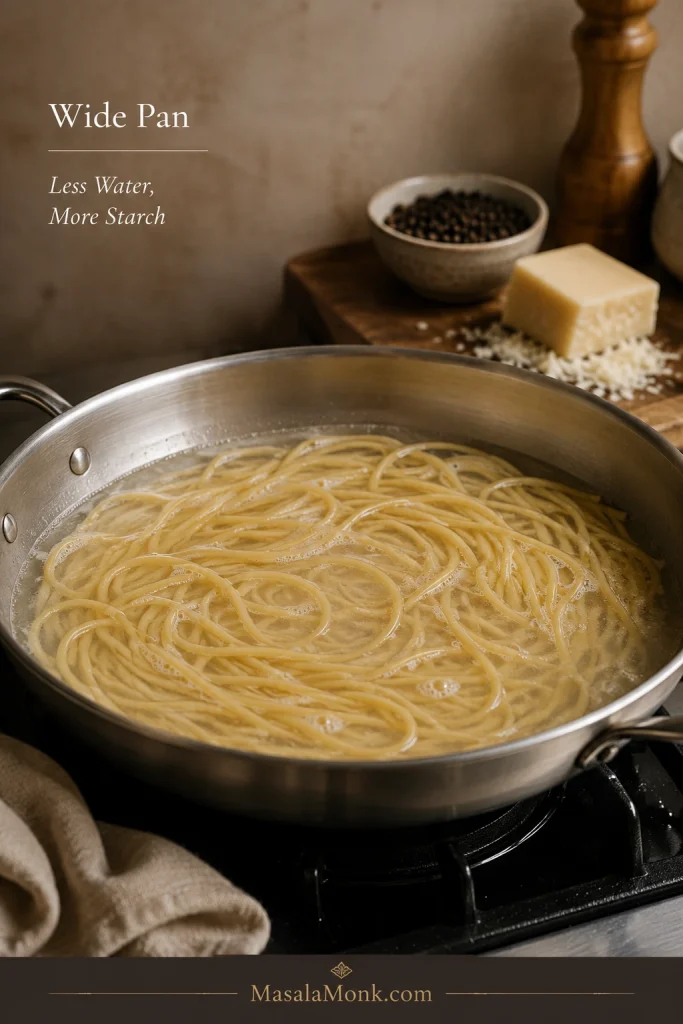
Spaghetti cooking in a wide shallow stainless-steel pan with a relatively low level of water, with Pecorino cheese and black pepper in the background.
The smaller water volume has one useful purpose: stronger pasta water. A wide pan keeps the spaghetti workable while concentrating the starch that later helps Pecorino and water behave like one sauce.

For 200 g / 7 oz pasta, start with about 1 L / 4¼ cups water in a wide pan. Pan shape matters, so use more if the spaghetti needs it to soften, submerge and move freely. Keep the volume low enough that the cooking water grows distinctly cloudy as the pasta cooks. The same concentrated-water habit is useful in our vodka pasta, where the tomato-and-dairy base gives you more room for correction.

Salt with the Pecorino in mind

This is not the pasta for aggressive “salt it like the sea” advice. Pecorino Romano supplies a large part of the seasoning, so start light and taste the cheese before the water boils. It is much easier to add more Pecorino at the table than to rescue an oversalted sauce.

Cacio e Pepe Sauce: Why It Gets Creamy Without Cream

The sauce forms when finely grated Pecorino, water and pasta starch are tossed together until they cling to the strands as one silky coating. Pre-hydrating the cheese into a thick paste gives that dispersion a controlled starting point instead of asking dry Pecorino to meet the pan all at once.
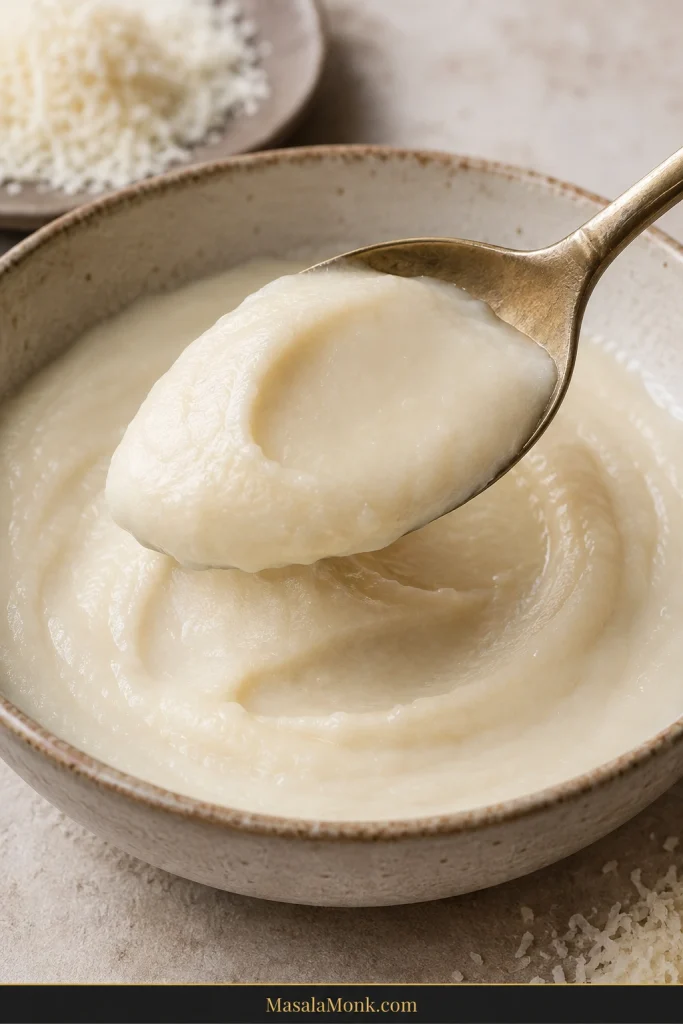
Spoon holding a thick, smooth, pale Pecorino paste above a bowl, with the mixture forming a soft mound and holding its shape.
A thick Pecorino paste keeps the final adjustment in your hands. Once it reaches the spaghetti, you can loosen the sauce gradually; a runny mixture has already used much of that flexibility.

Why the pan needs to cool before the cheese goes in

Heat is the awkward part. Pecorino needs warmth to soften and disperse, but too much heat is the moment smooth cheese starts turning grainy or pulling into rubbery clumps. So the recipe uses the hottest part of cooking for the pasta and starch, then lets the pan settle before the cheese joins in.
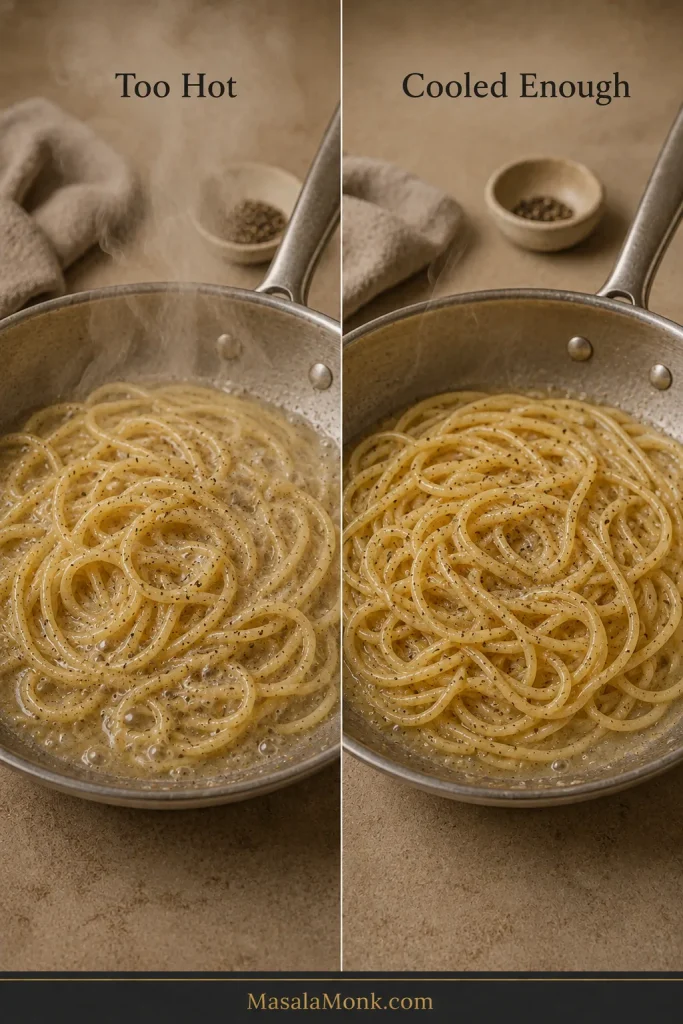
Side-by-side skillets of peppered spaghetti labeled “Too Hot” and “Cooled Enough,” with stronger visible steam over the hotter pan and only faint steam over the cooled pan.
Turning off the burner removes direct heat, not stored heat. Give the skillet time to settle until vigorous steaming fades; the pasta stays warm while the Pecorino gets a gentler place to emulsify.

A 2025 Physics of Fluids paper, “Phase behavior of Cacio e Pepe sauce”, mapped this interaction experimentally and found starch concentration to be a major factor in sauce stability. The researchers also built an optimized version with measured added starch.

We do not add starch here, and you do not need to add any to use the lesson. Concentrate what the pasta already releases, keep a shallow film of cloudy liquid around the strands, and keep the Pecorino away from direct heat.
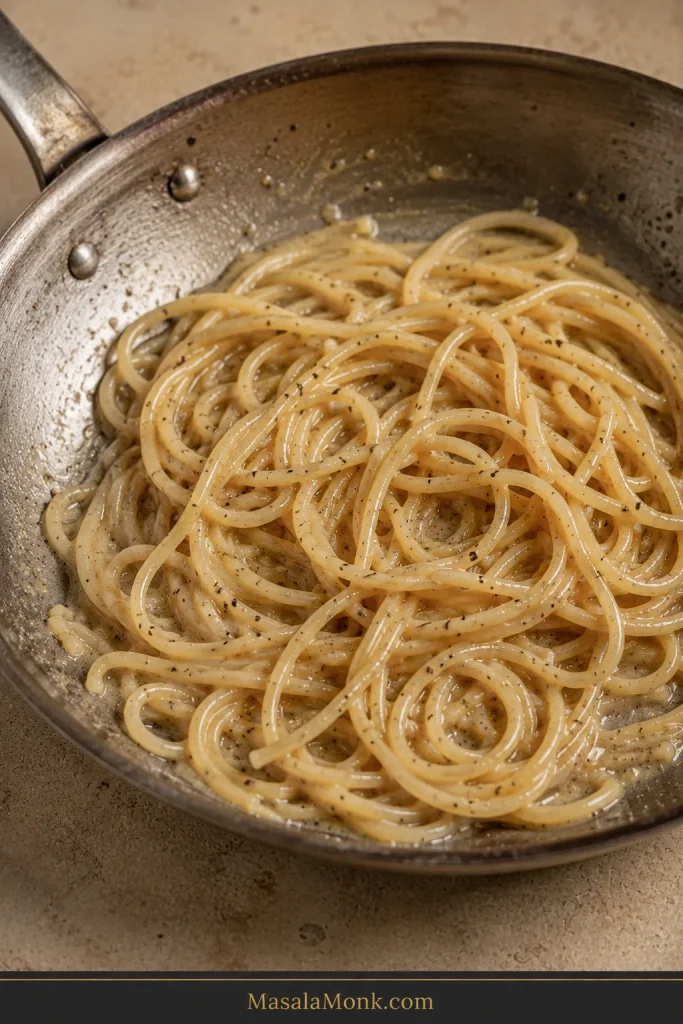
Pepper-speckled spaghetti in a skillet before cheese is added, with a thin layer of starchy liquid visible between the glossy strands but no deep pool.
At this stage, moisture should live between the strands rather than underneath them. That thin starchy film gives Pecorino somewhere to disperse without turning the skillet into a pool of cheese water.

About temperature: there is no single number that makes every Pecorino, pan and starch concentration behave identically. Use the clock only as a starting point: move the skillet off the burner, let the strongest steam ease, then add the cheese in stages.

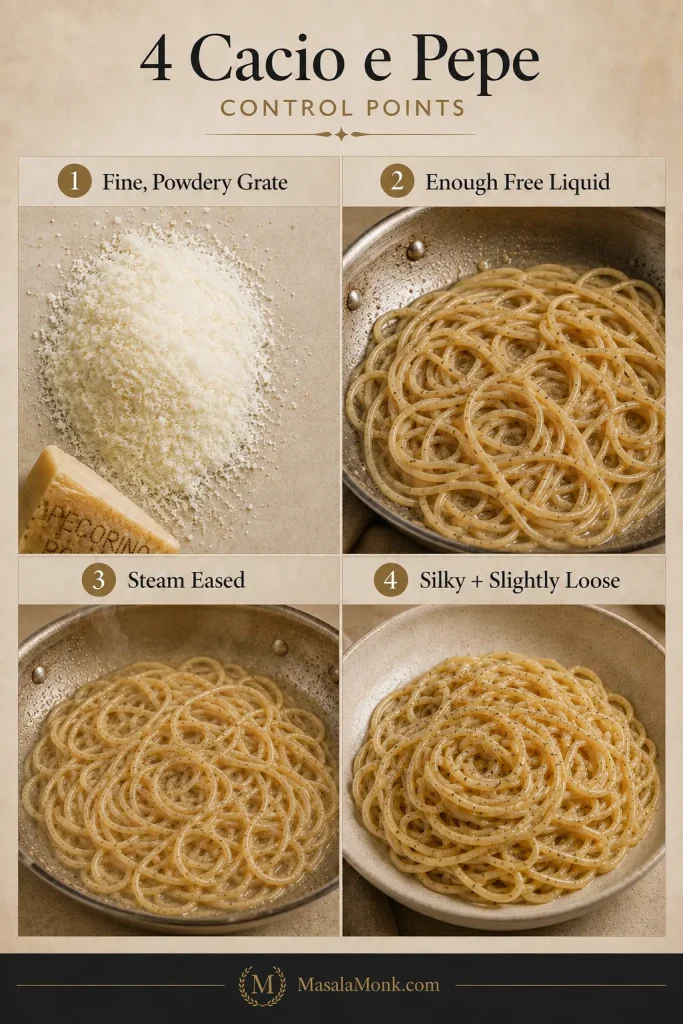
How to Make Cacio e Pepe Without Clumps: 4 Cues to Watch

Moment What you want Warning sign
Grated Pecorino Fine, powdery particles that hydrate quickly Long coarse shreds that hydrate unevenly and clump more easily
Pasta before cheese Al dente strands with a shallow amount of cloudy liquid still moving around them A bone-dry pan or pasta swimming in clear water
Pan before Pecorino Off the burner with the most aggressive steaming visibly eased Roaring steam and a pan still acting like it is over direct heat
Finished sauce Glossy, fluid and clinging; pasta moves easily under the tongs Stiff, pasty coating or watery liquid collecting underneath
The timer tells you when to look. These cues tell you whether to continue.
Four-panel cacio e pepe guide showing finely grated Pecorino, spaghetti with a small amount of free liquid, a skillet after steam has eased, and finished pasta with a silky, slightly loose coating.
Read the four checks as a sequence: prepare the cheese correctly, preserve enough moisture, let harsh heat pass, then stop while the sauce still moves. Together, they are more useful than chasing perfect timing.

When those four cues line up, the final toss is usually almost uneventful: the Pecorino disappears into the cloudy liquid and the strands turn silky as you keep them moving. One last judgment remains: knowing when the sauce is loose enough to leave the pan.
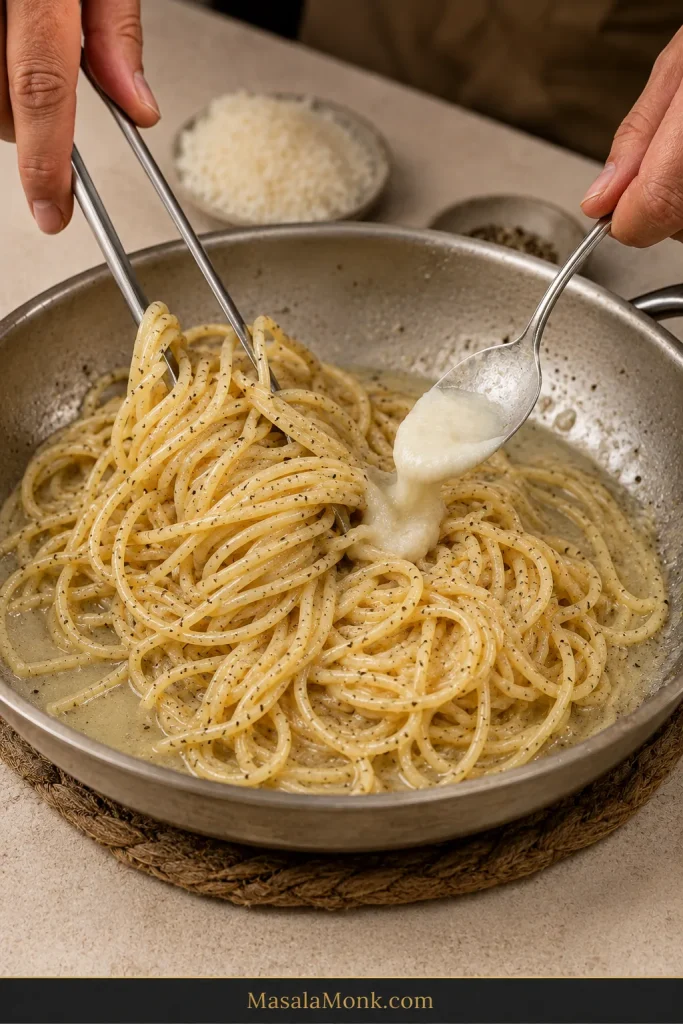
A spoon adding a small amount of smooth Pecorino paste to peppered spaghetti while tongs lift and toss the pasta in a skillet off the burner.
Small additions make the transformation easier to read. Toss until each addition has nearly disappeared into the glossy spaghetti before adding the next; if the coating tightens, correct with a little warm pasta water before continuing.

Stop while the sauce still moves

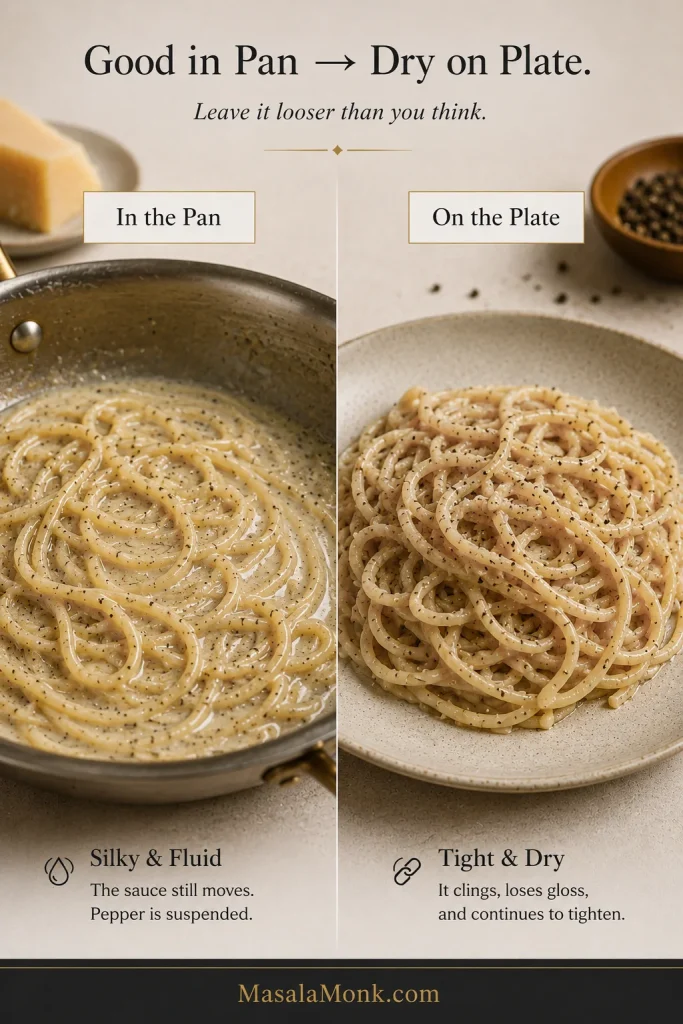
The skillet should look a little looser than the plate you ultimately want. Residual heat and the short trip to the table keep tightening the coating, so waiting for perfect serving consistency in the pan usually means serving cacio e pepe too tight.
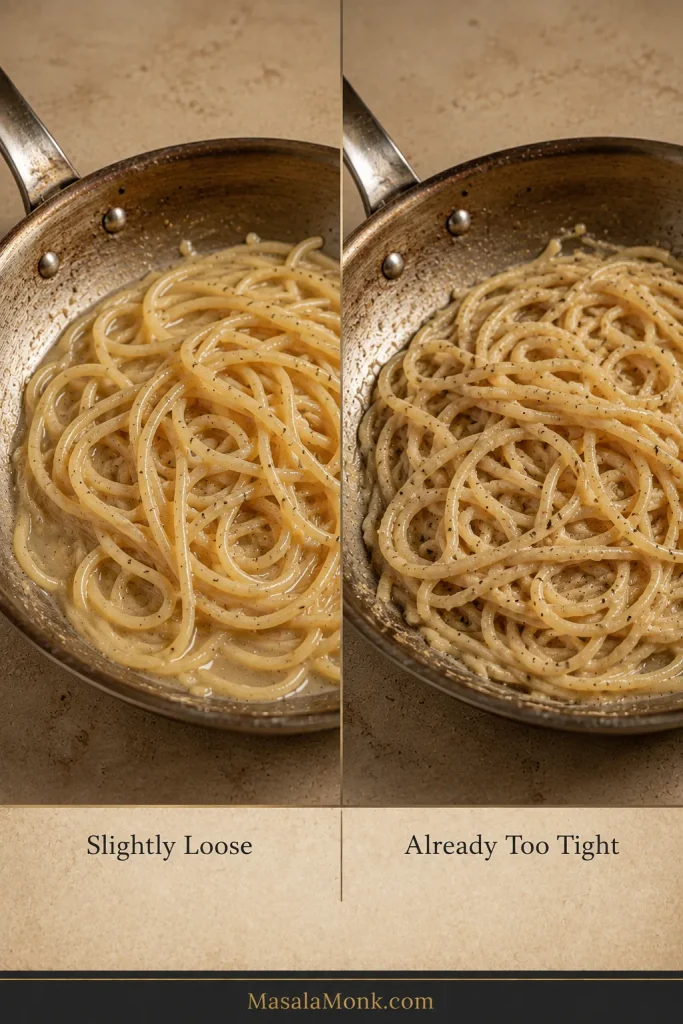
Side-by-side skillet comparison showing glossy, fluid cacio e pepe labeled “Slightly Loose” on the left and a thicker, less mobile but still smooth sauce labeled “Already Too Tight” on the right.
Finish for the plate you are about to serve, not the skillet you are looking at. Cacio e pepe continues tightening as it cools, so a little movement now protects the texture later.

Cacio e Pepe Troubleshooting: Clumps, Graininess, Watery Sauce and Gluey Texture

If the sauce still goes sideways, “it clumped” is not yet a diagnosis. Look at what the cheese and liquid are actually doing before you decide what the pan needs.

Cheese clumps: rubbery blobs vs. grainy curds
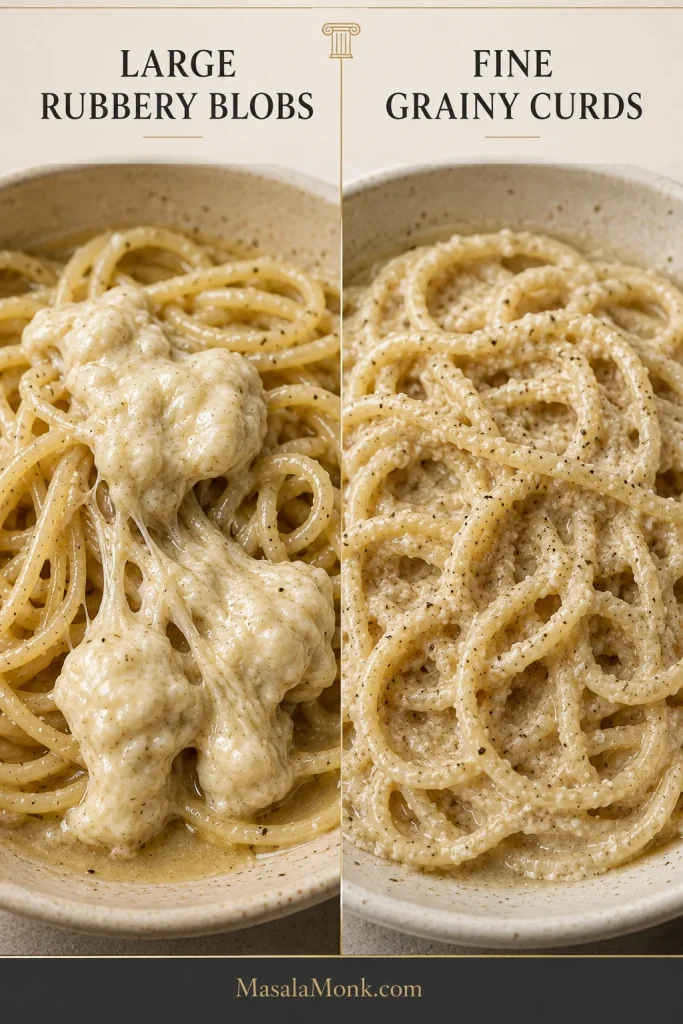
Split comparison of failed cacio e pepe: large stretchy cheese blobs coating spaghetti on the left and many tiny grainy cheese curds dispersed through the sauce on the right.
“Clumpy” is only the symptom. Large stretchy masses point to cheese that seized together, while tiny sandy curds reveal a finer break in the emulsion—two failures that call for different corrections next time.
What you see Most likely cause What to do now What to change next time
Large rubbery cheese blobs Pan too hot; cheese added too quickly; weak starch base Get completely off heat. If clumping has only started, add 1 tablespoon warm starchy water and toss hard. A fully elastic mass is difficult to reverse. Cool longer, grate finer and add Pecorino in stages.
Tiny grainy curds Excess heat or an unstable emulsion Move away from heat and toss with a very small splash of starchy water. Use finer cheese, starchier water and a longer cooling pause.
Large blobs and tiny curds are different cheese failures; their shape gives you a clue about what went wrong.

Watery, gluey, dry or too-salty sauce

What you see Most likely cause What to do now What to change next time
Watery pasta with cheese stuck to the pan or tongs The emulsion never formed—often excess liquid, weak starch concentration or too much heat Get completely off heat, stop adding water and toss vigorously. If the cheese has already seized into clumps, use the clump rescue below. Use starchier water, cool the pan more and make smaller liquid corrections.
Thick, gluey sauce Too little water, too much evaporation or sauce cooled too far Add warm pasta water 1 tablespoon at a time while tossing. Leave slightly more free liquid before the cheese step and plate looser.
Good in the skillet, dry on the plate Sauce left the pan too tight Loosen immediately if you still have warm pasta water. Stop when the sauce is more fluid than the final texture you want.
Too salty Heavily salted water plus salty Pecorino There isn’t a clean fix once the finished pasta is too salty; avoid adding more cheese or salt. Salt the cooking water much more lightly.
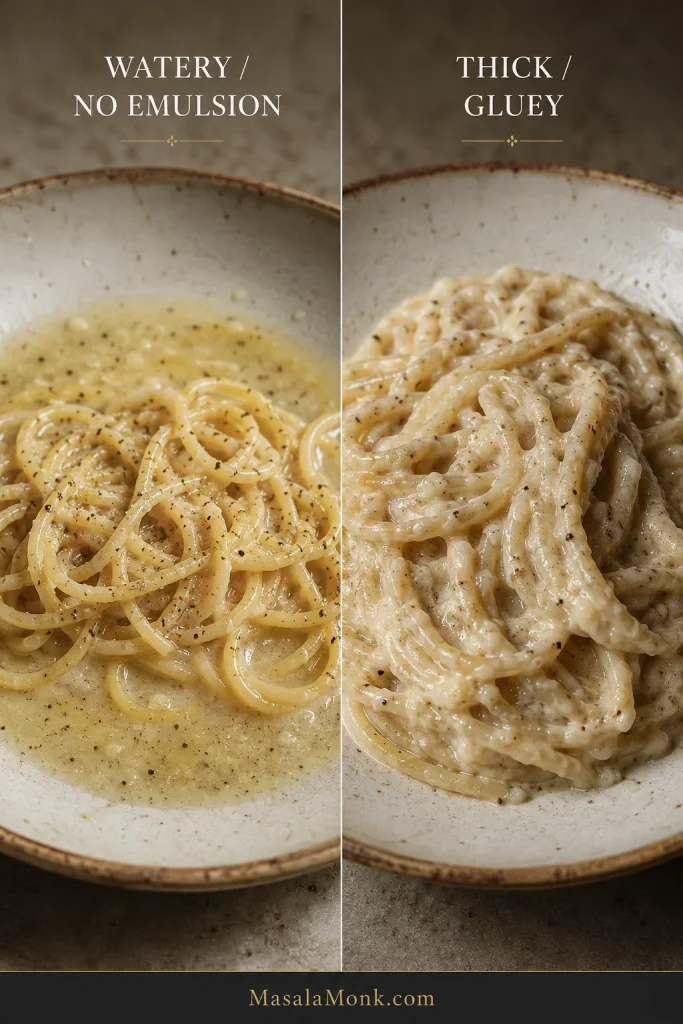
Diagnose the texture you actually see; not every cacio e pepe failure needs more water.
Side-by-side failed cacio e pepe showing watery separated liquid around loosely coated spaghetti on the left and a thick, gluey coating binding the strands together on the right.
In a watery sauce, free liquid has failed to become part of the coating; a gluey sauce has tightened too far in the opposite direction. The useful target sits between separation and over-concentration.
Before-and-after comparison showing glossy, fluid cacio e pepe in a skillet on the left and the same style of pasta looking tighter, drier and less glossy after plating on the right.
A warm plate can slow cooling, but it cannot restore moisture already lost in the skillet. The better safeguard is plating while the sauce still looks slightly more fluid than your ideal first bite.

Can a clumped cacio e pepe sauce be rescued?

Sometimes, if you catch it while the cheese is only beginning to grain or tighten. Get the pan away from heat, add a spoonful of warm starchy water and toss hard. Once the Pecorino has pulled into one elastic mass, more heat usually makes things worse. If the pasta still tastes good, eat it; give the next batch a cooler pan and starchier water.

If you want to practise the same off-heat cheese finish in a more forgiving sauce, our broccoli pasta gets extra body from the soft broccoli.

Once you can tell a too-hot pan from a too-dry one, cacio e pepe stops feeling temperamental and starts feeling readable.

Back to recipe ↑ · Back to top ↑

Best Pasta for Cacio e Pepe: Tonnarelli, Spaghetti or Bucatini?

There is no single pasta shape you need for a good bowl. Timing matters more, especially when you move between dried and fresh pasta.
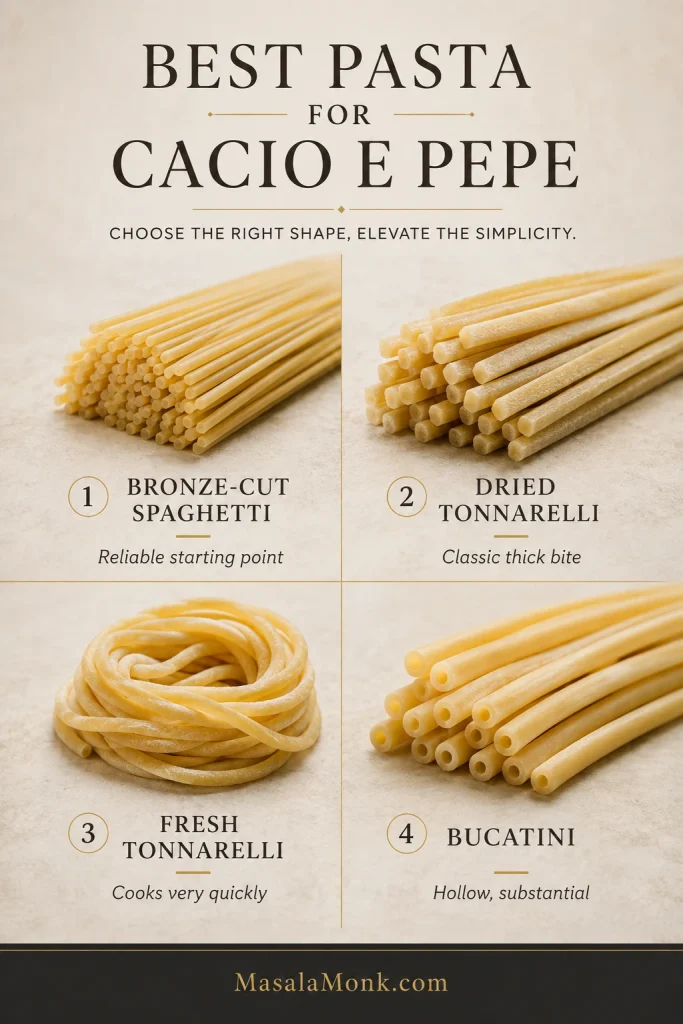
Four-part pasta comparison showing bronze-cut spaghetti, thick dried tonnarelli, a nest of fresh tonnarelli and hollow bucatini, each labeled by pasta type.
Choose pasta partly by how much working time you want. Bronze-cut spaghetti gives you more working time, dried tonnarelli gives a thicker bite, fresh tonnarelli moves quickly, and bucatini brings extra heft.
Pasta Why use it Watch out for
Dried tonnarelli Strong Roman association; thick, chewy strands; works with the same general method as dried spaghetti Use its own package timing; do not assume it cooks at the same speed as spaghetti
Fresh tonnarelli Classic Roman shape with a tender, substantial bite Usually cooks much faster than dried spaghetti; stage everything first, reserve cloudy cooking water early and give it only a brief skillet finish
Bronze-cut spaghetti Best practical default; easy to find, toss and coat Choose a good-quality pasta that releases plenty of starch
Bucatini Thick, substantial and delicious with Pecorino Heavier hollow strands can be more awkward to toss quickly
For a first attempt, bronze-cut spaghetti gives the best balance of availability and easy handling.

Its longer cooking window gives you time to build concentrated pasta water and finish the strands in the skillet. Dried tonnarelli can follow the same general route.

Parmesan, Butter, Cream and Other Cacio e Pepe Adaptations

Butter, Parmesan, cream and other additions can make excellent pasta, but they move the dish away from the Pecorino-and-water formula used here.
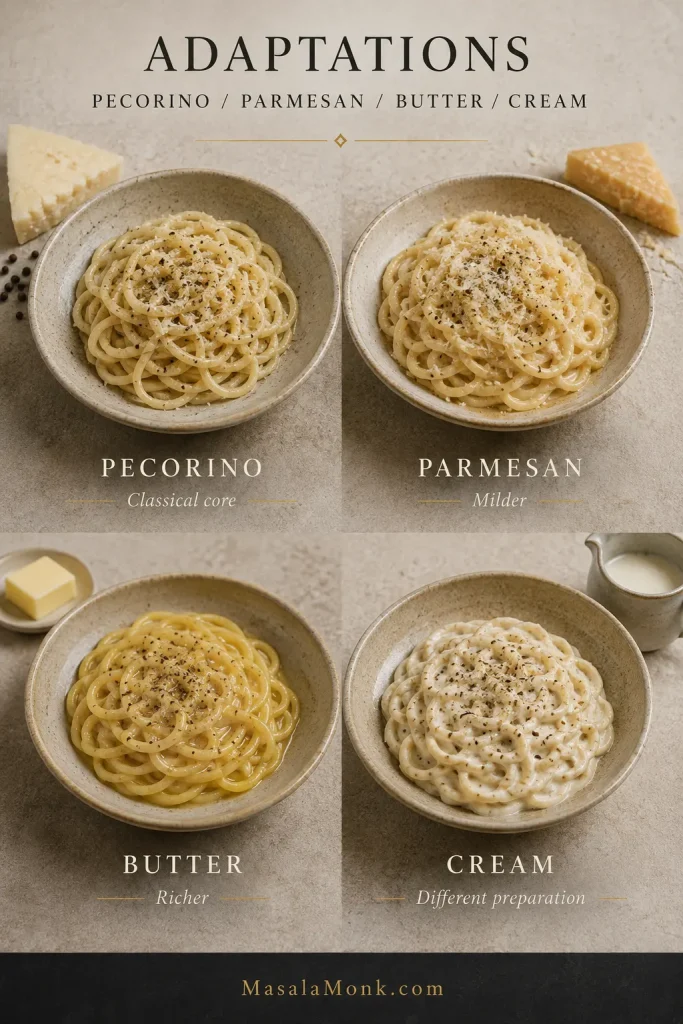
Four bowls of peppered pasta compared as Pecorino, Parmesan, butter and cream versions, with the butter version glossier and the cream version noticeably thicker and paler.
The visual differences become stronger as the recipe moves away from its classical core: Parmesan stays relatively close, butter adds extra gloss, and cream produces the most opaque, visibly heavier coating.
Addition Will it work? In this recipe? What changes
Parmigiano Reggiano / Parmesan Yes No Milder, nuttier and usually less sharply salty than Pecorino Romano
Butter Yes No Adds richness and helps the sauce come together more easily
Olive oil Yes No Adds richness and olive-oil flavor; changes the character of the sauce
Heavy cream Yes No Adds richness and stability, but turns it into a different preparation
Garlic Yes No Adds a strong aromatic flavor to an intentionally spare dish
Cornstarch or potato starch Yes No Can strongly stabilize the sauce, but changes the traditional ingredient approach

Roman Alfredo solves a related emulsion differently: Parmigiano, butter and pasta water create its glossy coating without cream.

What to Serve With Cacio e Pepe

Cacio e pepe is salty, rich, peppery and starchy. A good side brings contrast: something fresh, green, bitter or acidic. That contrast makes the next forkful of pasta taste sharper and more alive.

  • Lemony arugula or rocket salad
  • Broccoli rabe or other bitter greens
  • Roasted asparagus, broccoli or zucchini with lemon
  • Fennel, citrus or tomato salad with enough acidity to cut the Pecorino

A cold cucumber salad with vinegar, dill and onion works especially well here: crisp, sharp and light beside the salty Pecorino.
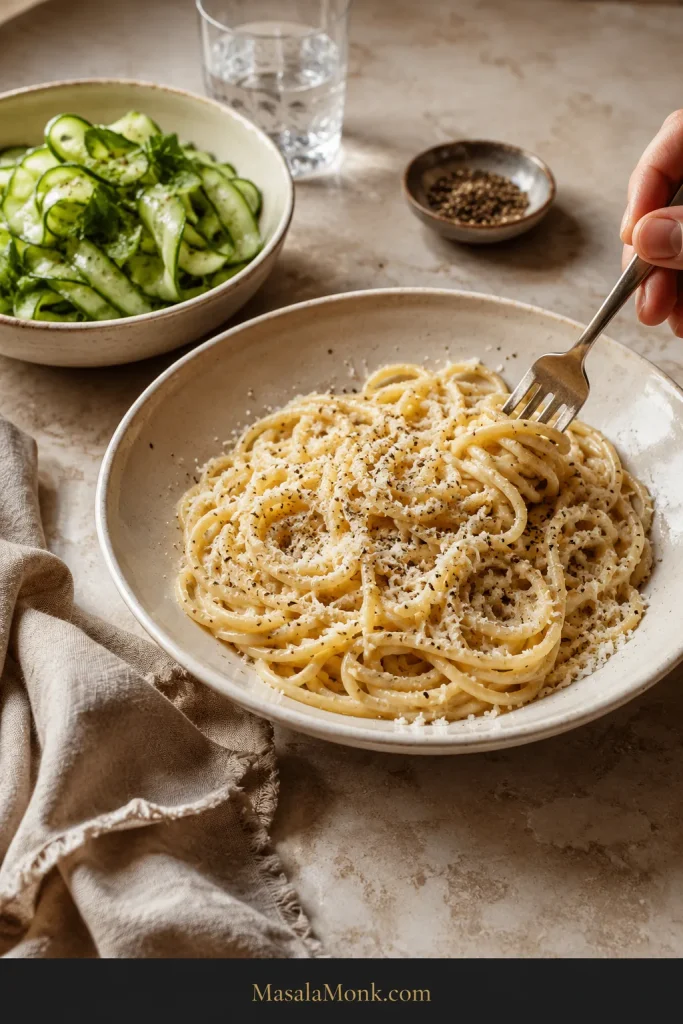
Plate of cacio e pepe beside a bowl of fresh ribboned cucumber salad, with a hand holding a fork over the peppered pasta and a glass of water in the background.
Contrast does more for this pasta than another rich side. Crisp cucumber, bitter greens or a lightly acidic salad reset the palate, letting the Pecorino and black pepper feel vivid again on the next forkful.

Serve a smaller portion as a Roman-style first course before a simple meat, fish or vegetable main. If cacio e pepe is dinner on its own, keep the side crisp, green or acidic and let the pasta remain the reason you sat down.

Storage and Reheating

Cacio e pepe is at its best within minutes of leaving the skillet. Grate the Pecorino, crush the pepper and set out the pans ahead of time, but cook the pasta and form the sauce close to serving.

Refrigerate leftovers promptly in an airtight container and, for the best texture, eat them within about 2–3 days. Reheat only the portion you plan to eat in a skillet over low heat with a small splash of water. Toss constantly and add more water only if the coating still feels tight.

Reheated cacio e pepe can still be good, but the coating will never be quite as fluid as it was fresh, and high heat makes the Pecorino more likely to tighten or separate. Treat leftovers as a good second bowl, not a recreation of the first one.

Back to recipe ↑ · Back to top ↑

Is Cacio e Pepe Really a Roman Shepherd’s Dish?

Cacio e pepe is deeply associated with Rome and Lazio. A popular story links the dish to shepherds carrying durable pasta, Pecorino and pepper during seasonal grazing journeys. Italian food historian Massimo Montanari has argued that this neat origin story is misleading, placing pasta with grated cheese inside a much longer Italian culinary history and pepper inside an older history of prized spices.

The dish is unmistakably Roman; the tidy shepherd-invention story is better treated as culinary legend than settled fact. That uncertainty does not make cacio e pepe any less Roman—it simply makes its history less neat than the story often told about it.

Cacio e Pepe FAQs

What does cacio e pepe mean?

It literally means “cheese and pepper.” In the Roman dish, the cheese is Pecorino Romano and the pepper is black pepper.

How do you pronounce cacio e pepe?

A close English approximation is KAH-cho eh PEH-peh. It is closer than pronouncing “cacio” like “Casio.”

Is cacio e pepe vegetarian?

It contains no meat, but traditional Pecorino Romano PDO is made with animal rennet. The official Pecorino Romano PDO consortium specifies lamb’s rennet in paste form. If you avoid animal rennet, use a suitable vegetarian hard cheese and understand that it will not be traditional Pecorino Romano PDO.

Can I use pre-grated Pecorino?

Freshly grated Pecorino gives you much better control over particle size and weight. If pre-grated is your only option, choose refrigerated Pecorino that is finely grated; skip coarse shreds and shelf-stable shaker cheese.

Can I use fresh tonnarelli?

Yes, but do not follow the dried-spaghetti timing literally. Fresh tonnarelli usually cooks much faster than dried spaghetti, so have the Pecorino grated, the pepper crushed, the skillet ready and all your tools within reach before the pasta goes into the water.

Because it cooks quickly, reserve some water once it is noticeably cloudy enough to use; do not wait for the later timing you would with dried spaghetti. Toast the pepper immediately before adding pasta water to form the pepper base, then give the fresh pasta only a brief skillet finish. Move the pan off the heat, use the same cooling cue as the main recipe and make the sauce as usual.

Can I make cacio e pepe for one?

Yes. For the dried-spaghetti version, halve the recipe: 100 g / 3.5 oz pasta, 55 g / 1.9 oz Pecorino total (reserve about 5 g for finishing), and about 1½ g pepper, plus more to finish. Use a smaller wide pan and enough water for the pasta to cook freely; the visual cues matter more than forcing exactly half the original water into different cookware. Salt the water lightly using the same Pecorino-first approach as the main recipe.

Can I make cacio e pepe for a crowd?

Yes, but smaller batches are easier. A large mass of pasta holds heat longer and is harder to toss quickly, leaving less room to adjust the cheese step. For a dinner party, two smaller batches are usually easier than one enormous skillet.

Can I make the sauce separately?

You can pre-hydrate the Pecorino into a paste, as this recipe does, but do not make a finished cacio e pepe sauce hours ahead and expect it to wait like a cream sauce. The final texture depends on hot pasta, fresh starchy water and immediate tossing.

When the Bowl Is Ready

The sauce should follow every strand in a light, silky coating. Fresh pepper should reach you before the fork does, followed by the sharp Pecorino; the pasta should still move freely instead of sitting in a stiff mound.

Bring people to the table before the final toss; cacio e pepe gives you its best few minutes first. If you make it, tell me what changed the sauce for you—the water, the heat, the cheese, or simply knowing when to stop. That detail is often more helpful to the next cook than another timer.
Back to recipe ↑ · Back to top ↑

Posted on 7 Comments

Carbonara Recipe: Italian Pasta (Creamy, Veggie, Chicken, Shrimp, Tuna & Keto)

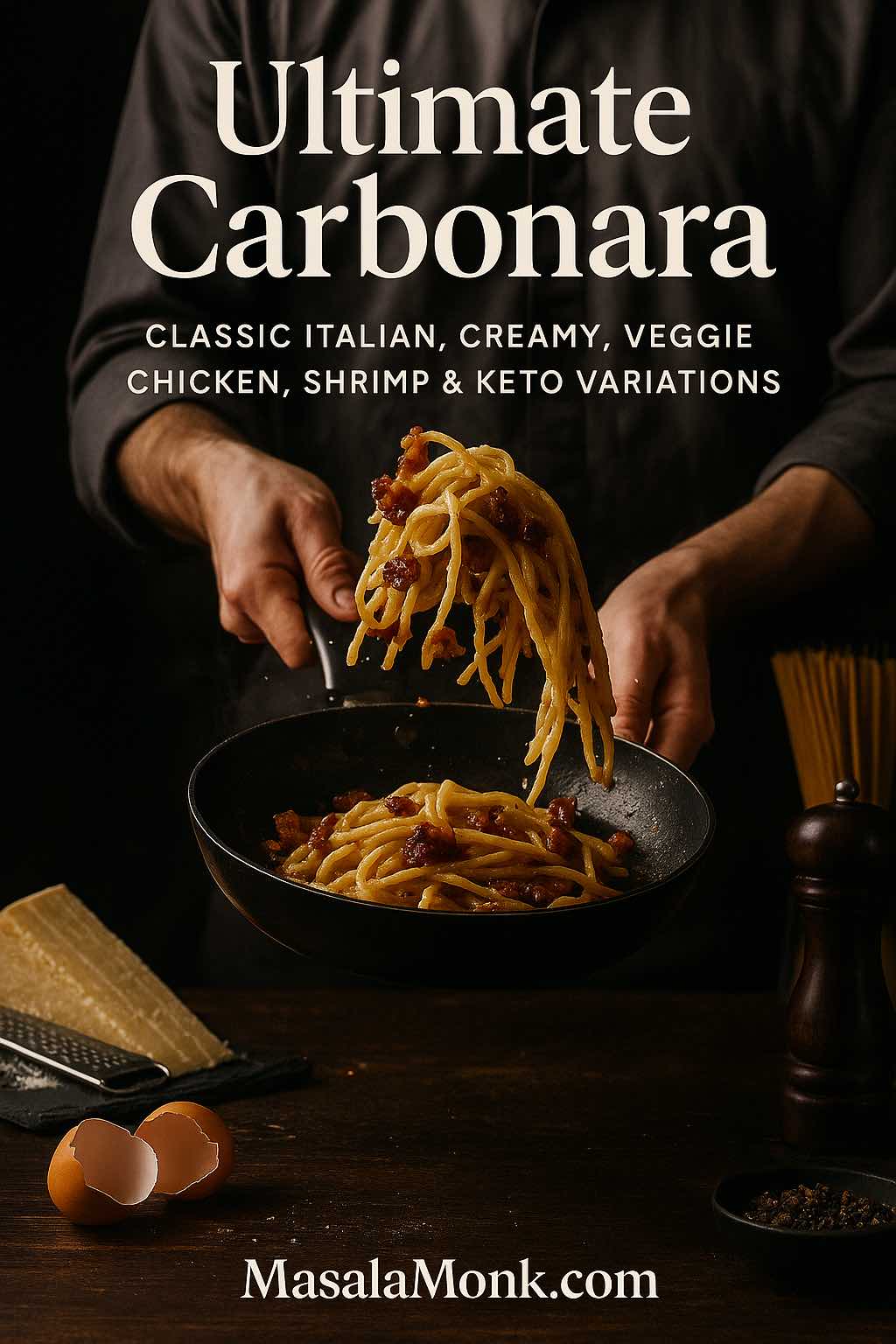
Chef tossing spaghetti alla carbonara in a black pan, glossy pasta with crispy guanciale, steam rising over a dark wooden table with cheese, cracked eggs and pepper mill.

There’s a moment, just after you toss hot pasta through eggs and cheese and pork fat, when everything goes quiet. The noodles glisten, the sauce thickens, and suddenly you’re staring at a bowl of carbonara that looks like it fell out of a tiny Roman kitchen and landed on your table. That’s the magic we’re going for here in this Carbonara Recipe.

This is a complete, reader-first guide to making carbonara at home: starting with a classic, no-cream version, then branching into creamy, veggie, chicken, shrimp, tuna and even keto-friendly twists. Along the way you’ll see a few helpful links—some to deeper technique or ingredient guides on MasalaMonk, others to recipes from sites that specialise in vegetarian or low-carb spins—so you can wander off and explore whatever version fits your mood.


What Carbonara Really Is (And What It Isn’t)

Carbonara is one of those dishes that seems simple until you try to explain it. On paper, it’s almost suspiciously basic: pasta, cured pork, eggs, hard cheese, black pepper. That’s it. Yet when you read through classic Roman versions and careful modern explanations—like the foolproof method in Serious Eats’ spaghetti with carbonara sauce —you start to notice the same core ideas repeated:

  • The meat is guanciale (cured pork jowl) or sometimes pancetta, not random ham.
  • The cheese is Pecorino Romano, often with a little Parmesan mixed in.
  • The “sauce” is an emulsion of egg, grated cheese, pork fat and starchy pasta water.
  • There is plenty of black pepper, enough to be noticeable.
Overhead view of classic carbonara ingredients like spaghetti, guanciale, Pecorino, eggs and black pepper on one side and modern variations such as mushrooms, chicken, shrimp, tuna, cream and zucchini noodles on the other.
Classic Roman carbonara begins with spaghetti, guanciale, Pecorino, eggs and pepper; from there it stretches into creamy, veggie, tuna and zucchini variations in kitchens around the world.

Notice what’s missing: cream. Traditional versions rely on the natural richness of egg yolks plus emulsified fat. The creaminess you see on the plate is closer to a glossy custard than a thick white sauce. Guides like the vegetarian carbonara from The Mediterranean Dish also keep that egg-based structure even when they swap out the meat for mushrooms, precisely because that’s what makes carbonara feel like carbonara in the first place.

That said, carbonara is a living dish. Home cooks all over the world slip cream into the mix, use bacon instead of guanciale, add vegetables, throw in chicken or shrimp, stir in a can of tuna, or swap the pasta entirely for zucchini “noodles”. Rather than pretending those versions don’t exist, this guide starts with the most recognisable Roman-style base, then shows you how to bend it in ways that still feel coherent and delicious.

Also Read: 10 Most Popular Mediterranean Breakfasts


Ingredients: The Backbone of a Good Carbonara Recipe

Even before you pick up a knife, good carbonara depends on good ingredients. You don’t need anything fancy, but a couple of choices really change the outcome.

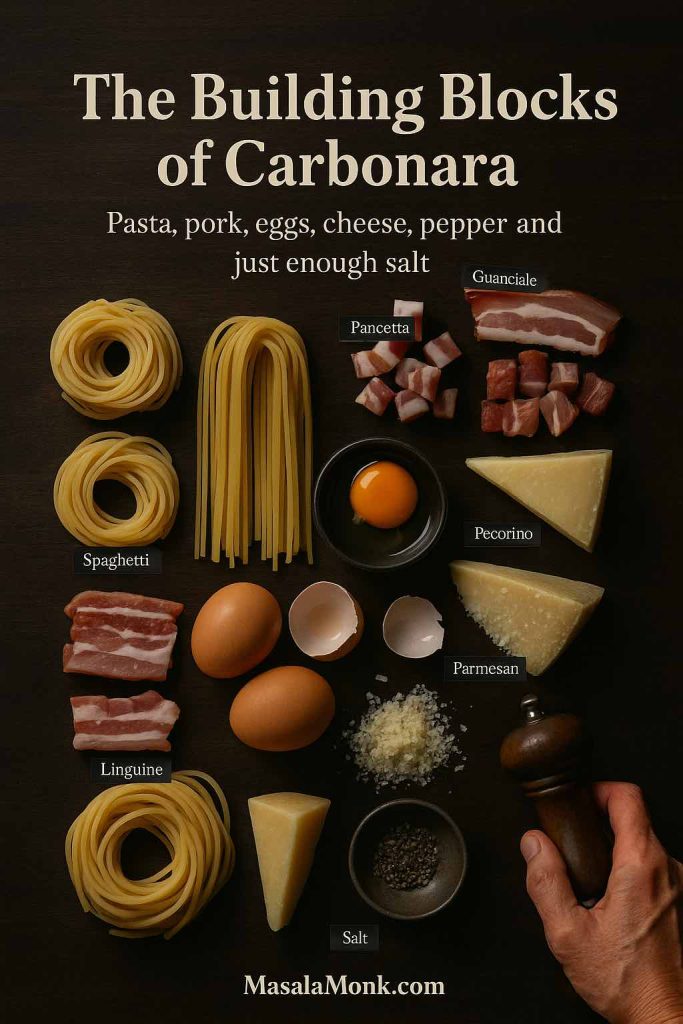
Overhead view of carbonara ingredients on a dark table, with nests of spaghetti and linguine, cubes of pancetta and guanciale, eggs, Pecorino, Parmesan, salt and a hand holding a pepper mill.
The backbone of every good carbonara: a few pasta shapes to choose from, guanciale or pancetta, rich egg yolks, Pecorino with a little Parmesan, freshly ground black pepper and just enough salt.

Pasta

Spaghetti is the classic, and it behaves beautifully in this dish. Nonetheless, you can absolutely make excellent carbonara with:

  • Bucatini (for an extra-chewy slurp)
  • Linguine (a flatter noodle that holds sauce well)
  • Fettuccine (if you like something edging toward Alfredo territory)
  • Short shapes like penne or rigatoni (great in baked carbonara casseroles)

We’ll circle back to shape choices later, because they’re an easy way to vary your pasta carbonara without changing the core recipe.

Pork

If you can find guanciale, use it at least once; it’s worth it. The fat has a deep, almost floral savouriness that gives everything a distinct Roman character. Pancetta is the next best option, and streaky bacon works perfectly fine for most weeknight bowls.

Cut it into small batons or lardons, rather than tiny bits, so you get a mix of crisp edges and softer, fatty centres.

Eggs

Eggs are the heart of the sauce. Yolks give you richness and that deep yellow colour; whole eggs bring a little extra volume and looseness. A great starting point for two portions is:

  • 2 egg yolks + 1 whole egg

You can adjust from there. More yolks make your carbonara deeper and silkier; more whole egg makes it a touch lighter.

Cheese

Pecorino Romano is traditional: it’s salty, sharp and tangy, which cuts beautifully through the richness of pork and egg. Parmesan (or Parmigiano Reggiano) adds nuttiness and a slightly gentler flavour. A lot of home cooks use a mix.

If you enjoy going down cheese rabbit holes, MasalaMonk has a detailed guide to Parmesan cheese and its varieties as well as a helpful comparison of Parmesan and Parmigiano Reggiano with other hard cheeses. Those are worth skimming if you’re choosing cheeses at a well-stocked deli and wondering how far you can stray.

Pepper and Salt

You want freshly cracked black pepper, not the dusty pre-ground stuff at the back of the cupboard. It should be aromatic and obvious in the finished dish—you’re aiming for a gentle pepper heat, not just dots of colour.

Salt mainly lives in the pasta water here. Remember your pork and cheeses are already salty; it’s easy to overdo it if you also heavily season the eggs.

Also Read: 10 Best Espresso Martini Recipe Variations (Bar-Tested)


The Classic Carbonara Method (Step by Step Recipe)

Now that the ingredients are clear, it’s time to build the base recipe. This method works for two generous servings; scaling up is straightforward once you understand the rhythm.

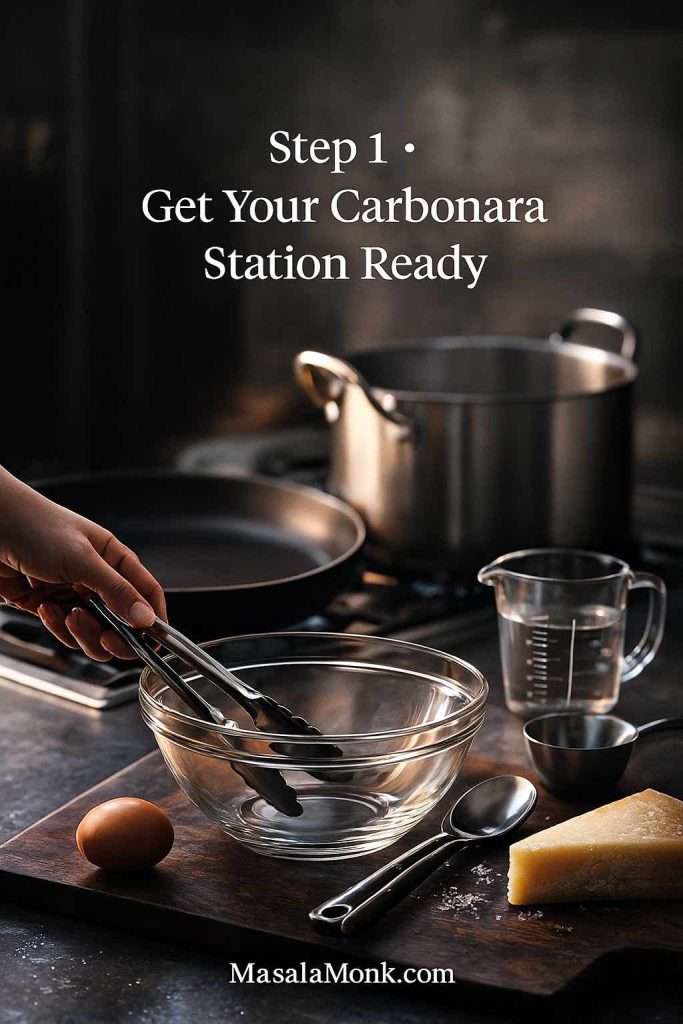
1. Set up your workspace

Before you start cooking, have these ready:

  • A large pot for boiling pasta
  • A wide, heavy pan (or skillet) for the pork
  • A heatproof mixing bowl for eggs and cheese
  • Tongs or a pasta fork
  • A ladle or measuring cup for pasta water

Lining everything up in advance might feel fussy, yet it makes the most important moment—tossing the pasta with the eggs—much calmer.

Vertical photo of a carbonara cooking station with a pot on the stove, a skillet, glass mixing bowl, tongs, measuring cup of water, an egg and a wedge of cheese on a dark counter as a hand sets the tools in place.
Step 1 is all about calm prep: line up your pot, pan, bowl, tongs and pasta water so the carbonara comes together smoothly later on.

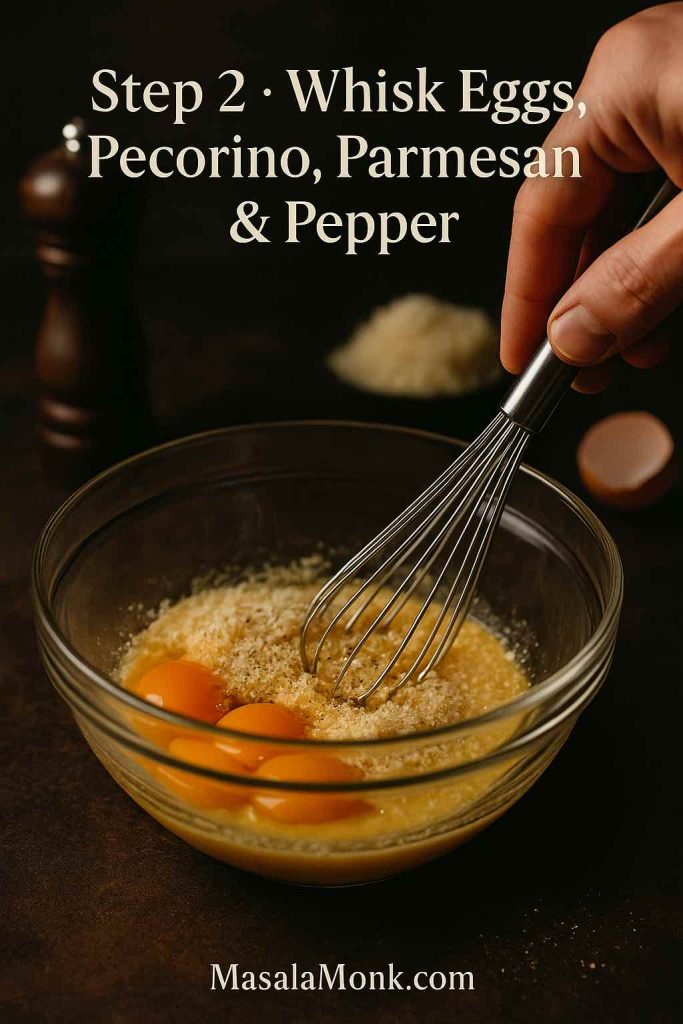
2. Mix the egg and cheese “sauce” for this Recipe of Carbonara

In the heatproof bowl, whisk together:

  • 2 egg yolks
  • 1 whole egg
  • About 60 g finely grated hard cheese, ideally a mix of Pecorino and Parmesan
  • A generous pinch of freshly ground black pepper

Whisk until the mixture is smooth and thick, with no streaks of egg white. Set this bowl near the stove; it will be your landing zone for the hot pasta later.

Many detailed recipes, such as the Serious Eats carbonara method, use a sort of double boiler approach to gently warm the egg mixture and guarantee a glossy emulsion. You don’t have to do that, though keeping the bowl near (but not on) the stove naturally warms it a little and helps the sauce come together.

Hand whisking egg yolks, grated Pecorino, Parmesan and black pepper in a glass bowl to make silky carbonara sauce.
In Step 2, egg yolks, Pecorino, a little Parmesan and fresh black pepper come together into the creamy base that makes carbonara rich without any cream.

3. Render the pork in Carbonara Recipe

Place the guanciale, pancetta or bacon into a cold pan, then put the pan on medium-low heat. Starting cold gives the fat time to melt out slowly, which both crisps the meat and leaves you with a good amount of flavourful fat to coat the pasta.

Let it sizzle gently, stirring occasionally, until the pieces are golden at the edges and starting to crisp but not rock-hard. Turn off the heat and leave everything in the pan.

At this stage, the kitchen should smell like a trattoria. Try not to eat all the pork out of the pan with your fingers.

Cubes of guanciale and pancetta slowly crisping in a black skillet, with rendered fat and steam rising for a classic carbonara recipe.
In Step 3, the guanciale or pancetta sizzles gently so the fat renders slowly, giving you crisp edges, soft centres and enough porky oil to coat every strand of carbonara.

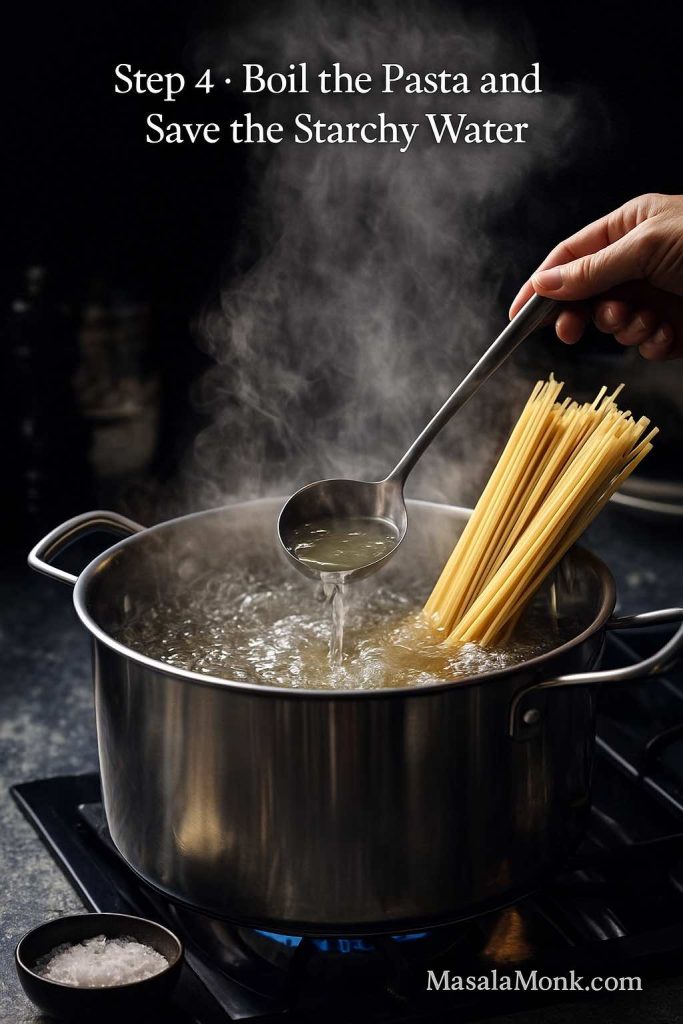
4. Cook the pasta

Bring a large pot of well-salted water to a rolling boil. The water should taste pleasantly seasoned, like a mild broth.

Add your spaghetti (or other pasta) and cook until just shy of al dente. While the pasta cooks, stir it from time to time so it doesn’t clump.

A minute or two before the pasta is done, scoop out a good 1–1½ cups of starchy pasta water with a ladle or measuring cup. This step is non-negotiable: that water is crucial to turning your egg-and-cheese mixture into a smooth, pourable sauce.

Large pot of boiling salted water on the stove, with spaghetti being lowered in and a ladle scooping out starchy pasta water for carbonara
Step 4 locks in texture and flavour: cook the pasta in well-salted water, then ladle out some of that starchy liquid to turn eggs, cheese and pork fat into a smooth carbonara sauce.

5. Marry pasta and pork

Turn the pork pan back on to low heat and add a small splash of the pasta water. This loosens any sticky bits on the bottom.

Using tongs, transfer the drained pasta straight from the pot into the pan. A little water clinging to the noodles is helpful. Toss the pasta with the pork and its fat for a minute or so, letting the flavours mingle.

Once the pasta looks glossy with fat, turn off the heat completely. This is important; you don’t want the eggs to hit a screaming-hot pan.

Hand using tongs to lift glossy spaghetti in a skillet, tossing it with crisp pancetta and rendered pork fat for carbonara.
In Step 5, the hot spaghetti is tossed through the rendered pork fat so every strand picks up flavour before it meets the egg-and-cheese sauce.

6. Emulsify the sauce

Now comes the magic.

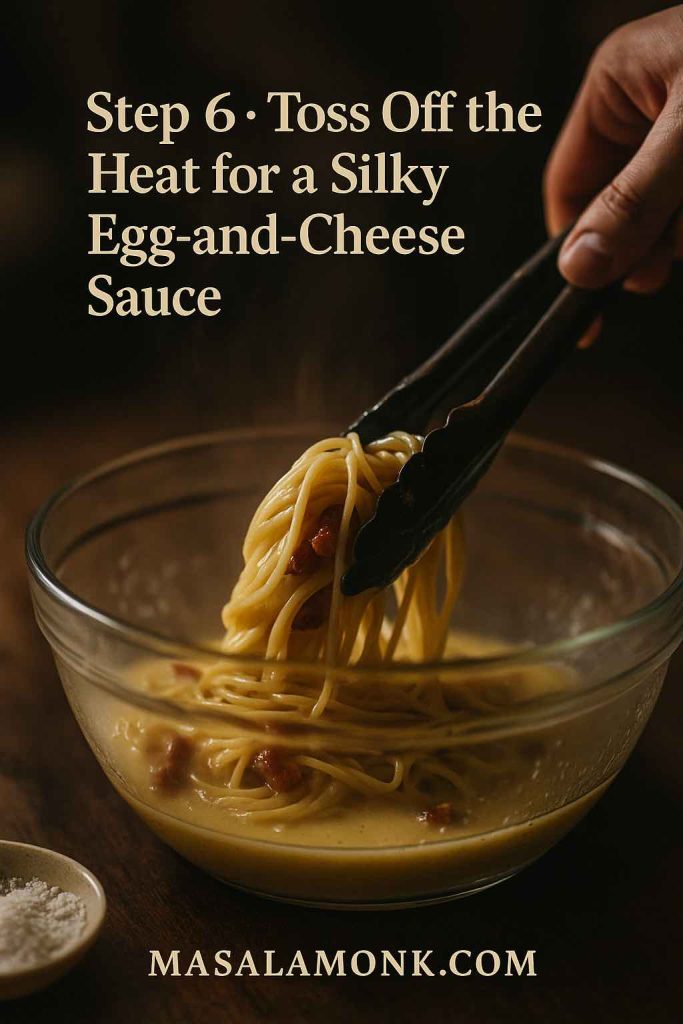
Quickly lift the pan and pour the hot pasta and pork into the egg-and-cheese bowl. As you do this, toss constantly with tongs, coating every strand. The residual heat from the pasta will gently thicken the eggs.

Add a small splash of hot pasta water and keep tossing. Then another splash. You’re looking for the sauce to loosen and turn silky enough to cling in a thin, shiny layer rather than clumping.

With a bit of practice, you’ll feel when the balance is right. The noodles should gleam, with no visible streaks of raw egg or puddles of liquid at the bottom of the bowl.

Hand using tongs to toss hot spaghetti and pancetta in a glass bowl of egg-and-cheese mixture off the heat, forming a glossy carbonara sauce.
In Step 6, the pasta leaves the pan and gets tossed off the heat with eggs, Pecorino and a splash of pasta water until the carbonara sauce turns thin, shiny and perfectly silky.

7. Taste and adjust your Carbonara Recipe

Now is the time to fine-tune:

  • Add more black pepper if you want extra warmth.
  • Grate on a little extra Pecorino or Parmesan for a salty finish.
  • If the sauce feels too thick, whisk in another spoonful of hot pasta water.

Serve immediately. Carbonara waits for no one; it keeps cooking in its own heat, and the sauce thickens as it sits.

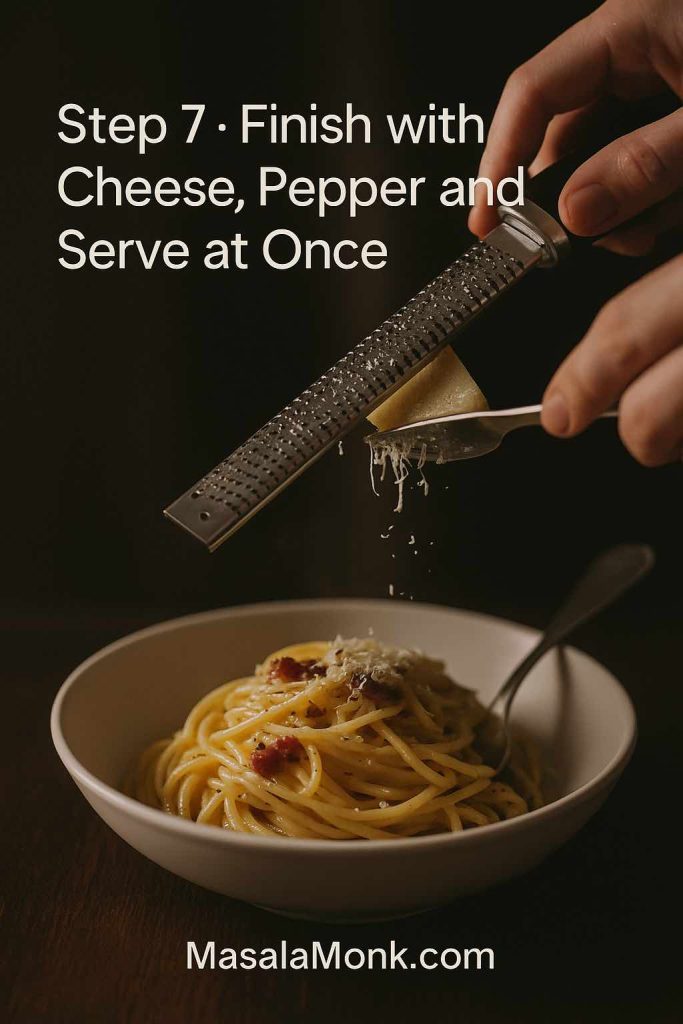
Hand grating Pecorino Romano over a bowl of glossy spaghetti carbonara with crisp pancetta, ready to serve immediately.
Step 7 is all about timing: a hot bowl of carbonara, a last snowfall of Pecorino and black pepper, and straight to the table before the sauce thickens.

The same basic approach—pork cooked gently, eggs and cheese beaten in a bowl, pasta tossed off the heat with a bit of starchy water—shows up across careful recipes and tutorials, including many “how to” breakdowns on Italian cooking sites and in teaching platforms. Once you’ve done it once, you’ll see why the method doesn’t change much.

Also Read: Cheesy Chicken Broccoli Rice – 4 Ways Recipe (One Pot, Casserole, Crockpot & Instant Pot)


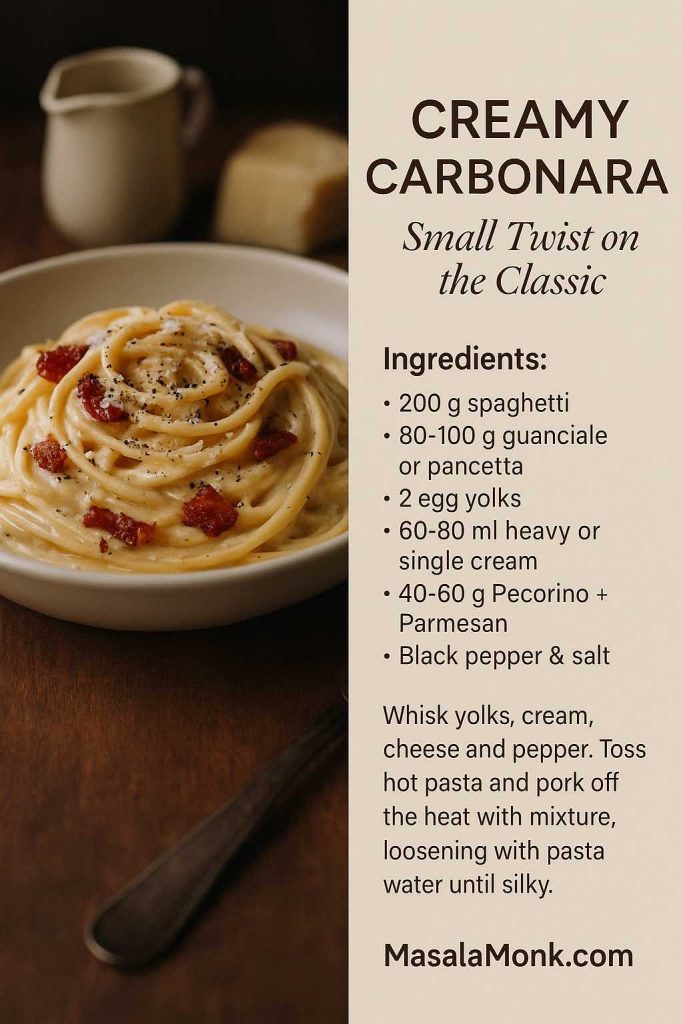
Recipe of Creamy Carbonara (With a Little Cream)

In plenty of Italian kitchens, cream in carbonara is a sacrilege. In plenty of non-Italian kitchens, it’s simply what people grew up eating. If cream is part of your personal comfort bowl, you can absolutely incorporate it gracefully.

The easiest way to do that is to keep the method identical and tweak only the egg mixture.

For two portions:

  • Use 2 egg yolks instead of 2 yolks + 1 whole egg.
  • Whisk in 60–80 ml of heavy cream or single cream along with the cheese and pepper.
Recipe card showing a bowl of creamy spaghetti carbonara with guanciale alongside ingredients and quick instructions for making carbonara with cream.
This creamy carbonara card shows the small twist on the classic: extra yolks whisked with a splash of cream, Pecorino and Parmesan, then tossed with hot pasta and guanciale until silky.

Everything else stays the same: same pork, same pasta, same off-heat tossing with a bit of starchy water. The cream makes the sauce more forgiving and a touch richer, especially when you’re still learning.

If you enjoy comparing different kinds of creamy pasta, MasalaMonk’s collection of chicken Alfredo pasta recipes and their deep dive into classic versus “authentic” Alfredo-style sauces are useful contrasts. They highlight the difference between cream-based white sauces and egg-based emulsions, which helps you understand what’s happening in your own pan.


Vegetarian Carbonara (Recipe With Mushrooms and Veg)

Sometimes you want the comfort of carbonara without the meat. Rather than dumping the eggs and cheese onto plain noodles, it’s worth building a proper vegetarian carbonara that still delivers a savoury hit.

Mushrooms are the natural substitute: they brown, they concentrate, and they bring umami. Courgettes (zucchini) or peas also fit in beautifully, and you can see that approach in dishes like the healthier veggie carbonara at BBC Good Food, which keeps the egg-based sauce but piles on vegetables.

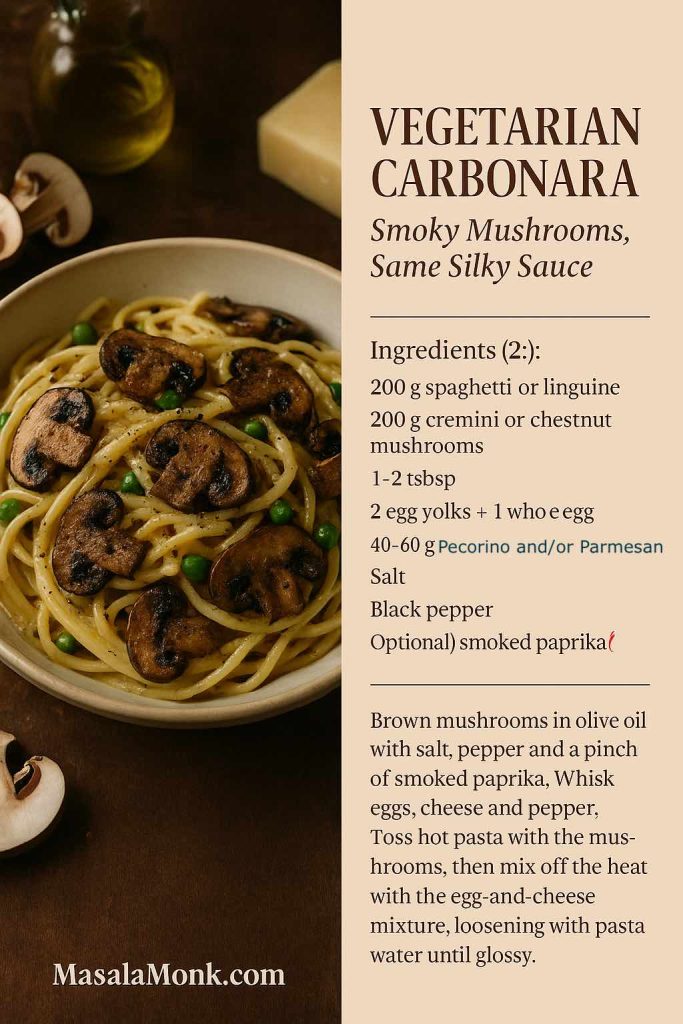
Recipe card showing a bowl of vegetarian carbonara made with spaghetti, browned mushrooms and peas beside ingredients and directions for a smoky mushroom carbonara.
This vegetarian carbonara swaps guanciale for deeply browned mushrooms and peas, keeping the same silky egg-and-cheese sauce while adding hearty plant-based flavour.

Here’s one way to do it:

  1. Replace the pork with mushrooms
    • Slice 200 g of cremini, chestnut or button mushrooms.
    • Add a tablespoon or two of olive oil to your pan.
    • Cook the mushrooms over medium-high heat until they are deeply browned and have given up their moisture.
    • Season with salt, pepper, and (if you want a faint smoky note) a tiny pinch of smoked paprika.
  2. Follow the classic method
    • Mix eggs and cheese as before.
    • Boil the pasta and save your pasta water.
    • Toss the hot pasta with the browned mushrooms and their juices instead of pork.
    • Transfer everything to the egg bowl and emulsify with splashes of pasta water.

The result is a veggie carbonara that still looks and behaves like the original: creamy, glossy, with a savoury depth that comes from browned mushrooms rather than cured meat.

If you’d like more inspiration, the vegetarian carbonara with smoky mushrooms from The Mediterranean Dish shows a similar idea with extra olive oil and pasta water standing in for pork fat. Meanwhile, for nights when you want to lean more heavily into plant-based eating beyond cheese and egg, MasalaMonk’s collection of high-protein pasta dishes built around lentils and beans gives you additional options that feel hearty but not heavy.


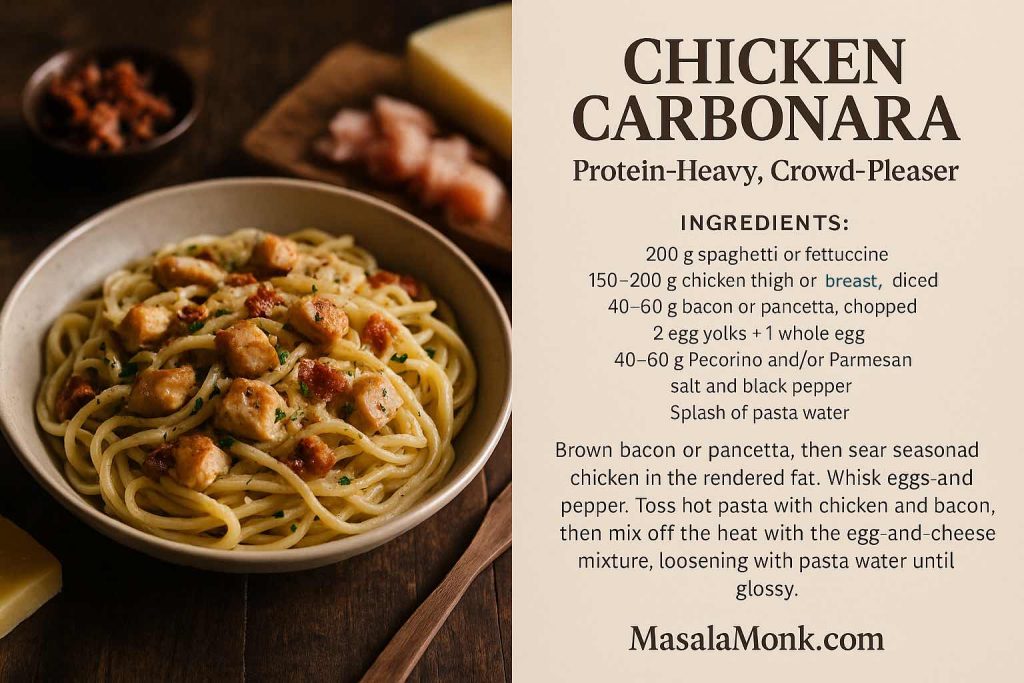
Chicken Carbonara: Protein-Heavy & Crowd-Pleasing Recipe

Chicken sneaks into carbonara in plenty of modern recipes because it makes the dish feel more like a full “meat and pasta” meal, especially if you’re feeding people who expect visible protein on the plate.

Recipe card showing a bowl of chicken carbonara with creamy spaghetti, browned chicken pieces and crisp bacon beside ingredients and quick steps for chicken carbonara pasta.
This chicken carbonara recipe card turns the classic into a full meat-and-pasta meal, with bacon-rendered chicken tossed through silky egg-and-cheese sauce for extra protein and comfort.

To integrate chicken gracefully:

  • Cut 150–200 g of boneless chicken thigh or breast into small pieces.
  • Season lightly with salt and pepper.

Then:

  1. Render a small amount of bacon or pancetta in your pan to keep that smoky baseline.
  2. Scoop the bacon out and set it aside, leaving the fat.
  3. Sear the chicken pieces in that fat until they’re browned and cooked through.
  4. Return the bacon to the pan, then proceed as usual when you add the pasta.

When you toss the noodles through the egg mixture, you’ll have a pan full of chicken and bacon pieces waiting to be coated, giving you a bona fide chicken carbonara pasta that still echoes the original dish.

If you like the idea of chicken in a creamy, saucy context, it’s also worth exploring other comfort-pasta territory. MasalaMonk’s one-pot chicken bacon ranch pasta is a great example of how bacon, chicken and cream can play together in a single pan without the egg element, while their macaroni and cheese recipe shows how to build a proper cheese sauce from a different angle entirely.


Shrimp and Seafood Carbonara Recipe

Swapping the pork for shrimp (or using the two together) pushes carbonara in a seafood direction without abandoning the classic egg-and-cheese base.

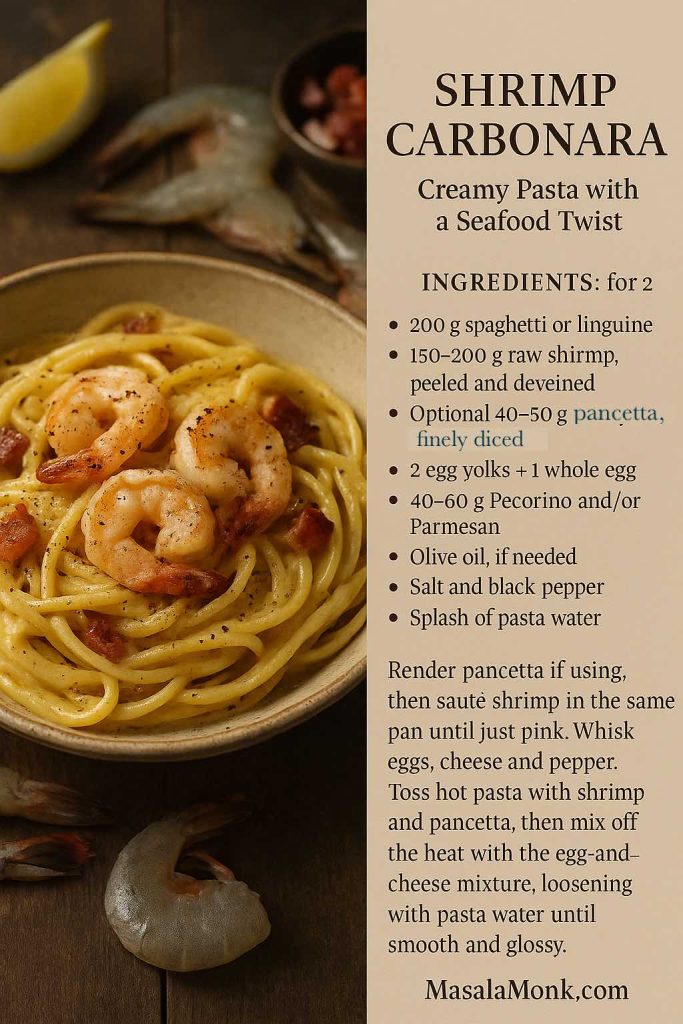
Recipe card showing a bowl of shrimp carbonara with creamy spaghetti, pink shrimp and pancetta beside ingredients and directions for seafood carbonara.
This shrimp carbonara recipe card keeps the classic egg-and-cheese base but layers in sweet, just-cooked shrimp and pancetta for a rich seafood twist on the original pasta.

For two servings, you’ll want:

  • 150–200 g raw shrimp, peeled and deveined
  • Optional: 40–50 g pancetta, finely diced

Here’s how to make it work:

  1. If using pancetta, render it first just as you would for the classic version. Scoop the bits out and leave the fat in the pan.
  2. Add a drizzle of olive oil if needed, then sauté the shrimp over medium heat until just pink and barely cooked through.
  3. Season with a tiny pinch of salt and pepper; remember the cheese will add more salt later.
  4. Return the pancetta to the pan, add your hot pasta and a splash of pasta water, and toss.
  5. Tip the whole mixture into the egg-and-cheese bowl and emulsify.

You end up with a shrimp carbonara that still feels like the real dish—egg-based sauce, plenty of cheese, glossy strands of pasta—but accented by sweet bites of seafood instead of, or alongside, the traditional pork.

Also Read: Whole Chicken in Crock Pot Recipe (Slow Cooker “Roast” Chicken with Veggies)


Recipe of Carbonara with Tuna: The Pantry Hero

Tuna doesn’t show up in classic Roman recipes, yet it might be the variation you cook most often simply because everything comes from the cupboard. It’s an especially good answer when you want something that tastes more involved than it actually was.

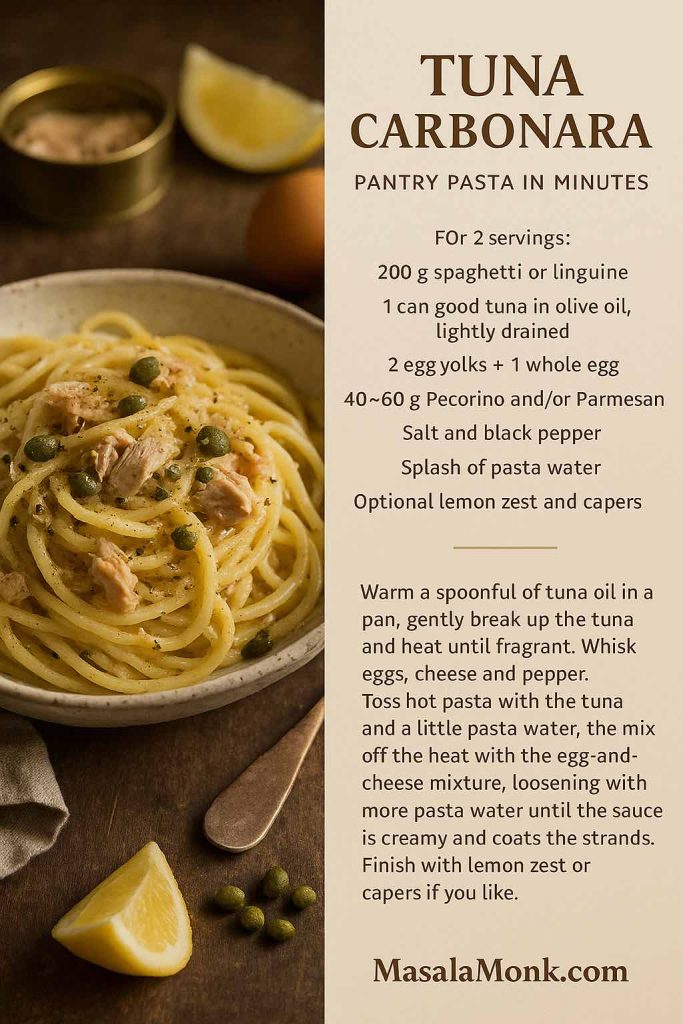
Recipe card showing a bowl of tuna carbonara with creamy spaghetti, flaked tuna, capers and lemon beside ingredients and quick instructions for pantry tuna pasta.
This tuna carbonara recipe card proves you can turn a can of tuna, eggs and cheese into a silky, lemony pantry pasta that tastes far more special than the effort it takes.

To build a simple tuna carbonara:

  • Use the standard egg-and-cheese base.
  • Swap the pork for one can of good tuna in olive oil, lightly drained.

Then:

  1. Warm a spoonful of the tuna oil in your pan.
  2. Add the tuna and break it up gently over low heat, just until fragrant.
  3. Toss in your hot pasta and a splash of pasta water; the tuna should coat the strands lightly.
  4. Move everything to the egg bowl and toss vigorously, adding more pasta water as needed.

You can brighten this variation with a bit of lemon zest or a teaspoon of capers, although you don’t have to. The eggs, cheese and tuna already make a satisfying tuna pasta carbonara without extra embellishment.

Also Read: Authentic Louisiana Red Beans and Rice Recipe (Best Ever)


Keto and Low-Carb Carbonara Recipe with Zucchini Noodles

If you’re eating low-carb or following a keto approach, the main challenge in carbonara isn’t the sauce at all; it’s the pasta. Fortunately, the flavour profile of eggs, cheese, bacon and pepper works beautifully with vegetables like zucchini.

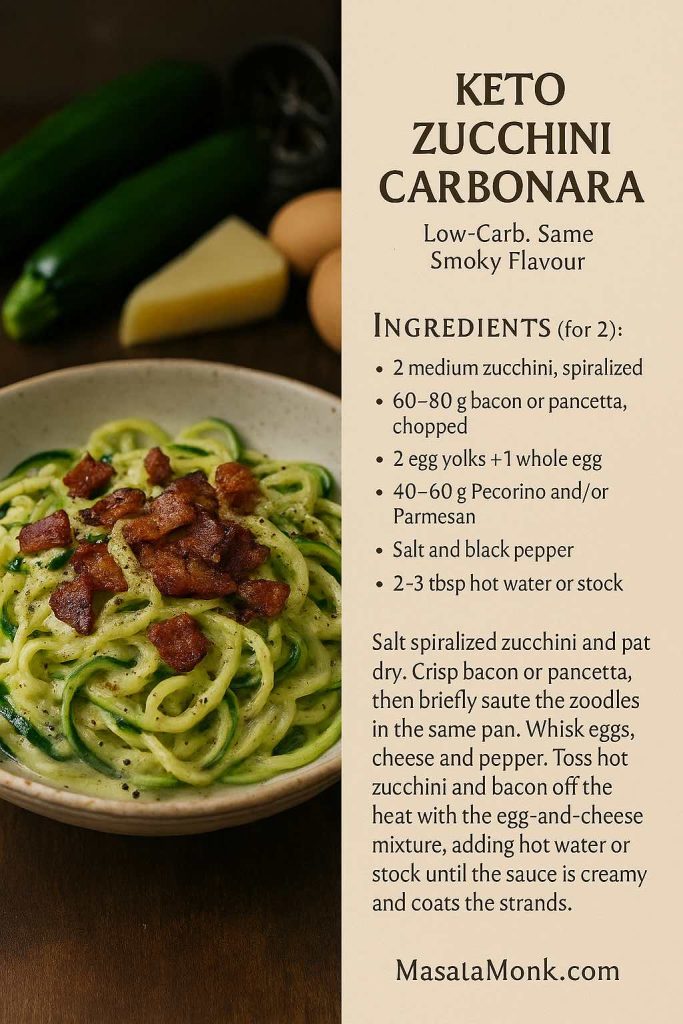
Recipe card showing a bowl of keto zucchini carbonara with spiralised zucchini noodles, crispy bacon and creamy egg-and-cheese sauce beside ingredients and method for low-carb carbonara.
This keto zucchini carbonara swaps pasta for zoodles but keeps the smoky bacon, eggs and cheese, so you still get a creamy, salty carbonara hit with far fewer carbs.

A straightforward path is to replace the spaghetti with spiralised zucchini “noodles”, also known as zoodles. Recipes such as the keto carbonara with zoodles at Diet Doctor show exactly how well that combination can work, keeping the bacon and creamy sauce while ditching the wheat. Likewise, Cooking LSL’s low-carb zucchini carbonara demonstrates a similar idea with courgette strands in place of pasta.

To try a simple version at home:

  1. Spiralise 2 medium zucchini and salt them lightly. Let them sit in a colander for 10–15 minutes, then pat dry; this removes excess moisture.
  2. Render your bacon or pancetta in a pan as usual.
  3. Add the zucchini to the pan and cook briefly—just enough to soften slightly while still keeping some bite.
  4. Whisk your eggs and cheese in a bowl.
  5. Transfer the hot zucchini and bacon into the bowl and toss, adding a couple of spoonfuls of hot water (or a splash of stock) to create a creamy coating.

The texture is different, of course; you won’t get the same chew as traditional semolina pasta. Nonetheless, the overall experience—creamy, salty, porky, peppery—lands recognisably in keto carbonara territory.

For days when you’re balancing richer meals with more careful hydration or fasting routines, MasalaMonk’s guide to homemade electrolyte drink recipes is a useful extra resource you can dip into as well.


Playing with Pasta Shapes: Spaghetti, Linguine, Fettuccine, Penne

Once you’re comfortable with the base method, changing the shape of the pasta is an easy way to keep carbonara interesting without rewriting the recipe.

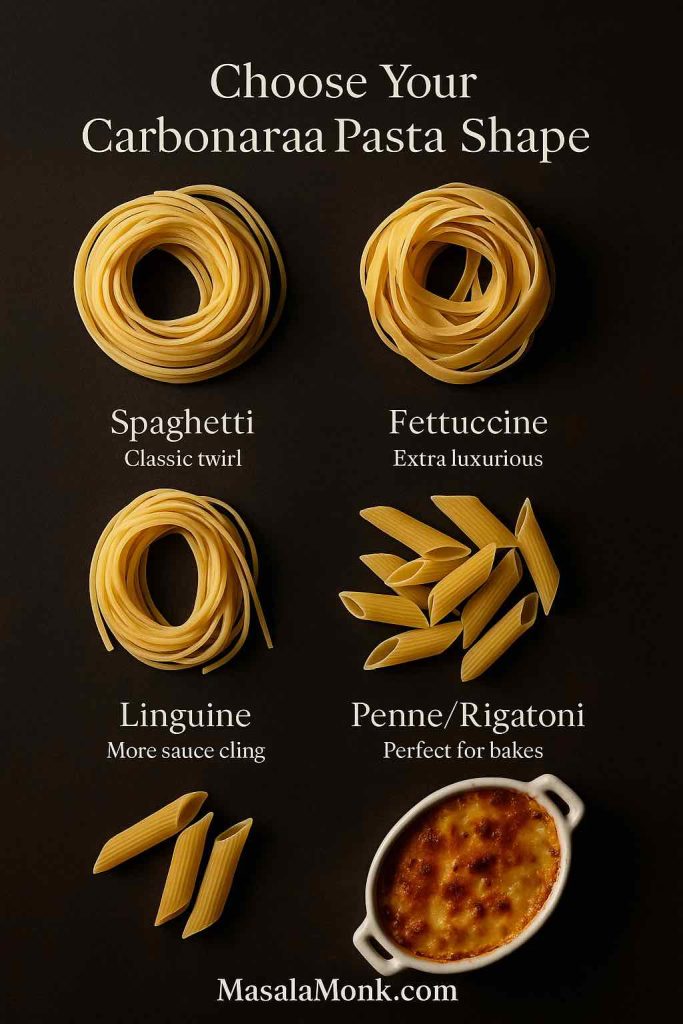
Vertical photo of four pasta shapes for carbonara—nests of spaghetti, linguine and fettuccine plus a pile of penne—arranged on a dark background with a small baked carbonara dish.
Spaghetti is the classic for carbonara, but linguine, fettuccine and short shapes like penne or rigatoni each change the experience, from twirlable strands to bake-ready tubes with bubbly cheese on top.
  • Spaghetti: the classic; it twirls beautifully and holds just enough sauce.
  • Linguine: slightly flatter, gives you more surface area for the sauce to cling to.
  • Fettuccine: verges on creamy Alfredo territory, especially in the cream-enhanced version.
  • Penne or rigatoni: tubes that capture bits of bacon and pools of sauce inside; wonderful in baked carbonara gratins.

Short shapes are especially good when you want a baked carbonara pasta. You can follow the same egg-and-cheese structure, toss it all together, then slide everything into a buttered dish, sprinkle with extra cheese and bake briefly until the top is just set and lightly browned.

Meanwhile, switching to whole-wheat or legume-based pastas—like chickpea or lentil noodles—can gently tilt your bowl toward higher fibre and protein. For more ideas along those lines, you can look at MasalaMonk’s round-up of high-protein, plant-based pasta meals, which explore exactly that balance.


What to Serve with Carbonara

Carbonara itself is rich and savoury. So, the best companions usually contrast that: fresh, crunchy, tangy or slightly bitter flavours that reset your palate between bites.

A few ideas:

  • Simple green salad: toss leaves with lemon juice, olive oil, salt and pepper. The acidity cuts through the sauce nicely.
  • Garlicky vegetables: roast or sautéed broccoli, green beans or asparagus with a squeeze of lemon.
  • Bread and dips: think toasted sourdough and a dish of something creamy yet lighter than the pasta.
Vertical photo of a carbonara meal with a bowl of spaghetti carbonara, green salad, roasted broccoli, toasted sourdough slices and small bowls of spinach dip and tzatziki on a wooden table.
A rich bowl of carbonara pairs beautifully with fresh, lemony salad, garlicky green vegetables, toasted sourdough and lighter dips like spinach or tzatziki to keep every bite feeling balanced.

If you enjoy putting sharable starters on the table, MasalaMonk’s collection of spinach dip recipes covers everything from cold, tangy dips to hot, baked ones that sit comfortably next to a carbonara night spread. On the other hand, if you’d like something fresher and more Mediterranean, their Greek tzatziki sauce variations make a cooling side for grilled chicken or vegetables served alongside your pasta.

For dessert, you don’t have to do anything complicated. Fruit and a little whipped cream, a scoop of gelato, or even just a square of good dark chocolate with coffee is often enough after such a rich main.

Also Read: How to Make Churros (Authentic + Easy Recipe)


Leftovers and Reheating

Purists will say carbonara should never see the inside of a fridge. In an ideal world, you would cook exactly the amount you plan to eat and enjoy it all while it’s at its silkiest. Real life is messier, of course, and sometimes you’ll have leftovers.

To store them:

  • Let the pasta cool quickly.
  • Transfer it to an airtight container.
  • Refrigerate for up to 2 days.
Instructional image showing leftover carbonara being cooled and stored in a lidded glass container and gently reheated in a pan with added water or milk, with text tips on cooling, refrigerating and using low heat.
Cool leftover carbonara quickly, seal it in an airtight container for up to two days, then bring it back to life over low heat with a spoonful of water or milk, stirring often so the sauce turns creamy again instead of scrambling.

Reheating takes a bit of care. Instead of microwaving on full blast (which risks scrambling the eggs), try this:

  1. Add a spoonful or two of water or milk to a pan over low heat.
  2. Tip in the leftover carbonara and break up any large clumps.
  3. Stir gently as it warms, adding another splash of liquid if it seems dry.

The sauce will never be quite as glossy as when it was first tossed, yet you can still coax it into something creamy rather than rubbery. If you like, you can grate over a little fresh cheese and crack some more pepper on top to revive the flavour.


Bringing It All Together

At its core, carbonara is one of the simplest pastas you can make: a handful of ingredients, a single pot of boiling water, and one crucial moment where you toss hot pasta into eggs and cheese and trust the heat to do its work. Once that movement feels familiar, you’re free to adapt:

  • Swap cured pork for browned mushrooms and vegetables for a vegetarian carbonara.
  • Double down on comfort with a splash of cream.
  • Turn it into a more obviously protein-focused meal with chicken or shrimp.
  • Raid the cupboard and build dinner around a can of tuna.
  • Trade the wheat pasta for zucchini noodles when you’re eating low-carb.

Alongside those variations, you can keep exploring adjacent dishes—whether that’s another creamy pasta from MasalaMonk’s Alfredo and mac-and-cheese repertoire, or low-carb zoodle ideas from places like Diet Doctor and Cooking LSL—to build your own little universe of comfort meals.

However you choose to spin it, once you’ve made this dish a few times, you’ll have more than a recipe. You’ll have a reliable, deeply comforting ritual: boil pasta, crisp something savoury in a pan, whisk eggs and cheese in a bowl, then bring everything together in one quiet, perfect toss.

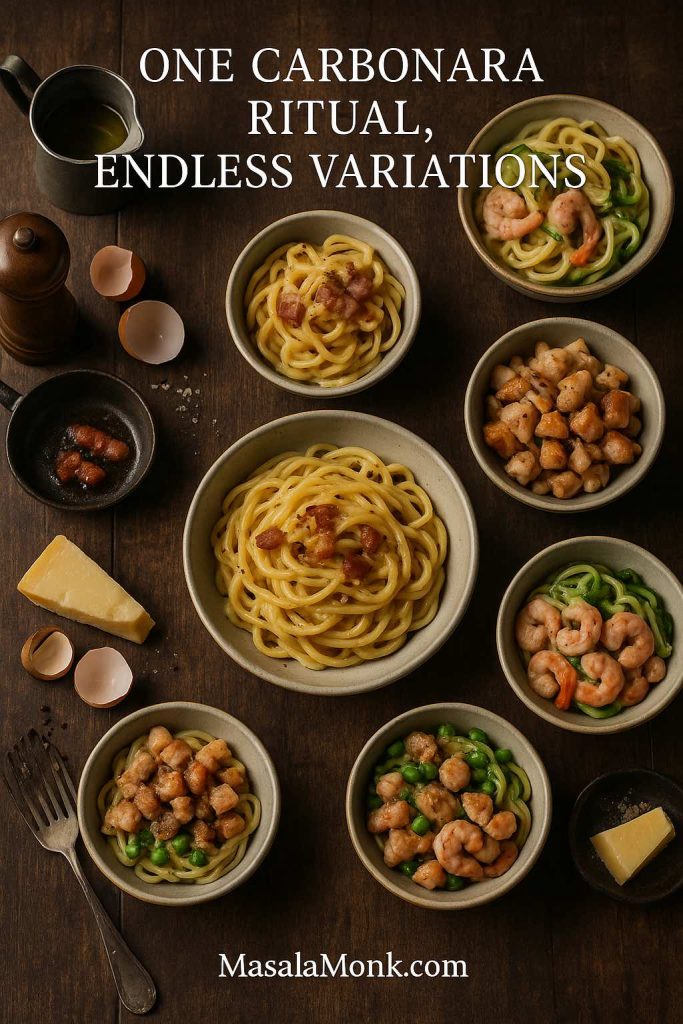
Overhead photo of a central bowl of classic spaghetti carbonara surrounded by smaller bowls of creamy, vegetarian mushroom, chicken, shrimp, tuna and keto zucchini carbonara on a wooden table.
Start with one simple carbonara ritual—boil pasta, crisp something savoury, whisk eggs and cheese, then toss it all together—and spin it into classic, creamy, vegetarian, chicken, shrimp, tuna or keto bowls depending on what you’re craving.

FAQs about Carbonara

1. What are the main ingredients in a traditional carbonara recipe?

A classic carbonara recipe usually includes just a few ingredients: dried pasta (most often spaghetti), guanciale or pancetta, egg yolks, hard cheese such as Pecorino Romano (sometimes with a little Parmesan), freshly ground black pepper and salt for the pasta water. Taken together, these create a rich, glossy sauce without any cream at all. In other words, if you have pasta, cured pork, eggs, cheese and pepper, you already have everything you need for an authentic Italian carbonara.


2. Does real carbonara use cream, or is creamy carbonara always without it?

In traditional pasta carbonara, there is no cream; the creaminess comes from egg yolks, cheese, pork fat and starchy pasta water whisked together into an emulsion. Even so, in many homes around the world people enjoy a creamy carbonara recipe that includes a small splash of cream for extra richness and stability. So, if you want a strictly authentic Italian carbonara recipe, you skip the cream; if you prefer the familiar restaurant-style creamy carbonara, a modest amount of cream can be stirred into the egg-and-cheese mixture without changing the basic method.


3. How do I stop the eggs from scrambling in spaghetti carbonara?

To keep the eggs silky instead of scrambled, the key is temperature control. Firstly, take the pan off the heat before you add the egg mixture; the pasta should be hot, but there should be no direct flame underneath. Secondly, whisk the eggs with cheese in a separate bowl, then add the hot pasta and pork into that bowl and toss constantly. Thirdly, pour in small splashes of hot pasta water as you stir, which loosens the mixture and helps the sauce coat each strand. When you treat the sauce gently like this, spaghetti carbonara becomes creamy and glossy rather than clumpy or eggy.


4. What’s the difference between carbonara and Alfredo pasta?

Although both dishes feel rich and comforting, they are built quite differently. Traditional carbonara sauce ingredients are eggs, hard cheese, cured pork, pepper and pasta water; the sauce is created by emulsifying these together off the heat. Conversely, Alfredo is usually based on butter, cream and cheese, sometimes with garlic or herbs, and often contains no egg at all. Therefore a pasta Alfredo recipe is a cream sauce that simmers on the stove, whereas an authentic spaghetti carbonara recipe is an egg-and-cheese emulsion that thickens only when it comes into contact with hot pasta.


5. Which pasta shape is best for pasta carbonara?

Spaghetti is the most common choice and works beautifully for almost every carbonara recipe. Nevertheless, other shapes also behave well: linguine gives slightly more surface area for the sauce; fettuccine feels luxurious, especially in a creamy carbonara recipe; and short shapes like penne or rigatoni trap sauce and tiny pieces of pork inside their tubes. Ultimately, any pasta that holds the sauce and cooks to a pleasant bite can be used, so you can alternate between spaghetti carbonara, linguine carbonara and penne carbonara depending on what you have in the pantry.


6. Can I make a simple carbonara recipe without pork or bacon?

Yes, you can absolutely prepare a simple carbonara recipe without pork, although the flavour profile changes. Instead of guanciale or bacon, you can brown mushrooms in olive oil until they are deeply golden, then use them as the savoury base for a vegetarian carbonara. Likewise, you might add peas, courgette or spinach for extra colour and texture. Because the egg-and-cheese sauce remains the same, pasta carbonara vegetarian versions still feel creamy and satisfying even when they contain no meat at all.


7. Is there a good vegetarian or veggie carbonara option?

There are several. A popular approach is to build a veggie carbonara with mushrooms, onions and a generous amount of black pepper, then fold in the usual egg and cheese mixture off the heat. Additionally, you can create a spaghetti carbonara vegetarian dish by using olive oil in place of pork fat, adding grilled or roasted vegetables and finishing with Pecorino or Parmesan as usual. For those who prefer a lighter plate, pasta carbonara vegetarian recipes often include extra greens like peas or kale, turning the bowl into a full vegetable-and-pasta meal rather than just a sauce replacement.


8. How can I make an easy chicken carbonara recipe?

For an easy chicken carbonara recipe, you simply add small pieces of chicken to the standard method. Sear bite-sized chunks of chicken breast or thigh in a little oil or in the rendered fat from a small amount of bacon, then set them aside while you cook the pasta. Afterward, return the chicken (and bacon, if using) to the pan, toss with the hot pasta and then combine everything with the egg-and-cheese mixture off the heat. As a result, you get a chicken carbonara pasta that keeps the silky sauce of classic spaghetti carbonara but delivers extra protein and chew in every forkful.


9. How do I adapt carbonara for shrimp or seafood?

To adapt the dish for shrimp, you cook peeled shrimp quickly in a little olive oil or bacon fat until just pink, then follow the usual carbonara steps. After the pasta is cooked, you toss it with the shrimp, add a ladle of hot pasta water and finally fold everything into the egg-and-cheese mixture. In this way, shrimp carbonara (or a broader seafood carbonara) keeps the creamy sauce and peppery bite of the original pasta carbonara while swapping the pork flavour for the sweetness of shellfish.


10. Can I make carbonara without egg, or is egg always essential?

Egg is the core of a traditional carbonara recipe; it provides both richness and structure, so a classic pasta carbonara without egg is no longer really carbonara in the strict sense. That said, there are creamy pasta dishes inspired by carbonara that use cream, cheese and starchy cooking water to imitate the texture while omitting egg entirely, which can be useful for people with allergies. In that case, you would still cook bacon or mushrooms, stir in cream and cheese, and toss with pasta water until the sauce is silky, even though it becomes more of a carbonara-style cream pasta than a true carbonara.


11. What cheese is best for spaghetti carbonara, and can I mix different cheeses?

Pecorino Romano is the classic choice for spaghetti carbonara because it’s salty, tangy and assertive enough to cut through the richness of the egg and pork. Nevertheless, many home cooks like to add some Parmesan or Parmigiano Reggiano for extra nuttiness and a slightly milder edge. Generally, a mix works very well: for example, you might use two-thirds Pecorino and one-third Parmesan in your carbonara sauce recipe. Provided the cheese is hard, dry and finely grated, it will melt smoothly into the egg mixture and help form a stable sauce.


12. How can I make a lighter or healthier carbonara recipe?

A healthier carbonara recipe doesn’t have to sacrifice comfort. One option is to use a smaller amount of bacon or pancetta, focusing on crisp texture and flavour rather than large chunks. Another possibility is to combine whole-wheat or legume-based pasta with plenty of vegetables, turning the dish into a high-fibre, high-protein pasta carbonara. Furthermore, you can favour extra egg whites over yolks to decrease fat slightly while maintaining body in the sauce. Paired with a crisp salad or steamed greens, this style of carbonara feels indulgent but more balanced.


13. Is keto carbonara possible, and what can I use instead of regular pasta?

Keto carbonara is very achievable, since the sauce ingredients—eggs, cheese, bacon and pepper—are naturally low in carbohydrates. The main change lies in the “pasta”. Many people spiralise zucchini into zoodles and treat them as a stand-in for spaghetti, while others use hearts-of-palm noodles or other low-carb alternatives. After you cook the courgette strands briefly in bacon fat, you simply toss them with the egg-and-cheese mixture and a spoonful of hot water, exactly as you would with wheat pasta. Consequently, keto carbonara with zucchini noodles offers the same savoury, creamy flavours in a carb-conscious format.


14. Why is my carbonara dry or clumpy instead of smooth and glossy?

A dry or clumpy carbonara usually signals either too little liquid or too much heat. If you don’t add enough hot pasta water when you toss the pasta with the egg mixture, the sauce can seize and cling in thick patches rather than forming a thin coating. Also, if the pan or bowl is too hot, the eggs can overcook and turn grainy. To prevent this, remove the pan from direct heat, transfer the pasta immediately into the egg bowl, and gradually add hot water while you stir. By adjusting the consistency little by little, you can rescue a stiff sauce and turn it into the smooth, shiny carbonara you’re aiming for.


15. How long does carbonara last, and can I reheat it safely?

Carbonara is best eaten fresh, yet it can be stored for a short time. Typically, leftover pasta carbonara keeps for up to two days in the fridge if you cool it quickly and seal it in an airtight container. When reheating, gentle heat is crucial; otherwise, the eggs can scramble and the sauce may become oily. A practical method is to warm a splash of water or milk in a pan over low heat, then add the cold carbonara and stir constantly until it loosens and heats through. Although the texture won’t be identical to a freshly made spaghetti carbonara recipe, it will still be tasty and comforting enough for a quick lunch.

Posted on 5 Comments

Parmesan vs. Parmigiano Reggiano and Others

Parmesan vS. Parmigiano Reggiano

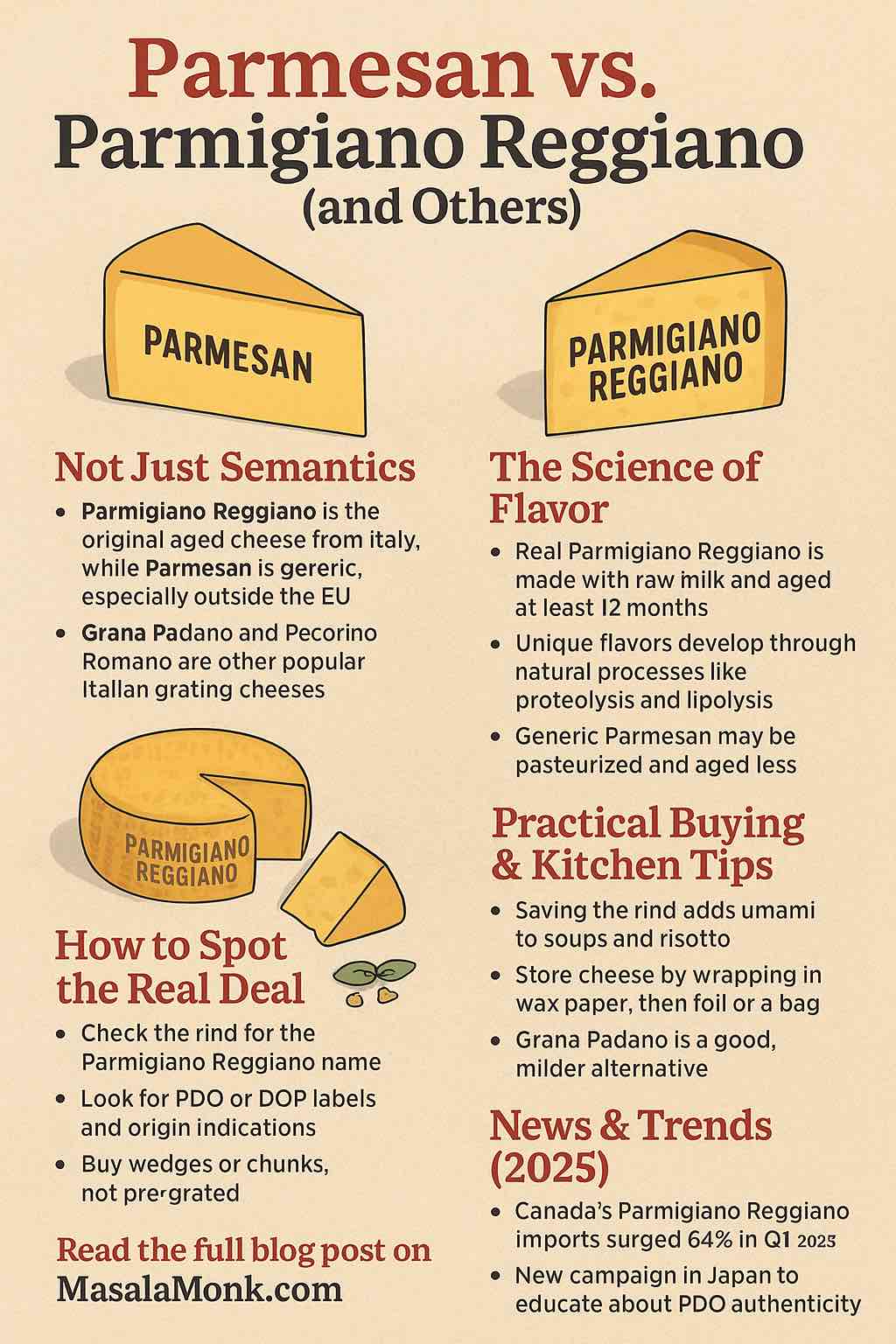
First: not all cheeses labeled “Parmesan” are created equal. In Europe, the law is strict: “Parmesan” is a legal synonym for Parmigiano Reggiano, and must come from select provinces in Italy, made according to centuries-old rules. It’s aged at least 12 months, but the best stuff is aged 24–36 months or more. Anything less is literally illegal to call “Parmesan” in the EU.

Cross an ocean, and things get muddy. In the US, Australia, India, and much of the world, “Parmesan” is generic—any hard, cow’s milk cheese vaguely inspired by Parmigiano can use the name. These cheeses are often industrially produced, aged less, and can contain added cellulose, potassium sorbate, or even anti-caking agents.

In other words: Not every Parmesan is Parmigiano Reggiano, but every Parmigiano Reggiano is a Parmesan. But if you want the real-deal experience, you need the full name.


Other Italian Grating Cheeses: Not Just for Show

  • Grana Padano: The “cousin” cheese—also from northern Italy, similar texture but a little milder, creamier, and usually cheaper. It’s aged less, and the cows’ diet can include silage as well as hay.
  • Pecorino Romano: This is a sheep’s milk cheese, grainy, intensely salty, and tangy. It’s the signature grating cheese of Rome and a backbone of cacio e pepe, carbonara, and amatriciana.
  • American Parmesan: In the U.S. (and similar markets), this can mean anything from a fairly faithful imitation of Parmigiano Reggiano to a mild, waxy, pre-grated cheese with fillers. Buyer beware.

How Parmigiano Reggiano Is Made: A Love Letter to Tradition

To qualify as Parmigiano Reggiano, a cheese must come from cows grazing in the designated region—fed mainly on local grass and hay. Milk from the morning and previous evening is mixed in massive copper vats. It’s gently warmed and curdled using natural calf rennet. The curds are broken into rice-sized grains, heated, then pressed into wheels and soaked in brine for nearly a month. Then, the real magic happens: aging in vast, cool warehouses, for years.

During this time, enzymes and microbes quietly go to work:

  • Proteolysis: Long protein chains break down into peptides and amino acids (like tyrosine and leucine—those little white “crystals” you crunch).
  • Lipolysis: Fats break down into free fatty acids and aromatic compounds. This is why real Parmigiano Reggiano is so intensely aromatic, with hints of nuts, pineapple, even brown butter.
  • No artificial enzymes, no shortcuts. Just milk, rennet, salt, and time.

Contrast this with most generic Parmesan, which may be made with pasteurized milk (which kills native bacteria), industrial enzymes, and can be aged as little as 10 months.


The Flavor and Texture Showdown

A wedge of real Parmigiano Reggiano is firm and grainy, with tiny crunchy crystals (a hallmark of slow, natural aging). When you break it, it splinters rather than slicing cleanly. The flavor is deeply savory, nutty, and complex, with a clean, lingering finish and almost sweet undertones.

Generic Parmesan is often smoother and waxier, with less granularity. It can taste simply salty, bland, or one-dimensional. Sometimes it has a slightly rubbery mouthfeel, especially in pre-grated forms. Even if the ingredient list is pure (“milk, salt, rennet”), if it’s aged less or industrially processed, the flavor never achieves the same depth.


Is It Worth the Price? A Practical Perspective

Real Parmigiano Reggiano is expensive—but it’s powerful. You need less to achieve a punch of flavor, and it lasts a long time if stored properly. You’re not just buying a “cheese topping,” you’re buying an ingredient that transforms simple dishes: pasta, risotto, salads, eggs, and even vegetables.

Budget tip:

  • Use generic Parmesan or Grana Padano for melting into sauces or bulk cooking, where the nuances get lost.
  • Save Parmigiano Reggiano for finishing, cheese boards, and snacking.

Also, consider buying a larger chunk (often more economical per gram), dividing it, and freezing extra portions. Well-wrapped, it keeps beautifully.


How to Spot the Real Deal: No More Cheese Scams

  • Check the Rind: Authentic Parmigiano Reggiano has the name stenciled repeatedly in dots around the rind. No rind? Ask to see the whole wheel, or skip it.
  • Aging Details: Look for “24 mesi” (months), “36 mesi,” or “Stravecchio” for extra-aged versions. Aging makes a huge difference in both texture and flavor.
  • Pre-grated Caution: Pre-grated cheese loses aroma rapidly and may be cut with cellulose to prevent caking. If it comes in a shaker and isn’t refrigerated, it’s not the real deal.
  • Country of Origin: In most countries, the real stuff will be labeled “Product of Italy” and “Parmigiano Reggiano DOP” (Protected Designation of Origin). If you see only “Parmesan” and a domestic producer, it’s a knockoff.

Pro tip: Some cheesemongers cut and wrap real Parmigiano to order. If you see a wedge with a visible rind, ask for a small taste—real cheese shops won’t mind.


The Hidden World of Cheese Fakes and the Global Market

Fake Parmesan is big business—worth billions. In some countries, up to 90% of “Parmesan” sold is not authentic. The Parmigiano Reggiano Consortium is constantly fighting imitations, even using microchip tracking and blockchain tech on their wheels!

Meanwhile, demand is booming. Canada’s imports jumped 64% in a single quarter this year. Massive tariffs in the US haven’t slowed enthusiasm—American fans are snapping up wheels even at $30+ per pound. In Japan, massive ad campaigns are educating new generations of cheese lovers about PDO rules. There’s even a world record: a 27-year-old Parmigiano Reggiano wheel, recently authenticated and valued over €20,000.


Storage, Serving, and Everyday Kitchen Tricks

  • Storage: Always wrap wedges in wax or parchment paper, then a loose layer of foil or a zip bag. Never plastic wrap alone—cheese suffocates and goes stale.
  • Grating: For fluffy snow, use a microplane. For chunkier bits (great on salads or in risotto), use the large holes on a box grater or a cheese knife to shave “flakes.”
  • Rind Magic: Never throw away the rind! Add it to simmering soups, beans, or sauces for a slow, subtle infusion of umami.
  • Freezing: Cut your wedge into small pieces and wrap tightly. Thawed Parmigiano Reggiano can be a little more crumbly, but the flavor is still there—perfect for cooking.

Tasting Exercise: Become a Cheese Detective

Grab a wedge of Parmigiano Reggiano and a chunk of generic Parmesan (even pre-grated if that’s what’s available). Break each in half and look at the texture—do you see crystals in the real one? Smell each: the real deal should be nutty, buttery, a little fruity. The imitation may have a “flat” or salty aroma.

Now taste, plain. Let a small piece dissolve on your tongue. Parmigiano Reggiano evolves—first sweet, then nutty, then deeply savory, and never just salty. It lingers, with a subtle crunch. The generic will likely be one-note and fade quickly.

Try grating both over pasta with nothing but butter and black pepper—see how the real cheese coats the noodles, melting into a creamy sauce with just a little pasta water.


Cheese in Global Cooking: Beyond Italian Pasta

Parmigiano Reggiano is a staple for classic Italian dishes, but don’t stop there.

  • Shave it onto roasted vegetables, or toss with olive oil for a savory salad.
  • Fold it into biscuit or bread dough for extra flavor.
  • Stir into polenta or scrambled eggs.
  • Add chunks to a cheese board with aged balsamic, dried figs, or walnuts.

Pecorino Romano is perfect in Roman-style pastas and on hearty greens, while Grana Padano is mellow and works anywhere you’d use Parmesan for a milder finish.


Cheese and Health: It’s Not Just an Indulgence

Hard, aged cheeses like Parmigiano Reggiano are protein-dense (about 30% by weight!), packed with calcium and phosphorus, and naturally low in lactose (the aging process breaks it down). Even people who are mildly lactose intolerant often tolerate aged cheese well.

A little goes a long way—flavorful cheeses mean you use less for the same satisfaction. Plus, real Parmigiano Reggiano contains no preservatives or additives, just three ingredients and time.


The Future: Innovation, Records, and Why Authenticity Matters

Producers in Italy are experimenting with new traceability methods, including edible microchips in the rind and blockchain-backed certificates. This is in response to ever more sophisticated counterfeiting. Producers are also responding to climate and market pressures, but the basics—milk, salt, rennet, and time—haven’t changed in centuries.

A wheel from 1997 recently became the world’s oldest certified edible Parmigiano Reggiano, and fetched record interest at auction. Meanwhile, consumer education campaigns are helping more people globally understand what’s in their cheese and why it’s worth seeking out the real thing.


Bottom Line: What Should You Actually Buy?

If you love cheese, you owe it to yourself to try true Parmigiano Reggiano at least once—especially aged 24 months or longer. Use it as a finishing cheese, where its flavor shines. For everyday melting, casseroles, or when feeding a crowd, Grana Padano or a decent generic Parmesan does the trick.

If price is a concern, buy a small piece, treat it well, and make it last. The flavor payoff is enormous, and the kitchen possibilities are endless.
Most of all: pay attention to what you’re eating, and enjoy the difference. You’ll never look at that green canister of “Parmesan” the same way again.


Have your own Parmesan tales, tips for storing wedges, or favorite recipes for using up the rind? Drop a comment below—let’s talk real cheese.

Frequently Asked Questions (FAQ)

1. Is there a real difference between Parmesan and Parmigiano Reggiano?
Answer: Yes. Parmigiano Reggiano is a protected cheese made in specific Italian regions under strict rules. Parmesan, outside Europe, is a generic term and may be made anywhere, often with less aging and different production standards. In the EU, “Parmesan” must legally be Parmigiano Reggiano.


2. How do I know if the Parmesan I’m buying is real Parmigiano Reggiano?
Answer: Look for the dotted “Parmigiano Reggiano” stenciled on the rind, the PDO or DOP seal, and “Product of Italy.” Real Parmigiano Reggiano is usually sold in wedges, not pre-grated, and will mention the aging period (e.g., 24 or 36 months).


3. What is Grana Padano, and can I use it instead of Parmigiano Reggiano?
Answer: Grana Padano is a hard, aged cow’s milk cheese from northern Italy. It’s similar to Parmigiano Reggiano but milder, creamier, and less expensive. It’s a good substitute for cooking, but has a gentler flavor and texture.


4. Why is Parmigiano Reggiano so expensive?
Answer: It’s made with raw milk from specific cows, using traditional methods, and aged for at least a year (often longer). The process is labor-intensive, and each wheel is carefully inspected and certified. The flavor and texture are a result of this care and time.


5. What should I look out for to avoid fake Parmesan?
Answer: Avoid ultra-cheap, pre-grated, or shelf-stable “Parmesan” (especially if it contains additives like cellulose). Always check for the origin, rind markings, and official seals. Buy from reputable cheesemongers or trusted shops when possible.


6. How should I store Parmigiano Reggiano or Parmesan at home?
Answer: Wrap it in wax or parchment paper, then a loose layer of foil or a resealable bag. Store it in the fridge (preferably the cheese drawer). Change the wrapping every 1–2 weeks. You can also freeze it in chunks for long-term storage.


7. Is pre-grated Parmesan as good as freshly grated?
Answer: No. Pre-grated Parmesan loses aroma and flavor quickly and may include anti-caking agents or fillers. For best taste and texture, buy a wedge and grate it fresh as needed.


8. Can people who are lactose intolerant eat Parmigiano Reggiano?
Answer: Most can! Parmigiano Reggiano is naturally very low in lactose due to the long aging process. However, those with severe allergies should consult their doctor.


9. What’s the best way to use the rind of Parmigiano Reggiano?
Answer: Add the rind to soups, stews, or risotto while cooking for a deep, savory umami boost. Remove the rind before serving. It’s a traditional Italian “chef’s secret” for extra flavor.


10. Is there a big difference in nutrition between these cheeses?
Answer: All hard, aged cheeses are rich in protein, calcium, and umami compounds. Parmigiano Reggiano is made without additives and has the cleanest label. Generic Parmesan can sometimes contain preservatives or anti-caking agents, so check ingredients if nutrition is a concern.