
Cacio e pepe looks like the sort of pasta you should be able to make half-awake: noodles, Pecorino Romano, black pepper. Then the cheese hits a pan that is a little too hot and suddenly you are staring at rubbery knots surrounded by watery pasta.
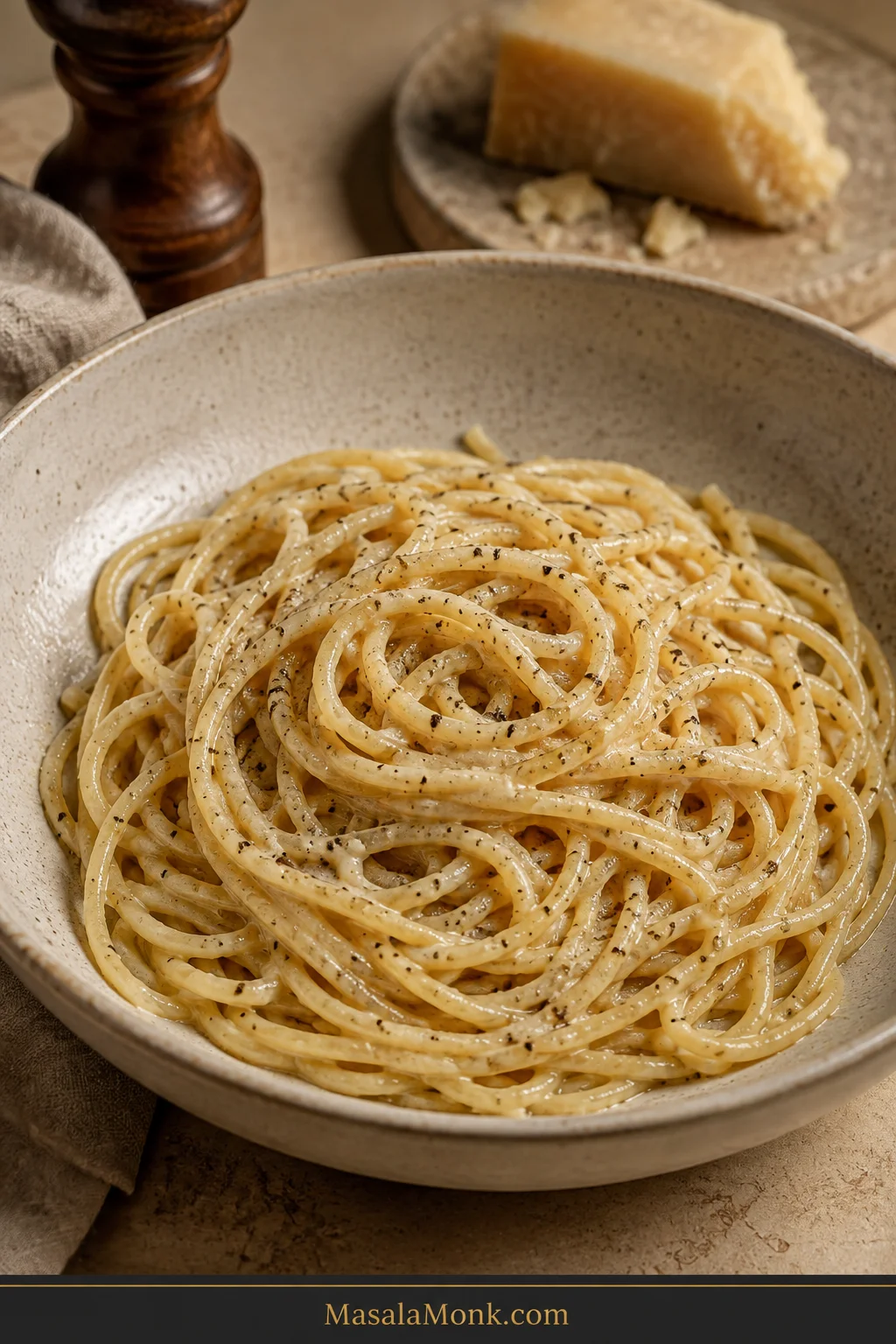
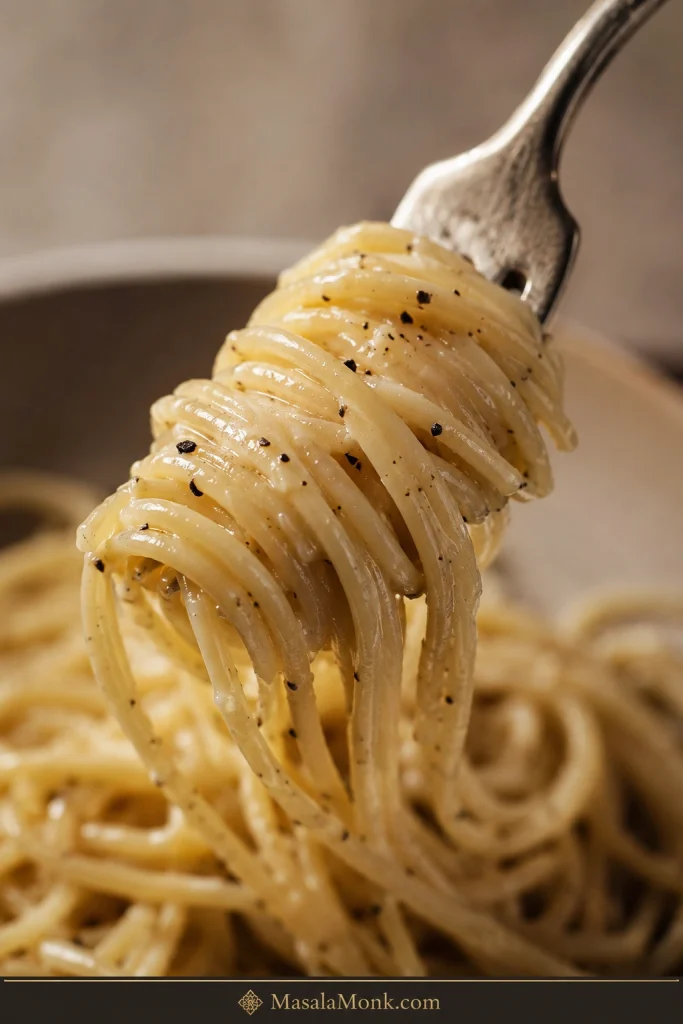
When it works, nothing looks forced. The spaghetti still moves under the tongs, pepper freckles the strands, and the Pecorino turns the cloudy pasta water into a glossy coating that feels creamy even though it contains no cream, butter or oil.
Fixing it does not take another ingredient. It means giving these simple ingredients the right conditions: finely grated cheese, concentrated pasta water, gentler finishing heat and small adjustments instead of big ones. This recipe stays with the Roman essentials and gives you visible cues for the moments when a clock alone is not enough.
Quick Answer: The Cacio e Pepe Method in One Minute
The method at a glance
Cook the pasta in relatively shallow water so the liquid becomes properly cloudy and starchy. While the pasta still has time, use some of that water—cooled until warm and only faintly steaming—to turn finely grated Pecorino into a thick paste.
Toast the pepper just before the skillet stage, then finish the underdone pasta in the peppery starch. Once the pasta is al dente, move the skillet completely off the burner and give the pan a brief cooling pause before adding the cheese.
Rule to remember: build the starch while the pan is hot; build the cheese sauce after the harsh heat has passed. Add any extra pasta water by tablespoons and stop while the sauce still looks a touch loose.
Cacio e Pepe Recipe
This cacio e pepe recipe uses dried bronze-cut spaghetti, Pecorino Romano, black pepper and concentrated pasta water to make a silky sauce. The quantities make two generous bowls. Build the starch first, have the Pecorino paste ready, then bring everything together only after the pan is away from direct heat.
Also serves: 3 smaller first-course portions
Method: Stovetop
Best starting pasta: Bronze-cut dried spaghetti
Final cue: Glossy, fluid sauce that is slightly looser than serving consistency
Ingredients
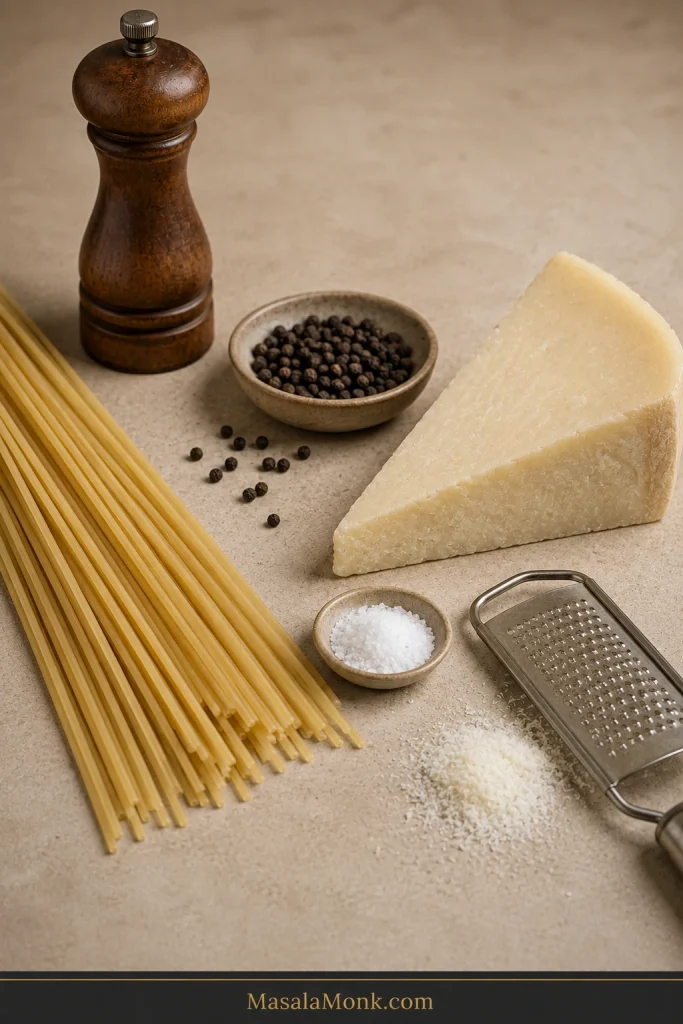
- 200 g / 7 oz bronze-cut dried spaghetti (dried tonnarelli also works; fresh tonnarelli needs different timing)
- 110 g / 3.9 oz Pecorino Romano PDO, very finely grated
- 3 g whole black peppercorns, about 1½ teaspoons before crushing, plus more to finish
- About 1 L / 4¼ cups water, or just enough to cover the pasta in a wide pan
- 4 g fine sea salt, about ¾ teaspoon, using less if your Pecorino tastes especially salty
Equipment
- Wide pan for cooking the pasta in relatively shallow water
- 10- to 12-inch / 25- to 30-cm skillet for finishing
- Fine or star side of a box grater
- Heatproof bowl plus a small heatproof cup for cooling pasta water
- Tongs and a ladle or heatproof measuring cup
- Digital scale, strongly recommended for the Pecorino
Instructions
Build the starch and Pecorino base
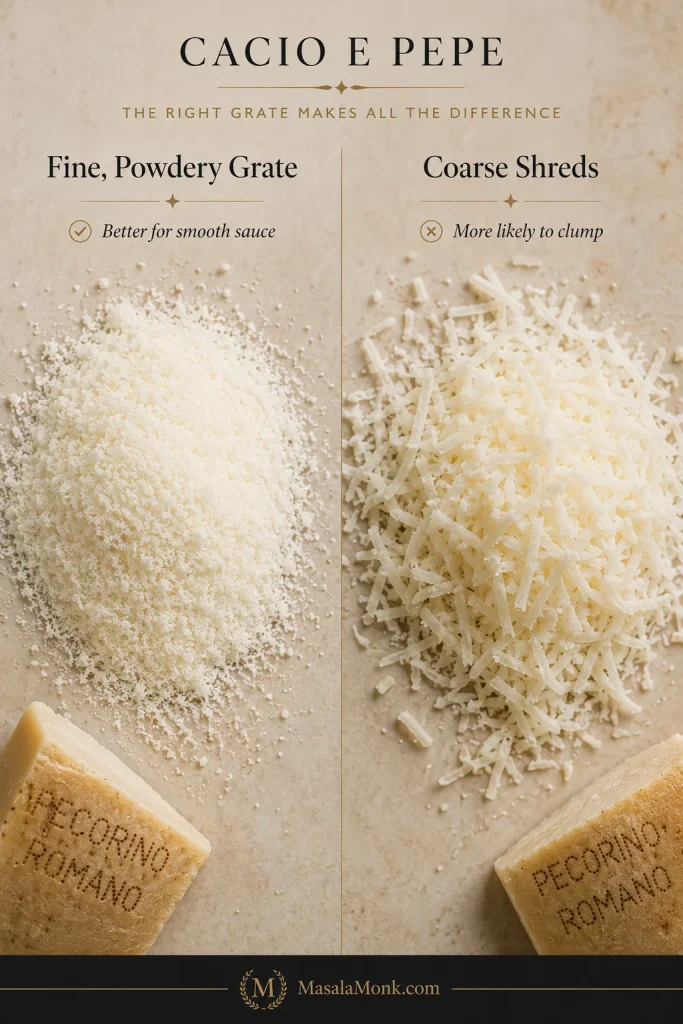
- Grate and divide the Pecorino. Finely grate all 110 g. Reserve about 10 g for serving and put the remaining 100 g in a heatproof bowl. It should look fine and powdery, not like long shreds.
- Start the pasta in shallow water. Bring about 1 L / 4¼ cups water to a boil in a wide pan. Add the measured salt and the pasta. Stir frequently during the first few minutes. If the tips sit above the water at first, let the submerged ends soften briefly and ease the rest under instead of breaking the spaghetti. If your pan still needs more water to cover the strands, add only what is necessary.
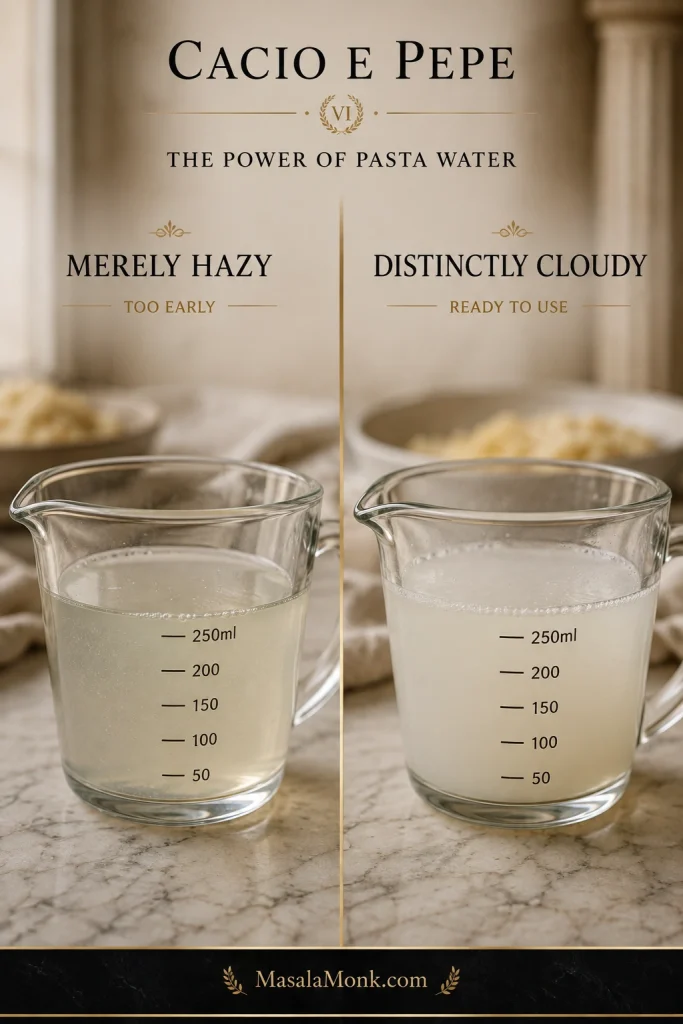
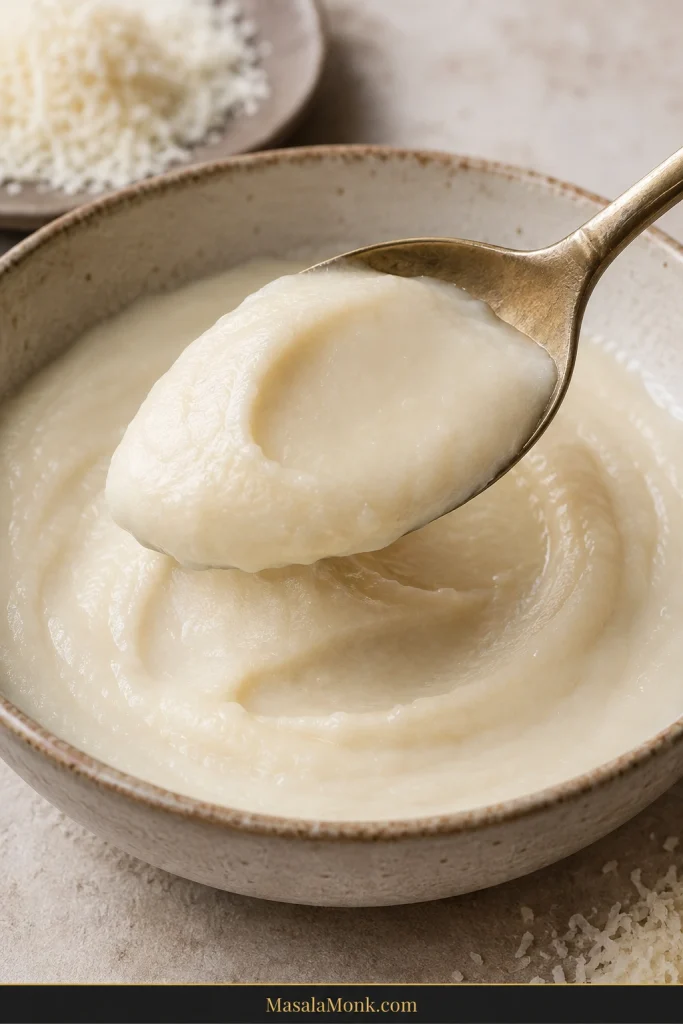
- Make the Pecorino paste while the pasta still has time. Once the pasta has cooked long enough for the water to become distinctly cloudy—not merely hazy—scoop some into a small heatproof cup and let it cool until warm and only faintly steaming. Gradually stir about 3 tablespoons / 45 ml into the 100 g Pecorino. Add another tablespoon only if needed. The paste should be smooth, thick and spreadable, with enough body to hold its shape on a spoon. Set it beside the stove.
- Toast the pepper just before the skillet stage. Coarsely crush the peppercorns. Warm the finishing skillet over medium-low heat and toast the pepper for about 45–60 seconds, stirring or shaking, until deeply aromatic. Stop before it smokes or develops a burnt smell.
- Start the pepper base and transfer the pasta. Add about ¼ cup / 60 ml cloudy pasta water to the toasted pepper and let it bubble gently. When the dried spaghetti is still about 2–3 minutes shy of al dente, transfer it to the skillet with tongs.
Finish the pasta and make the sauce off heat
- Finish the pasta in the skillet. Toss while it finishes cooking, adding small splashes of pasta water only when needed. At al dente, you want a shallow amount of glossy, cloudy liquid slipping around the strands—not a dry pan and not pasta swimming in water.
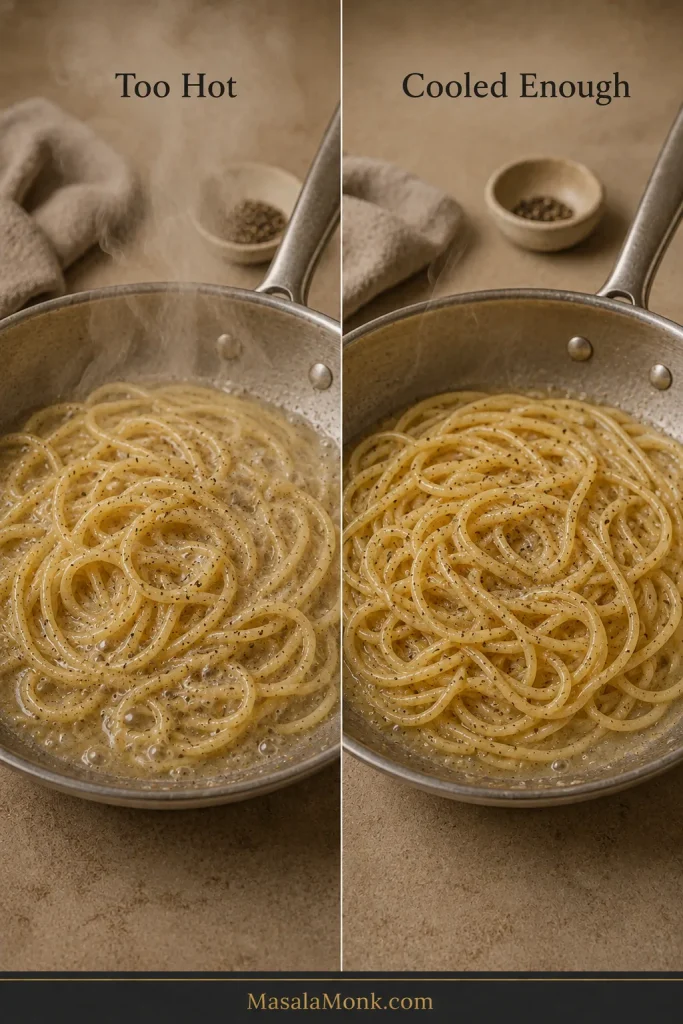
- Let the skillet cool. Move it completely off the burner. Start checking after about 30 seconds and wait until the strongest steaming has visibly eased; a heavy skillet may need closer to a minute or longer.
- Make the sauce off heat. Add the Pecorino paste in two or three additions, tossing vigorously after each. If the sauce tightens, add warm pasta water 1 tablespoon / 15 ml at a time, tossing fully before adding more.
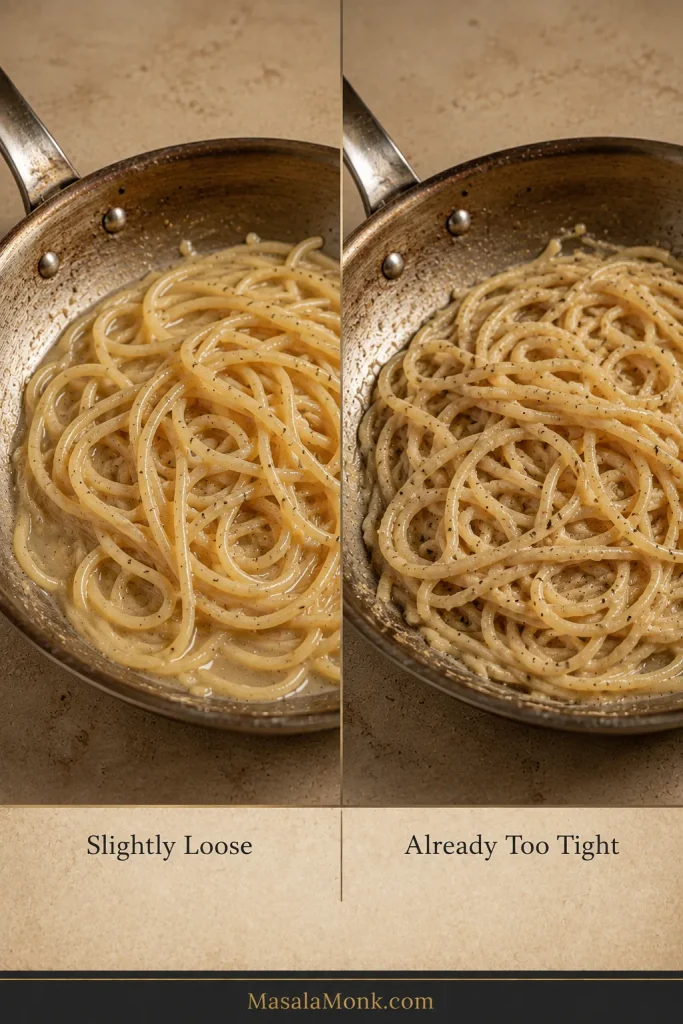
- Plate it loose. Stop when every strand is glossy and coated, the pasta still moves easily under the tongs, and there are no visible cheese clumps or watery puddles. Taste one strand: the pepper should be clearly present and the Pecorino sharp and salty without becoming harsh. If it needs more punch, reach for pepper before automatically adding more salt or cheese. Take cacio e pepe to the table a little too loose rather than a little too tight—the trip from skillet to fork fixes the first problem and worsens the second. Serve immediately on warm plates with the reserved Pecorino and more pepper.
Recipe Notes
- Keep the cheese step off direct heat. Residual heat is enough; if your skillet is heavy and holds heat well, give it a longer cooling pause.
- Weigh the Pecorino when possible. Grated-cheese volume changes dramatically with grater style and packing.
- Salt lightly. Pecorino Romano supplies much of the final seasoning.
What should good cacio e pepe taste like? The first bite should have a clear black-pepper bite, followed by the salty, savory sharpness of Pecorino. Richness should come from the way the sauce clings to the pasta, not from a buttery or creamy taste. A good bowl still tastes unmistakably of pasta underneath all that cheese and pepper.
Cacio e Pepe Guide: Jump to What You Need
What Makes This Cacio e Pepe Authentic?
Here, “authentic” refers to the ingredient core, not one rigid motion every Roman cook must follow. The classical dish is built from pasta, Pecorino Romano and black pepper, with starch-rich pasta water helping those ingredients become sauce. This recipe does not add cream, butter, olive oil, garlic or Parmesan.
Cacio e pepe is commonly grouped with carbonara, amatriciana and gricia as Rome’s four classic pasta dishes. They share a Roman pantry and a knack for turning a short ingredient list into something much larger than it looks.
The technique can vary. Some cooks work grated Pecorino directly into the pasta; others make a cheese paste first or cool the pan for longer.
Making a Pecorino paste and finishing off heat gives the cheese a gentler path into the sauce while keeping the Roman essentials intact. Butter, Parmesan, cream and added starch can all make good pasta too; they simply lead to different versions of the dish.
Cacio e Pepe Ingredients: Choosing Pecorino, Pepper and Pasta
Before you cook, two choices matter disproportionately: use real Pecorino Romano and grate it much finer than you might expect. Pasta shape matters too, while water management becomes the bigger decision once you start cooking.
Best Cheese for Cacio e Pepe: Pecorino Romano PDO
Use Pecorino Romano PDO (DOP on Italian labels): the firm, salty sheep’s-milk cheese that defines the Roman sauce. Its sharp, savory bite is a big reason such a short ingredient list tastes so full.
Buy a wedge and grate it shortly before cooking when you can. You do not need to hunt down Pecorino of one particular age; genuine Pecorino Romano PDO, very fine grating and careful heat matter more here.
Use the fine or star side of a box grater and aim for small, powdery particles rather than long ribbons. A Microplane can work, though its very fluffy shreds make volume especially misleading. That is why the recipe uses grams first. If you are comparing Pecorino with Parmigiano Reggiano, Grana Padano or generic Parmesan, MasalaMonk’s Parmesan vs. Parmigiano Reggiano guide explains how those hard cheeses differ.
Black pepper should taste like an ingredient. Use whole peppercorns and crush them shortly before cooking. The measured amount gives the sauce a clear pepper bite; you can always grind more over the finished bowl. You want coarse, irregular flecks that stay aromatic in the pasta. As they toast, the skillet should smell unmistakably peppery before the color changes much. Stop there; once pepper starts smelling scorched, there is nowhere for that bitterness to hide.
Use less water than a normal pasta pot
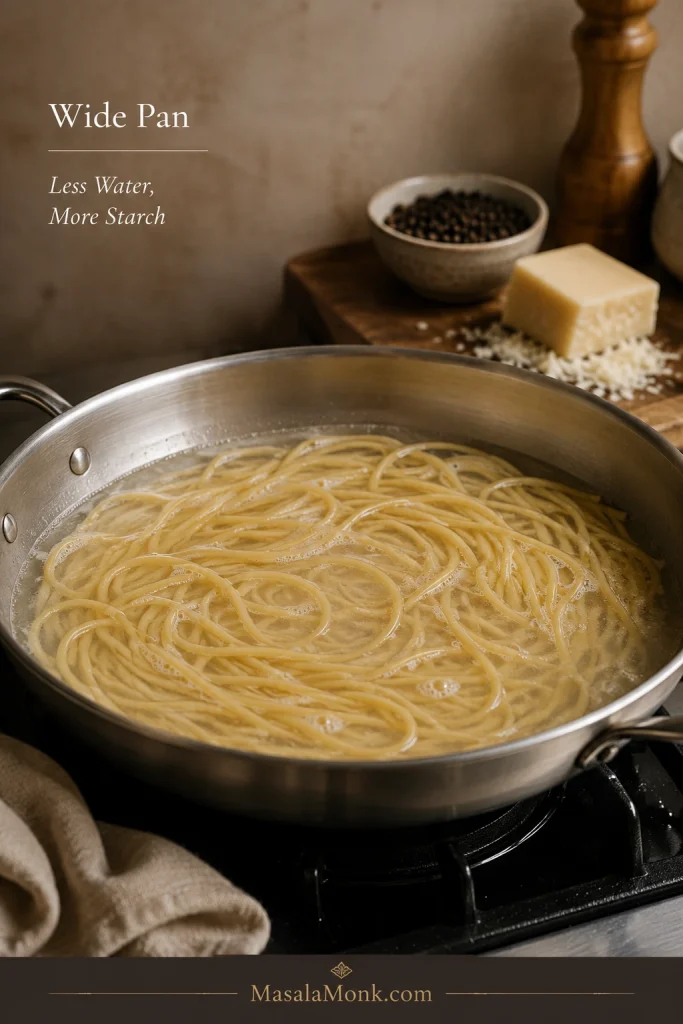
For 200 g / 7 oz pasta, start with about 1 L / 4¼ cups water in a wide pan. Pan shape matters, so use more if the spaghetti needs it to soften, submerge and move freely. Keep the volume low enough that the cooking water grows distinctly cloudy as the pasta cooks. The same concentrated-water habit is useful in our vodka pasta, where the tomato-and-dairy base gives you more room for correction.
Salt with the Pecorino in mind
This is not the pasta for aggressive “salt it like the sea” advice. Pecorino Romano supplies a large part of the seasoning, so start light and taste the cheese before the water boils. It is much easier to add more Pecorino at the table than to rescue an oversalted sauce.
Cacio e Pepe Sauce: Why It Gets Creamy Without Cream
The sauce forms when finely grated Pecorino, water and pasta starch are tossed together until they cling to the strands as one silky coating. Pre-hydrating the cheese into a thick paste gives that dispersion a controlled starting point instead of asking dry Pecorino to meet the pan all at once.
Why the pan needs to cool before the cheese goes in
Heat is the awkward part. Pecorino needs warmth to soften and disperse, but too much heat is the moment smooth cheese starts turning grainy or pulling into rubbery clumps. So the recipe uses the hottest part of cooking for the pasta and starch, then lets the pan settle before the cheese joins in.
A 2025 Physics of Fluids paper, “Phase behavior of Cacio e Pepe sauce”, mapped this interaction experimentally and found starch concentration to be a major factor in sauce stability. The researchers also built an optimized version with measured added starch.
We do not add starch here, and you do not need to add any to use the lesson. Concentrate what the pasta already releases, keep a shallow film of cloudy liquid around the strands, and keep the Pecorino away from direct heat.
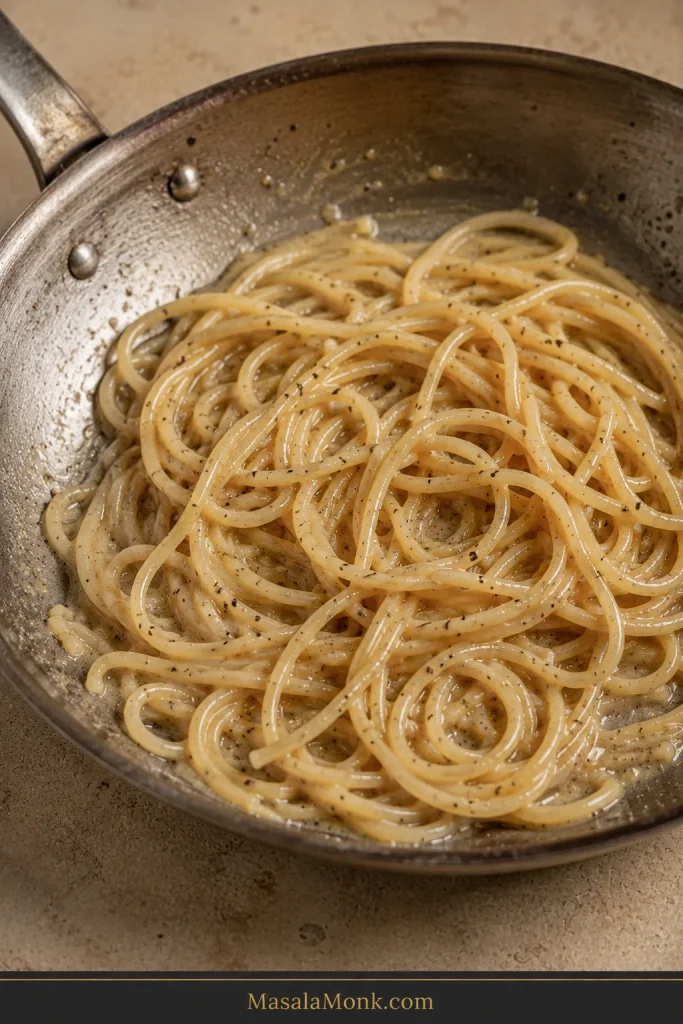
About temperature: there is no single number that makes every Pecorino, pan and starch concentration behave identically. Use the clock only as a starting point: move the skillet off the burner, let the strongest steam ease, then add the cheese in stages.
How to Make Cacio e Pepe Without Clumps: 4 Cues to Watch
| Moment | What you want | Warning sign |
|---|---|---|
| Grated Pecorino | Fine, powdery particles that hydrate quickly | Long coarse shreds that hydrate unevenly and clump more easily |
| Pasta before cheese | Al dente strands with a shallow amount of cloudy liquid still moving around them | A bone-dry pan or pasta swimming in clear water |
| Pan before Pecorino | Off the burner with the most aggressive steaming visibly eased | Roaring steam and a pan still acting like it is over direct heat |
| Finished sauce | Glossy, fluid and clinging; pasta moves easily under the tongs | Stiff, pasty coating or watery liquid collecting underneath |
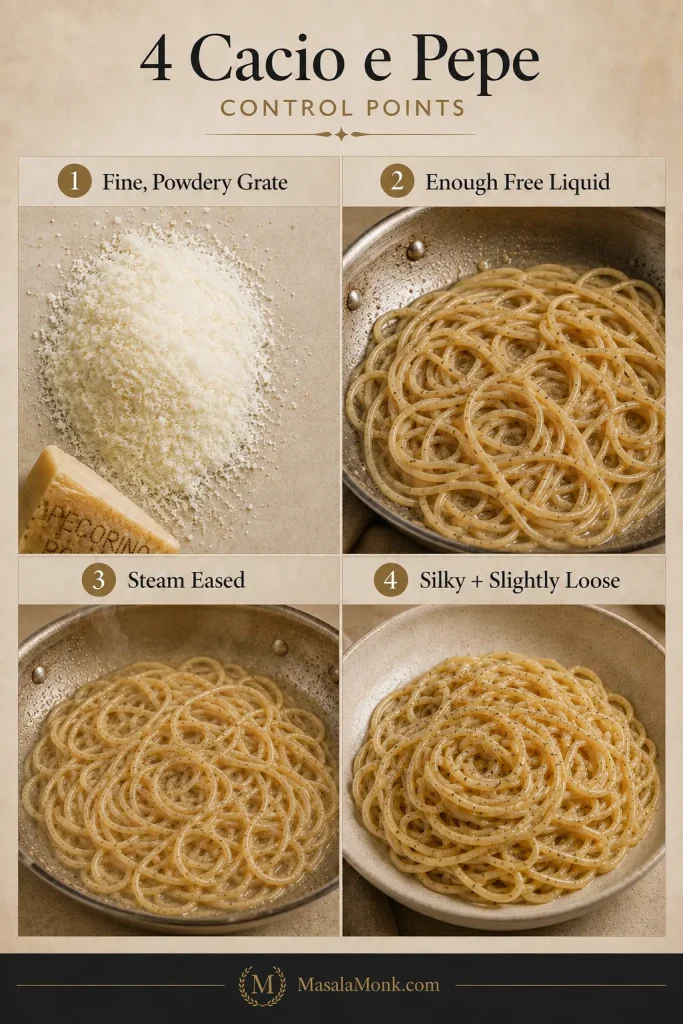
When those four cues line up, the final toss is usually almost uneventful: the Pecorino disappears into the cloudy liquid and the strands turn silky as you keep them moving. One last judgment remains: knowing when the sauce is loose enough to leave the pan.
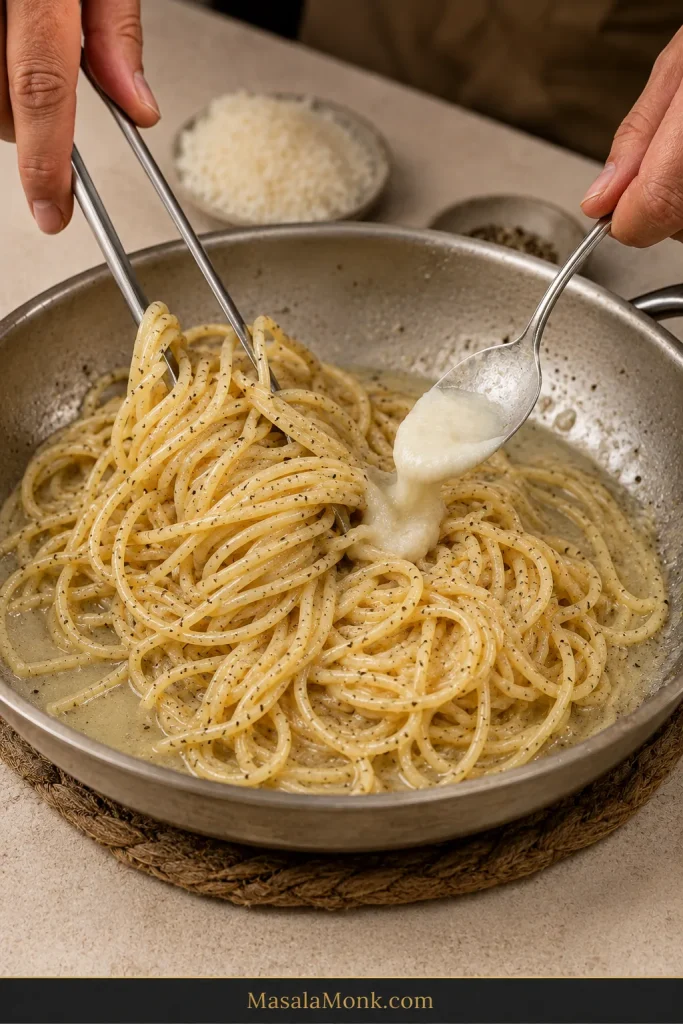
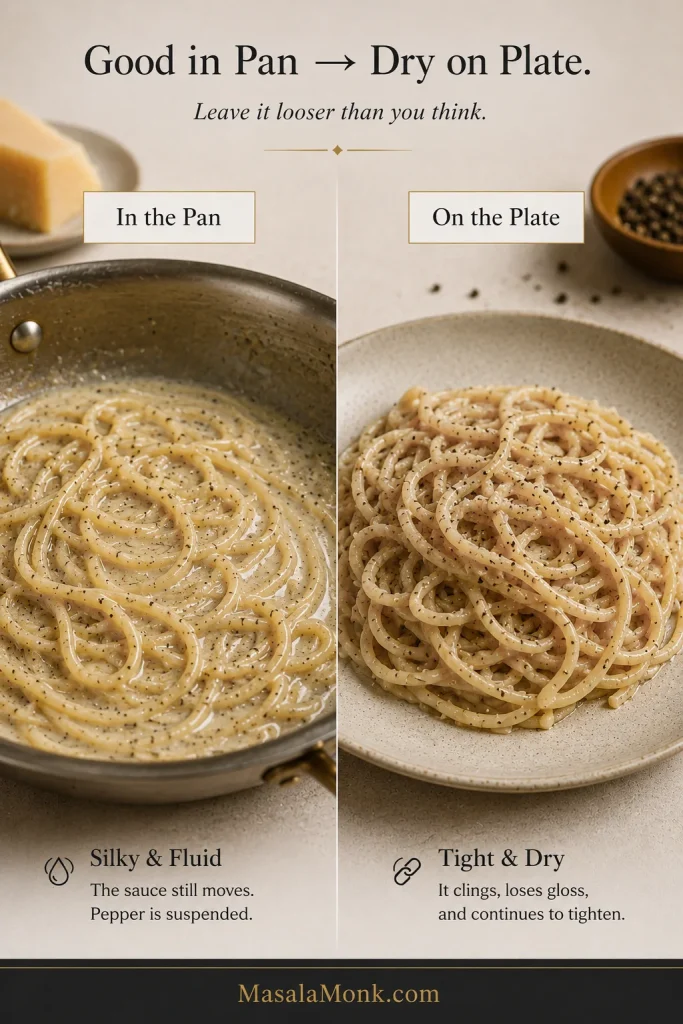
Stop while the sauce still moves
The skillet should look a little looser than the plate you ultimately want. Residual heat and the short trip to the table keep tightening the coating, so waiting for perfect serving consistency in the pan usually means serving cacio e pepe too tight.
Cacio e Pepe Troubleshooting: Clumps, Graininess, Watery Sauce and Gluey Texture
If the sauce still goes sideways, “it clumped” is not yet a diagnosis. Look at what the cheese and liquid are actually doing before you decide what the pan needs.
Cheese clumps: rubbery blobs vs. grainy curds
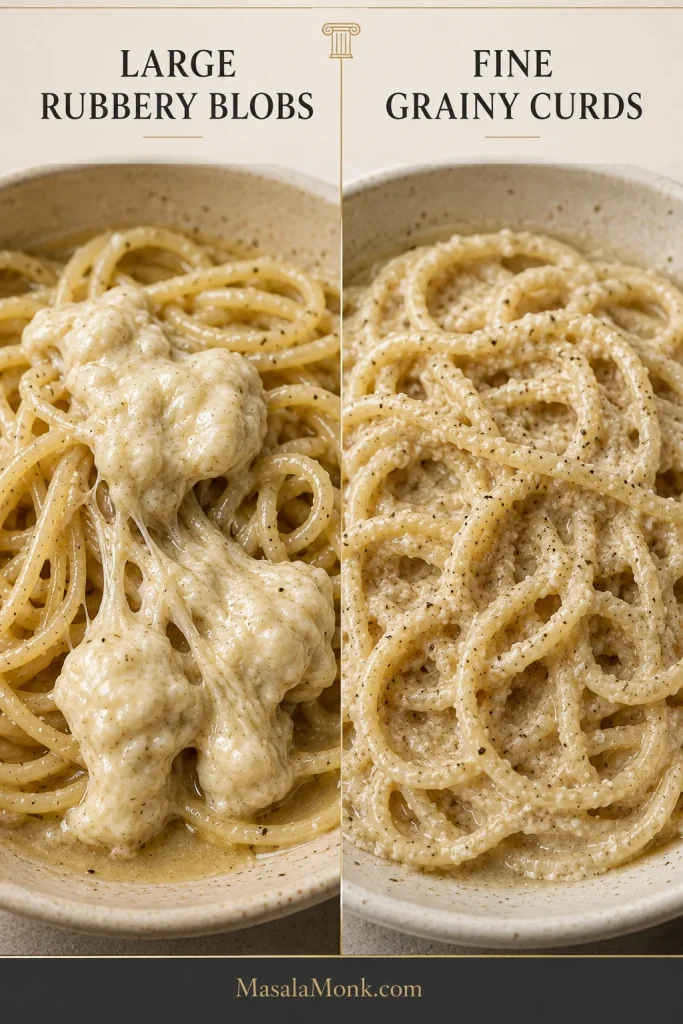
| What you see | Most likely cause | What to do now | What to change next time |
|---|---|---|---|
| Large rubbery cheese blobs | Pan too hot; cheese added too quickly; weak starch base | Get completely off heat. If clumping has only started, add 1 tablespoon warm starchy water and toss hard. A fully elastic mass is difficult to reverse. | Cool longer, grate finer and add Pecorino in stages. |
| Tiny grainy curds | Excess heat or an unstable emulsion | Move away from heat and toss with a very small splash of starchy water. | Use finer cheese, starchier water and a longer cooling pause. |
Watery, gluey, dry or too-salty sauce
| What you see | Most likely cause | What to do now | What to change next time |
|---|---|---|---|
| Watery pasta with cheese stuck to the pan or tongs | The emulsion never formed—often excess liquid, weak starch concentration or too much heat | Get completely off heat, stop adding water and toss vigorously. If the cheese has already seized into clumps, use the clump rescue below. | Use starchier water, cool the pan more and make smaller liquid corrections. |
| Thick, gluey sauce | Too little water, too much evaporation or sauce cooled too far | Add warm pasta water 1 tablespoon at a time while tossing. | Leave slightly more free liquid before the cheese step and plate looser. |
| Good in the skillet, dry on the plate | Sauce left the pan too tight | Loosen immediately if you still have warm pasta water. | Stop when the sauce is more fluid than the final texture you want. |
| Too salty | Heavily salted water plus salty Pecorino | There isn’t a clean fix once the finished pasta is too salty; avoid adding more cheese or salt. | Salt the cooking water much more lightly. |
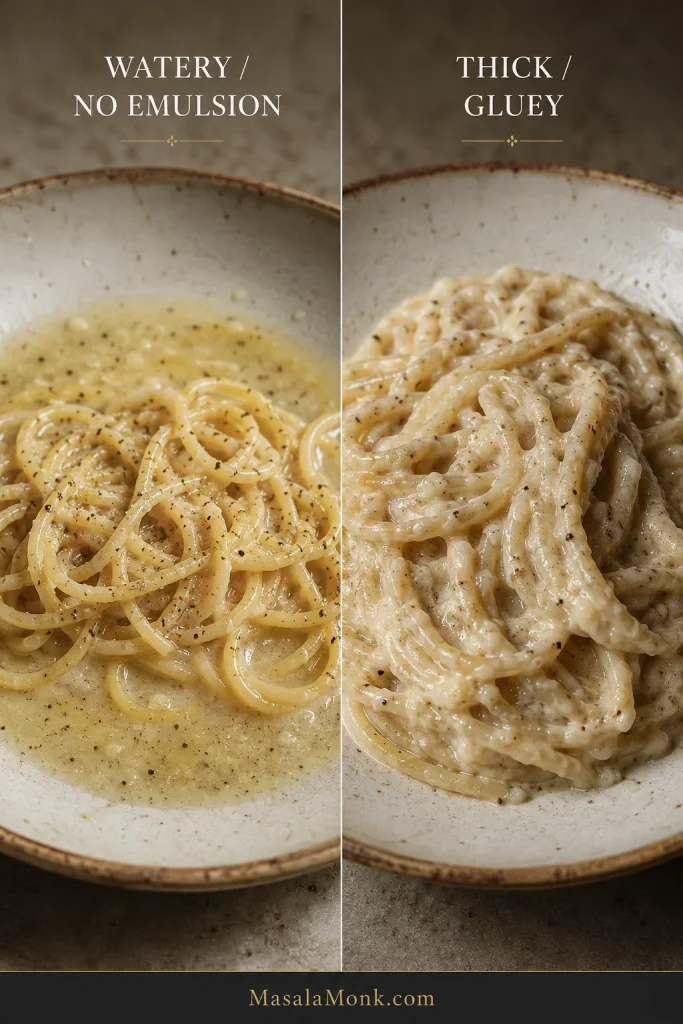
Can a clumped cacio e pepe sauce be rescued?
Sometimes, if you catch it while the cheese is only beginning to grain or tighten. Get the pan away from heat, add a spoonful of warm starchy water and toss hard. Once the Pecorino has pulled into one elastic mass, more heat usually makes things worse. If the pasta still tastes good, eat it; give the next batch a cooler pan and starchier water.
If you want to practise the same off-heat cheese finish in a more forgiving sauce, our broccoli pasta gets extra body from the soft broccoli.
Once you can tell a too-hot pan from a too-dry one, cacio e pepe stops feeling temperamental and starts feeling readable.
Back to recipe ↑ · Back to top ↑
Best Pasta for Cacio e Pepe: Tonnarelli, Spaghetti or Bucatini?
There is no single pasta shape you need for a good bowl. Timing matters more, especially when you move between dried and fresh pasta.
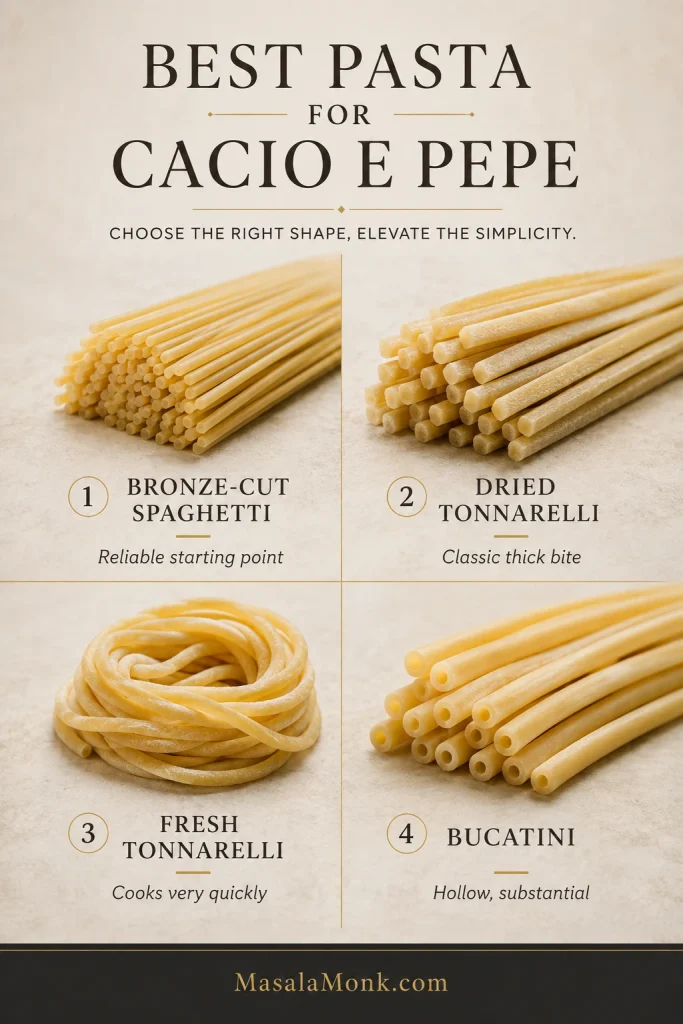
| Pasta | Why use it | Watch out for |
|---|---|---|
| Dried tonnarelli | Strong Roman association; thick, chewy strands; works with the same general method as dried spaghetti | Use its own package timing; do not assume it cooks at the same speed as spaghetti |
| Fresh tonnarelli | Classic Roman shape with a tender, substantial bite | Usually cooks much faster than dried spaghetti; stage everything first, reserve cloudy cooking water early and give it only a brief skillet finish |
| Bronze-cut spaghetti | Best practical default; easy to find, toss and coat | Choose a good-quality pasta that releases plenty of starch |
| Bucatini | Thick, substantial and delicious with Pecorino | Heavier hollow strands can be more awkward to toss quickly |
Its longer cooking window gives you time to build concentrated pasta water and finish the strands in the skillet. Dried tonnarelli can follow the same general route.
Parmesan, Butter, Cream and Other Cacio e Pepe Adaptations
Butter, Parmesan, cream and other additions can make excellent pasta, but they move the dish away from the Pecorino-and-water formula used here.
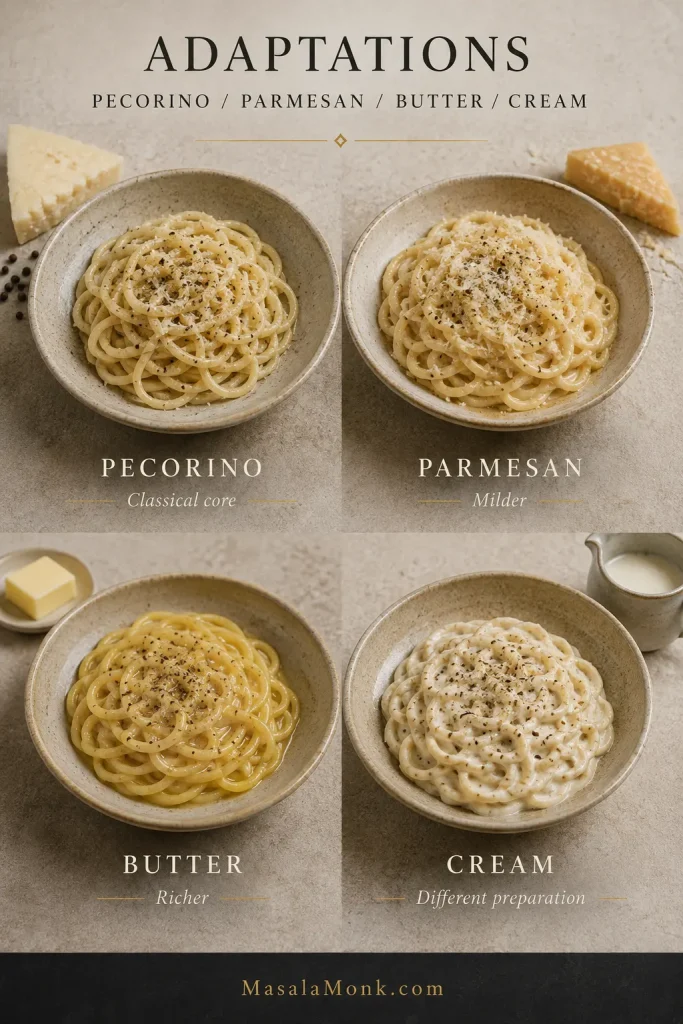
| Addition | Will it work? | In this recipe? | What changes |
|---|---|---|---|
| Parmigiano Reggiano / Parmesan | Yes | No | Milder, nuttier and usually less sharply salty than Pecorino Romano |
| Butter | Yes | No | Adds richness and helps the sauce come together more easily |
| Olive oil | Yes | No | Adds richness and olive-oil flavor; changes the character of the sauce |
| Heavy cream | Yes | No | Adds richness and stability, but turns it into a different preparation |
| Garlic | Yes | No | Adds a strong aromatic flavor to an intentionally spare dish |
| Cornstarch or potato starch | Yes | No | Can strongly stabilize the sauce, but changes the traditional ingredient approach |
Roman Alfredo solves a related emulsion differently: Parmigiano, butter and pasta water create its glossy coating without cream.
What to Serve With Cacio e Pepe
Cacio e pepe is salty, rich, peppery and starchy. A good side brings contrast: something fresh, green, bitter or acidic. That contrast makes the next forkful of pasta taste sharper and more alive.
- Lemony arugula or rocket salad
- Broccoli rabe or other bitter greens
- Roasted asparagus, broccoli or zucchini with lemon
- Fennel, citrus or tomato salad with enough acidity to cut the Pecorino
A cold cucumber salad with vinegar, dill and onion works especially well here: crisp, sharp and light beside the salty Pecorino.
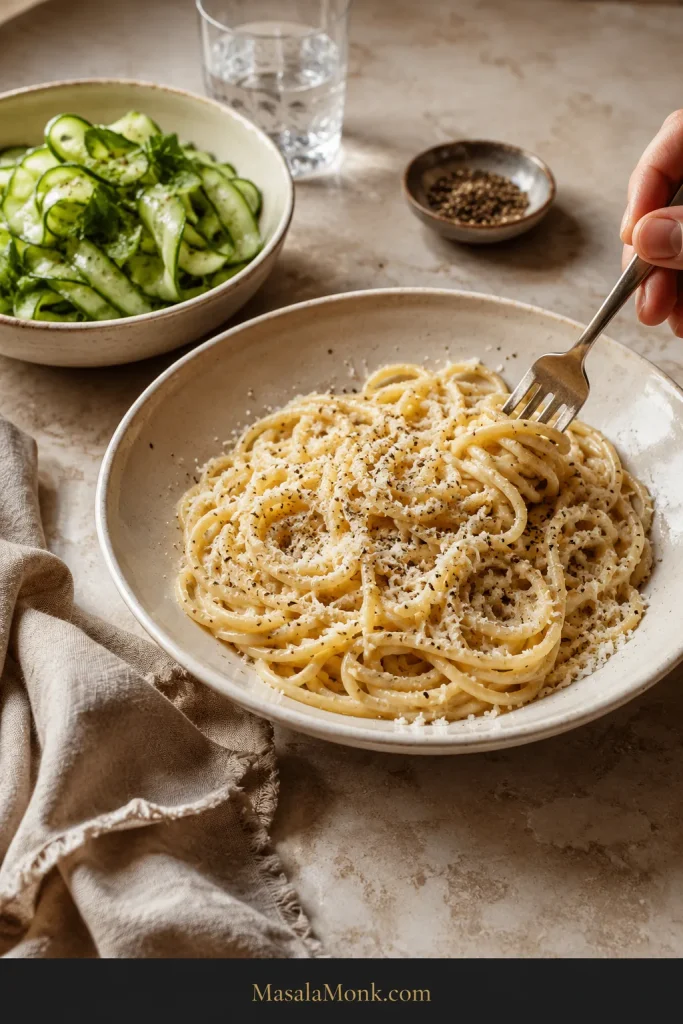
Serve a smaller portion as a Roman-style first course before a simple meat, fish or vegetable main. If cacio e pepe is dinner on its own, keep the side crisp, green or acidic and let the pasta remain the reason you sat down.
Storage and Reheating
Cacio e pepe is at its best within minutes of leaving the skillet. Grate the Pecorino, crush the pepper and set out the pans ahead of time, but cook the pasta and form the sauce close to serving.
Refrigerate leftovers promptly in an airtight container and, for the best texture, eat them within about 2–3 days. Reheat only the portion you plan to eat in a skillet over low heat with a small splash of water. Toss constantly and add more water only if the coating still feels tight.
Reheated cacio e pepe can still be good, but the coating will never be quite as fluid as it was fresh, and high heat makes the Pecorino more likely to tighten or separate. Treat leftovers as a good second bowl, not a recreation of the first one.
Back to recipe ↑ · Back to top ↑
Is Cacio e Pepe Really a Roman Shepherd’s Dish?
Cacio e pepe is deeply associated with Rome and Lazio. A popular story links the dish to shepherds carrying durable pasta, Pecorino and pepper during seasonal grazing journeys. Italian food historian Massimo Montanari has argued that this neat origin story is misleading, placing pasta with grated cheese inside a much longer Italian culinary history and pepper inside an older history of prized spices.
The dish is unmistakably Roman; the tidy shepherd-invention story is better treated as culinary legend than settled fact. That uncertainty does not make cacio e pepe any less Roman—it simply makes its history less neat than the story often told about it.
Cacio e Pepe FAQs
What does cacio e pepe mean?
It literally means “cheese and pepper.” In the Roman dish, the cheese is Pecorino Romano and the pepper is black pepper.
How do you pronounce cacio e pepe?
A close English approximation is KAH-cho eh PEH-peh. It is closer than pronouncing “cacio” like “Casio.”
Is cacio e pepe vegetarian?
It contains no meat, but traditional Pecorino Romano PDO is made with animal rennet. The official Pecorino Romano PDO consortium specifies lamb’s rennet in paste form. If you avoid animal rennet, use a suitable vegetarian hard cheese and understand that it will not be traditional Pecorino Romano PDO.
Can I use pre-grated Pecorino?
Freshly grated Pecorino gives you much better control over particle size and weight. If pre-grated is your only option, choose refrigerated Pecorino that is finely grated; skip coarse shreds and shelf-stable shaker cheese.
Can I use fresh tonnarelli?
Yes, but do not follow the dried-spaghetti timing literally. Fresh tonnarelli usually cooks much faster than dried spaghetti, so have the Pecorino grated, the pepper crushed, the skillet ready and all your tools within reach before the pasta goes into the water.
Because it cooks quickly, reserve some water once it is noticeably cloudy enough to use; do not wait for the later timing you would with dried spaghetti. Toast the pepper immediately before adding pasta water to form the pepper base, then give the fresh pasta only a brief skillet finish. Move the pan off the heat, use the same cooling cue as the main recipe and make the sauce as usual.
Can I make cacio e pepe for one?
Yes. For the dried-spaghetti version, halve the recipe: 100 g / 3.5 oz pasta, 55 g / 1.9 oz Pecorino total (reserve about 5 g for finishing), and about 1½ g pepper, plus more to finish. Use a smaller wide pan and enough water for the pasta to cook freely; the visual cues matter more than forcing exactly half the original water into different cookware. Salt the water lightly using the same Pecorino-first approach as the main recipe.
Can I make cacio e pepe for a crowd?
Yes, but smaller batches are easier. A large mass of pasta holds heat longer and is harder to toss quickly, leaving less room to adjust the cheese step. For a dinner party, two smaller batches are usually easier than one enormous skillet.
Can I make the sauce separately?
You can pre-hydrate the Pecorino into a paste, as this recipe does, but do not make a finished cacio e pepe sauce hours ahead and expect it to wait like a cream sauce. The final texture depends on hot pasta, fresh starchy water and immediate tossing.
When the Bowl Is Ready
The sauce should follow every strand in a light, silky coating. Fresh pepper should reach you before the fork does, followed by the sharp Pecorino; the pasta should still move freely instead of sitting in a stiff mound.
Bring people to the table before the final toss; cacio e pepe gives you its best few minutes first. If you make it, tell me what changed the sauce for you—the water, the heat, the cheese, or simply knowing when to stop. That detail is often more helpful to the next cook than another timer.








