Posted on Leave a comment

Avocado Toast Recipe

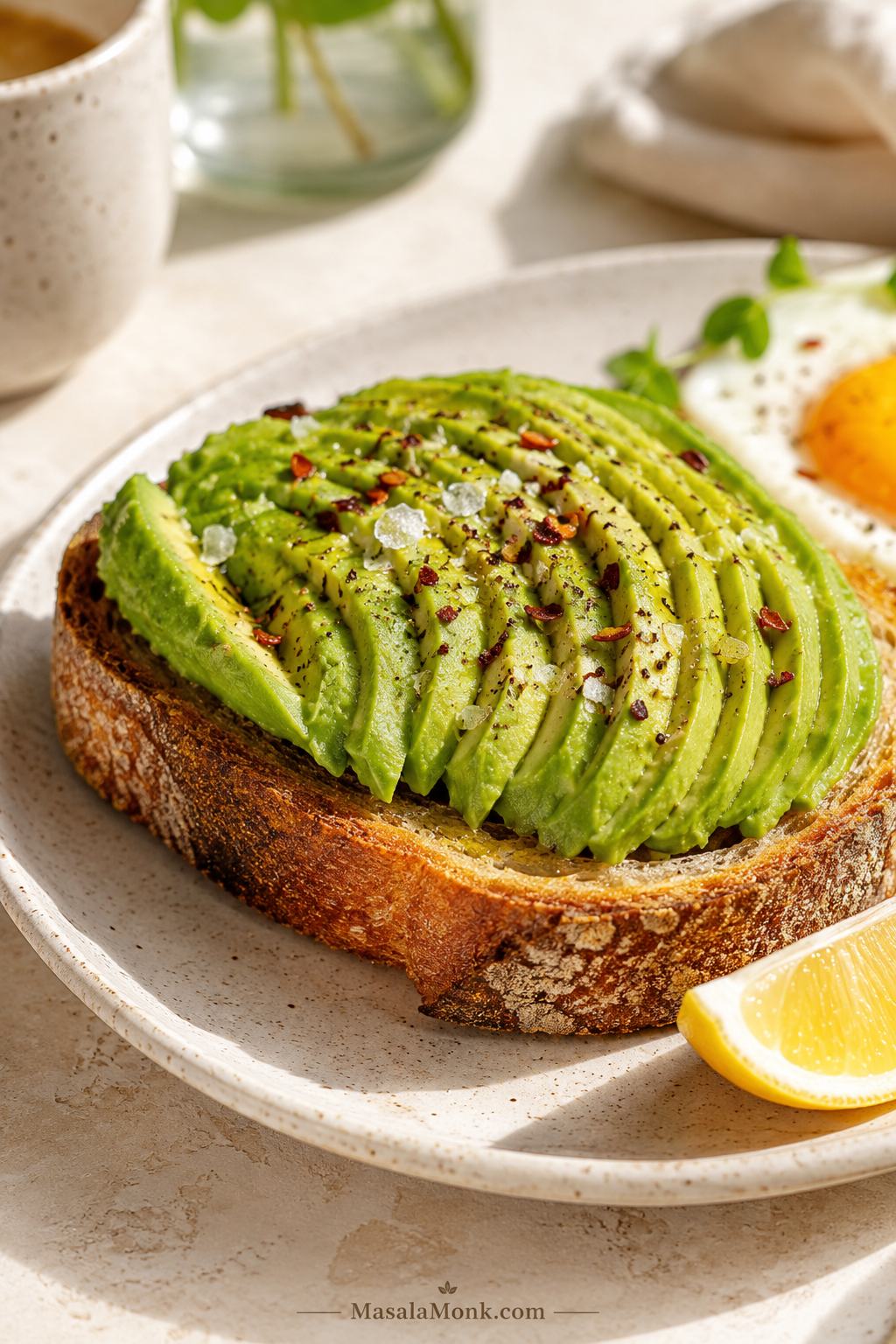
Avocado toast on thick sourdough with seasoned avocado, chili flakes, flaky salt, lemon, and a soft fried egg on a café plate.

A good avocado toast recipe should not taste like plain mashed avocado on dry bread. The best version is creamy, bright, salty, crisp at the edges, and finished with just enough contrast to make the next bite interesting. That contrast can be as simple as chili flakes and lemon, or as filling as egg, cottage cheese, smoked salmon, or crisp vegetables.

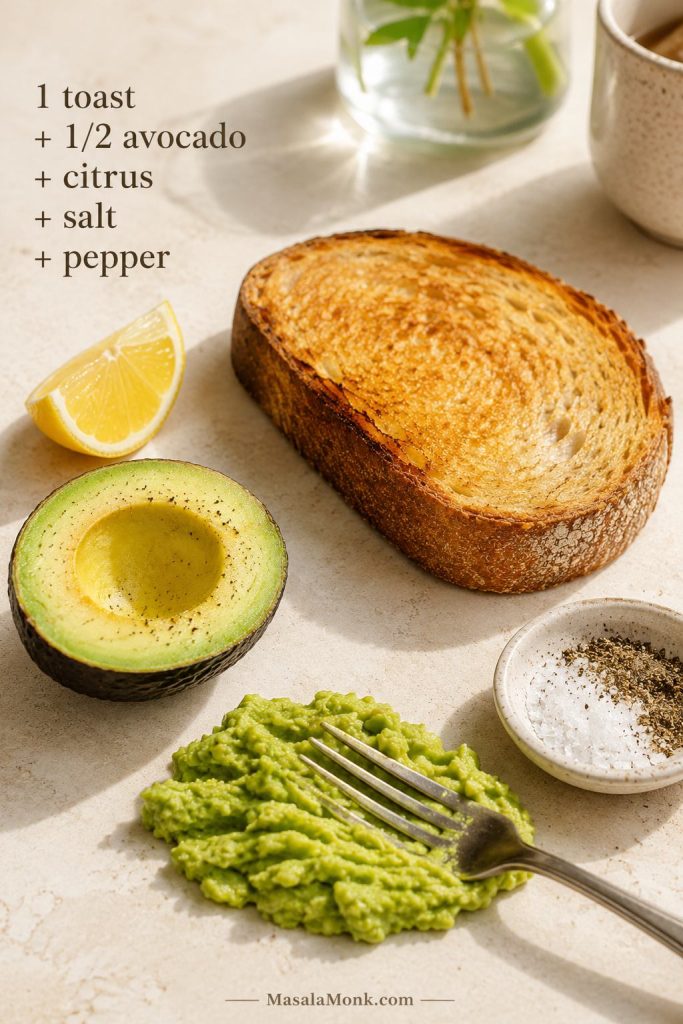
The everyday formula is easy: 1 thick slice of toast + 1/2 ripe avocado + 1–2 teaspoons lemon or lime juice + salt + pepper. Once that base tastes right, you can turn it into a fast breakfast, a high-protein toast, a brunch plate, or a simple lunch without making the recipe complicated.

If your toast usually tastes bland, soft, or overrated, the fix is rarely more avocado. It is better bread, a riper avocado, enough salt, enough citrus, and one topping that changes the bite.

The goal is not to pile everything on. The goal is to make the base so good that toppings feel like a choice, not a rescue mission.

Quick Answer: Best Ratio

For one slice, use 1 thick piece of well-toasted bread, 1/2 ripe avocado, 1–2 teaspoons lemon or lime juice, a generous pinch of salt, and black pepper. Mash the avocado with the citrus and seasoning, spread it over hot sturdy toast, and eat it right away.

Avocado toast ratio guide with one toast, half an avocado, citrus, salt, pepper, and mashed avocado on a pale café surface.
Use this base ratio first because balanced avocado toast depends more on seasoning and texture than on extra toppings.

In a hurry, stop there. Toast well, season the avocado properly, spread it thickly, and finish with pepper, chili flakes, flaky salt, or everything bagel seasoning.

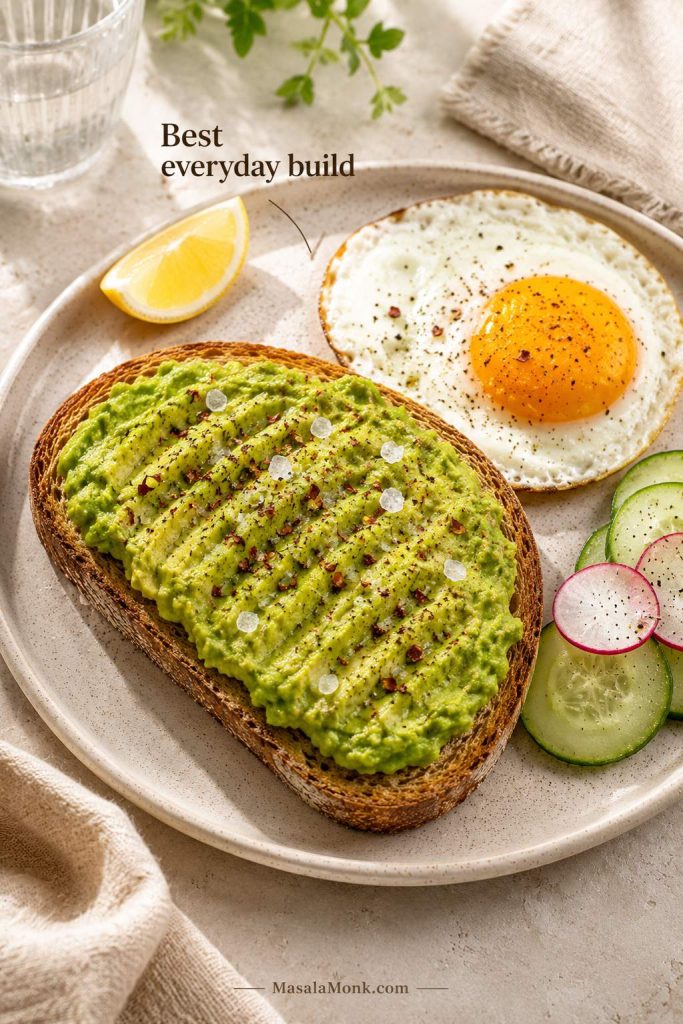
Best everyday build: Start with sourdough or seeded bread, 1/2 avocado, lemon or lime, fine salt, black pepper, flaky salt, and chili flakes. Add a fried egg when you want breakfast, or cucumber/radish when the slice needs crunch.

Everyday avocado toast build with seasoned avocado, chili flakes, lemon, fried egg, cucumber, and radish as topping options.
Once the base tastes bright and salty enough, choose one direction: egg for breakfast or crisp vegetables for crunch.

This is the version to make before you start loading on toppings. If this tastes good, every variation after it gets easier.

For two toasts, use 2 slices bread, 1 ripe avocado, 2–4 teaspoons lemon or lime juice, 1/4 teaspoon fine salt, and black pepper. Egg makes it breakfast, cottage cheese makes it more filling, and smoked salmon turns it into brunch.

Not sure what to add next? Jump to What Your Toast Needs to choose by crunch, salt, freshness, protein, or heat.

Base Formula

For 1 toast1 thick slice bread
Avocado1/2 ripe avocado
Citrus1–2 tsp lemon/lime
Time5–8 minutes

Use this base: 1 thick slice sourdough or whole-grain bread, 1/2 ripe avocado, 1–2 teaspoons lemon or lime juice, 1/8 teaspoon fine salt, black pepper, and optional flaky salt, olive oil, chili flakes, or one topping for contrast.

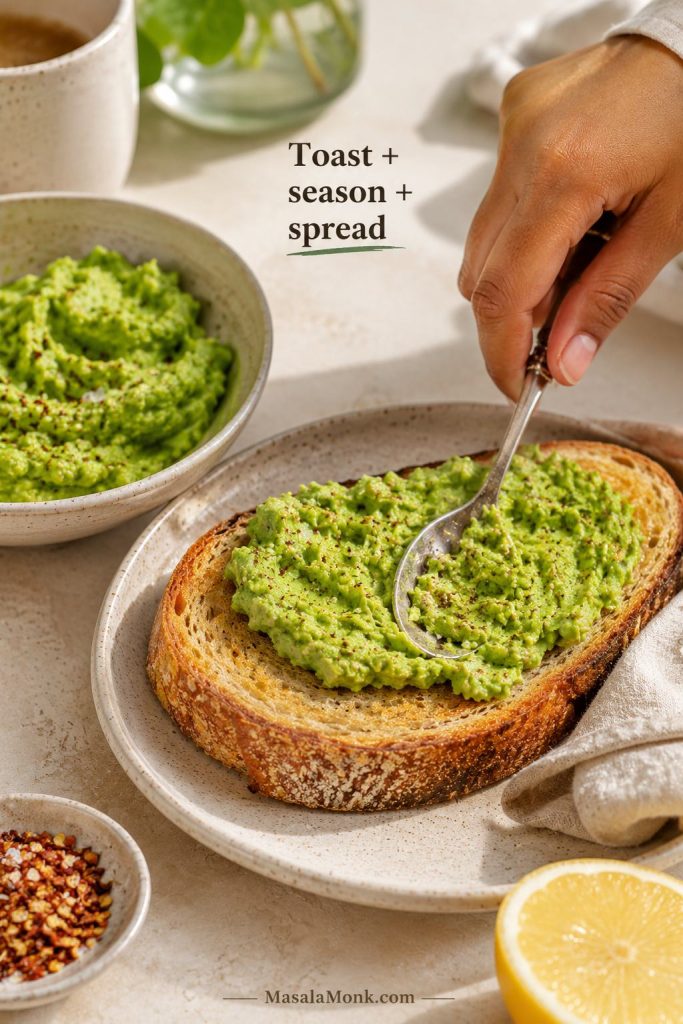
Avocado toast process scene with crisp toast, seasoned avocado mash, and avocado being spread onto bread.
Build the base in order: crisp the bread, season the mash, then spread it while the toast still has bite.

Once the base tastes right, use the toast ideas or the Fix the Bite guide to choose a topping.

That is the difference between toast that tastes like a café breakfast and toast that tastes like avocado spread on bread.

The Rule: Toast, Season, Contrast

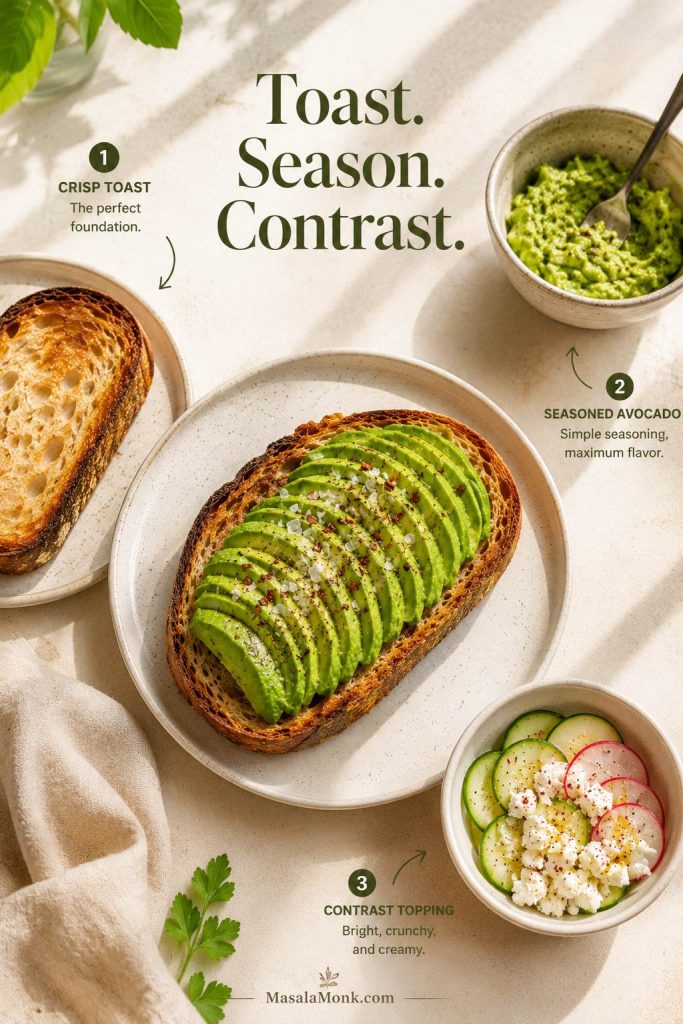
The best version follows one simple rule: toast, season, contrast. Toast the bread deeply enough to hold the avocado. Season the avocado before it touches the bread. Then add one topping that changes the bite.

Toast, Season, Contrast

  • Toast: Use bread with enough structure, and toast it until the edges have crunch.
  • Season: Mash the avocado with lemon or lime, fine salt, and black pepper before spreading.
  • Contrast: Add one thing that changes the bite: egg for fullness, cucumber for crunch, feta for salt, tomato for freshness, or chili crisp for heat.
Toast Season Contrast guide with avocado toast, seasoned mash, crisp bread, and contrast toppings arranged around the toast.
A contrast topping should solve a real problem: add crunch, salt, freshness, heat, or fullness.

The first bite should feel creamy and crisp. If the second bite already feels boring, the toast needs contrast.

Once the base tastes good on its own, toppings become optional upgrades instead of rescue attempts.

Ingredients

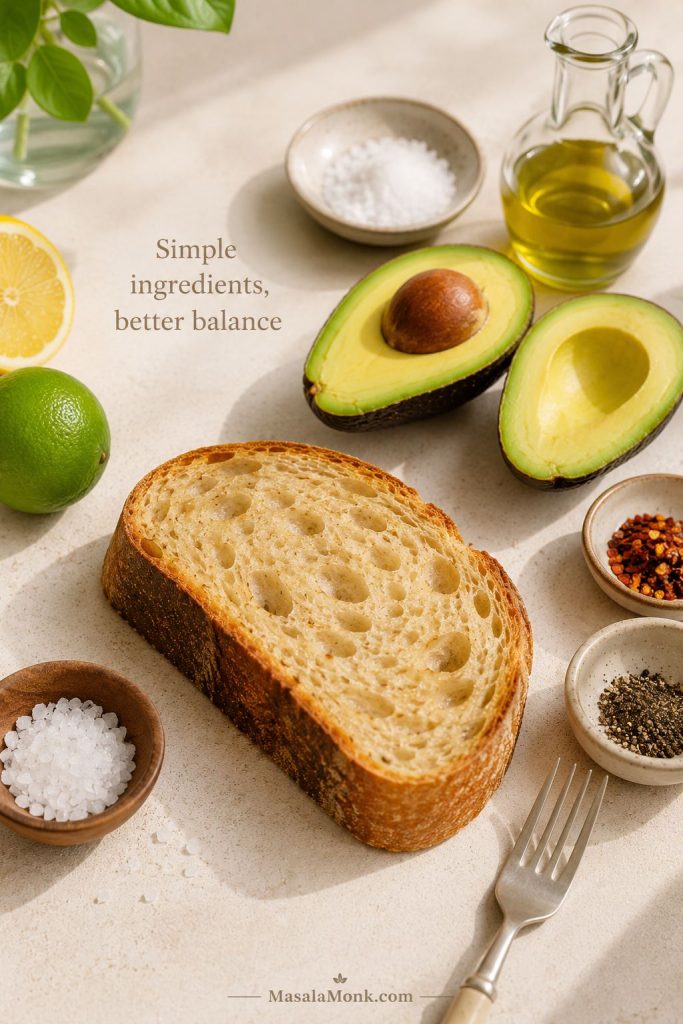
Avocado toast ingredients including bread, ripe avocado, lemon, olive oil, salt, pepper, chili flakes, and flaky salt.
Do not try to fix weak bread or underripe avocado with extra toppings; better ingredients make the simple version work.

This recipe is simple, so there is nowhere for weak ingredients to hide. The avocado should be ripe, the bread should be sturdy, and the seasoning should be bold enough to wake up the mild, creamy avocado. Lemon or lime gives brightness, salt brings the flavor forward, and pepper, chili, herbs, seeds, or crunchy vegetables keep each bite from feeling one-note.

Use the table as a starting point, then taste the avocado before it goes on the bread. That one small step is what keeps the whole slice from tasting flat.

Ingredient Amount for 2 toasts Why it matters
Thick bread 2 slices Gives the avocado somewhere to sit without turning the whole slice soft.
Ripe avocado 1 medium-large avocado, about 140–160 g flesh Mashes smoothly and gives the toast a creamy, buttery base.
Lemon or lime juice 2–4 tsp / 10–20 ml, to taste Cuts through the creamy avocado so the toast tastes fresh, not flat.
Fine salt 1/4 tsp, plus more to taste Brings the avocado forward instead of leaving it muted.
Black pepper 1/8 tsp Adds a warm, sharp finish.
Extra-virgin olive oil 1–2 tsp, optional Adds café-style richness, especially with sourdough.
Red pepper flakes Pinch, optional Adds a small kick so the avocado does not feel too creamy or quiet.
Flaky salt To finish Gives the top a crisp, salty pop.

How to Pick a Ripe Avocado

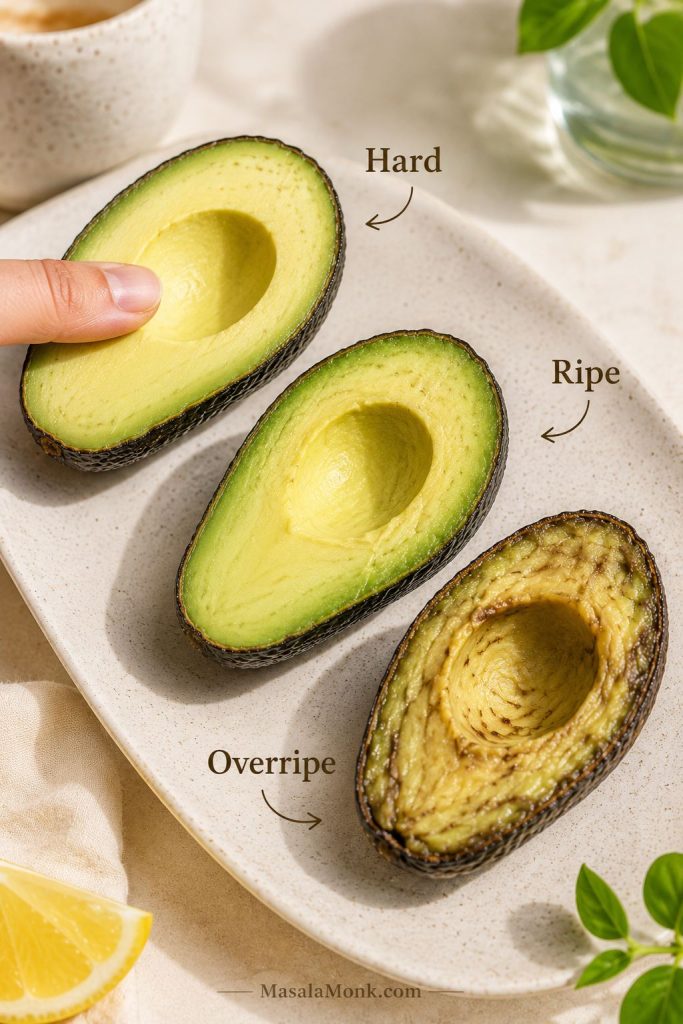
Look for fruit that gives slightly when pressed near the top or side. It should not feel rock-hard, hollow, wrinkled, or mushy. Underripe avocado tastes grassy and firm, while overripe avocado can taste dull and may have brown stringy patches inside.

Avocado ripeness guide showing hard, ripe, and overripe avocado examples with cut flesh and pressure cues.
A ripe avocado should give slightly; otherwise, the finished toast can turn grassy, dull, or hard to mash.

If the small stem nub comes off easily and the flesh underneath looks green, the avocado is usually close. If it looks brown underneath or the fruit feels very soft, it may be overripe.

Not ripe yet? Leave it at room temperature. To speed things up, place it in a paper bag with a banana or apple. Once ripe, refrigerate it to slow things down.

If your avocado is hard, make something else today. Toast cannot fix fruit that is not ready.

Best Bread

Bread is where many avocado toasts quietly fail. It has to do more than sit underneath the avocado. It needs enough structure to hold the mash, enough crunch to stay interesting, and enough flavor that the toast still tastes good after the first bite.

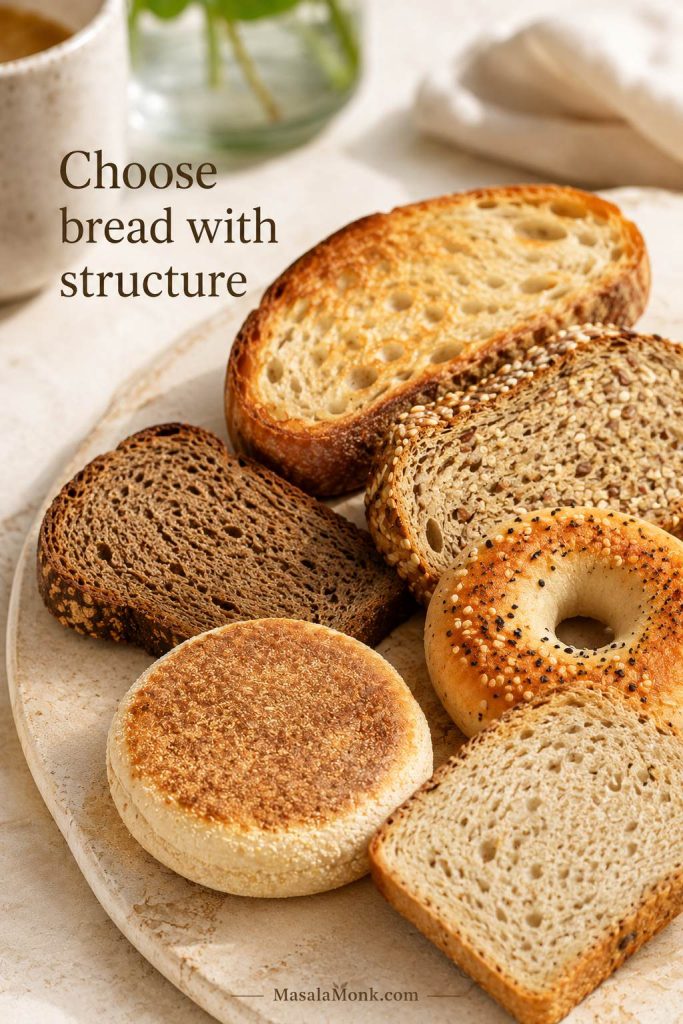
Toasted bread choices for avocado toast including sourdough, seeded bread, rye, bagel, English muffin, and gluten-free bread.
Choose bread with structure, because soft bread turns a good avocado topping into a soggy slice.

Sourdough is the best all-around choice, but whole grain, seeded bread, rye, bagels, English muffins, and gluten-free bread can all work if you toast them well.

Bread Best for Tip
Sourdough Classic café-style toast Toast until deeply golden so the center stays firm.
Whole grain Everyday healthy breakfast Choose a sturdy slice with good texture, not soft sandwich bread.
Seeded bread Crunch, fiber, and extra flavor Excellent with egg, tomato, cottage cheese, or cucumber.
Rye or pumpernickel Smoked salmon avocado toast Pairs well with capers, dill, onion, and lemon.
Bagel Bigger brunch-style serving Use half a bagel if you want a balanced portion.
English muffin Smaller breakfast portion Good with poached egg or cottage cheese.
Gluten-free bread Gluten-free avocado toast Toast it longer than usual so it does not turn soft.
Low-carb bread Lower-carb version Add protein so the meal feels complete.

Whatever bread you choose, toast it a little more than you would for buttered toast. Avocado is soft and rich, so the bread needs extra structure.

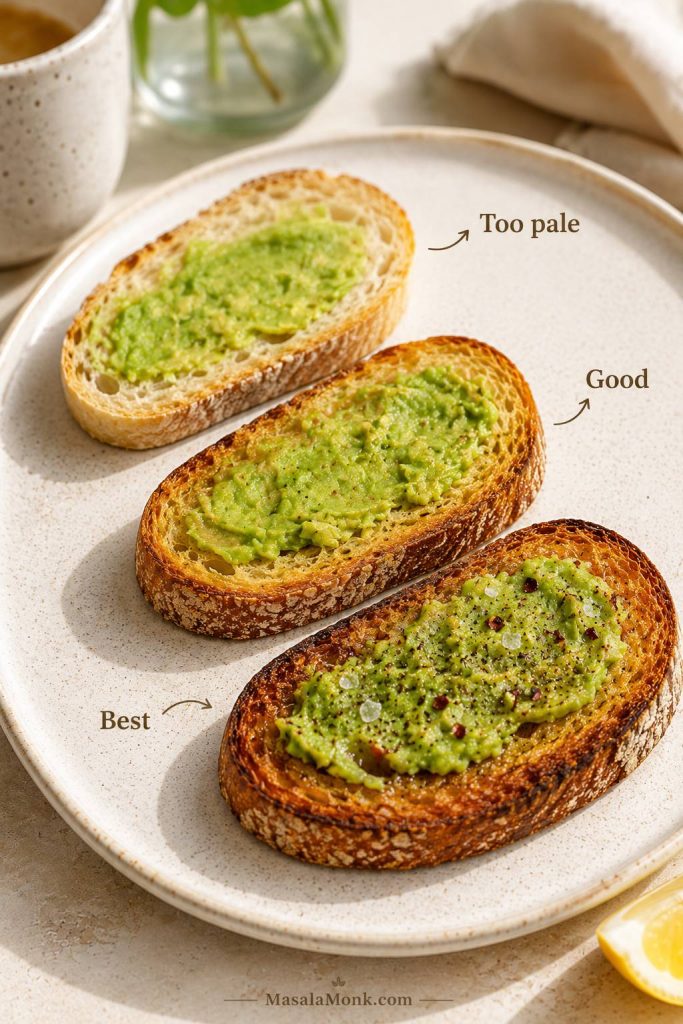
Toast doneness guide for avocado toast showing pale toast, golden toast, and deeply golden toast with avocado spread.
Toast the bread a little darker than usual so it can hold creamy avocado without collapsing.

Soft sandwich bread can work in a pinch, but only if you toast it harder than usual; otherwise, the avocado will flatten it quickly.

If sogginess is the main issue, jump to How to Keep It from Getting Soggy.

If you like making toast from homemade bread, this sourdough bread recipes guide is a useful place to start, especially if you want a loaf, sandwich bread, English muffin bread, or bagel that works well for breakfast toast.

How to Toast Bread Properly

Most disappointing slices start with bread that is too soft. The toast should be firm enough to resist the avocado, especially if you are adding tomato, cucumber, poached egg, smoked salmon, pickled onions, or cottage cheese.

Bread toasting options for avocado toast with a toaster, griddle, toaster oven, and golden toasted bread.
Whether you use a toaster, griddle, or toaster oven, aim for firm golden bread with crisp edges.
  • Toaster: Best for fast everyday toast. Toast until golden and firm, not just warm.
  • Skillet or griddle: Best for thicker sourdough or café-style toast. Use medium heat and toast for 2–3 minutes per side.
  • Toaster oven: Best for multiple slices. Toast until the edges have crunch and the center feels sturdy.
  • Garlic rub: Rub hot toast lightly with the cut side of a garlic clove for extra savory flavor.
  • Olive oil or butter: Use a thin layer before pan-toasting, or a light drizzle after toasting, for a richer café-style finish.

Restaurant-style upgrade: Rub the hot toast lightly with garlic, brush or drizzle with a little olive oil, season the avocado before spreading, and finish with flaky salt. Those small details make the toast taste brighter and more complete.

Do not cook the avocado mixture in the skillet. Toast the bread first, then add the avocado after. Warm bread is good; cooked avocado mash usually tastes dull.

How to Make It

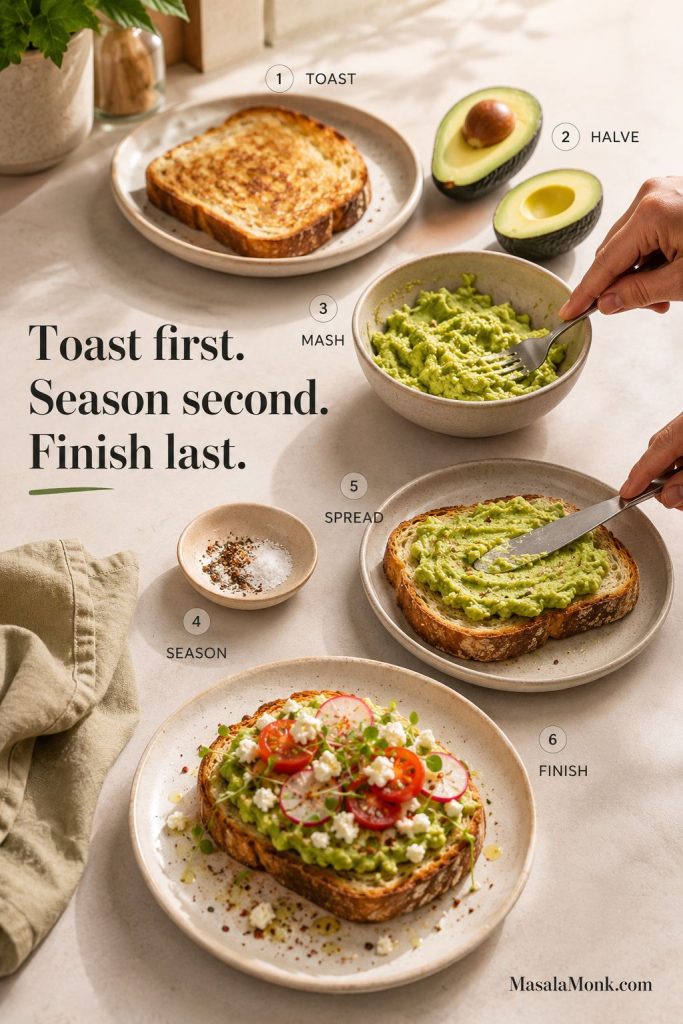
It works best when the bread is hot and sturdy, the avocado is seasoned before spreading, and the finished toast is eaten while the edges still have crunch. The method is short, but the order matters: toast first, season the avocado second, then build the toppings right before serving.

Step-by-step avocado toast method showing bread, avocado, mashing, seasoning, spreading, and finishing the toast.
Assemble only after the toast is ready, because avocado and wet toppings soften bread quickly.
  1. Toast the bread. Toast until golden and firm, not pale and soft.
  2. Prepare the avocado. Halve the avocado, remove the pit, and scoop the flesh into a small bowl.
  3. Season the mash. Add lemon or lime juice, salt, and black pepper. Mash with a fork until mostly smooth but still a little textured.
  4. Taste before spreading. Add more salt, citrus, pepper, or chili flakes if it tastes flat.
  5. Spread over hot toast. Use about 1/2 avocado per thick slice.
  6. Finish and serve. Add flaky salt, olive oil, chili flakes, herbs, egg, cottage cheese, smoked salmon, feta, or another topping with contrast. Eat immediately.

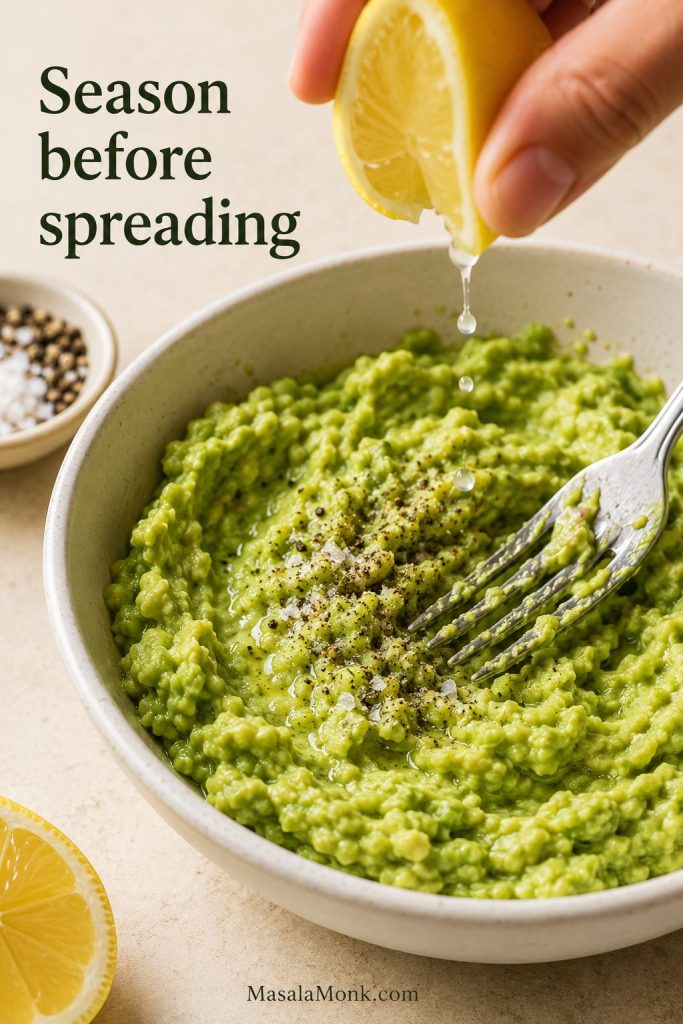
Season before spreading: This small step helps the avocado taste bright and balanced before it ever touches the bread.

Close-up of avocado mash being seasoned with lemon juice, salt, pepper, and a fork before spreading.
Season the mash before spreading it; otherwise, the top may look good while the avocado still tastes flat.

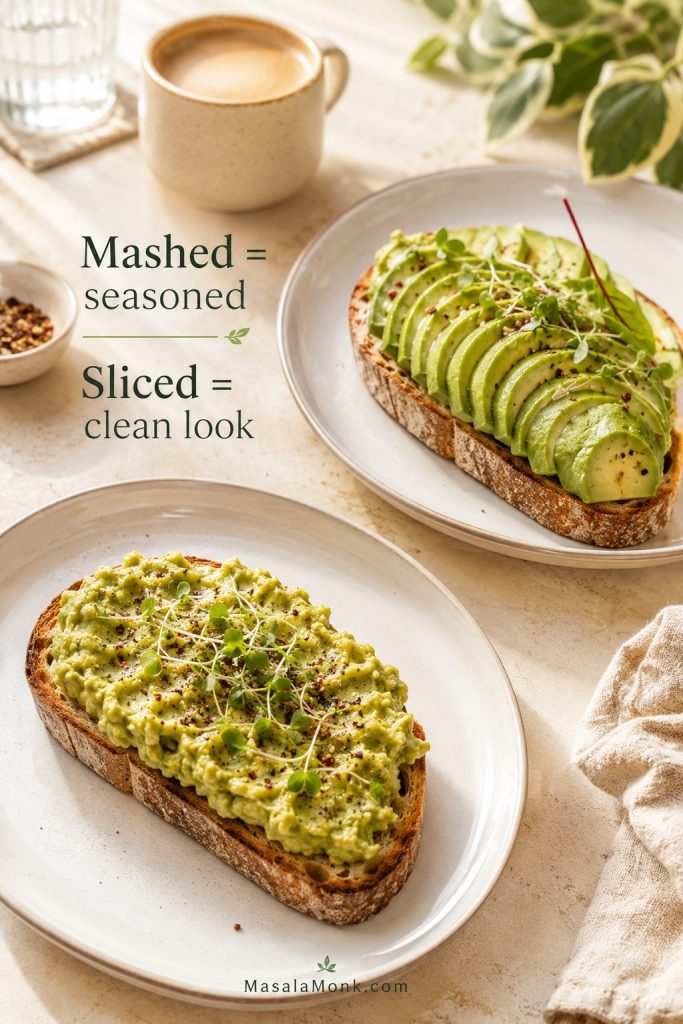
Texture tip: Mash the avocado in a bowl if you want even seasoning and a creamier bite. Slice it if you want a cleaner café-style look, especially with smoked salmon, feta, tomato, or poached egg. Either way, season it before you add the toppings.

Two avocado toasts comparing mashed seasoned avocado with clean sliced avocado on café plates.
Mashed avocado holds seasoning better, while sliced avocado gives a cleaner café-style finish.

Avocado Toast with Egg

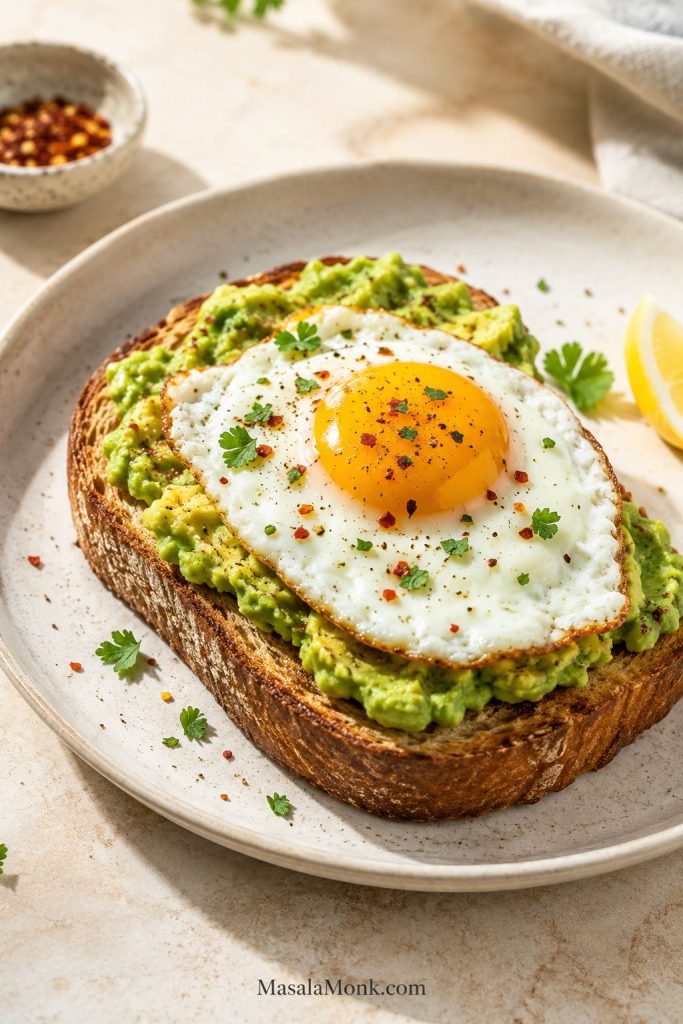
Egg turns the slice into breakfast, not a snack. One egg is enough for most slices. Two makes sense when the toast is the meal, not the side.

Avocado toast with a fried egg, soft yolk, herbs, chili flakes, and crisp sourdough edge.
Avocado toast with egg works best when the yolk adds richness without hiding the seasoned avocado.
Egg style Choose it when you want Watch out for
Fried egg Classic café-style toast with a rich yolk Do not over-salt if using bacon, feta, capers, or smoked salmon.
Poached egg Brunch-style toast Drain well or the bread gets wet.
Scrambled egg Soft, filling breakfast Keep the eggs creamy, not dry.
Jammy egg Meal-prep-friendly breakfast Slice gently so the yolk stays neat.
Egg whites Lighter high-protein toast Season more because egg whites are mild.

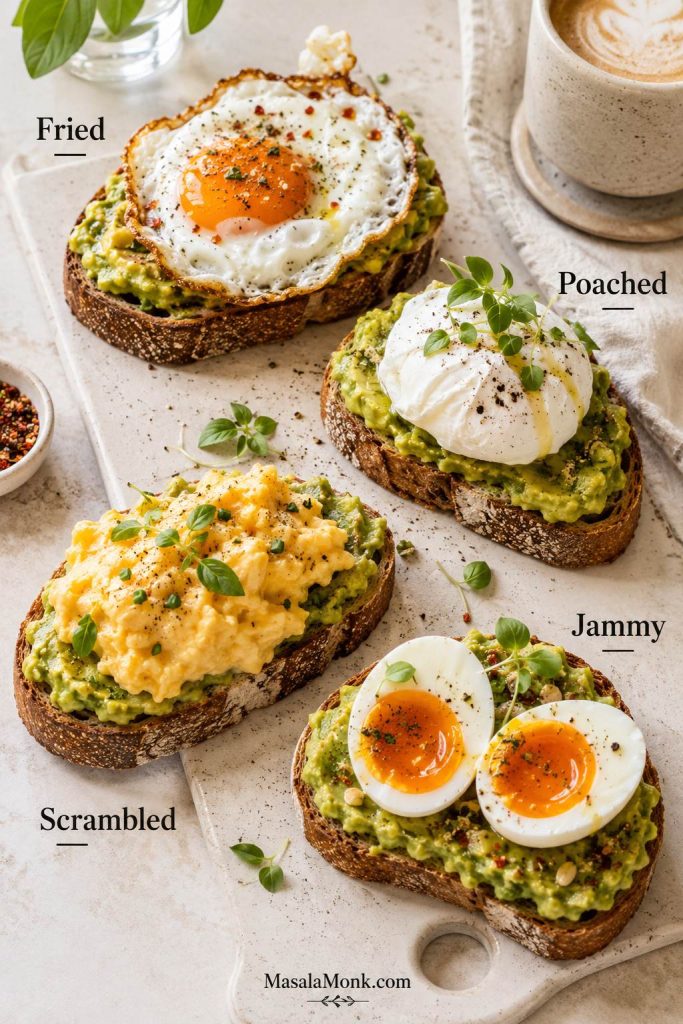
For the safest first version, choose fried egg. It gives the toast richness without making the method fussy. Poached egg is prettier for brunch, scrambled is softer and more filling, and jammy egg is the easiest make-ahead option.

Egg styles for avocado toast showing fried, poached, scrambled, and jammy egg versions on small toasts.
Each egg style changes the meal: fried is rich, poached feels brunchy, scrambled is cozy, and jammy is prep-friendly.

Want a no-cook protein version instead? Jump to the Cottage Cheese Version.

Fried Egg Version

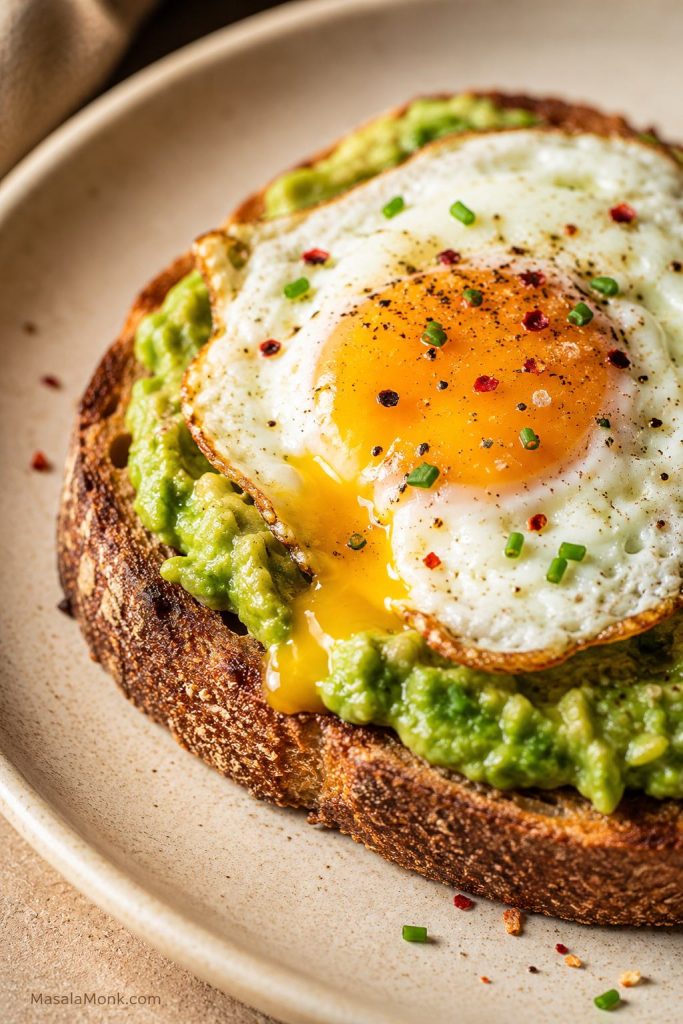
Spread 1/2 mashed avocado over one slice of toast, then top with one fried egg. Cook the egg on medium heat until the white is set and the yolk is still soft, about 2–3 minutes if covered, or a little longer if your pan runs cooler. Finish with salt, pepper, chili flakes, and herbs.

Close-up fried egg avocado toast with a soft yolk, seasoned avocado, chili flakes, and crisp bread crust.
A fried egg is the easiest upgrade when you want the slice to feel like a real breakfast.

Poached Egg Version

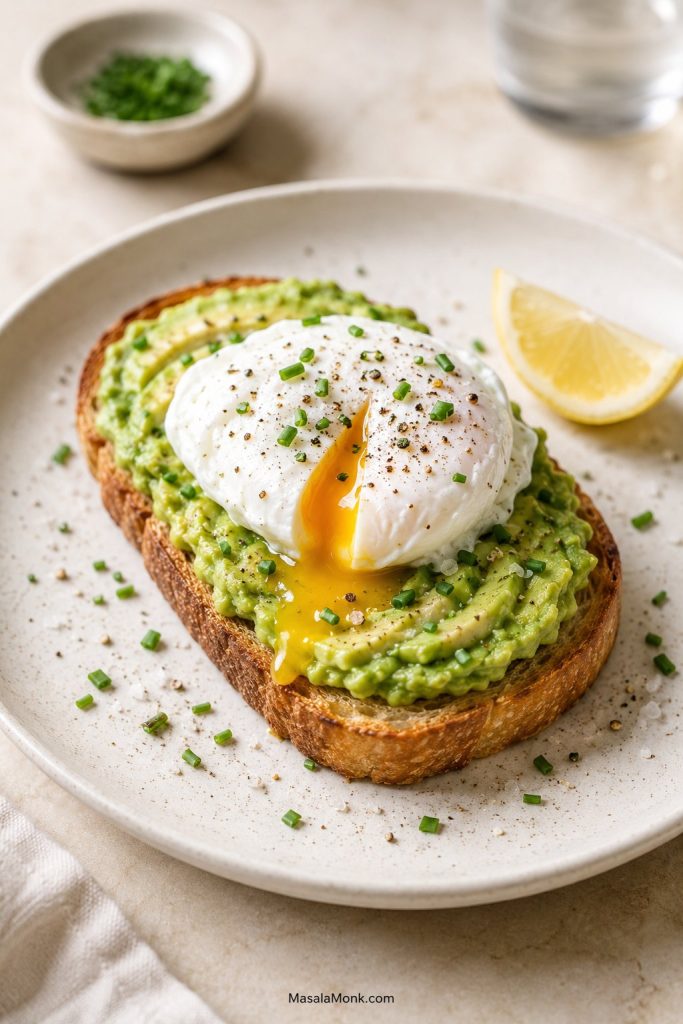
Poach the egg at a bare simmer for 3–4 minutes, then drain it well before placing it on the toast. This version is excellent with chives, flaky salt, black pepper, lemon, and a little chili oil.

Poached egg avocado toast with chives, flaky salt, black pepper, lemon, and seasoned avocado.
Drain poached eggs well before serving, so the yolk adds richness without soaking the toast.

Scrambled Egg Version

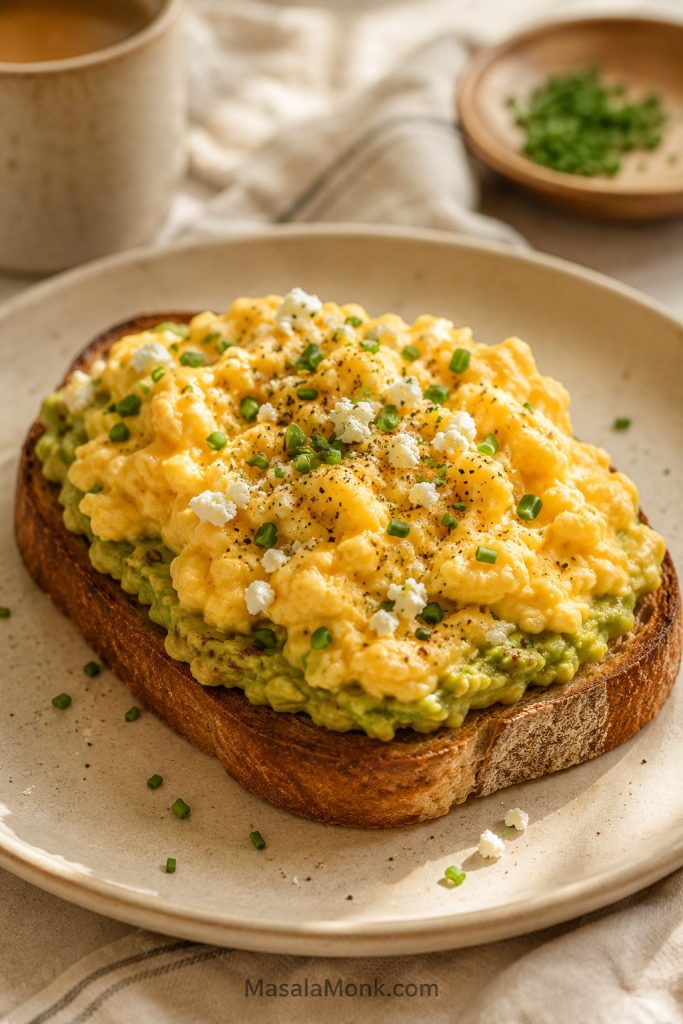
Use soft scrambled eggs rather than dry curds. Cook them on low to medium-low heat for 2–3 minutes, then spoon them over the avocado base. Chives, black pepper, chili flakes, and a little feta work well here.

Scrambled egg avocado toast with soft eggs, seasoned avocado, chives, black pepper, and toasted bread.
Soft scrambled eggs make the toast warmer and more filling, especially when the avocado base is already seasoned.

Boiled or Jammy Egg Version

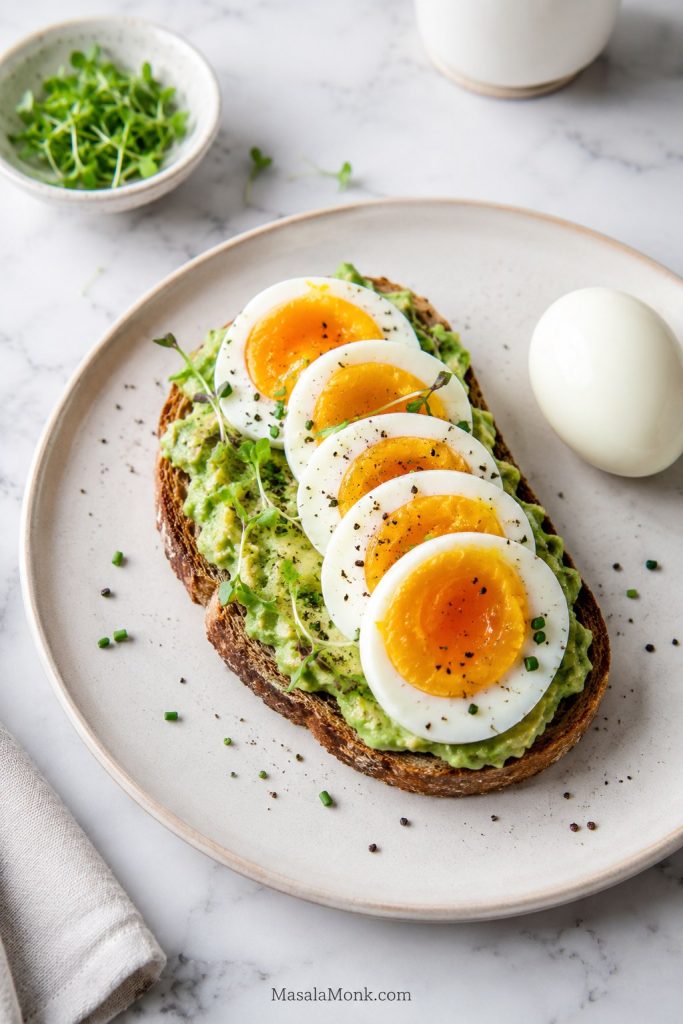
For a jammy egg, lower the egg into simmering water and cook for 6–7 minutes, then cool briefly before peeling. For clean hard-boiled slices, cook for 9–10 minutes. This is the best egg version when you want to prep part of breakfast ahead.

Jammy egg avocado toast with sliced boiled egg, golden yolk, microgreens, black pepper, and a peeled egg nearby.
Jammy eggs are a smart make-ahead topping because they add protein without another pan in the morning.

If you are cooking for more than one person, a toast bar can get messy fast. For a bigger egg breakfast, this frittata recipe is easier to prep ahead than building every slice one by one.

Cottage Cheese Version

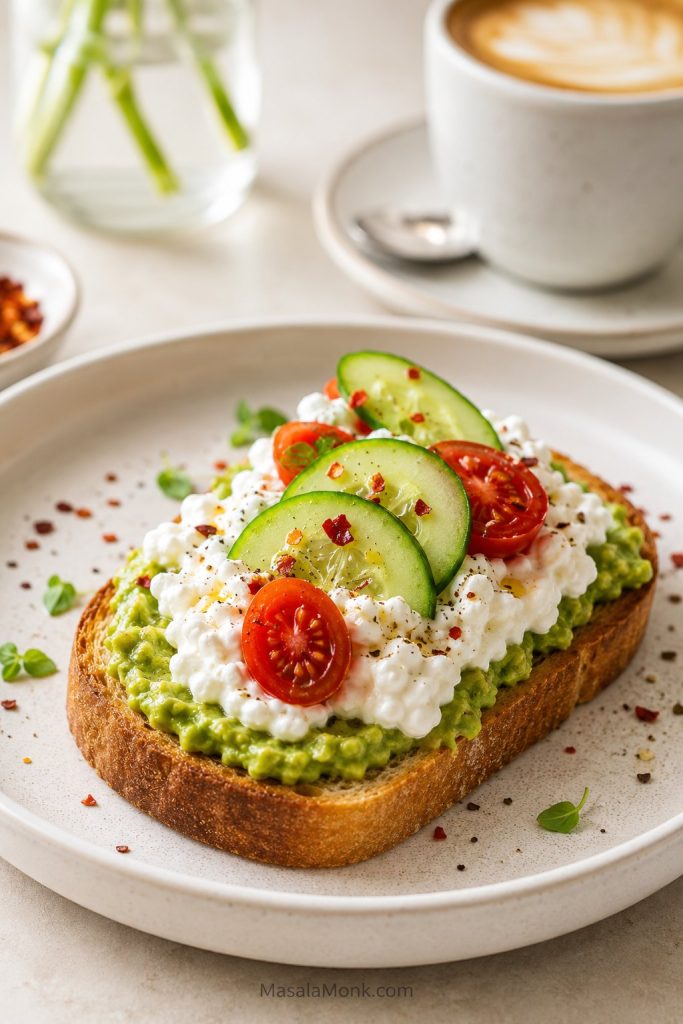
The cottage cheese version is the no-cook protein route: cool, creamy, tangy, and more filling without another pan of eggs. Choose it when you want the toast to feel like a real breakfast but do not want to cook anything.

Cottage cheese avocado toast with seasoned avocado, creamy cottage cheese, cucumber or tomato, chili flakes, and crisp bread.
Cottage cheese adds cool tang and protein, but it works best when the texture is creamy rather than wet.

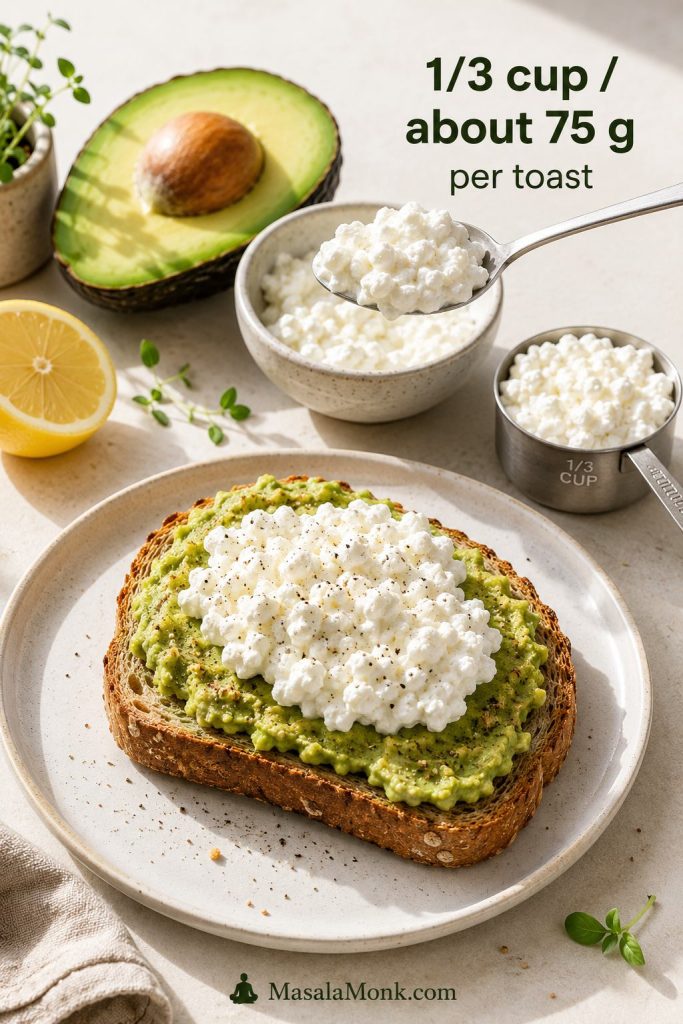
One thick slice needs 1/4 to 1/2 avocado, 1/3 cup / about 75 g cottage cheese, 1 teaspoon lemon or lime juice, salt, black pepper, and chili flakes. Watery cottage cheese should be drained first so the bread stays firm.

Cottage cheese avocado toast guide showing one-third cup or about 75 grams of cottage cheese with avocado and lemon.
Use about 1/3 cup cottage cheese per toast; however, drain it first if it looks watery.

Low-fat cottage cheese is usually lighter but can be wetter. Full-fat cottage cheese is creamier and richer. Both work, but season carefully because cottage cheese is already salty. For contrast, add something crisp, spicy, or fresh.

For a warmer version of the same high-protein idea, these scrambled eggs with cottage cheese give you a creamy breakfast option without relying on toast.

Brunch Versions: Smoked Salmon, Feta, and Bagel

Once the base is right, richer versions are easy. The trick is restraint: smoked salmon, feta, bagels, and cheese can make the toast feel special, but they also add salt, richness, or weight. Let one main topping lead, then use lemon, herbs, pepper, or crunchy vegetables to keep the bite balanced.

Smoked Salmon Version

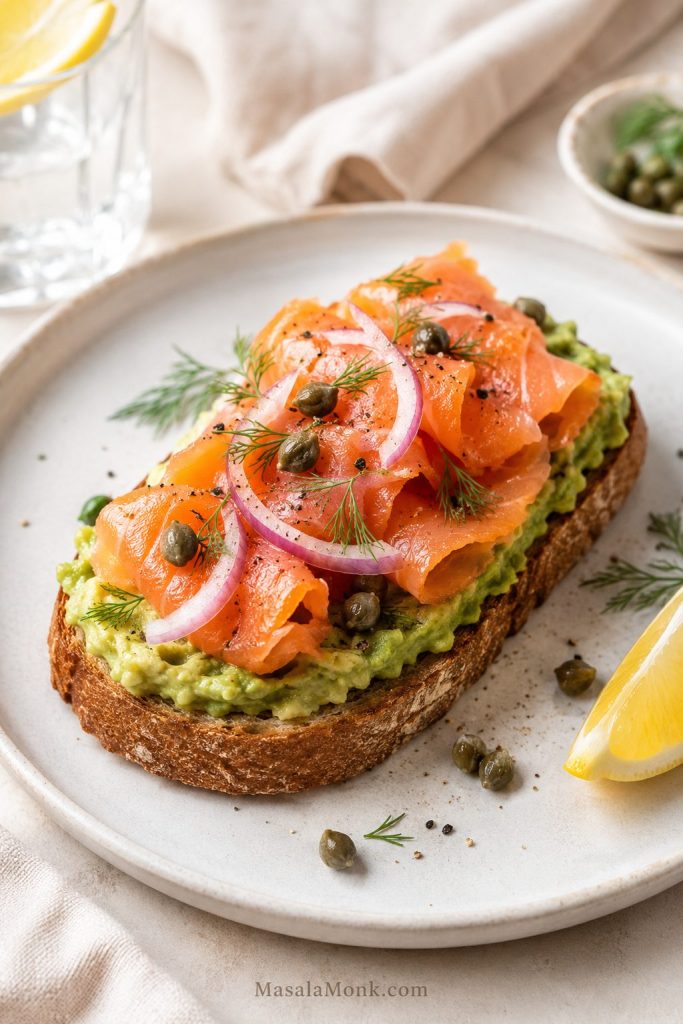
For brunch, keep the avocado quieter and let salmon, lemon, capers, onion, and dill lead. Because smoked salmon is already salty, season the mash more lightly and use citrus or herbs for lift.

For one toast, use 1 slice sourdough, rye, seeded bread, or 1/2 toasted bagel; 1/2 avocado; 1–2 ounces / 30–60 g smoked salmon; 1 teaspoon lemon juice; 1 teaspoon capers; thin red onion or shallot; and dill, chives, or microgreens. Cream cheese, goat cheese, or cottage cheese can go under the avocado if you want a richer version.

Smoked salmon avocado toast with folded salmon, capers, dill, red onion, lemon, and mashed avocado on sourdough.
Smoked salmon brings brunch richness, so lemon, dill, capers, and onion help keep the slice balanced.

Feta Version

Feta is the fastest fix for a mild, creamy base. It brings salt and edge, especially when you add tomato, cucumber, herbs, black pepper, or a little lemon.

For one toast, spread 1/2 avocado over sturdy toast, then add 1–2 tablespoons crumbled feta. If using olives, capers, or pickled onions too, reduce the salt in the avocado mash.

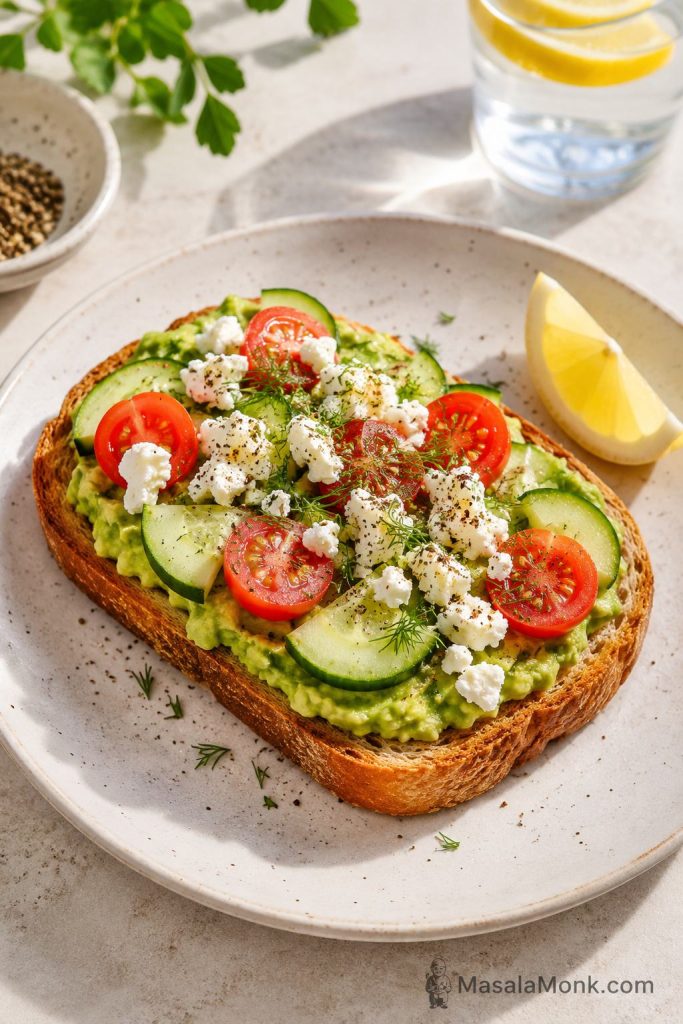
Feta avocado toast with crumbled feta, cucumber, tomato, dill, black pepper, lemon, and seasoned avocado.
Feta brings salt and sharpness, so it quickly makes a mild avocado base taste brighter.

Bagel Version

A bagel turns this into a bigger breakfast, so the build needs more restraint. Toast the cut side well, use 1/2 avocado per bagel half, and choose one main direction: egg, cottage cheese, smoked salmon, tomato, or everything bagel seasoning.

If the bagel is large, start with half. A full bagel with avocado and toppings can become very filling quickly.

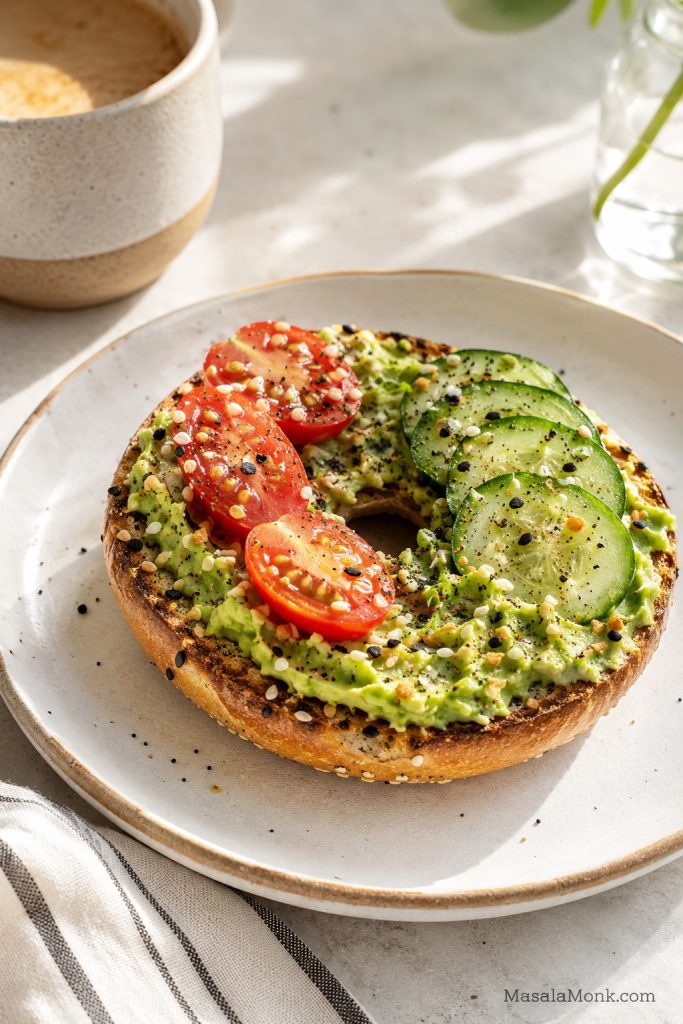
Avocado bagel toast on half a toasted bagel with seasoned avocado, cucumber, tomato, and everything seasoning.
A bagel makes the toast more filling; therefore, half a bagel with focused toppings often feels more balanced.

If you like the bagel direction, MasalaMonk’s breakfast sandwich ideas have more ways to build egg, cheese, avocado, sauce, and toasted bread into a fuller morning meal.

What Your Toast Needs: Fix the Bite

Do not choose toppings randomly. Choose them by what the bite is missing. If the base already tastes good, one topping is usually enough.

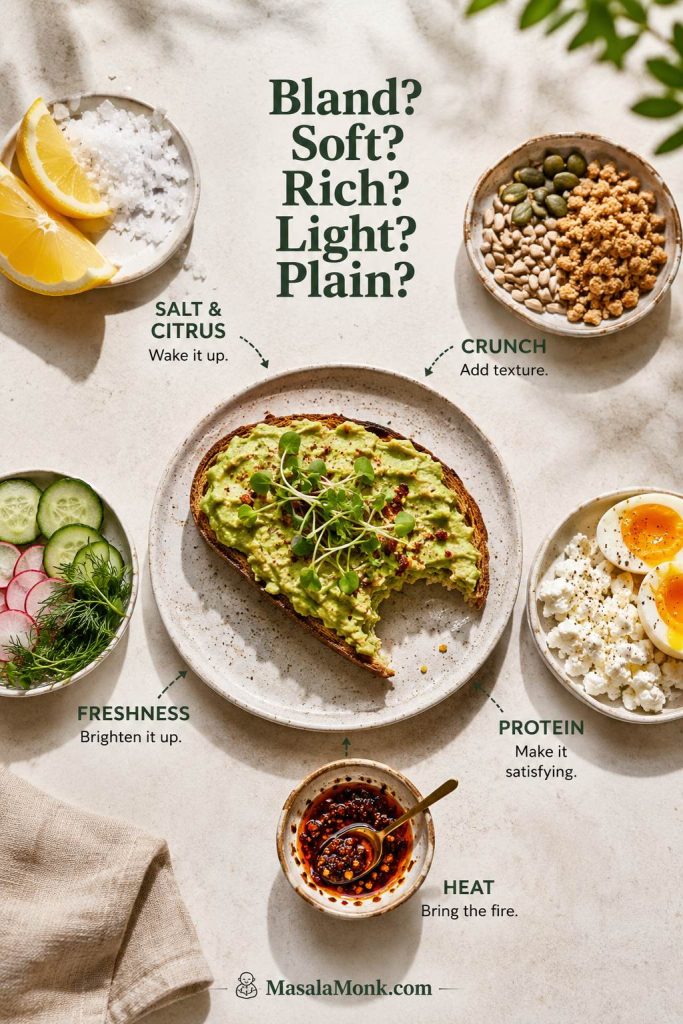
Take one bite of the base first; the answer is usually obvious once you notice whether it needs crunch, salt, heat, freshness, or protein.

Diagnostic avocado toast guide with a bitten toast and surrounding cues for salt, citrus, crunch, freshness, protein, and heat.
Before adding more, decide what is missing: salt, crunch, freshness, protein, or heat.

What Your Toast Needs

  • Bland? Add salt, lemon or lime, chili flakes, hot sauce, flaky salt, or everything bagel seasoning.
  • Soft-on-soft? Add cucumber, radish, seeds, crispy garlic, toasted nuts, or crisp bacon.
  • Too rich? Add tomato, herbs, pickled onion, lemon or lime, capers, sprouts, or cucumber.
  • Not filling? Add egg, cottage cheese, beans, tuna, smoked salmon, tofu, or seeds.
  • Too plain? Add feta, goat cheese, za’atar, pesto, chili crisp, hot sauce, or a garlic rub on the toast.

15 Ideas That Actually Work

Think of these as starting points, not rules. A weekday toast might only need lemon and chili flakes, while a weekend brunch version can handle egg, smoked salmon, capers, herbs, and a little extra crunch.

Quick Everyday Ideas

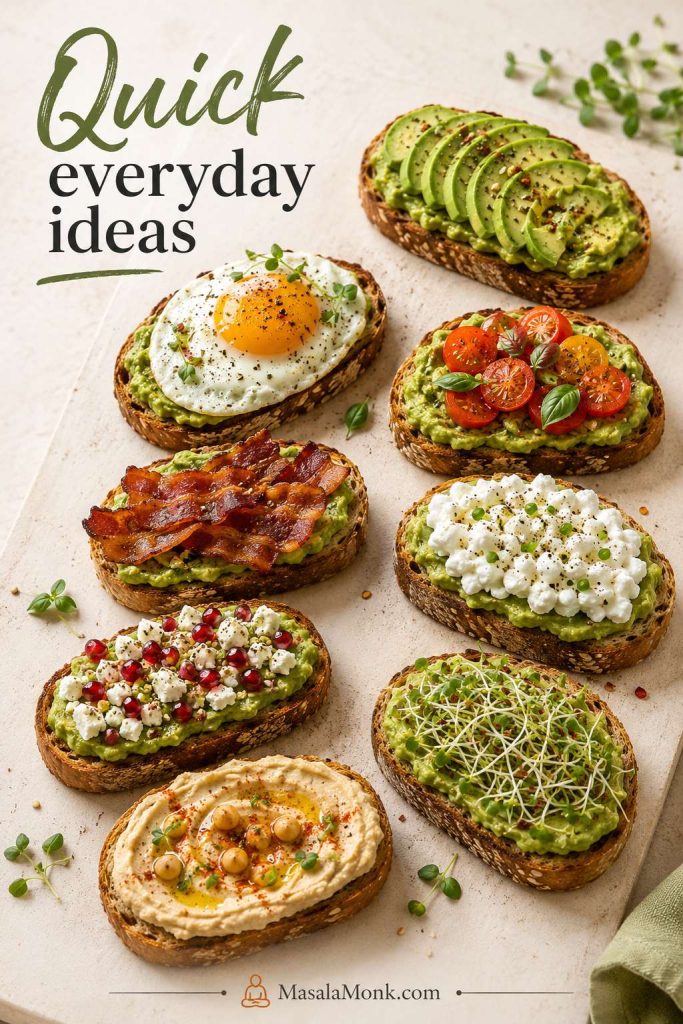
Board of quick avocado toast ideas with classic, egg, tomato, bacon, cottage cheese, feta, hummus, and sprout toppings.
For quick avocado toast ideas, pick one main topping and one fresh or crunchy finish instead of overloading the slice.
Idea What to add Why it works
Classic café toast Avocado, lemon, flaky salt, chili flakes, olive oil The cleanest version when the avocado is ripe and well-seasoned.
Fried egg avocado toast Avocado, fried egg, pepper, chives Rich yolk makes it feel like a full breakfast.
Tomato avocado toast Avocado, tomato, basil or coriander/cilantro, black pepper Tomato makes the toast feel juicy and summery.
Bacon avocado toast Avocado, crisp bacon, egg, hot sauce Salty crunch cuts through the creamy avocado.
Cottage cheese avocado toast Avocado, cottage cheese, cucumber, chili flakes Cool, creamy, tangy, and more filling without cooking another egg.
Feta avocado toast Avocado, feta, cucumber, tomato, oregano or za’atar Salty cheese and fresh vegetables balance the avocado.
Hummus avocado toast Hummus, avocado, olive oil, paprika Creamy, savory, and vegan-friendly.
Sprouts avocado toast Avocado, sprouts, cucumber, seeds, lemon Crunchy, fresh, and lighter.

Filling, Brunch, and Bigger Ideas

Brunch avocado toast spread with smoked salmon, beans, caprese toppings, tuna, pesto, pickled onion, lemon, and herbs.
Brunch versions can handle bigger flavors, but one main topping should still lead so the slice stays balanced.
Idea What to add Why it works
Smoked salmon avocado toast Avocado, salmon, capers, dill, red onion Premium brunch flavor with salt, tang, and herbs.
Black bean salsa avocado toast Avocado, black beans, salsa, coriander/cilantro, lime Filling, bright, vegan-friendly, and strong enough for brunch.
White bean avocado toast Avocado, white beans, lemon, herbs, pepper Creamy, mellow, and more satisfying without egg or cheese.
Caprese avocado toast Avocado, tomato, mozzarella or burrata, basil Fresh, creamy, and summer-friendly.
Tuna avocado toast Avocado, tuna, lemon, pepper, onion Protein-heavy and lunch-friendly.
Pickled onion avocado toast Avocado, pickled onions, herbs, black pepper Sharp, colorful, and useful when the toast tastes too rich.
Pesto avocado toast Avocado, pesto, tomato, flaky salt Herby, savory, and a fast way to make the base taste more complete.

You do not need to turn every slice into a loaded café plate. Most days, one strong direction is enough: egg and pepper, tomato and basil, cottage cheese and cucumber, or beans and salsa.

Crunch fix for avocado toast with cucumber, radish, crispy garlic, seeds, and a fork bite showing crisp bread.
When the bite feels soft all the way through, add cucumber, radish, seeds, or crispy garlic for contrast.

Still unsure what to add? Use What Your Toast Needs to choose by texture, salt, freshness, protein, or heat.

For the bacon version, keep the bacon crisp and the portion modest; the crunch matters more than piling it on. This air fryer bacon recipe is handy when you want a few crisp strips for breakfast without standing over a skillet.

Best Seasoning

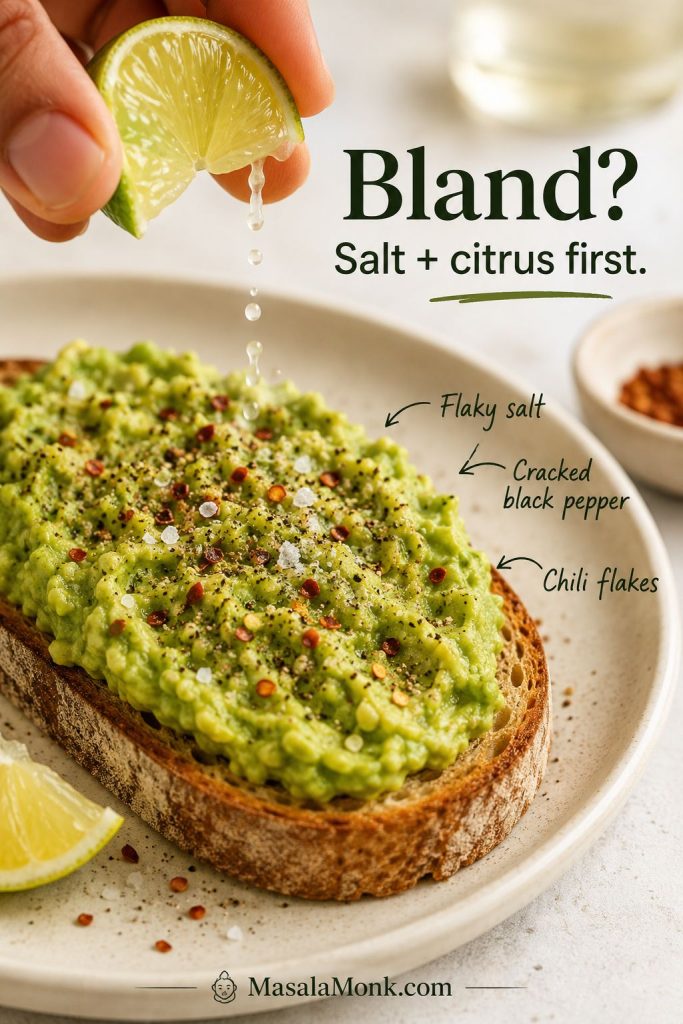
If the toast tastes bland, it usually needs more salt, citrus, heat, or crunch — not more avocado. Start with salt and lemon or lime, then build from there. The seasoning should make the avocado taste brighter, not cover it completely.

Close-up of bland avocado toast being fixed with lime juice, flaky salt, black pepper, and chili flakes.
When the avocado tastes bland, start with salt and citrus before reaching for more toppings.
  • Classic: flaky salt, black pepper, red pepper flakes, and olive oil.
  • Bagel-style: everything bagel seasoning, garlic powder, onion powder, or sesame seeds.
  • Fresh and herby: lemon pepper, za’atar, dill, basil, coriander/cilantro, or chives.
  • Warm and smoky: smoked paprika, chili flakes, chili crisp, or hot sauce.
  • Rich and savory: pesto, garlic rub, goat cheese, feta, or a light drizzle of olive oil.

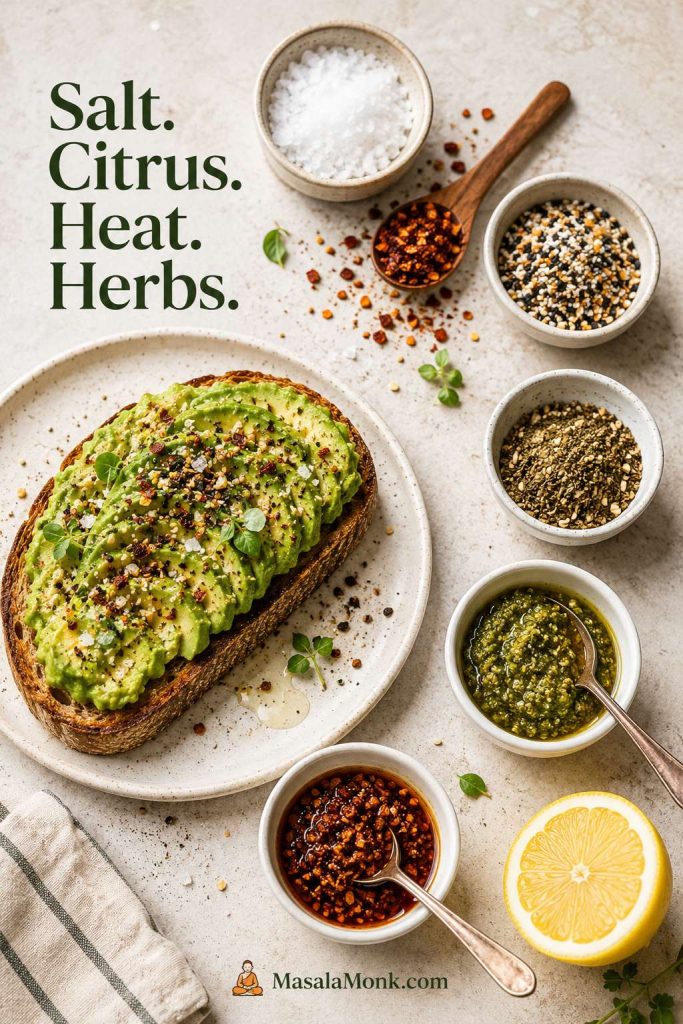
For a safe first version, use lemon, flaky salt, black pepper, and chili flakes. For a bigger savory finish, try everything bagel seasoning, pesto, chili crisp, or a light garlic rub on the hot toast.

Seasoning palette for avocado toast with flaky salt, chili flakes, everything seasoning, za’atar, pesto, chili crisp, lemon, and herbs.
The best seasoning for avocado toast should brighten the avocado, not hide it; start with salt, citrus, heat, and herbs.

If seasoning does not fix the problem, check Mistakes & Fixes next.

Healthy & High-Protein Notes

This can be a healthy breakfast, but it depends on how you build it. Avocado brings fiber and mostly unsaturated fat, while the bread, toppings, and portion size decide whether the toast feels light, balanced, or too heavy.

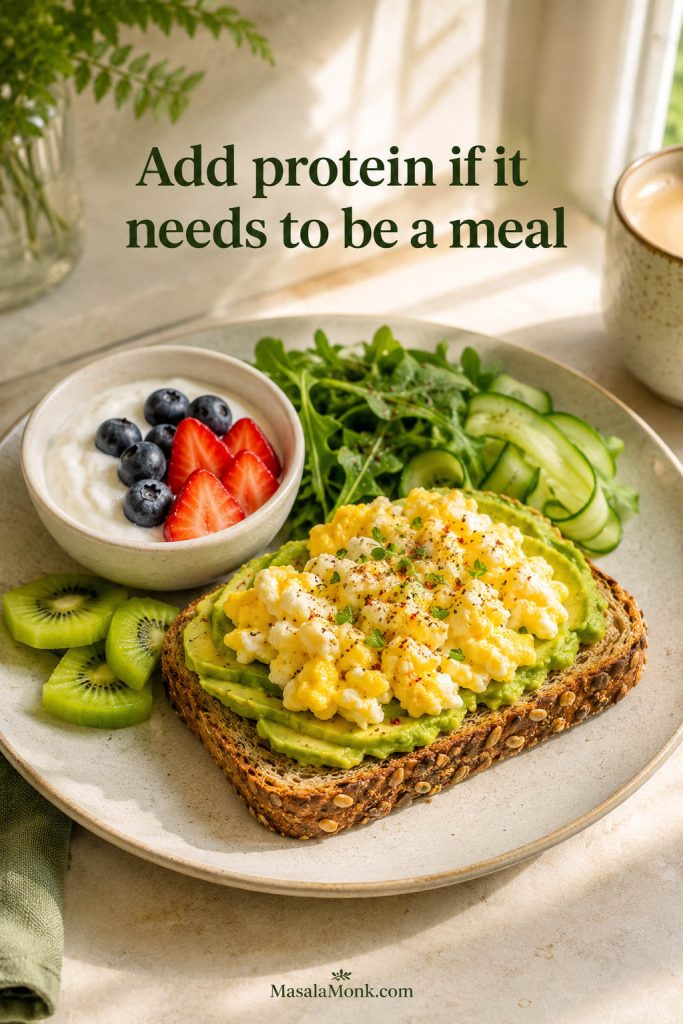
Plain avocado toast can be delicious, but it is not automatically a full breakfast. Protein is what turns it from a good slice into a meal.

High-protein avocado toast breakfast with seeded toast, avocado, scrambled egg, yogurt with berries, greens, cucumber, and kiwi.
Protein is what turns avocado toast from a light slice into a breakfast that keeps you satisfied longer.

Think of avocado as the creamy fat-and-fiber part of the meal; then add egg, cottage cheese, beans, tuna, tofu, seeds, or smoked salmon if you want it to keep you full longer.

A good everyday version is 1 slice of whole-grain or seeded toast, 1/2 avocado, lemon or lime, salt, pepper, egg or cottage cheese, and tomato, cucumber, sprouts, herbs, or seeds. For a deeper nutrition read, Harvard’s avocado nutrition guide is a helpful reference.

If you are making it for weight loss, focus on portion and protein rather than treating one version as automatically “diet-friendly.” Use one slice of sturdy bread, about 1/2 avocado, plenty of lemon or lime, and a protein topping. Be careful with oversized bread, extra oil, heavy cheese, bacon, or several rich toppings at once.

For days when you want another protein-focused breakfast that is not toast, this high-protein oatmeal guide gives you a warmer bowl-style option with yogurt, egg whites, cottage cheese, tofu, or protein powder.

For practical protein builds in this post, jump to Avocado Toast with Egg or the Cottage Cheese Version.

Restaurant-Style Ideas

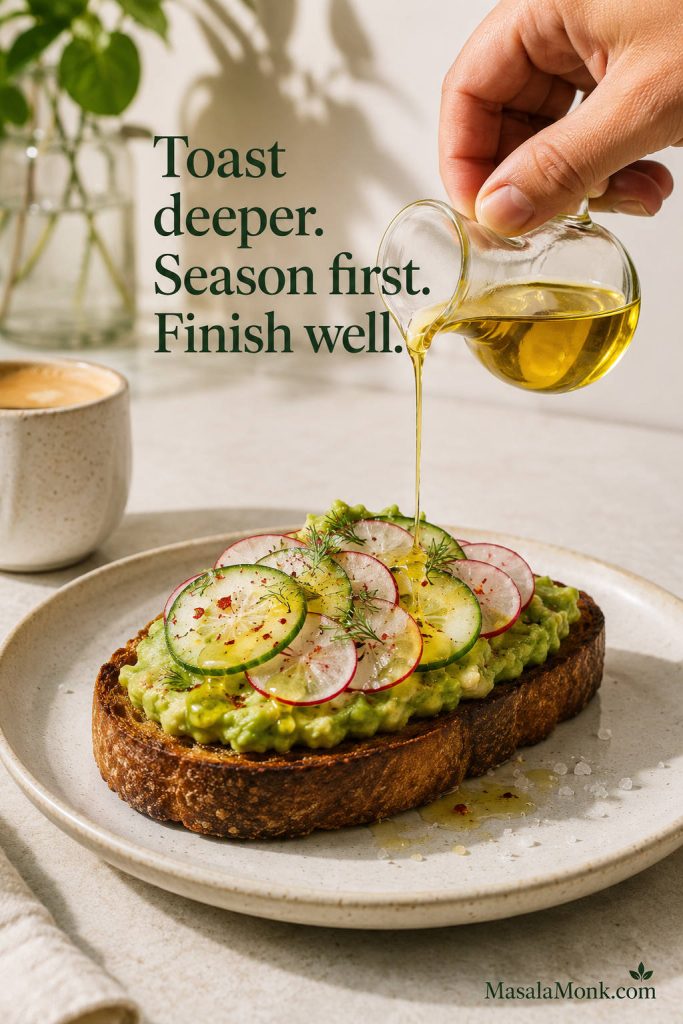
Restaurant-style versions work best when you borrow the method, not every exact detail. Toast the bread deeply, season the avocado before spreading, finish with flaky salt or olive oil, and add one fresh or crunchy topping so the slice tastes finished.

Restaurant-style avocado toast with olive oil being drizzled over avocado, radish, cucumber, herbs, and crisp bread.
Café-style toast usually wins on small details: deeper toast, seasoned avocado, and a deliberate final finish.

Dunkin-Style Version

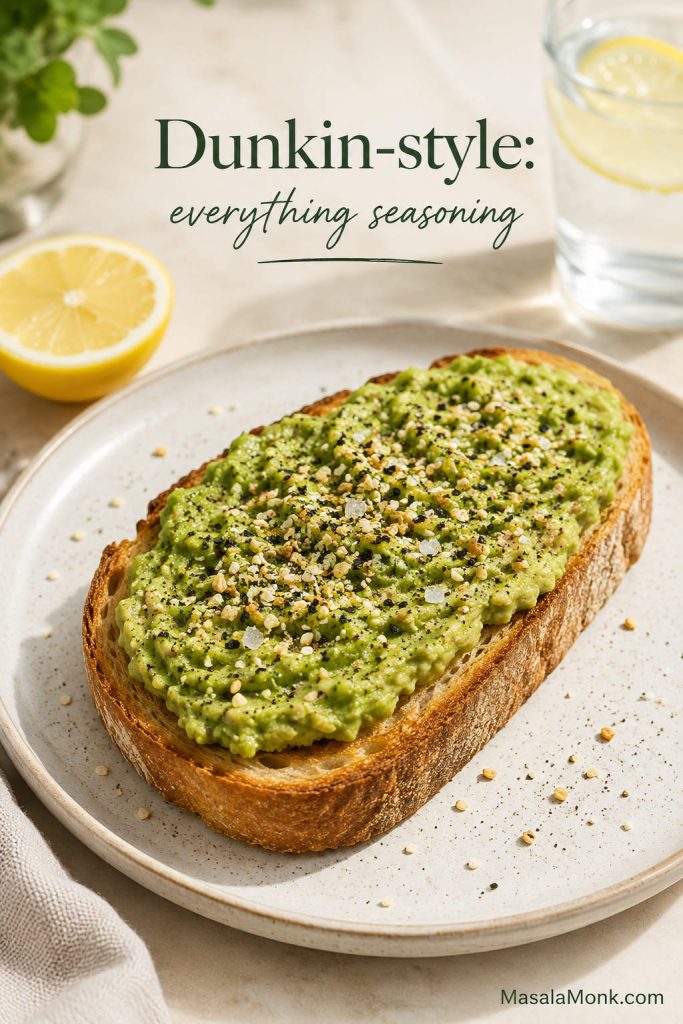
For a Dunkin-style version, use toasted sourdough, a smooth avocado spread, lemon juice, sea salt, black pepper, and a generous finish of everything bagel seasoning. The official Dunkin avocado toast announcement confirms those signature details, which makes this one of the easiest copycat versions to echo at home.

Dunkin-style avocado toast with smooth avocado spread on sourdough, everything seasoning, lemon, and black pepper.
For a Dunkin-style avocado toast, keep the spread smooth and finish generously with everything seasoning.

Café-Style Whole-Grain Version

For a café-style whole-grain version, use thick toast, smashed avocado, extra-virgin olive oil, lemon, flaky salt, and eggs. It gives you the bigger breakfast-plate feel without needing a restaurant copycat.

Why Your Avocado Toast Tastes Bland, Soggy, or Boring

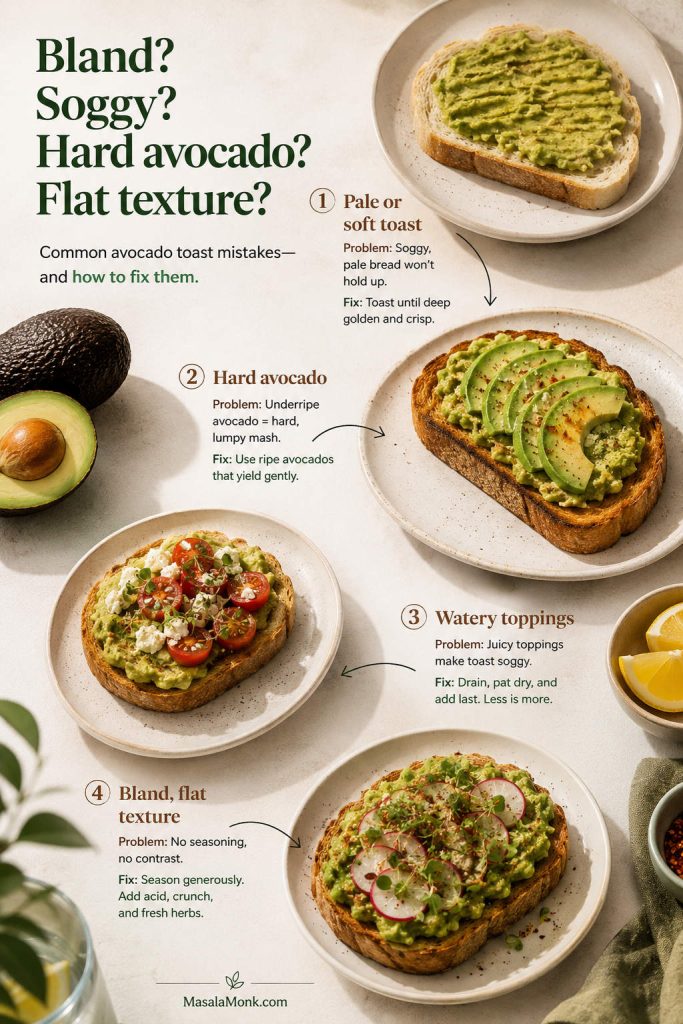
Avocado toast gets mocked when it is made badly: pale bread, underripe avocado, no salt, no lemon, no crunch, and nothing to break up the creaminess. Fortunately, the fix is usually simple. Toast the bread harder, season the avocado before spreading, and add one topping that changes the bite.

Avocado toast mistakes and fixes guide showing pale toast, hard avocado, watery toppings, bland mash, and improved toast examples.
If the slice tastes disappointing, check the bread, avocado ripeness, and seasoning before blaming the toppings.
Problem Why it happens Fix
Bland avocado toast Not enough salt, citrus, or seasoning Add salt, lemon or lime, black pepper, chili flakes, hot sauce, or everything seasoning.
Soggy toast Bread is too soft or toppings are wet Use thicker bread, toast it darker, drain wet toppings, and assemble right before eating.
Hard avocado Avocado is underripe Wait until it gives slightly when pressed. Do not force hard avocado into toast.
Brown avocado Avocado was cut too early or exposed to air Add lemon or lime and use it fresh. Press wrap directly onto leftovers if needed.
Too rich Too much avocado, oil, cheese, or creamy topping Add tomato, cucumber, herbs, pickled onion, lemon, or capers.
Not filling No protein Add egg, cottage cheese, smoked salmon, beans, tofu, tuna, or seeds.
Flat texture Everything is soft Add radish, cucumber, seeds, crispy garlic, onions, or toasted nuts.

When the toast tastes too rich, freshness is the fix. Tomato, herbs, pickled onion, lemon, capers, cucumber, or radish cut through the creamy base without making the slice heavier.

Too-rich avocado toast freshness fix with tomato, herbs, pickled onion, lemon, capers, cucumber, radish, and seasoned avocado.
When the toast tastes too rich, add freshness with tomato, herbs, pickled onion, lemon, capers, cucumber, or radish.

If sogginess is the main issue, the next section shows how to protect the bread.

How to Keep It from Getting Soggy

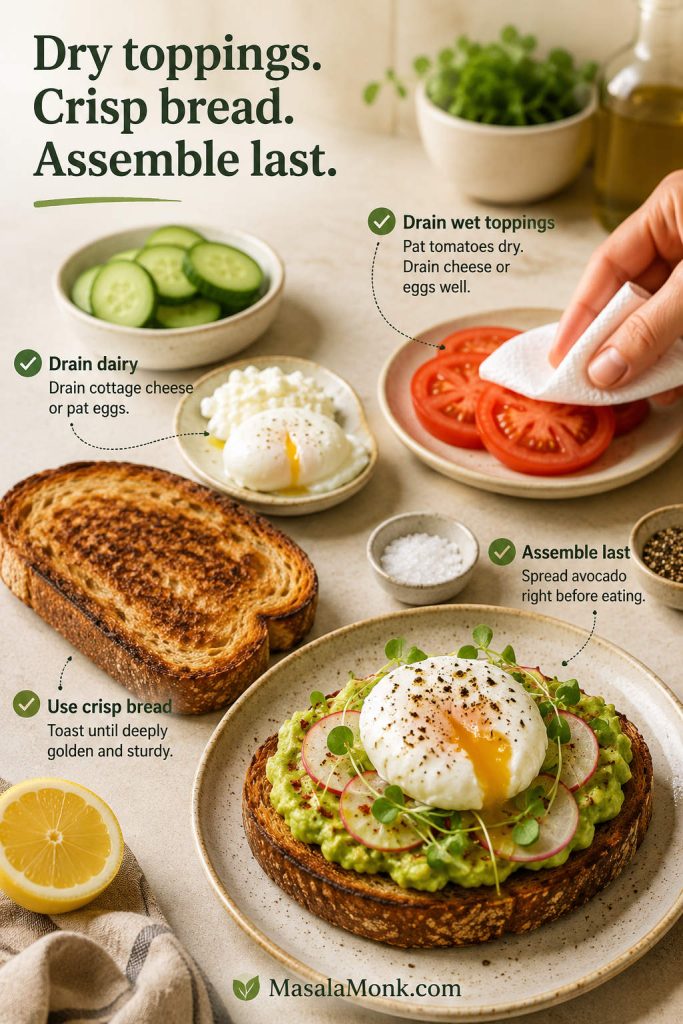
Toast the bread until it is deeply golden, not just warm. Thick sourdough, seeded bread, rye, and bagels hold up better than soft sandwich bread. If using tomato, cucumber, poached egg, pickled onion, or smoked salmon, drain or pat the topping before adding it. For tomatoes, remove watery seeds or pat slices dry before they hit the toast.

Soggy avocado toast prevention guide with tomato slices being dried, crisp toast, cottage cheese, poached egg, and a finished toast.
To keep avocado toast from getting soggy, remove extra moisture first and assemble only when you are ready to eat.

Do not let wet toppings do the bread’s job. The bread should carry the avocado; the toppings should add contrast, not soak the slice.

The safest rule is simple: assemble right before eating. Avocado softens the bread as it sits, and wet toppings speed that up. If you are making breakfast for several people, toast the bread, prep the toppings, and mash the avocado last.

Storage and Make-Ahead Tips

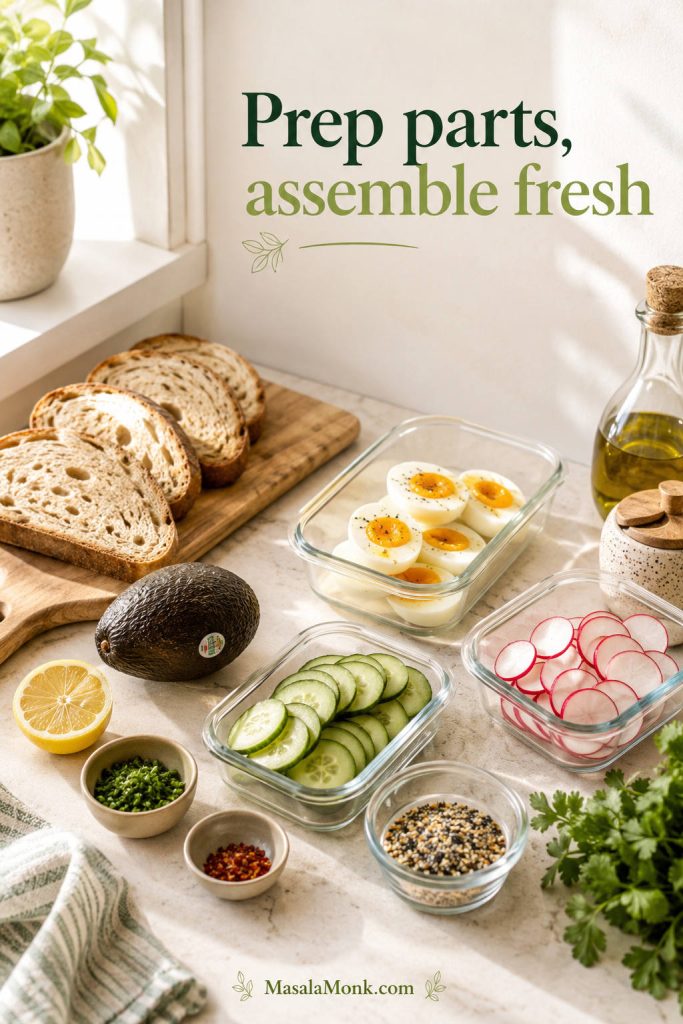
This toast is best fresh. The bread loses its edge, the avocado browns, and wet toppings can make the slice soft. However, you can still prep the parts ahead.

Make-ahead avocado toast prep with boiled eggs, sliced cucumber, radish, whole avocado, lemon, bread, seasonings, and herbs.
Prep toppings ahead, but save the avocado and toast for last so the finished slice stays bright and crisp.
  • Boil eggs ahead and refrigerate them.
  • Slice cucumber, radish, onion, or tomato shortly before serving.
  • Toast the bread right before eating.
  • Mash avocado with lemon or lime as close to serving time as possible.
  • If you must store avocado mash briefly, press plastic wrap directly onto the surface and refrigerate.

Do not freeze assembled avocado toast. It will not come back with a good texture.

Ready to make it now? Use the saveable guide below, then jump into the recipe card for the full amounts and steps.

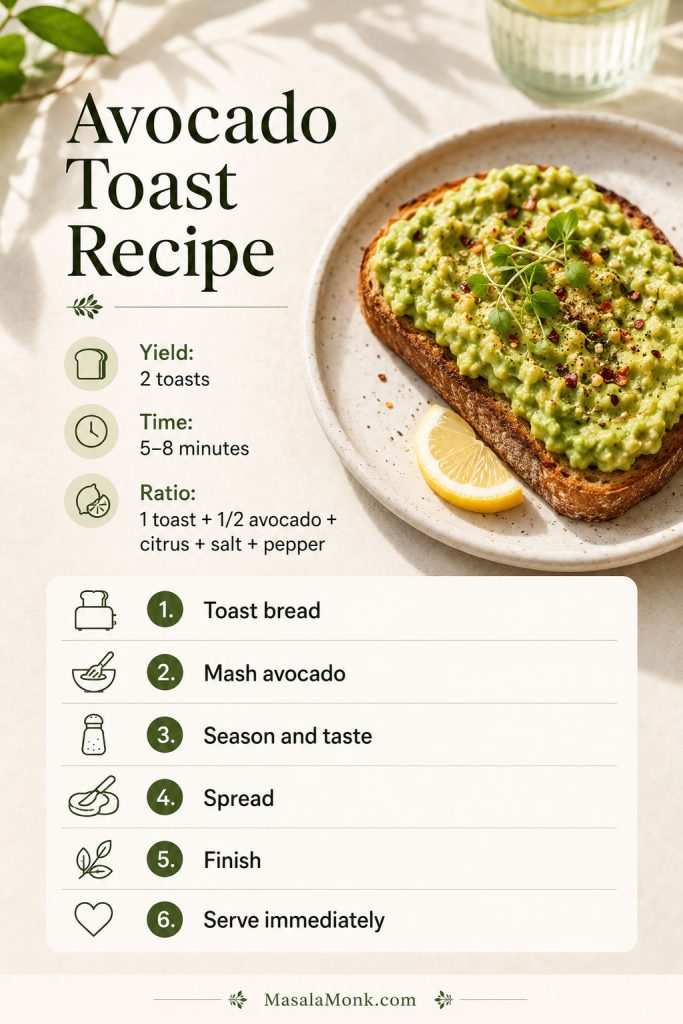
Avocado toast recipe card with finished toast, yield for two toasts, five-to-eight-minute timing, base ratio, and six steps.
Save the base avocado toast recipe first; then choose egg, cottage cheese, smoked salmon, vegetables, or seasoning based on the bite you want.

Avocado Toast Recipe

This easy avocado toast recipe gives you a bright, well-seasoned base first: crisp bread, ripe avocado, lemon or lime, salt, and pepper. Keep it simple, or choose one direction: egg for breakfast, cottage cheese for protein, smoked salmon for brunch, or tomato and cucumber for freshness.

Yield2 toasts
Prep Time5 minutes
Toast Time2–3 minutes
Total Time5–8 minutes

Ingredients

  • 2 thick slices sourdough, whole-grain, seeded, or multigrain bread
  • 1 ripe avocado, about 140–160 g flesh
  • 2–4 tsp lemon or lime juice / 10–20 ml, to taste
  • 1/4 tsp fine salt, plus more to taste
  • 1/8 tsp black pepper
  • 1–2 tsp extra-virgin olive oil, optional
  • Pinch red pepper flakes, optional
  • Flaky salt, for finishing
  • Optional toppings: egg, cottage cheese, smoked salmon, feta, tomato, cucumber, herbs, or your favorite seasoning

Instructions

  1. Toast the bread until crisp and golden.
  2. Mash the avocado with lemon or lime juice, fine salt, and black pepper until creamy but still slightly textured.
  3. Taste and adjust with more salt, citrus, pepper, or chili flakes if needed.
  4. Spread the avocado over the hot toast, using about half an avocado per slice.
  5. Finish with flaky salt, olive oil, chili flakes, herbs, egg, cottage cheese, smoked salmon, feta, or your chosen topping.
  6. Serve immediately while the bread still has bite.

Notes

  • Use 1/2 avocado per thick slice of toast as the base ratio.
  • For the egg version, add 1 fried, poached, scrambled, boiled, jammy, or egg-white topping per toast.
  • For the cottage cheese version, use 1/3 cup / about 75 g cottage cheese per toast and drain it if watery.
  • For the smoked salmon version, use 1–2 oz / 30–60 g smoked salmon per toast and reduce the added salt.
  • Toast the bread deeply enough to stay crisp under the avocado.
  • Assembled toast does not store well. Eat it right away.

FAQs

Most avocado toast questions come back to the same few problems: the bread got soft, the avocado tasted flat, or the toast did not feel filling enough.

What is the best bread?

Sourdough is the best all-around bread because it gets crisp, tastes slightly tangy, and holds the avocado well. Whole grain, seeded bread, rye, bagels, English muffins, and gluten-free bread also work if you toast them properly.

How much avocado do you need per slice?

Use about 1/2 medium-large avocado per thick slice. That is usually 70–80 g avocado flesh per toast. Use less if you are adding cottage cheese, egg, smoked salmon, or another rich topping.

Should avocado be mashed or sliced?

Mashed avocado is better for everyday toast because it spreads evenly and holds seasoning well. Sliced avocado looks cleaner and works nicely with smoked salmon, feta, tomato, or a poached egg. Either way, season it with salt and lemon or lime.

Do you cook the avocado?

No. Toast the bread first, then add the avocado after. Cooking the avocado mixture in a skillet can make it taste dull. The bread should be hot and crisp, but the avocado should stay fresh and seasoned.

What seasoning is best?

Start with salt, black pepper, and lemon or lime. Then add one stronger finish if needed: everything bagel seasoning, chili crisp, hot sauce, pesto, za’atar, smoked paprika, or flaky salt.

Why does it taste bland?

It usually tastes bland when the avocado is underripe or under-seasoned. Add more salt, lemon or lime, black pepper, chili flakes, or something crunchy. A little citrus and enough salt make a much bigger difference than adding more avocado.

What can I add for protein?

Egg and cottage cheese are the easiest breakfast options. For lunch or brunch, smoked salmon, tuna, beans, tofu, seeds, or egg whites can also make the toast more filling.

What goes with it besides egg?

Choose one direction: cottage cheese for creamy protein, tomato or cucumber for freshness, feta for salt, beans or hummus for a plant-based version, or chili crisp, pesto, and seeds for more flavor and texture.

Is cottage cheese good here?

Yes. Cottage cheese adds protein, tang, and creaminess. Use about 1/3 cup / 75 g cottage cheese per toast, and drain it first if it looks watery.

Is this healthy?

It can be a healthy breakfast when it uses sturdy whole-grain or seeded bread, about half an avocado, and a protein or vegetable topping. The avocado brings creaminess and healthy fats; the extra protein or vegetables make the meal more balanced.

Is it enough for breakfast?

It can be enough for a light breakfast. For a longer-lasting meal, add egg or cottage cheese so the toast has more staying power.

Is it good for weight loss?

It can fit into a weight-loss breakfast if the portion is sensible. Use one slice of bread, about 1/2 avocado, lemon or lime, and a protein topping such as egg or cottage cheese. Be careful with oversized bread, extra oil, heavy cheese, bacon, or too many rich toppings together.

Can you meal prep it?

You can prep the toppings, but assembled toast is best fresh. Boil eggs, slice vegetables, and keep toppings ready, then toast the bread and mash the avocado right before eating.

How do you keep it from getting soggy?

Use thick bread, toast it until crisp, drain wet toppings, and assemble right before serving. If using poached egg, tomato, cucumber, pickled onion, or smoked salmon, remove excess moisture before adding it.

Why do restaurant versions taste better?

Restaurant versions usually taste better because each small detail is handled well: the bread is toasted harder, the avocado gets enough salt and citrus, and the top has a finishing touch like olive oil, flaky salt, herbs, chili flakes, or something crunchy.

How do you make the Dunkin-style version?

Use toasted sourdough, mashed avocado, lemon juice, sea salt, black pepper, and everything bagel seasoning. Keep the avocado spread smooth and finish with enough seasoning to give the toast a savory, garlicky crunch.

Final Thoughts

Good avocado toast comes down to that same rule: crisp bread, seasoned avocado, and one topping that changes the bite. That will beat a loaded but bland slice every time.

Egg makes it breakfast, cottage cheese makes it more filling, smoked salmon makes it brunch, feta brings salt, and cucumber or radish brings crunch. Once the base is right, your best version can be simple, loaded, spicy, crunchy, or somewhere in between.

What is your go-to avocado toast topping — fried egg, cottage cheese, smoked salmon, feta, chili crisp, pesto, everything bagel seasoning, or something I should try next? Share it in the comments so other readers can try it too.

Posted on Leave a comment

Scrambled Eggs with Cottage Cheese Recipe

Scrambled eggs with cottage cheese served on a plate with toast, chives, and black pepper.

Scrambled eggs with cottage cheese can go one of two ways: creamy, soft, and surprisingly good, or loose and a little strange. The difference is not luck. It is the ratio, the cottage cheese you use, and how gently you cook the eggs.

This recipe is built for the good version: high-protein scrambled eggs that stay tender, creamy, and satisfying without turning wet or rubbery. It walks you through the ratio, the smoother blended option, the egg-white version, microwave method, add-ins, and the fixes that keep cottage cheese eggs from turning watery.

This is especially useful if you want a higher-protein breakfast but still want food that feels warm, familiar, and satisfying. It is not trying to turn eggs into a diet trick; it is just a better, creamier scramble with more staying power.

Quick Answer: How to Make Scrambled Eggs with Cottage Cheese

To make scrambled eggs with cottage cheese, whisk 2 large eggs with 1/4 cup cottage cheese, then cook the mixture gently in a nonstick skillet over medium-low heat. Push the eggs slowly with a silicone spatula until they are thickened, creamy, and just set through.

Best Starting Ratio

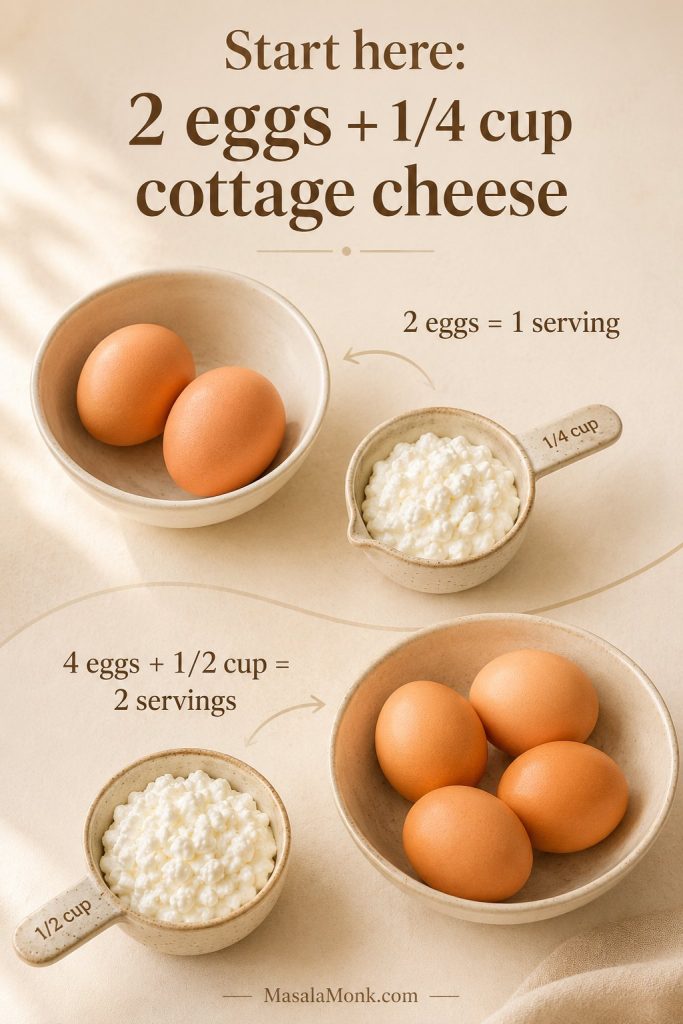
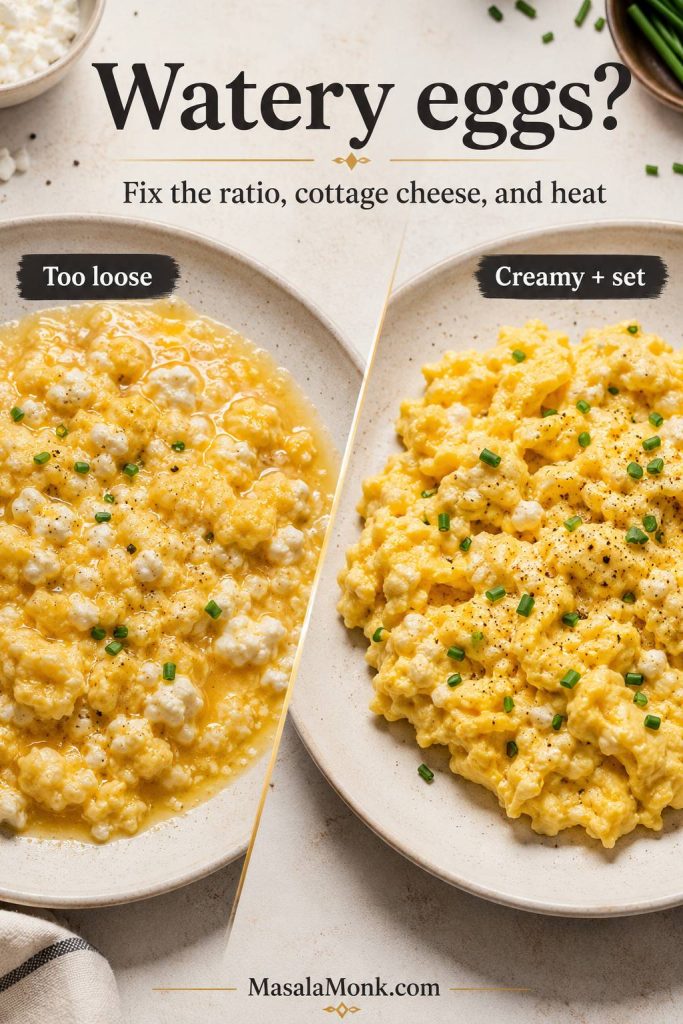
The best starting ratio is 1/4 cup cottage cheese for every 2 eggs. Small-curd 2% cottage cheese gives the most reliable texture, while full-fat cottage cheese tastes richer. If the eggs look loose in the pan, use less cottage cheese next time, drain very liquid cottage cheese, avoid high heat, and cook gently long enough for extra moisture to evaporate.

The full cottage cheese egg ratio guide below shows how to make the eggs subtler, creamier, or better suited to egg whites.

You do not need milk here. Cottage cheese already adds moisture and body, so milk can push the eggs toward watery instead of creamy.

If your last batch turned loose or watery, skip ahead to the watery cottage cheese egg fixes before you cook again.

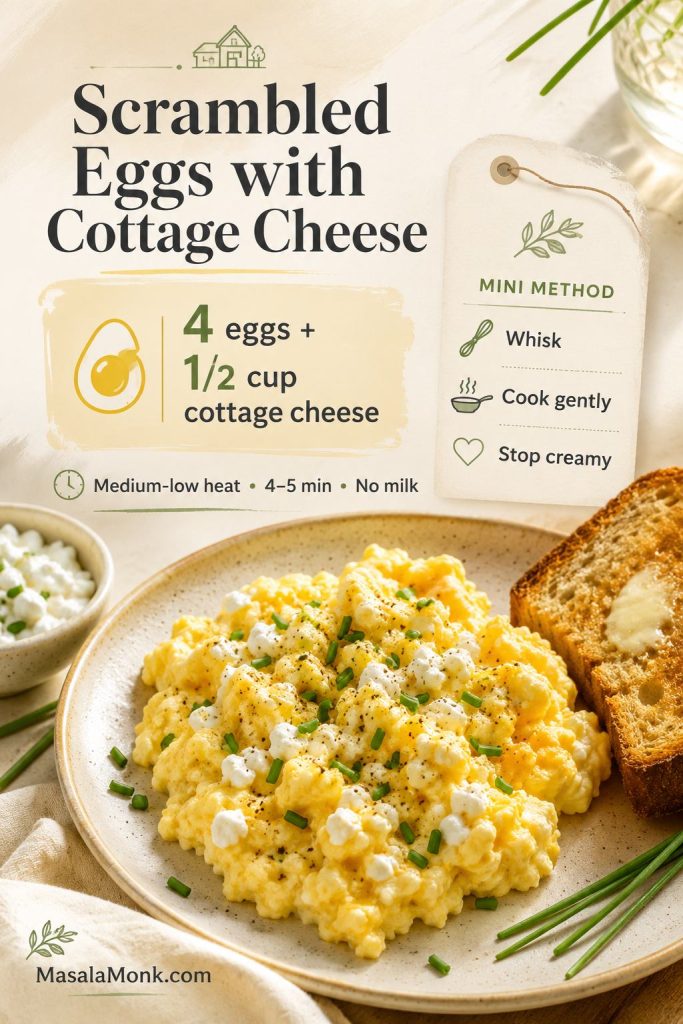
At a glance: Use 4 large eggs, 1/2 cup / 110–120g cottage cheese, and 1 tablespoon / 14g butter for 2 servings. Cook in a nonstick skillet over medium-low heat for 4–5 minutes. Most reliable cottage cheese: small-curd 2% or full-fat. Texture goal: creamy, soft, and fully set, not runny.

Ratio guide showing 2 eggs with 1/4 cup cottage cheese and 4 eggs with 1/2 cup cottage cheese.
For the easiest cottage cheese egg ratio, start with 1/4 cup cottage cheese for every 2 large eggs. Then adjust slightly if your cottage cheese is extra thick or watery.

What the Texture Should Look Like

The goal is not a runny protein hack or a rubbery diet scramble. The best version should taste like soft scrambled eggs with a little extra creaminess, body, and staying power.

Done right, the eggs taste creamy and lightly savory, not aggressively cheesy. The curds soften into the scramble, the pepper gives it a little lift, and a handful of chives or scallions makes the whole plate feel fresher.

A good plate feels simple but a little upgraded: soft eggs, gentle creaminess from the cottage cheese, enough protein to hold you over, and a texture that still feels like breakfast instead of a food trend.

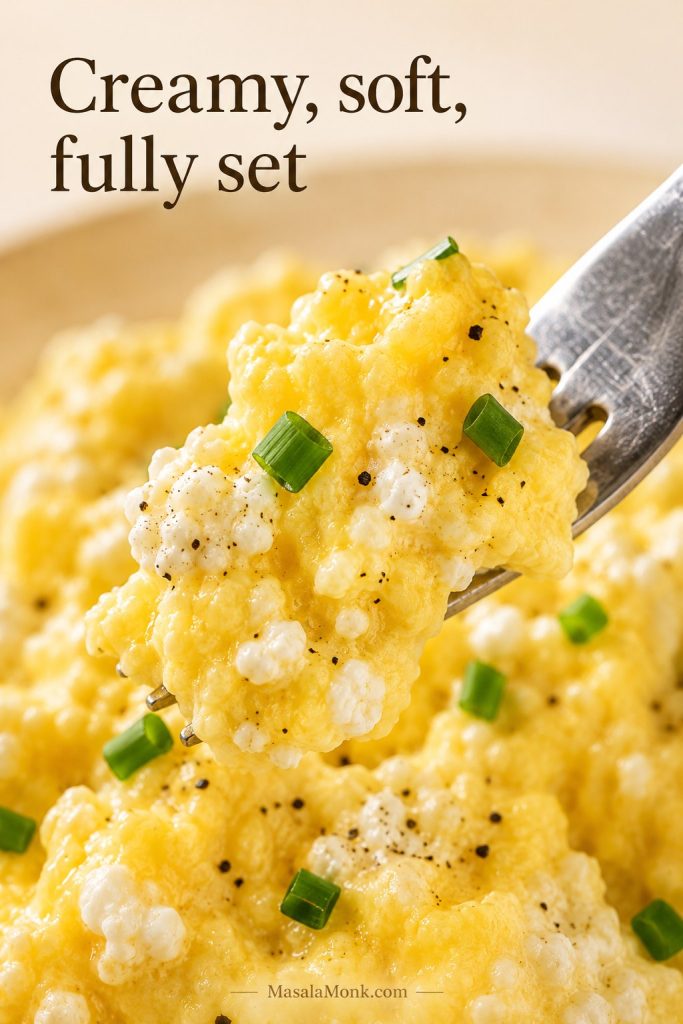
Close-up of creamy scrambled eggs with cottage cheese showing soft folds, chives, pepper, and no pooling liquid.
Look for soft folds that hold together on the fork. That texture means the eggs are creamy and set, rather than loose, wet, or overcooked.

Why Add Cottage Cheese to Scrambled Eggs?

Cottage cheese changes scrambled eggs in three useful ways: it adds protein, makes the eggs more satisfying, and gives them a creamy texture when cooked gently. It is also mild enough that the eggs still taste like eggs, especially if you use a balanced ratio and season them well.

More Protein Without Protein Powder

Eggs are already a strong breakfast ingredient, but cottage cheese makes them more filling. That is why cottage cheese eggs are popular with people looking for high-protein breakfasts, lighter brunch ideas, and quick post-workout meals.

The exact protein will depend on your eggs and cottage cheese brand. If you are tracking closely, use the nutrition label on your cottage cheese and a food database such as USDA FoodData Central.

For another breakfast built around everyday protein-rich ingredients, this protein oatmeal guide uses options like eggs, yogurt, cottage cheese, paneer, nuts, and seeds without relying only on protein powder.

Creamier Texture When Cooked Gently

Cottage cheese adds moisture and body to the eggs. With medium-low heat, the curds soften into the scramble and help the eggs stay tender. With high heat, the eggs can tighten too quickly and turn rubbery before the cottage cheese has a chance to settle into the mixture.

Mild Flavor, Easy Add-Ins

These eggs do not have to taste strongly of cottage cheese. If you use small-curd cottage cheese and whisk it in well, the flavor is mild, creamy, and lightly savory. Chives, scallions, black pepper, hot sauce, chili crisp, avocado, spinach, and toast all work well with the flavor.

Ingredients for Scrambled Eggs with Cottage Cheese

You only need a few ingredients, but each one affects the final texture. In a simple recipe like this, small choices matter: the cottage cheese style, pan heat, and amount of salt all change the result.

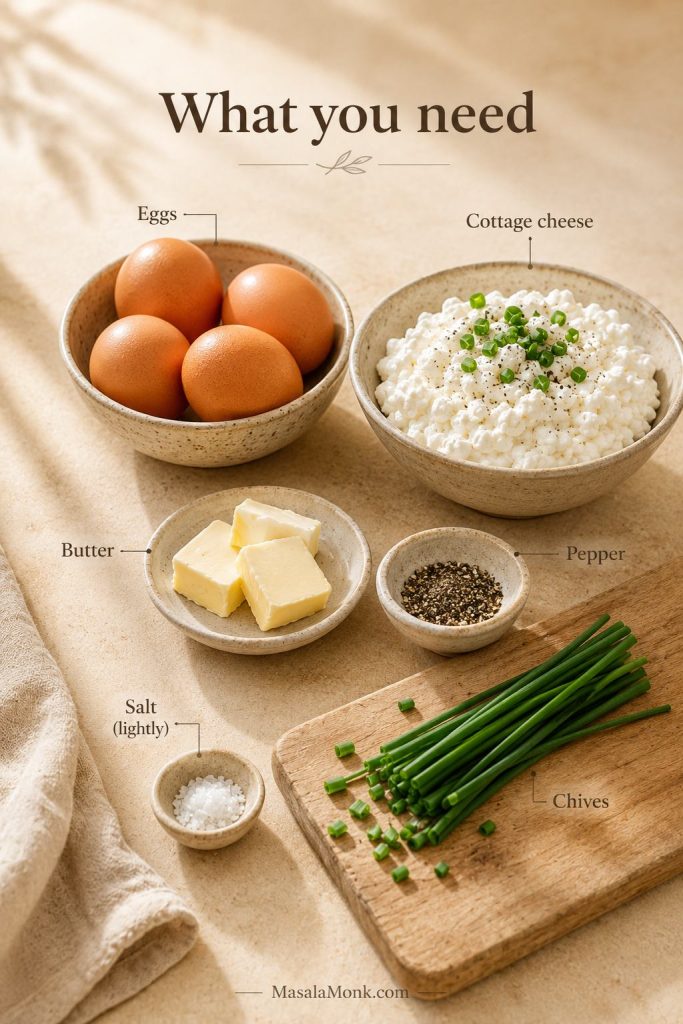
Ingredients for scrambled eggs with cottage cheese including eggs, cottage cheese, butter, pepper, salt, and chives.
Because this recipe uses only a few ingredients, each choice matters. Thick cottage cheese, light salt, black pepper, and fresh chives help the scramble taste balanced.

Eggs

Use large eggs. Four large eggs make two servings, while two large eggs plus 1/4 cup cottage cheese make a good single serving. Whole eggs give the best flavor, color, and structure. You can add egg whites for more protein, but an all-egg-white cottage cheese scramble is easier to overcook and can turn thin if the ratio is not controlled.

Cottage Cheese

Use 1/2 cup / about 4 oz / 110–120g cottage cheese for 4 eggs, or 1/4 cup / 55–60g cottage cheese for 2 eggs. Small-curd cottage cheese is the easiest choice because it blends into the eggs more naturally. Large-curd cottage cheese works, but the curds stay more visible.

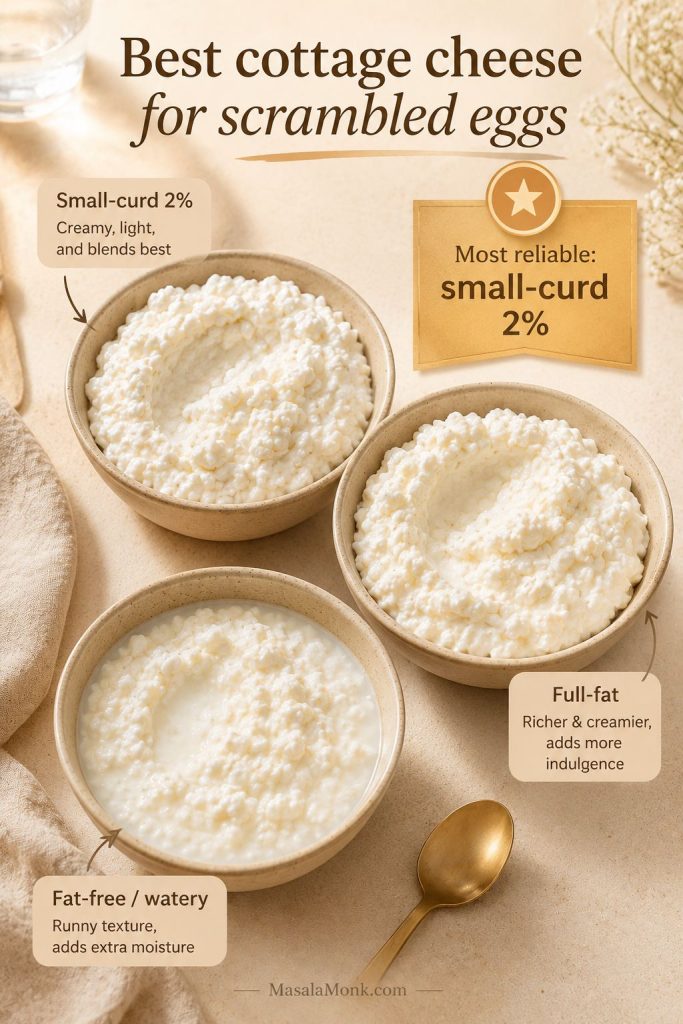
For the most reliable texture, use 2% cottage cheese. Full-fat cottage cheese gives richer eggs. Fat-free cottage cheese can work, but it often contains more moisture, so it can make the eggs wetter if you use too much.

Butter, Oil, or Cooking Spray

Butter gives the richest flavor and helps the eggs cook into soft folds. Use 1 tablespoon / 1/2 oz / 14g butter for 4 eggs. Olive oil works well if you want something lighter; use 1–2 teaspoons / 5–10ml. Cooking spray is fine for a lower-calorie version, but use a truly nonstick pan and keep the heat gentle.

Salt, Pepper, and Herbs

Cottage cheese is already salty, so season carefully. Start with black pepper and only a tiny pinch of salt, then taste after cooking. Chives, scallions, dill, parsley, and cracked black pepper are especially good here.

Best Cottage Cheese for Scrambled Eggs

The most reliable cottage cheese for scrambled eggs is small-curd 2% cottage cheese. It is creamy enough to soften into the eggs but not so rich that the scramble feels heavy. It also tends to behave better in the pan than watery fat-free cottage cheese.

Three bowls comparing small-curd, full-fat, and watery fat-free cottage cheese for scrambled eggs.
For most batches, 2% small-curd cottage cheese is the safest starting point because it softens into the eggs more evenly, while watery cottage cheese can loosen the scramble.

Small-Curd vs Large-Curd Cottage Cheese

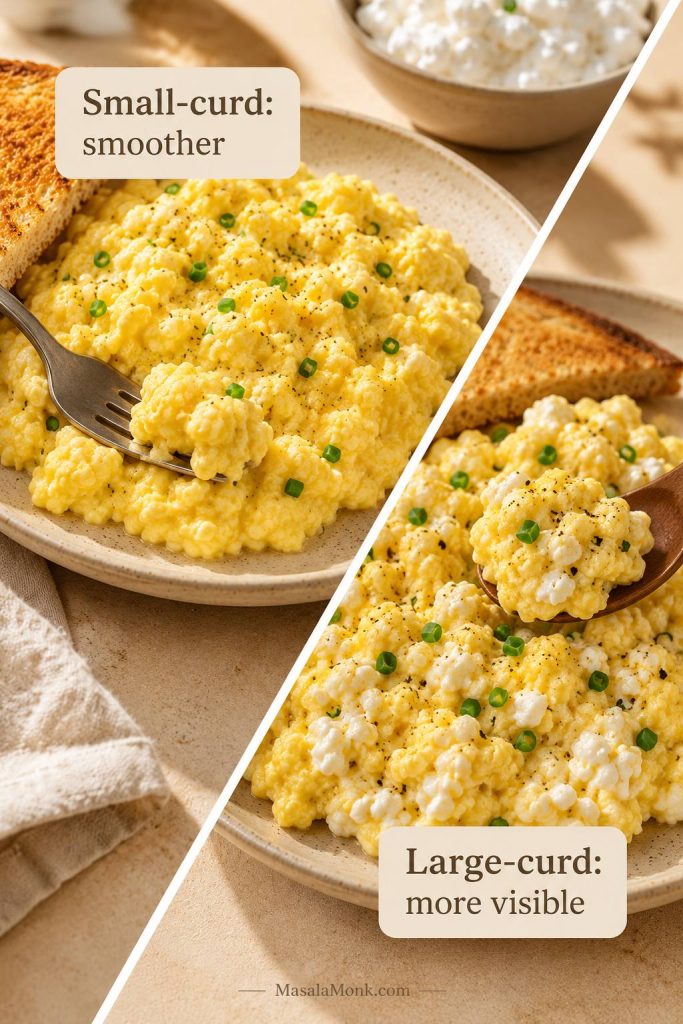
The smaller curd disperses more evenly and gives a softer texture. Large-curd cottage cheese is fine if you like visible curds, but it can make the eggs look more uneven.

Small-curd and large-curd cottage cheese scrambled eggs compared side by side.
A smaller curd gives smoother scrambled eggs, while large-curd cottage cheese keeps more visible texture. Choose the one that matches how much curd you want to notice.

If you are cooking for someone who is skeptical of cottage cheese, use small-curd cottage cheese or blend the eggs and cottage cheese together for a smoother scramble.

For the full texture breakdown, compare the whisk, blend, and fold methods.

2%, Full-Fat, or Fat-Free?

Cottage Cheese Type Result in Scrambled Eggs Best Use
2% Creamy, balanced, reliable Best everyday choice
Full-fat Richest and softest Best for extra-creamy eggs
Low-fat Can work well, depending on brand Good if it is thick, not watery
Fat-free More likely to release moisture Use less and cook gently

If your cottage cheese looks especially liquidy, spoon off a little of the excess before adding it to the eggs. Thick, creamy cottage cheese gives you a much easier path to a soft scramble.

Should You Blend the Cottage Cheese First?

Blend the cottage cheese with the eggs if you want a smooth texture with no visible curds. Do not blend if you like the soft, slightly cheesy texture of cottage cheese eggs. For most people, whisking small-curd cottage cheese directly into the eggs is enough.

Scrambled Eggs with Cottage Cheese Ratio Guide

Start with the Balanced Ratio

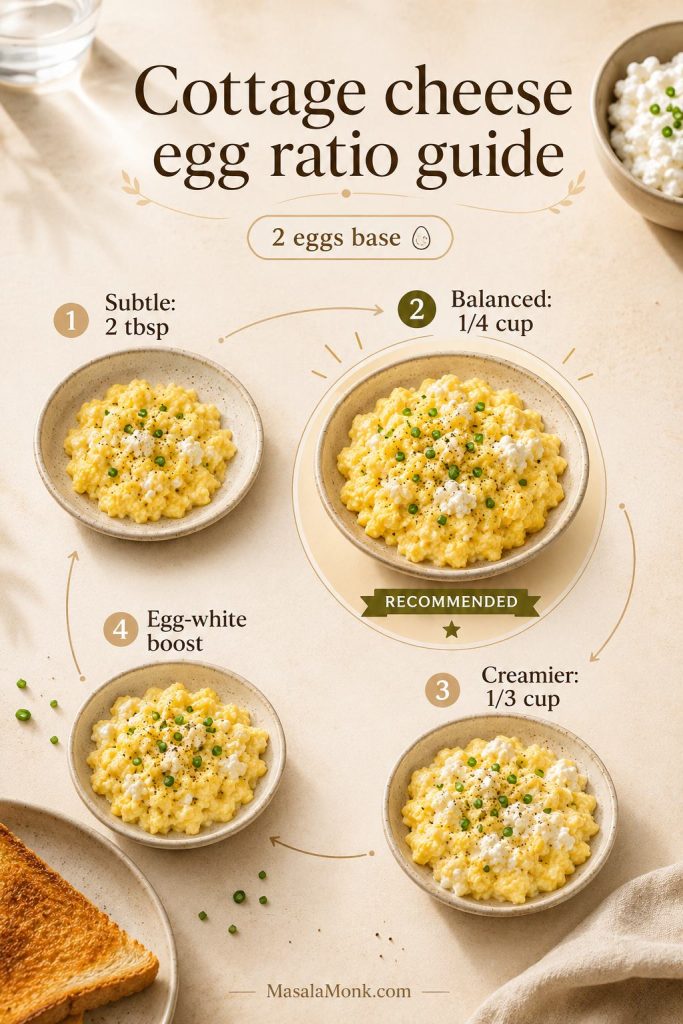
The safest starting ratio is 1/4 cup cottage cheese for every 2 large eggs. Another way to think of it is about 1–2 tablespoons cottage cheese per egg, depending on how creamy or subtle you want the scramble.

If you are nervous about curds or wateriness, start with 2 tablespoons cottage cheese for 2 eggs. Then, if you love cottage cheese and want a creamier, more filling scramble, increase slightly without overloading the eggs.

Ratio Options by Texture

Style Eggs Cottage Cheese Metric Best For
Subtle / beginner 2 large eggs 2 tbsp 25–30g Less curdy, safer first try
Balanced default 2 large eggs 1/4 cup 55–60g Creamy, high-protein everyday eggs
Family batch 4 large eggs 1/2 cup / about 4 oz 110–120g Main recipe-card version
Extra creamy 2 large eggs 1/3 cup 75–80g More cottage-cheese-forward
Egg-white boosted 2 eggs + 1/4–1/3 cup egg whites 1/4 cup 60–80ml egg whites + 55–60g cottage cheese Higher-protein version
Cottage cheese scrambled eggs ratio guide showing subtle, balanced, extra creamy, and egg-white boosted versions.
The ratio changes the whole scramble. Start balanced, then go lighter for subtle cottage cheese flavor or creamier when you want a more filling breakfast.

What Testing Showed

After testing the whisked, blended, and folded versions, the tradeoff is simple: the whisked 2-eggs-to-1/4-cup cottage cheese ratio is the most reliable everyday balance. Blending makes the smoothest scramble, but it tastes a little less like classic soft eggs. Folding the cottage cheese in near the end gives the most visible curds and works only when the cottage cheese is thick, not watery.

For your first try, choose the balanced default. Once you know how your cottage cheese behaves in the pan, you can go lighter, smoother, or more cottage-cheese-forward next time.

Make this first: If this is your first time making scrambled eggs with cottage cheese, use 2 eggs, 1/4 cup / 55–60g cottage cheese, 1/2 tablespoon butter, black pepper, and medium-low heat. It is the safest balance of creamy, high-protein, and not too wet.

Once the ratio is set, use the gentle stovetop method to keep the eggs creamy instead of dry.

How to Make Scrambled Eggs with Cottage Cheese

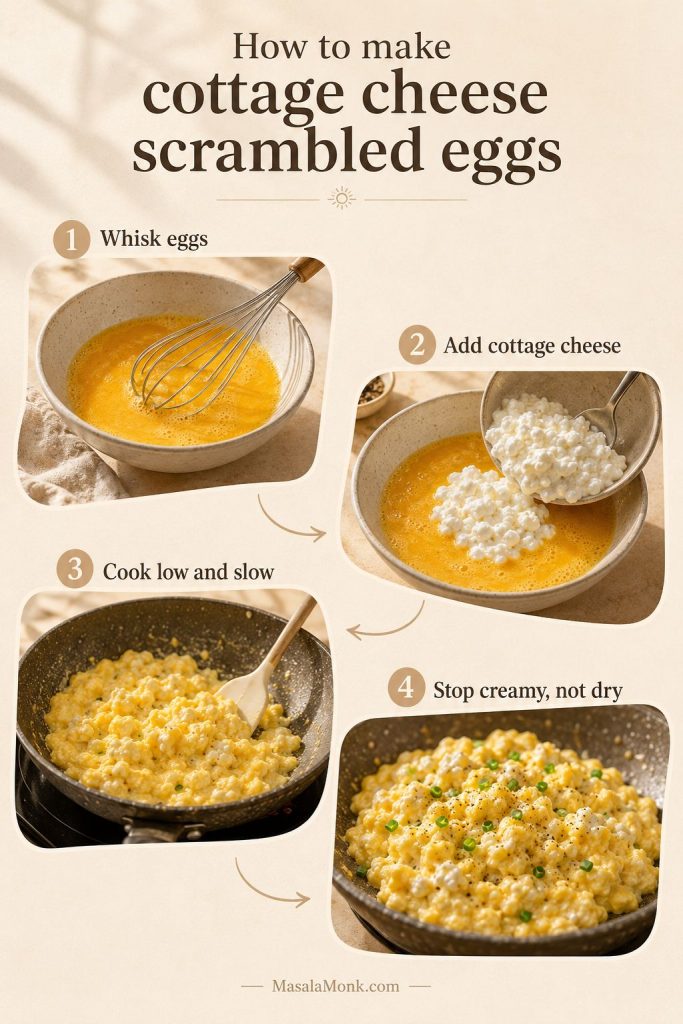
The whole recipe comes down to gentle heat and patience. A few quiet minutes in the pan can turn the eggs into soft, creamy folds instead of dry curds or a loose scramble.

Step-by-step guide showing eggs being whisked, cottage cheese being added, eggs cooking gently, and the finished scramble.
The steps are simple, but the heat does the real work. Cook slowly so the eggs gather into soft folds instead of tightening into dry curds.

Step 1: Whisk the Eggs

Crack the eggs into a mixing bowl and whisk until the yolks and whites are fully combined. This helps the cottage cheese distribute evenly instead of sitting in pockets.

Step 2: Add the Cottage Cheese

Whisk in the cottage cheese, black pepper, and only a small pinch of salt. If you want smoother eggs, blend the eggs and cottage cheese for a few seconds instead of whisking by hand.

Step 3: Heat the Pan Gently

Warm a nonstick skillet over medium-low heat. For 2 eggs, an 8-inch skillet works well. For 4 eggs, use a 10-inch skillet. Add butter or oil and let it melt without browning.

Step 4: Cook Slowly Into Soft Folds

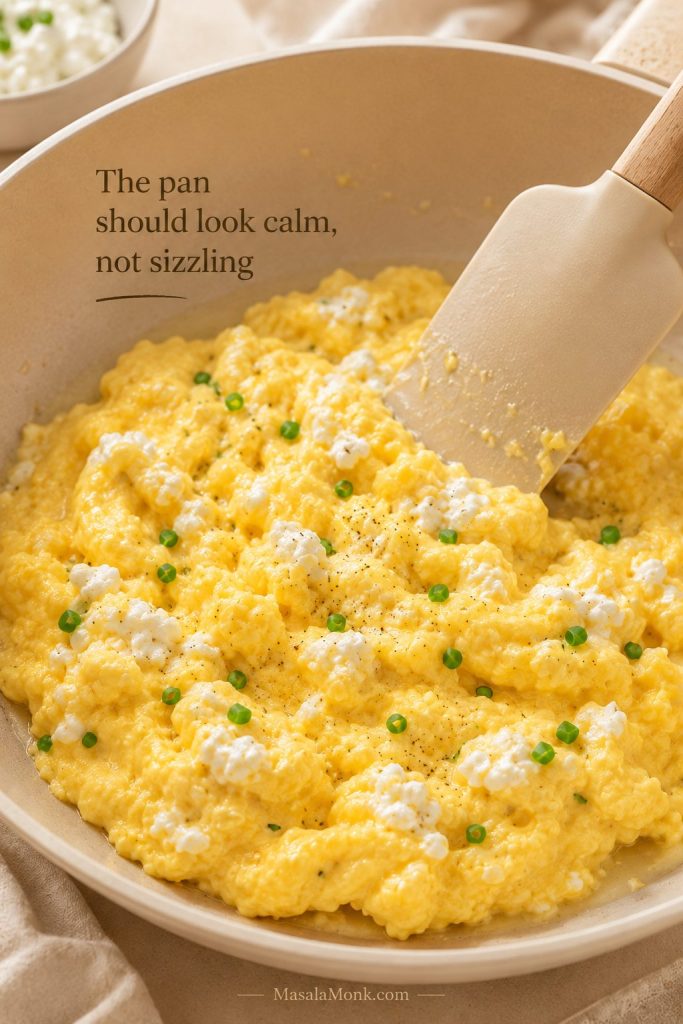
Pour in the egg mixture. Let the edges set for 10–20 seconds, then use a silicone spatula to slowly push the eggs from the outside of the pan toward the center. Keep moving gently so the eggs gather into soft, creamy folds instead of breaking into tiny dry curds. The pan should look calm, not sizzling.

Scrambled eggs with cottage cheese cooking gently in a nonstick pan with a silicone spatula.
A quiet pan is a good sign. When the eggs move slowly under the spatula, they have time to turn creamy before they dry out.

Step 5: Stop While Creamy, Not Runny

Remove the eggs from the heat when they are thickened, creamy, and set through. They will keep cooking slightly from residual heat, so do not wait until they look completely dry in the pan.

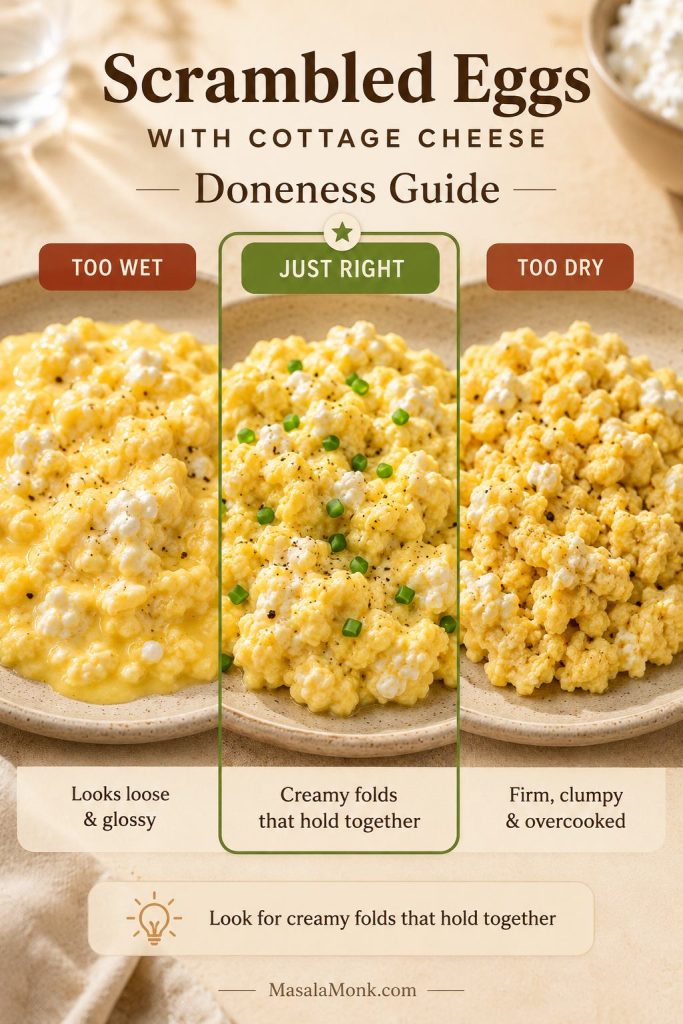
You will know they are ready when the eggs hold soft folds on the spatula, look creamy instead of shiny-wet, and slide onto the plate without liquid pooling behind them. If the eggs look glossy but hold together, they are usually ready; if liquid runs around them, give them a little more time over gentle heat.

Doneness guide for cottage cheese scrambled eggs showing too wet, just right, and too dry textures.
“Just right” is creamy but not runny. If the eggs still slide apart with liquid around them, keep them on gentle heat a little longer.

If the eggs still look shiny, separated, or loose, the troubleshooting section will help you fix the next batch.

For food safety, scrambled eggs should be cooked until they are not runny. The FDA’s egg safety guidance recommends cooking egg dishes thoroughly, especially when serving children, older adults, pregnant people, or anyone with a weakened immune system.

Whisk, Blend, or Fold? Three Texture Options

There is more than one way to add cottage cheese to scrambled eggs. The best method depends on whether you want the cottage cheese to disappear into the eggs or stay slightly visible.

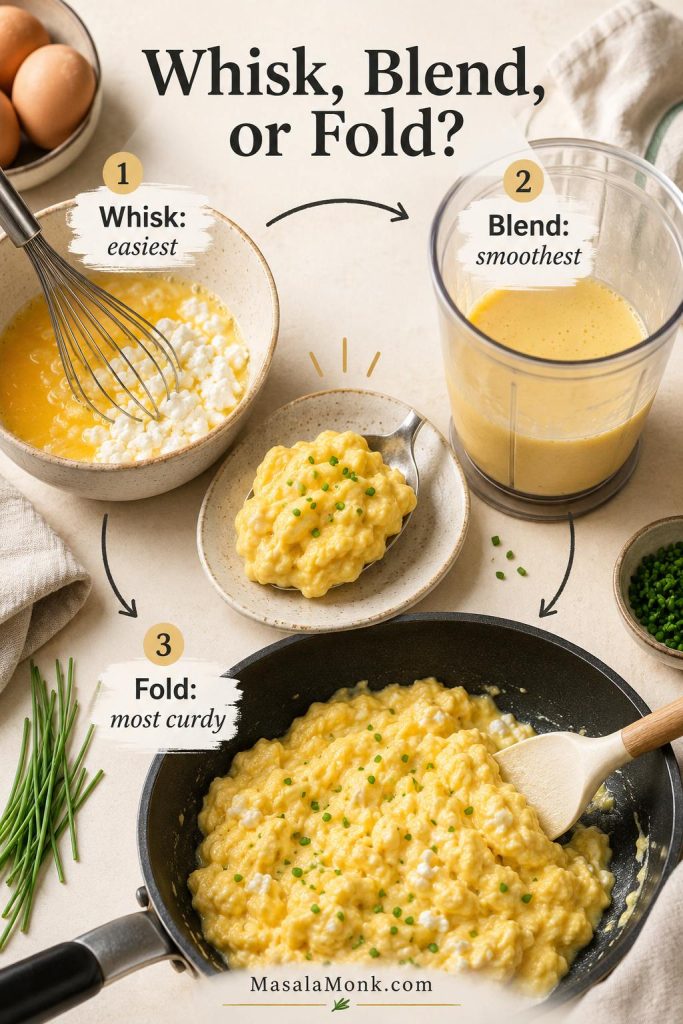
Method How to Do It Texture Best For
Whisk Whisk cottage cheese into raw eggs Soft, lightly curdy, fluffy Best everyday version
Blend Blend eggs and cottage cheese briefly Smooth and creamy Cottage-cheese skeptics
Fold Cook eggs first, then fold cottage cheese near the end More visible curds People who like cottage cheese texture
Whisk, blend, and fold methods for adding cottage cheese to scrambled eggs.
Whisking is the everyday method, blending makes the smoothest cottage cheese eggs, and folding gives the most noticeable curd texture.

Choose blended if visible curds bother you, whisked for the easiest weekday scramble, and folded only if you actually enjoy the cottage cheese texture.

Using egg whites changes the texture, so check the egg-white version before swapping out too many yolks.

When Should You Add the Cottage Cheese?

Add cottage cheese before cooking for the whisked or blended versions. Fold it in near the end only if you want a more visible cottage cheese texture and your cottage cheese is thick enough not to loosen the eggs.

Egg Whites with Cottage Cheese

Egg whites with cottage cheese are useful if you want a lighter, higher-protein scramble, but the ratio matters. Because they contain more water than yolks, they need a little more care in the pan. Use too many whites with too much cottage cheese, and the eggs can turn thin.

Best Egg-White Ratio

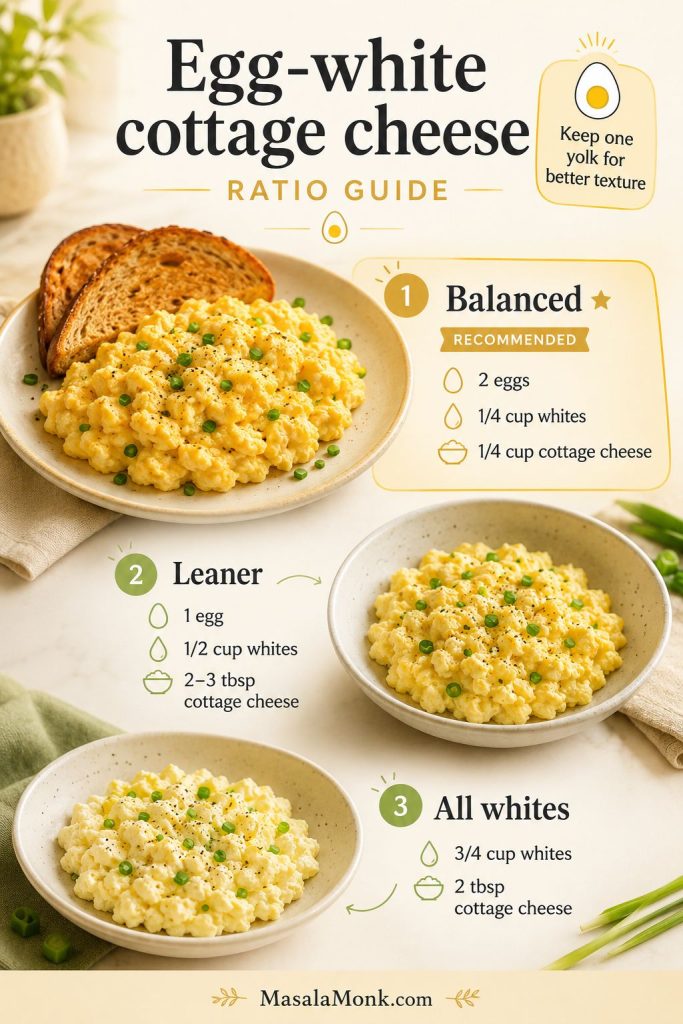
For the creamiest texture, keep at least some whole egg in the scramble. The yolk adds flavor, color, and a little structure, which helps the egg whites feel less flat.

Version Use This Ratio Texture
Balanced egg-white boost 2 eggs + 1/4 cup / 60ml egg whites + 1/4 cup / 55–60g cottage cheese Creamy, lighter, still flavorful
Leaner version 1 egg + 1/2 cup / 120ml egg whites + 2–3 tbsp cottage cheese Lighter, less rich, more delicate
All egg whites 3/4 cup / 180ml egg whites + 2 tbsp cottage cheese Leanest, but easiest to overcook or make watery
Egg-white cottage cheese scrambled eggs ratio guide with balanced, leaner, and all-egg-white versions.
Egg whites add protein, but they also add water. Keeping one yolk in the mix helps cottage cheese eggs stay creamy, structured, and less likely to turn thin.

If your egg-white scramble turns thin, the watery egg fixes explain how to adjust the cottage cheese and heat.

Lighter High-Protein Version

For a lighter plate, use 1 whole egg, 1/2 cup / 120ml egg whites, and 2–3 tablespoons cottage cheese. Serve it with spinach, tomatoes on the side, or avocado toast depending on whether you want a lower-calorie breakfast or a more filling meal. It is not a shortcut or a promise; it is simply a protein-rich breakfast that can fit into many eating styles depending on what you serve with it.

How to Keep Egg-White Cottage Cheese Eggs from Getting Watery

Use a thick cottage cheese, skip the milk, and cook over medium-low heat until the eggs are set through. If liquid starts pooling in the pan, keep the heat gentle and give the eggs a little more time. Do not crank the heat up to rush them; that usually makes the eggs rubbery before the moisture cooks off.

Macro-Friendly Add-Ins

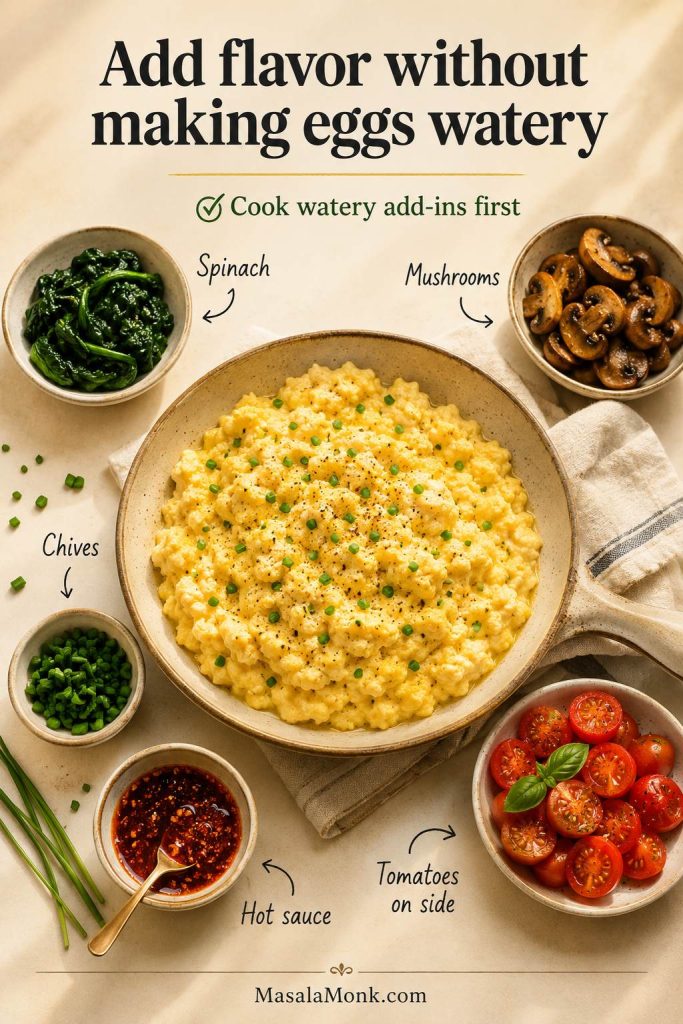
Spinach, mushrooms, scallions, tomatoes on the side, hot sauce, and herbs all work well. If you are adding mushrooms, peppers, or vegetables that release moisture, cook them first so they do not loosen the eggs.

Microwave Cottage Cheese Scrambled Eggs

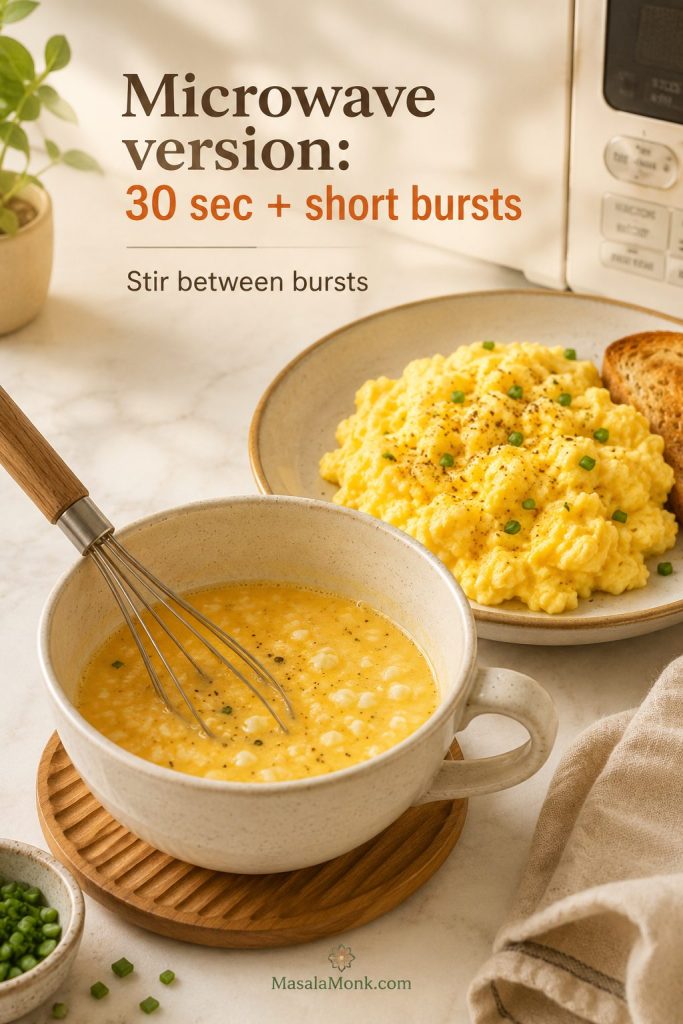
The skillet version tastes best, but microwave cottage cheese eggs are useful for busy mornings, office breakfasts, and quick solo meals. The texture will be firmer than stovetop scrambled eggs, so cook in short bursts and stir often.

Mug Method for One

Whisk 1 large egg with 1 tablespoon / about 15g cottage cheese in a large microwave-safe mug. Add black pepper and a tiny pinch of salt if needed. Microwave for 30 seconds, stir, then microwave in 15–30 second bursts until the egg is just set through.

Microwave cottage cheese scrambled eggs made in a mug with a whisked egg mixture and a finished bowl of eggs.
For microwave cottage cheese eggs, short bursts are safer than one long cook. Stirring between rounds helps the center set without turning spongy.

Microwave Texture Tips

  • Use a bigger mug than you think you need.
  • Stir between bursts so the egg cooks evenly.
  • Microwave power varies, so treat the final 15–30 seconds as flexible.
  • Stop when the egg is just set, then let it stand for 20–30 seconds before eating.
  • Add herbs, hot sauce, or chives after cooking.
  • For 2 eggs, use a small microwave-safe bowl instead of a narrow mug.

Add-Ins and Serving Ideas

Scrambled eggs with cottage cheese are mild enough to go savory, spicy, herby, or brunch-style. Avoid adding raw vegetables that release a lot of water directly to the pan in large amounts. Instead, cook them first or serve them on the side.

Best Add-Ins for the Eggs

Add-In How to Use It Notes
Spinach Wilt before or during cooking Adds volume and color
Mushrooms Cook first Prevents loose eggs
Bell pepper Dice small and sauté first Good for veggie scrambles
Scallions or chives Add near the end Fresh, simple, and not watery
Tomatoes Serve on the side or add cooked Raw tomatoes can release water
Chili crisp or hot sauce Add after cooking Best for flavor contrast
Everything bagel seasoning Sprinkle after cooking Use lightly because it is salty
Add-ins for cottage cheese scrambled eggs including cooked spinach, mushrooms, chives, tomatoes, and hot sauce.
Add-ins work best after the moisture is under control. Cook mushrooms, spinach, and peppers first, then finish with herbs, hot sauce, or chili crisp.

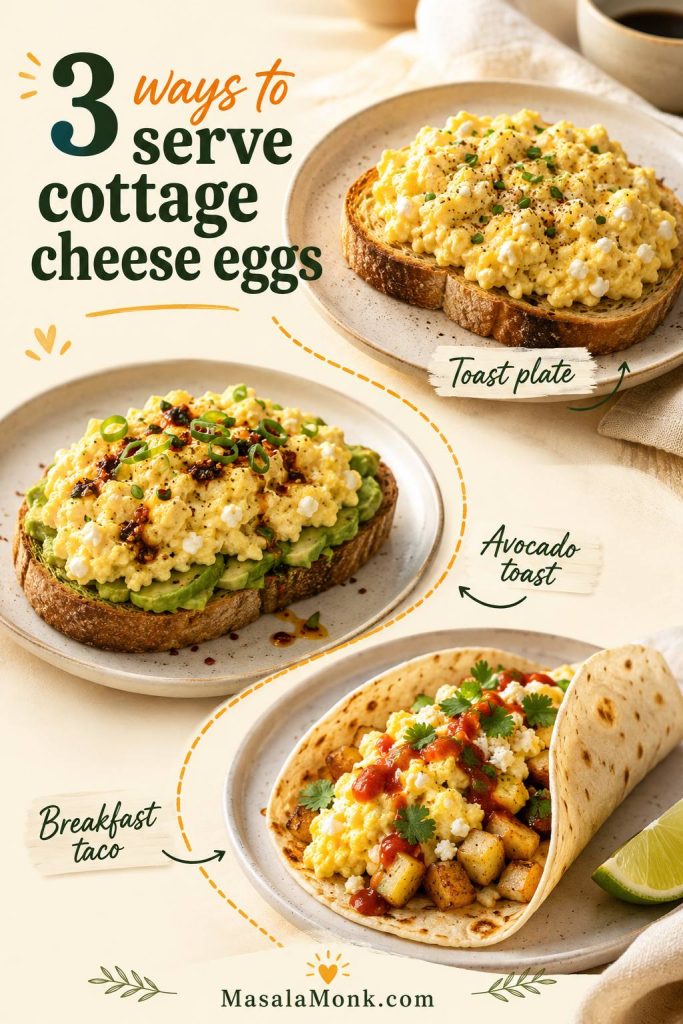
Three Easy Ways to Serve Them

  • Simple weekday plate: cottage cheese eggs, buttered toast, black pepper, and chives.
  • Avocado toast version: mashed avocado, creamy eggs, chili crisp, and scallions on sourdough.
  • Breakfast taco version: warm tortilla, cottage cheese eggs, potatoes, salsa, and hot sauce.
Three serving ideas for cottage cheese scrambled eggs with toast, avocado toast, and a breakfast taco.
Once the base scramble is right, it can go three ways: a simple toast plate, creamy avocado toast, or a breakfast taco with potatoes and salsa.

What to Serve with Cottage Cheese Eggs

  • Buttered sourdough toast
  • Avocado toast
  • Breakfast tacos
  • Roasted potatoes or air fryer hash browns
  • Sautéed spinach or mushrooms
  • Fresh tomatoes
  • Fruit on the side
  • Hot sauce, chili crisp, or salsa

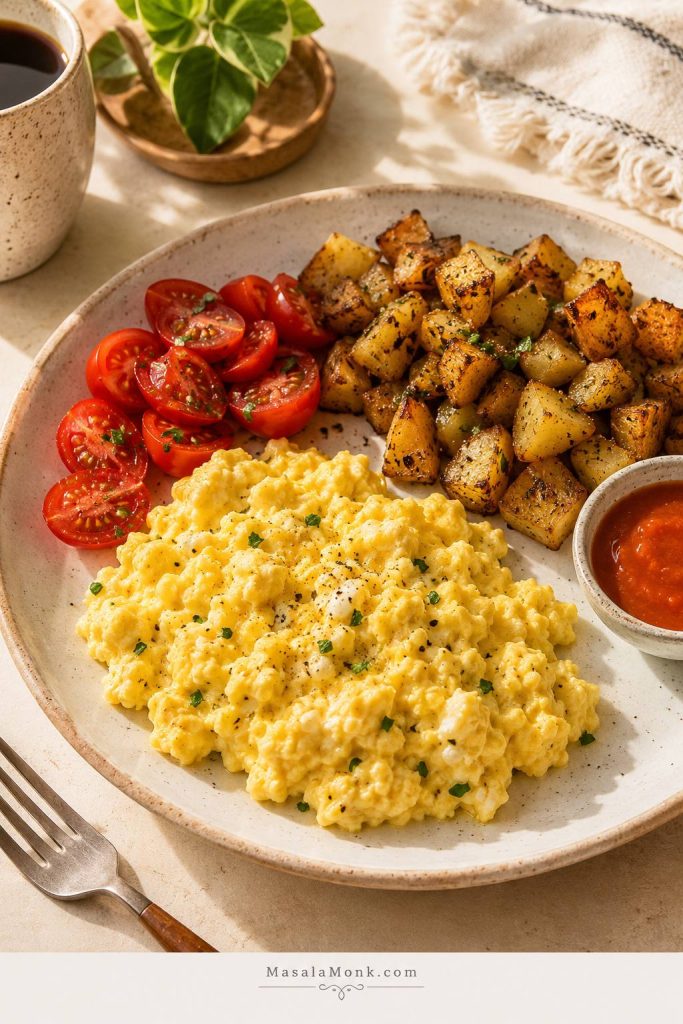
For the easiest plate, keep it simple: creamy eggs, crisp toast, something fresh, and something sharp or spicy. A little hot sauce, salsa, chili crisp, or black pepper keeps the cottage cheese from making the plate taste too mild.

Cottage cheese scrambled eggs served with crispy potatoes, fresh tomatoes, and hot sauce.
A few sides make the eggs feel complete. Crisp potatoes add contrast, tomatoes add freshness, and hot sauce cuts through the creamy cottage cheese.

If you want to turn the eggs into a handheld breakfast, tuck them into a tortilla with potatoes, peppers, salsa, or avocado. This breakfast burrito recipe has more ideas for building a filling wrap without making it soggy.

How to Fix Watery or Loose Cottage Cheese Eggs

If your first batch is not perfect, do not write off the recipe. Cottage cheese brands vary a lot, and one small ratio or heat adjustment usually fixes it.

This is the section to read if you tried cottage cheese eggs once and wondered why everyone else seemed to be getting a creamy scramble while yours looked loose, shiny, or separated.

If your eggs tasted good but looked loose, shiny, or a little separated, the recipe probably does not need to be abandoned. It usually just needs less liquid, thicker cottage cheese, or gentler heat.

Watery cottage cheese scrambled eggs compared with creamy set eggs in a troubleshooting guide.
Watery cottage cheese eggs usually come from too much liquid, high heat, or a loose cottage cheese brand. Fix those first before changing the whole recipe.

Why Cottage Cheese Eggs Turn Watery

  • Too much cottage cheese
  • Very liquid cottage cheese
  • Watery fat-free or low-fat cottage cheese
  • Heat that was too high
  • Not enough gentle cooking time
  • Raw mushrooms, tomatoes, or peppers
  • Too many egg whites
  • Added milk

Troubleshooting Watery Cottage Cheese Eggs

What Happened Most Likely Cause Next Batch Fix
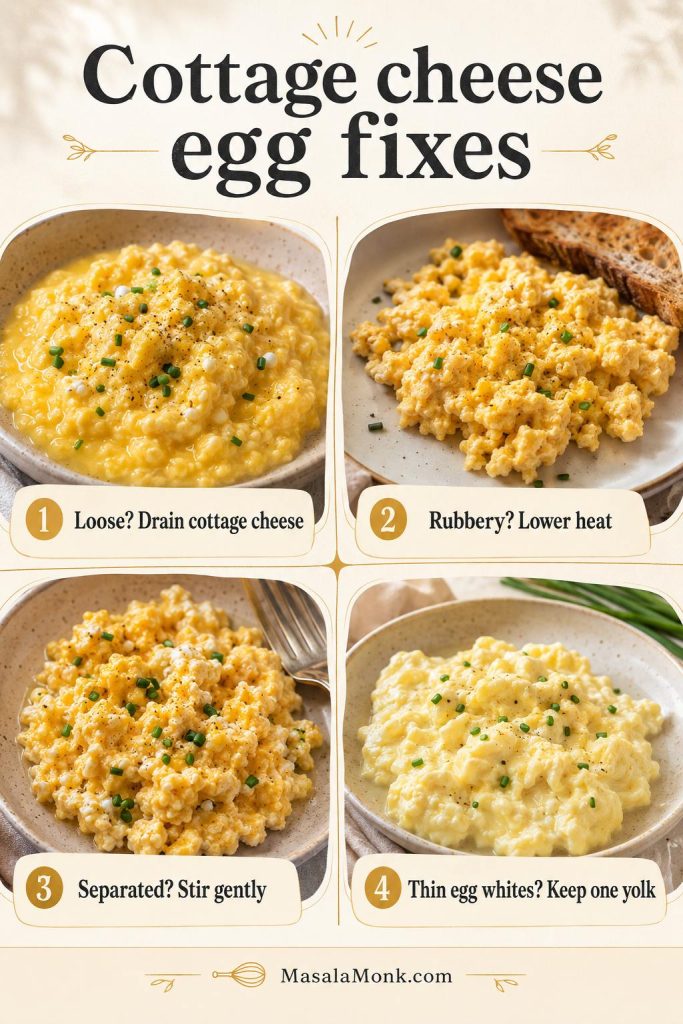
Eggs tasted good but looked loose Too much liquid in the cottage cheese Drain the cottage cheese or use 2 tbsp per 2 eggs
Eggs turned rubbery and wet Heat was too high Use medium-low heat and cook a little longer
Eggs looked separated Curds released moisture before the eggs set Whisk better, use thicker cottage cheese, and stir gently
Egg-white version turned thin Too much water from whites plus cottage cheese Keep one yolk or reduce cottage cheese to 2 tbsp
Diagnostic guide showing fixes for loose, rubbery, separated, and thin egg-white cottage cheese eggs.
Use the pan clues to fix the next batch: drain liquidy cottage cheese, lower the heat, stir gently, or keep one yolk when using egg whites.

Fixes Before Cooking

Problem to Prevent What to Do
Cottage cheese looks liquidy Spoon off excess liquid or use slightly less cottage cheese
You dislike curds Blend the cottage cheese with the eggs
You want less moisture Use 2 tbsp cottage cheese per 2 eggs
Using vegetables Cook moisture-heavy vegetables first
Using egg whites Keep at least one yolk or cook gently a little longer

Fixes While Cooking

What You See Fix
Liquid pooling in the pan Keep cooking gently and fold slowly until the extra moisture evaporates
Eggs setting too fast Lower the heat or remove the pan briefly
Curds separating Stir less aggressively and use lower heat
Eggs getting rubbery Pull from the heat sooner next time and use medium-low heat

What Not to Do

  • Skip the milk; cottage cheese already brings moisture.
  • Avoid high heat, which can make the eggs tighten before the moisture cooks off.
  • Do not start with an extra-heavy cottage cheese ratio on your first try.
  • Cook mushrooms, tomatoes, or peppers first if you are adding more than a small handful.
  • Once soft folds form, stir gently instead of aggressively breaking the eggs apart.

Once the ratio and heat are right, the recipe is simple: whisk, cook gently, stop while creamy, and serve while the eggs are still soft and warm.

Scrambled Eggs with Cottage Cheese Recipe

Soft, creamy scrambled eggs with cottage cheese for a protein-rich breakfast that feels cozy, filling, and ready in about 10 minutes.

Prep Time5 minutes
Cook Time4–5 minutes
Total Time10 minutes
Yield2 servings

Approximate nutrition: One serving, made with 2 large eggs, 1/4 cup cottage cheese, and 1/2 tablespoon butter, is usually around 220–270 calories with about 18–22g protein. Exact numbers depend on your cottage cheese brand and cooking fat. Because cottage cheese brands vary widely in protein, sodium, and moisture, treat these numbers as an estimate unless you calculate with your exact label.

Equipment

  • Mixing bowl
  • Whisk or fork
  • 10-inch nonstick skillet
  • Silicone spatula

Ingredients

  • 4 large eggs
  • 1/2 cup cottage cheese, about 4 oz / 110–120g, preferably small-curd 2% or full-fat
  • 1 tablespoon butter, about 1/2 oz / 14g, or 1–2 teaspoons / 5–10ml olive oil
  • 1/8 teaspoon fine salt, optional
  • Black pepper, to taste
  • 1 tablespoon chopped chives or scallions, optional

Method

  1. Crack the eggs into a mixing bowl and whisk until the yolks and whites are fully combined.
  2. Whisk in the cottage cheese, black pepper, and a tiny pinch of salt if using.
  3. Place a nonstick skillet over medium-low heat. Add the butter or oil and let it melt without browning.
  4. Pour in the egg mixture and let the edges begin to set for 10–20 seconds.
  5. Use a silicone spatula to slowly push the eggs from the outside of the pan toward the center, forming soft folds. The pan should look calm, not sizzling.
  6. Keep cooking gently until the eggs are thickened, creamy, and set through. If liquid runs around the eggs, give them another minute over gentle heat.
  7. Remove from the heat, sprinkle with chives or scallions if using, and serve immediately.

Notes

  • Blend the cottage cheese with the eggs first for a smoother texture.
  • Use 2 tablespoons cottage cheese per 2 eggs if you want less cottage cheese texture.
  • For an egg-white boosted version, use 2 eggs, 1/4 cup / 60ml egg whites, and 1/4 cup / 55–60g cottage cheese.
  • Salt lightly because cottage cheese is already salty.
  • Use medium-low heat. High heat can make the eggs rubbery.
  • Do not add milk; cottage cheese already adds moisture.
Saveable recipe card for scrambled eggs with cottage cheese showing the main ratio, cooking time, and method notes.
This saveable version keeps the formula simple: four eggs, half a cup of cottage cheese, medium-low heat, and no milk for a creamy two-serving scramble.

Once you make it once, adjust the ratio to match your cottage cheese and your pan. Some brands melt in softly, some release more liquid, and some taste saltier than others. The recipe gets easier after the first batch.

Storage and Reheating

These are absolutely best right from the pan, so treat leftovers as a backup breakfast rather than the main plan. Still, if you have extra, they can work if you cool and reheat them gently.

For the freshest texture, make the main recipe card version right before serving.

How Long Do They Keep?

Store leftover cottage cheese scrambled eggs in an airtight container in the refrigerator for up to 2 days. Let them cool before closing the container so steam does not create extra moisture.

How to Reheat Without Making Them Rubbery

Reheat in the microwave at reduced power in 15–30 second bursts, stirring gently between bursts. Stop as soon as the eggs are warm. You can also reheat them in a nonstick skillet over low heat.

For a freezer-friendly breakfast instead of fresh scrambled eggs, use the same soft-cooked egg logic in meal prep breakfast burritos, where the eggs need to stay tender without making the tortilla soggy.

Can You Freeze Cottage Cheese Scrambled Eggs?

I would not freeze them. Eggs and cottage cheese can both release moisture after thawing, so the texture usually suffers. For a better make-ahead breakfast, try egg muffins or a sliceable frittata instead.

When you need breakfast for a table instead of one skillet, a breakfast casserole with hash browns is a better make-ahead option than stovetop scrambled eggs.

Final Serving Texture Cue

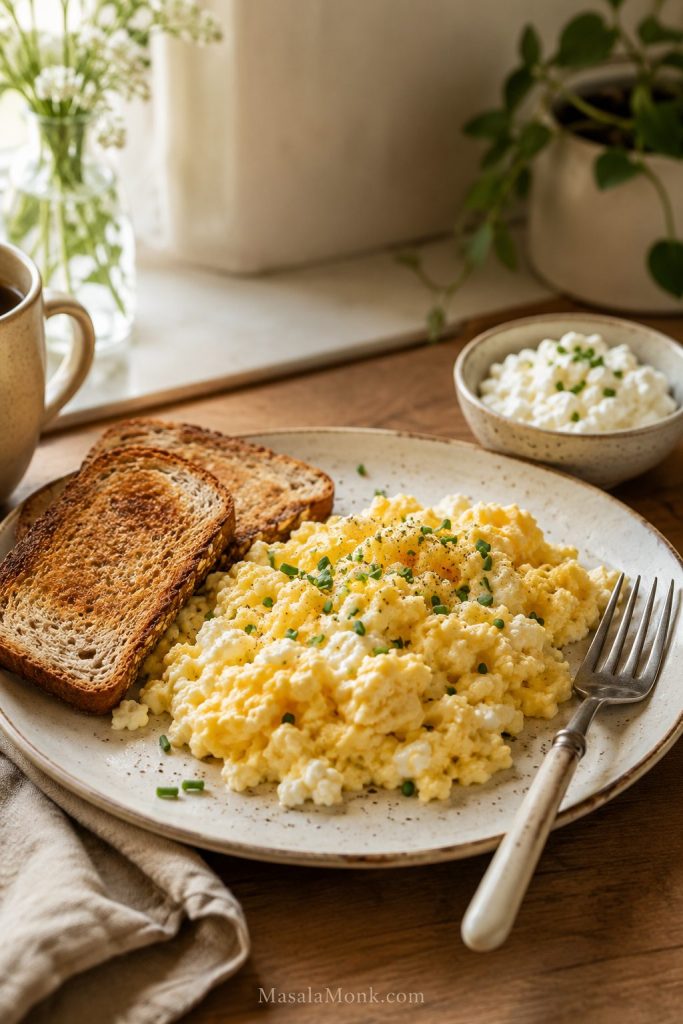
Before you leave the recipe, remember the main visual cue: the eggs should look creamy, softly folded, and set enough to hold together on the plate.

Final serving of scrambled eggs with cottage cheese with toast, a fork, cottage cheese, and a warm breakfast table setting.
A good cottage cheese scramble should feel warm and familiar, with enough protein and creaminess to make breakfast last longer than plain eggs.

FAQs About Scrambled Eggs with Cottage Cheese

What does cottage cheese do to scrambled eggs?

Cottage cheese adds protein, creaminess, and a mild savory flavor. When cooked gently, it softens into the eggs and makes them more filling without needing milk or cream.

Do scrambled eggs with cottage cheese taste like cottage cheese?

They taste creamy, lightly savory, and only a little tangy. With the balanced ratio, the eggs still taste like eggs; the cottage cheese mostly adds body and richness.

Is it better to blend cottage cheese into eggs?

Blend it if you want smooth eggs with no visible curds. This is the best choice for anyone who likes the protein boost but does not want the cottage cheese texture. Whisk it in if you like a soft, lightly curdy scramble.

Why did my cottage cheese scrambled eggs turn watery?

They probably had too much cottage cheese, a very liquidy brand, too many egg whites, raw watery vegetables, milk, or not enough gentle cooking time. Use 1/4 cup cottage cheese per 2 eggs, choose a thicker cottage cheese, and cook over medium-low heat until the eggs are set through.

What type of cottage cheese works best?

Small-curd 2% cottage cheese is the most reliable everyday choice. Full-fat cottage cheese gives richer eggs. Fat-free cottage cheese can work, but it is more likely to release moisture.

Should I add milk to cottage cheese scrambled eggs?

Skip the milk here. Cottage cheese already brings moisture and body, and adding milk can push the scramble from creamy into loose or wet.

Are cottage cheese eggs good for a high-protein breakfast?

They are a strong high-protein breakfast, especially if you use the balanced ratio of eggs plus cottage cheese instead of stretching the scramble with milk. The exact protein depends on your egg size and cottage cheese label.

Do egg whites work with cottage cheese?

Egg whites work, but the best texture usually comes from keeping at least one whole egg in the mixture. The yolk adds flavor, color, and structure, so the scramble feels creamy instead of thin.

Can I make cottage cheese scrambled eggs in the microwave?

Yes. For one serving, whisk 1 large egg with 1 tablespoon cottage cheese in a large microwave-safe mug. Microwave for 30 seconds, stir, then cook in 15–30 second bursts until set. Let it stand briefly before eating so the center finishes without becoming spongy.

What is the best ratio of cottage cheese to eggs?

The best balanced ratio is 1/4 cup cottage cheese for every 2 large eggs. Use 2 tablespoons for a subtler version, or up to 1/3 cup if you want a richer cottage-cheese-forward scramble.

Can I use boiled eggs with cottage cheese instead?

Yes, but that becomes a different kind of meal. Boiled eggs with cottage cheese work as a quick snack plate, while chopped boiled eggs mixed with blended cottage cheese become a high-protein cottage cheese egg salad.

Back to top

Posted on 1 Comment

Overnight Oats Recipe: Best Base Ratio, Easy Flavors, Storage & Texture Fixes

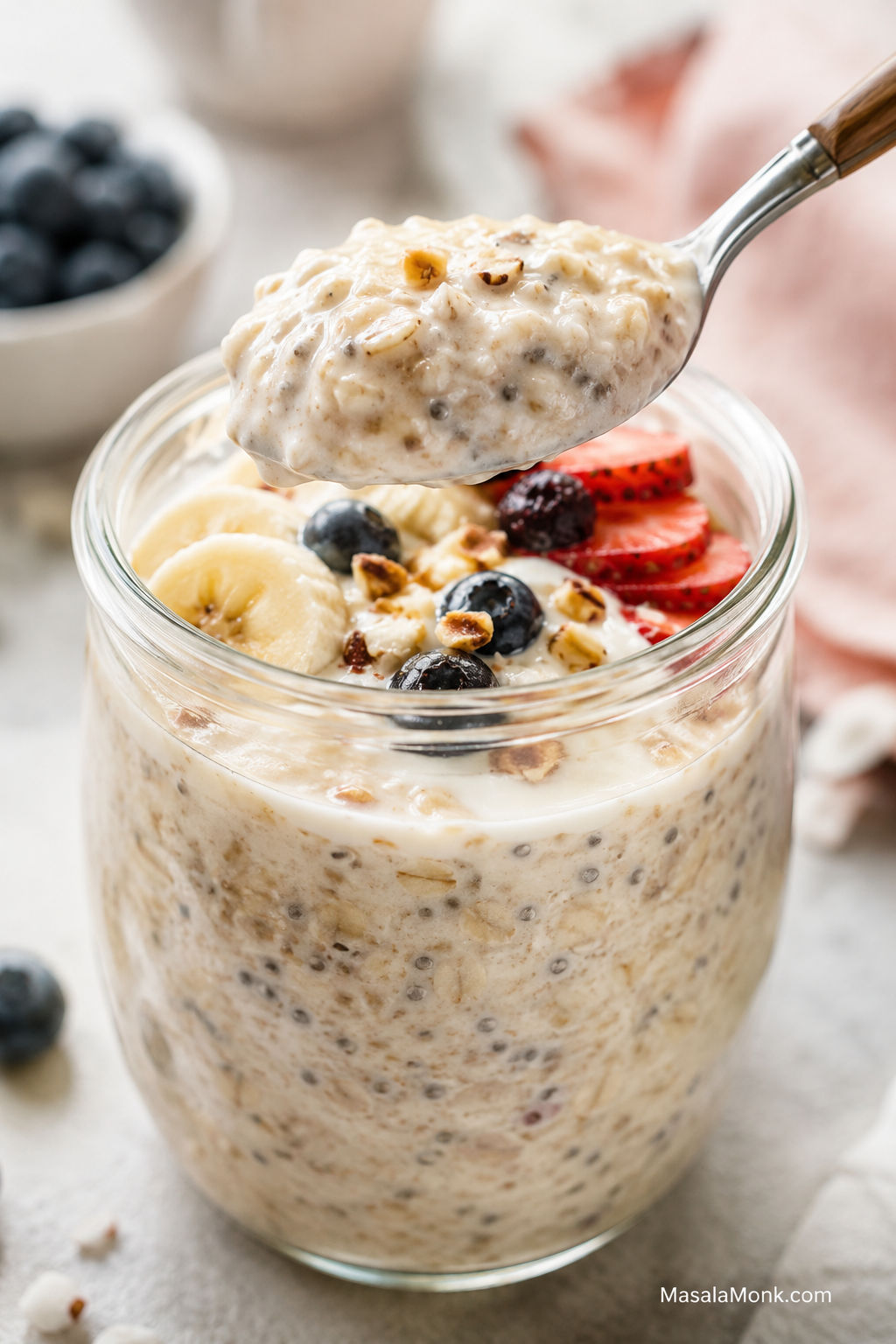
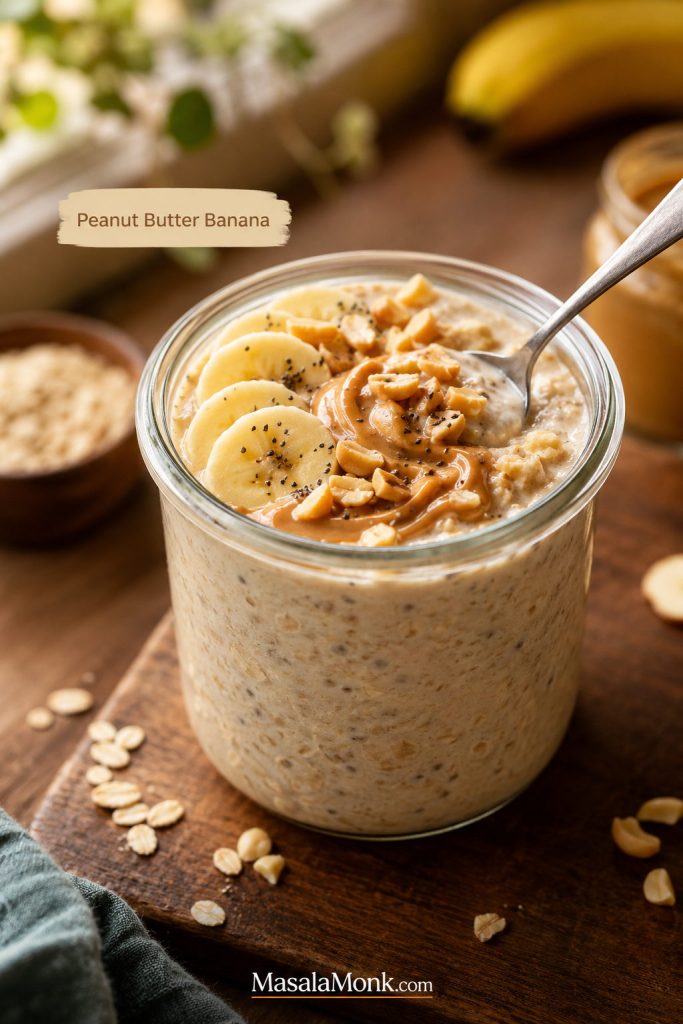
Creamy overnight oats in a glass jar with fresh fruit, nuts, and a spoon lifting a thick bite.

This overnight oats recipe gives you one dependable breakfast jar, then shows you exactly how to adjust it. Start with rolled oats, milk, yogurt or chia, a little sweetness, and a few hours in the fridge. By morning, the oats soften into a creamy, spoonable breakfast with just enough chew — not watery, not gluey, and not bland.

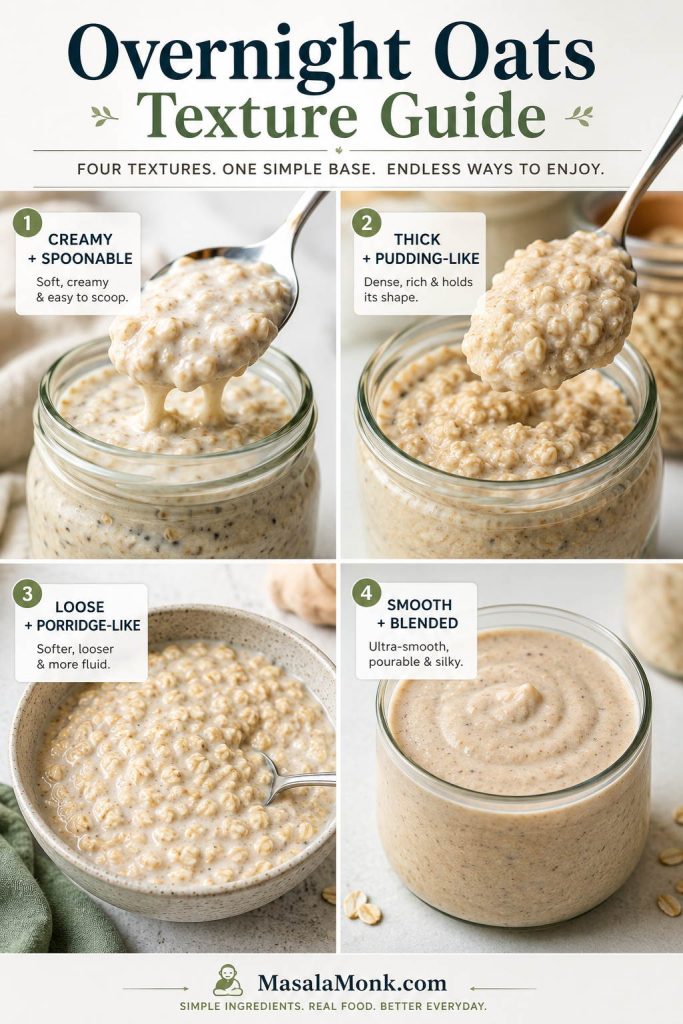
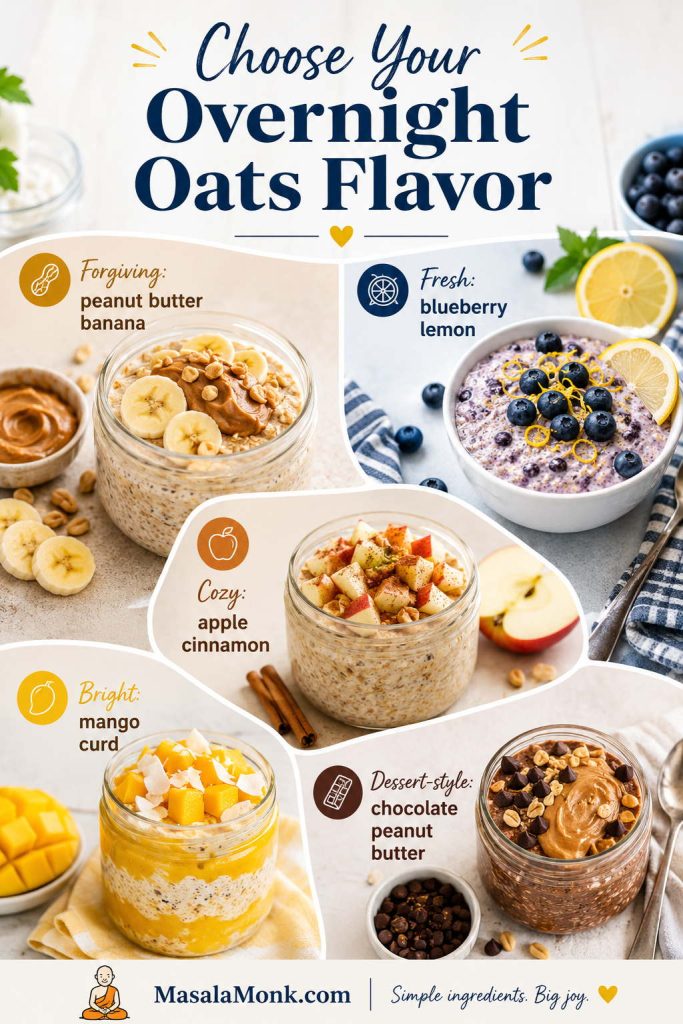
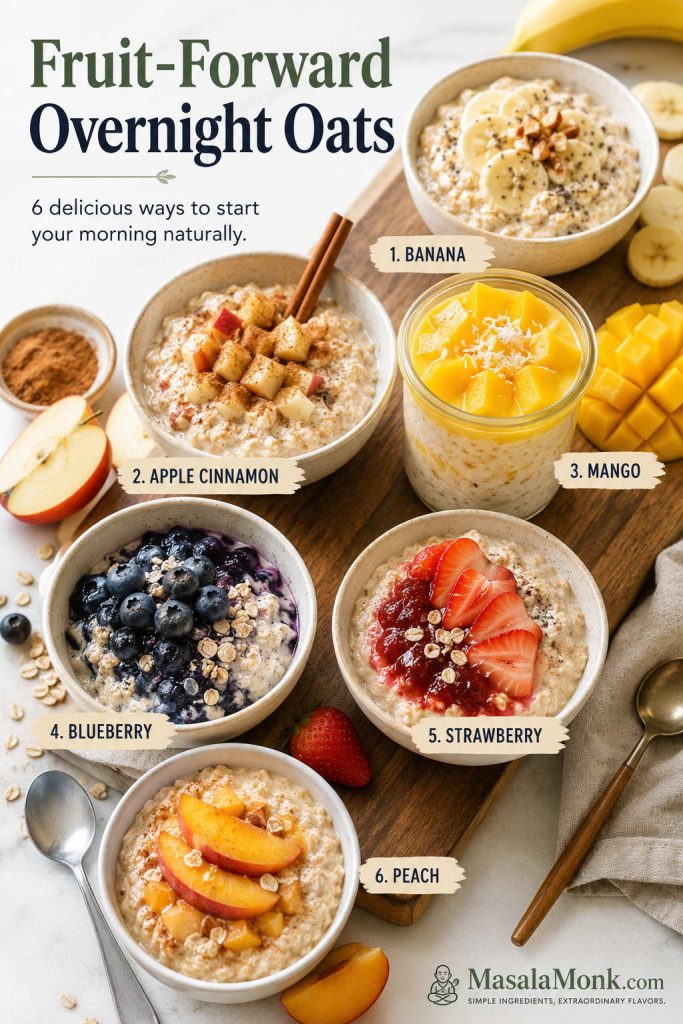
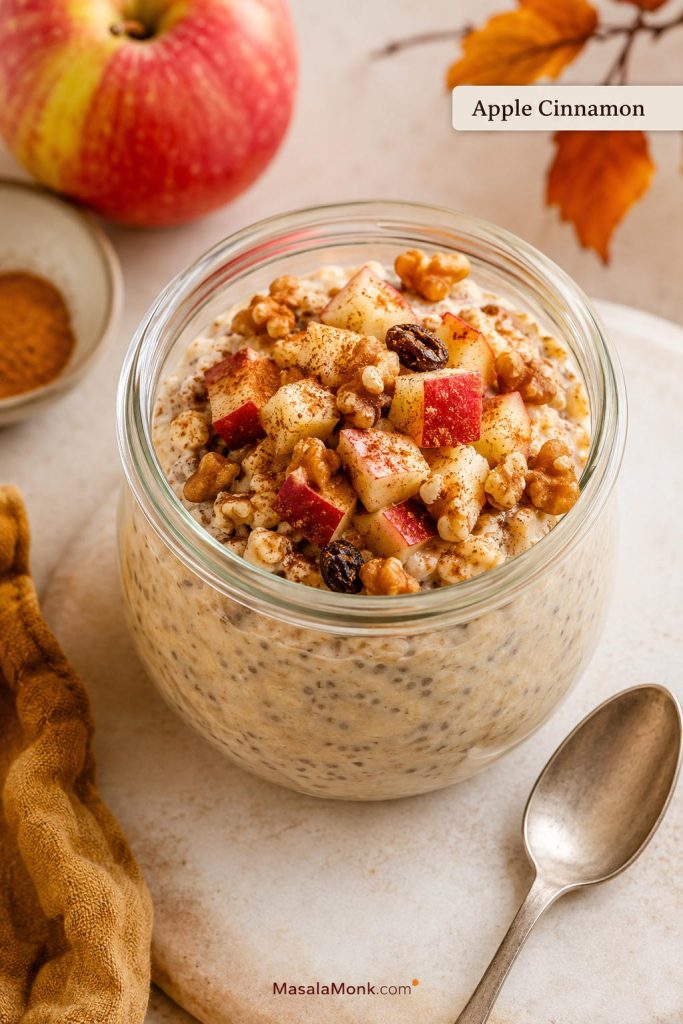
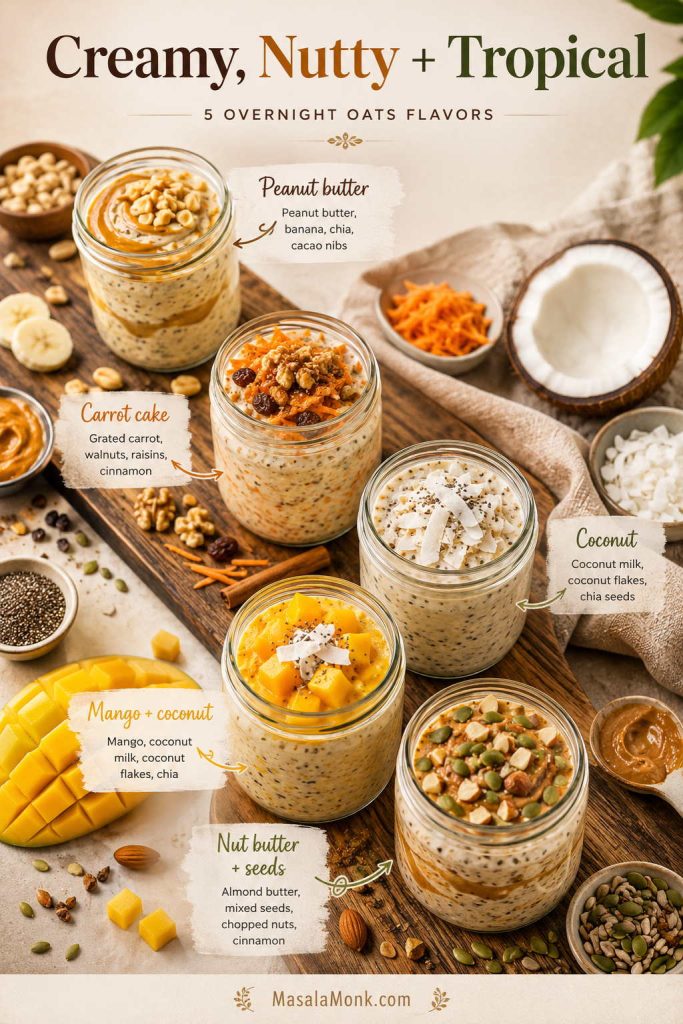
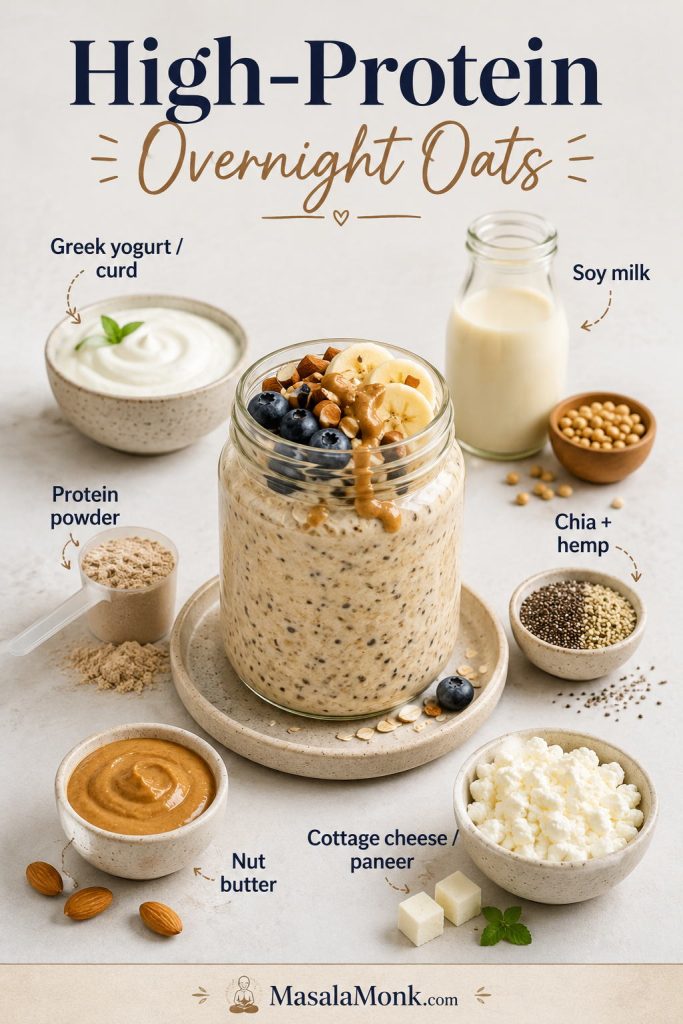
The real secret is not one rigid formula. The best overnight oats depend on the consistency you like: creamy with yogurt, thicker with chia, lighter without yogurt, looser with extra milk, or higher-protein with Greek yogurt and protein powder. Once you know the base, you can turn the same chilled oats into peanut butter, mango, chocolate, apple cinnamon, coffee, banana, berry, or matcha overnight oats without learning a new recipe every time.

The goal is simple: you should be able to mix a jar at night, understand why the texture works, and know exactly what to do in the morning if it needs more milk, more chia, better toppings, or a little extra flavor.

Overnight Oats Guide

Use this guide to get the base ratio right first, then adjust the creaminess, toppings, storage, and flavor so breakfast fits your morning instead of turning into a soggy fridge experiment.

Quick Answer: The Best Overnight Oats Ratio

The basic overnight oats ratio

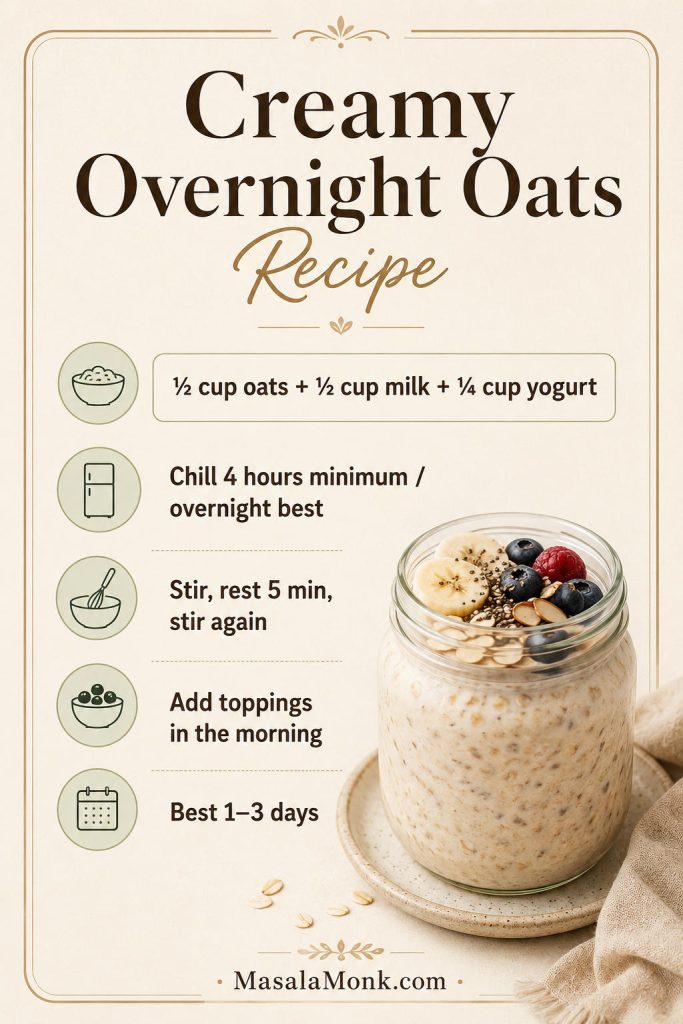
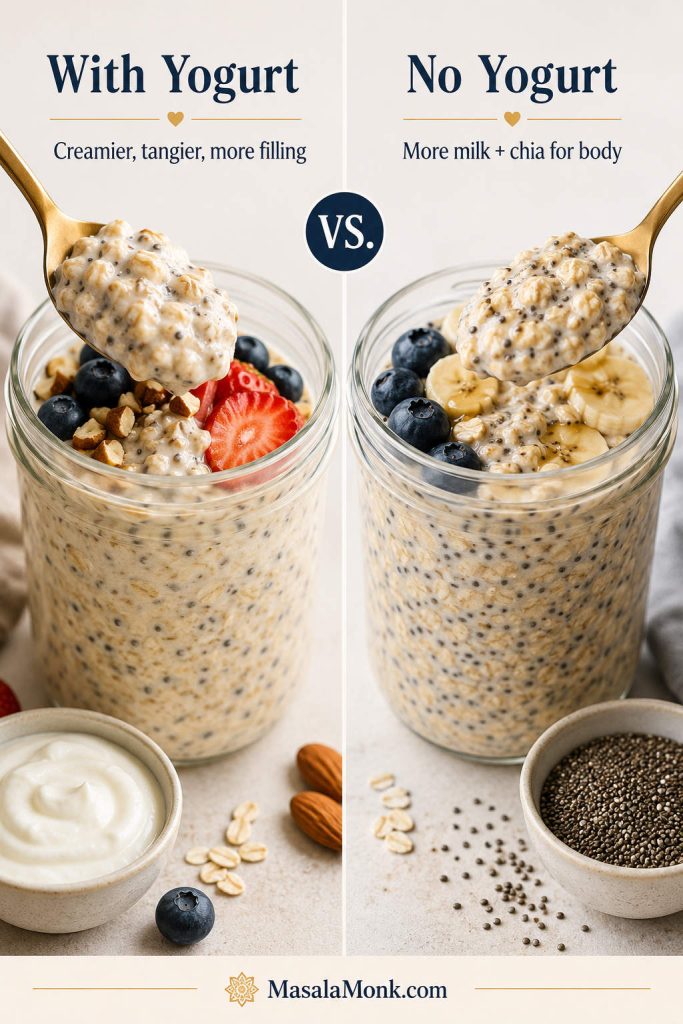
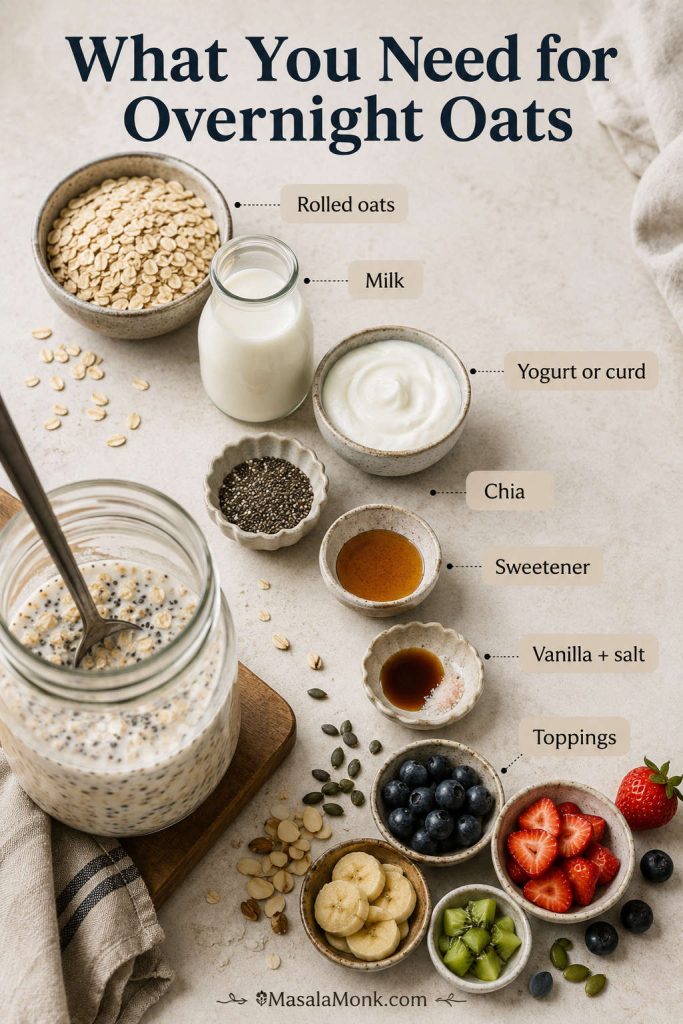
The best all-purpose overnight oats ratio is ½ cup rolled oats + ½ cup milk + ¼ cup Greek yogurt or thick curd. In metric, that is about 40 g oats, 120 ml milk, and 60 g yogurt. This gives you creamy overnight oats that are soft, spoonable, and not too watery.

The no-yogurt ratio

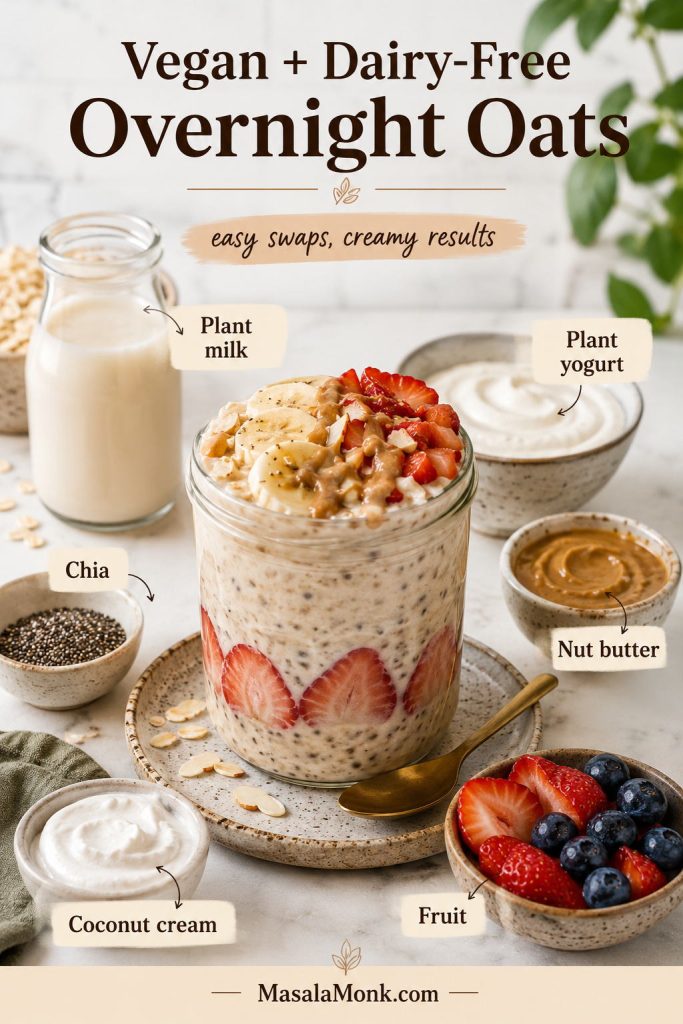
For overnight oats without yogurt, go with ½ cup rolled oats + ⅔ cup milk + 1 tablespoon chia seeds. The extra milk helps the oats soften, while chia seeds thicken the mixture so it still feels creamy.

Best oats and chill time

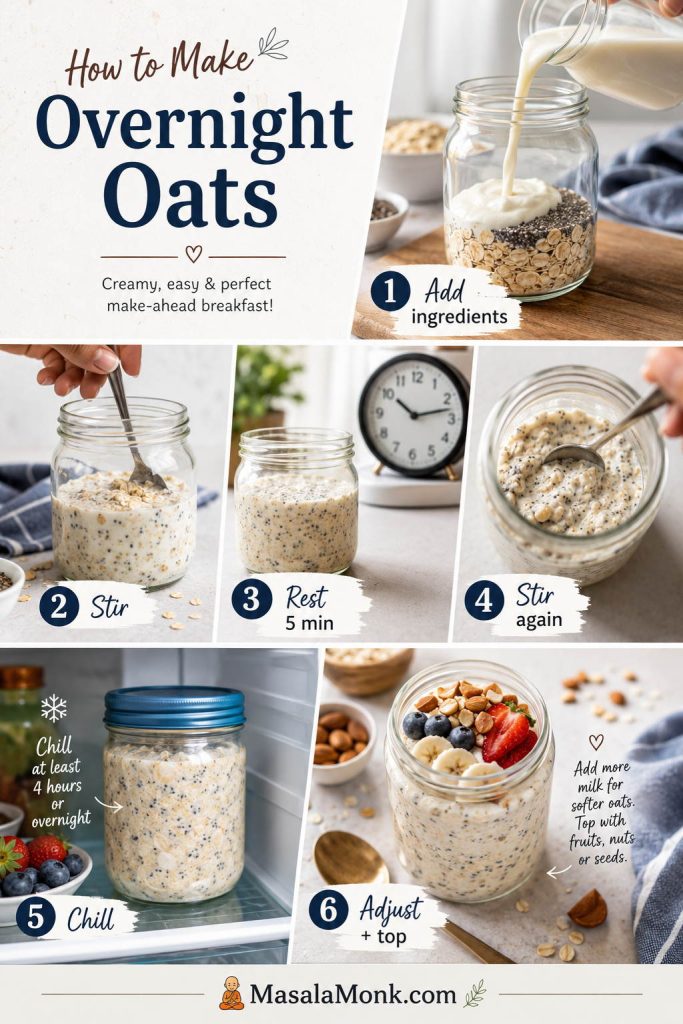
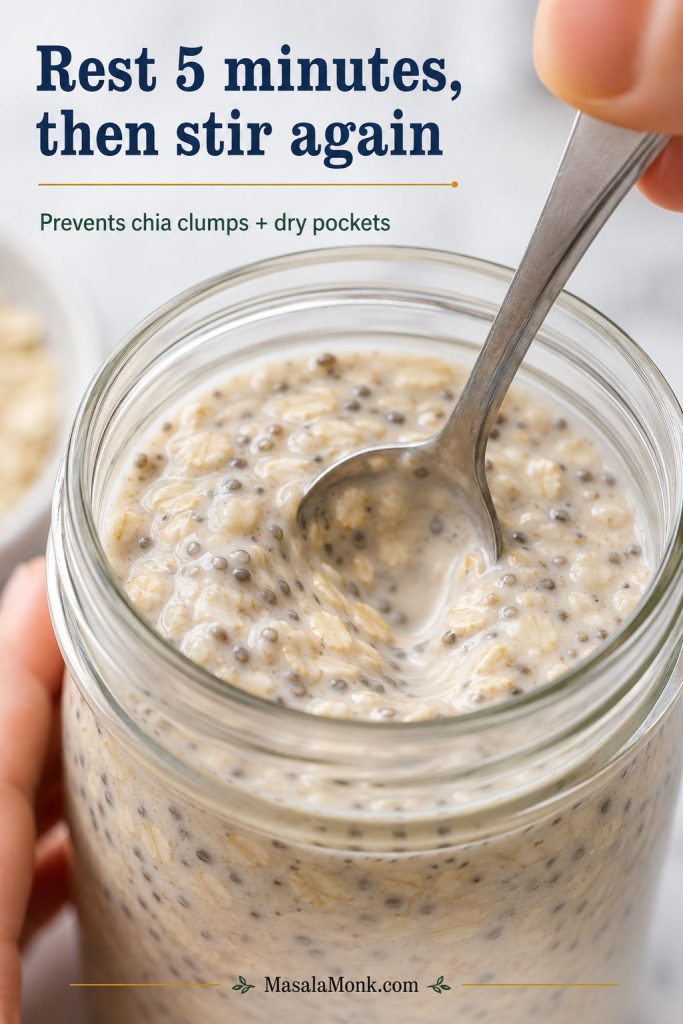
Rolled oats or old-fashioned oats give the best bite. After mixing, let the jar rest for 5 minutes, then stir again before refrigerating to prevent chia clumps and dry pockets. Chill for at least 4 hours, though overnight, about 8 hours, gives the creamiest result.

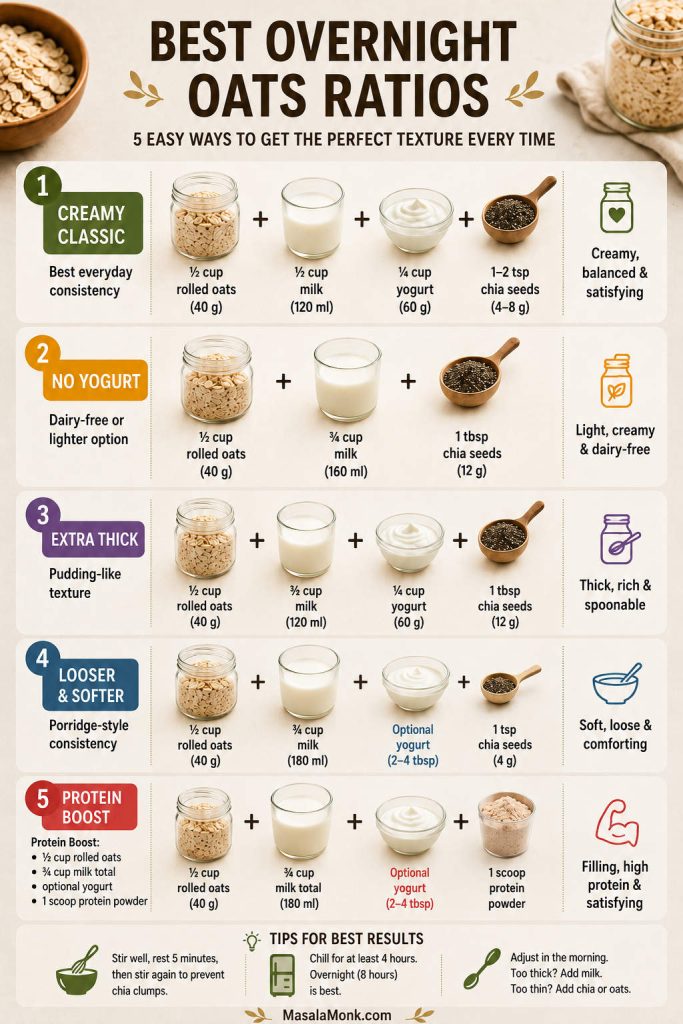
Overnight oats ratio guide showing creamy classic, no-yogurt, extra-thick, looser, and protein versions.
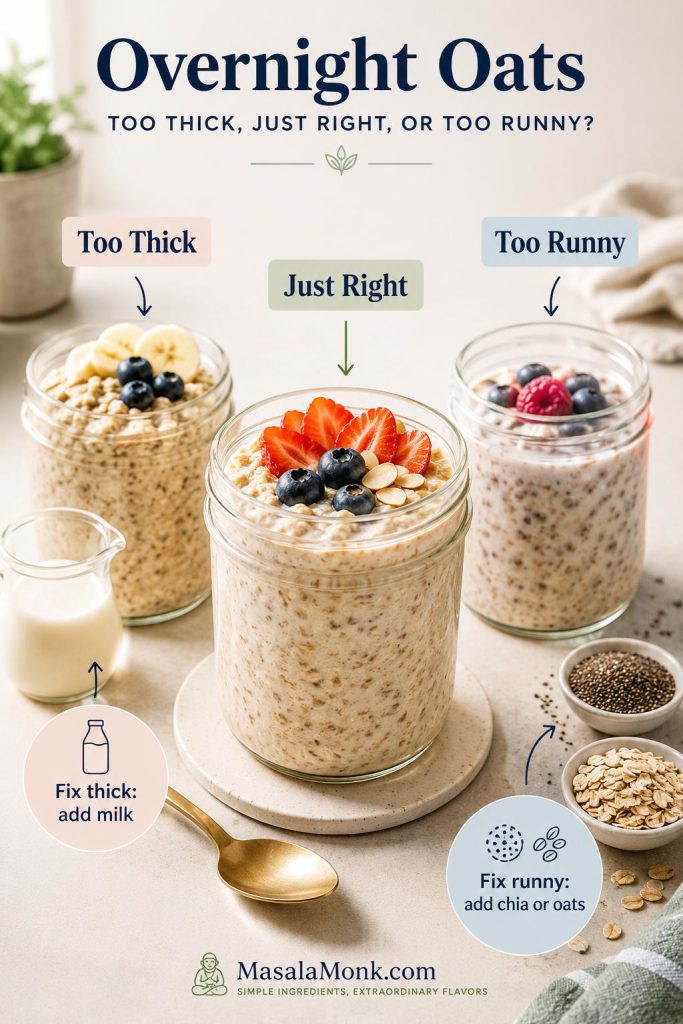
Use the classic overnight oats ratio as your starting point, then adjust milk, yogurt, chia seeds, or protein powder to make the jar thicker, looser, lighter, or more filling.

Ratio variations at a glance

StyleOatsLiquidYogurt / ChiaBest For
Creamy classic½ cup / 40 g½ cup / 120 ml¼ cup / 60 g yogurt + 1–2 tsp chiaBest default consistency
No yogurt½ cup / 40 g⅔ cup / 160 ml1 tbsp chiaDairy-free or lighter oats
Extra thick½ cup / 40 g½ cup / 120 ml¼ cup / 60 g yogurt + 1 tbsp chiaPudding-like oats
Looser½ cup / 40 g¾ cup / 180 mlOptional yogurt or 1 tsp chiaSofter porridge-style oats
Protein powder½ cup / 40 g¾ cup / 180 ml to start1 scoop protein + optional yogurtHigher-protein meal prep

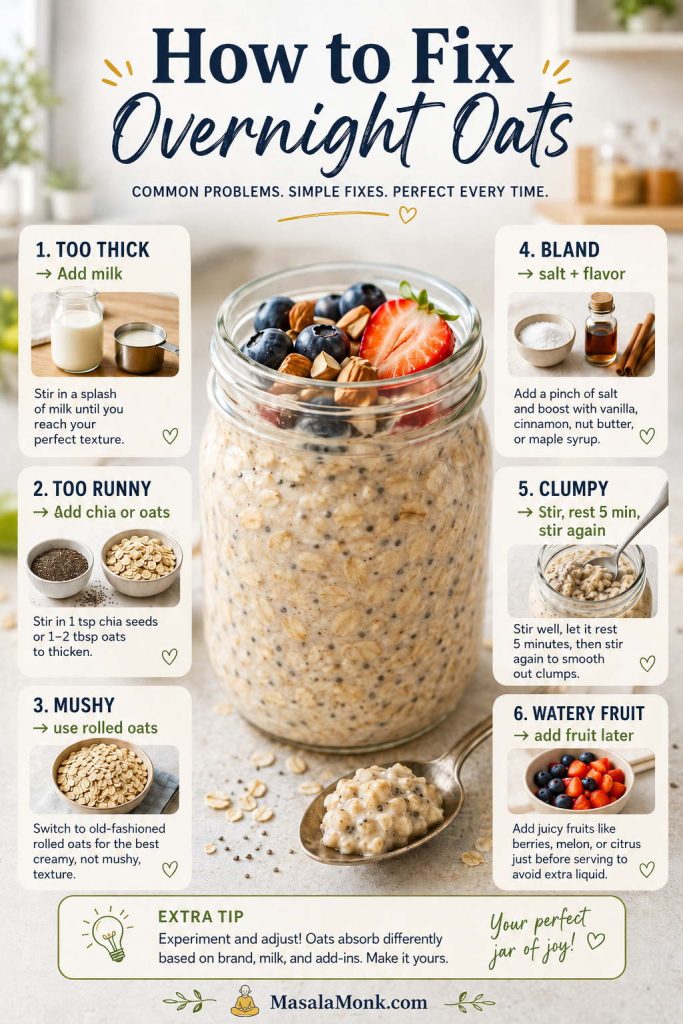
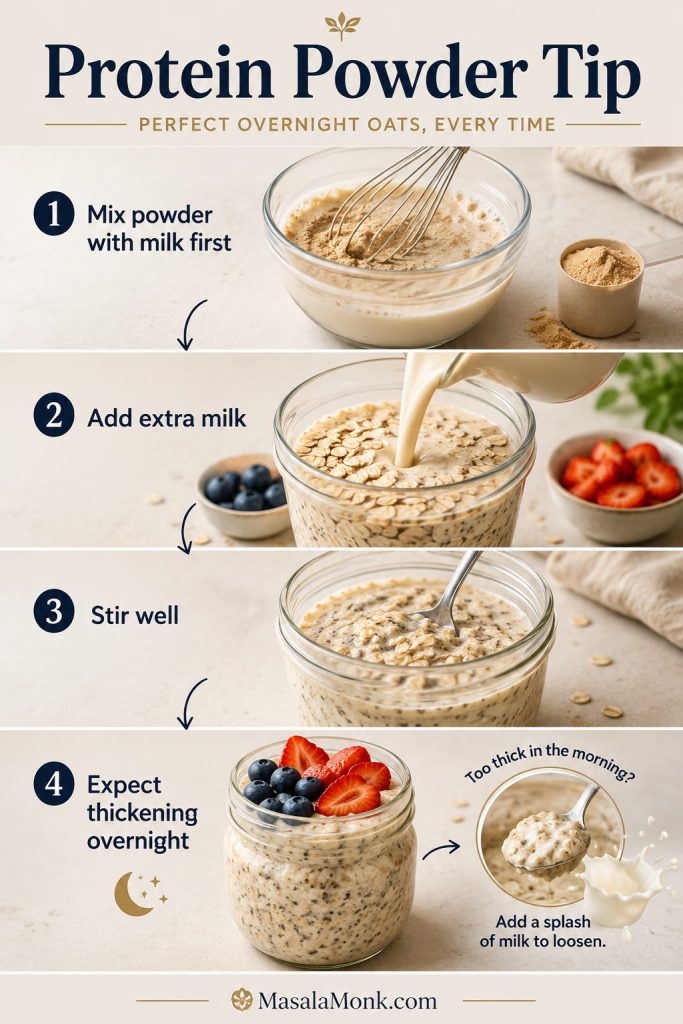
Once you know the ratio, you can jump straight to the recipe card or use the troubleshooting guide if your oats usually turn too thick, watery, mushy, or clumpy. Using protein powder? The protein powder tips section explains why the jar may need extra milk after chilling.

Why This Overnight Oats Recipe Works

The method works because it balances three things: enough liquid to soften the oats, enough body to keep the breakfast creamy, and enough flavor so it does not taste flat by morning. Rolled oats absorb milk slowly, yogurt or curd adds creaminess, chia seeds help everything set, and a pinch of salt makes the sweet flavors taste brighter.

The second stir matters too. When oats, chia, yogurt, and milk sit for a few minutes, they begin to thicken. Stirring again before refrigerating spreads the chia seeds evenly and prevents dry oats or thick clumps from settling at the bottom. You can see the technique in the second-stir step.

That is what makes the core recipe flexible without feeling random. You can make it creamier with yogurt, thicker with chia, lighter with more milk, sweeter with ripe fruit, or more filling with protein powder or nut butter, while still keeping the same basic method.

Overnight Oats at a Glance

Before you start, here are the practical details that make the recipe easier to repeat.

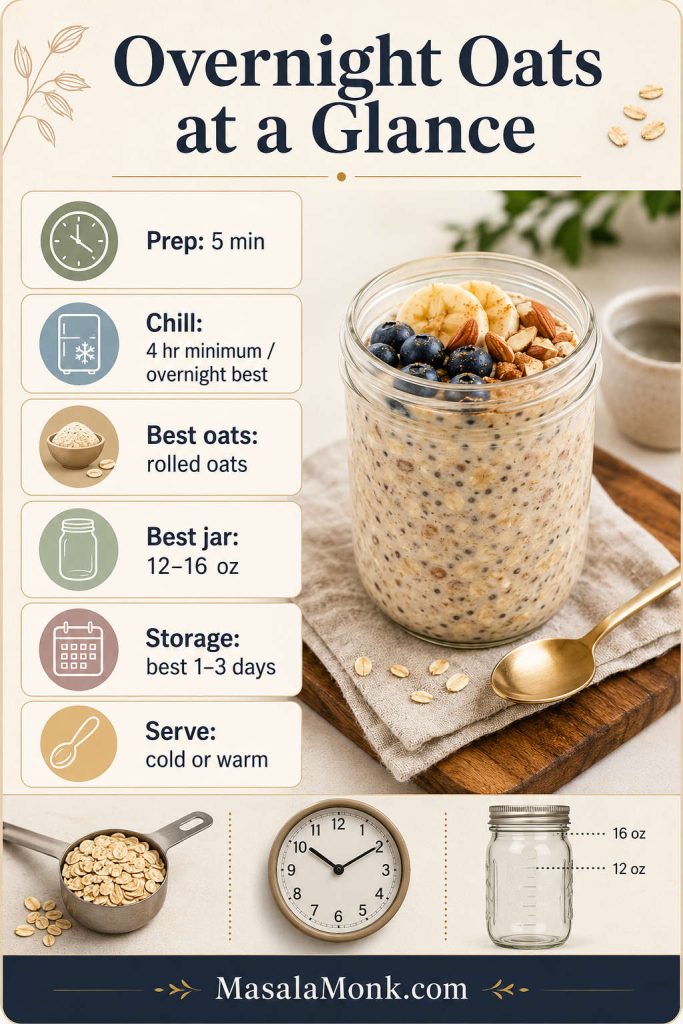
At-a-glance overnight oats guide with prep time, chill time, rolled oats, jar size, storage, and cold or warm serving notes.
Once the timing is clear, overnight oats become easy to repeat: mix in minutes, chill until creamy, and finish with toppings when you are ready to eat.
DetailBest Answer
Best oatsRolled oats or old-fashioned oats
Prep time5 minutes
Cook time0 minutes
Chill time4 hours minimum; overnight / 8 hours best
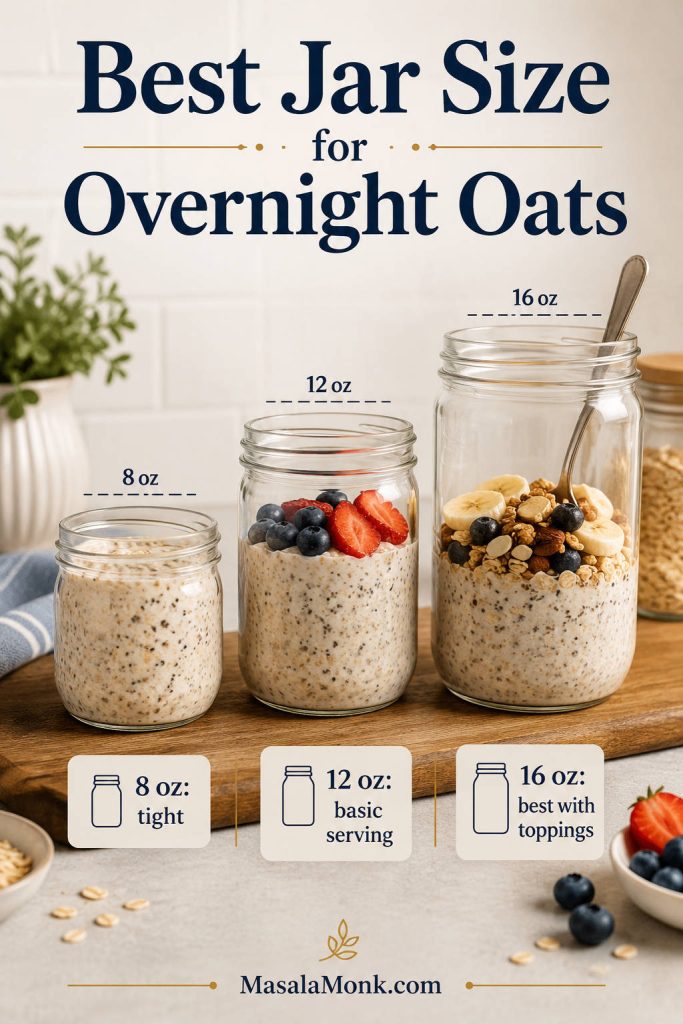
Best container size12–16 oz / 350–500 ml; 16 oz is best with toppings
Fridge temperature40°F / 4°C or below
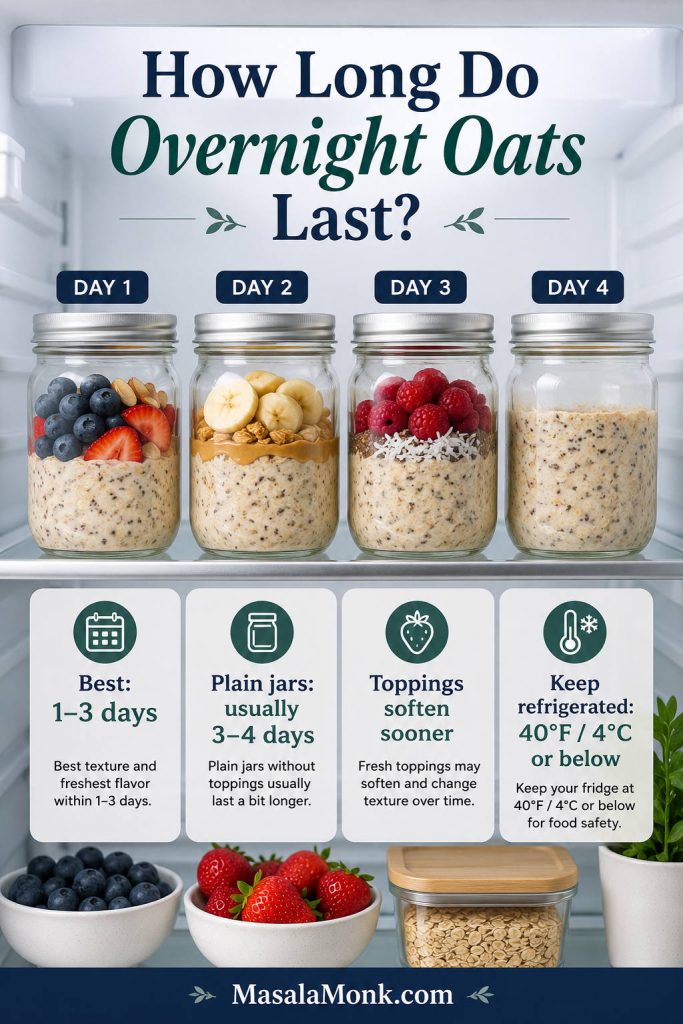
Best storage windowBest in 1–3 days; plain oats usually 3–4 days
Eat cold or warm?Usually cold; can be warmed 30–60 seconds with a splash of milk

If you only want one version to try first, make the creamy classic below. It gives you enough body from yogurt, enough softness from milk, and just a little chia for structure without turning the oats stiff.

Overnight Oats Recipe Card

Creamy Overnight Oats Recipe

This overnight oats recipe is the dependable starting mix: creamy, lightly thickened, easy to flavor, and flexible enough for yogurt, curd, dairy-free milk, chia, fruit, nuts, or protein add-ins.

Prep Time5 minutes

Cook Time0 minutes

Chill Time4 hours minimum

Yield1 breakfast jar

Ingredients

  • ½ cup rolled oats or old-fashioned oats, about 40 g
  • ½ cup milk of choice, 120 ml / 4 fl oz
  • ¼ cup Greek yogurt or thick curd, about 60 g
  • 1–2 teaspoons chia seeds, about 4–8 g
  • 1–2 teaspoons maple syrup, honey, date syrup, or jaggery syrup, 5–10 ml
  • ¼ teaspoon vanilla extract
  • Pinch of fine salt
  • Fruit, nuts, seeds, nut butter, cinnamon, cocoa, coconut, or granola for topping

Instructions

  1. Add the oats, milk, yogurt or curd, chia seeds, sweetener, vanilla, and salt to a jar or lidded container.
  2. Stir very well, scraping the bottom and sides so there are no dry oats, chia clumps, or yogurt pockets.
  3. Let the mixture sit for 5 minutes, then stir again. This second stir helps the chia seeds spread evenly and gives a smoother result.
  4. Cover and refrigerate for at least 4 hours. For the best consistency, chill overnight.
  5. In the morning, stir again. If the oats are too thick, loosen with 1–3 tablespoons milk.
  6. Add fresh fruit, crunchy toppings, nuts, granola, or extra nut butter right before serving.

Recipe Notes

  • No yogurt? Combine ½ cup oats, ⅔ cup milk, and 1 tablespoon chia seeds, or see the no-yogurt ratio for the texture logic.
  • Want a thicker, pudding-like jar? Increase the chia seeds to 1 tablespoon.
  • Adding protein powder? Use 1 scoop and increase the milk by about ¼ cup / 60 ml; see the protein powder tips if your oats turn stiff or clumpy.
  • Need more sweetness? Taste in the morning and adjust then, so the jar does not become dessert-sweet overnight.
  • For the smoothest mix, stir everything in a bowl first, then transfer it to a jar after the second stir.
  • Need more topping guidance? Add crunchy toppings in the morning, or jump to when to add overnight oats toppings.
  • Nutrition varies by milk, yogurt, sweetener, and toppings. The base jar is generally more balanced when it includes yogurt or another protein source, while nut butter, granola, dried fruit, chocolate chips, and syrup can raise calories quickly.

Storage

Overnight oats taste best in the first 1–3 days. A plain sealed serving can usually keep for 3–4 days in the refrigerator at 40°F / 4°C or below. Add delicate fruit, nuts, seeds, and granola closer to serving for the best consistency.

Saveable creamy overnight oats recipe card with oats, milk, yogurt, chill time, second stir tip, topping timing, and storage note.
This base overnight oats recipe gives you the formula to return to whenever you want a make-ahead breakfast without guessing the liquid, chill time, or topping timing.

Want to change the thickness? Use the ratio guide. Want to keep the same base but change the taste? Go to the flavor ideas.

First time making overnight oats? Start with the creamy classic ratio, keep toppings simple, and adjust the thickness in the morning. After one serving, you will know whether you prefer more milk, more chia, or less yogurt.

Overnight Oats Ratio Guide

The easiest way to build the base is to start with equal parts oats and milk, then decide whether you want yogurt, chia, or both. Yogurt makes the oats creamier and more filling. Chia does a different job: it makes the jar thicker and more pudding-like. Extra milk gives you a looser, softer consistency.

Creamy classic ratio

This is the version to start with if you are making overnight oats for the first time. For a creamy everyday texture, combine ½ cup rolled oats, ½ cup milk, and ¼ cup yogurt or curd. It gives you a satisfying breakfast without making the oats too stiff.

Yogurt vs No-Yogurt Overnight Oats

Go this route when you want dairy-free, vegan, or lighter overnight oats. Instead of yogurt, combine ½ cup rolled oats, ⅔ cup milk, and 1 tablespoon chia seeds. Chia replaces some of the body you would normally get from yogurt.

Side-by-side comparison of overnight oats with yogurt and no-yogurt overnight oats thickened with chia seeds.
Yogurt makes overnight oats creamier and tangier, while the no-yogurt version needs extra milk and chia seeds to stay thick and spoonable.

Extra-thick chia ratio

For a thicker, pudding-like result, keep the classic ratio but increase chia seeds to 1 tablespoon. This works especially well with cocoa, peanut butter, banana, and coffee flavors.

Looser porridge-style ratio

If you like softer oats with more movement, combine ½ cup oats and ¾ cup milk, with yogurt or chia kept optional. This version feels closer to chilled porridge.

Texture tip: Overnight oats thicken as they sit. A jar that looks slightly loose at night can be perfect by morning, while a jar with chia or protein powder may need extra milk after chilling.

Choose your overnight oats texture

There is no single perfect consistency. Some people want oats thick enough to hold a spoon upright, while others want something closer to chilled porridge. Use this as your shortcut.

If You Like…Best Adjustment
Thick, spoonable oatsAdd yogurt plus 1 tablespoon chia seeds.
Soft, loose oatsUse ¾ cup milk for every ½ cup oats.
Less tangUse less yogurt and more milk.
More natural sweetnessMix in mashed banana, mango, grated apple, berries, or applesauce.
More staying powerAdd Greek yogurt, soy milk, chia, protein powder, peanut butter, or nut butter.
A lighter breakfastUse milk plus chia instead of yogurt, and keep toppings simple.

If your oats still do not come out the way you like, the texture guide and fixes section will help you adjust the next batch.

How to Scale Overnight Oats for Meal Prep

For meal prep, mix the oats in a large bowl first, then divide them into jars. This is easier than trying to stir several full containers one by one, and it helps every serving taste consistent.

Large bowl of overnight oats being mixed and portioned into several jars for meal prep.
For overnight oats meal prep, mix the base in one bowl first and then divide it into jars, so every serving has the same texture and flavor.
ServingsRolled OatsMilkYogurt / CurdChia Seeds
1 jar½ cup / 40 g½ cup / 120 ml¼ cup / 60 g1–2 tsp
3 jars1½ cups / 120 g1½ cups / 360 ml¾ cup / 180 g1–2 tbsp
5 jars2½ cups / 200 g2½ cups / 600 ml1¼ cups / 300 g1½–3 tbsp

Equipment for Overnight Oats

You do not need special equipment, but the right container makes the oats easier to mix, store, and eat. A jar that is too small might technically hold the ingredients, but it will not give you much room to stir or add toppings.

Best Jar Size for Overnight Oats

Use the jar size as a texture tool, not just a container choice. A little extra room makes stirring easier and keeps fruit or crunchy toppings from spilling over.

Jar size guide for overnight oats showing 8-ounce, 12-ounce, and 16-ounce jars with different fill levels.
A 12-ounce jar works for a basic serving, but a 16-ounce jar gives you more room to stir, add fruit, and keep toppings from spilling over.
  • Jar or lidded container: 12–16 oz / 350–500 ml for one serving.
  • 16 oz / 475–500 ml jar: best if you want room for fruit, nuts, yogurt, and stirring.
  • Mixing bowl: useful when making 3–5 servings at once.
  • Spoon or mini spatula: helpful for scraping the bottom and sides so chia seeds and oats do not clump.
  • Measuring cups and spoons: important until you know the consistency you like.
  • Microwave-safe bowl: optional, only if you plan to warm the oats.

Ingredients You Need for Overnight Oats

A good jar starts with a simple oat mixture, then gets its personality from fruit, spices, nuts, seeds, nut butter, cocoa, coffee, or coconut. Here is what each ingredient does.

Overnight oats ingredients guide with rolled oats, milk, yogurt or curd, chia seeds, sweetener, vanilla, salt, and toppings.
The best overnight oats start with a simple base: rolled oats, liquid, something creamy or thickening, a little seasoning, and toppings added with purpose.

Rolled oats or old-fashioned oats

Rolled oats are the safest default because they soften well while keeping a little texture. Old-fashioned oats and rolled oats can usually be used the same way. For a deeper oat-type breakdown, see this MasalaMonk guide to oats types, nutrition, and differences.

For a quick comparison of rolled oats, quick oats, instant oats, steel-cut oats, and muesli in this recipe, see the best oats for overnight oats section below.

Milk

Dairy milk, oat milk, almond milk, soy milk, coconut milk, and cashew milk can all work. Soy milk and dairy milk add a little more protein. Oat milk and coconut milk make the breakfast creamier, while almond milk keeps it lighter.

Yogurt or thick curd

Greek yogurt or thick curd makes the oats creamier, tangier, and more filling. When your curd is very sour, use a smaller amount and balance it with fruit, vanilla, cinnamon, or a little sweetener.

Chia seeds

Chia seeds thicken the oats and help hold the liquid. Add 1–2 teaspoons for light thickening or 1 tablespoon for a pudding-like result. Too much chia can make the texture feel gluey, so increase it gradually.

If you like the thicker, pudding-style side of overnight oats, you may also enjoy these chia pudding recipes, which use chia as the main thickener rather than a small supporting ingredient.

Sweetener

Maple syrup, honey, date syrup, jaggery syrup, or a mashed ripe banana all work. Start light because fruit and toppings can add sweetness later.

Vanilla, salt, and spices

A tiny pinch of salt makes overnight oats taste less flat. Vanilla, cinnamon, cardamom, cocoa, nutmeg, ginger, or instant espresso powder can also change the flavor without changing the base method.

Toppings

Fruit, nuts, seeds, granola, coconut, peanut butter, almond butter, jam, chocolate chips, or roasted makhana can all work. Soft mix-ins can go in at night, while crunchy toppings are better in the morning. For a quick way to build a better jar, see the topping builder.

Build Better Overnight Oats Toppings

Choose toppings by purpose instead of adding everything at once. Freshness, crunch, creaminess, flavor, and texture each do a different job in the jar.

Overnight oats topping builder showing fruit, nuts, seeds, nut butter, yogurt, spices, granola, and coconut grouped by purpose.
Better toppings do a job: fruit adds freshness, nuts and seeds add crunch, and creamy extras like yogurt or nut butter make the jar more satisfying.

Best Oats for Overnight Oats

The best oats for overnight oats are rolled oats or old-fashioned oats. They absorb liquid evenly and become creamy without turning instantly mushy.

Guide to rolled oats, quick oats, instant oats, steel-cut oats, and muesli for making overnight oats.
Rolled oats are the safest choice for overnight oats because they soften evenly while still keeping enough texture to avoid turning mushy.
Oat TypeCan You Use It?TextureBest Use
Rolled oats / old-fashioned oatsYes, best choiceCreamy with light chewBest default method
Quick oatsYes, but softerVery soft, can turn mushyFast-soak jars or softer oats
Instant oatsOnly if neededSoft, sometimes paste-likeEmergency quick version
Steel-cut oatsNot a simple swapChewy, firm, sometimes toughSeparate steel-cut overnight method
MuesliYes, if oat-heavyMore varied textureNutty, fruit-filled jars

Rolled Oats vs Quick Oats vs Steel-Cut Oats

The soak changes each oat type differently. This comparison is useful when you want to understand why rolled oats are the safest default for this method.

Comparison of soaked rolled oats, quick oats, and steel-cut oats showing different overnight oats textures.
Rolled oats give the best balance of creaminess and chew; quick oats soften more, while steel-cut oats stay too firm for a direct swap.

If you are choosing between rolled oats and steel-cut oats, this MasalaMonk comparison of steel-cut oats vs rolled oats explains the texture difference in more detail.

If your package says old-fashioned oats, this guide to old-fashioned oats and rolled oats will help clarify the naming.

How to Make Overnight Oats

The method is simple, but the small details matter. Stirring well, resting briefly, and stirring again helps prevent dry pockets, chia clumps, and protein powder lumps.

Step-by-step overnight oats method showing ingredients added, stirred, rested, stirred again, chilled, adjusted, and topped.
The overnight oats method is simple, but the rest-and-stir step helps prevent dry pockets and chia clumps before the jar goes into the fridge.

Step 1: Add the base ingredients

Add rolled oats, milk, yogurt or curd, chia seeds, sweetener, vanilla, and salt to a jar or bowl.

Step 2: Stir very well

Scrape the bottom and sides as you stir. Dry oats and chia seeds often hide in the corners of a jar, especially if the container is narrow.

Step 3: Rest for 5 Minutes, Then Stir Again

This second stir is the difference between creamy oats and a serving with clumps at the bottom. It is especially helpful when you use chia seeds, yogurt, cocoa, matcha, or protein powder.

Close-up of overnight oats being stirred again after a short rest to prevent chia clumps and dry pockets.
After the first stir, let the jar sit for five minutes and stir again so chia seeds spread evenly and the oat mixture sets more smoothly.

Step 4: Cover and refrigerate

Chill for at least 4 hours. Overnight, or about 8 hours, gives the best consistency because the oats have more time to soften evenly.

Step 5: Stir and adjust in the morning

If the oats are too thick, add 1–3 tablespoons milk. If they are too loose, add a teaspoon of chia or a spoon of oats and let them sit a little longer.

Step 6: Add toppings

Add fresh banana, crisp apple, granola, toasted nuts, and other crunchy toppings right before eating so they keep their bite.

Overnight Oats Texture Guide

Good overnight oats should be creamy, not watery, gluey, or dry. The final consistency comes down to the oat type, liquid amount, yogurt, chia, and how long the mixture rests.

Overnight oats texture guide showing creamy, thick, loose, and smooth blended oat textures.
Texture is adjustable: yogurt makes oats creamier, chia seeds make them thicker, extra milk makes them looser, and blending makes the base smoother.
TextureHow to Get ItBest Ratio
Creamy and spoonableAdd yogurt or thick curd½ cup oats + ½ cup milk + ¼ cup yogurt
Thick and pudding-likeAdd yogurt plus more chia½ cup oats + ½ cup milk + ¼ cup yogurt + 1 tbsp chia
Loose and porridge-likeIncrease the liquid½ cup oats + ¾ cup milk
ChewierChoose thicker rolled oats and soak overnightKeep the classic ratio, avoid quick oats
Smooth/blendedBlend the mixture before chillingUse the classic ratio, then blend

If you are trying to fix a jar that already went wrong, start with the too thick vs too runny guide, then use the full overnight oats troubleshooting table.

Too Thick, Just Right, or Too Runny?

Before changing the whole recipe, check the texture first. Most jars only need a small correction with milk, oats, or chia seeds.

Overnight oats comparison showing too-thick, just-right, and too-runny textures with milk, chia, and oats as fixes.
Most overnight oats texture problems are easy to fix: add milk when the jar is too thick, or add chia seeds or oats when it is too loose.

How to Fix Overnight Oats

A disappointing jar is usually fixable. In practice, most bad overnight oats are not a recipe problem; they are a ratio or topping-timing problem. Too much chia needs milk, too much liquid needs oats or chia, bland oats need salt and flavor, and watery fruit usually means the toppings went in too early.

Troubleshooting board for overnight oats that are too thick, too runny, mushy, bland, clumpy, or watery from fruit.
A disappointing jar is usually fixable once you know whether the problem is liquid, thickener, oat type, flavor, stirring, or topping timing.
ProblemWhy It HappenedFix It NowNext Time
Too thickToo much chia, protein powder, or too little liquidStir in 1–3 tbsp milkReduce chia or add more milk
Too runnyToo much liquid or not enough soak timeAdd 1–2 tsp chia or 1–2 tbsp oats and restStart with less milk or more thickener
Too mushyQuick oats, instant oats, or too much liquidAdd crunchy toppingsChoose rolled oats
Too chewySteel-cut oats or not enough soak timeAdd milk and rest longerStick with rolled oats for this method
BlandNo salt, vanilla, fruit, spice, or enough sweetnessAdd salt, cinnamon, vanilla, and fruitSeason the mixture at night
Too sourToo much yogurt or very sour curdAdd milk, fruit, or a little sweetenerUse less yogurt or a milder curd
Chia clumpsNot stirred properlyBreak clumps with a spoon and loosen with milkStir, rest 5 minutes, stir again
Protein powder clumpsPowder was not mixed with enough liquidStir hard or blend brieflyMix protein powder with milk first
Watery fruit layerJuicy fruit was mixed in too earlyStir in chia or add thicker toppingAdd delicate fruit in the morning

15 Easy Overnight Oats Flavors

Once the ratio is right, the fun part is flavor. The easiest overnight oats flavors usually follow the same pattern: one main flavor, one creamy or crunchy element, and one fresh topping added in the morning. Start with these combinations, then adjust sweetness and thickness after chilling.

Overnight oats flavor chooser with peanut butter banana, blueberry lemon, apple cinnamon, mango curd, and chocolate peanut butter ideas.
Choose your first overnight oats flavor by mood: peanut butter banana is forgiving, apple cinnamon is cozy, mango curd is bright, and blueberry lemon feels fresh.

Best Flavors to Try First

If you are not sure where to start, choose by mood. Peanut butter banana is the most forgiving first jar because it hides small texture mistakes well. Mango curd tastes bright and lassi-like. Apple cinnamon feels cozy, especially when you add crisp apple in the morning. Chocolate peanut butter is the dessert-style option, while blueberry lemon keeps the jar fresher and lighter.

Peanut butter banana overnight oats topped with banana slices, peanut butter, crushed nuts, and chia seeds.
Peanut butter banana is one of the easiest overnight oats flavors because banana and nut butter both help the jar taste creamy and forgiving.

How to build better flavor

For a breakfast that tastes fresh, keep juicy fruit and crunchy toppings for the morning. For a more dessert-like jar, mix cocoa, coffee, cinnamon, peanut butter, mashed banana, or coconut into the oats before chilling so the flavor has time to settle.

Fruit-Forward Overnight Oats Flavors

Use this group when you want a brighter breakfast jar. Fruit flavors work best when juicy fruit and crunchy toppings are timed carefully.

Fruit-forward overnight oats flavor board with banana, apple cinnamon, mango, blueberry, strawberry, and peach options.
Fruit-forward overnight oats taste best when juicy fruit and crunchy toppings are timed well, so the base stays creamy instead of turning watery.
FlavorMix In at NightAdd in the MorningTexture Note
BananaMashed ripe banana + cinnamonFresh banana slices, walnutsMashed banana thickens the oats
Apple cinnamonCinnamon + grated apple or applesauceDiced apple, walnuts, raisinsAdd crisp apple in the morning
MangoMango puree or chopped mangoFresh mango, coconut, pistachioThick curd gives a lassi-style feel
BlueberryFrozen or fresh blueberriesLemon zest, nuts, yogurt swirlFrozen berries release juice
StrawberryChopped strawberries or strawberry compoteFresh strawberries, granolaAdd granola only before eating
PeachChopped peach + cinnamonMore peach, almonds, granolaRipe peaches can loosen the oats

If fruit jars often turn watery or soft, the topping timing guide will help you decide what to mix in at night and what to add in the morning.

Apple Cinnamon Overnight Oats

This is the cozy option when you want spice and crunch. Add crisp apple close to serving so the topping stays fresh against the creamy oat base.

Apple cinnamon overnight oats topped with diced apple, cinnamon, walnuts, and raisins.
Apple cinnamon overnight oats work best when crisp apple is added close to serving, giving the creamy base a fresh bite and cozy flavor.

Mango Overnight Oats

Mango works especially well with thick curd or yogurt because the jar tastes bright, creamy, and lightly tangy without needing much extra sweetness.

Mango overnight oats with creamy oats, mango puree, fresh mango cubes, coconut, and pistachios.
For mango overnight oats, stir mango puree into the base at night, then add fresh mango cubes in the morning for a brighter texture.

Blueberry Lemon Overnight Oats

Blueberry lemon is the fresh option, but the berries can release juice. Yogurt or chia helps keep the base creamy instead of watery.

Blueberry lemon overnight oats with fresh blueberries, lemon zest, creamy oats, and a spoon lifting a bite.
Blueberry lemon keeps overnight oats fresh and bright, while yogurt or chia seeds help balance the juice released by the berries.

Chocolate, Coffee and Cozy Flavors

These flavors are richer, so balance matters. Bitter ingredients such as cocoa, coffee, and matcha need enough creaminess, salt, and gentle sweetness.

Chocolate, coffee, matcha, maple brown sugar, tiramisu, and chocolate peanut butter overnight oats flavor board.
Chocolate, coffee, matcha, and tiramisu-style overnight oats need enough creaminess, salt, and gentle sweetness to balance bitter flavors.
FlavorMix In at NightAdd in the MorningTexture Note
Chocolate1 tbsp cocoa + extra sweetenerChocolate chips, berries, nutsCocoa absorbs liquid
Chocolate peanut butterCocoa + peanut butterBanana, peanuts, dark chocolateUsually needs a splash more milk
Coffee / latteEspresso powder dissolved in milkCocoa, chocolate chips, yogurtAvoid too much bitter coffee
MatchaMatcha whisked into milkBanana, coconut, sesame, berriesWhisk matcha first to avoid clumps
Maple brown sugarMaple syrup + brown sugar + cinnamonPecans, walnuts, bananaKeep sweetness balanced
TiramisuEspresso + cocoa + vanillaYogurt layer, cocoa dustingUse strong coffee flavor carefully

Chocolate Peanut Butter Overnight Oats

Chocolate peanut butter tastes dessert-like, so keep the base balanced with enough milk and a pinch of salt rather than relying only on sweetness.

Chocolate peanut butter overnight oats with cocoa oats, peanut butter swirl, banana slices, and a spoon lifting a thick bite.
Because cocoa and peanut butter both thicken the oat mixture, this flavor often needs a small splash of milk after chilling.

Creamy, Nutty and Tropical Flavors

This flavor family is useful when you want a jar that feels richer and more filling. Creamy add-ins such as nut butter, coconut, yogurt, and seeds give the oats more body.

Creamy, nutty, and tropical overnight oats board with peanut butter, carrot cake, coconut, mango coconut, and nut butter seed ideas.
Nutty and tropical add-ins make overnight oats feel richer, especially when peanut butter, coconut, mango, seeds, or extra yogurt support the oat base.
FlavorMix In at NightAdd in the MorningTexture Note
Peanut butter1 tbsp peanut butter + cinnamonBanana slices, peanuts, extra drizzleAdd extra milk if thick
Carrot cakeGrated carrot + cinnamon + nutmegWalnuts, raisins, coconutYogurt makes it creamier
CoconutCoconut milk + shredded coconutMango, pineapple, toasted coconutRich coconut milk makes it thicker

If you are making overnight oats for the first time, peanut butter banana, apple cinnamon, mango curd, chocolate peanut butter, and blueberry lemon are the easiest flavors to get right. Coffee, matcha, and tiramisu are a little more sensitive because bitter ingredients need enough sweetness, salt, and creaminess to balance them. For more on why the peanut butter version is so satisfying, MasalaMonk’s guide to oatmeal and peanut butter is a useful companion read.

How to Make High-Protein Overnight Oats

For higher-protein overnight oats, build the serving with Greek yogurt, thick curd, soy milk, protein powder, blended cottage cheese or paneer, chia seeds, hemp seeds, peanut butter, or nut butter. For the base amounts before adding protein powder, use the quick ratio guide near the top of the post.

High-protein overnight oats guide with Greek yogurt or curd, soy milk, protein powder, chia, hemp, nut butter, and cottage cheese or paneer.
High-protein overnight oats work best when the base includes a creamy protein source and enough extra liquid to handle overnight thickening.

Protein Powder Overnight Oats Tips

Protein powder is the ingredient most likely to trick you. The jar may look perfect when you mix it, then turn thick and stiff by morning. Start with 1 scoop protein powder and about ¼ cup / 60 ml extra milk, then loosen again after chilling if needed.

Protein powder overnight oats guide showing protein powder mixed with milk first, added to oats, stirred well, thickened overnight, and loosened with milk.
Protein powder thickens as it sits, so mixing it with milk first and adding extra liquid helps prevent clumps and stiffness by morning.

For a full protein-focused version with flavors, macro-friendly ideas, vegan options, and protein powder tips, use this MasalaMonk guide to high protein overnight oats. If you also like warm oats, this protein oatmeal guide covers hot oatmeal and proats-style breakfasts.

Vegan, Dairy-Free, Gluten-Free and No-Yogurt Overnight Oats

The core recipe is easy to adapt. Think of these as swaps, not separate recipes: the oat base stays the same, while the milk, thickener, sweetener, or creamy element changes depending on what you need. If you are skipping dairy, start with the no-yogurt ratio. If you are using water instead of milk, go straight to overnight oats with water, because that version needs extra help from chia, salt, and flavor.

Vegan and dairy-free overnight oats with plant milk, plant yogurt, chia seeds, nut butter, coconut cream, and fruit.
Dairy-free overnight oats can still be creamy when plant milk is paired with chia seeds, plant yogurt, nut butter, coconut cream, or ripe fruit.

Vegan overnight oats

Choose plant milk, plant yogurt if desired, chia seeds, maple syrup or date syrup, and fruit. Oat milk, soy milk, almond milk, and coconut milk all work.

Dairy-free overnight oats

Almond milk, oat milk, soy milk, coconut milk, or cashew milk can replace dairy milk. For creaminess without dairy, add chia seeds, nut butter, coconut cream, mashed banana, or plant yogurt. MasalaMonk also has a guide to homemade oat milk if you want to make your own.

Gluten-free overnight oats

Choose certified gluten-free oats if you need the recipe to be gluten-free. Oats are naturally gluten-free, but cross-contact during processing is common, so the package label matters.

Overnight oats without yogurt

Combine ½ cup rolled oats, ⅔ cup milk, and 1 tablespoon chia seeds. Add nut butter, mashed banana, or coconut cream if you want a creamier result without yogurt.

For the full no-yogurt ratio and how it compares with yogurt-based oats, see the ratio guide above.

Overnight Oats with Water

You can make overnight oats with water, but water needs help. Combine ½ cup oats, ¾ cup water, 1 tablespoon chia seeds, a pinch of salt, vanilla or cinnamon, and something creamy like peanut butter, almond butter, coconut cream, mashed banana, or plant yogurt. Without one of those creamy add-ins, the oats can taste flat.

Overnight oats with water guide showing plain water oats improved with chia seeds, salt, vanilla, cinnamon, banana, and nut butter.
Water works for overnight oats, but it needs help from chia seeds, salt, flavor, and something creamy like banana or nut butter.

Keto-style no-oat overnight oats

Regular oats are not usually keto-friendly. For a keto-style breakfast jar, make a no-oat version with chia seeds, hemp hearts, flaxseed, coconut, and low-carb milk instead of rolled oats. It will not taste exactly like classic overnight oats, but it gives a similar chilled, spoonable breakfast format. If that is the direction you want, this keto chia pudding recipe is a better starting point than trying to force regular oats into a keto breakfast.

Are Overnight Oats Healthy for Weight Loss?

Overnight oats can fit a weight-loss breakfast when the serving has enough protein, fiber, and volume without turning into dessert. Oats give the mixture structure, chia adds fiber and thickness, yogurt or protein powder can make it more filling, and fruit adds sweetness without needing too much syrup.

No single breakfast causes weight loss on its own. Still, a well-built oats jar can make breakfast easier to control because the portions are measured ahead of time.

Oats also bring soluble fiber to the bowl, which is one reason they work so well in a make-ahead breakfast. Harvard’s Nutrition Source has a helpful overview of oats if you want the broader nutrition background.

The main thing is not letting a balanced breakfast jar accidentally turn into dessert. Nut butter, granola, chocolate chips, dried fruit, and syrup are all fine in the right amount, but they add up quickly when they all go into the same container. Keep the base balanced, add enough protein if you need more staying power, and choose toppings with intention.

Balanced overnight oats compared with an overloaded jar containing extra nut butter, granola, syrup, dried fruit, and chocolate chips.
Overnight oats can support a balanced breakfast, but calorie-dense toppings add up quickly when nut butter, granola, syrup, dried fruit, and chocolate all go into one jar.
GoalBetter ChoiceWatch Out For
More fillingGreek yogurt, protein powder, chia, soy milkThin oats with only milk and fruit
Lower sugarBerries, apple, cinnamon, vanillaToo much syrup, jam, sweetened yogurt
More fiberChia, flax, berries, apple, oatsLow-fiber toppings only
Controlled caloriesMeasure nut butter, granola, nutsLarge handfuls of calorie-dense toppings

For more on oats, chia, and fullness-focused breakfasts, see MasalaMonk’s guide to oats and chia seeds for weight loss.

Meal Prep and Storage

Overnight oats are built for meal prep, but consistency changes over time. A plain mixture keeps better than a container loaded with fresh fruit, granola, and crunchy toppings.

Meal prep overnight oats setup with several jars, a mixing bowl, lids, fresh fruit, nuts, seeds, and toppings kept separately.
For better meal-prep texture, store the oat base in jars and keep crunchy or delicate toppings separate until serving.

The biggest meal-prep mistake

The biggest mistake is adding every topping the night before. Soft mix-ins like cocoa, cinnamon, chia, yogurt, nut butter, jam, mashed banana, applesauce, or frozen berries can go in early. Crunchy toppings are different: fresh banana, crisp apple, granola, toasted nuts, and coconut chips are better added right before eating.

For quick topping timing, use the table below, or go back to the flavor ideas if you are planning several jars at once.

Best jar size for overnight oats

For one serving of overnight oats, a 12–16 oz / 350–500 ml jar works best. A 16 oz jar gives you enough space to stir properly and add toppings without overflowing.

Jar SizeHow It WorksBest Use
8 oz / 240 mlVery tight for a full servingSmall portions, snack jars, no bulky toppings
12 oz / 350 mlWorks for one basic servingSingle serving with light toppings
16 oz / 475–500 mlBest overall sizeOne serving with fruit, nuts, yogurt, and stirring room
Bowl or meal-prep containerMore room to mixBatch prep or family portions

How Long Do Overnight Oats Last?

Overnight oats taste best in the first 1–3 days. A plain sealed mixture can usually keep for 3–4 days in the fridge. Some servings may be fine longer, but fruit, yogurt, and toppings soften faster.

Overnight oats storage timeline showing jars for day 1 through day 4, best texture in 1 to 3 days, and refrigeration at 40°F or 4°C.
Overnight oats taste best in the first few days, especially when fresh fruit, nuts, and granola are added closer to serving.

Keep overnight oats refrigerated at 40°F / 4°C or below. For general food-safety guidance, the USDA recommends keeping refrigerators at 40°F or below and using refrigerated leftovers within a few days. You can read their refrigerator safety guidance here: USDA refrigerator safety basics.

When to Add Overnight Oats Toppings

The best overnight oats are usually built in two stages: flavor the oats at night, then add delicate or crunchy toppings in the morning. In short, crunch belongs in the morning.

Overnight oats toppings timing guide showing soft mix-ins to add at night and fresh or crunchy toppings to add in the morning.
Soft mix-ins can go in at night, while fresh fruit and crunchy toppings usually taste better when added right before serving.
Add at NightAdd in the Morning
Cinnamon, cocoa, vanilla, chia, yogurt, nut butter, jam, mashed banana, applesauce, frozen berriesFresh banana, crisp apple, granola, toasted nuts, coconut chips, fresh berries, crunchy seeds, chocolate chips

If you like a little crunch on top, keep granola-style toppings separate until serving. For a make-ahead oat snack in the same pantry lane, these homemade granola bars use oats, nut butter, honey or dates, and seeds in a different meal-prep format.

Can You Freeze Overnight Oats?

You can freeze overnight oats, but the consistency is usually best when you freeze the plain mixture without delicate toppings. Leave headspace in the container because the mixture expands, thaw in the fridge, stir well, then add fresh fruit and crunchy toppings after thawing.

Freezing guide for overnight oats showing plain containers with headspace, thawing in the fridge, and fresh toppings added later.
Overnight oats freeze best when kept plain, with headspace in the container and fresh toppings added only after thawing.

Can You Warm Overnight Oats?

Yes. Overnight oats are usually eaten cold, but you can warm them. Transfer to a microwave-safe bowl or jar, add a splash of milk, and heat for 30–60 seconds, stirring once. Do not microwave a metal lid.

Cold versus warm overnight oats guide showing a chilled jar and warmed oats with a splash of milk, microwave timing, and no metal lid warning.
Overnight oats are usually eaten cold, although you can warm them gently with a splash of milk for a softer, cozier breakfast.

Overnight Oats FAQs

What is the best ratio for this overnight oats recipe?

The best starting ratio is ½ cup rolled oats, ½ cup milk, and ¼ cup yogurt or thick curd. For no-yogurt overnight oats, use ½ cup oats, ⅔ cup milk, and 1 tablespoon chia seeds. For more detail, see the ratio guide and texture guide above.

How long do overnight oats need to soak?

Plan on at least 4 hours. Ideally, give rolled oats an overnight rest of about 8 hours so they become creamier and more even.

Are overnight oats eaten cold or warm?

Most people eat overnight oats cold, straight from the fridge. You can also warm them for 30–60 seconds with a splash of milk when you want a softer, cozier breakfast.

How do you make overnight oats without yogurt?

Skip the yogurt and let chia do the thickening instead. A good no-yogurt ratio is ½ cup oats, ⅔ cup milk, and 1 tablespoon chia seeds.

Do overnight oats need chia seeds?

Chia seeds are helpful, but they are not required. Instead, you can use yogurt or slightly less liquid to keep the oats thick.

How do you make overnight oats with water?

Water works, but it needs help. Add chia seeds, salt, vanilla or cinnamon, and something creamy like nut butter, mashed banana, coconut cream, or plant yogurt so the oats do not taste flat.

Which oats are best for overnight oats?

Rolled oats or old-fashioned oats are best. Quick oats get softer, instant oats can become paste-like, and steel-cut oats need a different method.

What happens if you use steel-cut oats?

Steel-cut oats are not a direct swap here. They stay much chewier and need a longer soak or a separate preparation method.

How long do overnight oats last in the fridge?

They taste best in the first 1–3 days. A plain sealed mixture can usually keep for 3–4 days when refrigerated properly.

Do overnight oats freeze well?

They freeze best when kept plain. Freeze the oats without delicate fruit or crunchy toppings, leave headspace in the container, thaw in the fridge, stir well, and then add fresh toppings after thawing.

Are overnight oats good for weight loss?

They can be, especially when the serving includes protein, fiber, fruit, and measured toppings. Still, large amounts of nut butter, granola, syrup, dried fruit, and chocolate chips can raise calories quickly.

How do you add protein powder to overnight oats?

Add 1 scoop protein powder and increase the milk by about ¼ cup / 60 ml. Then stir very well, because protein powder can clump and thicken as it sits.

Why are my overnight oats too thick?

They may have too much chia, too much protein powder, or not enough liquid. As a quick fix, stir in 1–3 tablespoons milk before eating.

Why are my overnight oats watery?

They may have too much liquid, watery fruit, or not enough soaking time. To fix them, add chia seeds or a spoon of oats and let the mixture sit longer.

The Takeaway

Start with rolled oats, use enough liquid, season the mixture with a pinch of salt, and stir twice before chilling. Then, add delicate fruit and crunchy toppings closer to serving, and adjust the consistency in the morning instead of trying to get everything perfect the night before.

Once you like the base recipe, you can turn it into peanut butter overnight oats, apple cinnamon overnight oats, mango overnight oats, chocolate overnight oats, coffee overnight oats, or a higher-protein version without changing the basic method. And when you want a warm oat breakfast instead of a chilled jar, these oat pancakes are another easy way to use rolled oats for breakfast.

Finished overnight oats jars in a calm breakfast scene with fruit, nuts, spoon, small bowls, and creamy oat texture.
Once you understand the base, overnight oats become a flexible make-ahead breakfast you can adjust for texture, flavor, protein, and meal prep.

Back to top

Posted on 7 Comments

10 Low Carb Chia Pudding Recipes for Weight Loss (Keto, High-Protein, Dairy-Free)

Cover image showing a premium glass jar of low carb chia pudding with a smooth whipped topping on a warm-cream seamless background. Editorial food photography style for “Low Carb Chia Pudding” featuring 10 recipes including keto, high protein, dairy-free, and blended options, with MasalaMonk.com branding.

Chia pudding has a way of sneaking into your routine and then refusing to leave. At first, it feels like a clever trick—stir a few spoonfuls of tiny seeds into milk, refrigerate, and wake up to a spoonable pudding. Before long, though, you realize a simple jar of low carb chia pudding can be more than a trend: it’s a dependable breakfast that doesn’t demand morning effort, a snack that travels well, and a dessert-like bowl that still fits a lighter day.

Why chia pudding works as breakfast, snack, and “healthy dessert”

What makes it especially useful is how easily you can shape it around your cravings. Some mornings you’ll want something light and clean—pudding with almond milk, a little vanilla, and berries. Other times, you’ll prefer a thick, creamy version that leans on Greek yogurt and tastes closer to cheesecake filling. And when your sweet tooth shows up, chocolate chia pudding, cacao chia pudding, or chocolate peanut butter chia seed pudding can feel genuinely comforting without tipping into a sugar spiral.

Collage-style image showing ten low carb chia pudding cups in a clean grid with the heading “Low Carb Chia Pudding (10 Recipes)” and the line “Keto • High Protein • Dairy-Free • Blended.” Features a variety of flavors including vanilla, berry, chocolate, peanut butter, matcha, mango, and mousse, with MasalaMonk.com in the footer.
All 10 low carb chia pudding recipes featured in this post at a glance—creamy keto cups, high protein Greek yogurt jars, dairy-free options, fruit layers, and blended mousse for a smooth pudding texture.

Equally important, chia pudding adapts to different eating styles without forcing you into one “right” way. If you’re leaning keto, coconut milk makes a rich keto pudding base while sweetness stays minimal. If you’re aiming for a paleo-friendly bowl, you can skip dairy and still get a creamy texture with coconut milk or almond milk plus nut butter. Meanwhile, if you’re chasing a higher-protein breakfast, chia pudding with protein powder—or a low carb chia pudding with Greek yogurt—turns the jar into something that feels like a real meal.

If you want a deeper foundation on how chia fits into weight-loss habits—portions, consistency, and simple ways to keep it effortless—this companion guide is worth a read: The Ultimate Guide to Chia Pudding for Weight Loss.

Now, before we jump into the ten best variations, let’s lock in the base. Once you get the ratio and texture right, every flavor becomes easier, smoother, and more repeatable.

Also Read: Garlic & Paprika Cabbage Rolls (Keto-Friendly Recipes) – 5 Bold Savory Twists


Low Carb Chia Pudding for Weight Loss: Why It Works So Well

For weight loss, the best breakfasts explain themselves later—when you realize you didn’t spend the whole morning thinking about snacks. That’s exactly where low carb chia pudding shines: it’s simple, satisfying, and surprisingly good at keeping your appetite calm between meals.

Why chia pudding keeps you full longer

Chia helps in a very practical way: when it hydrates, it turns your milk into a thick, spoonable gel. Because of that texture, you naturally eat more slowly, and the jar tends to feel more substantial than it looks—especially compared to breakfasts that disappear in three bites.

Infographic titled “Low Carb Chia Pudding for Weight Loss” explaining why it works: chia creates thick gel texture that slows eating, chia provides fiber + omega-3, and adding protein (Greek yogurt or protein powder) boosts staying power. Includes takeaway “Chia + Protein + Flavor = repeatable weight-loss breakfast” and MasalaMonk.com in the footer.
Why low carb chia pudding works so well: the gel texture slows eating, fiber helps the jar feel steadier between meals, and protein (Greek yogurt or protein powder) is the upgrade that turns it into a true breakfast—not just a snack.

At the same time, chia is naturally fiber-rich and contains omega-3 fats, which is part of why it’s such a popular base for a steady “grab-and-go” breakfast. If you want a clean, evidence-based overview, Harvard’s Nutrition Source has a helpful summary on chia seeds nutrition (fiber + omega-3). Then, if you like checking calories, macros, or serving-size details, you can cross-reference with the USDA chia seed nutrition data.

The real upgrade is protein

Still, satisfaction isn’t only about chia. Protein is the piece that makes a jar feel like a meal—which is why “pudding and Greek yogurt,” “chia seed and Greek yogurt pudding,” and “chia pudding with protein powder” are such common staples. When your breakfast includes a solid protein anchor, it tends to feel steadier and more complete, so you’re less likely to start grazing out of habit.

Three-step infographic showing how to build a low carb chia pudding that keeps you full. Step 1: start with chia + milk (almond or coconut). Step 2: add protein (Greek yogurt or protein powder). Step 3: flavor it smart (cocoa, berries, matcha, cinnamon). Includes note “Meal prep 2–3 jars → cravings stay quieter” and MasalaMonk.com in the footer.
Use this quick builder to make low carb chia pudding feel “meal-level”: start with chia + milk, add protein (Greek yogurt or protein powder), then flavor it with cocoa, berries, matcha, or cinnamon. Prep 2–3 jars at once and you’ve got a simple routine that stays satisfying all week.

If your mornings often end with cravings, switching to a high protein & low carb chia pudding is one of the easiest upgrades: keep the chia base, then build in protein with Greek yogurt (thick and creamy) or protein powder (especially in chocolate versions). For a broader framework that pairs perfectly with a chia routine, this guide is a strong companion: how to eat 100 grams of protein a day.

So yes—chia helps. Even better, the best results usually come from the combination: chia for texture and fiber, protein for staying power, and flavor choices you genuinely look forward to eating.

Also Read: Eggless Yorkshire Pudding (No Milk) Recipe


Low Carb Chia Pudding Base Recipe (Perfect Ratio, No Clumps)

Everything starts here. Whether you’re making keto chia pudding, chia pudding paleo, dairy free chia pudding, or a blended chia pudding mousse, the base method stays the same.

The basic chia pudding ratio (and how to adjust it)

For a classic, spoonable base:

  • 3 tablespoons chia seeds (about 36–40 g)
  • 1 cup / 240 ml liquid (almond milk, coconut milk, dairy milk, oat milk, etc.)
  • A pinch of salt
  • Optional: ½ teaspoon vanilla
  • Optional: sweetener to taste
Infographic showing the low carb chia pudding base ratio: 3 tbsp chia seeds + 1 cup milk (240 ml), with add-ins (pinch of salt, optional vanilla, optional sweetener). It also shows how to adjust thickness: 2½ tbsp per cup for a lighter thinner set, or 3 tbsp plus richer milk for a thicker custardy set. Includes “Best chill: 2 hours (overnight best)” and MasalaMonk.com footer.
Here’s the dependable low carb chia pudding base ratio: 3 tablespoons chia to 1 cup milk (240 ml). Use 2½ tablespoons for a lighter set, or keep 3 tablespoons and switch to a richer milk (like canned coconut milk) for a thicker, custardy chia pudding—then chill at least 2 hours (overnight is best).

That ratio gives you a thick, pudding-like texture—great for low carb chia pudding cups, a chia pudding glass, or a single serve chia pudding jar. If you prefer it thinner, drop to 2½ tablespoons chia per cup of liquid. Conversely, if you like a dense, custardy texture, keep 3 tablespoons and use a richer liquid like canned coconut milk.

The mixing pattern that prevents clumps

This is the method that makes the difference between “silky” and “why is it lumpy?”

  1. Add chia seeds to the liquid, plus salt and vanilla (and sweetener, if using).
  2. Whisk vigorously for 20–30 seconds.
  3. Let it sit for 10 minutes.
  4. Whisk again, thoroughly.
  5. Cover and refrigerate at least 2 hours; overnight is even better.

That second whisk is the hinge. It’s the moment when the seeds have started to hydrate but haven’t fully set yet, which means you can break up clumps before they lock in.

Step-by-step infographic titled “No-Clumps Chia Pudding Method” showing four steps: 1) whisk 20–30 seconds, 2) rest 10 minutes, 3) whisk again to break clumps, and 4) chill 2 hours (overnight best). Includes a bowl-and-whisk visual sequence, a jar chilling in the fridge, and the note “The second whisk is the hinge,” with MasalaMonk.com in the footer.
If your chia pudding turns lumpy, this is the fix: whisk well, rest 10 minutes, then whisk again before chilling. That second whisk breaks clumps right when the seeds start hydrating—so your low carb chia pudding sets smooth, thick, and spoonable instead of bumpy.

Quick chia pudding vs “instant” chia pudding

Chia needs time to hydrate, so it’s never truly instant in the way instant oats are. Still, you can make a quick low carb chia seed pudding when you’re pressed for time.

Use the same ratio, whisk well, do the 10-minute stir, and refrigerate for 30–45 minutes. It will be softer than overnight, yet it’s still spoonable—especially if you make it as chia pudding with yogurt or add protein powder.

Why soaking matters

Chia expands dramatically when it absorbs liquid. Because of that, it’s best eaten soaked rather than dry. If you want the reason in plain terms, this clinical case report shows what can happen when dry chia is swallowed without enough liquid: why chia should be soaked first.

Also Read: Crock Pot Chicken Breast Recipes: 10 Easy Slow Cooker Dinners (Juicy Every Time)


Choosing Your Liquid: Almond Milk, Coconut Milk, Oat Milk, and More

Liquid is the secret “ingredient” that decides whether your pudding tastes light, rich, tropical, or dairy-creamy. It’s also the easiest lever to pull depending on whether you’re going for keto pudding, paleo chia seed pudding, or a more classic breakfast pudding recipe.

Infographic titled “Choosing Your Liquid for Chia Pudding” showing four options with texture notes and best uses: almond milk (light + neutral), canned coconut milk (thickest + richest), oat milk (creamy + familiar, not low carb), and coconut water (light + refreshing) with a tip to add Greek yogurt or coconut cream. Includes “Your easiest upgrade: choose the liquid first” and MasalaMonk.com in the footer.
Your chia pudding texture is mostly decided by the liquid. Almond milk keeps it light and versatile, canned coconut milk makes the richest pudding-like set, oat milk gives a classic creamy breakfast feel (not low carb), and coconut water stays light and fruit-friendly—especially with a spoon of Greek yogurt or coconut cream.

Pudding with almond milk (clean, light, versatile)

Chia pudding with almond milk is a classic because it’s neutral and easy to customize. It’s also a natural base for low carb chia pudding and many keto-friendly variations. If you want a dedicated keto version built around almond milk, this is a strong reference recipe: keto chia pudding with almond milk.

Coconut milk for chia pudding (thickest texture, richest feel)

If you want your chia pudding to taste like real pudding, use canned coconut milk. It’s also a favorite for keto chia pudding coconut milk versions because the fat content naturally boosts satisfaction. For a paleo chia seed pudding approach, coconut milk is equally useful.

A small detail helps a lot here: canned coconut milk varies. Some are thin; others are thick. If yours pours like cream, whisk in a little water so it hydrates evenly. That way you avoid dense, under-hydrated pockets.

Oat milk chia pudding (not keto, but creamy and familiar)

Oat milk makes a gentle, classic pudding flavor. It’s not low carb, so it’s best as an optional variation for non-keto readers who still want a healthy breakfast pudding.

Chia pudding with coconut water (light, refreshing, fruit-friendly)

Coconut water makes a lighter gel. It’s lovely with mango, citrus, and berries; however, it won’t feel as creamy. For a richer texture, add a spoon of Greek yogurt or a spoon of coconut cream before serving.

Also Read: Mozzarella Sticks Recipe (Air Fryer, Oven, or Fried): String Cheese, Shredded Cheese, and Every Crunchy Variation


Homemade vs Premade Chia Pudding (Cups, Mixes, and Convenience Options)

Sometimes you want the easiest option. That’s why premade chia pudding and premade chia seed pudding cups have become common grab-and-go items. A chia pudding cup can be a decent choice, especially if it keeps your day from derailing into ultra-processed snacks.

Infographic titled “Buying Premade Chia Pudding Cups” with a checklist: low added sugar, protein that fits breakfast, short ingredient list, real fats (not fillers), and texture you’ll enjoy. Photoreal scene shows unbranded chia pudding cups on a smooth counter with a spoon and a small bowl of chia seeds, plus the line “A good cup beats a random snack” and MasalaMonk.com in the footer.
If you’re buying premade chia pudding cups, a quick label check makes all the difference: keep added sugar low, choose a protein amount that works for breakfast, aim for a short ingredient list, and skip filler-heavy cups. Most importantly, pick a texture you’ll actually enjoy—because the best chia pudding cup is the one you’ll happily grab again.

If you’re choosing store-bought chia seed pudding cups, prioritize:

  • low or no added sugar,
  • a protein amount that makes sense for breakfast (if you want it to act like breakfast),
  • a short ingredient list,
  • and a texture you actually enjoy.

If you prefer to keep things homemade but fast, a chia pudding mix can work too. Some mixes are simply chia plus flavoring; others include sweeteners and thickeners. Even then, the most repeatable path is often a simple base batch plus flavor add-ins—cocoa, cinnamon, matcha, vanilla, fruit—so you can make multiple chia seed pudding cups in one go.

Also Read: Sourdough Starter Recipe: Make, Feed, Store & Fix Your Starter (Beginner Guide)


High Protein Chia Pudding: Greek Yogurt, Protein Powder, and Collagen

When people talk about protein chia pudding, they usually mean one of three styles:

  1. chia pudding with Greek yogurt
  2. chia pudding with protein powder
  3. chia collagen add-ins (often paired with yogurt)
Infographic titled “High Protein Chia Pudding (3 Easy Ways)” showing three options with photoreal jars: Greek yogurt (thicker instantly, tangy + creamy), protein powder (boosts protein + flavor with tip to mix into liquid first), and collagen peptides (dissolves easily, neutral taste; adds protein not thickness). Includes the line “Choose one—or combine yogurt + collagen” and MasalaMonk.com in the footer.
When you want high protein chia pudding, you’ve got three reliable routes: Greek yogurt for instant thickness and a creamy tang, protein powder for a bigger protein boost (best mixed into the liquid first so it stays smooth), or collagen peptides for an easy add-in that dissolves fast without changing flavor. Pick one—or combine yogurt + collagen for the most “meal-level” jar.
Step-by-step infographic titled “How to Mix Protein Powder (No Chalk)” showing three steps for smooth protein chia pudding: 1) whisk protein powder into the liquid first, 2) add chia seeds and whisk again, 3) rest 10 minutes, whisk, then chill. Includes the takeaway “Always dissolve first—then seed” and MasalaMonk.com in the footer.
The easiest way to avoid chalky protein chia pudding is to dissolve protein powder in the liquid first, then add chia and whisk again. After a 10-minute rest, give it one more whisk before chilling—this keeps the jar smooth, thick, and spoonable instead of gritty.

Greek yogurt thickens pudding instantly and adds a tang that makes chocolate, berries, vanilla, and peanut butter taste richer. Protein powder boosts protein and flavor, but it can turn chalky if it isn’t mixed properly. Collagen peptides dissolve easily and tend to be neutral, although they don’t thicken the same way chia does.

If you like a measured, realistic overview of collagen claims, this one is balanced: what collagen supplements can (and can’t) do.

If you want a complementary “drinkable breakfast” option that fits the same protein-forward routine, this is a natural companion: Greek yogurt shake recipes for a protein-packed breakfast.


10 Low Carb Chia Pudding Recipes (Keto, Paleo, Protein, Blended, Fruit)

Each recipe below makes 1–2 servings depending on appetite. For meal prep, multiply ingredients, then portion into chia pudding cups or jars. Meanwhile, if you’re building variety without extra work, make two or three bases at once: one almond milk jar, one coconut milk jar, and one Greek yogurt jar. That way, you’re never stuck eating the same flavor five days in a row.

Goal-based chooser graphic for low carb chia pudding with a hero jar at the top and four labeled choices: “Highest Protein – Greek Yogurt Parfait,” “Chocolate Cravings – Chocolate Protein Jar,” “Keto & Extra Creamy – Coconut Milk Keto Cup,” and “Hate Chia Texture? – Blended Chocolate Mousse.” Clean editorial layout with MasalaMonk.com in the footer.
Not sure which jar to make first? Start with your goal: highest protein, chocolate cravings, extra-creamy keto, or blended mousse if you don’t like chia texture—then jump into the matching recipe below.

1) Keto Chia Pudding with Almond Milk (Vanilla Base That Never Fails)

This is the everyday low carb chia pudding that works as breakfast, snack, or a simple dessert. It’s also the best “starter” jar because it takes flavors well.

Ingredients (1–2 servings)

  • 3 tablespoons chia seeds
  • 1 cup unsweetened almond milk
  • ½ teaspoon vanilla extract
  • Pinch of salt
  • Optional sweetener: monk fruit/erythritol/stevia, to taste
Recipe card image of keto vanilla almond milk chia pudding in a glass topped with raspberries and sliced almonds, with ingredients and steps for a low carb chia pudding base. Includes chia-to-milk ratio, quick stir method, and prep/chill times, styled as a meal-prep friendly high-protein breakfast.
This keto vanilla almond milk chia pudding is the “base jar” you’ll use all week—creamy, low carb, and easy to meal prep. Make it overnight for the smoothest texture, then customize it after training with Greek yogurt or a scoop of protein powder, or keep it simple with berries and nuts for a quick fitness-friendly breakfast that actually satisfies.

Method

  1. In a bowl or jar, whisk almond milk, vanilla, salt, and sweetener (if using).
  2. Stir in chia seeds and whisk vigorously for 20–30 seconds.
  3. Let it rest 10 minutes, then whisk again until no clumps remain.
  4. Cover and refrigerate 2 hours or overnight.

Flavor variations

  • Add ½ teaspoon cinnamon for a warm “vanilla-cinnamon pudding” base.
  • Add a tablespoon of shredded coconut for coconut puddings recipes energy without needing extra sweetness.
  • Stir in 1–2 tablespoons of Greek yogurt right before serving for a creamier finish.

Toppings that keep it low carb
Chopped nuts, cacao nibs, a small handful of berries, or a spoon of nut butter.

If you want a dedicated keto version with extra detail, this internal recipe fits perfectly: keto chia pudding with almond milk.


2) Chia Pudding with Greek Yogurt (High Protein, Ultra Creamy)

If you like pudding with Greek yogurt, this version can feel like cheesecake in a jar. It also adapts well: vanilla, chocolate, berry, citrus, even coffee flavors.

Ingredients (1–2 servings)

  • ¾ cup Greek yogurt (plain works best)
  • 3 tablespoons chia seeds
  • 2–4 tablespoons water or almond milk (to loosen)
  • ½ teaspoon vanilla
  • Pinch of salt
  • Optional sweetener, to taste
Recipe card image of high-protein Greek yogurt chia pudding in a glass with a berry compote layer, topped with strawberries, blueberries, chopped nuts, and a light nut-butter drizzle. The card lists ingredients and steps for a thick chia pudding with Greek yogurt, including the stir-twice method and chill time, styled as a meal-prep breakfast cup.
This high-protein Greek yogurt chia pudding is the thick, creamy option when you want a breakfast that holds you steady—especially after a workout. The berry layer makes it feel like a parfait, while the chia-to-yogurt base keeps it filling and meal-prep friendly. Make two cups at once and rotate toppings through the week for an easy high protein chia pudding routine.

Method

  1. Whisk Greek yogurt, vanilla, salt, and 2 tablespoons water (or almond milk) until smooth.
  2. Stir in chia seeds and mix thoroughly.
  3. Rest 10 minutes, then stir again to redistribute the seeds evenly.
  4. Refrigerate at least 2 hours.

Texture tuning

  • Too thick? Add a splash of water or almond milk and stir.
  • Too thin? Add 1 tablespoon chia, stir, and chill 30–60 minutes.

Toppings that make it feel like dessert
Berries, chopped nuts, cocoa powder dusted on top, or a spoon of peanut butter.

If you want a similar high-protein breakfast base that isn’t yogurt, this link fits naturally as an alternative: cottage cheese for breakfast.


3) Chocolate Protein Chia Pudding (Protein Powder + Cocoa)

This jar is for the days you want pudding chia chocolate flavor without the “diet” vibe. Done right, it tastes like a rich chocolate pudding.

Ingredients (1–2 servings)

  • 1 cup unsweetened almond milk (or dairy milk)
  • 1 scoop protein powder (chocolate, or vanilla plus cocoa)
  • 2 tablespoons cocoa powder or cacao powder
  • 3 tablespoons chia seeds
  • Pinch of salt
  • Optional sweetener, to taste
  • Optional: 1 tablespoon Greek yogurt (for extra creaminess)
Recipe card image of chocolate protein chia pudding in a clear glass topped with raspberries, cacao nibs, and dark chocolate. The card shows ingredients and steps for a low carb chia pudding made with almond milk, cocoa powder, and chocolate protein powder, including the stir-twice method and chill time, styled as a dessert-like high-protein snack or breakfast.
When cravings hit, this chocolate protein chia pudding is the “dessert that behaves.” Cocoa and a scoop of protein turn a simple jar into a rich, low sugar treat that still fits a low carb day—perfect after training, as an afternoon snack, or whenever you want something chocolatey that keeps you satisfied.

Method

  1. Whisk almond milk, protein powder, cocoa/cacao, salt, and sweetener until completely smooth.
  2. Stir in chia seeds and whisk again.
  3. Rest 10 minutes; whisk a second time to prevent clumps.
  4. Refrigerate overnight for the best set.

How to keep it smooth
If your protein powder tends to clump, whisk it into a small amount of milk first to make a smooth paste, then add the rest of the milk.

Topping ideas
A spoon of whipped Greek yogurt, crushed nuts, cacao nibs, or a few berries.

Also Read: How to make No-Bake Banana Pudding: No Oven Required Recipe


4) Chocolate Peanut Butter Chia Seed Pudding (Classic, Comforting, Satisfying)

This is the jar that feels like a treat. Chocolate and peanut butter do most of the work, so you can keep sweetness low and still love it.

Ingredients (1–2 servings)

  • 1 cup almond milk (or dairy milk)
  • 3 tablespoons chia seeds
  • 1–2 tablespoons peanut butter
  • 1 tablespoon cocoa powder
  • Pinch of salt
  • Optional sweetener
Recipe card image of chocolate peanut butter chia pudding in a clear glass with a peanut butter swirl, topped with raspberries, chopped peanuts, and cacao nibs. The card lists ingredients and steps for a low carb chia pudding made with almond milk, cocoa powder, chia seeds, and peanut butter, including the stir-rest-stir method and chill time, with MasalaMonk.com in the footer.
Chocolate peanut butter chia pudding is the comfort-jar that still plays nicely with a low carb day—rich cocoa flavor, a creamy peanut butter swirl, and a thick spoonable set that’s perfect for cravings. Prep it the night before, then top with berries and nuts for a keto-friendly dessert vibe that also works as a high-protein snack.

Method

  1. Whisk milk, cocoa, salt, and sweetener until smooth.
  2. Whisk in peanut butter until fully dissolved.
  3. Stir in chia seeds, rest 10 minutes, stir again, then refrigerate.

Make it even better
Add a tiny splash of vanilla, or a pinch of cinnamon. Surprisingly, cinnamon makes chocolate taste deeper.

Topping ideas
Strawberries, raspberries, chopped roasted nuts, or a light sprinkle of shredded coconut.

Also Read: Chicken Adobo — Step-by-Step Recipe — Classic Filipino Adobong Manok


5) Matcha Chia Pudding (Green Tea Latte Style)

Matcha and chia seeds are a surprisingly good match. The flavor is clean and slightly bitter, which is exactly why a touch of vanilla and a pinch of salt can make it taste more rounded.

Ingredients (1–2 servings)

  • 1 cup almond milk (or a light coconut milk beverage)
  • 3 tablespoons chia seeds
  • 1–2 teaspoons matcha powder
  • ½ teaspoon vanilla
  • Pinch of salt
  • Optional sweetener
Recipe card image of matcha chia pudding in a clear glass with a creamy pale green set, topped with a kiwi slice, pistachio pieces, and a small dollop of yogurt. The card lists ingredients and steps for a green tea latte style chia seed pudding made with almond milk, matcha, vanilla, and chia seeds, including the stir-rest-stir method and chill time, with MasalaMonk.com in the footer.
This matcha chia pudding tastes like a green tea latte in a jar—fresh, creamy, and surprisingly satisfying. It’s a great low carb breakfast when you want something lighter than chocolate but still crave a dessert-style texture. Prep it overnight, then top with fruit and nuts for a café-style chia pudding cup that’s easy to meal prep and fun to switch up.

Method

  1. Sift matcha into the milk (or whisk it in slowly) until smooth.
  2. Add vanilla, salt, and sweetener if using.
  3. Stir in chia, rest 10 minutes, stir again, then refrigerate.

How to avoid matcha clumps
If matcha is stubborn, whisk it with 1–2 tablespoons warm water first to create a smooth paste, then whisk that into the milk.

Caffeine note
If you’re sensitive to caffeine, keep matcha closer to 1 teaspoon and enjoy earlier in the day. For general guidance, Mayo Clinic’s overview is useful: daily caffeine guidance.

If you like matcha as part of a calmer routine, this supportive read fits naturally: tea and cortisol.


6) Mango Chia Pudding (Bright, Tropical, Meal Prep Friendly)

Mango chia pudding tastes like a dessert jar, yet you can keep it controlled by using a smaller mango portion and leaning on lime and salt to amplify flavor.

Ingredients (1–2 servings)

  • 1 cup almond milk or coconut milk beverage
  • 3 tablespoons chia seeds
  • ⅓ cup mango puree (or finely diced mango)
  • Pinch of salt
  • Optional: squeeze of lime
Recipe card image of mango chia pudding in a clear glass with a bright mango puree base and a creamy chia pudding layer on top, garnished with a lime slice and mango cubes. The card lists ingredients and steps for a layered chia seed pudding made with almond milk, chia seeds, mango puree, and optional lime, including chill time and servings, with MasalaMonk.com in the footer.
This mango chia pudding is the “sunrise cup” that makes meal prep feel like dessert—sweet-tropical flavor, a creamy chia layer, and a bright mango base finished with a squeeze of lime. It’s perfect when you want a lighter low carb chia pudding that still feels fun, especially as a grab-and-go breakfast or a mid-afternoon snack.

Method

  1. Make a plain chia base with milk, chia, and salt.
  2. Chill until set.
  3. Fold in mango puree right before eating, or layer mango at the bottom of your cup and spoon chia on top.

How to keep it low carb
Use mango as a flavor accent rather than the entire bowl. You’ll still get the tropical hit, especially with lime.

More mango inspiration
These fit beautifully as follow-ons: How to Make Mango Chia Pudding: 5 Creative Ideas and Chia Pudding for Lunch: 5 Ways to Add More Mango to It.


7) Apple Cinnamon Chia Pudding (Cozy, Filling, Great for Breakfast)

Apple cinnamon chia pudding is comfort in a jar. Depending on how strict your carbs are, you can either use a small amount of apple or skip it and let cinnamon do the heavy lifting.

Ingredients (1–2 servings)

  • 1 cup unsweetened almond milk
  • 3 tablespoons chia seeds
  • ½ teaspoon cinnamon
  • Pinch of salt
  • Optional: ⅓ cup grated apple
  • Optional: pinch of nutmeg
Recipe card image of apple cinnamon chia pudding in a clear glass, topped with a thin apple fan and a light cinnamon dusting. The card shows ingredients and step-by-step method for a low carb chia pudding made with almond milk, chia seeds, cinnamon, salt, and optional grated apple, plus prep and chill time, with MasalaMonk.com in the footer.
Apple cinnamon chia pudding is the cozy breakfast jar that feels like dessert without being heavy—creamy chia, warm spice, and a bright apple finish. Prep it the night before, then fold in grated apple right before eating for the freshest flavor and a thick, spoonable low carb chia pudding you’ll want on repeat.

Method

  1. Whisk milk, cinnamon, salt, and nutmeg if using.
  2. Stir in chia, rest 10 minutes, stir again, then chill.
  3. Fold in grated apple right before serving (it stays fresher that way).

Keto-friendly variation
Skip apple. Add chopped pecans and a drop of vanilla instead for a low carb cinnamon-pecan pudding.

Also Read: Sweetened Condensed Milk Fudge: 10 Easy Recipes


8) Gingerbread Chia Pudding (Warm Spices, Dessert Energy)

This gingerbread chia pudding is perfect when you want something cozy without needing a baked dessert. It also fits nicely under a broader “anti inflammatory” vibe because of the warming spices—without turning into a medical lecture.

Ingredients (1–2 servings)

  • 1 cup almond milk or coconut milk beverage
  • 3 tablespoons chia seeds
  • ½ teaspoon cinnamon
  • ¼ teaspoon ginger
  • Pinch of cloves or allspice
  • Pinch of salt
  • Optional sweetener
Recipe card image of gingerbread chia pudding in a clear glass, topped with a dollop of yogurt and a light cinnamon sprinkle. The card shows ingredients and steps for a warm-spice chia seed pudding made with almond milk, chia seeds, cinnamon, ginger, cloves or allspice, and salt, including the stir-rest-stir method and chill time, with MasalaMonk.com in the footer.
This gingerbread chia pudding brings cozy dessert flavor to a simple low carb chia pudding routine—warm spices, creamy texture, and a thick set that’s perfect for meal prep. Make it overnight, then finish with a spoon of yogurt (or coconut cream) for a rich, satisfying breakfast cup that feels like a treat.

Method

  1. Whisk spices, salt, and sweetener into the milk.
  2. Stir in chia, rest 10 minutes, stir again, then refrigerate.
  3. Serve with crushed nuts or a spoon of yogurt.

Dessert bridge
If you want more warm-spice keto dessert ideas, this fits naturally: keto vegan dessert recipes with ginger.


9) Keto Chia Pudding with Coconut Milk (Ultra Creamy)

This is the thickest, most “real pudding” keto chia pudding option. If you’ve ever felt chia was too watery, this changes everything.

Ingredients (1–2 servings)

  • 3 tablespoons chia seeds
  • ¾ cup canned coconut milk
  • ¼ cup water (adjust to pourable)
  • Pinch of salt
  • ½ teaspoon vanilla
  • Optional sweetener
Recipe card image of coconut milk keto chia pudding in a clear glass with a creamy white set, topped with toasted coconut flakes and a vanilla bean. The card shows ingredients and step-by-step method using canned coconut milk, water, chia seeds, vanilla, and salt, plus prep and chill time for a thick low carb chia pudding, with MasalaMonk.com in the footer.
If you want the thickest, most dessert-like low carb chia pudding, this coconut milk keto chia pudding is the one. Canned coconut milk gives it that rich, spoonable set, while vanilla and toasted coconut make it feel like a treat you’d pay for. Prep it overnight, then add berries or chopped nuts for a simple, satisfying breakfast cup.

Method

  1. Whisk coconut milk, water, vanilla, salt, and sweetener until smooth.
  2. Stir in chia, rest 10 minutes, stir again, then refrigerate.

Texture tip
If it sets extremely thick overnight, loosen with a splash of water before serving and stir well.

If you love mango + coconut together, this is a nice complementary read: mango with coconut milk.


10) Blended Chia Pudding (Smooth Chocolate Mousse)

Blended chia pudding is for anyone who dislikes the “seed” texture. Once blended, it becomes silky—almost like a classic pudding cup.

Ingredients (1–2 servings)

  • 1 cup almond milk (or dairy milk)
  • 3 tablespoons chia seeds
  • 1–2 tablespoons cocoa powder or cacao powder
  • Pinch of salt
  • Optional sweetener
  • Optional: 1 tablespoon peanut butter or 2 tablespoons Greek yogurt
Recipe card image of blended chocolate chia mousse in a clear glass with a piped swirl top, garnished with a dark chocolate curl and cacao nibs. The card lists ingredients and steps for a smooth blended chia pudding made with almond milk, chia seeds, cocoa or cacao, salt, and optional sweetener or Greek yogurt, plus prep and chill time, with MasalaMonk.com in the footer.
If you love chocolate but don’t love the texture of chia seeds, this blended chocolate chia mousse is your best jar. You get the same thick, satisfying low carb chia pudding base, then a quick blend turns it silky and spoonable—more like a classic pudding cup. Keep it simple with cocoa and almond milk, or stir in a little Greek yogurt for an even creamier, high-protein finish.

Method

  1. Make a standard chocolate chia pudding and refrigerate until set (2+ hours).
  2. Blend until completely smooth and glossy.
  3. Chill 10–15 minutes so it thickens again.

Why it’s worth doing
This is one of the best ways to create a creamy chia pudding texture without the “frog egg” feel. It’s also a smart method for protein powder: blend it in after setting to avoid chalky pockets.

Also Read: Sourdough Recipe: 10 Easy Bread Bakes (Loaves, Rolls & Bagels)


Making Chia Pudding Easy to Keep Up With (Meal Prep + Storage)

If you’re making chia seed pudding cups for the week, a simple rhythm helps:

  • Make a plain base batch in a bowl so you can whisk clumps out easily.
  • Portion into jars or cups.
  • Flavor them in two or three different directions so you don’t get bored.
  • Add fresh toppings right before eating.
Infographic titled “Chia Pudding Meal Prep (3–4 Day System)” showing three jar flavors (vanilla, chocolate, berry) and four steps: whisk a plain base in a bowl, portion into 3–4 jars, flavor 2–3 ways (cocoa/cinnamon/matcha), and add toppings right before eating for best texture and crunch. Includes storage note “Best texture: 3–4 days, refrigerated” and tip to keep berries separate until serving, with MasalaMonk.com in the footer.
This is the easiest chia pudding routine to stick with: whisk one plain base, portion into 3–4 jars, flavor a few different ways (vanilla, chocolate, berry), and add toppings right before eating so the texture stays thick and fresh. For meal prep, most jars taste best within 3–4 days—especially if you keep berries separate until serving.

For storage time, most people prefer the taste and texture within three to four days. And for general refrigerated leftovers guidance, USDA FSIS is the standard reference: leftovers food-safety storage times.

One subtle trick: if you’re using fruit, especially berries, keep it separate until serving. That way your “chia pudding cups” don’t turn watery, and the flavors stay bright.

Also Read: Peanut Butter Fudge: Recipes & Guide (8 Methods + Easy Variations)


A simple note on keto and chia

Chia can fit into many keto and low carb patterns because it’s easy to portion and pairs well with higher-fat liquids like coconut milk. That’s part of why keto chia seed pudding recipe variations are so common—especially when combined with Greek yogurt or protein powder. If you want a deeper internal explainer focused on chia and keto specifically, this is a natural follow-on: Chia Seeds and the Ketogenic Diet.


The best way to make chia pudding taste like something you crave

A lot of people try chia once, don’t love it, and assume they’re not a “chia person.” Most of the time, it’s not the chia. It’s the flavor balance.

Here’s what tends to make a jar of low carb chia pudding feel genuinely delicious:

  • A pinch of salt, always
  • Vanilla or cinnamon to round out the flavor
  • Cocoa powder when you want depth
  • Something creamy (Greek yogurt, coconut milk, or a spoon of nut butter)
  • A topping that adds contrast—berries, chopped nuts, cacao nibs
Infographic titled “Make Chia Pudding Taste Craveable” showing a central jar of chia pudding with callouts for flavor balance: pinch of salt, vanilla or cinnamon, cocoa powder, something creamy (Greek yogurt/coconut milk/nut butter), and a contrast topping (berries/nuts/cacao nibs). Bottom note suggests starting with two jars: vanilla almond milk and Greek yogurt high-protein. MasalaMonk.com is in the footer.
If low carb chia pudding tastes “meh,” it’s usually not the chia—it’s the balance. Start with a pinch of salt, add vanilla or cinnamon, bring depth with cocoa powder, then make it creamy with Greek yogurt, coconut milk, or a spoon of nut butter. Finish with a contrast topping like berries, chopped nuts, or cacao nibs, and the jar suddenly feels like a treat you’ll actually crave.

Once you dial that in, low carb chia pudding becomes less of a “health chore” and more of a flexible treat you can keep in rotation. Some weeks you’ll lean into matcha and coconut milk. Other weeks you’ll be in a chocolate peanut butter phase. Then, when you want brightness, mango or berries bring everything to life.

If you make one of these this week, start with two jars: one vanilla almond milk base and one high-protein Greek yogurt version. That way you get variety immediately—light and clean on one side, thick and filling on the other—without creating extra work.
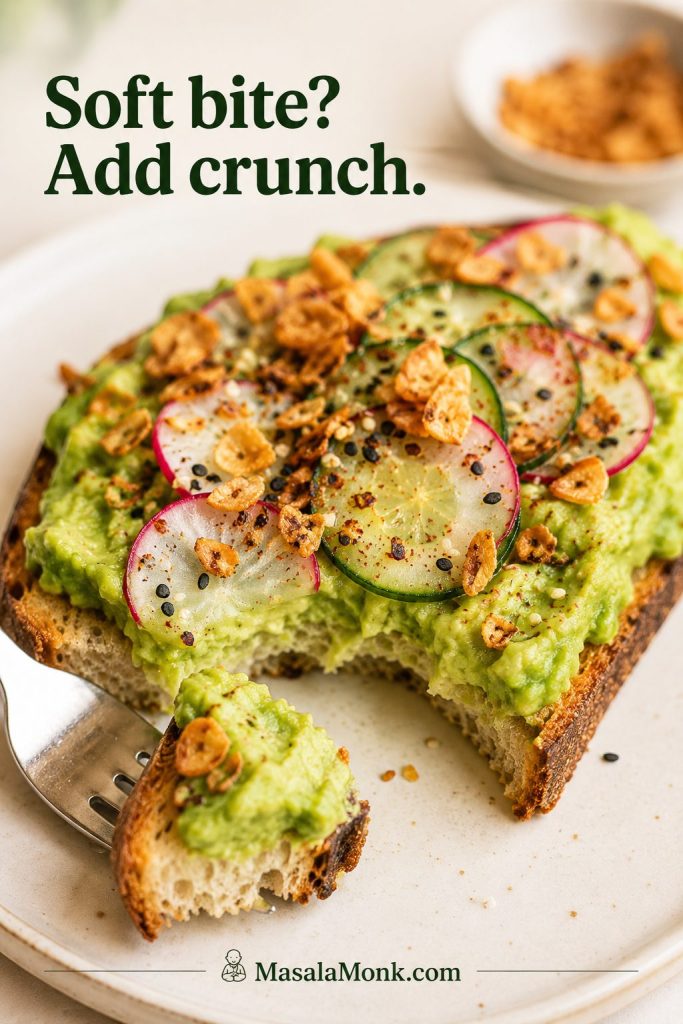
And if you want even more structure for turning chia into a consistent weight-loss habit, revisit the companion guide here: chia pudding for weight loss tips, benefits, and recipes.


FAQs

1) What’s the best low carb chia pudding ratio?

A reliable starting point is 3 tablespoons chia seeds to 1 cup liquid for a thick, spoonable chia seed pudding. If you prefer a lighter texture, use 2½ tablespoons per cup. Conversely, if you want a denser keto pudding feel, keep 3 tablespoons and choose a richer liquid like coconut milk.

2) How long does chia pudding need in the fridge?

Most jars set well in 2–3 hours, although overnight chia pudding usually turns out smoother and more consistent. If you’re meal-prepping chia seed pudding cups, overnight is often the easiest path because the texture stabilizes by morning.

3) Why is my chia seed pudding watery or runny?

Typically, runny chia pudding comes from one of three things: too much liquid, not enough time, or not stirring twice early on. Add 1 teaspoon chia at a time, stir, then refrigerate 30–60 minutes. Also, do a second stir around the 10-minute mark to prevent clumps and uneven hydration.

4) Why did my chia pudding turn too thick?

This happens when chia absorbs more than expected—especially with thick liquids like canned coconut milk. To fix it, stir in a splash of water, almond milk, or coconut milk until it loosens into a creamy chia pudding consistency.

5) Can I make instant chia pudding or quick chia pudding?

You can make a quick chia pudding by whisking thoroughly, stirring again after 10 minutes, and chilling 30–45 minutes. Even so, the best chia pudding texture usually comes from a longer chill. If time is tight, adding Greek yogurt can help it feel thicker sooner.

6) Is chia pudding keto-friendly?

Chia seeds can fit many keto approaches because they’re portionable and pair well with higher-fat liquids. For keto chia pudding, use unsweetened almond milk or coconut milk, keep sweeteners minimal, and choose toppings like nuts, cacao nibs, or unsweetened coconut.

7) What are the best chia seeds for keto or low carb chia pudding?

Both black and white chia seeds work similarly for chia seed pudding low carb recipes. What matters more is freshness and how you store them. If the seeds smell stale or oily, the pudding can taste “off,” even if your recipe is perfect.

8) Can I make chia pudding with almond milk?

Yes—chia pudding with almond milk is one of the most common bases because the flavor is neutral and the texture sets reliably. For extra creaminess, add a spoon of Greek yogurt, coconut cream, or nut butter once it’s set.

9) Can I make chia pudding with coconut milk?

Absolutely. Chia pudding coconut milk versions are often the creamiest and feel closest to a traditional pudding. If you’re using canned coconut milk, thin it slightly with water so the chia hydrates evenly.

10) Can I make chia pudding with oat milk?

Yes, chia pudding with oat milk is popular because it tastes mild and comforting. However, oat milk is not typically low carb, so it’s better for a general “healthy pudding” routine rather than a strict keto plan.

11) Can I make chia pudding with yogurt instead of milk?

You can, and it’s a great way to create a high protein chia pudding. For chia pudding with yogurt no milk, whisk yogurt with a little water to loosen it, then stir in chia. The result is thick, tangy, and very filling.

12) What’s the difference between chia pudding with Greek yogurt vs regular yogurt?

Greek yogurt is thicker and higher in protein, so chia pudding Greek yogurt versions tend to set firmer and feel more like a meal. Regular yogurt can work too, although you may need a bit more chia or a longer chill to reach the same texture.

13) Can I add protein powder to chia pudding?

Yes—chia pudding with protein powder is an easy way to boost protein. For the smoothest result, dissolve the protein powder into the milk first, then add chia. If you add powder directly to a set pudding, it can clump.

14) How do I make chocolate chia protein pudding taste better?

Use cocoa or cacao plus a pinch of salt to deepen the flavor. Then, choose a chocolate protein powder you actually enjoy. A small spoon of peanut butter or Greek yogurt can also make chocolate protein chia pudding taste richer and less “thin.”

15) Can I make blended chia pudding?

Yes. Blended chia pudding is ideal if you dislike the texture of whole chia seeds. First, let the pudding set; afterward, blend until smooth. You’ll get a creamy chia pudding that feels like mousse, especially with cocoa or nut butter.

16) Can I grind or blend chia seeds before soaking?

You can, but it changes the texture quickly and may thicken faster. Ground chia pudding tends to set more like a gel. If you prefer a smoother mouthfeel, blending after soaking often tastes better than blending dry seeds first.

17) What’s the best way to sweeten chia pudding without sugar?

Many people keep it simple with vanilla, cinnamon, cocoa, or fruit. If you want sweetener, choose an option you tolerate well and use a small amount. Often, adding a spoon of peanut butter or coconut milk richness reduces how much sweetness you need.

18) Is chia pudding paleo?

Chia pudding paleo versions usually use almond milk, coconut milk, or coconut water instead of dairy. For a richer bowl, add nut butter, coconut cream, or fruit. If you use yogurt, choose a version that matches your approach.

19) What is anti inflammatory chia pudding?

In practice, it’s chia pudding flavored with ingredients often used in “anti-inflammatory” eating patterns—ginger, cinnamon, cacao, berries, and sometimes turmeric. A ginger chia pudding or gingerbread chia pudding can fit this style while still tasting like dessert.

20) Can I add collagen to chia pudding?

Yes. Chia collagen add-ins are usually easiest because collagen peptides dissolve smoothly. Since collagen doesn’t thicken much, you’ll still rely on chia (and optionally yogurt) for the pudding texture.

21) What toppings work best for chia pudding for weight loss?

For a more weight-loss friendly bowl, focus on toppings that add texture without a big sugar hit: nuts, seeds, unsweetened coconut, cacao nibs, and a measured amount of berries. If you want fruit-forward flavors like mango chia pudding, keep the portion modest and balance it with protein.

22) How do I make strawberry chia seed pudding or berry chia pudding?

Make a plain base first, then fold in mashed strawberries or mixed berries after it sets. Alternatively, layer berries at the bottom of the cup for a “chia pudding with strawberries” effect. If you add watery fruit too early, the pudding can loosen.

23) How do I make mango chia pudding without making it too sweet?

Use mango as a flavor accent: a few tablespoons of puree can be enough. Add lime and a pinch of salt to amplify the tropical flavor, then keep the base unsweetened so the mango stands out naturally.

24) How do I make apple cinnamon chia pudding taste like dessert?

Use cinnamon, vanilla, and a pinch of salt as the backbone. If you’re not strict keto, a small amount of grated apple adds aroma and sweetness. Otherwise, chopped pecans plus cinnamon can mimic an apple-pie vibe without the fruit.

25) How long does chia seed pudding last, and can I meal prep it?

Chia pudding is popular for meal prep because it holds well in the fridge. Many people prep single serve chia pudding cups for several days at a time. For the best texture, keep toppings separate and stir before eating.

26) Why does my chia pudding taste bland?

Usually it needs salt, vanilla, or a stronger flavor base. Cocoa, matcha, cinnamon, and nut butter all make a big difference. Also, richer liquids—like coconut milk—often improve flavor even when sweetness is minimal.

27) What’s the easiest 3 ingredient chia pudding?

A classic 3 ingredient chia pudding is chia seeds + almond milk + vanilla (or chia + coconut milk + cocoa). If you want it sweeter, add a fourth ingredient: your preferred sweetener or a small amount of fruit.

28) Can I make chia seed pudding with regular milk or whole milk?

Yes. Chia seed pudding with milk (including whole milk) sets well and tastes creamy. If your goal is low carb chia pudding, watch the carbs from dairy milk and adjust based on your overall plan.

29) What’s better: chia pudding in a jar, glass, or cups?

Any container works. Chia pudding cups are great for grab-and-go; a chia pudding glass looks nice for serving; a jar is convenient for shaking and stirring. What matters most is leaving enough room to stir well before it sets.

30) Are premade chia pudding cups worth it?

They can be convenient, especially when you need a ready-to-eat snack. Still, homemade lets you control sweetness, protein, and texture. If you like the convenience of premade chia pudding, you can mimic it by prepping chia seed pudding cups in advance with two or three flavors.

Posted on 6 Comments

Upma Recipe: 10+ Easy Variations (Rava, Millet, Oats, Semiya & More)

Top-down flatlay of five Indian upma varieties—rava, millet, oats and semiya—arranged with chutney, lemon wedges and herbs, hand holding a spoon, cover image for ultimate upma recipes guide on MasalaMonk.

Upma is one of those breakfasts that feels like home, no matter which part of India you’re from. It’s warm, soft, gently spiced, and endlessly adaptable. With a few pantry staples and one basic upma recipe in your head, you can improvise everything from a simple rava upma for rushed mornings to a millet upma for days when you want something a little more wholesome, or even an oats or quinoa upma when you’re leaning towards high-fibre bowls.

For people looking for “upma recipe”, “how to make upma”, “simple upma recipe”, “millet upma recipe”, “semiya upma”, “instant upma premix” or even “upit recipe”, this long, no-rush guide is meant to sit in your kitchen as a one-stop reference. You’ll get:

  • A detailed, step-by-step rava upma recipe with all the tiny tricks that matter
  • Vegetable and masala variations that turn it into a one-bowl meal
  • Millet upma with different grain options and real health context
  • Semiya (vermicelli) upma, for tiffin boxes and kids who love noodles
  • Oats upma and quinoa upma, with links to what science actually says about them
  • Wheat and rice rava upma for days when you don’t feel like semolina
  • A homemade instant upma mix for travel or office lunches
  • Plenty of ideas for what to serve with upma to build a complete breakfast plate

Along the way, you’ll also find links out to trusted recipe writers and nutrition resources, so you’re not just taking one blog’s word for it. For instance, if you like cross-checking your basics, you can always compare with this lovely, traditional South Indian rava upma method on Indian Healthy Recipes, which you’ll find under the title traditional South Indian rava upma recipe.


What Is Upma, Really?

At its heart, upma is a savoury porridge or pilaf made by roasting a grain (most commonly semolina / suji) and then simmering it in a seasoned, tempered liquid. The tempering usually includes mustard seeds, lentils like urad dal and chana dal, curry leaves, green chillies, onion and sometimes ginger. Once the grain absorbs the water and steams, it turns soft and fluffy, ready to be fluffed, finished with lemon and coriander, and eaten hot.

Cast iron skillet filled with soft rava upma topped with peas and curry leaves, surrounded by bowls of semolina, lentils and spices, with a hand sprinkling curry leaves, illustrating the upma cooking method.
One pan, so many breakfasts – a skillet of gently simmering rava upma with all the classic tempering elements that define the upma method.

Traditionally, rava upma is especially popular in South India, often served with coconut chutney and filter coffee. If you’re curious about that version, you can see another take on it at Veg Recipes of India under their traditional upma with coconut chutney, which matches closely with what many homes actually make.

However, the family of upma is much bigger than just semolina. As grains like ragi, foxtail millet, jowar, oats and quinoa become more common in pantries, the same technique is being reused with different bases. That means an “upma recipe” today can be:

  • A classic suji upma with just onions and chillies
  • A colourful vegetable upma
  • A masala upma with sambar powder or garam masala
  • A millet upma packed with fibre and minerals
  • A semiya upma that looks like a noodle stir-fry
  • An oats upma that quietly helps your cholesterol numbers
  • A quinoa upma that feels modern but very Indian in flavour
Flatlay of small bowls showing raw rava, millet, semiya and oats at the top, with cooked rava, vegetable millet and semiya upma in bowls below and a wooden spoon in the centre, illustrating that many grains can be used to make upma.
Rava, millet, semiya and oats in their raw and cooked forms, side by side – a reminder that upma is a method you can apply to many grains, not just semolina.

Instead of treating each of these as a totally separate dish, it helps to understand the common logic once, then play.

Also Read: Double Chocolate Chip Cookies – Easy Recipe with 7 Variations


The Classic Rava Upma Recipe (Suji Upma)

Let’s begin with the version you’re most likely to cook again and again: a simple rava upma. Once you get comfortable with this, switching to millet rava or wheat rava upma becomes almost automatic.

Close-up of a neatly domed serving of soft rava upma with peas, carrots and curry leaves on a ceramic plate, hand reaching for the spoon, with text describing it as an everyday suji breakfast bowl.
Soft, fluffy rava upma piled into an everyday suji breakfast bowl, scented with curry leaves, mustard seeds, onions and a squeeze of lemon.

Ingredients for 2 Servings

  • Semolina / suji / upma rava – ½ cup (medium or slightly coarse)
  • Water – 1½ cups (you can move between 1¼ and 1¾ depending on how soft you like it)
  • Oil or ghee – 2 tablespoons
  • Mustard seeds – ½ teaspoon
  • Urad dal – 1 teaspoon
  • Chana dal – 1 teaspoon
  • Cashew halves – 6–8 (optional but lovely)
  • Onion – 1 small, finely chopped
  • Green chillies – 1–2, slit or chopped
  • Ginger – ½ inch piece, finely chopped
  • Fresh curry leaves – 8–10
  • Salt – to taste
  • Lemon juice – 1–2 teaspoons
  • Fresh coriander – a small handful, chopped

Home cooks and bloggers disagree very gently about the perfect ratio of rava to water. Some prefer it soft and spoonable, others a little drier and crumbly. If you want to dig deeper into this, Raks Kitchen has a useful breakdown of textures and ratios in her rava upma water ratio tips. For now, though, 1:3 is a safe, beginner-friendly place to start.

Step 1: Roast the Rava

Begin by dry-roasting the semolina in a wide pan. Keep the flame low-medium and stir continuously so it doesn’t catch at the bottom.

Step 1 of making rava upma showing a hand stirring semolina in a black skillet with a wooden spatula, with text explaining to dry toast suji on low heat till aromatic to keep upma non-sticky.
Step 1 – gently roasting the rava on low heat so every grain of suji stays separate and the final upma turns out soft, fluffy and never sticky.

You’re looking for:

  • A slightly deeper colour, but not brown
  • A warm, nutty aroma
  • Grains that feel separate when you stir them

This step might feel skippable if you’ve bought “roasted upma rava”, but it’s worth doing anyway. Roasting removes raw flavours and, more importantly, helps the rava swell up evenly without turning sticky.

Once roasted, transfer the rava to a plate and let it cool slightly while you prepare the tempering.

Step 2: Build the Tempering

In the same pan, add the oil or ghee. When it heats up, drop in mustard seeds. As soon as they splutter, stir in urad dal and chana dal.

Step 2 of making upma showing mustard seeds, urad dal, chana dal and cashews sizzling in oil in a black skillet while a hand adds fresh curry leaves with a spoon, illustrating the tempering stage for classic rava upma.
Step 2 – tempering mustard seeds, lentils, cashews and curry leaves in hot oil to create the nutty, fragrant base that makes every rava upma taste authentic.
  • Fry the dals on medium heat until they turn golden and crisp.
  • Add cashews at this stage if you’re using them and fry till lightly golden.

The sizzling mix of mustard, dals and nuts is not just for taste; it contributes crunch in every bite. After this, tip in the curry leaves, chopped ginger and green chillies. They’ll sputter a bit, so stand back for a moment.

Finally, add the chopped onion. Sauté until it turns soft and translucent. You don’t really need to brown the onion for a basic upma recipe; you just want the raw bite to vanish.

Step 3: Bring the Spiced Water to a Boil

Now pour in the measured water and add salt. Taste the water – it should be slightly saltier than you’d like the final upma to be, because the rava will absorb some of that salt.

Step 3 of the rava upma recipe showing a cast-iron skillet of spiced water at a rolling boil with curry leaves and lentils, while a hand sprinkles salt from a wooden spoon, with text explaining to boil the water so the rava cooks quickly and evenly.
Step 3 – add water and salt to the tempering, then bring it to a proper rolling boil so the suji swells quickly and the upma cooks evenly without turning lumpy.

Bring this to a rolling boil. This matters more than it seems:

  • Boiling water helps rava swell quickly and evenly.
  • It dramatically reduces your chances of ending up with lumpy upma.

Meanwhile, if you feel like cross-checking a slightly different style of tempering or vegetable add-ins, you could glance through the traditional South Indian rava upma recipe at Indian Healthy Recipes; you’ll notice the same broad steps.

Step 4: Add the Rava Without Lumps

Once the water is bubbling, lower the flame. Hold the roasted rava in one hand and a spatula in the other.

Step 4 of the rava upma method showing a hand pouring roasted semolina in a thin stream into a skillet of bubbling spiced water while another hand stirs with a wooden spatula, with text explaining to sprinkle suji slowly and stir constantly to avoid lumps.
Step 4 – “raining in” the roasted rava, sprinkling suji slowly into boiling spiced water while stirring so every grain cooks evenly without clumping.
  • Slowly sprinkle the rava into the boiling water in a steady stream.
  • Keep stirring continuously.

The idea is to give each little sprinkle of rava a chance to meet the hot liquid and swell individually. If you dump it all in at once, it will clump and form dumplings.

Within a minute or two, the mixture will start thickening and pulling away from the sides.

Step 5: Steam, Fluff and Finish

At this point, cover the pan and let the upma steam on the lowest flame for about 3–4 minutes. Switch off the heat and allow it to sit, still covered, for another 2 minutes.

Step 5 of the rava upma recipe showing a hand lifting the lid off a steaming skillet of fluffy upma while another hand fluffs it with a spoon, with lemon wedge and coriander nearby and text explaining to steam, fluff and finish with lemon and coriander.
Step 5 – let the upma steam on low, then fluff it and finish with lemon juice and fresh coriander for a soft, airy bowl.

When you open the lid:

  • The rava should be cooked through, soft and fluffy.
  • The surface might look a little dome-like; that’s fine.

Fluff gently with a fork or spatula to loosen up the grains. Finally, add lemon juice and chopped coriander, and fold everything together. Taste and adjust salt or lemon once more.

Serve hot with coconut chutney, podi, pickle or simply a drizzle of ghee on top. For another angle on serving ideas (especially with coconut chutney), you can refer to the version at Veg Recipes of India under their traditional upma with coconut chutney.

Also Read: Carbonara Recipe: Italian Pasta (Creamy, Veggie, Chicken, Shrimp, Tuna & Keto)


Vegetable Upma, Masala Upma Recipe and Other Rava Upma Variations

Once the basic method feels natural, you’ll inevitably start tweaking it. Some mornings you’ll want more vegetables, some days more heat, and sometimes you’ll be in the mood for a slightly indulgent, ghee-laced bowl of “mom upma”.

Vegetable Upma

For a simple vegetable upma, follow the classic recipe with one change: after sautéing the onion, add about ½ to 1 cup of finely chopped vegetables such as:

  • Carrots
  • Green beans
  • Green peas
  • Sweet corn
  • Capsicum
Recipe card style image for vegetable upma showing small bowls of chopped carrots, beans, peas, corn and capsicum on a board with a skillet of onions in the background, plus text explaining to add ½–1 cup mixed veggies after the onions and sauté before continuing the rava upma recipe.
Veggie upgrade – turn plain rava upma into colourful vegetable upma by adding a generous ½–1 cup of finely chopped carrots, beans, peas, corn and capsicum after the onions and sautéing till they brighten.

Sauté the vegetables for a couple of minutes until the colours brighten and they lose their rawness. After that, proceed with water, salt and rava as usual.

This variation cleverly answers many searches like “simple upma recipe”, “veggie upma” or “upma recipe for kids”, without changing the core technique.

Masala Upma

For mornings when you want something closer to a one-bowl lunch, a masala upma works beautifully.

Hand sprinkling turmeric into a pan of vegetable upma with peas, carrots and beans, with small bowls of turmeric and red spice in front and text explaining how to turn veggie upma into masala upma with turmeric and sambar or garam masala.
Masala twist – once the veggies are in, add turmeric for colour and a spoon of sambar or mild garam masala to turn everyday vegetable upma into a fuller, lunch-style masala upma.

In addition to the vegetables:

  • Add ¼ teaspoon turmeric powder for a bright colour.
  • Sprinkle in ½ teaspoon sambar powder or a mild garam masala.

Those additions transform the flavour just enough to make it feel more lunch-worthy, especially if you serve it with a dollop of yoghurt and a salad on the side.

Red Rava Upma Recipe

Sometimes you’ll come across red rava (made from whole wheat or red rice) labelled as “upma rava” too. You can treat it in almost the same way as suji, with slight adjustments:

Recipe card for whole-grain red rava upma showing bowls of regular suji and coarse red rava in the foreground with a skillet of rustic red rava upma behind them, plus text explaining to roast red rava longer and use about 1:3 to 1:3.25 rava to water for a nutty, softer texture.
Whole-grain red rava upma – roast the red rava a little longer, add more water and give it extra time on the stove for a deeper, nuttier bowl that feels closer to a whole grain breakfast.
  • Roast it a little longer; whole-grain rava benefits from deeper roasting.
  • Increase the water slightly to around 1:3 or even 1:3.25 if it’s very coarse.
  • Be patient with cooking time; whole grains take longer to soften.

The result is a nuttier, more rustic upma that fits nicely on days when you want something closer to a whole grain breakfast.

Recipe of “Mom-Style” Ghee Rava Upma

If you grew up on upma made by a mother or grandmother who didn’t shy away from ghee, you might crave that taste from time to time.

Mom-style ghee rava upma in a cast-iron pan topped with deep golden cashews and curry leaves while a hand pours ghee from a spoon, with text explaining to use ghee for tempering and finish each serving with an extra spoon of ghee.
Ghee-lover’s home version – swap oil for ghee, fry the cashews till deep golden and finish each serving with an extra spoon of ghee for that nostalgic, mom-style rava upma flavour.

To get that flavour:

  • Use ghee instead of oil for the tempering.
  • Fry the cashews till deep golden.
  • Finish with a small spoonful of ghee drizzled over each serving.

The extra richness hides in the background, but it makes every spoonful taste like a hug.

Also Read: One-Pot Chicken Bacon Ranch Pasta (Easy & Creamy Recipe)


Millet Upma: Jowar, Foxtail, Ragi and Multi-Millet Rava Recipe

Over the last few years, millet upma has become a favourite for people who want a more nutrient-dense breakfast without sacrificing Indian flavours. Millets are naturally rich in fibre, minerals like iron, calcium and zinc, and often have a gentler effect on blood sugar compared to refined grains.

If you’d like to see the bigger picture before you start cooking, two good reads are MasalaMonk’s own overview Millets: The Gluten-Free Superfood and their guide exploring the various types of millets in India. For a more formal look, you can also glance at the ICMR–NIN document on nutritional and health benefits of millets, or FSSAI’s classification of millets as “nutri-cereals” in their millets guidance notes.

Portrait photo of a fibre-rich millet upma bowl with peas, carrots and curry leaves on a wooden table, surrounded by jars labelled multi millet, foxtail and millet rava, with text describing millet upma as a breakfast that gives more fibre, iron and a gentler blood-sugar rise than plain suji.
Millet upma for mornings that last – a fibre-rich bowl made with multi-millet rava, jowar and foxtail-style grains, offering more iron and a gentler blood-sugar rise than plain suji upma.

Which Millet Rava Works Well for Upma?

You can make a millet upma recipe using:

  • Multi-millet rava blends
  • Jowar rava, often called jonna rava in some regions
  • Foxtail millet rava
  • Ragi-based mixed millet rava (often combined with other millets for better texture)

For a clearer sense of what’s available in Indian markets, this breakdown of common types of millet available in India is handy.

Basic Millet Upma Recipe

For 2 servings:

  • Millet rava – ½ cup
  • Water – 1¾ to 2 cups (millets generally need more water than suji)
  • Oil – 2 tablespoons
  • Mustard seeds – ½ teaspoon
  • Urad dal – 1 teaspoon
  • Chana dal – 1 teaspoon
  • Cashews – a small handful (optional)
  • Onion – 1 small, chopped
  • Ginger – ½ inch, chopped
  • Green chillies – 1–2
  • Curry leaves – a few sprigs
  • Mixed vegetables – ½ to 1 cup
  • Salt, lemon juice, coriander – to taste

The method mirrors rava upma, with a few tweaks:

Recipe card image showing small bowls of millet rava labelled multi-millet, jowar, foxtail mix and ragi above a skillet of cooked millet upma, with text explaining that all these millet ravas work for upma and need to be toasted and cooked with about 1¾–2 cups water for ½ cup rava.
Choose your millet rava – multi-millet, jowar, foxtail and ragi mixes all work beautifully for millet upma when you toast the rava first and use a little extra water for soft, fluffy grains.
  1. Dry roast the millet rava in a pan till it smells toasty and feels lighter.
  2. In another pan (or the same pan after transferring the roasted millet), make the tempering: oil, mustard, dals, cashews, curry leaves, ginger, chillies, onion.
  3. Add vegetables and sauté till they brighten.
  4. Pour in water and salt; bring to a good boil.
  5. Lower the flame and slowly stir in the roasted millet rava, stirring as you go.
  6. Cover and cook on a low flame till the grains soften. Rest for a few minutes and fluff.

Because millets can feel new if you haven’t cooked them much before, you might also enjoy trying other breakfast-style millet recipes, such as fermented ragi (finger millet) idlis or barnyard millet and foxnuts savoury pancakes, which give you more ideas on how to rotate millets through your mornings.

Also Read: Katsu Curry Rice (Japanese Recipe, with Chicken Cutlet)


Wheat and Rice Rava Upma Recipe (Godhuma, Bansi, Samba, Arisi Upma)

Beyond millets, many households regularly switch between suji, wheat rava and rice rava. People looking for “wheat rava upma”, “samba rava upma”, “bansi rava upma”, “rice rava upma” and “arisi upma mix” are all essentially trying to do this rotation with confidence.

Digital food photo showing two bowls of upma on a wooden board, one labelled wheat rava upma and the other rice rava or arisi upma, with small piles of wheat rava and rice rava, curry leaves, green chutney and lemon, plus text explaining that wheat rava needs more water and time while rice rava feels closer to soft rice.
Beyond suji – side-by-side bowls of wheat rava upma and rice rava (arisi) upma, showing how you can swap in godhuma or arisi rava for a heartier, rice-like take on classic upma.

Wheat Rava Upma Recipe

Wheat rava goes by many names: godhuma rava, bansi rava, samba rava, broken wheat and so on. This base yields a slightly chewier, almost pilaf-like upma.

To prepare it:

  • Replace suji with the same quantity of wheat rava.
  • Roast it gently before use.
  • Use around 1½ to 2 cups of water for ½ cup wheat rava, depending on how coarse it is.

The tempering and vegetable combination can be identical to rava upma. The only real difference is the cooking time, which tends to be a touch longer.

If someone at home has to avoid wheat because of an allergy or suspected intolerance, it’s worth reading a focused guide such as wheat allergy: symptoms, causes, and treatment and then leaning on rice or millet-based upma instead of wheat rava versions.

Instructional graphic showing a bowl of wheat rava upma with a pile of wheat rava, and a bowl of rice rava or arisi upma with a pile of rice rava, plus text explaining to roast wheat rava well and use about 1:3 water, and to roast rice rava gently and use about 1:3–1:3.5 water for a soft rice-like texture.
Quick tweaks for wheat and rice rava upma – roast wheat rava well and simmer with about 1:3 water for chewier grains, while rice rava or arisi upma prefers gentler roasting and a little extra water for a soft, rice-like finish.

Recipe for Rice Rava Upma / Arisi Upma

Rice rava (or arisi rava) is simply broken rice. It tends to taste closer to soft rice cooked in a tempering, but still follows the “roast, simmer, steam” logic.

You can:

  • Use ½ cup rice rava to start with.
  • Roast it lightly, just until it loses any raw aroma.
  • Temper oil with mustard seeds, dals, curry leaves, ginger, chillies and onions.
  • Add water and salt (start with about 1½ to 1¾ cups, adjusting as needed).
  • Stir in rice rava, then simmer covered till the grains are soft but not mushy.

If you’re already cooking plain rice alongside, you might find MasalaMonk’s guide on how to cook perfect rice every time helpful; it walks through stovetop, cooker and Instant Pot methods and helps time everything together in a busy kitchen.

Also Read: 10 Best Espresso Martini Recipe Variations (Bar-Tested)


Semiya Upma Recipe (Vermicelli / Seviyan Upma)

Switching gears a little, semiya upma is what many people reach for when they’re dealing with fussy children, tiffin boxes or days when they’re simply bored of rava. Vermicelli upma feels lighter, looks fun on the plate, and still uses the same basic building blocks.

Ingredients for 2 Servings

  • Roasted vermicelli (semiya) – 1 cup
  • Water – 2 to 2¼ cups
  • Oil – 1½ to 2 tablespoons
  • Mustard seeds – ½ teaspoon
  • Urad dal – 1 teaspoon
  • Chana dal – 1 teaspoon
  • Cashew nuts – a small handful (optional)
  • Onion – 1 small, chopped
  • Ginger – ½ inch, minced
  • Green chillies – 1–2, chopped
  • Curry leaves – a sprig or two
  • Mixed vegetables – ½ to 1 cup (peas, carrots, beans, corn)
  • Salt, lemon juice, coriander – to taste
Recipe card for semiya upma showing a bowl of colourful vermicelli upma with peas, carrots and curry leaves, surrounded by bowls of roasted semiya, mustard seeds, lentils and cashews, with text summarising the base ratio, tempering and cooking method for semiya upma.
Semiya upma recipe in a nutshell – roasted vermicelli simmered with tempered mustard, lentils, cashews, onions and mixed veggies for a lighter, tiffin-friendly twist on classic upma.

Method

  1. If the vermicelli isn’t pre-roasted, dry roast it till it turns a light golden-brown and gives off a nutty aroma.
  2. In a separate pan, prepare the tempering exactly as you would for rava upma: oil, mustard, dals, cashews, curry leaves, ginger, chillies, onion.
  3. Add vegetables and sauté briefly until they brighten in colour.
  4. Pour in water and salt, bring to a boil.
  5. Add the roasted vermicelli gradually while stirring so it doesn’t clump.
  6. Lower the heat and cook uncovered or partially covered until the water is absorbed and the semiya is soft but still holds its shape.
  7. Finish with lemon and coriander.

Unlike some other variations, semiya upma doesn’t always need chutney; it tastes quite complete on its own, especially if you’re generous with the vegetables and cashews.

Also Read: Greek Tzatziki Sauce Recipe (1 Master Sauce + 10 Easy Variations)


Oats Upma Recipe: A Savoury, High-Fibre Bowl

Once you’re comfortable with the idea that almost any grain can become an upma, oats are a natural next step. Many readers searching for “oats upma” are looking for a way to eat oats that doesn’t feel like a bowl of sweet porridge.

From a nutrition point of view, oats are rich in beta-glucan, a soluble fibre that helps with satiety and cholesterol regulation. Harvard’s Nutrition Source has a concise explainer under their overview of oats and beta-glucan benefits, and Mayo Clinic offers a practical perspective in their guide to starting your day with healthy oatmeal.

Ingredients for 2 Servings

  • Rolled oats – 1 cup
  • Water – about 1¾ cups (adjust if you like it looser or firmer)
  • Oil – 1½ tablespoons
  • Mustard seeds – ½ teaspoon
  • Urad dal – 1 teaspoon
  • Chana dal – 1 teaspoon
  • Cashew nuts – a few (optional)
  • Onion – 1 small
  • Ginger – ½ inch
  • Green chillies – 1–2
  • Curry leaves
  • Mixed vegetables – ½ cup or more
  • Salt, lemon juice, coriander – as usual
Recipe snapshot for savory oats upma showing a bowl of colourful oats upma with peas, carrots and cashews, surrounded by bowls of rolled oats, mustard seeds, lentils and cashews, with text summarising the ratio, tempering and simmering steps for a high-fibre Indian breakfast bowl.
Savory oats upma recipe snapshot – dry-toasted rolled oats simmered with tempered mustard, lentils, cashews, onions and veggies, then finished with lemon and coriander for a high-fibre Indian breakfast bowl.

Method

  1. Dry toast the oats in a pan for 2–3 minutes until they smell toasty and slightly nutty. This step keeps the final texture pleasant and prevents mushiness.
  2. In another pan, temper oil with mustard, dals and cashews.
  3. Add curry leaves, ginger, chillies and onion, sauté till the onion softens.
  4. Stir in vegetables and fry briefly.
  5. Add water and salt; bring to a boil.
  6. Tip in the toasted oats, lower the flame and cook, stirring occasionally, until they absorb the water and turn soft.
  7. Rest for a couple of minutes, then fluff and garnish with lemon and coriander.

If you enjoy oats in both sweet and savoury forms, you might want to keep a few ideas bookmarked. MasalaMonk’s high protein overnight oats and their guide on turning plain oats into a high-protein meal are both excellent for days when you want more variety and protein without abandoning oats as a base.

Meanwhile, if you’re curious about the “hard” science on oats and cholesterol, you’ll find clinical-trial style evidence in publications that examine oat beta-glucan and LDL reduction in detail; those are reassuring when you commit to eating oats upma regularly.

Also Read: Simple Bloody Mary Recipe – Classic, Bloody Maria, Virgin & More


Quinoa Upma: Low-GI, High-Protein Comfort Recipe

Quinoa might not be native to Indian kitchens, but it slips into Indian flavours surprisingly well. When you treat it like rava and build an upma recipe around it, you get a bowl that tastes familiar but behaves a little differently in your body.

As a grain, quinoa tends to have a lower glycaemic index than both white and brown rice and also brings more protein and minerals per cup. A recent comparison on quinoa vs rice for blood sugar and weight management lays this out in an accessible way, and if you enjoy science-y talks, you might appreciate this Royal Society of Chemistry event that explored whether quinoa can be a healthier alternative to rice.

Ingredients for 2 Servings

  • Quinoa – ½ cup, rinsed thoroughly
  • Water – 1½ cups
  • Oil – 1½ to 2 tablespoons
  • Mustard seeds – ½ teaspoon
  • Urad dal – 1 teaspoon
  • Chana dal – 1 teaspoon
  • Cashews – a handful (optional)
  • Onion – 1 small, chopped
  • Ginger – ½ inch
  • Green chillies – 1–2
  • Curry leaves
  • Mixed vegetables – ½ to 1 cup
  • Salt, lemon juice, coriander
Recipe snapshot for quinoa upma showing a bowl of quinoa upma with peas, carrots and cashews beside small bowls of quinoa and lentils, with text explaining rinsing, tempering and simmering quinoa for a low-GI, high-protein upma bowl.
Quinoa upma recipe snapshot – well-rinsed quinoa simmered with tempered mustard, lentils, cashews, onions and veggies until the grains show little “tails”, then fluffed with lemon and coriander for a low-GI, high-protein upma bowl.

Method

  1. Place the quinoa in a fine-mesh sieve and rinse thoroughly under running water. This helps wash away saponins, which can taste bitter.
  2. In a pan, prepare the tempering with oil, mustard seeds, dals and cashews, followed by ginger, chillies, curry leaves and onion.
  3. Add chopped vegetables and sauté briefly.
  4. Stir in the drained quinoa and sauté for a minute or two; this step gives the grains a lightly toasted flavour.
  5. Pour in the water, add salt, and bring to a boil.
  6. Reduce to a simmer, cover and cook until the water is absorbed and the quinoa grains show little “tails”.
  7. Rest off the heat for a few minutes, then fluff and finish with lemon and coriander.

To see how quinoa compares directly to rice in everyday meals, including dishes like pulao and bowls similar to upma, you might enjoy MasalaMonk’s own quinoa vs rice overview, which brings the conversation back into a very Indian kitchen.


Homemade Instant Upma Mix: Just Add Hot Water

There are days when you have no time to chop onions, wash curry leaves or even stand at the stove for long. That’s when searches like “instant upma mix for travel”, “instant rava upma mix”, “readymade upma packet” and “upma premix” start appearing.

Instead of only relying on store-bought packets, you can make your own instant upma mix in a small weekend batch and use it through the week, or carry it in a jar or pouches when you travel.

Instructional image showing a glass jar labelled Instant Upma Mix surrounded by bowls of roasted rava, mustard seeds, lentils, dried curry leaves and spices, with text explaining how to combine them into a homemade instant upma premix for the week.
Instant upma premix – combine roasted rava with cooled tempering, dried curry leaves, ginger powder, chilli and salt, then store it in a jar or pouches so a hot bowl of upma is only boiling water away all week.

What You Need for a Small Batch

  • Roasted rava – 1 cup
  • Oil – 1 tablespoon (you can leave this out and keep the mix completely dry if you prefer)
  • Mustard seeds – ½ teaspoon
  • Urad dal – 1 teaspoon
  • Chana dal – 1 teaspoon
  • Dried curry leaves – a tablespoon or so
  • Ginger powder – a pinch or two
  • Green chilli powder or red chilli flakes – to taste
  • Salt – ¾ to 1 teaspoon (or pack separately)

Making the Instant Upma Premix at Home

  1. Dry roast the rava if it isn’t already roasted; let it cool completely.
  2. In a small pan, heat the oil and fry mustard seeds, urad dal, chana dal and dried curry leaves until crisp and fragrant. Allow this tempering to cool fully.
  3. Mix the roasted rava with the cooled tempering, ginger powder, chilli powder and salt.
  4. Store the mix in a clean, dry, airtight jar. For travel, portion it into small zip pouches or tiny containers so you can make one serving at a time.

Because the mix already contains salt and spices, all you need at the destination is boiling water and a bowl.

Instructional image showing boiling water being poured from a kettle into an insulated mug filled with instant upma premix on a desk, with text explaining how to add premix, pour hot water, cover and wait a few minutes for an easy travel- or office-friendly upma.
Instant upma, anywhere – add premix to a mug, pour boiling water, cover and wait a few minutes for a hot, comforting bowl at your desk, in a hostel or on a train journey.

How to Cook Instant Rava Upma from the Mix

For one serving:

  • Instant upma premix – ½ cup
  • Boiling water – ¾ to 1 cup

You simply:

  1. Add the premix to a bowl or small insulated container.
  2. Pour boiling water over it, stir well and cover.
  3. Let it stand for 5–7 minutes.
  4. Fluff with a fork and eat.

This approach is especially useful for office lunches, dorm rooms and overnight train journeys. If you’re into meal prepping more broadly, you can pair a home-made upma premix with larger batch cooks using guides like MasalaMonk’s vegetarian and high protein meal prep ideas from Indian cuisine, which help you think in terms of components instead of one-off meals.


What to Serve With Upma (and How to Build a Breakfast Around It)

While upma can absolutely be the only thing on your plate, it often plays very well with other small dishes. On some mornings you might want something cooling and tangy alongside; on others, you might want a hot drink or even a sweet treat to nibble with the last few bites.

Upma breakfast platter on a wooden tray with a bowl of rava upma, coconut and tomato chutneys, podi with ghee, curd, lemon wedges and a tumbler of filter coffee, with text suggesting pairing upma with chutneys, pickle and a warm drink for a complete morning meal.
Build your upma breakfast – pair any bowl of rava, semiya or millet upma with coconut and tomato chutney, podi with ghee, curd, lemon pickle and a warm drink like filter coffee to turn it into a complete morning ritual.

Here are a few ways to round out the experience:

  • Coconut chutney, tomato chutney, gunpowder (podi) with ghee, lemon pickle or even a simple bowl of curd all sit naturally next to a bowl of suji upma, semiya upma or millet upma.
  • A warm drink balances the savoury comfort of upma nicely. In winter, for instance, you could make a mug of homemade hot chocolate with cocoa powder on the side and turn breakfast into a cosy ritual.
  • On days when you’re fasting for part of the day, sipping on homemade electrolytes for fasting before or after your eating window—within which you eat a lighter millet upma—can help you feel more balanced.

Boosting the Nutrition

If you’re trying to boost the overall nutrition of the plate, there are a few simple tweaks that add up over time:

  • Sprinkle roasted seeds, such as pumpkin or sunflower, on your upma for a bit of crunch and good fats.
  • Stir soaked chia seeds into yoghurt or chutney; for ideas on how to use chia in Indian-style meals, MasalaMonk’s guide on benefits of chia seeds & how to use them in Indian diet offers plenty of inspiration.
  • Add a small fruit component—slices of papaya, orange segments, a banana—to bring in vitamins and sweetness naturally.
Instructional image showing a plate of upma with small bowls of roasted pumpkin and sunflower seeds, yoghurt topped with chia seeds and sliced banana and orange, with text explaining how to add seeds, chia and fruit to make an upma breakfast more nutritious.
Boost your upma plate – sprinkle roasted seeds, stir chia into yoghurt and add a side of fruit so a simple bowl of upma turns into a more balanced, fibre- and nutrient-rich breakfast.

And if you like mixing Indian and Western breakfast styles on weekends, nothing stops you from serving a simple vegetable upma alongside a couple of slices of vegan French toast or baked toast sticks. MasalaMonk’s collection of vegan French toast recipes and their crispy French toast sticks can give you a head start there.


Rotating Grains Through the Week

One quiet advantage of mastering a few upma recipes is that you can then build a weekly rhythm around rotating grains. Instead of eating only suji or only oats, you can switch between several bases while keeping flavours familiar.

For example:

  • Monday – Classic rava upma with onions and chillies
  • Tuesday – Vegetable upma using wheat rava
  • Wednesday – Millet upma with jowar or foxtail millet rava
  • Thursday – Oats upma with lots of vegetables
  • Friday – Semiya upma for a lighter, comforting bowl
  • Saturday – Quinoa upma when you want something special
  • Sunday – A more indulgent ghee rava upma with cashews

The idea of variety is not just about boredom; it’s also about nutrition. The updated Indian dietary guidelines from ICMR emphasise including a range of cereals and millets over the week rather than relying only on refined grains. You can read more about that in the ICMR document on cereals and millets in the diet, which explains why shifting between rice, wheat, millets and other grains matters for long-term health.

Vertical infographic titled Rotate Your Upma Grains Through the Week showing a weekly planner from Monday to Sunday with small illustrations of different upma bowls and text suggesting classic rava upma, wheat vegetable upma, millet upma, oats upma, semiya upma, quinoa upma and ghee rava upma to encourage rotating grains instead of relying on one refined grain.
Rotate your upma grains through the week – move from rava to wheat, millets, oats, semiya and quinoa so breakfast stays interesting while your plate gradually shifts away from a single refined grain.

On top of that, broader resources that list foods rich in soluble fibre—such as this round-up of soluble-fibre-rich foods on Health.com—help you see where oats, barley, pulses and fruits fit into the larger picture of heart and gut health. As you get comfortable with those patterns, you’ll see that a thoughtfully made upma can anchor a very respectable breakfast, especially when it’s paired with pulses, vegetables and a side of fruit or nuts.

Also Read: Air Fryer Hard-Boiled Eggs (No Water, Easy Peel Recipe)


Bringing It All Together

When you step back and look at everything you can do with one simple technique, the humble upma starts to look less like a single dish and more like a framework. With one basic method—roast the grain, build a tempering, simmer, steam and fluff—you can create:
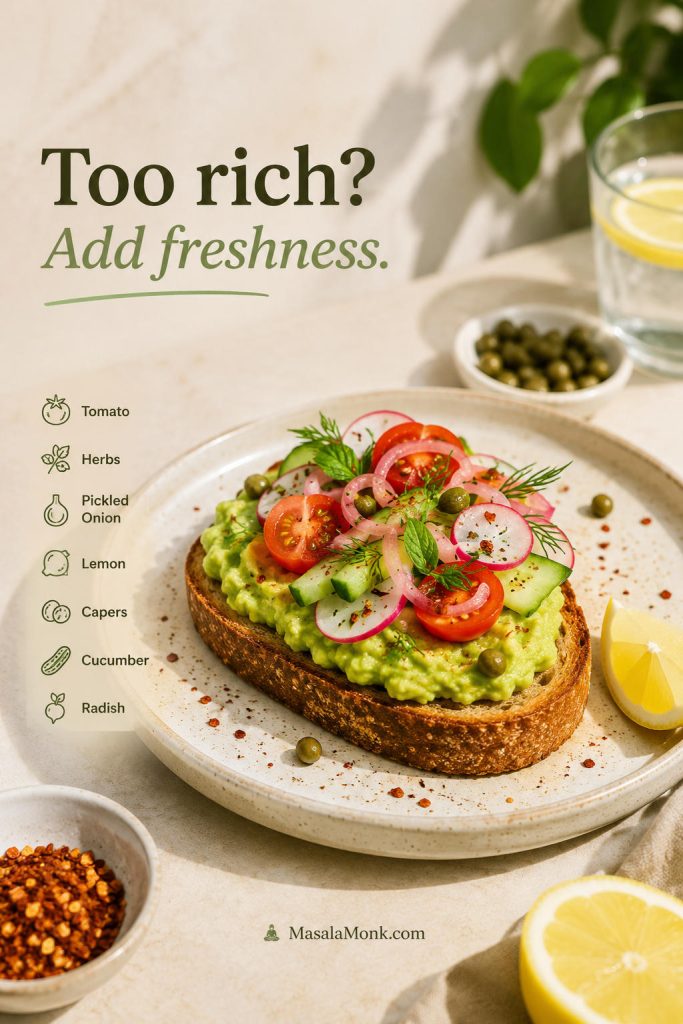
  • A straightforward suji upma for days when you want something quick and familiar
  • A vegetable or masala upma that almost counts as a complete meal
  • A millet upma that uses jowar, foxtail or ragi rava for extra minerals and fibre
  • A wheat or rice rava upma that tweaks the texture just enough to keep things interesting
  • A semiya upma that feels tiffin-friendly and child-approved
  • An oats upma that quietly supports your cholesterol and blood sugar goals
  • A quinoa upma that borrows global ingredients but stays rooted in Indian seasoning
  • A home-made instant upma mix that travels with you wherever you go
Family sitting at a wooden table enjoying bowls of rava upma, with a close-up of hands holding a bowl in the foreground and text reading “Bringing It All Together – master one upma method and spin it into a cozy, nutritious breakfast”.
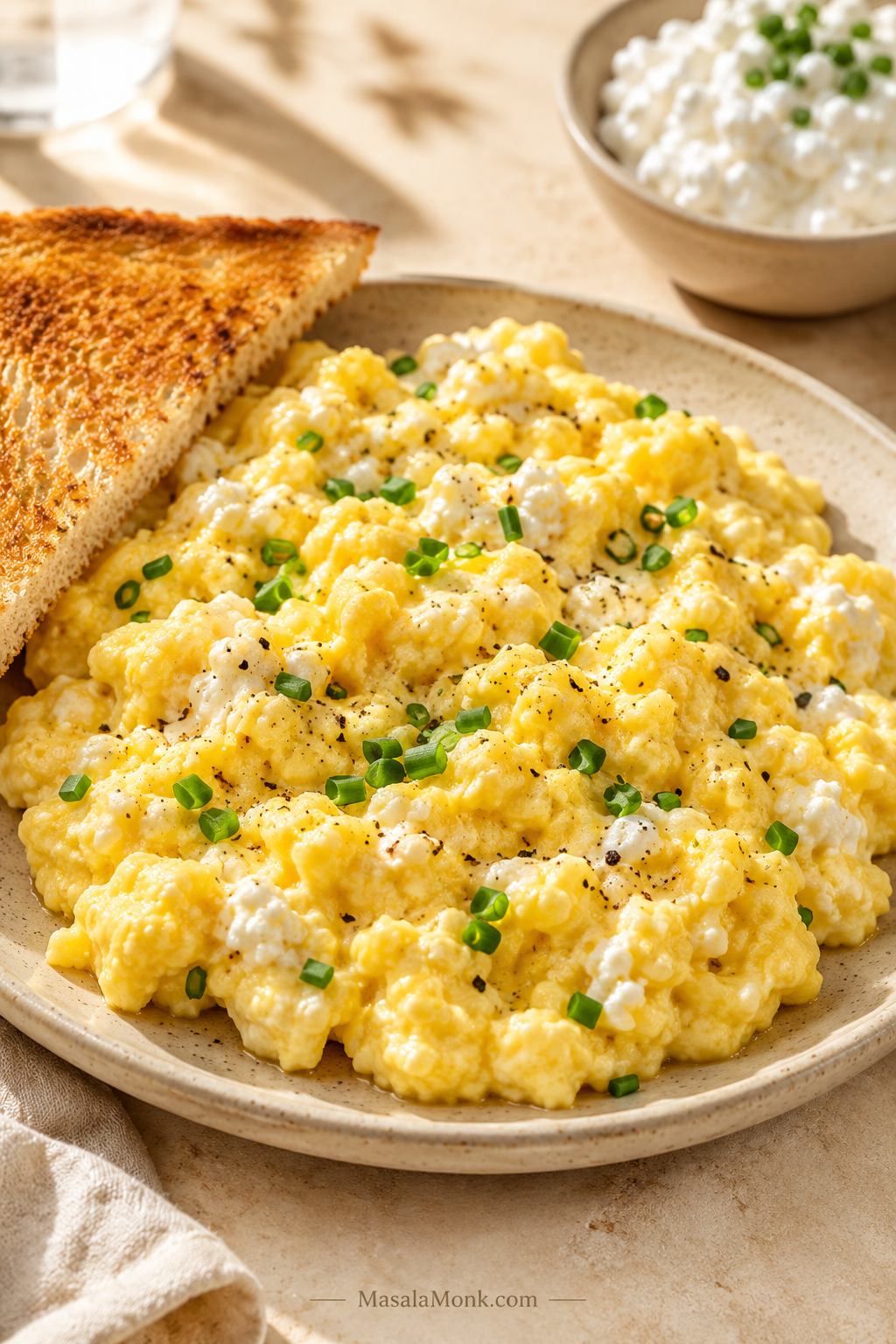
Bringing it all together – once you’ve mastered one simple upma method, you can keep serving it in different grains and styles, but what really matters is the shared bowl at the table and the comfort it brings to busy mornings.
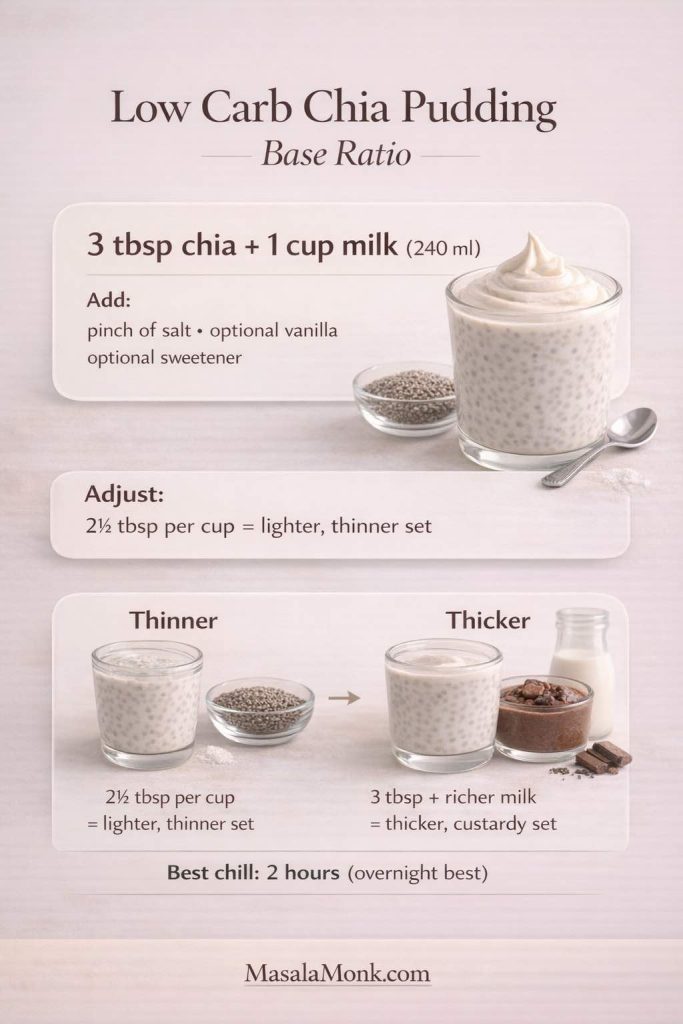
You don’t have to memorise separate instructions for each of these. Instead, you only need to internalise the proportions, roasting times and cooking times for each grain. Once you’ve done that, everything else is just small variations: more vegetables one day, more spices another, extra ghee on a Sunday, milder seasoning when someone’s unwell.

Somewhere between “how to make upma” and “which upma recipe should I choose today?”, you’ll probably find your own favourite combination of grain, vegetables, fat and accompaniments. And when that happens, upma stops being just a default breakfast and becomes one of those dishes you can cook almost on autopilot—leaving you free to enjoy the aroma of curry leaves in hot oil, the steam rising from the pan, and the simple pleasure of a warm, comforting bowl at the start of the day.

Also Read: Tres Leches – Mexican 3 Milk Cake Recipe

FAQs

1. What is upma, and how is it different from other Indian breakfasts?

Upma is a savoury, spoonable dish usually made by roasting a grain like rava (semolina, also called suji or upma rava) and then simmering it in a spiced liquid with a tempering of mustard seeds, lentils, curry leaves, chillies and onions. Unlike poha, which uses flattened rice, or idli, which relies on fermented batter, an upma recipe is quick, does not need soaking or grinding, and can be easily adapted to use different grains such as wheat rava, rice rava, millets, oats or quinoa.


2. What is the best rava for a classic rava upma recipe?

For a traditional rava upma or suji upma, medium or slightly coarse upma rava works best. Very fine suji can turn pasty, while extremely coarse rava may feel too chewy. Typically, packets labelled “upma rava” or “bombay rava” are ideal. Wheat rava (bansi or samba) and rice rava also make good upma, but they give a slightly different texture and flavour compared to the classic semolina-based upma recipe.


3. What is the ideal water ratio for soft, fluffy upma?

For most rava upma recipes, a ratio of 1:2½ to 1:3 (rava:water) works well. If you love very soft, hotel-style upma, you can lean closer to 1:3. On the other hand, if you prefer a firmer, grainier texture, you might enjoy 1:2½ more. Millet upma, wheat rava upma and rice rava upma usually need a little extra water; oats upma and quinoa upma also behave differently and often fall somewhere between 1:2 and 1:3 depending on the exact grain and cut.


4. How can I prevent lumps in my rava upma?

To keep your upma smooth and lump-free, the grain needs two things: roasting and careful mixing. First, dry roast the upma rava on a low to medium flame until it smells nutty and feels lighter. Next, bring the water and tempering to a full boil, then lower the heat. Gradually sprinkle the roasted rava into the boiling water with one hand, while you stir constantly with the other. This way, each little bit of rava meets the hot water separately and swells on its own, instead of clumping into balls.


5. Why does my upma turn sticky or mushy?

Upma often becomes sticky if the rava is not roasted enough, if the water ratio is too high for the grain, or if it is stirred aggressively after cooking. For a classic rava upma recipe, roast the semolina until it is aromatic, measure the water accurately, and once it has steamed, fluff gently rather than vigorously mixing it. For semiya upma (vermicelli upma) and oats upma, overcooking or adding too much water can also create a gluey texture, so it helps to keep the flame low and stop cooking as soon as the grain is just tender.


6. How do I make a simple upma recipe without vegetables?

A basic suji upma without vegetables is straightforward. Dry roast the rava, prepare a tempering with oil or ghee, mustard seeds, urad dal, chana dal, curry leaves, ginger, green chillies and onions, then add water and salt and bring it to a boil. Slowly stir in the roasted rava, cook covered for a few minutes, and finally finish with lemon juice and coriander. Even though there are no vegetables, this minimal upma recipe still tastes satisfying because of the fragrant tempering and the roasted flavour of the rava.


7. Can I make upma without onion or garlic?

Many people prefer a satvik upma recipe without onion or garlic, and that version is absolutely possible. In that case, rely more on curry leaves, ginger, green chillies, mustard seeds and lentils in the tempering. You can also add grated coconut or chopped coriander at the end for extra freshness. This style of upma is common on fasting days or festival mornings, and it works equally well with rava upma, millet upma and even oats upma.


8. Is upma healthy, or is it just a heavy breakfast?

Upma can be as light or as indulgent as you choose to make it. A plain rava upma recipe made with a moderate amount of oil or ghee, plenty of vegetables and served with yoghurt or chutney can fit into a balanced diet. Nevertheless, rava is a refined grain, so if you want a more nutrient-dense bowl, it helps to rotate with millet upma, wheat rava upma, oats upma or quinoa upma. By changing the base grain, increasing the amount of vegetables and moderating the fat, you can turn a simple upma recipe into a wholesome, everyday breakfast.


9. Which type of upma is better for weight management or diabetes?

Although individual needs differ, many people looking for a “healthy upma recipe” gravitate towards millet upma, oats upma or quinoa upma. These versions often have more fibre and a gentler impact on blood sugar compared to an upma recipe made only with refined semolina. In addition, adding vegetables, a small portion of nuts or seeds and pairing the bowl with yoghurt or a protein-rich side makes the meal more filling and may reduce the urge to snack soon after. Even so, portion size still matters, so lighter, moderate servings usually work best.


10. What are some easy variations beyond rava upma?

Beyond the classic rava upma, it is quite simple to explore other versions using the same basic method. For instance, semiya upma (vermicelli upma) swaps rava for roasted vermicelli threads; millet upma uses millet rava such as jowar, foxtail or multi-millet blends; oats upma relies on rolled oats; quinoa upma uses rinsed quinoa simmered with the tempering; and rice rava or arisi upma uses broken rice. The seasoning and vegetables can remain almost identical, so once you grasp one upma recipe, the others become natural extensions.


11. How do I prepare an instant upma mix for travel or busy mornings?

An instant upma mix starts with roasted rava and a very dry tempering. To assemble it, first roast the semolina thoroughly and cool it, then fry mustard seeds, urad dal, chana dal and dried curry leaves in a little oil until crisp. Once everything is completely cool, mix the rava, the tempering, dry spices such as ginger powder and chilli powder, and salt. Store the mixture in an airtight jar or in single-serving pouches. Later on, you only need to combine a portion of this instant upma mix with boiling water, allow it to stand covered for a few minutes, and fluff it before eating.


12. How long can roasted rava or instant upma premix be stored?

Roasted rava alone, if cooled thoroughly and kept in an airtight container away from moisture and insects, keeps well for several weeks and often even a couple of months. Instant upma premix that contains oil and spices generally has a shorter shelf life, though it still lasts a few weeks at room temperature in a cool, dry cupboard. If your climate is very humid, keeping smaller quantities of the premix in the fridge can be a safer choice. In any case, it is wise to check aroma and appearance before use; if the mix smells stale or looks clumpy, it is better not to use it.


13. Can I make upma in a pressure cooker or microwave?

Upma is traditionally cooked in an open pan, but it can also be adapted to a pressure cooker or microwave when needed. In a cooker, you can prepare the tempering, add rava and water, then cook on low heat without placing the whistle, treating the cooker like a heavy pan. In a microwave, you may roast rava and prepare the tempering separately, then combine everything with hot water in a microwave-safe bowl and cook in short bursts, stirring in between. Both methods work, although controlling texture and avoiding overcooking is usually easiest on the stovetop.


14. Is upma suitable for toddlers and children?

Upma can be very child-friendly, especially when you keep the spices gentle and cut the vegetables finely. For toddlers, it helps to make the rava upma slightly softer, use only a mild amount of chilli (or skip it altogether), and mash or blend the bowl lightly if needed. As children grow older, you can gradually introduce vegetable upma, semiya upma, millet upma and even a lightly spiced masala upma. Because the basic upma recipe is soft and easy to chew, it often works well as one of the early family foods that kids can share with adults.