Posted on 1 Comment

Scrambled Eggs with Cottage Cheese Recipe

Scrambled eggs with cottage cheese served on a plate with toast, chives, and black pepper.

Scrambled eggs with cottage cheese can go one of two ways: creamy, soft, and surprisingly good, or loose and a little strange. The difference is not luck. It is the ratio, the cottage cheese you use, and how gently you cook the eggs.

This recipe is built for the good version: high-protein scrambled eggs that stay tender, creamy, and satisfying without turning wet or rubbery. It walks you through the ratio, the smoother blended option, the egg-white version, microwave method, add-ins, and the fixes that keep cottage cheese eggs from turning watery.

This is especially useful if you want a higher-protein breakfast but still want food that feels warm, familiar, and satisfying. It is not trying to turn eggs into a diet trick; it is just a better, creamier scramble with more staying power.

Quick Answer: How to Make Scrambled Eggs with Cottage Cheese

To make scrambled eggs with cottage cheese, whisk 2 large eggs with 1/4 cup cottage cheese, then cook the mixture gently in a nonstick skillet over medium-low heat. Push the eggs slowly with a silicone spatula until they are thickened, creamy, and just set through.

Best Starting Ratio

The best starting ratio is 1/4 cup cottage cheese for every 2 eggs. Small-curd 2% cottage cheese gives the most reliable texture, while full-fat cottage cheese tastes richer. If the eggs look loose in the pan, use less cottage cheese next time, drain very liquid cottage cheese, avoid high heat, and cook gently long enough for extra moisture to evaporate.

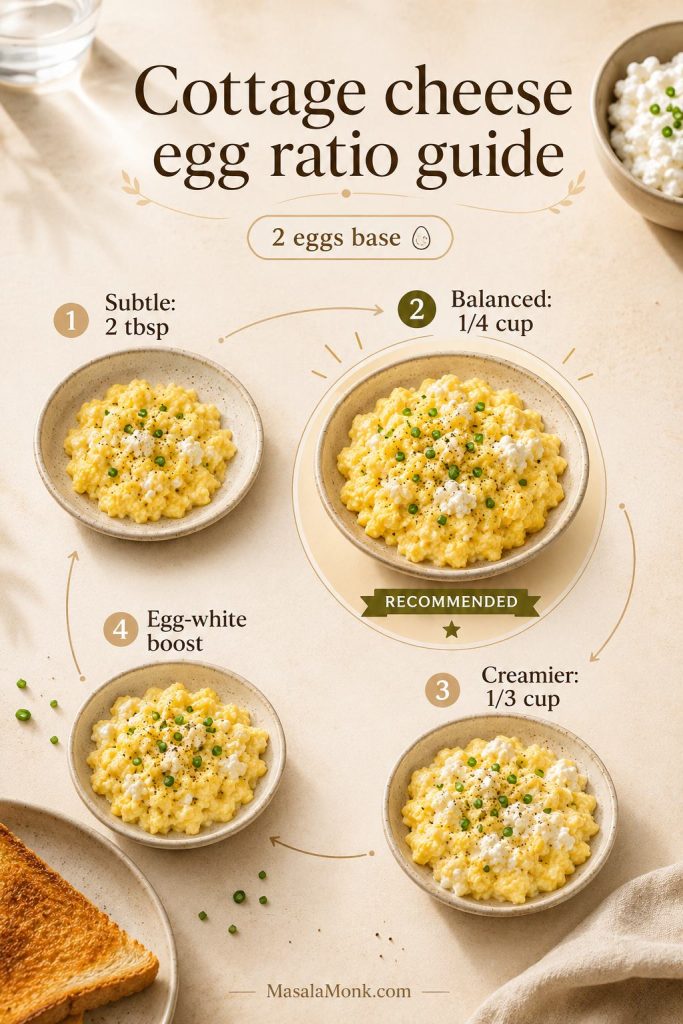
The full cottage cheese egg ratio guide below shows how to make the eggs subtler, creamier, or better suited to egg whites.

You do not need milk here. Cottage cheese already adds moisture and body, so milk can push the eggs toward watery instead of creamy.

If your last batch turned loose or watery, skip ahead to the watery cottage cheese egg fixes before you cook again.

At a glance: Use 4 large eggs, 1/2 cup / 110–120g cottage cheese, and 1 tablespoon / 14g butter for 2 servings. Cook in a nonstick skillet over medium-low heat for 4–5 minutes. Most reliable cottage cheese: small-curd 2% or full-fat. Texture goal: creamy, soft, and fully set, not runny.
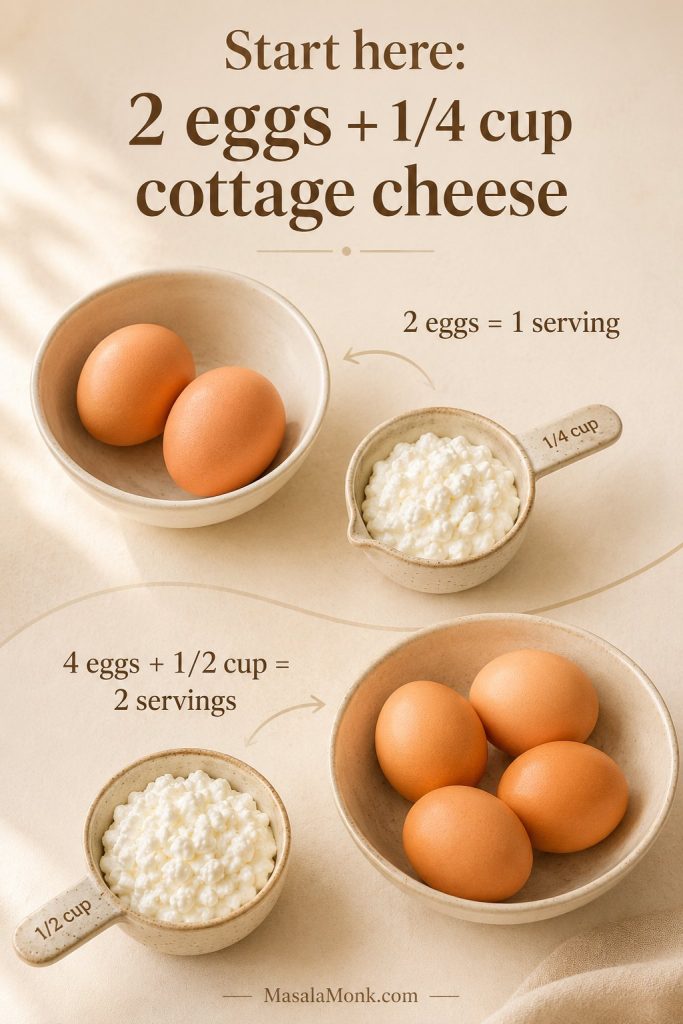
Ratio guide showing 2 eggs with 1/4 cup cottage cheese and 4 eggs with 1/2 cup cottage cheese.
For the easiest cottage cheese egg ratio, start with 1/4 cup cottage cheese for every 2 large eggs. Then adjust slightly if your cottage cheese is extra thick or watery.

What the Texture Should Look Like

The goal is not a runny protein hack or a rubbery diet scramble. The best version should taste like soft scrambled eggs with a little extra creaminess, body, and staying power.

Done right, the eggs taste creamy and lightly savory, not aggressively cheesy. The curds soften into the scramble, the pepper gives it a little lift, and a handful of chives or scallions makes the whole plate feel fresher.

A good plate feels simple but a little upgraded: soft eggs, gentle creaminess from the cottage cheese, enough protein to hold you over, and a texture that still feels like breakfast instead of a food trend.
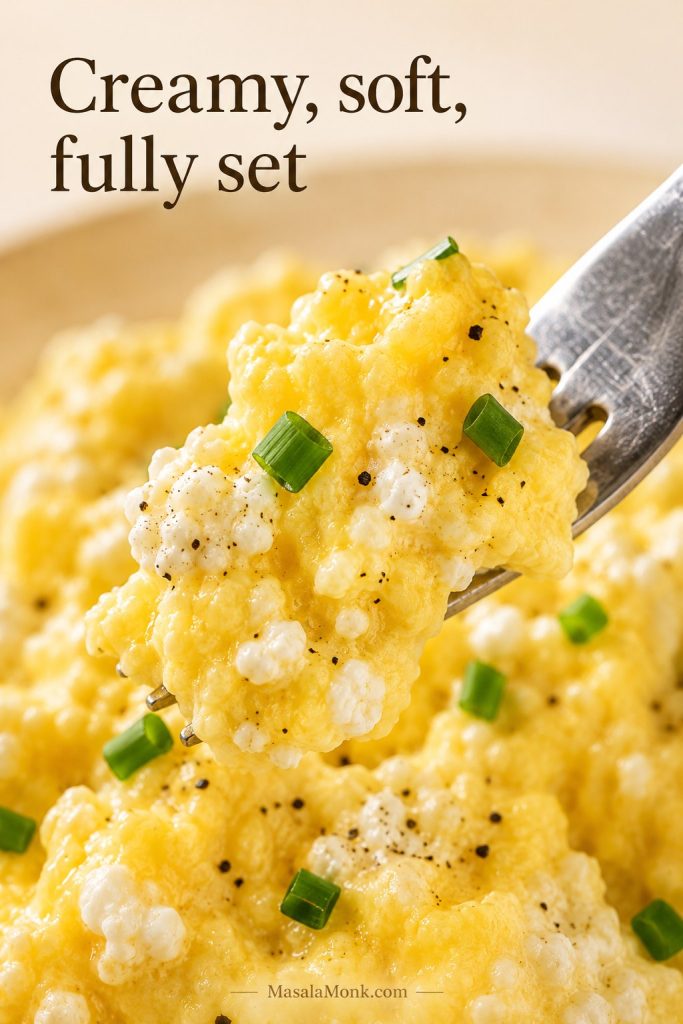
Close-up of creamy scrambled eggs with cottage cheese showing soft folds, chives, pepper, and no pooling liquid.
Look for soft folds that hold together on the fork. That texture means the eggs are creamy and set, rather than loose, wet, or overcooked.

Why Add Cottage Cheese to Scrambled Eggs?

Cottage cheese changes scrambled eggs in three useful ways: it adds protein, makes the eggs more satisfying, and gives them a creamy texture when cooked gently. It is also mild enough that the eggs still taste like eggs, especially if you use a balanced ratio and season them well.

More Protein Without Protein Powder

Eggs are already a strong breakfast ingredient, but cottage cheese makes them more filling. That is why cottage cheese eggs are popular with people looking for high-protein breakfasts, lighter brunch ideas, and quick post-workout meals.

The exact protein will depend on your eggs and cottage cheese brand. If you are tracking closely, use the nutrition label on your cottage cheese and a food database such as USDA FoodData Central.

For another breakfast built around everyday protein-rich ingredients, this protein oatmeal guide uses options like eggs, yogurt, cottage cheese, paneer, nuts, and seeds without relying only on protein powder.

Creamier Texture When Cooked Gently

Cottage cheese adds moisture and body to the eggs. With medium-low heat, the curds soften into the scramble and help the eggs stay tender. With high heat, the eggs can tighten too quickly and turn rubbery before the cottage cheese has a chance to settle into the mixture.

Mild Flavor, Easy Add-Ins

These eggs do not have to taste strongly of cottage cheese. If you use small-curd cottage cheese and whisk it in well, the flavor is mild, creamy, and lightly savory. Chives, scallions, black pepper, hot sauce, chili crisp, avocado, spinach, and toast all work well with the flavor.

Ingredients for Scrambled Eggs with Cottage Cheese

You only need a few ingredients, but each one affects the final texture. In a simple recipe like this, small choices matter: the cottage cheese style, pan heat, and amount of salt all change the result.
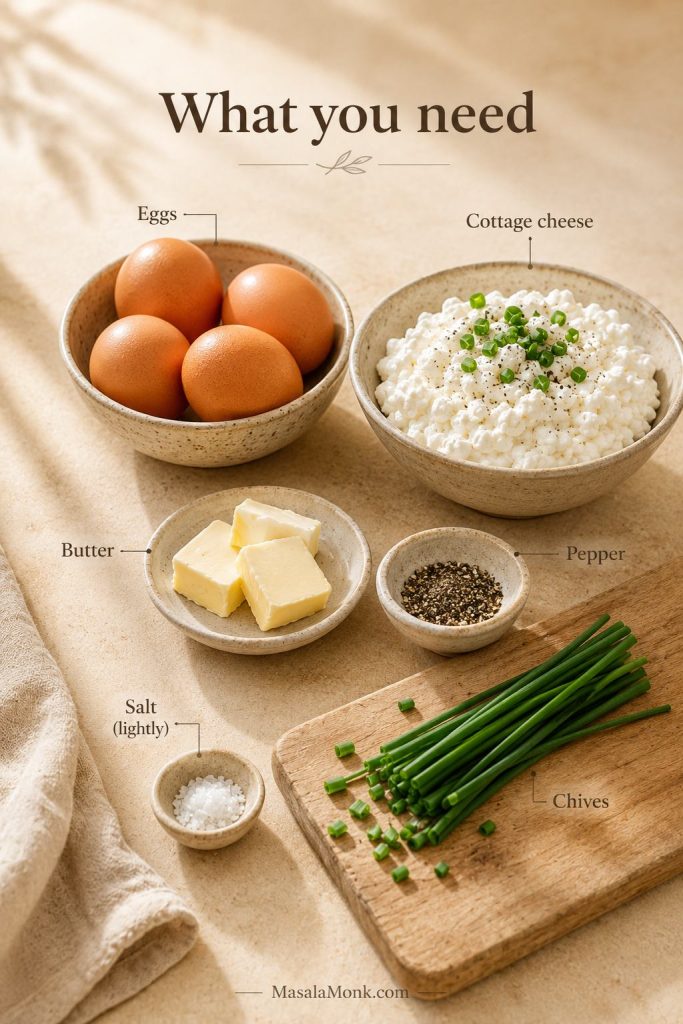
Ingredients for scrambled eggs with cottage cheese including eggs, cottage cheese, butter, pepper, salt, and chives.
Because this recipe uses only a few ingredients, each choice matters. Thick cottage cheese, light salt, black pepper, and fresh chives help the scramble taste balanced.

Eggs

Use large eggs. Four large eggs make two servings, while two large eggs plus 1/4 cup cottage cheese make a good single serving. Whole eggs give the best flavor, color, and structure. You can add egg whites for more protein, but an all-egg-white cottage cheese scramble is easier to overcook and can turn thin if the ratio is not controlled.

Cottage Cheese

Use 1/2 cup / about 4 oz / 110–120g cottage cheese for 4 eggs, or 1/4 cup / 55–60g cottage cheese for 2 eggs. Small-curd cottage cheese is the easiest choice because it blends into the eggs more naturally. Large-curd cottage cheese works, but the curds stay more visible.

For the most reliable texture, use 2% cottage cheese. Full-fat cottage cheese gives richer eggs. Fat-free cottage cheese can work, but it often contains more moisture, so it can make the eggs wetter if you use too much.

Butter, Oil, or Cooking Spray

Butter gives the richest flavor and helps the eggs cook into soft folds. Use 1 tablespoon / 1/2 oz / 14g butter for 4 eggs. Olive oil works well if you want something lighter; use 1–2 teaspoons / 5–10ml. Cooking spray is fine for a lower-calorie version, but use a truly nonstick pan and keep the heat gentle.

Salt, Pepper, and Herbs

Cottage cheese is already salty, so season carefully. Start with black pepper and only a tiny pinch of salt, then taste after cooking. Chives, scallions, dill, parsley, and cracked black pepper are especially good here.

Best Cottage Cheese for Scrambled Eggs

The most reliable cottage cheese for scrambled eggs is small-curd 2% cottage cheese. It is creamy enough to soften into the eggs but not so rich that the scramble feels heavy. It also tends to behave better in the pan than watery fat-free cottage cheese.
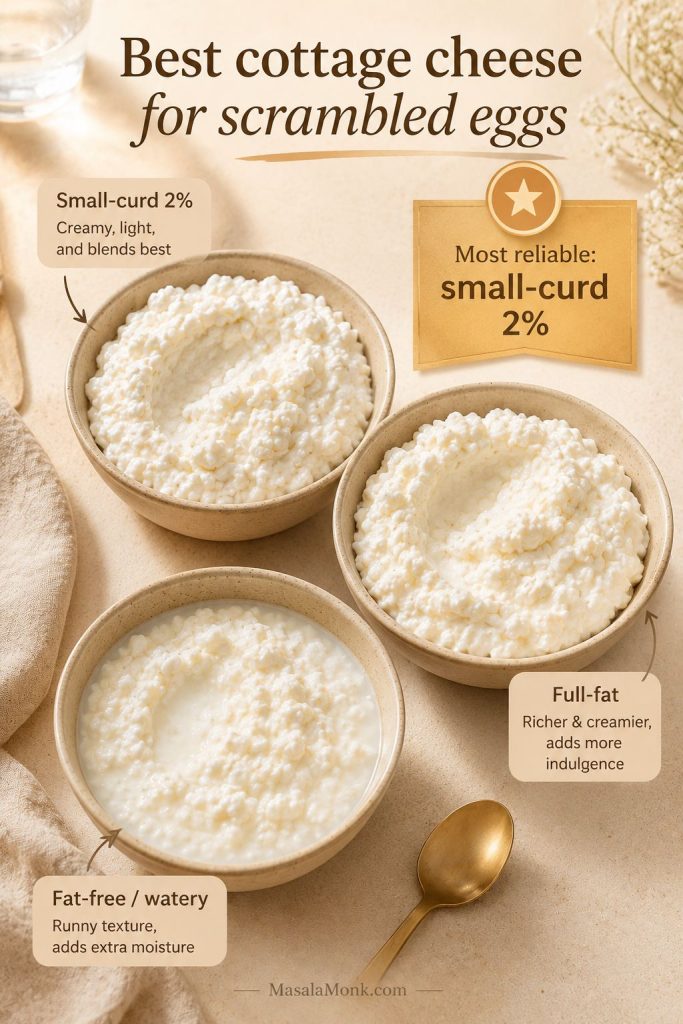
Three bowls comparing small-curd, full-fat, and watery fat-free cottage cheese for scrambled eggs.
For most batches, 2% small-curd cottage cheese is the safest starting point because it softens into the eggs more evenly, while watery cottage cheese can loosen the scramble.

Small-Curd vs Large-Curd Cottage Cheese

The smaller curd disperses more evenly and gives a softer texture. Large-curd cottage cheese is fine if you like visible curds, but it can make the eggs look more uneven.
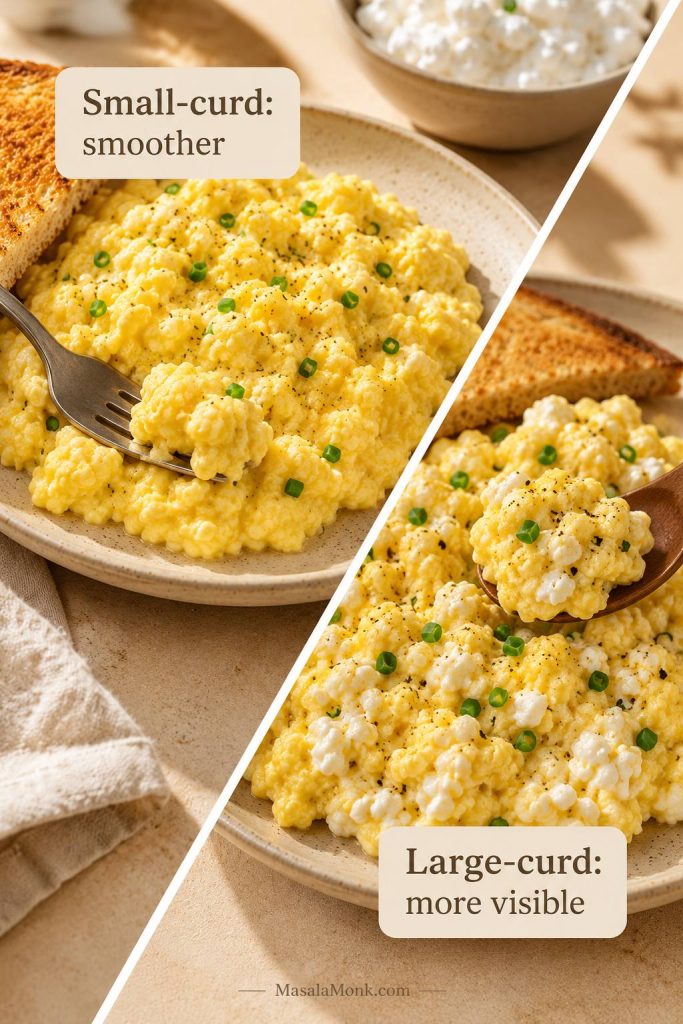
Small-curd and large-curd cottage cheese scrambled eggs compared side by side.
A smaller curd gives smoother scrambled eggs, while large-curd cottage cheese keeps more visible texture. Choose the one that matches how much curd you want to notice.

If you are cooking for someone who is skeptical of cottage cheese, use small-curd cottage cheese or blend the eggs and cottage cheese together for a smoother scramble.

For the full texture breakdown, compare the whisk, blend, and fold methods.

2%, Full-Fat, or Fat-Free?

Cottage Cheese Type Result in Scrambled Eggs Best Use
2% Creamy, balanced, reliable Best everyday choice
Full-fat Richest and softest Best for extra-creamy eggs
Low-fat Can work well, depending on brand Good if it is thick, not watery
Fat-free More likely to release moisture Use less and cook gently

If your cottage cheese looks especially liquidy, spoon off a little of the excess before adding it to the eggs. Thick, creamy cottage cheese gives you a much easier path to a soft scramble.

Should You Blend the Cottage Cheese First?

Blend the cottage cheese with the eggs if you want a smooth texture with no visible curds. Do not blend if you like the soft, slightly cheesy texture of cottage cheese eggs. For most people, whisking small-curd cottage cheese directly into the eggs is enough.

Scrambled Eggs with Cottage Cheese Ratio Guide

Start with the Balanced Ratio

The safest starting ratio is 1/4 cup cottage cheese for every 2 large eggs. Another way to think of it is about 1–2 tablespoons cottage cheese per egg, depending on how creamy or subtle you want the scramble.

If you are nervous about curds or wateriness, start with 2 tablespoons cottage cheese for 2 eggs. Then, if you love cottage cheese and want a creamier, more filling scramble, increase slightly without overloading the eggs.

Ratio Options by Texture

Style Eggs Cottage Cheese Metric Best For
Subtle / beginner 2 large eggs 2 tbsp 25–30g Less curdy, safer first try
Balanced default 2 large eggs 1/4 cup 55–60g Creamy, high-protein everyday eggs
Family batch 4 large eggs 1/2 cup / about 4 oz 110–120g Main recipe-card version
Extra creamy 2 large eggs 1/3 cup 75–80g More cottage-cheese-forward
Egg-white boosted 2 eggs + 1/4–1/3 cup egg whites 1/4 cup 60–80ml egg whites + 55–60g cottage cheese Higher-protein version
Cottage cheese scrambled eggs ratio guide showing subtle, balanced, extra creamy, and egg-white boosted versions.
The ratio changes the whole scramble. Start balanced, then go lighter for subtle cottage cheese flavor or creamier when you want a more filling breakfast.

What Testing Showed

After testing the whisked, blended, and folded versions, the tradeoff is simple: the whisked 2-eggs-to-1/4-cup cottage cheese ratio is the most reliable everyday balance. Blending makes the smoothest scramble, but it tastes a little less like classic soft eggs. Folding the cottage cheese in near the end gives the most visible curds and works only when the cottage cheese is thick, not watery.

For your first try, choose the balanced default. Once you know how your cottage cheese behaves in the pan, you can go lighter, smoother, or more cottage-cheese-forward next time.

Make this first: If this is your first time making scrambled eggs with cottage cheese, use 2 eggs, 1/4 cup / 55–60g cottage cheese, 1/2 tablespoon butter, black pepper, and medium-low heat. It is the safest balance of creamy, high-protein, and not too wet.

Once the ratio is set, use the gentle stovetop method to keep the eggs creamy instead of dry.

How to Make Scrambled Eggs with Cottage Cheese

The whole recipe comes down to gentle heat and patience. A few quiet minutes in the pan can turn the eggs into soft, creamy folds instead of dry curds or a loose scramble.
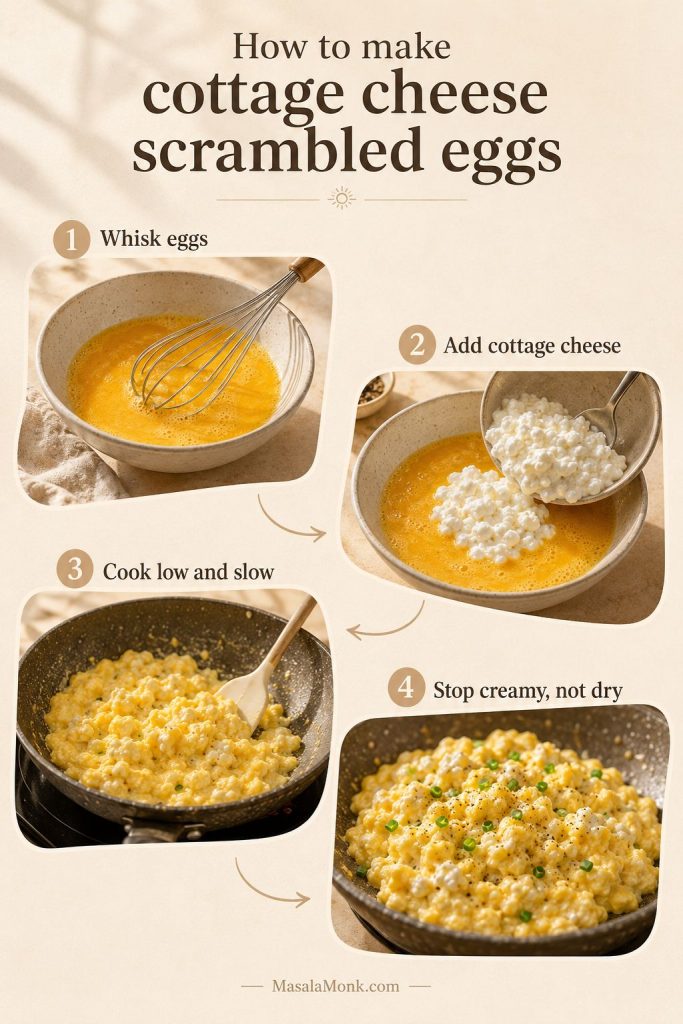
Step-by-step guide showing eggs being whisked, cottage cheese being added, eggs cooking gently, and the finished scramble.
The steps are simple, but the heat does the real work. Cook slowly so the eggs gather into soft folds instead of tightening into dry curds.

Step 1: Whisk the Eggs

Crack the eggs into a mixing bowl and whisk until the yolks and whites are fully combined. This helps the cottage cheese distribute evenly instead of sitting in pockets.

Step 2: Add the Cottage Cheese

Whisk in the cottage cheese, black pepper, and only a small pinch of salt. If you want smoother eggs, blend the eggs and cottage cheese for a few seconds instead of whisking by hand.

Step 3: Heat the Pan Gently

Warm a nonstick skillet over medium-low heat. For 2 eggs, an 8-inch skillet works well. For 4 eggs, use a 10-inch skillet. Add butter or oil and let it melt without browning.

Step 4: Cook Slowly Into Soft Folds

Pour in the egg mixture. Let the edges set for 10–20 seconds, then use a silicone spatula to slowly push the eggs from the outside of the pan toward the center. Keep moving gently so the eggs gather into soft, creamy folds instead of breaking into tiny dry curds. The pan should look calm, not sizzling.
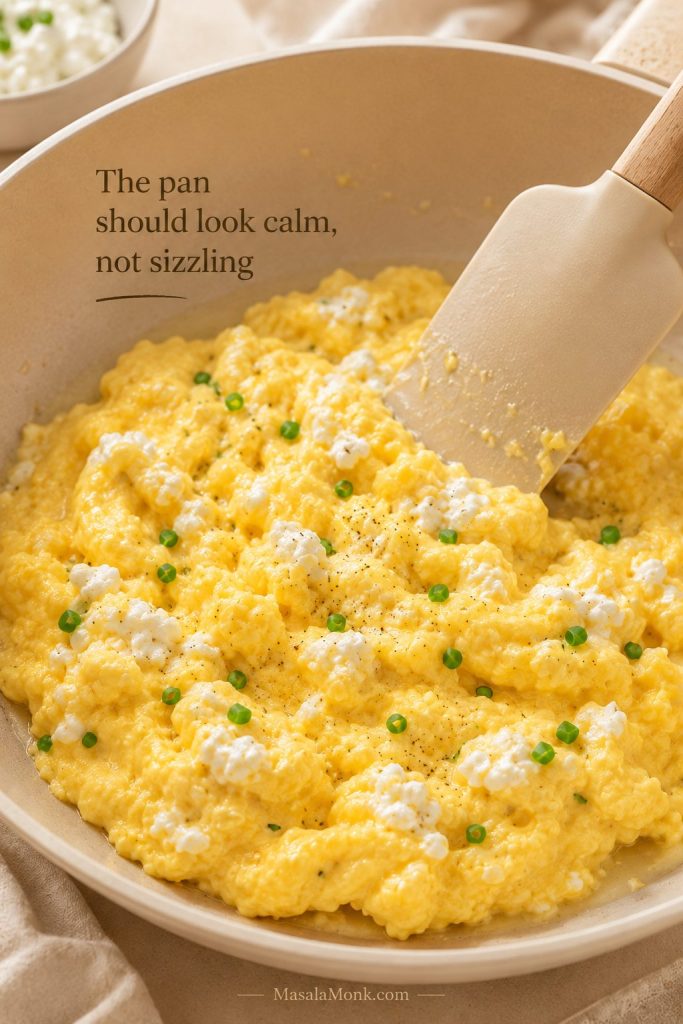
Scrambled eggs with cottage cheese cooking gently in a nonstick pan with a silicone spatula.
A quiet pan is a good sign. When the eggs move slowly under the spatula, they have time to turn creamy before they dry out.

Step 5: Stop While Creamy, Not Runny

Remove the eggs from the heat when they are thickened, creamy, and set through. They will keep cooking slightly from residual heat, so do not wait until they look completely dry in the pan.

You will know they are ready when the eggs hold soft folds on the spatula, look creamy instead of shiny-wet, and slide onto the plate without liquid pooling behind them. If the eggs look glossy but hold together, they are usually ready; if liquid runs around them, give them a little more time over gentle heat.
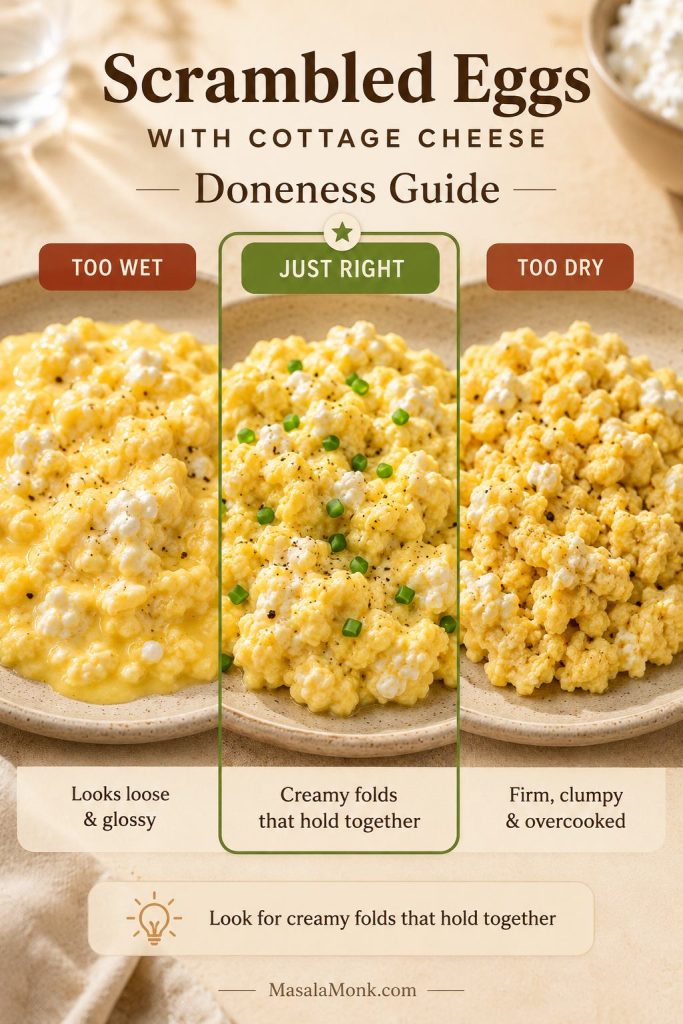
Doneness guide for cottage cheese scrambled eggs showing too wet, just right, and too dry textures.
“Just right” is creamy but not runny. If the eggs still slide apart with liquid around them, keep them on gentle heat a little longer.

If the eggs still look shiny, separated, or loose, the troubleshooting section will help you fix the next batch.

For food safety, scrambled eggs should be cooked until they are not runny. The FDA’s egg safety guidance recommends cooking egg dishes thoroughly, especially when serving children, older adults, pregnant people, or anyone with a weakened immune system.

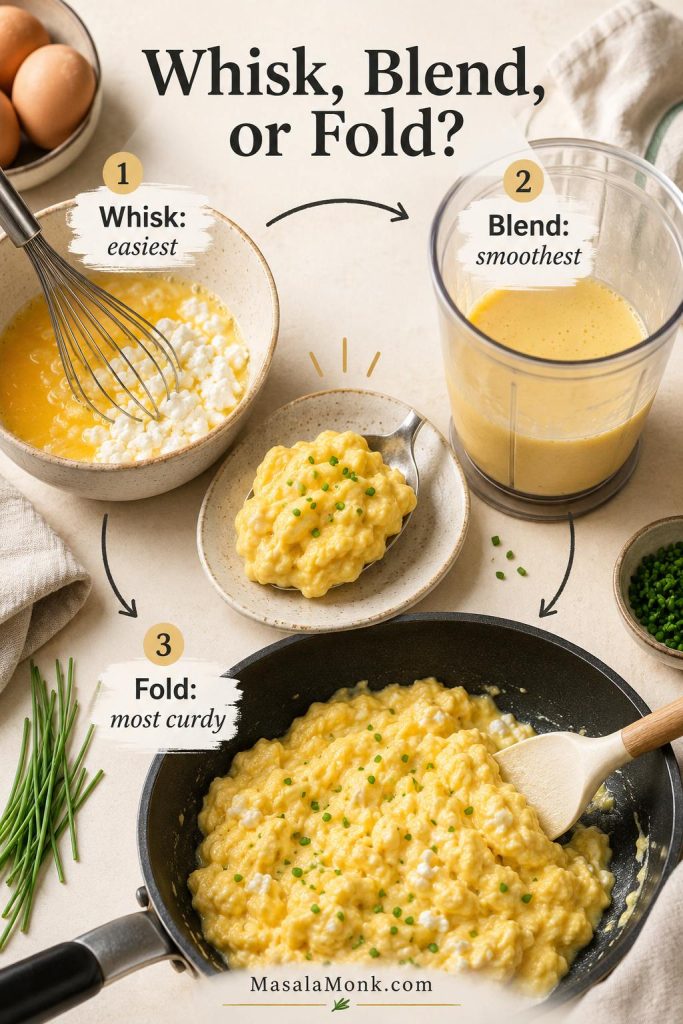
Whisk, Blend, or Fold? Three Texture Options

There is more than one way to add cottage cheese to scrambled eggs. The best method depends on whether you want the cottage cheese to disappear into the eggs or stay slightly visible.

Method How to Do It Texture Best For
Whisk Whisk cottage cheese into raw eggs Soft, lightly curdy, fluffy Best everyday version
Blend Blend eggs and cottage cheese briefly Smooth and creamy Cottage-cheese skeptics
Fold Cook eggs first, then fold cottage cheese near the end More visible curds People who like cottage cheese texture
Whisk, blend, and fold methods for adding cottage cheese to scrambled eggs.
Whisking is the everyday method, blending makes the smoothest cottage cheese eggs, and folding gives the most noticeable curd texture.

Choose blended if visible curds bother you, whisked for the easiest weekday scramble, and folded only if you actually enjoy the cottage cheese texture.

Using egg whites changes the texture, so check the egg-white version before swapping out too many yolks.

When Should You Add the Cottage Cheese?

Add cottage cheese before cooking for the whisked or blended versions. Fold it in near the end only if you want a more visible cottage cheese texture and your cottage cheese is thick enough not to loosen the eggs.

Egg Whites with Cottage Cheese

Egg whites with cottage cheese are useful if you want a lighter, higher-protein scramble, but the ratio matters. Because they contain more water than yolks, they need a little more care in the pan. Use too many whites with too much cottage cheese, and the eggs can turn thin.

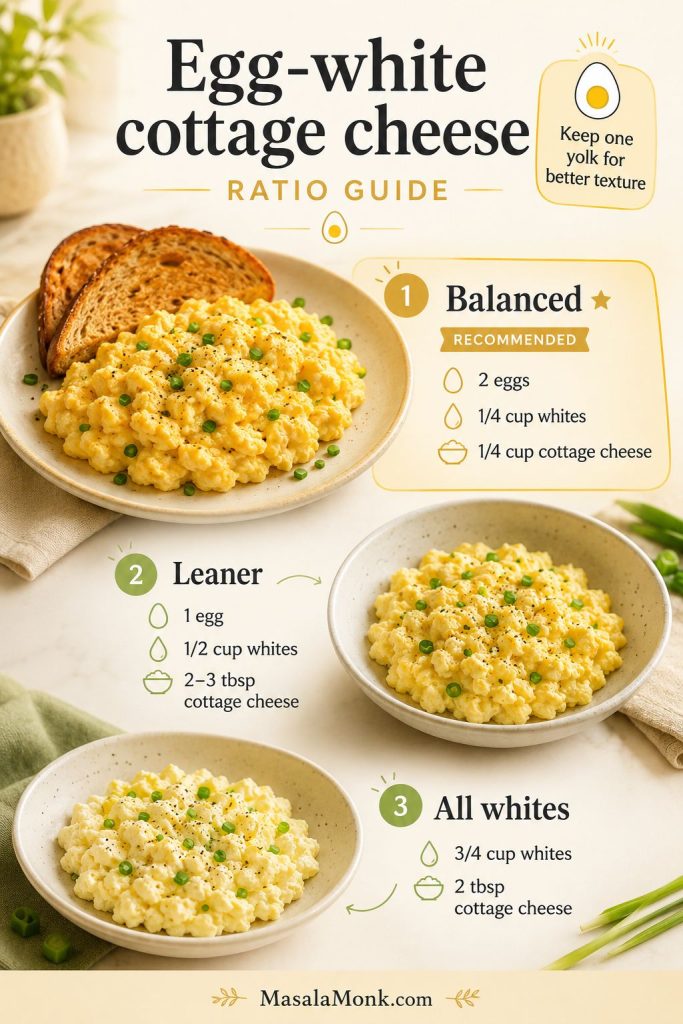
Best Egg-White Ratio

For the creamiest texture, keep at least some whole egg in the scramble. The yolk adds flavor, color, and a little structure, which helps the egg whites feel less flat.

Version Use This Ratio Texture
Balanced egg-white boost 2 eggs + 1/4 cup / 60ml egg whites + 1/4 cup / 55–60g cottage cheese Creamy, lighter, still flavorful
Leaner version 1 egg + 1/2 cup / 120ml egg whites + 2–3 tbsp cottage cheese Lighter, less rich, more delicate
All egg whites 3/4 cup / 180ml egg whites + 2 tbsp cottage cheese Leanest, but easiest to overcook or make watery
Egg-white cottage cheese scrambled eggs ratio guide with balanced, leaner, and all-egg-white versions.
Egg whites add protein, but they also add water. Keeping one yolk in the mix helps cottage cheese eggs stay creamy, structured, and less likely to turn thin.

If your egg-white scramble turns thin, the watery egg fixes explain how to adjust the cottage cheese and heat.

Lighter High-Protein Version

For a lighter plate, use 1 whole egg, 1/2 cup / 120ml egg whites, and 2–3 tablespoons cottage cheese. Serve it with spinach, tomatoes on the side, or avocado toast depending on whether you want a lower-calorie breakfast or a more filling meal. It is not a shortcut or a promise; it is simply a protein-rich breakfast that can fit into many eating styles depending on what you serve with it.

How to Keep Egg-White Cottage Cheese Eggs from Getting Watery

Use a thick cottage cheese, skip the milk, and cook over medium-low heat until the eggs are set through. If liquid starts pooling in the pan, keep the heat gentle and give the eggs a little more time. Do not crank the heat up to rush them; that usually makes the eggs rubbery before the moisture cooks off.

Macro-Friendly Add-Ins

Spinach, mushrooms, scallions, tomatoes on the side, hot sauce, and herbs all work well. If you are adding mushrooms, peppers, or vegetables that release moisture, cook them first so they do not loosen the eggs.

Microwave Cottage Cheese Scrambled Eggs

The skillet version tastes best, but microwave cottage cheese eggs are useful for busy mornings, office breakfasts, and quick solo meals. The texture will be firmer than stovetop scrambled eggs, so cook in short bursts and stir often.

Mug Method for One

Whisk 1 large egg with 1 tablespoon / about 15g cottage cheese in a large microwave-safe mug. Add black pepper and a tiny pinch of salt if needed. Microwave for 30 seconds, stir, then microwave in 15–30 second bursts until the egg is just set through.
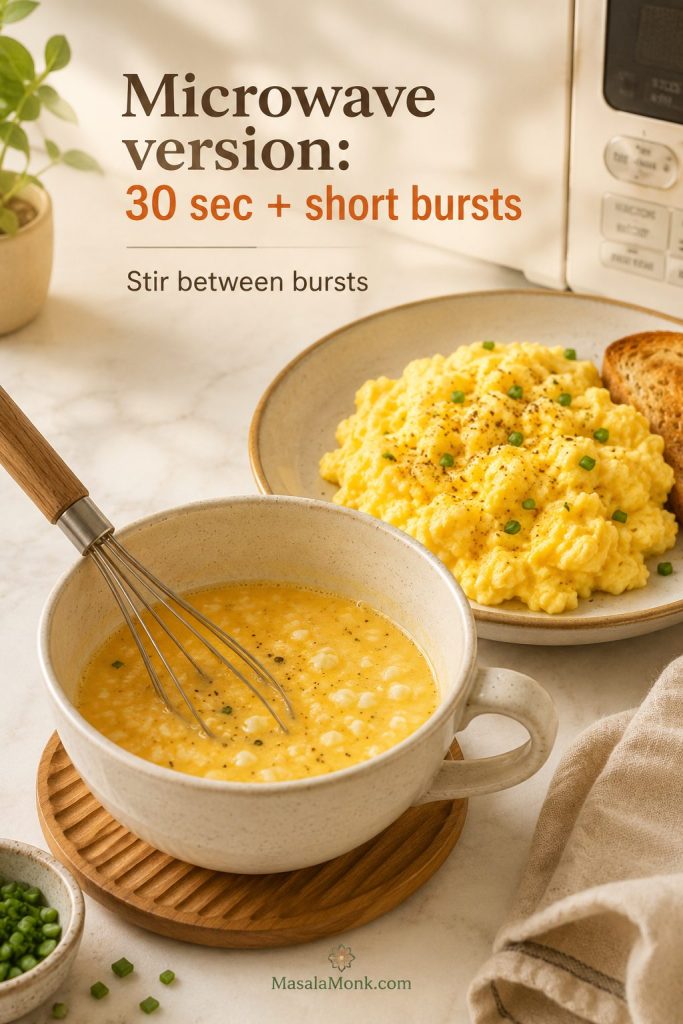
Microwave cottage cheese scrambled eggs made in a mug with a whisked egg mixture and a finished bowl of eggs.
For microwave cottage cheese eggs, short bursts are safer than one long cook. Stirring between rounds helps the center set without turning spongy.

Microwave Texture Tips

  • Use a bigger mug than you think you need.
  • Stir between bursts so the egg cooks evenly.
  • Microwave power varies, so treat the final 15–30 seconds as flexible.
  • Stop when the egg is just set, then let it stand for 20–30 seconds before eating.
  • Add herbs, hot sauce, or chives after cooking.
  • For 2 eggs, use a small microwave-safe bowl instead of a narrow mug.

Add-Ins and Serving Ideas

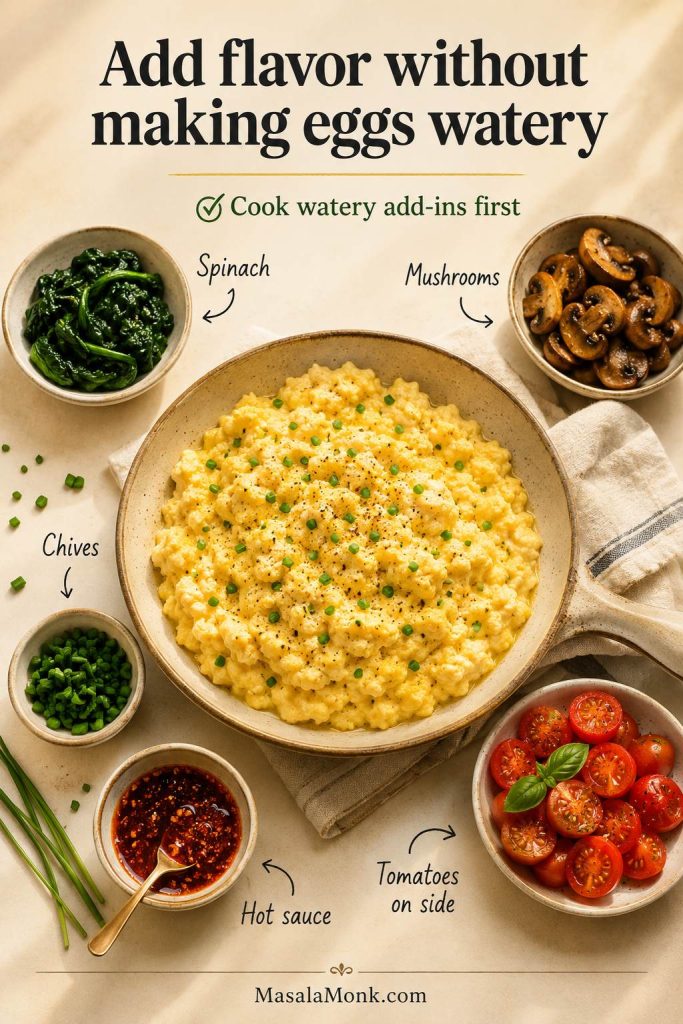
Scrambled eggs with cottage cheese are mild enough to go savory, spicy, herby, or brunch-style. Avoid adding raw vegetables that release a lot of water directly to the pan in large amounts. Instead, cook them first or serve them on the side.

Best Add-Ins for the Eggs

Add-In How to Use It Notes
Spinach Wilt before or during cooking Adds volume and color
Mushrooms Cook first Prevents loose eggs
Bell pepper Dice small and sauté first Good for veggie scrambles
Scallions or chives Add near the end Fresh, simple, and not watery
Tomatoes Serve on the side or add cooked Raw tomatoes can release water
Chili crisp or hot sauce Add after cooking Best for flavor contrast
Everything bagel seasoning Sprinkle after cooking Use lightly because it is salty
Add-ins for cottage cheese scrambled eggs including cooked spinach, mushrooms, chives, tomatoes, and hot sauce.
Add-ins work best after the moisture is under control. Cook mushrooms, spinach, and peppers first, then finish with herbs, hot sauce, or chili crisp.

Three Easy Ways to Serve Them

  • Simple weekday plate: cottage cheese eggs, buttered toast, black pepper, and chives.
  • Avocado toast version: mashed avocado, creamy eggs, chili crisp, and scallions on sourdough.
  • Breakfast taco version: warm tortilla, cottage cheese eggs, potatoes, salsa, and hot sauce.
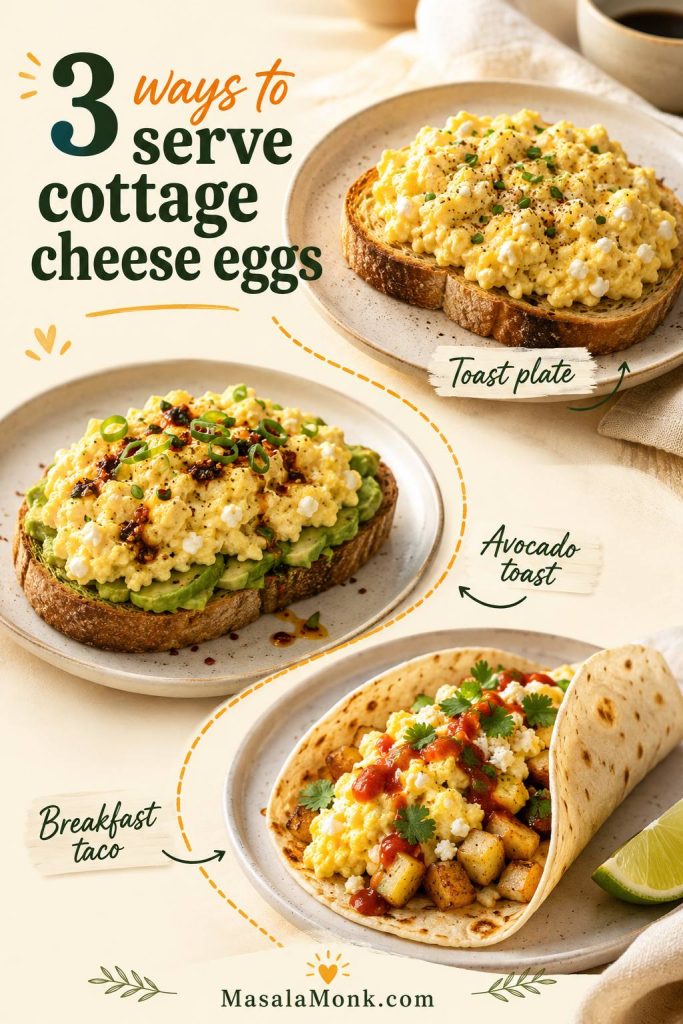
Three serving ideas for cottage cheese scrambled eggs with toast, avocado toast, and a breakfast taco.
Once the base scramble is right, it can go three ways: a simple toast plate, creamy avocado toast, or a breakfast taco with potatoes and salsa.

What to Serve with Cottage Cheese Eggs

  • Buttered sourdough toast
  • Avocado toast
  • Breakfast tacos
  • Roasted potatoes or air fryer hash browns
  • Sautéed spinach or mushrooms
  • Fresh tomatoes
  • Fruit on the side
  • Hot sauce, chili crisp, or salsa

For the easiest plate, keep it simple: creamy eggs, crisp toast, something fresh, and something sharp or spicy. A little hot sauce, salsa, chili crisp, or black pepper keeps the cottage cheese from making the plate taste too mild.
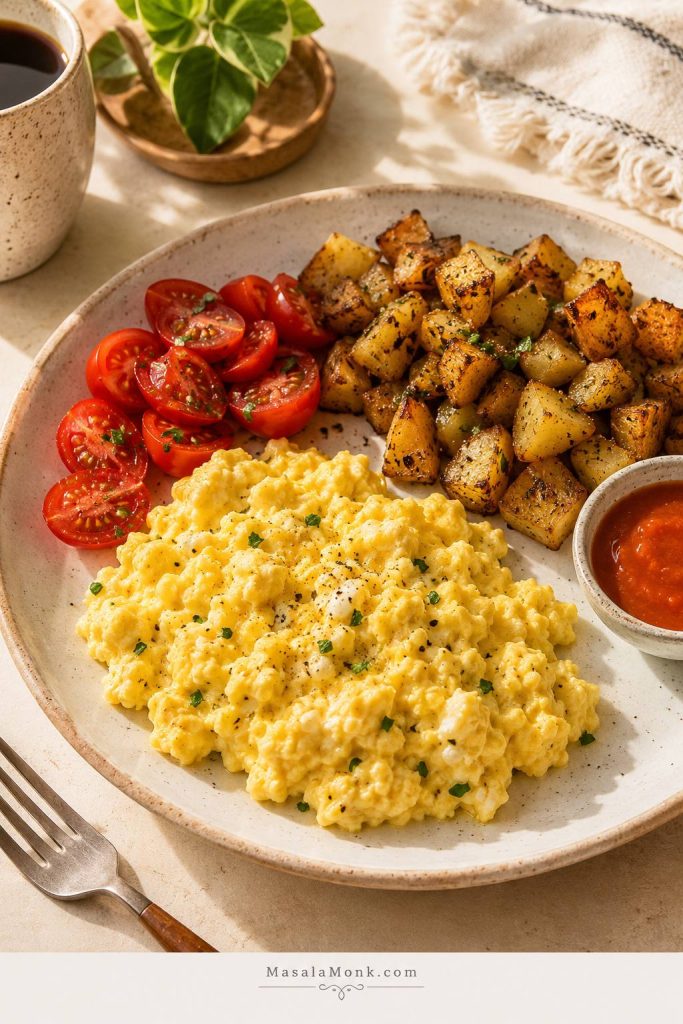
Cottage cheese scrambled eggs served with crispy potatoes, fresh tomatoes, and hot sauce.
A few sides make the eggs feel complete. Crisp potatoes add contrast, tomatoes add freshness, and hot sauce cuts through the creamy cottage cheese.

If you want to turn the eggs into a handheld breakfast, tuck them into a tortilla with potatoes, peppers, salsa, or avocado. This breakfast burrito recipe has more ideas for building a filling wrap without making it soggy.

How to Fix Watery or Loose Cottage Cheese Eggs

If your first batch is not perfect, do not write off the recipe. Cottage cheese brands vary a lot, and one small ratio or heat adjustment usually fixes it.

This is the section to read if you tried cottage cheese eggs once and wondered why everyone else seemed to be getting a creamy scramble while yours looked loose, shiny, or separated.

If your eggs tasted good but looked loose, shiny, or a little separated, the recipe probably does not need to be abandoned. It usually just needs less liquid, thicker cottage cheese, or gentler heat.
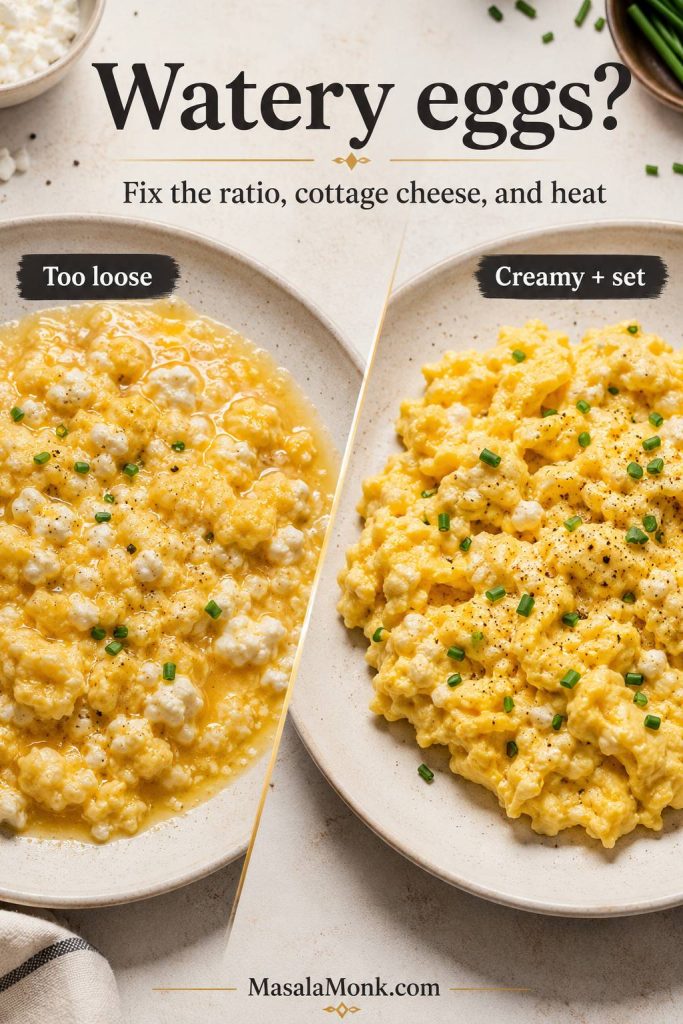
Watery cottage cheese scrambled eggs compared with creamy set eggs in a troubleshooting guide.
Watery cottage cheese eggs usually come from too much liquid, high heat, or a loose cottage cheese brand. Fix those first before changing the whole recipe.

Why Cottage Cheese Eggs Turn Watery

  • Too much cottage cheese
  • Very liquid cottage cheese
  • Watery fat-free or low-fat cottage cheese
  • Heat that was too high
  • Not enough gentle cooking time
  • Raw mushrooms, tomatoes, or peppers
  • Too many egg whites
  • Added milk

Troubleshooting Watery Cottage Cheese Eggs

What Happened Most Likely Cause Next Batch Fix
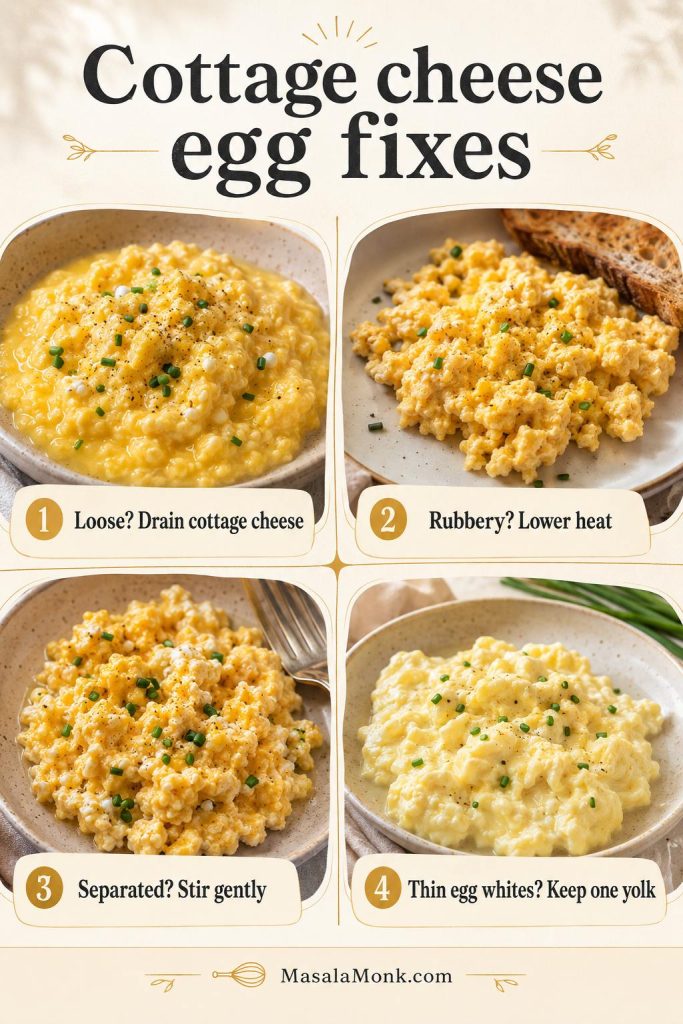
Eggs tasted good but looked loose Too much liquid in the cottage cheese Drain the cottage cheese or use 2 tbsp per 2 eggs
Eggs turned rubbery and wet Heat was too high Use medium-low heat and cook a little longer
Eggs looked separated Curds released moisture before the eggs set Whisk better, use thicker cottage cheese, and stir gently
Egg-white version turned thin Too much water from whites plus cottage cheese Keep one yolk or reduce cottage cheese to 2 tbsp
Diagnostic guide showing fixes for loose, rubbery, separated, and thin egg-white cottage cheese eggs.
Use the pan clues to fix the next batch: drain liquidy cottage cheese, lower the heat, stir gently, or keep one yolk when using egg whites.

Fixes Before Cooking

Problem to Prevent What to Do
Cottage cheese looks liquidy Spoon off excess liquid or use slightly less cottage cheese
You dislike curds Blend the cottage cheese with the eggs
You want less moisture Use 2 tbsp cottage cheese per 2 eggs
Using vegetables Cook moisture-heavy vegetables first
Using egg whites Keep at least one yolk or cook gently a little longer

Fixes While Cooking

What You See Fix
Liquid pooling in the pan Keep cooking gently and fold slowly until the extra moisture evaporates
Eggs setting too fast Lower the heat or remove the pan briefly
Curds separating Stir less aggressively and use lower heat
Eggs getting rubbery Pull from the heat sooner next time and use medium-low heat

What Not to Do

  • Skip the milk; cottage cheese already brings moisture.
  • Avoid high heat, which can make the eggs tighten before the moisture cooks off.
  • Do not start with an extra-heavy cottage cheese ratio on your first try.
  • Cook mushrooms, tomatoes, or peppers first if you are adding more than a small handful.
  • Once soft folds form, stir gently instead of aggressively breaking the eggs apart.

Once the ratio and heat are right, the recipe is simple: whisk, cook gently, stop while creamy, and serve while the eggs are still soft and warm.

Scrambled Eggs with Cottage Cheese Recipe

Soft, creamy scrambled eggs with cottage cheese for a protein-rich breakfast that feels cozy, filling, and ready in about 10 minutes.

Prep Time5 minutes
Cook Time4–5 minutes
Total Time10 minutes
Yield2 servings

Approximate nutrition: One serving, made with 2 large eggs, 1/4 cup cottage cheese, and 1/2 tablespoon butter, is usually around 220–270 calories with about 18–22g protein. Exact numbers depend on your cottage cheese brand and cooking fat. Because cottage cheese brands vary widely in protein, sodium, and moisture, treat these numbers as an estimate unless you calculate with your exact label.

Equipment

  • Mixing bowl
  • Whisk or fork
  • 10-inch nonstick skillet
  • Silicone spatula

Ingredients

  • 4 large eggs
  • 1/2 cup cottage cheese, about 4 oz / 110–120g, preferably small-curd 2% or full-fat
  • 1 tablespoon butter, about 1/2 oz / 14g, or 1–2 teaspoons / 5–10ml olive oil
  • 1/8 teaspoon fine salt, optional
  • Black pepper, to taste
  • 1 tablespoon chopped chives or scallions, optional

Method

  1. Crack the eggs into a mixing bowl and whisk until the yolks and whites are fully combined.
  2. Whisk in the cottage cheese, black pepper, and a tiny pinch of salt if using.
  3. Place a nonstick skillet over medium-low heat. Add the butter or oil and let it melt without browning.
  4. Pour in the egg mixture and let the edges begin to set for 10–20 seconds.
  5. Use a silicone spatula to slowly push the eggs from the outside of the pan toward the center, forming soft folds. The pan should look calm, not sizzling.
  6. Keep cooking gently until the eggs are thickened, creamy, and set through. If liquid runs around the eggs, give them another minute over gentle heat.
  7. Remove from the heat, sprinkle with chives or scallions if using, and serve immediately.

Notes

  • Blend the cottage cheese with the eggs first for a smoother texture.
  • Use 2 tablespoons cottage cheese per 2 eggs if you want less cottage cheese texture.
  • For an egg-white boosted version, use 2 eggs, 1/4 cup / 60ml egg whites, and 1/4 cup / 55–60g cottage cheese.
  • Salt lightly because cottage cheese is already salty.
  • Use medium-low heat. High heat can make the eggs rubbery.
  • Do not add milk; cottage cheese already adds moisture.
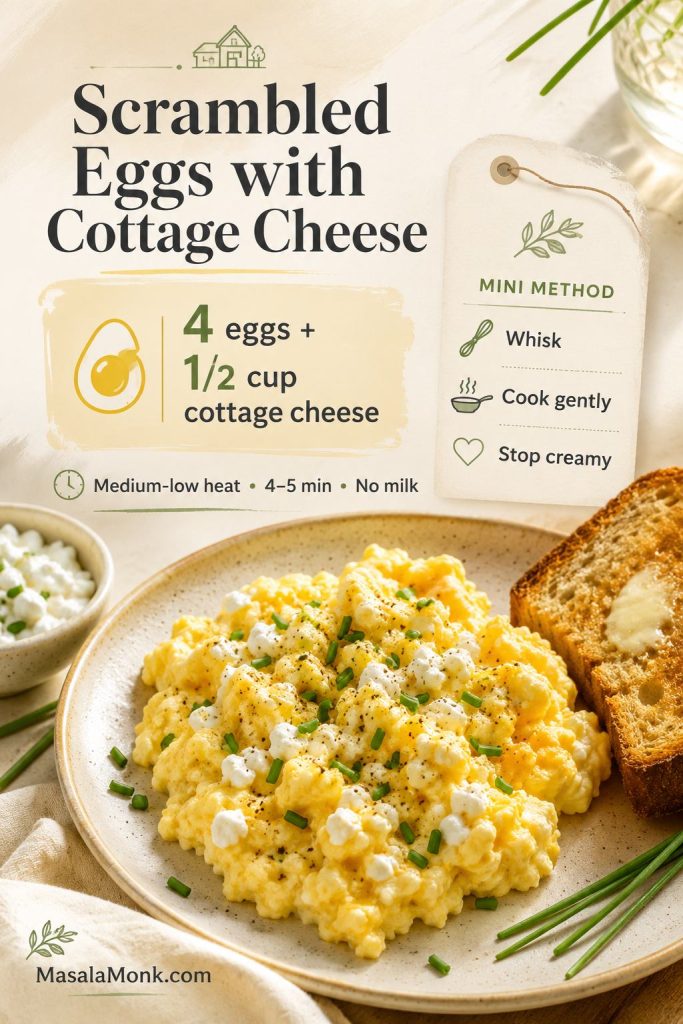
Saveable recipe card for scrambled eggs with cottage cheese showing the main ratio, cooking time, and method notes.
This saveable version keeps the formula simple: four eggs, half a cup of cottage cheese, medium-low heat, and no milk for a creamy two-serving scramble.

Once you make it once, adjust the ratio to match your cottage cheese and your pan. Some brands melt in softly, some release more liquid, and some taste saltier than others. The recipe gets easier after the first batch.

Storage and Reheating

These are absolutely best right from the pan, so treat leftovers as a backup breakfast rather than the main plan. Still, if you have extra, they can work if you cool and reheat them gently.

For the freshest texture, make the main recipe card version right before serving.

How Long Do They Keep?

Store leftover cottage cheese scrambled eggs in an airtight container in the refrigerator for up to 2 days. Let them cool before closing the container so steam does not create extra moisture.

How to Reheat Without Making Them Rubbery

Reheat in the microwave at reduced power in 15–30 second bursts, stirring gently between bursts. Stop as soon as the eggs are warm. You can also reheat them in a nonstick skillet over low heat.

For a freezer-friendly breakfast instead of fresh scrambled eggs, use the same soft-cooked egg logic in meal prep breakfast burritos, where the eggs need to stay tender without making the tortilla soggy.

Can You Freeze Cottage Cheese Scrambled Eggs?

I would not freeze them. Eggs and cottage cheese can both release moisture after thawing, so the texture usually suffers. For a better make-ahead breakfast, try egg muffins or a sliceable frittata instead.

When you need breakfast for a table instead of one skillet, a breakfast casserole with hash browns is a better make-ahead option than stovetop scrambled eggs.

Final Serving Texture Cue

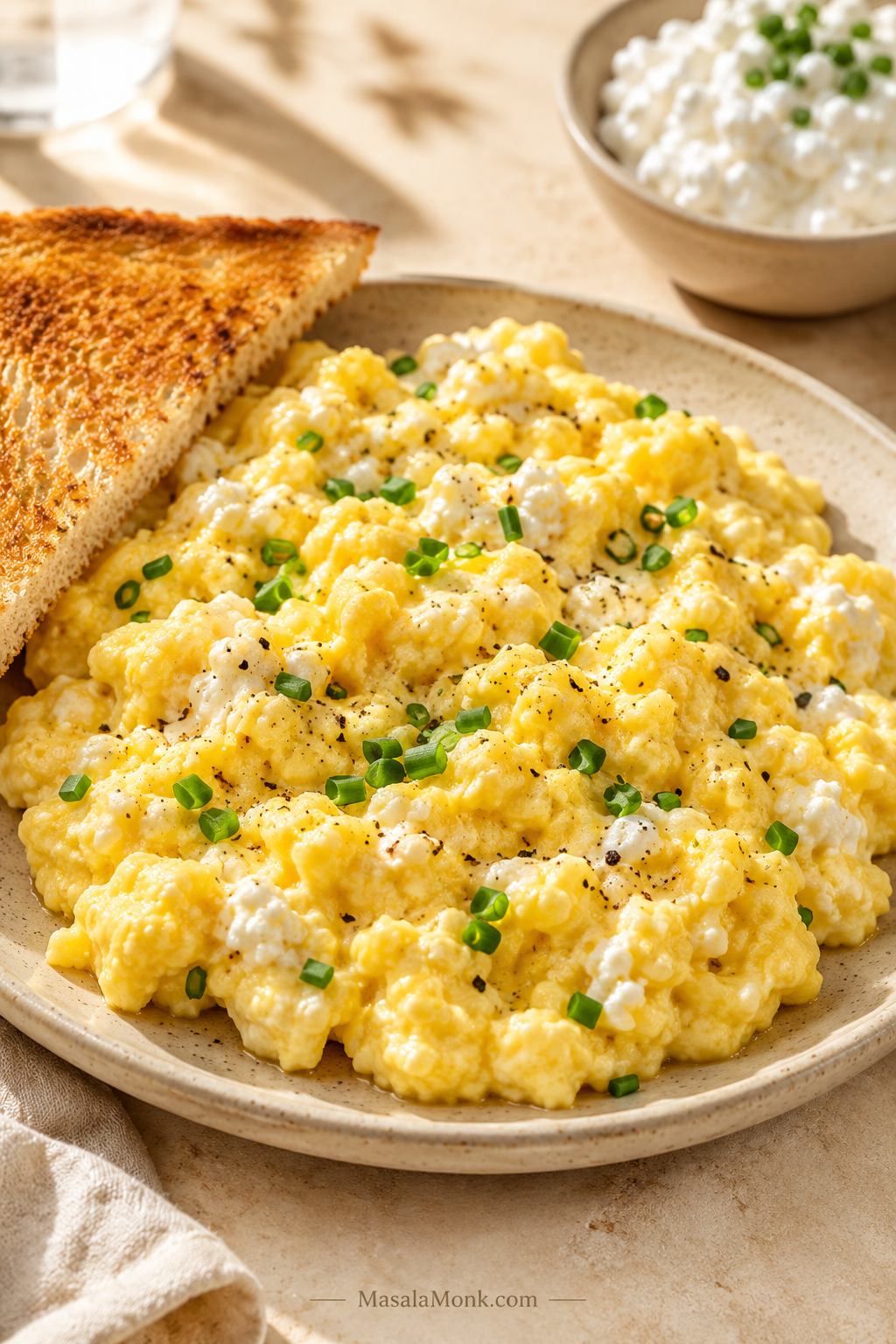
Before you leave the recipe, remember the main visual cue: the eggs should look creamy, softly folded, and set enough to hold together on the plate.
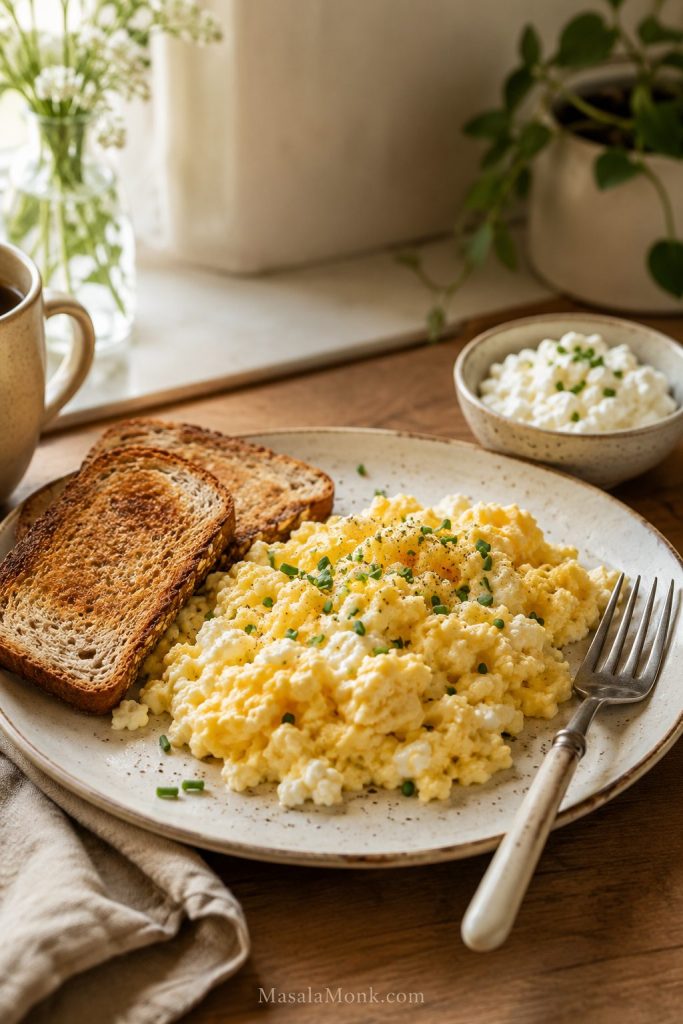
Final serving of scrambled eggs with cottage cheese with toast, a fork, cottage cheese, and a warm breakfast table setting.
A good cottage cheese scramble should feel warm and familiar, with enough protein and creaminess to make breakfast last longer than plain eggs.

FAQs About Scrambled Eggs with Cottage Cheese

What does cottage cheese do to scrambled eggs?

Cottage cheese adds protein, creaminess, and a mild savory flavor. When cooked gently, it softens into the eggs and makes them more filling without needing milk or cream.

Do scrambled eggs with cottage cheese taste like cottage cheese?

They taste creamy, lightly savory, and only a little tangy. With the balanced ratio, the eggs still taste like eggs; the cottage cheese mostly adds body and richness.

Is it better to blend cottage cheese into eggs?

Blend it if you want smooth eggs with no visible curds. This is the best choice for anyone who likes the protein boost but does not want the cottage cheese texture. Whisk it in if you like a soft, lightly curdy scramble.

Why did my cottage cheese scrambled eggs turn watery?

They probably had too much cottage cheese, a very liquidy brand, too many egg whites, raw watery vegetables, milk, or not enough gentle cooking time. Use 1/4 cup cottage cheese per 2 eggs, choose a thicker cottage cheese, and cook over medium-low heat until the eggs are set through.

What type of cottage cheese works best?

Small-curd 2% cottage cheese is the most reliable everyday choice. Full-fat cottage cheese gives richer eggs. Fat-free cottage cheese can work, but it is more likely to release moisture.

Should I add milk to cottage cheese scrambled eggs?

Skip the milk here. Cottage cheese already brings moisture and body, and adding milk can push the scramble from creamy into loose or wet.

Are cottage cheese eggs good for a high-protein breakfast?

They are a strong high-protein breakfast, especially if you use the balanced ratio of eggs plus cottage cheese instead of stretching the scramble with milk. The exact protein depends on your egg size and cottage cheese label.

Do egg whites work with cottage cheese?

Egg whites work, but the best texture usually comes from keeping at least one whole egg in the mixture. The yolk adds flavor, color, and structure, so the scramble feels creamy instead of thin.

Can I make cottage cheese scrambled eggs in the microwave?

Yes. For one serving, whisk 1 large egg with 1 tablespoon cottage cheese in a large microwave-safe mug. Microwave for 30 seconds, stir, then cook in 15–30 second bursts until set. Let it stand briefly before eating so the center finishes without becoming spongy.

What is the best ratio of cottage cheese to eggs?

The best balanced ratio is 1/4 cup cottage cheese for every 2 large eggs. Use 2 tablespoons for a subtler version, or up to 1/3 cup if you want a richer cottage-cheese-forward scramble.

Can I use boiled eggs with cottage cheese instead?

Yes, but that becomes a different kind of meal. Boiled eggs with cottage cheese work as a quick snack plate, while chopped boiled eggs mixed with blended cottage cheese become a high-protein cottage cheese egg salad.
Back to top

Posted on 1 Comment

Egg Whites for Weight Loss: A Nutrient-Dense and Versatile Addition to Support Your Healthy Eating Plan

Egg whites for weight loss

When it comes to losing weight and eating healthily, one of the most debated yet often misunderstood foods is the humble egg. More specifically, the egg white. While egg yolks bring their own powerful nutrition profile, egg whites offer a uniquely potent combination of high-quality protein, minimal calories, and culinary flexibility that makes them an excellent staple in weight loss diets. In this post, we’ll explore why egg whites deserve a central spot in your meal planning, what the latest research says, how to use them practically, and when it makes sense to pair them with whole eggs.


Why Egg Whites Work for Weight Loss

1. Low-Calorie, High-Protein Powerhouse

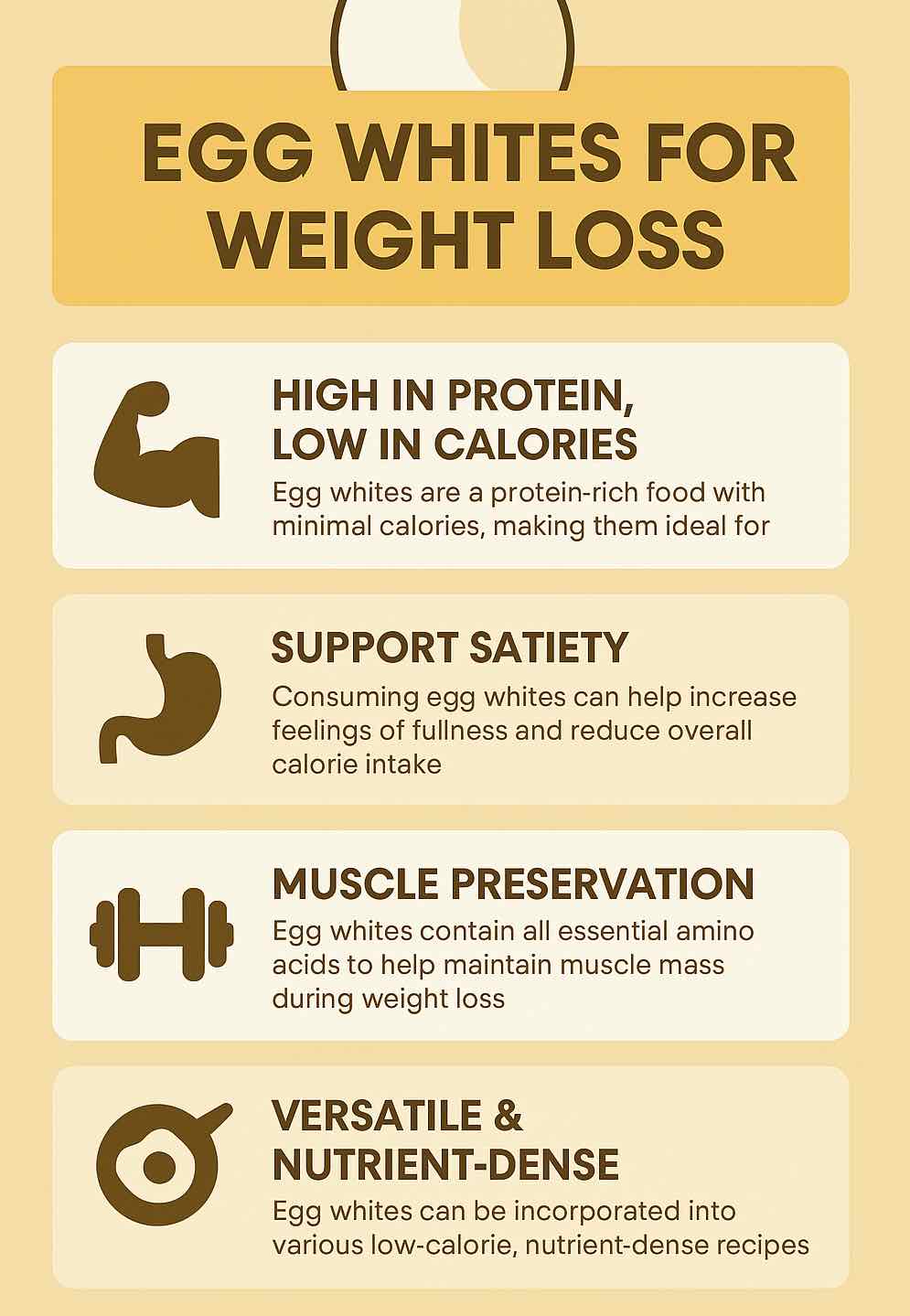
One large egg white contains about 17 calories and 3.6 grams of complete protein. This makes egg whites one of the most efficient sources of protein per calorie. For those trying to maintain a calorie deficit while preserving muscle mass, egg whites offer the perfect solution.

2. Boosts Satiety and Reduces Overall Intake

Studies show that protein-rich breakfasts, especially those including egg whites, increase satiety hormones like GLP-1 and PYY. This hormonal response can lead to reduced calorie intake for the rest of the day. Unlike carbs or fats, proteins take longer to digest, which keeps you feeling full for longer.

3. Supports Lean Muscle Retention

During weight loss, preserving muscle is crucial to maintaining metabolic rate. Egg whites are rich in branched-chain amino acids, especially leucine, which plays a direct role in stimulating muscle protein synthesis. Whether you’re doing resistance training or simply walking more, egg whites help fuel your muscle recovery and retention.


What the Latest Research Says

Clinical Innovations: Encapsulated Egg-White Noodles

Recent clinical trials from 2024 explored the use of encapsulated egg-white noodles (EWN) as a meat substitute. Over six weeks, overweight individuals who substituted part of their meat intake with EWN saw a greater reduction in body weight, waist-to-hip ratio, and LDL cholesterol than those on a standard high-protein diet.

Fermented Egg-White Protein

Another innovation gaining attention is fermented egg-white protein, shown to reduce visceral fat and improve antioxidant levels over a 12-week period in overweight individuals. This suggests that egg whites may offer metabolic benefits beyond protein content alone.

Whole Eggs vs. Whites

While whole eggs do offer essential nutrients like choline, vitamin D, and healthy fats, new findings suggest that combining egg whites with a smaller number of whole eggs may provide a balance between nutrient density and calorie control. In fact, some studies show whole eggs may better support muscle synthesis, making the combo approach ideal.


Nutritional Trade-Off: The Yolk Dilemma

Egg yolks are rich in:

  • Choline (important for brain function)
  • Vitamins A, D, E, and K
  • Lutein and zeaxanthin (antioxidants for eye health)
  • Healthy fats

Egg whites, on the other hand, are cholesterol-free, fat-free, and packed with pure protein. If you’re managing cholesterol or sticking to a low-fat plan, whites offer a safe and effective option. But omitting yolks completely may lead to micronutrient gaps over time.


Practical Ways to Use Egg Whites

1. Breakfast Options

  • Egg White Omelet: Mix with spinach, mushrooms, onions, and a sprinkle of feta for a high-protein, low-calorie start.
  • Scramble Add-On: Use 2 whole eggs + 2 egg whites for a nutrient-dense yet lower-calorie version of classic scrambled eggs.

2. Snacks and Smoothies

  • Protein Smoothie: Pasteurized liquid egg whites can be blended into shakes for a flavorless protein boost.
  • Mini Egg White Muffins: Bake with chopped veggies and herbs in muffin tins for portable, portion-controlled snacks.

3. Baking and Cooking

  • Meatloaf Binder: Use egg whites in place of whole eggs to bind meats or veggie patties.
  • Low-Fat Desserts: Use whipped egg whites to lighten up pancakes, waffles, and even soufflés.

Safety Notes and Considerations

  • Always cook egg whites thoroughly to eliminate salmonella risk.
  • Avoid raw consumption unless using pasteurized versions.
  • Watch for allergies, especially in children under five.
  • Biotin concerns from raw whites are irrelevant once cooked, as avidin becomes inactive.

Final Thoughts: Combine Strategy Is Best

Egg whites are a powerful ally for weight loss, offering lean protein that supports satiety, muscle maintenance, and overall health with minimal calories. However, they should be part of a broader, nutrient-dense diet. A common and effective strategy is to mix 1 whole egg with 2-3 egg whites. This way, you benefit from the yolk’s nutrients while keeping your meal light and protein-rich.

Whether you’re aiming to drop pounds, build lean mass, or just eat cleaner, egg whites are a practical, affordable, and versatile tool to help you stay on track.

🧠 FAQs: Egg Whites for Weight Loss

1. Are egg whites better than whole eggs for weight loss?
Answer: Egg whites are lower in calories and fat while being high in protein, making them excellent for reducing overall calorie intake. However, whole eggs provide essential nutrients like choline and vitamin D. A mix of egg whites and whole eggs offers the best of both worlds.


2. How many egg whites should I eat per day for weight loss?
Answer: Depending on your protein needs, 3–6 egg whites per day is common. That provides roughly 11–22 grams of high-quality protein with only 50–100 calories. Always consider your total daily intake and balance with other foods.


3. Can egg whites help build or maintain muscle during a diet?
Answer: Yes. Egg whites contain all essential amino acids and are particularly high in leucine, which supports muscle protein synthesis—key during calorie-restricted phases to avoid muscle loss.


4. Do egg whites have any vitamins or minerals?
Answer: Egg whites contain small amounts of potassium, riboflavin, and selenium. However, they lack many of the micronutrients found in the yolk, so it’s important not to rely on whites alone for overall nutrition.


5. Are there any downsides to eating egg whites only?
Answer: The main concern is missing out on nutrients found in the yolk, like choline and fat-soluble vitamins. Also, excessive raw egg white consumption can lead to biotin deficiency, though this is resolved with cooking.


6. Can I drink egg whites raw for protein?
Answer: It’s not recommended to consume raw egg whites due to the risk of salmonella and reduced protein absorption. If you do, use pasteurized liquid egg whites, which are heat-treated to eliminate pathogens.


7. Are egg whites good for people with high cholesterol?
Answer: Yes. Egg whites contain no cholesterol or saturated fat, making them heart-friendly and suitable for individuals managing cholesterol levels, unlike whole eggs which contain dietary cholesterol.


8. What’s the best way to prepare egg whites for weight loss meals?
Answer: Omelets, scrambles with vegetables, and baked egg white muffins are great options. These methods keep meals satisfying without added fats or excess calories.


9. Is there a limit to how many egg whites I can eat per week?
Answer: There’s no strict upper limit for healthy individuals, but moderation is wise. Eating 1–2 servings (3–6 whites) daily is generally safe and effective. Prioritize variety in your protein sources.


10. Can I substitute egg whites for whole eggs in baking or cooking?
Answer: Yes, though results may vary. Use 2 egg whites to replace 1 whole egg in most recipes. Be mindful that this may alter texture or flavor slightly, especially in baked goods.

Posted on 1 Comment

Calories & Nutrition in Egg Whites

CALORIES & NUTRITION in EGG WHITES

When it comes to healthy eating, few ingredients are as universally recommended as the humble egg white. Stripped of its golden yolk, the egg white is often hailed as a low-calorie, high-protein powerhouse. But what exactly makes it so special? And is it truly the best part of the egg when it comes to nutrition? Let’s peel back the shell and explore the facts.


The Basics: What Is an Egg White?

Egg whites, also known as albumen, are the clear, viscous substance surrounding the yolk. Comprising approximately two-thirds of an egg’s total weight, egg whites consist of about 90% water and 10% protein. They are naturally fat-free and contain minimal carbohydrates, making them a staple in many diet-conscious meal plans.


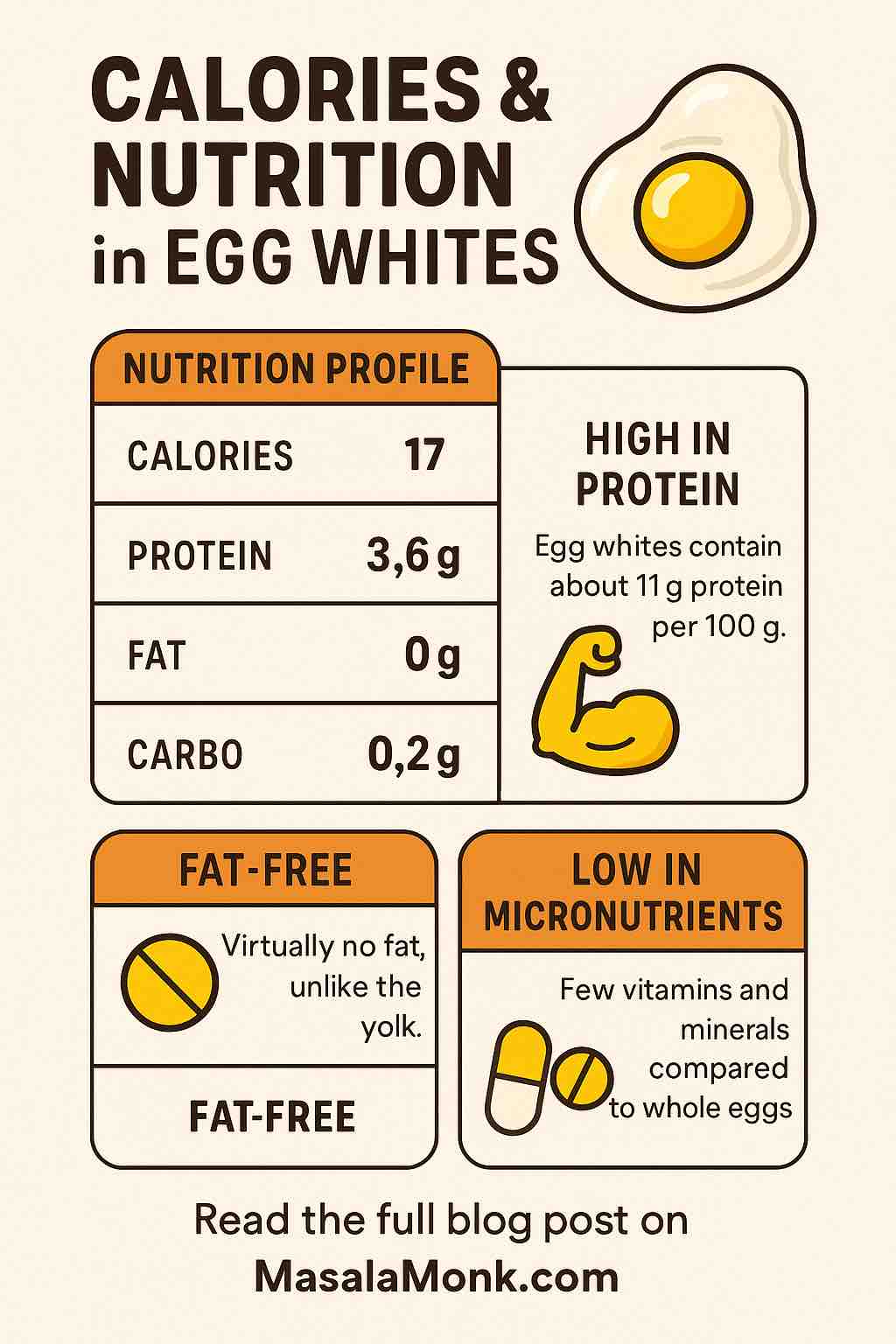
Nutritional Breakdown: Per Large Egg White (33g)

  • Calories: 17 kcal
  • Protein: 3.6 grams
  • Fat: 0 grams
  • Carbohydrates: 0.2 grams
  • Cholesterol: 0 mg
  • Sodium: 55 mg
  • Potassium: 54 mg

When scaled to 100 grams (approximately 3 egg whites), the profile expands to:

  • Calories: 52 kcal
  • Protein: 10.9 grams
  • Fat: 0.17 grams
  • Carbohydrates: 0.73 grams
  • Sodium: 166 mg
  • Potassium: 163 mg
  • Water Content: ~87.6 grams

This makes egg whites an excellent source of lean protein, with an impressive amino acid profile that includes all nine essential amino acids.


Protein Powerhouse: Quality and Bioavailability

Egg white protein is often used as a benchmark in biological value (BV) and protein digestibility studies. Its primary protein, ovalbumin, is accompanied by others like ovotransferrin, ovomucoid, and lysozyme. Together, these proteins offer high digestibility and muscle-repairing capabilities, making egg whites particularly valuable to athletes, bodybuilders, and those recovering from injury.


Low in Calories, Rich in Purpose

What makes egg whites especially attractive in nutritional planning is their low-calorie density. At just 17 calories per egg white, you can consume multiple servings without significantly impacting your calorie intake. This is especially useful in:

  • Weight loss programs: Fewer calories, more satiety.
  • Bodybuilding diets: High protein intake with minimal fat.
  • Cholesterol-sensitive diets: No cholesterol, unlike yolks which carry about 186 mg per egg.

Micronutrients: A Sparse But Notable Profile

While egg whites are not micronutrient powerhouses like yolks, they do contain some vital elements:

  • Riboflavin (B2): Essential for energy production.
  • Selenium: An antioxidant mineral supporting immune function.
  • Magnesium and Potassium: Involved in muscle function and hydration.

However, they lack fat-soluble vitamins (A, D, E, and K), iron, zinc, and vitamin B12—most of which are concentrated in the yolk.


Raw vs. Cooked: The Avidin Factor

Consuming raw egg whites is sometimes practiced in fitness circles, but it comes with a caveat. Raw whites contain avidin, a protein that binds biotin (vitamin B7), potentially leading to deficiency over time. Cooking deactivates avidin, making cooked egg whites the safer and more nutritious choice.


Egg Whites vs. Whole Eggs: Should You Skip the Yolk?

While egg whites have their benefits, removing the yolk means missing out on:

  • Healthy fats (including omega-3s)
  • Choline (vital for brain function)
  • Fat-soluble vitamins
  • Complete nutrient synergy

Whole eggs offer a more complete nutrient package and are not inherently unhealthy when consumed in moderation.

NutrientWhole Egg (50g)Egg White (33g)
Calories~70 kcal~17 kcal
Protein~6.3 g~3.6 g
Fat~5 g0 g
Cholesterol~186 mg0 mg
Vitamin A, D, E, KPresentAbsent

Who Should Use Egg Whites?

  • Athletes & Bodybuilders: For lean muscle gain without extra fat.
  • People with Heart Conditions: Low cholesterol option.
  • Weight Watchers: Low-calorie protein source.
  • Veggie-Based Eaters (Non-Vegan): Adds protein without meat.

Cooking with Egg Whites

Egg whites are incredibly versatile. You can scramble, poach, bake, or whip them into airy textures for recipes like:

  • Protein pancakes
  • Meringues
  • Egg white muffins
  • Low-fat omelets
  • Shakes and smoothies (pasteurized)

They also function as binding agents in baking and thickening agents in sauces.


Final Thoughts: Are Egg Whites Worth the Hype?

Egg whites are a nutritional treasure for anyone seeking a low-calorie, high-protein food. However, context matters. While egg whites are excellent for focused goals like fat loss and muscle maintenance, they shouldn’t always replace whole eggs, which offer a broader nutrient spectrum.

In the end, the best choice depends on your dietary needs, health goals, and overall nutritional strategy. Whether you crack the whole egg or just the white, you’re still getting one of nature’s most efficient sources of nourishment.

🔍 Frequently Asked Questions (FAQs)

  1. Are egg whites healthier than whole eggs?
    Egg whites are lower in calories, fat, and cholesterol compared to whole eggs, making them ideal for specific dietary goals like weight loss or low-cholesterol diets. However, whole eggs contain more vitamins, healthy fats, and nutrients like choline and vitamin D.
  2. How many calories are in one egg white?
    A large egg white (about 33 grams) contains approximately 17 calories.
  3. Is it safe to eat raw egg whites?
    Raw egg whites may pose a risk of salmonella and can inhibit biotin absorption due to avidin. It’s best to consume them cooked or use pasteurized egg whites if eating raw.
  4. Do egg whites contain cholesterol?
    No, egg whites contain zero cholesterol. All the cholesterol in an egg is found in the yolk.
  5. Can egg whites help with weight loss?
    Yes. Egg whites are low in calories and high in protein, which can help you feel full and preserve muscle mass during calorie restriction.
  6. Are egg whites good for building muscle?
    Absolutely. They provide high-quality, complete protein, essential for muscle repair and growth, especially beneficial post-workout.
  7. What nutrients are missing in egg whites?
    Egg whites lack fat-soluble vitamins (A, D, E, K), choline, iron, and B12—all of which are found in the yolk.
  8. How many egg whites can I eat per day?
    There’s no strict limit, but moderation is key. 3–6 egg whites per day are commonly consumed by those on high-protein or fitness-oriented diets.
  9. Can I replace whole eggs with egg whites in recipes?
    Yes, especially in omelets, baking, and shakes. Use 2 egg whites for every 1 whole egg as a general substitution rule.
  10. Are egg whites suitable for people with high blood pressure?
    Yes. They are low in sodium (especially if unsalted during cooking), fat-free, and protein-rich, which supports heart health.
Posted on Leave a comment

Can You Really Not Whip Egg Whites if There’s Yolk in Them? Let’s Crack This Myth!

In the culinary cosmos, whipping egg whites into a flawless foam stands as a cornerstone technique, pivotal for airy meringues, soufflés, and angel food cakes. Yet, a widely held belief casts a shadow over this endeavor: the notion that even a minuscule trace of egg yolk can thwart your efforts to achieve peak perfection. Is this kitchen lore grounded in truth, or merely a myth? Armed with scientific insights and practical wisdom, let’s embark on a journey to demystify the impact of yolk contamination on egg white foams.

The Culinary Conundrum: Yolk’s Impact on Egg Whites

At the heart of this culinary puzzle lies the complex interaction between proteins and fats. Egg whites are a marvel of nature, composed predominantly of water and proteins. When whipped, these proteins unfurl and intertwine, capturing air and forming a stable foam. Enter the culprit: egg yolk. Rich in fats, even a speck of yolk can coat the proteins in egg whites, hindering their ability to bond and thus compromising the foam’s integrity.

Scientific Scrutiny: What Research Reveals

Diving into the depths of food science, studies illuminate the nuanced effects of yolk contamination. It’s confirmed: fats, including those from yolks, do interfere with the foaming process. The extent of this interference hinges on the amount of contamination. A concentration as low as 0.022% of yolk can notably diminish the foam’s capacity and speed. The neutral lipids in yolks emerge as the primary antagonists, while phospholipids play a lesser role in this culinary drama.

Navigating the Nuances: Practical Insights for Culinary Enthusiasts

Precision in Separation

The first line of defense against yolk contamination is meticulous separation. Employ a clean, dry bowl and consider using the three-bowl method: crack the egg into one bowl, separate the yolk and white carefully, then transfer the white to a new bowl. This reduces the risk of ruining your entire batch with accidental yolk spills.

Remedial Measures

Should a rogue yolk breach your defenses, all is not lost. Removing the contaminant with a clean utensil or piece of shell can salvage the situation, especially if the intrusion is minimal.

Tools and Techniques

The cleanliness of your equipment is paramount. Any residue of fats on your whisk or bowl can mirror the effect of yolk contamination. Opt for stainless steel or glass bowls over plastic, as plastic can retain grease despite washing.

Enhancing Stability

Acidic substances, like a dash of lemon juice or cream of tartar, can fortify the egg white foam against the destabilizing effects of fats. These additives bolster the protein network, offering a buffer against minor yolk intrusions.

Beyond the Myth: A Balanced Perspective

Our culinary quest reveals that while yolk contamination is a foe to be reckoned with, it’s not an insurmountable barrier to whipping egg whites successfully. Understanding the science equips us with strategies to mitigate its impact, transforming potential culinary despair into delectable triumphs.

Culinary Wisdom for the Modern Cook

In light of scientific evidence and practical know-how, the narrative around egg whites and yolk contamination requires a nuanced understanding. It’s a tale not of absolute ruin but of manageable challenge, with knowledge and technique as our allies. So, the next time you stand at the precipice of whipping egg whites, armed with a bowl and whisk, remember: perfection lies not just in avoiding the yolk but in mastering the art and science of recovery and resilience.

FAQs for “Can You Really Not Whip Egg Whites if There’s Yolk in Them? Let’s Crack This Myth!”

1. Can a tiny bit of egg yolk really ruin egg white foam?

Yes, even a small amount of yolk can affect the stability of egg white foam because fats from the yolk interfere with the protein bonds necessary for forming a stable foam.

2. Why does egg yolk affect egg white foam?

Egg yolk contains fats that coat the proteins in egg whites, preventing them from linking together effectively to trap air and create a stable foam.

3. What’s the best way to separate egg whites from yolks to avoid contamination?

Use a clean, dry bowl, and consider employing the three-bowl method for separation to minimize the risk of yolk getting into the egg whites.

4. Is it possible to whip egg whites into foam if they get contaminated with yolk?

While minor contamination might not prevent foaming entirely, it will compromise the foam’s stability and volume. Removing any yolk spill immediately with a clean utensil can help.

5. How can I increase the stability of my egg white foam?

Adding a small amount of acid, like lemon juice or cream of tartar, can help stabilize the foam by strengthening the protein network.

6. What should I do if my equipment might have fat residue on it?

Ensure all equipment is impeccably clean and free from grease. Glass or metal bowls are preferred over plastic, as they’re less likely to retain grease residues.

7. How long does it take for egg white foam to collapse if contaminated with yolk?

Foams contaminated with yolk or other fats may initially whip up but will collapse much faster than pure egg white foams due to their compromised structure.

8. Can I fix egg white foam that has started to collapse due to yolk contamination?

Once the foam has started to collapse, it’s challenging to recover its stability. It’s best to start over if the foam’s integrity is crucial to your recipe.

9. Are there any foolproof methods for whipping egg whites successfully every time?

While there’s no foolproof method, practicing good separation techniques, using clean equipment, and adding stabilizers like acid can significantly improve your success rate.

10. Can all recipes that require whipped egg whites tolerate a bit of yolk contamination?

Recipes that depend on the structure and stability provided by whipped egg whites, like meringues or soufflés, are less forgiving of yolk contamination.

Blog Tags for the Post

egg whites, yolk contamination, whipping techniques, culinary science, baking tips, kitchen myths, protein structures, food chemistry, recipe success, culinary techniques

FAQs for “Can You Really Not Whip Egg Whites if There’s Yolk in Them? Let’s Crack This Myth!”

1. Can a tiny bit of egg yolk really ruin egg white foam?

Yes, even a small amount of yolk can affect the stability of egg white foam because fats from the yolk interfere with the protein bonds necessary for forming a stable foam.

2. Why does egg yolk affect egg white foam?

Egg yolk contains fats that coat the proteins in egg whites, preventing them from linking together effectively to trap air and create a stable foam.

3. What’s the best way to separate egg whites from yolks to avoid contamination?

Use a clean, dry bowl, and consider employing the three-bowl method for separation to minimize the risk of yolk getting into the egg whites.

4. Is it possible to whip egg whites into foam if they get contaminated with yolk?

While minor contamination might not prevent foaming entirely, it will compromise the foam’s stability and volume. Removing any yolk spill immediately with a clean utensil can help.

5. How can I increase the stability of my egg white foam?

Adding a small amount of acid, like lemon juice or cream of tartar, can help stabilize the foam by strengthening the protein network.

6. What should I do if my equipment might have fat residue on it?

Ensure all equipment is impeccably clean and free from grease. Glass or metal bowls are preferred over plastic, as they’re less likely to retain grease residues.

7. How long does it take for egg white foam to collapse if contaminated with yolk?

Foams contaminated with yolk or other fats may initially whip up but will collapse much faster than pure egg white foams due to their compromised structure.

8. Can I fix egg white foam that has started to collapse due to yolk contamination?

Once the foam has started to collapse, it’s challenging to recover its stability. It’s best to start over if the foam’s integrity is crucial to your recipe.

9. Are there any foolproof methods for whipping egg whites successfully every time?

While there’s no foolproof method, practicing good separation techniques, using clean equipment, and adding stabilizers like acid can significantly improve your success rate.

10. Can all recipes that require whipped egg whites tolerate a bit of yolk contamination?

Recipes that depend on the structure and stability provided by whipped egg whites, like meringues or soufflés, are less forgiving of yolk contamination.

Blog Tags for the Post

egg whites, yolk contamination, whipping techniques, culinary science, baking tips, kitchen myths, protein structures, food chemistry, recipe success, culinary techniques

Posted on Leave a comment

Eggs and Daily Consumption: Unscrambling the Facts

slice of eggs on cakes

1. Introduction

Eggs, cherished by cultures worldwide, are not just a breakfast staple but a nutritional powerhouse. Their versatility in culinary dishes is matched by their rich nutrient profile. But with so many opinions floating around, how often is it truly safe to indulge in them? Let’s dive deep into the world of eggs and daily consumption.


2. The Nutritional Profile of Eggs

– Protein Powerhouse

Each egg is a source of high-quality protein, essential for muscle building, tissue repair, and overall body function. An average egg contains about 6 grams of protein.

– Vitamins and Minerals Galore

Eggs are teeming with vitamins A, D, E, and B12. They’re also a source of essential minerals like iron, selenium, and zinc, crucial for immune function, DNA production, and maintaining healthy vision.

– Cholesterol Content: The Big Debate

Yes, eggs do contain cholesterol, but it’s essential to understand that dietary cholesterol has a minimal impact on blood cholesterol for most people. The liver produces cholesterol daily, and when we consume foods high in cholesterol, the liver adjusts its production.


3. The Daily Egg Dilemma: Is It Safe?

– For the Average Joe and Jane

For most individuals, consuming an egg a day fits comfortably within dietary guidelines and can be part of a balanced diet.

– Heart Health and Eggs

Contrary to past beliefs, recent studies suggest that moderate egg consumption doesn’t significantly increase the risk of heart disease in healthy individuals.

– Diabetes and Daily Eggs

While eggs offer numerous health benefits, some research indicates a potential link between daily egg consumption and an increased risk of type 2 diabetes. It’s always a good idea to consult with a healthcare professional if you’re at risk.


4. How Many Eggs Are Too Many?

– The Single Egg Theory

Most health organizations agree that one egg per day is safe for the average person, providing essential nutrients without overloading on cholesterol.

– Doubling Up: Two Eggs

Some people can safely consume two eggs daily, especially if they’re active or require more protein. However, it’s crucial to consider other dietary sources of cholesterol and saturated fat.

– Personal Factors to Consider

Your age, genetics, overall diet, and health status play a role in determining your ideal egg intake.


5. The Culinary World of Eggs

– Boiled to Perfection

Whether you prefer them hard or soft boiled, eggs make for a nutritious snack or meal addition.

– Scrambled, Fried, or Omelette

These methods are popular for breakfast. However, be mindful of the oils, butters, and toppings you add, as they can quickly increase calorie and fat content.

– Just the Whites

For those particularly concerned about cholesterol or calories, egg whites offer a lean protein option, devoid of cholesterol and with fewer calories than whole eggs.


6. Beyond the Expiry Date: Are Those Eggs Still Good?

– Best Before vs. Expiration Date

“Best before” is about optimal quality, while “expiration” suggests the last safe consumption date. Eggs can often be consumed a few days after the “best before” date if stored correctly.

– The Float Test for Freshness

A simple test: place an egg in water. Fresh eggs sink, while older ones float. If it floats, it’s best to discard it.

– Sensory Checks

Always trust your senses. If an egg has an off smell, unusual appearance, or odd texture, it’s best to err on the side of caution and not consume it.


7. Special Considerations

– Pregnancy and Eggs

Eggs are a beneficial protein source during pregnancy, but they should always be fully cooked to avoid potential bacteria.

– Egg Allergies

While rare, some individuals might be allergic to eggs. Symptoms can range from mild rashes to severe anaphylactic reactions.


8. Frequently Asked Questions (FAQs)

  • How do eggs impact cholesterol levels?
  • For most people, dietary cholesterol from eggs has minimal impact on blood cholesterol. However, it’s always best to monitor and consult with a healthcare professional.
  • Can I eat eggs if I’m trying to lose weight?
  • Absolutely! Eggs are a satiating source of protein that can help control appetite.
  • Do eggs increase the risk of heart disease?
  • Recent research suggests that moderate egg consumption does not significantly increase heart disease risk in healthy individuals.
  • Are brown eggs healthier than white eggs?
  • The color of the eggshell doesn’t determine its nutritional value. It’s more about the hen’s breed. Nutritionally, both types of eggs are similar.
  • Is it safe to eat raw eggs?
  • Consuming raw eggs carries a risk of salmonella infection. It’s always safer to eat cooked eggs.

Blog Tags: Eggs, Daily Consumption, Nutrition, Cholesterol, Heart Health, Diabetes, Boiled Eggs, Scrambled Eggs, Egg Whites, Expiry Date, Pregnancy, Allergies.