
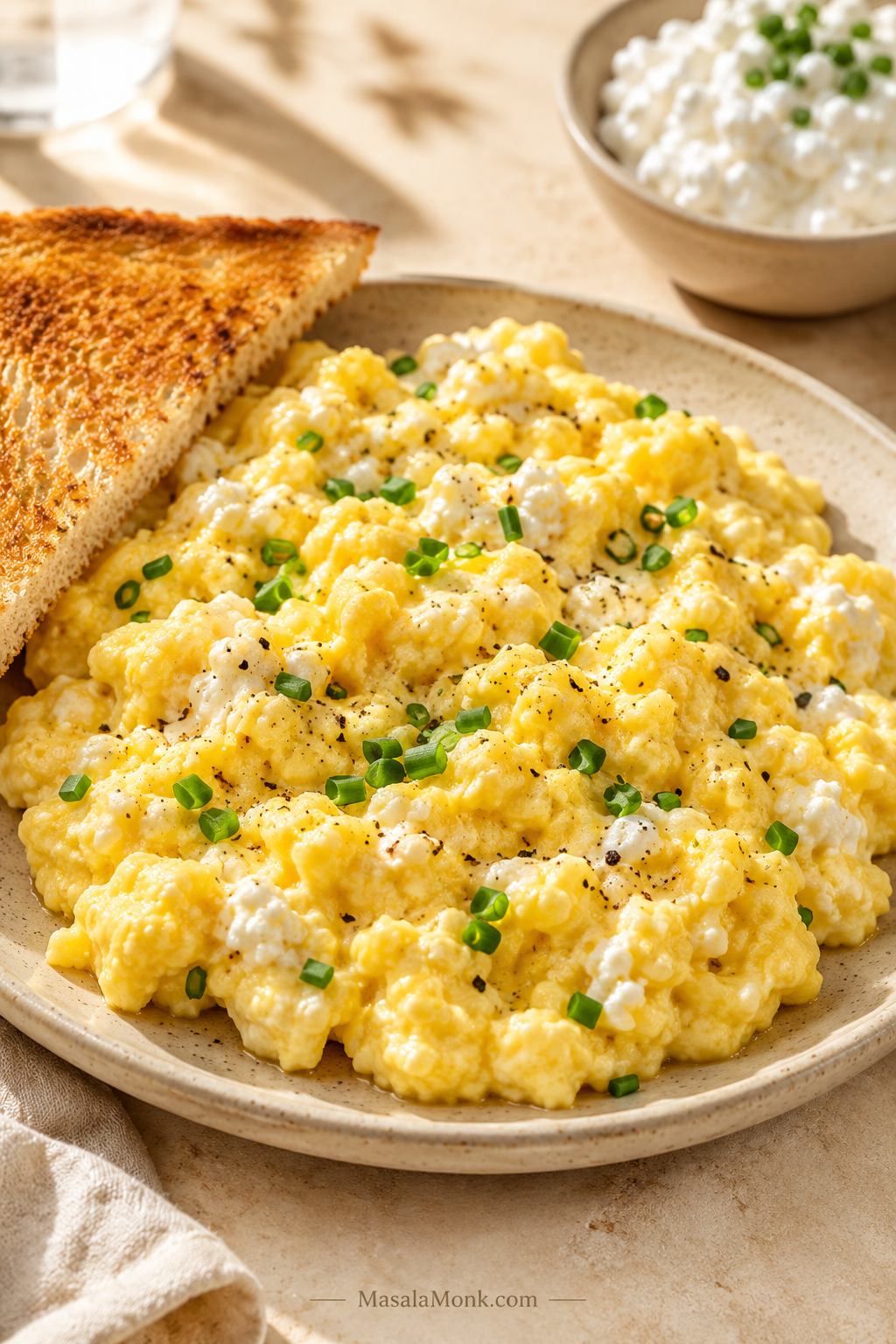
Scrambled eggs with cottage cheese can go one of two ways: creamy, soft, and surprisingly good, or loose and a little strange. The difference is not luck. It is the ratio, the cottage cheese you use, and how gently you cook the eggs.
This recipe is built for the good version: high-protein scrambled eggs that stay tender, creamy, and satisfying without turning wet or rubbery. It walks you through the ratio, the smoother blended option, the egg-white version, microwave method, add-ins, and the fixes that keep cottage cheese eggs from turning watery.
This is especially useful if you want a higher-protein breakfast but still want food that feels warm, familiar, and satisfying. It is not trying to turn eggs into a diet trick; it is just a better, creamier scramble with more staying power.
In This Guide
Quick Answer: How to Make Scrambled Eggs with Cottage Cheese
To make scrambled eggs with cottage cheese, whisk 2 large eggs with 1/4 cup cottage cheese, then cook the mixture gently in a nonstick skillet over medium-low heat. Push the eggs slowly with a silicone spatula until they are thickened, creamy, and just set through.
Best Starting Ratio
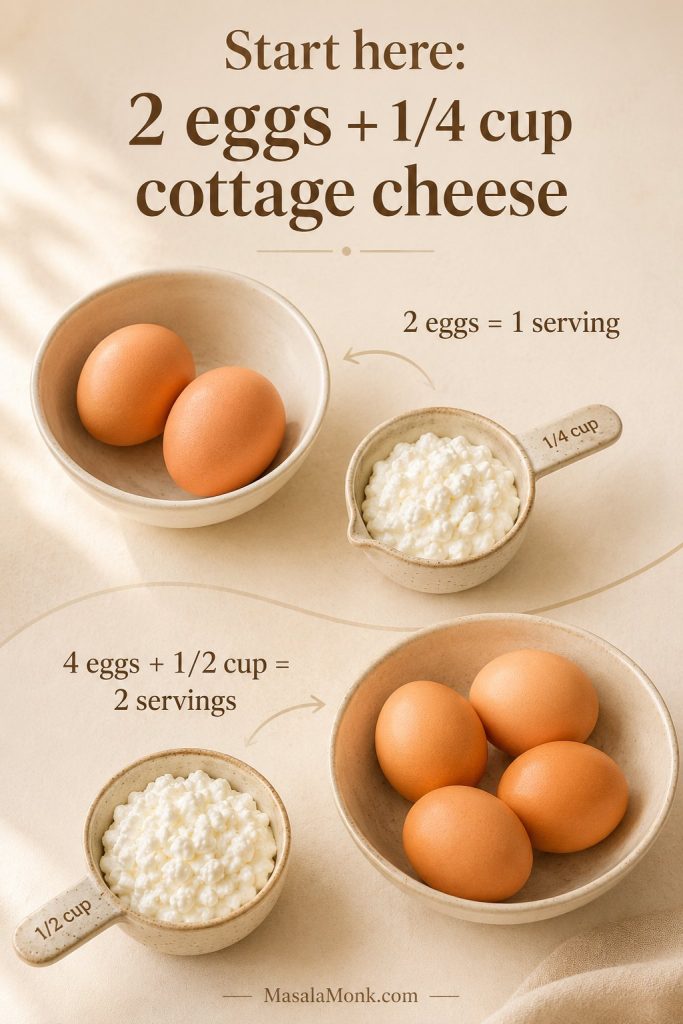
The best starting ratio is 1/4 cup cottage cheese for every 2 eggs. Small-curd 2% cottage cheese gives the most reliable texture, while full-fat cottage cheese tastes richer. If the eggs look loose in the pan, use less cottage cheese next time, drain very liquid cottage cheese, avoid high heat, and cook gently long enough for extra moisture to evaporate.
The full cottage cheese egg ratio guide below shows how to make the eggs subtler, creamier, or better suited to egg whites.
You do not need milk here. Cottage cheese already adds moisture and body, so milk can push the eggs toward watery instead of creamy.
If your last batch turned loose or watery, skip ahead to the watery cottage cheese egg fixes before you cook again.
At a glance: Use 4 large eggs, 1/2 cup / 110–120g cottage cheese, and 1 tablespoon / 14g butter for 2 servings. Cook in a nonstick skillet over medium-low heat for 4–5 minutes. Most reliable cottage cheese: small-curd 2% or full-fat. Texture goal: creamy, soft, and fully set, not runny.
What the Texture Should Look Like
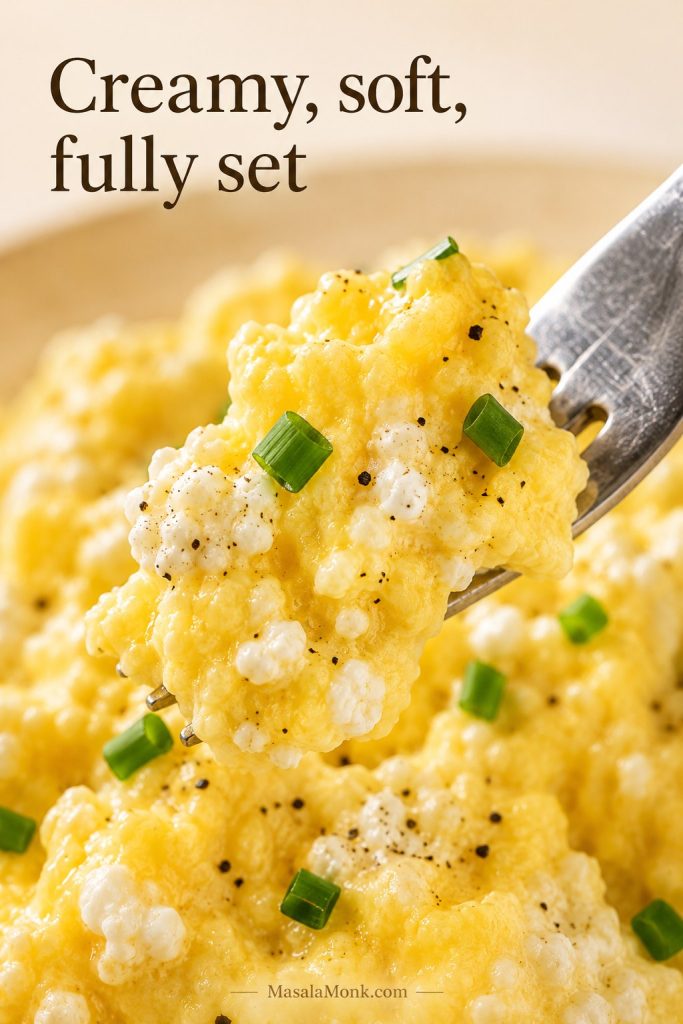
The goal is not a runny protein hack or a rubbery diet scramble. The best version should taste like soft scrambled eggs with a little extra creaminess, body, and staying power.
Done right, the eggs taste creamy and lightly savory, not aggressively cheesy. The curds soften into the scramble, the pepper gives it a little lift, and a handful of chives or scallions makes the whole plate feel fresher.
A good plate feels simple but a little upgraded: soft eggs, gentle creaminess from the cottage cheese, enough protein to hold you over, and a texture that still feels like breakfast instead of a food trend.
Why Add Cottage Cheese to Scrambled Eggs?
Cottage cheese changes scrambled eggs in three useful ways: it adds protein, makes the eggs more satisfying, and gives them a creamy texture when cooked gently. It is also mild enough that the eggs still taste like eggs, especially if you use a balanced ratio and season them well.
More Protein Without Protein Powder
Eggs are already a strong breakfast ingredient, but cottage cheese makes them more filling. That is why cottage cheese eggs are popular with people looking for high-protein breakfasts, lighter brunch ideas, and quick post-workout meals.
The exact protein will depend on your eggs and cottage cheese brand. If you are tracking closely, use the nutrition label on your cottage cheese and a food database such as USDA FoodData Central.
For another breakfast built around everyday protein-rich ingredients, this protein oatmeal guide uses options like eggs, yogurt, cottage cheese, paneer, nuts, and seeds without relying only on protein powder.
Creamier Texture When Cooked Gently
Cottage cheese adds moisture and body to the eggs. With medium-low heat, the curds soften into the scramble and help the eggs stay tender. With high heat, the eggs can tighten too quickly and turn rubbery before the cottage cheese has a chance to settle into the mixture.
Mild Flavor, Easy Add-Ins
These eggs do not have to taste strongly of cottage cheese. If you use small-curd cottage cheese and whisk it in well, the flavor is mild, creamy, and lightly savory. Chives, scallions, black pepper, hot sauce, chili crisp, avocado, spinach, and toast all work well with the flavor.
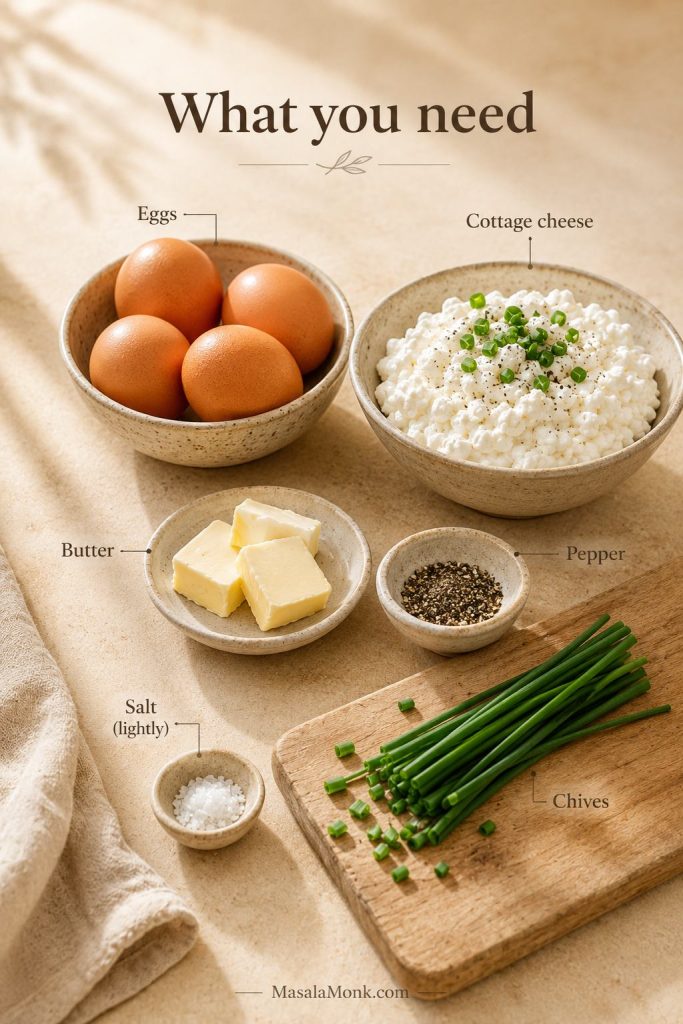
Ingredients for Scrambled Eggs with Cottage Cheese
You only need a few ingredients, but each one affects the final texture. In a simple recipe like this, small choices matter: the cottage cheese style, pan heat, and amount of salt all change the result.
Eggs
Use large eggs. Four large eggs make two servings, while two large eggs plus 1/4 cup cottage cheese make a good single serving. Whole eggs give the best flavor, color, and structure. You can add egg whites for more protein, but an all-egg-white cottage cheese scramble is easier to overcook and can turn thin if the ratio is not controlled.
Cottage Cheese
Use 1/2 cup / about 4 oz / 110–120g cottage cheese for 4 eggs, or 1/4 cup / 55–60g cottage cheese for 2 eggs. Small-curd cottage cheese is the easiest choice because it blends into the eggs more naturally. Large-curd cottage cheese works, but the curds stay more visible.
For the most reliable texture, use 2% cottage cheese. Full-fat cottage cheese gives richer eggs. Fat-free cottage cheese can work, but it often contains more moisture, so it can make the eggs wetter if you use too much.
Butter, Oil, or Cooking Spray
Butter gives the richest flavor and helps the eggs cook into soft folds. Use 1 tablespoon / 1/2 oz / 14g butter for 4 eggs. Olive oil works well if you want something lighter; use 1–2 teaspoons / 5–10ml. Cooking spray is fine for a lower-calorie version, but use a truly nonstick pan and keep the heat gentle.
Salt, Pepper, and Herbs
Cottage cheese is already salty, so season carefully. Start with black pepper and only a tiny pinch of salt, then taste after cooking. Chives, scallions, dill, parsley, and cracked black pepper are especially good here.
Best Cottage Cheese for Scrambled Eggs
The most reliable cottage cheese for scrambled eggs is small-curd 2% cottage cheese. It is creamy enough to soften into the eggs but not so rich that the scramble feels heavy. It also tends to behave better in the pan than watery fat-free cottage cheese.
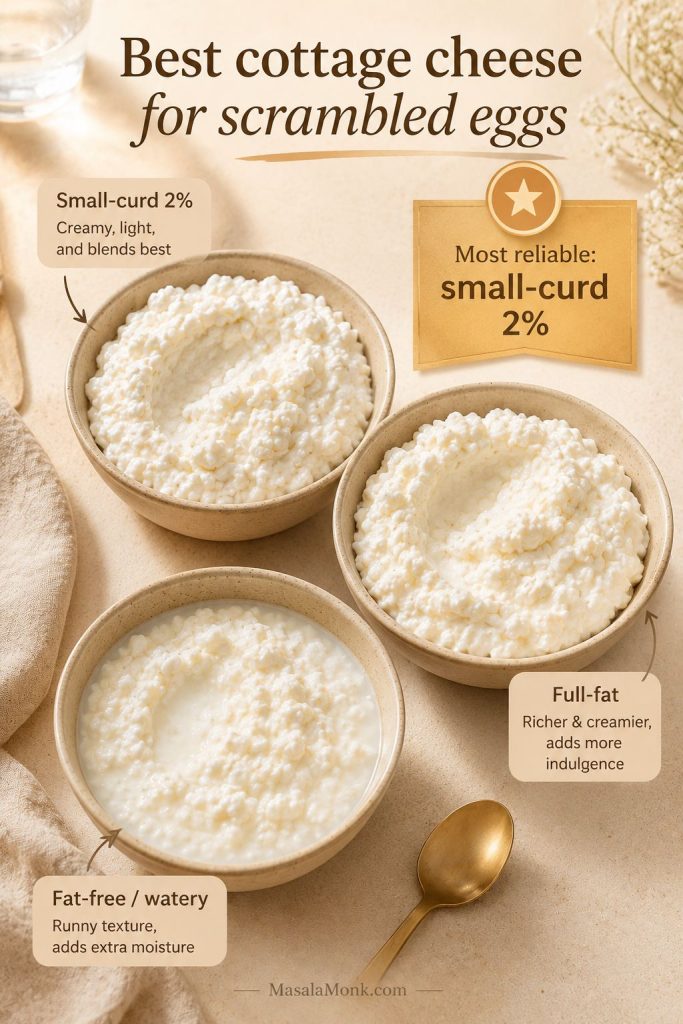
Small-Curd vs Large-Curd Cottage Cheese
The smaller curd disperses more evenly and gives a softer texture. Large-curd cottage cheese is fine if you like visible curds, but it can make the eggs look more uneven.
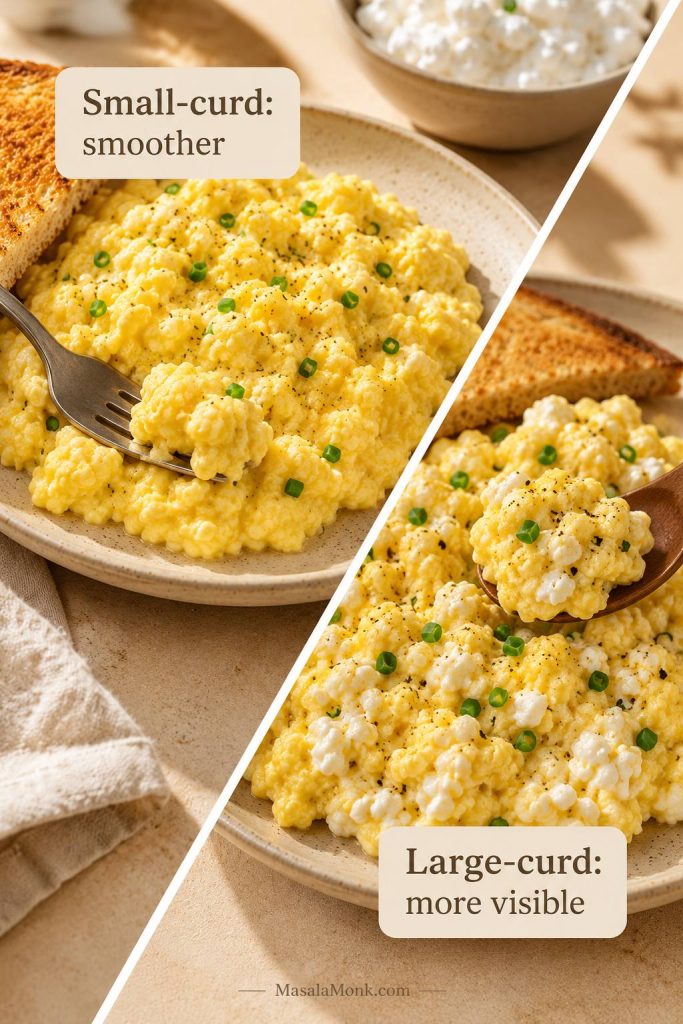
If you are cooking for someone who is skeptical of cottage cheese, use small-curd cottage cheese or blend the eggs and cottage cheese together for a smoother scramble.
For the full texture breakdown, compare the whisk, blend, and fold methods.
2%, Full-Fat, or Fat-Free?
| Cottage Cheese Type | Result in Scrambled Eggs | Best Use |
|---|---|---|
| 2% | Creamy, balanced, reliable | Best everyday choice |
| Full-fat | Richest and softest | Best for extra-creamy eggs |
| Low-fat | Can work well, depending on brand | Good if it is thick, not watery |
| Fat-free | More likely to release moisture | Use less and cook gently |
If your cottage cheese looks especially liquidy, spoon off a little of the excess before adding it to the eggs. Thick, creamy cottage cheese gives you a much easier path to a soft scramble.
Should You Blend the Cottage Cheese First?
Blend the cottage cheese with the eggs if you want a smooth texture with no visible curds. Do not blend if you like the soft, slightly cheesy texture of cottage cheese eggs. For most people, whisking small-curd cottage cheese directly into the eggs is enough.
Scrambled Eggs with Cottage Cheese Ratio Guide
Start with the Balanced Ratio
The safest starting ratio is 1/4 cup cottage cheese for every 2 large eggs. Another way to think of it is about 1–2 tablespoons cottage cheese per egg, depending on how creamy or subtle you want the scramble.
If you are nervous about curds or wateriness, start with 2 tablespoons cottage cheese for 2 eggs. Then, if you love cottage cheese and want a creamier, more filling scramble, increase slightly without overloading the eggs.
Ratio Options by Texture
| Style | Eggs | Cottage Cheese | Metric | Best For |
|---|---|---|---|---|
| Subtle / beginner | 2 large eggs | 2 tbsp | 25–30g | Less curdy, safer first try |
| Balanced default | 2 large eggs | 1/4 cup | 55–60g | Creamy, high-protein everyday eggs |
| Family batch | 4 large eggs | 1/2 cup / about 4 oz | 110–120g | Main recipe-card version |
| Extra creamy | 2 large eggs | 1/3 cup | 75–80g | More cottage-cheese-forward |
| Egg-white boosted | 2 eggs + 1/4–1/3 cup egg whites | 1/4 cup | 60–80ml egg whites + 55–60g cottage cheese | Higher-protein version |
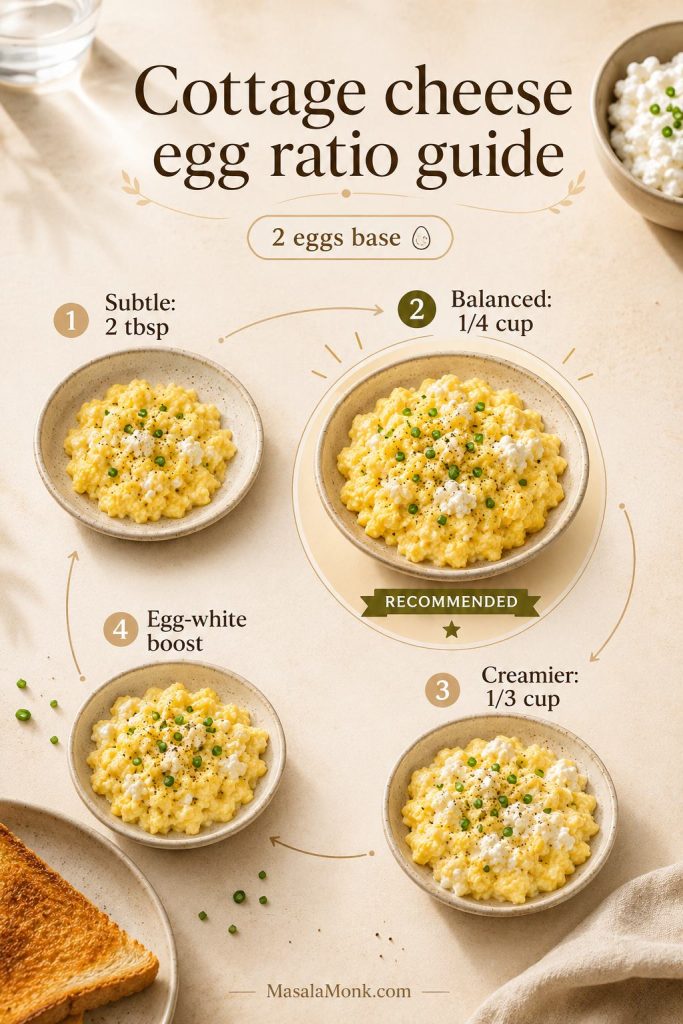
What Testing Showed
After testing the whisked, blended, and folded versions, the tradeoff is simple: the whisked 2-eggs-to-1/4-cup cottage cheese ratio is the most reliable everyday balance. Blending makes the smoothest scramble, but it tastes a little less like classic soft eggs. Folding the cottage cheese in near the end gives the most visible curds and works only when the cottage cheese is thick, not watery.
For your first try, choose the balanced default. Once you know how your cottage cheese behaves in the pan, you can go lighter, smoother, or more cottage-cheese-forward next time.
Make this first: If this is your first time making scrambled eggs with cottage cheese, use 2 eggs, 1/4 cup / 55–60g cottage cheese, 1/2 tablespoon butter, black pepper, and medium-low heat. It is the safest balance of creamy, high-protein, and not too wet.
Once the ratio is set, use the gentle stovetop method to keep the eggs creamy instead of dry.
How to Make Scrambled Eggs with Cottage Cheese
The whole recipe comes down to gentle heat and patience. A few quiet minutes in the pan can turn the eggs into soft, creamy folds instead of dry curds or a loose scramble.
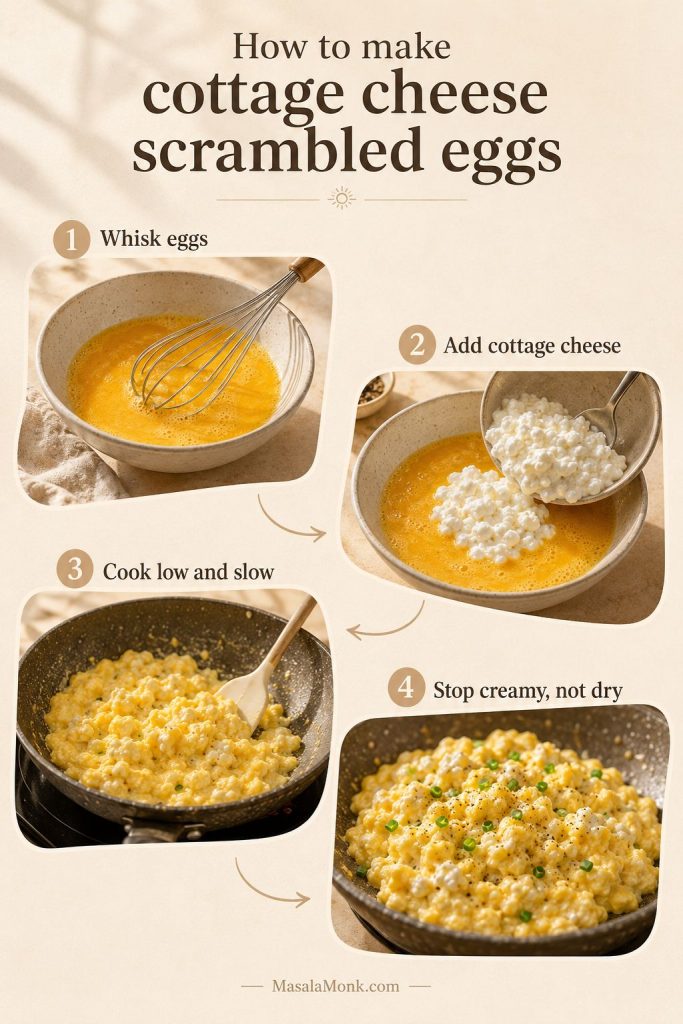
Step 1: Whisk the Eggs
Crack the eggs into a mixing bowl and whisk until the yolks and whites are fully combined. This helps the cottage cheese distribute evenly instead of sitting in pockets.
Step 2: Add the Cottage Cheese
Whisk in the cottage cheese, black pepper, and only a small pinch of salt. If you want smoother eggs, blend the eggs and cottage cheese for a few seconds instead of whisking by hand.
Step 3: Heat the Pan Gently
Warm a nonstick skillet over medium-low heat. For 2 eggs, an 8-inch skillet works well. For 4 eggs, use a 10-inch skillet. Add butter or oil and let it melt without browning.
Step 4: Cook Slowly Into Soft Folds
Pour in the egg mixture. Let the edges set for 10–20 seconds, then use a silicone spatula to slowly push the eggs from the outside of the pan toward the center. Keep moving gently so the eggs gather into soft, creamy folds instead of breaking into tiny dry curds. The pan should look calm, not sizzling.
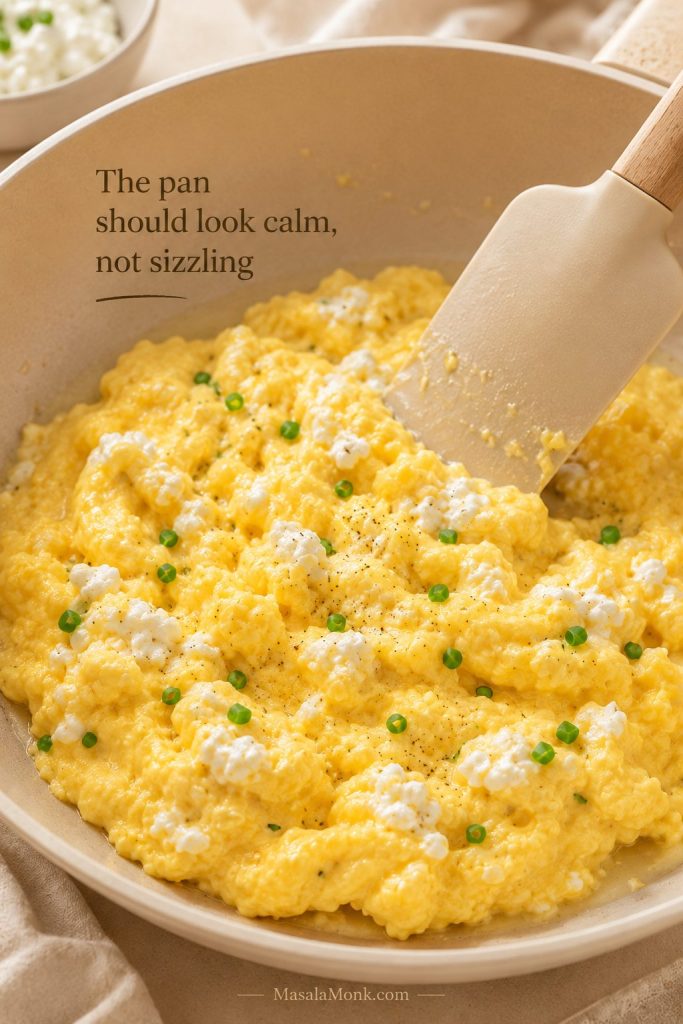
Step 5: Stop While Creamy, Not Runny
Remove the eggs from the heat when they are thickened, creamy, and set through. They will keep cooking slightly from residual heat, so do not wait until they look completely dry in the pan.
You will know they are ready when the eggs hold soft folds on the spatula, look creamy instead of shiny-wet, and slide onto the plate without liquid pooling behind them. If the eggs look glossy but hold together, they are usually ready; if liquid runs around them, give them a little more time over gentle heat.
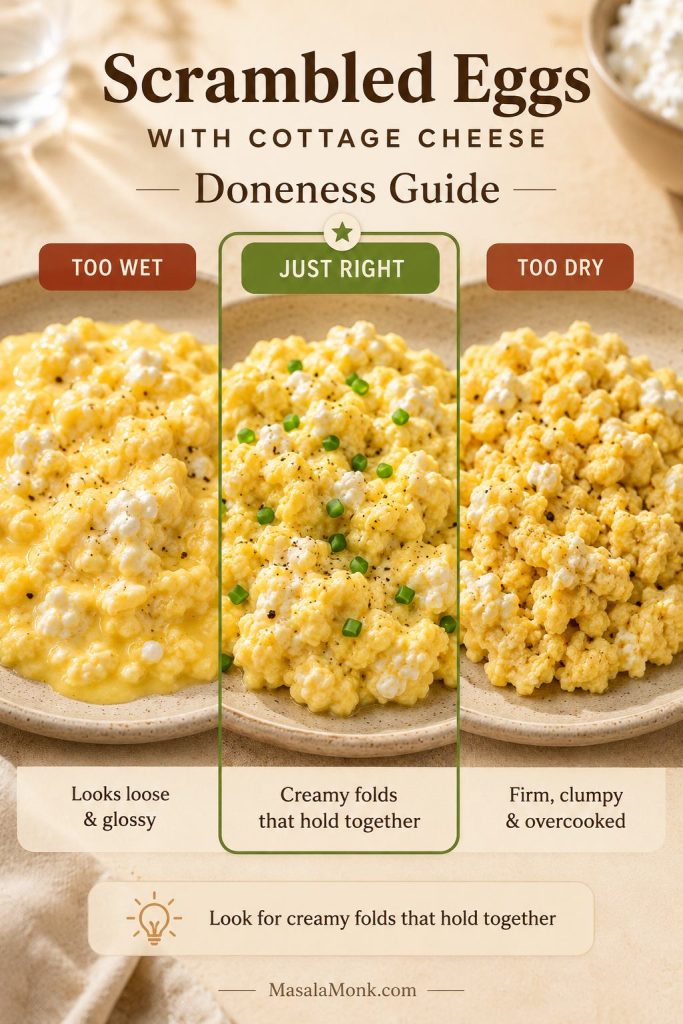
If the eggs still look shiny, separated, or loose, the troubleshooting section will help you fix the next batch.
For food safety, scrambled eggs should be cooked until they are not runny. The FDA’s egg safety guidance recommends cooking egg dishes thoroughly, especially when serving children, older adults, pregnant people, or anyone with a weakened immune system.
Whisk, Blend, or Fold? Three Texture Options
There is more than one way to add cottage cheese to scrambled eggs. The best method depends on whether you want the cottage cheese to disappear into the eggs or stay slightly visible.
| Method | How to Do It | Texture | Best For |
|---|---|---|---|
| Whisk | Whisk cottage cheese into raw eggs | Soft, lightly curdy, fluffy | Best everyday version |
| Blend | Blend eggs and cottage cheese briefly | Smooth and creamy | Cottage-cheese skeptics |
| Fold | Cook eggs first, then fold cottage cheese near the end | More visible curds | People who like cottage cheese texture |
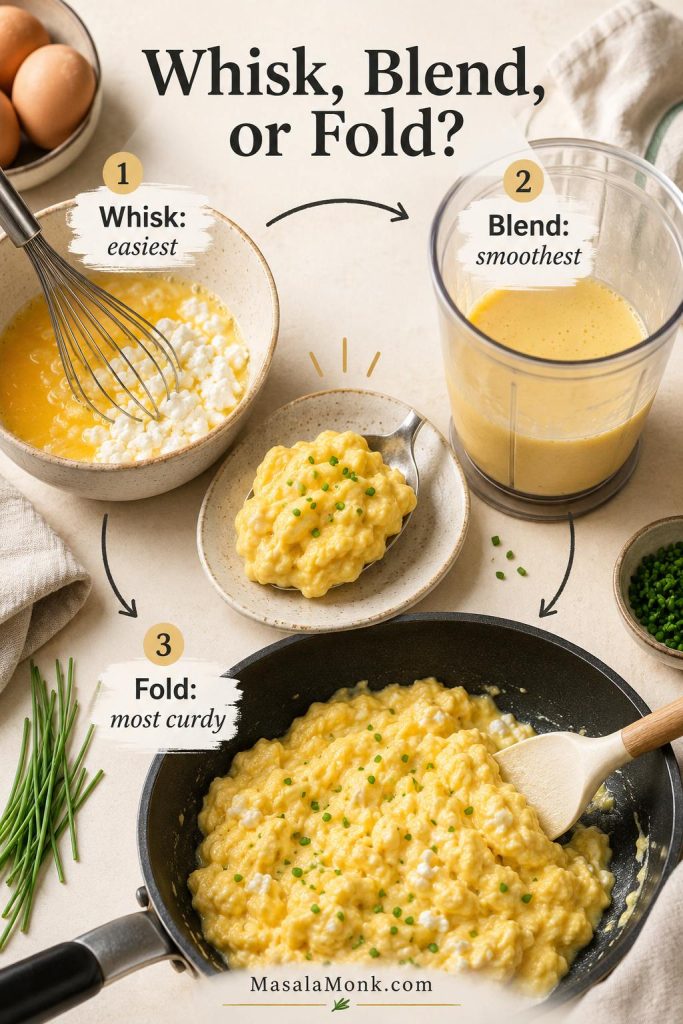
Choose blended if visible curds bother you, whisked for the easiest weekday scramble, and folded only if you actually enjoy the cottage cheese texture.
Using egg whites changes the texture, so check the egg-white version before swapping out too many yolks.
When Should You Add the Cottage Cheese?
Add cottage cheese before cooking for the whisked or blended versions. Fold it in near the end only if you want a more visible cottage cheese texture and your cottage cheese is thick enough not to loosen the eggs.
Egg Whites with Cottage Cheese
Egg whites with cottage cheese are useful if you want a lighter, higher-protein scramble, but the ratio matters. Because they contain more water than yolks, they need a little more care in the pan. Use too many whites with too much cottage cheese, and the eggs can turn thin.
Best Egg-White Ratio
For the creamiest texture, keep at least some whole egg in the scramble. The yolk adds flavor, color, and a little structure, which helps the egg whites feel less flat.
| Version | Use This Ratio | Texture |
|---|---|---|
| Balanced egg-white boost | 2 eggs + 1/4 cup / 60ml egg whites + 1/4 cup / 55–60g cottage cheese | Creamy, lighter, still flavorful |
| Leaner version | 1 egg + 1/2 cup / 120ml egg whites + 2–3 tbsp cottage cheese | Lighter, less rich, more delicate |
| All egg whites | 3/4 cup / 180ml egg whites + 2 tbsp cottage cheese | Leanest, but easiest to overcook or make watery |
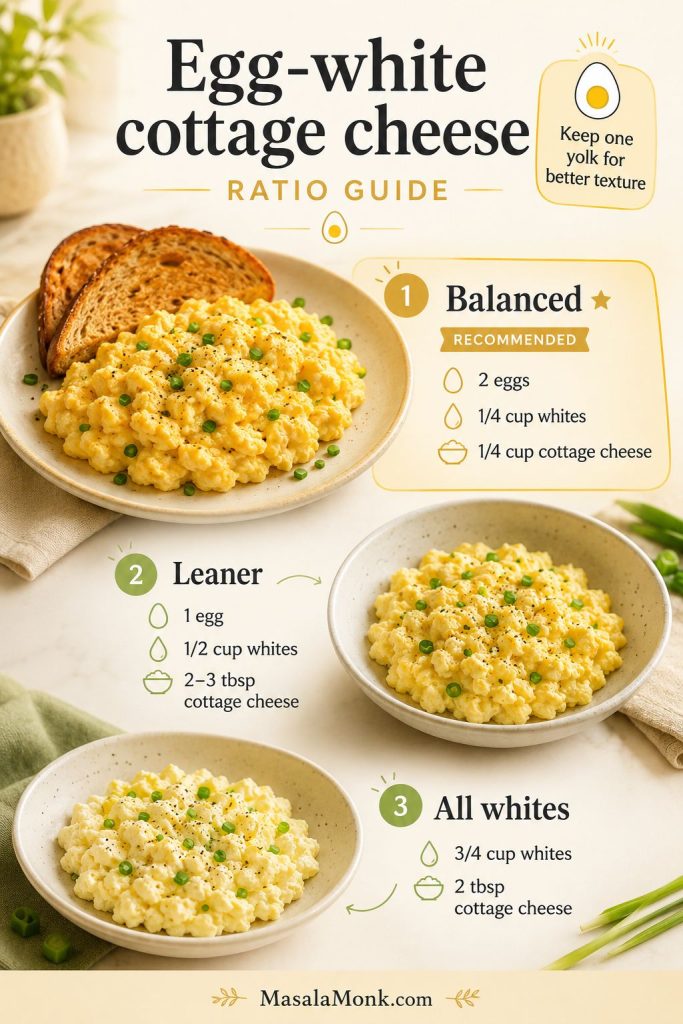
If your egg-white scramble turns thin, the watery egg fixes explain how to adjust the cottage cheese and heat.
Lighter High-Protein Version
For a lighter plate, use 1 whole egg, 1/2 cup / 120ml egg whites, and 2–3 tablespoons cottage cheese. Serve it with spinach, tomatoes on the side, or avocado toast depending on whether you want a lower-calorie breakfast or a more filling meal. It is not a shortcut or a promise; it is simply a protein-rich breakfast that can fit into many eating styles depending on what you serve with it.
How to Keep Egg-White Cottage Cheese Eggs from Getting Watery
Use a thick cottage cheese, skip the milk, and cook over medium-low heat until the eggs are set through. If liquid starts pooling in the pan, keep the heat gentle and give the eggs a little more time. Do not crank the heat up to rush them; that usually makes the eggs rubbery before the moisture cooks off.
Macro-Friendly Add-Ins
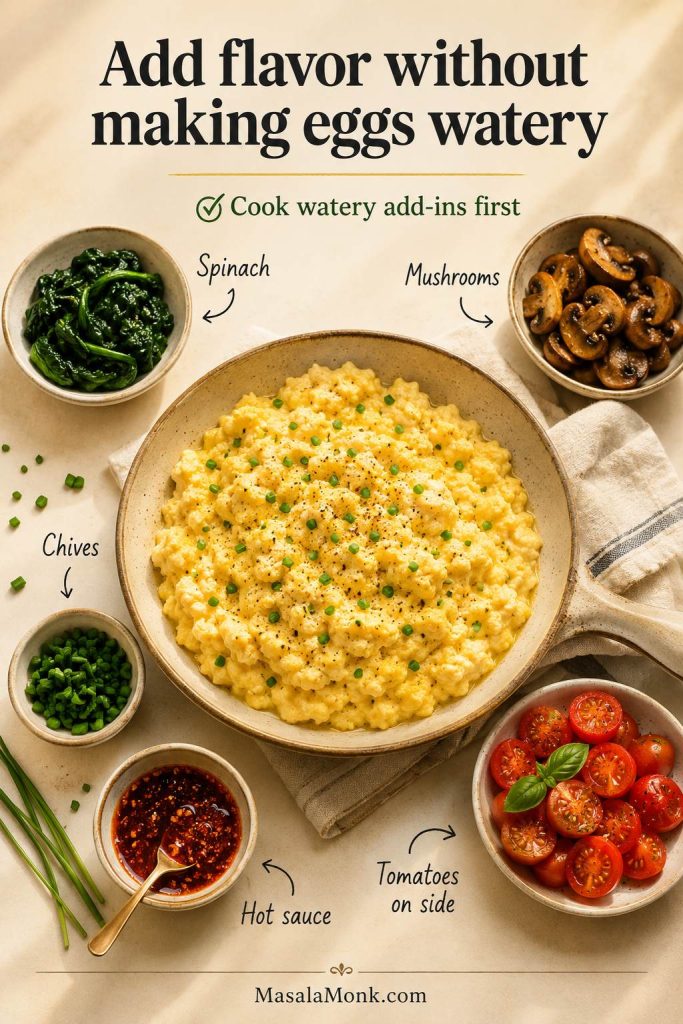
Spinach, mushrooms, scallions, tomatoes on the side, hot sauce, and herbs all work well. If you are adding mushrooms, peppers, or vegetables that release moisture, cook them first so they do not loosen the eggs.
Microwave Cottage Cheese Scrambled Eggs
The skillet version tastes best, but microwave cottage cheese eggs are useful for busy mornings, office breakfasts, and quick solo meals. The texture will be firmer than stovetop scrambled eggs, so cook in short bursts and stir often.
Mug Method for One
Whisk 1 large egg with 1 tablespoon / about 15g cottage cheese in a large microwave-safe mug. Add black pepper and a tiny pinch of salt if needed. Microwave for 30 seconds, stir, then microwave in 15–30 second bursts until the egg is just set through.
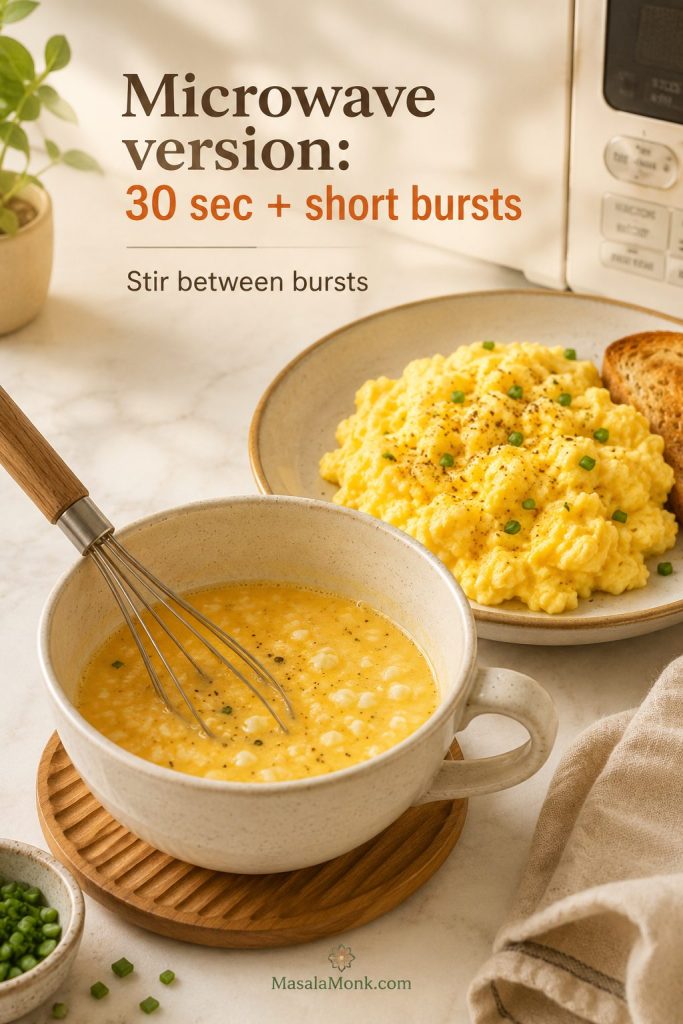
Microwave Texture Tips
- Use a bigger mug than you think you need.
- Stir between bursts so the egg cooks evenly.
- Microwave power varies, so treat the final 15–30 seconds as flexible.
- Stop when the egg is just set, then let it stand for 20–30 seconds before eating.
- Add herbs, hot sauce, or chives after cooking.
- For 2 eggs, use a small microwave-safe bowl instead of a narrow mug.
Add-Ins and Serving Ideas
Scrambled eggs with cottage cheese are mild enough to go savory, spicy, herby, or brunch-style. Avoid adding raw vegetables that release a lot of water directly to the pan in large amounts. Instead, cook them first or serve them on the side.
Best Add-Ins for the Eggs
| Add-In | How to Use It | Notes |
|---|---|---|
| Spinach | Wilt before or during cooking | Adds volume and color |
| Mushrooms | Cook first | Prevents loose eggs |
| Bell pepper | Dice small and sauté first | Good for veggie scrambles |
| Scallions or chives | Add near the end | Fresh, simple, and not watery |
| Tomatoes | Serve on the side or add cooked | Raw tomatoes can release water |
| Chili crisp or hot sauce | Add after cooking | Best for flavor contrast |
| Everything bagel seasoning | Sprinkle after cooking | Use lightly because it is salty |
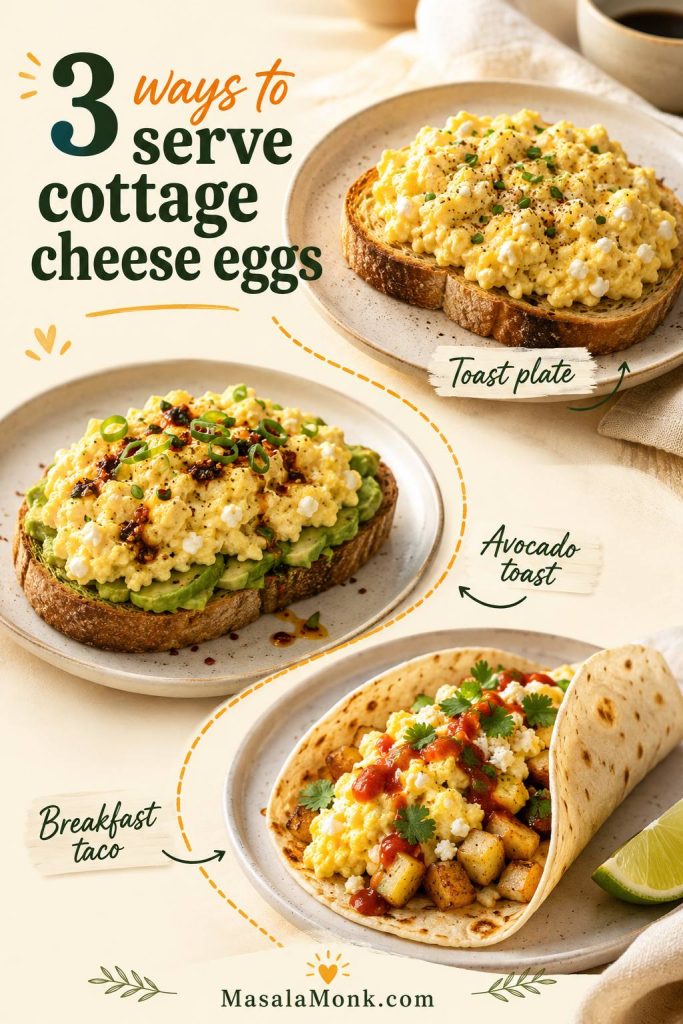
Three Easy Ways to Serve Them
- Simple weekday plate: cottage cheese eggs, buttered toast, black pepper, and chives.
- Avocado toast version: mashed avocado, creamy eggs, chili crisp, and scallions on sourdough.
- Breakfast taco version: warm tortilla, cottage cheese eggs, potatoes, salsa, and hot sauce.
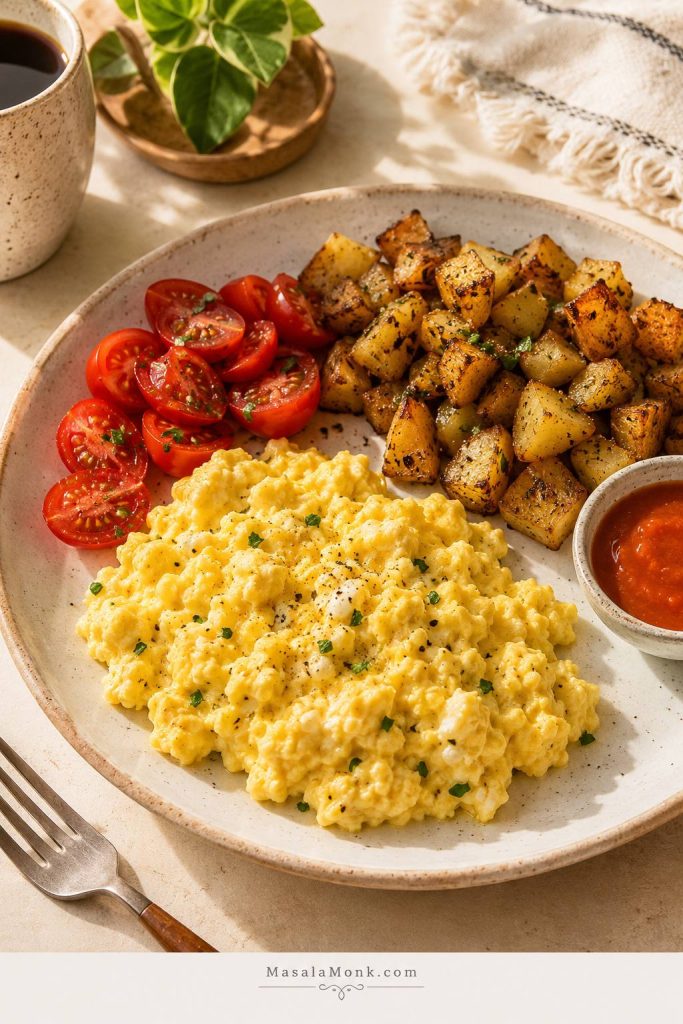
What to Serve with Cottage Cheese Eggs
- Buttered sourdough toast
- Avocado toast
- Breakfast tacos
- Roasted potatoes or air fryer hash browns
- Sautéed spinach or mushrooms
- Fresh tomatoes
- Fruit on the side
- Hot sauce, chili crisp, or salsa
For the easiest plate, keep it simple: creamy eggs, crisp toast, something fresh, and something sharp or spicy. A little hot sauce, salsa, chili crisp, or black pepper keeps the cottage cheese from making the plate taste too mild.
If you want to turn the eggs into a handheld breakfast, tuck them into a tortilla with potatoes, peppers, salsa, or avocado. This breakfast burrito recipe has more ideas for building a filling wrap without making it soggy.
How to Fix Watery or Loose Cottage Cheese Eggs
If your first batch is not perfect, do not write off the recipe. Cottage cheese brands vary a lot, and one small ratio or heat adjustment usually fixes it.
This is the section to read if you tried cottage cheese eggs once and wondered why everyone else seemed to be getting a creamy scramble while yours looked loose, shiny, or separated.
If your eggs tasted good but looked loose, shiny, or a little separated, the recipe probably does not need to be abandoned. It usually just needs less liquid, thicker cottage cheese, or gentler heat.
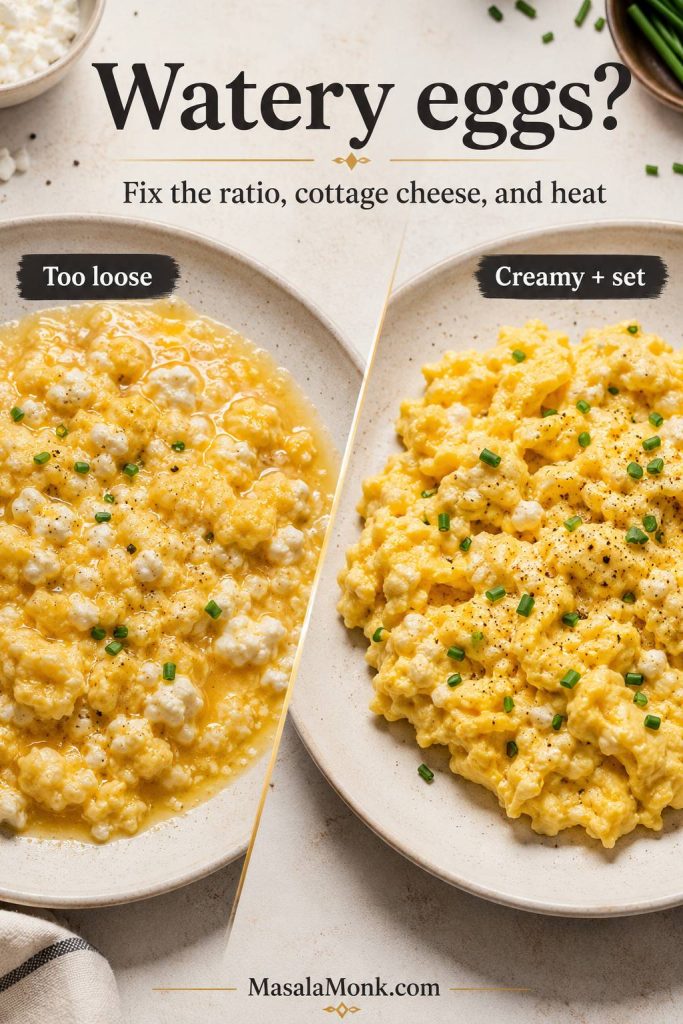
Why Cottage Cheese Eggs Turn Watery
- Too much cottage cheese
- Very liquid cottage cheese
- Watery fat-free or low-fat cottage cheese
- Heat that was too high
- Not enough gentle cooking time
- Raw mushrooms, tomatoes, or peppers
- Too many egg whites
- Added milk
Troubleshooting Watery Cottage Cheese Eggs
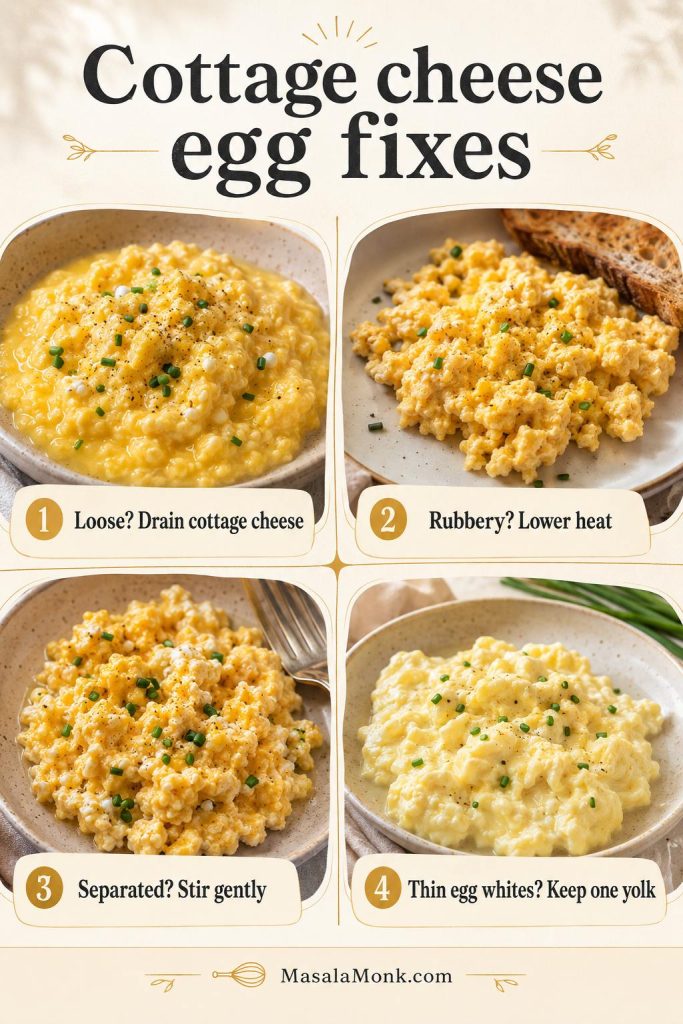
| What Happened | Most Likely Cause | Next Batch Fix |
|---|---|---|
| Eggs tasted good but looked loose | Too much liquid in the cottage cheese | Drain the cottage cheese or use 2 tbsp per 2 eggs |
| Eggs turned rubbery and wet | Heat was too high | Use medium-low heat and cook a little longer |
| Eggs looked separated | Curds released moisture before the eggs set | Whisk better, use thicker cottage cheese, and stir gently |
| Egg-white version turned thin | Too much water from whites plus cottage cheese | Keep one yolk or reduce cottage cheese to 2 tbsp |
Fixes Before Cooking
| Problem to Prevent | What to Do |
|---|---|
| Cottage cheese looks liquidy | Spoon off excess liquid or use slightly less cottage cheese |
| You dislike curds | Blend the cottage cheese with the eggs |
| You want less moisture | Use 2 tbsp cottage cheese per 2 eggs |
| Using vegetables | Cook moisture-heavy vegetables first |
| Using egg whites | Keep at least one yolk or cook gently a little longer |
Fixes While Cooking
| What You See | Fix |
|---|---|
| Liquid pooling in the pan | Keep cooking gently and fold slowly until the extra moisture evaporates |
| Eggs setting too fast | Lower the heat or remove the pan briefly |
| Curds separating | Stir less aggressively and use lower heat |
| Eggs getting rubbery | Pull from the heat sooner next time and use medium-low heat |
What Not to Do
- Skip the milk; cottage cheese already brings moisture.
- Avoid high heat, which can make the eggs tighten before the moisture cooks off.
- Do not start with an extra-heavy cottage cheese ratio on your first try.
- Cook mushrooms, tomatoes, or peppers first if you are adding more than a small handful.
- Once soft folds form, stir gently instead of aggressively breaking the eggs apart.
Once the ratio and heat are right, the recipe is simple: whisk, cook gently, stop while creamy, and serve while the eggs are still soft and warm.
Scrambled Eggs with Cottage Cheese Recipe
Soft, creamy scrambled eggs with cottage cheese for a protein-rich breakfast that feels cozy, filling, and ready in about 10 minutes.
Approximate nutrition: One serving, made with 2 large eggs, 1/4 cup cottage cheese, and 1/2 tablespoon butter, is usually around 220–270 calories with about 18–22g protein. Exact numbers depend on your cottage cheese brand and cooking fat. Because cottage cheese brands vary widely in protein, sodium, and moisture, treat these numbers as an estimate unless you calculate with your exact label.
Equipment
- Mixing bowl
- Whisk or fork
- 10-inch nonstick skillet
- Silicone spatula
Ingredients
- 4 large eggs
- 1/2 cup cottage cheese, about 4 oz / 110–120g, preferably small-curd 2% or full-fat
- 1 tablespoon butter, about 1/2 oz / 14g, or 1–2 teaspoons / 5–10ml olive oil
- 1/8 teaspoon fine salt, optional
- Black pepper, to taste
- 1 tablespoon chopped chives or scallions, optional
Method
- Crack the eggs into a mixing bowl and whisk until the yolks and whites are fully combined.
- Whisk in the cottage cheese, black pepper, and a tiny pinch of salt if using.
- Place a nonstick skillet over medium-low heat. Add the butter or oil and let it melt without browning.
- Pour in the egg mixture and let the edges begin to set for 10–20 seconds.
- Use a silicone spatula to slowly push the eggs from the outside of the pan toward the center, forming soft folds. The pan should look calm, not sizzling.
- Keep cooking gently until the eggs are thickened, creamy, and set through. If liquid runs around the eggs, give them another minute over gentle heat.
- Remove from the heat, sprinkle with chives or scallions if using, and serve immediately.
Notes
- Blend the cottage cheese with the eggs first for a smoother texture.
- Use 2 tablespoons cottage cheese per 2 eggs if you want less cottage cheese texture.
- For an egg-white boosted version, use 2 eggs, 1/4 cup / 60ml egg whites, and 1/4 cup / 55–60g cottage cheese.
- Salt lightly because cottage cheese is already salty.
- Use medium-low heat. High heat can make the eggs rubbery.
- Do not add milk; cottage cheese already adds moisture.
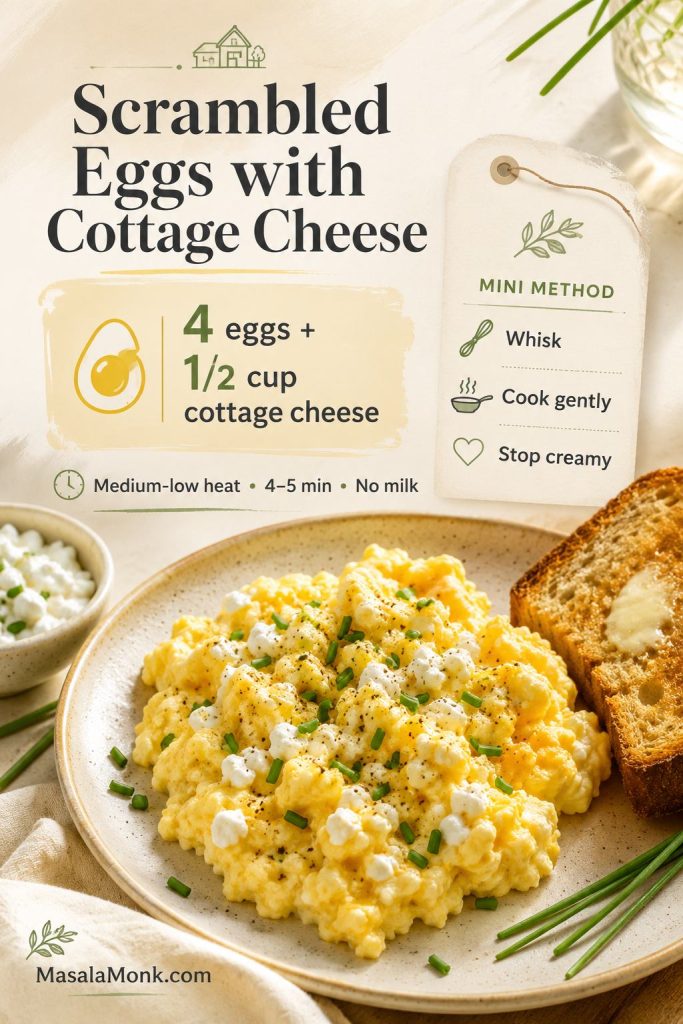
Once you make it once, adjust the ratio to match your cottage cheese and your pan. Some brands melt in softly, some release more liquid, and some taste saltier than others. The recipe gets easier after the first batch.
Storage and Reheating
These are absolutely best right from the pan, so treat leftovers as a backup breakfast rather than the main plan. Still, if you have extra, they can work if you cool and reheat them gently.
For the freshest texture, make the main recipe card version right before serving.
How Long Do They Keep?
Store leftover cottage cheese scrambled eggs in an airtight container in the refrigerator for up to 2 days. Let them cool before closing the container so steam does not create extra moisture.
How to Reheat Without Making Them Rubbery
Reheat in the microwave at reduced power in 15–30 second bursts, stirring gently between bursts. Stop as soon as the eggs are warm. You can also reheat them in a nonstick skillet over low heat.
For a freezer-friendly breakfast instead of fresh scrambled eggs, use the same soft-cooked egg logic in meal prep breakfast burritos, where the eggs need to stay tender without making the tortilla soggy.
Can You Freeze Cottage Cheese Scrambled Eggs?
I would not freeze them. Eggs and cottage cheese can both release moisture after thawing, so the texture usually suffers. For a better make-ahead breakfast, try egg muffins or a sliceable frittata instead.
When you need breakfast for a table instead of one skillet, a breakfast casserole with hash browns is a better make-ahead option than stovetop scrambled eggs.
Final Serving Texture Cue
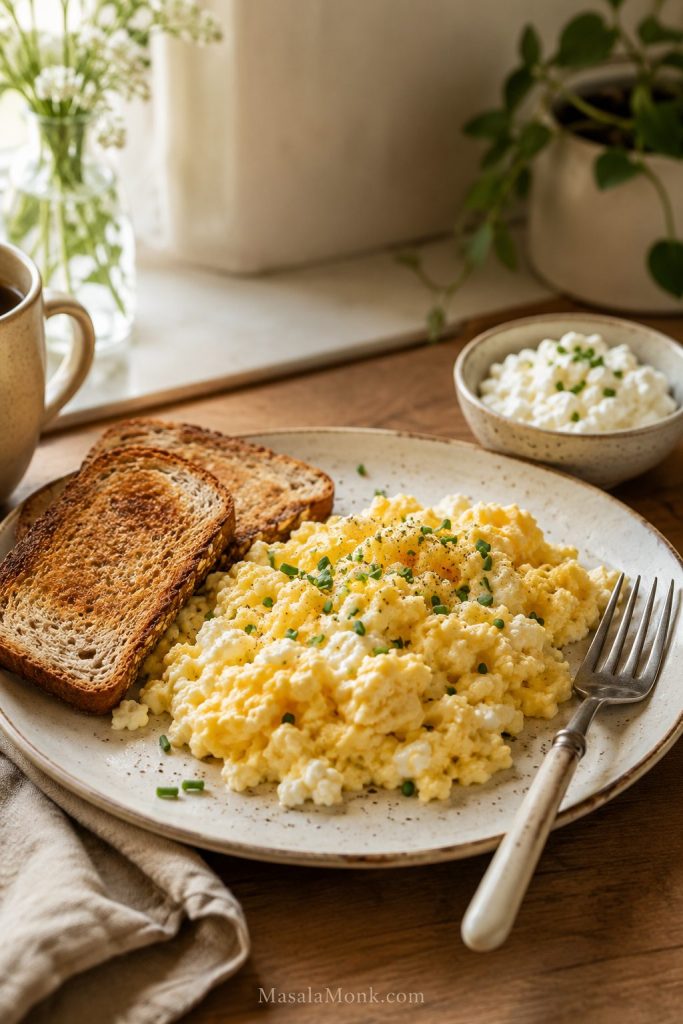
Before you leave the recipe, remember the main visual cue: the eggs should look creamy, softly folded, and set enough to hold together on the plate.
FAQs About Scrambled Eggs with Cottage Cheese
What does cottage cheese do to scrambled eggs?
Cottage cheese adds protein, creaminess, and a mild savory flavor. When cooked gently, it softens into the eggs and makes them more filling without needing milk or cream.
Do scrambled eggs with cottage cheese taste like cottage cheese?
They taste creamy, lightly savory, and only a little tangy. With the balanced ratio, the eggs still taste like eggs; the cottage cheese mostly adds body and richness.
Is it better to blend cottage cheese into eggs?
Blend it if you want smooth eggs with no visible curds. This is the best choice for anyone who likes the protein boost but does not want the cottage cheese texture. Whisk it in if you like a soft, lightly curdy scramble.
Why did my cottage cheese scrambled eggs turn watery?
They probably had too much cottage cheese, a very liquidy brand, too many egg whites, raw watery vegetables, milk, or not enough gentle cooking time. Use 1/4 cup cottage cheese per 2 eggs, choose a thicker cottage cheese, and cook over medium-low heat until the eggs are set through.
What type of cottage cheese works best?
Small-curd 2% cottage cheese is the most reliable everyday choice. Full-fat cottage cheese gives richer eggs. Fat-free cottage cheese can work, but it is more likely to release moisture.
Should I add milk to cottage cheese scrambled eggs?
Skip the milk here. Cottage cheese already brings moisture and body, and adding milk can push the scramble from creamy into loose or wet.
Are cottage cheese eggs good for a high-protein breakfast?
They are a strong high-protein breakfast, especially if you use the balanced ratio of eggs plus cottage cheese instead of stretching the scramble with milk. The exact protein depends on your egg size and cottage cheese label.
Do egg whites work with cottage cheese?
Egg whites work, but the best texture usually comes from keeping at least one whole egg in the mixture. The yolk adds flavor, color, and structure, so the scramble feels creamy instead of thin.
Can I make cottage cheese scrambled eggs in the microwave?
Yes. For one serving, whisk 1 large egg with 1 tablespoon cottage cheese in a large microwave-safe mug. Microwave for 30 seconds, stir, then cook in 15–30 second bursts until set. Let it stand briefly before eating so the center finishes without becoming spongy.
What is the best ratio of cottage cheese to eggs?
The best balanced ratio is 1/4 cup cottage cheese for every 2 large eggs. Use 2 tablespoons for a subtler version, or up to 1/3 cup if you want a richer cottage-cheese-forward scramble.
Can I use boiled eggs with cottage cheese instead?
Yes, but that becomes a different kind of meal. Boiled eggs with cottage cheese work as a quick snack plate, while chopped boiled eggs mixed with blended cottage cheese become a high-protein cottage cheese egg salad.








