Posted on 2 Comments

Egg Muffins Recipe: Easy Breakfast Egg Muffin Cups for Meal Prep

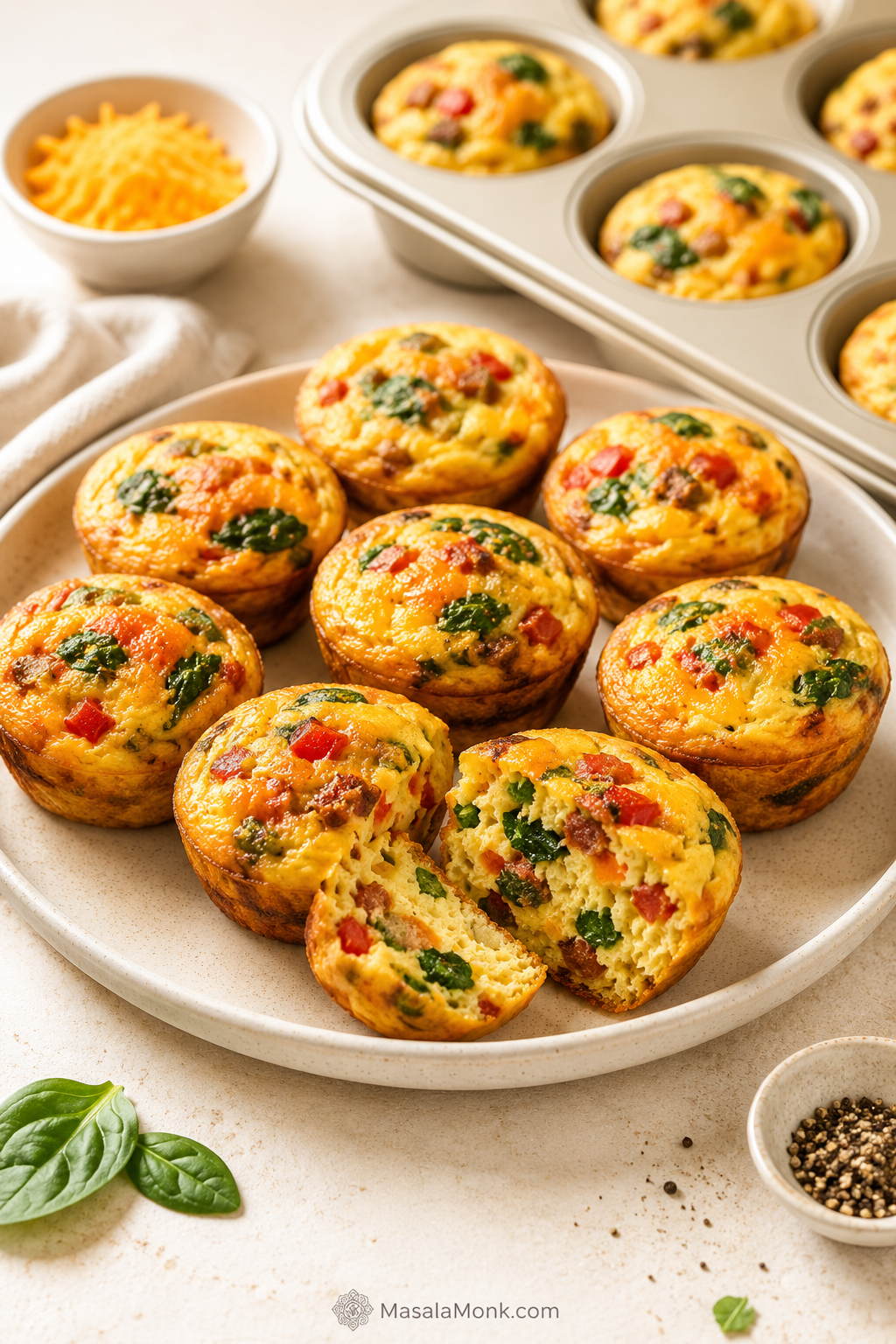
Golden breakfast egg muffins on a cream plate, with one muffin cut open to show egg, spinach, bell pepper, cheese, and cooked meat.

This egg muffins recipe is for the mornings when you want breakfast handled before the day gets loud. The muffins are soft, savory, protein-rich, and easy to reheat, with tender centers, lightly cheesy edges, and enough filling to feel like a real breakfast instead of plain baked eggs.

If your past egg muffins turned watery, rubbery, stuck to the pan, or collapsed into dense, disappointing little pucks, this version fixes the usual problems. The ratio is simple, the fillings are controlled, and the bake is gentle enough for meal prep.

If your last batch failed, jump straight to watery egg muffin fixes, rubbery texture fixes, or sticking and pan-release tips.

This recipe for breakfast egg muffins uses a reliable base formula: 10 eggs, a little dairy, controlled fillings, a 350°F oven, and a 3/4-full muffin cup. The main batch uses cheddar, bell pepper, cooked spinach, and your choice of cooked bacon, sausage, ham, or mushrooms. From there, you can change the fillings without changing the ratio.

Because they are naturally high in protein, these muffin tin eggs are especially useful when you want a savory breakfast before the morning rush. For another freezer-friendly breakfast that feels more filling, keep these in rotation with meal prep breakfast burritos.

Quick Answer: The Best Egg Muffin Cups Recipe

The best egg muffin cups recipe starts with 10 large eggs, 1/4 cup milk or cream, 3/4 cup cheese, and 1 to 1 1/2 cups cooked or well-drained fillings. Bake them in a greased muffin tin or silicone muffin pan at 350°F / 175°C for 18–22 minutes, until the centers are set and no longer wet or jiggly.
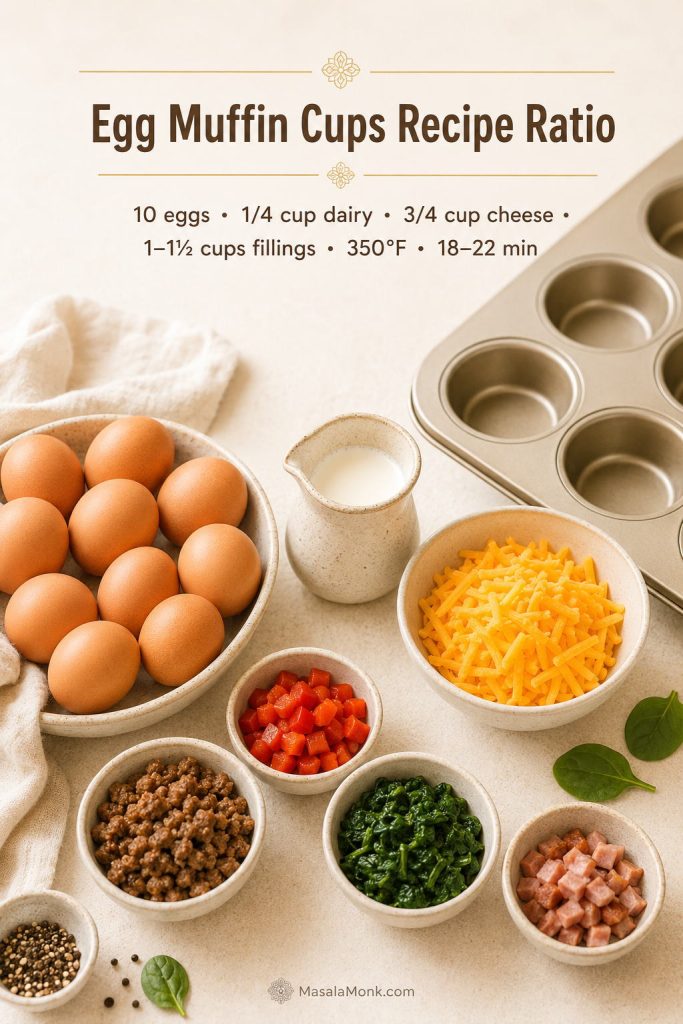
Egg muffin cups recipe ratio board showing eggs, dairy, cheese, cooked fillings, oven temperature, and bake time.
Start with the base ratio before changing flavors. Once the eggs, dairy, cheese, and fillings stay balanced, the recipe becomes much easier to customize.
Detail Start here
Yield 12 egg muffins
Oven temperature 350°F / 175°C
Bake time 18–22 minutes
Eggs 10 large eggs, about 500 g without shells
Dairy 1/4 cup / 60 ml milk, half-and-half, cream, or blended cottage cheese
Cheese 3/4 cup / 85 g shredded cheese
Add-ins 1 to 1 1/2 cups / about 140–225 g cooked or drained vegetables, meat, or both
Fill level About 3/4 full
Doneness cue Set centers, lightly puffed tops, no wet jiggle

Once you have the base formula, you can jump to the full ratio guide, the step-by-step method, or the meal prep storage tips.

The First Batch to Make

For the first batch, use cheddar, bell pepper, cooked spinach, and cooked bacon, sausage, ham, or mushrooms. It gives you color, savory flavor, protein, and a steady texture without pushing the filling too far.
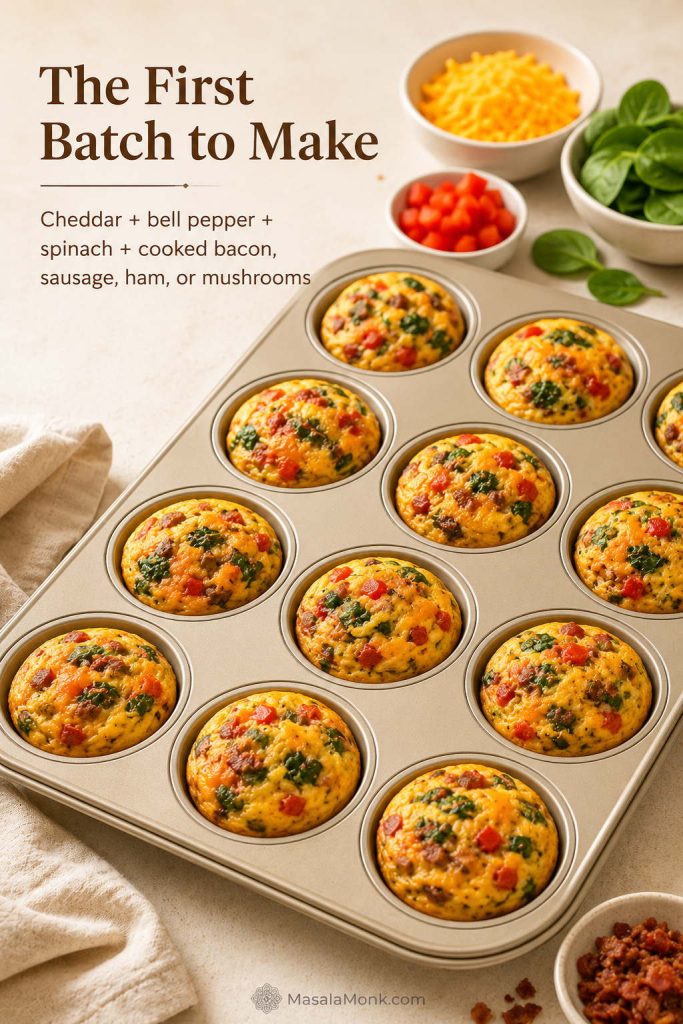
Muffin tin filled with breakfast egg muffins made with cheddar, bell pepper, cooked spinach, and cooked bacon, sausage, ham, or mushrooms.
This first batch gives you color, protein, and savory flavor without overloading the muffin cups. After that, adjust one ingredient at a time so you know what changed the texture.

As a result, the finished egg muffins are savory, cheesy, and tender, with little pockets of vegetables and protein in every bite. They puff in the oven, settle slightly as they cool, and stay sturdy enough for meal prep without tasting dry when reheated gently.

Egg Muffins Recipe Card

These savory egg muffins bake up tender, cheesy, and sturdy enough for meal prep, with bell pepper, spinach, and your choice of cooked bacon, sausage, ham, or mushrooms in every bite. They are easy to customize, simple to reheat, and designed to stay soft instead of turning watery or rubbery.

Yield12 egg muffins
Prep Time12 minutes
Cook Time18–22 minutes
Total TimeAbout 35 minutes

Ingredients

  • 10 large eggs, about 500 g without shells
  • 1/4 cup / 60 ml milk, half-and-half, cream, or blended cottage cheese
  • 3/4 cup / 85 g shredded cheddar, Monterey Jack, mozzarella, Swiss, pepper jack, feta, or mixed cheese
  • 1/2 cup / 70–80 g finely diced bell pepper, raw for a little crunch or sautéed 2–3 minutes for softer, less watery muffins
  • 1/2 cup / 70–80 g cooked spinach, squeezed dry and chopped
  • 1/2 cup / 60–75 g cooked and drained bacon, sausage, ham, turkey sausage, chicken sausage, mushrooms, or extra vegetables
  • 3/4 teaspoon fine salt
  • 1/4 teaspoon black pepper
  • 1/4 teaspoon garlic powder, optional
  • 1/4 teaspoon onion powder, optional
  • Cooking spray, butter, or oil for greasing

Instructions

  1. Preheat the oven to 350°F / 175°C. Grease a 12-cup muffin pan generously, or use lightly greased silicone liners.
  2. Cook and drain any watery or greasy fillings. Mushrooms, onions, spinach, zucchini, bacon, sausage, turkey sausage, chicken sausage, and similar fillings should be cooked before adding.
  3. In a large bowl, whisk the eggs, dairy, salt, pepper, garlic powder, and onion powder until just combined.
  4. Divide the cooked fillings and cheese evenly among the muffin cups.
  5. Pour the egg mixture over the fillings, filling each cup about 3/4 full.
  6. Bake for 18–22 minutes, until the centers are set and the tops are lightly puffed.
  7. Cool in the pan for 5–10 minutes, then remove carefully.
  8. Serve warm, or cool completely before storing for meal prep.

Recipe Notes

  • Use silicone if you want the easiest release.
  • Do not overfill the cups; egg muffins puff while baking.
  • Cook and drain watery vegetables before baking.
  • If starting with fresh spinach, use about 2 packed cups, cook it down, then squeeze dry before measuring 1/2 cup cooked spinach.
  • Cook and drain meat before adding it to the egg mixture.
  • Reheat gently to avoid rubbery eggs.
  • For a softer, higher-protein version, blend cottage cheese into the egg base.
  • For a vegetarian batch, replace bacon, sausage, or ham with sautéed mushrooms, broccoli, peppers, or extra spinach.
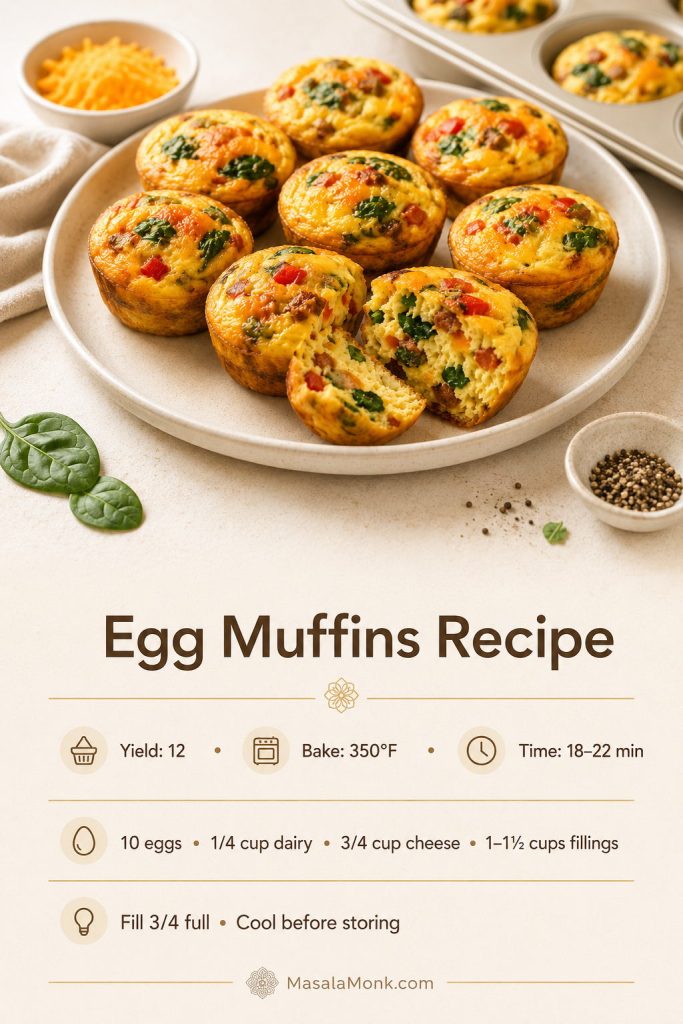
Saveable egg muffins recipe card with yield, bake temperature, bake time, fill level, and meal prep reminders.
The quick formula matters: 12 egg muffins, 350°F, 18–22 minutes, and cups filled about 3/4 full. Together, those details help the batch bake evenly.

What Are Egg Muffins?

At their simplest, egg muffins are small baked egg cups made in a muffin pan. They are not sweet muffins, and they do not have a bread-like crumb. Instead, they are closer to mini frittatas: eggs are whisked with a little dairy, cheese, seasoning, and fillings, then baked until set.

Because these are muffins made with egg rather than flour, the recipe depends more on oven timing, moisture control, and the right pan than on traditional muffin mixing technique.

That muffin-tin shape is what makes them useful. Each cup becomes a single portion, so you can eat one or two for breakfast, pack them in a lunchbox, or store a batch in the fridge for busy mornings.

For more easy ways to build meals around eggs, this guide to egg dishes with 2 eggs gives you extra breakfast and brunch ideas beyond muffin tin eggs.

Are Egg Muffins the Same as Egg Cups?

Usually, yes. Many people use the names egg muffins, egg muffin cups, and egg cups for the same basic idea. The difference is that some egg cup recipes use a “cup” or shell made from bacon, hash browns, tortillas, or bread.

This version uses the classic whisked-egg muffin tin method. Later in the post, you will also find notes for bacon egg muffins, hash brown egg cups, cottage cheese egg muffins, and other variations.

Are Egg Muffins Mini Frittatas?

Yes, that is the easiest way to understand their texture. Egg muffins are basically small frittatas baked in a muffin tin. They should be set and tender, not wet in the middle and not dry like overcooked scrambled eggs.

What Texture Should Egg Muffins Have?

Good egg muffins should be set and tender, not wet in the middle and not dry or squeaky around the edges. They are usually firmer than café-style egg bites, but they should still reheat without turning tough.

Why This Recipe Works

What makes this recipe reliable is the balance between the egg base, fillings, cheese, dairy, and bake time. In other words, the goal is not just to make egg muffins that look good when they come out of the oven. The goal is to make breakfast egg muffins that still taste good after chilling and reheating.

The real win is that these egg muffins are not just good straight from the oven. They are built to survive the fridge, the microwave, and a busy weekday morning without turning wet, bland, or rubbery.

  • 10 eggs make fuller muffins. An 8-egg batch can work, but 10 eggs gives a steadier all-purpose texture for 12 muffin cups.
  • A little dairy keeps the eggs tender. Milk, half-and-half, cream, or blended cottage cheese helps soften the texture.
  • The add-ins are controlled. Too many vegetables or meats can make egg muffins watery, crumbly, or hard to remove.
  • Watery fillings are cooked or drained first. Spinach, mushrooms, onions, zucchini, and tomatoes need extra attention.
  • 350°F / 175°C is gentle enough for meal prep. A slightly lower oven temperature helps avoid rubbery edges.
  • The pan matters. Silicone or a very well-greased pan makes removal much easier.
  • A short cooling time helps. Resting the muffins for 5–10 minutes helps them finish setting and release more cleanly.

Ingredients for Breakfast Egg Muffins

The ingredients are simple, but they should taste like more than “eggs in a muffin tin.” Cheddar brings savory richness, bell pepper adds small sweet pops, spinach keeps the batch colorful, and bacon, sausage, ham, or mushrooms make each cup feel like a real breakfast. The key is keeping those add-ins flavorful without letting them make the muffins watery.

Already know your fillings? Skip ahead to how to prep vegetables and protein, or check the watery egg muffin fixes if your batches often release liquid after baking.
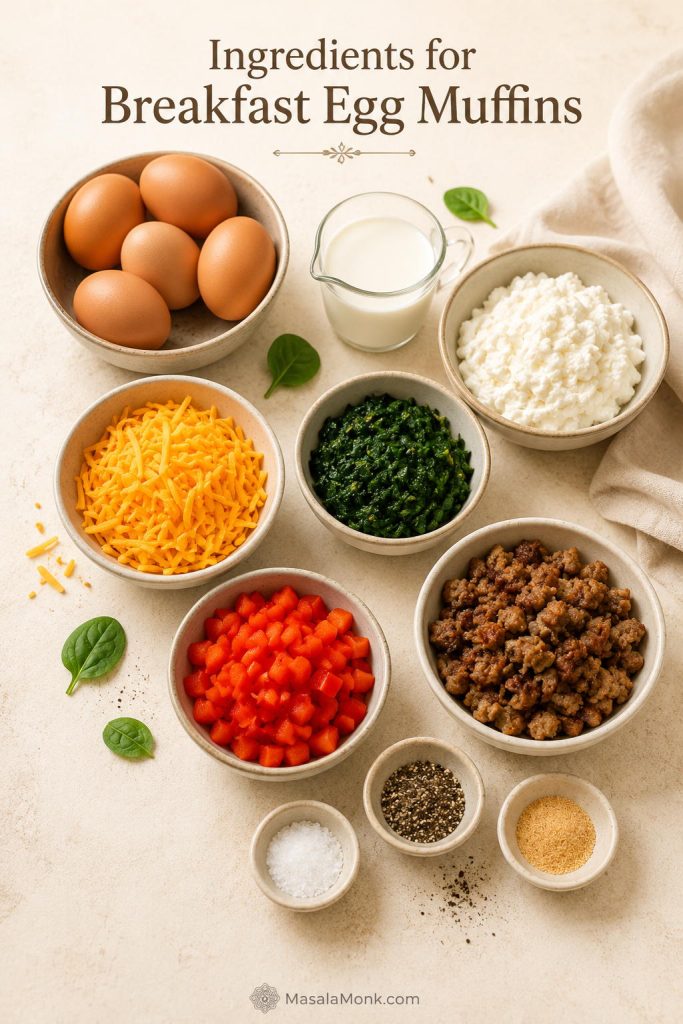
Ingredients for egg muffins arranged on a light surface, including eggs, dairy, cheese, bell pepper, cooked spinach, cooked protein, and seasonings.
Simple ingredients can still make flavorful breakfast egg muffins. For the best texture, cook and drain watery fillings before they go into the pan.

Eggs

Use 10 large eggs, about 500 g without shells, for the main batch. This amount fills a standard 12-cup muffin pan nicely when combined with dairy, cheese, and fillings.

  • 8 eggs make lighter, more filling-heavy muffins.
  • 10 eggs give the most reliable all-purpose balance.
  • 12 eggs make firmer, more egg-forward muffins.

If you are making egg white muffins, use extra seasoning and some cheese or cottage cheese for softness. Egg whites can turn rubbery faster than whole eggs, especially if they are overbaked.

Milk, Cream, Half-and-Half, or Cottage Cheese

Use 1/4 cup / 60 ml milk, cream, half-and-half, or blended cottage cheese for a standard batch. Milk gives a lighter texture, half-and-half makes the muffins a little softer, and cream gives a richer low-carb version.

Use 1/4 cup blended cottage cheese as a simple dairy swap in the standard recipe. However, use 3/4–1 cup blended cottage cheese only when you want a softer, higher-protein egg-bite-style version. If you want the cottage cheese to disappear into the egg base, blend it first until smooth.

For the softest, higher-protein version, cottage cheese works best when it is blended into the egg base instead of stirred in as curds.
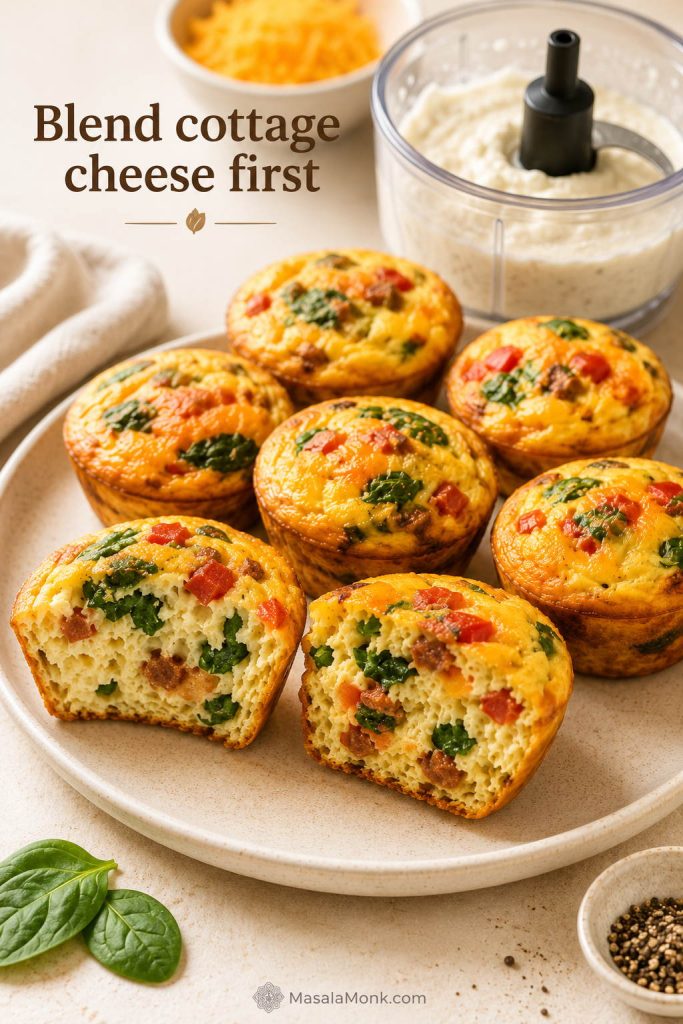
Cottage cheese egg muffins with a soft interior and blended cottage cheese in the egg base.
Blended cottage cheese gives this version its softer, higher-protein texture. Stirring it in as curds can leave the egg base less smooth.

Dairy-Free Egg Muffins

For dairy-free egg muffins, use unsweetened dairy-free milk and skip the cheese, or use a dairy-free shredded cheese you already like. The muffins may be a little firmer without dairy or cheese, so avoid overbaking and add flavorful vegetables, herbs, salsa, or cooked sausage for balance.

This is still an egg-based breakfast. For high-protein breakfasts without eggs, these plant-based breakfast ideas are a better fit than trying to force this recipe into an egg-free version.

Cheese

Use 3/4 cup / 85 g shredded cheese for balanced egg muffins. Cheddar, Monterey Jack, mozzarella, Swiss, pepper jack, and feta all work.

  • 3/4 cup is balanced.
  • 1 cup is cheesier but still reasonable.
  • 1 1/2 cups is better reserved for richer bacon or sausage egg muffins.

Too much cheese can make the edges stick and the bottoms feel greasy, so start with 3/4 cup and increase only if you want a richer batch.

For a lighter batch, use more vegetables, lean meat, milk instead of cream, and a little less cheese. If you skip cheese completely, add extra herbs, seasoning, or salsa so the muffins still taste savory and balanced.

Vegetables and Protein Add-Ins

For the best texture, use 1 to 1 1/2 cups total cooked or well-drained add-ins, which is about 140–225 g depending on the ingredients. That could be vegetables, meat, or a mix of both.

Good options include bell pepper, spinach, mushrooms, onions, broccoli, tomatoes, bacon, sausage, ham, turkey sausage, chicken sausage, feta, cheddar, and herbs. Cook bacon, sausage, mushrooms, onions, spinach, zucchini, and other watery or greasy fillings before adding them to the muffin tin.
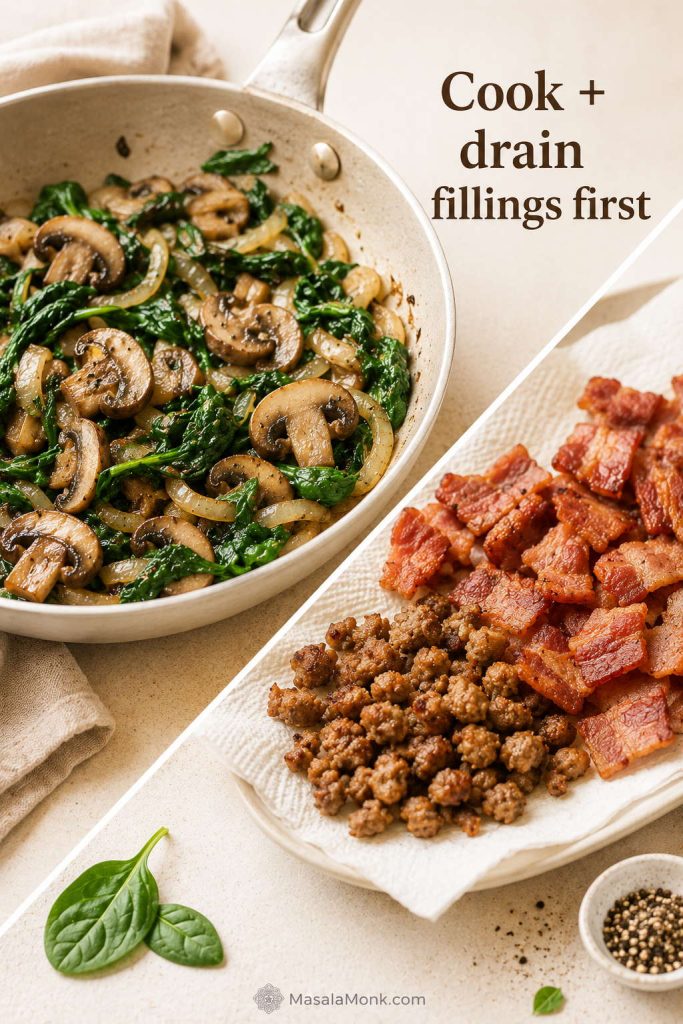
Cooked vegetables and drained meat for egg muffins, showing sautéed spinach, mushrooms, onions, and cooked bacon or sausage.
Cooked, drained fillings make a cleaner egg muffin cup. They prevent extra vegetable liquid and meat fat from pooling at the bottom.
Important: Do not add raw sausage, bacon, chicken, turkey, or other raw meat to the egg mixture. Cook meat fully, drain off excess fat, then divide it among the muffin cups.

Seasoning

Egg muffins need enough seasoning because eggs and vegetables can taste flat once chilled. Start with:

  • 3/4 teaspoon fine salt
  • 1/4 teaspoon black pepper
  • 1/4 teaspoon garlic powder, optional
  • 1/4 teaspoon onion powder, optional

You can also add smoked paprika, chili flakes, chopped herbs, curry powder, taco seasoning, or everything bagel seasoning depending on the flavor you want.

The Best Egg Muffin Ratio

Think of this as the formula that keeps the batch predictable. Once the egg base, cheese, and fillings stay in balance, you can change the flavor without gambling on the texture.
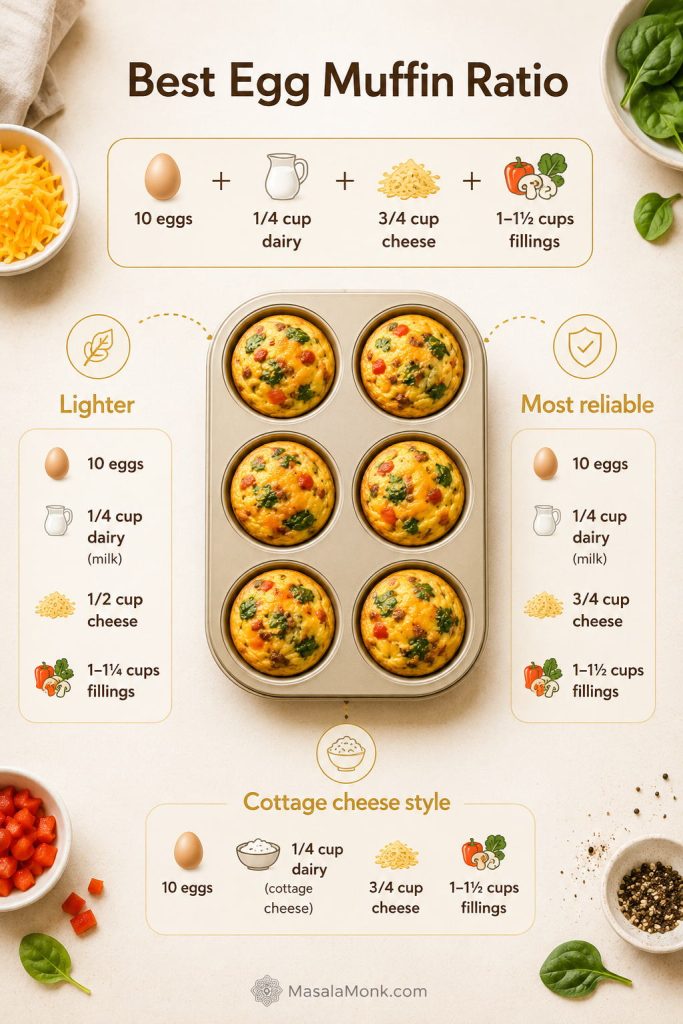
Best egg muffin ratio board showing lighter, most reliable, and cottage cheese batch styles with eggs, dairy, cheese, and fillings.
Your egg muffin ratio can change with the texture you want. Use the 10-egg version as the all-purpose batch, then shift lighter or softer once you know your preference.
Batch style Eggs Dairy Cheese Add-ins Works well for
Lighter 8 eggs 1/4 cup / 60 ml 1/2–3/4 cup 1 cup Veggie-heavy muffins
Most reliable 10 eggs 1/4 cup / 60 ml 3/4 cup / 85 g 1–1 1/2 cups Classic breakfast egg muffins
Extra egg-forward 12 eggs 1/4–1/3 cup 3/4–1 cup 1 cup Protein-heavy or low-carb muffins
Cottage cheese style 8–10 eggs 3/4–1 cup blended cottage cheese Optional 1 cup Softer, higher-protein egg muffins

If you are scaling the batch, go to how to scale the recipe. If your muffins overflow or stick around the edges, check how full to fill the cups before baking.

How to Scale the Recipe

You can scale the same ratio up or down without changing the method.

Batch size Eggs Dairy Cheese Add-ins
6 egg muffins 5 large eggs 2 tablespoons / 30 ml 6 tablespoons / about 40 g 1/2–3/4 cup
12 egg muffins 10 large eggs 1/4 cup / 60 ml 3/4 cup / 85 g 1–1 1/2 cups
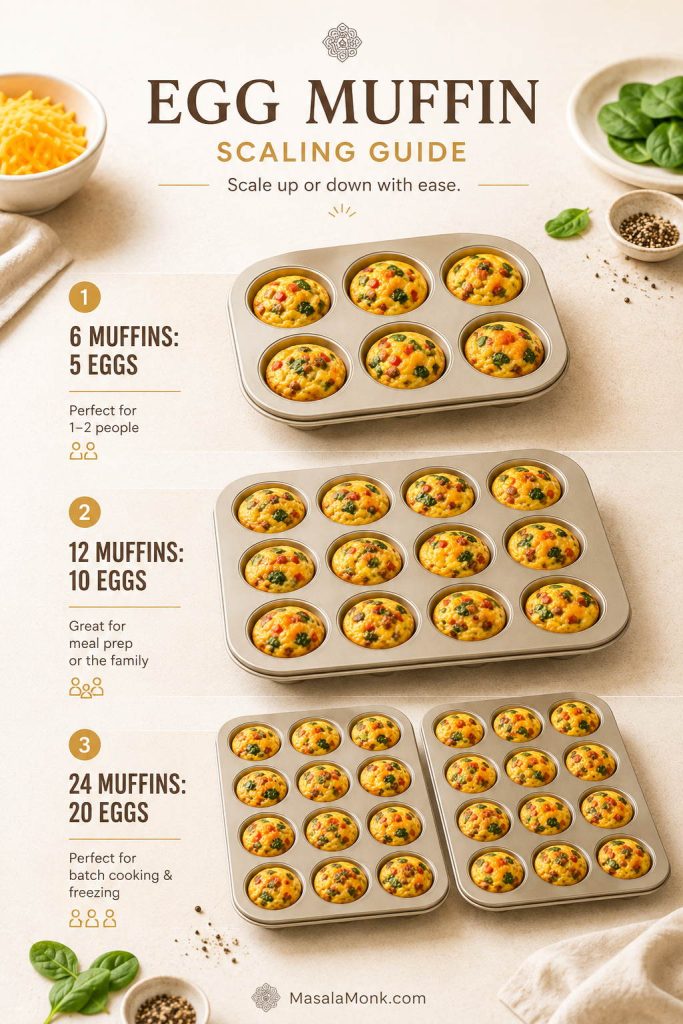
24 egg muffins 20 large eggs 1/2 cup / 120 ml 1 1/2 cups / 170 g 2–3 cups
Egg muffins scaling guide showing 6 muffins, 12 muffins, and 24 muffins with matching egg amounts.
Scaling stays simple when the ratio stays the same. Therefore, a small batch or double batch can use the same method without guesswork.

How Full Should You Fill the Muffin Cups?

Fill each muffin cup about 3/4 full. If the cups are too low, the muffins look flat. If they are too full, the egg mixture can overflow, bake onto the edges, and stick to the pan.

As they bake, egg muffins puff and then settle slightly as they cool. That small deflation is normal and does not mean the recipe failed.
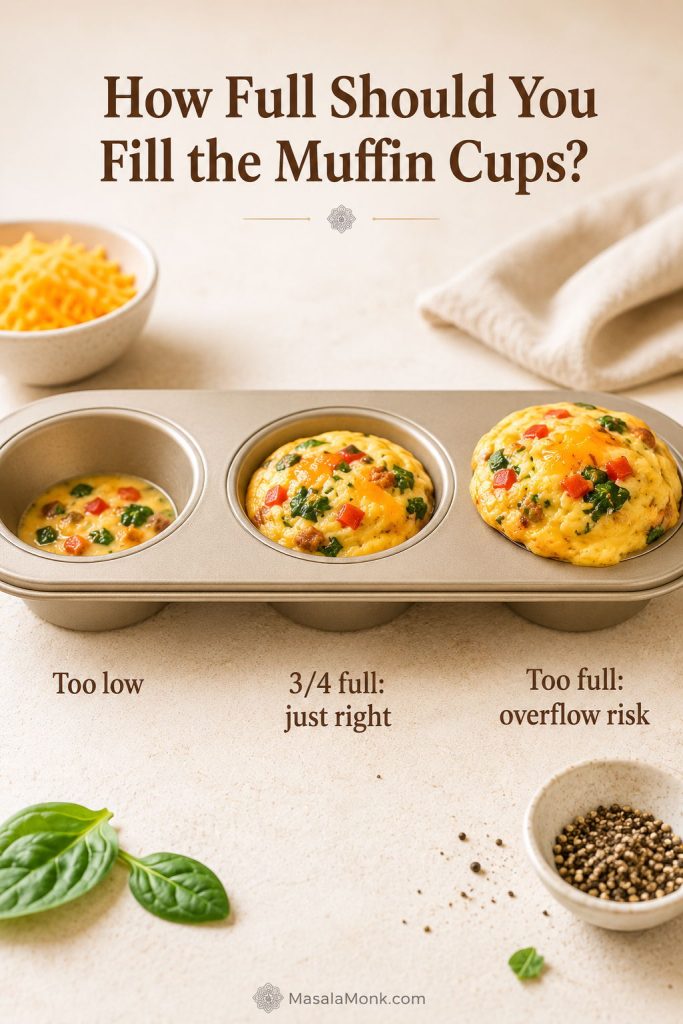
Three muffin cups showing too low, 3/4 full, and too full levels for egg muffin cups.
A 3/4-full cup gives the eggs space to rise while still baking into a full-looking muffin. As a result, the cups puff neatly without overflow or stuck edges.

How Much Filling Is Too Much?

For 12 egg muffins, 1 cup of add-ins is the safest amount, while 1 1/2 cups gives a more loaded breakfast muffin. You can push toward 2 cups, but only if the vegetables are cooked and drained very well. More than that usually makes the muffins watery, crumbly, or difficult to remove.

Equipment You Need

You do not need much equipment for egg muffins, but the pan matters more than it does for regular muffins. Eggs and cheese cling easily, so silicone or a very well-greased metal tin will save you cleanup later.

  • 12-cup muffin pan
  • Silicone muffin pan or silicone liners
  • Large mixing bowl
  • Whisk
  • Measuring cup with pour spout
  • Skillet for cooking vegetables or protein
  • Cooling rack
  • Airtight container for storage
  • Freezer-safe bag or container if freezing

If sticking is your biggest issue, skip to the full pan-release section before choosing liners or a muffin tin.

Best Pan for Egg Muffins: Silicone vs Metal vs Paper Liners

If egg muffins have ever welded themselves to your muffin tin, the pan is probably the reason. A good pan or liner can save you from broken muffins and a long cleanup.
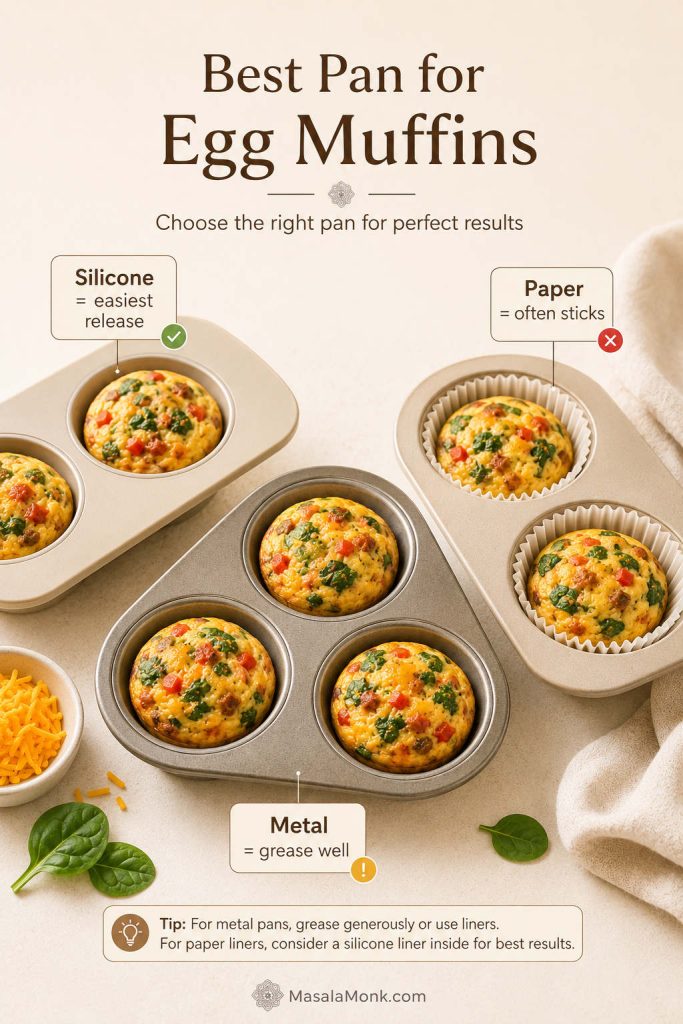
Pan comparison for egg muffins showing silicone muffin pan, metal muffin tin, and paper liners.
Pan choice matters because baked eggs cling more than regular muffin batter. Silicone releases most easily, while metal pans need a generous coating of oil, butter, or spray.
Pan or liner Works well for Pros Watch out
Silicone muffin pan Regular meal prep Easiest release, less sticking, good for weekly batches Place it on a baking sheet for stability
Silicone liners in metal pan Easy cleanup Good shape, reusable, easier release Lightly grease them for extra safety
Nonstick metal muffin tin Defined edges Common, sturdy, easy to move Must be greased generously
Paper liners Not ideal Easy serving in theory Eggs often stick badly unless liners are sprayed
Parchment liners Occasional batches Easier release than plain paper Can wrinkle the muffin edges

How to Make Egg Muffins

This muffin tin eggs recipe gives you evenly filled cups with a tender texture and fewer sticking problems. The two biggest keys are cooking watery fillings first and not overbaking the eggs.
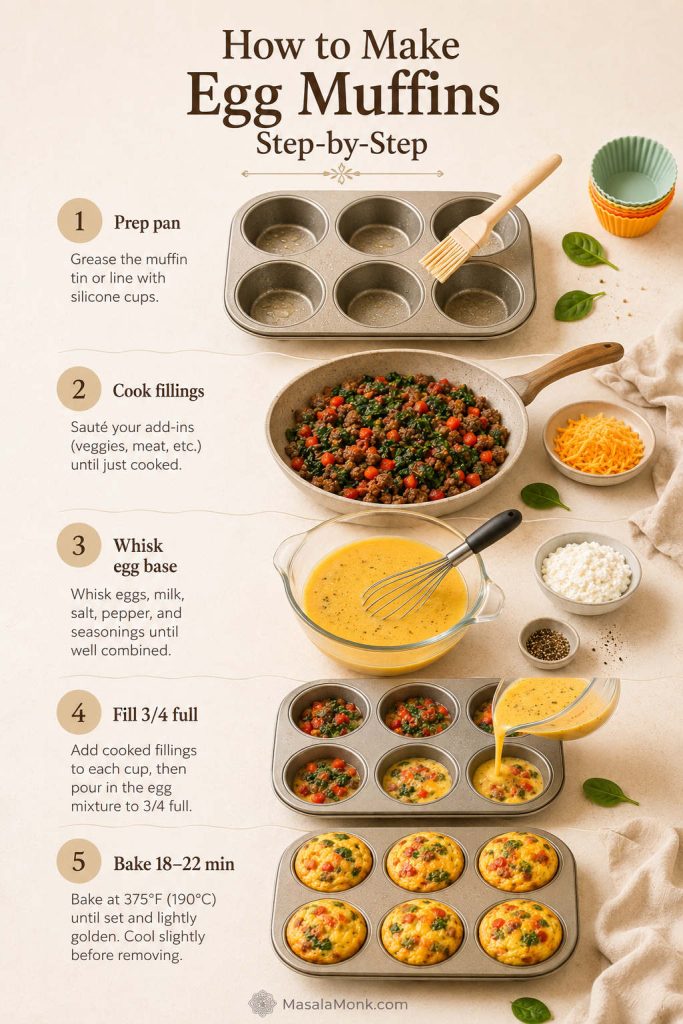
Step-by-step egg muffins guide showing pan prep, cooked fillings, whisked egg base, cups filled 3/4 full, and baking for 18 to 22 minutes.
Think of the method as a texture sequence: dry the fillings first, keep the egg base simple, fill evenly, and stop baking when the centers are just set.

Step 1: Prep the Pan and Preheat the Oven

Preheat the oven to 350°F / 175°C. Grease a 12-cup muffin pan very well with cooking spray, butter, or oil. If you are using a silicone muffin pan, place it on a sturdy baking sheet before filling so it is easier to move in and out of the oven.

Step 2: Cook and Drain Watery Fillings

Cook mushrooms, onions, spinach, zucchini, bacon, sausage, or any filling that releases water or fat. If the pan still looks wet after cooking mushrooms or onions, keep going for another minute or two. If using cooked spinach, squeeze it dry before adding it to the muffin cups.

This step keeps the final egg muffins from becoming watery after baking or after a night in the fridge.

Step 3: Whisk the Egg Base

In a large bowl, whisk the eggs, dairy, salt, pepper, garlic powder, and onion powder until combined. Do not beat the eggs until foamy. Too much trapped air can make the muffins puff dramatically and then sink more as they cool.

Step 4: Divide Fillings and Cheese

Add the cooked fillings and cheese directly to the muffin cups first. This gives you better portion control than mixing everything into the bowl, where heavier fillings can sink to the bottom.

Step 5: Fill 3/4 Full

Pour the egg mixture over the fillings until each cup is about 3/4 full. A measuring cup with a pour spout makes this cleaner and helps you fill each cup evenly.
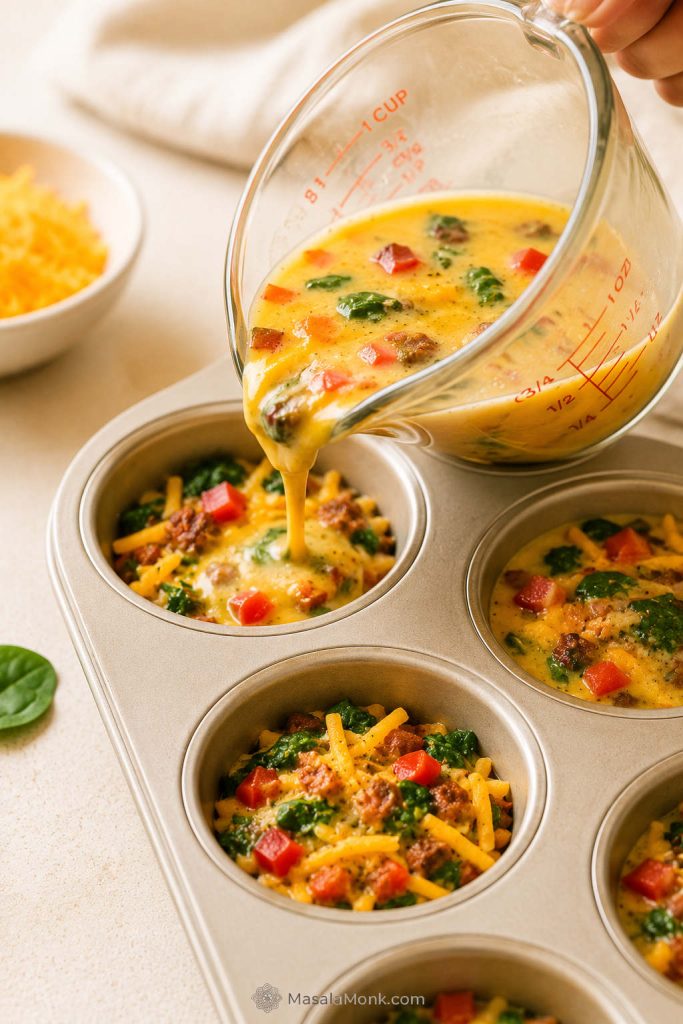
Egg mixture being poured into a muffin tin with spinach, bell pepper, cheese, and cooked protein in the cups.
Dividing the fillings first gives every cup a balanced mix. Then the egg base can flow around the vegetables, cheese, and protein more evenly.

Step 6: Bake Until Just Set

Bake for 18–22 minutes, or until the centers are set and the tops are lightly puffed. Start checking around 18 minutes, especially if your muffin cups are not very full or if your oven runs hot.

Step 7: Cool Before Removing

Let the egg muffins cool in the pan for 5–10 minutes. This short rest helps them firm up and release more cleanly. If you are using a metal pan, gently run a thin knife around the edges before lifting them out.

How Long to Bake Egg Muffins

The best oven temperature for classic egg muffins is 350°F / 175°C. It is gentle enough to keep the texture soft, but still hot enough to set the centers in about 20 minutes.
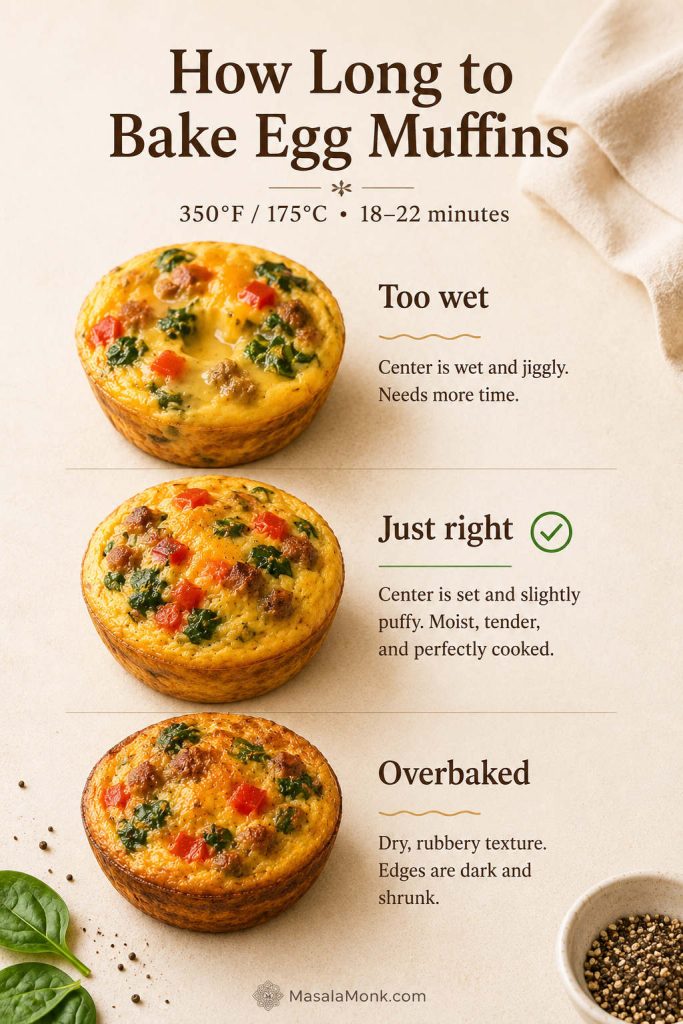
Egg muffin bake-time guide showing wet, just-set, and overbaked textures with a 350°F and 18 to 22 minute cue.
Bake time is about doneness, not just the clock. Look for set centers and lightly puffed tops; if the edges look dry before the middle is done, the oven may be too hot.
Oven temp Approx. time Texture Works well for
350°F / 175°C 18–22 minutes Softer, less rubbery Default meal prep egg muffins
375°F / 190°C 15–20 minutes Faster, slightly firmer Smaller muffins or quick bake
325°F / 160°C 22–28 minutes Gentler, softer Cottage cheese or egg-bite-style versions
400°F / 200°C Not ideal for classic egg muffins Firmer edges Hash brown cups or bacon-shell cups

How Long to Bake Mini Egg Muffins

Mini egg muffins bake faster than standard muffin tin eggs. Start checking a mini muffin pan around 12–15 minutes at 350°F / 175°C. The exact time depends on the size of the cups, how full they are, and how many fillings you add.

How to Tell Egg Muffins Are Done

You will know they are done when the centers are set, the tops are lightly puffed, and there is no wet jiggle in the middle. If you use an instant-read thermometer, aim for 160°F / 71°C; egg dishes such as frittata and quiche are listed at that temperature on the FoodSafety.gov safe minimum temperature chart.

Why Egg Muffins Puff and Then Deflate

Egg muffins rise because steam and air expand in the oven. After they cool, they settle. Some deflation is normal. The goal is not to keep them tall forever; instead, the goal is to keep them tender, set, and not watery.
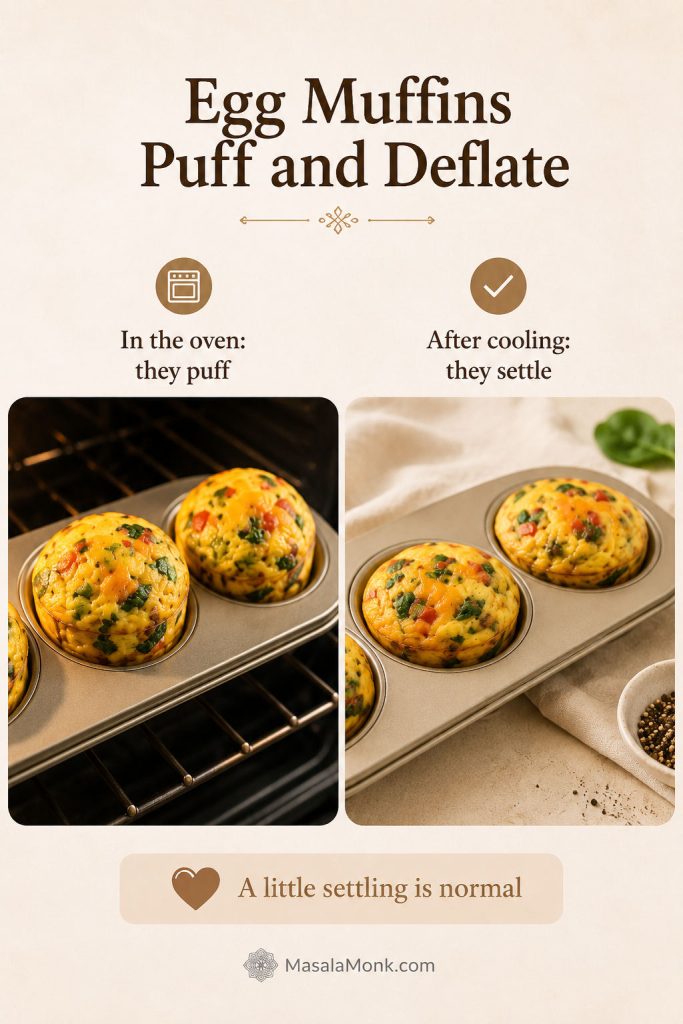
Egg muffins puffed in the oven and slightly settled after cooling, showing that a little deflation is normal.
As steam expands in the oven, the muffins puff; as they cool, they settle. That small deflation is normal, so focus on tender set texture rather than height.

How to Stop Egg Muffins from Sticking to the Pan

If your first batch has ever stuck to the pan, you are not doing anything unusual. Baked eggs cling more than regular muffin batter, especially when cheese melts onto the edges. The fix is mostly about pan choice, grease, and giving the muffins a short cooling time before you remove them.
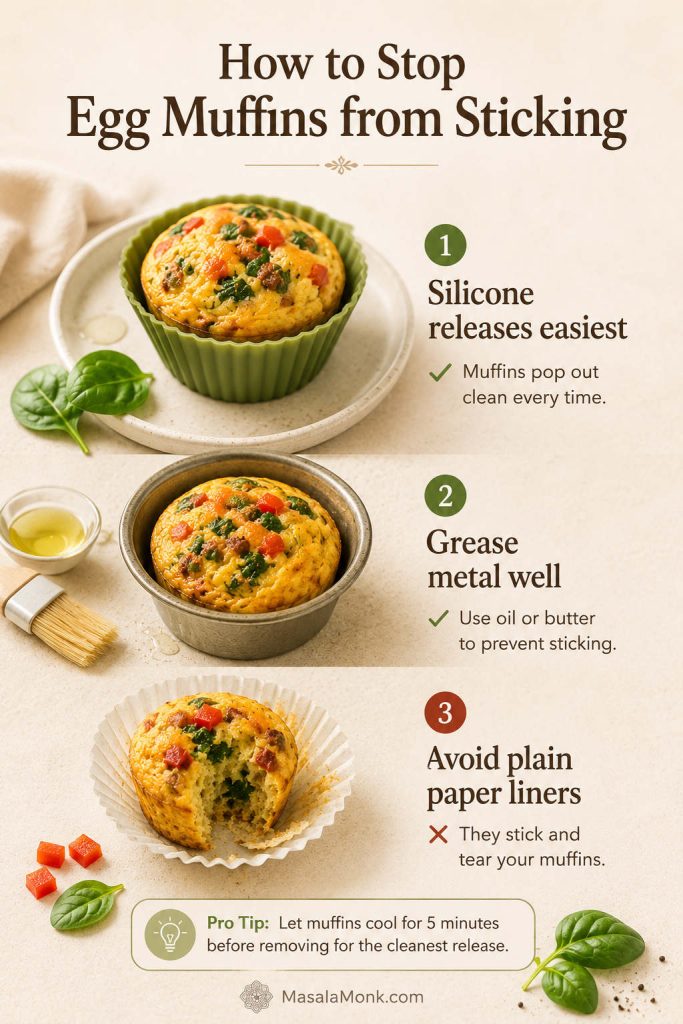
Egg muffin sticking guide showing silicone cups, greased metal pan, and muffins being released from a muffin tin.
Sticking usually comes down to the pan, the grease, or removing the muffins too soon. Let them cool briefly before lifting them out so the edges can release cleanly.

Best Pan and Liner Tips

  • Use silicone if you make egg muffins often. A silicone muffin pan or silicone liners give the cleanest release.
  • Grease metal pans generously. Coat the bottom, sides, and upper rim of each cup because puffed egg and melted cheese can stick near the top.
  • Avoid plain paper liners. They often hold onto baked eggs unless they are sprayed first.
  • Let the muffins cool for 5–10 minutes. That short rest helps the eggs finish setting and makes removal easier.

How to Keep Egg Muffins from Getting Watery

Watery egg muffins usually come from watery fillings, too many add-ins, or storing the muffins while they are still warm. Fortunately, the fix is simple: control moisture before the egg mixture goes into the pan.
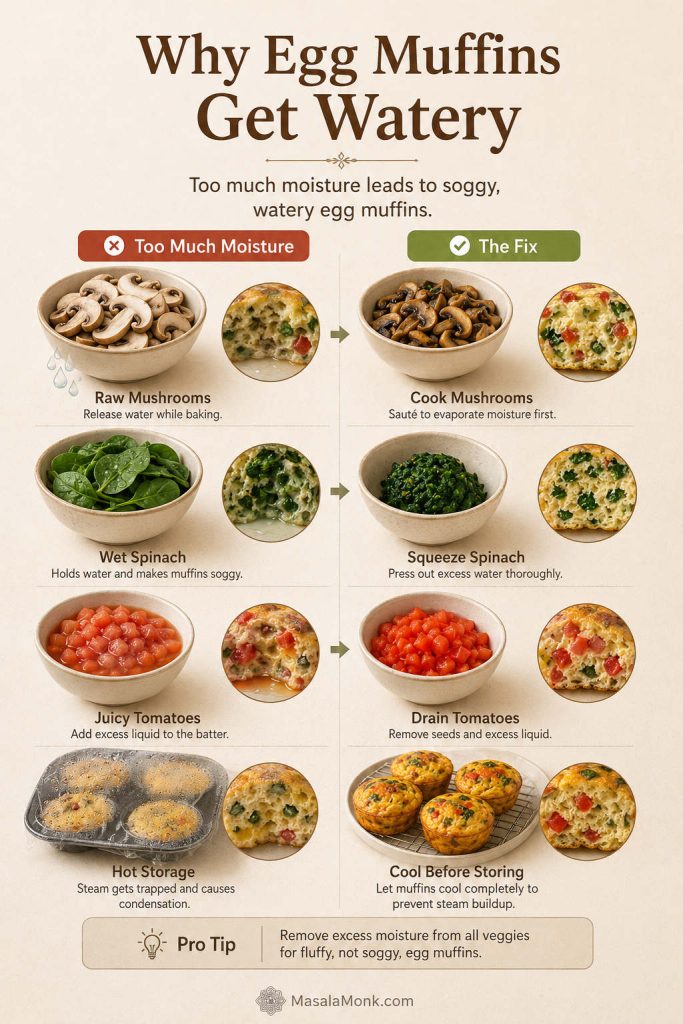
Watery egg muffins guide showing cooked and drained fillings compared with wet vegetables and excess liquid.
Watery batches usually start with fillings that were not cooked, squeezed, drained, or cooled. Fix the moisture before baking, and the finished cups will store much better.
Add-in Problem Prep first
Spinach Releases water Cook and squeeze dry
Mushrooms Release lots of moisture Sauté until the pan looks dry
Onion Can water out and taste sharp Sauté first
Bell pepper Mild moisture Dice small; sauté briefly if using a lot
Tomato Can make muffins soggy Use drained diced tomato or skip very juicy tomato
Zucchini Very watery Salt and squeeze, or sauté first
Broccoli Can be bulky Chop small and pre-cook
Bacon or sausage Grease can pool Cook and drain before adding

Cool Before Storing

Do not put hot egg muffins straight into an airtight container. Steam gets trapped, turns into condensation, and makes the muffins wet. Let them cool completely first.

Blot Before Reheating If Needed

Vegetable-heavy egg muffins can release a little liquid after chilling. If that happens, blot the bottom lightly with a paper towel before reheating. This is especially helpful with spinach, mushrooms, tomatoes, and zucchini.

How to Make Egg Muffins Fluffy, Not Rubbery

Rubbery egg muffins usually mean the eggs were pushed a little too far, either in the oven or during reheating. You want the centers fully set, but not dry, squeaky, or spongey.
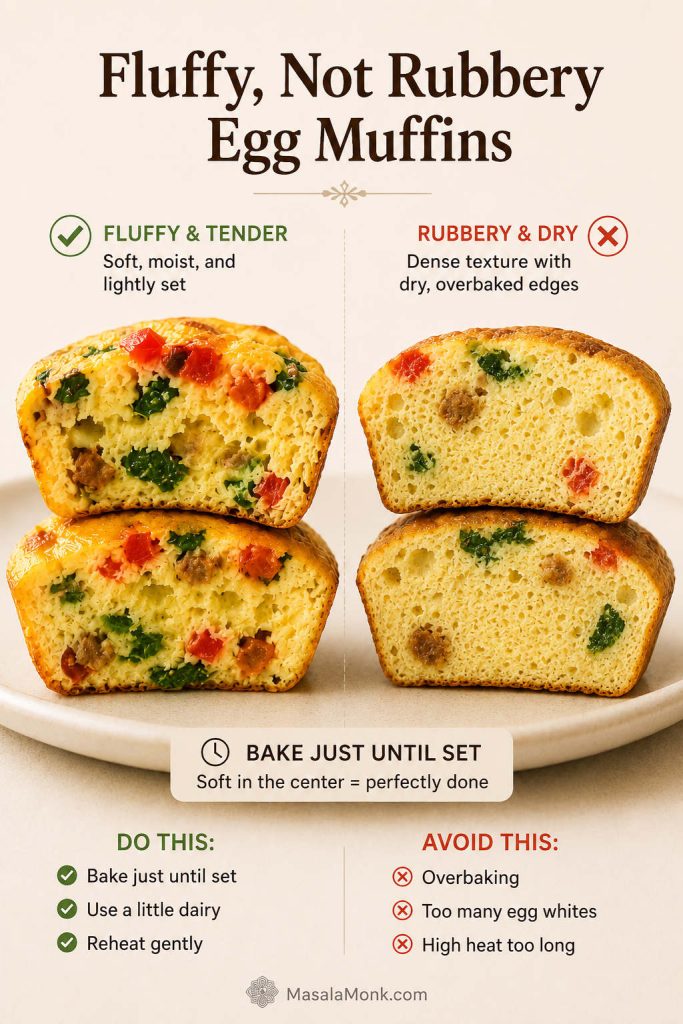
Fluffy egg muffins compared with dry, rubbery egg muffins, with tips to bake just until set, use dairy, and reheat gently.
A tender center comes from stopping the bake as soon as the eggs are set. To avoid a rubbery texture, use a little dairy and reheat in short bursts.

Five Ways to Keep Egg Muffins Tender

  • Start checking at 18 minutes. Pull the muffins when the centers are just set and the tops are lightly puffed.
  • Use a little dairy. Milk, half-and-half, cream, or blended cottage cheese softens the egg texture.
  • Do not rely only on egg whites. Egg white muffins can turn rubbery faster, so add cheese, cottage cheese, or a few whole eggs if you want a softer bite.
  • Whisk until combined, not foamy. Too much trapped air can make the muffins puff dramatically and then collapse more as they cool.
  • Reheat gently. Use short microwave bursts or medium power, and cover the muffins with a damp paper towel so the edges do not dry out.

Egg Muffins Recipe: Storage, Freezing, and Reheating

The real test of egg muffins is not just how they taste warm from the oven. It is whether you still want to eat them on Wednesday morning. Cool them completely before packing, and reheat them gently for the best texture.
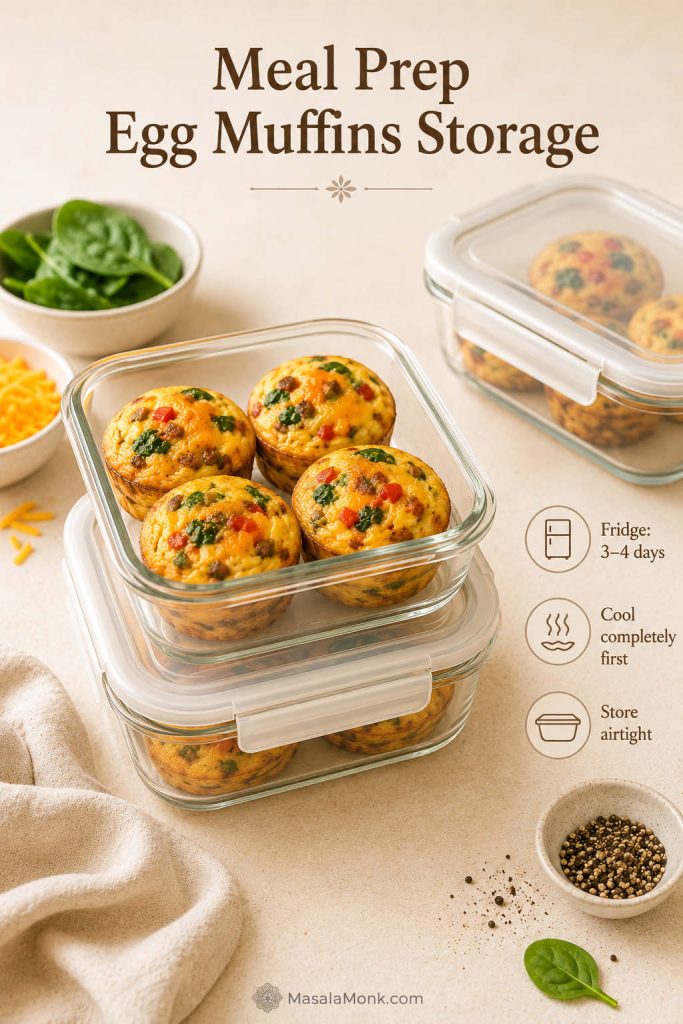
Meal prep egg muffins stored in an airtight glass container for refrigerator storage.
For meal prep, cool the egg muffins before packing them and avoid trapping steam in the container. That small pause helps protect the texture for the next few mornings.
Method How long / how to do it Texture tip
Refrigerate Store airtight for 3–4 days Cool completely before closing the container
Freeze Freeze airtight for up to 3 months for best texture Freeze flat first, then transfer to a bag or container
Reheat from fridge Microwave 20–30 seconds Cover with a damp paper towel
Reheat from frozen Microwave 60–90 seconds at 50–70% power Thaw overnight first if possible
Oven reheat 300–350°F for 5–10 minutes Good for reheating several at once
Air fryer reheat 325–350°F for 2–4 minutes Use a gentle setting to avoid drying the edges

For make-ahead planning, jump to freezing egg muffins or reheating without a rubbery texture.

How Long Do Egg Muffins Last in the Fridge?

Store cooked egg muffins in an airtight container in the refrigerator for 3–4 days. The USDA/FSIS refrigeration guidance lists cooked egg dishes with a refrigerator storage time of 3–4 days, which is the safest guideline to follow for meal prep.

A Simple Weekly Meal Prep Plan

For an easy workweek plan, bake 12 egg muffins on Sunday. Keep 6–8 in the fridge for the next 3–4 days, then freeze the rest. After that, reheat two at a time with a damp paper towel so they warm gently instead of turning rubbery.

If you like prepping eggs for the week, air fryer hard-boiled eggs are another easy option for salads, snack boxes, and quick breakfasts.

Can You Freeze Egg Muffins?

Yes. Cool them completely, then freeze in a single layer until firm. After that, transfer them to a freezer-safe bag or container. Use within about 3 months for the best texture.
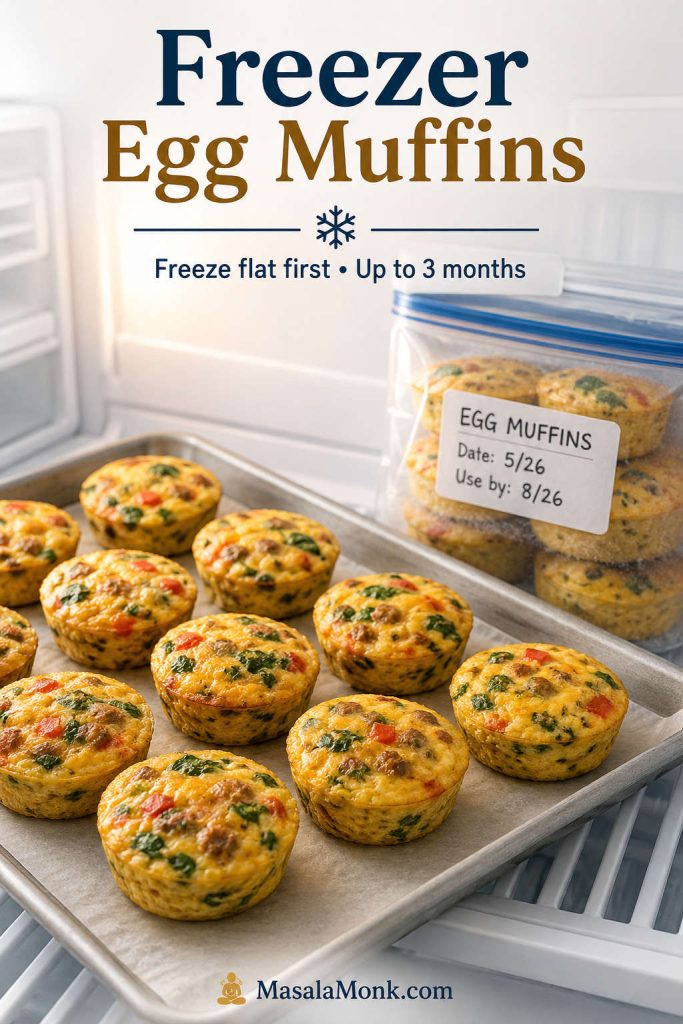
Egg muffins arranged on a tray in the freezer with a freezer bag of stored egg muffins behind them.
Freeze the muffins flat first so they do not stick together. After they firm up, transfer them to a freezer-safe bag or container for easier grab-and-go breakfasts.

How to Reheat Egg Muffins from the Fridge

Microwave one egg muffin for 20–30 seconds, covered with a damp paper towel. Add more time only if needed. If your microwave runs hot, use medium power instead of full power.
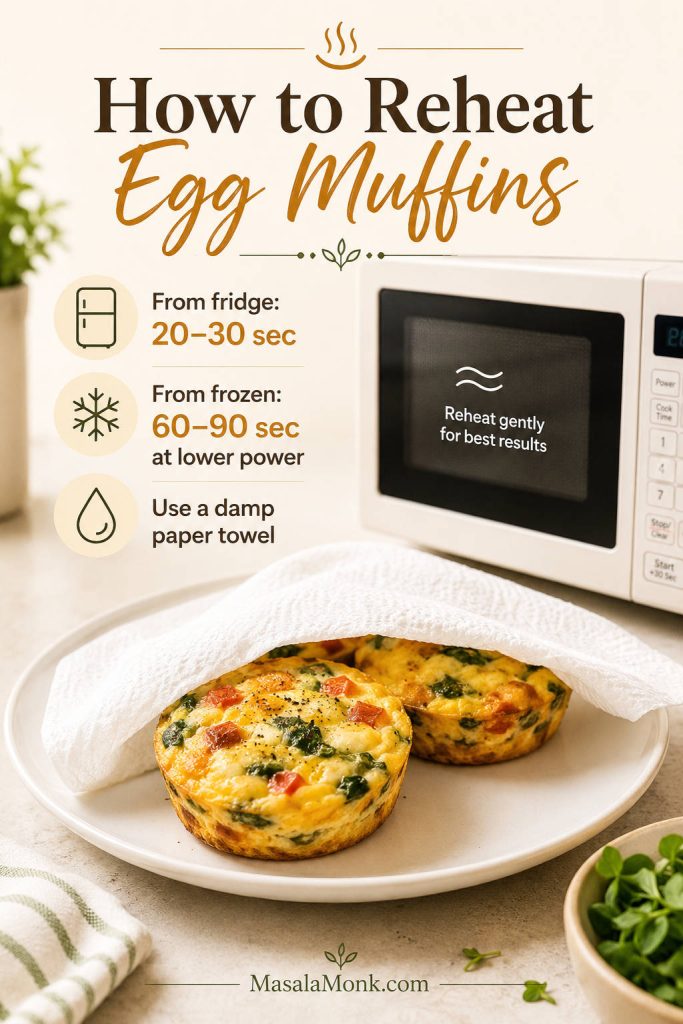
Egg muffins on a plate under a damp paper towel beside a microwave, with reheating times for fridge and frozen muffins.
Reheating is where many egg muffins turn rubbery. Instead, use gentle heat, short bursts, and a damp paper towel so the centers warm before the edges dry out.

How to Reheat Egg Muffins from Frozen

For the best texture, thaw overnight in the refrigerator. To reheat straight from frozen, microwave at 50–70% power for 60–90 seconds, checking in short bursts.

When reheating leftovers, heat them until hot all the way through. Use short bursts so the centers warm without drying out the edges.

Can You Eat Egg Muffins Cold?

You can eat them cold if they have been stored safely, but the texture is better when they are gently warmed. A short reheat brings back the softer texture and makes the cheese taste better.

Egg Muffin Variations

This is where the recipe becomes your own. Keep the same base ratio, then choose the filling style that fits your morning: hearty, lighter, kid-friendly, low-carb, or brunch-ready.

Need a specific version? Jump to the classic cheddar batch, hash brown egg cups, or the egg muffins vs egg bites comparison.
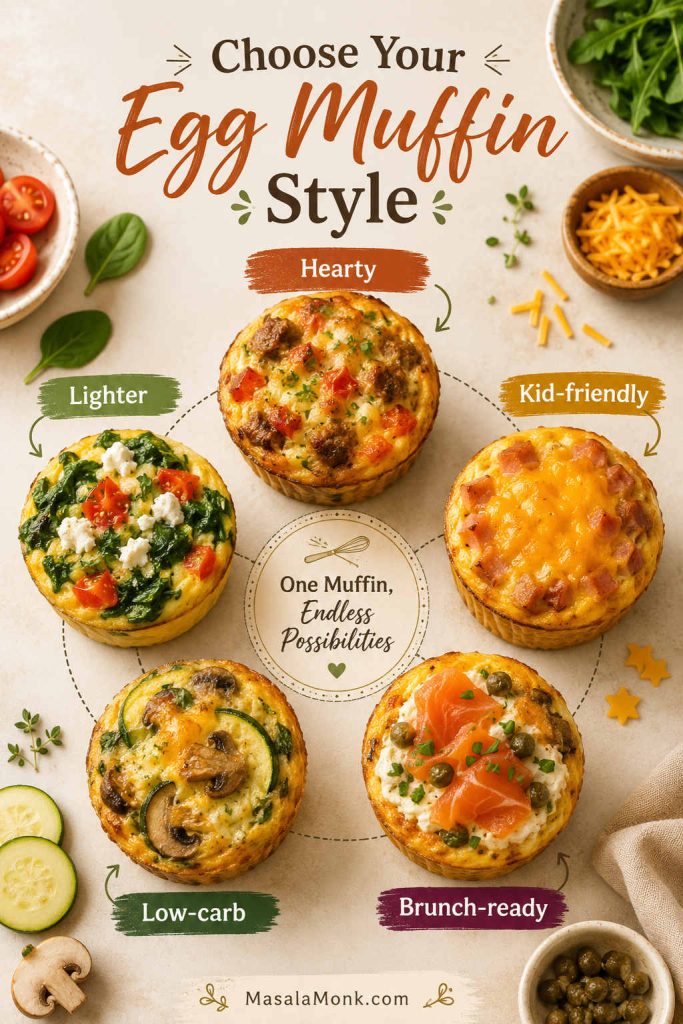
Egg muffin variations arranged in a flavor wheel with lighter, hearty, kid-friendly, low-carb, and brunch-ready styles.
Flavor variations work best when the base ratio stays steady. Then you can change the style—hearty, lighter, kid-friendly, low-carb, or brunch-ready—without losing structure.

Choose Your Filling Style

If your morning needs… Choose… Key adjustment
Grab-and-go protein Bacon, sausage, or cottage cheese muffins Use cooked meat and keep the bake gentle
A lighter breakfast Peppers, spinach, mushrooms, and less cheese Cook watery vegetables first
A kid-friendly batch Ham and cheddar Keep seasonings mild
A brunch plate Spinach feta or mushroom Swiss Serve warm with salad or toast
Low-carb meal prep Eggs, cream, cheese, bacon, and spinach Skip potatoes and starchy add-ins

How to Customize Without Ruining the Texture

If this is your first time making the recipe, start with the easy classic cheddar version. It gives you the best read on the base texture before you experiment with cottage cheese, egg whites, hash browns, or heavier vegetable mixes.

After that, adjust one thing at a time: the cheese, the protein, or the vegetables. That way, you can tell what changed the texture and what changed the flavor.

Specific Egg Muffin Filling Ideas

If you already know the style you want, the table below gives you more specific filling combinations while keeping the same basic egg-to-filling ratio.

Variation Add-ins Special note
Bacon egg muffins Cooked bacon, cheddar, green onion Drain bacon well before adding
Sausage egg muffins Cooked sausage, cheddar, peppers Drain fat before adding
Ham and cheese egg muffins Diced ham, cheddar or Swiss Good for kids and meal prep
Spinach feta egg muffins Spinach, feta, herbs Squeeze spinach dry
Cottage cheese egg muffins Blended cottage cheese, eggs, spinach Softer, higher-protein texture
Egg white muffins Egg whites, vegetables, cheese Season well and do not overbake
Keto egg muffins Eggs, cream, cheese, bacon or sausage Skip starchy add-ins
Hash brown egg cups Hash brown shell, egg filling Different method; bake the shell first
Vegetarian egg muffins Peppers, spinach, mushrooms, cheese Cook watery vegetables first
Spicy egg muffins Jalapeño, pepper jack, onion Remove seeds for milder heat

Easy Classic Cheddar Version

Use cheddar, bell pepper, spinach, and cooked bacon, ham, or sausage. Cheddar melts into the edges, bell pepper gives small sweet pops, and the cooked meat makes the muffins feel breakfasty and satisfying. If you are using bacon, this is a good place to prep extra from your air fryer bacon batch.

Classic cheddar breakfast egg muffins with visible spinach, bell pepper, cheese, and cooked meat, including one muffin cut open.
This classic cheddar version is the safest first batch because it balances moisture, protein, color, and flavor before you start testing heavier or softer variations.

Higher-Protein Cottage Cheese Version

Use blended cottage cheese in the egg base and add turkey sausage, chicken sausage, or extra egg whites. Cottage cheese makes the texture softer and more café-style, but the bake should stay gentle so the eggs do not turn spongey. On days when you want a bowl instead of baked eggs, protein oatmeal gives you another high-protein breakfast option.

Low-Carb or Keto Version

Use eggs, cream, cheese, bacon or sausage, spinach, and mushrooms. Skip potatoes, hash browns, and sweet vegetables if you want a stricter low-carb version.

Vegetarian Spinach and Mushroom Version

Use spinach, bell peppers, mushrooms, onions, feta, cheddar, or herbs. Mushrooms bring savory depth, feta adds brightness, and spinach keeps the batch colorful. Cook the mushrooms and onions first so the muffins do not turn watery.

Hash Brown Egg Cups Version

Hash brown egg cups need a different method. Press seasoned hash browns into the muffin cups first, bake them until they begin to crisp, then add the egg filling and bake again. This gives you a potato shell instead of a classic egg muffin base. If you are starting with frozen shredded potatoes or patties, the timing notes in this air fryer hash browns guide can help you understand how moisture and crisp edges behave before you turn them into cups.
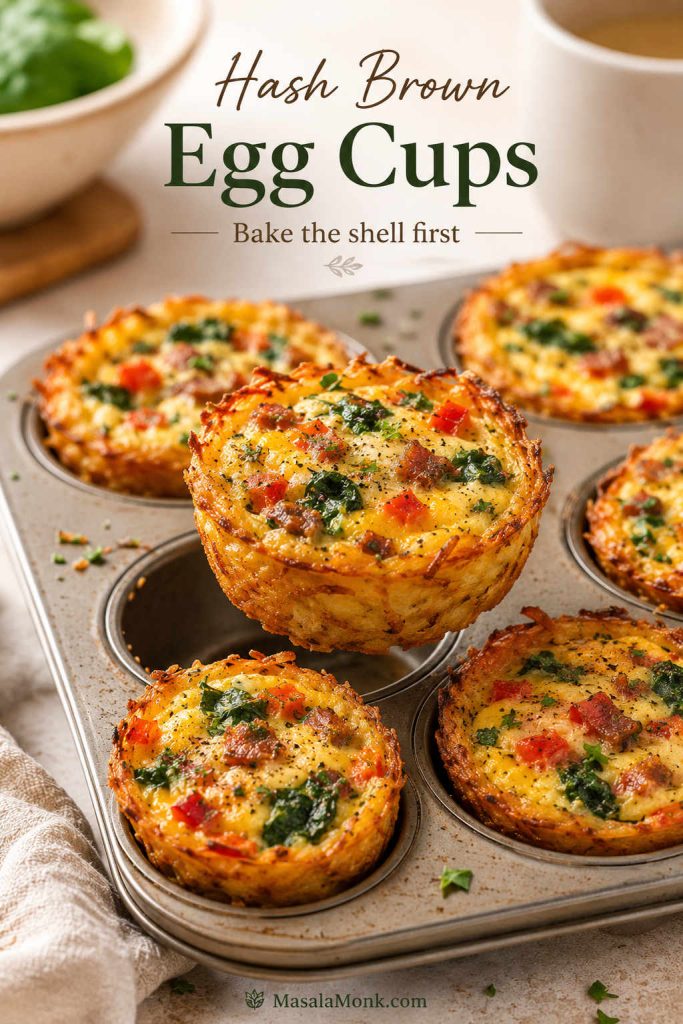
Hash brown egg cups in a muffin tin with crispy potato shells and set egg filling with spinach, pepper, cheese, and bacon.
Hash brown egg cups use a different method from classic egg muffins. Bake the potato shell first, then add the egg filling so the outside stays crisp.

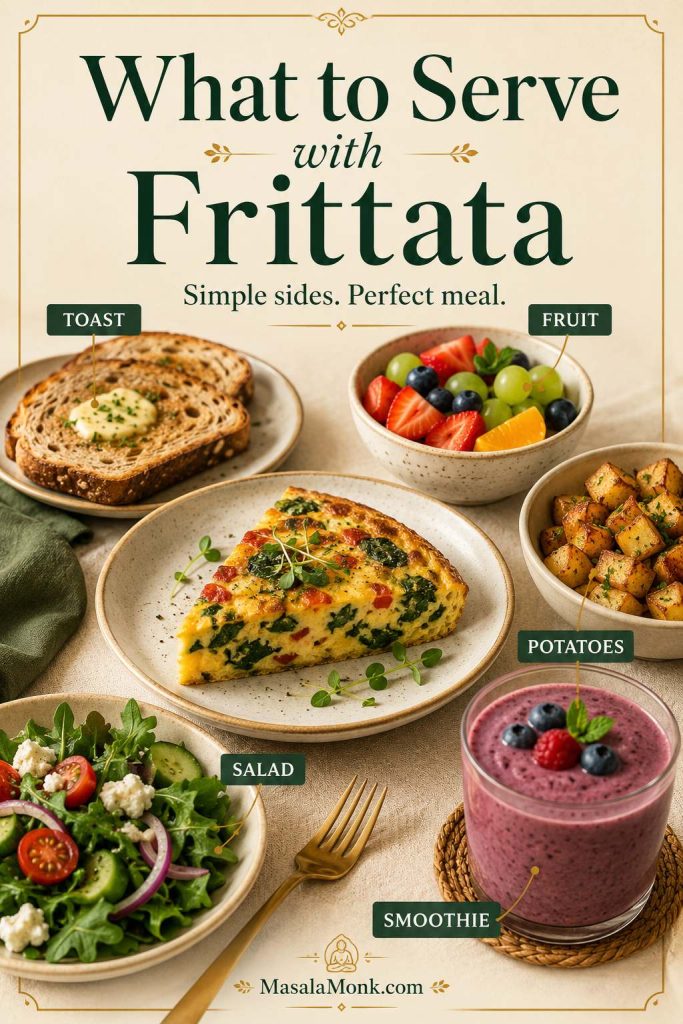
What to Serve with Egg Muffins

Two breakfast egg muffins can be a full light breakfast on their own. Because egg muffins are soft and savory, they taste best with contrast: fruit for freshness, avocado for creaminess, salsa for brightness, toast for crunch, or roasted potatoes when you want the plate to feel more like brunch.
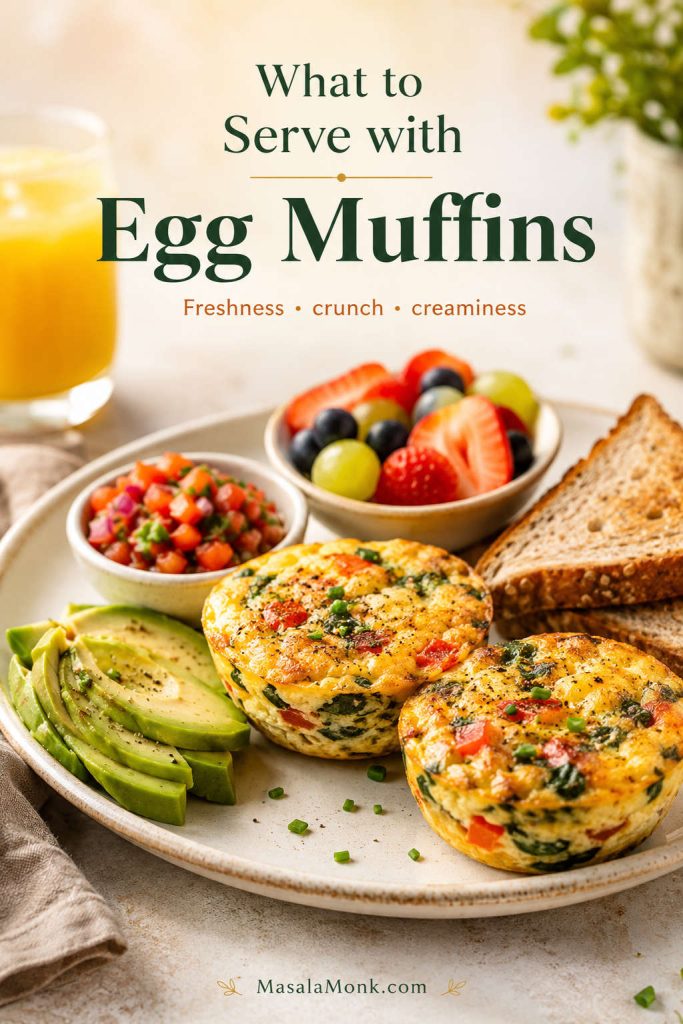
Breakfast egg muffins served with avocado, salsa, fruit, toast, and orange juice on a light breakfast plate.
Because egg muffins are soft and savory, they taste better with contrast. Add fruit for freshness, toast for crunch, avocado for creaminess, or salsa for brightness.

For a heartier plate, add an English muffin, hash browns, or a small breakfast sandwich. For sandwich-style ideas, this list of breakfast sandwich recipes can help you build a more filling morning meal.

Egg Muffins vs Egg Bites vs Mini Frittatas

These names are closely related, but the texture and method can be different. Knowing the difference helps you choose the right recipe style for your breakfast meal prep.
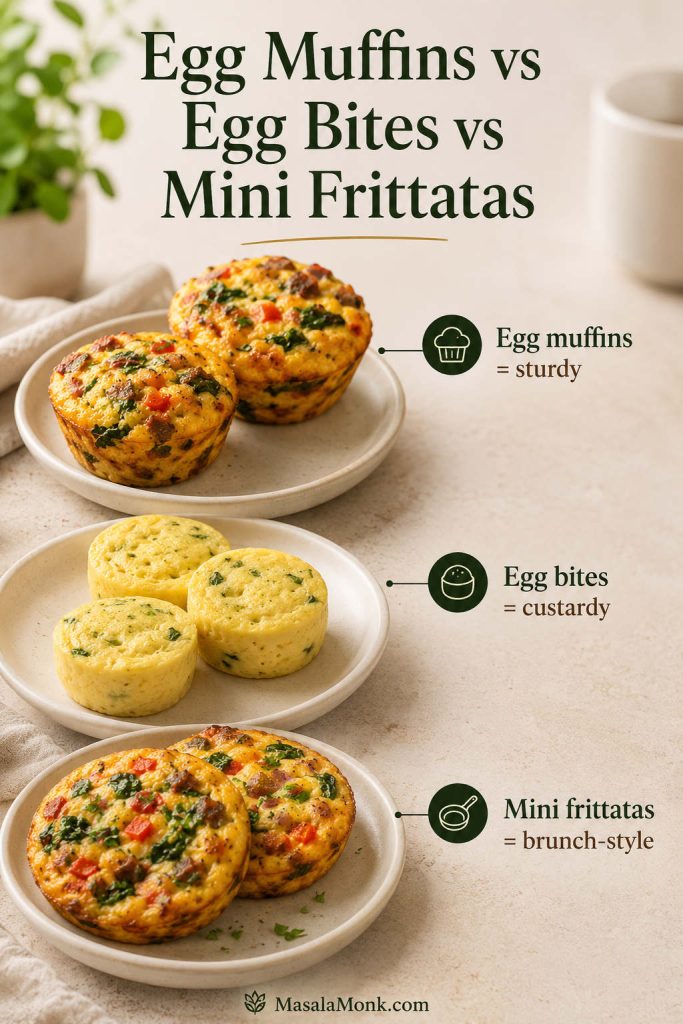
Comparison of egg muffins, egg bites, and mini frittatas on separate plates, labeled sturdy, custardy, and brunch-style.
Egg muffins, egg bites, and mini frittatas are related, but their textures are different. The muffin version is sturdier for meal prep, egg bites are softer and custardy, and mini frittatas feel more brunch-style.

Egg Muffins

Egg muffins are firm enough to pick up and meal prep easily. They are usually whisked, not blended, and baked in a muffin tin. This is the best version when you want a simple, sturdy, make-ahead breakfast.

As a baked egg cups recipe, this version is firmer and easier to store than custardy egg bites, which makes it better for grab-and-go breakfasts.

Egg Bites

Egg bites are softer and more custardy. They often use blended cottage cheese and a gentler baking method. If you want a Starbucks-style texture, make a cottage cheese egg bite version rather than a classic egg muffin.

For a softer egg-bite texture, blend the eggs with cottage cheese and bake more gently, around 325°F / 160°C. A water bath is not needed for classic egg muffins, but it can help egg bites cook more evenly and stay custardy. For that method, set a metal muffin tin or silicone-lined muffin tin inside a larger baking dish, pour hot water into the outer dish until it comes partway up the sides of the muffin tin, and move everything carefully so no water splashes into the eggs.

Mini Frittatas

Mini frittatas are very similar to egg muffins, but the name often appears in brunch-style recipes. They may be served fresh rather than packed for meal prep.

Which One Should You Make?

  • Easy meal prep: make classic egg muffins.
  • Softer café-style texture: make cottage cheese egg bites.
  • Brunch-style serving: call them mini frittatas and serve them warm.
  • Crispy base: make hash brown egg cups instead.
Three mistakes cause most bad egg muffins: overfilling the cups, using raw watery vegetables, and reheating too aggressively. Fix those three things and this recipe becomes much more reliable.

Troubleshooting Egg Muffins

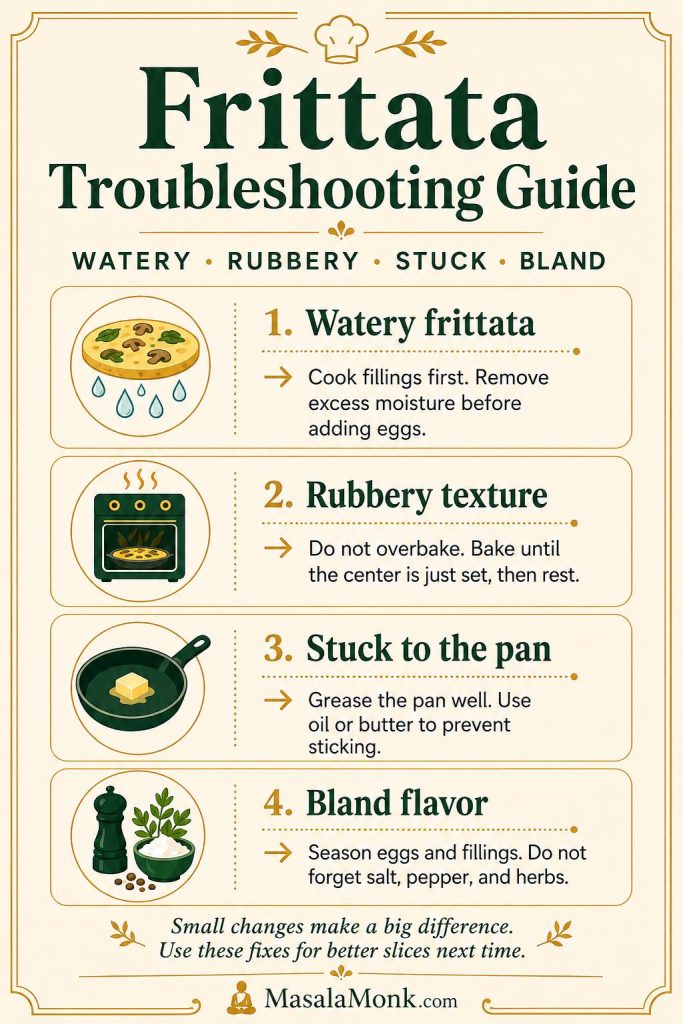
If a batch turns out watery, rubbery, stuck, or bland, it usually comes down to one small step rather than the whole recipe failing. Use this table before your next batch, and the fix should be clear.

Not sure what went wrong? The most common fixes are also covered in the dedicated sections for watery egg muffins, rubbery texture, and sticking to the pan.
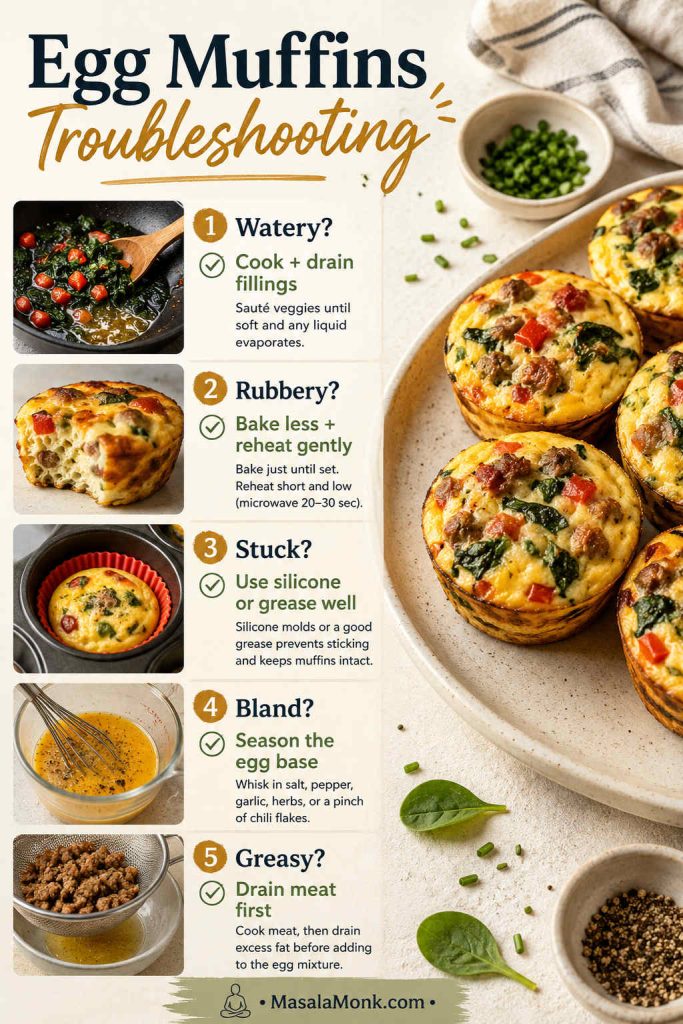
Egg muffins troubleshooting guide with fixes for watery, rubbery, stuck, bland, and greasy egg muffins.
Most egg muffin problems trace back to one of five things: wet fillings, too much heat, poor pan release, weak seasoning, or greasy protein. Fix the cause, not the whole recipe.
Problem Likely cause Fix next time
Watery egg muffins Raw watery vegetables, too many add-ins, or storing while warm Cook and drain vegetables; cool completely before storing
Rubbery texture Overbaked or reheated too aggressively Bake just until set and reheat gently
Stuck to pan Not enough grease, plain paper liners, or metal pan Use silicone or grease generously
Collapsed muffins Normal cooling, overmixed eggs, or watery filling Whisk gently and control moisture
Bland flavor Not enough salt, cheese, herbs, or savory fillings Season the egg base and use flavorful add-ins
Dry muffins Too long in the oven or too little dairy Reduce bake time and add milk, cream, or cottage cheese
Undercooked center Cups overfilled or oven runs cool Fill 3/4 full and bake a few minutes longer
Greasy bottoms Bacon or sausage not drained Cook and drain protein before adding
Spongey texture Overcooked eggs or too many egg whites Use whole eggs, dairy, and a gentler bake

FAQs About Egg Muffins

How many eggs do I need for 12 egg muffins?

Use 10 large eggs for the best all-purpose batch. That gives you enough egg mixture to fill a standard 12-cup muffin pan while still leaving room for cheese, vegetables, and protein.

What temperature is best for egg muffins?

350°F / 175°C is the best default temperature. It is hot enough to set the centers in about 20 minutes, but gentle enough to keep the edges from turning tough.

How long do egg muffins take to bake?

Most egg muffins take 18–22 minutes at 350°F / 175°C. Start checking around 18 minutes, especially if your cups are lightly filled or your oven runs hot.

How long do mini egg muffins take?

Mini egg muffins usually take about 12–15 minutes at 350°F / 175°C. Since mini muffin pans vary, check early and pull them when the centers are just set.

Why are my egg muffins watery?

Watery egg muffins usually come from raw watery vegetables, too many fillings, or storing the muffins before they cool. Cook and drain ingredients like spinach, mushrooms, onions, tomatoes, and zucchini before baking.

Why did my egg muffins turn rubbery?

Rubbery egg muffins usually mean the eggs were overbaked or reheated too aggressively. Pull them when the centers are just set, then reheat in short bursts with a damp paper towel.

What is the best pan for egg muffins?

A silicone muffin pan or silicone liners are the easiest options because baked eggs release more cleanly from silicone. A metal nonstick muffin tin also works, but it needs generous greasing.

Are egg muffins healthy?

They can be. Egg muffins are naturally high in protein, and you can make them lighter with vegetables, lean meat, cottage cheese, egg whites, or less cheese. The final nutrition depends on the fillings you choose.

Are egg muffins keto?

Yes, they can be keto if you use eggs, cream, cheese, bacon or sausage, and low-carb vegetables such as spinach, mushrooms, peppers, or zucchini. Skip potatoes, hash browns, and sweet starchy add-ins.

Do egg muffins freeze well?

They freeze well enough for meal prep, especially if you cool them completely and reheat them gently. The texture is usually best after an overnight thaw, but even from frozen, short microwave bursts work better than one long blast.

What is the difference between egg muffins and egg bites?

Egg muffins are usually firmer and more like mini frittatas. Egg bites are softer, smoother, and often blended with cottage cheese or cooked more gently for a custardy texture.

Frozen vegetables in egg muffins: what works best?

Thaw and drain frozen vegetables before adding them. Frozen spinach, broccoli, peppers, and mixed vegetables can all work, but they need a quick squeeze or blot first so they do not leak into the egg base.

Raw meat in egg muffins: why cook it first?

Cook sausage, bacon, chicken sausage, turkey sausage, or any other meat before adding it to the muffin cups. The eggs cook quickly, so raw meat will not cook evenly inside the cups; cooked and drained meat gives you safer, cleaner, less greasy muffins.

Final Tips for Better Egg Muffins

Once you know the basic ratio, this egg muffins recipe becomes easy to repeat. Keep the oven gentle, control moisture, fill the cups only 3/4 full, and reheat gently. After one or two batches, you will know which fillings taste best for your mornings and which ones reheat the cleanest.
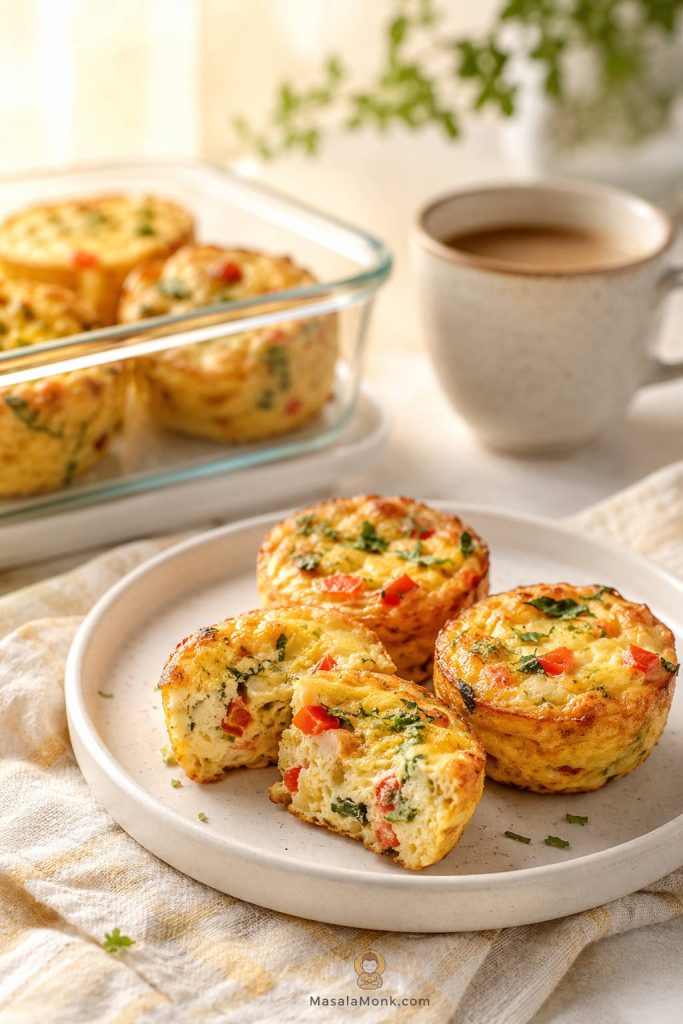
Warm breakfast scene with egg muffin cups on a plate, one cut open, a glass storage container, and a cup of coffee.
The real test is whether breakfast egg muffin cups still taste good after chilling and reheating. When the texture stays tender, the batch earns its place in your week.

That is how you get tender centers, savory fillings, lightly cheesy edges, and breakfast egg muffin cups that are easy to store, easy to customize, and actually worth eating all week.
Posted on 2 Comments

Frittata Recipe: Easy Oven-Baked Egg Frittata

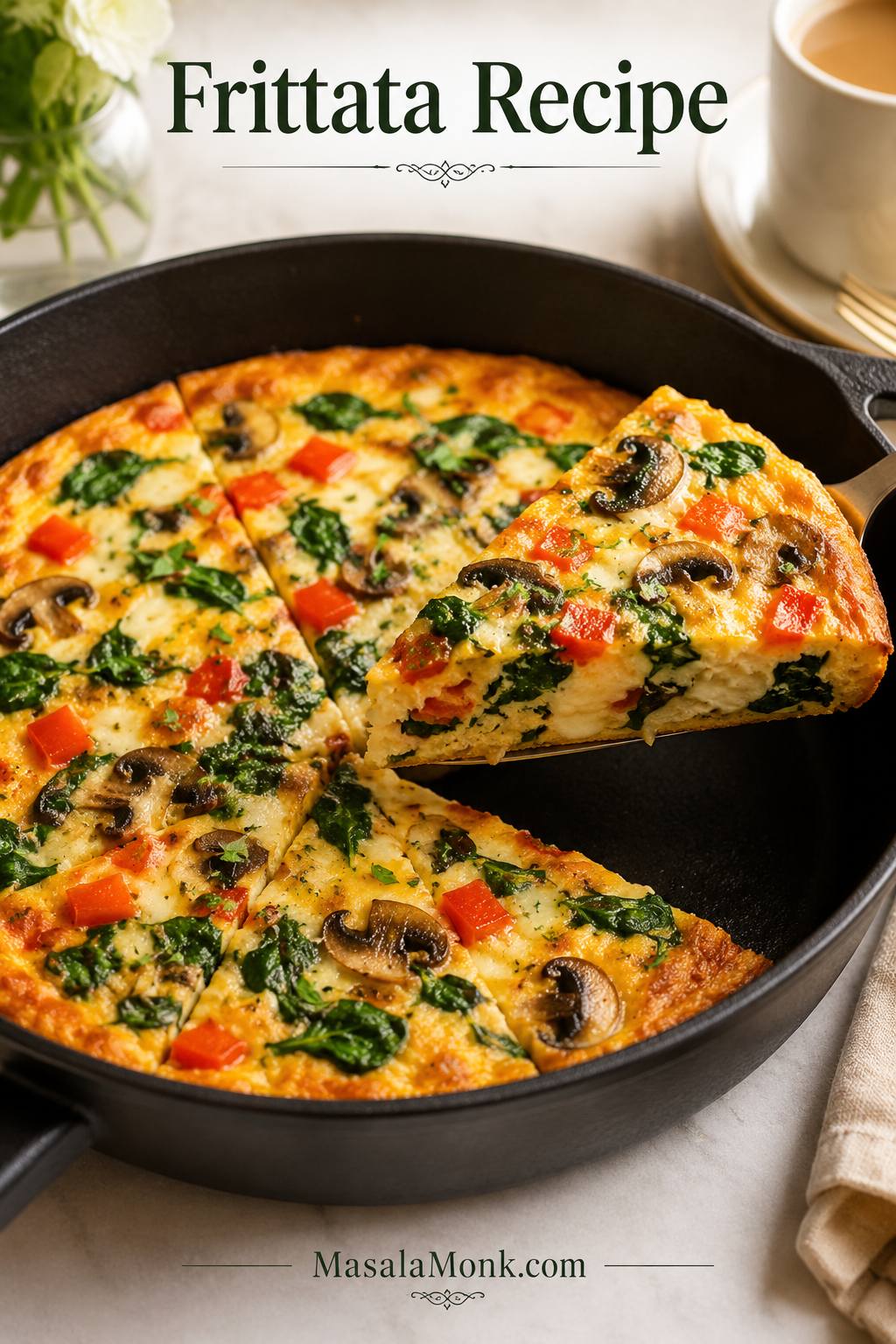
Finished oven-baked frittata in a skillet with a clean wedge lifted out, showing eggs, spinach, mushrooms, peppers, and cheese.

This frittata recipe is for the kind of breakfast that starts with a few eggs, a handful of cooked vegetables, and maybe a little cheese from the fridge. The goal is simple: a fluffy oven-baked egg frittata that slices cleanly, reheats well, and does not turn wet in the middle.

It works for brunch, meal prep, a quick dinner with salad, or a clean-out-the-fridge breakfast. Once you understand the egg-to-dairy ratio and how to handle the fillings, this frittata becomes one of those back-pocket meals you can repeat without measuring every single thing forever.

The best version feels generous without being heavy: tender eggs, sweet cooked vegetables, little pockets of cheese, and clean slices you can eat warm for brunch or chilled from the fridge the next morning.

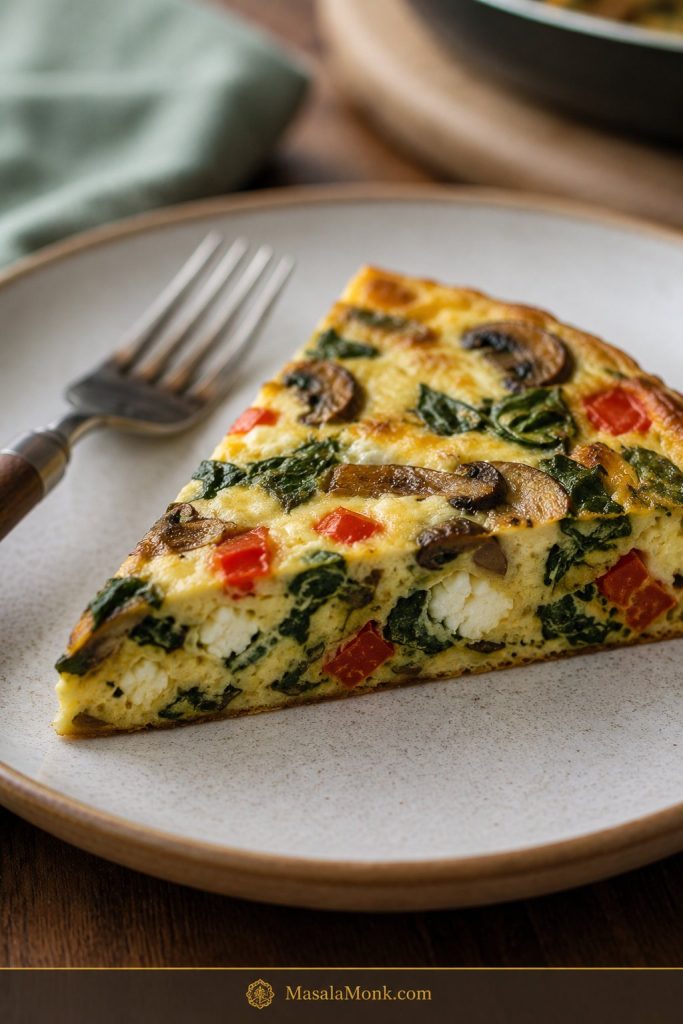
Close-up slice of oven-baked egg frittata on a plate, showing a softly set center with vegetables and cheese.
A clean slice is the best texture clue: once the center sets and the frittata rests, the wedge should lift without wet egg pooling underneath.
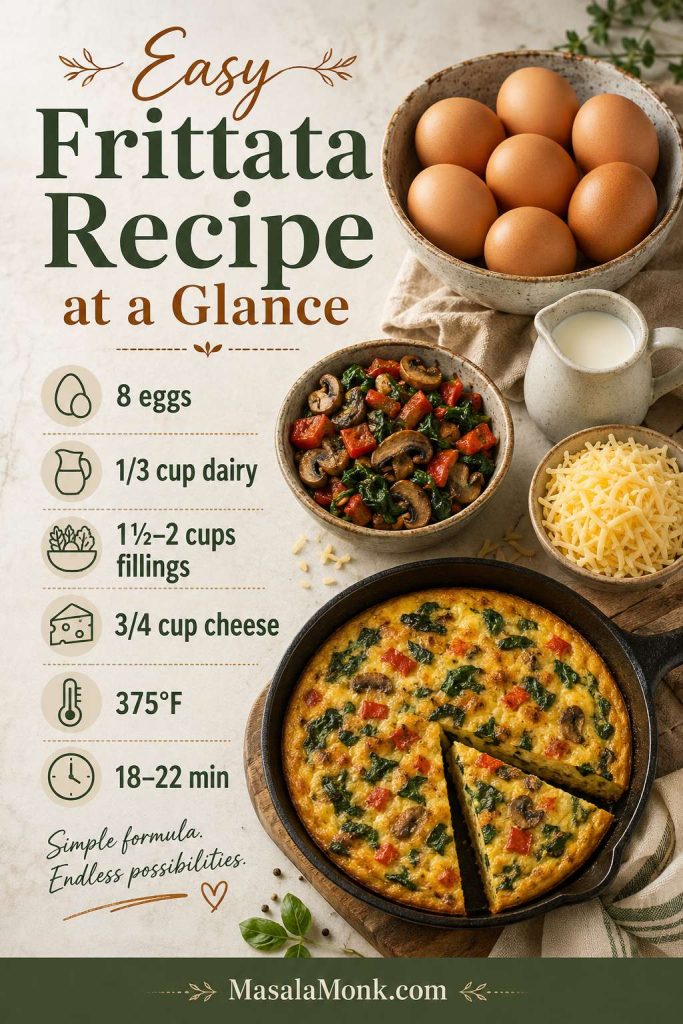
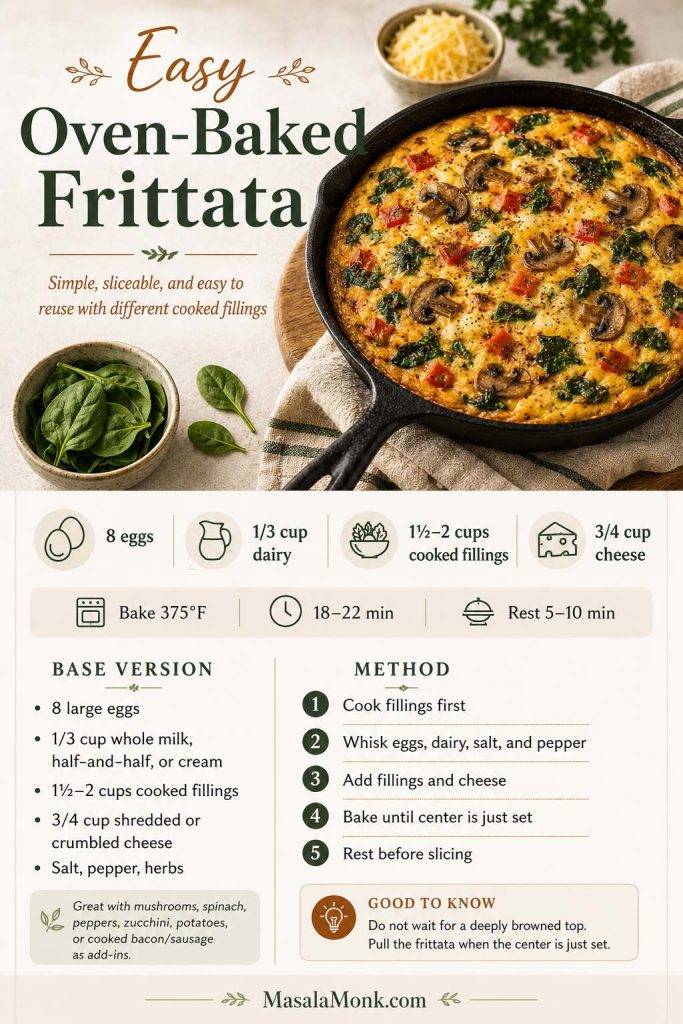
At a glance: This frittata recipe uses 8 eggs, 1/3 cup dairy, 1 1/2–2 cups cooked fillings, and 3/4 cup cheese. Bake in a 10-inch oven-safe skillet at 375°F / 190°C for about 18–22 minutes, then rest 5–10 minutes before slicing.

Quick Answer: How to Make a Frittata

The easiest method is to cook your fillings first, pour the egg mixture into a greased oven-safe skillet, add cheese, and bake at 375°F / 190°C until the middle is just set. After a short rest, the frittata should slice cleanly without turning dry or rubbery.

The shortcut that saves most frittatas is simple: deal with the fillings before the eggs ever hit the pan. Mushrooms give off liquid, spinach collapses as it cooks, zucchini softens quickly, and breakfast meats can release extra fat. Taking care of that first gives the finished frittata a cleaner texture and deeper flavor.

A finished frittata should look softly firm through the middle, with no wet egg pooling on top. A little wobble is not a problem; loose, sloshy egg is. The clock helps, but the center tells the truth.

At-a-glance frittata guide showing 8 eggs, 1/3 cup dairy, 1 1/2 to 2 cups cooked fillings, 3/4 cup cheese, and 375°F bake temperature.
Use this quick formula as your starting point; then, once the base feels familiar, swap the vegetables, cheese, or herbs to match what you have.

Choose Your Frittata Method

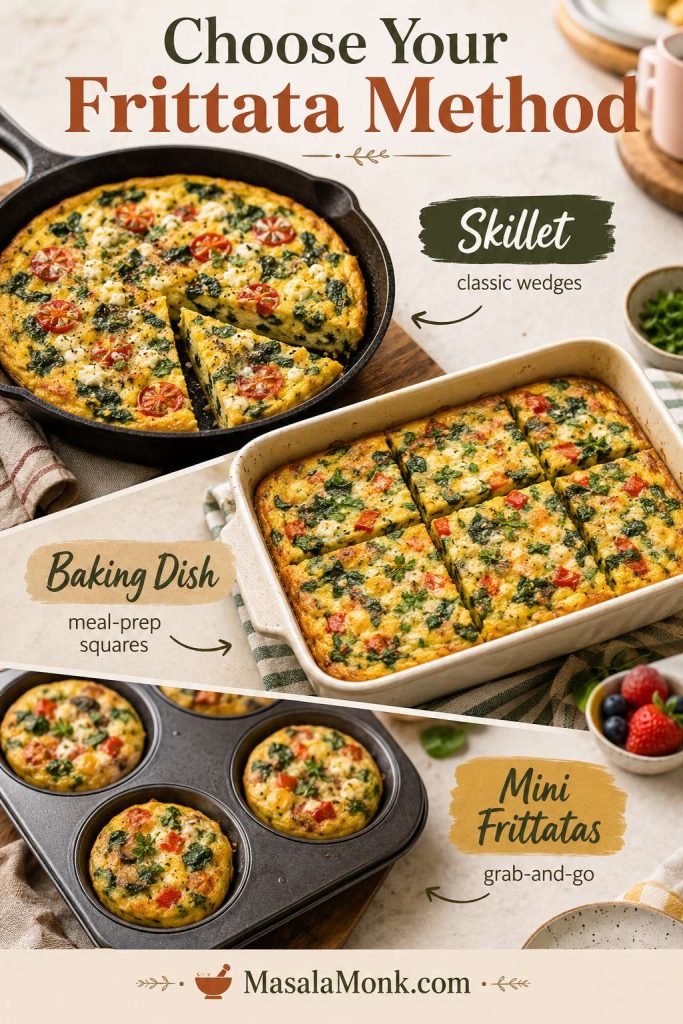
The best method depends on your pan and how you want to serve it. A skillet frittata gives you the most flavor, a baking-dish frittata is easiest for meal prep, and mini frittatas are best when you want individual portions.

MethodBest forHow to cook it
Skillet frittataClassic wedges and better browned fillingsCook fillings in a 10-inch oven-safe skillet, add eggs, and bake at 375°F / 190°C for 18–22 minutes.
Baking-dish frittataNo-skillet cooking and square meal-prep slicesCook fillings separately, add to a greased pie dish or 8×8 dish, and bake at 350°F / 175°C until set.
Mini frittatasGrab-and-go breakfasts and lunchboxesDivide the mixture into greased muffin cups and bake at 350°F / 175°C until just set.
Frittata method comparison showing skillet frittata, baking-dish frittata, and mini frittatas in a muffin tin.
Before choosing a pan, decide how you want to serve the frittata: wedges for brunch, squares for meal prep, or mini portions for busy mornings.
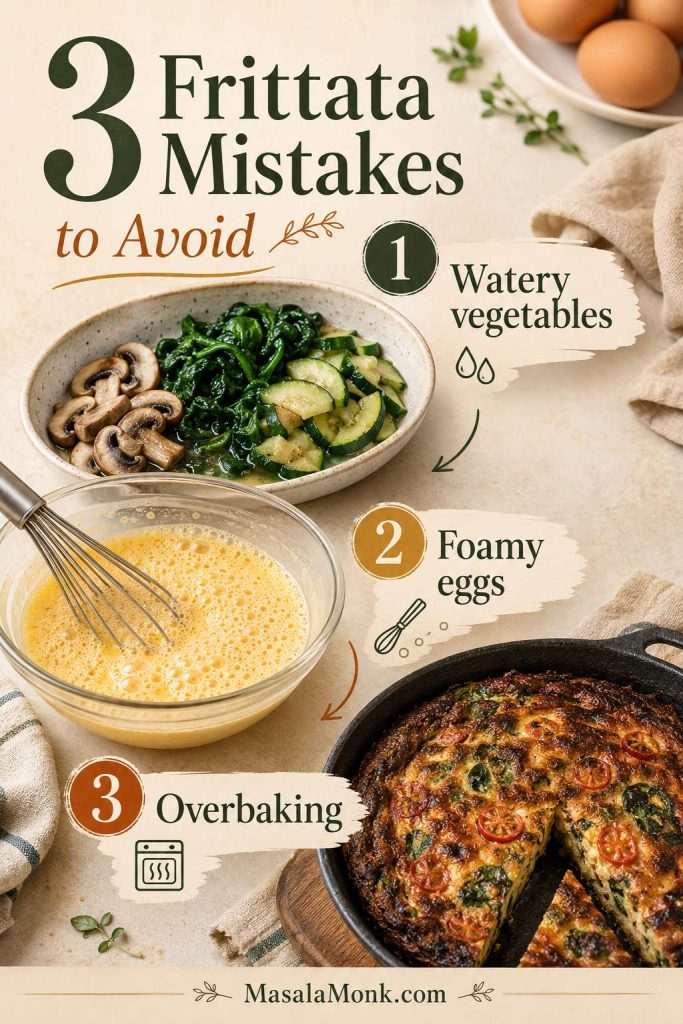
Three mistakes to avoid: Do not add watery vegetables raw, do not over-whisk the eggs into foam, and do not wait for a deeply browned top. Cook the fillings first, whisk just until blended, and pull the frittata when the center is softly set.
Guide showing three frittata mistakes to avoid: watery vegetables, over-whisked foamy eggs, and overbaking.
Most frittata problems are preventable: first remove moisture from fillings, then whisk gently, and finally pull the pan before the top gets too brown.

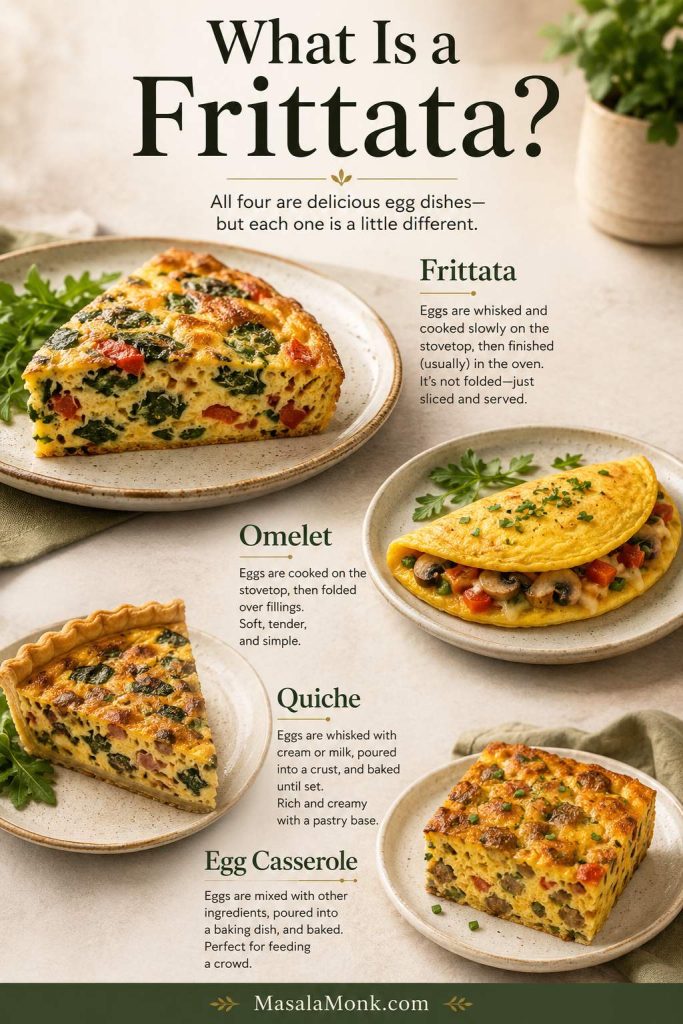
What Is a Frittata?

A frittata is an Italian-style egg dish where beaten eggs are mixed with vegetables, cheese, herbs, or cooked meat, then cooked until set. Unlike an omelet, the fillings are mixed into the eggs instead of folded inside. Unlike quiche, a frittata usually has no crust and uses less dairy, so it is firmer, faster, and easier to slice.

That is what makes it so useful: it feels nicer than scrambled eggs, takes less work than quiche, and turns leftovers into something that looks intentional.

At home, it can feel like a weekend brunch dish, but it is also practical enough for leftovers, cooked greens, roasted vegetables, bits of cheese, or breakfast meats you already have. Think of it as a flexible egg bake with a little more elegance and a lot less fuss.

Comparison of a frittata wedge, folded omelet, quiche slice, and egg casserole square.
A frittata is the practical middle ground between everyday eggs and brunch food: simpler than quiche, sturdier than an omelet, and easier to slice.

Why This Recipe Works

The egg-to-dairy ratio keeps it tender

Eggs set firmly when they bake, so a little dairy helps soften the texture. The balance matters, though. Too little dairy can make the frittata firm and rubbery, while too much can make it loose, wet, or closer to a crustless quiche. For this frittata recipe, 1/3 cup / 80 ml dairy for 8 large eggs gives a tender center that still slices well.

Cooked fillings help the eggs set cleanly

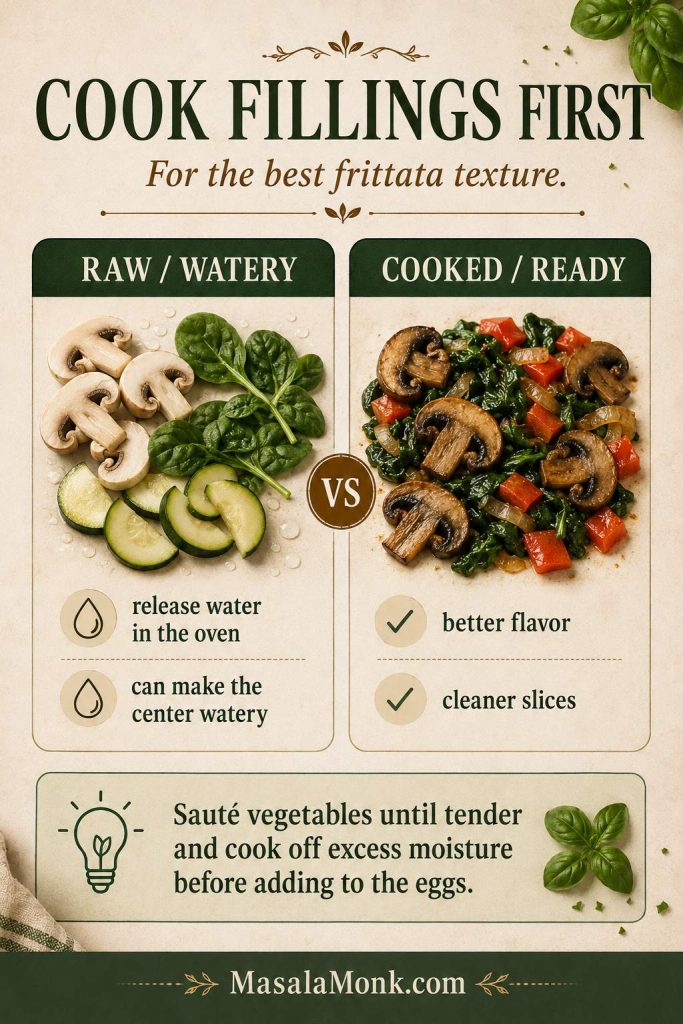
Vegetables can quietly sabotage a frittata if they go in raw. Mushrooms release liquid, spinach shrinks dramatically, zucchini softens fast, and tomatoes can make the middle look underbaked. Cooking those ingredients first concentrates their flavor and keeps the eggs from turning loose in the oven.

Oven baking gives even slices

A skillet frittata usually starts with cooked fillings on the stovetop, then finishes in the oven. That oven finish helps the middle set more evenly, especially once vegetables and cheese are spread through the eggs. If you do not have an oven-safe skillet, a pie dish or square baking dish works too.

Resting keeps the slices clean

Resting is not just a polite suggestion. Give the frittata 5 to 10 minutes after baking and the center firms slightly, the cheese settles, and the slices come out cleaner. Cut too soon and even a properly baked frittata can look softer than it really is.

The finished frittata should be softly set, lightly creamy in the center, and sturdy enough to cut into wedges. It should not taste like dry scrambled eggs, and it should not leak liquid when sliced. When the fillings are cooked first and the eggs are pulled at the right time, the texture lands in that sweet spot between tender and sliceable.

This base version is intentionally simple: mushrooms, greens, onion, a little dairy, and cheese. Once you make it once, the ratio is easy to reuse with almost any cooked filling.

Saveable oven-baked frittata recipe card showing 8 eggs, 1/3 cup dairy, 1 1/2 to 2 cups cooked fillings, 3/4 cup cheese, 375°F, 18 to 22 minutes, and 5 to 10 minutes rest time.
Keep the ratio, bake time, and resting step together; those three details make this oven-baked frittata easier to repeat with different fillings.

Easy Oven-Baked Frittata Recipe Card

Prep Time 10 minutes
Cook Time 25–30 minutes
Rest Time 5–10 minutes
Yield 4–6 servings

Recipe name: Easy Oven-Baked Egg Frittata

Course: Breakfast, brunch, meal prep

Best pan: 10-inch / 25 cm oven-safe skillet

Oven temperature: 375°F / 190°C

Ingredients

  • 8 large eggs
  • 1/3 cup / 80 ml whole milk, half-and-half, or heavy cream
  • 1 tbsp / 15 ml olive oil or butter, plus more for greasing if needed
  • 1 small onion or shallot, finely chopped
  • 1–2 garlic cloves, minced
  • 1 cup sliced mushrooms
  • 1/2 cup chopped bell pepper or zucchini
  • 2 packed cups baby spinach or chopped kale
  • 3/4 cup / 75–90 g shredded or crumbled cheese
  • 1/2 tsp fine salt, plus more for vegetables if needed
  • 1/4 tsp black pepper
  • 2 tbsp chopped fresh herbs, optional

Base vegetable filling

For the easiest first version, use the onion or shallot, mushrooms, bell pepper or zucchini, and spinach or kale listed above. After cooking, the filling should reduce to about 1 1/2–2 cups total.

You can swap this mix with the same amount of cooked asparagus, broccoli, roasted potatoes, leftover vegetables, cooked bacon, ham, or sausage. Just keep the finished filling amount close to 1 1/2–2 cups so the eggs still set cleanly.

Cook the onion first, then add the mushrooms and bell pepper or zucchini. Add the spinach or kale at the end and cook just until wilted. If the pan looks wet, keep cooking for another minute before adding the eggs.

Method

  1. Preheat the oven to 375°F / 190°C. Grease a 10-inch oven-safe skillet if needed.
  2. Warm the olive oil or butter in the skillet over medium heat. Add the onion or shallot and cook until softened.
  3. Add the garlic, mushrooms, and bell pepper or zucchini. Cook until the vegetables soften and excess moisture reduces. Add the spinach or kale and cook just until wilted.
  4. In a bowl, whisk the eggs, dairy, salt, and pepper just until combined. Do not whisk the eggs into a very foamy mixture.
  5. Spread the cooked fillings evenly in the skillet. Pour the egg mixture over them, then sprinkle the cheese over the top. You can also stir some of the cheese directly into the eggs and reserve a little for the surface.
  6. Bake for 18–22 minutes, until the center is just set and no wet egg pools on top.
  7. Rest for 5–10 minutes before slicing. Finish with fresh herbs, black pepper, or a little extra cheese if desired.

Doneness

The center should look set, with only a slight wobble. For the safest check, egg dishes should reach 160°F / 71°C in the center.

Storage

Refrigerate cooled slices in an airtight container for 3–4 days, or freeze well-wrapped portions for up to 2–3 months.

Need to adjust the pan or timing? Check the bake-time guide. Not sure when it is done? Use the doneness cues.

Best Frittata Recipe Ratio

The easiest way to stop guessing is to use a frittata ratio. This frittata recipe is flexible, but the base balance is what keeps it reliable: enough egg for structure, enough dairy for tenderness, enough cooked fillings for flavor, and enough cheese to make each bite satisfying without weighing the eggs down.

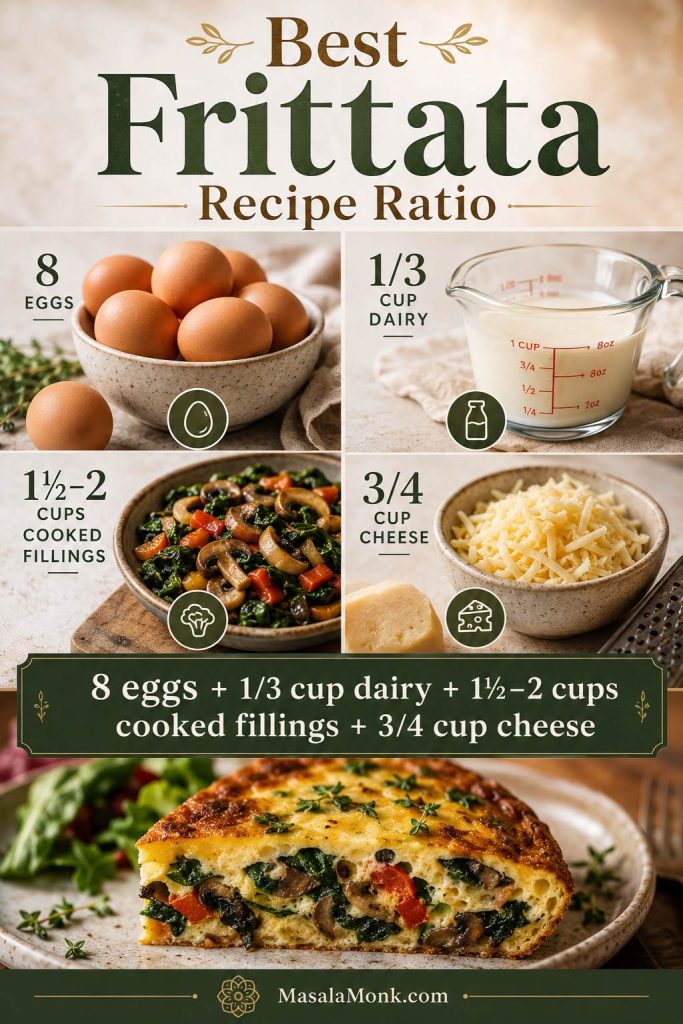
For most home cooks, the most useful starting point is 8 eggs + 1/3 cup dairy + 1 1/2 to 2 cups cooked fillings + 3/4 cup cheese. That makes a full 10-inch skillet frittata that serves 4 hungry people or 6 lighter portions with sides. Think of the ratio as guardrails, not handcuffs.

Frittata ratio board showing eggs, dairy, cooked fillings, cheese, and the formula 8 eggs, 1/3 cup dairy, 1 1/2 to 2 cups fillings, and 3/4 cup cheese.
The best frittata recipe ratio keeps the eggs structured, the dairy balanced, and the cooked fillings flavorful without making the center loose.

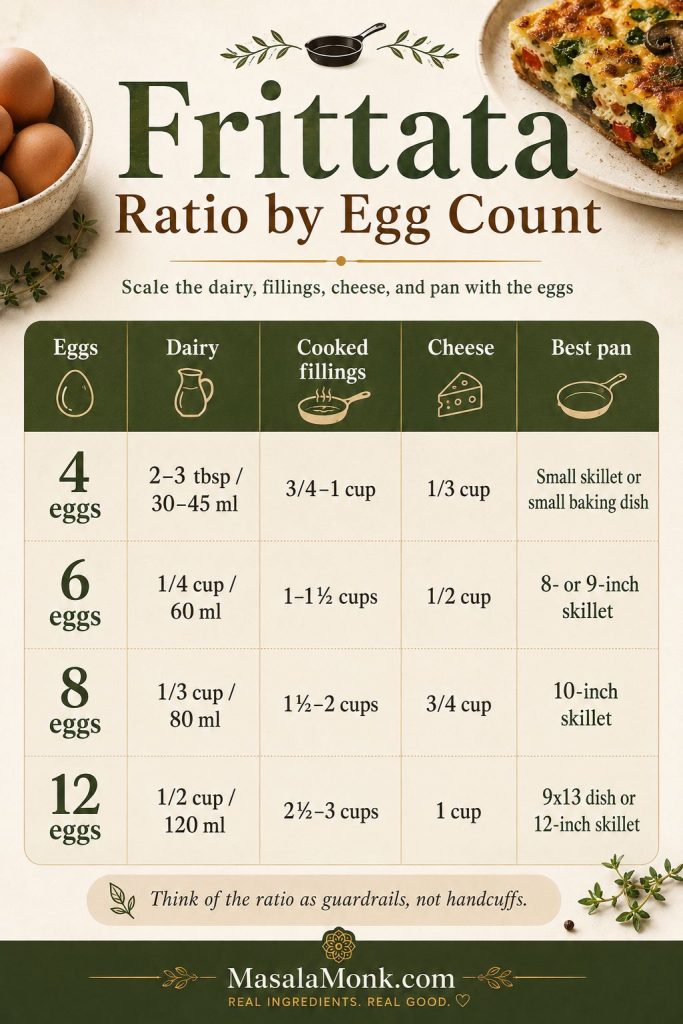
Frittata Ratio by Egg Count

EggsDairyCooked fillingsCheeseBest pan
4 eggs2–3 tbsp / 30–45 ml3/4–1 cup1/3 cupSmall skillet or small baking dish
6 eggs1/4 cup / 60 ml1–1 1/2 cups1/2 cup8- or 9-inch skillet
8 eggs1/3 cup / 80 ml1 1/2–2 cups3/4 cup10-inch skillet
12 eggs1/2 cup / 120 ml2 1/2–3 cups1 cup9×13 dish or 12-inch skillet
Frittata scaling chart showing ratios for 4 eggs, 6 eggs, 8 eggs, and 12 eggs with dairy, cooked fillings, cheese, and pan size.
When scaling the recipe, adjust the pan along with the eggs; otherwise, a thicker frittata may need more time while the edges cook faster.

If you are cooking for one or only have a couple of eggs, this guide to 2-egg dishes has smaller breakfast ideas for days when you do not want a full pan.

A little more cheese is fine if you are using a salty, bold cheese in small amounts. A few extra vegetables are fine when they are already cooked and not watery. What you want to avoid is a pan overloaded with raw vegetables or a bowl of eggs thinned out with too much milk.

If you want a softer brunch-style frittata, use half-and-half or cream and a cheese with personality, like feta, goat cheese, Gruyère, or sharp cheddar. If you want cleaner meal-prep slices, stay closer to whole milk, cooked vegetables, and a moderate amount of cheese.

Ingredients for an Easy Egg Frittata

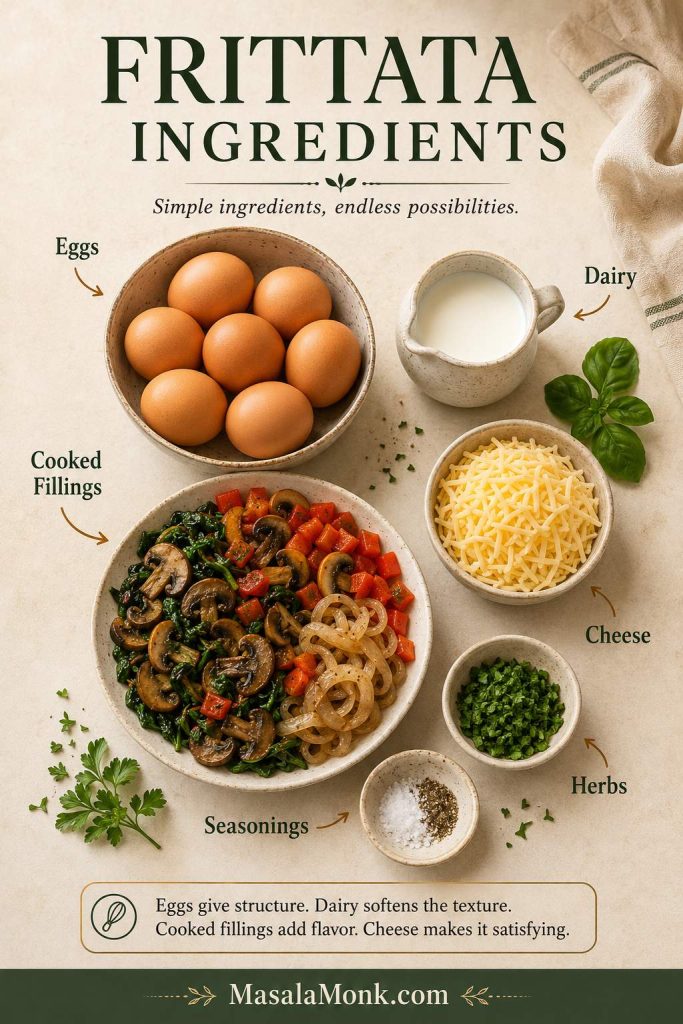
A frittata is forgiving, but it is not random. Each ingredient has a job: the eggs hold it together, the dairy softens it, the cheese adds depth, and the cooked fillings make it worth slicing into.

Overhead frittata ingredients including eggs, dairy, cooked vegetables, cheese, herbs, garlic, onion, salt, and pepper.
A flexible frittata still needs balance: eggs set the structure, dairy softens the texture, fillings add flavor, and cheese brings richness.

Eggs

Use large eggs for the most predictable result. If your eggs are very small, the frittata may have less structure. If they are extra-large, it may take a little longer to set. Either way, the visual cues matter more than the exact clock: the center should look set, not wet.

Dairy

Whole milk makes a lighter frittata, half-and-half gives a creamy but still sliceable texture, and heavy cream makes the richest version. Unsweetened dairy-free milk can work too, though the texture will usually be a little firmer and less custardy.

Cheese

Cheese is where the frittata starts to feel generous. Cheddar, Swiss, Gruyère, mozzarella, Monterey Jack, feta, goat cheese, Parmesan, ricotta, and cottage cheese can all work, but they do different jobs. Melting cheeses make the slices cozy and familiar, crumbly cheeses give salty pockets, and soft cheeses like ricotta or goat cheese are best dotted on top.

Vegetables and add-ins

The best vegetables have already done their messy work before they meet the eggs: mushrooms have given up their water, spinach has wilted down, potatoes are tender, and onions taste sweet instead of sharp. That gives the finished frittata better flavor and cleaner slices.

Side-by-side comparison of raw watery vegetables and cooked frittata fillings in a skillet.
Cook high-moisture fillings before they meet the eggs so mushrooms, greens, onions, and zucchini add flavor instead of leaking water.

Herbs and seasoning

Salt the eggs, but pay attention to salty fillings. Bacon, ham, feta, Parmesan, sausage, smoked salmon, and olives can all push the salt level up quickly. Fresh herbs like parsley, basil, dill, chives, cilantro, or green onion brighten the finished frittata, especially when added after baking.

Best Pan for Frittata

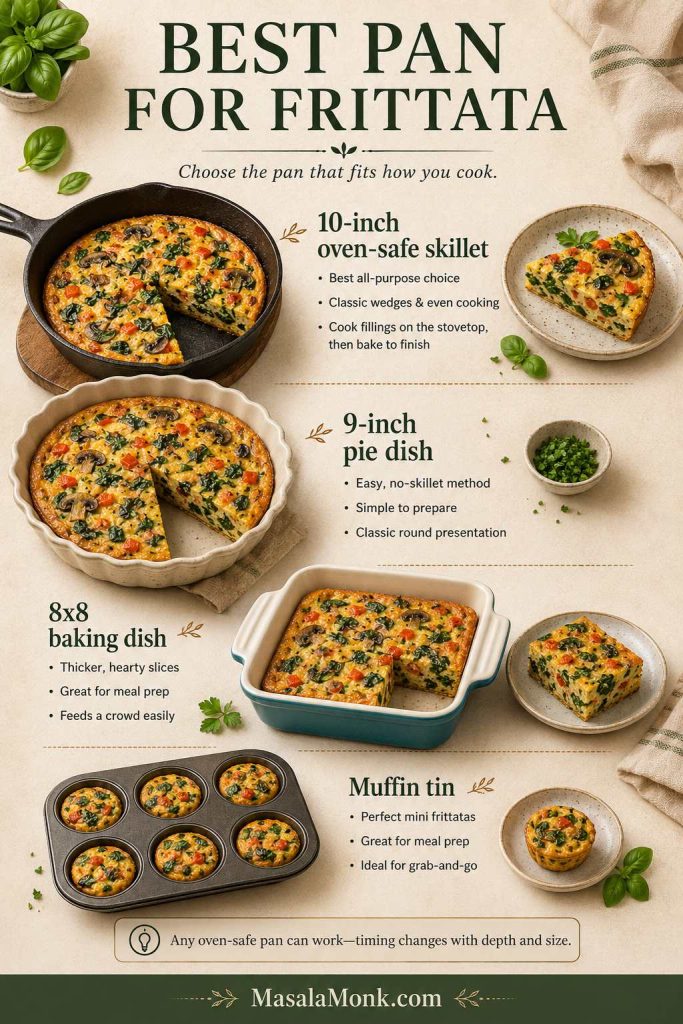
The best pan for a frittata depends on how you want to cook it. A 10-inch oven-safe skillet is the best all-purpose choice because you can cook the fillings in the same pan, pour in the eggs, and move it straight to the oven.

No oven-safe skillet? Use a greased pie dish, square baking dish, or casserole dish. The frittata will take longer because the egg mixture starts cold in the dish instead of warm from the skillet, but the method is simple and reliable.

Frittata pan guide showing a 10-inch skillet, 9-inch pie dish, 8x8 baking dish, and muffin tin.
The pan shapes the final result: a skillet gives browned wedges, a baking dish gives neat squares, and a muffin tin gives individual portions.
PanBest useWhat to watch
10-inch oven-safe skilletBest default for an 8-egg frittataHandle must be oven-safe.
12-inch oven-safe skilletThinner frittata with quicker bakingCheck early so it does not dry out.
9-inch pie dishNo-skillet oven-baked frittataUsually needs a lower temperature and longer bake.
8×8 or 9×9 baking dishThicker meal-prep slicesThe middle needs more time than the edges.
9×13 baking dishLarger brunch or meal-prep batchUse more eggs or expect thinner slices.
Muffin tinMini frittatas and breakfast meal prepGrease well and check early.
Important: If using a skillet, make sure both the pan and handle are oven-safe. When in doubt, use a greased pie dish or baking dish instead.

Once you choose the pan, check the matching bake time so the center sets without drying the edges.

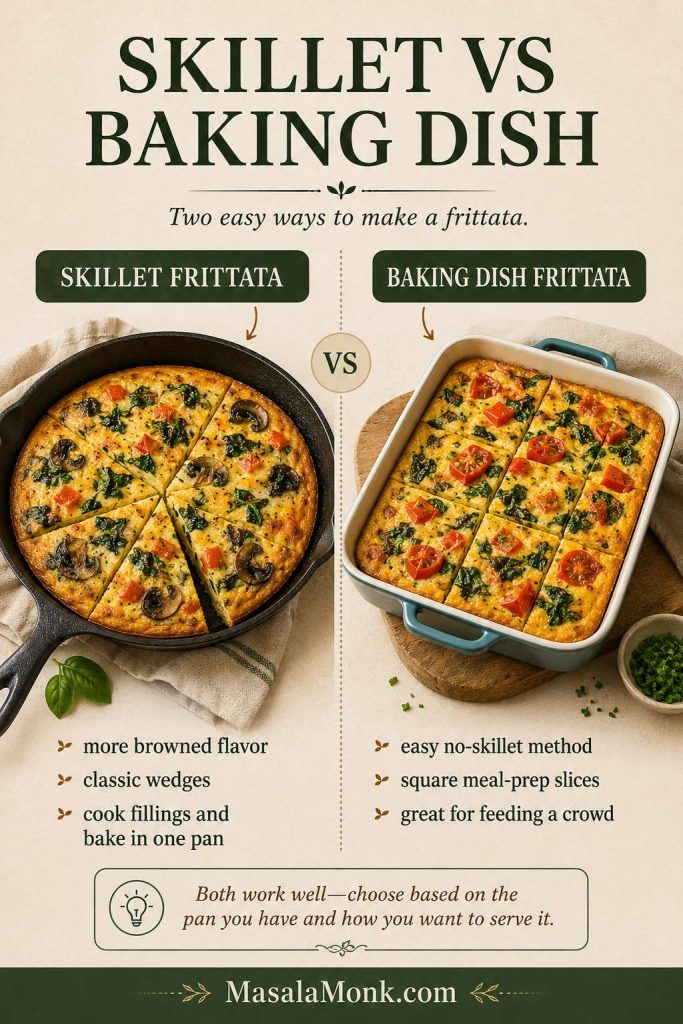
Skillet Method vs Fully Oven-Baked Method

The skillet method gives the best flavor because the fillings cook in the same pan before the eggs go in. Use it when you want deeper browning and a classic wedge-shaped frittata.

The fully oven-baked method is simpler if you do not have an oven-safe skillet. Cook the fillings separately, spread them in a greased 9-inch pie dish or 8×8 baking dish, pour the egg mixture over the top, and bake at 350°F / 175°C until the center is set. This method is especially helpful for meal prep because square slices fit neatly into containers.

Comparison of skillet frittata wedges and baking-dish frittata squares.
Use the skillet method for browned flavor and a classic brunch look; choose a baking dish when easy make-ahead slices matter more.

How to Make a Frittata in the Oven

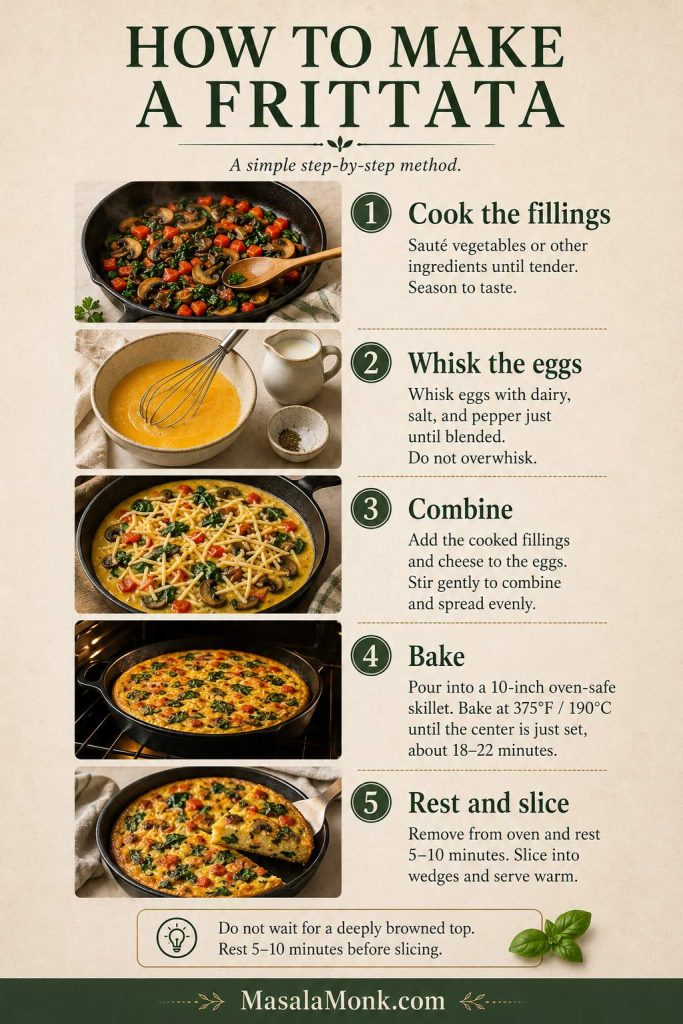
The method is simple: cook the fillings, whisk the eggs gently, combine everything in a greased pan, bake until just set, and rest before slicing. The small details are what keep the frittata from turning soggy, rubbery, or bland.

Step-by-step frittata method showing cooked fillings, whisked eggs, combined ingredients, baking, and resting before slicing.
The steps are simple, but the order matters: cook, whisk, combine, bake, and rest so the final frittata stays tender and sliceable.

Step 1: Cook the vegetables first

Warm the oil or butter in your skillet, then cook the onion or shallot until soft. Add garlic for the last 30 seconds so it does not burn. From there, add the vegetables that need cooking. Mushrooms should release their moisture and start to brown. Spinach should wilt down. Zucchini should soften and reduce. Potatoes, sweet potatoes, broccoli, and asparagus should already be tender before the eggs are added.

If you are using bacon, sausage, chicken, or another meat, cook it fully first. Drain excess fat if the pan looks greasy. A little fat is flavorful; too much can make the frittata heavy.

Step 2: Whisk the eggs gently

In a mixing bowl, whisk the eggs, dairy, salt, and pepper just until the yolks and whites are blended. You do not need to beat the eggs until they are foamy. Over-whisked eggs can puff dramatically in the oven, then collapse as they cool.

Step 3: Add the fillings and cheese

You can stir the cooked fillings and most of the cheese into the eggs, or you can spread the fillings evenly in the skillet and pour the egg mixture over the top. Both methods work. For the prettiest surface, reserve a little cheese and a few colorful vegetables to scatter on top before baking.

Step 4: Bake until just set

For the main recipe, bake in a 10-inch oven-safe skillet at 375°F / 190°C for 18–22 minutes. Start checking around 18 minutes. The edges may puff slightly and the center should no longer look wet. Instead of waiting for the top to turn deeply browned, pull the frittata when the middle is softly set.

Step 5: Rest before slicing

Finally, let the frittata rest for 5 to 10 minutes. This short pause gives the center time to finish settling and makes the slices cleaner. Add fresh herbs, cracked black pepper, or a little extra cheese just before serving.

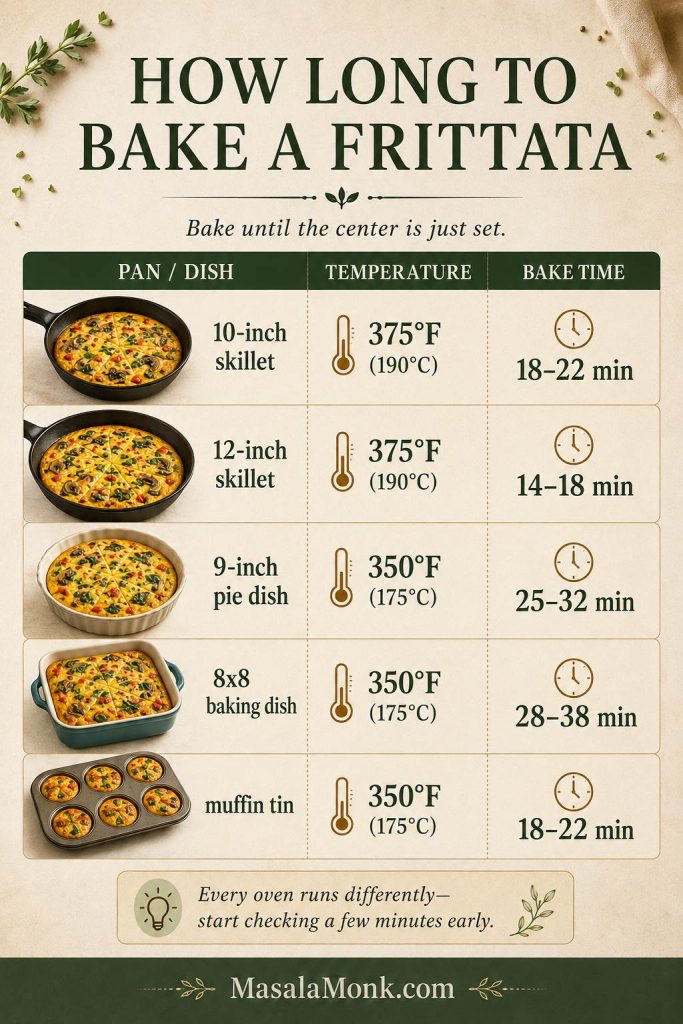
How Long to Bake a Frittata

Frittata bake time changes with pan size, pan depth, oven temperature, and how much moisture is in the fillings. A shallow skillet frittata can finish quickly, while a thicker baking-dish frittata needs more time through the middle.

Frittata bake time guide showing different pans and approximate oven times for skillet, pie dish, baking dish, sheet pan, and muffin tin.
Because pan depth changes bake time, start checking early and trust the center more than the clock or the color of the top.
Pan or methodOven temperatureApproximate timeBest for
10-inch skillet375°F / 190°C18–22 minutesMain recipe
12-inch skillet375°F / 190°C14–18 minutesThinner frittata
10-inch skillet, fast finish400°F / 200°C8–15 minutesStovetop-start method
9-inch pie dish350°F / 175°C25–32 minutesNo-skillet method
8×8 baking dish350°F / 175°C28–38 minutesThicker meal-prep slices
9×13 baking dish350°F / 175°C25–35 minutesLarger batch
Sheet pan375°F / 190°C20–25 minutesBrunch or crowd servings
Standard muffin tin350°F / 175°C18–22 minutesMini frittatas
Mini muffin tin350–375°F / 175–190°C10–14 minutesBite-size egg cups

Use these times as a guide, then check the doneness cues before pulling the frittata from the oven.

For a sheet-pan frittata, use a well-greased or parchment-lined rimmed pan, spread the fillings evenly, and check early because the egg layer is usually thinner than a skillet or baking-dish frittata.

Every oven and pan behaves a little differently, so use the clock as a guide rather than the only test. A frittata with dry cooked vegetables may set faster than one with juicy tomatoes, zucchini, or extra cheese. Start checking a few minutes early, especially if your pan is wide or your oven runs hot.

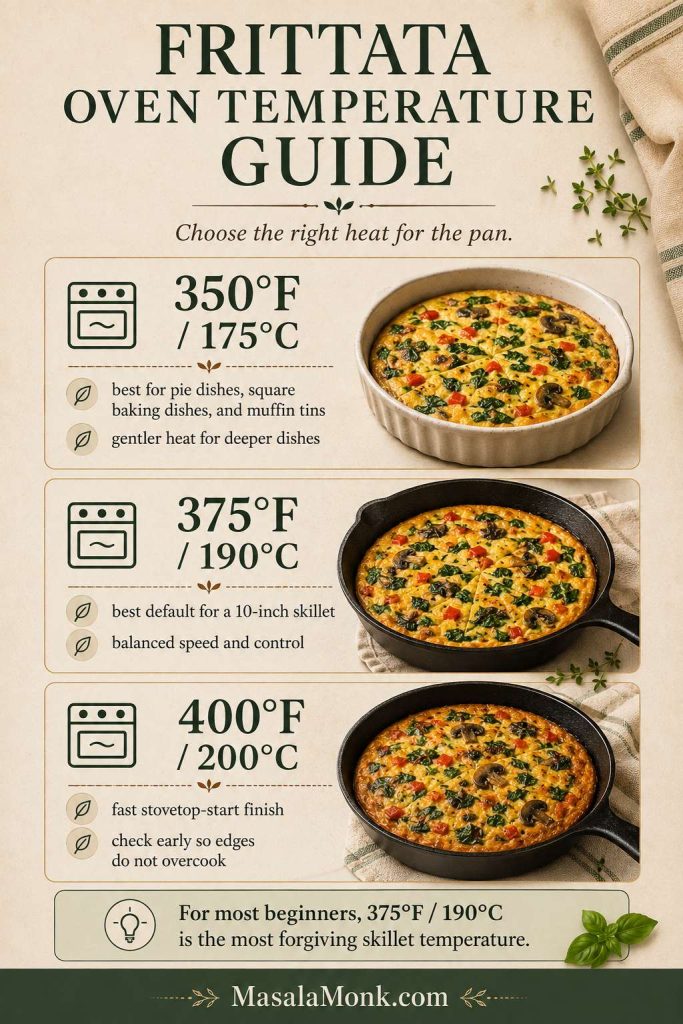
350°F vs 375°F vs 400°F for Frittata

The oven temperature is not random. Different frittata recipes use different temperatures because they are usually using different pans and methods. Instead of treating one number as magic, choose the temperature based on the pan and texture you want.

TemperatureBest useWhat to watch
350°F / 175°CPie dishes, square baking dishes, muffin tins, and deeper frittatasGentler heat, but the middle takes longer.
375°F / 190°CBest default for a 10-inch skillet frittataBalanced speed and control.
400°F / 200°CFast stovetop-start skillet frittatasCheck early because edges can overcook.
Oven temperature guide for frittata comparing 350°F for deeper dishes, 375°F for skillet frittata, and 400°F for a fast finish.
Use 375°F for a classic skillet frittata. Deeper dishes usually need gentler heat so the middle sets before the edges dry out.

For most beginners, 375°F / 190°C is the most forgiving skillet temperature. Use 350°F / 175°C when the eggs are in a deeper dish, and use 400°F / 200°C only when you want a faster finish and are comfortable checking early.

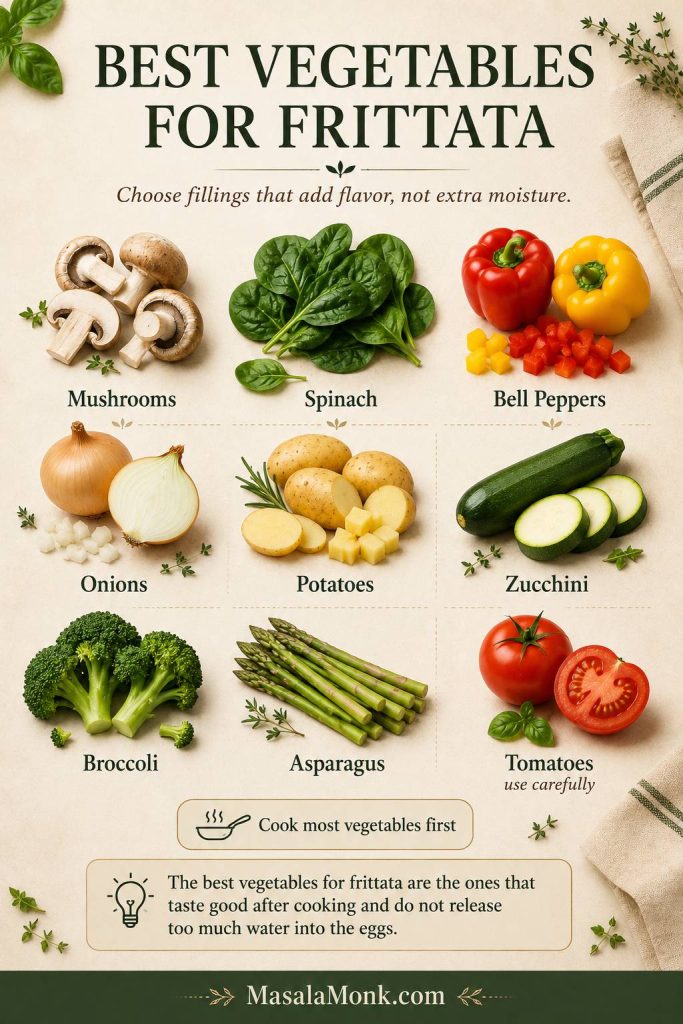
Best Vegetables and Fillings for Frittata

The best frittata fillings are already cooked, seasoned, and not watery. That does not mean they need to be complicated. Leftover roasted vegetables, sautéed greens, cooked potatoes, bacon, ham, sausage, or bits of cheese can all turn into a good breakfast frittata.

Vegetable guide for frittata showing mushrooms, spinach, peppers, onions, potatoes, zucchini, tomatoes, and broccoli.
The best vegetables for frittata are not just tasty; they also cook down well and do not release too much water into the eggs.

Best Filling Prep Before Baking

Use the table below as a prep guide before adding fillings to your eggs.

FillingUse raw or cooked?Best prep
MushroomsCook firstSauté until moisture releases and the mushrooms start browning.
Spinach or kaleCook firstWilt, then squeeze or cook off extra moisture.
ZucchiniCook firstSauté until the pieces soften and excess water reduces.
Bell peppers and onionsCook firstSauté until softened and lightly sweet.
Potatoes or sweet potatoesFully cook firstRoast, boil, microwave, or pan-cook until tender.
Broccoli or asparagusParcook firstSteam, roast, or sauté until just tender.
TomatoesUse carefullyUse cherry tomatoes or seeded tomatoes so the frittata does not turn watery.
Bacon, sausage, ham, or chickenCook firstCook fully and drain excess fat if needed.
Fresh herbsAdd lateStir into the eggs or sprinkle after baking for brighter flavor.

If your frittata usually turns watery, check the troubleshooting guide before adding more dairy or extra fillings.

Best Frittata Filling Combinations

A spinach frittata is best with wilted, squeezed spinach and feta, goat cheese, cheddar, or Parmesan. A potato frittata works best when the potatoes are already tender and lightly browned. A mushroom frittata needs mushrooms that have cooked long enough to lose their water. For a vegetable frittata, two or three vegetables usually taste better than a full fridge clean-out: spinach and mushrooms work, peppers and onions work, and zucchini with tomatoes and basil works. Seven vegetables in one pan usually taste less intentional.

Can you use frozen vegetables in a frittata?

Yes, but do not add them icy or wet. Thaw frozen spinach, broccoli, peppers, or mixed vegetables first, then squeeze or cook off as much moisture as you can. Frozen spinach especially needs a good squeeze before it goes into the eggs.

Milk vs Cream vs Half-and-Half in Frittata

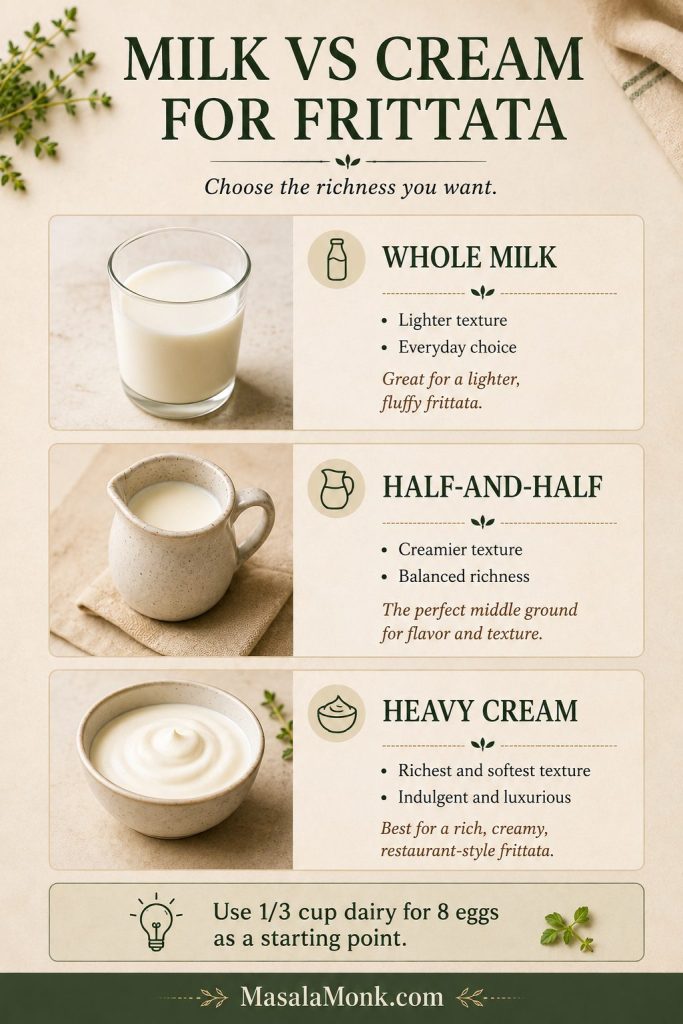
Milk, cream, and half-and-half all work in a frittata, but they create different textures. The main rule is simple: use enough dairy to soften the eggs, not so much that the center turns loose.

Comparison of milk, half-and-half, and cream for frittata texture.
Milk keeps the frittata lighter, cream makes it richer, and half-and-half sits in the middle with a creamy but still sliceable texture.
DairyTextureBest use
Whole milkLight and tenderEveryday frittata
Half-and-halfCreamier but still sliceableBest balanced choice
Heavy creamRich and softerBrunch-style frittata
Unsweetened dairy-free milkLighter and less richDairy-free variation
Cottage cheeseHigher protein, creamy pockets or blended textureHigh-protein frittata variation

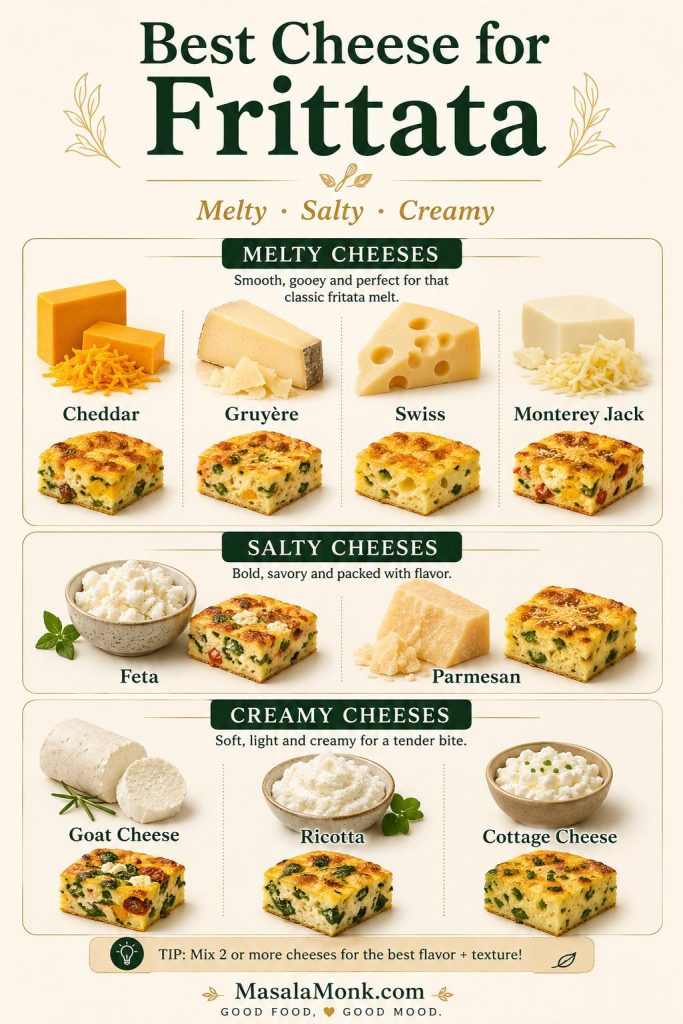
Cheese has a second job beyond flavor: it helps make the frittata feel satisfying. Use a melting cheese when you want a classic breakfast texture, a salty cheese when you want punchier flavor, or a soft cheese when you want creamy pockets. If the cheese is bold, you do not need much. A little feta, Parmesan, or goat cheese can do more for the whole pan than a heavy layer of mild cheese.

Cheese guide for frittata showing melty cheeses like cheddar, Gruyère, Swiss, and Monterey Jack; salty cheeses like feta and Parmesan; and creamy cheeses like goat cheese, ricotta, and cottage cheese.
Cheese changes the whole character of a frittata: melty cheese feels cozy, salty cheese adds punch, and creamy cheese creates soft pockets.

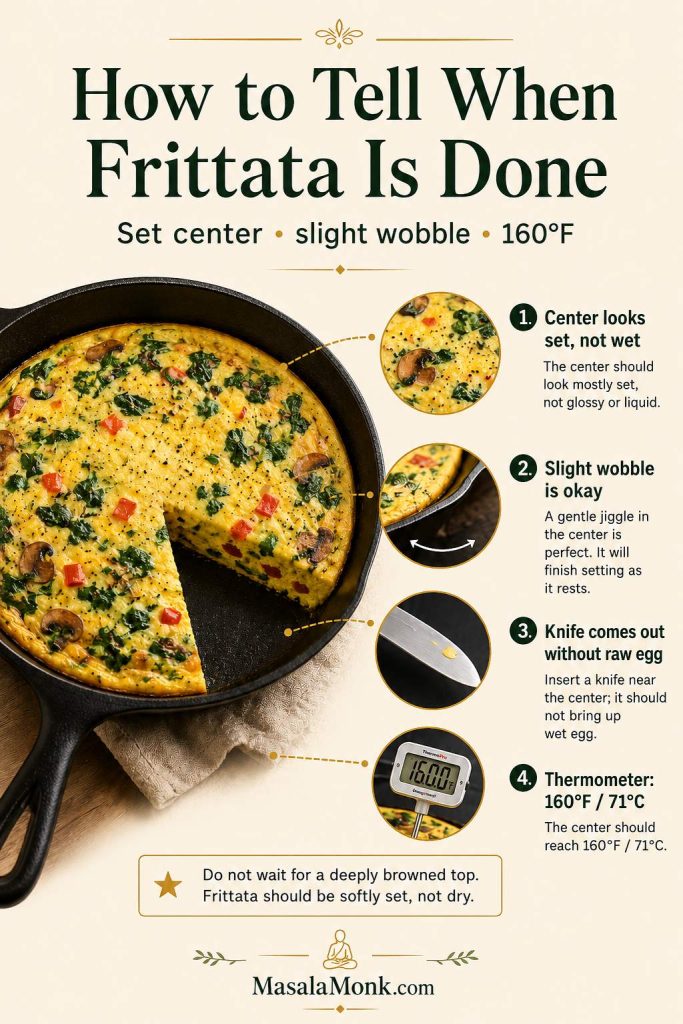
How to Tell When a Frittata Is Done

A frittata is done when the center is set but not dried out. The mistake many people make is waiting for the top to brown deeply. By then, the edges may already be rubbery.

Do not wait for deep browning: A frittata is usually best when the center is just set. If you wait for a dark golden top, the edges may already be dry or rubbery.
Doneness guide for frittata showing a set center, slight wobble, knife test, and thermometer reading 160°F or 71°C.
Instead of waiting for a dark top, look for a set center, a slight wobble, and no wet egg when you test near the middle.
CheckWhat you want
VisualThe center looks set, not wet, shiny, or liquid.
JiggleA slight wobble is fine; loose sloshing egg is not.
TouchThe center feels lightly springy.
Knife testA knife inserted near the center should not bring up raw egg.
ThermometerThe center should reach 160°F / 71°C for egg dishes.

For food safety, egg dishes such as frittata and quiche should reach 160°F / 71°C in the center. You can check the current official chart at FoodSafety.gov.

Frittata Variations

Once the base ratio is comfortable, use this frittata recipe as a flexible starting point. Keep the same egg mixture, then change the vegetables, cheese, herbs, or cooked meat depending on what you have.

If you are making it for brunch, think creamy, herby, and a little richer. If you are making it for meal prep, think sturdy, sliceable, and easy to reheat. And if you are using leftovers, choose two or three good fillings instead of trying to fit the whole fridge into one pan.

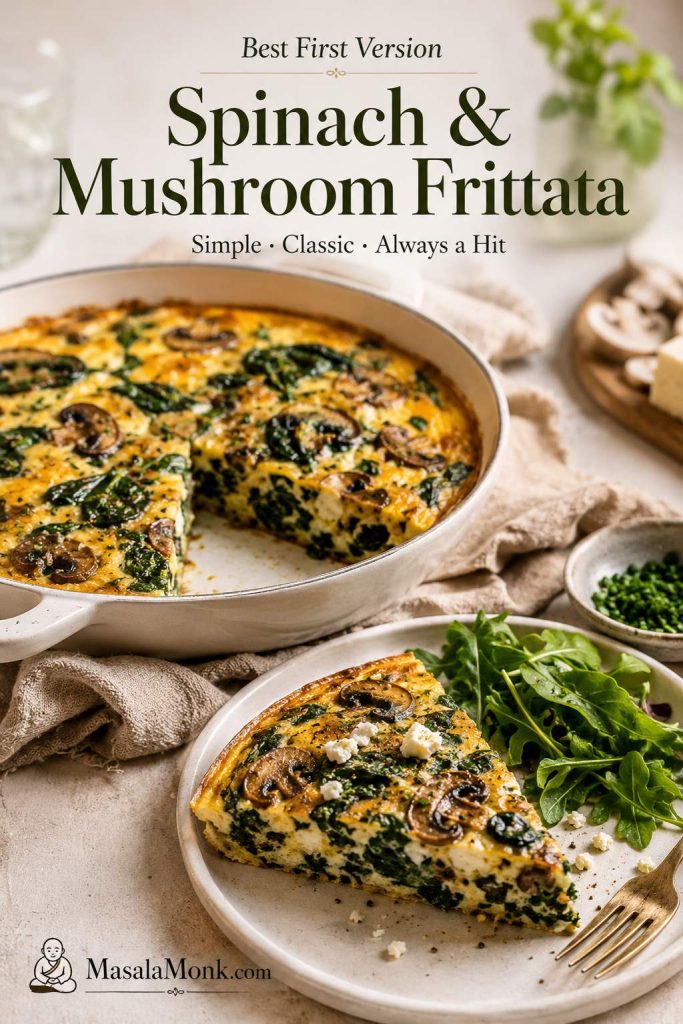
For the safest first version, go with spinach, mushrooms, and cheddar or feta. The flavors are familiar, the vegetables are easy to manage, and the finished slices hold together well.

Spinach and mushroom frittata with a wedge served on a plate beside salad greens and crumbled cheese.
Spinach and mushroom is a smart first version because the flavors are familiar, the vegetables cook down well, and the slices hold together.

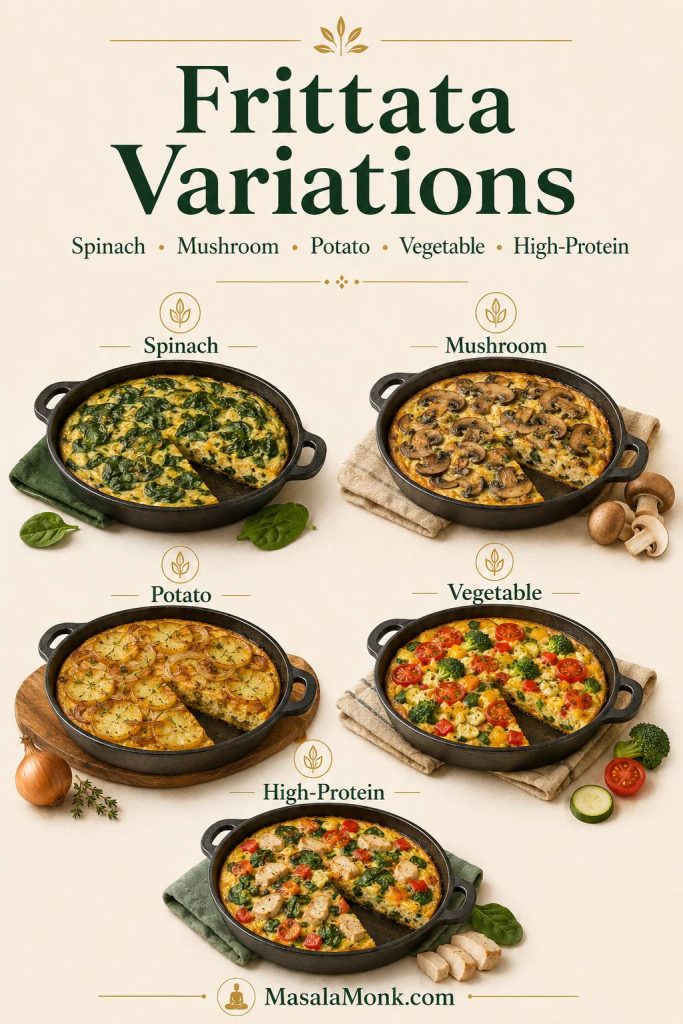
Not sure which version to make first? Start with one of these combinations, then adjust the vegetables and cheese based on what you have.

Frittata variations board showing spinach, mushroom, potato, vegetable, and high-protein frittatas.
Once the base method works, variations become easy: keep the egg mixture steady, then change the vegetables, cheese, herbs, or protein.
Frittata styleBest fillingsBest cheese
Spinach frittataWilted spinach, onion, herbsFeta, goat cheese, Parmesan, or cheddar
Mushroom frittataBrowned mushrooms, shallot, thymeGruyère, Swiss, goat cheese, or cheddar
Potato frittataCooked potatoes, onion, peppersCheddar, Monterey Jack, or Parmesan
Vegetable frittataPeppers, zucchini, broccoli, asparagus, or roasted vegetablesFeta, mozzarella, goat cheese, or cheddar
High-protein frittataSpinach, peppers, cooked turkey, herbsCottage cheese, cheddar, or Parmesan

Spinach frittata

For a spinach frittata that tastes bright instead of watery, wilt the spinach first, squeeze it well, then pair it with feta, goat cheese, dill, chives, or green onion.

Potato frittata

Potatoes should be fully cooked before the eggs go in. Roasted potatoes, boiled potatoes, leftover breakfast potatoes, or pan-fried cubes all work. For the best texture, let the potatoes brown lightly so they do not taste flat inside the eggs.

Vegetable frittata

Use a mix of cooked peppers, onions, mushrooms, zucchini, broccoli, asparagus, tomatoes, or leftover roasted vegetables. Two or three vegetables usually taste better than too many competing flavors in one pan.

Bacon, ham, or sausage frittata

Cook bacon or sausage first and drain excess fat. Ham is already cooked, but browning it briefly can deepen the flavor. Since breakfast meats and many cheeses are salty, reduce the added salt if needed. For an easy brunch plate, serve slices with air fryer bacon, toast, and fruit.

Egg white frittata

An egg white frittata is leaner, but it can turn firm faster than a whole-egg frittata. Use cooked vegetables, enough seasoning, and a little cheese or cottage cheese for better texture. Check early so the egg whites do not overbake.

Cottage cheese or high-protein frittata

For a higher-protein frittata, use about 1/2 cup cottage cheese with 8 eggs and reduce the milk or cream to 2 tablespoons. Leave the cottage cheese as is for creamy pockets, or blend it with the eggs for a smoother texture.

Dairy-free frittata

Use unsweetened dairy-free milk or skip the dairy and rely on cooked vegetables, herbs, and olive oil for flavor. The texture may be a little firmer without dairy, so avoid overbaking.

Keto or low-carb frittata

For a keto frittata, use eggs, cheese, cream or half-and-half, and low-carb vegetables such as spinach, mushrooms, zucchini, bell peppers, broccoli, asparagus, or cauliflower. Skip potatoes, sweet potatoes, and sweet vegetables if you are keeping carbs very low.

Mini frittatas or frittata muffins

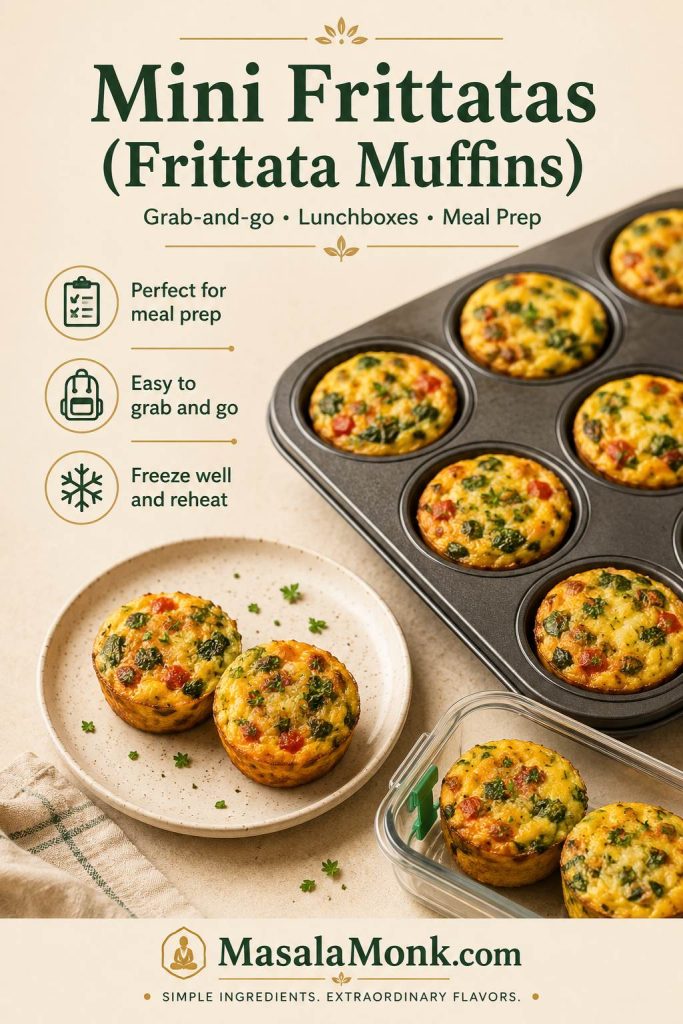
For mini frittatas, divide the egg mixture among well-greased muffin cups and bake at 350°F / 175°C until just set. They are useful for breakfast meal prep, lunchboxes, and grab-and-go mornings. If meal prep is the goal, you may also like this freezer-friendly breakfast burrito recipe.

Mini frittatas baked in a muffin tin with a few served on a plate and packed in a container for meal prep.
Mini frittatas turn the same base recipe into portable portions, which makes them useful for lunchboxes, freezer breakfasts, and quick mornings.

Making these ahead? Use the storage and reheating guide so the texture stays tender.

How to Store, Freeze, and Reheat Frittata

Cool and Pack the Slices First

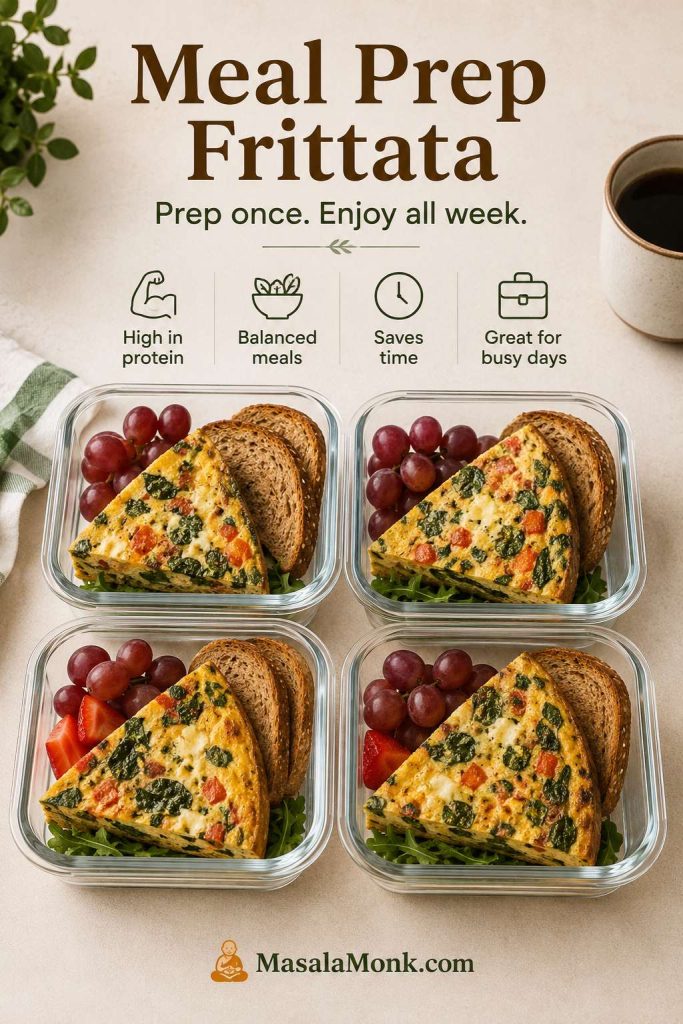
Frittata is excellent for meal prep because it holds its shape, reheats quickly, and tastes good warm or chilled from the fridge. If you serve it at room temperature for brunch, keep the timing in mind and do not leave it out too long.

For the cleanest meal-prep slices, let the frittata cool on a rack or cutting board before packing it away. If it sits hot in the pan or a closed container, steam can soften the bottom and make the slices damp.

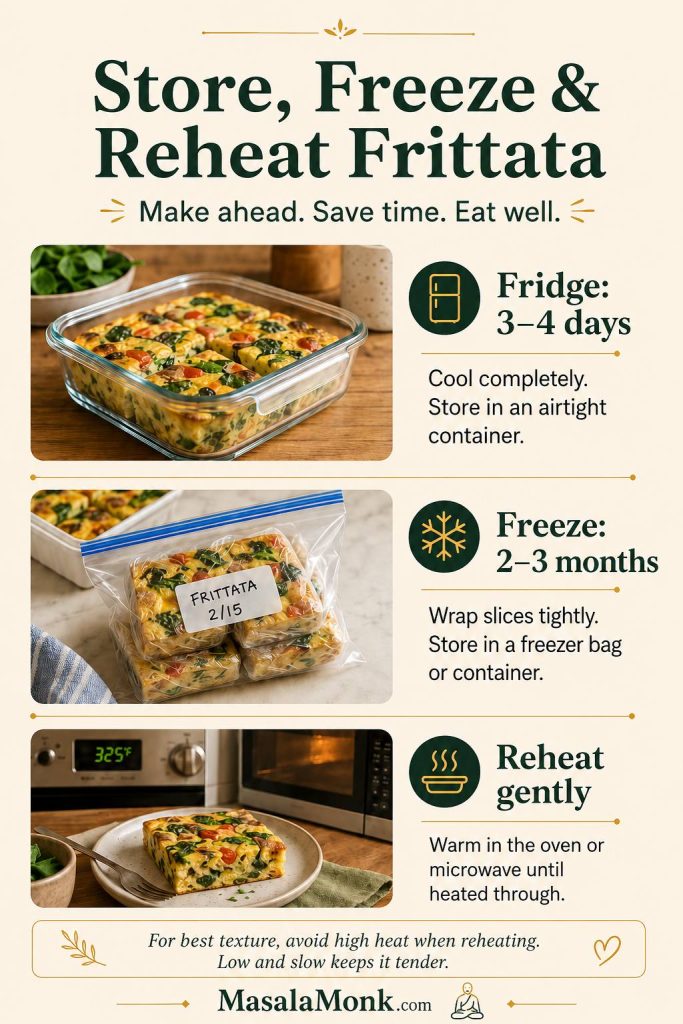
Fridge, Freezer, and Reheat Times

Storage guide showing frittata slices in a container, wrapped freezer portions, and a reheated slice on a plate.
Cool the frittata before storing; otherwise, trapped steam can soften the slices even when the eggs were baked correctly.
MethodHow longBest practice
Refrigerator3–4 daysCool completely, then store slices in an airtight container.
Freezer2–3 monthsWrap individual slices well, then place in a freezer-safe bag or container.
MicrowaveShort burstsCover lightly and heat gently so the eggs do not turn rubbery.
Oven300–350°F until warmBest for texture; for food safety, reheat leftovers to 165°F / 74°C.
Air fryerLow heat, short timeUseful for small portions, but avoid drying the edges.

Food Safety for Stored Frittata

The FDA recommends refrigerating cooked egg leftovers and using them within 3–4 days. You can read more on the FDA egg safety page.

If serving frittata at room temperature for brunch, do not leave it out for more than 2 hours, or more than 1 hour in very hot weather.

When reheating a slice in the microwave, use short bursts instead of one long blast. Eggs can turn rubbery when overheated, so warm them gently when texture matters. Leftovers should be reheated to 165°F / 74°C before serving.

Frittata Meal Prep Boxes

To build a bigger breakfast-prep spread, pair frittata slices with overnight oats, fruit, toast, or a smoothie.

Meal-prep containers filled with frittata slices, fruit, toast, and greens.
Make-ahead frittata slices pack neatly, reheat quickly, and still taste good chilled from the fridge.

Serving leftovers for breakfast or brunch? See what to serve with frittata for easy plate ideas.

Frittata Troubleshooting: Watery, Rubbery, or Undercooked

When a frittata goes wrong, the trouble usually starts before it ever reaches the plate: the fillings were too wet, the pan was too deep, the eggs were beaten too aggressively, or the bake went a few minutes too long. Fortunately, most of those problems are easy to fix the next time.

Troubleshooting guide for watery frittata, rubbery texture, stuck frittata, and bland flavor with short fixes.
When a frittata goes wrong, check four things first: moisture, heat, pan prep, and seasoning. Fixing those usually fixes the next batch.
ProblemLikely causeFix next time
Watery frittataRaw watery vegetables or too much dairySauté or roast high-moisture fillings before adding the eggs, and keep the dairy ratio in check.
Rubbery textureOverbaking, high heat, or too little dairyPull it when just set and rest before slicing.
Wet center, dry edgesPan is too small/deep or oven is too hotUse a wider pan or lower the temperature for deeper dishes.
Frittata stuck to panNot enough fat or unsuitable panGrease well, use an oven-safe nonstick pan, or use a pie dish.
Bland flavorEggs and vegetables were underseasonedSeason the eggs and the cooked fillings.
Puffed then collapsedEggs were over-whisked or overbakedWhisk gently and bake only until set.
Too saltySalty cheese, bacon, ham, or smoked salmonReduce added salt when using salty fillings.

If the frittata is already watery, give it a few more minutes in the oven if the center is underbaked. If the liquid came from vegetables, it may not become perfect, but it can still be served. Next time, let the vegetables cook longer before the eggs go in.

What to Serve with Frittata

At breakfast, frittata works well with toast, fruit, potatoes, or bacon. At lunch or dinner, it feels more complete with a crisp salad, roasted vegetables, or a slice of good bread.

  • Toast, sourdough, English muffins, or flatbread
  • Simple green salad or tomato salad
  • Roasted potatoes, breakfast potatoes, or crispy air fryer hash browns
  • Fresh fruit or fruit salad
  • Bacon for a brunch plate
  • Overnight oats, smoothies, or yogurt for a breakfast spread
Frittata serving board with toast, fruit, potatoes, salad, smoothie, and a plated frittata wedge.
Build the plate with contrast: something crisp, something fresh, and something filling will carry frittata from breakfast to brunch or dinner.

A simple brunch plate could be warm frittata wedges, crispy potatoes, fruit, toast, and something fresh like a tomato salad. Meal prep can stay much simpler: one slice of frittata, fruit, and oats or toast is enough for a balanced breakfast.

For a fresher brunch plate, pair frittata with fruit or a creamy kiwi smoothie instead of adding another heavy side.

For a different savory breakfast on another morning, this soft poha recipe is another quick, pantry-friendly option that works well for busy mornings.

Frittata FAQs

What is the best ratio for a frittata?

For an 8-egg frittata, use 1/3 cup dairy, 1 1/2 to 2 cups cooked fillings, and about 3/4 cup cheese. That gives you enough egg to hold the frittata together without making it plain or dry.

Is a frittata better with milk or cream?

Milk makes a lighter frittata, cream makes a richer one, and half-and-half gives the best middle ground. The bigger issue is quantity: too much dairy can make the frittata loose, while a moderate amount keeps it tender and sliceable.

Should vegetables be cooked before adding them to a frittata?

Usually, yes. Mushrooms, spinach, zucchini, onions, peppers, potatoes, broccoli, asparagus, and most dense or juicy vegetables do better after a quick sauté, roast, steam, or parcook. The flavor gets better, and the egg mixture sets more cleanly.

Can I use frozen vegetables in a frittata?

Yes, but thaw and squeeze or cook off extra moisture first. Frozen spinach, broccoli, peppers, and mixed vegetables can work well as long as they are not added icy or wet.

Why is my frittata watery?

A watery frittata usually comes from raw watery vegetables, too much dairy, underbaking, or slicing before it has rested. Cook high-moisture fillings first, use the ratio table, bake until the center is set, and rest for 5 to 10 minutes before cutting.

What oven temperature is best for frittata?

For a skillet frittata, 375°F / 190°C is the best default. For deeper baking dishes or muffin tins, 350°F / 175°C is gentler and gives the center more time to set. A 400°F / 200°C oven can work for a fast finish, but it is easier to overbake the edges.

Do I need a cast-iron skillet for frittata?

No. Cast iron works well, but any oven-safe skillet can work. If your skillet is not oven-safe, use a greased pie dish or baking dish instead.

How do you know when a frittata is done?

The center should look set, not wet or shiny. A slight wobble is fine, but loose liquid egg is not. A knife inserted near the center should not bring up raw egg, and an instant-read thermometer should register 160°F / 71°C for egg dishes.

Why did my frittata puff up and then collapse?

A little puffing is normal. A dramatic rise and collapse usually comes from over-whisking the eggs or baking too long. Whisk just until blended and pull the frittata when the center is set.

Can frittata be made ahead?

Yes. Cool the frittata completely, slice it, and refrigerate it in an airtight container for 3 to 4 days. Reheat gently in the microwave or oven so the eggs stay tender.

What is the difference between a frittata, omelet, quiche, and egg casserole?

A frittata mixes eggs with fillings and is usually finished or fully baked in the oven. An omelet is cooked quickly on the stovetop and folded around fillings. A quiche is more custard-like, usually richer in dairy, and often baked in a crust. An egg casserole is usually thicker and may include bread, potatoes, or more heavy add-ins.

Final Tips for a Better Frittata

A great frittata is less about one exact filling and more about a dependable method. Use this frittata recipe as your base, give the add-ins a little attention before they meet the eggs, bake gently, and let the finished frittata rest before slicing. Once those pieces are in place, breakfast leftovers, cooked vegetables, herbs, and small bits of cheese can turn into a meal that feels planned even when it started with whatever was in the fridge.

What went into yours: spinach and feta, potato and cheddar, mushrooms and herbs, or whatever needed using from the fridge?

Back to frittata guide

“recipeInstructions”: [ { “@type”: “HowToStep”, “name”: “Preheat the oven and prepare the pan”, “url”: “https://masalamonk.com/frittata-recipe/#best-pan”, “text”: “Preheat the oven to 375°F / 190°C. Grease a 10-inch oven-safe skillet if needed.”, “image”: “https://masalamonk.com/wp-content/uploads/2026/05/best-pan-for-frittata.jpg” }, { “@type”: “HowToStep”, “name”: “Cook the vegetables first”, “url”: “https://masalamonk.com/frittata-recipe/#cook-fillings-first”, “text”: “Warm the olive oil or butter in the skillet over medium heat. Add the onion or shallot and cook until softened. Add the garlic, mushrooms, and bell pepper or zucchini. Cook until the vegetables soften and excess moisture reduces. Add the spinach or kale and cook just until wilted.”, “image”: “https://masalamonk.com/wp-content/uploads/2026/05/cook-fillings-first-for-frittata.jpg” }, { “@type”: “HowToStep”, “name”: “Whisk the eggs gently”, “url”: “https://masalamonk.com/frittata-recipe/#ingredients”, “text”: “In a bowl, whisk the eggs, dairy, salt, and pepper just until combined. Do not whisk the eggs into a very foamy mixture.”, “image”: “https://masalamonk.com/wp-content/uploads/2026/05/frittata-ingredients.jpg” }, { “@type”: “HowToStep”, “name”: “Add the fillings and cheese”, “url”: “https://masalamonk.com/frittata-recipe/#how-to-make”, “text”: “Spread the cooked fillings evenly in the skillet. Pour the egg mixture over them, then sprinkle the cheese over the top. You can also stir some of the cheese directly into the eggs and reserve a little for the surface.”, “image”: “https://masalamonk.com/wp-content/uploads/2026/05/how-to-make-a-frittata-step-by-step.jpg” }, { “@type”: “HowToStep”, “name”: “Bake until just set”, “url”: “https://masalamonk.com/frittata-recipe/#oven-times”, “text”: “Bake for 18 to 22 minutes, until the center is just set and no wet egg pools on top. Do not wait for a deeply browned top.”, “image”: “https://masalamonk.com/wp-content/uploads/2026/05/how-long-to-bake-a-frittata.jpg” }, { “@type”: “HowToStep”, “name”: “Rest before slicing”, “url”: “https://masalamonk.com/frittata-recipe/#doneness”, “text”: “Rest the frittata for 5 to 10 minutes before slicing. Finish with fresh herbs, black pepper, or a little extra cheese if desired.”, “image”: “https://masalamonk.com/wp-content/uploads/2026/05/oven-baked-egg-frittata-slice.jpg” } ]
Posted on 1 Comment

Overnight Oats Recipe: Best Base Ratio, Easy Flavors, Storage & Texture Fixes

Creamy overnight oats in a glass jar with fresh fruit, nuts, and a spoon lifting a thick bite.

This overnight oats recipe gives you one dependable breakfast jar, then shows you exactly how to adjust it. Start with rolled oats, milk, yogurt or chia, a little sweetness, and a few hours in the fridge. By morning, the oats soften into a creamy, spoonable breakfast with just enough chew — not watery, not gluey, and not bland.

The real secret is not one rigid formula. The best overnight oats depend on the consistency you like: creamy with yogurt, thicker with chia, lighter without yogurt, looser with extra milk, or higher-protein with Greek yogurt and protein powder. Once you know the base, you can turn the same chilled oats into peanut butter, mango, chocolate, apple cinnamon, coffee, banana, berry, or matcha overnight oats without learning a new recipe every time.

The goal is simple: you should be able to mix a jar at night, understand why the texture works, and know exactly what to do in the morning if it needs more milk, more chia, better toppings, or a little extra flavor.

Overnight Oats Guide

Use this guide to get the base ratio right first, then adjust the creaminess, toppings, storage, and flavor so breakfast fits your morning instead of turning into a soggy fridge experiment.

Quick Answer: The Best Overnight Oats Ratio

The basic overnight oats ratio

The best all-purpose overnight oats ratio is ½ cup rolled oats + ½ cup milk + ¼ cup Greek yogurt or thick curd. In metric, that is about 40 g oats, 120 ml milk, and 60 g yogurt. This gives you creamy overnight oats that are soft, spoonable, and not too watery.

The no-yogurt ratio

For overnight oats without yogurt, go with ½ cup rolled oats + ⅔ cup milk + 1 tablespoon chia seeds. The extra milk helps the oats soften, while chia seeds thicken the mixture so it still feels creamy.

Best oats and chill time

Rolled oats or old-fashioned oats give the best bite. After mixing, let the jar rest for 5 minutes, then stir again before refrigerating to prevent chia clumps and dry pockets. Chill for at least 4 hours, though overnight, about 8 hours, gives the creamiest result.

Overnight oats ratio guide showing creamy classic, no-yogurt, extra-thick, looser, and protein versions.
Use the classic overnight oats ratio as your starting point, then adjust milk, yogurt, chia seeds, or protein powder to make the jar thicker, looser, lighter, or more filling.

Ratio variations at a glance

StyleOatsLiquidYogurt / ChiaBest For
Creamy classic½ cup / 40 g½ cup / 120 ml¼ cup / 60 g yogurt + 1–2 tsp chiaBest default consistency
No yogurt½ cup / 40 g⅔ cup / 160 ml1 tbsp chiaDairy-free or lighter oats
Extra thick½ cup / 40 g½ cup / 120 ml¼ cup / 60 g yogurt + 1 tbsp chiaPudding-like oats
Looser½ cup / 40 g¾ cup / 180 mlOptional yogurt or 1 tsp chiaSofter porridge-style oats
Protein powder½ cup / 40 g¾ cup / 180 ml to start1 scoop protein + optional yogurtHigher-protein meal prep

Once you know the ratio, you can jump straight to the recipe card or use the troubleshooting guide if your oats usually turn too thick, watery, mushy, or clumpy. Using protein powder? The protein powder tips section explains why the jar may need extra milk after chilling.

Why This Overnight Oats Recipe Works

The method works because it balances three things: enough liquid to soften the oats, enough body to keep the breakfast creamy, and enough flavor so it does not taste flat by morning. Rolled oats absorb milk slowly, yogurt or curd adds creaminess, chia seeds help everything set, and a pinch of salt makes the sweet flavors taste brighter.

The second stir matters too. When oats, chia, yogurt, and milk sit for a few minutes, they begin to thicken. Stirring again before refrigerating spreads the chia seeds evenly and prevents dry oats or thick clumps from settling at the bottom. You can see the technique in the second-stir step.

That is what makes the core recipe flexible without feeling random. You can make it creamier with yogurt, thicker with chia, lighter with more milk, sweeter with ripe fruit, or more filling with protein powder or nut butter, while still keeping the same basic method.

Overnight Oats at a Glance

Before you start, here are the practical details that make the recipe easier to repeat.

At-a-glance overnight oats guide with prep time, chill time, rolled oats, jar size, storage, and cold or warm serving notes.
Once the timing is clear, overnight oats become easy to repeat: mix in minutes, chill until creamy, and finish with toppings when you are ready to eat.
DetailBest Answer
Best oatsRolled oats or old-fashioned oats
Prep time5 minutes
Cook time0 minutes
Chill time4 hours minimum; overnight / 8 hours best
Best container size12–16 oz / 350–500 ml; 16 oz is best with toppings
Fridge temperature40°F / 4°C or below
Best storage windowBest in 1–3 days; plain oats usually 3–4 days
Eat cold or warm?Usually cold; can be warmed 30–60 seconds with a splash of milk

If you only want one version to try first, make the creamy classic below. It gives you enough body from yogurt, enough softness from milk, and just a little chia for structure without turning the oats stiff.

Overnight Oats Recipe Card

Creamy Overnight Oats Recipe

This overnight oats recipe is the dependable starting mix: creamy, lightly thickened, easy to flavor, and flexible enough for yogurt, curd, dairy-free milk, chia, fruit, nuts, or protein add-ins.

Prep Time5 minutes

Cook Time0 minutes

Chill Time4 hours minimum

Yield1 breakfast jar

Ingredients

  • ½ cup rolled oats or old-fashioned oats, about 40 g
  • ½ cup milk of choice, 120 ml / 4 fl oz
  • ¼ cup Greek yogurt or thick curd, about 60 g
  • 1–2 teaspoons chia seeds, about 4–8 g
  • 1–2 teaspoons maple syrup, honey, date syrup, or jaggery syrup, 5–10 ml
  • ¼ teaspoon vanilla extract
  • Pinch of fine salt
  • Fruit, nuts, seeds, nut butter, cinnamon, cocoa, coconut, or granola for topping

Instructions

  1. Add the oats, milk, yogurt or curd, chia seeds, sweetener, vanilla, and salt to a jar or lidded container.
  2. Stir very well, scraping the bottom and sides so there are no dry oats, chia clumps, or yogurt pockets.
  3. Let the mixture sit for 5 minutes, then stir again. This second stir helps the chia seeds spread evenly and gives a smoother result.
  4. Cover and refrigerate for at least 4 hours. For the best consistency, chill overnight.
  5. In the morning, stir again. If the oats are too thick, loosen with 1–3 tablespoons milk.
  6. Add fresh fruit, crunchy toppings, nuts, granola, or extra nut butter right before serving.

Recipe Notes

  • No yogurt? Combine ½ cup oats, ⅔ cup milk, and 1 tablespoon chia seeds, or see the no-yogurt ratio for the texture logic.
  • Want a thicker, pudding-like jar? Increase the chia seeds to 1 tablespoon.
  • Adding protein powder? Use 1 scoop and increase the milk by about ¼ cup / 60 ml; see the protein powder tips if your oats turn stiff or clumpy.
  • Need more sweetness? Taste in the morning and adjust then, so the jar does not become dessert-sweet overnight.
  • For the smoothest mix, stir everything in a bowl first, then transfer it to a jar after the second stir.
  • Need more topping guidance? Add crunchy toppings in the morning, or jump to when to add overnight oats toppings.
  • Nutrition varies by milk, yogurt, sweetener, and toppings. The base jar is generally more balanced when it includes yogurt or another protein source, while nut butter, granola, dried fruit, chocolate chips, and syrup can raise calories quickly.

Storage

Overnight oats taste best in the first 1–3 days. A plain sealed serving can usually keep for 3–4 days in the refrigerator at 40°F / 4°C or below. Add delicate fruit, nuts, seeds, and granola closer to serving for the best consistency.

Saveable creamy overnight oats recipe card with oats, milk, yogurt, chill time, second stir tip, topping timing, and storage note.
This base overnight oats recipe gives you the formula to return to whenever you want a make-ahead breakfast without guessing the liquid, chill time, or topping timing.

Want to change the thickness? Use the ratio guide. Want to keep the same base but change the taste? Go to the flavor ideas.

First time making overnight oats? Start with the creamy classic ratio, keep toppings simple, and adjust the thickness in the morning. After one serving, you will know whether you prefer more milk, more chia, or less yogurt.

Overnight Oats Ratio Guide

The easiest way to build the base is to start with equal parts oats and milk, then decide whether you want yogurt, chia, or both. Yogurt makes the oats creamier and more filling. Chia does a different job: it makes the jar thicker and more pudding-like. Extra milk gives you a looser, softer consistency.

Creamy classic ratio

This is the version to start with if you are making overnight oats for the first time. For a creamy everyday texture, combine ½ cup rolled oats, ½ cup milk, and ¼ cup yogurt or curd. It gives you a satisfying breakfast without making the oats too stiff.

Yogurt vs No-Yogurt Overnight Oats

Go this route when you want dairy-free, vegan, or lighter overnight oats. Instead of yogurt, combine ½ cup rolled oats, ⅔ cup milk, and 1 tablespoon chia seeds. Chia replaces some of the body you would normally get from yogurt.

Side-by-side comparison of overnight oats with yogurt and no-yogurt overnight oats thickened with chia seeds.
Yogurt makes overnight oats creamier and tangier, while the no-yogurt version needs extra milk and chia seeds to stay thick and spoonable.

Extra-thick chia ratio

For a thicker, pudding-like result, keep the classic ratio but increase chia seeds to 1 tablespoon. This works especially well with cocoa, peanut butter, banana, and coffee flavors.

Looser porridge-style ratio

If you like softer oats with more movement, combine ½ cup oats and ¾ cup milk, with yogurt or chia kept optional. This version feels closer to chilled porridge.

Texture tip: Overnight oats thicken as they sit. A jar that looks slightly loose at night can be perfect by morning, while a jar with chia or protein powder may need extra milk after chilling.

Choose your overnight oats texture

There is no single perfect consistency. Some people want oats thick enough to hold a spoon upright, while others want something closer to chilled porridge. Use this as your shortcut.

If You Like…Best Adjustment
Thick, spoonable oatsAdd yogurt plus 1 tablespoon chia seeds.
Soft, loose oatsUse ¾ cup milk for every ½ cup oats.
Less tangUse less yogurt and more milk.
More natural sweetnessMix in mashed banana, mango, grated apple, berries, or applesauce.
More staying powerAdd Greek yogurt, soy milk, chia, protein powder, peanut butter, or nut butter.
A lighter breakfastUse milk plus chia instead of yogurt, and keep toppings simple.

If your oats still do not come out the way you like, the texture guide and fixes section will help you adjust the next batch.

How to Scale Overnight Oats for Meal Prep

For meal prep, mix the oats in a large bowl first, then divide them into jars. This is easier than trying to stir several full containers one by one, and it helps every serving taste consistent.

Large bowl of overnight oats being mixed and portioned into several jars for meal prep.
For overnight oats meal prep, mix the base in one bowl first and then divide it into jars, so every serving has the same texture and flavor.
ServingsRolled OatsMilkYogurt / CurdChia Seeds
1 jar½ cup / 40 g½ cup / 120 ml¼ cup / 60 g1–2 tsp
3 jars1½ cups / 120 g1½ cups / 360 ml¾ cup / 180 g1–2 tbsp
5 jars2½ cups / 200 g2½ cups / 600 ml1¼ cups / 300 g1½–3 tbsp

Equipment for Overnight Oats

You do not need special equipment, but the right container makes the oats easier to mix, store, and eat. A jar that is too small might technically hold the ingredients, but it will not give you much room to stir or add toppings.

Best Jar Size for Overnight Oats

Use the jar size as a texture tool, not just a container choice. A little extra room makes stirring easier and keeps fruit or crunchy toppings from spilling over.

Jar size guide for overnight oats showing 8-ounce, 12-ounce, and 16-ounce jars with different fill levels.
A 12-ounce jar works for a basic serving, but a 16-ounce jar gives you more room to stir, add fruit, and keep toppings from spilling over.
  • Jar or lidded container: 12–16 oz / 350–500 ml for one serving.
  • 16 oz / 475–500 ml jar: best if you want room for fruit, nuts, yogurt, and stirring.
  • Mixing bowl: useful when making 3–5 servings at once.
  • Spoon or mini spatula: helpful for scraping the bottom and sides so chia seeds and oats do not clump.
  • Measuring cups and spoons: important until you know the consistency you like.
  • Microwave-safe bowl: optional, only if you plan to warm the oats.

Ingredients You Need for Overnight Oats

A good jar starts with a simple oat mixture, then gets its personality from fruit, spices, nuts, seeds, nut butter, cocoa, coffee, or coconut. Here is what each ingredient does.

Overnight oats ingredients guide with rolled oats, milk, yogurt or curd, chia seeds, sweetener, vanilla, salt, and toppings.
The best overnight oats start with a simple base: rolled oats, liquid, something creamy or thickening, a little seasoning, and toppings added with purpose.

Rolled oats or old-fashioned oats

Rolled oats are the safest default because they soften well while keeping a little texture. Old-fashioned oats and rolled oats can usually be used the same way. For a deeper oat-type breakdown, see this MasalaMonk guide to oats types, nutrition, and differences.

For a quick comparison of rolled oats, quick oats, instant oats, steel-cut oats, and muesli in this recipe, see the best oats for overnight oats section below.

Milk

Dairy milk, oat milk, almond milk, soy milk, coconut milk, and cashew milk can all work. Soy milk and dairy milk add a little more protein. Oat milk and coconut milk make the breakfast creamier, while almond milk keeps it lighter.

Yogurt or thick curd

Greek yogurt or thick curd makes the oats creamier, tangier, and more filling. When your curd is very sour, use a smaller amount and balance it with fruit, vanilla, cinnamon, or a little sweetener.

Chia seeds

Chia seeds thicken the oats and help hold the liquid. Add 1–2 teaspoons for light thickening or 1 tablespoon for a pudding-like result. Too much chia can make the texture feel gluey, so increase it gradually.

If you like the thicker, pudding-style side of overnight oats, you may also enjoy these chia pudding recipes, which use chia as the main thickener rather than a small supporting ingredient.

Sweetener

Maple syrup, honey, date syrup, jaggery syrup, or a mashed ripe banana all work. Start light because fruit and toppings can add sweetness later.

Vanilla, salt, and spices

A tiny pinch of salt makes overnight oats taste less flat. Vanilla, cinnamon, cardamom, cocoa, nutmeg, ginger, or instant espresso powder can also change the flavor without changing the base method.

Toppings

Fruit, nuts, seeds, granola, coconut, peanut butter, almond butter, jam, chocolate chips, or roasted makhana can all work. Soft mix-ins can go in at night, while crunchy toppings are better in the morning. For a quick way to build a better jar, see the topping builder.

Build Better Overnight Oats Toppings

Choose toppings by purpose instead of adding everything at once. Freshness, crunch, creaminess, flavor, and texture each do a different job in the jar.

Overnight oats topping builder showing fruit, nuts, seeds, nut butter, yogurt, spices, granola, and coconut grouped by purpose.
Better toppings do a job: fruit adds freshness, nuts and seeds add crunch, and creamy extras like yogurt or nut butter make the jar more satisfying.

Best Oats for Overnight Oats

The best oats for overnight oats are rolled oats or old-fashioned oats. They absorb liquid evenly and become creamy without turning instantly mushy.

Guide to rolled oats, quick oats, instant oats, steel-cut oats, and muesli for making overnight oats.
Rolled oats are the safest choice for overnight oats because they soften evenly while still keeping enough texture to avoid turning mushy.
Oat TypeCan You Use It?TextureBest Use
Rolled oats / old-fashioned oatsYes, best choiceCreamy with light chewBest default method
Quick oatsYes, but softerVery soft, can turn mushyFast-soak jars or softer oats
Instant oatsOnly if neededSoft, sometimes paste-likeEmergency quick version
Steel-cut oatsNot a simple swapChewy, firm, sometimes toughSeparate steel-cut overnight method
MuesliYes, if oat-heavyMore varied textureNutty, fruit-filled jars

Rolled Oats vs Quick Oats vs Steel-Cut Oats

The soak changes each oat type differently. This comparison is useful when you want to understand why rolled oats are the safest default for this method.

Comparison of soaked rolled oats, quick oats, and steel-cut oats showing different overnight oats textures.
Rolled oats give the best balance of creaminess and chew; quick oats soften more, while steel-cut oats stay too firm for a direct swap.

If you are choosing between rolled oats and steel-cut oats, this MasalaMonk comparison of steel-cut oats vs rolled oats explains the texture difference in more detail.

If your package says old-fashioned oats, this guide to old-fashioned oats and rolled oats will help clarify the naming.

How to Make Overnight Oats

The method is simple, but the small details matter. Stirring well, resting briefly, and stirring again helps prevent dry pockets, chia clumps, and protein powder lumps.

Step-by-step overnight oats method showing ingredients added, stirred, rested, stirred again, chilled, adjusted, and topped.
The overnight oats method is simple, but the rest-and-stir step helps prevent dry pockets and chia clumps before the jar goes into the fridge.

Step 1: Add the base ingredients

Add rolled oats, milk, yogurt or curd, chia seeds, sweetener, vanilla, and salt to a jar or bowl.

Step 2: Stir very well

Scrape the bottom and sides as you stir. Dry oats and chia seeds often hide in the corners of a jar, especially if the container is narrow.

Step 3: Rest for 5 Minutes, Then Stir Again

This second stir is the difference between creamy oats and a serving with clumps at the bottom. It is especially helpful when you use chia seeds, yogurt, cocoa, matcha, or protein powder.

Close-up of overnight oats being stirred again after a short rest to prevent chia clumps and dry pockets.
After the first stir, let the jar sit for five minutes and stir again so chia seeds spread evenly and the oat mixture sets more smoothly.

Step 4: Cover and refrigerate

Chill for at least 4 hours. Overnight, or about 8 hours, gives the best consistency because the oats have more time to soften evenly.

Step 5: Stir and adjust in the morning

If the oats are too thick, add 1–3 tablespoons milk. If they are too loose, add a teaspoon of chia or a spoon of oats and let them sit a little longer.

Step 6: Add toppings

Add fresh banana, crisp apple, granola, toasted nuts, and other crunchy toppings right before eating so they keep their bite.

Overnight Oats Texture Guide

Good overnight oats should be creamy, not watery, gluey, or dry. The final consistency comes down to the oat type, liquid amount, yogurt, chia, and how long the mixture rests.

Overnight oats texture guide showing creamy, thick, loose, and smooth blended oat textures.
Texture is adjustable: yogurt makes oats creamier, chia seeds make them thicker, extra milk makes them looser, and blending makes the base smoother.
TextureHow to Get ItBest Ratio
Creamy and spoonableAdd yogurt or thick curd½ cup oats + ½ cup milk + ¼ cup yogurt
Thick and pudding-likeAdd yogurt plus more chia½ cup oats + ½ cup milk + ¼ cup yogurt + 1 tbsp chia
Loose and porridge-likeIncrease the liquid½ cup oats + ¾ cup milk
ChewierChoose thicker rolled oats and soak overnightKeep the classic ratio, avoid quick oats
Smooth/blendedBlend the mixture before chillingUse the classic ratio, then blend

If you are trying to fix a jar that already went wrong, start with the too thick vs too runny guide, then use the full overnight oats troubleshooting table.

Too Thick, Just Right, or Too Runny?

Before changing the whole recipe, check the texture first. Most jars only need a small correction with milk, oats, or chia seeds.

Overnight oats comparison showing too-thick, just-right, and too-runny textures with milk, chia, and oats as fixes.
Most overnight oats texture problems are easy to fix: add milk when the jar is too thick, or add chia seeds or oats when it is too loose.

How to Fix Overnight Oats

A disappointing jar is usually fixable. In practice, most bad overnight oats are not a recipe problem; they are a ratio or topping-timing problem. Too much chia needs milk, too much liquid needs oats or chia, bland oats need salt and flavor, and watery fruit usually means the toppings went in too early.

Troubleshooting board for overnight oats that are too thick, too runny, mushy, bland, clumpy, or watery from fruit.
A disappointing jar is usually fixable once you know whether the problem is liquid, thickener, oat type, flavor, stirring, or topping timing.
ProblemWhy It HappenedFix It NowNext Time
Too thickToo much chia, protein powder, or too little liquidStir in 1–3 tbsp milkReduce chia or add more milk
Too runnyToo much liquid or not enough soak timeAdd 1–2 tsp chia or 1–2 tbsp oats and restStart with less milk or more thickener
Too mushyQuick oats, instant oats, or too much liquidAdd crunchy toppingsChoose rolled oats
Too chewySteel-cut oats or not enough soak timeAdd milk and rest longerStick with rolled oats for this method
BlandNo salt, vanilla, fruit, spice, or enough sweetnessAdd salt, cinnamon, vanilla, and fruitSeason the mixture at night
Too sourToo much yogurt or very sour curdAdd milk, fruit, or a little sweetenerUse less yogurt or a milder curd
Chia clumpsNot stirred properlyBreak clumps with a spoon and loosen with milkStir, rest 5 minutes, stir again
Protein powder clumpsPowder was not mixed with enough liquidStir hard or blend brieflyMix protein powder with milk first
Watery fruit layerJuicy fruit was mixed in too earlyStir in chia or add thicker toppingAdd delicate fruit in the morning

15 Easy Overnight Oats Flavors

Once the ratio is right, the fun part is flavor. The easiest overnight oats flavors usually follow the same pattern: one main flavor, one creamy or crunchy element, and one fresh topping added in the morning. Start with these combinations, then adjust sweetness and thickness after chilling.

Overnight oats flavor chooser with peanut butter banana, blueberry lemon, apple cinnamon, mango curd, and chocolate peanut butter ideas.
Choose your first overnight oats flavor by mood: peanut butter banana is forgiving, apple cinnamon is cozy, mango curd is bright, and blueberry lemon feels fresh.

Best Flavors to Try First

If you are not sure where to start, choose by mood. Peanut butter banana is the most forgiving first jar because it hides small texture mistakes well. Mango curd tastes bright and lassi-like. Apple cinnamon feels cozy, especially when you add crisp apple in the morning. Chocolate peanut butter is the dessert-style option, while blueberry lemon keeps the jar fresher and lighter.

Peanut butter banana overnight oats topped with banana slices, peanut butter, crushed nuts, and chia seeds.
Peanut butter banana is one of the easiest overnight oats flavors because banana and nut butter both help the jar taste creamy and forgiving.

How to build better flavor

For a breakfast that tastes fresh, keep juicy fruit and crunchy toppings for the morning. For a more dessert-like jar, mix cocoa, coffee, cinnamon, peanut butter, mashed banana, or coconut into the oats before chilling so the flavor has time to settle.

Fruit-Forward Overnight Oats Flavors

Use this group when you want a brighter breakfast jar. Fruit flavors work best when juicy fruit and crunchy toppings are timed carefully.

Fruit-forward overnight oats flavor board with banana, apple cinnamon, mango, blueberry, strawberry, and peach options.
Fruit-forward overnight oats taste best when juicy fruit and crunchy toppings are timed well, so the base stays creamy instead of turning watery.
FlavorMix In at NightAdd in the MorningTexture Note
BananaMashed ripe banana + cinnamonFresh banana slices, walnutsMashed banana thickens the oats
Apple cinnamonCinnamon + grated apple or applesauceDiced apple, walnuts, raisinsAdd crisp apple in the morning
MangoMango puree or chopped mangoFresh mango, coconut, pistachioThick curd gives a lassi-style feel
BlueberryFrozen or fresh blueberriesLemon zest, nuts, yogurt swirlFrozen berries release juice
StrawberryChopped strawberries or strawberry compoteFresh strawberries, granolaAdd granola only before eating
PeachChopped peach + cinnamonMore peach, almonds, granolaRipe peaches can loosen the oats

If fruit jars often turn watery or soft, the topping timing guide will help you decide what to mix in at night and what to add in the morning.

Apple Cinnamon Overnight Oats

This is the cozy option when you want spice and crunch. Add crisp apple close to serving so the topping stays fresh against the creamy oat base.

Apple cinnamon overnight oats topped with diced apple, cinnamon, walnuts, and raisins.
Apple cinnamon overnight oats work best when crisp apple is added close to serving, giving the creamy base a fresh bite and cozy flavor.

Mango Overnight Oats

Mango works especially well with thick curd or yogurt because the jar tastes bright, creamy, and lightly tangy without needing much extra sweetness.

Mango overnight oats with creamy oats, mango puree, fresh mango cubes, coconut, and pistachios.
For mango overnight oats, stir mango puree into the base at night, then add fresh mango cubes in the morning for a brighter texture.

Blueberry Lemon Overnight Oats

Blueberry lemon is the fresh option, but the berries can release juice. Yogurt or chia helps keep the base creamy instead of watery.

Blueberry lemon overnight oats with fresh blueberries, lemon zest, creamy oats, and a spoon lifting a bite.
Blueberry lemon keeps overnight oats fresh and bright, while yogurt or chia seeds help balance the juice released by the berries.

Chocolate, Coffee and Cozy Flavors

These flavors are richer, so balance matters. Bitter ingredients such as cocoa, coffee, and matcha need enough creaminess, salt, and gentle sweetness.

Chocolate, coffee, matcha, maple brown sugar, tiramisu, and chocolate peanut butter overnight oats flavor board.
Chocolate, coffee, matcha, and tiramisu-style overnight oats need enough creaminess, salt, and gentle sweetness to balance bitter flavors.
FlavorMix In at NightAdd in the MorningTexture Note
Chocolate1 tbsp cocoa + extra sweetenerChocolate chips, berries, nutsCocoa absorbs liquid
Chocolate peanut butterCocoa + peanut butterBanana, peanuts, dark chocolateUsually needs a splash more milk
Coffee / latteEspresso powder dissolved in milkCocoa, chocolate chips, yogurtAvoid too much bitter coffee
MatchaMatcha whisked into milkBanana, coconut, sesame, berriesWhisk matcha first to avoid clumps
Maple brown sugarMaple syrup + brown sugar + cinnamonPecans, walnuts, bananaKeep sweetness balanced
TiramisuEspresso + cocoa + vanillaYogurt layer, cocoa dustingUse strong coffee flavor carefully

Chocolate Peanut Butter Overnight Oats

Chocolate peanut butter tastes dessert-like, so keep the base balanced with enough milk and a pinch of salt rather than relying only on sweetness.

Chocolate peanut butter overnight oats with cocoa oats, peanut butter swirl, banana slices, and a spoon lifting a thick bite.
Because cocoa and peanut butter both thicken the oat mixture, this flavor often needs a small splash of milk after chilling.

Creamy, Nutty and Tropical Flavors

This flavor family is useful when you want a jar that feels richer and more filling. Creamy add-ins such as nut butter, coconut, yogurt, and seeds give the oats more body.

Creamy, nutty, and tropical overnight oats board with peanut butter, carrot cake, coconut, mango coconut, and nut butter seed ideas.
Nutty and tropical add-ins make overnight oats feel richer, especially when peanut butter, coconut, mango, seeds, or extra yogurt support the oat base.
FlavorMix In at NightAdd in the MorningTexture Note
Peanut butter1 tbsp peanut butter + cinnamonBanana slices, peanuts, extra drizzleAdd extra milk if thick
Carrot cakeGrated carrot + cinnamon + nutmegWalnuts, raisins, coconutYogurt makes it creamier
CoconutCoconut milk + shredded coconutMango, pineapple, toasted coconutRich coconut milk makes it thicker

If you are making overnight oats for the first time, peanut butter banana, apple cinnamon, mango curd, chocolate peanut butter, and blueberry lemon are the easiest flavors to get right. Coffee, matcha, and tiramisu are a little more sensitive because bitter ingredients need enough sweetness, salt, and creaminess to balance them. For more on why the peanut butter version is so satisfying, MasalaMonk’s guide to oatmeal and peanut butter is a useful companion read.

How to Make High-Protein Overnight Oats

For higher-protein overnight oats, build the serving with Greek yogurt, thick curd, soy milk, protein powder, blended cottage cheese or paneer, chia seeds, hemp seeds, peanut butter, or nut butter. For the base amounts before adding protein powder, use the quick ratio guide near the top of the post.

High-protein overnight oats guide with Greek yogurt or curd, soy milk, protein powder, chia, hemp, nut butter, and cottage cheese or paneer.
High-protein overnight oats work best when the base includes a creamy protein source and enough extra liquid to handle overnight thickening.

Protein Powder Overnight Oats Tips

Protein powder is the ingredient most likely to trick you. The jar may look perfect when you mix it, then turn thick and stiff by morning. Start with 1 scoop protein powder and about ¼ cup / 60 ml extra milk, then loosen again after chilling if needed.

Protein powder overnight oats guide showing protein powder mixed with milk first, added to oats, stirred well, thickened overnight, and loosened with milk.
Protein powder thickens as it sits, so mixing it with milk first and adding extra liquid helps prevent clumps and stiffness by morning.

For a full protein-focused version with flavors, macro-friendly ideas, vegan options, and protein powder tips, use this MasalaMonk guide to high protein overnight oats. If you also like warm oats, this protein oatmeal guide covers hot oatmeal and proats-style breakfasts.

Vegan, Dairy-Free, Gluten-Free and No-Yogurt Overnight Oats

The core recipe is easy to adapt. Think of these as swaps, not separate recipes: the oat base stays the same, while the milk, thickener, sweetener, or creamy element changes depending on what you need. If you are skipping dairy, start with the no-yogurt ratio. If you are using water instead of milk, go straight to overnight oats with water, because that version needs extra help from chia, salt, and flavor.

Vegan and dairy-free overnight oats with plant milk, plant yogurt, chia seeds, nut butter, coconut cream, and fruit.
Dairy-free overnight oats can still be creamy when plant milk is paired with chia seeds, plant yogurt, nut butter, coconut cream, or ripe fruit.

Vegan overnight oats

Choose plant milk, plant yogurt if desired, chia seeds, maple syrup or date syrup, and fruit. Oat milk, soy milk, almond milk, and coconut milk all work.

Dairy-free overnight oats

Almond milk, oat milk, soy milk, coconut milk, or cashew milk can replace dairy milk. For creaminess without dairy, add chia seeds, nut butter, coconut cream, mashed banana, or plant yogurt. MasalaMonk also has a guide to homemade oat milk if you want to make your own.

Gluten-free overnight oats

Choose certified gluten-free oats if you need the recipe to be gluten-free. Oats are naturally gluten-free, but cross-contact during processing is common, so the package label matters.

Overnight oats without yogurt

Combine ½ cup rolled oats, ⅔ cup milk, and 1 tablespoon chia seeds. Add nut butter, mashed banana, or coconut cream if you want a creamier result without yogurt.

For the full no-yogurt ratio and how it compares with yogurt-based oats, see the ratio guide above.

Overnight Oats with Water

You can make overnight oats with water, but water needs help. Combine ½ cup oats, ¾ cup water, 1 tablespoon chia seeds, a pinch of salt, vanilla or cinnamon, and something creamy like peanut butter, almond butter, coconut cream, mashed banana, or plant yogurt. Without one of those creamy add-ins, the oats can taste flat.

Overnight oats with water guide showing plain water oats improved with chia seeds, salt, vanilla, cinnamon, banana, and nut butter.
Water works for overnight oats, but it needs help from chia seeds, salt, flavor, and something creamy like banana or nut butter.

Keto-style no-oat overnight oats

Regular oats are not usually keto-friendly. For a keto-style breakfast jar, make a no-oat version with chia seeds, hemp hearts, flaxseed, coconut, and low-carb milk instead of rolled oats. It will not taste exactly like classic overnight oats, but it gives a similar chilled, spoonable breakfast format. If that is the direction you want, this keto chia pudding recipe is a better starting point than trying to force regular oats into a keto breakfast.

Are Overnight Oats Healthy for Weight Loss?

Overnight oats can fit a weight-loss breakfast when the serving has enough protein, fiber, and volume without turning into dessert. Oats give the mixture structure, chia adds fiber and thickness, yogurt or protein powder can make it more filling, and fruit adds sweetness without needing too much syrup.

No single breakfast causes weight loss on its own. Still, a well-built oats jar can make breakfast easier to control because the portions are measured ahead of time.

Oats also bring soluble fiber to the bowl, which is one reason they work so well in a make-ahead breakfast. Harvard’s Nutrition Source has a helpful overview of oats if you want the broader nutrition background.

The main thing is not letting a balanced breakfast jar accidentally turn into dessert. Nut butter, granola, chocolate chips, dried fruit, and syrup are all fine in the right amount, but they add up quickly when they all go into the same container. Keep the base balanced, add enough protein if you need more staying power, and choose toppings with intention.

Balanced overnight oats compared with an overloaded jar containing extra nut butter, granola, syrup, dried fruit, and chocolate chips.
Overnight oats can support a balanced breakfast, but calorie-dense toppings add up quickly when nut butter, granola, syrup, dried fruit, and chocolate all go into one jar.
GoalBetter ChoiceWatch Out For
More fillingGreek yogurt, protein powder, chia, soy milkThin oats with only milk and fruit
Lower sugarBerries, apple, cinnamon, vanillaToo much syrup, jam, sweetened yogurt
More fiberChia, flax, berries, apple, oatsLow-fiber toppings only
Controlled caloriesMeasure nut butter, granola, nutsLarge handfuls of calorie-dense toppings

For more on oats, chia, and fullness-focused breakfasts, see MasalaMonk’s guide to oats and chia seeds for weight loss.

Meal Prep and Storage

Overnight oats are built for meal prep, but consistency changes over time. A plain mixture keeps better than a container loaded with fresh fruit, granola, and crunchy toppings.

Meal prep overnight oats setup with several jars, a mixing bowl, lids, fresh fruit, nuts, seeds, and toppings kept separately.
For better meal-prep texture, store the oat base in jars and keep crunchy or delicate toppings separate until serving.

The biggest meal-prep mistake

The biggest mistake is adding every topping the night before. Soft mix-ins like cocoa, cinnamon, chia, yogurt, nut butter, jam, mashed banana, applesauce, or frozen berries can go in early. Crunchy toppings are different: fresh banana, crisp apple, granola, toasted nuts, and coconut chips are better added right before eating.

For quick topping timing, use the table below, or go back to the flavor ideas if you are planning several jars at once.

Best jar size for overnight oats

For one serving of overnight oats, a 12–16 oz / 350–500 ml jar works best. A 16 oz jar gives you enough space to stir properly and add toppings without overflowing.

Jar SizeHow It WorksBest Use
8 oz / 240 mlVery tight for a full servingSmall portions, snack jars, no bulky toppings
12 oz / 350 mlWorks for one basic servingSingle serving with light toppings
16 oz / 475–500 mlBest overall sizeOne serving with fruit, nuts, yogurt, and stirring room
Bowl or meal-prep containerMore room to mixBatch prep or family portions

How Long Do Overnight Oats Last?

Overnight oats taste best in the first 1–3 days. A plain sealed mixture can usually keep for 3–4 days in the fridge. Some servings may be fine longer, but fruit, yogurt, and toppings soften faster.

Overnight oats storage timeline showing jars for day 1 through day 4, best texture in 1 to 3 days, and refrigeration at 40°F or 4°C.
Overnight oats taste best in the first few days, especially when fresh fruit, nuts, and granola are added closer to serving.

Keep overnight oats refrigerated at 40°F / 4°C or below. For general food-safety guidance, the USDA recommends keeping refrigerators at 40°F or below and using refrigerated leftovers within a few days. You can read their refrigerator safety guidance here: USDA refrigerator safety basics.

When to Add Overnight Oats Toppings

The best overnight oats are usually built in two stages: flavor the oats at night, then add delicate or crunchy toppings in the morning. In short, crunch belongs in the morning.

Overnight oats toppings timing guide showing soft mix-ins to add at night and fresh or crunchy toppings to add in the morning.
Soft mix-ins can go in at night, while fresh fruit and crunchy toppings usually taste better when added right before serving.
Add at NightAdd in the Morning
Cinnamon, cocoa, vanilla, chia, yogurt, nut butter, jam, mashed banana, applesauce, frozen berriesFresh banana, crisp apple, granola, toasted nuts, coconut chips, fresh berries, crunchy seeds, chocolate chips

If you like a little crunch on top, keep granola-style toppings separate until serving. For a make-ahead oat snack in the same pantry lane, these homemade granola bars use oats, nut butter, honey or dates, and seeds in a different meal-prep format.

Can You Freeze Overnight Oats?

You can freeze overnight oats, but the consistency is usually best when you freeze the plain mixture without delicate toppings. Leave headspace in the container because the mixture expands, thaw in the fridge, stir well, then add fresh fruit and crunchy toppings after thawing.

Freezing guide for overnight oats showing plain containers with headspace, thawing in the fridge, and fresh toppings added later.
Overnight oats freeze best when kept plain, with headspace in the container and fresh toppings added only after thawing.

Can You Warm Overnight Oats?

Yes. Overnight oats are usually eaten cold, but you can warm them. Transfer to a microwave-safe bowl or jar, add a splash of milk, and heat for 30–60 seconds, stirring once. Do not microwave a metal lid.

Cold versus warm overnight oats guide showing a chilled jar and warmed oats with a splash of milk, microwave timing, and no metal lid warning.
Overnight oats are usually eaten cold, although you can warm them gently with a splash of milk for a softer, cozier breakfast.

Overnight Oats FAQs

What is the best ratio for this overnight oats recipe?

The best starting ratio is ½ cup rolled oats, ½ cup milk, and ¼ cup yogurt or thick curd. For no-yogurt overnight oats, use ½ cup oats, ⅔ cup milk, and 1 tablespoon chia seeds. For more detail, see the ratio guide and texture guide above.

How long do overnight oats need to soak?

Plan on at least 4 hours. Ideally, give rolled oats an overnight rest of about 8 hours so they become creamier and more even.

Are overnight oats eaten cold or warm?

Most people eat overnight oats cold, straight from the fridge. You can also warm them for 30–60 seconds with a splash of milk when you want a softer, cozier breakfast.

How do you make overnight oats without yogurt?

Skip the yogurt and let chia do the thickening instead. A good no-yogurt ratio is ½ cup oats, ⅔ cup milk, and 1 tablespoon chia seeds.

Do overnight oats need chia seeds?

Chia seeds are helpful, but they are not required. Instead, you can use yogurt or slightly less liquid to keep the oats thick.

How do you make overnight oats with water?

Water works, but it needs help. Add chia seeds, salt, vanilla or cinnamon, and something creamy like nut butter, mashed banana, coconut cream, or plant yogurt so the oats do not taste flat.

Which oats are best for overnight oats?

Rolled oats or old-fashioned oats are best. Quick oats get softer, instant oats can become paste-like, and steel-cut oats need a different method.

What happens if you use steel-cut oats?

Steel-cut oats are not a direct swap here. They stay much chewier and need a longer soak or a separate preparation method.

How long do overnight oats last in the fridge?

They taste best in the first 1–3 days. A plain sealed mixture can usually keep for 3–4 days when refrigerated properly.

Do overnight oats freeze well?

They freeze best when kept plain. Freeze the oats without delicate fruit or crunchy toppings, leave headspace in the container, thaw in the fridge, stir well, and then add fresh toppings after thawing.

Are overnight oats good for weight loss?

They can be, especially when the serving includes protein, fiber, fruit, and measured toppings. Still, large amounts of nut butter, granola, syrup, dried fruit, and chocolate chips can raise calories quickly.

How do you add protein powder to overnight oats?

Add 1 scoop protein powder and increase the milk by about ¼ cup / 60 ml. Then stir very well, because protein powder can clump and thicken as it sits.

Why are my overnight oats too thick?

They may have too much chia, too much protein powder, or not enough liquid. As a quick fix, stir in 1–3 tablespoons milk before eating.

Why are my overnight oats watery?

They may have too much liquid, watery fruit, or not enough soaking time. To fix them, add chia seeds or a spoon of oats and let the mixture sit longer.

The Takeaway

Start with rolled oats, use enough liquid, season the mixture with a pinch of salt, and stir twice before chilling. Then, add delicate fruit and crunchy toppings closer to serving, and adjust the consistency in the morning instead of trying to get everything perfect the night before.

Once you like the base recipe, you can turn it into peanut butter overnight oats, apple cinnamon overnight oats, mango overnight oats, chocolate overnight oats, coffee overnight oats, or a higher-protein version without changing the basic method. And when you want a warm oat breakfast instead of a chilled jar, these oat pancakes are another easy way to use rolled oats for breakfast.

Finished overnight oats jars in a calm breakfast scene with fruit, nuts, spoon, small bowls, and creamy oat texture.
Once you understand the base, overnight oats become a flexible make-ahead breakfast you can adjust for texture, flavor, protein, and meal prep.

Back to top

Posted on 2 Comments

Keto pancakes that actually taste like pancakes

Photo-realistic magazine-style cover of fluffy keto pancakes stacked with berries and butter, syrup being poured, text overlay “Keto Pancakes” and “Fluffy • Low-Carb • Sugar-Free,” MasalaMonk.com in footer.

Keto pancakes have a way of testing patience. You mix a batter that looks promising, you flip with confidence, and then—somehow—you end up with something that feels like an egg patty wearing a pancake costume. Even worse, the next attempt might taste fine but crumble the moment you slide a spatula underneath. After a few tries, it’s tempting to decide that low carb pancakes are doomed to be disappointing.

Fortunately, that’s not how it has to go. With a handful of reliable principles, keto friendly pancakes can be fluffy, tender, and genuinely comforting. Moreover, once you’ve mastered a base, you can branch into gluten free keto pancakes, sugar free keto pancakes, keto protein pancakes, low glycemic pancakes, and even frozen keto pancakes that reheat like they were cooked minutes ago. Better yet, the same core batter can become a keto pancake and waffle mix, a keto waffle mix, or a thin crepe keto style breakfast when you want something lighter.

So, rather than chasing perfection with a single rigid formula, this post gives you a framework: a set of batters you can trust, plus variations that keep breakfast interesting without adding stress. Along the way, you’ll get specific ingredient ratios, pan cues, storage steps, and topping ideas—because texture is only half the joy. Meanwhile, flavor is what makes you come back for a second stack.


Keto pancakes vs low carb pancakes: what changes in the batter

Traditional pancakes work so well because wheat flour does a lot of invisible labor. It hydrates predictably, builds structure, and traps air so your batter rises into a familiar, soft crumb. In contrast, keto pancakes swap wheat flour for ingredients that behave differently:

  • Almond flour creates tenderness, yet it doesn’t build gluten.
  • Coconut flour absorbs liquid aggressively, so a small measuring mistake can swing the batter from silky to paste-like.
  • Eggs provide lift and strength, but too many eggs can turn pancakes rubbery or egg-forward.
  • Sugar-free sweeteners often brown fast, so the outside can darken before the inside sets.
  • Dairy (or creamy substitutes) becomes the texture “insurance policy,” keeping the bite soft instead of dry.
Close-up of keto pancake batter falling in a thick ribbon from a spoon into a bowl, showing the ideal batter consistency for fluffy low carb pancakes.
Use the ribbon test before you cook: if the batter streams thickly for about 2–3 seconds and then slowly melts back into the bowl, you’re set for fluffy keto pancakes that flip cleanly.

Consequently, keto pancake batter succeeds when you build structure deliberately and protect moisture from the start. Rather than trying to mimic a wheat pancake exactly, you’re building a pancake that wants to work on these ingredients. Once you accept that shift, the results improve quickly.

Also Read: Healthy Tuna Salad – 10 Easy Recipes (Avocado, Mediterranean, No Mayo & More)


Low glycemic pancakes: a practical way to think about it

“Low glycemic pancakes” can mean different things to different people. Still, the goal is usually the same: breakfast that feels steady and satisfying rather than spiky and crashy. To make the phrase useful, it helps to understand glycemic index and glycemic load, because they describe related but different ideas. For a quick explanation, this guide on glycemic index vs glycemic load makes the distinction approachable. Likewise, Harvard Health offers a clear overview of glycemic index and glycemic load.

In everyday cooking, low glycemic pancakes often come down to three simple levers:

  1. Keep the base low in starch (almond flour and coconut flour help).
  2. Add protein and fat (eggs, cottage cheese, yogurt, nut butter).
  3. Choose toppings with intention, because toppings can change the entire impact.
Low glycemic pancake plate with keto pancakes topped with butter, served with Greek yogurt, nut butter, and berries, showing a balanced low carb pancake topping guide.
To keep keto pancakes more low glycemic, build the plate with protein and fat—pair pancakes with Greek yogurt, add a spoon of nut butter, and keep fruit to a small handful of berries.

If you enjoy having a quick reference list, MasalaMonk’s low GI foods list PDF can be a handy bookmark. On the research side, the International Tables of Glycemic Index and Glycemic Load is a widely cited reference. However, you don’t need to memorize tables to make better pancakes; you just need to build a balanced plate around them.

Also Read: Benefits of Nuts and Seeds – Protein-Packed Superfoods


Keto pancakes: the texture rules that make everything easier

Before diving into multiple batters, lock in these rules. In fact, they’re the reason the recipes below stay fluffy instead of fragile.

Cook keto pancakes on gentler heat than you expect

Medium-low heat gives the center time to set. Meanwhile, the outside browns gradually rather than racing ahead.

Keto pancake cooking on a skillet with an infrared thermometer showing 325°F, demonstrating medium-low heat for fluffy low carb pancakes.
If your keto pancakes brown too fast or stay gummy inside, lower the heat—around the low-to-mid 300s°F helps the center set gently while the outside turns golden.

Give keto pancake batter a short rest

Resting helps almond flour hydrate and coconut flour thicken. As a result, the batter spreads more evenly and flips more cleanly.

Make smaller keto pancakes for better structure

Silver-dollar pancakes flip easily and cook evenly. Conversely, oversized pancakes tend to tear or undercook in the middle.

Flip once, later than your instincts suggest

Wait until the surface looks less glossy and the edges look set. Then flip confidently and leave the second side alone.

Keto pancake in a skillet with a spatula sliding underneath, showing the flip cue with set edges and small bubbles on top for fluffy low carb pancakes.
For fluffy keto pancakes, wait until the edges look set and the surface turns matte with small bubbles—then slide the spatula in and flip once for an even, golden finish.

Build moisture into keto pancakes, not just on top

Moisture is what keeps low carb pancakes from tasting dry. Yogurt, cottage cheese, cream cheese, or coconut milk can all help. Additionally, these ingredients make pancakes reheat better later.

If you use dairy-heavy batters, it’s helpful to understand how carbs vary across cheeses. MasalaMonk’s overview of carbs in cheese for a keto diet is a useful companion when you’re choosing between cream cheese, cottage cheese, and other options.

Also Read: Creamy Cauliflower Soup—Keto-Friendly, Ultra-Comforting (Vegan Option)


Keto pancakes almond flour: the classic, fluffy foundation

If you want the most “normal” pancake feel, almond flour is usually the best starting point. It’s naturally gluten-free, it tastes pleasant without bitterness, and it creates a tender crumb when handled gently. Moreover, almond flour keto pancakes adapt easily into sugar free keto pancakes, low carb protein pancakes, or a keto pancake mix you can prep in advance.

Close-up of almond flour keto pancakes torn open to show a fluffy crumb with melting butter, plus text tips to rest batter 5 minutes, cook medium-low, and flip once.
Almond flour pancakes turn out lightest when the batter rests briefly and the pan stays on medium-low—those two steps help the center cook through so you get a fluffy crumb instead of a dry, crumbly bite.

Almond flour keto pancakes (simple, reliable)

Ingredients (makes 10–12 small pancakes)

  • 1 cup almond flour
  • 2 eggs
  • 1½ teaspoons baking powder
  • ¼ teaspoon salt
  • ⅓ cup thick Greek yogurt (or sour cream)
  • ¼ cup unsweetened milk (add a splash more if needed)
  • Optional: vanilla, cinnamon, sweetener to taste

Method

  1. Mix almond flour, baking powder, and salt in a bowl.
  2. In a second bowl, whisk eggs and yogurt until smooth; then add milk and vanilla if using.
  3. Combine wet into dry. Stir until thick but spoonable.
  4. Rest 5 minutes. If the batter tightens too much, loosen with a tablespoon of milk.
  5. Cook on medium-low heat in small rounds. Flip once the edges look set and the top is less glossy.

Why this works
The yogurt adds moisture and softness. Meanwhile, baking powder provides lift so the pancakes don’t cook dense.

Easy variations

  • Add cinnamon and vanilla for a cozy “classic diner” profile.
  • Stir in lemon zest for brightness.
  • Add a spoon of pumpkin purée for seasonal warmth.

If you’d like a deeper set of almond flour variations to play with, MasalaMonk’s almond flour pancakes guide is a helpful companion. Additionally, if you’re curious about almond flour in a blood-sugar context, this article on almond flour and blood sugar adds extra perspective.


Keto pancakes 3 ingredients: minimalist recipe that still taste good

Minimal recipes can be satisfying, provided each ingredient has a clear job. However, “three ingredients” can go wrong if the result becomes too egg-forward. Accordingly, these versions aim for simplicity without sacrificing texture.

3 ingredient almond flour pancakes

  • 1 cup almond flour
  • 2 eggs
  • 1½ teaspoons baking powder

Mix, rest briefly, then cook on medium-low heat in small pancakes. For better flavor, a pinch of salt helps a lot—even if you keep everything else minimal.

3 ingredient cream cheese keto pancakes

  • 2 eggs
  • 3 tablespoons cream cheese
  • 2 tablespoons almond flour

Blend or whisk smooth, rest a few minutes, then cook gently. This is richer and closer to dessert pancakes.

3 ingredient cottage cheese keto pancakes

  • 2 eggs
  • ½ cup cottage cheese
  • ¼ cup almond flour

Blend the cottage cheese and eggs first, then stir in almond flour. These reheat well and feel satisfying.

Notably, these minimalist pancakes cover a lot of everyday needs: quick mornings, fewer measuring cups, and an easy base for sugar free keto pancakes when you want something lightly sweet.

Also Read: Keto Chia Pudding Recipe with Almond Milk


Cottage cheese keto pancakes: high protein, soft texture, and great reheating

When people want keto protein pancakes, they often look for “more protein” without relying on powders. Cottage cheese delivers that in a naturally creamy way, and it improves texture at the same time. In other words, it solves two problems at once: protein and tenderness.

Guide card showing cottage cheese keto pancakes with a cut-open fluffy stack and step-by-step instructions to blend cottage cheese and eggs, stir in almond flour and baking powder, rest, then cook on medium-low.
Blending cottage cheese with eggs creates a smooth, high-protein batter that cooks up tender—rest the mix for 5 minutes, keep the heat low, and you’ll get fluffy keto protein pancakes that also reheat well for meal prep.

Cottage cheese keto pancakes (high protein, fluffy)

Ingredients (makes 8–10 pancakes)

  • ½ cup cottage cheese (blended smooth for best texture)
  • 2 eggs
  • ½ cup almond flour
  • 1 teaspoon baking powder
  • Pinch of salt
  • Optional: vanilla, cinnamon, sweetener

Method

  1. Blend cottage cheese and eggs until smooth.
  2. Stir in almond flour, baking powder, and salt.
  3. Rest 5 minutes.
  4. Cook on medium-low heat in small rounds.
  5. Flip once and finish gently.

Why these are so forgiving
Cottage cheese adds moisture and structure, so the pancakes are less likely to crumble. Furthermore, they tend to stay soft even after refrigeration.

For more ways to use cottage cheese at breakfast, MasalaMonk’s cottage cheese for breakfast pairs naturally here, and is a recommended read.

Also Read: Innovate Your Keto Breakfast: 5 Pine Nut, Pomegranate Seed, and Pea Protein Shake Recipes for Meal Replacement


Cream cheese keto pancakes: rich, tender, ultra-low carb leaning

Cream cheese pancakes occupy a special niche. They’re comforting, they feel indulgent, and they often satisfy the same craving that people associate with “no carb pancakes,” even though most real foods have at least trace carbs. Regardless, this style can be very low carb while still feeling pancake-like.

Cream cheese keto pancakes on a plate with a bite missing to show a tender interior, topped with butter and a light dusting, with text tips to blend smooth, cook low, and flip gently.
Cream cheese keto pancakes cook best on low heat—blend the batter until silky, flip gently once the edges set, and you’ll get thin, tender pancakes that feel rich without needing a heavy syrup pour.

Cream cheese keto pancakes (rich and tender)

Ingredients (makes 6–8 small pancakes)

  • 2 eggs
  • 3 tablespoons cream cheese (softened)
  • 2 tablespoons almond flour (or 1 tablespoon coconut flour)
  • ½ teaspoon baking powder
  • Pinch of salt
  • Optional: vanilla, sweetener

Method

  1. Whisk eggs and cream cheese until smooth (a blender makes this effortless).
  2. Add flour, baking powder, and salt; stir to combine.
  3. Rest 3 minutes.
  4. Cook on medium-low heat in small pancakes.
  5. Flip once and keep the second side brief.

Flavor direction
These shine with butter and cinnamon. Alternatively, they work beautifully with savory toppings, especially when you skip sweetener in the batter.

Also Read: 5 Irresistible Keto Strawberry Low-Carb Desserts Ideas


Coconut flour keto pancakes: light, delicate, and best in small batches

Coconut flour is powerful. Because it absorbs liquid rapidly, you need less than you expect, plus a longer rest. Consequently, coconut flour keto pancakes do best when cooked small and patiently.

Guide card showing coconut flour keto pancakes with small pancakes and batter prep, explaining to rest 10 minutes, batter thickens fast, and add liquid 1 tablespoon at a time for fluffy low carb pancakes.
Coconut flour drinks up liquid quickly, so the batter thickens as it rests—wait 10 minutes, then adjust with 1 tablespoon of liquid at a time and cook smaller pancakes for easier flips and a lighter texture.

Coconut flour keto pancakes (light, low carb)

Ingredients (makes 6–8 small pancakes)

  • 2 eggs
  • 2 tablespoons coconut flour
  • ¼ cup unsweetened milk or unsweetened coconut milk
  • 1 teaspoon baking powder
  • Pinch of salt
  • Optional: vanilla, cinnamon, sweetener

Method

  1. Whisk eggs and milk together.
  2. Stir in coconut flour, baking powder, and salt.
  3. Rest 7–10 minutes.
  4. If the batter becomes too thick, add milk a tablespoon at a time.
  5. Cook on medium-low heat, making smaller pancakes.

If you enjoy using coconut milk in batters, MasalaMonk’s overview of coconut milk nutrition and glycemic impact is a useful blog post.

Also Read: How to make Coconut Milk at Home


Low carb crepes: a crepe keto style breakfast that feels totally different

Sometimes the problem isn’t pancakes—it’s repetition. In that case, a thin crepe can reset the whole experience. Moreover, you can make low carb crepes using ingredients you already use for keto pancakes.

Low carb crepe batter being swirled in a pan with a wooden spreader, with tips for thin batter and quick cooking to make keto crepes.
For crepe-style keto breakfasts, keep the batter thin and swirl fast—cook each side briefly so the crepes stay flexible for sweet or savory fillings without tearing.

Low carb crepes (thin and flexible)

Ingredients (makes 6–8 crepes)

  • 2 eggs
  • ¼ cup cottage cheese or cream cheese
  • 2 tablespoons almond flour
  • ½ cup unsweetened milk (adjust as needed)
  • Pinch of salt
  • Optional: vanilla, sweetener

Method

  1. Blend everything until smooth.
  2. Rest 5 minutes.
  3. Heat a pan on medium-low and lightly grease it.
  4. Pour a small amount of batter and swirl quickly.
  5. Cook briefly, flip, then cook the other side for a short time.

Sweet direction
Fill with yogurt and cinnamon, then add a small handful of berries.

Savory direction
Use eggs, spinach, and cheese, then fold like a wrap.

Thus, you get a low carb crepe option that feels fresh without learning a whole new ingredient set.

Also Read: 5 Keto-Friendly Salami Dishes That Promote Weight Loss


Sugar free keto pancakes: sweeteners, flavor balance, and clean taste

Sugar free keto pancakes are easiest when you treat sweetness as background rather than a spotlight. Vanilla, cinnamon, and a pinch of salt do a surprising amount of work. Meanwhile, sweetener can be used lightly, simply to round out the flavor.

It’s also helpful to understand why sugar-free labels can confuse people. Sugar alcohols show up in many sugar-free products, and they can affect people differently. The American Diabetes Association’s overview of sugar alcohols is straightforward. For a broad reference on sweeteners used in foods, the FDA’s page on aspartame and other sweeteners provides a general overview.

If you’d like a comparison that reads like a calm explainer rather than a debate, MasalaMonk’s stevia vs aspartame is an easy reading recommendation. Additionally, for anyone specifically wondering about keto compatibility, MasalaMonk’s aspartame and ketosis addresses that directly.

Use the same keto pancake base to switch up breakfast: go sweet with cinnamon and yogurt plus berries, or go savory with an egg and herbs for a filling low carb option that doesn’t rely on syrup.
Split guide image of keto pancakes topped two ways: sweet with cinnamon and berries, and savory with a fried egg and herbs, showing low carb pancake topping ideas.

A flavor-first approach to sugar free keto pancakes

  • Add vanilla and cinnamon before you add more sweetener.
  • Use salt intentionally; it enhances perceived sweetness.
  • Choose toppings that bring aroma, such as cinnamon butter, rather than relying entirely on syrup.

Ultimately, sugar free keto pancakes taste best when the batter has character even before toppings arrive.

Also Read: 5 Facts about Besan (Chickpea Flour) and Its Place in the Keto Diet


Keto pancake mix: a dry mix that makes mornings effortless

A homemade keto pancake mix gives you the convenience of “mix” mornings without handing over control of ingredients. Besides, it’s the simplest way to create consistent keto pancake batter on busy days. Furthermore, the same dry mix can become a keto pancake and waffle mix with a small adjustment in liquid.

DIY keto pancake mix in a jar with a scoop of dry mix and overlay instructions for pancakes and waffles, showing a homemade low carb pancake and waffle mix.
Keep a jar of DIY keto pancake mix on hand for fast breakfasts—stir in an egg and liquid for pancakes, or use slightly less liquid to turn the same mix into a crisp keto waffle batter.

Keto pancake mix (dry)

Makes: about 6 servings

Dry ingredients

  • 2 cups almond flour
  • ⅓ cup coconut flour
  • 2 tablespoons baking powder
  • 1 teaspoon salt
  • Optional: sweetener and cinnamon

To make keto pancake batter (per serving)

  • ⅓ cup dry mix
  • 1 egg
  • ¼ cup unsweetened milk (add gradually)
  • Optional: 1 tablespoon yogurt or melted butter for tenderness

Method

  1. Mix dry ingredients thoroughly and store in a jar.
  2. For batter, combine one portion of dry mix with egg and milk.
  3. Rest 5 minutes.
  4. Cook on medium-low heat in small pancakes.

To make keto waffle mix batter
Use slightly less milk so the batter stays thicker; then cook in a waffle iron.

If you want a related “homemade pancake mix” read that feels like a natural continuation, MasalaMonk’s post on blueberry pancakes and homemade pancake mix fits neatly here—especially if you sometimes cook for people who aren’t eating low carb.

Also Read: Navigating Beans on the Keto Diet: Which Varieties Are Suitable?


Keto waffle mix: crisp edges, soft centers, and a better topping experience

Waffles do something pancakes can’t: they hold toppings in little pockets. Accordingly, a keto waffle mix moment can feel more indulgent even with the same ingredients. Most keto pancake batter can become waffle batter; you just make it slightly thicker and add a bit of fat for crispness.

Split guide image showing keto pancake and waffle mix made from the same dry mix—pancakes with normal batter on one side and waffles with slightly thicker batter on the other.
One DIY keto pancake and waffle mix can cover both breakfasts—use a pourable batter for fluffy pancakes, then reduce the liquid slightly to get a thicker batter that bakes up crisp in a waffle iron.

Simple keto waffle batter adjustments

  • Reduce liquid slightly compared to pancake batter.
  • Add a teaspoon of melted butter or oil to help crisp and release.
  • Let the waffle iron fully preheat.

If you want a dairy-free reference point for waffle technique, MasalaMonk’s post waffle recipe without milk is a useful reading link without derailing the focus.


Chaffles and waffle-style rounds: the crisp alternative when you want something different

Chaffles aren’t pancakes, yet they often satisfy the same craving: warm, round, and topped with something delicious. Moreover, they bring crispness that’s hard to achieve with flour-based keto pancakes.

Chaffles guide card showing crisp keto chaffles made in a waffle iron with one egg and cheese, with sweet topping (butter and berries) and savory topping (fried egg).
Chaffles are the quickest crisp alternative to keto pancakes—use one egg and cheese as the base, then top sweet with butter and berries or go savory with an egg for a fast low carb breakfast.

Basic chaffle (sweet or savory)

Ingredients

  • 1 egg
  • ½ cup shredded cheese
  • Optional: vanilla and sweetener for sweet chaffles
  • Optional: pinch of baking powder for extra lift

Method

  1. Preheat a waffle iron.
  2. Mix egg and cheese (plus optional flavorings).
  3. Cook until golden and crisp.

Savory direction
Add herbs and serve with eggs.

Sweet direction
Use cinnamon and a sugar-free syrup.

For a playful savory angle that still fits a low carb breakfast, MasalaMonk’s mustard on keto can be linked naturally alongside savory topping ideas.

Also Read: 5 Irresistible Keto Strawberry Low-Carb Desserts Ideas


Frozen keto pancakes: how to freeze and reheat without rubberiness

Frozen keto pancakes can be genuinely excellent, provided you freeze them correctly. The enemy is steam: if you freeze warm pancakes, that steam becomes ice, and then the pancakes reheat soggy. Therefore, the cooling step is non-negotiable.

How to freeze keto pancakes properly

  1. Cool pancakes completely on a rack or plate.
  2. Freeze in a single layer on a tray for 30–60 minutes.
  3. Stack with parchment between layers and store in a sealed container or freezer bag.
Step-by-step photo showing how to freeze keto pancakes: cool fully on a rack, flash-freeze on a tray for 30 minutes, then stack with parchment in a container for easy reheating.
Frozen keto pancakes reheat best when you cool them completely, flash-freeze in a single layer, then stack with parchment—this prevents sticking and keeps low carb pancakes fluffy instead of soggy.

How to reheat keto pancakes so they taste fresh

  • Toaster: best for thinner pancakes and crepes; crisp edges, quick timing.
  • Pan: low heat with a little butter; cover briefly to warm the center.
  • Air fryer: quick crisping with minimal effort.
Reheat frozen keto pancakes based on the texture you want: the toaster crisps the edges, a skillet keeps them soft and buttery, and the air fryer warms them quickly without turning them soggy.

For food safety guidance on reheating cooked foods, FoodSafety.gov provides charts on safe minimum internal temperatures. While pancakes aren’t as risky as some leftovers, it’s still useful to have a sensible reference.

Also Read: How to Keto – 5 Ways Butter Chicken can be Made Keto-Friendly


Keto pumpkin pancakes: cozy flavor without heavy batter

Pumpkin can make keto pancakes feel like a treat. Still, too much pumpkin can make the batter heavy, so the trick is restraint. Additionally, spices do most of the “pumpkin pie” magic, so you don’t need a large amount of purée.

Keto pumpkin pancakes (almond flour base)

Ingredients

  • Almond flour keto pancake batter (from earlier)
  • ¼ cup pumpkin purée
  • 1–2 teaspoons cinnamon or pumpkin spice
  • Optional: extra vanilla

Method

  1. Stir pumpkin and spices into the finished batter.
  2. Rest 5 minutes.
  3. Cook on medium-low, making small pancakes and giving them a little extra time on the first side.

This gives you warm, fragrant pancakes without sacrificing fluff.

Also Read: Keto Bread Delights: Satisfy Your Carb Cravings with Low-Carb Creations That Are Baked to Perfection!


Chocolate chip style keto pancakes: dessert feel, breakfast structure

Chocolate chip pancakes are comfort food. You can keep that vibe by using sugar-free chips or a chopped low-sugar chocolate, and then keeping the batter lightly sweet rather than heavily sweet. Notably, the best trick is adding chips after you pour the batter so they don’t sink and burn.

Chocolate chip style method

  1. Make almond flour keto pancakes batter.
  2. Pour pancakes onto the pan.
  3. Sprinkle chips on top before flipping.

As a result, you get the look and taste people love, while the texture stays pancake-like instead of dense.

Also Read: Innovate Your Vegan Keto Breakfast: 5 Pistachio and Sunflower Seed Smoothie Recipes for Meal Replacement


Blueberry-style keto pancakes: bright flavor without turning the batter watery

Fresh berries add brightness, but they also add moisture. Consequently, it helps to use smaller berries or to add them carefully.

Blueberry-style approach

  • Fold a small handful of blueberries into the batter right before cooking.
  • Alternatively, sprinkle berries onto each pancake after pouring batter into the pan.

Either method keeps the batter stable while adding that classic burst of flavor. If you want a more traditional blueberry pancake read (especially for non-keto mornings), MasalaMonk’s blueberry pancakes post is a natural read to suggest.


Savory keto pancakes: brunch energy without sweeteners

Sweet pancakes are great—until you’re not in the mood. That’s where savory keto pancakes can feel like a reset. Moreover, savory pancakes often pair beautifully with cheese-based batters and chaffles.

Savory directions that work well

  • Skip sweetener and vanilla.
  • Add black pepper, herbs, or garlic powder.
  • Use cheddar or mozzarella in the batter (especially for chaffles).
  • Top with eggs, spinach, avocado, or a dollop of sour cream.

Surprisingly, savory toppings can make keto pancakes feel more filling and less like “diet dessert.”

Also Read: Chia Seed Delights: 5 Energizing Breakfast Meal Replacement Ideas for a Keto Start


Toppings for keto pancakes: sugar-free, low carb, and genuinely satisfying

A pancake is a canvas. However, toppings can also turn a reasonable pancake into something that feels heavy or overly sweet. Accordingly, it helps to choose toppings that complement the batter rather than overpower it.

Butter and cinnamon

Simple, fragrant, and classic. Add a tiny pinch of salt and it tastes even more “pancake shop.”

Yogurt cream

Thick Greek yogurt plus vanilla and cinnamon creates a creamy topping that adds protein. In addition, it pairs beautifully with coconut flour keto pancakes.

Nut butter drizzle

Almond butter or peanut butter adds richness and helps keep the meal satisfying longer.

Berry strategy

A small handful of berries adds freshness without turning the whole plate into sugar.

Savory finishing

If you lean savory, mustard can be a surprisingly good accent with egg-and-cheese flavors; MasalaMonk’s keto mustard guide is a fun read in that direction.

Also Read: Flaxseed Powerhouse: 5 Keto Lunch Meal Replacement Shakes to Boost Your Day


Keto pancakes troubleshooting: how to fix the most common problems

Even a great recipe can have an off day. Fortunately, most keto pancake issues come from a short list of causes.

Keto pancakes are eggy

  • Add vanilla and cinnamon.
  • Add a spoon of yogurt or cottage cheese for balance.
  • Reduce heat so the outside doesn’t “set” too fast.

Low carb pancakes are dry

  • Add moisture to the batter: yogurt, cottage cheese, cream cheese, or coconut milk.
  • Avoid overcooking; medium-low heat is the fix.
  • Use a little more fat in the pan for tenderness.

Gluten free keto pancakes crumble

  • Rest the batter longer.
  • Make smaller pancakes.
  • Add a binder-like ingredient such as yogurt or a bit more egg.

Keto pancake batter is too thick

  • Add liquid a tablespoon at a time.
  • Rest, then re-check thickness; coconut flour especially changes as it sits.
Split image showing keto pancake batter that is too thick versus too thin, with tips to add 1 tablespoon liquid or rest 5 minutes for the right low carb pancake batter consistency.
Keto pancake batter changes as it sits—especially with coconut flour. If it’s too thick, loosen it with 1 tablespoon liquid at a time; if it’s too thin, give it 5 minutes to rest so it thickens naturally.

Keto pancakes brown too fast

  • Lower heat.
  • Reduce sweetener slightly if you used a lot.
  • Cook smaller pancakes so the center sets more easily.

Once you know these fixes, you can confidently experiment without fear of wasting a morning.

Also Read: Brazil Nut Bliss: 5 Rich and Creamy Dinner Meal Replacement Shakes for a Keto Feast


Keto pancakes and label-reading: a calm approach to carbs and fiber

Even if you cook most of your batter from scratch, you’ll still encounter packaged ingredients: sweeteners, chocolate chips, dairy products, or syrups. In that case, being able to scan a label quickly is helpful.

The FDA’s guide on how to understand and use the Nutrition Facts label is a useful refresher. Additionally, if fiber matters to how you interpret carbs, the FDA’s Q&A on dietary fiber clarifies how fiber is defined for labeling.

Rather than overthinking every gram, focus on the big picture: a batter you tolerate, a topping strategy that feels good, and a portion that fits your day.

Also Read: Fiber in Food


Keto pancakes for different mornings: quick, cozy, and meal-prep friendly

Not every morning wants the same pancake. Sometimes you want quick pancakes that cook fast. Other times you want a cozy stack that feels like a weekend. Meanwhile, on busy weeks, you might want keto pancakes frozen and ready to toast.

Quick weekday keto pancakes

  • Use a simple almond flour batter.
  • Keep pancakes small so they cook quickly.
  • Choose a simple topping like butter and cinnamon.

Weekend keto pancakes with extra comfort

  • Use yogurt in the batter for softness.
  • Add pumpkin spice or chocolate chip style add-ins.
  • Pair with a savory side like eggs for balance.

Meal prep keto pancakes

  • Choose cottage cheese keto pancakes for better reheating.
  • Freeze pancakes in single layers first.
  • Reheat in a toaster or pan depending on thickness.

As a result, keto pancakes stop being a one-off experiment and become a repeatable breakfast.

Also Read: Keto Mocktails: 10 Low-Carb Recipes for Guilt-Free Happy Hour Indulgence


Keto protein pancakes beyond powders: a satisfying breakfast rhythm

Protein powders can work, but they aren’t required. Cottage cheese, yogurt, and eggs already provide plenty of protein—and they improve texture at the same time. Consequently, keto protein pancakes can feel like real food rather than a supplement in pancake form.

If you like a broader “high-protein breakfast” direction beyond pancakes, MasalaMonk’s high protein oatmeal guide can be a useful alternative for mixed households, especially on days when you want something warm and spoonable.


A gentle word on “zero carb pancakes” and “no carb pancakes”

It’s understandable to want no carb pancakes. Still, real food rarely behaves in absolutes, because eggs and dairy contain small amounts of carbohydrate. Rather than chasing an exact label, it tends to work better to chase outcomes: pancakes that taste good, feel satisfying, and fit your routine.

Cream cheese keto pancakes and chaffles often satisfy the same craving that people associate with “no carb,” while still tasting genuinely enjoyable. Therefore, you can meet the spirit of that goal without forcing a misleading promise.

Also Read: Garlic Bread Reimagined: Elevating the Classic with a Keto Twist and Irresistible Variations!


Bringing it all together: keto pancakes that stay in your life

Once you stop expecting keto pancakes to behave exactly like wheat pancakes, things get easier. Almond flour keto pancakes give you classic comfort. Coconut flour keto pancakes offer a lighter bite. Cottage cheese keto pancakes deliver high-protein softness and excellent reheating. Cream cheese keto pancakes bring rich, ultra-low carb leaning indulgence. Low carb crepes change the format entirely when you want a reset. Meanwhile, a homemade keto pancake mix keeps busy mornings simple, and frozen keto pancakes turn meal prep into a real advantage.

In the end, keto pancakes don’t need to be a compromise. Instead, they can be a reliable, repeatable breakfast—warm, satisfying, and flexible enough to match whatever kind of morning you’re having.

Also Read: Healthy Oat Protein Bars – 5 Easy No Sugar Recipes for Snacks

FAQs

1) Are keto pancakes actually low carb, or do they still have carbs?

Keto pancakes are typically low carb compared with traditional pancakes because they replace wheat flour with ingredients like almond flour, coconut flour, eggs, and dairy. Even so, they usually aren’t truly “no carb pancakes,” since eggs and many dairy ingredients have small amounts of carbs. Instead of aiming for perfection, it’s more realistic to think in terms of low carb pancakes that fit your daily carb target.

2) What’s the difference between keto pancakes and low carb pancakes?

Keto pancakes are usually designed to stay within ketogenic macros, which generally means fewer carbs and a higher fat profile. Low carb pancakes can be broader—they might still use ingredients like oats or other higher-carb items in smaller amounts. Consequently, two recipes can both be “low carb,” yet only one might feel truly keto friendly.

3) Are keto pancakes gluten free by default?

Often, yes. Many gluten free keto pancakes rely on almond flour or coconut flour, which contain no gluten. However, if you use any packaged ingredients, it’s still worth checking labels to ensure they’re gluten free, especially with baking powder, flavorings, and add-ins.

4) Can I make sugar free keto pancakes that still taste sweet?

Absolutely. Sugar free keto pancakes can taste balanced when you lean on vanilla, cinnamon, and a pinch of salt to round out flavor. Then, if needed, add a keto-friendly sweetener to taste rather than dumping it in. As a result, the pancakes feel naturally sweet instead of aggressively sweet.

5) Why do my keto pancakes taste eggy?

That usually happens when eggs provide most of the structure without enough moisture or flavor support. To smooth that out, add a creamy ingredient like yogurt, cottage cheese, or cream cheese, plus vanilla and cinnamon. Additionally, keep the heat lower—overcooking can amplify the eggy note.

6) Why are my low carb pancakes dry or crumbly?

Dryness often comes from too much flour substitute, not enough moisture, or cooking on heat that’s too high. Almond flour and coconut flour behave differently than wheat flour, so the batter needs built-in moisture. If your pancakes are crumbling, try smaller pancakes, a short batter rest, and slightly more liquid or dairy.

7) What’s the best keto pancake mix: homemade or store-bought?

Homemade keto pancake mix gives you control over sweetness, texture, and ingredients, which can help you fine-tune results. Store-bought mixes are convenient, though they vary widely. Either way, a short batter rest and medium-low heat are still the biggest factors for good pancakes.

8) How do I make a keto pancake mix recipe that also works as a keto waffle mix?

Use a dry mix based on almond flour and a smaller amount of coconut flour plus leavening. When you turn it into batter, keep waffle batter a bit thicker than pancake batter and add a touch of fat for crispness. That way, a single keto pancake and waffle mix approach can cover both breakfasts.

9) Are there any truly zero carb pancakes?

In practice, “zero carb pancakes” are rare because eggs and dairy typically contain trace carbs. What most people mean is ultra-low carb pancakes. If you want the closest feel, cream cheese keto pancakes or cheese-and-egg waffle-style options tend to match that goal more closely than flour-based pancakes.

10) How do I make no carb pancakes without flour?

If you’re avoiding flour entirely, your best bet is a batter built around eggs and a creamy binder like cream cheese or cottage cheese. You can keep them thin like a crepe keto style breakfast, or cook them as small pancakes. Keep expectations realistic: you’ll get something delicious, but it won’t behave exactly like a wheat pancake.

11) Which is better for keto pancakes: almond flour or coconut flour?

Almond flour usually produces a softer, more classic pancake crumb. Coconut flour can be lighter, yet it’s more absorbent and can turn dense if the batter isn’t balanced. If you’re new to keto pancakes with almond flour, almond flour is often the easier starting point. Meanwhile, coconut flour keto pancake recipes reward patience and careful liquid adjustments.

12) Can I make keto pancakes with cottage cheese and almond flour?

Yes, cottage cheese almond flour pancakes are a great option, especially if you want keto protein pancakes without using powders. When you blend cottage cheese smooth, the batter cooks up tender and reheats well, which makes it ideal for meal prep.

13) Are keto protein pancakes always made with protein powder?

Not necessarily. Keto protein pancakes can get protein from eggs, cottage cheese, Greek yogurt, or even certain cheeses. In many cases, those options taste more like “real” pancakes and avoid the chalky texture some protein powders create.

14) How can I make high protein low carb pancakes recipe-style without changing the taste too much?

Start with a base you already like, then increase protein by swapping part of the liquid for Greek yogurt or adding blended cottage cheese. Next, keep sweetener light and rely on flavorings like vanilla and cinnamon. This approach lifts protein while keeping the pancake flavor familiar.

15) What’s the best way to make frozen keto pancakes for the week?

First, cool pancakes completely. Then freeze them in a single layer before stacking. After that, store them tightly sealed to avoid freezer burn. For reheating, a toaster works well for thinner pancakes, while a pan on low heat helps thicker pancakes warm through without drying out.

16) Why do my keto pancakes fall apart when I flip them?

Usually, the batter is too wet, the pancakes are too large, or the first side hasn’t set long enough. Try resting the batter longer, cooking smaller pancakes, and waiting until the edges look firm before flipping. In addition, lowering the heat often helps the center set before you turn them.

17) Can I make keto pancakes 3 ingredients and still get fluffy results?

Yes, although fluffiness depends on which three ingredients you pick. For example, almond flour + eggs + baking powder often yields a good texture. If you choose ingredients that don’t provide lift, the pancakes can turn flat. Therefore, baking powder (or another leavening) is the easiest way to keep 3 ingredient low carb pancakes from feeling dense.

18) How do I make keto pancake batter in advance?

You can mix dry ingredients ahead as a keto pancake powder (dry mix) and store it in a jar. Then, when you’re ready to cook, add eggs and liquid and rest the batter briefly. If you want to refrigerate mixed batter, it can work, yet it may thicken; so you’ll often need a small splash of liquid before cooking.

19) Are low glycemic pancakes the same thing as keto pancakes?

They can overlap, but they aren’t identical. Keto pancakes are typically very low in carbs, which often supports a low glycemic approach. Still, low glycemic pancakes are more about the blood sugar response of the meal, including toppings and portion size. Accordingly, even keto friendly pancakes can become less “low glycemic” if the toppings add a lot of sugar.

20) Can I make low carb crepes instead of pancakes?

Definitely. Low carb crepes are a great alternative when you want something thin and flexible. You can take a keto pancake batter and thin it with extra liquid, then cook it quickly in a wide pan. This crepe keto approach also works nicely for savory fillings.

21) Are there low carb pancakes that are also low calorie?

There can be. To make low calorie low carb pancakes, use higher-protein, lower-fat ingredients like Greek yogurt, reduce added fats, and keep portion sizes modest. That said, many people find keto pancakes more satisfying because of fat, so it’s about choosing the balance that fits you.

22) Can I make keto pancakes without dairy?

Yes. You can swap yogurt and milk for unsweetened coconut milk or another unsweetened non-dairy option. The key is maintaining moisture. If the batter gets dry, add a bit more liquid or a dairy-free creamy ingredient so the pancakes don’t turn crumbly.

23) Why do my sugar free pancakes brown too fast?

Many sugar-free sweeteners caramelize or brown differently than sugar. Also, almond flour browns quickly. To fix it, lower the heat, cook smaller pancakes, and use less sweetener in the batter—then add sweetness with toppings if needed.

24) What are the best toppings for keto friendly pancakes?

Butter and cinnamon are classic. Nut butters add richness and staying power. Greek yogurt can serve as a creamy topping, especially for keto protein pancakes. If you prefer fruit, small portions of berries often fit better than higher-sugar options. For a savory twist, eggs, cheese, and herbs can turn keto pancakes into a brunch-style plate.

25) Can I make pancakes that are both keto and “no sugar” for everyday breakfasts?

Yes—sugar free keto pancakes are very doable as an everyday option. Begin with a consistent base batter, keep sweetener minimal, and rotate flavors using cinnamon, vanilla, citrus zest, or cocoa. Over time, this keeps keto breakfast pancake routines from feeling repetitive while still staying low carb.

Posted on 8 Comments

Oat Pancakes Recipe (Healthy Oatmeal Pancakes)

Photo-realistic magazine-style cover of fluffy oat pancakes topped with banana slices and maple syrup on a dark rustic table.

There are breakfasts that feel like a rush job, and then there are breakfasts that feel like a small reset. Pancakes fall firmly into the second category. Even when you’re short on time, there’s something about that first warm pancake hitting the plate that makes the day feel a little more manageable. Oat pancakes live in that same comforting space, with an extra bonus: they’re easy to adapt.

You can make them with rolled oats you already have, quick oats when you’re in a hurry, or a bag of oat flour when you want the smoothest crumb. From there, the batter can take you in all kinds of directions—banana oatmeal pancakes when you want natural sweetness, vegan oatmeal pancakes when you’re skipping eggs and dairy, applesauce oatmeal pancakes on a cozy morning, blueberry oat pancakes when you want something bright, or cottage cheese oat pancakes when you’d like extra tenderness and protein without reaching for powders.

What makes them special isn’t that they’re “better” than regular pancakes. It’s that pancakes from oatmeal give you flexibility. The oats bring a gentle nuttiness, a soft bite, and a kind of steady satisfaction that keeps you happy long after the last forkful.

If you’ve tried oat pancake recipes before and ended up with pancakes that felt gritty, gummy, or oddly flat, don’t worry—you’re not alone. With oats, a few small choices matter: what kind of oats you use, how fine you blend them, how long you let the batter sit, and how hot your pan is.

So let’s make a stack that actually feels worth it—fluffy, tender, and reliable—then we’ll play with variations that cover nearly every craving.


Start with the oats: what works best for pancakes from oatmeal

Oats aren’t one single ingredient. They’re the same grain in different forms, and those forms absorb liquid at different speeds. That’s why one pancake oat recipe can feel perfect with rolled oats, yet turn heavy with instant oats if you don’t adjust anything.

If you want a deeper primer on oat types, MasalaMonk has a straightforward overview here: Guide to Oats: Types, Nutrition, and Differences Explained. And if you’ve ever wondered why people use “oats” and “oatmeal” interchangeably, this clears it up: Oats vs Oatmeal: What’s the Difference?.

Here’s the practical breakdown for pancakes:

Rolled oats (old-fashioned oats)

Rolled oats are the most forgiving choice for a pancake recipe using oats. Blend them and you get a flour-like texture that cooks evenly and rises well. Leave them slightly coarser and you’ll get a heartier crumb that feels rustic—in a good way—so long as you give the batter time to hydrate.

If you’re ever unsure whether “rolled” and “old-fashioned” are truly interchangeable, MasalaMonk addresses that directly: Can You Substitute Old-Fashioned Oats for Rolled Oats?.

Quick oats

Quick oats hydrate faster because they’re thinner. That can be convenient when you want oat hotcakes recipe-style pancakes without much waiting. At the same time, quick oats can turn a batter thick very quickly, so you may need a splash more milk after resting.

If you keep mixing up quick oats and instant oats, MasalaMonk makes it clear: Are Quick Oats the Same as Instant Oats?.

Instant oats (plain)

Plain instant oats can work, but the texture tends to be softer and more uniform. If you like a very smooth pancake, that can be a plus. Flavored instant packets, on the other hand, usually bring added sugar and thickeners that can make the batter behave unpredictably, so they’re not ideal here.

Steel-cut oats

Steel-cut oats are wonderful in a bowl, yet they don’t really belong in pancakes from oatmeal unless they’re cooked first. Raw steel-cut pieces stay chewy in a way that fights the tender pancake bite.

If you want the full comparison, this is helpful: Steel Cut Oats vs Rolled Oats.


The base oat pancakes recipe you can build on

This is the batter I’d recommend starting with. It’s simple, it cooks evenly, and it’s designed to be remixed. You can make it as oat flour pancakes or as blended-oat pancakes, and it’s easy to turn into banana and oat pancakes, vegan oat pancakes, apple oat pancakes, or blueberry oatmeal pancake stacks.

Ingredients (8–10 medium pancakes)

  • 1 cup rolled oats or quick oats
    (or ¾ cup oat flour)
  • 1 cup milk (dairy or plant milk)
  • 1 large egg
  • 1½ teaspoons baking powder
  • ¼ teaspoon salt
  • 1 tablespoon oil or melted butter
  • 1 tablespoon sweetener (optional; adjust based on add-ins)
  • ½ teaspoon vanilla (optional)
  • ½ teaspoon cinnamon (optional)

Step 1: Make your oat “flour” (if using oats)

Add oats to a blender and pulse until they look like coarse flour. You’re not aiming for perfection; a little texture is fine. In fact, those tiny flecks can make the pancakes feel more tender.

If you’re using store-bought oat flour, skip this step and move on.

Blender jar filled with homemade oat flour made from rolled oats, styled on a dark tabletop with oats and a spoon, with text “DIY Oat Flour in 30 Seconds.”
Turn rolled oats into oat flour in seconds—this quick step gives oat flour pancakes a smoother, fluffier texture (and you can do it with any basic blender).

Step 2: Whisk the wet ingredients

In a bowl, whisk milk, egg, oil/butter, sweetener, and vanilla until smooth. This matters because it helps you mix less later.

Step 3: Add the dry ingredients and stir gently

Add your blended oat flour (or oat flour), baking powder, salt, and cinnamon. Stir just until you don’t see dry streaks.

A small note that changes everything: pancake batter doesn’t want aggressive mixing. If you overwork it, it can lose the lightness you want.

Step 4: Rest the batter (10–15 minutes)

Oats need time to hydrate. During the rest, the batter will thicken slightly and become more cohesive. As a result, the pancakes cook up fluffier and the texture feels smoother.

Bowl of oat pancake batter with a whisk resting in it on a rustic table, with a kitchen timer and oats in the background and text “Rest = Fluffier Pancakes.”
Letting oat pancake batter rest for about 10 minutes helps the oats hydrate, thickens the batter slightly, and leads to softer, fluffier pancakes.

If you’re curious about the “why” behind resting batter, Serious Eats has a good explainer on pancake technique and batter resting: Serious Eats pancake guidance.

Step 5: Cook on medium heat

Warm a pan or griddle over medium heat. Grease lightly. Pour batter, cook until bubbles appear and the edges look set, flip, then cook the second side until golden.

Oat pancake cooking in a cast-iron skillet with bubbles on the surface and a spatula sliding underneath, with text “Flip on Bubbles + Set Edges.”
Wait for bubbles across the surface and edges that look set before flipping—medium heat helps oat pancakes brown evenly without drying out.

If your first pancake is pale and soft, the pan may be too cool. If it browns too fast while the center stays wet, the pan is too hot. Once you find the sweet spot, the rest of the batch becomes easy.

Also Read: Belgian Waffle Recipe + 5 Indian Twists on a Breakfast Classic


Oat flour pancake recipe: oatmeal flour pancakes with a smoother crumb

Sometimes you want the smoothest possible pancake—especially if you’re cooking for someone who doesn’t love “texture.” That’s when oat flour pancakes shine.

To make an oat flour pancake recipe with the base above:

  • use ¾ cup oat flour instead of blending oats
  • keep everything else the same
  • expect the batter to thicken a little faster

Because oat flour can absorb liquid quickly, the batter might look perfectly pourable when you mix it, then become noticeably thicker after resting. If that happens, add a splash of milk and stir gently.

If you like baking-style technique guidance, King Arthur has consistently solid pancake tips: King Arthur Baking.

Also Read: Vegan Mayo Recipe Guide: 5 Plant-Based Mayonnaise


The batter consistency you’re aiming for

Oat batters vary more than wheat-flour batters because oats don’t behave exactly like flour. Different brands, different grind sizes, and different oat types can shift the thickness.

You want a batter that pours slowly and spreads a bit, but doesn’t run like water. It should feel like it has body.

If it’s too thick:

  • add milk a tablespoon at a time
  • stir gently between additions

If it’s too thin:

  • give it another few minutes to rest
  • or add a tablespoon of oat flour (or blended oats), then wait again

That “wait again” part is important because oats keep thickening as they sit.

Also Read: Healthy Tuna Salad – 10 Easy Recipes (Avocado, Mediterranean, No Mayo & More)


Banana oat pancakes: banana oatmeal pancakes that feel like comfort food

Banana oatmeal pancakes are popular for a reason. While banana adds sweetness, fragrance, and moisture, they also makes the pancakes more forgiving if you slightly overcook them.

This is also the variation that tends to satisfy a whole family of cravings: banana and oat pancakes for the classic version, banana blender pancakes when you want fewer dishes, and even banana porridge pancakes when you lean into a softer, more custardy style.

Stack of banana oat pancakes topped with banana slices and syrup on a dark table, with text “Naturally Sweet: No Added Sugar Needed.”
Ripe bananas add natural sweetness and moisture, making banana oatmeal pancakes a great option when you want a flavorful stack with minimal added sugar.

Banana oatmeal pancakes (easy method)

Use the base recipe, then mash 1 ripe banana into the wet ingredients before adding the dry ingredients.

After resting, check thickness. Banana can make batter thicker, so you may want a splash more milk.

If your banana is very ripe, you can often skip sweetener entirely, especially if you’re adding syrup later.

Banana blender pancakes (smooth and fast)

If you want a smoother batter:

  • blend banana + milk + egg until completely smooth
  • pour into a bowl
  • stir in blended oats (or oat flour), baking powder, salt, and cinnamon
  • rest briefly, then cook

This method feels almost effortless, and the flavor comes through beautifully.

Banana pancakes with oat flour

If you prefer oat flour pancakes, you can still do banana easily. Use oat flour in the base recipe, then mash banana into the wet ingredients. The result tends to be extra tender, with a very even crumb.

Banana oatmeal pancakes no eggs

If you’re looking for oatmeal pancakes without eggs, banana can help with binding, but it’s usually best paired with another binder so the pancakes don’t fall apart.

A reliable approach:

  • replace the egg with a flax “egg” (1 tablespoon ground flax + 3 tablespoons water, rested until gelled)
  • keep the banana
  • cook on medium-low so the center sets nicely

That combination works well for banana oat pancakes vegan too.

Banana oat pancakes healthy (without feeling like a “healthy recipe”)

If you want the satisfying, steady feeling of oats and banana without going heavy:

  • keep the batter thick enough to rise
  • use cinnamon and vanilla for aroma
  • top with yogurt and fruit rather than drowning everything in syrup

It still tastes like a treat—just a calmer one.

Also Read: Upma Recipe: 10+ Easy Variations (Rava, Millet, Oats, Semiya & More)


Vegan oat pancakes: vegan oatmeal pancakes that flip and hold together

Vegan oat pancakes don’t need to be fragile. Oats naturally help bind batter, so once you use a good egg replacement and keep the heat steady, you’ll get pancakes that flip well and stay fluffy.

Stack of vegan oat pancakes topped with mixed berries and syrup, with a bowl of flax-and-water “egg” and oat milk in the background and text “Vegan Binder That Actually Works.”
A simple flax “egg” (flaxseed + water) helps vegan oatmeal pancakes hold together and flip cleanly, while oat milk keeps the flavor mellow and comforting.

Vegan oatmeal pancakes (base vegan version)

Start with the base recipe and swap:

  • egg → flax “egg” (1 tablespoon ground flax + 3 tablespoons water, rested)
  • milk → plant milk
  • butter → oil

Then cook over medium or medium-low.

Plant milks vary, so the batter thickness might shift. Oat milk tends to make a cozy, mellow pancake; almond milk makes a slightly lighter one; soy milk can make a sturdier crumb.

Oat milk pancakes

Pancakes made with oat milk are especially nice because oat milk has a naturally rounded flavor that pairs perfectly with oats.

If you prefer homemade oat milk, and you’ve ever struggled with slimy texture, MasalaMonk’s approach is helpful: Easy Homemade Oats Milk with Just One Ingredient.

Vegan pancakes with oats and banana

If you want vegan pancakes with oats and banana, add mashed banana to the wet ingredients along with the flax egg. This creates a soft, tender crumb with built-in sweetness.

Also Read: Double Chocolate Chip Cookies – Easy Recipe with 7 Variations


Apple oat pancakes: applesauce oatmeal pancakes for cozy mornings

Apple and oats feel like the kind of pairing you’d find in a warm kitchen on a quiet morning. You can go two ways: applesauce for ease and moisture, or fresh apple for fragrance and texture.

Stack of oat pancakes topped with cinnamon apples and syrup, with a jar of applesauce in the background and text “Moist + Cozy (No Extra Sugar).”
Applesauce (or warm cinnamon apples) adds moisture and gentle sweetness, helping apple oat pancakes stay tender even after they cool.

Applesauce oatmeal pancakes

Use the base recipe and replace about ¼ cup of the milk with ¼ cup applesauce. Add cinnamon if you like.

The applesauce brings sweetness and tenderness, so you can often reduce added sweetener.

Apple oat pancakes with grated apple

If you’d rather use fresh apple:

  • grate ½ cup apple finely
  • fold it into the batter after mixing
  • rest the batter, then cook

Grated apple melts into the pancake. Chopped apple stays crunchy unless you pre-cook it, which is more work than most mornings call for.

Also Read: Mimosa Recipe: 10 Easy Versions from Classic to Caramel Apple


Blueberry oat pancakes: bright, juicy, and easy to love

Blueberry oat pancakes feel like weekend breakfast energy even when it isn’t the weekend. They’re also one of the easiest ways to make the base recipe feel completely new.

Single oat pancake cooking in a cast-iron skillet with blueberries being placed on top before flipping, with text “No Purple Batter—Drop berries on top, then flip.”
For cleaner blueberry oatmeal pancakes, add berries after you pour the batter—this keeps the batter golden and distributes blueberries evenly in every pancake.

Blueberry oatmeal pancake variation

Use the base recipe and fold in about ½ cup blueberries.

If your berries are frozen, add them to the pancake after pouring the batter onto the pan. This helps prevent the batter from turning purple and keeps the pancakes lighter.

If you want more blueberry ideas to keep the breakfast momentum going, MasalaMonk’s roundup is a fun rabbit hole: Blueberry Pancakes (6 Recipes) + Homemade Pancake Mix.


Cottage cheese oat pancakes: the tender, protein-friendly stack

Oat pancakes made with cottage cheese are one of those “sounds weird, tastes amazing” situations. Cottage cheese brings moisture and richness, which means the pancakes stay tender even after cooling. It also adds protein without any powdery aftertaste.

Cottage cheese oatmeal pancake-style batter

Use the base recipe and add ½ cup cottage cheese. If you dislike curds, blend cottage cheese into the wet ingredients before adding the dry ingredients.

Because cottage cheese can thicken batter, you may need a splash of milk after resting. The goal is still a batter that pours slowly rather than dropping in a lump.

If you enjoy exploring different flour options too, MasalaMonk’s Almond Flour Pancakes are another satisfying direction—different texture, same cozy payoff.


Protein oat pancakes without protein powder

A lot of “protein pancake” recipes taste like supplements. If what you want is protein pancakes no powder, the easiest way is to start with a genuinely good oat pancake recipe and add protein through normal foods that also improve texture.

Three bowls of Greek yogurt, cottage cheese, and egg whites on a dark table with oats and a whisk, with text “Protein Boost—No Powder.”
For protein pancakes without protein powder, use everyday add-ins—Greek yogurt for tenderness, cottage cheese for moisture, or egg whites for a lighter crumb.

Here are a few options that keep things delicious:

Yogurt-based protein pancakes

Replace about ¼ cup of milk with thick yogurt (Greek yogurt or hung curd). The pancakes come out softer and slightly richer.

Egg-white variation

Use egg whites instead of a whole egg for a lighter, airy crumb. Keep the oil/butter for tenderness.

Cottage cheese route

Use the cottage cheese version above. It’s one of the best protein pancakes no powder options for meal prep because it reheats so well.

If you like building protein into breakfasts in general, MasalaMonk’s guide is a nice companion read: Protein Oatmeal: Turn Plain Oats into a High-Protein Meal.


Egg and oat pancakes: oats and eggs pancake variations for simple mornings

Sometimes you want the shortest ingredient list possible. That’s where egg and oat pancakes come in—also searched as oat egg pancakes or oats and eggs pancake versions.

A simple version:

  • blend 1 cup oats into flour
  • whisk with 2 eggs
  • add ½ to ¾ cup milk
  • add baking powder and salt

Cook them on medium-low so they set evenly.

If you keep the batter slightly thicker and let it rest, the pancakes lean more toward oat hotcakes recipe territory—thicker, softer, and nicely risen. If you thin the batter, you’ll get something closer to a crepe-pancake hybrid that’s excellent with fruit and yogurt.

Also Read: Classic Deviled Eggs (Easy) + 8 Flavorful Variations


No flour oat pancakes: oat pancakes no flour without feeling “alternative”

No flour oat pancakes sound dramatic, but the idea is simple: the oats are your flour. If you blend them and let them hydrate, they behave like a gentle flour substitute.

Two piles on a cutting board comparing all-purpose flour and blended oats/oat flour for no flour oat pancakes, with text “Skip Wheat Flour—Oats are the ‘flour’ here.”
For oat pancakes no flour, blended oats (or oat flour) replace wheat flour—expect a slightly heartier crumb with the same classic pancake comfort.

In practice, the base recipe already makes oat pancakes no flour in the “no wheat flour” sense. The main difference is how thick you keep the batter. A slightly thicker batter gives you that classic hotcake feel.


3 ingredient oatmeal pancakes: the fastest version

Three ingredient oatmeal pancakes are popular because they’re fast, sweet, and easy to memorize.

Blend:

  • 1 banana
  • 2 eggs (or a flax egg if you’re avoiding eggs)
  • ½ to 1 cup oats
Banana, two eggs, and a bowl of oats on a dark tabletop with text “3 Ingredients. 10 Minutes.” for 3 ingredient oatmeal pancakes.
These 3 ingredient oatmeal pancakes come together fast—blend banana, eggs, and oats for a quick batter that cooks up naturally sweet and satisfying.

Cook on medium-low.

These pancakes tend to be softer than the baking-powder base. If you want them fluffier, add baking powder and a pinch of salt. That tiny upgrade changes the texture in a big way.

Also Read: One-Pot Chicken Bacon Ranch Pasta (Easy & Creamy Recipe)


A note on gluten-free oats

Oats are naturally gluten-free, but cross-contact is common during growing and processing. If you’re cooking for someone with celiac disease or strict gluten avoidance, certified gluten-free oats are generally the safer choice.

If you want to read more, these are clear explanations:

This matters for gluten free banana oat pancakes too—certified oats are the easiest way to keep that version safe.


Make-ahead pancakes from oatmeal: storing and reheating

Oat pancakes are one of the best “cook once, eat twice” breakfasts. Instead of storing batter overnight (which tends to thicken and lose lift), it’s usually better to cook the whole batch and store the pancakes.

If you like meal-prep breakfasts, these pair nicely with pancakes and keep mornings easy:

Oat pancakes cooling on parchment and a wire rack with a labeled freezer bag in the background, with text “Freezer-Friendly Breakfast—Cook once, reheat all week.”
Cook a full batch and freeze extra pancakes in a single layer first—then you can reheat a quick, warm breakfast any day of the week.
Refrigerating

Let pancakes cool completely, then store in an airtight container. They keep well for a few days.

Freezing

Freeze pancakes in a single layer first, then move them to a freezer bag. This prevents sticking and makes it easier to grab only what you need.

Reheating

  • In the oven, pancakes warm evenly and keep a pleasant edge.
  • In the toaster, thinner pancakes reheat beautifully.
  • In the microwave, use short bursts so they stay tender rather than rubbery.

Also Read: Simple Bloody Mary Recipe – Classic, Bloody Maria, Virgin & More


A quick safety reminder about tasting raw batter

It’s tempting to taste batter, especially when it smells like banana and cinnamon. Still, uncooked flour and raw eggs can carry germs. If you want official guidance:


Bringing it all together

The real charm of oat pancakes is how easily they fit into real life. Keep the base version for days you want simple comfort. Lean into fruit the moment you’re craving something brighter—banana oatmeal pancakes and blueberry oat pancakes both deliver that naturally sweet, cozy feel. If eggs aren’t on the table, vegan oatmeal pancakes follow the same familiar rhythm and still turn out beautifully. For a little extra tenderness (and a protein lift that doesn’t taste like a supplement), cottage cheese oat pancakes feel like an effortless upgrade. And on rushed mornings, 3 ingredient oatmeal pancakes make it possible to get a warm stack on the plate with almost no planning.

After you’ve made the base a few times, the process becomes second nature: blend, whisk, rest, cook. From there, it’s just a matter of choosing the version that suits your mood—and that’s exactly what makes this recipe one you’ll actually come back to.
Also Read: How to Make Pineapple Chia Pudding: A Refreshing Low-Carb Breakfast Option

Triptych showing oat pancake batter consistency examples—too thick, just right, and too thin—with text “Batter Consistency Guide.”
Use this quick batter check: if it drops in clumps, thin it with a splash of milk; if it runs like water, rest it a few minutes (or add a touch more oat flour) until it pours in a slow ribbon.

FAQs

1. What are oat pancakes, and how are they different from regular pancakes?

Oat pancakes are pancakes where the main “flour” comes from oats—either blended oats or oat flour—so the flavor is slightly nutty and the texture is often more tender and hearty than classic all-purpose-flour pancakes.

2. Can I really make pancakes from oatmeal, or do I need flour?

Yes—pancakes from oatmeal work well because blended oats behave like flour once they absorb liquid. In other words, you can skip wheat flour entirely and still get a proper pancake stack.

3. Which oats work best: rolled oats, quick oats, or instant oats?

Rolled oats are the most reliable for a fluffy result. Quick oats also work, although the batter thickens faster. Instant oats can work in a pinch, yet the texture tends to turn softer and more uniform.

4. How do I make an oat flour pancake recipe if I only have rolled oats?

Simply blend rolled oats until they look like fine flour, then use that as your oat flour. After that, treat it like an oat flour pancake recipe: mix gently and rest the batter so it hydrates.

5. Are oatmeal flour pancakes the same thing as oat flour pancakes?

Most of the time, yes. “Oatmeal flour” is often just another way people refer to oat flour (ground oats). The main difference is whether the grind is very fine (smoother) or slightly coarse (more rustic).

6. Why do my oat pancake recipes turn out gummy or dense?

Usually it’s one of three things: the batter was overmixed, the oats didn’t get time to hydrate, or the pan heat was too high (browning the outside before the center sets). A short rest and steady medium heat typically fix it.

7. Do I have to rest the batter for oat pancakes?

It’s not mandatory, but it’s a big upgrade. A 10–15 minute rest helps oats absorb liquid, which improves texture and makes pancakes hold together better—especially for pancakes from oatmeal.

8. How do I adjust the batter if it gets too thick?

Add milk one splash at a time and stir gently. Oat batters continue thickening as they sit, so a small adjustment often goes a long way.

9. Can I make banana oat pancakes without added sugar?

Absolutely. Ripe banana adds plenty of sweetness on its own. If you’re making banana oatmeal pancakes with a very ripe banana, you can often skip sweetener entirely and still get a satisfying flavor.

10. How do I make vegan oat pancakes that don’t fall apart?

Use a reliable binder like a flax “egg” (ground flax + water), then cook on medium or medium-low. Also, avoid flipping too early—vegan oatmeal pancakes firm up nicely once the first side is fully set.

11. Can I make oat pancakes no egg without going fully vegan?

Yes. Options include a flax egg, applesauce, or thick yogurt (if dairy is okay). Each changes texture slightly, so pick based on what you like: flax gives structure, applesauce adds softness, yogurt adds richness.

12. What’s the best approach for protein pancakes no powder?

Use ingredients that boost protein while improving texture: Greek yogurt, cottage cheese, or egg whites. Cottage cheese oat pancakes are especially popular because they stay tender and reheat well.

13. How do I make cottage cheese oatmeal pancake batter smooth?

Blend the cottage cheese with the wet ingredients first. That way, the curds disappear into the batter and you get a more uniform pancake crumb.

14. Are applesauce oatmeal pancakes good for kids (and picky eaters)?

Yes—applesauce makes pancakes naturally sweeter and softer, which many kids prefer. Plus, the apple flavor pairs well with cinnamon, so it tastes like a treat without needing much syrup.

15. How do I keep blueberry oat pancakes from turning purple?

Fold blueberries in gently and avoid over-stirring. If using frozen berries, it helps to add them to each pancake after you pour the batter onto the pan, rather than mixing them into the whole bowl.

16. Are no flour oat pancakes actually “no flour”?

They’re “no wheat flour.” Oats are still functioning as the flour ingredient, just in oat form. So oat pancakes no flour usually means the recipe uses blended oats or oat flour instead of all-purpose flour.

17. Do 3 ingredient oatmeal pancakes get fluffy like regular pancakes?

They can be softer and less fluffy because many versions skip baking powder. For more lift, add baking powder and a pinch of salt; the texture becomes much closer to classic pancakes while staying simple.

18. Are oat milk pancakes different from using regular milk?

Oat milk pancakes often taste slightly sweeter and rounder, and the batter can feel a bit creamier. If your oat milk is sweetened, reduce added sweetener so the pancakes don’t taste overly sweet.

19. Can I make oatmeal pancakes healthy without them tasting “diet”?

Yes—focus on texture and balance rather than stripping ingredients. Use fruit for sweetness, add yogurt or cottage cheese for satisfaction, and cook on steady heat for a fluffy bite that feels like real pancakes.

20. Can I meal-prep oat pancakes, and what’s the best way to store them?

Definitely. Cook the full batch, cool completely, then refrigerate for a few days or freeze for longer storage. Reheat gently (toaster or warm oven works well) so the pancakes stay tender instead of rubbery.