
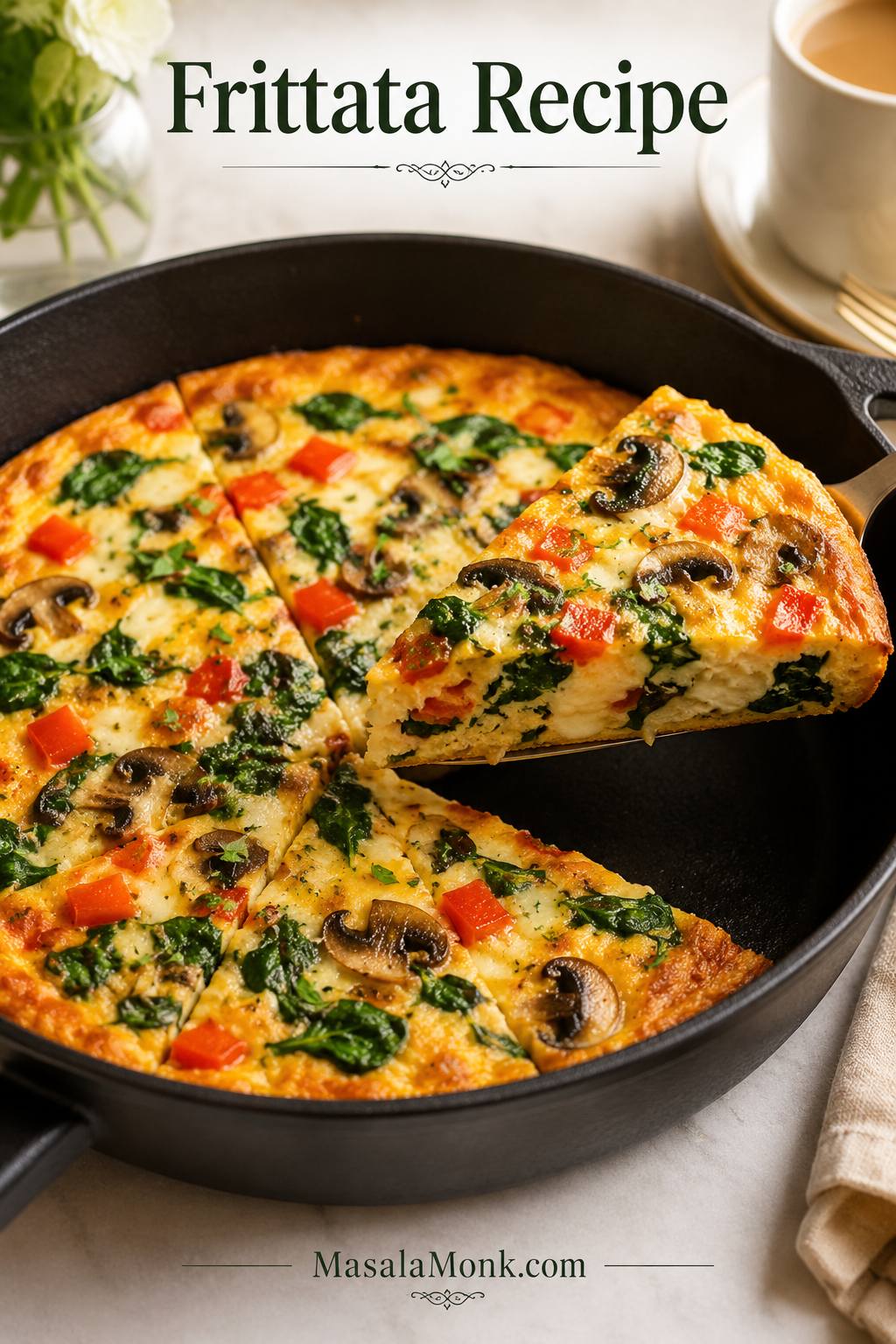
This frittata recipe is for the kind of breakfast that starts with a few eggs, a handful of cooked vegetables, and maybe a little cheese from the fridge. The goal is simple: a fluffy oven-baked egg frittata that slices cleanly, reheats well, and does not turn wet in the middle.
It works for brunch, meal prep, a quick dinner with salad, or a clean-out-the-fridge breakfast. Once you understand the egg-to-dairy ratio and how to handle the fillings, this frittata becomes one of those back-pocket meals you can repeat without measuring every single thing forever.
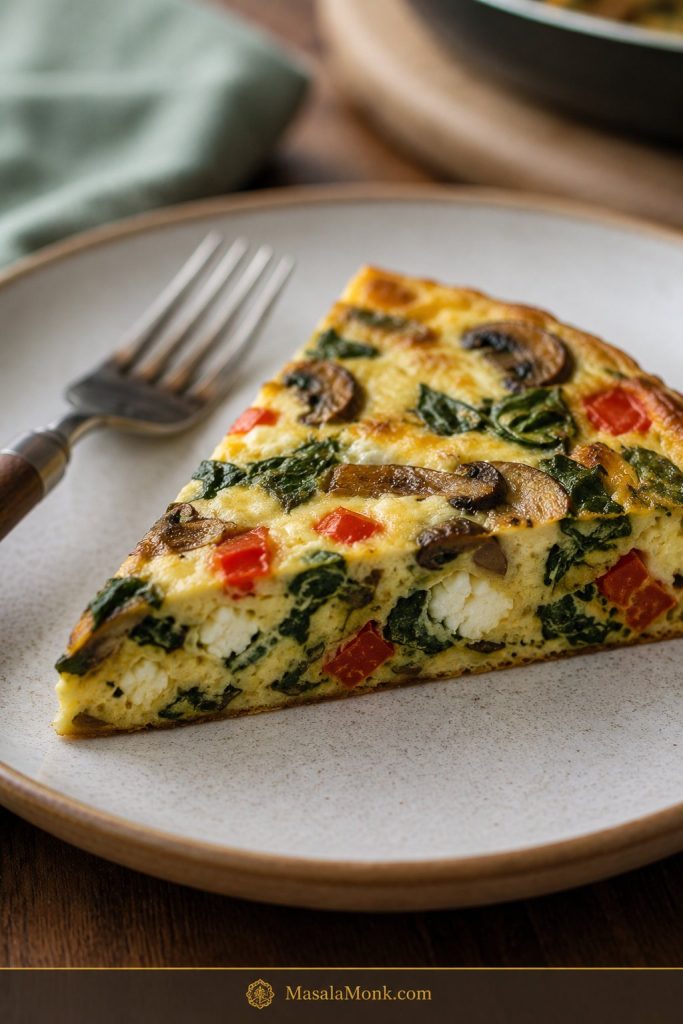
The best version feels generous without being heavy: tender eggs, sweet cooked vegetables, little pockets of cheese, and clean slices you can eat warm for brunch or chilled from the fridge the next morning.
Frittata Recipe Guide
Method + Timing
Fillings + Variations
Fixes + Storage
Quick Answer: How to Make a Frittata
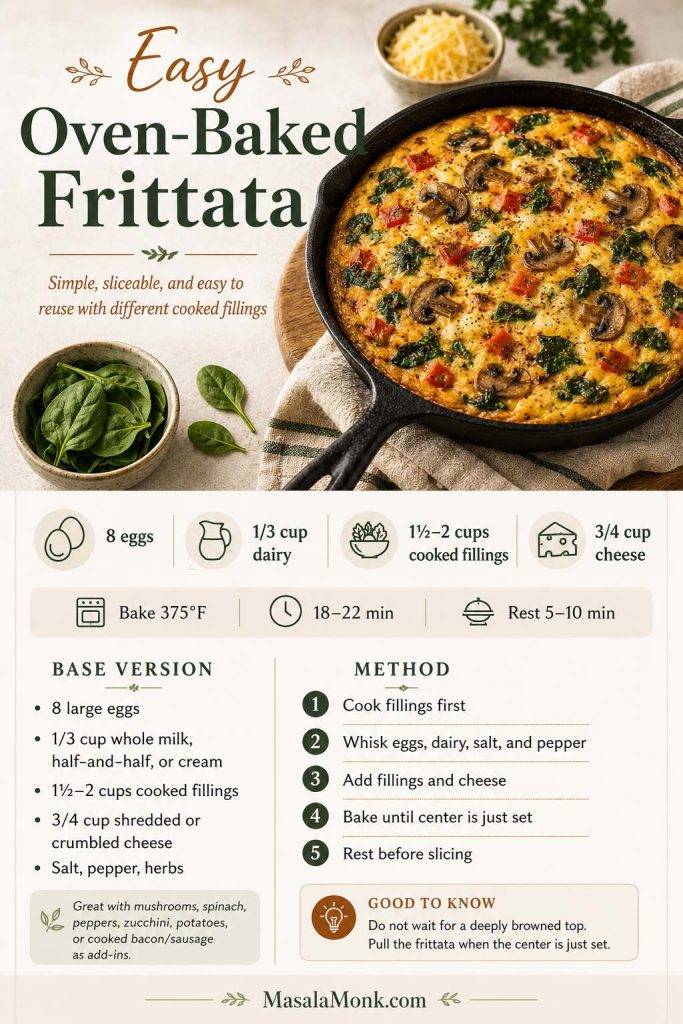
The easiest method is to cook your fillings first, pour the egg mixture into a greased oven-safe skillet, add cheese, and bake at 375°F / 190°C until the middle is just set. After a short rest, the frittata should slice cleanly without turning dry or rubbery.
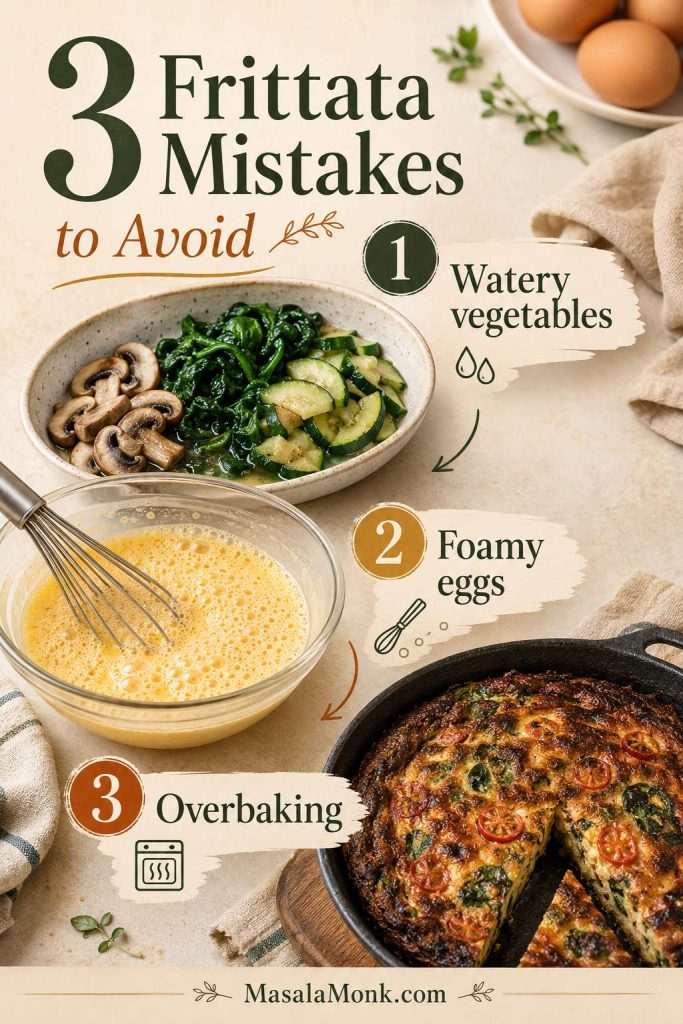
The shortcut that saves most frittatas is simple: deal with the fillings before the eggs ever hit the pan. Mushrooms give off liquid, spinach collapses as it cooks, zucchini softens quickly, and breakfast meats can release extra fat. Taking care of that first gives the finished frittata a cleaner texture and deeper flavor.
A finished frittata should look softly firm through the middle, with no wet egg pooling on top. A little wobble is not a problem; loose, sloshy egg is. The clock helps, but the center tells the truth.
Choose Your Frittata Method
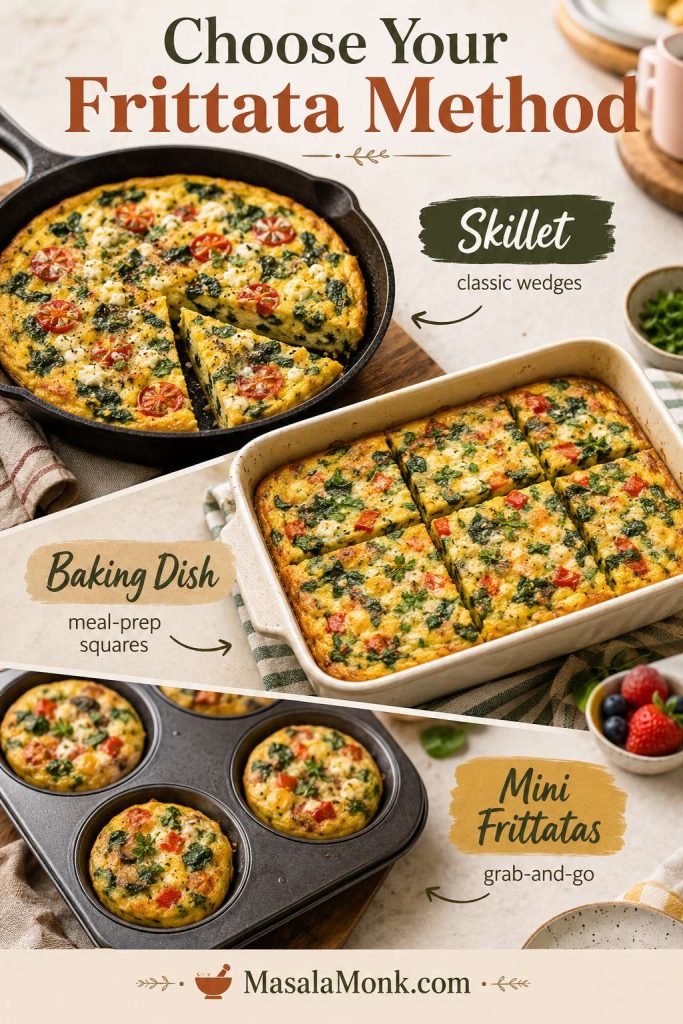
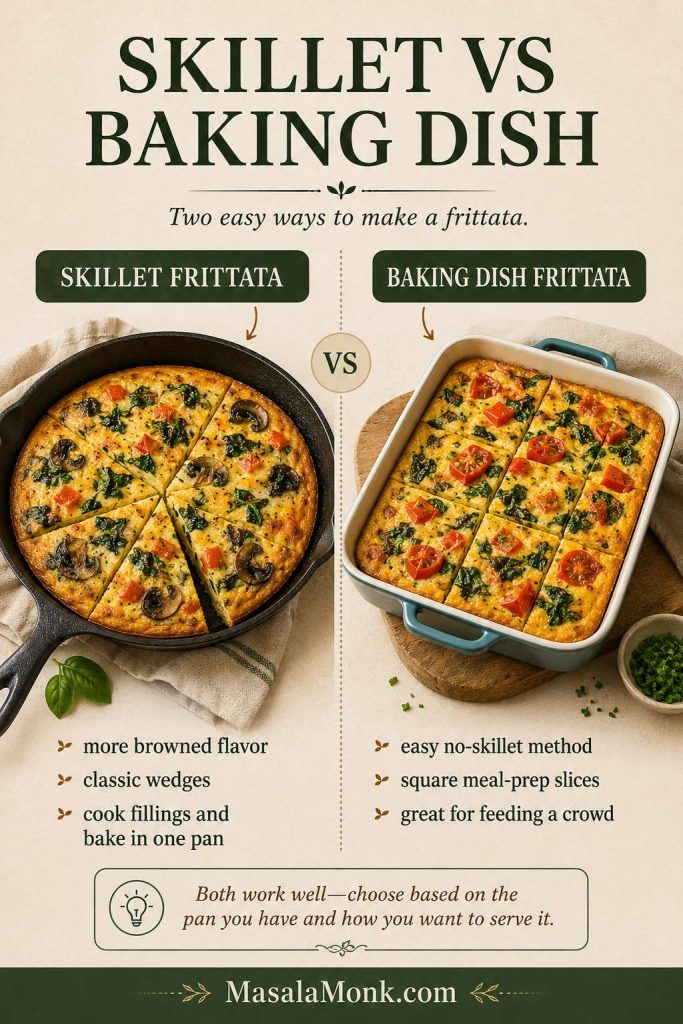
The best method depends on your pan and how you want to serve it. A skillet frittata gives you the most flavor, a baking-dish frittata is easiest for meal prep, and mini frittatas are best when you want individual portions.
| Method | Best for | How to cook it |
|---|---|---|
| Skillet frittata | Classic wedges and better browned fillings | Cook fillings in a 10-inch oven-safe skillet, add eggs, and bake at 375°F / 190°C for 18–22 minutes. |
| Baking-dish frittata | No-skillet cooking and square meal-prep slices | Cook fillings separately, add to a greased pie dish or 8×8 dish, and bake at 350°F / 175°C until set. |
| Mini frittatas | Grab-and-go breakfasts and lunchboxes | Divide the mixture into greased muffin cups and bake at 350°F / 175°C until just set. |
What Is a Frittata?
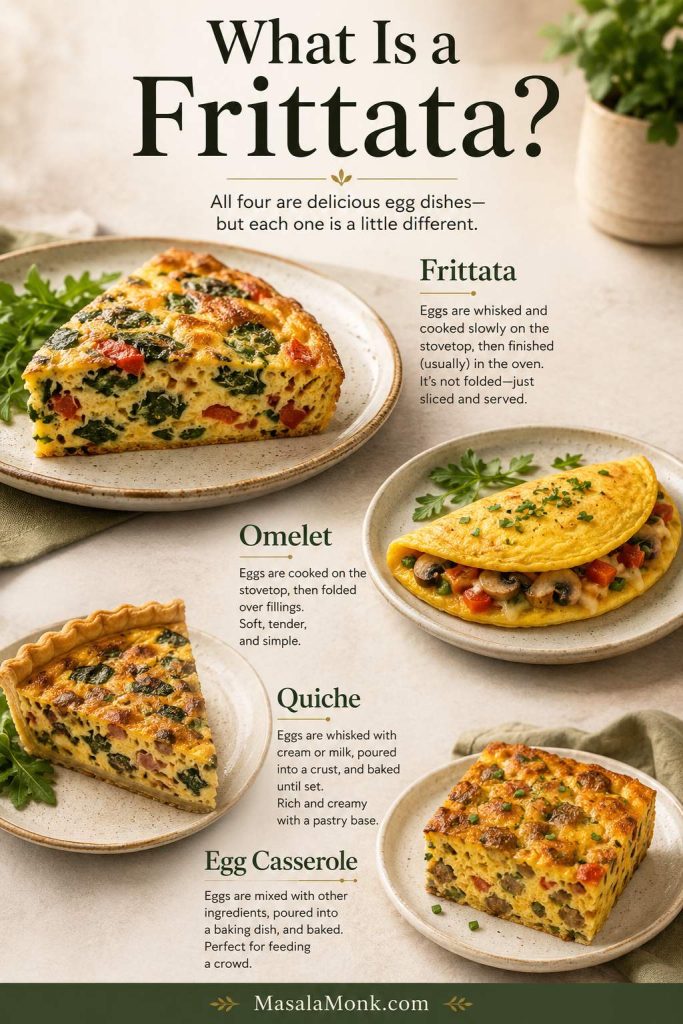
A frittata is an Italian-style egg dish where beaten eggs are mixed with vegetables, cheese, herbs, or cooked meat, then cooked until set. Unlike an omelet, the fillings are mixed into the eggs instead of folded inside. Unlike quiche, a frittata usually has no crust and uses less dairy, so it is firmer, faster, and easier to slice.
That is what makes it so useful: it feels nicer than scrambled eggs, takes less work than quiche, and turns leftovers into something that looks intentional.
At home, it can feel like a weekend brunch dish, but it is also practical enough for leftovers, cooked greens, roasted vegetables, bits of cheese, or breakfast meats you already have. Think of it as a flexible egg bake with a little more elegance and a lot less fuss.
Why This Recipe Works
The egg-to-dairy ratio keeps it tender
Eggs set firmly when they bake, so a little dairy helps soften the texture. The balance matters, though. Too little dairy can make the frittata firm and rubbery, while too much can make it loose, wet, or closer to a crustless quiche. For this frittata recipe, 1/3 cup / 80 ml dairy for 8 large eggs gives a tender center that still slices well.
Cooked fillings help the eggs set cleanly
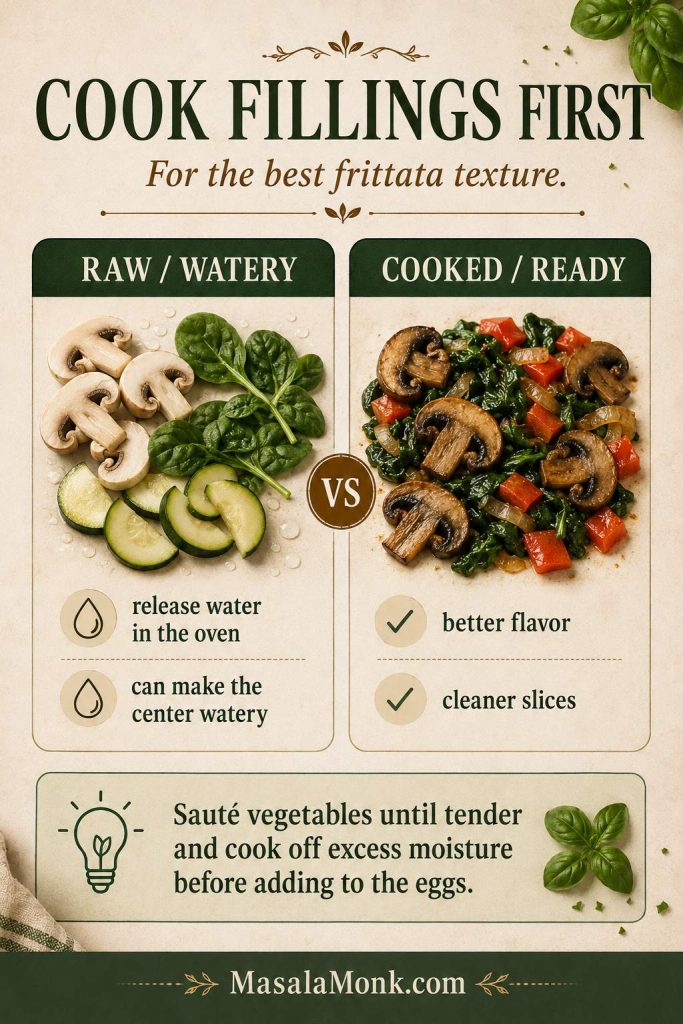
Vegetables can quietly sabotage a frittata if they go in raw. Mushrooms release liquid, spinach shrinks dramatically, zucchini softens fast, and tomatoes can make the middle look underbaked. Cooking those ingredients first concentrates their flavor and keeps the eggs from turning loose in the oven.
Oven baking gives even slices
A skillet frittata usually starts with cooked fillings on the stovetop, then finishes in the oven. That oven finish helps the middle set more evenly, especially once vegetables and cheese are spread through the eggs. If you do not have an oven-safe skillet, a pie dish or square baking dish works too.
Resting keeps the slices clean
Resting is not just a polite suggestion. Give the frittata 5 to 10 minutes after baking and the center firms slightly, the cheese settles, and the slices come out cleaner. Cut too soon and even a properly baked frittata can look softer than it really is.
The finished frittata should be softly set, lightly creamy in the center, and sturdy enough to cut into wedges. It should not taste like dry scrambled eggs, and it should not leak liquid when sliced. When the fillings are cooked first and the eggs are pulled at the right time, the texture lands in that sweet spot between tender and sliceable.
This base version is intentionally simple: mushrooms, greens, onion, a little dairy, and cheese. Once you make it once, the ratio is easy to reuse with almost any cooked filling.
Easy Oven-Baked Frittata Recipe Card
Recipe name: Easy Oven-Baked Egg Frittata
Course: Breakfast, brunch, meal prep
Best pan: 10-inch / 25 cm oven-safe skillet
Oven temperature: 375°F / 190°C
Ingredients
- 8 large eggs
- 1/3 cup / 80 ml whole milk, half-and-half, or heavy cream
- 1 tbsp / 15 ml olive oil or butter, plus more for greasing if needed
- 1 small onion or shallot, finely chopped
- 1–2 garlic cloves, minced
- 1 cup sliced mushrooms
- 1/2 cup chopped bell pepper or zucchini
- 2 packed cups baby spinach or chopped kale
- 3/4 cup / 75–90 g shredded or crumbled cheese
- 1/2 tsp fine salt, plus more for vegetables if needed
- 1/4 tsp black pepper
- 2 tbsp chopped fresh herbs, optional
Base vegetable filling
For the easiest first version, use the onion or shallot, mushrooms, bell pepper or zucchini, and spinach or kale listed above. After cooking, the filling should reduce to about 1 1/2–2 cups total.
You can swap this mix with the same amount of cooked asparagus, broccoli, roasted potatoes, leftover vegetables, cooked bacon, ham, or sausage. Just keep the finished filling amount close to 1 1/2–2 cups so the eggs still set cleanly.
Cook the onion first, then add the mushrooms and bell pepper or zucchini. Add the spinach or kale at the end and cook just until wilted. If the pan looks wet, keep cooking for another minute before adding the eggs.
Method
- Preheat the oven to 375°F / 190°C. Grease a 10-inch oven-safe skillet if needed.
- Warm the olive oil or butter in the skillet over medium heat. Add the onion or shallot and cook until softened.
- Add the garlic, mushrooms, and bell pepper or zucchini. Cook until the vegetables soften and excess moisture reduces. Add the spinach or kale and cook just until wilted.
- In a bowl, whisk the eggs, dairy, salt, and pepper just until combined. Do not whisk the eggs into a very foamy mixture.
- Spread the cooked fillings evenly in the skillet. Pour the egg mixture over them, then sprinkle the cheese over the top. You can also stir some of the cheese directly into the eggs and reserve a little for the surface.
- Bake for 18–22 minutes, until the center is just set and no wet egg pools on top.
- Rest for 5–10 minutes before slicing. Finish with fresh herbs, black pepper, or a little extra cheese if desired.
Doneness
The center should look set, with only a slight wobble. For the safest check, egg dishes should reach 160°F / 71°C in the center.
Storage
Refrigerate cooled slices in an airtight container for 3–4 days, or freeze well-wrapped portions for up to 2–3 months.
Need to adjust the pan or timing? Check the bake-time guide. Not sure when it is done? Use the doneness cues.
Best Frittata Recipe Ratio
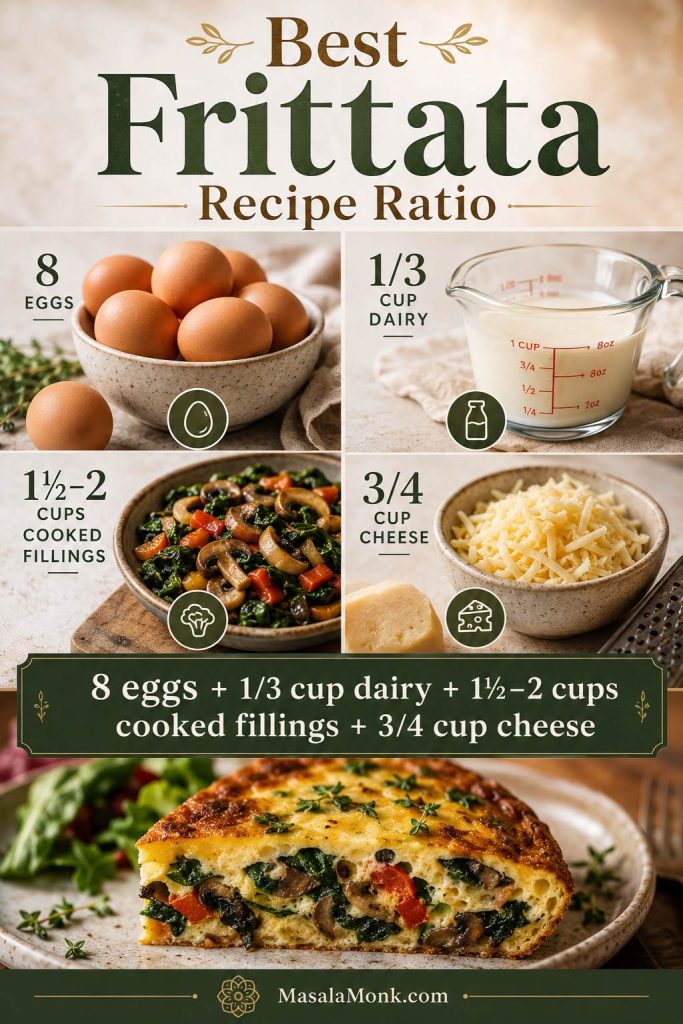
The easiest way to stop guessing is to use a frittata ratio. This frittata recipe is flexible, but the base balance is what keeps it reliable: enough egg for structure, enough dairy for tenderness, enough cooked fillings for flavor, and enough cheese to make each bite satisfying without weighing the eggs down.
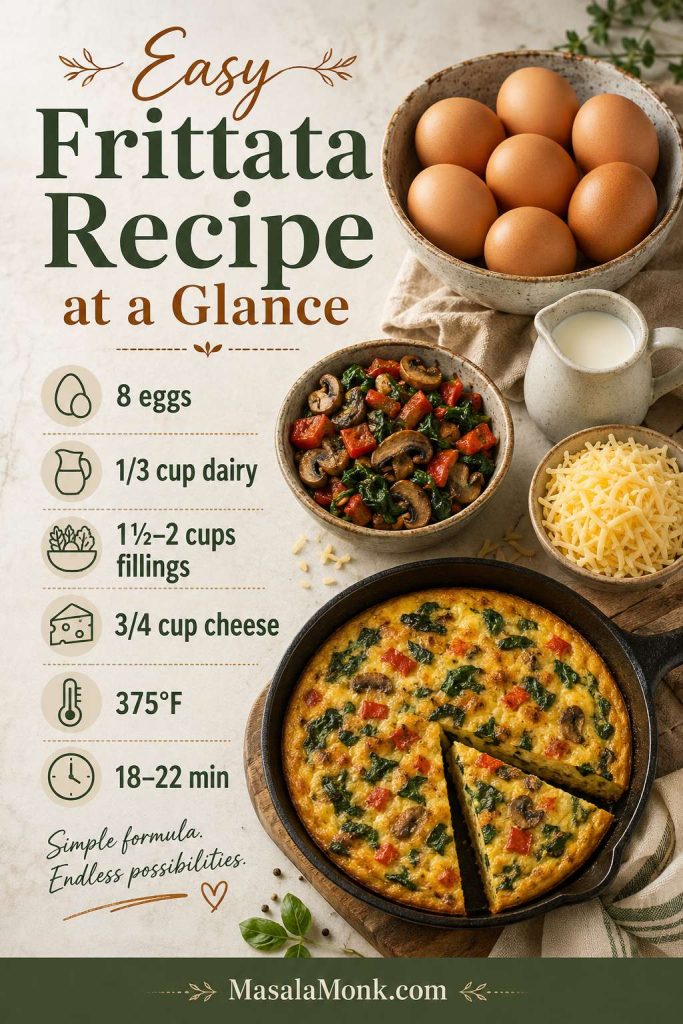
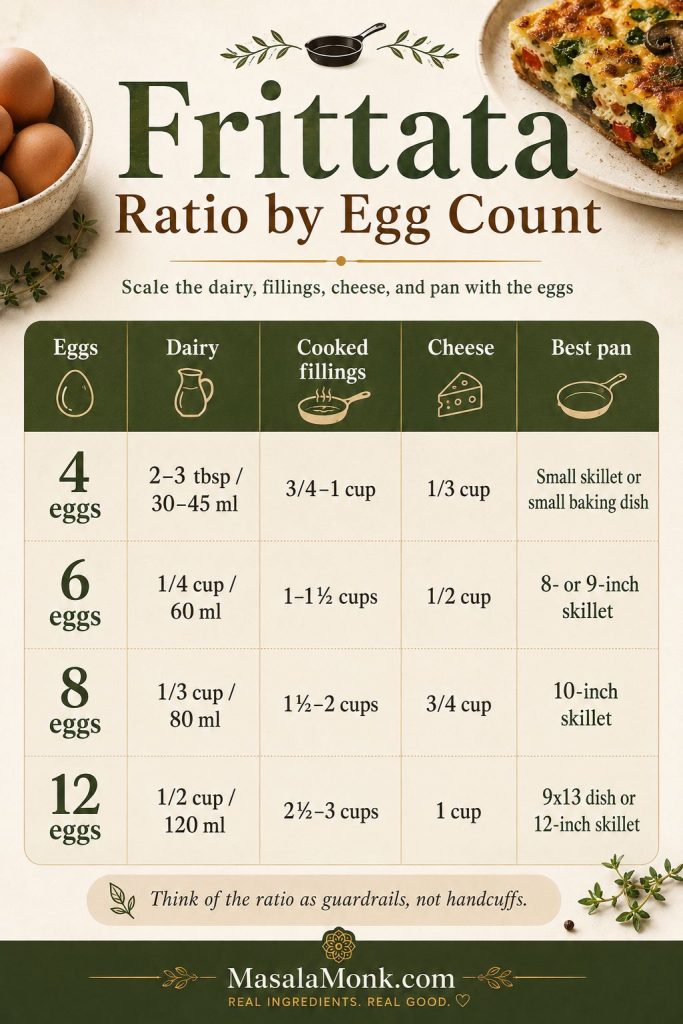
For most home cooks, the most useful starting point is 8 eggs + 1/3 cup dairy + 1 1/2 to 2 cups cooked fillings + 3/4 cup cheese. That makes a full 10-inch skillet frittata that serves 4 hungry people or 6 lighter portions with sides. Think of the ratio as guardrails, not handcuffs.
Frittata Ratio by Egg Count
| Eggs | Dairy | Cooked fillings | Cheese | Best pan |
|---|---|---|---|---|
| 4 eggs | 2–3 tbsp / 30–45 ml | 3/4–1 cup | 1/3 cup | Small skillet or small baking dish |
| 6 eggs | 1/4 cup / 60 ml | 1–1 1/2 cups | 1/2 cup | 8- or 9-inch skillet |
| 8 eggs | 1/3 cup / 80 ml | 1 1/2–2 cups | 3/4 cup | 10-inch skillet |
| 12 eggs | 1/2 cup / 120 ml | 2 1/2–3 cups | 1 cup | 9×13 dish or 12-inch skillet |
If you are cooking for one or only have a couple of eggs, this guide to 2-egg dishes has smaller breakfast ideas for days when you do not want a full pan.
A little more cheese is fine if you are using a salty, bold cheese in small amounts. A few extra vegetables are fine when they are already cooked and not watery. What you want to avoid is a pan overloaded with raw vegetables or a bowl of eggs thinned out with too much milk.
If you want a softer brunch-style frittata, use half-and-half or cream and a cheese with personality, like feta, goat cheese, Gruyère, or sharp cheddar. If you want cleaner meal-prep slices, stay closer to whole milk, cooked vegetables, and a moderate amount of cheese.
Ingredients for an Easy Egg Frittata
A frittata is forgiving, but it is not random. Each ingredient has a job: the eggs hold it together, the dairy softens it, the cheese adds depth, and the cooked fillings make it worth slicing into.
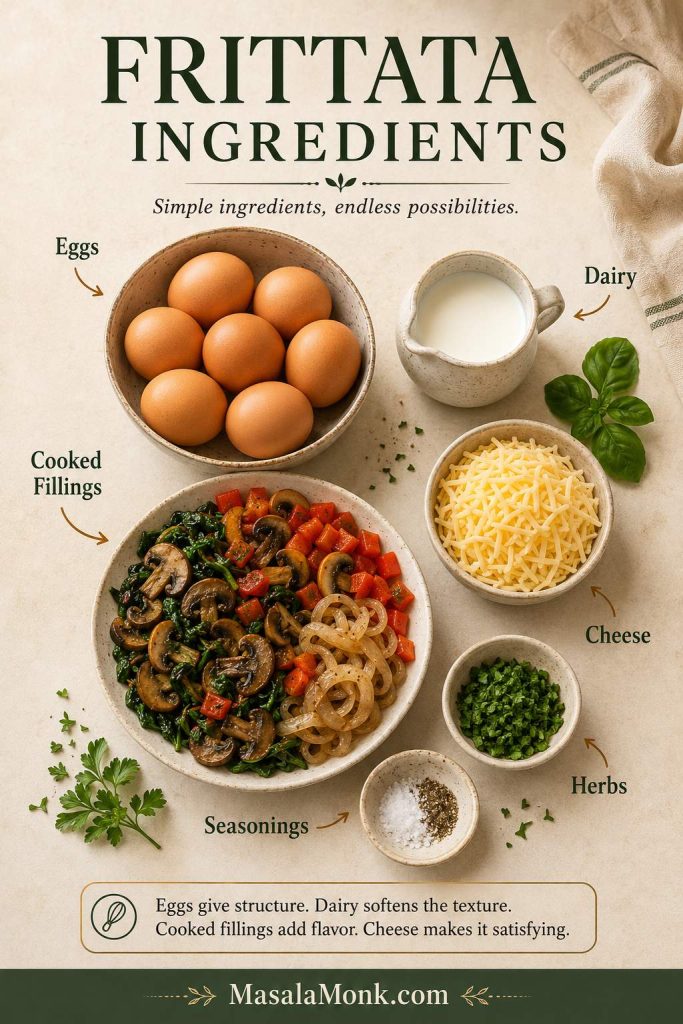
Eggs
Use large eggs for the most predictable result. If your eggs are very small, the frittata may have less structure. If they are extra-large, it may take a little longer to set. Either way, the visual cues matter more than the exact clock: the center should look set, not wet.
Dairy
Whole milk makes a lighter frittata, half-and-half gives a creamy but still sliceable texture, and heavy cream makes the richest version. Unsweetened dairy-free milk can work too, though the texture will usually be a little firmer and less custardy.
Cheese
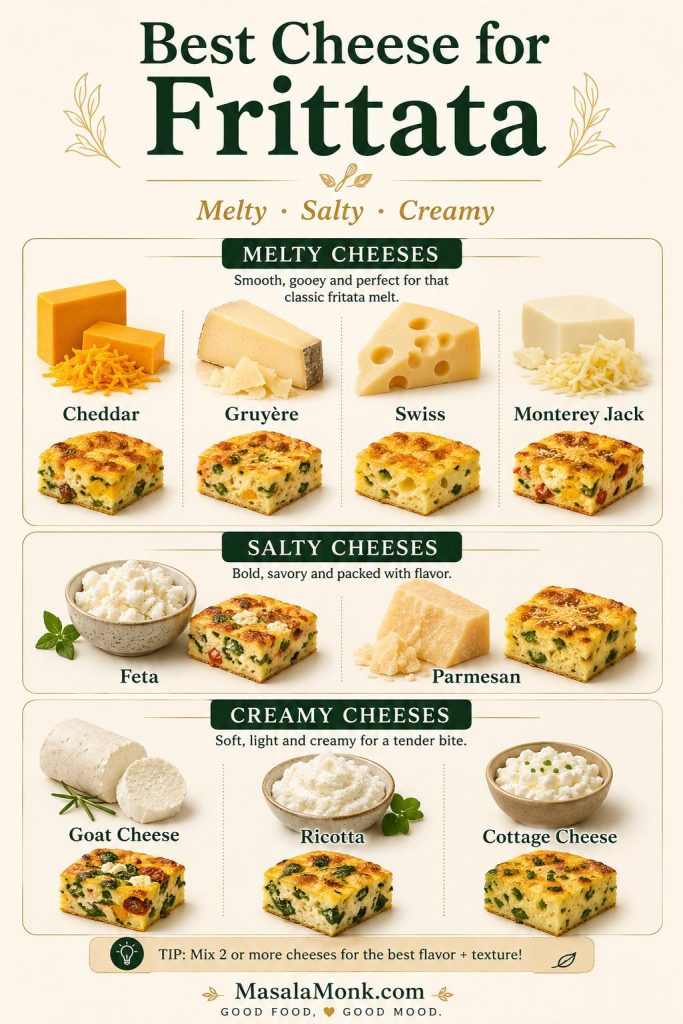
Cheese is where the frittata starts to feel generous. Cheddar, Swiss, Gruyère, mozzarella, Monterey Jack, feta, goat cheese, Parmesan, ricotta, and cottage cheese can all work, but they do different jobs. Melting cheeses make the slices cozy and familiar, crumbly cheeses give salty pockets, and soft cheeses like ricotta or goat cheese are best dotted on top.
Vegetables and add-ins
The best vegetables have already done their messy work before they meet the eggs: mushrooms have given up their water, spinach has wilted down, potatoes are tender, and onions taste sweet instead of sharp. That gives the finished frittata better flavor and cleaner slices.
Herbs and seasoning
Salt the eggs, but pay attention to salty fillings. Bacon, ham, feta, Parmesan, sausage, smoked salmon, and olives can all push the salt level up quickly. Fresh herbs like parsley, basil, dill, chives, cilantro, or green onion brighten the finished frittata, especially when added after baking.
Best Pan for Frittata
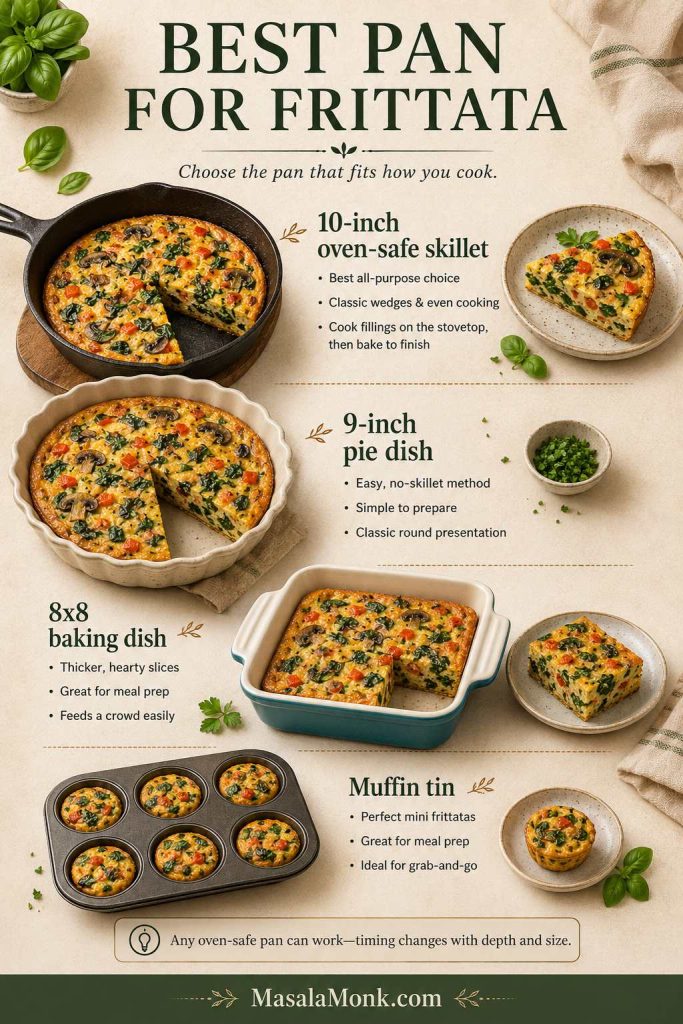
The best pan for a frittata depends on how you want to cook it. A 10-inch oven-safe skillet is the best all-purpose choice because you can cook the fillings in the same pan, pour in the eggs, and move it straight to the oven.
No oven-safe skillet? Use a greased pie dish, square baking dish, or casserole dish. The frittata will take longer because the egg mixture starts cold in the dish instead of warm from the skillet, but the method is simple and reliable.
| Pan | Best use | What to watch |
|---|---|---|
| 10-inch oven-safe skillet | Best default for an 8-egg frittata | Handle must be oven-safe. |
| 12-inch oven-safe skillet | Thinner frittata with quicker baking | Check early so it does not dry out. |
| 9-inch pie dish | No-skillet oven-baked frittata | Usually needs a lower temperature and longer bake. |
| 8×8 or 9×9 baking dish | Thicker meal-prep slices | The middle needs more time than the edges. |
| 9×13 baking dish | Larger brunch or meal-prep batch | Use more eggs or expect thinner slices. |
| Muffin tin | Mini frittatas and breakfast meal prep | Grease well and check early. |
Once you choose the pan, check the matching bake time so the center sets without drying the edges.
Skillet Method vs Fully Oven-Baked Method
The skillet method gives the best flavor because the fillings cook in the same pan before the eggs go in. Use it when you want deeper browning and a classic wedge-shaped frittata.
The fully oven-baked method is simpler if you do not have an oven-safe skillet. Cook the fillings separately, spread them in a greased 9-inch pie dish or 8×8 baking dish, pour the egg mixture over the top, and bake at 350°F / 175°C until the center is set. This method is especially helpful for meal prep because square slices fit neatly into containers.
How to Make a Frittata in the Oven
The method is simple: cook the fillings, whisk the eggs gently, combine everything in a greased pan, bake until just set, and rest before slicing. The small details are what keep the frittata from turning soggy, rubbery, or bland.
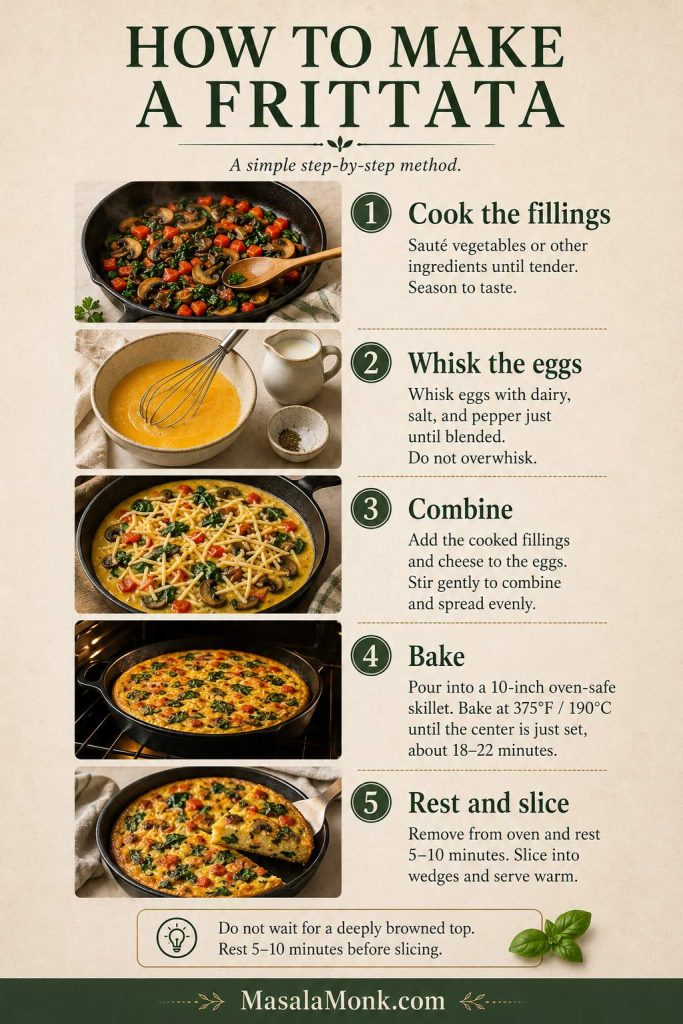
Step 1: Cook the vegetables first
Warm the oil or butter in your skillet, then cook the onion or shallot until soft. Add garlic for the last 30 seconds so it does not burn. From there, add the vegetables that need cooking. Mushrooms should release their moisture and start to brown. Spinach should wilt down. Zucchini should soften and reduce. Potatoes, sweet potatoes, broccoli, and asparagus should already be tender before the eggs are added.
If you are using bacon, sausage, chicken, or another meat, cook it fully first. Drain excess fat if the pan looks greasy. A little fat is flavorful; too much can make the frittata heavy.
Step 2: Whisk the eggs gently
In a mixing bowl, whisk the eggs, dairy, salt, and pepper just until the yolks and whites are blended. You do not need to beat the eggs until they are foamy. Over-whisked eggs can puff dramatically in the oven, then collapse as they cool.
Step 3: Add the fillings and cheese
You can stir the cooked fillings and most of the cheese into the eggs, or you can spread the fillings evenly in the skillet and pour the egg mixture over the top. Both methods work. For the prettiest surface, reserve a little cheese and a few colorful vegetables to scatter on top before baking.
Step 4: Bake until just set
For the main recipe, bake in a 10-inch oven-safe skillet at 375°F / 190°C for 18–22 minutes. Start checking around 18 minutes. The edges may puff slightly and the center should no longer look wet. Instead of waiting for the top to turn deeply browned, pull the frittata when the middle is softly set.
Step 5: Rest before slicing
Finally, let the frittata rest for 5 to 10 minutes. This short pause gives the center time to finish settling and makes the slices cleaner. Add fresh herbs, cracked black pepper, or a little extra cheese just before serving.
How Long to Bake a Frittata
Frittata bake time changes with pan size, pan depth, oven temperature, and how much moisture is in the fillings. A shallow skillet frittata can finish quickly, while a thicker baking-dish frittata needs more time through the middle.
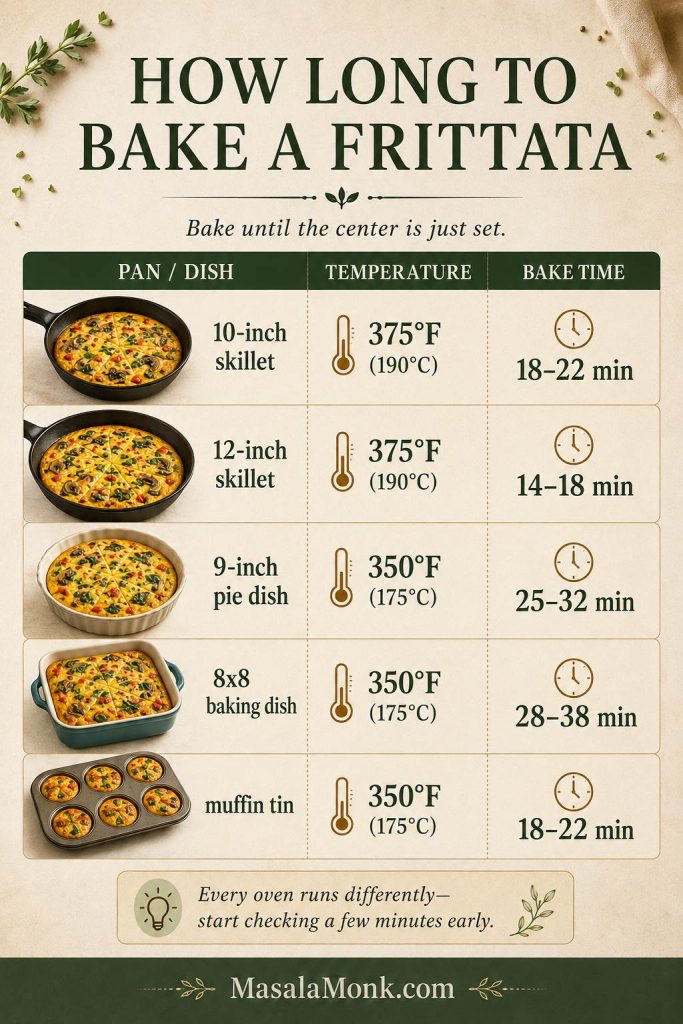
| Pan or method | Oven temperature | Approximate time | Best for |
|---|---|---|---|
| 10-inch skillet | 375°F / 190°C | 18–22 minutes | Main recipe |
| 12-inch skillet | 375°F / 190°C | 14–18 minutes | Thinner frittata |
| 10-inch skillet, fast finish | 400°F / 200°C | 8–15 minutes | Stovetop-start method |
| 9-inch pie dish | 350°F / 175°C | 25–32 minutes | No-skillet method |
| 8×8 baking dish | 350°F / 175°C | 28–38 minutes | Thicker meal-prep slices |
| 9×13 baking dish | 350°F / 175°C | 25–35 minutes | Larger batch |
| Sheet pan | 375°F / 190°C | 20–25 minutes | Brunch or crowd servings |
| Standard muffin tin | 350°F / 175°C | 18–22 minutes | Mini frittatas |
| Mini muffin tin | 350–375°F / 175–190°C | 10–14 minutes | Bite-size egg cups |
Use these times as a guide, then check the doneness cues before pulling the frittata from the oven.
For a sheet-pan frittata, use a well-greased or parchment-lined rimmed pan, spread the fillings evenly, and check early because the egg layer is usually thinner than a skillet or baking-dish frittata.
Every oven and pan behaves a little differently, so use the clock as a guide rather than the only test. A frittata with dry cooked vegetables may set faster than one with juicy tomatoes, zucchini, or extra cheese. Start checking a few minutes early, especially if your pan is wide or your oven runs hot.
350°F vs 375°F vs 400°F for Frittata
The oven temperature is not random. Different frittata recipes use different temperatures because they are usually using different pans and methods. Instead of treating one number as magic, choose the temperature based on the pan and texture you want.
| Temperature | Best use | What to watch |
|---|---|---|
| 350°F / 175°C | Pie dishes, square baking dishes, muffin tins, and deeper frittatas | Gentler heat, but the middle takes longer. |
| 375°F / 190°C | Best default for a 10-inch skillet frittata | Balanced speed and control. |
| 400°F / 200°C | Fast stovetop-start skillet frittatas | Check early because edges can overcook. |
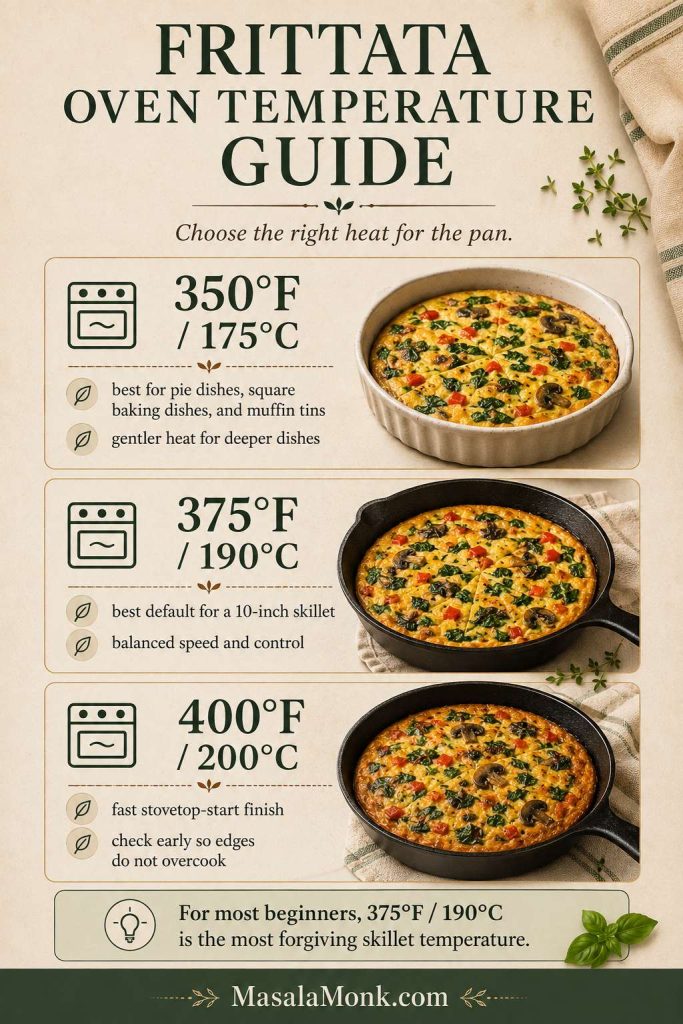
For most beginners, 375°F / 190°C is the most forgiving skillet temperature. Use 350°F / 175°C when the eggs are in a deeper dish, and use 400°F / 200°C only when you want a faster finish and are comfortable checking early.
Best Vegetables and Fillings for Frittata
The best frittata fillings are already cooked, seasoned, and not watery. That does not mean they need to be complicated. Leftover roasted vegetables, sautéed greens, cooked potatoes, bacon, ham, sausage, or bits of cheese can all turn into a good breakfast frittata.
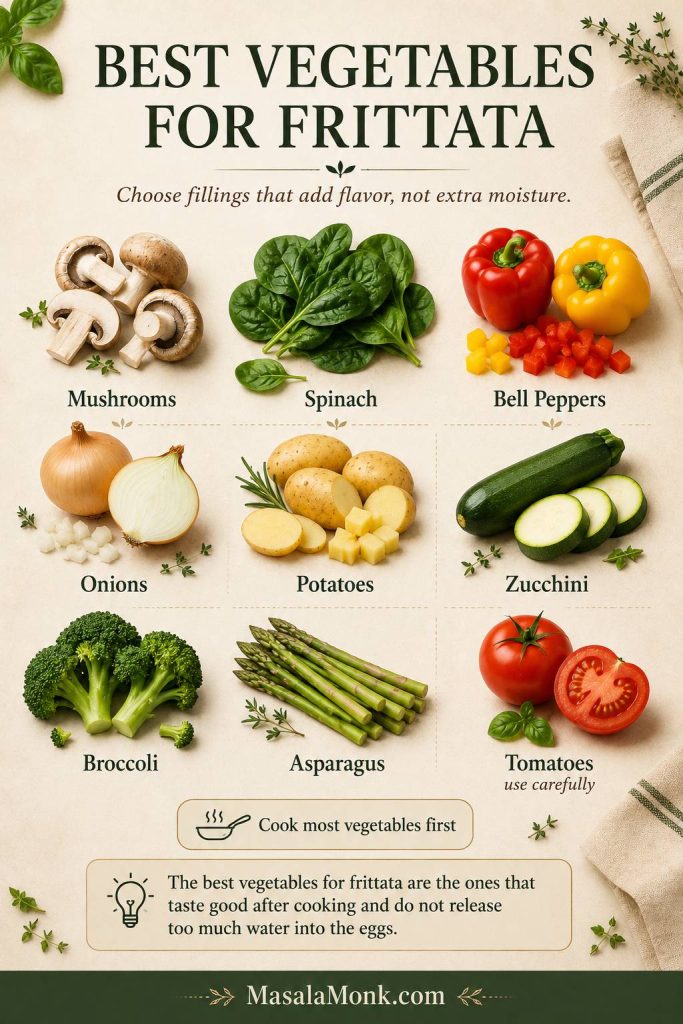
Best Filling Prep Before Baking
Use the table below as a prep guide before adding fillings to your eggs.
| Filling | Use raw or cooked? | Best prep |
|---|---|---|
| Mushrooms | Cook first | Sauté until moisture releases and the mushrooms start browning. |
| Spinach or kale | Cook first | Wilt, then squeeze or cook off extra moisture. |
| Zucchini | Cook first | Sauté until the pieces soften and excess water reduces. |
| Bell peppers and onions | Cook first | Sauté until softened and lightly sweet. |
| Potatoes or sweet potatoes | Fully cook first | Roast, boil, microwave, or pan-cook until tender. |
| Broccoli or asparagus | Parcook first | Steam, roast, or sauté until just tender. |
| Tomatoes | Use carefully | Use cherry tomatoes or seeded tomatoes so the frittata does not turn watery. |
| Bacon, sausage, ham, or chicken | Cook first | Cook fully and drain excess fat if needed. |
| Fresh herbs | Add late | Stir into the eggs or sprinkle after baking for brighter flavor. |
If your frittata usually turns watery, check the troubleshooting guide before adding more dairy or extra fillings.
Best Frittata Filling Combinations
A spinach frittata is best with wilted, squeezed spinach and feta, goat cheese, cheddar, or Parmesan. A potato frittata works best when the potatoes are already tender and lightly browned. A mushroom frittata needs mushrooms that have cooked long enough to lose their water. For a vegetable frittata, two or three vegetables usually taste better than a full fridge clean-out: spinach and mushrooms work, peppers and onions work, and zucchini with tomatoes and basil works. Seven vegetables in one pan usually taste less intentional.
Can you use frozen vegetables in a frittata?
Yes, but do not add them icy or wet. Thaw frozen spinach, broccoli, peppers, or mixed vegetables first, then squeeze or cook off as much moisture as you can. Frozen spinach especially needs a good squeeze before it goes into the eggs.
Milk vs Cream vs Half-and-Half in Frittata
Milk, cream, and half-and-half all work in a frittata, but they create different textures. The main rule is simple: use enough dairy to soften the eggs, not so much that the center turns loose.
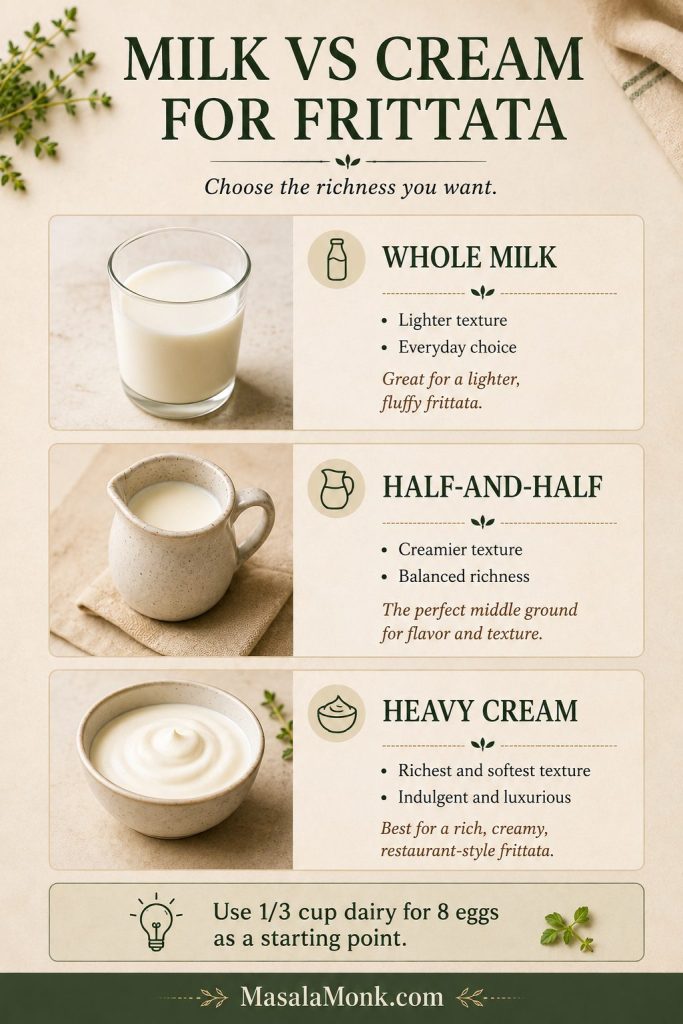
| Dairy | Texture | Best use |
|---|---|---|
| Whole milk | Light and tender | Everyday frittata |
| Half-and-half | Creamier but still sliceable | Best balanced choice |
| Heavy cream | Rich and softer | Brunch-style frittata |
| Unsweetened dairy-free milk | Lighter and less rich | Dairy-free variation |
| Cottage cheese | Higher protein, creamy pockets or blended texture | High-protein frittata variation |
Cheese has a second job beyond flavor: it helps make the frittata feel satisfying. Use a melting cheese when you want a classic breakfast texture, a salty cheese when you want punchier flavor, or a soft cheese when you want creamy pockets. If the cheese is bold, you do not need much. A little feta, Parmesan, or goat cheese can do more for the whole pan than a heavy layer of mild cheese.
How to Tell When a Frittata Is Done
A frittata is done when the center is set but not dried out. The mistake many people make is waiting for the top to brown deeply. By then, the edges may already be rubbery.
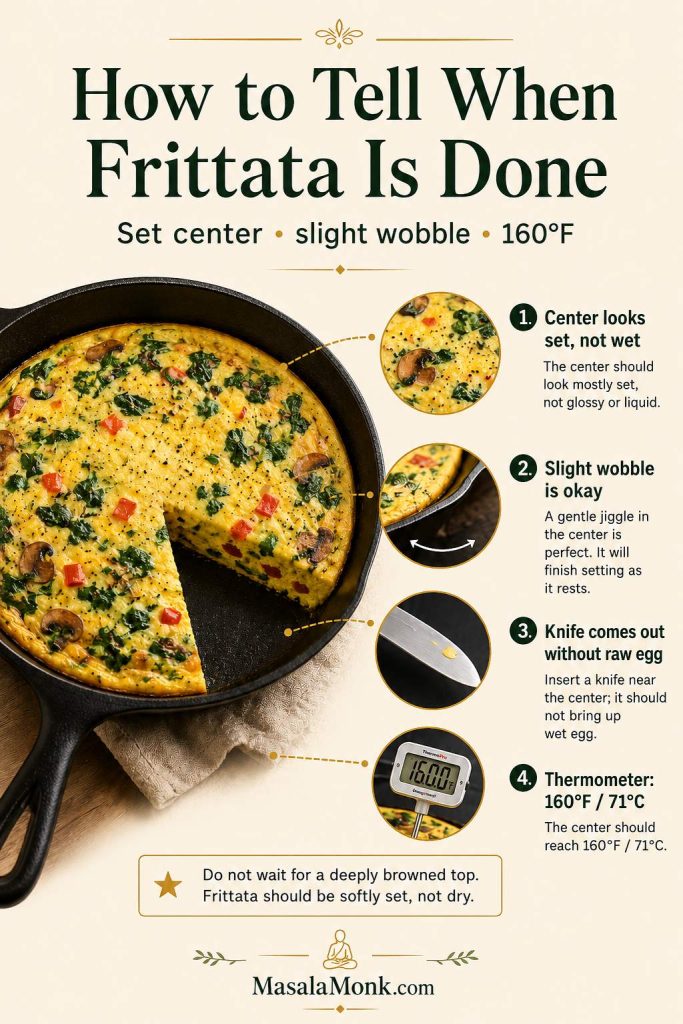
| Check | What you want |
|---|---|
| Visual | The center looks set, not wet, shiny, or liquid. |
| Jiggle | A slight wobble is fine; loose sloshing egg is not. |
| Touch | The center feels lightly springy. |
| Knife test | A knife inserted near the center should not bring up raw egg. |
| Thermometer | The center should reach 160°F / 71°C for egg dishes. |
For food safety, egg dishes such as frittata and quiche should reach 160°F / 71°C in the center. You can check the current official chart at FoodSafety.gov.
Frittata Variations
Once the base ratio is comfortable, use this frittata recipe as a flexible starting point. Keep the same egg mixture, then change the vegetables, cheese, herbs, or cooked meat depending on what you have.
If you are making it for brunch, think creamy, herby, and a little richer. If you are making it for meal prep, think sturdy, sliceable, and easy to reheat. And if you are using leftovers, choose two or three good fillings instead of trying to fit the whole fridge into one pan.
For the safest first version, go with spinach, mushrooms, and cheddar or feta. The flavors are familiar, the vegetables are easy to manage, and the finished slices hold together well.
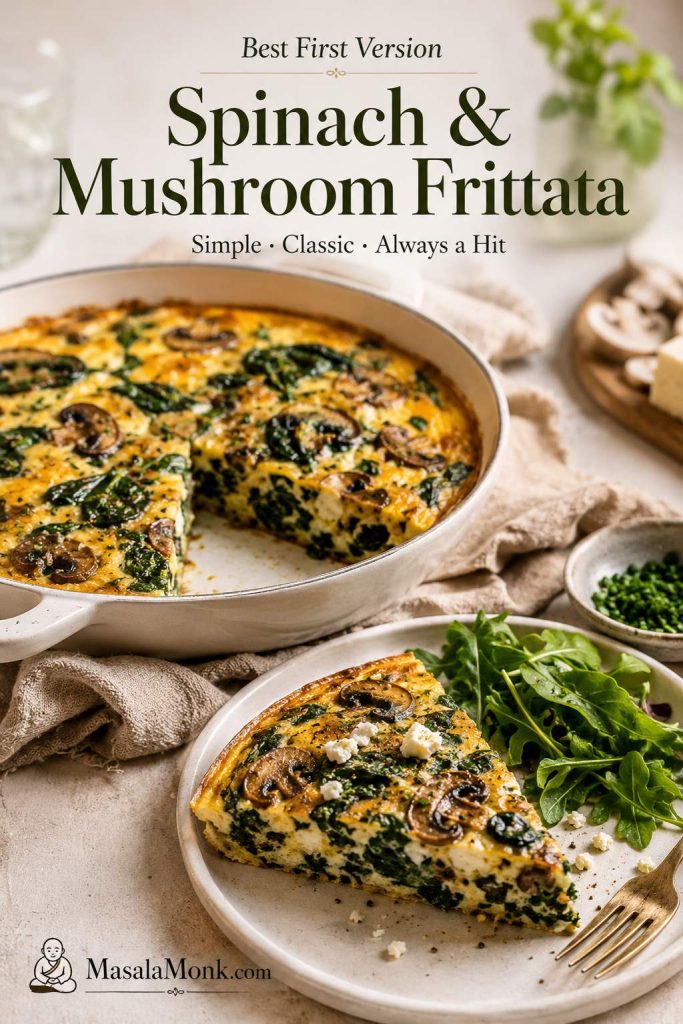
Not sure which version to make first? Start with one of these combinations, then adjust the vegetables and cheese based on what you have.
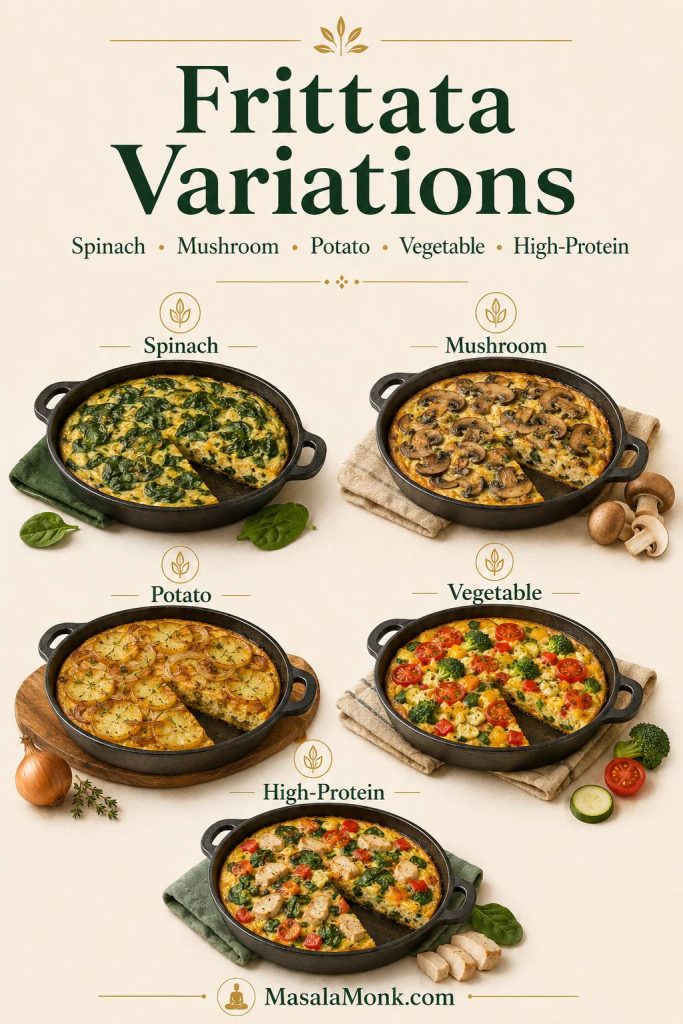
| Frittata style | Best fillings | Best cheese |
|---|---|---|
| Spinach frittata | Wilted spinach, onion, herbs | Feta, goat cheese, Parmesan, or cheddar |
| Mushroom frittata | Browned mushrooms, shallot, thyme | Gruyère, Swiss, goat cheese, or cheddar |
| Potato frittata | Cooked potatoes, onion, peppers | Cheddar, Monterey Jack, or Parmesan |
| Vegetable frittata | Peppers, zucchini, broccoli, asparagus, or roasted vegetables | Feta, mozzarella, goat cheese, or cheddar |
| High-protein frittata | Spinach, peppers, cooked turkey, herbs | Cottage cheese, cheddar, or Parmesan |
Spinach frittata
For a spinach frittata that tastes bright instead of watery, wilt the spinach first, squeeze it well, then pair it with feta, goat cheese, dill, chives, or green onion.
Potato frittata
Potatoes should be fully cooked before the eggs go in. Roasted potatoes, boiled potatoes, leftover breakfast potatoes, or pan-fried cubes all work. For the best texture, let the potatoes brown lightly so they do not taste flat inside the eggs.
Vegetable frittata
Use a mix of cooked peppers, onions, mushrooms, zucchini, broccoli, asparagus, tomatoes, or leftover roasted vegetables. Two or three vegetables usually taste better than too many competing flavors in one pan.
Bacon, ham, or sausage frittata
Cook bacon or sausage first and drain excess fat. Ham is already cooked, but browning it briefly can deepen the flavor. Since breakfast meats and many cheeses are salty, reduce the added salt if needed. For an easy brunch plate, serve slices with air fryer bacon, toast, and fruit.
Egg white frittata
An egg white frittata is leaner, but it can turn firm faster than a whole-egg frittata. Use cooked vegetables, enough seasoning, and a little cheese or cottage cheese for better texture. Check early so the egg whites do not overbake.
Cottage cheese or high-protein frittata
For a higher-protein frittata, use about 1/2 cup cottage cheese with 8 eggs and reduce the milk or cream to 2 tablespoons. Leave the cottage cheese as is for creamy pockets, or blend it with the eggs for a smoother texture.
Dairy-free frittata
Use unsweetened dairy-free milk or skip the dairy and rely on cooked vegetables, herbs, and olive oil for flavor. The texture may be a little firmer without dairy, so avoid overbaking.
Keto or low-carb frittata
For a keto frittata, use eggs, cheese, cream or half-and-half, and low-carb vegetables such as spinach, mushrooms, zucchini, bell peppers, broccoli, asparagus, or cauliflower. Skip potatoes, sweet potatoes, and sweet vegetables if you are keeping carbs very low.
Mini frittatas or frittata muffins
For mini frittatas, divide the egg mixture among well-greased muffin cups and bake at 350°F / 175°C until just set. They are useful for breakfast meal prep, lunchboxes, and grab-and-go mornings. If meal prep is the goal, you may also like this freezer-friendly breakfast burrito recipe.
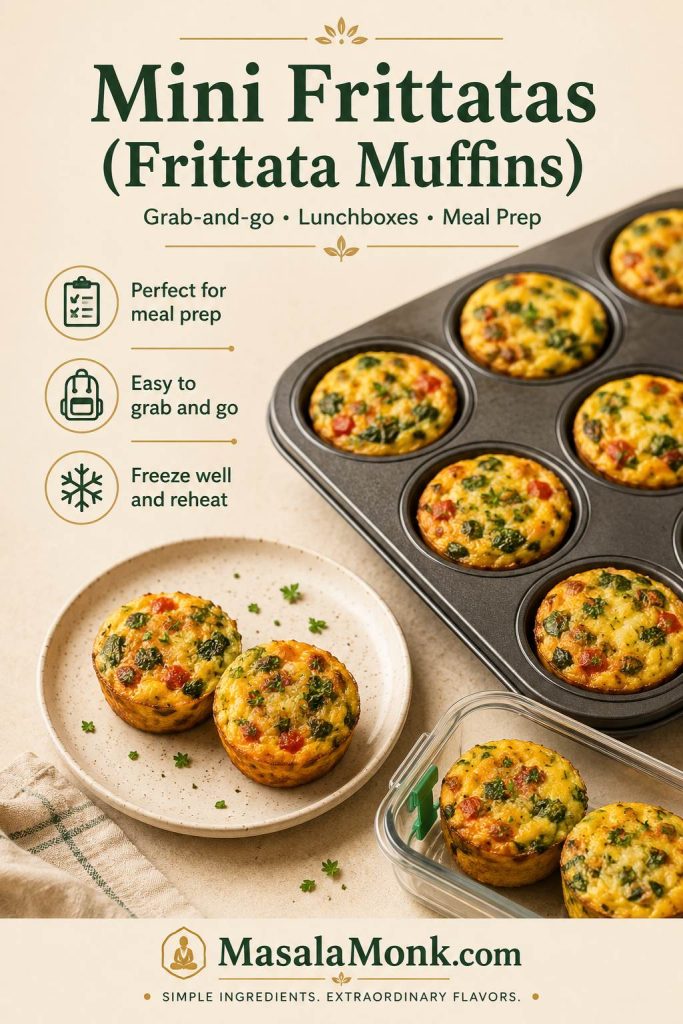
Making these ahead? Use the storage and reheating guide so the texture stays tender.
How to Store, Freeze, and Reheat Frittata
Cool and Pack the Slices First
Frittata is excellent for meal prep because it holds its shape, reheats quickly, and tastes good warm or chilled from the fridge. If you serve it at room temperature for brunch, keep the timing in mind and do not leave it out too long.
For the cleanest meal-prep slices, let the frittata cool on a rack or cutting board before packing it away. If it sits hot in the pan or a closed container, steam can soften the bottom and make the slices damp.
Fridge, Freezer, and Reheat Times
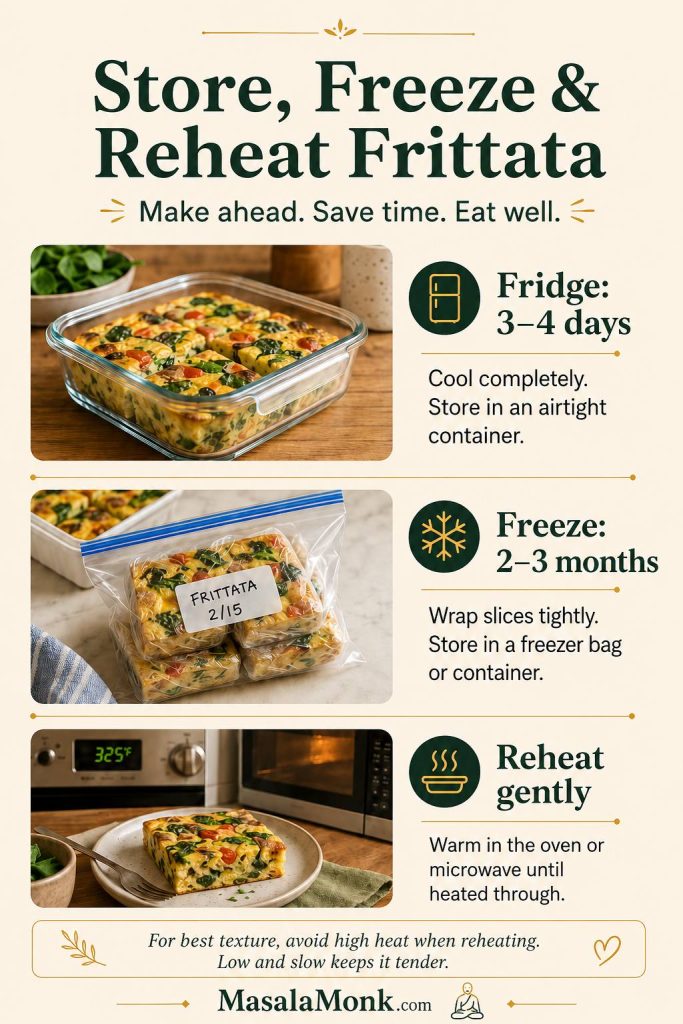
| Method | How long | Best practice |
|---|---|---|
| Refrigerator | 3–4 days | Cool completely, then store slices in an airtight container. |
| Freezer | 2–3 months | Wrap individual slices well, then place in a freezer-safe bag or container. |
| Microwave | Short bursts | Cover lightly and heat gently so the eggs do not turn rubbery. |
| Oven | 300–350°F until warm | Best for texture; for food safety, reheat leftovers to 165°F / 74°C. |
| Air fryer | Low heat, short time | Useful for small portions, but avoid drying the edges. |
Food Safety for Stored Frittata
The FDA recommends refrigerating cooked egg leftovers and using them within 3–4 days. You can read more on the FDA egg safety page.
If serving frittata at room temperature for brunch, do not leave it out for more than 2 hours, or more than 1 hour in very hot weather.
When reheating a slice in the microwave, use short bursts instead of one long blast. Eggs can turn rubbery when overheated, so warm them gently when texture matters. Leftovers should be reheated to 165°F / 74°C before serving.
Frittata Meal Prep Boxes
To build a bigger breakfast-prep spread, pair frittata slices with overnight oats, fruit, toast, or a smoothie.
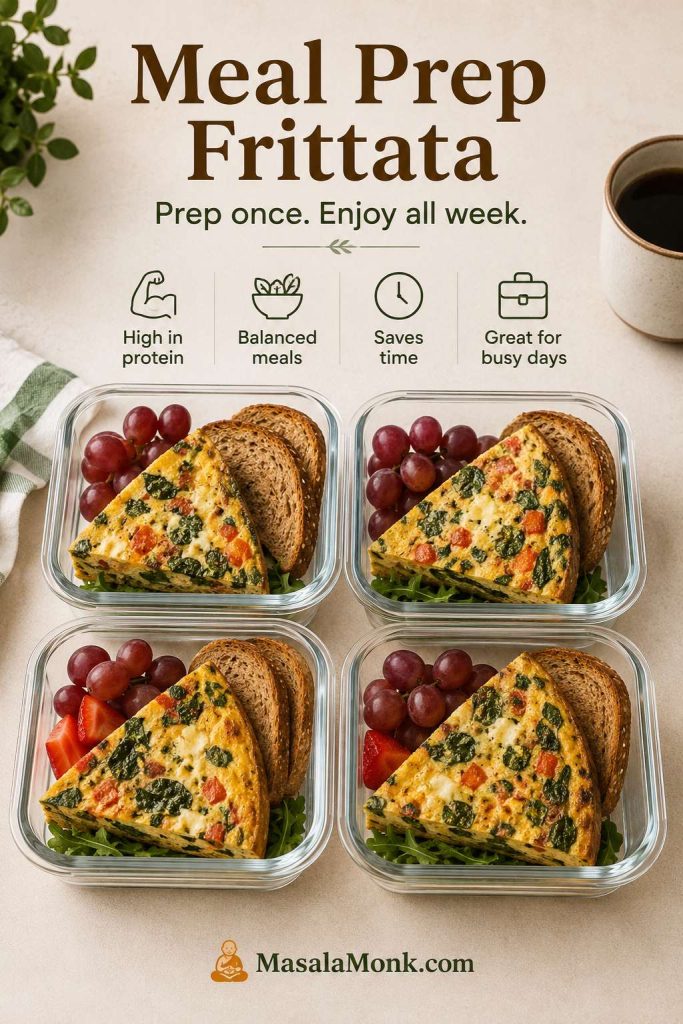
Serving leftovers for breakfast or brunch? See what to serve with frittata for easy plate ideas.
Frittata Troubleshooting: Watery, Rubbery, or Undercooked
When a frittata goes wrong, the trouble usually starts before it ever reaches the plate: the fillings were too wet, the pan was too deep, the eggs were beaten too aggressively, or the bake went a few minutes too long. Fortunately, most of those problems are easy to fix the next time.
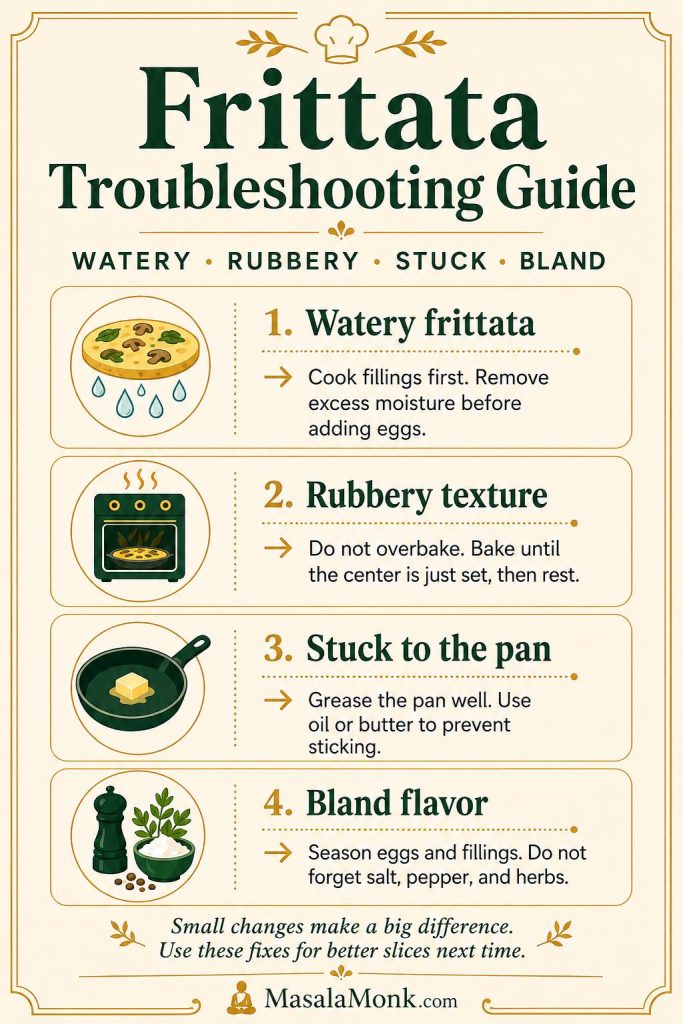
| Problem | Likely cause | Fix next time |
|---|---|---|
| Watery frittata | Raw watery vegetables or too much dairy | Sauté or roast high-moisture fillings before adding the eggs, and keep the dairy ratio in check. |
| Rubbery texture | Overbaking, high heat, or too little dairy | Pull it when just set and rest before slicing. |
| Wet center, dry edges | Pan is too small/deep or oven is too hot | Use a wider pan or lower the temperature for deeper dishes. |
| Frittata stuck to pan | Not enough fat or unsuitable pan | Grease well, use an oven-safe nonstick pan, or use a pie dish. |
| Bland flavor | Eggs and vegetables were underseasoned | Season the eggs and the cooked fillings. |
| Puffed then collapsed | Eggs were over-whisked or overbaked | Whisk gently and bake only until set. |
| Too salty | Salty cheese, bacon, ham, or smoked salmon | Reduce added salt when using salty fillings. |
If the frittata is already watery, give it a few more minutes in the oven if the center is underbaked. If the liquid came from vegetables, it may not become perfect, but it can still be served. Next time, let the vegetables cook longer before the eggs go in.
What to Serve with Frittata
At breakfast, frittata works well with toast, fruit, potatoes, or bacon. At lunch or dinner, it feels more complete with a crisp salad, roasted vegetables, or a slice of good bread.
- Toast, sourdough, English muffins, or flatbread
- Simple green salad or tomato salad
- Roasted potatoes, breakfast potatoes, or crispy air fryer hash browns
- Fresh fruit or fruit salad
- Bacon for a brunch plate
- Overnight oats, smoothies, or yogurt for a breakfast spread
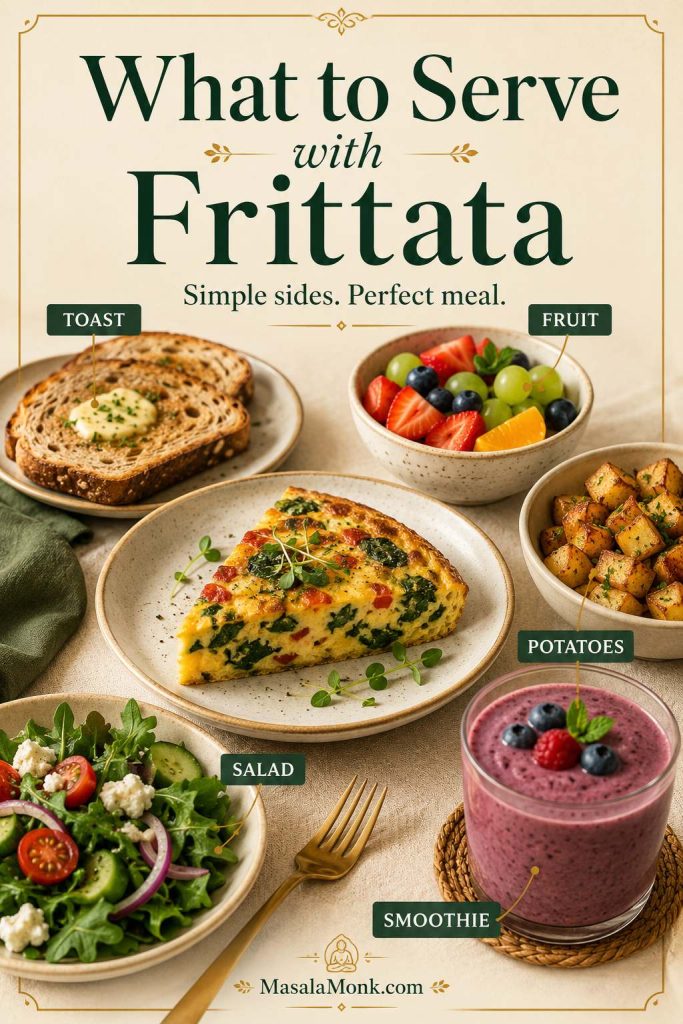
A simple brunch plate could be warm frittata wedges, crispy potatoes, fruit, toast, and something fresh like a tomato salad. Meal prep can stay much simpler: one slice of frittata, fruit, and oats or toast is enough for a balanced breakfast.
For a fresher brunch plate, pair frittata with fruit or a creamy kiwi smoothie instead of adding another heavy side.
For a different savory breakfast on another morning, this soft poha recipe is another quick, pantry-friendly option that works well for busy mornings.
Frittata FAQs
What is the best ratio for a frittata?
For an 8-egg frittata, use 1/3 cup dairy, 1 1/2 to 2 cups cooked fillings, and about 3/4 cup cheese. That gives you enough egg to hold the frittata together without making it plain or dry.
Is a frittata better with milk or cream?
Milk makes a lighter frittata, cream makes a richer one, and half-and-half gives the best middle ground. The bigger issue is quantity: too much dairy can make the frittata loose, while a moderate amount keeps it tender and sliceable.
Should vegetables be cooked before adding them to a frittata?
Usually, yes. Mushrooms, spinach, zucchini, onions, peppers, potatoes, broccoli, asparagus, and most dense or juicy vegetables do better after a quick sauté, roast, steam, or parcook. The flavor gets better, and the egg mixture sets more cleanly.
Can I use frozen vegetables in a frittata?
Yes, but thaw and squeeze or cook off extra moisture first. Frozen spinach, broccoli, peppers, and mixed vegetables can work well as long as they are not added icy or wet.
Why is my frittata watery?
A watery frittata usually comes from raw watery vegetables, too much dairy, underbaking, or slicing before it has rested. Cook high-moisture fillings first, use the ratio table, bake until the center is set, and rest for 5 to 10 minutes before cutting.
What oven temperature is best for frittata?
For a skillet frittata, 375°F / 190°C is the best default. For deeper baking dishes or muffin tins, 350°F / 175°C is gentler and gives the center more time to set. A 400°F / 200°C oven can work for a fast finish, but it is easier to overbake the edges.
Do I need a cast-iron skillet for frittata?
No. Cast iron works well, but any oven-safe skillet can work. If your skillet is not oven-safe, use a greased pie dish or baking dish instead.
How do you know when a frittata is done?
The center should look set, not wet or shiny. A slight wobble is fine, but loose liquid egg is not. A knife inserted near the center should not bring up raw egg, and an instant-read thermometer should register 160°F / 71°C for egg dishes.
Why did my frittata puff up and then collapse?
A little puffing is normal. A dramatic rise and collapse usually comes from over-whisking the eggs or baking too long. Whisk just until blended and pull the frittata when the center is set.
Can frittata be made ahead?
Yes. Cool the frittata completely, slice it, and refrigerate it in an airtight container for 3 to 4 days. Reheat gently in the microwave or oven so the eggs stay tender.
What is the difference between a frittata, omelet, quiche, and egg casserole?
A frittata mixes eggs with fillings and is usually finished or fully baked in the oven. An omelet is cooked quickly on the stovetop and folded around fillings. A quiche is more custard-like, usually richer in dairy, and often baked in a crust. An egg casserole is usually thicker and may include bread, potatoes, or more heavy add-ins.
Final Tips for a Better Frittata
A great frittata is less about one exact filling and more about a dependable method. Use this frittata recipe as your base, give the add-ins a little attention before they meet the eggs, bake gently, and let the finished frittata rest before slicing. Once those pieces are in place, breakfast leftovers, cooked vegetables, herbs, and small bits of cheese can turn into a meal that feels planned even when it started with whatever was in the fridge.
What went into yours: spinach and feta, potato and cheddar, mushrooms and herbs, or whatever needed using from the fridge?
“recipeInstructions”: [ { “@type”: “HowToStep”, “name”: “Preheat the oven and prepare the pan”, “url”: “https://masalamonk.com/frittata-recipe/#best-pan”, “text”: “Preheat the oven to 375°F / 190°C. Grease a 10-inch oven-safe skillet if needed.”, “image”: “https://masalamonk.com/wp-content/uploads/2026/05/best-pan-for-frittata.jpg” }, { “@type”: “HowToStep”, “name”: “Cook the vegetables first”, “url”: “https://masalamonk.com/frittata-recipe/#cook-fillings-first”, “text”: “Warm the olive oil or butter in the skillet over medium heat. Add the onion or shallot and cook until softened. Add the garlic, mushrooms, and bell pepper or zucchini. Cook until the vegetables soften and excess moisture reduces. Add the spinach or kale and cook just until wilted.”, “image”: “https://masalamonk.com/wp-content/uploads/2026/05/cook-fillings-first-for-frittata.jpg” }, { “@type”: “HowToStep”, “name”: “Whisk the eggs gently”, “url”: “https://masalamonk.com/frittata-recipe/#ingredients”, “text”: “In a bowl, whisk the eggs, dairy, salt, and pepper just until combined. Do not whisk the eggs into a very foamy mixture.”, “image”: “https://masalamonk.com/wp-content/uploads/2026/05/frittata-ingredients.jpg” }, { “@type”: “HowToStep”, “name”: “Add the fillings and cheese”, “url”: “https://masalamonk.com/frittata-recipe/#how-to-make”, “text”: “Spread the cooked fillings evenly in the skillet. Pour the egg mixture over them, then sprinkle the cheese over the top. You can also stir some of the cheese directly into the eggs and reserve a little for the surface.”, “image”: “https://masalamonk.com/wp-content/uploads/2026/05/how-to-make-a-frittata-step-by-step.jpg” }, { “@type”: “HowToStep”, “name”: “Bake until just set”, “url”: “https://masalamonk.com/frittata-recipe/#oven-times”, “text”: “Bake for 18 to 22 minutes, until the center is just set and no wet egg pools on top. Do not wait for a deeply browned top.”, “image”: “https://masalamonk.com/wp-content/uploads/2026/05/how-long-to-bake-a-frittata.jpg” }, { “@type”: “HowToStep”, “name”: “Rest before slicing”, “url”: “https://masalamonk.com/frittata-recipe/#doneness”, “text”: “Rest the frittata for 5 to 10 minutes before slicing. Finish with fresh herbs, black pepper, or a little extra cheese if desired.”, “image”: “https://masalamonk.com/wp-content/uploads/2026/05/oven-baked-egg-frittata-slice.jpg” } ]







