Posted on Leave a comment

Stir Fry Sauce Recipe: One Sauce for Chicken, Beef, Tofu, Vegetables & Noodles

Finished chicken stir-fry with broccoli, bell peppers, carrots, mushrooms, rice, and a small jar of brown stir fry sauce in the background.

A stir-fry can look perfect in the pan and still taste disappointing if the sauce is off. Use too little, and dinner feels dry. Pour too much, and the vegetables turn watery. Go too salty, and you lose the freshness. Let it get too sweet, and everything starts tasting bottled.

The short version: mix one jar, add it near the end, and use about 1 cup for a family-size stir-fry so dinner turns glossy, not watery.

This homemade stir fry sauce is built around a simple MasalaMonk rule: salt, loosen, brighten, round, aroma, cling. Soy sauce gives the savory base, water or broth keeps it balanced, vinegar brightens it, honey or brown sugar rounds it, garlic-ginger-sesame bring aroma, and cornstarch helps it cling to the food instead of pooling at the bottom of the pan.

It takes about five minutes to mix and works with chicken, beef, tofu, shrimp, vegetables, noodles, rice bowls, and those tired weeknight dinners where the fridge has a few vegetables, a protein, and no clear plan.

This is the sauce to keep in your back pocket: flexible enough for whatever is in the pan, reliable enough to make a random skillet taste like a real dinner, and easy enough to adjust lighter, deeper, sweeter, spicier, lower-sodium, vegan, keto-friendly, gluten-free, or soy-free.

Quick Answer: What Is Stir Fry Sauce Made Of?

A basic stir fry sauce is made with soy sauce, water or broth, rice vinegar, honey or brown sugar, toasted sesame oil, garlic, ginger, and cornstarch. Whisk everything together, add it near the end of cooking, and let it bubble for 30 to 60 seconds until it turns glossy and coats the food.

For most stir-fries, use about ¾ to 1 cup sauce for 1 lb / 450 g protein plus vegetables. Use less for fried rice, more for noodles, and slightly less if your vegetables release a lot of water.

If you have ever poured sauce into a stir-fry and watched it turn thin, salty, or soupy, the problem was probably not you. It was usually timing, pan moisture, or too much sauce for the amount of food in the pan.

Need a specific fix? Jump to how much sauce to use, when to add it, or how to fix watery stir-fry sauce.

What the sauce texture should look like

Before the sauce ever hits the pan, check the texture. It should be thin enough to pour, but balanced enough to turn shiny and cling once heated.

Close-up of glossy brown stir fry sauce coating a spoon, with visible bits of garlic, chili, sesame, and scallion.
Use the spoon as a quick texture check: the sauce should pour easily, but still leave a shiny coating behind. That is the texture that helps it cling in the pan.

Recipe at a Glance

Prep time:
5 minutes
Cook time:
No cooking until added to the pan
Yield:
About 1 cup / 250 ml
Servings:
1 family-size stir-fry / about 4 portions
Best for:
Chicken, beef, tofu, vegetables, noodles, rice bowls
Flavor:
Savory, lightly sweet, garlicky, gingery
Make-ahead:
5–7 days in the fridge
Main cue:
Add near the end; stop when shiny and coating

Easy Homemade Stir-Fry Sauce

This is the all-purpose version to start with. It is balanced enough for chicken, beef, tofu, vegetables, noodles, and rice bowls, but simple enough to mix before the pan is even hot.

All-Purpose Stir Fry Sauce

Prep: 5 minutes
Cook: no-cook sauce; 1–3 minutes in pan
Yield: about 1 cup / 250 ml
Serves: 1 family-size stir-fry / about 4 portions

Equipment

No special equipment is needed. A small bowl or jar, a whisk or fork, measuring spoons, and a hot wok or large skillet are enough.

Best For

Chicken, beef, tofu, shrimp, vegetables, noodles, rice bowls, and quick weeknight stir-fries.

Not Best For

It is not meant for deep-frying or as a thick dip straight from the jar. This sauce shines when it hits hot food in the pan and has a minute to thicken.

Ingredients

  • ½ cup / 120 ml water or low-sodium broth
  • ⅓ cup / 80 ml low-sodium soy sauce
  • 1 tablespoon / 15 ml rice vinegar
  • 1 tablespoon honey or brown sugar, about 20 g honey or 12–13 g sugar
  • 2 teaspoons / 10 ml toasted sesame oil
  • 2 garlic cloves, grated or very finely minced
  • 2 teaspoons fresh ginger, grated
  • 1 tablespoon cornstarch / cornflour (the white thickening starch), about 8 g
  • ¼ to ½ teaspoon red pepper flakes, chili garlic sauce, or sriracha, optional

Instructions

  1. Add the water or broth, soy sauce, rice vinegar, honey or brown sugar, sesame oil, garlic, ginger, cornstarch, and chili if using to a bowl or jar.
  2. Whisk well, or close the jar and shake until the cornstarch is fully dissolved.
  3. Use immediately, or refrigerate in an airtight jar.
  4. Shake or whisk again before using because the cornstarch settles as the sauce sits.
  5. Add near the end of stir-frying, after the protein and vegetables are mostly cooked.
  6. Let it bubble for 30 to 60 seconds, tossing until it turns shiny and coats the food.

Recipe Notes

  • Use low-sodium soy sauce for the best balance. Regular soy sauce can become too salty once reduced.
  • Use broth instead of water when you want a deeper sauce for chicken or beef.
  • For a brighter sauce, add 1 extra teaspoon rice vinegar at the end.
  • For a saucier rice bowl, add 2 to 4 tablespoons extra water or broth when the sauce hits the pan.
  • Do not pour it into a pan full of watery vegetables. Cook off extra moisture first.
  • If using this as a marinade, leave out the cornstarch. Cornstarch is for thickening in the hot pan; in a marinade, it can settle, clump, or make the surface pasty.
  • Yes, you can double the recipe. Double all ingredients, store in a larger jar, and shake well before each use.
  • It is also a good meal-prep sauce. Keep a jar in the fridge, and you are halfway to a stir-fry before the pan is even hot.

Why a jar of sauce makes stir-fry easier

A mixed sauce jar turns stir-fry into assembly cooking. With the flavor base ready, you can focus on heat, sequence, and not overcrowding the pan.

Clear glass jar of brown homemade stir fry sauce on a counter with garlic, ginger, scallions, soy sauce, and sesame oil nearby.
Because the sauce is mixed before cooking, weeknight stir-fries move faster. Keep it in a jar, then shake before using so the cornstarch blends back into the sauce.

Stir fry sauce ingredients before you mix

Keep the ingredients measured before cooking starts. Stir-fries move quickly, so the sauce should be ready before the wok or skillet gets hot.

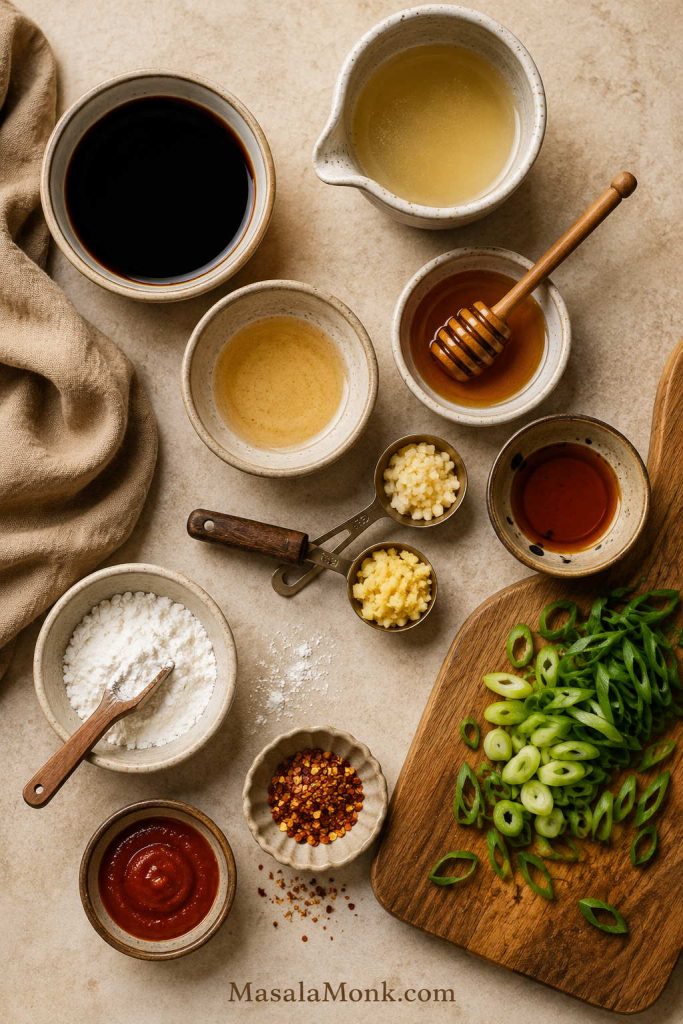
Overhead flat-lay of stir fry sauce ingredients including soy sauce, broth, rice vinegar, honey, sesame oil, garlic, ginger, cornstarch, chili, and scallions.
The ingredient list is short, but each part matters: soy sauce brings salt, vinegar brightens, sweetener rounds, aromatics wake it up, and cornstarch helps it finish properly.

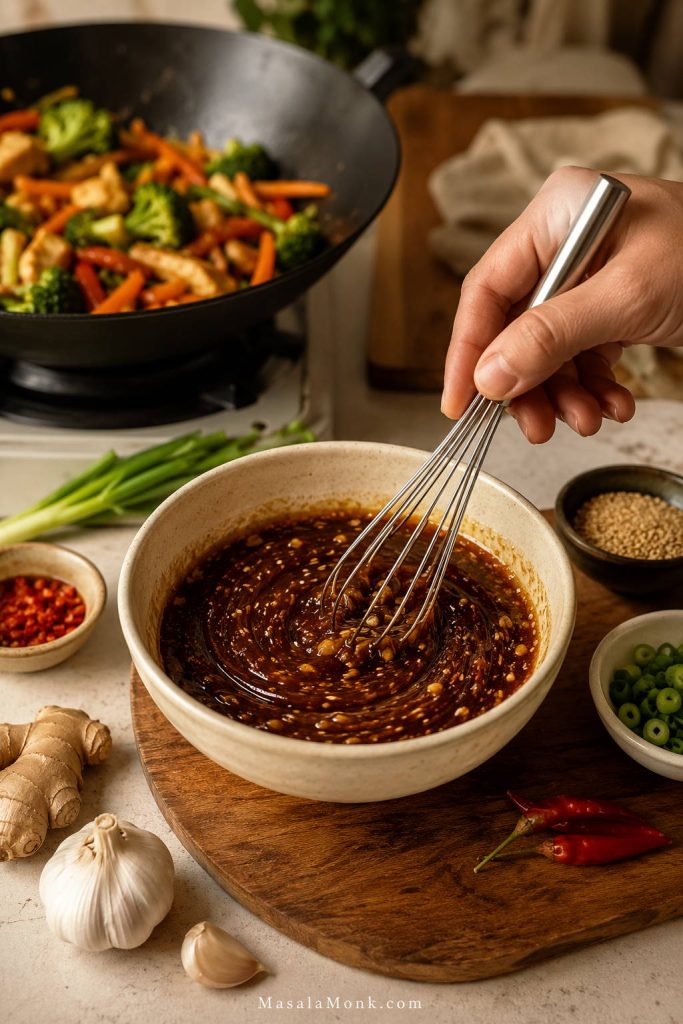
Mix the sauce before the pan gets hot

Whisk or shake until the cornstarch disappears into the liquid. That prevents last-minute measuring and gives the thickener time to disperse evenly.

Hand whisking brown homemade stir fry sauce in a ceramic bowl, with a wok of vegetables in the background and garlic, ginger, chili, scallions, and sesame nearby.
Mix the sauce before the pan gets hot. Then, once the protein and vegetables are ready, you can add it quickly instead of overcooking dinner while you measure.

Before you pour it into the pan: check how much sauce to use and when to add it so the stir-fry turns glossy instead of soupy.

The first time this sauce really clicks is when you stop treating it like a separate recipe and start treating it like a dinner shortcut. A jar in the fridge means chicken, tofu, broccoli, mushrooms, noodles, or leftover rice can turn into something that feels planned — as long as you use the right amount.

Timing cue: Mix the sauce before the pan gets hot. The protein should be cooked, the vegetables should be crisp-tender, and the pan should be hot but not swimming in liquid before the sauce goes in.

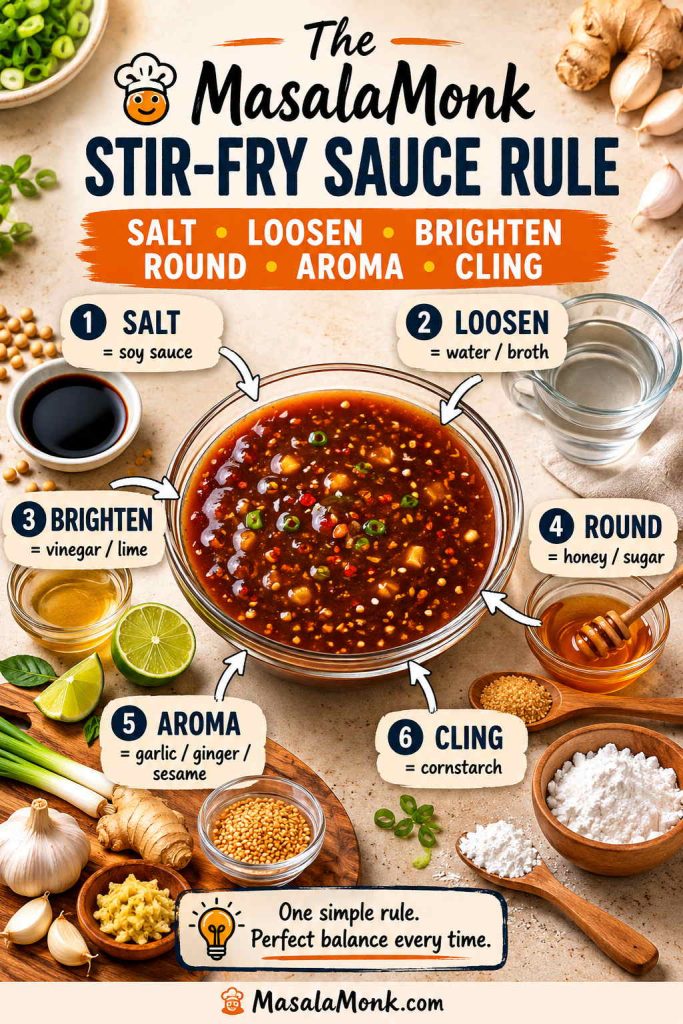
The MasalaMonk Stir-Fry Sauce Rule

A good stir-fry sauce is not just soy sauce plus thickener. It needs balance. Once you understand what each part is doing, you can adjust the sauce without guessing.

The six-part sauce rule

Use this as the control panel for the recipe. If dinner tastes off, fix the missing role instead of adding random ingredients.

Educational graphic showing a bowl of stir fry sauce and the MasalaMonk stir-fry sauce rule: salt, loosen, brighten, round, aroma, and cling, with ingredient examples around the bowl.
This is the control system for the whole recipe: salt, loosen, brighten, round, aroma, and cling. Once you understand those six jobs, you can fix the sauce without guessing.
Balance Part Ingredient Job in the Sauce
Salt Soy sauce, tamari, coconut aminos Creates the savory base.
Loosen Water or broth Keeps the sauce from becoming too salty or heavy.
Brighten Rice vinegar, lime juice Cuts through richness and keeps the flavor awake.
Round Honey, brown sugar, maple syrup Softens salt, acid, and heat.
Aroma Garlic, ginger, toasted sesame oil Makes the sauce smell fresh instead of flat.
Cling Cornstarch, arrowroot, xanthan gum Helps the sauce coat the food instead of pooling.

That is the real trick. The recipe gives you the base, but this rule tells you how to fix it. Too salty? Loosen. Too flat? Brighten. Too sharp? Round. Too thin? Help it cling. Too bottled? Add aroma.

Using the rule to fix dinner? If the sauce tastes too salty, too flat, too thin, or too sweet, jump to the troubleshooting table.

How Much Stir Fry Sauce to Use

This is the part most recipes skip, and it is also the part that saves dinner. The same sauce can taste perfect or overwhelming depending on how much food is in the pan.

If your stir-fries usually taste either dry or soupy, use the table first, then check the image cue that matches what you are cooking.

What You Are Cooking How Much Sauce to Use What to Watch
1 lb / 450 g chicken + vegetables ¾ to 1 cup Use the full cup if serving over rice and you want extra sauce.
1 lb / 450 g beef + vegetables ⅔ to 1 cup Beef can handle a deeper, slightly stronger sauce.
14 oz / 400 g tofu + vegetables About ⅔ cup Use a slightly thicker sauce so it clings to crisp tofu.
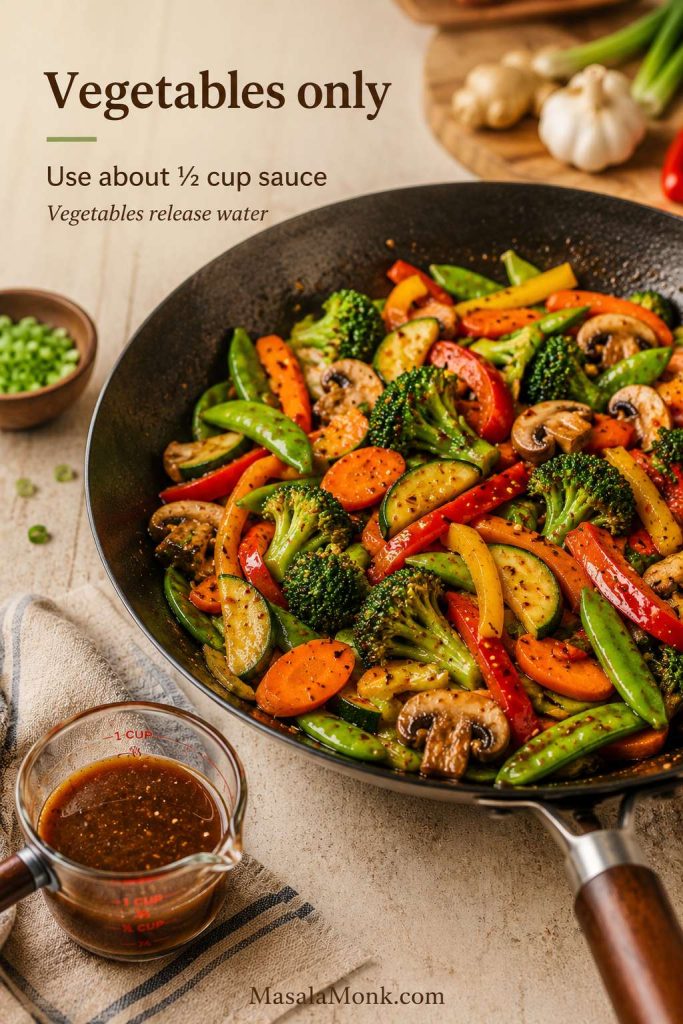
4 cups vegetables only About ½ cup Use less if the vegetables release water.
6 cups vegetables + 1 lb protein About 1 cup This is the classic family-size stir-fry amount.
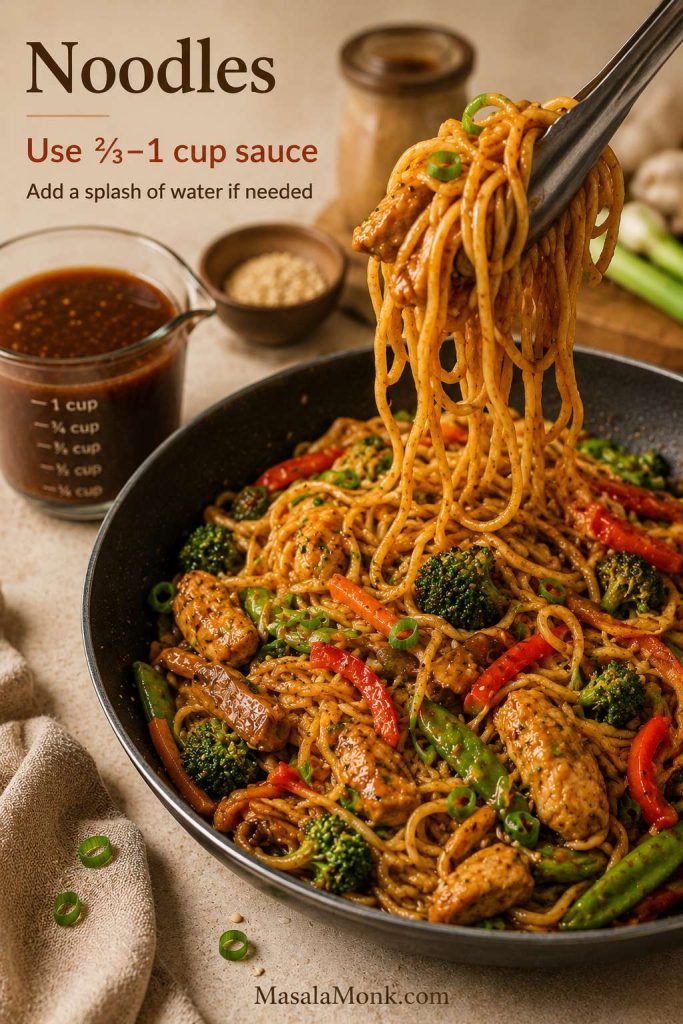
200 g fresh noodles or 100 g dried noodles + add-ins ⅔ to 1 cup Noodles absorb sauce quickly; add water or broth if needed.
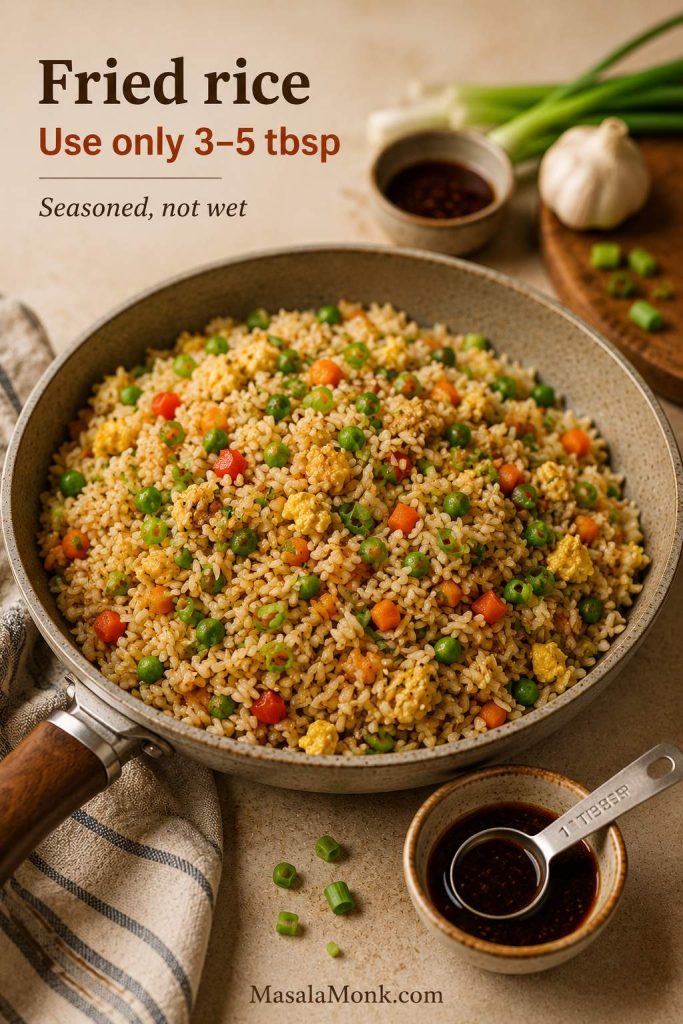
Fried rice-style stir fry 3 to 5 tablespoons Too much sauce makes rice wet and soft.
Very saucy takeout-style stir fry 1 cup plus 2 to 4 tablespoons water or broth Best when serving over plain rice.

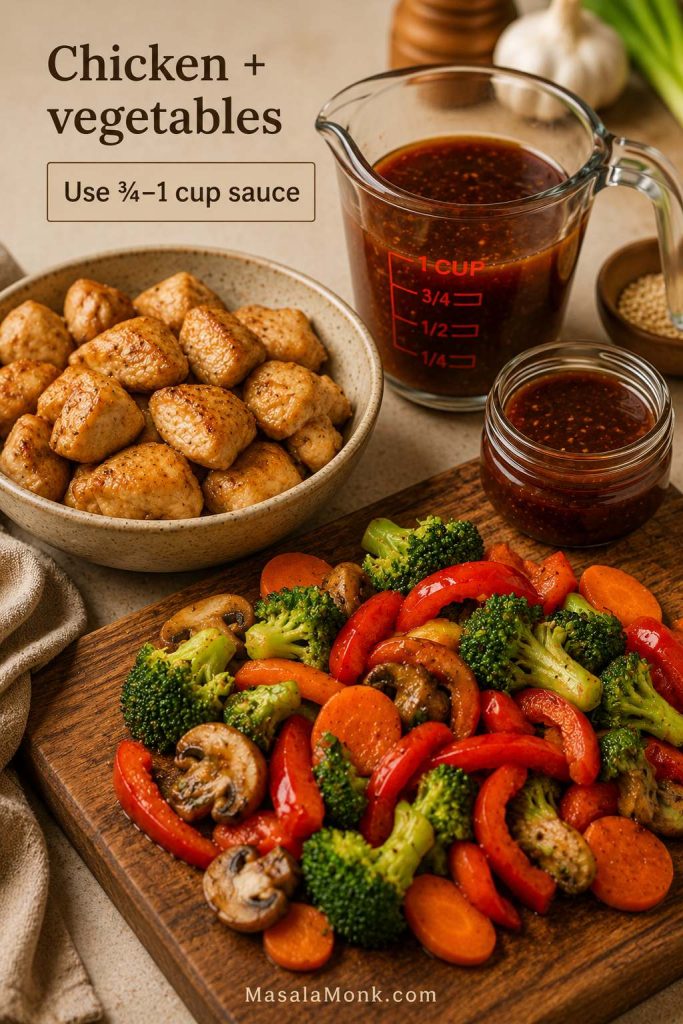
How much sauce to use for chicken stir-fry

For chicken and vegetables, start with ¾ cup if the pan is modest and go up to 1 cup when you want extra sauce for plain rice.

Cooked chicken pieces, mixed vegetables, and a measuring cup of brown stir fry sauce with text reading “Chicken + vegetables” and “Use ¾–1 cup sauce.”
Chicken and vegetables usually need ¾ to 1 cup sauce for a family-size pan. Use the higher end when serving over plain rice, where a little extra sauce is useful.

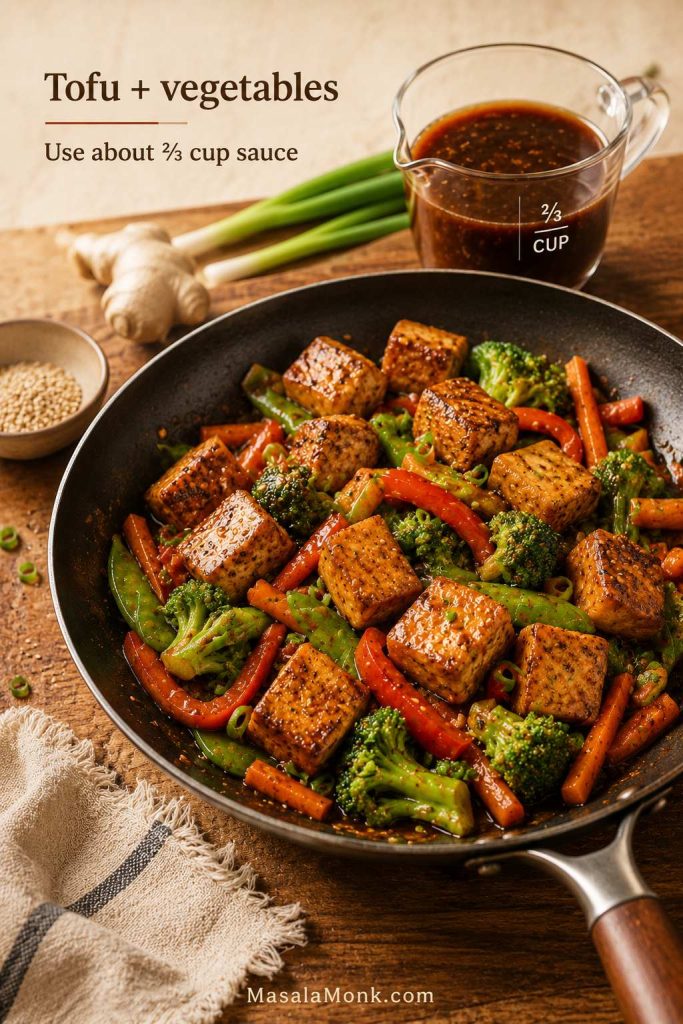
How much sauce to use for tofu stir-fry

Tofu works better with restraint. Too much sauce softens the crisp edges before they can hold flavor.

Crisp golden tofu cubes with broccoli, peppers, snap peas, carrots, and a measuring cup of sauce, with text reading “Tofu + vegetables” and “Use about ⅔ cup sauce.”
Tofu needs enough sauce to cling to its crisp edges, but not so much that the pan floods. About ⅔ cup is a good starting point for tofu and vegetables.

How much sauce to use for vegetables

Vegetables release moisture as they cook, so a smaller amount of sauce often looks light at first but finishes better after bubbling.

Colorful vegetable stir-fry with broccoli, peppers, carrots, mushrooms, snap peas, zucchini, and a measuring cup of sauce, with text reading “Vegetables only” and “Use about ½ cup sauce.”
Vegetable-only stir-fries need restraint because the vegetables release water as they cook. Start with about ½ cup, then add more only after the sauce thickens.

How much sauce to use for noodles

Noodles absorb sauce quickly. Keep water or broth nearby so you can loosen the pan without adding more salt or sweetness.

Glossy noodle stir-fry being lifted with tongs, with chicken, broccoli, peppers, and a measuring cup of sauce labeled “Noodles” and “Use ⅔–1 cup sauce.”
Noodles absorb sauce as they sit, so keep the finish flexible. Start with ⅔ to 1 cup sauce, then loosen with a splash of water if the noodles tighten up.

How much sauce to use for fried rice

Fried rice needs seasoning, not a full stir-fry sauce pour. Start with a few tablespoons, toss, taste, and stop before the grains clump.

Pan of fried rice with vegetables, egg, scallions, and a tablespoon of sauce, with text reading “Fried rice,” “Use only 3–5 tbsp,” and “Seasoned, not wet.”
Fried rice is seasoned, not sauced. Use only 3 to 5 tablespoons so the grains stay separate instead of turning wet and clumpy.

Amount rule: Start lower if your pan is crowded, your vegetables are watery, or your noodles are already soft. You can always add more sauce after it thickens; you cannot easily remove extra once the pan turns soupy.

When to Add the Sauce

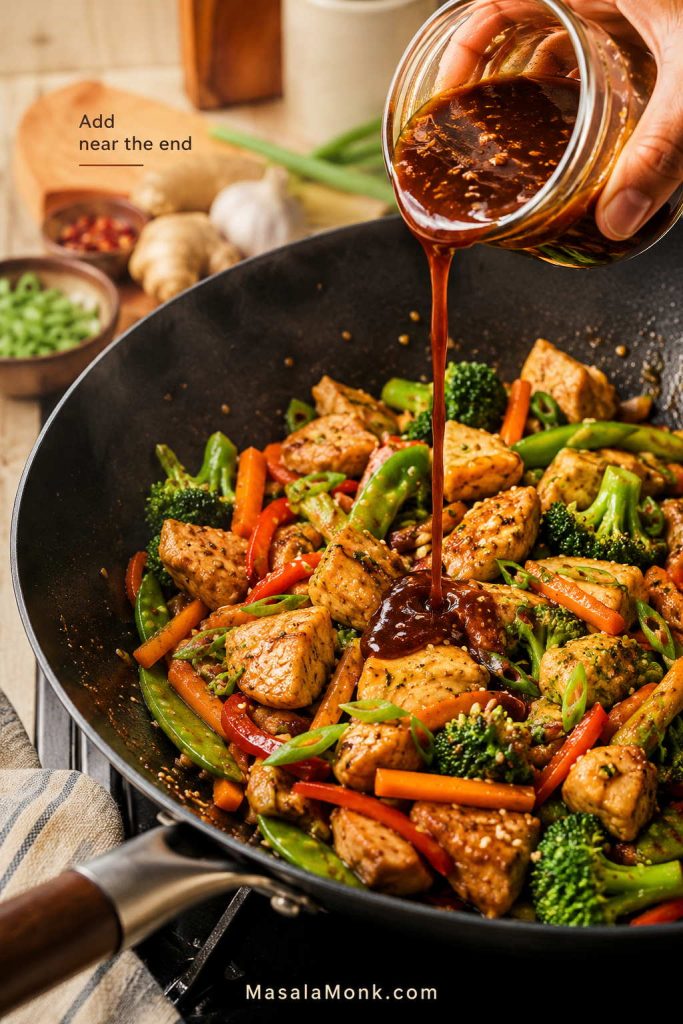
Add it near the end of cooking, not at the beginning. The sauce is there to coat and finish the food, not to boil the vegetables or stew the protein.

The stir-fry order before sauce goes in

The pan should be hot, the protein mostly cooked, and excess vegetable moisture reduced before the sauce goes in.

  1. Heat the wok or large skillet first. A hot pan helps food sear instead of steam.
  2. Cook the protein. Chicken, beef, shrimp, pork, or tofu need direct heat before sauce.
  3. Remove the protein if needed. This prevents overcooking while vegetables finish.
  4. Cook firm vegetables first. Broccoli and carrots need more time than bok choy leaves or peppers.
  5. Cook off extra moisture. A watery pan dilutes the sauce.
  6. Return the protein and shake the sauce. Cornstarch settles, so mix it again.
  7. Add the sauce and toss for 30 to 60 seconds. Stop when it thickens and finishes the pan.
Brown stir fry sauce being poured from a jar into a wok of mostly cooked chicken, broccoli, carrots, peppers, snap peas, and scallions.
Add the sauce near the end, not at the beginning. The food should already be mostly cooked, so the sauce only needs a short bubble to thicken and coat.

Cloudy to glossy: what the sauce should do in the pan

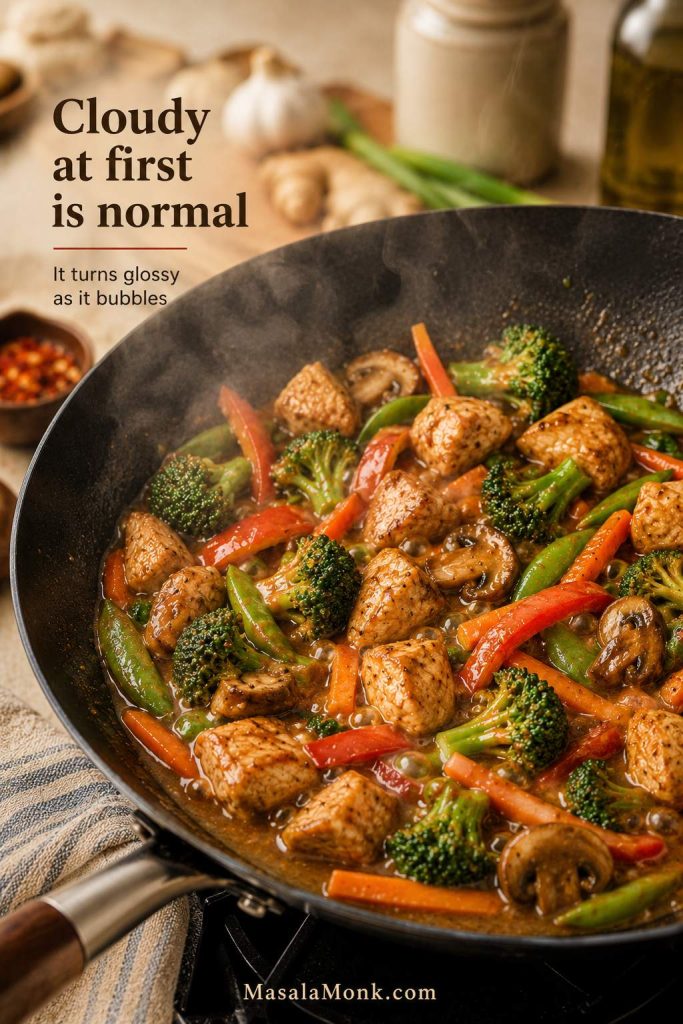
In the pan, the sauce often starts cloudy because the cornstarch is just beginning to hydrate. Once it bubbles around the edges, it should turn clearer, darker, and shinier.

Wok of chicken and vegetables with cloudy brown sauce bubbling around the food and text reading “Cloudy at first is normal.”
At first, cornstarch sauce can look cloudy in the pan. Give it 30 to 60 seconds of bubbling, and it should turn clearer, shinier, and more clingy.

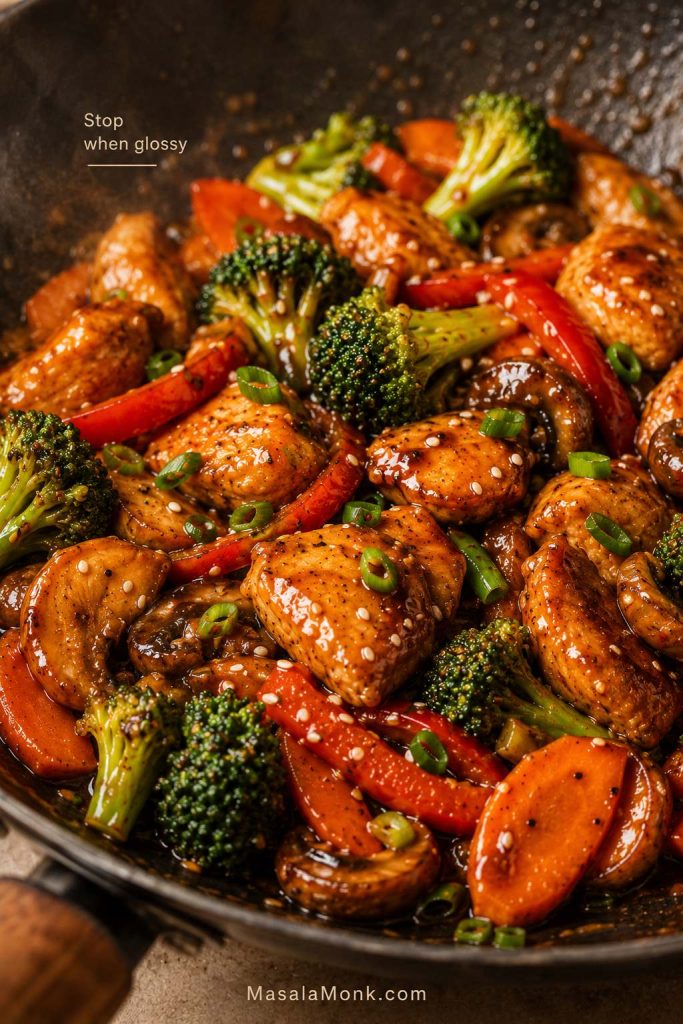
Stop when the sauce turns glossy

The stop point is short and visual: the sauce tightens, the food looks coated, and the vegetables still look bright. Keep cooking after that and the flavor can turn too salty.

Close-up of glossy chicken stir-fry with broccoli, carrots, red peppers, mushrooms, scallions, and sauce clinging to the food, with small text reading “Stop when glossy.”
This is the stop point: the sauce has tightened, the food looks coated, and the vegetables still look bright. Keep cooking much longer and the sauce can turn too salty.

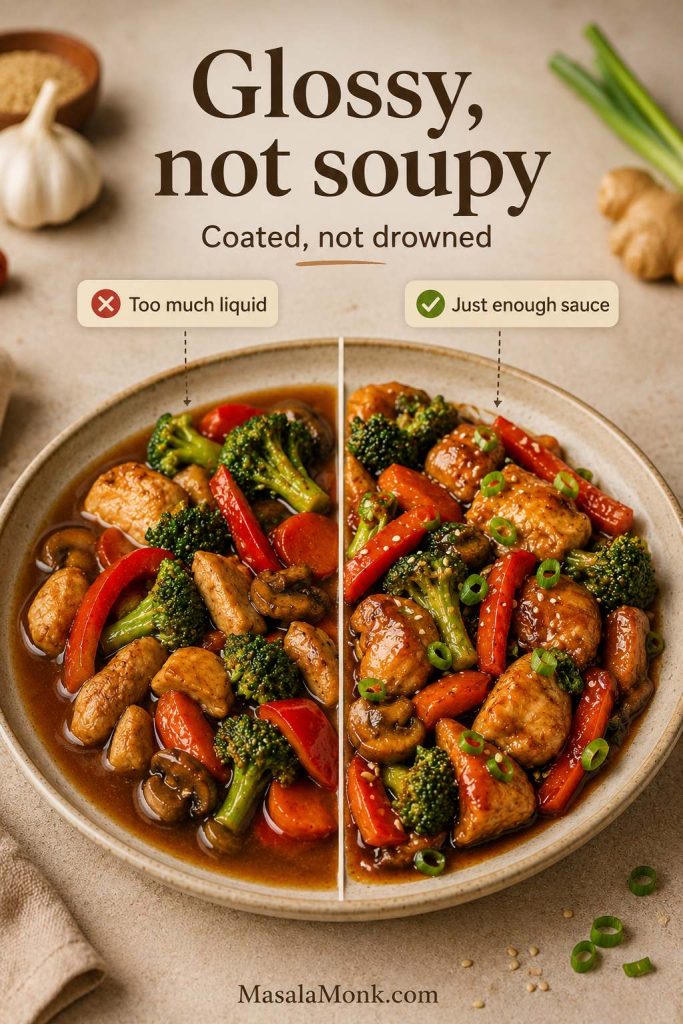
Glossy, not soupy: the final texture cue

The goal is glossy, not soupy — coated, not drowned. If sauce sits under the food instead of clinging to it, the pan probably has too much liquid.

Comparison image with one side showing a stir-fry in too much liquid and the other side showing a coated stir-fry, with text reading “Glossy, not soupy,” “Coated, not drowned,” “Too much liquid,” and “Just enough sauce.”
The difference is liquid control. Too much stir-fry sauce drowns the pan; just enough coats the food and keeps the vegetables crisp-looking.

Good stir-frying is mostly prep, heat, and sequence. Serious Eats explains those stir-frying basics in depth, but for this sauce the main thing is simple: mix it first and add it near the end.

If you need rice underneath your stir-fry, MasalaMonk’s how to cook rice guide is useful when you want fluffy rice that can hold sauce without turning mushy.

Why This Recipe Works

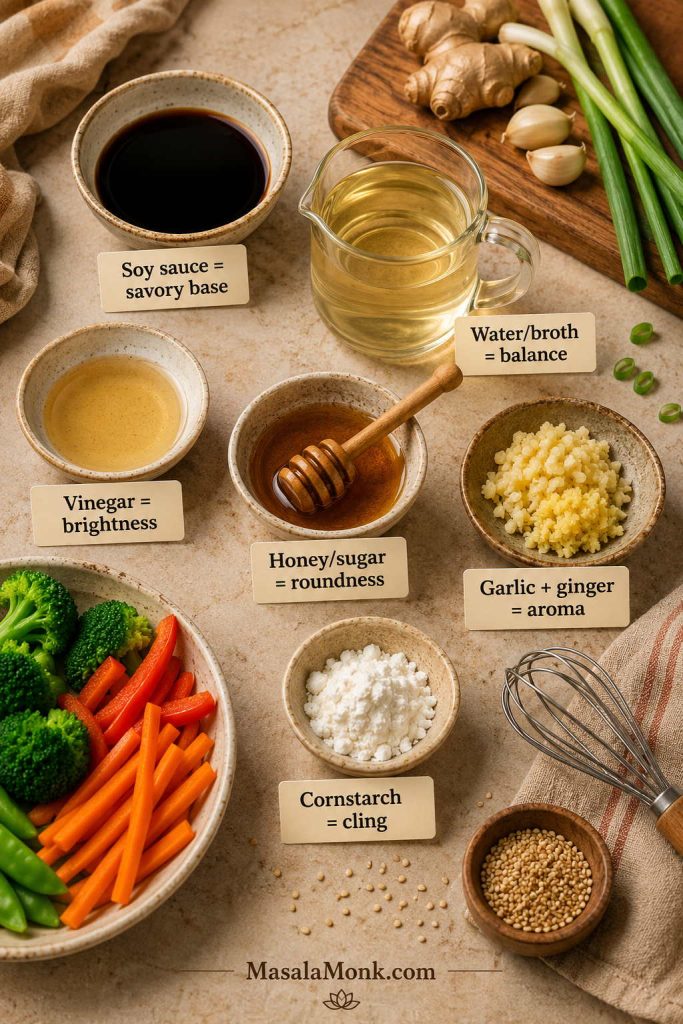
Why each ingredient has a job

This recipe works because each ingredient solves a specific sauce problem. Use the roles below when you need to adjust taste, thickness, or balance.

Ingredient-role graphic with labeled bowls showing soy sauce as savory base, water or broth as balance, vinegar as brightness, honey as roundness, garlic and ginger as aroma, and cornstarch as cling.
When a sauce tastes off, fix the role that is missing. Add broth to loosen, vinegar to brighten, honey or sugar to round, garlic and ginger for aroma, or cornstarch for cling.

This sauce is simple, but it is not random. Soy sauce brings salt and savory depth, while water or broth keeps it from becoming too intense. Rice vinegar adds brightness, and honey or brown sugar rounds the sharp edges so the sauce tastes balanced instead of harsh.

Garlic and ginger give the sauce its classic stir-fry aroma. Toasted sesame oil adds a warm nutty finish. Cornstarch is what changes the sauce from thin liquid into a shiny coating in the hot pan.

The goal is not a heavy glaze. The goal is a thin mixture that thickens in the hot pan, grabs onto the food, and leaves everything tasting seasoned but still fresh.

When it is right, you should smell the garlic and ginger first, see the sauce turn from cloudy to shiny, and still taste the freshness of the vegetables underneath. The sauce should make the food feel finished, not hidden.

Ingredients and Substitutions

Think of this section as permission to adjust. The sauce does not fall apart if you swap broth for water, honey for maple syrup, or tamari for soy sauce. You just need to keep the balance: salt, loosen, brighten, round, aroma, and cling.

Cooking for a specific need? Jump to gluten-free, soy-free, vegan, lower-sodium, and keto variations.

Soy Sauce

Low-sodium soy sauce is the best default. Regular soy sauce can work, but it becomes stronger as it reduces. If you only have regular soy sauce, use ¼ cup instead of ⅓ cup, then add 1 to 2 extra tablespoons water or broth.

For gluten-free sauce, use certified gluten-free tamari, certified gluten-free soy sauce, or coconut aminos. For a soy-free style version, coconut aminos are usually the easiest starting point, but they are sweeter and less salty than soy sauce, so reduce the sweetener and taste at the end.

Water or Broth

Water keeps the flavor clean and light. Broth gives more depth. Chicken broth works well with chicken, beef broth gives beef stir-fries a deeper base, and vegetable broth keeps tofu or vegetable stir-fries flexible. Low-sodium broth is best because the soy sauce already brings salt.

Honey or Brown Sugar

A little sweetness balances the saltiness of soy sauce and the sharpness of vinegar. Honey gives a smooth feel. Brown sugar gives deeper flavor. Maple syrup works well for a vegan version.

For the base sauce, keep the sweetener modest. This is a balanced weeknight sauce, not a sticky glaze. If you want something sweeter, use the honey soy variation below.

Rice Vinegar

Rice vinegar keeps the sauce bright. Apple cider vinegar can work in a pinch. Lime juice also works, especially for a Thai-inspired version, but it changes the flavor and makes the sauce sharper.

Garlic and Ginger

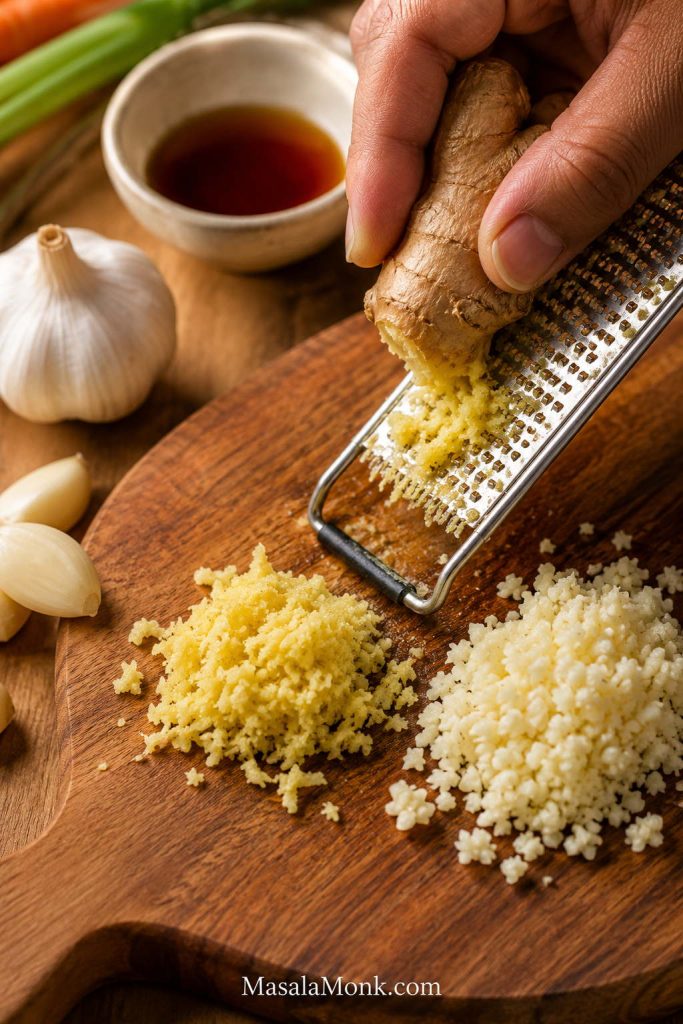
Fresh garlic and ginger make the sauce taste more alive. Grating them helps them disappear into the mixture and spread evenly through the pan.

Close-up of fresh ginger being grated beside minced garlic on a wooden cutting board, with garlic cloves and a small bowl in the background.
Fresh garlic and ginger do more than add flavor; they make the sauce smell freshly cooked instead of bottled. Grating them helps that aroma spread quickly through the stir-fry.

If you need to use powders, replace 2 garlic cloves with about ½ teaspoon garlic powder, and replace 2 teaspoons fresh ginger with about ½ to ¾ teaspoon ground ginger. The sauce will still work, but fresh gives better aroma.

Toasted Sesame Oil

Use toasted sesame oil for flavor, not as the main cooking oil. Two teaspoons are enough to make the sauce taste warm and nutty without overpowering the garlic and ginger.

Cornstarch / Cornflour

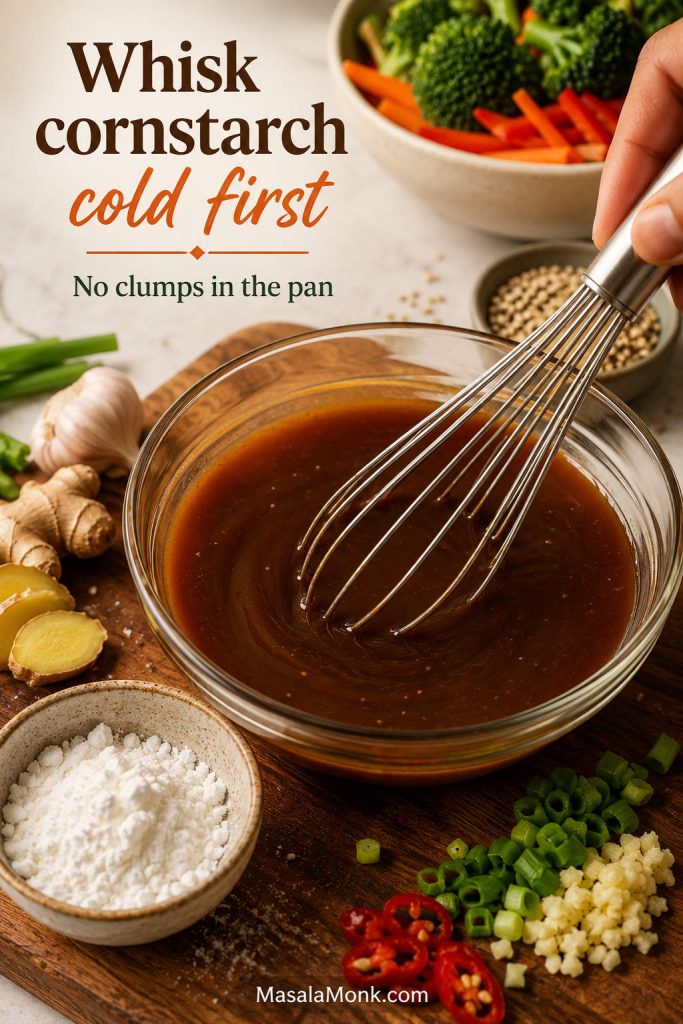
Cornstarch thickens the sauce and gives it that takeout-style finish. It must be mixed into cold or room-temperature liquid before heating. If dry cornstarch hits hot liquid directly, it can clump.

Bowl of brown stir fry sauce being whisked with visible text reading “Whisk cornstarch cold first” and “No clumps in the pan.”
Cornstarch works best when it is whisked into cool liquid first. That small step prevents clumps and helps the sauce turn smooth when it bubbles.

It also settles when the sauce sits, so always shake or whisk before adding it to the pan.

Can you make it without cornstarch? Yes, but it will be thinner. You can simmer it slightly longer, use arrowroot for some gluten-free or grain-free versions, or use a tiny amount of xanthan gum for keto sauce. Cornstarch is still the easiest everyday thickener.

How to Use This Sauce for Different Stir-Fries

Once the base is mixed, the rest is about matching the sauce to the food. Chicken wants balance. Beef can take depth. Tofu needs cling. Vegetables need restraint. Noodles need room to move.

For Chicken

Chicken is mild, so the sauce should stay balanced rather than too salty or too sweet. The base recipe works as written, especially if you use broth instead of water.

For 1 lb / 450 g chicken plus vegetables, ¾ to 1 cup is usually right. Go closer to the full cup if you are serving it over rice and want a little extra sauce to catch underneath.

The main danger with chicken is not the sauce; it is overcooking the chicken while waiting for the sauce to thicken. Keep the final simmer short.

Good vegetables for chicken include broccoli, bell peppers, carrots, snap peas, green beans, mushrooms, cabbage, bok choy, zucchini, and onions.

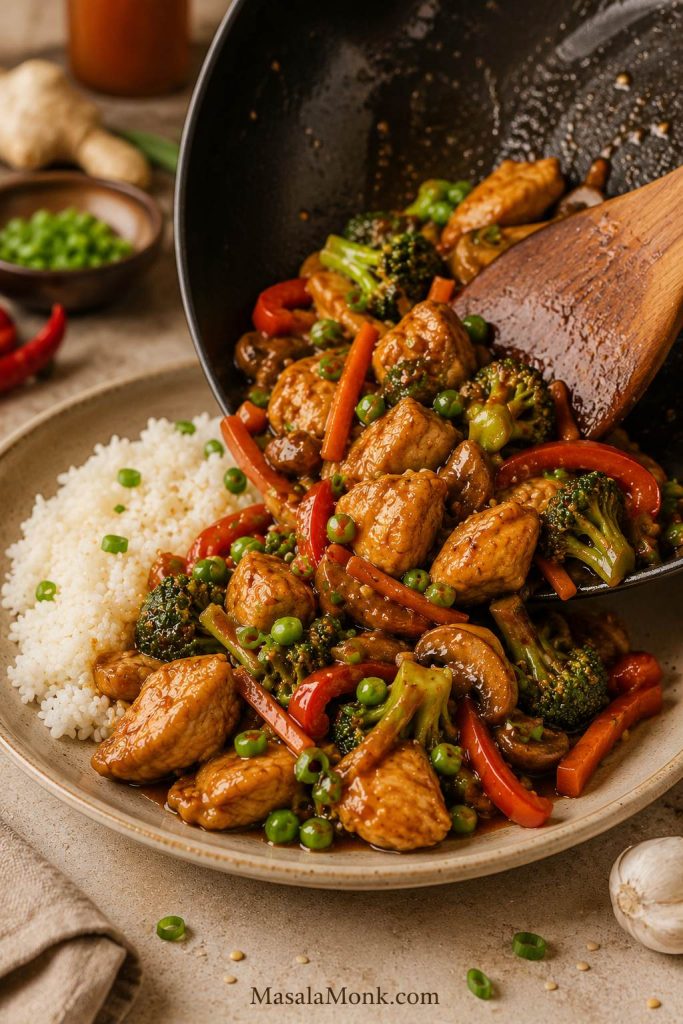
Chicken stir-fry being served from a wok onto rice, with broccoli, carrots, peppers, mushrooms, peas, and glossy brown sauce.
This is the chicken use-case: tender pieces, crisp vegetables, and enough sauce to catch on the rice without turning the bowl soupy.

For Beef

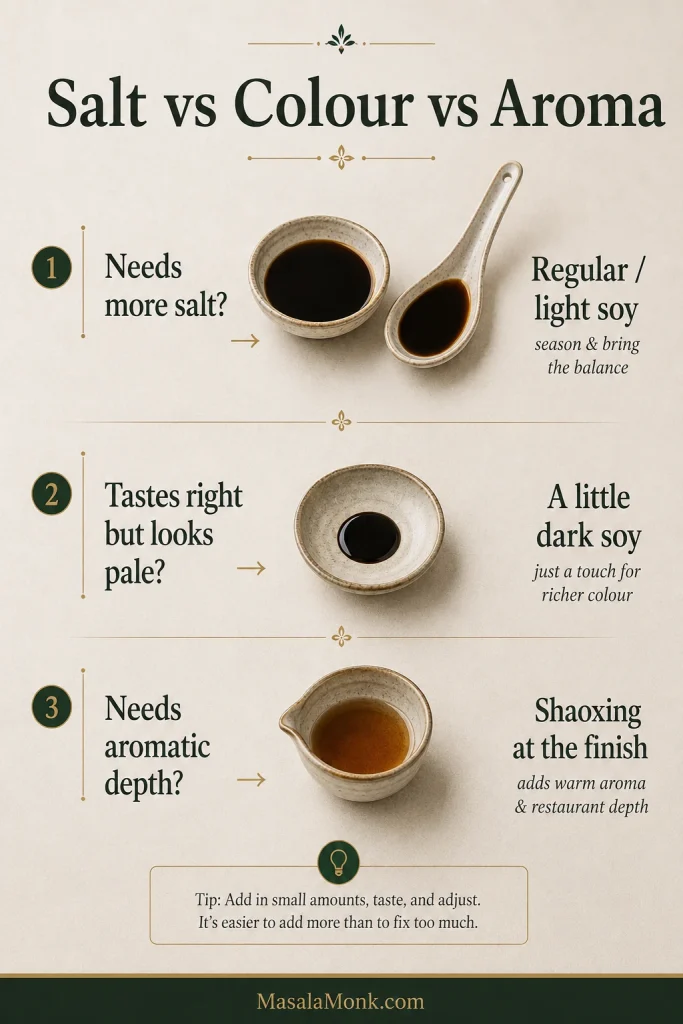
Beef likes a darker, more savory sauce. Start by swapping water for broth. Oyster sauce gives the quickest savory boost, Shaoxing wine or dry sherry adds restaurant-style depth, white pepper brings quiet warmth, and a small splash of dark soy sauce gives color if you have it.

You do not need every add-in at once. Even one or two — broth, oyster sauce, or white pepper — can make the sauce taste deeper.

For 1 lb / 450 g beef plus vegetables, ⅔ to 1 cup works well. Beef can carry a stronger sauce, especially with broccoli, mushrooms, green beans, or rice underneath.

Slice beef thinly across the grain and cook it quickly over high heat. Add the sauce only after the beef and vegetables are mostly cooked, then toss just long enough for everything to thicken and coat.

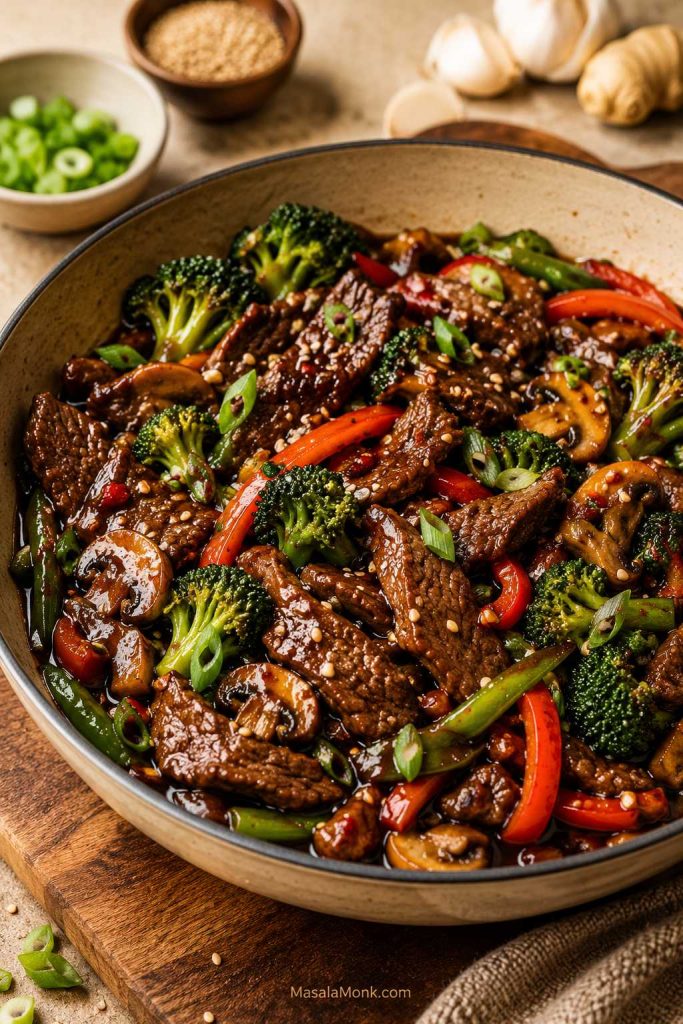
Beef stir-fry with thin beef slices, broccoli, mushrooms, red peppers, green beans, scallions, sesame seeds, and glossy dark brown sauce.
For beef, lean deeper and more savory. A darker brown sauce works well with mushrooms, broccoli, peppers, and thin slices of tender beef.

For Tofu

Tofu needs the sauce to cling, not slide off. If the tofu is not browned first, it can taste bland even when the sauce itself tastes good.

A 14 oz / 400 g block of tofu plus vegetables usually needs about ⅔ cup. More than that can flood the pan before the tofu has a chance to hold the flavor.

Press firm or extra-firm tofu, cut it into cubes or slabs, and pat it dry before it hits the pan. A dry surface browns better, and browned tofu holds sauce better.

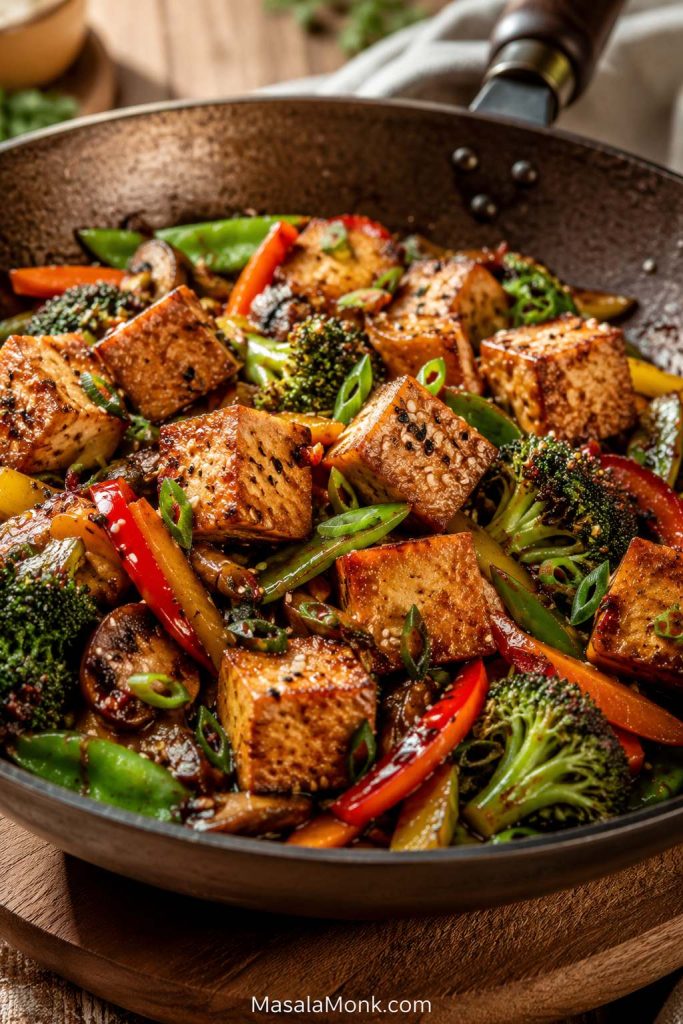
Golden tofu cubes in a wok with broccoli, bell peppers, snap peas, mushrooms, scallions, sesame seeds, and glossy brown sauce.
Brown the tofu first so the sauce has something to hold onto. Crisp edges make tofu taste more seasoned and keep the sauce from sliding off.

For a lower-carb tofu dinner idea, MasalaMonk’s tofu and broccoli stir-fry with cauliflower rice is a natural fit, especially when you want a high-protein meal without noodles or regular rice.

For a vegan tofu stir-fry, use vegetable broth and maple syrup or sugar instead of honey. If you want deeper savory flavor, add mushroom powder or a little dried-shiitake soaking liquid.

For Vegetables

Vegetables are sneaky. They look dry when they first hit the pan, then suddenly release enough water to thin the whole sauce. That is why vegetable stir-fries need less sauce and a hotter pan.

Four cups of vegetables usually need only about ½ cup sauce. That may look modest, but vegetables release their own moisture as they cook.

Mushrooms and zucchini are the biggest water releasers here. Give them space, use higher heat, and wait until their moisture cooks off before adding the sauce.

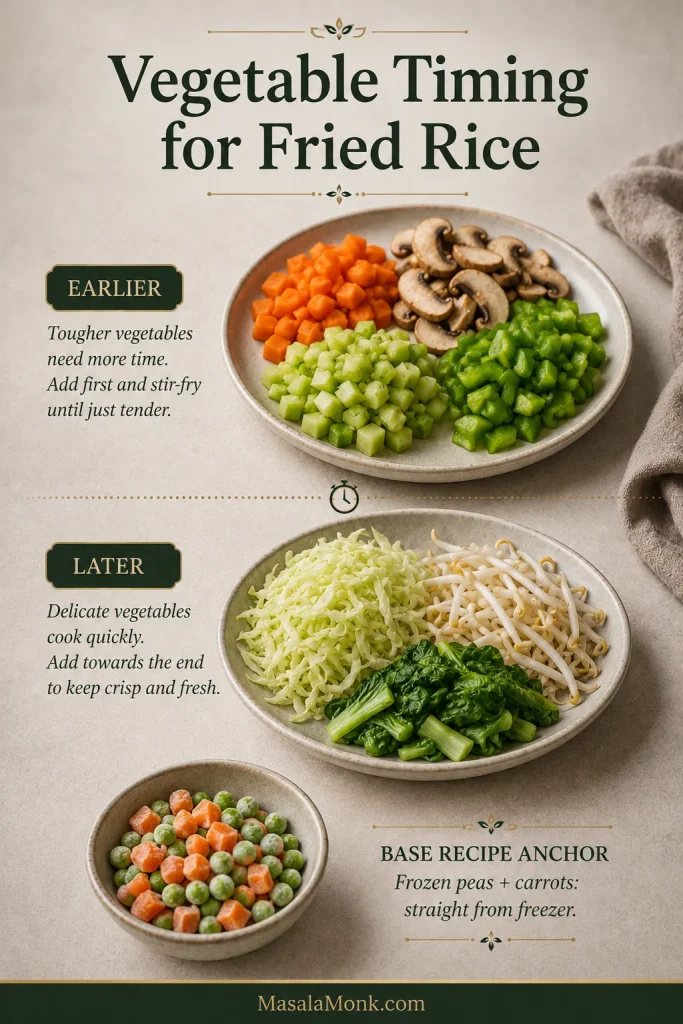
Cook firm vegetables first: broccoli, carrots, cauliflower, green beans, cabbage stems. Add softer vegetables later: bell peppers, mushrooms, zucchini, bok choy leaves, snap peas, and scallions.

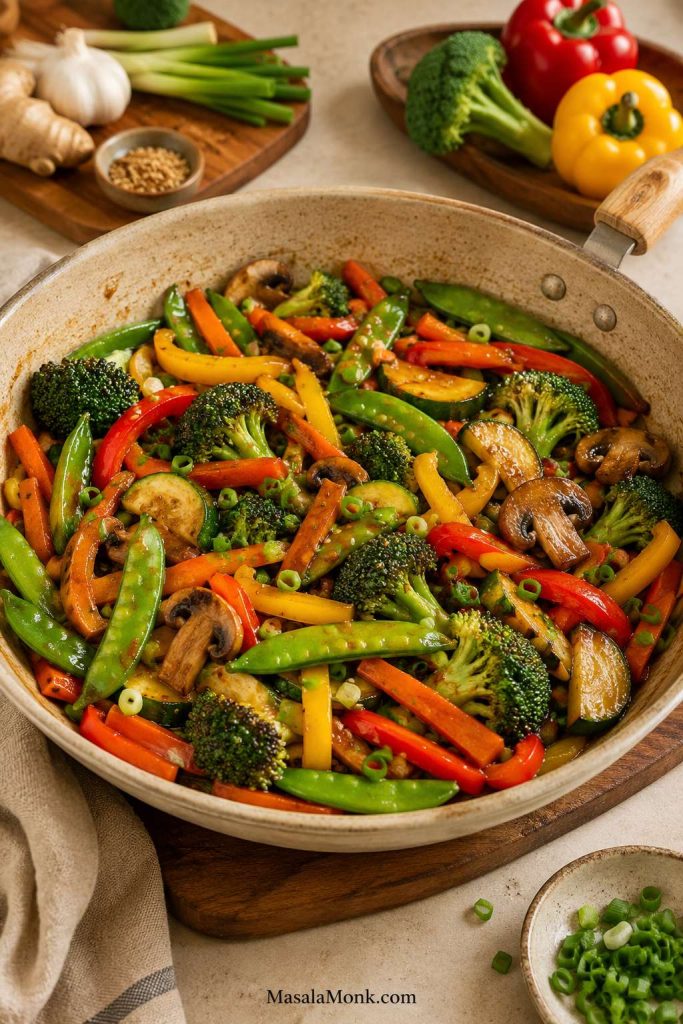
Colorful vegetable-only stir-fry with broccoli, red and yellow peppers, carrots, mushrooms, snap peas, zucchini, scallions, and a light glossy sauce.
A vegetable stir-fry should still look fresh after saucing. Keep the coating light so the broccoli, peppers, carrots, mushrooms, and snap peas stay colorful.

For Noodles and Rice

Noodles drink sauce quickly, so they need a looser finish. For noodles, use ⅔ to 1 cup sauce for about 200 g fresh noodles or 100 g dried noodles, plus your protein and vegetables. Start lower if the noodles are already soft or oily; add a splash of water or broth if they drink up the sauce too quickly.

If cooked noodles are clumped before they go into the pan, loosen them first with a splash of water or oil. Sauce cannot coat noodles evenly if they enter the pan as one sticky block.

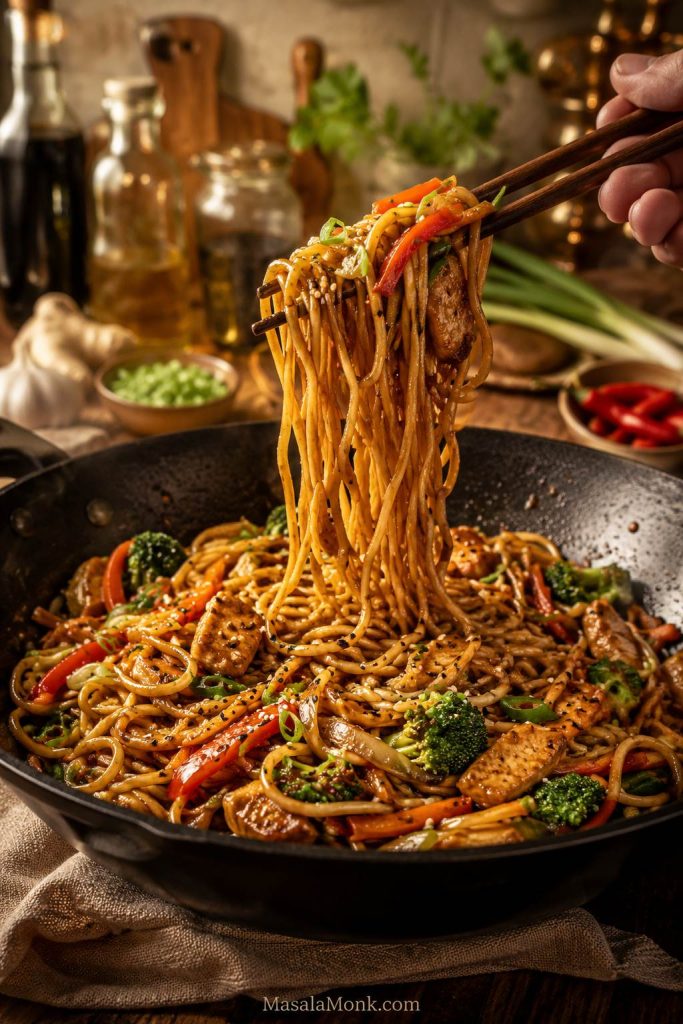
Chopsticks lifting glossy stir-fried noodles from a wok with vegetables, tofu or chicken pieces, scallions, and brown sauce.
Noodle stir-fry is ready when the strands separate and shine instead of clumping together. If the pan feels tight, add a splash of water and toss briefly.

For fried rice-style cooking, use much less. Start with 3 to 5 tablespoons. Too much liquid makes rice wet and heavy. Cold cooked rice works better than freshly cooked hot rice because it is drier and separates more easily in the pan.

If you like saucy rice-bowl dinners, use the full cup in the stir-fry and serve it over plain rice. For fried rice, season gradually.

For a takeout-style egg dish with a glossy sauce, MasalaMonk’s egg foo young recipe is a useful companion because it also leans on a savory sauce that thickens and coats.

Back to top ↑

Easy Sauce Variations

You do not need every variation today. Make the base sauce first. Come back to this section when you want it sweeter, spicier, darker, lower-sodium, vegan, gluten-free, keto-friendly, or soy-free.

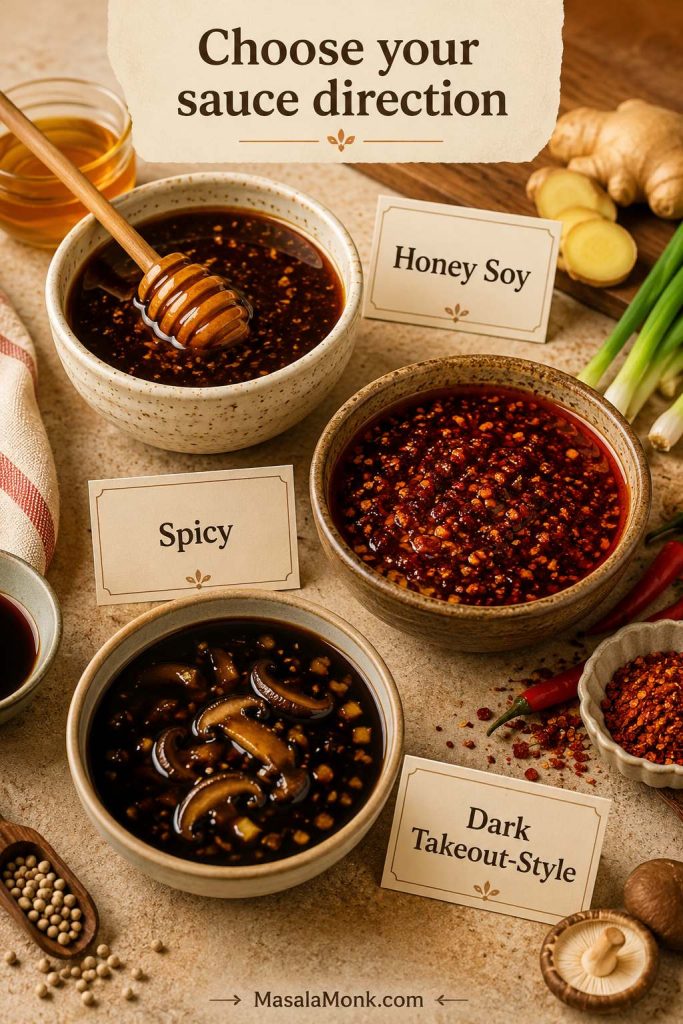
Choose the sauce direction that fits dinner

Use the base recipe as your starting point, then nudge it sweeter, hotter, darker, or looser depending on what is in the pan.

Three labeled bowls of stir fry sauce showing Honey Soy, Spicy, and Dark Takeout-Style variations with honey, chilies, mushrooms, ginger, and scallions nearby.
Once the base sauce works, choose the direction that fits dinner: honey soy for shine, spicy for heat, or dark takeout-style for a deeper brown sauce.
If You Want Change This Best For
Balanced everyday sauce Use the base recipe as written. Chicken, tofu, vegetables, rice bowls
Sweeter honey soy Increase honey to 2 tablespoons. Chicken, shrimp, tofu, noodles
Darker takeout-style sauce Use broth, oyster sauce, Shaoxing wine, and white pepper. Beef, broccoli, mushrooms, cabbage
Spicy sauce Add chili garlic sauce, sriracha, chili crisp, or fresh chilies. Chicken, shrimp, tofu, noodles
Noodle-friendly sauce Keep it looser with extra water or broth. Fresh noodles, dried noodles, rice noodles
Soy-free style Use coconut aminos and reduce the sweetener. Tofu, vegetables, chicken, rice bowls

Pick the version closest to tonight’s dinner, then adjust from there. Chicken and noodles may want sweeter or looser; beef may want darker; vegetables usually want restraint.

If you find a version that works especially well — extra ginger, chili crisp, coconut aminos, mushroom broth, less sweetener, or something completely your own — leave it in the comments so another reader can borrow the idea.

3 Ingredient Stir Fry Sauce

A 3 ingredient version is useful when you need something fast and do not have the full list of ingredients. Mix soy sauce, honey or brown sugar, and a cornstarch slurry. It works in a pinch, but the full sauce tastes more balanced because it includes acid, aromatics, sesame oil, and a proper loosened base.

Chinese Takeout-Style Brown Sauce Variation

For a deeper, darker, more takeout-style sauce, start by swapping water for broth. Oyster sauce brings the quickest savory boost, Shaoxing wine or dry sherry adds restaurant-style depth, white pepper brings quiet warmth, and a small splash of dark soy sauce gives color if you have it. Reduce the honey or brown sugar slightly so the sauce stays savory.

Vegetarian cooks can use mushroom sauce instead of oyster sauce. For a vegan version, skip oyster sauce and use mushroom powder, shiitake soaking liquid, or a vegan mushroom stir-fry sauce.

Honey Soy Stir Fry Sauce

The honey soy version is sweeter and shinier: increase the honey to 2 tablespoons. It works especially well with chicken, shrimp, salmon, tofu, broccoli, carrots, bell peppers, and noodles. If it tastes too sweet, balance it with rice vinegar, lime juice, chili flakes, or a little more soy sauce.

Spicy Stir Fry Sauce

To make it spicy, add red pepper flakes, chili garlic sauce, sriracha, gochujang, chili crisp, or fresh chopped chilies to the base recipe. Start small. Spicy sauce tastes better when it still has balance: salt, sweetness, acid, garlic, ginger, and heat.

Thai-Inspired Quick Stir-Fry Sauce

This is not a replacement for a specific Thai dish sauce. It is a quick direction for weeknight stir-fries when you want the flavor to lean brighter, sharper, and more chili-forward. Replace some rice vinegar with lime juice, add a little fish sauce if you are not vegetarian, reduce the soy sauce slightly, and keep the garlic and chili strong.

If you want a full Thai basil stir-fry, MasalaMonk’s Pad Kra Pao recipe goes deeper into that sharper, basil-heavy sauce style.

Teriyaki-Style Stir Fry Sauce

For a teriyaki-style version, make the sauce sweeter and shinier. Increase the sweetener, use a little more ginger, and let it reduce until it looks lightly glazed. Use this when you want a sweeter rice-bowl style dinner rather than a lighter vegetable stir-fry. For a dedicated sweeter glaze, see MasalaMonk’s teriyaki sauce recipe.

Diet and Substitution Variations

These versions are not here to make the sauce feel restricted. They are here so the same jar can still work when someone at the table needs less sodium, no gluten, no soy, no animal products, or no sugar.

Use this section like a shortcut: lower-sodium if salt is the problem, gluten-free if wheat is the problem, soy-free if soy itself is the problem, and keto if sugar or starch is the problem.

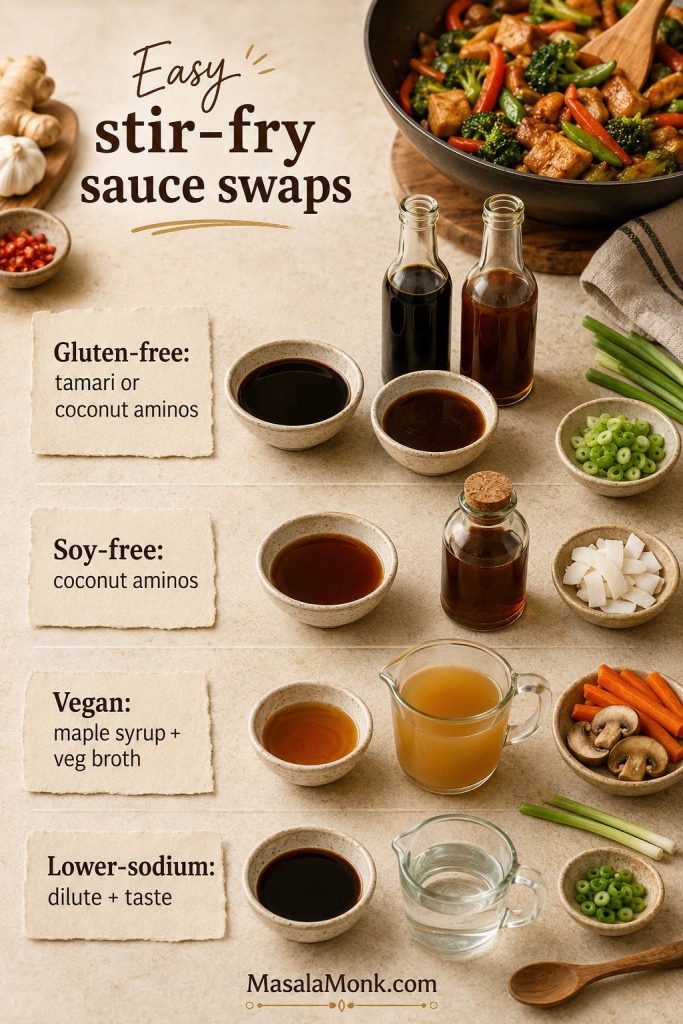
Easy stir fry sauce swaps that are not interchangeable

The labels matter here. Gluten-free, soy-free, vegan, and lower-sodium changes solve different problems, so choose the swap that matches the actual need.

Ingredient-swap guide for stir fry sauce with visible labels for gluten-free tamari or coconut aminos, soy-free coconut aminos, vegan maple syrup and vegetable broth, and lower-sodium dilute and taste.
Substitution labels matter. Tamari can help with gluten-free stir fry sauce, but it is usually soy-based; coconut aminos are the better soy-free starting point.

Lower-Sodium Version

A lower-sodium version needs more than just low-sodium soy sauce. Low-sodium soy sauce still contains sodium, and the sauce can become saltier as it reduces. Reduce the soy sauce first, increase water or unsalted broth, and build flavor with garlic, ginger, vinegar, chili, scallions, mushrooms, and sesame aroma.

Do not add salt until the stir-fry is finished and tasted. If you are cooking for a strict sodium limit, use label numbers rather than taste alone.

Keto / Sugar-Free Version

For a keto or sugar-free version, skip the honey or brown sugar and use a keto-friendly sweetener only if needed. Cornstarch is not ideal for strict keto. Use up to ⅛ teaspoon xanthan gum for 1 cup sauce, starting with a smaller pinch if your brand thickens aggressively.

Xanthan gum does not behave like cornstarch: cornstarch thickens as it cooks, while xanthan gum thickens as it hydrates. Whisk well, wait a minute, and add more only if you really need it. A sauce can go from glossy to gummy quickly.

Vegan Version

To make it vegan, use vegetable broth and maple syrup or sugar instead of honey. Avoid oyster sauce, fish sauce, chicken broth, chicken bouillon, and non-vegan bottled sauces. For deeper savory flavor, add mushroom powder, finely minced mushrooms, or a little dried-shiitake soaking liquid.

If you are building more plant-forward meals around tofu, tempeh, edamame, lentils, or beans, MasalaMonk’s plant-based protein sources guide can help you choose what to pair with the sauce.

Gluten-Free Version

Regular soy sauce often contains wheat, so it is not always gluten-free. Use certified gluten-free tamari, certified gluten-free soy sauce, or coconut aminos. Also check the labels on broth, oyster sauce, hoisin sauce, chili garlic sauce, and bottled sauces because gluten can appear in places you may not expect.

No Soy Sauce vs Soy-Free vs Gluten-Free

These terms sound similar, but they are not interchangeable. That matters when you are cooking for allergies, gluten-free needs, or someone who is avoiding soy completely. For a broader look at tamari, coconut aminos, and liquid aminos, EatingWell’s guide to soy sauce substitutes is a helpful reference.

Phrase What It Actually Means What to Watch
Without soy sauce The recipe does not use soy sauce. It may still contain soy from hoisin, oyster-style sauces, or other condiments.
Soy-free No soy ingredients at all. Check every label carefully.
Gluten-free No wheat/gluten ingredients. Tamari may be gluten-free but still contains soy.
Coconut aminos A common soy-free and gluten-free substitute for soy sauce. Usually sweeter and less salty, so reduce sweetener.
Liquid aminos A savory soy-sauce-like seasoning. Many versions are soy-based and can still be high in sodium; check the label.

Without Soy Sauce

A sauce without soy sauce is not always the same as a soy-free sauce. Some recipes skip soy sauce but use hoisin sauce, oyster sauce, or other bottled condiments that may still contain soy. That may be fine if you only want to avoid soy sauce specifically, but it is not appropriate for someone who needs a truly soy-free version.

Coconut aminos are the easiest starting point for a soy-sauce-style substitute. From there, garlic, ginger, vinegar, chili, and a little mushroom depth help bring back the savory edge that soy sauce usually provides.

Truly Soy-Free Version

For a truly soy-free version, check every ingredient label carefully. Do not use soy sauce, tamari, hoisin sauce, or oyster-style sauces unless they are clearly labeled soy-free. Use coconut aminos as the main savory base, then add garlic, ginger, rice vinegar, sesame oil if tolerated, chili, and mushroom flavor for depth.

Back to top ↑

Homemade vs Store-Bought Stir Fry Sauce

Store-bought sauce is convenient, but it often leans too sweet, too salty, or too thick. Homemade sauce lets you adjust the balance in the moment: more vinegar for brightness, more broth for looseness, more garlic or ginger for freshness, and a little sweetener only when the sauce tastes harsh.

If you are using bottled sauce, start with ⅓ to ½ cup for a small two-serving stir-fry, or ½ to ¾ cup for a larger pan. Bottled sauces are often saltier and sweeter than homemade, so add less first and stretch with water or broth if needed.

  • Too salty? Dilute with water or broth and add more vegetables.
  • Too sweet? Add rice vinegar, lime juice, chili, or a little soy sauce.
  • Too thick? Loosen with water or broth.
  • Too flat? Add fresh garlic, ginger, scallions, chili, or toasted sesame oil.
  • Tastes bottled? Add fresh aromatics and a splash of acid.

Use bottled sauce near the end of cooking, just like homemade. If it is already thick and sweet, do not simmer it for too long or it can become sticky and overpowering.

How to Fix Sauce Problems

A stir-fry can go sideways fast, but most sauce problems are fixable while the pan is still hot. Usually the pan needs one small correction, not a restart.

Most sauce problems start earlier: check the amount guide and the timing cue if your stir-fries often turn watery, salty, or too thick.

Quick fixes for common stir-fry sauce problems

Problem Why It Happened Fix
Sauce is too salty Too much regular soy sauce, salty broth, or bottled sauce. Add water or broth, vinegar or lime, more vegetables, or a little sweetener.
Sauce is too thin Not enough cornstarch, not simmered long enough, or pan is watery. Simmer 30–60 seconds more or add a small slurry.
Sauce is too thick Too much cornstarch or sauce reduced too much. Add water or broth 1 tablespoon at a time.
Sauce tastes flat Not enough acid, garlic, ginger, or heat. Add vinegar, lime, garlic, ginger, chili, or sesame oil.
Sauce is too sweet Too much honey, sugar, or bottled sauce. Add vinegar, chili, soy sauce, or broth.
Sauce clumps Cornstarch was added directly to hot liquid. Mix cornstarch with cold liquid first.
Stir-fry turns watery Vegetables released moisture into the pan. Cook off liquid before adding sauce.
Sauce burns Sugary sauce cooked too long over high heat. Add sauce at the end, lower the heat slightly if needed, and stop once glossy.
Noodles absorb everything Noodles are thirsty or sauce is too thick. Add water or broth and toss briefly.
Tofu tastes bland Tofu was not crisped or sauce was too thin. Crisp tofu first and use a slightly thicker sauce.
Sauce tastes bottled It is sweet, salty, and thick but missing freshness. Add fresh garlic, ginger, vinegar or lime, scallions, chili, or sesame oil.

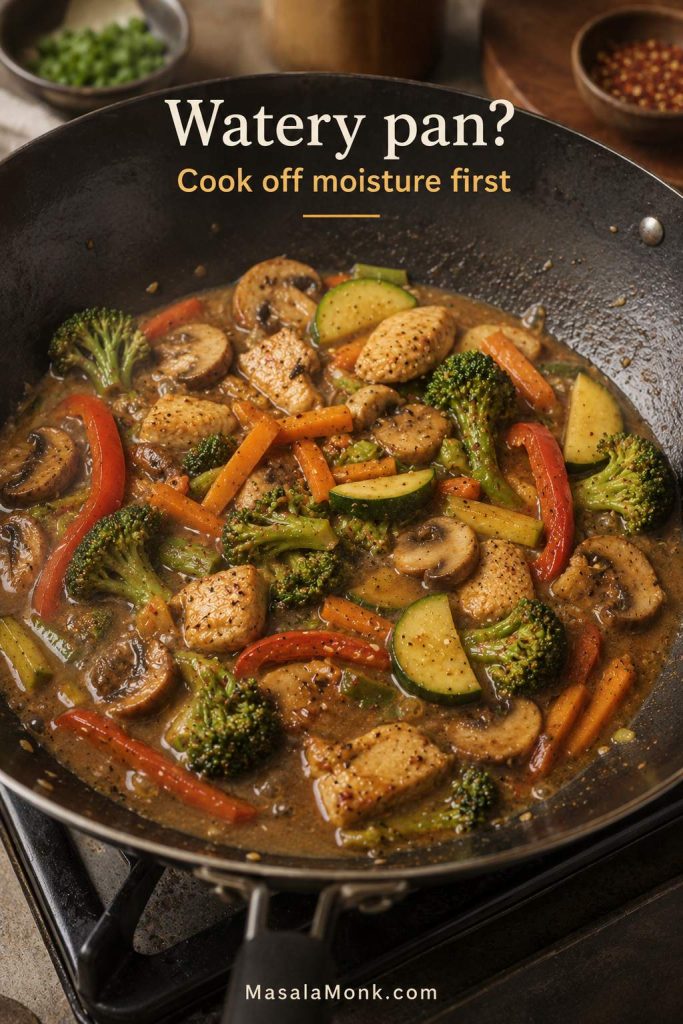
Why your stir-fry turns watery

The most common mistake is adding sauce to a crowded, watery pan. Cook the vegetables until extra moisture reduces, then add the sauce and let it bubble briefly.

Wok of chicken and vegetables sitting in thin watery sauce with text reading “Watery pan? Cook off moisture first.”
If the pan turns watery, pause before adding more sauce. Cook off vegetable moisture first, especially with mushrooms, zucchini, or a crowded skillet.

Small fixes before you restart dinner

Small save: If the pan tastes almost right but not quite, add a splash of water if it is too strong, a little vinegar if it feels flat, or a pinch of sugar if it tastes harsh. Tiny changes fix most stir-fry sauce problems.

How to Store It

Store the sauce in an airtight jar in the refrigerator for 5 to 7 days. Shake or whisk before using because the cornstarch settles at the bottom.

You can also freeze it for up to 3 months. Thaw in the refrigerator, then whisk or shake well before adding it to the pan. If freezing, use a freezer-safe container and leave a little room for expansion.

Do not worry if it looks cloudy or separated when cold. Cornstarch can settle and make the sauce look uneven. Once heated and stirred, it should smooth out again.

If the sauce has already been cooked into a stir-fry, store leftovers in an airtight container. For best texture, store noodles or rice separately from saucy stir-fry when possible.

What to Serve With It

It fits easy dinners like chicken and broccoli, beef and green beans, tofu and bok choy, shrimp and vegetables, cabbage and mushrooms, or zucchini and peppers.

Serve those over steamed jasmine rice, brown rice, cauliflower rice, stir-fried noodles, lettuce wraps, or fried rice. For choosing between rice, quinoa, cauliflower rice, or lighter base options, MasalaMonk’s quinoa vs rice guide is helpful, especially if you are balancing fullness, carbs, and texture.

If you want a cool, crisp side beside a salty-sweet stir-fry, MasalaMonk’s cucumber salad is a simple contrast: fresh, tangy, and fast enough to make while the sauce is resting in the jar.

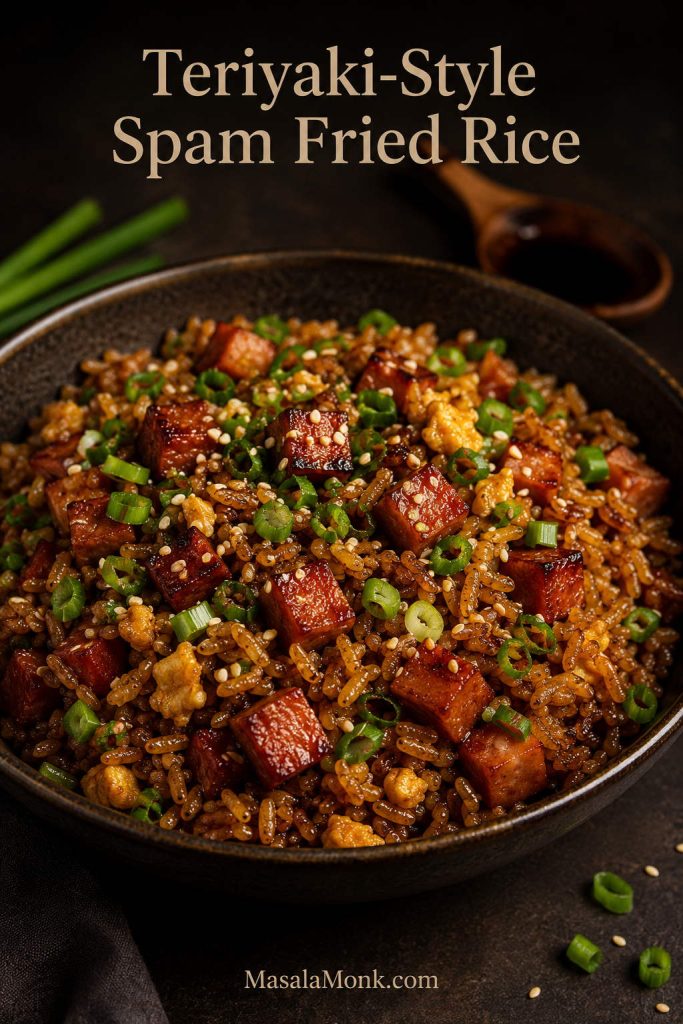
If you want a rice-based takeout-style meal with a different flavor direction, MasalaMonk’s Spam fried rice recipe shows how little sauce fried rice actually needs compared with a saucy stir-fry.

At its best, the sauce leaves you with crisp vegetables, tender protein, and just enough savory-sweet shine for the rice or noodles to catch.

Frequently Asked Questions

What is stir fry sauce made of?

It is usually made with soy sauce, water or broth, rice vinegar, a little sweetener, garlic, ginger, sesame oil, and cornstarch. Together, they make a sauce that is savory, lightly sweet, aromatic, and able to thicken in the pan.

How much sauce should I use for a stir-fry?

Use about ¾ to 1 cup for 1 lb / 450 g protein plus vegetables. Use about ½ cup for vegetables only, ⅔ to 1 cup for noodles, and only 3 to 5 tablespoons for fried rice.

When should I add sauce to a stir-fry?

Add it near the end of cooking, after the protein and vegetables are mostly cooked. Let it bubble for 30 to 60 seconds until it turns glossy and coats the food.

Can I make this without soy sauce?

Yes. Coconut aminos are the easiest soy-sauce-style substitute. They are usually sweeter and less salty than soy sauce, so reduce the sweetener and adjust the flavor at the end. Be careful with hoisin, oyster sauce, and bottled sauces because they may still contain soy even if they are not soy sauce.

Is this sauce gluten-free?

Only if you use the right soy sauce substitute. Regular soy sauce often contains wheat, so choose certified gluten-free tamari, certified gluten-free soy sauce, or coconut aminos, and check all bottled add-ins.

How do I make a lower-sodium version?

Use low-sodium soy sauce or a lower-sodium alternative, water or unsalted broth, and extra garlic, ginger, vinegar, chili, scallions, or mushroom flavor. Avoid high-sodium bottled sauces unless the label works for your needs.

How do I make a keto version?

Skip honey or sugar and use a keto sweetener only if needed. Replace cornstarch with up to ⅛ teaspoon xanthan gum for 1 cup sauce, starting with a small pinch. Soy sauce, tamari, or coconut aminos can all work depending on your carb and sodium needs.

Can I use this for noodles?

Yes. Use ⅔ to 1 cup for a noodle stir-fry, and keep a little water or broth nearby. Noodles absorb sauce quickly, so you may need a splash to loosen everything in the pan.

Can I use this as a marinade?

Yes, but leave out the cornstarch if using it as a marinade. Cornstarch is for thickening in the pan, not for soaking raw protein. Add the cornstarch later when you are ready to cook.

Why is my sauce too salty?

The most common reason is regular soy sauce, salty broth, or too much bottled sauce. Dilute with water or broth, add more vegetables, brighten with vinegar or lime, or balance with a small amount of sweetener.

Why did it not thicken?

It may not have simmered long enough, the pan may have too much vegetable liquid, or there may not be enough cornstarch. Let it bubble briefly, or add a small slurry made from cornstarch and cold water.

How long does homemade stir fry sauce last?

It lasts 5 to 7 days in an airtight jar in the refrigerator. Shake or whisk before using because the cornstarch settles.

Final Notes

Do not let the length of the guide make the sauce feel complicated. The base recipe is simple; the extra notes are just here to help you adjust it without guessing.

Once you know the rule — salt, loosen, brighten, round, aroma, cling — stir-fry sauce stops feeling like a fixed recipe and starts feeling like something you can control.

Keep a jar ready, and a random mix of protein, vegetables, and rice or noodles starts to feel like dinner instead of leftovers. If you make it your own — sweeter, spicier, soy-free, or extra garlicky — share what worked so others can borrow the idea too.

Back to top ↑

Posted on Leave a comment

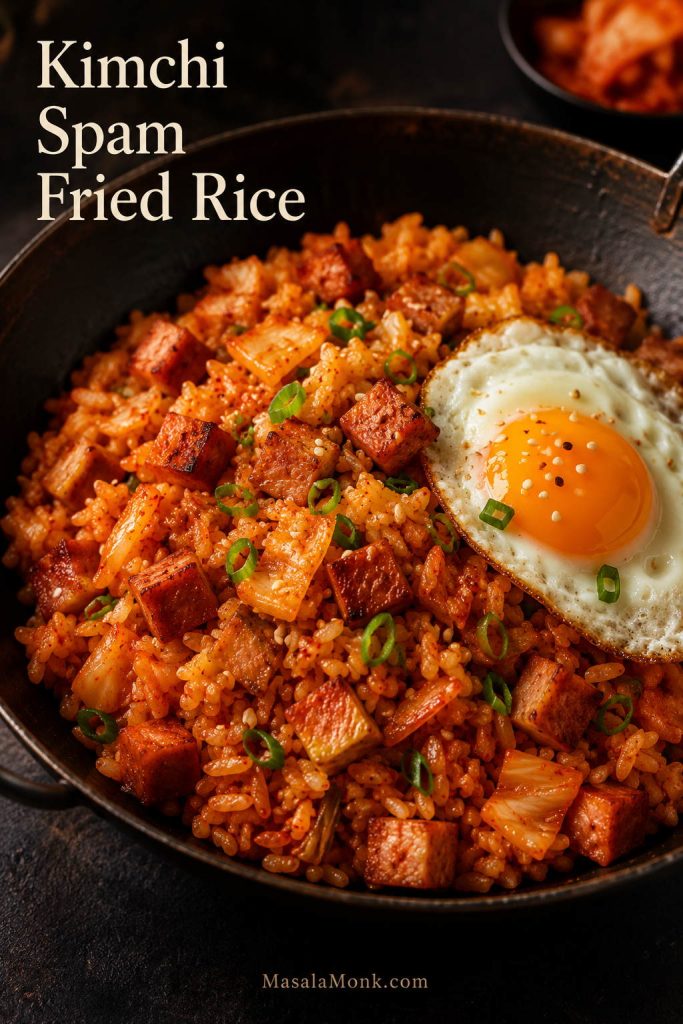
Easy Spam Fried Rice Recipe

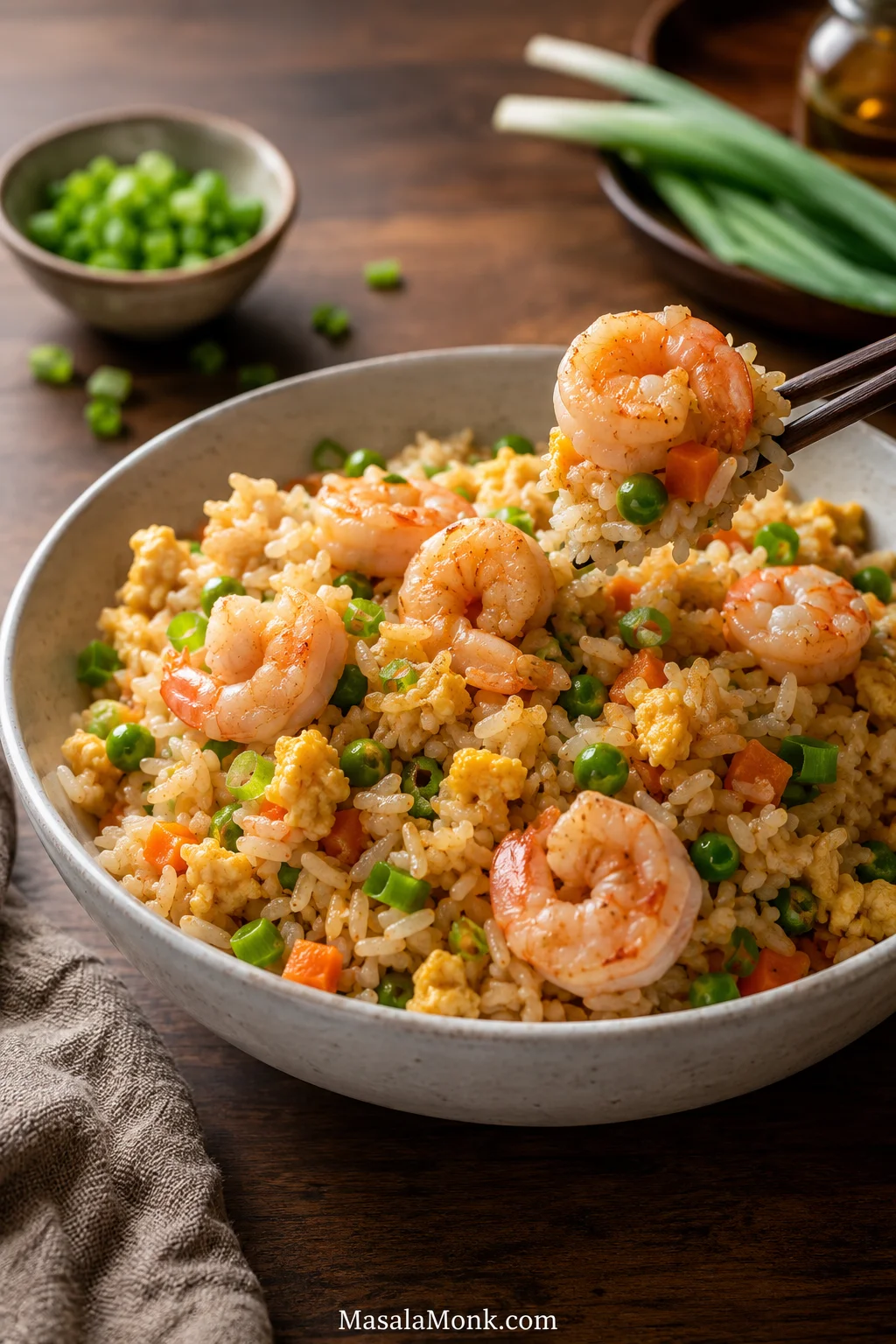
A skillet of fried rice with browned Spam cubes, soft scrambled egg, peas, carrots, scallions, and glossy separated rice being lifted with a spoon.

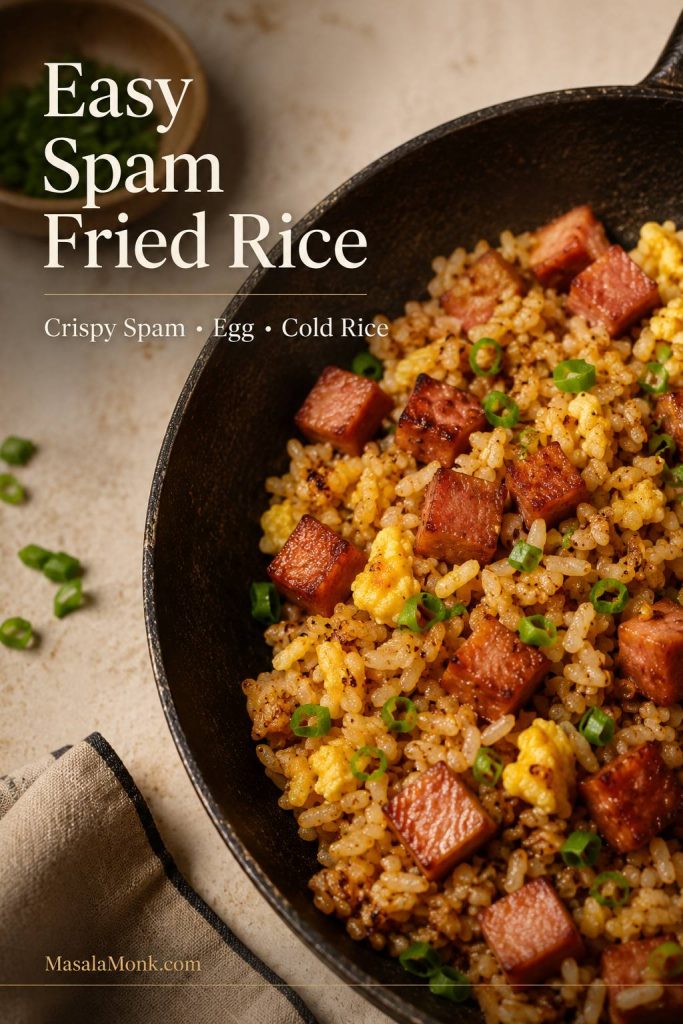
This Spam fried rice recipe is for the night you have cold rice in the fridge, a can of Spam in the pantry, and no patience for a complicated dinner. The pan does the heavy lifting: crisp salty cubes, soft egg, garlic, scallions, vegetables, and loose grains tossed with just enough soy-oyster-sesame seasoning to make everything savory and glossy.

The trick is not adding everything at once. Brown the Spam until the edges crisp, cook the egg gently, let the rice loosen in a hot pan, and season near the end so the grains stay separate instead of turning soft and salty. Once everything is prepped, the cooking part takes about 12–15 minutes.

After that base makes sense, you can take the same method toward kimchi Spam fried rice, Hawaiian pineapple Spam fried rice, garlic-heavy Filipino-style rice, or a spicy chili-crisp version without losing the texture that makes the dish work.
Spam Fried Rice Guide

Start with the quick method, then use the rice, sauce, egg, variation, serving, and troubleshooting sections to adjust the pan you are actually cooking.

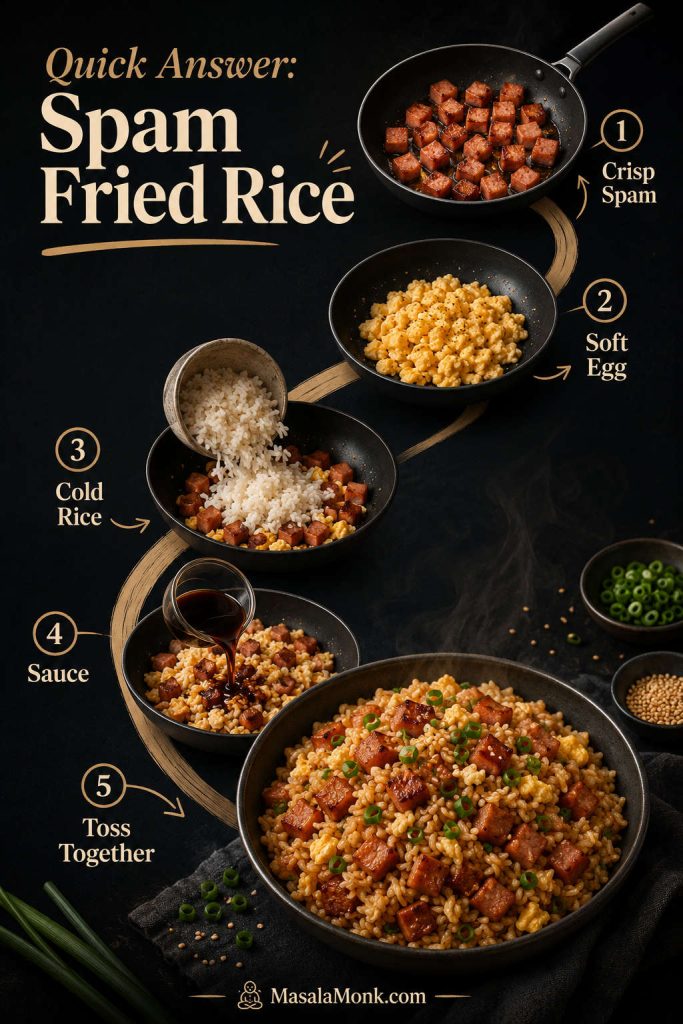
Quick Answer: How to Make Spam Fried Rice

Dice the Spam and brown it in a hot wok or large skillet until the edges look crisp and toasted. Scramble the eggs and set them aside. Stir-fry garlic, scallion whites, vegetables, and cold cooked rice, then add a simple sauce of soy sauce, oyster sauce, sesame oil, and pepper. Fold the crispy Spam and soft egg back through the rice and finish with scallion greens.

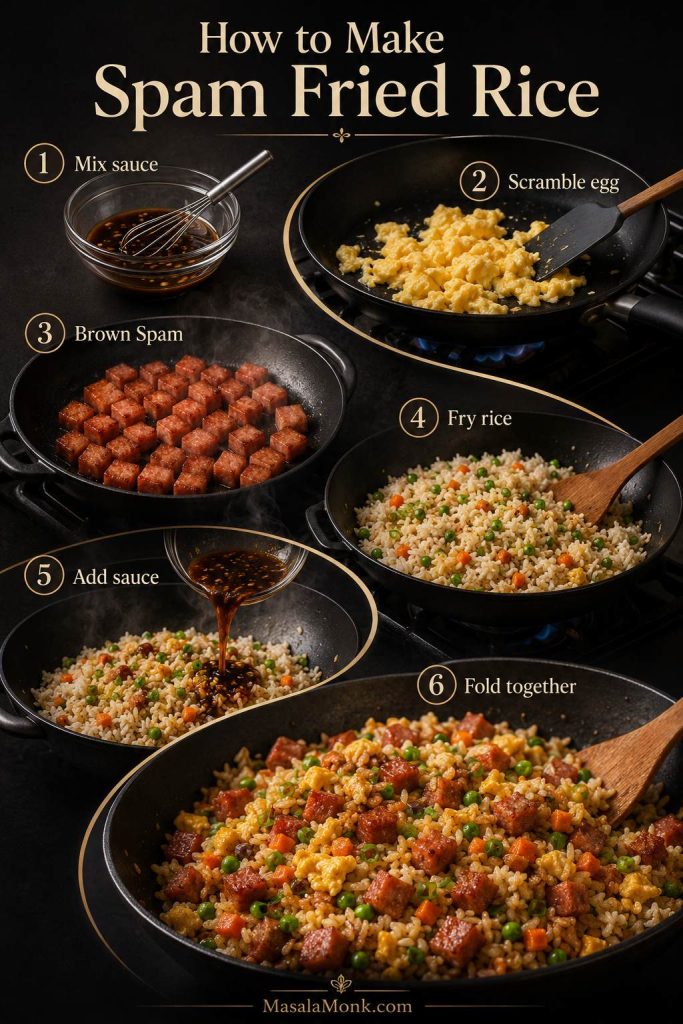
A quick visual guide showing browned Spam, soft scrambled egg, cold rice, sauce, and the finished fried rice pan.
The order matters here: brown the Spam, cook the egg gently, fry the cold rice, and add sauce near the end, because that sequence gives the rice its best texture.

Spam Fried Rice at a Glance

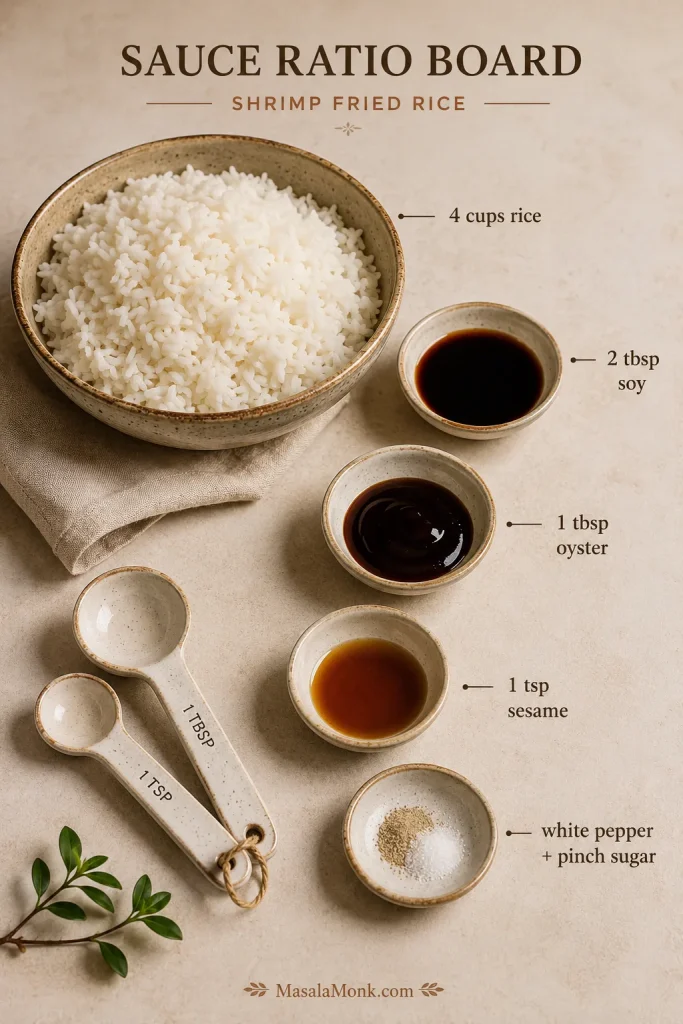
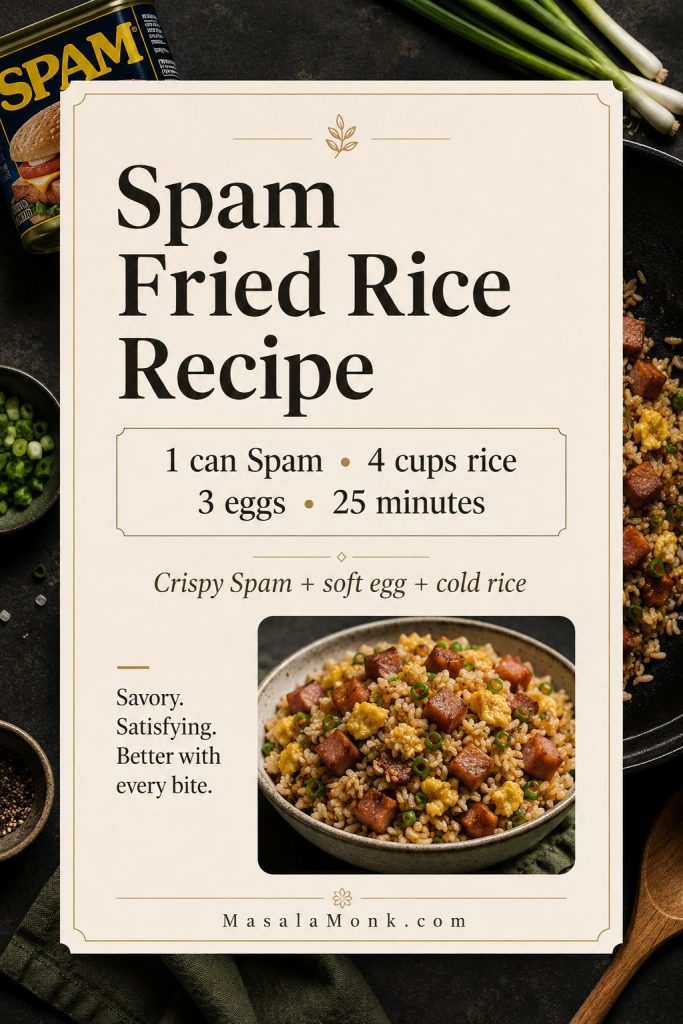
  • Main ratio: 1 can Spam + 4 cups cold cooked rice + 3 eggs
  • Base sauce: 2 tbsp soy sauce + 1 tbsp oyster sauce + 2 tsp toasted sesame oil
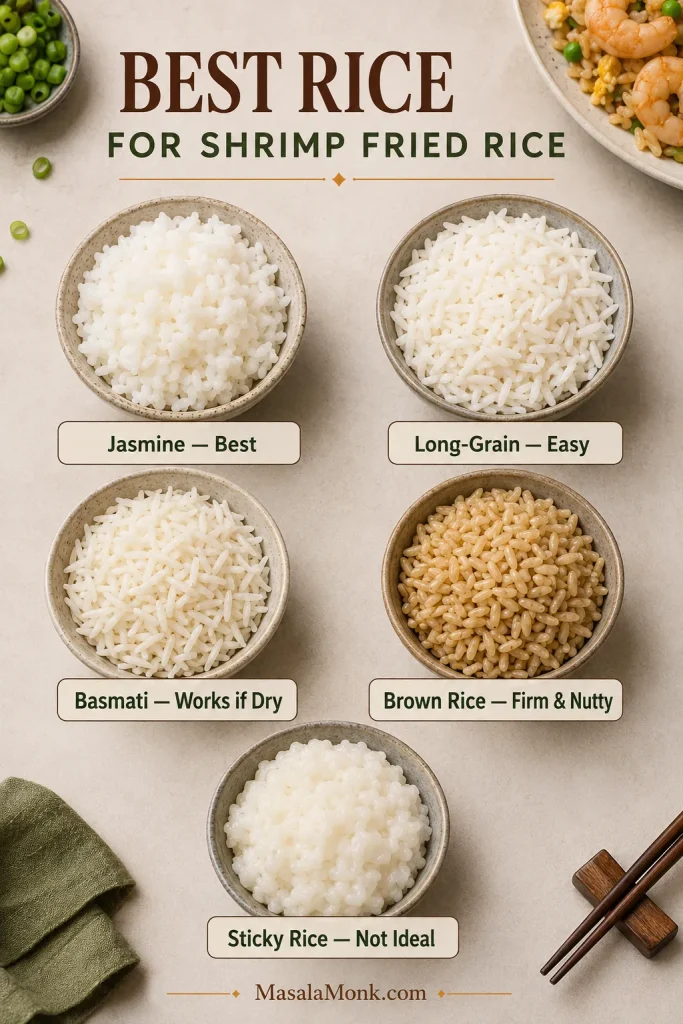
  • Rice to start with: cold day-old jasmine, long-grain, or medium-grain rice
  • Spam cut: ½-inch cubes for crisp edges and visible bites
  • Pan choice: wok, carbon-steel skillet, cast iron, or large nonstick skillet
  • Heat level: medium-high to high
  • Cook time: 12–15 minutes once everything is prepped

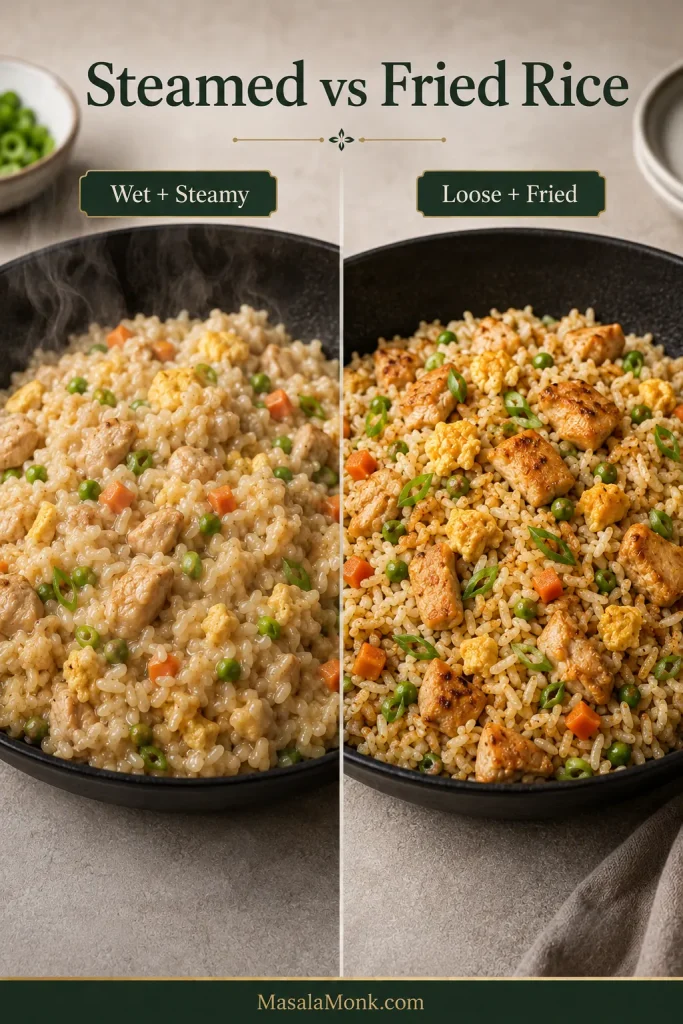
The rice does most of the texture work here. Because chilled rice has less surface moisture, it separates and fries instead of clumping into soft, steamy pockets. If your rice is freshly cooked, there is a quick fix in the rice section below.

Why This Version Works

This dish works best when every ingredient gets a quick moment in the pan before everything comes together. The Spam needs time against the hot surface, the rice needs enough heat to loosen, and the sauce should season the grains without drowning them.

  • Browned Spam comes first. Crisp edges give the finished rice salty-crisp bites instead of soft, barely warmed pieces.
  • Chilled rice keeps the texture loose. Drier grains separate more easily and give you a fluffier pan.
  • Soft egg goes back in near the end. Scrambling it first keeps it tender instead of dry or rubbery.
  • A measured sauce keeps the salt in check. Spam already brings salt, so the soy sauce and oyster sauce need a lighter hand.
  • Vegetables bring contrast. Peas, carrots, scallions, corn, cabbage, or bell pepper help lighten the richness.

Flavor balance: Spam brings salt and richness, rice softens everything, egg adds body, vegetables add relief, and scallions wake the pan up at the end. If the dish tastes heavy, do not add more sauce first. Add freshness, heat, acid, or crunch.

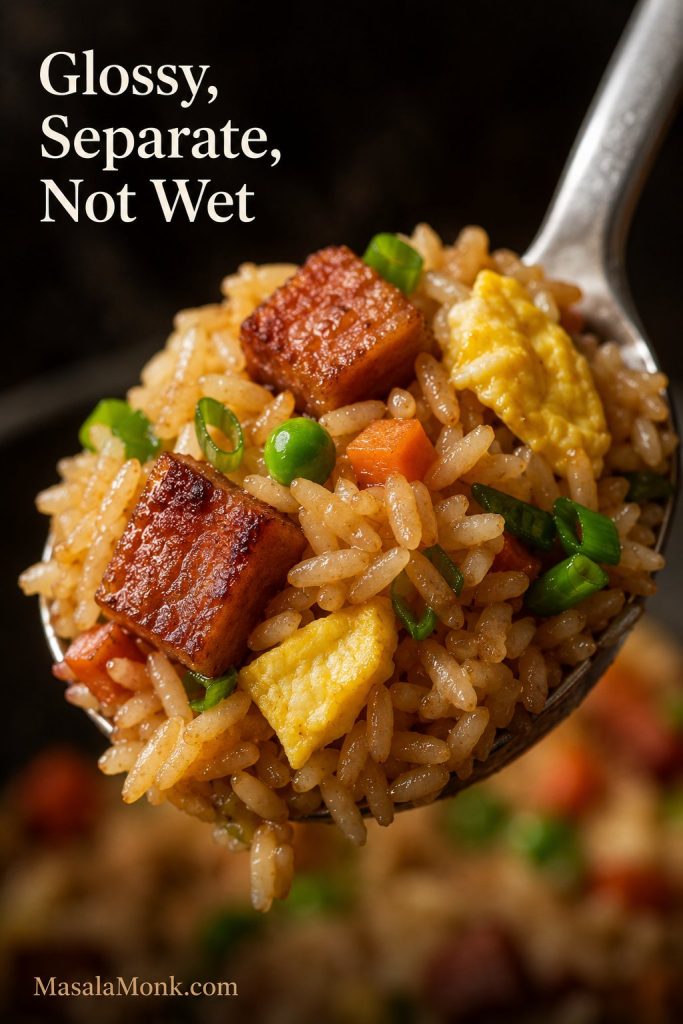
Texture cue: The rice should look glossy and separate, not wet. The Spam should stay visible in browned cubes, and the egg should be soft pieces folded through the rice rather than tiny dry crumbs.

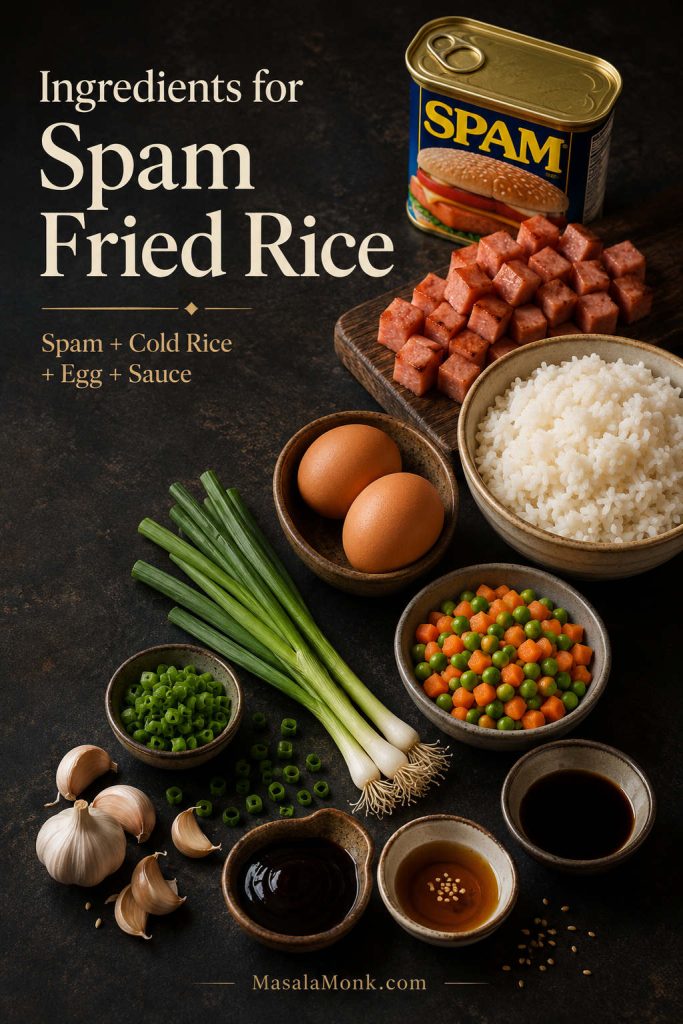
Ingredients You Need

The ingredient list is short, but each piece matters. For the first batch, keep the base simple. After that, use the variation section to move toward kimchi, pineapple, garlic-heavy, spicy, or teriyaki-style fried rice.

Ingredients for Spam fried rice arranged on a dark surface, including Spam, cold cooked rice, eggs, peas, carrots, scallions, garlic, soy sauce, oyster sauce, and sesame oil.
The base is simple, yet the balance matters: Spam brings salt, rice softens it, egg adds body, and the sauce should pull everything together without taking over.

Spam

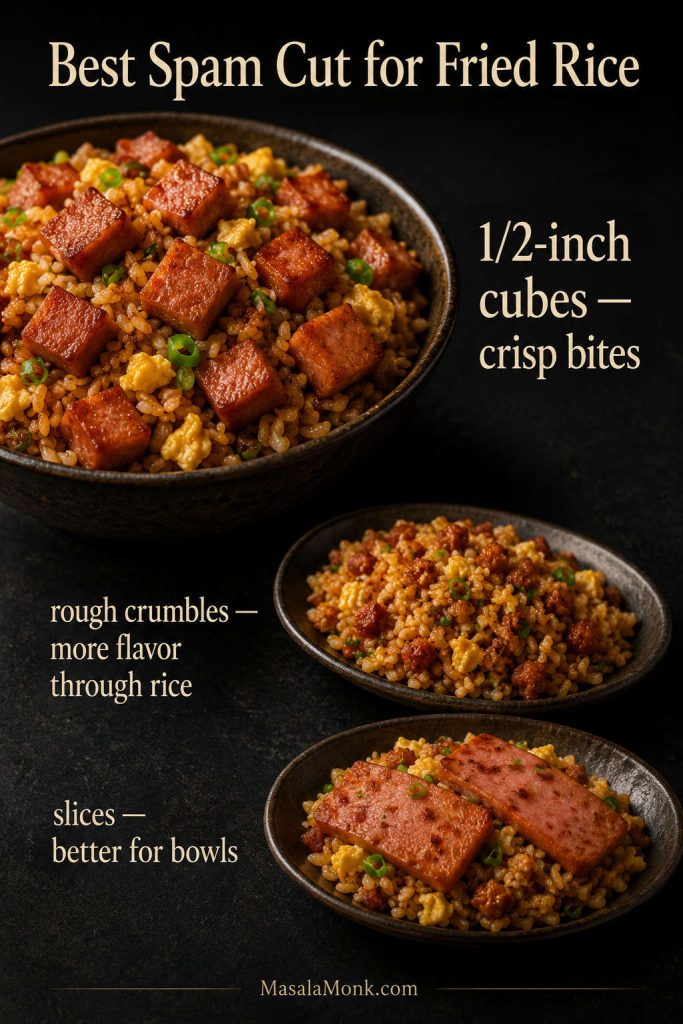
Use one 12 oz / 340 g can of Spam. SPAM 25% Less Sodium is helpful if you have it, especially because the sauce also includes soy sauce and oyster sauce. Cut the Spam into ½-inch cubes so the pieces brown quickly while still staying chunky enough to notice in the rice.

For extra texture, dice most of the Spam and roughly mash or crumble a small portion. The cubes give you crisp bites, while the rough pieces spread more savory flavor through the rice.

Comparison of Spam cut styles for fried rice, showing browned half-inch cubes, rough crumbles, and rectangular slices.
Half-inch cubes are the easiest first cut because they brown well and stay visible in the rice, while crumbles spread flavor more widely and slices suit simpler rice bowls.

Cold Cooked Rice

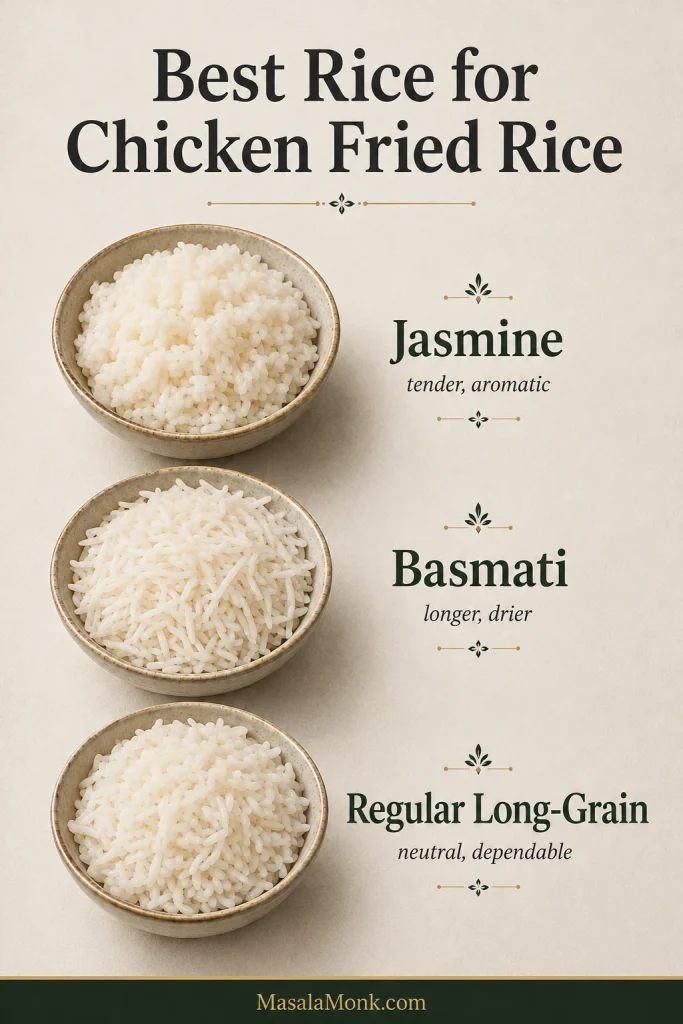
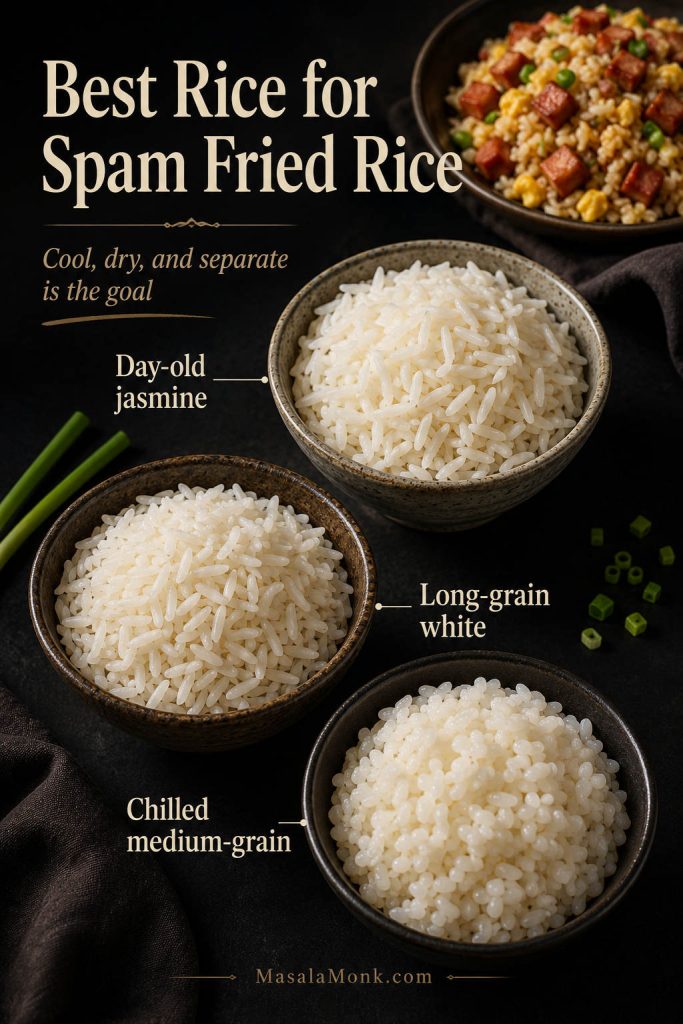
Use 4 cups cold cooked rice, about 680–730 g depending on the rice type and how tightly it is packed. Jasmine rice, long-grain white rice, and medium-grain rice all work well once chilled.

Eggs

Three large eggs are the most balanced amount for 4 cups of rice. Use 2 eggs for a lighter pan or 4 eggs if you want a more breakfast-style Spam egg rice.

Vegetables

Frozen peas and carrots are the easiest classic choice. Before adding them, rinse them briefly under warm water and drain them well. Corn, cabbage, bell pepper, onion, edamame, and extra scallions also work, but avoid adding too many watery vegetables at once.

Aromatics

Garlic and scallions are enough for the base recipe. Add garlic after the Spam has browned so it does not burn before the meat gets crisp. Use the scallion whites while cooking and save the green tops for the finish.

Sauce

The base sauce uses soy sauce, oyster sauce, toasted sesame oil, a little sugar, and white pepper. Soy sauce seasons the rice, oyster sauce adds depth, sesame oil brings aroma, sugar rounds the edges, and white pepper gives the rice a gentle fried-rice finish without making it hot.

The Rice That Gives You Separate Grains

The easiest rice to work with is cold, cooked, and slightly dry on the surface. It should not be hard or stale, but it should not be hot and steamy when it hits the pan.

Three bowls of rice labeled day-old jasmine, long-grain white, and chilled medium-grain rice for making fried rice.
Good fried rice starts before the pan gets hot. If the grains are cool, lightly dry, and easy to separate, they are much more likely to fry instead of clump.

If you are starting from uncooked rice, this guide on how to cook rice perfectly is useful for getting the base right before you chill it for fried rice.

Cold Day-Old Rice

Day-old rice is the most forgiving option at home. After a night in the refrigerator, the grains lose some surface moisture and separate more easily in a hot pan.

Jasmine Rice

Jasmine rice is the easiest everyday choice because it separates well once chilled but still tastes soft and fragrant.

Long-Grain White Rice

Long-grain white rice gives you a fluffier, more separate pan, especially if you want the grains to stay distinct.

Medium-Grain Rice

Medium-grain rice works well when it is fully chilled. It gives the dish a slightly chewier, more cohesive texture. Before cooking, break up the clumps so the rice does not go into the pan in large blocks.

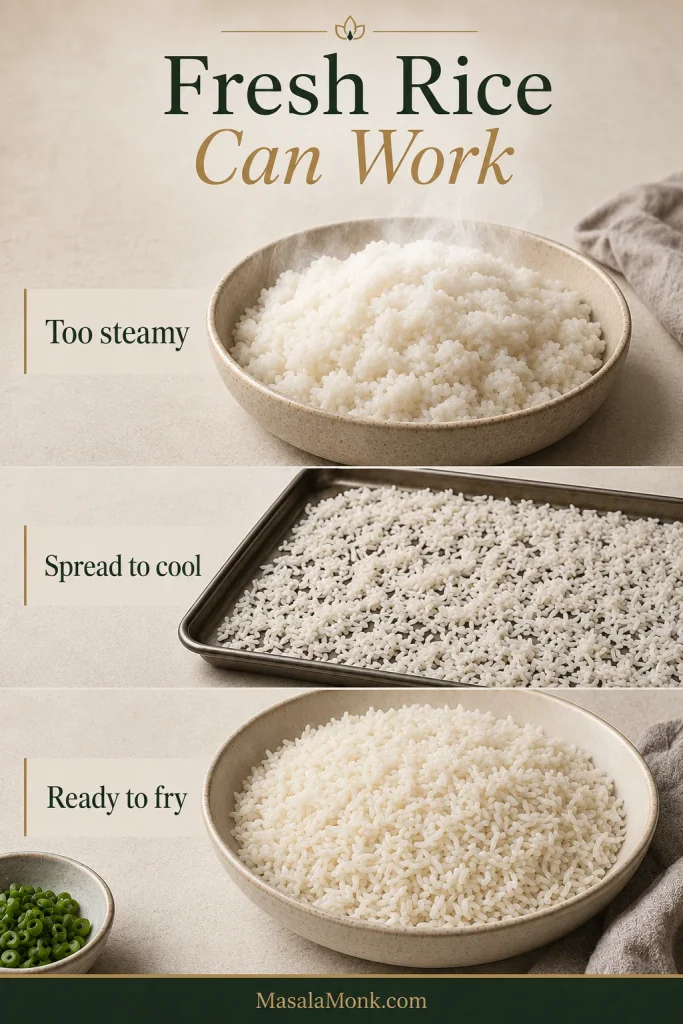
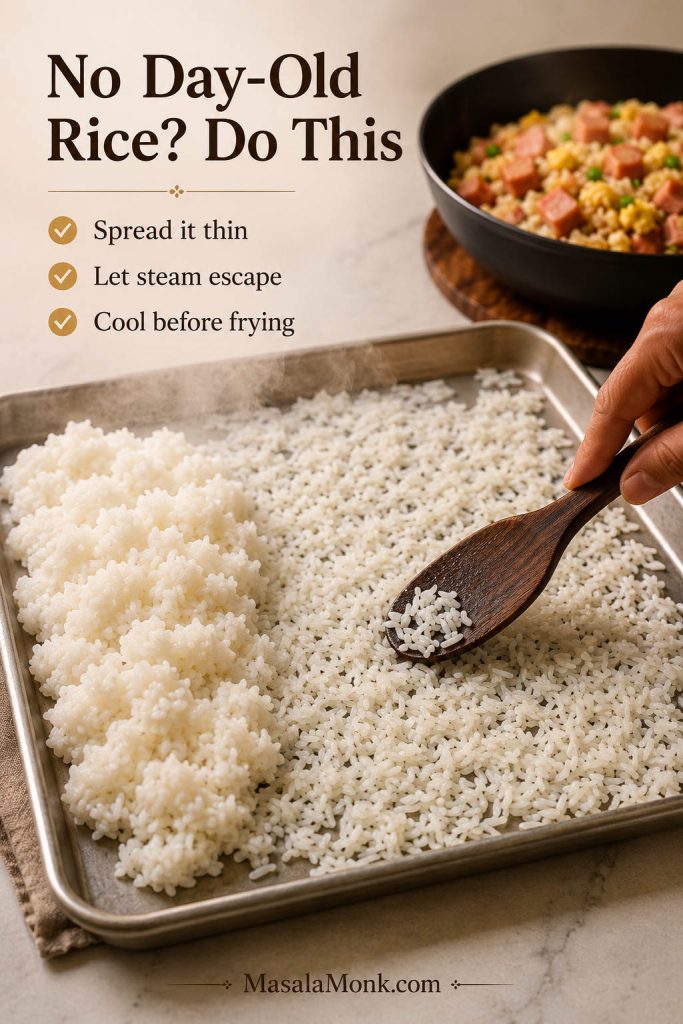
Fresh Rice Emergency Fix

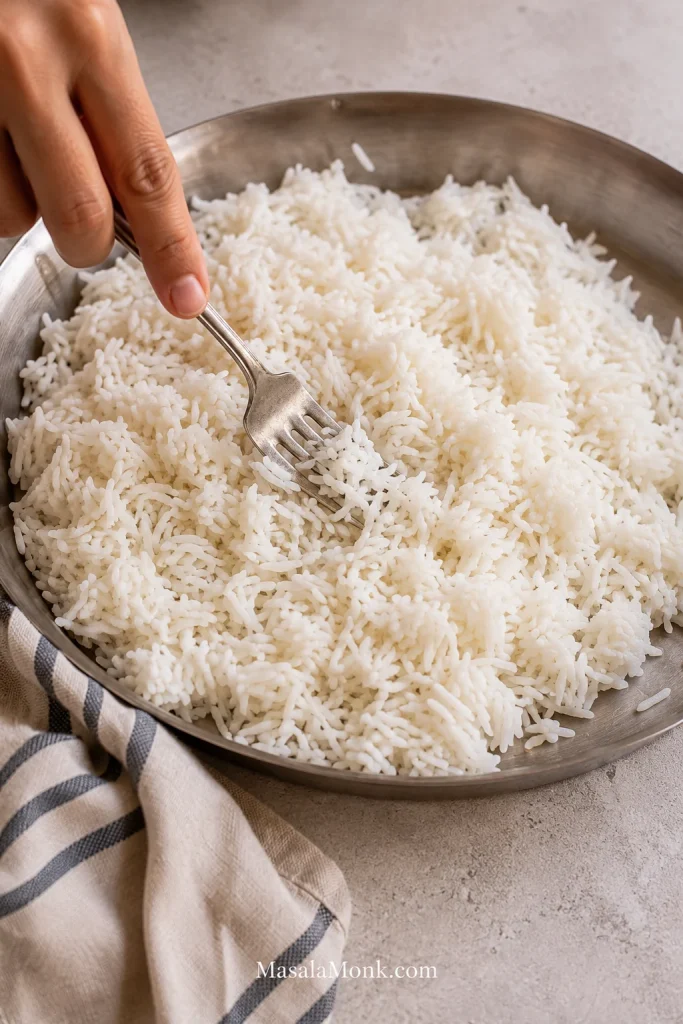
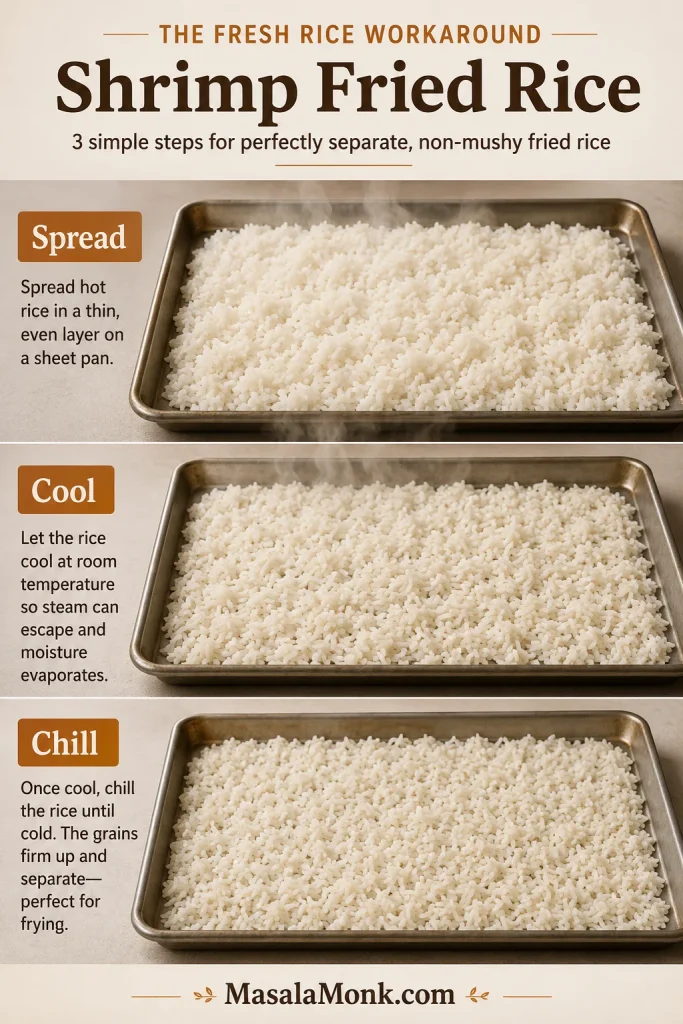
No day-old rice? You can still make this work. Spread freshly cooked rice in a thin layer on a tray or large plate, let the steam escape, and chill it uncovered until the surface feels cooler and drier. Even 20–30 minutes of cooling is better than adding hot rice straight from the cooker.
Freshly cooked rice spread thinly across a tray to cool before being used for fried rice.
Fresh rice is not a dealbreaker; however, the steam needs to escape first, so spreading it out gives the grains a better chance of frying well.

If the rice still feels damp, use a slightly wider pan, give it more time before adding the sauce, and avoid stirring nonstop. The pan should sound active, not steamy. Also, if you have more cooked rice than you need, save the rest for something sweet like rice pudding with cooked rice.

Avoid this: Very wet rice, overcooked rice, and hot rice straight from the pot. Those are the main reasons fried rice goes soft.

How to Make It

The basic rhythm is simple: crisp the Spam, scramble the egg, fry the rice, season lightly, and fold everything together.

Once the pan is hot, everything moves quickly, so dice the Spam, break up the rice, beat the eggs, drain the vegetables, and mix the sauce before you turn on the stove.

A step-by-step visual guide showing sauce mixing, egg scrambling, Spam browning, rice frying, sauce adding, and the finished fried rice.
Once the pan is hot, everything moves quickly, so having the Spam, rice, eggs, vegetables, and sauce ready makes the method easier and more reliable.

1. Mix the Sauce

In a small bowl, stir together soy sauce, oyster sauce, toasted sesame oil, sugar, white pepper, and optional water, broth, or Shaoxing wine. This gives you one seasoning mix to add later, instead of measuring bottles over a hot pan.

2. Scramble the Eggs

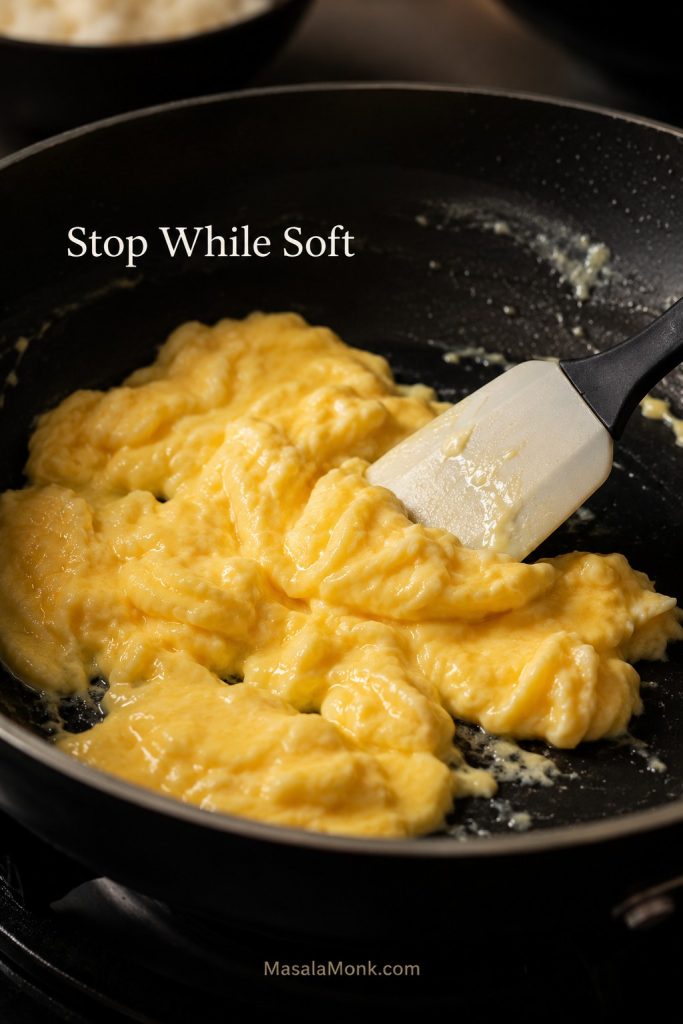
Heat 1 teaspoon of the neutral oil in a wok or large skillet over medium-high heat. Add the beaten eggs and scramble just until softly set. They should still look tender when you move them to a plate, because they will warm through again at the end.

Soft scrambled eggs in a skillet being moved with a spatula while still glossy and tender.
Pull the eggs while they still look soft and glossy. Later, they will finish gently in the hot rice instead of turning dry.

3. Brown the Spam

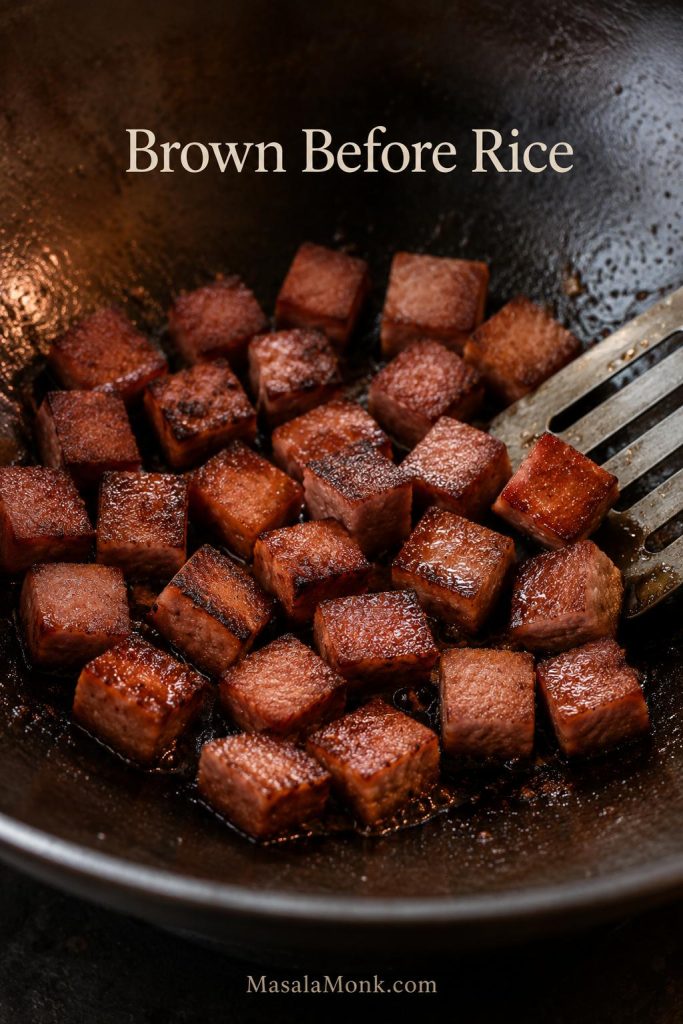
Add another teaspoon or two of oil only if the pan looks dry, then add the diced Spam. Spread it into a single layer and let it sit long enough to brown before stirring. The pieces should look darker at the edges and smell toasted, not just warmed through.

Cubes of Spam browning in a skillet until the edges look crisp and caramelized.
Give the Spam enough contact with the pan before stirring, because those browned edges bring much of the dish’s salty, savory character.

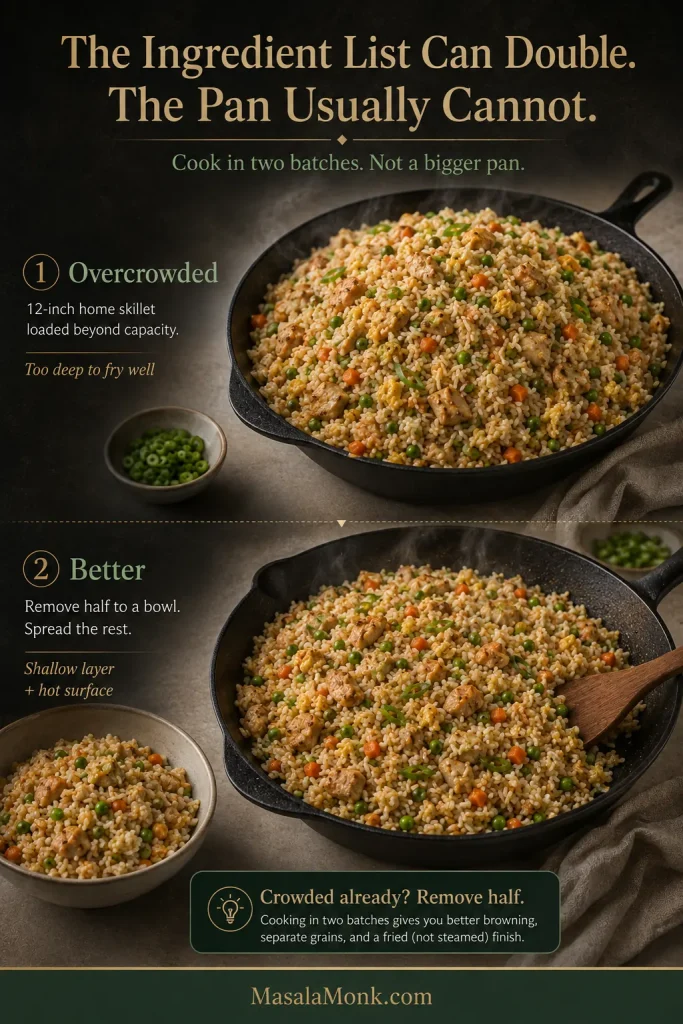
This step gives the finished rice its best salty-crisp bites. If your pan is crowded, transfer the browned Spam to a plate and add it back with the eggs near the end. In a wide wok, you can leave it in the pan or push it to one side.

4. Add Garlic, Scallion Whites, and Vegetables

Scatter in the garlic and scallion whites and stir for about 20–30 seconds, just until fragrant. Add the peas and carrots and cook until they are hot and dry. If the vegetables release water, pause and let that moisture cook off before adding the rice.

5. Add the Rice

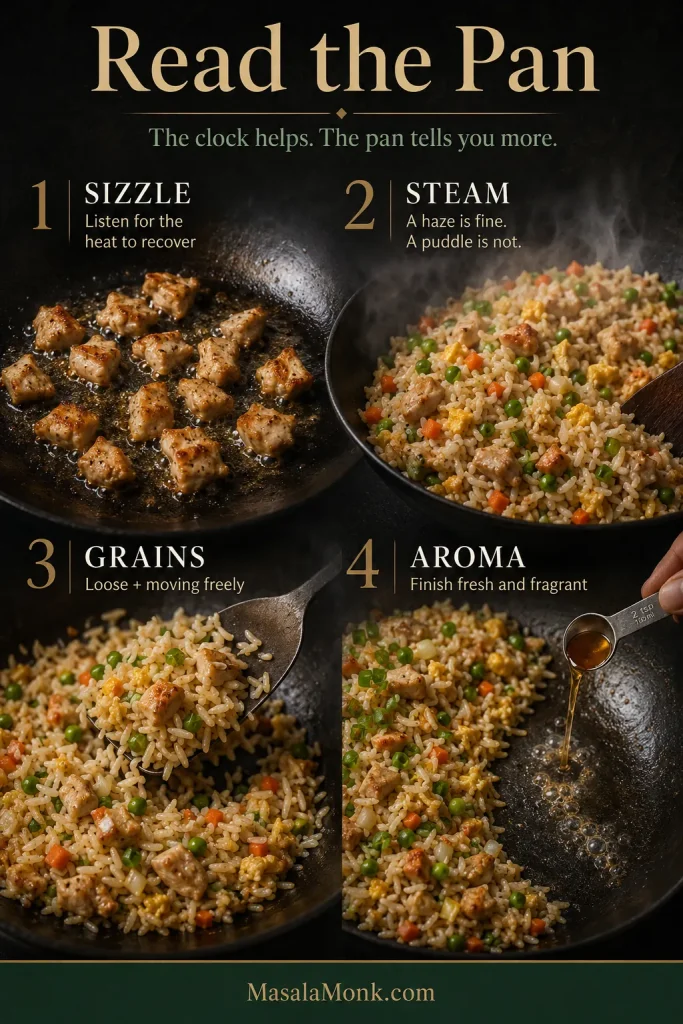
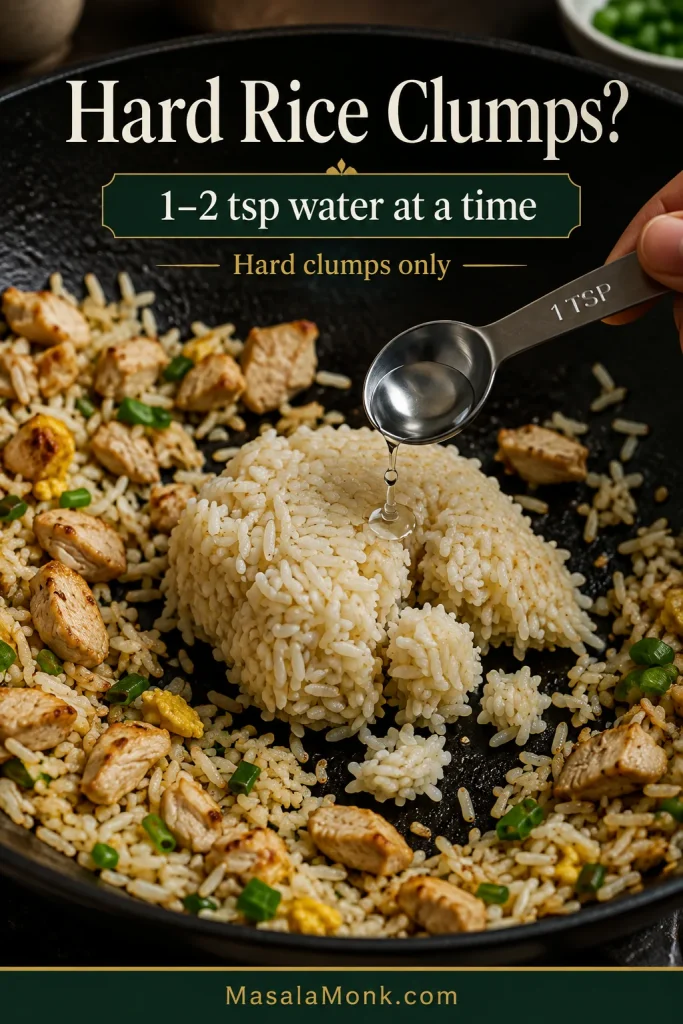
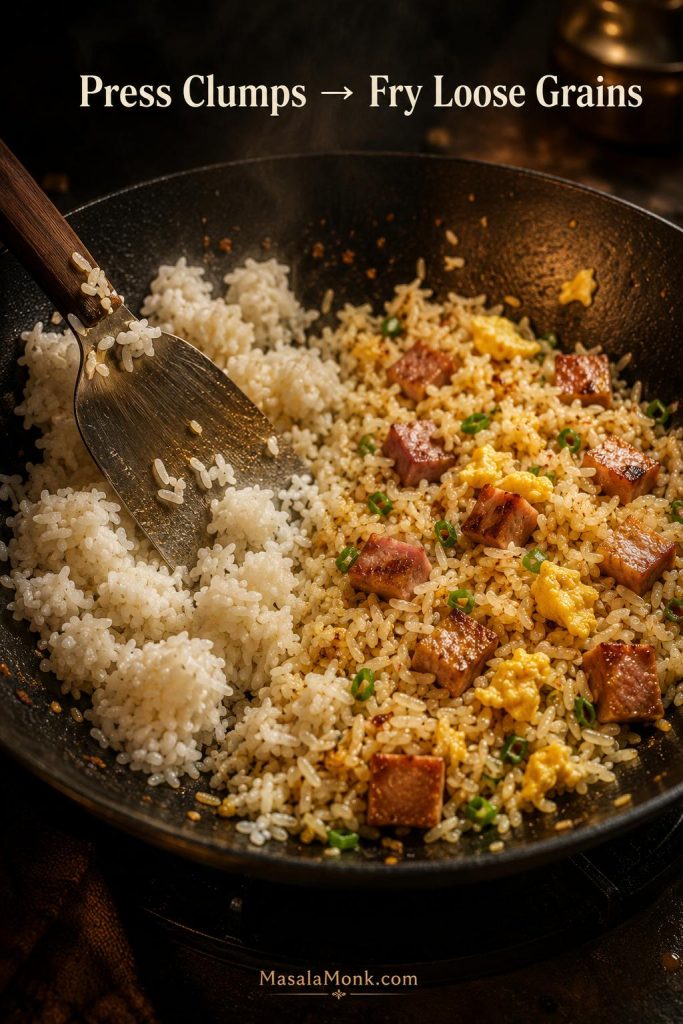
Add the cold rice and press gently on any clumps with the spatula. At first, the grains may feel firm from the fridge. Keep tossing and pressing until they loosen, turn hot, and start to separate. If the pan sounds steamy instead of sizzling, give the rice another minute before adding the sauce.

Cold rice in a skillet being pressed from clumps into loose grains with a spatula.
Cold rice often goes in stiff and clumped, but gentle pressure and steady heat help the grains loosen and fry instead of steaming.

For a few crisp bits, spread the rice across the pan and let it sit undisturbed for 30–60 seconds before tossing again.

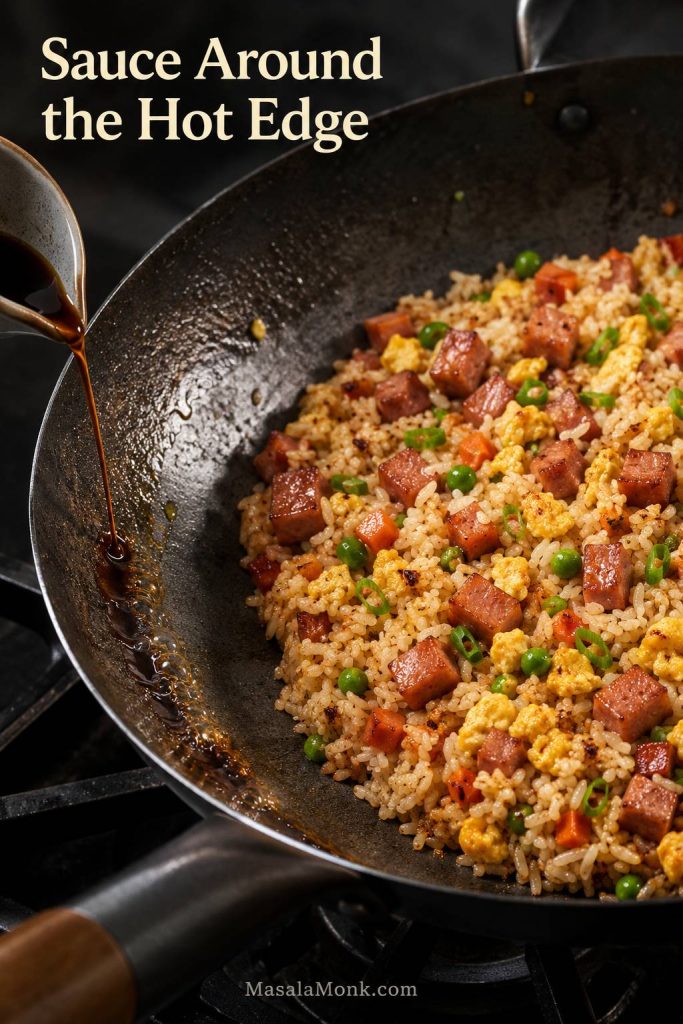
6. Add the Sauce Around the Pan Edge

In a wok, stainless skillet, or cast-iron pan, pour the sauce around the hot edge so it sizzles briefly before you toss it through the rice. If you are using nonstick, drizzle the sauce evenly over the rice and toss right away. Either way, stop and taste before adding more soy sauce; the Spam will keep seasoning the dish as you eat.

Sauce being poured around the exposed hot edge of a wok while fried rice cooks in the center.
When sauce hits the hot pan edge first, it wakes up quickly before coating the rice, which gives the whole pan a cleaner, more even savory finish.

7. Fold the Egg Back In

Add the soft scrambled eggs back to the pan and fold them through the rice with the crispy Spam. The finished pan should taste salty-savory, a little rich, and balanced by scallions or vegetables. Finish with scallion greens, extra white pepper, sesame seeds, chili crisp, or a tiny drizzle of sesame oil.

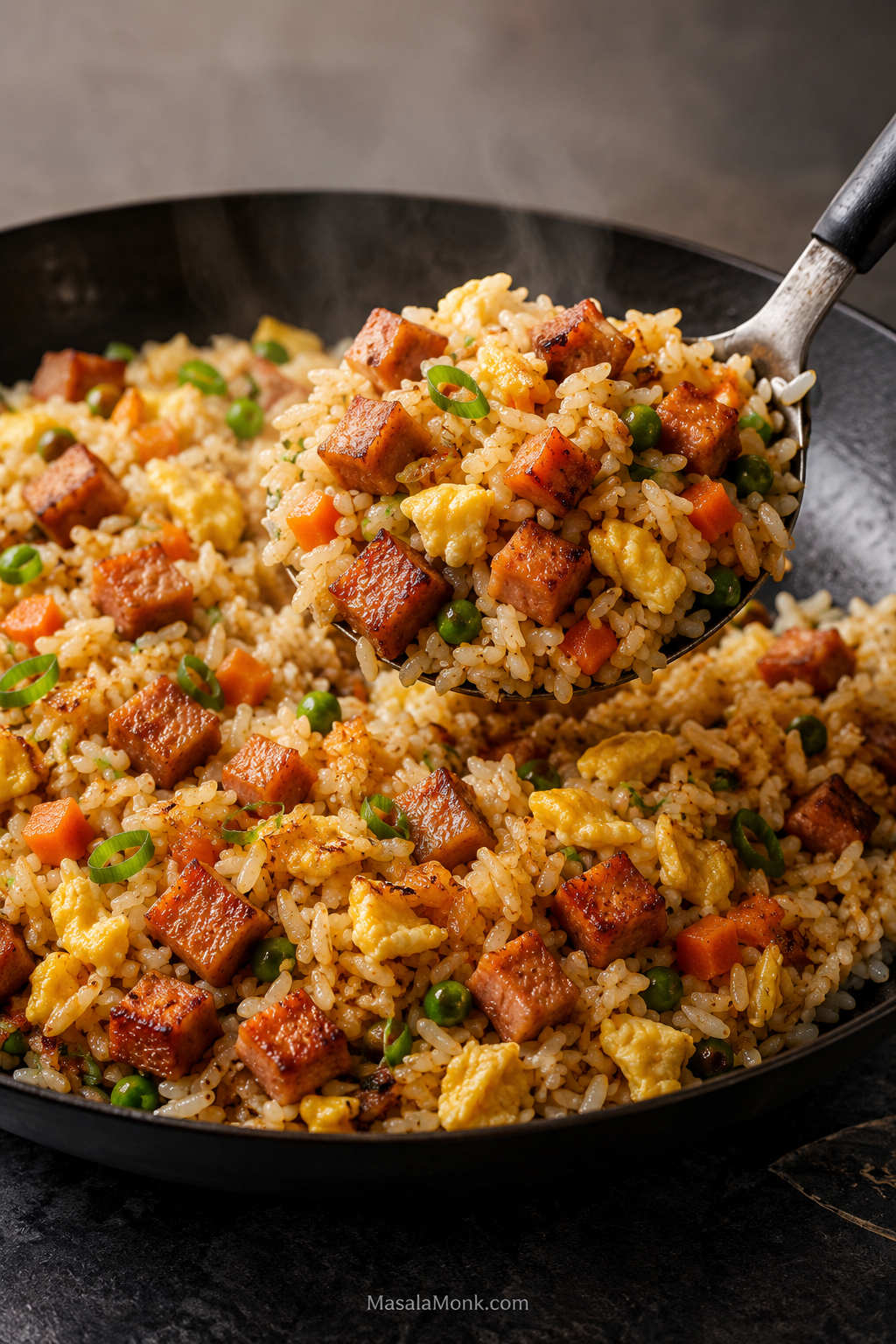
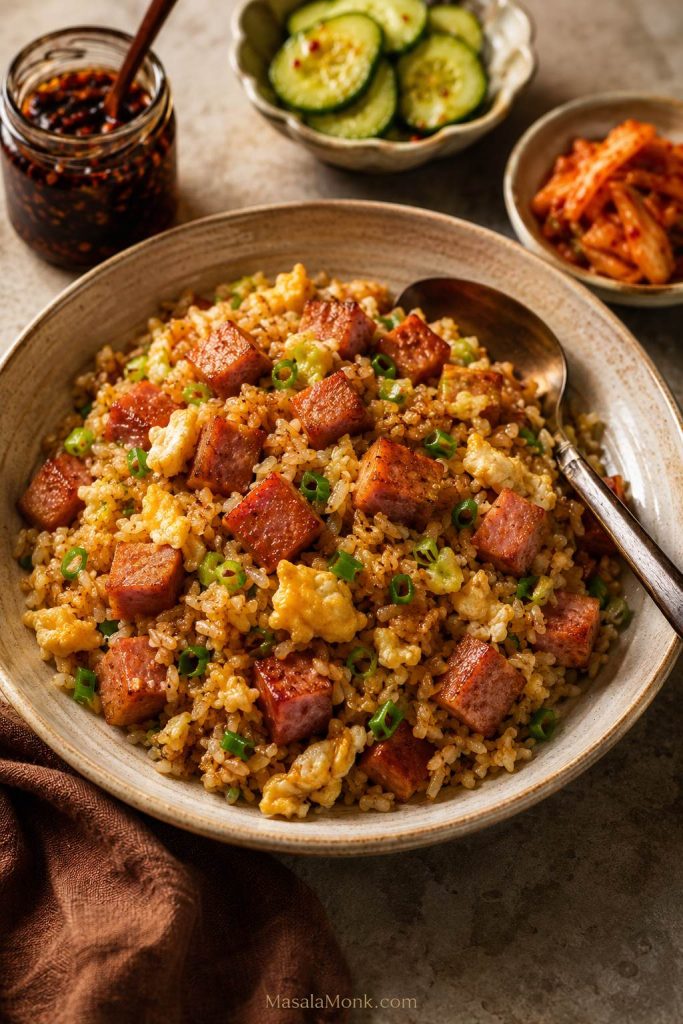
A close-up spoonful of finished fried rice with separate grains, browned Spam cubes, egg, scallions, peas, and carrots.
The finished texture should look glossy and loose rather than wet, with crisp Spam and tender egg balancing the richness of the rice.

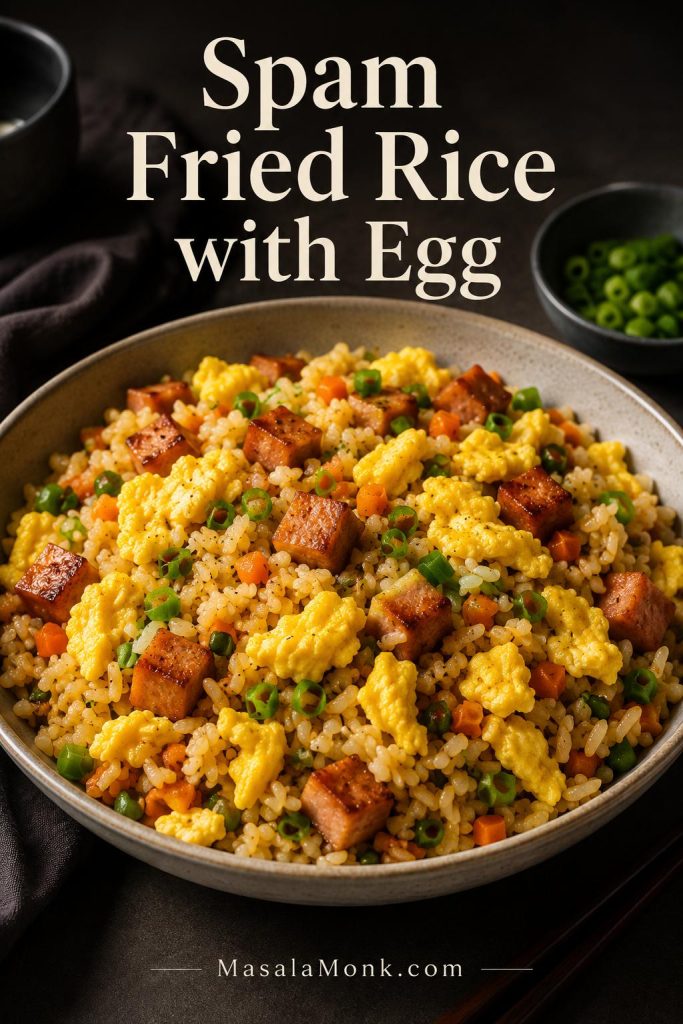
Spam Fried Rice with Egg

Egg belongs in the base version because it balances the salty Spam and makes the rice more filling. It also gives the dish that familiar Spam-and-eggs comfort without turning the whole pan into a breakfast scramble.

A bowl of fried rice with visible scrambled egg, browned Spam cubes, scallions, peas, and carrots.
Egg does more than add protein. It also softens the salty edge of the Spam and makes the whole pan feel rounder and more complete.

For 4 cups of cooked rice, 3 large eggs give you visible pieces of egg without overwhelming the grains. Use 2 eggs if you want a lighter pan, or 4 eggs if you want the dish more protein-heavy.

The easiest method is to scramble the eggs first, remove them while still soft, and fold them back in at the end. You can also push the rice aside and scramble the eggs in an open space in the pan, but that works best in a wide wok or large skillet.

If you often have eggs to use up, these easy egg dishes are useful for quick meals beyond fried rice.

Best egg texture: Take the eggs off the heat when they are just set. If they cook all the way through at the start, they can turn dry by the time the rice is finished.

Spam and Rice vs Spam Fried Rice

People use “Spam and rice” to mean a few different meals, from a simple bowl to a full fried rice pan. The difference matters because the cooking method changes the texture.

  • Spam and rice is usually browned Spam served over plain white rice.
  • Spam egg rice is often a simple bowl or plate with Spam, egg, and rice.
  • Spam fried rice means the rice itself is stir-fried with Spam, egg, sauce, aromatics, and vegetables.
  • Spamsilog is a Filipino-style plate with Spam, garlic rice, and egg, usually served as separate components.
Three dishes labeled Spam and rice bowl, fried rice, and spamsilog-style, showing different ways to serve Spam with rice.
Spam and rice can be a simple bowl, a full fried rice pan, or a spamsilog-style plate; therefore, the cooking method changes the texture, flavor, and feel of the meal.

In this version, the rice actually fries with the Spam, egg, sauce, and aromatics, so every grain picks up flavor. If you want a simpler bowl instead, brown Spam slices, fry an egg, and serve both over hot white rice with scallions and chili crisp.

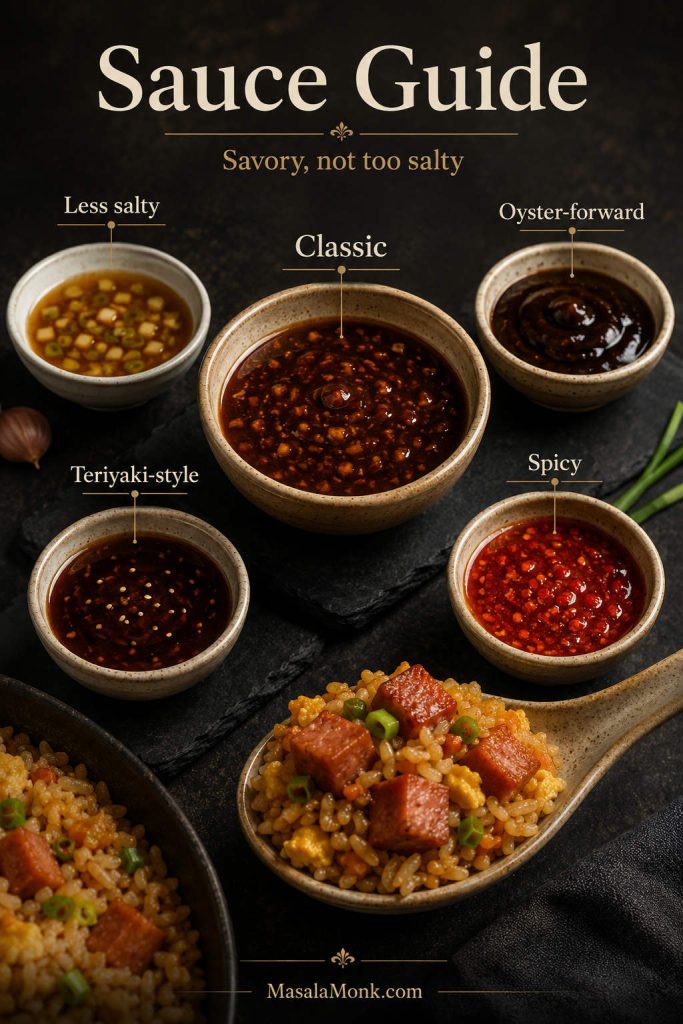
Sauce Guide

The sauce should make the rice savory, not salty for the sake of being salty. Start with the measured amount, toss well, then taste. It is much easier to add a splash more soy sauce at the end than to fix a pan that has gone too far.

A sauce guide showing small bowls labeled classic, less salty, oyster-forward, teriyaki-style, and spicy beside a spoonful of fried rice.
Start with less sauce than you think you need. Since Spam keeps seasoning the rice as you eat, a lighter hand usually gives the pan a better finish.
Sauce Style Formula Best For
Balanced classic 2 tbsp soy sauce + 1 tbsp oyster sauce + 2 tsp toasted sesame oil The main recipe and most everyday versions.
Less salty 1½ tbsp low-sodium soy sauce + 1 tbsp oyster sauce + 1 tbsp water or broth Regular Spam, salty rice, or anyone sensitive to salt.
Oyster-forward 1 tbsp soy sauce + 1½ tbsp oyster sauce + white pepper A deeper, rounder, more savory fried rice.
Teriyaki-style 2 tbsp soy sauce + 1 tbsp mirin + 1 tsp sugar A slightly sweeter Spam fried rice variation.
Garlic-butter Base sauce + 1 tbsp butter at the end + extra garlic Richer comfort-food style fried rice.
Spicy Base sauce + chili crisp, sriracha, gochujang, gochugaru, or sliced chilies Heat lovers and kimchi-style variations.

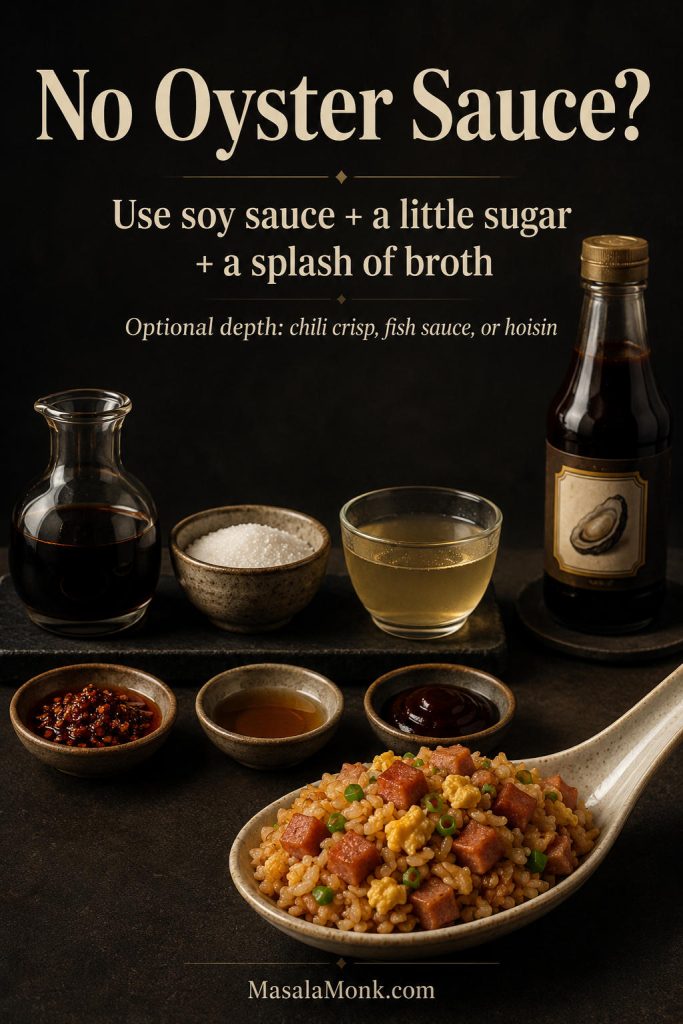
No Oyster Sauce?

You can make this without oyster sauce. Use 2 tablespoons low-sodium soy sauce, 1 teaspoon sugar, and a small splash of water or broth. For more depth, add a few drops of fish sauce, a small spoon of hoisin, or a little chili crisp. Start light, because Spam already brings plenty of salt.

A substitution guide showing soy sauce, sugar, broth, chili crisp, fish sauce, hoisin, and a spoonful of fried rice as alternatives when oyster sauce is missing.
No oyster sauce is not a dead end. Soy sauce, a little sugar, and a splash of broth still build a savory base, while chili crisp, fish sauce, or hoisin can deepen the flavor.

Start with the less-salty formula when your Spam is regular or the rice already tastes seasoned. When the rice tastes flat, go with the balanced classic. For a deeper, takeout-style flavor, lean slightly more oyster-forward.

Use a neutral oil for stir-frying and save toasted sesame oil for the sauce or final drizzle. Otherwise, the sesame oil can taste flat before the rice is finished. Added near the end, it keeps its aroma fresher.

Variations: Kimchi, Pineapple, Garlic, and Spicy

Choose the variation based on what you want from the bowl. Kimchi makes it tangy and bold, while pineapple pushes it sweet-salty. Extra garlic makes it more comforting, chili crisp makes it louder, and teriyaki-style sauce gives you a slightly sweeter weeknight version.

Kimchi Spam Fried Rice

Kimchi is the boldest direction here. Use ripe kimchi with good sourness, chop it into small pieces, and drain or squeeze it lightly if it is very wet. Fry the kimchi after browning the Spam and before adding the rice so the flavor deepens and extra moisture cooks off.

Kimchi fried rice in a bowl with red-orange rice, crispy Spam cubes, kimchi pieces, scallions, sesame seeds, and a fried egg.
Kimchi takes the rice in a tangier, bolder direction, adding acid, heat, and depth without needing many extra ingredients.

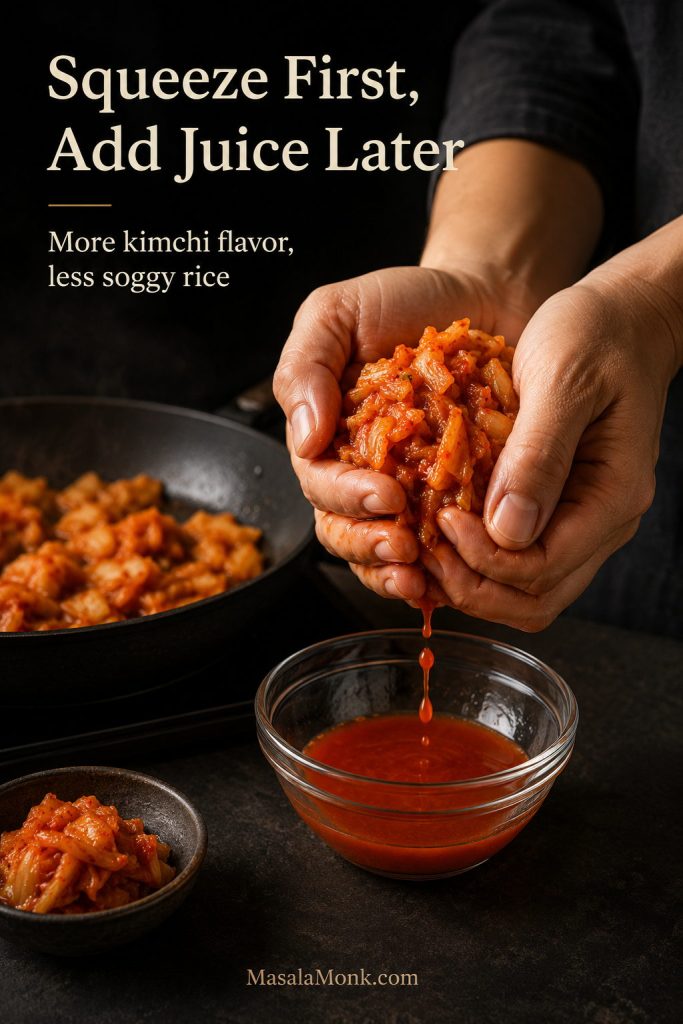
If you want stronger kimchi flavor without soggy rice, squeeze the chopped kimchi over a small bowl, fry the kimchi until it smells deeper and less raw, then add a spoonful of the reserved juice only after the rice is hot and separate.

Chopped kimchi being squeezed over a bowl to remove excess liquid, with fried kimchi cooking in a pan nearby.
For kimchi fried rice, control the liquid before it reaches the pan. Squeezing first lets you add tang later without making the grains soggy.

Use less soy sauce than the base recipe because both Spam and kimchi bring salt. Add a spoonful of kimchi juice only if the rice is dry enough to handle it. For more heat, add gochujang, gochugaru, chili crisp, or sliced chilies. A fried egg on top works especially well.

Hawaiian Spam Fried Rice with Pineapple

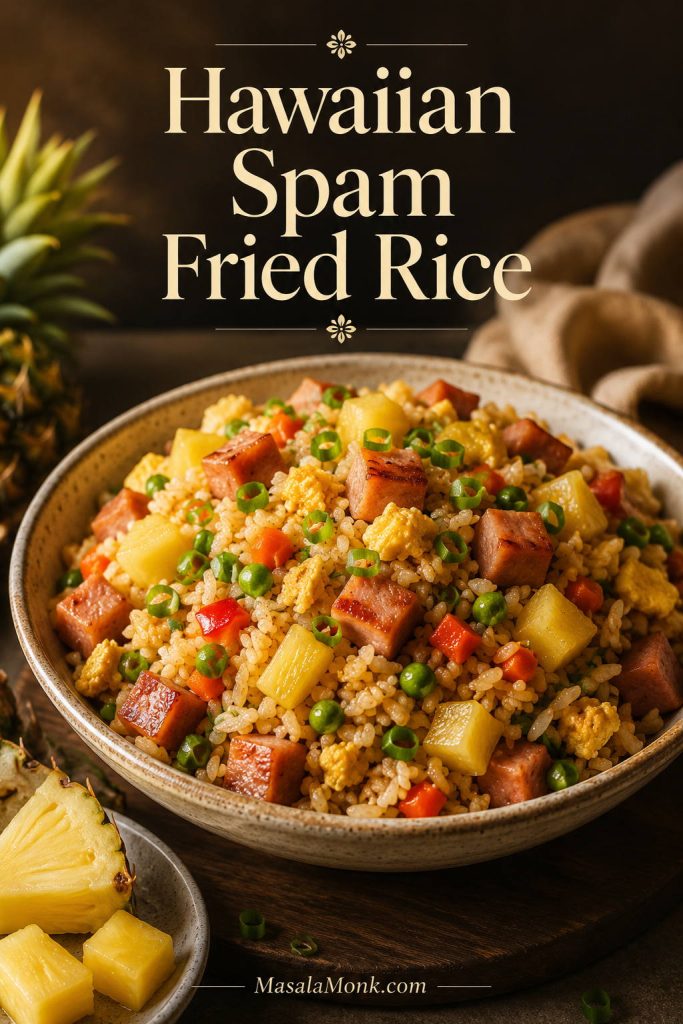
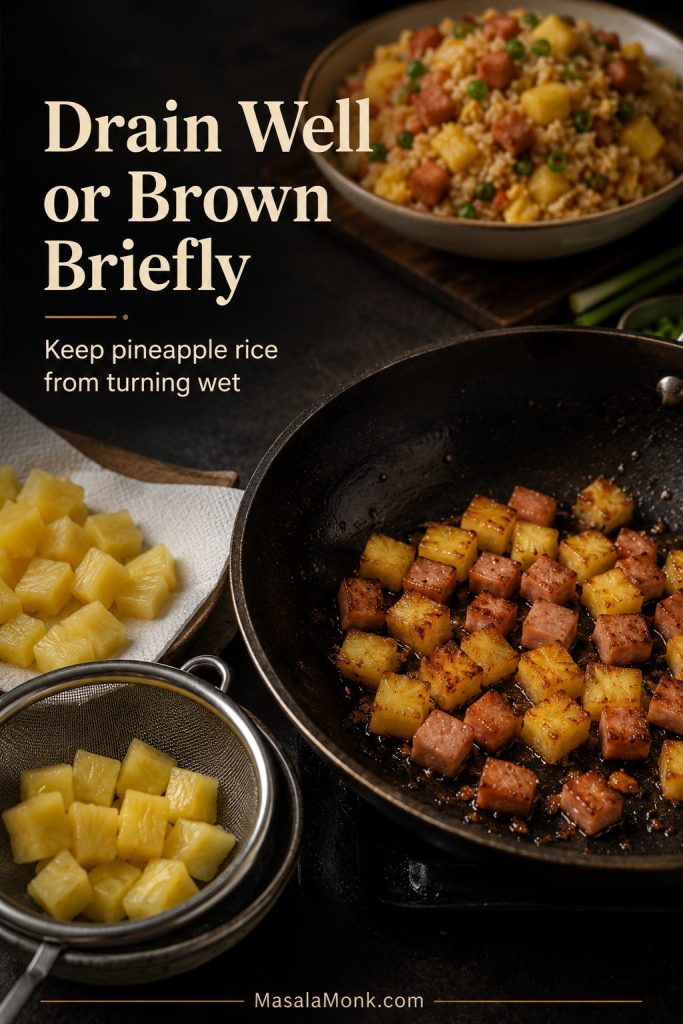
For a Hawaiian-style pan, add ½ to 1 cup diced pineapple. Fresh pineapple gives the cleanest texture, but canned pineapple works if it is drained very well. Add pineapple near the end for juicy pieces, or brown it briefly with the Spam if you want caramelized edges.

Hawaiian-style fried rice with pineapple, browned Spam cubes, egg, scallions, and vegetables in a bowl.
Pineapple gives the rice a sweet-salty contrast, but it works best when the fruit is well drained and added near the end so the grains stay loose.

A lighter hand with sauce works better here. Too much soy sauce plus pineapple juice can make the rice wet. Bell pepper, scallions, peas, carrots, and a little ginger all fit nicely with the sweet-salty flavor.

Drained pineapple in a strainer and lightly browned pineapple pieces in a pan beside fried rice ingredients.
To keep pineapple fried rice from turning watery, drain canned fruit well or brown fresh pineapple briefly before it reaches the rice.

Filipino Garlic Spam Fried Rice

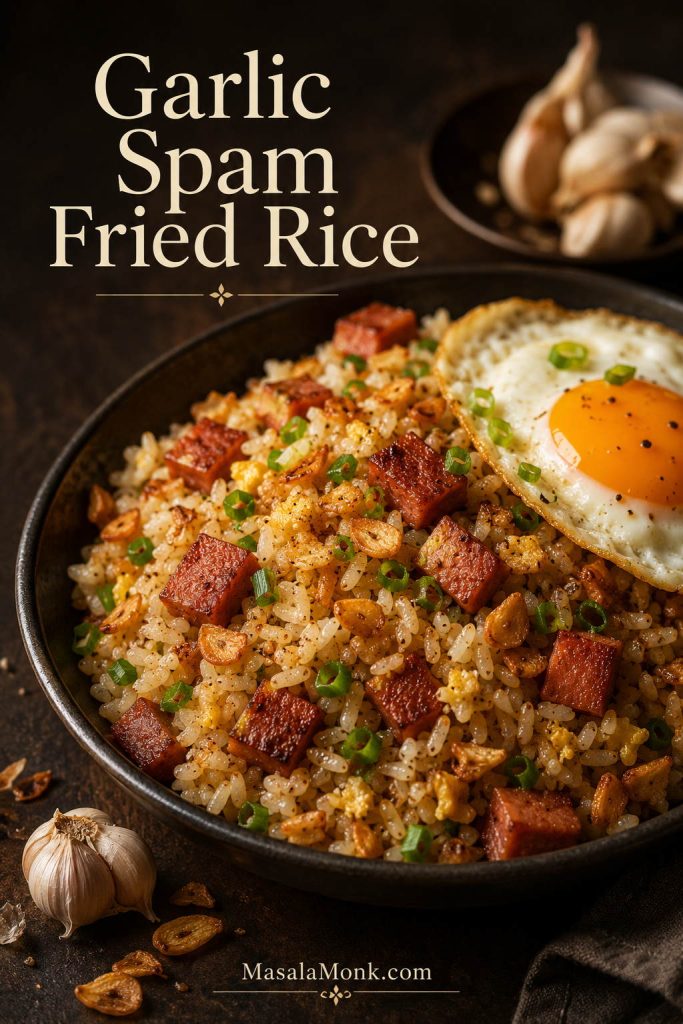
For a Filipino-inspired garlic version, use extra garlic and keep the seasoning simple. Brown the Spam, fry plenty of minced garlic until fragrant, then add cold rice and season lightly with soy sauce or a small splash of fish sauce. Finish with scallions and serve with a fried egg if you want a spamsilog-style plate.

Garlic fried rice with crispy Spam, fried egg, scallions, and golden garlic pieces served on a plate.
A garlic-heavy version needs less sauce because the garlic, Spam, rice, and egg already create a deep comfort-food flavor on their own.

The difference is mostly in the format. Garlic Spam fried rice mixes diced Spam into the rice, while spamsilog usually serves fried Spam slices, garlic rice, and egg as separate parts on the same plate.

Spicy Spam Fried Rice

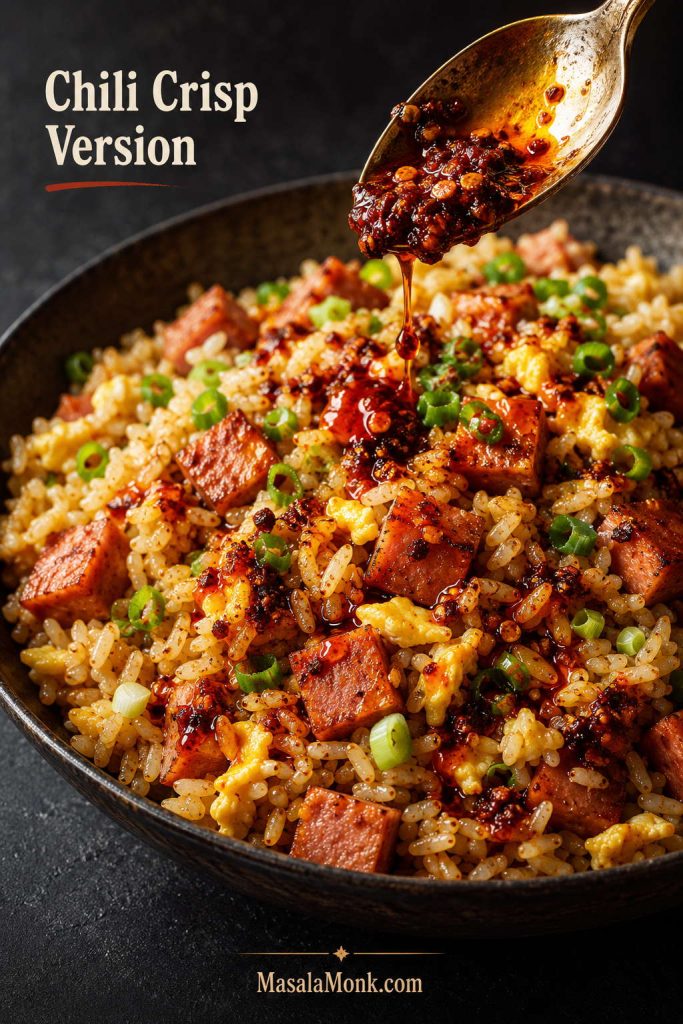
For heat, add chili crisp, sriracha, gochujang, gochugaru, sambal, sliced fresh chilies, or extra black pepper. Chili crisp is the easiest option because it brings heat, oil, crunch, and savoriness at the same time. Start small if your Spam and sauce are already salty.

Spicy fried rice with chili crisp being spooned over rice, Spam cubes, egg, and scallions.
Chili crisp is one of the easiest spicy finishes, since it adds heat, crunch, oil, and extra savoriness in one spoonful.

Spam Fried Rice with Peas and Carrots

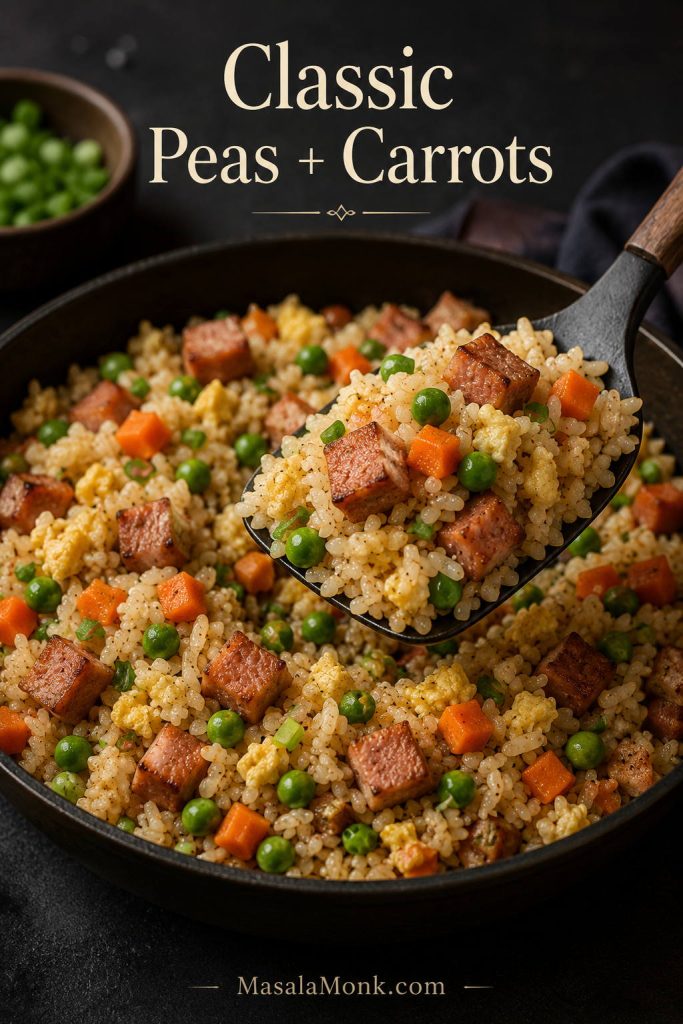
Peas and carrots are the classic low-effort vegetable mix. Use ¾ to 1 cup for 4 cups of rice. Before adding them, rinse frozen vegetables briefly under warm water, drain them well, and add them before the rice so excess moisture can cook off.

Fried rice in a skillet with peas, carrots, browned Spam cubes, egg, and scallions being lifted with a spatula.
Peas and carrots are the easiest vegetable mix for this recipe, especially when they are drained well and heated long enough for extra moisture to cook off.

If you like the same leftover-rice logic with a different protein, MasalaMonk’s ground pork recipes include budget-friendly weeknight ideas that fit the same quick-dinner mood.

Teriyaki Spam Fried Rice

For a teriyaki-style version, replace the oyster sauce with a simple mix of soy sauce, mirin, and a little sugar. Ginger works nicely here. Keep the sweetness controlled so the rice still tastes savory, not sticky or glazed like a teriyaki bowl.

Teriyaki-style fried rice with glossy rice, browned Spam cubes, scallions, and sesame seeds.
A teriyaki-style version can be slightly sweeter and darker, but the sauce should glaze the rice lightly rather than make it sticky or heavy.

How to Fix Spam Fried Rice

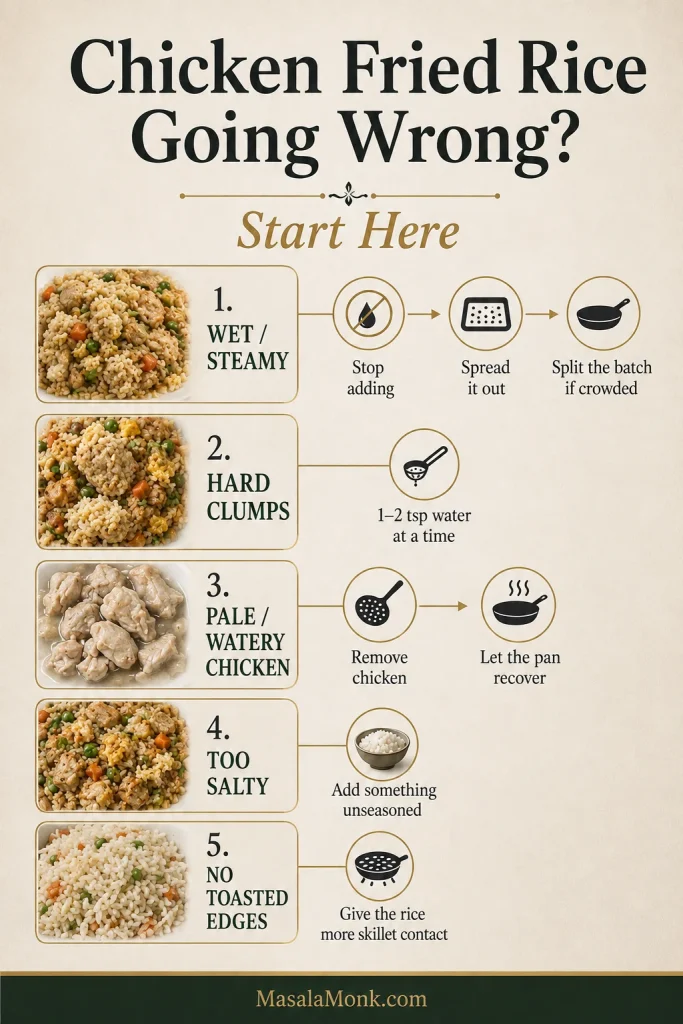
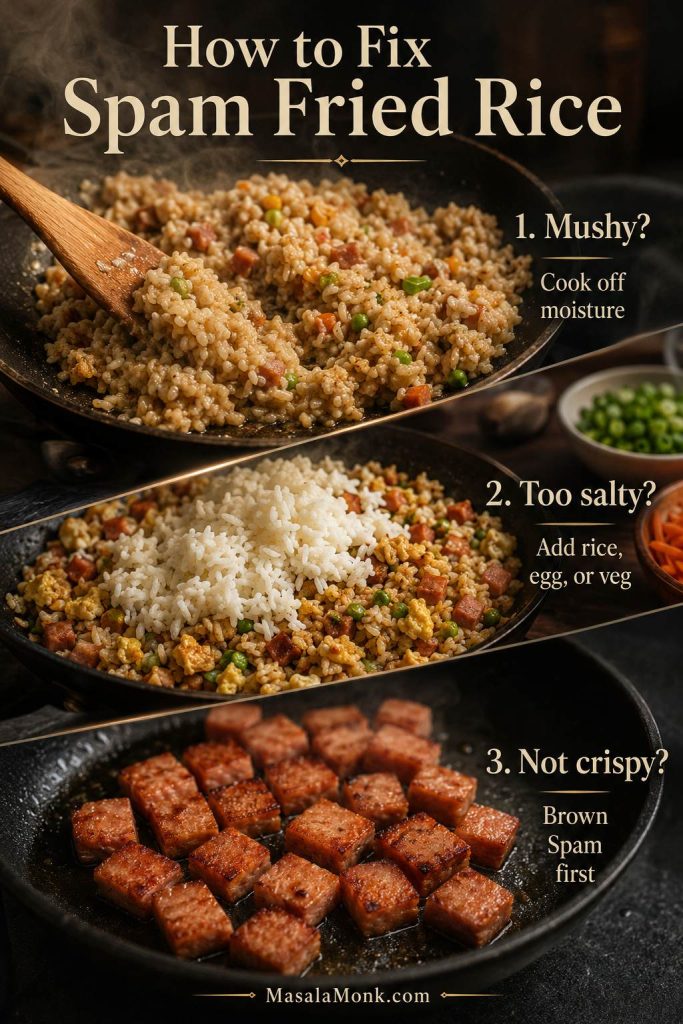
If the pan is not perfect the first time, it is usually easy to understand what happened. Most problems come from moisture, heat, salt, or crowding. First, check the texture. Then, adjust the seasoning only after the rice has had enough time in the pan.

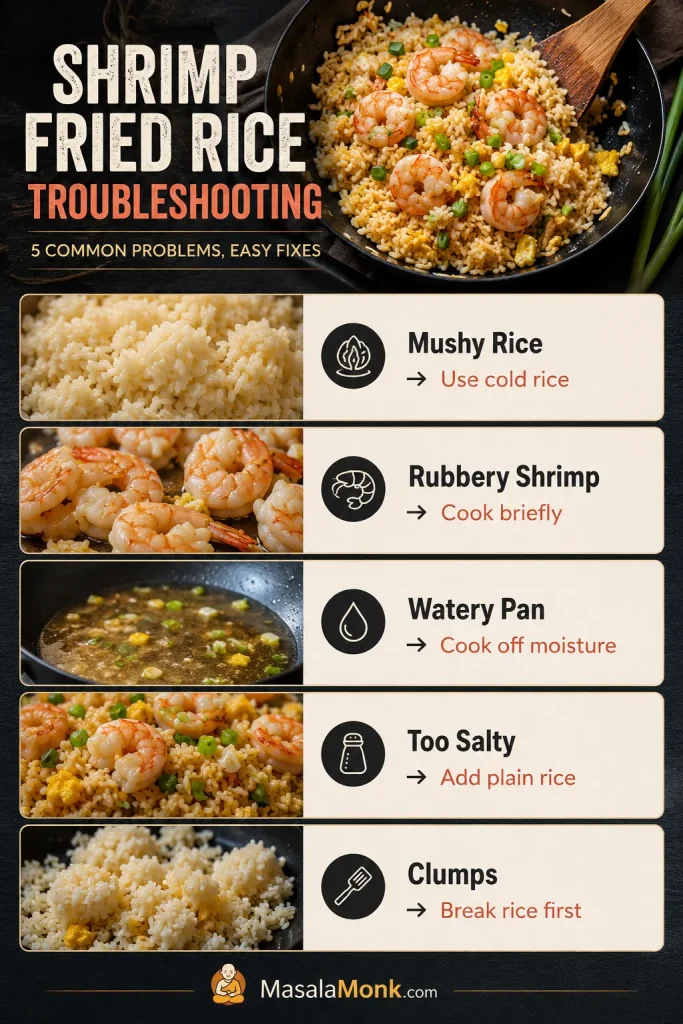
A troubleshooting image showing fixes for mushy fried rice, overly salty rice, and Spam that is not crispy enough.
Most fried rice problems come from moisture, salt, heat, or crowding, so the right fix depends on whether the pan looks steamy, tastes too salty, or never browned properly.

Texture Problems

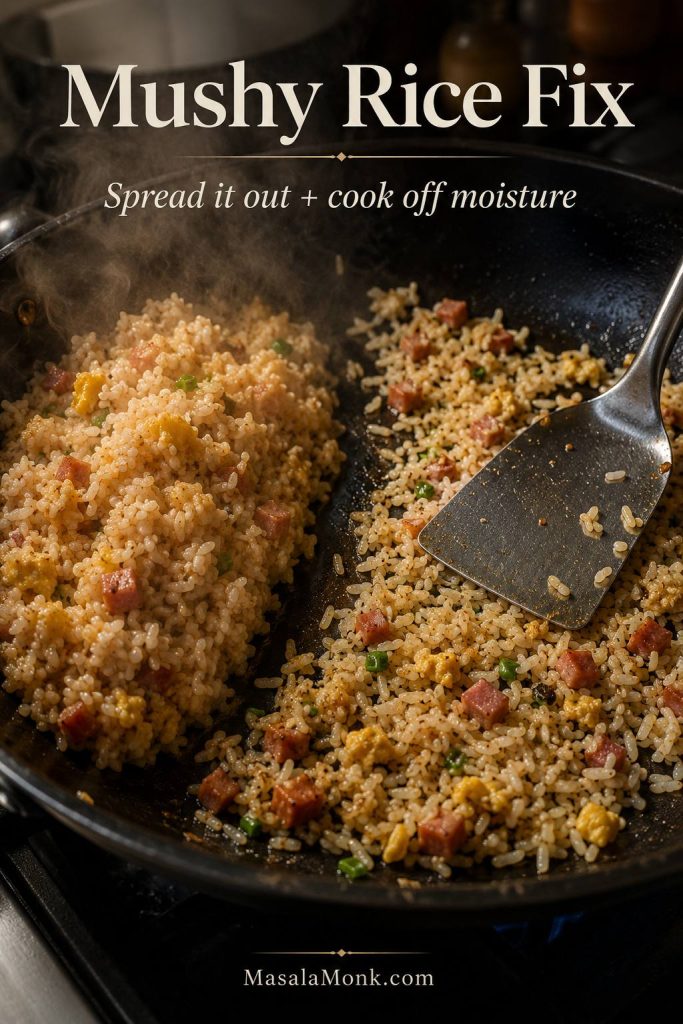
Mushy fried rice being spread across a skillet with a spatula so excess moisture can cook off.
If the rice turns soft or clumpy, spread it out and pause before stirring again, because more pan contact helps moisture cook away.
Problem What Happened How to Fix It
Rice is mushy The rice was too warm, wet, or freshly cooked. Spread it out in the pan and let moisture cook off without stirring constantly. Next time, use cold day-old rice or chill fresh rice on a tray first.
Rice is dry The rice was very old or cooked too long after adding sauce. Add 1–2 tablespoons water or broth and toss quickly over heat.
Rice is clumping The rice was not broken up before cooking, or the pan was too small. Break up cold rice before adding it. Also, use a wide pan and enough heat to fry the grains.

Seasoning Problems

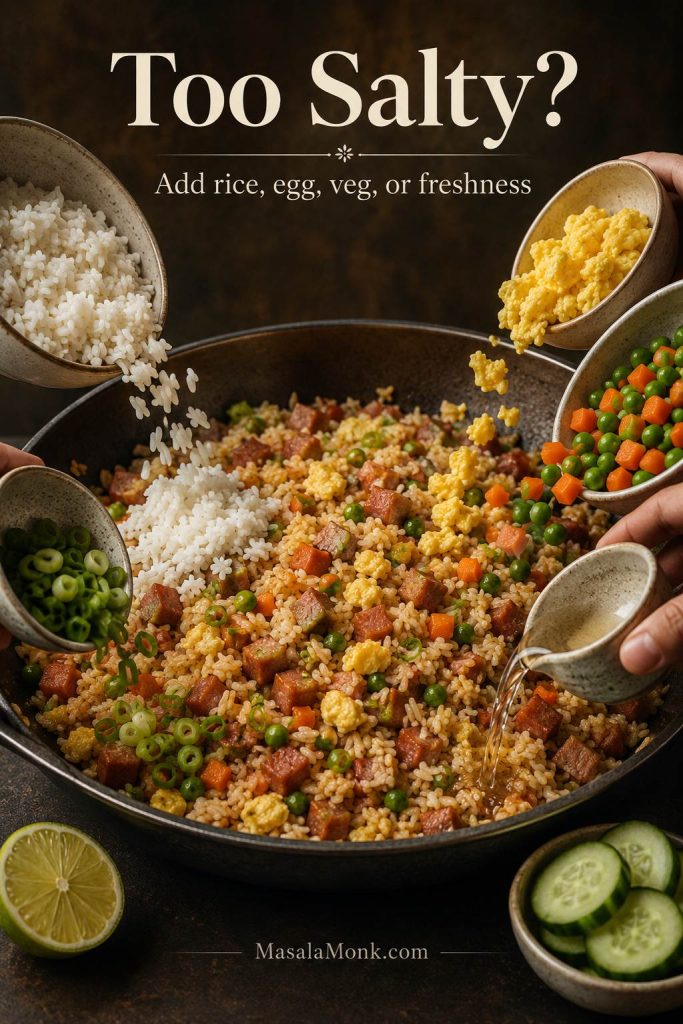
A pan of fried rice with plain rice, egg, vegetables, scallions, cucumber, and a bright finishing ingredient shown as ways to balance too much salt.
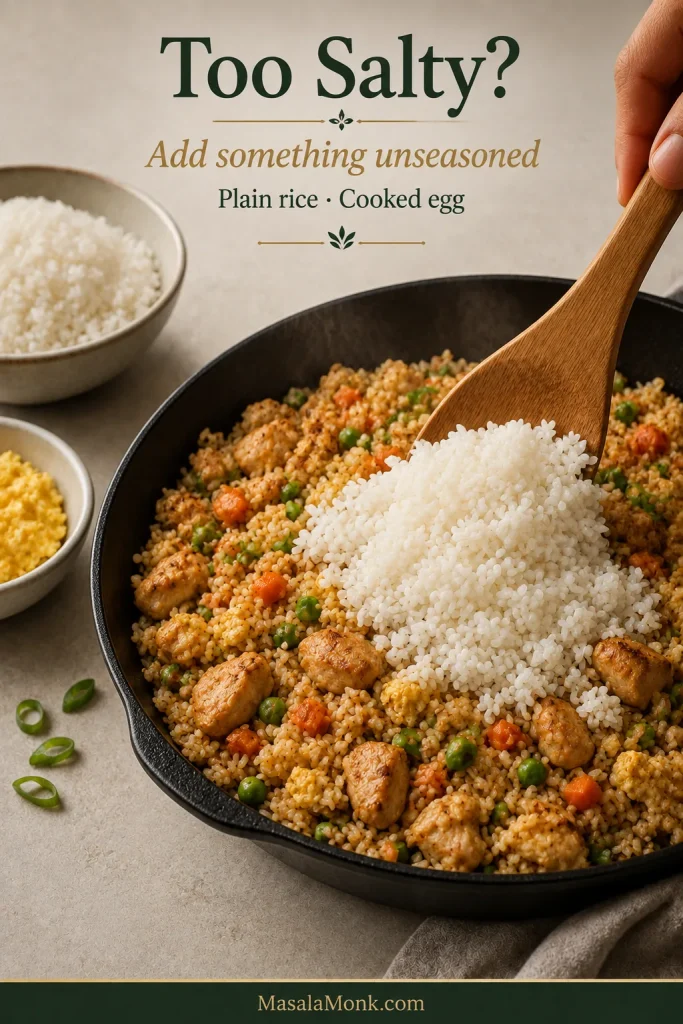
When the pan tastes too salty, add plain rice, egg, vegetables, or a fresh finish such as scallions or cucumber; more soy sauce will only push it further out of balance.
Problem What Happened How to Fix It
Fried rice is too salty The Spam, soy sauce, and oyster sauce added up quickly. Add more plain rice, egg, or vegetables. Then finish with scallions or a tiny splash of rice vinegar instead of more soy sauce.
Rice tastes bland The sauce did not spread evenly, or the rice needed a little more seasoning. Add a small splash of soy sauce around the hot pan edge, toss, and taste again before adding more.
Fried rice is greasy Too much oil was added before the Spam rendered. Use less oil next time and let the Spam release some fat before adding more oil.

Spam, Egg, and Add-In Problems

Problem What Happened How to Fix It
Spam is not crispy The pan was crowded or the Spam was stirred too often. Brown the Spam before adding rice. Let it sit in contact with the pan so the edges can crisp.
Egg is rubbery The eggs cooked too long at the beginning. Scramble eggs separately and remove them while still soft. Then fold them back in at the end.
Pineapple made it wet The pineapple was too juicy or added too early. Drain pineapple well and add it near the end. Alternatively, brown it briefly with the Spam before the rice goes in.
Kimchi made it soggy The kimchi carried too much liquid into the pan. Squeeze or drain very wet kimchi. Then fry it before adding rice so the extra moisture cooks off.

What to Serve with Spam Fried Rice

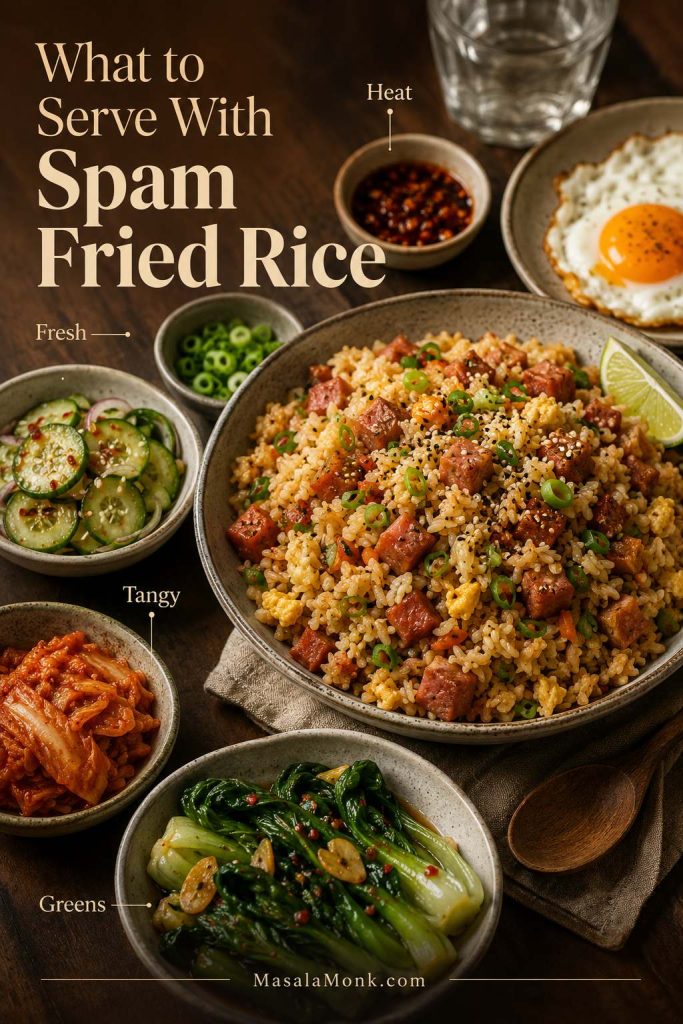
This fried rice can be dinner on its own, especially with egg and vegetables, but a fresh or tangy side makes the plate feel brighter.

Choose the side based on what the pan needs. For a rich-tasting pan, add cucumber salad, kimchi, or pickled vegetables. To make dinner fuller, add garlicky greens, bok choy, broccoli, or a fried egg. When the bowl needs more energy, finish with chili crisp, sesame seeds, scallions, or a squeeze of lime.

A serving spread with fried rice, cucumber salad, kimchi, greens, fried egg, chili crisp, scallions, and lime.
Choose sides based on what the rice needs: fresh or tangy dishes brighten a rich pan, while greens or a fried egg turn it into a fuller meal.

For another pantry-friendly dinner built around a canned protein, these salmon croquettes with canned salmon are a good next recipe to keep in rotation.

  • Cucumber salad, kimchi, or quick pickled vegetables
  • A fried egg on top
  • Chili crisp, hot sauce, sesame seeds, or extra scallions
  • Steamed bok choy, broccoli, or garlicky greens
  • Sliced avocado with lime or sesame seeds
  • A simple broth, miso soup, or clear vegetable soup

Storage and Reheating

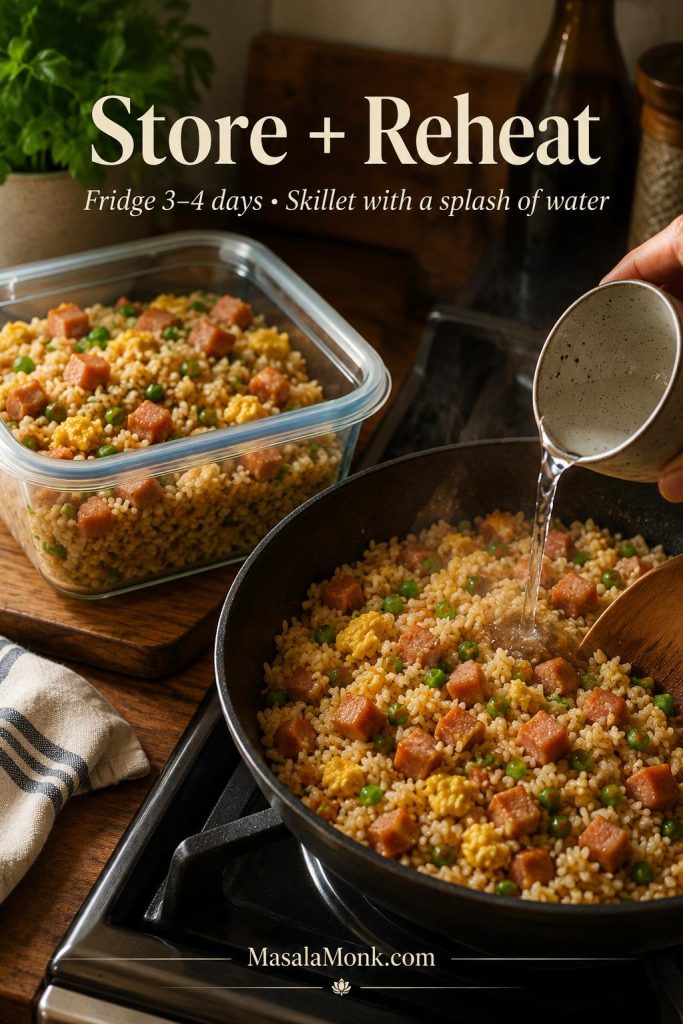
Store leftover Spam fried rice in an airtight container in the refrigerator and use it within 3–4 days. That matches the USDA leftover guidance for cooked leftovers. You can also freeze portions, though the texture is best when the rice is freshly made or reheated from the fridge.

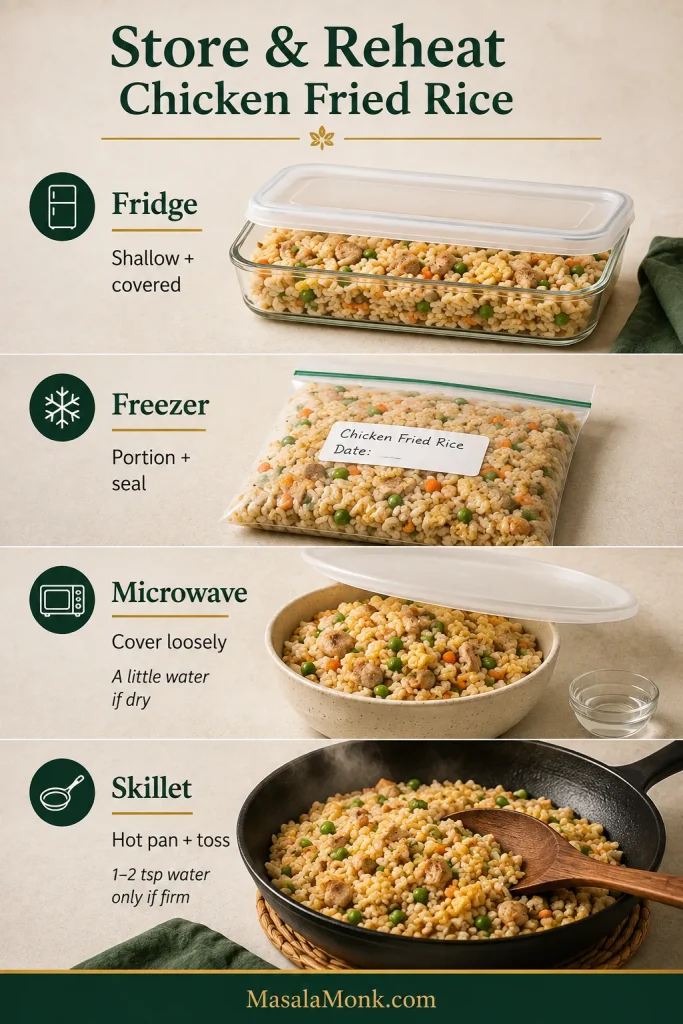
Fried rice stored in a clear airtight container and reheated in a skillet with a small splash of water.
A skillet gives leftovers a better second life than the microwave alone. Meanwhile, a small splash of water helps reheat the rice without making it dry or brittle.

For the best texture, reheat fried rice in a skillet over medium heat with a small splash of water or broth. Stir until hot, then let it sit briefly in the pan if you want the rice to regain a few crisp edges.

For a faster option, microwave the rice in a covered bowl with a damp paper towel. Stir halfway through so it heats evenly. After reheating, add scallions, sesame oil, or chili crisp to freshen it up.

The finished fried rice should not feel heavy or wet. You want separate grains, crisp-edged Spam, soft pieces of egg, and enough scallion or vegetable freshness to balance the salty richness. Once you know that texture, the recipe becomes easy to adjust with whatever is already in your fridge.

Spam Fried Rice Recipe

Crispy browned Spam, cold leftover rice, soft scrambled egg, vegetables, and a quick soy-oyster-sesame sauce come together in this easy one-pan fried rice.

Prep Time10 minutes
Cook Time12–15 minutes
Total Time22–25 minutes
Yield4 servings
CourseMain dish, quick dinner
StyleSpam fried rice with egg

Equipment

  • Wok, carbon-steel wok, cast-iron skillet, or large 12-inch nonstick skillet
  • Wide spatula
  • Small bowl for sauce
  • Plate or bowl for holding cooked egg and Spam if needed

Ingredients

  • 1 can Spam, 12 oz / 340 g, preferably low sodium, cut into ½-inch cubes
  • 4 cups cold cooked rice, about 680–730 g
  • 3 large eggs, beaten
  • 2 tablespoons / 30 ml neutral oil, divided, plus a little more only if the pan looks dry
  • 2 cloves garlic, minced
  • 2 green onions, whites and greens separated
  • ¾ to 1 cup frozen peas and carrots, thawed or rinsed and drained
  • Optional: ½ cup corn, diced bell pepper, cabbage, or edamame

Sauce

  • 2 tablespoons / 30 ml soy sauce, preferably low sodium
  • 1 tablespoon / 15 ml oyster sauce
  • 2 teaspoons / 10 ml toasted sesame oil
  • 1 teaspoon sugar, optional
  • ¼ teaspoon white pepper or black pepper
  • Optional: 1 tablespoon / 15 ml water, broth, or Shaoxing wine

Instructions

  1. Mix the sauce. In a small bowl, stir together soy sauce, oyster sauce, sesame oil, sugar, pepper, and optional water, broth, or Shaoxing wine.
  2. Scramble the eggs. Heat 1 teaspoon neutral oil in a wok or large skillet over medium-high heat. Add the beaten eggs and scramble until softly set. Then transfer to a plate.
  3. Brown the Spam. Add another teaspoon or two of oil only if the pan looks dry, then add the diced Spam. Cook until browned and crisp at the edges, about 4–6 minutes. If the pan is crowded, transfer the Spam to a plate and add it back near the end.
  4. Add aromatics and vegetables. Stir in garlic and scallion whites for 20–30 seconds, then add peas and carrots and cook until hot and dry.
  5. Add the rice. Add cold cooked rice and break up clumps with a spatula. Stir-fry until the rice is hot and the grains separate.
  6. Add the sauce. In a wok, stainless skillet, or cast-iron pan, pour the sauce around the hot edge and let it sizzle briefly. If using nonstick, drizzle it evenly over the rice and toss right away.
  7. Finish. Fold the scrambled egg and browned Spam back through the rice. Add scallion greens, taste, and adjust only if needed.
  8. Serve hot. Top with sesame seeds, chili crisp, extra scallions, or a fried egg if desired.

Notes

  • Cold day-old rice gives the best texture.
  • Use low-sodium Spam or low-sodium soy sauce if you are worried about saltiness.
  • Taste before adding extra soy sauce at the end.
  • If you skip oyster sauce, use the no-oyster-sauce option in the sauce section above.
  • For kimchi Spam fried rice, use ripe chopped kimchi and reduce the soy sauce.
  • For pineapple Spam fried rice, drain pineapple well and add it near the end.

Storage

Refrigerate leftovers in an airtight container and use within 3–4 days. Reheat in a skillet with a splash of water or broth for the best texture.

A saveable recipe card showing the base ratio of one can of Spam, four cups of rice, three eggs, and a 25-minute cooking time.
Remember the ratio first: one can of Spam, four cups of cold rice, and three eggs. Once that works, the sauce and vegetables are easy to adjust.

Before the FAQs, use the final serving cue as a quick check: the bowl should look loose, glossy, crisp-edged, and balanced by something fresh or spicy.

A plated serving of fried rice with browned Spam cubes, egg, scallions, chili crisp, cucumber, and kimchi side dishes.
A good final bowl has separate grains, crisp Spam, soft egg, and a fresh side or spicy finish to keep the dish lively from the first bite to the last.

For saving or sharing, this version is the simplest promise of the recipe: cold rice, crisp Spam, soft egg, vegetables, and a fast savory sauce.

A close-up image of easy Spam fried rice with crispy Spam cubes, egg, vegetables, scallions, and a bold title overlay.
Save this easy Spam fried rice idea for nights when there is cold rice in the fridge and dinner needs to be fast, savory, and still intentional.

FAQs

What rice is best for Spam fried rice?

Cold day-old jasmine rice is the easiest everyday choice because it separates well and stays fragrant. Long-grain white rice gives a fluffier texture, while medium-grain rice works if it is fully chilled and broken up before cooking.

Can I make Spam fried rice with fresh rice?

Yes, but do not add hot rice straight from the cooker. Instead, spread fresh rice on a tray, let the steam escape, and chill it uncovered until the surface feels cooler and drier. Fresh rice needs more help because it can steam in the pan instead of frying.

Is egg necessary in Spam fried rice?

Egg is not mandatory, but it makes the pan feel more complete. It softens the salty edges of the Spam, adds protein, and gives the rice those tender golden pieces people expect in fried rice.

Can I make Spam fried rice without oyster sauce?

Yes. Use low-sodium soy sauce, a little sugar, and a small splash of water or broth. For more depth, add a few drops of fish sauce, a small spoon of hoisin, or chili crisp. Start lightly because Spam is already salty.

Why is my Spam fried rice mushy?

Mushy fried rice usually starts before the sauce ever goes in. Hot, wet, or overcooked rice steams in the pan instead of frying, so the grains collapse together. Cold rice, a hot pan, and a light hand with sauce fix most of the problem.

How do I make Spam fried rice less salty?

Use low-sodium Spam or low-sodium soy sauce, start with less sauce, and add more rice, egg, or vegetables if the pan already tastes too salty. After that, scallions, cucumber, or a tiny splash of rice vinegar can help balance the flavor.

What vegetables go well with Spam fried rice?

Peas, carrots, corn, cabbage, bell pepper, onion, scallions, and edamame all work well. Keep vegetables cut small and avoid adding too many watery ingredients at once.

How do I make kimchi fried rice with Spam?

Brown the Spam first, then fry chopped ripe kimchi before adding the rice. Since kimchi and Spam are both salty, use less soy sauce than the base recipe. Finish with sesame oil, scallions, and egg.

How do I make Hawaiian Spam fried rice?

Add ½ to 1 cup diced pineapple, keep the sauce slightly lighter, and drain the pineapple well. Then add it near the end for juicy pieces, or brown it briefly with the Spam for caramelized edges.

If you make it, choose your direction: classic egg, kimchi, pineapple, garlic-heavy, or chili crisp. Leave a comment with the version you tried and whether you like your Spam cubed, sliced, or extra crispy.

Posted on 24 Comments

How to Cook Perfect Rice Every Time (Recipe)

How to cook perfect rice — uncooked white rice pours from a measuring cup into a steaming black pot, with warm spices around; fluffy, not gummy.

Rice ought to be effortless. Nevertheless, a little too much water or a quick peek under the lid can turn a pot of promise into clumpy frustration. This guide shows how to cook perfect rice across methods and varieties—with crystal-clear steps, practical ratios, and why the small moves matter. You’ll learn a base stovetop technique, then branch into basmati, jasmine, sushi, and brown rice; after that, we’ll cover rice cookers and Instant Pots, storing and reheating safely, and turning leftovers into fast, satisfying meals. Along the way, you’ll find carefully chosen links for follow-up reading and technique deep dives woven naturally into the text.

The Baseline: How to Cook Perfect Rice on the Stovetop

If you only remember one method, make it this one. It delivers fluffy, separate grains without gimmicks, and it adapts to most long-grain white rices.

Daylight kitchen: water pours from a glass measuring cup into a pot of rinsed white rice; stovetop method—boil, cover, low 12 minutes, rest 10.
Perfect White Rice (Stovetop): Rinse well, bring to a boil, cover and cook on low for 12 minutes, then rest 10 before fluffing—reliable, fluffy results every time.

You’ll need: 1 cup long-grain white rice, 1½ cups water, a pinch of salt, a heavy pot with a tight lid, and a fork.
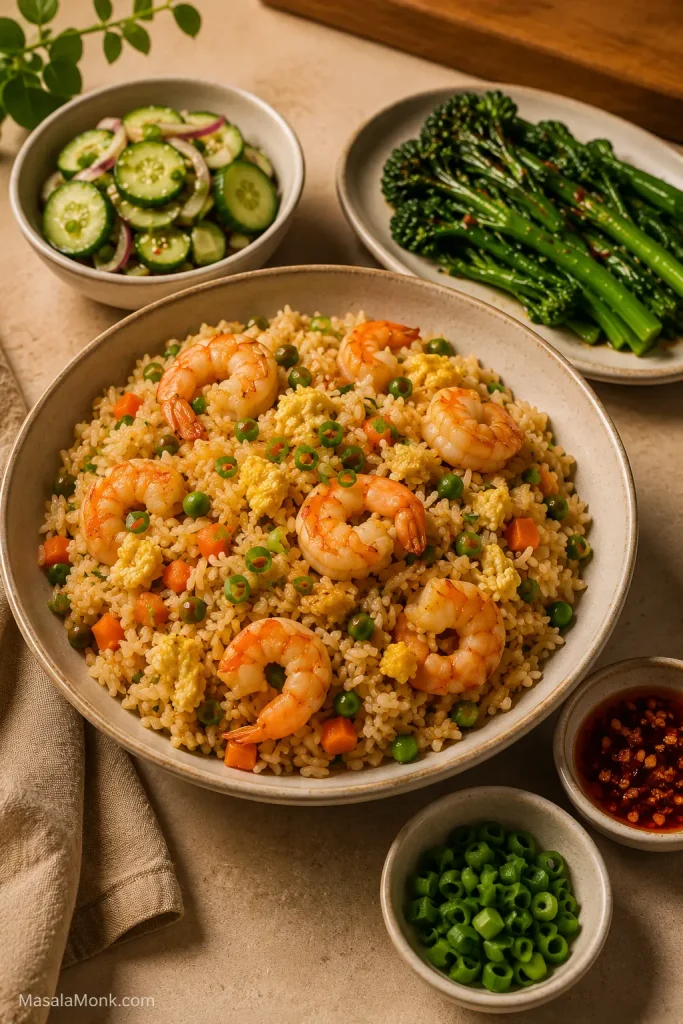
  1. Rinse thoroughly. Place the rice in a fine-mesh strainer and rinse under cold water, swishing with your hand until the water runs mostly clear. This removes excess surface starch so grains don’t glue together later.
  2. Measure precisely. For long-grain white rice on the stovetop, use 1½ cups water per 1 cup rice. Add a pinch of salt if you like.
  3. Boil, then cover. Bring the water to a rolling boil, stir in the rice once to break up any clumps, clamp on the lid, and immediately reduce the heat to low.
  4. Simmer gently for 12 minutes. No peeking. Lifting the lid dumps steam and derails even cooking.
  5. Rest for 10 minutes, still covered. The residual heat finishes the centers without overcooking the outer layers.
  6. Fluff and vent. Off the heat, uncover and fluff with a fork. If you want extra-dry, restaurant-style grains, briefly vent another 2–3 minutes.
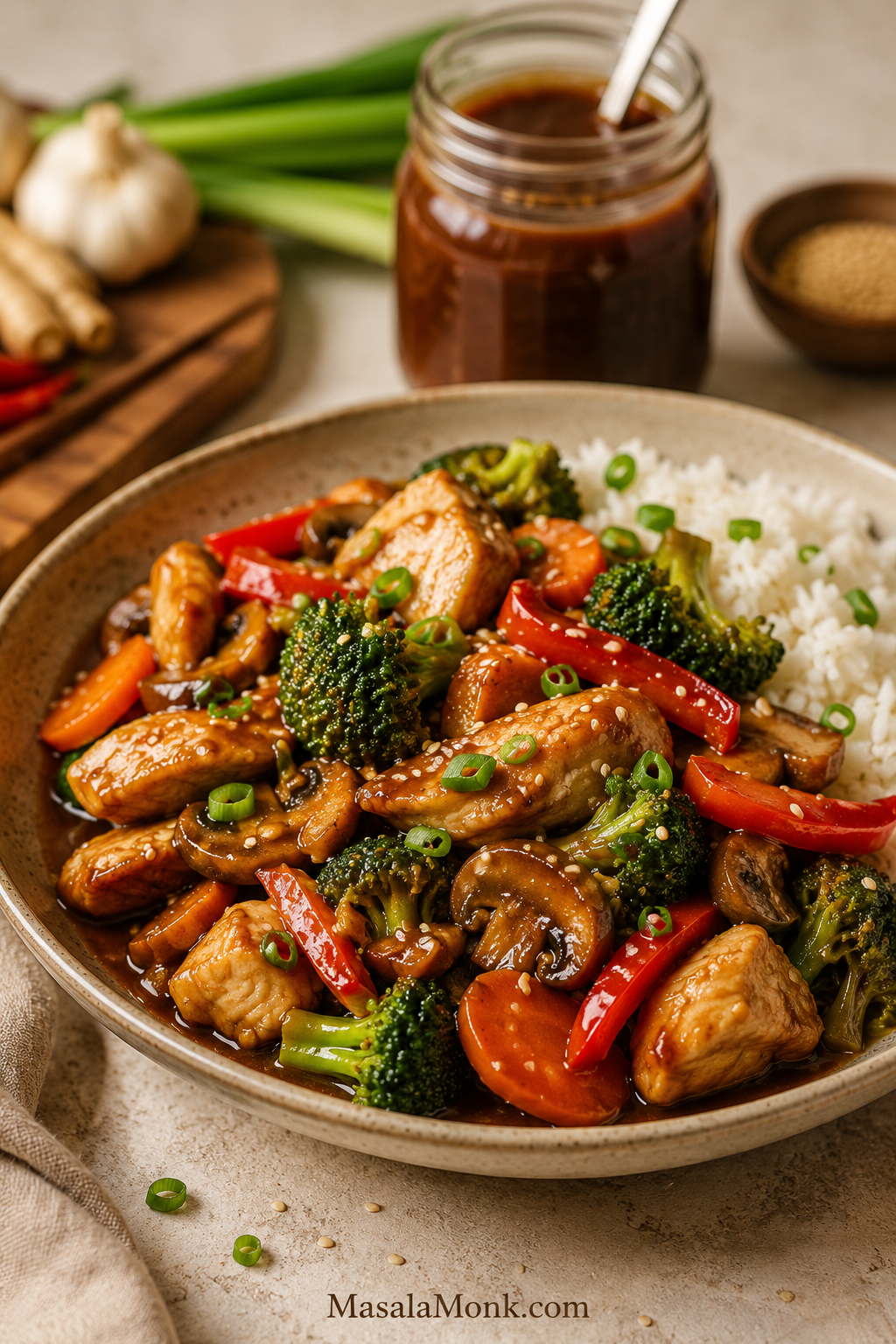
As an optional flourish, place a clean kitchen towel between the pot and the lid during the rest; it absorbs condensation and prevents drip-back, yielding lighter, drier rice. For a quick visual explanation of this trick, see the concise breakdown of the towel-under-lid rest.

Why this works

Rinsing reduces sticky surface starch; an immediate drop to low heat stabilizes simmering; the undisturbed rest lets steam equalize moisture from the outside in. Moreover, the ratios here are calibrated for typical long-grain white rice; once you navigate specialty varieties, you’ll tweak the numbers a bit, but the underlying logic stays consistent.

Also Read: Homemade Hot Chocolate with Cocoa Powder Recipe

At-a-Glance Cheatsheet for Cooking Perfect Rice

Standard Water Ratios (by volume) for Making Rice by various Methods

Rice typeRinse?Soak?Stovetop water : riceRice cookerInstant Pot (HP)Microwave rice cooker
Long-grain whiteYesNo1.5 : 11.1–1.2 : 1 (or to line)1 : 1, 3–4 min + 10 min NR1.5 : 1, 10–12 min, 5 min rest
JasmineYes10 min (optional)1.25–1.33 : 1~1.1–1.2 : 11 : 1, 3 min + 10 min NR1.5 : 1, 10–12 min
BasmatiRinse very well20–30 min1.5 : 11.2 : 11 : 1, 6 min + 10 min NR1.5 : 1, 12–14 min
Short-grain / SushiRinse until clear20–30 min1.1–1.2 : 1~1.1 : 11 : 1, 5 min + 10 min NR1.25–1.33 : 1, 10–12 min
Brown (long-grain)Rinse20 min (optional)2–2.25 : 11.4–1.5 : 11.25–1.33 : 1, 22–25 min + 10 min NR2 : 1, 20–22 min
Cheat Sheet for How to Cook different types of Rice at Home using various methods & devices.

NR = Natural Release (don’t vent; let pressure drop for the stated time).

Also Read: Peanut Butter Cookies (Classic Recipe & 3 Variations)

How to Cook Perfect Rice for Basmati

Basmati rewards gentle handling and a short soak. Its hallmark is long, elegant grains that stay separate, so our moves aim to protect structure rather than chase stickiness.
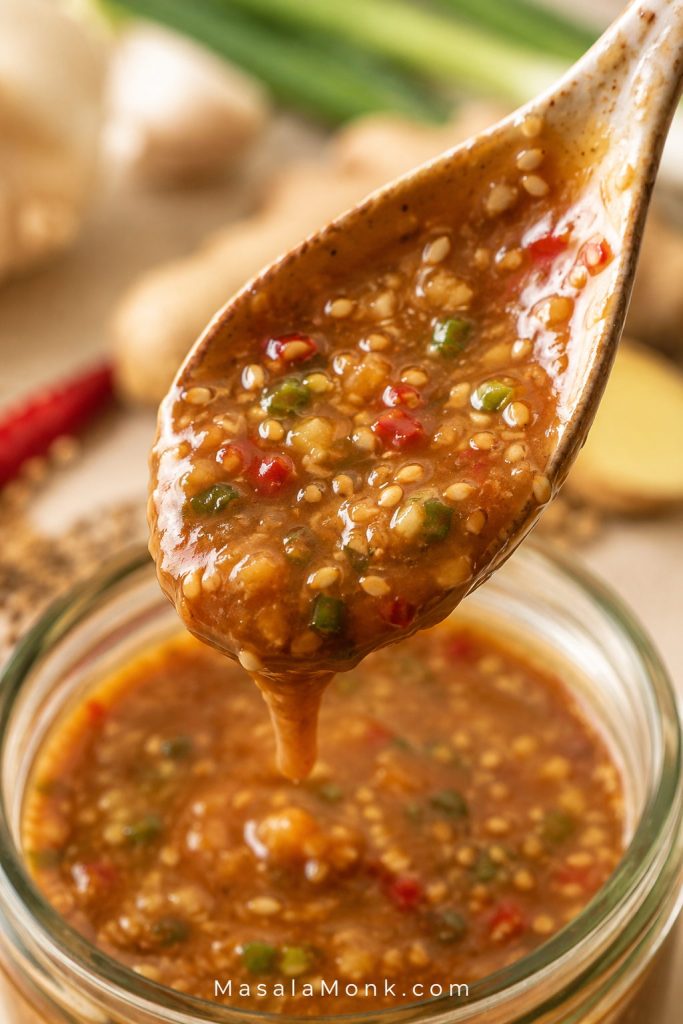
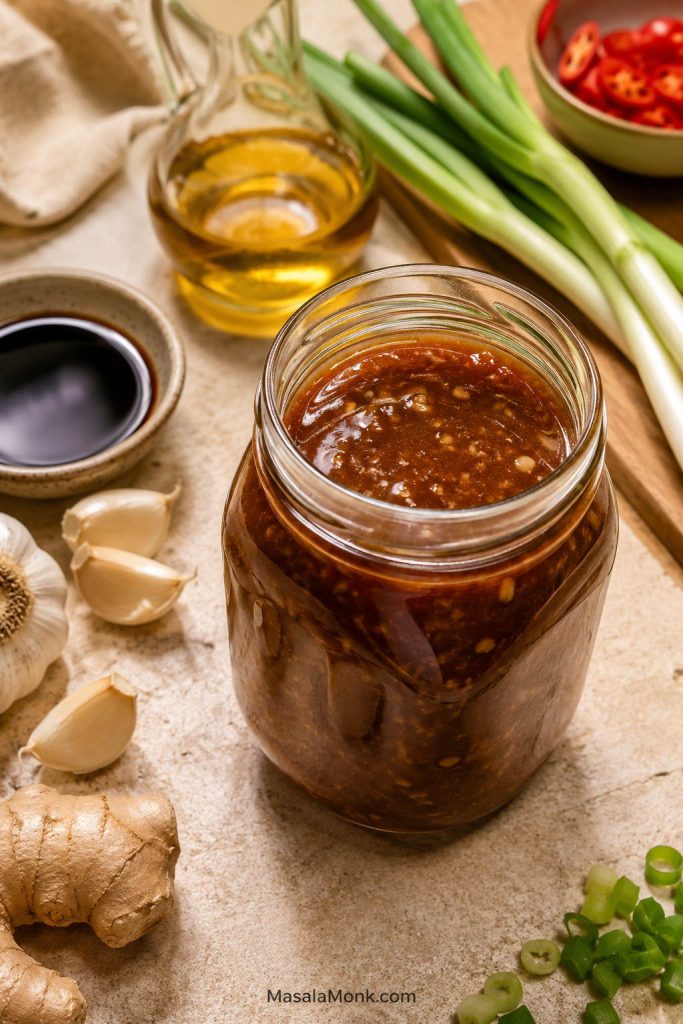
Black enamel pot with steam and soaked basmati; soak 20–30 min, boil → cover → low 10–12, rest 10; 1:1.5 water.
Perfect Basmati Rice: Rinse well, soak 20–30, drain thoroughly, boil → cover → low 10–12, rest 10. Ratio 1 cup : 1½ cups water.
  1. Rinse very well until the water is almost clear—this usually takes 2–3 changes.
  2. Soak 20–30 minutes. Hydrating the core ensures the grains elongate without bursting. Drain thoroughly.
  3. Use 1½ cups water per cup of rice on the stovetop. Bring to a boil, cover, reduce to low, and simmer 10–12 minutes.
  4. Rest 10 minutes covered, then fluff. For even airier grains, spread the rice on a tray for 2–3 minutes to vent.

Beyond texture, many cooks pick basmati for its gentler impact on blood sugar compared with some other white rices. If that angle matters to you, explore a compact primer on basmati rice GI and nutrition and a broader look at GI vs GL across rice types. Because context helps, you might also skim a practical guide to reducing the glycemic impact of rice using cook-cool-reheat strategies you can fold into weekly meal prep.

How to Cook Perfect Jasmine Rice

Jasmine sits between fluffy and plush. It wants slightly less water than standard long-grain; too much and it edges toward soft and clingy.

Black enamel pot with steaming jasmine rice; no soak needed; 1¼–1⅓ water; boil, cover, low ~12, rest 10.
Jasmine Rice (Stovetop): Slightly less water than standard long-grain keeps jasmine plush—not soggy.
  • Rinse until the water mostly clears; an optional 10-minute soak can soften the core.
  • Measure 1¼–1⅓ cups water per cup of rice, depending on how dry or tender you prefer it.
  • Cook like the baseline: boil → cover → low simmer ~12 minutes10-minute rest.

For a ratio-first discussion that aligns with testing across brands, skim this practical stovetop jasmine/white rice method. It mirrors the idea that jasmine benefits from slightly less water than old “2:1” rules of thumb.

Also Read: Green Tea Shot with Jameson | Recipe & 10 Variations

How to Cook Perfect Rice for Sushi (Short-Grain)

Sushi rice is meant to cling. Nevertheless, the goal is glossy and supple—not mushy—so gentle handling and proper seasoning matter.

Hangiri filled with glossy sushi rice; rinse and soak 20–30 minutes, boil then cover and cook on low with ~1.1–1.2:1 water; rest 10 minutes and season warm.
Perfect Sushi Rice: Rinse, soak 20–30 min, cook with ~1.1–1.2 : 1 water, rest 10, then season while warm for shine and gentle cling.
  1. Rinse until the water is nearly clear to remove powdery starch.
  2. Soak 20–30 minutes; drain. This gives the short grains an even, tender finish.
  3. Use ~1.1–1.2 : 1 water to rice on the stovetop or your cooker’s dedicated “sushi” line.
  4. Cook, rest 10 minutes, then season while warm with sushi vinegar (rice vinegar plus sugar and salt).
  5. Fold, don’t mash. Fan as you cut and turn the rice to keep grains intact and shiny.

For well-illustrated steps and classic proportions, follow a reliable reference like Just One Cookbook’s sushi rice method. And because short-grain techniques differ from long-grain instincts, returning to photos mid-process can be surprisingly helpful.

Also Read: Béchamel Sauce for Lasagna: Classic, Vegan & Ricotta Sauce Recipe

How to Cook Perfect Brown Rice (Tender Without the Chalk)

Brown rice asks for more water and time because the bran and germ slow hydration. Still, done right, it’s deeply satisfying—nutty, chewy, and never chalky.

Cast-iron pot of cooked brown rice; stovetop absorption method—rinse, 2–2¼ cups water per cup rice, boil then cover and low simmer 35–45 minutes, rest 10.
Brown Rice (Stovetop): Rinse well, use 2–2¼ : 1 water, boil → cover → low simmer 35–45, then rest 10 for nutty, tender grains.
  • Stovetop: Use 2–2¼ : 1 water to rice. Bring to a boil, cover, and simmer 35–45 minutes until the water is absorbed; rest 10 minutes before fluffing.
  • Instant Pot: Measure 1.25–1.33 : 1 water to rice. Cook 22–25 minutes on high pressure, then let it naturally release for 10 minutes before venting.

If nutrition is part of your decision tree, it’s worth reading the FDA’s consumer resources on arsenic in rice and rice products and the agency’s technical risk assessment overview. Among practical takeaways, an excess-water method (boil in plenty of water, then drain) can reduce inorganic arsenic—a trade-off to consider if that aligns with your health priorities. Meanwhile, if you’re comparing grains for weekly menus, this side-by-side look at quinoa vs rice is a handy complement.

Also Read: Crock Pot Lasagna Soup (Easy Base + Cozy Slow-Cooker Recipes)

Rice Cookers Demystified

A good rice cooker is like cruise control: set it and focus on something else. Still, understanding its logic helps you get the most out of it.

  • Trust the lines. Most cookers calibrate for specific varieties; fill to the marked lines instead of relying on generic kitchen ratios. If you want brand-specific guidance, browse Zojirushi’s concise white rice instructions or the broader manuals page.
  • Rinse and drain well. Excess water clinging to the grains can skew the cooker’s assumptions.
  • Let it rest. When the switch flips to “warm,” give the rice 10 minutes before opening; this small pause improves texture noticeably.
  • Fluff and vent briefly. Loosen the rice, then leave the lid ajar for a minute or two for drier, separate grains—especially useful when the next stop is a stir-fry.

Even in the cooker, basmati appreciates a 20–30-minute soak and jasmine benefits from slightly less water than standard long-grain. Sushi rice, on the other hand, thrives when you follow your model’s dedicated short-grain settings.

Also Read: Cottage Cheese Lasagna Recipe | Chicken, Spinach, & Ricotta

Instant Pot and Pressure Cooker Shortcuts

Pressure cookers shine when you want predictability. Because they operate in a sealed environment, small ratio changes matter; nevertheless, the results are consistent once dialed in.

  • White rice (long-grain or jasmine): 1:1 water to rice, 3–4 minutes on high pressure, 10-minute natural release.
  • Basmati: 1:1, 6 minutes on high, 10-minute natural release.
  • Short-grain for sushi: 1:1, 5 minutes on high, 10-minute natural release.
  • Brown: 1.25–1.33:1, 22–25 minutes on high, 10-minute natural release.

For model-specific variations, it’s wise to refer to the manufacturer’s documentation; start at the Instant Pot manuals hub and, if you want a baseline reference recipe, browse an official white rice example by Instant Pot. Because factors like altitude and personal texture preference play a role, adjust subsequent batches a tablespoon or two of water at a time rather than reinventing ratios from scratch.

Also Read: How to Make Churros (Authentic + Easy Recipe)

Texture Control: From Feather-Light to Just-Sticky-Enough

Understanding what affects texture allows you to steer the outcome. Consider these levers:

  • Rinse level. More rinsing = more separation. Minimal rinsing = more cling. Consequently, long-grain white benefits from thorough rinsing; sushi demands cleaning but then recruits seasoning to achieve stickiness.
  • Soaking. Basmati and sushi gain even doneness from soaking; jasmine may soften slightly with a short soak but doesn’t require it.
  • Agitation. Stir only once after adding rice to boiling water; further agitation releases starch, which binds grains.
  • Lid discipline. Steam is your friend; lifting the lid mid-cook vents heat, lengthens cooking, and risks uneven texture.
  • Rest time. A 10-minute rest evens moisture and turns “good” rice into “great” rice. Additionally, a towel-under-lid rest (during the off-heat phase) curbs condensation and keeps the top layer from turning soggy—see the towel trick for a quick demo.

Also Read: How to Cook Bacon in the Oven (Crispy, No-Mess, Crowd-Ready Recipe)

Scaling Up Without Guesswork

Perhaps you’re cooking for a crowd. Fortunately, the math scales cleanly as long as your pot is wide enough and the heat stays gentle.

  • 1 cup rice → 1½ cups water (stovetop long-grain white)
  • 3 cups rice → 4½ cups water
  • 4 cups rice → 6 cups water

For jasmine, aim for 1¼–1⅓ : 1; for basmati, 1½ : 1 with a soak; for brown, 2–2¼ : 1 on the stove or 1.25–1.33 : 1 under pressure. Rather than leap to big changes when scaling, adjust by 2–3 tablespoons of water per cup of rice after your first larger batch to match your stove, pot, and preference.

Also Read: French Toast Sticks (Air Fryer + Oven Recipe) — Crispy Outside, Custardy Inside

Storing, Cooling, and Reheating Safely

Rice is easy to make ahead, but it deserves the same diligence you’d give to chicken or soup. Cool it quickly, refrigerate promptly, and reheat thoroughly.

  • Cool fast. Spread hot rice on a sheet pan to release steam; once warmth dissipates, pack into shallow containers.
  • Refrigerate within 1–2 hours. The quicker you chill, the safer your leftovers.
  • Reheat to 165°F/74°C. In the microwave, sprinkle a tablespoon of water over each cup of rice, cover, and heat until piping hot; on the stovetop, add a spoonful of water and steam briefly. For authoritative guidance, bookmark the USDA’s page on leftovers and safe reheating.

If you’re exploring broader nutrition or contaminant questions around rice varieties and cooking methods, take a moment with the FDA’s resources on arsenic in rice and products. They’re balanced, practical, and help you decide when to use absorption versus excess-water techniques.

Also Read: 10 Best Chicken Sandwich Recipes (BBQ, Parm, Buffalo & More)

How to Cook Perfect Rice on Busy Weeknights

Life happens. Even so, you can still put excellent rice on the table without hovering over a pot.

  • Use the Instant Pot for white rice when you’re juggling multiple dishes. Measure 1:1, set 3 minutes on high, and walk away; dinner’s starch will be ready right as you need it.
  • Batch-cook basmati on Sunday. Soak, cook, fluff, cool quickly, and refrigerate. Basmati reheats beautifully and still eats light.
  • Lean on a rice cooker for hands-off consistency. Follow the model’s lines, then give it a 10-minute warm rest before fluffing. If you’re new to your machine, the brand’s manuals page is a shortcut to specifics.

Meanwhile, finishers make weeknight rice feel special: a pat of butter or ghee, a thread of olive oil, or a splash of toasted sesame oil right before serving. Even a few slices of ginger bloomed in oil at the start can transform a plain bowl.

Also Read: 10 Best Espresso Martini Recipe Variations (Bar-Tested)

Flavor Boosters and Simple Add-Ins

Before adding water, briefly warm 1 teaspoon oil or ghee in the pot and bloom aromatics—sliced garlic, crushed cardamom, or a bay leaf. During the rest, fold in chopped herbs (cilantro, scallions, or dill) or a handful of frozen peas for color. As you explore, keep a few ideas in your back pocket:

  • For an almost effortless rice bowl, toss hot grains with a splash of balsamic and olive oil, then crown with roasted vegetables. It’s a fast route to a satisfying dinner when time is scarce.
  • When a craving for dessert strikes, pivot to a silky Thai-style treat using coconut milk and ripe fruit—this approachable walkthrough on mango + coconut milk turns pantry items into a crowd-pleaser: creamy mango-coconut how-to. If you want a festival-worthy finish with sticky rice, try the kitchen’s fully detailed authentic mango sticky rice recipe.

Also Read: Macaroni & Cheese Recipe: Creamy Stovetop, Baked & Southern

Leftovers You’ll Look Forward To

Great rice rarely goes to waste, but planning for leftovers turns tomorrow’s meal into an easy win.

Same-Day Fried Rice (When You Just Cooked the Rice)

When fried rice is on tonight’s menu, lower the water for your white rice by 2 tablespoons per cup, then spread the cooked rice on a tray and chill it for 15–20 minutes. This brief drying step helps the grains sear rather than steam in the pan. For a crisp, minimal baseline, use a straightforward, wok-friendly technique like this classic egg fried rice walkthrough. If you prefer a vegetable-forward version loaded with texture, Kenji’s method-first approach shows how to balance heat, oil, and moisture for vivid results: easy vegetable fried rice.

Also Read: Vegan French Toast: 6 Easy Recipes (Pan, Air Fryer, GF & High-Protein)

Day-Old Transformations

Day-old rice is ideal for fried rice, obviously, yet it also shines in croquettes and stuffed vegetables. For a snack that feels special, use those leftovers to make crisp, melty arancini; the step-by-step guide to shaping, breading, and frying is here: turn leftover rice into arancini. Serve with a quick marinara or a garlicky yogurt dip and you’ve got a win either way.

How to Cook Perfect Rice for Meals that Fit Your Goals

If you’re mindful of post-meal energy or simply tracking macros, small technique choices can help. Cooling and reheating can modestly increase resistant starch, while your choice of variety matters too. For a practical, non-dogmatic overview that connects kitchen moves to outcomes, start with this field guide to reducing the glycemic impact of rice. For a zoomed-out look across varieties and contexts, the side-by-side on GI vs GL for common rices is useful; pair it with the FDA resources on arsenic in foods if you’re choosing methods with both texture and safety in mind.

Also Read: Homemade Electrolytes for Fasting: 7 Precise Recipes

Frequently Used Ratios and Timings, Explained in Plain Language

Because recipes scatter numbers everywhere, let’s unify the essentials so you can adjust confidently.

  • Long-grain white (stovetop): 1.5 : 1 water → 12-minute simmer, 10-minute rest. This yields about 3 cups cooked per cup raw.
  • Jasmine (stovetop): 1¼–1⅓ : 1 water → 12 minutes, 10-minute rest; tenderness sits between fluffy and plush. A thorough overview appears in this tested stovetop ratio piece.
  • Basmati (stovetop): 1.5 : 1 water after a 20–30-minute soak10–12 minutes, 10-minute rest; texture is light and separate. For health context, see the basmati GI briefing.
  • Sushi/short-grain: ~1.1–1.2 : 1 water after a 20–30-minute soakcook + 10-minute rest, then season gently; technique photos here: sushi rice guide.
  • Brown (Instant Pot): 1.25–1.33 : 1 water → 22–25 minutes high pressure, 10-minute natural release; for stovetop, plan 2–2¼ : 1 water and 35–45 minutes simmer time.
  • Rice cooker: Follow the unit’s water lines for your variety; it’s the design assumption. If you’re curious how manufacturers expect you to use those markings, peek at Zojirushi’s white rice instructions and their manuals page.

Also Read: Pumpkin Spice, Your Way: Master Blend, Variations & Real-World Recipes

Troubleshooting: Fix It Today, Improve It Tomorrow

Even experienced cooks occasionally miss by a little. Here’s how to correct in the moment and calibrate for next time.

  • Too wet or soft? You likely used too much water or lifted the lid. Spread the rice on a tray and let it vent for a few minutes; next time, reduce the water by 2–3 tablespoons per cup and resist peeking.
  • Undercooked in the center? Sprinkle over 2–4 tablespoons of hot water, cover, and cook on the lowest heat for 3–5 minutes; extend the rest before fluffing.
  • Starchy clumps? Rinse more thoroughly and avoid stirring after the initial boil. If you want extra separation, adopt the towel-under-lid rest technique—again, the quick explainer for that move is here: how the towel rest helps.
  • Scorched base? The heat was too high or the pot too thin. Use a heavier pan, lower the flame, and keep ratios consistent.
  • Basmati breaking? The soak ran too long or you stirred during the simmer. Keep the pre-cook soak to 20–30 minutes, then handle gently.

Because kitchens vary—burners, pots, even the mineral content of your water—log your favorite ratio the first time you nail it. From then on, you’re just repeating success.

Also Read: Homemade & DIY Coffee Creamer: 16 Flavor Recipes (French Vanilla, Pumpkin Spice & More)

How to Cook Perfect Rice, Then Make It Sing

Mastering the basics is liberating. Once you can produce perfect rice without thinking, it becomes a canvas for flavor.

  • Ghee and cumin (jeera rice). Warm a spoon of ghee, bloom cumin seeds until fragrant, then add cooked rice to coat.
  • Ginger-garlic steam. Start the pot with a few slices of ginger and a crushed clove of garlic before adding water; the aroma perfumes the whole batch.
  • Pandan or bay leaf. Add either to the pot and retrieve before fluffing for a subtle, sophisticated note.
  • Coconut finish. Fold a splash of coconut milk into hot rice for a plush side that loves grilled fish and veggies.
  • Curd rice twist. For cooling comfort, stir yogurt, mustard seeds, and a little tempering into leftover rice; if you want a vivid variation, the beet-brightened take is here: curd rice with beetroot.

Meanwhile, when you want a sweet ending, keep it simple: ripe mango, creamy coconut milk, and warm rice are an unbeatable trio; the pantry-friendly method is spelled out in this mango + coconut milk guide, and for a celebration-level classic, make the authentic mango sticky rice.

Also Read: Classic vs. Authentic Alfredo: 5 Essential Recipes

Putting It All Together

At this point, how to cook perfect rice should feel far less mysterious. Start with the baseline stovetop method—rinse, 1.5 : 1 water, 12-minute simmer, 10-minute rest—and you’ll win most nights. For basmati, soak briefly and keep the water at 1.5 : 1. If its jasmine, dial water down to 1¼–1⅓ : 1. For sushi, rinse thoroughly, soak, and season gently after cooking. And when cooking brown, commit to more time or use pressure for convenience. When using machines, trust rice cooker lines and lean on manufacturer documents like Zojirushi’s manuals or the Instant Pot manuals hub. For nuanced texture, adopt the towel-under-lid rest demonstrated in the towel trick explainer.

Finally, keep your leftovers safe and delicious: cool quickly, refrigerate promptly, and reheat to 165°F/74°C, following the USDA’s guidance on leftovers and safe reheating. Then have some fun—turn a bowl into egg fried rice with this reliable wok-side walkthrough, go veg-heavy with Kenji’s stir-fry method, or roll day-old grains into golden arancini.

When a staple tastes this good and works this reliably, dinner stops being a question mark. It becomes a rhythm: measure, simmer, rest, fluff—and enjoy.


Also Read: Lemon Drop Martini Recipe (Classic, 3-Ingredient, & More)

FAQs

1) How to cook perfect rice on the stove without it getting mushy?

Rinse until the water runs mostly clear, then use a precise water-to-rice ratio (typically 1.5:1 for long-grain white). Bring to a boil, cover, reduce to low, simmer about 12 minutes, and let it rest covered for 10 minutes before fluffing. Consequently, grains stay separate and tender.

2) What is the best water-to-rice ratio for white rice?

Generally, long-grain white rice thrives at about 1.5 cups water per 1 cup rice on the stovetop. For slightly drier rice, reduce the water by 2–3 tablespoons per cup; for softer results, add the same amount. Thus, you can fine-tune texture to taste.

3) How long does it take to cook rice?

For white or jasmine rice on the stove, expect roughly 12 minutes of gentle simmering plus a 10-minute rest. Brown rice usually needs 35–45 minutes on the stove. Meanwhile, pressure cooking shortens the timeline considerably.

4) How to cook perfect rice in a rice cooker?

Rinse, drain well, and fill water to your cooker’s variety line (or use the same ratios you’d use on the stove). Start the cycle, then allow a 10-minute warm rest before you open. Afterwards, fluff and briefly vent for drier, separate grains.

5) How to cook perfect rice in an Instant Pot or pressure cooker?

Use a 1:1 ratio for most white rices (3–4 minutes high pressure, 10 minutes natural release). For basmati, still 1:1 but about 6 minutes high; for brown, 1.25–1.33:1 and 22–25 minutes high. Importantly, let pressure drop naturally before venting for the best texture.

6) How much water for jasmine rice?

Jasmine prefers slightly less water than standard long-grain: about 1¼–1⅓ cups water per cup of rice on the stovetop. Moreover, an optional 10-minute soak softens the core without making it soggy.

7) How to make basmati rice fluffy and long?

Rinse thoroughly, soak 20–30 minutes, drain well, then cook at roughly 1.5:1 water to rice. Keep heat low and the lid tight; rest 10 minutes. Consequently, grains elongate beautifully without breaking.

8) Do I need to soak rice?

Not always. Basmati and sushi benefit from soaking (20–30 minutes) for even doneness. Conversely, most long-grain white and jasmine work fine without soaking, though a brief soak can soften edges slightly.

9) How to cook perfect rice for sushi (short-grain)?

Rinse until nearly clear, soak 20–30 minutes, drain, then use about 1.1–1.2:1 water. Cook gently, rest 10 minutes, and season warm rice with a vinegar mixture while folding—never mashing. Hence, you get glossy, clinging grains.

10) How to keep rice from sticking together?

Rinse thoroughly to remove surface starch, avoid stirring once it returns to a simmer, and let it rest before fluffing. Additionally, use a heavy pot and steady low heat so the bottom doesn’t scorch and glue the batch.

11) How to make fluffy rice every time?

Measure accurately, keep the simmer gentle, and give that 10-minute covered rest. Likewise, a quick post-cook vent (lid off 2–3 minutes) drives off excess steam for lighter, more separate grains.

12) How much water for 1 cup, 3 cups, or 4 cups of rice?

For long-grain white on the stove, start at 1.5:1. That’s 1.5 cups water for 1 cup rice; 4.5 cups water for 3 cups rice; 6 cups water for 4 cups rice. Notably, different varieties may require small adjustments.

13) How to cook perfect brown rice that isn’t chalky?

Use 2–2¼ cups water per cup on the stove (35–45 minutes simmering), or 1.25–1.33:1 in a pressure cooker (22–25 minutes high). Afterward, rest 10 minutes before fluffing to let moisture even out.

14) Can I make rice in the microwave?

Yes. In a microwave-safe bowl or microwave rice cooker, use about 1.5:1 for white rice. Cook on high 10–12 minutes for 1 cup (your microwave may vary), rest 5 minutes covered, then fluff. Remarkably convenient for small batches.

15) How to cook perfect rice for fried rice the same day?

Cook white rice with 2 tablespoons less water per cup, spread it on a tray, and chill 15–20 minutes to dry. Thereafter, stir-fry over high heat with minimal moisture so the grains sear rather than steam.

16) Why is my rice gummy or clumpy?

Usually, either insufficient rinsing, too much water, or stirring after boiling. Reduce water slightly, rinse more, and avoid agitation during the simmer. Ultimately, a calm pot yields cleaner texture.

17) Why is the bottom of my rice pot scorched?

Heat was too high, the pot too thin, or water too low. Next time, use a heavier pot, lower the flame, and follow proven ratios. Furthermore, never lift the lid during the cook, which can trigger uneven heating.

18) How to reheat rice so it tastes fresh?

Add a spoonful of water, cover, and steam until piping hot (microwave or stovetop). Break up clumps gently with a fork halfway through. Consequently, grains regain moisture without turning soggy.

19) How to boil rice vs. steam/absorption—what’s the difference?

Boiling in excess water and draining offers forgiving doneness but slightly less aroma retention; absorption (our standard method) locks flavor in the pot and produces fluffier texture. Nevertheless, both work—choose based on preference and variety.

20) How to cook perfect rice if my tap water is hard or soft?

Hard water can firm grains; soft water can push them toward mushy. Therefore, if your batches are consistently too firm, add a tablespoon or two of extra water per cup; if too soft, subtract the same amount.

21) How to make plain rice taste great without heavy sauces?

Bloom a teaspoon of ghee or oil with aromatics (garlic, ginger, cumin, bay, or pandan) before adding rice and water. Then, finish with butter or toasted sesame oil and a pinch of salt. Instantly more character, minimal effort.

22) Is “balsamic rice” the same as basmati rice?

Often it’s a typo or mishearing of “basmati.” However, if you literally want balsamic-glazed rice, toss hot cooked white rice with a little balsamic and olive oil, then season. Simple, bright, and surprisingly good.

23) How to cook perfect rice when doubling or tripling a recipe?

Scale water linearly (keep the same ratio) and use a wider pot so steam circulates evenly. Keep the simmer gentle and extend the rest by a couple of minutes. Consequently, larger batches finish evenly without soggy centers.

24) Should I salt the water for rice?

Yes—seasoning the water yields rice that tastes good on its own. Start with about ½ teaspoon fine salt per cup of raw rice. Alternatively, swap some water for light broth if you prefer layered flavor.

25) How to store cooked rice safely?

Cool quickly in shallow containers, refrigerate promptly, and eat within a few days. Reheat until steaming hot. As a result, you keep texture appealing while maintaining good food safety habits.

26) How to cook perfect rice when I want it extra dry?

After the 10-minute rest, fluff and leave the lid off for 2–3 minutes to vent steam. Alternatively, reduce water by 1–2 tablespoons per cup of rice next time. Subtle tweaks deliver a distinctly lighter bite.

27) What’s the difference between jasmine and basmati in cooking?

Jasmine leans softer and uses a touch less water; basmati prefers a soak and keeps a firmer, longer grain with a standard 1.5:1 ratio. Consequently, match your technique to the variety for best results.

28) How much rice per person should I cook?

As a side, plan ¼–⅓ cup raw rice per person (about ¾–1 cup cooked). For rice-centric meals or big appetites, move toward ½ cup raw per person. Naturally, leftovers are easy to repurpose.

29) How to cook perfect rice with oil or butter—before or after?

Either works. A teaspoon of fat before cooking blooms aromatics and improves mouthfeel; a small knob after cooking adds gloss and flavor. Nevertheless, keep amounts modest so grains don’t turn heavy.

30) Can I skip rinsing?

You can, but expect more stickiness, especially with long-grain white. For fluffy, non-sticky results, rinsing pays off. Even so, for sushi, you’ll still rinse—then you’ll deliberately add seasoning to achieve cling by design.