Chia pudding has a way of sneaking into your routine and then refusing to leave. At first, it feels like a clever trick—stir a few spoonfuls of tiny seeds into milk, refrigerate, and wake up to a spoonable pudding. Before long, though, you realize a simple jar of low carb chia pudding can be more than a trend: it’s a dependable breakfast that doesn’t demand morning effort, a snack that travels well, and a dessert-like bowl that still fits a lighter day.
Why chia pudding works as breakfast, snack, and “healthy dessert”
What makes it especially useful is how easily you can shape it around your cravings. Some mornings you’ll want something light and clean—pudding with almond milk, a little vanilla, and berries. Other times, you’ll prefer a thick, creamy version that leans on Greek yogurt and tastes closer to cheesecake filling. And when your sweet tooth shows up, chocolate chia pudding, cacao chia pudding, or chocolate peanut butter chia seed pudding can feel genuinely comforting without tipping into a sugar spiral.
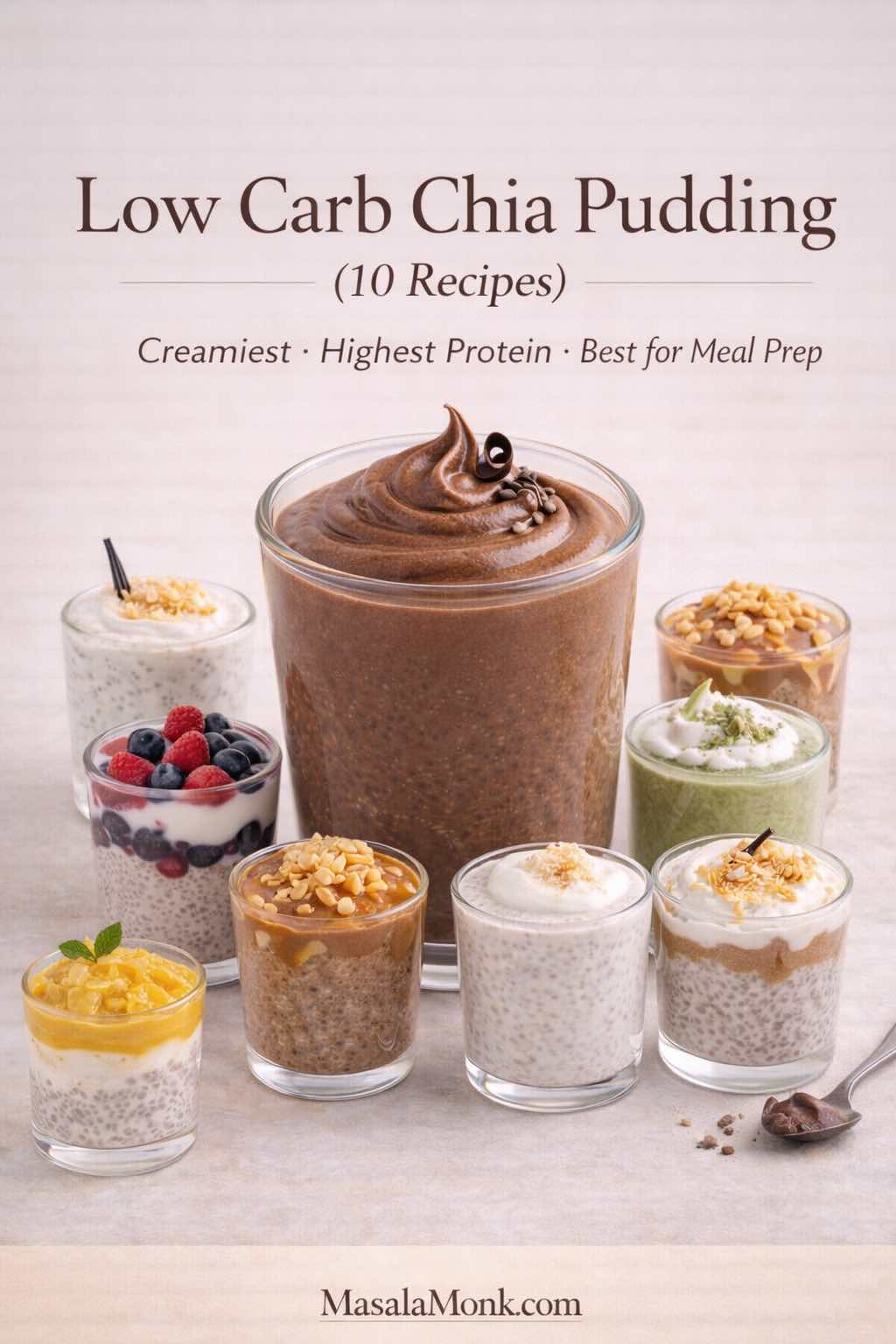
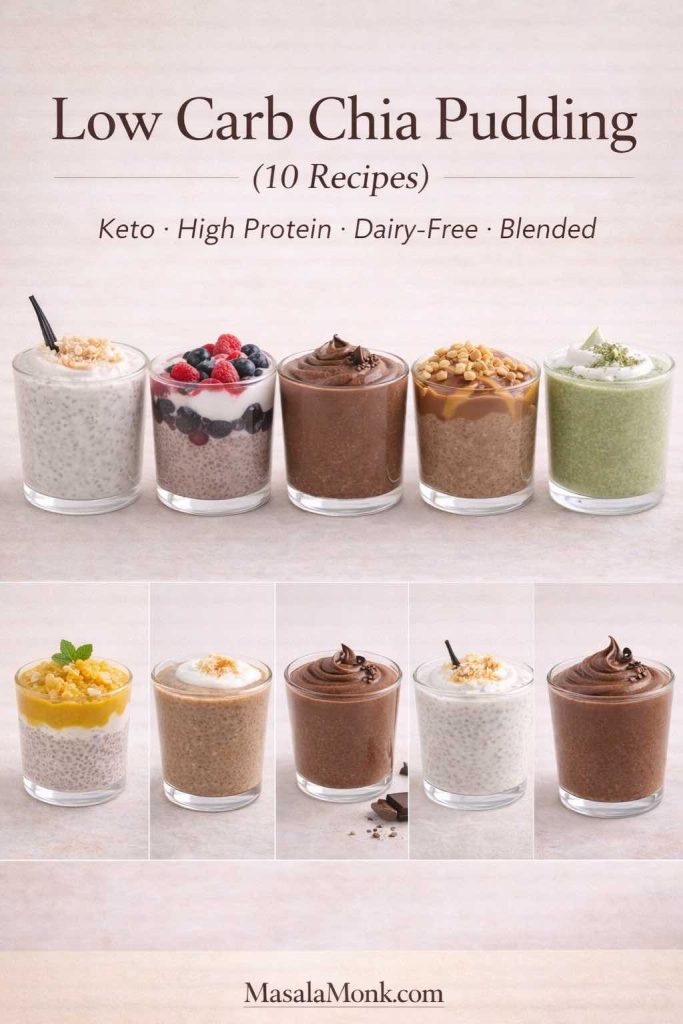
All 10 low carb chia pudding recipes featured in this post at a glance—creamy keto cups, high protein Greek yogurt jars, dairy-free options, fruit layers, and blended mousse for a smooth pudding texture.
Equally important, chia pudding adapts to different eating styles without forcing you into one “right” way. If you’re leaning keto, coconut milk makes a rich keto pudding base while sweetness stays minimal. If you’re aiming for a paleo-friendly bowl, you can skip dairy and still get a creamy texture with coconut milk or almond milk plus nut butter. Meanwhile, if you’re chasing a higher-protein breakfast, chia pudding with protein powder—or a low carb chia pudding with Greek yogurt—turns the jar into something that feels like a real meal.
If you want a deeper foundation on how chia fits into weight-loss habits—portions, consistency, and simple ways to keep it effortless—this companion guide is worth a read: The Ultimate Guide to Chia Pudding for Weight Loss.
Now, before we jump into the ten best variations, let’s lock in the base. Once you get the ratio and texture right, every flavor becomes easier, smoother, and more repeatable.
Low Carb Chia Pudding for Weight Loss: Why It Works So Well
For weight loss, the best breakfasts explain themselves later—when you realize you didn’t spend the whole morning thinking about snacks. That’s exactly where low carb chia pudding shines: it’s simple, satisfying, and surprisingly good at keeping your appetite calm between meals.
Why chia pudding keeps you full longer
Chia helps in a very practical way: when it hydrates, it turns your milk into a thick, spoonable gel. Because of that texture, you naturally eat more slowly, and the jar tends to feel more substantial than it looks—especially compared to breakfasts that disappear in three bites.
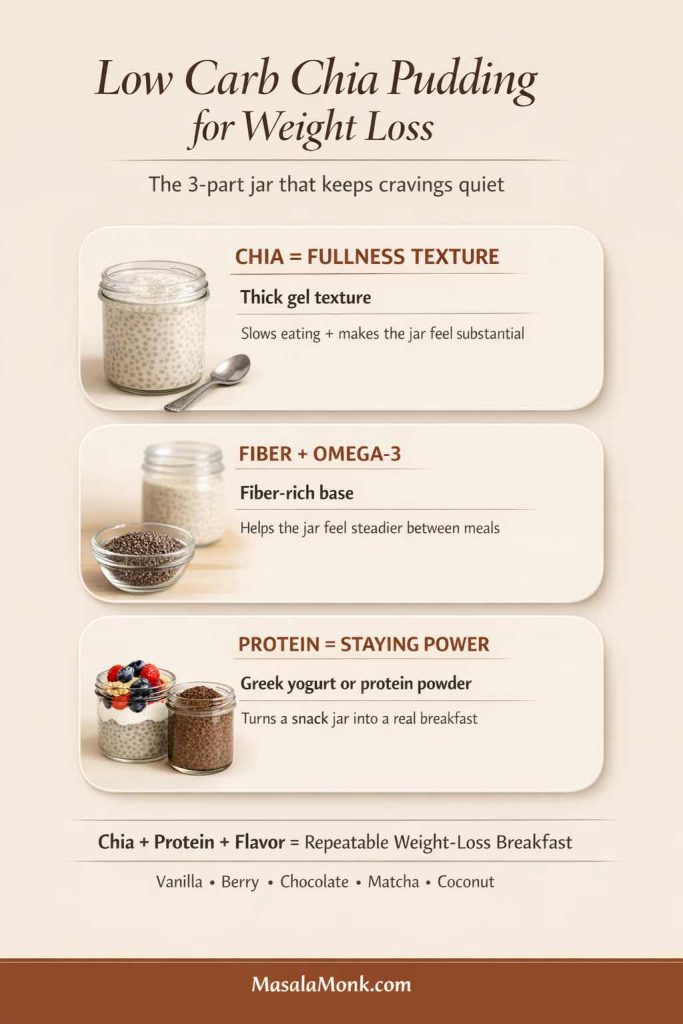
Why low carb chia pudding works so well: the gel texture slows eating, fiber helps the jar feel steadier between meals, and protein (Greek yogurt or protein powder) is the upgrade that turns it into a true breakfast—not just a snack.
At the same time, chia is naturally fiber-rich and contains omega-3 fats, which is part of why it’s such a popular base for a steady “grab-and-go” breakfast. If you want a clean, evidence-based overview, Harvard’s Nutrition Source has a helpful summary on chia seeds nutrition (fiber + omega-3). Then, if you like checking calories, macros, or serving-size details, you can cross-reference with the USDA chia seed nutrition data.
The real upgrade is protein
Still, satisfaction isn’t only about chia. Protein is the piece that makes a jar feel like a meal—which is why “pudding and Greek yogurt,” “chia seed and Greek yogurt pudding,” and “chia pudding with protein powder” are such common staples. When your breakfast includes a solid protein anchor, it tends to feel steadier and more complete, so you’re less likely to start grazing out of habit.
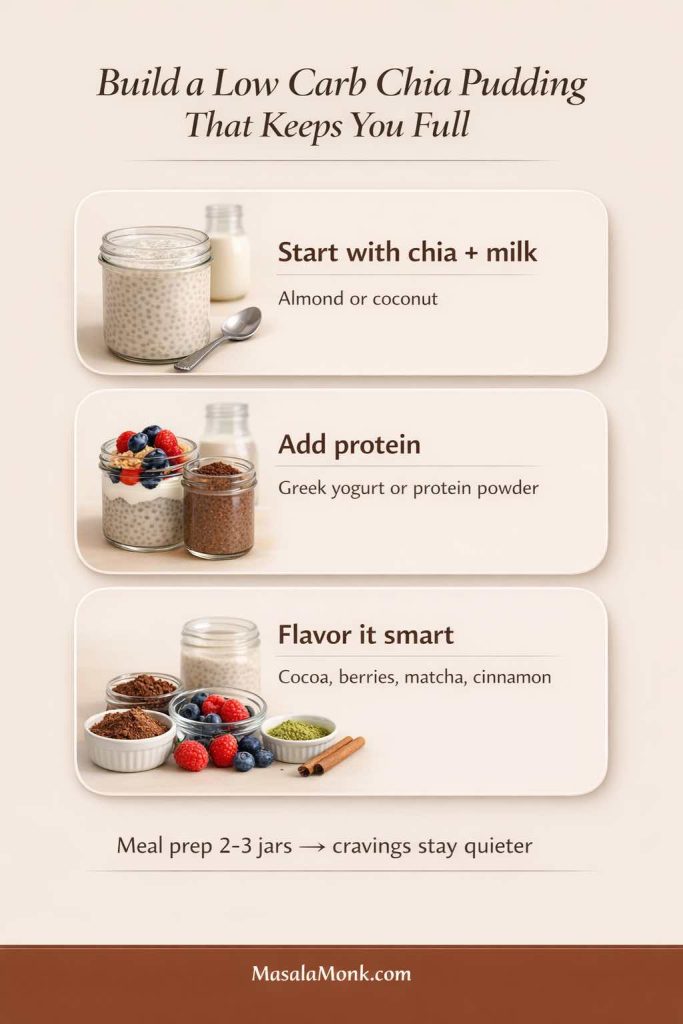
Use this quick builder to make low carb chia pudding feel “meal-level”: start with chia + milk, add protein (Greek yogurt or protein powder), then flavor it with cocoa, berries, matcha, or cinnamon. Prep 2–3 jars at once and you’ve got a simple routine that stays satisfying all week.
If your mornings often end with cravings, switching to a high protein & low carb chia pudding is one of the easiest upgrades: keep the chia base, then build in protein with Greek yogurt (thick and creamy) or protein powder (especially in chocolate versions). For a broader framework that pairs perfectly with a chia routine, this guide is a strong companion: how to eat 100 grams of protein a day.
So yes—chia helps. Even better, the best results usually come from the combination: chia for texture and fiber, protein for staying power, and flavor choices you genuinely look forward to eating.
Low Carb Chia Pudding Base Recipe (Perfect Ratio, No Clumps)
Everything starts here. Whether you’re making keto chia pudding, chia pudding paleo, dairy free chia pudding, or a blended chia pudding mousse, the base method stays the same.
The basic chia pudding ratio (and how to adjust it)
For a classic, spoonable base:
3 tablespoons chia seeds (about 36–40 g)
1 cup / 240 ml liquid (almond milk, coconut milk, dairy milk, oat milk, etc.)
A pinch of salt
Optional: ½ teaspoon vanilla
Optional: sweetener to taste
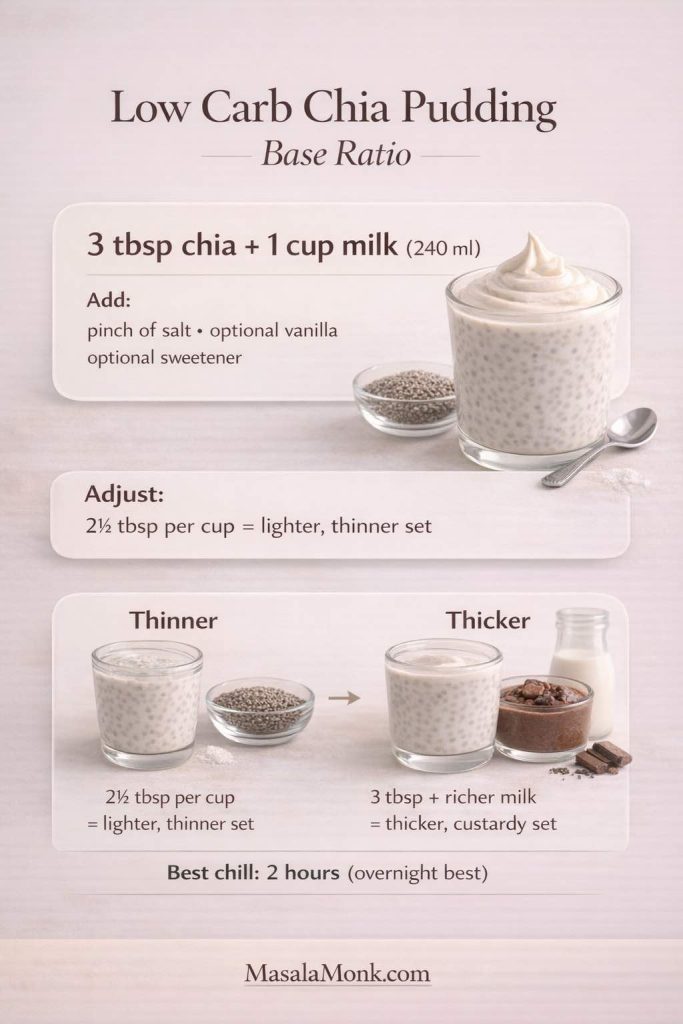
Here’s the dependable low carb chia pudding base ratio: 3 tablespoons chia to 1 cup milk (240 ml). Use 2½ tablespoons for a lighter set, or keep 3 tablespoons and switch to a richer milk (like canned coconut milk) for a thicker, custardy chia pudding—then chill at least 2 hours (overnight is best).
That ratio gives you a thick, pudding-like texture—great for low carb chia pudding cups, a chia pudding glass, or a single serve chia pudding jar. If you prefer it thinner, drop to 2½ tablespoons chia per cup of liquid. Conversely, if you like a dense, custardy texture, keep 3 tablespoons and use a richer liquid like canned coconut milk.
The mixing pattern that prevents clumps
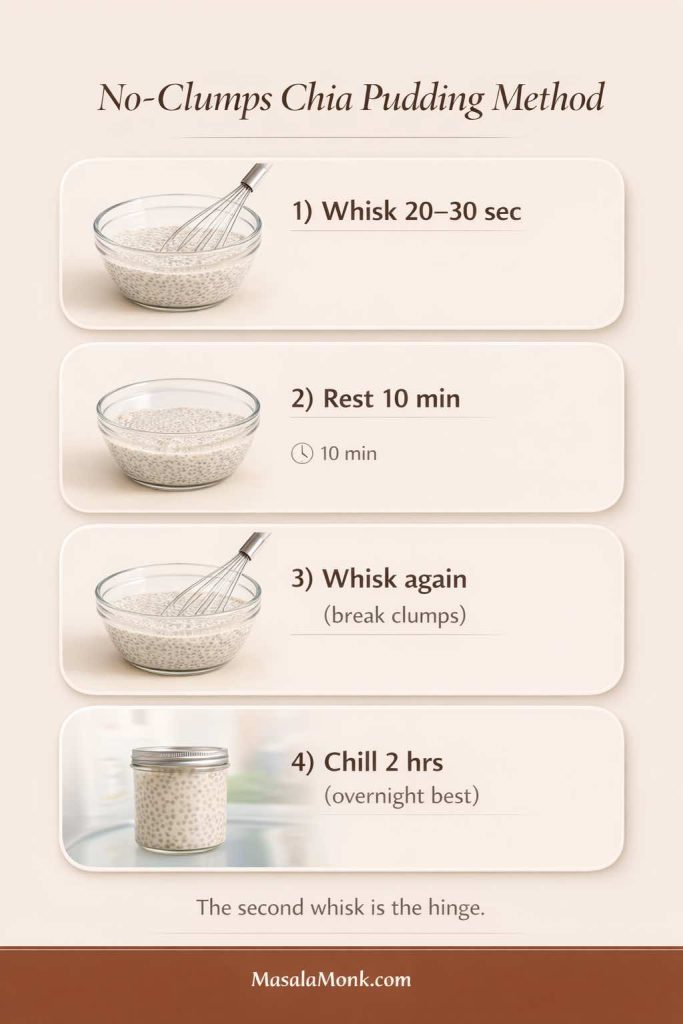
This is the method that makes the difference between “silky” and “why is it lumpy?”
Add chia seeds to the liquid, plus salt and vanilla (and sweetener, if using).
Whisk vigorously for 20–30 seconds.
Let it sit for 10 minutes.
Whisk again, thoroughly.
Cover and refrigerate at least 2 hours; overnight is even better.
That second whisk is the hinge. It’s the moment when the seeds have started to hydrate but haven’t fully set yet, which means you can break up clumps before they lock in.
If your chia pudding turns lumpy, this is the fix: whisk well, rest 10 minutes, then whisk again before chilling. That second whisk breaks clumps right when the seeds start hydrating—so your low carb chia pudding sets smooth, thick, and spoonable instead of bumpy.
Quick chia pudding vs “instant” chia pudding
Chia needs time to hydrate, so it’s never truly instant in the way instant oats are. Still, you can make a quick low carb chia seed pudding when you’re pressed for time.
Use the same ratio, whisk well, do the 10-minute stir, and refrigerate for 30–45 minutes. It will be softer than overnight, yet it’s still spoonable—especially if you make it as chia pudding with yogurt or add protein powder.
Why soaking matters
Chia expands dramatically when it absorbs liquid. Because of that, it’s best eaten soaked rather than dry. If you want the reason in plain terms, this clinical case report shows what can happen when dry chia is swallowed without enough liquid: why chia should be soaked first.
Choosing Your Liquid: Almond Milk, Coconut Milk, Oat Milk, and More
Liquid is the secret “ingredient” that decides whether your pudding tastes light, rich, tropical, or dairy-creamy. It’s also the easiest lever to pull depending on whether you’re going for keto pudding, paleo chia seed pudding, or a more classic breakfast pudding recipe.
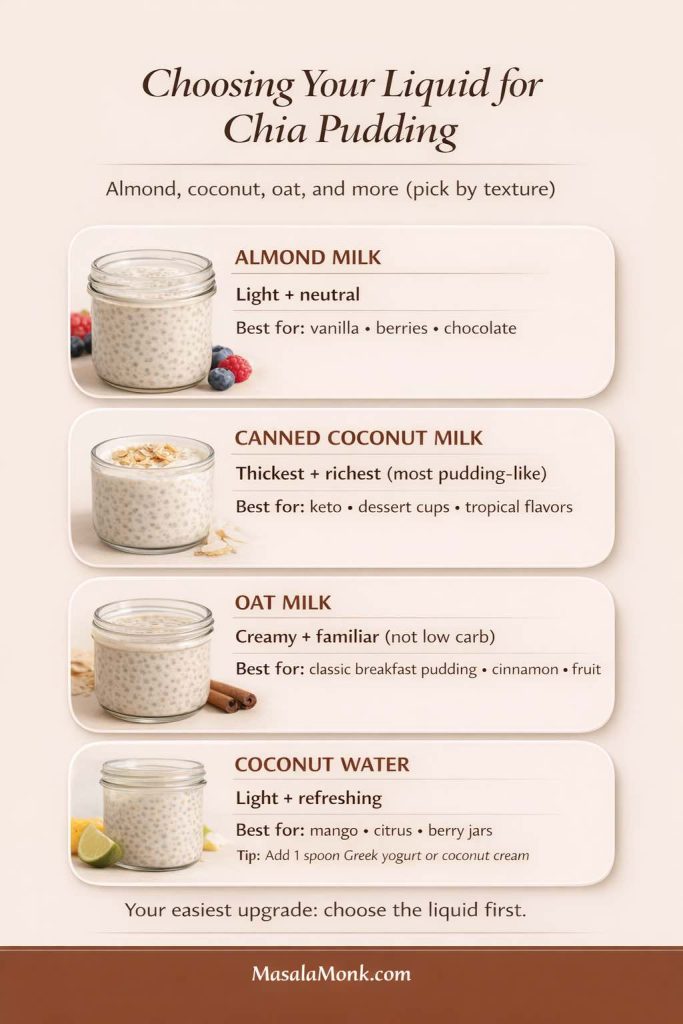
Your chia pudding texture is mostly decided by the liquid. Almond milk keeps it light and versatile, canned coconut milk makes the richest pudding-like set, oat milk gives a classic creamy breakfast feel (not low carb), and coconut water stays light and fruit-friendly—especially with a spoon of Greek yogurt or coconut cream.
Pudding with almond milk (clean, light, versatile)
Chia pudding with almond milk is a classic because it’s neutral and easy to customize. It’s also a natural base for low carb chia pudding and many keto-friendly variations. If you want a dedicated keto version built around almond milk, this is a strong reference recipe: keto chia pudding with almond milk.
Coconut milk for chia pudding (thickest texture, richest feel)
If you want your chia pudding to taste like real pudding, use canned coconut milk. It’s also a favorite for keto chia pudding coconut milk versions because the fat content naturally boosts satisfaction. For a paleo chia seed pudding approach, coconut milk is equally useful.
A small detail helps a lot here: canned coconut milk varies. Some are thin; others are thick. If yours pours like cream, whisk in a little water so it hydrates evenly. That way you avoid dense, under-hydrated pockets.
Oat milk chia pudding (not keto, but creamy and familiar)
Oat milk makes a gentle, classic pudding flavor. It’s not low carb, so it’s best as an optional variation for non-keto readers who still want a healthy breakfast pudding.
Chia pudding with coconut water (light, refreshing, fruit-friendly)
Coconut water makes a lighter gel. It’s lovely with mango, citrus, and berries; however, it won’t feel as creamy. For a richer texture, add a spoon of Greek yogurt or a spoon of coconut cream before serving.
Homemade vs Premade Chia Pudding (Cups, Mixes, and Convenience Options)
Sometimes you want the easiest option. That’s why premade chia pudding and premade chia seed pudding cups have become common grab-and-go items. A chia pudding cup can be a decent choice, especially if it keeps your day from derailing into ultra-processed snacks.
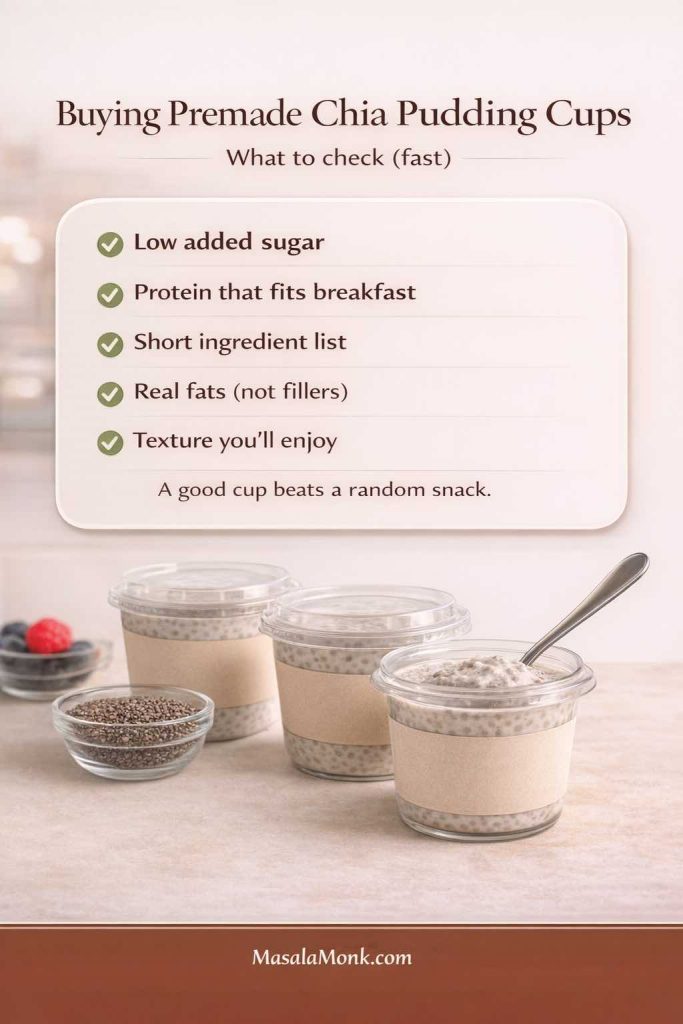
If you’re buying premade chia pudding cups, a quick label check makes all the difference: keep added sugar low, choose a protein amount that works for breakfast, aim for a short ingredient list, and skip filler-heavy cups. Most importantly, pick a texture you’ll actually enjoy—because the best chia pudding cup is the one you’ll happily grab again.
If you’re choosing store-bought chia seed pudding cups, prioritize:
low or no added sugar,
a protein amount that makes sense for breakfast (if you want it to act like breakfast),
a short ingredient list,
and a texture you actually enjoy.
If you prefer to keep things homemade but fast, a chia pudding mix can work too. Some mixes are simply chia plus flavoring; others include sweeteners and thickeners. Even then, the most repeatable path is often a simple base batch plus flavor add-ins—cocoa, cinnamon, matcha, vanilla, fruit—so you can make multiple chia seed pudding cups in one go.
High Protein Chia Pudding: Greek Yogurt, Protein Powder, and Collagen
When people talk about protein chia pudding, they usually mean one of three styles:
chia pudding with Greek yogurt
chia pudding with protein powder
chia collagen add-ins (often paired with yogurt)
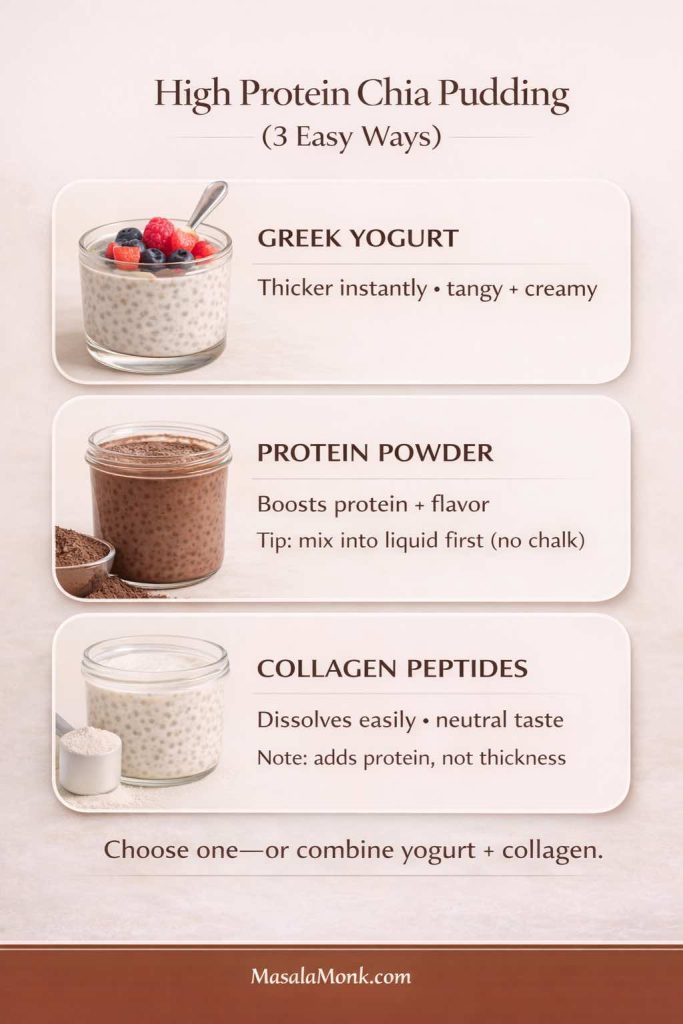
When you want high protein chia pudding, you’ve got three reliable routes: Greek yogurt for instant thickness and a creamy tang, protein powder for a bigger protein boost (best mixed into the liquid first so it stays smooth), or collagen peptides for an easy add-in that dissolves fast without changing flavor. Pick one—or combine yogurt + collagen for the most “meal-level” jar.
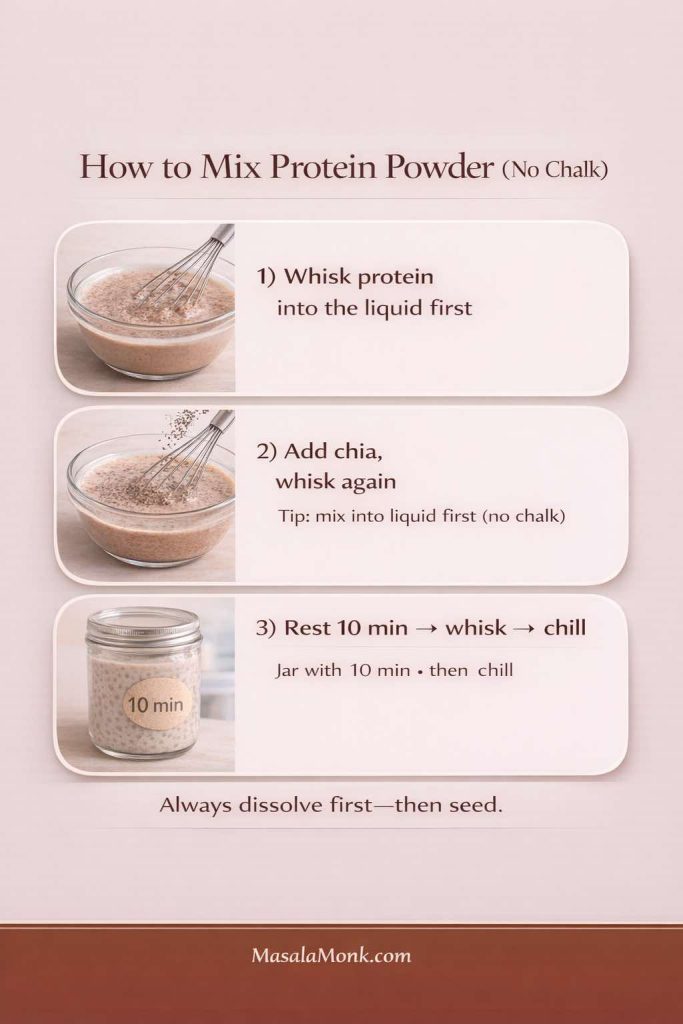
The easiest way to avoid chalky protein chia pudding is to dissolve protein powder in the liquid first, then add chia and whisk again. After a 10-minute rest, give it one more whisk before chilling—this keeps the jar smooth, thick, and spoonable instead of gritty.
Greek yogurt thickens pudding instantly and adds a tang that makes chocolate, berries, vanilla, and peanut butter taste richer. Protein powder boosts protein and flavor, but it can turn chalky if it isn’t mixed properly. Collagen peptides dissolve easily and tend to be neutral, although they don’t thicken the same way chia does.
Each recipe below makes 1–2 servings depending on appetite. For meal prep, multiply ingredients, then portion into chia pudding cups or jars. Meanwhile, if you’re building variety without extra work, make two or three bases at once: one almond milk jar, one coconut milk jar, and one Greek yogurt jar. That way, you’re never stuck eating the same flavor five days in a row.
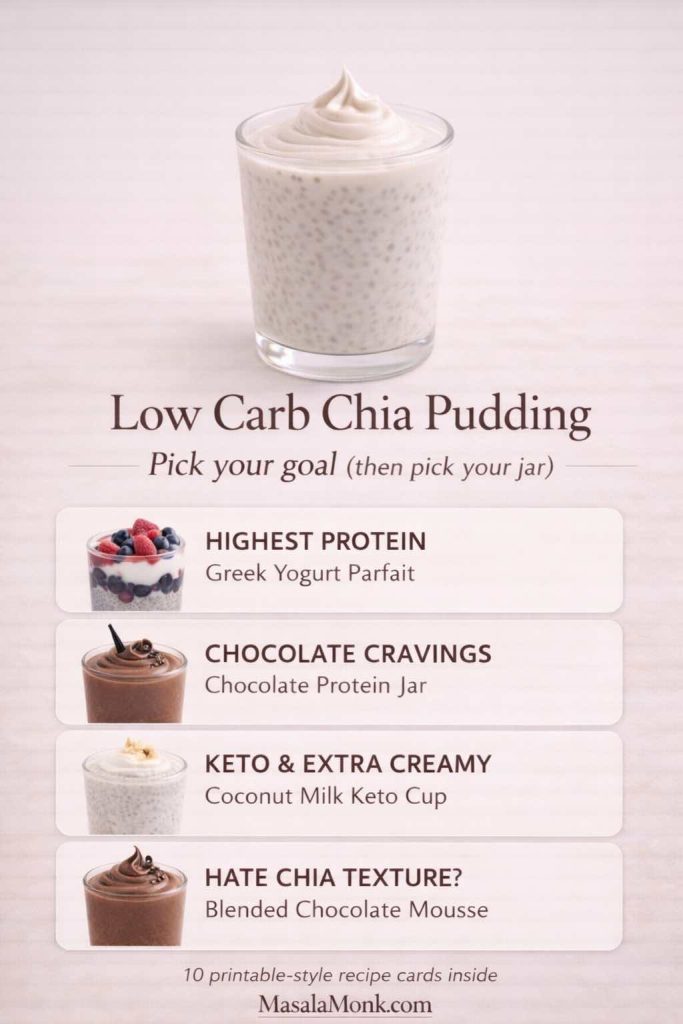
Not sure which jar to make first? Start with your goal: highest protein, chocolate cravings, extra-creamy keto, or blended mousse if you don’t like chia texture—then jump into the matching recipe below.
1) Keto Chia Pudding with Almond Milk (Vanilla Base That Never Fails)
This is the everyday low carb chia pudding that works as breakfast, snack, or a simple dessert. It’s also the best “starter” jar because it takes flavors well.
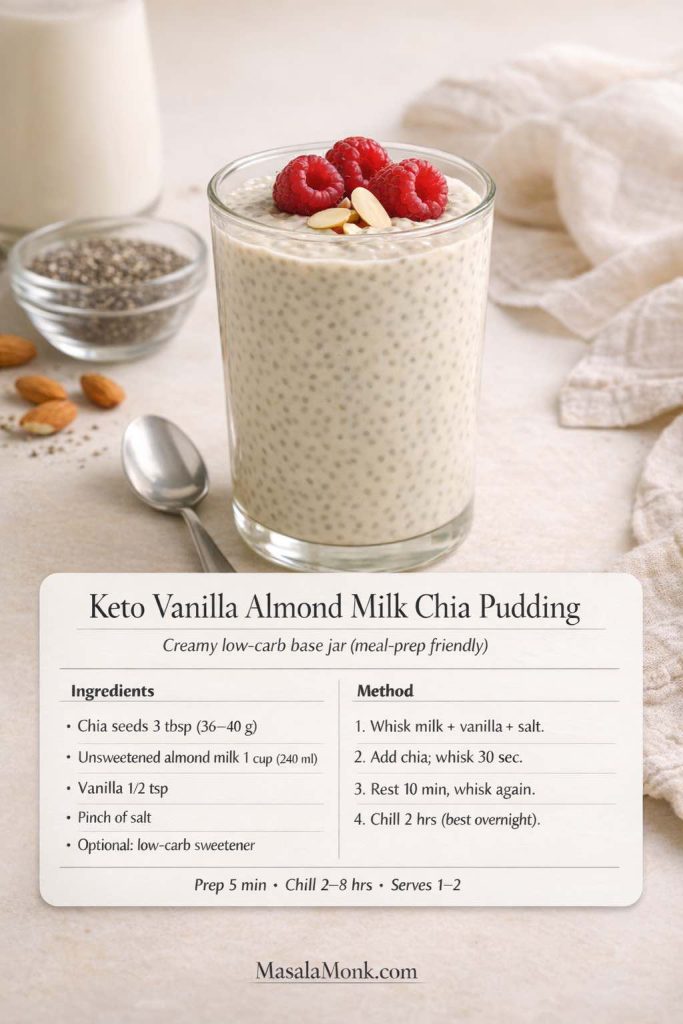
Ingredients (1–2 servings)
3 tablespoons chia seeds
1 cup unsweetened almond milk
½ teaspoon vanilla extract
Pinch of salt
Optional sweetener: monk fruit/erythritol/stevia, to taste
This keto vanilla almond milk chia pudding is the “base jar” you’ll use all week—creamy, low carb, and easy to meal prep. Make it overnight for the smoothest texture, then customize it after training with Greek yogurt or a scoop of protein powder, or keep it simple with berries and nuts for a quick fitness-friendly breakfast that actually satisfies.
Method
In a bowl or jar, whisk almond milk, vanilla, salt, and sweetener (if using).
Stir in chia seeds and whisk vigorously for 20–30 seconds.
Let it rest 10 minutes, then whisk again until no clumps remain.
Cover and refrigerate 2 hours or overnight.
Flavor variations
Add ½ teaspoon cinnamon for a warm “vanilla-cinnamon pudding” base.
Add a tablespoon of shredded coconut for coconut puddings recipes energy without needing extra sweetness.
Stir in 1–2 tablespoons of Greek yogurt right before serving for a creamier finish.
Toppings that keep it low carb Chopped nuts, cacao nibs, a small handful of berries, or a spoon of nut butter.
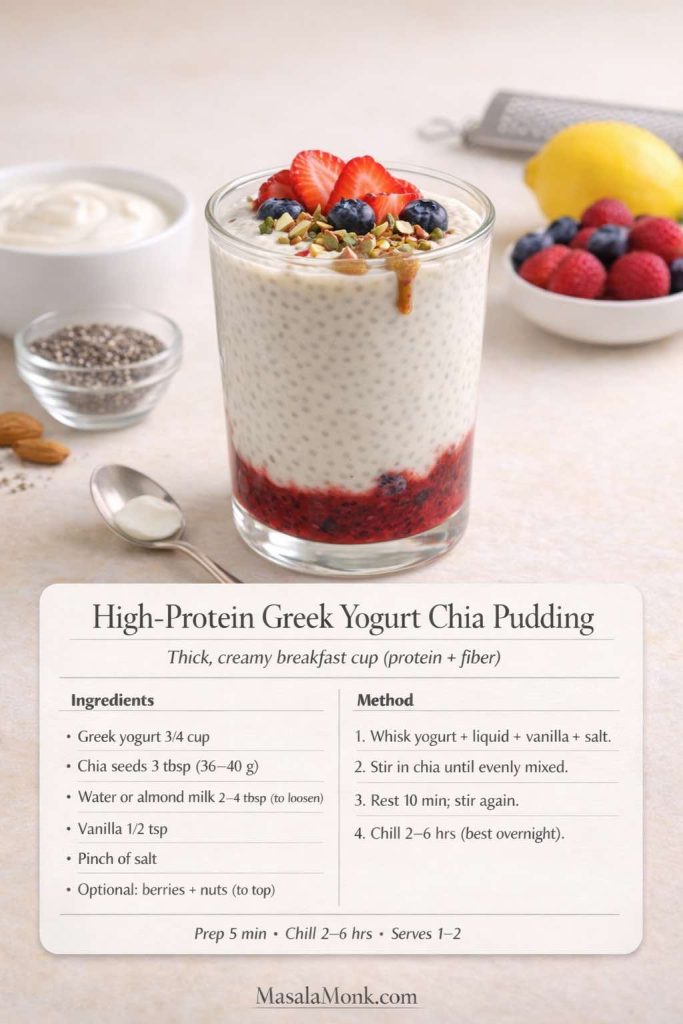
2) Chia Pudding with Greek Yogurt (High Protein, Ultra Creamy)
If you like pudding with Greek yogurt, this version can feel like cheesecake in a jar. It also adapts well: vanilla, chocolate, berry, citrus, even coffee flavors.
Ingredients (1–2 servings)
¾ cup Greek yogurt (plain works best)
3 tablespoons chia seeds
2–4 tablespoons water or almond milk (to loosen)
½ teaspoon vanilla
Pinch of salt
Optional sweetener, to taste
This high-protein Greek yogurt chia pudding is the thick, creamy option when you want a breakfast that holds you steady—especially after a workout. The berry layer makes it feel like a parfait, while the chia-to-yogurt base keeps it filling and meal-prep friendly. Make two cups at once and rotate toppings through the week for an easy high protein chia pudding routine.
Method
Whisk Greek yogurt, vanilla, salt, and 2 tablespoons water (or almond milk) until smooth.
Stir in chia seeds and mix thoroughly.
Rest 10 minutes, then stir again to redistribute the seeds evenly.
Refrigerate at least 2 hours.
Texture tuning
Too thick? Add a splash of water or almond milk and stir.
Too thin? Add 1 tablespoon chia, stir, and chill 30–60 minutes.
Toppings that make it feel like dessert Berries, chopped nuts, cocoa powder dusted on top, or a spoon of peanut butter.
If you want a similar high-protein breakfast base that isn’t yogurt, this link fits naturally as an alternative: cottage cheese for breakfast.
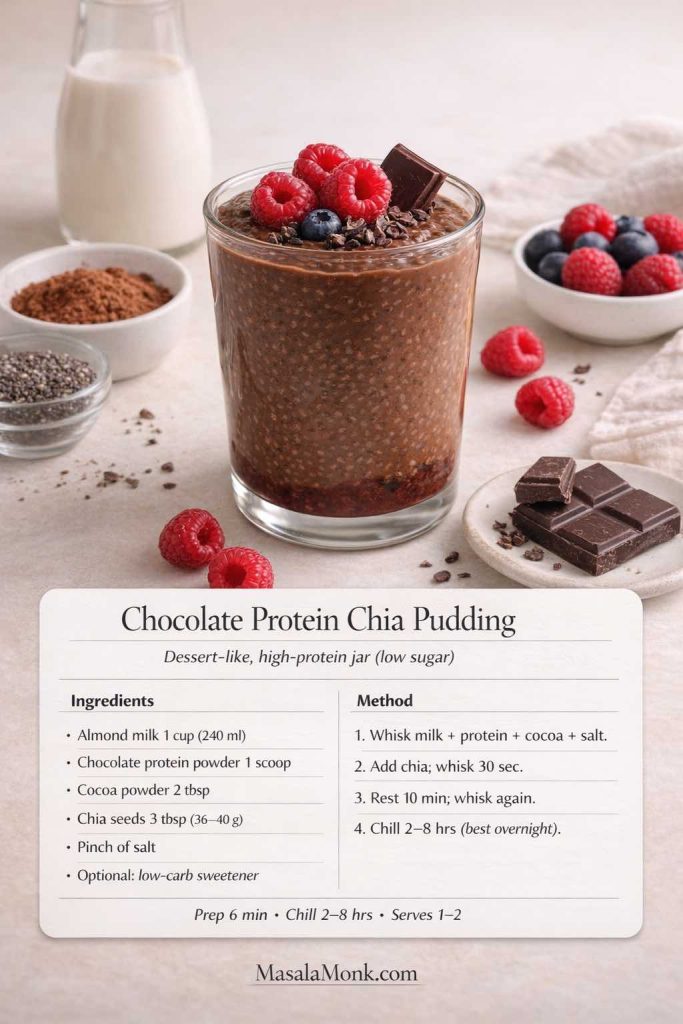
3) Chocolate Protein Chia Pudding (Protein Powder + Cocoa)
This jar is for the days you want pudding chia chocolate flavor without the “diet” vibe. Done right, it tastes like a rich chocolate pudding.
Ingredients (1–2 servings)
1 cup unsweetened almond milk (or dairy milk)
1 scoop protein powder (chocolate, or vanilla plus cocoa)
2 tablespoons cocoa powder or cacao powder
3 tablespoons chia seeds
Pinch of salt
Optional sweetener, to taste
Optional: 1 tablespoon Greek yogurt (for extra creaminess)
When cravings hit, this chocolate protein chia pudding is the “dessert that behaves.” Cocoa and a scoop of protein turn a simple jar into a rich, low sugar treat that still fits a low carb day—perfect after training, as an afternoon snack, or whenever you want something chocolatey that keeps you satisfied.
Method
Whisk almond milk, protein powder, cocoa/cacao, salt, and sweetener until completely smooth.
Stir in chia seeds and whisk again.
Rest 10 minutes; whisk a second time to prevent clumps.
Refrigerate overnight for the best set.
How to keep it smooth If your protein powder tends to clump, whisk it into a small amount of milk first to make a smooth paste, then add the rest of the milk.
Topping ideas A spoon of whipped Greek yogurt, crushed nuts, cacao nibs, or a few berries.
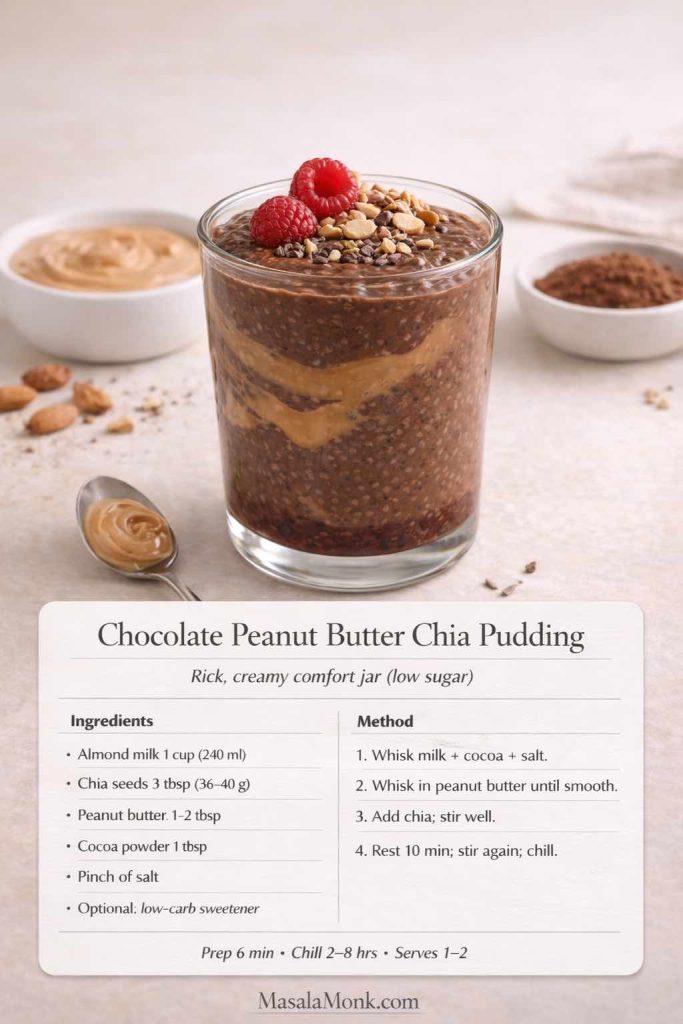
This is the jar that feels like a treat. Chocolate and peanut butter do most of the work, so you can keep sweetness low and still love it.
Ingredients (1–2 servings)
1 cup almond milk (or dairy milk)
3 tablespoons chia seeds
1–2 tablespoons peanut butter
1 tablespoon cocoa powder
Pinch of salt
Optional sweetener
Chocolate peanut butter chia pudding is the comfort-jar that still plays nicely with a low carb day—rich cocoa flavor, a creamy peanut butter swirl, and a thick spoonable set that’s perfect for cravings. Prep it the night before, then top with berries and nuts for a keto-friendly dessert vibe that also works as a high-protein snack.
Method
Whisk milk, cocoa, salt, and sweetener until smooth.
Whisk in peanut butter until fully dissolved.
Stir in chia seeds, rest 10 minutes, stir again, then refrigerate.
Make it even better Add a tiny splash of vanilla, or a pinch of cinnamon. Surprisingly, cinnamon makes chocolate taste deeper.
Topping ideas Strawberries, raspberries, chopped roasted nuts, or a light sprinkle of shredded coconut.
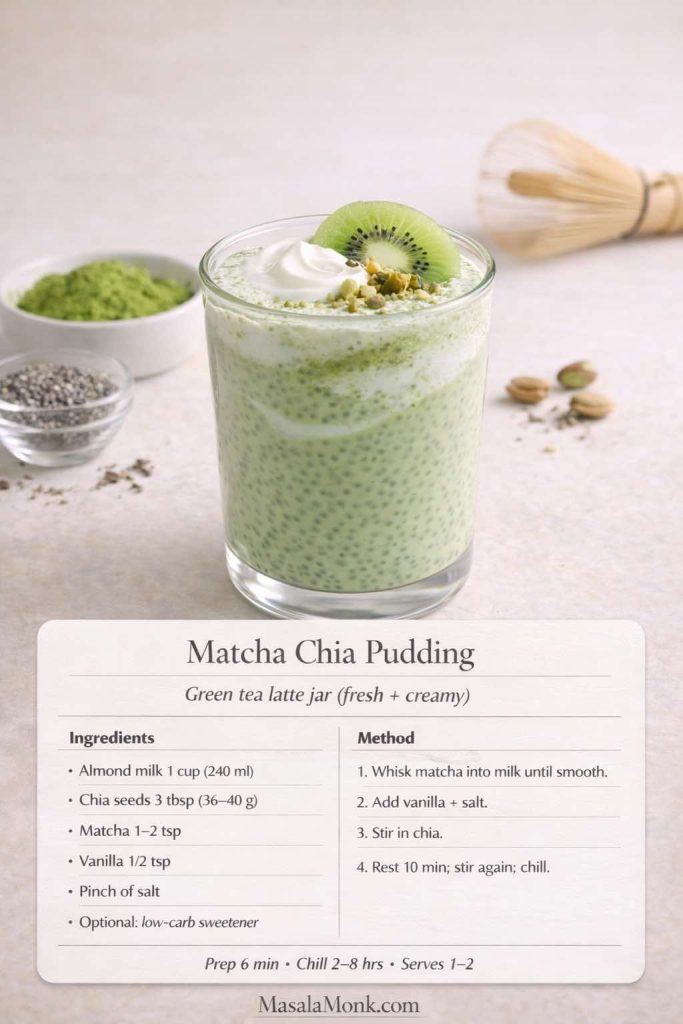
Matcha and chia seeds are a surprisingly good match. The flavor is clean and slightly bitter, which is exactly why a touch of vanilla and a pinch of salt can make it taste more rounded.
Ingredients (1–2 servings)
1 cup almond milk (or a light coconut milk beverage)
3 tablespoons chia seeds
1–2 teaspoons matcha powder
½ teaspoon vanilla
Pinch of salt
Optional sweetener
This matcha chia pudding tastes like a green tea latte in a jar—fresh, creamy, and surprisingly satisfying. It’s a great low carb breakfast when you want something lighter than chocolate but still crave a dessert-style texture. Prep it overnight, then top with fruit and nuts for a café-style chia pudding cup that’s easy to meal prep and fun to switch up.
Method
Sift matcha into the milk (or whisk it in slowly) until smooth.
Add vanilla, salt, and sweetener if using.
Stir in chia, rest 10 minutes, stir again, then refrigerate.
How to avoid matcha clumps If matcha is stubborn, whisk it with 1–2 tablespoons warm water first to create a smooth paste, then whisk that into the milk.
Caffeine note If you’re sensitive to caffeine, keep matcha closer to 1 teaspoon and enjoy earlier in the day. For general guidance, Mayo Clinic’s overview is useful: daily caffeine guidance.
If you like matcha as part of a calmer routine, this supportive read fits naturally: tea and cortisol.
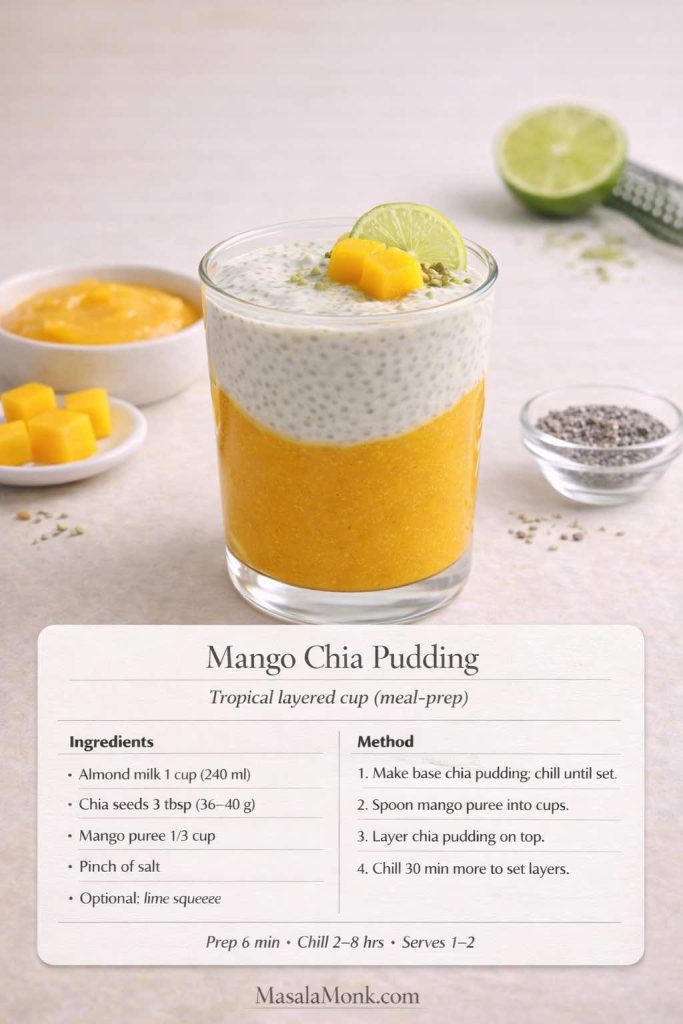
Mango chia pudding tastes like a dessert jar, yet you can keep it controlled by using a smaller mango portion and leaning on lime and salt to amplify flavor.
Ingredients (1–2 servings)
1 cup almond milk or coconut milk beverage
3 tablespoons chia seeds
⅓ cup mango puree (or finely diced mango)
Pinch of salt
Optional: squeeze of lime
This mango chia pudding is the “sunrise cup” that makes meal prep feel like dessert—sweet-tropical flavor, a creamy chia layer, and a bright mango base finished with a squeeze of lime. It’s perfect when you want a lighter low carb chia pudding that still feels fun, especially as a grab-and-go breakfast or a mid-afternoon snack.
Method
Make a plain chia base with milk, chia, and salt.
Chill until set.
Fold in mango puree right before eating, or layer mango at the bottom of your cup and spoon chia on top.
How to keep it low carb Use mango as a flavor accent rather than the entire bowl. You’ll still get the tropical hit, especially with lime.
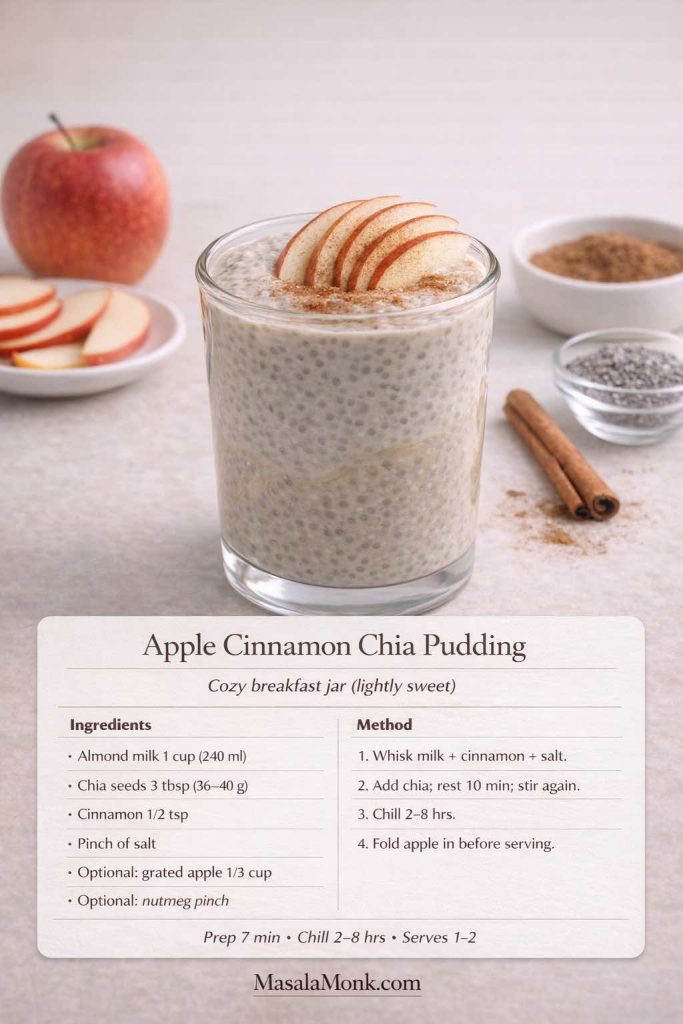
7) Apple Cinnamon Chia Pudding (Cozy, Filling, Great for Breakfast)
Apple cinnamon chia pudding is comfort in a jar. Depending on how strict your carbs are, you can either use a small amount of apple or skip it and let cinnamon do the heavy lifting.
Ingredients (1–2 servings)
1 cup unsweetened almond milk
3 tablespoons chia seeds
½ teaspoon cinnamon
Pinch of salt
Optional: ⅓ cup grated apple
Optional: pinch of nutmeg
Apple cinnamon chia pudding is the cozy breakfast jar that feels like dessert without being heavy—creamy chia, warm spice, and a bright apple finish. Prep it the night before, then fold in grated apple right before eating for the freshest flavor and a thick, spoonable low carb chia pudding you’ll want on repeat.
Method
Whisk milk, cinnamon, salt, and nutmeg if using.
Stir in chia, rest 10 minutes, stir again, then chill.
Fold in grated apple right before serving (it stays fresher that way).
Keto-friendly variation Skip apple. Add chopped pecans and a drop of vanilla instead for a low carb cinnamon-pecan pudding.
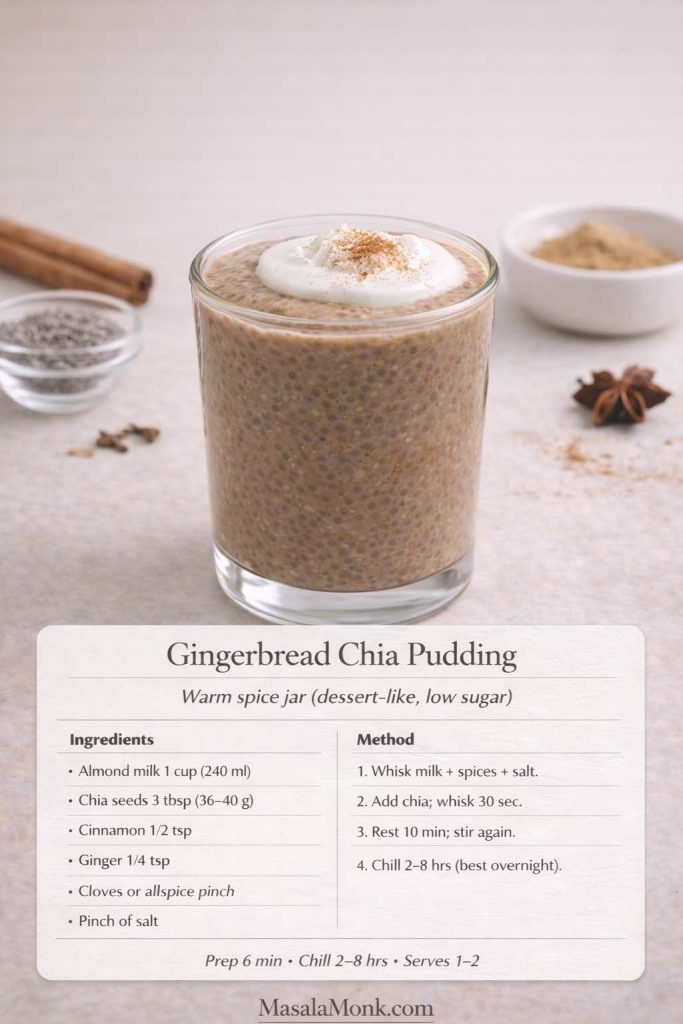
This gingerbread chia pudding is perfect when you want something cozy without needing a baked dessert. It also fits nicely under a broader “anti inflammatory” vibe because of the warming spices—without turning into a medical lecture.
Ingredients (1–2 servings)
1 cup almond milk or coconut milk beverage
3 tablespoons chia seeds
½ teaspoon cinnamon
¼ teaspoon ginger
Pinch of cloves or allspice
Pinch of salt
Optional sweetener
This gingerbread chia pudding brings cozy dessert flavor to a simple low carb chia pudding routine—warm spices, creamy texture, and a thick set that’s perfect for meal prep. Make it overnight, then finish with a spoon of yogurt (or coconut cream) for a rich, satisfying breakfast cup that feels like a treat.
Method
Whisk spices, salt, and sweetener into the milk.
Stir in chia, rest 10 minutes, stir again, then refrigerate.
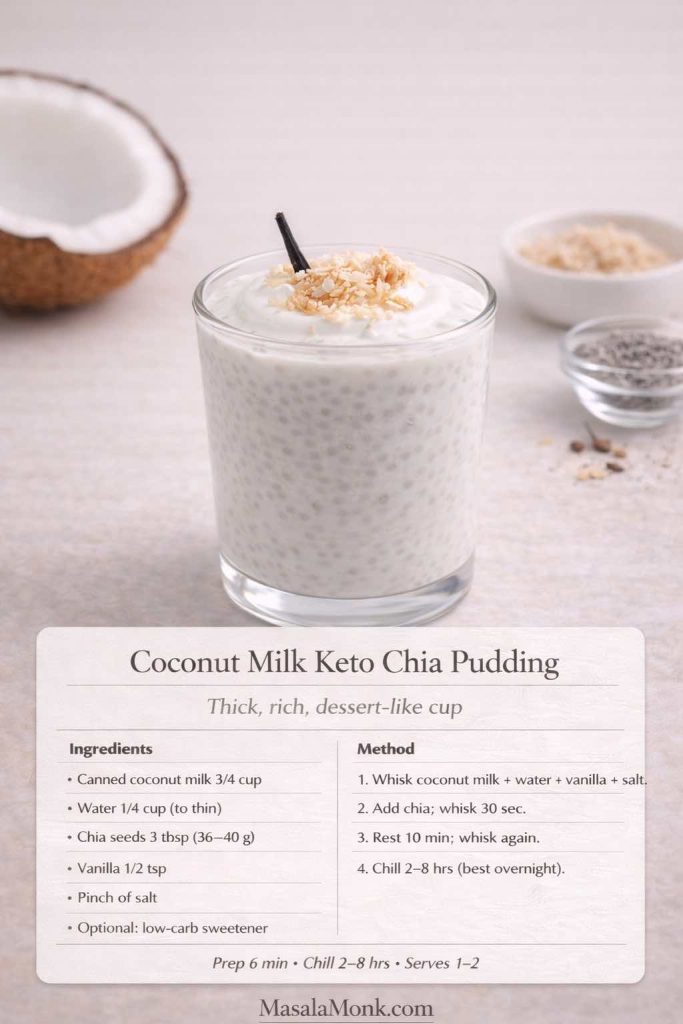
9) Keto Chia Pudding with Coconut Milk (Ultra Creamy)
This is the thickest, most “real pudding” keto chia pudding option. If you’ve ever felt chia was too watery, this changes everything.
Ingredients (1–2 servings)
3 tablespoons chia seeds
¾ cup canned coconut milk
¼ cup water (adjust to pourable)
Pinch of salt
½ teaspoon vanilla
Optional sweetener
If you want the thickest, most dessert-like low carb chia pudding, this coconut milk keto chia pudding is the one. Canned coconut milk gives it that rich, spoonable set, while vanilla and toasted coconut make it feel like a treat you’d pay for. Prep it overnight, then add berries or chopped nuts for a simple, satisfying breakfast cup.
Method
Whisk coconut milk, water, vanilla, salt, and sweetener until smooth.
Stir in chia, rest 10 minutes, stir again, then refrigerate.
Texture tip If it sets extremely thick overnight, loosen with a splash of water before serving and stir well.
If you love mango + coconut together, this is a nice complementary read: mango with coconut milk.
Blended chia pudding is for anyone who dislikes the “seed” texture. Once blended, it becomes silky—almost like a classic pudding cup.
Ingredients (1–2 servings)
1 cup almond milk (or dairy milk)
3 tablespoons chia seeds
1–2 tablespoons cocoa powder or cacao powder
Pinch of salt
Optional sweetener
Optional: 1 tablespoon peanut butter or 2 tablespoons Greek yogurt
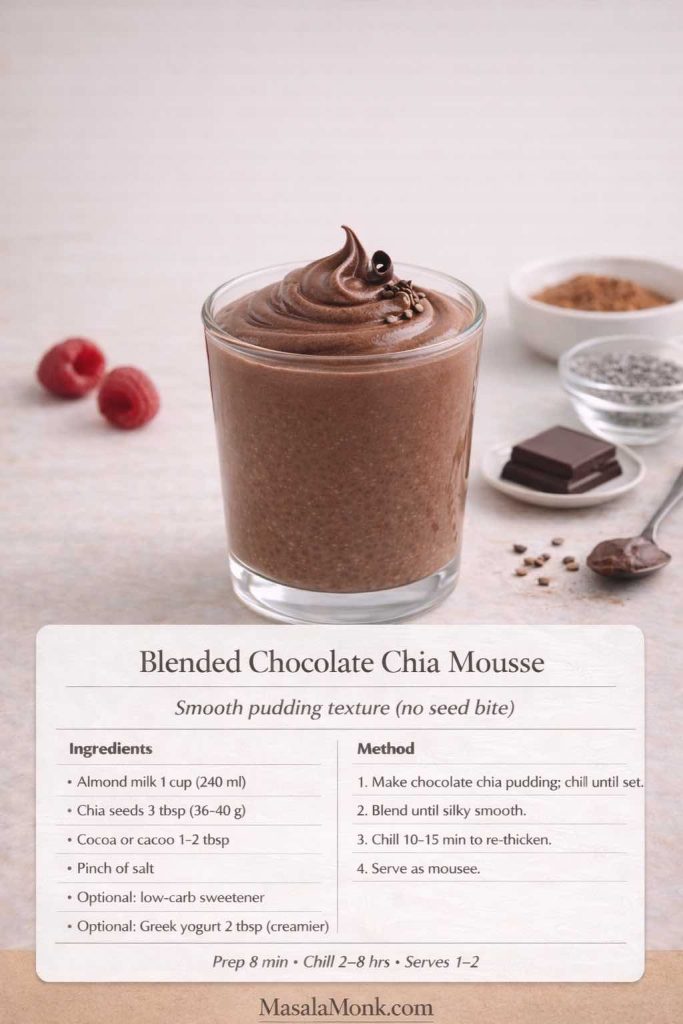
If you love chocolate but don’t love the texture of chia seeds, this blended chocolate chia mousse is your best jar. You get the same thick, satisfying low carb chia pudding base, then a quick blend turns it silky and spoonable—more like a classic pudding cup. Keep it simple with cocoa and almond milk, or stir in a little Greek yogurt for an even creamier, high-protein finish.
Method
Make a standard chocolate chia pudding and refrigerate until set (2+ hours).
Blend until completely smooth and glossy.
Chill 10–15 minutes so it thickens again.
Why it’s worth doing This is one of the best ways to create a creamy chia pudding texture without the “frog egg” feel. It’s also a smart method for protein powder: blend it in after setting to avoid chalky pockets.
Making Chia Pudding Easy to Keep Up With (Meal Prep + Storage)
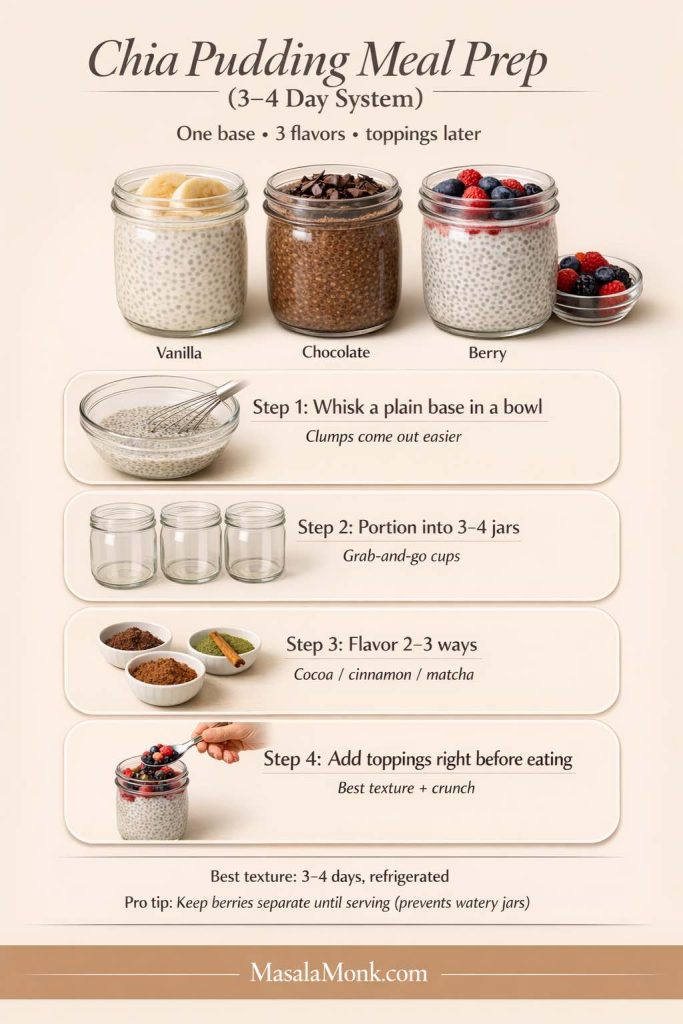
If you’re making chia seed pudding cups for the week, a simple rhythm helps:
Make a plain base batch in a bowl so you can whisk clumps out easily.
Portion into jars or cups.
Flavor them in two or three different directions so you don’t get bored.
Add fresh toppings right before eating.
This is the easiest chia pudding routine to stick with: whisk one plain base, portion into 3–4 jars, flavor a few different ways (vanilla, chocolate, berry), and add toppings right before eating so the texture stays thick and fresh. For meal prep, most jars taste best within 3–4 days—especially if you keep berries separate until serving.
For storage time, most people prefer the taste and texture within three to four days. And for general refrigerated leftovers guidance, USDA FSIS is the standard reference: leftovers food-safety storage times.
One subtle trick: if you’re using fruit, especially berries, keep it separate until serving. That way your “chia pudding cups” don’t turn watery, and the flavors stay bright.
Chia can fit into many keto and low carb patterns because it’s easy to portion and pairs well with higher-fat liquids like coconut milk. That’s part of why keto chia seed pudding recipe variations are so common—especially when combined with Greek yogurt or protein powder. If you want a deeper internal explainer focused on chia and keto specifically, this is a natural follow-on: Chia Seeds and the Ketogenic Diet.
The best way to make chia pudding taste like something you crave
A lot of people try chia once, don’t love it, and assume they’re not a “chia person.” Most of the time, it’s not the chia. It’s the flavor balance.
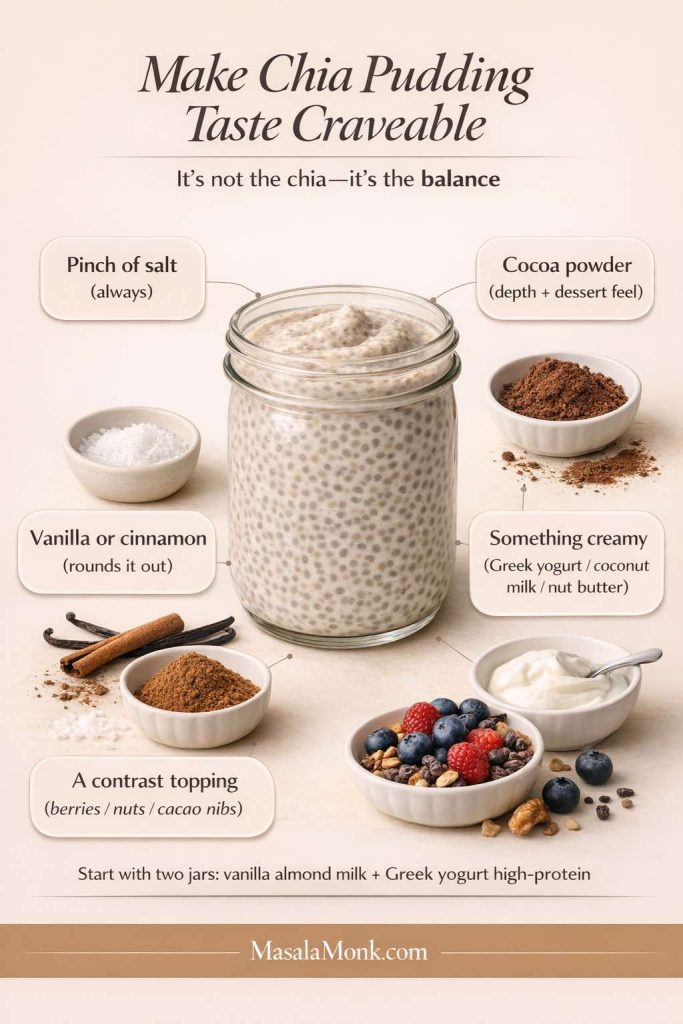
Here’s what tends to make a jar of low carb chia pudding feel genuinely delicious:
A pinch of salt, always
Vanilla or cinnamon to round out the flavor
Cocoa powder when you want depth
Something creamy (Greek yogurt, coconut milk, or a spoon of nut butter)
A topping that adds contrast—berries, chopped nuts, cacao nibs
If low carb chia pudding tastes “meh,” it’s usually not the chia—it’s the balance. Start with a pinch of salt, add vanilla or cinnamon, bring depth with cocoa powder, then make it creamy with Greek yogurt, coconut milk, or a spoon of nut butter. Finish with a contrast topping like berries, chopped nuts, or cacao nibs, and the jar suddenly feels like a treat you’ll actually crave.
Once you dial that in, low carb chia pudding becomes less of a “health chore” and more of a flexible treat you can keep in rotation. Some weeks you’ll lean into matcha and coconut milk. Other weeks you’ll be in a chocolate peanut butter phase. Then, when you want brightness, mango or berries bring everything to life.
If you make one of these this week, start with two jars: one vanilla almond milk base and one high-protein Greek yogurt version. That way you get variety immediately—light and clean on one side, thick and filling on the other—without creating extra work.
A reliable starting point is 3 tablespoons chia seeds to 1 cup liquid for a thick, spoonable chia seed pudding. If you prefer a lighter texture, use 2½ tablespoons per cup. Conversely, if you want a denser keto pudding feel, keep 3 tablespoons and choose a richer liquid like coconut milk.
2) How long does chia pudding need in the fridge?
Most jars set well in 2–3 hours, although overnight chia pudding usually turns out smoother and more consistent. If you’re meal-prepping chia seed pudding cups, overnight is often the easiest path because the texture stabilizes by morning.
3) Why is my chia seed pudding watery or runny?
Typically, runny chia pudding comes from one of three things: too much liquid, not enough time, or not stirring twice early on. Add 1 teaspoon chia at a time, stir, then refrigerate 30–60 minutes. Also, do a second stir around the 10-minute mark to prevent clumps and uneven hydration.
4) Why did my chia pudding turn too thick?
This happens when chia absorbs more than expected—especially with thick liquids like canned coconut milk. To fix it, stir in a splash of water, almond milk, or coconut milk until it loosens into a creamy chia pudding consistency.
5) Can I make instant chia pudding or quick chia pudding?
You can make a quick chia pudding by whisking thoroughly, stirring again after 10 minutes, and chilling 30–45 minutes. Even so, the best chia pudding texture usually comes from a longer chill. If time is tight, adding Greek yogurt can help it feel thicker sooner.
6) Is chia pudding keto-friendly?
Chia seeds can fit many keto approaches because they’re portionable and pair well with higher-fat liquids. For keto chia pudding, use unsweetened almond milk or coconut milk, keep sweeteners minimal, and choose toppings like nuts, cacao nibs, or unsweetened coconut.
7) What are the best chia seeds for keto or low carb chia pudding?
Both black and white chia seeds work similarly for chia seed pudding low carb recipes. What matters more is freshness and how you store them. If the seeds smell stale or oily, the pudding can taste “off,” even if your recipe is perfect.
8) Can I make chia pudding with almond milk?
Yes—chia pudding with almond milk is one of the most common bases because the flavor is neutral and the texture sets reliably. For extra creaminess, add a spoon of Greek yogurt, coconut cream, or nut butter once it’s set.
9) Can I make chia pudding with coconut milk?
Absolutely. Chia pudding coconut milk versions are often the creamiest and feel closest to a traditional pudding. If you’re using canned coconut milk, thin it slightly with water so the chia hydrates evenly.
10) Can I make chia pudding with oat milk?
Yes, chia pudding with oat milk is popular because it tastes mild and comforting. However, oat milk is not typically low carb, so it’s better for a general “healthy pudding” routine rather than a strict keto plan.
11) Can I make chia pudding with yogurt instead of milk?
You can, and it’s a great way to create a high protein chia pudding. For chia pudding with yogurt no milk, whisk yogurt with a little water to loosen it, then stir in chia. The result is thick, tangy, and very filling.
12) What’s the difference between chia pudding with Greek yogurt vs regular yogurt?
Greek yogurt is thicker and higher in protein, so chia pudding Greek yogurt versions tend to set firmer and feel more like a meal. Regular yogurt can work too, although you may need a bit more chia or a longer chill to reach the same texture.
13) Can I add protein powder to chia pudding?
Yes—chia pudding with protein powder is an easy way to boost protein. For the smoothest result, dissolve the protein powder into the milk first, then add chia. If you add powder directly to a set pudding, it can clump.
14) How do I make chocolate chia protein pudding taste better?
Use cocoa or cacao plus a pinch of salt to deepen the flavor. Then, choose a chocolate protein powder you actually enjoy. A small spoon of peanut butter or Greek yogurt can also make chocolate protein chia pudding taste richer and less “thin.”
15) Can I make blended chia pudding?
Yes. Blended chia pudding is ideal if you dislike the texture of whole chia seeds. First, let the pudding set; afterward, blend until smooth. You’ll get a creamy chia pudding that feels like mousse, especially with cocoa or nut butter.
16) Can I grind or blend chia seeds before soaking?
You can, but it changes the texture quickly and may thicken faster. Ground chia pudding tends to set more like a gel. If you prefer a smoother mouthfeel, blending after soaking often tastes better than blending dry seeds first.
17) What’s the best way to sweeten chia pudding without sugar?
Many people keep it simple with vanilla, cinnamon, cocoa, or fruit. If you want sweetener, choose an option you tolerate well and use a small amount. Often, adding a spoon of peanut butter or coconut milk richness reduces how much sweetness you need.
18) Is chia pudding paleo?
Chia pudding paleo versions usually use almond milk, coconut milk, or coconut water instead of dairy. For a richer bowl, add nut butter, coconut cream, or fruit. If you use yogurt, choose a version that matches your approach.
19) What is anti inflammatory chia pudding?
In practice, it’s chia pudding flavored with ingredients often used in “anti-inflammatory” eating patterns—ginger, cinnamon, cacao, berries, and sometimes turmeric. A ginger chia pudding or gingerbread chia pudding can fit this style while still tasting like dessert.
20) Can I add collagen to chia pudding?
Yes. Chia collagen add-ins are usually easiest because collagen peptides dissolve smoothly. Since collagen doesn’t thicken much, you’ll still rely on chia (and optionally yogurt) for the pudding texture.
21) What toppings work best for chia pudding for weight loss?
For a more weight-loss friendly bowl, focus on toppings that add texture without a big sugar hit: nuts, seeds, unsweetened coconut, cacao nibs, and a measured amount of berries. If you want fruit-forward flavors like mango chia pudding, keep the portion modest and balance it with protein.
22) How do I make strawberry chia seed pudding or berry chia pudding?
Make a plain base first, then fold in mashed strawberries or mixed berries after it sets. Alternatively, layer berries at the bottom of the cup for a “chia pudding with strawberries” effect. If you add watery fruit too early, the pudding can loosen.
23) How do I make mango chia pudding without making it too sweet?
Use mango as a flavor accent: a few tablespoons of puree can be enough. Add lime and a pinch of salt to amplify the tropical flavor, then keep the base unsweetened so the mango stands out naturally.
24) How do I make apple cinnamon chia pudding taste like dessert?
Use cinnamon, vanilla, and a pinch of salt as the backbone. If you’re not strict keto, a small amount of grated apple adds aroma and sweetness. Otherwise, chopped pecans plus cinnamon can mimic an apple-pie vibe without the fruit.
25) How long does chia seed pudding last, and can I meal prep it?
Chia pudding is popular for meal prep because it holds well in the fridge. Many people prep single serve chia pudding cups for several days at a time. For the best texture, keep toppings separate and stir before eating.
26) Why does my chia pudding taste bland?
Usually it needs salt, vanilla, or a stronger flavor base. Cocoa, matcha, cinnamon, and nut butter all make a big difference. Also, richer liquids—like coconut milk—often improve flavor even when sweetness is minimal.
27) What’s the easiest 3 ingredient chia pudding?
A classic 3 ingredient chia pudding is chia seeds + almond milk + vanilla (or chia + coconut milk + cocoa). If you want it sweeter, add a fourth ingredient: your preferred sweetener or a small amount of fruit.
28) Can I make chia seed pudding with regular milk or whole milk?
Yes. Chia seed pudding with milk (including whole milk) sets well and tastes creamy. If your goal is low carb chia pudding, watch the carbs from dairy milk and adjust based on your overall plan.
29) What’s better: chia pudding in a jar, glass, or cups?
Any container works. Chia pudding cups are great for grab-and-go; a chia pudding glass looks nice for serving; a jar is convenient for shaking and stirring. What matters most is leaving enough room to stir well before it sets.
30) Are premade chia pudding cups worth it?
They can be convenient, especially when you need a ready-to-eat snack. Still, homemade lets you control sweetness, protein, and texture. If you like the convenience of premade chia pudding, you can mimic it by prepping chia seed pudding cups in advance with two or three flavors.
There’s a particular kind of craving that shows up the moment you’ve been eating low carb for a while: not hunger, exactly—more like a restless need for crunch. You can be completely satisfied after dinner, yet still want something salty, crisp, and snackable. That’s why keto chips are such a common sticking point. Chips aren’t just food; they’re texture, routine, and comfort.
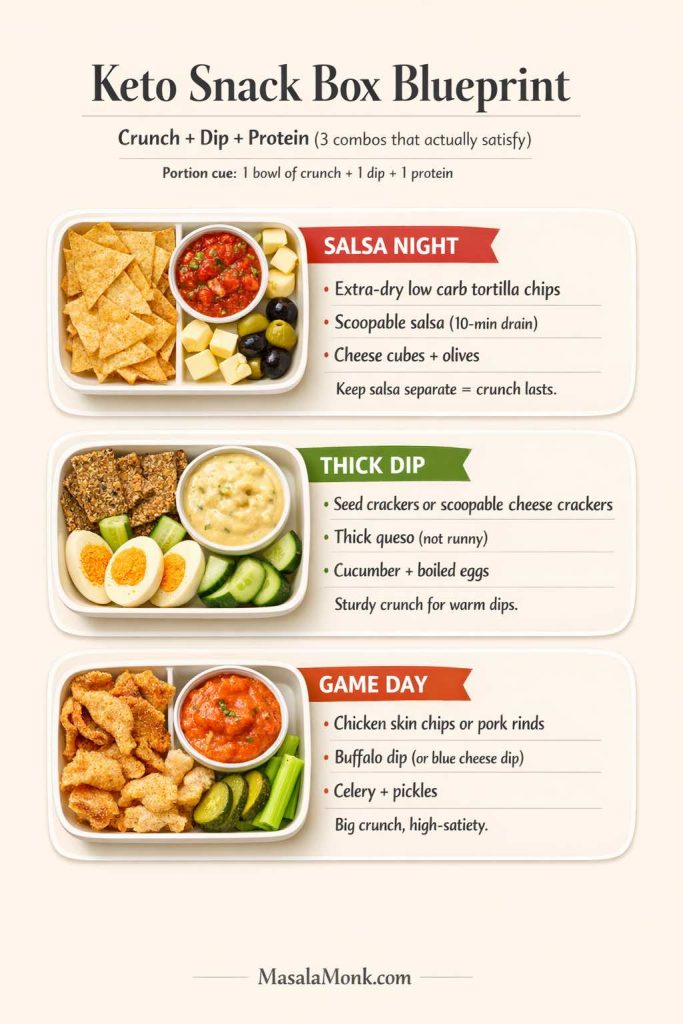
The good news is that chips on keto can absolutely work. The even better news is that you don’t have to settle for a sad substitute that tastes like cardboard or crumbles the second it touches salsa. Once you understand how different low carb chips behave—thin and snappy, thick and scoopable, airy and crunchy—you can choose the right “chip” for the job: dipping, nachos, movie-night grazing, or a grab-and-go snack box.
The secret isn’t hunting for one magical chip. It’s building a small rotation based on how you actually eat chips:
thin and snappy for salsa
sturdy for thick dips
something that survives nachos
something that scratches “hot chips” cravings
something that works when you’re busy and need a snack box situation
Once you stop forcing one chip to do every job, keto-friendly chips become much easier — and far more enjoyable.
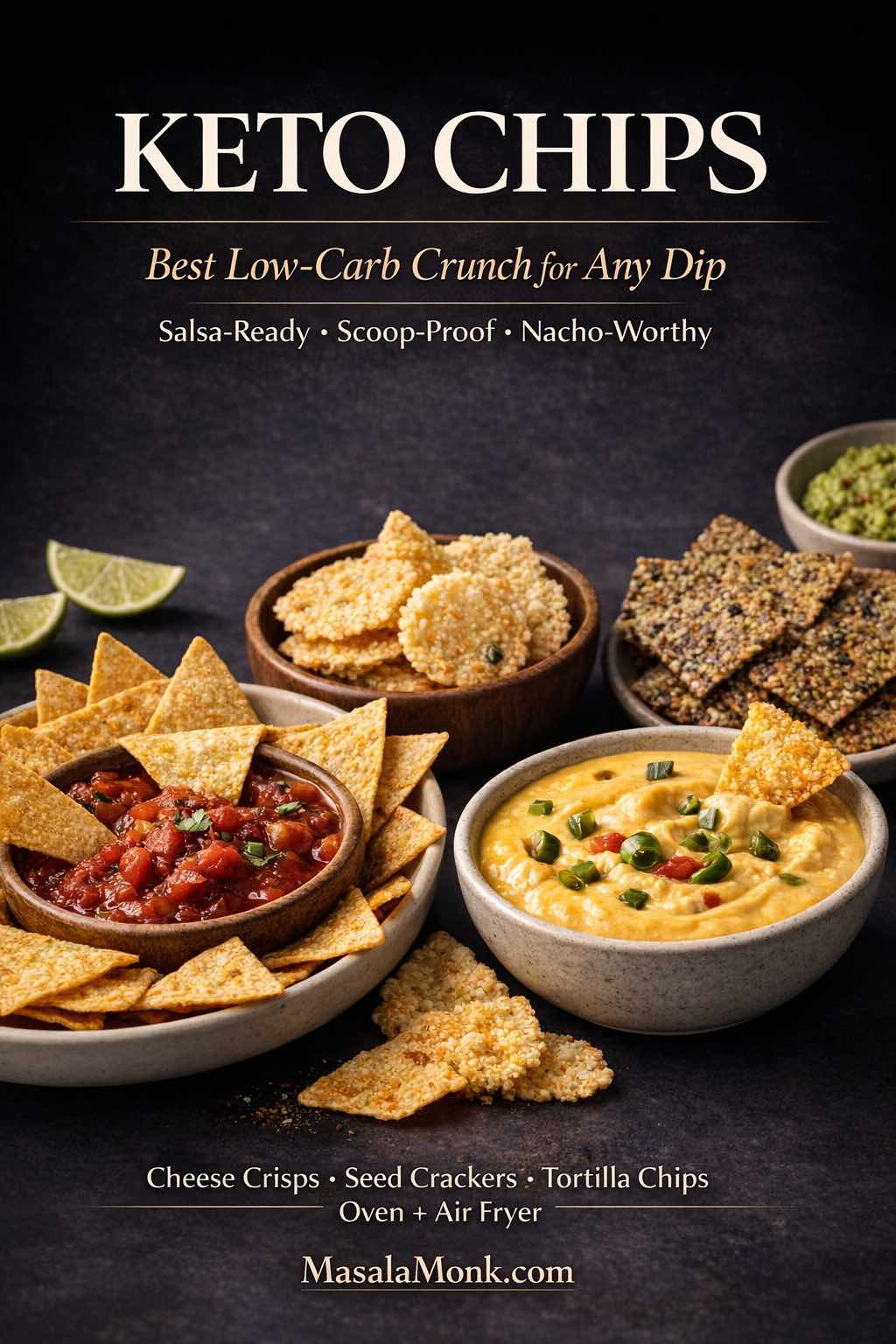
This guide is built for real life. It covers keto chip snacks you can make at home, low-carb & keto friendly chips you can buy, and the chip replacements that quietly do the job better than most “keto chips” ever will. Along the way, you’ll also get dip pairings and a few easy snack setups that keep the crunch without turning into an accidental carb blowout.
What you’ll find in this keto chips guide
This post isn’t just a list—it’s a practical playbook, with easy recipes and real-life fixes you can actually use. Here’s what we cover below:
What counts as keto chips (serving size, total carbs vs fiber, and how to compare options smartly)
How to choose low carb chips by “dip-ability” (salsa vs thick dips vs nachos vs grab-and-go crunch)
Keto cheese chips and parmesan crisps + a homemade cheese crisps recipe (the easiest win)
Scoopable cheese “cracker chips” recipe (built for thick dips that destroy flimsy chips)
Pork rinds and scratchings + a quick re-crisp trick and seasoning ideas (best for thick dips)
Keto chicken skin chips and meat-chip crunch with oven + air fryer recipes (hard-crunch, “keto pringles” energy)
Seed crackers and keto crackers + a simple DIY seed cracker recipe (reliable chip replacement)
Almond flour crackers recipe that feels like real crackers (sturdy + dip-friendly)
Keto tortilla chips and low carb tortilla chips + the homemade tortilla chips recipe (oven + air fryer) that actually gets crisp
“Keto Doritos” seasoning dust recipe for hot-chip cravings and bland-chip rescues
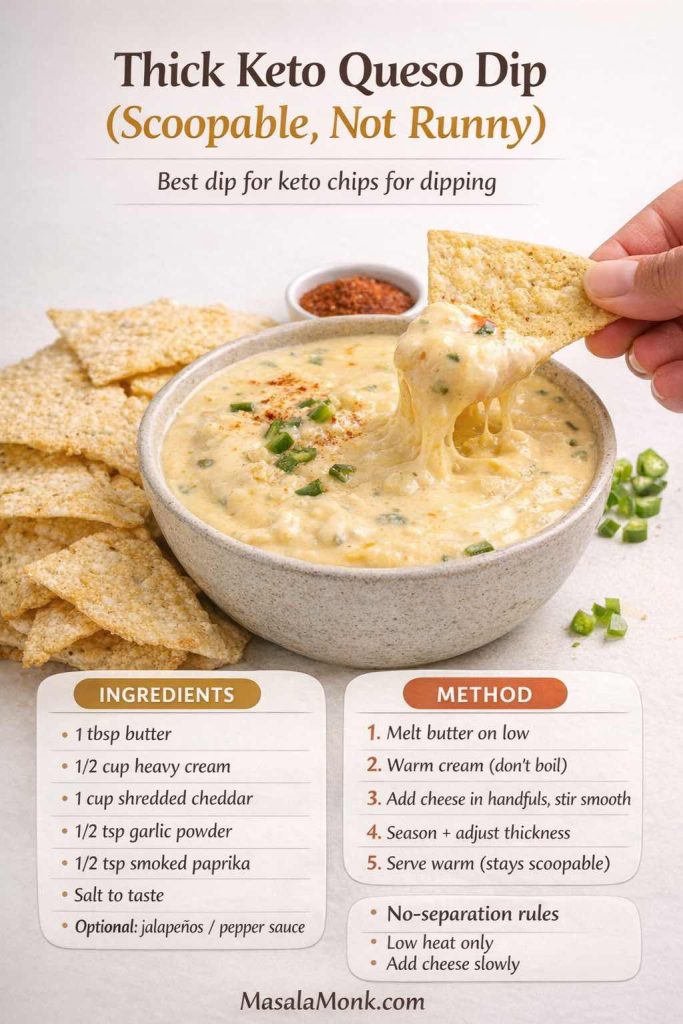
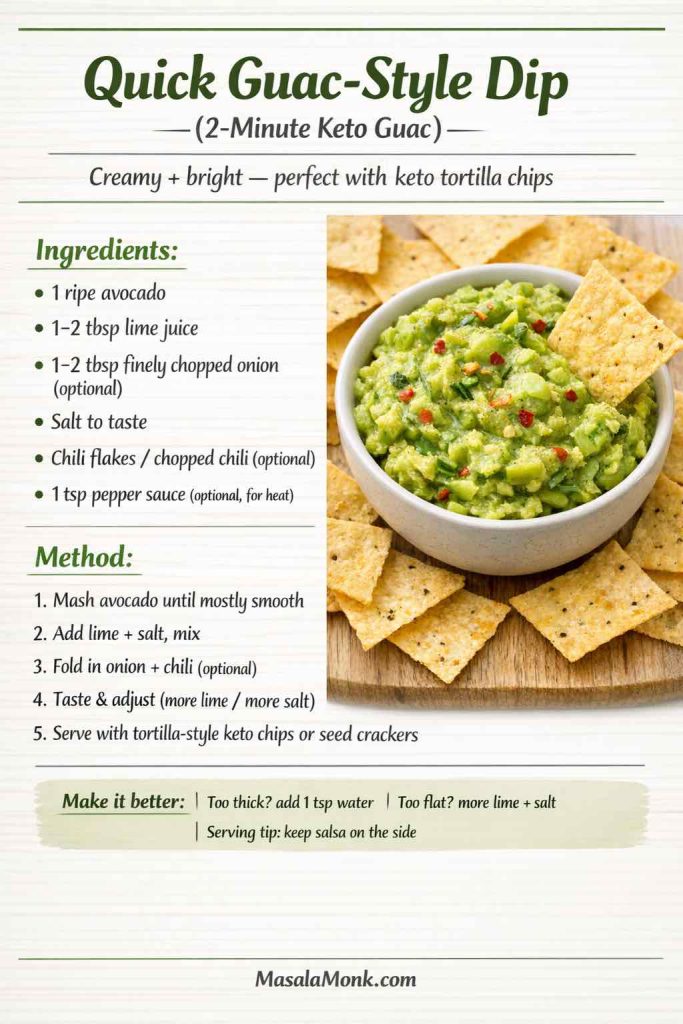
Dip recipes that make chips feel satisfying:thick queso + scoopable salsa + a quick guac-style idea
Snack box setups, nacho layering, and crunch troubleshooting (so chips stay crisp and snacking doesn’t spiral)
What counts as keto chips?
At a practical level, keto chips are anything crunchy and chip-like that fits your carb target for the day. Sometimes that means a food that naturally has almost no carbs (like baked cheese crisps). Other times it means a low carb tortilla chip made from a wrap or a high-fiber dough. Either way, the “keto” part isn’t a vibe—it’s the numbers, plus how you actually eat them.
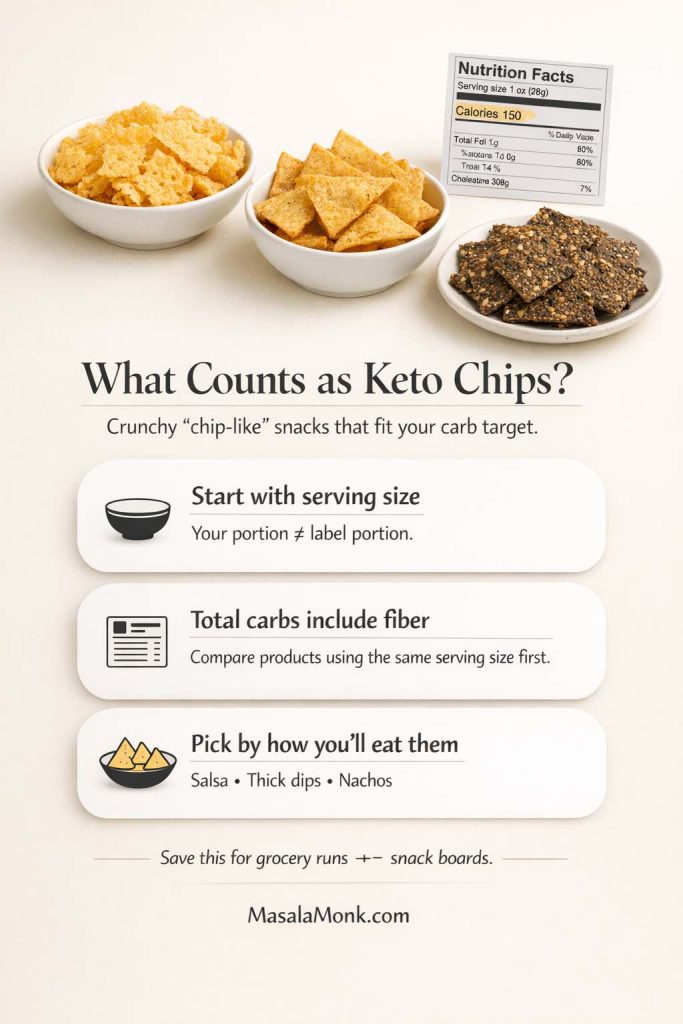
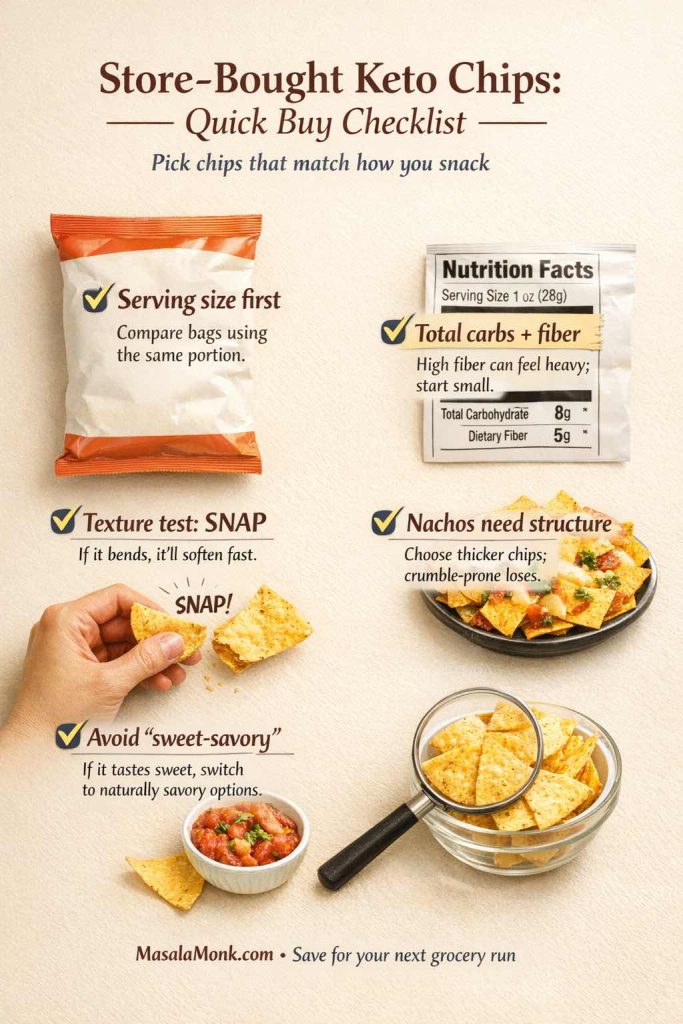
That’s why serving size matters more than the front-of-bag language. Even when a snack is marketed as low carb chips, the carb count is always tied to the listed portion. Double the portion, and you double the carbs. The U.S. Food and Drug Administration’s explanation of the Nutrition Facts label is a helpful baseline because it lays out how serving sizes and carbohydrate values are presented and how to compare products without fooling yourself: how to use the Nutrition Facts label.
What counts as keto chips isn’t a vibe—it’s portion + label math. Use this quick visual to compare snacks the smart way: start with serving size, understand that total carbs include fiber, then choose the chip style based on how you’ll actually eat it (salsa, thick dips, or nachos). Save-worthy for grocery runs and “chips night” planning.
Next, it helps to understand what “total carbohydrate” includes on labels. Fiber is listed under total carbohydrate, and some products use fiber-heavy formulations that look dramatically lower in net carbs than they do in total carbs. The FDA’s interactive explainer on total carbohydrate breaks down what’s inside that number and why it’s structured the way it is: FDA Interactive Nutrition Facts Label: Total Carbohydrate.
Finally, remember that keto approaches vary. Some people aim for very low carbs, while others are simply trying to keep things low carb and steady. If you want a neutral overview of how ketogenic patterns are typically described, this background from Mayo Clinic’s keto overview is a decent orientation point.
Once those basics are in place, choosing keto chips becomes much simpler: pick the texture you want, then pick the version that fits your numbers.
The simplest way to choose low carb chips: pick by “dip-ability”
Instead of chasing the perfect chip, start with a question that actually matches how you snack:
Do you want something thin and crisp for salsa?
Do you need sturdy chips for dipping into thick queso-style dips?
Are you building nachos?
Or are you just looking for a crunchy snack to eat by the handful?
From there, chip choices get easier fast. Thin and crisp chips don’t always scoop well. Thick chips don’t always feel “real” with salsa. Airy chips can be fun but may collapse in dips. So rather than forcing one option into every situation, it’s smarter to keep two or three types in rotation.
Below we cover the main “families” of keto chips and chip alternatives, plus how they behave in the real world.
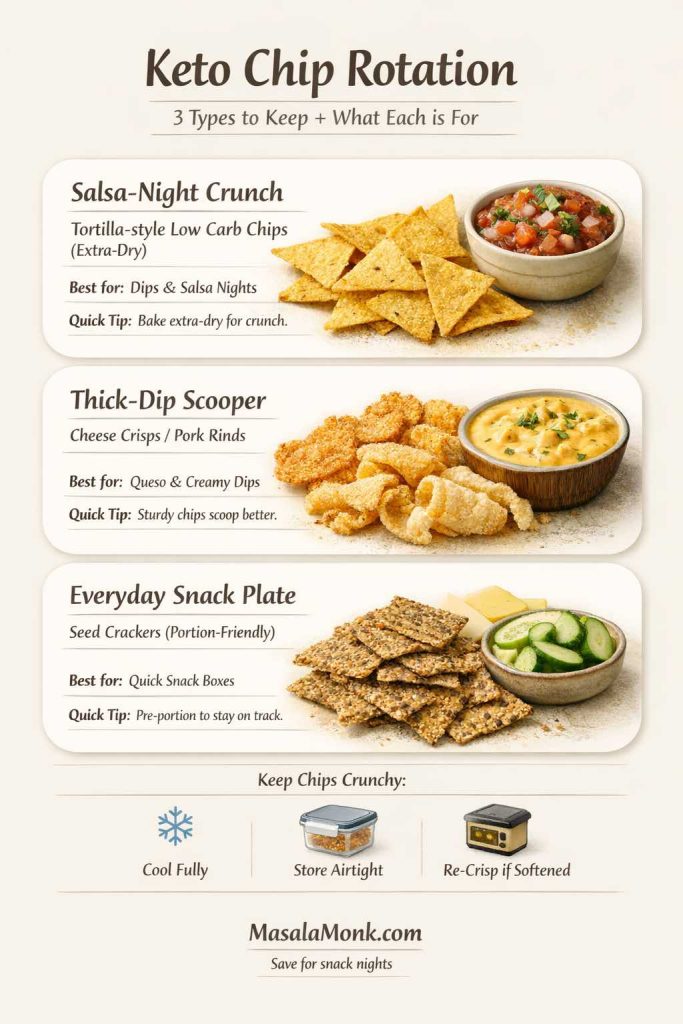
Quick Cheat Sheet: Which Keto Chip Works for What?
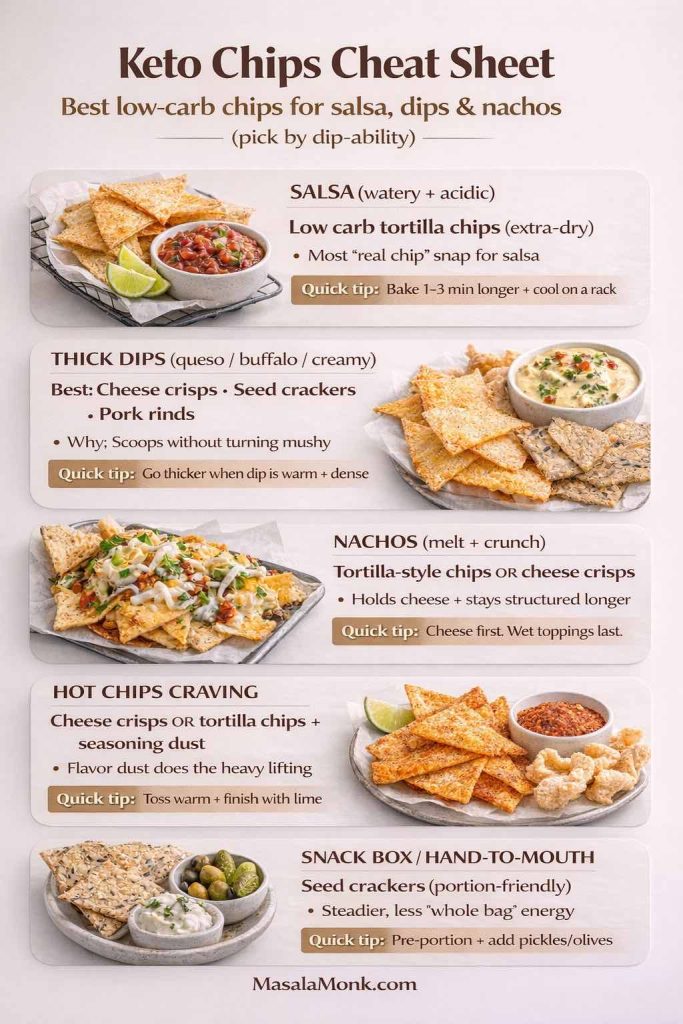
Use this as the “pick-by-dip-ability” shortcut. Once you match chip style to the job, keto chips stop feeling like a compromise.
Keto Chips Cheat Sheet (save this): pick the best low-carb chips based on what you’re actually eating—keto chips for salsa, best keto chips for dipping, keto nacho chips, or hot chips cravings. The biggest upgrade isn’t a “perfect chip,” it’s matching the crunch to the dip (and using the quick tips so chips stay crisp). This graphic is designed to be share-worthy for Pinterest and practical enough to use on game night.
What you’re craving
Best keto chip option
Why it works
Quick tip to make it better
Salsa (watery, acidic)
Tortilla-style low carb chips (baked extra-dry)
They feel most “real” with salsa and keep that tortilla snap
Bake 1–3 minutes longer than you think, then cool on a rack
Thick dips (queso, buffalo dip, creamy dips)
Cheese crisps / seed crackers / pork rinds
These scoop without dissolving or turning into mush
Choose the sturdier option when the dip is dense and warm
Nachos (melt + crunch)
Tortilla-style chips or cheese crisps
Tortilla chips give the classic vibe; cheese crisps stay sturdy
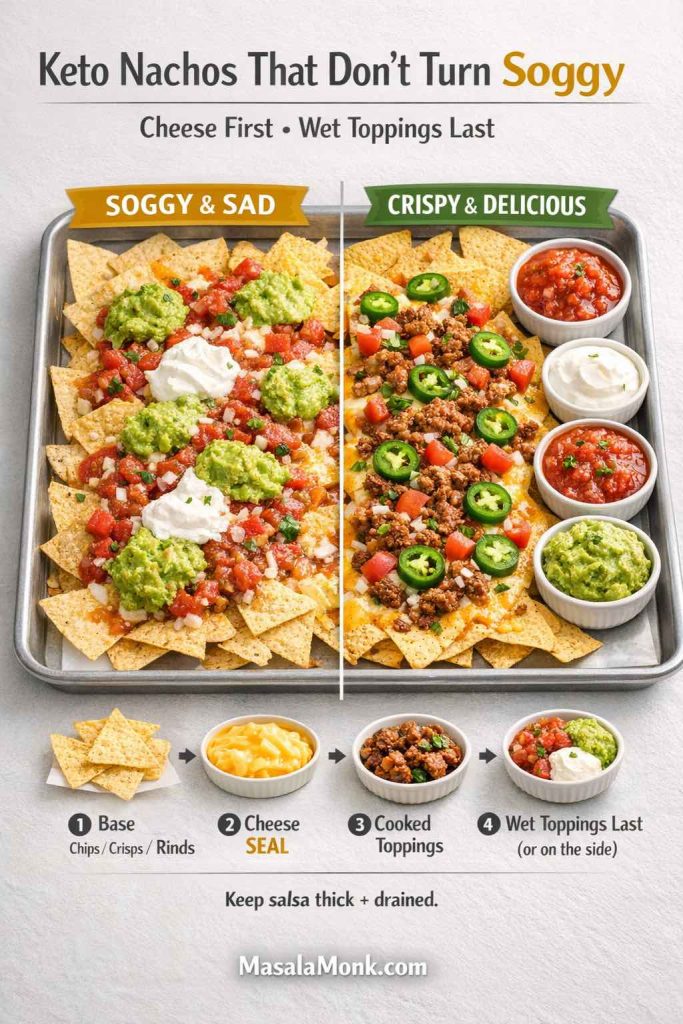
Put cheese first so it acts like a “seal,” keep wet toppings late
“Hot chips” cravings
Cheese crisps or tortilla chips with seasoning dust
Flavor carries the craving more than the base
Toss warm chips with spice + finish with lime for that “dusted” feel
Snack-by-the-handful
Seed crackers (portion-friendly)
They’re steadier, more filling, and less “accidental whole bag”
Pre-portion into a bowl or snack box so it stays intentional
Busy snack box situation
Seed crackers + cheese crisps
Easy to pack, less fragile, pairs with dips cleanly
Add something tangy (pickles/olives) so the snack feels “done”
Which Keto Chip Works for What?
The 3 Rules That Make Keto Chips Work
Pick the chip by dip. Salsa wants thin and dry; thick dips want sturdy and scoopable.
Dry beats brown. Crispness is mostly moisture removal—especially for tortilla-style chips.
Structure beats willpower. Portion into a bowl and pair with a dip so you stop snacking when you’re satisfied.
Keto cheese chips and parmesan crisps: the classic crunch that rarely fails
If you want keto chips that feel instantly satisfying and require almost no negotiation with your carb budget, keto cheese chips are the easiest win. Cheese crisps and parmesan chips keto-style snacks deliver that loud snap and salty finish that most people miss first.
They also behave beautifully with dips. Because they’re sturdy and rich, they can scoop thicker dips without dissolving. Moreover, they’re easy to flavor without relying on anything complicated: smoked paprika, chili powder, garlic powder, black pepper, or a little dried oregano can shift the vibe from “plain cheese” to “nacho chip energy.”
Homemade cheese crisps you’ll actually repeat
What you need
Finely shredded cheese (parmesan crisps the easiest; cheddar is bolder; a mix is great)
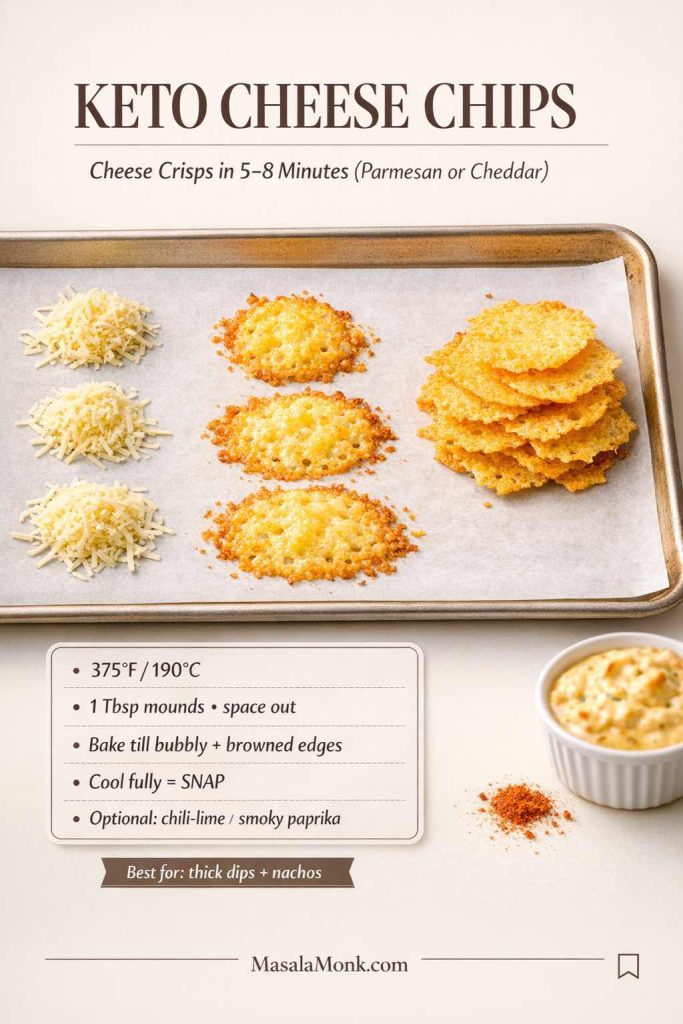
Keto Cheese Chips (Parmesan or Cheddar): The fastest low-carb chip fix. Bake small cheese mounds at 375°F / 190°C until the edges brown—then cool completely (that’s when they turn crunchy). Perfect for thick dips, queso, and nachos, and easy to spice up with chili-lime or smoky paprika.
How to do it
Heat oven to 190°C / 375°F.
Line a tray with parchment.
Drop small mounds of cheese (about a tablespoon each). Keep space between them.
Season lightly (if using).
Bake until bubbling and browned at the edges, usually 5–8 minutes depending on cheese and thickness.
Cool completely before lifting. Cooling is where they become crisp.
The cooling step is non-negotiable. They firm up as they cool. If you grab them warm, they’ll feel floppy and you’ll assume you messed up.
Make them taste like “hot chips” without pretending they’re the same
Sometimes you don’t want “cheese chips.” You want the aggressive spicy-dusted vibe — the low carb hot chips craving. If you’re chasing the keto doritos vibe—spicy, salty, dusted—season before baking with chili powder + smoked paprika. Then finish with lime right before eating. It lands surprisingly close to that “hot chips” craving without pretending it’s the same thing and gives the sharp, dusty, spicy feel people associate with nacho-style chips and “hot chip” snacks.
Make them sturdier for dipping
If your cheese chips snap too easily, two small tweaks help:
Use a slightly thicker mound rather than a thin sprinkle.
Mix parmesan with cheddar. Parmesan crisps hard and thin; cheddar adds body.
Turn cheese crisps into “cheese crackers” that scoop
Cheese crisps are amazing, yet sometimes you want a cracker-like bite that holds shape and dips without shattering. This version adds a tiny bit of structure.
Quick cheese crackers (keto cheese crackers)
1 cup shredded cheddar
1/3 cup finely grated parmesan
1 egg white
1–2 teaspoons psyllium husk powder (optional but helpful)
Seasoning: garlic powder, paprika, black pepper
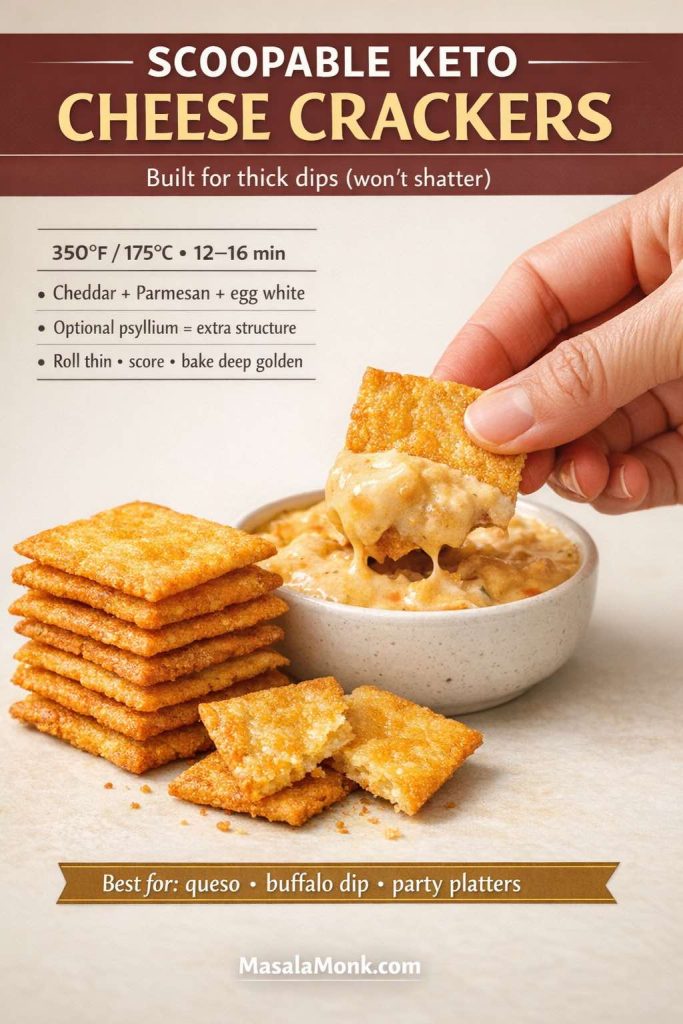
Scoopable Keto Cheese Crackers (Low-Carb Chips for Dipping): These are the “chip replacement” that actually holds up in thick queso, buffalo dip, and creamy dips—no shattering. Roll the dough thin, score, bake 12–16 minutes at 350°F / 175°C, then cool for peak crunch. Perfect when you’re craving keto chips for dipping but want something sturdier than flimsy crisps.
Method
Heat oven to 175°C / 350°F.
Mix everything until it forms a sticky mass.
Roll between parchment to a thin sheet (about 2–3 mm).
Score into squares.
Bake 12–16 minutes until deeply golden.
Cool on the tray, then snap along the score marks.
That gives you a sturdier “chip” that behaves like a scoopable cracker—perfect when you want keto crackers for cheese nights.
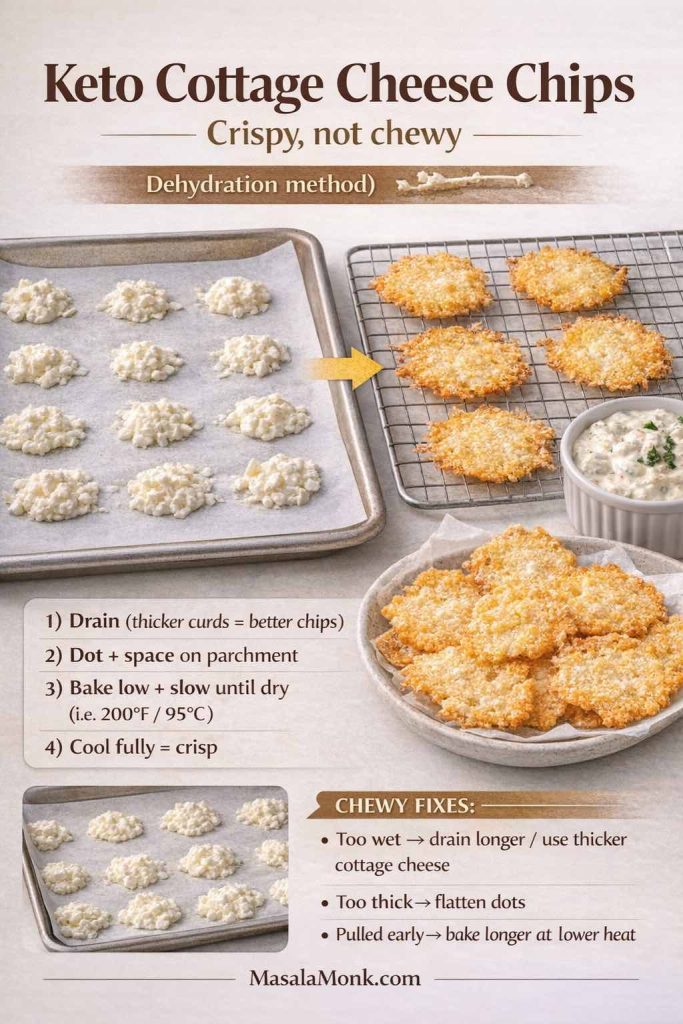
Want a lighter, tangier crunch? Keto cottage cheese chips are the “high-protein” version of cheese crisps — but the method is different: you’re dehydrating, not just melting cheese.
Keto cottage cheese chips (crispy, not chewy): these work best when you treat them like dehydration, not “quick baking.” Drain first, dot and space on parchment, bake low + slow until fully dry, then cool completely for the final crunch. Use this as your quick fix guide when a batch turns chewy—usually it just needs more drying time or thinner dots. (MasalaMonk.com)
More dips that make cheese crisps feel like a full snack
Cheese crisps become dangerously snackable when they have the right dip next to them. A simple strategy is to keep a creamy base on hand and change the flavor each time. If you want a dependable base, homemade mayo with variations gives you a flexible starting point, especially for quick chip dips. If you prefer an egg-free option, eggless mayonnaise works as a smooth, neutral base too.
From there, spice it up with something bold. A spoon of hot sauce works, yet a layered sauce works even better. This pepper sauce guide is a great internal reference because it gives you multiple styles (bright vinegar heat, smoky heat, herb-forward heat) that can transform a basic dip in seconds.
If you want a party-ready option that’s hot, rich, and built for scooping, buffalo chicken dip is a classic pairing that feels like a proper snack table, not a compromise.
Pork rinds and scratchings: best keto chips for thick dips and “scoop” snacks
Pork rinds and similar crunchy scratchings are polarizing, yet they’re undeniably effective as keto chips for dipping—especially for thick dips. Their structure is airy but sturdy, and they hold up under creamy, dense dips in a way that thin tortilla-style chips often can’t.
That said, they’re not always the best match for watery salsa. If salsa is your main goal, you’ll often prefer a tortilla-style keto chip. However, if you love thick dips, these can be your best keto chips for dipping—especially for anything warm and cheesy or anything creamy and heavy.
Make store-bought pork rinds taste “fresh” again
Even good crunchy snacks can taste stale if they’ve been open for a day. A quick crisp-up makes them feel brand new:
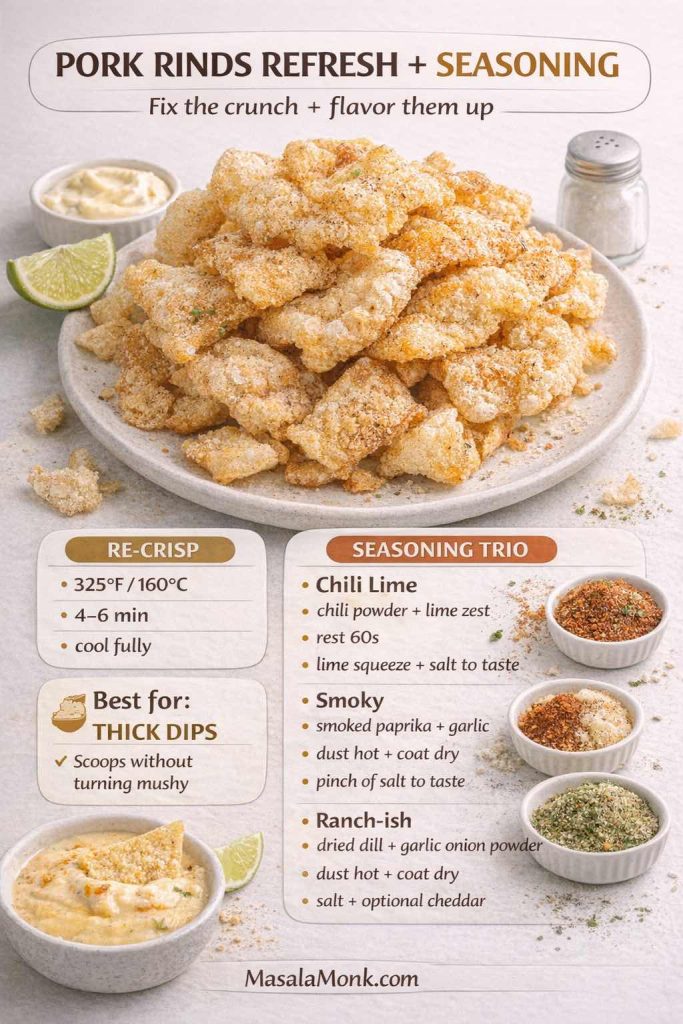
Spread on a tray and warm at 160°C / 325°F for 4–6 minutes
cool completely
Pork rinds are one of the best “keto chips for dipping” because they scoop thick dips without turning mushy. This quick card fixes the #1 problem (stale crunch): re-crisp at 325°F / 160°C for 4–6 minutes, cool fully, then hit them with a flavor dust (chili-lime, smoky, or ranch-ish). Save this for game nights and snack boards when you want big crunch with minimal carbs.
After that, toss with one of these seasoning blends:
Chili-lime: chili powder + lime zest + salt
Smoky: smoked paprika + garlic powder + pepper
Ranch-ish without the packet: dried dill + garlic powder + onion powder + salt
Pair them with something cooling
A Greek yogurt dip changes everything here. A great fit is Greek Tzatziki Sauce. It’s bright, garlicky, and thick enough to cling. In addition, the cucumber freshness cuts through rich, salty snacks so you don’t feel like you’re eating pure intensity.
If you’re building a game-night platter, another strong option is Blue Cheese Dip for Wings—especially if you like spicy snacks.
Keto chicken skin chips and keto meat chips: the “keto pringles” level of crunch
Some cravings aren’t satisfied by airy crunch. Sometimes you want that hard, thick, aggressive crunch that feels like kettle chips or even the idea of keto pringles. That’s where keto chicken skin chips and keto meat chips come in.
These options tend to be high in fat and protein and very low in carbs, so the carb question is usually easy. The bigger issue is portioning, because they’re intensely snackable and easy to overeat. They’re also not always ideal for delicate dipping—some varieties scoop beautifully, while others shatter.
Chicken skin chips at home recipe (oven method)
If you have access to chicken skin, you can turn it into chicken chips keto-style with surprisingly little effort. Lay the skins flat on parchment, season with salt and pepper, and bake until deeply crisp. Flip once. Then drain and cool. The cooling step matters because it crisps further as it rests. To shift the flavor into “hot chips” territory, sprinkle chili powder or smoked paprika after baking, then add a squeeze of lime. The result is bold without becoming bitter.
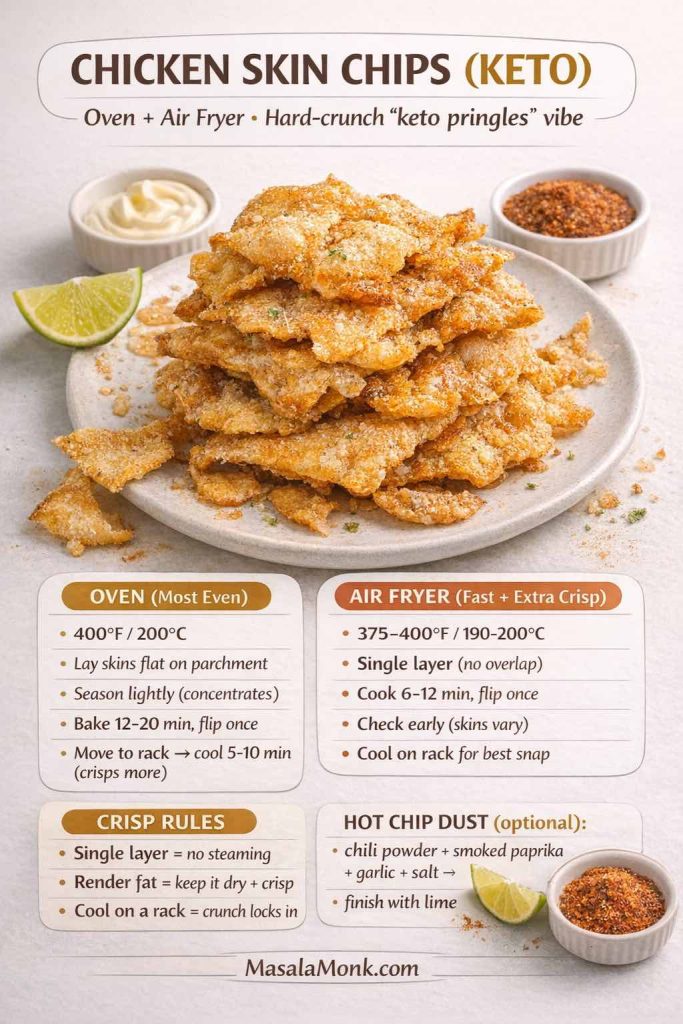
Save this: oven vs air fryer timings + the 3 rules that make chicken skin chips snap instead of chew.
Chicken Skin Chips (Keto): the hard-crunch option when you want “keto pringles” energy without relying on tortilla-style chips. This card gives you oven + air fryer timings, the 3 crisp rules that prevent steaming, and an optional hot-chip dust to make them taste aggressively snacky. Save it for game night, snack boards, and “I need crunch” moments.
Ingredients
Chicken skins (as flat as you can get them)
Salt + pepper
Optional: smoked paprika, chili powder, garlic powder
Method
Heat oven to 200°C / 400°F.
Lay skins flat on parchment. Single layer matters.
Season lightly (they shrink, so seasoning concentrates).
Bake until deeply crisp, flipping once, usually 12–20 minutes depending on thickness.
Drain on paper and cool before eating.
For a hot chip vibe, sprinkle seasoning after baking and finish with lime.
Air fryer chicken skin chips (faster, crispier)
If you’ve got an air fryer, chicken skin chips can become dangerously easy.
Method
Preheat air fryer (if yours benefits from it).
Arrange skins in one layer (no overlap).
Air fry around 190–200°C / 375–400°F, checking often.
Flip once.
Cool on a rack.
If you want to push the “hot chips” vibe, season after crisping and finish with lime.
Because air fryers vary wildly, watch the first batch carefully. Once you learn the timing, it becomes a repeatable “weekend snack” trick.
A “meat chip” idea that’s actually doable: jerky-style crisps
You’ll see phrases like keto turkey jerky, keto beef jerky, best jerky for keto, and beef sticks keto all grouped with chip terms because people use jerky as a crunchy-ish snack replacement. Jerky isn’t a chip, but you can make jerky crisp enough to feel chip-adjacent.
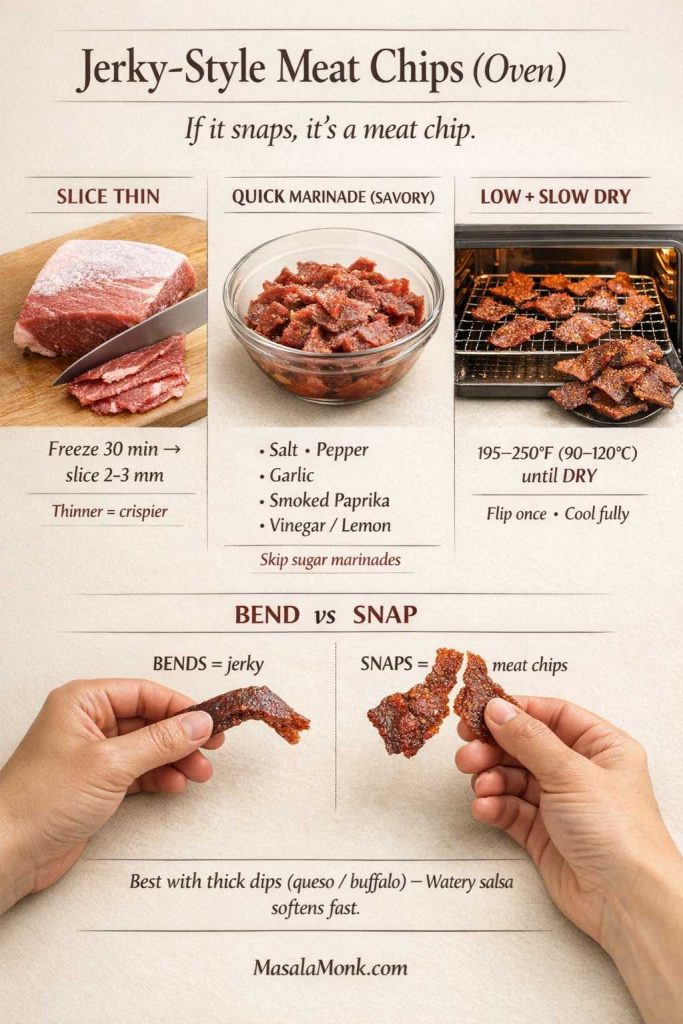
Jerky-style meat chips (oven): If your strip snaps, you’re in meat-chip territory. Slice lean beef very thin, season simply (skip sugar marinades), then dry low + slow until crisp. Use the quick Bend vs Snap test before serving—these pair best with thick dips like queso or buffalo-style. Save this as your go-to keto meat chip method.
Crispy jerky-style strips (oven)
Thinly slice very lean beef (freeze 30 minutes first to slice thin)
Marinate with salt, pepper, garlic powder, smoked paprika, and vinegar or lemon juice
Dry/bake at low heat (90–120°C / 195–250°F) until dry and crisp, flipping once
Cool fully
The key is thinness and dryness. If it’s bendy, it’s jerky. If it snaps, it’s meat-chip territory.
Seed crackers and keto crackers: the most reliable low carb chip replacement
If you want something that feels like chips but behaves more like a stable, everyday snack, seed crackers are the quiet hero. They’re one of the best low carb chip replacement options because they’re easy to make, easy to portion, and generally less likely to trigger “I ate the whole bag” behavior.
They’re also a natural bridge into keto crackers and almond crackers keto-style snacks, since many cracker-style recipes are built around seeds, fiber, and low-carb flours.
Why seed crackers work so well
They usually deliver:
a crisp, toasted crunch
more “weight” than airy chips
better dip performance than many thin keto chips
Plus, they pair beautifully with yogurt dips, mayo dips, and cheese-based dips.
If you want the dip that makes seed crackers feel restaurant-level, use Greek Tzatziki Sauce. It’s thick, bright, and makes the whole snack feel fresh.
Alternatively, if you’re going for a richer, more indulgent dip, use a mayo base:
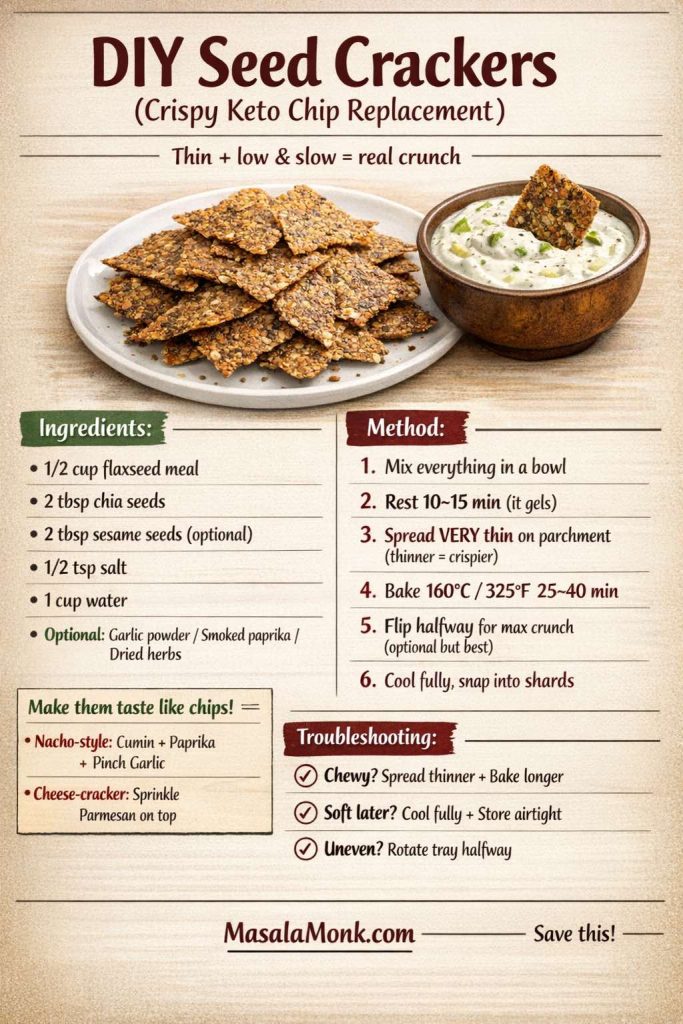
Mix flaxseed meal with chia seeds, sesame, and water. Let it gel. Spread it very thin on parchment. Bake low and slow until dry and crisp, then break into shards.
You can turn these into “nacho chips” by adding cumin, paprika, and a pinch of garlic powder. You can also turn them into “cheese crackers” by baking with a light dusting of parmesan over the top.
Ingredients
1/2 cup flaxseed meal
2 tablespoons chia seeds
2 tablespoons sesame seeds (optional)
1/2 teaspoon salt
1 cup water
Optional: garlic powder, paprika, dried herbs
DIY Seed Crackers (Crispy Keto Chip Replacement): the most reliable low carb chip alternative when you want real crunch that actually holds up in dips. The key is spreading the mix very thin, baking low + slow, and letting it cool fully before snapping into shards. Use this as your go-to keto crackers / seed crackers base, then change the vibe with “nacho-style” spices or a parmesan top for a more “cracker chip” feel—perfect for snack boxes and dip nights.
Method
Mix everything in a bowl.
Rest 10–15 minutes until gelled.
Spread thin on parchment (thinner = crispier).
Bake at 160°C / 325°F for 25–40 minutes, depending on thickness.
Flip the sheet halfway through if you want extra crispness.
Cool, then snap into shards.
This is a great base for chip-and-dip nights because it scoops well and holds up.
Almond flour crackers that feel like “real crackers”
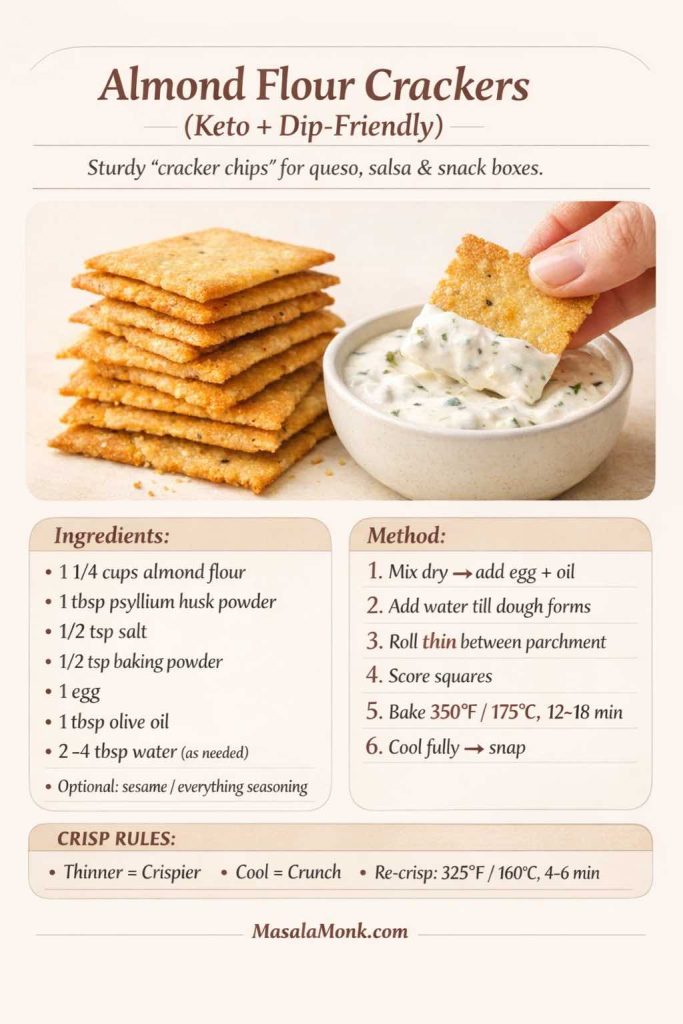
If you want almond flour keto crackers, this version is simple and sturdy.
Optional: sesame seeds or everything-style seasoning
Almond Flour Crackers (Keto + Dip-Friendly): These sturdy low carb cracker chips are perfect when you want something that actually holds up in queso, salsa, and thick dips. Roll the dough thin, score into squares, bake until golden, then cool completely for that real crunch. If they soften later, a quick re-crisp brings them back. Save this for snack boxes and chip-and-dip nights.
Method
Heat oven to 175°C / 350°F.
Mix dry ingredients, add egg + oil, then add water until a workable dough forms.
Roll between parchment into a thin sheet.
Score into squares.
Bake 12–18 minutes until golden and crisp.
Cool completely, then break.
If you want a deeper look at how keto-friendly flours behave across recipes, this keto flour guide is a great companion. If glucose stability is also on your mind, almond flour and diabetes supports why almond-based swaps often behave differently than wheat-based snacks.
Keto tortilla chips and low carb tortilla chips: for salsa nights and nachos
When people say “keto chips,” they often mean keto tortilla chips. They want triangles, they want that familiar tortilla snap and then they want the ability to do keto chips and salsa without feeling like they’re chewing on a substitute.
This is completely doable, but tortilla-style chips are the area where labels matter most. Two products can look similar and behave very differently. So start with the label basics from the FDA: understanding the Nutrition Facts label and the structure of total carbohydrate. That way, you’re comparing chips on the same foundation rather than trusting marketing language.
What’s actually inside many low carb tortillas (and why it matters)
A lot of low carb tortillas get their “net carb” profile from some combination of:
added fibers (like inulin, oat fiber, or other plant fibers like cellulose)
resistant starches or modified starches
gluten or protein structure (in some versions)
binding agents (like gums)
None of that is automatically “bad.” The point is simply this: a tortilla can look low carb on paper while still being very easy to overeat, and some people don’t feel great after huge fiber loads in one sitting. When that happens, it’s not a willpower issue—it’s how fiber-heavy products behave for some bodies.
If you ever want a neutral place to cross-check general nutrition numbers across foods and ingredients, USDA FoodData Central is useful.
Homemade keto tortilla chips that actually get crisp (oven + air fryer)
If you’ve tried making low carb tortilla chips and ended up with limp triangles, you’re not alone. Tortilla-style keto chips can be genuinely satisfying, but they need to be treated like a drying project, not a quick toast. You’re not just browning them — you’re removing moisture so they stay crisp long enough for salsa, dips, and nachos.
This is the master method: one approach that works with most low carb wraps and homemade tortillas, plus the fixes that matter when a batch goes wrong.
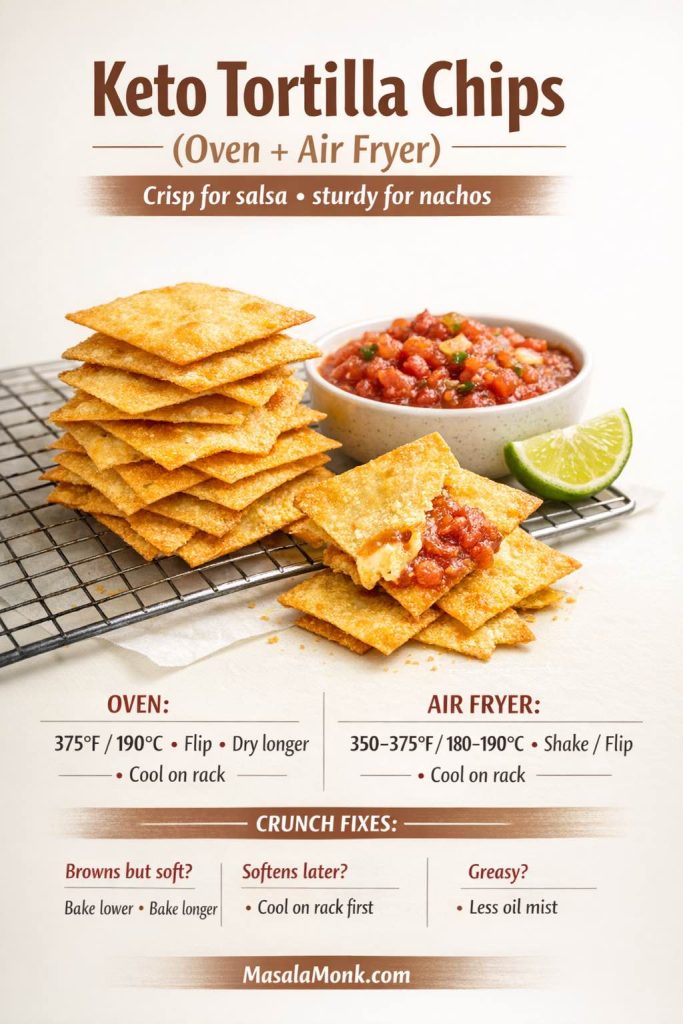
Keto Tortilla Chips (Oven + Air Fryer): The secret to low carb tortilla chips that stay crisp for keto chips and salsa is drying, not just browning. Bake or air fry in a single layer, flip/shake halfway, then cool on a rack so steam doesn’t soften the underside. Use these for keto nacho chips (cheese first, wet toppings last) and re-crisp later with a quick low-heat bake if humidity wins.
The oven method (most reliable for big batches)
What you’ll need
Low carb tortillas or homemade tortillas
Oil spray or a very light brush of oil
Salt + optional seasonings
2 baking trays (or bake in batches)
A cooling rack (highly recommended)
Step-by-step
Heat the oven to 190°C / 375°F.
Cut tortillas into triangles. Keep them similar in size so they crisp evenly.
Arrange in a single layer. Overlap turns into steaming.
Spritz or brush with oil lightly. Too much oil makes chips heavy and can keep them from drying properly.
Season. Salt is non-negotiable. Add spices if you want a “nacho” vibe.
Bake 8–12 minutes, then flip the chips.
Bake another 6–10 minutes until the edges are clearly crisp and the center feels dry.
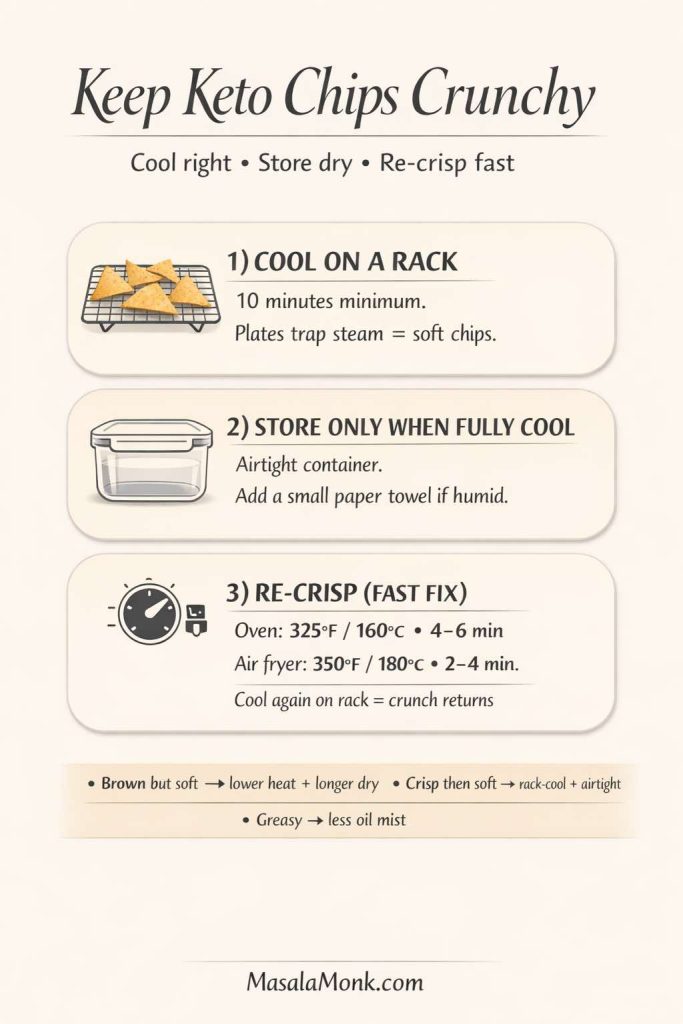
Move to a cooling rack and let them cool 10 minutes. They finish crisping as they cool.
Pro move: after flipping, crack the oven door for the last 2–3 minutes to help moisture escape.
Why the rack matters: if you cool chips on a plate, steam softens the underside. A rack keeps air moving, which is the difference between “pretty good” and genuinely crisp.
The air fryer method (fastest for small batches)
The air fryer is perfect when you want keto chips and salsa right now and don’t need a giant batch. It also makes chips taste slightly “lighter” because airflow does more work than oil.
Preheat the air fryer if yours benefits from it.
Set it to 180–190°C / 350–375°F.
Arrange triangles in a single layer (cook in batches if needed).
Light oil spritz + salt + seasoning.
Air fry 4–6 minutes, shake or flip, then another 2–5 minutes until crisp.
Cool fully (this is where crisp happens).
Watch the first batch closely. Tortillas vary in thickness and fiber content, so the perfect time depends on your wrap. Once you find the sweet spot, it becomes repeatable.
Why your low carb tortilla chips aren’t crisp (quick fixes)
Most crunch problems come from a few predictable issues. The fixes are simple once you know what you’re looking at.
They browned but stayed soft: they need more drying time. Lower the heat slightly and bake longer so the center dries without burning.
They crisped, then softened later: they weren’t cooled properly. Always cool properly before storing.
They taste bitter: the seasoning burned. Add delicate spices later or use slightly lower heat for longer.
They’re crisp at the edges but chewy in the center: triangles are too big or the wrap is thick. Cut smaller, bake longer, and flip earlier.
They feel greasy: too much oil. Use a mist, not a brush.
If you want salsa-style chips that don’t collapse fast, bake them a touch longer than you think you should. A slightly “over-dry” chip is exactly what survives salsa and nachos.
How to store homemade keto chips (so they don’t go stale)
Homemade chips go soft mainly because moisture sneaks back in. Once that happens, they’re not ruined — you just need to re-crisp them.
Best storage: airtight container after chips are completely cool.
If they soften: re-bake at 160°C / 325°F for 4–6 minutes, then cool again.
If you live somewhere humid: add a small paper towel to the container (swap daily) to absorb moisture.
This makes tortilla-style keto chips far more practical. Instead of treating chips like a one-time project, you can bake once and refresh quickly when needed.
“Keto Doritos” flavor dust: the fastest way to fix a bland batch
Even crisp chips can feel disappointing if they taste flat. Seasoning matters more than people expect — especially for low carb chips, where you’re not getting the same corn-based flavor you’d get from regular tortilla chips.
This simple seasoning blend takes plain tortilla chips, cheese crisps, seed crackers, or pork rinds and pushes them into that spicy, dusty “hot chips” zone.
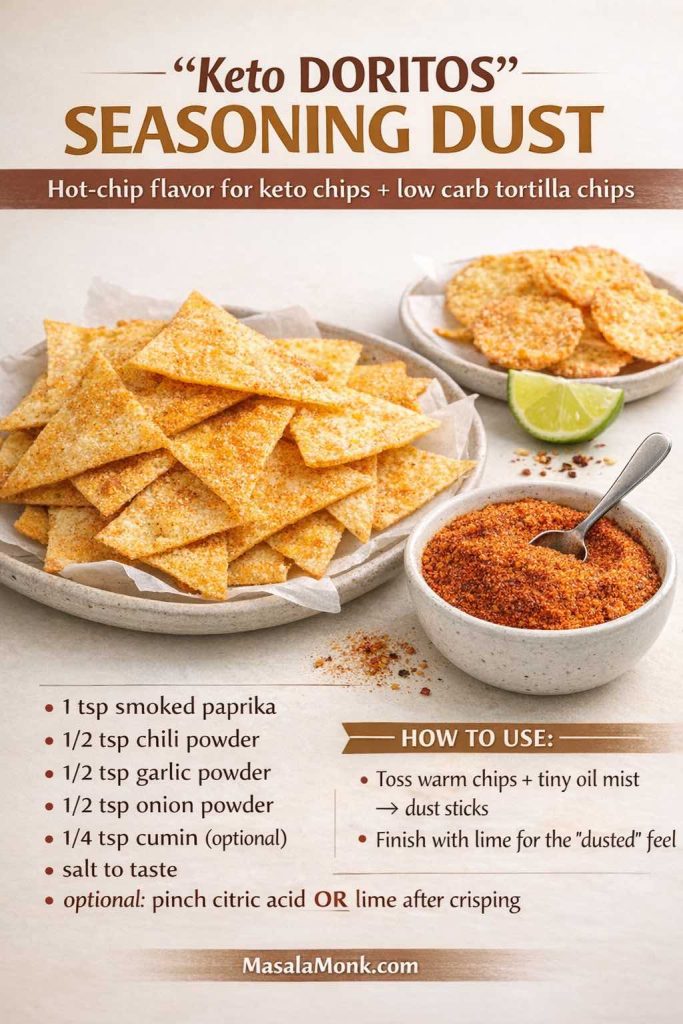
If your keto chips taste bland, don’t change the chip—change the dust. This “Keto Doritos” seasoning turns low carb tortilla chips, cheese crisps, seed crackers, or pork rinds into that salty, spicy low carb hot chips vibe in 30 seconds. Toss chips while warm with a tiny oil mist so the seasoning sticks, then finish with lime for the “dusted” feel. It’s the fastest way to rescue a batch and make keto chip snacks actually craveable.
Nacho-style seasoning (dry blend)
1 tsp smoked paprika
1/2 tsp chili powder
1/2 tsp garlic powder
1/2 tsp onion powder
1/4 tsp cumin (optional but excellent)
Salt to taste
Optional: pinch of citric acid, or a squeeze of lime after crisping
How to use it: toss warm chips with the seasoning (a light oil mist helps it stick), then finish with lime. Suddenly your “chip replacement” feels like a real snack, not a compromise.
If you like heat with depth instead of flat spice, a spoon of pepper sauce stirred into mayo makes an instant spicy dip that turns even simple chips into something you actually want to keep eating.
Make low carb tortillas at home (then turn them into chips)
If you’ve found a store-bought wrap you like, turning it into chips is already a win. However, if you don’t love the ingredient list on some low carb tortillas—or you want chips that taste cleaner and crisp the way you like—making tortillas at home gives you full control.
The bonus is flexibility: make them slightly thicker for wraps, then roll them thinner when you want chips. Once you have a tortilla you like, the crisping method you already used becomes automatic.
Here are two reliable routes:
Almond flour tortillas (soft enough to wrap, crisp enough to chip)
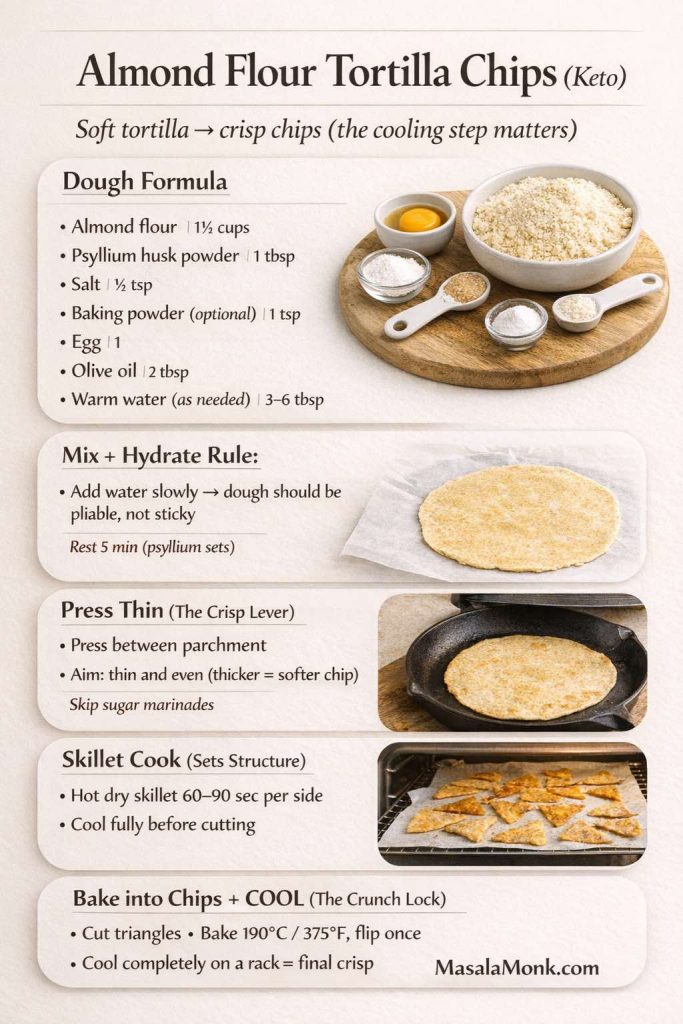
If you’d rather make a dough-based chip, almond flour tortilla chips are the usual route. They take more effort, yet you control the thickness and the seasonings. This also naturally connects to a broader low-carb flour toolkit. If you want a deeper reference for how keto-friendly flours behave, MasalaMonk’s keto flour guide can help you understand why some doughs crisp while others stay soft.
Ingredients
1 1/2 cups almond flour
1 tablespoon psyllium husk powder (structure)
1/2 teaspoon salt
1 teaspoon baking powder (optional, for tenderness)
1 egg
2 tablespoons olive oil
3–6 tablespoons warm water (as needed)
If your ‘keto chips’ keep turning soft, this is the fix: press thin, set structure on the skillet, then bake + cool to lock crunch. These almond flour tortilla chips are sturdy enough for dips once they fully cool (that’s where the snap happens). Keep this graphic handy the next time you want real chip texture without the carbs.
Method
Mix dry ingredients.
Add egg and oil, then add water gradually until dough is pliable.
Divide into balls.
Press between parchment into thin circles.
Cook on a hot dry skillet 60–90 seconds per side.
To make chips
Let tortillas cool fully (they firm up).
Cut into triangles.
Bake at 190°C / 375°F until crisp, flipping once.
Do not forget to cool properly.
If you’re building chips from almond flour and you care about glucose stability too, almond flour and diabetes is a relevant resource that reinforces why almond-based swaps often behave differently from wheat-based snacks.
Coconut flour tortillas (lighter, more delicate)
Coconut flour absorbs a ton of water, so these can be fragile. Still, they work when you want thin chips.
Ingredients
2 tablespoons coconut flour
2 eggs
2 tablespoons water
1 tablespoon olive oil
Salt
Optional: pinch of baking powder
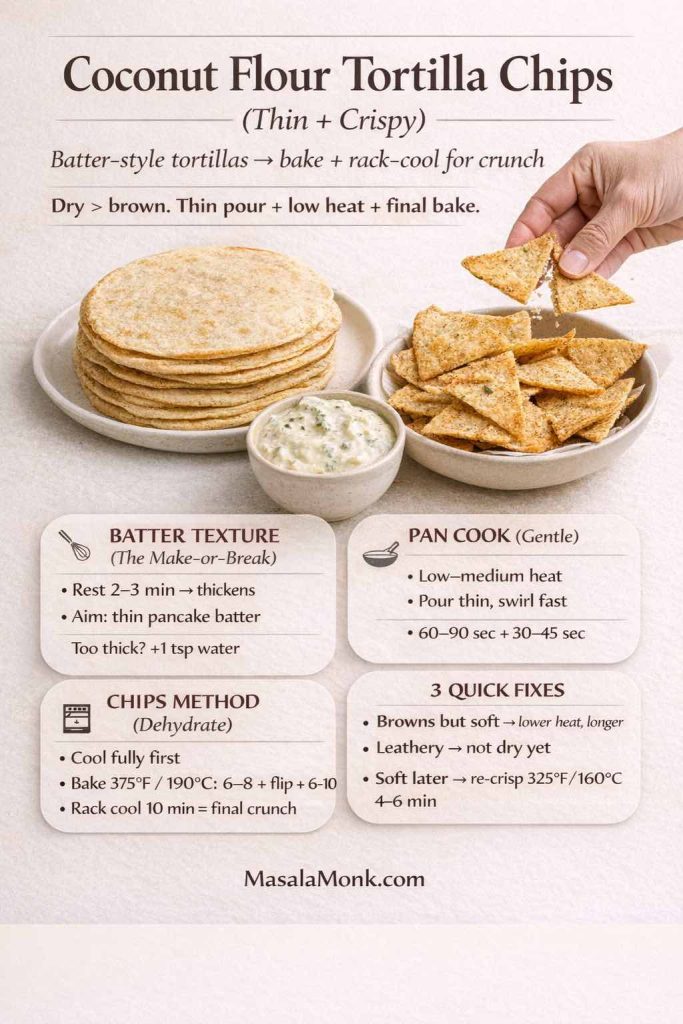
Coconut Flour Tortilla Chips (Thin + Crispy): Coconut flour is fragile, so the trick is batter-thin tortillas + a final bake (dry > brown). Pan-cook gently, then bake and cool on a rack so steam doesn’t soften the underside. This is the best route when you want thin keto chips for salsa without relying on store-bought wraps. (MasalaMonk.com)
Method
Whisk everything and let it sit 2 minutes.
Pour thin circles into a lightly oiled skillet.
Cook gently; flip carefully.
These are more fragile, but when they crisp successfully, they can be surprisingly satisfying as thin chips.
Keto chips and salsa: how to make it actually satisfying
Keto chips and salsa can work beautifully if you stop treating salsa like the whole snack and start treating it as one part of a complete setup.
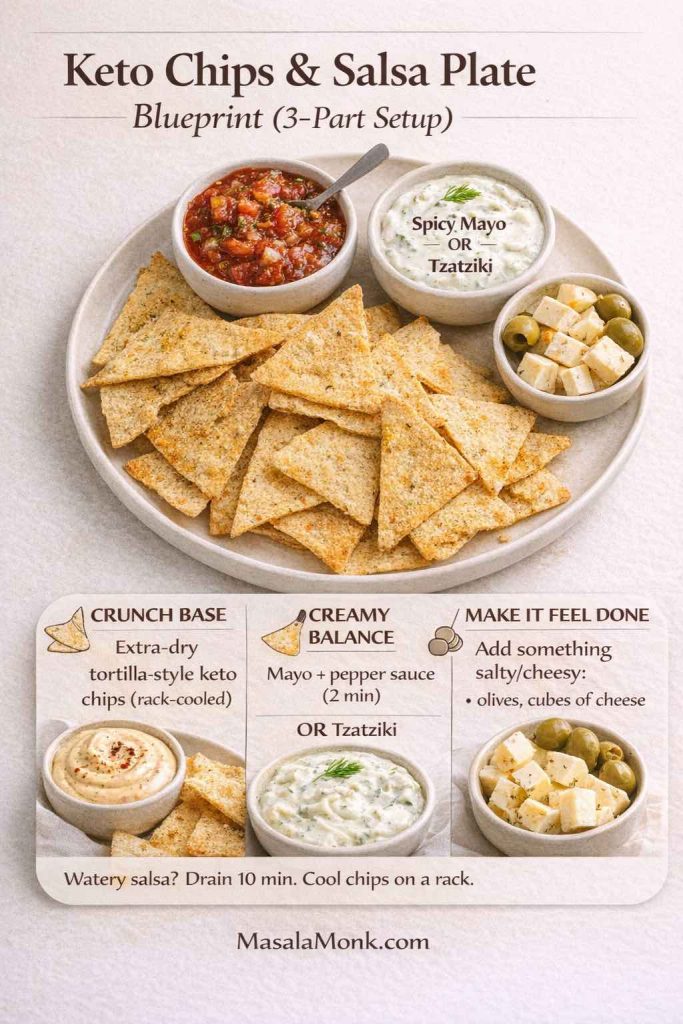
A strong chips-and-salsa plate usually has:
a tortilla-style keto chip as the crunchy base
something creamy to balance acidity
something salty or cheesy to make it feel complete
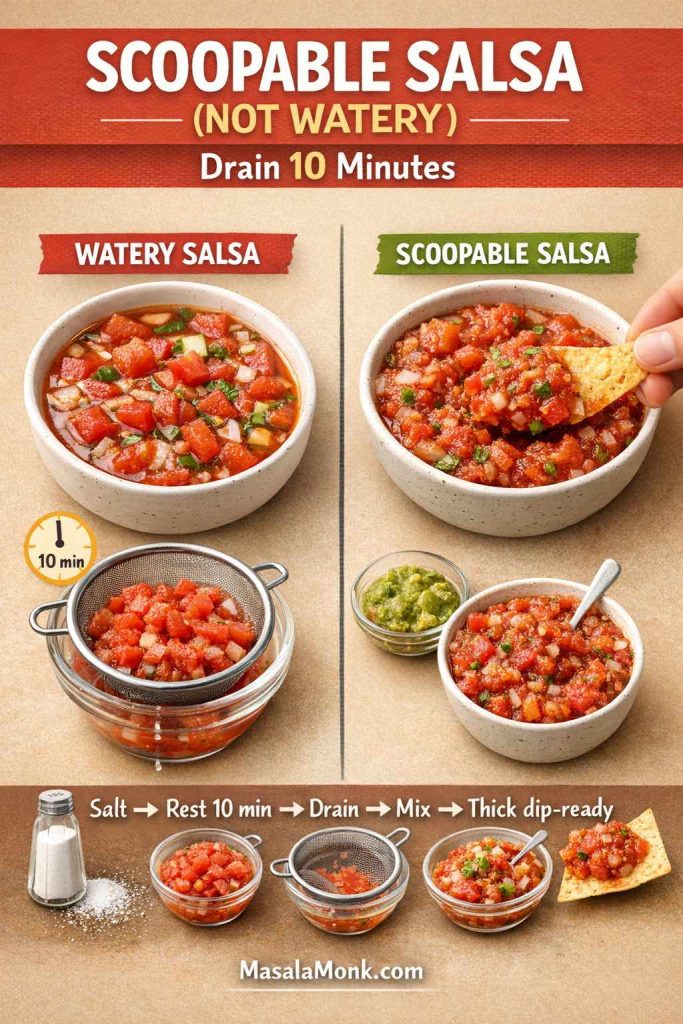
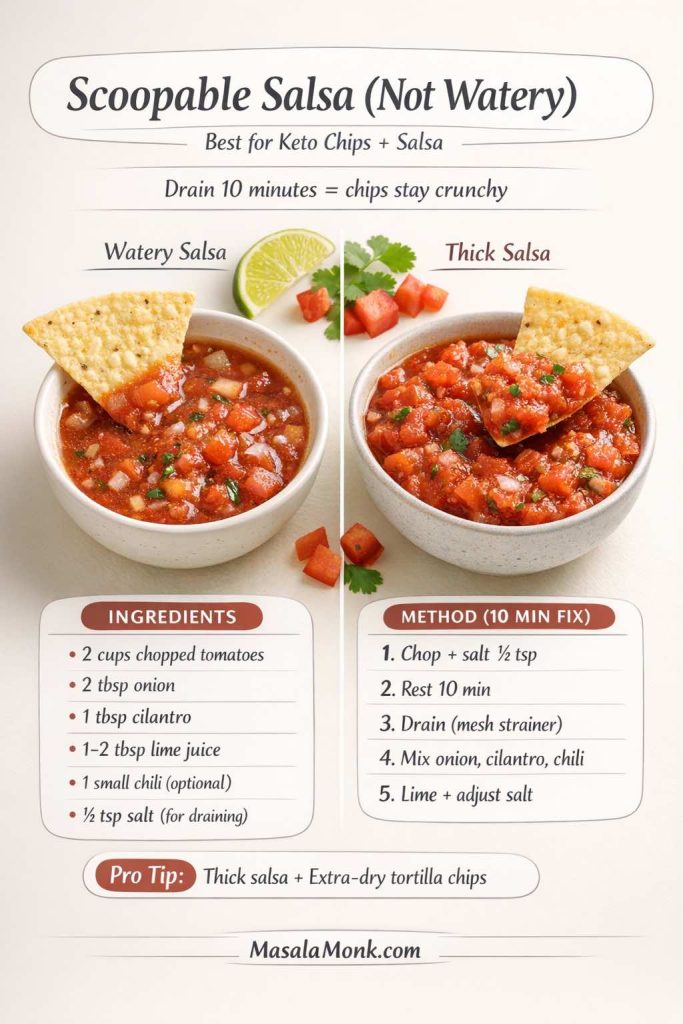
Keto chips & salsa that actually satisfies: build a 3-part plate. Start with extra-crisp tortilla-style keto chips, add a creamy dip (spicy mayo or tzatziki) to balance salsa acidity, then finish with something salty/cheesy (olives + cheese cubes). Bonus: if your salsa is watery, drain 10 minutes and rack-cool chips so they stay crunchy.
That creamy element can be as simple as a quick mayo dip (mayo + pepper sauce), or a cooling yogurt dip like Greek Tzatziki. Meanwhile, if you want an avocado-based angle, this post on avocado for diabetes supports why avocado-based dips are often used in lower-carb eating patterns.
Watery salsa destroys weak chips. So the trick is pairing chip type to dip type:
watery salsa → tortilla-style chips baked extra crisp
Keto nacho chips, keto taco chips, and the art of building low carb nachos
If you’re craving nachos, you’re not craving chips as much as you’re craving structure: crunchy base, melted toppings, and a little chaos on a tray.
The easiest way to do keto nacho chips without disappointment is to pick a base that stays crisp long enough to eat the plate.
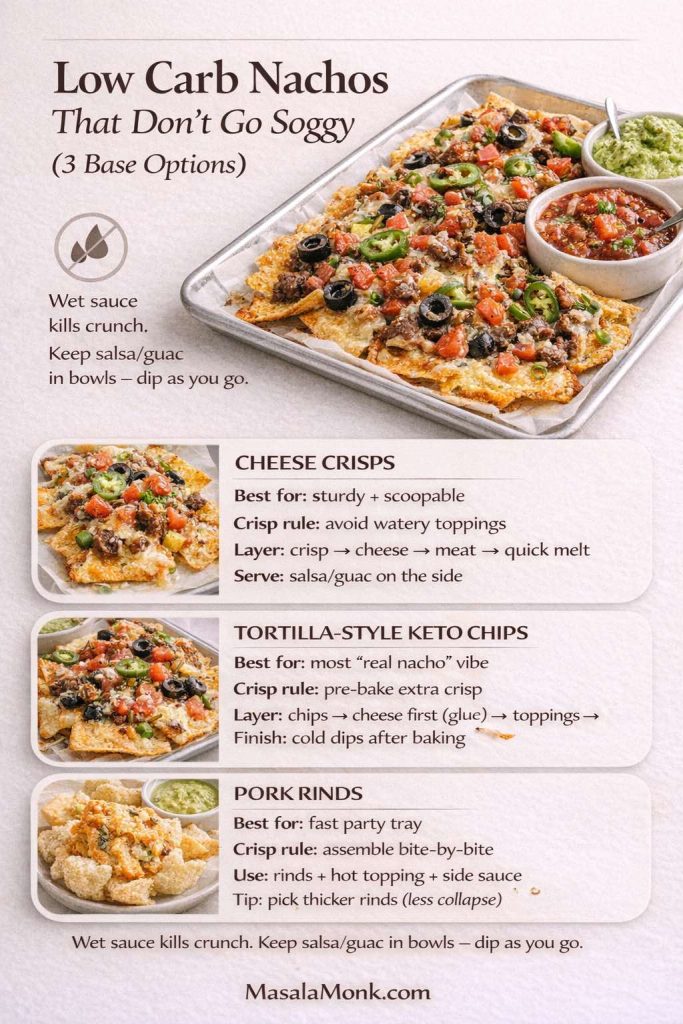
Build keto nachos that stay crispy by choosing the right base: cheese crisps for sturdy scooping, tortilla-style keto chips for the most “real nacho” vibe, or pork rinds for a fast party tray. The biggest crunch-saver: keep wet salsa/guac in bowls and dip as you go—and add cold dips after baking so nothing steams your chips.
Three keto nacho bases that work
1) Cheese crisps They’re naturally sturdy and don’t become soggy as fast. Layer lightly, add toppings that aren’t too watery, and keep wet sauces on the side.
2) Tortilla-style low carb chips Best when you want the most “normal” nacho vibe. Bake them extra crisp before topping, then layer cheese first so it acts like glue.
3) Pork rinds They can work surprisingly well, especially if you assemble bite-by-bite instead of drowning the whole tray in sauce.
If you want a nacho topping that feels like party food, Buffalo Chicken Dip can double as a hot, creamy topping. For a cooler, tangier finish, Blue Cheese Dip works brilliantly on the side.
Keto veggie chips: when you want crunch that feels lighter
Keto veggie chips can work, but they’re the most likely to disappoint if you expect them to taste like potato chips. If you treat them as their own snack—thin, crisp, salty, and fresh—they can be genuinely good.
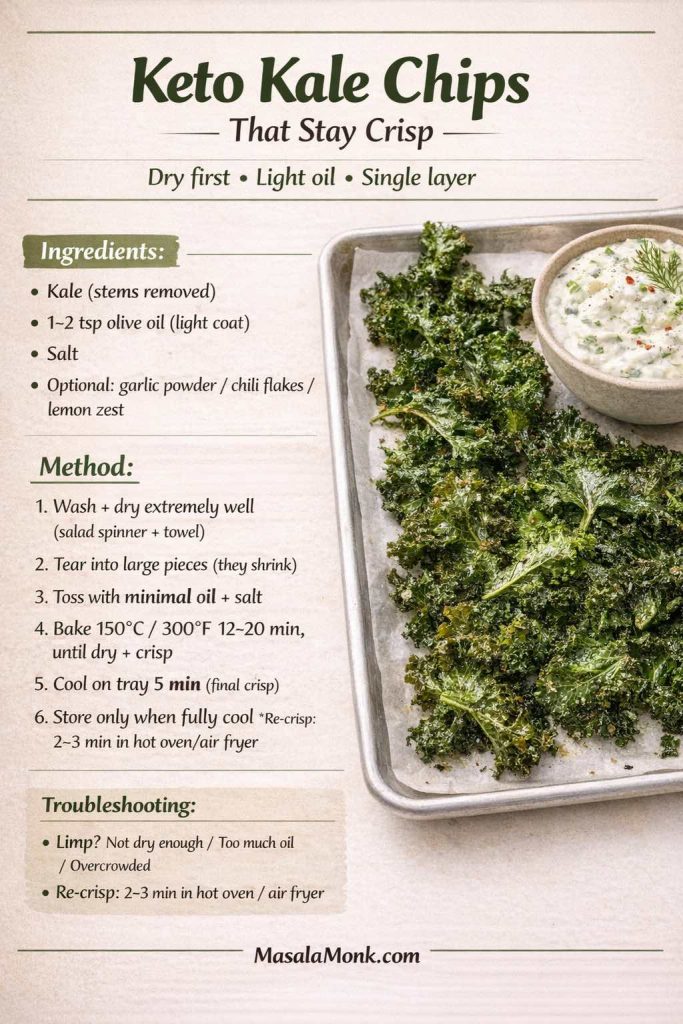
Keto kale chips that stay crisp
Keto kale chips are a classic for a reason. They crisp quickly and can be intensely snackable when seasoned well.
The biggest determinant is moisture. Dry the leaves thoroughly. Use a light touch of oil. Bake in a single layer. Then cool before storing.
Keto Kale Chips That Stay Crisp (Save This): The crunch comes from drying, not drowning in oil. Dry leaves extremely well, use minimal oil, bake in a single layer at 150°C / 300°F, then cool fully (that’s when they turn properly crisp). If they go limp later, re-crisp 2–3 minutes in a hot oven/air fryer. A perfect low carb veggie chips option when you want lighter crunch without the “chip replacement” heaviness.
If you want a dip that makes kale chips feel less “health snack” and more “snack snack,” serve them with Greek tzatziki sauce. It adds richness and tang, which makes veggie chips feel complete.
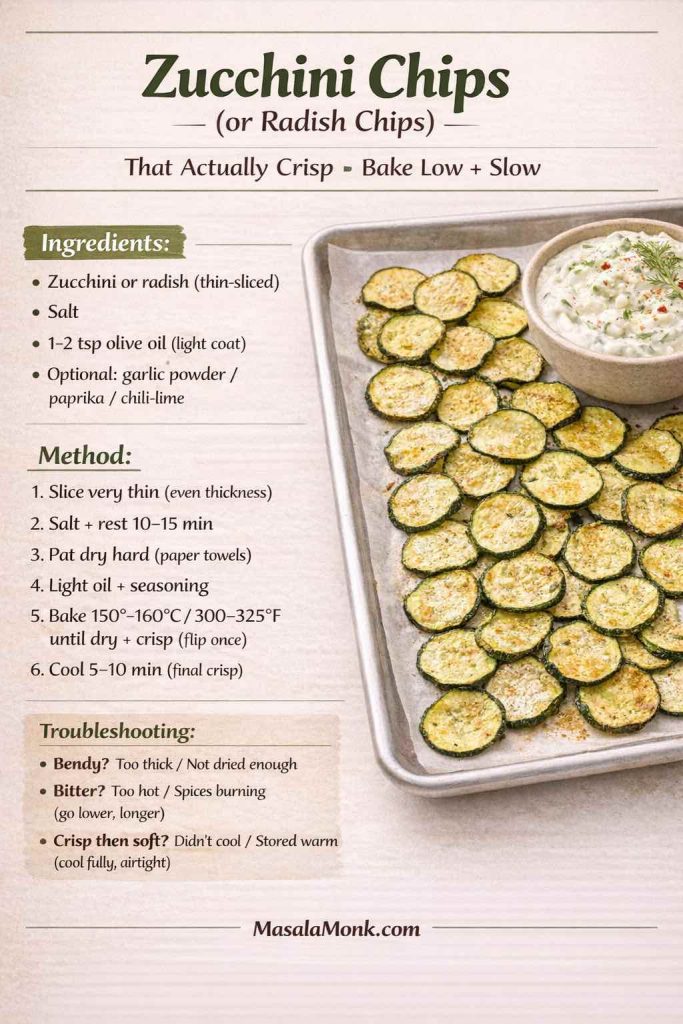
Zucchini chips, radish chips, and other veggie crisps
Zucchini, radish, and even thin-sliced eggplant can crisp if you slice them thin and bake them long enough to dry out. Salt them first to pull moisture, pat them dry, then bake.
Zucchini chips (or radish chips) that actually crisp: the whole secret is moisture management—salt, rest, and pat very dry before baking low + slow (300–325°F / 150–160°C). Cool 5–10 minutes for the final snap. Use these as a lighter keto veggie chips option when cheese crisps feel heavy, and dip them in a thick, creamy sauce (tzatziki or spicy mayo) so they feel like a real snack—not a “diet” plate.
If you’re looking for variety because cheese-based chips feel heavy every day, rotating in veggie chips is an easy way to keep snacks interesting while staying low carb.
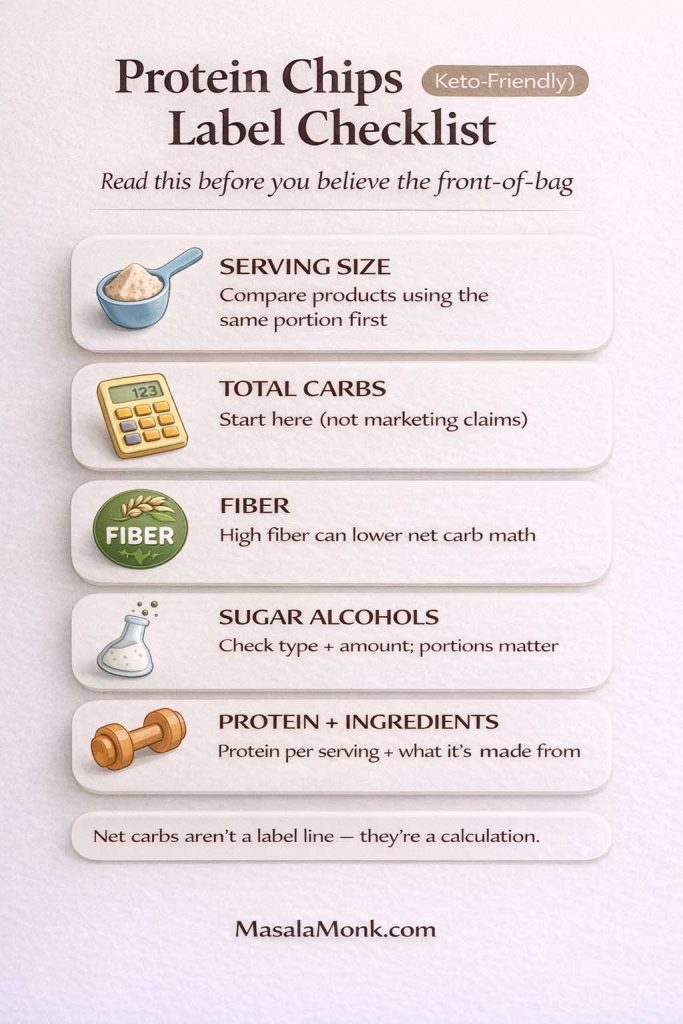
Protein chips keto-style: what they are and what to watch
High-protein low carb chips exist in many forms. Some are basically puffed protein snacks. Others are fiber-heavy crisps with added protein. Some are more like crackers.
They can fit into a low carb plan, yet they can also be the kind of snack that looks “too good to be true.” That doesn’t mean they’re bad; it simply means you want to read the label carefully and portion intentionally.
Buying “protein chips” for keto? Don’t trust the front-of-bag hype—use this 5-point label checklist first: serving size, total carbs, fiber, sugar alcohol type + amount, and protein + ingredients. It takes 15 seconds and stops the classic “I ate the whole bag” carb surprise. Save this graphic and keep it handy for shopping days. (MasalaMonk.com)
Start with the basics:
serving size
total carbs
fiber
any sugar alcohols
If you’re ever unsure how “net carb math” is being presented, the American Diabetes Association’s primer on carbohydrates and net carbs is a good neutral explanation: ADA: get to know carbs.
Quick note: “Net carbs” isn’t an official line on the label—it’s a calculation people use. Always compare products using the same serving size first.
For a purely neutral place to cross-check nutrition information across foods and ingredients, USDA FoodData Central is useful when you want a baseline reference.
No carb chips, zero carb chips, and “0 carb chips”: what that usually means in real life
It’s tempting to chase the idea of no carb chips. After all, if chips without carbs existed in a way that felt exactly like tortilla chips, everyone would eat them.
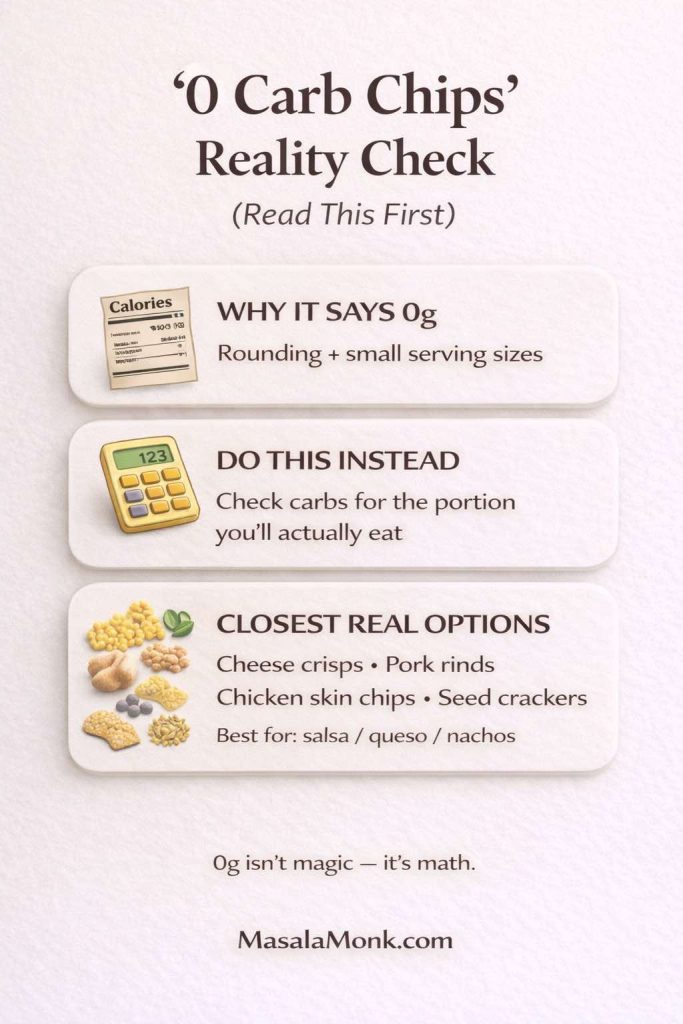
In reality, “0 carb” often happens because of one or more of the following:
the serving size is small
the carbs per serving are low enough to round down
the snack is mostly fat/protein with tiny residual carbs
‘0 carb chips’ usually isn’t magic—it’s label math. This quick visual shows why some products display 0g, what to check (the carbs for the portion you’ll actually eat), and the most reliable near-zero-carb crunchy options—cheese crisps, pork rinds, chicken skin chips, and seed crackers—especially for salsa, queso-style dips, and nachos.
The important part isn’t to argue with the label; it’s to make sure the portion you actually eat still fits your day. This is exactly why the FDA’s breakdown of total carbohydrate and label structure is worth knowing: total carbohydrate explainer.
If you like the idea of near-zero carb chips, you’ll usually find the most reliable options in the “whole food turned crunchy” category: cheese crisps, chicken skin chips, pork rinds, and some seed crackers. Those aren’t perfect replicas of tortilla chips, yet they satisfy crunch in a way that makes you stop missing the original.
Sometimes the craving isn’t simply chips. It’s low carb hot chips—the spicy, salty, dusted, can’t-stop kind.
You can get that feeling without chasing an exact imitation. A few ways that work:
Season cheese crisps with chili powder, smoked paprika, garlic powder, and a pinch of salt, then finish with lime.
Bake tortilla-style low carb chips, then toss them with a chili-lime blend while they’re still warm.
Make a spicy dip that does the heavy lifting: mayo + pepper sauce is an instant “hot chips” companion.
For the dip base, use homemade mayo or eggless mayo. For the heat, use pepper sauce. That combination turns almost any chip substitute into a “this is what I wanted” snack.
Two dips that make keto chips feel like “real” chips: thick queso + scoopable salsa
Chips feel satisfying for two reasons: crunch and the dip. Most disappointment happens when thin chips meet watery salsa. Thicken the dip, and suddenly cheese crisps, tortilla-style chips, and seed crackers – which we cover in this post – all feel more like the “real” experience.
1) Thick queso-style cheese dip recipe (scoopable, not runny)
This is a simple, low carb queso-style dip you can make in minutes. It’s thick enough for sturdy chips, cheese crisps, and pork rinds — and it doesn’t turn watery the moment it hits the table.
Ingredients
1 tbsp butter
1/2 cup heavy cream (or full-fat milk if you tolerate it)
1 cup shredded cheddar (or a cheddar-parmesan mix)
1/2 tsp garlic powder
1/2 tsp smoked paprika
Salt to taste
Optional: chopped jalapeños, green chilies, or a spoon of pepper sauce
Thick Keto Queso Dip (scoopable, not runny): this is the “chips feel worth it” dip—creamy, stretchy, and built to stay thick instead of separating. The key is low heat + adding cheese slowly, so it stays smooth and dunkable. Serve it warm with your keto chips for dipping (cheese crisps, pork rinds, sturdy crackers, or tortilla-style chips), and it instantly turns snack time into a real plate. Save this card for game nights and quick cravings.
Method
Melt butter on low heat.
Add cream and warm gently (don’t boil).
Reduce heat and add cheese in handfuls, stirring until smooth.
Season, then taste and adjust.
Keep it thick: low heat and patience. High heat makes cheese seize, and overheated dips often separate.
If you prefer cold dips, a mayo base works beautifully too — especially when you want a quick spicy dip without cooking.
2) Salsa that’s thick enough for dipping (not watery)
Watery salsa is the fastest way to ruin keto chips. The fix is simple: remove excess moisture so salsa stays scoopable.
Scoopable Salsa (Not Watery): If you want keto chips and salsa that stays crunchy, the fix is moisture—not a “better chip.” Salt chopped tomatoes, rest 10 minutes, then drain before mixing. You’ll get a thick, dip-ready salsa that clings to low carb tortilla chips instead of turning them soft. Save this as your quick reminder for salsa nights (and for keto nacho chips—wet toppings last).
Quick scoopable salsa method
Chop tomatoes and salt them lightly.
Let them sit 10 minutes.
Drain off the excess liquid.
Add onion, cilantro, chili, lime, and salt to taste.
That draining step changes everything. Your chips stay crisp longer, and your salsa feels like a dip instead of a soup.
Scoopable Salsa (Not Watery) — the 10-minute drain trick that keeps keto chips crunchy. If your keto chips and salsa always turns soggy, it’s usually the salsa, not the chips. Salt chopped tomatoes, rest 10 minutes, drain, then mix in onion + cilantro + lime for a thick, dip-able salsa that actually holds up with low carb tortilla chips and keto nacho chips. Save this as your “chips stay crunchy” fix. MasalaMonk.com
Bonus: quick guac-style dip that plays well with chips
If you want a creamy dip that makes tortilla-style keto chips feel more like the real experience, avocado is the shortcut. Mash avocado with salt and lime, add a little onion, then finish with chili or pepper sauce for heat. It takes two minutes and makes chips feel like an actual snack.
Quick Guac-Style Dip (2-Minute Keto Guac): When you want keto chips and salsa vibes but need something creamier and more filling, this is the fastest win. Mash avocado + lime + salt, then add onion/chili if you like—and a spoon of pepper sauce for heat. It’s thick enough to cling to low carb tortilla chips, cheese crisps, or seed crackers, so snack time feels “done,” not endless. Save this card for salsa nights, nacho trays, and quick snack boxes.
Keto snack box and low carb snack box ideas that keep chips from taking over
Chips are easy to overeat because they don’t feel like a meal. A keto snack box fixes that by turning snacking into a small plate with structure. Instead of eating keto chips until you’ve accidentally eaten your carb budget, you pair crunch with protein and something fresh or tangy.
Keto Snack Box Blueprint (save this): the simplest way to make “keto chips” feel satisfying is pairing crunch + dip + protein. Use it as a rotation—one combo for dip nights, one for thick dips, one for game-day cravings—so you snack once and feel done (instead of circling the bag). Perfect as a quick reference when you want low-carb chips without the mindless grazing.
This also helps if you need shelf stable keto snacks, or if you’re building a simple approach for work, travel, or busy days.
The contrast between spicy and cool makes it more satisfying than chips alone.
3) Keto hiking food and road-trip crunch (less messy, more stable)
For travel, you want snacks that don’t crumble into dust instantly and don’t melt.
seed crackers or sturdy low carb tortilla chips
nuts
jerky (watch sweet marinades)
a small jar of mayo-based dip if you can keep it cold, or a dry seasoning blend if you can’t
If you’re choosing snacks for blood sugar steadiness rather than strict keto, having a reference list can help you build better snack patterns. This internal resource is useful as a broad companion: Low Glycemic Index foods list PDF.
Drinks that pair well with keto chips (and don’t make snack time feel like a compromise)
A snack moment feels more complete when there’s a drink alongside it. That doesn’t have to mean something sugary. Even coffee can be a satisfying pairing, especially with salty snacks.
How to build a snack board that works for keto and non-keto guests
If you’re hosting, you don’t want a separate “diet plate.” You want one table that works for everyone. This is where chip alternatives shine, because nobody complains about cheese crisps, dips, and snack boards.
A simple approach is to use a structure like the one described in the 3-3-3-3 charcuterie board rule, then swap the starch section into “a few crunchy options,” including at least one low carb chip option.
Why your keto chips aren’t crunchy (and how to fix it without overthinking)
Crunch problems are usually one of three things: moisture, thickness, or cooling.
Keep Keto Chips Crunchy (Save This): The 3-step fix for soggy keto chips—cool on a rack, store only when fully cool, and re-crisp fast (oven 325°F/160°C or air fryer 350°F/180°C) so your low-carb tortilla chips, cheese crisps, and crackers stay snappy instead of going soft in storage. Perfect as a quick troubleshooting card for humid days.
Moisture problems
Veggie chips and tortilla-style chips often soften because they’re holding water. Slice thinner, salt and pat dry, bake longer, and cool properly. If you stack chips while they’re still warm, steam gets trapped, and crispness disappears.
Thickness problems
Thin chips snap and feel “real,” yet they often fail in thick dips. Thick chips scoop better, but can feel dense. Choose based on the moment: salsa wants thin, queso wants thick.
Cooling problems
Cheese crisps need to cool to become crisp. If they feel bendy out of the oven, that’s normal. Let them rest, and the texture changes dramatically.
Low carb nachos that don’t turn soggy (layering that works)
Nachos fail for one boring reason: moisture. Once you accept that, it becomes easy to build keto nachos that stay crisp long enough to enjoy the tray.
The rule is simple: cheese first, wet toppings last — often on the side.
Keto nachos that don’t turn soggy (save this): the one rule that keeps low carb nachos crispy is cheese first, wet toppings last. Melt cheese to create a “seal,” add cooked toppings next, then keep salsa/guac/sour cream on the side (or add at the very end). Works with keto tortilla chips, cheese crisps, or pork rinds—especially for game night.
How to build them
Start with your base (tortilla-style low carb chips, cheese crisps, or pork rinds).
Add shredded cheese first so it melts into a “seal.”
Add cooked toppings next (meat, mushrooms, peppers).
Bake until melted.
Add wet toppings at the end (salsa, sour cream, guac) or serve them on the side for dipping.
If you want a party-ready topping that works as both dip and nacho layer, buffalo chicken dip is perfect. For a tangy companion dip that makes spicy nachos feel complete, blue cheese dip belongs on the side.
This is also the easiest way to make keto taco chips feel right: keep wet elements off the chips until the last second, then build bite-by-bite.
How to pick store-bought keto chips without relying on hype
If you buy low carb chips, you’ll notice something quickly: two bags can look similar, yet one stays crisp in salsa while the other collapses. One tastes clean and savory, another tastes oddly sweet. So instead of trusting marketing language, choose based on use—and read the label like you’re comparing tools, not snacks.
Store-bought keto chips vary wildly—so use this quick checklist before you buy. Start with serving size, then compare total carbs + fiber, and do the snap test (if it bends, it softens fast). If you’re making nachos, pick chips with structure. And if the flavor reads “sweet-leaning,” switch to naturally savory options. Save this graphic for your next grocery run and use it to choose low carb chips that match how you snack. (MasalaMonk.com)
For salsa: choose chips that are “dry + rigid,” not bendy
Salsa is the toughest test because it’s watery and acidic. For salsa nights, you want chips that feel dry, stiff, and snappy straight from the bag. If a chip bends before it snaps, it will soften fast once it hits salsa. Likewise, thin chips can be great—but only when they’re truly dry. If your goal is keto chips and salsa that feels satisfying, rigidity matters more than thickness.
Quick check: break one chip. You want a clean snap, not a bend.
For sensitive stomachs: watch fiber stacking and portion size
Many low carb tortilla chips and high-fiber “keto chips” get their numbers by leaning hard on added fibers. That can be totally fine—until you eat a big portion and suddenly your stomach feels like it’s negotiating terms. When that happens, it’s not a discipline issue; it’s simply how heavy fiber loads can feel for some people.
So, start small. In addition, avoid stacking fiber-heavy chips with other fiber-heavy snacks in the same sitting if you already know you’re sensitive. If you want chips to be a repeatable habit, comfort matters as much as macros.
Simple strategy: treat the first serving like a “test portion,” then decide if it works for you.
Avoid the “sweet chip” problem (yes, it happens)
Some store-bought keto friendly chips taste faintly sweet—even if they’re labeled as savory. That usually comes from certain sweeteners or flavor systems meant to balance bitterness. If that sweet note bugs you, don’t assume you “don’t like keto chips.” Instead, shift toward options that taste naturally savory: cheese crisps, seed crackers, or chips that rely on spices rather than sweetness to create flavor.
Meanwhile, if you’re chasing a nacho-style vibe, you can also fix a bland or slightly sweet chip by adding your own seasoning dust and a little acidity (like lime). That moves the flavor back into the “salty, dusty, snacky” zone.
Quick fix: warm chips briefly, then toss with a dry seasoning blend so it sticks better and tastes bolder.
One more thing that makes the whole “low carb chips” routine easier: keep a dip base ready
If you want keto chips to feel effortless, the real trick is having a dip base that’s always in the fridge. When dips are ready, you snack once and feel done; when dips aren’t ready, you keep hunting.
Then, whenever you want to upgrade the flavor fast, Pepper Sauce gives you multiple directions—bright, smoky, herb-forward—without needing a long ingredient list.
A lot of keto snacks lean high in saturated fat and sodium. That doesn’t mean you can’t enjoy them; it simply means variety helps. If you want a balanced, evidence-based view of potential pros and cons, Harvard’s overview is a useful reference: Harvard Nutrition Source on the ketogenic diet and Harvard Health on whether to try keto.
Rotating your chip styles—cheese one day, seed crackers another, tortilla chips for salsa nights, veggie chips for lighter crunch—keeps the routine enjoyable and easier to stick to.
Make-ahead rhythm: a simple rotation that keeps cravings calm
Most people don’t drift off low carb because they can’t cook. They drift because snack cravings hit when nothing is ready. A small rotation fixes that without turning your week into a project.
Keto Chip Rotation (save this): stop forcing one “keto chip” to do every job. Keep 3 types on hand—tortilla-style low carb chips for dip nights, cheese crisps/pork rinds for thick scoops, and seed crackers for portion-friendly snack plates. The bottom tips (cool fully, store airtight, re-crisp if softened) are the difference between “crispy” and “went soggy in 10 minutes.” Perfect quick-reference for weeknight cravings and a strong Pinterest save.
A practical rotation looks like this:
One sturdy option for thick dips: cheese crisps or cheese crackers
One salsa-friendly option: tortilla-style low carb chips baked extra crisp
One everyday option: seed crackers for quick snack plates
Then keep one dip base in the fridge — either tzatziki for fresh and cooling, or a mayo base you can change instantly with pepper sauce.
That’s the difference between constantly battling cravings and simply handling them. You’re not trying to remove cravings. You’re meeting them with something that works.
At the end of the day, the easiest way to stay consistent isn’t finding one perfect keto chips brand or one magical “zero carb” option. It’s building a small rotation that matches real cravings—salsa nights, thick dips, nachos, and quick snack plates—so you always have a crunch option that actually works.
For maximum crunch and minimal carbs: cheese crisps, chicken skin chips, pork rinds
For salsa and nachos: low carb tortilla chips
For steady everyday snacking: seed crackers and keto crackers
For variety: keto kale chips and other veggie chips
Then, instead of relying on willpower, rely on structure: a bowl portion instead of a bag, a dip that makes it feel satisfying, and a snack box approach when you need something grab-and-go.
You can eat chips on keto if the portion fits your daily carb target. In practice, that usually means choosing chips that are naturally low in carbs (like cheese crisps and pork rinds) or making low carb tortilla chips from wraps that are designed to be lower in net carbs. Either way, the simplest test is this: pick the crunch you want, then portion it so the numbers still work for your day.
2) Are chips allowed on keto or do they ruin ketosis?
Chips don’t “ruin keto” by default—overdoing carbs does. So, if you keep your serving controlled and choose keto friendly chips that stay within your carb budget, chips can fit. That said, mindless bag-snacking is where people get tripped up, because chips are easy to overeat even when the label looks friendly.
3) What are the best keto chips for salsa?
For salsa, tortilla-style keto chips usually feel the most “normal.” However, salsa is tough on weak chips because the moisture softens them fast. Therefore, you’ll get better results with chips that are extra dry and rigid—either baked low carb tortilla chips cooled on a rack, or seed crackers that hold their structure longer than thin chips.
4) What are the best keto chips for dipping in thick dips?
If the dip is thick—think queso-style dips, buffalo dips, or creamy ranch-style dips—sturdier options win. For example, cheese crisps and parmesan chips are naturally strong, pork rinds scoop surprisingly well, and seed crackers behave like reliable chip replacements. Meanwhile, thin tortilla chips often snap before you even get a proper scoop.
5) What’s the best low carb substitute for tortilla chips?
If you mainly want a scoopable crunch, seed crackers are one of the most reliable tortilla chip alternatives. On the other hand, if you want that salty “snack chip” hit with minimal carbs, cheese crisps and pork rinds are strong stand-ins. In contrast, veggie chips can work, yet they’re usually better as their own snack rather than a direct tortilla-chip replacement.
6) Do keto tortilla chips actually exist?
Yes—keto tortilla chips exist in two common forms: store-bought low carb chips, and homemade chips made from low carb tortillas or wraps. Even so, the experience varies a lot. Some tortilla-style chips are snappy and great for salsa, whereas others are more cracker-like and better for thicker dips. That’s why choosing by “dip-ability” is more useful than chasing a single perfect chip.
7) How do you make homemade keto tortilla chips crispy?
To get crispy homemade keto tortilla chips, treat it like a drying job, not just browning. First, cut evenly. Next, keep a single layer with no overlap. Then bake long enough to remove moisture, flip midway, and cool on a rack so steam doesn’t soften the underside. Finally, store only after fully cooled—warm chips sealed in a container turn soft fast.
8) Why are my low carb tortilla chips not crisp?
Usually it’s one of three things: moisture, thickness, or cooling. If chips brown but stay bendy, they need more drying time at a slightly lower heat. If they crisp and then soften later, they likely cooled on a plate instead of a rack, or they were stored before fully cooled. And if the edges crisp but the centers stay chewy, the triangles are too large or the wrap is too thick—cut smaller and bake longer.
9) How do I keep keto chips crispy after baking?
Let chips cool completely, then store them airtight. Still, humidity can soften them over time. In that case, re-crisp them in the oven for a few minutes, then cool again. Also, avoid stacking warm chips, because trapped steam is basically a crispness killer.
10) Are cheese chips low carb and keto-friendly?
Yes—cheese chips are one of the classic low carb keto chips because cheese has very few carbs. Plus, they’re naturally salty, crunchy, and satisfying. Even so, they’re calorie-dense, so portioning matters. Additionally, if you need extra scoop strength, make them slightly thicker or blend parmesan with cheddar for more body.
11) What are “keto cottage cheese chips,” and are they worth it?
Cottage cheese chips are a baked crisp made by drying small portions of cottage cheese until they turn crunchy. They can be a solid option when you want a lighter, tangier crunch than cheddar crisps. However, results depend on how wet the cottage cheese is, so drying time and spacing matter a lot. If your batch turns chewy, it usually needs more time to fully dehydrate. Results vary a lot by brand and moisture level, so they’re more finicky than cheese crisps or seed crackers. If you want a dependable crunch, start with cheese crisps or seed crackers first.
12) What are keto chicken skin chips and keto meat chips?
Keto chicken skin chips are crispy baked or air-fried chicken skins that turn into a hard, snackable crunch. Keto meat chips are similar in spirit—thin, dried, and crisped strips of meat that land in “chip-adjacent” territory. They tend to be very low carb, though they can be high in sodium and easy to overeat because the crunch is intense.
13) Are pork rinds keto, and do they work like chips?
Pork rinds are typically keto-friendly and often used as a no carb chip substitute. They work best with thick dips because they scoop well. Still, they’re not always ideal with watery salsa, since salsa can make them soften quickly. For that reason, they shine more in queso, creamy dips, and layered snack plates.
14) Are there any truly “0 carb chips”?
Sometimes “0 carb” is real in practice, but often it’s a label outcome tied to serving size and rounding. In other words, the carbs may be low enough per serving to show as zero, yet a larger portion could add up. So instead of chasing the label, focus on what you’ll actually eat and whether it still fits your carb target.
15) What are the best low carb chips for nachos?
For nachos, you need a base that stays crisp long enough to finish the tray. Tortilla-style low carb chips work when they’re baked extra dry, while cheese crisps are naturally sturdy if you keep wet toppings under control. Likewise, pork rinds can work if you assemble bite-by-bite or keep sauces on the side, because moisture is what makes nachos collapse.
16) How do I stop keto nachos from turning soggy?
Use a simple layering rule: cheese first, wet toppings last. Start with the chips, add shredded cheese to create a “seal,” then add cooked toppings. After baking, add salsa, sour cream, and guac at the end—or serve them on the side. That way, you keep the crunch instead of turning everything into a soft pile.
17) What’s a good low carb hot chips alternative?
If you’re craving “hot chips,” focus on the flavor dust rather than chasing an identical chip. Cheese crisps, tortilla-style keto chips, and pork rinds all work when tossed warm with a chili-forward seasoning and finished with a little acidity. As a result, you get that spicy, salty, dusted feel that scratches the craving without gimmicks.
18) Are veggie chips keto?
Some veggie chips can fit keto, yet they’re the easiest to misunderstand. Many store-bought veggie chips can still be starchy, while homemade versions are often more about “light crunch” than “chip replacement.” If you want the best experience, treat veggie chips as their own category and pair them with a creamy dip so they feel satisfying rather than flimsy.
19) What should I look for when buying store-bought keto chips?
Start with the serving size, then check total carbs, fiber, and any sugar alcohols. After that, think about how you’ll use them: thin, dry chips for salsa; thicker, sturdier options for dips; and chips that don’t crumble for nachos. Finally, buy the portion size that matches your habits—because even the best keto chips won’t help if the bag disappears in one sitting.
20) What are easy keto snack box ideas using chips?
A simple keto snack box works best when crunch is paired with protein and something bright. For instance, use seed crackers or cheese crisps as the base, add a thick dip, include olives or pickles for tang, and finish with a small portion of nuts or a protein bite. That structure makes snacking feel complete, so you’re less likely to keep grazing.
Some sauces demand a Sunday afternoon, a stocked pantry, and a willingness to hover over the stove. Marinara isn’t that kind of sauce. Instead, a good marinara is built for real life: dinner after a long day, a quick lunch you still want to enjoy, or a last-minute plan that somehow turns into friends at your table. That’s why a reliable marinara sauce recipe is one of the most useful things you can learn—it’s simple, adaptable, and endlessly repeatable.
At the same time, marinara is honest. Because the ingredient list is short, every choice matters. Consequently, a watery tomato can make the sauce taste thin. Likewise, a scorched garlic clove can tint the whole pot bitter. Yet, when you get the fundamentals right, the payoff is immediate: a classic homemade marinara sauce that tastes bright, rich, and clean all at once.
In this post, we’ll start with one sturdy marinara sauce recipe you can memorize. Then, we’ll branch into variations that still feel like marinara—just tuned for different needs. For instance, we’ll make a thicker version for pizza. Additionally, we’ll build a punchier marinara dipping sauce. Moreover, we’ll cover options like sugar free marinara sauce, tomato sauce keto and low carb tomato sauce, and low sodium marinara sauce without turning the sauce bland. Finally, we’ll talk storage and reheating, because having marinara ready in the fridge is basically a superpower.
Marinara is a quick tomato sauce that’s meant to taste fresh, not heavy. In other words, it’s not a long-simmered ragù built on meat and bones, and it’s not a creamy tomato sauce. Instead, marinara leans on the flavor of tomatoes and a few supporting ingredients: garlic, olive oil (optional), basil, and salt. As a result, it tastes direct and vibrant, while still feeling comforting.
Because marinara is uncomplicated, it’s also flexible. Once you have a base marinara sauce recipe, you can use it as a pasta sauce, a pizza sauce, a dipping sauce, or a component in baked dishes. Meanwhile, you can keep the same method and adjust only one or two “dials” to meet different preferences: less salt, no added sugar, no oil, more heat, or a different tomato choice.
A classic marinara sauce ingredients list is short for a reason. Still, each ingredient has a job, so it helps to know what you’re aiming for.
Setting up the marinara sauce ingredients first keeps the cooking fast—so you can focus on aroma, simmer, and texture.
Tomatoes: the main character
Canned tomatoes are the most consistent option for most of the year. Therefore, they’re the default in this marinara sauce recipe.
Fresh tomatoes can be wonderful in season. However, they require a bit more simmering to concentrate flavor and reduce water.
San Marzano sauce / San Marzano tomatoes can be an upgrade when you want a smoother, more balanced tomato profile. If you’re curious about what PDO (Protected Designation of Origin) means and how it’s used, the European Commission’s explanation is a solid reference: PDO and quality schemes explained. Likewise, for San Marzano specifically, the official consortium offers background: San Marzano consortium site and about the consortium.
Aromatics: the backbone
Garlic is the signature. Nevertheless, you can make a garlic free marinara sauce with a few smart swaps (we’ll do that later).
Onion is optional. If you want a minimalist, authentic Italian marinara sauce feel, you can skip it. On the other hand, if you like a slightly rounder sweetness, onion is helpful.
Fat: optional, but useful
Olive oil adds richness and carries aroma. Even so, an oil free marinara sauce can still taste good if you rely on gentle reduction and careful seasoning.
Herbs and seasoning: the finishing touch
Basil is classic. Additionally, black pepper adds warmth.
Salt is essential for “completeness.” However, if you’re making low sodium marinara sauce, you can build flavor using other levers.
If you enjoy understanding ingredients beyond flavor—especially tomatoes—this MasalaMonk post on tomato nutrition and benefits is a useful deep dive that pairs naturally with marinara.
A classic marinara sauce recipe you can repeat anytime
This is the heart of the post: a dependable, classic homemade marinara sauce. It’s also intentionally adaptable, which is why it serves as the foundation for every variation later on.
Save this quick marinara sauce recipe for busy nights—once you know the base steps, you can tweak it for pasta, pizza, or dipping in minutes.
Classic homemade marinara sauce recipe (base)
Makes: ~3–4 cups Time: ~25–35 minutes
Ingredients
2 tbsp olive oil (or see the oil-free variation later)
4–6 garlic cloves, thinly sliced or minced
1 small onion, finely chopped (optional)
800 g / 28 oz canned whole peeled tomatoes, crushed by hand (or crushed tomatoes)
1 tsp salt to start, then adjust
Black pepper to taste
8–12 basil leaves (fresh is best; dried works in a pinch)
Optional: pinch of red pepper flakes
How to make Marinara Sauce – Step by Step Method
1. Start gently. Place a saucepan over medium heat. Add olive oil. If you’re using onion, cook it slowly until soft and translucent. The goal is sweetness and aroma, not browning.
Keep the heat low while the onion turns glossy and sweet—this gentle start makes the final marinara taste fuller without extra ingredients.
2. Add garlic carefully. Stir in garlic and cook just until fragrant. If the garlic starts to brown aggressively, lower the heat. Otherwise, a bitter edge can show up later.
The moment garlic smells nutty and warm, move on—another 20–30 seconds can shift it from fragrant to bitter.
3. Add tomatoes and season. Pour in tomatoes, then add salt, pepper, and optional chili flakes.
Add tomatoes first, then season lightly—once the marinara reduces, you can fine-tune salt without overshooting.
4. Simmer steadily. Bring to a gentle bubble, then reduce heat to maintain a calm simmer. Stir occasionally. Over time, the sauce thickens and tastes more cohesive.
Look for small, steady bubbles—this is the sweet spot where marinara thickens and deepens without tasting harsh or overcooked.
5. Finish bright. Stir in basil at the end, then taste and adjust salt. If you want it smoother, blend briefly. If you prefer rustic texture, leave it chunky.
Add basil at the very end so the sauce keeps its bright, fresh aroma—then taste once more and adjust salt and texture.
This is the kind of marinara sauce you can cook without measuring once you’ve made it a few times. In fact, after you learn the rhythm—soften aromatics, add tomatoes, simmer, finish with basil—you’ll be able to steer it by taste.
Chunky marinara is perfect for rustic pasta, while a smooth blend spreads beautifully for pizza or dipping—same sauce, different finish.
If you like reading technique explanations, Serious Eats offers a well-respected reference for a similar style of method: a marinara technique reference. Notice how the logic is the same: gentle aromatics, controlled simmer, and a clean tomato finish.
If your marinara has ever felt “almost good,” it usually helps to identify what’s missing. Then, you can fix it quickly next time.
Watery sauce
Often, watery marinara is simply under-reduced. Therefore, simmer a little longer with the lid off. Alternatively, choose a more concentrated tomato product, like crushed tomatoes, when you want a faster cook.
Sharp, sour, or acidic sauce
Sometimes the tomatoes are naturally sharper. In that case, a longer simmer helps. Additionally, finishing with basil can soften the perception of acidity. If you’re specifically aiming for low acid marinara sauce, we’ll cover that variation in detail.
Flat sauce
Flat marinara usually needs one of three things:
more salt (or a smarter low-sodium strategy)
a little more reduction
fresher finishing aromatics (especially basil)
Consequently, a sauce that tastes “fine” can become genuinely satisfying with one small adjustment.
“Authentic” can mean many things, so it’s better to talk about intent. Traditional Italian-style marinara tends to be restrained. Instead of piling in herbs and sugar, it relies on tomatoes, garlic, olive oil, and basil, with a gentle simmer. As a result, the sauce feels clean and tomato-forward.
If you want a different classic pasta direction that’s still deeply Italian but completely tomato-free, MasalaMonk’s carbonara guide is a great companion for another night.
San Marzano marinara (San Marzano sauce upgrade)
If you’ve been curious about san marzano sauce or san marzano marinara sauce, the simplest approach is to swap the tomatoes and keep the rest minimal. That’s it.
If you want a smoother, more polished marinara, start with better tomatoes—San Marzano-style tomatoes often give a cleaner finish with less effort.
How to do it
Use San Marzano tomatoes (ideally with clear PDO/DOP references if that matters to you).
Keep herbs restrained; basil is enough.
Simmer only until the sauce tastes cohesive and slightly thickened.
Because San Marzano tomatoes are prized for balance, you often don’t need extra sweetness tricks. Nevertheless, the technique still matters: gentle simmer, careful garlic, and basil at the end.
For context, PDO is a protected origin scheme; you can read the official overview here: PDO explained. Similarly, if you want the “source-of-truth” angle for San Marzano DOP/PDO, the consortium links are here: San Marzano consortium site and about the consortium.
A marinara sauce from fresh tomatoes can taste brighter and more “garden-like,” especially when tomatoes are in peak season. However, fresh tomatoes also bring more water. Consequently, the key is patient reduction.
When you cook fresh tomatoes uncovered, excess water evaporates fast—so the sauce thickens naturally and tastes brighter than a long, covered simmer.
A simple fresh tomato method
Score tomatoes with a small “X” at the bottom. Then, blanch them in boiling water for 30–45 seconds.
Transfer to cool water, peel, and chop.
Sauté garlic (and onion if using) gently, then add chopped tomatoes and salt.
Simmer uncovered until thickened. Finally, finish with basil.
This variation naturally satisfies the idea of a marinara sauce made with fresh tomatoes, while still using the same overall structure as the base marinara sauce recipe. In other words, you’re not learning a new sauce—you’re simply changing the tomato input.
Spicy marinara sauce should feel warm and lively, not harsh. Therefore, the best method is to bloom chili flakes briefly in the oil before adding tomatoes. That way, the heat spreads evenly and tastes integrated.
Blooming chili flakes in oil perfumes the whole pot, so the heat tastes smooth and even instead of sharp or raw.
How to build balanced heat
Add a pinch of red pepper flakes right before garlic.
Simmer as usual.
Taste near the end, because heat perception changes as the sauce reduces.
If you like playing with different kinds of heat beyond chili flakes, MasalaMonk’s pepper sauce guide can inspire a range of spicy add-ins without forcing you into one flavor profile.
A marinara dipping sauce should be thicker and slightly more assertive than your everyday pasta marinara. Consequently, you don’t need new ingredients—you need a small shift in reduction and seasoning.
When marinara is reduced a little longer, it turns into a dip that clings—perfect for mozzarella sticks and any crispy snack.
How to adapt the base
Simmer 5–10 minutes longer so it thickens.
Add an extra clove of garlic, if you like.
Optionally add a pinch more chili flakes for “snack” energy.
This version works naturally as marinara sauce for mozzarella sticks, but it’s also great with toasted bread, roasted vegetables, or anything crispy.
If you want a natural pairing idea that fits beautifully, try it with arancini. MasalaMonk’s arancini balls post is an easy internal read for a snack that practically demands a tomato dip.
Marinara sauce for pasta (and how to make it cling)
Marinara sauce for pasta is at its best when it coats, not pools. Consequently, the finishing technique matters as much as the sauce itself.
Tossing pasta directly in marinara helps the sauce cling to every strand, so each bite tastes evenly seasoned and rich.
The simplest upgrade
Reserve a splash of pasta water.
Toss pasta with marinara in a pan for 30–60 seconds.
Add a little pasta water as needed.
As a result, the sauce emulsifies slightly and clings more smoothly. If you want a technique-oriented reference for sauce behavior and pasta finishing, the Serious Eats approach to sauce method is a helpful baseline: a marinara technique reference.
Also, when you want a meatier cousin to marinara, bolognese is the logical next step. MasalaMonk’s bolognese recipe is a natural internal link for a different kind of red sauce night.
Diet-friendly marinara variations that still taste good
This is where many sauces fall apart: they chase “diet” first and flavor second. Instead, we’ll keep the core identity intact. Then, we’ll adjust only what’s necessary so each version still tastes like marinara.
A sugar free marinara sauce is mostly about avoiding the need for sugar in the first place. Therefore, focus on tomato quality and simmering, rather than adding sweeteners.
Instead of adding sugar, let the sauce reduce—extra simmer time concentrates tomatoes, darkens the color, and makes marinara taste naturally balanced.
How to make it work
Use tomatoes with no added sugar.
Simmer long enough for the tomato edge to soften.
Finish with basil for sweetness-by-aroma.
If you still want more balance, add a small piece of carrot while simmering, then remove it at the end. Consequently, you get a gentle sweetness without making the sauce taste sugary.
This approach also aligns naturally with no sugar marinara sauce, no sugar added marinara sauce, and zero sugar marinara sauce expectations, while keeping the base marinara sauce recipe intact.
Tomato sauce keto and low carb tomato sauce
Tomato sauce keto and low carb tomato sauce usually depend more on serving context than the sauce itself. Nonetheless, the sauce should be clean: tomatoes, garlic, basil, and no added sugar.
For a keto or low carb plate, keep the marinara the same and swap the base—zucchini noodles (or spaghetti squash) carry the sauce without the extra carbs.
A practical keto-leaning approach
Keep onions minimal if you’re strict.
Avoid any sweetener additions.
Pair the sauce with low-carb “noodles” (zucchini, spaghetti squash) or roasted vegetables.
For serving ideas, MasalaMonk’s keto pasta alternatives fits naturally here, since it helps you build a satisfying plate around a low carb tomato sauce.
Low sodium marinara sauce (and salt-free options)
Low sodium marinara sauce isn’t just “less salt.” Instead, it’s a different strategy for building completeness. Therefore, you replace salt’s job with other kinds of intensity.
When you cut back on salt, lean on aroma—garlic, basil, pepper, and a tiny squeeze of citrus can make low sodium marinara taste vivid and complete.
How to keep flavor strong with less salt
Sweat onion longer for more natural sweetness.
Use a little more garlic.
Add black pepper for warmth.
Finish with basil for lift.
If you’re going toward no salt marinara sauce or salt free marinara sauce, it helps to simmer a little longer so the sauce concentrates. Moreover, the carrot trick can be helpful here too, because perceived sweetness can reduce the “need” for salt.
Oil free marinara sauce and low fat marinara sauce
An oil free marinara sauce can still be delicious; it just tastes cleaner and slightly lighter. Consequently, reduction becomes even more important.
For oil-free marinara, use a small splash of water or broth to soften onions—then let the sauce simmer a bit longer to build body.
Oil-free method
Start with a few tablespoons of water or unsalted broth.
Sweat onion gently, stirring often.
Add garlic briefly, then tomatoes.
Simmer a bit longer, then finish with basil.
This also supports low fat marinara sauce and light marinara sauce goals while keeping the sauce recognizable.
Garlic free marinara sauce
Garlic free marinara sauce is trickier because garlic is a signature note. However, you can still make a satisfying tomato sauce by leaning on onion, basil, and black pepper.
Without garlic, slow-cooked onion becomes the flavor engine—let it turn soft and sweet before tomatoes go in.
How to make it taste “complete”
Cook onion slowly until very soft.
Use basil generously at the end.
Add black pepper and optional chili flakes.
It won’t taste identical to the base marinara sauce recipe, yet it will still land as a classic tomato sauce you can use across meals.
Low acid marinara sauce
Low acid marinara sauce is mostly about perception. In other words, you’re reducing sharpness, not rewriting tomato chemistry.
A gentle simmer is the real fix for sharp tomato sauce—time smooths the edges, and a small carrot can round the flavor without making it taste sweet.
The most reliable moves
Start with better tomatoes when possible.
Simmer gently and long enough to soften harshness.
Use the carrot balancing trick if needed.
Avoid adding extra acidic ingredients.
As a result, the sauce reads smoother and easier to eat, especially for people sensitive to sharp tomato flavors.
Once you’ve built confidence with a marinara sauce recipe, it becomes a building block, not just a pasta topping. Therefore, it’s worth knowing a few natural ways to fold it into dinner without repeating the same plate.
Lasagna and baked pasta nights
Marinara is often one half of lasagna’s personality. The other half is the creamy layer that creates structure and comfort. If you want that classic route, MasalaMonk’s béchamel guide for lasagna is a natural internal link, especially because it includes options beyond the standard approach.
Alternatively, if you want the cozy flavor profile without assembling layers, MasalaMonk’s crock pot lasagna soup is a fun pivot that still uses marinara logic in a more relaxed form.
Two-sauce pasta nights
Sometimes you want tomato brightness plus something creamy or herbal. Consequently, pairing marinara with a second sauce can make dinner feel intentional without extra work.
For basil-forward variety, MasalaMonk’s pesto recipes fit beautifully alongside marinara.
For creamy comfort, MasalaMonk’s Alfredo recipes provide a different direction, while still keeping dinner in the “simple and satisfying” lane.
A snack table that actually feels complete
A thick marinara dipping sauce anchors a snack spread. Meanwhile, a cool sauce creates contrast. If you want that refreshing counterpoint, MasalaMonk’s tzatziki guide pairs nicely with warm tomato-based dips.
Likewise, if you want something herbal with bite, MasalaMonk’s chimichurri post offers a different kind of sauce energy that still makes sense on the same table.
Storage, freezing, and reheating
Marinara is one of the best batch-cook sauces because it freezes well and reheats with minimal quality loss. Therefore, it’s worth making a bigger pot when you can.
Freeze marinara in small portions so you can thaw exactly what you need—perfect for fast pasta, pizza, and dipping sauce nights.
Refrigeration
Let the sauce cool, then store it in a sealed container. For reliable guidance on how long leftovers keep, FoodSafety.gov’s cold storage charts are a strong reference: cold food storage charts.
Reheating
When reheating, bring the sauce up to a safe temperature. The USDA’s guidance on leftovers includes reheating to 165°F, and also notes that sauces, soups, and gravies should be brought to a boil when reheating: USDA leftovers and food safety.
Freezing
Freeze marinara in portions so you only thaw what you need. Consequently, you reduce waste while preserving texture.
A good marinara sauce recipe is less like a single dish and more like a kitchen skill. Once you know the base, you can create a classic marinara sauce for pasta, a thicker marinara sauce for pizza, or a marinara dipping sauce for mozzarella sticks without starting over. Moreover, you can adjust the same core recipe into sugar free marinara sauce, tomato sauce keto or low carb tomato sauce, low sodium marinara sauce, oil free marinara sauce, or even garlic free marinara sauce—each one still recognizable as marinara.
So start with the base marinara sauce recipe and cook it once exactly as written. Then, cook the same marinara sauce again, but tweak one dial—maybe texture for pizza, maybe heat for a spicy marinara sauce, or maybe the salt strategy for a low sodium marinara sauce. After that, repeat with a fresh tomato version when tomatoes are at their best. Eventually, you’ll stop thinking of it as “a recipe” and start thinking of it as “your sauce.”
And that’s the point: a marinara sauce recipe should make dinner easier, not harder.
1) What is the best marinara sauce recipe for beginners?
If you’re new to cooking, the best marinara sauce recipe is the one that stays simple: tomatoes, garlic, salt, basil, and a gentle simmer. More importantly, keep the heat moderate so the garlic doesn’t brown too fast. Afterward, taste near the end and adjust salt little by little, because that final tweak usually makes the biggest difference.
2) What are the essential marinara sauce ingredients?
At minimum, marinara sauce ingredients include tomatoes, garlic, salt, and basil. Additionally, olive oil is common for richness, while onion is optional for sweetness. Meanwhile, black pepper and a pinch of chili flakes are helpful if you want extra warmth without changing the sauce’s core character.
3) How do I make a marinara sauce recipe easy and quick on weeknights?
For a marinara sauce recipe easy enough for busy nights, start with canned tomatoes and keep the simmer short—about 15–25 minutes—so it thickens without turning heavy. Moreover, slice garlic thinly so it releases flavor fast. Then, finish with basil at the end for a fresher taste.
4) How do I make homemade marinara sauce taste less acidic?
To reduce sharpness, simmer the homemade marinara sauce a little longer at a steady, gentle bubble so the flavors mellow. Also, add basil near the end because it softens the perception of acidity. In some cases, a small piece of carrot simmered in the sauce can round out the flavor without making it sweet.
5) How do I make low acid marinara sauce without adding sugar?
For low acid marinara sauce, focus on tomato quality and time rather than sweeteners. Instead of sugar, use a longer simmer, finish with basil, and consider the carrot-balancing method if the tomatoes taste especially sharp. As a result, the sauce becomes smoother while still tasting like classic marinara.
6) Can I make marinara sauce from fresh tomatoes?
Yes—marinara sauce from fresh tomatoes works beautifully when tomatoes are ripe and flavorful. However, fresh tomatoes release more water, so you’ll typically need a longer uncovered simmer. Once it thickens, you can keep it rustic or blend it briefly for a smoother texture.
7) What’s the easiest marinara sauce recipe fresh tomatoes method?
For a marinara sauce recipe fresh tomatoes version that isn’t complicated, peel tomatoes quickly by blanching, then chop and simmer them with garlic and salt until reduced. Next, finish with basil and adjust seasoning. If the sauce stays watery, simply simmer longer rather than adding extra ingredients.
8) What’s the difference between marinara sauce and tomato sauce?
Marinara sauce is usually a quick, bright tomato-based sauce with garlic and basil, whereas tomato sauce can be broader and sometimes cooked longer or seasoned differently. In other words, marinara is typically lighter and faster, while tomato sauce may be more general-purpose depending on how it’s made.
9) How do I make classic marinara sauce thicker?
To thicken classic marinara sauce, simmer it uncovered so excess water evaporates. Alternatively, use crushed tomatoes for a naturally thicker starting point. If you prefer a smooth finish, blending can also create a thicker mouthfeel even without extra cooking.
10) How do I make marinara sauce for pizza so it doesn’t soak the crust?
Marinara sauce for pizza should be thicker and more concentrated than pasta marinara. Consequently, simmer it a bit longer and, if you want, blend it so it spreads evenly. Also, avoid making it too watery with extra liquid, since that’s what can soften the crust.
11) How do I make marinara sauce for pasta that clings to noodles?
For marinara sauce for pasta, toss the cooked pasta with the sauce in a pan for about a minute, adding a small splash of pasta water as needed. Then, keep stirring so the sauce coats evenly. This approach helps the marinara cling rather than slide off.
12) What is marinara dipping sauce and how is it different from pasta marinara?
Marinara dipping sauce is usually thicker and more boldly seasoned than a pasta version. For example, you might simmer it longer and add slightly more garlic or chili flakes. That way, it tastes punchy even when served in small amounts.
13) How do I make marinara sauce for mozzarella sticks?
For marinara sauce for mozzarella sticks, reduce the sauce until it’s thick enough to cling to the food. Additionally, a little extra garlic and a pinch of chili flakes can make it taste more “snack-friendly.” If you want it smoother, blend briefly so it becomes dip-like.
14) How do I make spicy marinara sauce without overpowering the tomatoes?
To make spicy marinara sauce, bloom chili flakes gently in oil before adding tomatoes, so heat spreads evenly. Still, start small—heat intensifies as the sauce reduces. Finally, taste near the end and add more only if needed.
15) How do I make sugar free marinara sauce that still tastes balanced?
Sugar free marinara sauce relies on tomato choice and simmering rather than sweeteners. In addition, finishing with basil can make the sauce taste rounder. If the tomatoes are sharp, simmering a small piece of carrot can soften the edge without adding refined sugar.
16) What’s the difference between no sugar marinara sauce and no sugar added marinara sauce?
No sugar marinara sauce generally means the recipe contains no added sugars, while no sugar added marinara sauce emphasizes that nothing was added beyond naturally occurring sugars in tomatoes. Practically speaking, both aim for the same goal: a sauce without sweeteners. Therefore, check ingredients and keep the method simple.
17) How do I make zero sugar marinara sauce at home?
To make zero sugar marinara sauce, use tomatoes with no added sugar and avoid sweeteners entirely. Then, rely on reduction, basil, and careful seasoning for balance. If it tastes too sharp, extend the simmer rather than adding sugar.
18) Is marinara sauce keto friendly?
Marinara can be keto friendly in moderation, although tomatoes contain natural carbs. Consequently, keep portions reasonable and avoid recipes that add sugar. Additionally, pairing it with low-carb noodles or vegetables makes it easier to fit into a tomato sauce keto style meal.
19) What’s the best low carb tomato sauce approach for everyday meals?
For low carb tomato sauce, keep the ingredient list clean and skip sweeteners. Next, build the meal around low-carb pairings like zucchini noodles or roasted vegetables. That way, the sauce stays familiar while the plate stays lighter.
20) How do I make low sodium marinara sauce without it tasting bland?
Low sodium marinara sauce tastes better when you boost flavor in other ways: more garlic, plenty of basil, black pepper, and a longer simmer for concentration. Also, adding salt gradually at the end helps you avoid oversalting. If you’re cutting sodium sharply, a slightly thicker sauce often tastes fuller.
21) How do I make no salt marinara sauce or salt free marinara sauce that still tastes good?
For no salt marinara sauce or salt free marinara sauce, focus on concentration and aromatics. In particular, simmer longer to intensify tomato flavor, and use garlic, basil, and pepper more generously. If the sauce tastes harsh, the carrot-balancing trick can help smooth it out.
22) How do I make oil free marinara sauce?
Oil free marinara sauce is made by sautéing onion and garlic gently with a little water or broth instead of oil. Then, add tomatoes and simmer a bit longer for body. As the sauce reduces, it becomes richer tasting even without oil.
23) How do I make garlic free marinara sauce?
Garlic free marinara sauce works best when you lean into onion, basil, and black pepper. Start by cooking onion until very soft, then add tomatoes and simmer until thickened. Finally, finish with basil so the sauce still tastes aromatic.
24) How long does homemade marinara sauce last in the fridge?
Homemade marinara sauce is best used within a few days for quality, although exact timing depends on storage temperature and handling. To stay safe, cool it promptly, store it sealed, and reheat thoroughly. If you won’t use it soon, freezing is a better option.
25) Can I freeze marinara sauce?
Yes—marinara freezes very well. For easier thawing, freeze it in smaller portions. Then, reheat gently on the stove, adding a splash of water if it thickened too much in the freezer.
26) Why does my marinara sauce taste bitter?
Bitterness often comes from garlic browning too much or herbs scorching early in cooking. Next time, keep the heat gentler at the start and add basil closer to the end. Also, choose tomatoes you like, because some cans can taste more harsh than others.
27) Why is my marinara sauce watery even after simmering?
Watery marinara usually needs more uncovered simmering or a tomato product with less liquid. Therefore, let it reduce longer and stir occasionally. If you want faster results, start with crushed tomatoes or blend and then reduce briefly to tighten texture.
28) How do I fix marinara sauce that tastes too salty?
If the marinara tastes too salty, add more tomatoes or a small splash of water and simmer briefly to rebalance. Additionally, a bit of basil at the end can soften the overall perception. For the future, start with less salt and adjust only after the sauce reduces.
29) What is the best marinara sauce to buy if I don’t have time to cook?
If you’re buying instead of cooking, look for a jarred marinara with a short ingredient list: tomatoes, olive oil, garlic, basil, and minimal additives. Furthermore, avoid added sugars if you want a cleaner taste. Then, improve it at home by simmering briefly with basil or garlic.
30) Can I use marinara as a simple tomato pasta sauce for meal prep?
Absolutely. Because marinara reheats well and pairs with many proteins and vegetables, it’s one of the easiest sauces for meal prep. Moreover, you can cook one big batch and split it into variations—spicy, low sodium, or sugar free—so your meals don’t feel repetitive.
Strawberries on keto? Absolutely! While many people believe fruit is off-limits on a ketogenic diet, strawberries—in moderation—fit right into a low-carb lifestyle. Sweet, juicy, and bursting with flavor, strawberries can elevate your dessert game without tanking your carb count. In this blog post, I’m sharing five irresistible keto strawberry desserts that are practical for real life: they’re easy, delicious, and will satisfy your sweet tooth, all while keeping your macros on track.
Let’s dive into these guilt-free pleasures!
1. No-Bake Keto Strawberry Cheesecake Bites
Who doesn’t love a good cheesecake? Now, imagine all that creamy, tangy goodness transformed into adorable, bite-sized snacks that require no oven time. These cheesecake bites come together in minutes and are perfect for meal prep, after-dinner treats, or mid-day cravings.
Ingredients:
8 oz cream cheese, softened
1/3 cup powdered erythritol or monk fruit sweetener
1/2 tsp vanilla extract
1/2 cup diced strawberries or 1/4 cup freeze-dried strawberries (crushed)
1/2 cup almond flour
Optional: unsweetened coconut flakes or sugar-free chocolate chips for rolling/dipping
Directions:
Beat the softened cream cheese, sweetener, and vanilla until smooth.
Fold in strawberries and almond flour until you have a thick, scoopable dough.
Scoop out small portions and roll into balls.
Chill on a parchment-lined tray for 20 minutes. If desired, roll in coconut or dip in melted sugar-free chocolate.
Practical Tips:
Use freeze-dried strawberries for a stronger flavor and firmer texture.
Store in an airtight container in the fridge for up to 5 days, or freeze for a cool summer snack.
2. Creamy Strawberry Keto Chia Pudding
Busy mornings? Need an easy make-ahead breakfast or dessert? Keto chia pudding is your friend! Chia seeds soak up the liquid and thicken overnight, while strawberries lend a pop of sweetness and color.
Ingredients:
1 cup unsweetened almond or coconut milk
1/4 cup chia seeds
1/4 cup strawberries (fresh or frozen)
2-3 tbsp erythritol or monk fruit sweetener
1/2 tsp vanilla extract
Directions:
In a blender, puree strawberries with milk, sweetener, and vanilla.
Stir in chia seeds and pour into a mason jar or bowl.
Refrigerate for at least 4 hours, ideally overnight.
Stir before serving. Top with sliced strawberries, keto granola, or a dollop of whipped cream.
Practical Tips:
Double or triple the recipe for meal prep!
Layer with Greek yogurt or nut butter for a parfait-style treat.
3. Keto Strawberry Shortcake Mug Cake
Short on time but craving something special? This mug cake is a game-changer: you get all the nostalgia of strawberry shortcake, but it’s ready in under 5 minutes. Plus, it’s perfect for portion control.
Ingredients:
1 egg
3 tbsp almond flour
1 tbsp coconut flour
1 tbsp melted butter or coconut oil
1 tbsp erythritol or monk fruit sweetener
1/4 tsp baking powder
1/2 tsp vanilla extract
2-3 strawberries, diced
Directions:
In a large mug, whisk together the egg, sweetener, and melted butter.
Stir in almond flour, coconut flour, baking powder, and vanilla.
Gently fold in the strawberries.
Microwave for 90 seconds to 2 minutes, until set.
Let cool briefly, then top with keto whipped cream or a few more fresh berries.
Practical Tips:
Every microwave is different, so start with 90 seconds and add more time as needed.
For extra decadence, add a square of sugar-free white chocolate in the center before microwaving.
4. Keto Strawberry Fat Bombs
Fat bombs are a keto staple—and for good reason. They’re convenient, customizable, and crush sugar cravings. Add strawberries and you get a naturally sweet, refreshing twist perfect for summer!
Ingredients:
4 oz cream cheese, softened
4 oz unsalted butter or coconut oil, softened
1/4 cup strawberries, pureed or finely chopped
2-3 tbsp powdered sweetener
1/2 tsp vanilla or lemon zest (optional)
Directions:
Beat cream cheese, butter/coconut oil, sweetener, and vanilla until fluffy.
Fold in the strawberry puree.
Scoop into silicone molds or mini muffin liners.
Freeze for 1-2 hours, then pop out and store in a freezer bag or container.
Practical Tips:
For firmer fat bombs, use freeze-dried strawberries instead of fresh.
Experiment with flavor by adding a dash of lemon zest or swapping vanilla for almond extract.
5. Sugar-Free Strawberry Gelatin Parfaits
Craving a classic jello cup—but keto? These gelatin parfaits layer homemade sugar-free strawberry gelatin with whipped cream or mascarpone. They’re fun to eat, visually beautiful, and perfect for parties!
Ingredients:
1 cup fresh strawberries, pureed
1 cup water
1-2 tbsp powdered erythritol or monk fruit sweetener
1 tbsp grass-fed gelatin
1 cup heavy cream or mascarpone, whipped with sweetener
Directions:
Heat water and sweetener in a saucepan until steaming. Whisk in gelatin until dissolved.
Remove from heat and blend with strawberry puree.
Pour into small jars or cups and chill for 2-3 hours, until set.
Top with a swirl of whipped cream or mascarpone, and garnish with a sliced strawberry.
Practical Tips:
Use silicone molds for fun shapes, or layer in wine glasses for an elegant presentation.
Add a splash of lemon juice to enhance the strawberry flavor.
Final Thoughts
Keto desserts don’t have to be complicated—or boring. With a handful of fresh strawberries, the right keto-friendly ingredients, and a bit of creativity, you can enjoy indulgent sweets without the guilt. Whether you crave creamy cheesecake, fluffy cake, or refreshing gelatin, there’s a keto strawberry dessert here for every craving and every cook.
Ready to get started? Pick a recipe, share your creations with #KetoStrawberryDessert, and let me know your favorite in the comments. If you want even more keto dessert inspiration (or need help troubleshooting a recipe), just ask!
Pin this post for your next dessert craving, and happy low-carb baking! 🍓✨
10 Keto Strawberry Dessert FAQs
1. Can I use frozen strawberries in these recipes? Yes, frozen strawberries work well for all these recipes. Thaw them first and drain excess liquid for best texture, especially in no-bake and fat bomb recipes.
2. What are the best sweeteners for keto desserts? Erythritol, monk fruit, allulose, and stevia blends are excellent options. Powdered sweeteners dissolve more smoothly in no-bake recipes and fillings.
3. How do I calculate net carbs in these desserts? Net carbs are calculated by subtracting fiber and sugar alcohols (from keto sweeteners) from total carbohydrates. Always check labels, especially for almond flour and sweeteners.
4. How long can I store these desserts? Most no-bake and cheesecake-based desserts last 4–5 days refrigerated in airtight containers. Fat bombs and gelatin cups can be frozen for up to 1 month.
5. Can I make these recipes dairy-free? Absolutely! Substitute coconut cream for heavy cream and vegan cream cheese for dairy cream cheese. Use coconut oil or vegan butter in place of regular butter.
6. What can I use instead of almond flour for nut allergies? Sunflower seed flour or coconut flour can often be substituted. If using coconut flour, use only 1/3 the amount and add extra egg or liquid.
7. How do I keep my cheesecake bites from being too soft? Chill them well before serving. Using freeze-dried strawberries instead of fresh prevents excess moisture. You can also add a little more almond flour.
8. Can I make these desserts ahead for a party? Yes! All of these recipes can be prepared a day or two in advance. For best presentation, add whipped cream or garnishes just before serving.
9. Will these desserts raise my blood sugar? When made with approved keto sweeteners and portioned correctly, these desserts have minimal impact on blood sugar for most people. Monitor your own response if you’re sensitive.
10. Can I double or triple the recipes for meal prep or gatherings? Definitely. Most recipes scale easily. When increasing batch size, mix thoroughly for even distribution of ingredients, and adjust chill/bake times as needed.
A Complete Guide for Food Lovers, Health Seekers, and DIY Cooks
Salami—the word conjures up visions of rustic Italian kitchens, spicy aromas, and mouthwatering slices enjoyed with cheese or olives. But if you care about health, clean eating, or just want to avoid additives, the question is: Can you make healthy, minimally processed salami at home?
The answer is YES—and it’s easier than you might think.
This post covers the what, why, and how of homemade salami, along with several practical, delicious recipes for any kitchen. Let’s dive in!
What is Salami, Really?
Salami is a family of cured sausages made by fermenting and air-drying meat, usually pork or beef, with spices and salt. Traditionally, salami was made to preserve meat for long periods without refrigeration.
Why make it yourself?
Control every ingredient: Choose your own meat, salt, and spices.
Skip preservatives: No unnecessary nitrates, nitrites, or chemical flavors.
Customize for health: Go leaner, lower-sodium, or even plant-based!
The Basics: How is Salami Made?
Meat Selection Start with fresh, high-quality meat—pork, beef, chicken, or even game. For classic salami, a bit of fat (about 20%) is ideal for flavor and texture.
Seasoning Salt, black pepper, garlic, wine, fennel seeds, or chili are common. Use what you love.
Curing or Cooking Traditional salami is cured—fermented and air-dried for weeks or months. But home cooks can make oven-baked, steamed, or even instant “semi-cured” versions for speed and safety.
Casing Either use natural/edible casings (from the butcher), plastic wrap, or simply foil for no-casing versions.
Is Homemade Salami Healthier?
It can be—IF you control the process:
Use leaner meats, fresh spices, and skip artificial preservatives.
Control salt levels.
Choose oven-baked or steamed versions if you want to avoid nitrites or worry about curing at home.
Add extra flavor and nutrition with herbs, veggies, or even plant-based swaps.
4 Healthy, Easy Salami Recipes for Home
1. Simple Oven-Baked Beef Salami
Best for: Fast, fuss-free, high-protein snacking No fermentation, no casing, no preservatives!
You’ll need:
500g (1 lb) lean ground beef (or chicken/turkey)
1.5 tsp salt
1 tsp black pepper
1 tsp garlic powder
1 tsp mustard seeds
½ tsp smoked paprika or a few drops liquid smoke (optional)
Pinch of sugar or honey (optional, helps flavor—not needed for keto)
Steps:
Mix everything very well in a bowl (knead with hands for best texture).
Shape into a thick log.
Wrap tightly in plastic wrap, then foil.
Chill in fridge 24 hours for flavors to meld.
Remove wrap, place on rack in baking tray. Bake at 160°C (325°F) until internal temp is 70°C (160°F), about 45–60 mins.
Cool fully before slicing thin.
Why it’s healthy:
No chemicals, minimal salt, your meat and your flavors!
2. Preservative-Free Chicken Salami
Best for: Lean protein, lower fat, quick lunchboxes
You’ll need:
500g ground chicken
1 tsp salt
1 tsp black pepper
1 tsp red chili flakes
1 tsp garlic powder
½ tsp ground coriander
1 tbsp finely chopped bell pepper (optional for color)
Steps:
Mix ingredients well.
Shape into log, wrap tightly in baking paper and then foil.
Steam for 25–30 mins or until cooked through, or bake at 160°C for 40 mins.
Cool, unwrap, and chill before slicing.
Why it’s healthy:
No nitrites or additives, high in protein, lower in fat.
Hang in cool, humid place (15–20°C, 80–90% humidity) for 3 days to ferment.
Move to cooler, less humid area to dry for 2–4 weeks until firm.
Slice thin and enjoy.
Note: Always follow food safety for curing (see trusted online guides).
Why it’s healthy:
No commercial chemicals, natural fermentation for gut health, real ingredients.
4. Spicy Vegan “Salami” (No Meat, All Flavor)
Best for: Plant-based eaters, anyone avoiding meat or preservatives
You’ll need:
1 cup vital wheat gluten
1 tbsp chickpea flour
2 tbsp tomato paste
1 tbsp olive oil
2 tbsp nutritional yeast
1 tsp smoked paprika
½ tsp garlic powder
½ tsp onion powder
1 tsp black pepper
1 tbsp soy sauce or tamari
1 tsp miso paste (optional)
¾ cup water
Steps:
Mix all dry ingredients.
Whisk wet ingredients separately, then combine.
Knead into a dough, shape into log, wrap tightly in foil.
Steam for 40–50 mins.
Cool and slice thin.
Why it’s healthy:
No nitrates, cholesterol, or processed meat—just plant power and fiber!
Tips for Success & Safety
Oven-baked/steamed salami is safest for beginners—no risk of unsafe fermentation.
If curing, use a starter culture for reliable results.
Cool and chill before slicing for best texture.
Experiment! Add herbs, seeds, or chopped nuts for variety.
Final Thoughts
Homemade salami gives you real control, flavor, and nutrition with minimal fuss. Whether you want classic beef or chicken, probiotic-rich “semi-cured,” or a plant-powered version, there’s a healthy salami for every kitchen.
Why settle for store-bought with additives when you can make your own—clean, tasty, and tailored to your health goals?
Hungry for More?
Want step-by-step photos, video tutorials, or a printable recipe card? Or are you ready for an in-depth guide to fermentation safety and flavor mastery? Let us know in the comments or read more on MasalaMonk.com!
Ready to slice into your own homemade salami? Try a recipe and share your creations—tag us @MasalaMonk!
10 FAQs for Healthy Homemade Salami
1. Is it safe to make salami at home? Yes, if you follow proper recipes, hygiene, and temperature guidelines. Oven-baked or steamed salami is safest for beginners, while fermentation or curing requires more care and experience.
2. Do I need curing salts (nitrates/nitrites) for homemade salami? For oven-baked or steamed salami, you can skip curing salts. For dry-cured or fermented salami, curing salts are recommended to prevent harmful bacteria—unless you’re very experienced with safe fermentation.
3. What meats can I use for healthy homemade salami? Lean beef, chicken, turkey, pork, and even wild game. For healthier versions, choose lean cuts and trim excess fat.
4. Can I make salami without any preservatives or additives? Yes! Use only meat, salt, herbs, and spices for oven or steamed salami. For dry-cured types, the process itself preserves the meat with salt, but food safety is essential.
5. How long does homemade salami last? Oven-baked or steamed salami lasts up to 7–10 days in the fridge. Dry-cured salami can last several weeks or even months if stored properly.
6. Is homemade salami healthier than store-bought? Usually, yes. You control the meat quality, salt, and spices, and avoid commercial additives, preservatives, and excess sodium.
7. Are there plant-based or vegan salami options? Absolutely! You can make vegan salami using vital wheat gluten, spices, tomato paste, and olive oil, steamed or baked for firm texture.
8. Can I customize the flavor of my homemade salami? Definitely. Add any herbs, spices, seeds, chili flakes, or even chopped nuts to suit your taste preferences.
9. What’s the easiest salami to make at home for beginners? Oven-baked or steamed chicken or beef salami—no casing, no fermentation, just mix, shape, cook, and slice.
10. Do I need special equipment to make salami at home? No special tools are required for oven or steamed recipes. For traditional cured salami, you’ll need casings and a cool, humid place for drying.