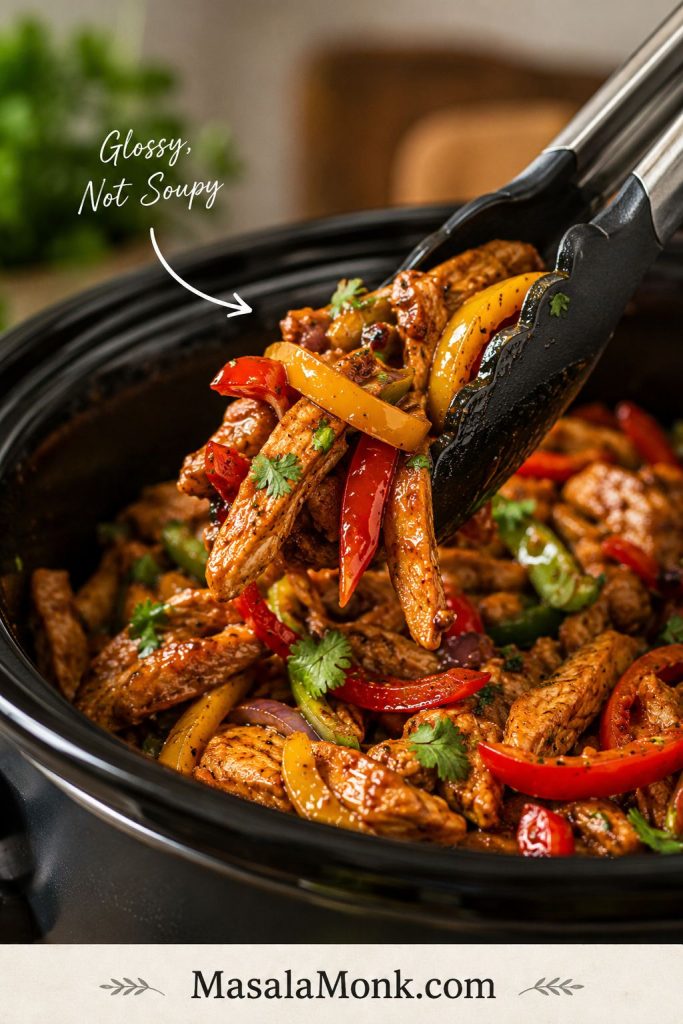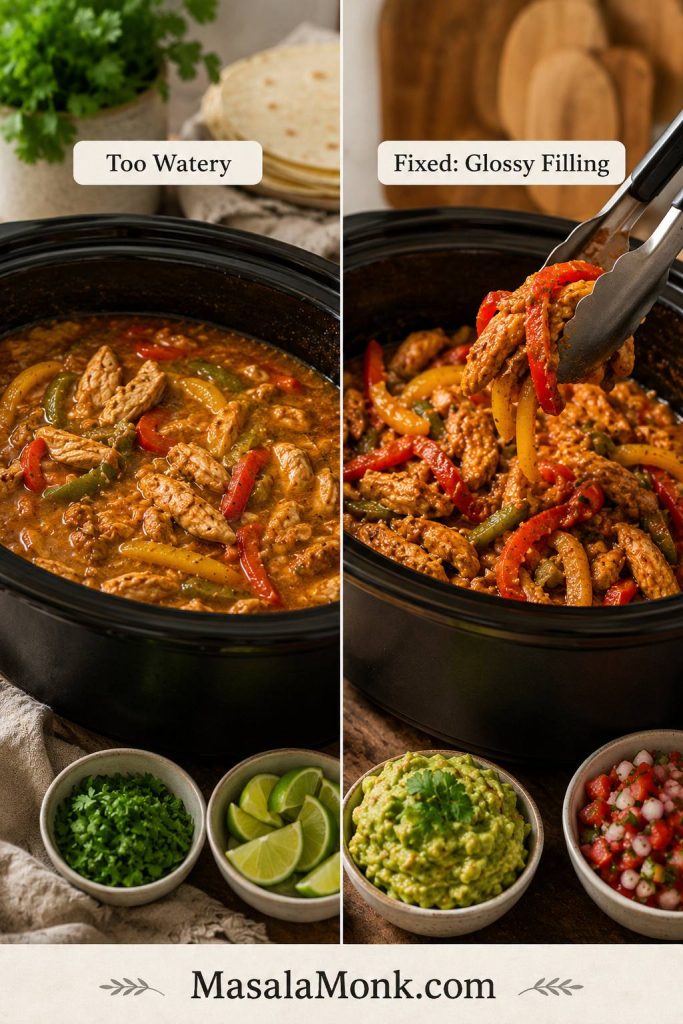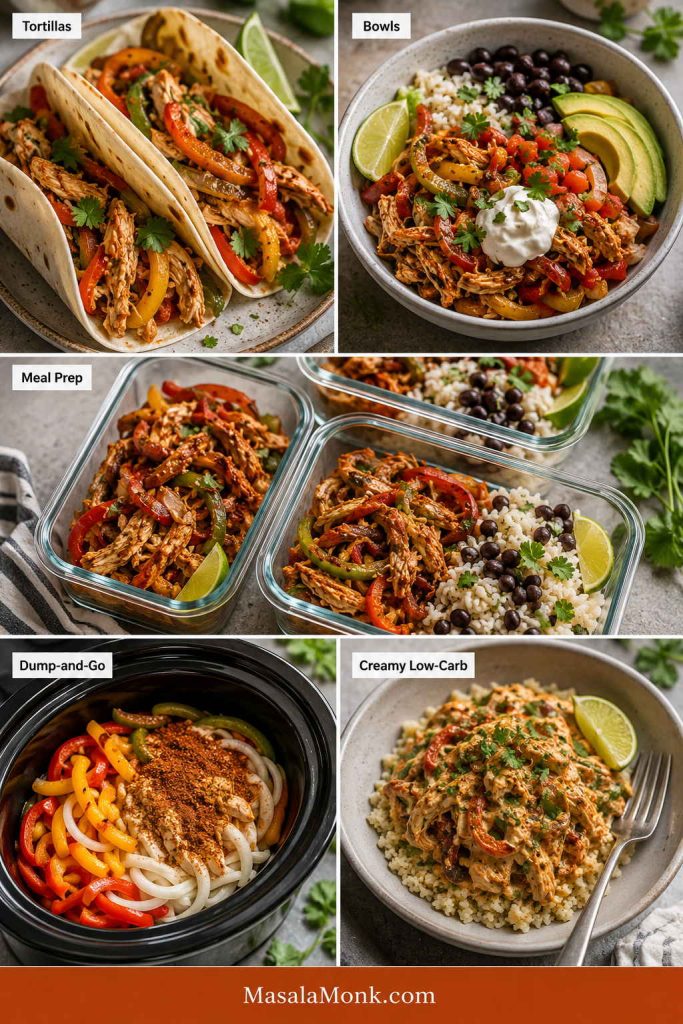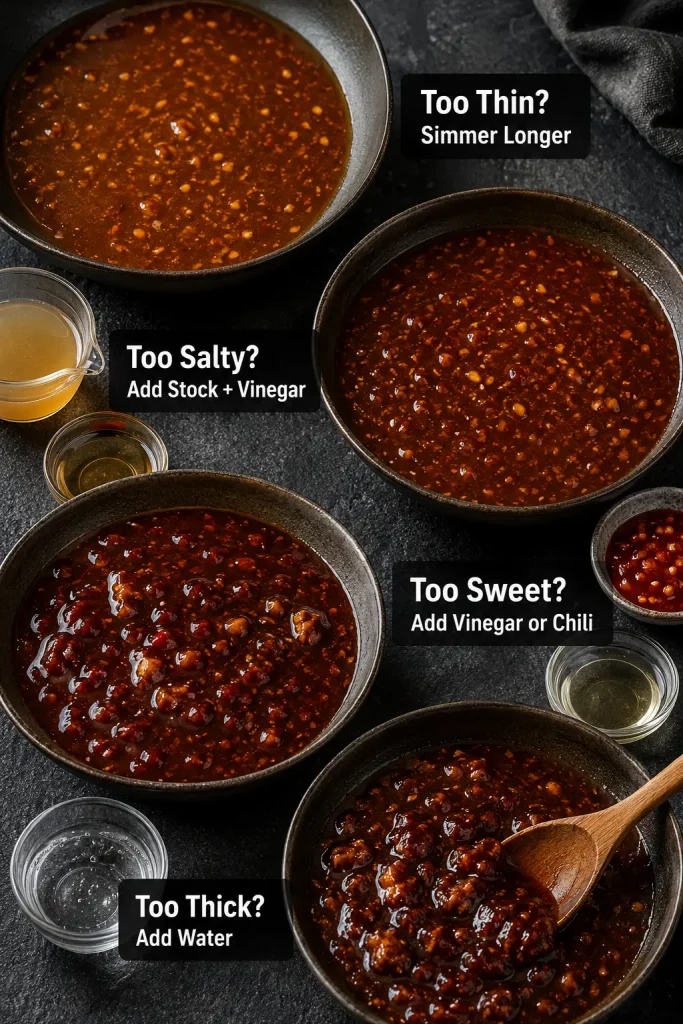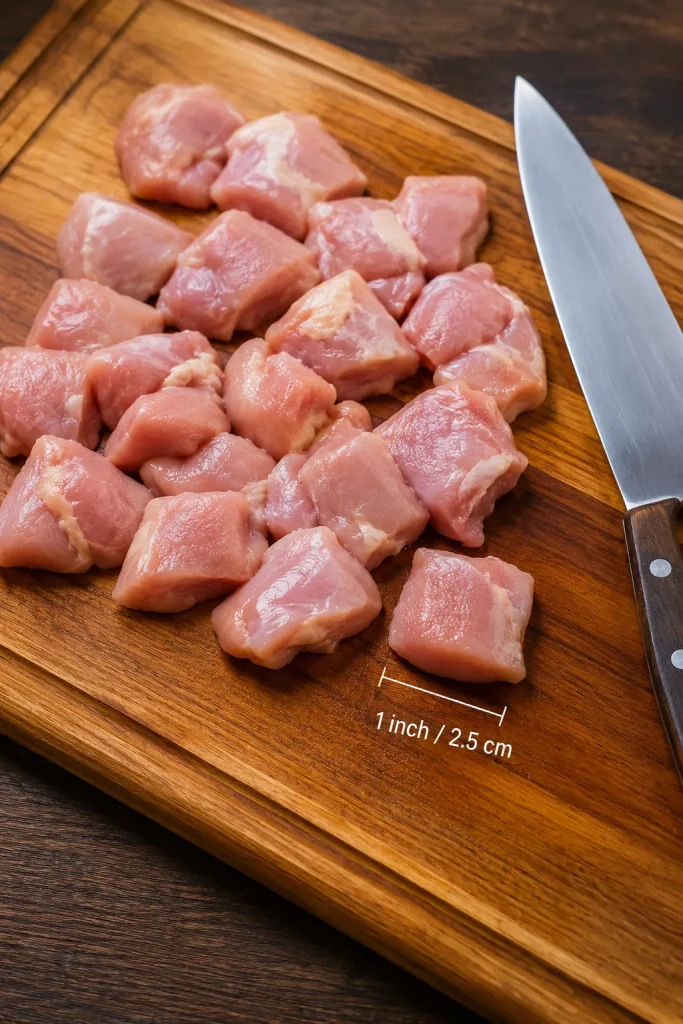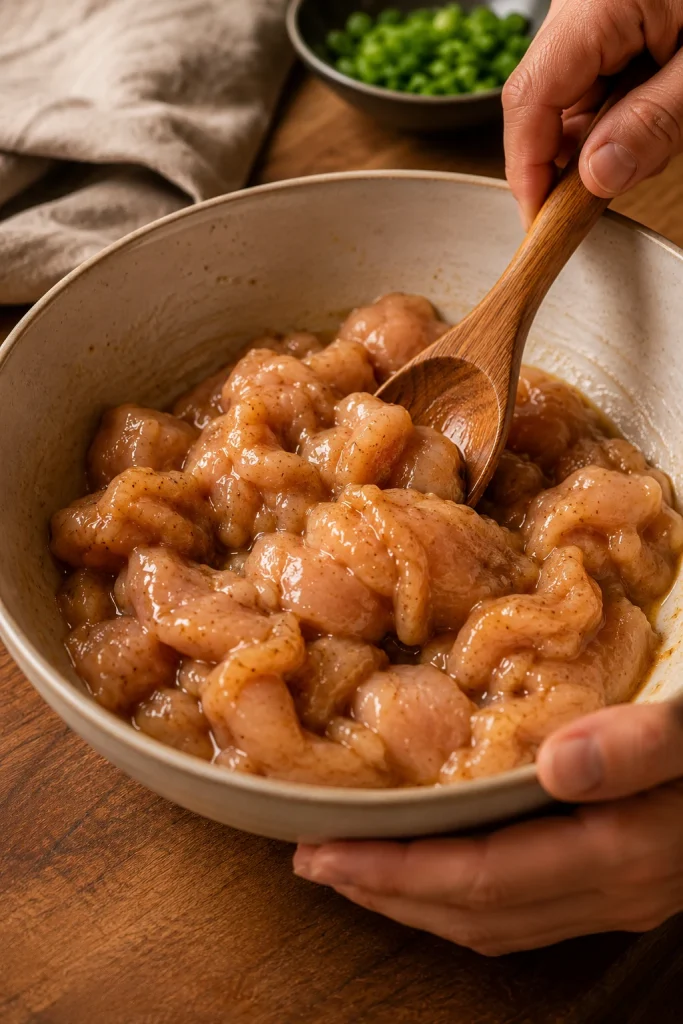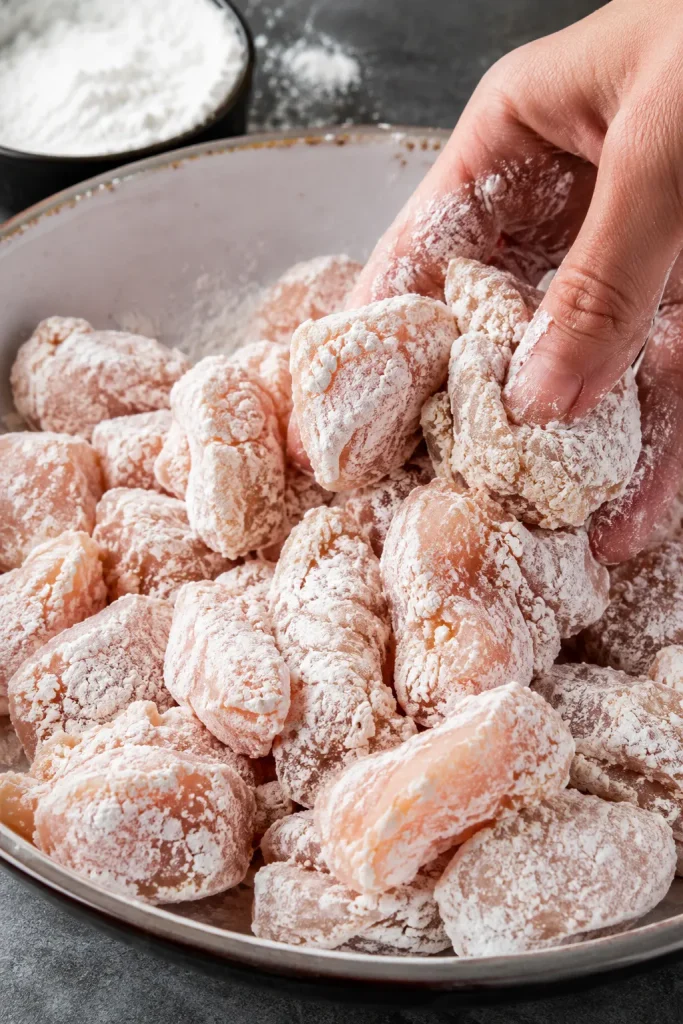
Posted on Leave a comment

Panang Curry Recipe: Chicken Panang with Store-Bought Paste

Bowl of chicken Panang curry with orange-red coconut sauce, sliced chicken, Thai basil, crushed peanuts, makrut lime leaves, and jasmine rice.

A good Panang curry starts changing the moment the paste hits hot fat: the raw edge softens, the chile smell deepens, and the pan begins to smell warmer almost immediately. When the coconut goes in, it turns orange-red around the paste. By the time the chicken is done, the curry should look glossy and generous, not thin or tired.

This Panang curry recipe is built for the home-cook problem most recipes do not talk about enough: store-bought paste can taste flat, watery, harsh, or too much like ordinary red curry when it is rushed. The fix is not a longer shopping list. It is better paste frying, full-fat coconut, and a few clear texture cues.

The result is a 40-minute curry that still feels special: tender chicken, glossy coconut sauce, fresh basil, jasmine rice, and enough depth that the store-bought paste never feels like a compromise. The base version is chicken Panang curry, also called Panang gai, but the same method works for beef, tofu, shrimp, or vegetables once you understand the texture.

It is generous weeknight food: fragrant, creamy, a little sweet, a little spicy, and made to spoon over rice. If you like fast Thai basil-heavy dinners, this Pad Kra Pao recipe is another bold option to keep nearby.

Table of Contents

Use this guide to make Panang curry that tastes creamy, balanced, aromatic, and clearly different from ordinary red curry.

Panang Curry Recipe: Quick Answer

Remember it as 3–400–680: 3 tablespoons / about 45g Panang curry paste, 13.5–14 oz / 400ml full-fat coconut milk or coconut cream, and 1½ lb / 680g thinly sliced chicken for a generous 4-serving curry.

Fry the paste first in oil or thick coconut cream until it smells deeper and less raw. Stir in the coconut gradually, then add fish sauce, palm sugar or brown sugar, torn makrut lime leaves, and peanuts or peanut butter. Simmer gently until the chicken is cooked through, finish with Thai basil, and serve with jasmine rice.

Think of this as your safe starting bowl: enough paste to taste full, enough coconut to feel creamy, and enough body for the curry to settle over rice instead of running through it. Add 1–1½ cups vegetables if you want a fuller chicken curry; keep the amount modest so the flavor stays focused.

Most important cue: the spoon tells you more than the timer. The curry should coat the back of a spoon in a glossy layer while still being loose enough to serve over rice. Need the exact visual cue? Jump to the spoon-coating test. Ready to cook? Go straight to the recipe card.

Close-up of chicken Panang curry with creamy sauce coating sliced chicken, red chile, Thai basil, peanuts, and makrut lime leaf garnish.
Look for sauce that clings to the chicken but still moves when spooned; that balance keeps Panang curry rich without making it heavy.

The Easy Panang Curry Formula

The 3–400–680 formula is not a test; it is a starting point. From there, you can adjust for paste strength, vegetable volume, protein choice, and how rich you want the final curry. More vegetables usually need a little more paste and a little more time in the pan. Saltier paste needs less fish sauce. Sweeter coconut needs less sugar.

Panang curry formula guide showing 3 tablespoons curry paste, 400 milliliters coconut milk, and 680 grams chicken.
The 3–400–680 formula gives you a reliable starting point before you adjust for paste strength, vegetable volume, or spice preference.
For 4 ServingsAmountWhy It Matters
Panang curry paste3 tbsp / about 45gThe flavor base. Start lower if your paste is very spicy or salty.
Coconut milk or coconut cream13.5–14 oz / 400mlThe body of the curry. Coconut cream gives the lushest result.
Chicken or other protein1½ lb / 680g chicken, or equivalentEnough protein for a full dinner without overcrowding the pan.
Fish sauce1–1½ tbsp / 15–22mlAdds salt and savory depth. Use less at first if your paste is salty.
Palm sugar or brown sugar2 tsp–1 tbsp / 8–15gRounds heat and salt. Start low if your paste or coconut tastes sweet.
Makrut lime leaves4–6 leavesTorn leaves perfume the simmering sauce; finely sliced tender leaves can finish the curry.
Peanuts or peanut butter2 tbsp / about 15g crushed peanuts, or 1 tbsp / about 16g peanut butterBrings Panang’s quiet nutty note without turning the sauce into satay.

Taste after the curry has simmered for a few minutes, not when the paste first hits the pan. Early tasting can trick you because the coconut is still loose, the paste has not settled, and the salt has not concentrated yet. If your paste tastes too mild or too harsh, use the store-bought paste guide before changing the whole recipe.

Why This Recipe Works

The difference between a forgettable Panang curry and a good one is usually not the ingredient list. It is the order. Curry paste needs fat and heat before the coconut goes in. The pan sauce needs enough time to come together. Basil needs to go in at the end, when its aroma will stay bright instead of disappearing into a long simmer.

If your first few homemade Thai curries have tasted thinner than takeout, this is usually where things change. You are not adding fancy ingredients; you are simply giving the paste and coconut enough time to become a sauce.

Frying the paste prevents flat flavor
Let it sizzle in fat first, and the smell changes from sharp to warm, deep, and curry-like.

Full-fat coconut gives the curry body
Light coconut milk makes the flavor feel spread out. Coconut cream gives the richest result.

The final balance happens at the end
Fish sauce, sugar, lime leaves, peanuts, and basil let you tune salt, sweetness, aroma, and nuttiness before serving.

The finished curry lands rich without feeling greasy, spicy without tasting harsh, and gently sweet without becoming sugary. It tastes like Panang curry, not red curry with peanut butter stirred in.

What Is Panang Curry?

Panang curry, also written as Phanaeng, Phanang, or Panaeng, is a Thai coconut curry with a richer, more concentrated character than a loose red curry. The easiest way to recognize a good Panang is this: if red curry pours, Panang clings.

In the bowl, Panang feels creamy, rounded, aromatic, and concentrated enough to coat the protein. Coconut gives body, curry paste gives heat and depth, makrut lime leaves give a citrusy lift, basil adds freshness, and peanuts add a quiet roasted note in the background.

Peanut belongs in the background here; it rounds the curry without turning it into satay. Chicken Panang curry is often called Panang gai or gaeng Panang gai. “Gai” means chicken, so Panang gai simply means the chicken version.

Panang Curry vs Red Curry

Panang curry and Thai red curry are related, but they should not taste identical. Red curry is usually looser and more chile-forward. Panang is creamier, richer, lightly sweet, and gently nutty. When homemade Panang tastes too much like red curry, the first fix is usually texture, then peanut and aromatic finish.

FeaturePanang CurryThai Red Curry
TextureThicker, creamier, more clingyLooser, saucier, more broth-like
FlavorRich, lightly sweet, savory, nuttyBrighter, chile-forward, more flexible
Paste profileRed-curry-style base with peanut and spice depthRed chile and aromatic base
Best cueCoats the protein clearlyPours more freely around the ingredients
Split-panel comparison of thicker Panang curry and looser Thai red curry with labels explaining texture and flavor differences.
Panang curry and red curry are related, but Panang is usually richer, thicker, and gently nutty, while red curry is looser and more chile-forward.

Quick fix: bring the curry back toward Panang by simmering the coconut base until it looks glossy, then finishing with peanut richness, Thai basil, and finely sliced tender makrut lime leaves if you have them.

If you are using red curry paste as a shortcut, add peanuts and a tiny pinch of warm spice so the sauce does not taste like ordinary red curry with coconut milk.

Panang Curry Ingredients

These ingredients are not equal. The paste, coconut, fish sauce, and lime leaves decide whether the curry tastes complete. Peanuts and basil finish the personality. Sugar is there to round the edges, not make the curry sweet.

The most important thing is timing. Paste goes first, coconut goes in gradually, protein cooks once the base has formed, and basil waits until the heat is low or off.

Panang curry ingredients including curry paste, coconut milk, chicken, fish sauce, sugar, makrut lime leaves, peanuts, Thai basil, and red bell pepper.
The ingredients work as a team: paste brings depth, coconut gives body, lime leaves add aroma, and peanuts round the curry without turning it into satay.

Panang curry paste

Use Thai Panang curry paste if you can find it. Some brands are stronger, saltier, and spicier than others, so start with a balanced amount and adjust. Thai Kitchen-style supermarket pastes are often milder, while Mae Ploy and Maesri-style Thai pastes are usually stronger, saltier, and more concentrated. Start lower if the brand is new to you.

Guide comparing milder supermarket-style Panang curry paste with stronger Thai-style paste for homemade Panang curry.
Because Panang curry paste brands vary in salt, heat, and intensity, taste after simmering before adding more fish sauce, sugar, or paste.

If your paste is very salty, begin with 1 tablespoon fish sauce, simmer, then add the remaining ½ tablespoon only if the curry needs it. When homemade Panang tastes flat, the paste often needed a better start: fat, heat, and enough time to smell cooked before the coconut went in. For the deeper technique, see how to bloom the paste in fat first.

Coconut milk or coconut cream

Coconut cream gives the lushest result. Full-fat coconut milk also works well; it just needs a few extra minutes in the pan. Light coconut milk makes the curry harder to concentrate and easier to dilute.

Comparison board showing light coconut milk, full-fat coconut milk, and coconut cream for Panang curry sauce texture.
For the richest Panang curry texture, full-fat coconut milk or coconut cream works better than light coconut milk, which can make the sauce feel thin.

How to use thick coconut cream first

If the can has a thick layer of coconut cream at the top, scoop that into the pan first and use it to fry the curry paste. Then add the thinner coconut milk gradually. This gives the pan a richer start and helps the paste bloom in fat.

Thick coconut cream being added to fried Panang curry paste in a skillet to begin the curry sauce.
When a can has thick cream on top, use it first so the curry paste gets the fat it needs to bloom properly.

Fish sauce

Fish sauce keeps the coconut from tasting flat. You should not notice it as “fishy”; you should notice that the curry tastes deeper, saltier, and more complete. Add it gradually because the paste may already be salty.

For a vegan version, use soy sauce, tamari, or a vegetarian fish-sauce alternative. The flavor will be different, but the curry still needs savory depth.

Palm sugar or brown sugar

The sweetness should round the chile and salt; it should not announce itself first. Palm sugar gives a softer sweetness, while brown sugar works well in a home kitchen. Start with 2 teaspoons if your paste or coconut milk already tastes sweet.

Makrut lime leaves

Makrut lime leaves, often sold as kaffir lime leaves, are the ingredient that makes the curry smell alive. Tear whole leaves before adding them to the simmering coconut sauce so their oils release into the pan. If you have tender leaves, slice a small amount very finely and use it at the end for a sharper aromatic finish.

Fresh or frozen leaves are best. Torn whole leaves can be left in the curry for aroma and picked out while eating. Lime juice is not a true replacement; if you need a backup, a little lime zest is closer than bottled lime juice, but use it gently. The goal is aroma, not sourness.

Makrut lime leaves shown whole, torn, and finely sliced, with guidance for simmering and finishing Panang curry.
Makrut lime leaves, often sold as kaffir lime leaves, give Panang curry its fresh citrus aroma without making the sauce sour.

Peanuts or peanut butter

Crushed roasted peanuts give texture and a more traditional feel. Peanut butter is a practical shortcut that blends smoothly into the sauce. Either works, but keep the amount modest. The peanut note should sit in the background, not make the curry taste like peanut sauce.

Split image comparing crushed roasted peanuts and peanut butter for adding a nutty note to Panang curry.
Crushed peanuts add texture, while peanut butter blends in smoothly; either way, the peanut flavor should stay gentle and balanced.

Thai basil

Thai basil gives the finished dish a fresh, peppery lift. Add it after the sauce thickens and the heat is low or off. If it simmers for several minutes, that fragrance fades quickly.

Thai basil being added to finished Panang curry as a final aromatic, with text about fresh peppery lift.
Add Thai basil near the end, because its peppery fragrance is strongest when it meets the hot curry right before serving.

How to Make Store-Bought Panang Curry Paste Taste Better

This is a home-kitchen Panang curry built around store-bought paste, but the technique is the point: fry the paste properly, use full-fat coconut, simmer until glossy, and finish with basil and lime leaf.

Fry it first
Cook the paste in oil or coconut cream until it smells warmer, deeper, and less raw.

Use full-fat coconut
Thin coconut milk makes the curry taste weaker. Full-fat coconut milk or cream gives body.

Finish the flavor
Fish sauce, sugar, lime leaves, peanuts, and basil make the sauce taste complete.

Bloom the paste in fat first

Traditional Panang methods often fry the paste in coconut cream until the oil separates. At home, canned coconut milk does not always separate well, so oil or the thick cream from the top of the can is more reliable.

Panang curry paste frying in a skillet with oil or coconut cream while a wooden spatula stirs it.
Frying the paste first is the flavor-building step that makes store-bought Panang curry paste taste fuller and less raw.

What fried Panang curry paste should look like

The color change is subtle but useful: the paste turns a little darker, smells rounder, and loses the raw edge before the coconut is stirred in.

Side-by-side comparison of raw Panang curry paste and darker fried Panang curry paste in a pan.
The paste does not need to burn or dry out; it just needs to darken slightly and smell warmer before the coconut goes in.

Choose the right paste amount

For one 13.5–14 oz / 400ml can of coconut milk or cream, use this as your starting point:

StylePaste AmountBest For
Mild2 tbsp / about 30gKids, spice-sensitive eaters, or very strong paste brands
Balanced3 tbsp / about 45gMost homemade Panang curry
Stronger4 tbsp / about 60gRestaurant-style intensity or a pan with more protein and vegetables

Adjust after simmering

If the curry tastes weak after simmering, check the texture first. A thin coconut base can make even a strong paste taste dull because the flavor is spread across too much liquid. Let the pan settle into a glossy consistency, then decide if you need more paste.

When you do add more paste, avoid stirring it in raw. Fry another teaspoon or two in a small pan with a spoon of coconut cream, then stir that back into the curry. This keeps the added flavor cooked and rounded. For a deeper look at the paste itself, Serious Eats has a helpful Panang curry paste guide that explains the peanut and warm-spice notes that separate it from a basic red curry paste.

Using red curry paste instead? For every 2–3 tablespoons red curry paste, add 1 tablespoon crushed roasted peanuts or peanut butter, a tiny pinch of nutmeg, and a small pinch of ground coriander or cumin if the sauce tastes plain. Add torn makrut lime leaves if you have them. This shortcut is best for a weeknight curry, not for a strict traditional version.

Check labels for vegan or vegetarian versions

If you are cooking for vegan or vegetarian eaters, check the paste label carefully. Many Thai curry pastes contain shrimp paste, fish sauce, or other seafood ingredients. Use a vegan Panang curry paste, or use vegan red curry paste and adjust it with peanuts and warm spices.

How to Make Panang Curry

Once the paste and coconut are ready, the cooking moves quickly. A wide skillet, wok, or 12-inch saucepan gives the paste room to fry and helps the coconut base come together faster. Have the chicken sliced, vegetables cut, herbs ready, and rice started before the paste hits the pan.

Visual overview: how to make Panang curry

Step-by-step Panang curry board showing prep, frying paste, adding coconut, cooking chicken, adjusting, and finishing with basil.
Follow the visual order before you start cooking: prep first, fry the paste, build the coconut base, cook gently, adjust, then finish fresh.

1. Slice the protein thinly

Thin slices cook quickly and pick up the curry better. Cut chicken across the grain into bite-size strips. Slice beef very thinly against the grain. For tofu, cut into cubes or slabs and pat dry before cooking.

Avoid large chunks of chicken here. Thick pieces take longer to cook, which can push the pan past its best texture before the center is done.

Hand slicing raw chicken into thin strips on a cutting board for Panang curry, with herbs and curry ingredients nearby.
Thin chicken slices cook quickly and absorb the curry better, so the meat stays tender while the sauce settles into the right texture.

2. Fry the curry paste

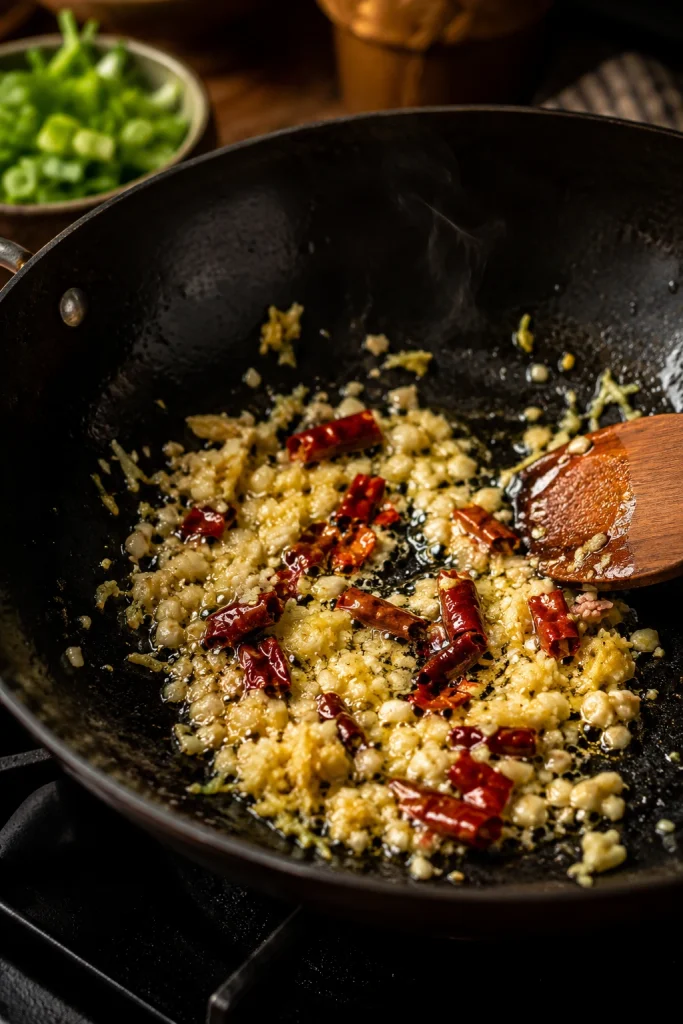
Heat neutral oil, or the thick cream from the top of the coconut milk can, in a wide skillet, wok, or 12-inch saucepan over medium heat. Add the paste and fry for 1–2 minutes for softer supermarket paste, or 3–5 minutes for a thicker Thai paste, stirring often, until it smells deeper and turns slightly darker.

When the paste starts sticking, lower the heat and loosen it with a spoonful of coconut cream or coconut milk. Water cools the pan, so use it only when you have no other choice.

This is the moment the curry starts smelling less like paste from a tub and more like dinner: chile, coconut fat, warm spice, and lime leaf waiting to open up.

3. Build the coconut sauce

Stir in the coconut milk or coconut cream gradually until the paste dissolves into a smooth sauce. Add fish sauce, palm sugar or brown sugar, torn makrut lime leaves, and peanuts or peanut butter. Keep the curry at a gentle bubble, not a hard boil.

At this point, the pan should look creamy and red-orange. Let it bubble for a few minutes before adding delicate vegetables or herbs. A good Panang base looks slightly more intense than you think it needs to be; rice will soften everything later. When you are unsure, use the spoon-coating test before serving.

Coconut milk being poured into fried Panang curry paste in a wok, creating orange-red swirls as the sauce forms.
Add coconut gradually so the fried paste dissolves evenly; as it blends, the curry changes from separate ingredients into one smooth base.

4. Cook the protein and vegetables

Add chicken and firm vegetables such as carrots, green beans, baby corn, or broccoli stems first. Simmer gently until the chicken is cooked through; the thickest piece should reach 165°F / 74°C.

Add bell pepper, snap peas or snow peas, zucchini, or spinach later so they stay brighter and release less water. Save finely sliced makrut lime leaves for the end if you are using them as garnish.

Beef and shrimp go in later. Browned tofu can go in near the end so it keeps its shape.

Chicken Panang curry gently simmering in a wide pan with small bubbles, orange-red sauce, chicken pieces, and herbs.
A gentle simmer gives the chicken time to cook while the coconut base thickens softly, without the rough look that comes from hard boiling.

5. Taste and finish

Give the curry a few uncovered minutes before final tasting. The flavor changes as the coconut settles: salt becomes clearer, sweetness rounds out, and the paste tastes less scattered.

Turn off the heat and stir in Thai basil right before serving. Add extra finely sliced makrut lime leaves, crushed peanuts, or sliced red chile for a stronger finish. The basil should smell fresh as soon as it hits the hot curry.

Hand adding Thai basil to finished chicken Panang curry in a pan with red chile and creamy orange-red sauce.
Stir basil in right at the end, then stop cooking; as a result, the curry keeps its fresh Thai basil aroma.

Chicken safety note: chicken should reach 165°F / 74°C in the thickest piece. FoodSafety.gov lists this as the safe minimum internal temperature for poultry in its safe minimum internal temperatures chart.

The Spoon-Coating Test for Panang Curry Sauce

When you are not sure whether the curry is ready, trust the spoon more than the clock. Dip a spoon into the pan and lift it out. The sauce should coat the back in a visible layer instead of sliding off immediately.

Spoon lifted from Panang curry showing orange-red coconut sauce coating the back of the spoon above the pan.
Once the curry coats the spoon in a smooth layer, it is concentrated enough for rice but still loose enough to serve generously.

When it is right, the sauce leaves a glossy trail on the spoon and settles over rice instead of disappearing into it. If it becomes too heavy, loosen it with a spoonful of coconut milk, water, or stock. Cornstarch can rescue a rushed sauce, but it should not be the first fix. If the texture is already off, go to the sauce fixes before serving.

How thick should Panang curry sauce be?

The best texture sits between runny and pasty: it coats the spoon, moves slowly in the pan, and still spoons easily over rice.

Three-panel guide comparing Panang curry sauce that is too thin, just right, and too thick.
Use this texture guide before serving: thin curry needs more simmering, while overly thick curry needs a small splash of coconut milk or water.

Texture goal: glossy and spoonable, rich enough to coat the protein, but still loose enough for rice.

Best Vegetables for Panang Curry

Vegetables can make Panang curry feel fuller and fresher, but they need good timing. Add firm vegetables first, tender vegetables later, and basil at the very end.

Vegetable guide for Panang curry showing green beans, red bell pepper, mushrooms, snap peas, baby corn, zucchini, eggplant, carrots, and broccoli.
Choose vegetables that hold their shape so the curry stays colorful, balanced, and concentrated instead of turning watery.

Keep watery vegetables modest, especially mushrooms, zucchini, and spinach. They are delicious here, but a crowded pan can turn a glossy Panang into a thinner curry.

When to add vegetables to Panang curry

Vegetable timing guide for Panang curry with early, midway, and late groups for vegetables and Thai basil.
Add firmer vegetables first and delicate ones later; this way, the curry keeps both texture and fresh color.
Add EarlyAdd MidwayAdd Late
CarrotsMushroomsBell pepper
Green beansSmall eggplant piecesSnap peas or snow peas
Small cauliflower floretsBroccoli floretsZucchini
Broccoli stemsBamboo shootsSpinach
Baby cornThai basil

For a vegetable-heavy curry, use a little more paste and give the coconut base extra time to settle into the right texture. If you are skipping meat completely, jump to the vegetable Panang curry variation.

Chicken, Beef, Tofu, Shrimp and Vegetable Panang Curry

The curry base stays mostly the same, but each version has one thing to protect: juicy chicken, tender beef, intact tofu, just-cooked shrimp, or vegetables that do not water down the pan.

VersionHow Much to UseBest Method
Chicken Panang curry1½ lb / 680g chicken thighs or breastSlice thin and simmer until just cooked through. Thighs are juicier; breast cooks faster.
Beef Panang curry1–1¼ lb / 450–570g tender beefSlice thinly against the grain and add near the end so it stays tender.
Tofu Panang curry14–16 oz / 400–450g firm tofuPress if watery, brown if desired, then add after the sauce has reduced.
Shrimp Panang curry1 lb / 450g peeled shrimpAdd during the final few minutes and cook only until opaque.
Vegetable Panang curry3–4 cups mixed vegetablesAdd firm vegetables first and quick-cooking vegetables later.

Chicken Panang Curry

Chicken is the best first version because it is easy to cook and lets the curry shine. Thighs are the most forgiving choice because they stay juicy. Breast also works, but it needs thin slicing and close timing.

For the most reliable chicken version, use 1½ lb / 680g chicken, 3 tablespoons curry paste, one 400ml can of coconut milk or coconut cream, and 1–1½ cups vegetables. Red bell pepper, green beans, baby corn, mushrooms, and snap peas or snow peas all work well.

Beef Panang Curry

Use sirloin, ribeye, flank steak, flat iron, or another tender cut. Slice it thinly against the grain, then add it after the sauce is mostly finished. Simmer just until cooked through.

Beef Panang curry with thin slices of beef in orange-red coconut curry sauce, basil, makrut lime leaf garnish, and red chile.
Beef Panang curry works best with thin slices added near the end, so the beef stays tender instead of becoming chewy.

Do not simmer thin steak-style beef for 15 minutes the way you might simmer chicken. It can turn chewy, especially if it is very lean. For a slow-cooked beef Panang, use a tougher cut such as chuck or short rib and treat it as a separate slow-braised version.

Tofu or Vegan Panang Curry

Tofu Panang curry can be excellent, but the tofu needs texture and the curry paste needs a label check if you are cooking vegan. Use firm or extra-firm tofu. Press it for 15–20 minutes if it is watery, then cut it into cubes or slabs. For better texture, brown the tofu before adding it to the sauce.

Tofu Panang curry with tofu pieces in coconut curry sauce, Thai basil, peanuts, red chile, and makrut lime leaf garnish.
Press and brown tofu before adding it to the curry; then it holds its shape and gives the sauce something firm to coat.

Vegan paste warning: many Thai curry pastes contain shrimp paste, fish sauce, or other seafood ingredients. Use a vegan Panang curry paste, or use vegan red curry paste and adjust it with peanuts, a tiny pinch of nutmeg, and a little coriander or cumin.

Replace fish sauce with soy sauce or tamari. Add tofu after the sauce has reduced so it does not break apart while the curry thickens. Finish with basil and crushed peanuts.

Shrimp Panang Curry

Shrimp Panang is the fastest version, but it asks for restraint. The sauce should be ready before the shrimp goes in, because shrimp only needs a few minutes to turn sweet, opaque, and tender.

Shrimp Panang curry with curled shrimp in creamy orange-red coconut curry sauce, Thai basil, red chile, and lime leaf garnish.
Shrimp needs only a short finish in Panang curry, so build and balance the sauce before the shrimp goes into the pan.

Once the shrimp is in the pan, simmer only until it curls gently and loses its translucency. Serve right away.

Vegetable Panang Curry

Vegetable Panang curry works best when you choose vegetables that hold their shape. Green beans, bell peppers, mushrooms, broccoli, snap peas or snow peas, baby corn, carrots, zucchini, and eggplant can all work, but they should not all go in at once.

Vegetable Panang curry with green beans, bell pepper, mushrooms, baby corn, zucchini, eggplant, snap peas, and basil in coconut curry sauce.
Vegetable Panang curry works best when the vegetables stay distinct, bright, and lightly tender instead of collapsing into the coconut sauce.

Add firm vegetables first, quick-cooking vegetables later, and basil at the very end. For a vegetable-heavy curry, start with 1 extra teaspoon of paste. A very full pan may need up to 1 extra tablespoon. Once you have chosen the version, return to the recipe card for the base method.

How to Fix Panang Curry Sauce

This is the section to use when the curry looks wrong five minutes before dinner. Most Panang problems are not disasters; they are small balance problems. A watery vegetable, a salty paste, thinner coconut milk, or too much heat can throw the pan off, but most of it is fixable.

You are looking for sauce that visibly coats the protein, but still has enough movement to spoon over rice. When the protein is already cooked, remove it with a slotted spoon and fix the sauce on its own.

Quick fixes for Panang curry sauce

Panang curry sauce troubleshooting board with fixes for watery, thick, flat, salty, spicy, split, oily, or red-curry-like sauce.
Use this rescue guide before serving: most Panang curry sauce problems can be fixed with better simmering, coconut, paste, seasoning, or heat control.
Sauce ProblemWhat It Feels LikeHow to Fix It
Too wateryThe chicken looks like it is floating instead of coated.Simmer uncovered. If the protein is cooked, remove it and reduce the sauce alone. Use coconut cream next time.
Too thickThe curry looks heavy, pasty, or dry instead of glossy.Add coconut milk, water, or stock one spoonful at a time, then stop as soon as it turns spoonable.
Tastes flatThe curry smells fine but tastes dull or unfinished.Fry extra paste separately and stir it in. Add fish sauce, sugar, lime leaves, or basil.
Too saltyThe salt hits first and the coconut sweetness disappears.Add unsalted bulk such as coconut milk, vegetables, tofu, or chicken. Balance with a tiny amount of sugar.
Too spicyThe heat overwhelms the coconut and aromatics.Add coconut cream or coconut milk and serve with extra rice.
Oily or splitThe curry looks greasy around the edges.Lower the heat, stir gently, and add a splash of coconut milk.
Tastes like red curryThe curry is loose, chile-forward, and missing the rounded Panang note.Add peanuts or peanut butter, simmer briefly, and finish with Thai basil and finely sliced tender makrut lime leaves.

Panang Curry Recipe Card

A creamy chicken Panang curry with store-bought paste, full-fat coconut, makrut lime leaves, peanuts, and Thai basil. Rich, spoonable, and easy to adapt for beef, tofu, shrimp, or vegetables.

Yield
4 servings
Prep Time
15 minutes
Cook Time
25 minutes
Total Time
40 minutes

Ingredients

  • 1½ lb / 680g boneless chicken thighs or chicken breast, thinly sliced
  • 3 tbsp / about 45g Panang curry paste
  • 1 tbsp / 15ml neutral oil, or thick coconut cream from the top of the can
  • 13.5–14 oz / 400ml full-fat coconut milk or coconut cream
  • 1–1½ tbsp / 15–22ml fish sauce, plus more to taste, depending on paste saltiness
  • 2 tsp–1 tbsp / 8–15g palm sugar or brown sugar
  • 4–6 makrut lime leaves, torn, plus optional finely sliced tender leaves for finishing
  • 2 tbsp / about 15g crushed roasted peanuts, or 1 tbsp / about 16g peanut butter
  • 1 red bell pepper, thinly sliced, or 1–1½ cups mixed vegetables for the chicken version
  • ½ cup loosely packed Thai basil leaves
  • Optional garnish: sliced red chile, extra basil, crushed peanuts, finely sliced makrut lime leaves
  • Steamed jasmine rice, for serving

Instructions

  1. Prep. Slice the chicken thinly and prepare the vegetables, herbs, and garnishes before cooking.
  2. Fry the paste. Heat oil or thick coconut cream in a wide skillet, wok, or 12-inch saucepan over medium heat. Add the Panang curry paste and cook, stirring often, until fragrant and slightly darker — about 1–2 minutes for softer paste or 3–5 minutes for thicker Thai paste.
  3. Build the sauce. Stir in coconut milk or coconut cream gradually until smooth. Add fish sauce, sugar, torn makrut lime leaves, and peanuts or peanut butter.
  4. Simmer. Add chicken and firm vegetables such as carrots, green beans, or baby corn. Simmer gently until the chicken is cooked through: about 6–8 minutes for thin chicken breast or 8–12 minutes for thin chicken thighs. The thickest piece should reach 165°F / 74°C. Add bell pepper, snap peas or snow peas, zucchini, or spinach near the end.
  5. Adjust. If the sauce looks loose, simmer uncovered until glossy and spoonable. Taste after thickening, then adjust with fish sauce, sugar, coconut milk, or extra fried paste if needed.
  6. Finish. Turn off the heat and stir in Thai basil. Garnish with extra basil, crushed peanuts, sliced chile, or finely sliced makrut lime leaves.
  7. Serve. Serve hot with steamed jasmine rice.

Recipe Notes

  • Beef: use 1–1¼ lb / 450–570g thinly sliced sirloin, ribeye, flank steak, or another tender cut. Add near the end and simmer briefly.
  • Tofu: use firm or extra-firm tofu. Press if watery, brown first if desired, and add after the sauce has reduced.
  • Vegan Panang: use vegan curry paste and replace fish sauce with soy sauce or tamari.
  • Shrimp: build and thicken the sauce first, then add shrimp near the end and cook only until opaque.
  • Vegetable Panang: use 3–4 cups mixed vegetables and add 1 teaspoon to 1 tablespoon extra paste depending on volume.
  • Richer sauce: use coconut cream. For a milder curry, start with 2 tbsp paste and add more after tasting.

Once the paste smells cooked, the coconut turns glossy, and the basil hits the pan, the curry feels much easier to trust. Spoon it beside jasmine rice, add the final herbs, and you have the kind of weeknight Panang that tastes deliberate instead of rushed.

Instant Pot or Slow Cooker Panang Curry

Panang rewards stovetop control, so treat Instant Pot and slow cooker versions as backup methods. They are useful for convenience, but both need a final look at the sauce before serving.

Backup-method guide for Panang curry showing Instant Pot and slow cooker options with sauté first, cook, reduce after, and check sauce cues.
Instant Pot and slow cooker Panang curry can be convenient, but the final sauce check still matters before the curry reaches the table.

Instant Pot Panang curry

Use sauté first. Fry the paste in oil or thick coconut cream for 1–2 minutes, then stir in coconut milk or cream, fish sauce, sugar, torn lime leaves, and thin chicken pieces. Pressure cook on high for 3–4 minutes, then quick release. Use sauté again to bring the sauce back to a spoonable texture, then finish with basil.

Slow cooker Panang curry

Slow cooker Panang works best with chicken thighs or beef, not thin chicken breast. Fry the paste separately first, then add it to the slow cooker with coconut milk, seasoning, and protein. Cook on low until the meat is tender, usually about 2–3 hours for boneless chicken thighs. If the sauce is thin at the end, reduce it uncovered in a saucepan before adding basil.

What to Serve with Panang Curry

Panang is rich, so the best sides either catch the sauce or cut through it. Jasmine rice catches the glossy curry; cucumber, herbs, lime, green beans, or Som Tam keep the bowl from feeling heavy. Planning leftovers too? Jump to storage and reheating.

What goes well with Panang curry?

Panang curry served with jasmine rice, cucumber, herbs, lime, and a fresh Som Tam-style side dish on a warm table.
Pair Panang curry with jasmine rice and a crisp side so the meal has both coconut richness and fresh contrast.

Spoon the curry beside the rice rather than burying it. That way the first few bites stay glossy and concentrated, and the rice catches the sauce slowly instead of muting it all at once. If rice is the part that usually goes wrong, this guide to cooking perfect rice can help.

Serve WithWhy It Works
Steamed jasmine riceBest default; it absorbs the sauce without competing with the curry.
Cucumber salad, herbs, lime, or lightly steamed green beansFresh sides balance the coconut richness.
Roti, flatbread, rice noodles, or coconut riceComfort options for a fuller, more restaurant-style meal.

For a crisp Thai-style side, this Vegan Som Tam Salad gives the fresh, sharp contrast that works well beside a creamy coconut curry.

Storage, Freezing and Reheating

How to store Panang curry leftovers

Store leftover Panang curry in an airtight container in the refrigerator for 3–4 days. The sauce will thicken as it chills, so add a splash of coconut milk, water, or stock when reheating.

Panang curry leftovers stored in an airtight glass container on a refrigerator shelf with text saying store three to four days.
Leftover Panang curry keeps well for 3–4 days in an airtight container; for the brightest flavor, add fresh basil after reheating.

How to reheat Panang curry

Reheat gently on the stovetop over low to medium-low heat. Avoid hard boiling because coconut-based sauces can split. If the curry looks oily after reheating, lower the heat and stir in a small splash of coconut milk.

Panang curry reheating gently in a saucepan while coconut milk is poured in and the sauce is stirred with a wooden spoon.
Reheat Panang curry gently, adding a splash of coconut milk if needed, so the sauce turns smooth again instead of splitting.

The curry reheats well, but fresh basil does not. For make-ahead cooking, stop before adding the basil if you can, then add it after reheating so the curry tastes fresh again.

You can freeze Panang curry for up to 2 months, but the sauce may look slightly separated or grainy after thawing. Reheat gently and stir in a little coconut milk to smooth it out. Shrimp Panang curry is less ideal for freezing because shrimp can become rubbery after thawing and reheating. Tofu may soften slightly after storage, but it still tastes good.

Panang Curry FAQs

Is Panang curry supposed to be thick?

Panang curry is usually thicker and more concentrated than Thai red curry. It should coat the chicken, tofu, shrimp, beef, or vegetables instead of running like soup.

Is Panang curry very spicy?

Most bowls land in the medium-spicy range, but the paste controls the heat. Start with 2 tablespoons for a gentler curry and add more after tasting.

What does Panang curry taste like?

It tastes creamy, savory, lightly sweet, and aromatic, with a quiet peanut note. Peanut belongs in the background; it rounds the curry without turning it into satay sauce.

Why does my Panang curry taste like red curry?

The curry may be too loose or missing the rounded peanut and lime-leaf finish. Simmer the coconut base until glossy, then add peanut richness, basil, and finely sliced tender makrut lime leaves if you have them.

Can I use red curry paste instead of Panang curry paste?

Yes, as a shortcut. Add peanuts or peanut butter, a tiny pinch of nutmeg, and a little coriander or cumin to move it closer to Panang flavor.

What is the best coconut milk for Panang curry?

Full-fat coconut milk works well, while coconut cream gives the richest result. Light coconut milk makes the curry thinner and less satisfying.

Is Panang curry the same as Panang gai?

Panang gai means chicken Panang curry. “Gai” means chicken, so the method is the same here: thin chicken, coconut sauce, and a fresh basil finish.

Can I make Panang curry without fish sauce?

Use soy sauce, tamari, or a vegetarian fish-sauce alternative. Taste after simmering because substitutes vary in saltiness and depth.

Why is my Panang curry watery?

The coconut may need more time, the milk may be too thin, or the vegetables may have released water. Simmer uncovered before reaching for cornstarch.

Can I make Panang curry ahead?

Chicken, beef, tofu, and vegetable versions reheat well. For the freshest flavor, hold back the basil and add it after reheating.

What vegetables go well in Panang curry?

Green beans, bell peppers, mushrooms, broccoli, snap peas, baby corn, carrots, zucchini, and eggplant all work. Add watery vegetables late.

Can I make this with shrimp?

Build and thicken the sauce first, then add shrimp near the end and cook just until opaque. Do not reduce the curry after shrimp goes in.

Back to top

Posted on Leave a comment

Chicken Enchilada Casserole Recipe

A 9x13 dish of chicken enchilada casserole with one portion removed and a layered serving on a plate.

This chicken enchilada casserole recipe is for the night you want enchiladas, but not the whole enchilada project. No warming every tortilla one by one. No filling, rolling, tearing, and trying to fit everything neatly in the pan while dinner waits. You get the same saucy, cheesy comfort by layering tortillas, shredded chicken, enchilada sauce, and cheese in a 9×13 dish and baking it until bubbling.

It comes out bubbling at the edges, soft through the middle, and melted on top — the kind of dinner that feels generous without asking you to roll a dozen enchiladas first. The goal is simple: saucy layers, weeknight shortcuts, and clean-enough slices without a loose, watery pan.

This no-roll casserole is weeknight-friendly, rotisserie-chicken friendly, and flexible enough for red sauce, green sauce, beans, corn, or a creamy white variation.

Quick Answer: Chicken Enchilada Casserole

Chicken enchilada casserole is a no-roll version of chicken enchiladas made by layering tortillas, cooked shredded chicken, enchilada sauce, and cheese in a baking dish. Instead of filling and rolling each tortilla, you build the casserole in a 9×13 pan and bake it until the sauce bubbles and the cheese melts.

For the most dependable texture, use corn tortillas, about 3 cups of enchilada sauce, 3½ cups of cooked shredded chicken, and 3 cups of shredded cheese. Bake the casserole covered first so the center heats through, then uncover it so the top can bubble and some moisture can escape. Let it rest before slicing so the layers settle instead of sliding apart.

If you are deciding on tortillas first, jump to the corn vs flour tortilla guide. If your main worry is texture, go straight to how to keep enchilada casserole from getting soggy.

Reliable basic formula: 3½ cups cooked shredded chicken + 3 cups enchilada sauce + 12 small corn tortillas + 3 cups shredded cheese in a 9×13-inch pan.

Chicken Enchilada Casserole at a Glance

Use this as the quick decision guide before you start cooking.

Pan9×13-inch / 23×33 cm
Oven375°F / 190°C
Bake20 min covered + 10–12 min uncovered
Rest10–15 minutes before slicing
Chicken3½ cups cooked shredded chicken
Sauce3 cups red or green enchilada sauce
Most forgiving tortillaCorn tortillas for better structure
ShortcutRotisserie chicken works beautifully
At-a-glance chicken enchilada casserole guide showing pan size, oven temperature, bake time, chicken, sauce, tortillas, and rest time.
Before you start, use the basic formula to check the pan size, sauce amount, bake time, and tortilla choice.

Already know you are making it? Jump straight to the recipe card. Still deciding between corn and flour tortillas, red and green sauce, or make-ahead timing? The guide below answers those questions before you start layering.

Why This No-Roll Chicken Enchilada Casserole Works

Regular enchiladas are delicious, but they can feel like a lot on a weeknight. Tortillas tear. Filling falls out. The pan gets crowded. This oven method keeps the comfort and skips the fussy part.

The trick is that the casserole does not try to be fancy. It keeps the parts people crave — tortillas, sauce, chicken, and cheese — and makes them easier to build in layers.

This is the kind of casserole that works for rotisserie-chicken nights, casual family dinners, meal-prep Sundays, and evenings when you want something cozy but do not want to stand at the counter rolling tortillas.

  • No rolling: The tortillas are layered, so there is less handling and less tearing.
  • Good use for cooked chicken: Rotisserie chicken, leftover roasted chicken, poached chicken, or shredded chicken breasts all work.
  • Classic red or tangy green: Red enchilada sauce gives deeper flavor; green sauce makes a brighter chicken casserole.
  • 9×13 family-dinner size: It serves about 8 and reheats well.
  • Built-in texture control: Corn tortillas, measured sauce, an uncovered finish, and a short rest help prevent sogginess.

What You Need for Chicken Enchilada Casserole

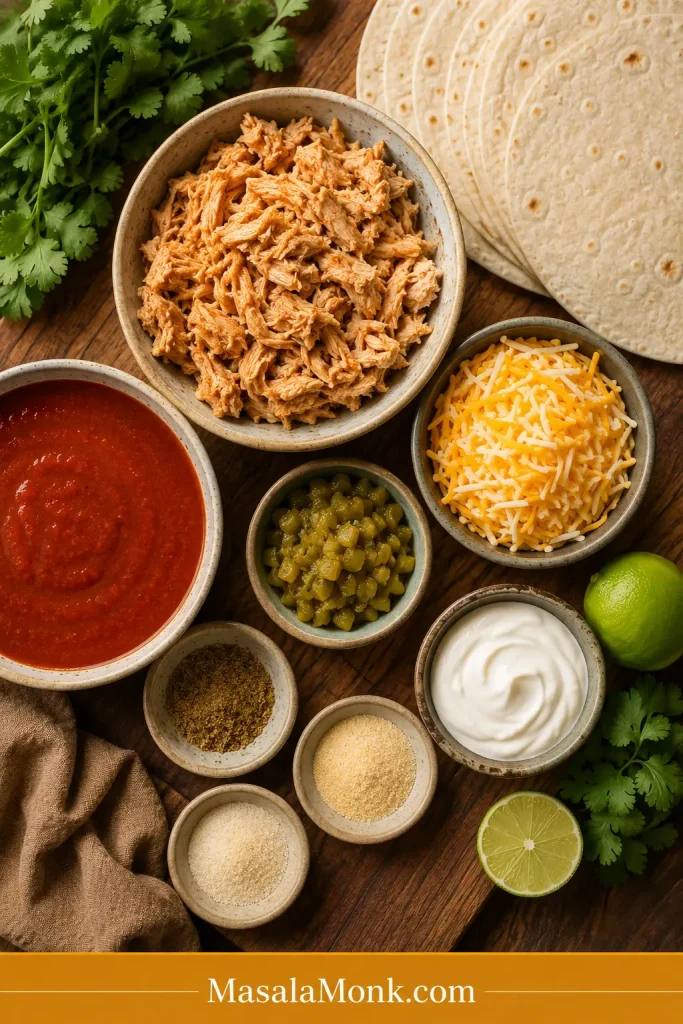
The ingredient list is simple, but the choices matter. Cooked chicken makes the recipe fast, corn tortillas give the casserole better structure, and the sauce needs enough flavor to carry the whole dish.

Ingredients for chicken enchilada casserole, including shredded chicken, enchilada sauce, corn tortillas, cheese, green chiles, beans, corn, lime, and toppings.
The ingredient list stays simple, but draining wet add-ins and using flavorful sauce make a big difference in the final texture.

For the two biggest texture decisions, check the enchilada sauce amount and the corn vs flour tortilla guidance before assembling the pan.

Cooked Shredded Chicken

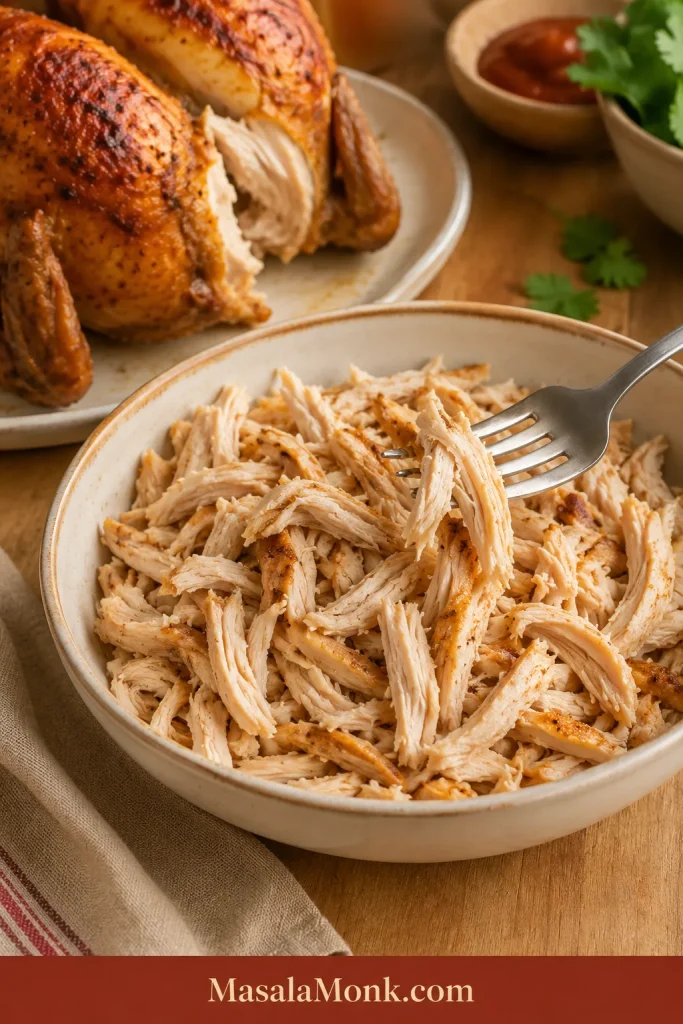
You need 3½ cups cooked shredded chicken, or about 525 g. One average rotisserie chicken usually gives about 3 to 4 cups shredded meat, depending on size, so it is a practical shortcut.

Shredded chicken blends into the layers better than large chunks. If you prefer more bite, you can use small diced cooked chicken, but avoid large pieces because they make the casserole harder to slice neatly. If you are starting with raw chicken breasts, MasalaMonk’s baked chicken breast recipe is a useful prep method before shredding.

Shredded rotisserie chicken measured for chicken enchilada casserole with tortillas, sauce, and cheese nearby.
Rotisserie chicken is the fastest shortcut here; however, shredding it finely helps the filling spread evenly between the tortilla layers.

Enchilada Sauce

Use 3 cups / 710 ml enchilada sauce total. Red enchilada sauce gives the casserole a classic chili-forward flavor. Green enchilada sauce tastes brighter, tangier, and especially good with chicken.

Store-bought sauce is fine for a weeknight dinner. Homemade sauce works too. For a fresher green variation, salsa verde is excellent; MasalaMonk’s salsa verde recipe is a natural fit if you want a brighter tomatillo-style direction.

Enchilada sauce amount guide showing 3 cups or 710 ml total sauce for a saucy but not flooded casserole.
Measuring the enchilada sauce keeps the casserole moist without flooding the layers, so the finished pan is saucy instead of watery.

If you are worried about using too much sauce, the layering guide shows exactly where the 3 cups go.

Corn Tortillas

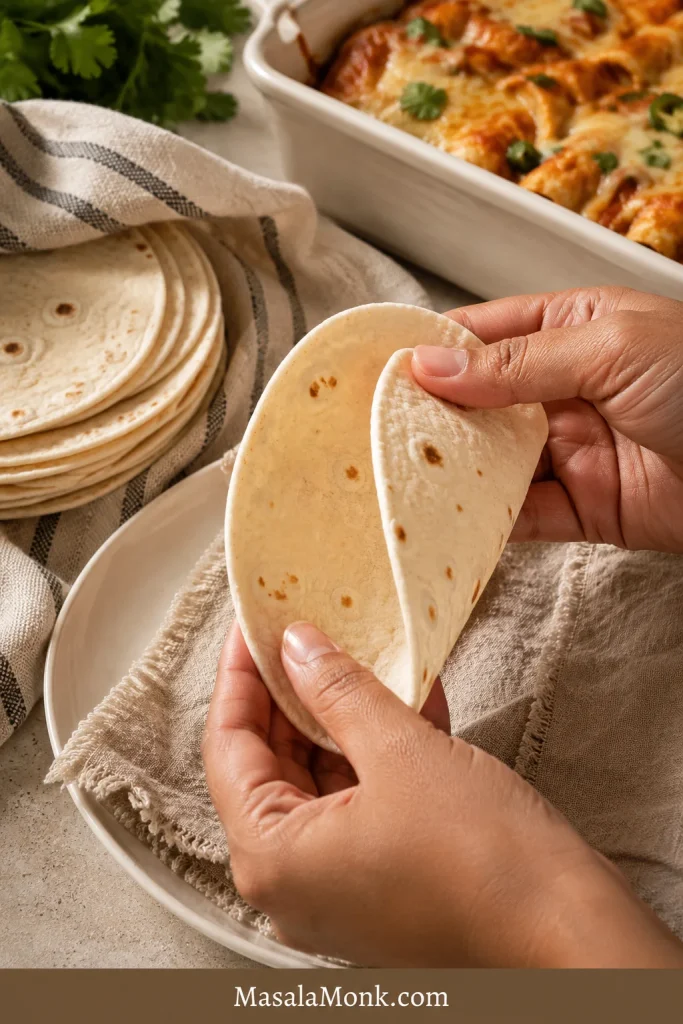
Use 12 small 6-inch corn tortillas, about 300–330 g total. Cut them in half so they fit the baking dish more evenly. Corn tortillas give the most classic enchilada flavor and hold their structure better under sauce.

Corn tortillas cut in half and ready to layer in a sauced 9x13 baking dish.
Corn tortillas are the best default because they bring classic enchilada flavor and hold their shape better under sauce.

Cheese

Use 3 cups / 12 oz / 340 g shredded cheese. Monterey Jack melts the smoothest, cheddar-Jack brings a little more flavor, and a Mexican-style cheese blend is convenient. Freshly shredded cheese usually melts better, but pre-shredded cheese is fine for a practical casserole.

Add-Ins and Heat Level

A small can of diced green chiles adds easy enchilada flavor without making the dish aggressively spicy. Black beans and corn are optional, but they make the casserole heartier and more colorful.

Drain beans, corn, and chiles well. Extra liquid is one of the fastest ways to turn an enchilada casserole watery. If you use both beans and corn and the skillet looks very full, save a little filling for tacos, bowls, or nachos instead of forcing every last spoonful into the baking dish.

As written, this casserole is usually mild to medium, depending on the enchilada sauce you use. For more heat, add jalapeño, a hotter sauce, or hot sauce at the table. For a family-friendly pan, keep the bake mild and let people add heat to their own plates.

Toppings

Add toppings after baking. Sour cream, chopped cilantro, avocado, sliced jalapeños, diced red onion, pico de gallo, salsa verde, and lime wedges all work well. Fresh toppings are especially helpful because the casserole itself is rich and saucy. If you want a creamy avocado topping, MasalaMonk’s easy guacamole recipe fits naturally here.

Pan, Oven Temperature, and Bake Time

The most forgiving pan for this recipe is a 9×13-inch baking dish, about 23×33 cm. That size gives you enough room for three balanced layers without making the center too thick.

DetailUse ThisWhy It Matters
Pan size9×13-inch / 23×33 cmCreates even layers and reliable baking.
Oven temperature375°F / 190°CHot enough to bubble the sauce and melt the cheese without drying the casserole.
Covered bake20 minutesLets the center heat through before the top browns.
Uncovered bake10–12 minutesLets the cheese bubble and excess moisture escape.
Rest time10–15 minutesLets the layers settle so the casserole slices better.

If you prefer baking at 350°F / 175°C, bake covered for 25–30 minutes, then uncover and bake for another 10–15 minutes. The lower temperature works; it simply needs a little more time.

How to Tell When It Is Done

The casserole is done when the sauce is bubbling around the edges, the cheese is fully melted, the center is hot, and the tortillas have softened. At that point, it should smell like warm chili, toasted corn, and melted cheese. If the top still looks wet or loose, give it a few more uncovered minutes. If the cheese is browning too fast, loosely tent the dish with foil.

Baked chicken enchilada casserole with bubbling red sauce around the edges and melted cheese on top.
Bubbling edges and melted cheese are the clearest signs that the center is hot and the casserole is ready to rest.

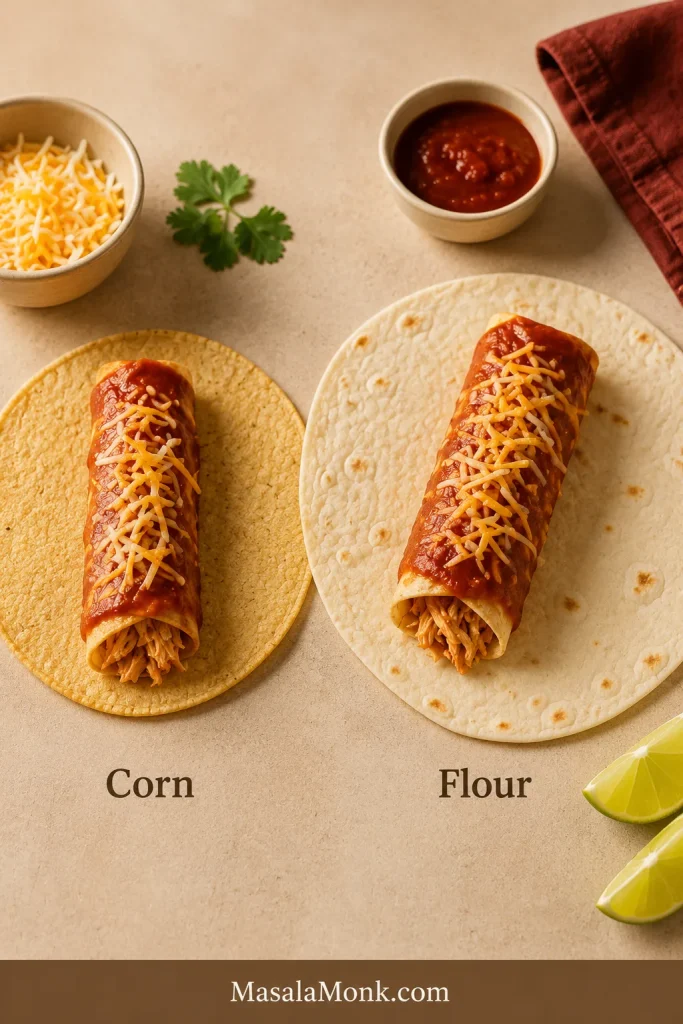
Corn vs Flour Tortillas for Chicken Enchilada Casserole

The tortilla choice changes the casserole. It affects flavor, structure, softness, and whether the final dish slices cleanly or collapses into a saucy scoop.

Corn versus flour tortilla comparison for chicken enchilada casserole, showing cleaner corn tortilla layers and softer flour tortilla texture.
Corn tortillas give cleaner pieces, while flour tortillas create a softer comfort-bake texture; therefore, the best choice depends on how sliceable you want the casserole.

Why Corn Tortillas Work Best

Corn tortillas are the most forgiving choice for a classic chicken enchilada casserole because they taste more like enchiladas and hold up better under sauce. They soften as the casserole bakes, but they usually do not become as gummy as flour tortillas.

Corn tortillas also make the dish easier to keep gluten-free, as long as the enchilada sauce and other packaged ingredients are certified gluten-free.

When Flour Tortillas Are Okay

Flour tortillas work if you want a softer, more comfort-food-style casserole. They are common in creamy white chicken enchilada casserole versions, where the goal is soft and rich rather than sliceable and structured.

If flour tortillas are what you have, the casserole will still taste good. It will simply be more tender and spoonable, so think comfort bake rather than neat enchilada squares. Because flour tortillas absorb sauce differently, the soggy-fix section is worth reading before you assemble.

Should You Toast or Fry the Tortillas First?

You do not have to fry tortillas for this no-roll casserole. However, if you want firmer layers, you can lightly toast corn tortillas in a dry skillet or warm them quickly with a small amount of oil before layering.

This extra step is optional, but useful if your enchilada sauce is thin, if you plan to make the casserole ahead, or if you want neater pieces.

Corn tortillas shown before and after light toasting, with a casserole layer cue for firmer texture.
Toasting corn tortillas is optional, but it is useful when you want firmer layers or plan to assemble the casserole ahead.

This step matters most when you are making the casserole ahead; the make-ahead and freezer notes explain how the tortilla texture changes as it sits.

Red Sauce vs Green Sauce

This recipe works with either red or green enchilada sauce. The right choice depends on the flavor mood you want: red is deeper, cozier, and more classic, while green is brighter, tangier, and especially lively with chicken.

Red sauce versus green sauce comparison for chicken enchilada casserole with red enchilada sauce and green salsa verde cues.
Red enchilada sauce gives a deeper, cozier flavor, while green sauce makes the chicken casserole brighter and tangier.
SauceFlavorBest For
Red enchilada sauceDeeper, chili-forward, classicTraditional chicken enchilada casserole
Green enchilada sauceBrighter, tangier, slightly sharperGreen chicken enchilada casserole
Salsa verdeFresh, tomatillo-forward, livelyA fresher green variation with cilantro and lime
Creamy green sauceRich, tangy, softWhite or creamy chicken enchilada casserole

Use red enchilada sauce for a classic, cozy pan or green enchilada sauce for a brighter chicken casserole. If using salsa verde, taste it first because some jars are saltier or more acidic than others. For extra heat at the table, a few drops from MasalaMonk’s pepper sauce guide can add sharp chili flavor without changing the whole casserole.

Close-up of red chicken enchilada casserole with melted cheese, red sauce, cilantro, jalapeños, and visible layers.
Red enchilada sauce gives the layers a deeper chili flavor, especially when it is measured instead of poured freely.

For a full green-sauce direction, see the green chicken enchilada casserole variation. For a softer creamy bake, jump to the white or sour cream version.

Choose your version: Go red sauce + corn tortillas for classic enchilada flavor, green sauce or salsa verde + Monterey Jack for a brighter chicken casserole, sour cream or white sauce for a creamier comfort-food bake, and rotisserie chicken + jarred sauce for the fastest dinner.

How to Make Chicken Enchilada Casserole

Once the filling is mixed, the rest is simple layering: build the pan, bake it covered, finish it uncovered, and give it a short pause before serving. This does not need to look perfect in the dish. Even coverage matters more than pretty rows, and the oven will pull everything together.

Step-by-step board showing how to make chicken enchilada casserole by making filling, saucing the pan, layering, baking, and resting.
Once the filling is mixed, the rest is relaxed layering: sauce the pan, build the stack, bake, and let it settle.

No-Roll Assembly Setup

Before you start building layers, set the sauced pan, tortilla halves, chicken filling, cheese, and remaining sauce within reach. That keeps the assembly relaxed and prevents overthinking each layer.

No-roll chicken enchilada casserole setup with a sauced baking dish, tortillas, shredded chicken filling, cheese, and sauce.
Instead of filling and rolling each tortilla, keep the assembly relaxed: layer the ingredients directly in the dish and let the oven pull them together.

1. Make the Chicken Filling

Warm oil in a skillet, then cook the onion until softened. Add garlic, cumin, chili powder, paprika, oregano, salt, and diced green chiles. Stir in the shredded chicken, optional black beans, optional corn, a little enchilada sauce, and lime juice.

The filling should be moist and flavorful, but not soupy. If it looks watery, cook it for another minute or two so extra liquid can evaporate.

Chicken enchilada casserole filling in a skillet with shredded chicken, sauce, beans, corn, and a spoon showing moist but not soupy texture.
The filling should taste seasoned and saucy on its own, but it should not be so wet that it loosens the whole baking dish.

2. Sauce the Bottom of the Pan

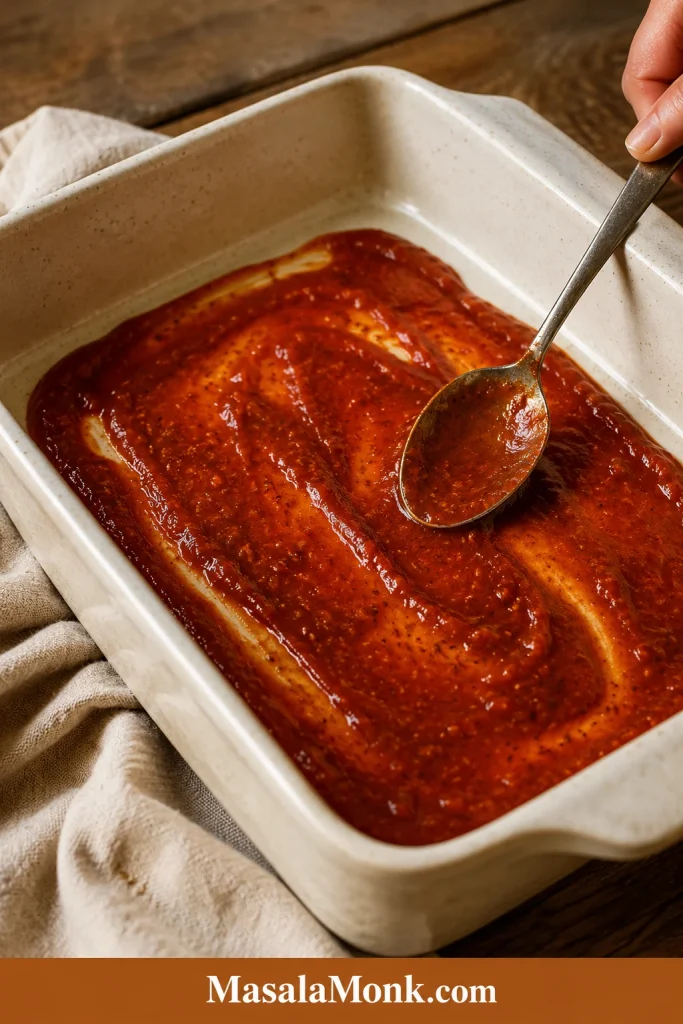
Spread ½ cup / 120 ml enchilada sauce across the bottom of the baking dish. This prevents the first tortilla layer from drying out and gives the casserole a saucy base.

Red enchilada sauce spread in a thin layer on the bottom of a 9x13 baking dish before adding tortillas.
Starting with a thin sauce layer protects the first tortillas from drying out without adding too much liquid to the bottom of the pan.

3. Layer the Tortillas, Chicken, Sauce, and Cheese

Add a layer of tortilla halves, overlapping slightly. Spread one-third of the chicken filling over the tortillas, spoon on some sauce, and sprinkle with cheese. Repeat until you have three layers.

4. Bake Covered, Then Uncovered

Cover the dish with foil and bake for 20 minutes. Remove the foil and bake for another 10–12 minutes, until the sauce bubbles around the edges and the cheese is melted on top.

5. Rest Before Slicing

Let the casserole rest for 10–15 minutes before cutting. This is what turns the bubbling pan into something sliceable. If you scoop it immediately, it will taste good, but it will not hold together as well.

No-roll layered chicken enchilada casserole resting on a cooling rack with a timer and spatula nearby.
A short rest gives the cheese and sauce time to settle, so the casserole serves in cleaner, more stable pieces.

How to Layer Chicken Enchilada Casserole So It Holds Together

The casserole needs enough sauce to soften the tortillas, but not so much that every layer swims. This part is where many cooks worry about making the pan messy, but it does not need to look perfect.

Use the Sauce as Your Layering Guide

The goal is saucy, not flooded. If your enchilada sauce is very thin, hold back a few tablespoons and add more only if the top looks dry before baking.

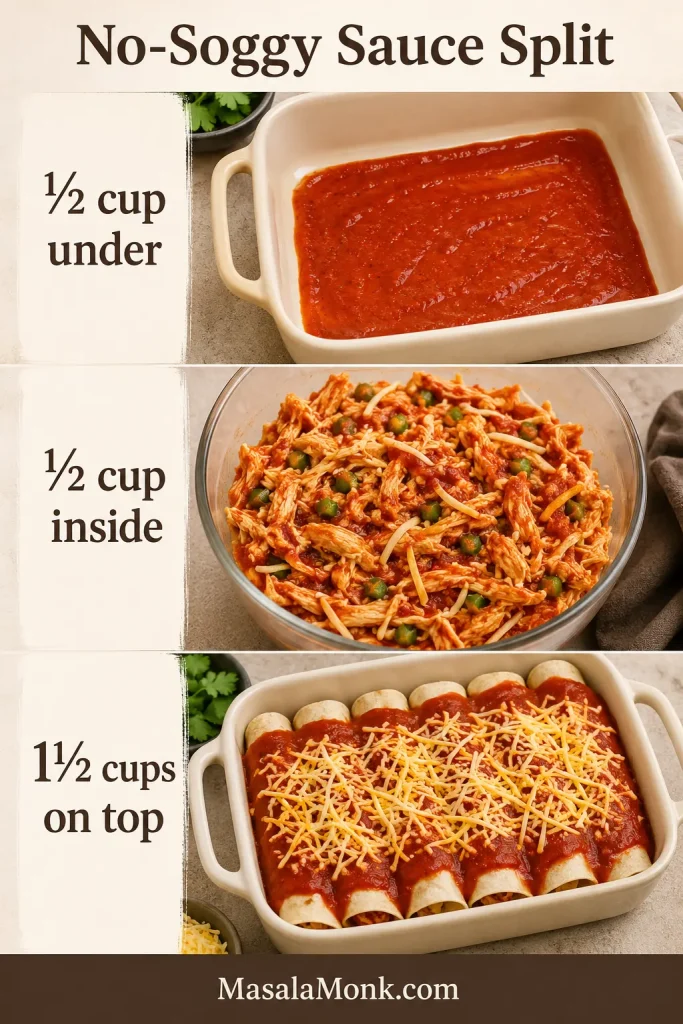
Sauce UseAmountWhere It Goes
Chicken filling½ cup / 120 mlStir into the seasoned chicken mixture.
Bottom of pan½ cup / 120 mlSpread before the first tortilla layer.
After first filling layer½ cup / 120 mlSpoon lightly over the chicken before cheese.
After second filling layer½ cup / 120 mlAdd just enough to moisten, not flood.
Top layer1 cup / 240 mlSpread over the final tortilla layer before the last cheese.
Total3 cups / 710 mlEnough sauce for soft layers without a watery casserole.
Layering diagram for chicken enchilada casserole showing corn tortillas, chicken filling, cheese, and a 3-cup sauce allocation.
The measured sauce allocation keeps every layer moist without letting the bottom of the pan turn loose or watery.

If the pan looks too wet at any point, check the soggy casserole fixes before adding more sauce.

Build the Layers Without Overthinking It

After the sauce is measured, the layers are simple: spread a thin sauce layer on the bottom, add tortilla halves, scatter one-third of the filling, spoon on the measured sauce, and add about 1 cup / 113 g cheese. Repeat until the pan is full, finishing with sauce and cheese on top.

  • Overlap tortilla halves slightly so there are no large gaps.
  • Spread the chicken filling evenly, but do not pack it down hard.
  • Keep the middle layers saucy, not flooded.
  • Finish with enough sauce and cheese on top to keep the casserole moist as it bakes.

If your tortillas are small, use enough pieces to cover each layer. If they are larger, trim or tear them to fit. The goal is even coverage, not a perfect pattern.

Patchwork Tortilla Layers Are Fine

Do not worry if the tortilla pieces look a little patchwork in the pan. Once the sauce and cheese melt into the layers, neat coverage matters more than a perfect arrangement. The pan may look imperfect before baking, but the finished casserole settles into soft, saucy layers.

Halved corn tortillas arranged in a patchwork layer over red sauce in a 9x13 baking dish.
The tortilla layer does not need to look perfect; even coverage matters more than neat rows once the sauce and cheese melt.

What Clean-Enough Slices Look Like

The best version is still generous and saucy, not dry or stiff. A slice should lift cleanly enough to serve while still showing soft tortilla, chicken, cheese, and sauce layers.

A spatula lifting a saucy layered slice of chicken enchilada casserole from a baking dish.
The goal is not a dry, perfect square; instead, aim for saucy layers that hold together enough to serve.

How to Keep Enchilada Casserole From Getting Soggy

Sogginess is the main thing that can ruin chicken enchilada casserole. Fortunately, most soggy casseroles are not ruined by one big mistake. Usually, it is a few small things adding up: wet add-ins, too much sauce, soft tortillas, and serving the casserole before it has had a chance to settle.

To prevent the problem before it starts, focus on the sauce allocation and the corn vs flour tortilla choice first.

ProblemLikely CauseFix
Watery casseroleToo much liquid from sauce, beans, corn, or chilesDrain add-ins well and use about 3 cups sauce total.
Gummy tortillasFlour tortillas or too much sauceUse corn tortillas, or reduce sauce slightly if using flour.
Casserole falls apartCut too soon after bakingRest 10–15 minutes before slicing.
Wet topBaked covered the whole timeUncover for the final 10–12 minutes.
Too soft after make-aheadTortillas absorbed sauce while refrigeratedUse corn tortillas and avoid assembling too far ahead if you want firmer layers.
Bland fillingChicken was not seasoned before layeringSeason the filling with spices, chiles, sauce, and lime before assembling.
Troubleshooting board for preventing soggy enchilada casserole, with fixes for watery sauce, gummy tortillas, falling apart, wet top, make-ahead softness, and bland filling.
If the pan usually turns soft or watery, start with moisture control: drain add-ins, measure sauce, and give the bake time to settle.

Most fixes come down to controlling moisture before the pan goes into the oven. If the first scoop looks softer than you expected, give the pan another few minutes before serving the rest. Enchilada casserole firms up as it cools, especially when the cheese and sauce have time to settle.

Mistakes to Avoid

Keep these three guardrails in mind: use cooked chicken, not raw chicken; use cooked rice only if you add rice; and do not pack the baking dish so full that the layers cannot settle.
Three mistakes to avoid when making chicken enchilada casserole: use cooked chicken, use cooked rice, and do not overfill the pan.
These three guardrails keep the recipe safe, evenly baked, and easier to serve without changing the basic method.
  • Raw chicken changes the recipe. This casserole is built around cooked shredded chicken, so raw chicken would change the bake time, moisture level, and food-safety timing.
  • Raw rice needs its own recipe. It needs more liquid and a longer bake, so use cooked rice only if you want a rice variation.
  • An overfilled pan gets messy fast. If the filling is more than your dish can comfortably hold, save the extra for tacos, bowls, or nachos.

Chicken Enchilada Casserole Variations

These are adaptation notes for the main casserole, not all separate full recipes. Red or green sauce swaps stay closest to the original 9×13 bake. Rice, slow cooker, keto, and tortilla-free versions change the texture or timing more, so use those as direction rather than simple one-for-one swaps. If you plan to make a variation ahead, check the make-ahead notes because creamy, rice, and slow cooker versions soften differently.

Green Chicken Enchilada Casserole

Green sauce gives the casserole a brighter, tangier feel, especially with chicken. Use green enchilada sauce or salsa verde, add diced green chiles to the filling, choose Monterey Jack or cheddar-Jack, and finish with cilantro and lime.

Green chicken enchilada casserole with salsa verde, Monterey Jack cheese, cilantro, lime, jalapeños, and visible chicken layers.
Green enchilada sauce or salsa verde gives the casserole a fresher finish, especially with Monterey Jack, cilantro, and lime.

White, Sour Cream, or Creamy Chicken Enchilada Casserole

For a creamier comfort-food pan, use a sour cream, cream cheese, or simple white sauce direction with green chiles and Monterey Jack. Flour tortillas are common in white enchilada casseroles because they make the texture softer, but corn tortillas still hold better if you want neater pieces.

White sour cream chicken enchilada casserole with creamy sauce, melted cheese, green chiles, cilantro, jalapeños, and lime.
A white or sour cream version leans creamier and softer, so think comfort bake rather than sharply sliced layers.

No Cream of Chicken Soup Needed — But Here’s How to Adapt It

This recipe does not need cream of chicken soup because enchilada sauce already gives the pan moisture and flavor. However, if the casserole you grew up with was creamier, softer, and made with condensed soup, you can still take this recipe in that direction.

Replace ½ to 1 cup of the enchilada sauce with a sour cream and cream-of-chicken mixture, then keep the remaining sauce measured. Condensed soup plus sour cream makes the casserole richer and softer, so this route works best when you want an old-school creamy bake rather than the cleanest layered pieces.

Cream of chicken soup adaptation board with condensed soup, sour cream, enchilada sauce, green chiles, creamy sauce, and a no-roll layered casserole.
The main recipe does not need condensed soup, but this adaptation shows how to take it toward an old-school creamy casserole without losing control of the sauce.

Chicken Enchilada Rice Casserole

Cooked rice can make the casserole heartier. Stir in 1½ to 2 cups cooked rice with the chicken filling and reduce the tortillas slightly if the pan feels too full. Do not use raw rice here; it needs a different liquid ratio and longer bake time.

Chicken enchilada rice casserole variation with cooked rice, shredded chicken, red enchilada sauce, black beans, corn, cheese, and sour cream.
Cooked rice makes the casserole heartier; however, raw rice needs a different liquid ratio and should not be added to this version.

Slow Cooker Chicken Enchilada Casserole

The slow cooker version is convenient, but it will be more spoonable than the oven-baked casserole. Cook chicken with enchilada sauce first, shred it, then stir in tortilla strips and cheese near the end so the tortillas do not become mushy. For more shredded-chicken dinner ideas, MasalaMonk’s crock pot chicken breast recipes are useful.

Slow cooker chicken enchilada casserole with saucy shredded chicken, tortilla pieces, melted cheese, cilantro, and a spoonful being served.
The slow cooker version is convenient and spoonable, but adding the tortillas near the end helps keep them from turning mushy.

Healthy, Keto, or Tortilla-Free Notes

A lighter pan can use more chicken, black beans, extra vegetables, slightly less cheese, and corn tortillas. For a low-carb version, use low-carb tortillas or skip the tortillas and make a saucy chicken enchilada bake with peppers, cauliflower rice, or zucchini. MasalaMonk’s sheet pan chicken fajitas recipe is a good lighter companion if you want a quick Tex-Mex-style chicken dinner with more peppers and less cheese.

Lighter keto chicken enchilada casserole notes with shredded chicken, peppers, zucchini, cauliflower rice, avocado, lime, and less cheese.
For a lighter or lower-carb direction, keep the enchilada flavor and shift the base toward chicken, vegetables, and low-carb swaps.

Make Ahead, Freezer, and Reheating Tips

Chicken enchilada casserole is a good make-ahead dinner, but tortilla texture changes the longer the casserole sits with sauce. If you want the neatest layers, assemble it the same day you plan to bake it. If convenience matters more, assemble it ahead and expect a more tender texture.

To keep the make-ahead texture firmer, use the corn tortilla guidance and avoid over-saucing the layers.

When serving company, bake it fresh if you can. On a busy weeknight, assembling it ahead is still worth it. The make-ahead version is not about perfect slices; it is about having dinner mostly handled before the evening gets busy.

NeedWhat to DoTexture Note
Make ahead same dayAssemble, cover, and refrigerate until ready to bake.Very good texture.
Make ahead overnightRefrigerate up to 24 hours.Tortillas soften more, especially flour tortillas.
Bake from fridgeAdd 10–15 minutes to the covered bake time.Keep covered until hot in the center.
Freeze unbakedWrap tightly and freeze for 2–3 months.Corn tortillas freeze better than flour.
Bake after thawingThaw overnight in the fridge, then bake covered and finish uncovered.Best freezer texture.
Bake from frozenBake at 350°F / 175°C covered for 60–90 minutes, then uncovered for 10–20 minutes.Time depends on pan depth and how solidly frozen it is.
Store leftoversRefrigerate in an airtight container for 3–4 days.Good for lunches.
ReheatWarm covered at 350°F / 175°C or microwave individual portions.Add a spoonful of sauce if it seems dry.
Make-ahead, freezer, and reheating workflow board for chicken enchilada casserole with fridge, freezer, oven, leftovers, and reheat steps.
Make-ahead prep is practical, although the layers soften slightly; careful chilling, wrapping, and reheating keep the pan worth serving.

Freeze Unbaked Chicken Enchilada Casserole

Freezing the unbaked pan is useful when you want dinner ready for a future busy night. Wrap the dish tightly, label it clearly, and thaw overnight for the best texture before baking.

Unbaked chicken enchilada casserole wrapped tightly in foil with a freezer label, marker, and freezer-prep notes.
Wrapping and labeling the unbaked casserole protects it in the freezer, while thawing overnight gives the best baked texture later.

For general leftover safety, the USDA’s food-safety guidance is a helpful reference for cooked dishes and refrigerated leftovers: USDA leftovers and food safety. For poultry safety specifically, the USDA’s safe minimum internal temperature chart is useful if you are cooking chicken before shredding it.

What to Serve With Chicken Enchilada Casserole

This casserole is filling on its own, but the right sides make it feel like a complete dinner. Since the casserole is saucy and cheesy, fresh, crunchy, or bright sides work especially well. Think of toppings as balance: lime, cilantro, and pico de gallo add brightness; sour cream, avocado, and guacamole add creaminess; jalapeños and pepper sauce add heat; lettuce, onion, or slaw add crunch.

  • Mexican rice or cilantro lime rice
  • Black beans or refried beans
  • Guacamole or sliced avocado
  • Pico de gallo or MasalaMonk’s mango salsa recipe for a sweet-bright topping
  • Salsa verde
  • Shredded lettuce with lime
  • Corn salad
  • Pickled onions
  • Jalapeños
  • Lime wedges

If serving this for guests, put toppings in small bowls and let everyone finish their own plate. It turns a hot, cheesy casserole into an easy toppings-bar dinner, and the cool, fresh extras make every serving feel a little brighter.

Serving ideas for chicken enchilada casserole with a plated slice, lettuce, pico de gallo, sour cream, guacamole, jalapeños, beans, rice, corn salad, pickled onions, lime, and salsa verde.
Bright toppings, crunchy sides, beans, rice, and salsa make the saucy baked pan feel fresh enough for a full dinner.

Chicken Enchilada Casserole Recipe

This easy chicken enchilada casserole is a no-roll 9×13 dinner with soft tortilla layers, saucy shredded chicken, and melted cheese on top. Use red sauce for a classic chili-forward bake or green sauce for a brighter, tangier chicken casserole.

Prep Time20 minutes
Cook Time30–32 minutes
Rest Time10–15 minutes
Servings8

Equipment

  • 9×13-inch / 23×33 cm baking dish
  • Large skillet
  • Mixing spoon or spatula
  • Foil
  • Knife and cutting board
  • Measuring cups and spoons

Ingredients

  • 1 tablespoon neutral oil / 15 ml
  • 1 small onion, diced / about 120 g
  • 2–3 garlic cloves, minced
  • 1 teaspoon ground cumin
  • 1 teaspoon chili powder
  • ½ teaspoon smoked paprika or regular paprika
  • ½ teaspoon dried oregano
  • ½ teaspoon kosher salt, plus more to taste
  • 1 can diced green chiles / 4 oz / 113 g, drained if watery
  • 3½ cups cooked shredded chicken / about 525 g
  • 1 can black beans, drained and rinsed / 15 oz / 425 g, optional
  • 1 cup corn / about 150–165 g, optional
  • 3 cups enchilada sauce, red or green / 710 ml, divided
  • 1 tablespoon lime juice / 15 ml
  • 12 small corn tortillas, 6-inch, halved / about 300–330 g total
  • 3 cups shredded Monterey Jack, cheddar-Jack, or Mexican blend cheese / 12 oz / 340 g

Optional Toppings

  • Sour cream
  • Chopped cilantro
  • Avocado or guacamole
  • Sliced jalapeños
  • Diced red onion
  • Lime wedges
  • Pico de gallo or salsa verde

Instructions

  1. Heat the oven. Preheat the oven to 375°F / 190°C. Lightly grease a 9×13-inch / 23×33 cm baking dish.
  2. Make the filling. Heat the oil in a large skillet over medium heat. Add the onion and cook for 3–4 minutes, until softened.
  3. Add the seasoning. Stir in the garlic, cumin, chili powder, paprika, oregano, salt, and diced green chiles. Cook for about 30 seconds, just until fragrant.
  4. Add chicken and extras. Stir in the shredded chicken, black beans if using, corn if using, ½ cup / 120 ml enchilada sauce, and lime juice. Cook for 1–2 minutes, just until everything is combined and lightly saucy. Taste and adjust salt if needed.
  5. Start the layers. Spread ½ cup / 120 ml enchilada sauce across the bottom of the baking dish. Add a layer of tortilla halves, overlapping slightly.
  6. Add filling and cheese. Spread one-third of the chicken filling over the tortillas. Spoon over about ½ cup / 120 ml sauce, then sprinkle with about 1 cup / 113 g cheese.
  7. Repeat. Add another tortilla layer, another third of the filling, another ½ cup / 120 ml sauce, and another cup of cheese. Add the final tortilla layer, the remaining filling, the remaining sauce, and the last cheese.
  8. Bake covered. Cover the dish with foil and bake for 20 minutes. If the dish is very full, tent the foil slightly so it does not stick to the cheese.
  9. Finish uncovered. Remove the foil and bake for another 10–12 minutes, until the casserole is bubbling around the edges and the cheese is melted.
  10. Rest before serving. Let the casserole rest for 10–15 minutes before slicing. Add toppings just before serving.

Recipe Notes

  • Baking at 350°F / 175°C: Bake covered for 25–30 minutes, then uncovered for 10–15 minutes.
  • Green chicken enchilada casserole: Use green enchilada sauce or salsa verde, Monterey Jack cheese, and extra cilantro/lime to finish.
  • Creamier casserole: Stir ½ cup / 120 g sour cream into the filling after it cools slightly, or use it as a topping.
  • Neater slices: Use corn tortillas and let the casserole rest before cutting.
  • Softer casserole: Flour tortillas can be used, but they may become more tender or gummy.

FAQs

Do I have to roll the tortillas?

No. That is the beauty of the casserole. The tortillas are layered in the pan instead of filled and rolled, so you get enchilada flavor without the assembly line.

How much chicken do I need?

Use about 3½ cups cooked shredded chicken. One average rotisserie chicken usually gives about 3 to 4 cups shredded meat, depending on size.

Are corn or flour tortillas better?

Corn tortillas give more classic enchilada flavor and better structure. Flour tortillas work, but they create a softer, more spoonable casserole and can turn gummy if the dish is too saucy.

Is red or green enchilada sauce better for this casserole?

Both work. Red sauce gives a deeper, more classic flavor, while green enchilada sauce tastes brighter and tangier with chicken, Monterey Jack, cilantro, and lime.

How do I keep chicken enchilada casserole from getting soggy?

Use corn tortillas, drain wet add-ins, measure the sauce, bake uncovered at the end, and give the casserole time to settle before serving. If you want firmer layers, lightly toast the tortillas before assembling.

How far ahead can I assemble it?

You can assemble it up to 24 hours ahead and refrigerate it covered. When baking from the fridge, add 10–15 minutes to the covered bake time so the center heats through.

What is the best way to freeze it?

Freeze it unbaked or baked, tightly wrapped, for 2–3 months. For the best texture, thaw it overnight in the refrigerator before baking or reheating. Corn tortillas usually freeze better than flour tortillas.

Is the slow cooker version as good as the oven version?

The slow cooker version is convenient, but it will be softer than the oven method. Cook the chicken with enchilada sauce first, shred it, then add tortilla strips and cheese near the end so the tortillas do not become too mushy.

Should rice go in this casserole or on the side?

Cooked rice can go in the casserole if you want it heartier. Stir in 1½ to 2 cups cooked rice with the chicken filling. Raw rice needs different liquid ratios and a longer bake time, so it is better handled as its own chicken enchilada rice casserole.

How long does chicken enchilada casserole last in the fridge?

Leftover chicken enchilada casserole keeps well in the refrigerator for 3–4 days in an airtight container. Reheat individual portions in the microwave or warm larger portions covered in a 350°F / 175°C oven.

Once you know the sauce amount, tortilla choice, and the value of a short pause before serving, this becomes the kind of forgiving dinner you can make without overthinking it. Keep it classic with red sauce, brighten it with green sauce, or set out sour cream, lime, avocado, salsa, and jalapeños so the whole pan feels easy, generous, and personal.

Back to top

Posted on 1 Comment

Pad Kra Pao Recipe: Thai Basil Chicken, Pork, or Beef: Thai Basil Chicken, Pork, or Beef

Finished Pad Kra Pao rice plate with glossy basil minced meat, red chilies, fluffy white rice, lime, and a crispy fried egg on a dark plate.

Pad Kra Pao is the Thai rice plate you want when dinner needs to be fast but still loud: garlic in hot oil, chilies, glossy minced meat, fresh basil, steamed rice, and a crispy fried egg that breaks into the sauce.

It is bold without being complicated. Once the rice is ready and the sauce is mixed, the stir-fry itself takes only a few minutes, which is why this dish works so well for weeknights, leftovers, and those “I want takeout, but I can cook” nights.

You may know this dish as Thai basil chicken, pad krapow, pad ka pow, kra pao, or holy basil chicken. The names and spellings vary, but the craving is usually the same: a spicy basil stir-fry that tastes fresh, savory, chili-hot, and glossy.

Here, you can make it with chicken, pork, or beef, then use the same base for tofu or eggplant. You will also see what to do if you only have Thai basil instead of holy basil, how to adjust the sauce, and how to fix the common problems that make homemade Pad Kra Pao taste flat, salty, or dry.

Quick Answer: What Is Pad Kra Pao?

Pad Kra Pao is a Thai basil stir-fry made with garlic, chilies, meat or tofu, a salty-savory sauce, and basil. It is usually served over rice, often with a crispy fried egg on top.

If you came here looking for Thai basil chicken, this is the same dish family. Thai basil chicken is the version many people know from Thai restaurants: minced or chopped chicken stir-fried with garlic, chilies, basil, and sauce, then spooned over rice.

The most traditional version is made with holy basil, which has a sharper, peppery, clove-like aroma. Thai basil gives a different but still excellent home version: sweeter, more anise-like, and closer to many restaurant-style Thai basil chicken plates outside Thailand.

Best quick version: Use 450g / 1 lb ground chicken, pork, or beef; 5–8 garlic cloves; 3–6 chilies; 1½–2 cups basil leaves; and a sauce made with oyster sauce, fish sauce, soy sauce, dark soy, sugar, and a little water or stock. Stir-fry hot and fast, add basil at the end, and serve over rice with a crispy fried egg.

Need exact measurements? See the sauce ratio or jump to the recipe card.
Labeled Pad Kra Pao plate with basil stir-fry, white rice, and crispy fried egg callouts.
If you know this dish as Thai basil chicken, the idea is the same: a fast garlic-chili basil stir-fry made to land on rice, usually with a crispy fried egg on top.

Why This Pad Kra Pao Works

The flavor does not come from marinating or simmering. It comes from a hot pan, crushed garlic and chilies, meat that sizzles instead of steams, sauce that reduces until glossy, and basil added right at the end.

Keep those five things in place and the dish tastes bold even with practical substitutions. When it works, the pan smells sharp with garlic and chilies, the meat looks shiny instead of wet, and the basil hits at the end with a fresh, peppery lift.

That rhythm is the whole dish: hot, sharp, glossy, fresh.

Pad Kra Pao, Pad Krapow, Pad Ka Pow: Why So Many Spellings?

You may see this dish written as pad kra pao, pad krapow, pad ka pow, pad ka prao, pad gaprao, phat kaphrao, kra pao, or gai pad krapow. These spellings come from different ways of transliterating Thai into English.

For a home cook, the idea is simpler than the name: a hot, fast basil stir-fry with garlic, chilies, sauce, rice, and usually a fried egg. Here, we’ll call it Pad Kra Pao for consistency, but if a menu uses another spelling, you are still in the right place.

Editorial spelling guide for Pad Kra Pao with terms pad krapow, pad ka pow, pad gaprao, and a small plated basil stir-fry.
Because Thai names are transliterated several ways, pad kra pao, pad krapow, pad ka pow, and pad gaprao usually lead readers to the same basil-heavy stir-fry family.

Holy Basil vs Thai Basil

The basil question matters because it changes the flavor of the dish. It should not stop you from cooking, though.

Strictly speaking, holy basil is what gives Pad Kra Pao its name and sharper, peppery character. Thai basil is the easiest excellent home-cook route: not identical, but fresh, aromatic, easy to find, and deeply satisfying in this garlic-chili rice plate. For a deeper Thai cooking perspective on the dish, see this explanation from Hot Thai Kitchen.

Comparison board showing holy basil and Thai basil leaves with flavor notes beside a small Pad Kra Pao dish.
Holy basil gives Pad Kra Pao its sharper traditional bite; however, Thai basil is often the easiest excellent route for a home-style Thai basil chicken plate.

Holy Basil

Holy basil is the most traditional choice for Pad Kra Pao. It has a sharper, peppery, slightly clove-like flavor. If you can find Thai holy basil at an Asian grocery store, use it.

The leaves wilt quickly, so add them at the very end. Do not simmer them for several minutes or the aroma will fade.

Thai Basil

For most home cooks, Thai basil is the easiest reliable substitute. Its aroma is sweeter and more anise-like than holy basil, and it is easier to find in many places.

Many restaurant-style Thai basil chicken recipes use Thai basil, so the flavor will still feel familiar and satisfying. If you are cooking this on a normal weeknight, do not let the basil question stop dinner.

Sweet Basil

Sweet basil, also called Italian basil, will not taste the same as holy basil or Thai basil. Still, it can work when that is all you have.

The result will taste softer, sweeter, and less peppery. It may lean slightly toward a regular basil stir-fry rather than classic Pad Kra Pao, but it is better to make a good basil rice plate than to skip the dish completely.

Can You Use Tulsi?

Tulsi is related to holy basil, but it is not always a simple one-for-one replacement in cooking. Depending on the variety, it can taste medicinal, bitter, or very strong when used in large amounts.

If you want to try tulsi, use a smaller amount first and mix it with Thai basil or sweet basil if possible. Fresh basil in a hot pan is still better than waiting for the perfect herb and never cooking the dish.

Whatever basil you use, wash the leaves ahead of time and dry them well. Wet basil can splutter in the pan and add extra moisture right when you want the sauce to stay glossy.

Sweet basil and tulsi fallback herb board with notes about softer flavor and careful tulsi use.
When holy basil and Thai basil are not available, fresh herbs still help; sweet basil makes the dish softer, while tulsi should be used lightly because its flavor can turn strong.
Simple basil rule: use holy basil if you can get it, Thai basil when you want the easiest excellent home version, sweet basil only if that is what you have, and tulsi carefully.

Already know your basil choice? Go to the ingredients.
Decision board comparing holy basil, Thai basil, sweet basil, and tulsi for Pad Kra Pao.
Use the best basil you can find, but do not pause dinner over the herb question; the bigger win is keeping the garlic-chili-basil structure intact.

Ingredients You Need

Pad Kra Pao is short on ingredients, but every ingredient has a job. Think of them in two groups: the loud things that wake up the pan — garlic, chilies, basil — and the salty-sweet sauce that makes the rice worth eating.

Overhead Pad Kra Pao ingredient map with protein, garlic, chilies, basil, sauce ingredients, rice, egg, and shallot.
The ingredients work in groups: protein catches the sauce, garlic and chilies wake up the pan, basil finishes fresh, and rice plus egg turn it into dinner.

Chicken, Pork, Beef, Tofu, or Eggplant

Ground meat is easiest because it cooks quickly and catches the sauce well. Use ground chicken, ground pork, ground beef, or finely chopped boneless meat. Hand-chopped chicken thigh gives a slightly chunkier, more restaurant-style bite.

For the main recipe, use 450g / 1 lb meat. If your pack is 500g, that is fine. You may need a small extra handful of basil or a splash more water, but do not automatically increase every sauce ingredient.

You do not need to marinate the meat. The flavor comes from the hot garlic-chili base, the sauce reducing onto the meat, and the basil added at the end.

Pork gives the juiciest, most classic-feeling version. Chicken is the version many people recognize from Thai restaurant menus. Beef gives a deeper, richer stir-fry.

Garlic and Chilies

Do not be shy with garlic. Pad Kra Pao should taste bold.

Use 5–8 garlic cloves for 450g / 1 lb meat. For heat, use 3–6 Thai bird chilies, or use 2–4 Indian green chilies if that is what you have. For a mild family version, start with 1 Thai chili or 1 small green chili, then add extra chopped chilies at the table.

Shallots are optional. They add a little sweetness and body, but the dish still works without them.

A mortar and pestle gives the strongest aroma because it crushes the garlic and chilies instead of only cutting them. Finely chopping with a knife also works. The goal is rough, fragrant pieces, not a watery paste.

Garlic and chili guide with crushed garlic, Thai bird chilies, Indian green chilies, optional shallots, and a heat spectrum.
Garlic and chilies are not background flavor here; instead, they create the sharp first hit that keeps Pad Kra Pao from tasting like a regular soy-sauce stir-fry.

Sauce Ingredients

The sauce usually includes oyster sauce, fish sauce, light soy sauce, optional dark soy sauce, sugar, and a little water or stock.

Oyster sauce gives body and savory sweetness. Fish sauce gives salty depth. Light soy adds more salt and umami. Dark soy adds color, but the dish can still work without it. Sugar rounds the heat and salt.

For a vegetarian version, use vegetarian oyster sauce or mushroom sauce, replace fish sauce with light soy sauce, and keep the sugar modest because many mushroom sauces are already slightly sweet.

Pad Kra Pao sauce ingredients board with oyster sauce, fish sauce, light soy, dark soy, sugar, and water or stock role labels.
Oyster sauce gives body, fish sauce adds depth, soy brings umami, and a splash of water or stock helps the sauce coat instead of clump.

Rice and Crispy Fried Egg

Serve it over hot rice so the sauce has somewhere to land. Jasmine rice gives the most classic feel, but plain steamed rice, basmati, or even leftover rice will still do the job.

The crispy fried egg is optional only in the technical sense. In practice, it makes the plate feel complete. The runny yolk mixes with the salty basil stir-fry and rice, while the crisp edges add texture. If the egg yolk runs into the rice, that is not a problem. That is the point.

Pad Kra Pao rice plate with glossy basil meat, fluffy rice, a lacy crispy fried egg, and a close-up egg texture inset.
The crispy fried egg is more than garnish; once the yolk runs into hot rice, it softens the salty chili-basil stir-fry into a satisfying plate.

Easy Substitutions for Indian and Everyday Kitchens

Missing one bottle should not kill the dish. Losing the garlic-chili-basil structure will.

The goal is not to fake perfection. It is to keep the core of the dish intact with what you can actually buy.

Pad Kra Pao substitutions board for Indian kitchens with basil, green chilies, sauces, chicken keema, garlic, and a skillet or kadai cue.
Even with everyday swaps, keep the structure intact: fresh basil, sharp chilies, a salty-savory sauce, and a hot wide pan.
If You Do Not Have… Use This What Changes
Holy basil Thai basil Sweeter and more anise-like, but still excellent
Thai basil Sweet basil Softer and less peppery; still fresh and usable
Thai bird chilies Indian green chilies or serrano chilies Heat is less sharp, but the recipe still works
Dark soy sauce Skip it, or use a tiny extra splash of light soy Less dark color, but the flavor is still good
Fish sauce Light soy sauce plus a pinch of mushroom seasoning Less funky depth, but still savory
Oyster sauce Vegetarian oyster sauce or mushroom sauce Best vegetarian replacement for body and umami
Jasmine rice Plain steamed rice Less fragrant, but perfectly usable
Ground chicken Chicken keema or finely chopped boneless thigh Similar texture; chopped thigh stays juicier
Wok Wide skillet or wide kadai Works well if the pan is hot and not crowded

If your regular soy sauce is very dark and salty, use it like light soy sauce and skip the dark soy. Some supermarket soy sauces do not map neatly to “light soy” and “dark soy,” so taste and adjust gently.

The biggest substitution mistake is not using the “wrong” basil. It is crowding the pan and boiling the meat instead of stir-frying it. A hot, wide pan matters more than having every bottle exactly right.

Once your swaps are sorted, check the sauce ratio before you start cooking.

Best Pan and Equipment for Pad Kra Pao

A wok gives you quick heat and fast evaporation, but a wide skillet works very well for home cooking.

Use a 12-inch / 30cm skillet if you do not have a wok. A wide kadai can also work if it gives the meat enough surface area. Avoid using a small deep pan for a full batch because the meat will steam and release liquid.

For nonstick pans, use medium-high heat instead of the highest possible heat. For a wok or stainless-steel skillet, high heat is fine as long as you keep the food moving.

You will also need a small bowl for the sauce, a knife or mortar and pestle for the garlic and chilies, and a small frying pan if you are making crispy eggs.

Pan rule: the meat should sizzle, not steam. If the pan sounds quiet and wet, it is not stir-frying yet.
Best pan guide showing wok, wide skillet, and wide kadai with a sizzle versus steam cue for Pad Kra Pao.
A wide hot pan is the difference between stir-fried and steamed meat; therefore, listen for a real sizzle before adding the sauce.

If your pan setup is ready, go straight to the method.

Pad Kra Pao Sauce Ratio

The sauce should cling to the meat first and season the rice second. It should look glossy, not soupy.

When the sauce hits the pan, it should bubble hard almost immediately. When it looks like the rice underneath will want a spoonful of it, but the pan is not swimming, you are in the right zone.

Texture comparison board showing too wet Pad Kra Pao versus just-right glossy meat with basil and chilies.
The best texture is glossy and spoonable, not soupy; once the sauce clings to the meat, it flavors the rice without flooding the plate.

Balanced Sauce for 450g / 1 lb Meat

Ingredient Amount What It Does
Oyster sauce 1 tbsp / 15 ml Adds savory body and slight sweetness
Fish sauce 1 tbsp / 15 ml Gives salty, Thai-style depth
Light soy sauce 1 tbsp / 15 ml Adds salt and umami
Dark soy sauce 1–2 tsp / 5–10 ml, optional Adds color and deeper flavor
Sugar 1 tsp / about 4g Rounds the salt and chili heat
Water, chicken stock, or vegetable stock 2–3 tbsp / 30–45 ml Helps the sauce coat the meat
Saveable Pad Kra Pao sauce ratio card with measured oyster sauce, fish sauce, light soy, dark soy, sugar, and water or stock.
This Pad Kra Pao sauce ratio is built for 450g or 1 lb of meat, so the sauce should cling to the mince and lightly season the rice below.

Lower-Salt Sauce Ratio

If your fish sauce, soy sauce, or oyster sauce tastes especially salty, use this version first.

Ingredient Amount
Oyster sauce 1 tbsp / 15 ml
Fish sauce 2 tsp / 10 ml
Light soy sauce 2 tsp / 10 ml
Dark soy sauce 1 tsp / 5 ml, optional
Sugar 1 tsp / about 4g
Water, chicken stock, or vegetable stock 2 tbsp / 30 ml
Lower-salt Pad Kra Pao sauce ratio card with smaller fish sauce and soy sauce amounts for salty sauce brands.
If your fish sauce or soy sauce tastes very salty, start lower; then, after cooking, balance the plate with rice, lime, or a small extra splash of sauce.

Sauce brands vary, especially oyster sauce and soy sauce. If yours tastes very salty or very sweet straight from the bottle, start with the lower-salt ratio and adjust after cooking.

Taste after cooking. If the stir-fry is too salty, serve it with more rice and reduce fish sauce next time. If it tastes flat, it may need more garlic, chili, basil, or a better salt-sugar balance.

Once the sauce is mixed, move to the cooking method.

How to Make Pad Kra Pao

Pad Kra Pao cooks quickly, so the method is more about timing than difficulty. Once everything is lined up, the cooking feels fast rather than stressful.

Before turning on the stove, have the sauce mixed, basil picked and dried, garlic and chilies chopped, rice cooked, and eggs ready to fry. Once the pan is hot, there is not much time to stop and measure.

Pad Kra Pao prep setup with mixed sauce, basil, chopped garlic and chilies, cooked rice, and eggs on a dark surface.
Because Pad Kra Pao moves fast, prep the sauce, basil, aromatics, rice, and eggs first; then the cooking feels quick instead of chaotic.

Cook the Rice First

Start the rice before you cook the stir-fry. Once the garlic and chilies hit the pan, the dish moves fast.

Jasmine rice is the classic choice, but any plain steamed rice will work. If rice timing or water ratios are the part that usually slows you down, MasalaMonk’s guide to cooking perfect rice can help you get the base ready before the stir-fry starts. Avoid heavily seasoned rice because the stir-fry already has plenty of salt, chili, garlic, and basil.

Mix the Sauce Before You Start

Stir the oyster sauce, fish sauce, soy sauces, sugar, and water or stock in a small bowl.

Measure the sauce first, because garlic can burn while you are still looking for bottles.

Pound or Chop Garlic and Chilies

For the strongest aroma, pound garlic and chilies together in a mortar and pestle until roughly crushed. You do not need a smooth paste.

If you do not have a mortar and pestle, finely chop everything with a knife. A mini chopper also works, but stop before the mixture turns wet and pasty.

Fry the Crispy Egg

For each serving, use one egg. Heat 2–3 tablespoons of oil in a small pan, then fry the eggs one at a time or in batches. Add a little more oil between eggs only if the pan gets dry.

Crack in the egg and spoon hot oil over the whites until the edges are crisp and lacy. Keep the yolk runny if you like the classic rice-plate effect.

You can fry the eggs before the stir-fry and set them aside, or fry them right after the stir-fry if you prefer the egg hot from the pan.

Crispy fried egg technique board with hot oil, lacy golden edges, runny yolk, and spooning oil over the whites.
For a Thai-style crispy egg, hot oil matters; spoon it over the whites so the edges turn lacy while the yolk stays rich.

Stir-Fry the Meat Hot and Fast

Heat a wok over high heat, or use medium-high heat if you are cooking in a nonstick skillet. Add oil, then the garlic, chilies, and optional shallots.

The garlic and chilies should become fragrant within seconds. Do not let the garlic turn dark brown. This is the point where the kitchen should smell sharp, garlicky, and a little wild.

Garlic and sliced red and green chilies sizzling in oil in a wok with a spatula.
This is the aroma stage, so move quickly: the garlic should smell sharp and toasty before it gets dark.

Add the meat and break it up as it cooks. It should sizzle, not sit in liquid. If it releases moisture, spread it across the pan and keep cooking until most of that moisture evaporates.

If you add the sauce while the pan is still watery, the finished dish can taste boiled instead of stir-fried.

Before-and-after pan comparison showing wet minced meat versus moisture-cooked-off meat ready for sauce.
Add sauce only after the released moisture cooks off; otherwise, Pad Kra Pao turns boiled and watery instead of glossy.

If your pan is already looking wet, jump to the troubleshooting guide before adding basil.

Add Sauce and Reduce Until Glossy

Pour in the sauce and toss well. It should bubble quickly, coat the meat, and tighten around the pieces instead of pooling underneath.

If the pan looks dry, add 1–2 tablespoons of water or stock. If the pan looks soupy, keep cooking over high heat for another minute before adding basil.

The finished meat should look shiny and loose, not wet or clumpy.

Add Basil at the End

Turn the heat down or off, then add the basil leaves. Toss just until wilted.

Once the basil hits the hot meat, the whole pan should wake up. Long cooking dulls that aroma, so let the leaves collapse into the stir-fry and stop there.

Sequential board showing sauce bubbling into minced meat, coating the meat, and fresh basil added last.
Sauce goes in before basil because it needs heat to reduce; meanwhile, basil should only wilt at the end so the aroma stays fresh.

Serve Immediately

Spoon the basil stir-fry over hot rice. Add a crispy fried egg, cucumber slices, and lime if you like.

The first bite should be hot, salty, fresh, and softened by rice and yolk. This is not a dish that improves by sitting around, so serve it while the basil still smells alive.

Step-by-step Pad Kra Pao board with sauce, basil, garlic and chilies, stir-fried meat, sauce, basil, and a finished rice plate.
The method is simple when the order is clear: prep first, cook aromatics, brown the meat, reduce the sauce, then add basil right at the end.

Chicken, Pork, or Beef: Which Version Should You Make?

The same sauce and method work for chicken, pork, or beef, but each one gives the plate a different mood.

Choose chicken for the cleanest restaurant-style Thai basil chicken, pork for the juiciest street-food-style version, and beef for the darkest, most savory bowl.

Three-way Pad Kra Pao chooser board comparing chicken, pork, and beef rice plates with text labels.
The same sauce can lead to three moods: chicken is clean and fast, pork is juicy and classic, and beef is darker and more savory.

Once you choose the protein, use the recipe card for exact quantities and timing.

Thai Basil Chicken Version

For Thai basil chicken, use ground chicken, chicken keema, or finely chopped boneless chicken thigh.

Hand-chopped thigh gives little juicy pieces that catch the sauce, while ground chicken keeps the dish quick and familiar. Chicken breast works too, but it dries out faster, so chop it small and cook it quickly.

This is the lightest, fastest version and lets the basil come through clearly.

Thai basil chicken plate with glossy chicken pieces, red chilies, basil, rice, cucumber, lime, and crispy fried egg.
Thai basil chicken is the cleanest, fastest version; however, it still needs enough garlic, chilies, and basil to taste bold.

Pork Pad Kra Pao Version

Ground pork gives the richest, juiciest Pad Kra Pao. It is the version to make when you want the dish to feel more street-food-style and deeply satisfying.

Use 450g / 1 lb ground pork. If the pork is fatty, use slightly less oil and let some edges brown before adding the sauce. If it is very lean, keep the full 2 tablespoons of oil and avoid overcooking.

The fat carries the garlic and chili beautifully, especially if you can find holy basil.

Pork Pad Kra Pao plate with glossy browned pork mince, basil, red chilies, rice, and a crispy egg with runny yolk.
Pork gives the juiciest Pad Kra Pao because the fat carries garlic and chili especially well, while the egg makes the rice plate feel complete.

Thai Basil Beef Version

Thai basil beef gives the deepest, most savory bowl. Use ground beef, minced beef, or very thinly chopped steak.

Beef needs a hot, wide pan. If it steams instead of browns, the flavor turns flat. Cook in batches if needed, and use the higher end of the dark soy sauce range if you want a deeper color.

This is the version for a darker, richer rice plate with a strong garlic-chili base.

Thai basil beef rice plate with dark glossy beef, basil, red chilies, white rice, and crispy fried egg.
Thai basil beef should taste deeper and more savory than chicken, so keep the pan hot enough to brown without turning the basil dark.

Vegetarian, Tofu, and Eggplant Options

You can make a vegetarian Pad Kra Pao-style stir-fry with tofu, eggplant, mushrooms, or a mix of vegetables. These versions are not exactly the same as the classic meat rice plate, but the same garlic-chili-sauce-basil structure works well if you control moisture.

The best vegetarian version still needs the same attitude as the meat version: high heat, strong aromatics, and enough basil that the pan smells alive at the end.

For tofu, use firm or extra-firm tofu. Press it if it is very wet, then crumble it into small pieces. Cook it in a hot pan until the edges look lightly browned. The goal is the same as with meat: drive off moisture first, then let the sauce cling instead of slide off.

Tofu Pad Kra Pao plate with crisp glossy tofu, basil, red chilies, rice, and fried egg on a dark plate.
Tofu works best when it gets crisp edges first; after that, the sauce can cling instead of sliding off a wet surface.

If tofu is your main protein more often than a one-time swap, MasalaMonk’s tofu meal prep ideas go deeper into pressing, browning, saucing, and building rice-box style meals that still taste good later.

For eggplant, cut it into small pieces and cook it until tender before adding the sauce. Eggplant absorbs oil, so use a wide pan and avoid stirring too aggressively once it softens.

For mushrooms, cook them until their liquid evaporates. Then add the garlic-chili base, sauce, and basil.

Vegetarian Pad Kra Pao options board with glossy eggplant bowl and browned mushroom bowl with basil and red chilies.
Eggplant should turn tender and glossy, while mushrooms need their moisture cooked off first; otherwise, the vegetarian version can taste watery.

Use vegetarian oyster sauce or mushroom sauce. Replace fish sauce with soy sauce and, if you have it, a small pinch of mushroom seasoning.

For vegetarian sauce swaps, use the substitution guide before cooking.

What to Serve With Pad Kra Pao

Pad Kra Pao is usually served as a rice plate, not as a saucy curry. Keep the sides simple so the basil, garlic, chilies, and fried egg stay in focus.

  • Steamed jasmine rice
  • Crispy fried egg
  • Cucumber slices
  • Lime wedges
  • Extra chopped chilies
  • Prik nam pla — chopped chilies in fish sauce and lime — or soy sauce and lime for a vegetarian plate
Serving spread for Pad Kra Pao with rice, crispy fried egg, cucumber, lime, extra chilies, and prik nam pla labels.
The best sides are simple on purpose: cucumber cools the heat, lime brightens the sauce, extra chilies add control, and prik nam pla sharpens the rice.

Cucumber is especially useful because it cools the heat and gives the plate a fresh crunch. If you want that cooling side to feel a little more complete, a simple cucumber salad works well beside the hot basil stir-fry.

For a brighter Thai-style side, you can also serve it with a small portion of vegan Som Tam raw papaya salad. The crunch, lime, chili, and freshness make sense next to the rich fried egg and savory basil meat.

For the table-side chili condiment, keep the spoonful small and bright rather than drowning the rice.

Prik nam pla condiment bowl with sliced red and green chilies in fish sauce and lime, plus a soy-lime vegetarian note.
Prik nam pla adds salty heat in tiny spoonfuls; for vegetarian plates, soy sauce with lime gives a similar bright table-side lift.

If you bought a large bunch of basil, use the extra leaves quickly in another fresh herb recipe rather than letting them wilt. This dish is best when the basil tastes alive, not tired.

How to Fix Pad Kra Pao

Most Pad Kra Pao problems come from heat, timing, or sauce balance. Fortunately, the fixes are usually simple once you know what happened.

Fast diagnosis: watery usually means crowding or low heat, bland usually means weak garlic-chili-basil energy, salty usually means the sauce needs more rice or a lower-salt ratio, and dull basil flavor usually means the basil cooked too long.
Seasoning troubleshooting board for Pad Kra Pao with rice, lime, chilies, garlic, basil, fish sauce, and a glossy stir-fry bowl.
Fix the plate before you panic: rice and lime soften salt, fresh chilies restore heat, and garlic, basil, or fish sauce can wake up flat flavor.

Too Watery

Watery Pad Kra Pao almost always means the meat steamed before it fried.

Keep cooking until the liquid evaporates before adding basil. Next time, use a wider pan, higher heat, and do not double the recipe in one skillet. For larger batches, cook the meat in rounds.

Troubleshooting board showing watery Pad Kra Pao from a crowded pan and low heat beside glossy fixed stir-fry.
Watery Pad Kra Pao usually starts before the sauce goes in, so use a wider pan and cook off moisture before adding basil.

Sauce Is Pooling Under the Meat

Pooling sauce usually means the sauce went in before the pan was ready.

Keep the pan on high heat and toss until the sauce clings to the meat. Next time, start with 2 tablespoons water or stock, then add more only if the pan looks dry.

Too Salty

Salty Pad Kra Pao is usually easiest to fix on the plate, not in the pan.

Serve it with more plain rice and add a squeeze of lime. Next time, use the lower-salt sauce ratio and reduce fish sauce and light soy before reducing oyster sauce, because oyster sauce also gives body.

Too Sweet

Too much sweetness usually comes from sweet oyster sauce, dark sweet soy, or too much sugar.

To balance the current batch, add a small splash of fish sauce or light soy and serve it with plain rice. Next time, keep the added sugar modest.

Too Dry

If the meat tastes plain and dry instead of glossy, the pan probably needed a small splash of liquid near the end.

Add 1–2 tablespoons of water or stock and toss briefly over heat. The meat should be glossy enough to season the rice, not dry like plain mince.

Not Spicy Enough

If the dish tastes warm but not lively, the chilies are probably too mild or too few.

Add more chopped fresh chili next time, or serve extra chilies on the side. Fresh chilies give sharper flavor and better aroma than chili flakes alone.

Tastes Like Generic Stir-Fry

If it tastes like a regular soy-sauce stir-fry, the sharp things have been muted: garlic, chili, fish sauce, basil, or heat.

Use enough fresh basil, add it at the end, and make sure the sauce reduces onto the meat instead of staying loose in the pan.

Not Enough Basil Flavor

Weak basil flavor usually means one of two things: too little basil, or basil added while the pan was still boiling.

Use 1½–2 cups basil leaves for 450g / 1 lb meat. Add them only at the end and toss just until wilted.

Basil Turned Dark or Lost Its Aroma

Basil turns dull when it cooks too long.

Add it after the sauce has reduced and the heat is low or off. The leaves should wilt into the meat, not simmer.

Garlic Tastes Burnt

Burnt garlic means the aromatics waited too long before the meat went in.

Next time, stir the garlic and chilies only until fragrant, then add the meat as soon as the garlic smells sharp and toasty.

Meat Turned Rubbery

Rubbery meat is usually an overcooking problem, especially with chicken breast or lean beef.

Stir-fry until just cooked, reduce the sauce quickly, then finish with basil.

For texture and basil problems, focus on timing: keep the meat glossy, keep the garlic golden, and add basil only at the end.

Texture and basil troubleshooting board with dry meat, rubbery meat, weak basil, burnt garlic, glossy meat, basil leaves, and spooned stock.
Texture problems have small fixes: a splash of stock rescues dry meat, shorter cooking prevents rubbery meat, and basil belongs at the end.

Need to cook another batch instead? Return to the recipe card with the fixes in mind.

Storage and Reheating

Pad Kra Pao tastes best immediately, when the basil is fresh and the egg is crisp, but leftovers are still useful.

Store the cooked stir-fry in an airtight container in the fridge for up to 3 days. That sits within the USDA’s general 3–4 day guidance for refrigerated leftovers. Store rice separately if possible. Fried eggs are best cooked fresh, but you can skip the egg when reheating and fry a new one before serving.

To reheat, warm the stir-fry in a skillet with a splash of water. Heat just until hot. Do not cook it for too long or the basil flavor will fade further.

Leftovers will not have the same just-wilted basil aroma, but they still make a very good rice bowl the next day.

If you want to prep ahead, mix the sauce, chop the garlic and chilies, wash and dry the basil leaves, and cook the rice. Leave the actual stir-fry for right before eating.

Storage, reheating, and make-ahead board with cooked Pad Kra Pao in a glass container, reheating skillet, rice, eggs, sauce, basil, garlic, and chilies.
Pad Kra Pao is best fresh, but leftovers still work; reheat with a splash of water and fry a fresh egg if possible.

If you like salty-garlicky rice-plate dinners, MasalaMonk’s chicken adobo recipe is another strong one to cook next.

Pad Kra Pao Recipe Card

If this is your first time making it, start with the balanced sauce, use Thai basil if holy basil is hard to find, and keep the pan wide and hot. The first batch will quickly teach you your preferred salt, chili, and basil level.

Pad Kra Pao Recipe: Thai Basil Chicken, Pork, or Beef

This Pad Kra Pao recipe gives you a fast, garlicky Thai basil rice plate with chicken, pork, or beef, glossy sauce, and a crispy fried egg. Use holy basil if you can find it, or Thai basil for the easiest restaurant-style home version.

Prep Time 10 minutes
Cook Time 10–12 minutes
Total Time 20–22 minutes
Servings 4

Equipment

  • Wok or 12-inch / 30cm skillet
  • Small bowl for mixing the sauce
  • Mortar and pestle, knife, or mini chopper
  • Small frying pan for eggs
  • Spatula

Ingredients

For the Stir-Fry

  • 450g / 1 lb ground chicken, pork, or beef
  • 2 tbsp neutral oil, for the stir-fry
  • 5–8 garlic cloves, finely chopped or pounded
  • 3–6 Thai bird chilies, chopped, or 2–4 Indian green chilies
  • 1–2 shallots, thinly sliced, optional
  • 1½–2 cups holy basil or Thai basil leaves, about 30–60g depending on how tightly packed the leaves are
  • Steamed jasmine rice, for serving
  • 4 eggs
  • 2–3 tbsp neutral oil to start, plus more as needed for frying the eggs
  • Cucumber slices, optional
  • Lime wedges, optional

For the Sauce

  • 1 tbsp oyster sauce, 15 ml
  • 1 tbsp fish sauce, 15 ml
  • 1 tbsp light soy sauce, 15 ml
  • 1–2 tsp dark soy sauce, 5–10 ml, optional for deeper color
  • 1 tsp sugar, about 4g
  • 2–3 tbsp water, chicken stock, or vegetable stock, 30–45 ml

Instructions

  1. Cook the rice first. Pad Kra Pao cooks quickly, so have rice ready before you start the stir-fry.
  2. Mix the sauce. In a small bowl, stir together oyster sauce, fish sauce, light soy sauce, optional dark soy sauce, sugar, and water or stock.
  3. Prepare the aromatics. Pound or finely chop the garlic and chilies. Pick the basil leaves from the stems, wash them if needed, and dry them well.
  4. Fry the eggs. Heat 2–3 tablespoons oil in a small pan. Fry the eggs one at a time or in batches, spooning hot oil over the whites until the edges are crisp. Add more oil only if the pan gets dry. Set aside.
  5. Heat the pan. Heat a wok over high heat, or a wide nonstick skillet over medium-high heat.
  6. Cook the garlic and chilies. Add oil, then garlic, chilies, and optional shallots. Stir briefly until fragrant, without letting the garlic burn.
  7. Add the meat. Add ground chicken, pork, or beef. Break it up and stir-fry until cooked through and most moisture has evaporated.
  8. Add the sauce. Pour in the sauce and toss until the meat is glossy and coated. It should not be soupy.
  9. Add basil last. Turn the heat down or off, add basil, and toss just until wilted.
  10. Serve immediately. Spoon over rice and top each serving with a crispy fried egg. Add cucumber and lime if you like.

Notes

  • Holy basil gives the most traditional flavor; Thai basil is the easiest excellent home version.
  • Use neutral oil because olive oil or strongly flavored oils can fight the basil, garlic, and fish sauce.
  • You do not need to marinate the meat. The sauce and aromatics flavor it during the fast stir-fry.
  • If using 500g meat instead of 450g, keep the same sauce ratio first, then adjust only if needed.
  • For a less salty or milder version, reduce fish sauce and soy slightly, and start with 1 Thai chili or 1 small green chili.
  • If doubling the recipe, cook the meat in batches and add the basil only at the end.
Pad Kra Pao recipe card with serving time, ingredients, sauce amounts, method bullets, and a plated basil stir-fry with rice and egg.
Keep this card for the core formula: 1 lb meat, bold aromatics, balanced sauce, basil at the end, and rice plus egg to serve.

By the time the rice, basil stir-fry, and egg come together, the plate should feel hot, glossy, and immediate.

Close-up final Pad Kra Pao serving with glossy basil meat, white rice, crispy fried egg, runny yolk, red chilies, basil leaves, and spoon.
A good final plate should feel immediate: glossy meat, fresh basil, hot rice, and a yolk that runs into everything.

FAQs

Is Pad Kra Pao the same as Thai basil chicken?

Thai basil chicken is usually the chicken version of Pad Kra Pao. Traditionally, the dish is made with holy basil, but many restaurant and home versions use Thai basil because it is easier to find.

What does Pad Kra Pao taste like?

Pad Kra Pao tastes garlicky, salty-savory, spicy, and fresh from the basil. It should feel bold and punchy, with just enough glossy sauce to season the rice without turning the plate into curry.

What basil is best for Pad Kra Pao?

Holy basil gives the most traditional sharp, peppery flavor. Thai basil is the best practical substitute for most home kitchens. Sweet basil works only in a pinch; it makes the dish softer and less like classic Pad Kra Pao.

Can I use dried basil?

Dried basil is not a good replacement because Pad Kra Pao depends on the fresh aroma of basil added at the end. If dried basil is all you have, you can still make a garlic-chili stir-fry, but it will not taste like Pad Kra Pao or a fresh Thai basil chicken-style stir-fry.

Is Pad Kra Pao supposed to be saucy?

No, it should be glossy rather than soupy. You want enough sauce to season the rice, but not so much that the meat swims. Think juicy rice plate, not curry.

Does Pad Kra Pao need a fried egg?

The fried egg is technically optional, but it is part of the pleasure of the plate. The crisp edges add texture, and the yolk softens the salty, spicy meat into the rice.

Chicken breast, sliced chicken, or ground chicken: which works best?

Ground chicken or chopped chicken thigh is easiest and juiciest. Sliced chicken works too if you cut it small and cook it quickly. Chicken breast is usable, but it dries out faster than thigh.

What can replace fish sauce?

Use light soy sauce with a small pinch of mushroom seasoning if you have it. The flavor will be less funky and less Thai-style, but still savory.

What can replace oyster sauce?

Vegetarian oyster sauce or mushroom sauce is the best replacement. If you do not have either, use soy sauce with a little sugar, but the sauce will be thinner and less rounded.

Why did my Pad Kra Pao turn watery?

Watery Pad Kra Pao usually means the meat steamed before it fried. Use a wider pan, higher heat, and cook off moisture before adding the sauce.

Can I make Pad Kra Pao ahead?

You can prep the sauce, garlic, chilies, basil, and rice ahead of time. For the best flavor, cook the stir-fry right before eating because basil tastes freshest when added at the end.

How long does Pad Kra Pao keep in the fridge?

The cooked stir-fry keeps for up to 3 days in an airtight container. Reheat it in a skillet with a splash of water. Fry a fresh egg when serving if possible.

Once this rhythm clicks, Pad Kra Pao becomes less like a strict recipe and more like a rice-plate formula you can repeat with chicken, pork, beef, tofu, or whatever needs cooking.

Back to top ↑

Posted on 1 Comment

Cream of Mushroom Chicken Recipe

Cream of mushroom chicken served over mashed potatoes with sliced mushrooms, creamy sauce, black pepper, and fresh herbs.

This cream of mushroom chicken recipe is for the night when you have chicken in the fridge, a can of cream of mushroom soup in the pantry, and no patience for a complicated sauce. The goal is simple: tender chicken, creamy mushroom gravy, and a dinner that works with rice, egg noodles, mashed potatoes, biscuits, or whatever vegetable you already have.

This is the kind of dinner that feels like a shortcut while it cooks, but like comfort food once it hits the plate. It is not fancy food; it is the creamy, spoon-over-something meal you make when the day has been long and everyone still needs to eat.

Bake it when you want the easiest family dinner. Use the skillet when dinner needs to happen faster, the slow cooker when the meal should take care of itself, and the rice bake when chicken and rice should land in one dish.

The dish works best with condensed cream of mushroom soup, thin or evenly pounded chicken, and just enough milk or broth to turn the soup into a spoonable sauce. A thermometer keeps the chicken from drying out while still getting it safely to 165°F / 74°C.

Quick Answer: How to Make Cream of Mushroom Chicken

To make cream of mushroom chicken, season chicken breasts or thighs, place them in a baking dish, whisk condensed cream of mushroom soup with milk or low-sodium chicken broth, pour the sauce over the chicken, cover, and bake until the chicken reaches 165°F / 74°C. Uncover near the end if the sauce needs to thicken or cheese is going on top.

The result should be chicken that slices easily with creamy mushroom gravy you can spoon over rice, noodles, mashed potatoes, biscuits, or vegetables. This is still a low-effort dinner: about 10 minutes of prep, then the oven does most of the work.

The skillet version is faster, the slow cooker version is more hands-off, and the rice bake turns it into a one-dish meal. The trick is changing the liquid slightly for each method, so use the version guide or the soup and liquid ratios before switching methods.

Best first version: Bake thin chicken breasts or thighs with 1 can condensed cream of mushroom soup and ½ cup milk or broth at 375°F / 190°C. Cover first for moisture, then uncover near the end so the sauce thickens.
Quick answer board showing cream of mushroom chicken, chicken pieces, condensed soup, milk or broth, and covered baking instructions.
For the simplest version, build the dish in four parts: chicken, condensed cream of mushroom soup, a little milk or broth, and a covered bake.

For food safety, chicken should reach 165°F / 74°C in the thickest part; FoodSafety.gov lists poultry and casseroles at this internal temperature.

Which Version Should You Make?

Before you open the soup can, decide how dinner needs to work tonight. The same basic ingredients can become an easy oven dinner, a quick skillet meal, a slow cooker comfort dish, or a chicken-and-rice bake.

The one thing that changes most between versions is the soup-to-liquid ratio. The oven, skillet, slow cooker, and rice bake each need slightly different treatment, which is what keeps the chicken juicy and the sauce creamy instead of watery.

Choose This Version Best When Key Ratio
Baked cream of mushroom chicken You want the easiest family dinner with minimal prep. 1 can soup + ½ cup milk or broth
Skillet cream of mushroom chicken You want dinner faster and more control over the sauce. 1 can soup + ½–1 cup broth or milk
Slow cooker cream of mushroom chicken You want hands-off creamy chicken for rice, noodles, or potatoes. 2 cans soup + ½ cup liquid
Cream of mushroom chicken and rice You want a full one-dish meal. 1 can soup + 1 cup liquid + ¾ cup rice
Creamy chicken over egg noodles You want mushroom-sauce chicken without baking rice. Cook noodles separately and spoon sauce over them
Guide comparing baked, skillet, slow cooker, and chicken and rice versions of cream of mushroom chicken.
Instead of using one formula for every method, adjust the liquid for baked, skillet, slow cooker, and chicken-and-rice versions.

How Much Liquid to Add to Cream of Mushroom Soup

Use these ratios as starting points, then adjust until the sauce looks spoonable, not stiff and not soupy.

Version Condensed Soup Added Liquid Why It Works
Baked chicken 1 can / 10.5 oz / 298 g ½ cup / 120 ml milk or broth Creates a creamy, spoonable sauce without making the dish watery.
Skillet chicken 1 can / 10.5 oz / 298 g ½–1 cup / 120–240 ml broth or milk The sauce reduces as it simmers, so you can loosen or thicken it as needed.
Slow cooker chicken 2 cans / about 596 g total ½ cup / 120 ml broth or water The slow cooker traps moisture, so too much liquid makes the sauce thin.
Small chicken and rice bake 1 can / 10.5 oz / 298 g 1 cup / 240 ml liquid + ¾ cup rice Rice needs measured liquid and trapped steam to cook properly.
Large 9×13 rice bake 2 cans / about 596 g total 2 cups / 480 ml broth + 1¼ cups rice Better for a family-size casserole with more rice and chicken.
Liquid ratio guide for baked, skillet, slow cooker, and chicken and rice cream of mushroom chicken recipes.
Condensed soup gives the sauce body; however, each cooking method needs a different amount of liquid to stay creamy.

Once the ratio is right, everything gets easier: the chicken cooks gently, the sauce stays spoonable, and the sides do half the work. When you are ready to cook the oven version, go straight to the cream of mushroom chicken recipe card.

Water works in a pinch, but broth gives the dish more savory flavor and milk makes the sauce softer and creamier. Regular condensed soup, regular broth, cheese, and onion soup mix can all add salt, so taste before adding more.

Basic Oven Method at a Glance

Use this as the quick map before the full recipe card.

  1. Thin and season the chicken. Slice large breasts in half lengthwise or pound them evenly, then season lightly.
  2. Whisk the soup mixture. Mix condensed cream of mushroom soup with milk or broth until smooth.
  3. Cover and bake. Pour the mixture over the chicken, cover with foil, and bake so the meat stays moist.
  4. Uncover, check, and rest. Finish uncovered, cook to 165°F / 74°C, and rest before serving.
Four-step oven method for cream of mushroom chicken showing thin chicken, soup mixture, covered baking, and temperature check.
Once the chicken is even in thickness and the soup mixture is loosened, the oven version becomes simple and predictable.

Cream of Mushroom Chicken Recipe Card

This baked cream of mushroom chicken is the oven version to make first: tender chicken, condensed cream of mushroom soup, a little milk or broth, simple seasonings, and enough creamy mushroom sauce to spoon over rice, egg noodles, mashed potatoes, or vegetables.

Prep Time10 minutes
Cook Time30–35 minutes
Total Time40–45 minutes
Yield4 servings

Course: Dinner
Cuisine: American
Method: Baked
Equipment: 9×13-inch baking dish, foil, mixing bowl, instant-read thermometer

Ingredients

  • 1½ lb / 680 g boneless skinless chicken breasts or thighs
  • 1 can condensed cream of mushroom soup, 10.5 oz / 298 g
  • ½ cup / 120 ml milk or low-sodium chicken broth
  • ½ tsp garlic powder, divided
  • ½ tsp onion powder, divided
  • ½ tsp paprika, divided
  • ¼ tsp black pepper, divided, plus more to taste
  • 8 oz / 225 g sliced mushrooms, optional
  • ¼–½ cup / 60–120 g sour cream, optional
  • ¾–1 cup / 85–115 g shredded mozzarella, Monterey Jack, or cheddar, optional
  • Salt only after tasting, if needed

Instructions

  1. Heat oven to 375°F / 190°C. Lightly grease a 9×13-inch baking dish.
  2. Slice large chicken breasts in half lengthwise or pound them to an even thickness.
  3. Place the chicken in the baking dish. Sprinkle with about half of the garlic powder, onion powder, paprika, and black pepper.
  4. Scatter raw mushrooms around the chicken for convenience, or brown them first for deeper flavor and less extra moisture.
  5. In a bowl, whisk the condensed cream of mushroom soup with milk or broth and the remaining garlic powder, onion powder, paprika, and pepper until smooth. Whisk in sour cream now if using it for the baked version.
  6. Taste the sauce. Add salt only if it needs it. A flat-tasting sauce can take a little more pepper, paprika, thyme, garlic powder, or Dijon.
  7. Pour the sauce over the chicken and spread it so the chicken is mostly covered.
  8. Cover the dish tightly with foil.
  9. Bake for 25 minutes.
  10. Uncover and bake 5–10 minutes more, or until the chicken reaches 165°F / 74°C in the thickest part.
  11. Sprinkle cheese over the chicken during the uncovered finish if using it, then bake until melted.
  12. When the chicken is done but the sauce is still thin, move the chicken to a plate and thicken the sauce separately in a small pan, or in the baking dish only if your dish is stovetop-safe.
  13. Rest for 5 minutes before serving.
  14. Serve over rice, egg noodles, mashed potatoes, biscuits, broccoli, green beans, or roasted vegetables.

Notes

  • Use condensed cream of mushroom soup, not ready-to-eat mushroom soup.
  • Browned mushrooms give the sauce a deeper, less canned flavor.
  • Water works if that is all you have, but broth gives better flavor and milk makes the sauce creamier.
  • A cream of chicken swap works too: replace half or all of the cream of mushroom soup with condensed cream of chicken soup.
  • For skillet or slow cooker versions, add sour cream or cheese near the end over gentle heat for the smoothest finish.
Recipe card for cream of mushroom chicken with prep time, cook time, oven temperature, chicken, condensed soup, milk or broth, and method notes.
Save this basic baked cream of mushroom chicken formula first, then use the other sections when you want skillet, slow cooker, or rice variations.

Making a different version? Use the skillet method, slow cooker method, or chicken and rice bake so the liquid and timing stay right.

Why This Recipe Works

The baked version works because it solves two problems at once: thick chicken and loose sauce. Thin pieces cook before they dry out, while condensed soup gives the sauce enough body to stay creamy. A small splash of milk or broth loosens the canned base, covered baking protects the chicken, and the uncovered finish lets the sauce settle.

The real win is not making it fancy. It is keeping the chicken juicy and turning the canned soup into a sauce that tastes like it belongs on the plate.

Ingredient Notes That Keep It Creamy, Not Watery

Nothing here is precious. The point is knowing which shortcuts help and which ones make the dish watery, salty, or dry.

Ingredients for cream of mushroom chicken including chicken, condensed mushroom soup, milk or broth, mushrooms, seasonings, sour cream, and cheese.
A pantry base can still taste rounded when you add smart upgrades like broth, browned mushrooms, thyme, pepper, sour cream, or cheese.
  • Chicken: Boneless skinless breasts or thighs both work. Breasts give you a classic sliced dinner; thighs give you more forgiveness.
  • Condensed cream of mushroom soup: The word condensed matters because the soup starts thick and becomes sauce when you add liquid.
  • Milk, broth, or water: Broth gives savory depth, milk gives a softer creamy finish, and water works when that is all you have.
  • Fresh mushrooms: Raw mushrooms are convenient, but browned mushrooms add deeper flavor and release less water into the dish.
  • Sour cream: Use it for tang. Whisk it into the oven version before baking, or stir it into skillet and slow cooker versions near the end over gentle heat.
  • Cheese: Mozzarella, Monterey Jack, cheddar, Swiss, or Muenster can turn this into a richer family bake.
Taste before baking: Once the soup, liquid, and seasonings are mixed, taste the sauce before pouring it over the chicken. A bland sauce can take black pepper, garlic powder, paprika, thyme, or a small spoon of Dijon; a salty sauce does not need extra salt.

For the oven version, a 9×13-inch baking dish, foil, a mixing bowl, and an instant-read thermometer are enough. The stovetop route needs a lidded skillet, while the crockpot option works best in a 4–6 quart slow cooker.

Using Campbell’s or Any Condensed Mushroom Soup

Campbell’s condensed cream of mushroom soup works well here, and so do other condensed brands. The label matters less than the word condensed.

Condensed vs Ready-to-Eat Soup

Condensed soup is thick enough to become sauce when mixed with a small amount of milk, broth, or water. Ready-to-eat mushroom soup is already diluted, so it can make the dish watery unless you reduce or skip the added liquid.

Comparison of thick condensed cream of mushroom soup and thinner ready-to-eat mushroom soup.
Condensed cream of mushroom soup starts thick, while ready-to-eat soup is already diluted; that difference matters when you want a creamy sauce.

Low-sodium condensed soup gives you more control if you are also using broth, cheese, onion soup mix, or another salty ingredient.

The same cream-soup comfort logic shows up in MasalaMonk’s tuna noodle casserole recipe, where condensed soup turns into a creamy noodle bake.

Best Chicken to Use: Breasts, Thighs, or Cubed Chicken

That is really the whole chicken decision: breasts for a classic sliced dinner, thighs when you want more forgiveness, and cubed chicken when you want a faster skillet or casserole-style meal.

Chicken guide showing breasts, thighs, cubed chicken, and thinner cutlets for cream of mushroom chicken.
Your cut changes the result: breasts slice neatly, thighs stay juicy, and cubed chicken cooks quickly for skillet-style dinners.

Chicken Breasts

Chicken breasts work well when they are not too thick. Large breasts should be sliced in half lengthwise to make thinner cutlets, or pounded to an even thickness. This helps the chicken cook through before the sauce dries out.

For more detail on baking chicken breast without drying it out, see MasalaMonk’s baked chicken breast recipe.

Chicken Thighs

Boneless skinless thighs stay juicy even when the dish needs a few extra minutes. They are especially good for the slow cooker or chicken-and-rice versions because they can handle longer cooking better than thin breasts.

Cubed Chicken

Cubed chicken is useful for a quick skillet dinner or a casserole-style variation. It cooks faster and mixes easily with noodles or rice, though it does not give you the same sliced-chicken presentation as baked breasts or thighs.

Baked Cream of Mushroom Chicken

This is the version to make first. It gives you the classic creamy mushroom chicken experience without needing a skillet, a roux, or a separate sauce.

The best pan comes out bubbling around the edges, with mushroom gravy tucked around the chicken and enough creamy sauce to drag through rice, noodles, or mashed potatoes.

Before Baking

The dish should look assembled but not finished: chicken tucked into the mushroom mixture, mushrooms visible, and just enough sauce to coat the pan before it is covered.

Raw chicken breasts in a baking dish with cream of mushroom sauce, sliced mushrooms, foil, and a spoon nearby.
Before baking, the chicken should be coated and nestled into the mushroom mixture, not buried under too much liquid.

Baked Version at a Glance

Detail Best Answer
Oven temperature 375°F / 190°C
Baking dish 9×13-inch dish
Chicken 1½ lb / 680 g boneless skinless breasts or thighs
Soup 1 can condensed cream of mushroom soup, 10.5 oz / 298 g
Liquid ½ cup / 120 ml milk or low-sodium chicken broth
Covered bake 25 minutes
Uncovered finish 5–10 minutes
Safe internal temperature 165°F / 74°C
Resting time 5 minutes
Baked cream of mushroom chicken guide showing 375°F oven, covered baking, uncovered finish, 165°F temperature, and resting time.
Baked cream of mushroom chicken works best with a covered start, a short uncovered finish, and a thermometer check at 165°F.

Once this version is in the oven, there is not much left to do except make something for the sauce to land on.

Covered or Uncovered?

Cover the chicken for the first part of baking. The foil traps steam, keeps the meat moist, and prevents the sauce from drying out too quickly. The final uncovered minutes help looseness cook off and let cheese melt if you are using it.

Very thin pieces should be checked early. Thicker pieces need a thermometer more than they need a guessed time.

Comparison of covered and uncovered baked cream of mushroom chicken in a casserole dish.
Covering helps the chicken stay moist; afterward, uncovering lets the creamy mushroom sauce reduce just enough.
If the chicken is done but the sauce is thin: Do not keep baking the chicken just to thicken the sauce. Move the chicken to a plate, cover it loosely, and thicken the sauce in a small pan, or in the baking dish only if your dish is stovetop-safe.

What the Sauce Should Look Like

The finished sauce should be creamy and spoonable, thick enough to coat the chicken but loose enough to run into rice, noodles, or mashed potatoes. It should not be stiff like paste, and it should not run like soup.

A sauce that looks too thick before baking needs another splash of milk or broth. When the sauce looks watery but the chicken still needs time, uncover the dish for the last few minutes. Once the chicken is already at 165°F / 74°C, remove it and thicken the sauce separately instead of overbaking dinner.

Sauce texture guide for cream of mushroom chicken showing too thick, just right, and too thin sauces.
Look for sauce that coats a spoon without running like soup, since that texture will sit better on rice, noodles, or mashed potatoes.

In the oven version, ½ cup / 120 ml milk or broth per 10.5 oz / 298 g can of condensed soup is the safest starting point. The skillet version can handle more liquid because the pan sauce reduces as it simmers. The slow cooker needs less because the lid traps moisture as everything cooks. When the texture looks off, use the troubleshooting guide instead of guessing.

Skillet Cream of Mushroom Chicken

The skillet version is best when dinner needs to be faster and the sauce needs more hands-on control. It tastes a little more cooked, not just assembled, because the chicken and mushrooms get direct heat before the sauce comes together.

This is the version with the most dinner-pan flavor: a little browning, a little butter, and creamy mushroom sauce pulled together in the same skillet.

Skillet cream of mushroom chicken with seared chicken, browned mushrooms, creamy sauce, black pepper, and herbs.
The skillet version adds extra savory depth because the chicken and mushrooms brown before the cream sauce is finished.

Skillet Formula

  • 1½–2 lb / 680–900 g chicken
  • 1 tbsp oil or butter, for searing
  • 1 can condensed cream of mushroom soup, 10.5 oz / 298 g
  • ½–1 cup / 120–240 ml milk, water, or low-sodium chicken broth
  • 8 oz / 225 g sliced mushrooms, optional
  • Garlic powder, onion powder, paprika, black pepper, and herbs to taste

Oil helps the chicken sear without burning. A small knob of butter added with the mushrooms gives the pan a richer, rounder flavor.

Skillet Timing

Chicken Type Timing What to Watch
Thin chicken cutlets Sear 3–4 minutes per side, then simmer 5–8 minutes in sauce Check early so they do not dry out.
Boneless thighs Sear 4–5 minutes per side, then simmer 8–12 minutes in sauce They stay juicier and can handle a little longer cooking.
Cubed chicken Cook 8–12 minutes total, depending on cube size Stir often so the sauce coats the pieces evenly.
Skillet formula and timing guide for cream of mushroom chicken with cutlets, thighs, and cubed chicken.
Skillet cream of mushroom chicken cooks quickly, so cut size matters: thin cutlets, thighs, and cubed chicken all need different timing.

How to Make It in a Skillet

Season the chicken, then sear it in a large skillet until lightly browned on both sides. Add fresh mushrooms after removing the chicken briefly, then cook them until they release moisture and start to brown. Whisk in the condensed soup with enough broth or milk to make a sauce, then return the chicken to the pan.

Step-by-step skillet method showing seared chicken, browned mushrooms, sauce mixture, returned chicken, and gentle simmering.
Sear first, then simmer gently; that sequence builds flavor while keeping the chicken from drying out.

Cover and simmer gently until the chicken reaches 165°F / 74°C. A pan sauce that tightens too much only needs a tablespoon or two of milk or broth. A loose sauce needs the opposite: a few uncovered minutes so extra moisture can cook off. Use the sauce texture guide if you are unsure whether to loosen or reduce it. For a quick slurry, mix 1 tsp cornstarch with 1 tbsp cold water, then stir it into the simmering sauce. Sour cream should go in near the end over low heat so everything stays smooth.

Slow Cooker Cream of Mushroom Chicken

The slow cooker is best when you want tender, saucy chicken waiting for you later. It is less about speed and more about having creamy chicken ready when the rice, noodles, or potatoes are done.

Because the lid traps moisture, start with less liquid than you would use in the oven or skillet. Thawed chicken gives the most predictable timing and texture; frozen chicken releases more moisture and can make the sauce thin.

Slow cooker cream of mushroom chicken before and after cooking, with chicken, mushrooms, condensed soup, and creamy finished sauce.
Slow cooker cream of mushroom chicken needs a thicker starting mixture because the covered cooker creates its own moisture.

If you like this kind of hands-off chicken dinner, MasalaMonk’s crock pot chicken breast recipes has more ways to keep slow-cooked chicken juicy instead of dry.

Slow Cooker Formula

  • 1½–2 lb / 680–900 g chicken breasts or thighs
  • 2 cans condensed cream of mushroom soup, 10.5 oz / 298 g each
  • ½ cup / 120 ml low-sodium chicken broth or water
  • 8 oz / 225 g sliced mushrooms, optional
  • ½ packet onion soup mix, optional, only if you like a saltier old-school flavor
  • Sour cream or cheese near the end, optional
Slow cooker formula board for cream of mushroom chicken with chicken, condensed soup, broth or water, timing, and temperature.
Start the slow cooker with less liquid than the oven version, then adjust near the end if the sauce needs loosening or enrichment.

Cook on High for 3–4 hours or Low for 6–7 hours, until the chicken reaches 165°F / 74°C. Thighs handle the longer cook better than thin breasts. By the end, the chicken should be fork-tender and the sauce should taste like it has had time to settle into the meat.

Serve the pieces whole, or shred the chicken into the sauce if you want it to spoon over rice, noodles, or potatoes. Add sour cream or cheese near the end, not at the beginning, for the smoothest finish.

How to Thicken Slow Cooker Cream of Mushroom Chicken

A thin slow cooker sauce can be fixed by removing the lid for a short time, shredding the chicken into the sauce, or thickening it with a small slurry made from 1 tsp cornstarch and 1 tbsp cold water. Use this fix before the chicken overcooks.

Guide showing how to thicken slow cooker cream of mushroom chicken sauce by removing the lid, shredding chicken, or adding slurry.
If slow cooker sauce turns thin, you can fix it calmly with uncovered time, shredded chicken, or a small cornstarch slurry.

For another saucy crockpot chicken dinner, MasalaMonk’s slow cooker French onion chicken follows a similar comfort-food idea with onion gravy, cheese, and a base of noodles, potatoes, rice, or toast.

Cream of Mushroom Chicken and Rice

Rice can absolutely work here, but it needs its own formula. Dry rice needs extra liquid, trapped steam, and more time than the basic baked chicken version. Before you bake, scan the rice mistakes to avoid if you are using brown rice, instant rice, or thick chicken pieces.

Rice version rule: Use extra liquid, a tight foil cover, and longer baking time. The soup base alone is too thick to cook raw rice evenly.
Cream of mushroom chicken and rice casserole in a baking dish with tender rice, mushrooms, creamy sauce, and a serving spoon.
Cream of mushroom chicken and rice needs its own method, since dry rice requires extra liquid, trapped steam, and resting time.

Campbell’s classic one-dish chicken and rice bake follows this same condensed-soup pattern: condensed soup, measured liquid, uncooked long-grain white rice, and chicken baked together under a tight cover. You can see that reference here: Campbell’s One-Dish Chicken & Rice Bake.

Small Classic Chicken and Rice Bake

This smaller rice bake makes about 4 servings.

  • 1 can condensed cream of mushroom soup, 10.5 oz / 298 g
  • 1 cup / 240 ml water or low-sodium chicken broth
  • ¾ cup / about 140 g uncooked long-grain white rice
  • 1¼ lb / 565 g boneless skinless chicken breast or thighs
  • ¼ tsp paprika, plus pepper and garlic powder if desired

Mix the soup, liquid, rice, and seasoning in a greased baking dish. Place the chicken on top, cover tightly, and bake at 375°F / 190°C for about 45 minutes, or until the rice is tender and the chicken reaches 165°F / 74°C. Let it stand for 10 minutes before serving so the rice can finish absorbing the sauce.

Chicken and rice timing tip: Thicker chicken pieces or thighs work better for rice bakes because the rice needs longer to cook. Thin chicken breasts may finish before the rice is tender. When that happens, remove the chicken, keep the rice covered, and continue baking the rice until soft.

Larger 9×13 Family Rice Bake

A larger family-style casserole needs more soup, more rice, and more liquid.

  • 2 cans condensed cream of mushroom soup, 10.5 oz / 298 g each
  • 2 cups / 480 ml low-sodium chicken broth
  • 1¼ cups / about 230 g long-grain white rice
  • 1½–2 lb / 680–900 g chicken
  • Optional onion, thyme, Dijon, black pepper, or Parmesan

Cover tightly and bake at 350°F / 175°C for about 60 minutes. Check the rice, stir gently around the chicken if needed, add a splash of hot broth if the rice is still firm, then cover again and bake 10–15 minutes more. Rest 10 minutes before serving.

Chicken and Rice Formula Guide

Use the small bake when you want a compact dinner, and use the 9×13 formula when the casserole needs to feed more people without leaving the rice undercooked.

Formula guide for small and family-size cream of mushroom chicken and rice bakes with soup, liquid, rice, chicken, oven temperature, and time.
Use the right chicken-and-rice formula from the start, and you avoid the common problem of tender chicken with undercooked rice.

Rice Mistakes to Avoid

The rice version is forgiving once the steam is right, but it is less forgiving when the cover is loose or the liquid is guessed.

  • A loose cover will not trap enough steam. Rice needs a tight cover to soften properly.
  • Brown rice needs a different plan. It takes more time and usually more liquid than white rice.
  • Instant rice cooks too fast for this long bake. It can turn mushy unless you change the method.
  • Ready-to-eat soup can make the bake watery. It is already diluted, unlike condensed soup.
  • The chicken can finish before the rice. Check both before calling the dish done.
  • Resting matters. The rice absorbs the final sauce as it stands.
Chicken and rice mistakes guide showing loose cover, wrong rice, too little liquid, chicken done before rice, skipped resting time, and rice choices.
Long-grain white rice is the easiest choice; brown rice and instant rice need different liquid and timing to work well.

Serving the chicken over plain rice instead of baking rice in the dish? MasalaMonk’s how to cook rice guide is useful for getting fluffy grains that do not turn gummy under the sauce.

Cream of Chicken + Cream of Mushroom Variation

You can mix cream of chicken and cream of mushroom soup. Cream of chicken makes the sauce milder and more savory, while cream of mushroom adds deeper mushroom flavor. A 50/50 mix works especially well for larger bakes, chicken and rice, and slow cooker meals.

For a bigger casserole or crockpot dinner, try 1 can cream of mushroom soup and 1 can cream of chicken soup. Low-sodium versions are the safest choice because two condensed soups can make the dish salty fast.

Comparison of cream of mushroom soup, cream of chicken soup, and a 50 50 blend spooned over chicken.
Cream of mushroom brings deeper flavor, cream of chicken tastes milder, and a 50/50 blend gives a softer creamy sauce.

This same cream-soup swap logic also shows up in comfort casseroles like MasalaMonk’s green bean casserole recipe ideas, where condensed cream soup is part of the classic creamy base.

How to Make Cream of Mushroom Chicken Taste Better

The shortcut works as-is, but one or two small upgrades can make it taste more like a creamy mushroom dinner than plain canned soup.

The easiest upgrades are browned mushrooms for depth, broth for savoriness, and a small spoon of Dijon or thyme for balance.

Flavor upgrade board for cream of mushroom chicken with browned mushrooms, broth, thyme, Dijon, sour cream, cheese, pepper, and parsley.
Small upgrades like browned mushrooms, broth, Dijon, thyme, sour cream, cheese, pepper, and parsley make the shortcut taste more complete.

Browned vs Raw Mushrooms

Raw mushrooms can go straight into the dish, but browning them first gives the sauce more flavor and reduces the extra moisture that can loosen the pan.

Comparison of raw sliced mushrooms and browned mushrooms for cream of mushroom chicken.
Raw mushrooms keep prep easy; meanwhile, browned mushrooms add deeper flavor and reduce extra moisture in the sauce.
  • Brown fresh mushrooms first: This adds real mushroom flavor, cooks off extra moisture, and gives the sauce a deeper base.
  • Choose broth instead of water: Low-sodium chicken broth gives the dish more savory depth.
  • Add garlic and onion powder: These make the pantry version taste fuller.
  • Add thyme: Thyme works naturally with mushrooms and chicken.
  • Stir in a small spoon of Dijon: It cuts through the richness without making the dish taste mustardy.
  • Finish with sour cream: It gives the sauce a tangier, creamier finish. In skillet and slow cooker versions, add it near the end over gentle heat.
  • Melt cheese on top: Mozzarella, Monterey Jack, cheddar, Swiss, or Muenster can turn this into a cheesy baked chicken dinner.
  • Add black pepper and parsley at the end: This keeps the final plate from tasting too heavy.

What to Serve with Cream of Mushroom Chicken

The sauce is the point, so serve it with something that catches every spoonful: fluffy rice, buttered egg noodles, mashed potatoes, biscuits, broccoli, or green beans.

Side dish guide for cream of mushroom chicken with rice, egg noodles, mashed potatoes, biscuits, broccoli, and green beans.
The best sides give the sauce somewhere to go, whether you choose rice, egg noodles, mashed potatoes, biscuits, broccoli, or green beans.

Over Rice

Plain white rice is the easiest pairing. Brown rice, leftover rice, or seasoned rice also work, but keep them separate unless you are following a true chicken-and-rice bake formula.

Cream of mushroom chicken served over fluffy white rice with sliced mushrooms, creamy sauce, black pepper, and herbs.
Rice keeps this creamy chicken dinner simple, filling, and easy to serve on a busy weeknight.

Over Egg Noodles

Egg noodles make this feel like old-school chicken and gravy. Cook the noodles separately, then spoon the chicken and mushroom sauce over the top. Dry egg noodles should not go into the baking dish unless you are using a tested noodle-casserole formula.

Cream of mushroom chicken served over broad egg noodles with creamy mushroom sauce, chicken pieces, herbs, and a fork lifting a bite.
Broad egg noodles hold the mushroom sauce in their folds, so this version feels cozy without needing extra prep.

Over Mashed Potatoes

Mashed potatoes make the plate even cozier. If you want a creamy potato side that will hold the sauce without turning gluey, try MasalaMonk’s garlic mashed potatoes recipe.

Sliced cream of mushroom chicken served over mashed potatoes with mushrooms, creamy sauce, black pepper, and herbs.
Mashed potatoes make the richest plate because the soft potatoes hold the creamy mushroom sauce instead of letting it run.

With Vegetables

Green beans, broccoli, peas, carrots, roasted mushrooms, or a simple salad balance the richness. For a holiday-style comfort plate, serve it with green bean casserole, roasted vegetables, or a crisp side salad.

For a bigger comfort-food spread, MasalaMonk’s hashbrown casserole recipe also works as a creamy potato side, especially when the chicken is served with green beans or salad. Planning leftovers? The storage and reheating tips explain how to loosen the sauce again without drying out the chicken.

How to Fix Cream of Mushroom Chicken

Even when this dish goes a little sideways, it is usually fixable. Most problems are texture problems: the sauce is too thick, too watery, or too salty, while the chicken dries out because the pieces were too thick or cooked too long.

The usual culprits are ready-to-eat soup instead of condensed soup, too much liquid, a loose cover on rice, or thick chicken breasts that needed more time than the sauce did.

Common Sauce, Chicken, and Rice Fixes

Problem What Happened How to Fix It
Sauce is too thick or gluey Not enough liquid was added to the condensed soup. Add milk or broth 1–2 tbsp at a time until it is spoonable.
Sauce is watery Too much liquid was added, ready-to-eat soup was used, or raw mushrooms released extra moisture. When the chicken still needs time, bake uncovered 5–10 minutes. When the chicken is already done, remove it and thicken the sauce separately with a small slurry: 1 tsp cornstarch mixed with 1 tbsp cold water.
Sauce is too salty Condensed soup, broth, cheese, or onion soup mix added too much salt. Serve with rice, noodles, or potatoes to soften the saltiness. A spoonful of sour cream can also mellow the sauce. Next time, use low-sodium soup and broth.
Chicken is dry The pieces were too thick, uncovered too long, or cooked past 165°F / 74°C. Slice breasts thinner, cover while baking, check early, or use thighs.
Chicken is done but sauce is thin The sauce needs more time, but the chicken does not. Remove the chicken, cover it loosely, and thicken the sauce separately in a small pan.
Rice is undercooked The dish needed more steam, liquid, or time. Add ¼–½ cup hot broth, cover tightly again, and bake longer.
Rice is mushy Too much liquid or too much bake time. Use long-grain white rice, measure carefully, and rest the dish instead of overbaking.
Dish tastes bland The sauce was not boosted with enough seasoning or fresh ingredients. Add black pepper, garlic powder, onion powder, thyme, paprika, Dijon, or browned mushrooms.
Sauce splits when reheated It was reheated too aggressively. Reheat gently with a splash of milk or broth and stir slowly.
Troubleshooting guide for cream of mushroom chicken showing fixes for watery sauce, thick sauce, salty sauce, dry chicken, undercooked rice, and bland flavor.
Most cream of mushroom chicken problems are fixable once you know whether the issue is texture, salt, timing, or seasoning.

Storage, Freezing and Reheating

Store leftovers in an airtight container in the refrigerator for 3–4 days. Rice or noodles are best stored separately when possible so they do not soak up all the sauce.

To reheat, warm the chicken gently on the stovetop or in the microwave with a splash of milk or broth. The sauce thickens as it chills, so that splash of liquid helps bring it back to a spoonable texture.

You can freeze the cooked chicken and sauce, but the sauce may loosen or look slightly grainy after thawing. It is still usable; reheat gently and whisk in a splash of milk or broth to bring it back together.

Chicken-and-rice leftovers thicken more in the fridge because the rice keeps absorbing the sauce. Reheat them with a splash of broth or milk so the rice loosens instead of turning dry.

Storage guide for cream of mushroom chicken showing a fridge container, freezer bag, and reheating in a skillet with milk or broth.
Creamy leftovers thicken in the fridge, so reheat gently and add a splash of milk or broth to bring the sauce back.

Cream of Mushroom Chicken FAQs

How long should cream of mushroom chicken bake?

Thin boneless chicken breasts or thighs usually need about 25 minutes covered at 375°F / 190°C, then 5–10 minutes uncovered. Thickness matters more than the clock, so check that the chicken reaches 165°F / 74°C.

Covered or uncovered?

Cover the dish first so the chicken stays moist and the sauce does not dry out. Uncover near the end when the sauce needs to thicken or cheese is going on top.

Campbell’s soup vs other condensed brands

A standard 10.5 oz / 298 g can of Campbell’s condensed cream of mushroom soup works well, but other condensed brands work too. The important detail is that the soup is condensed, not ready-to-eat.

Chicken breasts vs thighs

Boneless skinless thighs are the more forgiving choice because they stay juicy even when the dish needs a few extra minutes. Breasts work well too, but they should be thin and even before baking.

How much liquid should I add to condensed soup?

For baked chicken, ½ cup / 120 ml milk or low-sodium broth per 10.5 oz / 298 g can makes a creamy sauce. Skillet chicken can take ½–1 cup / 120–240 ml because the pan sauce reduces as it simmers.

How to make it on the stove

The stovetop version works best with thin pieces because they cook quickly and stay tender. Sear them first, then simmer gently in the mushroom sauce until they reach 165°F / 74°C. A few uncovered minutes will tighten a loose pan sauce.

Homemade mushroom sauce instead of canned soup

This becomes a different style of recipe, but it can work. For a quick homemade mushroom cream sauce, start with 2 tbsp butter, 8 oz mushrooms, 1 minced garlic clove, 2 tbsp flour, 1 cup broth, and ½ cup milk or cream, then cook the chicken in that sauce. For the classic shortcut flavor, use condensed soup.

Adding rice safely

Rice can work beautifully, but treat it like its own bake, not a last-minute add-in. It needs extra liquid, trapped steam, and more time than the basic chicken version. Start with 1 can condensed soup, 1 cup / 240 ml water or broth, ¾ cup / about 140 g long-grain white rice, and about 1¼ lb / 565 g chicken.

Should you use frozen chicken?

Thawed chicken is the safer bet here because it cooks more evenly and keeps the sauce from turning watery. Frozen chicken can release a lot of moisture, especially in the oven or skillet, so thaw it first when you can.

Why the sauce turns watery

Watery sauce usually comes from too much liquid, ready-to-eat soup instead of condensed soup, raw mushrooms releasing moisture, or keeping the dish covered for the whole bake. Once the chicken is done, remove it and thicken the sauce separately with a small slurry made from 1 tsp cornstarch and 1 tbsp cold water.

Fixing a salty sauce

Condensed soup is already salty, and broth, cheese, or onion soup mix can add even more. Rice, noodles, or potatoes help soften the saltiness on the plate. A spoonful of sour cream can also mellow the sauce.

Best sides for creamy mushroom chicken

Rice, egg noodles, mashed potatoes, biscuits, broccoli, green beans, peas, carrots, and roasted mushrooms all work. The best side is something that catches the creamy mushroom sauce.

Slow cooker ratio

In the slow cooker, use less liquid than you might expect because the lid traps moisture. For 1½–2 lb / 680–900 g chicken, use 2 cans condensed cream of mushroom soup and about ½ cup / 120 ml broth or water. Cook on High for 3–4 hours or Low for 6–7 hours, until the chicken reaches 165°F / 74°C.

Final Thoughts

Start with the oven version first. Once you understand the soup-to-liquid ratio, the recipe bends to the night: faster in a skillet, easier in the slow cooker, or heartier with rice.

However you make it, the goal stays the same: juicy chicken, creamy mushroom gravy, and a dinner that asks very little from you but still feels like someone cared.

Back to top

Posted on 4 Comments

Baked Chicken Breast Recipe

Sliced golden baked chicken breast with pan juices, lemon, parsley, potatoes, and green beans on a plate.

This baked chicken breast recipe is for anyone who has pulled a tray of chicken from the oven and wondered why it turned out dry, bland, rubbery, or unevenly cooked. Chicken breast is not hard to cook, but it is unforgiving: a few extra minutes can turn tender slices into dry, chalky pieces.

The fix is simple and specific. First, pound the thick end, then coat the chicken with oil and seasoning, bake it hot, check the center, and rest before slicing. Most dry chicken breast is not a marinade problem; instead, it is usually a thickness, timing, or resting problem.

Close-up of sliced baked chicken breast showing a moist white interior and browned seasoned edges.
When chicken breast is cooked well, the slices look clean, tender, and moist enough to serve without hiding them under sauce.

The MasalaMonk rule for chicken breast is simple: make it even, bake it hot, check the center, and rest before slicing. No single timer can understand the chicken breast in front of you, especially when one piece is thick, another is thin, and the pack is uneven.

When the thickness and timing are right, the chicken slices cleanly, tastes seasoned across the surface, and stays useful enough for dinner tonight and lunches later.

MasalaMonk rule graphic showing baked chicken breast steps: make it even, bake it hot, check the center, and rest before slicing.
Once the chicken is even in thickness, the oven can work more predictably; after that, temperature and resting protect the texture.

The main method uses 425°F / 220°C for tender, lightly browned boneless skinless chicken breast, with clear timing for 350°F, 375°F, 400°F, 425°F, and 450°F. You will also get help for thin chicken, large pieces, bone-in chicken, frozen chicken, meal prep, storage, reheating, and dry-chicken fixes.

Quick Answer: How to Bake Chicken Breast

For juicy baked chicken breast, pound the thick end so the pieces cook evenly, rub the chicken with oil and seasoning, then bake uncovered at 425°F / 220°C until the center of the thickest piece reaches 165°F / 74°C. Rest for at least 5 minutes before slicing.

At 425°F / 220°C, medium boneless skinless chicken breasts usually take 18 to 22 minutes. Thin pieces may finish in 10 to 14 minutes, while very large or thick breasts can need 24 to 30 minutes or more. The clock gives you a window; the thermometer gives you the answer.

Use this baked chicken breast recipe as the base method, then adjust the timing based on the size, thickness, and cut of chicken you have.

Need to compare thin, medium, large, or extra-large pieces? Go straight to the bake time chart.

Baked Chicken Breast at a Glance

Question Best answer
Best oven temperature 425°F / 220°C for tender, lightly browned chicken breast
Fan or convection oven 400°F / 200°C fan, or reduce by about 25°F and check early
Normal bake time 18–22 minutes for medium breasts at 425°F
Wider timing range 16–25 minutes for most boneless breasts, depending on size and thickness
Safe internal temperature 165°F / 74°C in the center of the thickest piece
Best cut Boneless skinless chicken breasts, close in size
Best thickness Even thickness, ideally about 3/4–1 inch / 2–2.5 cm for average breasts
Rest time At least 5 minutes before slicing
Best tool Instant-read thermometer

Average-size, thawed, boneless chicken breasts that are close in thickness can follow the main recipe directly. Use the extra charts when your chicken is thin, very large, bone-in, frozen, or when your oven is already set to a different temperature.

Baked chicken breast at-a-glance guide showing 425°F, 18 to 22 minutes, 165°F internal temperature, and 5 minutes rest.
These numbers are a strong starting point, but once the tray goes into the oven, thickness and internal temperature matter more than the timer.

Working with thin cutlets, extra-large pieces, or a different oven temperature? The thin vs thick chicken guide and oven temperature chart will be more useful than one fixed timer.

The Simple Method in Practice

In practice, this comes down to a few moves: pound the thick end so the chicken cooks evenly, oil the surface so the seasoning sticks, season all sides, bake hot, check the thickest piece, and rest before slicing.

Once you understand what the chicken in front of you needs — thinner timing, thicker prep, or a little more rest — the recipe becomes much less stressful.

Ingredients for Baked Chicken Breast

The seasoning here is built from pantry basics, so the chicken tastes good on its own. At the same time, it still fits into salads, bowls, wraps, pasta, sandwiches, and meal-prep boxes.

Ingredients for baked chicken breast including raw chicken, olive oil, paprika, garlic powder, herbs, salt, pepper, lemon, and parsley.
Simple pantry seasoning works because oil helps the spices cling to the chicken, so every slice tastes seasoned instead of flat.
Ingredient US amount Metric amount Why it matters
Boneless skinless chicken breasts 4 medium breasts, 5–8 oz each 600–900g total The main cut for fast, easy oven baked chicken breast
Olive oil or avocado oil 1 1/2 tbsp 22 ml Helps seasoning stick and protects the surface
Fine salt 1 tsp About 6g Seasons the chicken properly, not just the outside
Paprika or smoked paprika 1 tsp 2–3g Adds color, warmth, and gentle flavor
Garlic powder 1 tsp About 3g Gives the chicken a savory base
Onion powder 1/2 tsp 1–2g Rounds out the seasoning
Black pepper 1/2 tsp About 1g Adds mild heat
Italian seasoning, oregano, or thyme 1 tsp About 1g Adds herby flavor without needing a marinade
Brown sugar, optional 1–2 tsp 4–8g Helps browning, especially if you are not broiling
Lemon wedges or parsley, optional For serving For serving Adds freshness at the end

Best Chicken Breast to Use

Use boneless skinless chicken breasts that are close in size. Most supermarket packs are uneven: one breast may be thick enough to need pounding, while another may already be thin enough to overcook early.

Three raw chicken breasts of different thicknesses labeled thin, average, and thick on parchment.
Since most supermarket packs are uneven, checking thickness before baking is more useful than treating every piece like it needs the same time.

For this method, similar-size pieces matter more than buying perfectly shaped chicken. As a result, the closer the pieces are in thickness, the easier it is to avoid dry edges and undercooked centers.

Very large chicken breasts are often thick at one end and thin at the other. For the best texture, pound only the bulky end until the piece is closer to one thickness, or slice extra-large breasts horizontally into two thinner pieces. That one step does more for tenderness than adding another sauce or spice.

Best Seasoning for Baked Chicken Breast

The best seasoning for baked chicken breast gives salt, savoriness, color, and aroma without requiring a long marinade. Salt, paprika, garlic powder, onion powder, black pepper, and herbs are enough for a reliable everyday version.

The seasoning should look like a real coating, not a few dusty patches. Because chicken breast is mild, it needs enough salt and spice across the whole surface. If the top looks barely seasoned before baking, the finished chicken will probably taste flat.

Raw chicken breast being coated with paprika garlic seasoning before baking.
A visible coating matters because chicken breast is mild; without enough seasoning on the surface, the finished slices can taste plain.

The brown sugar is optional, but useful. Although it does not make the chicken taste sweet, it helps the paprika-garlic coating brown faster, especially because boneless skinless chicken breast has no skin to crisp.

Salt note: This recipe uses fine salt. If you use kosher salt, you may need a little more by volume because the crystals are larger. Seasoning should taste balanced, not harshly salty.

Oil or Butter?

Oil is the easiest choice for high-heat baking because it coats the chicken evenly and handles the oven well. Butter tastes great, but it can brown faster, so it is often better as a finishing sauce with garlic, lemon, herbs, or pan juices.

Equipment You Need

You do not need special equipment, but a thermometer makes a huge difference. Without one, baked chicken breast often goes dry because the cook is guessing by time, color, or juices instead of checking the center of the thickest piece.

Equipment for baked chicken breast including an instant-read thermometer, sheet pan, parchment, tongs, and a meat mallet.
A thermometer and a way to even the thick end do more for juicy baked chicken breast than a long list of special tools.

No thermometer yet? Read what to do if you do not have one, but a thermometer is still the most reliable way to avoid dry chicken.

  • Instant-read thermometer: the most important tool for tender, safe chicken.
  • Rimmed sheet pan or metal baking dish: good for high heat and even cooking.
  • Parchment paper or foil: useful for cleanup and to prevent sticking.
  • Meat mallet or rolling pin: helps even out thick chicken breasts.
  • Small bowl: for mixing the seasoning.
  • Tongs: for handling seasoned chicken neatly.
  • Cutting board: for resting and slicing after baking.
Pan note: For very high heat, a rimmed sheet pan or metal baking dish is more predictable than glass. If you use a glass baking dish, check the manufacturer’s temperature limit and avoid sudden temperature changes.

How to Make Baked Chicken Breast

This method uses a plain, reliable oven approach: boneless skinless chicken breasts, baked uncovered, with enough seasoning to taste good on their own and enough flexibility to use later in other meals.

Step-by-step guide for baking chicken breast showing drying, pounding, seasoning, baking, and resting.
Each step solves a different problem: moisture on the surface, uneven thickness, weak seasoning, uncertain doneness, or slicing too soon.

1. Preheat the oven

Preheat the oven to 425°F / 220°C. Use the middle rack so the chicken cooks evenly. For a fan or convection oven, use 400°F / 200°C fan and start checking a few minutes early.

Fan and convection ovens move hot air more aggressively, so chicken can cook faster and brown sooner. Reduce the temperature by about 25°F / 15–20°C and start checking a few minutes before the chart says.

2. Pat the chicken dry

Pat the chicken breasts dry with paper towels. A dry surface helps the oil and seasoning cling better. Otherwise, very wet chicken can steam in the pan and release more liquid.

3. Pound the thick end

When the thick end is much taller than the thin end, gently pound only the bulky part with a meat mallet or rolling pin. Aim for an even piece, roughly 3/4 inch to 1 inch / 2 to 2.5 cm thick for average chicken breasts.

Raw chicken breast being pounded at the thick end to create a more even thickness before baking.
Pounding the thick end helps the center and edges finish closer together, so you are not waiting on one bulky section while the rest dries.

When to Slice Large Chicken Breasts Horizontally

Extra-large chicken breasts usually need a different move: slice them horizontally into thinner pieces instead of forcing one thick piece to cook evenly. This makes the timing more predictable and, more importantly, helps avoid a dry outside with an undercooked center.

Extra-large raw chicken breast being sliced horizontally into thinner pieces before baking.
For extra-large chicken breasts, slicing horizontally creates thinner pieces that season better, cook faster, and finish more evenly.

4. Season the chicken

Mix the salt, paprika, garlic powder, onion powder, black pepper, herbs, and optional brown sugar in a small bowl. Then rub the chicken with oil and coat both sides with the seasoning. Season all sides, not just the top.

5. Bake uncovered

Arrange the chicken in a single layer with a little space between pieces. Place the smoother side up if you want the best presentation. Bake on the middle rack, uncovered, until each piece reaches the safe temperature.

Seasoned chicken breasts spaced apart in a single layer on a parchment-lined sheet pan before baking.
Before baking, the tray should look organized: seasoned pieces in one layer, with enough room for heat to move around them.

Smaller or thinner pieces should come out early. Waiting for the largest breast is how the smaller one turns dry.

What the Chicken Should Look Like After Baking

When the chicken comes out of the oven, look for a lightly browned surface, seasoning that still clings, and a small amount of pan juice rather than a watery tray.

Golden baked chicken breasts on a sheet pan with herbs, lemon, browned bits, and light pan juices.
Look for light browning, seasoning clinging to the surface, and a small amount of pan juice—not a tray full of liquid.

For a full tray dinner instead of plain baked chicken breast, this Sheet Pan Chicken Fajitas recipe uses the same oven-friendly logic with sliced chicken, peppers, onions, and smoky seasoning.

6. Rest before slicing

Move the chicken to a cutting board and rest for at least 5 minutes. Then slice against the grain for the most tender texture. For meal prep, let the chicken cool before packing it into containers.

Baked chicken breast resting and sliced on a cutting board with herbs and lemon.
After baking, resting first and slicing second helps the chicken hold its texture instead of losing juices immediately on the board.

Should You Cover Chicken Breast While Baking?

For this recipe, bake the chicken uncovered. Covering traps steam and can make the surface wetter instead of lightly browned. However, covered baking can work well for saucy or casserole-style chicken recipes.

Do You Need to Flip Chicken Breast?

No, not for this method. Chicken arranged in a single layer on a sheet pan or shallow baking dish can bake without flipping. A wet pan or uneven oven may make flipping once useful, but it is not required.

What Good Baked Chicken Breast Looks Like

Good baked chicken breast should have a lightly browned, seasoned surface and a center that slices cleanly without looking wet, raw, chalky, or stringy. When you cut it after resting, you may see a little juice, but the board should not flood immediately.

The slices should bend slightly instead of crumbling, and the cut surface should still look moist enough to eat without hiding it under sauce. A breast that looks dry around the edges but underdone in the center was probably too thick or uneven before it went into the oven. Next time, pound the thick end or slice the breast horizontally before baking.

Sliced baked chicken breast labeled with browned surface, clean slices, and moist center.
Good baked chicken breast should look seasoned, slice cleanly, and stay moist without needing sauce to hide the texture.

How Long to Bake Chicken Breast

With this method, medium boneless chicken breast usually takes 18 to 22 minutes at 425°F / 220°C. Thin pieces can finish in 10 to 14 minutes, while large thick breasts may need 24 to 30 minutes or more.

Use 18 to 22 minutes as the normal starting point for medium chicken breasts. However, the wider 16 to 25 minute range covers smaller, thinner, larger, or uneven pieces. There is no single perfect timer setting because two pieces from the same pack can cook differently.

As a general rule, thin chicken breast cooks fast and dries fast. Thick chicken breast needs either more time or better prep, such as pounding or slicing horizontally. Smaller pieces may finish several minutes before larger ones, so remove them as they are done.

Baked Chicken Breast Time at 425°F / 220°C

Chicken breast size Approx weight Thickness guide Approx bake time at 425°F / 220°C
Thin-sliced breast or cutlet 3–5 oz About 1/2 inch / 1.25 cm 10–14 minutes
Small breast 5–6 oz / 150–180g 0.6–0.8 inch / 1.5–2 cm 13–18 minutes
Medium breast 7–8 oz / 200–225g 3/4–1 inch / 2–2.5 cm 18–22 minutes
Large breast 9–10 oz / 255–285g About 1 inch / 2.5 cm 22–26 minutes
Extra-large breast 11–12 oz / 310–340g Usually thick unless split or pounded 24–30+ minutes
The thermometer decides. These times are estimates. Once the center of the thickest piece reaches 165°F / 74°C, the chicken is ready to rest.
Baked chicken breast time chart at 425°F with timing for thin, small, medium, large, and extra-large pieces.
Use this bake-time chart as a starting point; then, check the thickest part because thickness can change the timing by several minutes.

Using 350°F, 375°F, 400°F, or 450°F instead? Use the oven temperature chart next.

Best Oven Temperature for Baked Chicken Breast

The best oven temperature for most boneless skinless chicken breasts is 425°F / 220°C. It is hot enough to cook quickly and brown lightly, but still manageable if you check early and use similar-size pieces.

That said, 425°F is not the only correct temperature. A 400°F / 200°C oven is better when you want a slightly gentler bake or have larger pieces. When the breasts are even in thickness, 425°F gives faster cooking with better surface color.

Comparison of baked chicken breast at 400°F and 425°F with gentler baking and faster browning notes.
For larger or less even pieces, 400°F gives you more margin; for even breasts, 425°F helps the surface brown before the meat dries out.

Chicken Breast Oven Temperature Chart

Use this chart when your oven is already set to a different temperature, your chicken is larger than average, or you simply feel more comfortable with a gentler bake. The timing changes, but the final check stays the same.

Oven temperature Best for Approx time for medium boneless breast
350°F / 175°C Gentle bake, less browning, slower cooking 25–35 minutes
375°F / 190°C Larger or thicker breasts, gentler cooking 22–30 minutes
400°F / 200°C Balanced weeknight bake 18–26 minutes
425°F / 220°C Best default for tender, lightly browned chicken 16–25 minutes
450°F / 232°C Fastest bake, best for thinner/even pieces, less forgiving 15–22 minutes

If you are unsure, choose 425°F for plain seasoned chicken breast, 400°F for a slightly gentler middle ground, and 375°F for very large pieces or saucier recipes. Lower heat is not automatically juicier; it just gives the chicken more time in the oven, so temperature checking still matters.

Chicken breast oven temperature guide showing 350°F, 375°F, 400°F, 425°F, and 450°F options.
Lower oven temperatures are gentler, while higher temperatures brown faster; however, every version still needs the same 165°F / 74°C doneness check.

Whichever oven temperature you choose, finish with the internal temperature check instead of relying only on time.

How Long to Bake Chicken Breast at 350°F

At 350°F / 175°C, medium boneless chicken breasts usually take about 25 to 35 minutes. This temperature is gentle, but it gives less browning and can dry the chicken if it stays in the oven too long.

How Long to Bake Chicken Breast at 375°F

At 375°F / 190°C, medium boneless chicken breasts usually take about 22 to 30 minutes. This is a good option for thicker pieces or recipes with a wetter marinade or sauce.

How Long to Bake Chicken Breast at 400°F

At 400°F / 200°C, medium boneless chicken breasts usually take about 18 to 26 minutes. This is a balanced middle temperature if you do not want to bake as hot as 425°F.

How Long to Bake Chicken Breast at 425°F

At 425°F / 220°C, medium boneless chicken breasts usually take about 16 to 25 minutes, depending on thickness. This is the default temperature for the main recipe because it gives the best balance of speed, tenderness, and light browning.

How Long to Bake Chicken Breast at 450°F

At 450°F / 232°C, chicken breast cooks fast, often in about 15 to 22 minutes. This temperature can work well for even pieces, but it is less forgiving. Check early, and avoid using bakeware that is not rated for high heat.

Internal Temperature for Baked Chicken Breast

The safe internal temperature for baked chicken breast is 165°F / 74°C in the center of the thickest piece. Use an instant-read thermometer and measure the largest breast first. Do not rely only on color, juices, or the outside texture.

You can use the FoodSafety.gov safe minimum internal temperature chart as the authority for poultry doneness. It lists chicken, turkey, and other poultry at 165°F / 74°C.

Instant-read thermometer inserted into the thickest part of baked chicken breast showing 165°F / 74°C.
The timer can only estimate doneness; the thermometer tells you when the thickest part has reached 165°F / 74°C.

When checking the temperature, avoid touching the pan. For bone-in chicken breast, insert the thermometer near the deepest part of the meat without touching bone.

Can You Pull Chicken Breast at 160°F?

The simplest safety rule is to cook chicken breast until the thickest part reaches 165°F / 74°C. Some experienced cooks remove chicken around 160°F and let carryover heat finish the last few degrees while it rests, but that only makes sense if you are using an accurate thermometer and the chicken continues rising to 165°F. If you want the clearest beginner-friendly target, use 165°F.

What If You Do Not Have a Thermometer?

A thermometer is the only reliable way to know chicken has reached 165°F / 74°C without overcooking it. Without one, use the timing chart only as an estimate and cut into the thickest piece to check that it is no longer pink. Color and juices are less reliable than temperature, so an instant-read thermometer is worth buying if you cook chicken often.

Thin vs Thick Chicken Breast

Thickness matters more than the number on the timer. A thick 6 oz chicken breast can take longer than a flatter 8 oz chicken breast because heat has to reach the center.

For thin-sliced chicken breast or cutlets, start testing around 8 to 10 minutes at 425°F / 220°C. Thin pieces dry out quickly, so do not wait for the same timing you would use for a full chicken breast.

Thin, average, and thick chicken breasts with bake-time cues for each size.
Thin pieces need speed, average pieces follow the recipe more closely, and thick chicken breasts usually need prep before timing becomes reliable.
Type What to do Timing note
Thin-sliced chicken breast Season lightly, bake fast, check early Often 10–14 minutes at 425°F
Average chicken breast Use the main recipe method Usually 18–22 minutes at 425°F
Large thick chicken breast Pound, butterfly, or slice horizontally Can take 24–30+ minutes if left thick
Uneven pieces Sort by size or remove smaller pieces early Do not force every piece to finish at the same time

Why Large Chicken Breasts Cook Unevenly

Large chicken breasts can look done at the edges before the center is ready. That is why thick pieces need either a gentler bake, more time, or better prep before they go into the oven.

Large thick baked chicken breast showing dry edges and a center that takes longer, compared with better pounded or split chicken.
A thick chicken breast can dry around the edges while the center lags behind, which is why pounding or splitting changes the result.

Boneless Skinless vs Bone-In Chicken Breast

This recipe is written for boneless skinless chicken breast because it is the most common choice for quick dinners and meal prep. Bone-in skin-on chicken breast, also called split chicken breast, is juicier and more flavorful, but it takes longer.

Boneless sliced chicken breast compared with bone-in split chicken breast, with 165°F / 74°C doneness cue.
Boneless chicken breast is faster for weeknight cooking, while bone-in split breast takes longer and gives you a little more forgiveness.
  • Boneless skinless chicken breast: fastest, leanest, easiest for salads, bowls, wraps, pasta, and sandwiches.
  • Bone-in skin-on chicken breast: more flavorful and forgiving, but slower to bake.
  • Do not use the same bake time for both. Bone-in chicken breast needs more time, and the thermometer should go near the thickest part without touching bone.

As a rough guide, bone-in split chicken breasts often need closer to 35 to 45 minutes at 400°F / 200°C, depending on size. However, the thermometer still decides, so check the thickest part of the meat without touching bone.

Why This Method Keeps Chicken Breast Juicy

Chicken breast usually gets dry for one of three reasons: the pieces are uneven, the chicken is baked too long, or it is sliced before the juices settle. Seasoning can make chicken taste better, but it cannot fully rescue meat that has been overcooked.

This method fixes those problems directly. Pound the thick end, coat the surface with oil and seasoning, bake hot, measure the thickest piece, and rest before slicing. Once you stop treating the timer as a guarantee, baked chicken breast becomes much easier to repeat.

  • Use similar-size pieces. Chicken breasts of the same size cook more evenly.
  • Pound the thick end. This prevents the thin end from drying out while the center finishes.
  • Do not skip the oil. Oil helps protect the surface and carries flavor.
  • Bake hot and uncovered. A hot oven cooks the chicken efficiently and gives better color.
  • Let temperature decide. Overcooking is the main reason chicken breast gets dry.
  • Remove smaller pieces early. If one breast is thinner, it may finish before the others.
  • Rest before slicing. Give the juices a few minutes to settle.
  • Slice against the grain. This makes the chicken feel more tender.

If your chicken breast keeps turning out dry, it probably does not mean you are bad at cooking chicken. It usually means the pieces needed a little prep before they went into the oven.

Should You Brine Chicken Breast Before Baking?

You do not need to brine chicken breast for this recipe. If the chicken is even in thickness and you use a thermometer, it can still come out tender and moist. However, a quick brine can help if your chicken breasts are very large, very lean, or often turn out dry.

If dinner is in 30 minutes, skip the brine and focus on the bigger wins: even thickness, oil, seasoning, hot oven, and a reliable doneness check.

Quick Chicken Breast Brine

  • 4 cups / 950 ml cold water
  • 2 tbsp kosher salt, or 1 tbsp fine salt
  • Brine for 15–30 minutes
  • Pat very dry before seasoning
  • Use less salt in the seasoning after brining
Raw chicken breast being placed in a glass bowl of saltwater brine with salt and herbs nearby.
A quick brine can help large or very lean chicken breasts, although it still cannot replace even thickness or a proper temperature check.
Salt note: Different salts have different crystal sizes. A tablespoon of fine salt is not the same as a tablespoon of flaky kosher salt. If you are unsure, brine lightly and reduce the salt in the seasoning rub.

Can You Marinate Chicken Breast Before Baking?

Yes, you can marinate chicken breast before baking. A short marinade of 30 minutes can add flavor, while a longer marinade can help with meal prep. However, very acidic marinades can change the texture if the chicken sits too long.

If the chicken has been sitting in a wet marinade, do not pour all of that liquid into the pan. Let excess drip off first and pat the surface lightly if needed. A little moisture is fine, but too much liquid makes the chicken steam instead of bake, which reduces browning and can create watery pan juices.

Marinated chicken breast being lifted from a bowl so excess marinade can drip off before baking.
Let excess marinade drip off before baking, because too much liquid in the pan makes the chicken steam instead of brown.

Can You Bake Frozen Chicken Breast?

For best results, thaw chicken breast before baking. Thawed chicken seasons more evenly, cooks more predictably, and is easier to pound before it goes into the oven.

If baking from frozen, make sure the pieces are separated, not frozen together in a block. As a rough guide, frozen chicken breast can take about 1.5 times as long as thawed chicken, especially if the pieces are thick. Check the thickest piece carefully because the chicken still needs to reach 165°F / 74°C.

Separated frozen chicken breasts on a sheet pan with timing and 165°F internal temperature guidance.
Separated frozen chicken breasts cook more predictably than a frozen block, although the thermometer still matters more than the clock.

Because frozen chicken needs longer, use timing as a rough guide and finish with the internal temperature check.

Do not thaw chicken on the counter. Refrigerator thawing is the easiest safe method; cold-water and microwave thawing are faster, but the chicken should be cooked right away afterward. For a deeper safety reference on thawing chicken and cooking from frozen, the USDA FSIS Chicken from Farm to Table guide explains safe thawing methods and cooking guidance.

Baked Chicken Breast Variations

Once the method is working, the flavor can change easily. Keep the same oven temperature and doneness target, then adjust the seasoning or sauce.

For sweet sauces like BBQ or honey mustard, bake the chicken almost all the way first, then brush on the sauce during the final few minutes. This gives flavor without burning the sugars.

Six Baked Chicken Breast Flavor Directions

Six baked chicken breast flavor variations including lemon pepper, garlic butter, BBQ, Italian, Cajun, and pesto.
Once the base method works, lemon pepper, BBQ, Cajun, pesto, and other flavor directions can change the meal while keeping the same doneness target.
  • Lemon pepper baked chicken breast: use lemon pepper, garlic powder, and a squeeze of fresh lemon after baking.
  • Garlic butter baked chicken breast: finish with melted butter, minced garlic, parsley, and pan juices.
  • BBQ baked chicken breast: bake most of the way, brush with barbecue sauce near the end, and return to the oven briefly.
  • Italian baked chicken breast: use Italian seasoning, garlic, paprika, and a little parmesan after baking.
  • Cajun baked chicken breast: use Cajun seasoning and serve with rice, salad, or pasta. If you want a creamier pasta dinner, this Cajun Chicken Pasta is a natural next recipe.
  • Honey mustard baked chicken breast: brush with honey mustard near the end so the sugars do not burn.
  • Pesto baked chicken breast: spoon pesto over the chicken after baking, or add it during the final few minutes. Leftover sliced chicken also works well in Chicken Pesto Pasta.
  • Spicy chili-lime chicken breast: use chili powder, paprika, garlic, lime juice, and a little oil.

When to Use Another Chicken Method

Use another method when the result changes. This recipe is best for simple seasoned chicken breast. For saucy shredded chicken, these Crock Pot Chicken Breast Recipes are better for pull-apart chicken that stays moist in its cooking juices. For creamy pasta or a complete tray meal, use a recipe built for that result instead of forcing this plain baked method to do everything.

Sauces and Serving Ideas

The nice thing about simple baked chicken breast is that it does not trap you into one meal. When you are serving it as a main dish, a quick sauce makes it feel more complete without changing the basic method.

Easy Sauces for Baked Chicken Breast

Sliced baked chicken breast served with garlic butter, pesto, chimichurri, honey mustard, and salsa.
A sauce gives baked chicken breast a second life at the table; garlic butter, pesto, chimichurri, honey mustard, or salsa can change the whole meal.
  • Garlic butter
  • Lemon pan juices
  • Honey mustard
  • Barbecue sauce
  • Pesto
  • Salsa
  • Mushroom cream sauce
  • Yogurt herb sauce
  • Hot sauce and butter

For a fresh herb sauce that makes plain baked chicken breast taste brighter, try spooning over homemade chimichurri. It works especially well when the chicken is sliced for rice bowls, potatoes, vegetables, or next-day lunches.

What to Serve with Baked Chicken Breast

Four serving ideas for baked chicken breast including a weeknight plate, rice bowl, pasta dinner, and wrap.
Pairing chicken with potatoes, rice, pasta, or wraps turns it into a complete meal instead of just plain protein on a plate.
  • Weeknight plate: sliced chicken, roasted potatoes, green beans, and garlic butter or pan juices.
  • Rice bowl: chicken, rice, cucumber, tomatoes, herbs, and chimichurri or yogurt sauce.
  • Meal-prep lunch: cold sliced chicken, potato salad, greens, and a lemony dressing.
  • Pasta dinner: cubed chicken, pesto or Cajun cream sauce, and a simple salad.
  • Quick wrap: sliced chicken, lettuce, sauce, pickles or onions, and a soft tortilla.
  • Soup or noodle bowl: sliced chicken added at the end so it warms through without drying out.

For a make-ahead side that works with cold sliced chicken, wraps, or picnic-style plates, this Potato Salad recipe guide gives you classic, lighter, and variation-friendly options.

Baked Chicken Breast for Meal Prep

This recipe works well for meal prep because the chicken can be sliced, cubed, or shredded after cooking. Keep the seasoning simple if you want to use it in several meals during the week, then save stronger sauces for the day you serve it.

The point of baked chicken breast is not just tonight’s dinner. It is tomorrow’s salad, the wrap you can make in five minutes, the pasta that needs protein, and the lunch that does not feel like punishment. When the chicken is cooked gently and stored well, it becomes useful instead of dry meal-prep filler.

Baked chicken breast prepared three ways for meal prep: sliced for salad, cubed for bowls, and shredded for wraps.
For meal prep, slice some chicken for salads, cube some for bowls, and shred some for wraps or saucy lunches later.
  • Cool the chicken before storing.
  • Slice it for salads, bowls, wraps, and sandwiches.
  • Cube it for pasta, rice bowls, and quick skillets.
  • Shred it for tacos, soups, and saucy meals.
  • Keep sauces separate until serving when possible.

How Much Cooked Chicken Does This Make?

Four medium chicken breasts usually give enough cooked chicken for 4 dinner portions or several meal-prep portions once sliced, cubed, or shredded. For salads, wraps, or bowls, slice the chicken after resting and store it in portions so it is easy to use during the week.

For lunch prep, leftover baked chicken breast can also become sandwiches. Start with these chicken sandwich recipes if you want BBQ, Buffalo, chicken salad, pesto, or quick café-style ideas.

Storage, Freezing, and Reheating

The main reheating mistake is blasting lean chicken breast until it dries out. Instead, reheat gently and add a little moisture if the chicken has already been sliced.

Task Best method
Refrigerate Store cooled chicken in an airtight container for 3–4 days.
Freeze Cool first, wrap well, and freeze for up to 2–3 months.
Reheat in microwave Add a splash of water, broth, or sauce; cover loosely and heat gently.
Reheat on stovetop Warm sliced chicken with a little broth, sauce, or pan juices over low heat.
Avoid Overheating lean chicken breast until it becomes dry and rubbery.

For salads, wraps, and sandwiches, safely stored baked chicken breast can be used cold straight from the fridge. For a hot plate, reheat only until warmed through; lean chicken breast gets dry when it is blasted a second time.

Baked chicken breast used cold in salad and wraps, plus sliced chicken reheated gently with moisture in a pan.
Safely stored chicken works cold for lunches; however, hot leftovers need gentle heat and a little moisture to stay pleasant.

Chopped or shredded leftovers are often better in moisture-rich lunches than reheated as plain slices. Fold them into chicken salad, tuck them into wraps, or mix them with a little sauce before reheating. This chicken salad sandwich recipe is a natural next step when you want leftover cooked chicken to taste intentional instead of leftover.

If the chicken already feels dry after reheating, jump to how to fix dry chicken breast instead of serving it plain.

Troubleshooting Baked Chicken Breast

Most baked chicken breast problems come from thickness, temperature, timing, or seasoning. Find the problem you had last time, then fix that one thing first.

Troubleshooting guide for baked chicken breast with fixes for dry, rubbery, watery, bland, and uneven chicken.
When chicken breast turns out dry, bland, watery, rubbery, or uneven, the fix usually starts with thickness, seasoning, heat, or moisture.
Problem Likely cause Fix
Dry chicken Overcooked, uneven thickness, or sliced too soon Pound the thick end, use a thermometer, and rest before slicing.
Rubbery chicken Undercooked, cooked too low and slow, or reheated too aggressively Check the thickest part and reheat gently with moisture.
Bland chicken Not enough salt or seasoning Season all sides and use enough salt for the amount of chicken.
Watery pan juices Chicken was very wet, crowded, or heavily marinated Pat dry, avoid overcrowding, and use a rimmed sheet pan.
Outside dry, inside undercooked Chicken breast was too thick Butterfly, slice horizontally, or pound before baking.
Chicken cooked unevenly Pieces were different sizes or thicknesses Sort by size, pound thick pieces, and remove smaller pieces early.
Seasoning burned Too much sugar, broiler too long, or pan too close to heat Use less sugar, skip the broiler, or check earlier.
Chicken stuck to pan Not enough oil or no liner Use parchment or lightly oil the pan.

How to Fix Dry Chicken Breast After Baking

You cannot fully undo overcooked chicken breast, but you can make it much better. Slice it thinly across the grain and add moisture: pan juices, garlic butter, yogurt herb sauce, salsa, pesto, broth, gravy, or a creamy dressing. Dry baked chicken breast is often better chopped into chicken salad, folded into pasta, tucked into wraps, or simmered briefly in sauce than served as a plain whole breast.

Dry baked chicken breast rescue ideas including pan juices, chicken salad, saucy pasta, and wrap filling.
Dry chicken cannot be uncooked, but slicing it thin and adding moisture can make it useful again in salads, pasta, wraps, or pan juices.
Help other readers with real timing: Chicken breast timing changes by size, thickness, oven, and pan. If you make this recipe, share your oven temperature, approximate chicken size or thickness, and how long it took to reach 165°F. Your note may help someone else avoid dry chicken.

Once you know what went wrong, return to the recipe card and adjust the thickness, timing, or temperature next time.

Common Mistakes to Avoid

  • Baking uneven pieces together without checking early: smaller pieces may finish before larger ones.
  • Skipping the oil: chicken breast is lean, so the surface needs a little fat to carry seasoning and protect texture.
  • Using the timer as a guarantee: time gets you close, but thickness and temperature decide.
  • Slicing immediately: give the chicken at least 5 minutes so the juices do not run out on the board.
  • Adding sauce too early: sweet sauces can burn at high heat, so brush them on near the end.
  • Cooking all pieces until the largest one is done: remove thinner pieces as they finish.

Baked Chicken Breast Recipe Card

Saveable baked chicken breast recipe card with 425°F oven temperature, 18 to 25 minutes bake time, 165°F internal temperature, and 5 minute rest.
Save the core method: even the thick end, coat the surface, bake uncovered, check the internal temperature, and rest before slicing.

Baked Chicken Breast Recipe

This easy baked chicken breast recipe uses even thickness, a paprika-garlic seasoning, high oven heat, and a short rest for chicken that slices cleanly and stays useful for dinner or meal prep.

Prep Time10 minutes
Cook Time18–25 minutes
Rest Time5 minutes
Servings4

Ingredients

  • 4 boneless skinless chicken breasts, 5–8 oz / 150–225g each
  • 1 1/2 tbsp / 22 ml olive oil or avocado oil
  • 1 tsp fine salt, or to taste
  • 1 tsp paprika or smoked paprika
  • 1 tsp garlic powder
  • 1/2 tsp onion powder
  • 1/2 tsp black pepper
  • 1 tsp Italian seasoning, oregano, or thyme
  • 1–2 tsp brown sugar, optional, for better browning
  • Lemon wedges or chopped parsley, optional, for serving

Instructions

  1. Preheat the oven. Heat the oven to 425°F / 220°C. For fan or convection, use 400°F / 200°C fan and check early.
  2. Prep the chicken. Pat the chicken dry. Pound the thick end until the pieces are more even, or slice very large breasts horizontally.
  3. Mix the seasoning. In a small bowl, combine salt, paprika, garlic powder, onion powder, pepper, herbs, and optional brown sugar.
  4. Season. Rub the chicken with oil, then coat both sides evenly with the seasoning blend.
  5. Bake. Arrange in a single layer on a parchment-lined rimmed sheet pan or lightly oiled metal baking dish. Bake uncovered for 18–25 minutes, depending on size and thickness.
  6. Check doneness. Start checking smaller or thinner pieces early. Chicken breast is done when the center of the thickest part reaches 165°F / 74°C.
  7. Rest and serve. Rest for at least 5 minutes, then slice against the grain and serve with pan juices, lemon, parsley, sauce, salad, rice, potatoes, or vegetables.

Notes

  • No timer works for every chicken breast. Thickness, not just weight, changes the bake time, so check thin pieces early.
  • The seasoning should coat the surface evenly. If it looks patchy before baking, the finished chicken may taste uneven.
  • For a wet marinade, pat off excess before baking so the chicken browns better.
  • After brining, reduce the salt in the seasoning blend.
  • Smaller pieces should come out early instead of waiting for the largest piece.
  • For meal prep, cool before storing and reheat gently with a splash of broth, water, or sauce.

FAQs About Baked Chicken Breast

What is the best temperature to bake chicken breast?

For most boneless skinless chicken breasts, 425°F / 220°C is the best default. It cooks quickly, gives light browning, and works well when the pieces are similar in size. Use 400°F / 200°C if you want a gentler first try.

How long does chicken breast take in the oven?

At 425°F / 220°C, medium boneless chicken breast usually takes 18–22 minutes. Thin pieces may finish in 10–14 minutes, while large thick breasts can need 24–30 minutes or more. The safest answer still comes from checking the thickest piece, not just watching the clock.

How do I know baked chicken breast is done?

Measure the center of the thickest piece with an instant-read thermometer. Once it reaches 165°F / 74°C, the chicken is ready to rest. Color and juices can help you notice problems, but temperature is the reliable check.

Why is my baked chicken breast dry?

Usually because the chicken stayed in the oven too long, cooked unevenly, or was sliced too soon. Pound the thick end, use the thermometer, and rest before slicing. If it is already dry, slice it thin and use it with sauce, chicken salad, pasta, wraps, or rice bowls.

Should I cover chicken breast while baking?

For this recipe, bake chicken breast uncovered. Covering traps steam and can make the surface wet instead of lightly browned. Covered baking is better for saucy chicken or casserole-style recipes.

Is it better to bake chicken breast at 400°F or 425°F?

Both work. Use 400°F / 200°C when you want a slightly gentler bake or have larger pieces. Use 425°F / 220°C when the breasts are even in thickness and you want faster cooking with better surface color. Either way, use the thermometer instead of relying only on the timer.

How do I bake thin chicken breast?

Thin chicken breast cooks quickly. At 425°F / 220°C, thin-sliced chicken breast or cutlets may take only 10–14 minutes, so start checking early. Removing thin pieces on time matters more than following the timing for a full chicken breast.

What seasoning is best for baked chicken breast?

A simple mix of salt, paprika, garlic powder, onion powder, black pepper, and herbs works well for everyday baked chicken breast. Make sure it coats the surface evenly before baking so the finished chicken tastes seasoned, not patchy.

Can baked chicken breast be made ahead?

Yes. Let it cool, store it in an airtight container, and slice, cube, or shred it for salads, bowls, wraps, sandwiches, pasta, and quick dinners. Keep sauces separate when possible so the chicken stays flexible for different meals.

How do I reheat baked chicken breast without drying it out?

Reheat it gently with a splash of broth, water, sauce, or pan juices. Cover loosely and warm only until heated through. For salads, wraps, and sandwiches, safely stored chicken can also be used cold.

Can I use bone-in chicken breast?

Yes, but bone-in chicken breast takes longer than boneless chicken breast. Check near the thickest part without touching the bone, and do not use the boneless timing chart as the final guide.

The Takeaway

Finished baked chicken breast sliced and served with roasted potatoes, green beans, lemon, herbs, and pan juices.
When the timing and thickness are right, baked chicken breast becomes a dependable dinner protein instead of the dry part of the plate.

This baked chicken breast recipe gets easier once you stop treating the timer as the recipe. Start with the chicken in front of you: make uneven pieces more even, season them properly, bake hot, let temperature decide, and rest before slicing. Once you do that a few times, chicken breast stops feeling like the dry part of dinner and becomes one of the most useful proteins in your weeknight rotation.

Back to top