Posted on — Leave a comment

Jambalaya Recipe: Smoky, Savory & Easy

Dutch oven of Creole jambalaya with long-grain rice, browned andouille, chicken thigh pieces and tail-off shrimp as a serving spoon lifts a portion.

Good jambalaya should spoon up moist but not soupy, with seasoned rice that still looks like rice, browned andouille, tender chicken, and shrimp that stays plump rather than disappearing into the pot.

The best spoonfuls are not all identical. One catches a smoky piece of sausage, another a shrimp, another mostly rice that has absorbed the chicken, peppers, celery, tomato, and browned bits from the bottom of the Dutch oven. It is generous food—the kind of dinner that makes sense in one big pot in the middle of the table.

Jambalaya is a Louisiana one-pot rice dish in which the rice cooks with seasoned meat, vegetables, and stock. This Creole-style jambalaya recipe adds tomatoes, chicken thighs, smoked andouille, and shrimp, then finishes the covered Dutch oven at 350°F / 175°C for steadier rice cooking.

The part that makes people nervous is usually the rice. Too much water can leave it soft and pasty; too little steam gives you hard centers. Direct stovetop heat can also cook the bottom faster than the top, especially in a wide Dutch oven.

Close-up spoonful of jambalaya showing distinct long-grain rice, a cooked shrimp, browned andouille and a small piece of chicken.
Up close, grain structure tells the story: even where sausage juices and tomato coat the rice, individual long-grain kernels should remain easy to identify.

It is still an easy jambalaya: one Dutch oven, no roux, and no separate pot of rice. Much of the work that decides the final texture happens before the lid goes on—brown the meat properly, cook excess water out of the vegetables, measure the stock, and bring the whole surface to a simmer.

Before You Cover the Pot

The sausage and chicken should have real brown color. Meanwhile, the onion, green bell pepper, and celery—the Louisiana trinity—should be soft and glossy, with no watery puddle underneath. You want enough rendered fat to coat the base, but no greasy pool.

Before the lid goes on, the jambalaya should be actively simmering across the pot—not bubbling only in the center. Give everything one last thorough stir, cover tightly, and let steady heat and trapped steam take over.

Jambalaya Recipe

Smoky chicken, andouille and shrimp jambalaya with a tomato-seasoned Creole base and tender long-grain rice. Brown everything on the stovetop, then finish the covered Dutch oven at 350°F / 175°C.

Prep
About 25 minutes

Cook
About 45–55 minutes

Rest
8–10 minutes

Total
About 1 hour 20–30 minutes

Serves
6 generously

Equipment

  • 5½–6 qt / 5.2–5.7 L heavy Dutch oven with a tight-fitting, oven-safe lid
  • Fine-mesh sieve
  • Chef’s knife and cutting board
  • Flat-edged wooden spoon or heat-safe spatula
  • Liquid measuring cup
  • Instant-read thermometer for the chicken

Ingredients

Chicken, Sausage & Shrimp

  • 12 oz / 340 g fully cooked smoked andouille sausage, sliced into roughly ¼-inch / 6-mm rounds
  • 1 lb / 454 g boneless skinless chicken thighs, cut into roughly ¾–1 inch / 2–2.5-cm pieces
  • 12 oz / 340 g large raw shrimp, peeled and deveined, with tails removed; 21/25 or 26/30 count per pound works well
  • 1 tablespoon / 15 ml neutral oil, only as needed for browning

Trinity, Tomato & Rice

  • 1 medium yellow onion, about 6–7 oz / 170–200 g, diced
  • 1 medium green bell pepper, about 5 oz / 140 g, diced
  • 2 celery ribs, about 3½–4 oz / 100–115 g, diced
  • 4 garlic cloves, finely minced
  • 1 tablespoon / 15 ml tomato paste
  • 1 can (14.5 oz / 411 g) diced tomatoes, drained well
  • 1½ cups / about 280 g regular long-grain or extra-long-grain white rice
  • 2¼ cups / 530 ml low-sodium chicken stock
  • ¼ cup / 60 ml additional chicken stock, kept hot for the first rice check if needed

Seasoning & Finish

  • ¾ teaspoon fine sea salt, about 4 g, divided, plus more after cooking if needed
  • ¾ teaspoon freshly ground black pepper, divided
  • 2 teaspoons sweet paprika
  • 1 teaspoon dried thyme
  • ½ teaspoon dried oregano
  • ¼ teaspoon cayenne pepper, a moderate starting point; use less if your andouille is already spicy
  • 1 bay leaf
  • 2 scallions, thinly sliced
  • ¼ cup chopped flat-leaf parsley
  • Louisiana-style hot sauce, for serving

Before you start cooking, check that the shrimp is peeled, the rice is well drained, the tomatoes are drained, and the extra ¼ cup / 60 ml stock is set aside from the main 2¼ cups / 530 ml. Those small preparations make the later rice decisions much easier.

Ingredients for chicken, andouille and shrimp jambalaya arranged with long-grain rice, trinity vegetables, drained tomatoes, stock, herbs and spices.
Long-grain rice gives jambalaya its structure; the Louisiana trinity, tomato, seasonings and proteins build flavor and contrast around it without overwhelming the rice.

Instructions

Brown the Meat

  1. Preheat and rinse. Heat the oven to 350°F / 175°C. Rinse the rice under cool water until the runoff is much less cloudy, then leave it in a fine-mesh sieve to drain thoroughly. Keep the extra ¼ cup / 60 ml stock hot for later.
  2. Season the chicken. Toss the chicken thigh pieces with ¼ teaspoon salt and ¼ teaspoon black pepper.
  3. Brown the andouille. Heat the Dutch oven over medium-high heat. Add a little neutral oil only if the sausage is very lean. Cook for about 3–4 minutes, turning as the cut faces deepen from orange-red toward mahogany at the edges. When a cut face has browned properly, it should release more easily from the pot. Transfer the sausage to a plate.
Thin slices of smoked andouille browning in a Dutch oven, with mahogany seared surfaces and brown fond beginning to form underneath.
Those mahogany bits beneath the andouille are concentrated flavor; once the trinity enters, its moisture helps lift that fond into the jambalaya base.
  1. Brown the chicken. Add the chicken in an uncrowded layer. Work in two batches if necessary. Cook for about 4–5 minutes, turning to color more than one side. It does not need to be cooked through yet. Transfer it to the sausage plate.
  2. Spoon off excess fat. Leave roughly 1–2 tablespoons / 15–30 ml in the Dutch oven. If the sausage gave you a deep greasy pool, remove some of it. Keep the browned bits (fond) stuck to the base.
Golden rendered fat being spooned from a Dutch oven while chestnut-brown fond remains attached to the bottom.
Tilt the pot and the difference becomes visible: amber fat moves, while flavorful fond stays attached. Spoon away the excess fat and preserve those browned bits.

Build the Base

  1. Cook the trinity until soft and no longer watery. Lower the heat to medium. Add the onion, bell pepper, and celery and cook for about 6–8 minutes, scraping up the fond as you stir. At first the vegetables will hiss and bubble in the water they release. Keep going until the wet bubbling settles, most of that loose water is gone, and the vegetables look soft and glossy. Stir in the garlic and cook for about 30 seconds.
Softened onion, green bell pepper and celery in a Dutch oven, with a spoon leaving a clear path through the glossy vegetables.
Watch the spoon path rather than only the clock: when it stays visible, most vegetable water has cooked off and the later stock measurement becomes more dependable.
  1. Add the tomato and spices. Stir in the tomato paste and cook for about 1 minute, until its raw bright-red color deepens toward brick red. Add the paprika, thyme, oregano, cayenne, and remaining ½ teaspoon black pepper. Stir for 20–30 seconds, then add the drained diced tomatoes. Cook another 1–2 minutes, until tomato juice is no longer pooling around the vegetables.
Tomato paste cooked to a deep brick-red color and scraped through softened onion, bell pepper and celery in a Dutch oven.
For the Creole jambalaya base, the paste should cling in dark brick-red streaks rather than sit as a wet red puddle; that concentrated texture signals the next stage.
  1. Add the rice. Stir in the thoroughly drained rice for 1–2 minutes, until the grains are coated in the tomato-spice mixture. They do not need to brown.

Cook the Rice

  1. Add the stock and return the meat. Pour in 2¼ cups / 530 ml low-sodium chicken stock. Add the bay leaf and remaining ½ teaspoon salt. Return the chicken, sausage, and any juices from the plate. Stir thoroughly so the rice and meat are spread evenly through the Dutch oven.
  2. Bring the whole surface to a simmer. Wait until bubbles are breaking in several parts of the Dutch oven, including beyond the center. Give everything one last thorough stir, level the rice, then cover tightly.
Chicken and andouille jambalaya base with long-grain rice simmering across the full surface of a Dutch oven before it is covered.
Watch the edges: center bubbles usually appear first, but perimeter activity shows that the whole jambalaya rice bed is hot enough to cover.
  1. Bake for 20 minutes. Transfer the covered Dutch oven immediately to the 350°F / 175°C oven. The hardest part may be leaving it alone now. Keep the lid closed and the rice unstirred during this first cooking stage.

Check the Rice

  1. Check the rice in two places. Taste a few grains from nearer the center and a few from closer to an edge. Don’t trust one lucky spoonful.
    • Firm + plenty of liquid: cover and bake another 3–5 minutes, then check again before adding the shrimp.
    • Firm + nearly dry: drizzle 2 tablespoons / 30 ml hot reserved stock around the edges, cover, and check again shortly. If it is still firm and nearly dry, add the remaining 2 tablespoons / 30 ml reserve and continue covered in short intervals.
    • Nearly tender: move on to the shrimp.
Nearly cooked jambalaya rice being sampled from the center and edge of a Dutch oven to compare doneness in two areas.
Read the center and edge samples together: when both are firm, the remaining moisture decides whether the rice needs more covered time or a small stock correction.

Add the Shrimp, Rest & Finish

  1. Add the shrimp when the rice is nearly tender. Scatter them over the jambalaya and gently nestle them just into the hot rice. Cover and return to the oven. Start checking after about 4–5 minutes; large shrimp often need about 5–7 minutes in total. They are ready when the flesh is pearly or white and opaque. The chicken should reach 165°F / 74°C.
A raw peeled tail-off shrimp being added to nearly tender chicken and andouille jambalaya in a Dutch oven.
Because the shrimp goes in late, it needs only the jambalaya’s final cooking window to turn opaque and tender without tightening through the entire rice cook.
  1. Rest for 8–10 minutes. Take the Dutch oven out of the oven and leave it covered. If the grains are tender and the surface only looks a little glossy, give the rest a chance before deciding anything needs fixing.
  2. Fold gently and serve. Remove the bay leaf. Fold the jambalaya from the edges toward the center just enough to spread the chicken, sausage, and shrimp back through the rice. Stir in the scallions and parsley, taste for salt, and put hot sauce on the table.

Recipe Notes

  • Rice: these measurements assume regular long-grain or extra-long-grain white rice. Other rice types need their own liquid amounts and cooking times.
  • Tomatoes: drain them well so an especially juicy can doesn’t throw off the amount of water in the pot.
  • Andouille: the timings here assume fully cooked smoked andouille. If the package says raw, uncooked, or “cook before eating,” follow its safe-cooking directions rather than treating it as the ready-to-eat sausage used here.
  • Salt: andouille and chicken stock can both be salty. If either tastes heavily seasoned, begin with less added salt and correct the jambalaya at the end.
  • Food safety: chicken should reach 165°F / 74°C; shrimp should be pearly or white and opaque. See the FoodSafety.gov safe-temperature chart.

About this recipe: This is a research-led recipe built from established jambalaya methods and recurring rice problems reported by home cooks. MasalaMonk has not independently kitchen-tested this exact formula. The process images are illustrative visual guides to the cooking states described in this research-led recipe; they are not photographs from an independent MasalaMonk kitchen test.

Cooking now? 20-Minute Check · Troubleshooting · Back to top

Jambalaya Cooking Guide

Red or Brown? What Kind of Jambalaya Are We Making?

Creole or red jambalaya generally includes tomatoes; Cajun or brown jambalaya generally does not. Brown versions also tend to lean more heavily on browned meat and fond for their color and depth.

Creole / RedCajun / Brown
TomatoCommonUsually omitted
Typical colorRed-brownBrown
This recipeYesNo
Creole red jambalaya beside brown Cajun-style jambalaya, showing the tomato-based red version and the darker browned version.
The red/brown split changes more than color: tomato brings acidity and extra water to Creole jambalaya, while brown versions lean harder on fond for depth.

Louisiana families have their own ways of making jambalaya, so red-versus-brown is better treated as a map than a set of kitchen laws. For a broader Louisiana view of those traditions, 64 Parishes is worth reading.

Here, the tomatoes are intentional. Removing them changes both the flavor and the water available to the rice, so a brown Cajun jambalaya deserves its own recipe, not merely this one with the tomatoes removed.

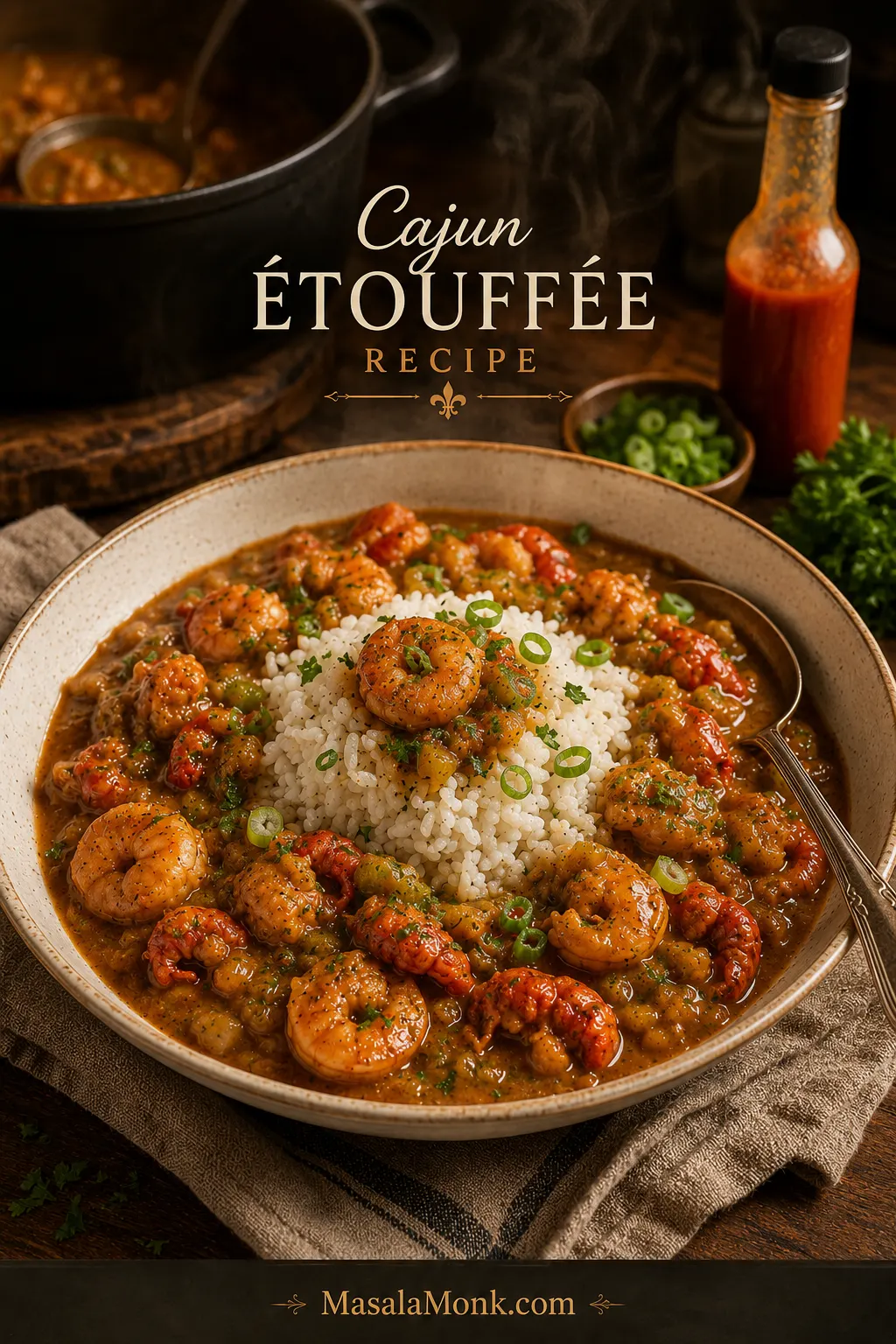
For another Louisiana dish where the rice stays separate, see our Cajun Étouffée. Its roux-thickened seafood sauce is spooned over rice instead of cooking the raw grains in the same pot.

Browning the Meat & Cooking the Trinity

Much of the savory depth is decided before the rice enters the Dutch oven. Browning the andouille and chicken creates flavor on the meat, but just as importantly, it leaves fond behind for the vegetables to pick up.

Irregular boneless chicken thigh pieces browning in a Dutch oven with patchy golden-brown surfaces and browned fond beneath them.
Patchy browning is enough: keeping space between chicken-thigh pieces builds fond, whereas crowding them traps steam and gives the jambalaya a flatter savory base.

Brown fond is worth keeping; dry black specks with a harsh burnt smell are not. Likewise, rendered sausage fat should leave a light film rather than a deep oily pool. If either the fond or fat is getting away from you, correct it before the trinity goes in.

The trinity then does two jobs at once: onion, bell pepper, and celery build the vegetable base while their released moisture loosens those browned bits. As that water cooks away, the noisy wet bubbling settles and the vegetables turn glossy.

The same trinity-and-smoked-sausage foundation appears in our Red Beans and Rice, although there the beans provide the creamy body and the rice is cooked separately.

Rice, Tomatoes & Liquid Work Together

Best rice for this method: regular long-grain or extra-long-grain white rice. It cooks into tender grains that absorb the seasoned stock while still holding their shape.

Jambalaya does not have one magic water-to-rice ratio. Tomatoes bring water. So do onions, peppers, and celery. Rice varieties absorb stock at different rates, lids vary in how well they trap steam, and direct burner heat behaves differently from a covered oven.

Start with the measured stock and keep the small hot reserve separate. Reach for it only when the rice is still firm and the Dutch oven has become nearly dry.

Rinse and Drain the Rice Well

Rinse until the runoff is much less cloudy, then drain the rice well so rinse water does not quietly become part of the stock in the pot. The grains should end up tender through the center without turning sticky or creamy.

Why Drain the Tomatoes?

A 14.5-ounce can can hold very different amounts of juice depending on the brand and cut. Draining the tomatoes keeps one especially juicy can from throwing off the amount of water in the pot.

Soft canned diced tomatoes draining in a fine-mesh sieve over a bowl of collected reddish tomato liquid.
The liquid collected beneath the sieve would otherwise join the jambalaya hydration; draining preserves the tomato solids while removing an unpredictable amount of extra water.

You can also keep the tomato juice and cook it down before adding the stock. Here, draining is simpler to repeat. By the time the rice goes in, the base should already smell deeply savory, with tomato behind the smoked sausage and peppers rather than sitting on top of them.

Parboiled Rice & Other Rice Swaps

Parboiled rice is forgiving in jambalaya because it holds its shape well and resists turning mushy. If you use it, though, don’t assume the long-grain liquid and timing here will carry over unchanged.

Regular long-grain white rice and slightly golden parboiled long-grain rice displayed side by side for comparison.
Raw parboiled rice looks slightly more translucent and golden than regular long-grain rice; that processing also changes how stubbornly the grains hold their shape during cooking.
  • Brown rice: needs substantially more cooking time and its own amount of liquid.
  • Jasmine, basmati or short-grain rice: none is a direct swap for the rice used here; both the liquid and cooking time will change.
  • Instant or quick rice: unsuitable for this method.

The 20-Minute Check

Twenty minutes is when to look, not a deadline the rice has to obey. Pots, ovens, and rice brands do not all move at exactly the same speed. Taste a few grains from more than one area before deciding what happens next.

Underdone jambalaya rice with distinct firm grains and visible free cooking liquid between the rice, chicken and andouille.
Look for free liquid between the grains rather than shine on their surfaces: firm + wet jambalaya rice already has moisture and primarily needs more covered cooking time.
What You FindNext Move
Almost tender with a little moistureAdd the shrimp and continue.
Firm with plenty of liquidCover and bake another 3–5 minutes, then check again before adding the shrimp.
Firm and nearly dryAdd 2 tbsp / 30 ml hot reserved stock, cover, and check again shortly. If it is still firm and nearly dry, use the remaining 2 tbsp / 30 ml reserve.
Nearly tender with obvious liquid poolingKeep it covered and bake another 2–3 minutes before adding the shrimp, then check again. Add the shrimp once the excess liquid has largely disappeared and the rice is still just shy of tender.
Tender and only glossyAdd the shrimp now. Do not add stock or try to dry the rice out. Cook only until the shrimp are done, then give the jambalaya its covered rest.
Bottom tender but top still hardKeep the pot covered and continue gently in the oven. If there is still moisture, give it more covered time. If the pot is also nearly dry, add 2 tbsp / 30 ml hot reserved stock first.

Firm Rice, Dry Pot: Add Stock Carefully

If the grains are still firm and the Dutch oven is nearly dry, use the reserved stock in small measured additions rather than pouring in a large splash. Start with 2 tablespoons / 30 ml, cover, and reassess before deciding whether the remaining reserve is needed.

A small 30 ml measure of hot chicken stock being poured around the edge of firm, nearly dry jambalaya rice.
The 30 ml measure is intentionally small: it creates enough additional steam to finish firm rice without turning a nearly dry jambalaya back into a wet one.

What Finished Jambalaya Should Feel Like

Finished jambalaya should be moist and juicy with tender, distinct grains—never soupy, creamy, or bone-dry.

Close-up of tender jambalaya rice with distinct elongated grains, a light surface sheen and no standing broth.
Gloss should sit on the grain surfaces, while pooled liquid sits between them; once the rice is tender, that distinction prevents unnecessary extra cooking.

A spoonful should hold together loosely, but the individual grains should remain distinct. They should be tender through the center, with no broth flooding back into the space when you draw a spoon through the Dutch oven.

Serving spoon dragged through finished jambalaya, leaving a clear channel in the tender rice without broth flowing back into the space.
After the covered rest, the spoon channel should stay open because excess moisture has moved into the rice instead of remaining free around the finished jambalaya.

A lightly glossy surface is fine. Actual broth pooling around fully tender grains is another matter. Mushy rice has gone further still: the grains begin to split, smear, or lose their shape.

When it lands correctly, the payoff is easy to see. The rice has absorbed the seasoned stock without disappearing into it, the sausage still has some chew, the chicken stays tender, and the shrimp feels like part of the dish rather than something scattered on top at the end.

Close-up of cooked tail-off shrimp in jambalaya, with pearly opaque flesh, coral-pink surfaces and a gentle C-shaped curve.
Look for moist, pearly opaque flesh rather than a dry, tightened texture; shrimp needs only the final cooking window here because it goes in after the rice is nearly tender.

The tomato should sit in the background. The first impression ought to be smoky, savory rice and browned meat, with pepper, celery, herbs, and tomato underneath.

Fix My Jambalaya

A first check that looks off doesn’t necessarily mean dinner is lost. Most jambalaya texture problems come down to moisture or heat, and the pattern usually tells you which one.

Three bowls compare glossy jambalaya rice with distinct grains, wet jambalaya with pooled liquid, and mushy jambalaya with broken grains.
These are three different outcomes, not three degrees of one problem: glossy needs no correction, wet retains free liquid, and mushy jambalaya rice has begun losing grain structure.

Match the Problem to the Fix

ProblemWhy It Happened & What to Change
Mushy or smearing riceToo much liquid, overcooking, or repeated stirring can break the grains down. Drain the tomatoes and rinsed rice well, cook excess vegetable water away, and leave the covered rice unstirred.
Crunchy rice throughoutThe rice probably needed more liquid, steam, or time. Bring the whole Dutch oven to an active simmer before covering and make sure the lid seals tightly.
Bottom cooked, top hardHeat was probably concentrated underneath the pot or steam escaped. A heavy Dutch oven and the covered oven finish help even things out.
Tender rice with liquid poolingMore water entered the pot than the rice could absorb. Tomato juice, wet rinsed rice, and water released by the vegetables all count—not only the measured stock.
Greasy finishToo much rendered sausage or chicken fat remained after browning. Leave enough to cook the vegetables, but spoon off a deep oily pool.
Scorched bottomThe heat underneath the Dutch oven was too concentrated. Establish the simmer on the stove, then let the oven handle the longer rice cook.
Pale or flat flavorThe meat probably needed more browning, or the jambalaya needed a little more salt at the end. Develop color first; extra spice powder cannot replace fond.
Too salty or too hotAndouille, stock, salt, and cayenne can pile on top of one another. Treat savory seasoning, salt, and chile heat as separate decisions.

What About Crispy Rice on the Bottom?

A little browned rice can happen around the base of the Dutch oven, but a deliberately crisp bottom is not the target here. By contrast, a thick burnt layer usually means the heat underneath the pot was too concentrated.

Underside of jambalaya rice showing golden-brown toasted grains beside a smaller patch of blackened scorched rice in the same Dutch oven.
Color alone is not the whole test: chestnut browning can be harmless, while brittle black patches plus a burnt smell point to genuinely scorched jambalaya rice.

Back to recipe card · 20-Minute Check · Back to top

Seasoning, Heat & Swaps

Protein swaps are easier than rice swaps because they don’t usually change how much liquid the rice needs.

  • Skip the shrimp: leave it out and finish once the chicken is cooked and the rice is tender.
  • Use chicken breast: cut it into similar pieces, but keep the first browning brief so the lean meat does not dry out later.
  • No andouille: use another fully cooked robust smoked sausage. Kielbasa works, although the flavor will be milder.

Slow cooker and pressure-cooker versions need their own liquid and timing. Don’t transfer these Dutch-oven measurements unchanged.

Control the Heat Separately

Deep seasoning does not require aggressive chile heat. Keep the paprika, thyme, oregano, garlic, and black pepper even if you reduce the cayenne. These are starting points, and spicy andouille may mean you want less.

  • Gentler: about ⅛ teaspoon cayenne
  • Moderate: about ¼ teaspoon cayenne
  • Hotter: about ½ teaspoon cayenne, with hot sauce available at the table

Adding Okra

Okra is optional here. If you want it, add about 1 cup sliced okra once the trinity has started softening and let it cook before the garlic and tomato go in. Give the extra vegetable water time to cook away before adding the rice.

Fresh sliced okra being added to softened onion, green bell pepper and celery in a Dutch oven before the jambalaya rice is added.
Adding okra here protects the later rice calculation: its first burst of vegetable water can evaporate before the measured stock and grains go in.

Cooking Jambalaya for a Crowd

Jambalaya earns its place at parties because one generous Dutch oven can feed a table without needing a dozen separate components. But making a larger batch is not quite as simple as multiplying every number by two.

The ingredients double. The pot physics do not.

Twice as much food creates a deeper layer of rice. It also means more vegetables releasing water and much more cold meat for the Dutch oven to bring back to a simmer. Move to a bigger pot and its outer edges may sit beyond the hottest part of your burner.

For most home kitchens, two ordinary batches are safer than one very deep double batch. If you do scale up, give the rice more room instead of packing twice the ingredients into the same 6-quart Dutch oven.

Two normally filled Dutch ovens of jambalaya beside one deeper overloaded pot, comparing shallow normal batches with an overfilled batch.
When scaling jambalaya for a crowd, depth matters as much as quantity: doubling everything in one pot increases the distance heat and steam must travel through the rice.

Leftover Jambalaya Without Wrecking the Rice

Refrigerate leftovers within 2 hours—or within 1 hour if the food is sitting in temperatures above 90°F / 32°C—preferably in shallow, covered containers, and use them within 3–4 days.

Cooked jambalaya divided among wide shallow glass storage containers, with one container covered and others open for cooling.
Wide, shallow containers release heat more efficiently than one deep tub, so dividing leftover jambalaya before refrigeration helps the center cool more quickly.

For reheating, add a small splash of stock or water only if the rice seems dry, cover, and warm gently until the food reaches 165°F / 74°C. Once the shrimp is hot, continuing to cook it only makes it tougher.

Jambalaya can be frozen, but the texture changes. The rice tends to soften and the shrimp loses some tenderness after thawing. If you freeze it, aim to use it within about 3 months for better quality.

What Can Be Prepared Ahead?

Dice the trinity, slice the andouille, cut the chicken, peel the shrimp, and measure the dry spices up to 1 day ahead. Keep the raw chicken and shrimp covered, refrigerated, and separate from the vegetables.

Leave the rice for the main cook. Its texture is easier to control when the cooking and resting stages happen in one continuous run.

What to Serve With Jambalaya

Jambalaya already gives you rice, meat, seafood, and vegetables, so sides work best when they bring freshness or contrast instead of another heavy centerpiece.

Family-style table with a Dutch oven of chicken, andouille and shrimp jambalaya being served alongside slaw, green beans and cornbread.
For sides with jambalaya, change the texture of the meal: crisp slaw or green vegetables cut through smoky sausage, while bread keeps the table simple and generous.
  • Collard or mustard greens for a savory green side
  • Green Beans Almondine for crisp beans, toasted almonds, and a little lemon beside the smoky rice
  • Roasted or sautéed okra if you want okra without adding more vegetables to the jambalaya itself
  • A crisp green salad or slaw for something cool and fresh
  • Crusty French bread or cornbread for an easy crowd-friendly accompaniment

If you’re building a New Orleans-style meal rather than an ordinary weeknight dinner, warm New Orleans-style Beignets make a natural finish with plenty of powdered sugar.

Jambalaya and Gumbo Cook the Rice Differently

In jambalaya, raw rice cooks inside the seasoned pot and absorbs its liquid. Gumbo is a stew whose rice is cooked separately and served with it.

Creole jambalaya with rice cooked into the dish beside dark chicken and sausage gumbo served with a separate bowl of white rice.
This is why the rice behaves differently in the two dishes: jambalaya depends on hydration inside the pot, while gumbo can be adjusted as a stew before separate rice is served with it.

They build body differently too. Our Chicken & Andouille Gumbo centers a dark roux and a silky, flowing stew; jambalaya depends much more on getting the rice, stock, and steam right.

Give the jambalaya its full quiet rest under the lid, then fold it gently and scatter over the scallions and parsley. Bring the Dutch oven to the table while the rice is still steaming and the shrimp is tender.
Back to recipe card · Troubleshooting · Back to top

Posted on — Leave a comment

Cajun Étouffée Recipe

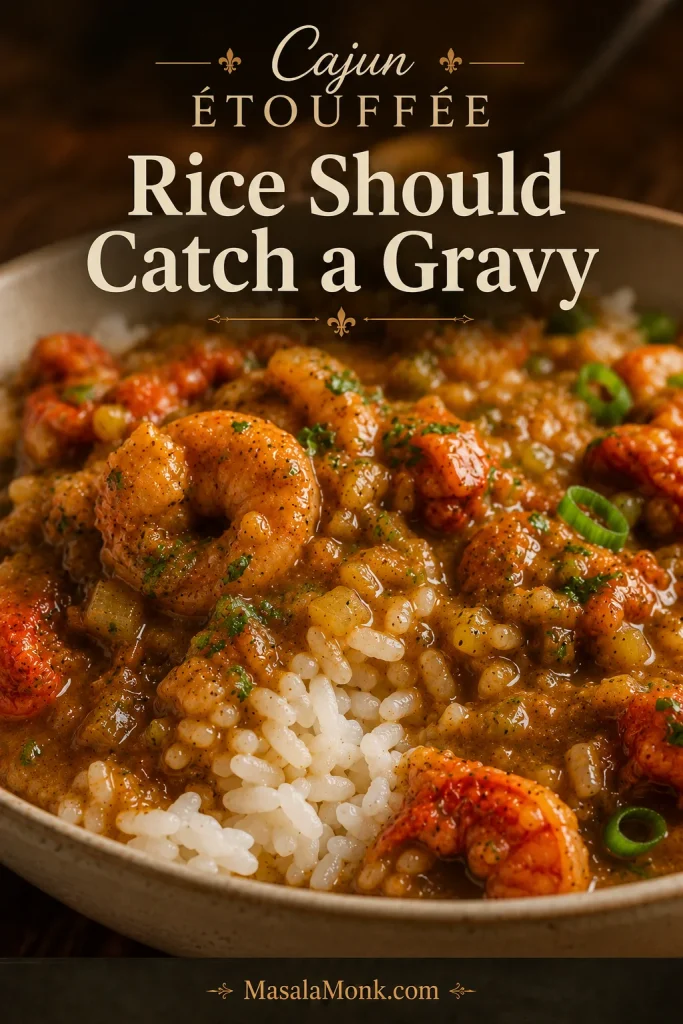
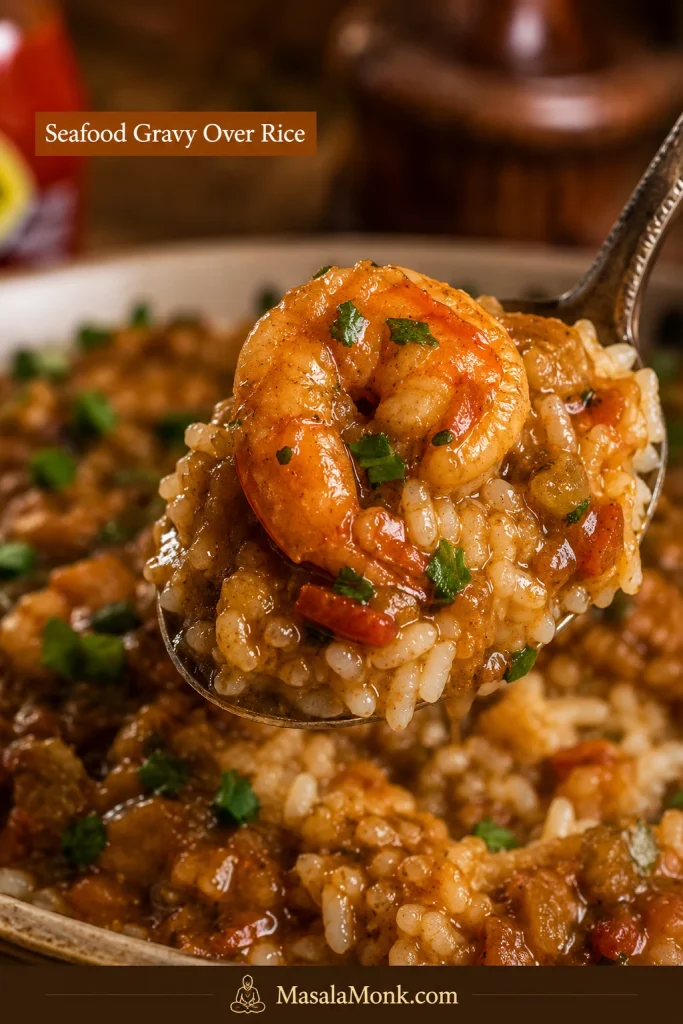
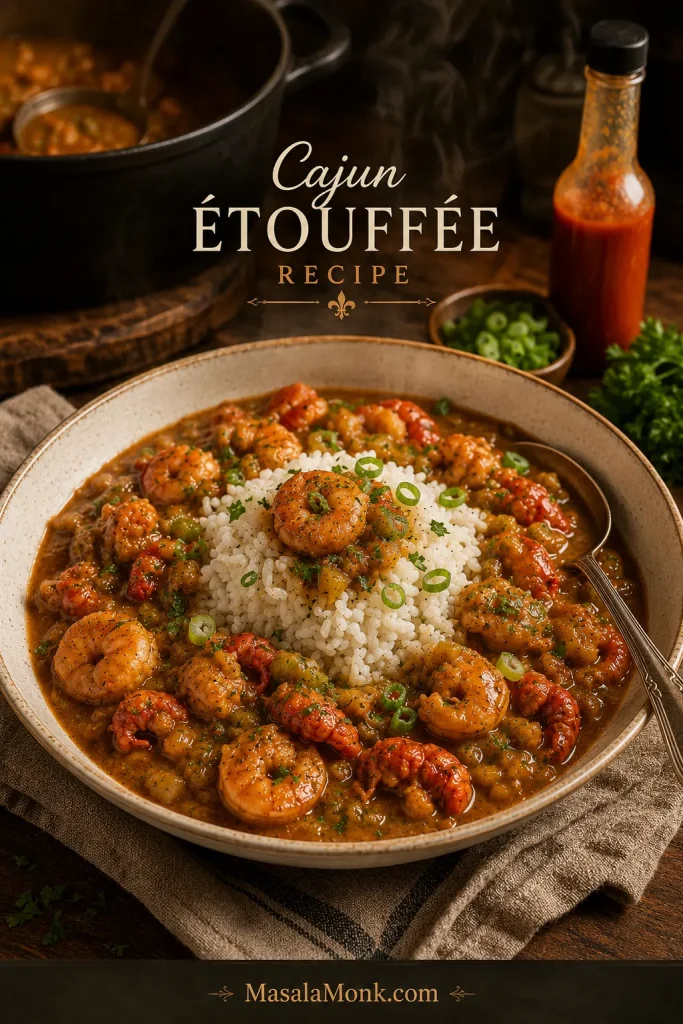
Cajun étouffée with shrimp and crawfish served over white rice in a shallow cream bowl

A great Cajun étouffée recipe lands on the table as hot rice, tender shrimp or crawfish, and glossy sauce that settles into every grain. It should smell like toasted roux, sweet bell pepper, garlic, seafood, and a little vinegar heat before the first spoonful even reaches the bowl.

You can make this with shrimp, crawfish, or a mix of both without changing the base method. Once the vegetables are chopped and the rice is started, the rest is one steady stovetop pot: roux, holy trinity, sauce, seafood, herbs, and hot rice waiting.

The rhythm is simple: trust the roux, taste the sauce, then add the seafood. That order gives you deep flavor without rubbery shrimp, tough crawfish, or a thin sauce that disappears into the rice.

You do not need to guess your way through the roux, the sauce texture, or the seafood timing. This guide also covers frozen crawfish tails, salty Cajun seasoning, prepared roux, boxed étouffée base, cream soup shortcuts, tomato options, and the common fixes that save the pot before dinner gets stressful.

Quick Answer: What Is Cajun Étouffée?

Cajun étouffée is a thick, seasoned Louisiana-style dish made with a roux, onion, celery, green bell pepper, stock, Cajun seasoning, and seafood such as crawfish or shrimp. It is served over white rice and eats more like a rich seafood gravy than a soup.

The word étouffée means “smothered,” and that is exactly how the dish should land on the plate: shrimp or crawfish smothered in a savory sauce that clings to every spoonful of rice. This version keeps the main pot roux-forward and no-tomato, with an easy tomato option if you prefer a brighter Creole-style sauce.

The final bowl should look rich and spoonable, with seafood and rice held together by a sauce that is thicker than broth.

Cajun étouffée with shrimp and crawfish served over white rice in a shallow cream bowl
A strong Cajun étouffée looks glossy and spoonable; as it settles, the sauce should hug the rice instead of flooding the bowl.

Make It Now

Ready to cook? Use this as the quick roadmap, then follow the recipe card for exact amounts. Nothing here needs to be rushed; once your prep is done, the recipe is mostly steady stirring, simmering, tasting, and finishing.

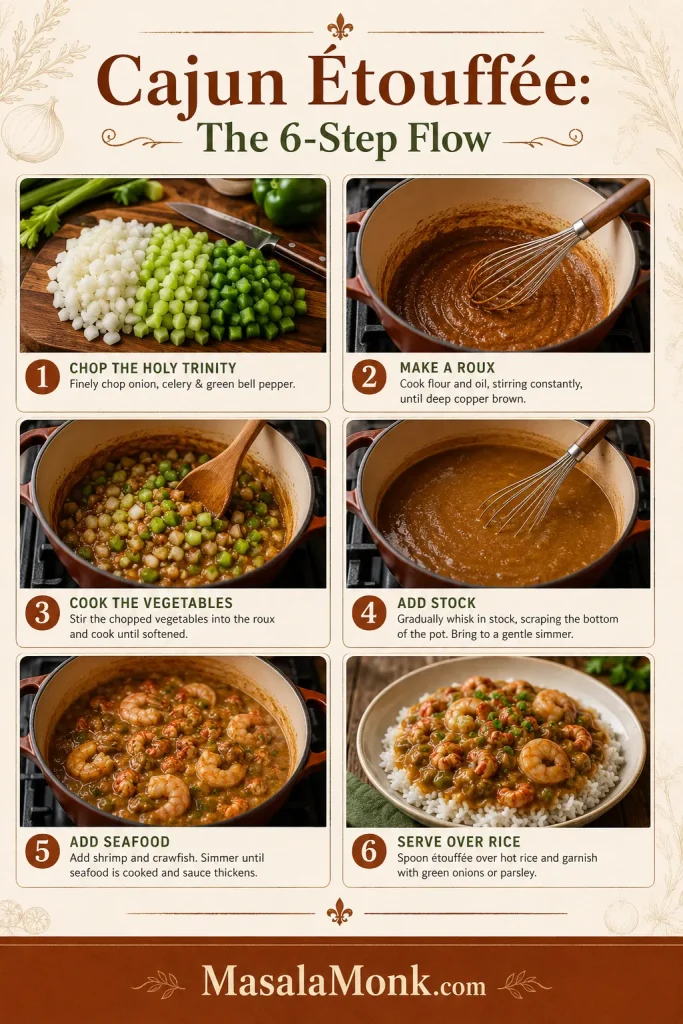
  1. Chop the onion, celery, bell pepper, garlic, green onions, and parsley.
  2. Start the rice early so it is hot when the étouffée is ready.
  3. Warm the stock and cook the roux until it turns copper to peanut-butter brown.
  4. Stir in the holy trinity, garlic, seasoning, stock, Worcestershire sauce, and a splash of hot sauce.
  5. Simmer until the base tastes rounded and thick enough to spoon over rice.
  6. Finish with your chosen seafood, add the final herbs, rest briefly, and serve.

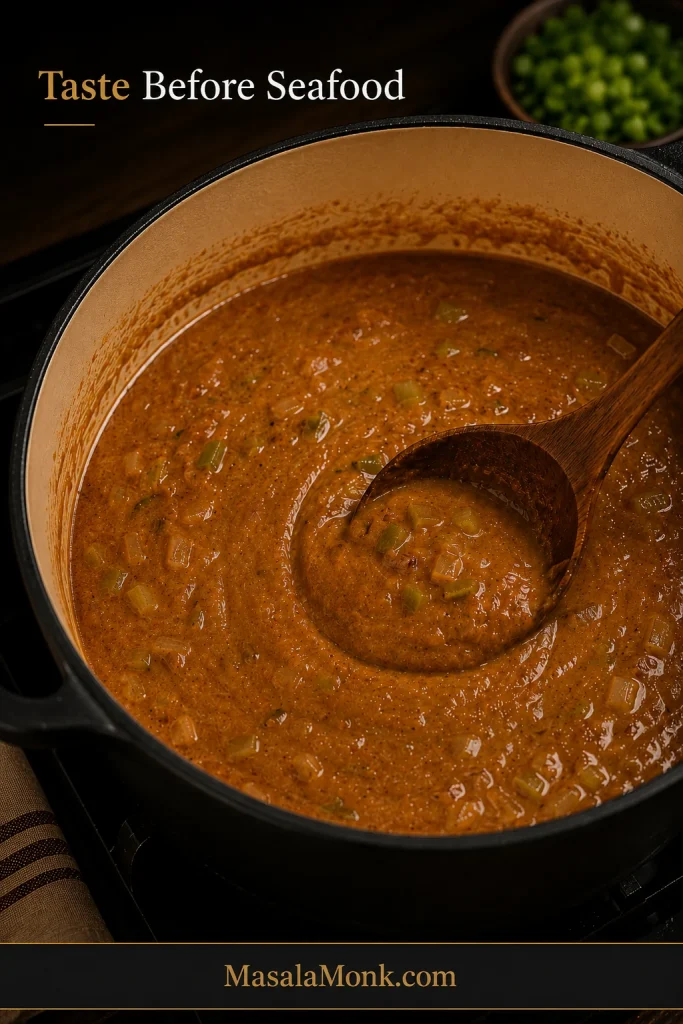
The checkpoint that saves the pot: the sauce should taste good before the seafood goes in.

Use the quick flow to keep the method calm: roux, trinity, sauce, seafood, herbs, and rice.

Six-step visual guide showing trinity, roux, sauce, seafood, herbs, and rice for Cajun étouffée
Start with roux, build flavor with trinity, loosen the sauce with stock, then finish seafood gently before serving over rice.

Cajun Étouffée at a Glance

Main styleRoux-based Cajun-style étouffée, no tomato by default
Best seafoodShrimp, crawfish tails, or a mix of both
Servings6
Total timeAbout 1 hour 5 minutes
Roux targetCopper to peanut-butter brown
Sauce textureGlossy, spoonable, thick enough to hug rice
Serve withLong-grain white rice, fresh herbs, and table hot sauce
Best quick pathMake a light roux instead of relying only on canned soup or boxed mix
Biggest success cueLet the base taste complete, then finish with seafood

Cajun Étouffée Recipe Card

This stovetop recipe makes a roux-based Cajun étouffée with shrimp, crawfish tails, or both. The method stays the same; the main change is when each type of seafood goes into the finished sauce.

Keep the rice hot and the seafood cold until the sauce is ready. That little bit of timing is what makes the bowl feel generous instead of rushed.

Recipe Snapshot

Prep time20 minutes
Cook time45 minutes
Total time1 hour 5 minutes
Servings6
MethodStovetop
CuisineCajun / Louisiana-style
Main equipmentDutch oven, heavy-bottomed pot, or deep heavy skillet

Ingredients

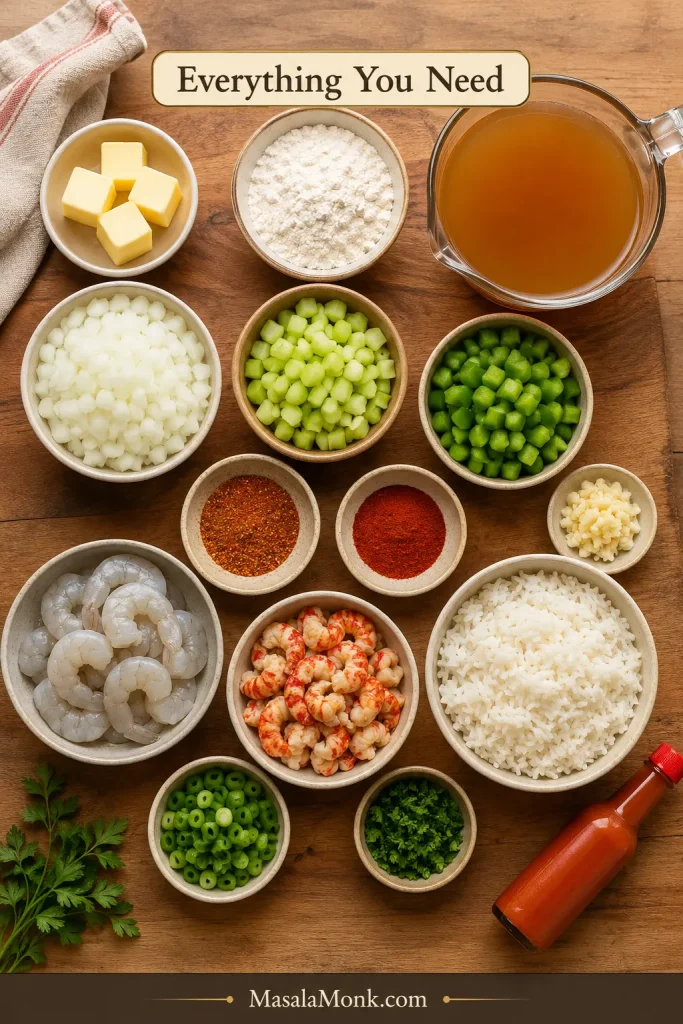
Before cooking, notice how each ingredient has a job: roux for body, trinity for sweetness, stock for sauce, and seafood for the finish.

Cajun étouffée ingredients arranged with seafood, rice, vegetables, stock, herbs, seasoning, flour, and fat
Even with a full ingredient board, the real flavor builders are roux, holy trinity, stock, seafood, and a fresh finish.
  • ½ cup unsalted butter, 113 g, or 120 ml neutral oil
  • All-purpose flour, ½ cup, about 60–65 g
  • 1½ cups finely chopped yellow onion, about 225 g
  • 1 cup finely chopped green bell pepper, about 150 g
  • ¾ cup finely chopped celery, about 100 g
  • 4–6 garlic cloves, minced, about 15–25 g
  • 2½–3 cups warm seafood stock, shrimp stock, crawfish stock, or chicken stock, plus more as needed, 600–720 ml
  • 2–3 teaspoons salted Cajun seasoning, or 1½–2 tablespoons salt-free Cajun seasoning
  • 1 teaspoon paprika or smoked paprika
  • ½ teaspoon dried thyme
  • 2 bay leaves
  • ¼–½ teaspoon cayenne pepper, optional
  • 1 tablespoon Worcestershire sauce, 15 ml
  • Hot sauce, 1–2 tablespoons, 15–30 ml, plus more for serving
  • 2 lb total peeled shrimp, crawfish tails, or a mix, about 900 g
  • ½ cup sliced green onions
  • ¼ cup chopped parsley
  • Salt and black pepper, to taste
  • 4–6 cups cooked long-grain white rice, for serving

Ingredient Notes for Salt, Seafood, and Rice

Salt note: If your Cajun seasoning already contains salt, do not add extra salt until the sauce has simmered and you have tasted it. Stock, hot sauce, boxed bases, and cream soup can all add salt too. Salt-free Cajun blends can usually be used more generously because they bring spice without adding as much sodium.

Seafood note: Use 2 lb total seafood, not 2 lb shrimp plus 2 lb crawfish. If using a mix, combine the shrimp and crawfish together to reach about 2 lb / 900 g total.

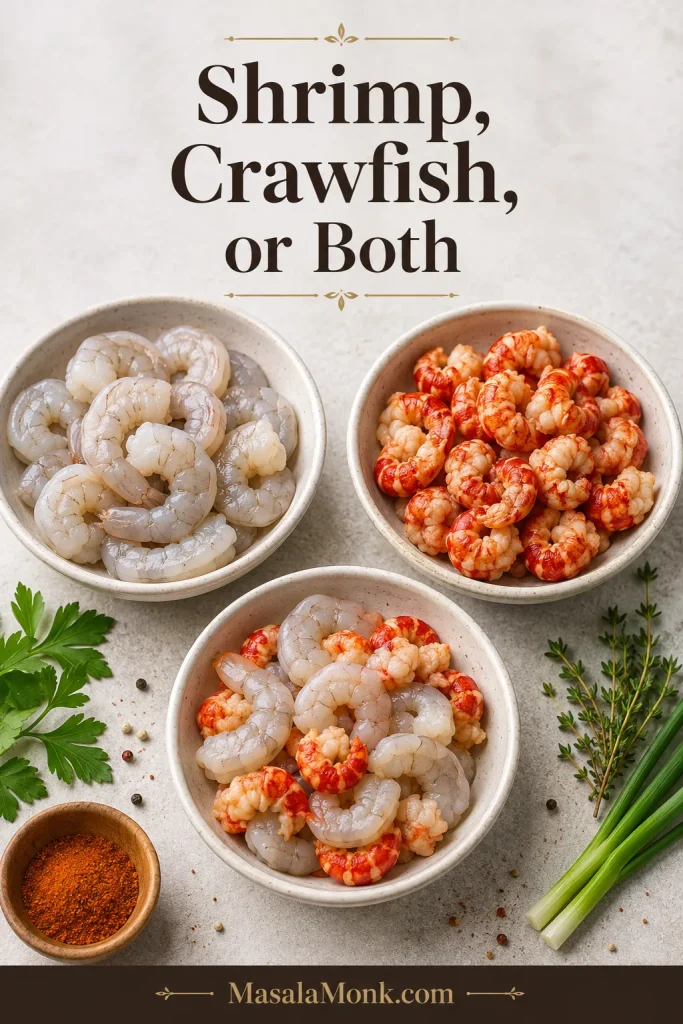
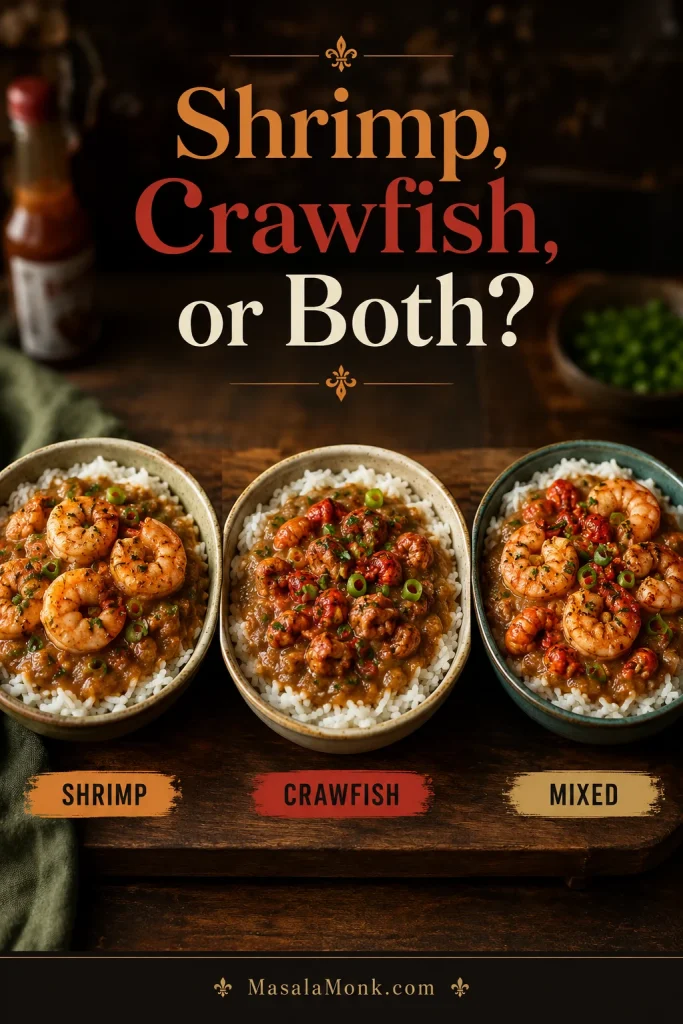
Pick the seafood before you start, because shrimp and crawfish can share the same sauce but need different finishing care.

Three bowls showing shrimp, crawfish tails, and mixed seafood for Cajun étouffée
Whether you use shrimp, crawfish tails, or both, keep the seafood amount steady so the étouffée stays balanced.

Rice note: Use 6 cups cooked rice for generous bowls, or 4 cups for lighter servings. Start the rice before the seafood goes in so everything reaches the table hot.

Equipment

  • Dutch oven or heavy-bottomed pot, important for steady roux heat
  • Deep heavy skillet, if it gives you enough room to stir safely
  • Wooden spoon or heat-safe spatula
  • Whisk
  • Small saucepan for warming stock
  • Cutting board and sharp knife
  • Measuring cups and spoons
  • Rice cooker or rice pot

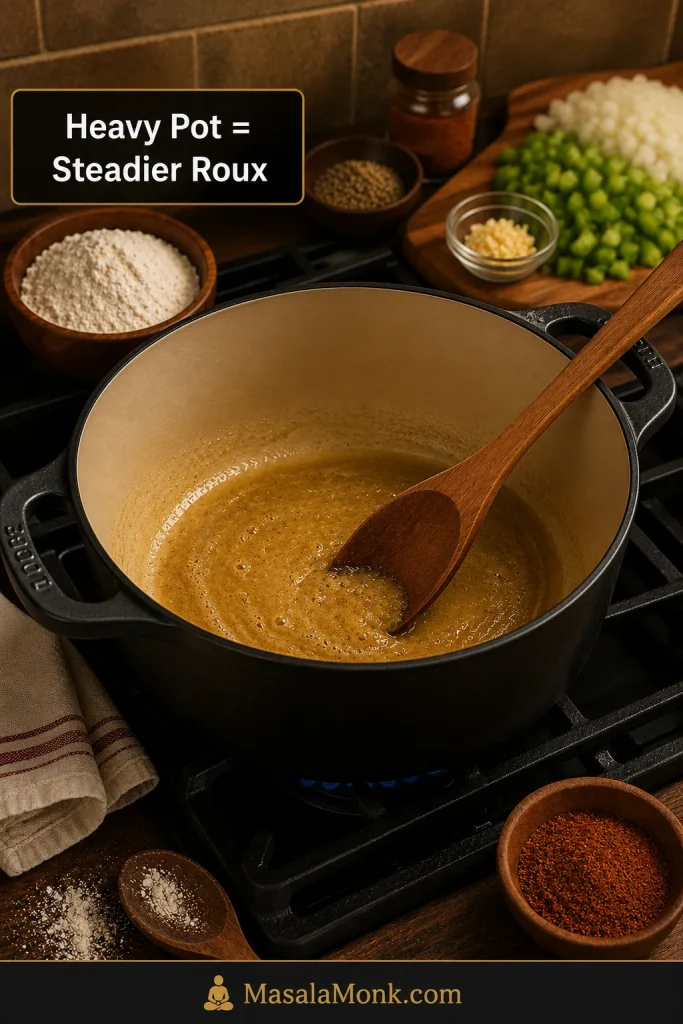
Roux can scorch quickly in thin cookware. A heavy pot gives you more control as the flour moves from pale to nutty brown. Patience beats speed here; burnt roux is not worth saving.

Steady cookware protects the roux, giving flour time to brown evenly instead of scorching in one hot spot.

Heavy Dutch oven with flour, fat, and wooden spoon set up for making Cajun étouffée roux
A heavy pot spreads heat more evenly, which gives the roux time to brown slowly instead of scorching in hot spots.

Instructions

Prep and Roux

  1. Prep first. Chop the onion, bell pepper, celery, garlic, green onions, and parsley before you start. Cook the rice or set it going. Thaw and drain frozen shrimp or crawfish. Pat shrimp dry if it is very wet.
  2. Warm the stock. Keep the stock warm in a small saucepan over low heat. It should be warm, not boiling.
  3. Make the roux. Melt the butter, warm the oil, or heat a butter-oil mix in a Dutch oven or heavy-bottomed pot over medium heat. Add the flour and stir constantly for 8–15 minutes, lowering the heat if needed, until the roux turns copper to peanut-butter brown and smells nutty. If the roux starts darkening faster than you can comfortably stir, lower the heat before you panic; roux forgives patience better than speed.

Build the Sauce

  1. Add the holy trinity. Stir in the onion, green bell pepper, and celery. Cook for 6–8 minutes, stirring often, until the vegetables soften and the roux clings to them.
  2. Add garlic and seasoning. Stir in the garlic, Cajun seasoning, paprika, thyme, bay leaves, and cayenne if using. Cook for 30–60 seconds, just until fragrant.
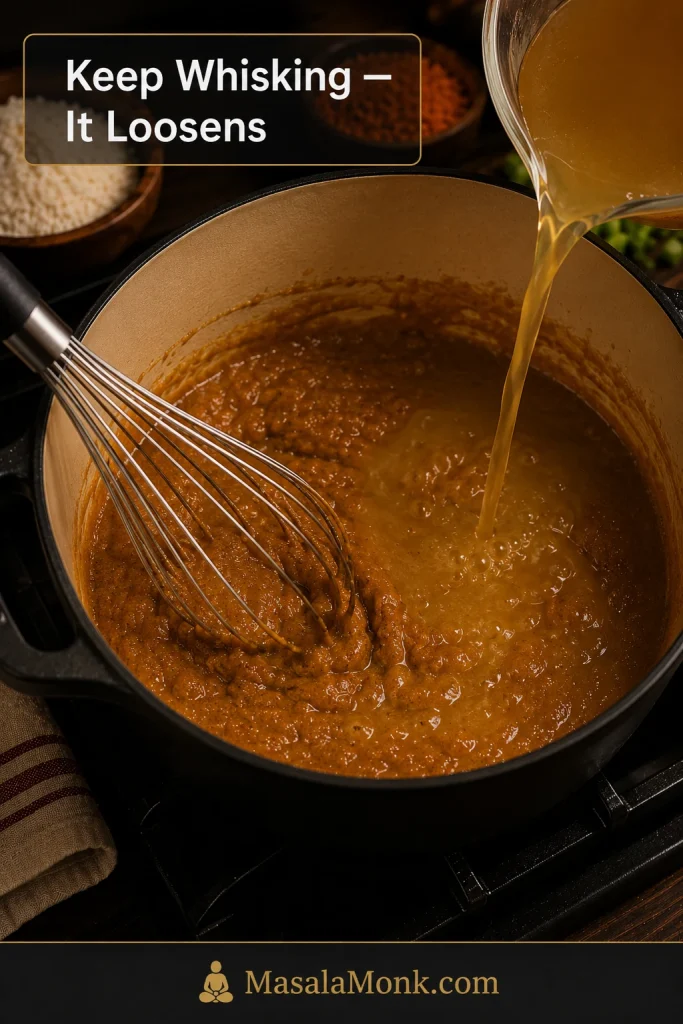
  3. Build the sauce. Slowly whisk in 2½ cups warm stock, adding it gradually so the sauce stays smooth. The first splash may make the roux seize and thicken; keep whisking and it will loosen as the rest of the stock goes in. Stir in Worcestershire sauce and hot sauce. Bring to a gentle simmer.
  4. Simmer until rounded. Reduce the heat to medium-low and simmer for 15–20 minutes, stirring occasionally, until the sauce thickens and tastes complete. Add more warm stock if it becomes too thick.

Add Seafood and Serve

  1. Finish with seafood. Raw shrimp cooks gently in 3–5 minutes, just until opaque and lightly curled. Cooked crawfish tails should be stirred in and heated gently for 3–5 minutes. If using both, add shrimp first, then stir in crawfish during the final 2–3 minutes. Already-cooked shrimp only needs the final 1–2 minutes to warm through.
  2. Season and brighten. Remove the bay leaves. Stir in most of the green onions and parsley. Taste and adjust with salt, black pepper, Cajun seasoning, a splash of acidity, or a little more stock.
  3. Rest and serve. Turn off the heat and let the étouffée rest for 5 minutes. Spoon over hot white rice so the sauce pools around the grains, then finish with fresh herbs and extra hot sauce at the table.

Recipe Notes

Seasoning, Stock, and Roux Notes

  • Seasoning: If your Cajun seasoning is salty, start with less and add more only after the sauce has simmered.
  • Stock: Low-sodium stock is safest if your Cajun seasoning, hot sauce, or boxed base is already salty. Chicken stock works when seafood stock is unavailable; a small splash of bottled clam juice adds deeper seafood flavor if you like that taste.
  • Flour and roux: Spoon and level the flour if measuring by cup; a packed ½ cup can make the sauce thicker. A peanut-butter roux gives the best balance of flavor and thickening for this recipe.

Seafood, Heat, and Make-Ahead Notes

  • Shrimp: Medium, large, or medium-large shrimp work best. Peeled shrimp are easiest for spooning over rice. Shrimp is done when opaque and lightly curled, not tightly coiled into hard rings.
  • Cooked shrimp: Add cooked shrimp only in the final 1–2 minutes so it warms without turning rubbery.
  • Food safety: Shrimp, lobster, crab, and scallops should cook until the flesh is pearly or white and opaque, as noted by FoodSafety.gov.
  • Crawfish: Crawfish tails are often already cooked, so they only need gentle heating. For frozen crawfish tails, thaw and drain excess liquid. Do not rinse away flavorful crawfish fat or juices unless they smell muddy, overly fishy, or unpleasant.
  • Heat: Use a vinegar-forward Louisiana-style hot sauce if you want brightness, or keep the pot mild and let people add heat at the table. For more spice, add cayenne near the end so you can control it.
  • Resting and make-ahead: The sauce thickens as it sits. Loosen with warm stock or water if needed. Best make-ahead results come from preparing the sauce first and adding the seafood during reheating.

Half-Batch Note

To make a smaller pot, use 1 lb / 450 g total seafood, ¼ cup butter or oil, ¼ cup flour, and about 1½–2 cups stock. Keep the same method, but start checking the sauce thickness sooner because a smaller batch reduces faster. Begin with the lower amount of Cajun seasoning, especially if your blend contains salt.

Need help while cooking? Jump to Success Cues, Roux Guide, Troubleshooting, or Serving Tips.

Success Cues

The recipe card gives you the steps. These cues help you know when each stage is actually working. Once the pot is on the stove, smell, color, texture, and the way the sauce moves matter more than the exact minute on the clock.

Roux smells nutty, not raw

Smell is the first real sign. The roux stops smelling like raw flour and starts smelling warm, buttery, and nutty. Its color should move from pale flour to copper or peanut-butter brown. A sharp, scorched, or bitter smell means it is better to restart before adding the vegetables.

Vegetables soften into the base

When the onion, celery, and bell pepper hit the roux, the pot should start smelling like dinner. The vegetables cool the roux slightly, then soften into it until the base tastes sweet, savory, and rounded instead of sharp or raw.

The base tastes complete

This is the biggest checkpoint. Once the base tastes like dinner, the seafood only has to show up. It should already taste seasoned, rounded, and spoonable before shrimp or crawfish is added.

At this point, the base should carry the flavor on its own; seafood is only the final gentle finish.

Glossy Cajun étouffée sauce in a pot before shrimp or crawfish is added
Taste the sauce at this stage; once it feels rounded and spoonable, the seafood can cook quickly at the end.

Shrimp stays tender, crawfish warms gently

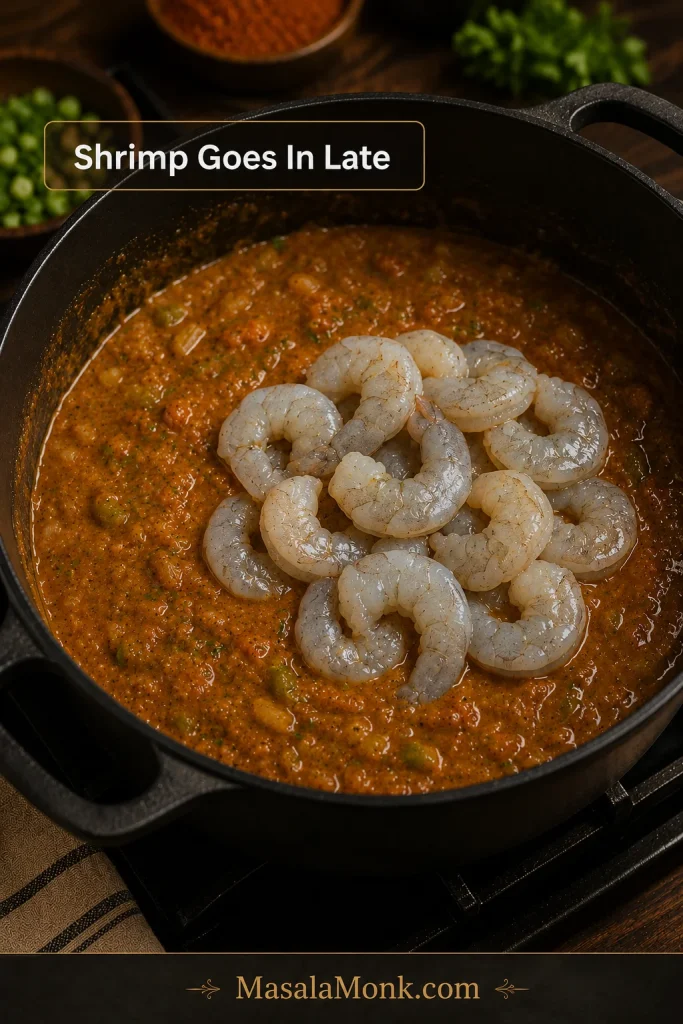
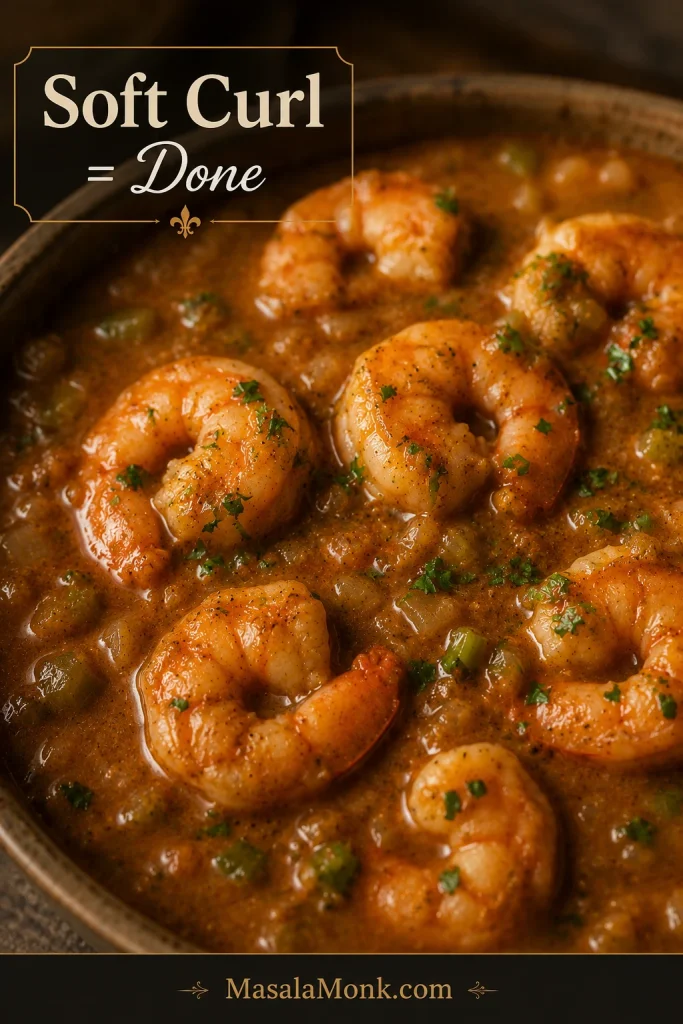
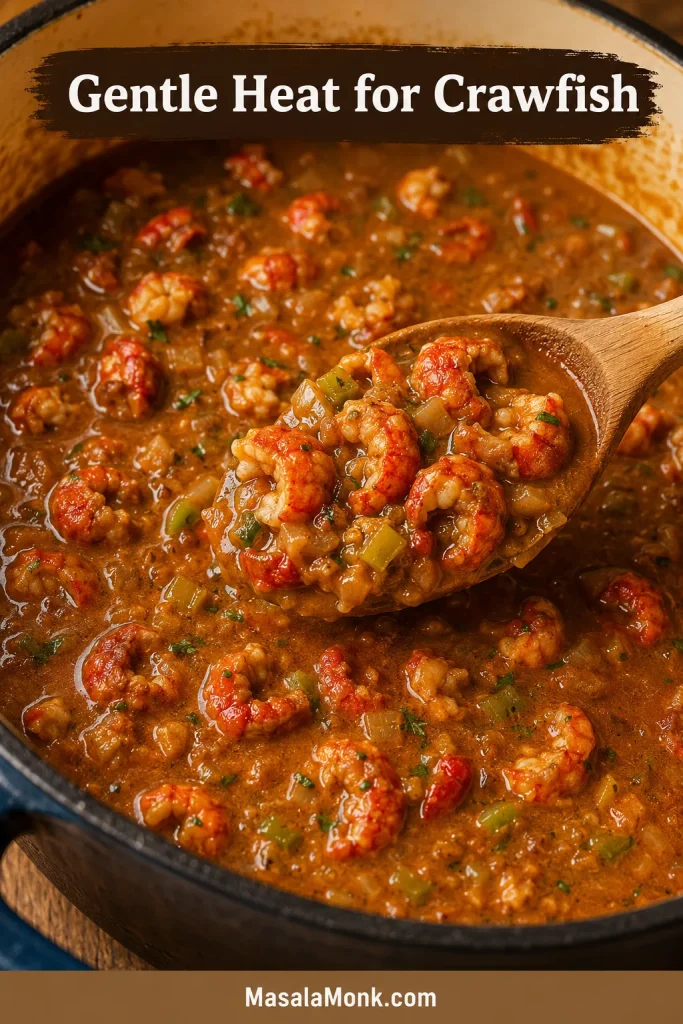
Shrimp should turn opaque and curl softly. Crawfish tails should be warmed through, not boiled hard. The pot should bubble softly after the seafood is added, not roll like a hard boil.

Raw shrimp belongs in the finished sauce, not in a long simmer, so the timing stays short and gentle.

Raw peeled shrimp added to finished Cajun étouffée sauce in a dark pot
Add raw shrimp only after the sauce is ready, so it cooks gently instead of turning rubbery.

Soft curl is the shrimp signal; take the pot off hard heat before tender shrimp turns into tight rings.

Opaque shrimp softly curled in Cajun étouffée sauce with herbs
Shrimp is done when it turns opaque and curls softly; tight rings usually mean it cooked too long.

Gentle warming protects crawfish tails, especially when they are already cooked before they reach the sauce.

Crawfish tails warmed in Cajun étouffée sauce on a wooden spoon
Crawfish tails are often already cooked, so warm them gently in the sauce instead of boiling them hard.

The rice catches a gravy, not a broth

When you spoon étouffée over rice, the sauce should settle into the grains instead of sliding away like broth or sitting on top like paste. The rice should catch a gravy, not chase a broth.

This is the bowl test: rice should hold sauce between the grains, not sit under a watery layer.

Close-up of Cajun étouffée sauce settling into white rice with seafood
Good étouffée gravy settles between the rice grains, which keeps each spoonful saucy without turning the bowl watery.

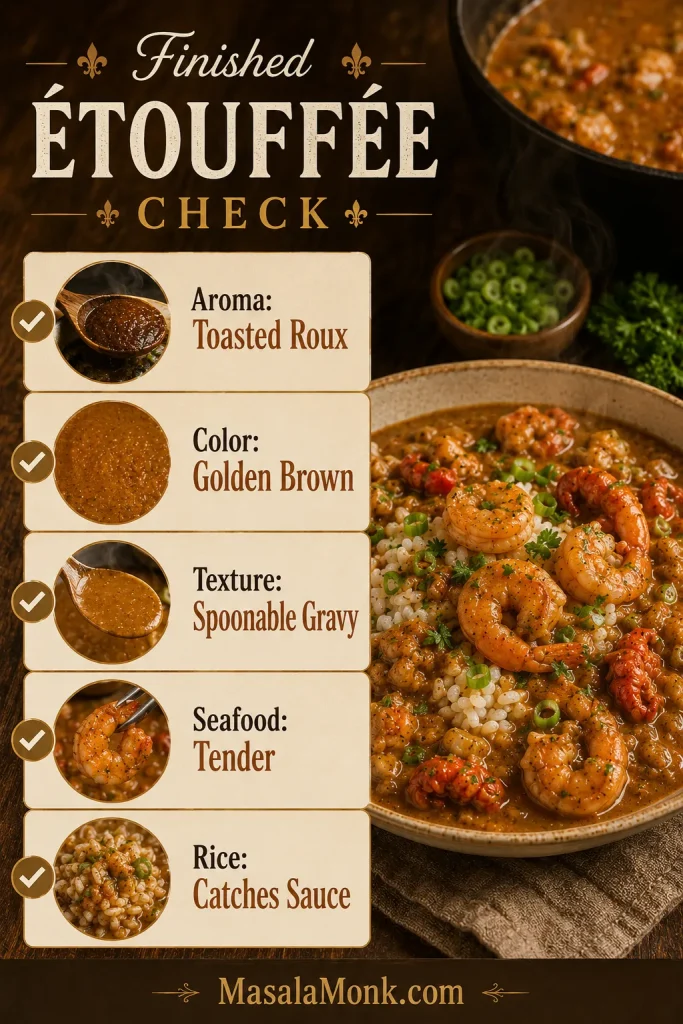
What the Finished Étouffée Should Look Like

CueWhat to look for
AromaToasted roux, softened onion, bell pepper, garlic, seafood, and a little vinegar heat
ColorGolden brown to light brown, not pale beige and not burnt dark
TextureThick gravy that moves slowly from the spoon and spreads gently over rice
SeafoodShrimp softly curled and opaque; crawfish warmed through, not boiled hard
RiceSauce settling around the grains, not watery puddles at the bottom of the bowl

Use the checklist as the final pass before serving, especially if the sauce looked uncertain earlier.

Finished étouffée checklist showing toasted roux aroma, golden color, spoonable texture, tender seafood, and rice
Check the pot from several angles: aroma, color, sauce body, seafood tenderness, and how well the rice holds the gravy.

Still checking the pot? Use the Roux Guide if the base looks too light or too dark, or go to Troubleshooting if the sauce feels thin, thick, salty, or floury.

Why This Cajun Étouffée Works

This pot works because the flavor is built before the seafood goes in. The roux turns nutty, the trinity softens, the seasoning settles into the stock, and the seafood only needs a short, gentle finish.

  • Roux builds body and flavor. It thickens the sauce and gives the dish that warm, toasted smell that makes the whole pot feel deeper.
  • The holy trinity makes the base taste complete. Onion, celery, and green bell pepper soften into the roux before the liquid is added.
  • Warm stock keeps the sauce smooth. Adding it slowly helps prevent lumps and gives you control over the final texture.
  • Seafood is treated gently. Shrimp and crawfish stay tender because they only need a short finish.
  • Tomato stays optional. The main recipe stays roux-forward, while a small tomato option gives you a brighter Creole-style variation.
  • Shortcuts have a place. Cream soup, boxed mix, prepared roux, and étouffée base can help on busy nights, but the from-scratch roux method gives the best flavor and control.

Choose Your Version: Shrimp, Crawfish, or Both

Before you worry about spice level, choose the seafood that makes sense for your kitchen. Crawfish gives étouffée its classic Louisiana feel, shrimp makes the recipe easier to shop for, and using both turns the pot into a fuller seafood dinner.

VersionUse it whenHow to cook it
Crawfish étoufféeYou have crawfish tails and want the most classic seafood flavorAdd thawed crawfish tails at the end and heat gently for 3–5 minutes
Shrimp étoufféeYou want the easiest seafood version with ingredients that are easier to findAdd raw peeled shrimp at the end and cook 3–5 minutes until opaque
Shrimp and crawfish étoufféeYou want a bigger seafood dinner with more texture and flavorAdd shrimp first, then stir in crawfish during the final 2–3 minutes
Chicken étoufféeYou want the same sauce structure without seafoodUse cooked chicken or simmer small pieces until fully cooked and tender

Compare the versions before cooking so the pot matches your seafood, shopping, and serving plan.

Three finished bowls comparing shrimp étouffée, crawfish étouffée, and mixed seafood étouffée
The roux-based sauce stays the same, but shrimp cooks quickly while crawfish tails only need gentle warming.

Seafood Timing Notes

Good crawfish tails are worth using when you can get them. Otherwise, shrimp is not a compromise; it is a strong version of the dish on its own. Thaw frozen shrimp fully and pat it dry so extra water does not thin the pot. For another shrimp dinner where timing matters, this shrimp scampi also keeps the shrimp tender by cooking it quickly in a finished sauce.

Chosen your seafood? Return to the Recipe Card, or review Success Cues for shrimp and crawfish timing.

Ingredients You Need for Cajun Étouffée

Once the roux is under control, the rest of the ingredient list is simple. Each piece has a job, and the timing matters more than using a long list of extras.

Roux: butter or oil plus flour

The roux gives the sauce its body and toasted depth. Butter tastes richer; oil is more forgiving. Nervous about scorching? Use half butter and half oil so you get flavor with a little more stability.

The holy trinity

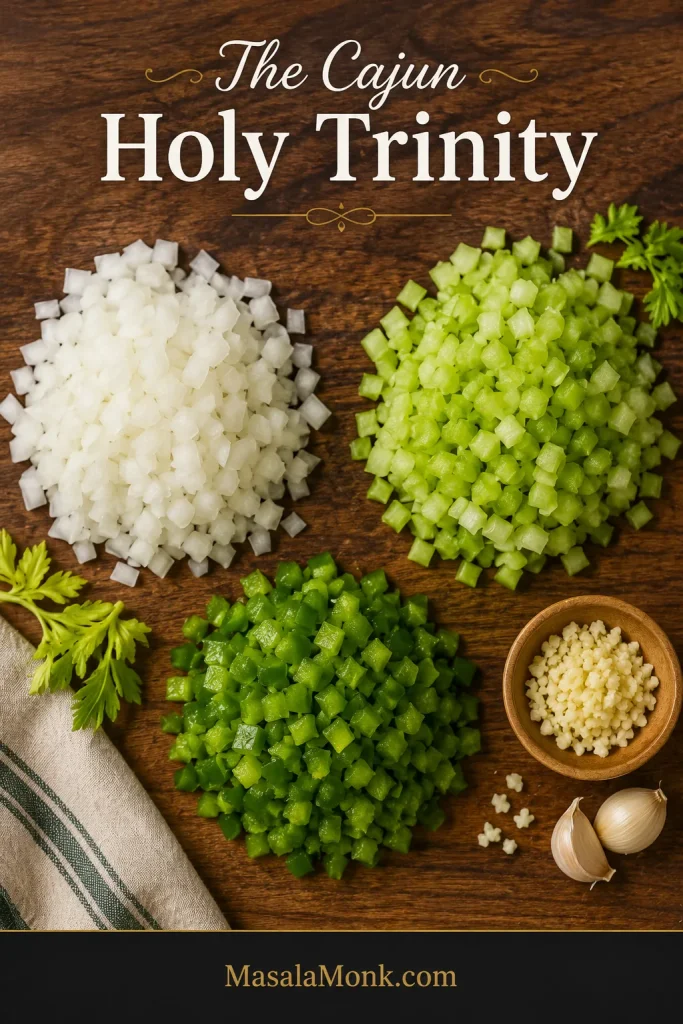
Onion, celery, and green bell pepper form the Cajun holy trinity. Green bell pepper gives the most classic flavor, but red or yellow bell pepper works when that is what you have. Chop the vegetables finely so the finished dish feels smooth and spoonable instead of chunky.

The Cajun holy trinity belongs in the ingredient notes because it shapes the sweetness and depth of the sauce.

Chopped onion, celery, green bell pepper, and garlic arranged on a wooden board
Onion, celery, and green bell pepper form the Cajun holy trinity; garlic joins later so it does not burn.

Garlic and Cajun seasoning

Garlic adds depth, but it burns quickly, so add it after the onion, celery, and bell pepper have softened. Cajun seasoning varies a lot by brand. Some blends are mostly spice; others are very salty. Start with less if your seasoning contains salt, then adjust after the sauce simmers.

Salted seasoning, salted stock, hot sauce, and boxed bases can stack quickly. Wait until the sauce has simmered, then taste and adjust. Rice will soften saltiness on the plate, but it is much easier to add salt than remove it.

Stock

Seafood stock or shrimp stock gives the deepest flavor, but chicken stock works well for a home version. Choose low-sodium stock when your Cajun seasoning is salted. Warm stock blends into the roux more smoothly. For another seafood recipe where the base makes or breaks the final flavor, this lobster bisque uses the same idea: build the base first so the seafood tastes richer without overcooking.

Shrimp or crawfish

Use peeled raw shrimp, thawed crawfish tails, or a mix. Shrimp cooks quickly, crawfish tails are often already cooked, and both do best with gentle heat.

Green onions, parsley, and hot sauce

Green onions and parsley cut through the richness right at the end, so the bowl tastes bright instead of heavy. Hot sauce brings acidity as well as heat. Add some to the pot, then keep more on the table for anyone who wants a brighter final kick.

What Is Étouffée Sauce Made Of?

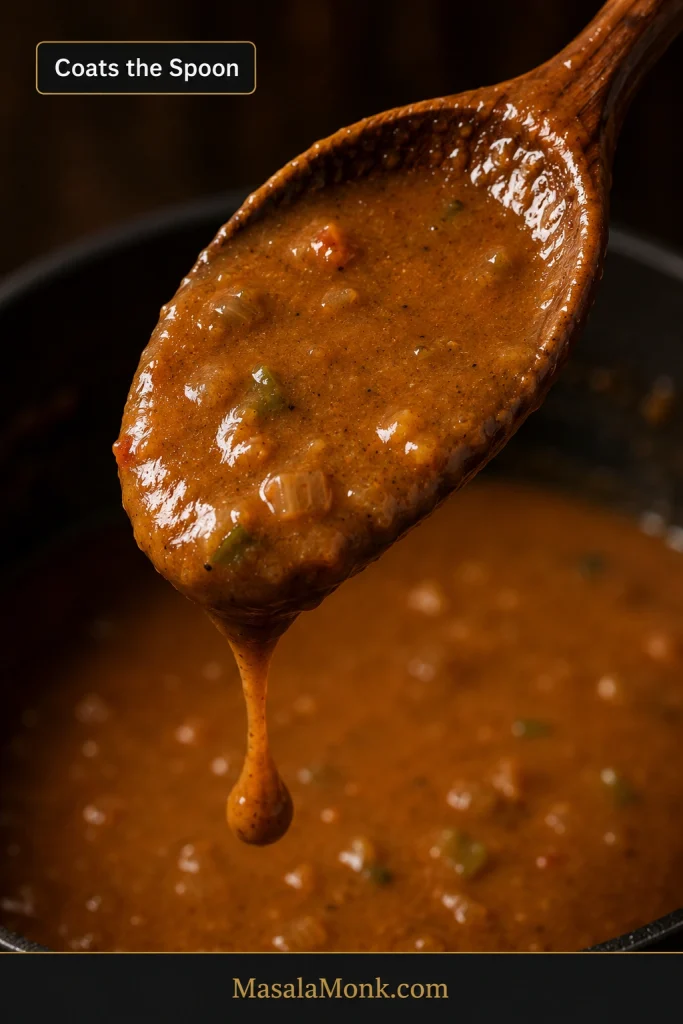
Think of étouffée sauce as a roux-thickened seafood gravy: not soup, not paste, and not a loose pan sauce. It should move slowly from the spoon, coat the seafood, and settle into hot rice.

The roux gives body, the trinity gives sweetness and depth, stock loosens everything into a spoonable base, and Cajun seasoning, Worcestershire sauce, hot sauce, green onions, and parsley finish the flavor. Crawfish tail juices, when they smell clean and sweet, can add extra seafood depth near the end.

Stiff sauce needs warm stock. Watery sauce needs a few uncovered minutes before the seafood is added. The goal is simple: thick enough to coat the back of a spoon, soft enough to flow around rice.

Texture matters most here: étouffée sauce should behave like seafood gravy, not broth or paste.

Spoonful of Cajun étouffée with thick sauce, white rice, shrimp, and crawfish
This is the texture to aim for: thick seafood gravy that clings to rice, yet still feels loose enough to spoon.

Check the spoon before serving; a slow coating means the sauce has enough body without turning pasty.

Thick Cajun étouffée sauce coating a wooden spoon with a slow drip
Use the spoon test before serving: the sauce should coat the spoon, then move slowly back into the pot.

If you love Cajun-style seafood sauces in general, this seafood boil sauce is useful for a different kind of seafood dinner. It is more buttery and pourable than étouffée, but it works with many of the same shrimp, crab, crawfish, garlic, and Cajun seasoning flavors.

Roux Color Guide for Étouffée

The roux is the only part of this recipe that asks for your full attention, but it does not ask you to rush. You do not need a restaurant-speed roux here. A steady, slower roux is easier to control and still gives you the nutty flavor this dish needs.

Watch Color Before Time

Stir steadily, control the heat, and watch the color more than the clock. Do not judge the pot too early; the roux changes slowly at first, then deepens faster as it gets darker.

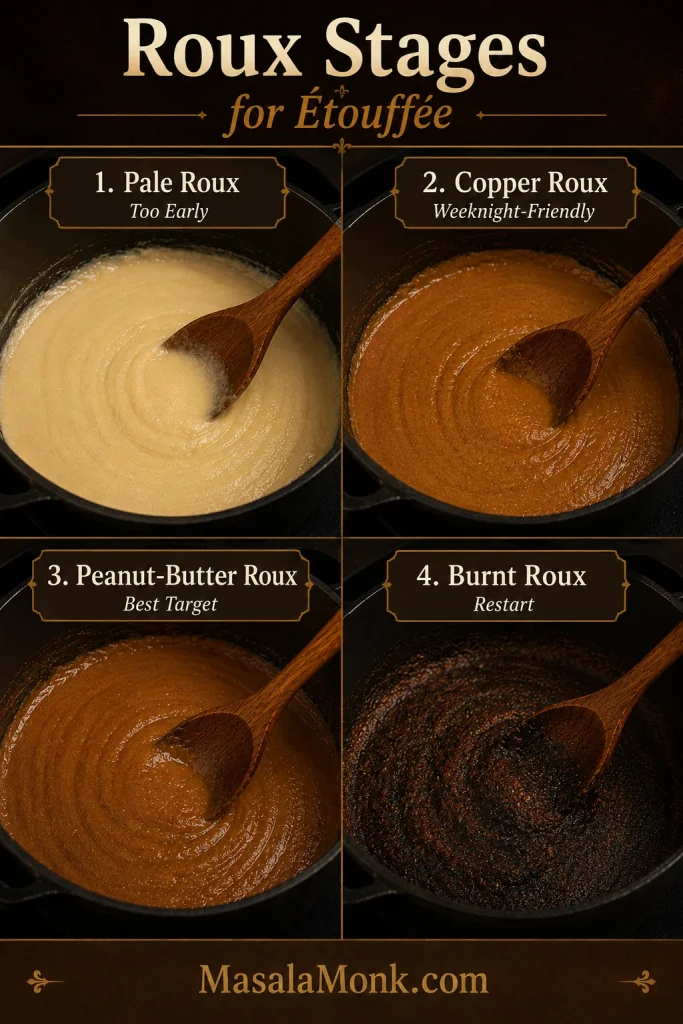
Start the roux guide with color, because the stages tell you more than the clock on the stove.

Roux stage guide showing pale, copper, peanut-butter, and burnt roux for Cajun étouffée
Roux moves from pale to nutty to deep brown quickly, so watch the color closely and restart if black specks appear.

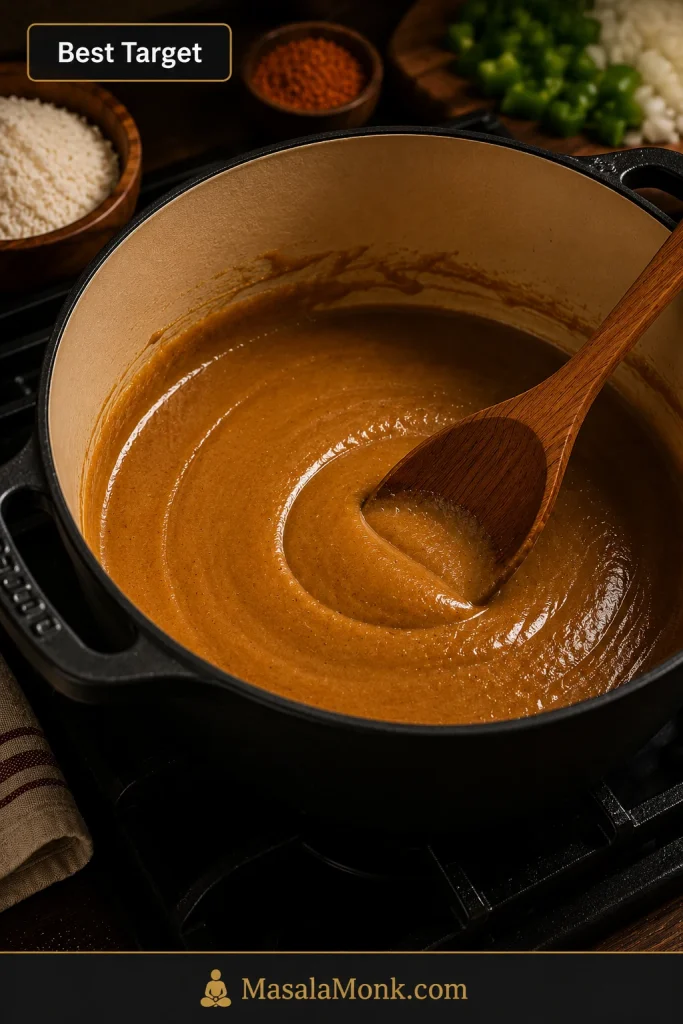
The times below are estimates. Color and smell matter more than minutes, especially if your pot runs hot or your stove is uneven. For this Cajun étouffée recipe, aim for a peanut-butter-colored roux. It gives the sauce a nutty flavor without taking as long as a very dark gumbo-style roux.

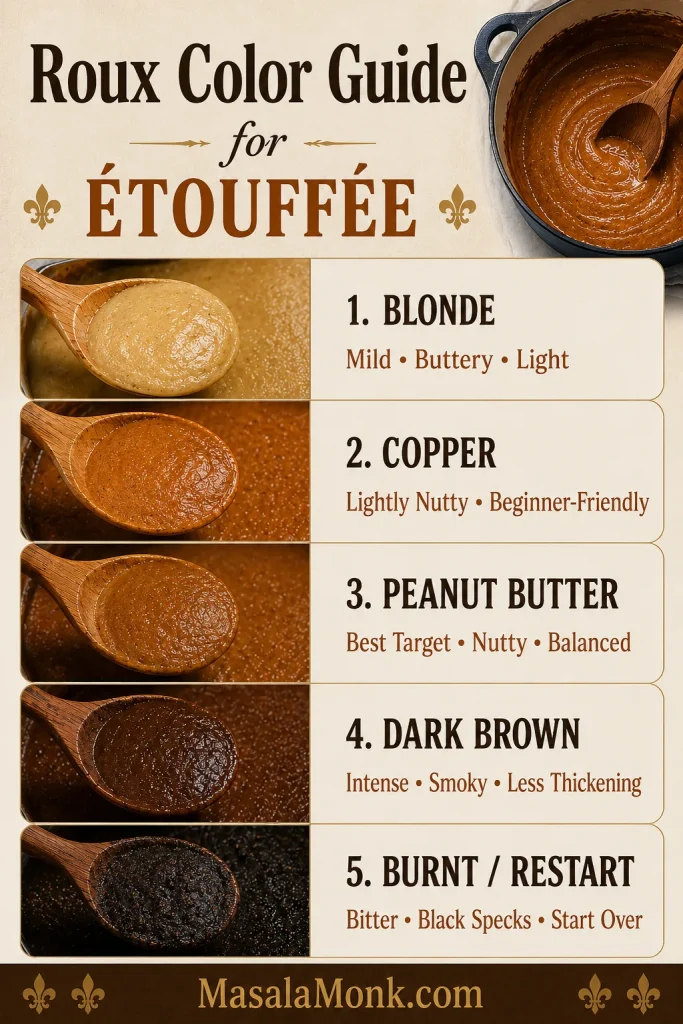
Roux Colors at a Glance

Roux colorApproximate timeFlavorBest use
Blonde3–5 minutesMild, buttery, lightly cookedFastest version, but less Cajun depth
Copper6–8 minutesLightly nutty and beginner-friendlyGood weeknight étouffée
Peanut butter8–15 minutesNutty, rounded, deeper flavorBest balance for this recipe
Dark brown18–25+ minutesMore intense, slightly smokyAdvanced version; thickens less and burns more easily
Burnt with black specksAny time if heat is too highBitterDiscard and restart

The color guide turns roux judgment into a visual check instead of a guessing game.

Roux color guide for étouffée showing blonde, copper, peanut butter, dark brown, and burnt stages
Use this roux color guide to judge whether your base is still mild, ready for étouffée, or too far gone.

This early roux stage explains why color matters before the sauce gets its deeper Cajun flavor.

Pale roux in a Dutch oven with a wooden spoon showing an early cooking stage
Pale roux can thicken the sauce, but it has not developed the nutty flavor Cajun étouffée needs.

Aim for this peanut-butter shade when you want toasted flavor without losing too much thickening power.

Peanut-butter-colored roux in a heavy pot with a wooden spoon trail
Peanut-butter roux gives Cajun étouffée its best middle ground: warm color, toasted flavor, and enough body for the sauce.

When to Restart the Roux

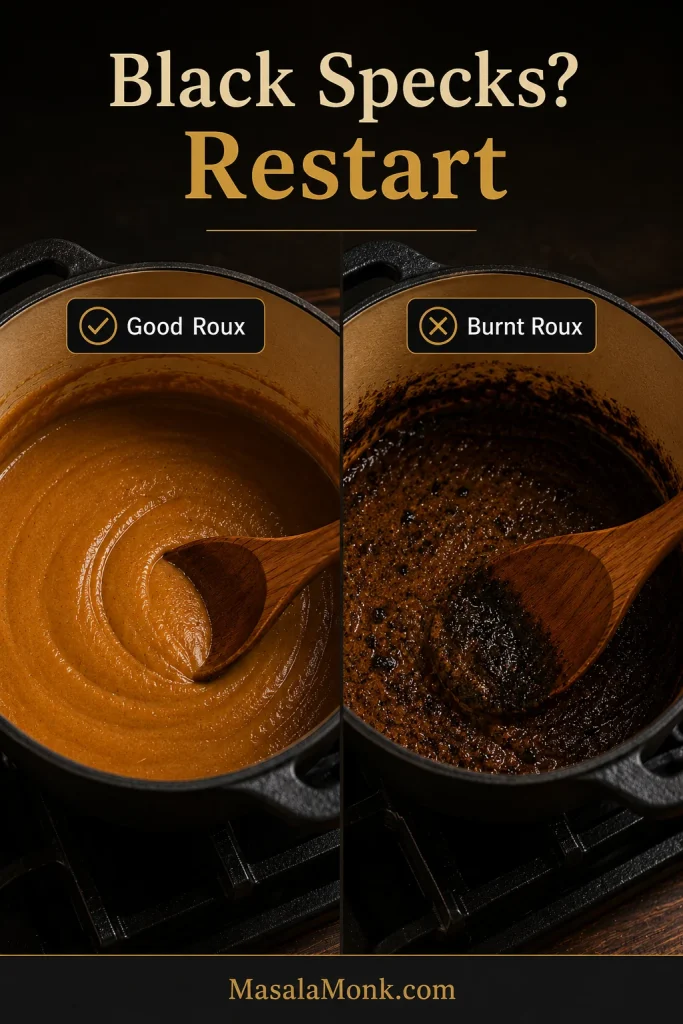
As the roux darkens, lower the heat if it starts moving too fast. Black specks or a sharp burnt aroma mean it is time to restart. Burnt roux will make the whole pot taste bitter.

Restarting is better than saving burnt roux, because scorched flavor will travel through the whole sauce.

Comparison of good roux and burnt roux with black specks
Burnt roux will turn the whole pot bitter, so restart when you see black specks or smell scorching.

Roux ready? Continue to How to Make Cajun Étouffée, or use Troubleshooting if the pot smells burnt, tastes floury, or feels too thick.

How to Make Cajun Étouffée

The recipe card gives the exact steps. This walkthrough is here for the cooking cues: what should be ready, what should smell right, and when the pot is safe for seafood.

1. Prep everything before the roux

Once the roux starts cooking, your attention belongs to the pot. Chop the vegetables, mince the garlic, slice the herbs, warm the stock, cook the rice, and thaw the seafood before you turn on the stove.

2. Cook the roux slowly

Melt the butter, warm the oil, or heat a butter-oil mix, then add the flour and stir constantly over medium heat. The roux will move from pale to blonde, then copper, then peanut-butter brown. Darkening too quickly is your cue to lower the heat and keep stirring.

3. Add onion, celery, and bell pepper

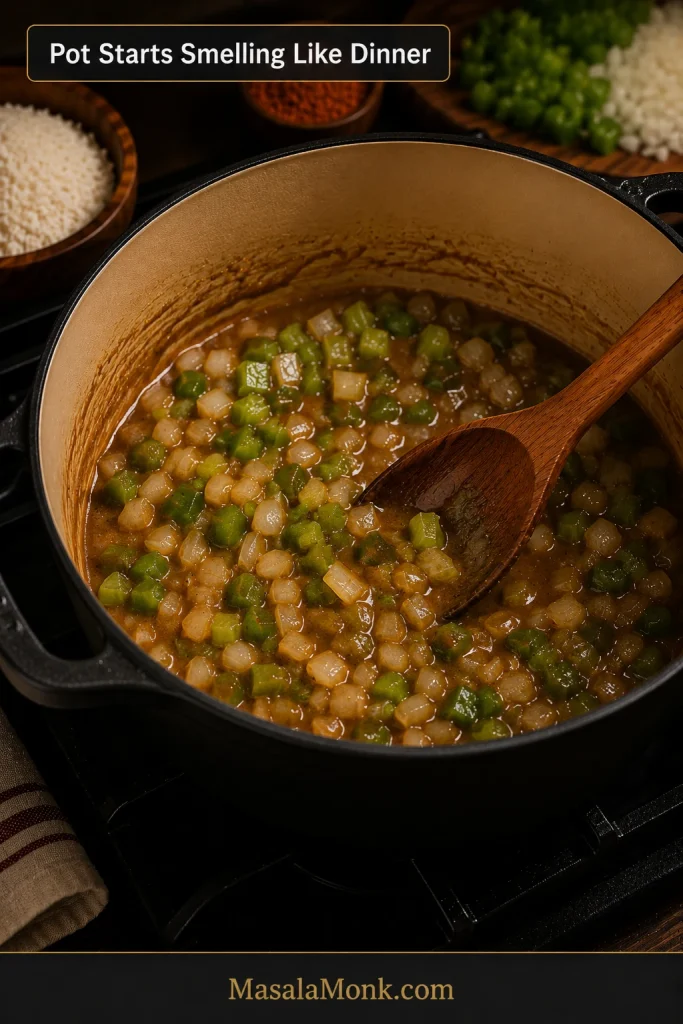
When the roux reaches the color you want, stir in the holy trinity. The vegetables cool the roux slightly, then turn sweet and savory as they soften into the base. This is the moment the pot starts smelling like dinner.

Once the trinity hits the roux, the pot shifts from toasted flour to a sweet, savory Cajun base.

Chopped onion, celery, and green bell pepper stirred into brown roux in a Dutch oven
When the trinity hits the roux, it cools the pot slightly while building a sweet, savory Cajun base.

4. Build the sauce with warm stock

After the garlic blooms, the first splash of stock will make the roux seize and thicken. Keep whisking. It loosens as the rest of the stock goes in and turns into a smooth, spoonable base.

Warm stock and steady whisking turn the roux from tight and thick into a smooth sauce.

Warm stock being whisked into a roux base for Cajun étouffée sauce
The first splash of stock may tighten the roux, but steady whisking turns it into a smooth étouffée sauce.

5. Simmer until the base tastes complete

Let the sauce simmer until the floury edge has cooked away and the seasoning tastes balanced. The pot should already taste like dinner before the seafood arrives.

6. Finish with shrimp or crawfish

Raw shrimp only needs a few minutes. Crawfish tails are often already cooked and only need to be heated through. Treat the seafood like the finish, not the simmer.

7. Rest, garnish, and serve

Let the pot rest for a few minutes so the sauce settles and thickens slightly. Spoon it over hot white rice so the gravy pools around the grains, then serve with fresh herbs and extra hot sauce at the table.

Troubleshooting: Fix Thin, Thick, Salty, Bland, Spicy, or Floury Étouffée

Do not panic if the sauce looks wrong at first. Étouffée can look too thick, too thin, or too dark for a minute before it comes together. Most problems are easier to fix before the seafood goes in, so taste and adjust while the shrimp or crawfish is still safely waiting.

Check Texture Before Seafood

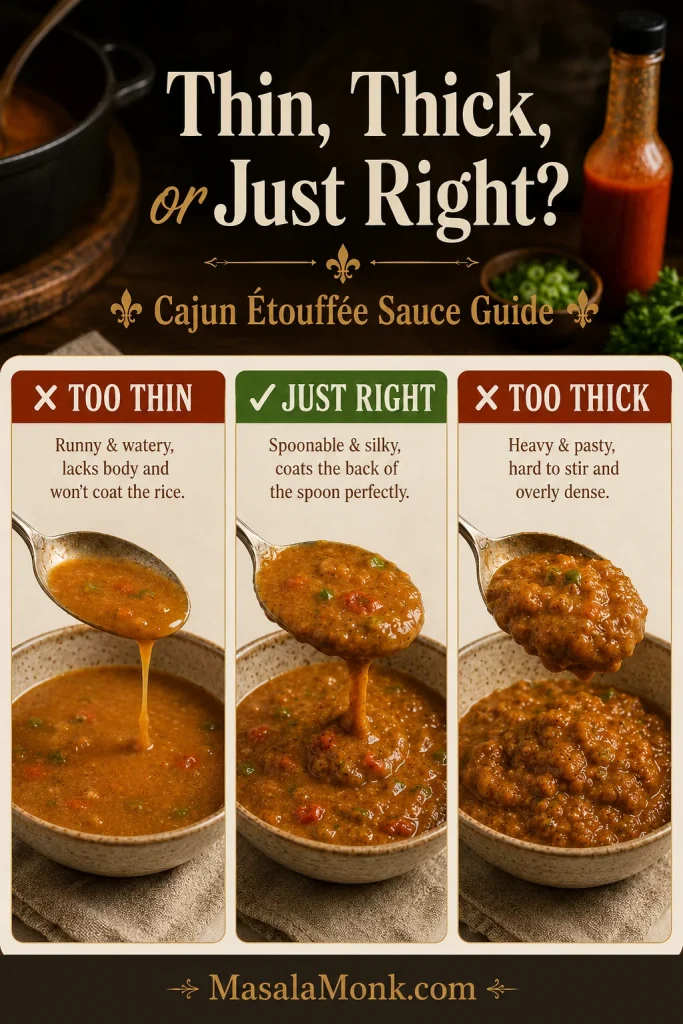
Étouffée should be thicker than soup but softer than paste. It should spoon easily over rice, coat the seafood, and settle into the grains without disappearing completely.

Diagnose the sauce before adding seafood by comparing thin, spoonable, and overly thick textures.

Three-panel guide comparing thin, just-right, and too-thick Cajun étouffée sauce textures
The ideal étouffée sauce sits between watery and pasty: spoonable, glossy, and thick enough to coat rice.

Common Étouffée Fixes

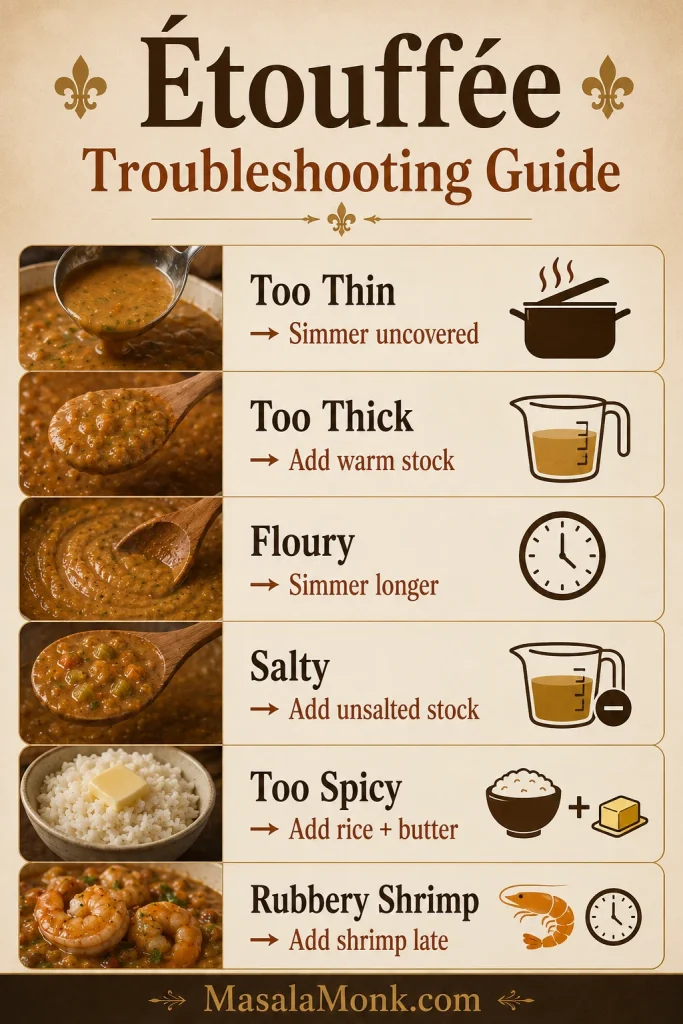
ProblemWhat it meansHow to fix it
Too thinUsually too much liquid or not enough simmeringSimmer uncovered for a few more minutes before adding seafood
Too thickThe roux absorbed more liquid than expectedAdd warm stock a splash at a time
Floury tasteRoux was undercooked or sauce needs more timeSimmer the sauce longer before adding seafood
Too saltySeasoning blend, stock, hot sauce, or boxed base was saltyAdd unsalted stock, a little butter, and serve with plain rice
Too spicyOften too much cayenne, hot sauce, or spicy Cajun seasoningAdd unsalted stock, a little butter, and serve with extra plain rice
BlandNeeds more spice, acid, or finishing flavorAdd Cajun seasoning, hot sauce, Worcestershire, green onion, or cayenne
Burnt rouxRoux scorched before vegetables were addedRestart the roux; burnt flavor will not cook out
Rubbery shrimpShrimp cooked too long or boiled too hardAdd shrimp only at the end and cook just until opaque
Watery seafood flavorFrozen seafood released too much liquidThaw, drain, and pat dry before adding; simmer the sauce first so it has body

After the detailed fixes, this guide works as a quick save-the-pot reminder for common étouffée problems.

Troubleshooting guide for Cajun étouffée with fixes for thin, thick, floury, salty, spicy, and rubbery shrimp issues
Fix sauce problems early; once shrimp or crawfish goes in, there is less time to correct thickness, salt, or floury flavor.

Pot fixed? Return to the Recipe Card, check Serving Ideas, or use Shortcut Options if you are adjusting a faster version.

Cajun vs Creole Étouffée: Tomato or No Tomato?

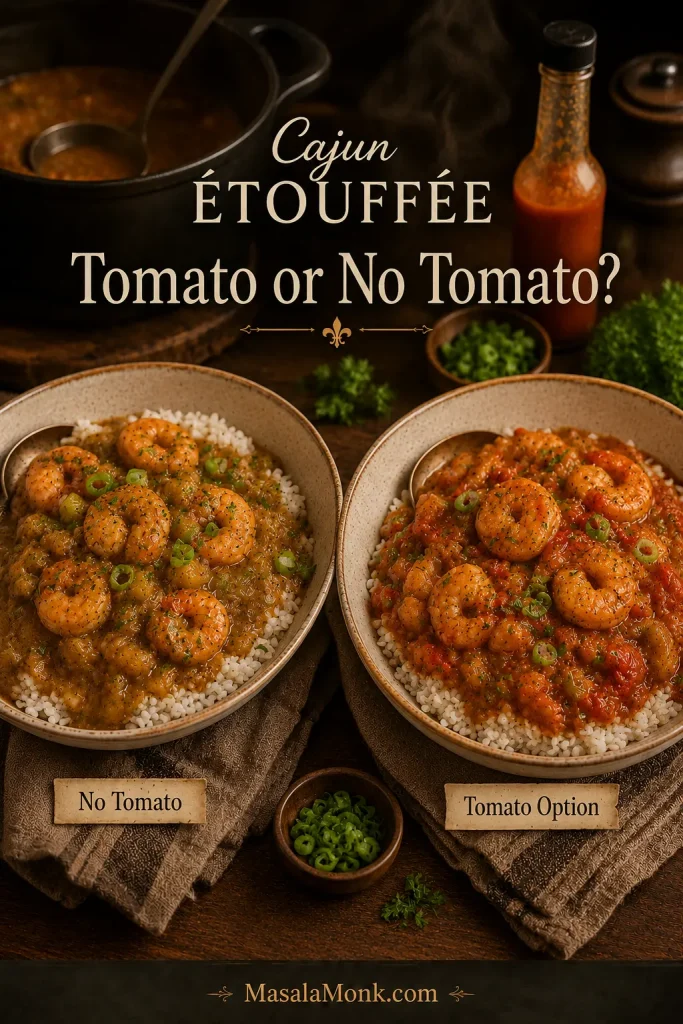
Tomato is where étouffée opinions can get loud, so this recipe keeps the choice simple. This version keeps tomato out of the main pot for a roux-forward Cajun-style flavor. Some home cooks add tomato, especially in Creole-leaning or family-style versions, so the option is included below.

For a brighter sauce, add 1 tablespoon tomato paste with the garlic and spices, or stir in ½ cup diced tomato when you add the stock. Tomato changes the flavor, but it can still make a delicious pot.

The tomato choice belongs here because roux-forward Cajun-style and brighter Creole-leaning bowls can both be delicious.

Side-by-side étouffée bowls showing a no-tomato version and a tomato-option version
No tomato keeps the étouffée roux-forward, while a small tomato option adds a brighter Creole-style note.

Skip the tomato if you came here for a roux-forward bowl. Add a little if you like a softer, brighter sauce. Like many Louisiana-style dishes, every kitchen has its own opinion.

Étouffée Sauce, Base, Mix, and Cream Soup Shortcuts

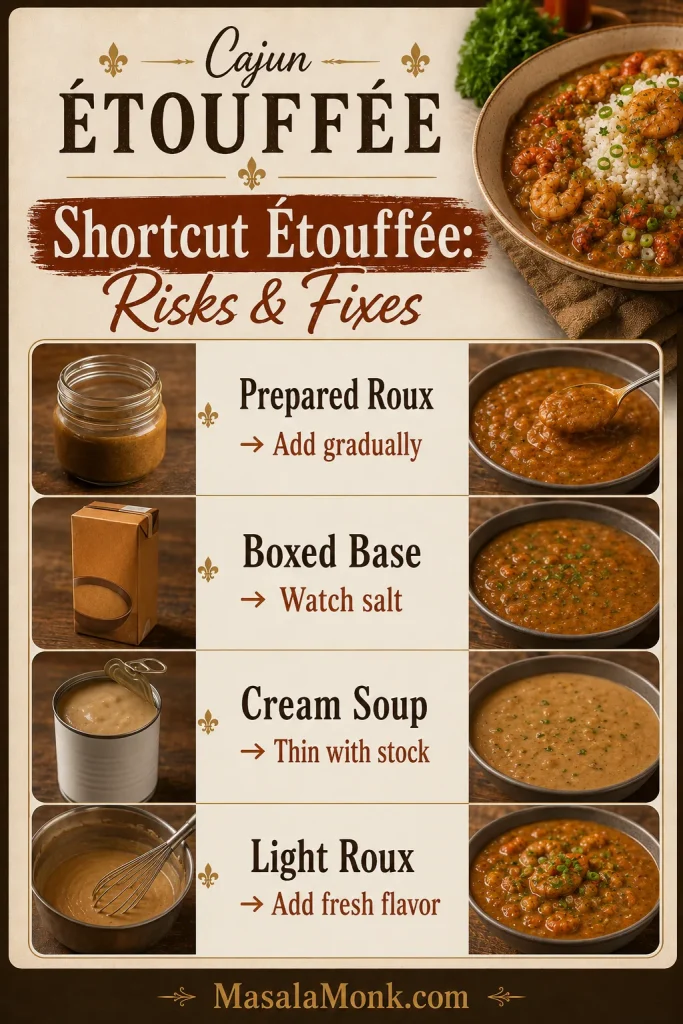
Some nights, you want the roux. On other nights, you want dinner faster. Both are real kitchens. Shortcut étouffée works best when you add freshness back: sautéed trinity, garlic, herbs, a splash of hot sauce, and gentle seafood timing.

The goal is not to pretend a shortcut tastes exactly the same as a from-scratch roux. Instead, make it balanced, creamy or saucy in the right way, and worth spooning over rice.

ShortcutMain riskBest fix
Prepared or jarred rouxToo intense or too darkAdd gradually and taste before adding more seasoning
Boxed étouffée mix or baseToo salty or flatUse less seasoning and add sautéed trinity, garlic, herbs, and hot sauce
Cream soupToo heavy, thick, or saltyThin with stock and finish with fresh herbs and gentle seafood timing
Light rouxLess depthUse good stock, Cajun seasoning, Worcestershire sauce, and a little acidity

For shortcut methods, keep the focus on salt control, sauce thickness, fresh trinity, and gentle seafood timing.

Shortcut étouffée guide showing prepared roux, boxed base, cream soup, and light roux fixes
Shortcut étouffée tastes more homemade when you control salt, loosen heavy bases with stock, and add fresh trinity.

Using prepared or jarred roux

Prepared roux can save time if you want roux flavor without standing over the pot as long. Follow the jar’s or package’s guidance as your baseline, then add gradually rather than all at once. Build the sauce with sautéed onion, celery, bell pepper, garlic, warm stock, and seasoning. Taste before adding more Cajun seasoning because prepared roux can vary in intensity.

Using étouffée mix or base

Boxed étouffée mix or jarred base can be useful when you want dinner fast. Most mixes already contain seasoning, thickener, and salt, so taste before adding more Cajun seasoning. Add shrimp or crawfish near the end instead of boiling it hard for the whole cooking time.

To make a mix taste more homemade, sauté onion, celery, bell pepper, and garlic in a little butter before adding the mix and liquid. Finish with fresh herbs, a splash of hot sauce, and a small knob of butter.

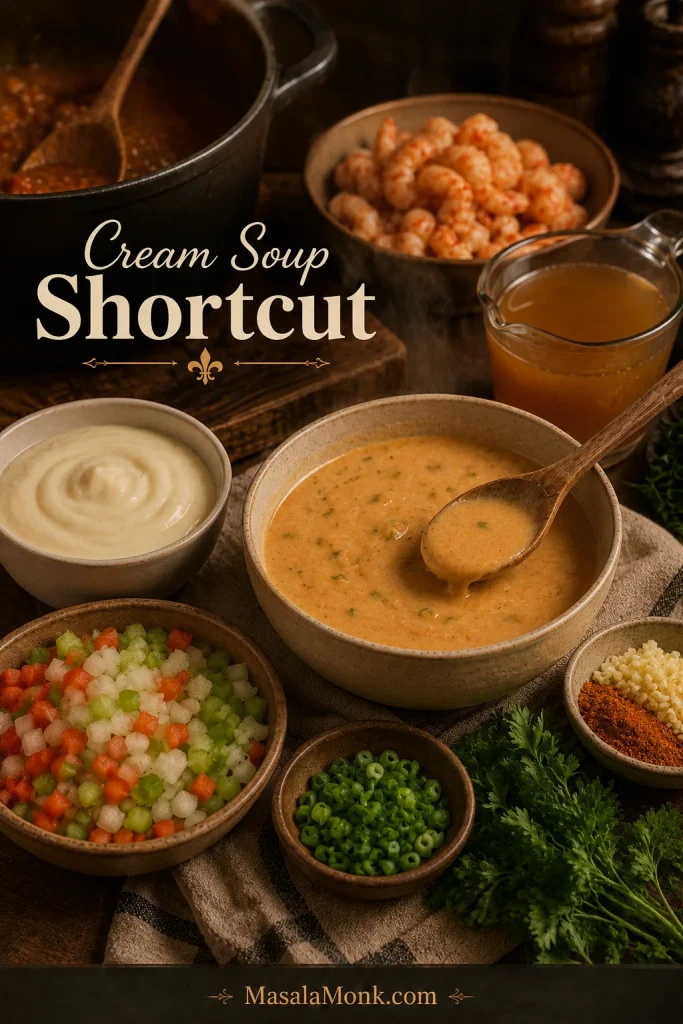
Using cream of mushroom, cream of shrimp, or cream of celery soup

Many home cooks make a creamy shortcut étouffée with condensed soup. If this is the version you grew up with, it deserves a place too. Cream of mushroom, cream of shrimp, cream of celery, and golden mushroom soup all create an easy, comforting sauce. It will not taste exactly like a roux-based Cajun étouffée, but it can still be a cozy family-style dinner.

Cream soup shortcuts work best when stock loosens the base and seafood stays gently cooked.

Cream soup shortcut setup for étouffée with stock, trinity, seafood, herbs, and creamy sauce
When using cream soup, loosen the base with stock first, then finish with seafood gently so the sauce stays spoonable.

Condensed soup needs a lighter hand with salt and seasoning. Start with about ½ can of water or stock per can of condensed soup, then loosen the sauce more only if needed. Cream soup versions can become salty quickly, especially when combined with Cajun seasoning and table hot sauce.

For a full dinner built around the same condensed-soup comfort idea, this cream of mushroom chicken shows how much the soup-to-liquid ratio matters when you want the sauce creamy instead of watery.

The fastest from-scratch shortcut

If you have 5–8 minutes, make a light roux instead of relying only on soup or mix. Even a copper-colored roux gives the sauce more flavor and better texture than a fully instant version.

Using a shortcut tonight? Keep Troubleshooting nearby, then return to the Recipe Card for seafood timing.

What to Serve With Cajun Étouffée

Cajun étouffée is usually served over white rice, and for good reason. The rice catches the sauce, softens the heat, and turns the dish into a full meal. If rice is the part that usually lets you down, this guide on how to cook perfect rice will help you get fluffy grains before the étouffée is ready.

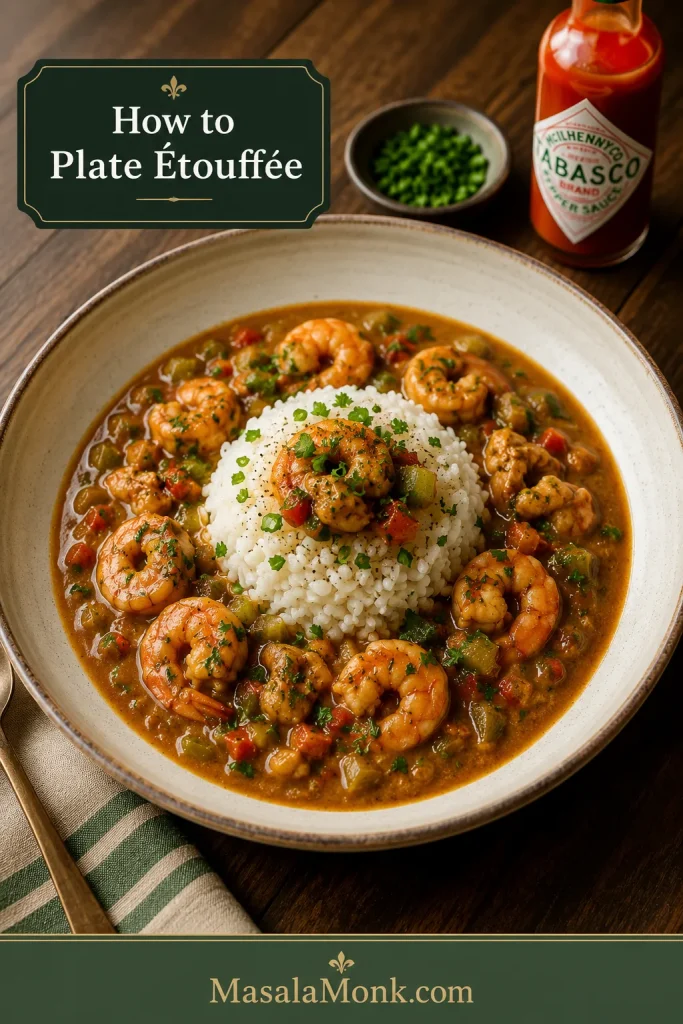
A shallow bowl works best here: rice in the center, sauce ladled around it, herbs on top, and table hot sauce close by. It feels generous without needing many sides.

Serving gets easier when rice is mounded first and the étouffée is ladled around it.

Cajun étouffée plated with rice in the center and sauce spooned around it
For a cleaner bowl, mound the rice first, then ladle the étouffée around it so the gravy pools neatly.
  • Long-grain white rice: the classic, clean choice.
  • Green onions and parsley: a fresh finish for a rich sauce.
  • Hot sauce: serve on the side so everyone controls the heat.
  • Cornbread: good for soaking up extra sauce.
  • Simple green salad: balances the richness.
  • Roasted okra or sautéed greens: adds a Southern-style vegetable side.
  • Red beans and rice: better as a separate meal or part of a larger Cajun/Creole spread rather than something you need on the same plate.
  • Cajun seafood boil: a natural next recipe if you are building a bigger seafood spread around shrimp, crawfish, crab, or potatoes.

Finish with herbs and a sharp splash of hot sauce.

Make-Ahead, Storage, Freezing, and Reheating

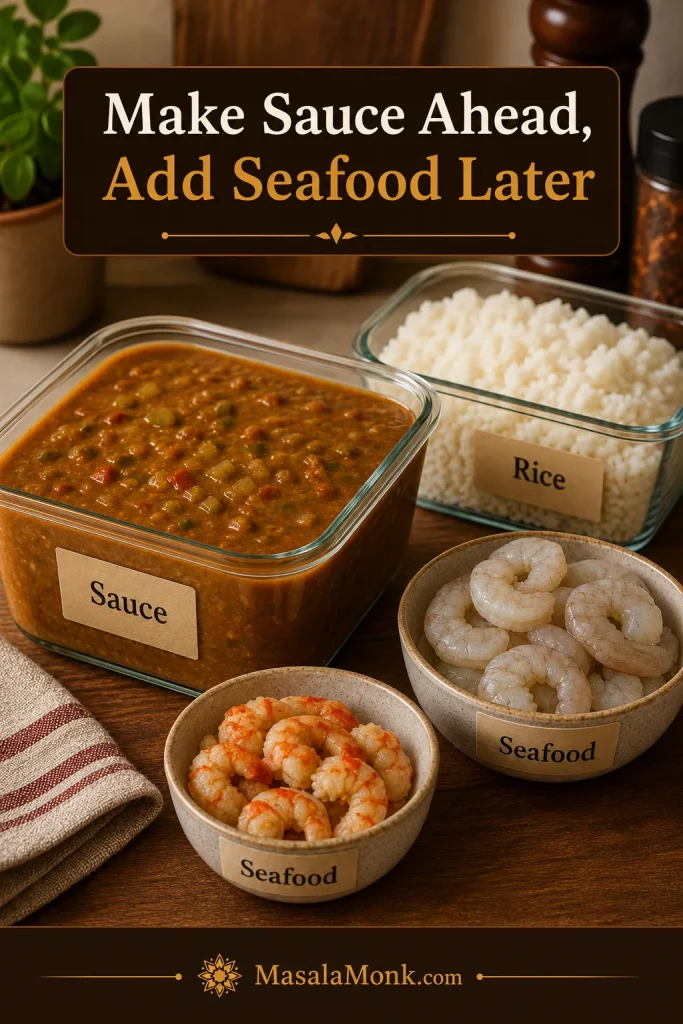
Étouffée is a good make-ahead dish when the sauce and seafood are handled separately. Prepare the sauce ahead, then add the seafood when you reheat and serve.

Make ahead

Make the sauce through the simmering step, then cool and refrigerate it. When ready to serve, warm it gently, add a splash of stock if needed, and finish with shrimp, crawfish tails, or both.

Storage works best when the sauce is made ahead and seafood is saved for reheating.

Make-ahead étouffée sauce stored separately from seafood and rice
For better make-ahead texture, store the sauce separately; then add seafood during reheating so it stays tender.
Refrigerating leftovers

Store leftovers in an airtight container in the refrigerator for up to 3 days. Keep rice separate if possible so the sauce does not become too thick and starchy.

If you have extra cooked rice but not enough étouffée for another full bowl, turn the rice into a separate dinner like this shrimp fried rice instead of stretching the sauce too thin.

Freezing

You can freeze étouffée, but seafood texture may change after thawing. The best method is to freeze the sauce without seafood, then add fresh shrimp or crawfish when reheating. Leftovers with seafood already in the sauce should be cooled quickly, frozen in a sealed container, and reheated gently.

Reheating

Reheat on low heat, stirring often. Add a splash of stock or water to loosen the sauce. Avoid boiling leftovers hard because shrimp and crawfish can toughen.

Variations

Shrimp étouffée

Use 2 lb total peeled and deveined raw shrimp. Add it near the end and cook gently until opaque and softly curled.

Crawfish étouffée

Use 2 lb total thawed crawfish tails. Already cooked crawfish should be warmed gently instead of boiled hard.

Seafood étouffée

Use a mix of shrimp and crawfish, or add a little crabmeat at the end. Delicate seafood stays best when it is added late.

Chicken étouffée

Use bite-size cooked chicken or small pieces of boneless chicken thighs. Simmer until the chicken is fully cooked and tender, then finish with fresh herbs.

Gluten-free étouffée

Use a gluten-free all-purpose flour blend or rice flour for the roux. The texture may be slightly different, so add stock gradually and adjust the sauce as it thickens.

Vegetarian mushroom étouffée

Use mushrooms instead of seafood and vegetable stock instead of seafood or chicken stock. Brown the mushrooms first so they bring depth to the sauce instead of watering it down.

Extra spicy Cajun étouffée

Add more cayenne, diced jalapeño, or extra hot sauce at the table. Build spice gradually because Cajun seasoning and hot sauce can also add salt.

Creamy shortcut étouffée

Use condensed cream of mushroom, cream of shrimp, or cream of celery soup as part of the sauce base. Keep the seasoning lighter, thin with stock, and add seafood at the end.

Cajun Étouffée FAQs

How do you pronounce étouffée?

Étouffée is usually pronounced ay-too-FAY or eh-too-FAY. The word comes from French and means “smothered.”

Is shrimp okay instead of crawfish?

Yes. Use raw peeled shrimp and add it during the final 3–5 minutes so it stays tender. Shrimp is easier to find than crawfish and works very well in Cajun étouffée.
Are crawfish tails already cooked?

Many packaged crawfish tails are already cooked. Check the package, but in most cases they only need to be warmed through in the sauce for a few minutes.

How should frozen crawfish tails be handled?

Thaw frozen crawfish tails first, then drain excess liquid. Do not automatically rinse them, especially if the package has flavorful crawfish fat or juices. Muddy or overly fishy liquid should be drained more aggressively, with stock doing more of the flavor work.

What roux color is best for étouffée?

Peanut-butter brown is the best balance for this recipe. It gives the sauce nutty flavor without requiring a very dark roux. A lighter copper roux also works for an easier weeknight version.

Does Cajun étouffée need tomatoes?

No. This version does not use tomato by default. A little tomato paste or diced tomato gives the sauce a brighter Creole-style feel. Tomato changes the flavor, but it can still make a delicious pot.

Should étouffée be thick?

Yes, but not pasty. Étouffée should be thicker than soup and thin enough to spoon over rice. A thick sauce needs warm stock; a thin one needs a few more uncovered minutes.

Why does my étouffée taste floury?

The roux may not have cooked long enough, or the sauce may need more simmering time. Cook the roux until it smells nutty, then simmer the sauce until the floury taste disappears.

How do I keep shrimp from overcooking?

Build and simmer the sauce first, then add shrimp at the end. Shrimp usually needs only 3–5 minutes in a gentle simmer. Remove the pot from heat as soon as the shrimp is opaque and tender.
Cream of mushroom soup in étouffée: yes or no?

Yes, if you want a creamy home-style shortcut. Cream of mushroom soup is not the same as a roux-based Cajun étouffée, but it can be useful for a fast, comforting version. Use less salt because condensed soup and Cajun seasoning can become salty together.
Gumbo vs étouffée: what is the difference?

Gumbo is usually more soup-like and often served as a stew with rice, while étouffée is thicker and more sauce-like. Étouffée should cling to the seafood and rice rather than feel like broth. For a deeper comparison, Southern Living has a helpful étouffée vs gumbo explainer.
Make-ahead étouffée: what works best?

Best texture comes from making the sauce ahead and adding the seafood when reheating. This keeps shrimp and crawfish from becoming tough.
Need the essentials again? Jump back to the Recipe Card, Roux Guide, Troubleshooting, or Top.

Final Spoonful

Once you know what the roux should smell like, how the sauce should move, and when the seafood should go in, Cajun étouffée stops feeling intimidating. It becomes what it should be: glossy, spicy, seafood-rich comfort poured over hot rice, finished with herbs and one more sharp splash of hot sauce.

The finished-pot target is simple: glossy sauce, hot rice, fresh herbs, and enough Cajun étouffée for the table.

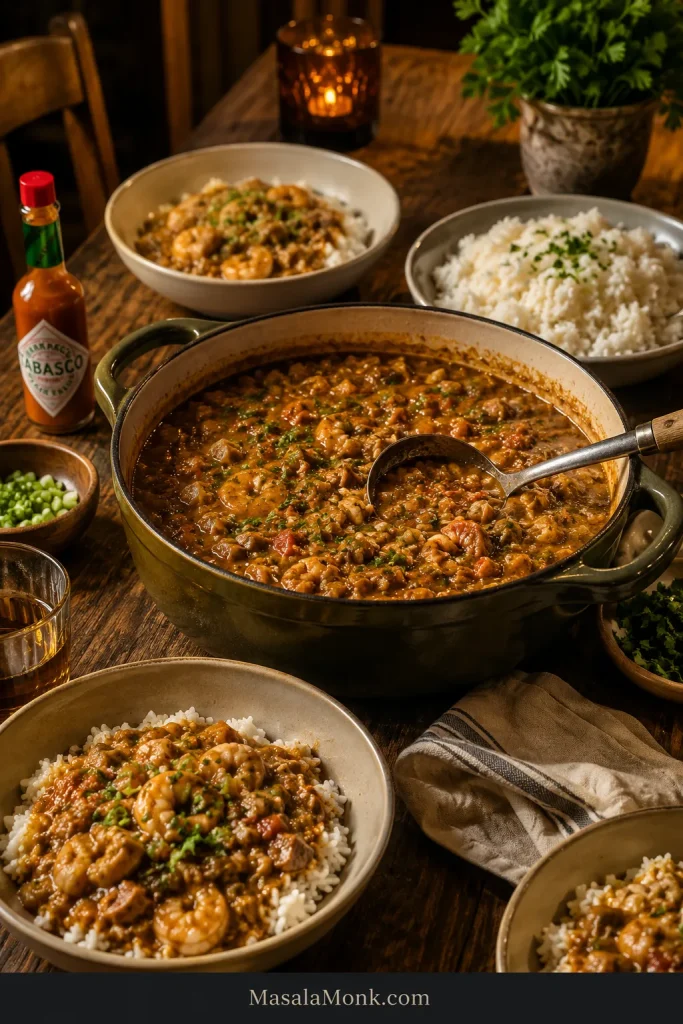
Dutch oven of Cajun étouffée served at a table with rice, bowls, herbs, ladle, and hot sauce
Once the sauce is glossy and the rice is hot, étouffée becomes the kind of pot people gather around.

Every kitchen has an opinion on tomato, cream soup, crawfish, shrimp, or how dark the roux should be — and that is part of why étouffée is so fun to cook. If your family has a version, it probably has a reason behind it. Learn the base method, adjust the pot to your table, keep the rice hot, and serve it while the sauce is still glossy.