
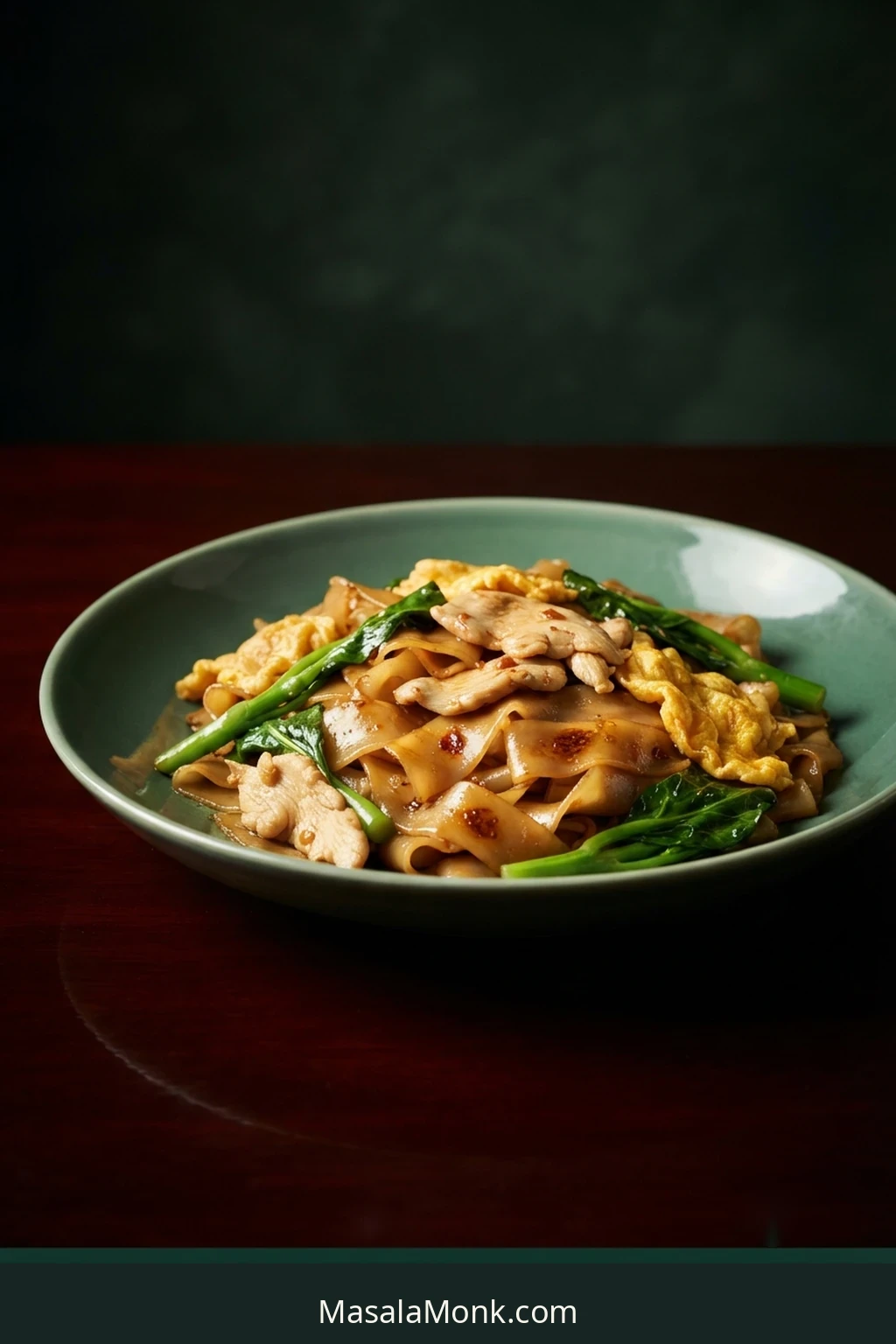
Great Pad See Ew is all about the noodles. They should lift from the plate in broad, chewy ribbons, carrying a glossy savory sauce with darker caramelized patches where they caught the hot pan. Chicken stays juicy, Chinese broccoli keeps some bite, and soft pieces of egg tuck themselves between the noodles.
Pad See Ew is a Thai stir-fried noodle dish of broad rice noodles, soy-based seasoning, egg and Chinese broccoli. The dish is generally mild rather than chile-hot, and its name essentially means “stir-fried soy sauce.”
This Pad See Ew recipe is designed for an ordinary home stove. Once everything is ready beside you, the cooking moves quickly: get the noodles into the right condition, keep the heat lively, and give them enough time against the cooking surface to brown.
Two Checks That Matter Most
Before the wok: check the noodles. They should be separated, pliable and still resilient. Fully cooked fresh noodles should bend without cracking; dried noodles should still have a little firmness left.
Once they are in the wok: listen to the pan. A lively sizzle with very little loose liquid means the noodles are frying. A quiet, wet pan means they are steaming.
Pad See Ew Recipe
Chewy wide rice noodles with chicken, Chinese broccoli and egg in a savory soy-based sauce. Cooking the noodles in two batches helps a home stove stay hot enough to develop those darker browned patches.
- Serves: 2 generously or 3 lighter portions
- Prep: about 20 minutes
- Cook: about 12–15 minutes
- Total: about 32–35 minutes with fresh noodles; allow extra time for dried-noodle hydration
- Best pan: seasoned wok or roomy heavy skillet
Noodles
- 450 g / 1 lb prepared wide rice noodles
- Fresh option: 450 g / 1 lb fully cooked fresh sen yai, ho fun, hor fun or other broad rice-noodle sheets or ribbons
- Dried option: start with about 10 oz / 280 g wide flat rice noodles. After hydration and draining, weigh out 450 g / 1 lb for the wok; depending on the brand, you may have some left.
Chicken
- 225 g / 8 oz boneless skinless chicken thighs, sliced about ¼ inch / 6 mm thick
- 1 tsp / 5 ml Thai light or thin soy sauce
- 1 tsp / about 3 g cornstarch
- 1 tsp / 5 ml neutral high-heat oil
- Small pinch ground white pepper
Pad See Ew Sauce
- 2 tbsp / 30 ml oyster sauce
- 1 tbsp / 15 ml Thai light or thin soy sauce
- 2 tsp / 10 ml Thai black soy sauce (see ew dum)
- 1 tsp / 5 ml fish sauce, recommended but optional
- 2½ tsp / about 10 g granulated sugar
- 1 tbsp / 15 ml water
- ¼ tsp ground white pepper
For the Stir-Fry
- 170 g / 6 oz gai lan (Chinese broccoli), washed and dried very well
- 2 large eggs
- 4 garlic cloves, finely chopped
- 3 tbsp / 45 ml neutral high-heat oil, divided
Optional Quick Chile Vinegar
- ¼ cup / 60 ml distilled white vinegar
- 1–2 Thai chiles or another fresh red chile, thinly sliced
Stir the sliced chiles into the vinegar before you begin cooking and leave them to sit until serving.
Method
1. Prepare the Noodles
For fully cooked fresh noodles: If yours come as large sheets, loosen or separate the sheets as their texture allows, then cut them into broad ribbons. Warm them first if they’re too stiff to handle without cracking. Otherwise, separate soft, pliable noodles gently. Fully cooked fresh noodles do not need another boil.
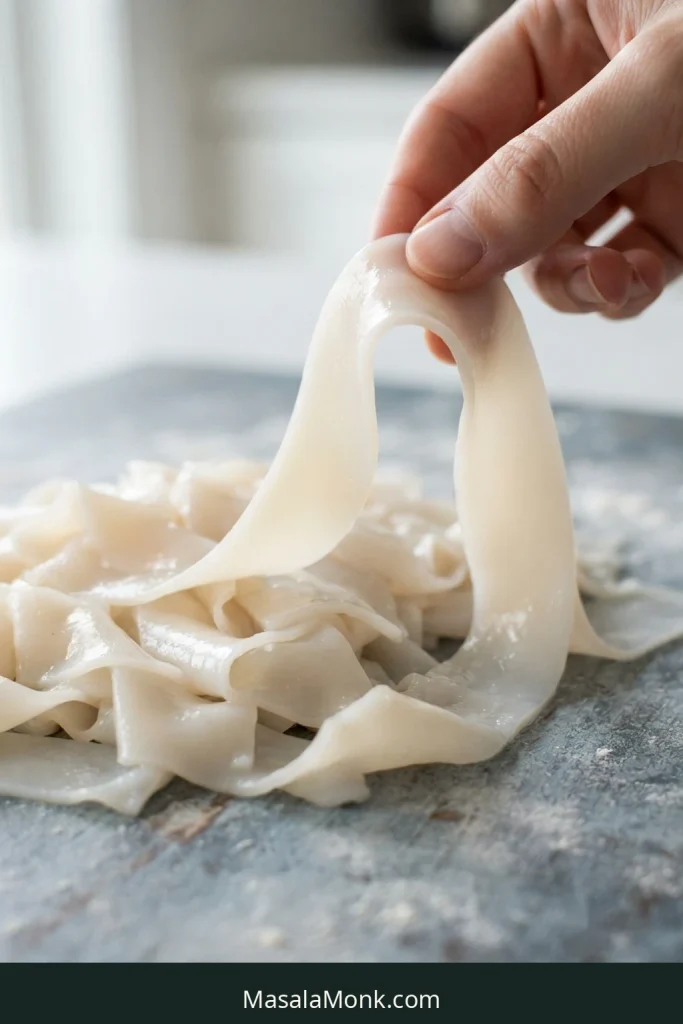
A torn noodle or two is normal. Wholesale shredding is the problem, not an occasional split ribbon.
For dried noodles: Use the package method as a starting point, but begin checking before the stated cooking time. Drain when the noodles bend easily and separate while still retaining a little firmness at the center. If your brand stays especially starchy or sticky, a brief cool rinse can help. Drain extremely well.
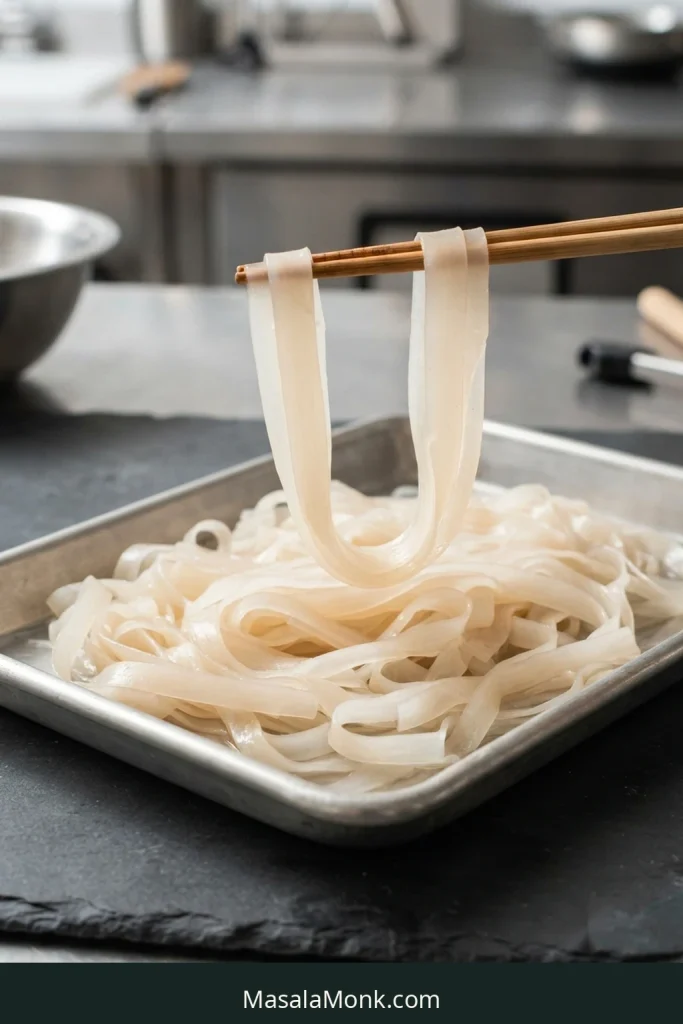
Whichever route you use, weigh out 450 g / 1 lb noodles ready for the wok and divide them into two roughly equal portions.
2. Season the Chicken
Toss the chicken with 1 tsp light soy, cornstarch, 1 tsp oil and a small pinch of white pepper. Let it sit while you mix the sauce and finish the vegetable prep.
3. Mix the Sauce and Prep the Gai Lan
Mix the oyster sauce, light soy, black soy, fish sauce if using, sugar, water and white pepper until the sugar is mostly dissolved. Divide the sauce into two equal portions. Each noodle batch gets one full portion, added in two stages.
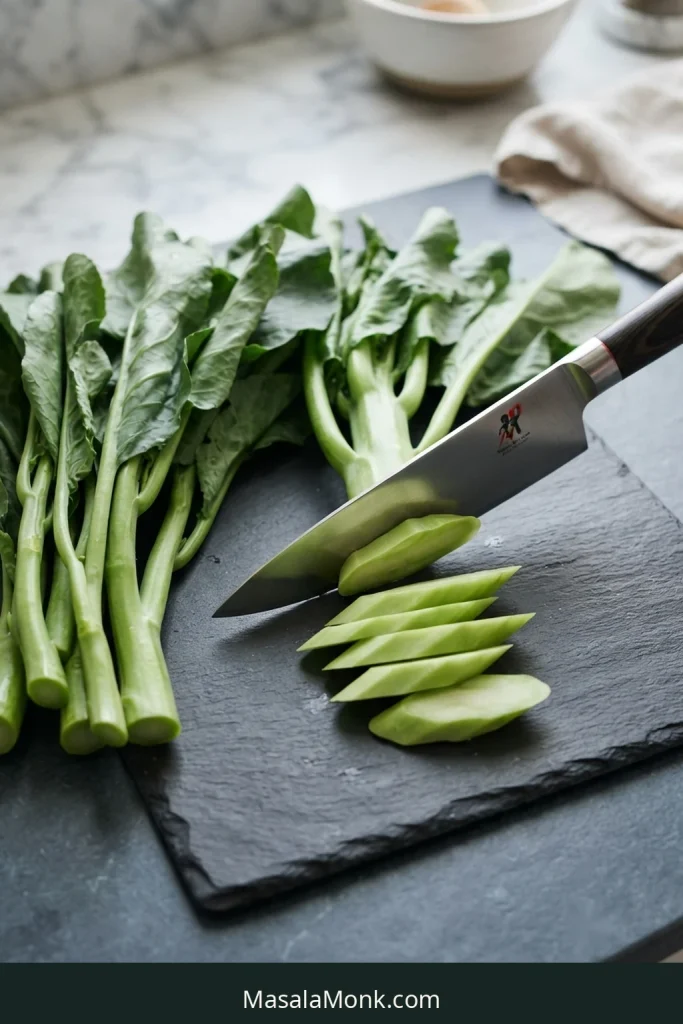
Separate the thicker gai lan stems from the leafy portions. Split very thick stems lengthwise or slice them on the diagonal so the pieces are no thicker than roughly ⅓ inch / 8 mm. Leave the leafy tops larger because they cook much faster.
4. Cook the Chicken
Heat a wok or large heavy skillet over high heat until thoroughly hot. Add 1 tbsp / 15 ml oil, then spread the chicken into a single layer.
Let the first side sear briefly before tossing. Continue until the chicken is browned in spots and reaches 165°F / 74°C at the thickest piece you can measure accurately, usually around 3–4 minutes for thin slices.
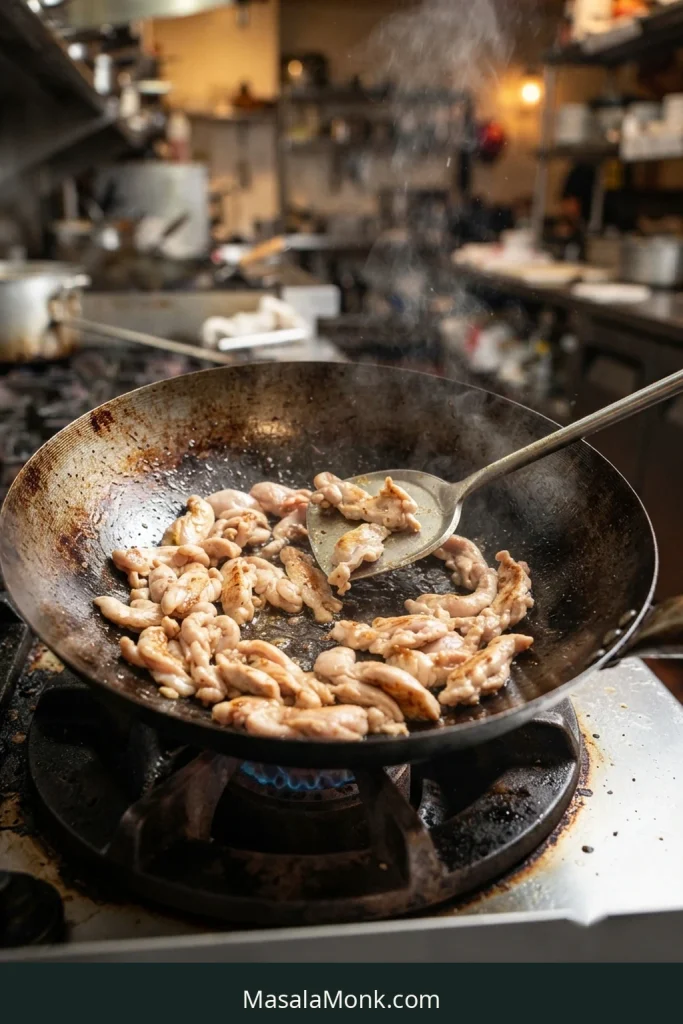
Transfer the chicken to a plate. It will come back near the end, once the wok has had a chance to get hot again.
5. Start the First Batch
Let the empty wok heat again. Add 1 tbsp / 15 ml oil, half the garlic and half the gai lan stems.
Stir-fry for about 20–30 seconds, just until the garlic smells fragrant and the stems brighten. Push them toward one side.
Crack in 1 egg. Give the bottom several seconds to begin setting, then scramble it into soft pieces.
6. Add the Noodles
Add one noodle portion. Scoop and fold only enough to distribute the egg, garlic and oil.
Spread the noodles across as much of the hot surface as possible and leave them alone for about 20–30 seconds.
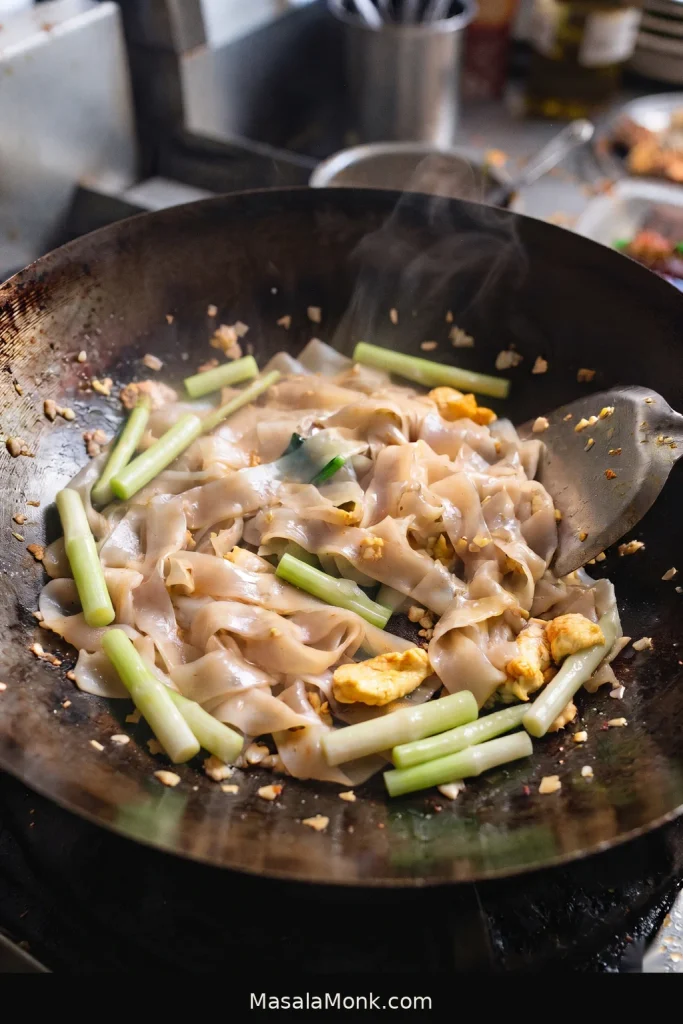
Listen. You want an energetic sizzle. A suddenly quiet wok or liquid collecting underneath means the heat needs a few seconds to catch back up before anything else goes in.
7. Sauce and Brown
Turn the noodles once, then add half of this batch’s measured sauce around the hot sides of the wok.
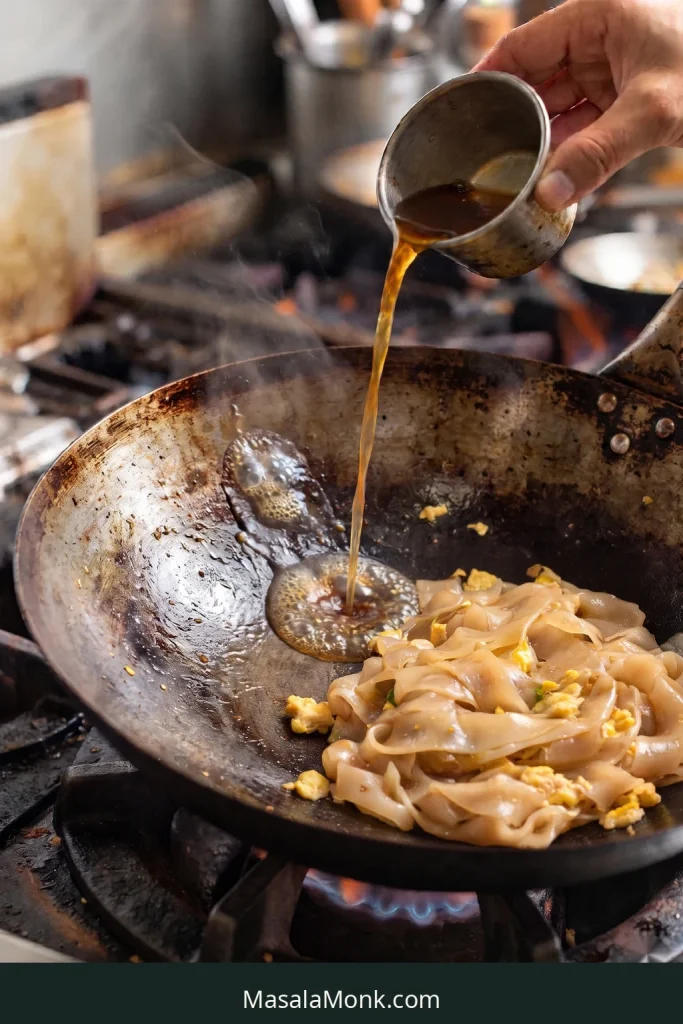
Scoop and fold just enough to coat. Spread the noodles again and leave them undisturbed for another 15–30 seconds. Irregular darker patches should begin appearing where parts of the noodles have sat directly against the hot surface.
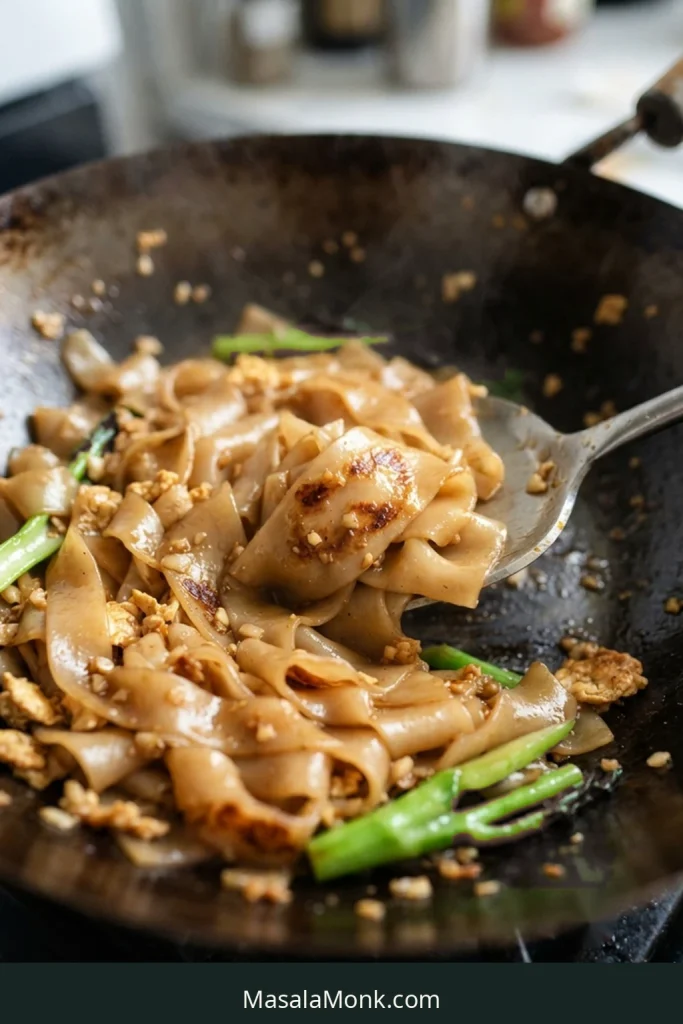
Add the remaining sauce for this batch and toss until it is absorbed. The noodles should look glossy, not wet.
8. Finish the Batch
Add half the gai lan leaves and half the cooked chicken. Toss for another 30–60 seconds, just until the leaves wilt and everything is hot.
Move the finished batch straight to a serving platter.
9. Cook the Second Batch
Let the wok become hot again. Add the final 1 tbsp / 15 ml oil and repeat with the remaining garlic, gai lan stems, egg, noodles, sauce, leaves and chicken.
The first batch will tell you a lot about your stove. If it browned slowly or silenced the sizzle, give the wok a little more preheating time before the second batch.
Bring the two finished batches together on the serving platter.
10. Serve
Serve immediately. Put chile vinegar, chile flakes and extra white pepper on the table for anyone who wants more brightness, heat or aromatic warmth.
The movement to remember: spread → wait → sauce → fold → brown → finish. Give the noodles time against the hot surface instead of stirring continuously.
Recipe Notes
- Still firm in the wok? Add 1 tbsp / 15 ml water at a time and let it absorb before checking again. If you used dried noodles, see the dried-noodle texture guide before the next batch.
- Using nonstick: stay within the cookware manufacturer’s heat limits and avoid leaving an empty nonstick pan over maximum heat while chasing extra browning.
Recipe development note: This recipe synthesizes published Thai-cooking references, established recipe methods and recurring home-cook troubleshooting; it has not been tested in the MasalaMonk kitchen.
What the Finished Noodles Should Look and Feel Like
The clock can only get you close. The noodles themselves tell you when to stop.
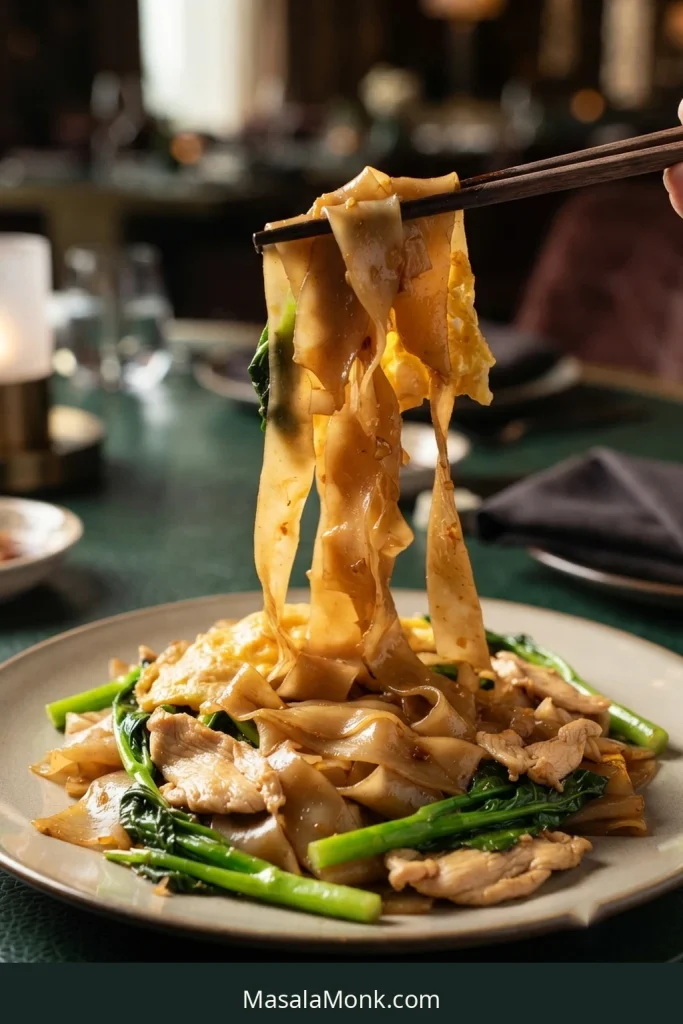
- Lift: broad ribbons rather than one sticky clump
- Chew: supple all the way through, with enough resilience that they do not feel bloated or mushy
- Surface: glossy brown overall with irregular darker caramelized patches
- Sauce: clings to the noodles, with almost no loose liquid underneath
- Gai lan: crisp-tender stems and wilted but still green leaves
- Egg: tender pieces still visible between the noodles
- Aroma: savory soy with a toasted, lightly smoky edge
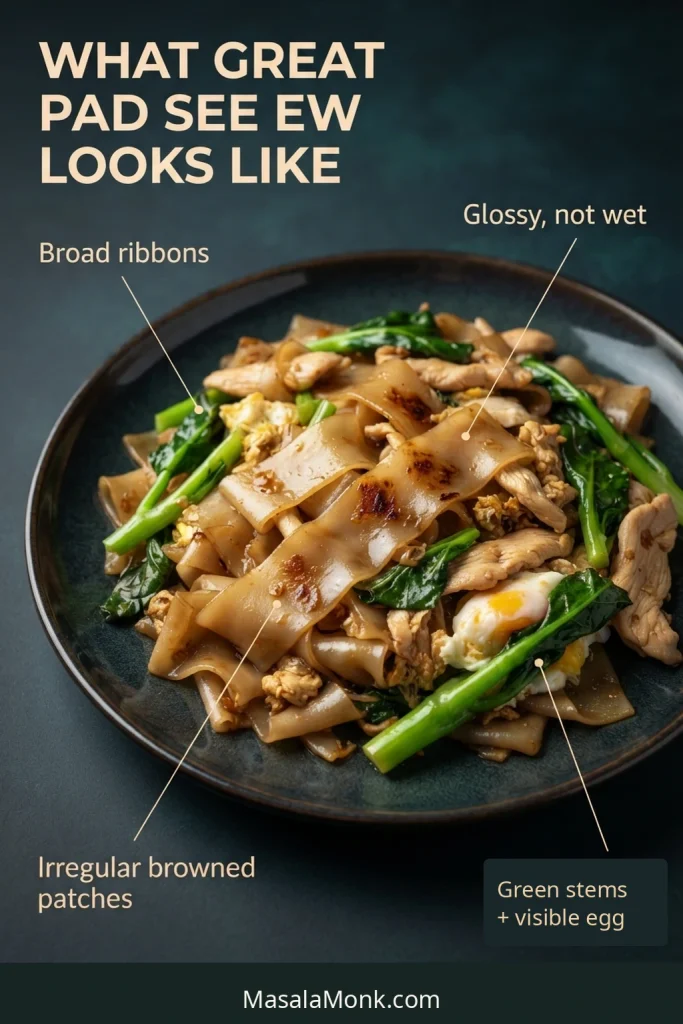
You are not looking for every ribbon to turn dark. A few toasted patches against softer chewy noodles make each bite more interesting. Once those signs are there, stop cooking; another minute is more likely to soften the noodles than improve them.
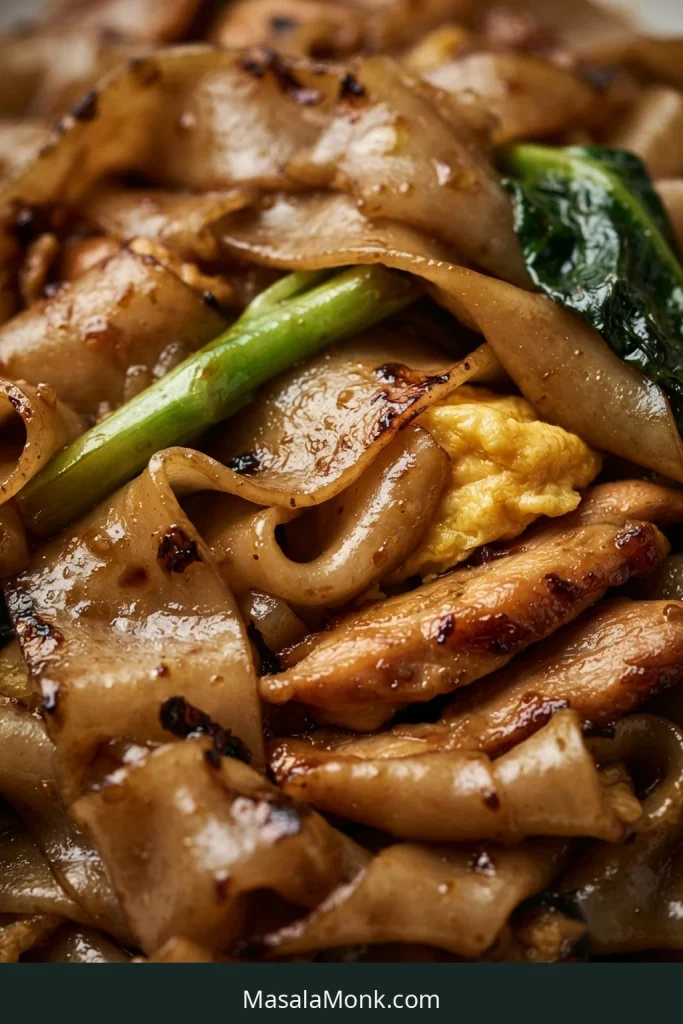
Need to fix something? Jump to Pad See Ew troubleshooting, or go back to the recipe. For deeper help with noodles, sauce and heat, use the guide below.
Pad See Ew Guide
Noodles, Sauce & Heat
- Pad See Ew Noodles: What to Buy & How to Prepare Them
- What the Sauce Bottles Do
- Sizzle or Steam? Read the Wok
Troubleshoot & Adapt
Serve, Compare & Store
Pad See Ew Noodles: What to Buy and How to Prepare Them
If you are standing in an Asian grocery store trying to work out which white packet becomes Pad See Ew, the labels do not always make the decision easy.
For the broad-noodle version most people associate with Pad See Ew, fresh sen yai give the characteristic wide, supple chew. Depending on the market, you may also see ho fun, hor fun, chow fun noodles, fresh wide rice noodles or rice noodle sheets. Look for broad, pale white-to-translucent sheets or ribbons rather than rice vermicelli or narrow Pad Thai-style sticks.
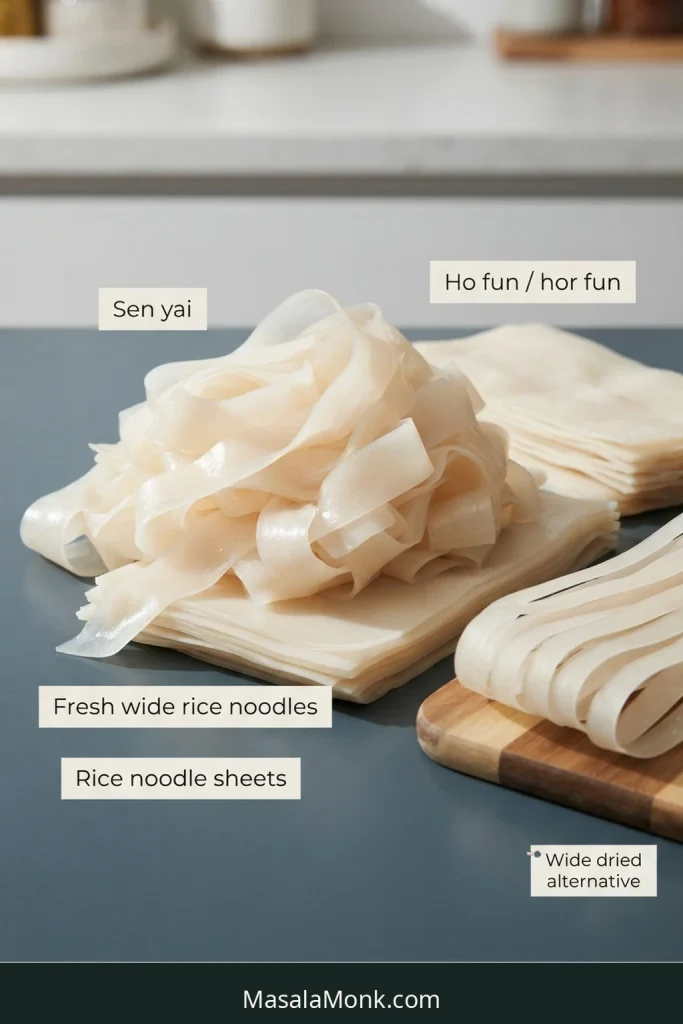
What Kind of Noodle Did You Buy?
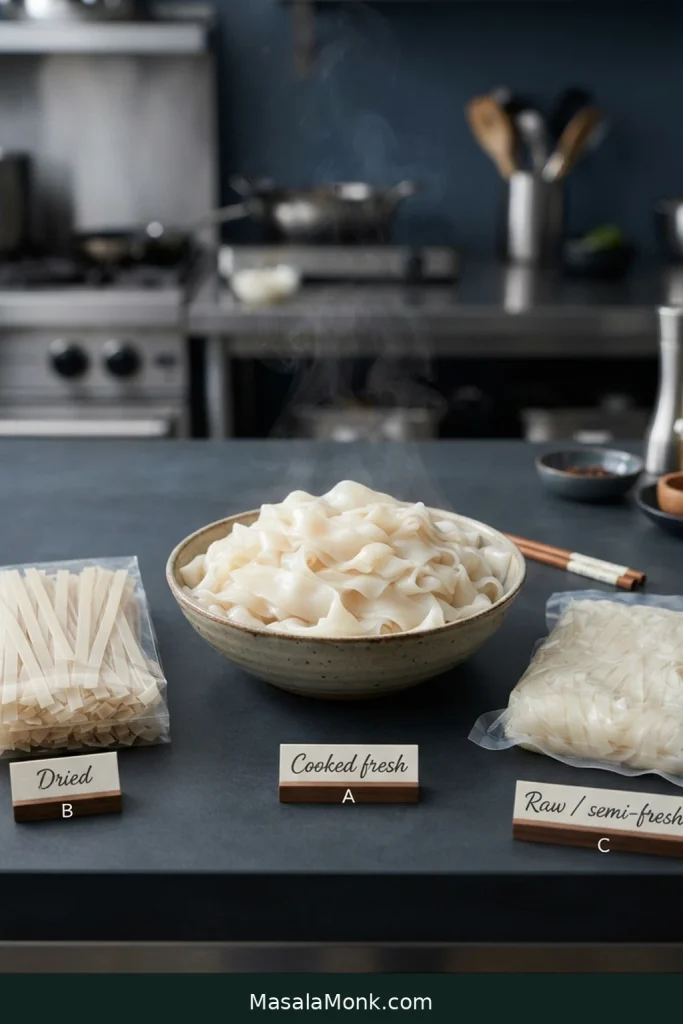
A packet labeled “fresh rice noodles” does not always tell you whether the noodles are already cooked. Look at what is actually inside.
| What You Have | What to Do |
|---|---|
| Soft, fully cooked fresh ribbons or sheets | Warm only if stiff, then separate gently. They do not need another boil. |
| Dry, rigid flat rice noodles | Hydrate until pliable but still slightly underdone. |
| Refrigerated or vacuum-packed raw/semi-fresh noodles | Follow the package’s actual cooking method; “fresh” alone does not tell you whether they are already cooked. |
Fresh Rice Noodles
Fully cooked fresh rice noodles become fragile after refrigeration, which is why a cold block can crack when you pull at it. Warm stiff noodles only until they become flexible enough to separate without fighting you.
Quick check: Bend one ribbon. A noodle that cracks instead of flexing needs a little more warming.
If good fresh noodles are impossible to find and you want to make the sheets themselves, Pailin Chongchitnant’s fresh ho fun noodle guide covers that separate process in detail.
Using Dried Rice Noodles
Dried noodles have the opposite problem. Once they are completely tender before the wok, there is very little margin left for absorbing sauce and surviving the final stir-fry.
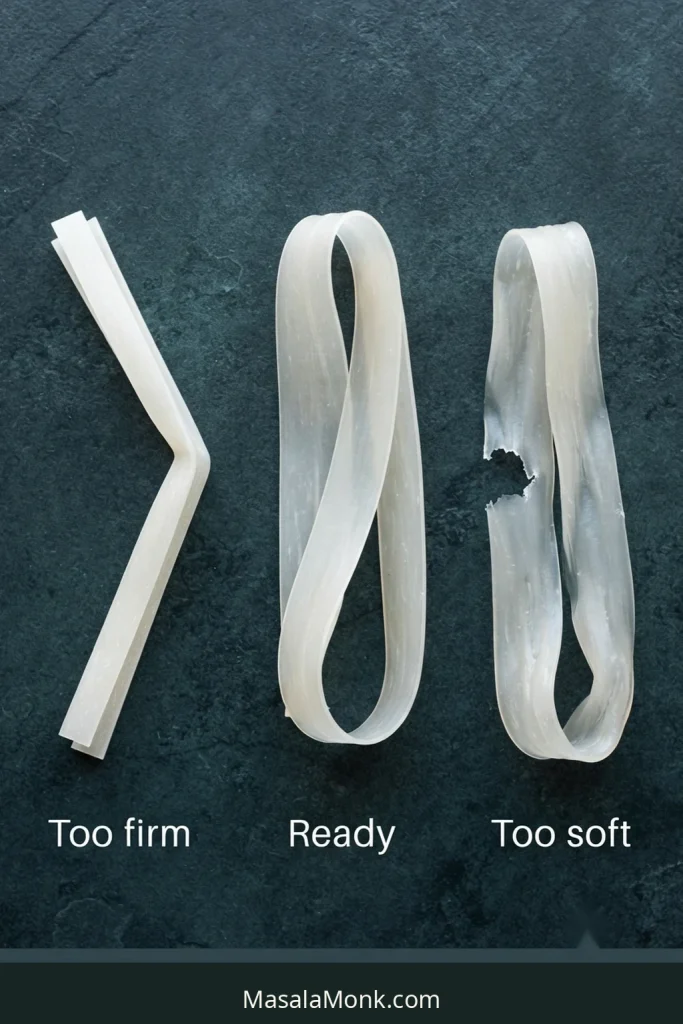
Package timing is only a starting point; the noodle’s texture matters more. The noodles should bend and separate easily while the center still retains a little resistance. Drain thoroughly. A brief cool rinse can help if your brand tends to stay especially starchy or sticky.
| State | What It Feels Like | What Happens in the Wok |
|---|---|---|
| Too firm | Stiff, difficult to bend, noticeably raw at the center | The noodles stay thirsty and can leave the finished pan looking dry |
| Ready | Pliable and separated but still a little resilient | They finish cooking as the sauce absorbs while keeping their chew |
| Too soft | Already completely tender, swollen or fragile | They are much more likely to become gummy, tear or turn mushy |
Why Weigh Them After Preparation?
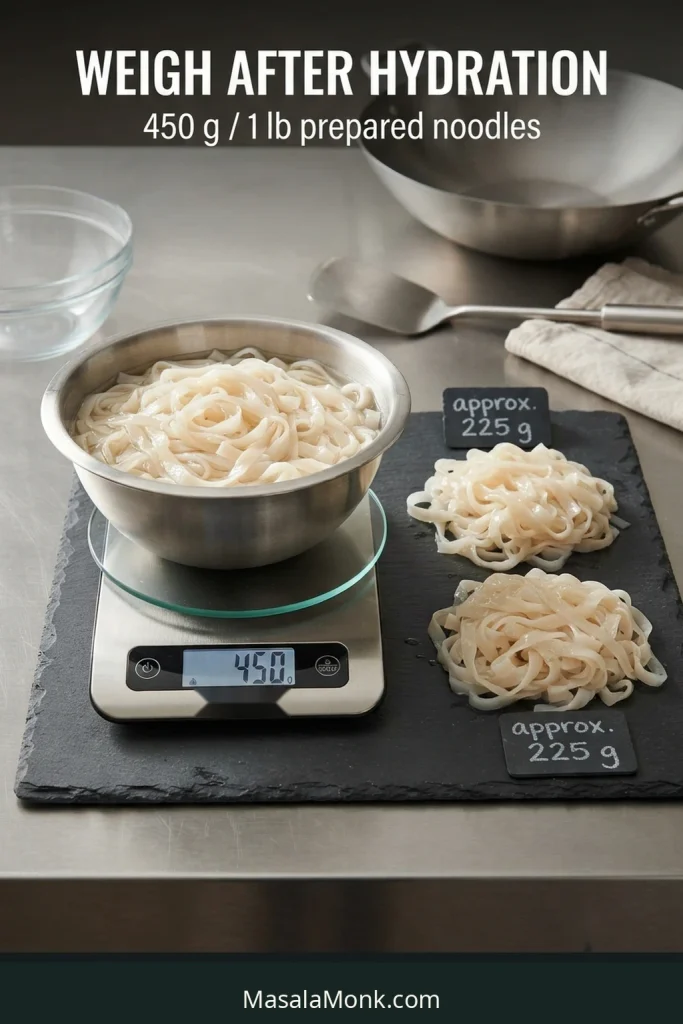
Soak two brands of dried wide rice noodles and they can come out surprisingly different in weight and softness. A single dry-to-fresh conversion sounds neater than it really is.
The sauce is calibrated for 450 g / 1 lb of noodles going into the wok. Fresh cooked noodles can be weighed straight from the package; dried noodles are easiest to measure once hydrated and drained. It takes another minute, but it makes the sauce much easier to judge.
The soaking logic is similar in our Pad Thai recipe, even though that dish heads in a very different direction once tamarind and its own finishing ingredients enter the pan.
Ready to cook? Go back to the Pad See Ew recipe. If the sauce is already sorted, you can also jump ahead to Sizzle or Steam? Read the Wok.
What the Pad See Ew Sauce Bottles Do
The collection of brown bottles becomes much easier to understand once you stop treating them as interchangeable versions of soy sauce.
| Ingredient | Its Job |
|---|---|
| Thai light/thin soy | Main salty, savory seasoning |
| Thai black soy | Darker color and deeper soy character |
| Oyster sauce | Rounded umami and body |
| Fish sauce | A small layer of fermented savory depth |
| Sugar | Rounds the salty edges and adds gentle sweetness |
| White pepper | Aromatic warmth without making the noodles chile-hot |
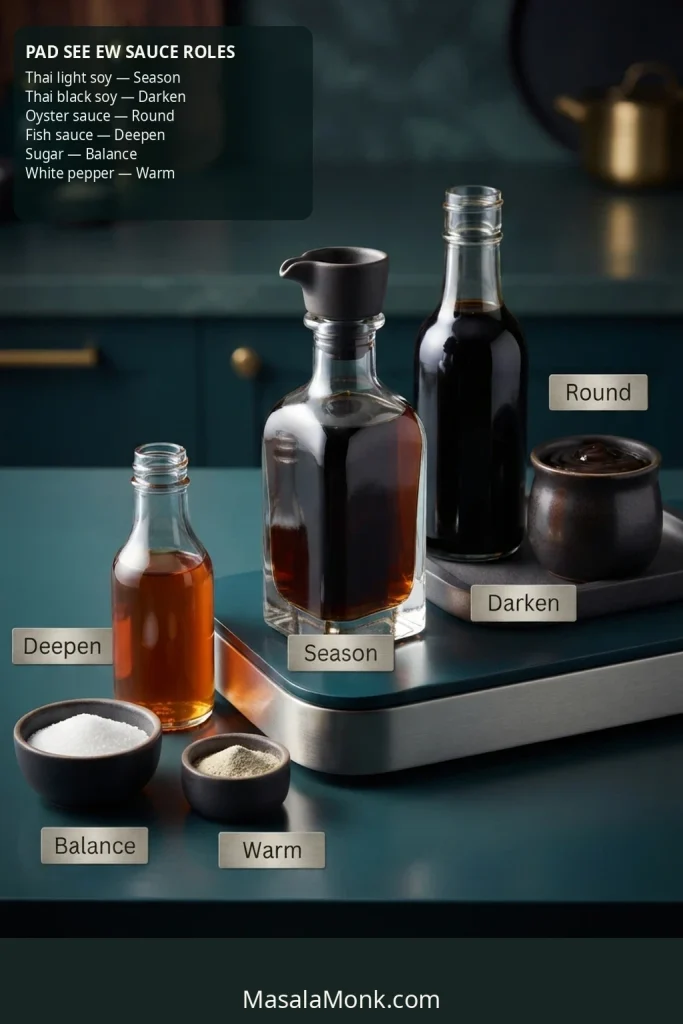
The finished sauce should taste deeply savory and gently sweet, with enough oyster sauce to round the soy without leaving the noodles sticky or heavy. The noodles’ exact shade of brown matters much less than that balance.
Soy Sauce Substitutions
No Thai light soy? Regular all-purpose soy sauce or Chinese light soy is a practical fallback. Choose one that is not labeled dark or sweet, and keep in mind that saltiness varies from brand to brand.
Chinese dark soy can replace the measured Thai black soy, but some brands are noticeably saltier. Don’t add extra for color; slightly lighter finished noodles are better than an oversalted dish.
If the labels in your pantry are confusing, our guide to soy sauce styles goes further into light, dark, sweet and all-purpose soy sauces.
Fish Sauce and Acidity
Fish sauce isn’t universal in Pad See Ew. This recipe uses a teaspoon for background fermented depth. Prefer to leave it out? Omit it, then taste the finished noodles before deciding whether the seasoning needs anything else.
Vinegar sometimes appears in the wok sauce too. Here, the sauce stays soy-forward and the bright acidity comes at the table through prik nam som, letting each person sharpen their own plate.
Sizzle or Steam? Read the Wok
That toasted, smoky aroma—part of what people mean by wok hei—comes from intense heat, fast evaporation and rapid contact with the hot cooking surface. Forget chasing an exact temperature. The sound and moisture in front of you tell you more.
Strong sizzle, almost no loose liquid: moisture is cooking off fast enough for parts of the noodles to fry against the wok.
The sizzle fades but the wok stays dry: the metal has cooled under the food. Give it a few seconds to catch back up.
Quiet wok with liquid underneath: now the noodles are steaming. Wet gai lan, poorly drained noodles, too much food or too much sauce at once can all push the cook in that direction.
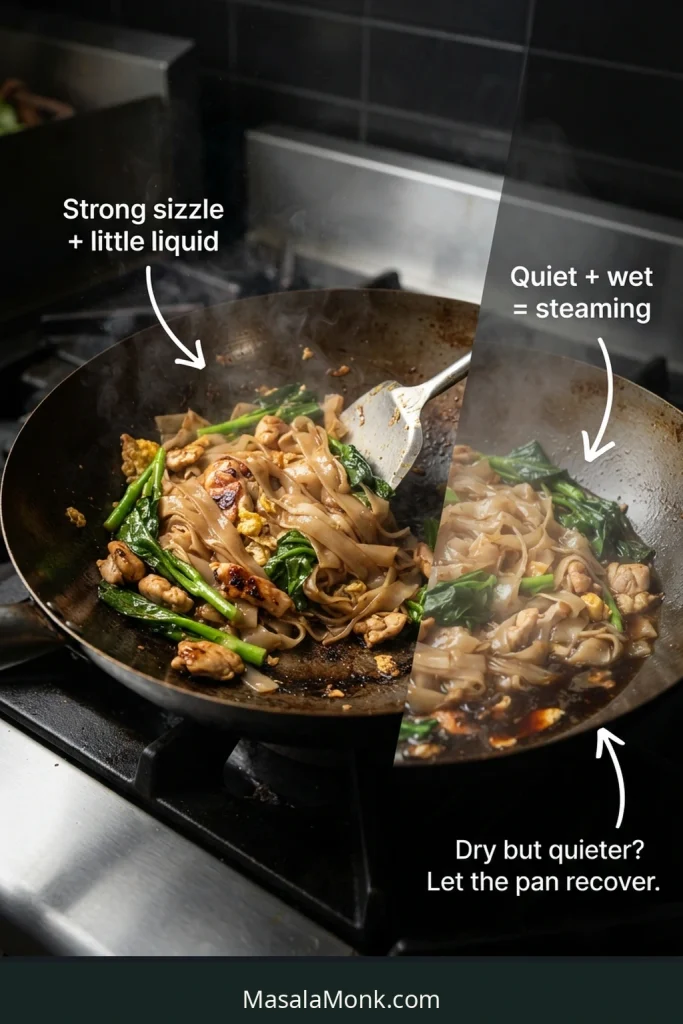
Think of the wok as having a heat budget. Every cold or wet ingredient spends some of it. Cooking less at once gives a home stove much more chance to keep up.
Gas, Electric or Induction?
A restaurant gas wok burner makes intense browning easier, but gas is not required for good Pad See Ew. A flat-bottom carbon-steel wok works well on many home cooktops, while a broad heavy skillet is a practical alternative when it gives you better contact with the cooktop. Induction and conventional electric burners can brown the noodles too; give the cookware time to get properly hot.
More Browning on a Home Stove
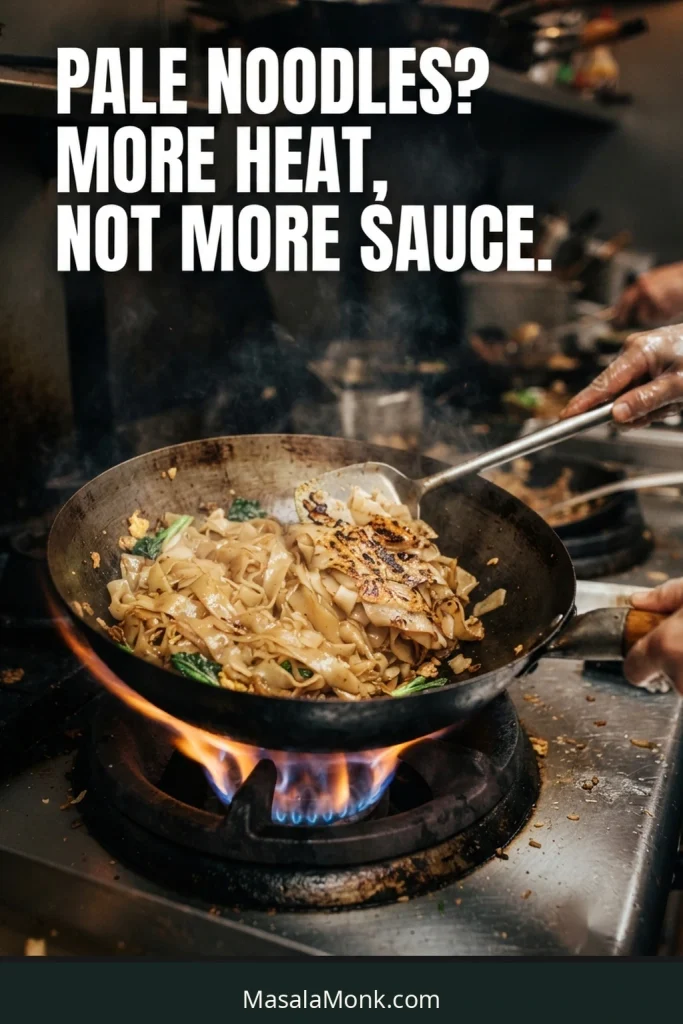
Start with a properly hot wok, keep the noodles and greens well drained, and leave the noodles undisturbed long enough to pick up browned patches. Keep each batch around 225 g / 8 oz so the stove can recover. If the seasoning already tastes right, a pale batch needs more heat, not more sauce.
Pad See Ew Troubleshooting
Most common failures trace back to noodle preparation, moisture or heat. Match what you see to the problem below before changing the sauce.
Noodle Problems
| What Happened | Likely Cause | What to Change |
|---|---|---|
| Fresh noodles shattered while separating | Cold, brittle noodles or too much force | Warm until pliable, then peel apart gently |
| Fresh noodles stuck badly to the wok | Wok not hot enough, too little oil or a sticky cooking surface | Preheat properly, use enough oil and favor cookware you know releases well |
| Dried noodles turned mushy | They were fully softened before the wok | Stop hydration while they still retain slight resistance |
| Dried noodles are still hard | They entered the wok underhydrated | Add 1 tbsp / 15 ml water at a time and let it absorb before checking again |
| Noodles feel gummy | Overhydration, excess surface starch, too much liquid or weak heat | Stop hydration sooner, drain thoroughly and cook smaller batches |
Flavor and Heat Problems
| What Happened | Likely Cause | What to Change |
|---|---|---|
| No smoky or toasted character | The noodles mostly steamed | Use drier ingredients, cook less at once and leave the noodles undisturbed a little longer |
| Too salty | Wrong soy style/brand or too much sauce for the amount of noodles | Check the soy styles and confirm that 450 g / 1 lb prepared noodles actually went into the wok |
| Extremely dark or too sweet | A much sweeter or darker soy replaced the primary light soy | Use light/thin soy for most of the seasoning and black soy in the smaller supporting role |
| Salty enough but still tastes flat | Weak browning or the plate needs brightness | Improve browning next time; at the table, try a little chile vinegar before adding more salty seasoning |
| Gai lan stems hard but leaves limp | Thick stems and leaves cooked for the same amount of time | Slice or split the stems and give them a head start |
| A doubled recipe turned soggy | Too much food went into each batch | Cook more batches instead of making each one larger |
Found the problem? Return to the recipe, or recheck the noodle guide before the next batch.
Protein and Gai Lan Swaps
Pad See Ew is a noodle dish first. Keep the protein and vegetables in supporting proportions so the noodles still have room to fry properly.
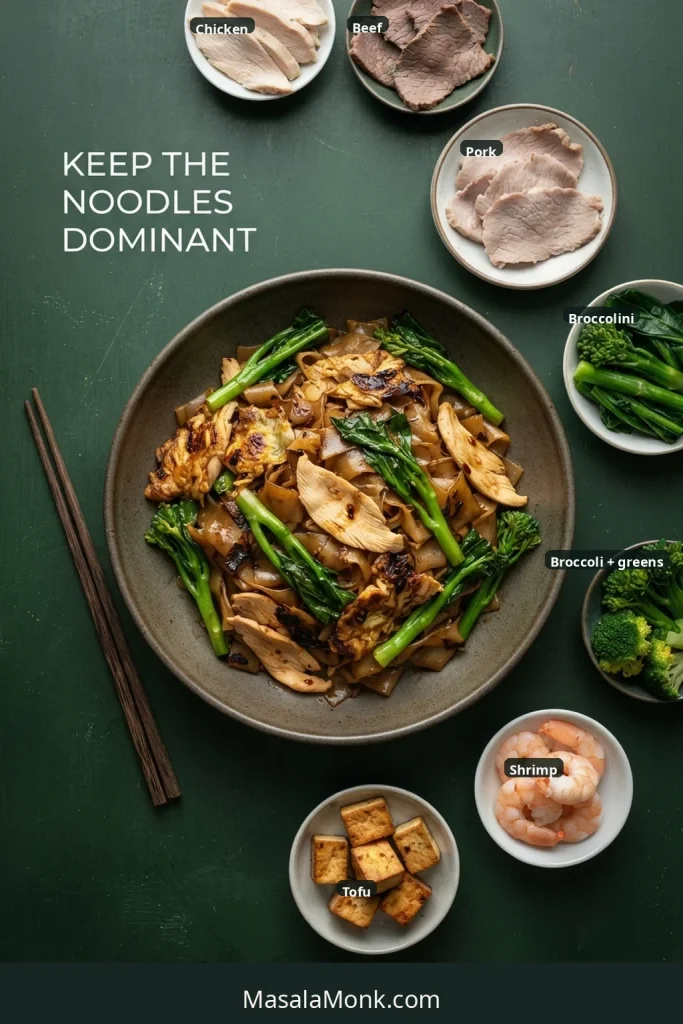
- Chicken thigh: the default here and the most forgiving choice at high heat.
- Chicken breast: slice it thinly and remove it promptly once cooked through so it does not dry out.
- Beef: thin slices work best; a light cornstarch marinade is enough for most cuts.
- Pork: use thin slices of a quick-cooking cut and cook them before the noodles.
- Shrimp: cook quickly and remove as soon as they turn opaque; return them near the end so they stay tender.
- Firm or extra-firm tofu: brown it separately before adding.
- Broccolini: the closest widely available stand-in for gai lan.
- Broccoli + a leafy green: a workable fallback when gai lan and broccolini are unavailable.
Gai lan’s slight bitterness is especially good against the sweet-savory noodles, so keep some leafy green in the dish even when you substitute the stems.
For beef, thin slicing across the grain matters more than buying an expensive cut. The slicing and light-velveting method in Beef and Broccoli is useful here too.
Vegetarian or Vegan Pad See Ew
Use firm or extra-firm tofu and replace the oyster sauce with a vegetarian mushroom-based oyster-style sauce. Omit the fish sauce or use a suitable vegan savory seasoning. For a vegan version, leave out the eggs as well.
Dry the tofu well and brown it separately before it joins the noodles. Wet tofu cools a hot wok surprisingly quickly.
Pad See Ew vs Pad Thai, Drunken Noodles and Lo Mein
| Dish | What Sets It Apart |
|---|---|
| Pad See Ew | Broad rice noodles, soy-driven seasoning, egg, Chinese broccoli and irregular caramelized edges; generally mild |
| Pad Thai | Usually thinner rice noodles with a brighter sweet-sour profile led by tamarind |
| Pad Kee Mao / Drunken Noodles | Usually hotter and more aromatic, commonly using fresh chile and Thai basil |
| Lo Mein | Chinese-style wheat or egg noodles with a softer, more uniformly sauce-coated finish |
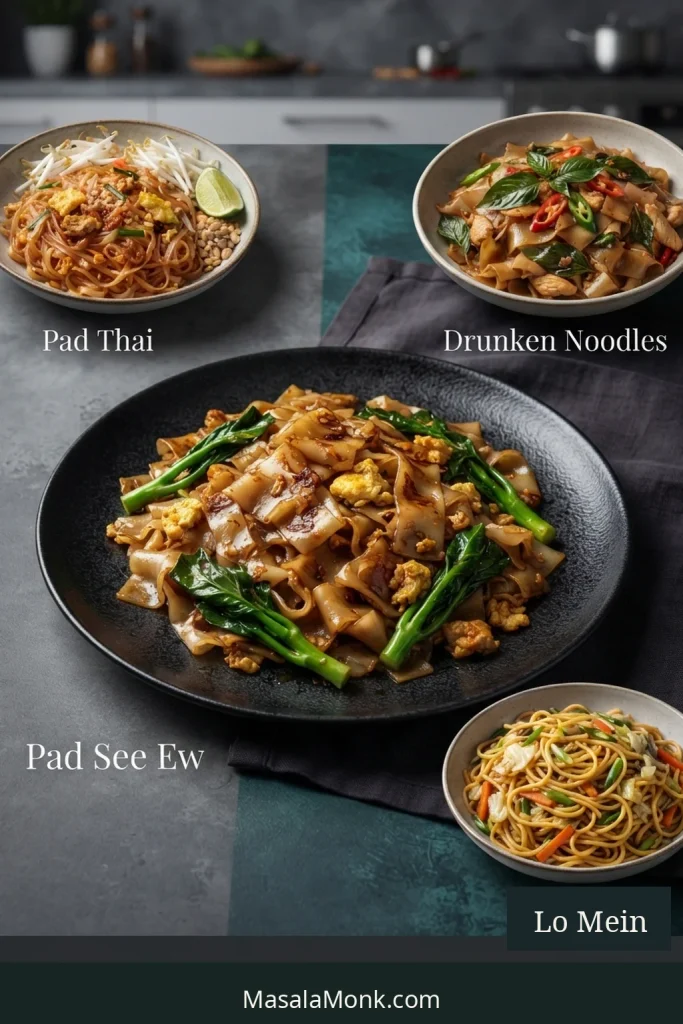
For softer wheat noodles with more uniform sauce coverage, Chicken Lo Mein heads in that direction instead.
Chile Vinegar and Table Seasoning
Pad See Ew works as a one-plate meal. At the table, a few seasonings let each person adjust the noodles to taste.
The quick prik nam som from the recipe card is especially useful here. A small spoonful adds acidity and fresh chile heat, cutting through the glossy soy coating without changing the whole wok.
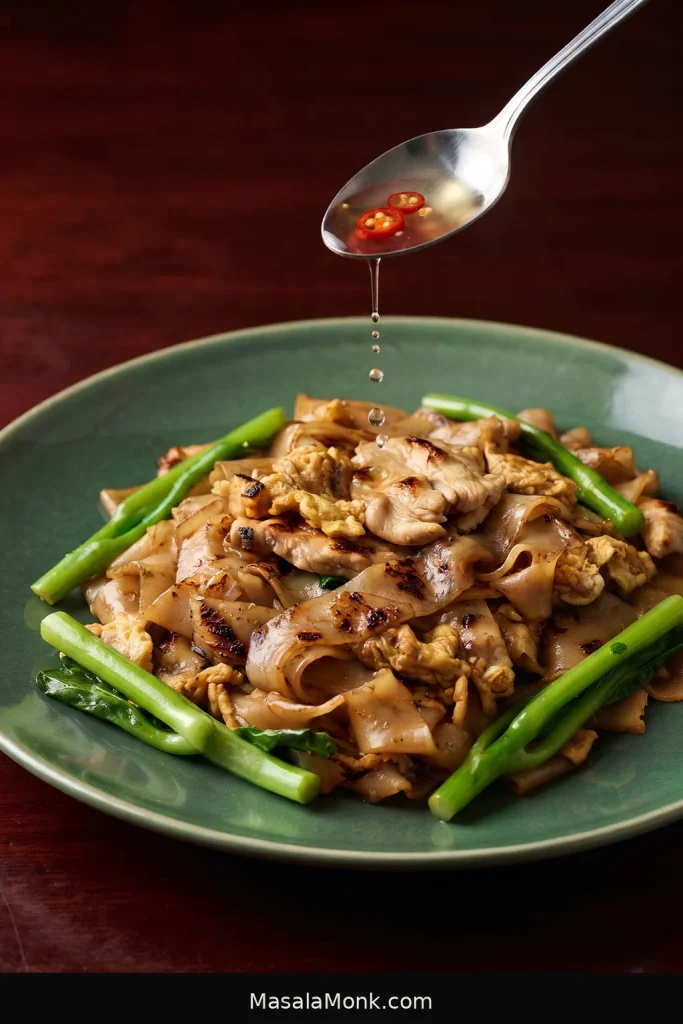
Extra white pepper, chile flakes and a little sugar can also go on the table.
If you want something cool and crunchy beside the noodles, a sharp cucumber salad with lime, vinegar, chile and herbs works well.
Prep Ahead, Store and Reheat
You can mix the sauce, season the chicken, wash and cut the gai lan, chop the garlic and make the chile vinegar ahead. Keep the chicken refrigerated until cooking. Leave the final noodle preparation and stir-frying until close to serving.
Leftovers
Refrigerate leftovers within 2 hours—or within 1 hour when the surrounding temperature is above 90°F / 32°C—and use them within 3–4 days. Rice noodles will soften noticeably before that window is over.
Reheat leftovers to 165°F / 74°C. Cold rice noodles can be brittle, so let the heat begin softening them before stirring aggressively.
A dry portion usually needs only a small splash of water. Extra soy-heavy sauce can make the noodles saltier without bringing back the chew they had fresh from the wok.
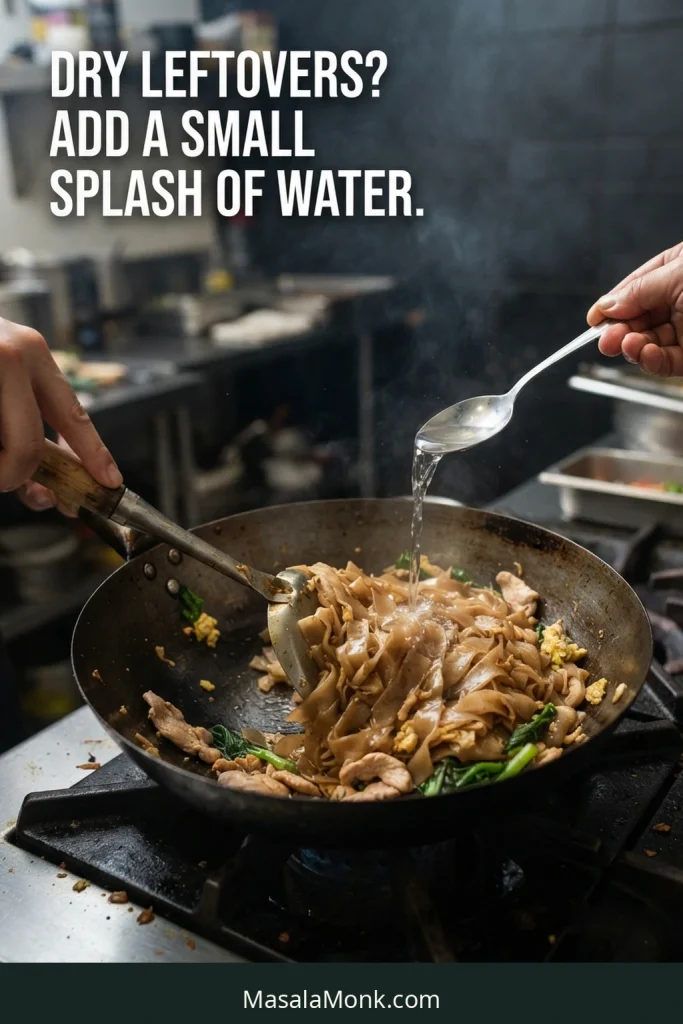
Pad See Ew is still at its best straight from the pan, when the noodles have their fullest chew and those browned edges are fresh. Leftovers are still good, but expect softer noodles and let them warm before tossing them around too much.








