Posted on Leave a comment

Twice Baked Potato Casserole Recipe (Loaded with Bacon & Cheese)

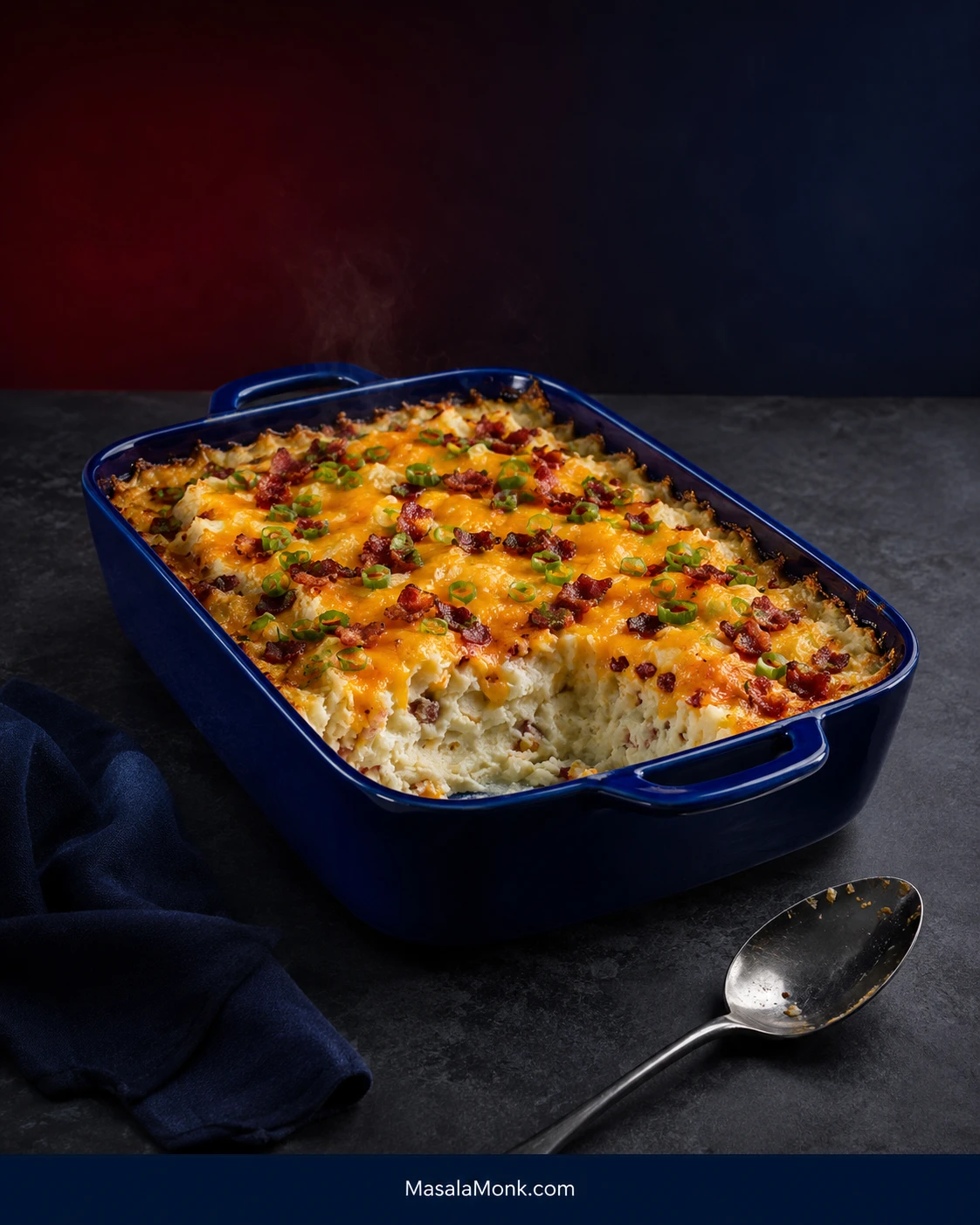
Blue rectangular casserole dish filled with fluffy potato and topped with melted cheddar, crisp bacon and sliced green onions, with a serving removed from one corner.

Individual twice-baked potatoes are wonderful when you’re making a few. For a crowded table, all that scooping, refilling and balancing fragile potato shells on a tray becomes work nobody misses once the cheese is bubbling.

This twice baked potato casserole keeps the same bake-scoop-enrich-bake idea but moves the filling into one dish. It has everything you’d expect in a loaded baked potato casserole—sharp cheddar, bacon, sour cream and green onion—while starting with whole baked russets, which keeps the finished casserole closer to a true baked potato than a loaded mash.

The cheddar on top melts into deeper golden patches while the potato underneath stays light, creamy and easy to scoop. Bacon runs through the middle for smoky flavor, with another crisp handful saved for the top.

The full recipe fills a 9×13-inch / 23×33-cm dish and serves about 10 to 12 as a side. You can assemble it up to two days ahead, scale it down for two or three people, or double it into two pans for a bigger table.

Quick Answer: How to Make Twice Baked Potato Casserole

Bake 5 lb / 2.27 kg russet potatoes at 425°F / 220°C until a thin knife slides easily through the centers. Scoop the flesh while it is still warm and gently rice or mash it.

Fold in butter, cream cheese, sour cream and enough warm milk to make the potatoes creamy but still thick enough to hold soft ridges. Add sharp cheddar, crisp bacon and green onion, spread everything into a 9×13-inch / 23×33-cm dish, top with more cheddar and bacon, and bake at 375°F / 190°C for 25–30 minutes.

Same day: bake while the filling is still warm. Making it ahead: assemble while warm and refrigerate for up to 2 days. Baking from cold: heat it covered first, then uncover so the top can brown.

Make It Now: Twice Baked Potato Casserole

Serves: 10–12 side servings · Active time: about 25–35 minutes · Same-day total: about 1 hr 45 min–2 hr 15 min

Pan: 9×13 in / 23×33 cm, about 3 qt / 2.8 L · First bake: 50–70 min · Second bake: 25–30 min · Make ahead: up to 2 days

Equipment: rimmed sheet pan · large skillet · large bowl · potato ricer or hand masher · 9×13-inch / 23×33-cm baking dish

Ingredients

  • 5 lb / 2.27 kg russet potatoes, roughly 6–8 large; use the weight if possible
  • 1 tbsp / 15 ml olive or neutral oil, optional, if you want seasoned or crisp potato skins
  • ½ cup / 113 g unsalted butter
  • 4 oz / 113 g cream cheese
  • 1 cup / about 225 g sour cream
  • ¾–1 cup / 180–240 ml whole milk, warmed and added as needed
  • 12 oz / 340 g sharp cheddar, about 3 cups shredded, divided
  • 12 oz / 340 g bacon, raw weight
  • 6 green onions, thinly sliced; keep the darker green tops separate
  • 1½ tsp garlic powder
  • ½ tsp freshly ground black pepper, plus more to taste
  • ½–1 tsp kosher salt to start, depending on the brand; if using fine table salt, start with ½ tsp, then taste again after the bacon and cheddar are mixed in

Cheddar grated from a block melts a little more smoothly, but good pre-shredded cheddar is completely fine here.
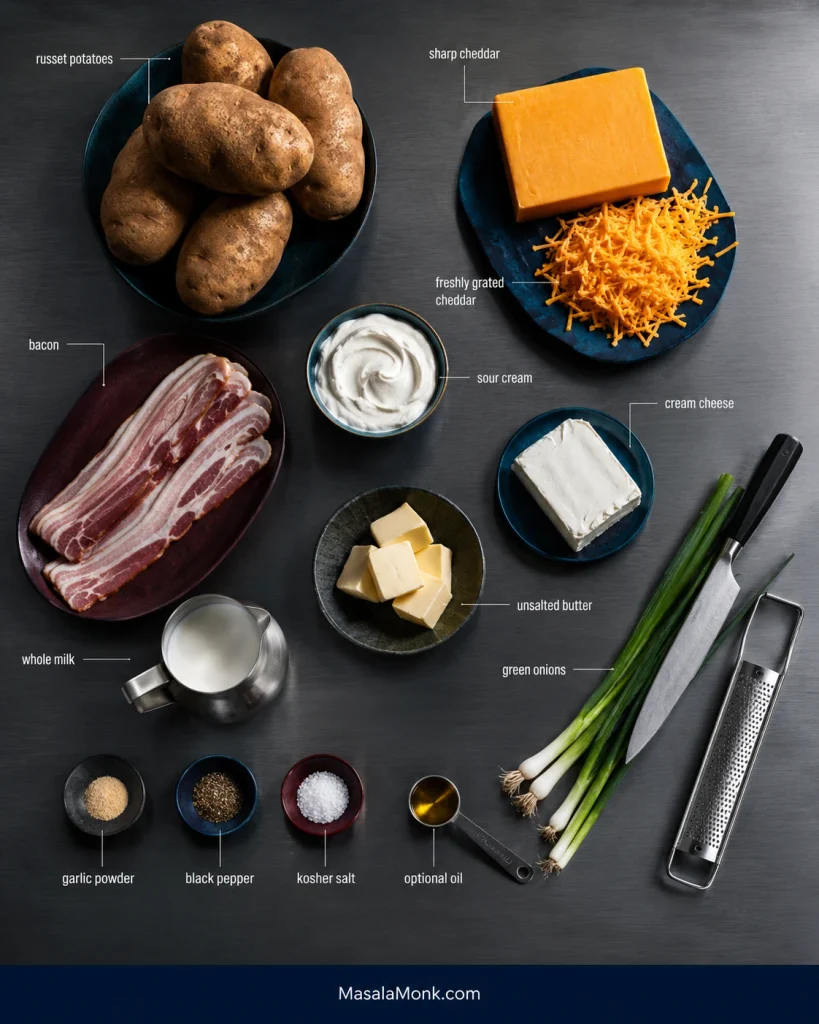
Overhead layout of russet potatoes, butter, cream cheese, sour cream, milk, cheddar, bacon, green onions and seasonings for twice baked potato casserole.

How to Make It

1. Bake the potatoes and cook the bacon

Heat the oven to 425°F / 220°C. Take the butter, cream cheese and sour cream out of the refrigerator so they can lose some of their chill while the potatoes bake. Warm the milk just before you need it.

Scrub and dry the russets, then prick each one several times with a fork. Don’t wrap them in foil; dry oven heat gives us the baked-potato texture we’re after. Rub with a little oil and salt only if you plan to eat or fold in some of the skins.

Arrange the potatoes on a rimmed sheet pan with a little room between them and bake for about 50 to 70 minutes, depending on size. Start checking the smaller potatoes first.

While they bake, cook the bacon in a large skillet over medium heat until browned and crisp. Transfer it to paper towels or a rack to drain, then chop or crumble it. If keeping the stovetop clear would help, air-frying the bacon works here too.

The potatoes are ready when a thin knife or skewer slides through the center with almost no resistance. Don’t stop at “the fork technically went in.” Hard potato pieces now will still be hard after the second bake.

2. Scoop and process while warm

Let the potatoes cool only until they are comfortable enough to handle. Split them and scoop the flesh into a large bowl.

Pass the warm potato through a ricer, or mash gently by hand until the large pieces are gone. If three stubborn little lumps are still there, leave them. The urge to keep mixing until everything looks perfectly smooth causes far more trouble than those little pieces ever will.
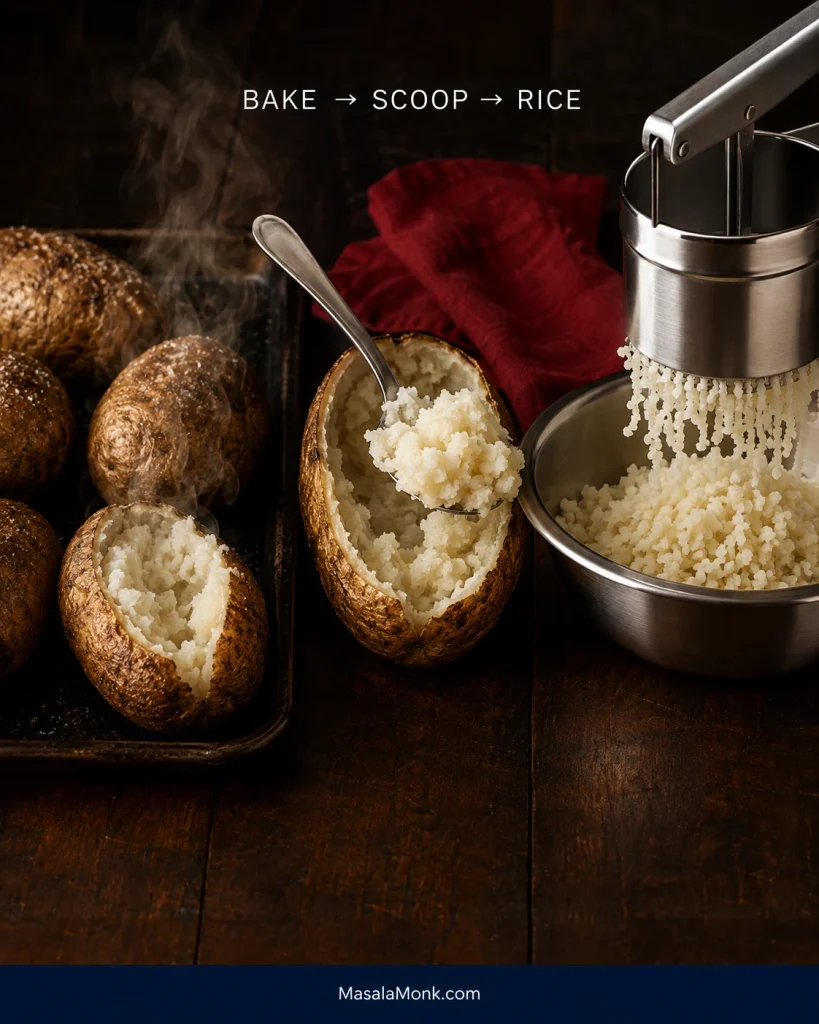
Baked russet potatoes beside scooped potato flesh and a metal potato ricer, illustrating the bake, scoop and rice preparation sequence.

3. Add the dairy and check the consistency

Fold the ½ cup / 113 g butter into the warm potatoes first, then add the 4 oz / 113 g cream cheese and 1 cup / about 225 g sour cream. Mix only until everything is distributed.

Add ¾ cup / 180 ml warm milk. Keep the remaining ¼ cup / 60 ml nearby and add more only if the potatoes still feel stiff.

Check the consistency before adding the cheese:

Too stiff: the potatoes break into firm ridges and fight the spoon. Add warm milk 1 tbsp / 15 ml at a time.

Right: creamy and easy to spread, with soft ridges that stay visible when you drag a spoon through it.

Too loose: the mixture slumps flat and the spoon groove immediately disappears. Stop adding liquid.
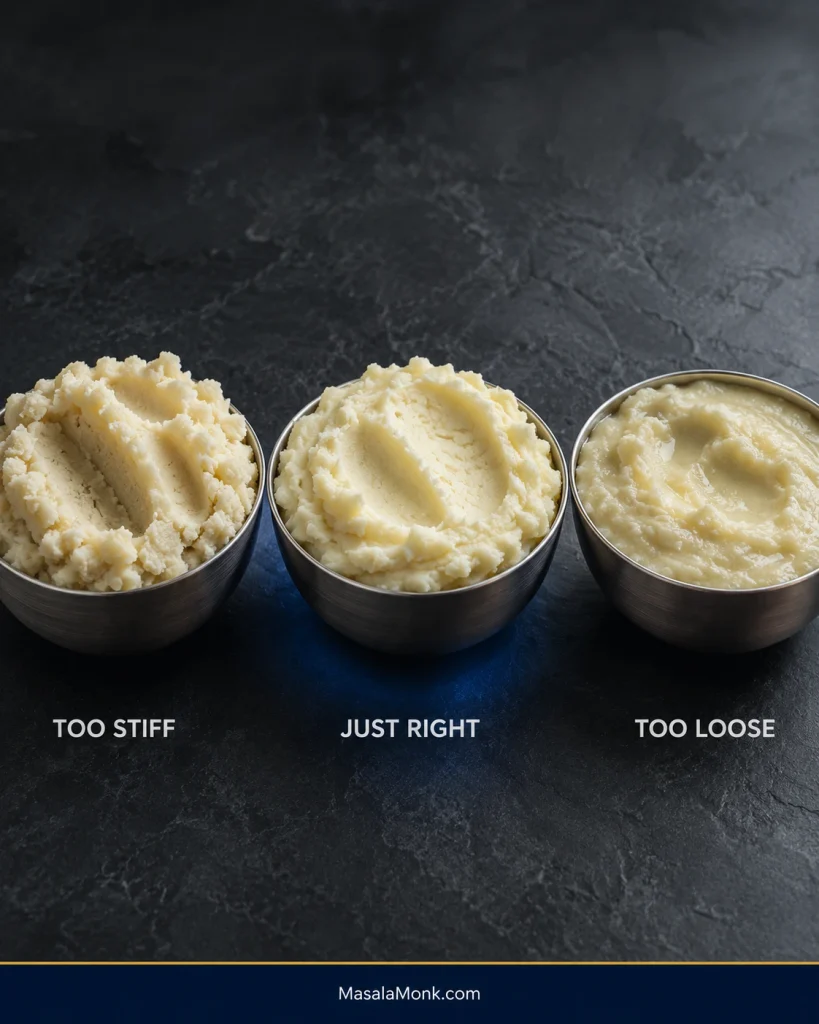
Three bowls labeled too stiff, just right and too loose, showing dry firm potatoes, softly moundable potatoes and runny potatoes.
Milk is a ceiling, not a target. Stop when the potatoes hold soft ridges.

4. Add the cheddar, bacon and seasoning

Reserve about 1 cup / roughly 110 g cheddar for the top. Fold the remaining cheddar into the potatoes with about two-thirds of the cooked bacon, the white and pale-green parts of the green onions, garlic powder, black pepper and the starting amount of salt.

Taste before adding more salt. Bacon and cheddar vary enough from brand to brand that the bowl may already have all it needs.

Bacon mixed through the potatoes seasons every scoop; bacon added at the end still crunches.

5. Assemble gently

Reduce the oven to 375°F / 190°C. Lightly grease a 9×13-inch / 23×33-cm baking dish, spoon in the potatoes and spread them into an even layer without packing them firmly into the dish.

Scatter over the reserved cheddar and roughly half of the remaining bacon. Save the last handful for serving.

6. Give it the second bake

Bake uncovered for 25 to 30 minutes, until the middle is hot, the cheese is completely melted and the edges are just beginning to bubble.

7. Brown the top and finish

For deeper color, broil for 1 to 3 minutes—or use your oven’s top-grill setting—only if the baking dish is suitable for direct top heat. You’re looking for melted cheddar with a few deeper golden patches rather than a hard, dark crust.

If the dish isn’t suitable for broiling, raise the oven to 425°F / 220°C for about 3–5 minutes instead and watch the cheese closely.

Let the casserole rest for 5 to 10 minutes so the potatoes settle slightly and scoop more cleanly. Finish with the last crisp bacon and the dark-green onion tops or fresh chives.
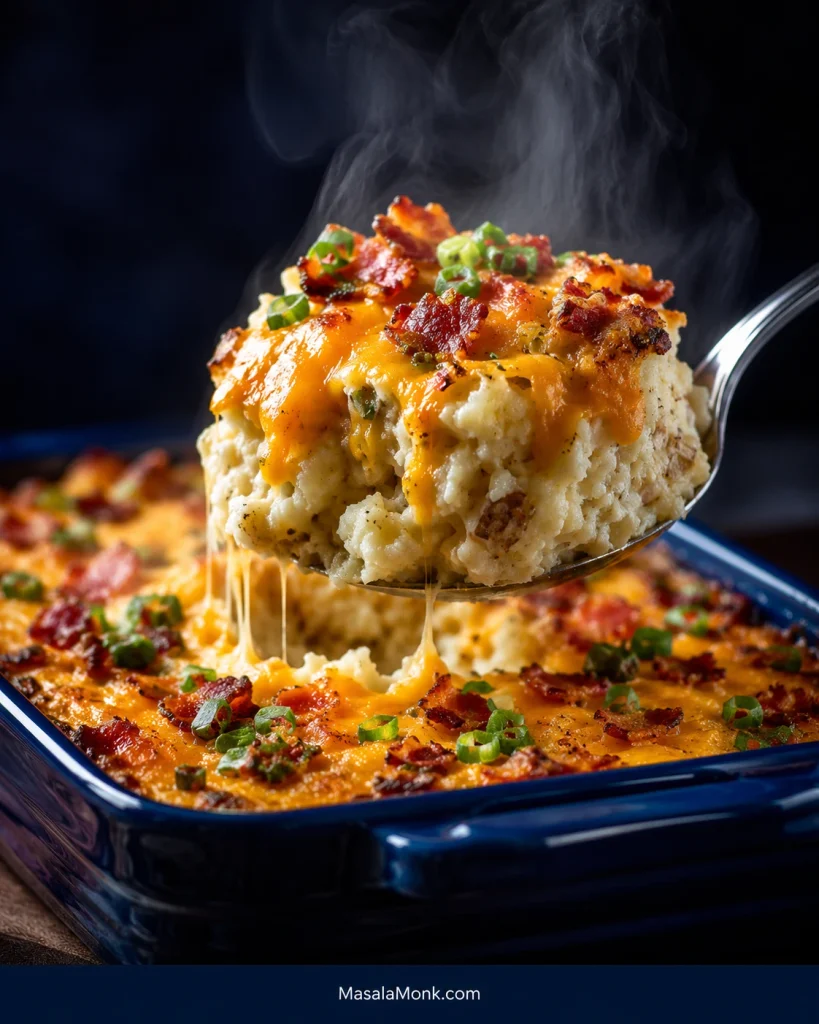
Serving spoon lifting a portion of twice baked potato casserole with fluffy potato, melted cheddar, bacon pieces and green onion visible.

The Casserole Guide

If dinner is already moving, everything you need to cook the casserole is above. The rest is for the moments when the plan changes: different potatoes, tomorrow’s dinner, leftover mash, a smaller table, a packed schedule, or a casserole that isn’t behaving quite the way you expected.

Traditional twice-baked potatoes are baked, scooped, enriched and baked again. This version keeps that method but moves the enriched potato into one casserole dish; starting with whole baked russets is what separates it from a loaded mashed-potato casserole.

Technique: potato choice · bake vs boil · dairy balance · gummy potatoes

Planning: make ahead · troubleshooting · substitutions · leftovers · scaling · storage · reheating · serving

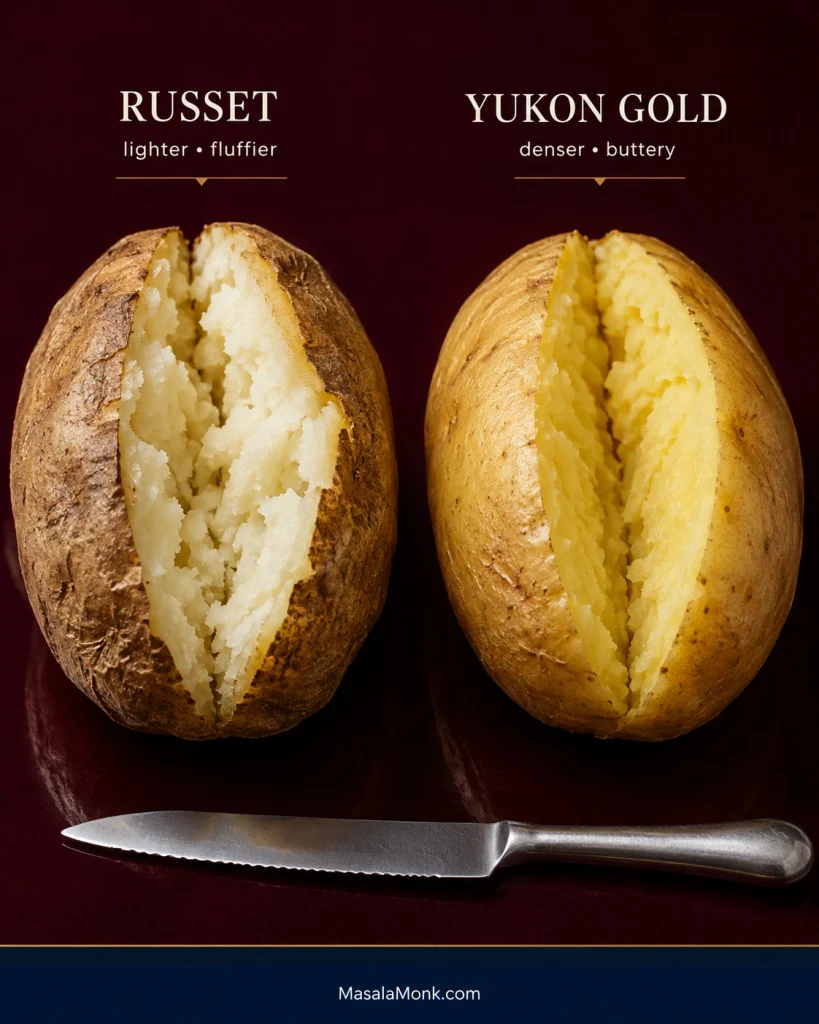
Russet or Yukon Gold?

PotatoTextureBest use here
RussetDry, high-starch, light when bakedBest choice for this recipe
Yukon GoldDenser, buttery and naturally creamyUse when you prefer a tighter casserole
Red or other waxy potatoesFirm and waxierBetter for chunkier potato dishes
Cut russet and Yukon Gold potatoes shown side by side, with the russet appearing pale and fluffy and the Yukon Gold denser and yellow.
Using Yukon Golds? Hold back more milk at first—their denser, naturally creamy flesh may reach the right consistency sooner than russets.

Love the skin? Save the crispest skin from one or two russets, chop it fairly small and fold it through the potatoes. Using every skin can make an otherwise creamy casserole surprisingly chewy.

Bake or Boil?

Bake the potatoes when baked-potato flavor matters most. The oven lets moisture escape and leaves the centers drier, giving the butter and dairy somewhere to go without making the casserole feel wet.

Boiling is quicker, but the result lands closer to loaded mashed potatoes. If speed wins today, jump to the shortcut potato options.

Getting the Dairy Balance Right

The dairy should make the potatoes richer and easier to scoop without turning them into cheese sauce with potato underneath. At the right balance, each serving is buttery and tangy but still unmistakably russet.

Milk is the part to judge rather than measure blindly. Potato size, moisture and baking time all change how much the bowl needs.

Why Potatoes Turn Gummy

Those few lumps were never the problem; too much mixing is. Cooked potato starch becomes sticky when the potatoes are worked too aggressively, which is why a ricer or hand masher is safer than electric beaters or a food processor.

Once the potatoes become elastic and gluey, there isn’t a reliable way to beat them back into fluffiness. A few harmless lumps disappear under melted cheddar much more easily.
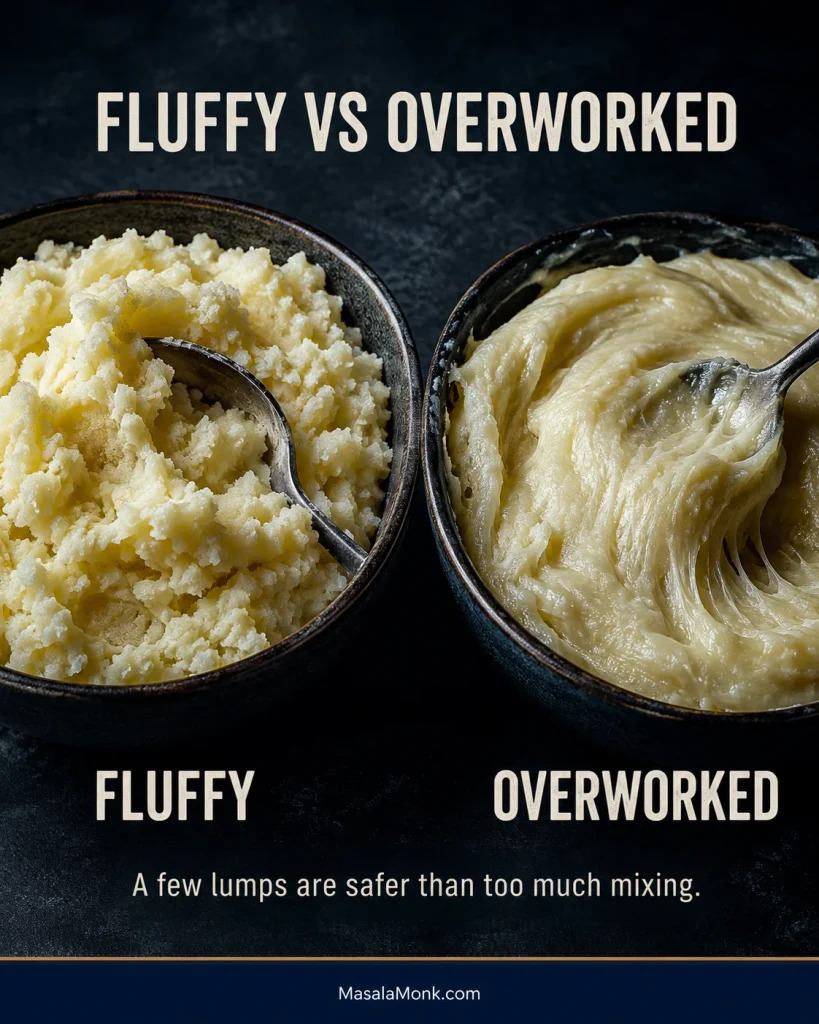
Side-by-side comparison labeled fluffy and overworked, showing light irregular mashed potato beside smooth, dense and gluey-looking potato.
Watch the surface as you mix: fluffy potato stays matte and softly ridged, while overworked potato grows smoother, shinier and increasingly elastic before the gummy texture becomes obvious.

If you want to go deeper on ricer vs masher, potato varieties and starch handling, the MasalaMonk mashed potatoes guide covers those techniques in more detail.

Once the texture is right, the next question is usually timing: are you baking it now or tomorrow?

Making It Ahead

Assemble the casserole while the potatoes are still warm, then refrigerate it for up to 2 days. This is a better stopping point than chilling whole baked potatoes and trying to mash them cold the next day.

A make-ahead casserole should make tomorrow easier. Finish the filling while everything is easy to work with, spread it into the dish and let the heaviest steam subside briefly, then refrigerate promptly. Cover loosely while the casserole finishes cooling in the refrigerator, then cover tightly once chilled.

Keep the final cheddar, some of the bacon and the dark-green onion tops separate. Chilled potatoes firm up; when the mixture looks unusually dry the next day, loosen it gently with 1–3 tbsp / 15–45 ml milk or cream. Saving those final toppings also means the finished casserole still gets fresh crunch and color.

Using a chilled glass or ceramic dish? Check the manufacturer’s instructions before putting it straight from the refrigerator into a hot oven.
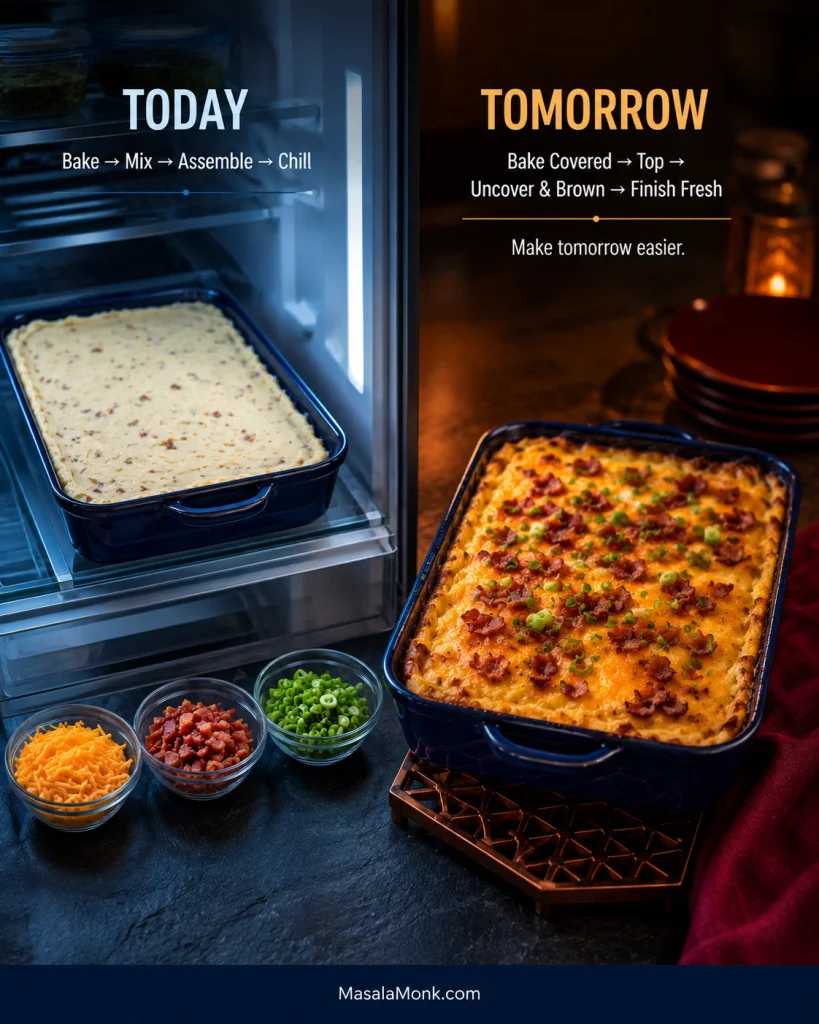
Make-ahead sequence with an assembled twice baked potato casserole in a refrigerator and reserved toppings, followed by the browned finished casserole the next day.
A browned top can hide a cool center. When baking from cold, give the middle a covered head start.

Baking the Casserole From Cold

A cold casserole can fool you: the cheese looks finished, the edges are bubbling, and the first scoop from the middle is barely warm. Give the center a head start under foil.

  1. Heat the oven to 375°F / 190°C.
  2. Cover loosely with foil and bake for about 30 minutes.
  3. Uncover, add or refresh the cheddar and some bacon, then bake another 15–20 minutes.
  4. Check the center. A casserole that was assembled, chilled and is now being reheated should reach 165°F / 74°C.
  5. Use the broiler/top-grill briefly only if the dish is suitable for it.
  6. Finish with the reserved crisp bacon and fresh green onion or chives.

What Went Wrong?

Most problems come down to one of three things: the potatoes were worked too hard, the moisture is off, or the middle simply needs more heat. Some can be corrected immediately; a few are much easier to prevent next time.

ProblemFix nowNext time
Gummy or glueyStop mixing; badly overworked potato is difficult to reverse.Use a ricer or masher and stop sooner.
RunnyStop adding wet ingredients. Extra cooked potato can rescue a badly loose batch.Add milk gradually.
DryAdd warm milk 1 tbsp / 15 ml at a time.Judge the potatoes before using all the milk.
Dry after refrigerationLoosen gently with 1–3 tbsp milk or cream.Expect chilled potato to firm up.
A few small lumpsLeave them alone.Use a ricer if you prefer something smoother.
Hard potato piecesThere is little you can do once everything is assembled.Bake the potatoes completely during the first cook.
Too saltyExtra plain cooked potato can dilute a badly oversalted batch.Taste after the bacon and cheddar go in before adding more salt.
Brown top, cool centerCover and continue heating.Use the bake-from-cold method.
Soft baconAdd fresh crisp bacon before serving.Reserve some bacon from the oven.

Once the potatoes feel right, most of the swaps below change the flavor more than the texture.

Substitutions & Faster Routes

Plain Greek yogurt can replace the sour cream; start with roughly the same amount and hold back some of the milk because yogurt thickness varies. Cream cheese can simply be omitted. For the milk, half-and-half works directly; with heavy cream, start with less and loosen the potatoes only as needed.

Making it without bacon? Leave it out, then taste again because you’re also losing salt, smoke and crunch. Smoked paprika can return some smoky flavor, while crisp fried onions make a good optional topping.

Monterey Jack or Colby Jack keep things mild and creamy, Pepper Jack adds some heat, and extra-sharp cheddar gives you stronger cheese flavor without simply adding more cheese.

Shortcut Potato Options

ShortcutHow to use itMain tradeoff
Boiled potatoesCut evenly, simmer until soft through the center, drain well and steam-dry briefly in the warm pot before mashing.Faster, but less baked-potato character.
Microwaved russetsPrick and microwave whole until a knife slides easily through. Split and let steam escape before scooping.Fastest whole-potato route; centers can be slightly wetter.
Frozen mashed potatoesHeat according to the package, then fold in cheddar, bacon and green onion. Add sour cream for tang if you want it, then add any other dairy only as needed.Butter, milk, cream or seasoning may already be included.
Frozen potato chunksCook until soft through the center, drain or dry well, then mash.Moisture varies by product.
Instant mashed potatoesPrepare first, then add the loaded-potato ingredients to taste.Fastest dinner-now option, but a different texture.

Frozen shredded hash browns behave differently enough that a hashbrown casserole is the better route.

Starting With Leftover Potatoes

Plain leftover baked potatoes work well. Warm them until the centers soften enough to rice or mash, then use the scaling table as a starting point for the butter, sour cream, cheddar and bacon. Just as in the main recipe, hold back some of the milk until you see what the potato actually needs.

If you’re working through more baked potatoes than this casserole needs, the leftover baked potatoes guide has more ways to use them.

Leftover mashed potatoes need a different approach because their butter, milk, salt and seasoning are already there. Warm the mash, fold in cheddar, bacon, green onion and garlic, then loosen only when the texture asks for it.

For Two, Half Batches & Crowds

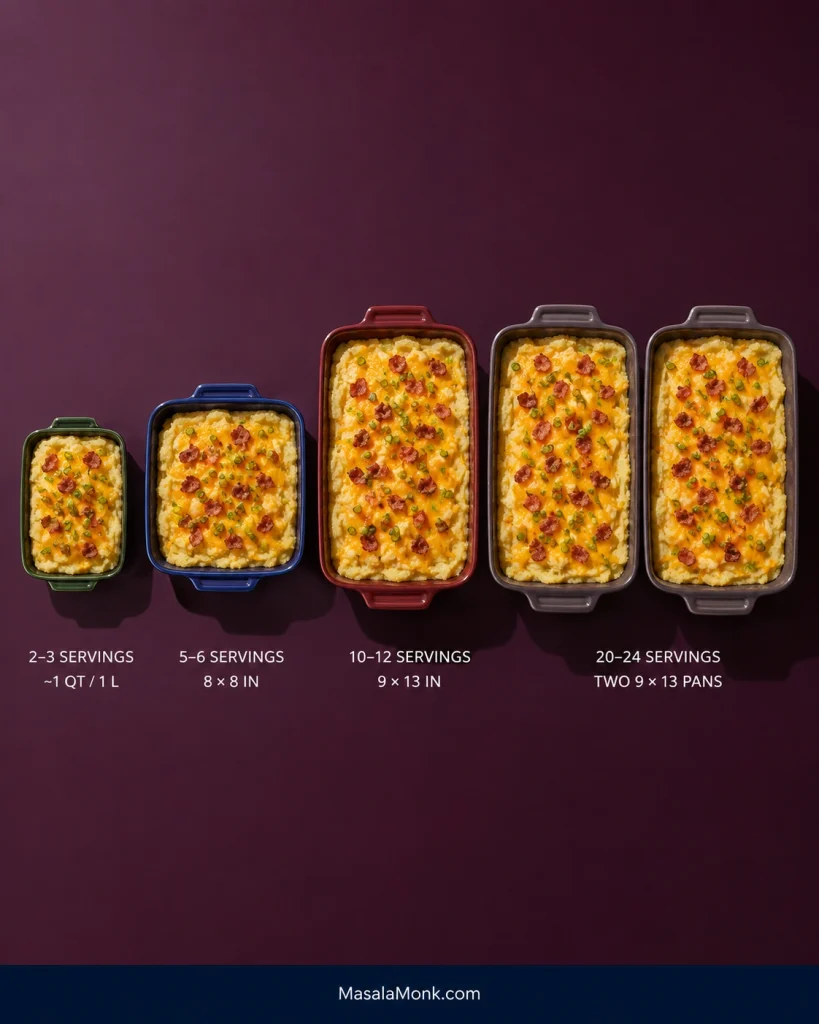
You don’t need a holiday crowd to make this. The same casserole works nicely in a small dish for two or three, and it scales more cleanly into two ordinary pans than one enormous one when the guest list grows.

Side servingsPotatoesDish
2–3About 1¼ lb / 570 gAbout 1 qt / 1 L
5–6About 2½ lb / 1.1 kg8×8 in / 20×20 cm
10–125 lb / 2.27 kg9×13 in / 23×33 cm
20–24About 10 lb / 4.5 kgTwo 9×13 pans
Four casserole dishes showing approximate pan sizes for 2 to 3, 5 to 6, 10 to 12, and 20 to 24 servings.
Pan size is really a depth decision: keep the potato layer close to the original 9×13 batch.

A Small Batch for 2–3

  • 1¼ lb / 570 g russet potatoes
  • 2 tbsp / 28 g butter
  • 1 oz / 28 g cream cheese
  • ¼ cup / about 55–60 g sour cream
  • 3 tbsp / 45 ml warm milk, plus up to 1 tbsp / 15 ml more if needed
  • 3 oz / 85 g sharp cheddar, about ¾ cup shredded
  • 1–2 green onions
  • 3 oz / 85 g bacon, raw weight
  • ⅜ tsp garlic powder, or ¼ tsp plus a generous pinch
  • ⅛ tsp black pepper, then more to taste
  • ⅛ tsp kosher salt to start, then taste after the bacon and cheddar are mixed in

Use roughly a 1-qt / 1-L baking dish and start checking the second bake around 15–20 minutes.

Half batch: halve the ingredients and use an 8×8-inch / 20×20-cm baking dish. Start checking around 20 minutes.

Doubling it: use two standard 9×13 pans instead of one heroic, overfilled dish. Two pans heat more predictably, give you more browned surface and are much easier to chill, transport and serve.

Working through roughly 10 lb / 4.5 kg potatoes? Mix them in two batches too. One enormous bowl usually means more stirring just to get everything combined.

Keeping It Warm for Serving

Can a slow cooker keep it warm? Yes—once the casserole is already properly hot. Don’t use a slow cooker to slowly bring a refrigerator-cold casserole or cold leftovers up to temperature.

For cooked leftovers, reheat first to 165°F / 74°C. After that, a slow cooker or other suitable hot-holding setup can keep the casserole at 140°F / 60°C or above. The USDA’s reheating guidance advises against reheating cold leftovers in a slow cooker.

Taking It to a Potluck

If the casserole has to ride in a car before dinner, baking it at the destination is usually easier than trying to keep a finished pan properly hot for the whole trip.

Assemble it, refrigerate it, transport it cold and refrigerate it again when you arrive. Plan on needing roughly 45–50 minutes of oven time at the destination, plus 5–10 minutes of resting time before serving.

For a longer trip, keep cold food at 40°F / 4°C or below with a chilled cooler or cold packs, and keep hot food at 140°F / 60°C or above. Put perishable food back under refrigeration within 2 hours, or within 1 hour when it’s hotter than 90°F / 32°C where the food is being held.
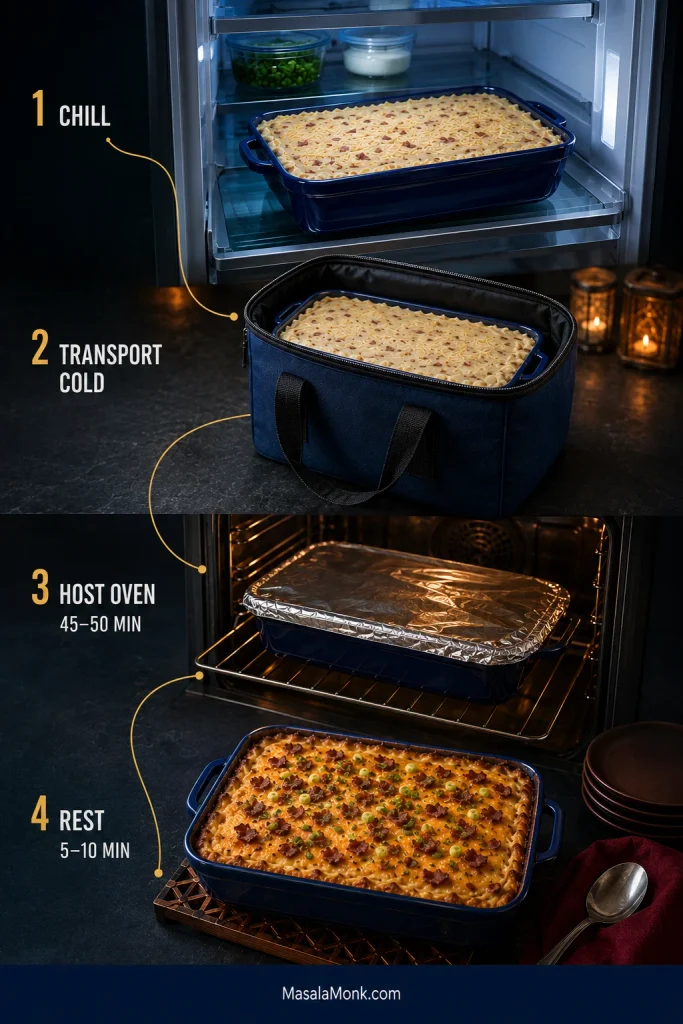
Four-stage potluck guide showing the casserole chilled in a refrigerator, carried cold in an insulated bag, baked covered for 45 to 50 minutes, then rested for 5 to 10 minutes.
Before leaving, confirm refrigerator and oven space at the destination.

Storage & Freezing

Refrigerate cooked leftovers promptly and use them within 3–4 days.

Freezing the Casserole

Freezing works, but it isn’t texture-neutral. For eating quality, think freshly made > assembled and refrigerated > frozen. After freezing and thawing, potato can become slightly watery, grainy or mealy.

When freezing is the practical option, assemble before the final bake, wrap tightly and freeze for about 1 month for best quality. Thaw in the refrigerator and use the cold-bake method. A slightly wet-looking surface after thawing doesn’t automatically need more dairy; let the casserole heat first.

How to Reheat Twice Baked Potato Casserole

For cooked leftovers, reheat until the center reaches 165°F / 74°C. The times below are starting points; portion size, dish depth and microwave power all change the timing.

AmountMethodStart checking
1 servingCover loosely and microwave; continue in short bursts as needed.60–90 seconds
Several servingsCover and reheat at 350°F / 175°C.15–20 minutes
Whole casseroleCover loosely with foil and reheat at 350°F / 175°C.About 30 minutes; a deep, fully chilled pan may need 35–45 minutes

A teaspoon or two of milk, butter or sour cream can help a small portion that has dried slightly. Uncover oven-reheated portions near the end when the cheese needs refreshing.

This is where the reserved bacon pays off: add it with fresh green onion to bring back the crunch and contrast when yesterday’s topping has softened.

What to Serve With It

This is already a substantial side, so something fresh, green or sharp keeps the meal from feeling too heavy. A cold vinegar cucumber salad is particularly good when you want crispness against the cheese and bacon.

With steak or roast beef, add green beans, asparagus or a sharp salad. The casserole also sits naturally beside Salisbury steak with mushroom gravy.

For a holiday meal, turkey or ham pair easily with roasted Brussels sprouts or another simply cooked green vegetable. Beside brisket, pulled pork or grilled chicken, something cold and crunchy such as tangy coleslaw gives the plate some relief from all that richness.


The scoop to look for is the one near the edge: browned cheddar on top, fluffy potato underneath, a piece of bacon that still cracks instead of bending, and enough green onion to brighten the whole thing.
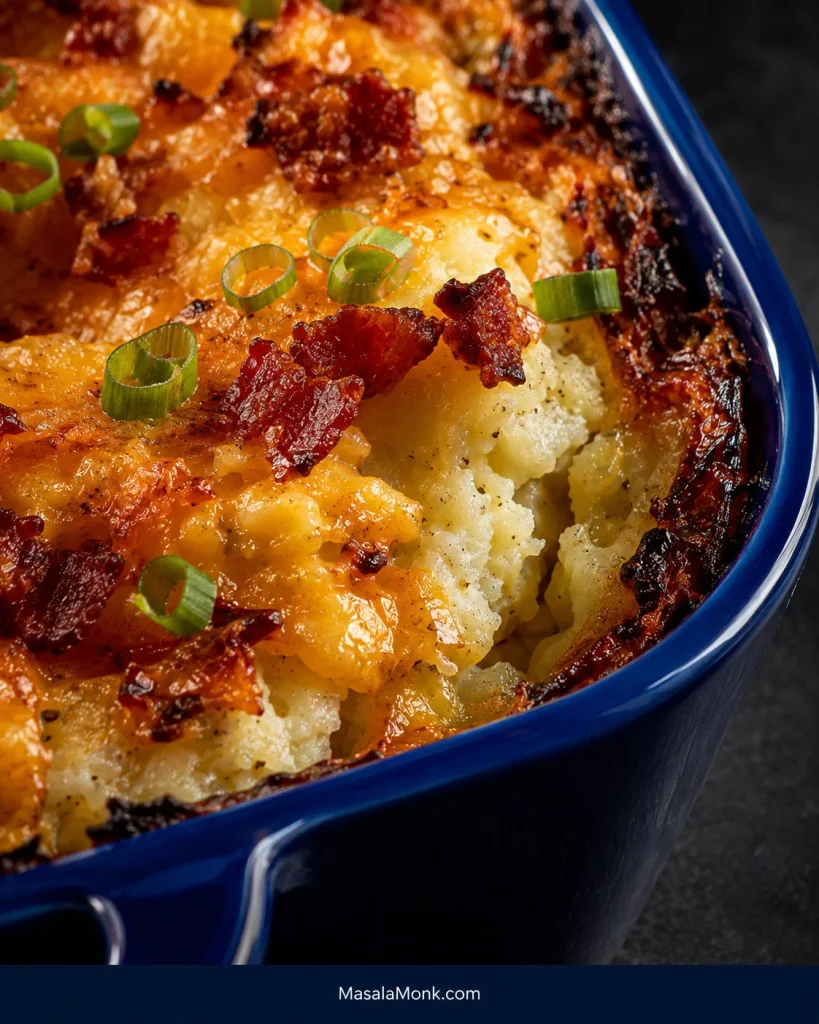
Close-up of the casserole's browned edge with caramelized cheddar, fluffy potato, crisp bacon and sliced green onions in a cobalt-blue baking dish.

That’s the trade you’re making with the casserole version. You lose the individual potato shells, but when several people are waiting for dinner, one bubbling dish and a serving spoon are usually a much better arrangement.
Posted on Leave a comment

Southern Cornbread Dressing Recipe: Old-Fashioned, Moist & Easy

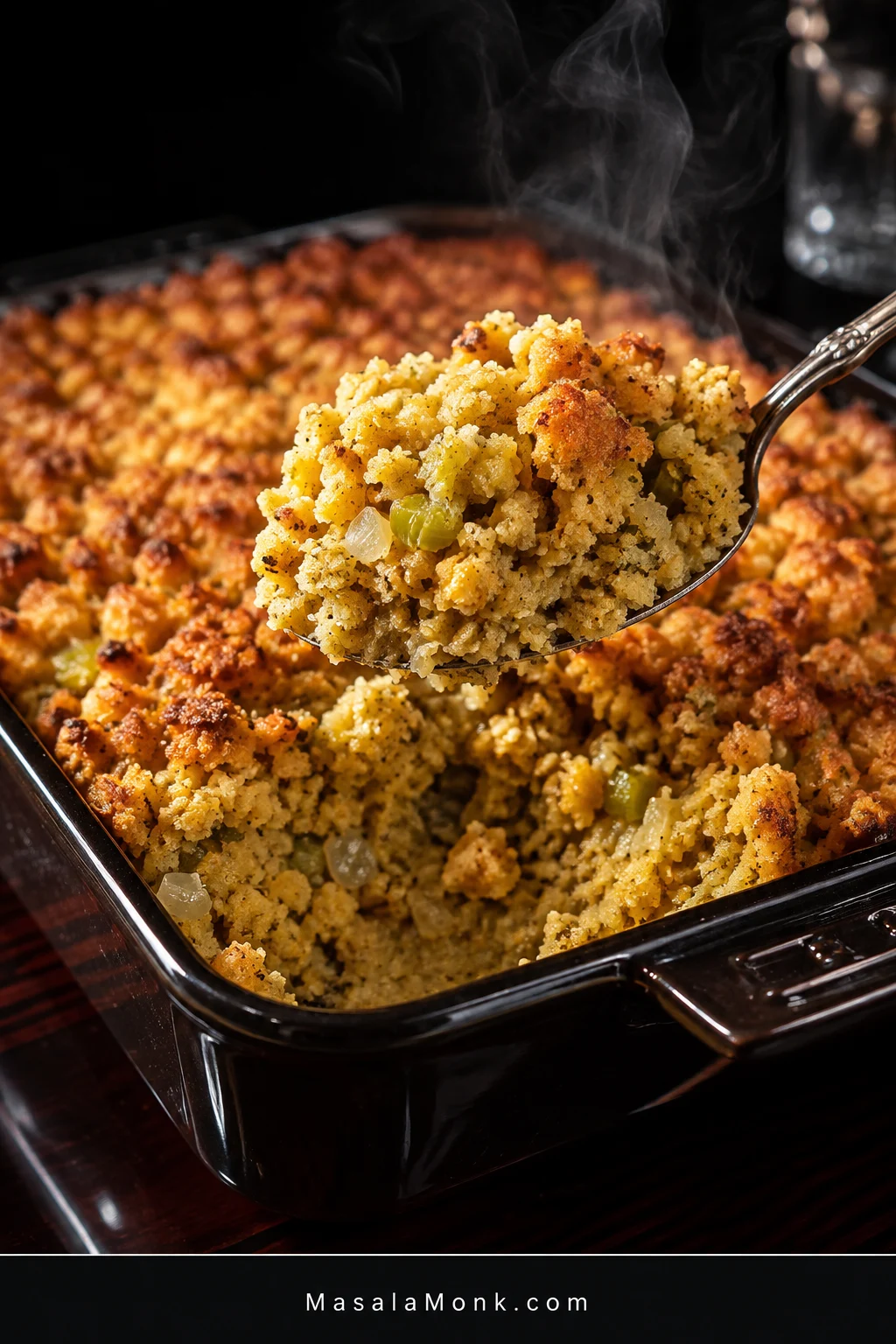
Southern cornbread dressing in a dark baking dish with a serving removed, showing a golden top and soft interior with onion, celery and herbs.

Southern cornbread dressing has a lightly golden top and a soft, moist center that gives easily to a serving spoon and holds together on the way to the plate.

It is also one of those dishes people may cook only once or twice a year, often for a table full of people who already know exactly how they think dressing should taste. That can make the bowl just before baking feel unusually important: Is it wet enough? Too wet? Did I add too much sage?

This one keeps things straightforward—savory homemade cornbread, a little plain bread, tender onion and celery, butter, broth, sage and eggs. Southern families disagree about plenty of the details; here, cornbread leads the flavor and the finished center stays soft, savory and spoonable.

Quick Answer

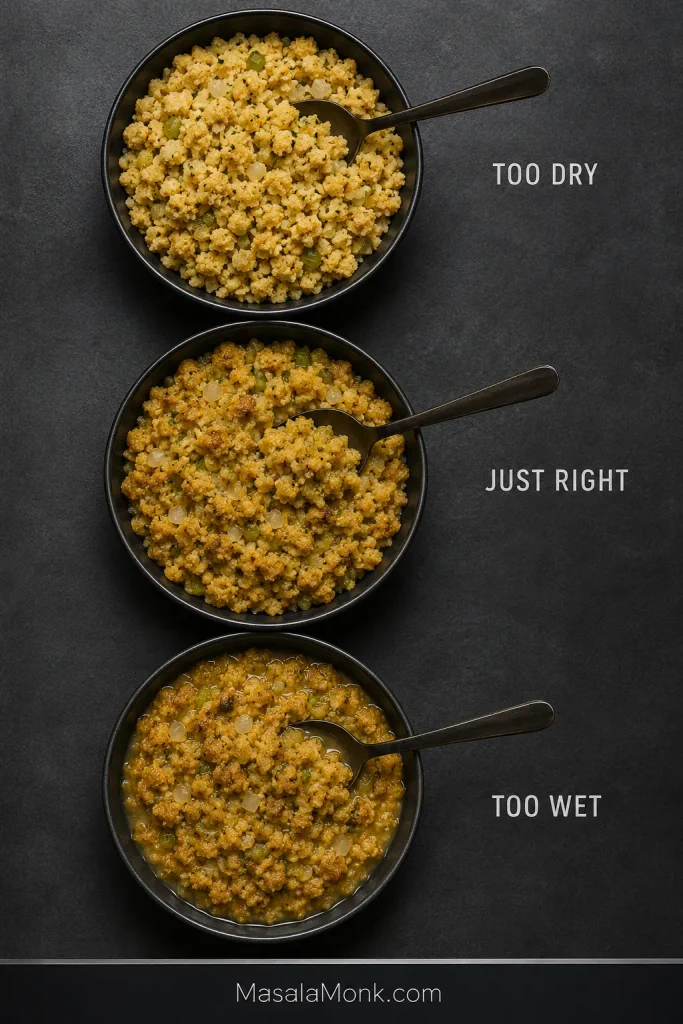
Cornbread dressing should look very moist before baking, with the broth soaked through the bread instead of pooling separately underneath it.

For the cornbread used in this recipe, start with 4 cups / 950 mL warm broth, fold gently and leave the bowl alone for 5 minutes. Dry crumbs or a stiff mound mean it needs more. When a spoonful slowly settles and the broth is absorbed throughout the bread, stop adding liquid. A persistent puddle beneath saturated crumbs means the bowl has gone too wet.

Taste and season before adding the raw eggs. Bake in a 9×13-inch / 23×33 cm dish at 375°F / 190°C until lightly golden, set through the middle and at least 165°F / 74°C.

Pan: 9×13 in / 23×33 cm   •   Serves: 10–12   •   Texture: soft, moist and spoonable

Three bowls compare cornbread dressing that is too dry, correctly moistened, and too wet with broth pooling around saturated crumbs.
After the five-minute rest, the middle bowl can move on to seasoning and eggs; the dry and pooled-liquid versions still need correction.

Southern Cornbread Dressing Recipe

Old-fashioned Southern cornbread dressing with tender onion and celery, sage and a soft, moist center with recognizable pieces of cornbread.

Active prep: about 25 minutes with prepared cornbread   •   Bake: 45–55 minutes   •   Rest: 10–15 minutes   •   Total with prepared cornbread: about 1 hour 20 minutes–1 hour 35 minutes

Starting with freshly baked cornbread? Allow extra time for it to cool and dry before the active prep begins.

Equipment

  • 9×13-inch / 23×33 cm baking dish
  • Large mixing bowl
  • Large skillet
  • Baking sheet if drying the breads the same day
  • Aluminum foil
  • Instant-read thermometer

Ingredients

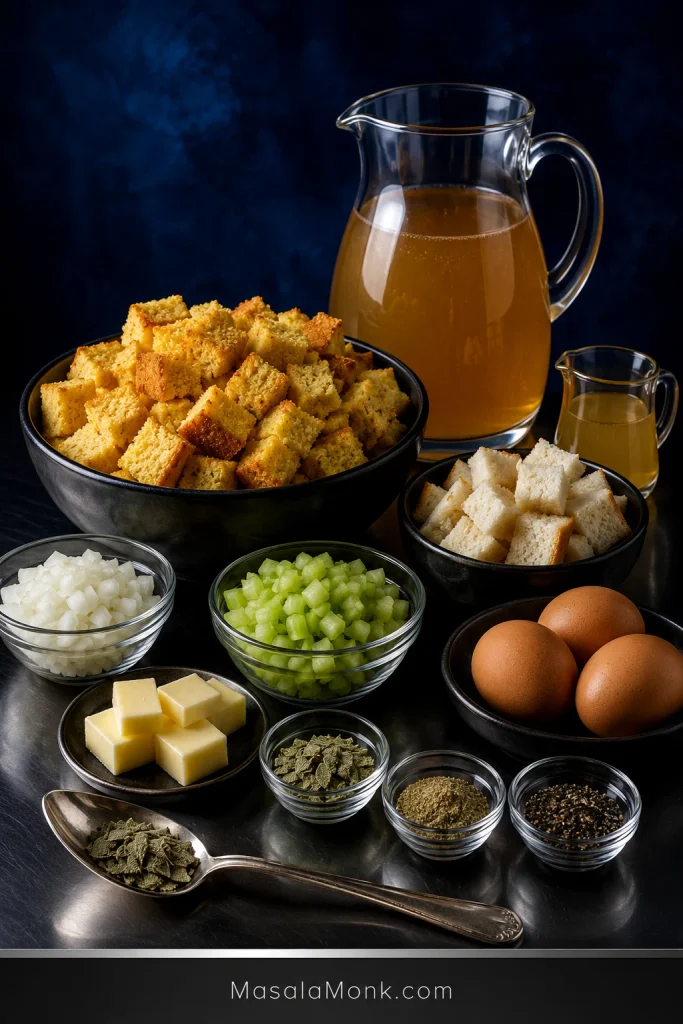
Ingredients for Southern cornbread dressing arranged on a dark blue set: cornbread, white bread, onion, celery, butter, sage, seasoning, eggs and broth.
Cornbread leads; the smaller amount of white bread supports the soft center without turning this into ordinary bread stuffing.

Bread

  • 1 full 10-inch / 25 cm skillet savory Southern cornbread, completely cooled and slightly dried
  • 4 oz / 115 g plain white sandwich bread, about 4–5 standard slices, dried and torn

For the closest match to the method below, use the savory version of MasalaMonk’s Southern Cornbread Recipe. Other homemade and boxed cornbreads can differ in size, sweetness and absorption, so the broth may need to be handled a little differently.

Butter, Onion and Celery

  • 8 tablespoons / 4 oz / 113 g unsalted butter, plus more for the baking dish
  • About 1½ cups / 7 oz / 200 g yellow onion, finely diced
  • About 1½ cups / 6.3 oz / 180 g celery, finely diced

Seasoning

  • 2 teaspoons rubbed sage
  • 1 teaspoon poultry seasoning
  • 1 teaspoon freshly ground black pepper
  • Fine salt, to taste after the first broth soak; broth and cornbread can vary considerably in saltiness

Broth and Eggs

  • Starting broth: 4 cups / 950 mL low-sodium chicken or turkey broth, warmed
  • Reserve broth: up to 1 cup / 240 mL, warmed
  • 3 large eggs

Good homemade turkey broth can replace the chicken broth. Strained juices or drippings from a fully cooked turkey can replace part of it too; use concentrated or salty drippings sparingly.

Think of the last cup of broth as insurance, not a target. Very dry bread may want most of it. Fresher bread may need little or none.

Instructions

1. Dry and Crumble the Breads

If possible, bake the cornbread a day ahead and cool it completely. Breaking it into large pieces gives some of the fresh-baked moisture a chance to escape.

For same-day dressing, spread the cooled cornbread pieces on a baking sheet and dry them at 250°F / 120°C, turning occasionally and beginning to check around 20 minutes. Add the torn white bread too, watching the thinner pieces because they may dry sooner.

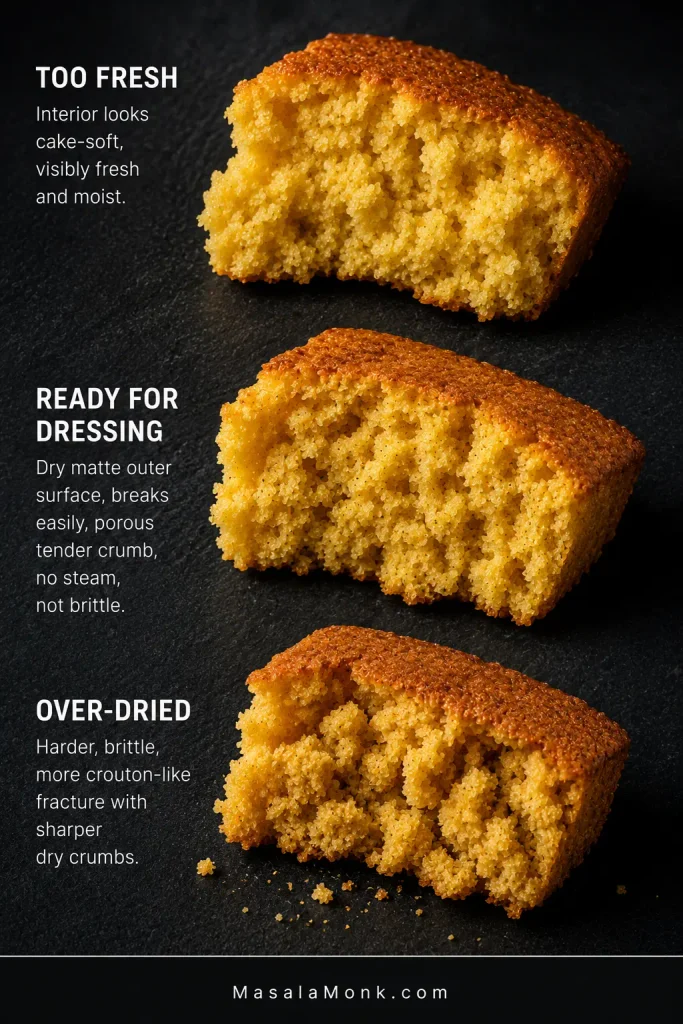
The surface feels dry and the pieces break easily when they are ready. The middle no longer feels steamy or cake-soft. There is no need to turn the bread into hard croutons.

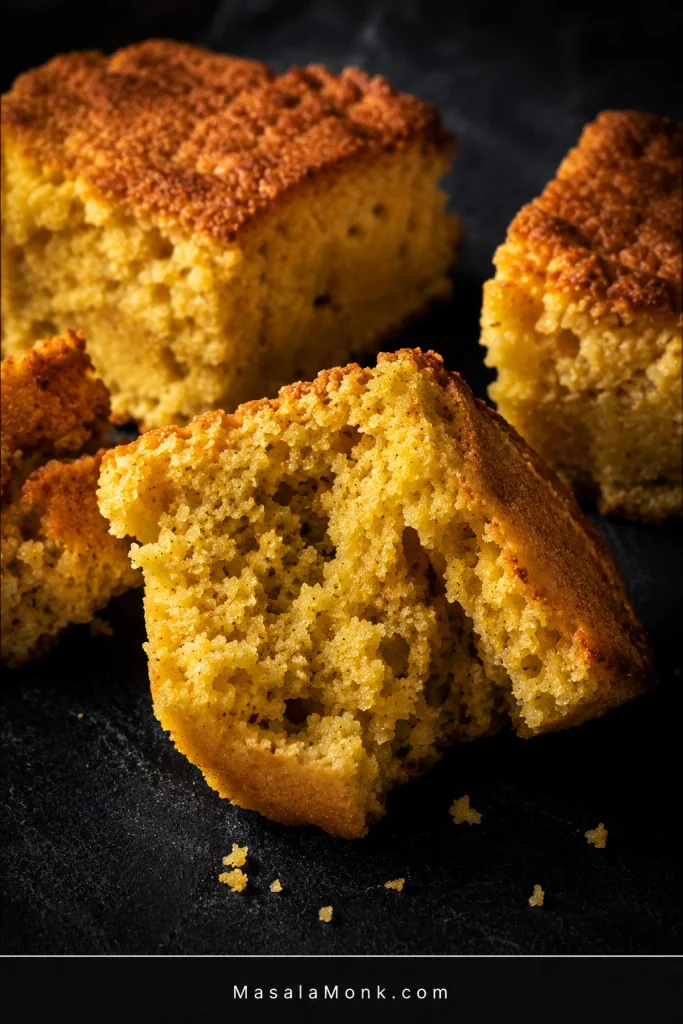
Broken pieces of slightly dried cornbread with a matte exterior and porous, still-tender interior crumb.
Slightly dried cornbread gives you more control over broth without becoming hard or crouton-like.

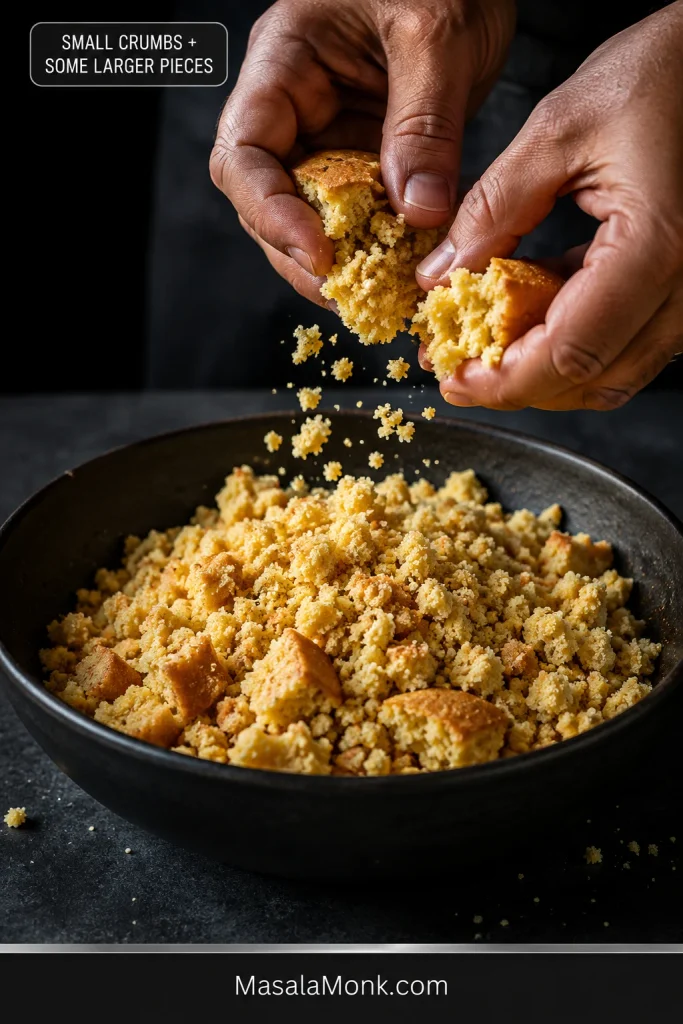
Crumble the cornbread into a large bowl. Most pieces can be small, with a scattering of irregular ½–1 inch / 1–2.5 cm pieces. Uneven crumbs are fine.

Hands crumble cornbread over a bowl, leaving mostly small irregular crumbs with some larger half-inch to one-inch pieces.
Small crumbs absorb and bind; a few larger pieces keep the finished dressing recognizably cornbread.

Raise the oven to 375°F / 190°C when the bread is ready. If you dried it ahead, simply preheat the oven before assembly.

2. Cook the Onion, Celery and Seasonings

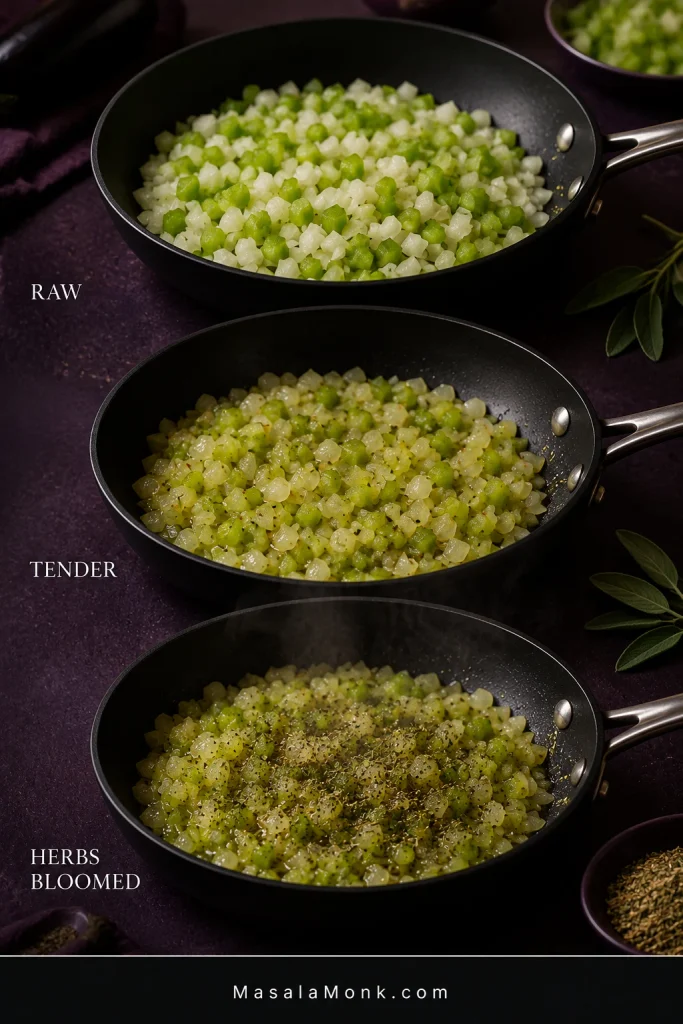
Melt the butter in a large skillet over medium heat. Add the onion and celery and cook for 8–10 minutes, stirring occasionally, until tender and translucent. A little color around the edges is welcome.

Add the rubbed sage, poultry seasoning and black pepper for the final 30–60 seconds. When the herbs hit the warm butter, the skillet should smell unmistakably like dressing. Scrape the vegetables and all of that seasoned butter over the bread.

Three pans show diced onion and celery raw, softened and translucent, then cooked with sage and poultry seasoning in butter.
Tender vegetables will not need to cook inside wet bread, while the brief herb bloom seasons the butter.

3. Add the First Broth

Using the linked cornbread or another similarly sized homemade batch, pour 4 cups / 950 mL warm broth around the bowl and fold gently from the bottom.

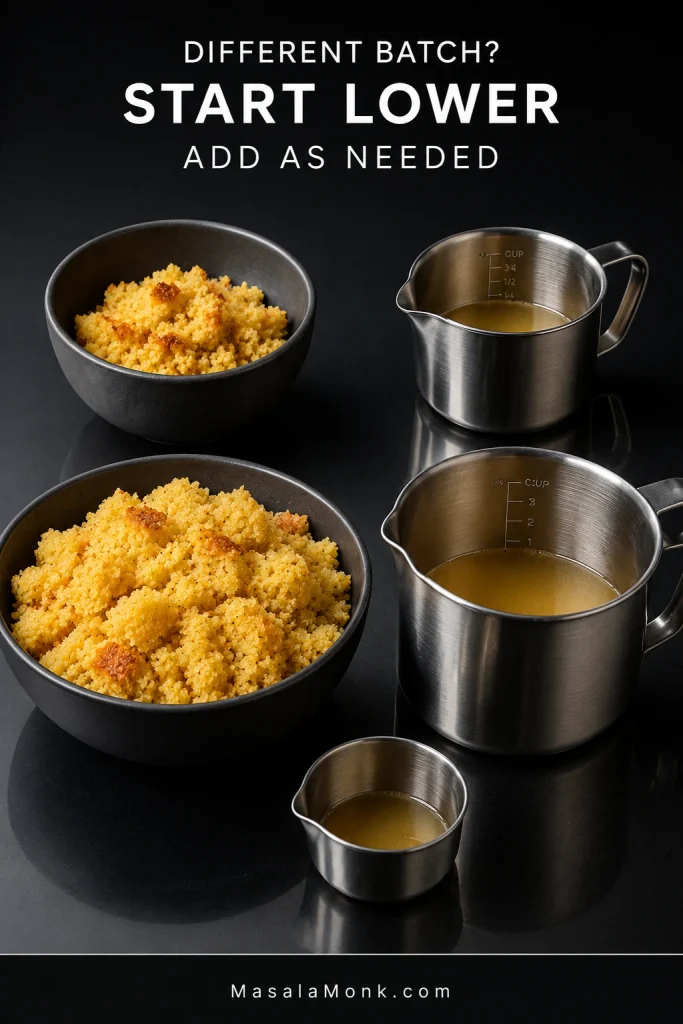
Using a noticeably smaller or very different batch of cornbread? Start with less broth and work upward instead of automatically pouring in all 4 cups.

As the broth spreads through the bowl, the crumbs become glossy and heavy with moisture while their cornbread texture remains visible. Fold only enough to distribute the liquid.

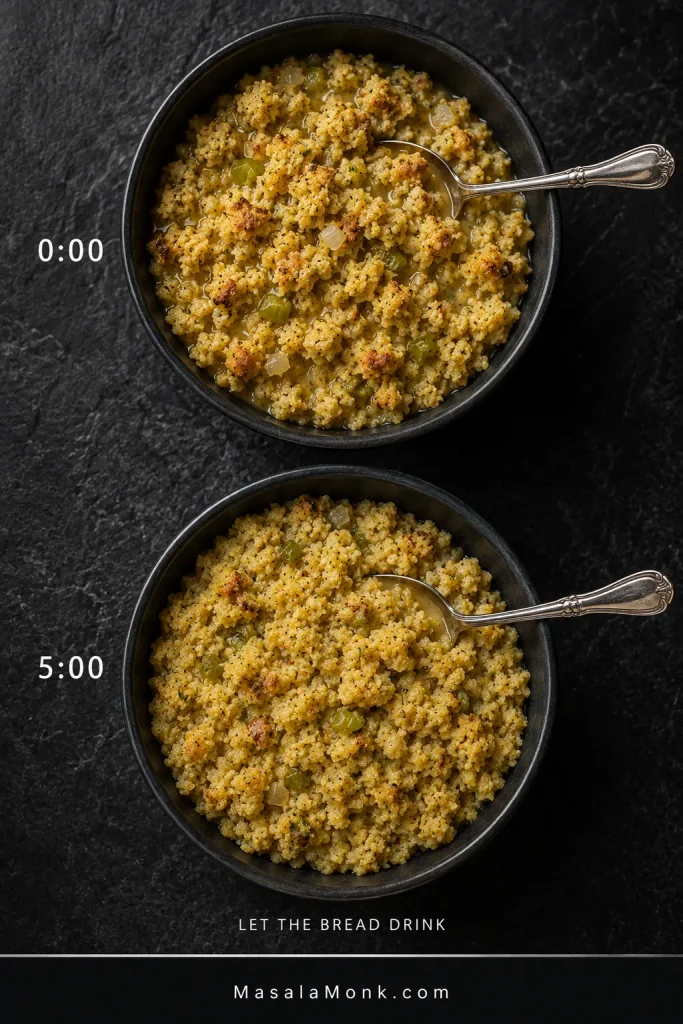
4. Leave It Alone for 5 Minutes

This is the point where dressing often looks wrong even when it isn’t. Give the bread time to drink before changing anything.

After 5 minutes, fold once or twice. Pale dry crumbs or a spoonful that sits in a stiff mound mean the bowl wants more broth. Add the reserve ¼ cup / 60 mL at a time.

Two bowls compare cornbread dressing immediately after broth is added and after five minutes, when the bread has absorbed more liquid and thickened.
Five minutes changes the picture: give the bread time to absorb the first broth before deciding whether it needs more.

Stop when the bread is moist all the way through and a spoonful slowly settles back into the bowl. Saturated crumbs with a persistent pool of broth underneath have gone too far.

Trust what the bread is doing more than the amount left in the measuring cup.

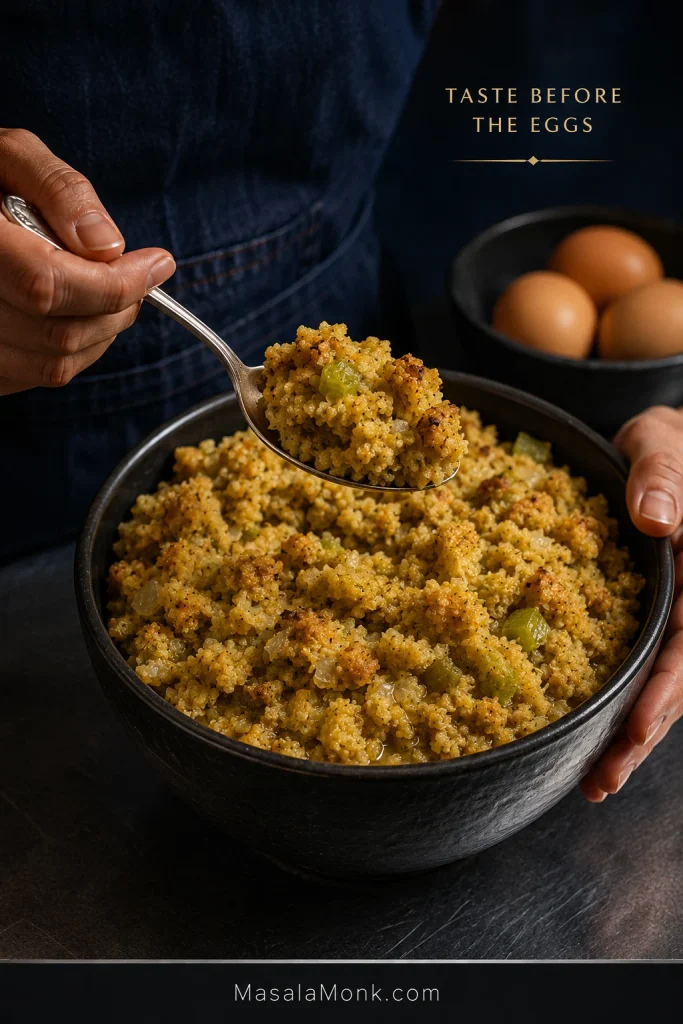
5. Taste, Season, Then Add the Eggs

Taste the dressing before the raw eggs go in. Add salt as needed, then taste for pepper or another small pinch of rubbed sage.

A hand tastes moistened cornbread dressing from a spoon while three whole eggs wait separately in the background.
After hydration, salt and sage register more clearly—making this the best moment for the final seasoning adjustment.
Go carefully with the sage. Adding another pinch is easy; softening an overwhelmingly herbal pan is not.

Whisk the 3 eggs, pour them over the dressing and fold gently until evenly distributed. Stop tasting once the raw eggs are in.

6. Fill the Baking Dish

Butter a 9×13-inch / 23×33 cm baking dish. Spoon in the dressing and spread it evenly without packing it down.

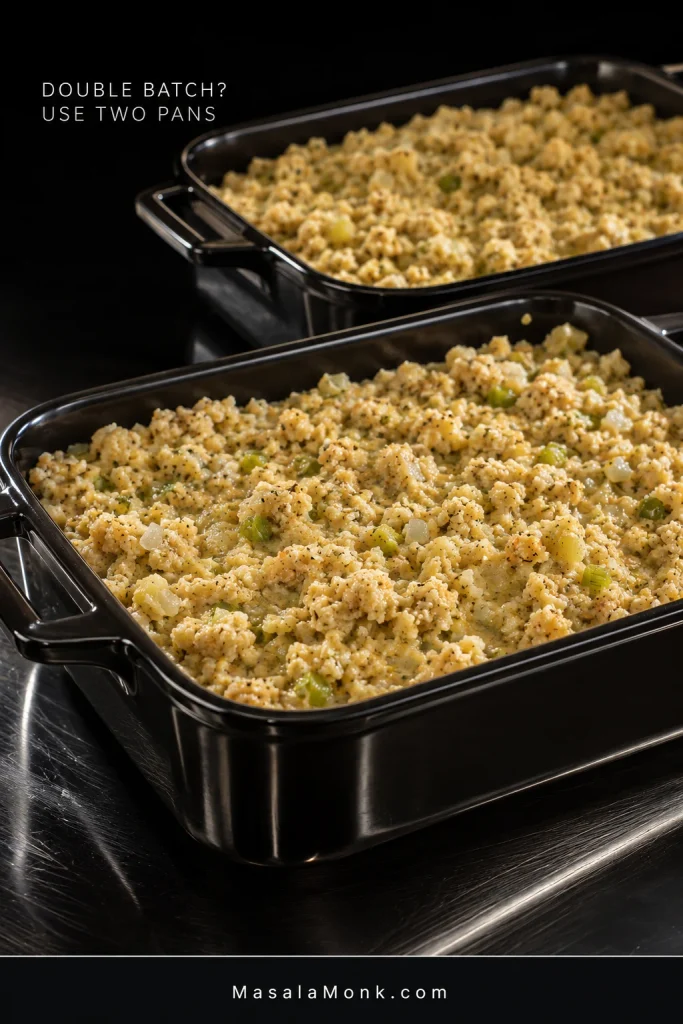
Making a double batch? Use two 9×13 pans. Keeping the layer close to the original depth helps both pans cook evenly.

Two dark baking dishes filled with moist unbaked cornbread dressing, illustrating the use of two pans for a double batch.
Two pans keep a double batch close to the original depth, so the bake behaves more like the single recipe.

7. Bake Covered, Then Uncovered

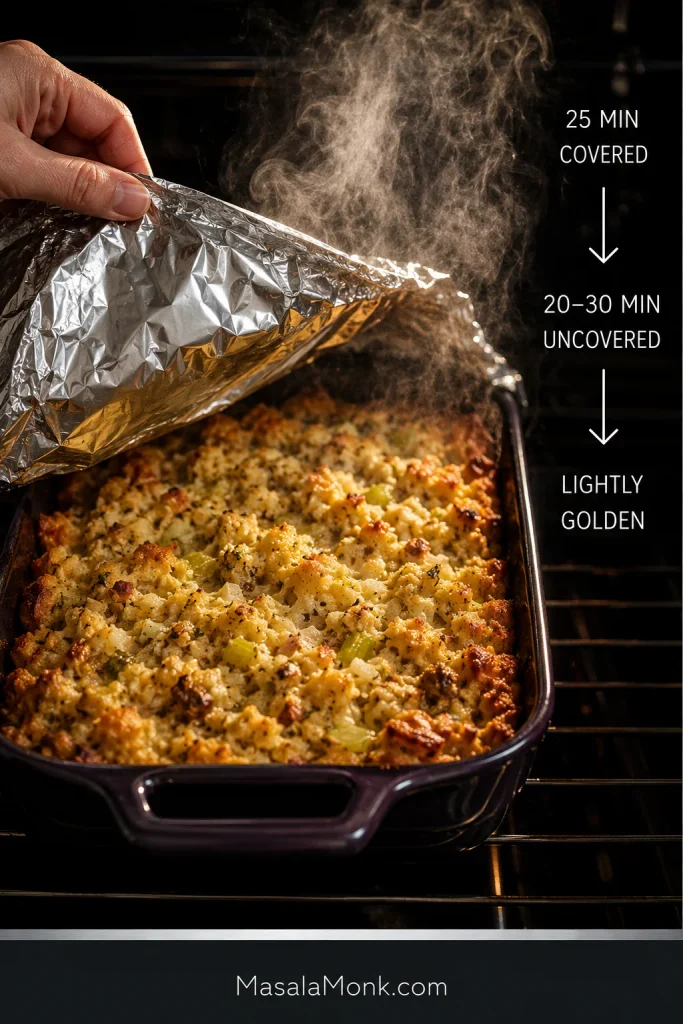
Cover loosely with foil and bake at 375°F / 190°C for 25 minutes. Remove the foil and bake another 20–30 minutes, beginning to look in on it around 20 minutes.

Foil being lifted from a steaming cornbread dressing casserole with instructions for 25 minutes covered, then 20 to 30 minutes uncovered until lightly golden.
Covered first protects the center; uncovering later shifts the oven’s job toward browning the surface.

The top turns lightly golden, with deeper toasted patches near some of the edges. Nudge the dish and the middle moves together gently instead of rippling or sloshing like loose batter. The center needs to reach at least 165°F / 74°C.

Take it out while the center still looks moist. The 10–15 minute rest will give it a little more structure.

8. Rest Before Serving

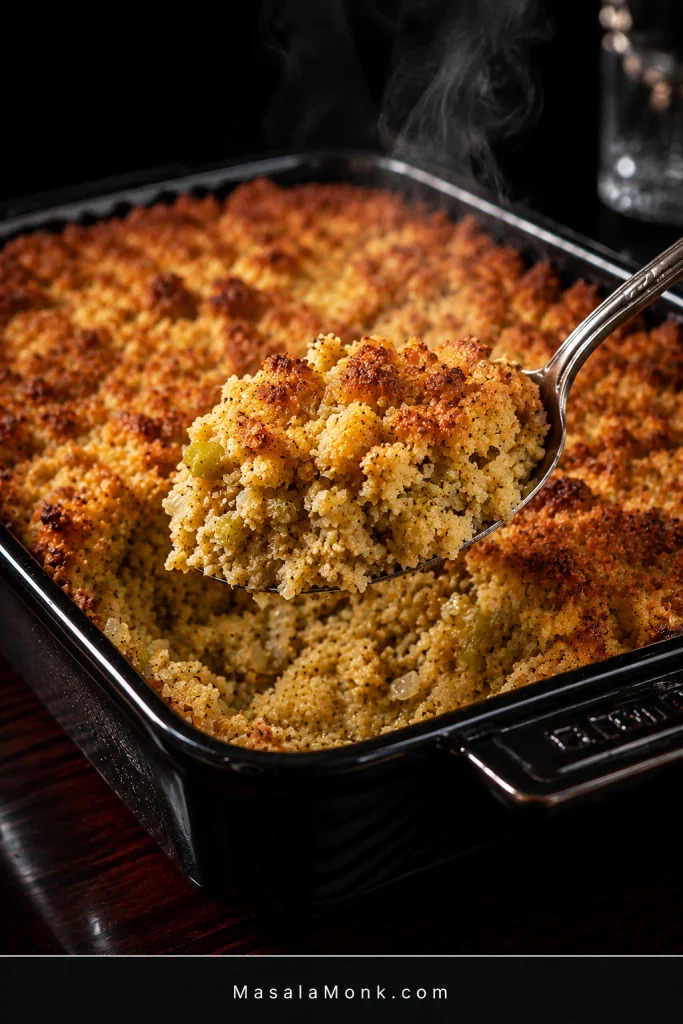
Leave the pan alone for 10–15 minutes. A serving spoon uncovers a moist interior beneath the lightly toasted surface, tender enough to yield and firm enough to reach the plate.

A silver serving spoon lifts rested Southern cornbread dressing from a dark casserole, revealing a soft moist interior beneath the browned top.
The 10–15 minute rest lets the moist center settle without baking away its tenderness.

Serve warm, while the top still has a little toastiness and the center is soft, savory and fragrant with sage and butter.

What Kind of Southern Cornbread Dressing Is This?

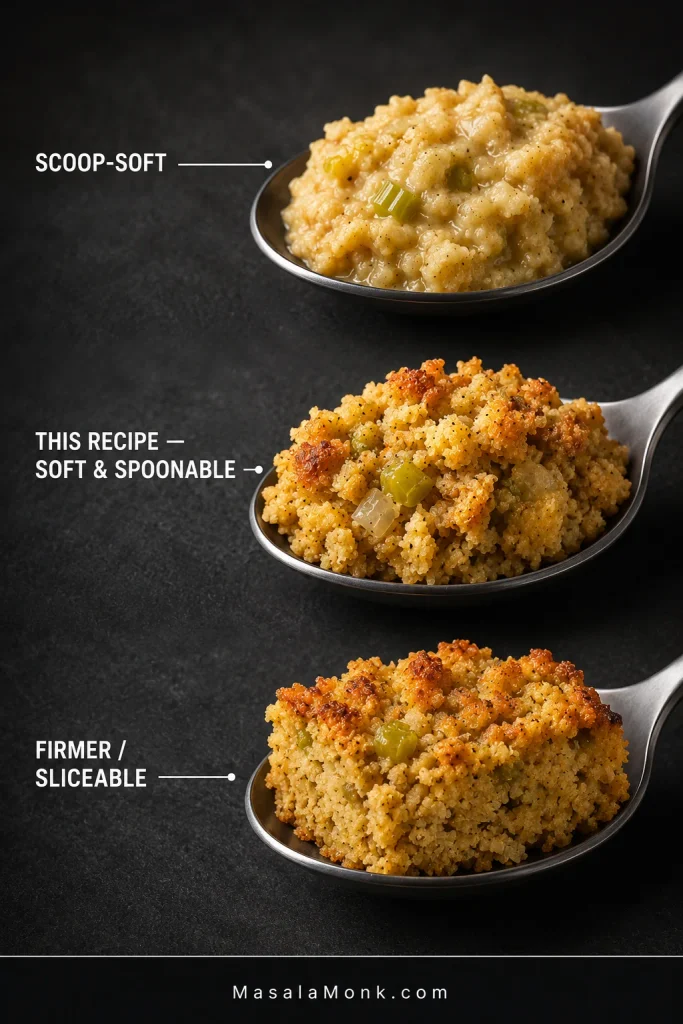
There isn’t one Southern dressing rulebook. One family may love a pan so soft it is almost spoon-pudding tender. Another may expect neat squares. Biscuits, white bread, chicken and condensed soup all appear in different family versions.

Three spoonfuls compare scoop-soft dressing, this recipe’s soft and spoonable texture, and a firmer sliceable style.
Two recipes can both be Southern cornbread dressing and land at very different points on this spectrum. Choose the texture you want before changing broth or bake time.

For a lot of cooks, the real reference point isn’t another written recipe at all. It is the pan they remember from Thanksgiving—the one somebody made largely by feel, adding broth until “it looked right.” The cues here are meant to make that judgment easier to recognize and repeat.

Here, cornbread leads the flavor. Onion and celery soften in butter first, sage stays clearly present, and raw eggs help the moist center set. Chicken, sausage and condensed soup can make excellent dressings too; they change the salt, fat and moisture enough to deserve their own balance.

Dressing vs Stuffing

The words overlap heavily in everyday use. A practical distinction is that dressing is commonly baked in its own casserole dish, while stuffing traditionally cooks inside poultry. This recipe is baked separately.

Which Cornbread Is Best for Dressing?

Slightly dried or day-old savory cornbread is easiest to work with because it has room to take on broth. Fresh cornbread works too; give it some time in the low oven first.

Good dressing bread feels dry at the surface and crumbles easily. It does not need to be brittle. Starting with a very moist, cake-soft pan simply makes the broth harder to control.

Three pieces of cornbread compare too-fresh cake-soft crumb, bread ready for dressing with a dry surface and tender crumb, and brittle over-dried bread.
The middle state gives you the most room to build moisture gradually without starting with cake-soft bread.

Why Add a Little White Bread?

The 4 oz / 115 g white bread is a small supporting part of the bowl. Cornbread supplies the flavor; the plain bread gives the tender center a little extra help holding together.

Some Southern dressings use biscuits for a similar reason. Plain sandwich bread stays deliberately quiet here.

Prefer all cornbread? Replace the white bread with 4 oz / 115 g additional dried cornbread. Let the first broth soak in before reaching for more, since an all-cornbread bowl may absorb differently.

Can I Use Jiffy or Another Corn Muffin Mix?

Yes, but expect a sweeter flavor and different absorption. Boxed mixes and other homemade recipes can also produce a smaller or larger amount of cornbread.

When the amount differs noticeably from the linked recipe, add the broth gradually. A smaller batch may need considerably less than 4 cups, while a larger or drier batch may take more.

Two bowls with different amounts of crumbled cornbread beside different starting amounts of broth, illustrating starting lower and adding broth as needed.
Batch size changes absorption capacity. A smaller boxed or homemade cornbread batch should not automatically receive the full broth amount.

How Much Sage—and What Do the Eggs Do?

Start with 2 teaspoons rubbed sage plus 1 teaspoon poultry seasoning. After the broth has soaked into the bread, taste and make any final adjustment before the eggs go in.

Rubbed Sage vs Ground Sage

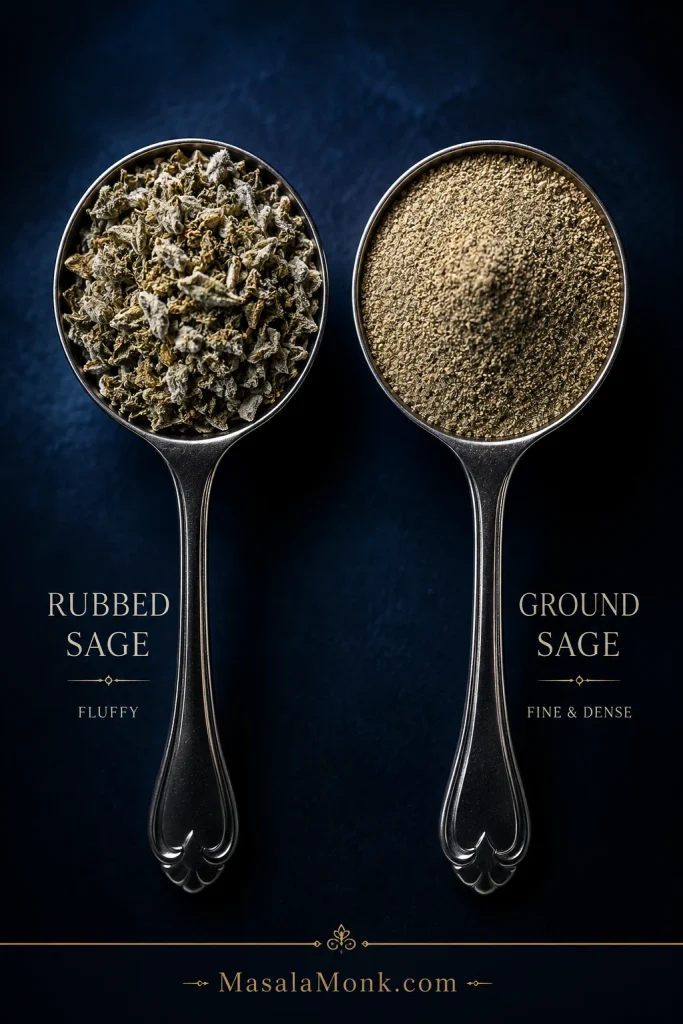
Ground sage is much finer and packs more tightly into a measuring spoon than fluffy rubbed sage. A teaspoon-for-teaspoon swap can therefore taste considerably stronger.

Using ground sage? Begin cautiously. Poultry seasoning often contains sage as well, so check the label if you want a milder sage flavor or need to avoid it altogether.

Two measuring spoons compare fluffy leafy rubbed sage with fine, dense ground sage on a dark blue background.
Ground sage packs more densely than rubbed sage, so start conservatively and adjust after the broth soaks in.

Do You Put Eggs in Cornbread Dressing?

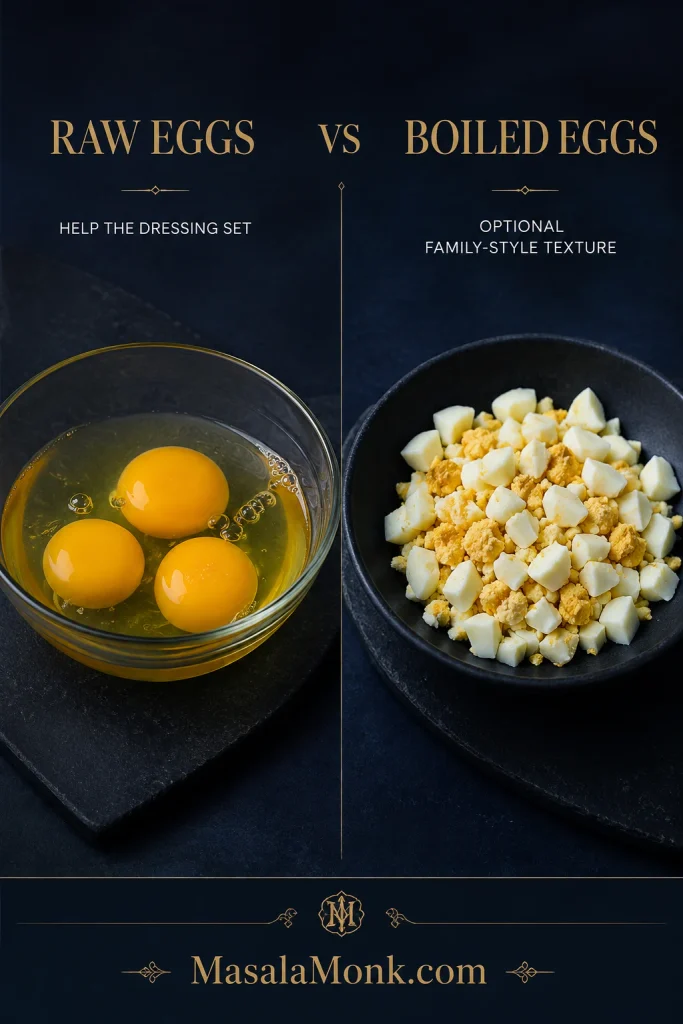
Raw eggs help the very moist dressing set as it bakes. Chopped hard-boiled eggs are a separate family-style addition.

Raw eggs in a glass bowl are labeled as helping dressing set, while chopped hard-boiled eggs are shown as an optional family-style texture addition.
Think structure versus texture: raw eggs help the dressing set; chopped boiled eggs change the bites you encounter.

Using eggs—or not using them—is a family and regional choice, not a test of whether dressing is “really Southern.” Plenty of long-standing versions exist on both sides.

If the dressing you grew up with had chopped boiled eggs, keep them if that’s the version you love. They bring their own flavor and texture; they do not replace the raw eggs used here for structure.

Leaving the raw eggs out entirely changes how this formula sets, so an intentionally eggless dressing is better balanced from the start as its own version.

How Wet Should Cornbread Dressing Be Before Baking?

Very moist and slowly settling is the goal. The bread is moist all the way through, from top to bottom. There are no dry pockets and no free liquid underneath.

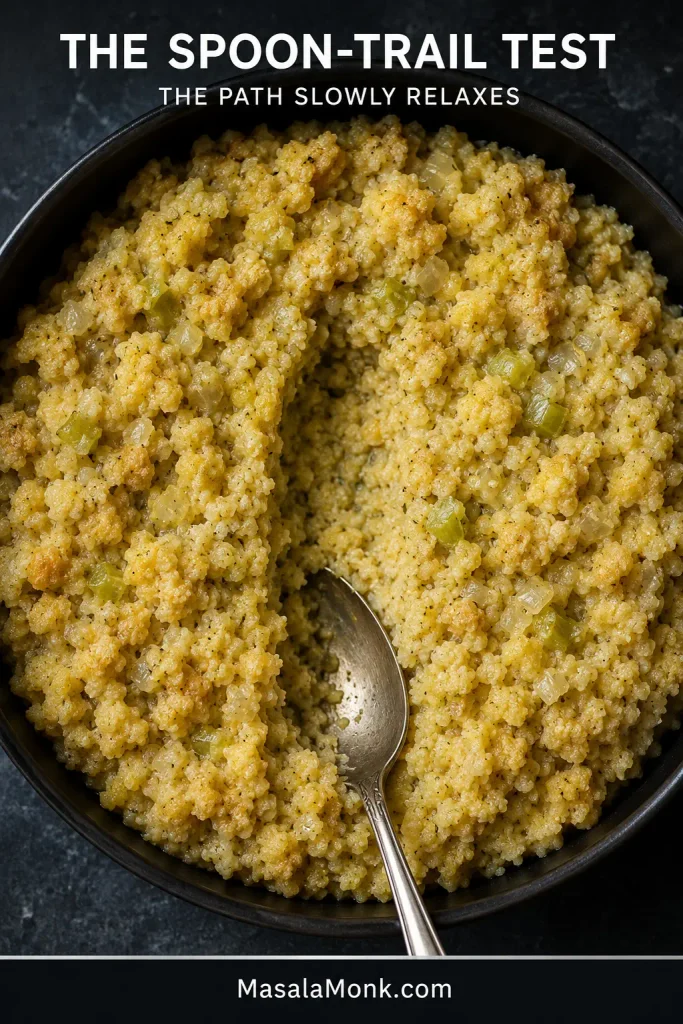
This soft Southern dressing looks considerably wetter than cubed bread stuffing. Draw a serving spoon through the bowl and the path gradually relaxes instead of staying sharply open.

A spoon creates a shallow channel through very moist unbaked cornbread dressing; the soft sides of the trail begin to relax inward without pooled broth.
The groove should be temporary. Correctly moistened dressing slowly relaxes toward the spoon trail; a stiff trench points dry, while liquid collecting in it points too wet.
StateWhat It Looks LikeWhat to Do
Too dryDry crumbs remain and the mixture sits stifflyAdd warm broth ¼ cup / 60 mL at a time
Just rightThe bread is moist through, crumb texture remains, and a spoonful slowly settlesStop adding broth
Too wetThe crumbs are saturated but broth still gathers separately after restingFold in additional dried bread before adding the eggs

Freshly added broth can look alarmingly loose for a few minutes. Let it soak in. What matters is whether free liquid remains after the bread has had a chance to absorb it.

Soft Is the Goal; Paste Is Not

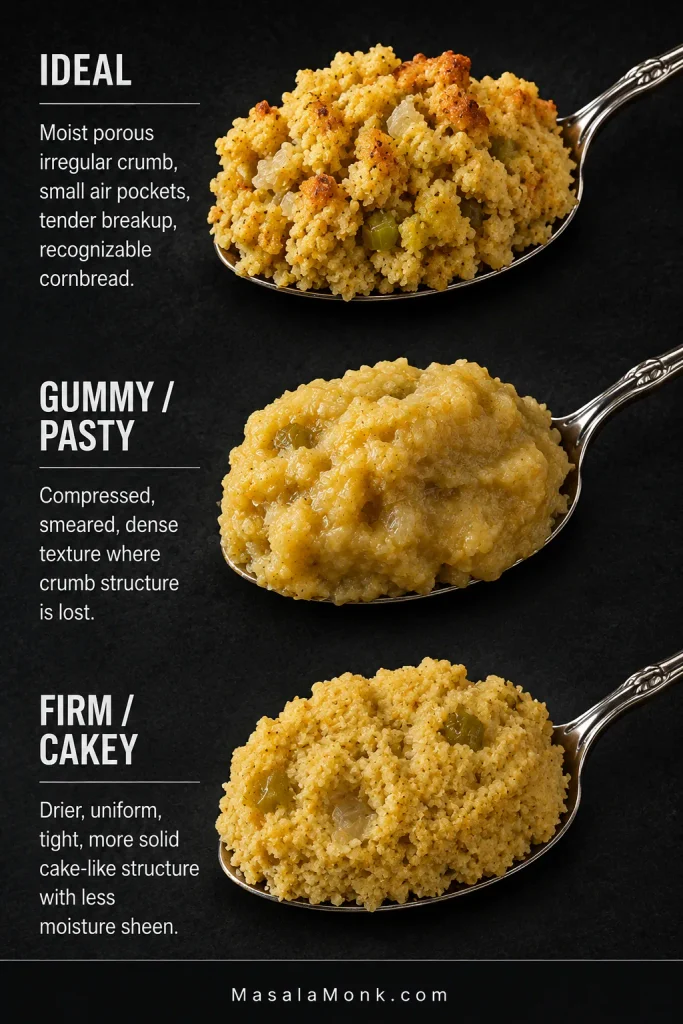
Soft dressing can be extremely tender and still show recognizable pieces of cornbread. Gummy dressing has lost that crumb and feels more like paste.

Very fresh bread, crumbs worked too fine, excess broth and aggressive mixing can all push the bowl in that direction. Extra oven time can remove moisture; it cannot rebuild crumb texture that has already broken down.

Bowl looks right? Back to the recipe. Still unsure? Go to troubleshooting.

Pan Size and Doneness for Cornbread Dressing

A standard 9×13-inch / 23×33 cm dish gives the dressing a comfortable depth for an even bake. Go deeper and the center needs more time; use a shallower dish and the surface browns and dries faster.

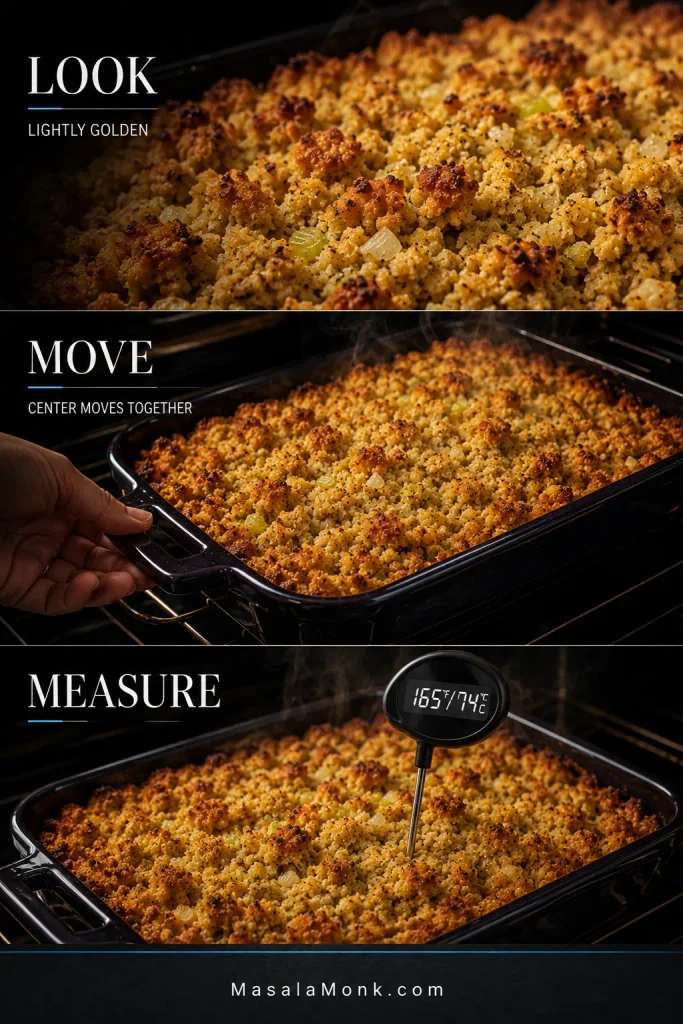
Look, Move, Measure

  • Look: the surface is lightly golden, with deeper toasted patches near some of the edges.
  • Move: the center shifts together gently when the dish is nudged; loose batter would ripple or slosh.
  • Measure: the middle reaches at least 165°F / 74°C.
Three-part doneness guide shows lightly golden cornbread dressing, a hand nudging the casserole, and a thermometer reading 165°F / 74°C in the center.
No single doneness cue is enough: browning can get ahead of the center, movement shows the set, and 165°F / 74°C confirms temperature.

Once the top looks right, the middle moves together and the thermometer says 165°F / 74°C, it is done. Don’t leave it in waiting for a firm center; the rest will take care of the final bit of setting.

For a moist dressing like this, gravy is an extra pleasure rather than the only thing keeping the serving from tasting dry.

Cornbread Dressing Troubleshooting

Your best rescue window is before the eggs. Broth, dry bread, salt and herbs are much easier to adjust then. Once the pan is baking, time and foil are your main tools.

Before Baking

Dry and stiff: Let the existing broth soak in first. If dry crumbs remain, add warm broth ¼ cup / 60 mL at a time.

Broth pooling underneath: Saturated bread plus persistent free liquid means the bowl is too wet. Fold in additional dried bread before adding the eggs.

Bland: Add salt, then reassess the pepper and herbs.

Too much sage: Dilute with unseasoned dried bread and enough broth to restore the soft, moist texture.

Crunchy onion or celery: Return the vegetables to the skillet and cook until tender before continuing.

During or After Baking

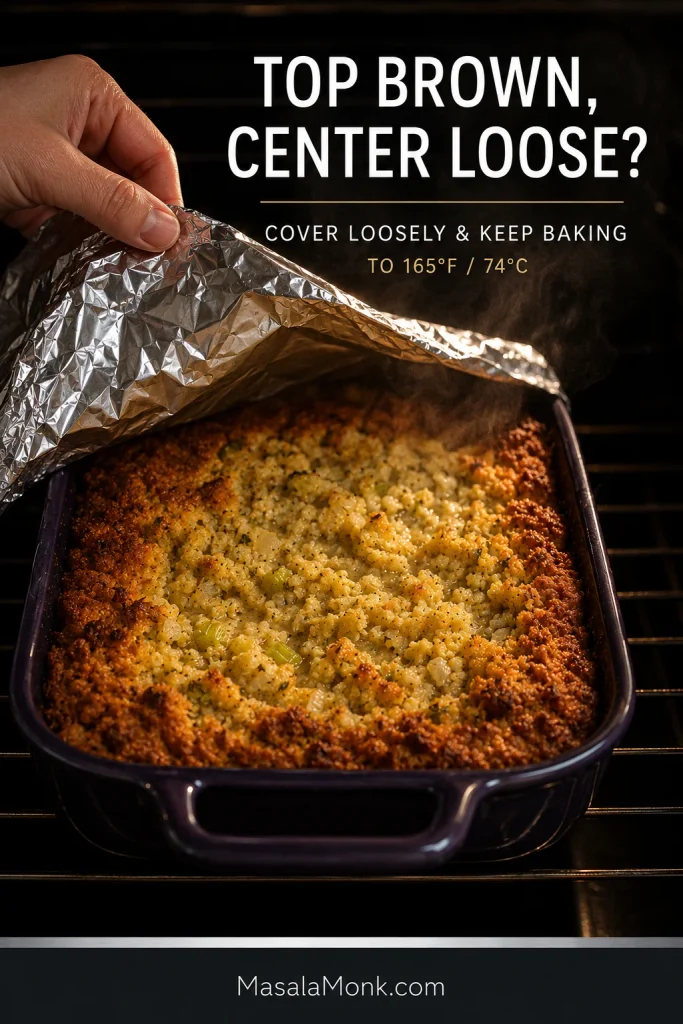
Center still wet or loose: Keep baking. If the top is already well browned, cover the dish loosely with foil. A deeper casserole may simply need longer through the middle.

A hand loosely covers browned cornbread dressing with foil because the center is still loose, with instructions to continue baking to 165°F / 74°C.
If the top browns first, loose foil protects it while the softer center finishes cooking.

Gummy or pasty: More baking may remove moisture, but it cannot fully restore crumb texture after the bread has been overworked or oversaturated.

Too firm or cakey: The bowl was probably too dry, or the pan stayed in the oven too long. Gravy helps at the table; next time leave the mixture wetter or pull it sooner.

Three spoonfuls compare ideal moist cornbread dressing, gummy pasty dressing with lost crumb structure, and firmer dry cakey dressing.
The crumb often reveals what went wrong: gummy dressing has lost its bread structure, while firm or cakey dressing usually points to a drier mixture or longer bake.

Falls apart: Give it the full 10–15 minute rest first. If it remains very crumbly, the mixture was likely too dry or the center needed more time.

Problem solved? Back to the recipe.

Simple Substitutions

A missing vegetable does not mean Thanksgiving is cancelled.

No celery or onion: Either can simply be left out. Omitting both gives you a plainer dressing, but the recipe still works.

No chicken broth: Turkey broth is the closest substitute. Vegetable broth works too, though it gives the dressing a different savory background.

All-cornbread dressing: Replace the 4 oz / 115 g white bread with the same amount of dried cornbread. Let the bread absorb the broth before adding more; an all-cornbread mixture may not need exactly the same amount.

How Much Cornbread Dressing Do You Need?

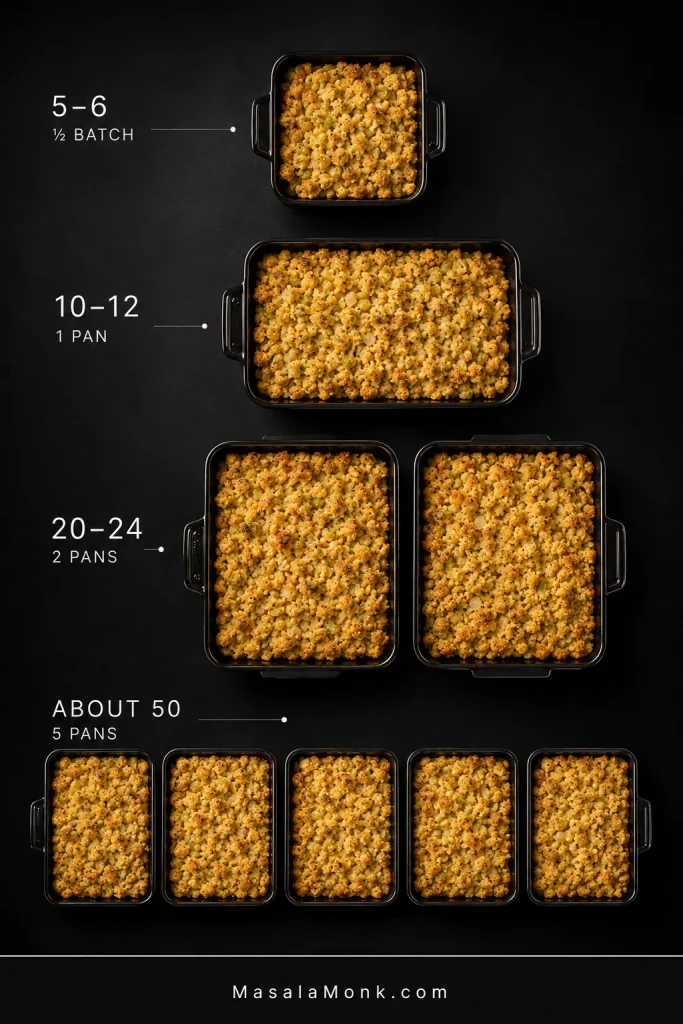
One 9×13 pan gives about 10–12 side servings. For a crowd, use more pans rather than building one unusually deep casserole.

Overhead serving guide shows a half batch for 5–6 people, one pan for 10–12, two pans for 20–24, and five pans for about 50 people.
Scale sideways rather than deeper: keeping similar pan depth preserves the recipe’s familiar center-to-edge bake.
PeopleAmountPan Setup
5–6½ batch8×8 in / 20×20 cm or similar; begin checking earlier
10–121 batchOne 9×13 pan
20–242 batchesTwo 9×13 pans
About 50About 5 batchesFive 9×13 pans when several other substantial sides are being served

For very generous servings or planned leftovers at a 50-person meal, make six pans.

Mix one or two batches at a time instead of wrestling with one giant bowl. It is easier to see how the bread is taking up the broth and easier to season evenly.

If you’re trying to match a particular family style before a big holiday, a half batch also gives you an easy way to dial in the moisture and seasoning for the version you remember.

Make-Ahead Southern Cornbread Dressing for Thanksgiving

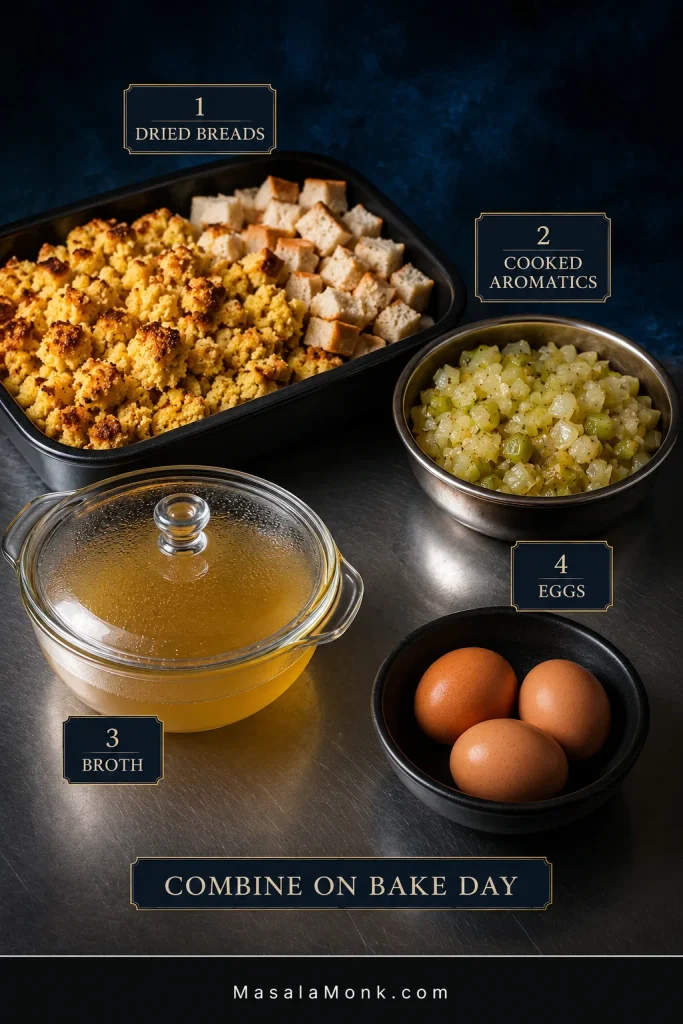
Yes. Bake and dry the breads and cook the onion and celery ahead, then bring everything together close to baking.

Don’t fully assemble the dressing with broth and raw eggs the night before. Keep the dried breads separate from the refrigerated ingredients, then combine them on bake day.

Make-ahead cornbread dressing components kept separate: dried cornbread and white bread, cooked onion and celery, broth, and three whole eggs, labeled to combine on bake day.
Make-ahead dressing works best when prep does not lock in the final moisture level. Keep the liquid separate so absorption can be judged on bake day.

If you’re responsible for the dressing this year, getting the bread and vegetables out of the way ahead of time takes a lot of pressure off Thanksgiving morning.

WhenWhat to Do
1–2 days aheadBake the cornbread, cool it completely and begin drying it
Day beforeFinish drying both breads. Once completely cool, keep them covered and dry. Cook the onion and celery and refrigerate them. Keep broth and eggs refrigerated separately.
Bake dayCombine bread, vegetables and broth; adjust the moisture and seasoning; add the eggs; bake
Serving timeLet the finished dressing rest 10–15 minutes before serving

This also follows USDA stuffing food-safety guidance, which recommends preparing wet and dry ingredients ahead separately and combining them close to cooking.

If oven space is the bigger Thanksgiving problem, MasalaMonk’s Sweet Potato Casserole is another side that can be largely prepared ahead.

Keeping Dressing Warm Without Drying It Out

Holding it hot for a delayed meal? Keep the dressing at 140°F / 60°C or warmer. Otherwise, refrigerate it within 2 hours.

For a short delay, leave the pan covered so the surface holds onto more of its moisture. That also gives you a little breathing room to finish something best served fresh, such as soft dinner rolls.

Storage, Freezing and Reheating

Refrigerate: Transfer leftovers to reasonably shallow containers and refrigerate within 2 hours. Use refrigerated dressing within 3–4 days.

Freeze: Freeze cooked dressing in practical meal-size or family-size portions. For best quality, use it within about 2–3 months.

Reheat: Cover the dressing so it holds onto steam. A dry-looking portion can take a small splash of broth before reheating. Heat the center to 165°F / 74°C, uncovering near the end if you want a little texture back on top.

For the storage guidance behind those refrigerator and freezer times, see the FoodSafety.gov Cold Food Storage Chart.

The Dressing We Are After

The most important moment arrives before the oven door closes.

The bread is thoroughly moist. You can still see pieces of cornbread. The onion and celery are tender, and the sage smells warm and savory in the butter.

Then the oven takes over. The edges toast, the middle sets softly, and the bowl that looked almost suspiciously wet becomes dressing that gives easily under the spoon.

That is what the measurements and checkpoints are really for: turning “add broth until it looks right” into something you can recognize for yourself.

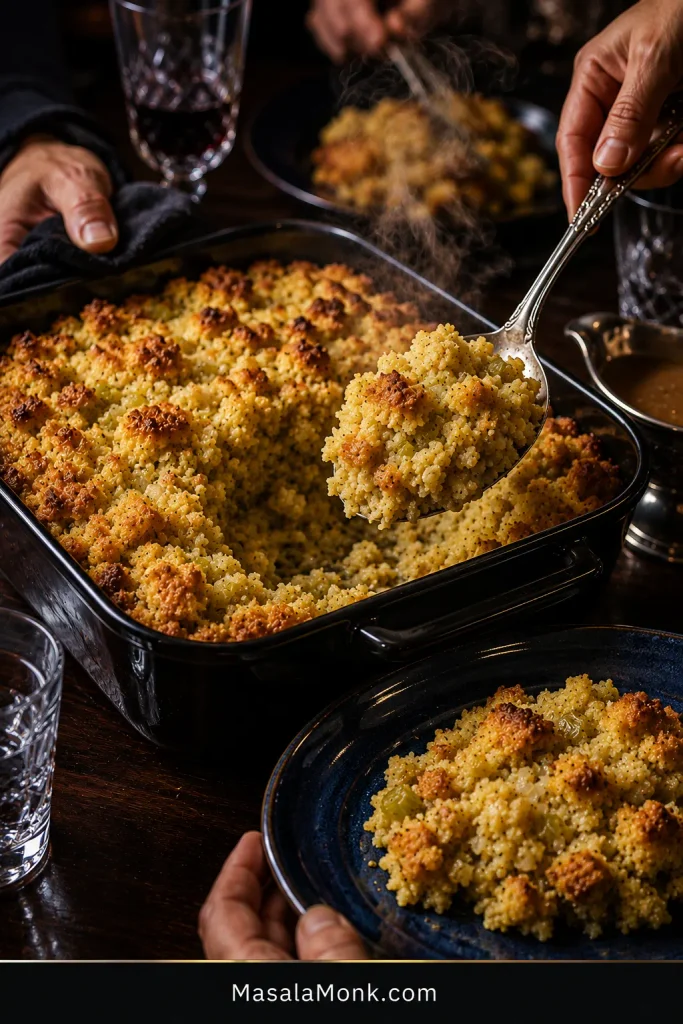
Hands serve steaming Southern cornbread dressing from a dark casserole onto a blue plate, showing a golden top and soft moist interior with onion and celery.
The payoff: a generous serving holds together on the way to the plate, then gives easily under the fork.

Once you can look at the bowl and know it is ready, Southern cornbread dressing stops feeling like a once-a-year gamble.

Back to top ↑

Posted on Leave a comment

Scalloped Potatoes Recipe: Creamy, Tender and Never Watery

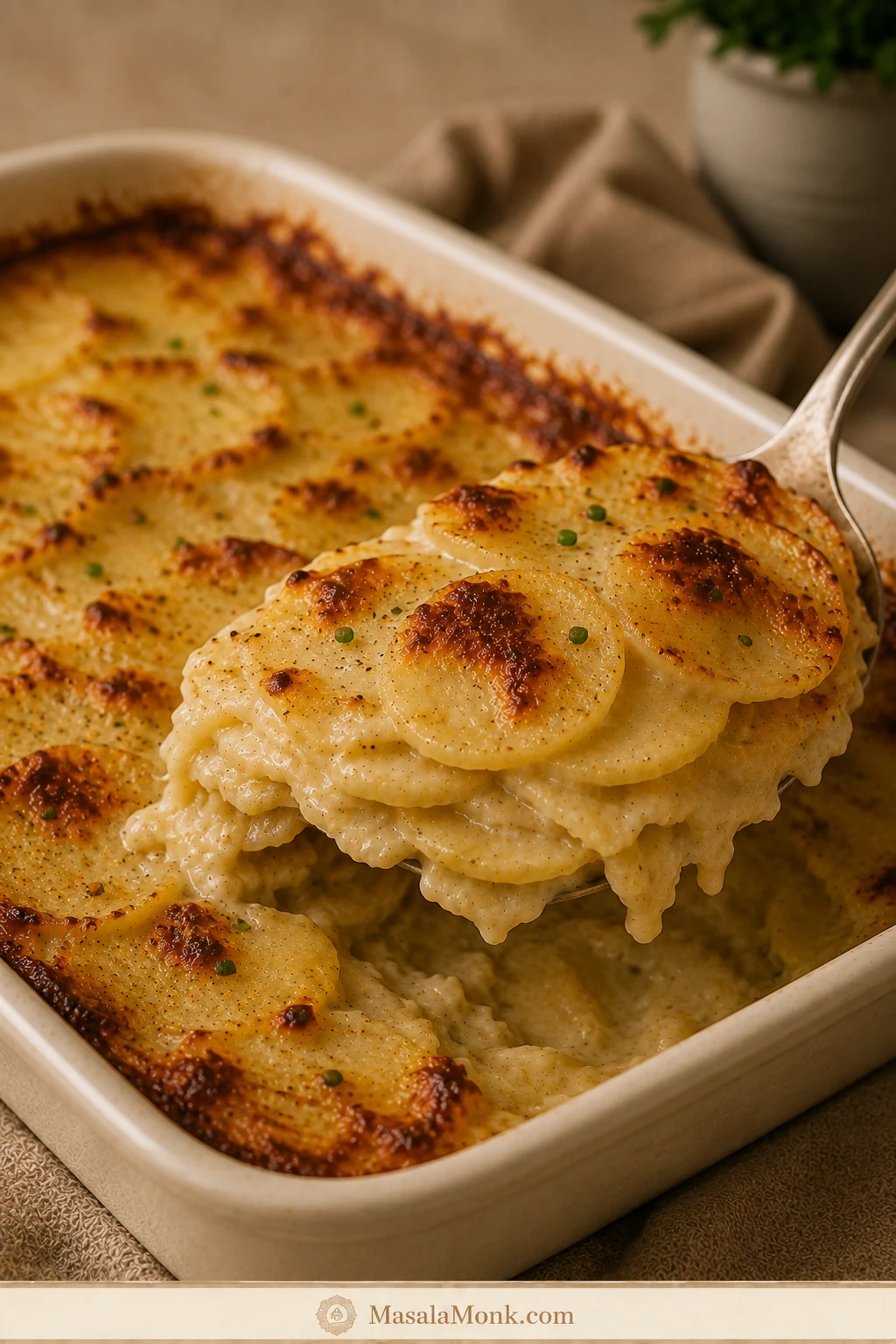
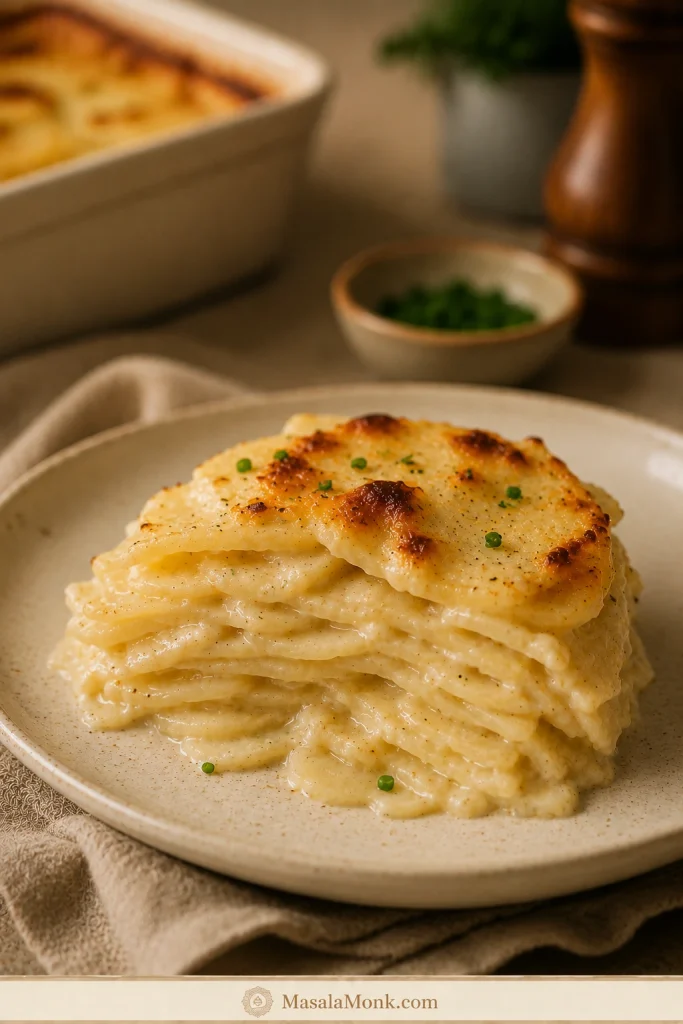
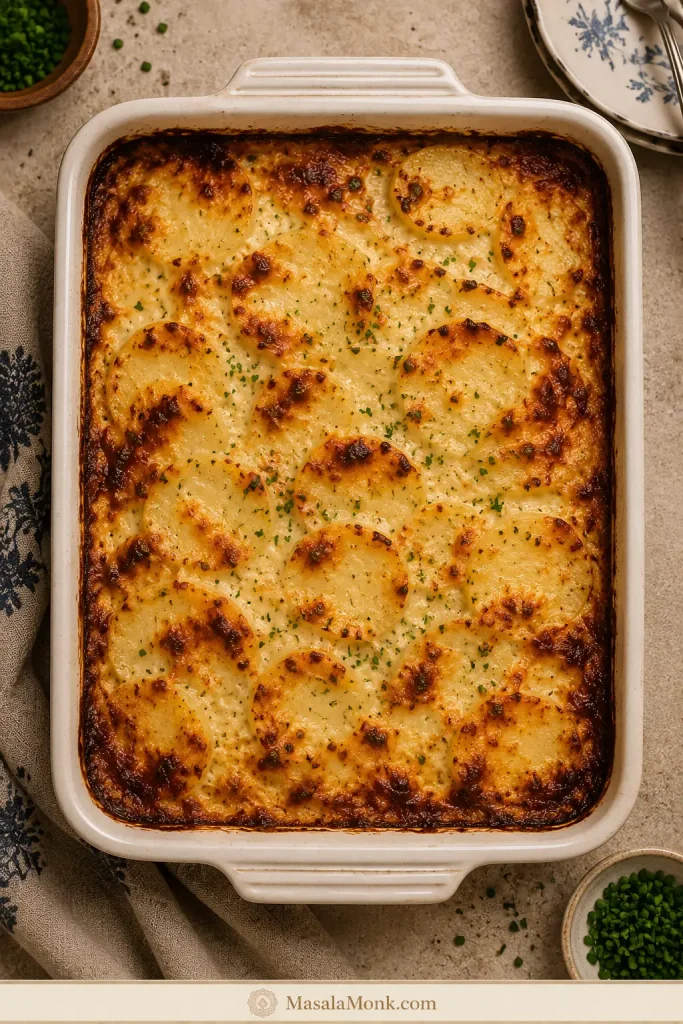
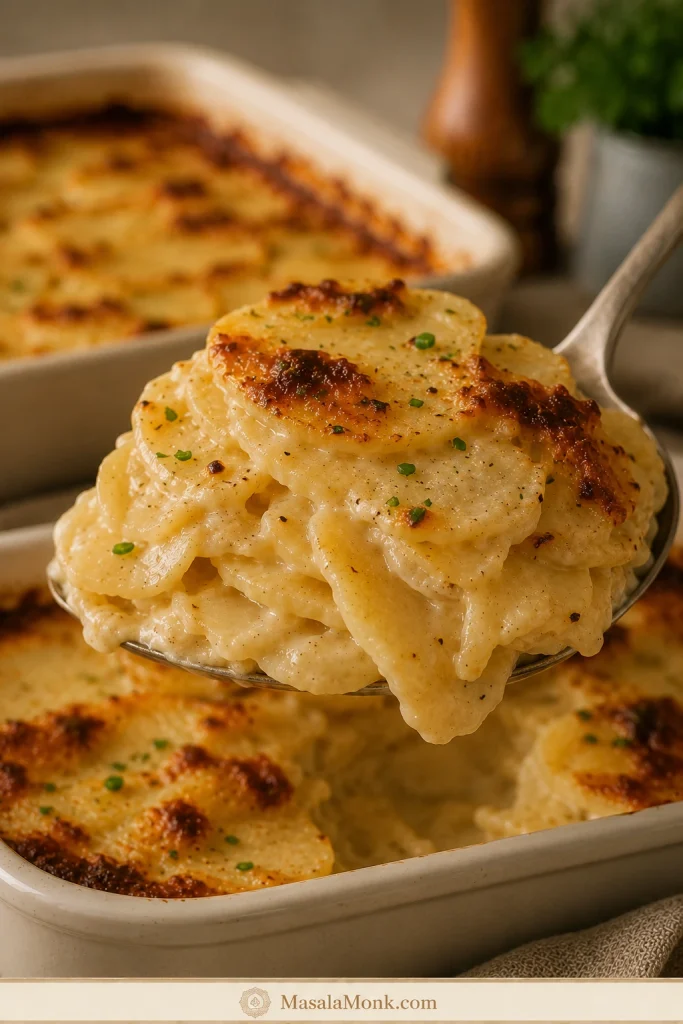
Shallow casserole of scalloped potatoes with a serving lifted to reveal thin, tender potato layers coated in creamy sauce and browned around the edges.

The best scalloped potatoes slump softly under the serving spoon. The slices are tender all the way through but still visible as layers, mellow onion and garlic run through the creamy sauce, and the browned edges give you the richest bites in the pan.

Scalloped potatoes aren’t difficult, but they can be frustrating when they go wrong because most problems reveal themselves late. After more than an hour in the oven, nobody wants to discover a firm layer hiding beneath a beautifully browned top—or thin sauce pooling underneath the first serving.

This version is made from scratch with Russet potatoes and a buttery whole-milk white sauce seasoned with softened onion, garlic, black pepper and an optional whisper of nutmeg. You don’t need canned soup, heavy cream or cheese to make it rich and satisfying.

Quick answer

How to Make Creamy Scalloped Potatoes Without a Watery Sauce

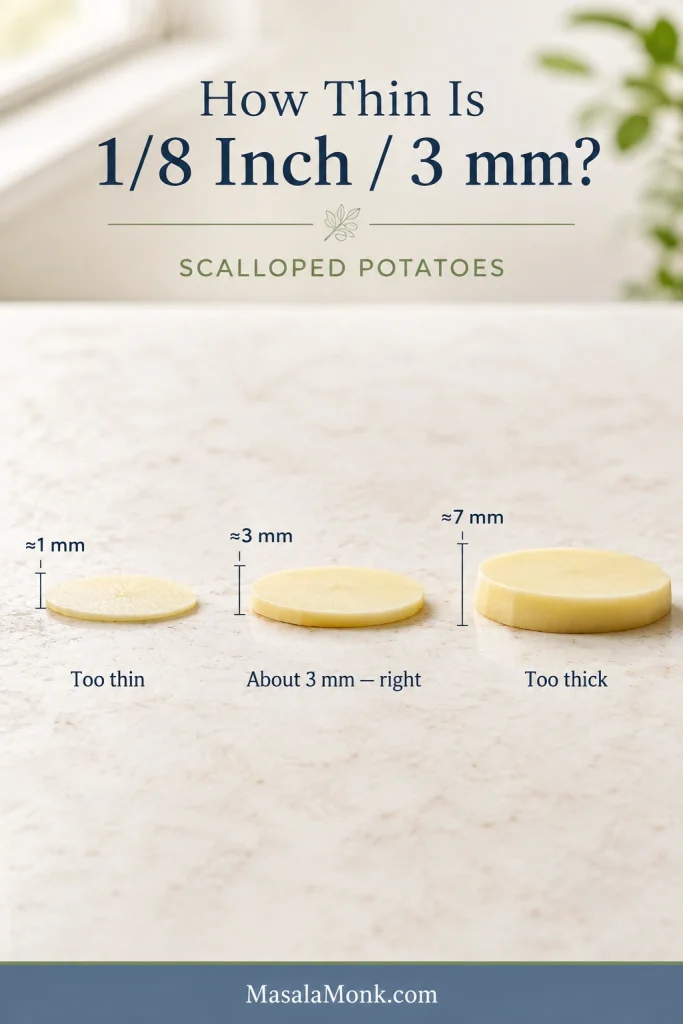
Slice 3 lb (1.36 kg) Russet potatoes about ⅛ inch (3 mm) thick. Layer them with a lightly thickened whole-milk white sauce in a shallow 9 × 13-inch (23 × 33-cm) baking dish.

Bake at 375°F (190°C) for 45 minutes covered, then uncover and bake another 25 minutes. Start checking at the 70-minute mark. A thin knife should pass all the way through without catching on a firm layer. Most pans finish in the 75–90 minute range.

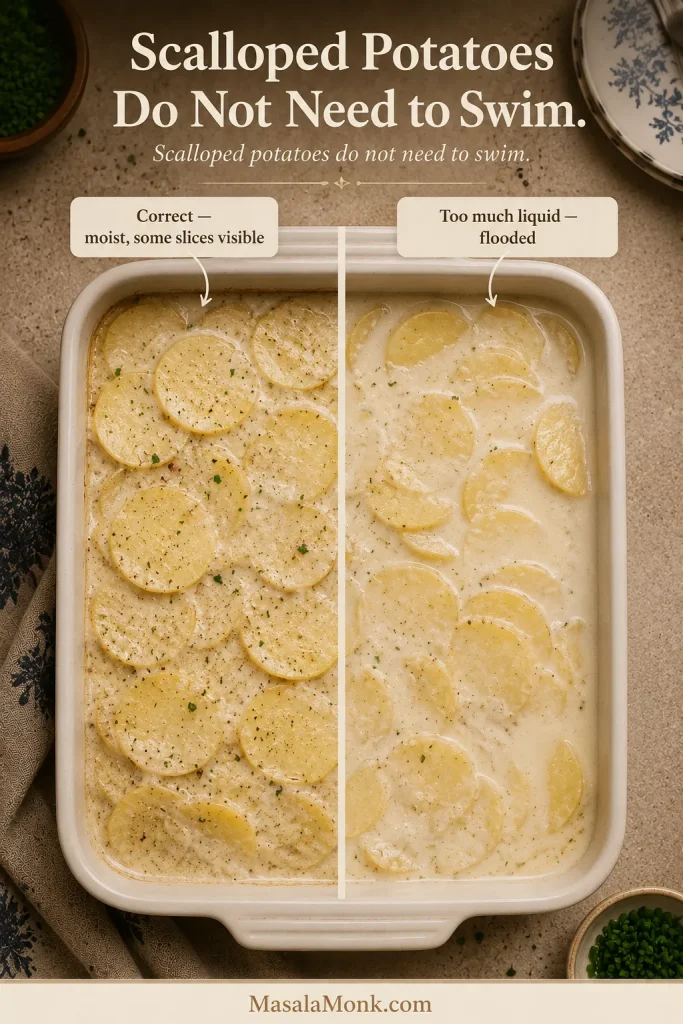
Rest the potatoes for 20 minutes before serving. And don’t worry if some slices remain visible above the sauce before baking. Scalloped potatoes do not need to swim.

Make it now

Scalloped Potatoes Recipe

These easy scalloped potatoes pair thin Russet slices with a savory onion-and-garlic white sauce that stays creamy without relying on heavy cream or cheese.

Recipe at a Glance

  • Yield: 8 side-dish servings
  • Prep: 25 minutes
  • First check: 70-minute mark
  • Typical bake: 75–90 minutes
  • Rest: 20 minutes
  • Total: 2 hours to 2 hours 15 minutes
  • Oven: 375°F (190°C)
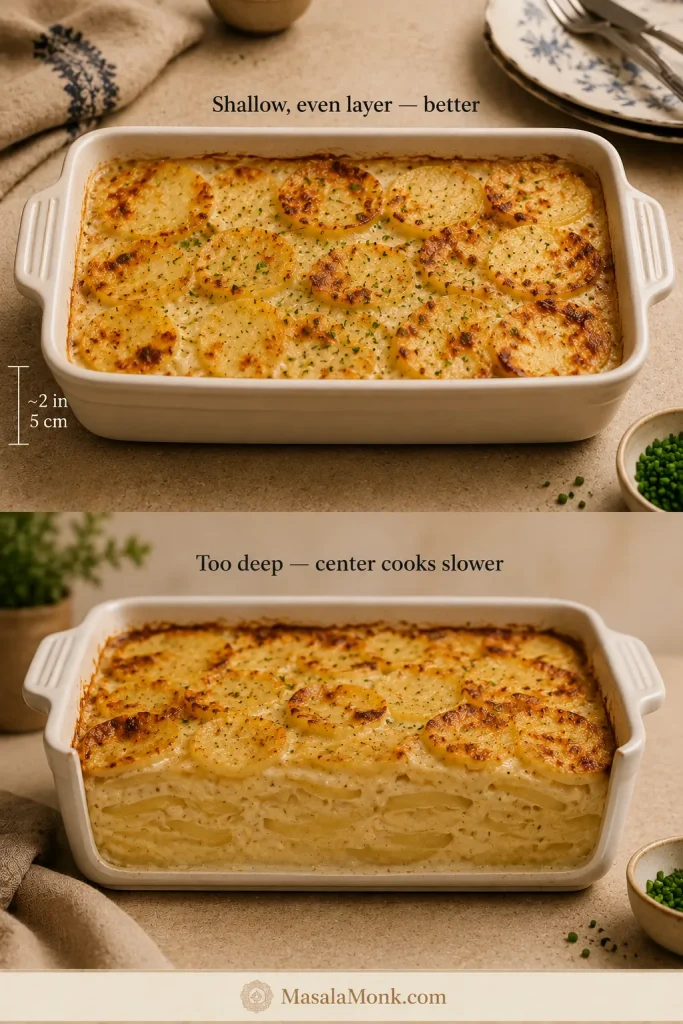
  • Dish: shallow 9 × 13 inches (23 × 33 cm), about 2 inches (5 cm) deep

Equipment

  • Shallow 9 × 13-inch (23 × 33-cm) baking dish
  • Medium saucepan
  • Whisk
  • Mandoline with hand guard or sharp chef’s knife
  • Aluminum foil

A similarly sized shallow dish works too. A deeper dish stacks the potatoes into a thicker layer, so heat takes longer to reach and soften the slices in the middle.

Comparison of scalloped potatoes arranged in a shallow casserole and stacked much more deeply in another dish where the center cooks more slowly.
Pan dimensions can vary a little; what matters is the height of the potato stack. A noticeably deeper layer takes longer for heat to soften through the center.

Planning to finish the top under the broiler? Use a baking dish rated for broiler heat.

Ingredients

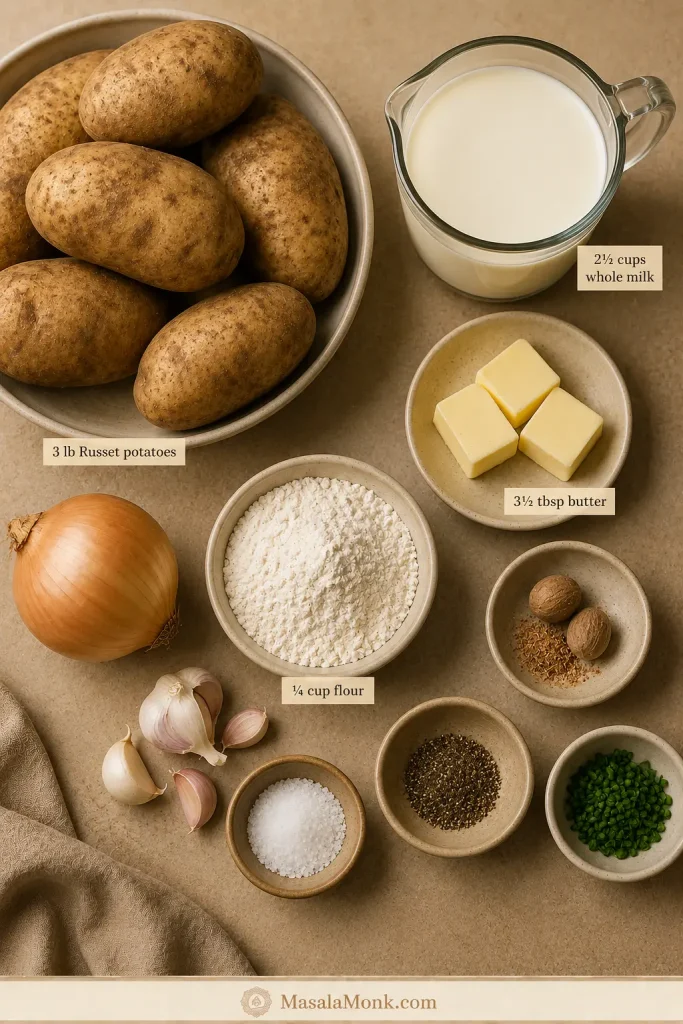
Russet potatoes, whole milk, butter, flour, onion, garlic, salt, pepper, nutmeg and fresh herbs arranged for making scalloped potatoes.
Most of the salt seasons the sauce; the rest reaches the potato layers directly.
  • 3 lb (1.36 kg) Russet potatoes, weighed before peeling
  • 3½ tablespoons (50 g) unsalted butter, plus more for the dish
  • 1 medium yellow onion, about 5 oz (140 g), finely diced
  • 2 medium garlic cloves, about 6 g, finely minced
  • ¼ cup (30 g) all-purpose flour
  • 2½ cups (590 ml) whole milk
  • 2 teaspoons fine sea salt (about 11 g), divided
  • ¾ teaspoon freshly ground black pepper
  • ⅛ teaspoon ground nutmeg, optional
  • Chopped chives, parsley or a few thyme leaves, optional for serving

Instructions

Prep the Sauce and Potatoes

  1. Heat the oven and prepare the dish. Set a rack in the center, heat the oven to 375°F (190°C), and lightly butter the baking dish.
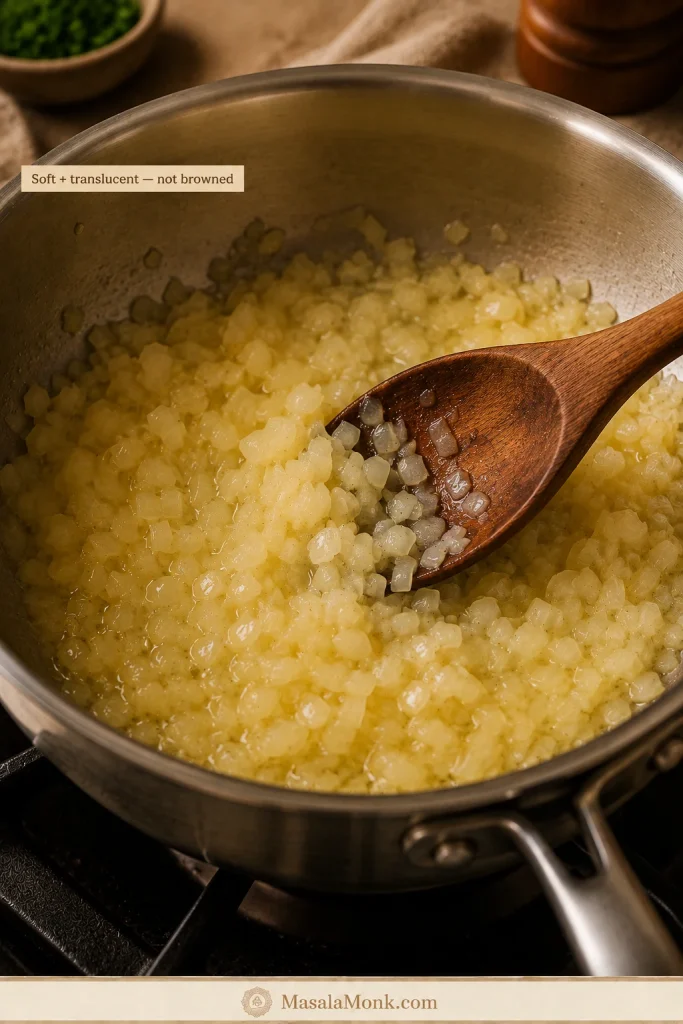
  2. Soften the onion and garlic. Melt the butter in a medium saucepan over medium heat. Cook the onion for 5–7 minutes, stirring occasionally, until soft and translucent. Add the garlic and cook for another 30 seconds, just until fragrant.
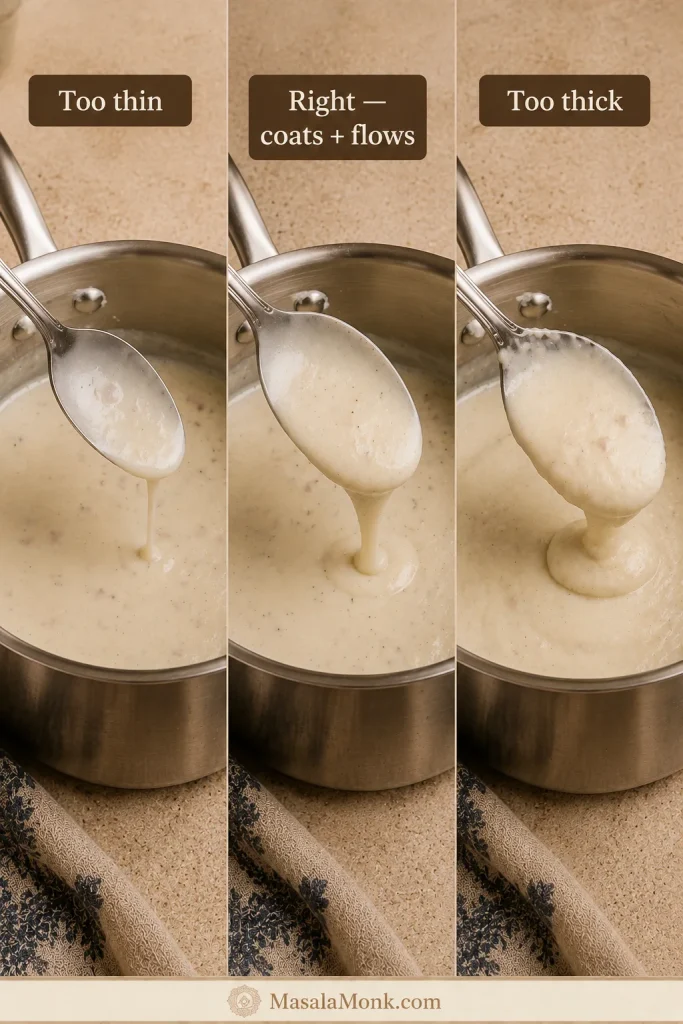
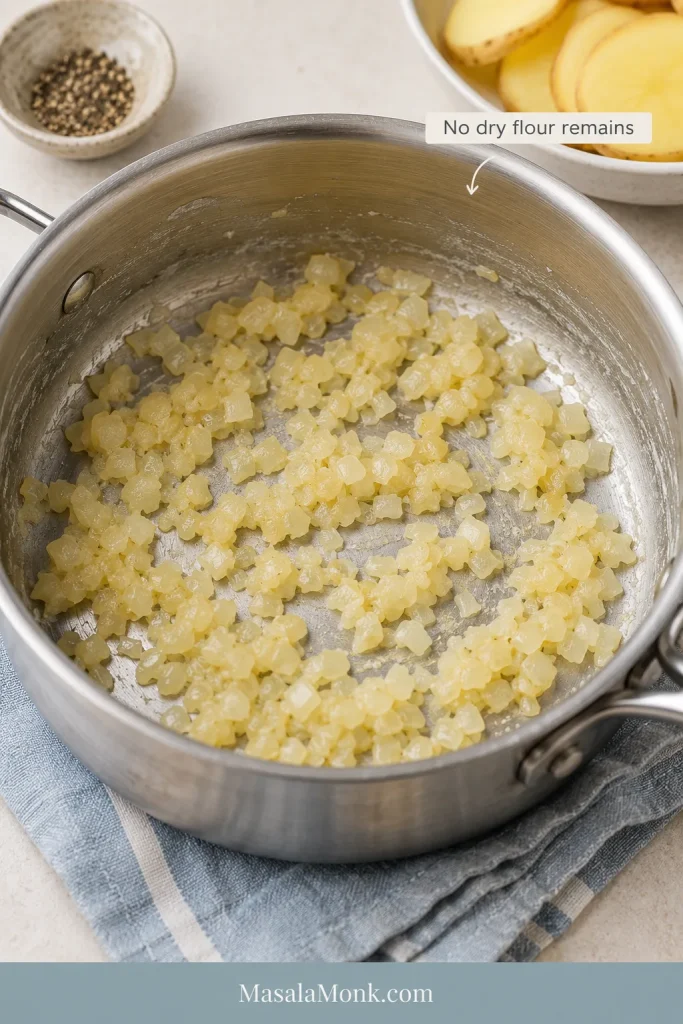
  3. Make the white sauce. Stir in the flour and cook for 1 minute, until no dry flour remains. Gradually whisk in the milk in several additions, followed by 1½ teaspoons (about 8 g) salt, the pepper and optional nutmeg. Cook over medium to medium-low heat, whisking regularly, until the sauce lightly coats the back of a spoon but still pours easily. Once all the milk is incorporated, this usually takes 4–6 minutes. Remove from the heat.
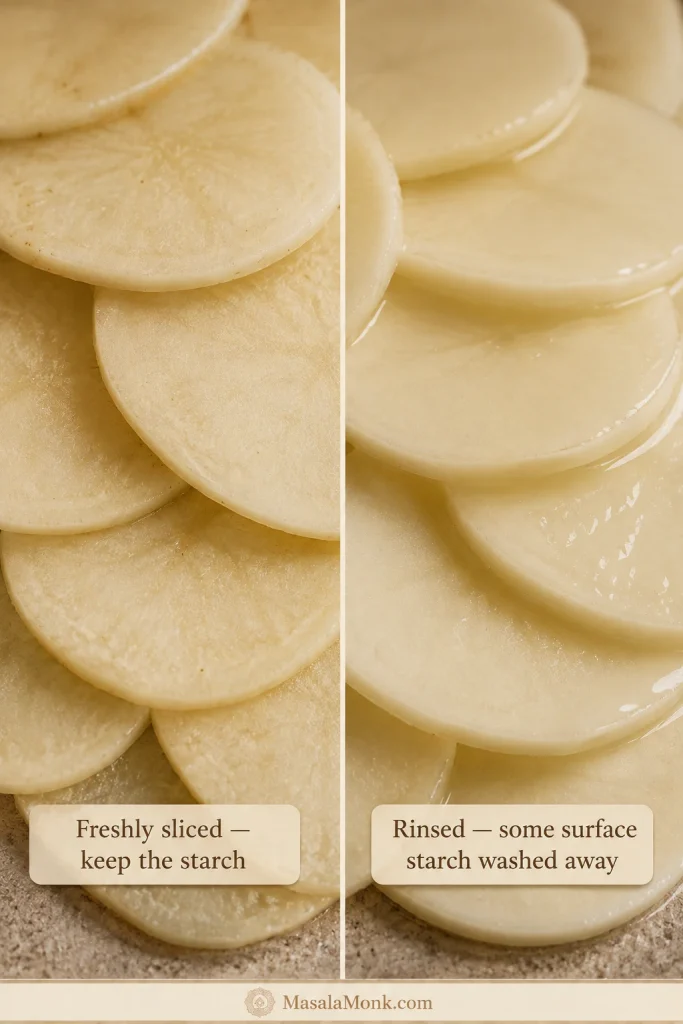
  4. Scrub, peel and slice the potatoes. Cut the Russets into even rounds about ⅛ inch (3 mm) thick. Keep the starch on the cut surfaces; don’t rinse or soak the slices. Separate any rounds that cling together.
Three potato slices compared by thickness, with about 3 millimeters shown as correct between a thinner and a much thicker slice.
Aim for about ⅛ inch (3 mm) throughout so the slices reach tenderness together.
  1. Check the sauce. It may thicken while you’re slicing the potatoes. Warm it gently and whisk until it pours easily again, adding a small splash of milk only when needed.
White sauce shown at three consistencies: too thin and runny, correctly coating a spoon while still flowing, and too thick and heavy.
The target is a light coating that still pours easily—looser than gravy, but with enough body to stay with the potato layers.

Layer and Bake

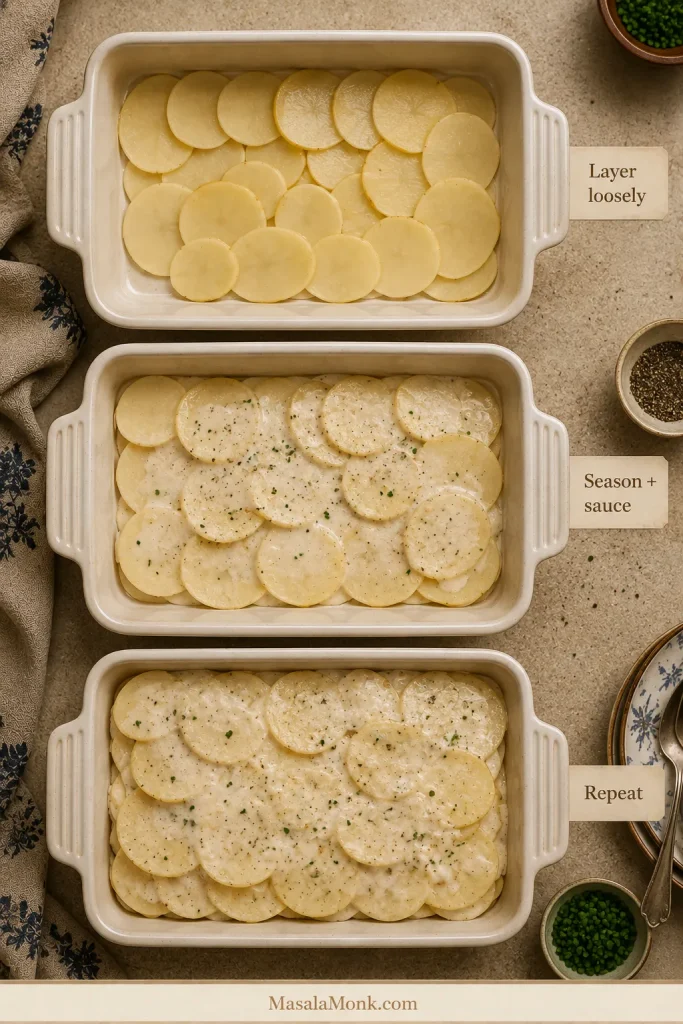
  1. Layer the potatoes. Spread one-third across the dish, overlapping loosely and avoiding dense stacks. Sprinkle with one-third of the remaining ½ teaspoon (about 3 g) salt, then spoon over one-third of the sauce. Repeat twice, finishing with sauce across the top.
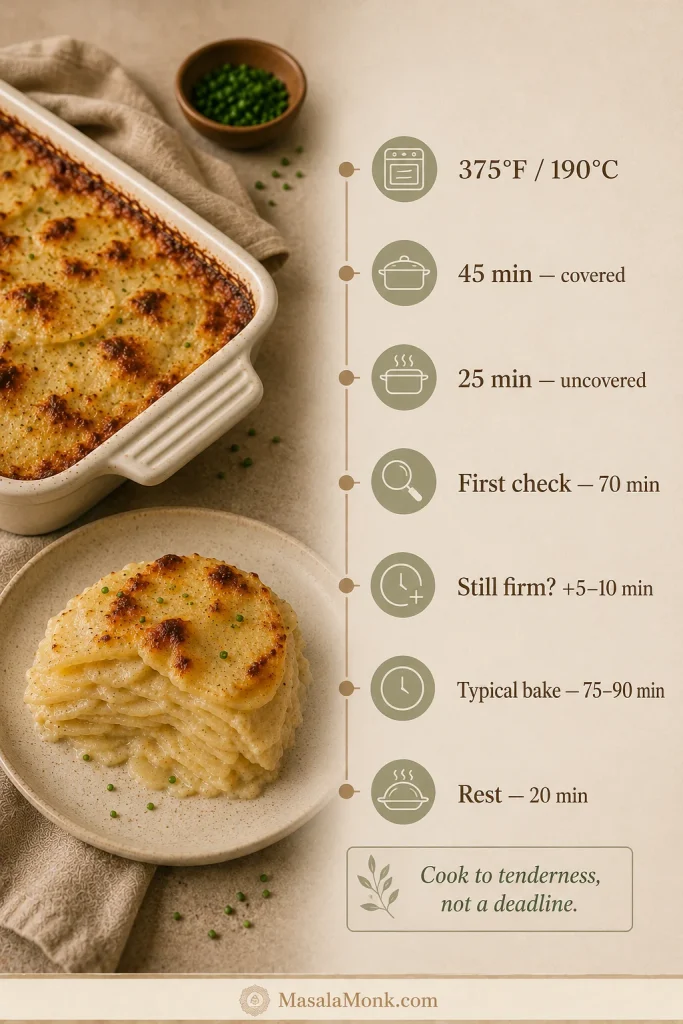
  2. Cover and bake for 45 minutes. Seal the dish tightly with foil. The trapped steam gives the stacked slices time to soften before the exposed top gets too dark.
  3. Uncover and bake another 25 minutes. Rotate the dish now if your oven browns unevenly. You should see steady bubbling around the edges and smell mellow onion, garlic and butter. The top can still be fairly pale, and some potato may still feel firm. This is usually the point when the pan starts looking like dinner.
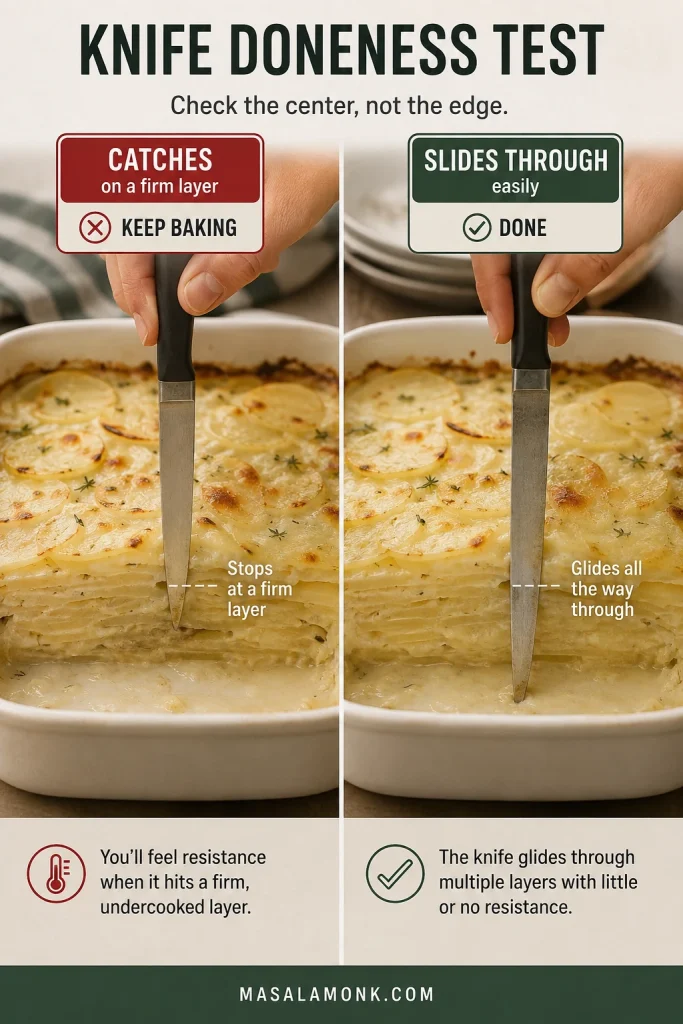
  4. Start checking at the 70-minute mark. Push a thin knife all the way through the potatoes. Clear resistance means they need more time, so continue uncovered in 5–10 minute stretches. Most pans finish between 75 and 90 minutes. Another 10 minutes is not a problem; give the final firm layer time to cook.
Thin knife stopping at a firm center layer of scalloped potatoes compared with the knife sliding easily through fully tender layers.
If the knife catches in the middle, keep baking; when it glides through the stacked slices, the potatoes are ready.

Finish and Serve

  1. Take the pan out when the potatoes are tender all the way through. The knife should move through the stacked slices with very little resistance.
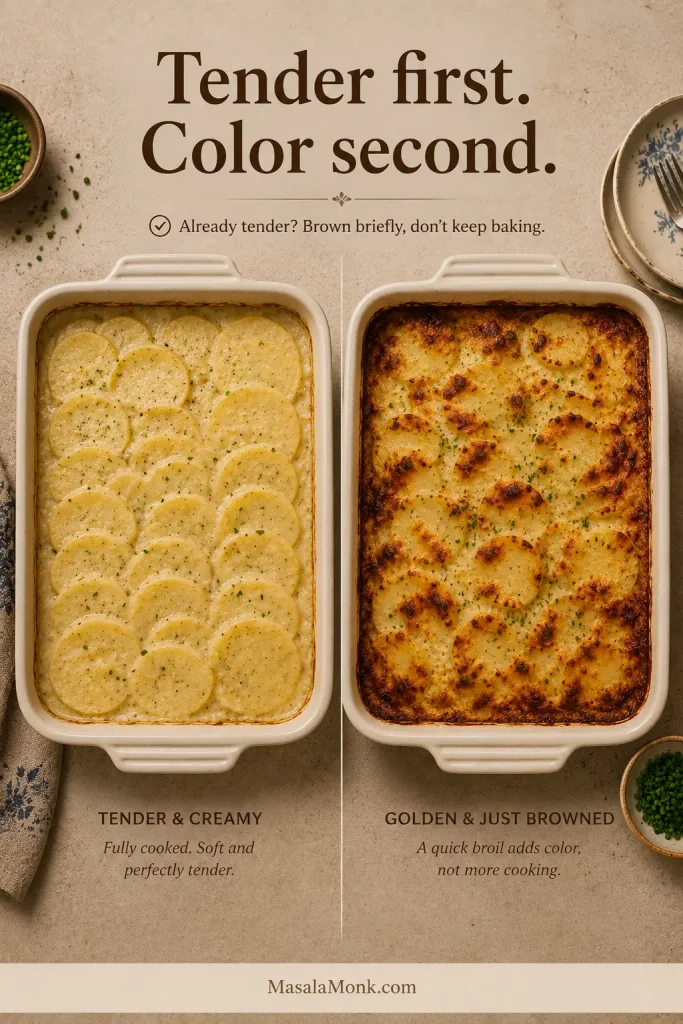
  2. Brown the top only if it needs it. Once the potatoes are cooked through, a long extra bake can dry them out. A brief broil gives the top deeper browned flavor. Use a broiler-safe pan and watch closely.
  3. Rest for 20 minutes. The hard bubbling will calm and the sauce will settle around the potato layers. Finish with chives, parsley or thyme if you want a little freshness against the creamy sauce.
Side view of scalloped potatoes showing many thin, tender potato layers separated by creamy white sauce.
Narrow seams of sauce between the slices are enough; the potatoes do not need to sit in a pool.

If you’re cooking right now, you can stop here. Once the potatoes are tender and the pan has had its 20-minute rest, dinner is ready. Everything below is optional help for choosing ingredients, fixing problems, planning ahead and serving the dish.


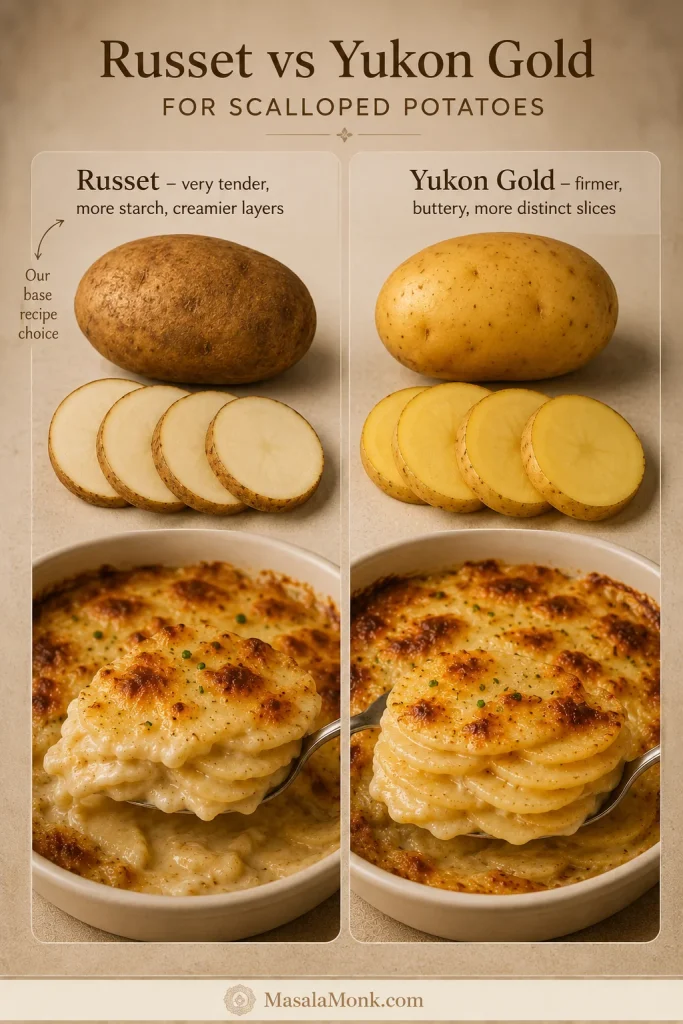
Best Potatoes: Russet or Yukon Gold?

Both work. Russets give you especially tender, creamy layers; Yukon Golds stay a little firmer and more defined.

PotatoFinished textureWhat happens to the sauceBest when you want
RussetVery tender and yieldingReleases more starchMaximum creaminess
Yukon GoldFirmer, tidier slicesReleases less starchButtery flavor with more distinct layers
Russet and Yukon Gold potatoes compared with cooked samples showing softer Russet layers and firmer Yukon Gold layers.
Russets relax more; Yukon Golds keep cleaner layers. Use the same weight and slice thickness for either.

How to Prep Russets or Yukon Golds

Russets suit this version because some of their starch moves into the sauce as they cook, helping it cling between the slices. Their thicker skins can stand out in such thin layers, so peeling is worth the few extra minutes.

Yukon Golds are a good swap when you prefer the potatoes to keep their shape more clearly. Use the same weight and slice thickness. Their thinner skins are less noticeable, so leaving them on becomes mostly a matter of preference.

The same texture difference shows up in mashed potatoes: Russets lean lighter and fluffier, while Yukon Golds make a naturally buttery, creamier mash.

Whichever potato you choose, keep the starch clinging to the freshly cut slices. Make the sauce first, cut the potatoes afterward, and assemble the dish right away.

Freshly cut potato slices with a faint cloudy starch film compared with rinsed slices that look cleaner and wetter.
Keep the natural surface starch; it helps the lightly thickened milk sauce cling as the potatoes bake.

Milk, Cream and the White Sauce

Cook the onion until it is soft and translucent, not browned. At that point its flavor is sweet and mellow; garlic and black pepper round out the sauce, while optional nutmeg should stay quietly in the background.

Finely diced yellow onion softened in butter until glossy and translucent but not browned.
Soft and translucent is enough; browning would push the sauce toward a deeper onion flavor.

The sauce is essentially a simple béchamel-style white sauce: butter and flour give the milk some body before it goes into the oven, then potato starch thickens it further as the layers bake.

Soft diced onion coated with a pale butter-and-flour mixture in a stainless steel pan before milk is added.
Cook until no dry flour remains, but stop before the roux takes on brown color.

Dairy Choices for Scalloped Potatoes

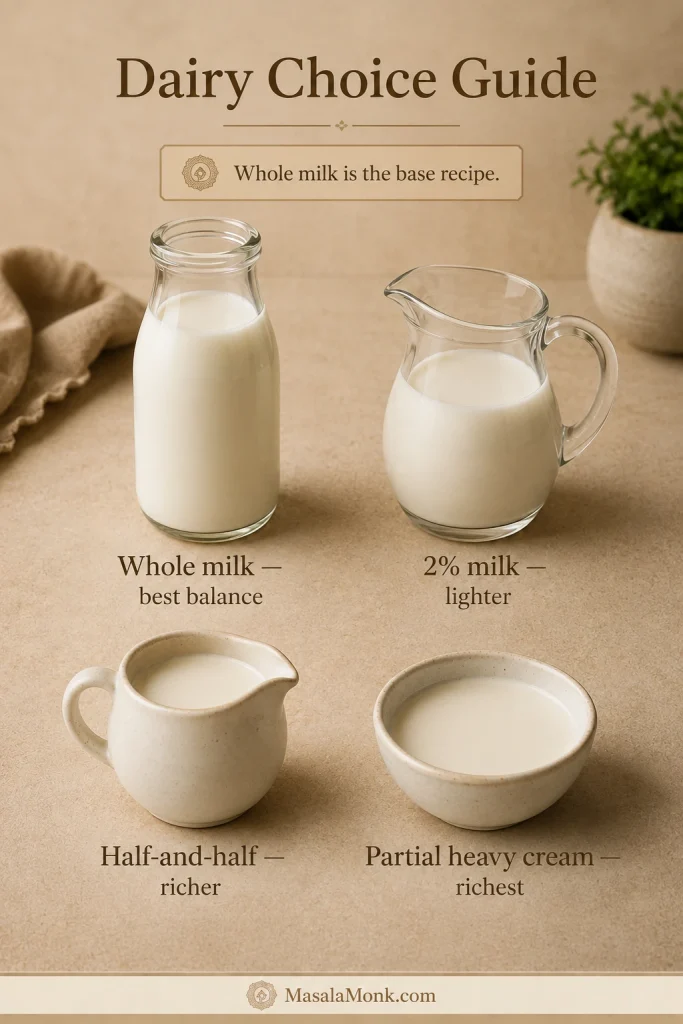
Whole milk gives the best balance here—rich enough to feel creamy without overwhelming the potatoes.

Half-and-half makes a richer version. Heavy cream can replace roughly one-third to one-half of the milk when you want something more luxurious. 2% milk gives you a lighter sauce. Skim milk produces a leaner result and isn’t the best choice when creaminess is the goal.

Dairy guide comparing whole milk, 2 percent milk, half-and-half and a mixture containing heavy cream for the potato casserole.
Whole milk is the baseline; richer dairy changes richness, not the sauce endpoint.

What the Sauce Should Look Like

The sauce should tell you when it is ready. Almost milk-thin? Give it another minute. Thick enough to sit heavily on the spoon? Loosen it before layering. The sweet spot is a light coating on the spoon that still flows easily.

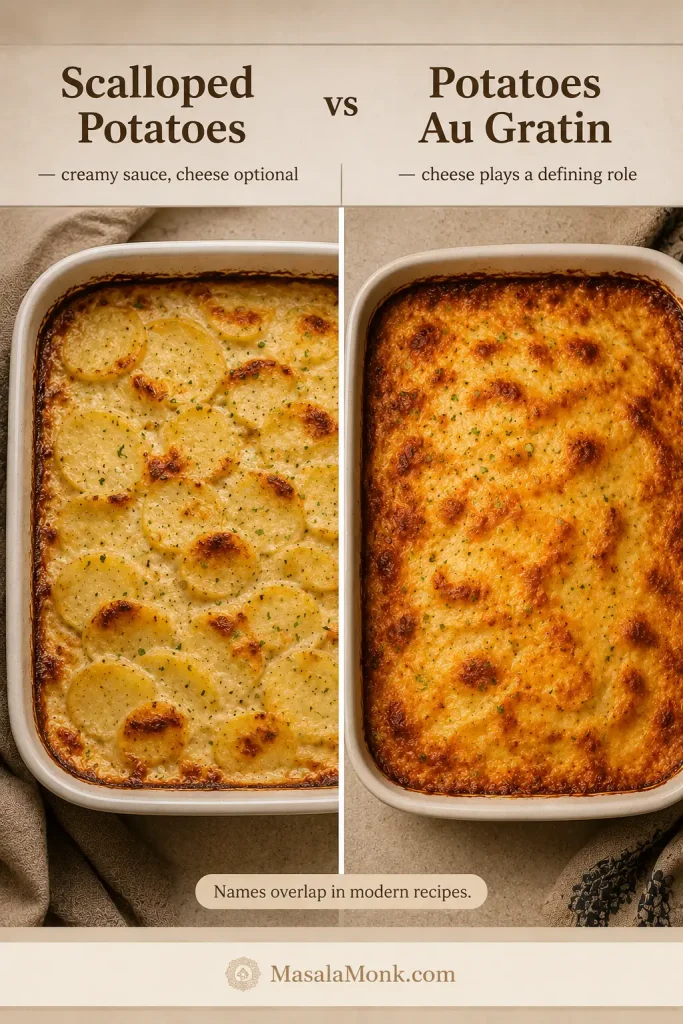
Scalloped Potatoes vs Au Gratin

The names overlap in modern recipes, but traditionally scalloped potatoes are built around sliced potatoes and a creamy sauce. In potatoes au gratin, cheese usually plays a defining role.

Creamy scalloped potatoes without a cheese crust compared with potatoes au gratin topped with a visibly browned cheese layer.
Scalloped potatoes let the creamy sauce lead; au gratin usually makes cheese a defining feature.

Cheese is optional here. Add up to 4 oz (115 g) finely grated sharp cheddar or Gruyère if you want it, either over the top when the foil comes off or stirred into the warm sauce away from direct heat.

If the scalloped potatoes you grew up with started with a can of cream-of-mushroom soup, that’s another very familiar branch of the dish. Condensed soup replaces the homemade white sauce; it isn’t something to pour on top of the recipe as written because it already brings its own starch, salt and flavor.

The same homemade-sauce-versus-canned-soup choice comes up in our green bean casserole.

Troubleshooting a thin sauce? See why they turn watery →

What the Potatoes Should Look Like at Three Stages

Use the clock as a checkpoint, then let the pan confirm what happens next. The visual changes matter most as the casserole moves from covered to uncovered to rested.

Baking timeline showing 45 minutes covered, 25 minutes uncovered, a first check at 70 minutes, more time if firm, and a 20-minute rest.
Use the clock as a checkpoint; center tenderness still decides when the casserole is done.

Before baking

The sauce should flow easily between the slices, and the potato depth should stay reasonably even. Perfect rows are optional; loose overlap matters much more.

Three-step scalloped potato assembly showing loosely overlapping slices, seasoning and white sauce, then repeated layers in a shallow casserole.
Loose overlap leaves pathways for sauce and heat; tight stacks make uneven cooking more likely.

Some upper slices can stay visible before baking. The sauce should reach through the layers without leaving the potatoes sitting in a pool of liquid.

Correctly sauced scalloped potatoes with some slices visible compared with an overfilled casserole where excess liquid surrounds the potatoes.
Some potato can stay visible before baking. Extra milk for reassurance can leave too much liquid after the casserole cooks.

When the foil comes off

Look for steady bubbling around the perimeter and a surface that may still be fairly pale. The upper slices will have begun to yield, while the potatoes lower in the pan can still need more time. The butter, onion and garlic should be noticeably fragrant by now.

Scalloped potatoes shown before baking, pale and bubbling after the foil is removed, and finished with irregular golden browning.
After uncovering, evaporation concentrates the sauce while exposed potato surfaces finally get a chance to brown.

When they’re done

At the finish, the potatoes are tender all the way through and the edges have picked up some color. The sauce bubbles with more body than it had earlier in the bake. After resting, it clings around the slices instead of running across the plate.

Overhead view of a shallow casserole of scalloped potatoes with irregular golden patches and darker browning around the perimeter.
Color is secondary: a tender casserole may still have pale patches between deeper browned edges.

Why They Turn Watery

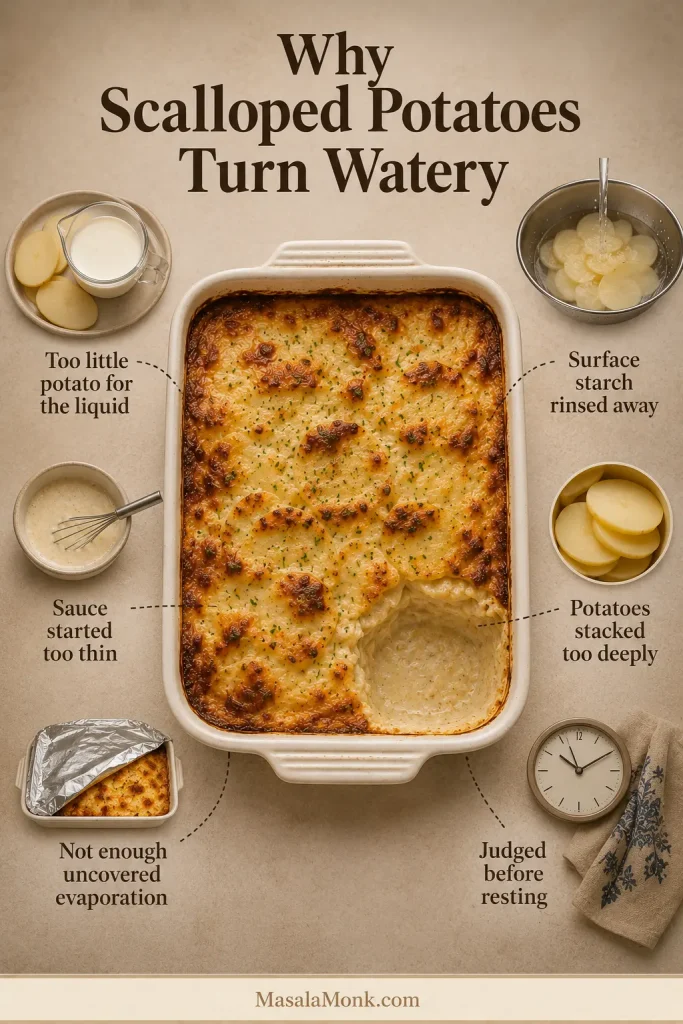
Watery scalloped potatoes rarely come down to one mistake. Potato quantity, surface starch, sauce consistency, pan depth, the covered and uncovered stages, and the final rest all affect what reaches the plate.

Troubleshooting guide showing six causes of watery scalloped potatoes: too much liquid for the potatoes, rinsed starch, thin sauce, deep layering, insufficient evaporation and judging before resting.
Most watery pans trace back to one of these six decisions.

How to Prevent Watery Scalloped Potatoes

  • Use the full potato quantity. The 2½ cups (590 ml) milk are balanced around 3 lb (1.36 kg) potatoes.
  • Keep the surface starch. Rinsing the slices removes starch that otherwise helps the sauce gain body.
  • Give the milk a head start. Lightly thickening it before assembly means the potatoes aren’t beginning their bake in plain liquid.
  • Keep the potato layer reasonably shallow. A thicker vertical stack needs more time for heat to work through it evenly.
  • Let the covered stage work first. The potatoes need moisture while they soften. Once the foil comes off, evaporation can concentrate the sauce and the exposed edges can begin to brown.
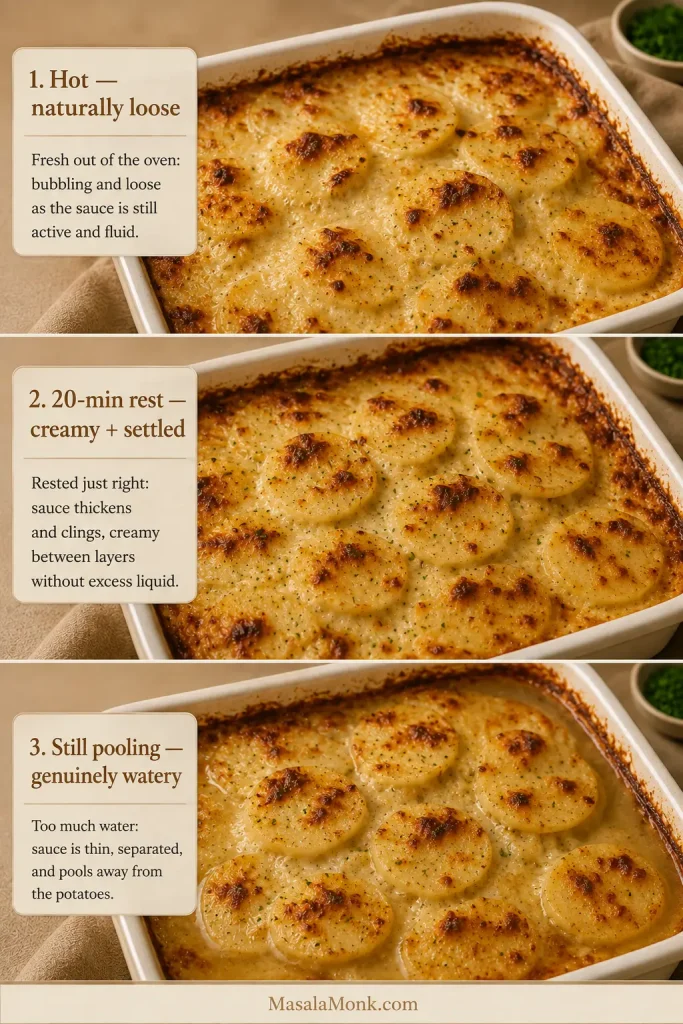
  • Rest before deciding the sauce is too thin. It is naturally at its loosest while everything is still bubbling hard.

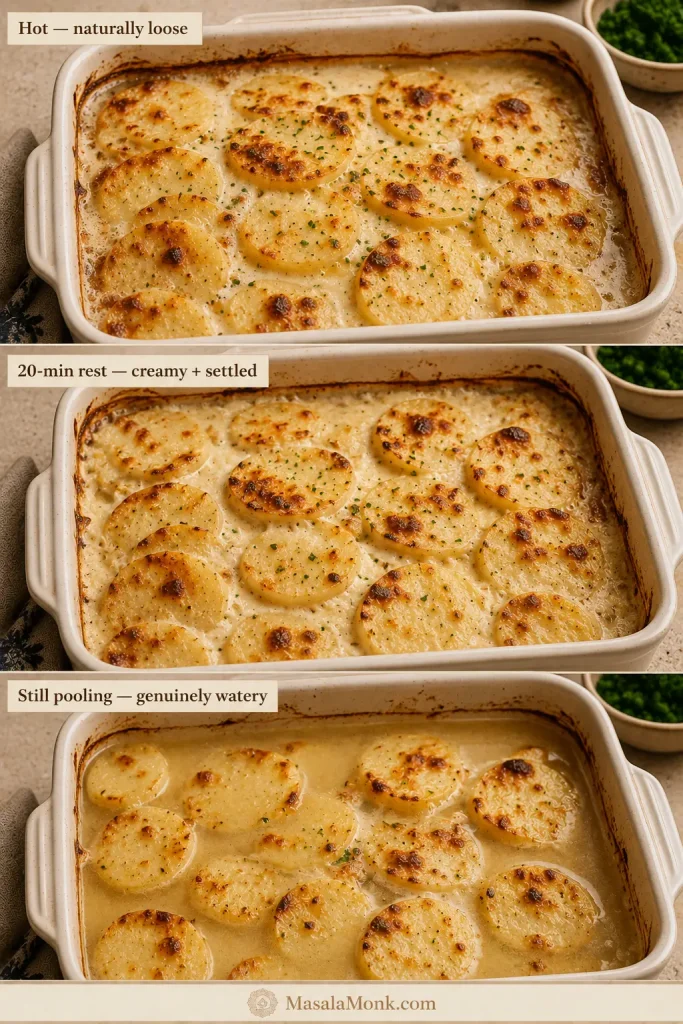
Loose isn’t automatically watery. A pan straight from the oven can look looser than it will 20 minutes later. Give it the rest first. Only then decide whether there is genuinely too much thin liquid.

Scalloped potatoes shown hot and loose, creamy and settled after a 20-minute rest, and genuinely watery with thin liquid still pooling around the slices.
Judge the sauce after the full 20-minute rest. Thin liquid that still separates then is different from the normal looseness of a bubbling-hot pan.

Troubleshooting

Start with what you can see and feel. Most problems have a straightforward next move, and some apparent problems need nothing more than patience.

What you seeWhat to do
Loose sauce straight from the ovenRest for 20 minutes before judging it
Thin liquid still pooling after the restWhen the potatoes are fully tender, return the pan uncovered for 5–10 minutes, then let it settle again
Whole middle still firmCover again if the top is already dark and continue baking in 5–10 minute stretches
Only random slices stay firmKeep this batch cooking; next time watch for thicker rounds or slices stuck together
White sauce has flour lumps before layeringWhisk firmly while warm and press obvious lumps against the side of the saucepan; add milk more gradually next time
Sauce is too thick before layeringWarm gently and whisk until pourable, adding a small splash of milk only as needed
Potatoes are tender but the top is paleUse a brief broiler finish in a broiler-safe dish
Finished potatoes seem dryStop the regular bake as soon as the potatoes are cooked through; use brief high heat for extra browning

The sauce still looks watery after resting

Visible thin liquid after the 20-minute rest is different from the normal looseness of a piping-hot pan. When the potatoes are already tender, return the dish to the oven uncovered for another 5–10 minutes. Watch closely: once the excess liquid is gone, creamy can turn dry surprisingly quickly.

The potatoes are cooking unevenly

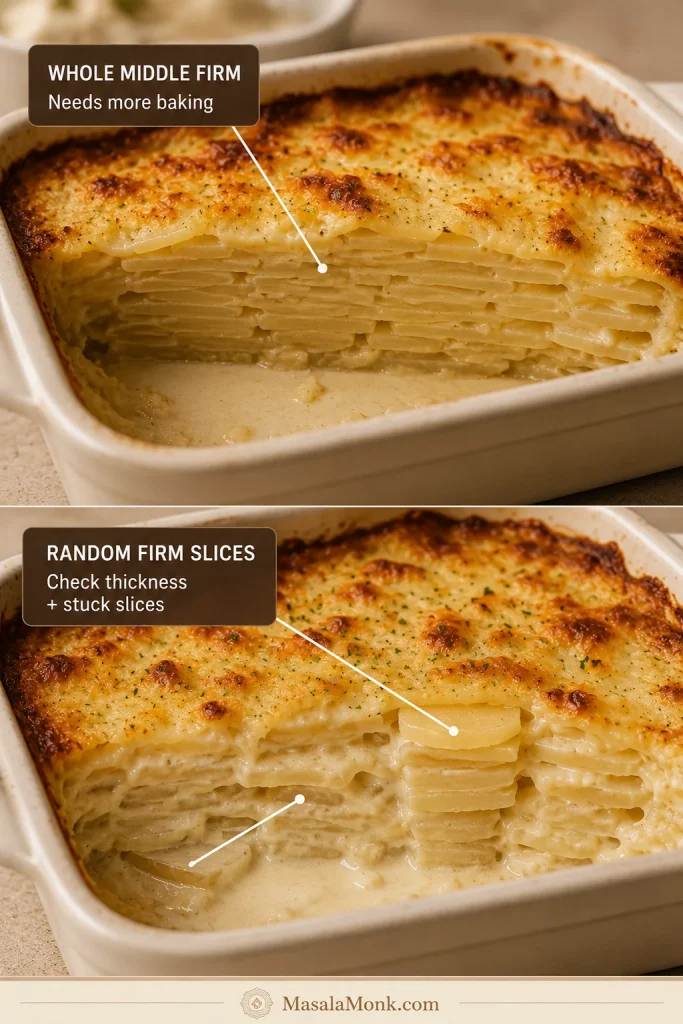
A firm layer through the whole middle simply needs more time. Cover the dish again when the top is already sufficiently browned and keep baking until the potatoes are cooked through.

Cutaway comparison of scalloped potatoes with a broadly firm center and another casserole with isolated thick or stuck firm slices.
One broad firm zone usually needs more cooking time; scattered firm pieces point back to uneven thickness or slices stuck together.

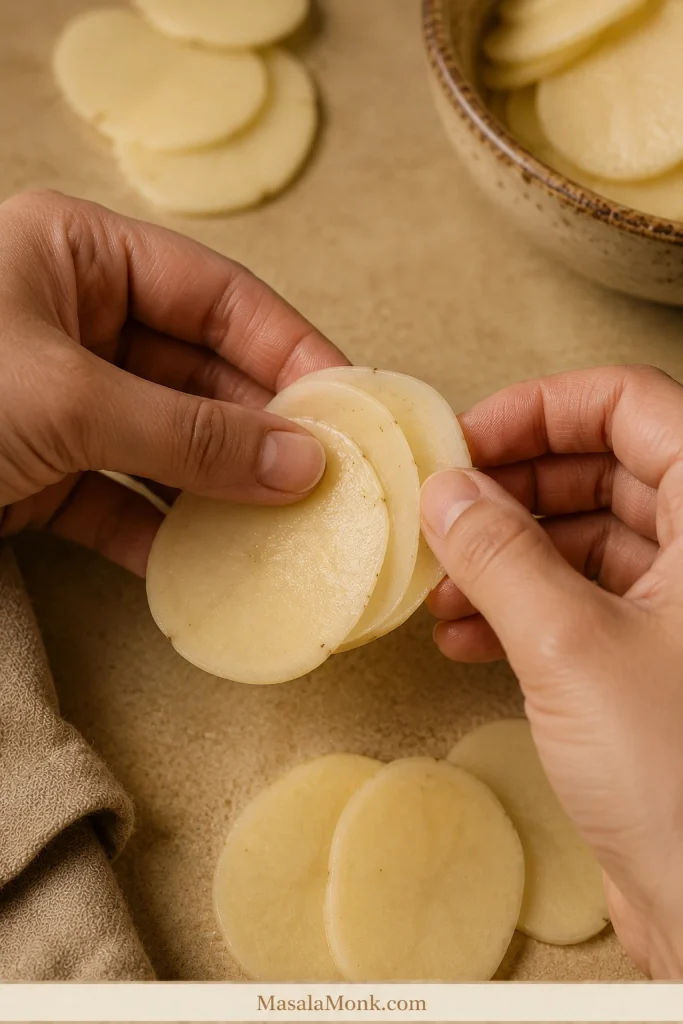
Random firm slices point to something different: thickness or stacking. A few thicker rounds, or several slices pressed tightly together, can lag behind everything around them.

Hands gently separating thin raw potato slices that have stuck together before layering them in the casserole.
Two slices stuck together cook like one thick slice, so separate little stacks before layering.

The white sauce looks too thick or lumpy

Deal with this before layering. Sauce that has simply thickened while waiting usually needs gentle heat and whisking, perhaps with a small splash of milk. Flour lumps are easier to correct while the sauce is still in the saucepan: whisk firmly and press stubborn lumps against the side until they break down.

Once the potatoes are cooked through and the rested sauce clings around the slices, stop fixing things. They’re ready to eat.

Serving spoon lifting soft scalloped potatoes with thin layered slices bending naturally and creamy sauce clinging between them.
A slight bend on the spoon signals tender layers that still hold together.

Return to recipe · Back to top ↑

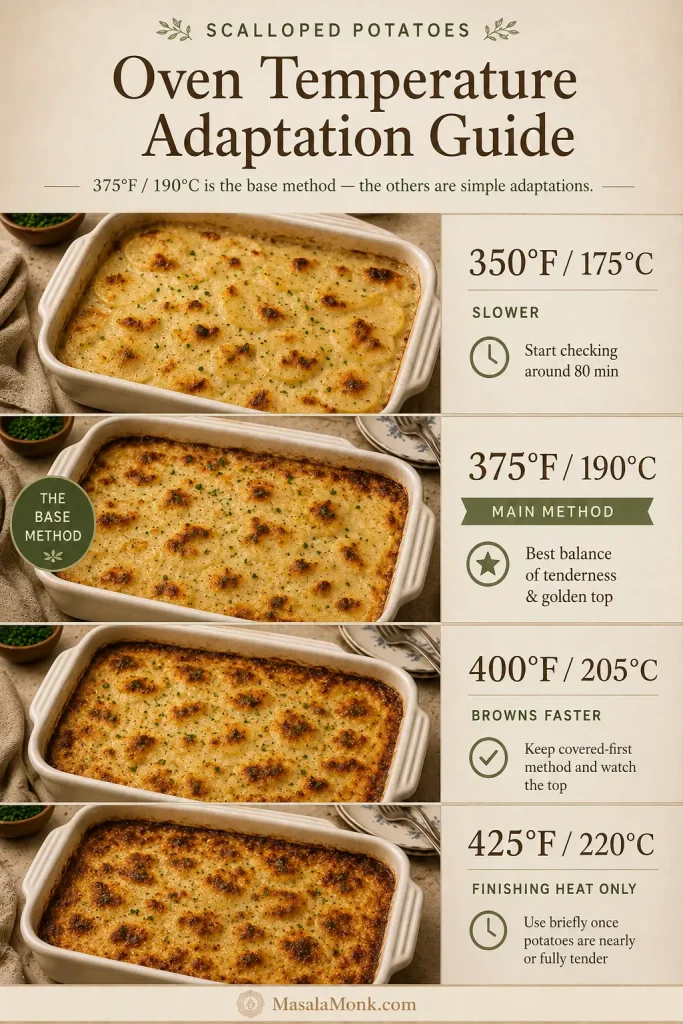
What If Your Oven Is at 350°F, 400°F or 425°F?

350°F (175°C): the potatoes will cook more slowly. Begin checking around the 80-minute mark and continue until no firm layer remains.

375°F (190°C): use the main method. This temperature gives a comfortable balance between steady cooking and controlled browning.

400°F (205°C): the exposed top will color faster, so don’t let browning convince you the potatoes underneath are finished. Keep the covered-first method.

During the uncovered stage, check the potatoes themselves. Once the top has enough color, loosely cover it again if the layers underneath still need more time.

Pale but fully tender scalloped potatoes compared with the same casserole after a brief browning finish.
Once the center is tender, use a brief broil for color instead of prolonging the bake.

425°F (220°C): save this temperature for the finish. Once the potatoes are nearly or completely cooked, a short burst of higher heat can deepen the color. A full bake at 425°F risks dark edges long before the stacked slices are ready.

Oven temperature guide showing 350 degrees Fahrenheit as slower, 375 as the main method, 400 as faster browning and 425 as finishing heat only.
Higher heat browns sooner. Whatever temperature you use, let tenderness through the center—not surface color—decide when the potatoes are done.

Make-Ahead Options

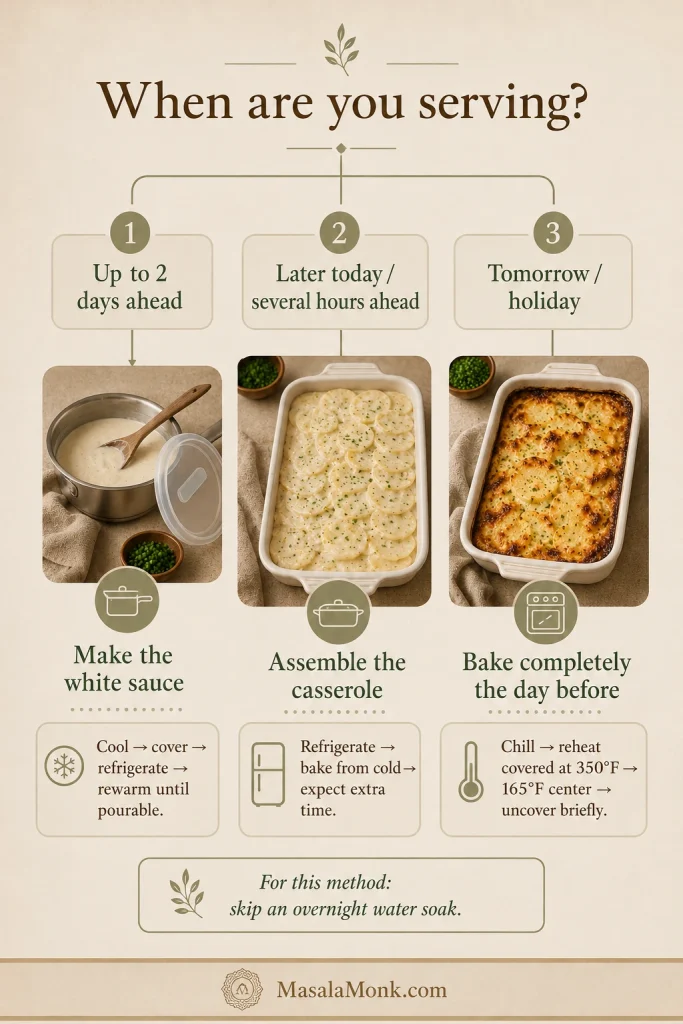
The white sauce can be made up to 2 days ahead, cooled, covered and refrigerated. Rewarm it gently until pourable before assembling the potatoes. That removes a useful chunk of work without leaving raw slices sitting around overnight.

You can also assemble the whole dish several hours in advance, cover it tightly and refrigerate. A cold pan will take longer to bake, and the delay varies with the baking dish and how thoroughly chilled everything is.

Don’t simply tack a fixed 10 minutes onto the recipe. Keep the dish covered while the potatoes warm and begin to soften, then use their texture to decide when they’re ready for the final uncovered stage.

For this method, skip the overnight water soak. Soaking prevents sliced potatoes from browning, but it also washes away some of the surface starch we’re deliberately keeping to help the sauce.

Make-ahead decision tree showing white sauce prepared up to two days ahead, an assembled potato casserole several hours ahead, or the complete dish baked the day before.
For a busy holiday, the fully baked day-ahead route is the most predictable; shorter lead times leave more of the cooking for serving day.

For a holiday, bake it the day before

On a holiday, predictability is worth more than doing everything at the last minute. If the ham is warming, vegetables are waiting and somebody needs the oven for rolls, scalloped potatoes are a terrible thing to discover still have a hard center.

Fully baking them a day ahead removes that gamble. It is especially useful beside a honey glazed ham, which has its own warming and glazing schedule.

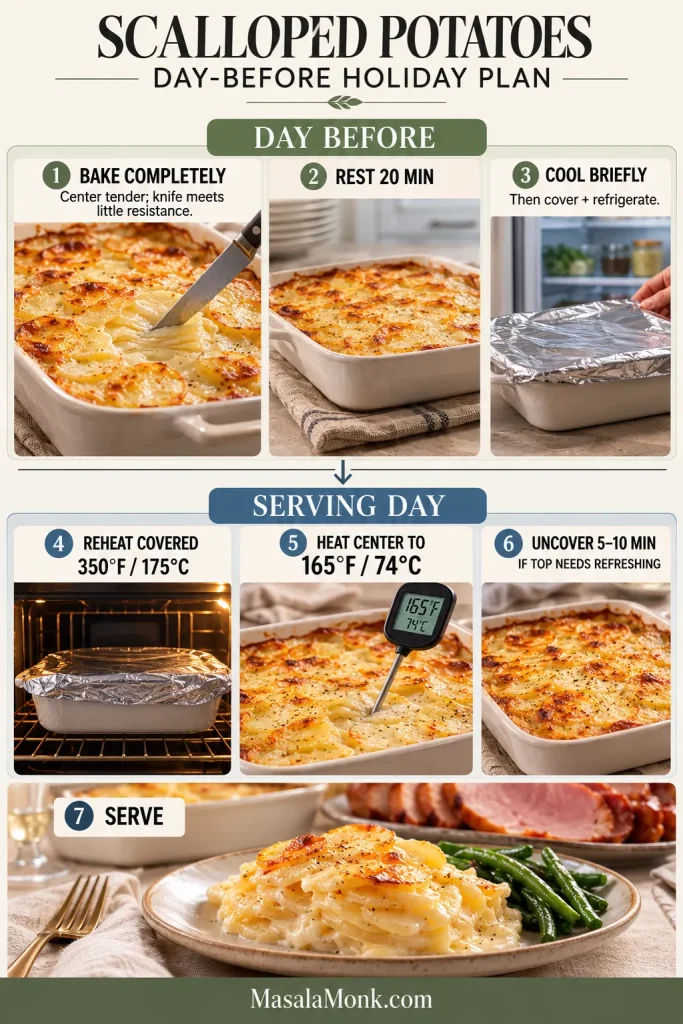
  1. Bake the potatoes normally and let them rest.
  2. Cool briefly, then cover and refrigerate the pan within 2 hours.
  3. Reheat covered at 350°F (175°C) until the center reaches 165°F (74°C).
  4. Uncover near the end when the surface needs refreshing.
Day-before holiday timeline showing the casserole baked until tender, rested, cooled briefly and refrigerated, then reheated covered at 350 degrees Fahrenheit to 165 degrees before a short uncovered finish.
Bake until fully tender the day before. Serving day becomes reheating and refreshing the surface, not another round of checking for doneness.

Another way to ease holiday oven traffic is to move the main elsewhere: a slow cooker whole chicken leaves the oven almost entirely to the potatoes.

Return to recipe · Back to top ↑

For Two, Eight or a Crowd

Changing the quantity is straightforward. Keeping roughly the same depth in the baking dish matters more than keeping exactly the same footprint.

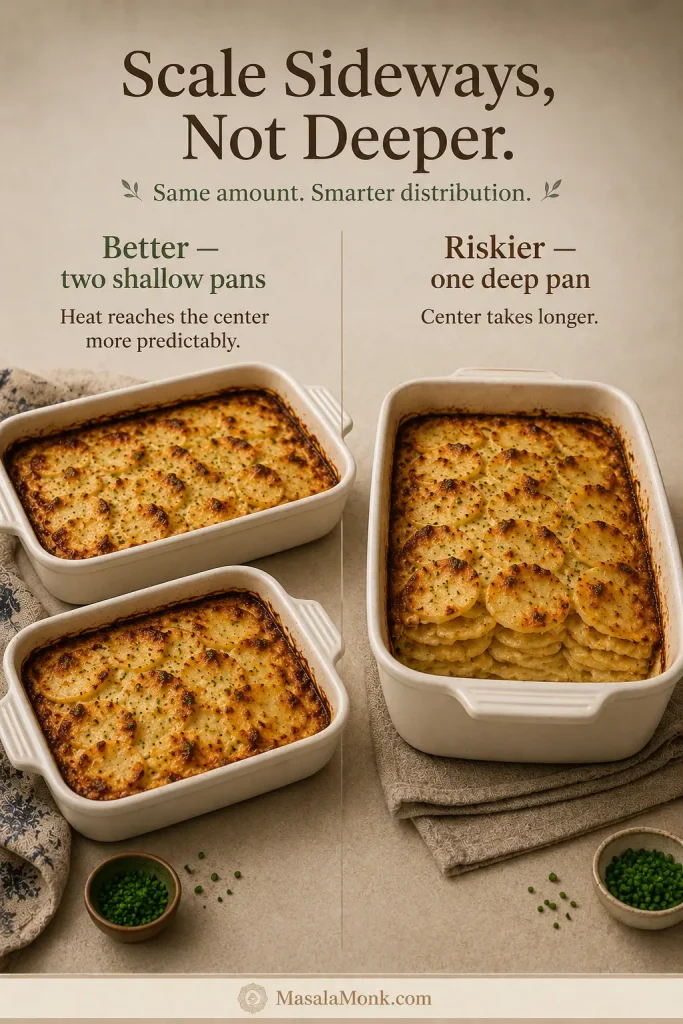
Scale sideways, not deeper. Two shallow pans cook more predictably than one giant dish piled twice as high.

Same amount of scalloped potatoes divided between two shallow pans compared with one deep casserole where the center takes longer to cook.
Double the pan area, not the stack height. Two shallow pans also give you more browned edges.

Pan Sizes and Serving Amounts

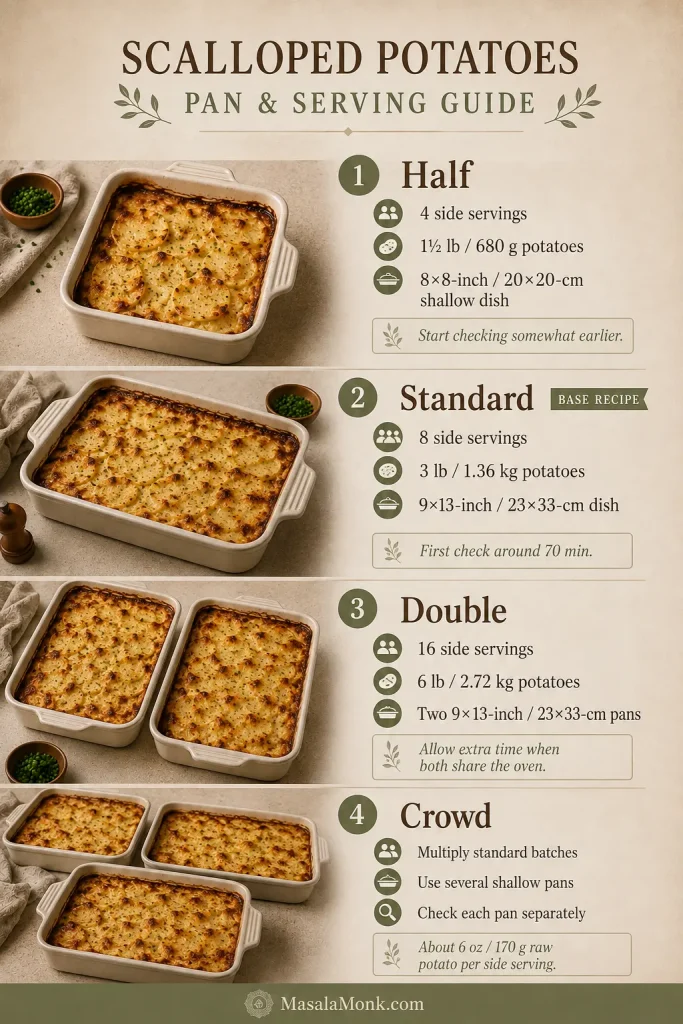
BatchSide servingsPotatoesDishTiming
Half41½ lb (680 g)8 × 8-inch (20 × 20-cm) shallow dishStart checking a little before the standard batch; similar depth means the total cooking time may remain fairly close
Standard83 lb (1.36 kg)9 × 13-inch (23 × 33-cm) dishFirst check at 70 minutes
Double166 lb (2.72 kg)Two 9 × 13-inch dishesAllow extra time when both pans share the oven
Large crowdMultiply standard batchesAs neededSeveral shallow pansJudge each pan separately

The standard recipe uses roughly 6 oz (170 g) raw potato per side serving. That’s comfortable when several other dishes are on the table; make more when the potatoes are likely to be one of the stars.

Pan and serving guide showing a half batch in an 8-inch square dish, the standard batch in a 9-by-13-inch dish, a double batch in two 9-by-13-inch pans, and several shallow pans for a crowd.
Preserve casserole depth when scaling; a double batch belongs in two shallow 9 × 13-inch pans.

For two people, halve the recipe and use an 8 × 8-inch (20 × 20-cm) shallow dish. You’ll get about four side portions, so there should be enough for dinner and leftovers.

For a family roast-style meal, the standard pan fits naturally beside a slow cooker brisket with onion gravy. The slow cooker handles the beef while the potatoes get the oven.

For a Holiday Crowd

For Thanksgiving, Christmas or Easter, use two ordinary 9 × 13-inch pans instead of crowding 6 lb (2.72 kg) potatoes into one deep dish. Rotate them when your oven has obvious hot spots. You may need a little extra time—and you get twice as many browned corner pieces, which is hardly a downside.

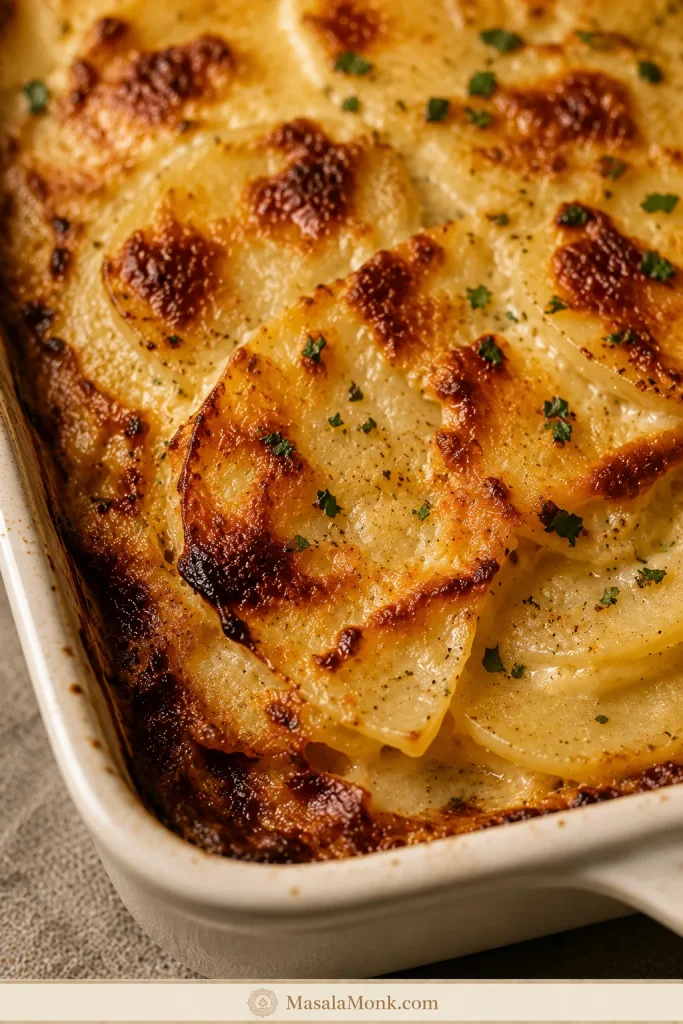
Close-up of a browned corner portion of scalloped potatoes with golden edges and a creamy layered interior.
Edges lose moisture fastest, concentrating the sauce and creating especially browned, flavorful bites.

What to Serve With Scalloped Potatoes

Scalloped potatoes already bring richness, tenderness and plenty of creaminess. The rest of the plate benefits from browned meat or fish, something green, and enough freshness or acidity to keep everything lively.

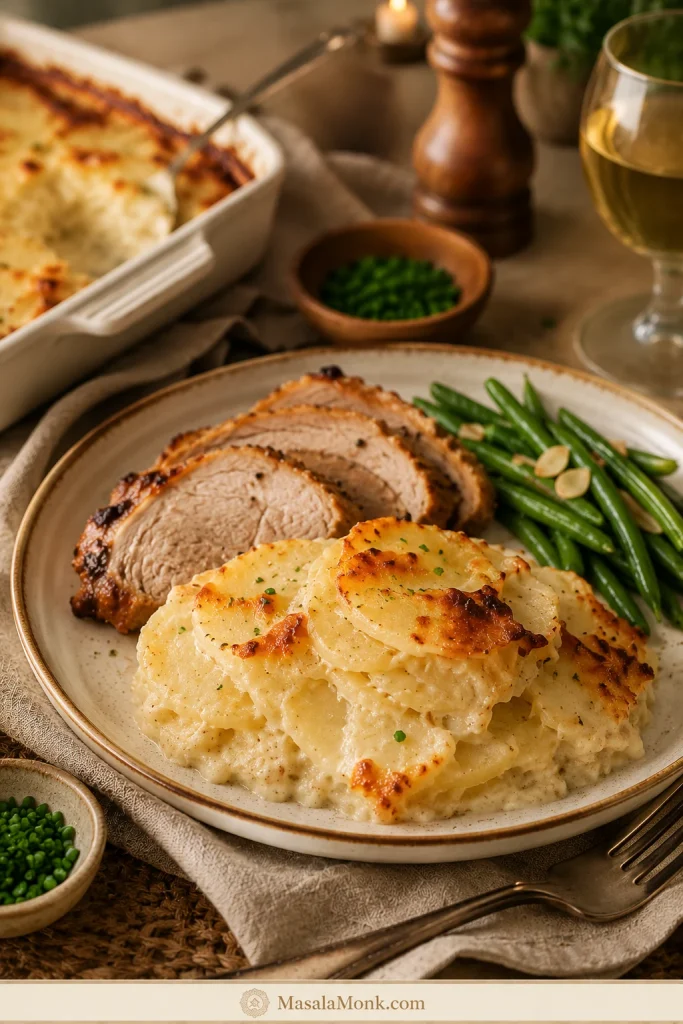
Scalloped potatoes served at a dinner table with browned meat and green vegetables.
Pair the rich potatoes with a browned main and something green for contrast.

With pork: the browned edges and sticky sweet-savory glaze on honey garlic pork chops are especially good against a spoonful of creamy potatoes. Add broccoli, green beans or a sharp salad and dinner is done.

On a holiday table: ham, turkey and roast beef all work beautifully. For something brighter alongside them, roasted carrots bring caramelized edges, color and just enough sweetness to wake up a rich plate.

With fish: honey garlic salmon has enough browned, garlicky glaze to stand beside the potatoes without needing another heavy side.

Storage, Reheating and Freezing

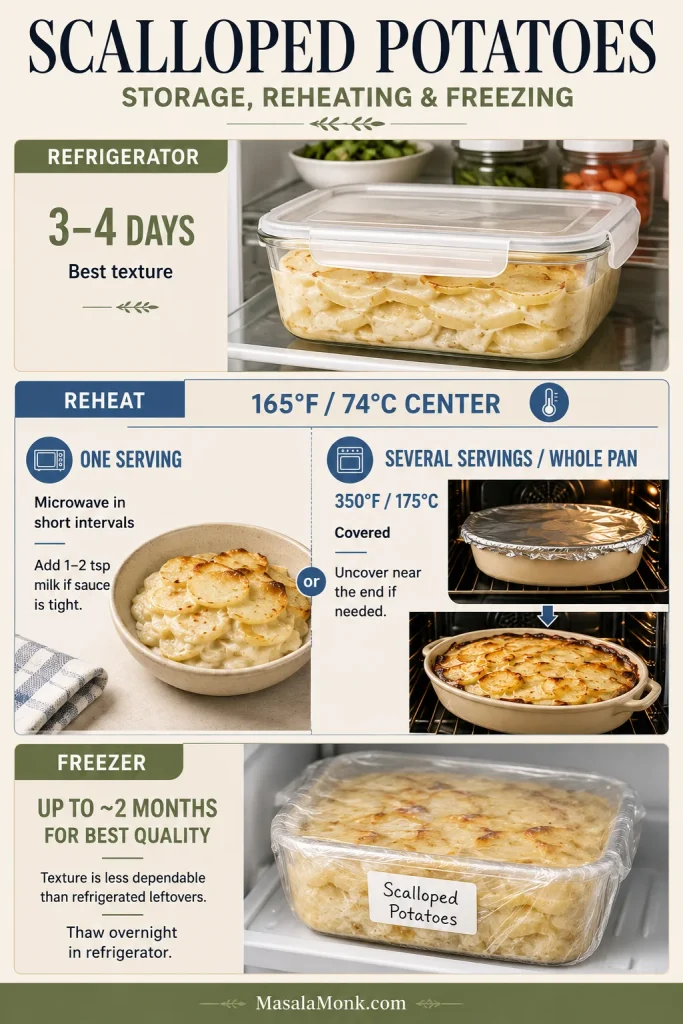
Cover and refrigerate leftovers within 2 hours. The USDA leftovers guidance recommends using refrigerated leftovers within 3–4 days and reheating them to 165°F (74°C). Use that temperature as the target whichever reheating method you choose.

Storage guide showing the casserole refrigerated for 3 to 4 days, reheated to 165 degrees Fahrenheit, or frozen for about two months for best quality.
Refrigeration preserves texture better. Freeze for longer storage when needed, knowing the potatoes and dairy sauce may return a little less smoothly after thawing.

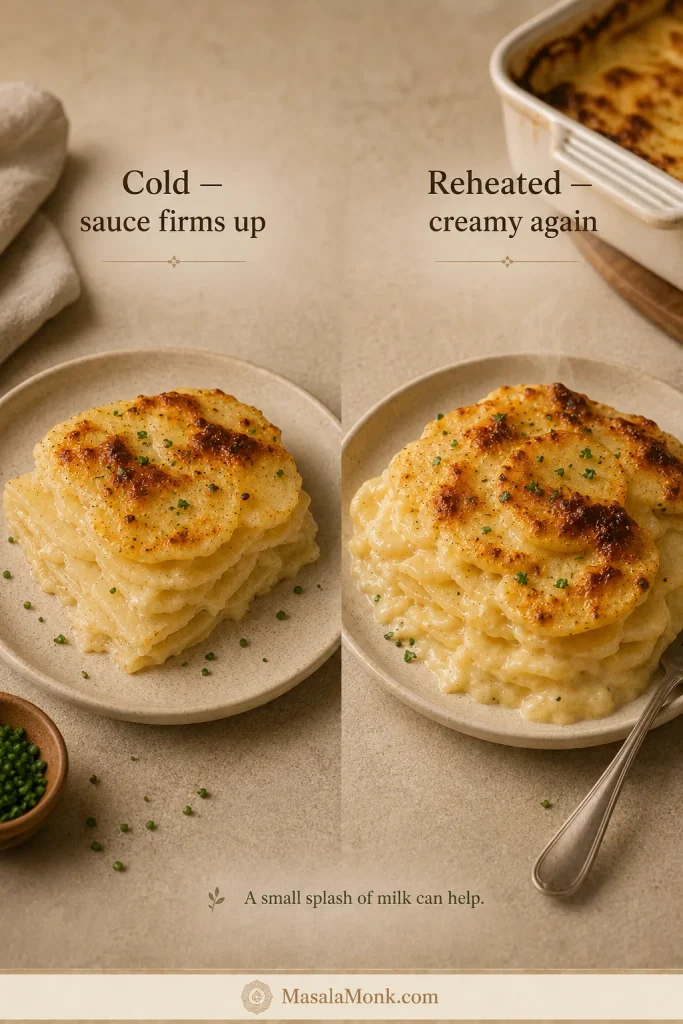
One serving: cover loosely and microwave in short intervals until the middle reaches 165°F (74°C). A teaspoon or two of milk around the serving can loosen sauce that has tightened in the refrigerator.

Several servings: cover and reheat at 350°F (175°C). Start checking after about 20 minutes and continue until the potatoes reach 165°F (74°C) in the middle.

A whole pan from the refrigerator: cover and reheat at 350°F (175°C). Begin checking after about 30 minutes and continue until the center reaches 165°F (74°C). Uncover for the final 5–10 minutes when the top needs refreshing.

Cold firm serving of scalloped potatoes compared with a warm reheated serving with softer layers and creamier sauce.
Gentle reheating relaxes chilled layers; a little milk can loosen sauce that has tightened in the refrigerator.

Can you freeze scalloped potatoes?

You can, although refrigeration preserves the texture better. Potatoes can become slightly mealier after freezing and thawing, and the dairy sauce may not return quite as smoothly.

If you do freeze them, once the potatoes are chilled, portion them into airtight containers and freeze for up to 2 months for best quality. Thaw overnight in the refrigerator and reheat gently. A small splash of milk can help when the sauce has tightened.

Return to recipe · Back to top ↑


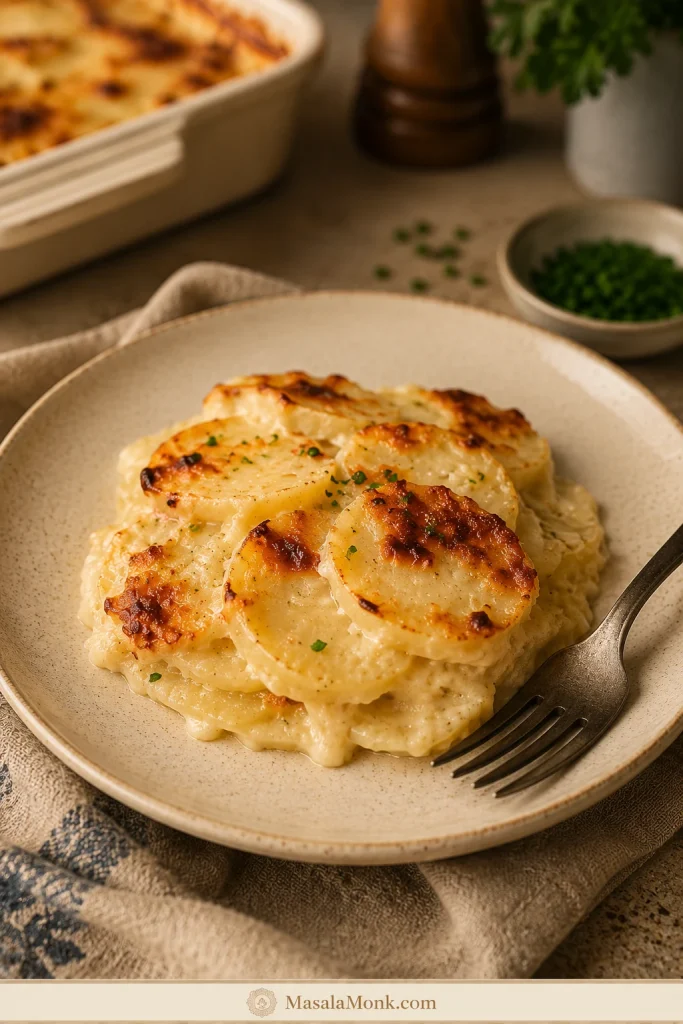
A good pan of scalloped potatoes doesn’t need to stand rigidly on the plate. Spoon into it and you should find tender layers, browned edges, mellow onion and garlic, and enough creamy sauce clinging between the slices to make the corner pieces especially hard to resist.

Plated serving of creamy scalloped potatoes with visible tender layers and browned edges.
After resting, the sauce should travel with the potato layers instead of running across the plate.

Give the potatoes that last bit of resting time, then bring the pan to the table while the edges are still warm and browned. That’s when scalloped potatoes are at their best.

Posted on Leave a comment

Eggplant Parmesan Recipe: Crispy Baked Eggplant That Never Turns Soggy

Baked Eggplant Parmesan in a burgundy casserole with one layered serving removed and plated beside it.

The first slice tells the truth. In a good baked Eggplant Parmesan, the spatula lifts a settled portion, mozzarella pulls between tender layers and a few Parmesan-panko edges still offer a light crunch. The disappointing version can look just as golden—until loose sauce gathers underneath and the breaded shell disappears into it.

This version keeps the familiar comfort of tomato, basil and melted cheese while baking the eggplant instead of frying it in batches. Even rounds are lightly salted, breaded and cooked until the centres turn silky and both sides are deeply golden. Only then are they layered with thick marinara and low-moisture mozzarella.

This is a weekend-worthy dinner for when you want each slice wrapped in its own browned Parmesan-panko crust without standing over a frying pan. That individual crust is what the extra handling buys you—not merely breadcrumbs scattered between the layers. It is not a 30-minute shortcut, but the work comes in manageable bursts and most of the elapsed time belongs to salting, baking and resting.

The MasalaMonk rule is simple: let the first bake finish the eggplant; let the final bake bring the casserole together.

Start here

The Method in One Minute

Cut the eggplant evenly, dry the surfaces well and bake the breaded slices with room around them until the crust is golden and the centres are fully tender. That first bake does the real cooking.

For assembly, use marinara thick enough to cling, low-moisture whole-milk mozzarella and only two shallow layers. Sauced breading naturally softens; the goal is a crust that stays distinct beneath the marinara, with crisp edges left exposed. Bake uncovered until the sauce bubbles around the edges, then give the pan 15 minutes to settle before lifting a serving.

Spatula lifting a clean two-layer serving of Eggplant Parmesan with golden crumbs, tomato sauce and melted cheese.
A clean first slice depends less on adding more cheese than on fully cooking the eggplant before assembly and allowing the finished casserole time to settle.
How this method was built

This research-led recipe compares common baked, fried and sheet-pan approaches. It then works backward from the failures home cooks report most often: firm centres, slipping breading, pale crumbs, loose sauce and wet cheese. The method separates surface dryness from interior doneness, calibrates the sauce and cheese quantities to protect the layered texture, and pairs timing windows with visible, tactile and aroma cues because eggplants, pans and ovens vary.

Choose the Texture You Want

Those same breaded slices can become a saucy layered casserole or stay in one crisp sheet-pan layer. The recipe below follows the classic layered route.

On a phone, each finish appears as a stacked card.

FinishHow to build itWhat reaches the table
Classic layeredTwo shallow layers with measured sauce and cheese; leave a few breaded edges exposedA cohesive, saucy casserole with tender centres and crisp-edged contrast
Maximum crispKeep the rounds in one layer, top each lightly and serve extra warm marinara alongsideMore browned crust, lighter topping and easy individual portions
Comparison of layered Eggplant Parmesan and a flatter maximum-crisp version with more exposed golden breading.
The classic layered version trades some exposed crust for saucy cohesion, whereas the sheet-pan finish keeps the rounds separate and preserves substantially more crisp breading.

Prefer the sheet-pan finish? The exact sauce and cheese amounts are in Variations.

Make it now

Crispy-Edged Baked Eggplant Parmesan Recipe

Slice the eggplant evenly, salt it lightly and coat it in flour, egg and Parmesan-seasoned panko. Bake until the centres are tender and the crumbs are deeply golden, then layer with thick marinara, whole-milk mozzarella, Parmesan and basil for a tomato-rich casserole that slices cleanly after resting.

Yield
6 generous or 8 smaller servings

Hands-on time
About 50–60 minutes

Passive salting
30 minutes

Eggplant bake
About 26–34 minutes

Assembly + final bake
About 28–32 minutes

Resting time
At least 15 minutes

Total elapsed time
About 2 hours 10 minutes to 2 hours 25 minutes

The timing windows overlap: prep and cleanup happen during salting and baking, so they are not meant to be added together. Timing assumes 28–36 slices fit across two half-sheet pans. Smaller pans or unusually numerous slices may require a second batch; add 26–34 minutes.

Equipment

  • Two rimmed half-sheet pans, approximately 18 × 13 inches / 46 × 33 cm
  • One shallow 9 × 13-inch / 23 × 33 cm baking dish; choose metal or broiler-safe ceramic if you plan to brown the top beneath the broiler
  • Three wide, shallow bowls or dishes for breading
  • Sharp chef’s knife or guarded mandoline
  • Large thin spatula or turner
  • Wire cooling racks, useful but optional
  • Pastry brush or oil mister
Two sheet pans, shallow burgundy casserole, breading dishes, saucepan, brush and spatula arranged on a counter.
The sheet pans do the real cooking; the shallow casserole only brings the finished components together. That separation keeps the final bake brief and protects the breading.

Ingredients

For the breaded eggplant

  • 2 medium globe or Italian eggplants, about 2–2¼ pounds / 900 g–1 kg before trimming
  • 6 g fine sea salt, about 1 teaspoon; measure kosher salt by weight because crystal size differs by brand
  • ¾ cup all-purpose flour, about 90 g
  • 3 large eggs, plus 1 additional egg only if needed for unusually broad rounds
  • 1 tablespoon water, 15 ml, plus 1 teaspoon / 5 ml for the optional extra egg
  • 2 cups panko breadcrumbs, about 120 g
  • 1 cup finely grated Parmesan, about 90 g
  • 1 teaspoon garlic powder
  • 1 teaspoon dried Italian seasoning
  • ½ teaspoon ground black pepper
  • 6 tablespoons olive oil, 90 ml, divided, plus a little more only if a second batch is needed

For assembling

  • 1 jar thick marinara sauce, 24 ounces / 680 g, about 2¾ cups / 660 ml, divided
  • 10 ounces low-moisture whole-milk mozzarella, about 285 g, freshly shredded
  • ½ cup finely grated Parmesan, about 45 g
  • ½ cup loosely packed basil leaves, about 15 g, torn or thinly sliced
  • Ground black pepper, to finish

Use the waiting time

While the eggplant salts, shred the mozzarella and measure the breading. While the first side bakes, clear the breading station, tear the basil, set out the casserole dish and check whether the marinara needs reducing. Much of the elapsed time is waiting for salt or oven heat to do its work, not two hours of nonstop prep.

Instructions

Slice, salt and prepare the pans

  1. Slice evenly. Trim the ends, then cut the eggplants into ⅜-inch / 1 cm rounds. Expect 28–36 usable slices, depending on their shape. Keep the thickness as consistent as possible.
  2. Salt and dry. Arrange the rounds in a single layer. Sprinkle the measured salt lightly and evenly over both sides; do not build a visible salt crust. Leave for 30 minutes, then blot firmly with clean kitchen towels or paper towels until the surfaces feel dry. Do not rinse; remove visible moisture and any undissolved salt.
  3. Heat the oven. Position racks in the upper and lower thirds. Preheat to 425°F / 220°C conventional or 400°F / 200°C fan. Brush the two metal pans with 2 tablespoons / 30 ml olive oil in total. Plan on 14–18 rounds per pan.When smaller pans or unusually numerous slices leave overflow, keep those rounds unbreaded until the first batch is nearly done. Reuse the pans and add only a thin extra film of oil if they look dry.

Bread and oil the slices

  1. Prepare three breading dishes. Put the flour in the first. Beat the eggs with 1 tablespoon / 15 ml water in the second. Combine panko, 1 cup / 90 g Parmesan, garlic powder, Italian seasoning and black pepper, then rub 2 tablespoons / 30 ml olive oil evenly through it.Keep half the crumb mixture aside and replenish the working dish as needed. This keeps the later slices away from damp, heavy clumps.
  2. Bread each slice. Coat lightly in flour and shake off the excess. Dip in egg and let the extra drip away. Press into the panko mixture on both sides.Transfer to the prepared pans with a little space around each round.If especially broad rounds use the egg wash early, beat the optional egg with 1 teaspoon / 5 ml water instead of stretching a thin, patchy coating over the final slices.
  3. Oil the tops. Brush or mist the remaining 2 tablespoons / 30 ml olive oil evenly over the breaded surfaces. Cover dry-looking crumb patches without creating pools.

Bake the breaded eggplant

  1. Bake the first side. Bake for 14–16 minutes. Wait until the crust has set before lifting a slice; forcing an under-browned coating from the metal can pull it away. Flip the slices, rotate both pans front to back and exchange their rack positions.
  2. Warm, taste and check the marinara. While the second side bakes, warm the sauce. If it looks loose, simmer uncovered until a spoon drawn across the pan leaves a trail for a moment before the sauce flows back. Taste it warm: it should be tomato-forward and balanced rather than markedly sweet or salty, since Parmesan and mozzarella will add more salt in the casserole.
  3. Finish the eggplant. Bake the second side for 12–18 minutes. Check from 26 minutes total. Both sides should be deeply golden, a thin knife should enter the centre with little resistance and a lifted round should bend slightly without falling apart. Give any firm or pale slices longer before assembly.

Assemble, melt and rest

  1. Lower the oven and prepare the dish. Reduce to 400°F / 200°C conventional or 375°F / 190°C fan, then spread ½ cup / 120 ml sauce across the base of the baking dish.
  2. Build the first layer. Add half the eggplant in one slightly overlapping layer. Spoon over ¾ cup / 180 ml sauce in patches, leaving a few golden edges visible. Add half the mozzarella, ¼ cup / about 22 g Parmesan and half the basil. The leaves will soften and perfume the warm sauce. Reserve the remaining basil for serving.
  3. Complete the casserole. Add the remaining eggplant. Spoon over ¾ cup / 180 ml sauce without completely flooding every slice. Add the remaining mozzarella and Parmesan. Reserve the remaining ¾ cup / about 180 ml sauce for the table; jar yields vary slightly.
  4. Bake uncovered. Bake for 18–22 minutes. Begin checking at 18 minutes. The sauce should bubble at the edges and the mozzarella should be fully melted.
  5. Brown the top if needed. Broil for 1–3 minutes only when the cheese needs more colour, watching continuously. Use cookware rated for direct broiler heat; ordinary glass dishes should not go beneath the broiler.
  6. Rest and serve. Rest for at least 15 minutes—the melted cheese makes the wait difficult, but a clean serving is worth it. Finish with the reserved basil and black pepper, and serve the reserved sauce warm at the table.

Prefer more crunch? Keep the slices on their sheet pans and use the maximum-crisp finish instead of stacking them.

Why Eggplant Parmesan Gets Watery or Soggy

A watery Eggplant Parmesan is usually a chain of problems, not one bad step. The eggplant may still be undercooked, the sauce or cheese may carry too much liquid, or steam may be trapped by crowding, deep layers, covering or cutting too soon. Salting helps dry the surface, but it cannot replace a complete first bake or careful assembly.

Three-part visual explaining undercooked eggplant, wet ingredients and trapped steam as causes of watery Eggplant Parmesan.
Wateriness is cumulative. A slightly firm centre, marginally loose sauce and a little trapped steam can combine into a much wetter result than any one problem would cause alone.

On a phone, swipe sideways to see the cause and fix together.

What goes wrongWhy it mattersWhat helps
Uneven slicesThin rounds overcook while thick rounds stay firm and wetCut every slice to about ⅜ inch / 1 cm
Wet surface after saltingFlour turns pasty and the crust slipsBlot both sides firmly before breading
Crowded pansReleased moisture becomes trapped steamUse two large metal sheet pans
Incomplete first bakeThe sauced casserole has to finish cooking the vegetableBake until the centre is tender before assembly
Pale, dry crumbsThe coating absorbs sauce before it forms a browned shellDistribute a measured amount of oil evenly
Thin marinaraLoose water runs between the layersReduce sauce until it briefly holds a spoon trail
Fresh mozzarella liquidWhey loosens the sauce and softens the coatingUse low-moisture whole-milk mozzarella
Excess sauceEvery crumb becomes saturatedMeasure each layer and reserve sauce for serving
Deep or covered casseroleSteam cannot escapeBuild two shallow layers and bake uncovered
Cutting immediatelyHot sauce and cheese run before the layers settleRest for at least 15 minutes

Prepare the Eggplant

Peel only when the skin asks for it

Most medium eggplants can keep their skin; it helps the rounds survive breading, turning and layering. Peel fully or in alternating strips when the eggplant is oversized, the skin feels thick or you prefer especially soft layers.

Rounds are easiest; planks make tidier layers

Rounds are easier to bread, flip and portion, and their uneven edges leave more crust visible. Lengthwise planks create neater, lasagna-like layers. Either shape works as long as every piece lies flat on the sheet pan.

Whole eggplant with one-centimetre rounds and lengthwise planks arranged beside a knife and ruler.
Uniformity matters more than choosing rounds or planks. When every slice stays close to ⅜ inch / 1 cm, the whole batch reaches tenderness within a tighter checking window.

Keep the slices close to ⅜ inch / 1 cm

Consistency matters more than perfect geometry. Thin ¼-inch / 6 mm rounds cook quickly but can disappear into the casserole; thick ½-inch / 13 mm rounds need longer to soften. At ⅜ inch / 1 cm, the eggplant stays substantial and still becomes silky. Use a sharp knife or a guarded mandoline that can safely hold that setting.

Salt and blot for a drier breading surface

Modern eggplants are often mild, so the useful benefit here is practical rather than bitterness control. A measured 30-minute rest draws beads of liquid to the surface, lightly seasons the flesh and gives you a chance to remove that liquid before flour is applied.

Blot firmly and brush away visible salt; rinsing only creates another drying job. Very fresh eggplants may not need salting for bitterness, but this breaded casserole is calibrated around the full salt-and-blot step because it seasons the flesh and creates the driest, most dependable surface for flour. Keep it especially when the eggplants are older, softer, unusually large or quick to bead with liquid.

Salted eggplant rounds with visible moisture beads beside fully blotted rounds with dry, matte surfaces.
Salt reveals the moisture, but careful blotting determines whether the breading will hold. The surface is ready when it looks matte rather than wet or glossy.

Ingredients and What They Do

Eggplants, marinara, mozzarella, Parmesan, panko, flour, eggs, olive oil, basil and seasonings arranged overhead.
These ingredients form two systems: thick marinara and low-moisture mozzarella control liquid, while Parmesan, panko and olive oil build savoury browning without frying.

Eggplant

Choose medium globe or Italian eggplants with smooth, glossy skin, green caps and firm flesh that gives only slightly when pressed. Medium eggplants are generally easier to slice and cook evenly; very large ones are more likely to have developed seeds, thicker skin and a spongier centre.

Weight is more dependable than “two large eggplants.” About 2–2¼ pounds / 900 g–1 kg usually produces 28–36 rounds for two layers in a 9 × 13-inch dish. Eggplant shape varies, so keep any overflow for a second sheet-pan batch instead of packing the pans or casserole into a deep, steamy stack.

Flour, egg and panko

A thin dusting of flour absorbs the last surface moisture and gives the egg something dry to hold. A visible flour shell can turn into a pasty band beneath the crust.

Let extra egg drip away before moving the slice into the panko, then press the crumbs on gently. Panko gives the coating irregular, crisp edges; ordinary fine breadcrumbs also work, though the crust will be smoother, denser and less craggy. That dry-to-wet-to-crumb sequence keeps the coating attached in MasalaMonk’s homemade mozzarella sticks.

Hands pressing an eggplant round into Parmesan-panko beside shallow dishes of flour and beaten egg.
Keep one hand mainly for the egg and the other for flour and crumbs. This small habit slows clumping and keeps the final rounds as evenly coated as the first.

Parmesan and olive oil

Finely grated Parmesan distributes more evenly than large shreds, brings nutty savouriness and helps the panko brown.

Parmesan, marinara and mozzarella already bring salt, so the coating needs restraint. MasalaMonk’s Parmesan versus Parmigiano Reggiano guide can help when choosing between milder domestic Parmesan, sharper aged cheese and other hard grating options.

Baked crumbs need some fat. Oil is divided between the pan, panko and tops so the underside and exposed surface can colour. A loose drizzle leaves some crumbs dry and others greasy, so measured oil gives a more even crust.

Olive oil measured onto a sheet pan, mixed into crumbs and brushed over breaded eggplant rounds.
Dividing the olive oil creates three different forms of browning. Pouring it all onto the pans would leave the crumb mixture and upper surfaces comparatively dry and pale.

Choose marinara for flavour and body

Choose a marinara you enjoy by the spoonful, with enough acidity to balance the cheese and enough body to stay where it is spooned. A brief uncovered simmer not only removes excess water; it makes the tomato, garlic and herb flavours fuller so a measured amount still tastes generous. Drag a spoon across the saucepan: the track should remain visible briefly before the sauce flows back.

If liquid fills the trail immediately, keep simmering. MasalaMonk’s homemade marinara sauce makes 3–4 cups, leaving enough to thicken for the casserole and warm for the table.

Spoon drawn through thick marinara in a stainless saucepan, leaving a visible trail through the sauce.
This spoon trail marks the assembly threshold: the marinara is concentrated enough to cling, yet still loose enough to spread without dragging or disturbing the crust.

Why low-moisture mozzarella fits this version

Low-moisture whole-milk mozzarella gives a soft, full melt with less free liquid than fresh mozzarella. Part-skim cheese works but can set more firmly. Fresh mozzarella tastes delicate and milky, though its whey produces a softer casserole.

To replace the low-moisture mozzarella, use one 7–8-ounce / 200–225 g ball of fresh mozzarella. Slice or tear it, then drain it over towels for at least 30 minutes. Put about one-third between the layers and scatter the rest over the top. Keep the same final-bake checking window, but expect softer layers and a little more surface liquid. Pre-shredded low-moisture mozzarella also works, although anti-caking powders can make the melt slightly less fluid than cheese shredded from a block.

Comparison of low-moisture mozzarella with defined casserole layers and fresh mozzarella with a softer baked result.
Fresh mozzarella works best when most of it stays on top, where released moisture has less opportunity to loosen the middle layers. Low-moisture cheese remains the firmer option.

Vegetarian note: traditional Parmesan may be made with animal rennet. Strict vegetarians should choose a Parmesan-style hard cheese and mozzarella labelled as using microbial or vegetarian rennet.

Fresh basil brings a clean, peppery lift to the tomato and melted cheese. Tear some into the layers and save the brightest leaves for the rested casserole.

Five Cues That Matter More Than the Timer

Timers tell you when to look. These five cues show what readiness looks, feels and smells like when your oven or the eggplants behave differently.

Five-step visual showing dry eggplant, spaced breaded slices, clean crust release, a knife tenderness test and a rested serving.
The order matters: dry the surface, leave space, wait for release, confirm tenderness and then rest the finished casserole. Skipping an early cue usually weakens a later one.

1. Turn a damp cut surface into one that can hold a crust

After salting, press the rounds with clean towels until they no longer feel wet. This is not a ceremonial pat: flour clings to a dry surface instead of turning into glue.

Dust lightly with flour, let excess egg drip away and press on a modest layer of panko. By the final broad rounds, the egg wash may be running low and the working crumbs much clumpier than at the start. Replenishing both is easier than forcing a thin, patchy coating onto the last slices.

Raw eggplant round covered with a thin, even layer of Parmesan-panko crumbs on a sheet pan.
Thicker breading is not automatically crispier. A heavy coating can darken before the eggplant softens, whereas a thin shell browns with the slice rather than around it.

2. Give the crumbs room, oil and contact with metal

Room around each slice lets steam escape and gives the underside contact with hot metal. There is no prize for squeezing the last rounds onto a crowded pan. Dark pans colour faster; parchment may need extra time, and silicone mats can slow underside browning.

Breaded eggplant rounds arranged in one uncrowded layer on a dark sheet pan with space between them.
Steam is the invisible problem here. If neighbouring rounds touch or nearly touch, divide them between two pans rather than sacrificing browning for convenience.

3. Watch pale, rigid slices become golden and tender

A crust that is ready to turn usually releases with little persuasion. If it clings, give it another minute rather than tearing it away.

Spatula lifting a breaded eggplant round to reveal a golden underside while the upper surface remains pale.
Clean release is a doneness signal. Once the underside has formed a stable golden shell, the slice can be turned without leaving its coating attached to the pan.

Colour alone is not enough. A thin knife should pass through a thicker centre with little resistance, and the slice should bend slightly while staying intact. If the crumbs brown first, lower the oven by about 25°F / 15°C and keep going until the eggplant is tender.

Golden breaded eggplant round cut open as a knife enters its tender centre and a spatula supports it.
Use two signals together: browning confirms the coating is ready, while the knife test confirms the eggplant—not merely the crust—is fully cooked.

When the crust releases cleanly and the Parmesan smells toasted, the slices stop feeling like prepared ingredients and start feeling ready to eat.

4. Layer without hiding all the browning

Warm loose marinara until a spoon drawn across the saucepan leaves a brief trail. The measured sauce may look restrained as you assemble the dish. That restraint is deliberate: warm sauce at the table keeps the portions generous without soaking every breaded surface in the pan.

Hand spooning small patches of marinara over overlapping baked eggplant rounds with golden edges exposed.
Uneven coverage is intentional. The sauced areas keep the casserole generous, while the dry-looking perimeter is where crisp contrast survives the second bake.

A little breading left uncovered is intentional. Once the mozzarella melts and the sauce bubbles, those exposed crumbs provide the contrast.

5. Let the hot casserole settle before cutting

This is the moment to wait. As the casserole rests, the sauce gains body and the cheese stays with the layers, allowing a wide spatula to lift a complete serving.

Eggplant Parmesan Bake Time and Oven Temperature

Breaded eggplant needs 26–34 minutes at 425°F / 220°C conventional or 400°F / 200°C fan. The assembled casserole then needs 18–22 minutes at 400°F / 200°C conventional or 375°F / 190°C fan. The hotter first stage browns the coating and cooks the centres; the shorter second stage bubbles the sauce and melts the cheese.

On a phone, swipe sideways for both oven settings and doneness cues.

StageConventional ovenFan ovenBegin checkingReady when
Breaded eggplant425°F / 220°C400°F / 200°C26 minutes totalBoth sides are golden and the centre is fully tender
Assembled casserole400°F / 200°C375°F / 190°C18 minutesSauce bubbles at the edges and mozzarella is melted
Optional broilHighHighAfter 1 minuteCheese is browned without burnt panko
RestRoom temperatureRoom temperature15 minutesA lifted portion holds together
Unbaked layered Eggplant Parmesan with marinara, shredded cheese and exposed breaded edges in a burgundy casserole.
At this stage, the eggplant should already be tender enough to eat. The final bake now has one job: melt the cheese and unite the two shallow layers.

Pan colour, oven calibration and the eggplants themselves can shift the last few minutes. Use the times as checking windows, then let deep browning, easy knife entry and bubbling sauce decide.

Close-up of baked Eggplant Parmesan with browned cheese, tomato sauce, golden crumbs and scattered basil.
Look for gentle activity around the edges rather than a rolling boil across the centre. Quiet perimeter bubbling signals that the casserole is hot without excessive loose moisture.

Troubleshooting

ProblemLikely causeMost useful fix
The dish is wateryThin sauce, wet cheese, undercooked eggplant or cutting too soonReduce the sauce, use low-moisture mozzarella, bake the slices until tender and rest the casserole 15 minutes
The coating became completely softToo much sauce, deep layers or a covered final bakeUse measured sauce, build two layers and bake uncovered
The breading falls offWet eggplant, skipped flour or excess eggDry thoroughly, flour lightly and let egg drip before panko
The coating is paleToo little oil, crowding or weak contact with hot metalDistribute oil evenly, use two pans and continue until browned
Crumbs burn before the centre softensSlices are thick or the oven runs hotLower the temperature about 25°F / 15°C and continue until tender
The eggplant feels firm or spongyIt entered the casserole before the first bake was completeReturn unsauced slices to the oven; do not rely on the final bake
The finished dish is saltySurface salt, salty marinara and Parmesan accumulatedUse salt by weight, blot thoroughly and avoid extra seasoning before tasting
The cheese releases liquidFresh mozzarella was not drainedUse low-moisture cheese or drain fresh mozzarella for at least 30 minutes
The layers slide apartExcess sauce or insufficient restingReserve more sauce for serving and rest longer before cutting
The skin is toughThe eggplant was oversized or matureChoose medium eggplant or peel it in alternating strips
Four-part troubleshooting visual for watery casserole, pale tender slices, firm eggplant centres and crumbs browning too quickly.
Match the remedy to the failed stage. Once a casserole is assembled, removing or reducing loose liquid is often more effective than simply leaving everything in the oven longer.

Can a watery finished casserole be rescued?

Let it rest longer first; some apparent liquid thickens as the dish cools. When a large amount remains, lift portions with a slotted spatula and simmer any loose sauce separately before spooning it back over the plate.

Do not keep baking the whole casserole indefinitely. The sauce may reduce, but the eggplant and cheese can become dry before the centre stops looking loose.

What if the eggplant is tender but the coating is pale?

Shift the pan to a higher rack or broil briefly before assembly, watching continuously. Once sauce has been added, pale crumbs are much harder to correct.

Variations

Start with the breaded recipe above, then use the option that matches the texture or dietary change you need. Each variation lists only what changes.

Maximum-crisp sheet-pan Eggplant Parmesan

Keep the browned rounds in one layer. For the full batch, use up to 1½ cups / 360 ml marinara and 8 ounces / 225 g mozzarella—about 2–2½ teaspoons sauce and roughly 1 tablespoon shredded cheese per round. Return to a 400°F / 200°C oven for 5–7 minutes, then broil briefly only if needed.

Serve the remaining sauce warm alongside. Because the rounds are never stacked, more of the Parmesan-panko crust reaches the plate browned and distinct.

Breaded eggplant rounds baked separately on a sheet pan, each topped with a small amount of marinara and cheese.
Treat these as individually topped rounds, not miniature stacks. Keeping the sauce above the crust—and extra marinara at the table—protects the sheet-pan version’s main advantage.

Eggplant Parmesan without breading

Skip the flour, eggs and slice coating. Brush the rounds with 4 tablespoons / 60 ml olive oil in total. Roast at 425°F / 220°C conventional or 400°F / 200°C fan, turning once, until browned and fully tender. Assemble with 2 cups / 480 ml thick marinara, 8 ounces / 225 g mozzarella and ⅓ cup / 30 g Parmesan.

For crunch on top, combine ½ cup / 30 g panko with ¼ cup / 22 g Parmesan and 1 tablespoon / 15 ml olive oil. Scatter it over the final cheese layer. The result has creamy roasted eggplant and a crisp top rather than a crust around every slice. For a completely breadcrumb-free casserole, simply omit this topping.

Breadcrumb-free Eggplant Parmesan with roasted eggplant rounds, marinara and melted cheese in a burgundy casserole.
Without a crumb shell, thorough roasting becomes even more important. Browning the eggplant surfaces first prevents the smooth slices from turning slippery inside the sauced casserole.

Gluten-free Eggplant Parmesan

Gluten-free panko is the direct substitution and gives the closest result to the main recipe. Replace the flour with a gluten-free all-purpose blend and keep the same flour–egg–crumb order.

For allergy-led cooking, check the panko, flour blend, seasoning, marinara and cheeses for relevant allergen and cross-contact statements.

Egg-free Eggplant Parmesan

For an egg-free coating, skip the separate flour and egg dishes. Whisk ¾ cup / 180 ml dairy or unsweetened soy milk with ½ cup / 60 g all-purpose flour and 1 tablespoon / 8 g cornstarch. The mixture should be smooth and thin enough to drip slowly from a spoon. Add milk 1 tablespoon at a time if it becomes too thick.

Dip each dry eggplant round in the batter, let the excess drip, then press on the panko mixture. The coating is more fragile than an egg-bound crust, so turn it with a thin spatula only after the first side has set and browned.

Eggplant Parmesan with ricotta

Ricotta makes a creamier, more lasagna-like casserole. If that is the texture you enjoy, MasalaMonk’s baked ziti guide explores the same ricotta-and-mozzarella comfort-food lane in pasta form.

Mix 15 ounces / 425 g well-drained whole-milk ricotta with 1 large egg, ¼ cup / 22 g from the Parmesan reserved for assembly and black pepper. Spread it in a thin, even layer over the first layer of sauced eggplant.

Reduce the mozzarella to 6 ounces / 170 g and use the remaining ¼ cup / 22 g Parmesan on top. Keep only 2 cups / 480 ml sauce inside the casserole and rest it for about 20 minutes so the creamy layers cut more cleanly.

Small-batch Eggplant Parmesan

For two to four servings, use one medium eggplant weighing 1–1¼ pounds / 450–570 g and halve the remaining ingredients. For the breading station, beat 2 large eggs with 2 teaspoons / 10 ml water; expect a little to remain. An 8 × 8-inch / 20 × 20 cm dish usually holds two shallow layers.

The slice-baking temperatures stay the same. Begin checking the smaller assembled dish at about 15 minutes; its shallower centre usually heats sooner than a full 9 × 13-inch pan.

What to Serve With It

Eggplant Parmesan is rich enough to arrive at the centre of the table as the main event. Set down the rested pan and pass the warm reserved marinara. The centre pieces stay silky and saucy; the corners bring browned cheese and exposed crumbs. Something green, sharp or bread-like keeps bright tomato, milky mozzarella and nutty Parmesan from feeling heavy.
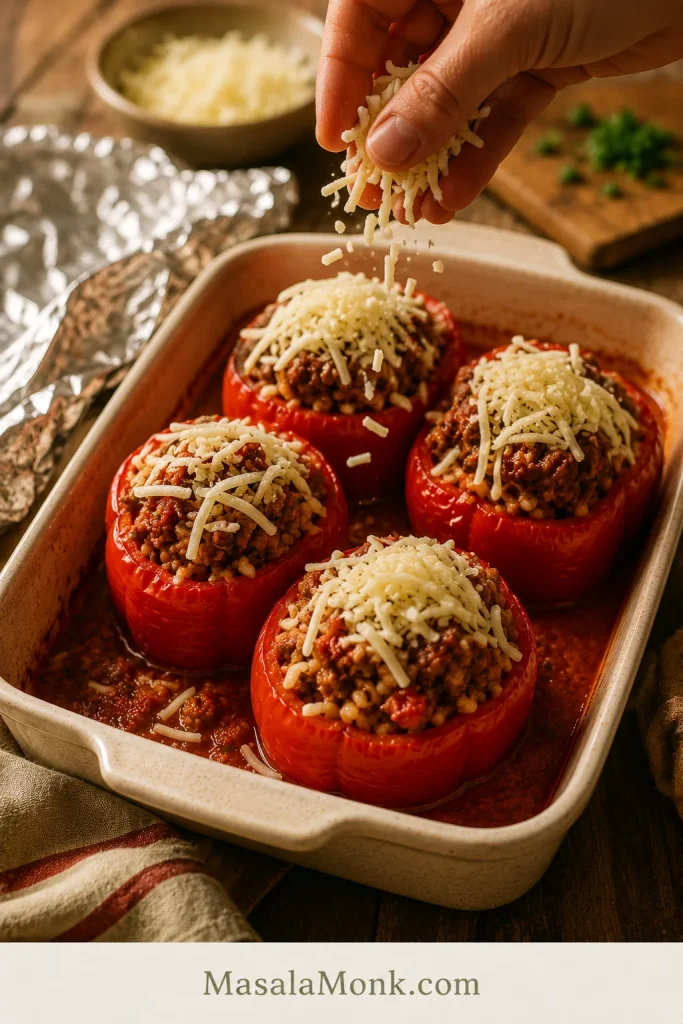
Plate with a rectangular serving of Eggplant Parmesan, cucumber salad, garlic bread and extra marinara.
Dress the salad sharply with lemon or vinegar and keep the bread portion modest. The plate needs freshness and crunch more than another rich or heavily sauced component.
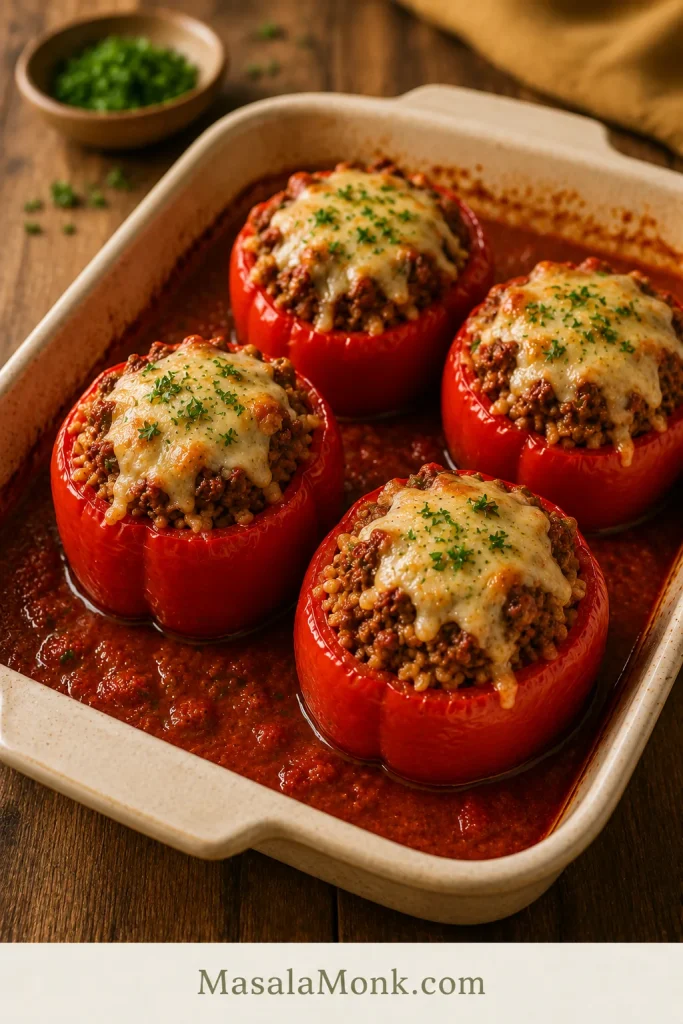
  • Classic dinner: spaghetti, linguine or another simply dressed pasta for catching the extra sauce
  • Fresh contrast: a crisp cucumber salad, lemony greens or roasted broccoli
  • Comfort-food table: a homemade garlic bread loaf, crisp-edged focaccia or another crusty loaf for the last spoonful of marinara
  • Lighter plate: sautéed greens, salad or roasted vegetables instead of pasta
  • Tomorrow’s lunch: a reheated slice tucked into a toasted roll with a little extra sauce and basil
Two toasted Italian-roll halves filled with breaded Eggplant Parmesan, marinara and melted mozzarella.
Reheat the Eggplant Parmesan before it enters the roll rather than using the bread as the reheating vessel. Then add only enough warm marinara to moisten the filling.

When the casserole is already generously sauced, keep pasta simple. The plate needs contrast more than another heavy tomato-and-cheese component.
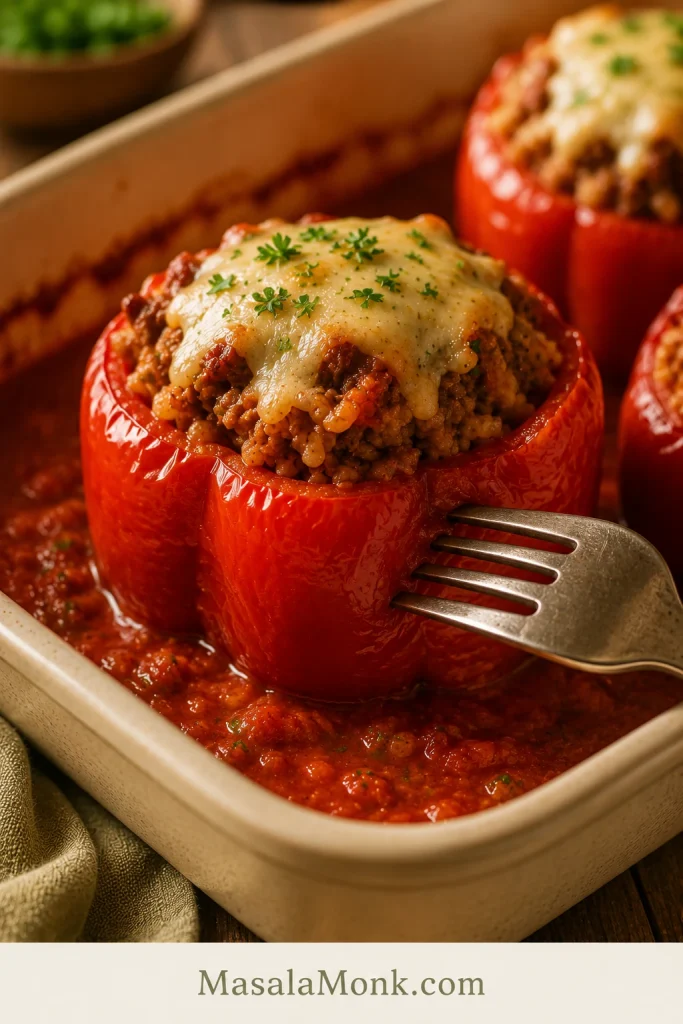
Make Ahead: Choose by Texture

Convenience and crispness move in opposite directions. Decide which matters more for this meal, then stop at the point that fits your plans.
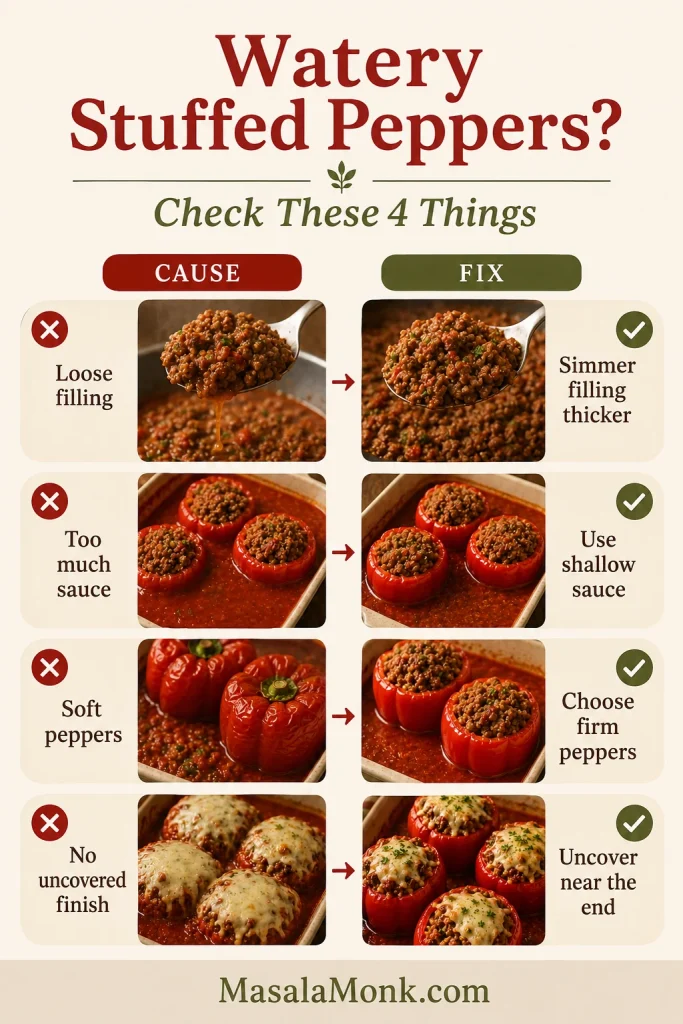
Make-ahead visual showing sealed sauce, separately stored baked slices and cheese, a covered casserole and frozen components.
The real make-ahead decision is which surface you are willing to soften. Sauce can wait without penalty, while assembled breaded layers gradually exchange crispness for convenience.

On a phone, each make-ahead option appears as a stacked card.

Prepare it this farBest forWhat to expect
Make the marinara aheadSpreading the work across two daysThe finished texture stays the same
Bake slices and refrigerate separately for up to 1 dayGuests or a planned dinner when crust still mattersThe crispest make-ahead route
Assemble overnightDinner that only needs bakingA softer, more integrated casserole
Freeze baked slices separately for up to 2 monthsCrisper portions after reheatingMore assembly later, but stronger browned edges
Freeze the assembled casseroleThe easiest freezer mealSofter layers after baking

Store the components separately for the crispest result

Bake the breaded slices and cool them completely on wire racks, or on clean sheet pans with the slices turned once so condensation does not collect beneath them. Refrigerate for up to 1 day in shallow containers with parchment between layers. Store the sauce and shredded cheese separately.

Before assembly, return refrigerated slices to a 425°F / 220°C conventional or 400°F / 200°C fan oven for 6–10 minutes, beginning to check at 6 minutes. Refresh only until the coating feels dry and hot; then layer and complete the short final bake.

Can the casserole be assembled a day ahead?

Yes, but the breading will absorb moisture while it rests. Cover and refrigerate for up to 24 hours. The next day, bake uncovered at 375°F / 190°C conventional or 350°F / 175°C fan for 25–35 minutes, checking from 25 minutes. The centre should reach 165°F / 74°C. Follow the cookware manufacturer’s guidance before moving a chilled glass or ceramic dish into a hot oven.

This is the easiest day-ahead option, though the breading will be softer. Keep the components separate when browned crust matters most.

Storage, Freezing and Reheating

The portion methods below assume one piece equal to roughly one-sixth to one-eighth of the pan. Thick pieces, cold cookware and a colder starting temperature may add time, so check from the early end and heat the centre to 165°F / 74°C.

Storage and reheating visual with fridge and freezer limits plus oven, air-fryer, skillet and microwave methods.
Dry, circulating heat restores the exposed edges most effectively. A skillet concentrates crispness underneath, whereas the microwave warms fastest but leaves the breading softer.

Refrigerating leftovers

Divide leftovers into shallow containers and refrigerate within 2 hours of cooking—within 1 hour when the room or outdoor temperature is above 90°F / 32°C. Use refrigerated leftovers within three to four days, in line with USDA leftover-safety guidance.

The coating softens in storage, but dry heat can recover some texture around the exposed edges.

Freezing breaded eggplant slices separately

Cool the baked slices completely, freeze them in one layer until firm, then transfer to a freezer-safe container with parchment between layers. Freeze for up to two months for best quality. Reheat from frozen at 425°F / 220°C conventional or 400°F / 200°C fan for 12–18 minutes. Turn once and check from 12 minutes, then assemble when the slices are hot and the coating feels dry.

Freezing the assembled casserole

To freeze a complete dinner rather than separate components, wrap the unbaked casserole securely and freeze for up to two months for best quality. Thaw completely in the refrigerator, usually 24–48 hours, then bake uncovered at 375°F / 190°C conventional or 350°F / 175°C fan for about 35–45 minutes. Begin checking at 35 minutes and heat the centre to 165°F / 74°C.

Use a freezer-safe metal or suitable ceramic dish. Do not transfer an ice-cold glass dish directly to a hot oven because sudden temperature change can break it.

Reheating a fully cooked casserole

For a fully cooked casserole that has thawed in the refrigerator, cover loosely and reheat at 350°F / 175°C conventional or 325°F / 165°C fan for 25–35 minutes. Uncover for the final 10 minutes and heat the centre to 165°F / 74°C. Follow the cookware manufacturer’s temperature-change guidance, especially for glass or ceramic dishes.

How to reheat Eggplant Parmesan while bringing back some browned edges

  1. Oven or toaster oven: Reheat a refrigerated portion uncovered at 375°F / 190°C for about 15–20 minutes, beginning to check at 15 minutes. Tent loosely only near the end if the cheese darkens too quickly.
  2. Air fryer: Reheat one portion at 350°F / 175°C for about 5–8 minutes, checking at 5 minutes so the exposed coating refreshes before the cheese burns.
  3. Skillet: Warm over medium-low heat for about 8–12 minutes with the lid slightly ajar. The base can crisp, but trapped steam softens the top.
  4. Microwave: Heat in 60-second intervals, covered and vented, until hot. It is the fastest route but produces the softest breading.

Whichever method you use, reheat leftovers to 165°F / 74°C in the centre. Warm additional sauce separately and add it afterward; sauce poured over the portion first slows any return of crispness.

Baked Eggplant Parmesan vs. Italian Parmigiana

This is a breadcrumb-coated, oven-baked Italian-American Eggplant Parmesan. Each round is browned before it meets tomato sauce, mozzarella, Parmesan and basil, creating a crisp-edged coating without frying every batch in oil.

Traditional Italian parmigiana di melanzane, or melanzane alla parmigiana, is generally unbreaded and often fried before layering. Its softer, integrated texture is different from the deliberate panko crust here. Family and regional versions vary; La Cucina Italiana’s overview gives useful context. In the UK, both styles may be called aubergine Parmesan or aubergine parmigiana.

Frequently Asked Questions

Do you have to salt eggplant?

Salting is recommended for this breaded version because it seasons the flesh and gives the flour a drier, more dependable surface. Very fresh eggplants may not need it for bitterness, but the recipe is calibrated around the full 30-minute salt-and-blot step. Blot the rested slices rather than rinsing them.

Should you peel eggplant for Parmesan?

Usually not. Keep the skin on medium, tender eggplants; peel fully or in alternating strips when the skin feels thick or you want especially soft layers.

Why does Eggplant Parmesan turn watery?

Common causes include eggplant that was still firm inside, loose marinara, too much sauce, undrained fresh mozzarella, deep layers or cutting while the sauce and cheese are still loose. Salting helps the surface but cannot correct all of those factors.

Can you use fresh mozzarella?

Yes. Use one 7–8-ounce / 200–225 g ball, slice or tear it, then drain it over towels for at least 30 minutes. Put about one-third between the layers and the rest on top; expect a softer casserole than the low-moisture version.

Can Eggplant Parmesan be assembled the day before?

Yes. Cover and refrigerate it for up to 24 hours, then bake uncovered from cold at 375°F / 190°C conventional or 350°F / 175°C fan for 25–35 minutes, until the centre reaches 165°F / 74°C. The breading will be softer than when the components are stored separately.

The First Slice Is Worth the Wait

After all the salting, breading and turning, the reward arrives in the first lifted portion. The sauce stays with the layers, the eggplant cuts easily with the side of a fork, mozzarella stretches through the centre and browned crust still shows around the edges.

Cook first. Layer second. Once the eggplant reaches the sauce already golden and tender, the final bake becomes the easy part. The layered casserole gives saucy, family-style comfort; the sheet-pan finish protects every crunchy edge.

What usually gives you trouble with Eggplant Parmesan—wateriness, breading or timing?

Back to the top ↑

Posted on Leave a comment

Stuffed Red Pepper Recipe

Baked red bell peppers stuffed with ground beef, rice, tomato sauce, and melted cheese in a cream ceramic baking dish

Stuffed red peppers should feel like dinner is handled: sweet pepper walls, savory beef-and-rice filling, tomato sauce, and melted cheese all baked together in one cozy dish. The only catch is that small details matter. If the peppers stay too firm, the rice tastes bland, the filling turns watery, or the cheese browns too early, the whole dish feels less comforting than it should.

This is the no-guesswork version built to avoid those problems. The filling is cooked and seasoned before it ever goes into the peppers, the sauce stays underneath instead of drowning the dish, and the peppers bake covered first so they soften before the cheese goes on. By the time the foil comes off, the dish should smell like tomato sauce, garlic, roasted peppers, and melting cheese.

Think of this as classic baked stuffed bell peppers tuned specifically for red peppers: sweeter, softer in flavor, and especially good with tomato sauce, ground beef, cooked rice, and cheese. You get the old-fashioned dinner feeling, but with clear cues for what the filling, sauce, peppers, and cheese should look like at every step.

The promise

These stuffed red peppers bake up tender, saucy, and full of flavor, with a seasoned beef-and-rice center that holds together instead of turning loose and watery.

Quick Answer: How to Make Stuffed Red Peppers

To make stuffed red peppers, cut the tops off large red bell peppers and remove the seeds. Brown ground beef with onion, garlic, tomato paste, salt, pepper, and herbs, then stir in cooked rice and diced tomatoes. Spread tomato sauce or marinara in a baking dish, fill the peppers, cover with foil, and bake at 375°F / 190°C for 30 to 35 minutes. Uncover, add cheese, and bake for another 10 to 15 minutes, until the peppers are fork-tender, the sauce is bubbling, and the cheese is melted.

Remember the order: filling first, sauce underneath, foil first, cheese last. The key is not to rush the cheese; let the peppers soften under foil before finishing them uncovered.

Make This Version When

Make this version when you want classic stuffed bell peppers, but you do not want to gamble on the texture. The red peppers soften without collapsing, the beef-and-rice filling tastes seasoned before it goes into the oven, and the cheese goes on late enough to melt instead of drying out. It is hearty enough to count as dinner without needing much else, but still flexible enough for turkey, sausage, vegetarian, vegan, no-rice, or halved-pepper versions.

What the Finished Stuffed Red Pepper Should Look Like

Use this as the visual target before you start: the pepper should soften around the edges, while the rice, beef, sauce, and cheese still read as one generous filling.

Cut-open stuffed red pepper on a plate with visible beef, rice, tomato sauce, and melted cheese inside
A cut-open stuffed red pepper shows what matters inside: tender rice, seasoned beef, enough sauce to keep the filling juicy, and melted cheese in every forkful.

Stuffed Red Pepper Recipe Card

Easy Baked Stuffed Red Peppers

Whole red bell peppers filled with seasoned ground beef, cooked rice, tomato sauce, and melted cheese. A reliable baked stuffed peppers recipe that turns tender, saucy, and comforting without becoming watery.

Prep Time20 minutes
Cook Time50 minutes
Total Time1 hour 10 minutes
Servings6 stuffed red peppers
Oven Temperature375°F / 190°C
Baking Dish13×9-inch / 33×23 cm dish
Main MethodBake covered first, then finish uncovered with cheese

Ingredients

IngredientAmount
Large red bell peppers6
Olive oil2 tablespoons / 30 ml
Yellow onion, finely chopped1 medium / about 150 g
Garlic, minced3 cloves
Tomato paste2 tablespoons / about 30 g
Ground beef1 lb / 450 g
Cooked white or brown rice1½ cups / about 240 to 260 g
Diced tomatoes, with juices1 can, 14.5 oz / 411 g
Tomato sauce or marinara1½ cups / 360 ml
Italian seasoning or dried oregano1½ teaspoons
Salt1 teaspoon, plus more to taste
Black pepper½ teaspoon
Shredded mozzarella, Monterey Jack, cheddar, or a blend1 cup / about 110 g, or up to 1½ cups / 170 g for a cheesier top
Fresh parsleyOptional, for serving

Instructions

Build the Filling

  1. Preheat the oven. Heat the oven to 375°F / 190°C.
  2. Prepare the peppers. Slice the tops off the red bell peppers. Remove the seeds and membranes. If needed, trim a very thin slice from the bottom so the peppers stand upright, but do not cut through into the hollow center.
  3. Soften the onion. Warm the olive oil in a large skillet over medium heat. Add the onion and cook for 3 to 4 minutes, until softened.
  4. Build the flavor base. Add the garlic and tomato paste. Stir for about 1 minute, until the tomato paste darkens slightly and the garlic smells fragrant.
  5. Brown the beef. Add the ground beef, salt, black pepper, and Italian seasoning. Cook until the beef is browned and no longer pink, breaking it up as it cooks. Drain excess fat if the skillet looks greasy.
  6. Add rice and tomatoes. Stir in the cooked rice and diced tomatoes with their juices. Simmer for 3 to 5 minutes, until the mixture is moist but not soupy. Taste and adjust salt if needed.

Fill, Bake, and Finish

  1. Add sauce to the dish. Spread the tomato sauce or marinara in a shallow layer in the bottom of a 13×9-inch / 33×23 cm baking dish.
  2. Stuff the peppers. Spoon the beef and rice mixture into the peppers. Fill generously, but do not press it down hard.
  3. Bake covered. Place the peppers upright in the baking dish. Cover tightly with foil and bake for 30 to 35 minutes, until the pepper walls are starting to soften.
  4. Add cheese and finish uncovered. Remove the foil. Spoon a little sauce over the peppers if they look dry, then top with shredded cheese. Bake uncovered for 10 to 15 minutes, until the cheese is melted and the peppers are tender.
  5. Check doneness. The peppers are done when they are fork-tender but still holding their shape, the sauce is bubbling around the edges, the center is hot, and the cheese is melted.
  6. Rest before serving. Let them rest for 5 minutes. Spoon extra sauce from the dish over the top and finish with parsley if using.

Recipe Notes

  • Cooked rice gives the most reliable texture. Leftover rice works well.
  • Taste the filling before stuffing the peppers. It should taste slightly bold in the skillet because the pepper and rice will soften the flavor once baked.
  • If your marinara, canned tomatoes, or cheese are salty, start with ¾ teaspoon salt and adjust after the rice goes in.
  • For ground turkey or very lean beef, add an extra spoonful or two of sauce to keep the filling moist.
  • Very large peppers may need 5 to 10 extra minutes of covered baking time.
  • Let the peppers rest before serving so the filling settles instead of spilling out immediately.

Before You Start: The Stuffed Red Pepper Rules

Use these as your quick mistake-prevention cues, and your stuffed peppers with ground beef and rice are much less likely to turn watery, bland, undercooked, or dry on top.

RuleWhy It Matters
Use cooked riceIt prevents crunchy grains and makes the filling easier to season.
Cook the beef firstBrowning builds flavor and lets you drain excess fat.
Keep the filling thickThe mixture should mound slightly, not run across the skillet.
Use a shallow sauce layerSauce should cushion the peppers, not boil them.
Bake covered firstSteam softens the pepper walls before the top dries out.
Add cheese lateThe cheese melts cleanly instead of drying out while the peppers finish.
Rest before servingThe filling settles, and the peppers are easier to lift from the dish.

Table of Contents

What This Recipe Is Built Around

This is the classic baked stuffed bell pepper dinner, but tuned for red peppers: sweeter pepper walls, a thicker beef-and-rice filling, sauce underneath instead of too much liquid inside, and cheese added only once the peppers are nearly tender.

It is practical comfort food, not a fancy project. The dish works because the filling is seasoned well, the sauce is in the right place, and the covered bake gives the peppers enough time to soften before the top is finished.

If you like this kind of saucy, cheesy covered-bake dinner, these baked stuffed shells follow the same comfort-food logic with pasta, filling, sauce, and cheese.

Choose Your Stuffed Red Pepper Path

The main recipe is the classic stuffed bell peppers with ground beef and rice version. Use this table if you already know what style you want.

If You WantUse This Approach
Classic stuffed red peppersUse ground beef, cooked rice, tomato sauce, and melty cheese.
Softer peppersBake covered 5 to 10 minutes longer before adding cheese.
No boil stuffed peppersSkip boiling and let the covered bake soften the peppers.
Saucier peppersAdd a little extra marinara to the dish and spoon sauce over before serving.
Less watery peppersSimmer the filling until thick and finish the bake uncovered.
Ground turkey versionReplace beef with turkey and add a little extra oil or sauce.
Vegetarian versionUse beans, lentils, mushrooms, quinoa, vegetables, and cheese.
Vegan versionUse beans or lentils, rice or quinoa, tomato sauce, herbs, and vegan cheese or no cheese.
No-rice versionUse cauliflower rice, mushrooms, eggplant, extra meat, lentils, or beans.
Faster weeknight bakeUse halved peppers instead of whole peppers.

Why This Stuffed Red Pepper Recipe Works

The trick is not a special ingredient. It is timing and moisture. These stuffed red bell peppers work because the rice is already cooked, the beef is browned first, the sauce stays shallow, and the cheese goes on only after the peppers have started to soften.

  • Cooked rice prevents crunchy grains. The filling bakes evenly instead of waiting for dry rice to soften inside the pepper.
  • Browned beef gives better flavor. It also lets you drain extra fat before the rice and tomatoes go in.
  • Tomato paste deepens the skillet mixture. One minute in the pan makes the filling taste more rounded.
  • A shallow sauce layer prevents boiling. The sauce keeps the peppers moist without turning the dish soupy.
  • Foil softens the peppers first. The covered bake gives the pepper walls time to relax before the cheese is added.
  • A short rest helps the filling settle. The peppers lift from the dish more neatly after a few minutes.

Ingredients You’ll Need

The ingredients are familiar, which is exactly why the balance matters. A little tomato paste makes the beef taste deeper, cooked rice keeps the texture steady, and tomato sauce in the dish makes the peppers feel finished instead of dry.

Stuffed red pepper ingredients arranged on a board, including red bell peppers, ground beef, cooked rice, tomato sauce, cheese, onion, garlic, and herbs
The ingredients are simple, but each one has a job: peppers hold the filling, cooked rice gives structure, tomato sauce adds moisture, and cheese finishes the baked top.

Red Bell Peppers

Use large red bell peppers for this recipe. Red peppers are sweet, colorful, and mild, which makes them especially good with beef, rice, tomato sauce, and cheese. In some countries, red bell peppers are sold as red capsicum. Choose the large sweet kind, not small hot red peppers.

Ground Beef

Ground beef gives the filling its classic flavor. Beef that is around 85% to 90% lean works well because it has enough richness without making the dish greasy. The beef should taste a little bold in the skillet because the rice, pepper, and sauce will mellow it once everything bakes together.

Cooked Rice

Cooked rice is the most reliable choice for baked stuffed peppers. White rice, brown rice, basmati, jasmine rice, or leftover rice can all work. The important part is that the rice should already be cooked before it goes into the filling.

Tomato Paste, Diced Tomatoes, and Sauce

Tomato paste adds depth, diced tomatoes bring moisture and texture, and tomato sauce or marinara keeps the baking dish saucy. Together, they stop the filling from tasting flat or dry.

Cheese

Mozzarella gives a mild, stretchy melt. Monterey Jack melts smoothly and tastes creamy. Cheddar adds sharper flavor. Add the cheese near the end, when the peppers are almost tender, so it melts into the top instead of drying out while the peppers catch up.

Seasoning

Italian seasoning or oregano keeps the flavor classic. Paprika, chili flakes, basil, parsley, or a little cumin can also work depending on the version you want. Season the beef before adding the rice, because rice softens the flavor once it goes in.

Best Red Peppers to Use

Choose large, firm, glossy red bell peppers that are close to the same size. Similar-sized peppers bake more evenly, and flat-bottomed peppers are easier to stand upright in the dish.

  • Use: large red bell peppers.
  • Good backup: yellow or orange bell peppers.
  • For a sharper flavor: green bell peppers can work, but they taste less sweet.
  • Not ideal for this main recipe: mini peppers, cherry peppers, pimento peppers, long hot red peppers, or red jalapeños.

Mini peppers and pimento peppers are delicious, but they behave differently. They need different filling amounts and shorter cooking times, so save them for appetizer-style stuffed pepper recipes.

No Boil Stuffed Peppers: Do You Need to Boil or Pre-Bake?

You do not need to boil red peppers before stuffing them for this recipe. This no-boil method uses the covered bake to create enough steam to soften the peppers while the filling stays moist.

For very soft peppers, blanch the empty peppers in boiling water for about 5 minutes, then drain and dry them before stuffing. When you prefer peppers that hold their shape and keep a little bite, skip boiling and let the oven do the work.

With halved peppers, pre-baking is more useful than boiling. Bake the empty halves for 10 minutes, tip out any liquid, then add the filling. This helps prevent watery halves and shortens the final bake.

MethodUse It WhenWhat to Know
No boilingYou want classic whole stuffed red peppersGood balance of tenderness and shape
Blanch 5 minutesYou like very soft peppersDrain and dry well before stuffing
Pre-bake 10 minutesYou are using halved peppersTip out liquid before adding filling

Equipment

You need a large skillet for the filling and a snug 13×9-inch / 33×23 cm baking dish for the peppers. A snug dish helps the peppers support each other instead of tipping into the sauce.

  • 13×9-inch / 33×23 cm baking dish
  • Large skillet
  • Cutting board and sharp knife
  • Spoon for stuffing
  • Foil
  • Optional baking sheet under the dish to catch bubbling sauce

Cooked Rice or Uncooked Rice?

Use cooked rice for this stuffed red pepper recipe. Cooked rice lets you control the texture before the dish goes into the oven, so you are not guessing whether the grains will soften in time.

Side-by-side bowls of fluffy cooked rice and dry uncooked rice used to compare rice texture for stuffed peppers
For stuffed red peppers, cooked rice gives a more reliable texture because the grains are tender before baking. In contrast, uncooked rice needs extra liquid and can stay firm inside the peppers.

If rice texture is the part that usually trips you up, this guide on how to cook rice is useful before you make the filling.

Uncooked rice can work in some stuffed peppers with tomato sauce, but it needs more liquid, more time, and closer control. Without enough liquid, the rice can stay hard. With too much liquid, the peppers can become watery.

Cooked rice also makes the filling easier to taste and adjust. Rice absorbs seasoning, so the mixture may need a final pinch of salt after the grains go in.

Leftover rice tip: leftover rice is excellent here. Break up any clumps before stirring it into the beef and tomato mixture.

Leftover rice can do double duty: use some here, then save the rest for this shrimp fried rice recipe later in the week.

For uncooked rice, do not add it dry straight into the peppers. Simmer the grains with the meat, tomatoes, and extra liquid until they are mostly tender, then stuff the peppers and bake.

Do You Cook the Meat First?

Yes. Cook the beef first. It is one of the simplest ways to make stuffed peppers with ground beef and rice taste deeper and bake more evenly.

Browning the meat first helps the onion and garlic cook properly, gives you a chance to season the filling, and lets you drain off excess fat. It also makes the final bake more predictable because the oven’s job is to soften the peppers, heat the filling through, and melt the cheese — not cook raw meat hidden inside a pepper.

For a thermometer check, USDA guidance lists ground beef at 160°F / 71°C. Since the beef is browned before stuffing, the oven is mainly heating the filling through and finishing the peppers.

Red Sauce for Stuffed Peppers

The best red sauce for stuffed peppers is tomato sauce or marinara. Use about 1½ cups / 360 ml for six peppers, spread in a shallow layer under the peppers, then spoon the sauce over the top after baking.

How Much Sauce to Add First

Start with a thin layer across the bottom of the dish. That gives the peppers moisture from below without turning the baking dish into a pot of sauce.

Shallow tomato sauce layer spread across the bottom of a cream baking dish for stuffed red peppers
Next, spread tomato sauce or marinara in a thin, even layer. You need enough sauce to keep the peppers juicy, but not so much that they sit in a deep pool.

Think of the sauce as the cushion under the peppers, not a soup for them to sit in. You want enough to keep the dish moist and give every serving extra tomato flavor, but not so much that the peppers boil in liquid.

Sauce Cushion, Not Soup

This is the main sauce mistake to avoid. A shallow layer supports the peppers; a deep pool can make them taste more boiled than baked.

Comparison image showing stuffed peppers in a shallow tomato sauce layer beside peppers sitting in too much sauce
Too much sauce can turn stuffed peppers watery. Instead, use a shallow tomato sauce layer that keeps the peppers moist without making them taste boiled.

A good sauce layer should show up when you cut into the pepper, without making the pepper taste boiled.

The sauce in the dish is also your finishing sauce. Spoon it over the peppers at the table so the rice and beef taste juicy all the way through.

Jarred sauce is fine, but if you want the dish to feel more homemade, use this marinara sauce recipe as the base.

Sauce StyleUse It For
Plain tomato sauceClassic stuffed red peppers with a clean tomato flavor
MarinaraAn easy shortcut when you want more flavor
Slightly sweet red sauceOld-fashioned stuffed pepper flavor
Spicy red sauceAdd chili flakes, cayenne, or chopped jalapeño

When tomatoes are in season, this tomato sauce from fresh tomatoes can also become the base sauce for the baking dish.

For very thick sauce, loosen it with a splash of broth or water before adding it to the dish. With thin sauce, use a little less and let the peppers finish uncovered so excess moisture can reduce.

How to Make Stuffed Red Peppers

The recipe card gives the exact steps. This section is the visual walkthrough: what you should see, smell, and check as the peppers move from raw ingredients to a finished baked dinner.

1. Prep the Red Peppers

After trimming, the peppers should look like little cups and stand upright on their own. Keep the walls intact and avoid cutting through the bottom, because any hole in the base lets filling and sauce escape into the dish.

Hollowed red bell peppers standing upright on a wooden cutting board with pepper tops, seeds, and a knife nearby
First, trim the red bell peppers into sturdy cups. Keeping the bottoms intact helps the beef-and-rice filling and tomato sauce stay inside instead of leaking into the dish.

2. Cook the Tomato Paste and Beef

The tomato paste should darken slightly before the beef goes in. That quick minute makes the filling taste deeper and less raw-tomato sharp. Once the beef is browned, the skillet should smell savory, garlicky, and tomato-rich, not flat or boiled.

Ground beef, rice, tomatoes, onion, and garlic cooking together in a skillet for stuffed red pepper filling
Browning the ground beef before stuffing builds deeper flavor, cooks off extra moisture, and lets you season the filling before it gets tucked into the peppers.

3. Bring the Filling Together

After the cooked rice and diced tomatoes go in, look for a skillet mixture that is moist, glossy, and thick enough to mound slightly. If it looks wet enough to pour, keep simmering. It should sit on the spoon, not run off it.

Thick beef and rice filling holding its shape on a spoon above a skillet with no visible liquid pooling
Before stuffing, check the filling texture. It should mound on the spoon instead of running across the skillet, which is one of the easiest ways to prevent watery stuffed peppers.

4. Fill Without Packing Too Hard

Fill each pepper generously, but keep the beef-and-rice mixture loose enough that a spoon can still move it. Pressing too hard makes the center heat less evenly and can cause the filling to spill out when served.

Red bell peppers filled with beef and rice in a baking dish before baking and before cheese is added
Once the filling is ready, spoon it into the peppers generously but gently. A looser beef-and-rice filling heats more evenly than one packed down too tightly.

5. Bake Covered Before Adding Cheese

Before the cheese goes on, the pepper walls should already be starting to soften. If they still feel stiff when pierced with a fork, cover the dish again and give them a few more minutes. The cheese should finish the dish, not wait in the oven while the peppers catch up.

Hands placing foil over a baking dish of stuffed red peppers before baking
Cover the stuffed red peppers for the first part of baking so steam can soften the pepper walls before the cheese is added.

6. Add Cheese Near the End

Once the peppers have softened under foil, add the cheese and return the dish to the oven uncovered. The cheese should finish the top, not sit in the oven while firm pepper walls catch up.

Hand sprinkling shredded cheese over stuffed red peppers after the covered baking stage
After the peppers begin to soften, add the cheese. This timing gives you a melted, creamy top without leaving the cheese in the oven long enough to dry out.

7. Rest and Spoon Sauce Over the Top

When the stuffed peppers come out of the oven, the sauce should be bubbling around the base and the cheese should be melted into the top. Let them rest for 5 minutes, then spoon sauce from the dish over each pepper before serving.

Bake Time and Temperature

For whole stuffed red peppers, 375°F / 190°C is the sweet spot. It is hot enough to soften the peppers in a reasonable time, but gentle enough that the filling stays moist and the sauce does not burn.

StepTimeWhat Happens
Bake covered30 to 35 minutesPeppers soften and filling heats through
Bake uncovered with cheese10 to 15 minutesCheese melts and the top finishes
Rest5 minutesFilling settles and serving gets easier

Bubbling Sauce and Melted Cheese Cues

At the end of baking, look at the sauce and the pepper walls before you rely on the clock. The dish should look hot and settled, not dry or collapsed.

Finished baked stuffed red peppers with melted cheese and bubbling tomato sauce in a cream ceramic dish
Look for the real doneness signs: bubbling tomato sauce, melted cheese, hot filling, and red peppers that are tender but still standing. These cues matter more than the timer alone.

Total baking time is usually 40 to 50 minutes. Start checking around 40 minutes if your peppers are small, and closer to 50 minutes if they are large and thick-walled. The fork test matters more than the clock.

When the foil comes off, the peppers should look relaxed around the edges, not collapsed.

The peppers are ready when they are tender enough to pierce with a fork but still hold their shape. If they are still too firm, cover the dish again and bake a little longer before adding more uncovered time.

The Fork-Tender Test

For the final check, pierce the side of a pepper instead of judging only by the cheese. Tender but upright is the goal.

Fork piercing the side of a baked stuffed red pepper with melted cheese, beef filling, and tomato sauce
Use the fork test near the end of baking. The pepper wall should feel tender when pierced, but the stuffed pepper should still hold its shape in the sauce.

Should Stuffed Peppers Be Baked Covered or Uncovered?

Stuffed peppers should be baked covered first, then uncovered at the end. The covered bake softens the peppers; the uncovered finish melts the cheese and reduces extra moisture.

If you bake whole stuffed peppers uncovered from the beginning, the cheese and top of the filling can dry before the pepper walls become tender. Covering first and uncovering late makes the difference between peppers that taste baked and peppers that taste boiled.

How to Keep Stuffed Red Peppers From Getting Watery

Watery stuffed peppers usually happen for one of three reasons: the filling was too loose, the peppers released a lot of liquid, or the dish had too much sauce. The fix is not complicated, but you need to control moisture before and during baking.

Infographic showing four causes and fixes for watery stuffed peppers, including loose filling, too much sauce, soft peppers, and no uncovered finish
For better texture, check the four usual trouble spots: loose filling, too much sauce, soft peppers, and skipping the uncovered finish.
  • Use cooked rice. It absorbs flavor without needing extra liquid inside the pepper.
  • Brown and drain the beef. Excess fat can make the filling feel greasy and loose.
  • Cook the filling until it is thick enough to mound. Let extra tomato liquid simmer off before stuffing.
  • Do not flood the baking dish. Use a shallow layer of sauce, not a deep pool.
  • Bake covered first, then uncovered. Covered baking softens; uncovered baking lets extra moisture reduce.
  • Use firm peppers. Older, softer peppers collapse and release more liquid.
  • Rest before serving. Five minutes helps the filling settle.
  • For halved peppers, pre-bake and tip out liquid. Halved peppers can release moisture quickly.

Texture cue: the filling should look glossy before stuffing, but not loose enough to run across the skillet. If it looks soupy, simmer it a few minutes longer.

Freezer note: for the best texture, freeze cooked stuffed peppers rather than raw stuffed peppers. Raw peppers can release more water after thawing.

Whole vs Halved Stuffed Red Peppers

This recipe uses whole upright peppers because they give the classic stuffed pepper presentation and hold a generous amount of filling. They need a longer bake and a snug dish, but they look beautiful on the plate.

Halved peppers are better when you want a faster weeknight bake. They cook faster, are easier to portion, and give you more surface area for cheese. Because the cut sides release moisture quickly, a short pre-bake helps.

Side-by-side comparison of whole stuffed red peppers and halved stuffed red peppers topped with cheese
Whole stuffed red peppers give you the classic upright presentation and hold more filling. Meanwhile, halved peppers cook faster and create more surface area for melted cheese.

How to Make Halved Stuffed Red Peppers

To use halved peppers, slice them from stem to base, remove the seeds, and place them cut-side up in the dish. Pre-bake the empty halves at 375°F / 190°C for 10 minutes, then tip out any pooled liquid.

Add the filling, cover the dish, and bake for 15 to 20 minutes. Finish uncovered with cheese for another 5 to 10 minutes, until the cheese melts and the peppers are tender. Halved peppers cook faster than whole peppers, so start checking early.

Easy Variations

Once you know the base method, the filling can change without the whole recipe falling apart. Keep the mixture thick, keep the sauce shallow, bake covered first, and add cheese near the end.

Guide board with stuffed red pepper variations labeled turkey, sausage, vegetarian, vegan, no rice, feta, cream cheese, and grilled
Once the base method works, you can change the filling without losing the texture logic. Turkey, sausage, vegetarian, vegan, no-rice, feta, cream cheese, and grilled versions all follow the same core cues.

Ground Turkey Stuffed Red Peppers

Ground turkey works well when you want a lighter filling. Since turkey is leaner than beef, add a little extra olive oil or a few extra spoonfuls of tomato sauce so the center does not turn dry. Season well, because turkey needs more help than beef.

Sausage Stuffed Red Peppers

For a richer, more seasoned filling, use half ground beef and half Italian sausage. Because sausage brings salt and flavor, reduce the added salt at first and adjust after tasting.

Vegetarian Stuffed Red Peppers

For a vegetarian version, replace the beef with black beans, pinto beans, lentils, mushrooms, quinoa, or extra vegetables. Beans and lentils make the peppers hearty; mushrooms add savory depth if you cook off their moisture first.

Vegan Stuffed Red Peppers

For a vegan version, use beans, lentils, mushrooms, rice, quinoa, or vegetables cooked down with tomato sauce and herbs. Skip the cheese or use vegan cheese. Keep the mixture moist and well-seasoned so it does not taste like plain rice and vegetables.

Stuffed Red Peppers Without Rice

For no-rice stuffed red peppers, use cauliflower rice, chopped mushrooms, cooked eggplant, extra ground beef, ground turkey, lentils, or beans. If you use watery vegetables like zucchini, mushrooms, or eggplant, cook them first so they release moisture before going into the peppers.

Feta Stuffed Red Peppers

For a Mediterranean-style version, use feta, herbs, lemon, olives, chickpeas, couscous, or rice. Because feta is salty, taste the filling before adding extra salt. This version works especially well with halved peppers.

Cream Cheese Stuffed Red Peppers

Cream cheese stuffed red peppers are usually more of an appetizer than a full dinner. For that style, mini red peppers or small sweet peppers work better than large whole bell peppers. Mix cream cheese with herbs, garlic, cheddar, chives, smoked paprika, or crispy breadcrumbs, then bake or air fry until warm.

Grilled Stuffed Red Peppers

Grilled stuffed red peppers work best with a fully cooked filling. Place the stuffed peppers over medium heat, close the grill, and cook until the pepper walls soften and the center is hot. Add cheese near the end so it melts without burning.

What to Serve With Stuffed Red Peppers

This dish can be a full meal on its own because it already has vegetables, protein, rice, sauce, and cheese. On a busy night, choose one simple side based on the kind of plate you want.

  • Fresh and crisp: a cucumber salad for something cold and tangy
  • Starchy and cozy: roasted potatoes or warm bread
  • Sauce-friendly: homemade garlic bread for catching extra tomato sauce
  • Light and vegetable-heavy: steamed broccoli, green beans, or a simple green salad
  • For spicy versions: plain yogurt or sour cream

If you want a soup-and-peppers dinner, a bowl of minestrone soup keeps the meal vegetable-heavy without making it feel too rich.

Make Ahead, Storage, Freezing, and Reheating

Make Ahead

You can make the filling 1 to 2 days ahead and store it in the fridge. You can also stuff the peppers several hours ahead, cover the dish, and refrigerate until ready to bake. If baking straight from the fridge, add about 5 to 10 extra minutes to the covered baking time.

For the cleanest make-ahead stuffed peppers, keep a little extra sauce ready. Cold filling can feel drier when it goes into the oven, so spooning sauce into the dish before baking helps everything heat more evenly.

Storage

Store leftovers in an airtight container in the fridge for 3 to 4 days. Keep extra sauce with the peppers if possible, because it helps them reheat without drying out.

That timing also matches USDA leftover guidance, which recommends keeping cooked leftovers in the refrigerator for 3 to 4 days.

Freezing

These peppers freeze best after they are cooked. Let them cool completely, then wrap them well or store them in freezer-safe containers. Freeze for up to 2 to 3 months.

Raw stuffed peppers can be frozen, but the texture is usually softer and wetter after thawing. For the best result, bake first, cool, then freeze.

Reheating

To reheat in the oven, place the peppers in a baking dish with a spoonful of sauce, cover, and warm at 350°F / 175°C until the center is hot. The microwave is faster, but the peppers will be softer. Add a little sauce before reheating if the filling looks dry.

Troubleshooting

Most stuffed red pepper problems come down to moisture, timing, or seasoning. Use this table if something feels off.

ProblemLikely CauseFix
Peppers are wateryLoose filling, too much sauce, or peppers released liquidSimmer filling longer, use less sauce, bake uncovered at the end, and rest before serving
Peppers are still firmNot enough covered baking timeCover again and bake 5 to 10 minutes longer
Rice is undercookedUncooked or partly cooked rice was addedUse fully cooked rice for this recipe
Filling tastes blandNot enough seasoning before rice was addedSeason the beef well and use tomato paste, garlic, herbs, and enough salt
Filling is dryVery lean meat or not enough sauceAdd extra tomato sauce or a splash of broth
Peppers collapsedOverbaking or very soft peppersUse firm peppers and bake only until tender
Cheese browned too fastCheese was added too earlyAdd cheese during the last 10 to 15 minutes only
Filling spills out when servedPeppers were overfilled or served immediatelyPack gently and rest 5 minutes before lifting from the dish
Peppers will not stand uprightUneven bottoms or dish is too largeTrim a tiny slice from the bottom or use a snugger dish

FAQ

Do you cook rice before adding it to stuffed red peppers?

Yes. Cooked rice gives the most reliable texture and keeps you from finding hard grains inside an otherwise tender pepper. Leftover rice works well.

Can I use uncooked rice in stuffed red peppers?

You can, but cooked rice is easier. If using uncooked rice, simmer it with the filling and extra liquid until mostly tender before stuffing the peppers.

Should the ground beef be cooked before stuffing peppers?

Yes. Brown the beef first so the filling tastes deeper, releases excess fat in the skillet, and heats more predictably in the oven.

Do you have to boil red peppers before stuffing them?

No. This recipe uses a no-boil method. Baking the peppers covered gives enough steam to soften them.

How long do stuffed red peppers take in the oven?

Whole peppers usually take 40 to 50 minutes at 375°F / 190°C: 30 to 35 minutes covered, then 10 to 15 minutes uncovered with cheese.

What temperature is best for baking stuffed red peppers?

375°F / 190°C works well because it gives whole peppers time to soften while keeping the filling moist.

How do I know when stuffed red peppers are done?

The peppers should be fork-tender but still holding their shape. Around the edges, the sauce should bubble, the filling should be hot, and the cheese should be melted.

Why are my stuffed peppers watery?

They can turn watery if the filling is loose, the meat was not drained, the dish had too much sauce, or the peppers released liquid. Simmer the filling until thick and finish the bake uncovered.

Do stuffed peppers need to be covered while baking?

Yes, for the first part of baking. Covering traps steam and helps the peppers soften; uncover near the end for melted cheese and reduced moisture.

Is it better to make stuffed peppers whole or halved?

Whole peppers look classic and hold more filling. Halved peppers cook faster, are easier to eat, and give more surface area for cheese.

What sauce goes with stuffed red peppers?

Tomato sauce or marinara is the easiest choice because it keeps the peppers moist and gives you sauce to spoon over the finished dish.

Which cheese melts best on stuffed peppers?

Mozzarella, Monterey Jack, cheddar, or a blend all work. For the final texture, mozzarella is mild and stretchy, Monterey Jack is creamy, and cheddar tastes sharper.

How do you make stuffed red peppers without rice?

Replace the rice with cauliflower rice, mushrooms, eggplant, extra meat, lentils, beans, or quinoa. Cook watery vegetables first so they do not loosen the filling.

What is a good vegetarian filling for red peppers?

Beans, lentils, mushrooms, quinoa, rice, corn, tomatoes, onions, garlic, herbs, and cheese all work well. Keep the filling hearty and well-seasoned.

Can I make stuffed red peppers ahead of time?

Yes. Make the filling 1 to 2 days ahead or stuff the peppers several hours ahead. If baking from cold, add 5 to 10 extra minutes to the covered bake.

Do stuffed red peppers freeze well?

Yes. They freeze best after baking. Cool completely, wrap or store airtight, and freeze for up to 2 to 3 months.

How do you reheat stuffed red peppers without drying them out?

Reheat them covered with a spoonful of sauce in the dish. Use a 350°F / 175°C oven until the center is hot, or microwave gently for a softer result.

Can I use red capsicum for this recipe?

Yes. Red capsicum is another name for red bell pepper in many countries. Use large sweet red capsicum, not small hot red peppers.

Are red peppers better than green peppers for stuffed peppers?

Red peppers are sweeter and milder, which works especially well with tomato, beef, rice, and cheese. Green peppers still work if you prefer a sharper flavor.

Final Bite

The best part is cutting into the pepper while the sauce is still warm enough to slip into the rice and beef. That is when the dish stops feeling like separate parts and becomes the comfort food it is supposed to be: soft red pepper, savory filling, tomato sauce, and melted cheese in one forkful.

Tomato sauce being spooned over a cut-open stuffed red pepper with beef, rice, and melted cheese
Finally, spoon extra tomato sauce over the stuffed red peppers before serving. That last spoonful brings the rice, beef, pepper, and cheese together in the first bite.

Let the peppers rest just long enough for the first forkful to hold together, then serve while the sauce is still warm and glossy.