Posted on Leave a comment

Slow Cooker Broccoli Cheese Soup Recipe

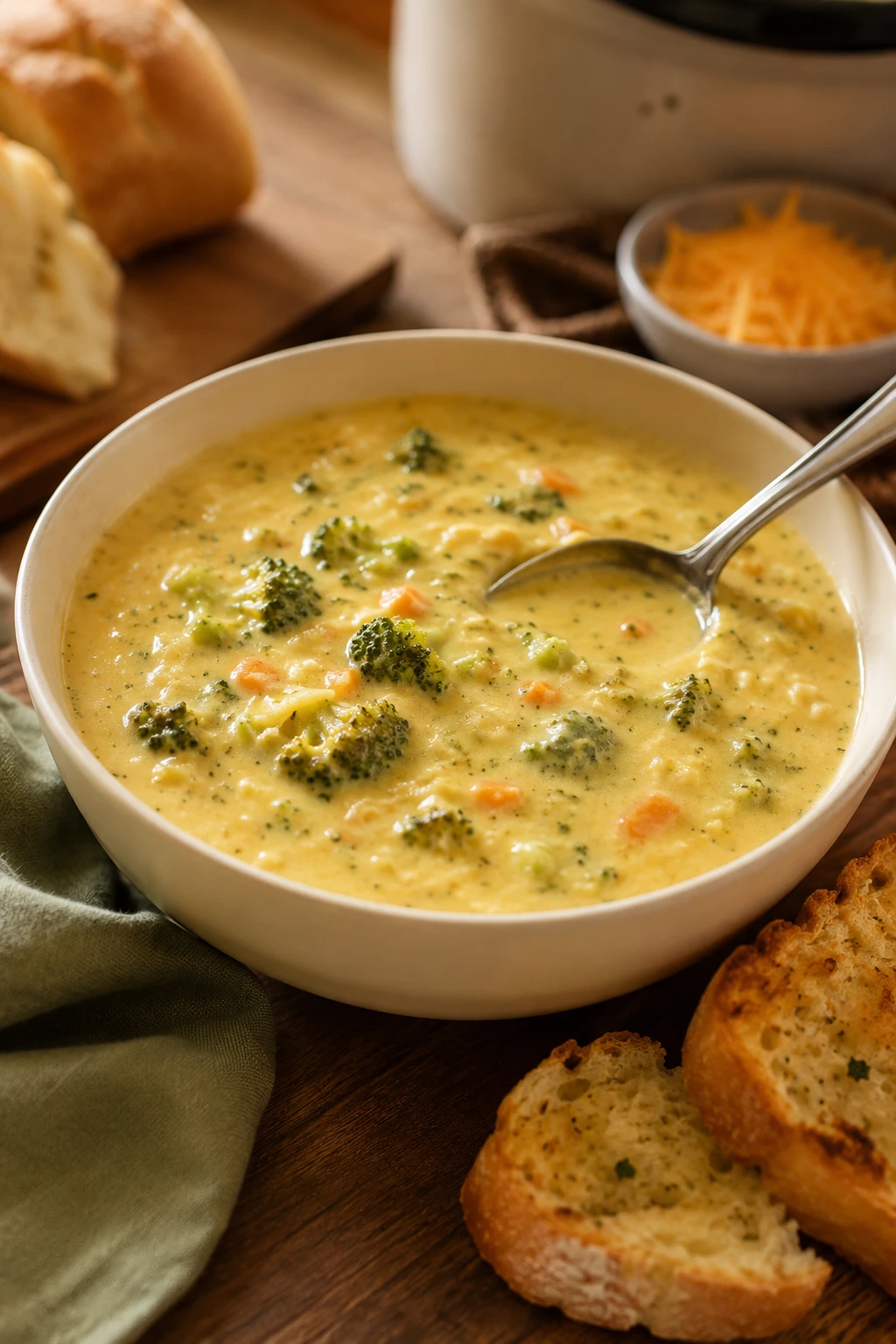
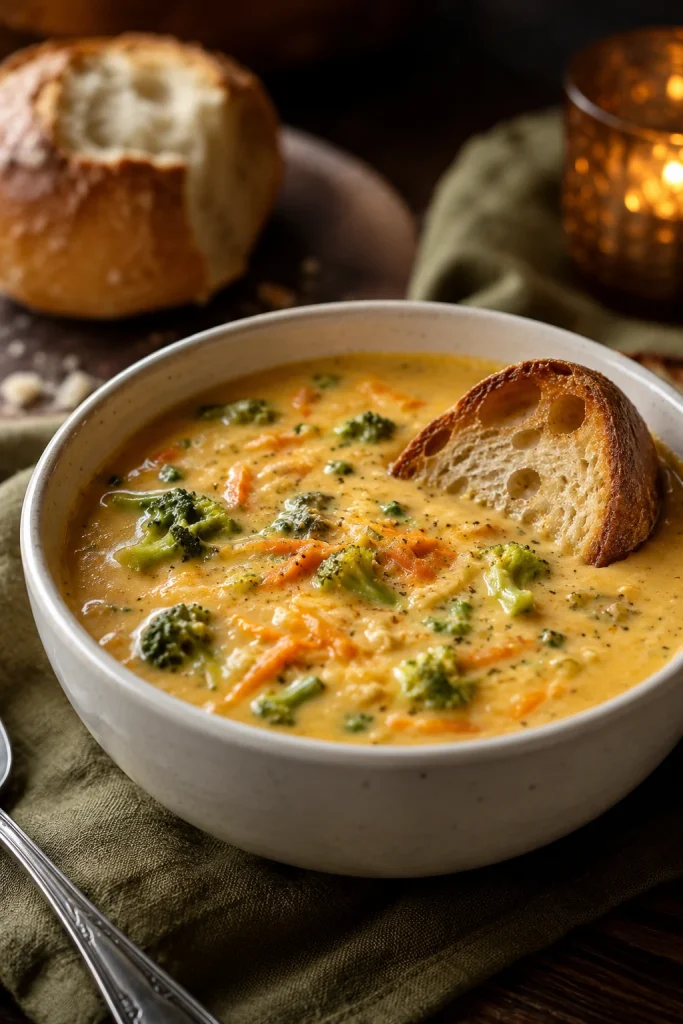
Bowl of creamy broccoli cheese soup with broccoli pieces, carrot bits, shredded cheddar, a spoon, and crusty bread on a wooden table.

A good slow cooker broccoli cheese soup should feel like a full bowl of comfort: thick, creamy, cheddar-rich, and loaded with soft broccoli. It should be cozy enough for a cold night, simple enough for a weeknight, and sturdy enough to hold up to bread, crackers, or a grilled cheese on the side.

This is the slow cooker broccoli cheese soup for people who want real cheddar flavor without a grainy pot. No canned soup, no hours of cooked cheddar, just tender broccoli, a spoonable base, and cheese melted at the finish.

The finished bowl coats the spoon, keeps broccoli in every bite, and tastes cozy instead of heavy. It feels like dinner before you add anything else: warm, creamy, familiar, and balanced with enough broccoli to keep the cheddar from taking over.

Ready to cook? Jump straight to the recipe, or skim the quick notes below if you want the soup thicker, smoother, more Panera-style, or easier to make with what you already have.

Make this tonight:

  • Base ratio: 5 to 6 cups / 450 to 500 g broccoli, 3 1/2 to 4 cups / 840 to 960 ml broth, and 10 to 12 oz / 285 to 340 g cheddar.
  • Timing: low for 4 to 5 hours or high for 2 to 3 hours, until the broccoli is tender.
  • Cheese stage: add cheddar at the end, after the heat settles.
  • Thickening: use cornstarch slurry, partial blending, cream cheese, or a potato variation.

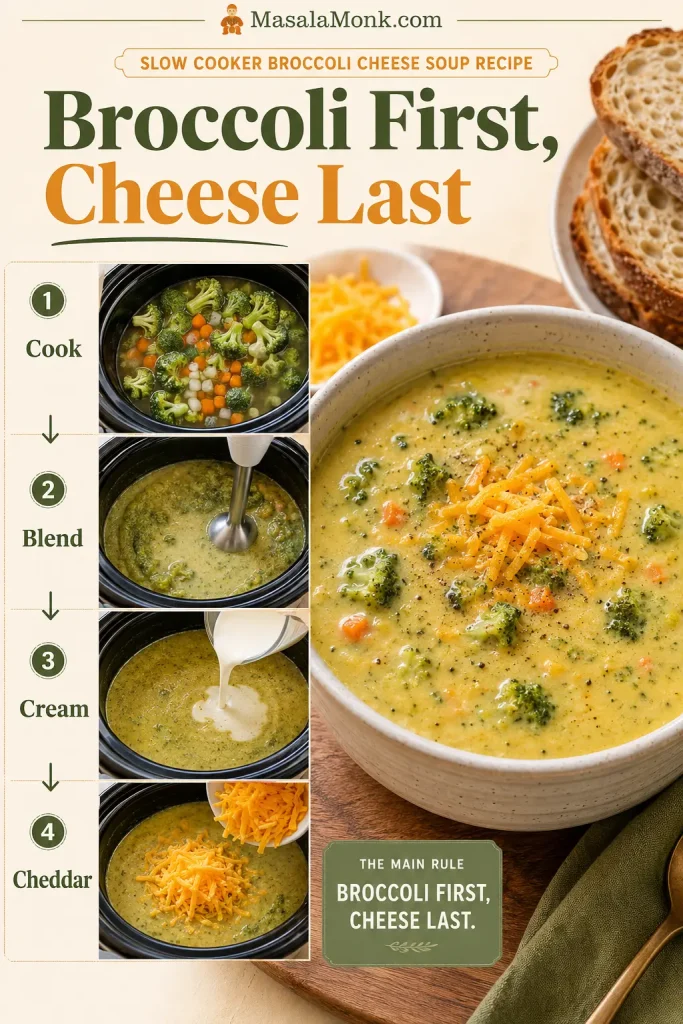
Best version for most people: Use fresh broccoli, 3 1/2 cups broth, evaporated milk or heavy cream, and freshly shredded sharp cheddar. The body comes from broccoli, a small cornstarch slurry, partial blending, and cheese added at the end. The simple rule is broccoli first, cheese last.

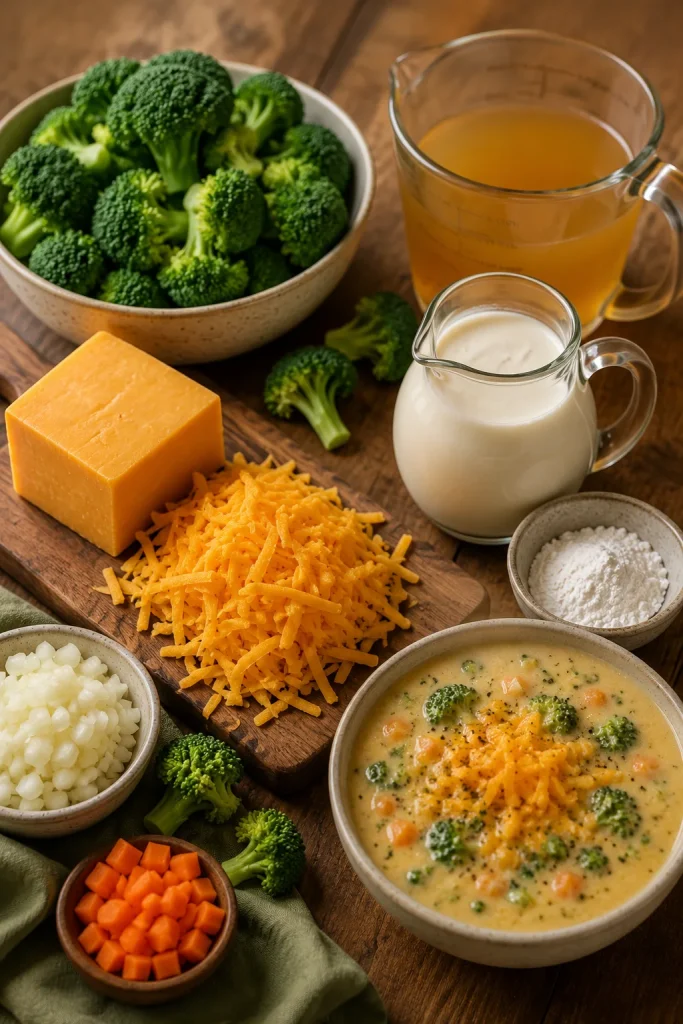
Fresh broccoli, shredded cheddar, broth, cream, cornstarch, and a small bowl of broccoli cheese soup arranged on a wooden board.
For the most reliable slow cooker broccoli cheese soup, keep the ingredient list simple: broccoli, cheddar, broth, aromatics, and dairy added late.

In This Guide

Quick Answer: Slow Cooker Broccoli Cheese Soup

For creamy slow cooker broccoli cheese soup, cook the broccoli, onion, carrot, garlic, broth, and cornstarch slurry first. Once the broccoli is tender, blend about one-third of the soup, turn the slow cooker to warm, low, or off, then stir in cream or evaporated milk and freshly shredded cheddar.

Cheddar belongs near the end, not at the beginning. It can turn grainy when it sits in high heat for hours. Add it by handfuls, stir slowly, and let the finished pot rest for 5 to 10 minutes before serving.

For your first batch: use fresh broccoli, low heat, freshly shredded sharp cheddar, 3 1/2 cups broth for a thicker soup, and evaporated milk or cream added at the end. Frozen broccoli works when convenience matters, and a little Velveeta helps when you want the smoothest finish.

The Recipe

Start here when you are ready to cook. The recipe works as written. Use the notes below only when you want to adjust the pot: frozen broccoli, missing cream, grainy cheese, a too-thin base, or a more Panera-style finish.

You do not need to read every note before cooking. The order matters more than perfection: once the broccoli is tender and the cheese melts over soft heat, the soup is on the right track.

Recipe Details

Serves: 6 bowls · Prep: 15 minutes · Cook: 4 to 5 hours on low or 2 to 3 hours on high · Finish: 10 to 15 minutes · Equipment: 5 to 6 quart slow cooker, box grater, whisk, small bowl, ladle, optional immersion blender.

Ingredients

IngredientUS AmountMetric / Notes
Broccoli florets, chopped5 to 6 cups450 to 500 g / about 1 lb
Yellow onion, finely chopped1 small100 to 120 g
Carrot, shredded or finely diced1 medium / about 1 cup80 to 100 g
Celery, finely chopped, optional1 stalk40 to 50 g
Garlic, minced2 to 3 cloves10 to 15 g
Chicken broth or vegetable broth3 1/2 to 4 cups840 to 960 ml
Cornstarch2 tablespoonsAbout 16 g
Heavy cream or evaporated milk1 cup heavy cream, or 1 cup to one 12 oz can evaporated milk240 ml cream; use 240 to 355 ml evaporated milk depending on how creamy or loose you want it
Sharp cheddar, freshly shredded10 to 12 oz285 to 340 g
Velveeta, optional4 to 8 oz as a partial cheddar replacement115 to 225 g, cubed small
Cream cheese, optional2 oz55 g, cubed small and softened
Parmesan, optional1/4 cupAbout 25 g
Butter, optional2 tablespoons28 g
Fine salt3/4 to 1 teaspoon to startAdd more to taste at the end
Black pepper1/2 teaspoonFreshly ground if possible
Mustard powder or Dijon mustard, optional1/2 teaspoon powder or 1 teaspoon DijonBoosts cheddar flavor
Nutmeg, optionalPinchRounds out the creaminess
Cayenne or paprika, optionalPinch to 1/4 teaspoonFor warmth, not heat

Use less salt with salty broth, Parmesan, Velveeta, bacon, or ham. For a full 12 oz can of evaporated milk, start with 3 1/2 cups broth. When using Velveeta, replace part of the cheddar instead of adding it on top.

Instructions

  1. Make the slurry. Whisk the cornstarch with 1/2 cup cold broth until smooth.
  2. Load the slow cooker. Add the broccoli, onion, carrot, celery if using, garlic, remaining broth, slurry, salt, pepper, and butter if using.
  3. Cook until tender. Cover and cook on low for 4 to 5 hours or high for 2 to 3 hours, until the broccoli presses easily against the side of the pot.
  4. Blend for body. Blend about one-third of the soup, or mash some broccoli against the side. Leave pieces for a chunkier bowl.
  5. Lower the heat. Turn the slow cooker to warm, low, or off. Stir in the cream or evaporated milk. Add softened cream cheese now if using.
  6. Add cheese gradually. Fold in shredded cheddar by handfuls, stirring after each addition. Add small Velveeta cubes with or just before the cheddar if using.
  7. Rest and thicken. Cover for 5 to 10 minutes, then stir again. Aim for a creamy cheddar base with visible broccoli and a spoon-coating texture.
  8. Adjust before serving. Add salt, pepper, mustard powder, cayenne, or Parmesan if needed. Loosen thick soup with warm broth or milk, or use the thickening fixes below if it is thin.

Important: hot enough to melt, not hot enough to boil — that is the creamy zone after the cheddar is added.

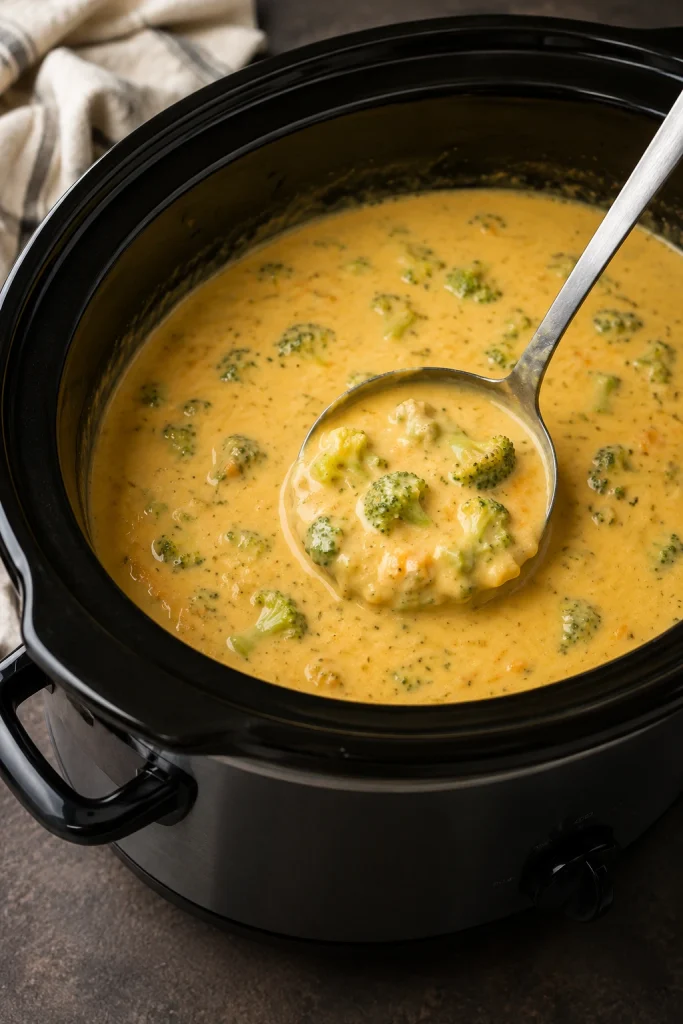
Finished broccoli cheese soup in a slow cooker with a creamy cheddar base, visible broccoli pieces, and a ladle in the pot.
After the cheese melts, a short rest helps the soup settle into a smooth, ladleable broccoli cheddar texture.

Need to adjust the pot? Jump to Choose Your Version, Fresh vs Frozen Broccoli, Cheese Choices, or Thickening.

Slow Cooker Broccoli Cheese Soup at a Glance

Use this quick table when you want the main numbers without rereading the full recipe.

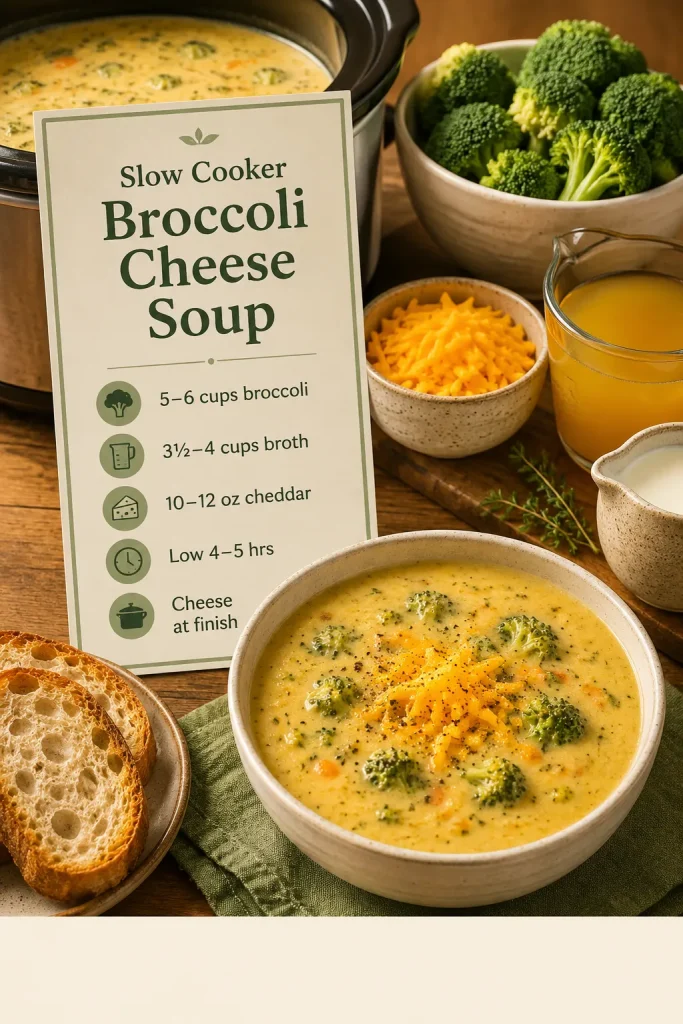
Recipe ratio card for slow cooker broccoli cheese soup with broccoli, broth, cheddar, cook time, and cheese-at-finish notes.
Use the ratio as a guardrail: plenty of broccoli, controlled broth, enough cheddar for flavor, and a gentle finish.
Slow cooker size5 to 6 quart slow cooker for a standard batch
Broccoli amount5 to 6 cups / 450 to 500 g chopped broccoli
Broth range3 1/2 cups / 840 ml for thicker soup; 4 cups / 960 ml for looser soup
Cook timeLow for 4 to 5 hours or high for 2 to 3 hours, until broccoli is tender
CheeseFreshly shredded sharp cheddar; optional Velveeta or cream cheese for smoother texture
Texture targetCreamy, thick, spoonable, with visible broccoli pieces

Choose Your Version

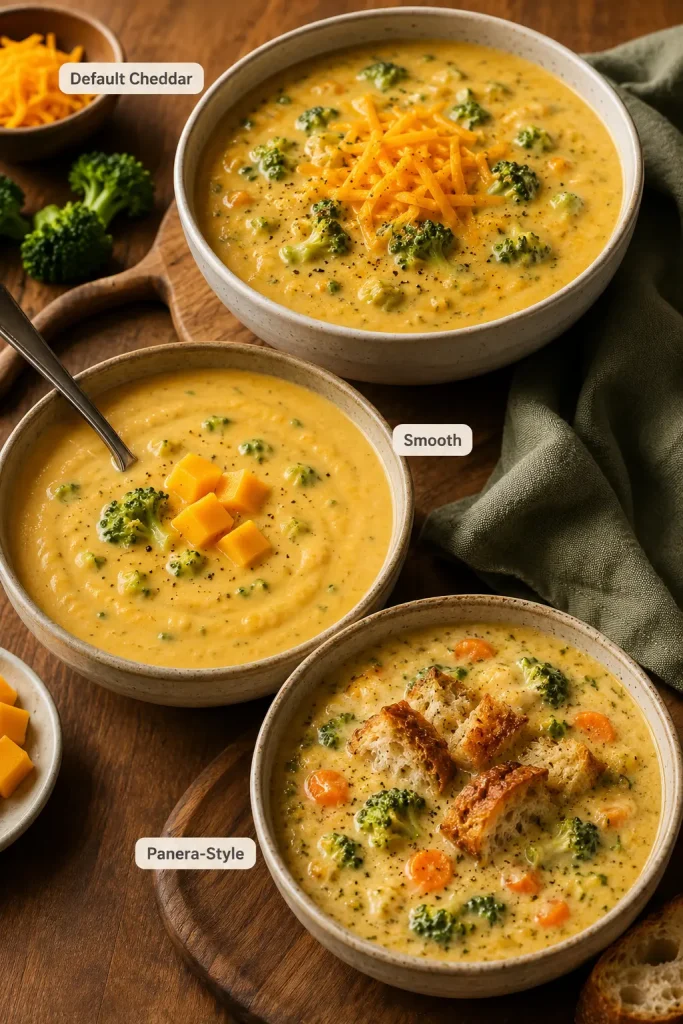
Start with the fresh-broccoli, sharp-cheddar version. Once that base is clear, every variation is easier: smoother, thicker, lighter, more shortcut-friendly, or more like a restaurant-style broccoli cheddar soup.

Three bowls of broccoli cheese soup labeled Default Cheddar, Smooth, and Panera-Style on a wooden table.
Whether you want bolder cheddar, a smoother family-style bowl, or a Panera-style feel, the same base method still works.
What You WantUse ThisSmart Move
Best default versionFresh broccoli + freshly shredded sharp cheddarUse 3 1/2 cups broth and melt cheddar at the end
Smooth family-style bowlCheddar + 4 to 8 oz VelveetaCube Velveeta small so it melts easily
Frozen broccoli versionFrozen broccoli + evaporated milk + cheddarDrain thawed broccoli or reduce broth slightly
Thicker bowlLower broth amount + cream cheese + partial blendingLet the soup rest before serving
Panera-styleCarrot, onion, sharp cheddar, mustard powder, partial blendingServe with crusty bread or a bread bowl
Hearty dinnerAdd diced potatoes at the startCook until potatoes are fully tender before adding cheese

Why This Recipe Works

The slow cooker is great at softening vegetables, but it is not great at reducing liquid or babysitting cheese. This recipe works because it gives the slow cooker the job it does best and saves the cheddar for the finish.

That is the structure: let the pot soften the vegetables, use a little blending for body, then finish with cheddar once the base is ready.

Step-by-step guide showing broccoli cooking, soup being blended, cream being added, and cheddar added last.
The method is easy to remember: let the slow cooker soften the broccoli first, then finish with cream and cheddar over steady heat.
  • Moderate broth keeps the soup from turning watery. Slow cookers do not reduce liquid like stovetop pots, so the recipe starts with 3 1/2 to 4 cups broth instead of drowning the broccoli.
  • Cornstarch gives the base an easy head start. It helps the soup thicken without needing a stovetop roux.
  • Partial blending adds body naturally. Blending some broccoli makes the soup feel thicker without making it heavy.
  • Cheddar finishes the soup. This protects the melt and keeps the bowl creamy instead of oily or gritty.
  • Freshly shredded cheese melts better. It gives stronger flavor and a cleaner finish than many pre-shredded cheeses.

If you have ever had a cheese sauce split before, the lesson is the same whether it is soup or a creamy macaroni and cheese recipe: low heat wins.

You want the spoon to drag gently through the soup, not splash through it. The broccoli softens into the base, the cheese melts into the cream, and the finished bowl feels thick without turning pasty.

Close-up of creamy broccoli cheese soup coating a spoon with a broccoli piece visible as soup drips back into the bowl.
The spoon test is simple: the soup should coat the spoon, drip slowly, and still pour back into the bowl.

Ingredients and What Each One Does

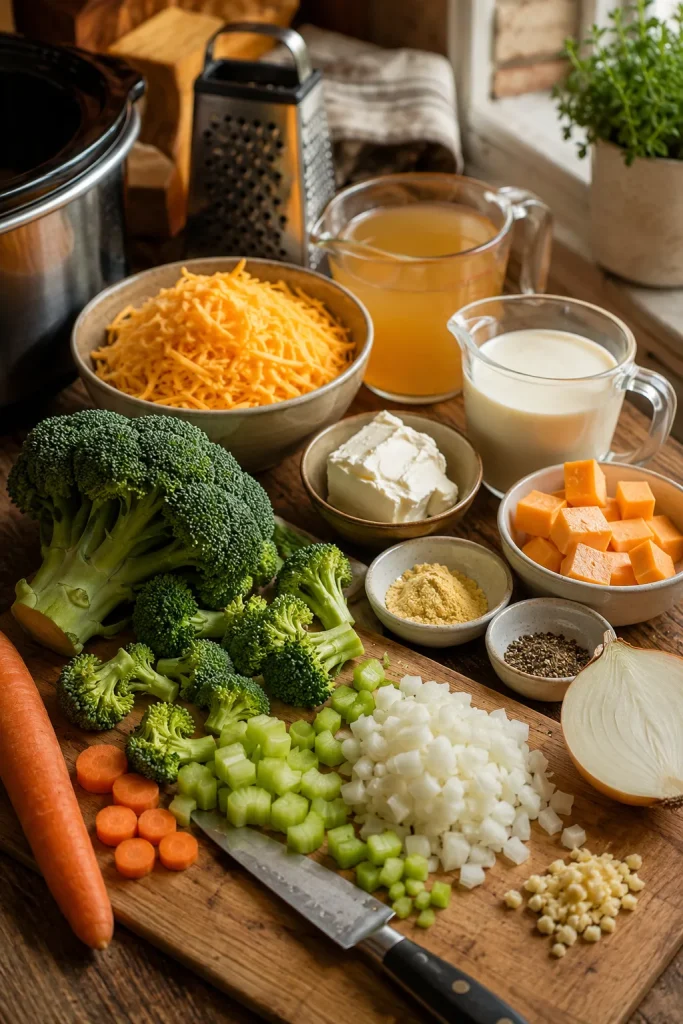
Nothing here is fancy; every ingredient has a job. The broccoli gives the bowl its heart, the aromatics make it taste like dinner, the broth sets the body, and the cheese brings the comfort.

Broccoli cheese soup ingredients including broccoli, carrot, onion, garlic, celery, broth, cream, cheddar, cream cheese, seasonings, and a box grater.
Before anything goes into the slow cooker, each ingredient has a job: vegetables build flavor, broth carries it, and cheese finishes it.

Broccoli

Use 5 to 6 cups of chopped broccoli florets, about 450 to 500 grams. Fresh broccoli gives steady texture, especially if you like visible pieces in the soup. Frozen broccoli works too, but it usually creates a softer, more blended bowl and can release extra water. Tender peeled broccoli stems can go in as well; chop them small so they soften at the same pace as the florets.

Onion, Carrot, Celery, and Garlic

These are what keep the soup from tasting like cheese melted into broth. Onion adds sweetness, carrot gives color and a mild Panera-style note, celery adds savory depth, and garlic keeps the base from tasting flat. If you dislike celery, skip it. For a smoother soup, chop everything small.

Broth

Chicken broth gives the richest flavor, while vegetable broth keeps the soup vegetarian. Use 3 1/2 cups if you like a thick soup and 4 cups if you prefer it slightly looser. When your broth is salty, start with less added salt and adjust at the end.

Cornstarch

Cornstarch is the easiest thickener for this slow cooker version. Whisk it into cold broth before it goes into the cooker so it spreads evenly. You can also use an extra slurry at the end if the base looks thinner than you want.

Heavy Cream or Evaporated Milk

Heavy cream gives the richest soup. Evaporated milk gives a creamy, stable finish that is a little lighter than cream. Regular milk can work, but it is thinner and more likely to split if overheated, so add it carefully and keep the pot below a hard bubble after the cheddar melts in.

Cheddar

Sharp cheddar gives the strongest broccoli cheddar flavor. Buy a block and shred it yourself if you can. Pre-shredded cheese is convenient, but it often contains anti-caking ingredients that can make the melt less even. For a deeper look at smooth melting, this cheese sauce recipe walks through the same gentle-heat idea in a stovetop sauce.

Velveeta

Velveeta is optional, but it is useful if you want the soup extra smooth and kid-friendly. It does not give the same sharp cheddar flavor as real cheddar, so the most balanced compromise is usually a mix: cheddar for flavor, Velveeta for easy melting.

Cream Cheese

Cream cheese is optional, but helpful. It adds body and helps the soup taste richer. Use block cream cheese, not whipped cream cheese. Cut it into small cubes and let it soften for a few minutes so it melts more easily.

Mustard, Nutmeg, Cayenne, or Paprika

These are small flavor boosters, so they should stay in the background. Mustard powder or Dijon makes cheddar taste sharper. Nutmeg rounds out creamy soups. Cayenne or paprika adds warmth and keeps the bowl from tasting one-note.

Substitutions: No Milk, No Cream, No Chicken Broth, No Carrots

Real weeknight cooking means the fridge is rarely perfectly stocked. This soup can still work as long as you protect the liquid level and keep the cheese heat gentle.

The swaps below help when you are missing one ingredient. They do not make the soup dairy-free unless you also replace the cheese and cream with dairy-free alternatives. The best swaps keep the bowl creamy without flooding the pot.

Practical Swap Guide

NeedMost Practical SwapWhat Changes
No milkUse evaporated milk, heavy cream, or extra broth plus cream cheeseEvaporated milk is creamy and stable; broth alone makes a lighter soup
No heavy creamUse evaporated milk or half-and-halfThe soup will be slightly lighter but still creamy
No evaporated milkUse heavy cream or half-and-halfAdd near the end and keep the pot below a hard bubble
No chicken brothUse vegetable brothKeeps the soup vegetarian and still flavorful
No carrotsSkip themThe soup loses a little sweetness and color, but still works
No onionUse 1/2 teaspoon onion powder or add extra garlicLess depth, but still cozy
No celerySkip itNo major change; celery is optional
No flourUse cornstarch and partial blendingSimple thickening route for this recipe
No VelveetaUse freshly shredded cheddar and optional cream cheeseBetter real-cheese flavor, slightly more heat-sensitive
No cream cheeseUse extra cheddar, partial blending, or a little more slurrySoup may be slightly less rich

As long as you protect the liquid level and the cheese stage, the recipe gives you room to improvise.

Slow Cooker Size and Scaling

The only trick with slow cooker size is giving yourself room to stir. A 5 to 6 quart slow cooker gives the broccoli space to cook and leaves enough room to add the dairy and cheese at the end.

Half Batch, Standard Batch, and Double Batch

BatchCooker SizeBroccoliBrothCheddar
Half batch2 to 3 quart2 1/2 to 3 cups / 225 to 250 g1 3/4 to 2 cups / 420 to 480 ml5 to 6 oz / 140 to 170 g
Standard batch5 to 6 quart5 to 6 cups / 450 to 500 g3 1/2 to 4 cups / 840 to 960 ml10 to 12 oz / 285 to 340 g
Double batch6 to 8 quart10 to 12 cups / 900 g to 1 kg7 to 8 cups / 1.7 to 1.9 L20 to 24 oz / 570 to 680 g

For half or double batches, scale the remaining ingredients in the same direction, but start lower with salt and adjust after the cheese melts. The soup scales well, but the cheese stage still needs space. A too-full slow cooker makes it harder to melt cheddar evenly.

If your slow cooker runs hot, check the broccoli early. Once the dairy goes in, slow down and let the soup settle.

How to Make Slow Cooker Broccoli Cheese Soup

The recipe card gives you the exact steps. This section shows what the pot looks and feels like as you cook, which is especially helpful if your slow cooker runs hot or your broccoli pieces are larger.

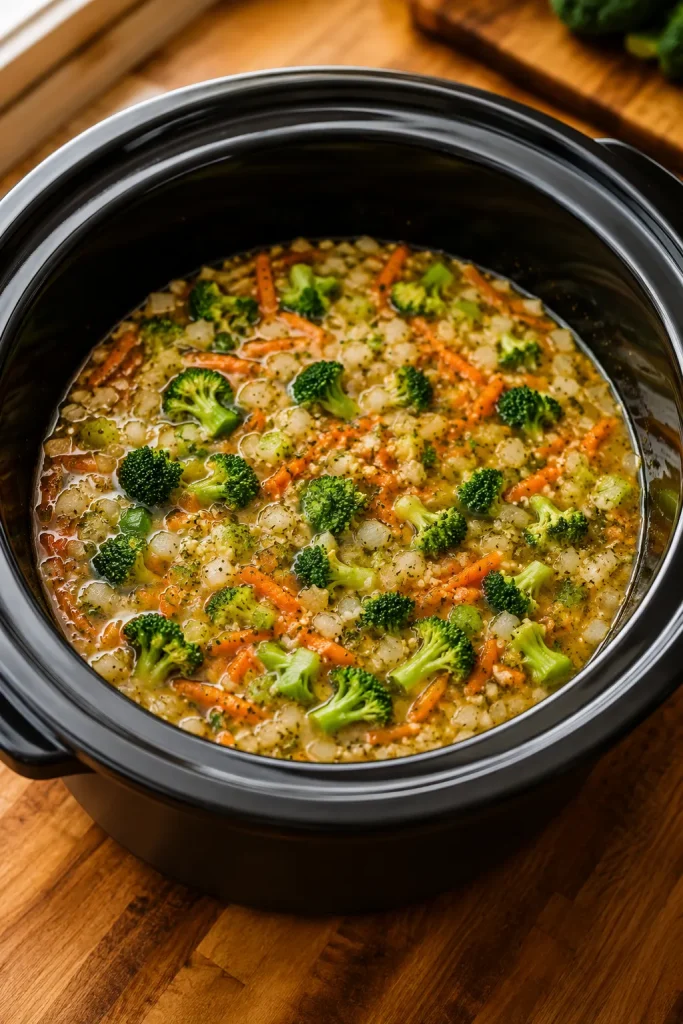
Step 1: Build a base that looks full, not flooded

Add the broccoli, onion, carrot, celery, garlic, broth, salt, pepper, and cornstarch slurry to the slow cooker. The vegetables need enough liquid to cook, but they do not need to swim. Slow cookers trap steam, so moderate broth helps the final soup stay spoonable.

Dark slow cooker filled with raw broccoli, carrot, onion, celery, garlic, seasonings, and golden broth before cooking.
The pot should look vegetable-heavy at the start, because broccoli shrinks and releases moisture as it slowly cooks.

Step 2: Cook until the broccoli gives in

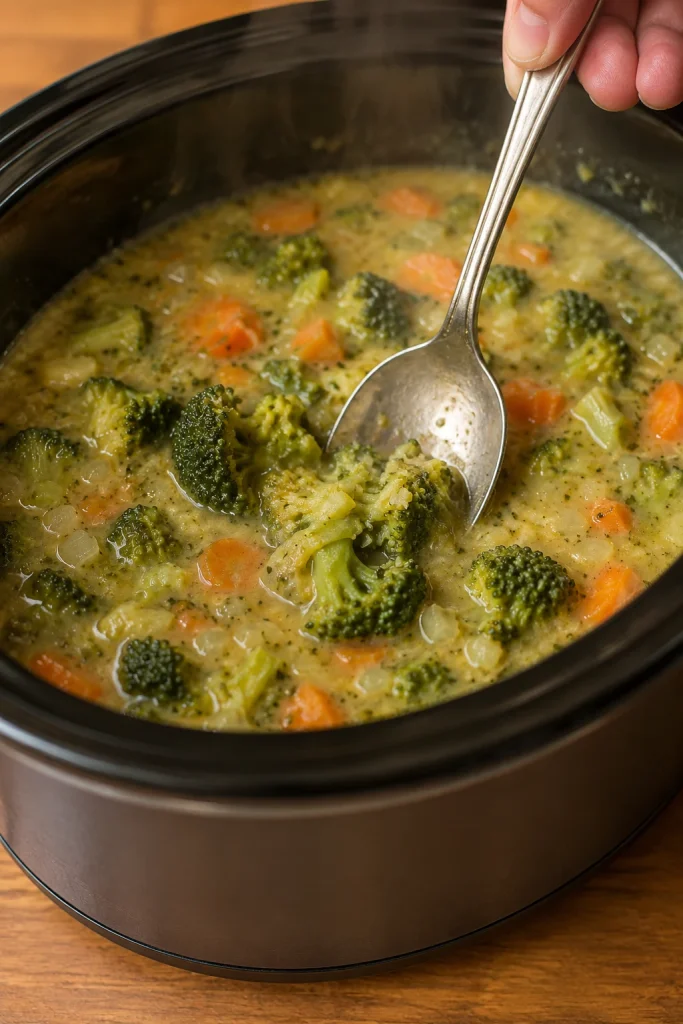
The broccoli is ready when it presses easily against the side of the slow cooker with a spoon. If it still feels firm, give it more time before adding dairy. This is the stage where the soup builds body.

Spoon pressing tender cooked broccoli against the side of a slow cooker to show the vegetables are soft.
Once the broccoli gives way under a spoon, the base is soft enough to blend partly and turn creamy.

Step 3: Blend just enough for body

Blend about one-third of the soup, or mash some broccoli into the base. You are not trying to erase every piece. A good bowl has creamy body and visible broccoli, so stop while it still looks like broccoli cheese soup, not a completely smooth puree.

Immersion blender partially blending cooked broccoli soup inside a slow cooker while some broccoli pieces remain whole.
Instead of loading in more cheese, blend part of the broccoli base for natural thickness and a better spoonful.

Step 4: Let the heat settle before dairy

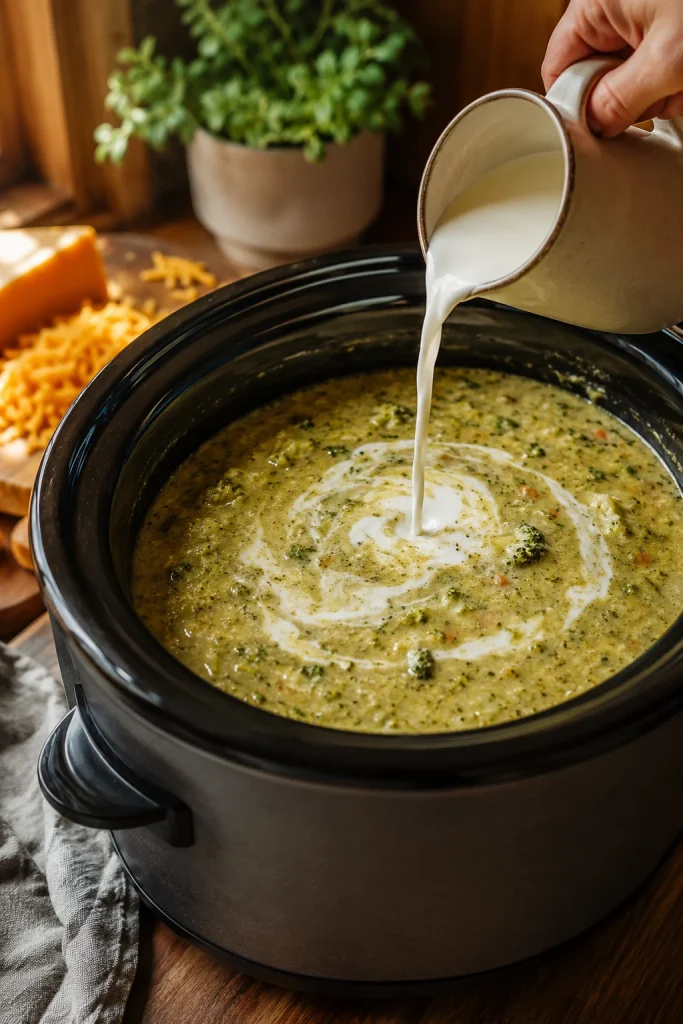
Look for a steaming base without a hard bubble. Stir in the cream, evaporated milk, or cream cheese after turning the slow cooker down. If the surface is actively boiling, wait a few minutes. Residual heat is enough to bring everything together.

Cream being poured from a small jug into cooked broccoli soup in a slow cooker, creating a white swirl.
After the vegetables are tender, cream or evaporated milk smooths the base without spending hours on heat.

Step 5: Melt the cheddar with patience

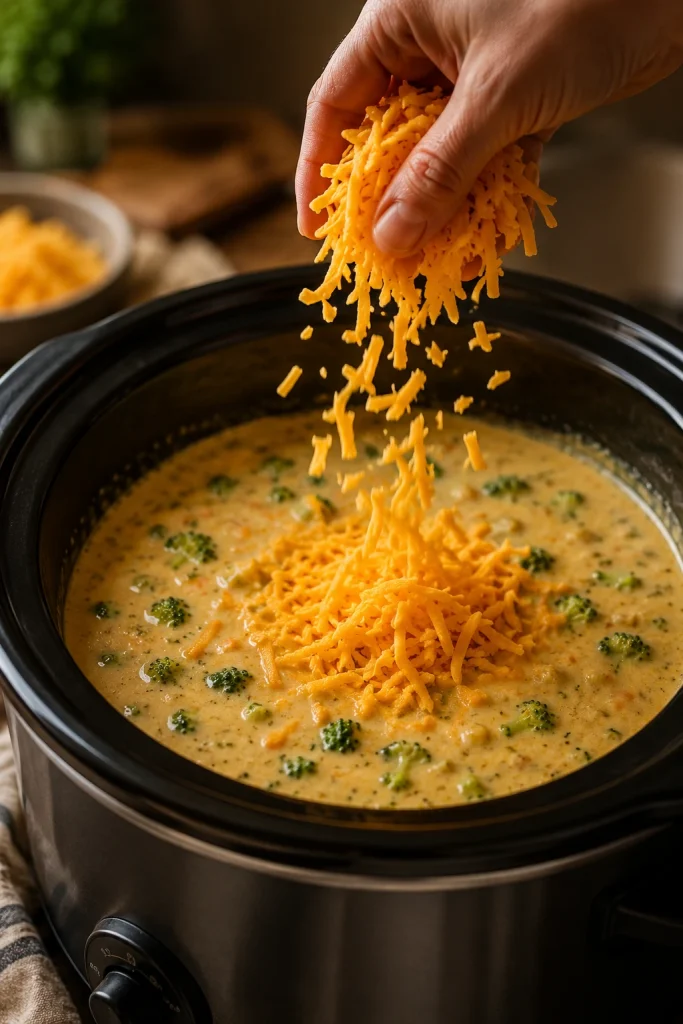
Fold in the cheddar by handfuls and let each handful disappear before adding the next. The base should turn glossy and creamy, not stringy. This is the part where you do less, not more: slow down and let the hot base do the melting.

Freshly shredded cheddar falling into hot broccoli soup in a slow cooker with broccoli pieces visible underneath.
Cheddar behaves best when the soup is already hot and ready, so add it slowly rather than cooking it all day.

Low vs High Slow Cooker Timing

Low is the calmer route. It gives the broccoli time to soften without rushing the pot, while high works when dinner needs to happen faster. Either way, the broccoli needs to be tender before the dairy and cheese go in.

  • Low: 4 to 5 hours for steady broccoli texture.
  • High: 2 to 3 hours when dinner needs to happen faster.
  • Cheese finish: 5 to 15 minutes after the heat settles.
  • Potato variation: allow extra time if needed because potatoes must be fully tender before cheese goes in.

The pot will tell you more than the timer. Look for tender broccoli first, then move into the dairy and cheese finish.

For general slow cooker safety, the USDA slow cooker food safety guide notes that slow cookers cook at low temperatures over time. For this recipe, the practical cue is still texture: broccoli tender first, cheese added after, and no hard boiling once the cheese goes in.

Fresh vs Frozen Broccoli

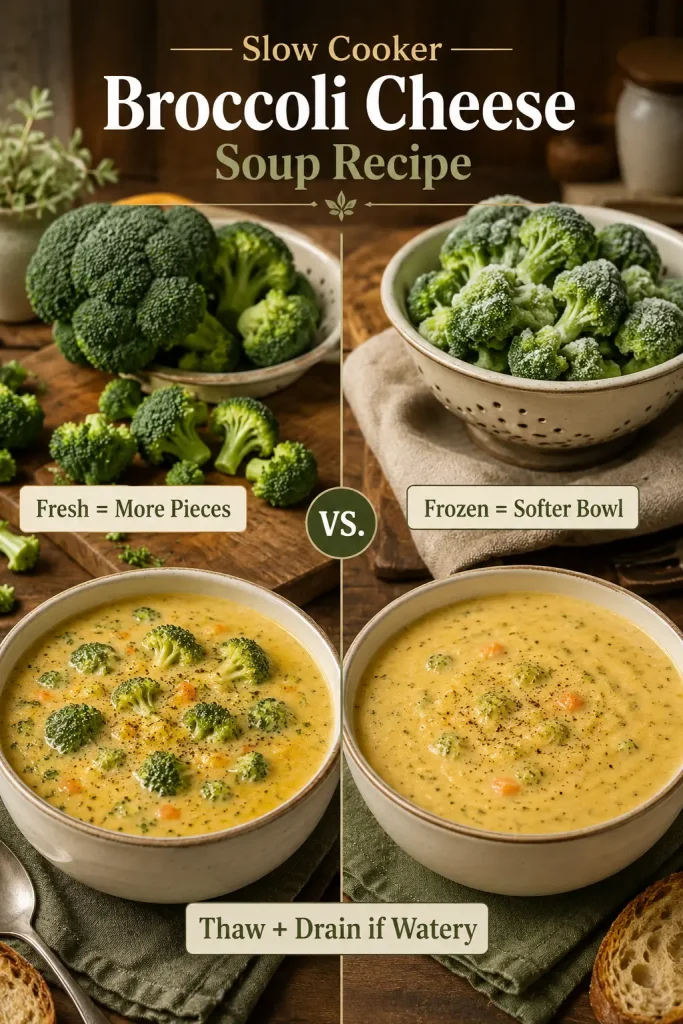
This is one of the few broccoli soups where frozen broccoli can absolutely work. Use fresh broccoli for the best first batch. Use frozen when convenience matters and a softer soup is okay. Fresh holds shape; frozen melts into the bowl.

Fresh broccoli and frozen broccoli compared with two bowls of broccoli cheese soup showing chunkier and smoother textures.
Fresh broccoli keeps more visible bite, while frozen broccoli makes a softer soup; if frozen pieces look wet, drain them first.

If this soup puts you in a broccoli mood but you want something fork-twirly instead of spoonable, this Broccoli Pasta Recipe goes in a garlic-Parmesan direction.

Broccoli TypeHow to Use ItResult
Fresh chopped floretsAdd at the startClassic texture and visible broccoli pieces
Larger fresh floretsAdd at the start, then chop or mash after cookingChunkier soup with more broccoli shape
Frozen chopped broccoliAdd from frozen or thaw and drain firstSofter, creamier, more blended soup
Frozen floretsAdd during the last 1 to 2 hours if you want more shapeLess mushy than cooking frozen broccoli from the start
Watery frozen broccoliThaw and drain, or reduce broth slightlyHelps prevent thin soup

For a softer soup, add frozen broccoli at the beginning. For more visible pieces, add frozen florets later or use fresh broccoli next time.

If frozen broccoli makes the pot look loose, go straight to How to Thicken or Troubleshooting.

Cheese Choices for Smooth Broccoli Cheese Soup

Cheese decides whether this soup tastes sharp and homemade, smooth and kid-friendly, or rich enough to feel restaurant-style. For most batches, use freshly shredded sharp cheddar. Add Velveeta only if smoothness matters more than sharp cheddar flavor.

Pick the cheese based on the finish you want, not just what is in the fridge. The right cheese melts into the base instead of sitting on top of it.

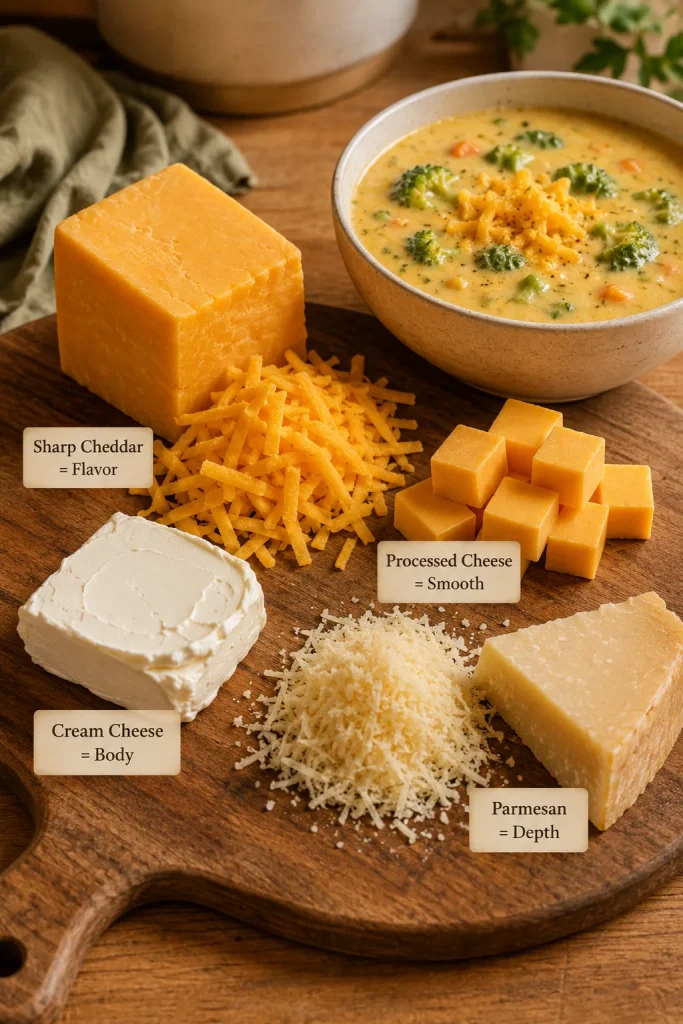
Cheese board with sharp cheddar, shredded cheddar, processed cheese cubes, cream cheese, Parmesan, and a small bowl of broccoli cheese soup.
Cheese choice changes the bowl: sharp cheddar brings flavor, processed cheese smooths the melt, cream cheese adds body, and Parmesan deepens it.
CheeseGood ForWatch Out For
Sharp cheddarClassic broccoli cheddar flavorCan turn grainy if overheated
Mild cheddarSmoother, less sharp flavorLess depth than sharp cheddar
Freshly shredded block cheddarSmooth melt and stronger flavorTakes a few extra minutes to grate
Pre-shredded cheddarConvenienceCan melt less evenly
VelveetaSmooth shortcut, kid-friendly textureLess real-cheddar flavor
Cream cheeseThicker, more stable soupCan taste tangy if too much is used
ParmesanSalty depth and savory finishToo strong to use as the main cheese

Freshly shredded sharp cheddar gives the most balanced result. If you want the soup extra smooth, replace 4 to 8 ounces of the cheddar with Velveeta or add 2 ounces of cream cheese before the cheddar.

Worried about grainy texture? Check When to Add the Cheese before the troubleshooting table.

When to Add the Cheese

The whole pot depends on this moment. Once the vegetables are tender, the slow cooker has done the hard part. From here, the cheese only needs steady warmth.

Cheddar behaves best as a finish, not a long-cooked ingredient. If it cooks for hours in the slow cooker, it can become oily, stringy, grainy, or clumpy. Let the heat already in the soup do the melting.

  • Shred the cheddar yourself if possible.
  • Turn the slow cooker down before adding cheese.
  • Fold in cheese one handful at a time.
  • Stir after each addition.
  • Let the soup rest for 5 to 10 minutes after the cheese melts.

That cheese-at-the-end habit is useful beyond this soup. It also helps in recipes like Slow Cooker French Onion Chicken, where the slow cooker does the tender cooking first and the cheese works better as a finish.

If you are using cream cheese, add it before the cheddar so it has time to soften into the hot soup. If using Velveeta, cube it small so it melts easily into the base.

How to Thicken Slow Cooker Broccoli Cheese Soup

A thin soup can feel disappointing, especially when the kitchen already smells like dinner. Luckily, this is one of the easiest problems to fix if you catch it before boiling the cheese.

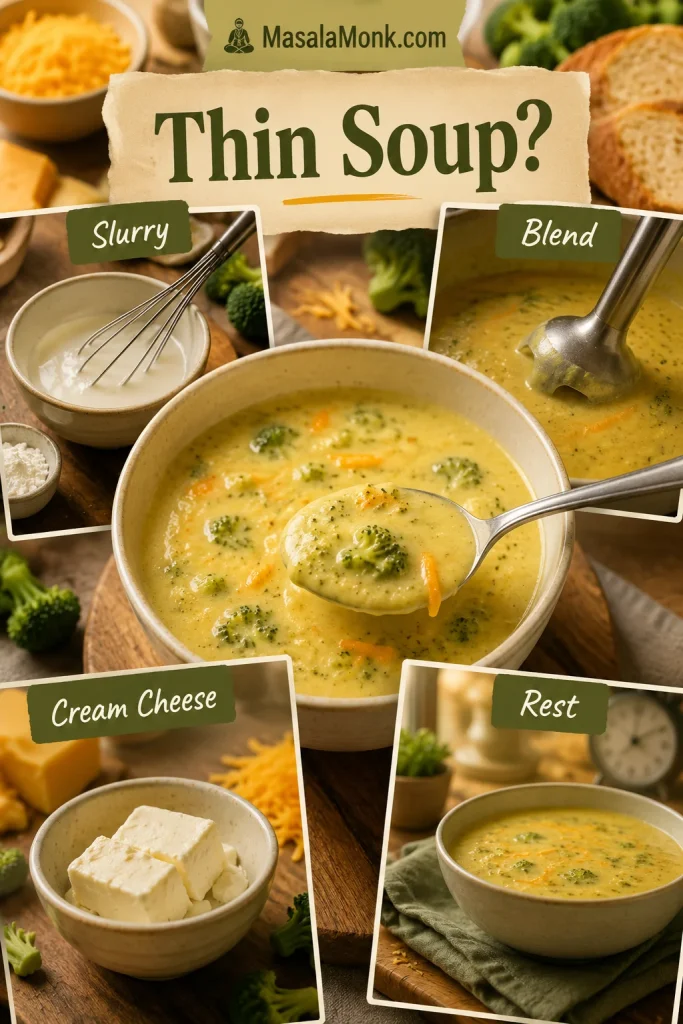
To thicken slow cooker broccoli cheese soup, blend part of the cooked broccoli, use a cornstarch slurry, add softened cream cheese, or let the soup rest after the cheese melts. A thin base needs slurry before cheddar; a loose finished pot usually needs a short rest before any extra fix.

Thickening guide for broccoli cheese soup showing cornstarch slurry, blending, cream cheese, resting, and a bowl of creamy soup.
If the soup looks thin, fix the base first with blending, a slurry, cream cheese, or a few quiet minutes of resting.

Best Thickening Fixes

Thickening MethodGood ForHow to Use It
Cornstarch slurryEasy thickeningWhisk 1 tablespoon cornstarch with 1 tablespoon cold water or broth, then stir into hot soup
Partial blendingNatural bodyBlend one-third of the soup after broccoli is tender
Cream cheeseRich, stable textureAdd small softened cubes before cheddar
PotatoHeartier soupAdd diced potato at the beginning and cook until tender
RouxClassic creamy bodyCook butter and flour separately, then stir into the soup base
Extra cheeseFlavor and bodyAdd at the end, after the heat settles

A roux gives classic cream-soup body, but it adds a skillet step. The cornstarch and partial-blending route is simpler for this slow cooker version and still gives a thick, spoonable soup.

If the soup is only slightly thin, let it rest for 10 minutes after adding the cheese. Cheese soups often thicken as they sit.

Flavor Boosters for Better Broccoli Cheddar Soup

If the soup tastes creamy but a little flat, it usually needs sharper cheese, a touch more salt, or one small background flavor. You do not need to make it spicy or complicated. A tiny amount of the right ingredient can make the cheddar taste more like cheddar.

You should not notice the mustard or nutmeg as separate flavors. They are there to make the cheddar taste fuller.

  • Mustard powder: add 1/2 teaspoon to make cheddar taste sharper without making the soup taste mustardy.
  • Dijon mustard: add 1 teaspoon for gentle tang and a more restaurant-style finish.
  • Nutmeg: add a pinch to round out the creaminess.
  • Cayenne: add a pinch for warmth without making the soup hot.
  • Parmesan: add 1/4 cup for salty, savory depth.
  • Extra sharp cheddar: use it for part or all of the cheddar when you want stronger cheese flavor.
  • Worcestershire sauce: add 1/2 to 1 teaspoon for savory depth, especially in non-vegetarian versions.

Add flavor boosters near the end, then taste again. Once the cheese melts, the salt and sharpness of the soup can change quickly.

Cheddar Version vs Velveeta Version

Some nights you want real cheddar sharpness; some nights you want the soup to melt smoothly with zero drama. The hybrid version gives you both.

Freshly shredded sharp cheddar gives the most homemade broccoli cheddar soup flavor. Velveeta creates the smoothest, most forgiving texture. A mix gives you both flavor and easy melting.

  • Real cheddar version: use 10 to 12 oz freshly shredded sharp cheddar for the strongest flavor. Melt it carefully because real cheddar is more heat-sensitive.
  • Hybrid cheddar-Velveeta version: use 6 to 8 oz cheddar plus 4 to 8 oz Velveeta for a smooth but still flavorful soup.
  • Velveeta-style version: use 12 to 16 oz Velveeta and 1 to 2 cups cheddar if you want the smoothest shortcut version.
  • Three-cheese version: add Parmesan or Colby Jack with cheddar for a richer, deeper cheese flavor.

For most people, the hybrid version is the easiest win: sharp cheddar for flavor, a little Velveeta or cream cheese for smoothness.

Slow Cooker Panera-Style Broccoli Cheddar Soup

This is not an exact Panera copycat, but it moves the soup toward that familiar Panera-style broccoli cheddar bowl: creamy base, visible broccoli, shredded carrot, sharp cheddar, and bread on the side.

When you want the Panera-style feeling, focus on three things: shredded carrot, sharp cheddar, and a creamy base that still leaves little pieces of broccoli in the spoon.

Café-style bowl of broccoli cheddar soup with visible broccoli, shredded carrot, creamy cheddar base, and crusty bread.
For a Panera-style broccoli cheddar soup, keep the carrot visible, use a cheddar-forward base, and serve bread close by.
  • Use sharp cheddar, not only mild cheddar.
  • Keep the carrot in the recipe for color and sweetness.
  • Add onion and garlic for a deeper base.
  • Use evaporated milk or cream for a smooth, creamy finish.
  • Blend part of the soup so it is creamy but still has broccoli pieces.
  • Add a small amount of Dijon or mustard powder to wake up the cheese flavor.
  • Serve it with crusty bread or in a bread bowl.

For a bread-bowl feeling without making actual bread bowls, toast thick slices from a homemade garlic bread loaf and serve them on the side for dipping.

If you want the soup thicker and more restaurant-style, use the lower broth amount, add cream cheese, and let the finished soup rest for 10 minutes before serving.

Potato, Chicken, Bacon, and Ham Variations

Once the base is creamy, the soup can turn into dinner in a few different ways. Add-ins work best when they support the soup instead of making it watery, greasy, or overcooked.

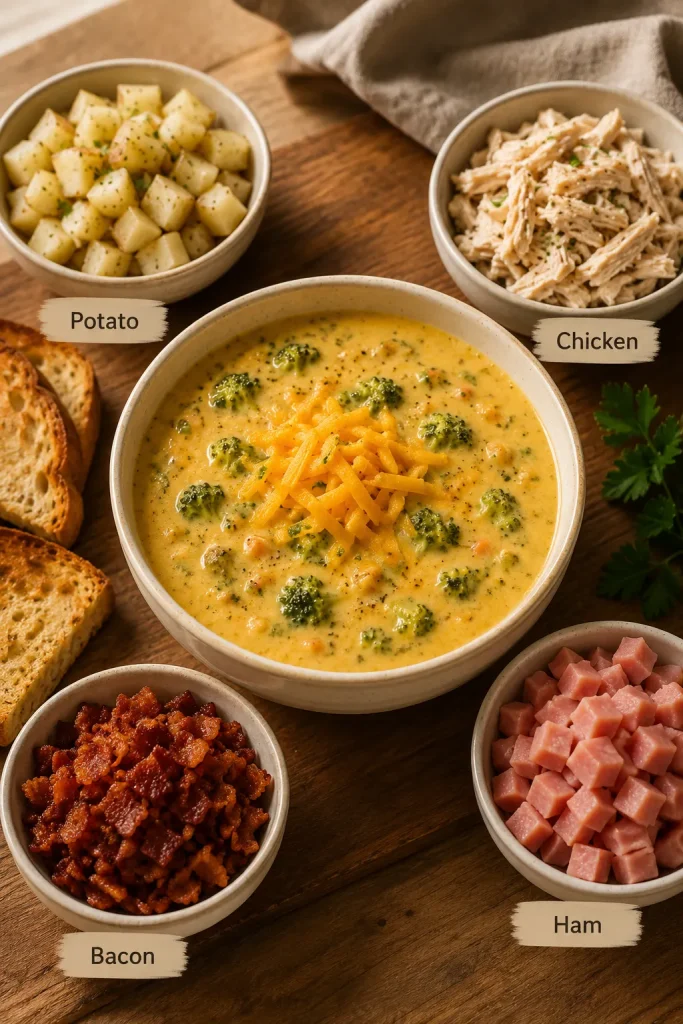
Bowl of broccoli cheese soup surrounded by small bowls of diced potatoes, shredded chicken, bacon pieces, and diced ham.
Once the creamy base is ready, potatoes, chicken, bacon, or ham can turn the soup into a fuller dinner.

Easy Add-In Ideas

VariationHow to Adapt ItNotes
Broccoli cheddar potato soupAdd 1 1/2 to 2 cups small diced potatoes at the startCook until potatoes are fully tender before adding cheese
Chicken broccoli cheese soupAdd cooked shredded chicken near the endRotisserie chicken works well
Bacon broccoli cheese soupTop with cooked crumbled bacon before servingDo not slow cook raw bacon in the soup
Ham broccoli cheese soupAdd diced cooked ham near the endGood for leftover ham; reduce salt if ham is salty
Broccoli cauliflower cheese soupReplace 1 to 2 cups broccoli with cauliflowerCauliflower makes the soup milder and creamier
Gluten-free versionUse cornstarch, not flour, and check broth and cheese labelsBest handled with simple ingredients
Keto or low-carb versionSkip potatoes and reduce or skip carrots; use cream, cheese, and partial blending for bodyFor stricter low-carb cooking, avoid flour and use only a small amount of cornstarch or a keto-friendly thickener
Lighter versionUse evaporated milk instead of heavy creamStill creamy, but less rich

For the chicken version, stir in cooked shredded chicken near the end so it stays tender. If you want the same broccoli-cheese comfort in a rice-based dinner, make this Cheesy Chicken Broccoli Rice on another night.

For the ham version, keep the salt lower and add diced cooked ham near the end. If you still have ham left after soup night, this Ham and Cheese Quiche turns it into an easy brunch-style meal.

Troubleshooting Slow Cooker Broccoli Cheese Soup

If the soup looks thinner, thicker, or less smooth than you hoped, do not panic. Most broccoli cheese soup problems are easier to fix before the pot gets too hot again.

Match the symptom to the fix below, then bring the soup back slowly.

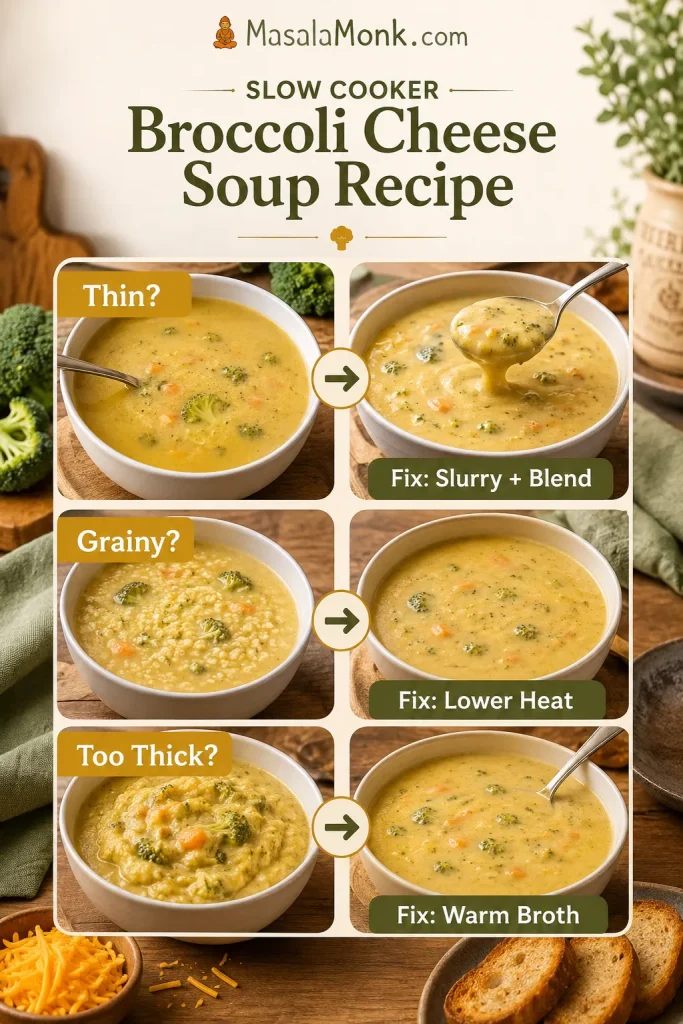
Troubleshooting guide showing thin, grainy, and too-thick broccoli cheese soup with bowls showing each problem and fix.
Thin, grainy, or too-thick broccoli cheese soup usually needs one small correction, not a full restart.

Problem and Fix Guide

ProblemLikely CauseFix
Soup is grainy or grittyCheese overheated, soup boiled after cheese, or pre-shredded cheese was usedLower the heat, whisk slowly, add a splash of cream, and use block cheese next time
Cheese clumpedCheese was added too fast or the soup was too hotAdd cheese by handfuls on warm, low, or off
Soup is wateryToo much broth, frozen broccoli released water, or not enough thickenerAdd slurry, blend part of the soup, or let it rest after adding cheese
Soup is too thickToo much cheese, starch, cream cheese, or potatoAdd warm broth or milk a little at a time
Broccoli is mushyCooked too long or frozen broccoli was added earlyBlend part of the soup and use the soft broccoli as body
Soup tastes blandMild cheese, weak broth, or too little saltAdd salt, mustard powder, cayenne, Parmesan, or sharper cheddar
Cream cheese has lumpsAdded cold in large piecesCube it small, soften it first, or blend it with a ladle of hot soup
Soup split while reheatingReheated too quickly or boiledReheat slowly with a splash of milk or broth and whisk gently

If the soup breaks badly, blend a portion of it and stir it back in. It may not become perfectly smooth again, but it will usually become creamy enough to serve.

Storage, Freezing, and Reheating

Leftovers are worth saving, but cheese soup asks for patience on the reheat. The goal is to warm the bowl back up without pushing the cheese too hard.

  • Refrigerator: Store cooled soup in an airtight container for 3 to 4 days.
  • Reheating: Warm on low heat on the stove or in the microwave at lower power, stirring often.
  • Loosening leftovers: Add a splash of milk, cream, or broth while reheating.
  • Do not boil leftovers: Boiling can make the cheese split or turn grainy.
  • Freezing: Possible, but not ideal. Dairy-based cheese soups can separate or look grainy after thawing.

For make-ahead cooking, the best texture comes from cooking the vegetable base first, then adding dairy and cheese closer to serving.

If you want this for lunches, store it in single portions and reheat slowly. A splash of milk or broth brings the bowl back to life without pushing the cheese too hard.

For the freezer, a vegetable-and-bean soup is usually easier than a dairy-heavy cheese soup. This Minestrone Soup Recipe is a better make-ahead option when you want something lighter to keep on hand.

What to Serve with Broccoli Cheese Soup

This soup can stand alone, but the right side makes it feel like the kind of dinner people come back to for seconds. A bowl this rich loves contrast: something crunchy, something toasted, or something cold and crisp on the side.

This is the kind of bowl that makes bread disappear fast.

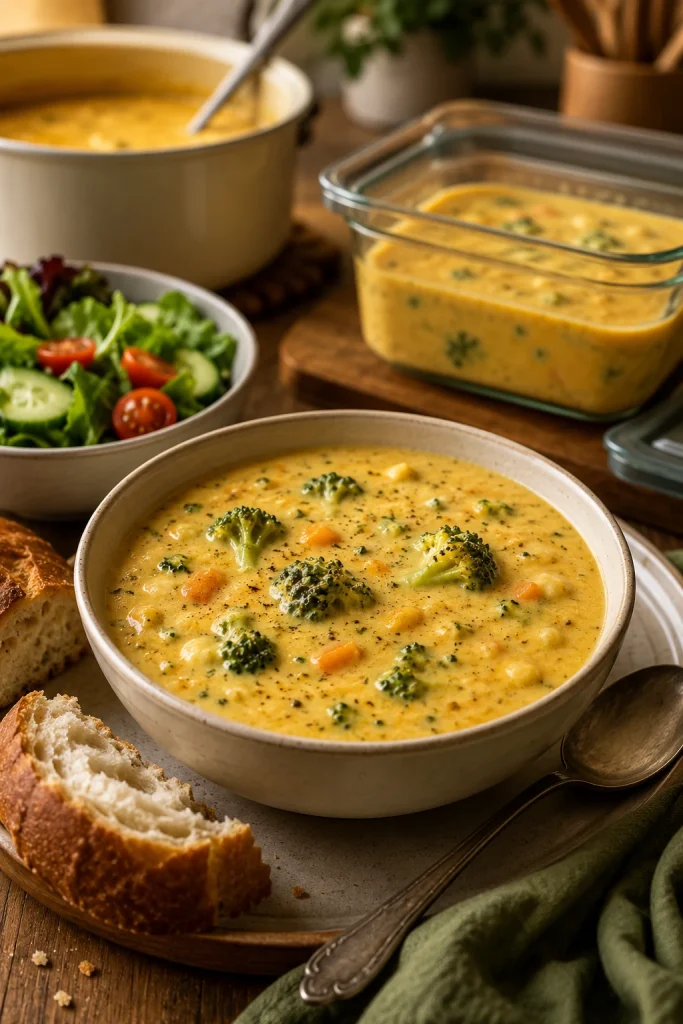
Bowl of broccoli cheese soup served with bread and salad, with a glass container of leftover soup in the background.
Serve it with bread, crackers, or salad; afterward, reheat leftovers slowly with a splash of broth or milk.
  • Crusty bread
  • Garlic toast
  • Bread bowls
  • Ranch Oyster Crackers for a crunchy topping
  • Wedge Salad Recipe for a cold, crisp side
  • Roasted vegetables
  • Grilled cheese sandwich
  • Baked potatoes
  • Cooked chicken or ham for a heartier meal

For a bigger comfort-food spread, serve the soup with something crisp or baked rather than another heavy, creamy dish. That contrast makes the bowl feel more satisfying.

FAQs

Here are the quick fixes and common questions readers usually need once the soup is in the slow cooker.

Can raw broccoli go straight into the slow cooker?

Yes. Raw chopped broccoli can go straight into the slow cooker with the broth, onion, carrot, garlic, and seasonings. Cut it into small pieces so it softens evenly. Add dairy and cheese only after the broccoli is tender.

When should cheese go into slow cooker broccoli cheese soup?

Add cheese near the end, after the broccoli is tender and the slow cooker has been turned to warm, low, or off. That keeps the cheddar in the creamy zone instead of pushing it into grainy territory.

Why did my broccoli cheese soup turn grainy?

Grainy soup usually comes from overheated cheese, boiling after dairy is added, or using cheese that does not melt smoothly. Use freshly shredded block cheddar, add it gradually, and keep the heat gentle once the cheese goes in.

Can I use pre-shredded cheese?

You can, but freshly shredded block cheddar usually melts more evenly. Pre-shredded cheese is convenient, but it can make broccoli cheese soup more likely to turn grainy or slightly clumpy.

Is frozen broccoli okay for crock pot broccoli cheese soup?

Frozen broccoli works, especially if you like a softer, creamier bowl. For better texture, use frozen florets and add them during the last 1 to 2 hours, or thaw and drain frozen broccoli before using it.

Do you need to thaw frozen broccoli first?

Not always. Frozen broccoli can go in from frozen if you want a softer soup, but thawing and draining helps prevent a watery pot. For more visible broccoli pieces, add frozen florets during the last 1 to 2 hours.

What cheese melts best in broccoli cheese soup?

Freshly shredded block cheddar gives strong flavor and a smoother melt. Velveeta is the smoothest shortcut. A mix of sharp cheddar and a small amount of Velveeta gives both flavor and easy melting.

How do you make crock pot broccoli cheese soup thicker?

Use a cornstarch slurry, blend part of the soup, add a little cream cheese, or let the soup rest after adding cheese. Potato also thickens the pot, but it turns the recipe into a heartier broccoli cheddar potato soup.

Should this cook on low or high?

Low gives steadier texture. Cook on low for 4 to 5 hours, or use high for 2 to 3 hours if you need it faster. Either way, add the cheese only after the broccoli is tender.

How long can broccoli cheese soup stay on warm?

It can sit on warm for a short serving window, but avoid holding it for hours after the cheese goes in. Stir occasionally, keep it below a boil, and loosen with warm broth or milk if it thickens too much.

Does Velveeta work in slow cooker broccoli cheese soup?

Velveeta works well when smoothness matters most. Replace part of the cheddar with it for a creamier, more forgiving pot.

How do you make it more like Panera broccoli cheddar soup?

Use sharp cheddar, keep the carrot, add onion and garlic, blend part of the soup, and add a little Dijon or mustard powder. Serve it with crusty bread or in a bread bowl for a more restaurant-style feel.

Can this soup be vegetarian?

Yes. Use vegetable broth and skip bacon, ham, chicken, and Worcestershire sauce, or use a vegetarian-friendly alternative. If cheese labels matter to you, check those as well.

Can the vegetable base be made ahead?

Yes. Cook the broccoli, vegetables, broth, and thickener ahead, then refrigerate the base. Reheat it gently and add cream and cheese shortly before serving for the smoothest texture.

What size slow cooker works best?

A 5 to 6 quart slow cooker is the easiest size for a standard batch. Use a 2 quart slow cooker only for a half batch, and a 6 to 8 quart slow cooker if doubling.

Is this the same as cream of broccoli soup?

It is similar, but this soup is cheesier and more cheddar-forward. Cream of broccoli soup is usually more cream-focused and may use less cheese.

Does broccoli cheese soup freeze well?

Freezing is possible, but this is not the soup that comes back perfectly every time. Dairy and cheese can separate after thawing, so reheat gently with a splash of milk, cream, or broth.

Back to the recipe · Back to the guide

Final Tips for Better Broccoli Cheese Soup

Once you know the order, this soup becomes easy to trust. Let the slow cooker handle the broccoli, keep the cheese for the finish, and give the pot a few quiet minutes to settle.

Choose sharp cheddar when flavor matters most. Reach for Velveeta when smoothness matters most. Fresh broccoli gives steadier texture, while frozen broccoli keeps the recipe convenient. The result is creamy, cheddar-rich, familiar, and easy to trust the next time you need a warm bowl fast.

Posted on Leave a comment

Broccoli Pasta Recipe: Garlic Parmesan Broccoli Pasta That Stays Saucy Without Cream

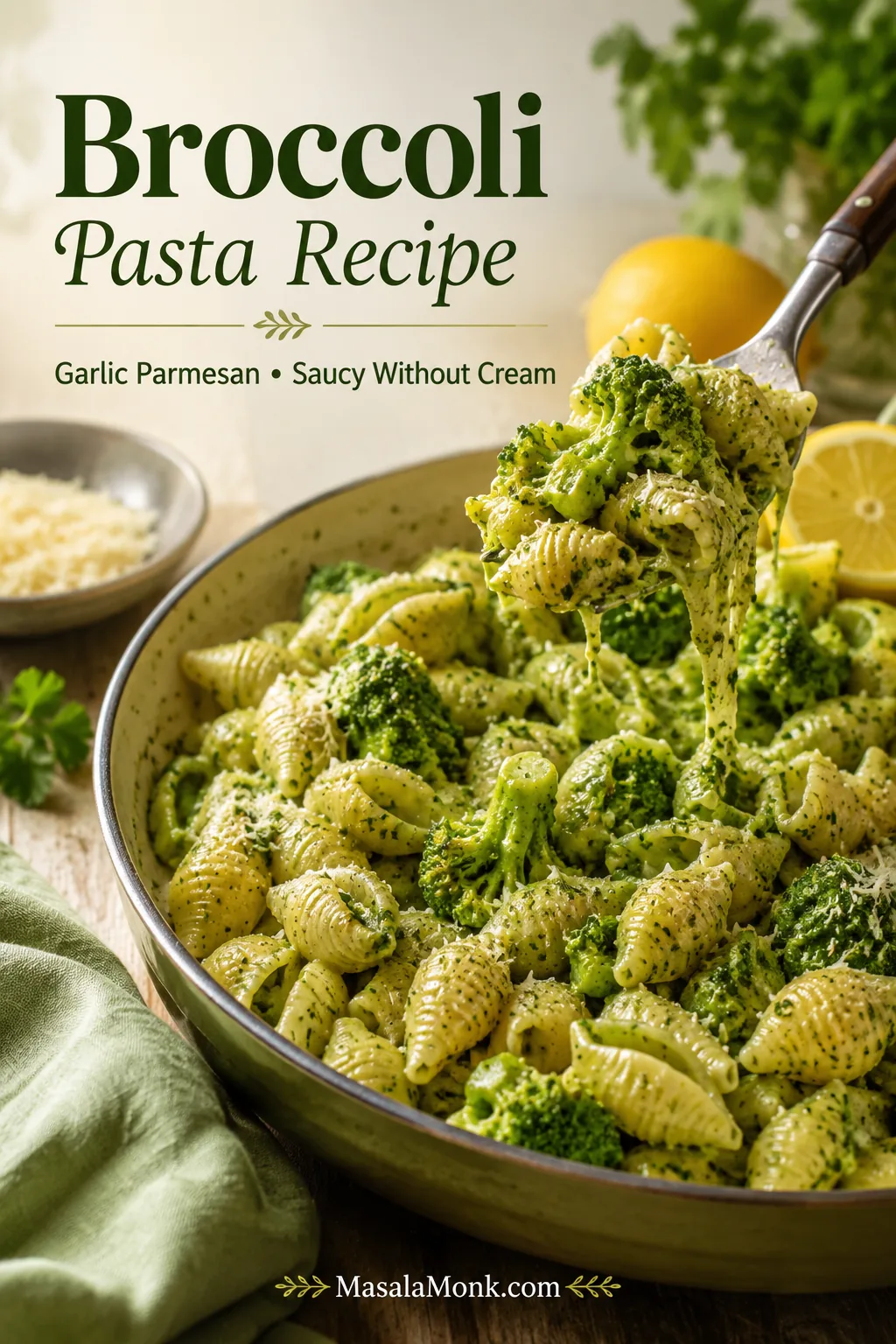
Shell pasta and broccoli in a shallow bowl with a fork lifting a glossy bite, lemon and Parmesan nearby, with text reading “Broccoli Pasta Recipe” and “Garlic Parmesan • Saucy Without Cream.”

Broccoli pasta should be easy: pasta, broccoli, garlic, Parmesan, done. But anyone who has made a disappointing bowl knows the usual problems. The pasta turns dry before it reaches the table. Broccoli tastes watery or bland. Cheese clumps instead of melting. Somehow, dinner ends up tasting like plain noodles with steamed vegetables.

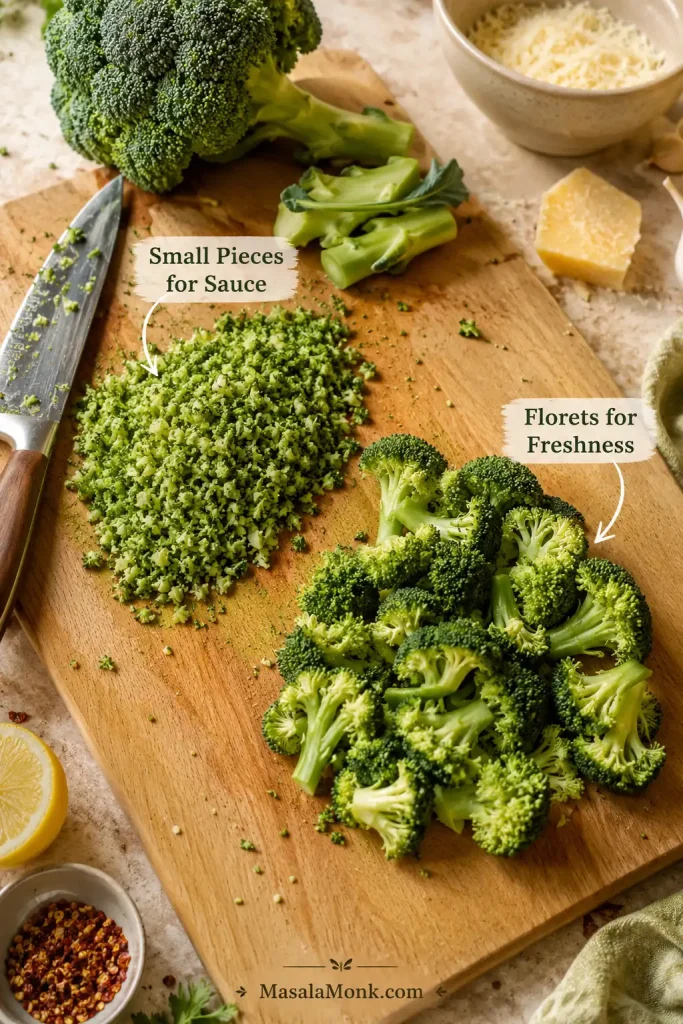
This broccoli pasta recipe is built to avoid that. The trick is simple: use broccoli in two textures — small pieces for sauce, florets for freshness.

The good version should feel like vegetables and comfort food finally agreeing with each other. Some broccoli melts into the garlic-Parmesan coating; some stays green and visible. Lemon keeps the cheese from feeling heavy, and the whole bowl lands somewhere between fresh weeknight pasta and cozy comfort food.

Once the broccoli is cut, the pasta comes together in about 25 minutes. The first time may take closer to 30 minutes while you grate the cheese, learn the timing, and see how loose the sauce should look in the pan.

If your broccoli pasta usually turns dry, the two biggest fixes are simple: save pasta water, and add Parmesan off the heat.

Quick Answer: How Do You Make Broccoli Pasta?

To make broccoli pasta, cook the pasta with finely chopped broccoli until some of the broccoli is soft enough to mash. Toss it with garlic, butter or olive oil, Parmesan, and starchy pasta water until saucy. Add a few visible florets near the end so the bowl still looks green and fresh. That balance keeps the pasta saucy without turning the whole bowl soft.

What makes this version different is that broccoli is not just a topping. Some becomes sauce, some stays visible, and the best bites taste like broccoli all the way through.

What Good Broccoli Pasta Should Look Like

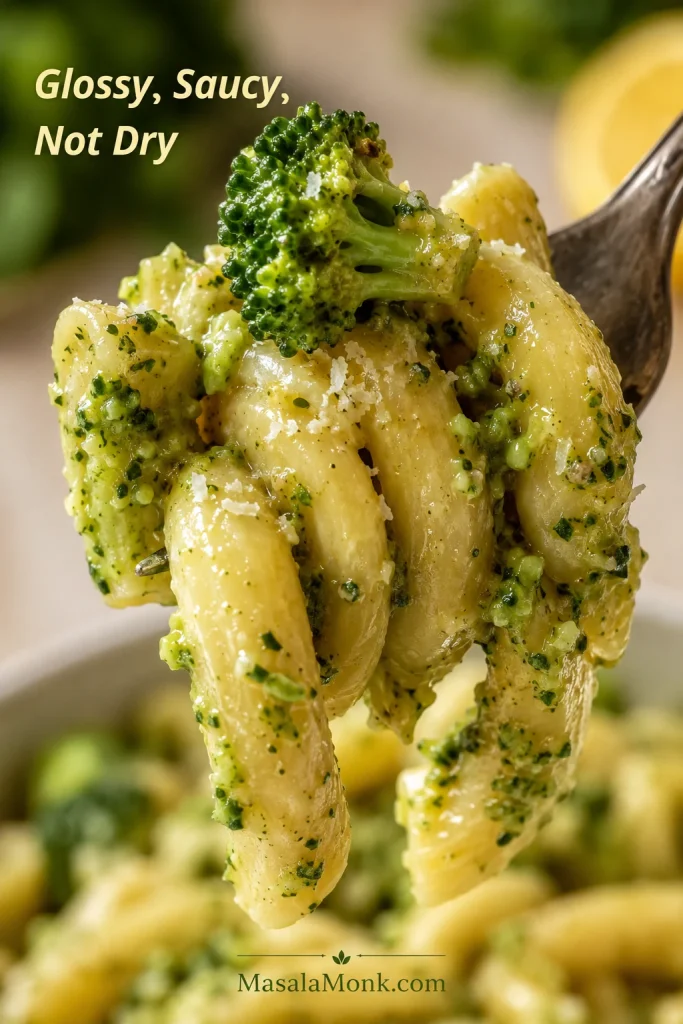
Use this as the visual target before you cook: the pasta should look coated and lively, not matte, stiff, or separated from the broccoli.

Close-up of glossy broccoli pasta lifted on a fork, with green broccoli sauce clinging to short pasta and text reading “Glossy, Saucy, Not Dry.”
Look for a glossy coating, not sauce pooling at the bottom.

At a Glance

  • Total time: about 25 minutes once you know the rhythm
  • Yield: 4 dinner servings or 6 smaller side servings
  • Main flavor: garlic, Parmesan, lemon, black pepper, broccoli
  • Texture: saucy, green-flecked, lightly creamy, not heavy
  • Best pasta: shells, fusilli, orecchiette, penne, rigatoni, or cavatappi
  • Fresh or frozen: both work

Garlic Parmesan Broccoli Pasta That Stays Saucy Without Cream

Recipe Card

This garlic Parmesan broccoli pasta turns finely chopped broccoli, garlic, Parmesan, and pasta water into a light, glossy sauce, with a few florets kept whole for freshness. It stays saucy without heavy cream.

Servings
4 dinner servings
Prep Time
10 minutes
Cook Time
15 minutes
Total Time
25 minutes

Equipment

  • Large pot
  • 12-inch skillet or wide sauté pan
  • Colander, slotted spoon, or spider
  • Measuring cup for pasta water
  • Fine grater or microplane
  • Fork, potato masher, wooden spoon, or spatula

Ingredients

  • 12 oz / 340g short pasta, such as shells, fusilli, orecchiette, penne, rigatoni, or cavatappi
  • 1¼ to 1½ lb / 565 to 675g broccoli, florets and tender stems
  • Kosher salt, for the pasta water
  • 3 tbsp / 45 ml olive oil
  • 1 to 2 tbsp / 14 to 28g butter
  • 4 garlic cloves, finely minced or grated
  • ½ tsp red pepper flakes, optional
  • ½ cup / 45 to 50g finely grated Parmesan, plus more for serving
  • 1 cup / 240 ml reserved pasta water, divided
  • 1 to 2 tsp lemon zest or 1 tbsp lemon juice, to taste
  • Black pepper, to taste

Optional Add-Ins

  • 2 tbsp cream cheese for a creamier sauce
  • ¼ cup / 60 ml milk for a lighter creamy version
  • ½ cup shredded cheddar or mozzarella for a cheesier pasta
  • 2 cups cooked chicken for a fuller dinner

Instructions: Cook the Pasta and Broccoli

  1. Cut the broccoli in two textures. Finely chop about two-thirds of the broccoli into ¼ to ½ inch pieces, including tender stems. Cut the remaining broccoli into small visible florets, about ¾ to 1 inch. Peel thick stems first if the outside feels tough.
  2. Boil the pasta water. Bring a large pot of water to a boil and salt it well. Add pasta and cook until just shy of al dente. Start checking 1 to 2 minutes before the package time.
  3. Add the finely chopped broccoli. When the pasta has about 5 minutes left, add the finely chopped broccoli pieces. Make sure the water returns to a steady boil.
  4. Add the visible florets. When the pasta has about 2 minutes left, add the remaining small florets.
  5. Reserve pasta water. Scoop out 1 cup / 240 ml pasta water before draining. Do not rinse the pasta.

Build the Sauce and Finish

  1. Make the garlic base. While the pasta cooks, warm olive oil and butter in a wide skillet over medium-low heat. Add garlic and red pepper flakes. Cook for 30 to 60 seconds, until fragrant but not browned.
  2. Mash some broccoli. If using a slotted spoon, move broccoli into the skillet first and mash the soft pieces into the garlic oil. Then add pasta. If everything was drained together, add pasta and broccoli to the skillet and mash some broccoli in place.
  3. Toss with pasta water. Add ½ cup / 120 ml reserved pasta water. Toss until the pasta looks coated and green bits cling to it. Add more pasta water a few tablespoons at a time if needed.
  4. Add Parmesan off the heat. Turn off the heat. Add Parmesan gradually, tossing until it melts into the pasta. Loosen with more hot pasta water if needed.
  5. Finish and serve. Add lemon zest or juice, black pepper, and more Parmesan. Taste and adjust salt, lemon, pepper, and cheese before serving.

Notes

  • If your pasta cooks in less than 9 minutes, boil the finely chopped broccoli pieces for 2 to 3 minutes before adding the pasta, or cook the broccoli separately until mashable.
  • Frozen broccoli: thaw large florets enough to chop and drain well.
  • Gluten-free, chickpea, or lentil pasta: check early and toss gently.
  • Add Parmesan off the heat so it melts smoothly.
  • Chicken: add extra pasta water because it absorbs sauce.
  • Stop while the skillet looks slightly loose; the pasta thickens as it sits.

Why the Two-Texture Broccoli Method Works

The method works because the broccoli has two jobs. Chopped broccoli softens enough to coat the pasta; florets keep the bowl green and fresh. If all the broccoli is large, the pasta tastes like noodles with vegetables on top. If all of it is finely chopped, the flavor is good but the bowl looks dull.

The best broccoli pieces are not the pretty ones. They are the little bits that disappear into the garlic oil and make every shell taste like sauce. Do not worry if the broccoli looks a little messy in the skillet. That mess is what makes the sauce.

Small Pieces for Sauce, Florets for Freshness

This cut is the foundation of the recipe. The small pieces are for flavor and body; the larger florets are for color, bite, and the finished look.

Cutting board with finely chopped broccoli and stems on one side and larger broccoli florets on the other, labeled “Small Pieces for Sauce” and “Florets for Freshness.”
Chopped broccoli builds sauce; larger florets keep the pasta green and fresh.

Success cue: the pasta should look a little saucier in the pan than you want on the plate. Hot pasta keeps absorbing as it sits, so a slightly loose skillet becomes a well-coated bowl by the time you eat.

Do not chase dryness with more cheese. Wake the sauce up with pasta water first, then add cheese for flavor.

Ingredients You’ll Need

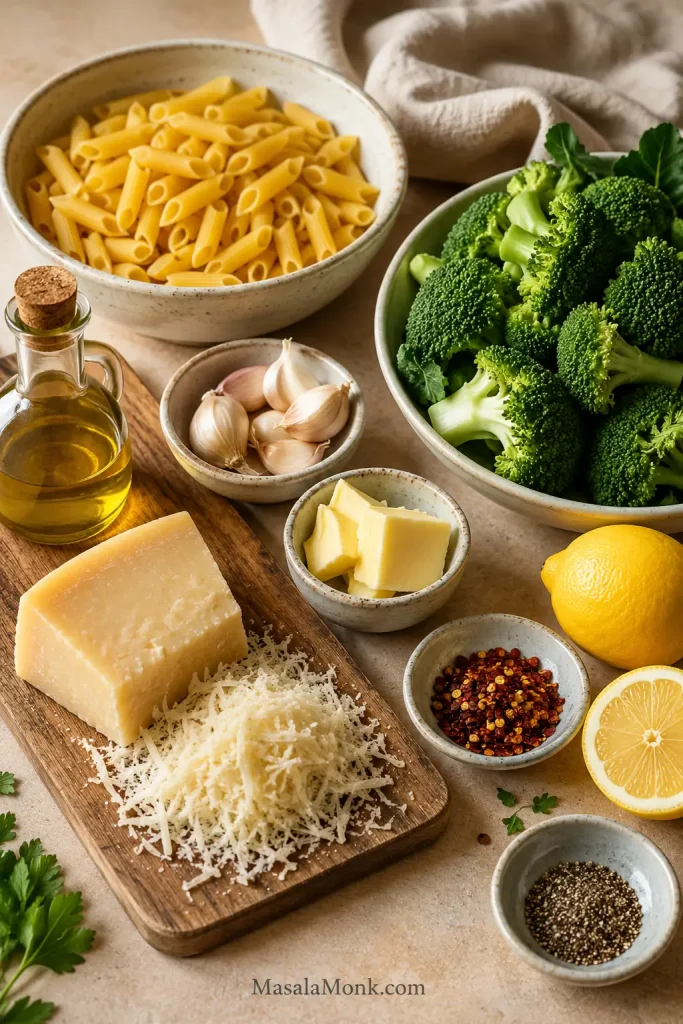
The ingredients are simple, but three details matter most: broccoli cut size, starchy pasta water, and finely grated Parmesan.

The Ingredients That Make the Sauce Work

Use short pasta, enough broccoli, fresh garlic, finely grated cheese, and lemon. Those few choices carry most of the flavor.

Ingredients for broccoli pasta arranged on a kitchen surface, including short pasta, broccoli, Parmesan, garlic, lemon, olive oil, butter, black pepper, and red pepper flakes.
Short pasta, broccoli, garlic, Parmesan, and lemon each carry part of the flavor.

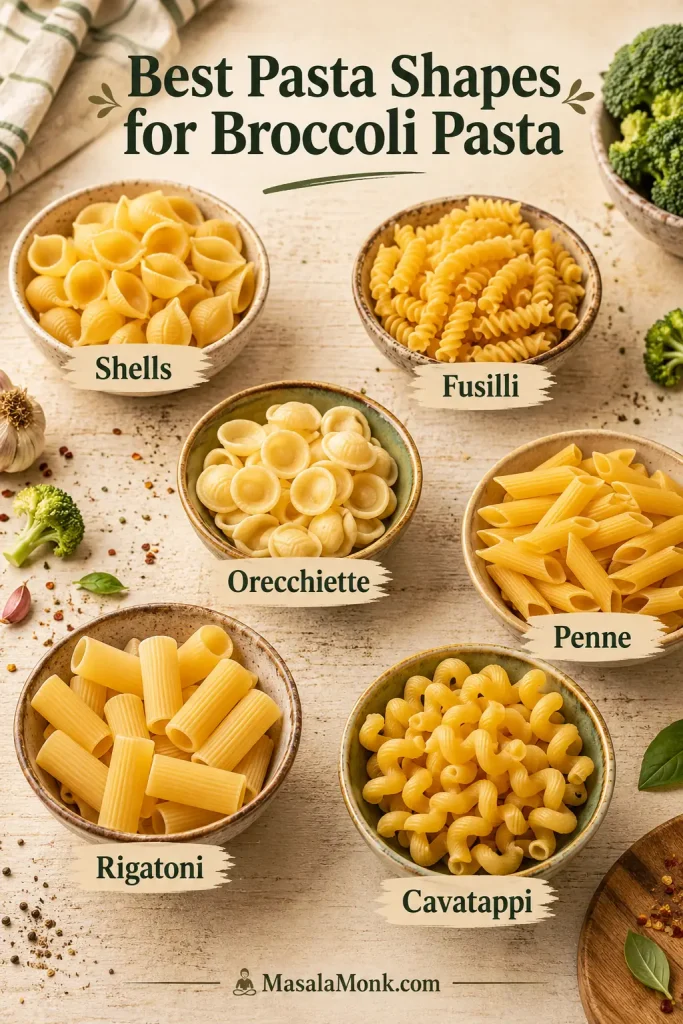
Best Pasta Shapes for Broccoli Pasta

Use 12 oz / 340g short pasta. Shells and fusilli are especially good because mashed broccoli catches in their curves. Orecchiette, penne, rigatoni, and cavatappi also work. Long pasta needs smaller broccoli and more tossing.

Six bowls of dry pasta labeled Shells, Fusilli, Orecchiette, Penne, Rigatoni, and Cavatappi under the heading “Best Pasta Shapes for Broccoli Pasta.”
Curves, ridges, and cups give broccoli sauce places to cling.

Chickpea, lentil, and gluten-free pasta can work too, but check early and toss gently because they can break more easily than regular wheat pasta.

Broccoli

Use 1¼ to 1½ lb / 565 to 675g broccoli. Chop most of it into ¼ to ½ inch pieces so it can soften into the sauce. Save a handful of ¾ to 1 inch florets so the finished pasta still looks green and fresh.

Do not waste the stems. Peel tough outsides, then chop the tender centers small so they can help thicken the sauce.

Using frozen broccoli instead? Jump to the fresh vs frozen broccoli notes before you start, because frozen broccoli needs a little more moisture control.

Garlic, Oil, and Butter

Use 4 garlic cloves, 3 tbsp / 45 ml olive oil, and 1 to 2 tbsp / 14 to 28g butter. They build the warm base later, so keep the heat gentle.

Parmesan

Use ½ cup / 45 to 50g finely grated Parmesan, plus more for serving. A block grated finely at home melts better than large shreds. Pecorino Romano is sharper; Grana Padano is milder. Taste before adding extra salt.

Lemon, Salt, Pepper, and Red Pepper Flakes

Use 1 to 2 tsp lemon zest or 1 tbsp lemon juice. Lemon does not need to taste loud; it just keeps the cheese and broccoli from feeling flat. Finish with black pepper and red pepper flakes if you want gentle heat.

Common Broccoli Pasta Mistakes to Avoid

Before you cook, watch these four things:

  • Do not cut all the broccoli large. You need chopped broccoli that can collapse into sauce.
  • Do not forget pasta water. It is the difference between glossy and dry.
  • Do not add Parmesan over high heat. That is how smooth cheese turns grainy.
  • Do not rinse the pasta. The surface starch helps the broccoli sauce cling.

How to Make Broccoli Pasta with the Two-Texture Method

Once you know the basic steps, the real difference is in the cues: how soft the broccoli gets, how loose the sauce looks, and when to stop adding heat.

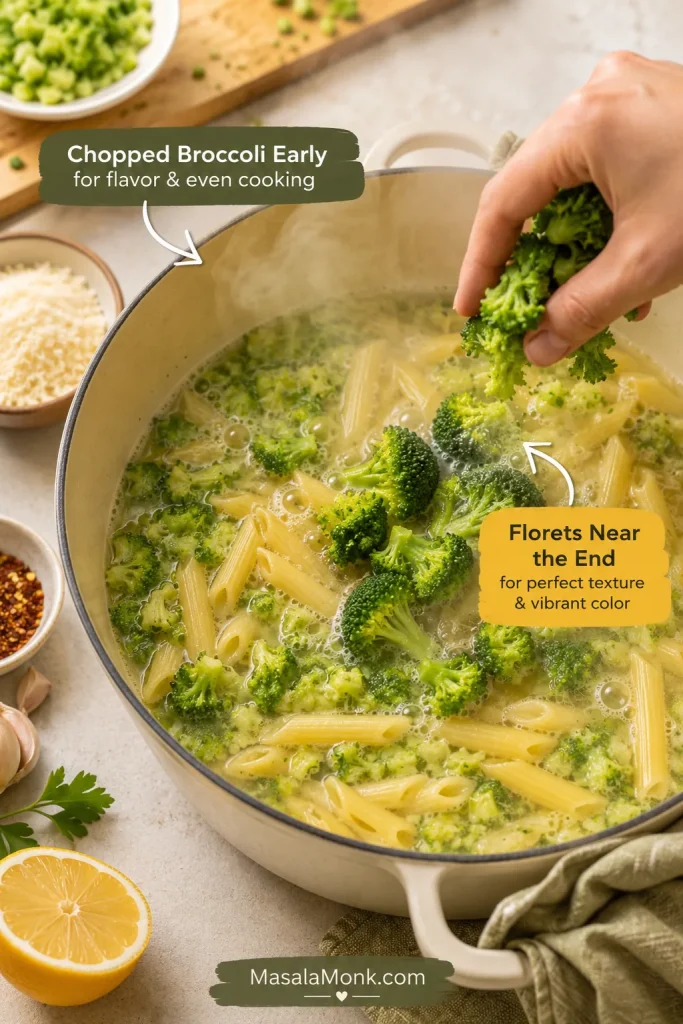
When to Add Broccoli to Pasta

Use the timing as a texture guide, not just a clock. Chopped broccoli needs time to soften enough for sauce; florets need less time so they stay green.

TimingAdd ThisGoal
5 minutes before pasta is doneFinely chopped broccoliSoft enough to mash
2 minutes before pasta is doneVisible floretsGreen and tender
Before drainingPasta waterSauce insurance
Off the heatParmesanSmooth, not grainy
A hand adding broccoli florets to a pot of pasta and chopped broccoli, with text explaining “Chopped Broccoli Early” and “Florets Near the End.”
Chopped broccoli goes in early; florets go in near the end.

1. Cut for Sauce, Not for Perfect Florets

Do not worry about perfect broccoli shapes here. The chopped broccoli is supposed to look a little messy because it is going to disappear into the sauce. Keep a handful of visible florets aside so the finished pasta still looks like broccoli pasta, not just green pasta.

2. Use the Pasta Pot for Timing

The only timing that matters is this: chopped broccoli needs enough time to soften; florets only need enough time to turn green and tender. If the water slows down after adding broccoli, give the pasta a little extra time and check before draining.

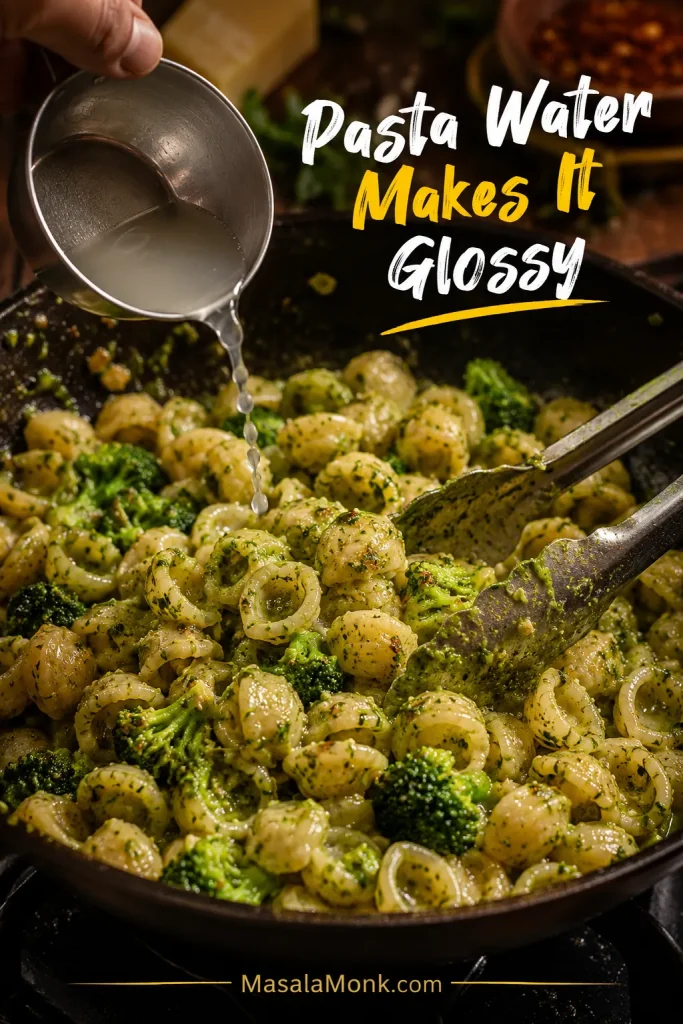
3. Why Pasta Water Makes Broccoli Pasta Glossy

Pasta water is boring until the moment your skillet looks dry. Then it becomes the thing that saves dinner. Scoop it before draining so you are not trying to fix dry pasta with plain water later.

Starchy pasta water being poured into a skillet of short broccoli pasta while tongs toss the glossy sauce, with text reading “Pasta Water Makes It Glossy.”
Pasta water loosens the broccoli sauce and brings back gloss before more cheese.

If your pasta already looks matte or tight, see the dry vs glossy broccoli pasta fix before adding more cheese.

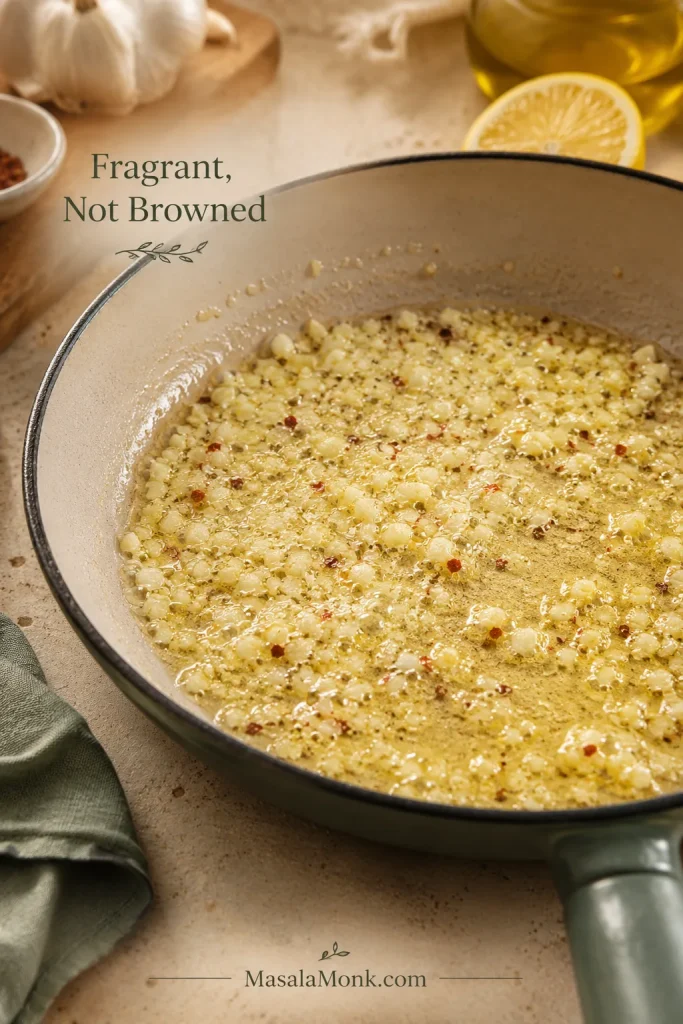
4. Keep the Garlic Gentle

Warm the olive oil, butter, garlic, and red pepper flakes over medium-low heat. The goal is fragrance, not color; if the garlic browns hard here, the bitterness follows the broccoli sauce into the bowl.

Close-up of sliced garlic warming in olive oil and butter in a skillet, with text reading “Fragrant, Not Browned.”
Pale garlic tastes warm and sweet; browned garlic can turn bitter.

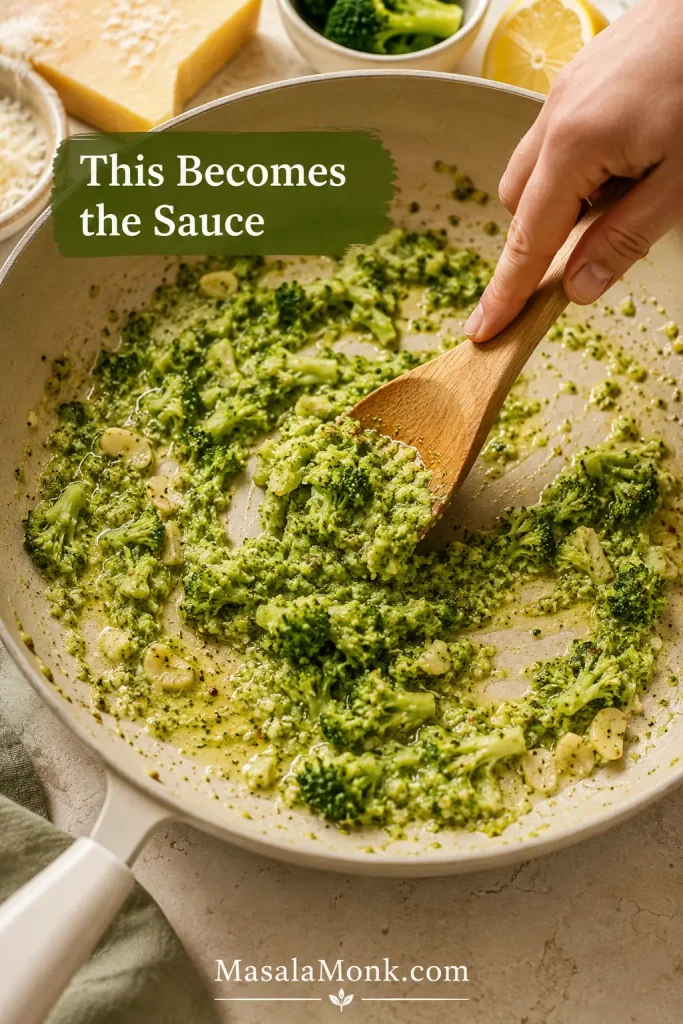
5. Mash Broccoli Into the Sauce

Mash the soft broccoli into the garlic oil, then add pasta water and toss until the sauce clings. The pan should look slightly too loose before serving; the bowl will catch up. By the end, the green bits should be tucked into the curves of the pasta, not sitting at the bottom of the pan.

Soft broccoli being mashed with a wooden spoon in a skillet with garlic oil and butter, with text reading “This Becomes the Sauce.”
Mashing tender broccoli turns it from topping into sauce.

6. Add Parmesan Off the Heat and Finish

Turn off the heat before adding Parmesan. Finish with lemon when the pasta tastes good but not quite awake. The lemon should lift the cheese, not make the pasta sour.

Finely grated Parmesan being added to hot short pasta with broccoli in a skillet, with text reading “Off Heat for a Smooth Finish.”
Off-heat Parmesan melts smoother and coats instead of clumping.

If the cheese clumps or turns grainy, use the troubleshooting table instead of adding more Parmesan.

Fresh vs Frozen Broccoli for Pasta

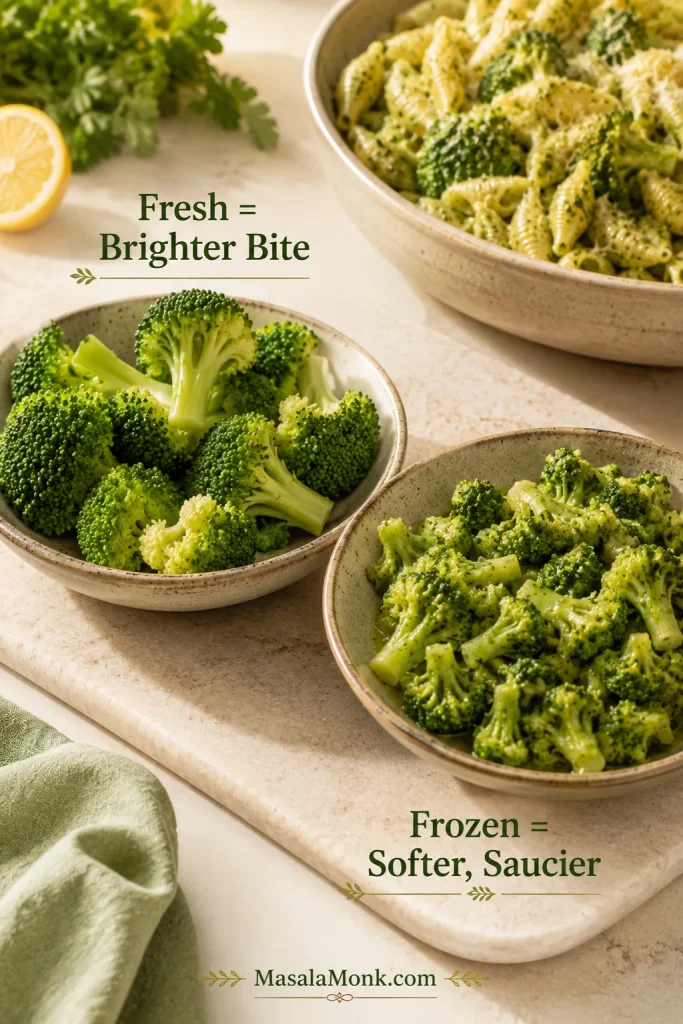
The choice is not about right or wrong broccoli. It is about what kind of bowl you want. Use fresh when you want the pasta to look bright and dinner-table pretty. Use frozen when you want a softer, saucier weeknight bowl.

Choose the Broccoli Texture You Want

Fresh and frozen broccoli both work here, but they do not behave the same way. Use the image and table below to choose the texture you want before you cook.

Fresh broccoli florets in one bowl, softer cooked broccoli in another bowl, and broccoli pasta in the background, with text reading “Fresh = Brighter Bite” and “Frozen = Softer, Saucier.”
Fresh broccoli stays brighter; frozen broccoli cooks softer and saucier.
Broccoli TypeBest ForHow to Use It
Fresh broccoliPrettiest bowl and cleaner biteCut small pieces for sauce and save a few small florets for the end.
Frozen broccoli, thawed and choppedBest control with frozen broccoliThaw just enough to chop large florets, drain extra water, then cook until mashable.
Frozen broccoli added directlyFastest pantry versionAdd near the end of pasta cooking, mash in the skillet, and add pasta water slowly.

Is This Creamy Broccoli Pasta?

Yes, but it is not cream-sauce pasta. The creaminess comes from soft broccoli, pasta water, butter or olive oil, and finely grated Parmesan, so the pasta feels glossy and coated while the broccoli stays central. These add-ins push it further toward comfort food.

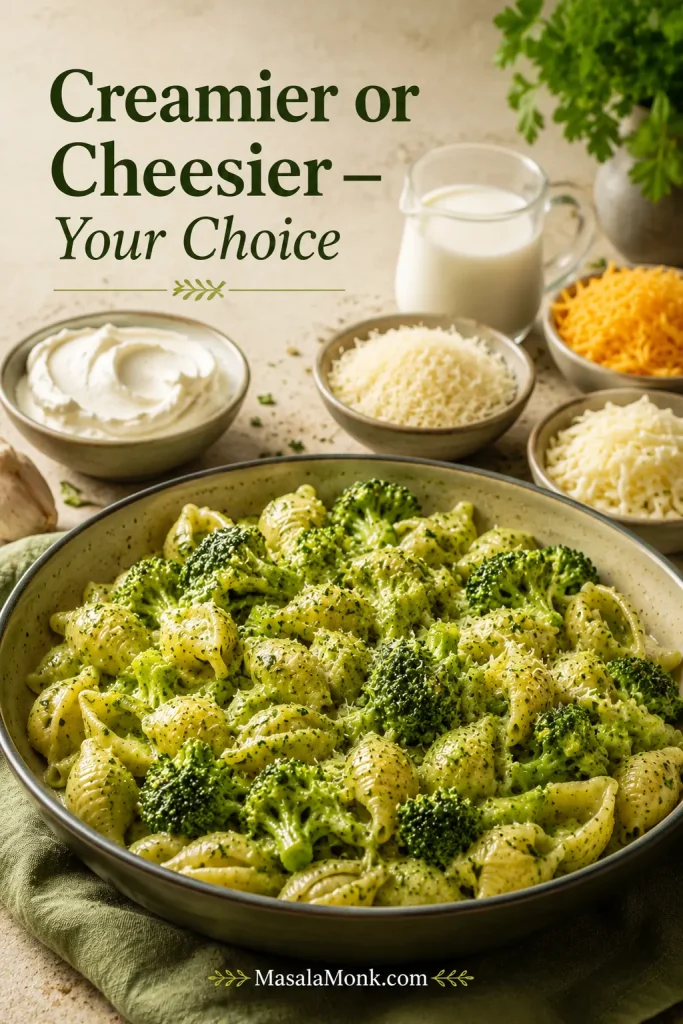
Make It Creamier or Cheesier

Build the broccoli sauce first, then add dairy slowly. That keeps the flavor green instead of turning the bowl into plain cheese pasta.

A bowl of glossy broccoli pasta with bowls of cream cheese, milk, grated Parmesan, cheddar, and mozzarella nearby, with text reading “Creamier or Cheesier — Your Choice.”
Add richness slowly so cheese supports the broccoli instead of hiding it.
GoalWhat to AddWhen to Add It
Creamier sauce2 tbsp cream cheeseAfter mashing broccoli and adding pasta water, before Parmesan
Lighter creamy sauce¼ cup / 60 ml milkAdd with pasta water and warm gently before cheese
More Parmesan flavorExtra ¼ cup ParmesanOff the heat, gradually, with splashes of pasta water
Broccoli-cheddar pasta½ cup shredded cheddarOff the heat or very low heat after Parmesan
Stretchy cheesy pasta½ cup shredded mozzarellaOff the heat, then serve immediately

If you want a true mac-and-cheese style dinner, MasalaMonk’s macaroni and cheese recipe is the better direction.

If the cheese turns grainy, the heat was probably too high when it went in. Move the pan off the heat, add a splash of hot pasta water, and stir gently.

Can You Make This One-Pot?

Yes, but the skillet version gives better garlic flavor and more room to toss. Use the one-pot shortcut when convenience matters more than maximum garlic flavor.

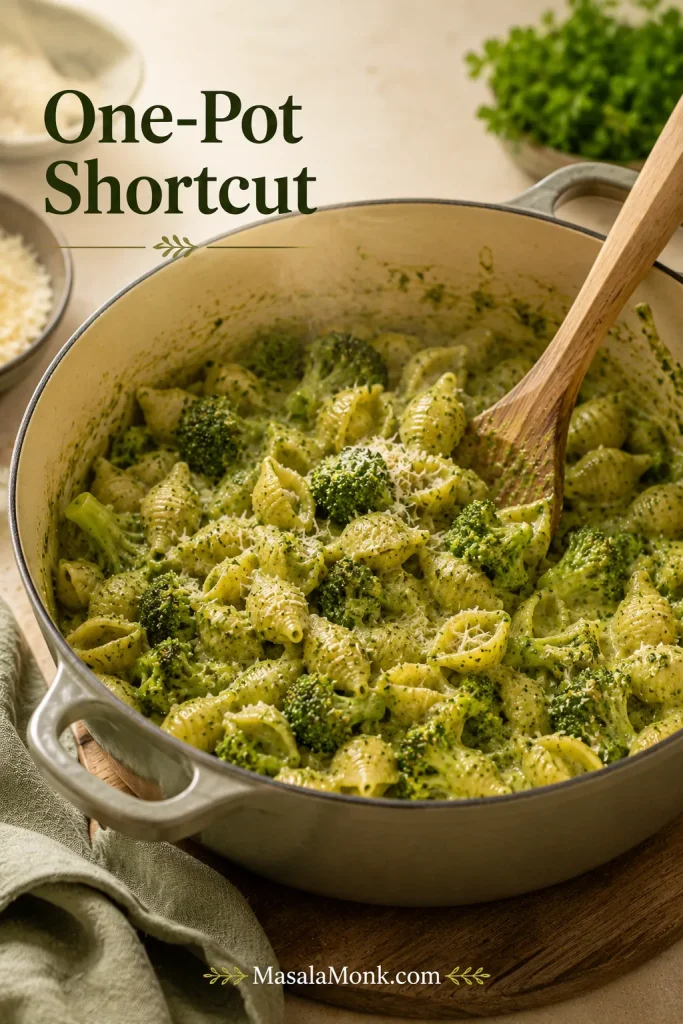
The One-Pot Shortcut

In the one-pot version, stop while the pasta still looks a little loose. It tightens faster than the skillet version, so serve as soon as the sauce coats.

Broccoli pasta with short shells in a Dutch oven with a wooden spoon, grated Parmesan, and text reading “One-Pot Shortcut.”
Stop one-pot pasta a little loose; it tightens faster as it sits.

For the shortcut, cook the pasta and broccoli in one large pot, reserve pasta water, drain, then build the garlic oil in the same pot. Return the pasta and broccoli, mash some of the soft pieces, loosen with pasta water, and add Parmesan off the heat.

Finishing Options That Make It Better

Broccoli pasta is simple, so the best finishes solve small problems in the bowl.

  • If it tastes flat: add lemon juice.
  • When it smells good but needs lift: add lemon zest.
  • For mild flavor: add Parmesan and black pepper.
  • If it feels too soft: add toasted breadcrumbs.
  • When it needs warmth: add red pepper flakes or extra black pepper.

Broccoli Pasta Variations by Dinner Mood

Once the base works, the variations are easy. Keep the broccoli sauce loose, then add whatever makes dinner feel complete.

Make It a Full Dinner

Choose one of these when the pasta needs to become the whole meal.

  • Chicken broccoli pasta: fold in 2 cups cooked chicken once the pasta is coated. Add extra pasta water because chicken absorbs moisture quickly. For a more casserole-style chicken and broccoli dinner, MasalaMonk’s Cheesy Chicken Broccoli Rice is the better fit.
  • Salmon broccoli pasta: fold cooked salmon flakes in at the end, after the pasta is coated. Lemon matters even more here because it balances both the fish and broccoli.
  • Sausage broccoli pasta: brown sausage in the skillet first, scoop it out if needed, then use the same pan for the garlic base so the broccoli picks up the browned bits.
  • White beans or chickpeas: add them at the end with a splash of pasta water so they warm without breaking apart.

Make It More Comforting

  • Cheesy broccoli pasta: add cheddar off the heat with the Parmesan when you want the bowl to feel closer to mac and cheese but still taste like broccoli.
  • Baked broccoli pasta: best as a leftover move. Add a splash of milk or pasta water, spoon into a baking dish, top with cheese and breadcrumbs, and bake until bubbling.

Make It Fresher

  • Broccoli pesto pasta: blend some cooked broccoli with basil or parsley, Parmesan, lemon, olive oil, garlic, and pasta water. MasalaMonk’s pesto pasta recipe uses a similar pasta-water tossing technique.
  • Lemon breadcrumb broccoli pasta: finish with toasted breadcrumbs and extra lemon zest for crunch and brightness.
  • Broccoli rabe or rapini pasta: treat it as its own dish. Broccoli rabe is more bitter and leafy than regular broccoli, and it works especially well with garlic, chili, olive oil, and sausage.

What to Serve with Broccoli Pasta

A bowl of this with extra Parmesan is enough for a quick dinner, but it also plays well with protein, crunch, and something fresh on the side.

  • For a light dinner, serve it with a simple salad, lemony greens, grilled fish, or baked tofu.
  • Need more protein? Add chicken, shrimp, salmon, sausage, or a fried egg.
  • For a vegetarian full meal, add white beans, chickpeas, toasted nuts, or extra broccoli.
  • To make it a comfort meal, serve it with extra Parmesan, toasted breadcrumbs, or MasalaMonk’s homemade garlic bread loaf.

Storage, Reheating, and Make-Ahead Tips

Broccoli pasta is best right after tossing, while the pasta is warm and glossy. Leftovers can still be good, but they need a splash of moisture when reheating because pasta keeps absorbing sauce in the fridge.

  • Refrigerate: store in an airtight container for 3 to 4 days. For general cold-storage guidance, see the FoodSafety.gov cold food storage chart.
  • Reheat on the stovetop: add a splash of water, milk, or stock and warm gently over low heat, stirring often.
  • Reheat in the microwave: add a splash of water or milk, cover loosely, heat in short bursts, and stir halfway through.
  • Add lemon after reheating: a fresh squeeze at the end tastes brighter than lemon added before storage.
  • Freeze: possible, but not ideal. Pasta softens after freezing, and cheesier versions can reheat less smoothly.

If leftovers seem gluey after reheating, add moisture first, then cheese. The same rescue logic works after storage.

For make-ahead, prep the broccoli and grate the cheese ahead of time, but cook the pasta just before serving. When saving leftovers, keep the pan a little saucier than usual and save extra Parmesan for reheating.

Troubleshooting Broccoli Pasta

Most broccoli pasta problems look worse than they are. If you saved pasta water, you can usually bring the pan back. Match the problem to the fix below.

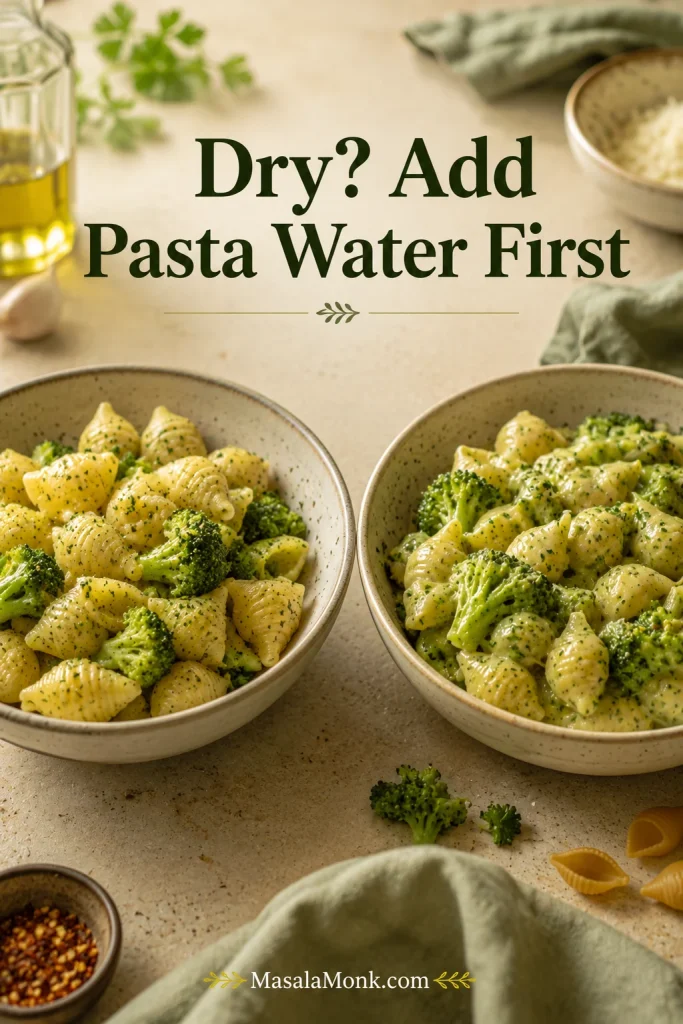
Dry or Glossy: What to Fix First

This is the fastest visual check. If the pasta looks dull or tight, loosen it before you add more cheese or toppings.

Two bowls of broccoli pasta side by side, one looking drier and one glossier, with text reading “Dry? Add Pasta Water First.”
Dry pasta usually needs hot pasta water before it needs more cheese.
ProblemFix NowFix Next Time
Pasta is dry or matteAdd hot pasta water 2 tbsp at a time and toss vigorously.Reserve a full cup of pasta water and keep the pan slightly saucier.
Liquid is poolingToss over medium-low heat for 1 to 2 minutes, then rest briefly.Drain broccoli better and add pasta water gradually.
Pasta tastes bland or broccoli tastes dullAdd salt, lemon, black pepper, and more Parmesan.Salt the pasta water properly and keep some florets greener.
Garlic tastes bitterAdd lemon and cheese to soften the bitterness, if mild.Cook garlic over medium-low heat and do not brown it hard.
Parmesan turned grainy or clumpyAdd a splash of hot pasta water and stir gently off heat.Add finely grated Parmesan gradually, off the heat or over very low heat.
Broccoli is too firmAdd a splash of water, cover, and cook 2 to 3 minutes.Cut the broccoli smaller and add it earlier.
Frozen broccoli made it wateryStop adding liquid and toss until the coating tightens.Thaw, chop, and drain frozen broccoli before adding.
Leftovers are glueyReheat with water, milk, or stock and stir gently.Store with a little extra moisture or loosen before refrigerating.

FAQs About Broccoli Pasta

How do you make broccoli pasta creamy without cream?

Mash tender broccoli into garlic oil and butter, loosen it with hot pasta water, then add finely grated Parmesan off the heat. The sauce should look glossy and loose, not thick like Alfredo. For a richer version, add cream cheese or milk before the Parmesan.

Fresh or frozen broccoli — which works better?

Fresh broccoli gives brighter florets and better bite. Frozen broccoli gives a softer, saucier pasta. Both work; just add pasta water slowly with frozen broccoli.

Can I use broccoli stems in broccoli pasta?

Yes. Peel thick stems if the outside feels tough, then chop the tender inside into small pieces. Stems soften well and are excellent for the sauce.

Why did my broccoli pasta turn dry?

It needed more pasta water or sat too long before serving. Add hot pasta water a few tablespoons at a time and toss until shiny again. Loosen first, then add more cheese only if the flavor still needs it.

What is the best pasta shape for broccoli pasta?

Short pasta shapes are best because they catch the small broccoli pieces. Shells, fusilli, orecchiette, penne, rigatoni, and cavatappi all work well. Long pasta can work too, but chop the broccoli smaller and toss more thoroughly.

How do you keep Parmesan from turning grainy?

Add finely grated Parmesan gradually, off the heat, not all at once. High heat can make it clump or turn grainy. If it tightens, loosen with a splash of hot pasta water.

Can I add chicken to broccoli pasta?

Yes. Add about 2 cups cooked chicken or rotisserie chicken once the pasta is coated. Add an extra splash of pasta water because chicken absorbs sauce quickly.

Is this the same as broccoli Alfredo?

No. Broccoli Alfredo usually uses a heavier cream-based sauce. This version is lighter; the sauce comes from mashed broccoli, pasta water, butter or olive oil, and Parmesan.

Can this be made as a one-pot broccoli pasta?

Yes. It is convenient, but a skillet gives better garlic flavor and more room to toss. For one-pot broccoli pasta, cook the pasta and broccoli together, reserve pasta water, drain, build the garlic oil in the same pot, then return everything and add Parmesan off the heat.

Does broccoli rabe work in this recipe?

Broccoli rabe, or rapini, is more bitter and leafy than regular broccoli, so it needs different handling. It is delicious with garlic, olive oil, chili, and sausage, but use regular broccoli for this version.

How can I make this more kid-friendly?

Chop the broccoli smaller, mash more into the sauce, skip the red pepper flakes, and use shells. A little extra Parmesan or cheddar can make the broccoli flavor feel familiar.

Can leftovers be reheated without drying out?

Yes. Add a splash of water, milk, or stock before reheating. Warm gently and finish with extra Parmesan, black pepper, or lemon.

Final Thoughts

Once you learn the rhythm — soften, mash, loosen, cheese off the heat — broccoli pasta stops feeling like a compromise dinner. It becomes something worth repeating.

Did you keep it simple, make it cheesy, add chicken, or use frozen broccoli? Tell me how you made it — those little changes are often what help the next cook.

Back to top

Posted on 11 Comments

Cheesy Chicken Broccoli Rice – 4 Ways Recipe (One Pot, Casserole, Crockpot & Instant Pot)

Person holding a cast-iron pan of cheesy chicken broccoli rice, highlighting one-pot, casserole, crockpot and Instant Pot versions from MasalaMonk

There are days when you crave something fresh and bright, and there are days when only a deep, steaming bowl of cheesy chicken broccoli rice will do. The kind of bowl you scoop out in generous portions, where the rice is soft and creamy, the chicken is tender, the broccoli is still a little green and crisp, and melted cheese ties everything together in comforting, stretchy strands.

This is that kind of dinner.

And instead of giving you a single rigid recipe, this guide walks you through four different ways to make cheesy chicken broccoli rice:

  • a quick stovetop one-pot version,
  • an oven-baked casserole,
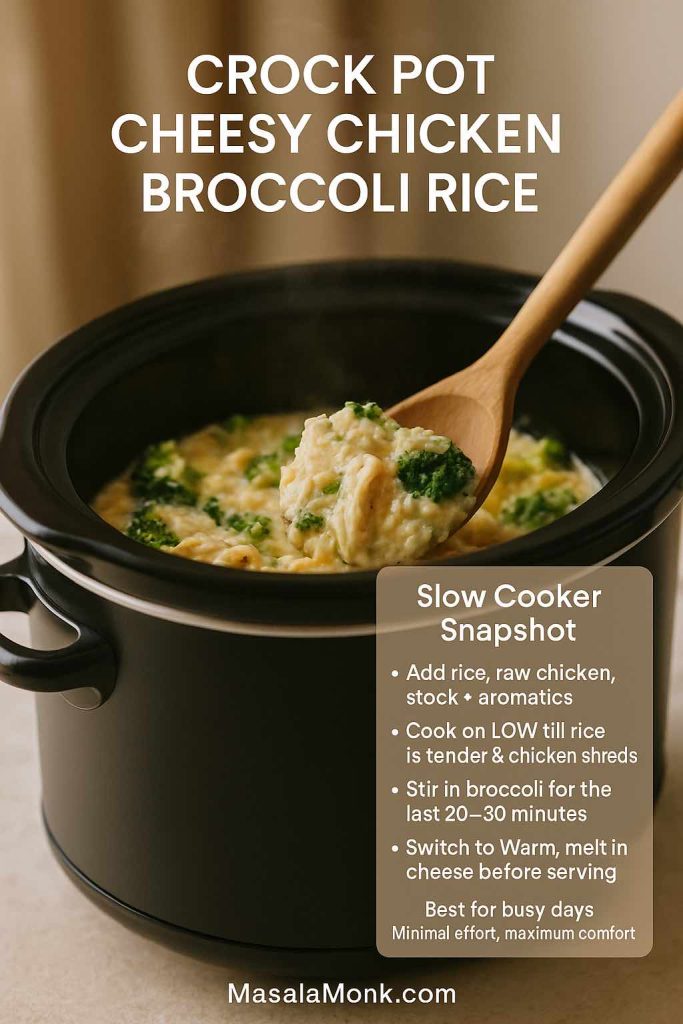
  • a crock pot version that minds itself, and
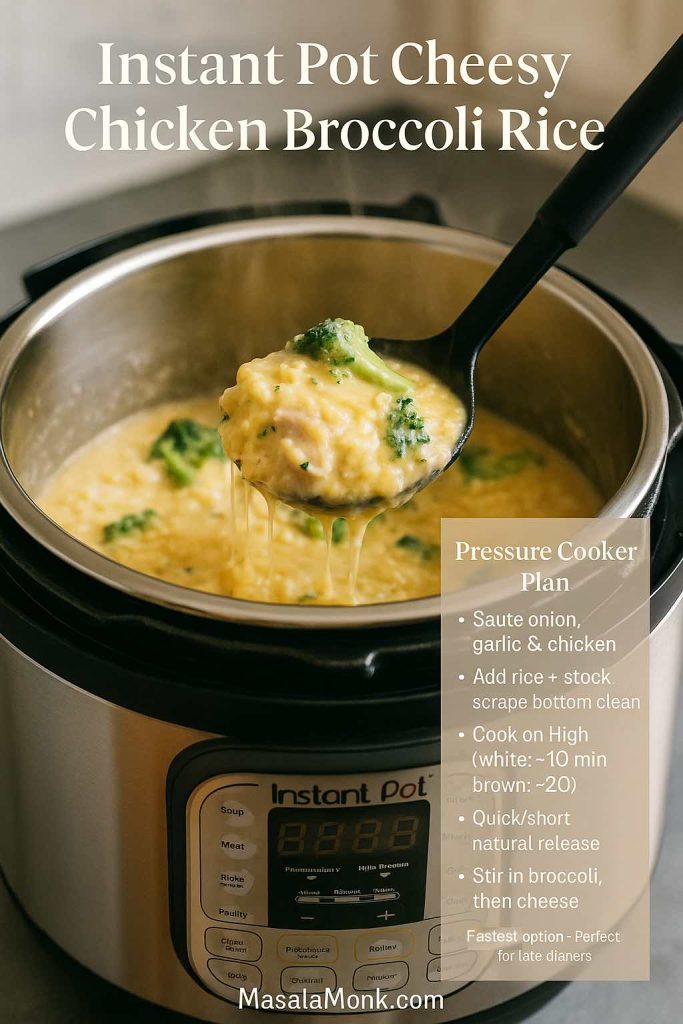
  • an Instant Pot method for when time is tight.

All four are built from the same simple ingredients. Once you understand that base, you can slide the dish toward lighter, richer, more veggie-packed, or more indulgent, depending on the day.


Why Cheesy Chicken Broccoli Rice Works So Well

How cheesy chicken broccoli rice hits every craving

Cheesy chicken broccoli rice works because it brings a bit of everything your body and brain like in one spoonful:

  • lean or juicy chicken for protein and savoriness,
  • comforting rice for bulk and softness,
  • bright, crunchy broccoli for freshness and nutrients,
  • melty cheese for salt, richness, and that “ahh, that’s better” feeling.
Portrait hero image of cheesy chicken broccoli rice in a bowl, with skillet, casserole and slow cooker in the background, plus text overlay showing four ways to cook the recipe.
Cheesy chicken broccoli rice made four ways — skillet, casserole, crock pot and Instant Pot — so you can pick the method that fits your time, mood and appetite.

Broccoli isn’t just filler here. It comes with fiber, vitamins C and K, folate, and plenty of antioxidants. Guides to broccoli nutrition and health benefits highlight its potential role in supporting heart, gut, and immune health.

Rice brings comfort and structure. Long-grain white rice is soft and neutral. Brown rice offers a nutty chew and more fiber. Harvard’s comparison of brown rice versus white rice explains how brown rice keeps its bran and germ, which means extra minerals and fiber, while white rice is milled for softness and speed.

Cheese is the glue. Sharp cheddar gives that familiar broccoli-and-cheddar flavor. Mozzarella adds stretch. Gruyère or fontina deepen the taste. Cottage cheese can even sneak in a bit of extra protein, a trick you see in dishes like MasalaMonk’s cottage cheese lasagna, where creamy doesn’t have to mean heavy.

Put together, you get cheesy chicken broccoli rice: simple ingredients that feel like a hug in a bowl.


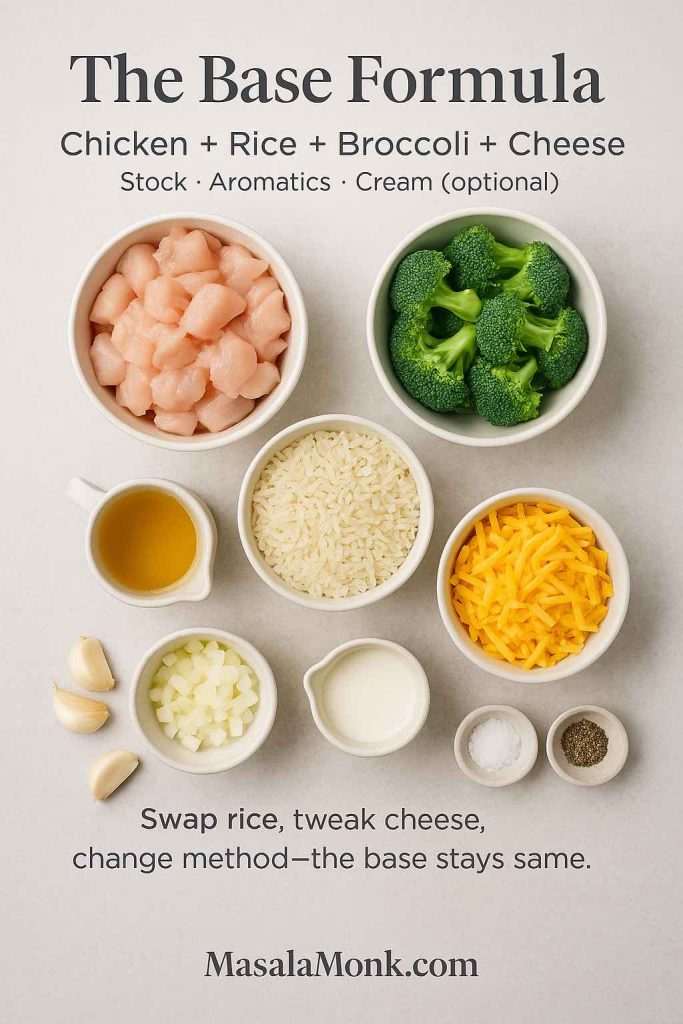
Core Ingredients for Cheesy Chicken Broccoli Rice

Flatlay of core ingredients for cheesy chicken broccoli rice—bowls of diced chicken, uncooked rice, broccoli florets, shredded cheddar, stock, cream, garlic, onion, salt and pepper—with text ‘The Base Formula: Chicken + Rice + Broccoli + Cheese’.
This is the base formula every version uses—chicken, rice, broccoli, cheese, stock and aromatics—so you can swap rice, tweak cheese or change cooking method without changing the heart of the recipe.

Choosing chicken

You can use either:

  • Chicken breasts – lean, tidy cubes, mild flavor.
  • Chicken thighs – a little more fat, more flavor, extra juiciness.

Both work in every method here. Just remember one simple safety rule: cooked chicken should reach 165°F (74°C) in the thickest part. That number shows up again and again in official food-safety charts for poultry and casseroles.

Picking rice

You have options:

  • Long-grain white rice for classic, soft comfort.
  • Basmati if you like distinct, fragrant grains.
  • Brown rice when you want more chew and more fiber.

Harvard’s overview of rice and glycemic index explains how different rice types affect blood sugar. Brown rice usually sits lower on the glycemic index than white, which can be useful if you’re watching energy spikes.

If you want to understand water ratios and cooking times a bit better before you start, it’s worth skimming through a practical guide like how to cook rice perfectly, which covers stovetop, cooker, and Instant Pot methods.

Why broccoli belongs in cheesy chicken broccoli rice

Broccoli brings:

  • color and freshness,
  • a slight crunch if you time it right,
  • and a serious nutrient boost.

It is rich in fiber and vitamins, and it’s easy to work with fresh or frozen. If you enjoy exploring broccoli beyond florets, you might like reading about broccoli’s benefits and weight-loss uses or even this guide to broccoli sprouts, which concentrates many of the same helpful compounds in tiny shoots.

Cheese and sauce

Most versions in this guide use:

  • cheddar as the base cheese,
  • stock and a bit of milk or cream for richness,
  • and sometimes cream of chicken soup for a shortcut sauce.

You can keep things lighter with a simple milk-based sauce or go all-in with extra cheese, a spoonful of cream cheese, or even a bit of cottage cheese blended into the sauce.

Also Read: Easy Lemon Pepper Chicken Wings (Air Fryer, Oven & Fried Recipe)


One-Pot Cheesy Chicken Broccoli Rice (Stovetop Skillet)

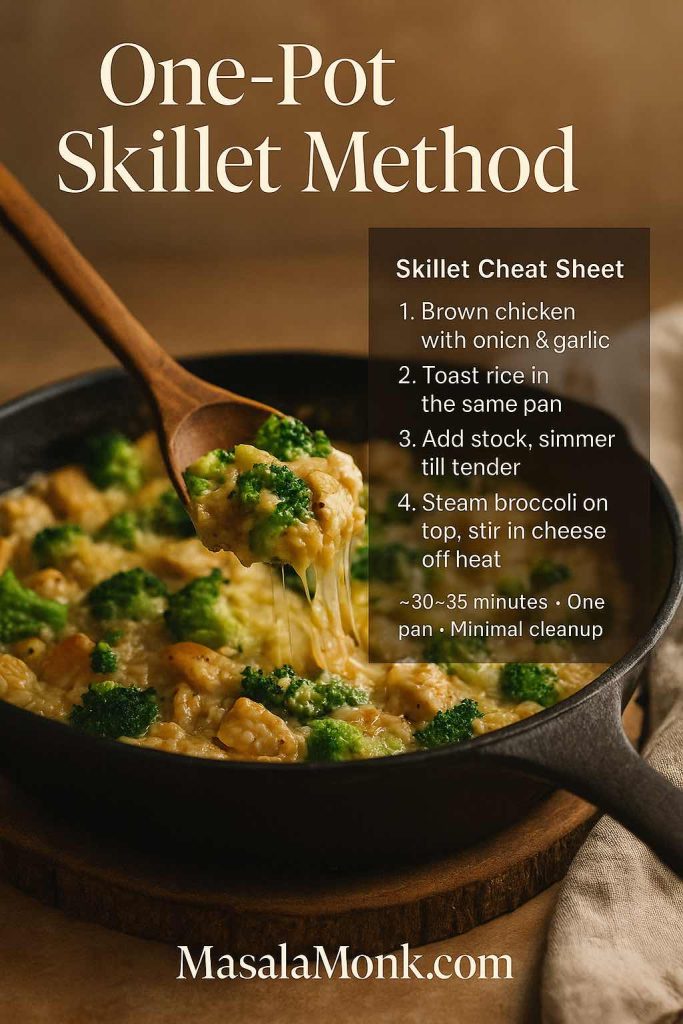
The skillet version is the one to choose when you’re tired, hungry, and not in the mood to wash more than a single pan. Yet, despite its simplicity, it still delivers all the things you want: tender chicken, soft rice, pockets of green broccoli, and cheese melted into a creamy, spoon-coating sauce.

What makes this one-pot cheesy chicken broccoli rice special

You cook the chicken, rice, and broccoli in the same pan. Every grain of rice sits in flavorful stock. The broccoli steams gently so it stays bright. Cheese goes in at the end and melts into a silky sauce.

It’s fast enough to make after work yet cozy enough to eat slowly on the sofa.

One-pot skillet of cheesy chicken broccoli rice with broccoli and melted cheese, a wooden spoon lifting a portion, plus text overlay showing a four-step skillet cheat sheet.
The one-pot skillet method takes you from browning chicken to stirring in cheese in about 30–35 minutes, so you get creamy cheesy chicken broccoli rice with just a single pan to wash.

Steps for one-pot cheesy chicken broccoli rice

Step 1: Sear the chicken for flavor

Set a wide, heavy pan over medium heat. Add a little butter or oil. Drop in diced chicken and season it with salt and pepper. Let the pieces sit long enough to brown lightly on one side before you stir them. You want a bit of color; that means flavor.

Add chopped onion and a clove or two of garlic. Stir until the onion softens and you can smell the garlic.

Step 2: Toast the rice in the same pan

Pour the rice straight into the pan. Stir for a minute or two so each grain gets coated in the flavored fat. The rice will look slightly glossy. That quick toast gives your cheesy chicken broccoli rice better texture and taste.

Step 3: Add stock and simmer

Pour in chicken stock. If you like the dish extra creamy, add a small splash of milk or cream. Scrape the bottom of the pan with a spoon to loosen any browned bits. Bring the liquid to a light simmer, then cover the pan and lower the heat.

Let the rice cook gently. If you are not sure about the water-to-rice ratio for the rice you use most often, check the proportions in this rice cooking guide and adjust your stock to match.

Step 4: Steam broccoli on top of the rice

When the rice is almost tender, lift the lid and scatter broccoli florets evenly over the surface. Fresh or frozen both work. Replace the lid and let the steam inside finish cooking the broccoli while the rice absorbs the last of the liquid.

Step 5: Stir in cheese off the heat

Turn off the heat. Sprinkle shredded cheese over the chicken, rice, and broccoli. Fold gently until everything is coated in a smooth, thick sauce. If the cheesy chicken broccoli rice looks a little tight, stir in a spoonful of hot stock or milk. If it seems loose, let it sit uncovered for a few minutes.

Spoon the one-pot cheesy chicken broccoli rice straight from the pan into bowls. On nights when you crave an entire week of cozy dishes, you can plan this skillet dinner one day and MasalaMonk’s macaroni & cheese recipe another day for a double hit of cheese and comfort.


Cheesy Chicken Broccoli Rice Casserole (Oven-Baked)

Sometimes you don’t just want a bowl; you want a casserole you can slice into, a dish that feels festive enough for Sunday lunch or company but still easy enough for a weeknight. That’s where the oven-baked cheesy chicken broccoli rice casserole comes in.

Here, instead of cooking everything in one pot, you assemble cooked components into a baking dish, smother them in a creamy sauce, shower them with cheese, and let the oven do the last stretch of work.

Why bake cheesy chicken broccoli rice as a casserole

Baking turns the same ingredients into a structured dish:

  • the rice forms a soft base,
  • the chicken and broccoli stay tender in the sauce,
  • the top becomes a golden, bubbly crust of cheese and crumbs.

It’s ideal for potlucks, Sunday lunches, or any evening when you want leftovers that reheat beautifully.

Oven-baked cheesy chicken broccoli rice casserole in a white ceramic dish with a golden bubbly cheese topping, one square being lifted out on a spatula, with text overlay explaining the casserole method steps.
The oven-baked cheesy chicken broccoli rice casserole starts with cooked rice and chicken, then bakes under a golden cheese crust—perfect when you want a crowd-pleasing main that freezes and reheats beautifully.

Steps for cheesy chicken broccoli rice casserole

Step 1: Cook rice, chicken, and broccoli separately

Cook your rice until just tender. It should still have a little bite, because it will bake further in the oven.

Cook the chicken in a pan or in the oven until the pieces reach 165°F. That way you know they are safe before you tuck them into a creamy sauce.

Blanch or steam the broccoli. Aim for bright green florets that are just tender.

Step 2: Make a creamy sauce

In a saucepan, melt butter. Whisk in flour to form a paste, then slowly pour in stock and milk while whisking. The sauce should thicken enough to coat the back of a spoon.

Season with salt, pepper, and perhaps a pinch of mustard powder. For a shortcut version, you can use stock plus a can of cream of chicken soup instead.

If you like the idea of lighter creaminess, stir in some cottage cheese, just as it is used in MasalaMonk’s cottage cheese lasagna.

Step 3: Combine everything with cheese

Tip your cooked rice, chicken, and broccoli into a large bowl. Pour the sauce over them. Add a generous amount of shredded cheddar and gently fold until everything is coated.

Taste a spoonful. This is your chance to fix the seasoning before you bake.

Step 4: Add a cheesy topping

Spread the mixture into a buttered baking dish. Sprinkle more cheese over the top. If you enjoy crunch, add breadcrumbs stirred with melted butter.

Step 5: Bake until bubbling and golden

Bake the cheesy chicken broccoli rice casserole until you see bubbles peeking around the edges and the top turns golden brown. Let it rest briefly when it comes out of the oven so it sets enough to slice.

This kind of casserole feels right at home beside another classic oven dish like MasalaMonk’s green bean casserole recipe ideas, which explores different twists on that holiday favorite.


Crock Pot Cheesy Chicken Broccoli Rice

There are also days when the idea of standing at the stove sounds exhausting. You still want cheesy chicken broccoli rice, but you need it to be the kind of meal that minds itself while you work, ferry people around, or just rest. That’s when the slow cooker shines.

Unlike the other versions, this one welcomes a bit of imprecision. It won’t be as meticulously layered or as neatly sliceable as the baked casserole, yet the payoff in ease is immense.

Why crock pot recipe is so forgiving

You add most of the ingredients to the pot, turn it on, and let time do the work. The rice absorbs stock slowly. The chicken turns tender. You finish with broccoli and cheese near the end, and you’re done.

It’s an ideal recipe for busy days, long afternoons, or times when you simply don’t want to hover around the stove.

Crock pot full of cheesy chicken broccoli rice being stirred with a wooden spoon, creamy rice with chicken and broccoli visible, with text overlay explaining slow cooker steps and benefits for busy days.
In the crock pot version, everything goes in together—rice, raw chicken, stock and aromatics—then broccoli and cheese are stirred in at the end, making it the easiest way to get cheesy chicken broccoli rice on truly busy days.

Steps for crock pot cheesy chicken broccoli and rice

Step 1: Add rice, chicken, and stock to the slow cooker

Grease the slow cooker lightly. Add uncooked rice, raw chicken pieces, stock, and any chopped onion or garlic you like. Stir well to make sure the rice is submerged.

Step 2: Cook on Low until tender

Cover and cook on Low. The exact time depends on your slow cooker and how hot it runs. You want chicken that pulls apart easily with a fork and rice that is soft, not chalky.

Step 3: Stir in broccoli near the end

About 20 to 30 minutes before you plan to eat, stir in broccoli florets. Put the lid back on and let them soften gently in the hot liquid. Fresh broccoli will cook quickly. Frozen florets will need a bit more time.

Step 4: Finish with plenty of cheese

Switch the slow cooker to Warm. Add shredded cheese and stir until it melts. If the cheesy chicken broccoli rice looks a little thick, add a splash of stock or milk. If it seems thin, let it sit uncovered for a short while.

Because slow cookers keep food warm for a long time, be mindful about leftovers. Articles on reheating rice safely explain why cooked rice should be cooled and refrigerated promptly and not left out for hours.

If you enjoy this hands-off style of cooking, there is a good chance you will also appreciate MasalaMonk’s crock pot lasagna soup, which uses the same “dump and simmer” approach with pasta, tomato, and cheese instead of rice.


Instant Pot Cheesy Chicken Broccoli Rice

Then there are nights when you walk into the kitchen, realize it’s late, and everyone is already asking when dinner will be ready. In those moments, the Instant Pot version of cheesy chicken broccoli rice is a lifesaver.

Here, the pressure cooker cooks the rice and chicken together rapidly, then you add the broccoli and cheese at the end to keep them fresh and melty.

How Instant Pot cheesy chicken broccoli rice saves time

Pressure cooking allows rice and chicken to cook quickly in the same pot. You then stir in broccoli and cheese at the end to keep them bright and melty. The whole process takes less active time than the oven, yet still gives you a comforting, filling bowl.

Instant Pot filled with cheesy chicken broccoli rice, a ladle lifting a creamy cheesy scoop with broccoli, with text overlay showing the pressure cooker plan for the recipe.
The Instant Pot version cooks the rice and chicken together under pressure, then uses the residual heat to soften broccoli and melt cheese—your fastest route to a bowl of cheesy chicken broccoli rice on late nights.

Steps for Instant Pot cheesy chicken broccoli rice

Step 1: Sauté onion, garlic, and chicken

Turn the cooker to Sauté. Add oil or butter, then soften chopped onion and garlic. Add chicken pieces and cook until they lose their raw color and pick up a hint of browning.

Step 2: Add rice and stock and deglaze

Stir the rice into the pot so each grain is coated. Pour in stock. Scrape the bottom of the pot with a spoon to loosen any stuck bits. This helps prevent burn warnings later.

Step 3: Cook under pressure

Seal the lid and set the cooker to High Pressure. Cook for a short time, adjusting for the type of rice you’ve chosen. White rice cooks quickly. Brown rice takes longer. When the timer ends, allow a brief natural release, then carefully vent the remaining steam.

If you are new to pressure cooking, the official Instant Pot guide to pressure cooking for beginners explains sealing, venting, and safety steps in a calm, clear way.

Step 4: Use residual heat to cook broccoli

Open the lid and stir in broccoli florets right away. Close the lid again (without turning the cooker back on) and let the trapped heat soften the broccoli for a few minutes.

Step 5: Stir in cheese and season

Open the lid once more. Add shredded cheese and stir until it melts into a thick sauce. Taste and adjust seasoning.

Because everything cooks together, it’s worth checking that the chicken pieces have reached 165°F in the center before serving.

Also Read: Greek Tzatziki Sauce Recipe (1 Master Sauce + 10 Easy Variations)


Lighter and Heartier Twists on Cheesy Chicken Broccoli Rice

Once you’ve made cheesy chicken broccoli rice a few times, you may start thinking about how to bend it to fit different kinds of days.

Two bowls of cheesy chicken broccoli rice side by side, the left bowl lighter with extra broccoli and greens and the right bowl richer and more cheesy, with text overlay reading ‘Lightened-Up vs Loaded-Up’ and notes on veggies and sauce.
Use the same cheesy chicken broccoli rice base, then go light with more veg and a thinner sauce—or load it up with extra cheese when you’re in full comfort-food mode.

Lighter cheesy chicken broccoli rice ideas

On days when you want the comfort but not quite as much heaviness, you can:

Use more vegetables

  • Increase the amount of broccoli.
  • Add peas or corn to the rice.
  • Stir a handful of spinach into the hot rice just before serving.

Side dishes help too. A bright salad piled with greens, cucumber, and lemony dressing cuts through the richness without much effort.

Switch up the rice

Swapping in some brown rice or mixing white and brown gives more fiber and texture. Tips on reducing the glycemic impact of rice explain how cooling and reheating rice and choosing different varieties can change how it affects blood sugar.

Balance rich meals with lighter days

If you enjoy big, cheesy dinners some days and lighter eating on others, homemade drinks can help. Instead of packaged sports drinks, you might make your own homemade electrolyte drink with mineral salts and citrus. Or, on fasting days, you can try one of the zero-calorie electrolyte recipes that support hydration without adding calories.

Heartier and extra-cheesy twists

On other days, comfort is the goal, and you’re not worried about keeping things light. On those evenings, you could:

Enrich the sauce

  • Use full-fat cheese and be generous.
  • Stir a spoonful of cream cheese into the sauce.
  • Add a splash of cream instead of some of the milk.

Add crispy toppings

For baked version of this dish, buttery breadcrumbs or crushed crackers on top turn the casserole into something that crackles lightly as you cut into it.

These richer versions sit nicely alongside other favorites such as macaroni & cheese and green bean casserole, letting you build full menus around cozy, baked dishes when the weather or your mood calls for it.


Leftovers, Meal Prep, and Second-Day Magic

Big pans of cheesy chicken broccoli rice often mean leftovers, which is a gift on busy days. However, they need a little care.

How to cool and store cheesy chicken broccoli rice

Once you’ve finished eating, transfer the leftovers into shallow containers. This helps them cool more quickly. Refrigerate as soon as they are no longer steaming.
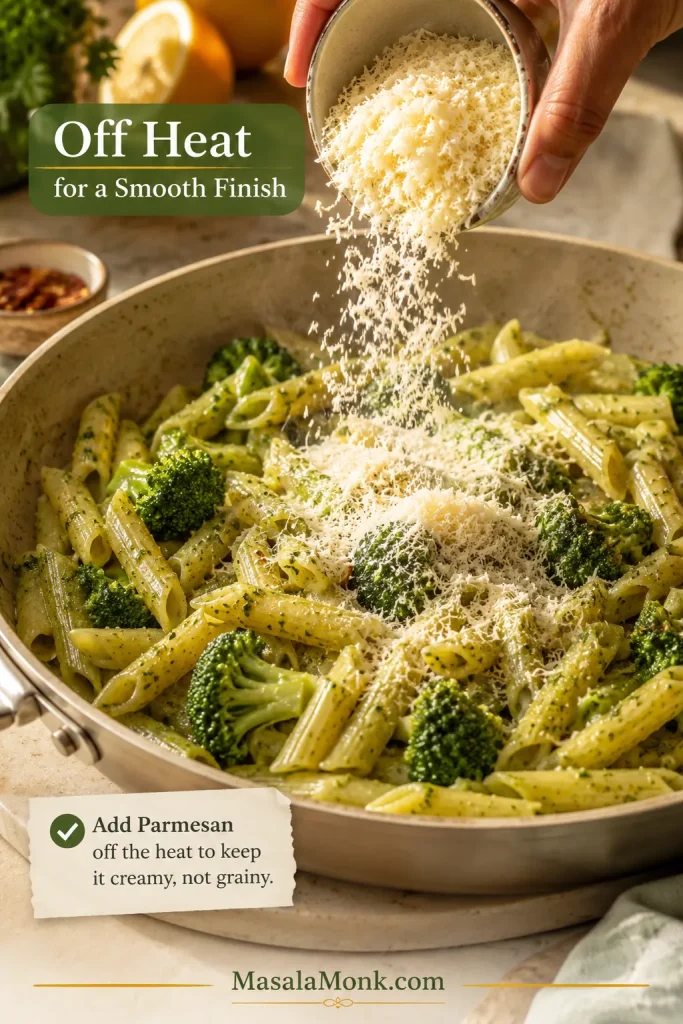
Guides on storing and reheating rice safely explain that cooked rice should not stay at room temperature for long, because a bacteria called Bacillus cereus can grow and cause food poisoning.
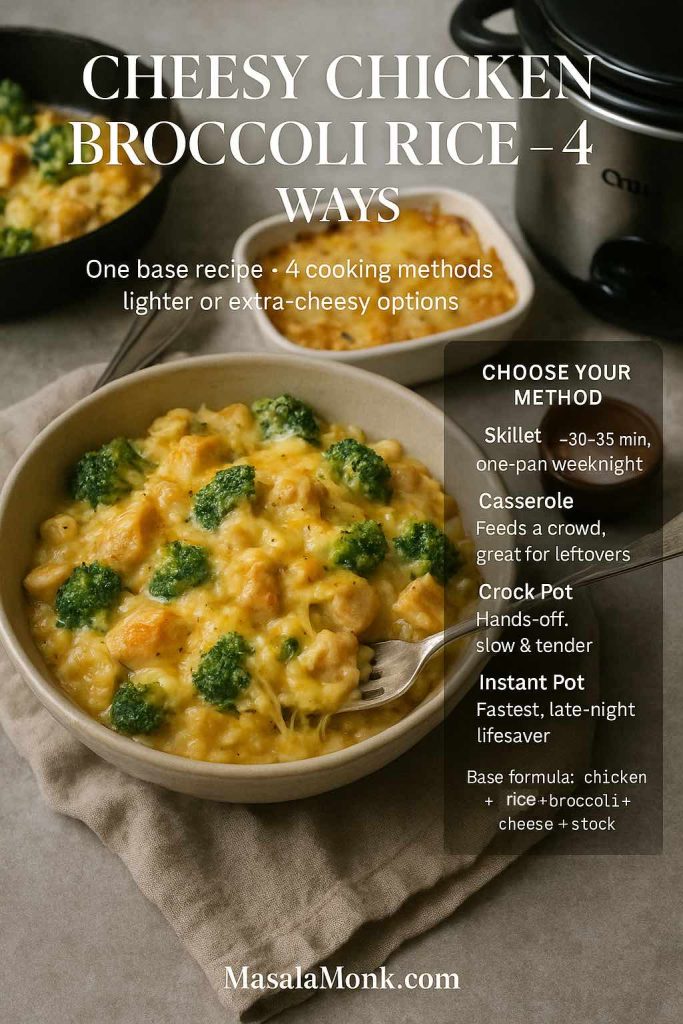
Aim to eat refrigerated leftovers within a few days. When you reheat them, bring the center to a piping-hot temperature again, around 165°F, so both the chicken and the rice are back in the safe zone.

Glass meal prep containers labeled Monday and Tuesday filled with cheesy chicken broccoli rice next to a plate of crispy cheesy rice patties with dipping sauce, under text ‘Leftovers & Meal Prep Magic’ with storage and reheating tips.
Cheesy chicken broccoli rice keeps 3–4 days in the fridge and reheats best with a splash of stock or milk—and when you’re bored of bowls, you can turn the cold rice into crispy cheesy patties for lunches and snacks.

Reheating cheesy chicken broccoli rice so it stays nice

Cold cheesy rice turns firm in the fridge. That’s normal. To bring it back to creamy:

On the stovetop

Place the leftovers in a pan. Add a splash of stock or milk. Warm gently while stirring until the mixture loosens and heats through.

In the oven

Spread the casserole in an oven-safe dish. Cover with foil. Reheat until hot in the center. You can remove the foil for a few minutes at the end to crisp the top again.

In the microwave

Add a spoonful of liquid. Cover loosely. Heat in short bursts, stirring between them so the rice heats evenly and doesn’t dry out at the edges.

Turning leftovers into something new

Leftover cheesy chicken broccoli rice can transform into snacky, fun dishes.

Cheesy rice bites

Chill the mixture until firm. Scoop it into small balls, roll in breadcrumbs, and pan-fry or air-fry until crisp. They make great little appetizers or sides, especially with a simple yogurt dip or tomato sauce.

For more detailed shaping and frying inspiration, you can look at how MasalaMonk turns cold rice into gourmet arancini balls.

Crispy rice squares

Press the leftover rice into a greased dish. Chill until set. Cut into squares and sear them in a little oil until crisp on both sides. Serve with salad for a different take on the same flavors.

If you find you have extra broccoli on its own, not just in the rice, a batch of broccoli, potato & corn tater tots turns it into a playful, kid-friendly side the next day.


Serving Ideas to Go With Cheesy Chicken Broccoli Rice

Simple sides that love cheesy chicken broccoli rice

Cheesy chicken broccoli rice can absolutely stand alone. Still, a few easy sides make the meal feel more complete:

  • A crunchy salad with lettuce, cucumber, and lemon vinaigrette.
  • Roasted carrots or roasted Brussels sprouts.
  • Sliced tomatoes with a pinch of salt and a drizzle of olive oil.

These add freshness and texture without much work, and they help balance the richness in the bowl.

Cozy table setting with a bowl of cheesy chicken broccoli rice, a side bowl of green salad, and a mug of hot chocolate with a cookie, with text overlay suggesting serving ideas and pairings.
For a full cozy-night meal, pair your cheesy chicken broccoli rice with something crisp like a simple green salad, plus garlic bread or a hot-chocolate-and-cookie treat on the side.

Drinks and desserts for a full cozy night

After a comforting meal like this, it’s nice to linger a bit.

On cold evenings, a mug of homemade hot chocolate with cocoa powder hits the same cozy note as the main dish. That recipe uses simple ingredients to create a rich, velvety drink that feels far more special than a packet.

On nights when you’re hosting and want something playful and bright, a lemon drop martini adds a citrusy, sparkling contrast to the creamy main.

If you decide you do want dessert, homemade churros with a chocolate sauce or caramel dip turn dinner into a full comfort-food celebration. That guide covers shaping, frying, and even some gluten-free ideas if you’re cooking for different needs.

On a different night, you might skip dessert and plan another chicken-and-carb comfort for later in the week, such as chicken katsu curry with rice. With its crisp cutlets, rich curry sauce, and fluffy rice, it belongs to the same cozy universe as cheesy chicken broccoli rice, just with a Japanese twist.


However you choose to cook it—stirred together in one pot, baked into a bubbling casserole, left to simmer in a slow cooker, or rushed through an Instant Pot—cheesy chicken broccoli rice is one of those recipes you can return to over and over. You can keep it simple, you can dress it up, you can stretch it into lunches and leftovers, and you can bend it to fit however you are eating this week.

Most of all, it stays what it has always been: chicken, rice, broccoli, and cheese, turned into something that makes the world feel a little softer for a while.

Also Read: Simple Bloody Mary Recipe – Classic, Bloody Maria, Virgin & More

FAQs About Cheesy Chicken Broccoli Rice

1. How do I make cheesy chicken broccoli rice from scratch?

Start by browning bite-sized chicken pieces with onion and garlic. Then stir in rice and toast it briefly. Next, add broth and let the rice simmer until almost tender. After that, fold in broccoli florets and cook until just soft. Finally, remove from the heat and stir in plenty of shredded cheese until the dish turns creamy and thick.

2. What is the difference between the skillet version and cheesy chicken broccoli rice casserole?

The skillet version cooks everything in one pot on the stove. It stays looser and spoonable. In contrast, the casserole version uses pre-cooked rice and chicken mixed with sauce and cheese, then baked in a dish. The casserole sets up more, slices neatly, and develops a golden, bubbly top.

3. Can I use instant rice in a chicken broccoli rice casserole?

Yes, you can use instant rice in a chicken broccoli rice casserole with good results. Just reduce the liquid slightly because instant rice absorbs less water. In addition, shorten the baking time so the grains do not become mushy. Keep an eye on the texture and remove the casserole once the cheesy chicken broccoli rice looks set and hot in the center.

4. How can I make crock pot cheesy chicken broccoli and rice?

For crock pot cheesy chicken broccoli and rice, place raw chicken, uncooked rice, broth, and seasonings in the slow cooker. Stir everything well and cook on Low until the rice is tender and the chicken shreds easily. Later, add broccoli during the last 20–30 minutes so it stays bright and not overcooked. Right before serving, stir in shredded cheese until the slow cooker cheesy broccoli chicken rice turns smooth and creamy.

5. How do I make Instant Pot cheesy chicken broccoli rice?

To prepare Instant Pot cheesy chicken broccoli rice, first sauté onion, garlic, and chicken in the pot. Then stir in rice and broth, scraping the bottom to remove any browned bits. Cook on high pressure for a short time, using more minutes for brown rice and fewer for white. Once the pressure releases, mix in broccoli and let it steam in the residual heat. Lastly, stir in cheese until the Instant Pot cheesy chicken broccoli rice is thick and velvety.

6. Can I use cream of chicken soup in cheesy chicken broccoli rice?

Absolutely. Cream of chicken soup makes the dish richer and quicker. You can whisk it into the broth for a skillet version or use it as the main sauce for a cheesy chicken broccoli rice casserole recipe. Just remember that the soup is already salty, so taste before adding extra salt.

7. How can I make cheesy chicken broccoli rice healthier?

There are several easy tweaks. First, swap some or all of the white rice for brown rice in your chicken broccoli rice recipe one pot style. Second, increase the amount of broccoli or add extra vegetables like peas or carrots. Third, use a little less cheese in the base and rely on a sharp cheddar on top for strong flavor. With these changes, cheesy chicken broccoli rice still tastes indulgent but feels lighter.

8. Can I freeze cheesy chicken broccoli rice casserole?

Yes, cheesy chicken broccoli rice casserole usually freezes well. Let the casserole cool completely, then portion it into airtight containers. Label and freeze for up to two or three months. When you want it again, thaw in the fridge overnight and reheat in the oven until piping hot and the cheese is melting again.

9. How long do leftovers of cheesy chicken broccoli rice last, and how should I reheat them?

Leftovers of cheesy chicken broccoli rice keep well in the refrigerator for about three to four days. Store them in shallow, sealed containers. For reheating, add a splash of milk or broth and warm gently on the stove or in the microwave, stirring once or twice. In the case of leftover cheesy chicken broccoli rice casserole, cover the dish with foil and reheat in the oven until the center is hot and the top is soft and bubbly again.

10. Can I make cheesy chicken broccoli rice ahead of time for meal prep?

Yes, this dish is excellent for meal prep. You can cook a big batch of one pot cheesy chicken broccoli rice or bake a full casserole, then divide it into containers. Allow it to cool before sealing. During the week, reheat single portions with a spoonful of liquid so the chicken and rice stay moist. This way, you get a ready-to-go cheesy chicken broccoli rice meal that still tastes fresh.