Posted on Leave a comment

Slow Cooker Beef Stew Recipe

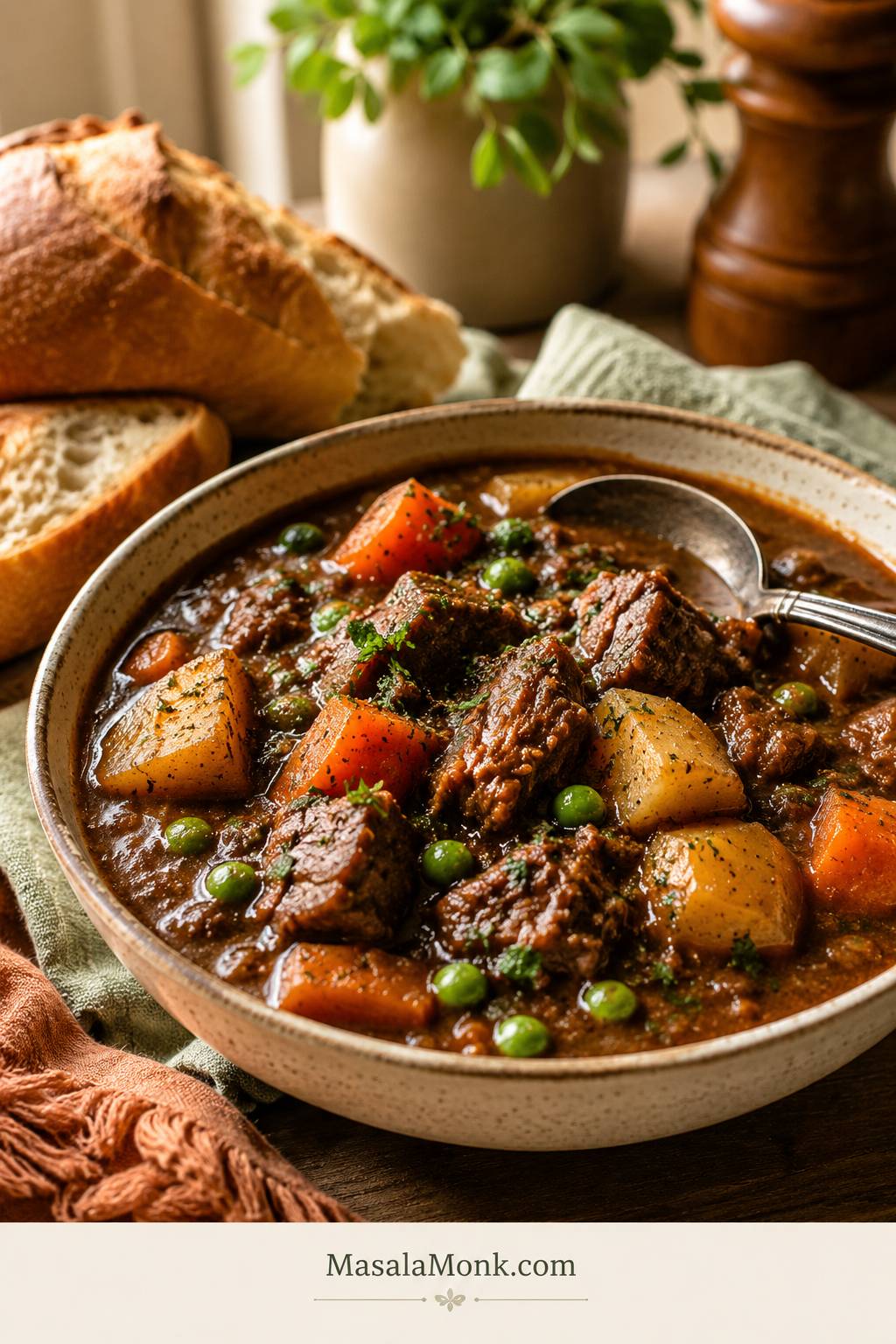
A bowl of beef stew with beef chunks, potatoes, carrots, peas, thick brown gravy, bread, and a spoon.

Tender beef, soft potatoes, sweet carrots, and a Crock Pot gravy that stays rich instead of turning thin.

If you have ever waited all day for beef stew and opened the slow cooker to thin broth instead of rich gravy, this version is built to avoid that disappointment.

The goal is the moment you lift the lid and see glossy, deep brown gravy settled around tender beef instead of a pot that needs rescuing.

Lid-lift cue: The finished pot should look glossy and settled, with steam rising from gravy rather than beef and vegetables floating in broth.
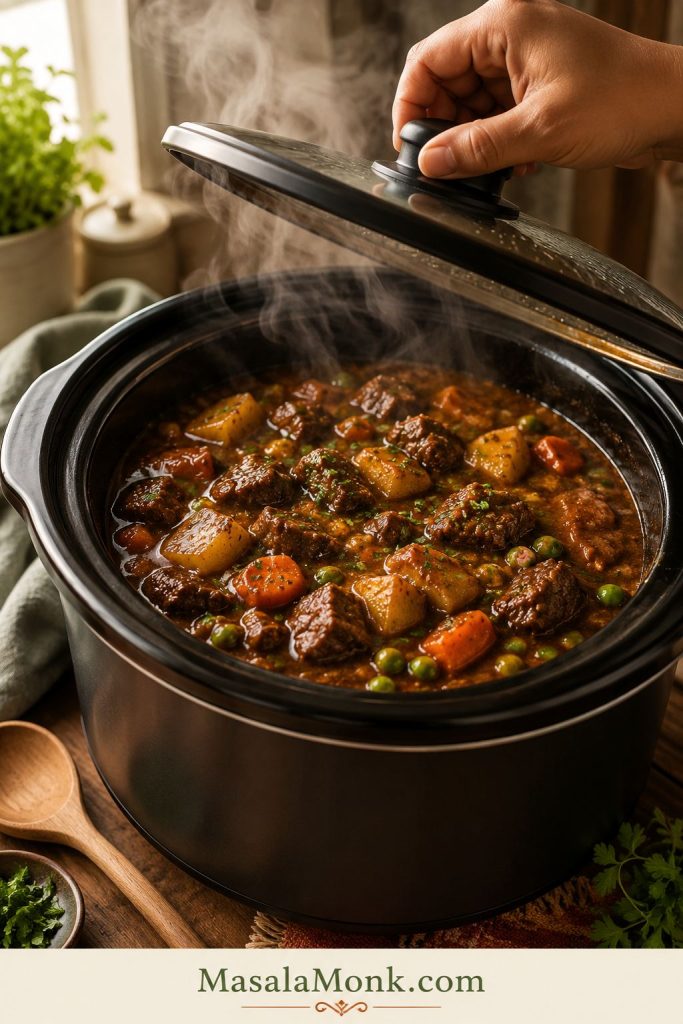
A hand lifting the lid of a slow cooker to reveal steaming beef stew with beef, potatoes, carrots, peas, and glossy gravy.
When you lift the lid, look for gravy settled around the beef and vegetables. If the pot looks glossy instead of flooded, the liquid stayed under control.

This is the kind of slow cooker beef stew you want waiting at the end of the day: beef soft enough to break with a spoon, carrots that turn sweet in the gravy, potatoes that still hold their shape, and deep brown gravy thick enough to drag bread through.

Finished cue: This is the texture we are aiming for: chunky beef, visible vegetables, and gravy thick enough to feel like stew instead of soup.
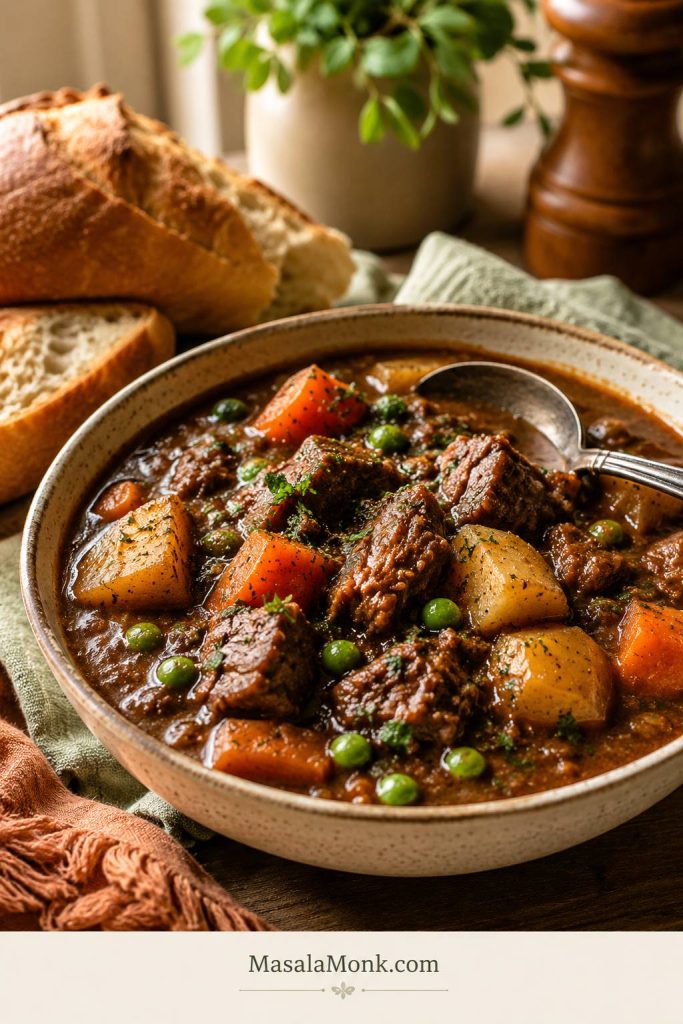
A bowl of beef stew with beef chunks, potatoes, carrots, peas, thick brown gravy, bread, and a spoon.
Start with the finished goal in mind: chunky beef stew with glossy brown gravy, visible vegetables, and enough body to scoop with bread instead of chasing thin broth.

Why This Slow Cooker Beef Stew Stays Thick

This method works with the slow cooker instead of fighting it. It uses controlled liquid, the right cut of beef, vegetables cut large enough for a long cook, and a simple thickening step once the meat is tender. You still get classic beef stew with potatoes and carrots, but the pot is set up to finish glossy enough to coat a spoon instead of thin and brothy.

You can make it with chuck roast or packaged beef stew meat. Brown the beef for the deepest flavor, or use the dump-and-go version when dinner just needs to get started. Either way, the fork test matters more than the timer, and the slow cooker gives you the kind of dinner that feels finished before you even sit down.

Quick Answer: How to Make Slow Cooker Beef Stew That Is Not Watery

For thick, tender slow cooker beef stew, use beef chuck or stew meat cut into 1¼- to 1½-inch chunks. Coat the beef lightly with flour, brown it if you have time, then slow cook it with potatoes, carrots, onion, tomato paste, Worcestershire sauce, herbs, and controlled beef broth.

Cook on low until the beef gives easily with a fork, then stir in a cornstarch slurry during the final 20 to 30 minutes if the gravy needs more body. Start with enough broth to moisten the pot, not enough to fully cover every piece of beef and potato.

  1. Use chuck roast or stew meat cut into even chunks.
  2. Add only enough broth to moisten the pot.
  3. Cook on low until the beef is truly tender.
  4. Finish with slurry during the final 20 to 30 minutes.
  5. Rest before serving so the gravy settles.

Ready to cook? Start with the recipe card. If thin gravy is your main worry, jump to how much liquid to use before loading the pot; if you already bought packaged cubes, read the beef stew meat notes first.

Recipe Card

Slow Cooker Beef Stew Recipe

Description: A classic slow cooker beef stew made with chuck roast or beef stew meat, potatoes, carrots, onion, herbs, and a rich gravy-style broth. Includes browned-beef and no-browning methods.

Prep Time25–30 minutes with browning
12–15 minutes dump-and-go
Slow Cook Time8 hours on low
4–5 hours on high
Thickening + Rest30–45 minutes
Total TimeAbout 8 hours 45 minutes to 9 hours
Servings6 generous servings
Equipment6-quart / 5.7 L slow cooker

Ingredients

For the beef stew

  • 2½ lb / 1.1 kg beef chuck roast or beef stew meat, cut into 1¼- to 1½-inch chunks
  • 1 teaspoon salt, plus up to ½ teaspoon more after thickening if needed
  • 1 teaspoon black pepper
  • 3 tablespoons / 24 g all-purpose flour or plain flour
  • 2 tablespoons / 30 ml neutral oil, for browning
  • 1 large onion, diced, about 150 g
  • 4 garlic cloves, minced
  • 3 tablespoons / 45 g tomato paste
  • 2½ cups / 600 ml beef broth or beef stock
  • ½ cup / 120 ml red wine, or use extra beef broth
  • 2 tablespoons / 30 ml Worcestershire sauce
  • 1 tablespoon / 15 ml balsamic vinegar, optional but helpful for depth
  • 1 beef bouillon cube or 1 teaspoon beef base, optional
  • 4 medium carrots, cut into thick pieces, about 300–350 g
  • 1½ lb / 680 g Yukon gold or red potatoes, cut into large chunks
  • 2 celery ribs, sliced, about 100–120 g
  • 2 bay leaves
  • 1 teaspoon dried thyme
  • 1 rosemary sprig, or ½ teaspoon dried rosemary
  • 1 cup / 130–140 g frozen peas

For thickening near the end

  • 2 tablespoons / 16 g cornstarch
  • ¼ cup / 60 ml cold water

Instructions

  1. Cut and season the beef. Pat the beef dry. Cut into 1¼- to 1½-inch chunks if needed. Season with 1 teaspoon salt and the black pepper.
  2. Coat lightly with flour. Sprinkle flour over the beef and toss until lightly coated. The flour should cling to the beef, not form a thick paste.
  3. Brown the beef for best flavor. Heat oil in a large skillet over medium-high heat. Brown beef in batches for 2 to 3 minutes per side, just until the outside is deeply browned. Transfer to the slow cooker.
  4. Build the flavor base. In the same skillet, cook onion for 2 to 3 minutes. Add garlic and tomato paste and cook for about 1 minute. Pour in wine or a splash of broth and scrape the pan. Transfer everything to the slow cooker.
  5. Load the slow cooker. Add potatoes and carrots toward the bottom and sides, then add the beef, onion mixture, broth, Worcestershire sauce, balsamic if using, bouillon if using, celery, bay leaves, thyme, and rosemary. Stir gently. The liquid does not need to cover everything.
  6. Cook low and slow. Cover and cook on low for 8 hours, or until the beef is fork-tender. High works in 4 to 5 hours, but low gives better tenderness. Keep the lid on as much as possible.
  7. Add peas and thicken. Mix cornstarch with cold water until smooth. Stir slurry into the stew, then add frozen peas. Cover and cook on high for 20 to 30 minutes.
  8. Rest and serve. Turn off the slow cooker and let the stew rest for 10 to 15 minutes. Remove bay leaves and rosemary stem. Taste and adjust salt and pepper.

Notes

  • For a no-browning version, toss beef with flour and seasoning, then add everything directly to the slow cooker except peas and slurry.
  • If skipping wine, use 3 cups / 720 ml total beef broth.
  • Add the extra ½ teaspoon salt only if using low-sodium broth and no salty shortcuts like bouillon, onion soup mix, gravy mix, or a seasoning packet.
  • Start with the listed broth amount and adjust the final consistency after the beef is tender.
  • If the beef is tough, cook it longer. Tough stew meat usually needs more time, not more heat.
  • Thaw beef before adding it to the slow cooker. Frozen peas are fine near the end.

Recipe cue: Use the recipe card for the exact amounts, then use the visual sections below to judge texture, liquid level, and doneness.
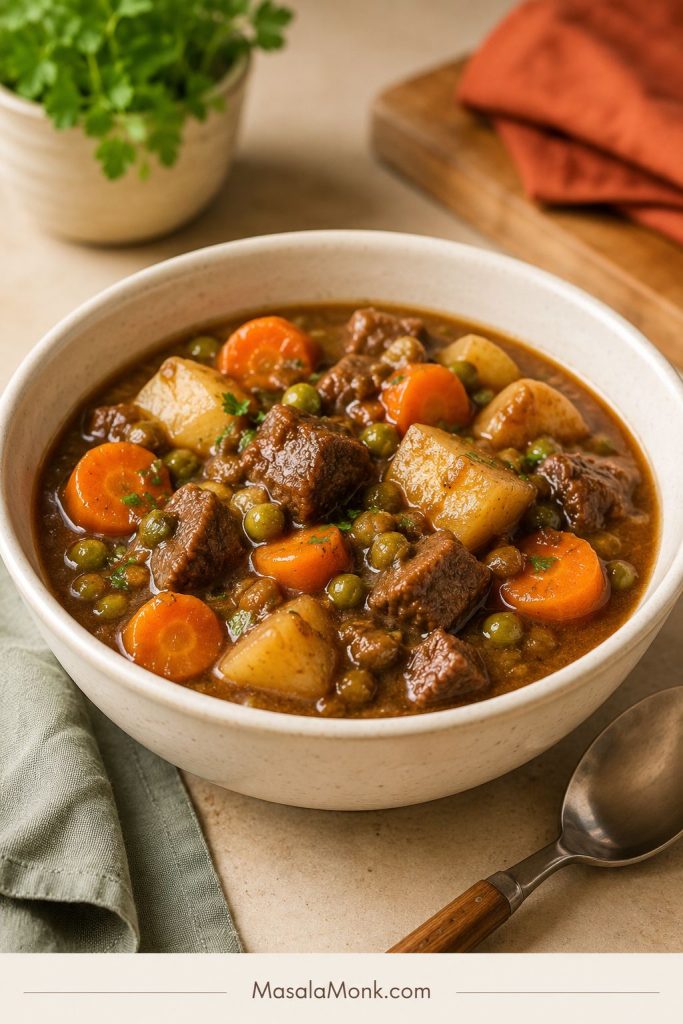
A bowl of Crock Pot beef stew with beef, potatoes, carrots, peas, and brown gravy on a neutral surface.
A good Crock Pot beef stew should serve as one complete spoonful: tender beef, chunky vegetables, and gravy that carries everything together.

The Start Low, Finish Thick Method

The secret to this stew is simple: start with less liquid than you would use for stovetop stew, let the beef and vegetables release their own moisture, then adjust the gravy only after the meat is tender.

The pot may look a little under-liquid at first. That is not a mistake; that is the plan. A stew that looks thin before the final step has not failed; it simply is not finished yet.

The anti-watery stew system: use less broth at the start, cut the vegetables large, cook on low until the beef gives, then thicken only after the slow cooker has created its own liquid.

Method cue: The anti-watery setup starts before cooking, with large chunks and restrained broth instead of a fully submerged pot.
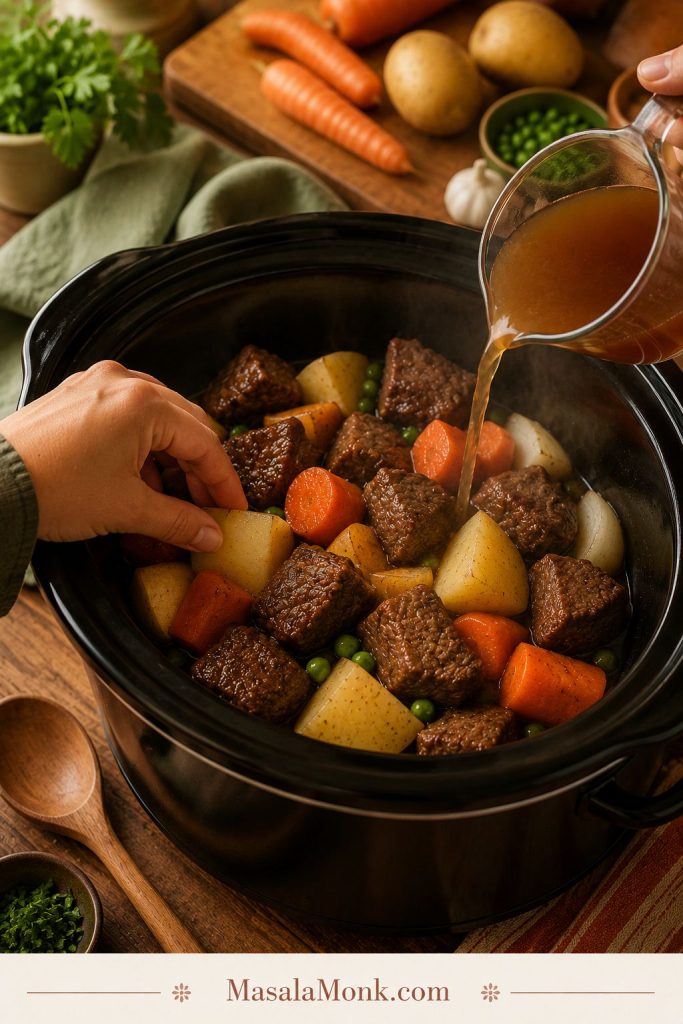
Hands arranging beef and large vegetables in a slow cooker while a small amount of broth is poured around them.
This is the anti-watery setup: large chunks, restrained broth, and room for the slow cooker to create its own liquid as it cooks.

Before You Start: Three Things That Matter Most

  1. Do not fully cover the stew with liquid. The beef and vegetables should be moistened, not swimming.
  2. Let tenderness decide the timing. The beef should give when pressed with a fork, not just be “cooked through.”
  3. Wait to judge the gravy. The final texture should be judged after the beef is tender, the slurry has cooked, and the stew has rested.

Visual Cues for Success

  • Before cooking: the ingredients look moistened, not submerged.
  • Once cooked: the beef gives easily with a fork.
  • When thickened: the gravy looks glossy and lightly coats a spoon.
  • After resting: the potatoes hold their shape and the gravy settles around the beef.

This is not a fussy stew. It is a patient one. Set it up well, let it cook gently, and make the final call on texture only when the beef is ready.

Back to top ↑

You’ll Like This Version If You Want

  • A classic potatoes-and-carrots beef stew made in the slow cooker
  • Rich, spoon-coating gravy instead of a thin beef broth
  • A recipe that works with chuck roast or packaged beef stew meat
  • A choice between browning the beef and a no-browning shortcut
  • Potatoes that stay in soft, generous chunks
  • Clear fixes for thin gravy, tough beef, bland flavor, or mushy vegetables

Prefer a brothy bowl? Add extra warm broth at the end, after the beef is tender and the gravy has been adjusted. This recipe is written as a thick, gravy-style stew.

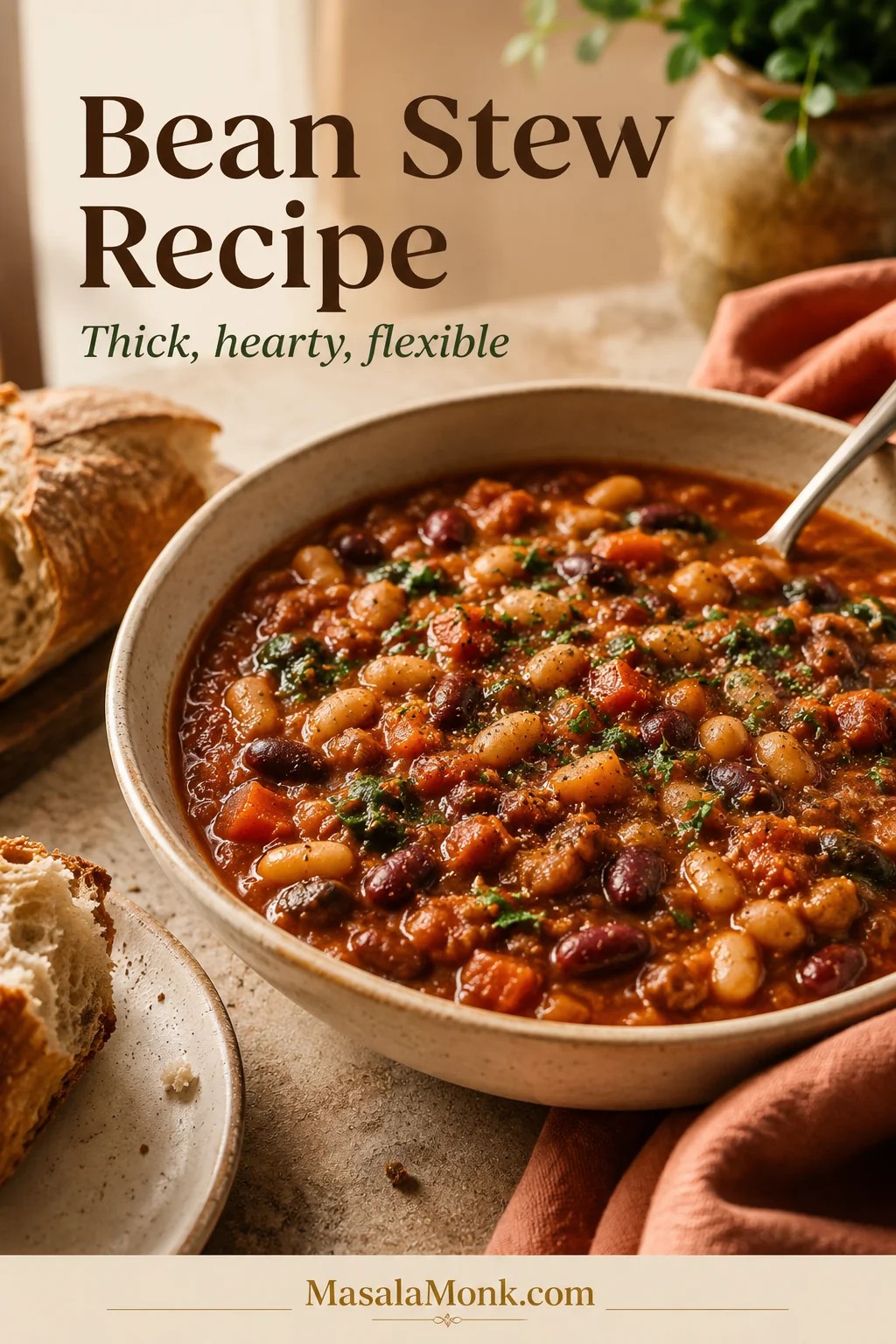
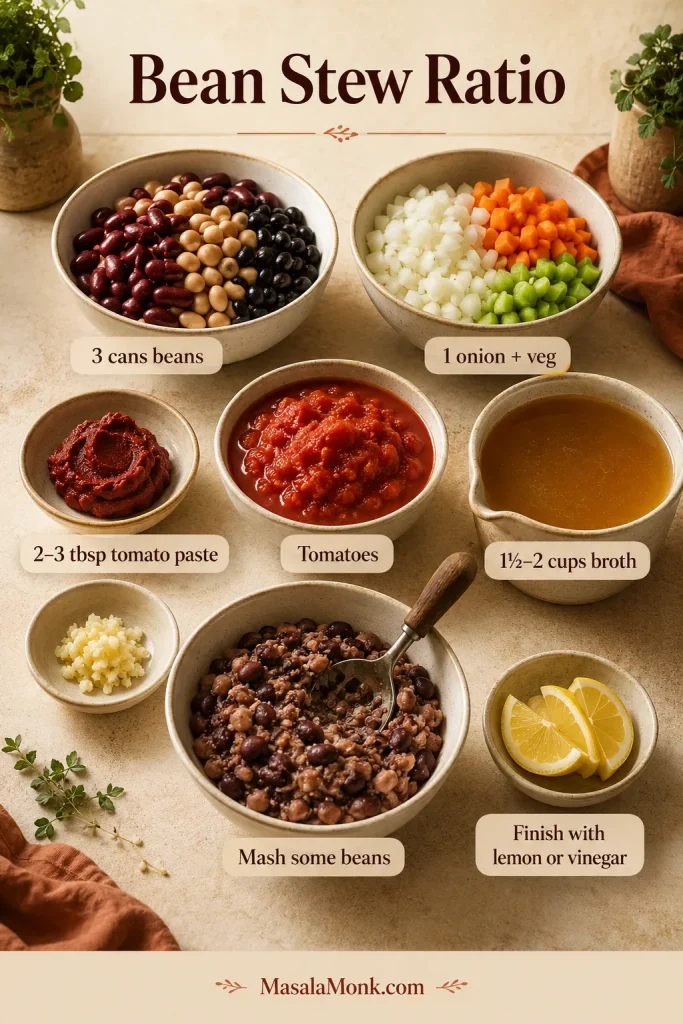
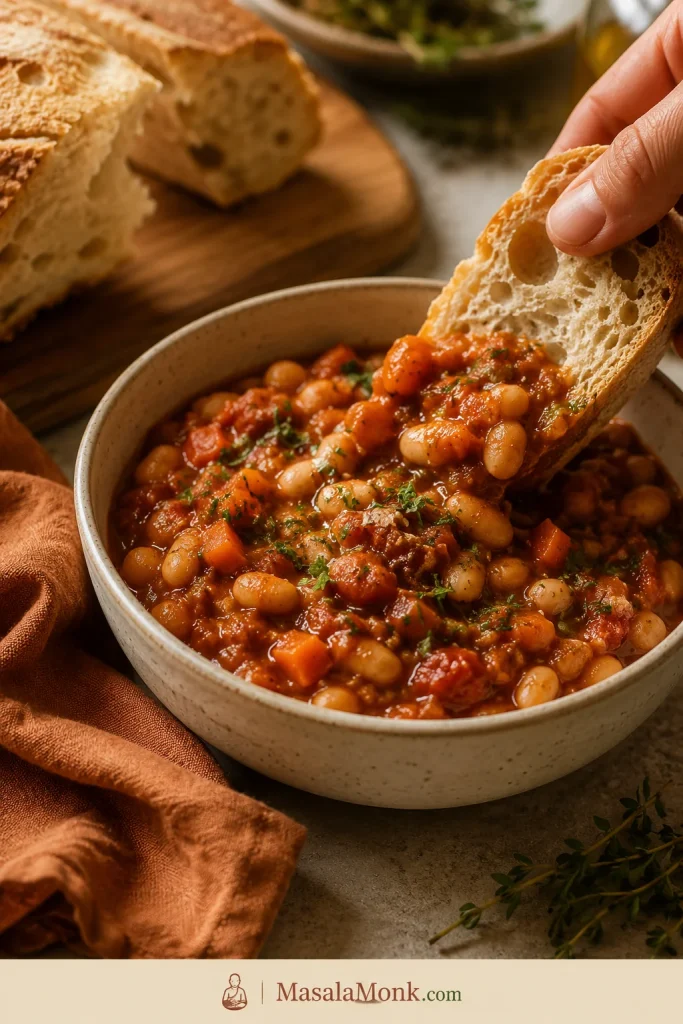
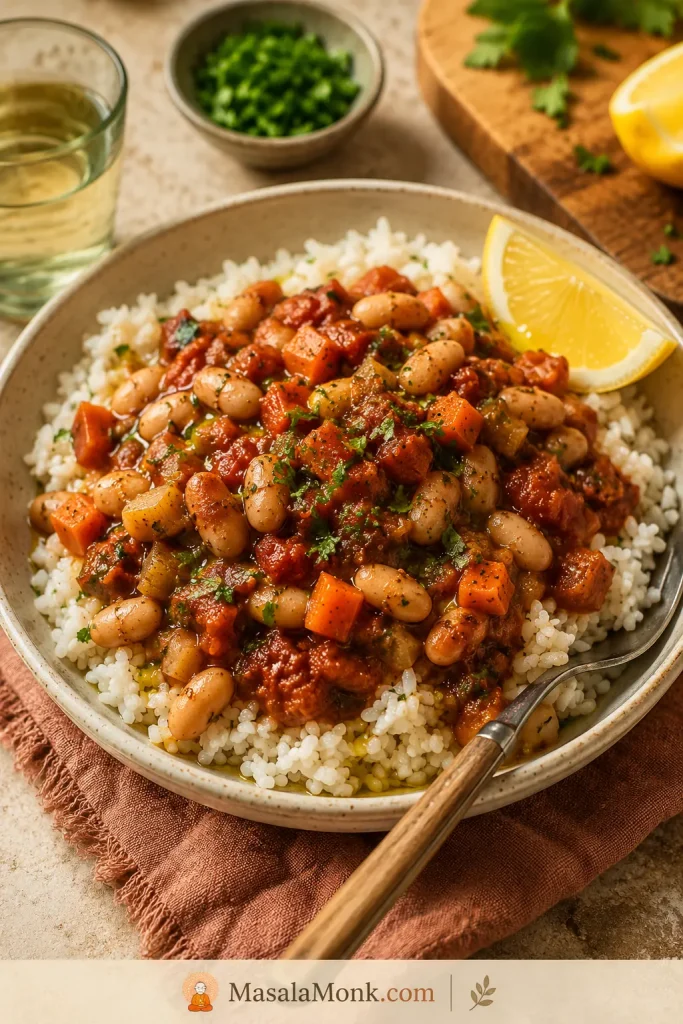
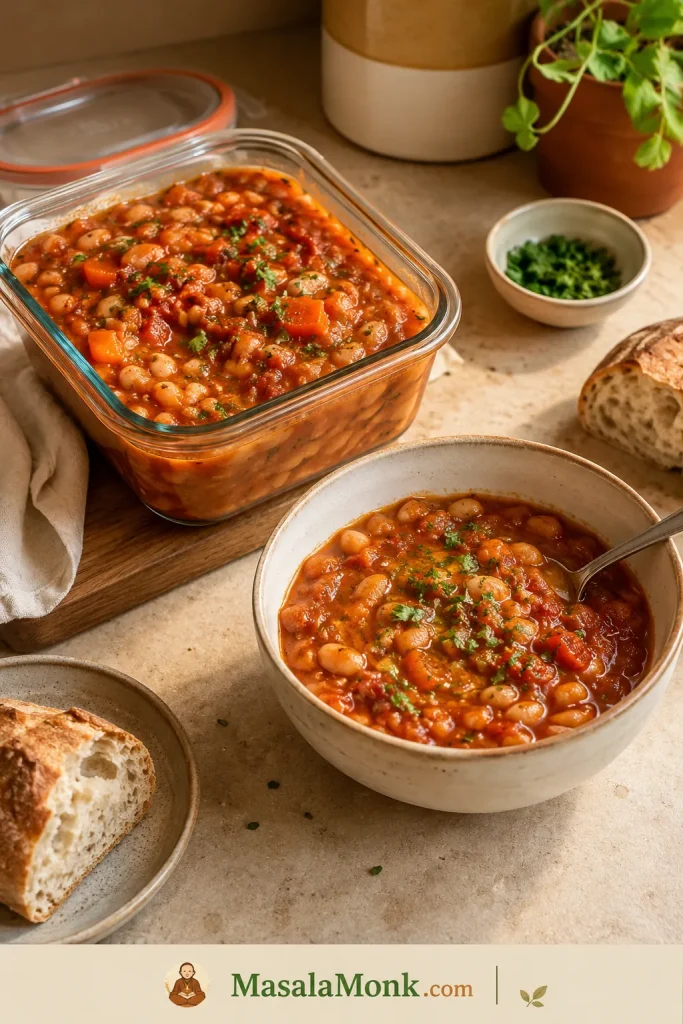
If you want the same thick, cozy feeling without beef, this bean stew recipe is a hearty meatless option with a similar spoonable texture.

Why This Recipe Works

The best slow cooker stews feel effortless at the table, but they are usually won before the lid goes on. This version uses a simple four-part system: less broth at the start, large vegetable pieces, low heat until the beef gives, and slurry only after the pot has shown you how much liquid it created.

Flour gives the beef a little body, tomato paste and Worcestershire build depth, and slow heat gives tougher cuts time to soften. The peas go in late so they stay sweet and green instead of dull.

Wait until the long cook is done before judging the gravy. By then, the beef and vegetables have released their liquid, and you can thicken what is actually in the pot instead of guessing at the start.

Kitchen confidence cue: do not judge the stew too early. A pot that looks a little loose at hour six can still finish beautifully after the slurry and a short rest.

What This Beef Stew Tastes Like

The gravy should taste rounded and savory, with the tomato paste melted into the background instead of tasting sharp or tomato-heavy. Worcestershire sauce and optional balsamic add just enough lift to keep the bowl rich without making it heavy.

The beef should be soft enough to press apart with a spoon, the potatoes should be creamy at the edges, and the carrots should taste sweet from the long cook. Browned beef gives the stew a deeper, roastier finish; the dump-and-go version is gentler, but still cozy and satisfying.

This is the kind of stew that wants bread, rice, mashed potatoes, or noodles nearby — something simple to catch the last spoonfuls of gravy at the bottom of the bowl.

That same cozy beef-and-potato comfort shows up in this slow cooker cottage pie, especially if you like rich gravy-style dinners.

Ingredients You’ll Need

Nothing here is fancy, but each ingredient has a job. The stew tastes best when the basics are doing their work: beef for depth, potatoes for body, carrots for sweetness, and a little acidity to wake up the gravy.

Ingredient cue: Each ingredient has a job, so keep the lineup simple and let beef, vegetables, broth, tomato paste, and herbs do the work.
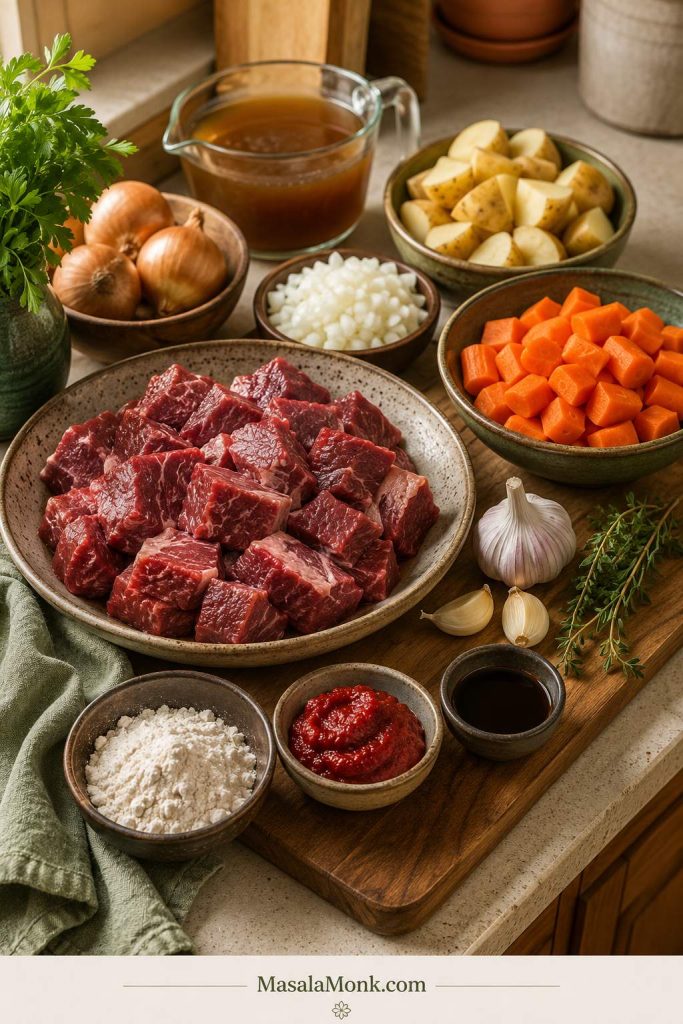
Beef chuck, potatoes, carrots, onion, garlic, broth, herbs, flour, and tomato paste arranged on a kitchen counter.
Before cooking begins, build the stew in layers: beef for depth, potatoes for body, carrots for sweetness, and tomato paste for a darker gravy base.

Beef

Chuck roast is the first choice here because it gives the best mix of tenderness and flavor. Packaged beef stew meat is also fine and is often the most convenient option; see the stew meat section if that is what you have.

Cut the beef into even 1¼- to 1½-inch chunks. Pieces that are too small can dry out, while very large chunks may need extra time before they soften.

Flour

Flour helps the beef brown and gives the gravy body. Use a light coating. Too much flour can make the stew feel heavy or pasty.

For a gluten-free version, skip the flour or use a gluten-free all-purpose flour blend. Then finish the stew with cornstarch or arrowroot slurry.

Potatoes

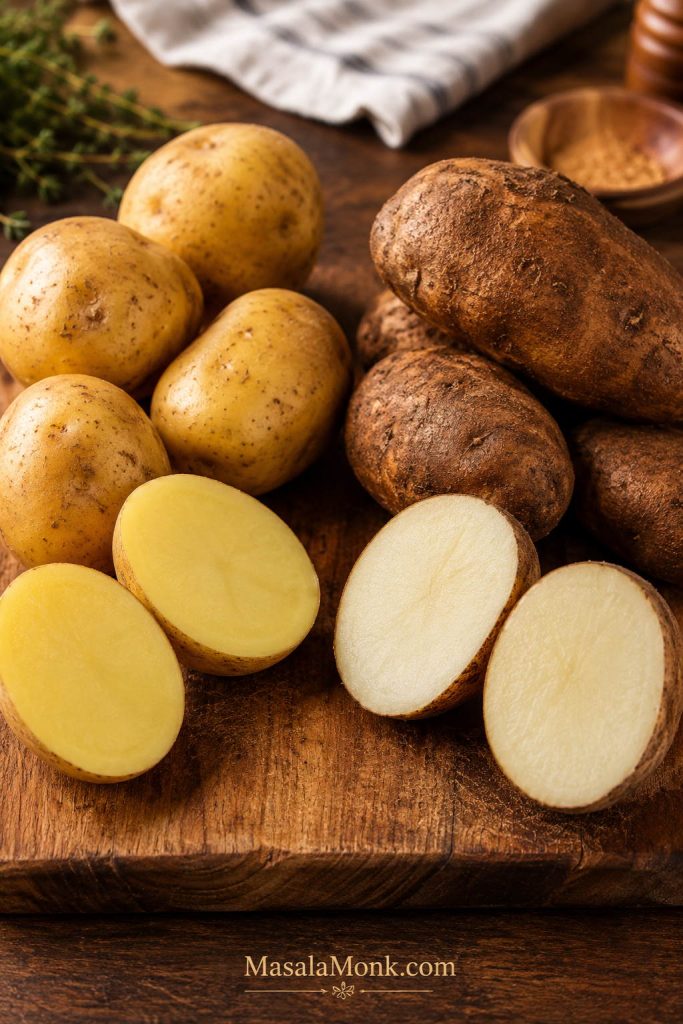
Yukon gold potatoes or red potatoes are best because they hold their shape. The goal is soft edges, not potato collapse.

Russet potatoes can be used, but they soften more and may cloud the gravy. If you use russets, cut them into larger chunks and expect a softer texture.

Serving the stew over potatoes instead of cooking potatoes inside it? These garlic mashed potatoes are built to stay creamy instead of gluey under gravy.

Carrots, Celery, and Onion

Carrots bring sweetness, celery adds a classic stew flavor, and onion gives the gravy a savory base. Cut carrots into thick pieces so they hold up during the long cook.

Tomato Paste, Worcestershire, and Broth

Cooked briefly or whisked well into the broth, tomato paste gives the gravy depth without making the stew taste like tomatoes. Worcestershire sauce adds savory depth. Beef broth or beef stock is the main liquid, but the amount is controlled so the pot finishes hearty instead of soupy.

Low-sodium broth gives you more control when bouillon, beef base, onion soup mix, or a seasoning packet is involved. Taste after thickening, not before; salt feels different once the gravy tightens.

Red Wine or No-Wine Option

Red wine adds depth and a richer stew flavor. For a no-wine version, use 3 cups / 720 ml total beef broth and keep the Worcestershire sauce. The optional balsamic becomes more useful without wine because it gives the gravy a small lift.

Herbs and Peas

Bay leaves, thyme, and rosemary are classic with beef stew. Frozen peas go in late because they only need enough time to heat through. Adding peas at the beginning can make them dull and mushy.

Best Beef to Use

The best beef for stew is not the fanciest beef. It is the cut that has enough time to soften. The slow cooker is not the place for very lean quick-cooking steak cuts; stew is where tougher, flavorful cuts become tender.

Beef cue: Choose a cut that benefits from slow cooking; chuck roast is better here than lean quick-cooking steak.
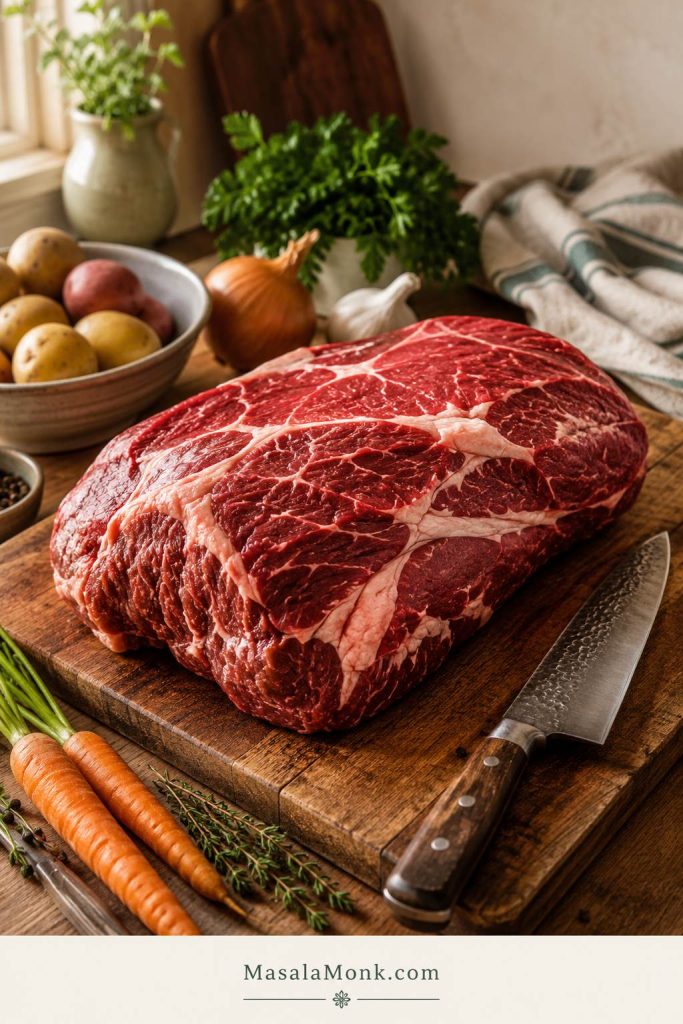
A whole beef chuck roast with visible marbling on a wooden cutting board beside a chef’s knife.
Chuck roast works because slow cooking gives its connective tissue time to soften. That is why it becomes tender instead of dry in beef stew.
Beef Cut Use It? Notes
Chuck roast Best choice Cut it yourself into even chunks for the best texture and flavor.
Beef stew meat Yes Convenient and useful when you want less prep.
Stewing beef, braising steak, casserole beef Yes Good global equivalents for long-cooked beef dishes.
Very lean steak cuts Not ideal Can become dry or chewy during long cooking.

Using Beef Stew Meat in the Slow Cooker

This is the section for the pack of stew meat already sitting in your fridge. You do not need perfect butcher-counter cubes to make a good pot of stew.

Stew meat cue: Spread packaged stew meat out before cooking so you can trim hard fat and even out the largest pieces.
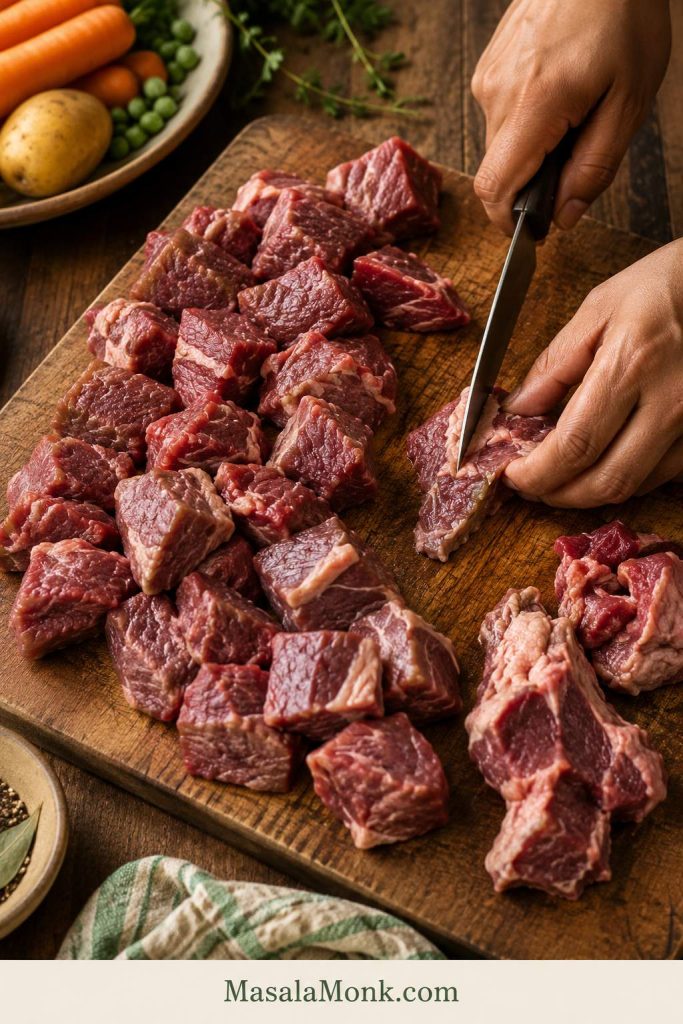
Raw beef stew meat pieces on a wooden cutting board being sorted and trimmed with a knife.
If using packaged beef stew meat, sort it first. Trim hard fat and cut oversized pieces so the beef cooks evenly in the slow cooker.

Spread the pieces out on a board before cooking. Cut very large pieces down, trim large hard fat, and aim for pieces around 1¼ to 1½ inches. Even pieces cook more evenly and give you a better chance of tender beef throughout the pot.

Size cue: Cut beef into even 1¼- to 1½-inch chunks so the stew meat stays juicy while it becomes fork-tender.

Raw beef pieces cut into even chunks on a wooden cutting board with a knife nearby for scale.
Next, keep the beef pieces large enough to stay juicy. Chunks around 1¼ to 1½ inches are ideal for fork-tender stew meat.

A light flour coating helps stew meat in two ways: it gives the gravy body and helps the beef brown if you are searing it first. Browning is useful, but not required. For the no-browning method, lean on the tomato paste, Worcestershire sauce, optional balsamic, and beef base for depth; the dump-and-go section shows the shortcut.

If stew meat is chewy after 8 hours, do not assume it is ruined. In most cases, it needs more time on low. Keep cooking until a piece gives easily when pressed with a fork.

Choose Your Method: Browned Beef or Dump-and-Go

There is no single right way to start this stew. Browning gives the deepest flavor, but the dump-and-go method is useful on busy days. The best choice is the one that gets dinner into the slow cooker without making the recipe feel like a project.

Method How to Do It Best For Tradeoff
Best flavor Flour and brown the beef, sauté onion/garlic/tomato paste, then deglaze the pan. Richest gravy, deeper color, weekend-style comfort Adds 10–15 minutes
Dump-and-go Add floured beef, vegetables, broth, tomato paste, Worcestershire, and herbs directly to the slow cooker. Busy mornings, low effort, basic weeknight stew Slightly lighter flavor and color
Middle path Skip browning but whisk tomato paste, Worcestershire, balsamic, and beef base into the broth first. Good flavor without the skillet step Not quite as roasted as browned beef

On busy days, the dump-and-go version still gets a real dinner going. Browning is better, but the stew can still be worth making without it.

How Much Liquid to Use So the Stew Is Not Watery

This is the moment where slow cooker stew asks you to trust the process a little. It is tempting to add more broth at the start, but restraint is what gives you rich gravy instead of soup.

On the stove, steam escapes and the sauce reduces. In a slow cooker, the lid traps that steam while the beef and vegetables release their own moisture. Too much broth at the beginning can leave you with a loose bowl by the end.

The Pot Should Look a Little Low on Liquid

When you first load the slow cooker, the ingredients should look moistened and surrounded by broth, not fully submerged like soup. Potatoes and carrots should still be visible. The beef should sit among the vegetables, not float in a deep pool of liquid. If the pot is already loose, use the thickening guide near the end instead of adding more starch too early.

Liquid cue: Before the lid goes on, the broth should sit around the beef and vegetables, not cover them like soup.
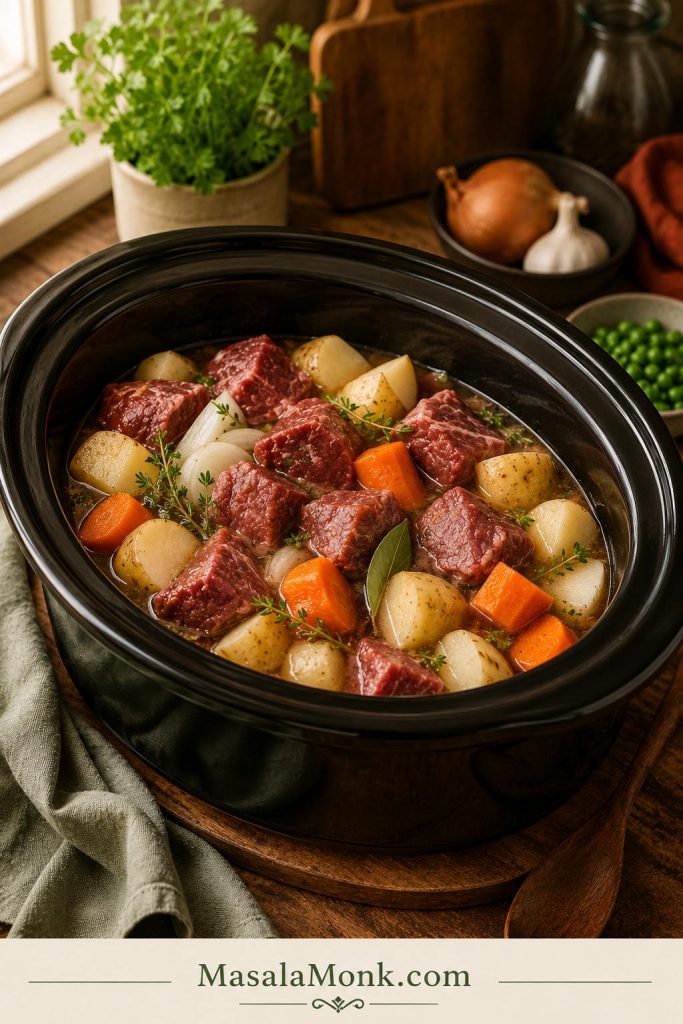
A slow cooker filled with raw beef, potatoes, carrots, onion, herbs, and broth that sits below the top of the ingredients.
Before cooking, the ingredients should be moistened, not submerged. This one visual cue does more to prevent watery slow cooker beef stew than almost anything else.

This can feel strange if you are used to stovetop stew, but it is intentional. The liquid level will rise as the beef and vegetables cook. Resist adding extra broth early unless the pot truly looks dry.

Warning cue: If the ingredients are floating before cooking, the slow cooker may finish with thin broth instead of rich gravy.
Beef, potatoes, and carrots floating in too much broth inside a slow cooker before cooking.
By contrast, if the beef and vegetables are floating at the start, the finished stew can turn thin. Add more broth only after cooking if needed.

Texture cue: the liquid should come partway around the beef and vegetables. It should not fully cover everything. A slightly low-looking pot at the start usually becomes a better stew at the end.

If you like oniony gravy-style slow-cooker dinners, this slow cooker French onion chicken uses the same idea of controlled liquid and a cozy sauce.

How Full Should the Slow Cooker Be?

For even cooking, aim for the slow cooker to be about half to three-quarters full. Packed to the very top, the stew may cook unevenly or bubble over. Too empty, and the edges may cook faster while the liquid behaves differently.

A 6-quart / 5.7 L slow cooker is the best size for this full recipe. Use the small-batch version below for a 3-quart cooker.

How to Make It Step by Step

Step 1: Cut the Beef and Vegetables Properly

Cut the beef into 1¼- to 1½-inch pieces. This size is large enough to stay juicy and small enough to tenderize well.

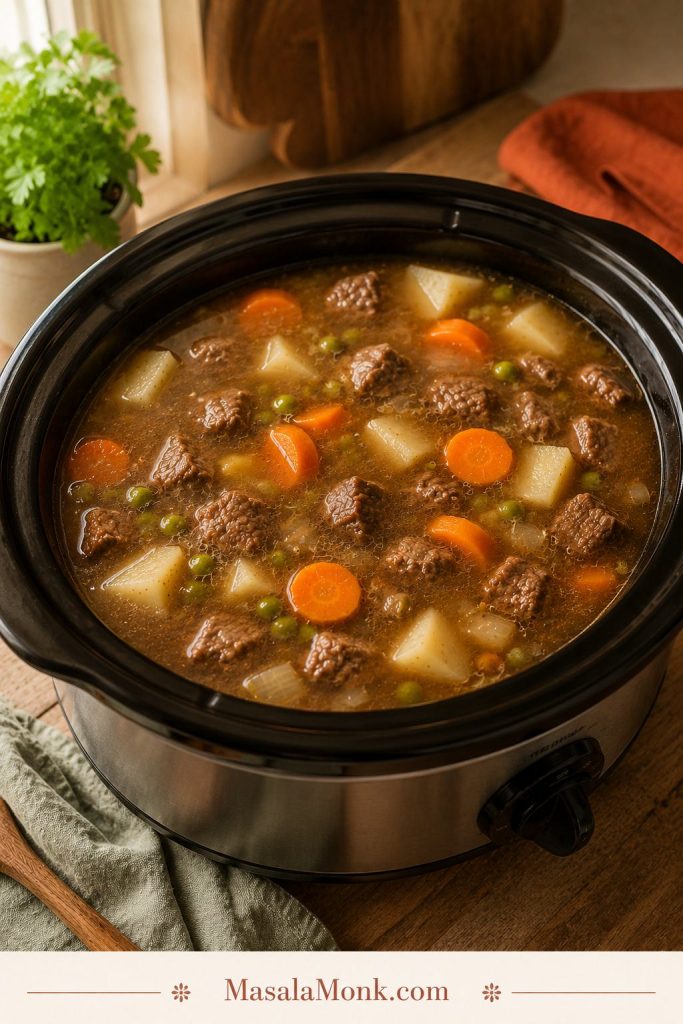
Cut potatoes into large chunks, about 1½ inches. Cut carrots into thick pieces. Small vegetable pieces can become mushy after 8 hours.

Vegetable cue: Cut potatoes and carrots larger than you would for soup because they need to survive the full slow-cooker time.
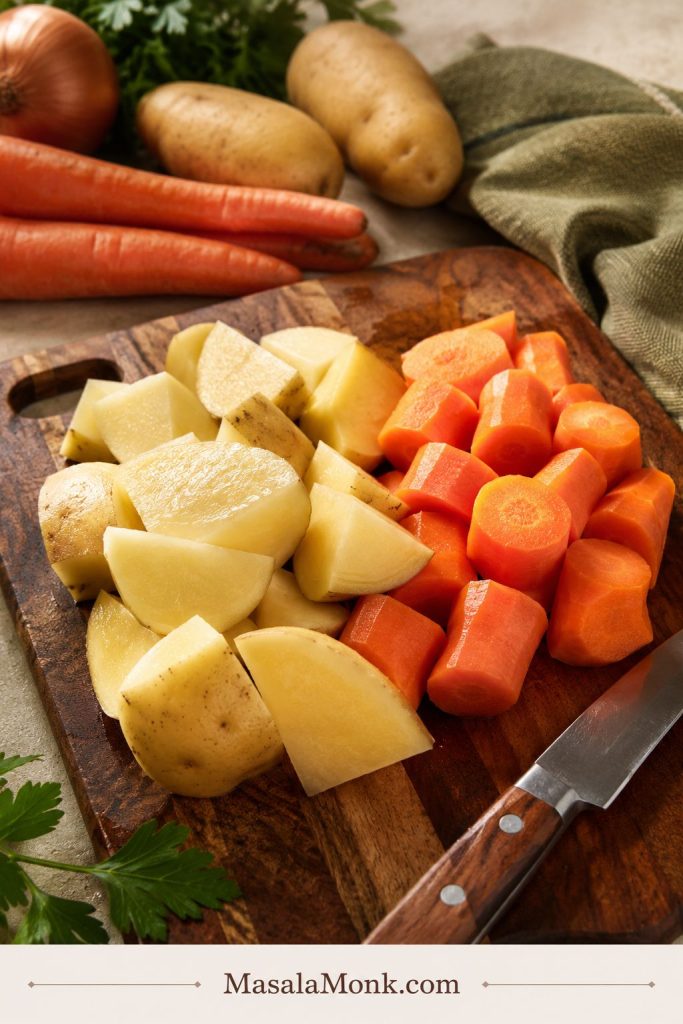
Large potato chunks and thick carrot pieces on a wooden cutting board with a knife and whole vegetables nearby.
Cut the vegetables for the long cook, not for a quick soup. Larger potato and carrot pieces hold their shape while the beef finishes tenderizing.

Step 2: Season and Flour the Beef

Season the beef with salt and pepper, then toss with flour. The coating should be light and even. Shake off any heavy clumps.

That light coating helps the beef brown in the skillet and gives the stew more body later.

Flour cue: The coating should look light and dusty, not thick or clumpy, so the gravy gains body without turning pasty.
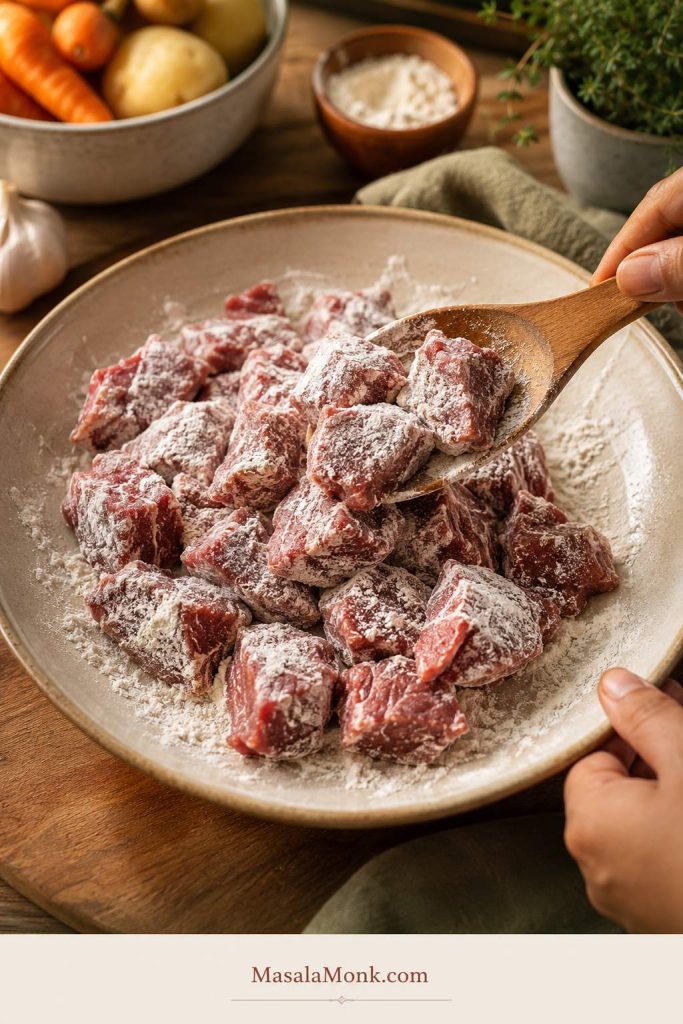
Raw beef chunks lightly coated with flour in a shallow bowl on a kitchen counter.
A thin flour coating helps the beef brown and gives the gravy a head start. Keep it light so the final stew does not taste pasty.

Step 3: Brown the Beef, If You Have Time

Heat oil in a large skillet. Brown the beef in batches, leaving space between pieces. Crowding the pan makes the beef steam instead of brown.

You only need to brown the outside. The beef will finish cooking in the slow cooker.

Browning cue: Give the beef room in the skillet so the outside browns deeply before it goes into the slow cooker.
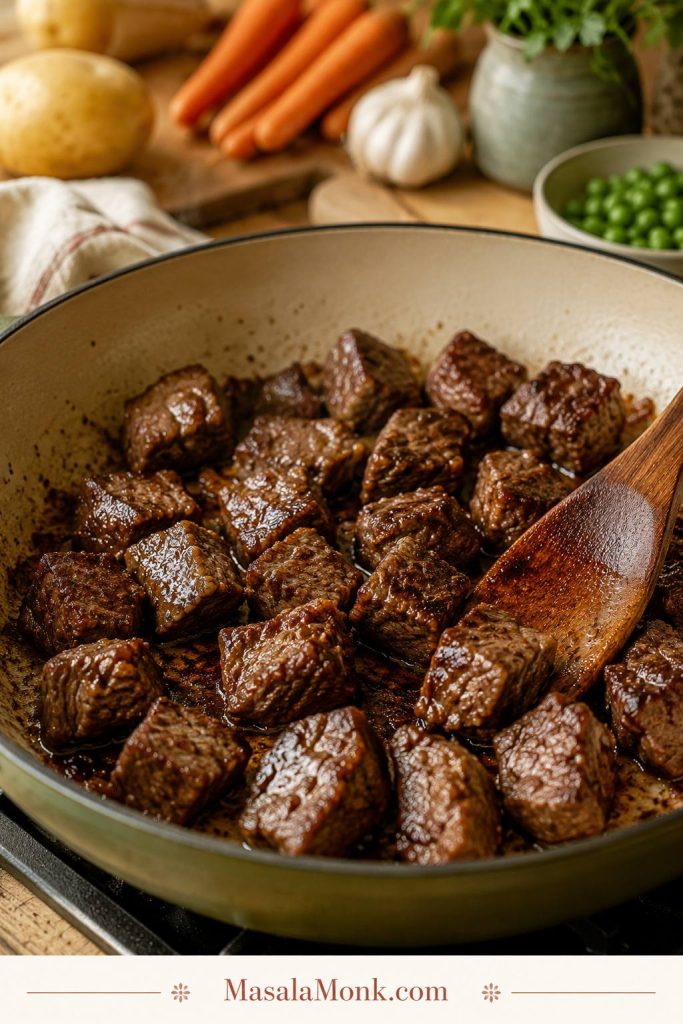
Beef cubes browning in a skillet with seared edges and space between the pieces.
Browning is optional, but it adds roasted depth. Leave space between the beef pieces so they sear instead of steaming in the pan.

Step 4: Build the Flavor Base

After browning the beef, use the same skillet for onion, garlic, and tomato paste. Then add wine or broth to loosen the browned bits from the pan. Those browned bits bring depth into the stew.

Flavor-base cue: Cook the tomato paste briefly with onion and garlic so the gravy tastes deeper, not raw or sharp.
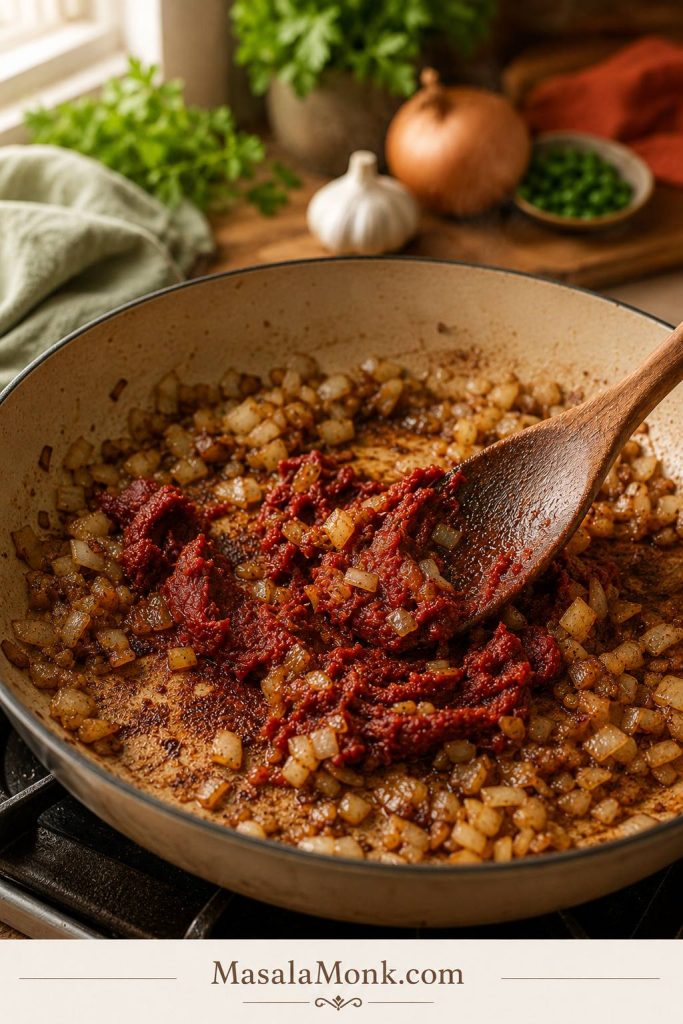
Tomato paste, onions, and garlic cooking in a skillet with a wooden spoon.
Then cook the tomato paste with the onions and garlic. This deepens the flavor and keeps the gravy from tasting sharp or raw.

Deglazing cue: Scrape up the browned bits before they are lost; they are concentrated flavor for the slow-cooker gravy.
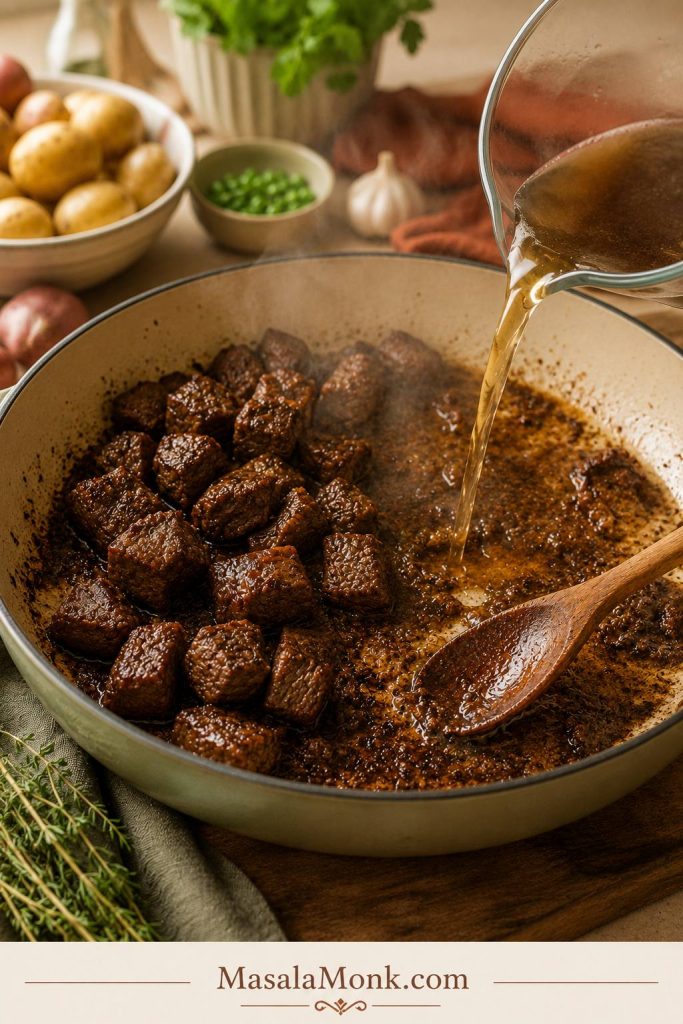
Liquid being poured into a skillet while a wooden spoon scrapes browned bits from the pan.
After browning, deglaze the skillet before adding everything to the slow cooker. Those browned bits turn into extra flavor in the gravy.

For the no-browning version, whisk the tomato paste, Worcestershire sauce, balsamic if using, and broth together before pouring them over the beef and vegetables. This helps the tomato paste blend in instead of sitting in clumps.

Step 5: Load the Slow Cooker

Add potatoes and carrots toward the bottom and sides because they can handle the long cook. Add the beef over and among the vegetables, then add the onion mixture, broth, Worcestershire sauce, balsamic if using, celery, herbs, and bouillon or beef base if using.

Stir gently so everything is distributed, but do not worry if the ingredients are not fully submerged. Save the peas and cornstarch slurry for the finish.

Step 6: Cook Until the Beef Gives Easily

Cook on low for about 8 hours. Low is the best setting for tender beef because it gives the meat time to soften gradually.

On high, start checking around 4 hours, then continue until the beef is tender. Chewy beef usually needs more time, not more heat.

Keep the lid on as much as possible. Opening it repeatedly releases heat and makes the timing less predictable.

Doneness cue: Trust the fork more than the timer; the beef should give easily before you call the stew done.

A fork pressing into a cooked brown beef chunk in stew with gravy, potatoes, carrots, and peas nearby.
The timer is not the final test. The beef is ready when it gives under a fork and starts to separate into soft fibers.

Potato cue: The potato pieces should be tender but still visible, which is why large chunks matter from the beginning.
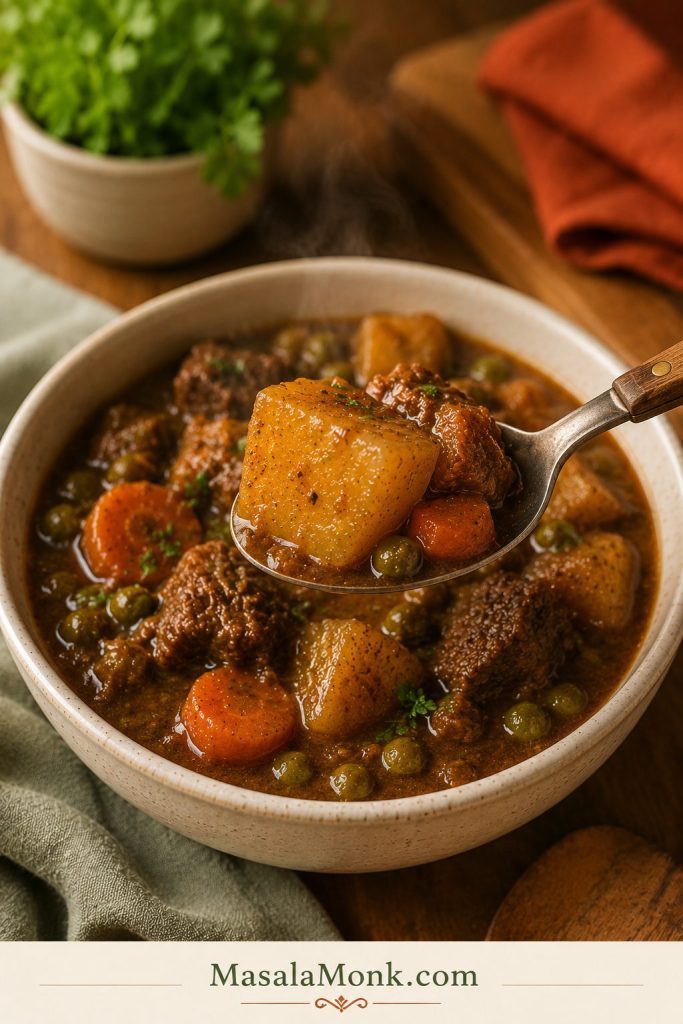
A spoon lifting a cooked potato chunk from beef stew while the potato holds its shape and gravy clings to it.
Meanwhile, the potatoes should stay intact. Soft edges are good; falling-apart potatoes usually mean the pieces were cut too small.

Step 7: Add Peas and Finish the Gravy

Mix cornstarch with cold water in a small bowl. Stir until smooth, then pour it into the stew. Add frozen peas. Cover and cook on high for 20 to 30 minutes.

Before-thickening cue: Judge the gravy after the long cook, not before, because the beef and vegetables release liquid as they soften.

Cooked beef stew in a slow cooker with beef, potatoes, carrots, peas, steam, and loose gravy before thickening.
After the long cook, the stew may look slightly loose. Do not panic yet; this is the right time to judge the real liquid level.

Slurry cue: Mix starch with cold water first so it disappears smoothly into the hot stew instead of clumping.
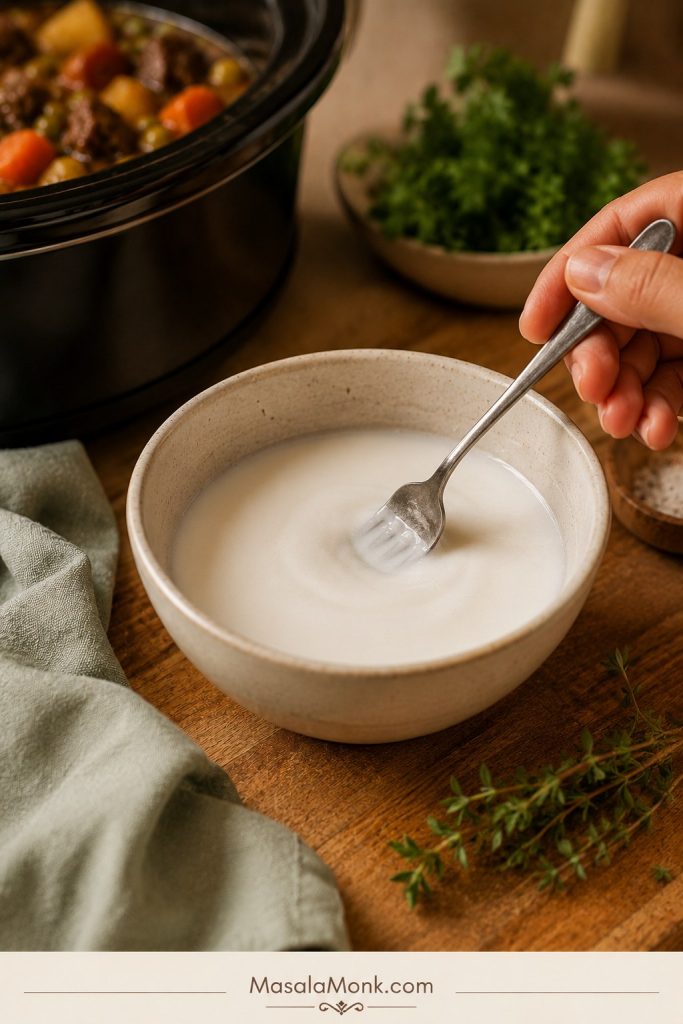
A small bowl of smooth cornstarch slurry being stirred with a spoon on a kitchen counter.
Mix cornstarch with cold water before it touches the stew. A smooth slurry thickens the gravy evenly and prevents dry clumps.

Thickening cue: Add slurry near the end, once you can see exactly how much liquid is in the pot.
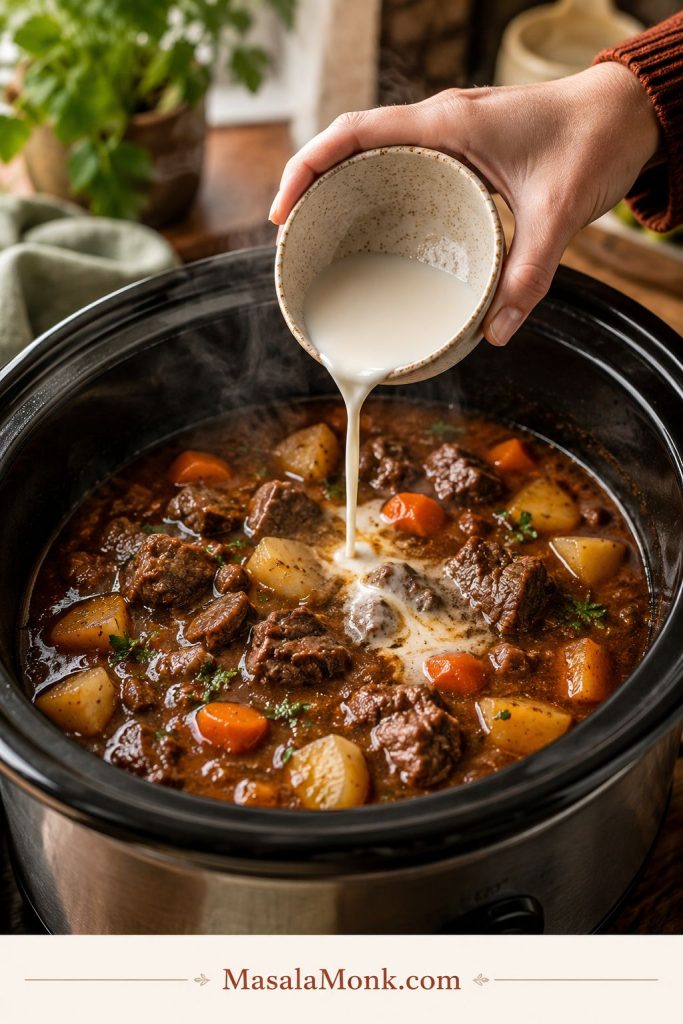
A hand pouring white cornstarch slurry into hot beef stew in a slow cooker with beef, potatoes, and carrots visible.
Now thicken only what the slow cooker actually made. Adding slurry near the end gives you control over the final gravy texture.

Pea cue: Frozen peas only need a short finish, so add them late instead of letting them cook all day.
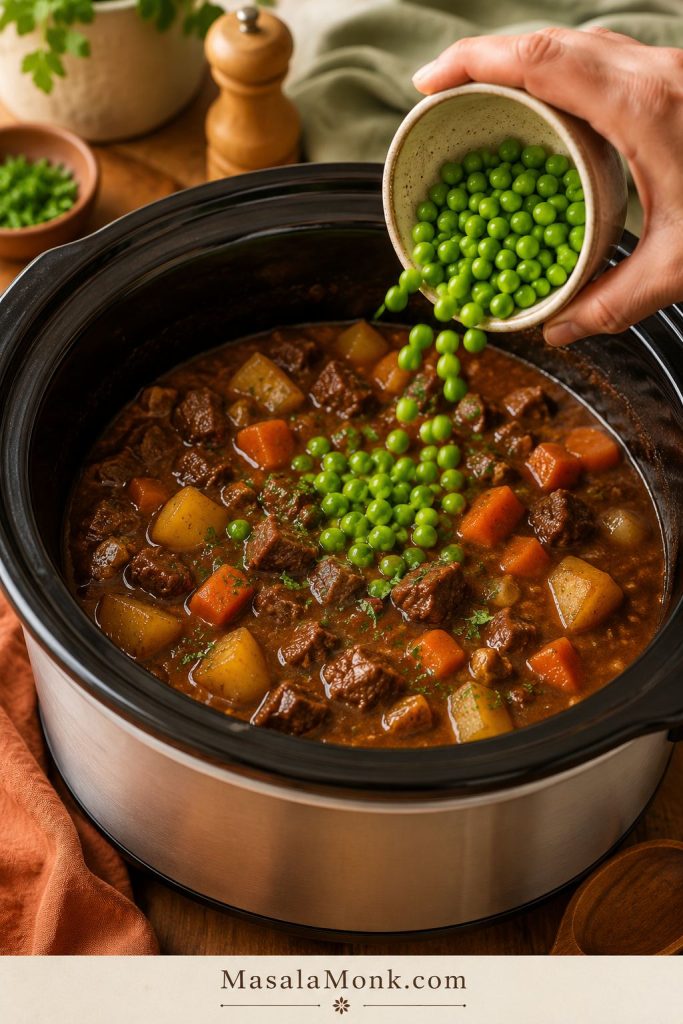
Bright green peas being poured from a small bowl into hot beef stew in a slow cooker.
Add peas late so they stay bright and sweet. If they cook all day, they lose color before the beef has time to become tender.

The gravy should turn glossier and begin to coat a spoon. A good stew often looks slightly under-liquid before cooking and glossy after this final step.

Texture cue: The gravy is finished when it looks glossy and clings to a spoon instead of running off like broth.
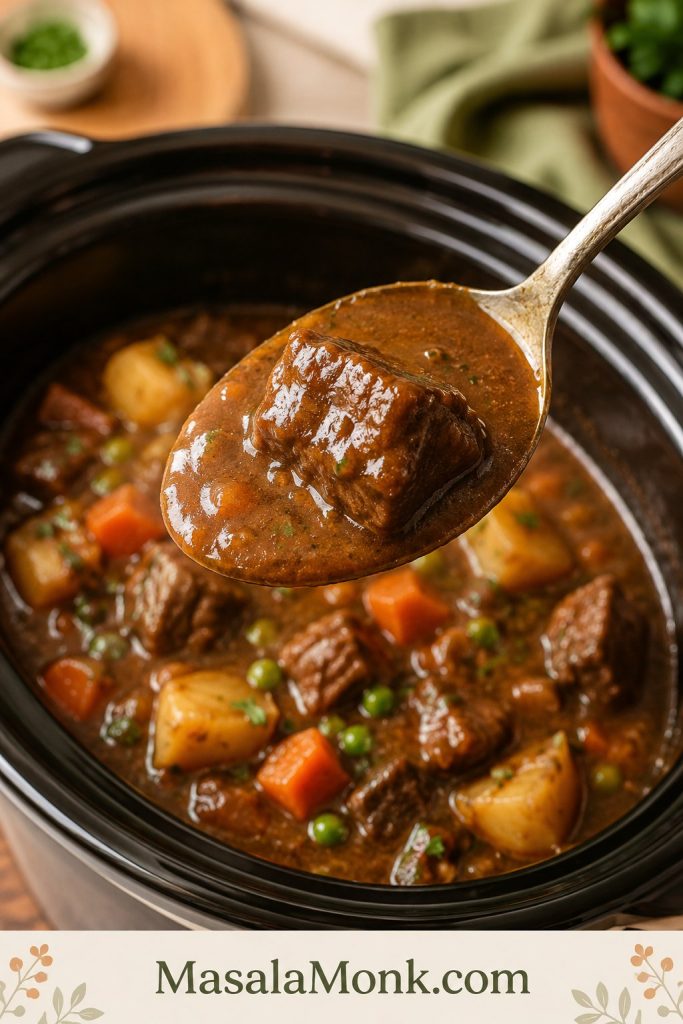
A spoon lifted above a slow cooker with thick brown gravy and a beef chunk coating the spoon.
Finally, check the spoon. The gravy should cling lightly and look glossy; if it runs like broth, give it more thickening time.

Step 8: Rest Before Serving

Let the stew rest for 10 to 15 minutes before serving. This gives the gravy time to settle and makes the stew easier to serve without breaking up the potatoes.

Resting cue: A short rest helps the finished gravy settle around the beef and vegetables before you ladle the stew.
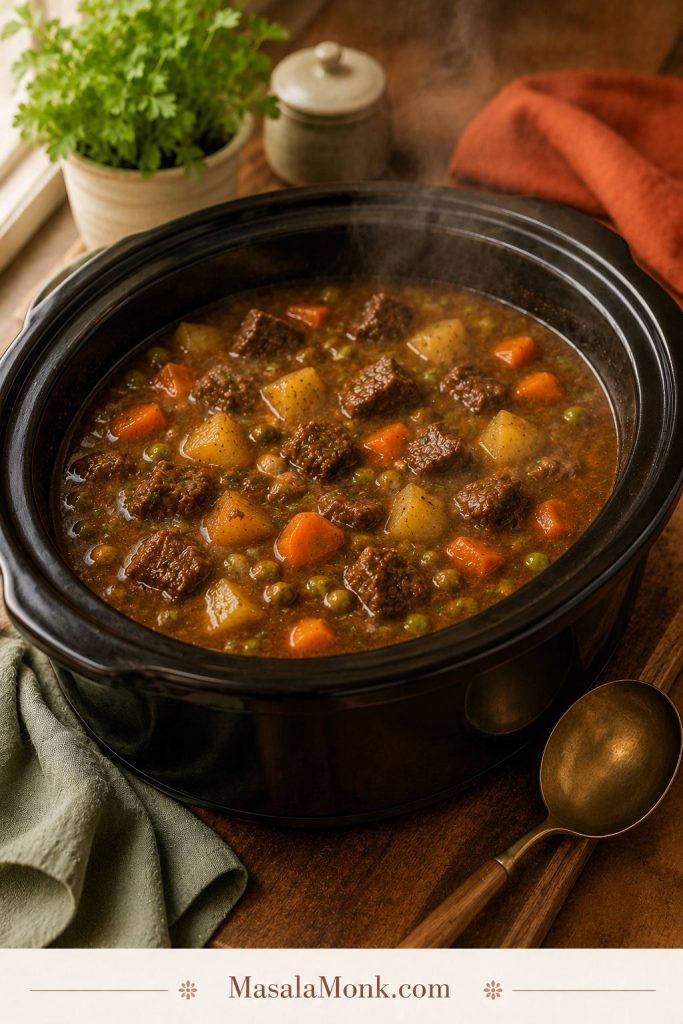
Finished beef stew in a dark slow cooker with a ladle, steam, beef chunks, potatoes, carrots, peas, and brown gravy.
Once the gravy has thickened, let the stew rest briefly. This helps the sauce settle around the beef and vegetables before serving.

How Long to Cook It

Beef stew is done when the beef is soft enough to spoon apart, not just when the timer ends.

Setting Time Best Use
Low 8 to 9 hours Best tenderness and flavor
High 4 to 5 hours Faster option, but slightly less forgiving
Finish on high 20 to 30 minutes Thickening after slurry

Low is the better default for beef stew. High is fine when dinner needs to move faster, but low gives chuck roast and stew meat more time to soften. A perfect gravy around chewy beef is still not done, so let the meat lead the timing.

Slow cookers vary. If yours runs hot, check the stew a little earlier and keep the potato chunks large. If yours runs cool, the beef may need extra time on low.

How to Thicken the Gravy

Do not worry about perfect thickness at the start. Once the beef is tender and the vegetables have released their moisture, the slow cooker will show you what the gravy actually needs.

Body builds in two stages: a light flour coating at the start and a slurry at the finish. Think of the slurry as the final polish, not a rescue for bad stew.

Thickening Method Best For When to Add How to Use It
Flour on beef Body from the start Before cooking Toss beef lightly with flour before browning or slow cooking.
Cornstarch slurry Quick glossy finish Last 20–30 minutes Mix cornstarch with cold water, then stir into hot stew.
Arrowroot slurry Gluten-free or paleo-style thickening Last 10–20 minutes Add near the end and stop once the gravy thickens.
Mashed potatoes Natural thickening After potatoes are soft Mash a few potato pieces into the gravy.
Saucepan reduction Very loose stew At the end Reduce some liquid on the stove, then stir it back in.

Flour at the Beginning

The flour coating on the beef gives the stew some body as it cooks. If you brown the beef, the flour also helps create a richer surface and better color.

Use only enough flour to coat the beef lightly. Too much flour can make the gravy heavy or pasty.

Why the Slurry Waits Until the End

A cornstarch slurry is the easiest way to control the final texture. Always mix cornstarch with cold water before adding it to the hot stew. Dry cornstarch can clump if it goes straight into the slow cooker.

Do not add the slurry at the beginning. It can thin out or lose thickening power during the long cook. Add it after the long simmer, when you can see how much liquid is actually in the pot.

Use 2 tablespoons cornstarch mixed with ¼ cup cold water for the standard finish. For an extra-thick gravy, increase the cornstarch to 3 tablespoons while keeping the water at ¼ cup.

Emergency Fix for Very Thin Gravy

For very thin gravy, ladle some of the liquid into a saucepan and simmer it on the stove until reduced. Stir the reduced liquid back into the slow cooker. This is the fastest way to rescue a stew that started with too much broth.

Do not dump dry flour or cornstarch directly into the slow cooker. Do not add a large amount of flour at the end, or the stew can taste raw and pasty. Wait to fix the thickness until the beef is tender.

Back to top ↑

Crock Pot Beef Stew: Is It the Same Recipe?

Yes. Crock Pot is a type of slow cooker, so the same method works either way.

For the full recipe, a 6-quart / 5.7 L slow cooker is ideal. A 5-quart cooker can work if it is not overfilled, while a 7-quart cooker may leave the stew sitting a little shallower depending on the model.

Using a 3-quart cooker? Follow the small-batch version below.

Easy Dump-and-Go Method

This is the basic version for days when you want the stew started fast. Using a packet too? Check the seasoning packet notes so the stew does not become too salty.

Toss the beef with flour, salt, and pepper. Add it to the slow cooker with the potatoes, carrots, celery, and onion. Whisk the broth, tomato paste, Worcestershire sauce, balsamic if using, and beef base if using, then pour it over the top. Add the herbs, cover, and cook on low until the beef is tender.

During the final 20 to 30 minutes, stir in the cornstarch slurry and frozen peas. Browning gives better flavor, but this version still gives you a warm, hearty stew with very little effort.

Dump-and-go cue: Whisk the broth mixture before pouring it in so the tomato paste and seasonings reach the whole pot.
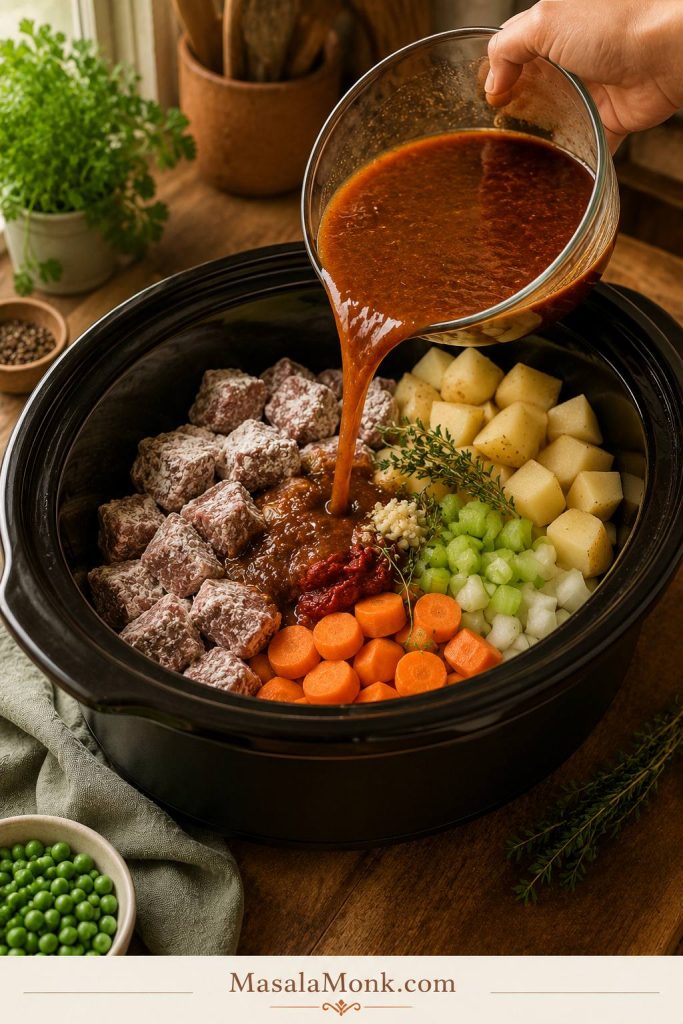
Raw beef, potatoes, carrots, onion, celery, herbs, and broth mixture being added to a dark slow cooker.
For the dump-and-go method, mix the broth, tomato paste, and seasonings well first. That gives the no-browning version a stronger base.

Can I Use Onion Soup Mix or a Beef Stew Seasoning Packet?

Yes, you can use onion soup mix or a beef stew seasoning packet. Shortcuts are not the problem. Stacking salty shortcuts is the problem.

Packets, bouillon, beef base, gravy mix, and store-bought broth can all be salty. Low-sodium broth gives you more room to adjust later.

A packet can add seasoning, but it does not automatically fix a loose gravy. You still need to control the amount of liquid and finish the texture once the stew has cooked. Taste after thickening, because salt can seem stronger once the gravy tightens.

Shortcut How to Use It What to Reduce
Onion soup mix Add 1 packet with the broth for a savory onion-style stew. Reduce salt and skip bouillon or beef base at first.
Beef stew seasoning packet Use as the main seasoning base for an easy family-style version. Use low-sodium broth and taste before adding more salt.
Brown gravy mix Use only if you want a packet-style thick gravy. Reduce cornstarch slurry so the stew does not become gummy.
Bouillon or beef base Use a small amount for deeper beef flavor. Reduce added salt and avoid stacking too many salty shortcuts.

Shortcut rule: if using a seasoning packet, skip the bouillon or beef base in the main recipe first. You can always add more flavor later, but it is harder to fix an over-salty stew.

Variations

Once the liquid and timing are right, you can change the flavor without throwing off the stew. Keep the liquid ratio steady when adding mushrooms, beer, or extra vegetables, then adjust the texture at the end.

Red Wine Slow Cooker Beef Stew

Use ½ cup red wine along with the beef broth. If browning the beef, use the wine to deglaze the pan before adding everything to the slow cooker. The wine gives the stew a deeper, rounder flavor.

Slow Cooker Beef Stew Without Wine

Replace the wine with extra beef broth, using 3 cups / 720 ml total broth. Keep the Worcestershire sauce and optional balsamic for depth. You can also add a little extra tomato paste or beef base if you want a richer flavor.

Guinness or Beer Beef Stew

Replace the red wine with stout or another dark beer. This gives the stew a darker, slightly malty flavor without changing the basic slow-cooker method.

Mushroom Beef Stew

Add 8 oz / 225 g sliced mushrooms. For best texture, sauté them briefly after browning the beef, then add them to the slow cooker. Mushrooms release liquid, so do not increase the broth.

Gluten-Free Slow Cooker Beef Stew

Use gluten-free flour to coat the beef, or skip the flour and rely on cornstarch or arrowroot slurry at the end. Make sure your Worcestershire sauce, broth, bouillon, and seasoning packets are gluten-free if needed.

Low-Carb or Keto-Style Beef Stew

For a lower-carb version, replace potatoes with turnips, radishes, mushrooms, or extra celery and carrots. Because potatoes and flour do a lot of the thickening here, keep the low-carb version simple and adjust the gravy at the end with a small amount of slurry if needed.

Beef Stew Over Rice

Serve leftovers over rice to stretch the meal. This works especially well if the stew has plenty of gravy. Cooking for two instead of making the full pot? Use the small-batch amounts. For fluffy grains that soak up sauce without turning mushy, use this guide on how to cook perfect rice.

Rice cue: Serve leftovers over rice when you want the gravy to stretch further and make a smaller amount feed more bowls.
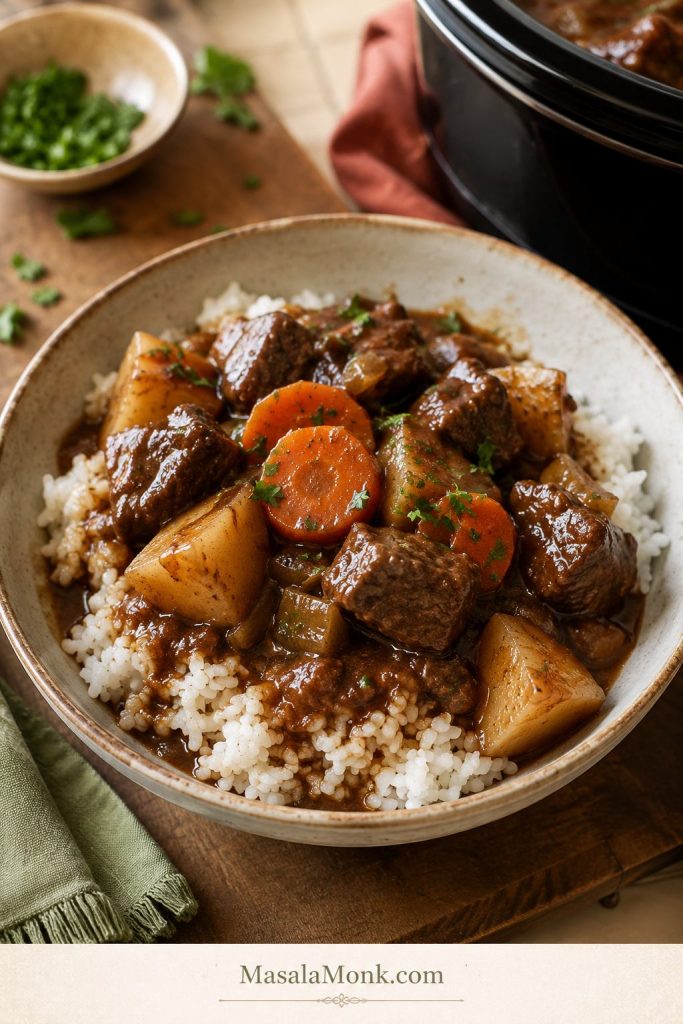
Beef stew with beef, potatoes, carrots, and glossy brown gravy served over white rice in a bowl.
For leftovers, rice stretches the stew and catches extra gravy. It is especially useful when you want one pot to feed more bowls.

Small-Batch Version for Two

For one or two people, a 3-quart slow cooker is the better fit. The method stays the same, but the liquid needs to stay restrained.

Ingredient or Detail Small-Batch Amount
Beef ¾ to 1 lb / 340–450 g
Potatoes ½ lb / 225 g
Carrots 2 medium
Onion ½ medium
Beef broth and wine combined 1 to 1½ cups / 240–360 ml
Flour 1 to 1½ tablespoons / 8–12 g
Cornstarch 1 tablespoon / 8 g
Cold water for slurry 2 tablespoons / 30 ml
Slow cooker size 3-quart
Cook time 7 to 8 hours on low

A small slow cooker does not need much broth. The ingredients should not be swimming at the start. If your 3-quart cooker runs hot, start with the lower end of the liquid range and adjust near the end only if needed.

Small-batch cue: Match the recipe to the cooker size so a smaller amount of stew does not spread too thin.
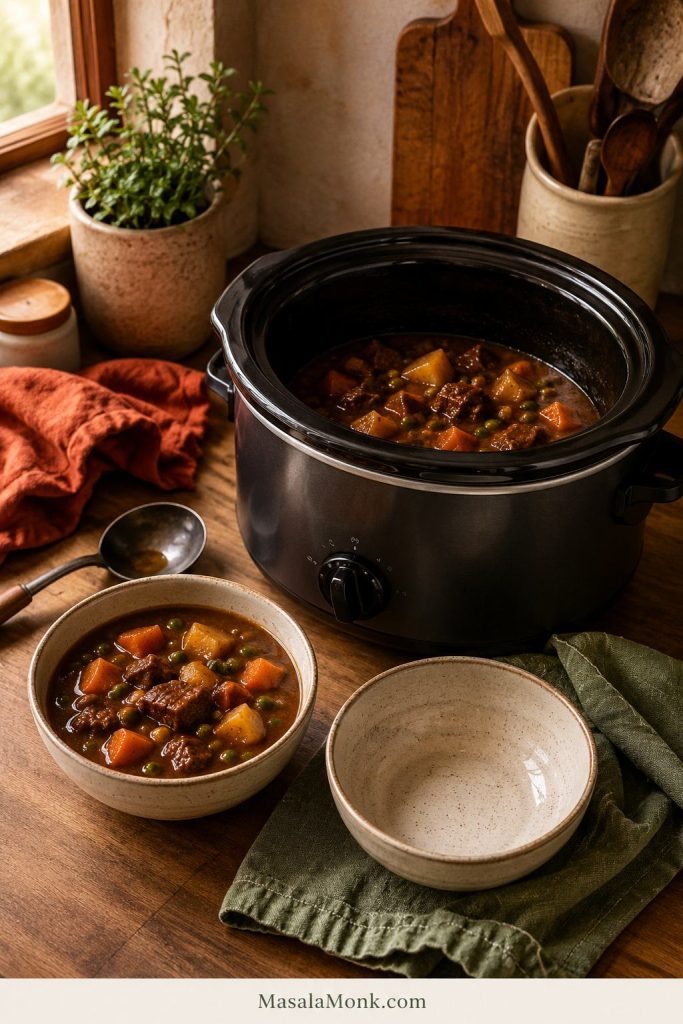
A compact slow cooker with a modest amount of beef stew and two small bowls nearby, one filled and one empty.
For a small-batch beef stew, scale the pot as well as the ingredients. A compact cooker helps the stew stay rich instead of spreading too shallow.

Troubleshooting: Thin Gravy, Tough Beef, Mushy Potatoes

Stew is more forgiving than it looks. A thin pot, chewy beef, or bland broth does not mean dinner is lost; most fixes happen in the final stretch, once the beef is tender and you can see what the gravy actually needs.

Quick Fixes by Problem

Problem Likely Reason Fix
Stew is watery Too much broth, trapped steam, or vegetables releasing moisture Add slurry, cook uncovered on high, or reduce some liquid in a saucepan.
Beef is tough It has not cooked long enough, or the pieces are uneven Keep cooking on low until the beef is fork-tender.
Potatoes are mushy Pieces were too small or potatoes were too soft Use Yukon gold or red potatoes and cut them into larger chunks next time.
Carrots or potatoes are still firm Pieces were very large or the slow cooker runs cool Keep cooking on high for 20 to 40 minutes. If the beef is already perfect, remove the firm vegetables, simmer or microwave them with a splash of broth until tender, then return them to the stew.
Gravy tastes bland Needs more salt, umami, browning, or acidity Add Worcestershire, beef base, tomato paste, salt, or a tiny splash of vinegar.
Stew is too salty Packet, broth, or bouillon added too much salt Add unsalted broth if there is room, or serve over rice, potatoes, or noodles.
Stew is too thick Slurry thickened more than expected or stew rested/chilled Stir in warm broth a splash at a time until the gravy loosens.
Gravy is lumpy Dry starch was added directly Always mix cornstarch with cold water before adding it.
Stew is greasy Fatty beef or surface fat was not skimmed Skim the top before thickening.
Peas are dull and mushy They were added too early Add frozen peas during the last 10 to 20 minutes.

Back to top ↑

Storage, Freezing, and Reheating

Leftovers are one of the quiet rewards of beef stew. The gravy settles, the flavors round out, and the next bowl often tastes even deeper. For pairing ideas, jump to what to serve with beef stew.

Let the stew cool, then store leftovers in airtight containers. The gravy thickens as it chills, so do not be surprised if it looks firmer the next day.

Storage cue: Expect the gravy to thicken in the fridge, then loosen leftovers gently only if they need it.
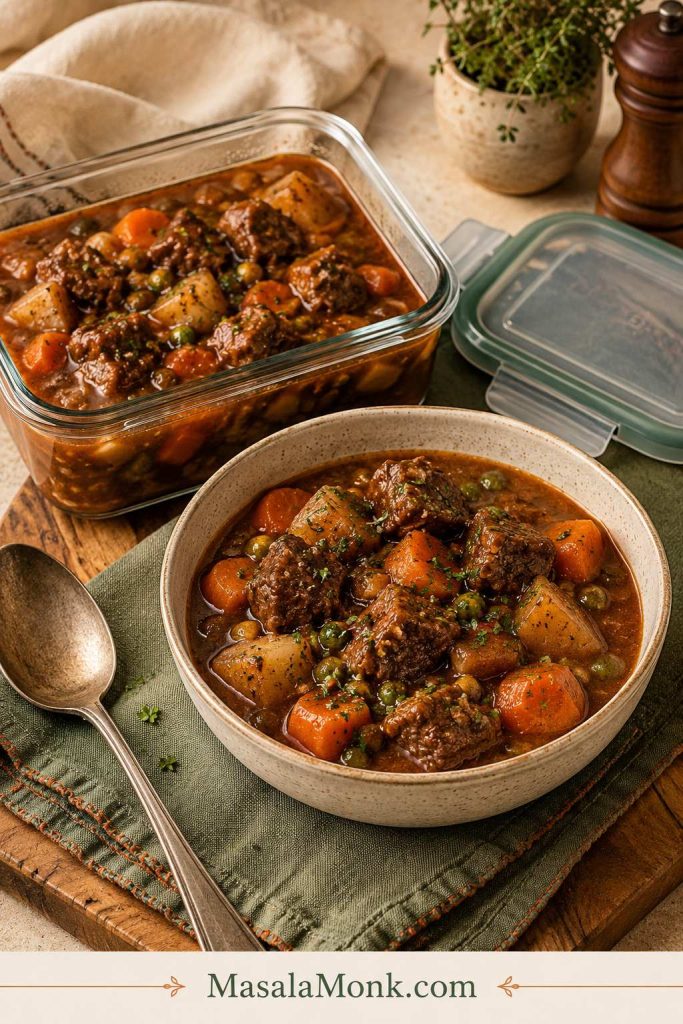
Beef stew in a glass storage container with a reheated bowl of stew nearby on a kitchen counter.
The next day, the gravy will usually be thicker. Reheat gently and loosen it with a small splash of broth only if needed.
Storage Method Time Reheating Note
Refrigerator Up to 4 days Add a splash of broth or water if the gravy is too thick.
Freezer Up to 3 months Potatoes may soften slightly after thawing, but the flavor stays good.
Reheating Until steaming hot throughout Reheat gently on the stove or in the microwave, stirring occasionally.

One safety note: do not put frozen beef directly into the slow cooker. Thaw it first so it heats evenly and safely. The USDA slow cooker safety guide recommends thawing meat or poultry before slow cooking.

Frozen peas or frozen mixed vegetables are fine near the end because they are small and heat quickly.

Can I Prep It the Night Before?

Yes. You can cut the vegetables, trim the beef, and measure the seasonings the night before. Store everything covered in the refrigerator. If you brown the beef ahead, cool it quickly and refrigerate it separately or with the vegetables.

Do not leave the filled slow cooker insert sitting at room temperature for hours before cooking. Add the chilled ingredients to the slow cooker when you are ready to start the recipe, then begin cooking right away.

What to Serve With Beef Stew

A bowl of this can stand on its own, but the gravy almost demands something to catch it.

Serving cue: A good ladleful should bring beef, vegetables, and gravy together, not leave the chunks behind.
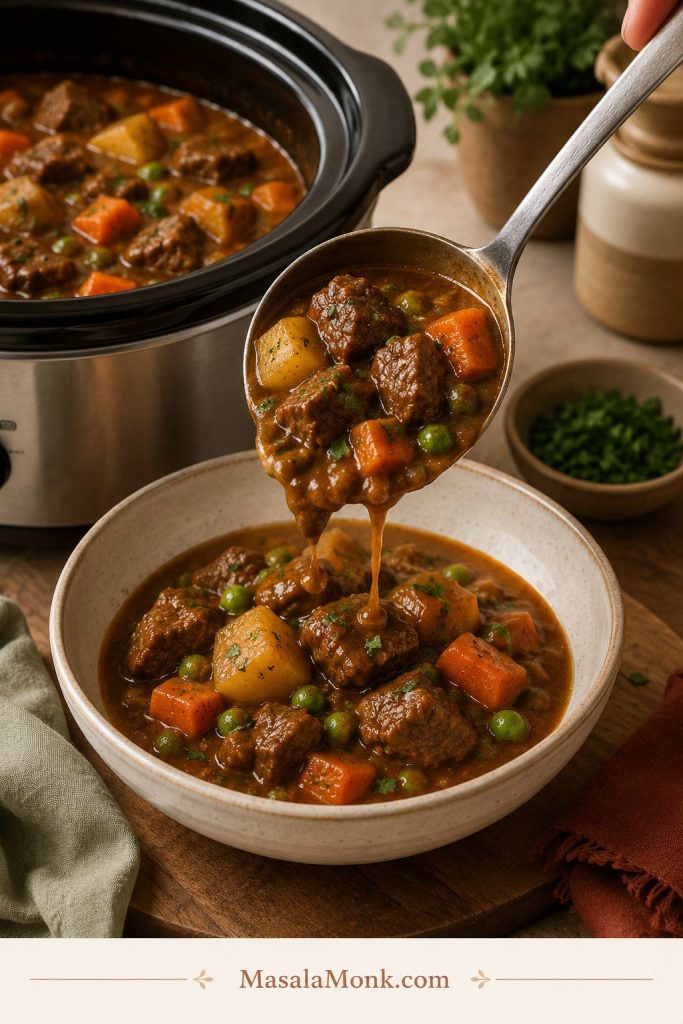
A ladle pouring beef stew with beef, potatoes, carrots, peas, and gravy into a light stoneware bowl.
When ladling, each serving should carry both chunks and gravy. That balance is what makes the bowl feel hearty instead of brothy.

For Soaking Up the Gravy

Bread cue: If the gravy clings to bread, the liquid balance and thickening step did their job.
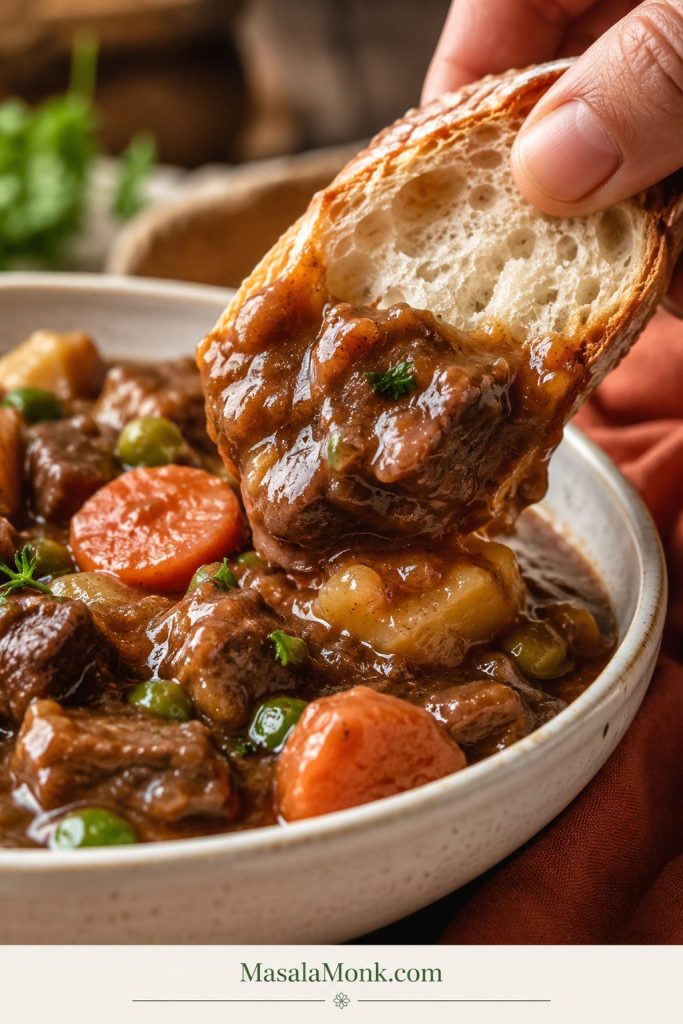
A hand dragging crusty bread through thick beef stew gravy at the edge of a bowl.
This is the payoff for controlling the liquid: gravy thick enough to cling to bread, not just soak it with thin broth.

For Stretching Leftovers

  • Mashed potatoes
  • Rice
  • Buttered noodles
  • Toast
  • Pot pie crust

Leftover cue: Thick stew over mashed potatoes turns the same pot into a second dinner without making the bowl watery.
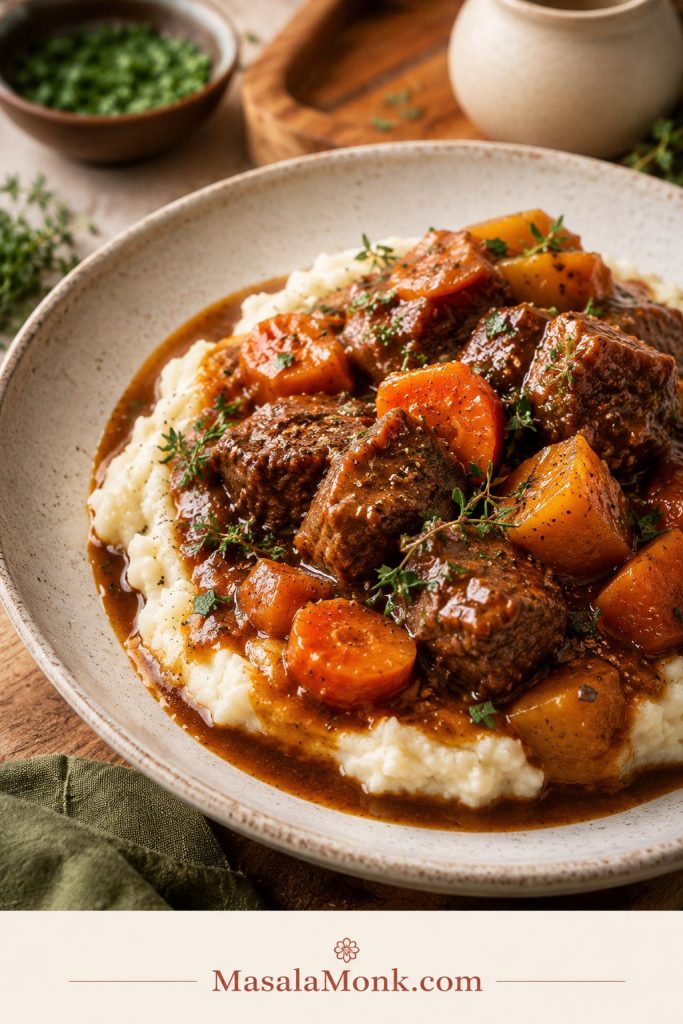
Beef stew with beef, carrots, potatoes, and brown gravy served over creamy mashed potatoes.
For a second serving idea, spoon the stew over mashed potatoes. Thick gravy should pool into the potatoes without making them watery.

For Something Fresh on the Side

  • Green salad
  • Cabbage slaw
  • Roasted green beans
  • Steamed peas
  • Chickpea salad

Frequently Asked Questions

These are the questions that usually come up once the stew is actually in the pot.

Should beef stew be covered with liquid in the slow cooker?

Not fully. The beef and vegetables should be moistened and surrounded by broth, but they do not need to be completely covered like soup. The ingredients release liquid as they cook, and too much broth at the start can make the stew watery.

Why is my slow cooker beef stew watery?

The usual reason is too much added broth. Vegetables also release moisture, and the covered slow cooker traps steam. Use less liquid at the start and thicken near the end with a cornstarch slurry.

How do I thicken slow cooker beef stew?

Use a slurry made from cornstarch and cold water, then stir it in during the final 20 to 30 minutes. For extra body, mash a few soft potato pieces into the gravy or reduce some liquid in a saucepan and stir it back in.

Why is my beef stew meat chewy after 8 hours?

It usually needs more time. Large pieces, cooler slow cookers, and collagen-rich cuts can take longer to soften. Keep cooking on low until the beef gives easily with a fork.

Can I use beef stew meat?

Yes. Beef stew meat is convenient and fits this recipe well. Check the pieces before cooking, cut very large chunks down, and keep cooking until the beef is tender all the way through.

What is the best beef for slow cooker beef stew?

Chuck roast is the first choice because it becomes tender and flavorful during long cooking. Beef stew meat also works well. Avoid very lean steak cuts because they can become dry or chewy in the slow cooker.

Can I put raw beef in slow cooker beef stew?

Yes. Browning adds flavor, but raw beef can go into the slow cooker. Toss it with seasoning and flour first.

Do I have to brown beef before adding it to the slow cooker?

No. Browning gives deeper color and flavor, but the no-browning version still works if you build flavor with tomato paste, Worcestershire sauce, optional balsamic, and beef base.

Is it better to cook beef stew on low or high?

Low is better for tenderness. High is fine when dinner needs to move faster, but low gives chuck roast and stew meat more time to soften.

How long does beef stew take in a slow cooker?

Most slow cooker beef stew takes about 8 hours on low or 4 to 5 hours on high. The exact time depends on your slow cooker and the size of the beef pieces. The stew is ready when the beef gives easily with a fork.

Can I add potatoes at the beginning?

Yes. Add potatoes at the beginning if they are cut into large chunks and you are using Yukon gold or red potatoes. Small pieces or softer russet potatoes can break down more during the long cook.

What potatoes are best for beef stew?

Yukon gold and red potatoes are best because they hold their shape. Russet potatoes work, but they soften more and can make the gravy cloudier.

Can I make slow cooker beef stew without wine?

Yes. Replace the wine with extra beef broth, using 3 cups / 720 ml total broth. Add Worcestershire sauce, optional balsamic vinegar, tomato paste, or beef base for extra depth.

Can I use onion soup mix?

Yes. Use low-sodium broth and reduce added salt because onion soup mix is salty. Skip bouillon at first.

Can I use gravy mix instead of cornstarch?

Yes, but add it carefully. Gravy mix already contains salt and thickener, so use less slurry and taste before adding more seasoning.

When should I add peas?

Add frozen peas during the last 10 to 20 minutes of cooking. They only need to heat through. Adding them at the beginning can make them mushy and dull.

Can I freeze slow cooker beef stew?

Yes. Freeze cooled stew in airtight containers for up to 3 months. The potatoes may become softer after thawing, but the flavor is still good.

Can I make this in a 3-quart slow cooker?

Yes. Use the small-batch version: ¾ to 1 lb / 340–450 g beef and 1 to 1½ cups / 240–360 ml total liquid. Keep the pot from looking flooded at the start.

Can I start with frozen beef?

No. Thaw the beef first before adding it to the slow cooker. Frozen peas or frozen vegetables are fine near the end because they heat quickly.

Can I prep this the night before?

Yes. Cut the vegetables, trim the beef, and measure seasonings ahead. Keep everything covered in the refrigerator. Start the slow cooker when you are ready to cook, not hours later on a delayed timer.

The Bottom Line: Tender Beef, Rich Gravy, Dinner Done

The best slow cooker beef stew is not complicated, but it does need the right balance. Use beef that benefits from long cooking, keep the liquid controlled, finish the gravy after the meat is tender, and let the stew rest before serving.

Once you know the liquid level your slow cooker likes, this becomes one of those dependable cold-weather dinners you can start early and trust. Keep the beef tender, the vegetables chunky, and the gravy finished at the end, and the whole pot feels calmer.

A good stew should feel generous, not complicated. Brown the beef when you want the deepest flavor. Skip browning when life is busy. Either way, the slow cooker gives you tender beef, soft vegetables, and a rich gravy that makes the kitchen smell like dinner has been taking care of itself all day.
Back to top ↑

Posted on Leave a comment

Chicken Liver Recipe with Onions: Tender, Rich, and Never Bitter

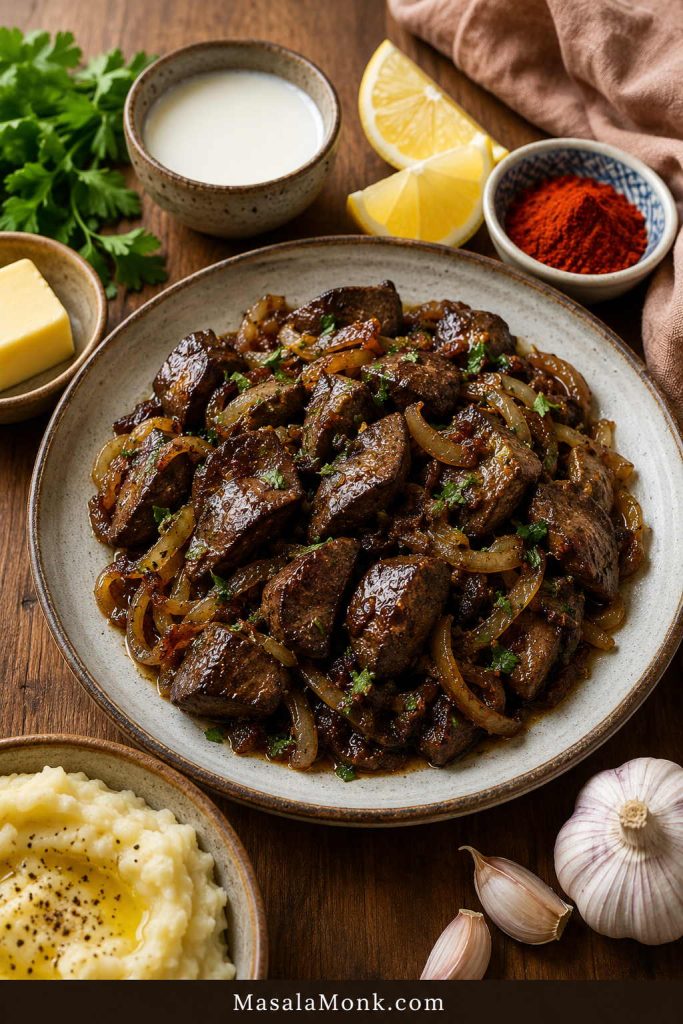
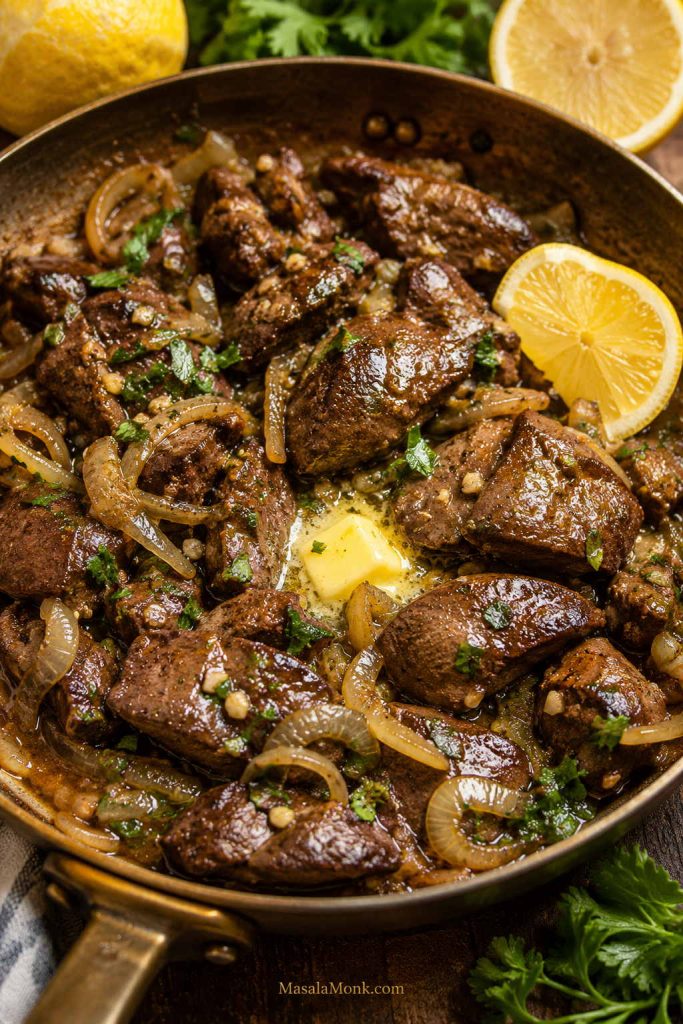
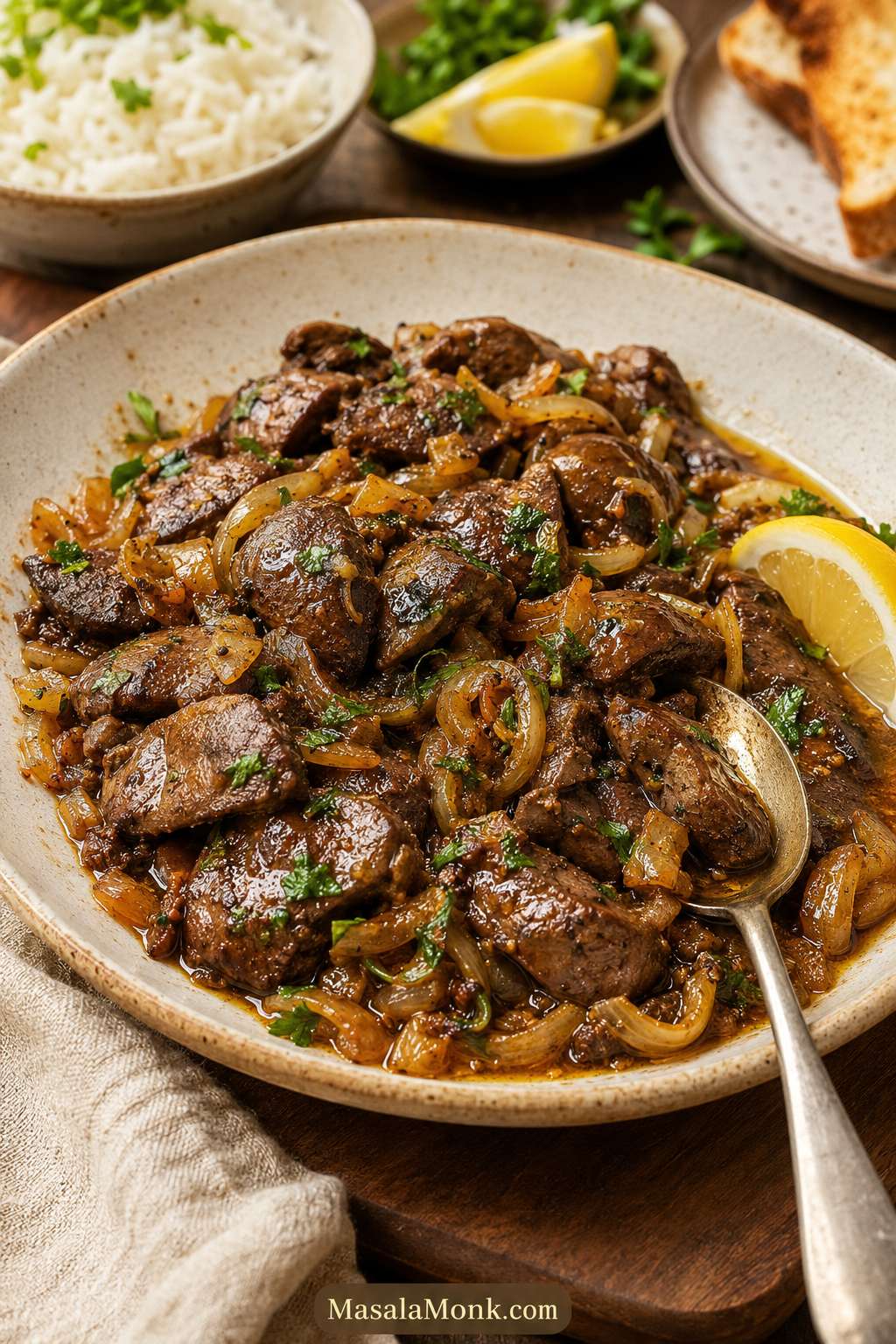
Finished chicken livers with golden onions, lemon wedges, herbs, and glossy pan juices in a warm serving dish.

Chicken liver has a reputation problem. Cooked badly, it can be bitter, dry, and hard to love. Cooked with a little care, it turns soft, savory, and deeply comforting — the kind of simple skillet dish where sweet onions, garlic, lemon, and a little butter do most of the work.

The method is simple: clean the livers, take away the bitter bits, dry them well, cook the onions until sweet, then sear the livers quickly and finish with garlic, lemon, and butter. Nothing fancy — just the few steps that make liver taste good.

This chicken liver recipe is for the nervous first-timer as much as the person who already loves liver. Most of the time is in the onions and prep; once the pan is hot, the livers themselves cook in about 5 to 7 minutes.

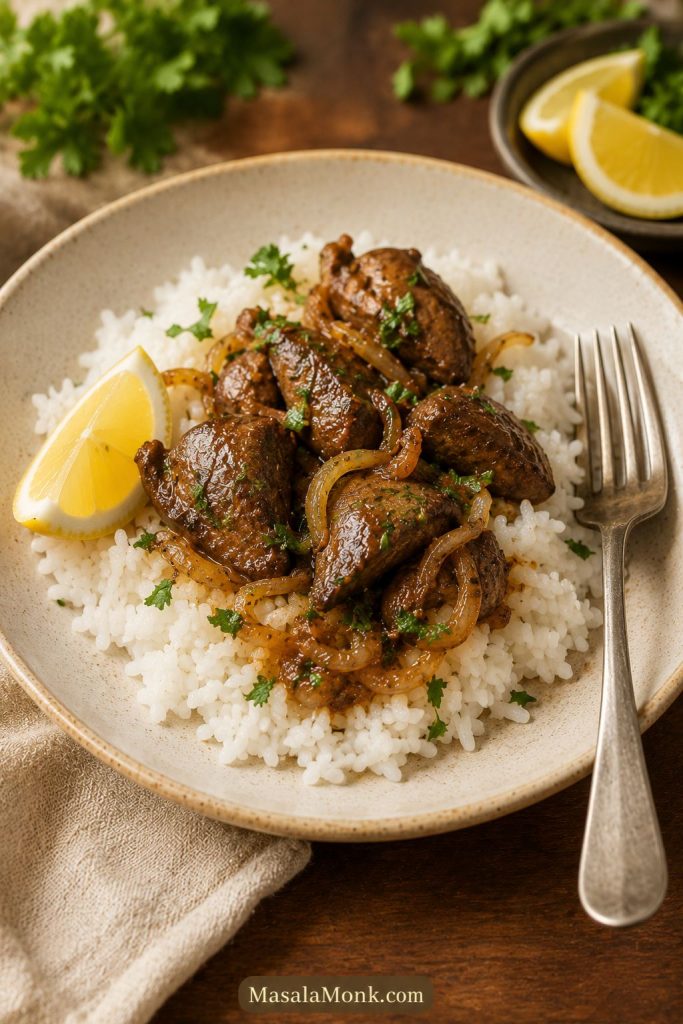
Good first plate: Use this section when you want chicken liver to feel milder, softer, and less intimidating.

Small serving of chicken liver with onions over rice, with lemon and herbs on a cream plate.
For a first plate, rice makes chicken liver feel softer and less intense, while lemon keeps each bite fresh.

Quick Answer: How to Cook Chicken Liver

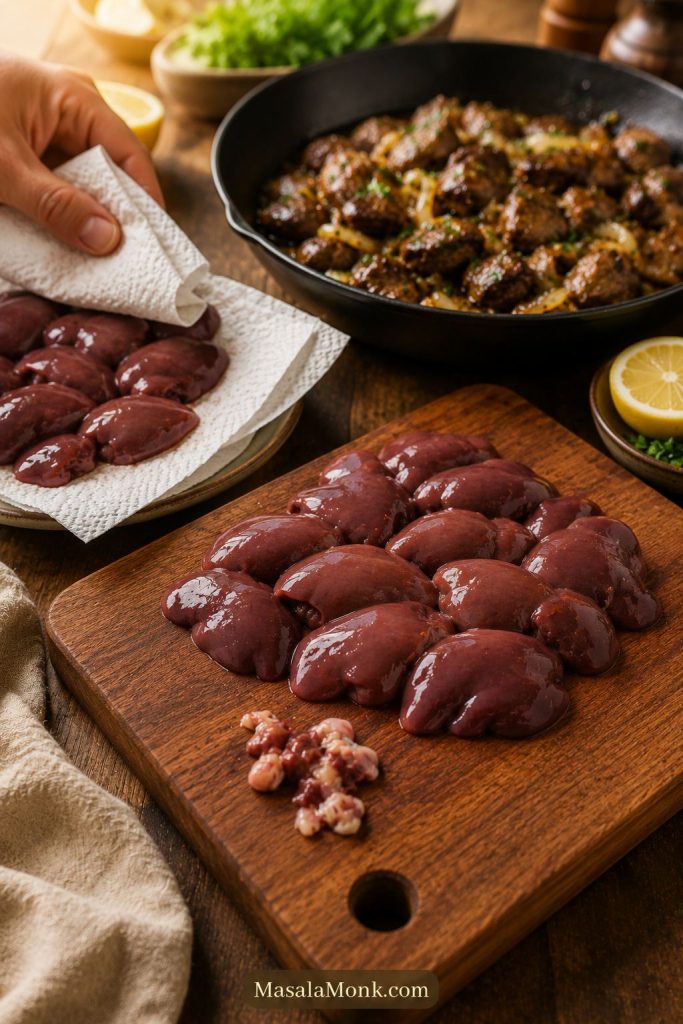
Trim away white connective tissue, fatty bits, dark clots, and any green or yellow-stained areas. Soak the livers in milk or lemon water if you want a milder flavor, then drain and pat them very dry.

Cook sliced onions first until soft and lightly golden, move them to a plate, then sear the livers in one layer for about 2 to 3 minutes per side. Use the largest piece as your guide and cook to 165°F / 74°C. Return the onions to the pan, add butter, garlic, lemon juice, herbs, and final seasoning, then serve warm.

Done right, the onions are glossy, the lemon brightens the pan, and the livers stay soft enough to cut with a fork.

The short version: trim carefully, dry well, give the livers space in the pan, and use a thermometer on the largest piece.

Before you cook: if doneness makes you nervous, read the safe temperature rule. If you are ready to start, go straight to the step-by-step method.

Quick setup: Get the livers, onions, garlic, lemon, herbs, and seasoning ready before the skillet starts moving fast.

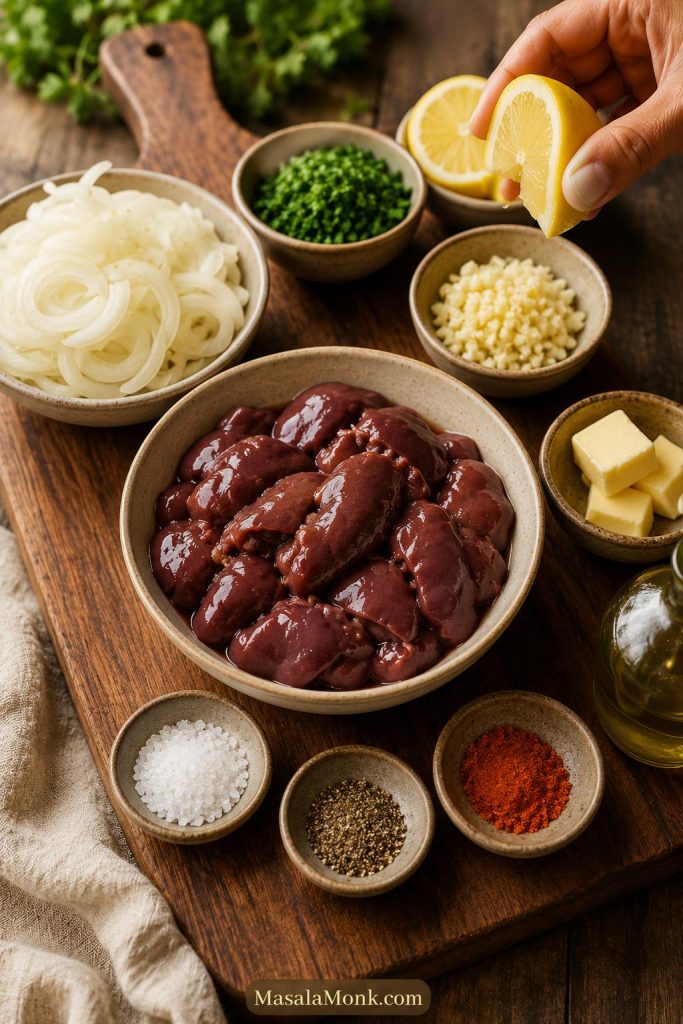
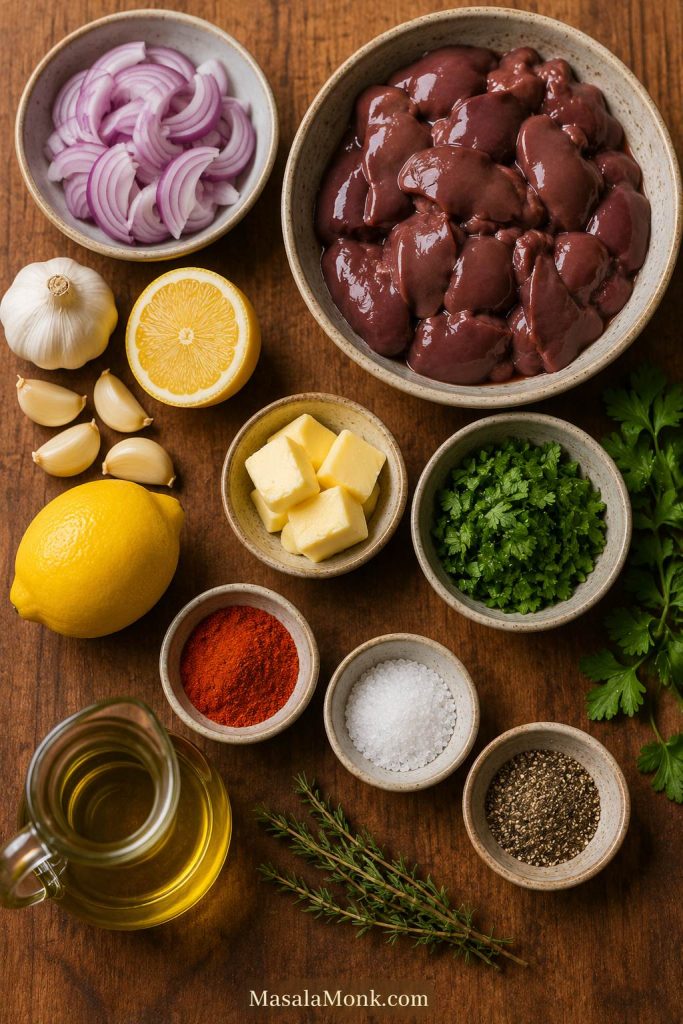
Chicken livers, sliced onions, garlic, lemon, herbs, butter, oil, salt, pepper, and paprika arranged on a wooden prep board.
Before the pan gets hot, set up the flavor base: onions for sweetness, garlic for depth, lemon for lift, and herbs for freshness.

Recipe Card

Tender Chicken Liver with Onions, Garlic, and Lemon

A simple skillet method for tender chicken livers with glossy onions, garlic, lemon, and buttery pan juices. Use the optional soak if you want a milder first bite.

Prep Time
15 minutes
Optional Soak
10 to 30 minutes
Cook Time
15 to 20 minutes, including onions
Total Time
30 to 35 minutes, excluding longer soak
Servings
4 with sides
Safe Temperature
165°F / 74°C

Ingredients

  • 1 lb / 450 to 500 g fresh chicken livers
  • 1 large onion, thinly sliced
  • 2 tbsp / 30 ml olive oil or neutral oil, divided
  • 1 tbsp / 14 g butter, optional
  • 3 garlic cloves, minced
  • ½ tsp fine salt, divided, plus more to taste
  • ¼ to ½ tsp black pepper
  • ½ tsp paprika, optional
  • 2 tsp / 10 ml lemon juice, plus more to taste
  • 2 tbsp chopped parsley or coriander

Optional Soak

  • ½ to 1 cup / 120 to 240 ml milk, just enough to mostly cover
  • Or ½ to 1 cup / 120 to 240 ml water mixed with 1 tbsp lemon juice

Optional Light Crust

  • 2 to 3 tbsp flour or cornstarch, for a very light dusting

Instructions

  1. Trim the livers. Remove white connective tissue, excess fat, stringy bits, dark clots, and any green or yellow-stained areas. Cut large pieces to about 1 to 1½ inches / 2.5 to 4 cm.
  2. Soak if desired. Use milk for 10 to 30 minutes, or lemon water for about 10 minutes. Drain well.
  3. Pat the livers very dry with paper towels.
  4. Heat 1 tbsp oil in a large skillet over medium heat. Add onion and a pinch of salt. Cook for 8 to 12 minutes, until soft, lightly golden, and sweet-smelling. Move to a plate.
  5. Season the livers with the remaining salt, pepper, and paprika if using. Dust very lightly with flour or cornstarch if using.
  6. Add the remaining 1 tbsp oil to the skillet. Increase heat to medium-high. Add livers in one layer; the pan should sizzle, not flood.
  7. Cook for 2 to 3 minutes on the first side. Flip gently and cook for another 2 to 3 minutes.
  8. Check the largest piece with an instant-read thermometer. Cook to 165°F / 74°C.
  9. Lower the heat. Return onions to the pan. Add butter if using and let it melt into the pan juices, then add garlic. Cook for 30 to 45 seconds. Add lemon juice and herbs. Taste and adjust seasoning.
  10. Serve warm with toast, rice, potatoes, roti, salad, or crusty bread.

Notes

  • Soaking is optional. It mellows flavor but does not replace proper trimming.
  • Always remove green or yellow-stained pieces.
  • Cook in batches if the pan is small.
  • Dry the livers thoroughly before cooking.
  • Use a thermometer instead of judging doneness by color alone.
  • If you used lemon water for soaking, start with less lemon juice at the end.
  • Reheat only until warm; extra heat makes the texture firm.

Finished-skillet reference: The livers should look glossy, the onions coated, and the pan juices loose enough to spoon over a side.

Skillet of cooked chicken livers with onions, garlic, melted butter, lemon, herbs, and pan juices.
Once the livers are done, the final minute matters most: butter softens the edges, and lemon wakes up the whole skillet.

What Chicken Liver Should Taste Like

The flavor is deep, savory, and slightly earthy. It is stronger than regular chicken meat, but usually milder than beef, lamb, mutton, or calf liver. Properly cooked, it is soft and full-flavored, almost like a warm, savory bite of pâté, but served whole instead of blended.

A good batch should be soft, savory, and clean-tasting. The main things that get in the way are poor trimming, too much moisture, a crowded pan, and extra minutes on the heat.

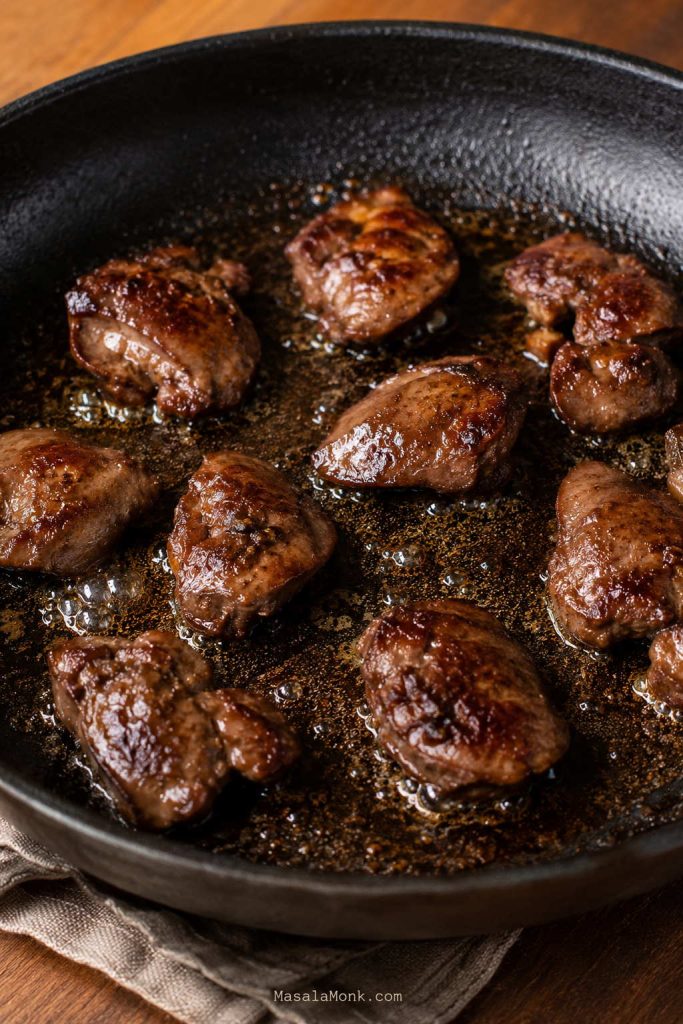
Texture check: This is a visual doneness cue, not a color test.

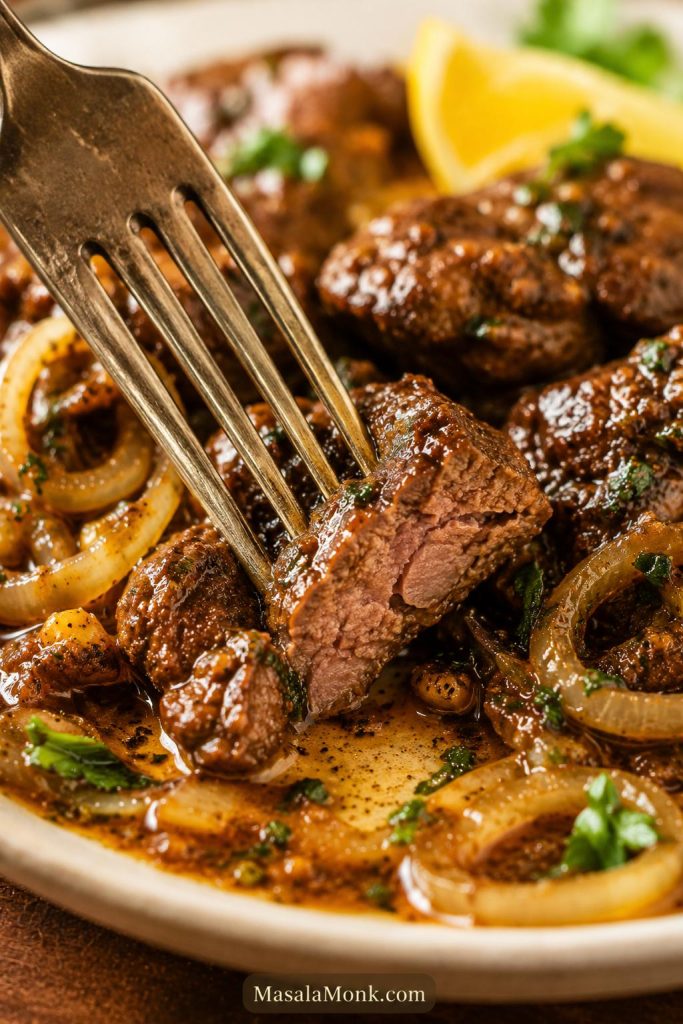
Fork cutting into a tender cooked chicken liver piece with onions and pan juices on a plate.
Look for a soft, fork-tender bite rather than a bouncy one; gentle timing is what keeps chicken liver from turning rubbery.

If you have only had dry, bitter liver before, this version may feel like a different dish. Keep the first batch simple, serve it with something familiar, and let the onions and lemon do some of the heavy lifting.

Onions make the flavor sweeter. Garlic makes it more savory. Lemon makes it brighter. Butter rounds the edges. Black pepper and paprika add warmth without making the dish complicated.

Bright finish: This cue belongs after cooking, when lemon and herbs can lift the dish without turning harsh.

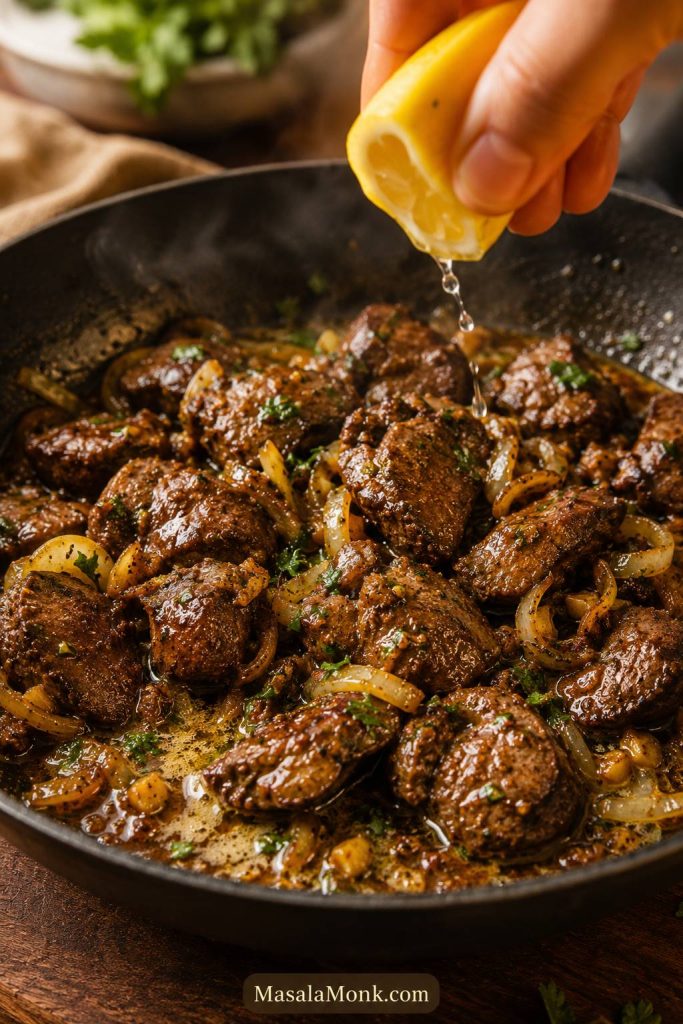
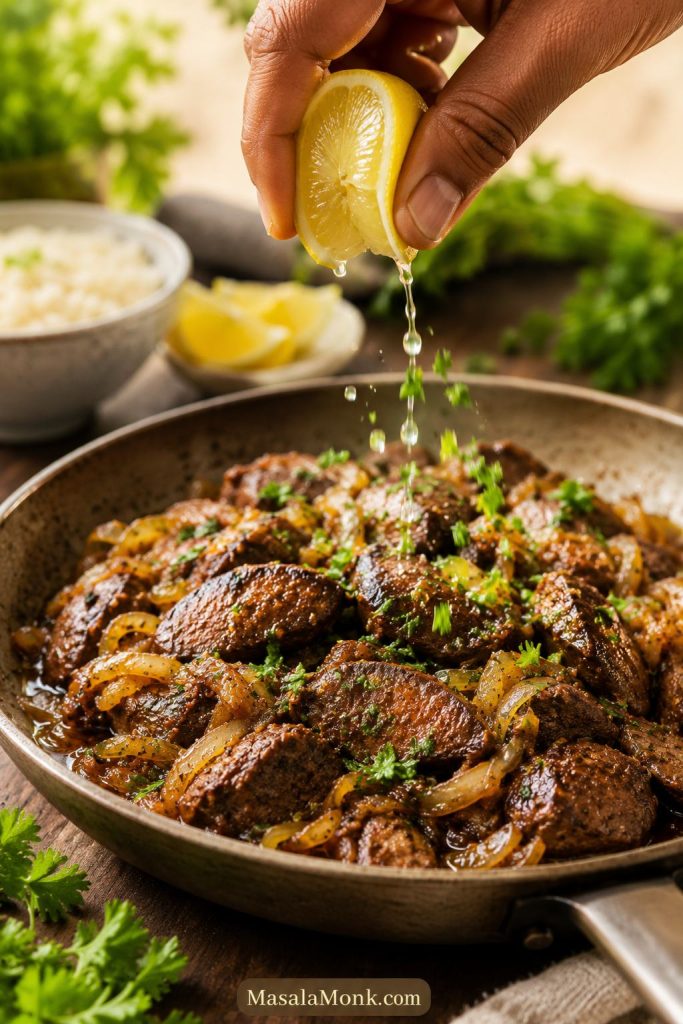
Lemon and fresh herbs being added to cooked chicken livers and onions in a skillet.
Add lemon and herbs at the end, not the beginning, so the finished chicken liver tastes brighter without turning sharp.

Why This Method Works

The method works because it solves the three problems that make liver hard to love: bitter bits, surface moisture, and extra time on the heat.

  • Trim well so the flavor stays clean and the harsh pieces never reach the pan.
  • Dry and spread out so the pieces brown instead of steam.
  • Finish quickly with onions, garlic, lemon, butter, and a thermometer check.

Method memory: Think of this as the whole recipe in one view: prep cleanly, dry well, then finish fast.

Chicken livers being prepared with paper towels nearby and a finished skillet of cooked livers in the background.
The best chicken liver recipe depends on three quiet steps: clean trimming, thorough drying, and quick cooking.
First time cooking chicken liver? Use the onions, use the optional soak, finish with lemon, and serve it with something familiar like plain rice or jeera rice, toast, potatoes, roti, or a simple salad.

At a Glance: Choose Your Best Path

What you want Best choice
Nervous about the flavor Use the milk soak, cook the onions until sweet, and finish with lemon.
Fastest dinner Skip the soak, dry the livers well, and use the basic skillet method.
Indian-style kaleji Use the masala variation with onion, ginger-garlic, tomato, coriander, cumin, chilli, and garam masala.
Strong liver smell Use fresh livers, trim carefully, dry well, cook with onions, and finish with lemon.
Comfort food Use extra onions, butter, and serve with mashed potatoes, rice, toast, or roti.

Serving path: Choose the side by the mood you want from the meal.

Chicken liver served in different ways with rice, roti, and mashed potatoes on a warm table.
Use the side dish to shape the meal: rice makes it mild, roti makes it spiced, and mashed potatoes make it cozy.

Safe but Tender: The Doneness Rule

Because chicken liver cooks so quickly, safety and tenderness come down to the same habit: check the largest piece and stop at the right time. The goal is not to cook liver forever; it is to cook it accurately.

Chicken liver should be cooked to 165°F / 74°C in the center. Color can fool you here, so let the thermometer make the decision. CDC guidance says the same thing in practice: use a thermometer, because you cannot tell by looking.

A useful rule keeps the section simple: cook it to the safe temperature, then stop. Best texture comes from stopping as soon as the center is done, while the pieces are still soft and delicate. USDA FSIS chicken liver guidance also gives 165°F / 73.9°C as the safe-temperature target for chicken liver dishes.

Good texture comes from timing. Check the largest lobe, then pull the pan off the heat once the livers are done. The butter, garlic, lemon, and herbs go in at the end.

Doneness checkpoint: This is the safety step that protects tenderness too.

Instant-read thermometer inserted into a cooked chicken liver piece in a skillet with onions.
For safe but tender chicken liver, check the largest piece from the side and stop cooking once it reaches 165°F / 74°C.

Ingredients You Need

Before the pan gets hot, the most important work happens on the cutting board. Once the livers are trimmed and dry, the ingredient list is simple.

Main ingredients and why they matter

Ingredient Amount Why it matters
Chicken livers 1 lb / 450 to 500 g The right amount for 4 servings with sides.
Large onion, thinly sliced 1 large / 160 to 200 g Adds sweetness and moisture.
Olive oil or neutral oil 2 tbsp / 30 ml For cooking the onions and searing without burning.
Butter 1 tbsp / 14 g, optional Melts into the onions at the end and makes the pan juices taste rounder.
Garlic 3 cloves / 12 to 15 g, minced Adds savory depth; it burns if added too early.
Fine salt ½ tsp, divided, plus more to taste Use a pinch for the onions and the rest for the livers.
Black pepper ¼ to ½ tsp Balances the deeper flavor.
Paprika ½ tsp, optional Adds color and mild warmth, not much heat.
Lemon juice 2 tsp / 10 ml, plus more to taste Cuts the mineral edge and brightens the finish.
Parsley or coriander 2 tbsp chopped Adds freshness at the end.

Ingredient logic: A short list works when every ingredient has a clear job.

Ingredients for chicken liver with onions, including chicken livers, garlic, lemon, butter, herbs, paprika, salt, pepper, and oil.
This chicken liver recipe stays simple because each ingredient has a job: sweetness, acidity, richness, freshness, or gentle heat.

For an optional soak, use enough milk to mostly cover the trimmed livers, or use water with 1 tbsp lemon juice. The full soak guidance is below.

Ingredients ready? The next choice is whether to soak the chicken livers or move straight to cooking.

A Note on Fresh and Frozen Livers

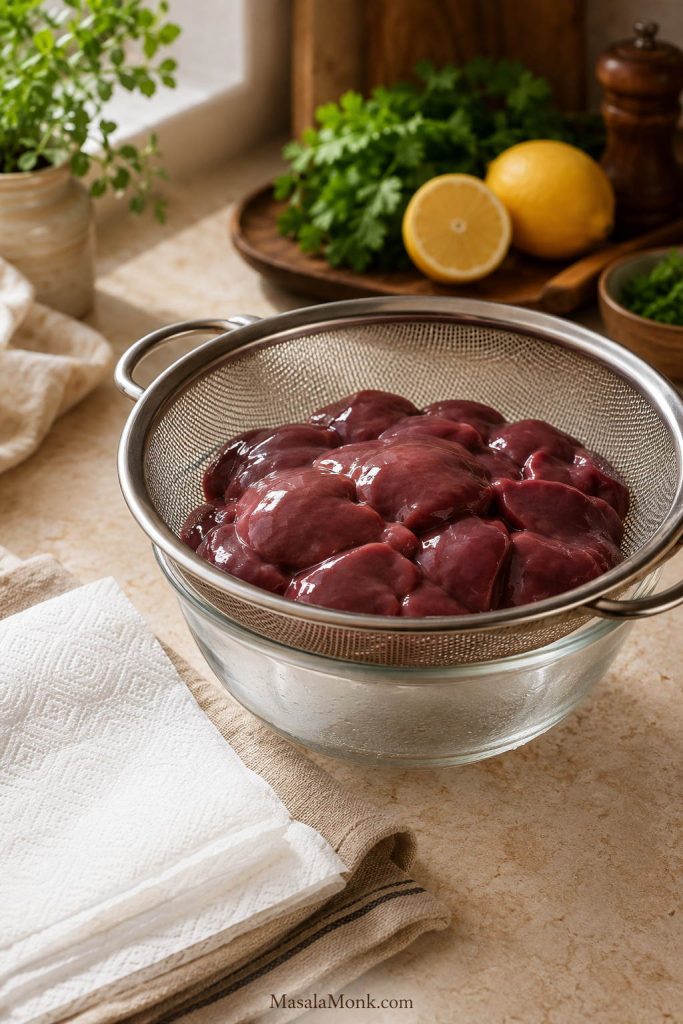
Fresh chicken livers are easiest to cook well. Frozen livers can work too, but thaw them fully in the refrigerator, drain them well, and dry them thoroughly before cooking. Frozen livers often release more liquid, so give them extra attention before they hit the pan.

Fresh livers can smell lightly mineral or iron-rich, but they should not smell sour, rotten, ammonia-like, or rancid. They should look moist, not slimy, grey, or dried at the edges. If the smell is unpleasant in a spoiled way, discard them.

Frozen-liver checkpoint: Drain first, then trim, season, and sear.

Thawed chicken livers draining in a metal sieve over a bowl with paper towels, lemon, and herbs nearby.
If you start with frozen chicken livers, thaw them fully and drain them well before seasoning; extra moisture is the first cause of steaming.

Best Pan to Use

Cast iron, stainless steel, and nonstick can all work. Cast iron and stainless steel give better browning when the livers are dry and the pan is hot enough. Nonstick is easier for beginners and gentler when flipping delicate pieces.

Choose the pan that lets you stay calm at the stove. The real secret is not the pan brand — it is dry livers, enough space, and a steady sizzle without smoking.

Pan setup: Room and steady heat matter more than the pan brand.

Chicken livers cooking with space between the pieces in a skillet with light oil bubbling.
The right pan setup gives each piece room to brown; crowding turns a quick chicken liver sear into a wet steam.

How to Clean and Trim Chicken Livers

This is the one prep step worth slowing down for. A minute of careful trimming does more for flavor than any spice mix can.

What to remove first

Place the livers on a cutting board or large plate. Separate any large lobes so the pieces are easier to inspect. They often come in uneven pieces, so take a minute to look through them before seasoning.

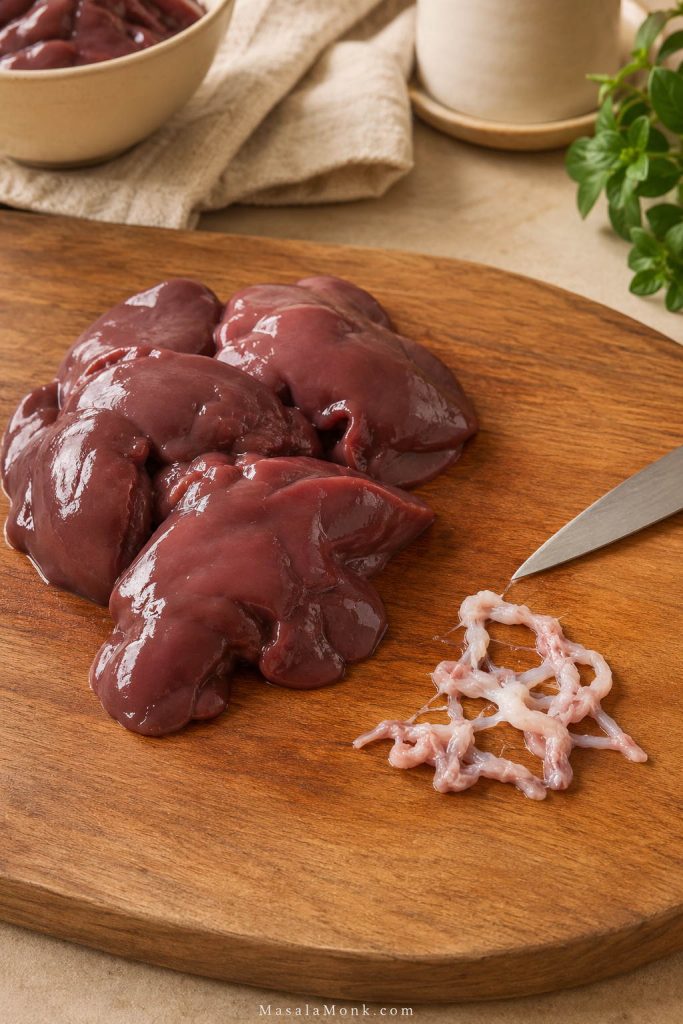
Trim away white connective tissue, stringy bits, tough membranes, excess fat, dark clots if present, and any green or yellow-stained areas. The stained parts are the most important to remove because they can taste unpleasantly bitter.

Trimming checkpoint: This is where bitterness prevention starts.

Raw chicken livers on a wooden board with white connective tissue separated beside them and a knife tip pointing toward it.
When cleaning chicken livers, look for white connective tissue and tough stringy bits first; removing them gives a cleaner bite later.

Cut, rinse only if needed, and dry well

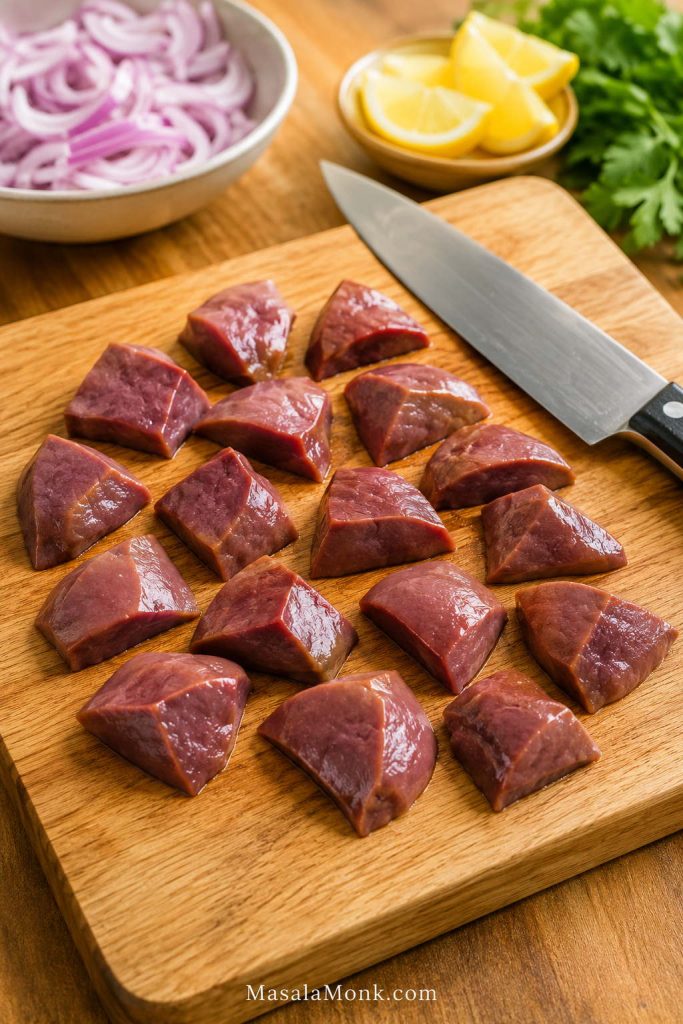
Cut very large pieces in half so they are roughly similar in size. Aim for pieces about 1 to 1½ inches / 2.5 to 4 cm. They do not need to be perfect, but they should be close enough that they cook at the same speed.

Cut-size checkpoint: Similar pieces make timing and doneness easier.

Chicken livers cut into even medium pieces on a wooden board with a knife and sliced onions nearby.
Next, cut large lobes into similar-sized pieces; even pieces cook more predictably and make doneness easier to judge.

Rinsing is optional. If the livers look especially wet or messy, you can rinse them briefly, but dry them very thoroughly afterward.

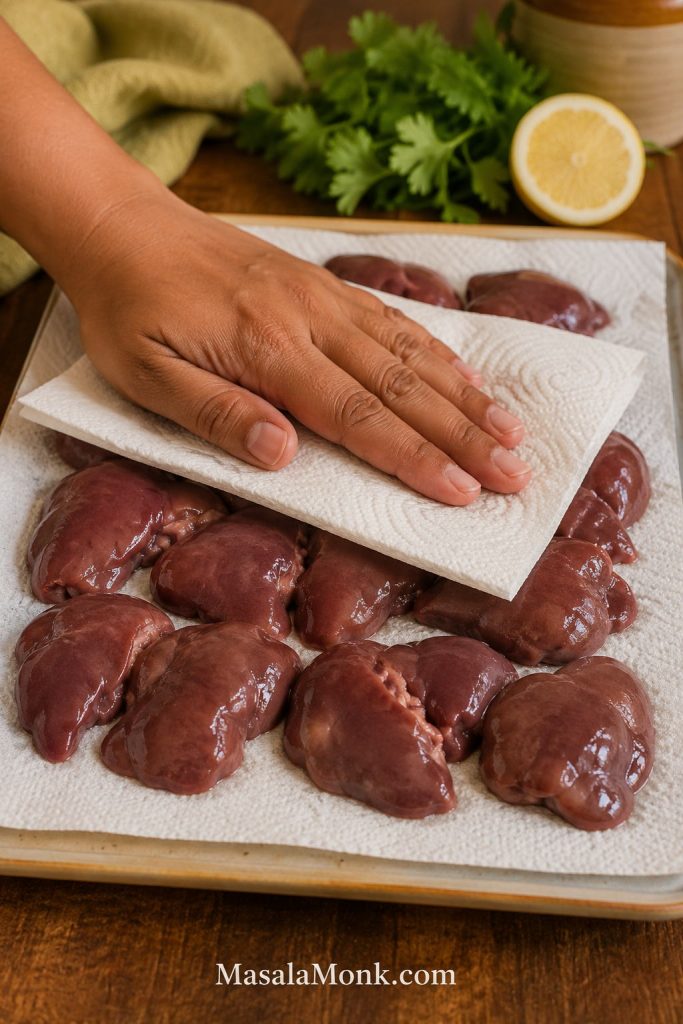
Drying matters more than it sounds. A dry surface helps the pieces sizzle instead of steam. Pat them well with paper towels before cooking.

Drying checkpoint: This is the bridge between prep and browning.

Chicken livers spread on paper towels while a hand presses another towel over them to dry the surface.
After trimming or soaking, dry the surface well; that dry surface is what helps pan-fried chicken livers brown instead of leak water.

Since these are raw poultry livers, treat the prep board like you would for raw chicken: wash your hands, clean the knife and board, and keep salads or cooked sides away from the raw-liver area.

Should You Soak Chicken Liver?

Fresh, well-trimmed livers can go straight to the pan; the soak is there when you want a gentler first bite. Chicken liver is usually milder than beef or mutton liver, so soaking is helpful but not required.

Use a short soak when you want the first bite to feel gentler, especially for someone still deciding whether they like liver. It can mellow the natural flavor and make the dish more approachable without changing the basic method.

Milk soak, lemon-water soak, or no soak

Soak choice Time Use it when
No soak None The livers are fresh and you like a deeper liver flavor.
Milk soak 10 to 30 minutes You want a milder, softer flavor. Use ½ to 1 cup / 120 to 240 ml, just enough to mostly cover.
Lemon-water soak About 10 minutes You want a brighter, cleaner finish. Use ½ to 1 cup / 120 to 240 ml water with 1 tbsp lemon juice.

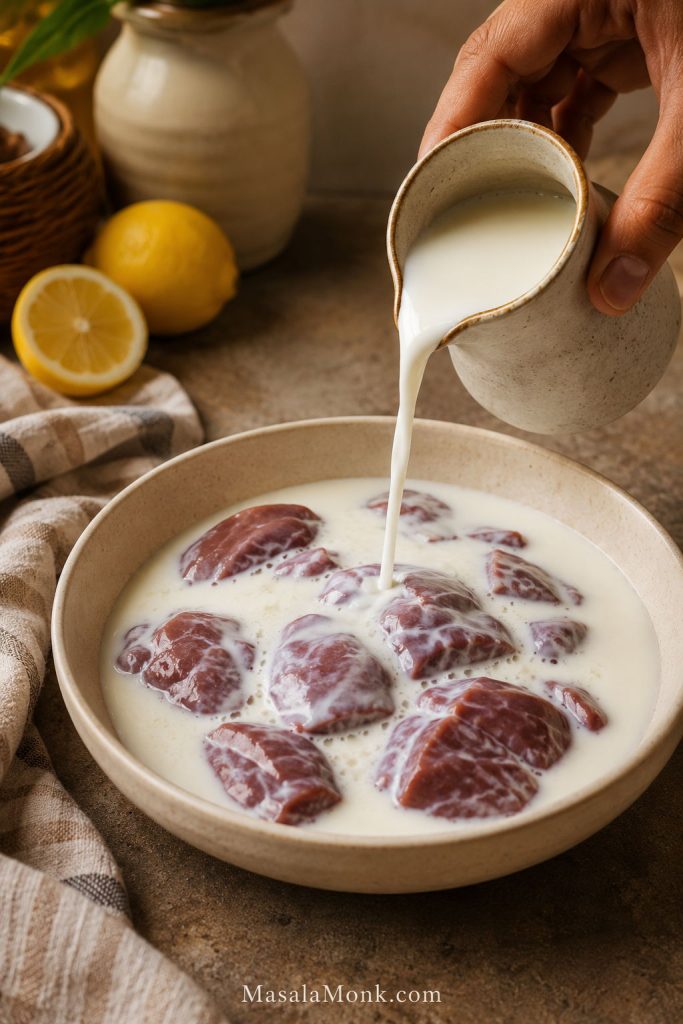
Milk-soak cue: Use this optional soak when you want the chicken liver flavor to feel milder for hesitant eaters.

Milk being poured over chicken liver pieces in a shallow bowl with lemon and kitchen cloth nearby.
A milk soak is optional, but it can make chicken liver taste milder when you are cooking for hesitant eaters.

After soaking, dry before cooking

After soaking, drain the livers and pat them very dry. If you used lemon water, start with only 1 tsp lemon juice at the end of cooking, then add more only if the dish needs it.

Lemon-water option: Use this when you want a cleaner, brighter start.

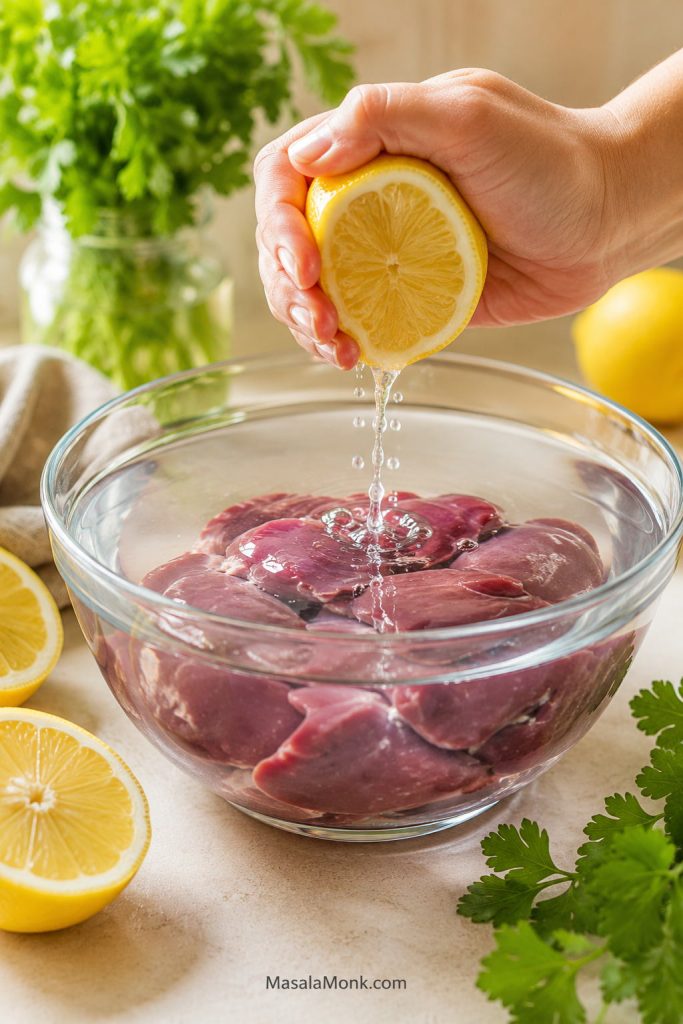
Lemon being squeezed into a clear bowl of water with chicken livers partly submerged.
Alternatively, lemon water gives the livers a brighter start; just drain and dry them well before cooking so they still sear properly.
Soaking helps with normal liver flavor, but trimming is what removes truly bitter pieces. It cannot fix old liver, spoiled liver, poor trimming, or green/yellow-stained pieces.

Choose the version that fits your table

Choose your version:
  • Mildest: milk soak, onions, butter, lemon, and parsley.
  • Brightest: lemon-water soak, garlic, a little extra lemon, and coriander.
  • Boldest: no soak, black pepper, paprika, and the masala-style spice option.
  • Most comforting: extra onions, butter, and mashed potatoes or rice.

Choose-your-version guide: The base method can move mild, bright, bold, or comforting.

Cooked chicken liver with onions served with milk, lemon wedges, spices, butter, and mashed potatoes nearby.
Adjust the same base recipe to the table: milk for mildness, lemon for freshness, spices for heat, and potatoes or rice for comfort.

After soaking or skipping it, drain and dry the livers well, then move to how to cook them step by step.

Before you start: Have the garlic, lemon, herbs, and serving plate ready. Once the livers hit the pan, the recipe moves fast — and that quick finish is what keeps them tender.

How to Cook It Step by Step

The skillet moves quickly here. Once the livers go in, the small things — dry surface, space, gentle flipping, and a quick finish — show up fast.

1. Cook the onions first

Heat 1 tbsp oil in a large skillet over medium heat. Add the sliced onion and a pinch of the salt. Cook for 8 to 12 minutes, stirring occasionally, until the onion is soft, lightly golden, and sweet-smelling. Move the onions to a plate.

The onions should smell sweet before the liver goes in. If they still smell sharp, give them another minute or two so they can soften properly. If the onions and liver go in together, the onions may stay sharp or the liver may overcook while you wait.

Onion-first step: Build sweetness before the delicate livers enter the pan.

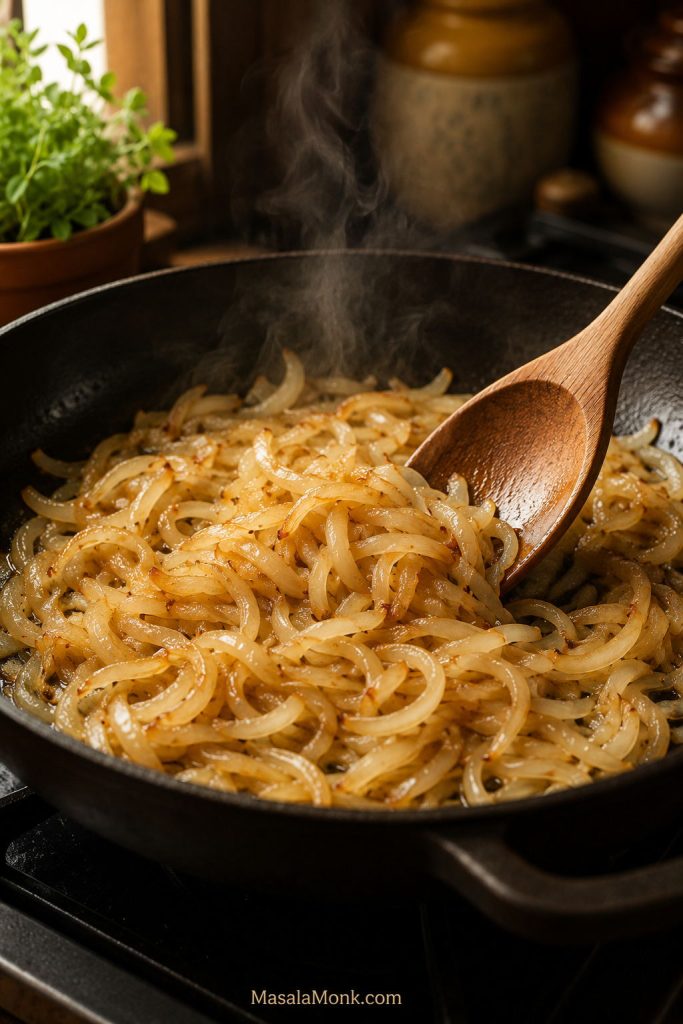
Sliced onions cooking in a skillet with a wooden spoon until soft, glossy, and lightly golden.
First, cook the onions until they soften and smell sweet; then the chicken livers can cook quickly without waiting on the pan.

2. Season the livers

Season the dried livers with the remaining salt, black pepper, and paprika if using. You do not need to bring them fully to room temperature, but avoid cooking them icy-cold or wet from the fridge. Let them sit for a few minutes while the onions cook.

If you want a little more browning, dust them very lightly with 2 to 3 tbsp flour or cornstarch and shake off the excess. Flour gives a softer browned coating; cornstarch gives a slightly lighter edge. Use either one lightly.

Seasoning step: Season after drying, then keep any coating light.

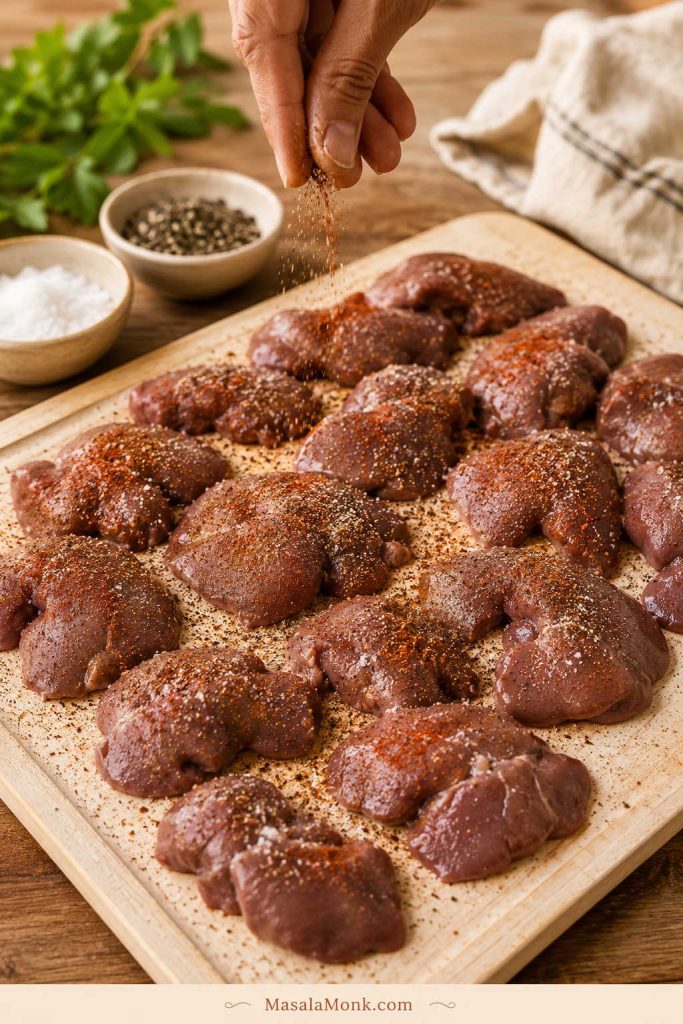
Chicken livers on a tray being seasoned with salt, pepper, paprika, and a light dusting before searing.
Once the livers are dry, season them lightly; salt, pepper, and paprika add warmth without hiding the natural flavor.

3. Sear in one layer

Add the remaining 1 tbsp oil to the skillet and increase the heat to medium-high. Save the butter for the finish so it tastes sweet and rounded instead of browned or burnt. The pan is ready when a piece of liver sizzles immediately, but the oil is not smoking.

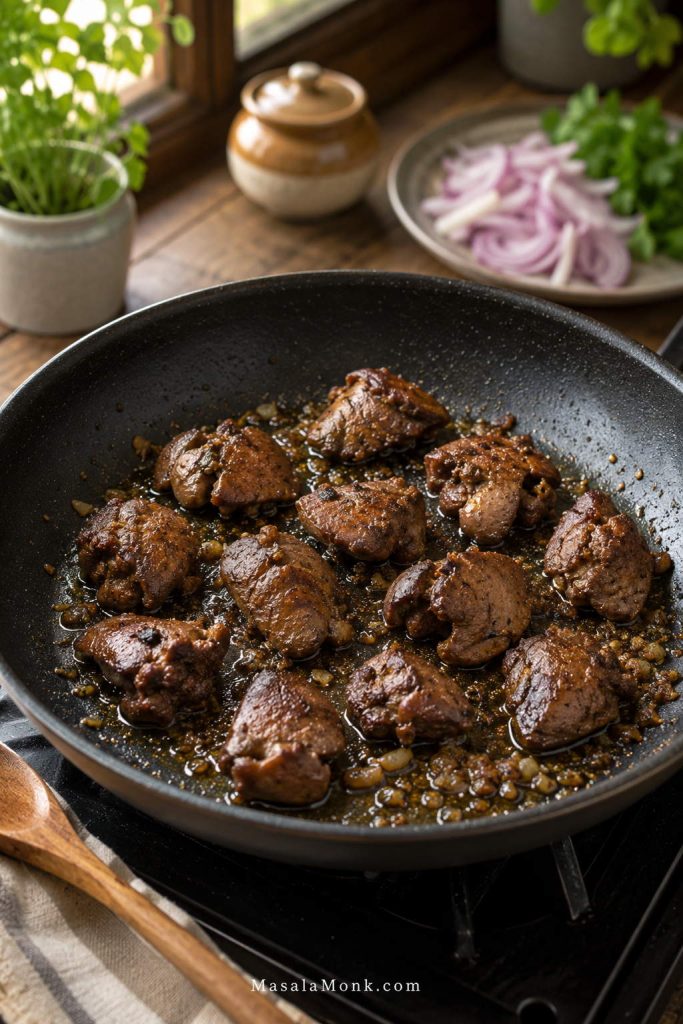
Add the livers in one layer. The pan should sizzle, not flood. Cook for 2 to 3 minutes on the first side without moving them too much, then flip gently and cook for another 2 to 3 minutes.

Sizzle check: Look for active bubbling and space, not a pan full of liquid.

Chicken livers searing in one layer in a skillet with space between the pieces and oil bubbling lightly.
This is the pan cue to look for: a steady sizzle, visible space between pieces, and no liquid flooding the skillet.

Flip step: Turn the pieces carefully once the first side has browned.

Chicken liver pieces and onions in a skillet as a utensil lifts one browned piece during cooking.
Then, flip the livers gently instead of stirring hard; careful turning helps the delicate pieces stay whole.

When liquid appears, let it bubble off. A flooded pan usually means the livers were too wet or crowded; move some liquid out, give the next batch more space, and add a teaspoon more oil if the pan looks dry.

When the pan starts filling with liquid, jump to troubleshooting before the next batch.

4. Check the largest piece

Use an instant-read thermometer to check the largest piece. Insert the thermometer from the side into the center instead of straight down into the pan. Cook to 165°F / 74°C. Smaller pieces may be ready quickly, while larger lobes may need another minute or two.

Once the center reaches temperature, pull the pan off the heat or lower the heat right away. That is how you keep the texture tender.

5. Finish with butter, garlic, lemon, onions, and herbs

Lower the heat. Return the cooked onions to the pan. Add the butter if using and let it melt into the pan juices, then add the minced garlic and stir for 30 to 45 seconds, just until fragrant. Add lemon juice and toss gently so the pan smells brighter and the onions pick up the buttery juices.

Taste after the lemon and onions go back in. Liver often needs its final seasoning after the acidity is added, not before. Adjust salt and pepper, then finish with chopped parsley or coriander.

At the end, the onions should be soft and coated in pan juices, the livers should cut easily, and the finished dish should smell bright from lemon, not heavy or metallic. Serve warm, while the texture is still soft and delicate.

Final finish: Lower heat here so garlic perfumes the pan instead of burning.

Cooked chicken livers with onions, melted butter, lemon, garlic, herbs, and glossy pan juices in a skillet.
Finish gently here; garlic needs only a short moment, and butter should melt into the onions rather than brown hard.

When it works, the dish feels simple in the best way: soft livers, sweet onions, a little buttery pan juice, and enough lemon to make the whole plate feel lighter.

Now build the plate: see what to serve with chicken liver for rice, toast, roti, mashed potatoes, and salad ideas.

How Long to Cook Chicken Liver

The actual cooking is quick. The exact time depends on the size of the pieces, how wet they are, how crowded the pan is, and how hot your skillet runs.

Step or situation Approximate time What to watch for
Onions first 8 to 12 minutes Soft, lightly golden, sweet-smelling onions.
Medium liver pieces 5 to 7 minutes total Lightly browned outside and safe temperature in the largest piece.
Smaller pieces 4 to 5 minutes total They may finish first, so do not wait for every piece to look identical.
Larger lobes 7 to 9 minutes total Use the biggest piece as your guide.
Lightly flour-dusted pieces Usually about 1 extra minute Coating should brown lightly, not burn.
Oven version 30 to 35 minutes Softer texture; still check the largest pieces.

Time is a guide. The biggest piece gives you the real answer.

Variations

This is the base skillet method. Once you understand it, you can shift the flavor without changing the core rules: trim well, dry well, cook in one layer, and avoid overcooking.

Looking beyond the basic skillet? Try the kaleji direction below, or compare more ways to cook chicken liver.

Chicken Liver with Onions

The main recipe already uses onions, but you can make them more central. Cook the onions a little longer, until deeply golden and jammy. After the liver is done, return the onions to the pan with a small splash of water, stock, or lemon juice to loosen the browned bits. Finish with butter and black pepper, then spoon everything over toast, rice, or creamy garlic mashed potatoes.

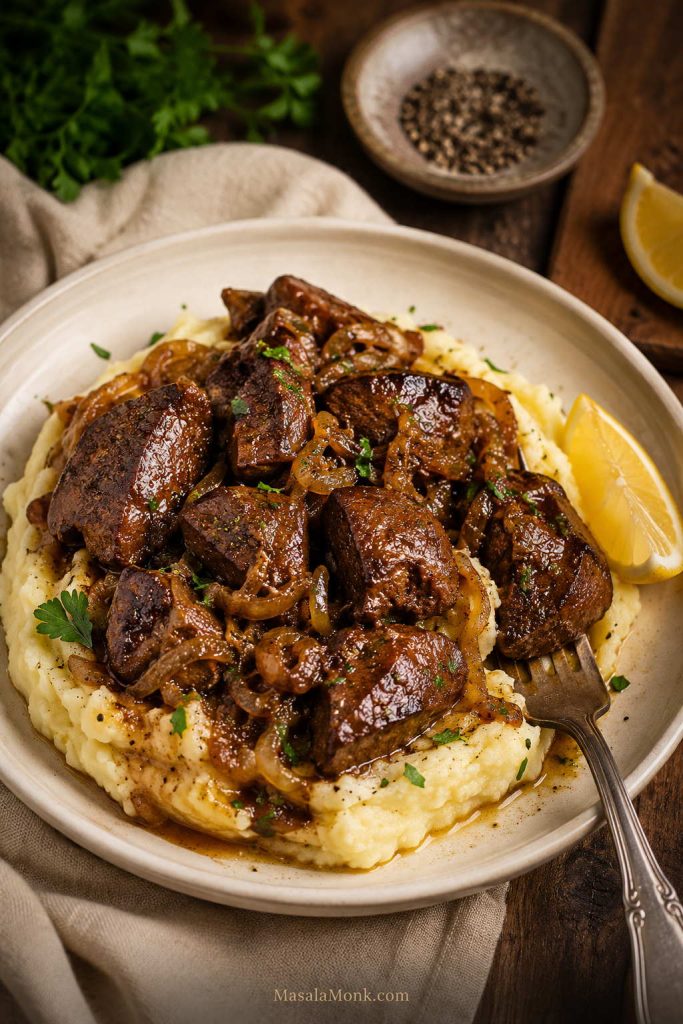
Comfort serving: Use this direction when you want chicken liver and onions to feel softer and more filling.

Chicken liver and onions served over creamy mashed potatoes with lemon, herbs, and pan juices.
Chicken liver and onions with mashed potatoes works because the creamy base softens the rich, savory bite.

Garlic Butter Lemon Livers

For a brighter, more rounded version, finish the cooked livers with 1 tbsp butter, extra garlic, 1 tbsp lemon juice, black pepper, and chopped parsley or coriander. Add the garlic only at the end so it stays fragrant.

Quick Chicken Kaleji-Style Masala

For a masala-style variation, season the livers with ½ tsp turmeric, 1 tsp coriander powder, ½ tsp cumin powder, ½ tsp red chilli powder, ½ tsp black pepper, and a little garam masala. Cook the onions as usual, add ginger-garlic paste if you like, then cook the livers in the spiced oil. A small chopped tomato can be added after the onions; cook it down until jammy before adding the livers so the masala does not turn watery. Finish with lemon juice and fresh coriander.

This is a quick masala-style direction, not the only way chicken kaleji is made. Use it when you want the same basic skillet method with warmer spices.

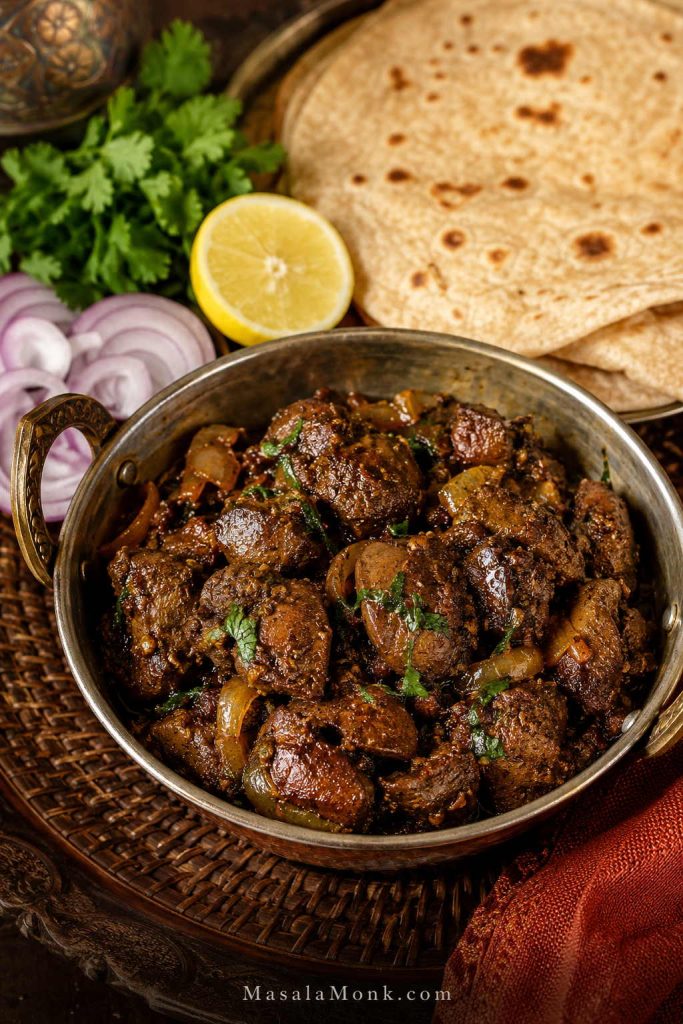
Kaleji direction: This is the spiced path with roti, coriander, onions, and lemon.

Chicken kaleji-style masala with onions served in a small pan beside roti, lemon, coriander, and sliced onions.
For a spiced version, turn the same base method toward chicken kaleji with onions, coriander, lemon, and roti on the side.

Oven Version

For less splatter, spread trimmed and dried livers in a single layer with sliced onions, about 1 tbsp oil, salt, pepper, garlic powder, and paprika in a baking dish. Garlic powder works better than fresh garlic here because fresh garlic can catch and turn bitter. Cover with foil and bake at 350°F / 175°C for about 20 minutes. Uncover, stir gently, and bake for another 10 to 15 minutes, or until the largest pieces reach 165°F / 74°C.

Baking gives a softer texture than pan-searing, but it is useful when you want a more hands-off method.

When to Use a Different Method

Use this skillet method when you want a quick warm meal. Choose a different method if you want a crisp coating, a smooth pâté, a creamy peri-peri-style sauce, a quick pan gravy, or a saucy adobo-style dish. Those versions use different techniques, so this recipe keeps the focus on the simplest skillet method first.

What to Serve with Chicken Liver

Because the flavor is deep and savory, the plate needs something fresh, starchy, or acidic beside it. You want the sides to balance the liver, not fight it.

Style Serving ideas
Simple dinner Rice, toast, mashed potatoes, roasted potatoes, buttered noodles
Indian-style Jowar bajra roti, paratha, dal-rice, onion salad, lemon wedges
Fresh and light Cucumber salad, sautéed greens, pickled onions, lemony salad
Comfort-food style Mashed potatoes, pan juices, deeply cooked onions, crusty bread
Appetizer-style Toast, small bread slices, pickles, sharp salad, lemon wedges, or a chilled potato salad

Toast catches the buttery juices, rice softens the intensity, and a lemony salad keeps the plate from feeling heavy. If you are serving someone unsure about liver, keep the pieces smaller and serve them with something familiar: rice, toast, potatoes, roti, or a fresh salad with lemon.

Rice dinner: Use this serving when you want the pan juices to become part of the meal.

Chicken liver with onions served over rice with lemon, herbs, roti, and salad in the background.
For a fuller dinner, serve chicken liver over rice and spoon the oniony pan juices into the grains.

Toast serving: Use this for a smaller plate with crisp contrast.

Toasted bread topped with cooked chicken liver pieces, caramelized onions, herbs, and lemon on a wooden board.
For a smaller serving, toast gives contrast: crisp bread underneath, soft chicken liver on top, and onions to tie it together.

Storage and Reheating

This dish is at its best straight from the skillet. The longer it sits, the more that soft texture fades. For leftovers, let the livers stop steaming, then refrigerate them in an airtight container within 2 hours of cooking. Store them with the onions and pan juices if possible; they help the livers reheat more gently. Use within 2 days for the best texture.

To reheat, warm gently in a skillet over low heat with a splash of water, stock, or lemon juice. You can add a small knob of butter to loosen the pan juices. The microwave works in a hurry, but use short bursts and stop as soon as the livers are warm.

Avoid long reheating. Once overcooked, the texture turns rubbery and dry quickly.

Troubleshooting: What Went Wrong?

If your first batch was not perfect, that is normal. Chicken liver gives very clear feedback, and most problems are easy to trace. Start with trimming, moisture, crowding, heat, and timing.

Common problems and the next-batch fix

Problem Likely cause Fix
Bitter liver Green/yellow bits, poor trimming, burnt garlic, or overcooking Trim carefully, add garlic late, use onion and lemon, and avoid extra cooking time.
Metallic taste Strong natural liver flavor or not enough acidity Use an optional soak, garlic, onion, lemon juice, herbs, and black pepper.
Rubbery texture Overcooking Cook in one layer and stop once the largest piece reaches the safe temperature.
Dry or grainy texture Cooked too long after doneness Use medium-high heat for a shorter cook and check earlier.
Steamed instead of browned Wet livers or crowded pan Pat dry thoroughly and cook in batches.
Too much splatter Surface moisture hitting hot oil Dry well, lower heat slightly, and use a splatter screen.
Strong smell Old liver, poor trimming, steaming in a crowded pan, or normal liver aroma that feels too intense Use fresh liver, trim well, cook with onions, garlic, and lemon, and discard anything sour or rancid.
Lots of liquid in the pan Frozen livers, wet livers, or overcrowding Thaw fully, drain well, pat dry, and cook in one layer.
Livers fell apart Pieces were too small, too wet, or stirred too aggressively Keep medium pieces, dry well, and flip gently.
Unsure if done Relying on color or timing only Use a thermometer on the largest piece.

Watery-pan fix: This visual explains why wet or crowded livers steam instead of brown.

Crowded skillet of chicken livers and onions with visible liquid pooling beside a wooden spoon.
If chicken livers release a lot of liquid, the pan is usually too crowded or the pieces are too wet; cook in batches for better browning.

More Ways to Cook Chicken Liver

Once you know the base skillet method, you can take the same trimming, drying, and doneness skills in a few different directions.

Version Best for Key change
Skillet liver and onions A quick warm dinner Cook the onions first, then sear the livers quickly.
Crispy fried chicken livers Crunchy appetizer-style serving Bread or batter the pieces and fry separately.
Chicken liver pâté Toast, crackers, and make-ahead spreads Cook gently, then blend with butter and aromatics.
Chicken kaleji masala A spiced Indian-style meal Use onion, ginger-garlic, tomato, coriander, cumin, chilli, and garam masala.
Peri-peri chicken livers Saucy, spicy, restaurant-style flavor Add chilli, garlic, lemon or vinegar, and a sauce base.
Chicken liver adobo A tangy, savory Filipino-style dish Simmer briefly with soy, vinegar, garlic, and aromatics.

More methods: After the base skillet technique, these are the next flavor directions.

Warm table spread with several chicken liver dishes, including skillet livers, spiced kaleji, fried pieces, pâté on toast, and saucy versions.
Once you understand trimming, drying, and timing, the same chicken liver skills can lead to skillet livers, kaleji, pâté, fried livers, and more.

A Small Note on Nutrition

A small serving goes a long way: the flavor is bold, the texture is dense, and the nutrition is concentrated. Chicken liver is commonly eaten for iron, B vitamins, protein, and its deep savory taste. For a broader food-first look at iron, MasalaMonk’s guide to iron-rich foods explains how animal and plant sources differ.

For B12 context, MasalaMonk’s guide to Vitamin B12 rich foods also covers meat and organ-meat sources. Enjoy chicken liver as food first. For personal medical questions about organ meats, follow professional guidance.

And if you arrived through liver-health or cleanse searches, keep the line clear: this is dinner, not a detox.

FAQs

Do you need to soak chicken liver before cooking?

No. If the livers are fresh and well trimmed, you can go straight to the pan. Use the soak when you want a gentler first bite, especially for someone still deciding whether they like liver.

How do you make chicken liver taste less bitter?

Start with trimming. Remove green or yellow-stained areas, white connective tissue, and tough bits. Then use onions, garlic, lemon juice, butter, black pepper, paprika, or spices to balance the flavor.

How long should chicken liver be cooked?

It usually takes about 5 to 7 minutes in a hot skillet after the onions are cooked. Smaller pieces may cook faster, and larger pieces may need longer. The biggest piece gives you the real answer, so check it with a thermometer.

Can chicken liver be pink inside?

Color can fool you here. Chicken liver should be cooked to 165°F / 74°C in the center. A thermometer is the best way to know it is done safely without cooking it longer than needed.

How do I keep chicken liver from smelling too strong?

Use fresh livers, trim them well, dry them properly, and cook them with onions, garlic, and lemon. Give the pieces space in the pan too; steaming makes the smell stronger. If the raw livers smell sour, rotten, ammonia-like, or rancid, discard them.

Why is my chicken liver rubbery?

It is almost always overcooked. Chicken liver does not forgive extra minutes the way chicken thighs do, so stop as soon as the largest piece is done.

Why did my chicken liver release so much liquid?

The pieces were probably too wet, previously frozen, or crowded in the pan. Thaw fully, drain well, pat dry with paper towels, and cook in batches if needed. You want a steady sizzle, not a pan full of liquid.

Can I use frozen chicken livers?

Yes. Thaw them fully in the refrigerator, drain them well, trim them, and pat them very dry before cooking. Frozen livers often release more liquid, so dryness and pan space matter even more.

How do I know if chicken livers are fresh?

They can smell lightly mineral or iron-rich, but they should not smell sour, rotten, ammonia-like, or rancid. They should look moist, not slimy, grey, or dried at the edges.

Can I make chicken liver spicy?

Yes. Add red chilli powder, cayenne, black pepper, peri-peri seasoning, or the quick kaleji-style spice mix. Add heat gradually because liver has a strong flavor of its own and does not need heavy seasoning to taste good.

Is chicken liver the same as chicken kaleji?

Yes. Kaleji is the Hindi/Urdu word commonly used for liver. Chicken kaleji usually refers to chicken liver cooked with onions, spices, ginger-garlic, and sometimes tomato.

Is chicken liver healthy?

Chicken liver is nutrient-dense and rich in flavor. It is commonly eaten for iron, B vitamins, and protein. Because it is an organ meat and very rich, portion size and personal health context matter.

Can I bake chicken liver?

Yes. Bake trimmed chicken livers with onions and seasoning at 350°F / 175°C until the largest pieces reach 165°F / 74°C. Baking is softer and less browned than skillet cooking, but it reduces splatter.

Can I make crispy fried chicken livers with this recipe?

This recipe is for skillet chicken liver, not Southern-style crispy fried chicken livers. For a light crust, you can dust the livers with flour or cornstarch before searing. Fully crispy fried chicken livers need a separate breading and frying method.

Can I make chicken liver pâté with this recipe?

Chicken liver pâté uses a different method. The livers are cooked gently, then blended with butter and other flavorings until smooth. This skillet recipe is better for serving warm as a meal.

Final Notes

If you remember only four things, remember these: trim the stained bits, dry the livers well, cook them in one layer, and let the biggest piece guide the doneness.

Final plate: This is the warm, finished meal the post is building toward.

Partly eaten plate of chicken liver with onions, rice, lemon, herbs, pan juices, and roti in the background.
A good final plate should feel simple: tender livers, sweet onions, lemon, a soft side, and enough juices to pull it together.

Do that, and the plate feels warmer and simpler: tender pieces, sweet onions, bright lemon, and enough pan juice for rice or toast. One good batch can change how liver feels at the table. Start with the onion-garlic-lemon version; from there, the same base can go toward masala, extra onions, or a brighter garlic-butter finish.

Posted on Leave a comment

Mashed Potatoes Recipe

Creamy mashed potatoes in a cream ceramic bowl with melted butter, chives, black pepper, and a blurred gravy boat behind.

This is the mashed potato bowl people reach for first: soft, buttery, creamy enough to feel rich, and fluffy enough to hold a spoonful of gravy. It works for holidays, roast dinners, weeknights, and those “everything else is ready but the potatoes need help” moments.

The ingredients are simple, but the finish matters. Yukon Gold potatoes make the mash naturally creamy, russets make it lighter, warm milk blends in smoothly, and a gentle hand keeps the texture soft instead of sticky.

This recipe is built for real mashed potato moments: the holiday batch, the weeknight side, the dry mash that needs saving, the no-milk emergency, and the serving dish that has to stay warm while dinner catches up.

Quick Answer: How to Make Mashed Potatoes

To make mashed potatoes, simmer peeled potato chunks in cold salted water until very tender, drain well, dry them briefly in the hot pot, then mash with butter and warm milk or cream. Season to taste and add more warm liquid only until the potatoes are soft, creamy, and spoonable.

The finish is where the bowl is won. Dry the potatoes well, add warm liquid gradually, and stop as soon as the mash looks soft and spoonable.

Recipe at a Glance

Best potatoes Yukon Gold, russet, or a 50/50 mix
Texture Creamy, fluffy, buttery, and soft enough for gravy
Prep time 15 minutes
Cook time 20 minutes
Total time 35 minutes
Servings 4 generous or 5 smaller side servings
Best tool Masher for cozy homemade texture; ricer or food mill for a smoother, lighter finish
Main mistake to avoid Overmixing, especially with a blender or food processor
Why this method is worth saving: It gives you one reliable base recipe, then shows you how to steer it creamy, fluffy, richer, dairy-free, make-ahead, or rescue-ready without starting over.

Creamy Mashed Potatoes Recipe

Description: Creamy, fluffy mashed potatoes made with Yukon Gold or russet potatoes, warm milk, butter, and a gentle method that keeps the mash soft, gravy-ready, and easy to rescue if dinner gets ahead of you.

Success cue: Soft, steamy, spoonable potatoes that hold gentle ridges when dragged with a spoon and fall slowly instead of pouring or clumping.

Prep Time15 minutes
Cook Time20 minutes
Total Time35 minutes
Servings4 generous or 5 smaller side servings

Base Ingredients

  • 1 kg / 2.2 lb Yukon Gold potatoes, russet potatoes, or a mix
  • 75–100 g / about 5–7 tbsp unsalted butter
  • 180–240 ml / 3/4–1 cup whole milk, half-and-half, or milk and cream, warmed
  • 2 tsp to 1 tbsp kosher salt for the cooking water, depending on pot size and water volume
  • Fine salt, added gradually after mashing, to taste
  • 1/4–1/2 tsp black pepper

Optional Add-Ins

  • 60 ml / 1/4 cup sour cream
  • 60–100 g / 2–3.5 oz cream cheese
  • Chopped chives, parsley, extra melted butter, or gravy for serving

Instructions

  1. Peel the potatoes for a smooth bowl, or scrub them well if making a rustic version with some skin. Cut into even 1 1/2–2 inch / 4–5 cm chunks.
  2. Place the potatoes in a large pot and cover with cold water by about 1 inch / 2.5 cm. Add kosher salt to the water.
  3. Bring to a boil, then reduce to a steady simmer. Cook for 15–20 minutes, or until a fork slides through easily with almost no resistance.
  4. Drain well. Return the potatoes to the hot empty pot for 30–60 seconds so extra steam escapes and the surface looks dry. Do not rinse them.
  5. Mash gently with a potato masher. For a smoother finish, use a ricer or food mill.
  6. Add the butter and about 180 ml / 3/4 cup warm milk or cream. Mash or fold gently until creamy.
  7. Add more warm milk or cream only as needed. Start with less; you can always loosen the mash once the texture tells you what it needs.
  8. Season with fine salt and pepper. Taste and adjust. Add sour cream or cream cheese if using. Serve hot with extra butter, herbs, or gravy.

Recipe Notes

  • For the best all-purpose bowl, use a 50/50 mix of Yukon Gold and russet potatoes.
  • The potatoes are ready to mash when a fork slides through with almost no resistance. If they fight back at all, cook them longer.
  • Do not rinse after draining. Let steam escape in the hot pot instead.
  • A masher, ricer, or food mill keeps you in control. Save the blender for soups.
  • If using sour cream or cream cheese, add less milk at first. You can loosen the potatoes later, but you cannot easily remove excess liquid.
  • For make-ahead prep, make the mash slightly looser than usual and reheat gently with extra warm milk or butter.
Cook’s note: This method is built around the places mashed potatoes usually fail: undercooked centers, watery potatoes, cold dairy, too much mixing, and last-minute reheating.

Choose Your Mashed Potato Texture

Before you start, decide what kind of mash you want on the table. A fluffy classic mash and a rich holiday batch use the same base method, but they need slightly different choices.

Once you choose the texture first, the rest of the recipe becomes easier: the potato, tool, dairy, and add-ins all have a job.

Three small servings of mashed potatoes showing smooth, fluffy, and rustic skin-on textures.
First choose the texture, then choose the tool. Smooth, fluffy, and rustic mashed potatoes all start similarly but finish differently.
You want Use Do this
Creamy everyday mash Yukon Gold potatoes Use warm milk and butter; mash gently.
Fluffy classic mash Russet potatoes Use a ricer or light masher; avoid heavy mixing.
Best balanced mash 50/50 Yukon Gold and russet Use moderate milk, enough butter, and stop when spoonable.
Rich holiday mash Yukon/russet mix + sour cream or cream cheese Make slightly looser before chilling or holding.
No-milk mash Reserved potato water, broth, butter, or olive oil Add slowly so the mash loosens without turning soupy.

Once the style is clear, the potato choice becomes easier. Yukon Golds lean creamy, russets lean fluffy, and a mix gives the safest balance.

The Mashed Potato Texture Rule

The rule that protects the bowl: Dry the potatoes first, add warm liquid slowly, and stop when the mash looks soft and spoonable. If it feels dry, loosen it gently. If it looks wet or sticky, pause before adding or mixing more.

Most mashed potato problems happen in the last few minutes, not at the ingredient stage. The right mash should look relaxed, not wet; soft, not slumped; ridged, not rubbery. Once you know that cue, the recipe becomes much easier to trust.

Why This Recipe Works

Great mashed potatoes do not come from adding every rich ingredient at once. They come from tender potatoes, enough salt, good draining, warm dairy, and a light hand at the end.

In practice, great mashed potatoes come down to moisture control and starch control. Cook the potatoes until fully tender, let surface steam escape after draining, then fold in fat and dairy without beating the mash into paste. That is what keeps the bowl creamy and light instead of watery or gluey.

Yukon Gold potatoes bring a naturally buttery texture. Russets are drier and fluffier. Using both gives you a reliable middle ground: rich enough for holidays, but not so dense that the serving dish feels heavy.

The drying step matters because boiled potatoes carry surface moisture. Letting steam escape in the hot pot keeps the mash from turning watery before the butter and milk go in.

Work the starch as little as possible after cooking. The more you beat the potatoes, the more the texture moves toward sticky and pasty.

Best Potatoes for Mashed Potatoes

Potato choice decides whether the mash leans creamy, fluffy, rustic, or dense. If you are standing in the store and do not want to think about it, buy Yukon Golds. Choose russets for the fluffiest result, or use both if you want the best balance.

Yukon Gold potatoes and russet potatoes with whole potatoes and cut halves on a wooden board.
Yukon Golds bring buttery creaminess, while russets bring lift. Together, they give mashed potatoes a balanced texture that feels smooth without turning heavy.
Potato Texture Best for
Yukon Gold Creamy, buttery, naturally rich Smooth everyday mashed potatoes
Russet / Idaho Fluffy, light, slightly drier Classic fluffy mashed potatoes
Yukon Gold + Russet mix Creamy and fluffy Best all-purpose mashed potatoes
Red potatoes Waxy, rustic, holds shape Skin-on mashed potatoes
New potatoes / fingerlings Firm and waxy Not ideal for classic mash

Peel the potatoes for a smooth finish. For a rustic mash, leave some or all of the skin on, especially with Yukon Gold or red potatoes. Russet skins are thicker, so they are usually better peeled unless you want a very rustic texture.

Red potatoes are delicious, but they do not give the same classic fluffy texture as russets or the same smooth richness as Yukon Golds. Waxy new potatoes and fingerlings hold their shape well, but they do not mash into the same soft finish.

The Best Ratio

This ratio keeps the recipe flexible without turning it into a guessing game. You can scale it for two people, eight people, or a full holiday table without losing the texture.

For every 1 kg / 2.2 lb potatoes, use 75–100 g butter and 180–240 ml warm milk, half-and-half, or cream. Start with the lower amount of liquid, then add more only if the potatoes need it.

For salt, season the cooking water generously but carefully. For 1 kg / 2.2 lb potatoes, start with about 2 teaspoons kosher salt in a medium pot, or up to 1 tablespoon for a large pot of water. The water should taste seasoned, not harshly salty. After mashing, add fine salt in small pinches or 1/4 teaspoon increments until the flavor tastes full and balanced.

Kosher salt brands vary in weight, so use the cooking-water amount as a starting point and trust the final tasting step more than the spoon measurement.

Ingredient Everyday creamy mash Richer holiday mash
Potatoes 1 kg / 2.2 lb 1 kg / 2.2 lb
Butter 75 g / about 5 tbsp 100 g / about 7 tbsp
Milk or half-and-half 180 ml / 3/4 cup 240 ml / 1 cup
Optional sour cream Skip or use 2 tbsp 60 ml / 1/4 cup
Optional cream cheese Skip 60–100 g / 2–3.5 oz

This is the ratio that keeps you from guessing when the guest count changes.

Useful rule: Start with the everyday column. If you add sour cream, cream cheese, or extra butter, reduce the milk at first because rich add-ins loosen the mash too.

Ingredients

With mashed potatoes, a short ingredient list does not mean the details do not matter. The potato decides the texture, the butter softens the edges, the dairy loosens the mash, and the salt makes the whole dish taste complete.

The amounts are in the recipe card and ratio table above. Here is what each one does once it hits the potatoes.

Raw potatoes, butter, milk, salt, and pepper arranged on a wooden board.
Before technique matters, the base stays simple: potatoes, butter, milk or cream, salt, and pepper. The magic comes from how gently those basics are handled.

Potatoes

Yukon Gold potatoes make the mash naturally creamy and buttery. Russets make it lighter and fluffier. A mix gives the most reliable everyday result.

Peel them for a smooth bowl, or scrub them well and leave some skin on for a rustic version.

Butter

Butter gives richness, but it also helps the texture feel soft instead of dry. Unsalted butter gives you more control; salted butter works if you season carefully at the end.

Milk, half-and-half, or cream

Whole milk gives a classic creamy texture. Half-and-half or cream makes the mash richer. Warm the dairy before adding it so it blends smoothly instead of cooling the potatoes down and making the texture tighten.

Salt

Salt the boiling water and season again after mashing. With so few ingredients, blandness has nowhere to hide. If the potatoes taste dull, they usually need a little more salt, butter, or both.

Black pepper

Black pepper gives a gentle warmth. Use white pepper if you want the potatoes to look very smooth without black specks.

Sour cream or cream cheese

Sour cream adds tang and balances the richness of butter. Cream cheese makes the mash thicker and richer, which is especially useful for make-ahead prep. Add less milk at first when using either one.

Herbs and toppings

Chives, parsley, thyme, roasted garlic, melted butter, parmesan, or crispy bacon can all be added depending on the meal. When using salty add-ins like parmesan, bacon, salted butter, broth, or gravy, season lightly at first and adjust at the end.

Equipment

You are not trying to purée potatoes into smoothness. You are breaking them down gently, then folding in enough butter and dairy to make them soft. That is why a masher, ricer, or food mill is safer than anything that spins fast.

  • Potato masher: best for a classic homemade bowl with a little texture.
  • Ricer: best for a very smooth, light finish.
  • Food mill: useful for larger batches or silky mash.
  • Hand mixer: okay on low speed, but stop as soon as the potatoes are smooth.
  • Blender or food processor: save these for soups; they can make mashed potatoes gluey.
Potato ricer pressing cooked potatoes into fluffy strands over a bowl.
A potato ricer creates fine strands before mixing begins. That means smoother, fluffier mashed potatoes with less handling and less risk of gumminess.

Tool choice matters most when the potatoes are already tender. Before mixing too far, see How to Avoid Gluey Mashed Potatoes.

How to Make Mashed Potatoes Step by Step

Start with the recipe card if dinner is already moving. The step-by-step notes below are for getting the texture exactly right — not just edible, but soft, warm, and worth passing around again.

1. Peel and cut the potatoes

Peel the potatoes if you want a smooth bowl. If you prefer a rustic finish, scrub them well and leave some or all of the skin on.

Cut into even 1 1/2–2 inch / 4–5 cm chunks. The pieces do not need to be tiny, but they should be similar in size so they cook evenly.

Hands cutting peeled potatoes into even chunks on a wooden cutting board.
Even potato chunks are small insurance against lumps. Because they cook at the same pace, you need less force when it is time to mash.

If you cut them ahead, keep them covered in cold water in the refrigerator for a few hours. Drain before cooking and start with fresh cold water so the flavor stays clean.

2. Start in cold salted water

Place the potato chunks in a large pot and cover with cold water by about 1 inch / 2.5 cm. Add kosher salt to the water; use about 2 teaspoons for a medium pot or up to 1 tablespoon for a larger pot.

Starting in cold water helps the pieces cook evenly. Salted water seasons them from the inside instead of leaving all the seasoning for the end.

Potato chunks in a pot of cold water with salt being added before boiling.
Seasoning starts in the pot, not at the end. Cold salted water helps the potatoes cook through evenly and taste good before butter goes in.

3. Boil until very tender

Bring the water to a boil, then reduce to a steady simmer. Cook for 15–20 minutes, depending on the size of the pieces.

Use the clock only as a guide; the fork test tells you the truth. When a fork slides through with almost no resistance, the potatoes are ready to mash. Around the edges, they may look slightly softened, but the centers should be fully tender, not chalky.

Fork sliding into a tender boiled potato chunk with steam rising from the pot.
Look for tenderness, not just time. Once the fork slides through cleanly, the potatoes are ready to mash without stubborn centers.

Slightly over-tender potatoes mash better than undercooked ones. Do not leave cooked potatoes sitting in the hot water after they are tender, or they can absorb more water and make the final mash too thin.

4. Drain and dry

Drain very well in a colander. Then return the potatoes to the hot empty pot for 30–60 seconds. Shake the pot gently once or twice so steam escapes.

Skip the rinse after draining. The hot pot does the work here: it lets steam escape without washing away flavor. The potatoes should steam instead of shine.

Drained boiled potatoes steaming in a hot empty pot before mashing.
Steam is useful here. After draining, a brief rest in the hot pot lets surface moisture escape so the mash stays creamy instead of loose.

5. Mash gently

Use a potato masher for a classic texture. For a smoother bowl, pass the potatoes through a ricer or food mill.

Hand using a potato masher to mash cooked potatoes in a pot.
Stop before the potatoes fight back. Gentle mashing gives you control, while heavy beating can push the starch toward sticky and dense.

If you use a hand mixer, keep it on low speed and stop as soon as the potatoes are smooth.

6. Add butter and warm milk gradually

Warm the milk, half-and-half, or cream before adding it. It should be warm to the touch or lightly steaming, not boiling. Add the butter and about 3/4 cup / 180 ml warm liquid first, then mash or fold gently.

Warm milk being poured into mashed potatoes while butter melts into the mixture.
Add richness slowly. Warm milk or cream loosens the potatoes in stages, while butter folds in more smoothly when the mash is still hot.

Start with less liquid; you can always loosen the mash once the texture tells you what it needs. Stop when it mounds softly on a spoon — that is the sweet spot before it turns too thin.

Final texture cue: soft, spoonable mashed potatoes

The final texture should be easy to see before you taste it. The mash should mound softly on a spoon, hold gentle ridges for a moment, and fall back without stretching, pouring, or clumping.

Spoon lifting creamy mashed potatoes with soft ridges, steam, and a light butter sheen.
This spoon lift is the final cue: the mash should mound softly, hold ridges for a moment, and fall back without stretching.

7. Season and finish

Taste before serving. Add fine salt in small pinches or 1/4 teaspoon increments, then add pepper, more butter, or a splash of warm milk if needed.

If dinner is moving fast, this is the moment to slow down for one minute. The potatoes are cooked; this last minute is what keeps them soft, warm, and worth serving.

If the texture is not where you want it yet, do not keep mixing blindly. Use the troubleshooting guide to fix dry, watery, lumpy, bland, or gluey mashed potatoes.

Creamy vs Fluffy Mashed Potatoes

Not every batch should be the same. Some dinners need rich, creamy potatoes. Others need a lighter mash that can hold gravy without feeling heavy. Neither version is better; the best texture is the one that fits the meal.

Two servings of mashed potatoes showing one smoother creamy texture and one lighter fluffy texture.
Creamy mashed potatoes sit smoother and richer, while fluffy ones hold lighter peaks. The better choice depends on the sauce, timing, and plate.

For a fluffy bowl

Use mostly russets, moderate liquid, and a light hand. Stop mixing as soon as the potatoes look soft.

For a creamy bowl

Use more Yukon Golds, warm half-and-half or cream, and a little more butter.

For a rich holiday batch

Add sour cream or cream cheese, but reduce the milk at first. You can always loosen the mash later.

For a rustic finish

Leave some skin on and use a potato masher. The uneven texture works beautifully beside gravy and roast meats.

If you think of these as whipped potatoes, use a ricer first, then fold in the butter and milk until smooth. Avoid aggressive whipping; the texture can move from smooth to gluey quickly.

For this creamy, classic version, skip rinsing after boiling and let the potatoes dry in the hot pot instead. If you are chasing an ultra-fluffy russet-only style, some methods rinse away extra starch, but this version keeps the process simpler and the flavor fuller.

How to Avoid Gluey Mashed Potatoes

Gluey mashed potatoes are frustrating because they usually happen at the very end, after everything looked fine. The good news is that the problem is predictable: sticky texture usually comes from overworked starch.

Fluffy mashed potatoes compared with a denser, glossier spoonful of gluey mashed potatoes.
The visual difference is easy to spot: fluffy mash looks soft and ridged, while gluey mashed potatoes look dense, glossy, and overworked.
Do this Avoid this
Use a masher, ricer, or food mill Blender or food processor
Cook until fully tender Mashing undercooked centers
Fold gently after mashing Beating hard after smooth
Add liquid gradually Pouring everything in at once
Stop when spoonable Trying to fix texture by mixing more

If the potatoes are already gluey, do not keep beating them. Truly gluey mash will not fully return to fluffy, but you can soften the mouthfeel with warm butter or cream. If it is very dense, use the leftovers for potato cakes, croquettes, soup, or a casserole topping.

How to Fix Mashed Potatoes That Went Wrong

A batch of imperfect mashed potatoes is usually not a disaster. Before you add more liquid or start mixing harder, pause and match the problem to the right fix.

The goal is not perfection at every step. The goal is knowing when to stop, when to loosen, and when to turn imperfect potatoes into something else delicious.

Texture problems

Problem Why it happened How to fix it
Gluey texture Overmixed starch, blender, food processor, or too much beating Stop mixing. Gently fold in warm butter or cream. If the mash is truly gluey, repurpose dense leftovers instead of trying to whip them back.
Watery texture Potatoes were not drained or dried well, or too much liquid was added Warm gently over low heat to release moisture. Fold carefully. Add potato flakes only as a last resort.
Lumps Potatoes were undercooked or cut unevenly Cook potatoes until completely tender. Use a ricer next time for smoother results.
Dry texture Not enough liquid or fat, or reheated without moisture Add warm milk, cream, broth, or butter a little at a time.
Too thin Too much milk or cream Warm gently to evaporate moisture. Add a few potato flakes only if needed.
Too stiff Not enough warm liquid Loosen a little at a time, folding only until the texture comes back.
Sticky after using a hand mixer The potatoes were beaten too long Stop mixing immediately. Fold in warm butter or cream. Use leftovers for cakes or casserole topping if needed.
Grainy after reheating The mash was too lean or reheated too aggressively Warm slowly and fold in butter, cream, or sour cream until smoother.

Flavor and serving problems

Problem Why it happened How to fix it
Bland flavor Cooking water was not salted, or not enough final seasoning was added Add salt gradually, then finish with butter, pepper, herbs, garlic, sour cream, or cheese.
Flat flavor even after salting They may need fat, tang, herbs, or deeper seasoning Add butter, black pepper, chives, roasted garlic, sour cream, parmesan, or a little gravy.
Got cold before serving They sat too long or the serving dish was cold Reheat gently with warm milk or butter. Next time, warm the serving dish and keep them covered.
Too much garlic or pepper The seasoning is overpowering the potatoes Fold in more plain mash if available, or soften the flavor with cream, butter, or sour cream.

Most fixes are small. The important thing is not to panic-mix the potatoes into a worse texture. Serve them warm if they still taste good, or save them for cakes, croquettes, soup, or a casserole topping where the texture can work in your favor.

Variations

Once the base mash is right, variations should support the meal, not bury the potatoes. Keep the flavor simple for rich mains, or add garlic, cheese, herbs, or tang when the potatoes need to carry more of the plate.

Garlic Mashed Potatoes

Use roasted garlic when you want mellow sweetness, sautéed garlic when you want a sharper savory edge, and garlic butter when you want the flavor to spread through the whole mash. For a deeper version with the garlic balance already worked out, use this garlic mashed potatoes recipe.

Cream Cheese Mashed Potatoes

Use cream cheese when you want a thicker, richer mash that reheats well. Let it soften first so it melts in easily, and add less milk at the beginning.

Sour Cream Mashed Potatoes

Use sour cream when you want tang that cuts through butter, gravy, steak, pork chops, or roast chicken. It makes the mash taste richer without feeling too heavy.

Loaded Mashed Potatoes

Fold in shredded cheddar, crispy bacon, chopped chives, and a spoonful of sour cream. Loaded mashed potatoes work well as a side dish or as the base for a comfort-food plate.

Parmesan Herb

Fold in grated parmesan, chopped parsley, chives, thyme, or a little roasted garlic. Parmesan adds saltiness and depth, so taste before adding more salt.

Buttermilk

Use warm buttermilk for a tangy Southern-style version. Keep the heat gentle and do not boil the buttermilk.

Extra Buttery

For holiday-style potatoes, increase the butter to 100–125 g / about 7–9 tbsp per 1 kg / 2.2 lb potatoes and use half-and-half or a mix of milk and cream.

Mashed Potatoes Without Milk

If this is an emergency “I already boiled the potatoes and there is no milk” moment, start with reserved potato water and butter. It is the safest fix because the water is already starchy and neutral.

No milk does not mean no comfort. It just means choosing the right liquid for the job. Potato water keeps the flavor clean, broth makes it more savory, and olive oil or vegan butter can add richness without dairy.

Mashed potatoes with cups of broth, potato cooking water, olive oil, and a butter-like block nearby.
No milk does not end the recipe. Potato water keeps things clean, broth adds savory depth, and olive oil or dairy-free butter brings richness.

Plant milk can work, but choose an unsweetened neutral version. Potato water is usually safer because it tastes like potato, not oat, almond, or coconut.

Situation Best substitute Notes
No milk at home Reserved potato water + butter Neutral, easy, and already starchy enough to loosen the mash.
No milk, but dairy is okay Cream cheese, sour cream, or thick plain yogurt Add gently so the flavor does not become too tangy or thin.
More savory flavor Warm chicken or vegetable broth Good with gravy, meatloaf, chicken, pork chops, and roast dinners.
Dairy-free version Olive oil + reserved potato water Gives richness without dairy. Add slowly.
Vegan version Vegetable broth + vegan butter or olive oil Use neutral plant milk only if you like the flavor.

If the no-milk mash still feels dry, stiff, or too thin, use the troubleshooting table. For leftovers or dairy-free make-ahead prep, see how to reheat mashed potatoes gently.

Make-Ahead Mashed Potatoes

Mashed potatoes are usually not finished in a quiet kitchen. They happen while gravy is thickening, mains are resting, and someone is asking when dinner is ready.

Make-ahead mashed potatoes are not about being fancy. They are about giving yourself one less thing to panic over when the oven is full, the gravy is waiting, and dinner is moving fast.

Hands covering a shallow dish of mashed potatoes with butter and a small milk jug nearby.
Make-ahead mashed potatoes should go into storage a little softer than serving texture. Later, that extra moisture helps them reheat without drying out.

For the best texture, make them up to 1–2 days ahead, keep them covered in the refrigerator, and reheat gently with extra warm milk, cream, butter, sour cream, or cream cheese.

The most important trick is to make them slightly softer than usual before chilling, because the fridge will firm them up. A little extra moisture and fat gives you room to reheat without drying them out.

For holiday serving, warm the serving dish, cover the potatoes tightly, and keep extra warm milk or butter nearby for a quick loosen before they go to the table.

Make-Ahead Method

  1. Prepare the base recipe as usual.
  2. Make the mash slightly looser than you want it at serving time.
  3. Add a little extra butter, milk, cream, sour cream, or cream cheese so it stays soft.
  4. Cool and store in a covered shallow dish or airtight container in the refrigerator.
  5. Reheat gently with extra warm milk or butter.
  6. Stir only as much as needed to bring the texture back.

Once the potatoes are made ahead, the real success comes from reheating them well. Jump to How to Reheat Mashed Potatoes before serving.

How to Reheat Mashed Potatoes

Cold mashed potatoes rarely look promising at first. They firm up in the fridge, but they usually come back with low heat, patience, and a little extra moisture.

Mashed potatoes being reheated with melting butter, warm milk, steam, and a spoon folding through them.
Reheating is a recovery step, not a second mash. Low heat, steam, butter, and warm milk bring back creaminess without rough stirring.

Reheating is less about stirring hard and more about giving the potatoes back moisture slowly. Warm them gently for texture, but make sure leftovers are hot all the way through. If you are checking with a thermometer, aim for 165°F / 74°C.

Method How to do it Best for
Stovetop Place in a pot over low heat. Add warm milk, cream, or butter and stir gently until hot. Small to medium batches
Oven Place in a covered baking dish and reheat at 350°F / 175°C for 25–40 minutes. Add butter on top if the potatoes look dry. Holiday meals and larger batches
Microwave Reheat at medium power in short intervals, stirring every 1–2 minutes. Add a splash of milk or cream. Leftovers and single servings
Slow cooker Reheat first, then keep warm in the slow cooker. Add butter or milk if the surface starts drying out. Holding for a crowd
Slow cooker note: A slow cooker is good for holding hot mashed potatoes warm, but it is not the best way to slowly heat cold mashed potatoes from the fridge. Reheat them first, then transfer to the slow cooker on warm.

How Much to Make Per Person

A good side-dish estimate is 225–250 g / 1/2 lb raw potatoes per person. For a holiday meal with many sides, you can go slightly lower. For a mashed-potato-heavy dinner with gravy, meatballs, steak, or chicken, plan a little more.

If mashed potatoes are the side everyone reaches for first, round up. Leftovers are easier to use than an empty serving dish is to explain.

People Raw potatoes Approx. butter Approx. milk/cream
2 500 g / 1.1 lb 40–50 g 90–120 ml
4 1 kg / 2.2 lb 75–100 g 180–240 ml
8 2 kg / 4.4 lb 150–200 g 360–480 ml
10 2.25 kg / 5 lb 170–225 g 420–540 ml
20 4.5 kg / 10 lb 340–450 g 850 ml–1.1 L

For a lighter meal with many sides, use the lower end. For gravy-heavy dinners, holiday plates, or mashed-potato lovers, use the higher end.

What to Serve with Mashed Potatoes

Mashed potatoes are often the quiet thing holding the whole plate together. When they are soft, warm, and well-seasoned, even a simple dinner feels more complete.

The easiest rule is simple: if the main dish has gravy, pan juices, cream sauce, onion sauce, or mushrooms, mashed potatoes probably belong beside it.

Dinner plate with mashed potatoes, gravy, sliced roast chicken, green beans, and a gravy boat in the background.
Mashed potatoes earn their place beside saucy mains because they catch gravy and pan juices. That is what turns a simple plate into comfort food.

Best mashed potato pairings

Think of mashed potatoes as the soft landing for the plate: one saucy main, one green vegetable, and one simple extra like rolls, salad, or roasted carrots is usually enough.

Keep the potatoes plain and buttery when the main dish is strongly flavored. Add garlic, cheese, sour cream, or herbs when the main dish is simple.

Meal type Best pairings Why it works
Gravy-heavy comfort dinners Meatloaf, meatballs, smothered pork chops, creamy mushroom mains The potatoes soak up sauce and make the plate feel complete.
Beef dinners Steak, pot roast, roast beef, beef stew, cottage pie Beef and mashed potatoes are classic because the richness balances well with butter and salt.
Chicken dinners Roast chicken, chicken gravy, creamy mushroom chicken, slow cooker French onion chicken Mashed potatoes turn chicken into a fuller comfort meal.
Pork dinners cream of mushroom pork chops, pork loin, sausages, ham Pork works well with creamy mash, mustardy sauces, onion gravy, or pan juices.
Seafood Salmon, white fish, fish cakes, shrimp in garlic butter Keep the potatoes simple so they do not overpower the fish.
Vegetarian meals Mushroom gravy, lentils, roasted mushrooms, green beans, peas, carrots Earthy vegetables and legumes pair well with buttery potatoes.
Holiday plates Turkey, ham, stuffing, gravy, sweet potato casserole, hashbrown casserole Mashed potatoes are the soft, savory anchor for a full holiday spread.

If the main dish does not have much sauce, add a simple brown gravy, mushroom gravy, chicken gravy, or onion gravy. Mashed potatoes taste best when there is something warm and savory to spoon over the top.

What to Do with Leftover Mashed Potatoes

Leftovers are not a problem here. Cold mash is one of those rare leftovers that can become better at holding its shape the next day. Leftover mash is already halfway to something crispy.
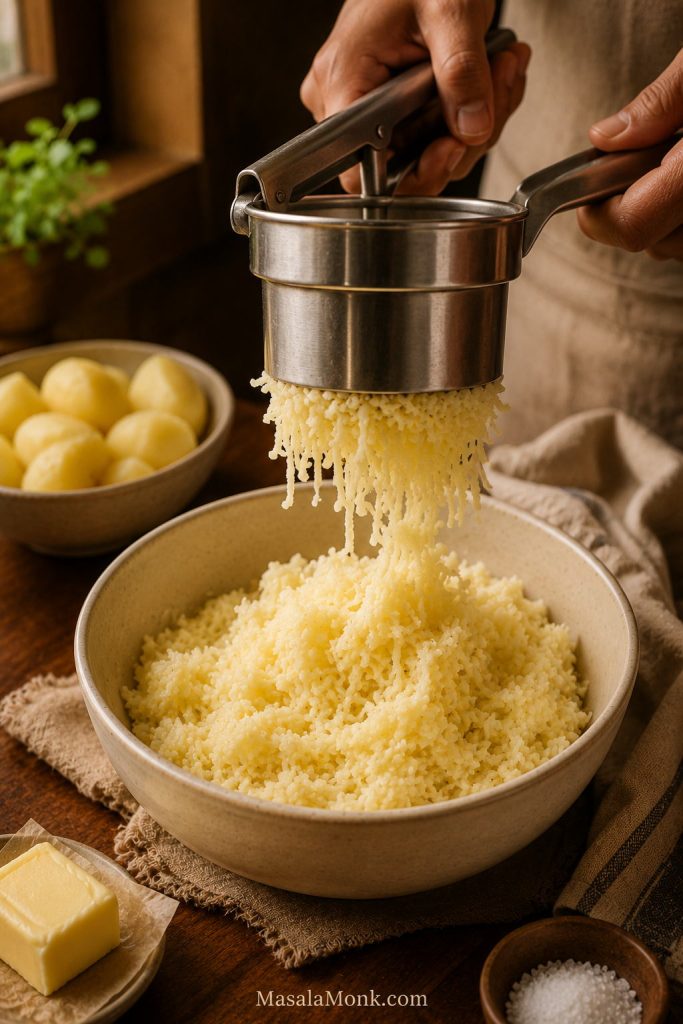
Use it for potato cakes, breakfast patties, croquettes, or fish cakes when you want something crisp outside and soft inside.

  • Mashed potato pancakes
  • Potato cakes
  • Croquettes
  • Fish cakes
  • Shepherd’s pie or cottage pie topping
  • Potato soup
  • Loaded mashed potato casserole
  • Breakfast patties
  • Waffles
  • Stuffed rolls
  • Crispy fried mashed potato balls

For quick mashed potato cakes, start with 2 cups cold mashed potatoes, 1 egg, 2–4 tablespoons flour or breadcrumbs, and a little cheese or herbs. Shape into patties and cook in a lightly oiled skillet until golden on both sides.

If you would rather turn leftovers into a full casserole-style dinner, use the mash as a topping for cottage pie, or move into another cozy potato bake like tater tot casserole. It keeps the same comfort-food mood while changing the texture completely.

If the leftover mashed potatoes are very soft, add flour, breadcrumbs, or grated cheese a little at a time before shaping them into cakes or patties. Cold mash holds together better than warm mash.

How to Store Mashed Potatoes

Store leftovers in an airtight container in the refrigerator for 3–4 days. When reheating, make sure they are hot all the way through; if you are checking with a thermometer, aim for 165°F / 74°C. For detailed safety guidance, the USDA leftovers guide is useful.

As they warm, add a splash of milk, cream, broth, or a little butter so the texture turns creamy again instead of dry or stiff.

Can You Freeze Mashed Potatoes?

Yes, they can be frozen, but the texture depends on how much fat and dairy they contain. A batch made with butter, cream, sour cream, or cream cheese freezes better than a lean version made with only potatoes and water.

To freeze, cool the mash completely and pack it into freezer-safe containers. The texture is usually best within the first month. It can be kept frozen longer, but it may become more watery or grainy over time.

Thaw overnight in the refrigerator and reheat gently with extra milk, cream, or butter. If the texture looks a little separated after thawing, warm the potatoes slowly and fold in extra butter or cream.

FAQs

These are the questions that usually come up once the potatoes are already peeled, boiling, or waiting on the stove.

1. What are the best potatoes for mashed potatoes?

Yukon Golds and russets are the safest choices. Yukon Golds make the mash creamy and buttery; russets make it lighter and fluffier. A mix gives the best balance.

2. Should I peel potatoes for mashed potatoes?

Peel them for a smooth mash. Leave some or all of the skin on for a rustic texture, especially with Yukon Gold or red potatoes.

3. Do you start mashed potatoes in cold or boiling water?

Start potatoes in cold water so the pieces cook evenly from outside to center. Boiling water can soften the edges before the middle is cooked.

4. How long should potatoes boil for mashed potatoes?

Potato chunks usually take 15–20 minutes. They are ready when a fork slides through easily with almost no resistance.

5. Why are my mashed potatoes gluey?

They turn gluey when the starch is overworked. This often happens from using a blender, food processor, or beating the potatoes too much.

6. Can I fix gluey mashed potatoes?

You can improve them, but you usually cannot make truly gluey potatoes fluffy again. Stop mixing, fold in warm butter or cream, and use dense leftovers for cakes, croquettes, soup, or casserole topping.

7. How do I make mashed potatoes without milk?

Use reserved potato cooking water, warm broth, olive oil, vegan butter, or unsweetened plant milk. Add gradually and taste as you go.

8. Can I use cream instead of milk?

Yes. Cream makes the potatoes richer and thicker. Use all cream for a holiday-style mash, or part milk and part cream for balance.

9. Can I use a hand mixer for mashed potatoes?

Yes, but use low speed and stop as soon as the potatoes are smooth. Overmixing can make the texture gluey.

10. Can I make mashed potatoes ahead of time?

Yes. Make them slightly softer than usual, refrigerate for 1–2 days, then reheat gently with extra warm milk, cream, or butter. Sour cream or cream cheese helps them reheat smoothly.

11. How do I reheat mashed potatoes without drying them out?

Reheat gently over low heat or in a covered dish. Add warm milk, cream, broth, or butter a little at a time until creamy again.

12. Can you freeze mashed potatoes?

Yes, but they freeze best with enough butter, cream, sour cream, or cream cheese. Thaw overnight and reheat slowly with extra dairy or fat.

13. How much mashed potato do I need per person?

Plan on about 225–250 g / 1/2 lb raw potatoes per person. For 4 people, use about 1 kg / 2.2 lb; for 8 people, use about 2 kg / 4.4 lb.

14. What can I add to mashed potatoes for more flavor?

Add roasted garlic, sour cream, cream cheese, parmesan, chives, parsley, black pepper, browned butter, cheddar, bacon, or gravy.

15. What is the secret to creamy mashed potatoes?

Use Yukon Gold potatoes, drain them well, add warm dairy gradually, and stop before the mash is overworked. Butter and warm half-and-half make the creamiest everyday version.

Final Thoughts

Once the method is in your hands, you can take the same potatoes creamy, fluffy, garlicky, cheesy, dairy-free, make-ahead, or gravy-ready without learning a new recipe each time.

That is why this method is worth saving: it gives you a good bowl when everything goes right, and a way back when the potatoes need help.

Posted on Leave a comment

Bean Stew Recipe with Canned or Cooked Beans: Thick, Hearty & Flexible

A bowl of thick tomato-based bean stew with mixed beans, carrots, greens, herbs, a spoon, and crusty bread beside it. The image includes the text “Bean Stew Recipe” and “Thick, hearty, flexible.”

This bean stew turns three cans of beans into a thick, hearty one-pot dinner in about 50 minutes. Onion, carrot, celery, garlic, tomato paste, tomatoes, broth, and a small mash of beans cook down into a glossy tomato-bean sauce that is scoopable instead of thin.

It is especially useful on the nights when the pantry is not empty, just awkward: a few cans of beans, one onion, the last carrot in the drawer, and enough broth to pull everything together. Because the beans carry most of the meal, rice, bread, potatoes, or polenta can stretch the pot into more servings without making it feel like less dinner.

Ingredients for bean stew arranged on a kitchen counter, including beans, onion, carrot, celery, garlic, tomato paste, crushed tomatoes, broth, herbs, and bay leaf.
The base is simple: beans, aromatics, tomato paste, tomatoes, broth, herbs, and a bay leaf.

The main recipe is tomato-based, gently smoky, full of soft-edged beans and sweet vegetables, and finished with lemon juice or vinegar so the final bowl tastes lively instead of heavy.

Most bean stew recipes ask you to choose one bean or one flavor direction first. This one gives you one base method for almost any cooked beans: cannellini beans, butter beans, black beans, pinto beans, chickpeas, kidney beans, or mixed pantry beans.

Quick Answer: What Is Bean Stew?

Bean stew is a hearty one-pot meal made with cooked beans, aromatics, tomatoes or broth, herbs, vegetables, and optional meat. It has less liquid than bean soup, so it sits on rice, clings to bread, and feels more like a full dinner. It is also less narrowly seasoned than chili, which usually has a stronger chili powder, pepper, and spice profile.

For the easiest version, use three cans of beans, a savory tomato base, and 1½–2 cups of broth. Simmer until the sauce reduces, mash a small portion of the beans into the pot, stir in greens if you like, and finish with lemon juice, vinegar, herbs, or olive oil. The bowl should be spoonable, glossy, and filling without cream.

A guide-style image for hearty bean stew showing a bowl of stew with callouts for 50 minutes, 3 cans beans, one pot, thick not soupy, vegetarian base, and freezer-friendly.
This visual summary shows the promise of the recipe: one pot, three cans of beans, a thick spoonable texture, and leftovers that still feel useful the next day.
The exact measurements are in the recipe card, and the thickening cues below show when to reduce, mash, or loosen the pot.

Recipe Snapshot

Main methodStovetop, one pot
Prep time15 minutes
Cook time35–40 minutes
Total time50–55 minutes
Servings6 bowls, or 8 smaller servings with rice/bread
Stretch-it sideRice, bread, potatoes, polenta, or another sauce-catching base
Best beansCannellini, butter beans, black beans, pinto beans, kidney beans, chickpeas, navy beans, Great Northern beans, or mixed beans
Easiest optionCanned beans
Budget optionDried beans, cooked separately first
Finished textureGlossy tomato-bean sauce that clings to the spoon
DietVegetarian base; vegan-friendly; meat-flexible
Freezer-friendlyYes

Before You Start: Beans and Ratio

This stew works best with cooked, starchy beans that can simmer, soften at the edges, and help thicken the sauce. Sweet baked beans, refried beans, and green beans behave differently, so they are better treated as separate recipes or add-ins. Green beans can be added as a vegetable, but they will not make this kind of cooked-bean stew on their own.

The Simple Ratio Behind a Good Pot

Once you know this ratio, you can make a good bean stew without needing the same cans twice. It is the kind of formula that saves dinner when the pantry looks random but not empty.

  • 3 cans cooked beans, 14–15 oz / 400–425 g each, or about 4½ cups cooked beans
  • 1 large onion plus carrot, celery, and garlic
  • 2–3 tbsp / 30–45 g tomato paste
  • 1 can crushed tomatoes, 28 oz / 800 g, or 14 oz / 400 g for a lighter tomato version
  • 1½–2 cups / 360–480 ml broth, added gradually
  • 10–15 minutes uncovered simmering to reduce the liquid
  • ½–1 cup mashed beans to thicken naturally
  • 1 tbsp / 15 ml lemon juice or vinegar to finish
A bean stew ratio guide with bowls of beans, chopped vegetables, tomato paste, tomatoes, broth, mashed beans, and lemon wedges, each labeled with the recipe ratio.
This bean stew ratio is the saveable formula: beans for body, vegetables for sweetness, tomato paste for depth, broth for looseness, and mashed beans for a thicker finish.

The stew may look thick before it has simmered, but wait 10–15 minutes before adding more broth. Beans release starch, tomatoes loosen, and vegetables soften as they cook. It is easier to loosen a thick pot than to rescue one that started too watery.

Why This Works with Almost Any Beans

The base recipe works because it does not ask every bean to behave the same way. Creamy beans help the sauce; firmer beans stay visible; mixed beans give you contrast. Start with cooked beans, keep the broth controlled, use tomato paste for depth, and mash a small portion of beans for body.
Choose Your Path

Start with the row that matches your pantry today; the main recipe is complete as written.
  • Canned or cooked beans: Follow the main recipe. Drain canned beans first, then simmer until the sauce tightens around the beans.
  • Dried beans: Cook them until tender first, then use about 4½ cups cooked beans.
  • Different bean styles: Use rosemary and lemon for white beans, lime and cumin for black beans, and herbs or vinegar for mixed beans.
  • Meat or slow cooker version: Brown meat first if using it. For slow cooker stew, use cooked/canned beans and less broth.

Cooking dried beans instead of opening cans? Check the canned vs dried bean notes before the pot starts so the beans are already tender when they meet the tomato base.

Ingredients, Swaps, and What Each One Does

The ingredients are simple, but the base matters. Let the onion, carrot, celery, garlic, and tomato paste smell sweet, savory, and cooked before the beans go in; that is what makes canned beans taste like a real stew instead of beans stirred into tomato sauce.

Main Ingredients

  • Olive oil: Softens the vegetables and gives the stew a rounder finish. Use less if adding sausage or chorizo.
  • Onion, carrot, and celery: The flavor base. Cook them until sweet-smelling and softened.
  • Garlic: Adds savory depth. Add it after the vegetables soften so it does not burn.
  • Tomato paste: Makes the stew taste deeper and more slow-cooked.
  • Smoked paprika, oregano or thyme, bay leaf, and pepper: A flexible seasoning base that works with many beans.
  • Crushed tomatoes: Create the main sauce. The full 28 oz / 800 g gives a tomato-rich pot. Use 14 oz / 400 g if you want the beans and broth to lead.
  • Broth: Low-sodium vegetable broth keeps the base vegetarian and easier to season.
  • Beans: Use three cans drained and rinsed, or about 4½ cups cooked beans.
  • Greens: Spinach, kale, chard, or collards add color. Use closer to 60 g for spinach and closer to 100 g for chopped kale, chard, or sturdier greens.
  • Lemon juice, vinegar, or balsamic: Adds a fresh lift after simmering.

Pantry Swaps

The recipe can still work if you are missing celery, using a smaller can of tomatoes, or trying to stretch two cans of beans into dinner.

If you are missingUse instead
CeleryExtra carrot, bell pepper, leek, fennel, or skip it.
CarrotSweet potato, squash, bell pepper, or extra onion.
Tomato pasteSimmer the tomatoes longer, or add a very small splash of soy sauce for depth if it fits your version.
Crushed tomatoesPassata, diced tomatoes, tomato sauce, or 14 oz / 400 g tomatoes plus more broth for a lighter stew.
BrothWater plus bouillon, or water with extra herbs, pepper, and olive oil.
Fresh herbsDried herbs in the base, then lemon or vinegar at the end.
GreensFrozen spinach, chopped cabbage, kale, chard, collards, or skip them.
Third can of beansAdd diced potato, cooked lentils, rice, extra vegetables, or use the small-batch notes below.

Salt tip: Start with ¾ tsp fine salt if using regular broth, salted canned beans, sausage, chorizo, parmesan, bouillon, or salty toppings. Use up to 1½ tsp only when your broth and beans are low-sodium or unsalted. Taste again after the stew reduces.

How to Cook It

The recipe is simple, but the pot tells you a few things as it cooks: the tomato paste should smell deeper, the sauce should slow down, and the spoon should come up with beans, not broth.

1. Soften the Vegetables

Heat olive oil in a large Dutch oven or heavy-bottomed pot over medium heat. Add onion, carrot, celery, and a pinch of salt. Cook for 7–10 minutes, stirring occasionally, until the onion looks translucent, the carrot has started to soften, and the pot smells sweet rather than raw.

Onion, carrot, and celery softening in olive oil inside an enameled Dutch oven with a wooden spoon.
First, soften the onion, carrot, and celery until glossy and sweet-smelling so the stew starts with a real cooked base, not just beans in tomato sauce.

2. Cook the Garlic, Tomato Paste, and Spices

Add garlic, tomato paste, smoked paprika, oregano or thyme, cumin if using, chili flakes if using, and black pepper. Stir for 1–2 minutes. The tomato paste should darken slightly and coat the vegetables. This is the step that makes the stew taste slow-cooked even when the beans came from cans.

Softened onion, carrot, and celery coated with cooked tomato paste, garlic, herbs, and spices inside a Dutch oven, with a wooden spoon in the pot.
Next, let the tomato paste darken slightly with the garlic, herbs, and spices; that small step gives canned or cooked beans a deeper stew flavor.

3. Add Tomatoes, Broth, Beans, and Bay Leaf

Add crushed tomatoes, 1½ cups / 360 ml broth, drained beans, and bay leaf. Stir well and scrape the bottom of the pot. If the mixture is too thick to bubble gently, add another ½ cup / 120 ml broth. Hold back extra liquid until the stew has simmered for at least 10 minutes.

Beans, crushed tomatoes, broth, and a bay leaf combined in a Dutch oven at the early simmer stage of bean stew.
After the beans, tomatoes, broth, and bay leaf go in, the pot should look a little loose; simmering uncovered is what turns it into stew.

At this stage, a loose-looking pot is normal; the thickening cues below explain when to wait, reduce, mash, or add more liquid.

4. Simmer Covered

Bring the pot to a gentle boil, then reduce the heat and cover. Simmer for 15–20 minutes. The beans should absorb the garlic-tomato flavor, and the vegetables should become fully tender.

5. Simmer Uncovered

Remove the lid and simmer for 10–15 minutes more. Stir occasionally so the bottom does not catch. The bubbles should slow down, the sauce should look glossier, and a spoon should leave a brief trail through the stew before the sauce flows back. If you plan to serve it over rice, keep it slightly saucier.

6. Mash a Small Portion of the Beans

Mash ½–1 cup of beans against the side of the pot with a spoon, ladle, or potato masher. Do not puree the stew. You want enough broken beans to make the sauce creamy while most beans stay whole. Chickpeas will stay firmer than white beans, so mash a little more if using mostly chickpeas.

A potato masher pressing some beans into thick tomato bean stew inside a Dutch oven, with many whole beans still visible.
Instead of adding cream or flour, mash a small portion of the beans into the sauce while leaving plenty of whole beans for texture.

When the stew stays thinner than you want after mashing, use the troubleshooting table before adding extra ingredients.

7. Add Greens and Finish

Stir in spinach, kale, chard, or other greens. Spinach needs 2–3 minutes; kale and chard may need 4–5 minutes. Turn off the heat, remove the bay leaf, then stir in lemon juice, vinegar, or balsamic. If the stew tastes dull even after salt, it probably needs acid, not more spices.

A hand adding fresh spinach and kale to a pot of thick tomato bean stew while a wooden spoon rests in the pot.
Toward the end, fold in spinach, kale, or chard so the greens soften into the hot stew while still adding freshness and color.

8. Rest Before Serving

Let the stew rest for 10 minutes before serving. The beans settle, the sauce tightens, and the bowl becomes more balanced. If it gets too thick, loosen it with broth or water ¼ cup / 60 ml at a time.

Finished bean stew in a Dutch oven with white beans, carrots, tomatoes, greens, herbs, and a thick red sauce, with bread and a wooden spoon nearby.
After resting, the stew should look settled and glossy in the pot before it ever reaches the bowl.

How to Keep It Thick, Not Soupy

If the stew looks too loose at first, give it a few minutes uncovered before adding fixes.

  • Start with less broth. For three cans of beans, begin with 1½ cups / 360 ml broth and add more only if needed.
  • Wait before adding liquid. Tomatoes loosen and beans release starch as they simmer.
  • Simmer uncovered near the end. This reduces extra liquid and concentrates flavor.
  • Mash some beans. Breaking down ½–1 cup beans thickens the sauce naturally.
  • Use tomato paste. Cooked tomato paste adds body and depth.
  • Choose creamy beans. Cannellini, butter beans, pinto beans, and white beans make a thicker pot.
  • Blend a small amount. You can blend 1 cup of stew and stir it back in, but do not blend the whole pot unless you want a bean puree.
  • Rest before serving. The stew thickens slightly as it cools.

Texture cue: after the uncovered simmer, a spoon should leave a short trail through the stew before the sauce slowly flows back. The stew should sit on rice instead of flooding it, and bread should be able to drag through the sauce.

Close-up of thick tomato bean stew with a wooden spoon creating a visible trail through the sauce. The image includes the text “Thick, Not Soupy” and “Look for a spoon trail.”
The best texture cue is the spoon trail: when the sauce clings to the beans and slowly settles back, the stew is thick enough without becoming dry.

Recipe Card

Thick and Hearty Bean Stew

This thick bean stew turns canned or cooked beans into a hearty tomato-based dinner with garlic, herbs, soft vegetables, greens, and a bright lemon or vinegar finish. Mash a small amount of beans into the pot so the sauce turns glossy and spoonable without cream.

Prep Time
15 minutes
Cook Time
35–40 minutes
Total Time
50–55 minutes
Servings
6 bowls

Equipment

  • Large Dutch oven or heavy-bottomed pot, 5–6 quart / 5–6 liter
  • Wooden spoon
  • Measuring cups and spoons
  • Can opener
  • Potato masher or ladle, optional

Ingredients

  • 2 tbsp / 30 ml olive oil
  • 1 large onion, diced, about 150–180 g
  • 2 medium carrots, diced, about 160–200 g
  • 2 celery ribs, diced, about 100 g
  • 4 garlic cloves, minced, about 12–16 g
  • 2–3 tbsp / 30–45 g tomato paste
  • Smoked paprika, 1 tsp
  • Dried oregano or thyme, 1 tsp
  • ½ tsp ground cumin, optional
  • ¼–½ tsp chili flakes, optional
  • Bay leaf, 1
  • Crushed tomatoes, 1 can, 28 oz / 800 g
  • Low-sodium vegetable broth, 1½–2 cups / 360–480 ml, plus more as needed
  • 3 cans beans, 14–15 oz / 400–425 g each, drained and rinsed; about 4½ cups cooked beans
  • 2 cups / 60–100 g spinach, kale, chard, or other greens
  • 1 tbsp / 15 ml lemon juice, red wine vinegar, or balsamic vinegar
  • 2–3 tbsp chopped fresh parsley or basil
  • ¾ tsp fine salt to start, plus more to taste; use up to 1½ tsp if using low-sodium broth and unsalted beans
  • ½ tsp black pepper
  • Extra olive oil for serving, optional

Instructions

  1. Soften the vegetables. Heat olive oil in a large Dutch oven or heavy pot over medium heat. Add onion, carrot, celery, and a pinch of salt. Cook for 7–10 minutes, stirring occasionally, until softened and sweet-smelling.
  2. Add garlic and tomato paste. Stir in garlic, tomato paste, smoked paprika, oregano or thyme, cumin if using, chili flakes if using, and black pepper. Cook for 1–2 minutes, stirring often, until the tomato paste darkens slightly.
  3. Add tomatoes, broth, beans, and bay leaf. Add crushed tomatoes, 1½ cups / 360 ml broth, the drained beans, and bay leaf. Stir well. If the stew looks too thick to simmer, add another ½ cup / 120 ml broth.
  4. Simmer covered. Bring to a gentle boil, reduce heat, cover, and simmer for 15–20 minutes.
  5. Simmer uncovered. Remove the lid and simmer for 10–15 minutes, stirring occasionally, until the liquid reduces and clings to the beans.
  6. Mash some beans. Mash ½–1 cup of beans into the sauce with a spoon, ladle, or potato masher. Keep most beans whole.
  7. Add greens. Stir in spinach, kale, or chard. Cook for 2–5 minutes, depending on the green, until tender.
  8. Finish the stew. Remove the bay leaf. Stir in lemon juice, vinegar, or balsamic, plus fresh herbs. Taste and adjust salt, pepper, and balance.
  9. Rest and serve. Let the stew rest for 10 minutes before serving. Add broth or water ¼ cup / 60 ml at a time if it becomes too thick.

Notes

  • Taste after simmering before adding more salt; broth reduces and canned beans vary.
  • For a thicker stew, start with 1½ cups / 360 ml broth and mash more beans near the end.
  • Prefer a looser stew? Use the full 2 cups / 480 ml broth and add more as needed.
  • For a lighter, less tomato-heavy version, use 14 oz / 400 g crushed tomatoes and add broth only as needed.
  • If using cooked dried beans, some good-tasting bean cooking liquid can replace part of the broth.
  • If using kidney beans, use canned kidney beans or dried kidney beans that have already been properly cooked.
  • For sausage, brown 12–16 oz / 340–450 g sausage first and reduce the olive oil.
  • For a vegan version, use vegetable broth and finish with olive oil, lemon, and herbs.

Best Beans for Stew

The bean mix changes the whole bowl: creamy beans soften the sauce, firmer beans stay visible, and mixed beans make the stew feel more like a pantry dinner than a planned recipe.

Several bowls of different beans for stew, including white beans, butter beans, black beans, pinto beans, kidney beans, chickpeas, and mixed beans.
Different beans bring different texture: creamy white beans, butter beans, chickpeas, kidney beans, black beans, pinto beans, or a mixed-bean blend can all work here.
BeanBest forTextureNotes
Cannellini beansWhite bean stew, Tuscan-style stewCreamy but holds shapeBest all-purpose choice for the main version.
Butter beansThick, soft, comforting stewLarge, tender, butteryExcellent with tomatoes, smoked paprika, rosemary, mushrooms, or chorizo.
Great Northern or navy beansWhite bean stewSmall to medium, creamyBest when you want the stew creamy and gentle.
Black beansSmoky or Latin-style stewEarthy and creamy-firmUse cumin, smoked paprika, chili, lime, cilantro, and rice.
Pinto beansMexican-style or pantry stewSoft and creamyThey break down nicely and help thicken the sauce.
Kidney beansMixed bean stew, beef bean stewFirmUse canned or properly cooked kidney beans.
Chickpeas / garbanzo beansMediterranean, Spanish, or Moroccan-style stewNutty and firmGood with tomato, cumin, coriander, paprika, greens, and lemon.
Mixed beansBudget stew, pantry cleanout stewVariedMash some creamy beans into the sauce to bring the textures together.

Once you know which beans you are using, the variation table below shows how to season white beans, black beans, chickpeas, butter beans, and mixed pantry beans.

If you were looking for a green bean side dish instead of a cooked-bean stew, MasalaMonk’s green bean casserole recipe is the better place to start.

Canned vs Dried Beans

For speed, canned beans get dinner on the table faster; dried beans give you more control, economy, and often excellent texture. Once they simmer with the garlic-tomato base, canned beans still taste like they belong.

Two bowls of beans on a kitchen counter, one with smooth drained canned beans and one with cooked dried beans, with a small bowl of bean cooking liquid and an unlabeled can nearby.
Use the comparison as a measuring cue: 3 cans of beans usually give about 4½ cups cooked / about 720 g drained beans, while about 1½ cups dried beans can replace them after cooking.

For this recipe, 3 cans of beans, 14–15 oz / 400–425 g each, gives about 4½ cups cooked beans once drained, or roughly 720 g drained beans. To replace them with dried beans, start with about 1½ cups dried beans, cook them until tender, then measure about 4½ cups cooked beans for the stew. The exact yield varies by bean type, size, and age.

If your cooked dried-bean liquid tastes good and is not overly salty, use some of it in place of broth. It adds body and keeps the stew even more budget-friendly.

Very old dried beans may take much longer to soften or stay firm even after extended cooking. When cooking dried beans, keep tomatoes, lemon juice, and vinegar out until the beans are tender. Acidic ingredients can slow softening.

Planning to use the slow cooker? Read the slow cooker notes before using dried beans, especially kidney beans.

Kidney bean note: Canned kidney beans are the easiest choice here. If starting with dried kidney beans, cook them properly before adding them to stew, especially before slow cooking. For food-safety details, see the FDA’s guidance on kidney bean toxins and Utah State University Extension’s guide to storing and cooking dry beans.

Variations

Think of these as directions for the next pot, not decisions you need to make before the first one. The main recipe is complete as written; choose only the path that matches what you have today.

For a hands-off version, use the slow cooker and Instant Pot notes after the flavor ideas.

Vegetarian or Vegan Bean Stew, Plus Meat Add-Ins

Vegetarian or vegan bean stew: The main recipe is vegetarian with vegetable broth. For a fully vegan pot, skip parmesan, yogurt, sour cream, and other dairy toppings; olive oil, mushrooms, smoked paprika, nutritional yeast, lemon, and herbs can still make the finish rich and lively.

Sausage: Brown 12–16 oz / 340–450 g sausage in the pot for 5–7 minutes before adding the vegetables. Spoon off excess fat, reduce the olive oil to 1 tablespoon / 15 ml, and build the stew in the same pot. White beans, butter beans, and pinto beans work especially well. For a more sausage-forward slow-cooker dinner, MasalaMonk’s slow cooker sausage casserole recipe follows that comfort-food direction more fully.

Chorizo: Use 4–6 oz / 115–170 g chorizo. Cured Spanish-style chorizo should be sliced or diced and gently rendered. Fresh Mexican-style chorizo should be cooked until browned and crumbly. Reduce the added oil and taste before adding more salt.

Chicken: Cooked shredded chicken is the simplest route. Stir in 2 cups / 280–320 g during the last 10 minutes of simmering. For raw chicken, use boneless thighs or breasts cut into large pieces, simmer until cooked through, then shred and return to the pot.

Beef: Beef turns this into a longer-cooked stew, not a 50-minute variation. Brown 1 lb / 450 g stew beef first, then simmer it with tomatoes and broth until mostly tender before adding canned beans. Depending on the cut, this may take 1½–2 hours.

Best Bean Mixes and Flavor Versions

This is where the recipe becomes useful for real pantry cooking: two half-used cans can make a better stew than one perfect bean. Keep the same method, then change the herbs, spices, finish, and side.

Version or mixChange these ingredientsFinish withServe with
Cannellini + butter beansUse mostly white beans with rosemary, thyme, and greens.Lemon, olive oil, parsleyBread or sautéed greens
Black beans + pinto beansUse cumin, chili, smoked paprika, and less Italian herb.Lime, cilantro, avocadoRice
Chickpeas + cannelliniUse cumin, coriander, paprika, tomato, and greens.Lemon, parsley, yogurt if desiredFlatbread or couscous
Butter beans + mushrooms or chorizoUse smoked paprika, rosemary, mushrooms, or rendered chorizo.Vinegar, parsley, black pepperPotatoes or bread
Mixed pantry cansUse any cooked beans and mash the creamier ones into the sauce.Vinegar, herbs, olive oilRice or bread

If you want chickpeas in a fresher, no-cook direction instead, MasalaMonk’s chickpea salad recipe turns canned chickpeas into a bright lemony lunch or side.

Fresh Tomato, No-Tomato, and Small-Batch Notes

Fresh tomato version: Fresh tomatoes work, but they need more time to cook down than canned tomatoes. Use them when they are ripe and flavorful, simmer longer, and expect a slightly looser, brighter sauce. MasalaMonk’s guide to tomato sauce from fresh tomatoes shows how reduction changes both texture and flavor.

Lighter no-tomato version: Skip the crushed tomatoes and tomato paste. Use 2½–3 cups / 600–720 ml broth, white beans, rosemary or thyme, garlic, greens, and lemon. Mash about 1 cup of beans into the pot so the broth becomes creamy.

Small batch with 2 cans of beans: Use 1 tbsp / 15 ml olive oil, 1 small onion, 1 carrot, 1 celery rib, 2 garlic cloves, 1½ tbsp / about 22 g tomato paste, 14 oz / 400 g tomatoes, ¾–1 cup / 180–240 ml broth, and 2 cans of beans. This makes about 3–4 bowls.

Adding Beans to Another Stew

Already have a pot of stew going? Use cooked or canned beans. Raw dried beans should not be added to an existing stew unless the recipe was designed for that timing.

  • Canned or cooked beans: Add during the final 15–20 minutes.
  • Delicate white beans or butter beans: Add later if you want them to stay whole.
  • Kidney, black, or pinto beans: Add a little earlier if you want them to absorb more flavor.
  • To thicken another stew: Mash some beans into the liquid.

Slow Cooker and Instant Pot Notes

The stovetop gives the best control over thickness. Choose the slow cooker for convenience, not the glossiest texture, and use the Instant Pot when speed matters more than deep reduction.

Slow Cooker

The slow cooker version will usually be softer and less glossy than the stovetop version, but it is excellent for a hands-off, make-ahead dinner. Use canned beans or beans that have already been safely cooked, and sauté the onion, carrot, celery, garlic, tomato paste, and spices first if you can.

  1. Sauté the vegetables, garlic, tomato paste, and spices in a skillet or in the slow cooker insert if it has a sauté function.
  2. Add tomatoes, cooked/canned beans, bay leaf, herbs, and 1¼–1½ cups / 300–360 ml broth.
  3. Cook on high for 3–4 hours or low for 5–6 hours. Timing depends on bean type and how soft you want the stew.
  4. Add greens near the end.
  5. Mash some beans after cooking. If the stew is still thin, transfer to a pot and simmer uncovered for a few minutes.

Slow cooker kidney bean warning: Do not cook raw dried kidney beans from scratch in the slow cooker. Use canned kidney beans or dried kidney beans that have already been boiled and cooked properly.

Instant Pot with Canned Beans

The Instant Pot is best when you want speed, not deep reduction. The sauté step and final simmer are what keep it from tasting flat. This version works best with cooked or canned beans unless you are following a bean-specific dried-bean pressure-cooking method.

  1. Use the sauté function to soften the onion, carrot, celery, garlic, tomato paste, and spices.
  2. Deglaze thoroughly with a splash of broth, scraping until the bottom feels smooth before adding beans and tomatoes.
  3. Add drained beans, 1 cup / 240 ml broth, bay leaf, and crushed tomatoes on top.
  4. Pressure cook for 5 minutes.
  5. Let the pressure release naturally for 10 minutes, then release the remaining pressure.
  6. Mash some beans after cooking. If the stew is thin, use sauté mode for a few minutes to reduce it.
  7. Add greens, lemon or vinegar, and herbs after pressure cooking.

What to Serve with Bean Stew

The best sides are the ones that catch the sauce: rice, bread, potatoes, polenta, or anything sturdy enough for a thick spoonful. Serve it thick enough for bread, or just saucy enough to settle into rice. A final drizzle of olive oil and a squeeze of lemon can make the bowl feel richer, brighter, and more intentional than the ingredient list suggests.

A hand dipping a piece of crusty bread into a bowl of thick tomato bean stew with white beans, carrots, herbs, and a warm linen beside it.
Serve the stew with crusty bread when you want the sauce to be part of the meal; one scoop should catch beans, herbs, and tomato base together.

To Make It More Filling

  • Crusty bread or garlic bread
  • Steamed rice
  • Polenta
  • Cornbread
  • Baked potatoes
  • Quinoa, bulgur, or couscous
  • Buttered toast

A pot of plain rice is one of the easiest ways to stretch the stew. MasalaMonk’s guide on how to cook rice covers stovetop, rice cooker, and Instant Pot methods so the base comes out right before you spoon the stew over it.

A bowl of white rice topped with tomato bean stew, carrots, herbs, and a lemon wedge, with a spoon resting in the bowl.
For a bigger dinner, spoon the bean stew over rice; the rice catches the tomato sauce and stretches the pot without making the meal feel thin.

The storage section explains why extra stew is worth planning for: it thickens overnight and loosens easily when reheated gently.

To Add Freshness

Because the stew is rich and hearty, the best toppings either brighten it, cool it, or add contrast.

  • Lemon or lime wedges
  • Fresh parsley, basil, cilantro, or dill
  • Pickled onions
  • Green salad
  • Sautéed greens
  • Avocado for black bean versions
  • Yogurt or sour cream, if not vegan

For another bean-and-rice dinner with a Louisiana-style flavor base, MasalaMonk’s red beans and rice recipe is a heartier, smokier route.

Make-Ahead, Storage, Freezing, and Reheating

Bean stew thickens and deepens as it rests, which means tomorrow’s bowl may taste even better than tonight’s. The leftovers are part of the reward here; the beans keep soaking up flavor as they sit. If you are making it ahead, keep it slightly looser than you want. It will thicken as it cools and again in the fridge.

A glass storage container filled with leftover tomato bean stew beside a reheated bowl of the same stew, with bread, herbs, and a spoon on a kitchen counter.
Leftover bean stew usually thickens as it rests; store it in glass if you can, then loosen it with a splash of broth or water when reheating.
  • Make ahead: Make the stew 1–2 days ahead if you want the flavor to settle.
  • Refrigerator: Store in an airtight container for 4–5 days.
  • Freezer: Freeze for up to 3 months.
  • Greens: If freezing, consider adding fresh greens after reheating rather than before freezing.
  • Reheating: Warm on the stovetop over low-medium heat with a splash of broth or water.
  • Brighten after reheating: Add lemon juice, herbs, or olive oil at the end.

The troubleshooting table below covers reheated stew that turns too thick, too loose, or flat-tasting.

Mistakes That Make It Watery or Bland

Most disappointing bean stews fail in the same few ways: too much liquid, not enough base flavor, or no fresh finish. Fix those, and the pot usually comes back.

  • Adding too much broth at the start. Begin with less, simmer, then adjust.
  • Skipping the vegetables. Beans need onion, garlic, herbs, and seasoning to taste like dinner.
  • Not cooking the tomato paste. Raw tomato paste can taste sharp and flat.
  • Adding tomatoes or vinegar before dried beans are tender. Acidic ingredients can slow softening.
  • Forgetting the fresh finish. A small splash of vinegar or lemon at the end keeps the stew from tasting heavy.
  • Ignoring salt from broth, canned beans, sausage, or chorizo. Taste before adding the full amount of salt.

Troubleshooting

Most bean stew problems are fixable because beans are forgiving. When the pot is watery, give it time uncovered. Flat flavor usually needs salt first, then a small splash of vinegar or lemon juice. A too-thick pot should be loosened slowly and tasted again.

ProblemFix nowFix next time
Too waterySimmer uncovered and mash ½–1 cup beans into the sauce.Start with less broth and add more only after simmering.
Too thickAdd broth or water ¼ cup / 60 ml at a time.Reduce for less time or use the full 2 cups / 480 ml broth.
Bland beansAdd salt first, then a small splash of vinegar or lemon juice, herbs, olive oil, or chili.Season the vegetables and cook the tomato paste properly.
Flat flavorAdd a small splash of vinegar or lemon juice, fresh herbs, black pepper, or olive oil.Do not skip the final balance.
Too acidicAdd more beans, a splash of broth, olive oil, or a small pinch of sugar.Use fewer tomatoes or cook tomato paste longer.
Bitter tomato pasteAdd tomatoes, broth, and beans to soften the flavor.Cook tomato paste until darkened, but do not let it burn.
Firm beansSimmer longer with extra broth until tender.Use canned beans or cook dried beans fully before adding.
Too saltyAdd unsalted beans, potato, tomatoes, or low-sodium broth.Use low-sodium broth and season gradually.
Thin slow cooker versionMash beans at the end or transfer to a pot and simmer uncovered.Use less broth in the slow cooker.

FAQs

What beans are best for bean stew?

Cannellini beans and butter beans are the easiest all-purpose choices for bean stew because they turn creamy without disappearing. Black beans make it smoky, chickpeas keep it firmer, pinto beans help thicken the sauce, and mixed beans are best when you want to use what is already open.

Is bean stew the same as bean soup?

No. Bean stew is thicker than bean soup. Soup has more broth and a looser texture, while this stew is reduced, spoonable, and sturdy enough to serve with bread, rice, polenta, or potatoes as a full meal.

How is bean stew different from chili?

Bean stew is usually less chili-spice focused than chili. This version leans on aromatics, tomatoes, herbs, beans, and a flexible finish rather than a heavy chili-powder base.

Can I use canned beans for bean stew?

Yes, canned beans work very well for bean stew. Drain and rinse three 14–15 oz cans, then simmer them in the tomato base until the sauce clings to the beans.

Should I drain canned beans?

Usually, yes. Draining and rinsing gives you more control over salt and texture. If the can liquid tastes clean and you want extra body, add a small splash, but do not use it as the main liquid.

Can I use dried beans?

Yes, dried beans work well if they are cooked until tender first. Use about 4½ cups cooked beans to replace three cans; the stew should be where they absorb flavor, not where they struggle to soften.

How do I thicken bean stew?

To thicken bean stew, simmer uncovered and mash ½–1 cup of beans into the sauce. Starting with less broth and cooking the tomato paste properly also helps the finished bowl become glossy and scoopable.

Can I make bean stew without tomatoes?

Yes, bean stew can be made without tomatoes. Use broth as the base, add extra aromatics and herbs, mash more beans for body, and finish with olive oil and a little acidity so it still tastes complete.

Can this bean stew be vegan?

Yes, this bean stew can be vegan. Use vegetable broth, skip dairy toppings, and finish with olive oil, herbs, mushrooms, or nutritional yeast for extra richness.

Can I make bean stew in a slow cooker?

Yes, bean stew can be made in a slow cooker with canned beans or beans that have already been cooked. Use less broth than the stovetop version, and expect a softer, less glossy stew that is still excellent for a hands-off dinner.

Does bean stew freeze well?

Yes, bean stew freezes well for up to 3 months. It usually looks thicker after thawing, so reheat it gently with a splash of broth or water, then brighten it at the end so it tastes fresh again.

What should I serve with bean stew?

Serve bean stew with crusty bread, rice, polenta, cornbread, baked potatoes, quinoa, couscous, or a green salad. Bread is best when the stew is extra thick; rice is best when you want to stretch the pot into more servings.

Final Thoughts

A good bean stew is not fancy food. It is the kind of recipe that makes three cans of beans, one onion, and the last carrot in the drawer feel like dinner for tonight and lunch tomorrow.

Once the method clicks, you stop needing one exact bean. Try white beans and rosemary when you want something soft and cozy. Go with black beans, cumin, and lime when you want a smoky bowl over rice. Choose chickpeas with paprika and lemon, butter beans with chorizo, or mixed beans when the pantry needs clearing out.

If you make this with a different bean mix, leave a comment with the exact cans or cooked beans you used and what you served it with — especially if you tried black beans, butter beans, chickpeas, or a mixed pantry batch. It helps the next person staring at the same random cans.

Back to top

Posted on Leave a comment

Broccoli Pasta Recipe: Garlic Parmesan Broccoli Pasta That Stays Saucy Without Cream

Shell pasta and broccoli in a shallow bowl with a fork lifting a glossy bite, lemon and Parmesan nearby, with text reading “Broccoli Pasta Recipe” and “Garlic Parmesan • Saucy Without Cream.”

Broccoli pasta should be easy: pasta, broccoli, garlic, Parmesan, done. But anyone who has made a disappointing bowl knows the usual problems. The pasta turns dry before it reaches the table. Broccoli tastes watery or bland. Cheese clumps instead of melting. Somehow, dinner ends up tasting like plain noodles with steamed vegetables.

This broccoli pasta recipe is built to avoid that. The trick is simple: use broccoli in two textures — small pieces for sauce, florets for freshness.

The good version should feel like vegetables and comfort food finally agreeing with each other. Some broccoli melts into the garlic-Parmesan coating; some stays green and visible. Lemon keeps the cheese from feeling heavy, and the whole bowl lands somewhere between fresh weeknight pasta and cozy comfort food.

Once the broccoli is cut, the pasta comes together in about 25 minutes. The first time may take closer to 30 minutes while you grate the cheese, learn the timing, and see how loose the sauce should look in the pan.

If your broccoli pasta usually turns dry, the two biggest fixes are simple: save pasta water, and add Parmesan off the heat.

Quick Answer: How Do You Make Broccoli Pasta?

To make broccoli pasta, cook the pasta with finely chopped broccoli until some of the broccoli is soft enough to mash. Toss it with garlic, butter or olive oil, Parmesan, and starchy pasta water until saucy. Add a few visible florets near the end so the bowl still looks green and fresh. That balance keeps the pasta saucy without turning the whole bowl soft.

What makes this version different is that broccoli is not just a topping. Some becomes sauce, some stays visible, and the best bites taste like broccoli all the way through.

What Good Broccoli Pasta Should Look Like

Use this as the visual target before you cook: the pasta should look coated and lively, not matte, stiff, or separated from the broccoli.

Close-up of glossy broccoli pasta lifted on a fork, with green broccoli sauce clinging to short pasta and text reading “Glossy, Saucy, Not Dry.”
Look for a glossy coating, not sauce pooling at the bottom.

At a Glance

  • Total time: about 25 minutes once you know the rhythm
  • Yield: 4 dinner servings or 6 smaller side servings
  • Main flavor: garlic, Parmesan, lemon, black pepper, broccoli
  • Texture: saucy, green-flecked, lightly creamy, not heavy
  • Best pasta: shells, fusilli, orecchiette, penne, rigatoni, or cavatappi
  • Fresh or frozen: both work

Garlic Parmesan Broccoli Pasta That Stays Saucy Without Cream

Recipe Card

This garlic Parmesan broccoli pasta turns finely chopped broccoli, garlic, Parmesan, and pasta water into a light, glossy sauce, with a few florets kept whole for freshness. It stays saucy without heavy cream.

Servings
4 dinner servings
Prep Time
10 minutes
Cook Time
15 minutes
Total Time
25 minutes

Equipment

  • Large pot
  • 12-inch skillet or wide sauté pan
  • Colander, slotted spoon, or spider
  • Measuring cup for pasta water
  • Fine grater or microplane
  • Fork, potato masher, wooden spoon, or spatula

Ingredients

  • 12 oz / 340g short pasta, such as shells, fusilli, orecchiette, penne, rigatoni, or cavatappi
  • 1¼ to 1½ lb / 565 to 675g broccoli, florets and tender stems
  • Kosher salt, for the pasta water
  • 3 tbsp / 45 ml olive oil
  • 1 to 2 tbsp / 14 to 28g butter
  • 4 garlic cloves, finely minced or grated
  • ½ tsp red pepper flakes, optional
  • ½ cup / 45 to 50g finely grated Parmesan, plus more for serving
  • 1 cup / 240 ml reserved pasta water, divided
  • 1 to 2 tsp lemon zest or 1 tbsp lemon juice, to taste
  • Black pepper, to taste

Optional Add-Ins

  • 2 tbsp cream cheese for a creamier sauce
  • ¼ cup / 60 ml milk for a lighter creamy version
  • ½ cup shredded cheddar or mozzarella for a cheesier pasta
  • 2 cups cooked chicken for a fuller dinner

Instructions: Cook the Pasta and Broccoli

  1. Cut the broccoli in two textures. Finely chop about two-thirds of the broccoli into ¼ to ½ inch pieces, including tender stems. Cut the remaining broccoli into small visible florets, about ¾ to 1 inch. Peel thick stems first if the outside feels tough.
  2. Boil the pasta water. Bring a large pot of water to a boil and salt it well. Add pasta and cook until just shy of al dente. Start checking 1 to 2 minutes before the package time.
  3. Add the finely chopped broccoli. When the pasta has about 5 minutes left, add the finely chopped broccoli pieces. Make sure the water returns to a steady boil.
  4. Add the visible florets. When the pasta has about 2 minutes left, add the remaining small florets.
  5. Reserve pasta water. Scoop out 1 cup / 240 ml pasta water before draining. Do not rinse the pasta.

Build the Sauce and Finish

  1. Make the garlic base. While the pasta cooks, warm olive oil and butter in a wide skillet over medium-low heat. Add garlic and red pepper flakes. Cook for 30 to 60 seconds, until fragrant but not browned.
  2. Mash some broccoli. If using a slotted spoon, move broccoli into the skillet first and mash the soft pieces into the garlic oil. Then add pasta. If everything was drained together, add pasta and broccoli to the skillet and mash some broccoli in place.
  3. Toss with pasta water. Add ½ cup / 120 ml reserved pasta water. Toss until the pasta looks coated and green bits cling to it. Add more pasta water a few tablespoons at a time if needed.
  4. Add Parmesan off the heat. Turn off the heat. Add Parmesan gradually, tossing until it melts into the pasta. Loosen with more hot pasta water if needed.
  5. Finish and serve. Add lemon zest or juice, black pepper, and more Parmesan. Taste and adjust salt, lemon, pepper, and cheese before serving.

Notes

  • If your pasta cooks in less than 9 minutes, boil the finely chopped broccoli pieces for 2 to 3 minutes before adding the pasta, or cook the broccoli separately until mashable.
  • Frozen broccoli: thaw large florets enough to chop and drain well.
  • Gluten-free, chickpea, or lentil pasta: check early and toss gently.
  • Add Parmesan off the heat so it melts smoothly.
  • Chicken: add extra pasta water because it absorbs sauce.
  • Stop while the skillet looks slightly loose; the pasta thickens as it sits.

Why the Two-Texture Broccoli Method Works

The method works because the broccoli has two jobs. Chopped broccoli softens enough to coat the pasta; florets keep the bowl green and fresh. If all the broccoli is large, the pasta tastes like noodles with vegetables on top. If all of it is finely chopped, the flavor is good but the bowl looks dull.

The best broccoli pieces are not the pretty ones. They are the little bits that disappear into the garlic oil and make every shell taste like sauce. Do not worry if the broccoli looks a little messy in the skillet. That mess is what makes the sauce.

Small Pieces for Sauce, Florets for Freshness

This cut is the foundation of the recipe. The small pieces are for flavor and body; the larger florets are for color, bite, and the finished look.

Cutting board with finely chopped broccoli and stems on one side and larger broccoli florets on the other, labeled “Small Pieces for Sauce” and “Florets for Freshness.”
Chopped broccoli builds sauce; larger florets keep the pasta green and fresh.

Success cue: the pasta should look a little saucier in the pan than you want on the plate. Hot pasta keeps absorbing as it sits, so a slightly loose skillet becomes a well-coated bowl by the time you eat.

Do not chase dryness with more cheese. Wake the sauce up with pasta water first, then add cheese for flavor.

Ingredients You’ll Need

The ingredients are simple, but three details matter most: broccoli cut size, starchy pasta water, and finely grated Parmesan.

The Ingredients That Make the Sauce Work

Use short pasta, enough broccoli, fresh garlic, finely grated cheese, and lemon. Those few choices carry most of the flavor.

Ingredients for broccoli pasta arranged on a kitchen surface, including short pasta, broccoli, Parmesan, garlic, lemon, olive oil, butter, black pepper, and red pepper flakes.
Short pasta, broccoli, garlic, Parmesan, and lemon each carry part of the flavor.

Best Pasta Shapes for Broccoli Pasta

Use 12 oz / 340g short pasta. Shells and fusilli are especially good because mashed broccoli catches in their curves. Orecchiette, penne, rigatoni, and cavatappi also work. Long pasta needs smaller broccoli and more tossing.

Six bowls of dry pasta labeled Shells, Fusilli, Orecchiette, Penne, Rigatoni, and Cavatappi under the heading “Best Pasta Shapes for Broccoli Pasta.”
Curves, ridges, and cups give broccoli sauce places to cling.

Chickpea, lentil, and gluten-free pasta can work too, but check early and toss gently because they can break more easily than regular wheat pasta.

Broccoli

Use 1¼ to 1½ lb / 565 to 675g broccoli. Chop most of it into ¼ to ½ inch pieces so it can soften into the sauce. Save a handful of ¾ to 1 inch florets so the finished pasta still looks green and fresh.

Do not waste the stems. Peel tough outsides, then chop the tender centers small so they can help thicken the sauce.

Using frozen broccoli instead? Jump to the fresh vs frozen broccoli notes before you start, because frozen broccoli needs a little more moisture control.

Garlic, Oil, and Butter

Use 4 garlic cloves, 3 tbsp / 45 ml olive oil, and 1 to 2 tbsp / 14 to 28g butter. They build the warm base later, so keep the heat gentle.

Parmesan

Use ½ cup / 45 to 50g finely grated Parmesan, plus more for serving. A block grated finely at home melts better than large shreds. Pecorino Romano is sharper; Grana Padano is milder. Taste before adding extra salt.

Lemon, Salt, Pepper, and Red Pepper Flakes

Use 1 to 2 tsp lemon zest or 1 tbsp lemon juice. Lemon does not need to taste loud; it just keeps the cheese and broccoli from feeling flat. Finish with black pepper and red pepper flakes if you want gentle heat.

Common Broccoli Pasta Mistakes to Avoid

Before you cook, watch these four things:

  • Do not cut all the broccoli large. You need chopped broccoli that can collapse into sauce.
  • Do not forget pasta water. It is the difference between glossy and dry.
  • Do not add Parmesan over high heat. That is how smooth cheese turns grainy.
  • Do not rinse the pasta. The surface starch helps the broccoli sauce cling.

How to Make Broccoli Pasta with the Two-Texture Method

Once you know the basic steps, the real difference is in the cues: how soft the broccoli gets, how loose the sauce looks, and when to stop adding heat.

When to Add Broccoli to Pasta

Use the timing as a texture guide, not just a clock. Chopped broccoli needs time to soften enough for sauce; florets need less time so they stay green.

TimingAdd ThisGoal
5 minutes before pasta is doneFinely chopped broccoliSoft enough to mash
2 minutes before pasta is doneVisible floretsGreen and tender
Before drainingPasta waterSauce insurance
Off the heatParmesanSmooth, not grainy
A hand adding broccoli florets to a pot of pasta and chopped broccoli, with text explaining “Chopped Broccoli Early” and “Florets Near the End.”
Chopped broccoli goes in early; florets go in near the end.

1. Cut for Sauce, Not for Perfect Florets

Do not worry about perfect broccoli shapes here. The chopped broccoli is supposed to look a little messy because it is going to disappear into the sauce. Keep a handful of visible florets aside so the finished pasta still looks like broccoli pasta, not just green pasta.

2. Use the Pasta Pot for Timing

The only timing that matters is this: chopped broccoli needs enough time to soften; florets only need enough time to turn green and tender. If the water slows down after adding broccoli, give the pasta a little extra time and check before draining.

3. Why Pasta Water Makes Broccoli Pasta Glossy

Pasta water is boring until the moment your skillet looks dry. Then it becomes the thing that saves dinner. Scoop it before draining so you are not trying to fix dry pasta with plain water later.

Starchy pasta water being poured into a skillet of short broccoli pasta while tongs toss the glossy sauce, with text reading “Pasta Water Makes It Glossy.”
Pasta water loosens the broccoli sauce and brings back gloss before more cheese.

If your pasta already looks matte or tight, see the dry vs glossy broccoli pasta fix before adding more cheese.

4. Keep the Garlic Gentle

Warm the olive oil, butter, garlic, and red pepper flakes over medium-low heat. The goal is fragrance, not color; if the garlic browns hard here, the bitterness follows the broccoli sauce into the bowl.

Close-up of sliced garlic warming in olive oil and butter in a skillet, with text reading “Fragrant, Not Browned.”
Pale garlic tastes warm and sweet; browned garlic can turn bitter.

5. Mash Broccoli Into the Sauce

Mash the soft broccoli into the garlic oil, then add pasta water and toss until the sauce clings. The pan should look slightly too loose before serving; the bowl will catch up. By the end, the green bits should be tucked into the curves of the pasta, not sitting at the bottom of the pan.

Soft broccoli being mashed with a wooden spoon in a skillet with garlic oil and butter, with text reading “This Becomes the Sauce.”
Mashing tender broccoli turns it from topping into sauce.

6. Add Parmesan Off the Heat and Finish

Turn off the heat before adding Parmesan. Finish with lemon when the pasta tastes good but not quite awake. The lemon should lift the cheese, not make the pasta sour.

Finely grated Parmesan being added to hot short pasta with broccoli in a skillet, with text reading “Off Heat for a Smooth Finish.”
Off-heat Parmesan melts smoother and coats instead of clumping.

If the cheese clumps or turns grainy, use the troubleshooting table instead of adding more Parmesan.

Fresh vs Frozen Broccoli for Pasta

The choice is not about right or wrong broccoli. It is about what kind of bowl you want. Use fresh when you want the pasta to look bright and dinner-table pretty. Use frozen when you want a softer, saucier weeknight bowl.

Choose the Broccoli Texture You Want

Fresh and frozen broccoli both work here, but they do not behave the same way. Use the image and table below to choose the texture you want before you cook.

Fresh broccoli florets in one bowl, softer cooked broccoli in another bowl, and broccoli pasta in the background, with text reading “Fresh = Brighter Bite” and “Frozen = Softer, Saucier.”
Fresh broccoli stays brighter; frozen broccoli cooks softer and saucier.
Broccoli TypeBest ForHow to Use It
Fresh broccoliPrettiest bowl and cleaner biteCut small pieces for sauce and save a few small florets for the end.
Frozen broccoli, thawed and choppedBest control with frozen broccoliThaw just enough to chop large florets, drain extra water, then cook until mashable.
Frozen broccoli added directlyFastest pantry versionAdd near the end of pasta cooking, mash in the skillet, and add pasta water slowly.

Is This Creamy Broccoli Pasta?

Yes, but it is not cream-sauce pasta. The creaminess comes from soft broccoli, pasta water, butter or olive oil, and finely grated Parmesan, so the pasta feels glossy and coated while the broccoli stays central. These add-ins push it further toward comfort food.

Make It Creamier or Cheesier

Build the broccoli sauce first, then add dairy slowly. That keeps the flavor green instead of turning the bowl into plain cheese pasta.

A bowl of glossy broccoli pasta with bowls of cream cheese, milk, grated Parmesan, cheddar, and mozzarella nearby, with text reading “Creamier or Cheesier — Your Choice.”
Add richness slowly so cheese supports the broccoli instead of hiding it.
GoalWhat to AddWhen to Add It
Creamier sauce2 tbsp cream cheeseAfter mashing broccoli and adding pasta water, before Parmesan
Lighter creamy sauce¼ cup / 60 ml milkAdd with pasta water and warm gently before cheese
More Parmesan flavorExtra ¼ cup ParmesanOff the heat, gradually, with splashes of pasta water
Broccoli-cheddar pasta½ cup shredded cheddarOff the heat or very low heat after Parmesan
Stretchy cheesy pasta½ cup shredded mozzarellaOff the heat, then serve immediately

If you want a true mac-and-cheese style dinner, MasalaMonk’s macaroni and cheese recipe is the better direction.

If the cheese turns grainy, the heat was probably too high when it went in. Move the pan off the heat, add a splash of hot pasta water, and stir gently.

Can You Make This One-Pot?

Yes, but the skillet version gives better garlic flavor and more room to toss. Use the one-pot shortcut when convenience matters more than maximum garlic flavor.

The One-Pot Shortcut

In the one-pot version, stop while the pasta still looks a little loose. It tightens faster than the skillet version, so serve as soon as the sauce coats.

Broccoli pasta with short shells in a Dutch oven with a wooden spoon, grated Parmesan, and text reading “One-Pot Shortcut.”
Stop one-pot pasta a little loose; it tightens faster as it sits.

For the shortcut, cook the pasta and broccoli in one large pot, reserve pasta water, drain, then build the garlic oil in the same pot. Return the pasta and broccoli, mash some of the soft pieces, loosen with pasta water, and add Parmesan off the heat.

Finishing Options That Make It Better

Broccoli pasta is simple, so the best finishes solve small problems in the bowl.

  • If it tastes flat: add lemon juice.
  • When it smells good but needs lift: add lemon zest.
  • For mild flavor: add Parmesan and black pepper.
  • If it feels too soft: add toasted breadcrumbs.
  • When it needs warmth: add red pepper flakes or extra black pepper.

Broccoli Pasta Variations by Dinner Mood

Once the base works, the variations are easy. Keep the broccoli sauce loose, then add whatever makes dinner feel complete.

Make It a Full Dinner

Choose one of these when the pasta needs to become the whole meal.

  • Chicken broccoli pasta: fold in 2 cups cooked chicken once the pasta is coated. Add extra pasta water because chicken absorbs moisture quickly. For a more casserole-style chicken and broccoli dinner, MasalaMonk’s Cheesy Chicken Broccoli Rice is the better fit.
  • Salmon broccoli pasta: fold cooked salmon flakes in at the end, after the pasta is coated. Lemon matters even more here because it balances both the fish and broccoli.
  • Sausage broccoli pasta: brown sausage in the skillet first, scoop it out if needed, then use the same pan for the garlic base so the broccoli picks up the browned bits.
  • White beans or chickpeas: add them at the end with a splash of pasta water so they warm without breaking apart.

Make It More Comforting

  • Cheesy broccoli pasta: add cheddar off the heat with the Parmesan when you want the bowl to feel closer to mac and cheese but still taste like broccoli.
  • Baked broccoli pasta: best as a leftover move. Add a splash of milk or pasta water, spoon into a baking dish, top with cheese and breadcrumbs, and bake until bubbling.

Make It Fresher

  • Broccoli pesto pasta: blend some cooked broccoli with basil or parsley, Parmesan, lemon, olive oil, garlic, and pasta water. MasalaMonk’s pesto pasta recipe uses a similar pasta-water tossing technique.
  • Lemon breadcrumb broccoli pasta: finish with toasted breadcrumbs and extra lemon zest for crunch and brightness.
  • Broccoli rabe or rapini pasta: treat it as its own dish. Broccoli rabe is more bitter and leafy than regular broccoli, and it works especially well with garlic, chili, olive oil, and sausage.

What to Serve with Broccoli Pasta

A bowl of this with extra Parmesan is enough for a quick dinner, but it also plays well with protein, crunch, and something fresh on the side.

  • For a light dinner, serve it with a simple salad, lemony greens, grilled fish, or baked tofu.
  • Need more protein? Add chicken, shrimp, salmon, sausage, or a fried egg.
  • For a vegetarian full meal, add white beans, chickpeas, toasted nuts, or extra broccoli.
  • To make it a comfort meal, serve it with extra Parmesan, toasted breadcrumbs, or MasalaMonk’s homemade garlic bread loaf.

Storage, Reheating, and Make-Ahead Tips

Broccoli pasta is best right after tossing, while the pasta is warm and glossy. Leftovers can still be good, but they need a splash of moisture when reheating because pasta keeps absorbing sauce in the fridge.

  • Refrigerate: store in an airtight container for 3 to 4 days. For general cold-storage guidance, see the FoodSafety.gov cold food storage chart.
  • Reheat on the stovetop: add a splash of water, milk, or stock and warm gently over low heat, stirring often.
  • Reheat in the microwave: add a splash of water or milk, cover loosely, heat in short bursts, and stir halfway through.
  • Add lemon after reheating: a fresh squeeze at the end tastes brighter than lemon added before storage.
  • Freeze: possible, but not ideal. Pasta softens after freezing, and cheesier versions can reheat less smoothly.

If leftovers seem gluey after reheating, add moisture first, then cheese. The same rescue logic works after storage.

For make-ahead, prep the broccoli and grate the cheese ahead of time, but cook the pasta just before serving. When saving leftovers, keep the pan a little saucier than usual and save extra Parmesan for reheating.

Troubleshooting Broccoli Pasta

Most broccoli pasta problems look worse than they are. If you saved pasta water, you can usually bring the pan back. Match the problem to the fix below.

Dry or Glossy: What to Fix First

This is the fastest visual check. If the pasta looks dull or tight, loosen it before you add more cheese or toppings.

Two bowls of broccoli pasta side by side, one looking drier and one glossier, with text reading “Dry? Add Pasta Water First.”
Dry pasta usually needs hot pasta water before it needs more cheese.
ProblemFix NowFix Next Time
Pasta is dry or matteAdd hot pasta water 2 tbsp at a time and toss vigorously.Reserve a full cup of pasta water and keep the pan slightly saucier.
Liquid is poolingToss over medium-low heat for 1 to 2 minutes, then rest briefly.Drain broccoli better and add pasta water gradually.
Pasta tastes bland or broccoli tastes dullAdd salt, lemon, black pepper, and more Parmesan.Salt the pasta water properly and keep some florets greener.
Garlic tastes bitterAdd lemon and cheese to soften the bitterness, if mild.Cook garlic over medium-low heat and do not brown it hard.
Parmesan turned grainy or clumpyAdd a splash of hot pasta water and stir gently off heat.Add finely grated Parmesan gradually, off the heat or over very low heat.
Broccoli is too firmAdd a splash of water, cover, and cook 2 to 3 minutes.Cut the broccoli smaller and add it earlier.
Frozen broccoli made it wateryStop adding liquid and toss until the coating tightens.Thaw, chop, and drain frozen broccoli before adding.
Leftovers are glueyReheat with water, milk, or stock and stir gently.Store with a little extra moisture or loosen before refrigerating.

FAQs About Broccoli Pasta

How do you make broccoli pasta creamy without cream?

Mash tender broccoli into garlic oil and butter, loosen it with hot pasta water, then add finely grated Parmesan off the heat. The sauce should look glossy and loose, not thick like Alfredo. For a richer version, add cream cheese or milk before the Parmesan.

Fresh or frozen broccoli — which works better?

Fresh broccoli gives brighter florets and better bite. Frozen broccoli gives a softer, saucier pasta. Both work; just add pasta water slowly with frozen broccoli.

Can I use broccoli stems in broccoli pasta?

Yes. Peel thick stems if the outside feels tough, then chop the tender inside into small pieces. Stems soften well and are excellent for the sauce.

Why did my broccoli pasta turn dry?

It needed more pasta water or sat too long before serving. Add hot pasta water a few tablespoons at a time and toss until shiny again. Loosen first, then add more cheese only if the flavor still needs it.

What is the best pasta shape for broccoli pasta?

Short pasta shapes are best because they catch the small broccoli pieces. Shells, fusilli, orecchiette, penne, rigatoni, and cavatappi all work well. Long pasta can work too, but chop the broccoli smaller and toss more thoroughly.

How do you keep Parmesan from turning grainy?

Add finely grated Parmesan gradually, off the heat, not all at once. High heat can make it clump or turn grainy. If it tightens, loosen with a splash of hot pasta water.

Can I add chicken to broccoli pasta?

Yes. Add about 2 cups cooked chicken or rotisserie chicken once the pasta is coated. Add an extra splash of pasta water because chicken absorbs sauce quickly.

Is this the same as broccoli Alfredo?

No. Broccoli Alfredo usually uses a heavier cream-based sauce. This version is lighter; the sauce comes from mashed broccoli, pasta water, butter or olive oil, and Parmesan.

Can this be made as a one-pot broccoli pasta?

Yes. It is convenient, but a skillet gives better garlic flavor and more room to toss. For one-pot broccoli pasta, cook the pasta and broccoli together, reserve pasta water, drain, build the garlic oil in the same pot, then return everything and add Parmesan off the heat.

Does broccoli rabe work in this recipe?

Broccoli rabe, or rapini, is more bitter and leafy than regular broccoli, so it needs different handling. It is delicious with garlic, olive oil, chili, and sausage, but use regular broccoli for this version.

How can I make this more kid-friendly?

Chop the broccoli smaller, mash more into the sauce, skip the red pepper flakes, and use shells. A little extra Parmesan or cheddar can make the broccoli flavor feel familiar.

Can leftovers be reheated without drying out?

Yes. Add a splash of water, milk, or stock before reheating. Warm gently and finish with extra Parmesan, black pepper, or lemon.

Final Thoughts

Once you learn the rhythm — soften, mash, loosen, cheese off the heat — broccoli pasta stops feeling like a compromise dinner. It becomes something worth repeating.

Did you keep it simple, make it cheesy, add chicken, or use frozen broccoli? Tell me how you made it — those little changes are often what help the next cook.

Back to top