Posted on Leave a comment

Frozen Chicken Wings in Air Fryer (No Thaw) — Crispy From Frozen + Time & Temp

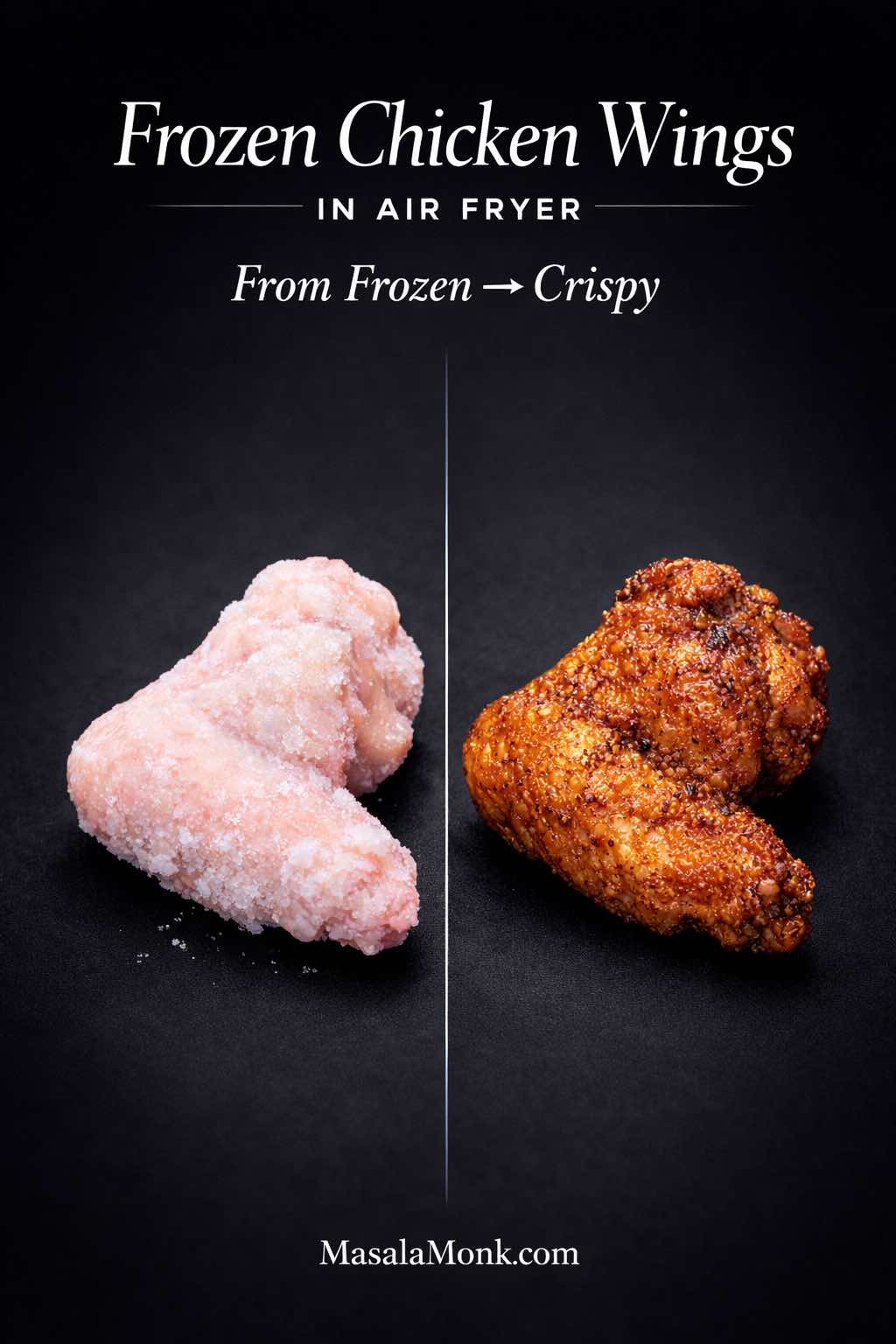
Split “before and after” cover image: a frosty frozen chicken wing on the left and a golden, crispy air-fried chicken wing on the right, separated by a thin vertical line on a smooth black background. Text overlay reads “Frozen Chicken Wings in Air Fryer” and “From Frozen → Crispy,” with “MasalaMonk.com” in the footer.

Cooking frozen chicken wings in an air fryer should feel effortless. Still, the first time you try wings straight from the freezer, they can come out pale, soggy, or oddly chewy—like the outside never decided whether it wanted to crisp or steam. Fortunately, the fix isn’t complicated. In fact, once you understand what’s happening inside the basket, you can turn almost any bag of frozen wings into crispy, juicy wings you’d happily serve at a party.

Because this method starts with frozen wings, you won’t need thawing or any fussy steps that only work in one specific model. Along the way, you’ll see how to handle raw frozen chicken wings in the air fryer versus pre cooked wings in the air fryer, how to get time and temperature right without second-guessing, and how to finish with Buffalo, hot, garlic-parm, or dry-rub flavors without sacrificing crispiness.

Quick answer (no thaw): cook frozen wings in 2 stages for crisp skin.

  • Raw frozen wing sections (drumettes + flats): 360°F / 182°C for 14–16 min, then 400°F / 205°C for 8–12 min (total 22–28 min). Cook to 165°F / 74°C in the thickest piece.
  • Fully cooked frozen wings: 360°F / 182°C for 10–12 min, then 400°F / 205°C for 6–10 min (total 16–22 min).

Tip: If wings are stuck together, run the first stage for 6–8 minutes, then separate and continue.

If you ever want a “fresh wings” method with extra technique and seasoning ideas, you’ll also like this related MasalaMonk recipe: Air Fryer Chicken Wings. It complements what you’re doing here, especially when you’re working with thawed wings in the air fryer.

Also Read: Mozzarella Sticks Recipe (Air Fryer, Oven, or Fried): String Cheese, Shredded Cheese, and Every Crunchy Variation


Start here: what kind of frozen wings do you have?

Before you press Start, it helps to identify what’s in the bag. This one detail decides your timing, your doneness check, and your crisping strategy.
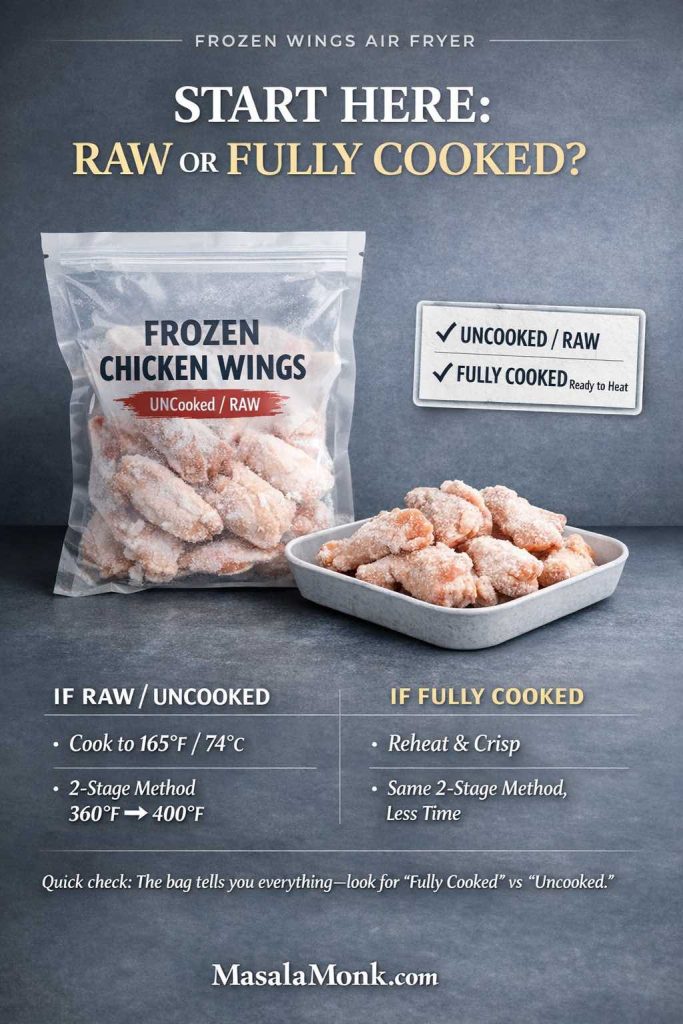
Start-here guide for frozen wings in an air fryer: check the bag for “raw/uncooked” vs “fully cooked.” Raw wings use a 2-stage cook (360°F then 400°F) and must reach 165°F/74°C. Fully cooked wings use the same two-stage method with less time for reheating and crisping.
Not sure if your frozen wings are raw or fully cooked? This one check saves you from pale, soggy wings (or undercooked chicken). Look for “uncooked/raw” vs “fully cooked” on the bag, then use the same 2-stage air-fryer method: start at 360°F to de-ice/render, finish at 400°F to crisp. Raw wings must hit 165°F / 74°C in the thickest piece. Save this graphic for quick reference and share it for your next wing night.

Raw frozen chicken wings

These are uncooked wings that have been frozen. They might be labeled “uncooked,” “raw,” or “ready to cook.” They must reach a safe internal temperature of 165°F / 74°C in the thickest part. For a clear, authoritative reference, the USDA FSIS safe temperature chart is the standard. If the packaging is gone and you truly can’t tell, treat them like raw: use the raw timing, then confirm 165°F / 74°C in the thickest piece before serving.

Pre-cooked frozen wings

These are already cooked, then frozen. They might say “fully cooked” or “ready to heat.” Your goal becomes reheating and re-crisping, not cooking through from raw. As a result, they usually finish faster, and they’re more forgiving—unless they’re heavily sauced, which can soften the skin if you don’t crisp first.
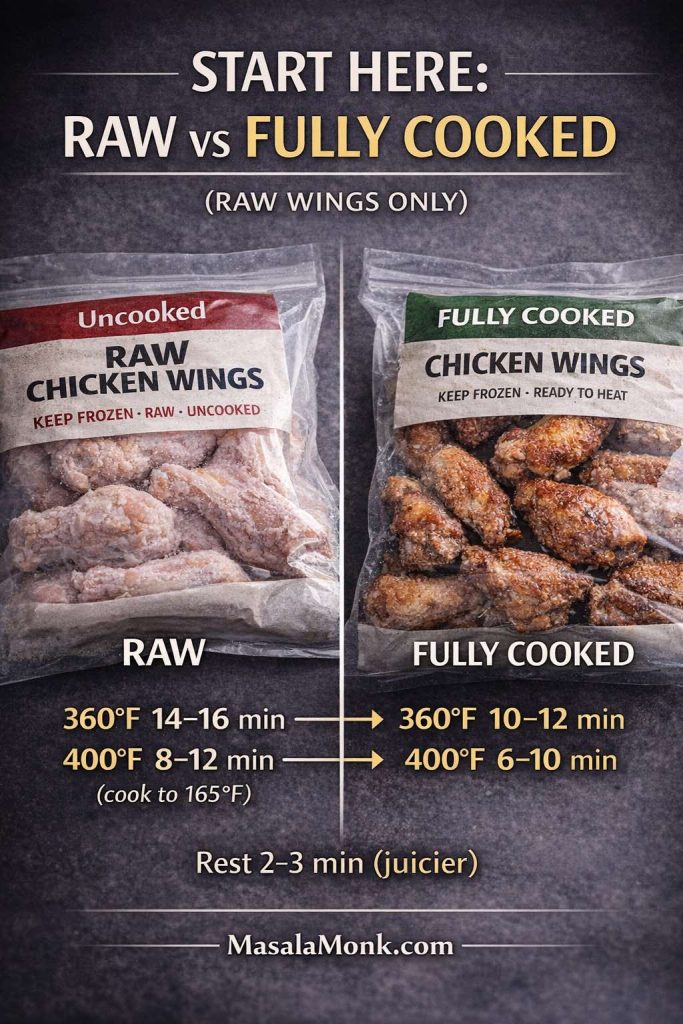
Split comparison graphic showing bagged frozen chicken wings: raw/uncooked on the left and fully cooked/ready-to-heat on the right. It lists a two-stage air fryer method. Raw wings: 360°F for 14–16 minutes, then 400°F for 8–12 minutes (cook to 165°F). Fully cooked wings: 360°F for 10–12 minutes, then 400°F for 6–10 minutes. Rest 2–3 minutes. MasalaMonk.com footer.
Not sure if your frozen wings are raw or fully cooked? This one detail changes everything. Use this quick visual to pick the right air fryer time + temperature: raw wings need a longer first stage and must hit 165°F / 74°C, while fully cooked wings finish faster because you’re mainly reheating + crisping. Save it for busy nights, then follow the full method below for the crispy two-stage finish (and Buffalo, hot, garlic-parm, and dry-rub options). If this helped, save/share/pin it so you’ve got the timings when you need them.

Sauced “Buffalo” or “hot wings” frozen

Some bags are fully cooked and pre-sauced. They’re convenient, although the sauce can trap moisture. That doesn’t mean you’re stuck with soggy wings—rather, it means you’ll do a crisp stage first, then sauce again at the end (or at least “reset” the sauce so it clings).

Wingettes/drumettes vs whole wings

Frozen wing sections (flats and drumettes) cook more evenly than whole wings. Whole wings can still work, although they often need a little more time because the thickest parts are larger and the joints hold moisture.

One more reassurance, since it comes up constantly: cooking from frozen is considered safe when done correctly, and the USDA discusses safe defrosting methods and the “cook without thawing” approach in its guide, The Big Thaw.

Bagged frozen wings (premade): what to check first

If you’re using a store bag (including Perdue), check the label for “fully cooked” vs “uncooked/raw.” That one line decides everything.

• If fully cooked: follow the fully cooked times (your goal is heat-through + crisp).
• If raw/uncooked: treat them like raw chicken and cook to 165°F / 74°C in the thickest piece. Cook raw wings to 165°F / 74°C in the thickest piece; a thermometer is the most reliable check.

If the bag is heavily sauced, crisp first and re-sauce at the end so the skin doesn’t go soggy.

Also Read: Sourdough Starter Recipe: Make, Feed, Store & Fix Your Starter (Beginner Guide)


The core method: how to cook frozen chicken wings in an air fryer so they turn crispy

There’s a reason “crispy frozen chicken wings” can be elusive: frozen wings release water as they heat, and that water turns into steam. Steam is the enemy of crisp skin. So the method that works best is a deliberate two-stage approach: first you melt away the surface ice and render fat, then you crank the heat to drive off moisture and crisp the skin.

This is the foundation for almost every variation in this post—whether you’re making frozen buffalo wings in the air fryer, air fried wings from frozen with dry rub, or even an air fryer recipe for frozen chicken wings that you toss in garlic-parm.

Step 1: Preheat the Air Fryer

Preheat to 360°F / 182°C for 3–5 minutes.
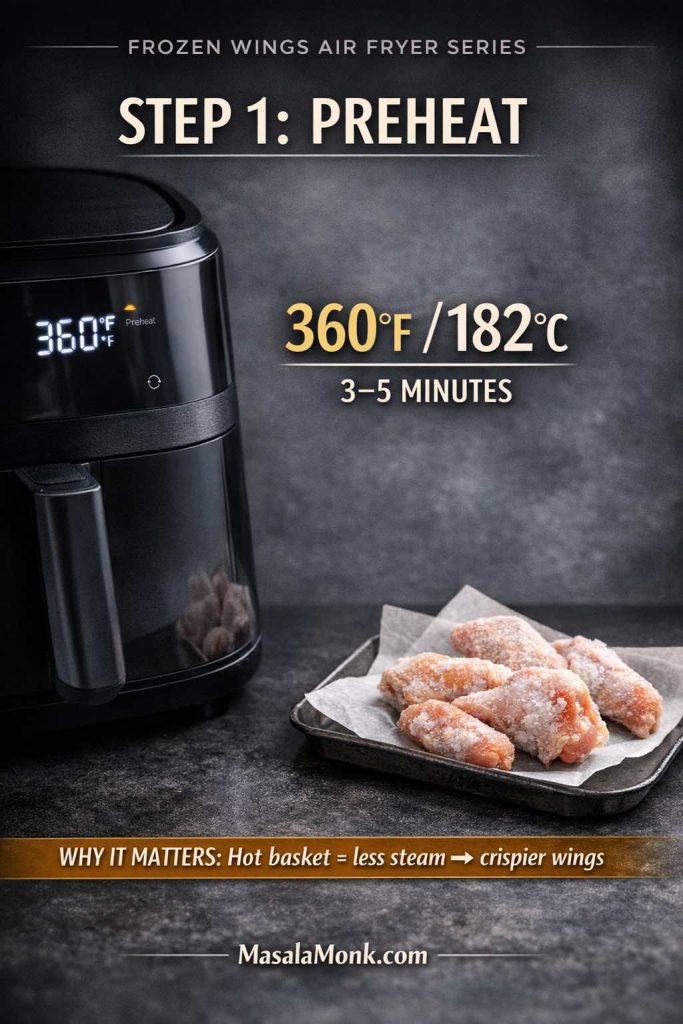
Step 1 graphic for frozen chicken wings in an air fryer: a black air fryer shows 360°F with “Preheat,” raw frozen wing sections sit on a tray, and the overlay reads “360°F / 182°C for 3–5 minutes” plus “Hot basket = less steam → crispier wings,” with MasalaMonk.com in the footer.
Step 1 (Preheat): Start frozen chicken wings at 360°F / 182°C for 3–5 minutes so the basket is already hot when the wings go in. That quick preheat reduces early steam (the #1 reason frozen wings turn pale or soggy), which sets you up for crisp skin in the final 400°F stage—whether you’re cooking raw frozen wings or reheating fully cooked frozen wings. Save/share this step for a repeatable frozen-wings routine.

Even if your air fryer “doesn’t require” preheating, a short preheat improves consistency. It gives you a predictable starting point, so your first minutes aren’t spent slowly warming the basket while the wings leak water.

Step 2: Arrange wings in a single layer

Put the wings in the basket in one layer. If you have a big pile, cook in batches. Crowding is the fastest way to turn crisping into steaming.
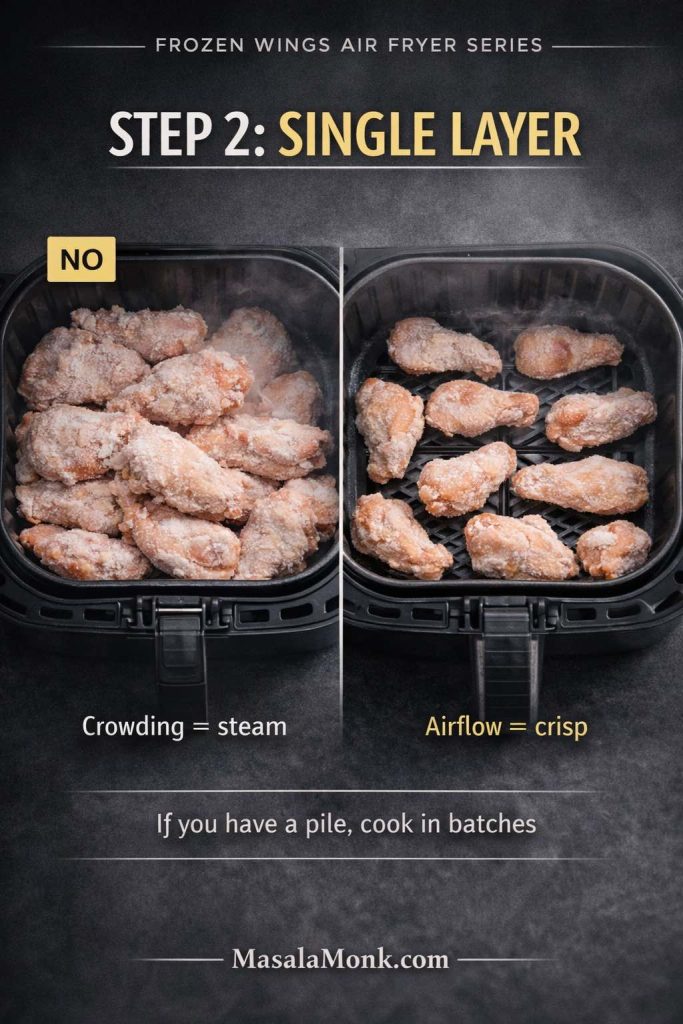
Split comparison photo of frozen chicken wings in an air fryer basket: left side shows wings piled/crowded with “NO” label and note “Crowding = steam”; right side shows wings spaced in a single layer with note “Airflow = crisp.” Headline reads “Step 2: Single Layer,” with tip “If you have a pile, cook in batches,” and MasalaMonk.com footer.
Single layer is the difference between crispy wings and steamy wings. If your frozen wings come out pale or soggy, it’s usually crowding—not your air fryer. Use this quick visual: pile = trapped steam, space = airflow + crunch. Cook in batches if needed (it’s faster than re-cooking soft wings later). Keep going for the exact time + temperature stages that turn frozen wings into real “game-day crisp.”

If you’ve ever had a batch come out uneven—some wings crisp, others soft—this is usually why. For a helpful deep dive on airflow issues (and other common problems), you can check MasalaMonk’s guide on air fryer mistakes to avoid.

Step 3: First cook at 360°F / 182°C (the “de-ice + render” stage)

Cook at 360°F / 182°C:

  • Pre cooked chicken wings in air fryer (from frozen): 10–12 minutes
  • Raw frozen chicken wings in air fryer: 14–16 minutes
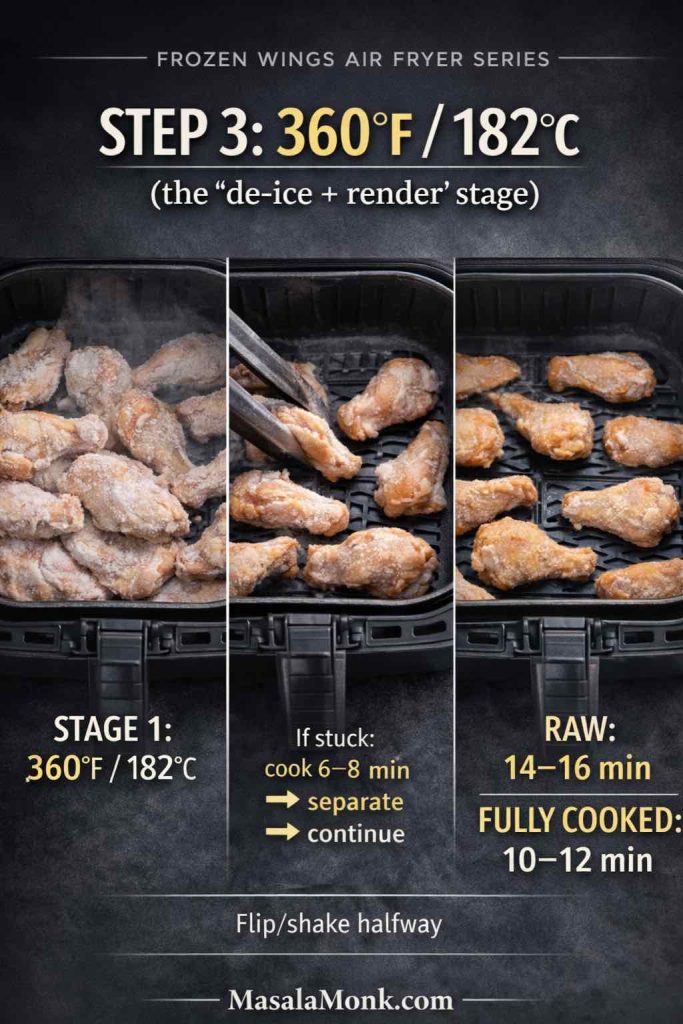
Three-panel photo shows frozen chicken wings in an air fryer basket during Step 3 at 360°F / 182°C. Left: wings still icy and clumped. Middle: tongs separating wings after 6–8 minutes if stuck. Right: wings spaced in a single layer. Overlay lists timing: raw frozen wings 14–16 minutes; fully cooked frozen wings 10–12 minutes; flip or shake halfway. Footer reads MasalaMonk.com.
Step 3 is where frozen wings stop “steaming” and start getting on track for crisp skin. Cook at 360°F / 182°C to melt surface ice and begin rendering fat—then separate any stuck wings at 6–8 minutes so airflow can hit every side. Use the timing that matches your bag (raw: 14–16 min; fully cooked: 10–12 min) and flip/shake halfway. This sets you up perfectly for the high-heat crisp stage next.

Halfway through, open the basket, separate any wings that have frozen together, then flip or shake gently.

If you see a lot of water collecting in the bottom, that’s normal. If your model has a pull-out drawer, carefully empty the liquid once during the first stage, then continue. It helps to carefully drain it off if your air fryer design makes that easy. Otherwise, the wings sit in moisture and soften instead of browning.

Step 4: Dry the surface quickly

This step sounds small, yet it changes everything.

Split-screen instructional photo for frozen chicken wings in an air fryer. Left: air fryer basket with frozen drumettes and pooled water underneath after the first cook stage. Right: wings on a paper-towel-lined plate being gently blotted with tongs. Text overlay explains: less surface water = less steam = crisp skin; “drain pooled water if needed” and “blot, don’t press.” MasalaMonk.com in footer.
Step 4 is the crunch “switch.” Frozen wings release water as they heat—if that moisture stays on the surface, it turns into steam and the skin stays soft. After the first 360°F stage, quickly drain any pooled water, then pat/blot the wings for 30 seconds (don’t press). Now your 400°F crisp stage actually crisps. This tiny move is the difference between rubbery freezer wings and crispy frozen chicken wings in the air fryer—especially for drumettes, wing sections, and pre-cooked bagged wings.

Pull the basket and use tongs to move wings onto a plate lined with paper towels. Pat the top lightly. You’re not trying to crush anything; you’re simply removing the layer of moisture that would otherwise re-steam in the crisp stage.

If your wings are pre-sauced, you can still blot gently. You’ll keep plenty of flavor, while giving the skin a better shot at crisping.

Step 5: Season (or wait, depending on the style)

Now decide your flavor direction:
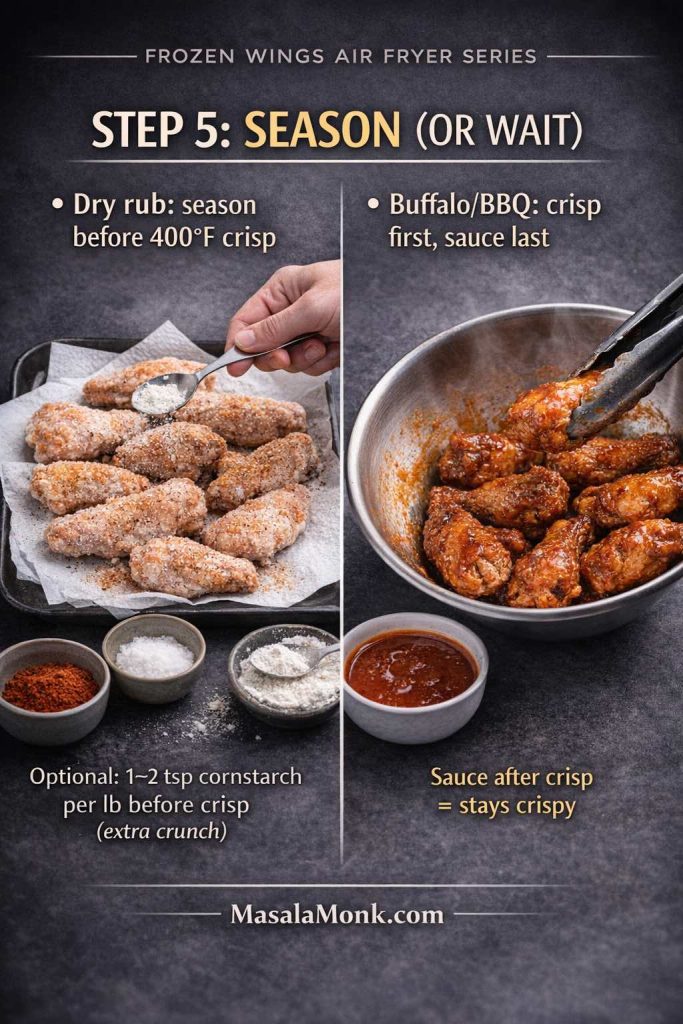
Step 5 seasoning guide for frozen chicken wings in an air fryer: split image shows wings being dusted with dry rub/cornstarch before the 400°F crisp stage on the left, and crispy wings being tossed in Buffalo/BBQ sauce after cooking on the right. Text highlights “season now for dry rub” and “crisp first, sauce last” for best crunch, with MasalaMonk.com footer.
Step 5 is where most “frozen wings” go wrong: timing. If you’re doing a dry rub (salt, pepper, garlic, paprika, lemon pepper), season right after the blot-dry step so it grabs and crisps at 400°F. If you’re going Buffalo, hot wings, or BBQ, hold the sauce until AFTER the crisp stage—sauce too early traps steam and softens the skin. Optional crunch boost: toss with 1–2 tsp cornstarch per lb before the final crisp. Save this as your quick “season vs sauce” rulebook for crispy frozen chicken wings every time.
  • For dry rub wings, season now.
  • For classic salt-and-pepper wings, season now.
  • For Buffalo/hot wings, wait until after crisping for the best texture.
  • For sweet BBQ, wait until after crisping so sugars don’t burn.

Optional crisp booster: toss wings with 1–2 teaspoons cornstarch per pound right before the 400°F stage (especially helpful for wings that look wet after blotting).

Step 6: Final crisp for frozen chicken wings in air fryer: 400°F / 205°C

Turn the air fryer up to 400°F / 205°C and cook:

  • Pre cooked frozen wings in air fryer: 6–10 minutes
  • Raw frozen wings in air fryer: 8–12 minutes
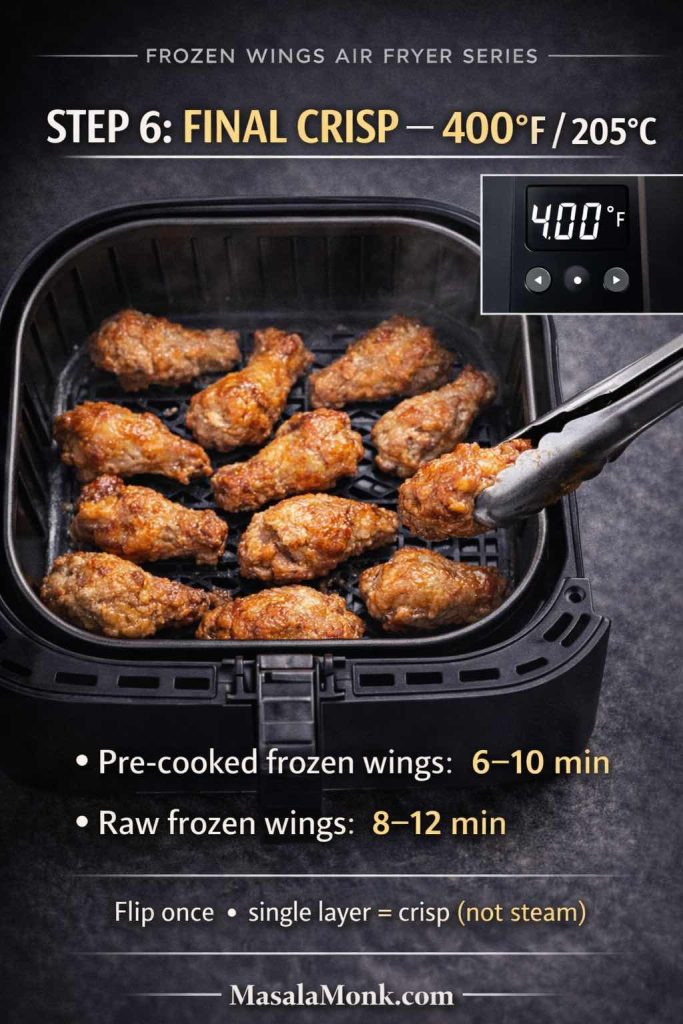
Step 6 of a frozen wings air fryer guide: cooked wings in an air fryer basket being flipped with tongs, with an inset showing 400°F / 205°C. Text notes final crisp timing: pre-cooked frozen wings 6–10 minutes and raw frozen wings 8–12 minutes, single layer for crisp skin. MasalaMonk.com in footer.
Final crisp is where frozen wings turn from “heated” to actually crispy: raise the air fryer to 400°F / 205°C, keep wings in a single layer, and flip once. Use 6–10 minutes for pre-cooked frozen wings and 8–12 minutes for raw frozen wings after the first stage—this is the moisture-drive-off step that gives you crackly skin instead of steam-soft wings.

Flip once during this stage. You’re looking for a deeper golden color, a tighter skin, and edges that look slightly blistered.

Step 7: Check doneness (raw wings only)

For raw wings, measure internal temperature in the thickest part of the drumette without touching bone. As metioned earlier, you’re aiming for 165°F / 74°C as that is considered a safe point.
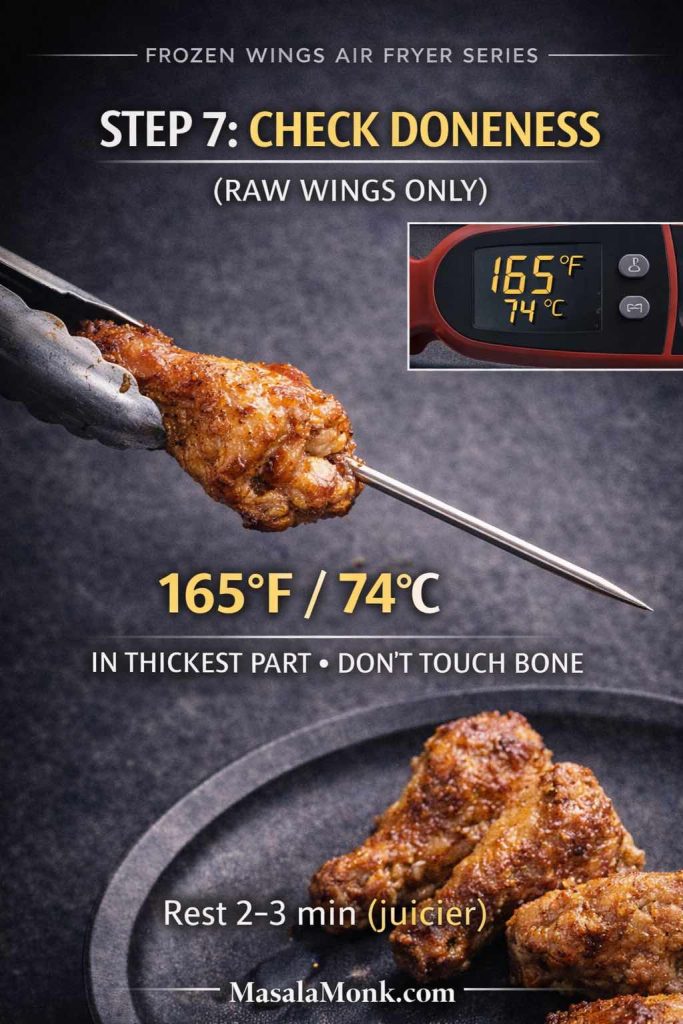
Step 7 “Check Doneness” graphic for frozen chicken wings in an air fryer: a cooked wing held with tongs while an instant-read thermometer probes the thickest part of a drumette. The display shows 165°F / 74°C with the note “don’t touch bone” and “rest 2–3 min,” plus MasalaMonk.com in the footer.
Raw frozen wings aren’t “done” when they look brown—they’re done when the thickest drumette hits 165°F / 74°C. Use an instant-read thermometer, insert it into the meatiest part, and avoid touching bone (bone can give a false reading). Once you hit temp, rest 2–3 minutes so juices settle and the skin stays crisp. This one check removes guesswork and makes your frozen chicken wings in the air fryer reliably juicy every time. Save or pin this quick safety check so you never have to second-guess wing doneness again—full timings + crisp stages are in this blog post.

Once you hit that number, rest the wings for 2–3 minutes. During that short pause, the surface stays crisp while juices settle.

Also Read: How to make No-Bake Banana Pudding: No Oven Required Recipe


Frozen chicken wings in air fryer: how long do they take?

The exact time depends on wing size, air fryer power, and whether the wings are raw or pre-cooked. Still, you can rely on a range and then adjust using visual cues and (for raw wings) a thermometer. If you’re cooking more than a single layer (or your basket is small), plan on adding 2–4 minutes to the crisp stage—or cook in batches for better crunch.
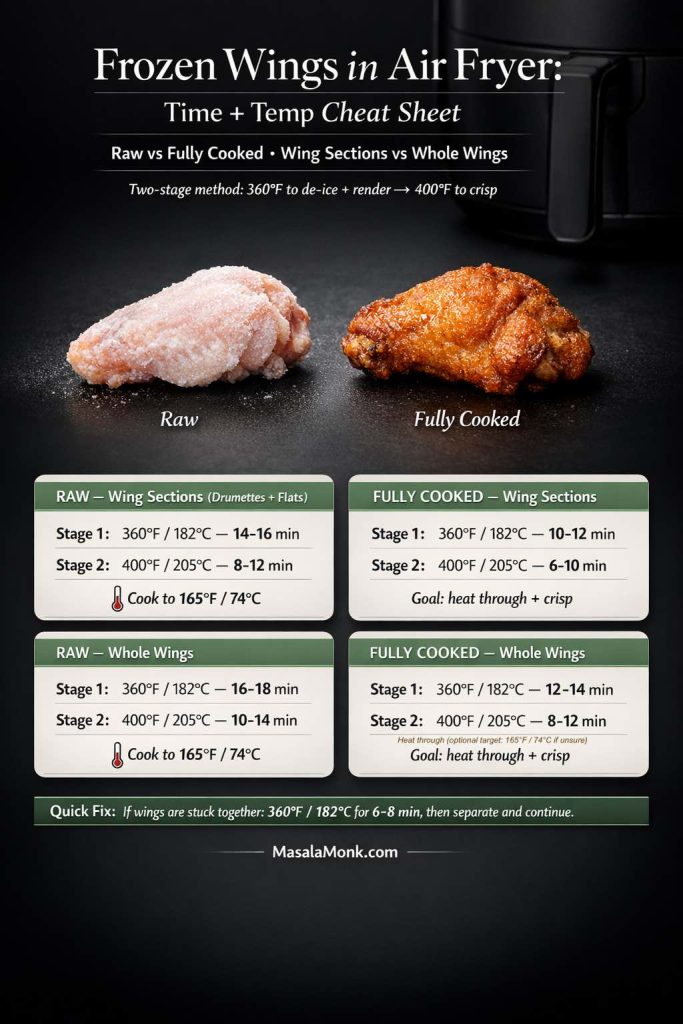
Frozen wings in air fryer time and temperature cheat sheet showing two-stage method: 360°F (182°C) then 400°F (205°C), with timings for raw vs fully cooked and wing sections vs whole wings, plus cook-to 165°F (74°C) note and quick fix for stuck wings. MasalaMonk.com
Frozen Wings Air Fryer Time + Temp Cheat Sheet: Use the two-stage method—360°F / 182°C to de-ice + render, then 400°F / 205°C to crisp. This chart breaks down exact ranges for raw vs fully cooked and wing sections vs whole wings, plus the quick fix for wings stuck together.

Frozen chicken wings in air fryer time & temperature (ranges by type)

Sections of frozen chicken wings (drumettes + flats), raw:

  • 360°F / 182°C for 14–16 minutes
  • then 400°F / 205°C for 8–12 minutes
    Total: about 22–28 minutes

Frozen wing sections, pre-cooked:

  • 360°F / 182°C for 10–12 minutes
  • then 400°F / 205°C for 6–10 minutes
    Total: about 16–22 minutes

Whole frozen wings (larger), raw:

  • 360°F / 182°C for 16–18 minutes
  • then 400°F / 205°C for 10–14 minutes
    Total: about 26–32 minutes

Whole frozen wings, pre-cooked:

  • 360°F / 182°C for 12–14 minutes
  • then 400°F / 205°C for 8–12 minutes
    Total: about 20–26 minutes

If you’re thinking “that’s a wide range,” you’re right. The key is to treat the time like a starting point and use the crisp stage to dial in texture.

Moreover, if your air fryer is smaller (or you’re cooking a lot), you’ll likely need batches. On the other hand, if you have a large basket that fits wings in a single layer comfortably, you’ll finish faster because airflow is stronger.

Frozen wings at 400°F: how long?

Using 400°F for the entire cook can over-brown the outside before the inside heats evenly (especially with raw wings). The best use of 400°F is as the final crisp stage:

  • Fully cooked frozen wings: 6–10 minutes at 400°F / 205°C
  • Raw frozen wings (after a 360°F start): 8–12 minutes at 400°F / 205°C

If wings still look pale or feel soft, add 2–4 minutes at 400°F, but only if they’re in a single layer.

Also Read: Chicken Adobo — Step-by-Step Recipe — Classic Filipino Adobong Manok


Cooking frozen wings in an air fryer: the small details that make a big difference

Crispy wings are rarely about one magic trick. Instead, it’s a handful of small choices that stack in your favor.
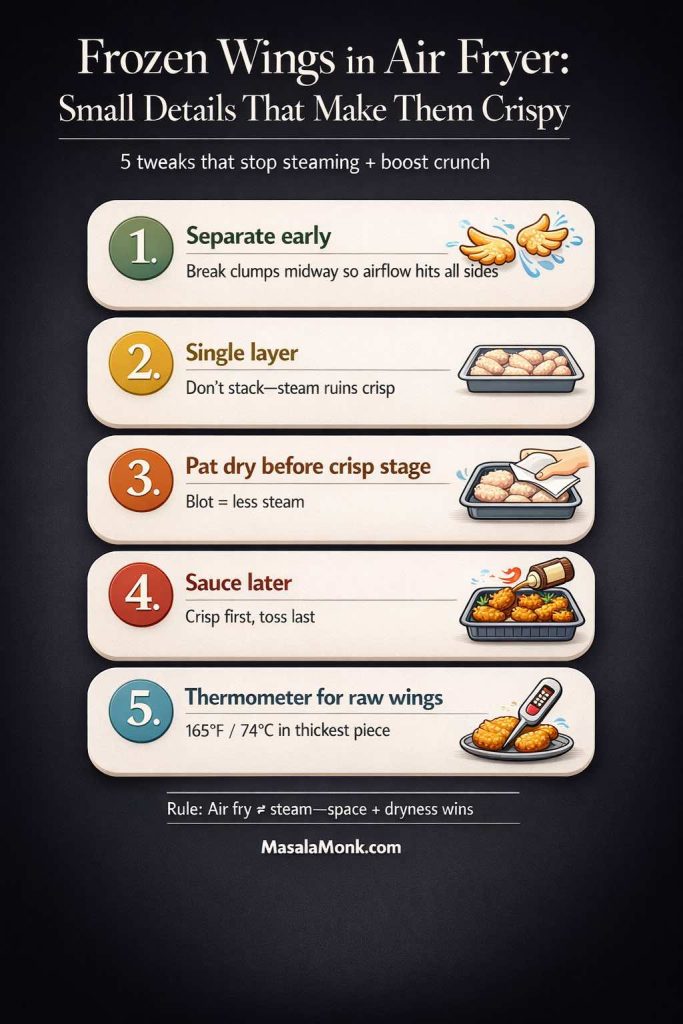
Infographic titled “Frozen Wings in Air Fryer: Small Details That Make Them Crispy” showing 5 tweaks: separate wings early so airflow hits all sides, cook in a single layer (don’t stack), pat dry before the crisp stage to reduce steam, sauce after crisping, and use a thermometer for raw wings (165°F / 74°C in the thickest piece). MasalaMonk.com branding at bottom.
Frozen wings in the air fryer: 5 tiny tweaks that stop steaming and boost crunch. Separate clumps, keep a single layer, blot before the crisp stage, sauce last, and use 165°F / 74°C for raw wings—then jump back to the full guide for exact times, temps, and troubleshooting.

Separate wings early

Frozen wings often clump. If you let them stay glued together too long, the interior sides won’t crisp because they never get exposed to airflow. So, midway through the first stage, use tongs to separate them.

Don’t stack

This is worth repeating because it’s the difference between “air fry” and “steam.”

If you’re tempted to pile them high, cook two batches instead. You’ll end up with wings that are actually crisp, which is the whole point of making wings in air fryer frozen in the first place.

Pat dry before the crisp stage

Water on the surface becomes steam. Steam softens skin. Therefore, blotting is not optional if you want reliable crunch.

Sauce later

If you want sticky wings, you can still get them. You just have to crisp first, then sauce. That sequencing keeps the outside crisp while still delivering the “saucy wing” experience.

Use a thermometer for raw wings

Visual cues aren’t dependable for safety. Wings can brown before they’re done. Conversely, they can look pale while they’ve already reached temperature. The simplest standard is to cook to 165°F / 74°C, as per USDA, and a thermometer is the most reliable check.

Also Read: Sweetened Condensed Milk Fudge: 10 Easy Recipes


Chicken wings in air fryer from frozen: two paths depending on raw vs pre-cooked

At this point, you can follow the core method and succeed. Still, it helps to see the two most common cases written out clearly—because these are the questions people run into when they’re standing in front of the air fryer trying to decide whether to add five minutes or ten.

Raw frozen chicken wings in air fryer (clear step-by-step recipe)

  1. Preheat to 360°F / 182°C.
  2. Cook wings 14–16 minutes (single layer), flipping once.
  3. Separate wings, drain moisture if needed, and blot dry.
  4. Season with salt, pepper, garlic powder, paprika, or your favorite dry rub.
  5. Crisp at 400°F / 205°C for 8–12 minutes, flipping once.
  6. Check 165°F / 74°C in the thickest piece.
  7. Rest 2–3 minutes, then sauce or serve.
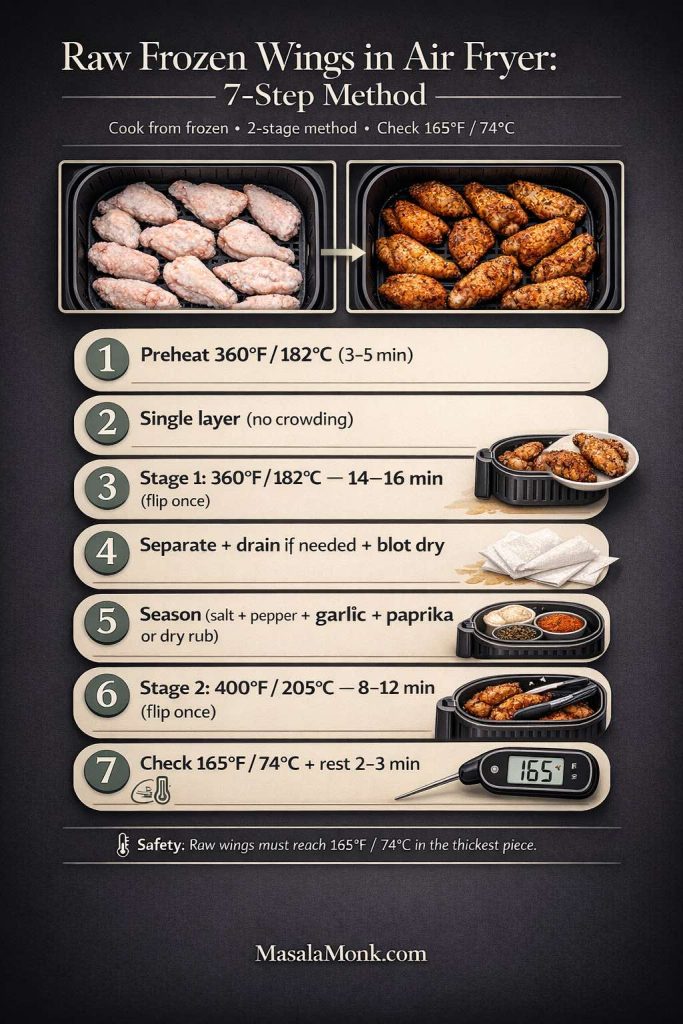
Infographic showing raw frozen chicken wings in an air fryer with a 7-step method: preheat 360°F/182°C, cook in a single layer 14–16 min (flip once), separate/drain/blot dry, season, crisp at 400°F/205°C for 8–12 min (flip once), then check 165°F/74°C and rest 2–3 min.
Raw frozen wings, simplified: follow this 7-step two-stage air fryer method (360°F cook → blot + season → 400°F crisp) and always confirm 165°F / 74°C in the thickest piece for safe, truly crispy wings.

Because these are raw, treat them like raw chicken from start to finish. If you want a quick safety refresh—especially about cross-contamination and why rinsing isn’t recommended—the CDC’s chicken food safety guidance is straightforward and practical.

Pre cooked chicken wings in air fryer (from frozen, crisp-first approach)

  1. Preheat to 360°F / 182°C.
  2. Cook wings 10–12 minutes, flipping once.
  3. Blot gently to remove surface moisture.
  4. Crisp at 400°F / 205°C for 6–10 minutes.
  5. Toss with sauce or finish with seasoning.
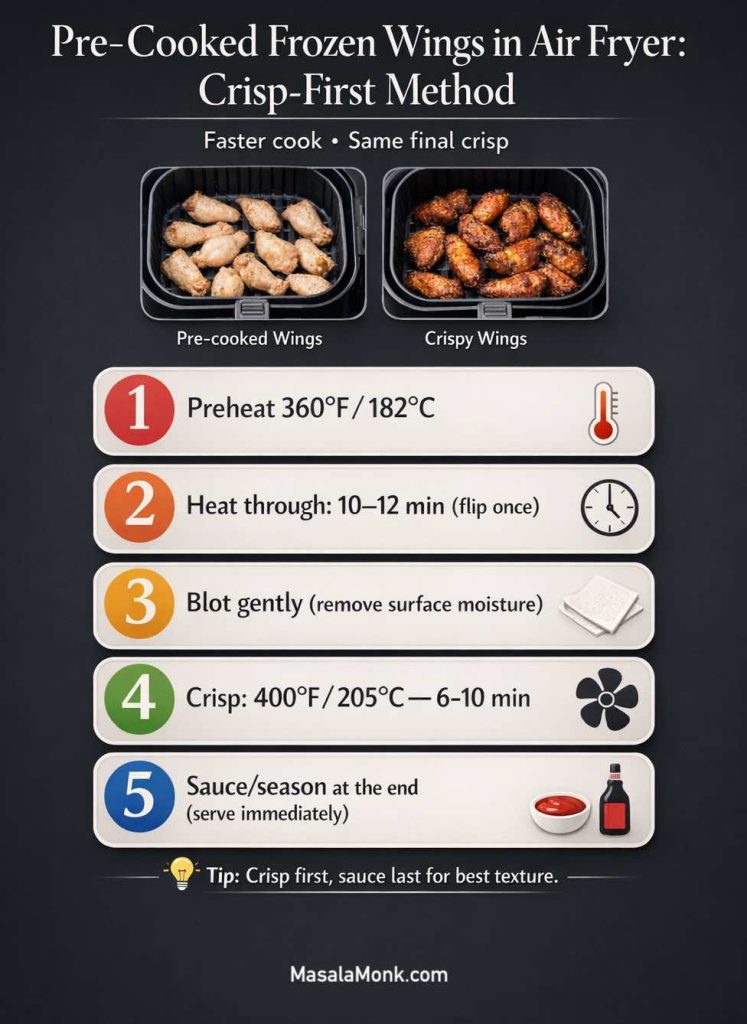
Pre-cooked frozen chicken wings in an air fryer, crisp-first method infographic. Steps: preheat to 360°F/182°C; heat through 10–12 minutes flipping once; blot gently to remove surface moisture; crisp at 400°F/205°C for 6–10 minutes; sauce or season at the end and serve immediately. Tip: crisp first, sauce last for best texture.
Pre-cooked frozen wings don’t need the long “ice-melt” stage—just heat through, blot off surface moisture, then finish with a high-heat crisp. This crisp-first sequence keeps the skin snappy and stops wings from tasting like reheated freezer food. Use 360°F/182°C to warm them evenly, then 400°F/205°C to lock in crunch, and toss with sauce only at the very end.

Pre-cooked wings are especially good for quick weeknights. Even so, they benefit from that crisp stage—otherwise they can taste like reheated freezer food instead of something you actually crave.

Also Read: Sourdough Recipe: 10 Easy Bread Bakes (Loaves, Rolls & Bagels)


Frozen buffalo wings in air fryer: crisp, then sauce (so they stay snappy)

Buffalo wings are a classic for a reason. Yet, when you start from frozen, the biggest risk is sauce + steam turning the skin soft.

So here’s the pattern: crisp first, then sauce, then a short “set” step if you want extra cling.
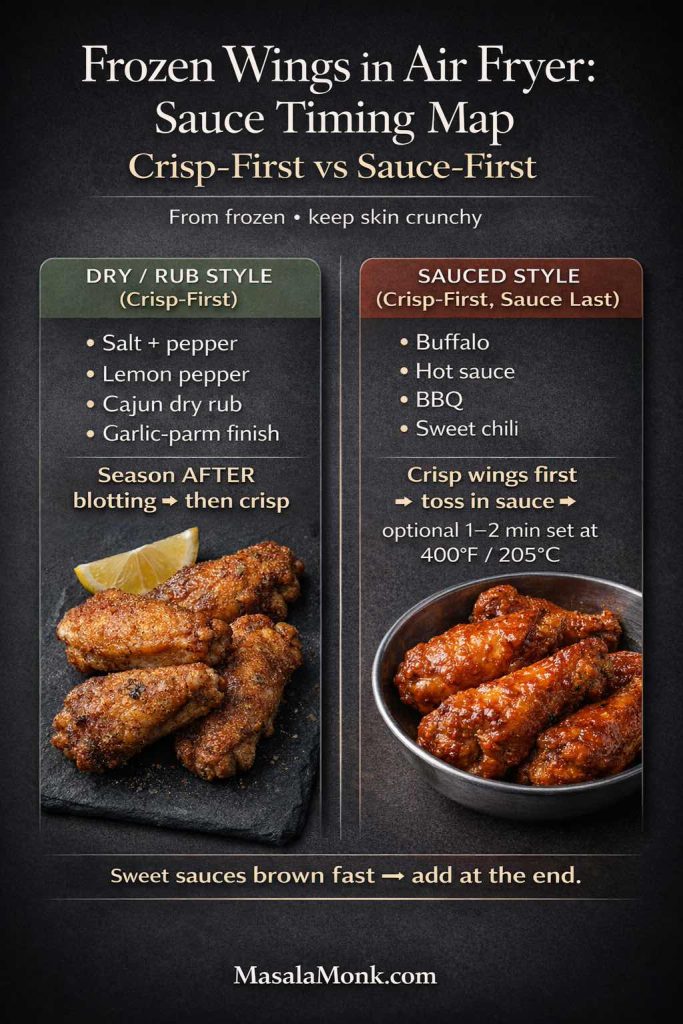
Infographic titled ‘Frozen Wings in Air Fryer: Sauce Timing Map: Crisp-First vs Sauce-First.’ Left panel: dry/rub style (crisp-first) with salt + pepper, lemon pepper, Cajun dry rub, garlic-parm finish; note says ‘Season AFTER blotting → then crisp.’ Right panel: sauced style (crisp-first, sauce last) with Buffalo, hot sauce, BBQ, sweet chili; note says crisp wings first, toss in sauce, optional 1–2 minutes at 400°F/205°C to set. Footer: MasalaMonk.com.
Sauce timing is the #1 reason frozen wings turn soggy. Use this quick map: dry rub = season after blotting, then crisp; Buffalo/BBQ/sweet chili = crisp first, sauce last (and if you want the sauce to cling, give it 1–2 minutes at 400°F / 205°C to “set”). Save this graphic for wing nights—then use the exact time + temp ranges above for your wing type.

Buffalo finish for frozen chicken wings in air fryer (crisp, then sauce)

  1. Cook and crisp using the core method.
  2. Meanwhile, warm hot sauce with a little butter until glossy.
  3. Toss wings quickly, coating evenly.
  4. For extra adhesion, put sauced wings back in the air fryer for 1–2 minutes at 400°F / 205°C.

Now you get the best of both worlds: saucy wings that still have bite.

To serve Buffalo wings the classic way, the tangy cooling dip matters just as much as the sauce. This MasalaMonk roundup is perfect for pairing: blue cheese dip for wings.

Also Read: Peanut Butter Fudge: Recipes & Guide (8 Methods + Easy Variations)


Frozen hot wings recipe: a simple way to make them taste bold without getting soggy

“Hot wings” can mean a lot of things. Sometimes it’s a spicier Buffalo. Other times it’s a sticky hot glaze. In either case, the approach remains similar: get the wings crisp first, then add heat.
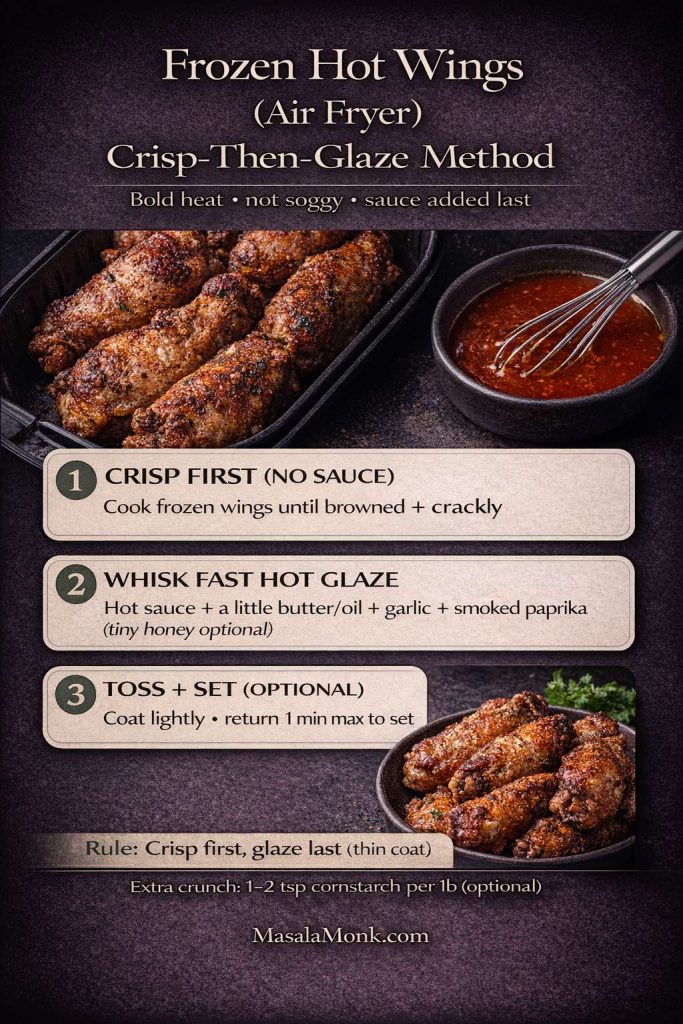
Infographic showing frozen hot wings in an air fryer using a crisp-then-glaze method: 1) Crisp frozen wings first with no sauce until browned and crackly. 2) Whisk a fast hot glaze (hot sauce, a little butter/oil, garlic, smoked paprika; tiny honey optional). 3) Toss lightly and return to air fryer up to 1 minute to set. Rule: crisp first, glaze last.
Frozen hot wings in the air fryer taste best when you crisp first and sauce last. This quick “crisp-then-glaze” method keeps wings bold and spicy without turning the skin soggy—plus you can set the glaze for just 1 minute max. Optional: a light cornstarch dusting (1–2 tsp per lb) can boost crunch. Use this as your fast game-day shortcut, then follow the full MasalaMonk frozen wings guide for timings, temps, and sauce variations.

Fast hot glaze (spicy, glossy, not too sweet)

  • Hot sauce
  • A touch of butter or oil
  • Garlic powder
  • A pinch of smoked paprika
  • Optional: a tiny amount of honey (keep it minimal so it doesn’t burn)

Toss wings after crisping, then return them for a minute to set. Because the glaze is thin, it clings without drowning the skin.

If you’re building a game-day spread, another wing-adjacent crowd-pleaser is a warm dip. MasalaMonk’s Buffalo chicken dip fits naturally next to wings on the table.

Also Read: 10 Vegan Chocolate Cake Recipes (Easy, Moist, & Dairy-Free)


Air fryer wings frozen: dry-rub and “no-sauce” styles that stay crisp longer

Sauced wings are great. Still, if you want wings that stay crisp for longer—especially if you’re serving a crowd—dry rub wings are the easiest win. They also travel better, hold better, and reheat better.
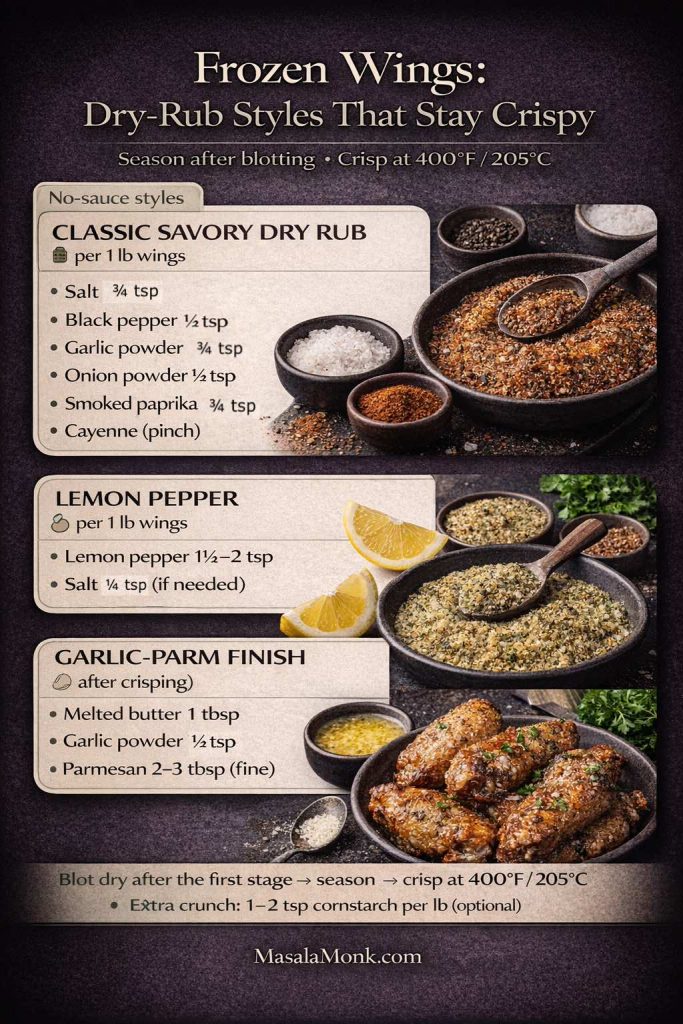
Vertical infographic titled “Frozen Wings: Dry-Rub Styles That Stay Crispy.” It says to season after blotting and crisp at 400°F / 205°C. It lists 3 no-sauce options per 1 lb wings: Classic savory dry rub (salt 3/4 tsp, black pepper 1/2 tsp, garlic powder 3/4 tsp, onion powder 1/2 tsp, smoked paprika 3/4 tsp, cayenne pinch), Lemon pepper (1 1/2–2 tsp plus optional salt), and Garlic-parm finish after crisping (butter, garlic powder, parmesan).
Want wings that stay crispy longer (and hold up for batches)? Use these low-moisture “no-sauce” finishes: a classic savory dry rub, a bright lemon-pepper hit, or a garlic-parm finish added after crisping. The key is simple: blot dry after the first stage, then season, then crisp at 400°F / 205°C—so flavor sticks without steaming the skin. Optional pro move: a tiny cornstarch dusting for extra crunch.

Classic savory dry rub

  • Salt
  • Black pepper
  • Garlic powder
  • Onion powder
  • Smoked paprika
  • Optional: pinch of cayenne

Season after the first stage (when you blot dry), then crisp at 400°F / 205°C.

Lemon pepper style (bright and punchy)

Lemon pepper seasoning works beautifully on wings because it tastes big without needing sauce. Add it after blotting so it adheres, then crisp.

Garlic-parmesan finish (crispy + rich)

Crisp the wings first. Then toss in:

  • A little melted butter
  • Garlic powder (or minced garlic, quickly warmed)
  • Finely grated parmesan

Because the finish is low-moisture, the wings stay crunchy instead of turning soft.

Also Read: Kahlua Drinks: 10 Easy Cocktail Recipes (Milk, Vodka, Coffee)


Best way to cook frozen chicken wings: what to do when your air fryer behaves differently

Some air fryers run hot. While some run cool. Then some have strong fans. And some have weaker airflow. Instead of fighting your machine, use these adjustments.
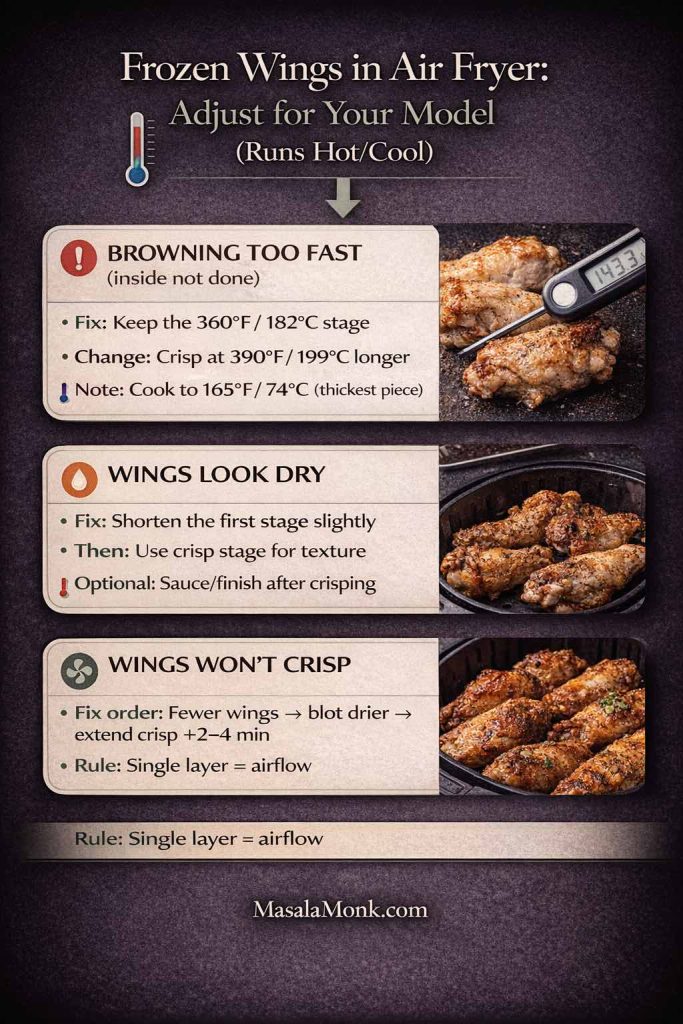
Vertical infographic: ‘Frozen Wings in Air Fryer—Adjust for Your Model (Runs Hot/Cool)’. Three fixes: (1) Browning too fast (inside not done): keep 360°F/182°C stage, crisp longer at 390°F/199°C; cook raw wings to 165°F/74°C. (2) Wings look dry: shorten first stage slightly, rely on crisp stage; sauce/finish after crisping. (3) Wings won’t crisp: fewer wings, blot drier, extend crisp +2–4 min; single layer = airflow. MasalaMonk.com footer.
When your air fryer runs hot, cool, or has weaker airflow, this quick guide stops the guesswork: adjust the crisp stage (390°F vs 400°F), fix dryness, and force crisping with the right order (fewer wings → blot drier → extend crisp). Save this troubleshooting card for the next batch—then follow the full method in this post for timings, flavors, and doneness checks.

If wings are browning too fast but not done inside (raw wings)

Lower the crisp stage slightly: do 390°F / 199°C instead of 400°F / 205°C, and add a few minutes. Meanwhile, keep the first stage the same so fat renders properly.

If wings look dry

Oddly enough, overly long cooking can dry the meat even if the skin isn’t that crisp. In that case, shorten the first stage a little and rely on the crisp stage for texture.

If wings won’t crisp

This usually comes down to moisture and crowding. First, reduce how many wings are in the basket. Next, blot more thoroughly after the first stage. Finally, extend the crisp stage by 2–4 minutes.

Also Read: Hot Chocolate Coffee: 3 Easy Recipes (Cocoa, Mix, or Espresso)


Frozen party wings in air fryer: how to keep batches consistent

Party wings are where the air fryer shines—because you can cook in batches while keeping quality high. Still, consistency matters.
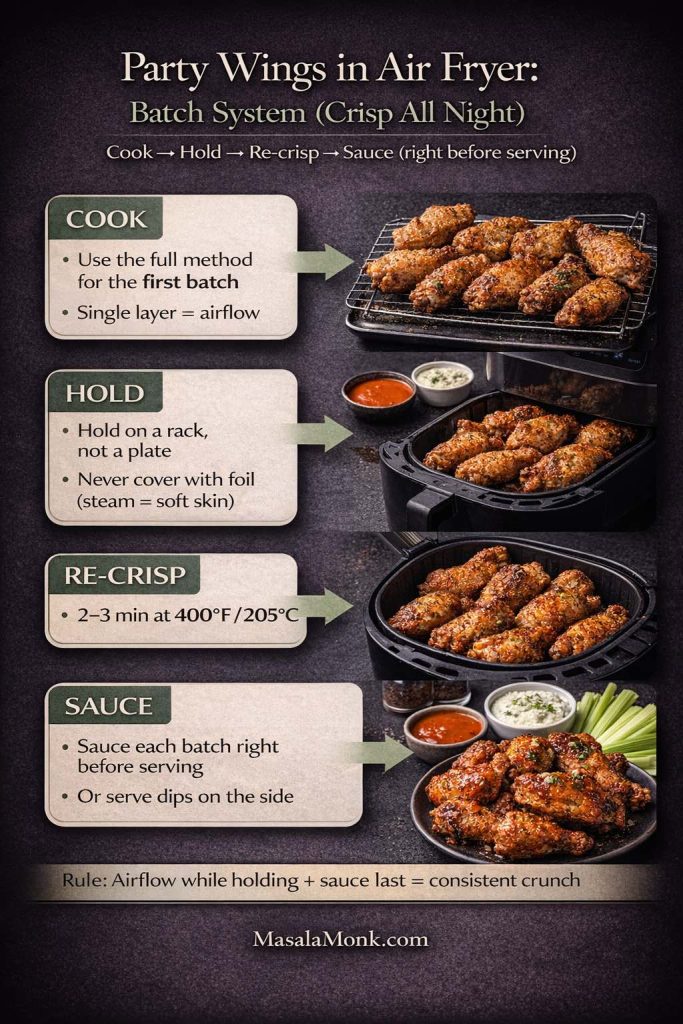
Vertical infographic titled “Party Wings in Air Fryer: Batch System (Crisp All Night).” It shows a 4-step flow: Cook first batch in a single layer for airflow, Hold wings on a rack (not a plate) and don’t cover with foil, Re-crisp 2–3 minutes at 400°F/205°C, then Sauce right before serving or offer dips on the side. Footer: MasalaMonk.com.
Cooking wings for a crowd? Use this “Cook → Hold → Re-crisp → Sauce” batch system so every round stays crunchy. The key is airflow while holding (rack, not a plate), then a quick 2–3 minute re-crisp at 400°F/205°C—sauce goes on at the very end. Save/pin this for game day.

Batch strategy

  • Cook the first batch using the full method.
  • Hold finished wings on a rack (not a plate) so airflow keeps them crisp.
  • When you’re ready to serve, do a quick 2–3 minute re-crisp at 400°F / 205°C.

Avoid covering hot wings with foil while holding—trapped steam will soften the skin fast.

Sauce strategy

Sauce each batch right before serving. That way, wings don’t sit in sauce and soften. Alternatively, offer sauces on the side and let people dip.

If you want a “dip-friendly” base that you can turn into garlic mayo, spicy mayo, or creamy herb dip, MasalaMonk’s eggless mayonnaise is an excellent starting point. If you prefer plant-based, vegan mayo also works beautifully as a wing dip base.

Also Read: Cappuccino Recipe: How to Make a Perfect Cappuccino at Home


Thawed wings in air fryer: what changes if you already thawed them?

Sometimes you planned ahead. Other times the wings thawed in the fridge because plans changed. Either way, the method is similar, yet timing changes because you’re no longer melting ice first.
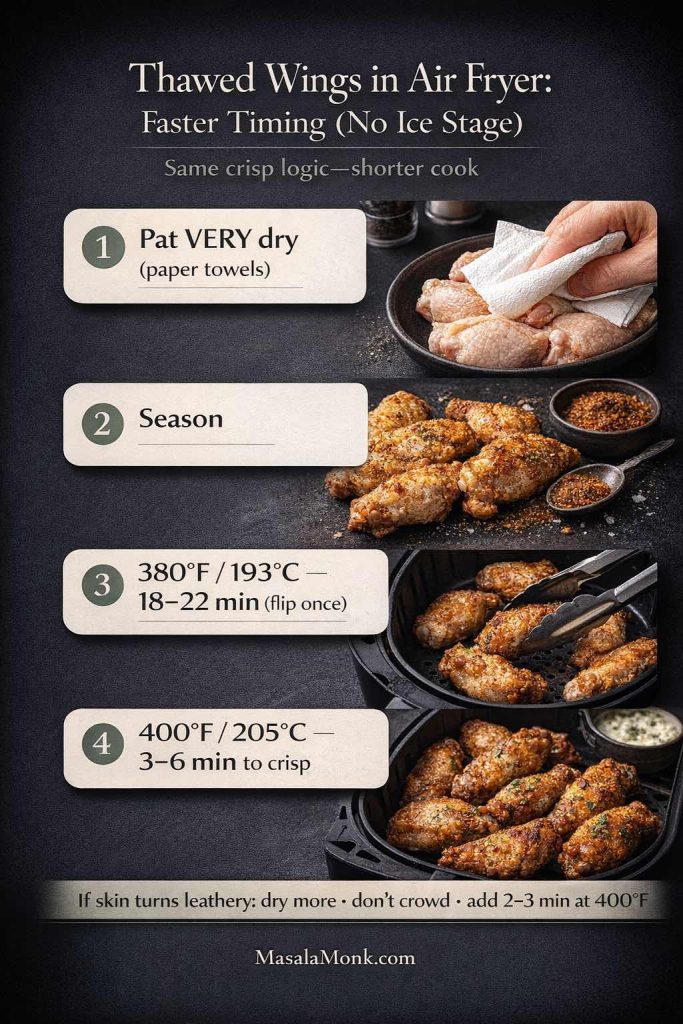
Thawed chicken wings in an air fryer timing guide (no ice stage): 1) Pat wings very dry with paper towels, 2) Season, 3) Air fry at 380°F / 193°C for 18–22 minutes, flipping once, 4) Crisp at 400°F / 205°C for 3–6 minutes. Tip shown: if skin turns leathery, dry more, don’t crowd, and add 2–3 minutes at 400°F. MasalaMonk.com
Thawed wings cook faster because there’s no ice stage—but crisp skin still depends on drying and airflow. Use this quick timing card: 380°F (18–22 min) to cook through, then 400°F (3–6 min) to crisp. If the skin turns leathery, the fix is simple: pat drier, don’t crowd, and extend the final crisp a couple minutes. Save this graphic for wing night, and scroll this post for the full frozen-vs-thawed method + sauce ideas.

Thawed chicken wings in air fryer (baseline method)

  1. Pat wings very dry.
  2. Season.
  3. Cook at 380°F / 193°C for 18–22 minutes, flipping once.
  4. Crisp at 400°F / 205°C for 3–6 minutes.

Because thawed wings release less water upfront, you can often start a bit higher than the frozen method. Still, blotting matters. Otherwise, the skin can turn leathery instead of crisp.

For a full fresh-wing technique and seasoning inspiration, MasalaMonk’s Air Fryer Chicken Wings is a natural next read.

Also Read: Cold Brew Espresso Martini: How to Make It (Step-by-Step Recipe)


Frozen chicken wings in the air fryer: serving ideas that make the meal feel complete

Wings are often the main event. Yet, what you serve alongside them changes the whole vibe. Moreover, sides and dips give you variety without additional work.

Classic dip pairings

  • Blue cheese dip (especially for Buffalo)
  • Ranch-style dips (easy to build from mayo)
  • Garlic-herb dip

For a quick ranch-style dip, stir dried herbs (dill/parsley), garlic powder, black pepper, lemon, and a pinch of salt into mayo or vegan mayo—then thin with a splash of water until it’s pourable. For a dedicated dip lineup, this MasalaMonk guide to blue cheese dip for wings is a perfect guide to explore.

Fresh, herby “sauce direction” (lighter than Buffalo)

If you want a change from butter-and-hot-sauce flavors, go herby. Toss wings with a spoonful of chimichurri after crisping, or serve it on the side for dipping. MasalaMonk’s chimichurri recipe is ideal for that.

Pesto-style finishes

A small drizzle of pesto (or pesto mayo) can turn wings into something that feels restaurant-y. If you want variations, MasalaMonk’s pesto recipes and variations can give you multiple directions without adding complexity.

Also Read: Iced Coffee: 15 Drink Recipes—Latte, Cold Brew, Frappe & More


Cooking frozen buffalo wings and other sauced wings: how to avoid burning sugars

Many store-bought sauces contain sugar. Sugar browns fast. Consequently, if you cook heavily sauced wings at high heat for too long, you can end up with scorched spots before the wing is crisp.
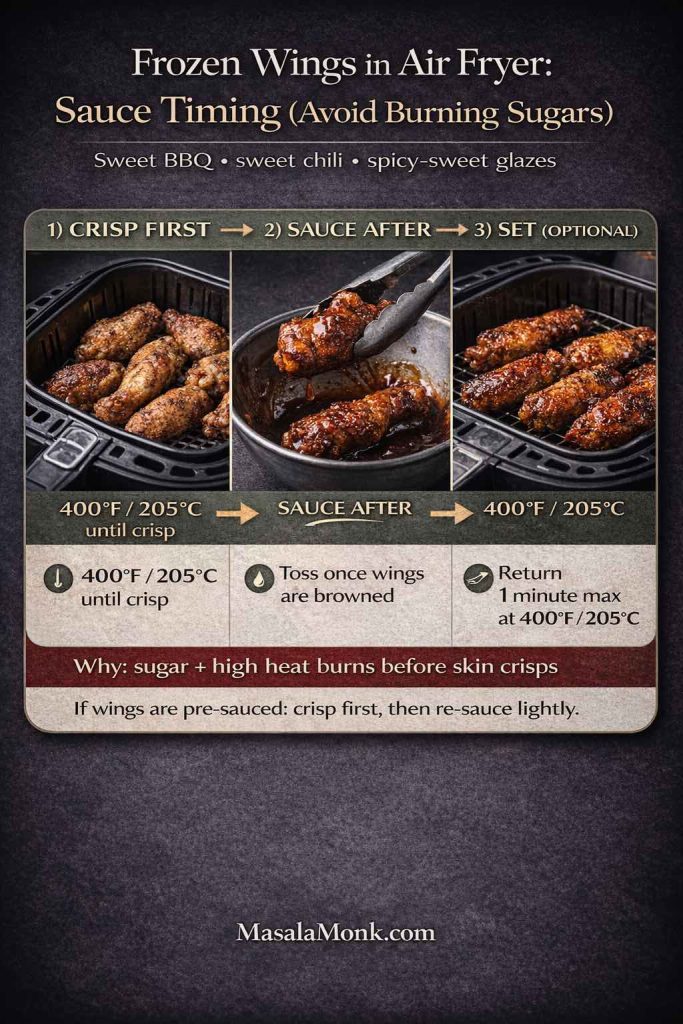
Frozen wings in air fryer sauce timing guide to avoid burning sugars: crisp wings first at 400°F / 205°C, toss in sweet BBQ or sweet chili sauce after browning, then return to the air fryer for 1 minute max at 400°F / 205°C to set (optional).
Sauce timing is the #1 fix for sweet BBQ, sweet chili, and spicy-sweet frozen wings. Crisp the wings first (no sauce) so the skin can actually brown. Then toss in sauce after crisping—this prevents sugar from scorching before the wings get crunchy. Want extra cling? Do a 1-minute max “set” back in the air fryer at 400°F / 205°C. Save/pin this graphic for instant “no-burn” wing nights.

The safer approach for sweet or sticky sauces

  • Crisp the wings first with no sauce at 400°F / 205°C.
  • Toss with sauce after crisping.
  • Return for 1 minute only if you want it set and tacky.

This works for BBQ wings, sweet chili wings, and spicy-sweet glazes.

Also Read: Cranberry Moscow Mule Recipe: A Festive Holiday Cocktail With Easy Variations


Frozen wings in air fryer time: how to tell when they’re “done” beyond the clock

Time is useful, yet doneness is more reliable when you combine a few signals.
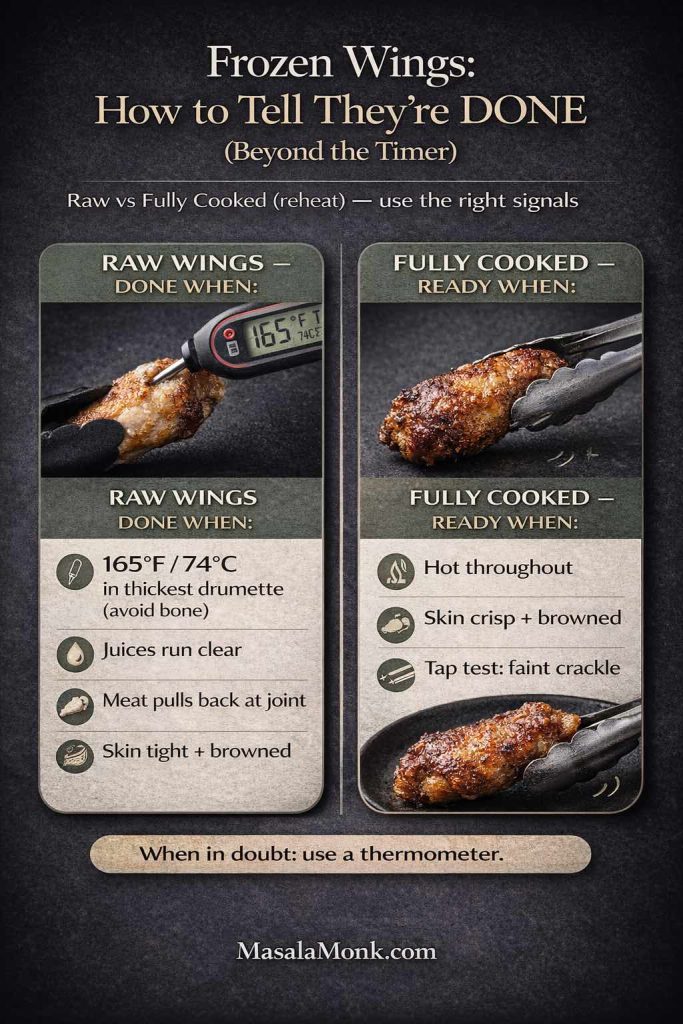
Portrait infographic titled “Frozen Wings: How to Tell They’re DONE (Beyond the Timer).” Two columns compare doneness signals for raw vs fully cooked frozen wings (reheat). Raw wings: thermometer reads 165°F/74°C in thickest drumette (avoid bone), juices run clear, meat pulls back at joint, skin tight and browned. Fully cooked wings: hot throughout, skin crisp and browned, tap test gives a faint crackle. Footer: MasalaMonk.com.
Beyond the clock: use the right doneness signals for frozen wings based on what you have—raw vs fully cooked (reheat). Raw wings are only “done” when the thickest piece hits 165°F / 74°C (avoid bone for accurate readings), then confirm the skin is tight + browned. Fully cooked wings don’t need a safety temp check—your goal is hot throughout + crisp skin, and the “tap test” (faint crackle) is the quickest cue. Save this as your frozen chicken wings doneness checklist for consistently crispy results.

For raw wings

  • Thermometer reads 165°F / 74°C in the thickest part (refer to USDA temperature guidance)
  • Juices run clear when pierced
  • The meat pulls slightly from the bone at the joint
  • The skin looks tightened and browned

For pre-cooked wings

  • Wings are hot throughout
  • Skin is crisped and browned
  • You hear a faint crackle when you tap the surface with tongs

If you’re unsure whether your frozen wings are raw or pre-cooked, treat them like raw and check temperature. It’s the simplest way to remove doubt.

Also Read: Baked Ziti Recipe Collection: 15 Easy Variations


Best frozen wings for air fryer: what actually matters when choosing a bag

Different brands vary, yet the most important factor for results is often not the brand—it’s the wing style.
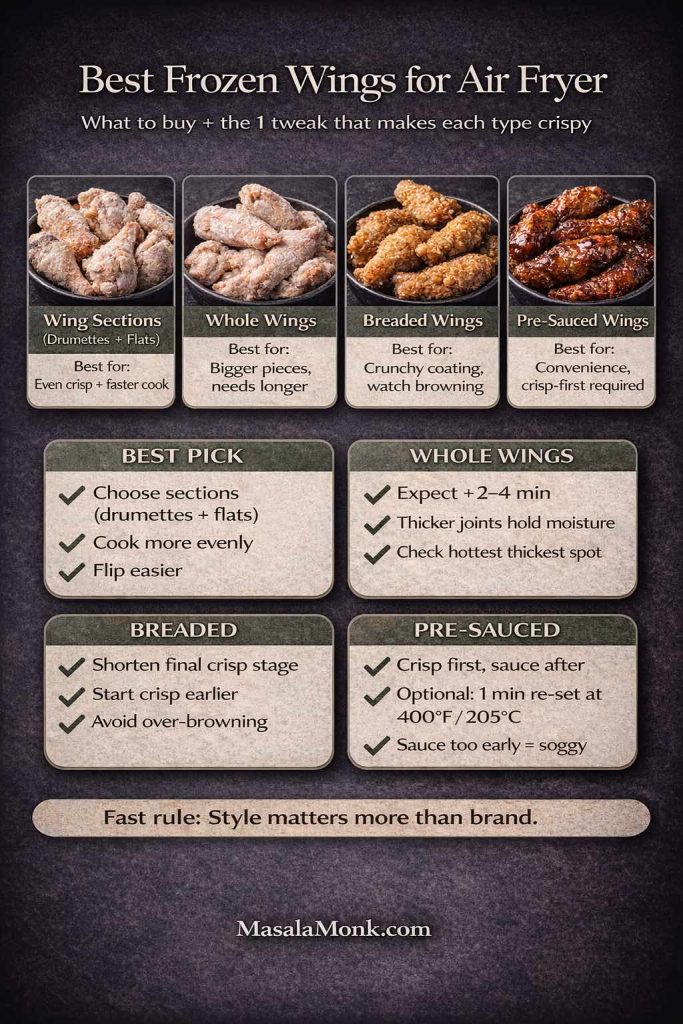
Vertical infographic titled “Best Frozen Wings for Air Fryer” showing four frozen wing types—wing sections (drumettes + flats), whole wings, breaded wings, and pre-sauced wings—with what each is best for. Notes: sections cook evenly and flip easier; whole wings may need +2–4 minutes and thicker joints hold moisture; breaded wings brown fast so shorten the final crisp stage; pre-sauced wings should be crisped first, sauced after, with an optional 1-minute reset at 400°F / 205°C. Footer: MasalaMonk.com.
Best Frozen Wings for Air Fryer (what to buy): Wing style matters more than brand. For the crispiest results, choose wing sections (drumettes + flats)—they cook more evenly and flip easier. Using whole wings? Expect +2–4 minutes since thicker joints hold moisture. Breaded wings brown fast, so shorten the final crisp stage. Pre-sauced wings stay best when you crisp first, sauce last (optional: 1 minute at 400°F / 205°C to “set” sauce). Keep reading for the full timing chart + the two-stage crisp method.

Wing sections usually outperform whole wings

Wingettes/drumettes crisp more evenly, fit better, and flip more easily.

Breaded wings can be great, but need careful timing

Breaded wings brown quickly. That’s fine, although it means the crisp stage might be shorter to prevent scorching.

Pre-sauced wings can be convenient, but crisp-first still wins

They’ll taste much better if you crisp them first, then refresh sauce at the end.

If you’re building a broader air-fryer setup and want a practical list of machines, MasalaMonk has a roundup of best-selling air fryers. It’s a useful internal reference if you’re comparing sizes and baskets.

Also Read: Manhattan Cocktail Recipe (Classic + 6 Variations)


Frozen chicken wings in air fryer troubleshooting (the real fixes)

Even with a good method, a few problems show up again and again. Here’s what to do when they do.
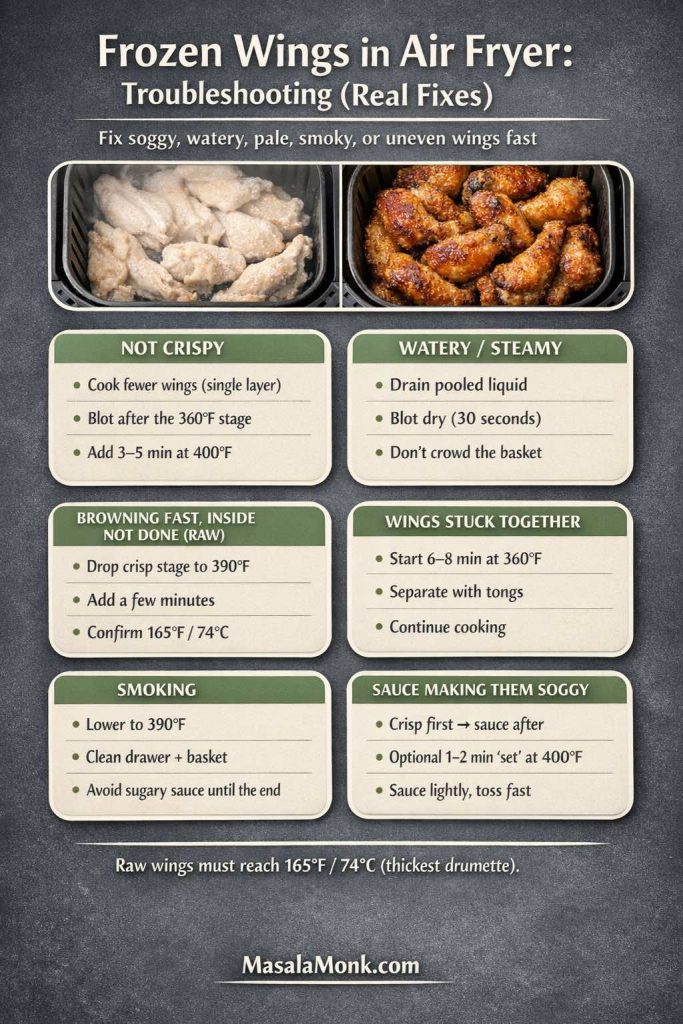
Infographic titled ‘Frozen Wings in Air Fryer: Troubleshooting (Real Fixes)’ with a top photo strip showing pale steamed wings vs browned crispy wings. Six tip boxes: Not Crispy (single layer, blot after 360°F stage, add 3–5 min at 400°F); Watery/Steamy (drain liquid, blot 30 sec, don’t crowd); Browning fast inside not done (raw) (390°F + time, confirm 165°F/74°C); Wings stuck together (start 6–8 min at 360°F, separate, continue); Smoking (390°F, clean basket, avoid sugary sauce); Sauce soggy (crisp first, optional 1–2 min set). Footer: MasalaMonk.com.
Wings coming out soggy, watery, smoky, or uneven? Save this quick troubleshooting guide. It shows the real fixes that work with frozen wings: single-layer airflow (no steaming), drain + blot after the 360°F stage, then finish hot at 400°F for crisp skin. If you’re using raw frozen wings, the chart reminds you to confirm 165°F / 74°C in the thickest drumette before serving. And if sauce keeps ruining crunch, the rule is simple: crisp first → sauce after (optional 1–2 minutes to “set”). Keep this handy for wing night—and scroll for the full step-by-step method, times, and flavor options.

“My wings are still not crispy”

  • Cook fewer wings at once.
  • Blot more thoroughly after the first stage.
  • Extend the 400°F / 205°C crisp stage by 3–5 minutes.

“My wings are watery”

This often happens with frozen wings that release a lot of moisture early.

  • Drain the basket if water collects.
  • Blot thoroughly.
  • Give the wings a longer crisp stage.

“My wings are browned but the inside feels underdone”

This is most common with larger raw wings.

  • Add time at 360°F / 182°C first, then crisp again.
  • Confirm doneness with a thermometer and aim for 165°F / 74°C (USDA guidance).
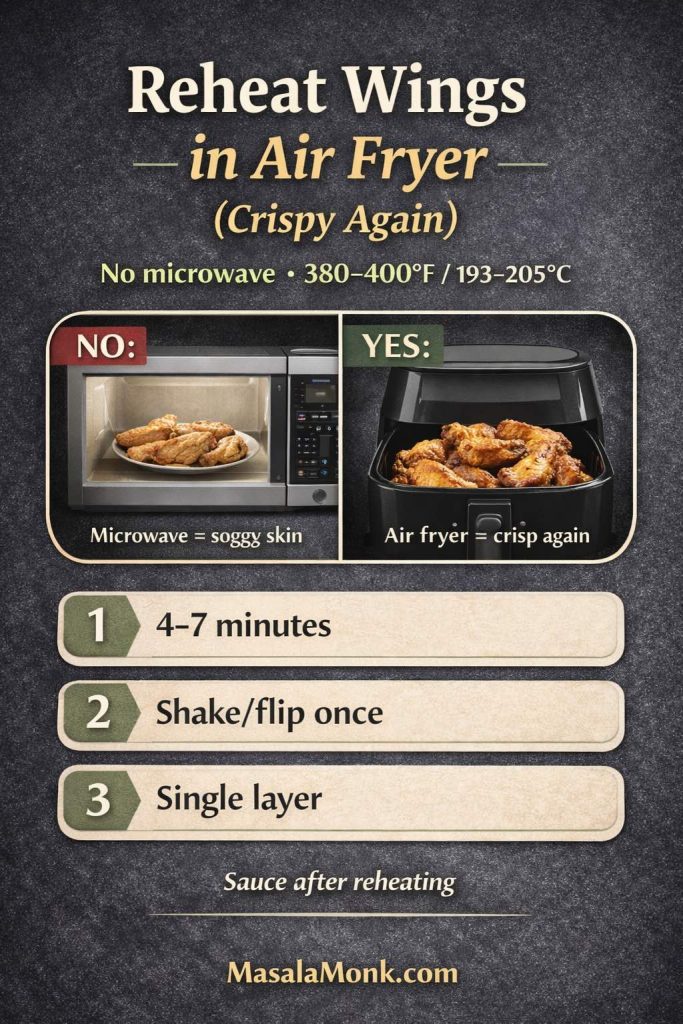
Reheating chicken wings in an air fryer: avoid the microwave. Reheat at 380–400°F (193–205°C) for 4–7 minutes, shake or flip once, keep wings in a single layer, and sauce after reheating for crisp skin.
Leftover wings? Skip the microwave. Reheat in the air fryer at 380–400°F (193–205°C) for 4–7 minutes, flip once, and keep them in a single layer so the skin turns crisp again. Sauce after reheating to avoid soggy wings.

“My wings are smoking”

Rendered chicken fat can smoke, especially at 400°F. If your model smokes easily:

  • Reduce crisp stage to 390°F / 199°C and cook slightly longer.
  • Clean the basket and drawer regularly.
  • Avoid sugary sauces until the end.

Also Read: Rob Roy Drink Recipe: Classic Scotch Cocktail (Perfect + Dry + Sweet Variations)


Baked chicken wings from frozen: a solid oven backup when you’re cooking a lot

Sometimes you need volume. In that case, the oven is convenient because you can do a full sheet pan at once. Even so, the same crisping logic applies: airflow and moisture control.
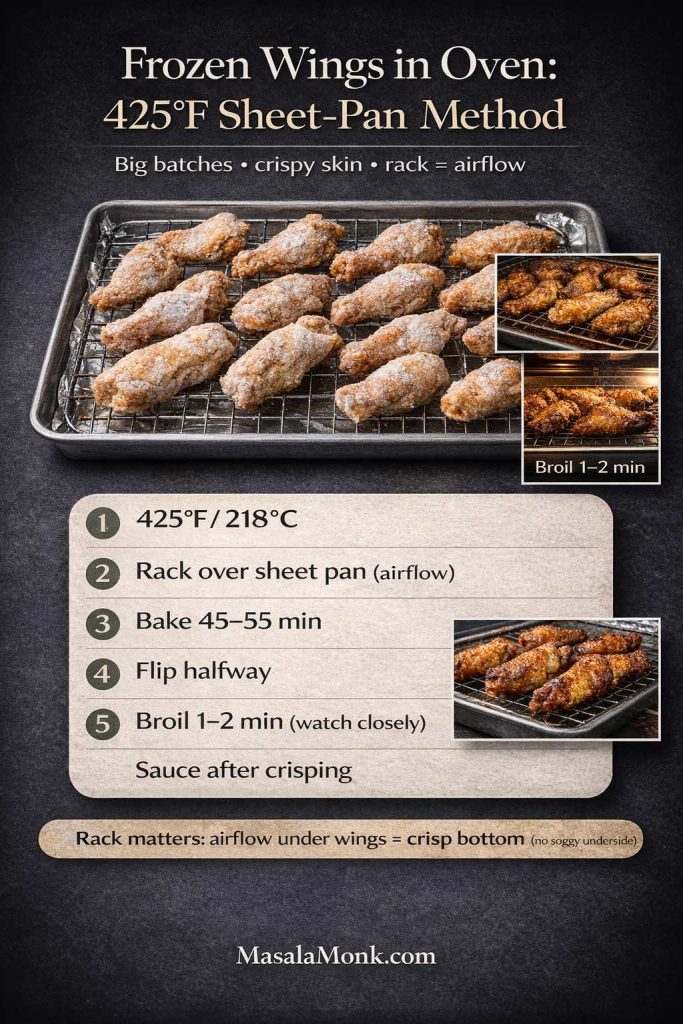
Frozen chicken wings baked in the oven using a rack-over-sheet-pan method: bake at 425°F / 218°C for 45–55 minutes, flip halfway, then broil 1–2 minutes for extra crisp skin. Includes a visual reminder that the rack improves airflow so the bottoms don’t turn soggy. MasalaMonk.com footer.
Oven backup for big batches: When you need volume, this rack-over-sheet-pan method nails the same goal as air frying—airflow + moisture control. Bake frozen wings at 425°F / 218°C for 45–55 minutes, flip halfway, then broil 1–2 minutes right at the end for that last crisp hit. The rack is the difference-maker: it keeps the undersides from steaming against the pan. Sauce after crisping so you don’t soften the skin.

Oven method for frozen wings

  1. Heat oven to 425°F / 218°C.
  2. Place wings on a rack set over a sheet pan.
  3. Bake 45–55 minutes, flipping halfway.
  4. For extra crispness, broil 1–2 minutes at the end (watch closely).
  5. Sauce after crisping.

The rack matters because it lets hot air circulate around the wings. Without it, the underside can soften from contact with the pan.

Also Read: Best Vermouth for a Negroni Cocktail Drink Recipe


Fried chicken wings from frozen: what to know before you do it

Deep frying from frozen can be done, although it’s messy and can be risky if you aren’t careful. Frozen surfaces can cause oil splatter. Additionally, wing pieces that are stuck together can create uneven cooking.
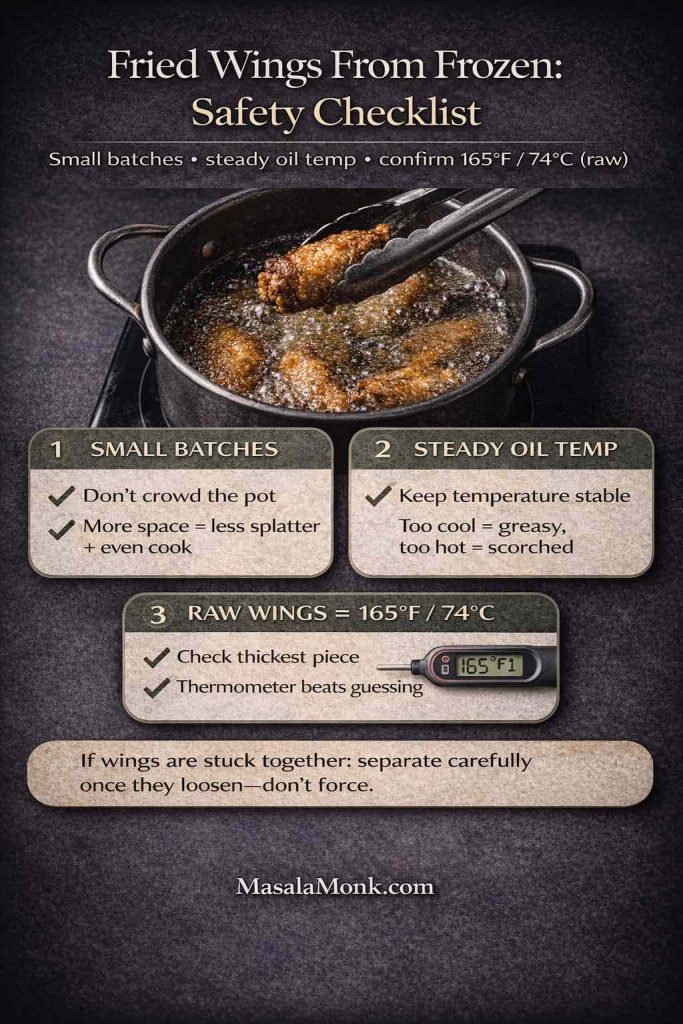
Fried wings from frozen safety checklist graphic: deep-frying pot with wings and tongs. Key tips: fry in small batches (don’t crowd—less splatter, more even cooking), keep oil temperature steady (too cool = greasy, too hot = scorched), and for raw wings confirm 165°F / 74°C in the thickest piece with a thermometer. Note: if wings are stuck together, separate gently once loosened.
Deep-frying frozen wings can work, but it’s the easiest way to create a splattery mess (or uneven cooking) if you rush it. Use this quick safety checklist: small batches + steady oil temp + thermometer to 165°F / 74°C for raw wings. If wings are stuck together, let them loosen in the oil first—don’t force them apart. (Save/pin this so you don’t have to guess next time.)

If you include this method, keep it cautious:

  • Fry in small batches
  • Maintain steady oil temperature
  • Confirm raw wings reach 165°F / 74°C

For most people, an air fryer gives you enough crunch without the mess—especially when you follow the two-stage crisping method.

Also Read: Paper Plane Cocktail Recipe + Best Amaro Substitutes & Tips


A few flavorful ways to keep wings exciting (without turning the kitchen into a project)

Wings get repetitive only when you repeat the same sauce. Instead, rotate finishes that don’t add work.

Creamy dips that pair with everything

If you want a dip you can customize endlessly, start with a mayo base. MasalaMonk’s eggless mayonnaise is perfect for classic creamy dips, while the vegan mayo recipe gives you a plant-based option that still tastes rich.

From there, you can build:

  • Garlic mayo (garlic + lemon + salt)
  • Spicy mayo (hot sauce + paprika)
  • Herb dip (dill/parsley + lemon)

Fresh sauces for contrast

Chimichurri turns wings bright and herby. It feels lighter than Buffalo and adds a restaurant-style edge. Use MasalaMonk’s chimichurri recipe either as a toss after crisping or as a side dip.

A “sauce library” approach

If you like having options ready, a sauce hub helps. MasalaMonk’s pizza sauce collection and pesto variations can inspire new wing finishes beyond the usual lineup, while still staying practical.

Also Read: Green Chutney Recipe (Coriander–Mint / Cilantro Chutney)


Handling and safety, especially for raw frozen wings

Raw frozen wings behave like raw chicken once they start thawing in the basket. So it’s worth treating them with the same kitchen habits you’d use for fresh poultry:

  • Use separate tongs or wash them after touching raw wings
  • Wash hands after handling
  • Sanitize the cutting board if you use one
  • Avoid rinsing raw chicken (it spreads bacteria around the sink)

The CDC summarizes these basics clearly in its guide to chicken and food safety.

Meanwhile, for doneness, keep it simple: 165°F / 74°C at the thickest point is the standard, and the USDA safe temperature chart lays it out cleanly.

Also Read: 19 Essential Kitchen Tools That Make Cooking Easier


Bringing it all together: a simple “from frozen” wing routine you can repeat

If you want a routine you can memorize, use this:

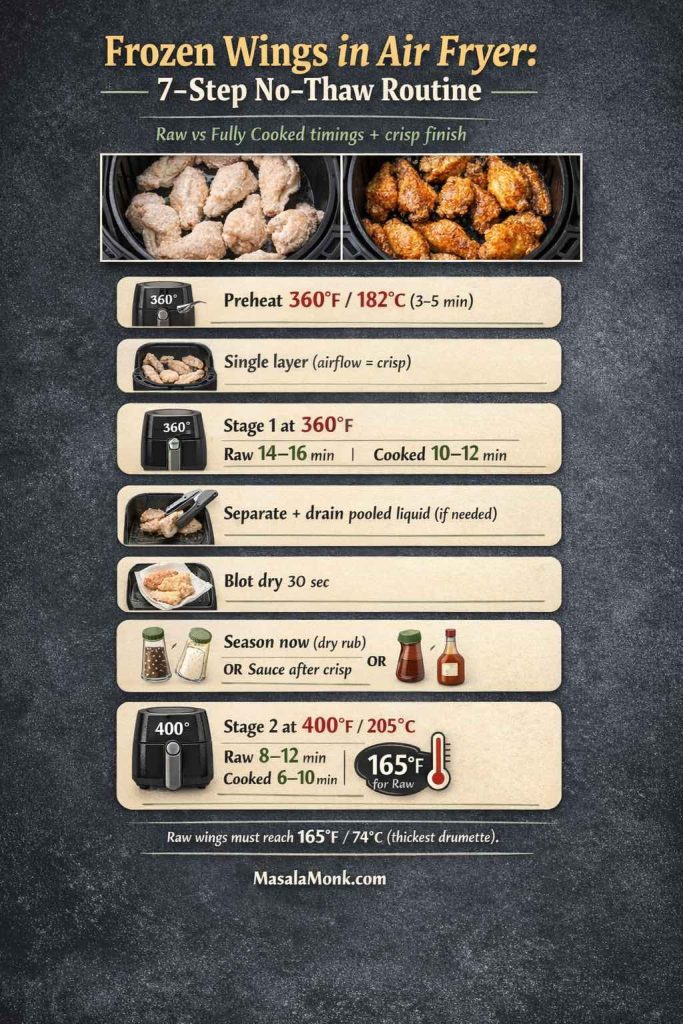
  1. Preheat 360°F / 182°C
  2. Cook frozen wings (raw: 14–16 min, pre-cooked: 10–12 min)
  3. Separate + blot dry
  4. Season (or wait if saucing)
  5. Crisp 400°F / 205°C (raw: 8–12 min, pre-cooked: 6–10 min)
  6. Sauce after crisping
  7. For raw wings, confirm 165°F / 74°C
Infographic titled “Frozen Wings in Air Fryer: 7-Step No-Thaw Routine” showing raw vs fully cooked frozen wing timings. Steps: preheat 360°F/182°C for 3–5 minutes, cook in a single layer, Stage 1 at 360°F (raw 14–16 min, cooked 10–12 min), separate wings and drain liquid, blot dry 30 seconds, season now for dry rub or sauce after crisp, then Stage 2 at 400°F/205°C (raw 8–12 min, cooked 6–10 min). Raw wings must reach 165°F/74°C.
Use this 7-step no-thaw routine any time you’re making frozen chicken wings in the air fryer. It shows the exact two-stage method (360°F → 400°F), the correct time ranges for raw vs fully cooked wings, and the one doneness rule that matters for raw wings: 165°F / 74°C in the thickest drumette. Save this as your quick “wing night” checklist—then follow the steps above in this blog post for the full method and flavor options.

From there, you can go Buffalo with blue cheese dip, hot wings with a spicy glaze, dry rub for maximum crunch, or chimichurri for a bright twist—without changing your cooking method every time.

And if you want to explore the fresh-wing version later—especially for thawed wings, bigger seasoning ideas, or extra technique—MasalaMonk’s Air Fryer Chicken Wings is a natural next step.

Also Read: How to Cook Tortellini (Fresh, Frozen, Dried) + Easy Dinner Ideas


FAQs: Frozen Chicken Wings in Air Fryer

1) How long do frozen chicken wings take in an air fryer?

Most frozen chicken wings in an air fryer take 16–22 minutes if they’re pre-cooked and 22–30 minutes if they’re raw, depending on size and how full your basket is. As a rule of thumb, cook in two stages: a lower-temp warm/render stage, followed by a higher-temp crisp stage. That combination is usually more reliable than trying to blast them at one temperature the whole time.

2) What temperature should I use for frozen chicken wings in the air fryer?

A practical approach is 360°F / 182°C first, then 400°F / 205°C to crisp. The first temperature melts surface ice and helps fat render; afterward, the higher heat drives off moisture so the skin can brown and tighten.

3) Can I cook chicken wings in the air fryer from frozen without thawing?

Yes—chicken wings in air fryer from frozen work well when you leave space for airflow and finish with a high-heat crisp. In other words, the key is not thawing; it’s managing moisture and giving the wings enough room to brown rather than steam.

4) How do I make crispy frozen chicken wings in an air fryer?

To get crispy frozen chicken wings, avoid stacking, flip at least once, and use a brief crisp finish at 400°F / 205°C. Also, blotting the wings after the first stage helps, because it removes moisture that would otherwise soften the skin during the final minutes.

5) What’s the best air fryer wings from frozen method if my wings are stuck together?

Start the first stage at 360°F / 182°C for several minutes, then open the basket and separate them with tongs once the ice loosens. Afterward, continue cooking as normal. Trying to pry them apart while they’re rock-solid often tears skin and slows crisping later.

6) Can I air fry raw frozen chicken wings in the air fryer?

You can air fry raw frozen chicken wings, but you must ensure they’re cooked through. Use the two-stage method and check the thickest drumette for doneness. If you’re uncertain, extend the lower-temp stage slightly, then crisp at the end so texture doesn’t suffer.

7) How long should I air fry frozen wings at 400°F?

As a crisp stage, 400°F / 205°C is perfect: fully cooked wings usually need 6–10 minutes, while raw wings typically need 8–12 minutes after a 360°F start. If you try 400°F the entire time, the outside can brown before the inside heats evenly—so use it mainly for the final crisp.

8) What’s the frozen chicken wings air fryer time and temperature for drumettes or wing sections?

For frozen chicken wing sections (drumettes and flats), many batches do well with 360°F / 182°C for 14–16 minutes (raw) or 10–12 minutes (pre-cooked), then 400°F / 205°C for 6–12 minutes to crisp. However, larger pieces may require a few extra minutes, especially if the basket is crowded.

9) Can I cook pre cooked chicken wings in air fryer straight from frozen?

Absolutely. Pre cooked chicken wings in air fryer are ideal from frozen because your job is mainly reheating and crisping. Nevertheless, you’ll get the best bite if you crisp first and add sticky sauces afterward.

10) How do I make frozen buffalo wings in the air fryer without soggy skin?

Crisp the wings first, then toss in Buffalo sauce after they’re browned. If you want the sauce to cling, return the sauced wings to the basket for 1–2 minutes—just enough to set the coating without steaming the skin.

11) Can I stack frozen wings in an air fryer basket?

It’s possible, yet it usually sacrifices crispiness. When wings overlap, steam gets trapped and browning becomes patchy. Instead, cook in batches or use a rack accessory if your air fryer supports it, keeping space between pieces as much as possible.

12) Why are my air fried frozen wings not crispy?

Usually it comes down to one of three issues: too many wings at once, too much surface moisture, or not enough high-heat time at the end. Consequently, reduce the batch size, blot after the first stage, and extend the final crisp stage by a few minutes.

13) What if my frozen wings are already sauced or breaded?

For sauced wings, crisp them first and refresh sauce at the end. For breaded frozen wings, keep a close eye during the high-heat stage, because breading can brown quickly. In that case, shorten the final crisp stage slightly and rely on airflow (single layer) for texture.

14) How long do frozen wings take in an air fryer if they’re thawed first?

If they’re thawed, they usually cook faster because you’re no longer melting ice. Often, thawed wings take 18–24 minutes total, depending on size. Even so, drying them well before cooking remains important, because damp skin tends to turn rubbery rather than crisp.

15) What’s the best way to cook frozen wings if I’m making a lot for a party?

When you’re cooking for a crowd, batch cooking is the most consistent approach. Cook each batch until crisp, then hold wings on a rack so air can circulate. Right before serving, re-crisp for a couple minutes to restore crunch, then sauce or season immediately.

16) Can I cook frozen chicken wings in the oven if I don’t have an air fryer?

Yes. While an air fryer is faster, the oven works well for bigger batches. Typically, bake wings on a rack at 425°F / 218°C until browned and cooked through, flipping halfway. For extra crispness, finish with a short broil—watching closely so they don’t burn.

17) Is it better to air fry frozen wings at one temperature or two?

Two temperatures are usually better. First, a moderate heat helps thaw the surface and render fat; afterward, higher heat crisps. As a result, you get wings that are both juicy inside and properly crisp outside, instead of wings that are dark in spots and soft elsewhere.

18) How do I know whether my frozen wings are raw or pre-cooked?

Check the packaging for phrases like “fully cooked” or “uncooked.” If you’ve already tossed the bag and you’re not sure, treat them like raw wings and cook until fully done, then crisp at the end. That approach removes doubt while still giving you good texture.

19) Why are my frozen wings chewy or rubbery?

This usually happens when moisture never fully evaporates (crowded basket, no blotting, or too short a high-heat finish). Cook in a single layer, blot after the first stage, then extend the 400°F crisp stage by 2–5 minutes until the skin tightens and browns.

20) How do I reheat leftover wings so they stay crispy?

Air fry at 380–400°F / 193–205°C for 4–7 minutes, shaking once. Don’t microwave first—microwaving steams the skin and makes it soft.
Posted on Leave a comment

Crock Pot Chicken Breast Recipes: 10 Easy Slow Cooker Dinners (Juicy Every Time)

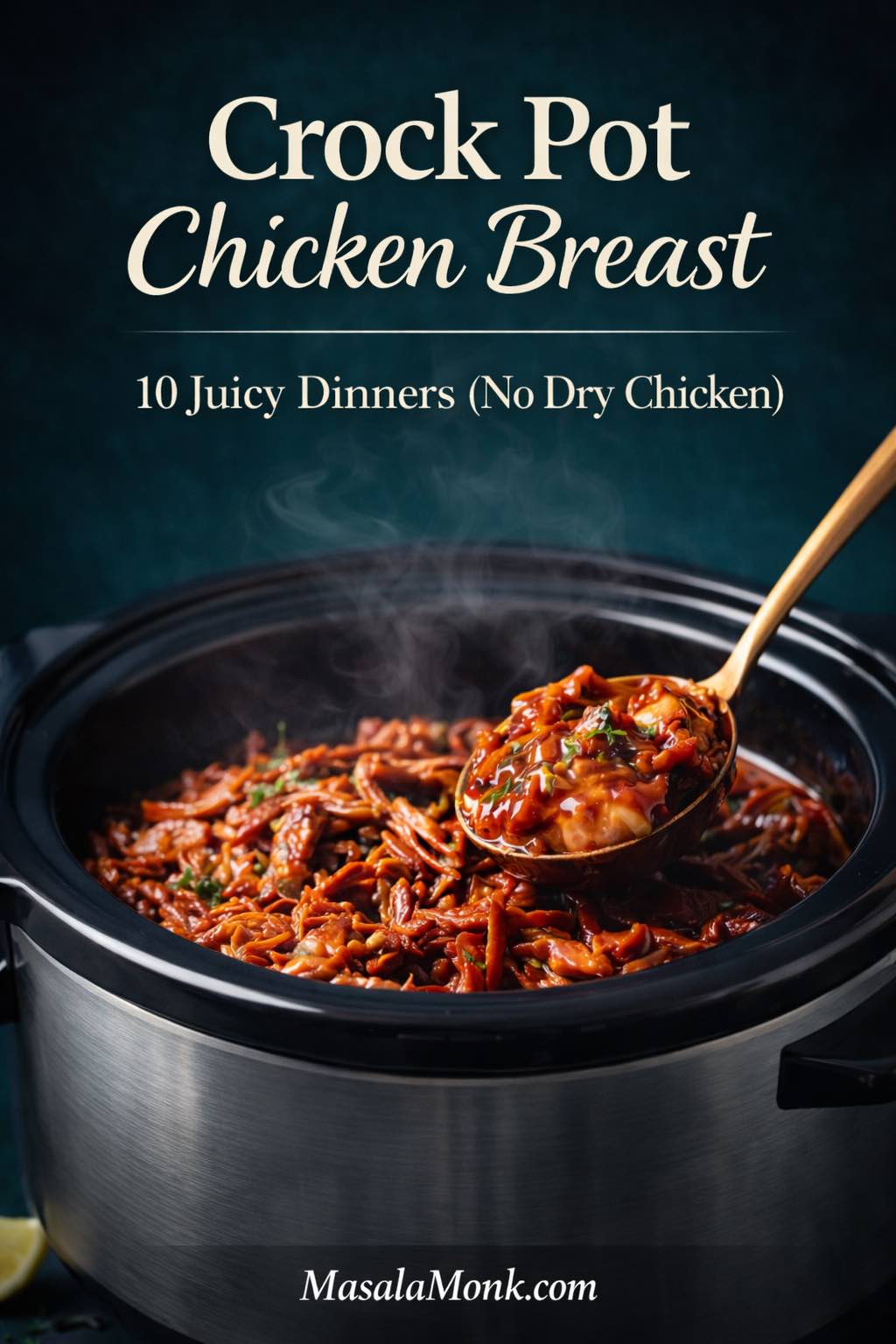
Portrait cover image with text overlay “Crock Pot Chicken Breast” and “10 Juicy Dinners (No Dry Chicken)”. A slow cooker is filled with glossy shredded chicken in a rich sauce, steam rising as a ladle lifts a scoop. MasalaMonk.com appears in the footer.

There’s a particular kind of relief that comes from putting dinner in motion early—then letting the evening unfold without hovering over a stove. A crock pot is built for that. It turns a handful of ingredients into something warm and comforting, while you do everything else life asks for—and crock pot chicken breast is one of the easiest ways to make that happen.

Crock Pot Chicken Breast: The Simple Rules That Keep It Juicy

Chicken breast, though, has a reputation. It’s lean, which is exactly why it can dry out when it’s cooked too long. Even so, slow cooker chicken breast doesn’t have to be bland or overdone. With the right approach—enough moisture, steady timing, and a finishing touch that brightens flavor—you can get tender chicken breast in a crock pot that tastes like you actually tried.

To keep things consistent, it helps to anchor your cooking to one simple target: chicken is done when it reaches 165°F / 74°C in the thickest part. After that, the next step matters just as much—pull it on time, then let it rest before slicing or shredding. That short pause is what keeps the juices where you want them: in the chicken, not on the cutting board.

At the same time, starting with thawed chicken makes the whole process more predictable. Since slow cookers warm food gradually, thawed pieces cook more evenly, which means fewer dry edges and fewer “is this done yet?” moments. As a result, you get better texture with less fuss.

One more thing keeps prep calmer: skip washing raw chicken. Instead, go straight from package to pot, then wash hands and surfaces well. Not only is it simpler, it also avoids spreading raw chicken juices around the sink and countertop.

With those basics in place, everything else becomes easier. From here, you can choose a direction based on what you’re craving: creamy and cozy, tangy and ranchy, sweet-smoky BBQ, bright lemon-garlic, spicy buffalo, or hearty bowls with rice and potatoes. In other words, these ten slow cooker chicken breast dinner recipes aren’t just different—they’re built to rotate nicely, so you can keep dinner interesting without reinventing the wheel every week.


How to Cook Chicken Breast in a Crock Pot Without Drying It Out

Chicken breast becomes “juicy” in the slow cooker for one reason: it finishes at the right temperature and stays surrounded by moisture. Everything else—seasonings, sauces, sides—builds on that foundation.

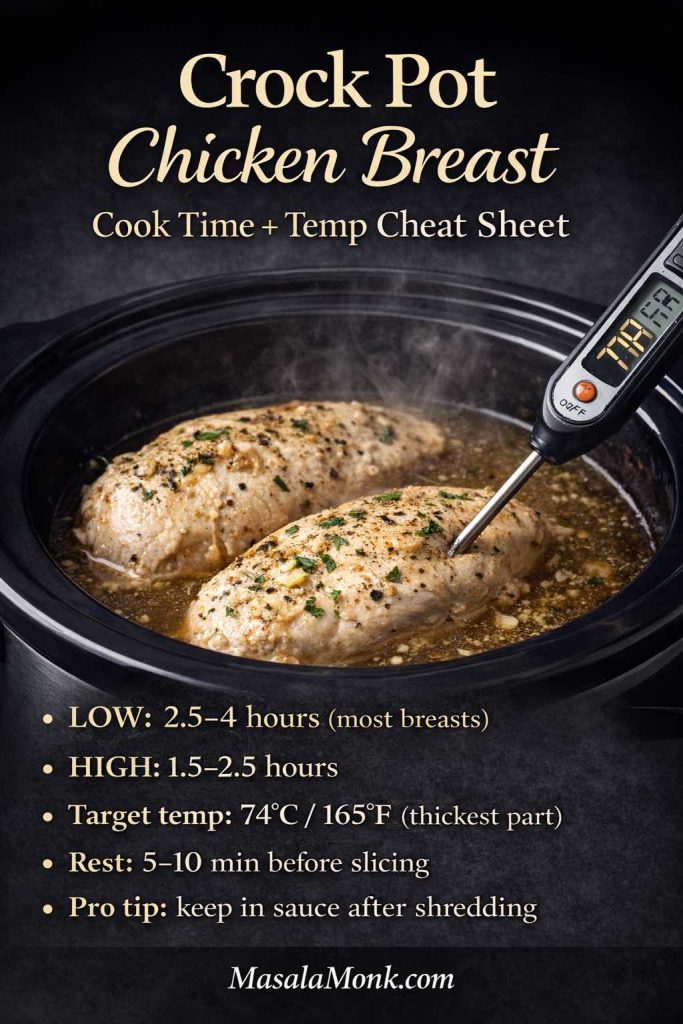
Crock pot chicken breast cook time and temperature cheat sheet with text overlay. Two chicken breasts cook in a slow cooker as a meat thermometer reads 74°C / 165°F. Bullet points list LOW 2.5–4 hours, HIGH 1.5–2.5 hours, rest 5–10 minutes, and a tip to keep chicken in sauce after shredding. MasalaMonk.com in footer.
Bookmark this crock pot chicken breast cheat sheet before your next slow cooker dinner. It shows the key timings (LOW vs HIGH), the target internal temp (74°C / 165°F), and the quick rest rule that keeps chicken juicy—plus the simple “shred + soak in sauce” trick for meal-prep friendly pulled chicken. Save it, share it, and use it as your go-to reference right before you start Recipe #1.

Timing that works in real kitchens

Slow cookers run differently, so time is a guide rather than a guarantee. Still, these ranges are a good starting point for boneless, skinless chicken breasts (roughly 2–3 cm thick):

  • LOW: 2.5 to 4 hours
  • HIGH: 1.5 to 2.5 hours

And if you are doing 1–1.5 cm chicken cutlets/tenders, then check early, while for 3.5+ cm thick breasts, expect the long end of the above time range (or slice horizontally).

Tenderloins, thin cutlets, and bone-in chicken breasts in the crock pot

These cuts follow the same rule—cook to 74°C / 165°F—but the timing window changes fast. The key is simple: check early, then pull as soon as you hit temperature.

  • Chicken tenderloins / tenders: usually finish sooner than whole breasts. Start checking around LOW 1.5–2.5 hours or HIGH 1–1.5 hours.
  • Thin-sliced breasts / cutlets: quickest to overcook. Treat them like a short cook, keep them in sauce, and start checking at the early end (similar to tenderloins).
  • Bone-in chicken breast: takes longer because the bone slows heat transfer. Expect a longer cook (often LOW 4–6 hours), but temperature is still the real finish line.

Consistency hack: Keep pieces similar in thickness, cook in a single layer when possible, and avoid lifting the lid. If you’re shredding, do it in the cooking liquid and let it sit a few minutes to soak.

In other words, these cuts aren’t harder—just faster or slower. Start checking early, pull at 74°C / 165°F, and then rest briefly. Finally, if you’re shredding, do it in the cooking liquid and let it sit for a few minutes so the chicken reabsorbs moisture and flavor.

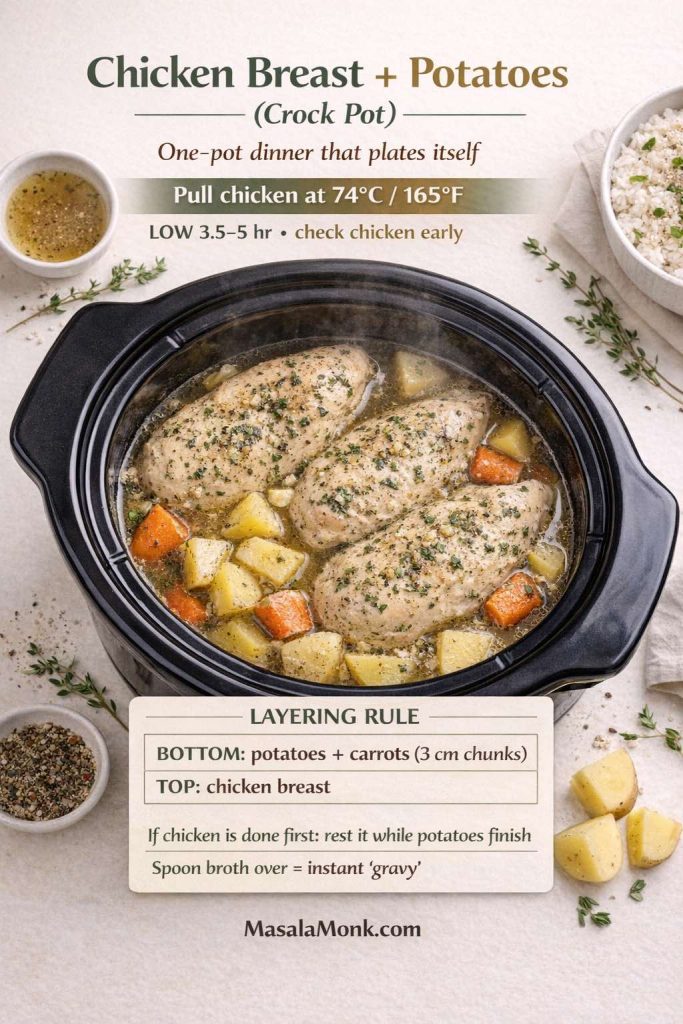
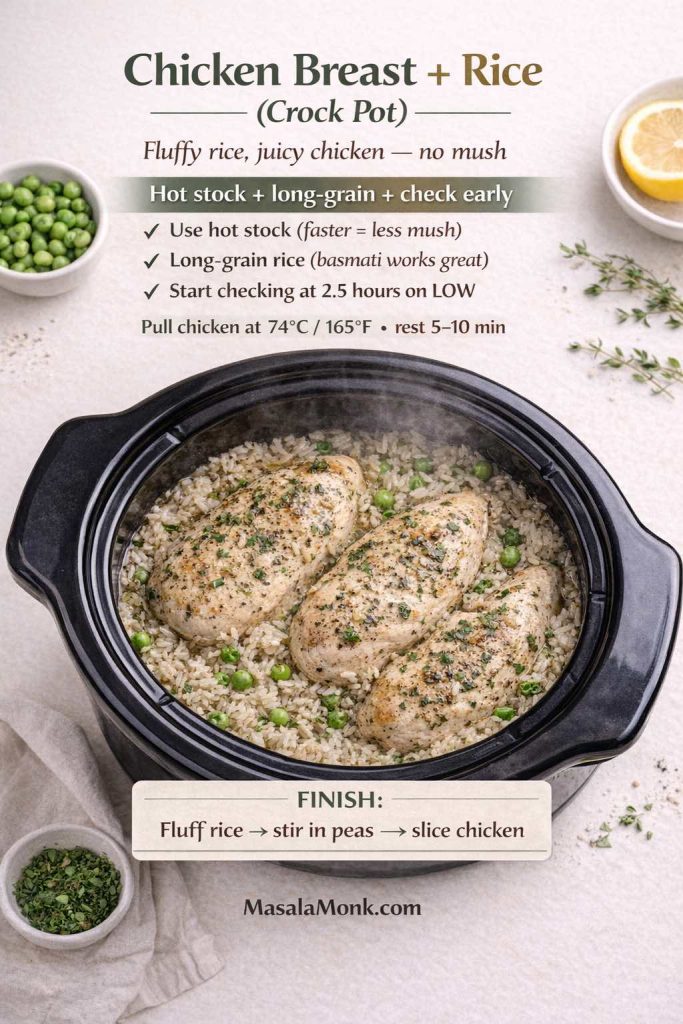
One-pot layering rules (potatoes, vegetables, and rice)

Quick rule card: firm veg on the bottom, chicken on top, and rice goes in late (or gets checked early) to avoid mush.

When you want a true one-pot slow cooker dinner, ingredients can’t all be treated the same. Instead, you’ll get better results by arranging the crock pot based on how quickly each component cooks—and how easily chicken breast can overdo.

For potatoes and firm vegetables (the “bottom first” rule):

Potatoes, carrots, and similar sturdy vegetables need more direct heat. Therefore, place them on the bottom, closest to the heat source. Next, lay the chicken on top so it cooks gently while the vegetables catch up. In addition, keep potato chunks fairly large (around 3 cm) so they soften at the same pace instead of turning grainy or falling apart.

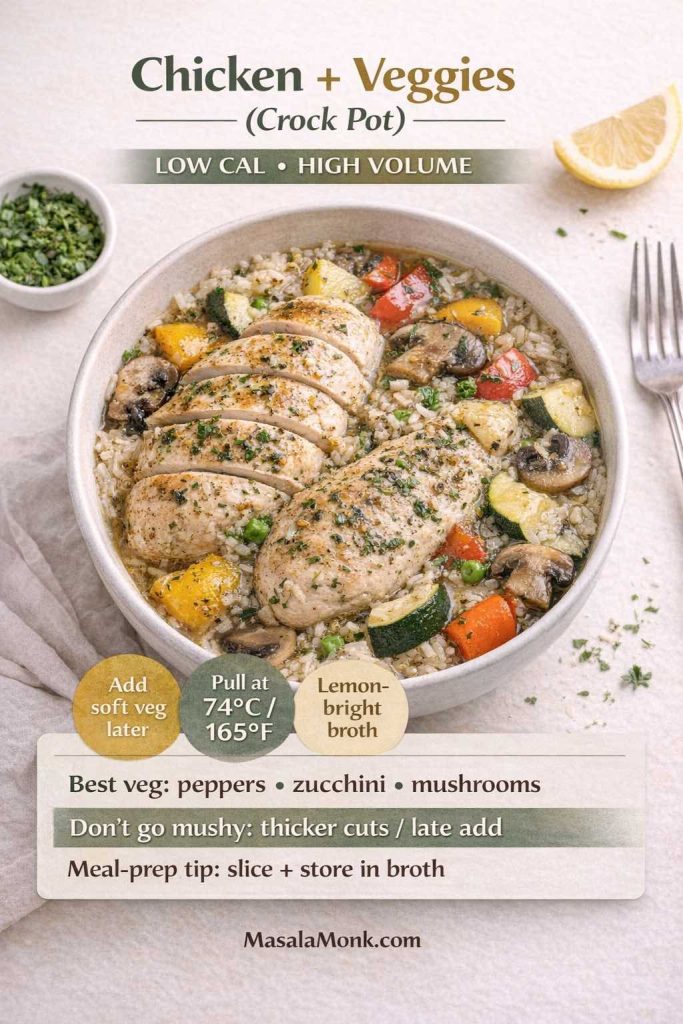
For softer vegetables (the “late add” rule):

Zucchini, bell peppers, and mushrooms cook faster and can go limp if they sit too long. Consequently, add them later when possible—especially if your slow cooker runs hot. If you do cook them from the start, keep the slices thicker so they hold their shape.

For rice (the “don’t let it idle” rule):

Rice is delicious in the slow cooker, yet it’s also the easiest to overdo. Once rice is tender, it keeps absorbing liquid; which means, it can drift from fluffy to mushy if it sits too long. To avoid that:

  • Use long-grain rice for better separation.
  • Start with hot stock so the rice moves toward tenderness sooner and spends less time lingering.
  • Begin checking early and stop as soon as the rice is done.
  • If your cooker tends to run strong, consider adding rice later (often the final 60–90 minutes on LOW) so chicken doesn’t have to wait around on heat.

In short, the layout and timing do the heavy lifting—so the chicken stays juicy and the “side” stays the right texture.

Why chicken breast turns dry in a slow cooker or crock pot

Dry crock pot chicken breast usually comes from one of these:

  • It stayed on heat long after reaching temperature.
  • It cooked without enough liquid or sauce to protect moisture.
  • Pieces cooked unevenly because some were much thicker than others.
  • The lid came off repeatedly, causing temperature swings and longer cooking.
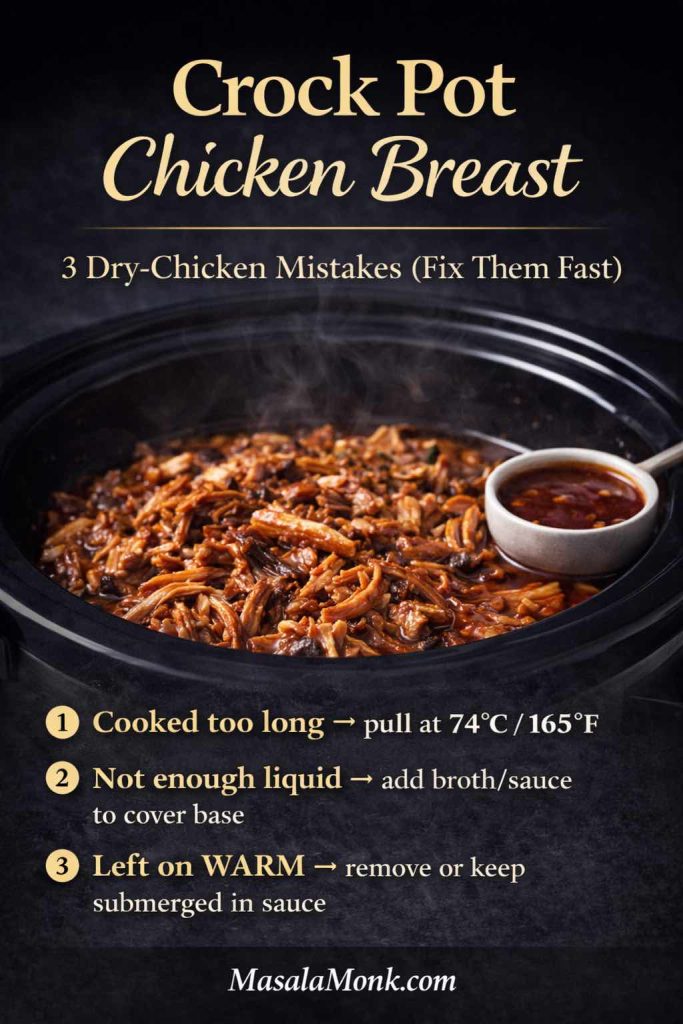
Vertical guide card titled “Crock Pot Chicken Breast: 3 Dry-Chicken Mistakes (Fix Them Fast)” showing shredded chicken in sauce inside a slow cooker with steam. Text lists: 1) Cooked too long—pull at 74°C/165°F, 2) Not enough liquid—add broth or sauce to cover the base, 3) Left on WARM—remove chicken or keep it submerged in sauce. MasalaMonk.com in footer.
Dry crock pot chicken breast is usually one of these three mistakes: cooking too long, too little liquid, or leaving it on WARM after it’s done. This quick fix card shows exactly what to do instead—pull at 74°C/165°F, keep enough sauce in the pot, and hold chicken submerged so it stays juicy. Save this before your next slow cooker dinner, then scroll for the 10 crock pot chicken breast recipes and variations.

Instead, keep chicken in one layer when possible, build a saucy environment, and avoid constant lifting of the lid. Meanwhile, if the breasts are thick, slicing them horizontally into thinner fillets can be the difference between tender and overdone.

About frozen chicken breast in a crock pot or slow cooker

It’s tempting to lean on “crock pot frozen boneless chicken breast recipes,” especially on hectic days. Still, thawed chicken is the easiest path to consistent tenderness and safety, and it follows USDA guidance on slow cooker use. If you want the details, the USDA addresses this directly in its Q&A on frozen foods in a slow cooker.

If you’re stuck with frozen chicken, a practical workaround is to partially thaw in the microwave just until pieces separate, then start cooking immediately in a sauce-heavy recipe and check temperature early. All the same, thawed will taste better.

The simple “rest, then slice” rule

Once chicken reaches temperature, let it rest 5–10 minutes before slicing. Resting keeps juices from running out on the cutting board. Afterward, slice across the grain for tenderness.

Shredding that stays moist

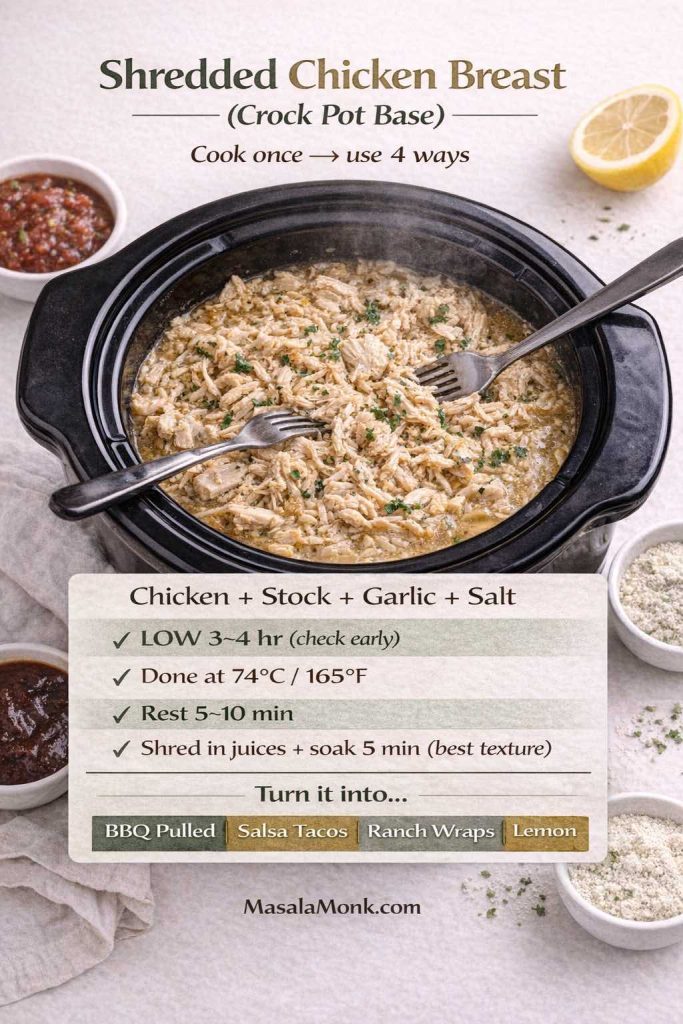
If you want shredded chicken breast slow cooker style, shred it in the cooking juices, then let it sit for a few minutes so it reabsorbs sauce. From there, leftovers can become wraps, bowls, soups, or sandwiches. For lunch ideas, MasalaMonk’s Chicken Salad Sandwich is a great direction when you want something creamy and bright without a lot of work.

Also Read: Double Chocolate Chip Cookies – Easy Recipe with 7 Variations


The 10 Crock Pot Chicken Breast Recipes

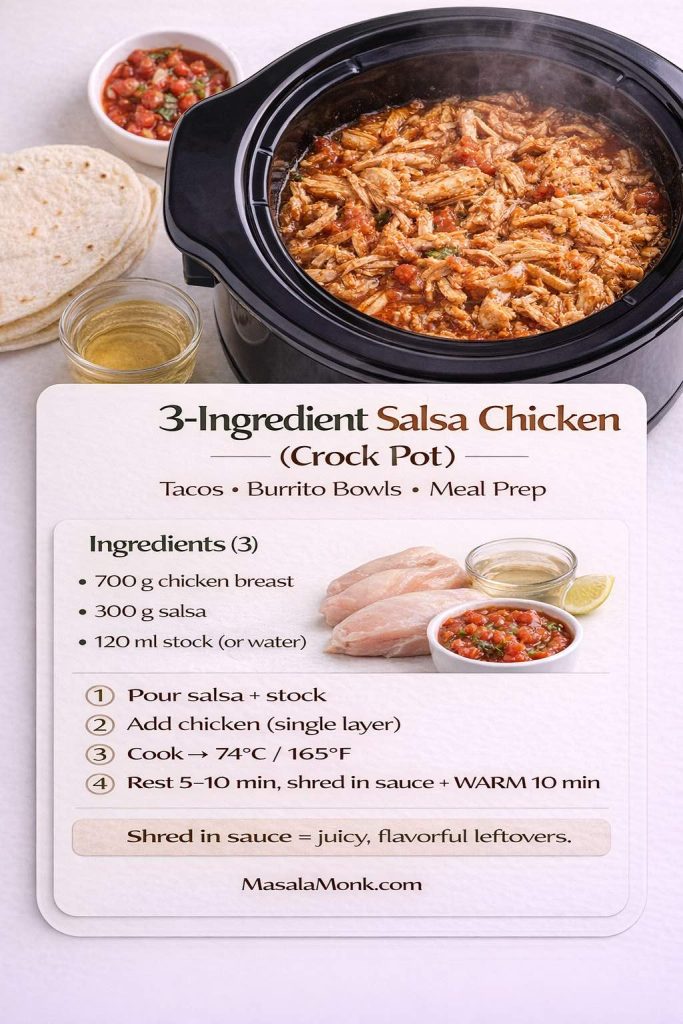
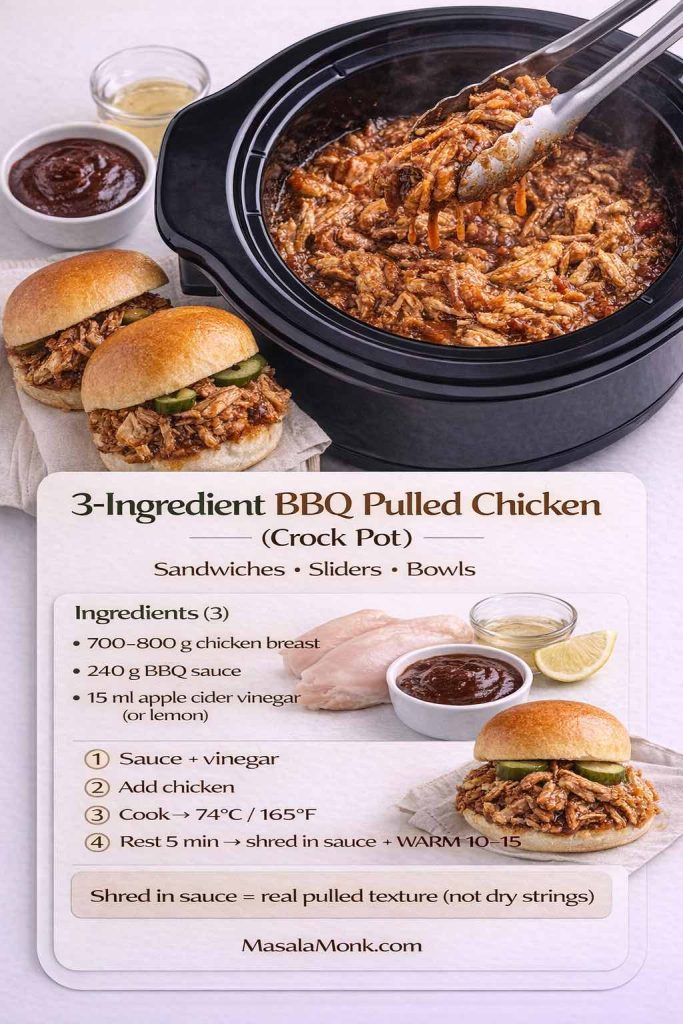
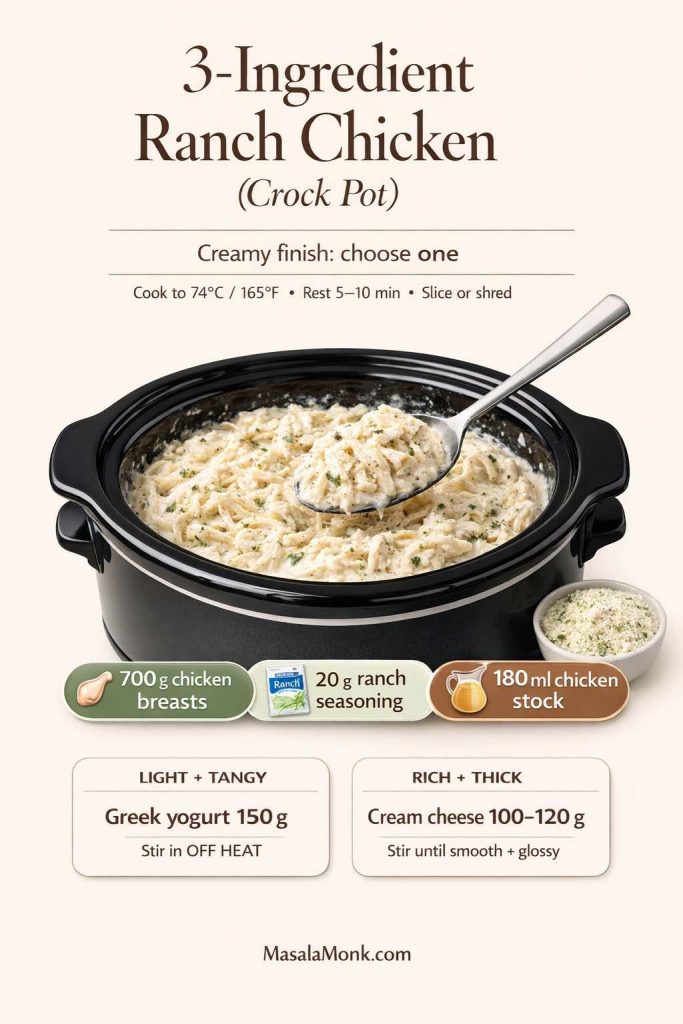
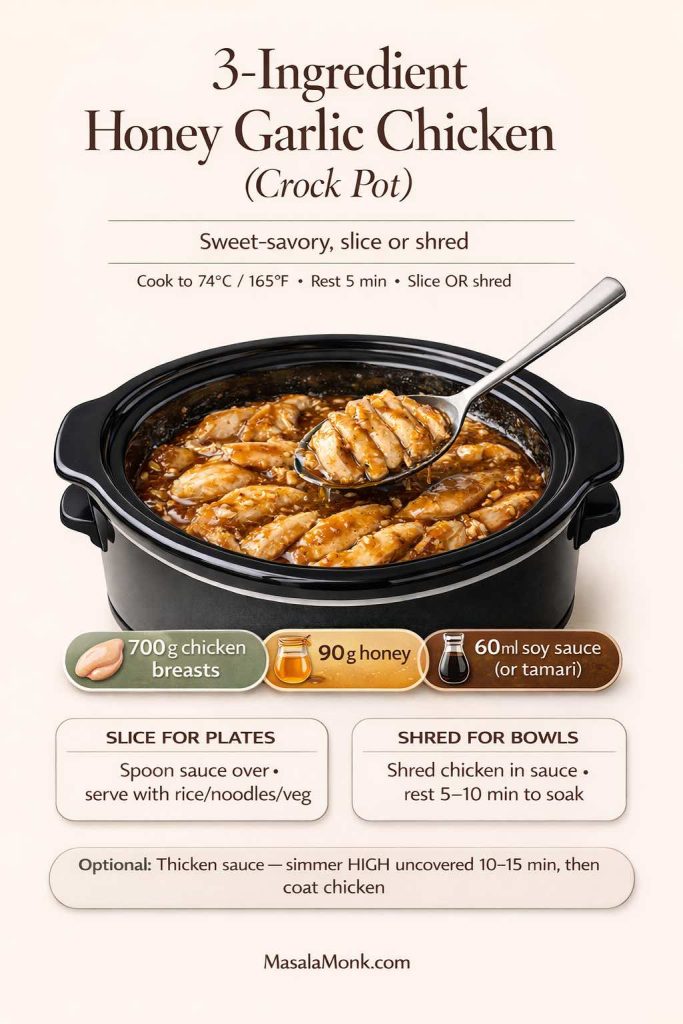
Each recipe below is written as a fully developed “card” with metric weights, clear steps, serving ideas, and multiple variations. You’ll also see options that naturally fit different needs—few-ingredient nights, low fat dinners, gluten free swaps, low carb tweaks, and bold flavors like salsa chicken and spicy slow cooker chicken.

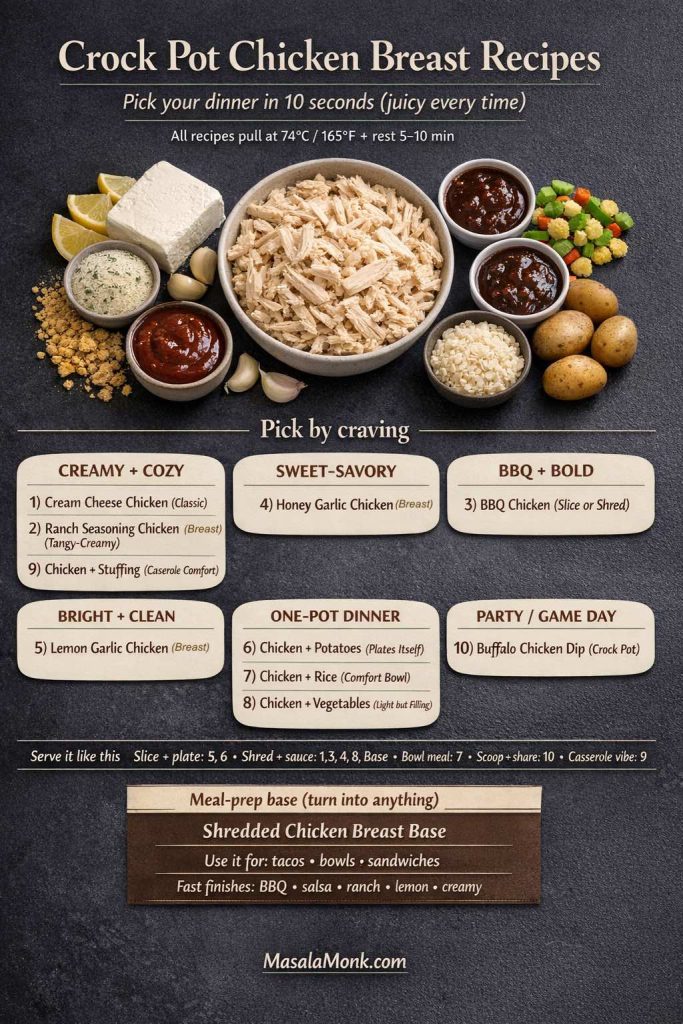
Vertical guide card titled ‘Crock Pot Chicken Breast Recipes’ showing a bowl of shredded chicken and ingredients, plus a ‘Pick by craving’ menu that groups 10 crock pot chicken breast recipes: creamy (cream cheese, ranch, chicken & stuffing), sweet-savory (honey garlic), BBQ (BBQ chicken), bright (lemon garlic), one-pot dinners (chicken with potatoes, rice, vegetables), and party (buffalo chicken dip). Notes: pull at 74°C/165°F and rest 5–10 minutes. MasalaMonk.com in footer.
Use this ‘pick by craving’ cheat sheet to choose the right crock pot chicken breast dinner fast — creamy, BBQ, lemony, one-pot (rice/potatoes/veg), or party-style buffalo dip. Every recipe is built around the same juicy rule: pull at 74°C/165°F, rest 5–10 minutes, then slice or shred in sauce. Save this guide for busy weeknights, and scroll to Recipe #1 to start cooking.

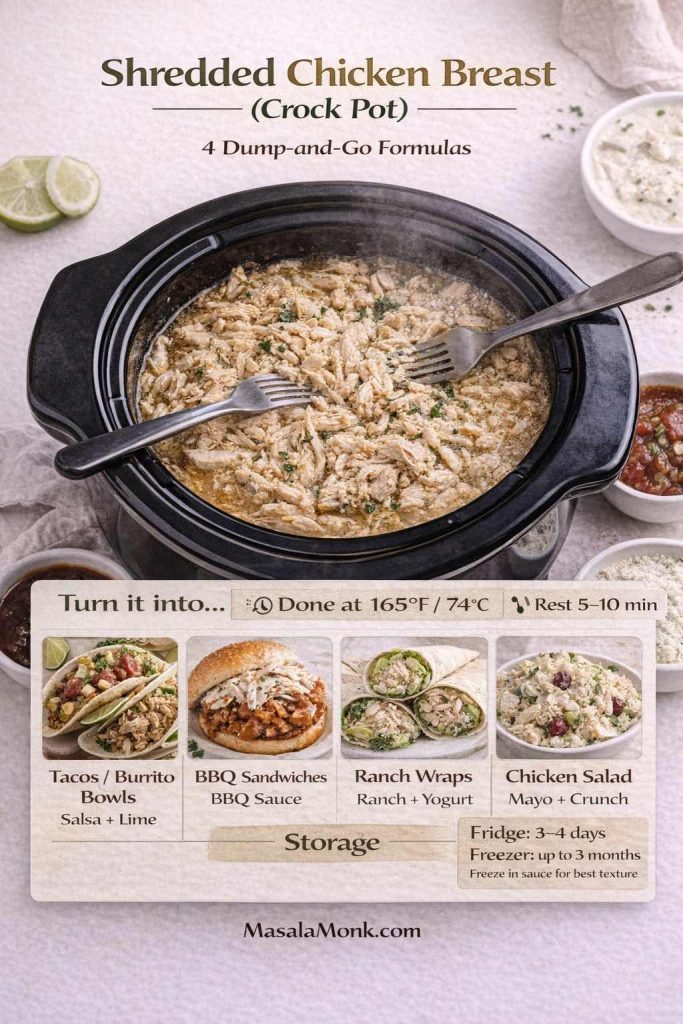
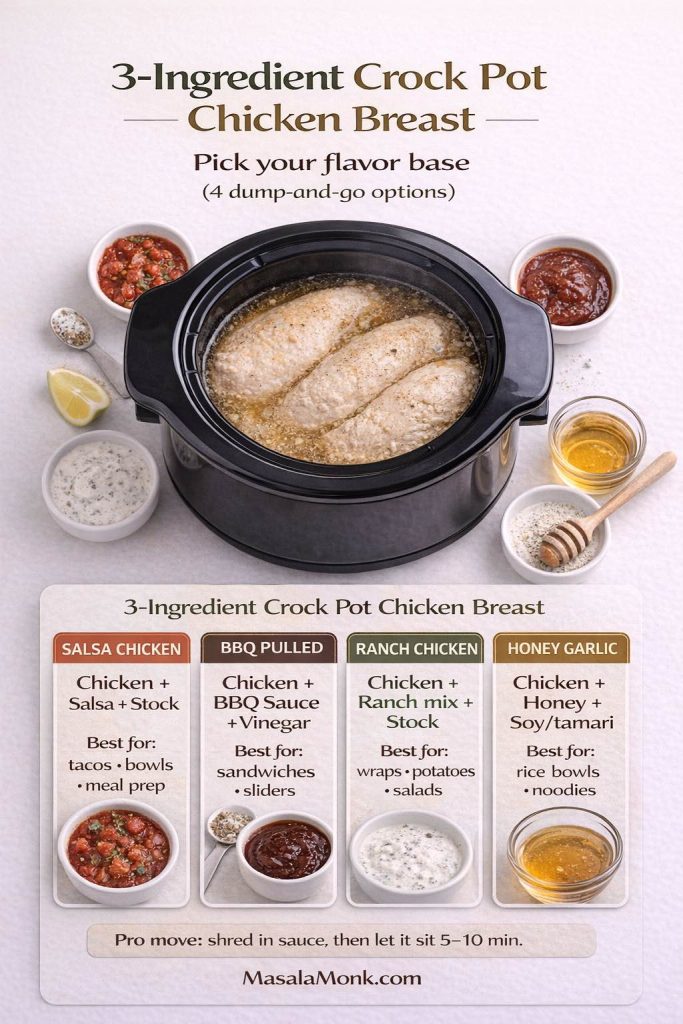
If you want ultra-minimal ingredient options, jump to the 3-ingredient dump-and-go formulas towards the end of this post.

Pick by goal (healthy, low carb, gluten free)

Sometimes you’re not choosing dinner by mood—you’re choosing by the kind of week you’re having. With that in mind, here’s a quick way to match the recipes below to common goals without overthinking it.

  • Low calorie / low fat:
    #5 Lemon Garlic Chicken Breast (bright, broth-based) and #8 Chicken Breast and Vegetables (lighter, filling, meal-prep friendly). Both stay satisfying as the flavor comes from aromatics and acidity rather than heavy dairy.
  • Low carb / keto-ish:
    #3 BBQ Chicken Breast (use a no-sugar-added BBQ sauce), #2 Ranch Seasoning Chicken (finish with Greek yogurt instead of richer dairy), and #5 Lemon Garlic (naturally lower carb). Together, they give variety while keeping the plate simpler.
  • Gluten free:
    #4 Honey Garlic Chicken (use tamari), #5 Lemon Garlic, #8 Chicken + Vegetables, and #10 Buffalo Chicken Dip—just double-check the labels on hot sauce, dressing, and seasoning blends since those are the usual hidden sources.

Finally, no matter which direction you pick, the same juicy rule still applies: pull the chicken at 74°C / 165°F, rest briefly, then keep it in sauce so leftovers stay tender.


1) Cream Cheese Chicken Breast (Crock Pot Creamy Classic)

Creamy chicken breast in a crock pot can feel like a cheat code: it tastes rich, yet it’s built from everyday ingredients. The sauce turns silky, the chicken stays tender, and the leftovers reheat surprisingly well when you keep them saucy.

This version has a subtle lemon lift that keeps the creaminess from feeling heavy. Still, it’s flexible—add mushrooms for deeper savoriness, stir in spinach for a greener finish, or turn it into a cozy casserole-style dinner with a soup swap. Given that it’s a foundational creamy recipe, it also becomes the base for several variations people love: cream cheese ranch chicken, cream-of-mushroom versions, cream-of-chicken versions, and even a stuffed chicken breast approach if you want something a little more dramatic.

Serves: 4
Prep: 10 minutes
Cook: 3–4 hours on LOW (or 1.75–2.5 hours on HIGH)
Slow cooker size: 4–6 qt / 4–5.5 L

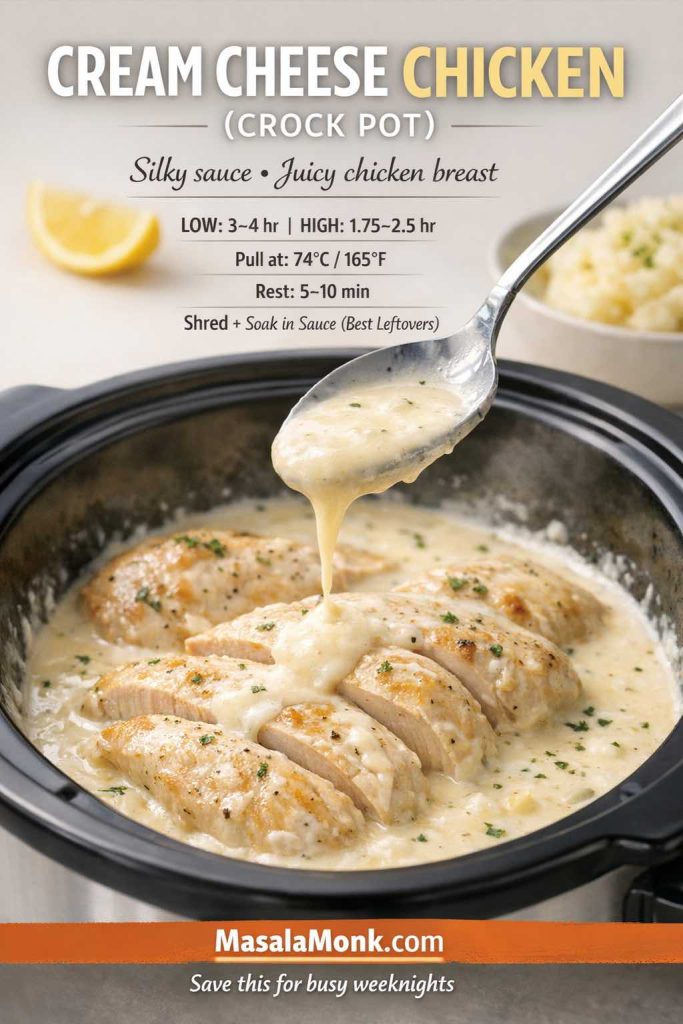
Cream cheese chicken breast in a crock pot with a spoon lifting silky sauce over sliced chicken. Text overlay reads “Cream Cheese Chicken (Crock Pot)” with cook times LOW 3–4 hr and HIGH 1.75–2.5 hr, pull at 74°C/165°F, rest 5–10 min, and “shred + soak in sauce.” MasalaMonk.com branding in the footer.
Creamy crock pot chicken breast with cream cheese is one of the easiest ways to get juicy chicken without babysitting dinner. Use this quick timing guide as your “don’t overcook it” reference: LOW 3–4 hours / HIGH 1.75–2.5 hours, pull at 74°C / 165°F, then rest 5–10 minutes before slicing or shredding. For the best texture (and better leftovers), shred the chicken in the sauce and let it sit a few minutes so it soaks flavor back in.

Ingredients

  • 700 g boneless, skinless chicken breasts
  • 200 g cream cheese
  • 180 ml chicken stock
  • 12 g garlic, minced
  • 8 g onion powder
  • 6 g fine salt
  • 2 g black pepper
  • 5 g smoked paprika (optional)
  • 15 ml lemon juice
  • Optional thickener: 10 g cornstarch + 15 ml water
  • Optional add-ins: 150 g mushrooms (sliced), 60–80 g baby spinach

Method or Recipe for Cream Cheese Chicken Breast in a Crock Pot

  1. Add chicken stock, garlic, onion powder, salt, pepper, paprika, and lemon juice to the slow cooker. Stir to combine.
  2. Add chicken breasts in a single layer if possible.
  3. Scatter cream cheese in chunks over the chicken.
  4. Cook until chicken reaches 165°F / 74°C internally, following the guidance on the safe temperature chart.
  5. Rest chicken 5–10 minutes. Then slice or shred.
  6. Stir the sauce until smooth. If you want it thicker, whisk in cornstarch slurry, cover, and cook on HIGH for 10–15 minutes, stirring once.

What it tastes like

Creamy, gently tangy, savory, and comforting. The lemon keeps the sauce lively rather than flat.

Best sides

This sauce loves starch. It’s fantastic over rice, pasta, or mashed potatoes. For a classic pairing, MasalaMonk’s perfect mashed potatoes fits beautifully.

Variations (pick what matches your mood)

  • Cream of mushroom soup version: replace stock + seasonings with 300 g condensed cream of mushroom soup + 120 ml stock; keep garlic and black pepper.
  • Cream of chicken soup version: same swap, different soup.
  • Half-and-half split: use 150 g cream of mushroom + 150 g cream of chicken for deeper flavor.
  • Spicy creamy chicken: add 10–15 g chili paste or 2–3 g cayenne to the liquid before cooking.
  • Salsa chicken creamy finish: stir in 200–250 g salsa after cooking, then taste and adjust salt.
  • Stuffed chicken breast in a crock pot (spinach-cream cheese): butterfly the breasts, season lightly, fill with a mixture of 120 g cream cheese + 80 g chopped spinach + 1 g garlic powder, secure with toothpicks, then cook in the sauce as written. Slice to reveal the filling.

Storage and reheating

Cool leftovers promptly and refrigerate. Reheat gently (low heat on the stove or a lower-power microwave) so the sauce stays smooth. For general chicken handling and safety basics, the CDC’s chicken food safety guidance is a solid reference.

Also Read: How to Cook Tortellini (Fresh, Frozen, Dried) + Easy Dinner Ideas


2) Ranch Seasoning Chicken Breast (Crock Pot Tangy + Creamy)

Ranch seasoning and slow cooker chicken breast is a combination that just works. It’s savory, herb-forward, and comforting in a familiar way. Unlike some creamy crock pot chicken breast recipes, this one can go lighter or richer depending on how you finish it—Greek yogurt for a brighter, lower-fat version, or cream cheese for a thicker, more luxurious sauce.

It’s also a great “few ingredients” dinner: chicken, broth, ranch seasoning, and one creamy finish. Then, if you want, you can add mushrooms or vegetables without changing the method.

Serves: 4
Prep: 10 minutes
Cook: 3–4 hours on LOW (or 1.75–2.5 hours on HIGH)

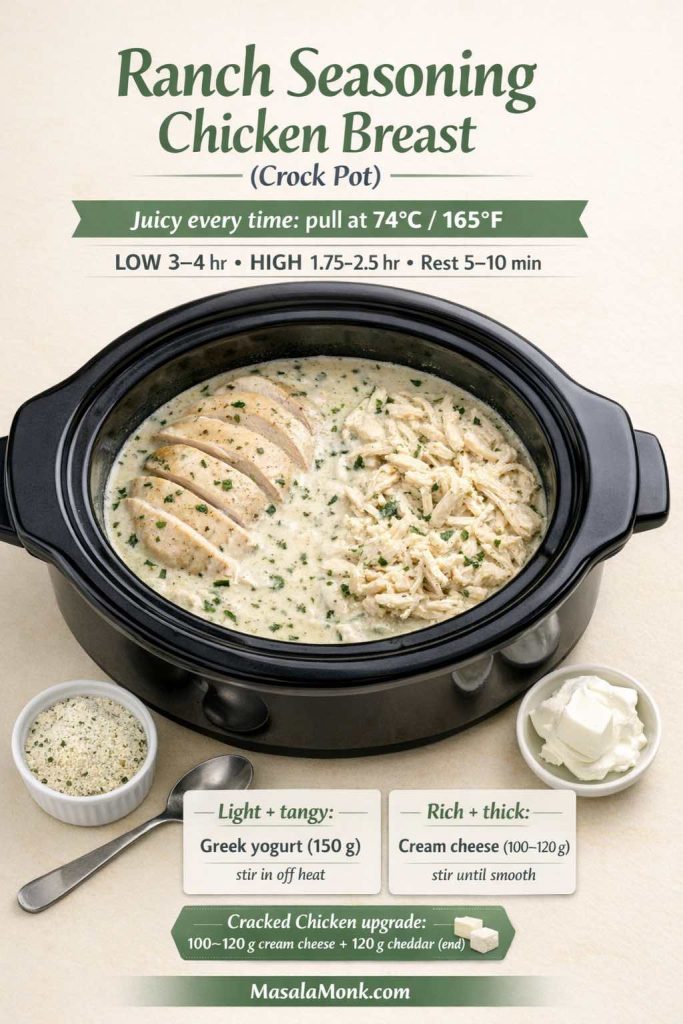
Ranch seasoning chicken breast in a crock pot with creamy sauce. Text overlay shows: pull chicken at 74°C / 165°F, LOW 3–4 hours, HIGH 1.75–2.5 hours, rest 5–10 minutes. Bottom cards compare lighter finish (Greek yogurt) vs rich finish (cream cheese) and include a ‘cracked chicken’ upgrade with cream cheese + cheddar.
Ranch chicken is all about the finish: pull at 74°C / 165°F, rest 5–10 minutes, then choose your texture—Greek yogurt for a lighter tangy sauce or cream cheese for a thicker, richer one. Want the viral-style upgrade? Turn it into cracked chicken by stirring in cheddar at the end. Save this card as your quick-reference before you start Recipe #2.

Ingredients

  • 700 g boneless, skinless chicken breasts
  • 240 ml chicken stock
  • 20 g ranch seasoning mix
  • 10 g garlic, minced
  • 30 ml lemon juice (optional, brightens)
  • 2 g black pepper
  • Finish (choose one):
    • 120 g sour cream
    • or 150 g thick Greek yogurt
    • or 100–120 g cream cheese

Method or Recipe for Ranch Crock Pot Seasoning Chicken Breast

  1. Whisk stock, ranch seasoning, garlic, lemon juice, and pepper in the slow cooker.
  2. Add chicken. Spoon liquid over the top.
  3. Cook until chicken reaches 74°C internally, using the safe temperature chart.
  4. Rest briefly, then shred or slice.
  5. Stir in sour cream, yogurt, or cream cheese until smooth.

Serving ideas

Ranch chicken is great with potatoes, rice, or wraps. For a cool contrast, a yogurt-based sauce is surprisingly good alongside ranchy flavors—MasalaMonk’s tzatziki sauce guide has several variations worth trying.

Variations

  • Cracked-style creamy ranch: add 100 g cream cheese at the start, then stir in 120 g shredded cheddar at the end until melted. Detailed instructions are given below.
  • Ranch + vegetables crock pot dinner: add 150 g mushrooms + 120 g sliced onion at the start; stir in spinach at the end.
  • Ranch pasta night later: if you love this flavor family, the One-Pot Chicken Bacon Ranch Pasta is a fun change of pace.

Cracked Chicken (Crock Pot Ranch + Cream Cheese + Cheddar)

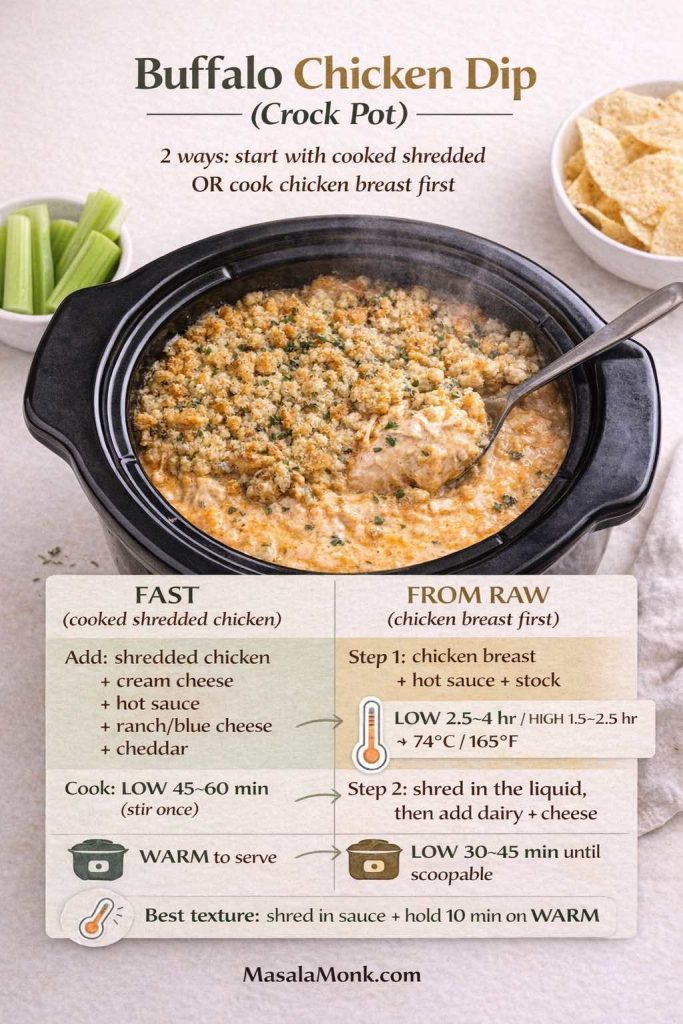
If ranch chicken is the cozy classic, cracked chicken is the indulgent upgrade. It keeps the same easy slow-cooker recipe; however, it finishes richer, cheesier, and more “scoopable,” which is why people with slow cooker look it up so often—and why the method matters.

To make it, start with the Recipe #2 base (ranch seasoning + stock + chicken), then follow these tweaks:

  • Add cream cheese early for body: drop in 100–120 g cream cheese in chunks at the beginning (or during the last hour on LOW if you prefer a cleaner melt). As it softens, it turns the cooking liquid into a thicker, clingier sauce.
  • Cook as usual, but shred in the juices: once the thickest part hits 74°C / 165°F, rest briefly, then shred directly in the ranchy sauce. That way, the chicken stays moist instead of stringy.
  • Finish with cheddar for the “cracked” texture: stir in 120 g shredded cheddar until it melts and looks glossy. At this point, the flavor becomes deeper and the texture turns properly creamy.
  • Optional, but popular: add crumbled cooked bacon at the end. It brings salt and crunch, so the dip-like vibe becomes even more pronounced.

As a result, you get a dish that feels like comfort food without changing your workflow—just a smarter finish.

Also Read: Whole Chicken in Crock Pot Recipe (Slow Cooker “Roast” Chicken with Veggies)


3) BBQ Chicken Breast (Crock Pot, Slice or Shred)

BBQ chicken breast in a crock pot is one of those meals that feels like it belongs at a weekend cookout—even when it’s a Tuesday. It’s bold, saucy, and forgiving. As the sauce surrounds the chicken, it stays moist as long as you don’t overcook it. Later, leftovers become sandwiches, rice bowls, nachos, or a quick loaded baked potato situation.

This recipe can be served sliced for dinner plates, or shredded for pulled chicken breast in the crock pot. Either way, it’s deeply useful.

Serves: 4–5
Prep: 10 minutes
Cook: 3–4 hours on LOW (or 1.75–2.5 hours on HIGH)

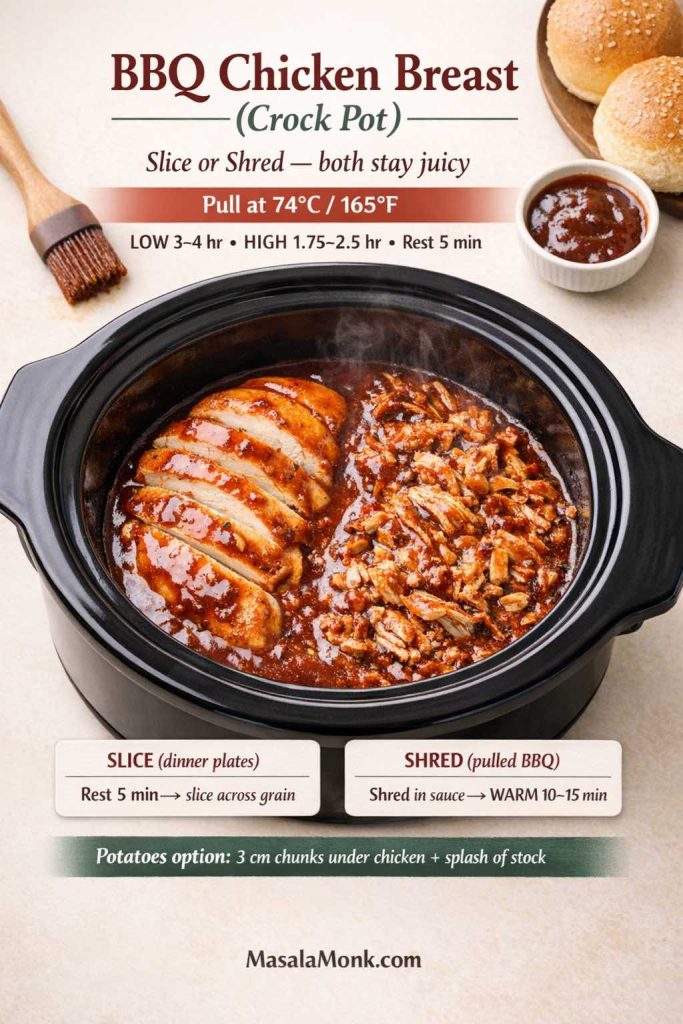
BBQ chicken breast in a crock pot with two outcomes shown: sliced chicken and shredded pulled BBQ chicken in sauce. Text overlay highlights pull at 74°C/165°F, LOW 3–4 hours or HIGH 1.75–2.5 hours, rest 5 minutes, and a tip to shred in sauce then hold on WARM 10–15 minutes.
BBQ chicken breast is a weeknight cheat code because it works two ways: slice it for dinner plates or shred it for pulled chicken. The quick rule is the same—pull at 74°C/165°F, rest 5 minutes, then (if shredding) let it sit in the sauce on WARM for that glossy, juicy finish.

Ingredients

  • 800 g boneless, skinless chicken breasts
  • 240 g BBQ sauce
  • 120 ml chicken stock
  • 15 ml apple cider vinegar
  • 6 g salt
  • 2 g smoked paprika
  • 2 g garlic powder
  • Optional sweetness: 12 g brown sugar (skip if you prefer)

Method or Recipe of BBQ Chicken Breast in a Slow Cooker

  1. Stir BBQ sauce, stock, vinegar, salt, paprika, and garlic powder in the slow cooker.
  2. Add chicken and coat well.
  3. Cook until chicken reaches 74°C, referencing the safe temperature chart.
  4. Rest 5 minutes. Slice for plates, or shred directly in the sauce for pulled chicken.
  5. Leave on WARM 10–15 minutes so the chicken absorbs sauce.

Best sides

For a hearty comfort pairing, try it with MasalaMonk’s Red Beans and Rice. For something crisp and salty, homemade fries are always a win—MasalaMonk’s homemade French fries is a great reference if you want to go all-in.

Variations

  • Low carb BBQ: use a no-sugar-added BBQ sauce and skip brown sugar.
  • Spicy BBQ: add 10–15 g hot sauce or 2 g chili flakes.
  • Honey BBQ: add 20 g honey for shine.
  • BBQ chicken breast and potatoes slow cooker dinner: add 500–600 g potato chunks under the chicken and increase stock to 180 ml.

If you like turning leftovers into lunch, MasalaMonk’s chicken sandwich recipes is a great place to find a new direction.


4) Honey Garlic Chicken Breast (Crock Pot Sweet-Savory)

Honey garlic chicken breast is weeknight-friendly in the best way: the ingredient list is short, the sauce tastes balanced, and the final plate feels like something you’d happily eat twice. The vinegar keeps sweetness in check, while garlic does the heavy lifting. If you add ginger, it becomes even more fragrant.

Since the sauce is glossy and strong, you can pair it with simple sides and still feel like dinner has personality. Moreover, it reheats well, which makes it ideal for meal prep.

Serves: 4
Prep: 10 minutes
Cook: 2.5–4 hours on LOW (or 1.5–2.5 hours on HIGH)

Honey garlic chicken breast in a crock pot with a glossy brown sauce. Text overlay shows “Pull at 74°C / 165°F,” cook times (LOW 2.5–4 hr, HIGH 1.5–2.5 hr), and “Rest 5 min.” A small recipe card lists the 3-ingredient sauce: honey + soy/tamari + garlic, with an optional ginger note and a tip to thicken sauce on HIGH for a shinier finish.
Honey garlic chicken breast is one of the best “set-and-forget” crock pot dinners because the glaze keeps it juicy and the leftovers stay flavorful. Use this quick cheat sheet to nail the one rule that matters: pull at 74°C / 165°F, rest briefly, then slice for plates or shred for bowls. Want that glossy, sticky finish? Remove the chicken and reduce the sauce on HIGH for 10 minutes, then coat and serve.

Ingredients

  • 700 g chicken breasts
  • 90 g honey
  • 60 ml soy sauce (or tamari for gluten free)
  • 30 ml rice vinegar (or apple cider vinegar)
  • 12 g garlic, minced
  • 10 g fresh ginger, grated (optional)
  • 15 ml water
  • Optional thickener: 12 g cornstarch + 15 ml water

Method or Recipe for Slow Cooker Honey Garlic Chicken Breast

  1. Whisk honey, soy sauce, vinegar, garlic, ginger, and water in the slow cooker.
  2. Add chicken and coat.
  3. Cook until chicken reaches 74°C.
  4. Remove chicken to a plate. If you want thicker sauce, stir in cornstarch slurry and cook on HIGH 10 minutes.
  5. Return chicken, coat, then slice to serve.

Serving ideas

Rice is the obvious partner. If rice texture ever drives you crazy, MasalaMonk’s how to cook rice is a steady guide.

Variations

  • Spicy honey garlic: add 10 g chili paste or 2 g chili flakes.
  • Orange-honey twist: add 60 ml orange juice and reduce water accordingly.
  • Teriyaki night: swap the sauce direction entirely using MasalaMonk’s teriyaki sauce as your base.

Also Read: How to Cook Perfect Rice Every Time (Recipe)


5) Lemon Garlic Chicken Breast (Crock Pot Bright + Clean)

After a stretch of creamy dinners, lemon garlic chicken is refreshing. It’s light yet satisfying, and the broth becomes a simple sauce you can ladle over everything. The key is balance: lemon juice for brightness, stock for depth, and herbs for aroma.

This is also one of those slow cooker chicken breast recipes that fits a low fat dinner comfortably, especially when paired with vegetables or rice.

Serves: 4
Prep: 10 minutes
Cook: 2.5–4 hours on LOW (or 1.5–2.5 hours on HIGH)

Lemon garlic chicken breast in a crock pot with lemon slices and herbs in a light broth. Text overlay shows the juicy rule “Pull at 74°C / 165°F,” cook times (LOW 2.5–4 hr, HIGH 1.5–2.5 hr), rest 5–10 min, plus flavor builder notes (stock + lemon zest/juice + garlic + herbs) and a finishing tip to ladle broth and add lemon at the end.
Bright, low-fat slow cooker dinner made simple: cook chicken breast in broth with lemon + garlic, pull at 74°C/165°F, then rest 5–10 minutes. The “finish move” here is the difference-maker—ladle the lemony broth over the sliced chicken and add a final squeeze of lemon for a clean, vivid flavor that keeps leftovers tasting fresh.

Ingredients

  • 700 g chicken breasts
  • 240 ml chicken stock
  • 2 g lemon zest
  • 45 ml lemon juice
  • 18 g garlic, minced
  • 15 ml olive oil
  • 6 g salt
  • 2 g black pepper
  • 5 g oregano (or Italian herb mix)
  • Optional: 120 g sliced onion

Method or Recipe for Lemon Garlic Chicken Breast in a Slow Cooker

  1. Add stock, zest, lemon juice, garlic, olive oil, salt, pepper, and herbs to the slow cooker. Stir.
  2. Add chicken and spoon liquid over.
  3. Cook until chicken reaches 74°C, using the safe temperature chart.
  4. Rest, slice, then ladle broth over the chicken.

Best sides

This chicken loves rice, potatoes, or a crisp salad. If you want a herb-forward finish, pesto stirred in at the end is excellent—MasalaMonk’s pesto recipes offer plenty of directions.

Variations

  • Spicy lemon chicken: add 2 g cayenne or 10 g chili paste.
  • Creamy lemon: stir in 120 g Greek yogurt at the end (off heat) for a tangy creamy sauce.
  • Mediterranean-style: add 100 g olives and 150 g cherry tomatoes in the last 30 minutes.

Also Read: Peanut Butter Cookies (Classic Recipe & 3 Variations)


6) Chicken Breast and Potatoes (Crock Pot Dinner That Plates Itself)

Chicken breast and potatoes in the crock pot is comfort with built-in convenience. Potatoes soak up seasoning, the broth turns into a quick gravy, and dinner is basically ready the moment you lift the lid. This is especially useful when you want a complete meal without a second pot of sides.

As potatoes can take longer than chicken, the most dependable approach is to keep potato pieces chunky and start checking chicken for doneness before the potatoes are fully done. Then, if needed, chicken can rest while potatoes finish.

Serves: 4
Prep: 15 minutes
Cook: 3.5–5 hours on LOW

Top-down crock pot chicken breast and potatoes dinner with carrots in broth. Text overlay shows the key rule: pull chicken at 74°C / 165°F, cook LOW 3.5–5 hours, and “layering rule” (bottom: potatoes + carrots in 3 cm chunks; top: chicken breast). Note says rest chicken if it finishes first and spoon broth over as quick gravy, with MasalaMonk.com in the footer.
This one image explains why “chicken breast and potatoes in the crock pot” actually works: potatoes + carrots go on the bottom (they need direct heat), chicken sits on top (so it stays juicy), and you pull chicken at 74°C / 165°F. If the chicken finishes first, let it rest while the potatoes keep going—then spoon that broth over everything like instant gravy.

Ingredients

  • 700 g chicken breasts
  • 600 g potatoes, cut into 3 cm chunks
  • 120 g carrots, cut thick (optional)
  • 120 g onion, sliced (optional)
  • 240 ml chicken stock
  • 20 ml olive oil
  • 8 g salt
  • 2 g black pepper
  • 5 g paprika
  • 3 g dried thyme

Method or Recipe for Crock Pot Chicken Breast and Potatoes

  1. Toss potatoes (and carrots) with olive oil, paprika, thyme, and half the salt.
  2. Add vegetables to the slow cooker first. Pour in stock.
  3. Place chicken on top and season with remaining salt and pepper.
  4. Cook until chicken reaches 74°C and potatoes are tender.
  5. Rest chicken. Slice and serve with potatoes and broth.

Cozy companion idea

If you love the “big payoff, minimal effort” slow cooker vibe, MasalaMonk’s Whole Chicken in Crock Pot is a great batch-cooking follow-up.

Variations

  • BBQ chicken breast and potatoes: add 200 g BBQ sauce and reduce stock to 120 ml.
  • Creamy potatoes finish: stir in 80–100 g cream cheese at the end.
  • Spicy potatoes: add 2 g cayenne and 3 g cumin to the seasoning mix.

Also Read: How to make the Best Peanut Butter at Home


7) Chicken Breast and Rice (Crock Pot Comfort Bowl)

Chicken breast and rice in a slow cooker is deeply satisfying when it works: one pot, balanced plate, cozy texture. The challenge is that rice can turn mushy if it sits too long after it’s done. The solution is straightforward: use hot stock, choose long-grain rice, and check earlier rather than later. If the chicken hits temp first, pull it to rest while the rice finishes—don’t keep the chicken hostage to the rice.

Once you dial this in, it becomes an easy dinner staple—especially if you like making rice bowls.

Serves: 4
Prep: 10 minutes
Cook: 2.5–3.5 hours on LOW

Vertical infographic titled “Chicken Breast + Rice (Crock Pot)” showing chicken breasts cooking on long-grain rice with peas in a slow cooker. Text overlay highlights “Hot stock + long-grain + check early” with tips: use hot stock, use long-grain/basmati, start checking around 2.5 hours on LOW, pull chicken at 74°C/165°F and rest 5–10 minutes, then fluff rice and stir in peas before slicing chicken. Footer branding from MasalaMonk.com.
If your chicken breast and rice crock pot dinners ever turn soft or mushy, this is the fix: hot stock + long-grain rice + check early. Long-grain (basmati is perfect) stays separated, hot stock helps the rice finish sooner (less time idling = better texture), and checking at the early end keeps both the rice and chicken from overcooking. The real “juicy” rule still applies: pull chicken at 74°C / 165°F, rest 5–10 minutes, then slice. Save this as your quick reference before you make Recipe #7 (Chicken Breast + Rice) so you get fluffy rice and tender chicken every time—no guesswork, no mush.

Ingredients

  • 700 g chicken breasts
  • 220 g long-grain rice (basmati works well)
  • 600 ml hot chicken stock
  • 120 g onion, finely chopped
  • 10 g garlic, minced
  • 6 g salt
  • 2 g black pepper
  • 5 g paprika
  • 15 ml olive oil
  • 120 g peas (stir in at end)

Method or Recipe for Chicken Breast and Rice in a Slow Cooker

  1. Add onion, garlic, rice, salt, pepper, paprika, and olive oil to the slow cooker.
  2. Pour in hot stock and stir.
  3. Lay chicken on top in a single layer.
  4. Cook until chicken reaches 74°C and rice is tender.
  5. Remove chicken to rest. Fluff rice, stir in peas, then slice chicken and serve.

Serving ideas

A bowl like this loves toppings: chopped herbs, lemon, yogurt drizzle, or a quick salad on the side. If you’re curious about making rice feel lighter, MasalaMonk’s guide to reducing the glycemic impact of rice is a useful read.

Variations

  • Cheesy rice dinner: stir in 80–100 g cream cheese at the end, or try a comfort cousin recipe like Cheesy Chicken Broccoli Rice.
  • Southwest rice bowl: add 200 g salsa and 150 g corn; finish with lime.
  • Spicy chicken breast slow cooker version: add 10 g chili paste and top with green onions.

Also Read: How to make Mango Chia Pudding? 5 Creative Ideas


8) Chicken Breast and Vegetables (Healthy Crock Pot Dinner That Still Feels Filling)

Some nights you want dinner to feel lighter without feeling like you’re giving something up. This chicken breast and vegetables crock pot dinner does that beautifully: colorful vegetables, a simple broth-based sauce, and enough flavor to keep things satisfying.

It also fits meal prep well. Because the sauce is broth-based and lemon-bright, it reheats without the “heavy” feel that some creamy leftovers can develop.

Serves: 4
Prep: 15 minutes
Cook: 2.5–4 hours on LOW

Vertical recipe card titled “Chicken + Veggies (Crock Pot)” showing sliced chicken breast in a bowl with bell peppers, zucchini, mushrooms, peas, and broth. Text overlay highlights “Low Cal • High Volume,” “Pull at 74°C / 165°F,” “Add soft veg later,” and “Lemon-bright broth,” plus tips for best vegetables, avoiding mushy texture, and meal-prep storage in broth.
A fast “pick-and-cook” guide for slow cooker chicken breast and vegetables: cook until the thickest part hits 74°C / 165°F, keep veggies in thicker cuts (or add softer veg later), and finish with a lemon-bright broth so leftovers stay juicy. Perfect for low calorie crock pot chicken breast meal prep—slice and store the chicken in the broth so it reheats tender.

Ingredients

  • 700 g chicken breasts
  • 250 g bell peppers, sliced
  • 200 g zucchini, thick half-moons
  • 150 g mushrooms, sliced
  • 150 g onion, sliced
  • 240 ml chicken stock
  • 30 ml lemon juice
  • 15 ml olive oil
  • 6 g salt
  • 2 g black pepper
  • 5 g Italian herb mix

Method or Recipe for Slow Cooker Chicken Breast and Vegetables

  1. Add vegetables, stock, lemon juice, olive oil, salt, pepper, and herbs to the slow cooker. Stir.
  2. Add chicken on top.
  3. Cook until chicken reaches 74°C, using the safe temperature chart.
  4. Slice chicken and serve with vegetables and broth.

Serving ideas

Serve over rice, potatoes, or with a crusty bread. If you want something fun alongside, crispy fries can turn it into a more “treat yourself” plate—MasalaMonk’s homemade French fries is a great reference.

Variations

  • Southwest slow cooker chicken: add 200 g salsa, 150 g corn, and 2 g cumin; finish with lime.
  • Salsa chicken meal prep: keep it simple with salsa + stock; shred at the end and serve in bowls.
  • Spicy version: add chili paste or cayenne, then cool it down with a yogurt sauce. MasalaMonk’s tzatziki variations work surprisingly well here.

Also Read: Sourdough Starter Recipe: Make, Feed, Store & Fix Your Starter (Beginner Guide)


9) Chicken and Stuffing in a Crock Pot (Casserole Comfort, Minimal Effort)

This is the dinner that feels like a warm blanket. Chicken and stuffing in a slow cooker gives you tender chicken, savory gravy, and that buttery stuffing layer that makes everything feel like a holiday plate—even on a random weekday.

It’s also wonderfully practical: you stir the sauce, add the chicken, top with stuffing, then let the slow cooker do the rest. The leftovers reheat well, which makes it a good candidate for busy weeks.

Serves: 4–5
Prep: 10 minutes
Cook: 3–4 hours on LOW

Chicken and stuffing in a crock pot with creamy chicken breast underneath a golden stuffing layer. Text overlay highlights: “Stuffing stays ON TOP,” “Pull chicken at 74°C / 165°F,” and “Rest 5–10 min, then slice,” with a small bowl of green peas beside the slow cooker.
Chicken + stuffing is the “casserole comfort” slow-cooker dinner that plates itself. The key move: keep the stuffing on top (don’t stir it in), then pull the chicken breast at 74°C/165°F and rest 5–10 minutes so it stays juicy. Save this as your quick reminder before you make Recipe #9.

Ingredients

  • 700 g chicken breasts
  • 240 ml chicken stock
  • 300 g condensed cream of chicken soup (or cream of mushroom soup)
  • 200 g dry stuffing mix
  • 60 g butter, melted
  • 2 g black pepper
  • Optional: 120 g onion, diced
  • Optional finish: 120 g sour cream (stir in at end)

Method or Recipe for Slow Cooker Chicken Stuffing

  1. Whisk stock, condensed soup, and black pepper (and onion, if using) in the slow cooker.
  2. Add chicken and spoon sauce over the top.
  3. Mix stuffing with melted butter, then sprinkle evenly over the chicken. Keep it on top rather than stirring it in.
  4. Cook until chicken reaches 74°C.
  5. Rest chicken, then slice. If using sour cream, stir it into the sauce just before serving.

Cream-of-mushroom vs cream-of-chicken

Both work. Cream of chicken tastes classic and mild, while cream of mushroom adds deeper savory notes. If you can’t decide, a half-and-half split is a surprisingly good middle ground.

Pairing idea

For a cozy side, MasalaMonk’s green bean casserole ideas pair perfectly with this comfort style dinner.

Also Read: Chicken Adobo — Step-by-Step Recipe — Classic Filipino Adobong Manok


10) Buffalo Chicken Dip (Crock Pot + Chicken Breast, Party-Ready)

This one belongs on the list because it’s one of the most satisfying ways to use cooked chicken breast—especially if you’ve made shredded chicken earlier in the week. Buffalo chicken dip is creamy, spicy, salty, and extremely scoopable. It’s also flexible: more tang, more heat, more cheese, less cheese—whatever your crowd likes.

Serves: 8 as an appetizer
Prep: 10 minutes
Cook: 2–3 hours on LOW, then WARM

Buffalo chicken dip (crock pot) infographic showing 2 methods: FAST using cooked shredded chicken with cream cheese, hot sauce, ranch/blue cheese dressing, and cheddar; and FROM RAW cooking chicken breast first with hot sauce + stock to 74°C/165°F, shredding in liquid, then adding dairy and cheese until scoopable. Includes LOW/HIGH timing and a ‘hold on WARM for best texture’ tip.
Save this Buffalo Chicken Dip crock pot cheat sheet: make it fast with cooked shredded chicken, or start from raw chicken breast (cook to 74°C/165°F, shred in the hot sauce liquid, then melt in the cheeses). The ‘hold 10 minutes on WARM’ step is the texture trick that keeps it creamy, scoopable, and never stringy.

Ingredients

  • 500 g cooked shredded chicken breast
  • 200 g cream cheese
  • 120 g Greek yogurt or sour cream
  • 120 ml hot sauce (adjust to taste)
  • 60 ml ranch or blue cheese dressing
  • 120 g shredded cheddar
  • Optional: 60 g shredded mozzarella

Method or Recipe for Buffalo Chicken Dip

  1. Add everything to the slow cooker and stir roughly.
  2. Cook until melted and smooth, stirring once or twice.
  3. Hold on WARM and serve with celery, carrots, chips, or toasted bread.

Starting with raw chicken breast (instead of cooked shredded chicken)

If you are looking specifically for “buffalo chicken dip crock pot with chicken breast,” this is the version you want. You cook the chicken breast first, shred it, then turn it into the dip—same slow cooker, same comfort, no extra pans.

Step 1 (cook + shred the chicken): Add 700 g boneless, skinless chicken breasts to the slow cooker with 120 ml hot sauce + 120 ml chicken stock (or water). Cook on LOW 2.5–4 hours (or HIGH 1.5–2.5 hours) until the thickest part hits 74°C / 165°F. Rest 5 minutes, then shred directly in the liquid.

Step 2 (turn it into dip): Stir in the remaining dip ingredients (cream cheese, yogurt/sour cream, dressing, cheddar, optional mozzarella). Cover and cook on LOW 30–45 minutes, stirring once or twice, until smooth and scoopable. Hold on WARM for serving.

Juicy tip: Keep the shredded chicken bathed in the buffalo liquid while the cheeses melt—this is what keeps the dip rich and not dry or stringy.

Serving extras

If you’re firmly on team blue cheese, MasalaMonk’s blue cheese dip guide is a great companion. For a full MasalaMonk take on this dish, including other methods, the Buffalo Chicken Dip recipe is worth bookmarking.

Also Read: Paper Plane Cocktail Recipe + Best Amaro Substitutes & Tips


Shredded Chicken Breast Base in Crock Pot (For Tacos, Bowls, and Sandwiches)

If you want a plain, dependable slow cooker chicken breast recipe that becomes anything, this is it. It’s the kind of cooked shredded chicken breast you can stretch across multiple meals—tacos tonight, rice bowls tomorrow, sandwiches the day after. Because the seasoning stays gentle, you can steer it toward BBQ, salsa, ranch, lemon garlic, or spicy flavors later without starting over.

Serves: 4–6
Prep: 5 minutes
Cook: 3–4 hours on LOW

Vertical recipe-style infographic titled “Shredded Chicken Breast (Crock Pot Base) — Cook once, use 4 ways.” A slow cooker is shown filled with shredded chicken in cooking juices, with two forks for shredding. Text overlay lists: “Chicken + Stock + Garlic + Salt,” “LOW 3–4 hr (check early),” “Done at 74°C / 165°F,” “Rest 5–10 min,” and “Shred in juices + soak 5 min (best texture).” A bottom bar suggests four uses: BBQ pulled, salsa tacos, ranch wraps, and lemon.
Cook once, then remix all week: this shredded chicken breast crock pot base is the meal-prep “starter” that keeps dinner easy without tasting repetitive. Use the temp rule (74°C/165°F), rest briefly, then shred in the juices and let it soak for 5 minutes—this is the small step that keeps chicken moist for leftovers. Turn it into BBQ pulled sandwiches, salsa taco bowls, ranch wraps, or lemony rice bowls with almost no extra work. Save this card so you can batch-cook chicken once and build multiple dinners fast.

Ingredients

  • 900 g chicken breasts
  • 240 ml chicken stock
  • 10 g garlic, minced
  • 6 g salt
  • 2 g black pepper
  • Optional: 1 bay leaf

Method or Recipe for Shredded Chicken Breast Base in Crock Pot

  1. Add stock, garlic, salt, pepper (and bay leaf) to the slow cooker.
  2. Add chicken in a single layer.
  3. Cook until chicken reaches 74°C, then rest 5 minutes.
  4. Shred in the juices, then let it sit a few minutes so it absorbs flavor.
Vertical infographic titled “Shredded Chicken Breast (Crock Pot) – 4 Dump-and-Go Formulas.” Photo shows shredded chicken in a slow cooker with forks. Text overlay highlights “Done at 165°F / 74°C,” “Rest 5–10 min,” and “Turn it into” ideas: tacos/burrito bowls (salsa + lime), BBQ sandwiches (BBQ sauce), ranch wraps (ranch + yogurt), and chicken salad (mayo + crunch). Storage box notes fridge 3–4 days and freezer up to 3 months.
Your “make-once, eat-all-week” slow cooker base: shredded chicken breast that stays juicy because you pull it at 165°F / 74°C, rest 5–10 minutes, then shred in the cooking juices. Save this formula card for meal prep—turn the same crock pot chicken into tacos/burrito bowls, BBQ sandwiches, ranch wraps, or chicken salad (plus storage guidance so leftovers stay tender instead of dry).

Easy “turn it into…” ideas

  • Salsa chicken: stir in salsa + lime and serve with rice.
  • Ranch shredded chicken: stir in ranch seasoning + a spoon of yogurt.
  • BBQ pulled chicken: stir in BBQ sauce and simmer on WARM.
  • Creamy chicken: stir in cream cheese until smooth.
  • Chicken salad: mix with mayo, crunch, and herbs—MasalaMonk’s homemade mayo guide is a great base if you like making it from scratch.

Also Read: Authentic Punjabi Style Rajma Curry Recipe


3-Ingredient Crock Pot Chicken Breast (Fast Dump-and-Go Formulas)

There are nights when you don’t want “a recipe.” You want a reliable formula that works every time, tastes like you tried, and doesn’t create extra dishes. That’s what these are: four 3-ingredient crock pot chicken breast recipes built around the same juicy rule—cook to 74°C / 165°F, rest, then slice or shred in the sauce.

Vertical infographic titled “3-Ingredient Crock Pot Chicken Breast” with a top-down slow cooker photo showing chicken breasts in liquid. Below are four labeled flavor cards—Salsa Chicken (chicken + salsa + stock), BBQ Pulled (chicken + BBQ sauce + vinegar), Ranch Chicken (chicken + ranch mix + stock), and Honey Garlic (chicken + honey + soy/tamari)—each with “best for” uses like tacos, sliders, wraps, or rice bowls. A tip reads “shred in sauce, then let it sit 5–10 min,” with MasalaMonk.com in the footer.
A true dump-and-go cheat sheet: four 3-ingredient crock pot chicken breast flavor bases (salsa, BBQ pulled, ranch, honey-garlic) plus the one finishing move that makes it taste better—shred in the sauce and let it sit 5–10 minutes so it turns glossy and stays juicy. Keep this right above the 3-ingredient section so readers can choose a direction at a glance.

The base rules (use for all 4 recipes below)

  • Chicken: 700 g boneless, skinless chicken breasts (best if similar thickness; single layer if possible)
  • Cook: covered on LOW 2.5–4 hours or HIGH 1.5–2.5 hours
  • Done = 74°C / 165°F in the thickest part
  • Rest: 5–10 minutes before slicing
  • If shredding: shred in the cooking liquid, then let it sit 5 minutes so it soaks flavor back in

Pro tip that saves texture: Don’t keep opening the lid. Every peek slows the cook and increases the chance you overcook the chicken at the end.

Salsa Chicken (Crock Pot) — tacos, bowls, and meal prep

This is the weeknight MVP: tangy, juicy, and built for shredding. It’s also one of the best “few ingredients” slow cooker chicken breast dinners because salsa does the seasoning work for you.

Vertical infographic for 3-ingredient salsa chicken in a crock pot showing shredded chicken in salsa inside a slow cooker with tortillas and salsa on the side. Text overlay lists: 700 g chicken breast, 300 g salsa, 120 ml stock (or water), plus steps to cook to 74°C / 165°F, rest 5–10 minutes, then shred in sauce and hold on WARM.
3-Ingredient Salsa Chicken (Crock Pot): a true dump-and-go formula for tacos, burrito bowls, and meal prep. The big win is the texture rule—cook to 74°C / 165°F, rest, then shred in the salsa + keep it warm 10 minutes so the chicken soaks flavor back in (and leftovers stay juicy).

Ingredients (3):

  • 700 g boneless, skinless chicken breasts
  • 300 g salsa (any style you like)
  • 120 ml chicken stock (or water)

Method:

  1. Pour salsa and stock into the slow cooker and stir.
  2. Add chicken in a single layer (or as close as you can). Spoon sauce over the top.
  3. Cook on LOW or HIGH until the chicken reaches 74°C / 165°F.
  4. Rest 5–10 minutes.
  5. For shredded salsa chicken: shred directly in the sauce, then leave on WARM 10 minutes so it absorbs flavor.

Serving ideas:

  • Tacos, burrito bowls, quesadillas, nachos, salads, baked potatoes.

Easy upgrades (optional, not required):

  • Add 10–15 ml lime juice at the end for brightness.
  • Stir in chopped cilantro after shredding.
  • Want it creamier? Add a spoon of Greek yogurt when serving (not while cooking).

BBQ Pulled Chicken Breast (Crock Pot) — sandwiches and sliders

If you want “pulled chicken” texture without it turning dry, the trick is simple: shred it in sauce, then give it a short soak on WARM so it goes glossy and tender.

Vertical infographic for “3-Ingredient BBQ Pulled Chicken (Crock Pot)” showing shredded BBQ chicken inside a slow cooker with tongs and two pulled-chicken sliders. Text overlay lists ingredients (700–800 g chicken breast, 240 g BBQ sauce, 15 ml apple cider vinegar/lemon) and steps: cook to 74°C/165°F, rest 5 minutes, shred in sauce, then warm 10–15 minutes for glossy pulled texture. MasalaMonk.com branding appears in the footer.
3-Ingredient BBQ Pulled Chicken (Crock Pot): the key to real pulled texture (not dry strings) is shredding in the sauce, then letting it sit on WARM for 10–15 minutes so it turns glossy and tender. Use it for sandwiches, sliders, bowls, wraps, or loaded baked potatoes—and remember the finish line is 74°C / 165°F, then a short rest before shredding.

Ingredients (3):

  • 700–800 g boneless, skinless chicken breasts
  • 240 g BBQ sauce
  • 15 ml apple cider vinegar (or lemon juice)

Method:

  1. Stir BBQ sauce + vinegar in the slow cooker.
  2. Add chicken and coat well.
  3. Cook on LOW or HIGH until the thickest part hits 74°C / 165°F.
  4. Rest 5 minutes.
  5. Shred in the sauce, then keep it on WARM 10–15 minutes for proper pulled texture.

Serving ideas:

  • Sandwiches, sliders, rice bowls, loaded baked potatoes, wraps.

Easy upgrades (optional):

  • Add a splash of stock (60–120 ml) if your BBQ sauce is very thick.
  • Add chili flakes or hot sauce for spicy BBQ.

Ranch Seasoning Chicken (Crock Pot) — creamy finish, few ingredients

This one hits the “crock pot chicken breast recipes with ranch seasoning” intent perfectly. It’s also flexible: you can finish it lighter with yogurt or richer with cream cheese.

Vertical infographic titled “3-Ingredient Ranch Chicken (Crock Pot)” showing a slow cooker of shredded ranch chicken with the 3 ingredients: 700 g boneless skinless chicken breasts, 20 g ranch seasoning, and 180 ml chicken stock. Includes two creamy finish options: Greek yogurt 150 g (stir in off heat) or cream cheese 100–120 g (stir until smooth and glossy). Notes: cook to 74°C/165°F, rest 5–10 minutes, slice or shred.
3-Ingredient Ranch Chicken (Crock Pot): a dump-and-go chicken breast formula that stays juicy if you cook to 74°C / 165°F and rest 5–10 minutes. Finish it two ways—Greek yogurt (light + tangy) or cream cheese (rich + thick)—then slice or shred for rice bowls, potatoes, wraps, or salads. Save this card for busy nights.

Ingredients (3):

  • 700 g boneless, skinless chicken breasts
  • 20 g ranch seasoning mix
  • 180 ml chicken stock

Method:

  1. Whisk ranch seasoning into the stock in the slow cooker.
  2. Add chicken and spoon liquid over the top.
  3. Cook until chicken reaches 74°C / 165°F.
  4. Rest 5–10 minutes, then slice or shred in the ranchy juices.
  5. Creamy finish (choose one):
    • Stir in 150 g thick Greek yogurt (lighter, tangier)
    • OR stir in 100–120 g cream cheese (richer, thicker)

Serving ideas:

  • Over rice, with potatoes, inside wraps, or on salads.

Important texture note: If you use yogurt, stir it in at the end (off high heat) so it stays smooth.

Honey Garlic Chicken Breast (Crock Pot) — sweet-savory plates or shredded bowls

This one tastes like a complete sauce even with only 3 ingredients. It’s excellent sliced for dinner plates, but it also shreds beautifully for meal prep.

Vertical recipe infographic for 3-ingredient honey garlic chicken breasts in a crock pot. Shows a slow cooker filled with honey-soy chicken and the ingredient amounts: 700 g chicken breasts, 90 g honey, 60 ml soy sauce (or tamari). Notes: cook to 74°C/165°F, rest 5–10 minutes, then slice for plates or shred in sauce for bowls. Optional: thicken sauce by simmering on HIGH uncovered 10–15 minutes.
3-ingredient Honey Garlic Chicken (crock pot) at a glance: cook to 74°C/165°F, rest, then choose your finish — slice for dinner plates or shred in the sauce for bowls. If you want a thicker glaze, simmer the sauce uncovered on HIGH for 10–15 minutes, then coat the chicken.

Ingredients (3):

  • 700 g boneless, skinless chicken breasts
  • 90 g honey
  • 60 ml soy sauce (or tamari for gluten free)

Method:

  1. Whisk honey and soy sauce (or tamari) in the slow cooker.
  2. Add chicken and coat.
  3. Cook until chicken reaches 74°C / 165°F.
  4. Rest 5 minutes.
  5. Slice for plates, or shred in the sauce for bowls and sandwiches.

Serving ideas:

  • With rice, noodles, stir-fried vegetables, lettuce wraps, or sandwiches.

Optional (if you want thicker sauce):

  • Remove chicken, simmer sauce on HIGH uncovered 10–15 minutes, then return chicken to coat.

The “small rule” that makes all chicken recipes taste better

If you shred the chicken, don’t serve immediately. Let it sit in the sauce for 5–10 minutes (WARM is perfect). It reabsorbs flavor and stays moist—especially for leftovers.

Vertical infographic titled “Shredded Crock Pot Chicken: Serve It 6 Ways” showing six meal ideas in a 2×3 grid: tacos, rice bowls, sandwiches/sliders, loaded baked potatoes, salad protein, and nachos/quesadillas. Includes a tip: shred chicken in sauce, rest 5–10 minutes, then serve.
Turn one batch of crock pot shredded chicken into six fast dinners: tacos, rice bowls, sliders, loaded baked potatoes, salad protein, and nachos/quesadillas. Save this as your “leftovers plan” for the 3-ingredient formulas—best texture comes from shredding in the sauce and letting it rest 5–10 minutes before serving.

Also Read: What to Mix with Jim Beam: Best Mixers & Easy Cocktails


Keeping the Rotation Fresh (Without Making Dinner Harder)

Even the best crock pot chicken breast recipes can start to feel similar if the finish never changes. Luckily, small swaps create big variety.

  • A spoon of pesto at the end transforms lemon chicken into something herbaceous—MasalaMonk’s pesto recipes are full of ideas.
  • A sauce swap changes the entire vibe; MasalaMonk’s pizza sauce recipes can spark smoky, spicy, or tangy directions that work with shredded chicken.
  • A cozy slow cooker dinner doesn’t always have to be chicken; sometimes a comfort soup resets the week. MasalaMonk’s Crock Pot Lasagna Soup keeps the same ease while changing texture and flavor.
  • When you want a non-slow-cooker night that’s still effortless, Sheet Pan Chicken Fajitas brings big flavor without another long cook.

Finally, if you ever want to double-check slow cooker basics (especially around timing and safety), the USDA’s page on slow cookers and food safety is a practical reference, and the CDC’s chicken food safety guidance is a helpful reminder for clean prep habits.


One more thing for juicy crock pot chicken breast

If your slow cooker chicken breast has ever come out dry, it usually wasn’t the recipe. It was timing. Pull it when it’s done, rest it, then keep it in sauce. After that, everything becomes easier: creamy chicken stays silky, BBQ chicken stays tender, rice bowls stay satisfying, and leftovers actually taste good.

Also Read: 19 Essential Kitchen Tools That Make Cooking Easier

FAQs about making Chicken Breast in Crock Pot

1) How long should crock pot chicken breast cook on LOW?

Most boneless, skinless chicken breasts finish in 2.5 to 4 hours on LOW, depending on thickness and your slow cooker. In practice, the most reliable cue is doneness: pull the chicken as soon as the thickest part hits 74°C so it stays juicy.

2) How long should chicken breast cook in a crock pot on HIGH?

On HIGH, chicken breast typically takes 1.5 to 2.5 hours. Even so, thinner pieces can finish earlier, so start checking sooner rather than later.

3) What’s the best way to keep chicken breast moist in a crock pot?

First, use enough liquid or sauce to surround the chicken. Next, keep pieces similar in thickness so they cook evenly. Finally, stop cooking once it’s done and let it rest briefly before slicing or shredding—those small steps make a big difference.

4) Can I cook frozen chicken breast in the crock pot?

It’s possible, yet it’s not ideal. Because frozen chicken warms slowly, it may cook unevenly and turn stringy. Whenever you can, thaw first for better texture and more consistent results.

5) Why is my slow cooker chicken breast tough or rubbery?

Usually it’s overcooked, even if it doesn’t look dry. Chicken breast firms up the longer it stays hot. A better move is to aim for doneness, then switch to WARM or remove it and keep it in sauce.

6) Is it better to cook chicken breast in the crock pot with broth or with water?

Broth adds flavor immediately, whereas water stays neutral. If you’re keeping the recipe very simple, broth is the easier win. That said, water can work when you’re using bold seasonings or a strong sauce.

7) Can I cook thin sliced chicken breast in a crock pot?

Yes, although it cooks faster than whole breasts. Consequently, thin sliced chicken breast can go from perfect to dry quickly, so check early and avoid long “keep warm” time.

8) How do I cook chicken tenderloins in the crock pot?

Chicken tenderloins generally finish quicker than full breasts. For that reason, treat them like a shorter cook: keep them in sauce, begin checking around the early end of your time window, and pull as soon as they’re done.

9) What’s the easiest crock pot chicken breast recipe with few ingredients?

A simple combination is chicken breast + salsa, or chicken breast + BBQ sauce, or chicken breast + ranch seasoning with a splash of broth. In other words, pick one strong flavor base, then keep everything else minimal.

10) Can I make crock pot buffalo chicken dip with chicken breast?

Absolutely. You can cook the chicken breast first and shred it, then stir it into a slow cooker with cream cheese, hot sauce, and cheese. Alternatively, use already cooked shredded chicken to make it even faster.

11) What’s the best way to shred chicken breast for tacos in the slow cooker?

Cook chicken in a flavorful liquid, then shred it directly in the juices. Afterward, let it sit a few minutes so it soaks flavor back in. That extra minute makes the chicken taste fuller, not washed out.

12) Can I make chicken breast and potatoes in the slow cooker at the same time?

Yes—just keep potato chunks fairly large. Meanwhile, place potatoes underneath and chicken on top so the potatoes get direct heat. If the chicken finishes first, remove it to rest while the potatoes continue until tender.

13) Can I make chicken breast and rice in a slow cooker?

Yes, although rice texture depends on timing. Use long-grain rice for better separation, keep the liquid ratio steady, and check as soon as the rice turns tender so it doesn’t turn mushy.

14) What’s the best slow cooker chicken breast recipe for meal prep?

Saucy recipes tend to reheat better—think BBQ, honey garlic, ranch, or creamy versions. Moreover, shredding chicken into the sauce keeps it moist for later lunches.

15) How do I make creamy chicken breast in a crock pot without it getting watery?

First, don’t add too much broth. Next, add dairy at the right time: cream cheese is stable and can go in early, while sour cream or yogurt is better stirred in at the end. If you still want thicker sauce, a small cornstarch slurry can tighten it up quickly.

16) Can I use cream of mushroom soup in slow cooker chicken breast recipes?

Yes, and it adds deeper savory flavor. Similarly, cream of chicken soup works when you want something milder. If you want the best of both, a half-and-half mix gives a more rounded taste.

17) Is crock pot chicken breast healthy?

It can be, depending on the sauce. For a lighter option, choose broth-based recipes with vegetables, or use yogurt instead of heavier dairy. On the other hand, creamy recipes still fit if you balance the plate with vegetables and simpler sides.

18) How do I avoid bland slow cooker chicken breast?

Salt early, add aromatics like garlic/onion, and finish with something bright—lemon, vinegar, salsa, or a spoon of sauce stirred in at the end. In addition, letting shredded chicken sit in the cooking juices helps the flavor deepen.

19) Can I cook bone-in chicken breast in a crock pot?

Yes, although it generally takes longer than boneless. Also, it benefits from enough liquid to keep it moist. Once it’s done, remove the chicken and rest it briefly before serving.

20) What temperature should crock pot chicken breast be when it’s done?

Chicken breast is done at 165°F / 74°C in the thickest part. After that, rest it briefly; then slice or shred, and keep it in sauce to stay juicy.

Posted on 2 Comments

Chicken Adobo — Step-by-Step Recipe — Classic Filipino Adobong Manok

A close-up fork lifts a juicy bite of chicken adobo over a bowl of rice, with a thick glossy soy-vinegar sauce dripping from the bite. The chicken is coated in dark caramelized sauce with visible garlic bits and peppercorns against a moody black background, with the text “Chicken Adobo” and “Glossy sauce, every time” plus MasalaMonk.com at the bottom.

This chicken adobo recipe is the kind of dinner that feels like it’s doing you a favor: rich, tangy, and deeply savory, yet built from pantry staples and one dependable method. Even when the day has been long, you can still end up with tender chicken in a glossy adobo sauce that tastes like it took far more effort than it did.

What makes Filipino chicken adobo so beloved is the balance. Vinegar keeps everything bright. Soy sauce brings depth and color. Garlic turns sweet and mellow as it simmers, while bay leaves and peppercorns give that unmistakable “adobo” perfume. Then, right at the end, the sauce is reduced until it clings—so each bite carries the full flavor instead of leaving it behind in the pot.

Just as importantly, once you learn the rhythm of this chicken adobo recipe—sear, simmer, reduce—you can adjust it without stress. You can make it saucier or drier, sweeter or sharper, with potato for a one-pot feel, or with coconut milk for a creamy finish. For now, though, we’ll start with a classic chicken adobo recipe that’s clear, measured, and reliable, with enough detail that you’ll cook it confidently the first time.

Also Read: Sweetened Condensed Milk Fudge: 10 Easy Recipes


Chicken Adobo Recipe Ingredients and Measurements (Adobo Sangkap)

A traditional adobo recipe can look slightly different from home to home, yet the core stays recognizable. Think of these ingredients as the backbone of an adobong manok recipe that tastes right whether you’re cooking for yourself or feeding a table.

Overhead flatlay of chicken adobo ingredients on a dark surface: raw bone-in chicken, soy sauce, vinegar, water, smashed garlic, bay leaves, peppercorns, and ginger. Text overlay reads “Chicken Adobo Ingredients + Measurements (Adobo Sangkap)” with quantities for classic adobong manok (serves 4–5), including soy sauce, vinegar, water, garlic, bay leaves, and peppercorns, plus optional sugar, onion, oyster sauce, and chili.
The easiest way to make classic chicken adobo taste “right” is getting the base ratios nailed before you even turn on the stove. This quick Adobo Sangkap card is your cook-along checklist for adobong manok—chicken, garlic, bay, peppercorns, plus the soy–vinegar–water balance that becomes that glossy adobo sauce after reduction. Save it for your next grocery run, and when you’re ready, follow the full step-by-step method here, in this blog post.

Chicken adobo recipe ingredients list (for classic adobong manok)

Chicken

  • 1.2 to 1.5 kg chicken, preferably bone-in thighs and drumsticks (skin-on optional)

For browning

  • 1 tbsp neutral oil (canola, sunflower, rice bran)

For the adobo braise

  • 10–12 cloves garlic, smashed (keep them chunky, not minced)
  • 3 bay leaves
  • 1 to 1½ tsp whole black peppercorns (or ¾ tsp coarsely cracked pepper)
  • ½ cup (120 ml) soy sauce
  • ⅓ cup (80 ml) vinegar (cane vinegar is classic; white vinegar works; coconut vinegar is lovely)
  • ¾ to 1 cup (180–240 ml) water

Optional, depending on the style

  • 1–2 tsp brown sugar (for sweet chicken adobo)
  • 1 small onion, sliced (softens the sauce and adds gentle sweetness)
  • 1 tbsp oyster sauce (extra depth; use carefully because it adds salt)
  • 1-inch knob ginger (luya), sliced (clean warmth)
  • 1–2 small chilies, whole (warmth without turning the whole pot fiery)

If you ever find yourself wondering why your soy sauce tastes saltier than expected—or why one bottle makes the sauce darker and another stays lighter—this MasalaMonk guide makes the basics easy to understand: Soy Sauce Saga: Are You Drizzling, Dipping, and Cooking Right?.

Choosing the chicken for this chicken adobo recipe

Bone-in thighs and drumsticks are the most forgiving cut for Filipino style adobo. They stay juicy, they tolerate simmering without drying out, and they contribute richness to the sauce as they cook. In contrast, chicken breast can work, though it needs gentler timing and a slightly different finish so it stays tender.

Infographic showing the best chicken cuts for chicken adobo on a wooden board: thighs, drumsticks, wings, and chicken breast, each labeled with a short tip. Thighs are noted as juiciest and most forgiving, drumsticks as classic with great glaze, wings as fastest for a sticky “tuyo” finish, and breast as workable if pulled early and glazed at the end. Bay leaves, peppercorns, and garlic appear as adobo aromatics, with MasalaMonk.com in the footer.
Not all cuts cook the same in Filipino chicken adobo—and choosing the right one is the easiest way to guarantee tender meat and a glossy adobo sauce. Use thighs for the juiciest, most forgiving result, drumsticks for a classic adobong manok feel, wings for a faster sticky “tuyo” finish, or breast if you pull it early and glaze at the end. Save this cut guide for your next adobo night, then follow the full step-by-step recipe in this post.

Wings are another great option if you love sticky, glossy adobo. Because they’re smaller, they cook faster, and they glaze beautifully when you reduce the sauce into an adobong manok na tuyo style finish.

Vinegar and soy sauce: how the balance actually works

Vinegar is the brightness. Soy sauce is the depth. Water is the buffer that prevents the dish from feeling aggressively salty or sharply sour before reduction brings everything together.

Cane vinegar is often used in classic Filipino chicken adobo because it’s bright yet not harsh. White vinegar works too—especially if you like a crisp tang—although you may want to start with the lower end of the water range (or add vinegar gradually near the end) so the sharpness doesn’t dominate early.

Infographic explaining Filipino adobo sauce balance on a dark stone surface: three small bowls show soy sauce, vinegar, and water labeled “Soy = depth,” “Vinegar = brightness,” and “Water = buffer.” Arrows point to “Reduce = glossy sauce,” with a spoon holding shiny reduced adobo sauce at the bottom. Text reads “Adobo Sauce Ratio That Works Every Time” and includes MasalaMonk.com.
If your chicken adobo ever tastes too sharp, too salty, or just “not quite right,” it usually comes down to balance. This quick adobo sauce ratio guide shows what each part does—soy for depth, vinegar for brightness, water as the buffer—then the real secret: reduce at the end until the sauce turns glossy and clings to the chicken. Save this for your next adobong manok night.

Coconut vinegar, if you have it, can taste softer and rounder. As a result, it pairs especially well when you plan to add coconut milk later.

Also Read: Sourdough Recipe: 10 Easy Bread Bakes (Loaves, Rolls & Bagels)


Chicken Adobo Recipe Step by Step (Procedure in Cooking Adobo)

This is the chicken adobo recipe step by step method you can follow without guessing. You’ll build flavor with browning, tenderness with simmering, and that glossy finish with reduction.

Step 1: Prep the chicken so it browns instead of steaming

Pat the chicken dry with paper towels. That small step changes everything: moisture on the surface turns into steam, and steam prevents browning. Meanwhile, check the pieces. If you’re working with large leg quarters, separate them into thighs and drumsticks so they cook evenly.

Infographic showing how to brown chicken for adobo so it doesn’t steam. Photo shows hands patting raw chicken pieces dry with a paper towel on a wooden board, with a wide pan heating in the background. Text overlay lists four tips: pat chicken dry, use a wide pan, don’t crowd (cook in batches), and don’t move too soon (let it release naturally). Note says browned bits add instant flavor for adobo sauce, with MasalaMonk.com in the footer.
Want chicken adobo with deeper flavor and a richer adobo sauce? It starts before the simmer. This quick guide shows the 4 fixes that stop chicken from steaming: pat it dry, use a wide pan, cook in batches, and leave it alone long enough to brown and release naturally. Those golden browned bits become pure flavor once you deglaze and build the braise—so your adobong manok tastes bold even with simple pantry ingredients. Save this browning checklist, then follow the full step-by-step recipe here, in this post.

At this point, avoid salting heavily. Since soy sauce already brings salt, you’ll get a better final balance by waiting until the sauce has reduced before deciding if it needs anything.

Step 2: Optional short marinade (adobo marinade recipe, simplified)

Some cooks marinate, others skip it completely. For a practical middle path, you can do a short marinade that builds flavor without turning dinner into a project.

Recipe-card infographic for a 15-minute adobo marinade for chicken adobo. Photo shows chicken pieces in a bowl with soy sauce and vinegar being poured over smashed garlic. Text overlay lists the quick mix: 2 tbsp soy sauce, 1 tbsp vinegar, 3–4 smashed garlic cloves. Instructions say to toss with chicken for 15–30 minutes, keep covered, then cook as usual (brown, simmer, reduce). MasalaMonk.com appears in the footer.
Optional but useful: a quick 15–30 minute adobo marinade (soy, vinegar, smashed garlic) deepens the garlic flavor before you brown, simmer, and reduce into glossy adobo sauce.

In a bowl, combine:

  • 2 tbsp soy sauce
  • 1 tbsp vinegar
  • 3–4 smashed garlic cloves

Toss the chicken and let it sit for 15–30 minutes while you prepare everything else. Even so, if you skip this step, the dish still works—because the braise does the real seasoning.

Step 3: Brown the chicken (build the base, not the final color)

Heat 1 tablespoon oil in a wide, heavy pan over medium-high heat. Once the oil shimmers, place chicken pieces in a single layer. Don’t crowd the pan; otherwise, the chicken releases moisture and steams.

Side-by-side infographic showing browning levels for chicken adobo. Left panel labeled “Too pale” shows chicken pieces that look steamed with little color. Right panel labeled “Right level of browning” shows chicken with golden-brown patches in the pan. Text below lists tips: golden patches (not fully dark), single layer only, brown 2–4 minutes per side then flip, and browned bits create the flavor base for adobo sauce. MasalaMonk.com appears at the bottom.
Aim for golden patches—not deep dark crust. This is the browning level that builds flavor for chicken adobo without turning the sauce bitter when you deglaze and simmer.

Let the chicken sit for a few minutes without moving it. When it’s ready, it will release easily and show golden patches. Turn and brown the other side briefly, then transfer to a plate.

You are not trying to cook it through here. Instead, you’re creating a flavor foundation that will melt into the adobo sauce later.

Step 4: Bloom the garlic, then add bay and peppercorn

Lower heat to medium. Add smashed garlic (and onion, if using). Stir for 30–60 seconds until fragrant.

Split-panel infographic about garlic for chicken adobo. Left panel labeled “Fragrant” shows lightly cooked chopped garlic in oil, pale-golden and aromatic. Right panel labeled “Bitter” shows garlic browned too dark and scorched. Text overlay reads “Garlic for Adobo: Fragrant, Not Bitter” and lists tips: lower heat after browning chicken, stir 30–60 seconds until aromatic, if it browns fast add a splash of water then aromatics, then add bay leaves and peppercorns. MasalaMonk.com is in the footer.
Keep the garlic lightly golden and aromatic—if it darkens too fast, lower the heat and add liquid sooner so your adobo sauce stays rich, not bitter.

Keep it gentle. Garlic should smell sweet and aromatic, not bitter. If it starts to brown too quickly, lower the heat and add a splash of water to calm the pan.

Next, add bay leaves and peppercorns. At this stage, the kitchen smell shifts into something instantly recognizable: warm bay, peppery lift, and garlic at the center.

Step 5: Build the braise (soy + vinegar + water)

Pour in the water first and scrape up the browned bits. Those little stuck-on pieces are concentrated flavor; they belong in the sauce, not on the pan.

Infographic titled “Deglaze for Adobo Sauce (Don’t Waste the Flavor Bits).” Photo shows water being poured into a hot pan while a wooden spoon scrapes up browned bits (fond) from the bottom. Text overlay lists steps: add water first, scrape browned bits into the liquid, then add soy sauce and vinegar, and bring to a lively simmer. MasalaMonk.com appears in the footer.
Deglazing pulls the browned bits into the pot—so the flavor you built while searing turns into the foundation of a richer, more savory adobo sauce.

Then add soy sauce and vinegar. Bring the pot to a lively simmer.

A classic habit in many kitchens is to let the vinegar simmer briefly before stirring aggressively. In practice, giving it 1–2 minutes at a simmer helps soften that raw sharpness so the final sauce tastes integrated rather than harsh.

Step 6: Simmer chicken adobo until tender

Return the chicken (and any juices on the plate) to the pot. Once it returns to a simmer, reduce heat to low, cover, and cook gently.

Infographic titled “Chicken Adobo Simmer Times (By Cut).” Photo shows chicken pieces gently simmering in adobo sauce in a pan with a glass lid and a bay leaf visible. Text lists cook times: thighs/drumsticks 25–35 minutes (gentle simmer), wings 18–25 minutes, and chicken breast 12–18 minutes (pull early, glaze later). A doneness cue says “Knife slides in easily / 165°F (74°C).” MasalaMonk.com appears in the footer.
Use these simmer times as your guide—then finish by reducing the sauce so it turns glossy and coats the chicken instead of staying thin.

Use these times as a guide:

  • Bone-in thighs and drumsticks: 25–35 minutes
  • Wings: 18–25 minutes
  • Chicken breast pieces: 12–18 minutes, then remove early
Infographic titled “Chicken Breast Adobo (Stay Tender)” with two pan photos: on the left, chicken breast pieces simmering in adobo liquid while tongs lift one out; on the right, chicken breast glazed in a thicker, glossy adobo sauce. Text tips say: simmer 12–18 minutes only, pull breast when just done, reduce sauce separately, and return chicken to glaze for 1–2 minutes. MasalaMonk.com appears in the footer.
For tender chicken breast adobo, simmer briefly, pull the breast as soon as it’s done, then reduce the sauce separately and return the chicken for a quick 1–2 minute glaze.

If you’re using chicken breast, don’t try to “force” tenderness by cooking longer. Instead, pull it when it’s just done, then finish reducing the sauce separately and return the chicken briefly to glaze.

If you prefer certainty, chicken is considered safely cooked at 165°F / 74°C. (Food Safety and Inspection Service)

Step 7: Reduce the sauce into glossy adobo sauce (classic or “tuyo”)

Once the chicken is tender, remove the lid. Raise heat to medium and simmer uncovered.

At first the liquid looks thin, almost broth-like. However, as it reduces, it becomes shiny and sauce-like. Turn the chicken once or twice so it glazes evenly, and stir occasionally so nothing sticks.

Split comparison infographic titled “Reduce Adobo Sauce: Classic vs ‘Tuyo’ Finish.” Left panel shows chicken simmering in a thinner, saucy adobo with bay leaves, labeled “Classic saucy.” Right panel shows adobong manok na tuyo (dry-style) with chicken coated in thick, lacquered sauce. A spoon inset shows sauce coating. Text notes: thin to glossy (coats a spoon), classic reduction 8–12 minutes, tuyo 12–18 minutes (clings and lacquered), and to turn chicken to glaze evenly. MasalaMonk.com appears in the footer.
Reduce the braising liquid until it turns glossy and coats a spoon—stop earlier for a saucier chicken adobo, or go longer for adobong manok na tuyo with a sticky, lacquered glaze.
  • For a classic saucy finish, reduce 8–12 minutes until the sauce coats the back of a spoon.
  • For adobong manok na tuyo (drier finish), reduce longer—12–18 minutes—until the sauce clings tightly and looks lacquered.
Three-panel instructional infographic titled “Adobong Manok na Tuyo (Extra Glossy Glaze).” Panel 1 shows chicken being lifted from the pan with tongs while the sauce simmers. Panel 2 shows the adobo sauce reducing vigorously in the pan. Panel 3 shows chicken returned to the pan and coated in a thick, lacquered, sticky glaze. Text steps read: remove chicken when tender, reduce sauce hard 3–5 minutes, return chicken and toss to coat, stop when lacquered + sticky. MasalaMonk.com is in the footer.
For extra-glossy adobong manok na tuyo, lift the chicken once it’s tender, reduce the sauce hard for a few minutes, then return the chicken and toss until it’s lacquered and sticky.

If you want sweet chicken adobo, stir in 1–2 teaspoons brown sugar during the final few minutes of reduction. Added late, it melts into the sauce and tastes rounded; added early, it can taste flat.

Step 8: Rest before serving (it really helps)

Turn off the heat and rest the chicken in the pan for about 5 minutes. During that pause, the sauce settles into its final texture, and the chicken reabsorbs juices.

Instructional card titled “Rest Chicken Adobo 5 Minutes (Then Serve).” Photo shows two pieces of chicken adobo on a bowl of white rice while a spoon pours glossy adobo sauce over the chicken. Text notes: sauce thickens slightly as it settles, chicken reabsorbs juices, spoon sauce over hot rice, and an optional finish with a pinch of sugar for sweet adobo or chili on the side. MasalaMonk.com appears in the footer.
Resting the chicken adobo for a few minutes helps the sauce settle and cling—then spoon it over hot rice so every bite gets that glossy, savory finish.

Serve hot with rice and spoon the sauce over everything.

If you want rice that behaves perfectly under a bold sauce—fluffy, not gummy—this MasalaMonk guide makes the timings easy whether you’re using stovetop, a rice cooker, or Instant Pot: How to Cook Perfect Rice (Stovetop, Cooker, Instant Pot).

Also Read: Kahlua Drinks: 10 Easy Cocktail Recipes (Milk, Vodka, Coffee)


Chicken Adobo Recipe Flavor Balance (So It Tastes “Right” Every Time)

Even a perfect method can land slightly differently depending on vinegar strength, soy sauce saltiness, chicken size, and how hard you reduce the sauce. Fortunately, this chicken adobo recipe is easy to steer back on track—especially if you make adjustments at the right moment.

Infographic titled “Fix Your Chicken Adobo (Fast Flavor Adjustments).” Photo shows chicken adobo in a pan with a spoon pouring glossy adobo sauce over the chicken. Below, three columns give quick fixes: “Too sour?” reduce longer then add a tiny pinch of sugar, or splash water and re-simmer; “Too salty?” add a splash of water, simmer uncovered, and taste again; “Too thin?” reduce uncovered, or remove chicken, reduce sauce harder, then return chicken to glaze. MasalaMonk.com is in the footer.
A quick rescue guide for chicken adobo: adjust by reducing longer for body, adding a small splash of water to soften salt or sharpness, and glazing the chicken after reducing for the richest sauce.

If the adobo tastes too sour

Before changing ingredients, reduce the sauce a little longer. Often the dish tastes overly sharp simply because there’s still too much water in the pot.

If, after reduction, it still tastes too tangy, you have a few gentle options:

  • Add a small pinch of brown sugar and simmer 1–2 minutes.
  • Add a splash of water, then simmer uncovered again to re-balance.
  • Add a spoonful of chicken fat (skin-on pieces help naturally) to soften the edges.

The goal isn’t to erase vinegar. Rather, it’s to make the tang feel woven into the sauce.

If the adobo tastes too salty

Saltiness is usually a concentration issue. Add a splash of water, simmer uncovered, and taste again. That may feel backward at first, yet it works because you’re diluting salt while still keeping flavor from the aromatics and reduction.

Next time, use a slightly less salty soy sauce, or start with a bit less soy and add it gradually near the end. If you want to understand what kind of soy sauce you’re working with, the quick breakdown in Soy Sauce Saga can save you a lot of guesswork later.

If the sauce feels thin

Keep reducing. That’s the simplest fix, and it’s usually the correct one. Meanwhile, make sure your pan is wide enough that evaporation can happen at a steady pace.

If you want an even clingier finish, you can:

  1. Remove the chicken when tender
  2. Reduce the sauce more aggressively for a few minutes
  3. Return the chicken to glaze

That approach gives you maximum shine without overcooking the meat.

If the garlic tastes bitter

Bitterness usually comes from garlic browning too hard early on. Next time, lower heat after browning chicken, stir garlic briefly, then add liquid sooner so it doesn’t scorch.

Still, if you’re already mid-cook and the garlic tastes sharp, reduction and resting often mellow it. In addition, serving with rice and something creamy on the side can soften that perception.

If the chicken feels tough

Toughness can happen if the simmer is too hard (boiling can tighten protein), or if the chicken pieces are particularly mature. If you’re using native chicken, longer gentle simmering helps, and thighs/drumsticks are far more forgiving than breast.

Instead of turning the heat up, keep it at a lazy simmer and extend the cooking time. Once the chicken is tender, proceed with the reduction as usual so the sauce still turns glossy.

Also Read: 10 Vegan Chocolate Cake Recipes (Easy, Moist, & Dairy-Free)


Chicken Adobo Recipe Serving Ideas (What to Eat With Adobo)

Rice is the classic partner because it absorbs adobo sauce like it was built for it. That said, the dish becomes even more satisfying when you add contrast: something crisp, something creamy, or something spicy on the side.

Infographic titled “What to Eat With Chicken Adobo (Best Sides).” Photo shows a bowl of chicken adobo on steamed white rice, with small bowls of crisp cucumber/quick pickles and chili sauce on the side, plus an optional creamy side resembling potato salad. Text suggests pairings: steamed rice (classic), crisp cucumber or quick pickles (fresh contrast), chili on the side (heat control), and an optional creamy side (potato salad/coconut adobo night). MasalaMonk.com appears in the footer.
Chicken adobo loves contrast—serve it with hot steamed rice, something crisp and tangy like cucumber or quick pickles, and chili on the side so everyone can dial in their own heat.

The rice that makes adobo feel complete

For everyday bowls, plain white rice is perfect. For a weekend feel, you can cook jasmine or basmati and let the aroma do extra work. Either way, if you want clean, fluffy grains—especially if you’re cooking rice alongside the simmer—MasalaMonk’s rice guide keeps it simple across methods: How to Cook Perfect Rice.

A creamy side that loves tangy sauce

A potato salad might not be the first thing you think of, yet it works surprisingly well. The creaminess softens the vinegar edge, while the tang makes the potatoes taste brighter.

If you want options beyond one “standard” bowl, this guide gives you several directions: Potato Salad Recipe: Classic, Russian, German, Vegan & More.

Heat on the side, not in the whole pot

One of the nicest ways to serve adobo is letting everyone control their own heat. A bright, vinegar-based chili sauce makes each bite feel sharper and more alive without changing the entire pot.

If you enjoy exploring different chili styles—from thin hot pepper vinegar to chipotle-based sauces—this MasalaMonk guide is a fun rabbit hole: Pepper Sauce Recipe | Ultimate Guide: 30+ Hot & Chili Sauces.

Also Read: Cold Brew Espresso Martini: How to Make It (Step-by-Step Recipe)


Chicken Adobo Recipe Variations (Same Method, Different Mood)

Once you’ve cooked the classic once, variations become easy because the core doesn’t change. You still brown, braise, and reduce. After that, one ingredient or one timing shift can take the dish somewhere new.

Infographic titled “Chicken Adobo Variations (Same Method, Different Mood)” showing a 2x3 grid of six Filipino chicken adobo styles. The tiles are labeled: adobong manok na tuyo (dry-style), adobo with potato (one-pot comfort), sweet chicken adobo (1–2 tsp brown sugar), adobo with pineapple (bright sweet-sour), adobo with oyster sauce (deeper umami), and adobo with luya (ginger warmth). MasalaMonk.com appears in the footer.
Once you know the classic method, chicken adobo becomes endlessly flexible—choose a dry-style tuyo finish, add potatoes, go subtly sweet, brighten with pineapple, deepen with oyster sauce, or warm it up with ginger.

Chicken adobo recipe: adobong manok na tuyo (dry-style)

If you love sticky chicken, this is the finish to aim for. Follow the classic method, then reduce longer until the sauce clings tightly and looks lacquered.

For an even more dramatic glaze, remove the chicken when it’s tender, reduce the sauce harder for a few minutes, then return the chicken and toss until it shines.

Chicken adobo recipe with potato (one-pot comfort)

Potatoes make the pot feel heartier and more generous, and they soak up sauce like sponges.

Add 2 medium potatoes, peeled and cut into chunks, right after you return chicken to simmer. Then simmer covered as usual until chicken is tender and potatoes are cooked through. Finally, reduce the sauce uncovered and let the potatoes glaze slightly at the edges.

Sweet chicken adobo (subtle, not sugary)

Sweet adobo chicken is best when it’s restrained. You’re aiming to round out the tang, not turn the dish into a sticky dessert.

Two-panel infographic titled “Sweet Chicken Adobo (Subtle, Not Sugary).” Left panel shows a spoon adding brown sugar into simmering adobo sauce; right panel shows chicken pieces coated in glossy adobo glaze. Text tips say: reduce sauce first until glossy, stir in 1–2 tsp brown sugar near the end, simmer 1–2 minutes to melt in, and taste—stop when the tang feels “rounded.” MasalaMonk.com appears in the footer.
For sweet chicken adobo, reduce the sauce until glossy first, then add a small amount of brown sugar right at the end so it melts in and rounds the vinegar tang without turning the dish sugary.

Add 1–2 teaspoons brown sugar during the final reduction. That timing matters because it melts cleanly into the glossy sauce and tastes integrated.

Chicken adobo with pineapple (bright sweet-sour)

Pineapple brings a playful sweetness and a tropical edge that pairs beautifully with garlic and soy.

Two-panel infographic titled “Chicken Adobo with Pineapple (Bright Sweet-Sour).” Left panel shows pineapple chunks being added to simmering chicken adobo sauce in a pan. Right panel shows finished chicken adobo pieces coated in glossy sauce with pineapple chunks. Text tips say: add ½–1 cup pineapple near the end, simmer 10 minutes so it stays juicy, use a splash of juice only if needed, and reduce briefly to glaze. MasalaMonk.com appears in the footer.
Add pineapple near the end so it stays juicy and bright—then reduce briefly to glaze, giving chicken adobo a clean sweet-sour lift without turning the sauce syrupy.

Add ½ to 1 cup pineapple chunks during the last 10 minutes of simmering, then reduce as usual. If you use canned pineapple, a small splash of juice can help, though too much can push the sauce toward syrupy, so go lightly.

Chicken adobo with oyster sauce (deeper umami)

This is a modern variation rather than a classic, yet it can be delicious when you want extra savory depth.

Two-panel infographic titled “Adobo with Oyster Sauce (Deeper Umami).” Left panel shows oyster sauce being poured into simmering chicken adobo after the liquids are added; right panel shows finished chicken coated in glossy dark adobo sauce. Text tips say: stir in 1 tbsp oyster sauce after adding liquids, start with slightly less soy, simmer as usual, then reduce, taste, and adjust at the end. MasalaMonk.com appears in the footer.
Oyster sauce adds deeper umami to chicken adobo—stir it in after the braising liquids, start with a little less soy, then reduce and taste at the end so the sauce stays balanced, not overly salty.

Stir in 1 tablespoon oyster sauce after adding soy, vinegar, and water. Because oyster sauce adds salt, consider starting with a little less soy sauce, then adjust near the end.

Adobo with luya (ginger)

Ginger makes the sauce feel cleaner and warmer without shouting “ginger.” It’s especially comforting on a cool day.

Two-panel infographic titled “Adobo with Luya (Ginger) — Clean Warmth.” Left panel shows sliced ginger being added to a pan with garlic after browning chicken. Right panel shows chicken adobo simmering in glossy sauce with visible ginger slices, peppercorns, and bay. Text tips say: add 1-inch ginger sliced, sauté with garlic after browning chicken, simmer as usual, then reduce and taste-adjust at the end. MasalaMonk.com appears in the footer.
Adding sliced ginger (luya) with the garlic gives chicken adobo a cleaner, warmer aroma—simmer as usual, then reduce at the end so the sauce turns glossy and the ginger flavor stays balanced.

Add a 1-inch knob of sliced ginger with the garlic, then proceed as usual.

Adobong puti (white adobo)

White adobo skips soy sauce and leans into vinegar, garlic, bay, and pepper. It tastes brighter, sharper, and a bit more minimalist.

Recipe-card infographic titled “Adobong Puti (White Adobo) — No Soy Sauce.” Photo shows chicken pieces simmering in a light vinegar-based broth with whole garlic cloves, bay leaves, and peppercorns. Text tips say: vinegar + garlic + bay + peppercorn, season with salt gradually, keep water a bit higher at first, and reduce at the end for body. MasalaMonk.com appears in the footer.
Adobong puti (white adobo) skips soy sauce and leans on vinegar, garlic, bay leaves, and peppercorns—start with a bit more water, season with salt gradually, then reduce at the end for a flavorful, silky broth.

To adapt this chicken adobo recipe into adobong puti:

  • Omit soy sauce
  • Add salt gradually (start with 1 to 1½ teaspoons)
  • Keep water closer to the higher end at first
  • Reduce near the end for body

Because soy sauce isn’t there to deepen the sauce, reduction becomes even more important.

Chicken adobo sa gata (coconut milk adobo)

Coconut milk turns the dish creamy and luxurious while still keeping the adobo backbone.

Instructional infographic titled “Adobo sa Gata (Creamy Coconut Adobo).” Two photos show chicken adobo in a pan: left image shows coconut milk being poured into cooked adobo near the end, and right image shows the finished creamy coconut adobo sauce coating the chicken. Text tips say: cook adobo until chicken is tender, stir in ¾ cup coconut milk near the end, simmer gently 5–8 minutes (don’t hard-boil), and reduce slightly for a creamy, glossy sauce. MasalaMonk.com is in the footer.
For adobo sa gata, cook the chicken adobo until tender first, then stir in coconut milk near the end and simmer gently—no hard boiling—so the sauce turns creamy, glossy, and smooth.

Cook the chicken until tender using the classic steps. Then, once you remove the lid and begin reducing, stir in ¾ cup coconut milk. Simmer gently for 5–8 minutes. Avoid a hard boil because coconut milk can split if pushed.

If you ever want to make coconut milk yourself, this step-by-step guide is straightforward: How to Make Coconut Milk at Home.

Also Read: Peanut Butter Fudge: Recipes & Guide (8 Methods + Easy Variations)


Chicken Adobo Recipe Storage and Reheating (So Leftovers Stay Great)

One of the best things about chicken adobo is that it often tastes even better the next day. The sauce settles, the garlic mellows, and the whole pot feels more cohesive.

Still, leftovers deserve a little care.

Infographic titled “Store + Reheat Chicken Adobo (So It Stays Glossy).” Top photo shows leftover chicken adobo stored in an airtight container inside a refrigerator. Bottom photo shows chicken adobo reheating in a saucepan while water is poured in from a spoon. Text tips include: cool fast and store airtight, fridge 3–4 days, reheat gently on stovetop, add a splash of water if needed, and simmer uncovered 1–2 minutes to restore a glossy adobo sauce. MasalaMonk.com appears in the footer.
Leftover chicken adobo reheats best on the stovetop—add a small splash of water and simmer uncovered briefly so the sauce turns glossy again instead of drying out.

Cool promptly and refrigerate within two hours

Food-safety guidance commonly emphasizes the “danger zone” and the two-hour window for refrigeration, especially for cooked meats. (Food Safety and Inspection Service)

A practical way to cool faster is to transfer adobo into shallower containers rather than leaving a deep pot on the counter. The sauce cools more quickly, and you’re not waiting on a dense mass of food to drop in temperature. (Food Safety and Inspection Service)

How long cooked chicken keeps

USDA guidance recommends using cooked chicken within three to four days when refrigerated (40°F / 4°C or lower). (Ask USDA)

If you want longer storage, freezing is an option. For best texture, freeze in portions with enough sauce to protect the meat from drying out when reheated.

Reheating chicken adobo the right way

Reheat until steaming hot, and if you like certainty, bring it back to 165°F / 74°C. (Food Safety and Inspection Service)

For texture, stovetop reheating is the gentlest:

  • Add a small splash of water
  • Warm over medium-low until hot
  • Then simmer uncovered briefly so the sauce becomes glossy again

That last step matters because the sauce thickens in the fridge. A quick uncovered simmer wakes it up and restores its shine.

Also Read: Manhattan Cocktail Recipe (Classic + 6 Variations)


Make-Ahead and Next-Day Ideas (So One Pot Feeds You Well)

If you like cooking once and eating twice, this chicken adobo recipe is a natural fit. In fact, adobo is one of those dishes that doesn’t mind being made ahead; it often rewards you for it.

The simplest make-ahead plan

Cook the adobo fully, including the reduction. Cool and refrigerate. The next day, reheat gently and add a splash of water only if the sauce feels too thick. Then simmer uncovered briefly to re-gloss.

Step-by-step infographic titled “Crispy Skin Adobo (Without Changing the Sauce).” Three photos show leftover chicken adobo lifted from the sauce onto a rack, then crisped in a hot pan, and finally served over rice while reduced adobo sauce is spooned on top. Text instructions say: lift chicken from sauce, pat dry lightly, crisp in hot pan or broiler 1–2 minutes, and spoon reduced adobo sauce over the crispy skin. MasalaMonk.com appears in the footer.
For next-day chicken adobo, crisp the cooked chicken briefly in a hot pan or under the broiler, then spoon the reduced adobo sauce over the top—crispy skin and glossy sauce in the same bite.

Crispy skin option (without changing the sauce)

If you used skin-on chicken and you miss that crispness after simmering, there’s an easy workaround:

  • Remove cooked chicken pieces from the sauce
  • Pat dry lightly
  • Crisp under a broiler or in a hot pan for a minute or two
  • Then spoon reduced sauce over the top

This way, you get crisp edges and glossy sauce together, rather than choosing one over the other.

Instructional graphic titled “Leftover Chicken Adobo Rice Bowl (Fast Remix).” A bowl of white rice is topped with chopped or shredded chicken adobo and a glossy adobo sauce, with sliced cucumber and fresh herbs on the side and a red chili pepper. Text steps say: chop or shred leftover adobo chicken, warm with a spoon of sauce, pile over hot rice, add fresh cucumber/herbs for contrast, and optional chili on the side. MasalaMonk.com appears in the footer.
Turn leftover chicken adobo into a fast rice bowl—warm shredded chicken with a spoon of sauce, pile over hot rice, then add fresh cucumber and herbs for crisp contrast.

Leftovers that feel like a new meal

Sometimes the best “variation” is simply serving the same pot differently.

  • Adobo rice bowl: Chop leftover chicken, warm with a spoonful of sauce, pile over rice, and add fresh cucumber or herbs for contrast.
  • Shredded adobo chicken: Pull meat from the bone, toss with sauce, and use it as a savory filling.
Instructional graphic titled “Shredded Chicken Adobo (Easy Filling Idea).” A white bowl holds shredded chicken adobo coated in glossy adobo sauce. Beside it, a wrap is being filled with the shredded adobo chicken, shredded cabbage, sliced cucumber, carrots, and green onions, with a red chili nearby. Text tips say: pull meat from the bone, toss with warm adobo sauce, use in wraps/sandwiches/bao/lettuce cups, and add crunchy vegetables and chili on the side. MasalaMonk.com appears in the footer.
Shred leftover chicken adobo, warm it with a spoon of sauce, and use it as a savory filling—wraps, sandwiches, or lettuce cups all work, especially with crunchy vegetables on the side.

If you’re already in a chicken-for-the-week mindset, these internal recipes can keep things varied without leaving the comfort zone:

And if you end up with extra rice, turning it into something crisp and snacky the next day is a satisfying upgrade: How to Turn Leftover Rice into Gourmet Arancini Balls.

Also Read: Rob Roy Drink Recipe: Classic Scotch Cocktail (Perfect + Dry + Sweet Variations)


A Few Trusted References for Classic Filipino Chicken Adobo (If You Like Comparing Styles)

Every family has a “best adobo” version, and that’s part of the charm. Still, if you enjoy seeing how other well-tested recipes handle ratios and method choices, these are strong baselines:

For food-safety references on temperatures and cooling guidance:

Also Read: Sandwich for Breakfast: Breakfast Sandwich Recipe + 10 Variations


Closing: why this chicken adobo recipe keeps earning its place

A good chicken adobo recipe doesn’t need theatrics. It needs the right balance, a patient simmer, and a final reduction that turns the pot into something glossy and irresistible. Once you’ve cooked it this way, you’ll start to see how adaptable it is: classic and saucy one night, dry-style and sticky the next, then creamy coconut adobo when you want comfort.

Most of all, it stays true to what makes adobong manok special—bold flavor from simple ingredients, built with a method you can repeat whenever you want dinner to feel like it went exactly right.

Also Read: Classic Rum Punch + 9 Recipes (Pitcher & Party-Friendly)

FAQs

1) What is the best chicken adobo recipe for beginners?

If you’re new to adobo, start with a classic chicken adobo recipe using bone-in thighs and drumsticks. Because those cuts stay juicy during simmering, you get tender meat and a flavorful adobo sauce without needing perfect timing. In addition, the method is forgiving: sear for depth, simmer for tenderness, then reduce for a glossy finish.

2) What are the chicken adobo ingredients in a classic adobong manok?

A traditional ingredient list for adobong manok usually includes chicken, garlic, soy sauce, vinegar, bay leaves, and whole peppercorns. Meanwhile, water helps balance the sauce while it simmers. Optionally, you can add onion for softness or a small amount of sugar for a sweeter chicken adobo.

3) What is the vinegar and soy sauce ratio for Filipino chicken adobo?

A common starting point is more soy sauce than vinegar, often around 1/2 cup soy sauce to 1/3 cup vinegar, plus water to mellow the mixture early on. However, the ideal ratio depends on your vinegar strength and soy sauce saltiness. As a result, it’s smart to reduce the sauce at the end, then adjust only if needed.

4) Is marinating required for an authentic adobo recipe?

Not necessarily. Many authentic adobo recipes skip a long marinade and rely on simmering to season the chicken thoroughly. Still, a short 15–30 minute rest in soy, vinegar, and garlic can deepen flavor. Either way, the final sauce reduction is what makes the dish taste cohesive.

5) How do you cook chicken adobo step by step without overcooking it?

First, brown the chicken lightly for deeper flavor. Next, simmer gently until the meat is tender. Finally, reduce the sauce uncovered until it turns glossy and coats the chicken. For chicken breast, shorten the simmer time and finish the reduction after pulling the breast pieces, then return them briefly to glaze.

6) What is the correct procedure in cooking adobo if my sauce tastes too sour?

Before changing anything, let the sauce reduce longer; often, extra liquid makes vinegar seem louder than it really is. If it still tastes sharp afterward, add a splash of water and simmer again, or stir in a tiny amount of sugar to round the edges. Moreover, serving with rice naturally softens the tang.

7) How can I make low sodium adobo without losing flavor?

Use a low-sodium soy sauce, then build flavor with garlic, bay leaves, peppercorns, and a proper reduction. Additionally, browning the chicken first adds depth, so you won’t rely only on saltiness for taste. If needed, finish with a small squeeze of citrus or a pinch of sugar for balance rather than extra soy.

8) How long should you simmer chicken adobo for tender results?

For bone-in thighs and drumsticks, simmering often takes about 25–35 minutes at a gentle bubble. Meanwhile, wings can finish sooner, and chicken breast needs less time to avoid drying out. Instead of boiling hard, keep the heat low so the meat stays juicy and the sauce stays smooth.

9) Why is my chicken adobo tough even after simmering?

Usually, the heat is too high or the cut needs more time at a gentle simmer. Toughness can also happen with older or leaner chicken. Therefore, lower the heat, cover, and extend the simmer until a knife slides in easily. After that, reduce the sauce only once the chicken is tender.

10) How do you make adobong manok na tuyo (dry-style chicken adobo)?

Cook the chicken adobo recipe as usual, then reduce the sauce longer until it clings tightly and looks lacquered. For an even drier finish, remove the chicken when tender, reduce the sauce more aggressively, and return the chicken to coat. Consequently, you get a sticky glaze rather than a pool of sauce.

11) How do I make sweet chicken adobo without making it sugary?

Add only a small amount of sugar—often 1–2 teaspoons—during the final reduction so it melts into the sauce instead of tasting separate. Alternatively, a few pineapple chunks near the end can add sweetness with a brighter flavor. Either way, the goal is to round the tang, not overpower it.

12) Can I cook chicken adobo with potato in the same pot?

Yes. Add peeled potato chunks after returning the chicken to the braise, then simmer until both are tender. As the potatoes cook, they also slightly thicken the sauce. Later, reduce the liquid uncovered so the potatoes and chicken get coated in glossy adobo sauce.

13) What is adobo sa gata, and when do you add coconut milk?

Adobo sa gata is a creamy version of Filipino adobo made by adding coconut milk near the end. After the chicken is tender, stir in coconut milk and simmer gently for a few minutes. Importantly, avoid a hard boil, because coconut milk can split if cooked too aggressively.

14) What is adobong puti, and how is it different from classic adobo?

Adobong puti (white adobo) usually skips soy sauce, relying on vinegar, garlic, bay leaves, and peppercorns instead. Because it’s brighter and more vinegar-forward, careful simmering and reduction matter even more. As a result, it tastes clean, sharp, and aromatic—yet still unmistakably adobo.

15) What are the most common mistakes in a classic chicken adobo recipe?

Common issues include skipping browning (which can make the sauce taste flatter), boiling too hard (which can toughen the chicken), and reducing too early (before the chicken is tender). Also, adding too much vinegar or soy without tasting after reduction can throw off balance. Instead, simmer gently, reduce at the end, then adjust in small steps.

16) How do I know chicken adobo is fully cooked?

The chicken should be tender and the juices should run clear. Additionally, the safest check is temperature: the thickest part should reach 74°C / 165°F. Once that’s done, you can focus on reducing the sauce for texture and flavor.

17) Can I make chicken adobo ahead of time?

Definitely. In fact, chicken adobo often tastes better the next day because the flavors settle and the sauce thickens slightly. Reheat gently with a splash of water if the sauce is too thick, then simmer uncovered briefly to bring back the glossy finish.

18) How do you store and reheat leftover chicken adobo?

Cool leftovers promptly, then store in an airtight container in the fridge. When reheating, warm gently on the stovetop so the sauce doesn’t scorch. Finally, simmer uncovered for a minute or two to restore the glossy adobo sauce texture.

19) What is the best cut for Filipino chicken breast adobo?

If you prefer breast, use larger pieces and shorten the simmer time. Then finish reducing the sauce separately and return the breast briefly to coat. Consequently, you keep the chicken tender while still getting the full flavor of the sauce.

20) What does “adobo” mean in Filipino cooking?

In Filipino cooking, “adobo” generally refers to the method: braising in vinegar and salt (often soy sauce), along with garlic, bay leaves, and peppercorns. Because it’s both flavorful and practical, the technique has become one of the most iconic Filipino dishes—especially chicken adobo and pork adobo.

Posted on 7 Comments

Sheet Pan Chicken Fajitas Recipe (Easy One-Pan Oven Fajitas)

Woman holding a warm flour tortilla filled with sheet pan chicken fajitas above a tray of oven-baked chicken, bell peppers, and onions on a rustic wooden table.

Sheet pan chicken fajitas are one of those meals that feel like a tiny miracle. You get juicy chicken, caramelised onions, and colourful peppers, all sizzling with smoky fajita spices, but instead of juggling three pans on the stove, everything happens together on one tray in the oven. It’s the kind of recipe that works on frantic weeknights, lazy Sundays, game days, and everything in between. This sheet pan chicken fajitas recipe is all about ease.

You toss strips of chicken and vegetables in a bold spice blend, spread them over a pan, and let the oven transform them into tender, slightly charred perfection. While your oven fajitas roast, you can warm tortillas, mix a simple sauce, or just sit down for a minute and breathe. By the time the timer rings, the kitchen smells like your favourite Tex-Mex spot, and you’ve got a full chicken fajita sheet pan dinner ready to slide onto the table.


Why Sheet Pan Fajitas Chicken Recipe Beats Skillet Fajitas

Traditional skillet fajitas chicken has its charms: a screaming-hot skillet for fajitas, that dramatic sizzle as the pan hits the table, the cloud of steam scented with lime and chili. Yet there’s a reason sheet pan fajitas have become such a staple in modern kitchens.

Hand using tongs over a tray of sheet pan chicken fajitas on a wooden counter, with a skillet of fajitas blurred on the stovetop in the background and text reading Sheet Pan vs Skillet Fajitas.
Sheet pan chicken fajitas in the spotlight, skillet fajitas in the background – same Tex-Mex flavour, but the one-pan oven method keeps dinner simpler and cleaner.

First, there’s the simplicity. With this easy sheet pan chicken fajitas method, you’re making a true one pan chicken fajita dinner. Instead of cooking in batches, then keeping everything warm, the meat and vegetables roast together. That means less hovering, fewer dishes, and more time to deal with everything else calling your name.

Second, the texture is fantastic. High oven heat encourages the peppers and onions to soften while still keeping a bit of bite, and the chicken picks up lovely browned edges. When you spread everything out properly on the tray, your baked chicken fajitas end up tasting like you fussed far more than you did.

Finally, this style is incredibly flexible. You can turn it into a chicken fajita tray bake for a crowd, scale down to chicken fajitas for one, make it extra spicy, keep it mild for kids, or adapt the marinade for pork, shrimp, or vegetables. Once you’ve learned the rhythm of cooking chicken fajitas in the oven, you’ll find yourself using the same technique for other dishes too.

Also Read: 10 Best Espresso Martini Recipe Variations (Bar-Tested)


Understanding Fajitas (and Why They Love the Oven)

Before diving into the nuts and bolts of this sheet pan chicken fajitas recipe, it helps to know what fajitas actually are. Traditionally, fajitas started as strips of grilled skirt steak served with onions and peppers in tortillas as part of Tex-Mex cooking, and the name itself comes from “faja,” meaning “strip” or “belt.” Over time, the concept expanded to include chicken fajitas, shrimp, and even all-vegetable versions, all built around that core idea of savoury strips tucked into warm tortillas.

Because fajitas are usually cooked hot and fast, transferring that method to the oven makes a lot of sense. When you cook fajitas in oven, you’re essentially recreating the high heat of the grill or stovetop, just with a different heat source. The key difference is that instead of shaking a pan throughout the cooking process, you let the oven do most of the work and just give your sheet pan fajita chicken a stir once or twice.

Stovetop chicken fajitas in a pan are still wonderful when you’re in the mood to stand and cook, but making fajitas in the oven is the move when life is hectic. You end up with the same satisfying flavours in a more forgiving, lower-effort format.

Also Read: Katsu Curry Rice (Japanese Recipe, with Chicken Cutlet)


Ingredients for Sheet Pan Chicken Fajitas Recipe

You don’t need anything fancy for baking sheet fajitas—just everyday staples that work incredibly well together.

Thinly sliced chicken breast and chicken thigh strips on a wooden cutting board with a chef’s knife, labeled as breast or thigh for sheet pan chicken fajitas.
Chicken breasts stay lean and tidy, chicken thighs stay extra juicy—both cuts slice into perfect strips for sheet pan chicken fajitas.

Chicken: breast or thigh

Start with about 700–900 g (1½–2 lb) of boneless, skinless chicken. Both options work:

  • Chicken breasts give you leaner chicken breast fajitas oven style fajitas. They cook quickly and slice neatly, which is useful if you’re building bowls or meal-prep boxes.
  • Chicken thighs stay juicy even if they roast a little longer, making them ideal for a slightly more forgiving chicken thigh fajitas oven version.

Slice the chicken into thin strips across the grain. Thin, even strips are crucial for chicken fajitas baked in oven because they cook at roughly the same time as the vegetables.

Sliced red, yellow, green and orange bell peppers with red onion rings and chicken strips arranged on a wooden board under the title Peppers and Onions for sheet pan chicken fajitas.
Colourful strips of peppers and onions, cut to match the chicken, give sheet pan chicken fajitas their sweetness, crunch and even roasting.

Peppers and onions

Next, grab your vegetables:

  • 3 bell peppers (red, yellow, orange, or green)
  • 1–2 medium onions

Bell peppers are naturally sweet and full of vitamin C and antioxidants, so they’re one of the reasons these healthy sheet pan chicken fajitas feel as nourishing as they do. Thin slices roast quickly and tuck perfectly into tortillas or bowls. Onions bring savoury depth and a touch of natural sweetness as they caramelise, turning the entire fajita sheet pan dinner into something rich and comforting.

Slice both peppers and onions into strips that mirror the size of your chicken pieces. Matching everything like this makes your one sheet chicken fajitas cook more evenly.

Small bowls of chili powder, cumin, paprika, garlic, oregano, salt, oil and lime wedges arranged around a central bowl of fajita spice mix, with a hand scooping seasoning for sheet pan chicken fajitas.
A simple fajita spice mix of chili, cumin, paprika, garlic, oregano, oil and lime is all you need to turn basic chicken and peppers into bold sheet pan chicken fajitas.

Oil, lime, and spice mix

For that signature fajita flavour, you’ll need:

  • Neutral oil (or mild olive oil)
  • Fresh lime juice
  • Chili powder
  • Ground cumin
  • Paprika (regular or smoked)
  • Garlic powder or minced garlic
  • Dried oregano
  • Salt and black pepper
  • Optional cayenne for heat

This blend turns basic chicken and peppers into full-on fajita chicken sheet pan magic. As the tray roasts, the spices toast and cling to every piece, giving your sheet fajitas their unmistakable colour and aroma.

Stack of flour and corn tortillas surrounded by bowls of cheese, sour cream, jalapeños, cilantro, lime wedges, onions and fajita filling on a wooden board for sheet pan chicken fajitas.
Soft tortillas, fresh jalapeños, lime, cheese and creamy toppings turn simple sheet pan chicken fajitas into a build-your-own fajita bar everyone can customise.

Tortillas and toppings

Once your chicken fajitas in the oven recipe comes out bubbling and browned, you’ll want a few extras to round things out:

  • Flour or corn tortillas
  • Grated cheese
  • Sour cream or thick Greek yogurt
  • Sliced jalapeños
  • Fresh coriander
  • Extra lime wedges

If you’d like a lighter, more refreshing topping, a bowl of cool Greek tzatziki sauce is a beautiful alternative to sour cream. It brings creaminess, garlic, cucumber, and herbs that play wonderfully with spicy chicken fajita oven tray flavours.


Choosing the Best Sheet Pan for Recipe of Chicken Fajitas

Because this recipe hangs on your pan, it’s worth a quick look at equipment. The same mixture of chicken and peppers behaves differently in a cast-iron chicken fajita pan, a light cookie sheet, and a heavy-duty baking tray.

Sheet pan vs skillet

If you’ve always made skillet fajitas chicken, shifting to the oven might feel like a big step. In reality, each method has its niche:

  • A cast-iron skillet for fajitas is unbeatable when you want dramatic sizzle and dark char. You get those hot spots that bring extra browning, and it’s fun for smaller batches you want to serve right away.
  • A sturdy sheet pan is better when you need 1 pan chicken fajitas for four people (or more) without hovering. You get more surface area, so your pan sheet chicken fajitas can spread out and roast instead of steaming.

For this recipe, a rimmed, heavy-duty baking sheet is ideal. It’s stable under high heat and holds onto some of that warmth, helping the edges crisp up.

Cast iron skillet, heavy rimmed sheet pan with chicken and peppers, and an empty silver cookie sheet arranged side by side under the title Choosing the Best Pan for Fajitas.
A cast iron skillet, cookie sheet and heavy rimmed sheet pan side by side—showing why the sturdy sheet pan is the best choice for oven-baked chicken fajitas.

Cookie sheet vs baking sheet

You can absolutely use a cookie sheet if that’s what you have; a lot of people make cookie sheet fajitas and cookie sheet chicken fajitas successfully. Just keep these points in mind:

  • Thin pans may warp at high temperatures, which can cause the oil to pool and parts of your pan sheet fajitas to brown faster.
  • Darker pans brown more aggressively, which can be great for extra char but requires closer watching at the end.

If you’re shopping with fajitas in mind, look for something marketed as a half-sheet pan or roasting tray. That’s essentially the best pan to cook fajitas in when you’re leaning into the baked fajitas style.

Also Read: Vegan French Toast: 6 Easy Recipes (Pan, Air Fryer, GF & High-Protein)


Step-by-Step: Making Chicken Fajitas in the Oven

Now that your ingredients and pan are ready, it’s time to make easy oven baked chicken fajitas from start to finish.

Sheet pan lined with parchment holding sliced bell peppers and red onions while a hand holds a bowl of raw chicken strips beside it for step one of sheet pan chicken fajitas.
Step 1 – Prep the tray: line the pan, scatter peppers and onions, then add the sliced chicken so everything is ready to roast together.

1. Preheat and prep the tray

Begin by preheating your oven to around 220°C (425°F). This high heat is what makes fajitas baked in oven taste similar to grilled versions. While the oven heats, line your pan with parchment or lightly brush it with oil.

Scatter your sliced peppers and onions across the tray. This base layer becomes the foundation of your sheet pan chicken and peppers, catching juices and seasonings as everything cooks.

Arrange the sliced chicken on top. You’re building your chicken sheet pan fajitas right on the tray, so there’s no need for extra bowls once you get the hang of it.

Hands tossing raw chicken strips, bell peppers and onions on a sheet pan with tongs while a spoonful of fajita seasoning is sprinkled over the top for step two of sheet pan chicken fajitas.
Step 2 – Season and toss: drizzle on oil and lime, sprinkle over the fajita spice mix, then toss everything together until the chicken and veggies are coated.

2. Mix and add the seasoning

Drizzle oil and lime juice over the chicken and vegetables. Sprinkle over your spice mix, making sure every strip has a little colour. Then, use your hands or tongs to toss everything together directly on the pan until the entire chicken fajita sheet pan recipe looks well coated.

At this point, the mixture already resembles a fajita tray bake: vibrant, glossy, and promising. Make sure nothing is piled too high; for the best sheet pan fajitas, you want most pieces in a single layer, or as close as you can get.

Baked sheet pan chicken fajitas with browned chicken strips and peppers being pulled from the oven with an oven mitt while a thermometer checks the chicken’s temperature.
Step 3 – Roast and serve: bake the chicken and peppers until lightly charred, check that the chicken is cooked through, then bring the sizzling sheet pan fajitas straight to the table.

3. Roast until juicy and slightly charred

Slide the pan into the hot oven and roast for about 18–22 minutes:

  • Stir once halfway through to make sure your pan fajita mix cooks evenly.
  • Keep an eye on smaller pieces; they might brown a bit faster at the edges.
  • If you’d like a darker finish, you can increase the heat slightly or use the broiler for the last few minutes for broiled chicken fajitas.

For safety, aim for an internal temperature of 165°F (74°C) in the thickest pieces of chicken. A small instant-read thermometer takes the guesswork out of this part and guarantees fully cooked baked chicken fajitas every time.

When the chicken is opaque and tender and the vegetables have softened and picked up browned spots, your oven baked chicken fajita recipe is ready.

Also Read: Baked Jalapeño Poppers (Oven) — Time, Temp & Bacon Tips


Getting the Texture Just Right

Good chicken fajitas baked in oven are all about balance. You want soft onions, tender peppers, and juicy chicken, but you also want enough colour and char to bring depth.

Sheet pan of chicken fajitas divided in half, with crowded pieces on one side and well-spaced, deeply browned chicken and peppers on the other to show how spreading out gives better char.
Crowded fajitas steam, but when you spread the chicken and peppers out in a single layer you get the charred, deeply flavoured sheet pan chicken fajitas everyone loves.

Here are a few small tweaks that make a big difference:

  • Spread the mixture out. Crowding the tray makes fajitas bake tray style dishes steam. If things are piled high, use two pans.
  • Rotate the pan halfway through if your oven runs hot in certain spots. This simple step can turn a decent fajita sheet pan recipe into the best sheet pan fajitas your oven can produce.
  • Stir gently. Flipping everything once in the middle helps both sides brown without shredding the chicken.

If you love the seared edges you get from cooking fajitas in a pan, you can always transfer a portion of the roasted fajita chicken sheet pan mix to a hot cast-iron chicken fajita pan for a minute or two before serving. It’s the best of both worlds: low-effort cooking plus that restaurant-style finish.

Also Read: Vodka with Lemon: Easy Cocktails, Martini Twist & DIY Infusion


Turning One Recipe into Many: Variations on Sheet Pan Chicken Fajitas

A good sheet pan fajita chicken base opens up a lot of possibilities. Once you’ve mastered the classic version, you can start playing with different combinations.

Classic tray bake sheet pan chicken fajitas with roasted chicken strips, bell peppers, onions, blistered cherry tomatoes, garlic cloves and lime wedges on a metal pan.
Classic tray bake fajitas with roasted garlic, burst cherry tomatoes and lime wedges turn simple sheet pan chicken fajitas into a full, juicy one-pan dinner.

Classic tray bake fajitas

You can lean harder into the chicken fajita tray bake idea by nestling lime wedges, whole garlic cloves, and even halved cherry tomatoes around the pan before roasting. As the tomatoes burst and the garlic softens, they create pockets of extra flavour that melt into the juices and coat the chicken.

For a slightly heartier fajita chicken tray bake, try adding:

  • Drained black beans or chickpeas
  • Frozen corn (no need to thaw)
  • Diced sweet potato or small potato cubes for a more substantial baked fajitas recipe

These additions make your chicken fajita sheet pan meal feel more like a complete tray dinner that can be served as is, without many extra sides.

Sheet pan of extra-charred broiled chicken fajitas with blistered bell peppers and onions being pulled from under the oven broiler with tongs.
Extra-charred, broiled sheet pan chicken fajitas with blistered peppers and smoky edges for anyone who loves that grilled, restaurant-style flavour at home.

Extra-charred and broiled fajitas

If you lean towards the smoky, charred edges you get from grilling or pan fajita recipe styles, the broiler is your friend. Once the chicken is cooked through, slide the pan under the broiler for two to three minutes, watching closely. The vegetables will blister in places, and you’ll end up with something closer to restaurant-style oven fajitas.

Some cooks like to marinate the chicken first, inspired by recipes like sheet pan chicken fajitas from Serious Eats, then finish under the broiler for a deep, roasty flavour. Others love the simplicity of budget-friendly oven fajitas where you just toss everything and bake. Both approaches fit happily within this chicken fajita recipe sheet pan framework; feel free to adapt.

Hand lifting a soft taco filled with shredded sheet pan chicken, peppers, cheese and salsa from a wooden board, with the roasted chicken fajitas still on the sheet pan below.
Turn one tray of sheet pan chicken fajitas into easy chicken tacos by shredding the baked chicken, piling it into warm tortillas and topping with cheese, salsa and herbs.

Sheet pan taco chicken and chicken tacos

Sometimes you’re craving tacos rather than classic fajitas. Luckily, the same sheet pan chicken fajitas mixture doubles as sheet pan taco chicken with almost no changes.

Once your easy sheet pan fajitas come out of the oven:

  • Shred a portion of the chicken with two forks.
  • Spoon the shredded pieces into small tortillas with extra cheese and salsa.
  • Keep some of the sliced version for traditional fajitas.

You’ve just transformed easy baked chicken fajitas into both fajitas and tacos, using one tray and one round of cooking.

Small sheet pan of chicken fajitas beside a single plate with a tortilla being filled, napkin and glass of water on a wooden table for a fajitas for one or two serving.
A mini sheet pan of chicken fajitas with a single plate and tortilla shows how easy it is to scale this recipe down for one or two people without losing the one-pan simplicity.

Small-batch fajitas for one or two

The beauty of this method is how easy it is to scale down. For chicken fajitas for one, just cut the amounts to a single chicken breast, one pepper, and half an onion. You’ll still spread everything out so it roasts properly, and you’ll still be rewarded with a personal-sized chicken fajita sheet pan dinner without leftovers, if that’s what you prefer.

On evenings when you want leftovers on purpose, doubling the recipe turns the same base into meal prep gold.

Also Read: Coconut Water Cocktails: 10 Easy, Refreshing Drinks


Serving Ideas: Toppings, Sides, and Full Fajita Nights

Once your best sheet pan chicken fajitas are out of the oven, you can serve them simply or turn them into an entire feast.

Classic fajita spread

Lay out warmed tortillas, your sheet pan chicken fajitas, and bowls of toppings:

  • Grated cheese
  • Sour cream or Greek yogurt
  • Salsa or pico de gallo
  • Avocado slices or guacamole
  • Fresh coriander and lime wedges

If you’d like something a bit different from sour cream, spoon some Greek tzatziki sauce into a bowl and let people drizzle it over their baked chicken fajitas. The cool yogurt, cucumber, and herbs bring a wonderful contrast to the spicy, smoky chicken.

Sheet pan chicken fajitas surrounded by tortillas, cheese, sour cream, guacamole, salsa, fries, dips and drinks on a wooden table with the text Build Your Own Fajita Night.
Build your own fajita night with sheet pan chicken fajitas in the centre, surrounded by tortillas, toppings, fries, dips and drinks so everyone can customise their perfect plate.

Party platters and game-day food

For gatherings, you can use your one pan fajita recipe as the centrepiece of a game-day spread. Arrange the tray bake fajitas on a board with bowls of tortilla chips, crunchy vegetables, and a few dips. A bubbling Buffalo chicken dip on the side adds creamy heat, while a selection of spinach dips brings extra richness.

If you want something on the side that everyone loves, a tray of crispy homemade French fries turns fajita night into a full-on comfort feast. You can even add a platter of lemon pepper chicken wings so guests can load their plates with wings, fries, and sheet pan chicken fajitas pioneer woman–style trays of sizzling chicken and peppers.

Bowls, salads, and low-carb options

On nights when you’re craving something lighter, skip the tortillas and build fajita bowls:

  • Spoon your fajitas in oven chicken over shredded lettuce, rice, quinoa, or cauliflower rice.
  • Add beans, corn, chopped tomatoes, and avocado.
  • Finish with lime juice and a spoonful of yogurt or tzatziki.

If you’re exploring lower-carb eating, you might enjoy browsing plant-powered keto Mexican recipes for inspiration. You’ll find ideas there for vegetable-based fillings that pair nicely with this fajita oven recipe, especially when you’re using the same spices in creative ways.

Drinks that pair beautifully with this Recipe of Sheet Pan Chicken Fajitas

Fajitas are festive by nature, so they love good drinks. For brunch-style spreads or weekend dinners with friends, a pitcher of Bloody Marys or colourful mimosas fits right in with fajitas, nachos, and dip.

If you’re more in the mood for something sweet after dinner, a slice of tres leches cake or another dessert brings everything to a gentle close after the warm spice of your fajita sheet pan chicken.


Leftovers, Meal Prep, and Next-Day Ideas

One of the nicest things about easy oven baked sheet pan chicken fajitas is how gracefully they turn into other meals.

Storing and reheating

Let leftovers cool slightly, then pack them in airtight containers. They’ll keep well in the fridge for three days or so. Reheat gently in a skillet, in the oven, or even in the microwave, though a quick blast in a pan or oven helps revive those tasty browned edges.

Because the vegetables hold up, easy baked chicken fajitas make excellent lunches. Tuck them into tortillas, spoon them over rice, or toss them through salads for quick meals that still feel satisfying.

Glass containers of leftover sheet pan chicken fajitas above plates with a quesadilla, burrito bowls and scrambled eggs made from the fajita filling, showing easy next-day meal ideas.
Leftover sheet pan chicken fajitas slip easily into glass containers, then reappear as quesadillas, burrito bowls and even a quick fajita-style breakfast the next day.

Fresh ways to use leftovers from Sheet Pan Chicken Fajitas Recipe

Leftover sheet pan fajita chicken doesn’t have to be eaten in exactly the same format. You can:

  • Turn it into quesadillas by folding the chicken and peppers into tortillas with cheese and crisping them in a pan.
  • Build burrito bowls or burritos with rice, beans, and whatever else you have around.
  • Add it to omelettes or scrambled eggs for a fajita-style breakfast.
  • Stir it through a simple pasta with a bit of cream or yogurt and extra lime juice for a fajita-inspired pasta night.

If you’re looking for more easy chicken ideas to keep in your weekly rotation, recipes like whole chicken in crock pot or cheesy chicken broccoli rice fit right alongside this easy chicken fajitas sheet pan method. They all deliver that same comforting feeling with minimal fuss.


Are Sheet Pan Chicken Fajitas Healthy?

Because this sheet pan fajita recipe leans heavily on chicken and vegetables, it’s simple to tweak it towards your own idea of “healthy.”

Protein and vegetables

You’re getting a good dose of protein from the chicken, plus fibre and vitamins from peppers and onions. Bell peppers are rich in vitamin C and antioxidants, while onions contribute their own unique compounds and prebiotic fibre. When you serve this chicken fajita one pan meal with extra vegetables or a salad, you’re building a plate that’s both satisfying and colourful.

Sheet pan chicken fajitas in the background with a healthy bowl of chicken, black beans, avocado and salad on one side and cheesy chicken fajita tacos with tortilla chips on the other, showing how toppings change the balance.
The base of sheet pan chicken fajitas is all about lean protein and colourful vegetables, while your choice of tortillas, beans, salad, cheese or chips is what tips the meal lighter or more indulgent.

Choices that change the balance

The health profile of easy fajitas in the oven depends heavily on what you serve alongside them. Flour tortillas, cheese, sour cream, and chips will make it more indulgent; lettuce, salsa, yogurt, and beans keep it feeling a bit lighter.

You can also swap chicken for vegetables entirely. Jackfruit, mushrooms, and tempeh can all stand in for meat while keeping the spirit of sheet pan fajitas alive. For inspiration, you might enjoy jackfruit-based meal ideas or tempeh “beef” style fillings, both of which adapt beautifully to fajita spices.

If you’re curious about how onions fit into a low-carb or keto approach, you can also explore a gentle breakdown of onions and keto to see how they can still have a place in a mindful diet.


Comparing Sheet Pan Chicken Fajitas Recipe to Stovetop Fajitas

It’s natural to wonder how chicken fajitas in oven recipe versions stack up against the classic pan fajita recipe cooked on the stove.

Stovetop fajitas

With cooking fajitas in a pan, you get:

  • A bit more control over individual pieces as you stir and flip.
  • Very quick cooking, which is great for small batches.
  • That sizzle and sear you might associate with restaurant fajitas.

However, you also get more active time at the stove, and if you’re making a large batch of pan fajitas chicken, you may need to cook in rounds.

Side-by-side photo showing chicken fajitas cooking in a sizzling cast iron skillet on the stovetop on the left and a sheet pan of chicken fajitas being pulled from the oven on the right, with text Stovetop vs Sheet Pan Fajitas
Stovetop fajitas bring hands-on sizzle in a cast iron skillet, while sheet pan chicken fajitas offer the same flavours with an easier, hands-off oven approach.

Oven fajitas

With fajitas baked in oven, you enjoy:

  • A mostly hands-off experience: toss, spread, roast.
  • The ability to cook a lot at once, ideal for families or leftovers.
  • Easy cleanup, because you’ve truly made 1 pan fajitas.

There’s no wrong answer here. Many people use oven methods during the week for easy sheet pan fajitas and save skillet or grilled versions for weekends when they feel like cooking in a more leisurely way. You can even move between methods in the same meal: roast most of the fajita sheet pan bake in the oven, then finish a portion in a hot skillet if you’re craving that extra sear.

Also Read: Whiskey Sour Recipe: Classic Cocktail, Best Whiskey & Easy Twists


A Short Fajita Story to Serve with Dinner

When you bring a tray of sheet pan chicken fajitas to the table, you’re not just serving dinner; you’re offering a tiny piece of culinary history, adapted to modern life. Fajitas may have started as grilled strips of beef cooked over open flames and served to hungry ranch workers, but they’ve travelled a long way from those early days.

Now, they show up as restaurant sizzlers, street food, skillet suppers, and, increasingly, as fajitas in oven chicken dinners pulled from home ovens around the world. Recipes like classic grilled chicken fajitas keep the outdoor tradition alive, while damn delicious sheet pan fajitas and similar recipes prove that you can get big flavour from a humble baking tray.

Your own chicken fajita sheet pan pioneer woman moment might look like a pan pulled from the oven on a Wednesday night, kids spooning sheet pan fajita chicken into tortillas at the counter, someone mixing drinks in the corner, and everyone leaning over the table to build their perfect bite. It doesn’t have to be dramatic; it just has to taste good and feel welcoming.

Sheet pan chicken fajitas on a wooden table with three hands building tortillas, squeezing lime and spooning filling, with the text Sheet Pan Chicken Fajitas Any Night of the Week and MasalaMonk.com
Sheet pan chicken fajitas at the centre of the table, with everyone reaching in to build their own tortillas – an easy any-night-of-the-week dinner straight from one pan.

Bringing It All Together

In the end, this sheet pan chicken fajitas recipe is really an invitation. It invites you to trade a little stovetop juggling for the convenience of easy oven baked fajitas, to let the oven carry more of the load while you use the extra time however you need.

Whether you’re serving classic baked chicken fajitas with warm tortillas, building low-carb bowls from a fajita oven tray, or turning leftovers into quesadillas and tacos, you’re working with a method that’s endlessly adaptable. One night you might pair your pan sheet fajitas with tzatziki and salads; another night you might bring out dips, fries, and wings and turn it into a party.

However you choose to plate them, these best sheet pan chicken fajitas are there to make dinner easier, a little brighter, and a lot more satisfying—one tray at a time.

Close-up of a chicken fajita held in one hand, filled with charred chicken strips, red and yellow peppers, avocado slice, cilantro and a dollop of white sauce in a soft tortilla.
A warm, handheld chicken fajita loaded with charred chicken, sweet peppers, avocado and a touch of creamy sauce—everything you love about sheet pan chicken fajitas in a single perfect bite.

FAQs about Sheet Pan Chicken Fajitas Recipe

1. Can I use chicken breasts or thighs for sheet pan chicken fajitas?

You can use either, and both work beautifully in a sheet pan chicken fajitas recipe. Chicken breasts give leaner baked chicken fajitas, while thighs stay extra juicy and forgiving if they roast a little longer. As long as you slice them into similar strips, your chicken sheet pan fajitas will cook evenly.


2. How thick should I slice the chicken and vegetables?

Aim for strips about 1–1.5 cm thick so everything in your sheet pan fajitas roasts at roughly the same pace. Thin slices of chicken, peppers, and onions give you tender pieces with nicely browned edges. When the sizes match, your one sheet chicken fajitas are much less likely to end up with overcooked chicken and underdone veg.


3. What oven temperature works best for baking sheet fajitas?

A hot oven is ideal; most oven fajitas turn out best around 220°C / 425°F. That higher heat lets the sheet pan fajita chicken caramelise instead of steaming. Once the chicken is cooked through and the vegetables are lightly charred, your chicken fajitas baked in oven are ready to serve.


4. How long do sheet pan chicken fajitas usually take to cook?

For a typical oven baked chicken fajita recipe, the tray needs about 18–22 minutes, depending on your oven and how crowded the pan is. Stir once halfway so the chicken fajita in oven mix colours on all sides. When the chicken is opaque and the vegetables look glossy and tender, your baked fajitas are done.


5. How do I stop my sheet fajitas from going soggy?

Give everything room to breathe on the tray. If your chicken fajita sheet pan is piled too high, the juices collect and you get more steam than roast. Spreading the mixture into a shallow layer—or using two pans for pan sheet chicken fajitas—helps you get those tasty browned edges instead of soft, wet vegetables.


6. What’s the best pan for fajitas in the oven?

A sturdy rimmed baking sheet is usually the best pan for fajitas when you’re using this method. It’s big enough for easy sheet pan chicken fajitas and strong enough not to warp at high heat. You can still make cookie sheet fajitas, but a heavy tray tends to give more even browning.


7. Can I use a non-stick or glass dish for this sheet pan fajita recipe?

You can, although the results change slightly. Non-stick trays make clean-up easier but may brown sheet pan chicken fajitas a little less. Glass dishes hold heat differently, so your chicken fajita one pan dinner might need a few extra minutes; simply watch for colour and doneness rather than relying only on the clock.


8. Can I cook fajitas in the oven if I’m used to making them in a skillet?

Yes, you can easily move from skillet fajitas chicken to a chicken fajitas in the oven recipe. The ingredients stay almost the same; only the technique changes. Instead of tossing everything in a chicken fajita pan on the stove, you toss on a tray, roast, and stir once, letting the heat build flavour while you step away.


9. Are sheet pan chicken fajitas spicy?

They’re usually moderately spiced rather than extremely hot. Most sheet pan fajita recipes rely on chili powder, cumin, and paprika for warmth, then add cayenne or fresh chili for extra kick. If you like mild baked chicken fajitas, simply skip the hotter spices; if you love heat, sprinkle more over your pan fajita before roasting.


10. How can I adjust the heat level in my baked fajitas recipe?

You control the spice level with your seasoning. To keep easy oven baked chicken fajitas gentle, use mild chili powder and no cayenne. On the other hand, if you want fiery sheet pan fajitas, add extra cayenne, fresh jalapeños, or a hotter chili powder to the sheet pan fajita chicken mix before cooking.


11. Can I prepare the chicken fajitas ahead of time?

You can slice the chicken and vegetables and mix them with oil and spices a few hours ahead. Keep the chicken fajita sheet pan mixture covered in the fridge until you’re ready to bake. When it’s time for dinner, spread everything out and roast, turning marinated one pan chicken fajita components into a flavourful tray with very little effort.


12. Is it okay to use frozen vegetables for sheet pan fajitas?

Frozen peppers and onions can work in a pinch, though the texture will be softer. If you scatter them straight onto the tray for baking sheet fajitas, expect less char and more moisture. Fresh vegetables give crisper edges and brighter colour, but frozen still make decent oven fajitas when you’re short on time.


13. How do I keep the chicken from drying out?

Don’t overcook it and avoid very tiny pieces. Cutting even strips, using enough oil, and pulling the chicken fajita in oven tray out as soon as the meat is just done all help keep your chicken fajita pan recipe juicy. Thighs are especially forgiving in a chicken fajita tray bake because they stay tender even if they roast a bit longer.


14. Can I make sheet pan fajitas for one or two people?

Definitely. For chicken fajitas for one or a small household, simply reduce the quantities and use a smaller tray. You’ll still enjoy one sheet fajitas with the same flavour and texture, just in a more manageable size that doesn’t leave you with too many leftovers.


15. Do I need to line the pan when I make sheet pan chicken fajitas?

Lining the pan with parchment makes clean-up easier but isn’t compulsory. If you skip lining, lightly oil the surface so your chicken sheet pan fajitas don’t stick. Either way, the sheet pan chicken and peppers will still roast nicely and pick up plenty of flavour.


16. Can I cook these fajitas under the broiler instead of just baking?

Yes, the broiler can give you extra char. Many people bake the chicken fajita sheet pan dinner until almost done, then move it under the broiler for a couple of minutes for lightly blackened edges. This approach gives broiled chicken fajitas that look close to grilled ones, while still using a single pan.


17. Are baked chicken fajitas healthier than fried versions?

Baked chicken fajitas generally use less oil than deep-fried options, and they’re built around lean protein and vegetables. Because you’re roasting the chicken fajita oven tray rather than frying, the meal often feels lighter. The overall balance still depends on your tortillas, toppings, and portion sizes, but the base of baked chicken fajita recipe is a wholesome starting point.


18. Can I double the recipe for a crowd?

You can absolutely scale this sheet pan chicken fajitas recipe up. For a large group, divide the mixture between two trays so the pan sheet fajitas still roast instead of steaming. Rotate the pans halfway through, and you’ll end up with a big batch of best sheet pan chicken fajitas ready at the same time.


19. What other meats can I use for a sheet pan fajita tray bake?

Chicken is classic, yet the same method works with beef strips, pork, or even shrimp. If you use quicker-cooking proteins like prawns, add them later in the baking time so they don’t overcook. No matter which protein you choose, the basic pan fajita pattern—strips, spices, and high heat—stays the same.


20. Can I make a vegetarian version of sheet pan fajitas?

Yes, it’s simple to adapt this into a vegetable-only fajita sheet pan recipe. Swap the chicken for mushrooms, tofu, paneer, jackfruit, or a mix of hearty vegetables and keep the same seasoning and roasting method. The result still feels like easy sheet pan fajitas, just without the meat.


21. How should I reheat leftover sheet pan chicken fajitas?

Leftover baked chicken fajitas reheat well in a hot skillet or in the oven. Spread the chicken fajita tray bake mixture in a single layer and warm it just until hot, so the chicken doesn’t dry out. A quick reheat brings your pan sheet chicken fajitas back to life for tacos, bowls, or wraps the next day.


22. What’s the difference between sheet pan fajitas and baked chicken tacos?

Sheet pan fajitas focus on strips of chicken and vegetables that you stuff into tortillas right at the table. Baked chicken tacos usually have the filling tucked inside the shells before going into the oven. Nevertheless, the same sheet pan fajita chicken can be used for both; you just decide whether to assemble first or after roasting.


23. Can I make this recipe milder for kids?

Yes, you can easily keep easy sheet pan chicken fajitas gentle enough for younger eaters. Use mild chili powder, skip the cayenne, and maybe add a bit more paprika for colour. Then, if adults want extra heat, they can sprinkle chili or hot sauce over their own chicken fajita sheet pan meal.


24. Do I need special fajita seasoning packets for this recipe?

Packets are convenient, but they’re not required for an easy sheet pan fajita recipe. A simple mix of chili powder, cumin, paprika, garlic, salt, and pepper gives the same character. Once you’ve tasted your homemade seasoning on a chicken fajita in oven tray, you may not feel the need to buy packets again.


25. Can I use this method for a chicken fajita pan on the stovetop?

You can borrow the same spice mix and proportions when you’re cooking chicken fajitas in a pan. Simply sear the chicken and vegetables in a hot skillet for fajitas instead of on a tray. That way, you can enjoy both skillet fajitas chicken and easy oven baked chicken fajitas using one familiar flavour base.

Posted on 11 Comments

Whole Chicken in Crock Pot Recipe (Slow Cooker “Roast” Chicken with Veggies)

Hands lifting the lid off a black slow cooker revealing a golden whole chicken in a crock pot with potatoes and carrots, styled like a premium magazine cover with the title Whole Chicken in a Crock Pot and MasalaMonk.com at the bottom.

There’s something quietly luxurious about dropping a whole chicken in a crock pot, flicking a switch, and knowing dinner is basically taking care of itself. No wrestling with hot roasting pans, no constant basting, no stressing over oven timings. Just a pot humming away in the background while your house slowly fills with the smell of slow cooker roast chicken.

This method gives you everything people love about a Sunday roast—tender meat, rich juices, soft potatoes and vegetables—without demanding your full attention. It also turns one affordable bird into several meals, from roast-style dinners and chicken pot roast to leftovers for sandwiches, pasta and soups.

What follows is a complete guide to cooking a whole chicken in the slow cooker, turning it into a one-pot meal, adapting the technique for thighs and drumsticks, playing with BBQ and rotisserie-style variations, and making the most of every last scrap.


Why Cook a Whole Chicken in a Slow Cooker (Crock Pot)?

Before getting into the nuts and bolts, it’s worth pausing on why a whole chicken in crock pot is so useful to have in your regular rotation.

Whole roast chicken served with potatoes, shredded meat and sides in front of a crock pot, showing how a whole chicken in a crock pot makes three easy meals.
One seasoned bird, a slow cooker and a few vegetables – this whole chicken in a crock pot quietly turns into juicy roast-style dinners plus leftovers for days.

Almost zero babysitting

Traditional roast chicken is wonderful, but it wants attention: preheating, timing, checking, basting, turning, and making sure nothing dries out. With a whole chicken in a slow cooker, you do a little work up front and then the machine does the rest.

You:

  • Season the bird
  • Sit it on a bed of onions or vegetables
  • Add a splash of liquid
  • Put the lid on and walk away

Hours later, you lift the lid on a complete chicken crock pot roast. You don’t have to be home to keep an eye on it; the slow cooker hums along steadily while you’re at work, wrangling kids, or just enjoying your day.

Black crock pot set to low on a wooden counter with lemon, garlic and herbs, illustrating the hands-off prep for a whole chicken in a slow cooker.
Season the chicken, set the crock pot to LOW and get on with your day—this slow cooker whole chicken recipe barely needs five minutes of attention.

Incredibly forgiving texture

Because slow cookers use gentle, moist heat, the meat stays juicy far more easily than in a hot, dry oven. When you slow cook a whole chicken, the connective tissues in the thighs and wings slowly melt, turning everything silky and tender.

You can carve it neatly if you cook for less time, or leave it longer for that “fall-apart shredded chicken” effect. Recipes like this lemon garlic slow cooker roast chicken show the same idea: shorter cooking gives a firmer, carve-able bird; longer cooking gives something you barely need a knife for.

One bird, several meals

A single chicken, cooked well, goes surprisingly far:

  • Night one: whole chicken in crock pot with potatoes and vegetables
  • Night two: leftovers in chicken Alfredo pasta or stuffed into sandwiches
  • Night three: stock and soup made from the bones

When you combine that with the hands-off nature of slow cooking, it’s easy to see why whole chicken recipes slow cooker crock pot approaches are favourite “Sunday prep” moves for busy weeks.

Hand checking a whole roasted chicken with a digital thermometer reading 165°F, demonstrating the safe internal temperature for slow cooker roast chicken.
For perfectly cooked, safe slow cooker roast chicken, aim for 165°F / 74°C in the thickest part of the thigh and breast before you lift it out of the crock pot.

Safe and straightforward

Poultry always raises food-safety questions, and rightly so. Fortunately, the rules are simple:

  • Start with a thawed chicken, not a frozen one
  • Keep the lid on so the crock pot can heat efficiently
  • Cook until the thickest parts of the meat reach 165°F / 74°C

That 165°F number isn’t random. It’s the same temperature recommended on the FoodSafety.gov safe minimum cooking temperature chart for all poultry, including whole chicken. It applies whether you use an oven, grill, Instant Pot, or slow cooker.

A basic digital thermometer is enough to keep your slow cooker roast chicken both tender and safe.


Choosing the Chicken and the Crock Pot

A little thought up front about bird size and slow-cooker capacity makes everything smoother.

What size chicken works best?

Most whole chicken in crock pot recipes shine when you use birds that:

  • Weigh between 1.2–2.2 kg (around 3–5 lb)
  • Fit comfortably in the crock with the lid closing fully
  • Leave a little space around the sides for heat to circulate
Overhead shot of a young whole chicken on a board next to a kitchen scale reading about 4 pounds, showing the best 3–5 lb size range for a whole chicken in a crock pot.
For most slow cooker whole chicken recipes, a young “fryer” bird in the 3–5 lb (1.2–2.2 kg) range cooks evenly, stays tender and leaves enough space in the pot for heat to circulate.

A small whole chicken in slow cooker (3–3½ lb) is perfect for two or three people, especially if you add potatoes and other vegetables underneath. For families or planned leftovers, aim nearer 4½–5 lb.

You’ll sometimes see “young chicken” or “fryer chicken” on the label. These tend to be more tender, which is ideal for slow cook whole chicken recipes. If you’re always feeding a crowd, you can also combine one small whole bird with extra thighs or drumsticks, which we’ll get to later.

Matching it to your slow cooker

A quick test before you start:

  1. Put the wrapped chicken into your cold slow cooker.
  2. Close the lid.

If you have to press hard or the lid doesn’t sit flat, the chicken is too big for that cooker. For reliable results with whole chicken recipes slow cooker crock pot, it helps to follow the usual slow-cooker guideline of filling the pot roughly halfway to two-thirds full. That leaves room for circulation and keeps the heating even.

Wrapped whole chicken placed inside a slow cooker with the lid resting flat, illustrating how to check that a whole chicken fits properly and only fills about half to two-thirds of the crock.
Drop the wrapped chicken into the cold slow cooker before you start—if the lid doesn’t sit flat or the pot feels crammed, the bird is too big. Aim to fill the crock about halfway to two-thirds full for even, safe cooking.

For most people:

  • A 5–6 quart crock pot is perfect for a medium or large whole chicken plus vegetables.
  • A 3.5–4 quart slow cooker works well for a smaller bird without many extras.

The USDA’s advice on slow cooker safety also mentions not overfilling and keeping the lid on as much as possible, which lines up neatly with what you’re doing here.


The Core Recipe: Whole Chicken in Crock Pot, Step by Step

This is the backbone of everything that follows. Once you nail this simple whole chicken in a crock pot method, variations are easy.

Ingredients for a Whole Chicken in Crock Pot (Slow Cooker Roast)

  • 1 whole chicken (about 3–5 lb / 1.2–2.2 kg), fully thawed
  • 2–3 teaspoons fine salt
  • 1–1½ teaspoons black pepper
  • 2–3 teaspoons dried herbs
    • thyme, oregano, rosemary, Italian seasoning, or a mix
  • 4–6 cloves garlic, crushed or finely minced
  • 2–3 tablespoons softened butter or olive oil
  • 1 lemon, halved (optional)
  • 1 large onion, peeled and thickly sliced or cut into wedges
  • ¼–½ cup (60–120 ml) chicken stock or water

These simple ingredients create a very flavourful slow cooker roast chicken with barely any fuss.

Ingredients for slow cooker whole chicken laid out on a wooden board: raw whole chicken, lemon slices, garlic, salt, pepper, dried herbs, butter and a jug of chicken stock.
These simple pantry ingredients—whole chicken, herbs, garlic, lemon, onion and a splash of stock—are all you need for a rich, roast-style whole chicken in the crock pot.

Step 1: Prepare and dry the chicken

Remove the chicken from its packaging. Check inside the cavity for giblets and remove them if present. You can reserve these for stock if you like.

Pat the whole bird dry with paper towels. This step matters more than it seems: drying the skin encourages roasting rather than steaming, and is one reason this feels like a baked chicken crock pot recipe rather than boiled chicken.

Sprinkle a small pinch of salt and pepper inside the cavity. If you’re using lemon, tuck the halves inside along with a clove or two of garlic. It smells like a proper chicken pot roast before you even start cooking.

Hands patting a raw whole chicken dry with paper towels on a wooden board, with lemon halves and garlic cloves nearby, showing step 1 of preparing a slow cooker whole chicken.
Drying the skin thoroughly and tucking lemon and garlic into the cavity is what gives this slow cooker whole chicken a roast-style flavour and keeps it from turning out soggy.

Step 2: Mix the herb and garlic rub

In a small bowl, stir together:

  • The remaining salt
  • The remaining black pepper
  • Your chosen dried herbs
  • Crushed garlic
  • Butter or olive oil

You want a soft paste that’s easy to spread. Rub this all over the chicken, including:

  • Over the breast, thighs, wings, and legs
  • Under the skin on the breast if you can loosen it gently with your fingers

The more of the surface you cover, the more flavour your whole chicken in crock pot will have.

If you like, you can customise the rub:

  • Add smoked paprika and a pinch of chili for something closer to BBQ or paprika chicken.
  • Use extra rosemary, lemon zest, and garlic if you’re aiming for a very classic roast chicken recipe rosemary vibe.
Hands lifting the skin of a raw whole chicken and spreading a creamy herb and garlic butter underneath, showing step 2 of seasoning a slow cooker whole chicken.
Rubbing a herb and garlic butter under the skin as well as on top seasons the meat all the way through and gives this crock pot whole chicken that rich, roast-style flavour.

Step 3: Build an onion “rack”

Scatter the onion slices or wedges evenly across the bottom of your slow cooker. They’ll act as a makeshift rack, lifting the chicken slightly so it doesn’t sit in the liquid the whole time.

Place the seasoned chicken breast-side up on top of the onions.

Pour the stock or water around the bird, not over it. Slow cookers generate plenty of moisture on their own—this small amount of liquid just helps everything get started and leaves you with good pan juices in the end.

Seasoned whole chicken sitting on a bed of onions and vegetables in a slow cooker while chicken stock is poured around it, illustrating step 3 of the crock pot whole chicken recipe.
Resting the chicken on a bed of onions and pouring just ¼–½ cup of stock around it keeps the meat lifted out of the liquid, so you get roast-style flavour and rich pan juices instead of a watery boil.

Step 4: Cook on LOW until tender and safe

Put the lid on, set the crock pot to LOW, and leave it to work. As a general guide for this whole chicken recipes slow cooker crock pot method:

  • A smaller chicken (around 3–3½ lb) usually needs about 6 hours on LOW
  • A larger bird (around 4½–5 lb) often takes 7–8 hours on LOW

Every slow cooker heats slightly differently, though, so these are starting points, not commandments. The real test is internal temperature and feel.

About an hour before you expect it to be done, start checking. Insert a digital thermometer into:

  • The thickest part of the thigh, avoiding the bone
  • The thickest part of the breast

Both should read at least 165°F / 74°C. That’s the same number you’ll see in the FoodSafety.gov temperature chart and USDA guidelines, and it’s what turns raw chicken into safe, succulent slow cooker roast chicken.

If the reading is a little low, put the lid back on and cook longer, checking every 20–30 minutes. When the chicken is ready:

  • The legs will move easily in the sockets
  • Juices will run clear, not pink
  • The meat will feel soft and ready to fall from the bone
Cooked whole chicken in a slow cooker with a hand checking the thickest part of the thigh using a digital thermometer reading 165°F, showing step 4 of the crock pot whole chicken recipe.
After 6–8 hours on LOW, confirm your slow cooker whole chicken is ready by checking the thigh and breast reach 165°F / 74°C—the sweet spot for juicy meat and safe cooking.

Step 5: Rest and optionally crisp the skin

Turn the slow cooker off and let the chicken rest in the hot juices for about 10–15 minutes. This gives the meat time to relax and reabsorb some of the juices, so it slices or shreds more cleanly.

For many people, that’s enough. The meat is tender, the onions and juices are delicious, and you can go straight to carving and serving.

If you’d like something that looks more like a traditional baked chicken crock pot hybrid, though, you can quickly crisp the skin:

  1. Heat your oven’s grill or broiler to high.
  2. Carefully lift the chicken out of the slow cooker and onto a roasting pan. It will be delicate, so use two spatulas or a big spoon under the cavity plus tongs for support.
  3. Spoon or brush a little of the fat from the crock pot over the skin.
  4. Grill or broil for about 5–8 minutes, until the skin is golden and crisp in spots.

This trick is very similar to what you see in recipes like this slow cooker whole chicken: cook low and slow in the crock, then finish under heat for colour. It’s a lovely way to get the best of both worlds.

Roasted whole chicken resting in a pan with foil pulled back, next to an open oven, showing step 5 of letting a slow cooker whole chicken rest and then crisping the skin under the broiler.
Let the chicken rest for 10–15 minutes in its juices, then slide the pan under a hot grill for 5–8 minutes—this quick step turns slow cooker tenderness into full-on crispy roast chicken vibes.

Whole Chicken in Crock Pot with Potatoes and Vegetables (One-Pot Roast Dinner)

The base recipe already gives you a delicious slow cooker whole chicken with plenty of juices. However, you can easily turn it into a complete chicken pot roast recipe by adding potatoes and vegetables under the bird.

Choosing vegetables that can handle long cooking

Because a whole chicken in crock pot spends many hours simmering, you want vegetables that won’t completely disintegrate. Good choices include:

  • Baby potatoes or chunks of regular potatoes
  • Carrots, cut into thick pieces
  • Onion wedges or thick slices
  • Parsnips, chopped
  • Celery sticks, cut into 3–4 cm sections

These vegetables soak up the flavour from the chicken and aromatics, turning into soft, savoury little flavour bombs.

Slow cooker filled with seasoned baby potatoes, carrot sticks and onion wedges, showing the vegetable bed that goes under the whole chicken for a one-pot roast dinner.
Build a sturdy veggie bed of potatoes, carrots and onions under the bird—these soak up the chicken juices as it cooks, so you get buttery, flavour-packed vegetables ready at the same time as your slow cooker roast chicken.

Building the One-Pot Layer for a Whole Chicken in Crock Pot

To make a full roast chicken one pot meal:

  1. Toss the potatoes and carrots in a bowl with a little oil, salt, pepper and herbs.
  2. Spread them in an even layer on the bottom of the slow cooker.
  3. Add onion wedges and any parsnips or celery on top.
  4. Place your seasoned whole chicken on this vegetable bed.

Everything else stays the same: a splash of liquid around the sides, lid on, cook on LOW until your whole chicken in a crock pot is done.

By the end, you get:

  • Soft potatoes infused with chicken juices
  • Sweet carrots and onions
  • A pool of savoury liquid at the bottom acting as a light gravy

This is exactly the “veggie nest” approach you’ll see in recipes like this slow cooker whole chicken with vegetables, and it’s ideal when you want dinner to be more or less ready straight from one pot.

Whole roasted chicken served on a platter surrounded by potatoes, carrots and onions, with a slow cooker in the background, showing a complete one-pot roast dinner made in a crock pot.
Layer potatoes, carrots and onions under the chicken in your slow cooker and you’ll lift out a full one-pot roast dinner—tender meat on top, buttery vegetables and savoury juices all from the same crock pot.

How to Serve Your Whole Chicken in Crock Pot with Vegetables

When the chicken is cooked:

  1. Transfer it gently to a carving board and let it rest.
  2. Use a slotted spoon to lift out potatoes and vegetables onto a warm platter.
  3. Arrange the chicken on top or beside them.
  4. Spoon some of the juices over everything.

A sprinkle of chopped parsley or chives brightens it up visually and adds a fresh note. For extra contrast, adding a small bowl of Greek tzatziki sauce on the table gives you something cool, creamy, and garlicky to swipe chicken and potatoes through.


“Baked” Whole Chicken in Crock Pot: Roast Feel Without the Oven

Many people ask specifically for baked chicken crock pot or baked chicken crock pot slow cooker ideas because they want the taste and look of roast chicken without managing oven time. The good news is your base method is almost there already.

To push the “baked” vibe further:

  • Use butter rather than oil in the herb rub
  • Keep the chicken lifted up well on onions or potatoes
  • Only add a small amount of liquid
  • Always finish under the grill or broiler for crisp skin
Whole roasted chicken with crisp golden skin on a wooden board, served with potatoes and macaroni and cheese in front of an oven, illustrating the baked-style finish for crock pot whole chicken.
For that baked-chicken feel, slow cook the bird until tender, then slide it under a hot grill for 5–8 minutes—crispy, golden skin on the outside, slow-cooker juiciness on the inside.

In practice, that means you follow the same steps as the core whole chicken recipes slow cooker crock pot method, then:

  • Lift the cooked chicken out
  • Pop it under a hot grill for a few minutes
  • Carve it on a board so slices still have crispy bits on top

Serve this “baked” style crock pot chicken with soft potatoes from the pot and a simple salad. For full comfort-food mode, it’s hard to beat a slab of macaroni and cheese on the same plate, or even a side of crispy homemade French fries if you want that roast-chicken-and-chips feeling.


Beyond a Whole Chicken in Crock Pot: Thighs, Quarters and Drumsticks in the Slow Cooker

So far, everything has centred on a full whole chicken in crock pot. However, the same approach works beautifully with chicken pieces, which is handy if:

  • You prefer dark meat
  • Only thighs or drumsticks were on sale
  • You want quicker cook times
Slow cooker filled with golden, herb-seasoned chicken thighs and leg quarters sitting on potatoes and carrots, showing the easy dark-meat version of the crock pot whole chicken recipe.
If you love dark meat or just found thighs and quarters on sale, use the same crock pot method—season well, cook 4–6 hours on LOW, and let the rich leg juices soak into the potatoes and carrots underneath.

Basic method for thighs and quarters

For chicken quarters in crock pot or bone-in thighs:

  1. Pat the pieces dry with paper towels.
  2. Season them generously with salt, pepper, herbs, garlic and a little oil or butter.
  3. Arrange them in a single layer in the crock pot, skin-side up.
  4. Pour in a small splash of stock or water—around ¼ cup is still enough.
  5. Cook on LOW until tender:
    • Thighs and drumsticks: about 4–5 hours
    • Leg quarters: about 5–6 hours

You can tuck potatoes and carrots underneath to create a dark-meat version of chicken pot roast in slow cooker. The juices from thighs and legs are particularly rich, so the vegetables turn out very flavourful.

Black slow cooker filled with paprika and garlic rubbed chicken drumsticks and potatoes, showing the slow cooked drumstick variation of the crock pot chicken recipe.
A smoky paprika and garlic rub turns simple drumsticks into slow cooker gold—cook them on LOW for about 4 hours, until the meat pulls back from the bone and the potatoes underneath are coated in rich, spicy juices.

Slow cooked drumsticks

For slow cooked chicken drumstick recipes, you can lean into paprika and garlic:

  • Season drumsticks heavily with salt, pepper, smoked paprika, garlic, and a bit of oil.
  • Cook on LOW with a splash of liquid until the meat pulls back from the bone and feels tender, usually around 4 hours.

This creates something like slow roasted chicken legs without the oven, ideal for a casual, hands-on dinner.

Black slow cooker filled with a small whole roasted chicken surrounded by extra thighs and drumsticks over potatoes and carrots, showing how to stretch a crock pot whole chicken with additional pieces.
When you’re feeding a crowd, nestle a small whole bird on top of your veggie bed and pack thighs and drumsticks all around it—the same slow cooker method gives you a mix of white and dark meat without any extra fuss.

Stretching a Whole Chicken in Crock Pot with Extra Pieces

If you want the presentation of a whole chicken in crock pot but need more portions, you can combine both approaches:

  • Place a small whole bird on your vegetable bed.
  • Nestle seasoned thighs or drumsticks around the sides.

Everything cooks together in the same slow cooker roast chicken environment, and you end up with a mixture of white and dark meat to serve.


Frozen Whole Chicken in Crock Pot? Why Thawing Matters

It’s tempting, especially on busy days, to think, “I’ll just put a frozen whole chicken in the crock pot and let it go all day.” It sounds convenient, but it’s not a great idea.

Slow cookers heat food gently over a long period. If you start with a solid frozen block, the centre of the chicken can sit for too long at temperatures where bacteria thrive before it finally reaches 165°F. That’s why official advice from sources like FoodSafety.gov is clear: thaw meat and poultry safely in the refrigerator before putting them into a slow cooker.

Split image showing a frozen whole chicken on the counter next to a slow cooker on one side and the same chicken thawing on a tray in the fridge with a timer on the other side, explaining that you should thaw chicken before cooking it in a crock pot.
Skip the temptation to drop a frozen bird straight into the crock pot—thaw it in the fridge first, then slow cook, so the chicken moves quickly through the “danger zone” and reaches a safe 165°F / 74°C all the way through.

So instead of chasing crockpot frozen whole chicken shortcuts, it’s much safer to:

  1. Thaw the chicken fully in the fridge.
  2. Pat it dry and follow the whole chicken in crock pot method.
  3. Check the internal temperature to confirm it’s reached the safe zone.

If you often forget to thaw and find yourself in a rush, it’s better to lean on a pressure cooker or Instant Pot recipe designed for frozen poultry. Something like this Instant Pot rotisserie-style chicken shows how quickly a pressure cooker can handle a whole bird, including from frozen, without the drawn-out lukewarm phase a slow cooker would go through.


BBQ, Stuffed and Rotisserie-Style Slow Cooker Chicken

Once you’re confident with the basic whole chicken recipes slow cooker crock pot format, you can start changing the flavours and finishing touches.

Whole chicken coated in glossy BBQ sauce sitting in a black crock pot with a bowl of extra sauce and a brush beside it, showing a BBQ-style slow cooker whole chicken.
Rub the bird with a smoky spice mix, nestle it into the crock pot and finish with a glossy BBQ sauce—this version is perfect shredded into buns or carved like a sticky, crowd-pleasing roast.

BBQ whole chicken

For a crock pot whole chicken BBQ feel:

  • Stir together salt, pepper, smoked paprika, garlic powder, onion powder, and a little brown sugar.
  • Rub this spice mix all over the chicken.
  • Sit the bird on onions in the crock pot.
  • Pour a small amount of stock and a few tablespoons of BBQ sauce around the base.

Cook on LOW until done. At the end, you can:

  • Brush the top with extra BBQ sauce and crisp it under the grill, or
  • Shred the meat in the crock and add more sauce for a pulled-chicken style dish

Pile it onto buns, add slaw, and dinner becomes a casual BBQ sandwich night. If you want fresh ideas for sandwich fillings, the collection of chicken sandwich recipes offers everything from classic combos to spicy twists.

Slow cooker stuffed whole chicken on a platter, sliced open to show loose bread and rice stuffing with carrots and rich juices, illustrating a stuffed crock pot roast chicken.
Keep the stuffing loose and always check that both the meat and the very centre hit 165°F / 74°C—this way your slow cooker stuffed chicken turns out moist, flavourful and safely cooked all the way through.

Stuffed whole chicken in the crock pot

A stuffed whole chicken crock pot feels very special, but the method is familiar:

  • Assemble a loose bread-based or rice stuffing.
  • Spoon it gently into the chicken’s cavity—it should be comfortably filled, not tightly packed.
  • Season the outside as usual and cook on LOW.

Because stuffing is dense, you need to make sure:

  • The thickest parts of the meat reach 165°F
  • The centre of the stuffing also reaches 165°F

It’s the same principle you’d follow for stuffed roast chicken in the oven; using a thermometer for both meat and stuffing keeps this cosy version of chicken pot roast safely on track.

Rotisserie-style slow cooker chicken with golden paprika and herb crust sliced on a wooden board, surrounded by small bowls of paprika and dried herbs.
A simple paprika–herb rub plus a quick blast under the grill turns slow cooker chicken into a rotisserie-style roast—slice it up for salads, wraps, grain bowls or easy weeknight plates.

Rotisserie-style slow cooker chicken

When people talk about a crockpot rotisserie chicken recipe, they usually mean slow-cooked chicken with that familiar rotisserie-spice flavour and slightly crisp skin.

To approximate that:

  • Make a rub with salt, pepper, paprika, garlic powder, onion powder and dried thyme.
  • Rub it thoroughly over the chicken, including under the skin where possible.
  • Use enough onion or potato underneath to keep the chicken lifted above the liquid.
  • Cook on LOW until fully done.
  • Finish under a grill for rotisserie-like colour and texture.

From there, you can slice the meat neatly like a store-bought rotisserie chicken, or shred it to use in things like chicken Alfredo pasta, quesadillas, tacos, or a bubbling buffalo chicken dip for parties.


What to Serve with Whole Chicken in Crock Pot Dinners

Once your whole chicken in crock pot is done, the fun part begins: putting everything on the table.

Bright and fresh sides

Slow-cooked chicken and potatoes are rich and comforting, so something fresh and tangy on the side keeps the plate lively:

  • A crisp green salad with lemony dressing
  • Sliced cucumbers and tomatoes tossed with olive oil and vinegar
  • A bowl of Greek tzatziki sauce for dipping chicken and vegetables

These light sides work particularly well if you’ve made a chicken pot roast recipe with lots of potatoes and carrots underneath the bird.

Plate of sliced crock pot chicken with roast potatoes surrounded by green salad, cucumber and tomato salad, tzatziki, mashed potatoes, macaroni and cheese and fries, showing fresh and comfort side dishes to serve with slow cooker chicken.
Pair your crock pot chicken with bright salads and tzatziki when you want something light, or lean into full comfort mode with mashed potatoes, mac and cheese and fries—the same slow cooker roast works with both kinds of plates.

Classic comfort sides

On cold evenings or when you just want maximum comfort:

  • Spoon the chicken pot roast in slow cooker over buttery mashed potatoes or rice. If rice sometimes trips you up, the detailed guide on how to cook rice walks through several foolproof methods.
  • Add a baking dish of macaroni and cheese for a rich, indulgent side.
  • Fry up a batch of homemade French fries if your household loves the roast-chicken-and-fries combination.

If you’re feeding a crowd, you can also serve the shredded chicken as part of a “build your own plate” spread: rolls or flatbreads, pickles, raw vegetables, dips like spinach dips and buffalo dip, plus bowls of roasted vegetables from the crock. Everyone assembles their own perfect plate.


Making the Most of Leftover Whole Chicken from the Crock Pot

One of the best things about a whole chicken in crock pot is how generous the leftovers are.

Storing safely

As soon as dinner is over and the chicken has cooled slightly:

  1. Pull off any remaining meat from the bones.
  2. Chop or shred it into bite-size pieces.
  3. Store the meat in an airtight container in the fridge for up to 3–4 days.

Strain the cooking juices into a jar. Once chilled, you’ll see a layer of fat on top and rich jelly-like stock underneath. Both are useful:

  • Use the fat for frying onions or potatoes.
  • Use the stock as a base for soups, sauces, or to cook rice and grains.
Container of shredded leftover chicken, jars of chilled chicken stock with a fat layer on top, and a slow cooker insert filled with bones and vegetables, showing how to save and use every part of a crock pot whole chicken.
Shred the meat for easy meals, pour the fat into a small dish for frying, and turn the bones plus cooking juices into homemade stock—one slow cooker chicken quietly sets you up for several more dinners.

Leftover meal ideas

There are endless ways to use leftover slow cooker roast chicken. A few easy ones:

  • Stir shredded chicken into chicken Alfredo pasta for a quick, creamy dinner.
  • Stuff it into sandwiches or wraps with ideas borrowed from the chicken sandwich recipes collection—BBQ, cheesy melts, buffalo style and more.
  • Toss it into salads with crisp lettuce, cucumber, cherry tomatoes and a sharp dressing.
  • Fold it into soups or stews, using the crock pot juices as part of the broth.
  • Combine it with cooked vegetables and gravy, then top with pastry or mashed potatoes to make comforting chicken pies.

Meanwhile, the bones can go right back into the slow cooker with fresh water, an onion, a carrot and a stick of celery. Let them simmer overnight on LOW and you’ll wake up to a simple homemade stock, ready to be strained, cooled and frozen in portions.


Pulling It All Together

When you step back, a whole chicken in crock pot is one of those quiet kitchen skills that makes life easier without a lot of fanfare. With one method, you can:

  • Make a complete slow cooker roast chicken with very little hands-on time
  • Turn it into a one-pot dinner with potatoes and vegetables
  • Adapt it for thighs, quarters and drumsticks
  • Explore BBQ, stuffed and rotisserie-style variations
  • Stretch leftover meat and bones into several more meals
Black crock pot surrounded by plates of sliced roast chicken with vegetables, dark meat pieces, BBQ and stuffed chicken, plus jars of shredded meat and stock, showing how one slow cooker whole chicken can make many different meals.
One slow cooker method gives you it all—classic roast chicken, one-pot veg, juicy dark meat, BBQ and rotisserie-style twists, plus leftover meat and homemade stock for easy meals later in the week.

It’s also a technique that fits easily inside good food-safety practice: thaw the chicken first, keep the lid on, cook on LOW until a thermometer reads 165°F in the thickest parts, just as guides like FoodSafety.gov’s slow cooker safety article recommend.

Once you’ve cooked a couple of whole chicken recipes slow cooker crock pot style, you’ll probably start tweaking them instinctively—extra garlic one week, more lemon the next, maybe a smoky paprika-heavy rub after that. The beauty is that the core never really changes: a seasoned bird, a gentle heat, a few hours of patience, and you’re rewarded with a pot full of tender meat, vegetables, and aroma that makes your kitchen feel like home long before anyone sits down to eat.

Infographic cheat sheet for cooking a whole chicken in a crock pot, showing recommended chicken size, LOW and HIGH cooking times, safe internal temperature of 165°F / 74°C, vegetable tip and how long leftovers keep in the fridge.
Save or pin this whole chicken in a crock pot cheat sheet so you don’t have to rethink the basics—size, timing, temperature and leftovers—every time you set up your slow cooker.

FAQs

1. How long does it take to cook a whole chicken in crock pot on LOW?

For a 3–5 lb bird, a whole chicken in crock pot usually takes about 6–8 hours on LOW. Smaller chickens finish closer to six hours, while larger ones need nearer eight. Always check that the thickest part of the breast and thigh reaches 165°F / 74°C before serving.


2. Can I cook a whole chicken in crock pot on HIGH instead of LOW?

Yes, you can cook a whole chicken in crock pot on HIGH if you’re short on time. In that case, expect roughly 3½–4½ hours of cooking. However, LOW gives a more tender, juicy result, so use HIGH only when you really need to speed things up.


3. What size bird is best for whole chicken in crock pot recipes?

Most whole chicken in crock pot recipes work best with birds between 3 and 5 lb (1.2–2.2 kg). That size usually fits comfortably in a standard slow cooker and cooks evenly. If the chicken barely fits or pushes the lid up, it’s better to choose a smaller one.


4. Do I need to add liquid for a slow cooker whole chicken?

You only need a small amount of liquid for a slow cooker whole chicken recipe. About ¼–½ cup of stock or water is enough to get things going and prevent scorching. The chicken releases plenty of juices as it cooks, so too much liquid can make the flavour watery.


5. Can I cook potatoes and vegetables with my whole chicken in crock pot?

Absolutely. A whole chicken in crock pot with potatoes and vegetables is one of the easiest one-pot dinners. Place sturdy vegetables like potatoes, carrots and onions under the chicken so they soak up the juices while everything cooks together.


6. Will the vegetables get mushy in a chicken pot roast in slow cooker?

If you cut them too small, they can. For a chicken pot roast in slow cooker, keep potatoes and carrots in larger chunks. That way they become soft and flavourful, but still hold their shape by the time your slow cooker whole chicken is done.


7. Is it safe to cook a frozen whole chicken in a slow cooker?

No, it’s not recommended to put a frozen whole chicken in slow cooker. The centre takes too long to heat up, which can keep it in the “danger zone” for bacteria. Always thaw the chicken in the fridge first, then follow your favourite whole chicken slow cooker recipe.


8. How can I get crispy skin on a whole chicken slow cooker recipe?

A slow cooker makes meat tender but doesn’t crisp the skin. To mimic a baked chicken crock pot result, transfer the cooked chicken to a roasting pan and put it under a hot grill or broiler for a few minutes. The skin will brown and crisp while the inside stays juicy.


9. How do I know when my whole chicken in crock pot is done?

The best way is to use a thermometer. For a safe whole chicken in crock pot, the thickest part of the breast and thigh should read 165°F / 74°C. The legs should also move easily and the juices should run clear, not pink.


10. Can I stuff a whole chicken for a crock pot chicken roast?

Yes, but you have to be careful. For a stuffed crock pot chicken roast, keep the stuffing loose rather than packed, and check the temperature in the centre of the stuffing as well as in the meat. Both should reach 165°F / 74°C before you serve.


11. Do I have to brown the chicken before putting it in the slow cooker?

No, you don’t have to brown the chicken first for a whole chicken in slow cooker. The recipe works perfectly well without that extra step. If you want a deeper flavour, you can brown it in a pan first, but it’s optional rather than essential.


12. Can I cook just chicken thighs or drumsticks instead of a whole chicken in crock pot?

Definitely. The same method works for slow cook whole chicken recipes and for pieces. Bone-in thighs, drumsticks and leg quarters cook faster—usually in 4–6 hours on LOW—so they’re a good option when you don’t need a full bird.


13. How should I store leftover slow cooker whole chicken?

Once your slow cooker whole chicken has cooled slightly, remove the meat from the bones and store it in an airtight container in the fridge. It keeps well for about 3–4 days. You can also freeze leftover chicken for easy future meals.


14. What can I make with leftover whole chicken from the crock pot?

There are lots of options. Shredded meat from a whole chicken in crock pot is perfect for sandwiches, wraps, quesadillas, pasta, fried rice, and soups. You can also use the carcass to make homemade stock for the next batch of chicken pot roast or soup.


15. Is a whole chicken in crock pot healthier than fried chicken or takeout?

Generally, yes. A whole chicken in crock pot uses simple ingredients and doesn’t require deep frying. You control the amount of salt, fat and seasoning, and you can pair it with plenty of vegetables, which usually makes it lighter than most takeout options.


16. Can I use boneless chicken for this slow cooker whole chicken style recipe?

You can adapt the flavours, but it won’t really be a whole chicken in crock pot recipe anymore. Boneless chicken cooks faster and can dry out more easily. If you want the same juicy, roast-style result, bone-in and skin-on pieces are a better substitute.


17. Why does my whole chicken in crock pot fall apart when I lift it out?

That’s usually a good sign. A very tender whole chicken in crock pot can be hard to move because the meat is so soft. Use two large spatulas or a slotted spoon plus tongs, or simply carve and serve it directly from the slow cooker instead of lifting it whole.
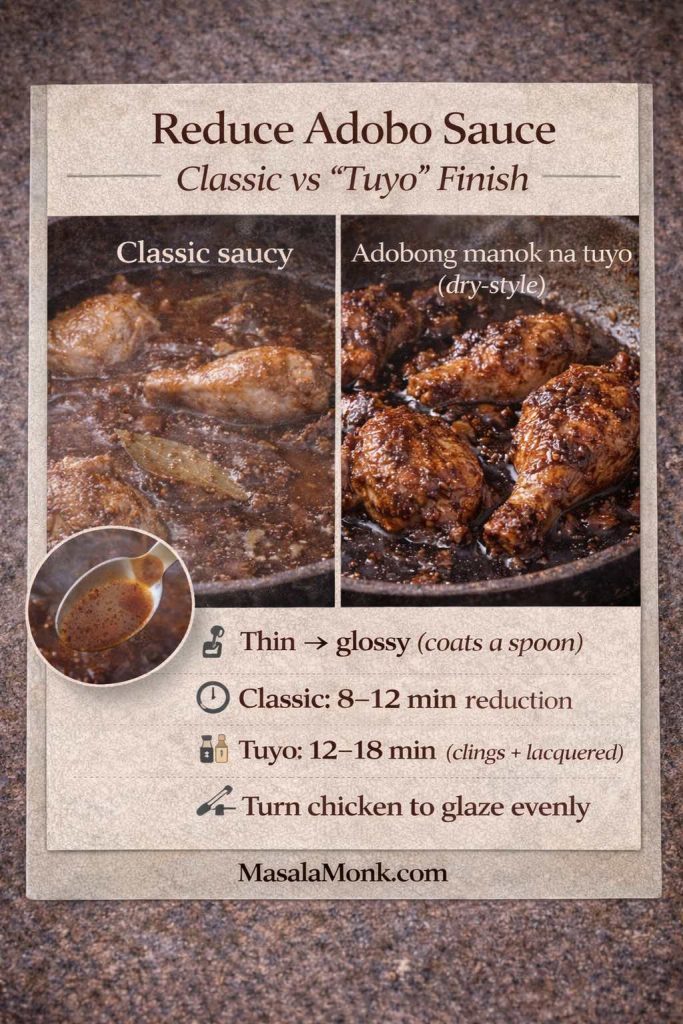
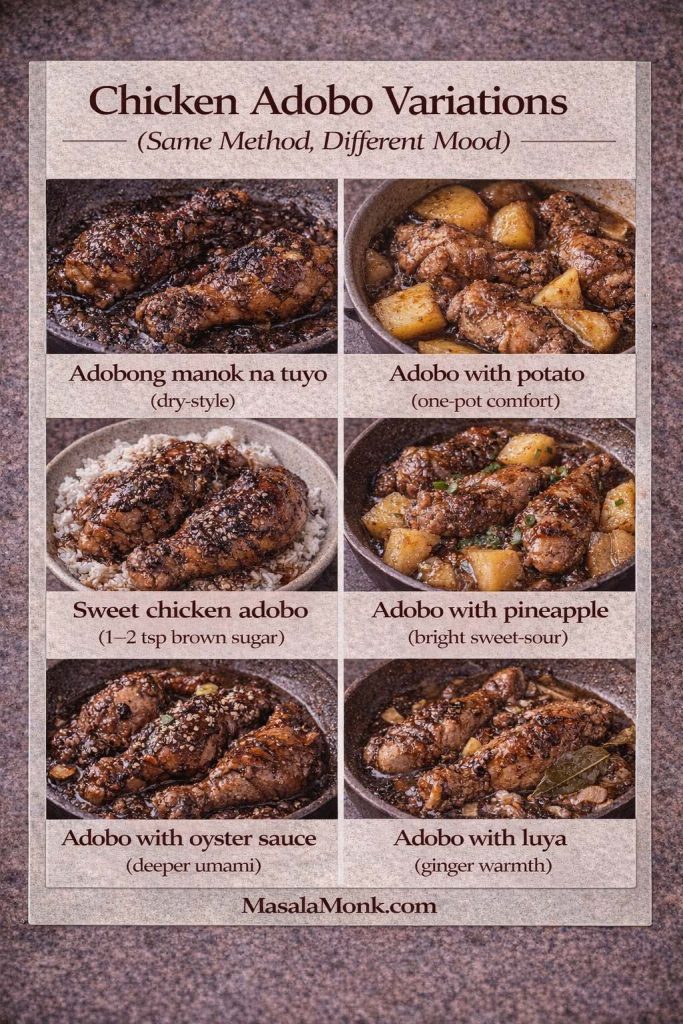

18. Can I prepare the chicken the night before and start the crock pot in the morning?

Yes, as long as you handle it safely. You can season your whole chicken in crock pot the night before, cover it and keep it in the fridge. In the morning, place it into the slow cooker insert, add vegetables and liquid, then start cooking immediately.