Posted on 1 Comment

Salsa Verde Recipe: Easy Roasted Tomatillo Salsa

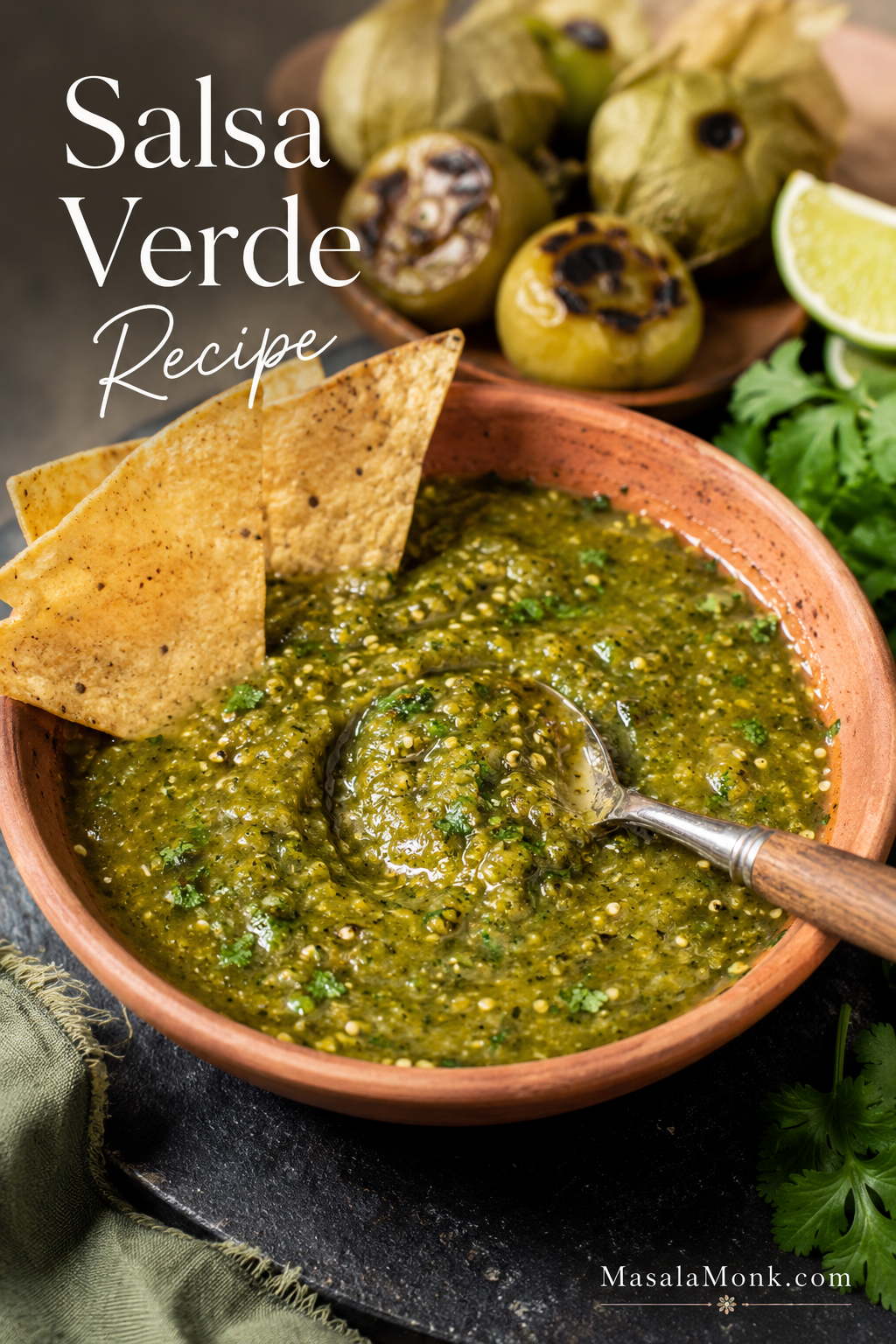
Bowl of roasted salsa verde with tortilla chips, lime, roasted tomatillos, and a spoon showing chunky green texture.

Some sauces sit politely on the side. Salsa verde wakes the plate up. It is bright, green, and alive — the kind of sauce that makes tacos taste fresher, eggs feel less ordinary, grilled chicken more exciting, and tortilla chips almost impossible to leave alone.

At its simplest, this is a one-pan, one-blender salsa: roast the tomatillos, blend everything together, then taste for salt and lime. It should be bright enough to wake up the plate, salty enough to keep you going back for one more chip, and balanced enough to spoon over dinner without thinking twice.

This recipe is made with tomatillos, green chiles, garlic, onion, cilantro, lime, and salt. The roasted version is the one to make first because it softens the tomatillos’ tart edge and gives the salsa a deeper, rounder flavor. Boiled, raw, and charred options are included later, but they are backup help — not homework.

One quick clarification before we start: this is Mexican salsa verde, not Italian salsa verde. Mexican salsa verde is usually made with tomatillos and green chiles. Italian salsa verde is an herb sauce made with parsley, capers, garlic, olive oil, and vinegar or lemon. Both are green sauces, but they are completely different in flavor and use.

In This Guide

Use this as a quick map for the recipe, method choices, heat control, fixes, storage, and serving ideas.

Quick Answer: What Is Salsa Verde?

Salsa verde means “green sauce,” but in Mexican cooking it usually refers to a green salsa made with tomatillos, green chiles, onion, garlic, cilantro, salt, and sometimes lime. Tomatillos are not green tomatoes; they have papery husks and a naturally tangy, slightly fruity flavor that makes them perfect for a lively green salsa.

For the fastest path, go straight to the roasted tomatillo salsa recipe. If you are deciding between raw, boiled, roasted, or charred, use the method guide first.
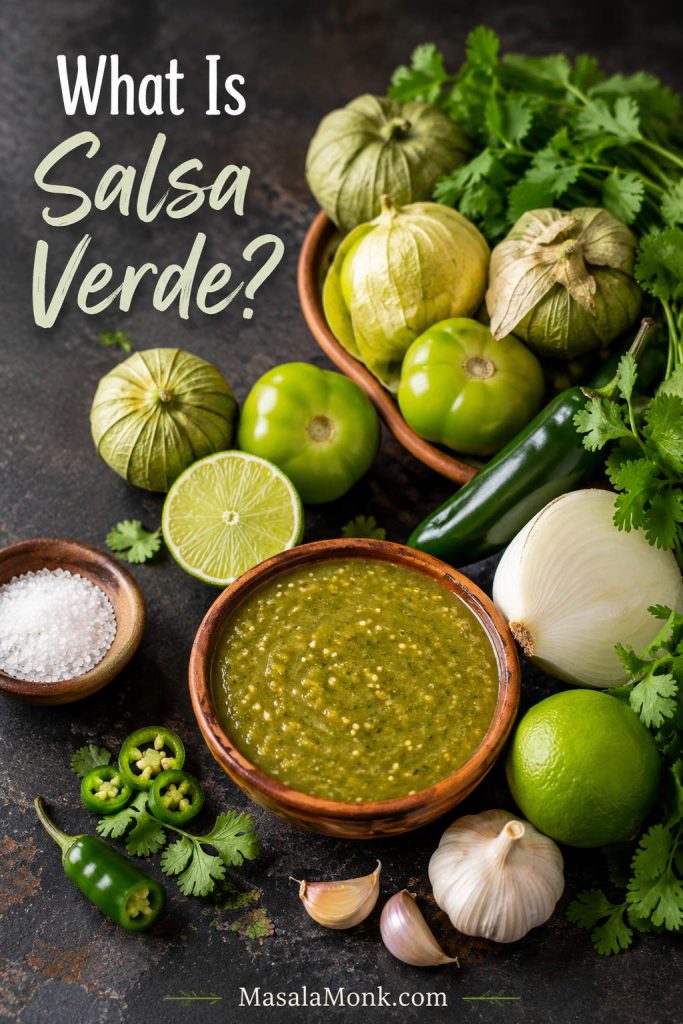
Tomatillos in papery husks with green chiles, cilantro, onion, garlic, lime, salt, and a bowl of salsa verde
Tomatillos and green chiles give Mexican salsa verde its lively backbone; compared with tomato salsa, the flavor is greener, sharper, and more citrus-friendly.
Start here: If this is your first batch, roast the tomatillos. It is the easiest method to love because it keeps the salsa bright while taking away the harshest raw edge.

At a Glance

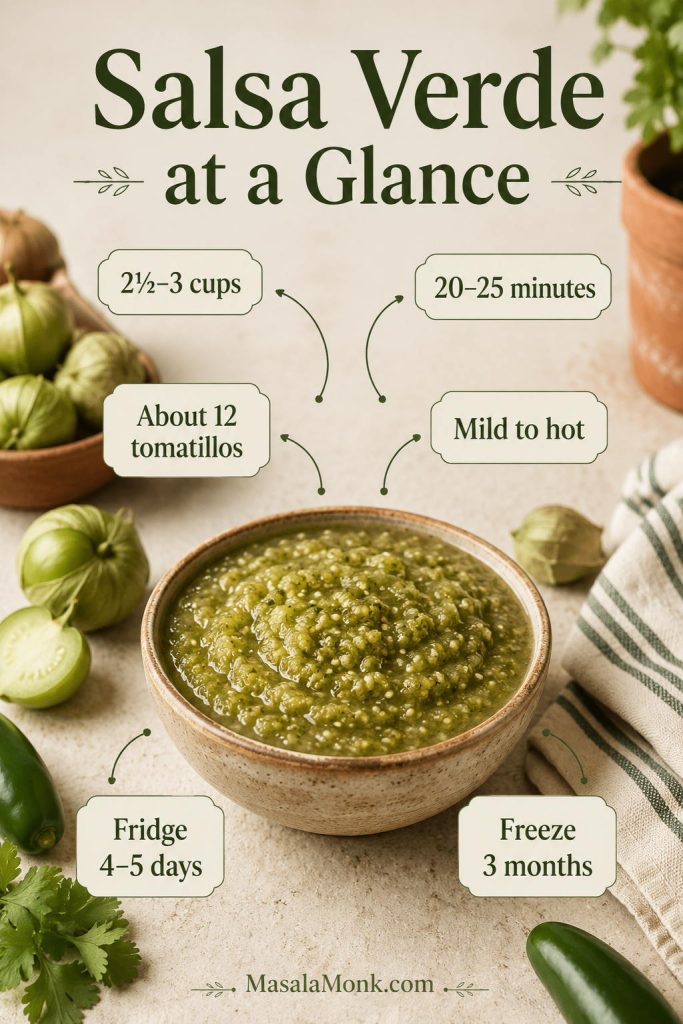
This is the kind of salsa that earns a permanent jar spot in the fridge: thick enough for chips, bright enough for tacos, and easy to loosen into a sauce when dinner needs help.

Start withRoasted tomatillo salsa verde
YieldAbout 2½ to 3 cups
Total time20 to 25 minutes under the broiler, or about 25 to 30 minutes with the oven-roasted method
Heat levelMild, medium, or hot depending on jalapeño or serrano amount
Ideal textureSpoonable, lightly textured, not watery
Works withTacos, chips, eggs, enchiladas, chicken, chilaquiles, bowls, nachos
Storage4 to 5 days in the fridge, up to 3 months in the freezer
Salsa verde jar with callouts for yield, time, tomatillo count, heat level, refrigerator storage, and freezer storage
One roasted batch gives about 2½ to 3 cups, so you can serve it with chips now and still have enough left for tacos, eggs, or enchiladas later.

Why This Works

This version is built around the things that usually go wrong: watery texture, harsh garlic, too much tartness, unpredictable heat, and flat flavor. The small details — roasting the garlic, holding back pan juices, tasting before adding extra lime, and resting before the final adjustment — keep the salsa balanced instead of thin, sharp, or dull.

  • Roasting softens the tomatillos. It keeps their tangy flavor but rounds off the sharpest raw edge.
  • Pan juices are added gradually. Roasted tomatillos can release more liquid than expected, so holding some back keeps the salsa from turning watery.
  • Salt comes before extra lime. Under-salted salsa tastes flat, while too much lime can make already-tart tomatillos taste harsh.
  • The method can match the meal. Roasted is the main recipe, but boiled, raw, and charred styles help you make the salsa smoother, brighter, smokier, or more sauce-like.

What You Need

A good batch does not need a long ingredient list. The flavor comes from balancing tangy tomatillos, green chile heat, fresh cilantro, enough salt, and a little lime.
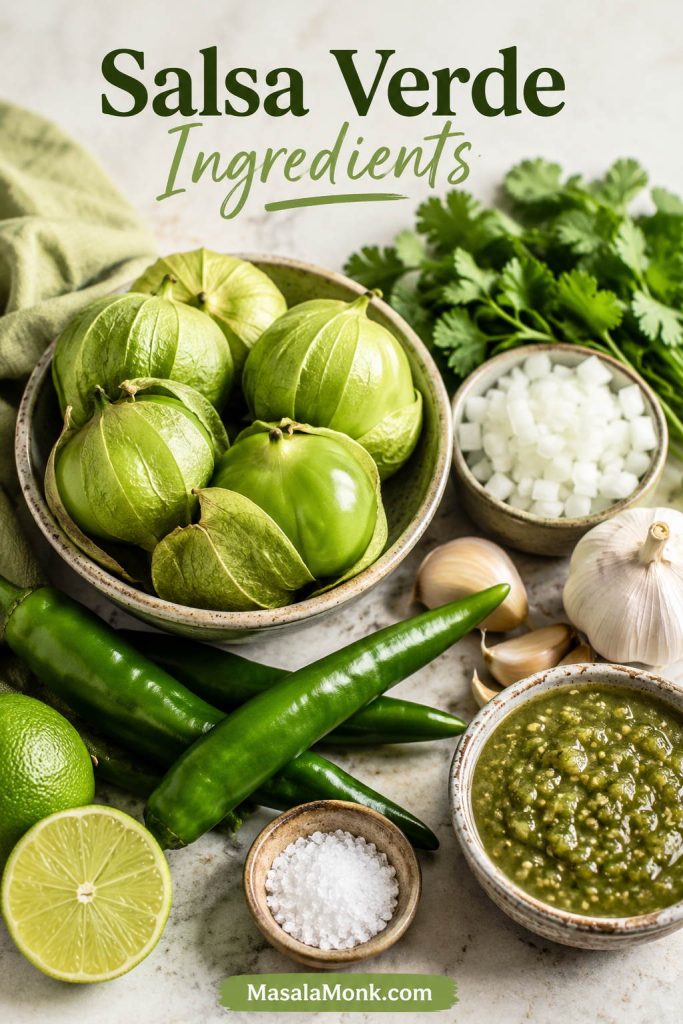
Tomatillos, green chiles, garlic, white onion, cilantro, lime, salt, and finished salsa verde arranged on a prep surface
A good salsa verde recipe does not need many ingredients, but each one has a job: tomatillos bring tang, chiles bring heat, and salt wakes everything up.

Tomatillos

Look for firm tomatillos with dry papery husks. A little stickiness under the husk is normal; rinse it off before cooking or blending. You need 1½ pounds / 680 g tomatillos, usually about 12 medium tomatillos, for about 2½ to 3 cups salsa.
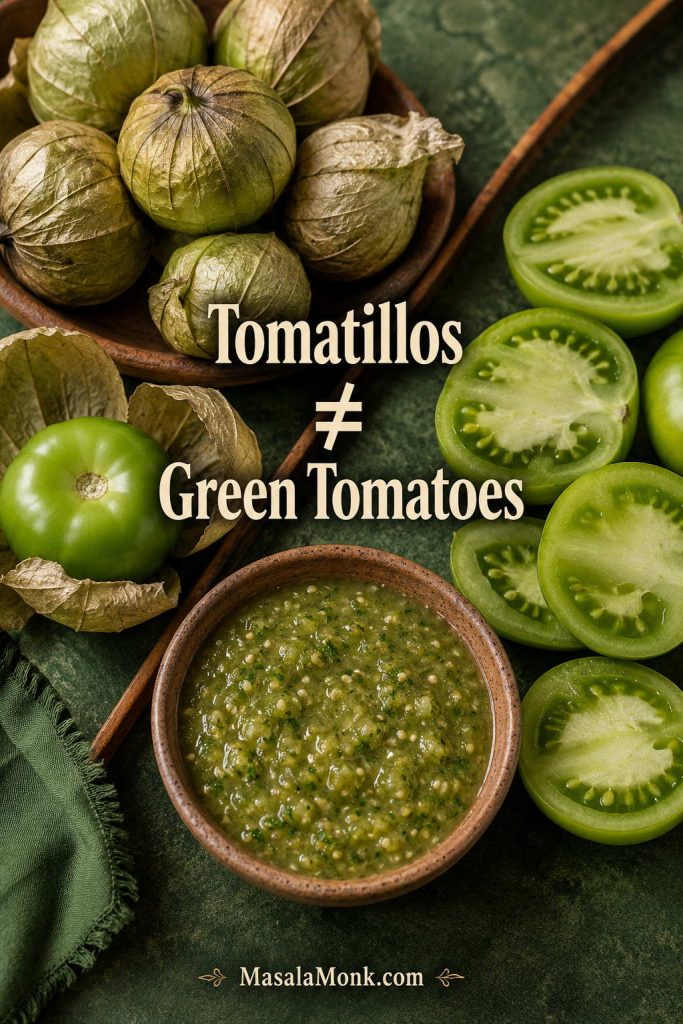
Tomatillos with papery husks beside sliced green tomatoes and a bowl of green tomatillo salsa
Tomatillos are not green tomatoes; instead, they bring the tart, fruity base that gives classic tomatillo salsa verde its lively flavor.

To prep them, remove the husks, rinse the sticky coating, and trim away any damaged spots. Large tomatillos can be halved before roasting so they soften evenly.
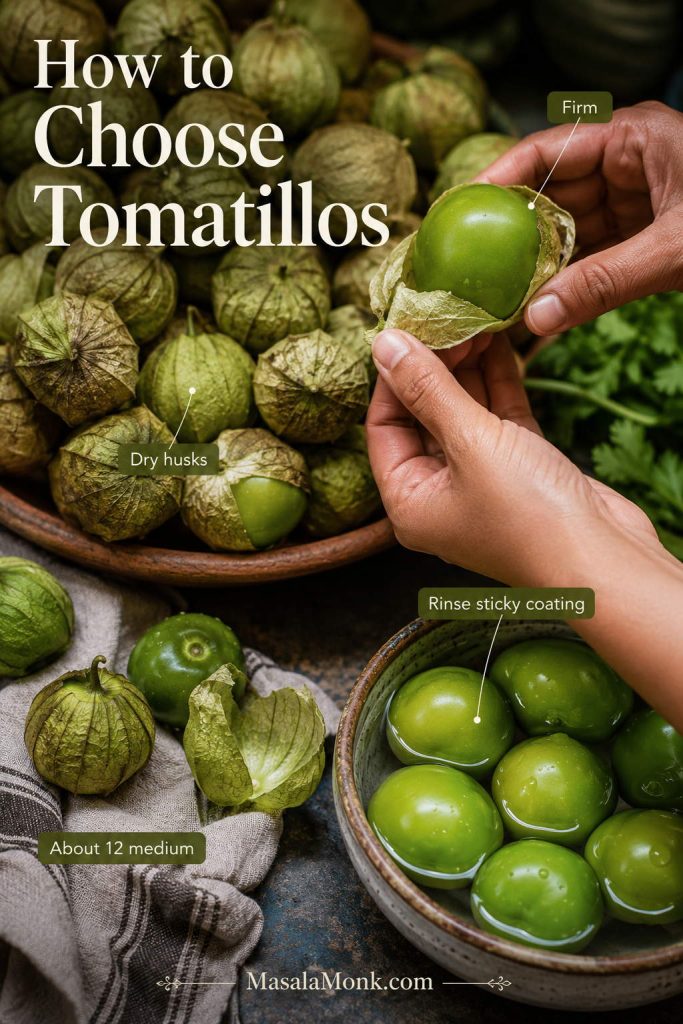
Hands choosing fresh tomatillos with papery husks, peeled tomatillos, and labels for firmness, dry husks, and rinsing
Firm tomatillos with dry husks usually roast best; after peeling, rinse the sticky coating so the finished salsa tastes clean rather than tacky or dull.

Jalapeño or Serrano

Jalapeño makes a milder, more approachable salsa. Serrano gives a sharper, more intense green-chile heat. Use one pepper for mild to medium, two serranos for hot, or three to four serranos for a very spicy batch.

Remove the seeds and white ribs for gentler heat before blending. Keep some seeds for a sharper salsa, then adjust after tasting.

Need exact mild, medium, and hot options? Use the heat level guide before blending.
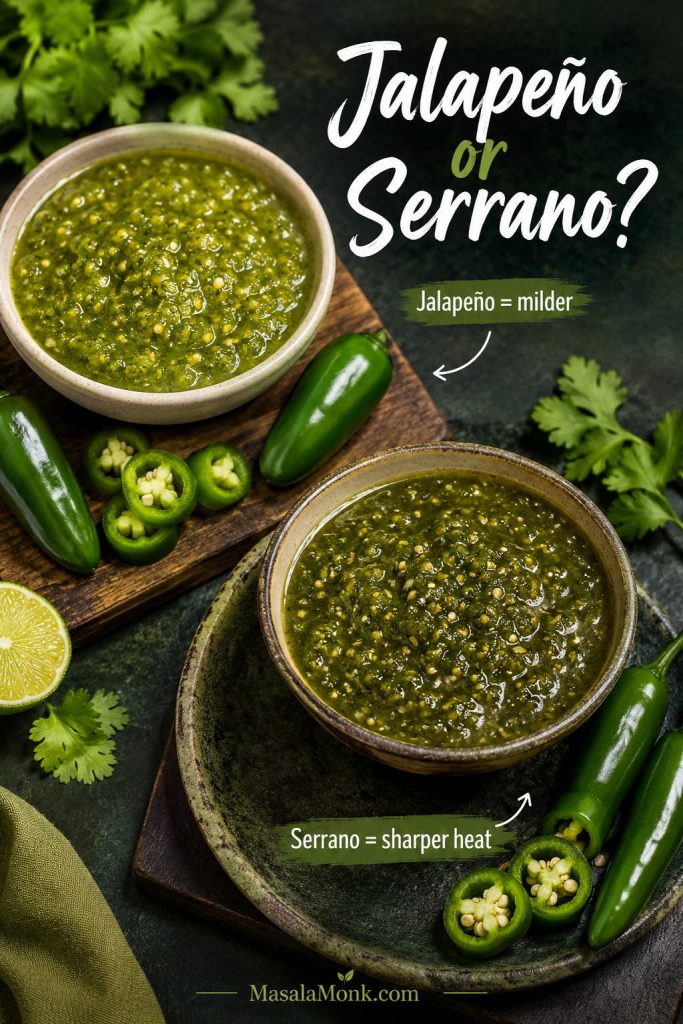
Jalapeños and serrano peppers beside two bowls of salsa verde with labels comparing milder and sharper heat
Jalapeño makes the sauce milder and rounder, while serrano gives sharper green-chile heat, so choose based on who will be eating it.

Onion, Garlic, Cilantro, Lime, and Salt

White onion gives the salsa a clean bite. Rinsing chopped onion under cold water softens harsh raw onion flavor without making the sauce dull. Garlic roasts with the tomatillos in the main recipe so it turns mellow instead of sharp.

Cilantro brings the classic fresh green finish, and tender stems are fine because they carry plenty of flavor. Lime brightens the batch, but tomatillos are already tart, so add it with a light hand and adjust after tasting.
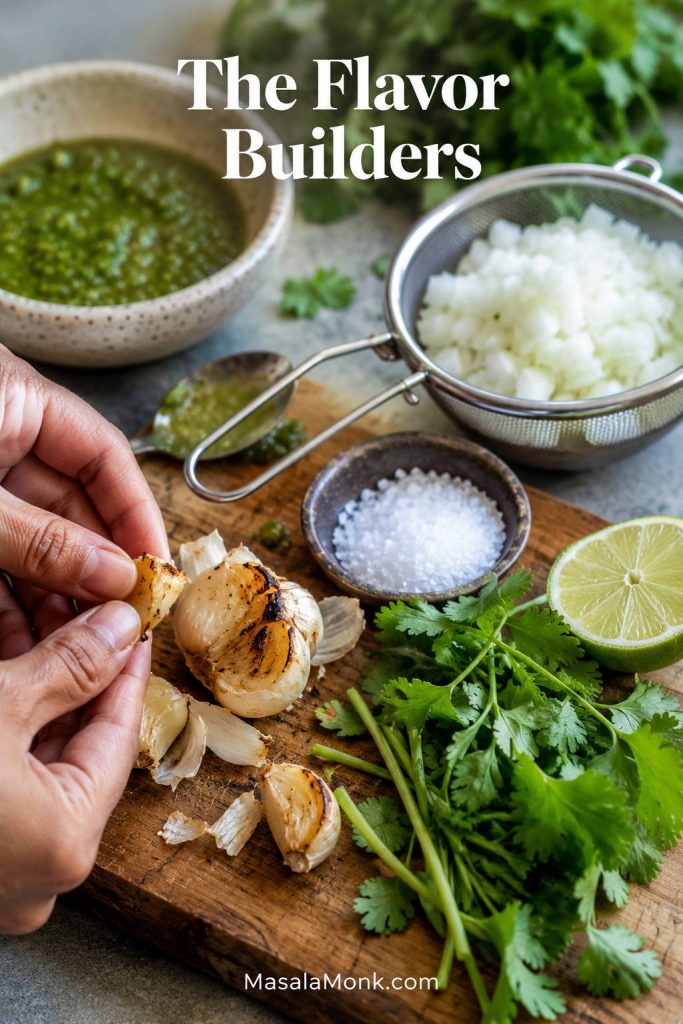
Roasted garlic, rinsed chopped onion, cilantro, lime, salt, and salsa verde arranged as flavor-building ingredients
Garlic, onion, cilantro, lime, and salt build balance around the tomatillos, so the finished green salsa tastes layered instead of flat.

How to Make It

Roast the tomatillos, chile, and garlic until blistered, then blend them with onion, cilantro, lime, and salt. Keep the texture lightly spoonable and add water only at the end when the salsa is too thick.
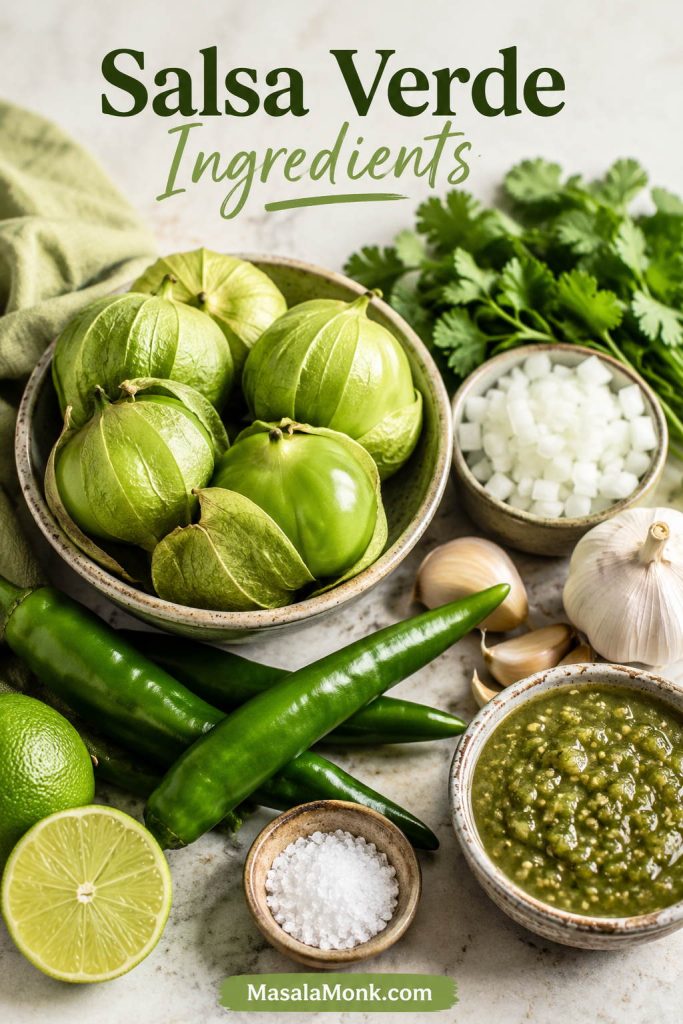
Four-step salsa verde process showing tomatillo prep, roasting, blending, and tasting to adjust flavor
This four-step flow keeps the recipe simple: prep clean tomatillos, roast for flavor, blend for texture, and adjust only after the salsa settles.

The one thing to watch is liquid. Roasted tomatillos can release a lot of juice, so add the tomatillos first, pulse, and use the pan juices gradually only if the salsa needs them.
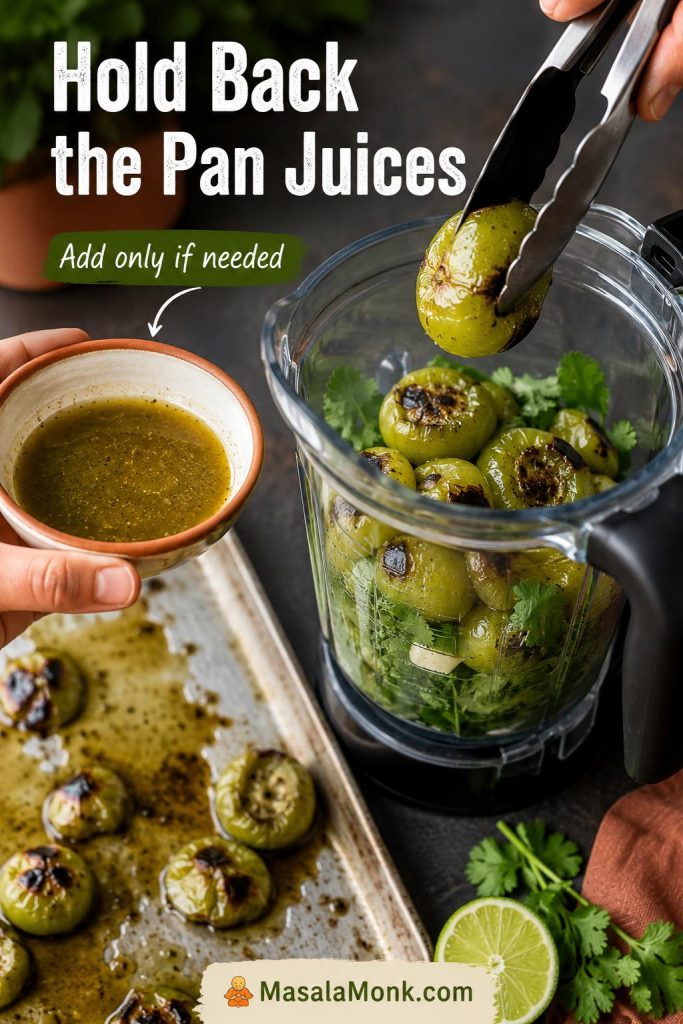
Roasted tomatillos going into a blender with reserved pan juices held aside in a small cup
The roasted juices carry flavor, but adding them slowly gives you control over thickness before the salsa turns too loose for chips or tacos.

Do not worry if one batch tastes a little brighter, smokier, or spicier than the last. Tomatillos and chiles vary, so the final taste check is part of making the salsa yours.
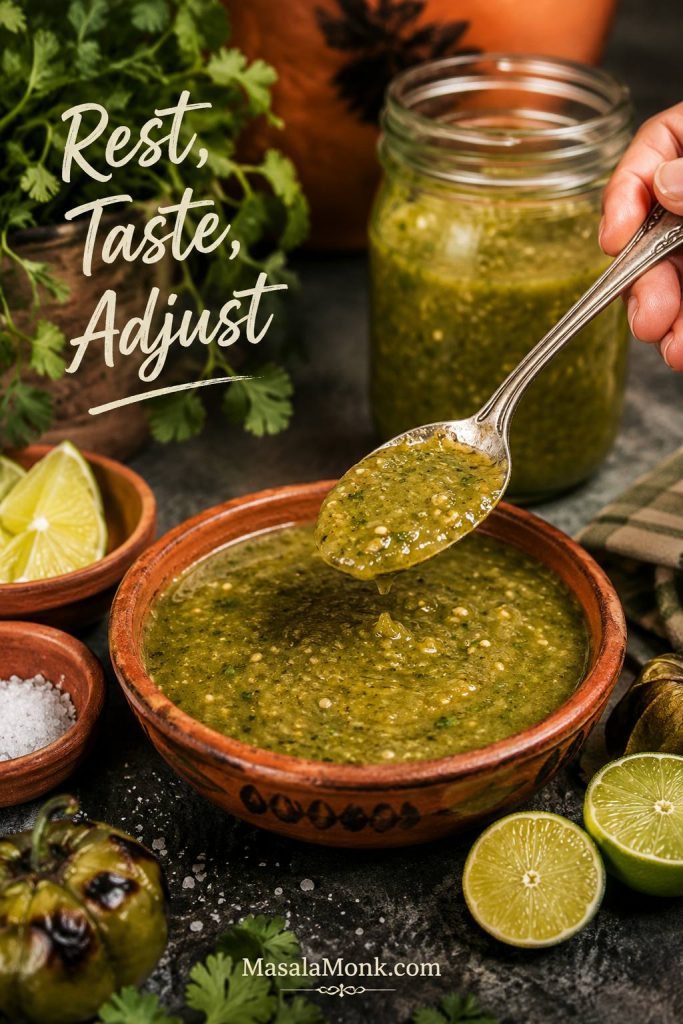
Spoon tasting salsa verde with lime wedges, salt, and a jar of green salsa nearby
A short rest makes the flavors easier to read, so taste again before adding more lime, salt, or heat.

Roasted Tomatillo Salsa Verde Recipe
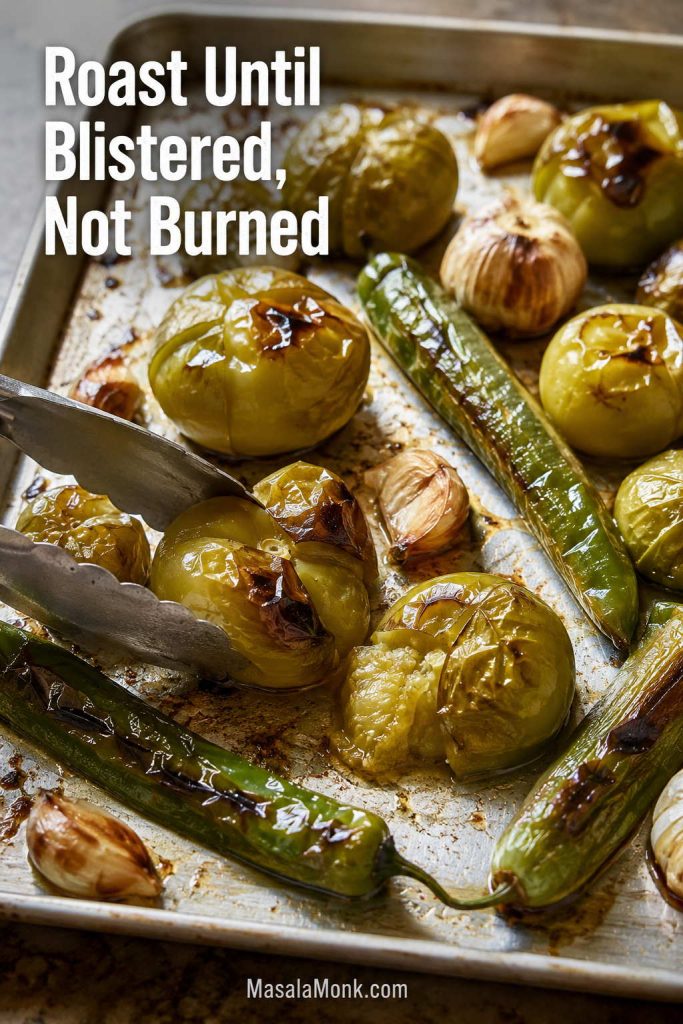
Tomatillos, green chiles, and unpeeled garlic blistered on a sheet pan for roasted salsa verde
Roast the tomatillos until they blister and soften; this rounds off their raw edge while keeping enough acidity for tacos and chips.

Roasted Tomatillo Salsa

This roasted tomatillo salsa is tangy, lightly smoky, and spoonable, with enough body for chips and enough brightness for tacos, eggs, chicken, chilaquiles, bowls, and nachos.

Prep Time 10 minutes
Cook Time About 10 to 13 minutes
Total Time 20 to 25 minutes under the broiler
Yield About 2½ to 3 cups

Equipment

  • Rimmed baking sheet
  • Foil or a bare baking sheet for broiling
  • Blender or food processor
  • Tongs
  • Fine-mesh strainer, optional, for rinsing onion
  • Airtight jar or container

Blender or food processor? Use a food processor for a lightly textured salsa and a blender for a smoother sauce-style salsa.

Broiler note: Use foil or a bare rimmed baking sheet under the broiler. Do not place parchment directly under the broiler. Parchment is only for the 450°F oven method when rated for that heat.

Ingredients

  • 1½ pounds tomatillos, husked and rinsed, about 680 g or 12 medium tomatillos
  • 1 to 2 jalapeños or serranos, roughly 15 to 40 g depending on size
  • 2 to 3 garlic cloves, unpeeled for roasting
  • ½ cup chopped white onion, about 70 g
  • ½ cup chopped cilantro leaves and tender stems, about 8 to 12 g
  • 1 to 2 tablespoons fresh lime juice, 15 to 30 ml, to taste
  • ¾ teaspoon fine salt, about 4 g, plus more to taste
  • 1 to 3 tablespoons water, broth, cooking liquid, or pan juices, only as needed

Instructions

  1. Prep the tomatillos. Remove the papery husks and rinse off the sticky coating. Pat dry before roasting.
  2. Set up the pan. Place tomatillos, jalapeño or serrano, and unpeeled garlic cloves on a foil-lined or bare rimmed baking sheet. Halve large tomatillos and place them cut-side down.
  3. Broil the first side. Broil 4 to 6 inches from the heat for 5 to 7 minutes, until the tomatillos begin to blister and soften.
  4. Finish roasting. Use tongs to turn the chile and garlic as needed, then broil another 4 to 6 minutes. The tomatillos may collapse; that is fine. You are looking for browned spots and a tangy-sweet smell instead of a raw, grassy one.
  5. Cool briefly. Let the roasted ingredients cool for a few minutes. Peel the garlic. Stem the chile. Remove seeds for milder salsa.
  6. Rinse the onion, optional. For a cleaner onion flavor, rinse the chopped onion under cold water and drain well.
  7. Blend carefully. Add the roasted tomatillos, chile, garlic, onion, cilantro, 1 tablespoon lime juice, and salt to a blender or food processor. When there is a lot of liquid on the pan, hold some of it back at first.
  8. Set the texture. Pulse until mostly smooth but still lightly textured. Blend longer only for a thinner sauce-style salsa.
  9. Adjust liquid. Add pan juices, water, broth, or cooking liquid 1 tablespoon at a time only when the salsa is too thick.
  10. Taste. Rest 10 to 15 minutes, then taste again. Add salt first when it tastes dull. Add more lime only when it needs brightness.
  11. Serve or store. Serve warm, room temperature, or chilled. Refrigerate leftovers in an airtight jar.

Notes

  • For mild salsa, use 1 seeded jalapeño.
  • For medium heat, use 1 whole jalapeño or 1 seeded serrano.
  • For a hot batch, use 2 serranos.
  • Without a broiler, roast at 450°F / 230°C for 15 to 20 minutes. Total time will be closer to 25 to 30 minutes.
  • For storage details, see how to store and freeze it. For shelf-stable jars, read the canning safety note before changing the recipe.

Before broiling, pan setup matters: keep the tomatillos close enough to blister, and use foil or a bare rimmed pan instead of parchment.
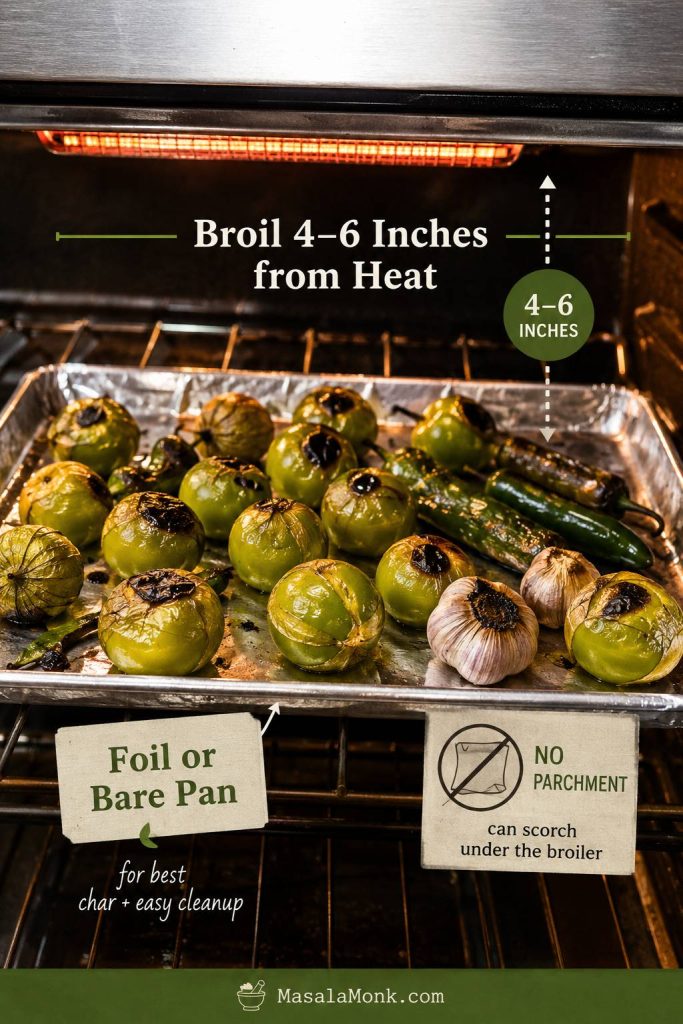
Sheet pan of tomatillos, green chile, and garlic under a broiler with guidance for heat distance and foil or bare pan
Broiling close to the heat helps tomatillos blister quickly; meanwhile, foil or a bare pan is safer under the broiler than parchment.

Texture depends on the tool: a food processor keeps the salsa lightly textured, while a blender makes it smoother and more sauce-like.
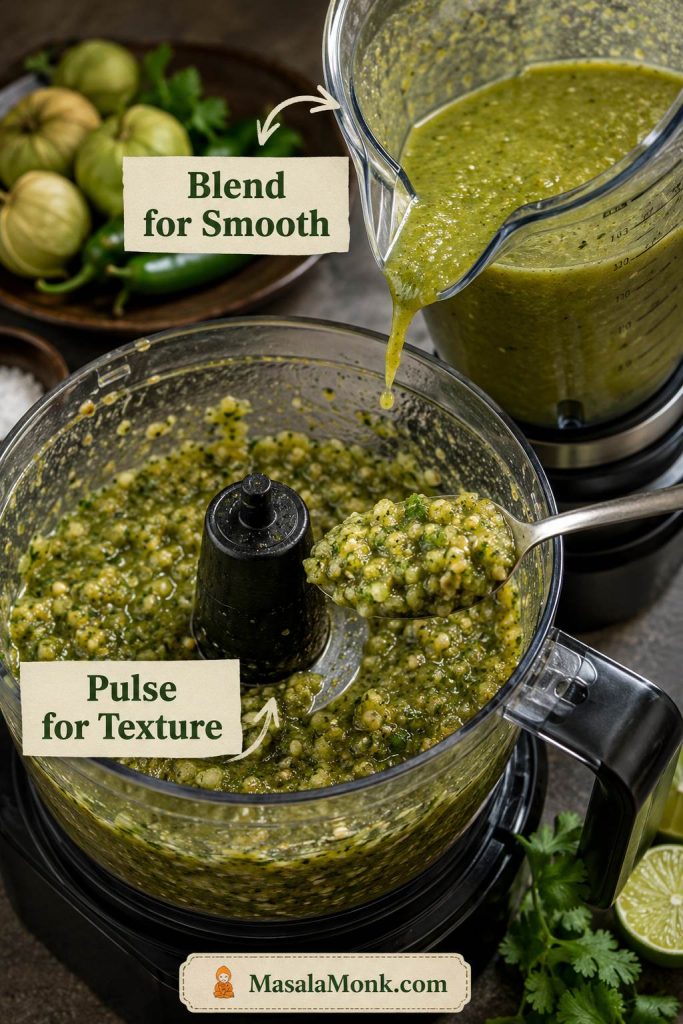
Salsa verde in a food processor with a spoonful of chunky salsa and a blender nearby for a smoother texture
Use a food processor for lightly textured tomatillo salsa, but use a blender when you want a smoother sauce-style finish.

You can stop with the roasted recipe above and be happy. Everything after this point is optional help for method, texture, heat, and use cases.

Raw, Boiled, Roasted, or Charred?

Once you know the base recipe, the method becomes your style choice: raw for sharp and fresh, boiled for smooth, roasted for balanced, and charred for smoky.
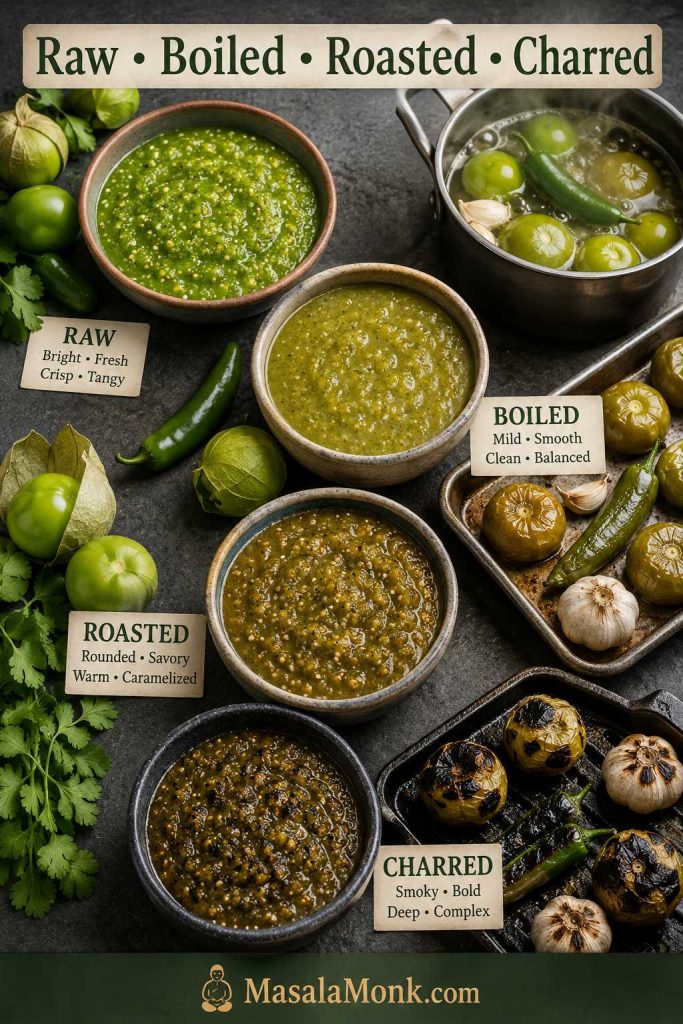
Four bowls of salsa verde showing raw, boiled, roasted, and charred versions with different colors and textures
Once you know the base recipe, the method becomes a style choice: raw is sharp, boiled is smooth, roasted is balanced, and charred is smoky.
MethodHow to Do ItFlavorWorks With
RawBlend raw tomatillos, chile, onion, cilantro, lime, and salt.Sharp, tart, fresh, grassy.Tacos, grilled meats, rich or fatty fillings.
BoiledSimmer tomatillos, chile, and garlic for 5 to 12 minutes, then blend.Smoother, cleaner, softer.Taqueria-style salsa, enchiladas, chilaquiles, chicken.
RoastedBroil 9 to 13 minutes total, or roast at 450°F for 15 to 20 minutes.Balanced, rounded, lightly smoky.The most flexible homemade version.
CharredBroil until deeply blistered, blend, then optionally simmer in 1 tablespoon oil for 2 to 3 minutes.Smoky, deeper, more intense.Restaurant-style salsa, tacos, grilled meats, bold bowls.

If you are unsure, choose roasted. It behaves best on a normal weeknight: bright enough for tacos, thick enough for chips, and rounded enough to spoon over dinner.

If the salsa looks too thick or too loose after blending, check the texture guide before adding more liquid.

Boiled Version

The boiled version is smooth, clean, and useful when you need a green salsa that behaves more like a sauce. Place the tomatillos, chile, and garlic in a saucepan, cover with water, and simmer until the tomatillos turn dull green and soften. This usually takes 5 to 12 minutes depending on size.

Stop when the tomatillos are soft but not completely falling apart. Drain them, save a little cooking liquid, then blend with onion, cilantro, salt, and lime to taste. Add the reserved liquid only as needed. This style is especially good for enchiladas, chilaquiles, simmered chicken, and everyday taco-shop-style salsa.
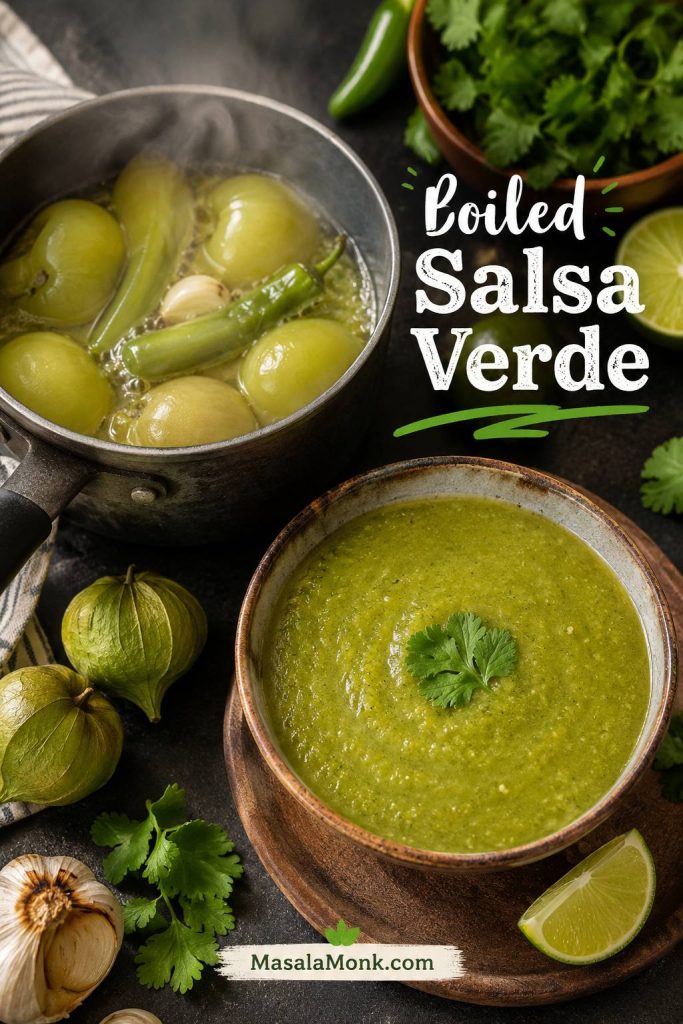
Tomatillos and green chile simmering in a pot beside a bowl of smooth boiled salsa verde
Boiled salsa verde is smoother and cleaner than roasted salsa, which makes it useful for enchiladas, chilaquiles, simmered chicken, and taqueria-style sauces.

Raw Version

Raw salsa verde, also called salsa verde cruda, is the fastest style. It is bracing and fresh, with a sharper edge than cooked salsa verde. Use it for a fresh taco salsa when a more assertive tomatillo flavor sounds good.

Because raw tomatillos can be quite tangy, taste carefully before adding much lime. Salt is usually more important than extra acid in this version.
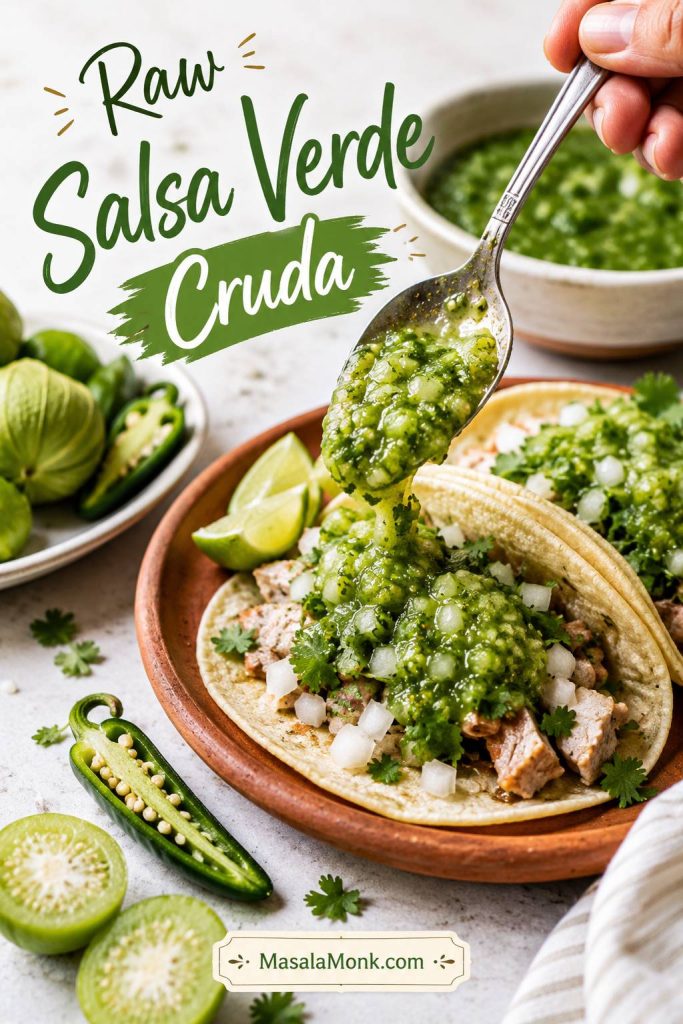
Bright raw salsa verde cruda spooned over tacos with raw tomatillos and green chile nearby
Raw salsa verde cruda has the sharpest bite, so it works especially well when rich taco fillings need a clean green finish.

Charred Version

The charred version is for deeper flavor. Let the tomatillos and chiles blister more aggressively under the broiler. After blending, heat 1 tablespoon neutral oil in a saucepan, add the salsa, and simmer it for 2 to 3 minutes. The color will darken slightly and the flavor will become more rounded.

This step is optional, but it is excellent for tacos, grilled meats, chilaquiles, or chicken.
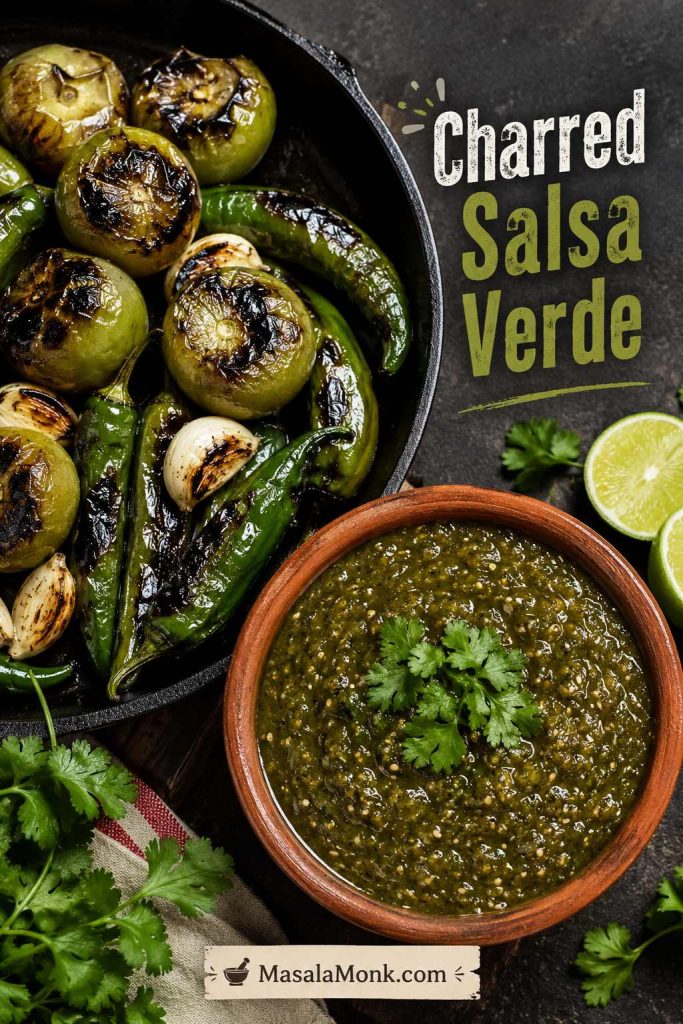
Charred tomatillos, green chiles, garlic, and a bowl of dark smoky salsa verde
Charring deepens the flavor of tomatillo salsa, but the vegetables should look blistered and smoky rather than burned.

Mild, Medium, or Hot

For a table of mixed heat levels, start gentler than your own taste. You can always make the next batch sharper, but once this batch is too hot, you need extra tomatillos, avocado, or crema to bring it back.

Heat LevelUse ThisWorks For
Mild1 seeded jalapeñoKids, parties, chips, mild tacos.
Medium1 whole jalapeño or 1 seeded serranoEveryday salsa with a gentle kick.
Hot2 serranosTacos, grilled meats, spicy bowls.
Very hot3 to 4 serranos, with some seeds includedHeat lovers and bold taqueria-style salsa.

If the batch is already hotter than you wanted, go straight to the too-spicy fix instead of adding water.
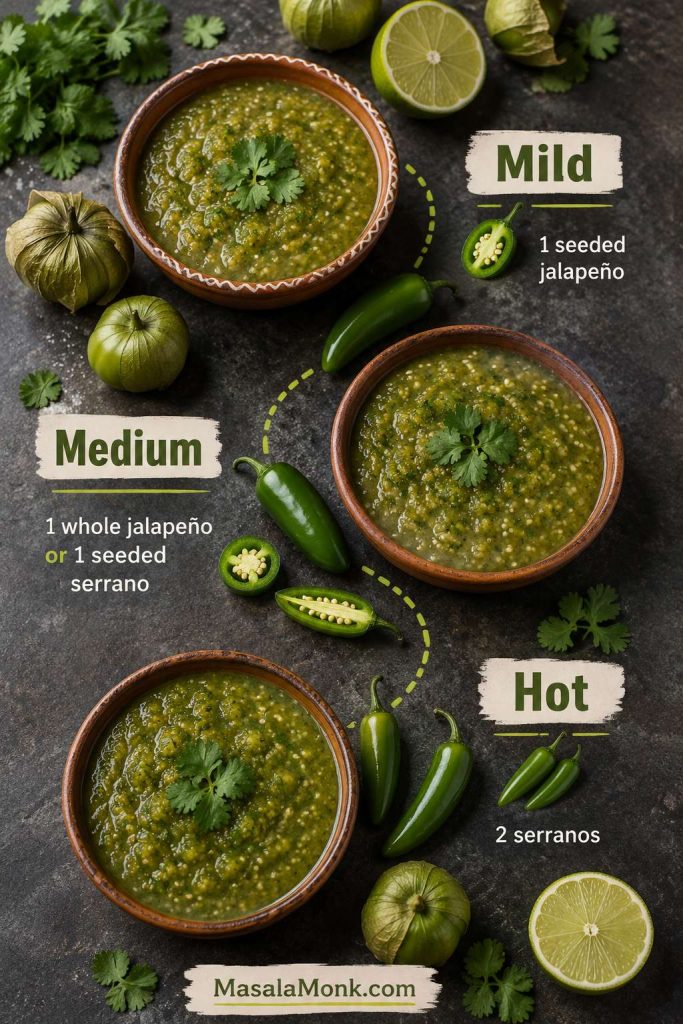
Mild, medium, and hot salsa verde bowls with jalapeño and serrano pepper amounts shown as labels
For a crowd-friendly salsa verde, start with jalapeño or a seeded serrano; then move hotter only when you know the table wants it.

If you like building heat with different chiles, MasalaMonk’s pepper sauce guide goes deeper into jalapeño, habanero, chipotle, and other chile-based sauces.

Once the salsa is already blended and too spicy, do not add water first. Water will thin the sauce without softening the burn much. Instead, blend in more cooked tomatillo, avocado, sour cream, Mexican crema, or a little more roasted onion, depending on the flavor you want.

The Right Texture

Good salsa verde should be spoonable, lightly glossy, and a little textured. It should not pour like water, but it should not be stiff like guacamole either.

For chips, keep it medium-thick so it clings. On tacos, it should be spoonable and a little loose, so it runs slightly into the filling. For enchiladas or chilaquiles, thin it with broth, water, or cooking liquid so it coats instead of clumping. Bowls and nachos need a thicker salsa so it does not flood the plate.

Serving temperature changes the way it feels, too. Chilled works best for chips, room temperature is great for tacos, and warm is useful when the salsa acts like a sauce for eggs, chicken, enchiladas, or chilaquiles.

If the texture has already gone wrong, the troubleshooting section covers watery, too thick, bland, bitter, tart, and too-spicy salsa.
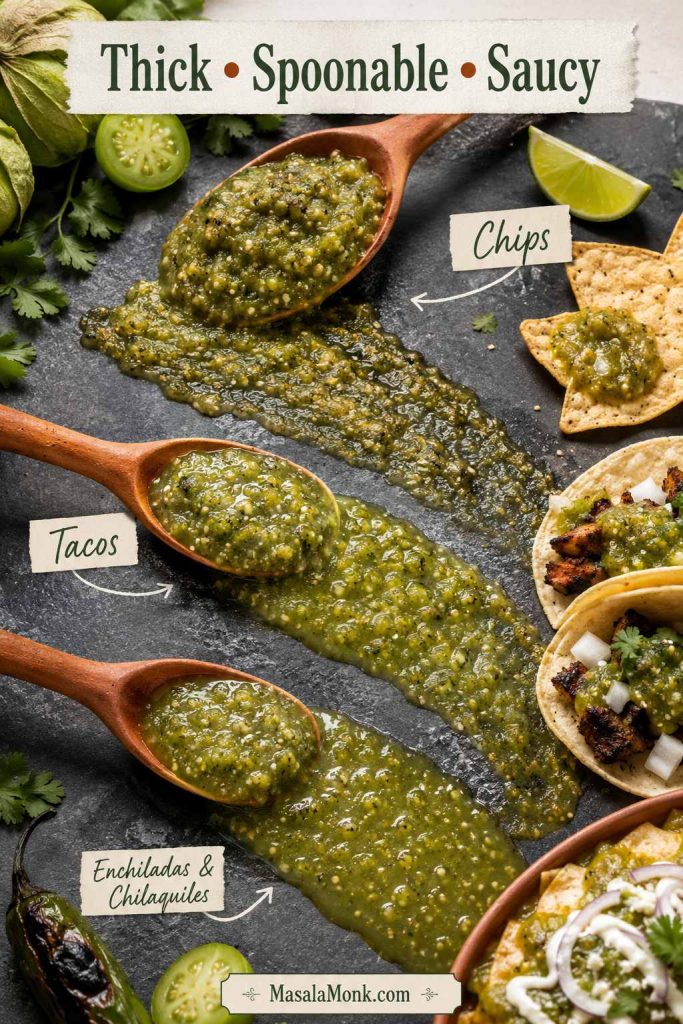
Three salsa verde textures labeled thick, spoonable, and saucy for chips, tacos, enchiladas, and chilaquiles
A thicker salsa clings to chips, a spoonable one sits better on tacos, and a looser version spreads more evenly through enchiladas or chilaquiles.

How to Fix the Flavor or Texture

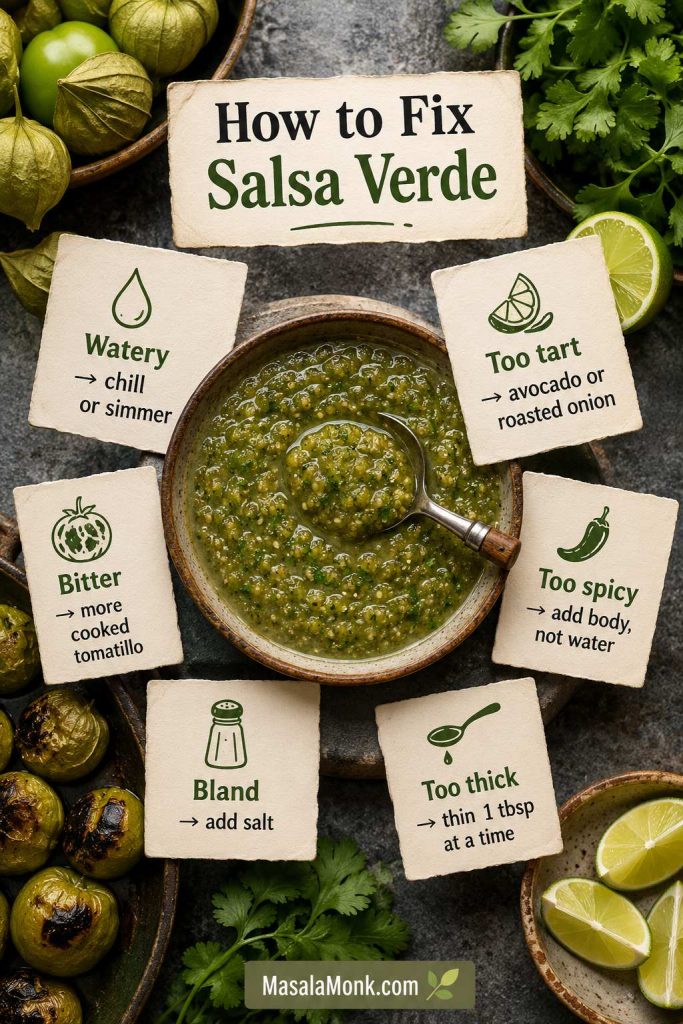
Most salsa problems are not disasters. They are usually small balance issues: too much liquid, not enough salt, too much heat, or tomatillos that were sharper than expected.

ProblemLikely CauseHow to Fix It
Watery salsaToo much liquid, hot salsa not rested, or over-blending.Chill first. If still loose, simmer briefly to reduce or blend in avocado for a creamy style.
Too tartVery sharp tomatillos or too much lime.Add roasted onion, a tiny pinch of sugar, or avocado.
BitterOld tomatillos, over-charred skins, or harsh raw garlic.Add more cooked tomatillo, cilantro, salt, or a little lime. Next time, roast until blistered, not scorched.
Too spicyToo many serranos or too many seeds.Blend in more cooked tomatillo, avocado, crema, sour cream, or roasted onion.
BlandUsually not enough salt.Add salt in small pinches, rest for a few minutes, then taste again.
Too thickNot enough liquid or salsa chilled very thick.Add water, broth, cooking liquid, or reserved pan juices 1 tablespoon at a time.
Troubleshooting board for salsa verde with fixes for watery, tart, bitter, spicy, bland, and thick salsa
Most salsa verde problems are balance problems, so the fix is usually small: chill, simmer, salt, thin slowly, or add body instead of starting over.
If you only remember one fix: adjust salt before lime. Under-salted salsa tastes flat, but too much lime can make already-tangy tomatillos taste harsh.

Watery Salsa Verde

Watery salsa verde is usually easy to rescue. Tomatillos release liquid as they cook, and warm salsa can seem thinner than chilled salsa. First, let it cool or refrigerate it for 30 minutes. When it is still too loose, simmer it in a small saucepan for a few minutes until it thickens.
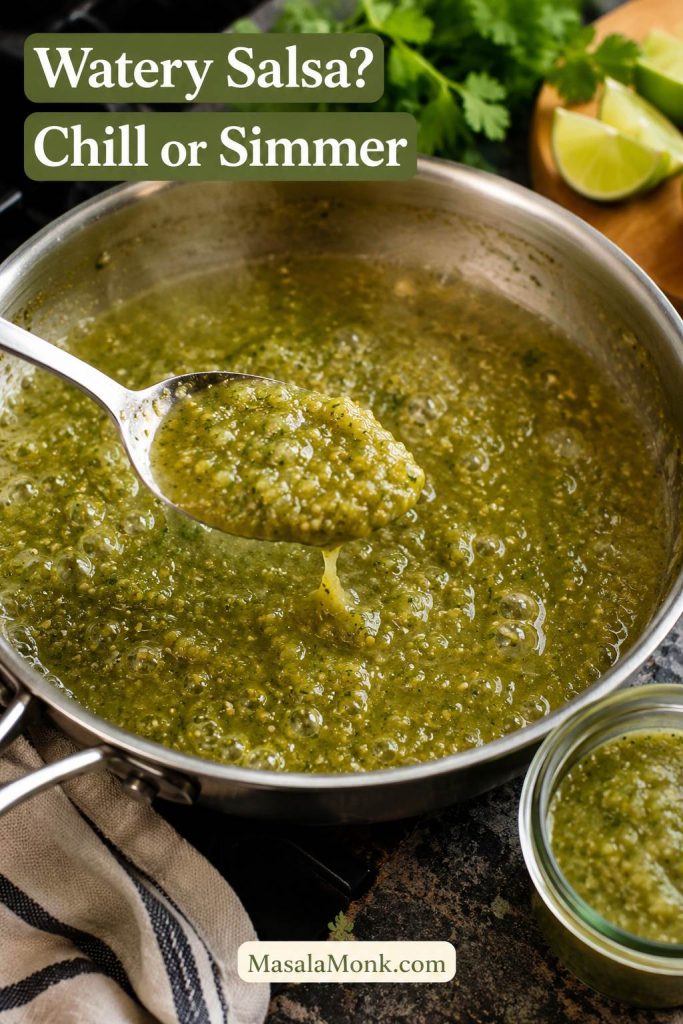
Watery salsa verde simmering in a pan with a spoonful of thicker salsa lifted above the surface
If the salsa looks thin after cooling, a brief simmer concentrates the tomatillo flavor and brings the texture back to spoonable.

For tacos and chips, you want salsa that clings. For enchiladas and chilaquiles, a looser sauce is actually useful.

Bitter or Too Tart

Tomatillos are naturally tart, so add lime slowly. When the salsa tastes too sharp, add roasted onion, a tiny pinch of sugar, or avocado. Avocado is especially helpful because it softens both tartness and heat.
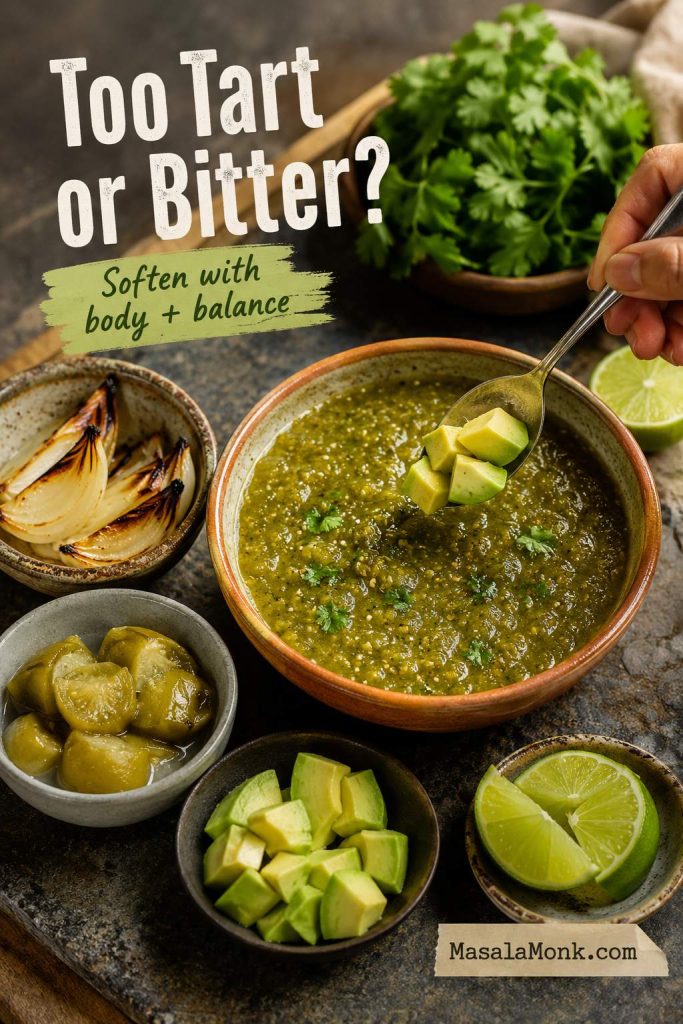
Salsa verde with avocado, roasted onion, cooked tomatillo, cilantro, and lime used to fix bitter or tart flavor
If the sauce tastes too tart or bitter, ingredients with body and sweetness, such as avocado, roasted onion, or cooked tomatillo, can soften the edge.

Bitterness usually comes from old tomatillos, over-charred skins, or too much raw garlic. Next time, use firm fresh tomatillos and roast until blistered and browned in spots, not blackened all over.

Too Spicy

The easiest way to cool down heat is to add body, not water. Cooked tomatillos, avocado, sour cream, Mexican crema, or roasted onion will calm the burn while keeping the sauce useful.
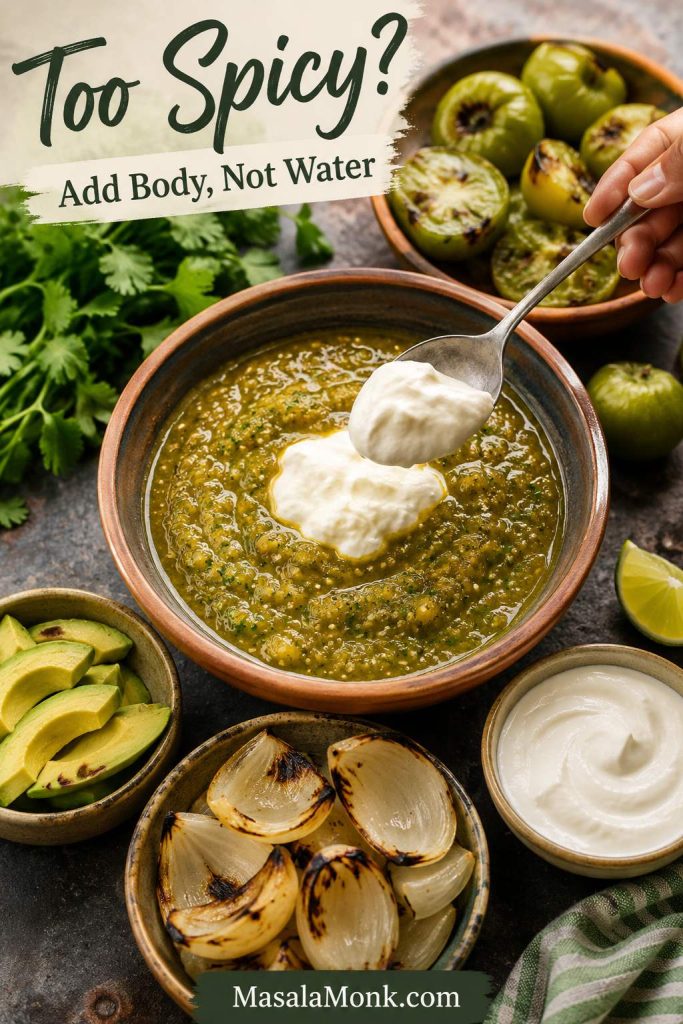
Salsa verde with avocado, crema, roasted onion, and cooked tomatillos used to reduce heat
When the salsa is too spicy, add body with avocado, crema, roasted onion, or more tomatillo instead of thinning the sauce with water.

Served with rich foods like pork, fried eggs, cheese, or grilled chicken, a slightly spicy batch may taste more balanced once it is on the food.

Bland or Flat

When the salsa tastes dull, add salt in small pinches, stir, and wait a minute before tasting again. Once the tomatillo and chile flavor wakes up, you can decide whether it needs more brightness.

Ways to Use It Beyond Chips

Chips may be the first thing that comes to mind, but this is where the jar starts earning its space in the fridge. It can wake up eggs, rescue leftover chicken, make plain rice or tortillas feel intentional, and turn a simple plate into dinner.

Use the sections below for quick details on tacos, enchiladas, salsa verde chicken, chilaquiles verdes, and eggs, bowls, and nachos.
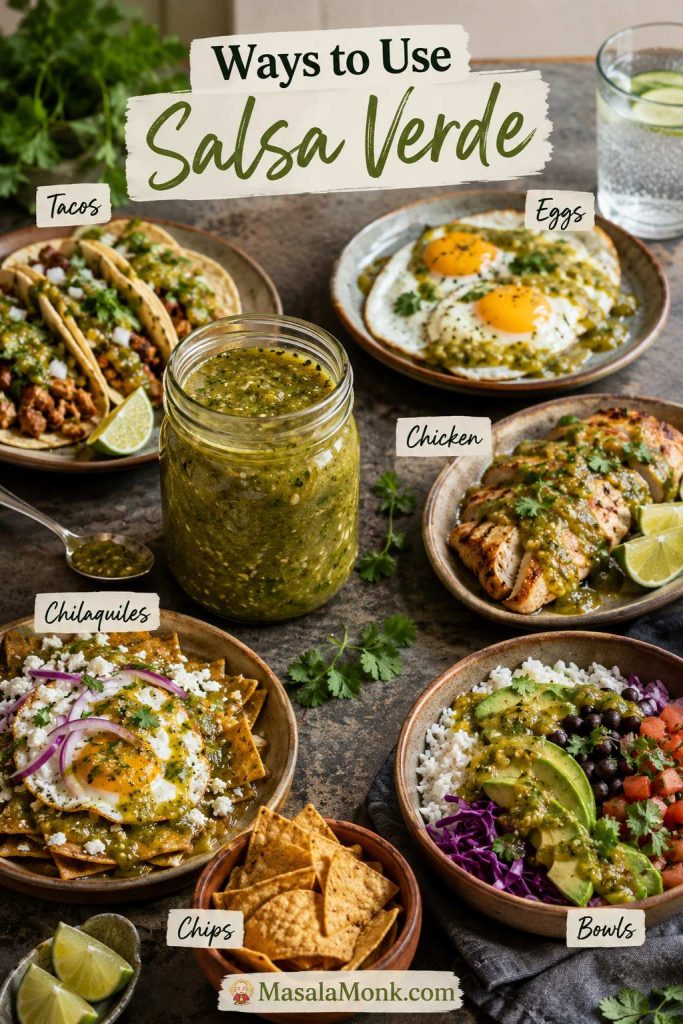
Salsa verde jar surrounded by tacos, eggs, chicken, chilaquiles, chips, and a bowl meal
Once there is a jar in the fridge, salsa verde becomes the green shortcut for tacos, eggs, chicken, chilaquiles, bowls, nachos, and chips.
UsePractical GuideTexture to Aim For
ChipsServe chilled or room temperature with tortilla chips or vegetables.Medium-thick and scoopable.
TacosUse 1 to 2 tablespoons per taco.Spoonable, bright, salty.
EnchiladasUse about 2 cups for a small 8-inch pan, or 2½ to 3 cups for a 9×13-inch pan.Looser, simmered, saucy.
ChickenUse 1½ to 2 cups salsa for about 1½ pounds boneless chicken.Thicker for spooning, looser for simmering.
ChilaquilesWarm 2 cups salsa with ½ to 1 cup broth or water.Loose enough to coat chips.
EggsUse about ¼ cup warm salsa per serving.Spoonable and warm or room temperature.
Bowls and nachosSpoon over at the end, not too early.Thicker so it does not flood the plate.

That is the real value of a good batch: it starts as salsa, then quietly becomes the sauce that helps you finish the week’s tacos, eggs, bowls, and chicken.

Tacos

On tacos, the salsa should be bold enough to cut through rich fillings. Raw salsa is sharp and fresh. Roasted is more rounded. Charred is excellent with grilled meats, crispy potatoes, mushrooms, chicken, pork, or eggs. It works beautifully on fish tacos when you want a clean, bright topping.
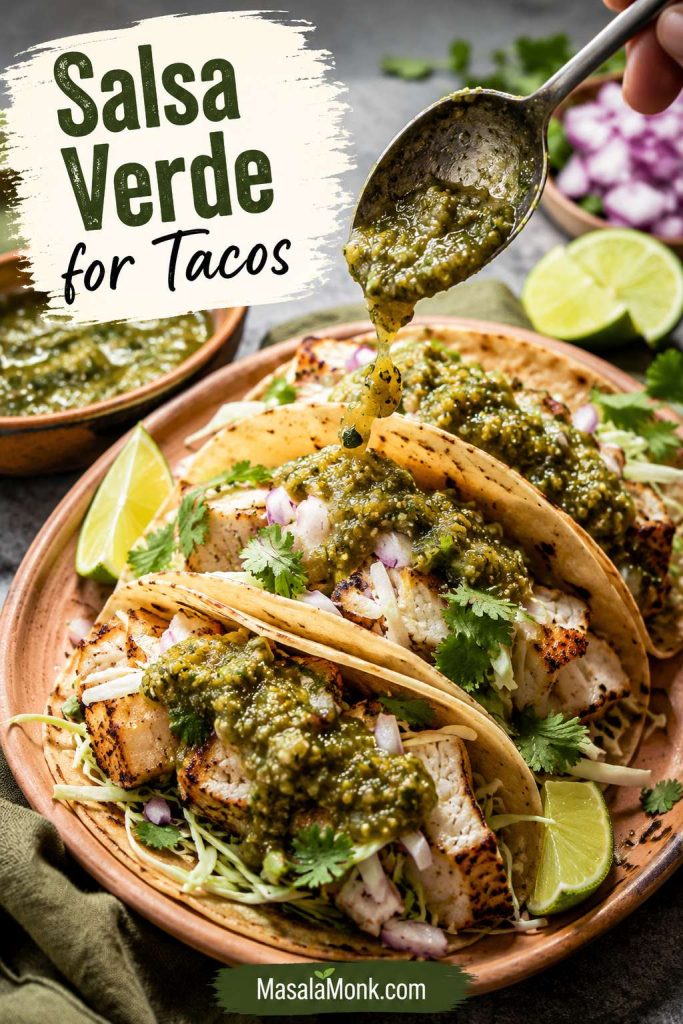
Salsa verde being spooned over tacos with lime, cilantro, onion, and warm tortillas
For tacos, the sauce should be bold enough to cut through the filling while still tasting fresh, tangy, and spoonable.

Enchiladas

For enchiladas, make the salsa looser than you would for chips. Simmer it briefly in a little oil or broth, then use enough to coat the tortillas well. Use about 2 cups for a small 8-inch pan, or 2½ to 3 cups for a 9×13-inch pan, depending on how saucy you like your enchiladas.
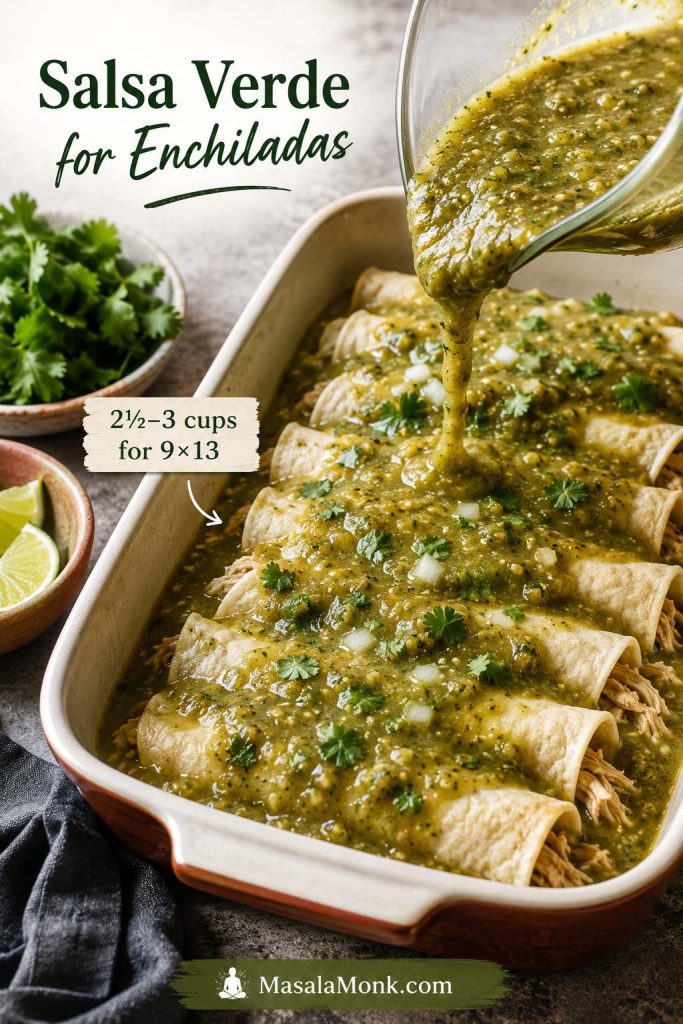
Salsa verde being poured over rolled tortillas in a baking dish with a note for a 9 by 13 inch pan
For enchiladas, make salsa verde looser than a dip so it can coat the tortillas evenly instead of sitting in thick clumps.

Salsa Verde Chicken

Salsa verde chicken is one of the easiest ways to turn this sauce into dinner. Use 1½ to 2 cups for about 1½ pounds boneless chicken, whether you simmer raw chicken until cooked through or spoon the sauce over sliced baked chicken breast.

Once shredded, the chicken works in tacos, bowls, nachos, quesadillas, or enchilada filling.
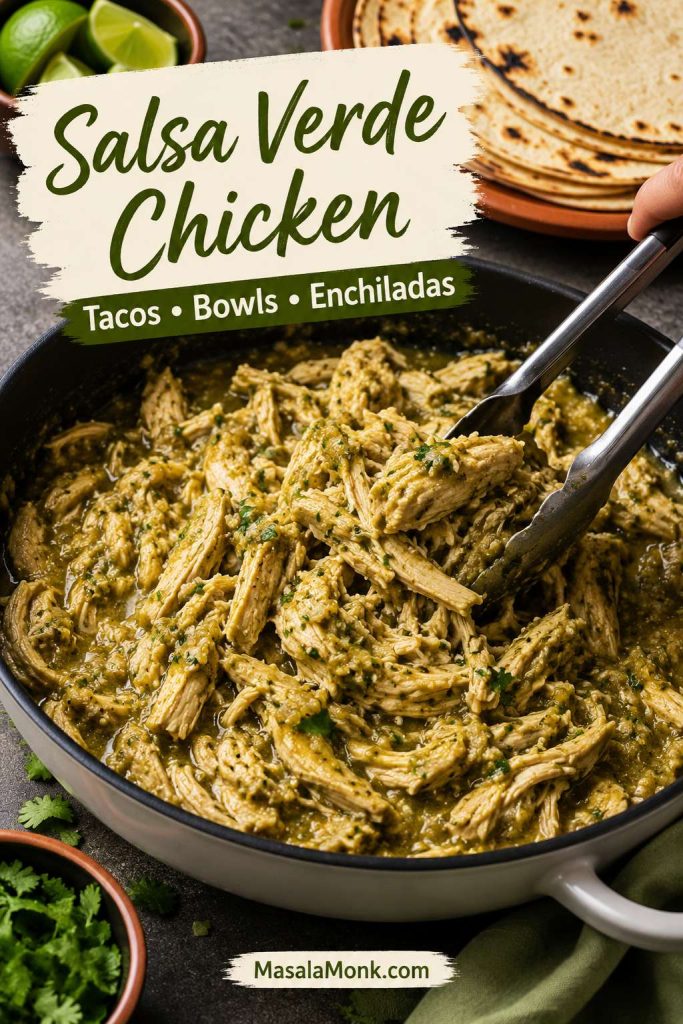
Shredded chicken tossed with salsa verde in a skillet with tortillas nearby
Salsa verde chicken is an easy dinner shortcut because the sauce seasons shredded chicken and turns it into filling for tacos, bowls, nachos, or enchiladas.

Chilaquiles Verdes

Chilaquiles verdes need a looser sauce than tacos. Warm 2 cups salsa with ½ to 1 cup broth or water, then add tortilla chips just long enough to coat them. Keep the chips slightly tender but not completely mushy. Finish with eggs, crema, onion, cilantro, and cheese if you like.
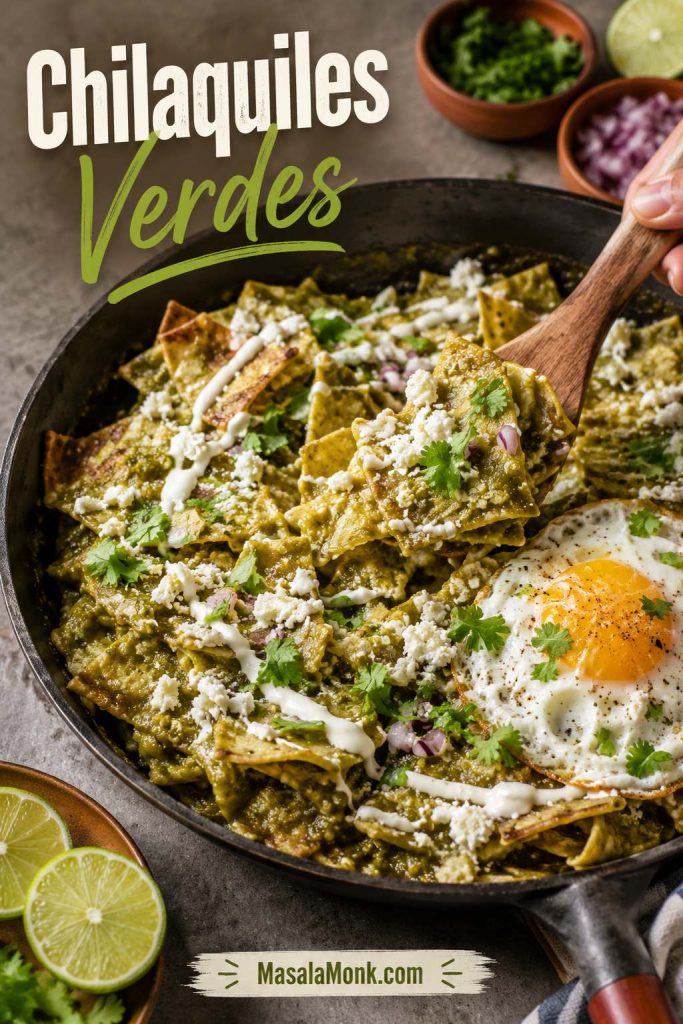
Chilaquiles verdes in a skillet with tortilla chips, salsa verde, egg, crema, cilantro, onion, and cheese
For chilaquiles verdes, warm the sauce first so the chips get coated quickly without soaking until they collapse.

Eggs, Bowls, and Nachos

With eggs, this salsa tastes best slightly warm or at room temperature. It is also a strong add-on for breakfast burritos, especially with eggs, potatoes, cheese, beans, or chorizo. For bowls and nachos, keep it thicker so it acts like a topping instead of a puddle.

Breakfast burrito filled with eggs, potatoes, beans, and cheese with salsa verde spooned over the top
Salsa verde wakes up eggs, potatoes, beans, and breakfast burritos, especially when the sauce is served slightly warm or at room temperature.

Creamy, Avocado, Green Tomato, and Hatch Chile Versions

Once the base salsa tastes balanced, the variations become easy. You are not starting over — you are simply changing the richness, heat, or chile character.

Because creamy and avocado versions store differently, check the storage notes before making a large batch.

Creamy Version

To make it creamy, blend ½ cup sour cream or Mexican crema into 1½ to 2 cups cooled salsa. This makes a softer taco sauce that is especially good with grilled chicken, fish tacos, potatoes, roasted vegetables, and breakfast burritos.

Do not can creamy salsa verde. Dairy changes the safety and storage rules. Keep it refrigerated and use it within 2 to 3 days.

Avocado Version

Avocado turns the sauce richer and softer. Blend 1 ripe avocado into 1½ to 2 cups cooled salsa, then thin it one tablespoon at a time only when needed. This is a good fix for a batch that tastes too sharp or too spicy.

Avocado salsa verde is best eaten the same day or within 1 to 2 days. Press plastic wrap directly against the surface before refrigerating to slow browning.
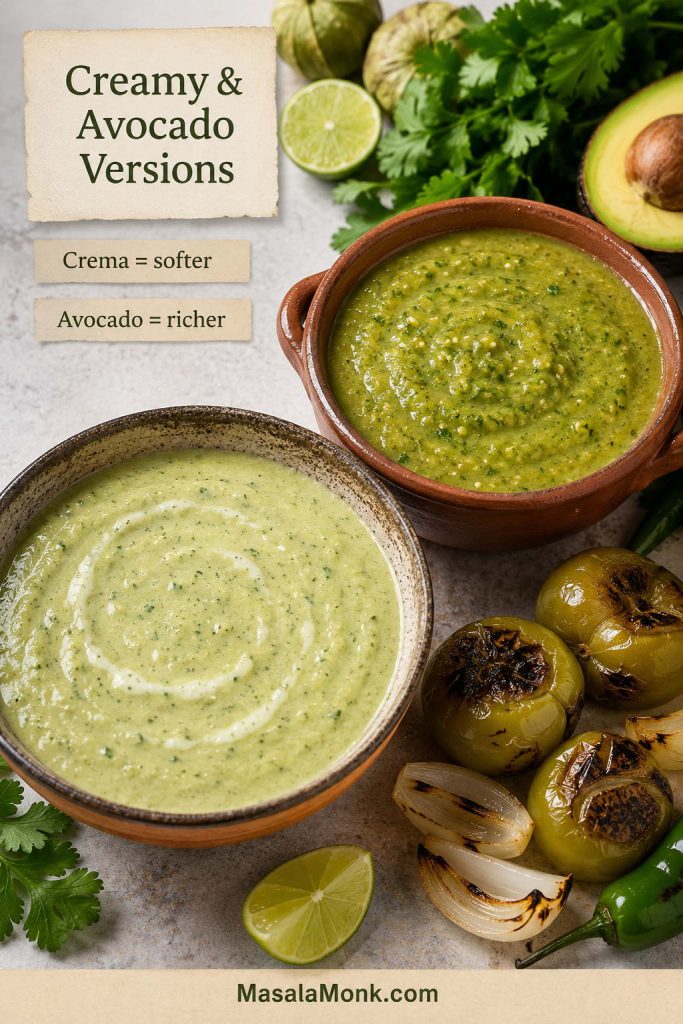
Two bowls of salsa verde showing a pale creamy version and a thicker avocado version with avocado, lime, cilantro, and roasted tomatillos
Creamy salsa verde tastes softer and tangier with crema, while avocado salsa verde becomes richer and helps tame sharpness or heat.

Green Tomato Version

Tomatillos are best for classic Mexican salsa verde. Green tomatoes can make a tangy green salsa, but the flavor is different: more tomato-like, less fruity, and often less naturally bright. Use green tomatoes as a variation when you have them, not as the first choice for this recipe.

When using green tomatoes, roast them well and taste carefully. They may need more lime, salt, or chile to get the same lively balance.
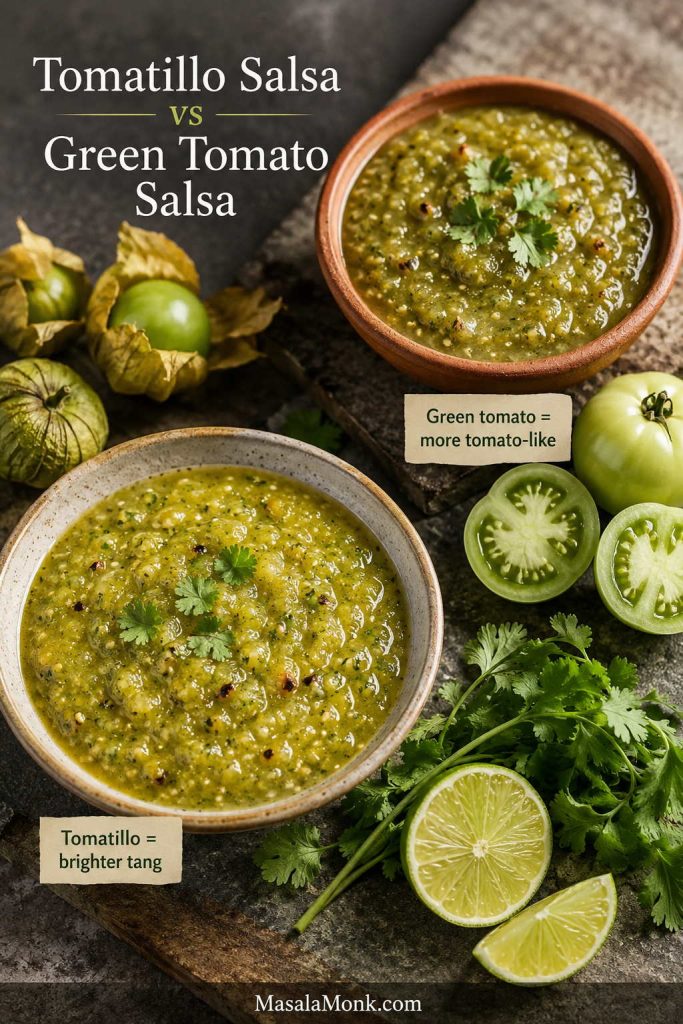
Finished tomatillo salsa and green tomato salsa in separate bowls with tomatillos, husks, sliced green tomatoes, cilantro, and lime
Green tomato salsa can work as a variation, but tomatillos give classic salsa verde its brighter, fruitier tang.

Hatch Green Chile Version

Roasted Hatch green chiles give the salsa a deeper green-chile flavor. Start with ¼ to ½ cup chopped roasted green chile for this batch, then adjust to taste. Hatch chiles can vary widely in heat, so taste before adding extra serrano or jalapeño.
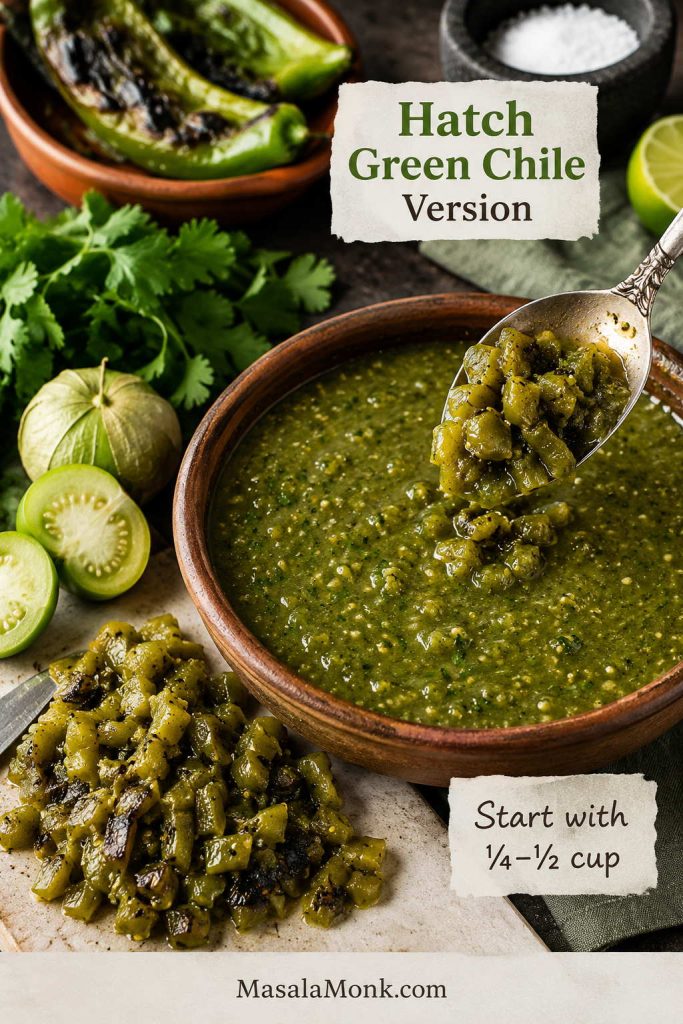
Roasted Hatch green chiles being added to a bowl of salsa verde with tomatillos, cilantro, lime, and salt nearby
Hatch green chiles add deeper roasted chile flavor, so start with a small amount and taste before adding more heat.

For a sweeter, fruitier salsa for tacos, fish, shrimp, or grilled chicken, MasalaMonk’s mango salsa recipe is the better direction. This salsa is tangy and green; mango salsa is juicy, chunky, and fruit-forward.

Salsa Verde and Other Green Sauces

“Salsa verde” simply means green sauce, so different cuisines use the name for different things. The table below is not saying these sauces are interchangeable. It is here to help you recognize which green sauce a recipe or restaurant menu might mean.

SauceMain IngredientsWorks With
Mexican salsa verdeTomatillos, green chiles, onion, garlic, cilantro, salt, sometimes lime.Tacos, chips, enchiladas, chicken, eggs, chilaquiles.
Italian salsa verdeParsley, capers, garlic, olive oil, vinegar or lemon, sometimes anchovy.Fish, steak, roasted vegetables, boiled meats.
Peruvian aji verdeCilantro, green chile or aji amarillo-style heat, lime, mayo or cheese-style creaminess.Roast chicken, fries, grilled meats, rice bowls.
Chile verdeUsually pork or meat cooked with green chiles and tomatillo-style sauce.A stew or main dish, not just a table salsa.

How to Store and Freeze It

Store the salsa in an airtight jar or container in the refrigerator. Plain salsa verde is often even better after 30 minutes to a few hours because the salt, chile, cilantro, and tomatillo flavors settle together.

If you want shelf-stable jars instead of refrigerator salsa, read the canning safety section before changing the ingredients or acid.

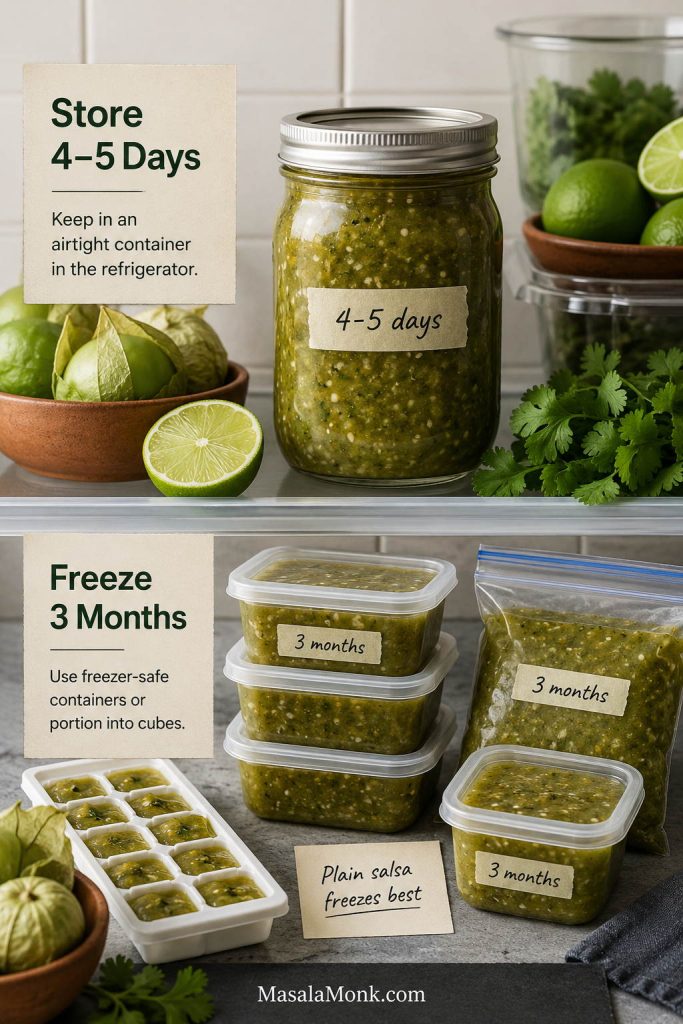
Storage MethodHow LongStorage Tip
Refrigerator4 to 5 daysKeep it in a clean airtight jar and stir before serving.
FreezerUp to 3 monthsFreeze in small portions so you can thaw only what you need.
Avocado or creamy version1 to 2 days for avocado, 2 to 3 days for creamyKeep refrigerated and do not freeze if texture matters.
Salsa verde stored in a refrigerator jar, freezer containers, freezer bag, and ice cube tray with storage time labels
Plain salsa verde stores well in the refrigerator and freezer, but add avocado, sour cream, or crema only after thawing for the best texture.

Freeze the plain version before adding avocado, sour cream, or crema. Dairy and avocado versions do not freeze as cleanly and can turn grainy or dull after thawing. When the salsa smells off, looks fizzy, shows mold, or changes in a way that makes you unsure, throw it out.

Can You Can Salsa Verde?
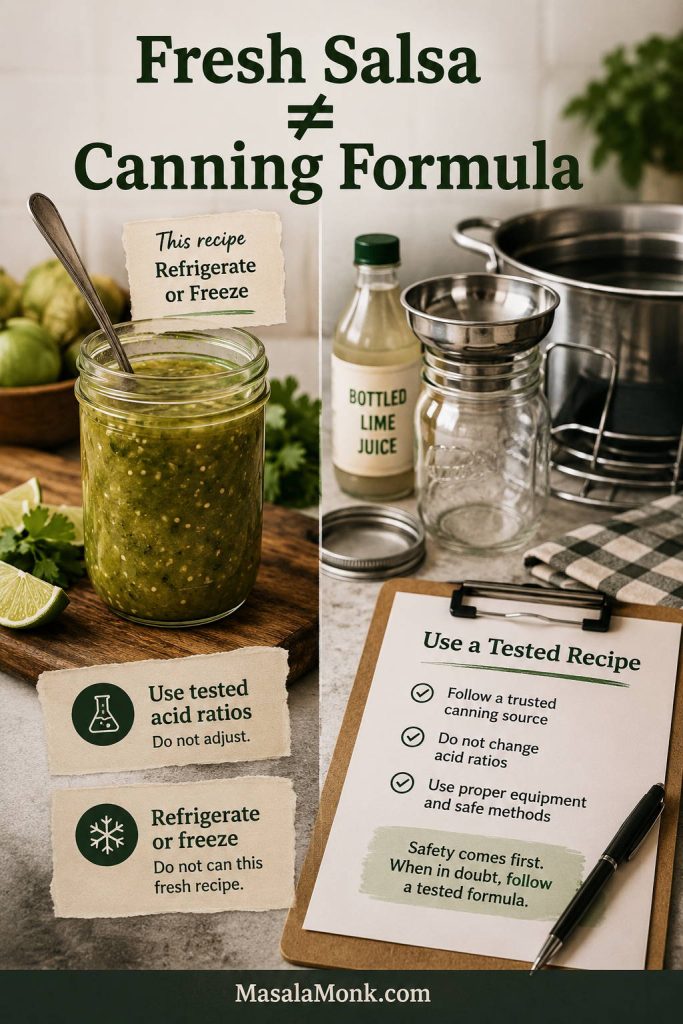
Important: This fresh salsa verde recipe is for the refrigerator or freezer. Do not water-bath can this exact recipe unless you are following a tested canning formula with the correct acid level, jar size, headspace, and processing time.
Canning safety graphic with fresh salsa verde, bottled lime juice, jars, canning equipment, and notes to refrigerate or freeze this recipe
Fresh salsa verde belongs in the refrigerator or freezer unless you are using a tested canning recipe with verified acid, jar, and processing guidance.

Shelf-stable salsa is different from fresh salsa. Tomatillos are acidic, but salsa also contains low-acid ingredients like onions, garlic, and chiles. Safe canning recipes use tested ratios and added acid. The National Center for Home Food Preservation provides a tested tomatillo green salsa formula with measured tomatillos, chiles, onions, and bottled lemon or lime juice. New Mexico State University also publishes salsa canning guidance with tested processing information.

For shelf-stable salsa verde, use a tested canning recipe from a university extension, NCHFP, USDA-style source, or another reputable canning authority. Do not simply add vinegar or lemon juice to this fresh recipe and assume it is safe. Do not change the tomatillo, onion, chile, or acid ratios in a tested canning recipe unless the source specifically says that change is safe.

FAQs

Is salsa verde the same as green salsa?

In Mexican cooking, salsa verde usually means green salsa made with tomatillos and green chiles. The phrase can mean different green sauces in other cuisines, so “Mexican salsa verde” or “tomatillo salsa verde” is the clearer name.

Are tomatillos the same as green tomatoes?

Tomatillos and green tomatoes are different ingredients. Tomatillos have papery husks and a tart, fruity flavor, while green tomatoes are unripe tomatoes. You can make a green tomato salsa, but it will not taste exactly like classic tomatillo salsa verde.

Do you have to cook tomatillos?

You do not have to cook them. Raw salsa verde is sharp and fresh, boiled salsa verde is smooth and clean, roasted salsa verde is rounder, and charred salsa verde tastes deeper and smokier. When in doubt, roast them first; it is the easiest method to love.

Is roasted or boiled better?

Roasted is usually the most flexible homemade version because it tastes rounder and lightly smoky. Boiled is smoother and cleaner, which makes it excellent for taqueria-style salsa, enchiladas, chilaquiles, and simmered chicken.

Is it spicy?

The heat depends on the chile. Start with one seeded jalapeño for a gentle batch, especially when serving a crowd. You can always add more heat next time.

How do I make it less spicy?

The easiest way to cool down the heat is to add body, not water. Blend in more cooked tomatillo, avocado, sour cream, Mexican crema, or roasted onion. Plain water will thin the salsa without balancing the burn very much.

Can I use it as enchilada sauce?

For enchiladas, make the salsa looser than you would for chips. Simmer it briefly, then use enough to coat the tortillas well: about 2 cups for a small 8-inch pan, or 2½ to 3 cups for a 9×13-inch pan.

Why is my salsa verde watery?

Watery salsa usually has too much added liquid or has not cooled yet. Chill it first. If it is still loose, simmer it briefly to reduce. For a creamy fix, blend in avocado instead.

Why is my salsa verde bitter?

Bitterness can come from old tomatillos, over-charred skins, or too much harsh raw garlic. Add more cooked tomatillo, cilantro, salt, or a little lime. Next time, roast until blistered and browned in spots, not blackened all over.

Can I make it without cilantro?

You can leave cilantro out if it is not your thing. The flavor will be less classic, but the salsa can still work with enough chile, onion, lime, and salt. Flat-leaf parsley gives a green herb note, but it will not taste the same.

Can I use canned tomatillos?

Fresh tomatillos are best, but canned tomatillos can help when that is what you have. Drain them well, then blend with chile, onion, garlic, cilantro, lime, and salt. The flavor is usually softer, so taste carefully before serving.

Can I freeze it?

Plain salsa freezes well in small portions for up to 3 months. Thaw it in the refrigerator and stir before serving. Add avocado, sour cream, or crema after thawing, not before freezing.

Can I can this recipe?

This is a fresh refrigerator/freezer recipe, not a canning formula. For shelf-stable canning, use a tested recipe with the correct acid, jar size, headspace, and processing time from a reputable canning authority.

What is the difference between salsa verde and chile verde?

Salsa verde is a green salsa or sauce. Chile verde usually refers to a cooked dish, often pork or another meat simmered with green chiles and tomatillo-style sauce. They are related, but they are not the same thing.

Once you make salsa verde this way, you will start noticing how many meals need it. Keep it thick for chips and tacos, loosen it for enchiladas or chilaquiles, or blend in avocado when you want something softer and creamy. After a few batches, you will know your house style: raw and sharp, boiled and smooth, roasted and round, or charred and smoky. The best version is the one your table keeps reaching for first.
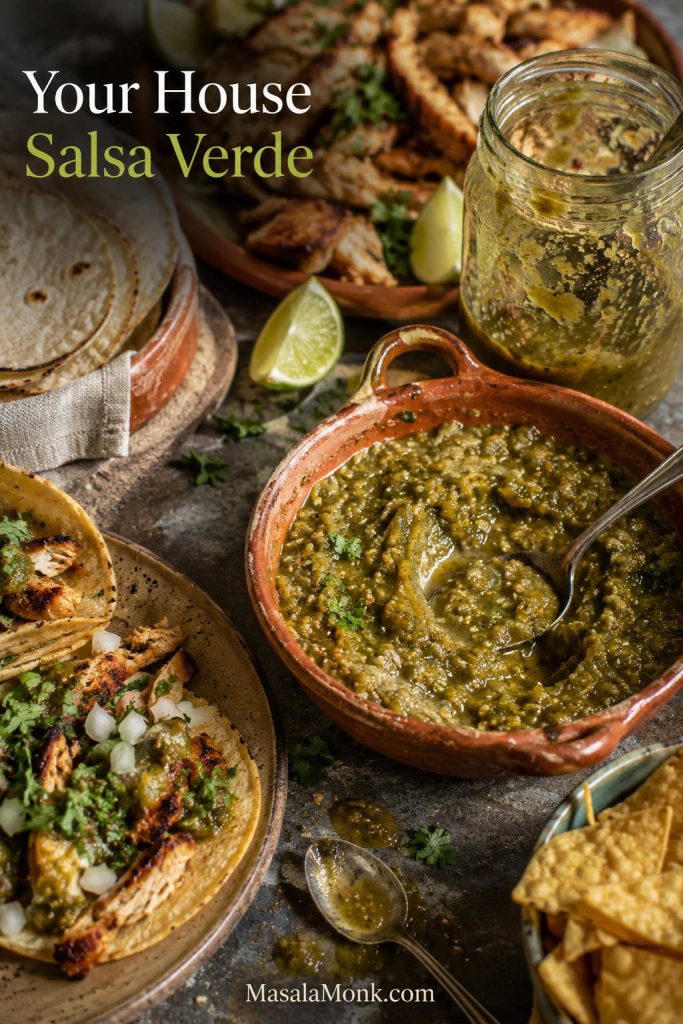
Used table scene with a bowl and jar of salsa verde, tacos, tortilla chips, lime wedges, tortillas, and grilled chicken
After a few batches, salsa verde becomes a house sauce: keep it chunky for tacos, loosen it for saucy meals, or adjust the method until it fits your table.

Back to top

Posted on 3 Comments

Mango Habanero Sauce Recipe: Sweet-Spicy Hot Sauce for Wings, Tacos & Chicken

Glossy mango habanero sauce in a bowl with fresh mango, orange habanero peppers, lime, garlic and wings in the background.

A good mango habanero sauce recipe should taste fruity, fiery, tangy, and balanced. The mango should come through clearly, the habanero should bring real heat, and the vinegar, lime, salt, garlic, and onion should keep the sauce sharp enough for wings, tacos, grilled chicken, shrimp, fish, paneer, tofu, burgers, wraps, fries, and rice bowls.

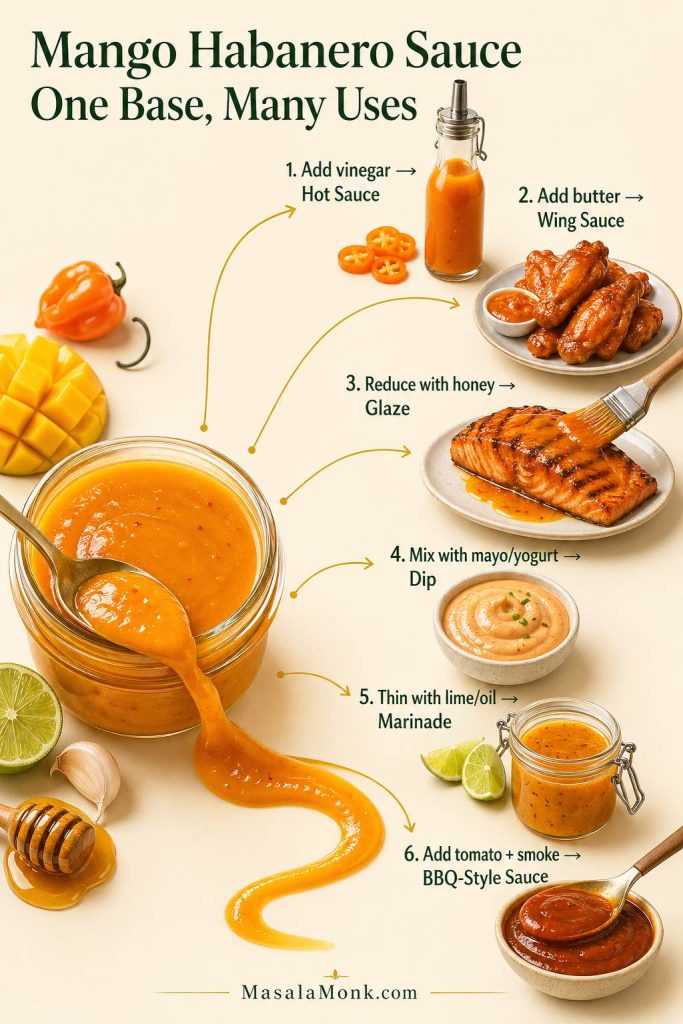
The useful part is that this homemade mango habanero sauce starts with one flexible base. From there, you can thin it into hot sauce, finish it with butter for wings, reduce it into a glaze, stir it into a creamy dip, or push it toward a BBQ-style sauce. Instead of locking you into one narrow version, it shows you how to control heat, texture, sweetness, acidity, and storage.

Here, the sauce starts as a cooked blender mango habanero sauce: mango, habanero, onion, garlic, vinegar, water, and salt simmer first, then everything is blended smooth and finished with lime juice and sweetener. As a result, the finished sauce tastes rounder than a raw blend, smoother than a salsa, and more useful than a plain vinegar hot sauce.

It is also easy to make. The base simmers in one pan, then blends into a smooth, pourable sauce without special hot sauce equipment. For that reason, you can make a bold homemade hot sauce at home without fermenting, canning, or buying specialty tools.

The one thing to respect is the habanero itself. It is seriously hot, so this recipe gives you a clear heat guide before you cook. Start with one pepper for a medium-hot mango habanero sauce, use two for a properly hot version, and only go beyond that if you already know you love very spicy sauces.

Quick Answer: What Is Mango Habanero Sauce?

Mango habanero sauce is a sweet-spicy homemade sauce made with ripe mango, habanero peppers, vinegar, lime juice, garlic, onion, salt, and a little sweetener. In this recipe, the sauce is cooked and blended, so it becomes smooth, bright orange, fruity, tangy, and hot.

Unlike mango mustard sauce, this mango habanero sauce recipe is hotter and more chili-forward. Where mango salsa stays chunky and fresh, this sauce is cooked, blended, and pourable. Amba sauce, by contrast, leans more sour and pickle-like, while mango habanero sauce is sweeter, fruitier, and built around habanero heat.

Its biggest advantage is flexibility. For example, you can drizzle it over tacos and eggs, toss it with wings, brush it onto grilled shrimp or salmon, serve it with fries, or spread it inside burgers and wraps.

At a glance: This homemade mango habanero sauce recipe makes about 1¾ cups / 420 ml. Use 1 habanero for medium-hot, 2 for hot, and 3+ only if you love serious heat. The base sauce is cooked, smooth, fruity, tangy, and pourable. Increase the vinegar for a thinner hot sauce, or finish the sauce with butter for a glossy wing sauce.

This version is best for readers who want a homemade mango habanero sauce that is hot but still usable, not a sauce so fiery that it only works a few drops at a time.

Homemade mango habanero sauce in a jar with arrows showing how to turn one base into hot sauce, wing sauce, glaze, dip, marinade, and BBQ-style sauce.
One homemade mango habanero sauce can go several directions. Thin it with vinegar for hot sauce, finish it with butter for wings, reduce it with honey for a glaze, stir it into mayo or yogurt for a creamy dip, or loosen it with lime and oil for a quick marinade.

Why This Mango Habanero Sauce Recipe Works

The balance starts with the mango. It gives the sauce body, color, and natural sweetness. The habanero brings the heat, but it also adds a floral, fruity aroma. Meanwhile, vinegar and lime keep everything sharp, while salt makes the mango and chili taste complete.

Cooking the base first also matters. It softens the onion, garlic, mango, and habanero before blending, so the finished sauce tastes rounder instead of raw or harsh. As a result, the cooked base tastes smoother, while the lime added at the end keeps the sauce bright.

That balance makes the sauce flexible at home. For example, keep it medium-thick for dipping, thin it with extra vinegar for hot sauce, finish it with butter for wings, or reduce it into a glaze for grilled food.

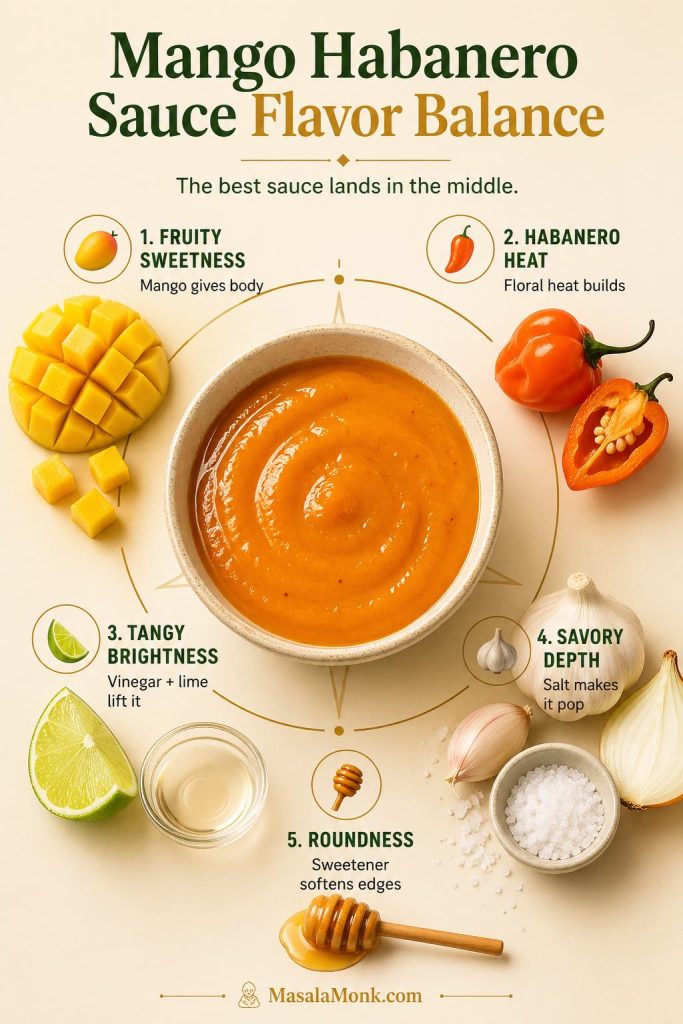
What Does Mango Habanero Sauce Taste Like?

At first, mango habanero sauce should taste fruity and bright. After a few seconds, the habanero heat should build. The mango gives the recipe ripe tropical sweetness, the vinegar and lime keep the sauce tangy, and the habanero adds a floral heat that lingers.

A good batch should not taste like mango jam, and it should not taste like plain vinegar hot sauce either. Instead, the best version lands in that sweet and spicy middle ground: fruity enough for dipping, sharp enough for tacos, and bold enough for wings.

Mango habanero sauce flavor balance guide showing mango sweetness, habanero heat, vinegar and lime brightness, savory depth, and honey roundness.
A good mango habanero sauce should land in the middle: fruity from mango, hot from habanero, bright from vinegar and lime, savory from garlic, onion, and salt, and rounded with just enough sweetener.

When one flavor takes over, adjust the sauce in stages. First, fix flatness with salt. Next, use lime or vinegar when the sauce tastes too sweet. Finally, when the habanero heat is running the show, bring the sauce back into balance with more mango or a little honey.

Ingredients for This Mango Habanero Sauce Recipe

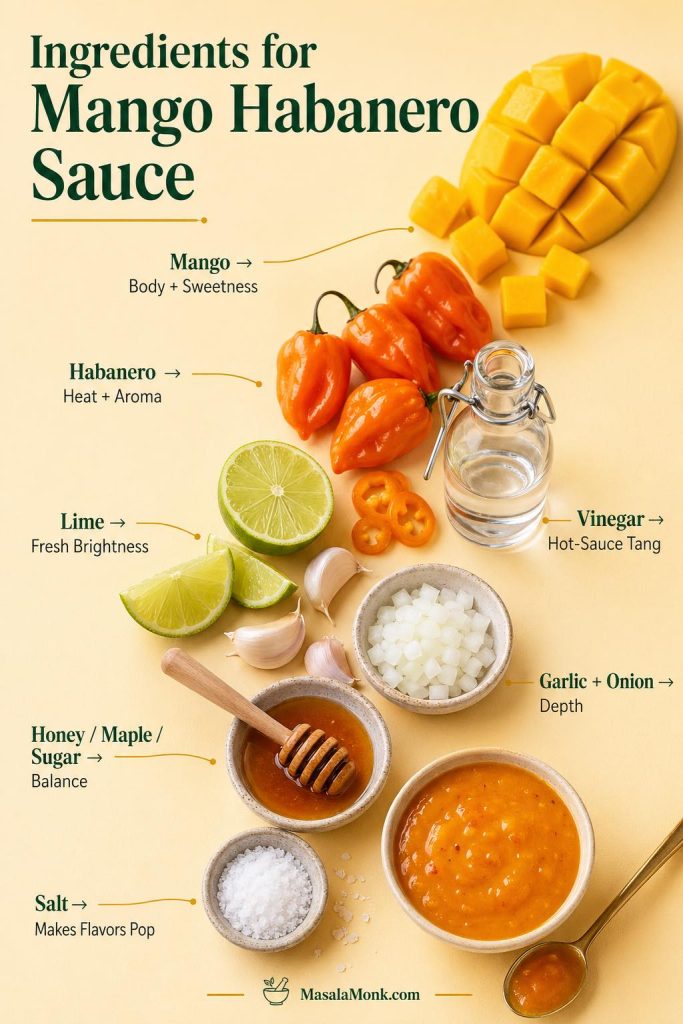
Think of the ingredients in roles, not just measurements. Mango gives body, sweetness, and color. Habanero gives heat and aroma. Vinegar gives sharpness, lime gives freshness, garlic and onion give depth, and sweetener rounds the edges.

The table below gives you a balanced starting point. Once the sauce is blended, you can adjust sweetness, heat, acid, salt, and thickness to match how you want to use it.

Ingredients for mango habanero sauce including ripe mango, habanero peppers, lime, vinegar, garlic, onion, honey, salt, and finished sauce.
Each ingredient has a job in mango habanero sauce: ripe mango gives body and sweetness, habanero brings heat, vinegar and lime keep it tangy, garlic and onion add depth, and honey or sugar rounds the edges.
Ingredient US Amount Metric Amount Why It Matters
Ripe mango, diced 1½ cups 250 g / 8.8 oz Sweetness, body, color, and fruit flavor
Fresh habanero peppers 1–2 peppers about 10–20 g / 0.35–0.7 oz Heat and floral chili aroma
Onion, chopped ¼ cup 40 g / 1.4 oz Savory body and depth
Garlic 2 cloves 6 g / 0.2 oz Sharpness and backbone
Apple cider vinegar or white vinegar ⅓ cup 80 ml / 2.7 fl oz Tang and hot-sauce character
Fresh lime juice 2 tbsp 30 ml / 1 fl oz Fresh brightness
Water ¼ cup 60 ml / 2 fl oz Helps the sauce simmer and blend
Honey, sugar, or maple syrup 1–2 tbsp 20–40 g honey/maple or 12–25 g sugar Balances heat and acid
Fine sea salt ¾ tsp 4–5 g Makes the sauce taste complete

Optional flavor additions include ½–1 teaspoon grated ginger for tropical warmth, ¼ teaspoon cumin for earthiness, ¼ teaspoon smoked paprika for a BBQ-style direction, or a tiny pinch of allspice for a Caribbean-style note. However, for a first batch, keep the sauce simple before adding too many extra spices.

Best Mango to Use: Fresh, Frozen or Mango Pulp

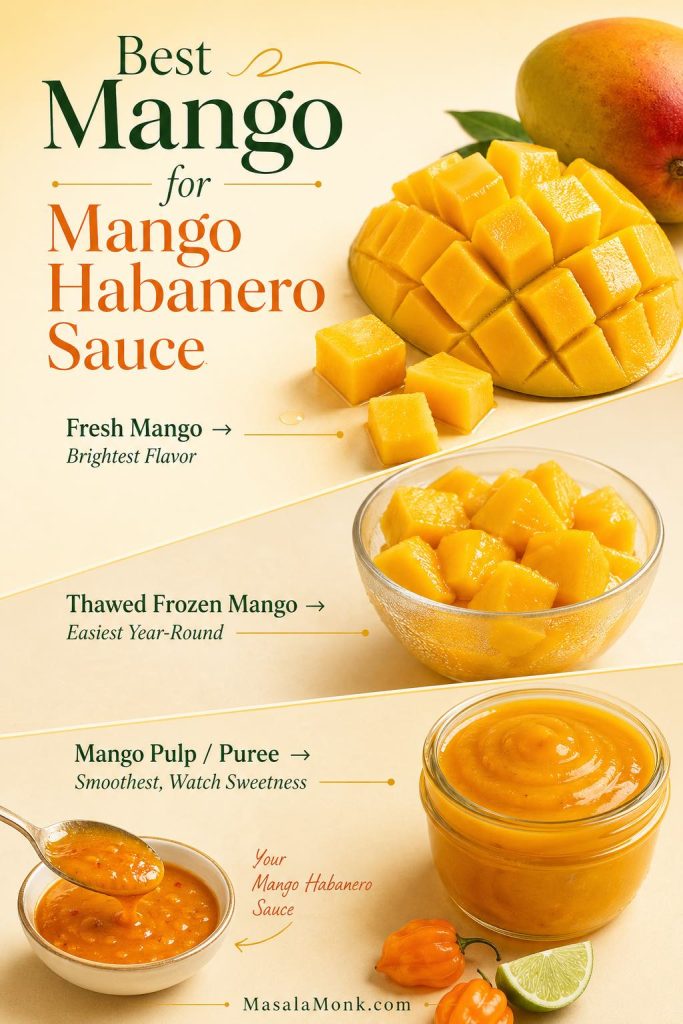
For the brightest fresh mango flavor, use ripe mango that smells sweet before you cut it. Since mango is the body of this sauce recipe, the fruit should taste good before it goes into the pan.

Best mango options for mango habanero sauce, showing fresh mango, thawed frozen mango, mango pulp or puree, and finished mango habanero sauce.
Fresh mango gives mango habanero sauce the brightest flavor, thawed frozen mango is the easiest year-round option, and mango pulp or puree makes the sauce extra smooth. If using sweetened pulp, start with less honey or sugar and adjust after blending.

Meanwhile, mango habanero sauce with frozen mango can also taste excellent when fresh mango is out of season. Thaw frozen mango first, then use it like fresh diced mango. It often blends smoothly and gives the sauce a consistent color and texture.

Mango pulp or mango puree can also work, especially when you want a very smooth sauce. However, the one thing to watch is sweetness. Many mango pulps are already sweetened, so start with little or no honey or sugar and adjust after blending.

On the other hand, underripe mango will make the sauce sharper and less fruity. Very fibrous mango can also make the finished sauce harder to blend smooth, so strain it through a fine mesh sieve if needed.

Can You Use Mango Pulp or Mango Puree?

Yes, mango pulp or mango puree can work well in this mango habanero sauce recipe. Use about 1 cup / 250 g mango pulp in place of the diced mango. If the pulp is sweetened, skip the honey or sugar at first and adjust only after the sauce has simmered and blended.

Heat Guide for This Mango Habanero Sauce Recipe

This is the section to read before cutting the peppers. Habaneros are much hotter than jalapeños; the Chile Pepper Institute lists orange habanero at around 250,000 Scoville Heat Units. That kind of habanero pepper heat can take over a mango sauce quickly.

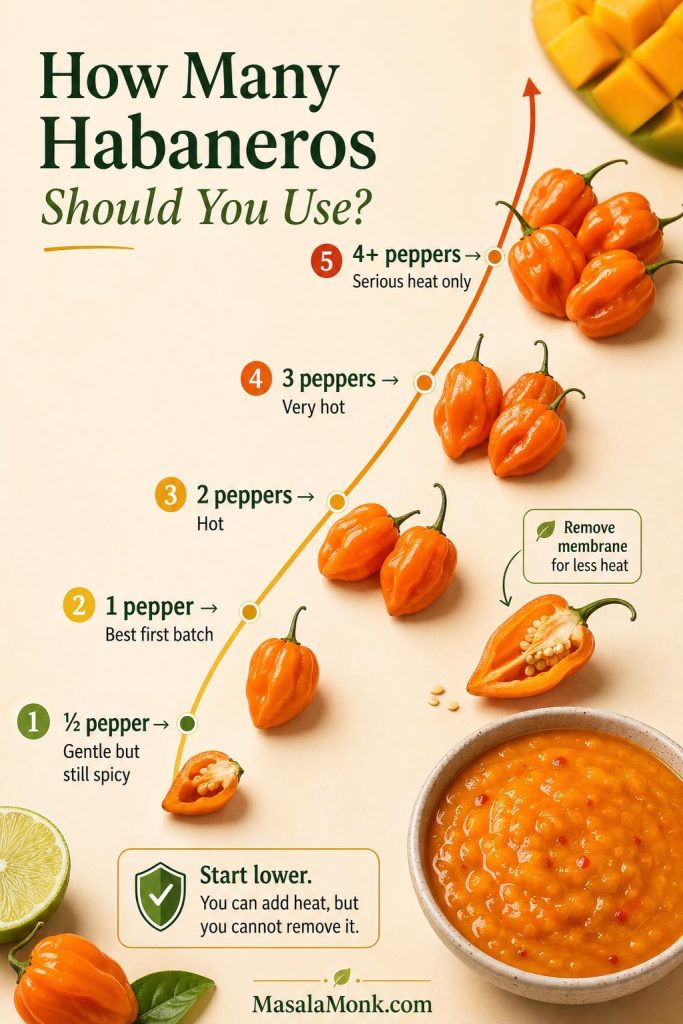
For that reason, one seeded habanero is the best first batch for most people. After blending, you can always add more heat in small amounts. Once too much habanero is blended into the whole sauce, though, it is much harder to fix.

Heat guide for mango habanero sauce showing ½ pepper, 1 pepper, 2 peppers, 3 peppers, and 4+ habaneros from gentle heat to serious heat.
Start lower when making mango habanero sauce. One seeded habanero is the safest first batch for most people, while two peppers make it hot and three or more should be saved for serious heat lovers.

Use the table below to make a mild mango habanero sauce, medium-hot sauce, hot sauce, or extra hot mango habanero sauce without guessing.

Heat Level Habanero Amount Prep Method Best For
Gentle but still spicy ½ pepper Seeds and membrane removed First-time habanero users
Medium-hot 1 pepper Mostly seeded Best first batch
Hot 2 peppers Some membrane left Wings, tacos, spicy bowls
Very hot 3 peppers Some seeds and membrane included Hot sauce lovers
Extreme 4+ peppers Use with caution Serious heat lovers only
Heat tip: Start with less habanero than you think. You can always blend in more heat later, but you cannot remove it once the whole batch is too hot.
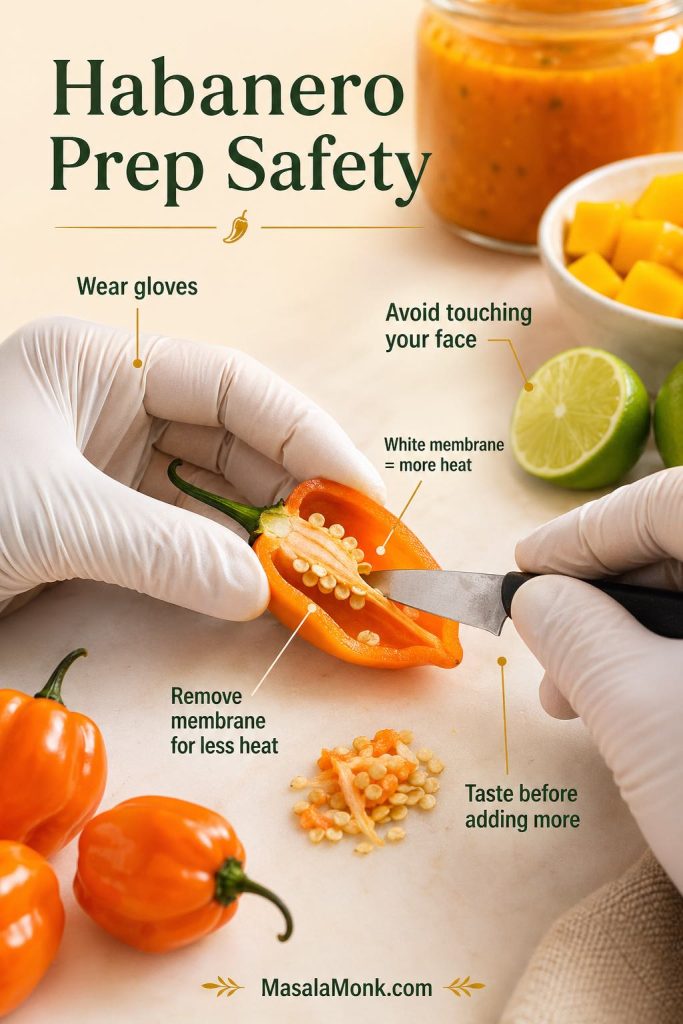
Gloved hands removing seeds and white membrane from an orange habanero pepper for mango habanero sauce.
Wear gloves when cutting habaneros, avoid touching your face, and remove some of the white membrane if you want better heat control. The membrane carries much of the pepper’s heat, so removing it makes the mango habanero sauce easier to manage.

Before cutting the peppers, wear gloves. In addition, avoid touching your eyes, nose, lips, or face after handling habaneros. The white membrane inside the pepper carries a lot of the heat, so removing it gives this sauce recipe more control.

Equipment You Need

You need a small saucepan, a blender or immersion blender, gloves for handling habaneros, a spoon or spatula, and a clean jar or bottle for storing the finished sauce. A high-speed blender gives the smoothest mango habanero sauce, but an immersion blender works if you do not mind a slightly thicker texture. For a very smooth, bottle-friendly hot sauce, keep a fine mesh sieve nearby so you can strain the sauce after blending.

How to Make This Mango Habanero Sauce Recipe

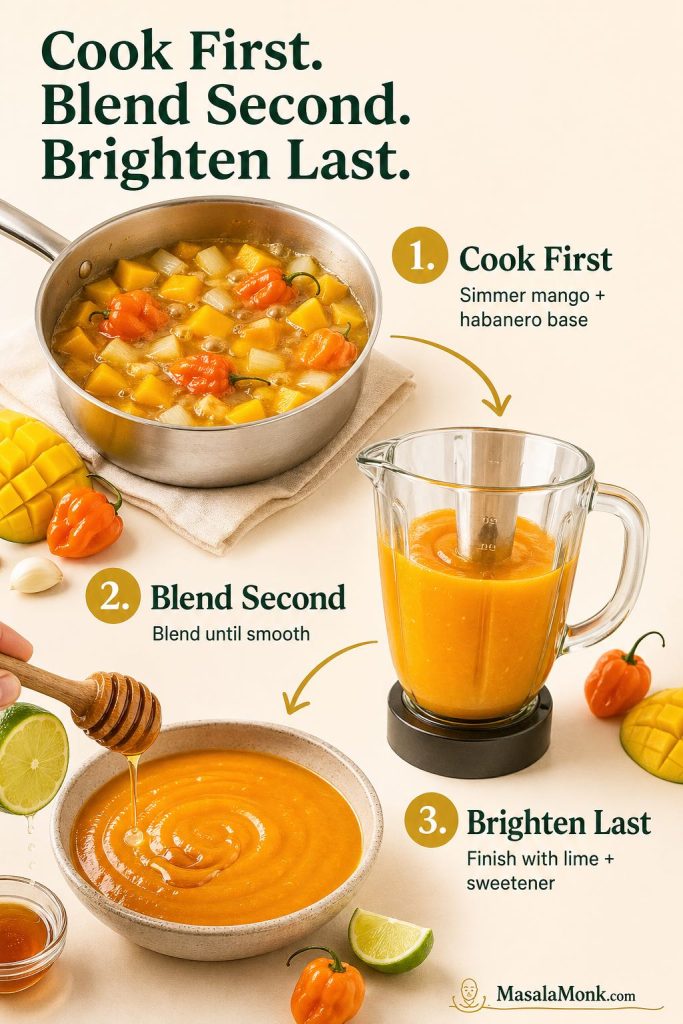
The method is simple, but the order matters: cook first, blend second, brighten last. First, simmering softens the mango, onion, garlic, and habanero. Next, blending turns them into a smooth sauce. Finally, lime juice and sweetener go in near the end so the finished sauce tastes bright instead of dull.

Three-step method for mango habanero sauce showing mango and habanero simmering, blending smooth, and finishing with lime and sweetener.
The order matters for smooth mango habanero sauce: simmer the mango, habanero, onion, garlic, vinegar, and water first, blend the softened mixture until smooth, then finish with lime juice and sweetener for brightness.

1. Prep the habaneros safely

First, put on gloves. Remove the stems from the habaneros. For less heat, cut the peppers open and scrape out most of the seeds and white membrane.

2. Simmer the mango and habanero base

Next, add the mango, habanero, onion, garlic, vinegar, water, and salt to a small saucepan. Bring the mixture to a visible boil over medium heat, then reduce it to a gentle simmer.

Simmer for 10–15 minutes, stirring often, until the mango and onion are soft. This cooking step rounds out the onion, garlic, and habanero, so the finished sauce tastes smoother and less raw.

3. Cool slightly and blend

After that, let the mixture cool for about 5 minutes. Blend until completely smooth. If using a blender, vent the lid slightly and cover it with a towel so steam does not build pressure.

4. Finish the sauce

At this point, return the sauce to the pan. Stir in lime juice, honey or sugar, and any optional spices. Then, simmer for another 2–5 minutes, until the mango habanero sauce looks glossy and unified.

5. Taste and adjust

Finally, taste carefully, using only a tiny spoon at first. Habanero heat builds as you eat, so the sauce may feel hotter after a few seconds.

  • If the sauce tastes flat, add salt.
  • If the mango habanero sauce tastes too sweet, add lime juice or vinegar.
  • If the recipe tastes too sharp or too hot, add mango or honey.
  • If the sauce is too thick, add water a spoonful at a time.
  • If the sauce is too thin, simmer uncovered until it reduces.
Common mistakes to avoid: Do not add all the habaneros at once if you are unsure about heat. Also, do not skip the salt, because the sauce will taste flat. Do not over-thin the sauce before blending; you can always add water later. Finally, do not assume this homemade mango habanero sauce is shelf-stable just because it contains vinegar.

Use the mango habanero sauce recipe below as the master version. From there, adjust the thickness and finish depending on whether you want hot sauce, wing sauce, glaze, dip, marinade, or BBQ-style sauce.

Mango Habanero Sauce Recipe

This homemade mango habanero sauce recipe makes a cooked blender sauce that is fruity, fiery, tangy, smooth, and flexible enough for wings, tacos, chicken, shrimp, fish, paneer, tofu, fries, burgers, wraps, and bowls.

YieldAbout 1¾ cups / 420 ml / 14 fl oz
Prep Time10 minutes
Cook Time15–20 minutes
Total Time25–30 minutes

Ingredients

  • 1½ cups / 250 g ripe mango, diced
  • 1–2 habanero peppers, stemmed
  • ¼ cup / 40 g chopped onion
  • 2 garlic cloves / 6 g, roughly chopped
  • ⅓ cup / 80 ml apple cider vinegar or white vinegar, preferably 5% acidity
  • ¼ cup / 60 ml water
  • ¾ tsp / 4–5 g fine sea salt
  • 2 tbsp / 30 ml fresh lime juice
  • 1–2 tbsp honey, sugar, or maple syrup
  • Optional: ½–1 tsp grated ginger
  • Optional: ¼ tsp cumin
  • Optional: ¼ tsp smoked paprika
  • Optional: tiny pinch to ¼ tsp allspice

Instructions

  1. Wear gloves before handling the habaneros. Remove the stems. For less heat, remove seeds and most of the white membrane.
  2. Add mango, habanero, onion, garlic, vinegar, water, and salt to a small saucepan.
  3. Bring to a visible boil over medium heat, then reduce to a gentle simmer.
  4. Simmer for 10–15 minutes, stirring often, until the mango and onion are soft.
  5. Cool for 5 minutes, then blend until completely smooth.
  6. Return the sauce to the pan. Stir in lime juice, sweetener, and any optional spices.
  7. Simmer for 2–5 minutes more, until glossy and slightly thickened.
  8. Taste carefully. Adjust salt, lime/vinegar, sweetener, or water as needed.
  9. Cool the mango habanero sauce and store it in a clean jar or bottle in the refrigerator.

Recipe Notes

  • Use 1 habanero for a medium-hot sauce and 2 habaneros for a hotter version.
  • For a thinner homemade mango habanero hot sauce, increase the vinegar to ½ cup / 120 ml and strain after blending.
  • For a thicker glaze, simmer uncovered for a few extra minutes.
  • For wing sauce, use the butter-finished conversion below.
  • This is a refrigerator sauce recipe, not a tested shelf-stable canning recipe.
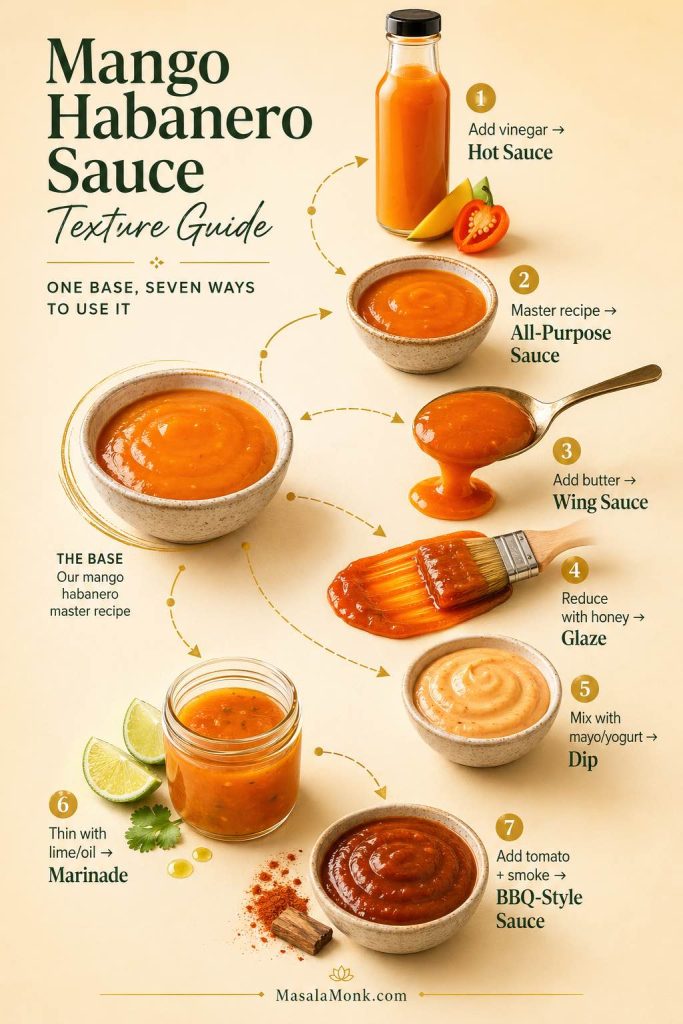
Mango habanero sauce texture guide showing how one base becomes hot sauce, all-purpose sauce, wing sauce, glaze, dip, marinade, and BBQ-style sauce.
Use the master mango habanero sauce as a base, then adjust the texture for the job: add vinegar for hot sauce, butter for wing sauce, honey for glaze, mayo or yogurt for dip, lime and oil for marinade, or tomato and smoke for a BBQ-style sauce.

Homemade Mango Habanero Hot Sauce Version

Choose this version when you want something bottle-friendly. More vinegar makes the sauce thinner, sharper, and easier to drizzle over tacos, eggs, grilled food, bowls, and roasted vegetables.

Element All-Purpose Sauce Hot Sauce Version
Vinegar ⅓ cup / 80 ml ½ cup / 120 ml
Water ¼ cup / 60 ml ¼ cup / 60 ml, plus more if needed
Sweetener 1–2 tbsp 1 tbsp to start
Final simmer 2–5 minutes 5 minutes
Texture Medium-thick Thin and pourable
Optional step Usually no strain Strain for bottle-smooth sauce

Compared with the all-purpose sauce, this hot sauce version tastes sharper, thinner, and more vinegar-forward. Therefore, use it when you want a real hot sauce texture rather than a thicker dipping sauce.

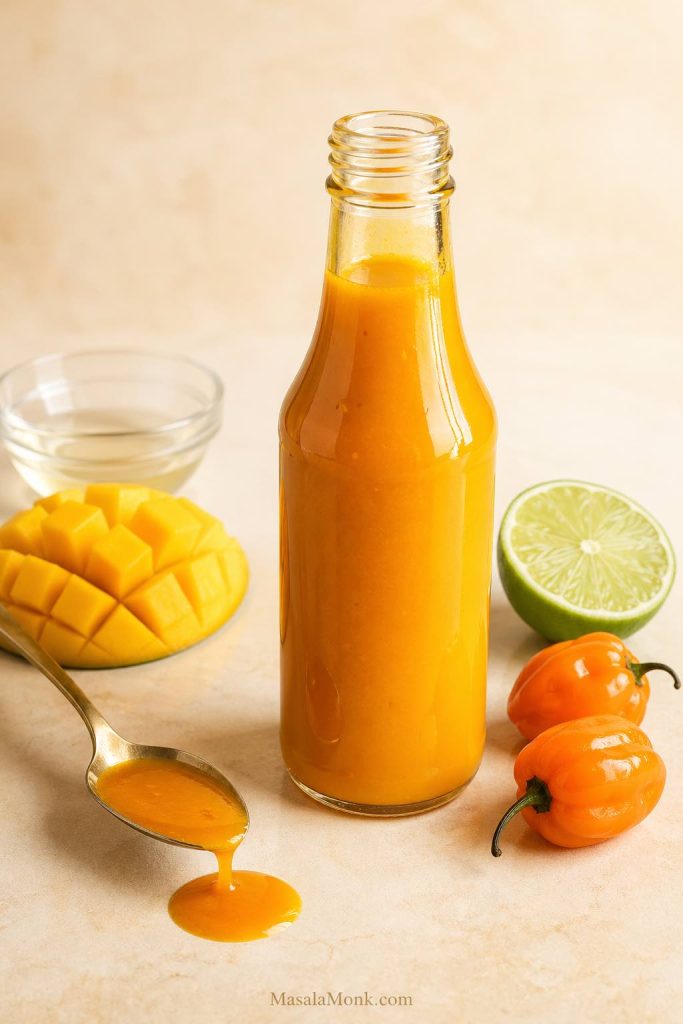
Homemade mango habanero hot sauce in a glass bottle with mango, habanero peppers, lime, vinegar, and a spoonful of orange sauce.
For a thinner mango habanero hot sauce, add extra vinegar, blend until smooth, and strain if you want a bottle-friendly texture. This version is sharper and more pourable than the thicker all-purpose sauce.

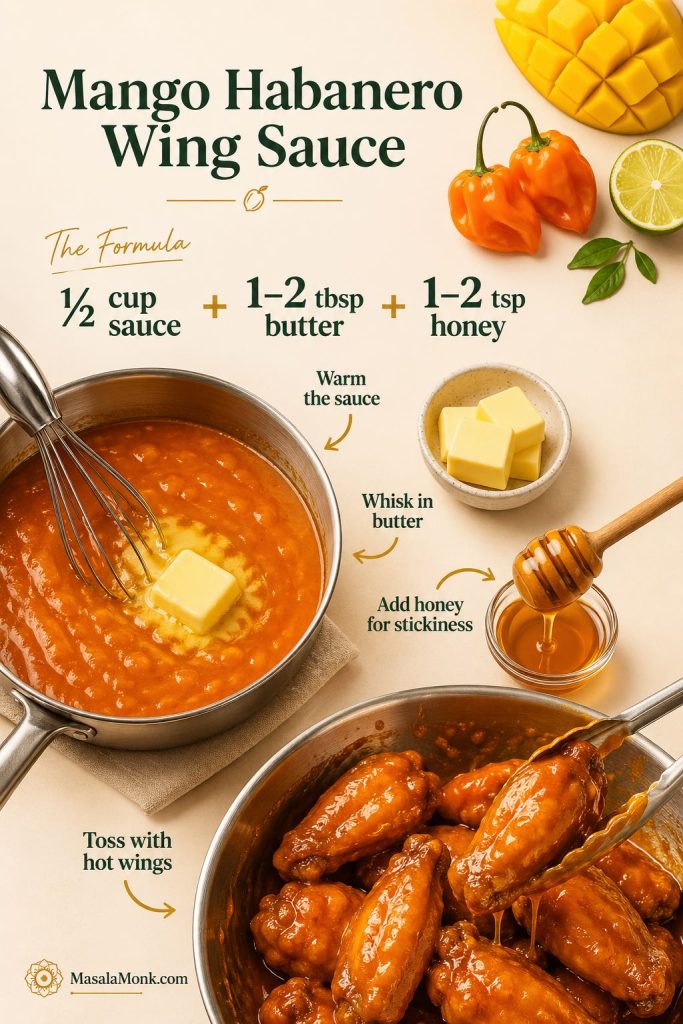
Mango Habanero Wing Sauce

For wings, the sauce needs to cling. Butter gives it gloss, honey helps it stick, and gentle heat brings everything together. In other words, this is the sweet heat version to use when you want glossy mango habanero sauce for wings.

This wing version works for chicken wings, boneless wings, tenders, cauliflower wings, paneer bites, or crispy tofu. For best results, warm the sauce first, then toss it with hot cooked wings just before serving.

Mango habanero wing sauce formula showing ½ cup sauce, butter, honey, warm sauce, whisk in butter, add honey, and toss with hot wings.
Turn the base mango habanero sauce into a glossy wing sauce by warming ½ cup sauce with butter and a little honey. The butter helps the sauce cling, while the honey gives the wings a sweet, sticky finish.

For 2 lb / 900 g Wings

Ingredient US Amount Metric Amount
Mango habanero sauce ½ cup 120 ml / 4 fl oz
Butter 1–2 tbsp 14–28 g / 0.5–1 oz
Honey or brown sugar 1–2 tsp 7–14 g honey or 4–8 g sugar
Lime juice or vinegar, optional 1 tsp 5 ml
Salt Pinch To taste

First, warm the mango habanero sauce in a small pan over low heat. Next, whisk in the butter until glossy. If you want a stickier wing sauce, add honey or brown sugar. Finally, if the sauce tastes too sweet, add lime juice or vinegar before tossing it with hot cooked wings.

Optional Baked Wings

For a simple oven version, use 2 lb / 900 g chicken wings, 1 tbsp / 10–12 g aluminum-free baking powder, ¾ tsp / 4 g kosher salt, ½ tsp garlic powder, and ½ tsp smoked paprika. First, pat the wings very dry. Then, toss them with the seasoning, arrange them on a rack, and bake at 425°F / 220°C for 45–50 minutes, flipping halfway.

After the wings are cooked, toss them with warm mango habanero wing sauce. For food safety, chicken wings should reach 165°F / 73.9°C internally, following USDA poultry temperature guidance.

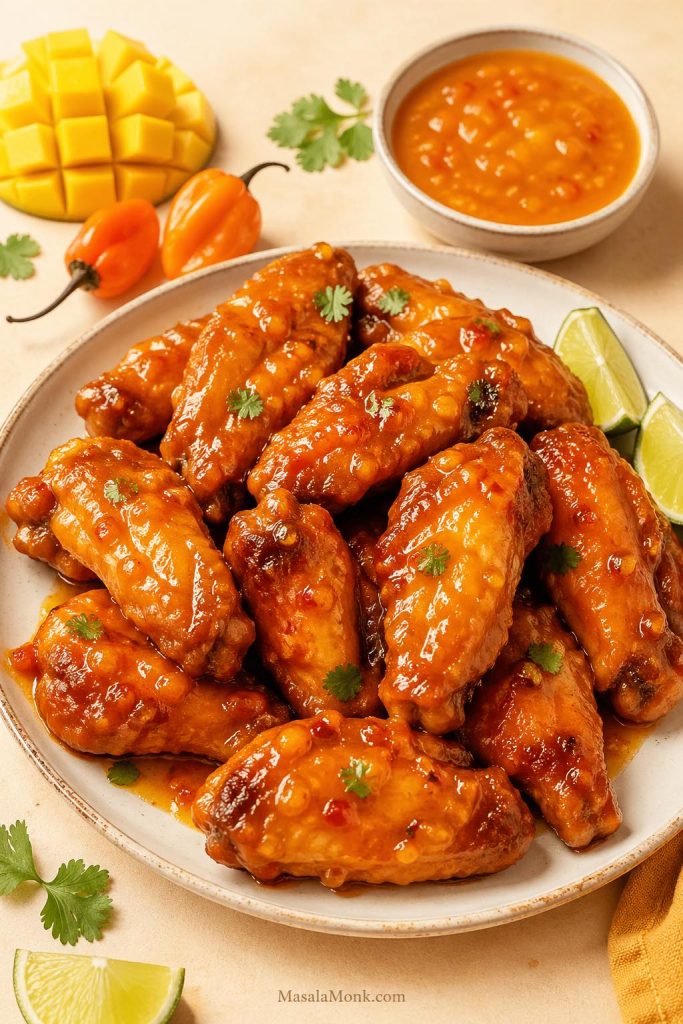
Glossy mango habanero chicken wings on a plate with mango, habanero peppers, lime wedges, and a bowl of orange wing sauce.
Toss hot cooked wings with warm mango habanero wing sauce just before serving so the buttery, sweet-spicy glaze clings instead of sliding off. The sauce should look glossy, sticky, and bright orange once it coats the wings.

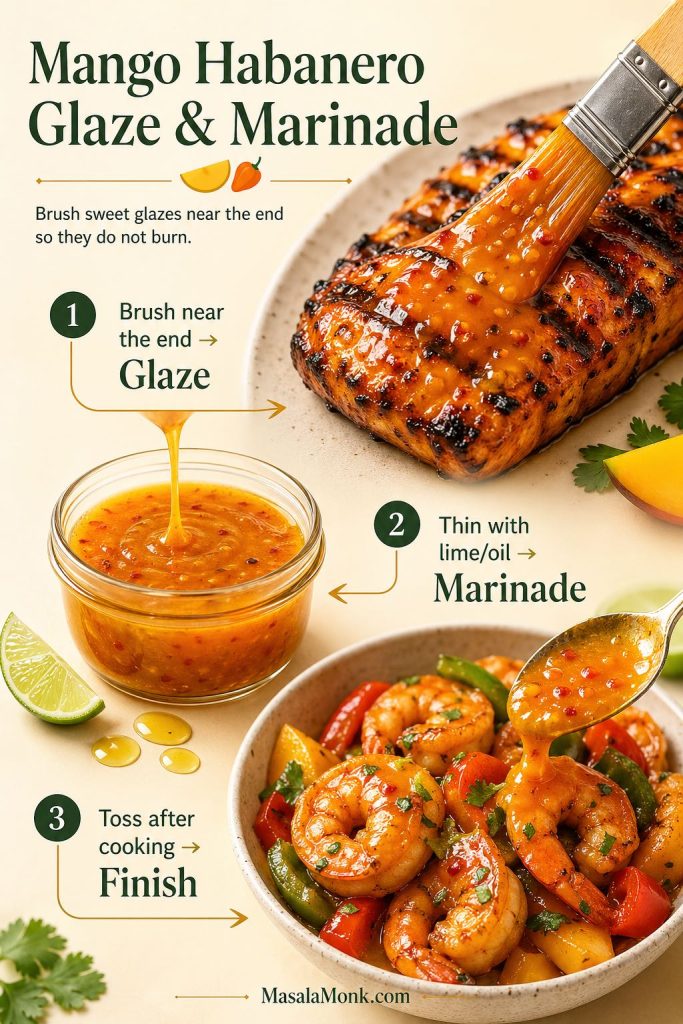
Mango Habanero Glaze

For a glaze, reduce the sauce instead of thinning it. A few extra minutes in the pan makes it thicker, shinier, and better for brushing onto grilled chicken, salmon, shrimp, pork, paneer, tofu, roasted vegetables, or skewers.

Ingredient Amount
Mango habanero sauce ¾ cup / 180 ml
Honey 1 tbsp / 20 g
Lime juice or vinegar 1 tsp / 5 ml
Butter or oil, optional 1 tbsp / 14 g butter or 1 tsp / 5 ml oil

Simmer for 5–8 minutes, until the glaze lightly coats the back of a spoon. Then, brush it onto food near the end of cooking so the sugars do not burn.

Mango habanero glaze and marinade guide showing sauce brushed on grilled food, thinned with lime and oil, and spooned over cooked shrimp.
Use mango habanero sauce as a glaze, marinade, or finishing sauce depending on texture. Brush sweet glazes near the end of cooking so they do not burn, thin the sauce with lime and oil for a marinade, or spoon it over cooked shrimp, chicken, paneer, tofu, or vegetables just before serving.

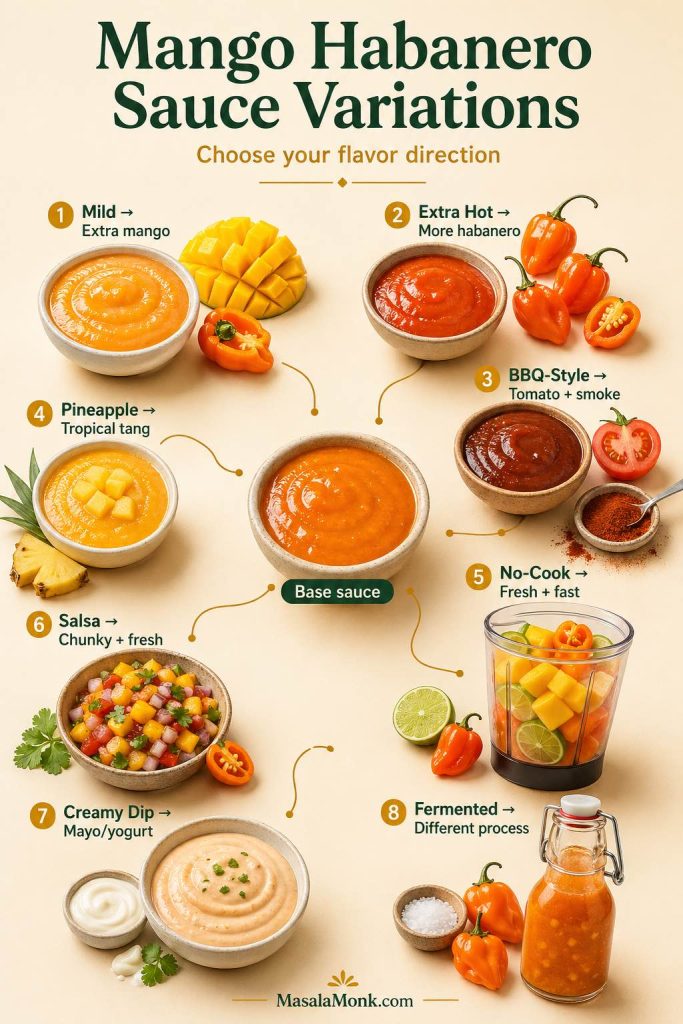
Mango Habanero Sauce Variations

Once the master sauce is balanced, the variations are easy. In fact, you can keep the same mango-habanero base, then change the texture, sweetness, smokiness, or cooking method depending on how you want to serve it.

For your first batch, however, keep the sauce simple. It is easier to learn your preferred heat and acid level before adding extra spices or turning the sauce into BBQ sauce, salsa, aioli, or a fermented hot sauce.

Mango habanero sauce variations guide showing mild, extra hot, BBQ-style, pineapple, no-cook, salsa, creamy dip, and fermented hot sauce options.
Once the base mango habanero sauce is balanced, you can take it in several directions. Add more mango for a milder sauce, more habanero for extra heat, pineapple for tropical tang, tomato and smoke for BBQ-style sauce, or mayo and yogurt for a creamy dip.

Mild Mango Habanero Sauce

For a milder sauce, use ½ seeded habanero and remove most of the white membrane. After blending, add extra mango if the heat still feels too sharp. You can also add a small amount of cooked orange bell pepper for body and color, but keep mango as the main flavor.

Extra Hot Mango Habanero Sauce

For an extra hot mango habanero sauce, use 3 or more habaneros only if you already enjoy very spicy sauces. Even then, add the extra pepper gradually so the sauce stays usable.

Mango Habanero BBQ Sauce

For a smoky, thicker version, simmer 1 cup / 240 ml mango habanero sauce with 2 tbsp / 30 g tomato paste, 1 tbsp / 12–14 g brown sugar, 1 tbsp / 15 ml apple cider vinegar, ½ tsp smoked paprika, ¼ tsp cumin, and 1 tsp / 5 ml Worcestershire sauce if you use it. As a result, the sauce becomes darker, thicker, and smoky-sweet after 8–10 minutes.

Pineapple Mango Habanero Sauce

For a brighter tropical variation, replace ½ cup / 80–90 g of the mango with pineapple. This version tastes sharper, juicier, and especially good with grilled shrimp, fish, chicken, tacos, and pork.

No-Cook Mango Habanero Sauce

For a faster, fresher version, blend the mango, habanero, vinegar, lime juice, garlic, salt, and sweetener without simmering. However, use less onion, or skip the onion, because raw onion can become sharp in a no-cook sauce.

This version tastes brighter and fruitier. However, it also tastes sharper and less rounded than the cooked sauce. Use the no-cook version within 2–3 days, and keep it refrigerated the whole time.

Mango Habanero Salsa

For a chunky salsa-style version, mix 1½ cups / 250 g diced mango with ½–1 very finely minced habanero, ¼ cup / 40 g red onion, 2 tbsp / 30 ml lime juice, 2 tbsp chopped cilantro, ½ tsp / 3 g salt, and optional tomato, cucumber, or pineapple. Then, rest the salsa for 10 minutes before serving.

For a chunkier mango topping with onion, cilantro, lime, and optional tomato or cucumber, see the full mango salsa recipe.

Mango Habanero Aioli or Creamy Dip

For a creamy dip, stir 1–2 tbsp cooled mango habanero sauce into ¼ cup mayonnaise, Greek yogurt, sour cream, or vegan mayo. Then, use it as a dip or sandwich spread for fries, burgers, wraps, tacos, nuggets, and roasted vegetables.

Fermented Mango Habanero Hot Sauce

Fermented mango habanero hot sauce is a different process from this quick cooked sauce. Instead of simmering first, the peppers, mango, onion, and garlic are usually fermented in a salt brine or mash before being blended with vinegar or lime.

Fermentation changes the safety and storage rules, so this quick cooked recipe should not be treated as a fermented sauce. If you want a fermented version, follow a dedicated fermented hot sauce method and pay attention to acidity, cleanliness, gas buildup, refrigeration, and pH if storing longer.

How to Use Mango Habanero Sauce

This is where the sauce earns its place in the fridge. For example, you can keep it medium-thick for dipping, thin it for drizzling, reduce it for glazing, or loosen it into a quick marinade.

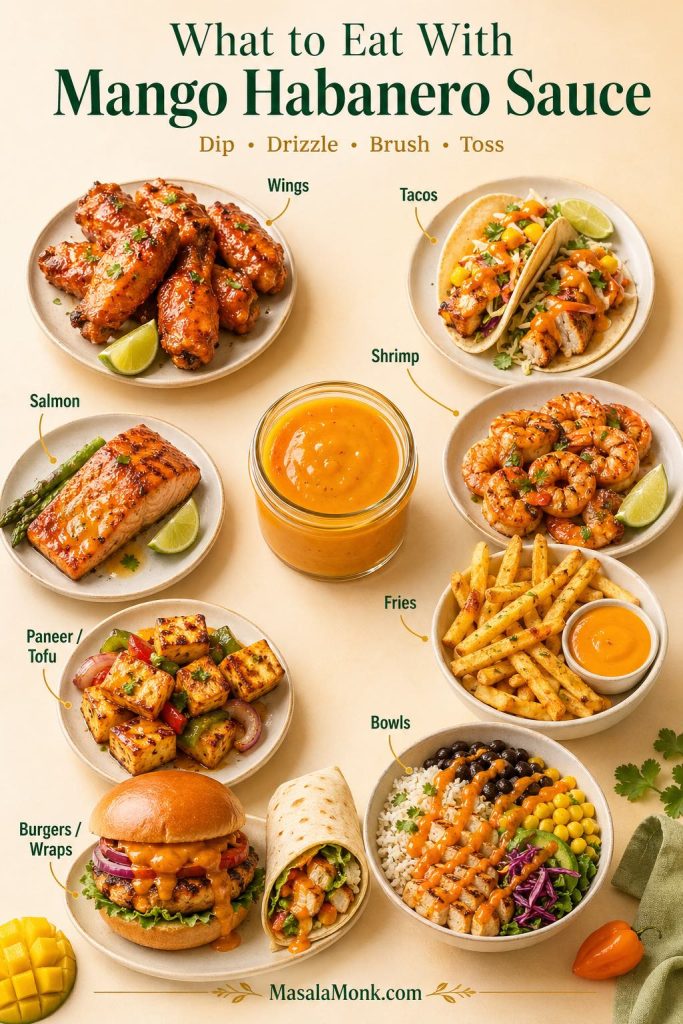
Use this mango habanero sauce for chicken, shrimp, salmon, fish tacos, rice bowls, burgers, wraps, roasted vegetables, paneer, tofu, and fries. In other words, it works anywhere you want sweet heat with a bright mango finish.

What to eat with mango habanero sauce, including wings, tacos, shrimp, salmon, fries, paneer or tofu, burgers, wraps, and bowls.
Mango habanero sauce works as a dip, drizzle, glaze, or finishing sauce. Use it with wings, tacos, shrimp, salmon, fries, paneer, tofu, burgers, wraps, bowls, or roasted vegetables whenever you want sweet heat with a bright mango finish.

As a hot sauce

As a hot sauce, it works best when the texture is thin and pourable. Drizzle it on tacos, eggs, nachos, rice bowls, grilled vegetables, beans, burritos, wraps, and roasted potatoes. For a thinner hot sauce texture, use the extra-vinegar version above.

As a wing sauce

For wings, warm it first so it coats evenly. Toss it with chicken wings, boneless wings, tenders, nuggets, cauliflower wings, paneer bites, or crispy tofu just before serving.

As a glaze

When using it as a glaze, brush it on grilled chicken, shrimp, salmon, pork, paneer, tofu, roasted carrots, sweet potatoes, or skewers near the end of cooking. Otherwise, the sugars in the mango and honey can scorch if they cook too long.

As a marinade

For a quick mango habanero marinade, thin the sauce with a little extra lime juice, vinegar, or oil. Use it for chicken, shrimp, fish, paneer, tofu, or vegetables. However, avoid marinating delicate seafood for too long because the acid can change the texture.

As a dip

For dipping, keep the texture thicker. This works as a mango habanero dipping sauce for fries, potato wedges, onion rings, pakoras, chips, crackers, chicken tenders, nuggets, vegetable sticks, or roasted cauliflower. If the sauce feels too hot, mix a spoonful into mayo or yogurt.

As a sandwich sauce

Inside sandwiches and wraps, a little goes a long way. Use it on burgers, fried chicken sandwiches, grilled cheese, wraps, rolls, spicy mayo-style spreads, and grilled paneer sandwiches. The sweet, spicy, tangy flavor works especially well with rich or crispy fillings.

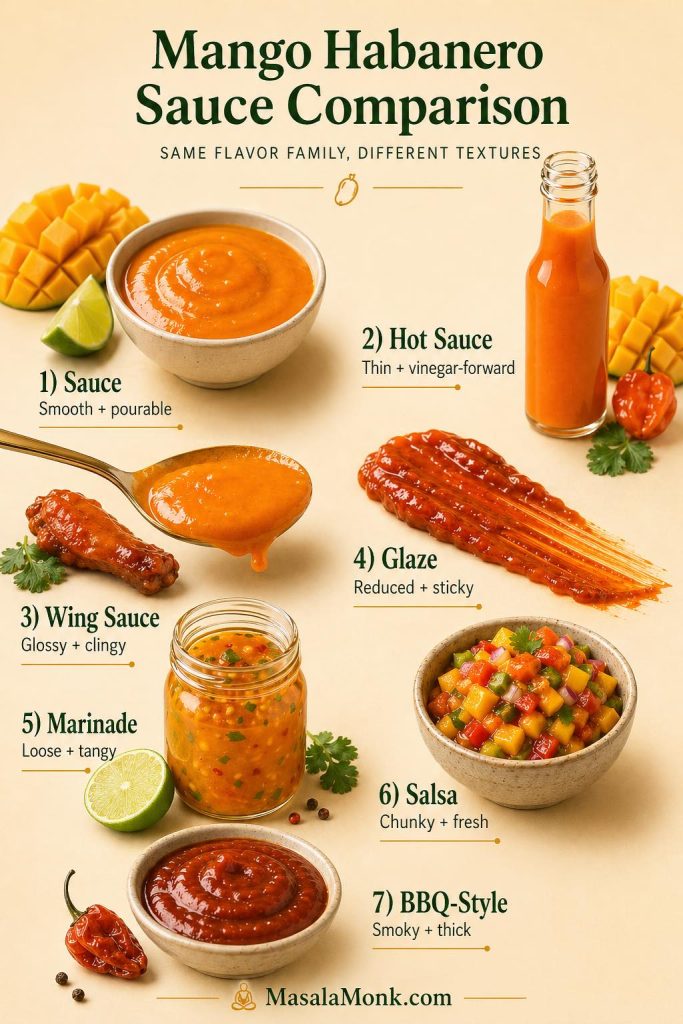
Mango Habanero Sauce vs Hot Sauce vs Wing Sauce vs Salsa

The names can get confusing because mango and habanero show up in several forms. However, the difference is mostly texture and use: hot sauce is thinner, wing sauce is buttery, glaze is reduced, salsa is chunky, marinade is looser, and BBQ sauce is smoky-sweet.

Mango habanero sauce comparison showing sauce, hot sauce, wing sauce, glaze, marinade, salsa, and BBQ-style sauce with different textures.
Mango habanero sauce can take several forms. Keep it smooth and pourable as an all-purpose sauce, thin it into hot sauce, finish it with butter for wings, reduce it into a sticky glaze, loosen it for marinade, make it chunky as salsa, or push it smoky and thick for BBQ-style sauce.
Version Texture Main Flavor Best Use
Mango habanero sauce Smooth, medium-thick, pourable Sweet, fruity, tangy, hot Wings, tacos, chicken, shrimp, dipping
Mango habanero hot sauce Thinner and more vinegar-forward Sharper, brighter, hotter Tacos, eggs, bowls, grilled food
Mango habanero wing sauce Glossy, buttery, clingy Sweet-hot and slightly sticky Chicken wings, tenders, cauliflower wings
Mango habanero marinade Loose, tangy, lightly sweet Bright, spicy, acidic Chicken, shrimp, fish, paneer, tofu
Mango habanero salsa Chunky or roasted Fresh, juicy, spicy Chips, tacos, fish, bowls
Mango habanero BBQ sauce Thicker, smoky, sticky Sweet, smoky, spicy Grilled chicken, ribs, burgers, sandwiches

Sauce Texture Guide

After blending, texture is the easiest thing to change. For example, a spoonful of vinegar can turn the base into a hot sauce, while a few extra minutes of simmering can turn it into a glaze. Use this guide to adjust the sauce for the way you want to serve it.

Version Texture Best Use How to Adjust
Mango habanero hot sauce Thin, pourable Tacos, eggs, bowls, grilled food Add more vinegar or water; strain if needed
All-purpose mango habanero sauce Medium-thick, pourable Chicken, tacos, fish, dipping Use the master recipe
Mango habanero wing sauce Glossy, clingy Wings, tenders, cauliflower wings Add butter and simmer briefly
Mango habanero glaze Thick, lacquered Grilled chicken, shrimp, salmon, paneer Add honey and reduce
Mango habanero dipping sauce Thick, spoonable Fries, tenders, pakoras, nuggets, vegetables Simmer slightly longer or stir into mayo/yogurt
Mango habanero marinade Loose, pourable Chicken, shrimp, fish, paneer, tofu Thin with lime, vinegar, or oil
Mango habanero BBQ sauce Thick, smoky-sweet Grilling, ribs, burgers Add tomato paste, brown sugar, and smoked paprika

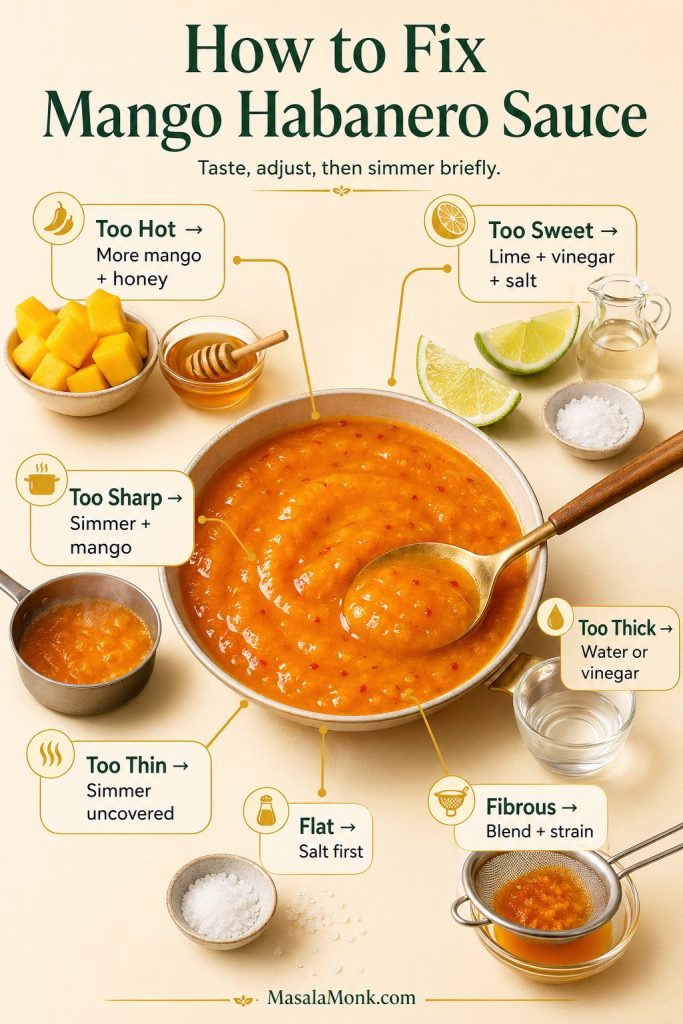
How to Fix Mango Habanero Sauce

Sauces are adjustable, especially before serving. Because mango sweetness, vinegar sharpness, and habanero heat can vary from batch to batch, taste the sauce after blending and fix it while it is still warm.

Troubleshooting guide for mango habanero sauce showing fixes for sauce that is too hot, too sweet, too sharp, too thick, too thin, flat, or fibrous.
Mango habanero sauce is easy to adjust while it is still warm. Add mango and honey if it is too hot, lime, vinegar, and salt if it is too sweet, water or vinegar if it is too thick, and simmer uncovered if it is too thin.
Problem Likely Cause Fix
Too hot Too much habanero or membrane Add more mango first; then round it with honey, lime, or butter if making wing sauce
Too sweet Very ripe mango plus too much sweetener Add vinegar, lime, and salt
Too sharp Too much acid or not enough simmering Simmer 3–5 minutes more; add mango or honey
Too thin Too much water or juicy mango Simmer uncovered until reduced
Too thick Dense mango or over-reduction Add water, vinegar, or lime 1 tbsp / 15 ml at a time
Bitter Burned garlic/onion or too much pepper pith Add mango and sweetener; avoid browning garlic next time
Flat Not enough salt or acid Add salt first. If it still tastes dull, add lime or vinegar
Not mango-forward Mango was bland or underripe Add ripe mango, thawed frozen mango, or mango pulp
Grainy or fibrous Fibrous mango or weak blender Blend longer, strain, or use smoother mango/frozen mango

Scaling the Recipe

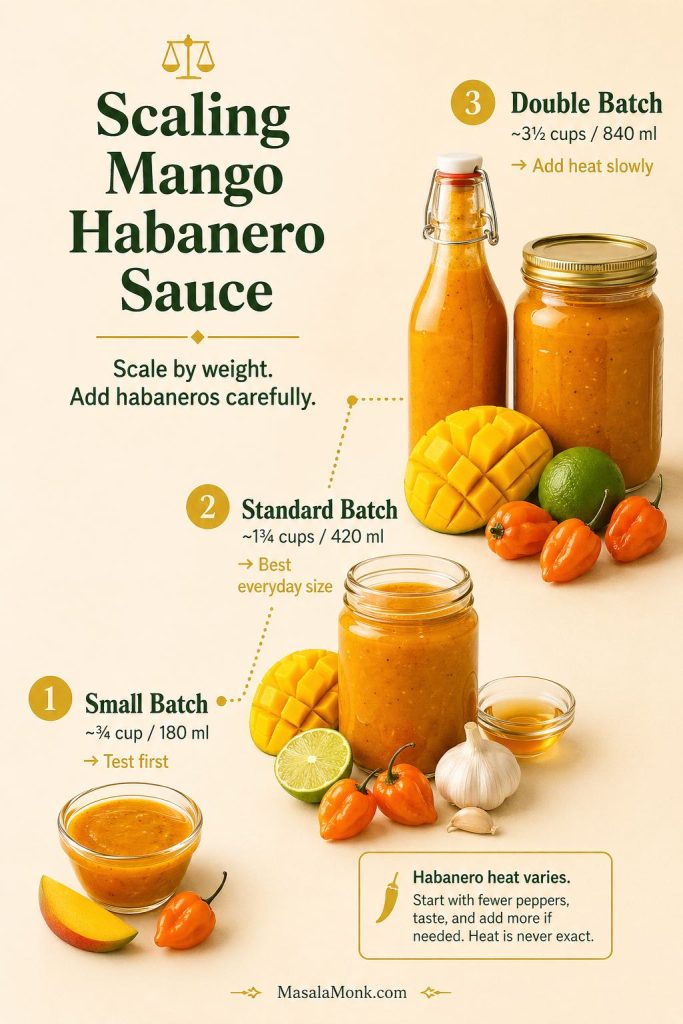
Scaling is easy for mango, vinegar, lime, garlic, onion, sweetener, and salt. However, habaneros are the exception. Their size and heat vary so much that they should be scaled by taste, not strict multiplication.

If you double the mango and liquid, you can usually double the garlic, onion, vinegar, lime, sweetener, and salt. With habaneros, start lower, blend, taste carefully, and increase only if the sauce needs more heat.

Scaling guide for mango habanero sauce showing small batch, standard batch, and double batch with a reminder to add habaneros carefully.
Scale mango habanero sauce by weight when possible, but add the habaneros more carefully than the mango, vinegar, lime, salt, and aromatics. Pepper heat varies, so start with fewer habaneros, taste after blending, and add more only if needed.
Ingredient Small Batch: ~¾ cup / 180 ml Standard: ~1¾ cups / 420 ml Double: ~3½ cups / 840 ml
Mango 125 g / ¾ cup 250 g / 1½ cups 500 g / 3 cups
Habanero ½–1 pepper 1–2 peppers 2–4 peppers, added carefully
Onion 20 g / 2 tbsp 40 g / ¼ cup 80 g / ½ cup
Garlic 1 clove / 3 g 2 cloves / 6 g 4 cloves / 12 g
Vinegar 40 ml / 2 tbsp + 2 tsp 80 ml / ⅓ cup 160 ml / ⅔ cup
Lime juice 15 ml / 1 tbsp 30 ml / 2 tbsp 60 ml / ¼ cup
Water 30 ml / 2 tbsp 60 ml / ¼ cup 120 ml / ½ cup
Honey 10–20 g 20–40 g 40–80 g
Salt 2–2.5 g 4–5 g 8–10 g

Storage, Freezing, and Canning Safety

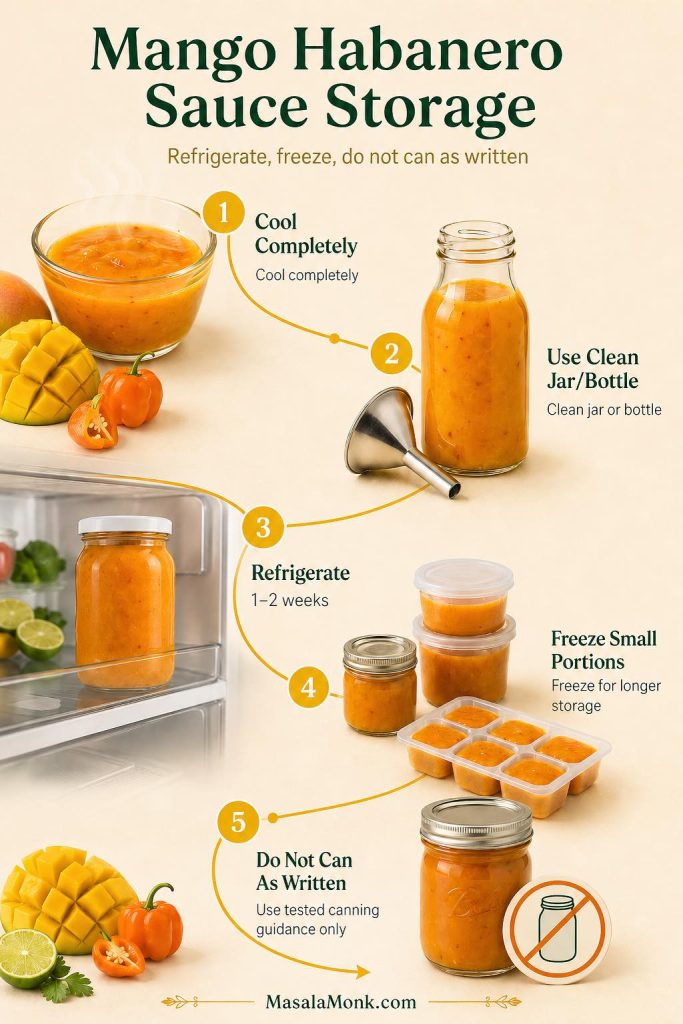
Storage is the one place where homemade hot sauce should stay conservative. After the sauce cools, store it in a clean glass jar or bottle in the refrigerator. For best flavor and freshness, use it within 1–2 weeks. For longer storage, freeze small portions instead.

Mango habanero sauce storage guide showing sauce cooling, being bottled, refrigerated for 1–2 weeks, frozen in small portions, and not canned as written.
Treat this homemade mango habanero sauce as a refrigerator sauce. Cool it completely, store it in a clean jar or bottle, refrigerate for 1–2 weeks, or freeze small portions for longer storage. Do not can this recipe as written unless you are using tested canning guidance.

Even though the sauce contains vinegar and lime juice, it also contains mango, onion, garlic, and fresh peppers. Therefore, it should be treated as a refrigerator sauce, not a shelf-stable canned hot sauce, unless you are following tested preservation guidance.

For hot sauce safety, SDSU Extension explains that hot sauce should have a pH below 4.6 and include acid such as vinegar. For canning-style recipes, use vinegar labeled 5% acidity; Illinois Extension notes that tested USDA and National Center for Home Food Preservation recipes are built around that acidity level.

Canning note: Do not water-bath can this sauce as written. For shelf-stable preservation, use a tested canning recipe and proper acidity controls.

The National Center for Home Food Preservation has separate tested mango sauce canning guidance. In other words, do not treat this refrigerator mango habanero sauce recipe as a shelf-stable canning recipe.

FAQs

Is mango habanero sauce very spicy?

Yes, it can be. Because habaneros are very hot peppers, this mango habanero sauce recipe can become intense quickly. Use ½ to 1 seeded habanero for a more controlled first batch, or 2 habaneros for a properly hot sauce.

Can I make this mango habanero sauce recipe less spicy?

Yes. First, use fewer habaneros. Next, remove the seeds and membrane before cooking. If the finished sauce is still too hot, add more mango, honey, lime, or butter if you are turning it into wing sauce.

Is this mango habanero sauce easy to make?

Yes. This is an easy cooked blender sauce: simmer the mango, habanero, onion, garlic, vinegar, water, and salt, then blend and finish with lime juice and sweetener.

Can I make mango habanero sauce at home without special equipment?

Yes. You only need a saucepan, blender, gloves, spoon or spatula, and a clean jar or bottle. For a smoother homemade hot sauce, however, a high-speed blender and fine mesh sieve are helpful.

Can I use frozen mango?

Yes. Frozen mango works well in this sauce recipe. Thaw it before cooking so the mango simmers evenly and blends smoothly with the habanero, vinegar, garlic, and onion.

Can I use mango pulp or mango puree?

Yes. Use about 1 cup / 250 g mango pulp or mango puree instead of diced mango. If the pulp is sweetened, skip the honey or sugar at first, then adjust the sauce after blending.

Should mango habanero sauce be cooked?

For this style, yes. Cooking the mango, habanero, onion, and garlic before blending makes the sauce smoother, rounder, and more versatile. A raw blender version can taste fresher, but it will also taste sharper and less polished.

How do I make mango habanero hot sauce thinner?

Increase the vinegar to ½ cup / 120 ml, add water as needed, blend very smooth, and strain if you want a bottle-friendly texture. This gives the mango habanero sauce a thinner, sharper hot sauce consistency.

How do I make mango habanero wing sauce?

Warm ½ cup / 120 ml mango habanero sauce with 1–2 tbsp / 14–28 g butter, plus a little honey if you want it stickier. Then, toss hot cooked wings in the warm sauce just before serving.

Can I make mango habanero sauce without sugar?

Yes. If your mango is ripe and sweet, you can skip the honey, sugar, or maple syrup. However, the sauce will taste sharper and more hot-sauce-like, so adjust with extra mango or a little more salt if needed.

Can I make mango habanero sauce without vinegar?

You can reduce the vinegar and use more lime juice for a fresher flavor. However, the sauce will taste less like hot sauce and should still be refrigerated. For storage and hot-sauce character, vinegar is the better choice.

Is habanero mango sauce the same as mango habanero sauce?

Yes. Habanero mango sauce and mango habanero sauce usually mean the same thing: a sweet-hot sauce made with mango and habanero peppers. Mango habanero sauce is the more common way to describe it because the mango gives the sauce its body, color, and sweetness.

Is mango habanero sauce the same as mango habanero salsa?

No. Mango habanero sauce is usually smooth, cooked, and pourable. Mango habanero salsa is usually chunky, fresher, and made for chips, tacos, fish, shrimp, and bowls.

What vinegar is best for mango habanero sauce?

Apple cider vinegar gives the sauce a rounder, fruitier tang. White vinegar tastes sharper and more classic for hot sauce. Either works, but use vinegar labeled 5% acidity if you are following preservation-style guidance.

What can I use instead of habanero peppers?

Scotch bonnet peppers are the closest substitute because they have a similar fruity heat. Use the same cautious approach: start with ½ to 1 pepper, then increase only after tasting. For a milder sauce, use jalapeño, serrano, or Fresno peppers. The recipe will not have the same floral habanero punch, but it will still make a good spicy mango sauce.

Does mango habanero sauce need to be refrigerated?

Yes. This homemade mango habanero sauce should be refrigerated because it contains mango, onion, garlic, and fresh peppers. Store it in a clean jar or bottle and use it within 1–2 weeks for best flavor and freshness.

How long does mango habanero sauce last?

Store this mango habanero sauce recipe in the refrigerator and use it within 1–2 weeks for best flavor and freshness. For longer storage, freeze small portions instead of leaving the sauce at room temperature.

Can you freeze mango habanero sauce?

Yes. Freeze it in small portions, then thaw only what you need. The texture may loosen slightly after thawing, so shake, stir, or blend it again before serving.

Can I can mango habanero sauce?

Do not can this recipe as written. It is a refrigerator sauce, not a tested shelf-stable canning recipe. Use a tested canning recipe and proper pH controls if you want shelf-stable preservation.

Save this mango habanero sauce recipe for the next time you want a sweet, spicy, tangy sauce for wings, tacos, bowls, grilled food, or dipping.

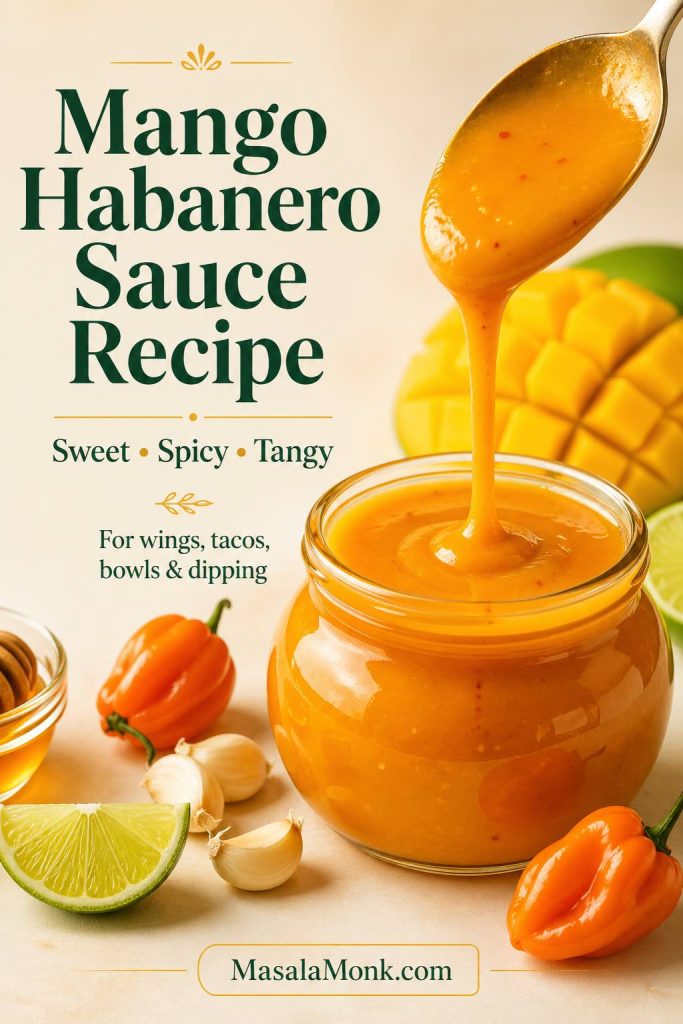
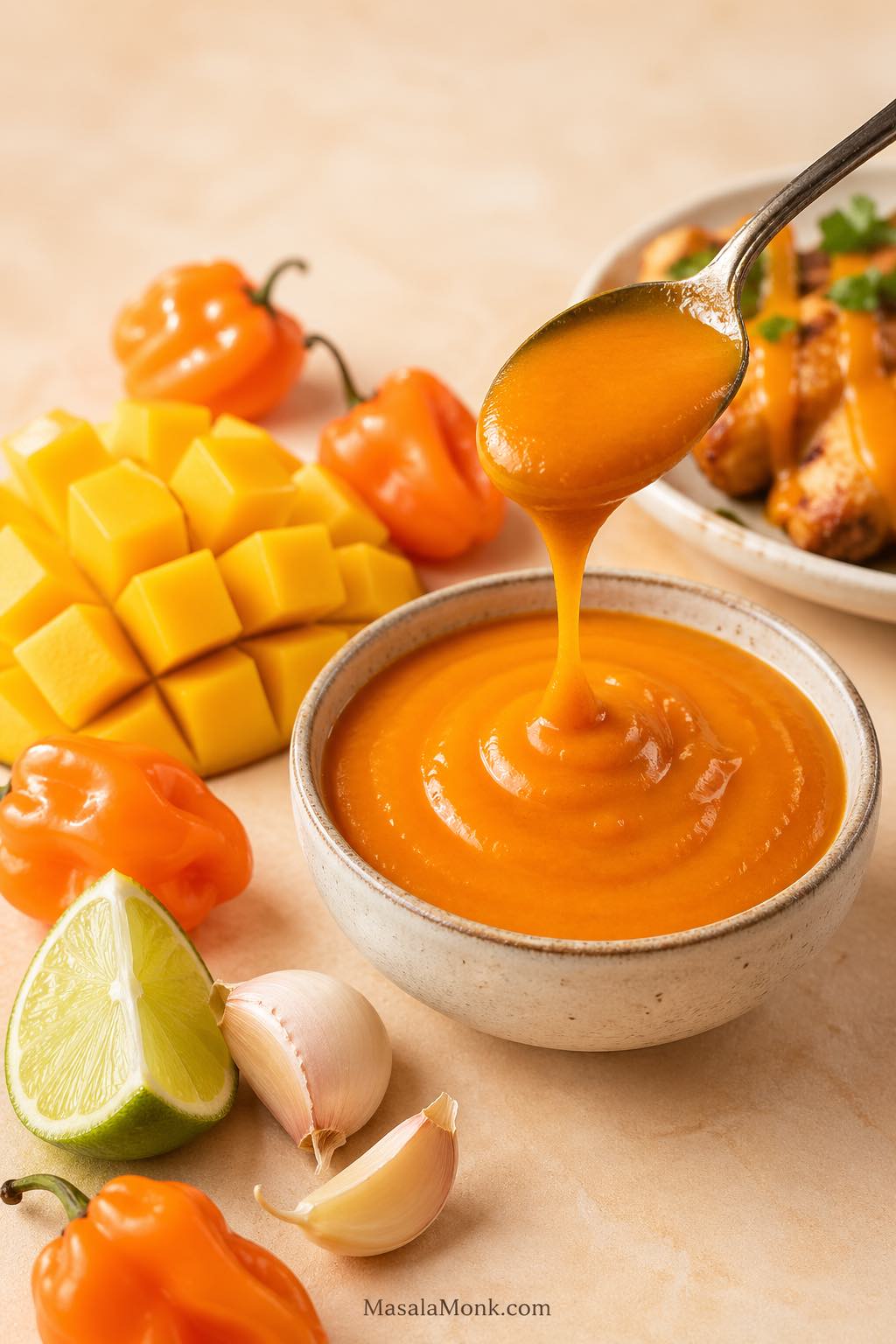
Mango habanero sauce recipe pin with glossy orange sauce in a jar, spoon pour, mango, habanero peppers, lime, garlic, and honey.
This mango habanero sauce recipe makes a sweet, spicy, tangy sauce for wings, tacos, bowls, dipping, glazing, and drizzling. The mango gives body and sweetness, while habanero, lime, vinegar, and garlic keep it bright and fiery.

Back to top