Posted on Leave a comment

Mango Habanero Sauce Recipe: Sweet-Spicy Hot Sauce for Wings, Tacos & Chicken

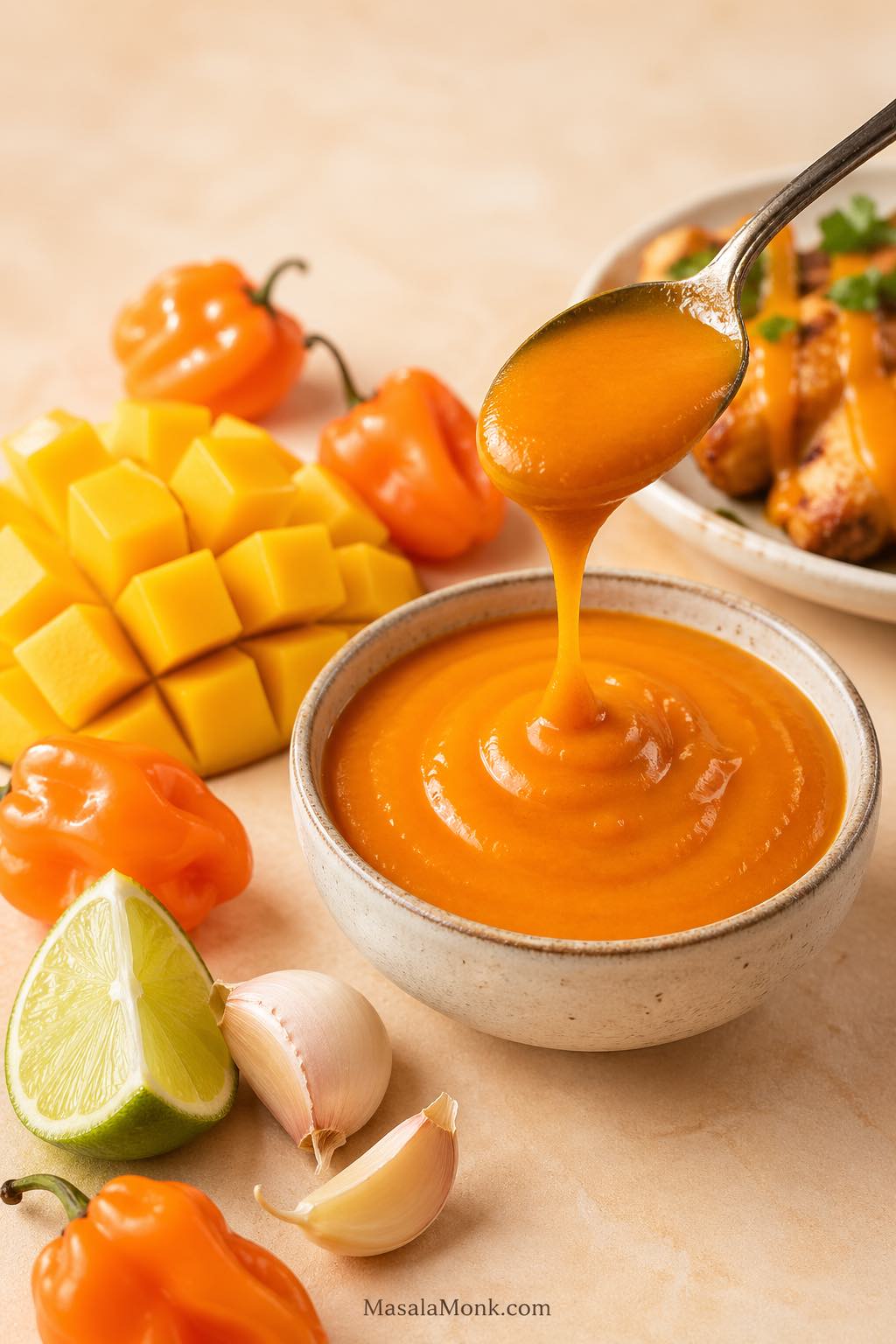
Glossy mango habanero sauce in a bowl with fresh mango, orange habanero peppers, lime, garlic and wings in the background.

A good mango habanero sauce recipe should taste fruity, fiery, tangy, and balanced. The mango should come through clearly, the habanero should bring real heat, and the vinegar, lime, salt, garlic, and onion should keep the sauce sharp enough for wings, tacos, grilled chicken, shrimp, fish, paneer, tofu, burgers, wraps, fries, and rice bowls.

The useful part is that this homemade mango habanero sauce starts with one flexible base. From there, you can thin it into hot sauce, finish it with butter for wings, reduce it into a glaze, stir it into a creamy dip, or push it toward a BBQ-style sauce. Instead of locking you into one narrow version, it shows you how to control heat, texture, sweetness, acidity, and storage.

Here, the sauce starts as a cooked blender mango habanero sauce: mango, habanero, onion, garlic, vinegar, water, and salt simmer first, then everything is blended smooth and finished with lime juice and sweetener. As a result, the finished sauce tastes rounder than a raw blend, smoother than a salsa, and more useful than a plain vinegar hot sauce.

It is also easy to make. The base simmers in one pan, then blends into a smooth, pourable sauce without special hot sauce equipment. For that reason, you can make a bold homemade hot sauce at home without fermenting, canning, or buying specialty tools.

The one thing to respect is the habanero itself. It is seriously hot, so this recipe gives you a clear heat guide before you cook. Start with one pepper for a medium-hot mango habanero sauce, use two for a properly hot version, and only go beyond that if you already know you love very spicy sauces.

Quick Answer: What Is Mango Habanero Sauce?

Mango habanero sauce is a sweet-spicy homemade sauce made with ripe mango, habanero peppers, vinegar, lime juice, garlic, onion, salt, and a little sweetener. In this recipe, the sauce is cooked and blended, so it becomes smooth, bright orange, fruity, tangy, and hot.

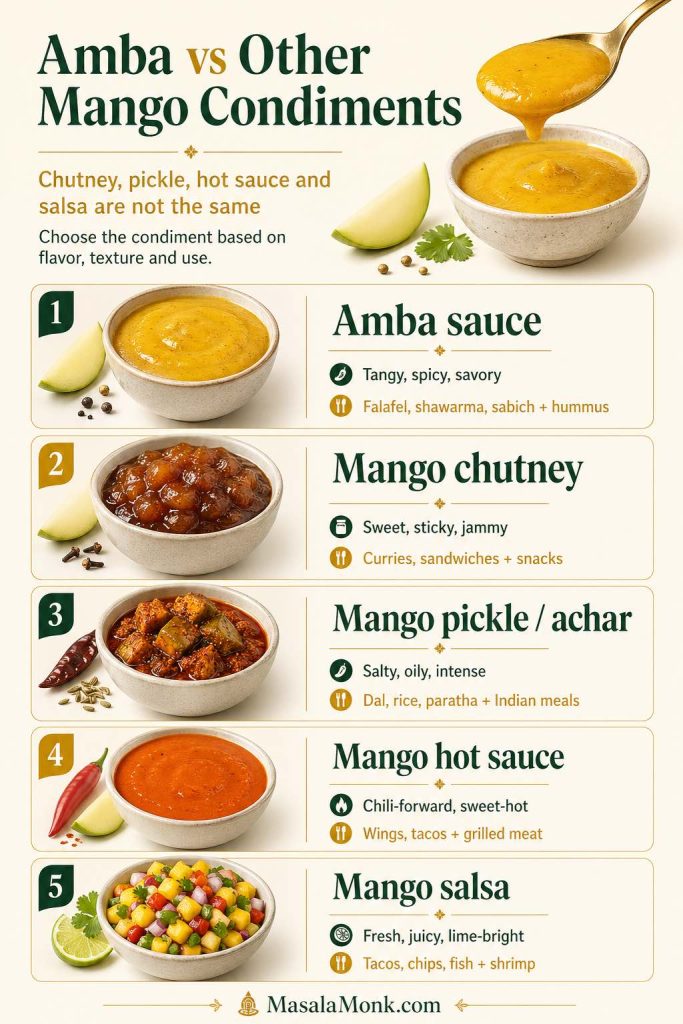
Unlike mango mustard sauce, this mango habanero sauce recipe is hotter and more chili-forward. Where mango salsa stays chunky and fresh, this sauce is cooked, blended, and pourable. Amba sauce, by contrast, leans more sour and pickle-like, while mango habanero sauce is sweeter, fruitier, and built around habanero heat.

Its biggest advantage is flexibility. For example, you can drizzle it over tacos and eggs, toss it with wings, brush it onto grilled shrimp or salmon, serve it with fries, or spread it inside burgers and wraps.

At a glance: This homemade mango habanero sauce recipe makes about 1¾ cups / 420 ml. Use 1 habanero for medium-hot, 2 for hot, and 3+ only if you love serious heat. The base sauce is cooked, smooth, fruity, tangy, and pourable. Increase the vinegar for a thinner hot sauce, or finish the sauce with butter for a glossy wing sauce.

This version is best for readers who want a homemade mango habanero sauce that is hot but still usable, not a sauce so fiery that it only works a few drops at a time.
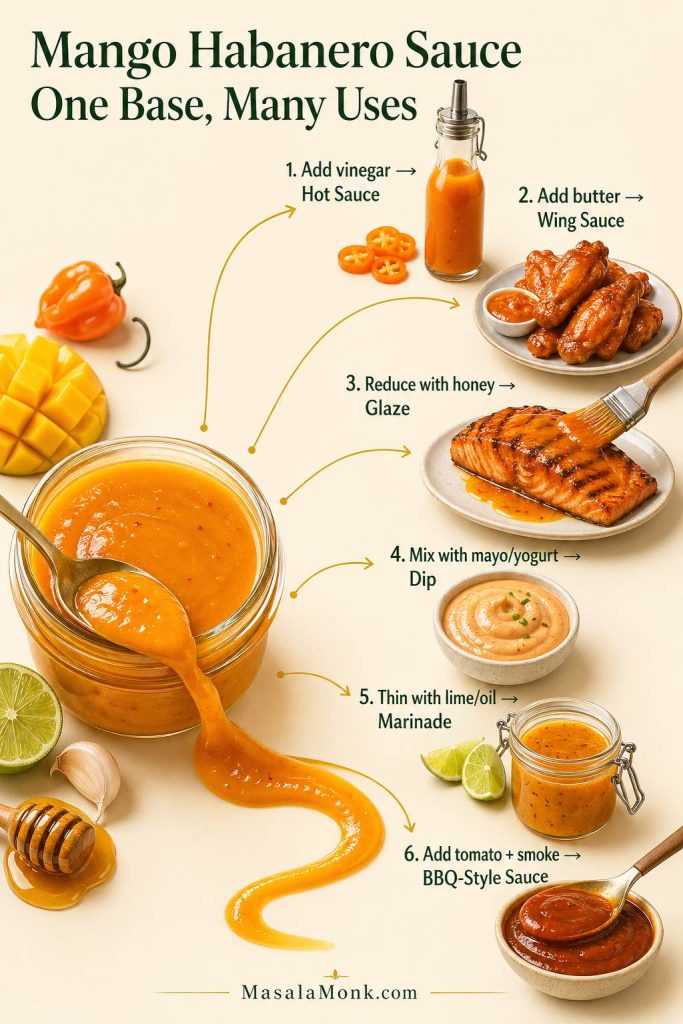
Homemade mango habanero sauce in a jar with arrows showing how to turn one base into hot sauce, wing sauce, glaze, dip, marinade, and BBQ-style sauce.
One homemade mango habanero sauce can go several directions. Thin it with vinegar for hot sauce, finish it with butter for wings, reduce it with honey for a glaze, stir it into mayo or yogurt for a creamy dip, or loosen it with lime and oil for a quick marinade.

Why This Mango Habanero Sauce Recipe Works

The balance starts with the mango. It gives the sauce body, color, and natural sweetness. The habanero brings the heat, but it also adds a floral, fruity aroma. Meanwhile, vinegar and lime keep everything sharp, while salt makes the mango and chili taste complete.

Cooking the base first also matters. It softens the onion, garlic, mango, and habanero before blending, so the finished sauce tastes rounder instead of raw or harsh. As a result, the cooked base tastes smoother, while the lime added at the end keeps the sauce bright.

That balance makes the sauce flexible at home. For example, keep it medium-thick for dipping, thin it with extra vinegar for hot sauce, finish it with butter for wings, or reduce it into a glaze for grilled food.

What Does Mango Habanero Sauce Taste Like?

At first, mango habanero sauce should taste fruity and bright. After a few seconds, the habanero heat should build. The mango gives the recipe ripe tropical sweetness, the vinegar and lime keep the sauce tangy, and the habanero adds a floral heat that lingers.

A good batch should not taste like mango jam, and it should not taste like plain vinegar hot sauce either. Instead, the best version lands in that sweet and spicy middle ground: fruity enough for dipping, sharp enough for tacos, and bold enough for wings.
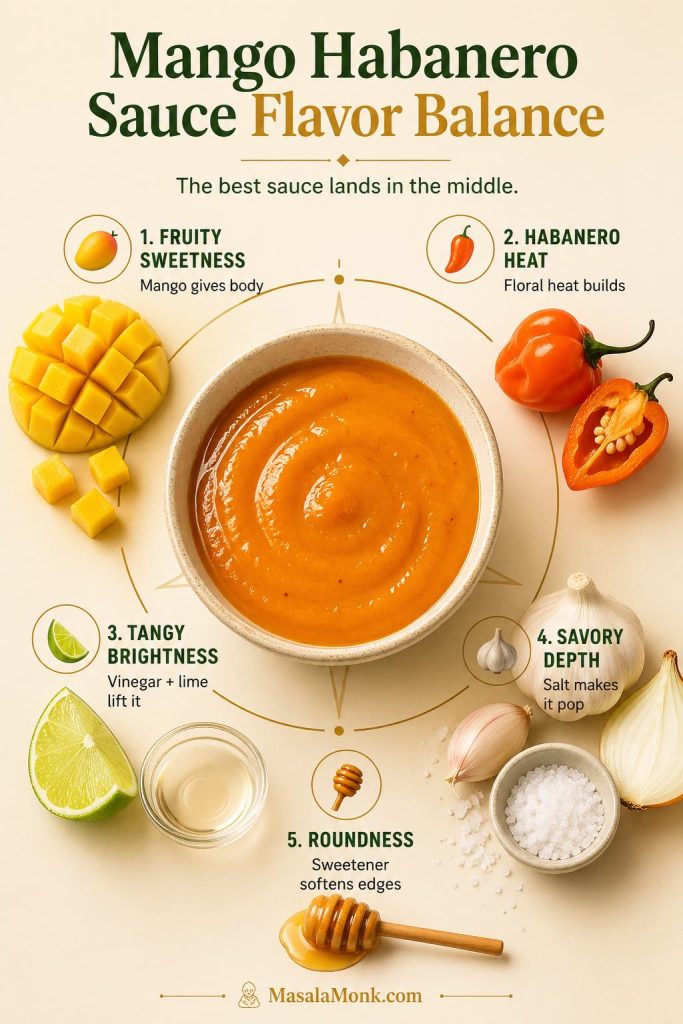
Mango habanero sauce flavor balance guide showing mango sweetness, habanero heat, vinegar and lime brightness, savory depth, and honey roundness.
A good mango habanero sauce should land in the middle: fruity from mango, hot from habanero, bright from vinegar and lime, savory from garlic, onion, and salt, and rounded with just enough sweetener.

When one flavor takes over, adjust the sauce in stages. First, fix flatness with salt. Next, use lime or vinegar when the sauce tastes too sweet. Finally, when the habanero heat is running the show, bring the sauce back into balance with more mango or a little honey.

Ingredients for This Mango Habanero Sauce Recipe

Think of the ingredients in roles, not just measurements. Mango gives body, sweetness, and color. Habanero gives heat and aroma. Vinegar gives sharpness, lime gives freshness, garlic and onion give depth, and sweetener rounds the edges.

The table below gives you a balanced starting point. Once the sauce is blended, you can adjust sweetness, heat, acid, salt, and thickness to match how you want to use it.
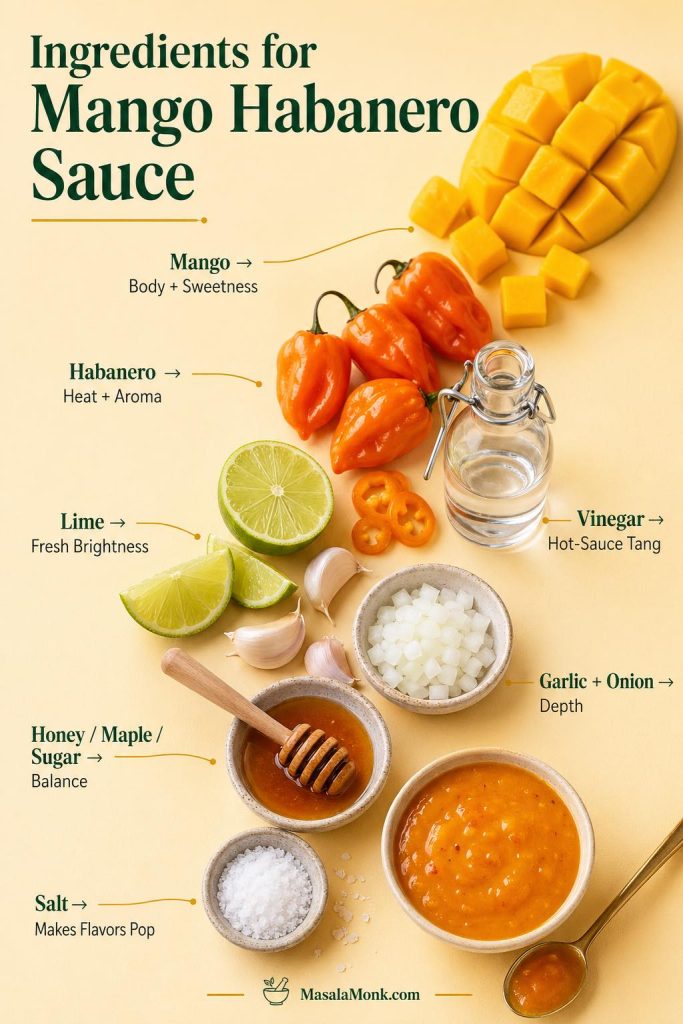
Ingredients for mango habanero sauce including ripe mango, habanero peppers, lime, vinegar, garlic, onion, honey, salt, and finished sauce.
Each ingredient has a job in mango habanero sauce: ripe mango gives body and sweetness, habanero brings heat, vinegar and lime keep it tangy, garlic and onion add depth, and honey or sugar rounds the edges.
Ingredient US Amount Metric Amount Why It Matters
Ripe mango, diced 1½ cups 250 g / 8.8 oz Sweetness, body, color, and fruit flavor
Fresh habanero peppers 1–2 peppers about 10–20 g / 0.35–0.7 oz Heat and floral chili aroma
Onion, chopped ¼ cup 40 g / 1.4 oz Savory body and depth
Garlic 2 cloves 6 g / 0.2 oz Sharpness and backbone
Apple cider vinegar or white vinegar ⅓ cup 80 ml / 2.7 fl oz Tang and hot-sauce character
Fresh lime juice 2 tbsp 30 ml / 1 fl oz Fresh brightness
Water ¼ cup 60 ml / 2 fl oz Helps the sauce simmer and blend
Honey, sugar, or maple syrup 1–2 tbsp 20–40 g honey/maple or 12–25 g sugar Balances heat and acid
Fine sea salt ¾ tsp 4–5 g Makes the sauce taste complete

Optional flavor additions include ½–1 teaspoon grated ginger for tropical warmth, ¼ teaspoon cumin for earthiness, ¼ teaspoon smoked paprika for a BBQ-style direction, or a tiny pinch of allspice for a Caribbean-style note. However, for a first batch, keep the sauce simple before adding too many extra spices.

Best Mango to Use: Fresh, Frozen or Mango Pulp

For the brightest fresh mango flavor, use ripe mango that smells sweet before you cut it. Since mango is the body of this sauce recipe, the fruit should taste good before it goes into the pan.
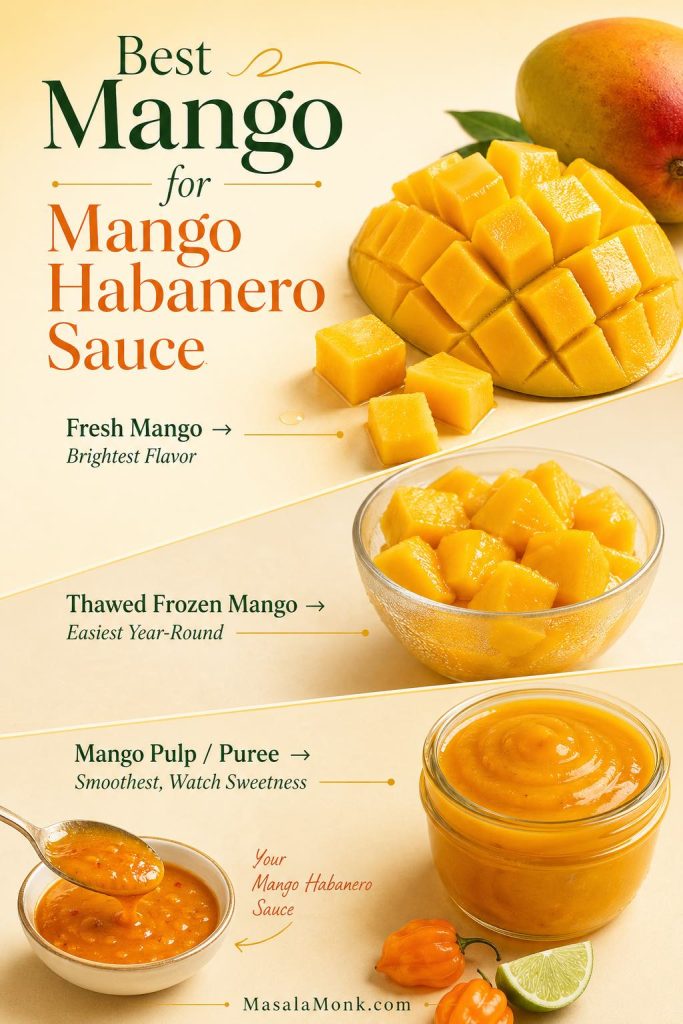
Best mango options for mango habanero sauce, showing fresh mango, thawed frozen mango, mango pulp or puree, and finished mango habanero sauce.
Fresh mango gives mango habanero sauce the brightest flavor, thawed frozen mango is the easiest year-round option, and mango pulp or puree makes the sauce extra smooth. If using sweetened pulp, start with less honey or sugar and adjust after blending.

Meanwhile, mango habanero sauce with frozen mango can also taste excellent when fresh mango is out of season. Thaw frozen mango first, then use it like fresh diced mango. It often blends smoothly and gives the sauce a consistent color and texture.

Mango pulp or mango puree can also work, especially when you want a very smooth sauce. However, the one thing to watch is sweetness. Many mango pulps are already sweetened, so start with little or no honey or sugar and adjust after blending.

On the other hand, underripe mango will make the sauce sharper and less fruity. Very fibrous mango can also make the finished sauce harder to blend smooth, so strain it through a fine mesh sieve if needed.

Can You Use Mango Pulp or Mango Puree?

Yes, mango pulp or mango puree can work well in this mango habanero sauce recipe. Use about 1 cup / 250 g mango pulp in place of the diced mango. If the pulp is sweetened, skip the honey or sugar at first and adjust only after the sauce has simmered and blended.

Heat Guide for This Mango Habanero Sauce Recipe

This is the section to read before cutting the peppers. Habaneros are much hotter than jalapeños; the Chile Pepper Institute lists orange habanero at around 250,000 Scoville Heat Units. That kind of habanero pepper heat can take over a mango sauce quickly.

For that reason, one seeded habanero is the best first batch for most people. After blending, you can always add more heat in small amounts. Once too much habanero is blended into the whole sauce, though, it is much harder to fix.
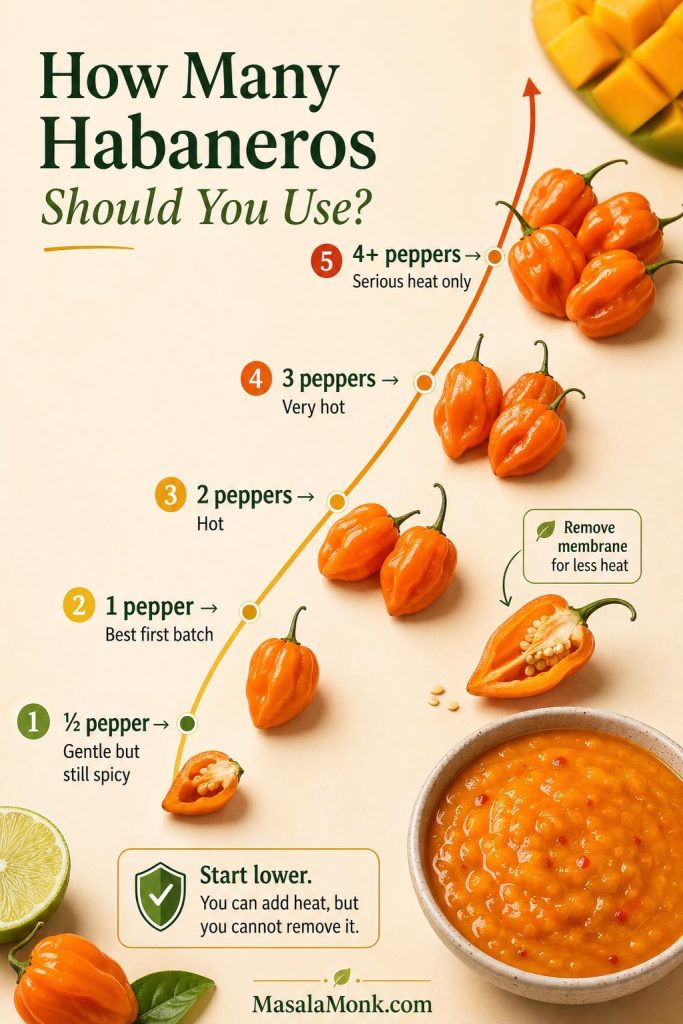
Heat guide for mango habanero sauce showing ½ pepper, 1 pepper, 2 peppers, 3 peppers, and 4+ habaneros from gentle heat to serious heat.
Start lower when making mango habanero sauce. One seeded habanero is the safest first batch for most people, while two peppers make it hot and three or more should be saved for serious heat lovers.

Use the table below to make a mild mango habanero sauce, medium-hot sauce, hot sauce, or extra hot mango habanero sauce without guessing.

Heat Level Habanero Amount Prep Method Best For
Gentle but still spicy ½ pepper Seeds and membrane removed First-time habanero users
Medium-hot 1 pepper Mostly seeded Best first batch
Hot 2 peppers Some membrane left Wings, tacos, spicy bowls
Very hot 3 peppers Some seeds and membrane included Hot sauce lovers
Extreme 4+ peppers Use with caution Serious heat lovers only
Heat tip: Start with less habanero than you think. You can always blend in more heat later, but you cannot remove it once the whole batch is too hot.
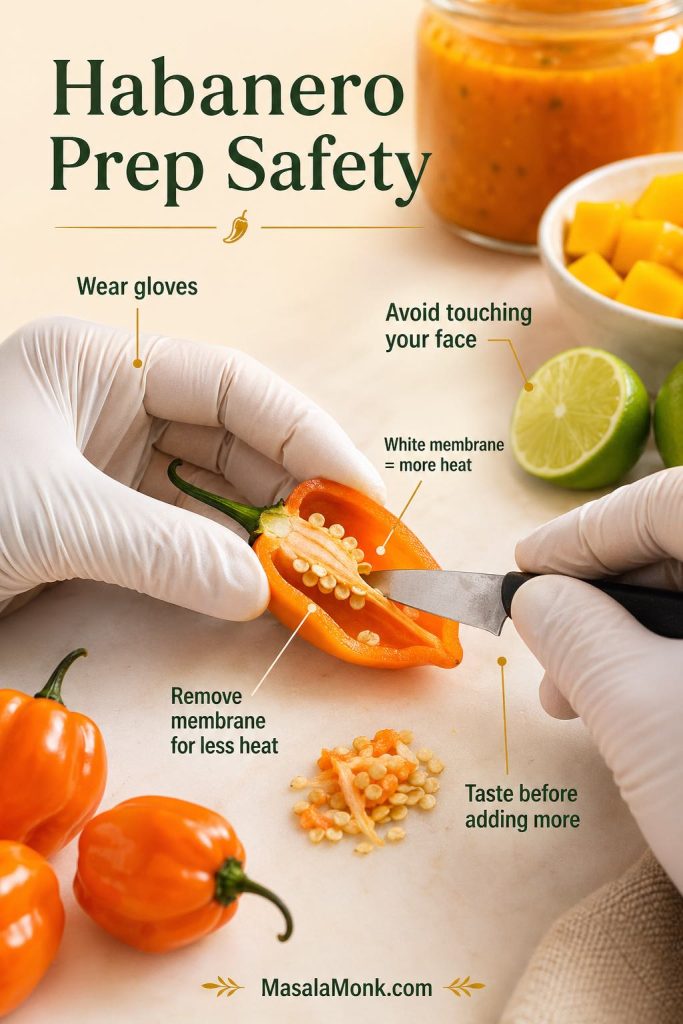
Gloved hands removing seeds and white membrane from an orange habanero pepper for mango habanero sauce.
Wear gloves when cutting habaneros, avoid touching your face, and remove some of the white membrane if you want better heat control. The membrane carries much of the pepper’s heat, so removing it makes the mango habanero sauce easier to manage.

Before cutting the peppers, wear gloves. In addition, avoid touching your eyes, nose, lips, or face after handling habaneros. The white membrane inside the pepper carries a lot of the heat, so removing it gives this sauce recipe more control.

Equipment You Need

You need a small saucepan, a blender or immersion blender, gloves for handling habaneros, a spoon or spatula, and a clean jar or bottle for storing the finished sauce. A high-speed blender gives the smoothest mango habanero sauce, but an immersion blender works if you do not mind a slightly thicker texture. For a very smooth, bottle-friendly hot sauce, keep a fine mesh sieve nearby so you can strain the sauce after blending.

How to Make This Mango Habanero Sauce Recipe

The method is simple, but the order matters: cook first, blend second, brighten last. First, simmering softens the mango, onion, garlic, and habanero. Next, blending turns them into a smooth sauce. Finally, lime juice and sweetener go in near the end so the finished sauce tastes bright instead of dull.
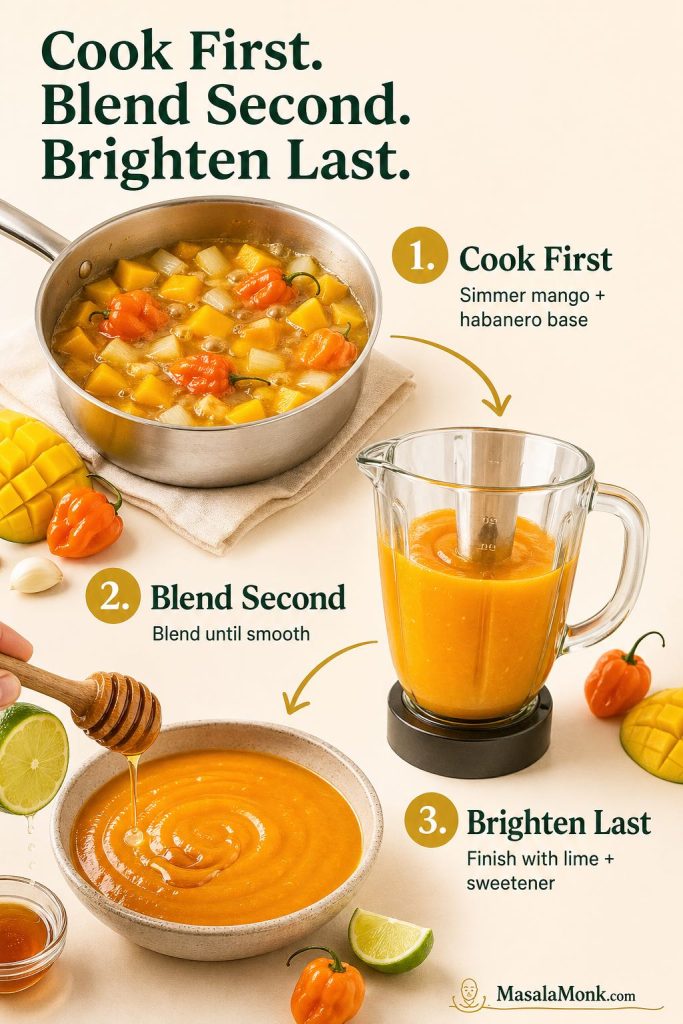
Three-step method for mango habanero sauce showing mango and habanero simmering, blending smooth, and finishing with lime and sweetener.
The order matters for smooth mango habanero sauce: simmer the mango, habanero, onion, garlic, vinegar, and water first, blend the softened mixture until smooth, then finish with lime juice and sweetener for brightness.

1. Prep the habaneros safely

First, put on gloves. Remove the stems from the habaneros. For less heat, cut the peppers open and scrape out most of the seeds and white membrane.

2. Simmer the mango and habanero base

Next, add the mango, habanero, onion, garlic, vinegar, water, and salt to a small saucepan. Bring the mixture to a visible boil over medium heat, then reduce it to a gentle simmer.

Simmer for 10–15 minutes, stirring often, until the mango and onion are soft. This cooking step rounds out the onion, garlic, and habanero, so the finished sauce tastes smoother and less raw.

3. Cool slightly and blend

After that, let the mixture cool for about 5 minutes. Blend until completely smooth. If using a blender, vent the lid slightly and cover it with a towel so steam does not build pressure.

4. Finish the sauce

At this point, return the sauce to the pan. Stir in lime juice, honey or sugar, and any optional spices. Then, simmer for another 2–5 minutes, until the mango habanero sauce looks glossy and unified.

5. Taste and adjust

Finally, taste carefully, using only a tiny spoon at first. Habanero heat builds as you eat, so the sauce may feel hotter after a few seconds.

  • If the sauce tastes flat, add salt.
  • If the mango habanero sauce tastes too sweet, add lime juice or vinegar.
  • If the recipe tastes too sharp or too hot, add mango or honey.
  • If the sauce is too thick, add water a spoonful at a time.
  • If the sauce is too thin, simmer uncovered until it reduces.
Common mistakes to avoid: Do not add all the habaneros at once if you are unsure about heat. Also, do not skip the salt, because the sauce will taste flat. Do not over-thin the sauce before blending; you can always add water later. Finally, do not assume this homemade mango habanero sauce is shelf-stable just because it contains vinegar.

Use the mango habanero sauce recipe below as the master version. From there, adjust the thickness and finish depending on whether you want hot sauce, wing sauce, glaze, dip, marinade, or BBQ-style sauce.

Mango Habanero Sauce Recipe

This homemade mango habanero sauce recipe makes a cooked blender sauce that is fruity, fiery, tangy, smooth, and flexible enough for wings, tacos, chicken, shrimp, fish, paneer, tofu, fries, burgers, wraps, and bowls.

YieldAbout 1¾ cups / 420 ml / 14 fl oz
Prep Time10 minutes
Cook Time15–20 minutes
Total Time25–30 minutes

Ingredients

  • 1½ cups / 250 g ripe mango, diced
  • 1–2 habanero peppers, stemmed
  • ¼ cup / 40 g chopped onion
  • 2 garlic cloves / 6 g, roughly chopped
  • ⅓ cup / 80 ml apple cider vinegar or white vinegar, preferably 5% acidity
  • ¼ cup / 60 ml water
  • ¾ tsp / 4–5 g fine sea salt
  • 2 tbsp / 30 ml fresh lime juice
  • 1–2 tbsp honey, sugar, or maple syrup
  • Optional: ½–1 tsp grated ginger
  • Optional: ¼ tsp cumin
  • Optional: ¼ tsp smoked paprika
  • Optional: tiny pinch to ¼ tsp allspice

Instructions

  1. Wear gloves before handling the habaneros. Remove the stems. For less heat, remove seeds and most of the white membrane.
  2. Add mango, habanero, onion, garlic, vinegar, water, and salt to a small saucepan.
  3. Bring to a visible boil over medium heat, then reduce to a gentle simmer.
  4. Simmer for 10–15 minutes, stirring often, until the mango and onion are soft.
  5. Cool for 5 minutes, then blend until completely smooth.
  6. Return the sauce to the pan. Stir in lime juice, sweetener, and any optional spices.
  7. Simmer for 2–5 minutes more, until glossy and slightly thickened.
  8. Taste carefully. Adjust salt, lime/vinegar, sweetener, or water as needed.
  9. Cool the mango habanero sauce and store it in a clean jar or bottle in the refrigerator.

Recipe Notes

  • Use 1 habanero for a medium-hot sauce and 2 habaneros for a hotter version.
  • For a thinner homemade mango habanero hot sauce, increase the vinegar to ½ cup / 120 ml and strain after blending.
  • For a thicker glaze, simmer uncovered for a few extra minutes.
  • For wing sauce, use the butter-finished conversion below.
  • This is a refrigerator sauce recipe, not a tested shelf-stable canning recipe.
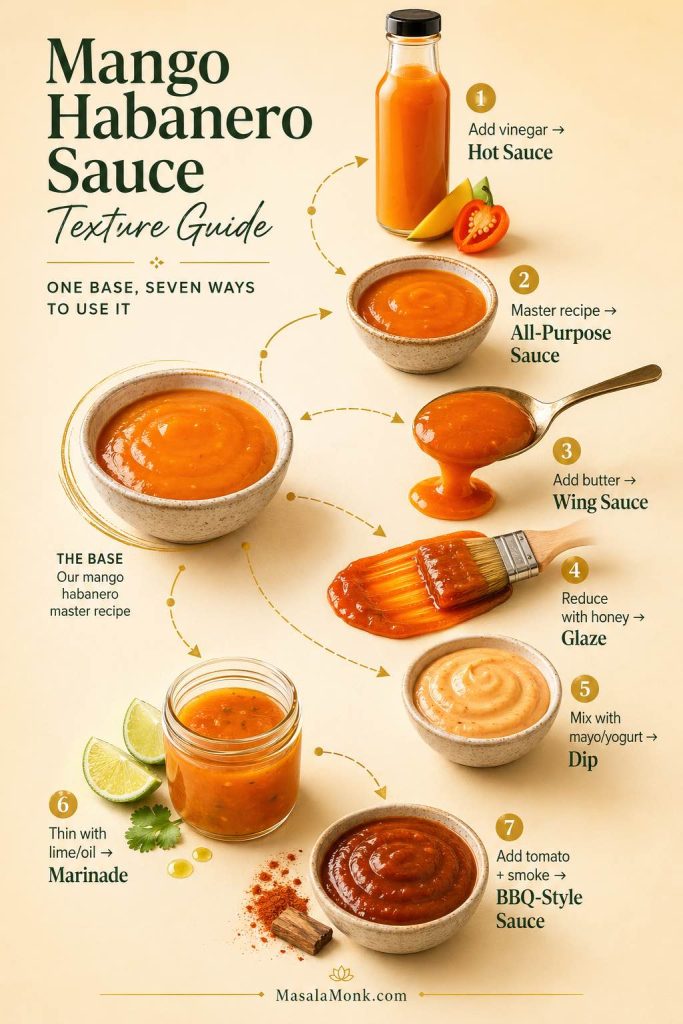
Mango habanero sauce texture guide showing how one base becomes hot sauce, all-purpose sauce, wing sauce, glaze, dip, marinade, and BBQ-style sauce.
Use the master mango habanero sauce as a base, then adjust the texture for the job: add vinegar for hot sauce, butter for wing sauce, honey for glaze, mayo or yogurt for dip, lime and oil for marinade, or tomato and smoke for a BBQ-style sauce.

Homemade Mango Habanero Hot Sauce Version

Choose this version when you want something bottle-friendly. More vinegar makes the sauce thinner, sharper, and easier to drizzle over tacos, eggs, grilled food, bowls, and roasted vegetables.

Element All-Purpose Sauce Hot Sauce Version
Vinegar ⅓ cup / 80 ml ½ cup / 120 ml
Water ¼ cup / 60 ml ¼ cup / 60 ml, plus more if needed
Sweetener 1–2 tbsp 1 tbsp to start
Final simmer 2–5 minutes 5 minutes
Texture Medium-thick Thin and pourable
Optional step Usually no strain Strain for bottle-smooth sauce

Compared with the all-purpose sauce, this hot sauce version tastes sharper, thinner, and more vinegar-forward. Therefore, use it when you want a real hot sauce texture rather than a thicker dipping sauce.
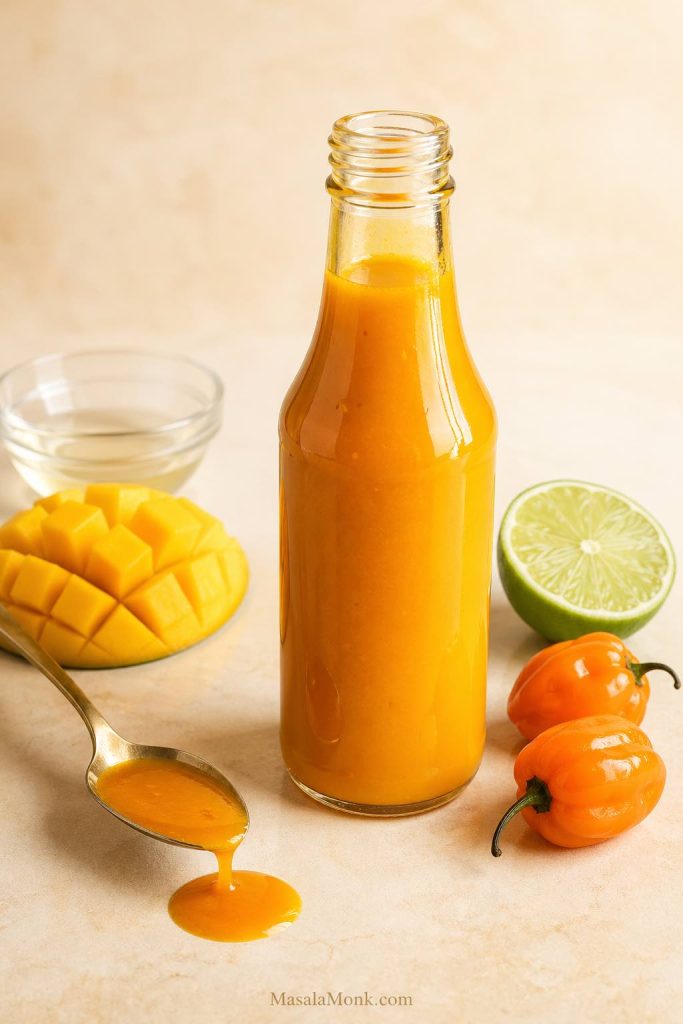
Homemade mango habanero hot sauce in a glass bottle with mango, habanero peppers, lime, vinegar, and a spoonful of orange sauce.
For a thinner mango habanero hot sauce, add extra vinegar, blend until smooth, and strain if you want a bottle-friendly texture. This version is sharper and more pourable than the thicker all-purpose sauce.

Mango Habanero Wing Sauce

For wings, the sauce needs to cling. Butter gives it gloss, honey helps it stick, and gentle heat brings everything together. In other words, this is the sweet heat version to use when you want glossy mango habanero sauce for wings.

This wing version works for chicken wings, boneless wings, tenders, cauliflower wings, paneer bites, or crispy tofu. For best results, warm the sauce first, then toss it with hot cooked wings just before serving.
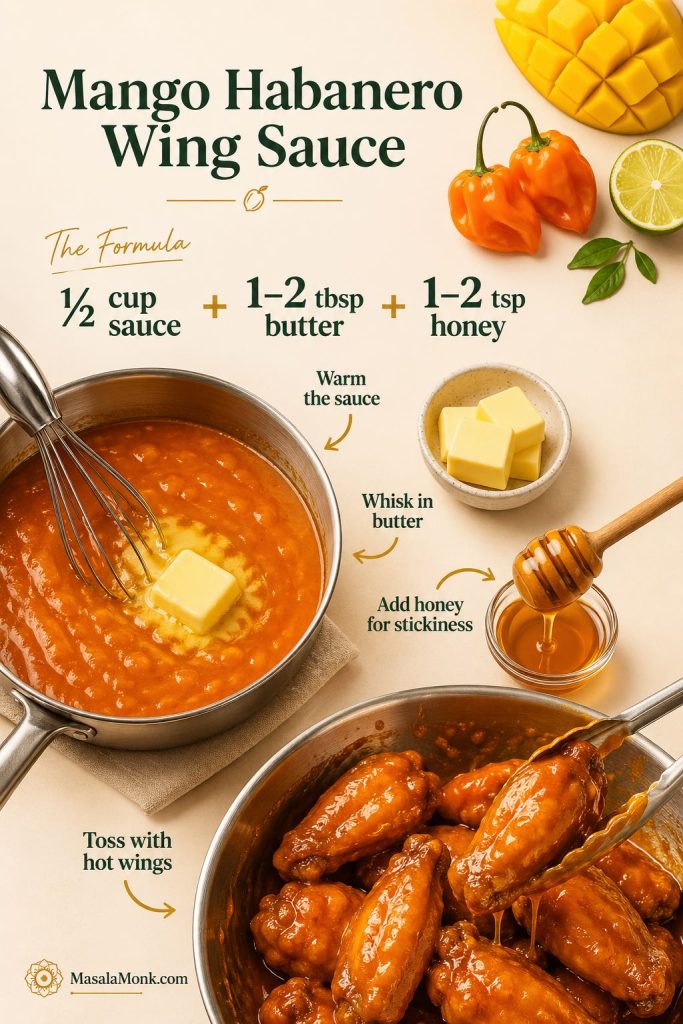
Mango habanero wing sauce formula showing ½ cup sauce, butter, honey, warm sauce, whisk in butter, add honey, and toss with hot wings.
Turn the base mango habanero sauce into a glossy wing sauce by warming ½ cup sauce with butter and a little honey. The butter helps the sauce cling, while the honey gives the wings a sweet, sticky finish.

For 2 lb / 900 g Wings

Ingredient US Amount Metric Amount
Mango habanero sauce ½ cup 120 ml / 4 fl oz
Butter 1–2 tbsp 14–28 g / 0.5–1 oz
Honey or brown sugar 1–2 tsp 7–14 g honey or 4–8 g sugar
Lime juice or vinegar, optional 1 tsp 5 ml
Salt Pinch To taste

First, warm the mango habanero sauce in a small pan over low heat. Next, whisk in the butter until glossy. If you want a stickier wing sauce, add honey or brown sugar. Finally, if the sauce tastes too sweet, add lime juice or vinegar before tossing it with hot cooked wings.

Optional Baked Wings

For a simple oven version, use 2 lb / 900 g chicken wings, 1 tbsp / 10–12 g aluminum-free baking powder, ¾ tsp / 4 g kosher salt, ½ tsp garlic powder, and ½ tsp smoked paprika. First, pat the wings very dry. Then, toss them with the seasoning, arrange them on a rack, and bake at 425°F / 220°C for 45–50 minutes, flipping halfway.

After the wings are cooked, toss them with warm mango habanero wing sauce. For food safety, chicken wings should reach 165°F / 73.9°C internally, following USDA poultry temperature guidance.
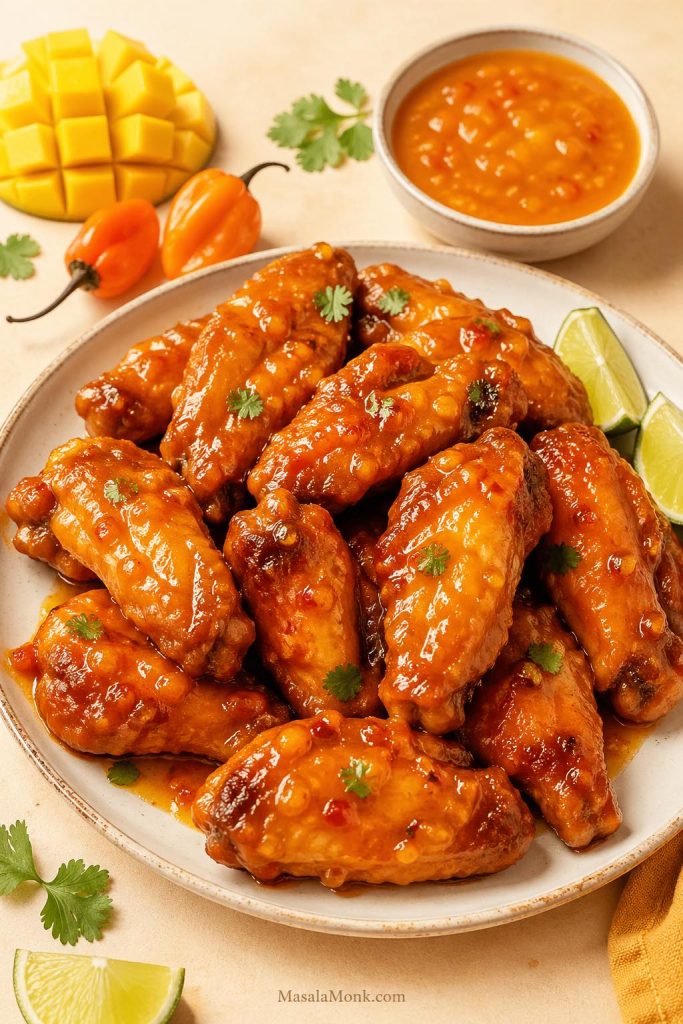
Glossy mango habanero chicken wings on a plate with mango, habanero peppers, lime wedges, and a bowl of orange wing sauce.
Toss hot cooked wings with warm mango habanero wing sauce just before serving so the buttery, sweet-spicy glaze clings instead of sliding off. The sauce should look glossy, sticky, and bright orange once it coats the wings.

Mango Habanero Glaze

For a glaze, reduce the sauce instead of thinning it. A few extra minutes in the pan makes it thicker, shinier, and better for brushing onto grilled chicken, salmon, shrimp, pork, paneer, tofu, roasted vegetables, or skewers.

Ingredient Amount
Mango habanero sauce ¾ cup / 180 ml
Honey 1 tbsp / 20 g
Lime juice or vinegar 1 tsp / 5 ml
Butter or oil, optional 1 tbsp / 14 g butter or 1 tsp / 5 ml oil

Simmer for 5–8 minutes, until the glaze lightly coats the back of a spoon. Then, brush it onto food near the end of cooking so the sugars do not burn.
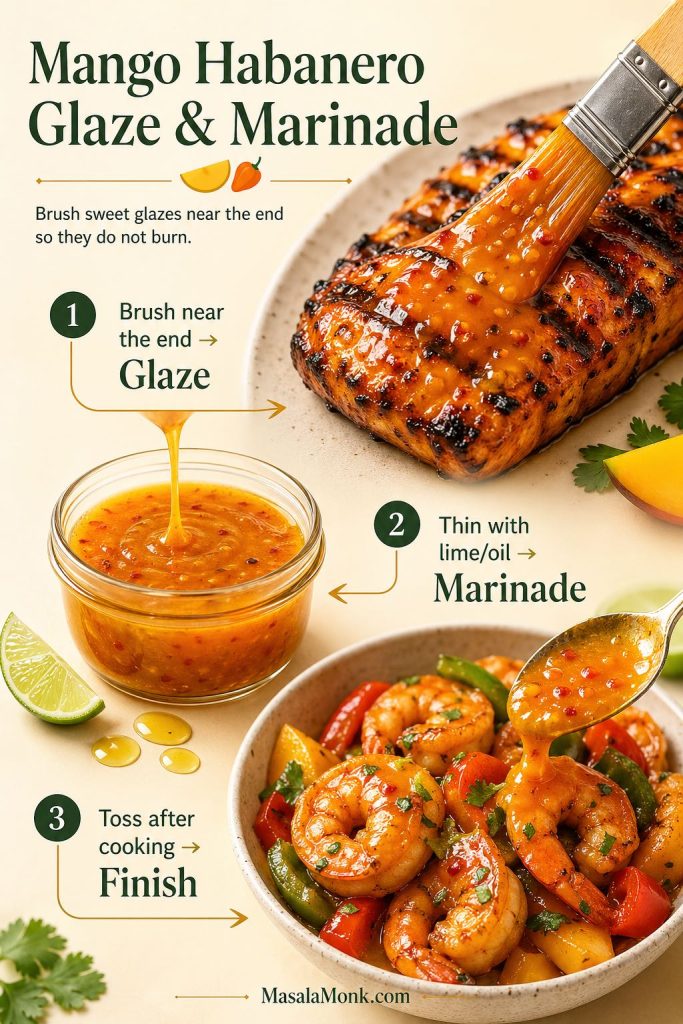
Mango habanero glaze and marinade guide showing sauce brushed on grilled food, thinned with lime and oil, and spooned over cooked shrimp.
Use mango habanero sauce as a glaze, marinade, or finishing sauce depending on texture. Brush sweet glazes near the end of cooking so they do not burn, thin the sauce with lime and oil for a marinade, or spoon it over cooked shrimp, chicken, paneer, tofu, or vegetables just before serving.

Mango Habanero Sauce Variations

Once the master sauce is balanced, the variations are easy. In fact, you can keep the same mango-habanero base, then change the texture, sweetness, smokiness, or cooking method depending on how you want to serve it.

For your first batch, however, keep the sauce simple. It is easier to learn your preferred heat and acid level before adding extra spices or turning the sauce into BBQ sauce, salsa, aioli, or a fermented hot sauce.
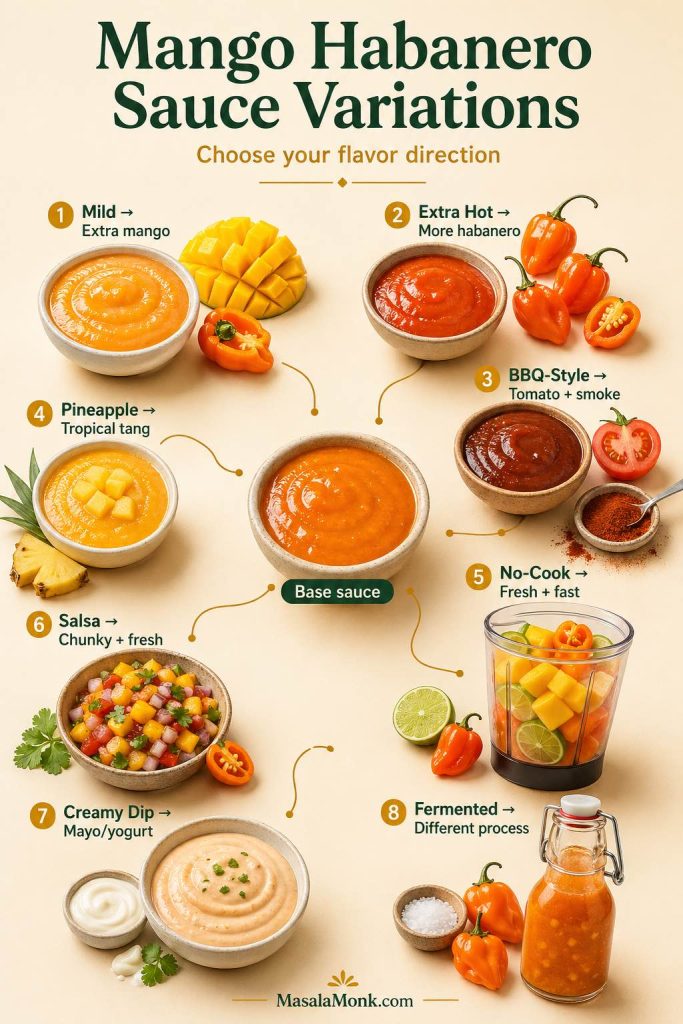
Mango habanero sauce variations guide showing mild, extra hot, BBQ-style, pineapple, no-cook, salsa, creamy dip, and fermented hot sauce options.
Once the base mango habanero sauce is balanced, you can take it in several directions. Add more mango for a milder sauce, more habanero for extra heat, pineapple for tropical tang, tomato and smoke for BBQ-style sauce, or mayo and yogurt for a creamy dip.

Mild Mango Habanero Sauce

For a milder sauce, use ½ seeded habanero and remove most of the white membrane. After blending, add extra mango if the heat still feels too sharp. You can also add a small amount of cooked orange bell pepper for body and color, but keep mango as the main flavor.

Extra Hot Mango Habanero Sauce

For an extra hot mango habanero sauce, use 3 or more habaneros only if you already enjoy very spicy sauces. Even then, add the extra pepper gradually so the sauce stays usable.

Mango Habanero BBQ Sauce

For a smoky, thicker version, simmer 1 cup / 240 ml mango habanero sauce with 2 tbsp / 30 g tomato paste, 1 tbsp / 12–14 g brown sugar, 1 tbsp / 15 ml apple cider vinegar, ½ tsp smoked paprika, ¼ tsp cumin, and 1 tsp / 5 ml Worcestershire sauce if you use it. As a result, the sauce becomes darker, thicker, and smoky-sweet after 8–10 minutes.

Pineapple Mango Habanero Sauce

For a brighter tropical variation, replace ½ cup / 80–90 g of the mango with pineapple. This version tastes sharper, juicier, and especially good with grilled shrimp, fish, chicken, tacos, and pork.

No-Cook Mango Habanero Sauce

For a faster, fresher version, blend the mango, habanero, vinegar, lime juice, garlic, salt, and sweetener without simmering. However, use less onion, or skip the onion, because raw onion can become sharp in a no-cook sauce.

This version tastes brighter and fruitier. However, it also tastes sharper and less rounded than the cooked sauce. Use the no-cook version within 2–3 days, and keep it refrigerated the whole time.

Mango Habanero Salsa

For a chunky salsa-style version, mix 1½ cups / 250 g diced mango with ½–1 very finely minced habanero, ¼ cup / 40 g red onion, 2 tbsp / 30 ml lime juice, 2 tbsp chopped cilantro, ½ tsp / 3 g salt, and optional tomato, cucumber, or pineapple. Then, rest the salsa for 10 minutes before serving.

For a chunkier mango topping with onion, cilantro, lime, and optional tomato or cucumber, see the full mango salsa recipe.

Mango Habanero Aioli or Creamy Dip

For a creamy dip, stir 1–2 tbsp cooled mango habanero sauce into ¼ cup mayonnaise, Greek yogurt, sour cream, or vegan mayo. Then, use it as a dip or sandwich spread for fries, burgers, wraps, tacos, nuggets, and roasted vegetables.

Fermented Mango Habanero Hot Sauce

Fermented mango habanero hot sauce is a different process from this quick cooked sauce. Instead of simmering first, the peppers, mango, onion, and garlic are usually fermented in a salt brine or mash before being blended with vinegar or lime.

Fermentation changes the safety and storage rules, so this quick cooked recipe should not be treated as a fermented sauce. If you want a fermented version, follow a dedicated fermented hot sauce method and pay attention to acidity, cleanliness, gas buildup, refrigeration, and pH if storing longer.

How to Use Mango Habanero Sauce

This is where the sauce earns its place in the fridge. For example, you can keep it medium-thick for dipping, thin it for drizzling, reduce it for glazing, or loosen it into a quick marinade.

Use this mango habanero sauce for chicken, shrimp, salmon, fish tacos, rice bowls, burgers, wraps, roasted vegetables, paneer, tofu, and fries. In other words, it works anywhere you want sweet heat with a bright mango finish.
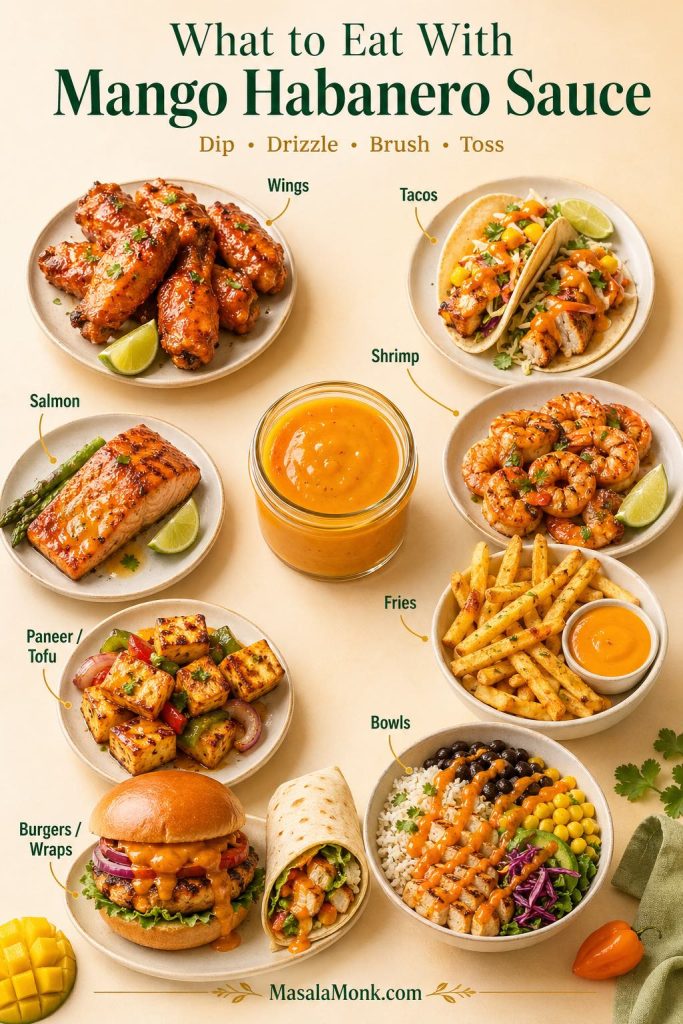
What to eat with mango habanero sauce, including wings, tacos, shrimp, salmon, fries, paneer or tofu, burgers, wraps, and bowls.
Mango habanero sauce works as a dip, drizzle, glaze, or finishing sauce. Use it with wings, tacos, shrimp, salmon, fries, paneer, tofu, burgers, wraps, bowls, or roasted vegetables whenever you want sweet heat with a bright mango finish.

As a hot sauce

As a hot sauce, it works best when the texture is thin and pourable. Drizzle it on tacos, eggs, nachos, rice bowls, grilled vegetables, beans, burritos, wraps, and roasted potatoes. For a thinner hot sauce texture, use the extra-vinegar version above.

As a wing sauce

For wings, warm it first so it coats evenly. Toss it with chicken wings, boneless wings, tenders, nuggets, cauliflower wings, paneer bites, or crispy tofu just before serving.

As a glaze

When using it as a glaze, brush it on grilled chicken, shrimp, salmon, pork, paneer, tofu, roasted carrots, sweet potatoes, or skewers near the end of cooking. Otherwise, the sugars in the mango and honey can scorch if they cook too long.

As a marinade

For a quick mango habanero marinade, thin the sauce with a little extra lime juice, vinegar, or oil. Use it for chicken, shrimp, fish, paneer, tofu, or vegetables. However, avoid marinating delicate seafood for too long because the acid can change the texture.

As a dip

For dipping, keep the texture thicker. This works as a mango habanero dipping sauce for fries, potato wedges, onion rings, pakoras, chips, crackers, chicken tenders, nuggets, vegetable sticks, or roasted cauliflower. If the sauce feels too hot, mix a spoonful into mayo or yogurt.

As a sandwich sauce

Inside sandwiches and wraps, a little goes a long way. Use it on burgers, fried chicken sandwiches, grilled cheese, wraps, rolls, spicy mayo-style spreads, and grilled paneer sandwiches. The sweet, spicy, tangy flavor works especially well with rich or crispy fillings.

Mango Habanero Sauce vs Hot Sauce vs Wing Sauce vs Salsa

The names can get confusing because mango and habanero show up in several forms. However, the difference is mostly texture and use: hot sauce is thinner, wing sauce is buttery, glaze is reduced, salsa is chunky, marinade is looser, and BBQ sauce is smoky-sweet.
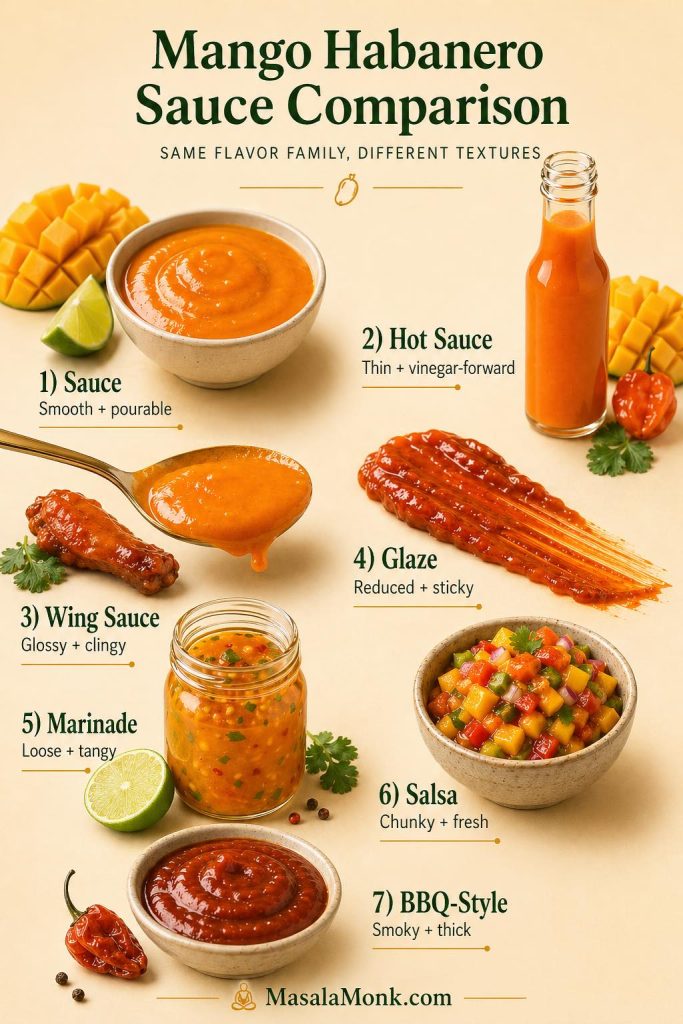
Mango habanero sauce comparison showing sauce, hot sauce, wing sauce, glaze, marinade, salsa, and BBQ-style sauce with different textures.
Mango habanero sauce can take several forms. Keep it smooth and pourable as an all-purpose sauce, thin it into hot sauce, finish it with butter for wings, reduce it into a sticky glaze, loosen it for marinade, make it chunky as salsa, or push it smoky and thick for BBQ-style sauce.
Version Texture Main Flavor Best Use
Mango habanero sauce Smooth, medium-thick, pourable Sweet, fruity, tangy, hot Wings, tacos, chicken, shrimp, dipping
Mango habanero hot sauce Thinner and more vinegar-forward Sharper, brighter, hotter Tacos, eggs, bowls, grilled food
Mango habanero wing sauce Glossy, buttery, clingy Sweet-hot and slightly sticky Chicken wings, tenders, cauliflower wings
Mango habanero marinade Loose, tangy, lightly sweet Bright, spicy, acidic Chicken, shrimp, fish, paneer, tofu
Mango habanero salsa Chunky or roasted Fresh, juicy, spicy Chips, tacos, fish, bowls
Mango habanero BBQ sauce Thicker, smoky, sticky Sweet, smoky, spicy Grilled chicken, ribs, burgers, sandwiches

Sauce Texture Guide

After blending, texture is the easiest thing to change. For example, a spoonful of vinegar can turn the base into a hot sauce, while a few extra minutes of simmering can turn it into a glaze. Use this guide to adjust the sauce for the way you want to serve it.

Version Texture Best Use How to Adjust
Mango habanero hot sauce Thin, pourable Tacos, eggs, bowls, grilled food Add more vinegar or water; strain if needed
All-purpose mango habanero sauce Medium-thick, pourable Chicken, tacos, fish, dipping Use the master recipe
Mango habanero wing sauce Glossy, clingy Wings, tenders, cauliflower wings Add butter and simmer briefly
Mango habanero glaze Thick, lacquered Grilled chicken, shrimp, salmon, paneer Add honey and reduce
Mango habanero dipping sauce Thick, spoonable Fries, tenders, pakoras, nuggets, vegetables Simmer slightly longer or stir into mayo/yogurt
Mango habanero marinade Loose, pourable Chicken, shrimp, fish, paneer, tofu Thin with lime, vinegar, or oil
Mango habanero BBQ sauce Thick, smoky-sweet Grilling, ribs, burgers Add tomato paste, brown sugar, and smoked paprika

How to Fix Mango Habanero Sauce

Sauces are adjustable, especially before serving. Because mango sweetness, vinegar sharpness, and habanero heat can vary from batch to batch, taste the sauce after blending and fix it while it is still warm.
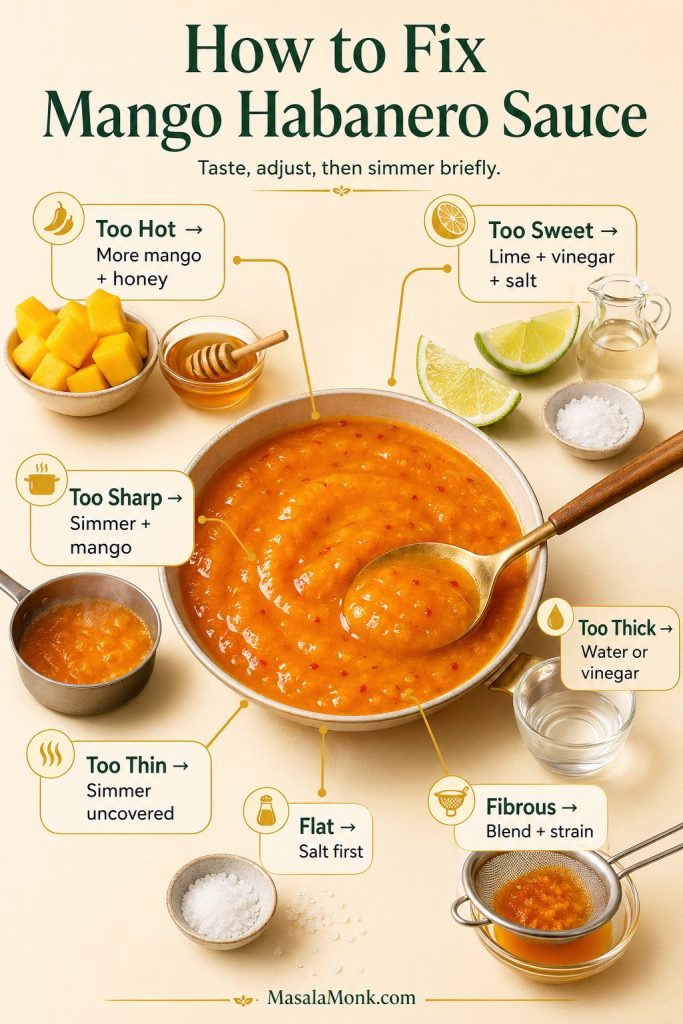
Troubleshooting guide for mango habanero sauce showing fixes for sauce that is too hot, too sweet, too sharp, too thick, too thin, flat, or fibrous.
Mango habanero sauce is easy to adjust while it is still warm. Add mango and honey if it is too hot, lime, vinegar, and salt if it is too sweet, water or vinegar if it is too thick, and simmer uncovered if it is too thin.
Problem Likely Cause Fix
Too hot Too much habanero or membrane Add more mango first; then round it with honey, lime, or butter if making wing sauce
Too sweet Very ripe mango plus too much sweetener Add vinegar, lime, and salt
Too sharp Too much acid or not enough simmering Simmer 3–5 minutes more; add mango or honey
Too thin Too much water or juicy mango Simmer uncovered until reduced
Too thick Dense mango or over-reduction Add water, vinegar, or lime 1 tbsp / 15 ml at a time
Bitter Burned garlic/onion or too much pepper pith Add mango and sweetener; avoid browning garlic next time
Flat Not enough salt or acid Add salt first. If it still tastes dull, add lime or vinegar
Not mango-forward Mango was bland or underripe Add ripe mango, thawed frozen mango, or mango pulp
Grainy or fibrous Fibrous mango or weak blender Blend longer, strain, or use smoother mango/frozen mango

Scaling the Recipe

Scaling is easy for mango, vinegar, lime, garlic, onion, sweetener, and salt. However, habaneros are the exception. Their size and heat vary so much that they should be scaled by taste, not strict multiplication.

If you double the mango and liquid, you can usually double the garlic, onion, vinegar, lime, sweetener, and salt. With habaneros, start lower, blend, taste carefully, and increase only if the sauce needs more heat.
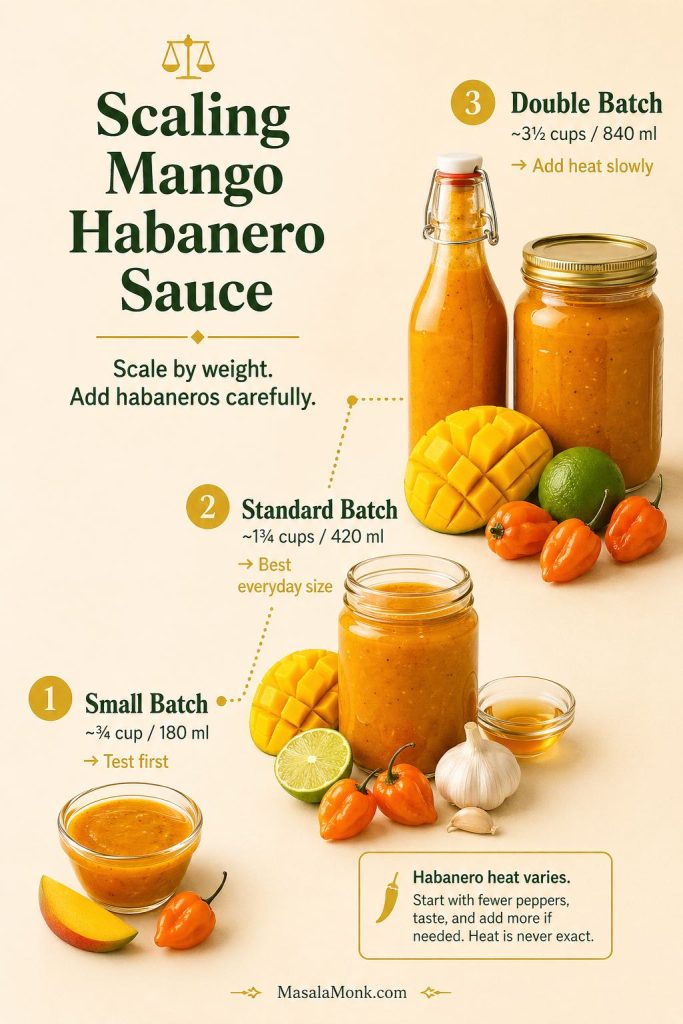
Scaling guide for mango habanero sauce showing small batch, standard batch, and double batch with a reminder to add habaneros carefully.
Scale mango habanero sauce by weight when possible, but add the habaneros more carefully than the mango, vinegar, lime, salt, and aromatics. Pepper heat varies, so start with fewer habaneros, taste after blending, and add more only if needed.
Ingredient Small Batch: ~¾ cup / 180 ml Standard: ~1¾ cups / 420 ml Double: ~3½ cups / 840 ml
Mango 125 g / ¾ cup 250 g / 1½ cups 500 g / 3 cups
Habanero ½–1 pepper 1–2 peppers 2–4 peppers, added carefully
Onion 20 g / 2 tbsp 40 g / ¼ cup 80 g / ½ cup
Garlic 1 clove / 3 g 2 cloves / 6 g 4 cloves / 12 g
Vinegar 40 ml / 2 tbsp + 2 tsp 80 ml / ⅓ cup 160 ml / ⅔ cup
Lime juice 15 ml / 1 tbsp 30 ml / 2 tbsp 60 ml / ¼ cup
Water 30 ml / 2 tbsp 60 ml / ¼ cup 120 ml / ½ cup
Honey 10–20 g 20–40 g 40–80 g
Salt 2–2.5 g 4–5 g 8–10 g

Storage, Freezing, and Canning Safety

Storage is the one place where homemade hot sauce should stay conservative. After the sauce cools, store it in a clean glass jar or bottle in the refrigerator. For best flavor and freshness, use it within 1–2 weeks. For longer storage, freeze small portions instead.
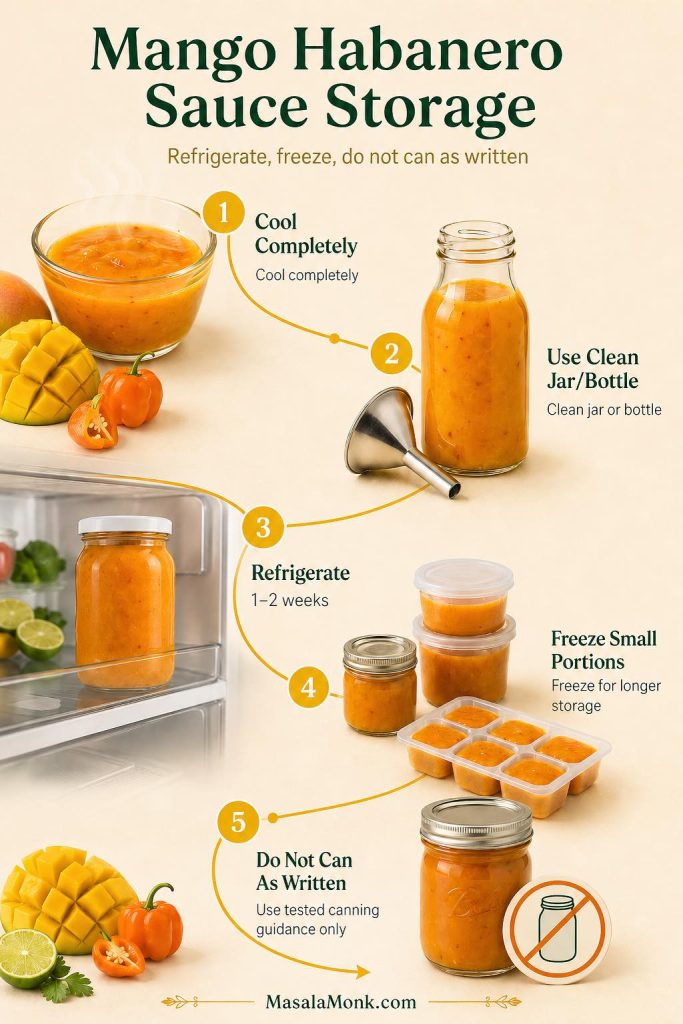
Mango habanero sauce storage guide showing sauce cooling, being bottled, refrigerated for 1–2 weeks, frozen in small portions, and not canned as written.
Treat this homemade mango habanero sauce as a refrigerator sauce. Cool it completely, store it in a clean jar or bottle, refrigerate for 1–2 weeks, or freeze small portions for longer storage. Do not can this recipe as written unless you are using tested canning guidance.

Even though the sauce contains vinegar and lime juice, it also contains mango, onion, garlic, and fresh peppers. Therefore, it should be treated as a refrigerator sauce, not a shelf-stable canned hot sauce, unless you are following tested preservation guidance.

For hot sauce safety, SDSU Extension explains that hot sauce should have a pH below 4.6 and include acid such as vinegar. For canning-style recipes, use vinegar labeled 5% acidity; Illinois Extension notes that tested USDA and National Center for Home Food Preservation recipes are built around that acidity level.

Canning note: Do not water-bath can this sauce as written. For shelf-stable preservation, use a tested canning recipe and proper acidity controls.

The National Center for Home Food Preservation has separate tested mango sauce canning guidance. In other words, do not treat this refrigerator mango habanero sauce recipe as a shelf-stable canning recipe.

FAQs

Is mango habanero sauce very spicy?

Yes, it can be. Because habaneros are very hot peppers, this mango habanero sauce recipe can become intense quickly. Use ½ to 1 seeded habanero for a more controlled first batch, or 2 habaneros for a properly hot sauce.

Can I make this mango habanero sauce recipe less spicy?

Yes. First, use fewer habaneros. Next, remove the seeds and membrane before cooking. If the finished sauce is still too hot, add more mango, honey, lime, or butter if you are turning it into wing sauce.

Is this mango habanero sauce easy to make?

Yes. This is an easy cooked blender sauce: simmer the mango, habanero, onion, garlic, vinegar, water, and salt, then blend and finish with lime juice and sweetener.

Can I make mango habanero sauce at home without special equipment?

Yes. You only need a saucepan, blender, gloves, spoon or spatula, and a clean jar or bottle. For a smoother homemade hot sauce, however, a high-speed blender and fine mesh sieve are helpful.

Can I use frozen mango?

Yes. Frozen mango works well in this sauce recipe. Thaw it before cooking so the mango simmers evenly and blends smoothly with the habanero, vinegar, garlic, and onion.

Can I use mango pulp or mango puree?

Yes. Use about 1 cup / 250 g mango pulp or mango puree instead of diced mango. If the pulp is sweetened, skip the honey or sugar at first, then adjust the sauce after blending.

Should mango habanero sauce be cooked?

For this style, yes. Cooking the mango, habanero, onion, and garlic before blending makes the sauce smoother, rounder, and more versatile. A raw blender version can taste fresher, but it will also taste sharper and less polished.

How do I make mango habanero hot sauce thinner?

Increase the vinegar to ½ cup / 120 ml, add water as needed, blend very smooth, and strain if you want a bottle-friendly texture. This gives the mango habanero sauce a thinner, sharper hot sauce consistency.

How do I make mango habanero wing sauce?

Warm ½ cup / 120 ml mango habanero sauce with 1–2 tbsp / 14–28 g butter, plus a little honey if you want it stickier. Then, toss hot cooked wings in the warm sauce just before serving.

Can I make mango habanero sauce without sugar?

Yes. If your mango is ripe and sweet, you can skip the honey, sugar, or maple syrup. However, the sauce will taste sharper and more hot-sauce-like, so adjust with extra mango or a little more salt if needed.

Can I make mango habanero sauce without vinegar?

You can reduce the vinegar and use more lime juice for a fresher flavor. However, the sauce will taste less like hot sauce and should still be refrigerated. For storage and hot-sauce character, vinegar is the better choice.

Is habanero mango sauce the same as mango habanero sauce?

Yes. Habanero mango sauce and mango habanero sauce usually mean the same thing: a sweet-hot sauce made with mango and habanero peppers. Mango habanero sauce is the more common way to describe it because the mango gives the sauce its body, color, and sweetness.

Is mango habanero sauce the same as mango habanero salsa?

No. Mango habanero sauce is usually smooth, cooked, and pourable. Mango habanero salsa is usually chunky, fresher, and made for chips, tacos, fish, shrimp, and bowls.

What vinegar is best for mango habanero sauce?

Apple cider vinegar gives the sauce a rounder, fruitier tang. White vinegar tastes sharper and more classic for hot sauce. Either works, but use vinegar labeled 5% acidity if you are following preservation-style guidance.

What can I use instead of habanero peppers?

Scotch bonnet peppers are the closest substitute because they have a similar fruity heat. Use the same cautious approach: start with ½ to 1 pepper, then increase only after tasting. For a milder sauce, use jalapeño, serrano, or Fresno peppers. The recipe will not have the same floral habanero punch, but it will still make a good spicy mango sauce.

Does mango habanero sauce need to be refrigerated?

Yes. This homemade mango habanero sauce should be refrigerated because it contains mango, onion, garlic, and fresh peppers. Store it in a clean jar or bottle and use it within 1–2 weeks for best flavor and freshness.

How long does mango habanero sauce last?

Store this mango habanero sauce recipe in the refrigerator and use it within 1–2 weeks for best flavor and freshness. For longer storage, freeze small portions instead of leaving the sauce at room temperature.

Can you freeze mango habanero sauce?

Yes. Freeze it in small portions, then thaw only what you need. The texture may loosen slightly after thawing, so shake, stir, or blend it again before serving.

Can I can mango habanero sauce?

Do not can this recipe as written. It is a refrigerator sauce, not a tested shelf-stable canning recipe. Use a tested canning recipe and proper pH controls if you want shelf-stable preservation.

Save this mango habanero sauce recipe for the next time you want a sweet, spicy, tangy sauce for wings, tacos, bowls, grilled food, or dipping.
Mango habanero sauce recipe pin with glossy orange sauce in a jar, spoon pour, mango, habanero peppers, lime, garlic, and honey.
This mango habanero sauce recipe makes a sweet, spicy, tangy sauce for wings, tacos, bowls, dipping, glazing, and drizzling. The mango gives body and sweetness, while habanero, lime, vinegar, and garlic keep it bright and fiery.

Back to top

Posted on 1 Comment

Mango Mustard Sauce Recipe

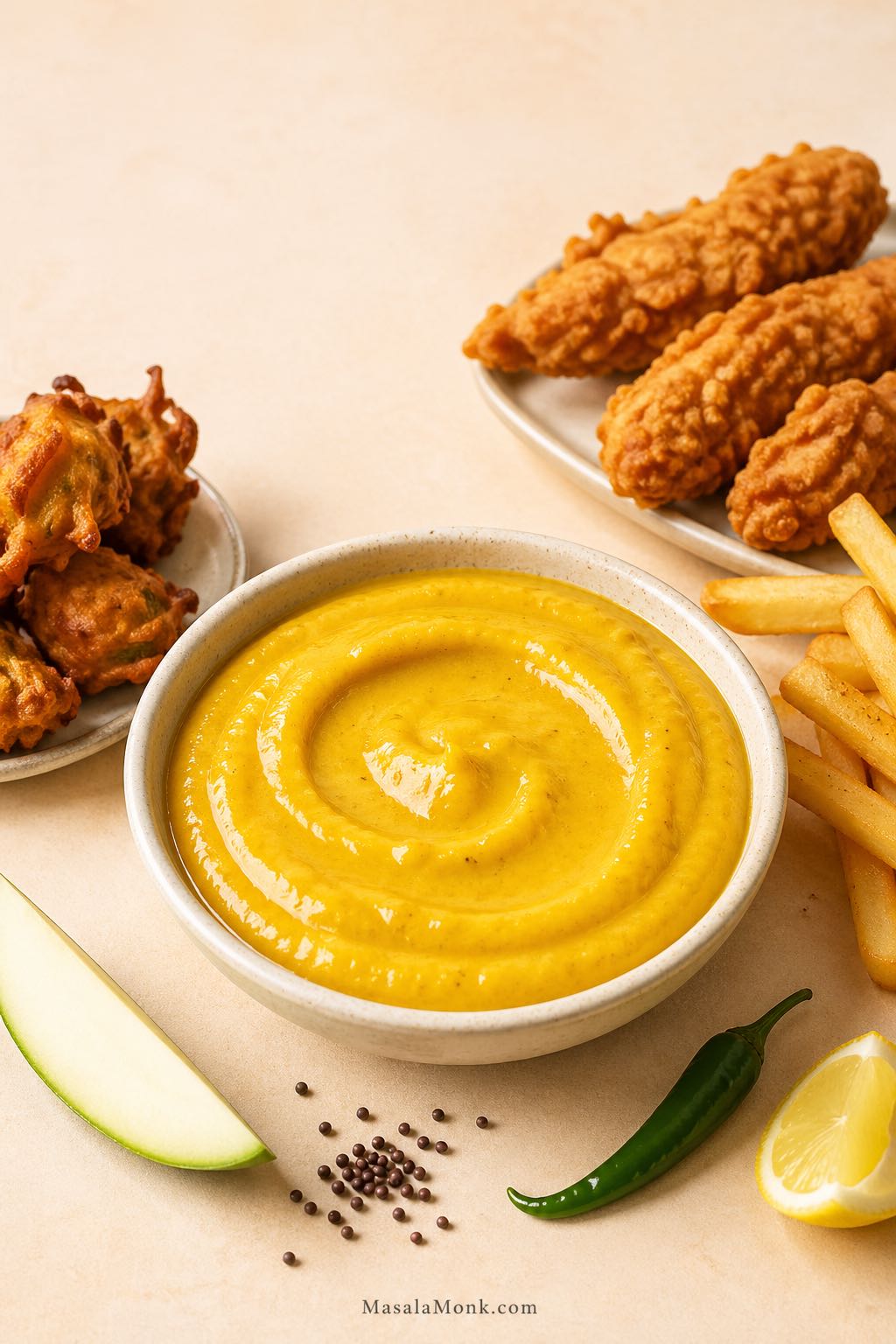
Creamy mango mustard sauce in a bowl with fries, fried chicken, pakoras, green mango, mustard seeds, chili and lemon for a quick dipping sauce.

A good mango mustard sauce should taste sweet, tangy, sharp, lightly spicy, and useful enough to go with more than one meal. It should work as a dipping sauce for fries, chicken tenders, wings, pakoras, and nuggets, but also as a spread for burgers, sandwiches, wraps, and rolls.

This mango mustard sauce recipe gives you the most useful version first: a fast blender sauce made with ripe mango, mustard, lemon or vinegar, chili, salt, and a creamy base such as mayonnaise, thick yogurt, coconut cream, or soaked cashews. It takes only a few minutes, yet it tastes brighter and more interesting than plain honey mustard or a regular mayo-based dip.

At the same time, there is a sharper Indian/Bengali direction to know. In Bengali cooking, aam kasundi or mango kasundi usually means a pungent raw mango mustard sauce made with green mango, mustard seeds, mustard oil, green chili, turmeric, and salt. Because the two styles serve different needs, this guide keeps the fast blender sauce as the main recipe, then shows you how to move it toward an aam kasundi-style version when you want a stronger, sharper mustard flavor.

Quick Answer

Mango mustard sauce is a sweet-tangy sauce made with mango and mustard. In its easiest form, it blends ripe mango or unsweetened mango pulp with mustard, lemon juice or vinegar, chili, salt, and a creamy base such as mayonnaise, thick yogurt, coconut cream, or soaked cashews. As a result, it works as a dip, spread, drizzle, dressing, or quick sauce for chicken, fries, wings, burgers, fish, shrimp, pakoras, paneer, and wraps.

For a softer, creamier sauce, use ripe mango and mayo, yogurt, or coconut cream. By contrast, a sharper Indian/Bengali-style version starts with raw mango, mustard seeds, mustard oil, green chili, turmeric, and salt. That second version is closer to aam kasundi or mango kasundi, which is more pungent, sour, and mustard-forward than a creamy mango mustard dip.

  • Best quick version: ripe mango, Dijon or yellow mustard, lemon, chili, salt, and mayo or yogurt.
  • Best no-mayo version: use coconut cream, thick curd, Greek yogurt, or soaked cashews.
  • Best Indian-style version: use kasundi or make the aam kasundi-style raw mango variation below.
  • Best for dipping: keep the sauce thick and creamy.
  • Best for drizzling: thin it with water, lemon juice, vinegar, or a little oil.
  • Best for chicken and wings: keep it tangy, slightly sweet, and medium-spicy.

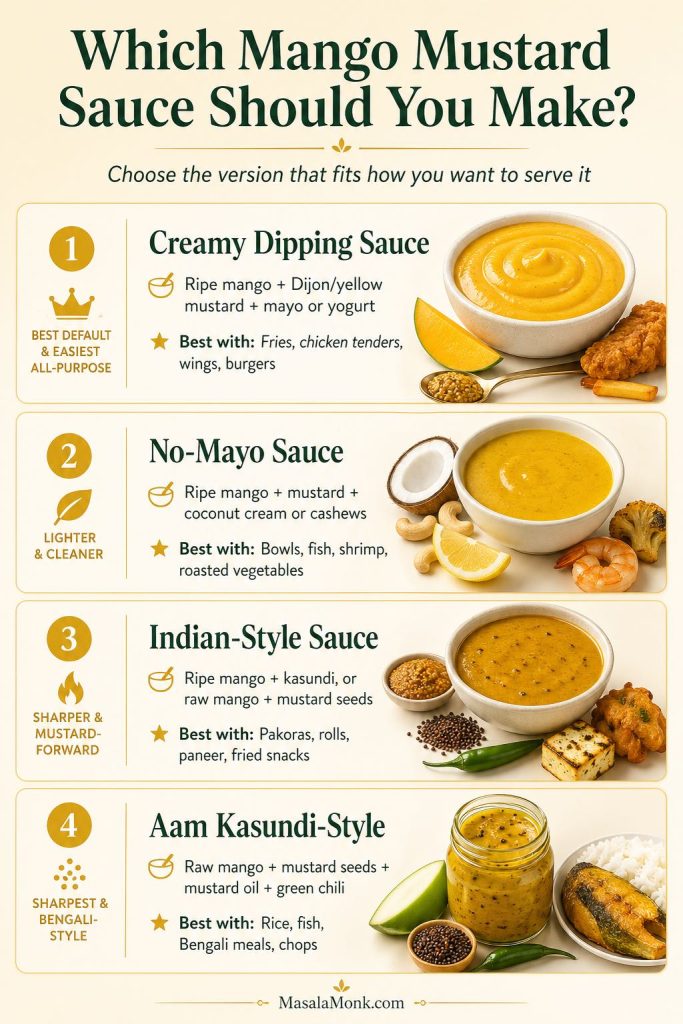
Which Mango Mustard Sauce Should You Make?

Choose the version based on how you want to serve it. The quick creamy sauce is best for dipping and spreading, the no-mayo version is better for lighter drizzles and bowls, and the aam kasundi-style version is sharper, sourer, and more mustard-forward.

If You Want… Make This Version Best With
A creamy dipping sauce Ripe mango + Dijon or yellow mustard + mayo or yogurt Fries, chicken tenders, wings, nuggets, burgers
A no-mayo sauce Ripe mango + mustard + coconut cream, thick yogurt, or cashews Wraps, bowls, shrimp, fish, roasted vegetables
A sharper Indian-style sauce Ripe mango + kasundi, or raw mango + mustard seeds Pakoras, rolls, paneer, fish, fried snacks
A Bengali-style aam kasundi Raw mango + mustard seeds + mustard oil + green chili Rice, fish, Bengali meals, chops, pakoras
Decision guide comparing creamy mango mustard sauce, no-mayo mango mustard sauce, Indian-style mango mustard sauce, and aam kasundi-style sauce with serving ideas.
Choose the mango mustard sauce that fits your meal: creamy for fries and chicken, no-mayo for lighter bowls and seafood, Indian-style for pakoras and paneer, or aam kasundi-style when you want raw mango and mustard seed sharpness.

Quick Mango Mustard Sauce

This quick mango mustard sauce is creamy, tangy, lightly spicy, and ready in minutes. For the best first batch, use ripe mango, Dijon mustard, lemon juice, chili, salt, and mayonnaise or thick yogurt. After that, adjust it toward a no-mayo, vegan, honey mustard, or aam kasundi-style version.

Prep Time
5 minutes
Cook Time
0 minutes
Rest Time
10 minutes, optional
Total Time
5 to 15 minutes
Yield
About 1 cup

Ingredients

  • 1 cup diced ripe mango or unsweetened mango pulp, about 160–170 g / 6 oz
  • 2 tablespoons Dijon mustard, yellow mustard, or kasundi, about 30 ml
  • 2 to 3 tablespoons mayonnaise, Greek yogurt, thick curd, or coconut cream, about 30–45 g
  • Or, for a cashew version: 2 tablespoons soaked cashews, about 18–22 g, plus 1 to 2 tablespoons water
  • 1 tablespoon fresh lemon juice or apple cider vinegar, about 15 ml
  • 1/4 teaspoon chili flakes or cayenne, or 1 small green chili, finely chopped
  • 1/4 teaspoon fine salt, about 1.5 g, plus more to taste
  • 1 to 2 teaspoons honey or sugar, about 5–10 ml honey or 4–8 g sugar, optional
  • 1 to 2 tablespoons cold water, about 15–30 ml, only if needed to thin

Instructions

  1. Add everything to a blender. Add the mango, mustard, creamy base, lemon juice or vinegar, chili, and salt. Do not add all the honey or sugar yet unless your mango is very tart.
  2. Blend until smooth. Blend until the sauce looks creamy, glossy, and fully combined. Scrape down the sides if needed.
  3. Check the texture. For a dip, the sauce should coat the back of a spoon. For a drizzle, it should fall in a thin ribbon. For a dressing, thin it until pourable but still creamy.
  4. Adjust in small amounts. Add mustard 1 teaspoon at a time for more sharpness, lemon or vinegar 1 teaspoon at a time for brightness, water 1 teaspoon at a time for a thinner sauce, and salt 1 small pinch at a time if the flavor tastes flat.
  5. Rest briefly. Let the sauce sit for 10 minutes if possible. The mustard sharpness settles and the mango flavor becomes rounder.
  6. Serve or chill. Use right away, or refrigerate in a clean airtight jar.

Notes

  • This makes about 1 cup, enough for 4 to 6 servings as a dip or 6 to 8 servings as a drizzle.
  • Use ripe mango for the quick creamy version.
  • Use unsweetened mango pulp when you want the smoothest blender sauce.
  • If using sweetened mango pulp, skip the honey or sugar and add extra lemon, vinegar, or mustard to keep the sauce savory.
  • If using cashews, soak them in hot water for 20 to 30 minutes, then drain before blending.
  • Use kasundi instead of Dijon when you want a sharper Indian-style mango mustard sauce.
  • Use coconut cream or soaked cashews for a vegan no-mayo mango mustard sauce.
  • Honey or sugar is optional. Add it only if the mango is tart or the mustard tastes harsh.

For the first serving, try this mango mustard sauce with fries, chicken tenders, pakoras, grilled paneer, roasted vegetables, fish, shrimp, burgers, wraps, or sandwiches. Ideally, it should taste sweet-tangy first, mustard-sharp second, and spicy only as much as you want it to be.

Why This Mango Mustard Sauce Works

  • Ripe mango gives body and sweetness. It makes the sauce smooth, golden, and fruity without needing much added sugar.
  • Mustard keeps it savory. Dijon, yellow mustard, or kasundi stops the sauce from tasting like plain mango puree.
  • Lemon or vinegar adds lift. The acidity keeps the creamy base from feeling heavy and makes the sauce better with fried, grilled, and roasted foods.
  • The creamy base controls the texture. Mayo makes it rich, yogurt makes it tangier, coconut cream makes it vegan, and soaked cashews make it thick and neutral.
  • The aam kasundi-style option solves the raw mango question. It gives readers a sharper Bengali-style path without making the whole recipe traditional, time-heavy, or confusing.

Once blended, the finished sauce should be smooth, glossy, and spoonable. For dipping, it should cling to fries, pakoras, or chicken tenders. When used as a drizzle, it should fall from a spoon in a thin ribbon. As a spread, it should stay thicker and creamier.

What Is Mango Mustard Sauce?

Mango mustard sauce is a condiment made by combining mango with mustard, acid, salt, and heat. In its easiest form, it is a quick blender sauce made with ripe mango, prepared mustard, lemon or vinegar, chili, and something creamy. Therefore, it tastes like a brighter, fruitier mustard dip and works especially well with fried, grilled, roasted, or snacky foods.

However, mango mustard sauce can also point toward aam kasundi, a Bengali-style mango mustard condiment made with raw mango, mustard seeds, mustard oil, green chili, turmeric, salt, and sometimes garlic or ginger. That version is sharper, more pungent, sourer, and more mustard-heavy than a creamy dipping sauce.

For that reason, this recipe gives you both paths. Make the fast blender version when you need a sauce for fries, chicken, burgers, wraps, wings, fish, or pakoras. Meanwhile, use the aam kasundi-style variation when you need a bolder raw mango mustard flavor for rice, fish, rolls, fried snacks, Bengali-style meals, or kasundi mayo.

For a fresh, chunky mango topping instead of a mustard sauce, try this mango salsa recipe. Mango salsa is brighter, fresher, and diced, while mango mustard sauce is smoother, sharper, and more condiment-like.

For a tangier pickled mango sauce with turmeric, fenugreek, chili, and vinegar, use the amba sauce guide.

Mango Mustard Sauce Ingredients

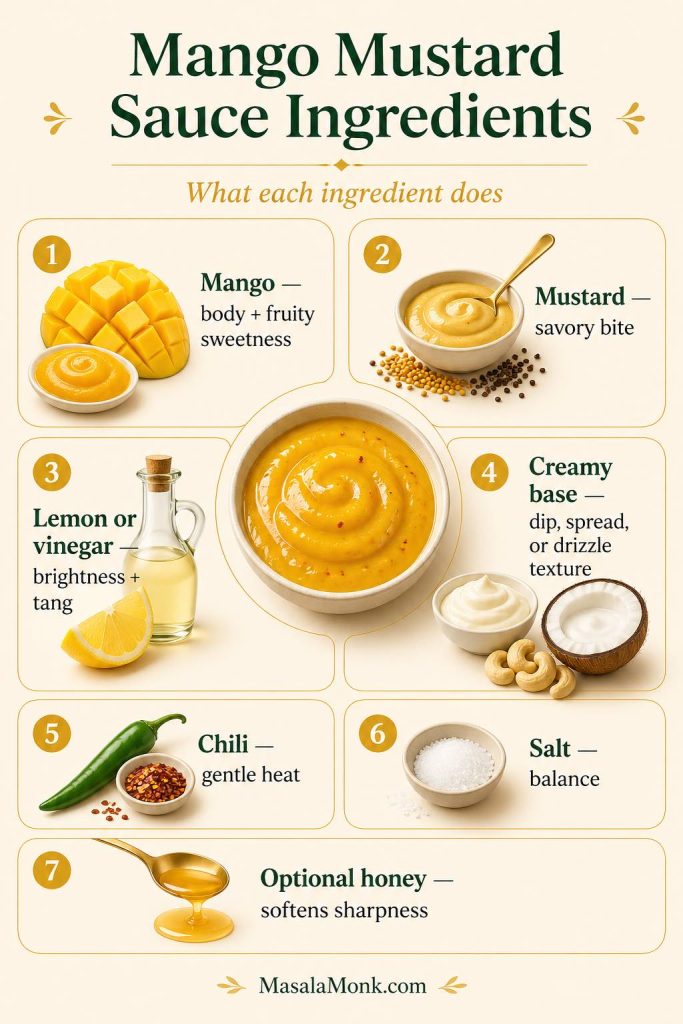
The ingredient list is simple, but each ingredient has a job. First, mango brings body and sweetness. Then, mustard gives bite. Meanwhile, lemon or vinegar keeps the sauce from tasting heavy. Finally, the creamy base decides whether the sauce feels like a dip, spread, drizzle, or dressing.

Mango mustard sauce ingredients guide showing mango, mustard, lemon or vinegar, creamy base, chili, salt, and optional honey with each ingredient’s role.
Each ingredient has a job in mango mustard sauce: mango gives body and sweetness, mustard adds savory bite, lemon or vinegar brings tang, and the creamy base turns it into a dip, spread, or drizzle.

Ripe mango or mango pulp

Use ripe mango for the fast blender version because it gives the sauce sweetness, color, body, and a smooth fruit flavor. Fresh mango gives the brightest taste, while mango pulp gives the smoothest texture and the most consistent result. Whenever possible, choose unsweetened mango pulp. However, sweetened pulp can still work if you skip the honey or sugar and add extra lemon, vinegar, or mustard to keep the sauce savory.

Mustard

Mustard is what keeps the sauce savory. Dijon mustard gives the cleanest sharpness, while yellow mustard gives a familiar tangy dip flavor. By contrast, kasundi gives a deeper Indian/Bengali-style bite. When you use mustard seeds, the sauce moves closer to aam kasundi.

Lemon juice or vinegar

Acid keeps mango mustard sauce lively. Lemon juice tastes fresh and bright, while apple cider vinegar tastes rounder and slightly fruitier. White vinegar, on the other hand, tastes sharper. Start with a small amount, then adjust after blending.

Creamy base

Mayonnaise gives the richest, smoothest dipping sauce. By comparison, Greek yogurt or thick curd makes the sauce lighter and tangier. Meanwhile, coconut cream makes a vegan no-mayo version that works especially well with shrimp, fish, and snacks. For a neutral vegan base instead, soaked cashews make the sauce creamy without adding a strong coconut flavor.

Chili

Use chili flakes, cayenne, fresh green chili, jalapeño, or a little hot sauce depending on how spicy you want the sauce. For an all-purpose dip, keep the heat moderate. Then, for wings, grilled meats, or a spicy mango habanero mustard variation, increase the chili gradually.

Salt and optional honey

Salt makes the mango and mustard taste complete. Honey or sugar is optional, so use it only if the mango is tart, the mustard tastes harsh, or you prefer a softer honey mustard-style sauce.

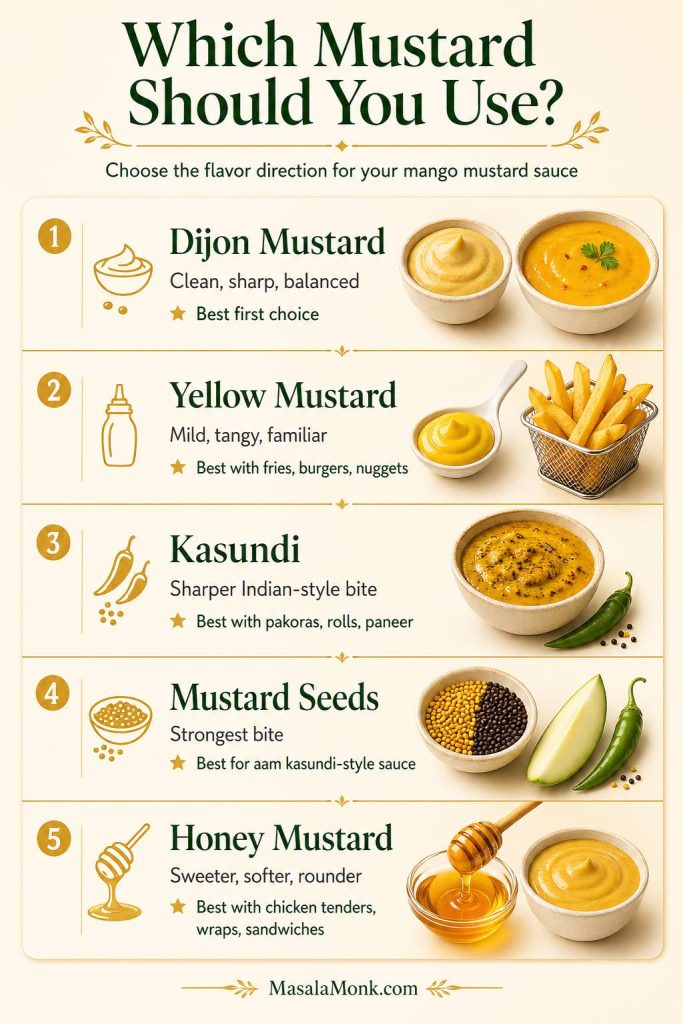
Which Mustard Should You Use?

The mustard changes the whole personality of the sauce. For the easiest all-purpose version, start with Dijon. If you want something milder for fries, burgers, or kids, use yellow mustard instead. However, when you want the sauce to taste sharper and more Indian, kasundi is the better choice.

Mustard Best For Flavor
Dijon mustard Everyday mango mustard sauce, chicken, fish, sandwiches, wraps. Sharp, smooth, balanced, not too sweet.
Yellow mustard Fries, burgers, nuggets, chicken tenders, kid-friendly dipping sauce. Mild, tangy, familiar, less pungent.
Kasundi Indian-style dipping sauce, pakoras, rolls, paneer, fish, fried snacks. Sharper, deeper, more pungent, mustard-forward.
Mustard seeds Aam kasundi-style sauce, raw mango mustard sauce. Strongest bite, more traditional, more textured if not blended fully.
Honey mustard Softer variation for chicken, wraps, sandwiches, and fries. Sweeter, rounder, less sharp.
Mustard chooser guide for mango mustard sauce comparing Dijon mustard, yellow mustard, kasundi, mustard seeds, and honey mustard with best uses.
Dijon is the best first choice for balanced mango mustard sauce, yellow mustard makes it milder, kasundi adds Indian-style sharpness, mustard seeds move it toward aam kasundi, and honey mustard makes it sweeter and softer.

If you are unsure, use Dijon for the first batch. It gives the cleanest balance and lets the mango stay clear. After that, you can make the sauce sharper with kasundi or milder with yellow mustard.

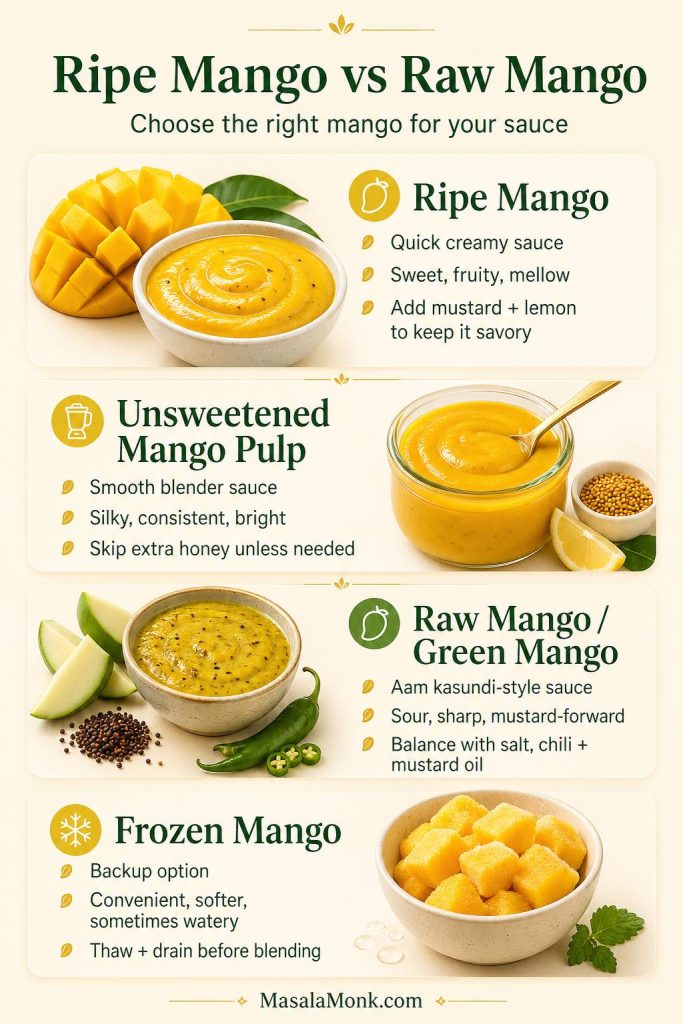
Ripe Mango vs Raw Mango

This is the most important decision in the recipe. On one hand, ripe mango gives you a sweet, smooth, creamy dipping sauce. On the other hand, raw mango gives you a sharper, sourer, aam kasundi-style sauce. Both are useful, but they are not the same.

Mango Type Best For Flavor How to Adjust
Ripe mango Quick creamy mango mustard sauce. Sweet, fruity, mellow. Add lemon/vinegar and mustard to keep it savory.
Unsweetened mango pulp Fast blender sauce, smooth dipping sauce. Very smooth, consistent, often sweeter than fresh mango. Skip extra honey unless needed.
Raw mango / green mango Aam kasundi-style mango mustard sauce. Sour, sharp, more traditional. Balance with salt, mustard oil, chili, and a little sugar if needed.
Frozen mango Backup option for quick sauce. Convenient, softer, sometimes watery. Thaw and drain first, then blend.
Comparison guide showing ripe mango, unsweetened mango pulp, raw green mango, and frozen mango for making mango mustard sauce or aam kasundi-style sauce.
Use ripe mango or unsweetened mango pulp for a smooth, sweet-tangy mango mustard sauce. Choose raw green mango when you want a sharper, sourer, mustard-forward aam kasundi-style sauce.

For the everyday blender sauce, use ripe mango or unsweetened mango pulp. For the aam kasundi-style variation, use raw mango or firm green mango. When the two are swapped, the sauce still works, but the flavor moves in a different direction: ripe mango tastes sweeter and smoother, while raw mango tastes sharper and more mustard-forward.

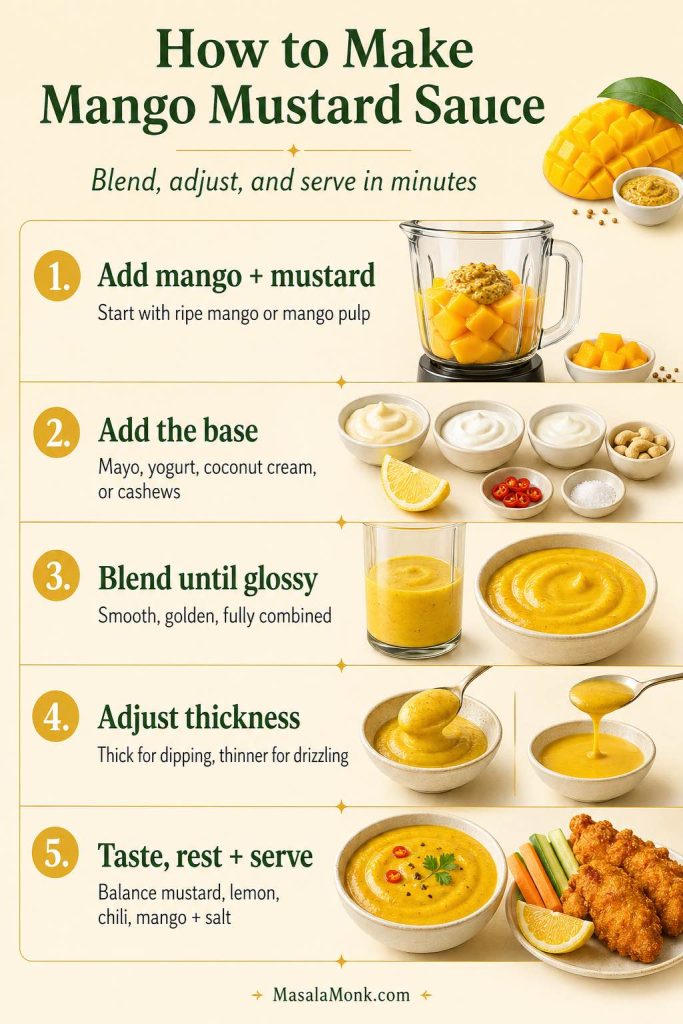
How to Make Mango Mustard Sauce

The quick version is a blender sauce. Even so, the final tasting step matters because mangoes and mustards vary a lot.

Step-by-step guide showing how to make mango mustard sauce in a blender by adding mango and mustard, adding a creamy base, blending, adjusting thickness, and serving.
This quick mango mustard sauce comes together in a blender: start with mango and mustard, add your creamy base, blend until glossy, then adjust the thickness for dipping or drizzling.

1. Add the mango and mustard

Add the ripe mango or mango pulp to a blender with the mustard. For the cleanest flavor, use Dijon. For a milder dip, choose yellow mustard instead. Alternatively, use kasundi for a sharper Indian-style sauce.

2. Add the creamy base

Next, add mayonnaise, Greek yogurt, thick curd, coconut cream, or soaked cashews with a little water. Use more creamy base for a thicker dipping sauce and less for a lighter drizzle.

3. Add acid, chili, and salt

After that, add lemon juice or vinegar, chili, and salt. Because mango usually brings enough sweetness on its own, do not add too much sweetener at the beginning.

4. Blend until smooth

Blend until the sauce is smooth, glossy, and spoonable. After that, scrape down the sides if needed so no mango pieces or mustard streaks remain.

5. Adjust the sauce

After blending, taste the sauce before adding anything else. When it tastes too sweet, add mustard, lemon, vinegar, chili, or salt. If it tastes too sharp, round it out with more mango or creamy base. Finally, when the flavor seems flat, add salt first before reaching for more lemon.

6. Rest before serving

Let the sauce sit for 10 minutes if you can. During that short rest, the mustard sharpness settles, the mango flavor comes forward, and the sauce tastes more complete.

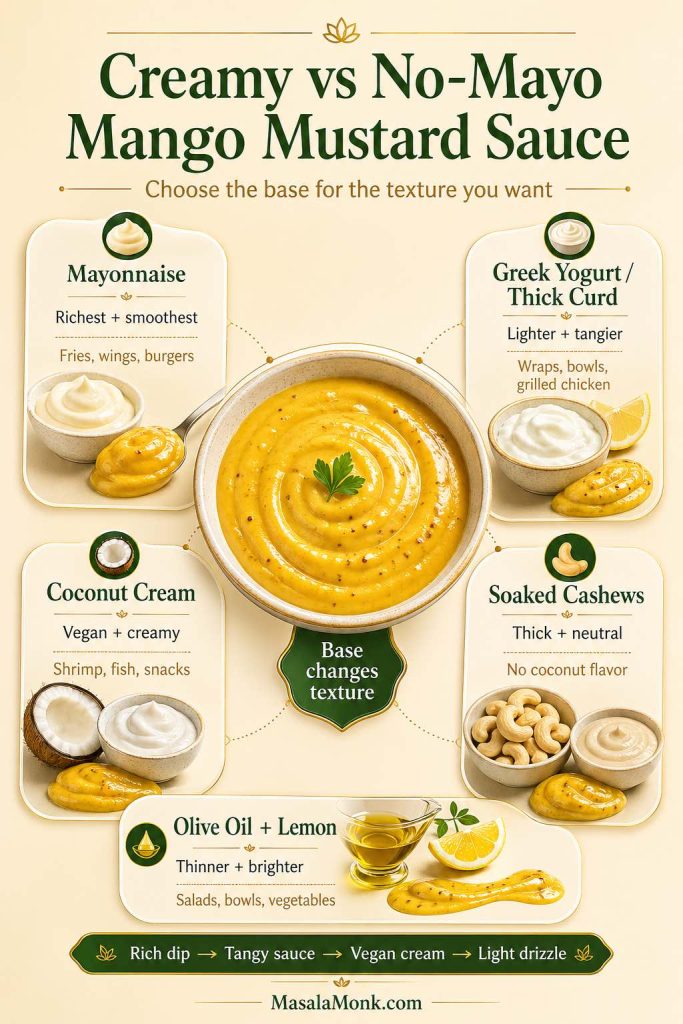
Creamy vs No-Mayo Mango Mustard Sauce

You do not have to use mayonnaise. Instead, the creamy base simply decides how rich, tangy, vegan, or pourable the sauce becomes.

Base Best For What It Does
Mayonnaise Classic dipping sauce, fries, wings, chicken tenders, burgers. Richest, smoothest, most dip-like.
Greek yogurt / thick curd Grilled chicken, wraps, bowls, sandwiches. Lighter, tangier, less rich.
Coconut cream Vegan/no-mayo sauce, shrimp, fish, fried snacks. Creamy with a mild tropical note.
Soaked cashews Vegan creamy sauce without coconut flavor. Thick, neutral, smooth.
Olive oil + lemon or vinegar Dressing-style sauce for salads, bowls, and roasted vegetables. Thinner, brighter, more pourable.
Creamy vs no-mayo mango mustard sauce guide showing mayonnaise, Greek yogurt, coconut cream, soaked cashews, and olive oil with lemon as base options.
The creamy base changes the whole texture of mango mustard sauce: use mayonnaise for the richest dip, yogurt for a lighter tangy sauce, coconut cream or cashews for a vegan version, and olive oil with lemon for a thinner drizzle.

For the most crowd-friendly sauce, use mayonnaise or thick yogurt. Meanwhile, coconut cream or soaked cashews give you a vegan mango mustard sauce without losing body. When you want a dressing instead of a dip, use less creamy base and thin the sauce with lemon juice, vinegar, water, or olive oil.

For a smoother mango-based dressing rather than a mustard sauce, this sweet and spicy mango salad dressing is a better fit for salads, bowls, and lighter drizzles.

Aam Kasundi-Style Mango Mustard Sauce

Aam kasundi, also called mango kasundi or aam kashundi, is a sharper Bengali-style mango mustard condiment. Traditionally, it is usually made with raw mango, mustard seeds, mustard oil, green chili, turmeric, and salt. Compared with the fast blender sauce above, it tastes sourer, hotter, more pungent, and more mustard-forward.

This version is an aam kasundi-style refrigerator sauce. In other words, it gives you the raw mango mustard flavor without treating the sauce as shelf-stable or canned.

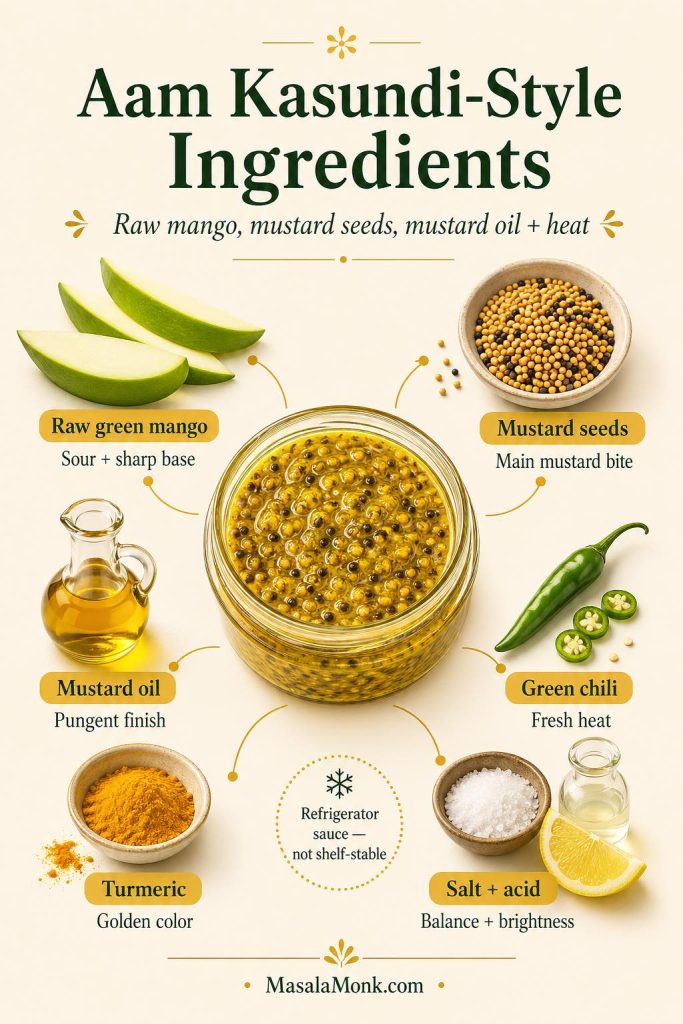
Aam kasundi-style ingredient guide showing raw green mango, mustard seeds, mustard oil, green chili, turmeric, salt, and acid for a refrigerator sauce.
Aam kasundi-style mango mustard sauce gets its sharper flavor from raw green mango, mustard seeds, mustard oil, green chili, turmeric, salt, and acid. This version is a refrigerator sauce, not a shelf-stable preserve.

Aam Kasundi-Style Ingredients

  • 1 cup grated raw mango or finely chopped green mango
  • 1 1/2 tablespoons yellow mustard seeds
  • 1 to 2 teaspoons black mustard seeds, optional, for stronger bite
  • 1 to 2 green chilies
  • 1/2 teaspoon turmeric
  • 1 small garlic clove or 1/2 teaspoon grated ginger, optional
  • 1 to 2 tablespoons food-grade mustard oil
  • 1 tablespoon vinegar or lemon juice
  • 1/2 teaspoon salt, plus more to taste
  • 1/2 to 1 teaspoon sugar, optional
  • Water as needed to blend

Use food-grade mustard oil where available. Without mustard oil, replace it with neutral oil and add a little extra prepared mustard or kasundi for sharper flavor.

How to Make the Aam Kasundi-Style Version

  1. Soak the mustard seeds in water for 20 to 30 minutes, then drain.
  2. Add the drained mustard seeds, raw mango, green chili, turmeric, salt, vinegar or lemon juice, garlic or ginger if using, and a splash of water to a blender.
  3. Blend to a coarse or smooth paste, depending on the texture you like.
  4. Stir in the mustard oil.
  5. Taste and adjust with more salt, vinegar, chili, or a small amount of sugar.
  6. Transfer to a clean jar and refrigerate.

If you are new to kasundi-style sauces, start with the smaller amount of black mustard seeds. You can always make the next batch sharper, but it is harder to fix a sauce that turns too bitter or pungent.

Important: This aam kasundi-style sauce is a refrigerator condiment, not a shelf-stable preserve. Keep it refrigerated, use a clean spoon, and do not store it at room temperature. For traditionally preserved kasundi or mango pickle, follow a trusted preservation recipe and do not casually change vinegar, water, salt, oil, or food proportions.

Use this sharper version with rice, fish, pakoras, rolls, Bengali-style meals, fried snacks, grilled paneer, or as a base for kasundi mayo. However, when it tastes too strong on its own, mix a spoonful into mayonnaise, yogurt, coconut cream, or mango pulp for a milder dip.

Mango Mustard Sauce vs Aam Kasundi

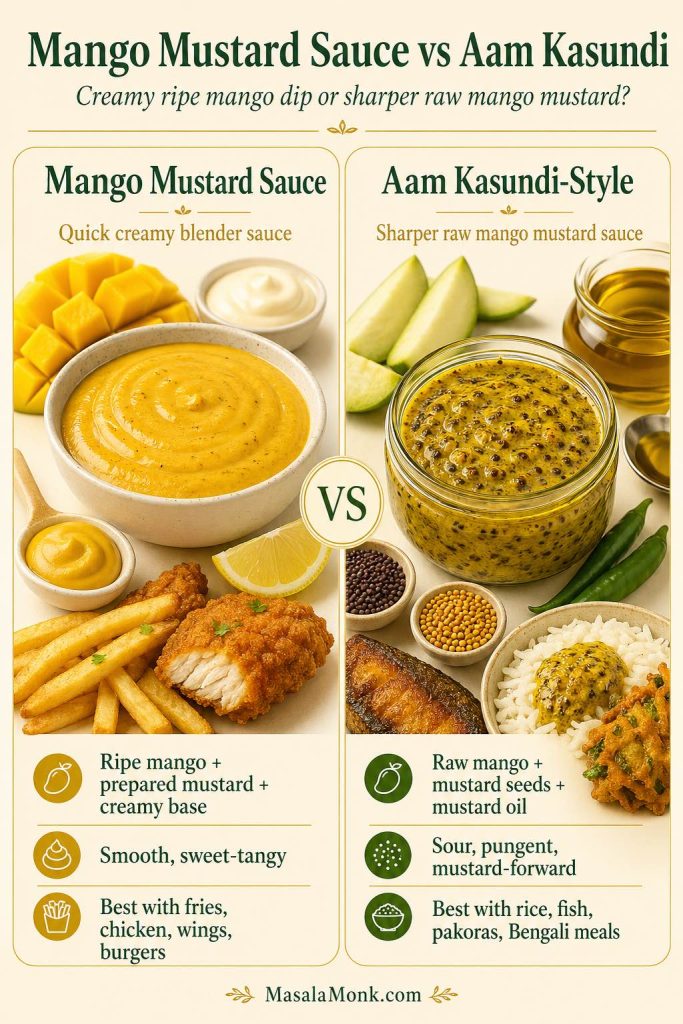
Mango mustard sauce and aam kasundi overlap, but they are not exactly the same. In general, the fast blender sauce is creamy and made with ripe mango. By contrast, aam kasundi is usually sharper, more pungent, and made with raw mango and mustard seeds.

Side-by-side comparison of creamy mango mustard sauce made with ripe mango and prepared mustard versus aam kasundi made with raw mango, mustard seeds, and mustard oil.
Mango mustard sauce is usually a smooth, creamy ripe-mango dip for fries, chicken, wings, and burgers. Aam kasundi is sharper, more pungent, and built around raw mango, mustard seeds, mustard oil, and green chili.
Sauce Mango Mustard Texture Flavor Best Use
Quick mango mustard sauce Ripe mango or mango pulp Dijon, yellow mustard, or kasundi Creamy and smooth Sweet-tangy, mild to sharp Fries, chicken, wings, burgers, wraps
No-mayo mango mustard sauce Ripe mango or mango pulp Prepared mustard or kasundi Creamy or pourable Lighter, tangy, less rich Snacks, salads, bowls, shrimp, fish
Aam kasundi / mango kasundi Raw mango / green mango Mustard seeds + mustard oil Pungent, thicker, sometimes coarse Sharp, sour, spicy, mustard-heavy Rice, fish, pakoras, rolls, Bengali meals
Mango honey mustard Ripe mango Mustard + honey Smooth Sweeter, softer, rounder Chicken tenders, sandwiches, wraps
Mango habanero mustard Ripe mango Mustard + habanero Smooth or slightly seedy Hot, fruity, sharp Wings, grilled meats, burgers

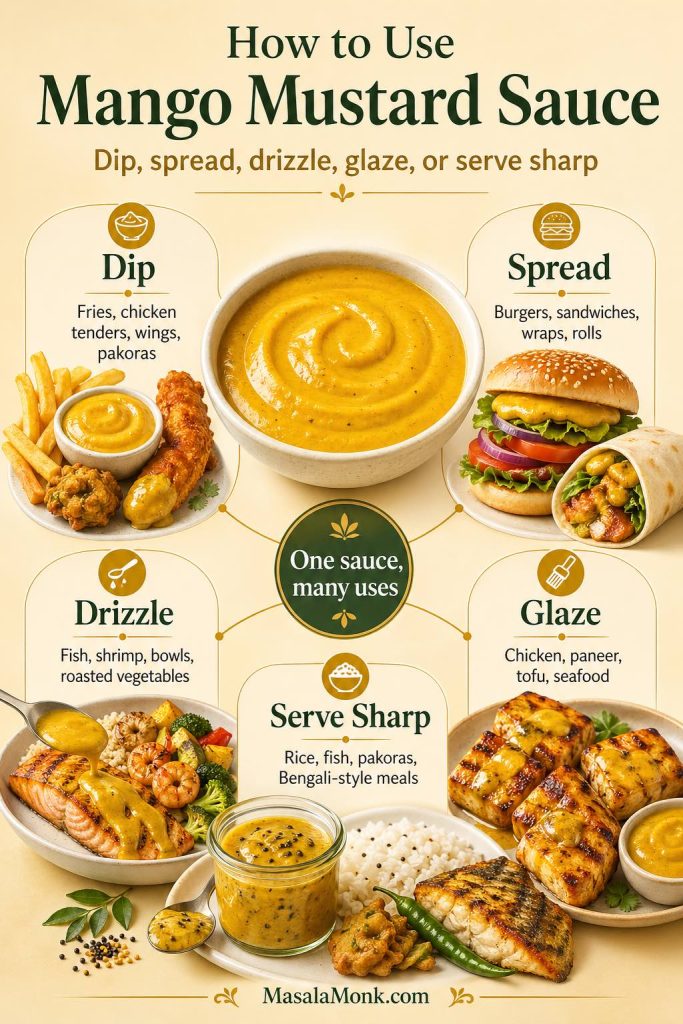
How to Use Mango Mustard Sauce

Mango mustard sauce is useful because it can be thick, creamy, pourable, or sharp depending on how you adjust it. Keep it thicker for dipping and spreading. When you need a drizzle or dressing, thin it slightly with water, lemon juice, vinegar, or oil.

As a simple rule, use the creamy ripe-mango version with fries, chicken, burgers, sandwiches, and wraps. Use the thinner no-mayo version with bowls, salads, grilled fish, shrimp, and roasted vegetables. Use the aam kasundi-style version when you want a sharper, mustard-heavy sauce for rice, fish, pakoras, rolls, or Bengali-style meals.

Guide showing how to use mango mustard sauce as a dip, spread, drizzle, glaze, or sharper sauce with fries, chicken, burgers, fish, shrimp, paneer, rice, and pakoras.
Mango mustard sauce works beyond dipping: keep it thick for fries, wings, burgers, and wraps, thin it for fish, shrimp, bowls, and vegetables, or use the sharper aam kasundi-style version with rice, fish, pakoras, and Bengali-style meals.

Best foods for dipping

Use thick mango mustard sauce with chicken tenders, fries, potato wedges, wings, pakoras, nuggets, onion rings, chips, crackers, and vegetable sticks. For this use, keep the sauce creamy enough to cling instead of running off the food.

Mango Mustard Sauce for Chicken

For chicken tenders, nuggets, fried chicken sandwiches, grilled chicken, or wings, keep the sauce tangy and medium-thick. Use Dijon for a sharper sauce, yellow mustard for a softer family-style dip, or kasundi for a stronger Indian-style chicken sauce. When using it as a glaze, brush it on near the end of cooking so the mango and creamy base do not scorch.

Best places to spread it

Spread mango mustard sauce on burgers, sandwiches, wraps, rolls, grilled cheese, paneer wraps, tofu wraps, and fried chicken sandwiches. For spreading, keep it thicker than a dressing so it stays in place.

Best meals for drizzling

Thin mango mustard sauce slightly and drizzle it over grilled chicken, fish, shrimp, roasted vegetables, grain bowls, salads, grilled paneer, tofu bowls, and rice bowls. For a lighter drizzle, use yogurt, coconut cream, cashews, or olive oil instead of a heavy mayo base.

Glaze, marinade, or finishing sauce

For chicken, fish, shrimp, paneer, or tofu, use mango mustard sauce as a finishing glaze, table sauce, or short marinade. A 20 to 30 minute marinade is usually enough because the sauce is acidic and strongly flavored. When the sauce contains yogurt, mayo, or coconut cream, avoid brushing it too early over high heat because it can split or scorch. Instead, add it near the end of cooking, or spoon it over the finished dish at the table.

If the sauce has touched raw chicken, fish, shrimp, paneer, or tofu, do not reuse it as a table sauce unless it has been cooked properly. For serving, keep a clean portion separate before marinating.

For Bengali-style meals

The aam kasundi-style version is stronger and sharper. Therefore, it works especially well with rice, fish, pakoras, rolls, chops, fried snacks, or mustard-forward dishes. For a milder snack dip, mix a small spoonful into mayo, yogurt, or thick curd.

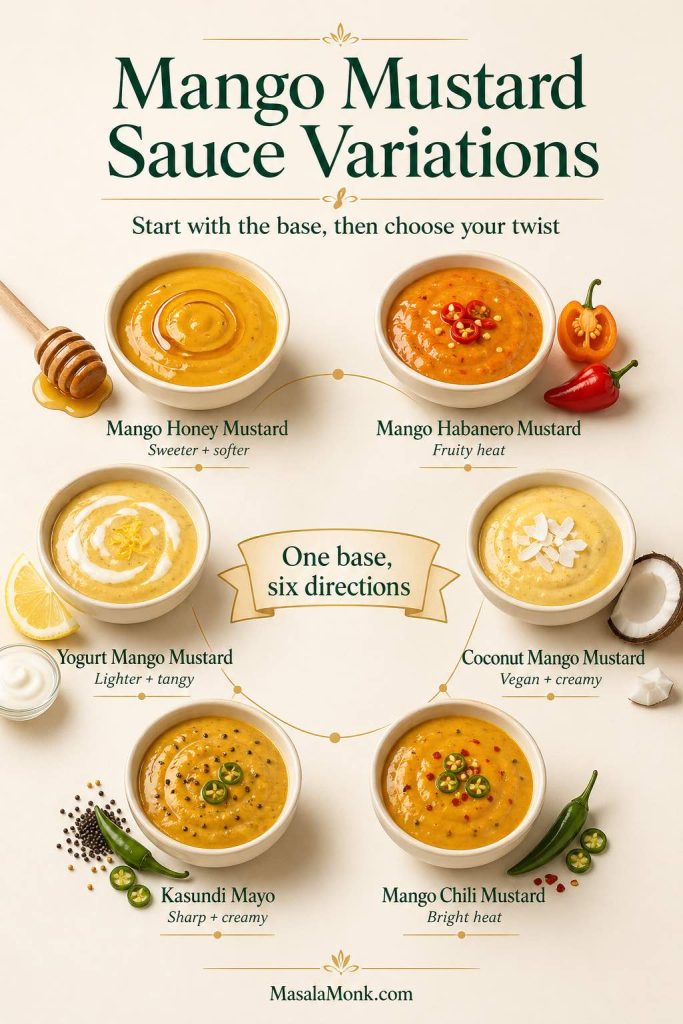
Mango Mustard Sauce Variations

Once the base sauce tastes balanced, you can move it sweeter, hotter, creamier, tangier, or more Indian-style depending on what you are serving. In other words, the same base can become a dip, glaze, dressing, or sharper kasundi-style sauce with only a few changes.

Mango mustard sauce variations guide showing mango honey mustard, mango habanero mustard, yogurt mango mustard, coconut mango mustard, kasundi mayo, and mango chili mustard.
Start with the basic mango mustard sauce, then adjust it into a sweeter honey mustard, hotter habanero sauce, lighter yogurt version, vegan coconut sauce, sharper kasundi mayo, or bright mango chili mustard.

Mango Honey Mustard

Add 1 to 2 teaspoons honey and use Dijon or yellow mustard. As a result, this version becomes softer, sweeter, and especially good with chicken tenders, sandwiches, wraps, and fries.

Mango Habanero Mustard

Add a very small amount of minced habanero or habanero hot sauce. Since habanero heat builds quickly, start with less than you think you need. This variation is best with wings, grilled meats, burgers, and spicy sandwiches.

Coconut Mango Mustard Sauce

Use coconut cream instead of mayo or yogurt. This version is vegan, creamy, slightly tropical, and especially good with shrimp, fish, roasted vegetables, and fried snacks.

Yogurt Mango Mustard Sauce

Use Greek yogurt or thick curd for a lighter, tangier sauce. Because it has more acidity and less richness than mayo, it works well with grilled chicken, wraps, bowls, paneer, and roasted vegetables.

Kasundi Mayo

Mix 1 tablespoon kasundi with 2 tablespoons mayo or yogurt and 1 to 2 tablespoons mango pulp. This gives you a fast, sharp, creamy dip for fries, pakoras, rolls, sandwiches, and snacks.

Mango Chili Mustard Sauce

Add chili flakes, fresh green chili, cayenne, or a small amount of chili sauce. However, keep the mango and mustard balanced so the sauce tastes fruity and sharp, not just hot.

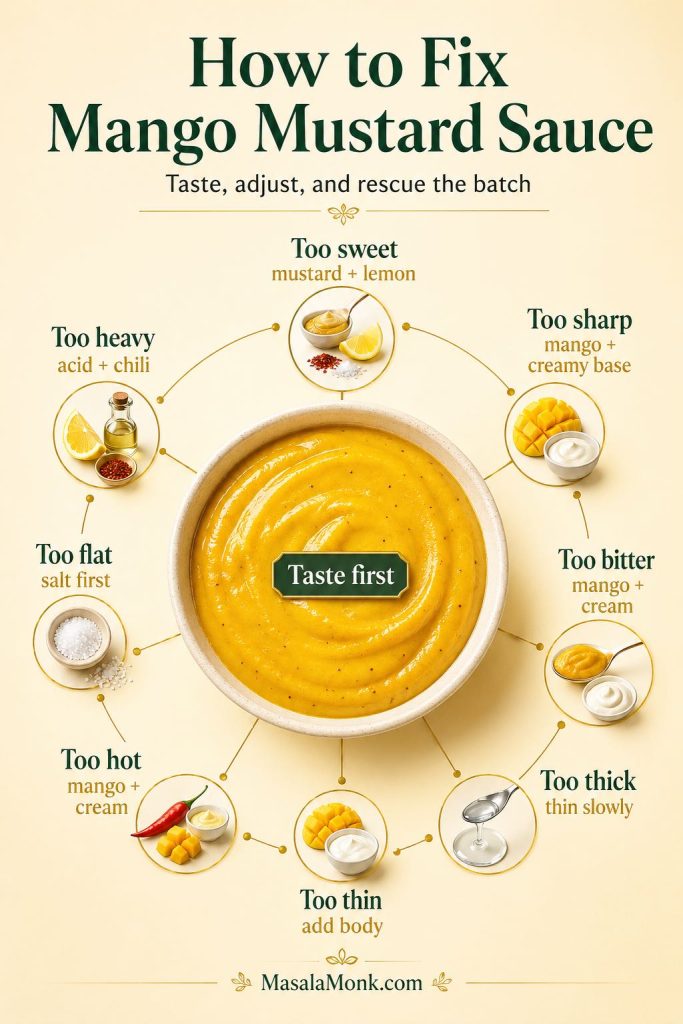
How to Fix Mango Mustard Sauce

Mangoes, mustards, and creamy bases all vary. Therefore, after blending, taste the sauce and adjust it before serving.

Troubleshooting guide for mango mustard sauce showing how to fix sauce that is too sweet, too sharp, too bitter, too thick, too thin, too hot, too flat, or too heavy.
Taste mango mustard sauce after blending and adjust it before serving: sharpen sweetness with mustard and lemon, soften harshness with mango and creamy base, add salt when it tastes flat, or thin it slowly for drizzling.
Problem What Happened How to Fix It
Too sweet The mango or mango pulp is very sweet. Add lemon juice, vinegar, mustard, chili, or a pinch of salt.
Too sharp There is too much mustard or acid. Add more mango, mayo, yogurt, coconut cream, or a tiny bit of honey.
Too bitter The mustard seeds or mustard are too strong. Add mango and creamy base. Next time, use less mustard seed or a milder mustard.
Too thick There is too much mango pulp, cashew, mayo, or coconut cream. Thin with water, lemon juice, vinegar, or a little oil.
Too thin There is too much liquid or the mango is watery. Add mayo, yogurt, cashew paste, coconut cream, or more mango pulp.
Too hot The chili is stronger than expected. Add more mango and creamy base.
Too flat The sauce is under-salted or lacks acid. Add salt first, then lemon or vinegar if it still needs brightness.
Too heavy There is too much mayo or cream. Add lemon juice, vinegar, chili, mango, or mustard to lift it.

Store-Bought vs Homemade Mango Mustard Sauce

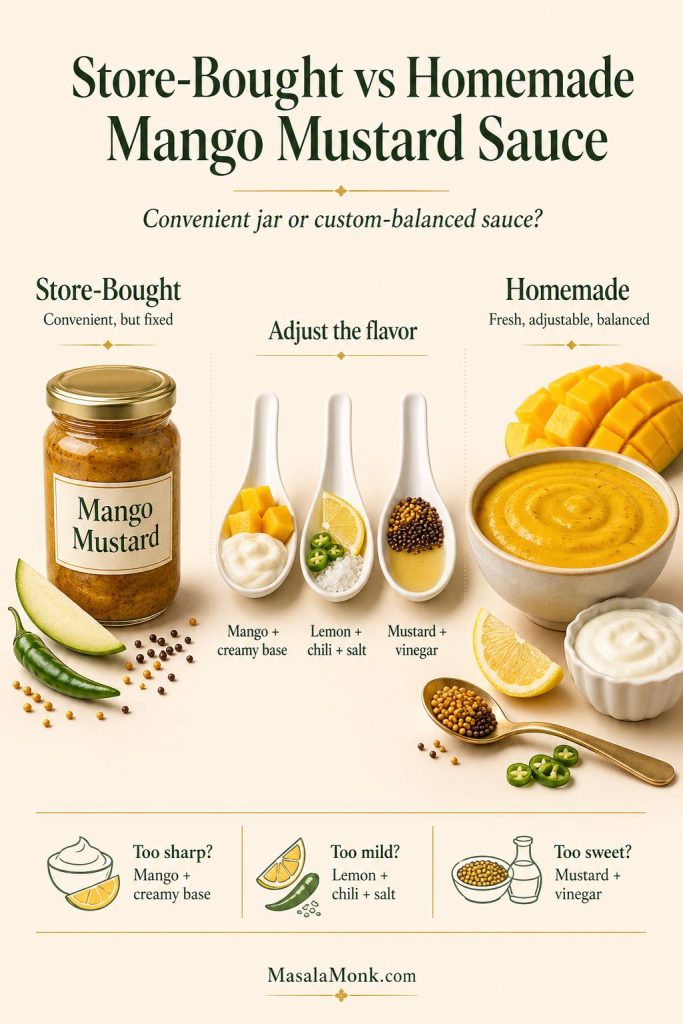
Store-bought aam kasundi, mango kasundi, or mango mustard sauce can be convenient, but the flavor varies a lot. Some versions are sharp, salty, oily, and pungent. Others, however, are sweeter, creamier, or closer to a mild mustard dip.

Store-bought vs homemade mango mustard sauce guide showing a jarred sauce, adjustment spoons with mango, lemon, chili, salt, mustard, and vinegar, and a fresh homemade sauce bowl.
Store-bought mango mustard sauce or mango kasundi can be convenient, but homemade sauce gives you more control. Use mango and a creamy base to soften sharpness, lemon, chili, and salt to brighten mild sauce, or mustard and vinegar to balance extra sweetness.

Homemade mango mustard sauce gives you more control. Instead of accepting one fixed flavor, you can make it creamy or no-mayo, sweet or sharp, mild or spicy, thick for dipping, or thin for drizzling. However, if you already have store-bought kasundi, you can still turn it into a fast sauce by whisking a spoonful with mango pulp and mayo, yogurt, coconut cream, or soaked cashews.

When store-bought kasundi tastes too sharp, soften it with mango pulp and a creamy base. If it tastes too mild, brighten it with lemon, chili, or a pinch of salt. When it leans too sweet, bring back the mustard bite with extra mustard, vinegar, or lemon juice.

Storage

Storage depends on the version you make. Because the fast blender sauce contains fresh mango and often mayo, yogurt, coconut cream, or cashews, treat it as a fresh refrigerator sauce.

Quick creamy mango mustard sauce

  • Store in a clean airtight jar or container in the refrigerator.
  • Use within 3 to 4 days.
  • Stir before serving because the sauce may thicken slightly as it sits.
  • Use a clean spoon every time.
  • Do not leave the sauce at room temperature for more than 2 hours, or more than 1 hour in very hot weather.

Aam kasundi-style refrigerator sauce

  • Store in a clean jar in the refrigerator.
  • For best flavor and freshness, use within 5 to 7 days.
  • Use a clean spoon to avoid introducing moisture or crumbs.
  • Treat it as a refrigerator condiment, not a shelf-stable preserve.
  • Discard if it smells off, grows mold, or changes texture in an unpleasant way.
Important: For shelf-stable mustard, kasundi, or mango pickle, use a tested preservation recipe. Do not casually adjust vinegar, water, salt, oil, or food proportions in preserved condiments.

For general safe pickling principles, see the National Center for Home Food Preservation’s pickling guidance.

Mango Mustard Sauce FAQs

What is mango mustard sauce made of?

Mango mustard sauce is usually made with mango, mustard, lemon juice or vinegar, chili, salt, and a creamy base such as mayonnaise, yogurt, coconut cream, or soaked cashews. A sharper aam kasundi-style version, however, uses raw mango, mustard seeds, mustard oil, green chili, turmeric, and salt.

Is mango mustard sauce the same as aam kasundi?

Not exactly. Quick mango mustard sauce is usually creamy and made with ripe mango and prepared mustard. By contrast, aam kasundi is a sharper Bengali-style mango mustard condiment made with raw mango, mustard seeds, mustard oil, and green chili.

What is mango kasundi?

Mango kasundi, also called aam kasundi or aam kashundi, is a Bengali-style raw mango mustard sauce. Because it uses raw mango and mustard seeds, it is usually sharper, sourer, and more pungent than a creamy mango mustard dipping sauce.

Can I make mango mustard sauce without mayo?

Yes. Instead of mayonnaise, use Greek yogurt, thick curd, coconut cream, or soaked cashews. For a vegan no-mayo version, coconut cream and cashews are the best options.

Can I use mango pulp?

Yes. Mango pulp works well for a smooth blender sauce. Unsweetened mango pulp is best; however, if the pulp is very sweet, skip the honey or sugar and add extra lemon juice or mustard if needed.

Which mustard is best?

Dijon mustard is the best first choice because it is sharp, smooth, and balanced. Yellow mustard makes a milder dipping sauce. Meanwhile, kasundi gives the sauce a stronger Indian/Bengali-style flavor, and mustard seeds are best for the aam kasundi-style version.

Is mango mustard sauce good with chicken?

Yes. Mango mustard sauce works well with grilled chicken, chicken tenders, chicken wings, chicken sandwiches, wraps, and rice bowls. Depending on the meal, use it as a dip, spread, drizzle, or finishing glaze.

Can I use mango mustard sauce as a marinade?

Yes, but it works best as a short marinade or finishing glaze. For a marinade, 20 to 30 minutes is usually enough. Since the sauce may contain mayo, yogurt, or coconut cream, avoid cooking it over very high heat for too long because it can split or scorch. For grilling, brush it on near the end or serve it on the side.

What do you eat with mango mustard sauce?

Serve mango mustard sauce with fries, chicken tenders, wings, pakoras, nuggets, onion rings, burgers, sandwiches, wraps, grilled chicken, fish, shrimp, paneer, tofu, roasted vegetables, grain bowls, or salads.

How long does mango mustard sauce last?

The quick creamy version usually keeps for 3 to 4 days in the refrigerator in a clean airtight container. Meanwhile, the aam kasundi-style version should also be refrigerated and used within 5 to 7 days for best flavor and freshness.

Can I make mango habanero mustard?

Yes. Add a very small amount of minced habanero or habanero hot sauce to the quick mango mustard sauce. Since habanero heat builds quickly, start with less than you think you need.

Is mango mustard sauce sweet or spicy?

It can be both, but the best version is balanced. Ripe mango gives sweetness, mustard gives sharpness, lemon or vinegar gives tang, and chili adds heat. Therefore, you can make it mild, medium, or hot depending on how much chili you use.

Final Tips for the Best Mango Mustard Sauce

Before you make your first batch, keep these final points in mind.

  • Use ripe mango for the quick creamy sauce and raw mango for the aam kasundi-style version.
  • Start with Dijon if you want the cleanest all-purpose mango mustard sauce.
  • Use kasundi when you want a sharper Indian-style flavor.
  • Keep the sauce thick for dipping and thinner for drizzling.
  • Add salt before adding more lemon or vinegar if the sauce tastes flat.
  • Use coconut cream or soaked cashews for a vegan no-mayo version.
  • Let the sauce rest for 10 minutes before final judging.
  • Keep homemade mango mustard sauce refrigerated.

↑ Back to top

Posted on 2 Comments

Amba Sauce Recipe: Tangy Mango Sauce for Falafel, Shawarma & Sabich

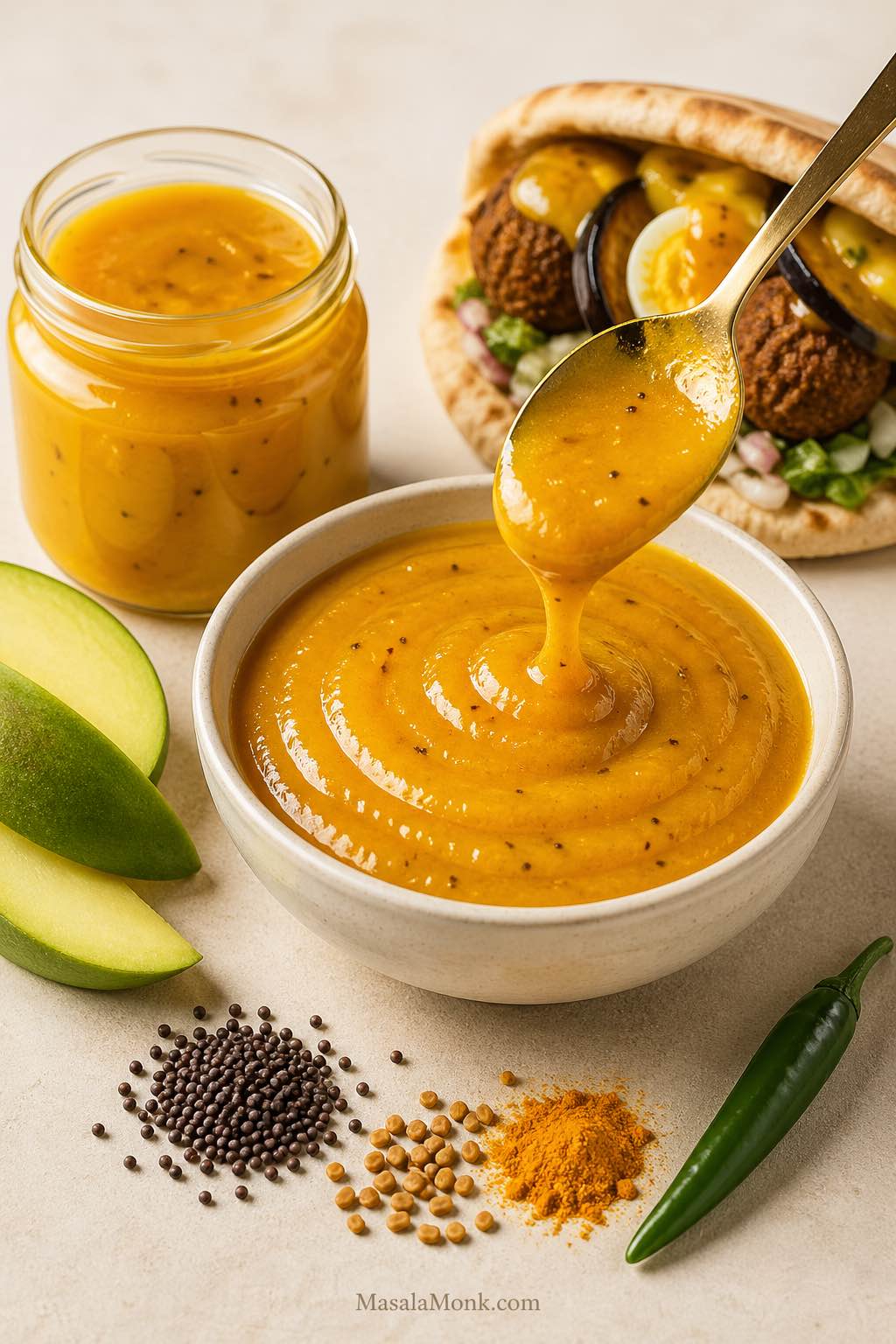
Golden amba sauce made with mango, turmeric, fenugreek, mustard seeds and chili, served with falafel pita.

A good amba sauce should taste bright, tangy, spicy, earthy, and unmistakably mango-forward without turning into sweet mango chutney. It should be sharp enough for falafel, shawarma, sabich, hummus bowls, eggs, grilled vegetables, and roasted potatoes, but smooth enough to drizzle from a spoon.

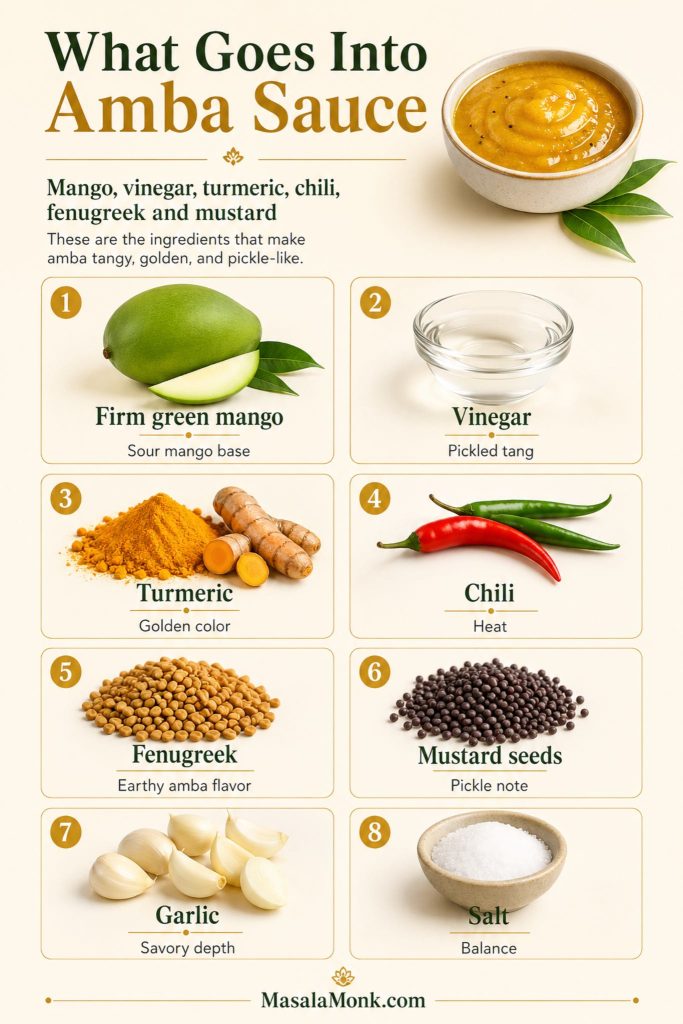
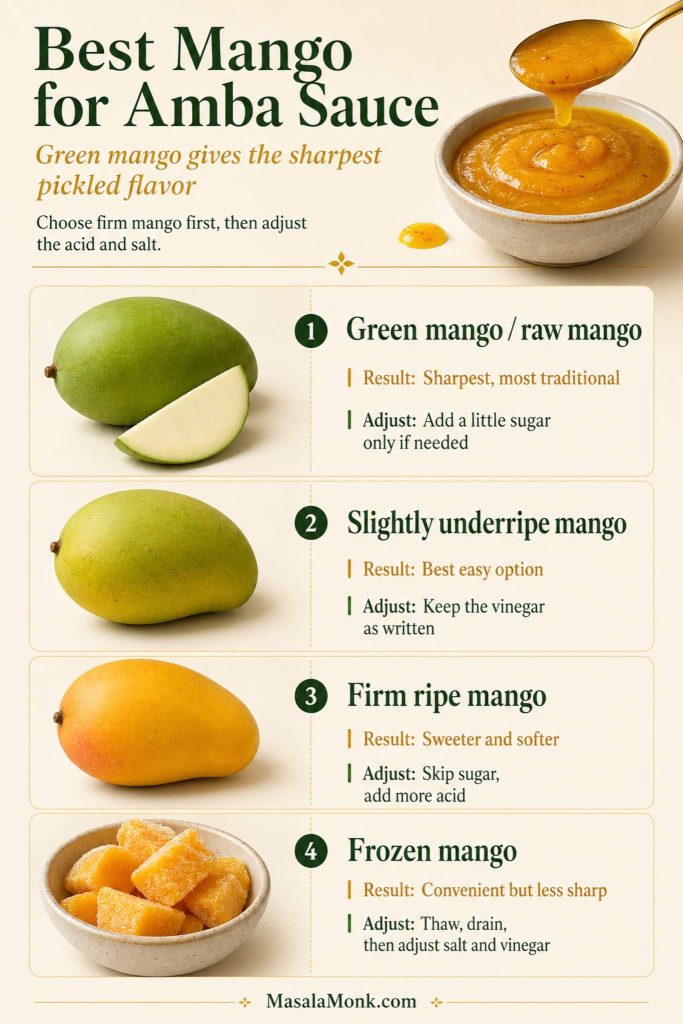
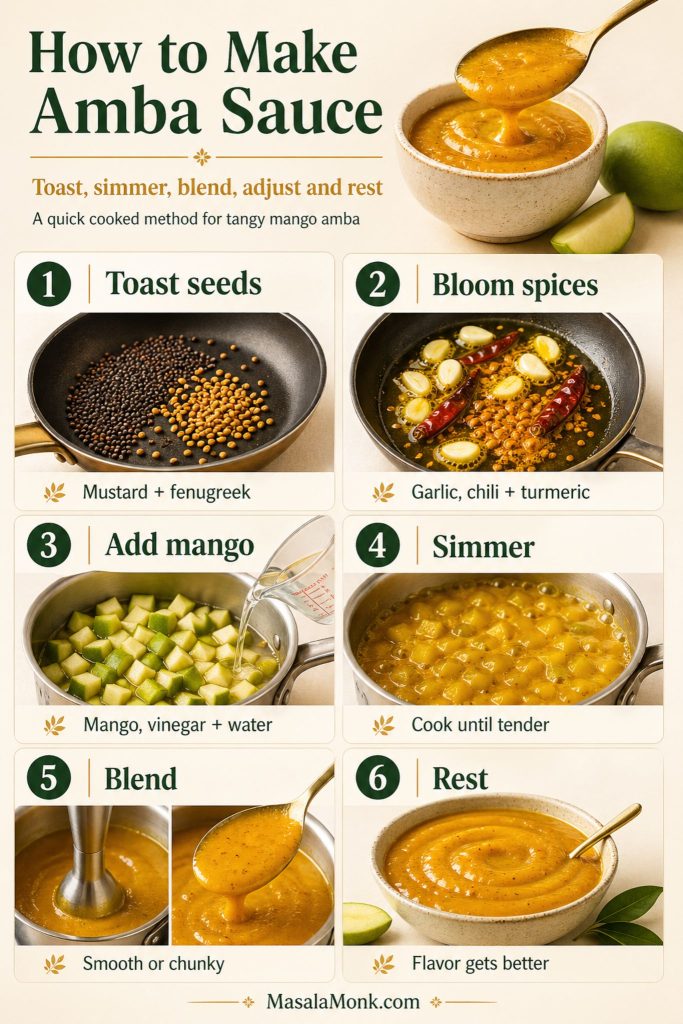
This amba sauce recipe gives you the most useful version first: a quick cooked mango amba sauce made with firm mango, vinegar, turmeric, chili, fenugreek, mustard seeds, garlic, and warm spices. It is ready the same day, tastes better after a few hours, and becomes even more rounded after a night in the fridge.

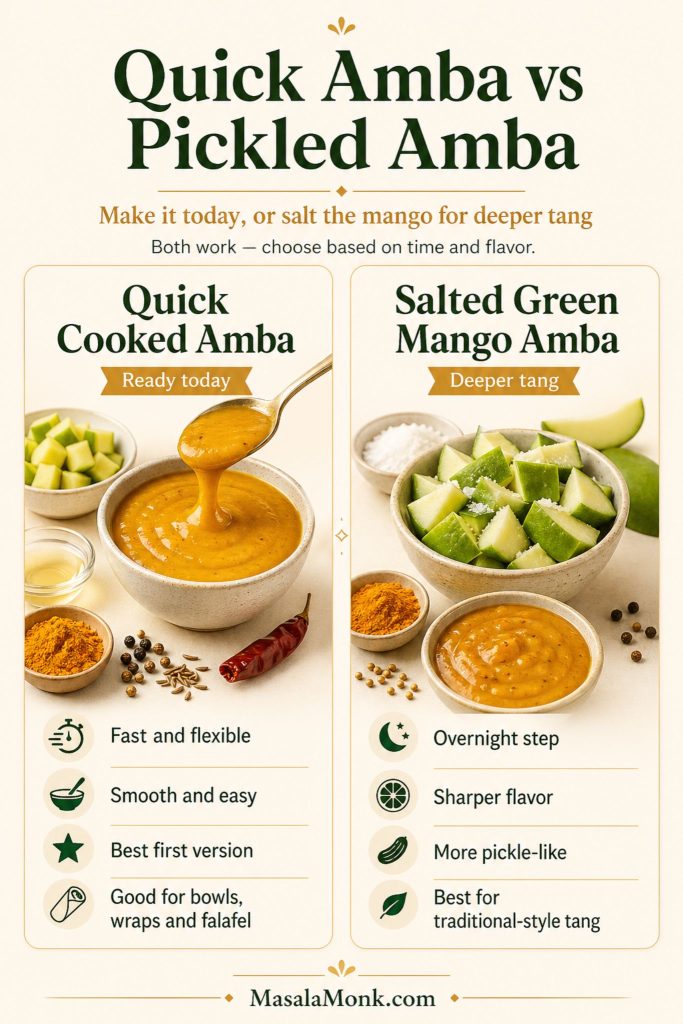
Traditional amba is often tied to pickled green mango, and that sour pickled character is part of what makes the condiment special. Instead of treating every version the same, this guide gives you two useful paths: a reliable quick amba you can make today, and a salted green mango option when you want deeper tang and a more traditional pickled mango flavor.

Quick Answer

Amba sauce is a tangy mango condiment made with mango, vinegar, turmeric, chili, fenugreek, mustard, garlic, and salt. It is usually sharper, more sour, and less sweet than mango chutney. The best homemade version starts with firm green or slightly underripe mango, then balances vinegar, spice, salt, and a small amount of sweetness only if the mango is very tart.

For the easiest version, cook chopped mango with toasted mustard and fenugreek, garlic, turmeric, chili, vinegar, water, and salt. Once the mango softens, blend everything into a thick golden sauce and use it on falafel, shawarma, sabich, hummus bowls, eggs, roasted vegetables, grilled chicken, paneer, fries, rice bowls, or sandwiches.

For a more traditional pickled mango flavor, salt the green mango first and let it rest before cooking it with the spices and vinegar. That extra step takes longer, but it gives the amba a deeper, sharper tang.

Amba Sauce Recipe

This quick cooked amba sauce is tangy, spicy, golden, and mango-forward. Use firm green or slightly underripe mango for the best sour pickled flavor.

Prep Time
10 minutes
Cook Time
12 minutes
Active Time
22 minutes
Total Time
52 minutes, with minimum rest
Yield
About 1 1/2 cups

Ingredients

  • 2 cups peeled firm green or slightly underripe mango, chopped
  • 1 tablespoon neutral oil
  • 1 teaspoon mustard seeds
  • 1/2 teaspoon fenugreek seeds, or 1/4 teaspoon ground fenugreek
  • 2 garlic cloves, minced
  • 1 small green or red chili, minced, or 1/2 teaspoon chili flakes
  • 3/4 teaspoon ground turmeric
  • 1/2 teaspoon ground cumin
  • 1/2 teaspoon ground coriander
  • 1/4 to 1/2 teaspoon cayenne or Kashmiri chili powder, to taste
  • 1/3 cup white vinegar or apple cider vinegar
  • 1/4 cup water, plus more as needed
  • 3/4 teaspoon salt, plus more to taste
  • 1 to 2 teaspoons sugar or jaggery, only if needed
  • 1 to 2 teaspoons lemon or lime juice, optional, for finishing

Instructions

  1. Toast the seeds. Heat the oil in a small saucepan over medium-low heat. Add the mustard seeds and fenugreek seeds. Cook for 30–60 seconds, just until fragrant. Do not burn the fenugreek.
  2. Bloom the aromatics. Add the garlic, chili, turmeric, cumin, coriander, and cayenne or Kashmiri chili powder. Stir for 30–45 seconds.
  3. Add the mango. Stir in the chopped mango, vinegar, water, and salt.
  4. Simmer. Cook for 8–12 minutes, stirring occasionally, until the mango is tender and the mixture looks glossy. Add 1–2 tablespoons more water if the pan gets dry.
  5. Blend. Cool for a few minutes, then blend until smooth. For a chunkier pickle-style sauce, pulse instead of blending fully.
  6. Adjust. Taste and adjust with more salt, vinegar, chili, sugar, or lemon/lime juice. If the sauce is too thick, add water 1 tablespoon at a time.
  7. Rest. Let the sauce rest for at least 30 minutes before serving. For best flavor, refrigerate for a few hours or overnight.

Notes

  • Use green mango for the sharpest flavor.
  • If using ripe mango, reduce or skip the sugar and add extra vinegar or lime to taste.
  • If using ground fenugreek instead of seeds, add it with the turmeric and other ground spices.
  • For mild heat, skip the cayenne. For medium heat, use 1/4 teaspoon. For a hotter sauce, use 1/2 teaspoon or add another chili.
  • This is a refrigerator condiment, not a shelf-stable preserve.

For the first serving, try it the classic way: spoon the amba over falafel, shawarma-style chicken, fried eggplant, hummus, boiled eggs, or roasted potatoes. A little tahini on the side makes the plate creamy, tangy, and balanced.

What Is Amba Sauce?

Amba sauce is a sour, spicy mango sauce made from pickled or cooked mango and warm spices. Often described as an Iraqi amba sauce or pickled mango sauce, it is closely connected to South Asian mango pickle traditions, Iraqi food, Iraqi Jewish cooking, and Middle Eastern street food.

At its core, amba usually starts with mango, vinegar, salt, turmeric, chili, and fenugreek. Depending on the cook, it may also include mustard seed, cumin, coriander, garlic, lemon, or a small amount of sugar. In some versions, the mango is salted and pickled first; in quicker versions, it is cooked directly into the sauce.

Because of those differences, amba can look slightly different from recipe to recipe. In some kitchens, it is thin and pourable enough to drizzle over falafel or shawarma. In others, it is thicker, spoonable, and closer to a soft mango pickle. Meanwhile, smooth versions work best for wraps and bowls, while lightly chunky versions are especially good with grilled food, eggs, and rice dishes.

Where Does Amba Sauce Come From?

Amba is closely linked to South Asian mango pickle traditions, Iraqi cooking, Iraqi Jewish cooking, and Middle Eastern street food. That is why it often shows up with falafel, shawarma, sabich, kebabs, hummus, eggs, grilled eggplant, and warm pita.

This history also explains why amba can vary from kitchen to kitchen. Some versions are smooth and pourable, while others are thicker, chunkier, and closer to a soft mango pickle. The common thread is the sour mango base, turmeric color, chili heat, and fenugreek-mustard pickle flavor.

What Does Amba Taste Like?

Amba tastes tangy, sour, savory, earthy, spicy, and lightly fruity. The mango gives body and fruitiness, while the vinegar gives sharpness. Turmeric adds color and warmth, chili brings heat, and fenugreek gives the sauce its distinctive bitter-earthy background note.

Instead of tasting like mango jam, good amba has a pickle-like edge that makes rich foods taste brighter. Because it cuts through fat and starch so well, it works especially nicely with fried eggplant, falafel, shawarma, eggs, roasted potatoes, grilled meats, and creamy hummus.

When it tastes too sweet, it starts leaning toward mango chutney. If the flavor feels harsh, the sauce usually needs a little more salt, a tiny bit of sweetness, or simply more resting time. When the flavor seems flat, add salt first; after that, add vinegar or lemon only if it still needs brightness.

Why This Recipe Works

  • Firm mango keeps the sauce tangy. Green or slightly underripe mango gives amba the sour, savory character that makes it different from chutney.
  • Toasted mustard and fenugreek build the pickle flavor. These two ingredients are small but important. Without them, the sauce tastes more like generic mango chili sauce.
  • Cooking the vinegar with the mango makes the sauce smoother. The acidity tastes integrated instead of raw or splashy.
  • A little sugar is optional, not the main flavor. You only need enough to round the edges if your mango is very sour.
  • The sauce improves as it rests. It is usable the same day, but the spices settle and the tang rounds out after a few hours in the fridge.
  • The recipe gives you both quick and traditional-style options. Make the cooked version today, or salt the green mango first for a sharper pickled mango flavor.

Ingredients

The ingredient list is short, but each item matters. After all, amba is not just mango blended with chili. What makes it taste right is the balance of sour mango, bloomed spices, vinegar, salt, and the fenugreek-mustard backbone.

Ingredient guide for amba sauce showing firm green mango, vinegar, turmeric, chili, fenugreek, mustard seeds, garlic and salt.
Amba sauce gets its tangy, golden, pickle-like flavor from firm mango, vinegar, turmeric, chili, fenugreek and mustard seeds, with garlic and salt rounding out the sauce.

Firm mango

Use firm green mango or slightly underripe mango if you can find it. In India, raw mango or kairi is ideal. It gives the sauce a sharper, more pickle-like flavor. If you only have ripe mango, choose one that is firm, not soft and syrupy.

Vinegar

White vinegar gives the cleanest sharpness and keeps the color bright. Apple cider vinegar also works, but it gives the sauce a rounder fruitiness. Do not skip the vinegar; it is what moves this from mango puree into pickled mango sauce territory.

Turmeric

Turmeric gives the sauce its golden color and a gentle earthy warmth. Use enough to tint the sauce clearly, but not so much that it becomes dusty or bitter.

Fenugreek

Fenugreek is one of the signature flavors in amba. It is earthy, slightly bitter, and aromatic. Use it carefully. Too much fenugreek can make the sauce taste harsh, so the recipe keeps it controlled.

Mustard seeds

Mustard seeds add a pungent pickle note. Toast them briefly in oil so they release flavor before the mango goes in.

Garlic and chili

Garlic makes the sauce savory. Chili gives heat. Use a fresh green chili, red chili, chili flakes, cayenne, or Kashmiri chili powder depending on the heat level and color you want.

Cumin and coriander

Cumin adds warmth, while coriander adds a citrusy spice note. They are not as defining as fenugreek and mustard, but they make the quick cooked version taste fuller.

Salt and optional sugar

Salt is essential because it sharpens the mango and spices. Sugar or jaggery is optional. Use it only to round out the sauce if your mango is very sour or your vinegar is especially sharp.

How Spicy Should Amba Be?

Amba is usually tangy first and spicy second. To keep it mild, use one small chili and skip the cayenne. For medium heat, add 1/4 teaspoon cayenne or Kashmiri chili powder along with the chili. If you prefer a hotter sauce, use 1/2 teaspoon cayenne or add another chili. Since tahini, hummus, eggs, falafel, and shawarma all soften the heat, medium spice is usually the most useful starting point.

Ingredient Substitutions

If You Do Not Have Use This Instead What Changes
Green mango Firm ripe mango The sauce will be sweeter, so skip the sugar and add extra vinegar or lemon.
Fenugreek seeds A small pinch of ground fenugreek Add it with the ground spices and use less because it is strong.
Mustard seeds 1/2 teaspoon Dijon, mustard powder, or crushed mustard The flavor will be less pickle-like but still useful.
White vinegar Apple cider vinegar The sauce will taste rounder and fruitier.
Fresh chili Chili flakes, cayenne, or Kashmiri chili powder Add gradually so the heat stays balanced.
Jaggery Sugar, honey, or maple syrup Use only a little. The sauce should stay tangy, not sweet.

Best Mango for Amba Sauce

The mango makes the biggest difference. Amba should be tangy before it is sweet, so choose the firmest mango you can find.

Guide comparing green mango, slightly underripe mango, firm ripe mango and frozen mango for homemade amba sauce.
Green mango gives amba sauce its sharpest pickled flavor, while slightly underripe mango is the easiest practical choice. Ripe or frozen mango can still work, but the sauce usually needs extra acid, salt, or vinegar to stay tangy instead of sweet.
Mango Type What It Does How to Adjust
Green mango / raw mango Sharp, sour, firm, closest to traditional pickled mango flavor. Best choice. Add 1–2 teaspoons sugar or jaggery only if needed.
Slightly underripe mango Tangy but still fruity, easier to find than fully green mango. Best practical supermarket option. Keep vinegar as written.
Firm ripe mango Sweeter, softer, less sharp. Reduce or skip sugar. Add extra vinegar or lemon at the end.
Frozen mango Soft, sweet, convenient, but less pickle-like. Thaw and drain first. Simmer longer and add more vinegar or lime to taste.

If your only option is ripe mango, the recipe still works. Just do not expect the same sour pickled edge. To bring the flavor back into balance, use less sugar, increase the vinegar slightly, and finish with lemon or lime juice if the sauce tastes too soft.

How to Make Amba Sauce

This method makes a quick cooked amba sauce. Because the mango simmers with the vinegar and spices, you get sour mango flavor, warm spice, and a smooth texture without waiting several days.

Before You Start

  • Use firm mango if possible. Soft ripe mango will make the sauce sweeter and less sharp.
  • Toast fenugreek gently. It turns bitter quickly if it burns.
  • Adjust at the end. Mangoes vary, so balance the final sauce with salt, vinegar, chili, or a tiny bit of sugar.
  • Let it rest. The sauce tastes better after a few hours in the fridge.
Step-by-step guide for making amba sauce by toasting mustard and fenugreek, blooming spices, adding mango and vinegar, simmering, blending and resting.
This quick cooked amba sauce builds flavor in stages: toast the mustard and fenugreek, bloom the garlic, chili and turmeric, simmer the mango with vinegar, blend, then let the sauce rest before serving.

1. Toast the mustard and fenugreek

Warm the oil in a small saucepan over medium-low heat. Add the mustard seeds and fenugreek seeds. Cook briefly until fragrant. Do not let the fenugreek darken too much because burnt fenugreek tastes bitter.

2. Bloom the garlic, chili, and spices

Add the garlic, chili, turmeric, cumin, and coriander. Stir for 30–45 seconds. This step wakes up the spices and gives the sauce a deeper flavor than simply blending everything raw.

3. Add mango, vinegar, water, and salt

Add the chopped mango, vinegar, water, and salt. Stir well, scraping the bottom of the pan so the spices dissolve into the liquid.

4. Simmer until the mango softens

Cook for 8–12 minutes, or until the mango is tender. The mixture should look glossy and golden, not dry. Add a splash more water if it catches on the bottom.

5. Blend smooth or leave slightly chunky

Cool for a few minutes, then blend until smooth. For a spoonable sauce, blend fully. For a pickle-style amba, pulse it so a few small mango pieces remain.

6. Rest before serving

Taste and adjust the salt, vinegar, chili, or sugar. Once the flavor feels balanced, let the amba rest for at least 30 minutes. It is better after 2–3 hours and best after a night in the fridge.

Quick Amba vs Pickled Amba

There are two useful ways to think about homemade amba sauce. For most home cooks, the quick cooked version is the best place to start because it is fast, balanced, and easy to adjust. The salted green mango option is better when you want a sharper, more pickle-like flavor.

Comparison guide showing quick cooked amba sauce versus salted green mango pickled amba sauce, with ready-today and deeper-tang options.
Quick cooked amba is the best first version for most home cooks because it is fast, smooth and easy to adjust. Salted green mango amba takes longer, but it gives the sauce a sharper, more traditional pickled mango flavor.
Version Best For Flavor Time
Quick cooked amba Most home cooks, same-day meals, falafel bowls, shawarma wraps, eggs, grilled food. Tangy, spicy, mango-forward, rounded. About 20 minutes, plus resting time.
Salted green mango amba Deeper pickled flavor, sharper tang, more traditional-style sauce. Sourer, funkier, saltier, more pickle-like. Overnight to 2 days, then cook and blend.

Traditional-Style Salted Mango Option

For a sharper pickled mango flavor, toss the chopped green mango with 1 1/2 teaspoons salt before you start the recipe. Cover and refrigerate it overnight. The next day, drain the mango and continue with the cooked sauce method. Since the mango is already salted, reduce the added salt in the recipe and adjust at the end.

Even with this extra step, the sauce is not shelf-stable. Think of it as a refrigerator condiment with deeper flavor, not a canned preserve. The salted mango improves the tang and texture, but the finished sauce should still be stored cold.

How to Use Amba Sauce

Amba sauce is useful because even a small spoonful can brighten an entire plate. It brings acid, heat, and fruitiness without making food heavier or sweeter.

The most classic pairings are the ones where amba has something rich, fried, creamy, smoky, or starchy to cut through: fried eggplant in sabich, falafel in pita, shawarma, hummus, boiled eggs, kebabs, grilled fish, roasted potatoes, and fries. That same logic is why it also works with modern bowls, sandwiches, tacos, grilled chicken, paneer, and roasted vegetables.

Guide showing how to use amba sauce with falafel pita, shawarma wrap, sabich, hummus, boiled eggs, grilled eggplant, roasted potatoes and grilled chicken or paneer.
Amba sauce is a tangy mango sauce for foods that need acid, heat and a little fruitiness. Use it with falafel, shawarma, sabich, hummus bowls, boiled eggs, grilled eggplant, roasted potatoes, fries, grilled chicken or paneer.

Classic uses

  • Sabich: Drizzle amba over fried eggplant, eggs, salad, tahini, and pita.
  • Falafel: Spoon it into pita or serve it as a tangy falafel sauce for dipping.

  • Shawarma: Use it as a bright shawarma sauce with tahini, pickles, salad, and warm bread.
  • Hummus bowls: Swirl it over hummus with olive oil, chickpeas, herbs, and roasted vegetables.
  • Eggs: Add a spoonful beside boiled eggs, fried eggs, omelets, or breakfast plates.
  • Grilled eggplant: The sour mango sauce balances the soft, smoky richness of eggplant.
  • Kebabs and grilled fish: Use it as a sharp condiment at the table.

Easy home uses

  • Drizzle over roasted cauliflower, carrots, sweet potatoes, or potatoes.
  • Spoon into rice bowls, chickpea bowls, lentil bowls, or grain bowls.
  • Use as a sandwich spread with grilled chicken, paneer, tofu, or roasted vegetables.
  • Mix with tahini for a creamy amba tahini sauce.
  • Thin with lemon juice and oil for a quick amba dressing.
  • Serve with fries, wedges, or roasted potatoes.
  • Brush lightly on grilled chicken or paneer near the end of cooking.

For a fresh chunky mango condiment instead of a smooth tangy sauce, try this mango salsa recipe. Mango salsa is brighter and fresher, while amba is sharper, spiced, and more pickle-like. Both start with mango, but they work in very different ways.

Amba Tahini Sauce

Amba tahini sauce is one of the easiest ways to turn amba into a creamy drizzle. It is excellent with falafel bowls, shawarma-style wraps, roasted cauliflower, grilled eggplant, chickpeas, fries, and chopped salads.

Amba Tahini Ratio

  • 1/4 cup tahini
  • 2 tablespoons amba sauce
  • 1 tablespoon lemon juice
  • 3 to 5 tablespoons cold water
  • Pinch of salt
  • Optional: 1 small grated garlic clove

Whisk the tahini, amba sauce, lemon juice, salt, and garlic if using. As the mixture thickens, add cold water slowly, 1 tablespoon at a time, until the sauce turns creamy and pourable. Finally, taste and add more amba for tang, more lemon for brightness, or more water for a thinner drizzle.

Amba Dressing

For a lighter amba dressing, thin the sauce with lemon or vinegar, olive oil, and a little water. This works well on chopped cucumber-tomato salads, chickpea salads, grilled chicken salads, roasted vegetable bowls, and falafel bowls.

Quick Amba Dressing Ratio

  • 2 tablespoons amba sauce
  • 1 tablespoon lemon juice or vinegar
  • 2 tablespoons olive oil
  • 1 to 2 tablespoons water
  • Pinch of salt
  • Optional: 1/2 teaspoon honey or jaggery syrup if the dressing is too sharp

Whisk everything together until smooth. For a thinner dressing, add more water. For stronger mango-turmeric flavor, add another spoonful of amba.

Split guide showing creamy amba tahini sauce and lighter amba dressing made with amba sauce, tahini, lemon, olive oil, water and salt.
Turn amba sauce into two useful drizzles: creamy amba tahini for bowls, wraps and roasted vegetables, or lighter amba dressing for salads, chickpeas and grilled food.

How to Fix Amba Sauce

Because mangoes vary so much, amba should always be adjusted at the end. After blending, taste the sauce and use the table below to bring it back into balance.

Troubleshooting guide for fixing amba sauce that is too sweet, too sour, too bitter, too spicy, too thin, too thick or flat.
Because mangoes vary, amba sauce should be adjusted after blending. Use vinegar, lemon, salt, sugar, water, extra mango, tahini, yogurt or hummus to fix a sauce that tastes too sweet, sour, spicy, bitter, thin, thick or flat.
Problem What Happened How to Fix It
Too sweet The mango was very ripe or too much sugar was added. Add vinegar or lemon/lime juice, then a pinch of salt.
Too sour The mango was very green or the vinegar is sharp. Add 1/2 teaspoon sugar or jaggery at a time and simmer for 1 minute.
Too bitter The fenugreek was too heavy or burned. Add more mango, water, and a tiny amount of sugar. Next time, toast fenugreek gently.
Too spicy The chili was stronger than expected. Add more mango or stir the sauce into tahini, yogurt, hummus, or oil to soften the heat.
Too thin There is too much water or the mango was very juicy. Simmer uncovered for a few minutes, or blend in more cooked mango.
Too thick The mango cooked down too much. Add water 1 tablespoon at a time until pourable.
Too flat The sauce needs balance. Add salt first, then vinegar or lemon if needed.
Too raw-tasting The spices or vinegar did not integrate. Return to the pan and simmer for 3–5 minutes.
Too much like chutney The mango was too ripe or the sauce is too sweet. Add vinegar, chili, and salt. Next time, use greener mango and less sugar.

Texture Guide

The best texture depends on how you want to use the sauce. For example, wraps and bowls usually need a smooth drizzle, while rice dishes and grilled food can handle a thicker, more textured amba.

Texture guide comparing smooth drizzle, thick spoonable amba sauce and chunky pickle-style amba sauce.
Amba sauce can be blended smooth for falafel, shawarma, wraps and bowls, simmered thicker for eggs and grilled food, or left chunky for rice bowls, sandwiches and fries.
Texture Best For How to Get It
Smooth drizzle Falafel, shawarma, sabich, hummus bowls. Blend fully and add 1–2 tablespoons water if needed.
Thick spoonable sauce Eggs, grilled chicken, paneer, roasted vegetables. Blend, then simmer 2–3 minutes longer.
Chunky pickle-style amba Rice bowls, sandwiches, grilled food. Pulse briefly instead of blending smooth.
Creamy amba tahini Bowls, wraps, fries, roasted cauliflower. Whisk amba with tahini, lemon, cold water, and salt.
Thin dressing Salads and grain bowls. Whisk amba with lemon or vinegar, olive oil, and water.

Amba Sauce vs Mango Chutney, Mango Pickle, Mango Hot Sauce, and Mango Salsa

Amba sauce is easy to confuse with other mango condiments, but the flavor is different. In general, it is tangier than mango chutney, smoother than mango pickle, and more cooked and spiced than mango salsa. It can also be spicy, but it is not the same thing as mango hot sauce or mango habanero sauce.

Comparison guide showing the differences between amba sauce, mango chutney, mango pickle, mango hot sauce and mango salsa.
Amba sauce is tangier and more savory than mango chutney, smoother than mango pickle, less chili-forward than mango hot sauce, and more cooked and spiced than fresh mango salsa.
Condiment Main Flavor Texture Sweetness Best Use
Amba sauce Tangy, spicy, earthy, mango-forward. Smooth or lightly chunky. Low to medium. Falafel, shawarma, sabich, hummus, eggs, grilled food.
Mango chutney Sweet, sticky, spiced, jammy. Chunky or glossy. Medium to high. Cheese boards, sandwiches, curries, snacks.
Mango pickle / achar Salty, oily, sharp, intense. Chunky, oil-coated, spice-heavy. Low. Dal, rice, paratha, Indian meals.
Mango hot sauce / mango habanero sauce Chili-forward, fruity, sweet-hot, often very spicy. Thin to medium sauce. Medium to high. Wings, tacos, grilled meat, dipping sauces.
Mango salsa Fresh, juicy, lime-bright. Diced and fresh. Natural fruit sweetness. Tacos, chips, fish, shrimp, chicken.

For something fresh and chunky, mango salsa is the better choice. When you want a sweeter, jammy condiment, mango chutney fits better. With dal, rice, paratha, or a full Indian meal, mango pickle gives you the salty, oily intensity you want. By contrast, when you need a tangy mango sauce to drizzle over falafel, shawarma, sabich, hummus, eggs, or roasted vegetables, amba is the right one.

Storage and Freezing

Store homemade amba sauce in a clean, airtight jar in the refrigerator and use it within 1 to 2 weeks. Use a clean spoon every time, keep the jar closed between uses, and discard the sauce if it smells off, grows mold, or changes texture in an unpleasant way.

For longer storage, freeze amba sauce in small portions for up to 2 to 3 months. After thawing it in the refrigerator, stir well and adjust with a little water, vinegar, or lemon juice if the texture changes.

Important: This homemade amba sauce is a refrigerator condiment, not a shelf-stable canned preserve. Do not store it at room temperature after cooking. If you want to preserve sauces or pickles for shelf storage, use a tested canning recipe and follow safe acidity guidelines. The National Center for Home Food Preservation explains that vinegar, food, and water proportions matter for pickled food safety.

For more on safe pickling principles, see the National Center for Home Food Preservation’s pickling guidance.

Where to Buy Amba Sauce

If you do not want to make amba sauce from scratch, look for it at Middle Eastern grocery stores, Israeli or Jewish markets, international food stores, and online retailers. It may be labeled as amba sauce, mango amba sauce, pickled mango sauce, or Iraqi amba sauce.

Checklist for buying store-bought amba sauce, showing mango, vinegar, turmeric, chili, fenugreek, mustard and salt.
Good store-bought amba sauce should taste tangy, golden and pickle-like. Check the label for mango, vinegar, turmeric, chili, fenugreek, mustard and salt, and avoid sauces that taste more like sweet mango dip.

Store-bought amba varies a lot. Some versions taste sharp, sour, and pickle-like, while others are smoother, sweeter, or closer to a mild mango curry sauce. For a flavor closer to classic amba, check the ingredient list for mango, vinegar, turmeric, fenugreek, mustard, chili, and salt.

If the label says mango sauce but does not include vinegar, turmeric, chili, fenugreek, mustard, or similar pickle-style spices, it may taste more like a sweet mango dip than amba.

If a jar or pouch tastes too sweet, add lemon juice, vinegar, chili, or a pinch of salt before serving. When it tastes too sharp, stir it into tahini, yogurt, labneh, hummus, mayo, or olive oil to soften the edge.

Store-Bought Amba Sauce vs Homemade

Homemade amba gives you more control over sourness, sweetness, heat, and texture. Store-bought amba is convenient, especially for falafel, sabich, shawarma, and quick bowls, but it may taste sweeter, saltier, thinner, or more curry-like depending on the brand.

FAQs

What is amba sauce made of?

Amba sauce is usually made with mango, vinegar, turmeric, chili, fenugreek, mustard, garlic, salt, and sometimes cumin, coriander, lemon, or a small amount of sugar. The mango may be pickled first or cooked directly into a quicker sauce.

Is mango amba sauce the same as amba sauce?

Yes. Mango amba sauce usually refers to the same condiment as amba sauce, since amba is a mango-based sauce made with mango, vinegar, turmeric, chili, fenugreek, mustard, and salt. The phrase is helpful for readers who are new to the condiment, but amba sauce is the cleaner name to use throughout the recipe.

Is amba sauce spicy?

Amba sauce is usually mildly to moderately spicy. Still, you can make it hotter with more chili, cayenne, or Kashmiri chili powder, or keep it mild by using less chili and more mango.

Is amba sauce a spicy mango sauce?

Yes, amba can be described as a spicy mango sauce, but it is not the same as sweet mango hot sauce or mango habanero sauce. Amba is usually tangier, more savory, more sour, and more spice-driven, with turmeric, fenugreek, mustard, vinegar, and chili giving it a pickled mango flavor.

Is amba sauce the same as mango chutney?

No. Mango chutney is usually sweeter, stickier, and more jam-like. In contrast, amba sauce is usually tangier, more savory, more sour, and more pourable. It also has a stronger pickled mango character.

Can I use ripe mango for amba sauce?

Yes, but the sauce will be sweeter and less sharp. To bring back the tangy flavor, skip or reduce the sugar and add extra vinegar or lemon juice.

Can I use frozen mango?

Yes, frozen mango works for a quick homemade amba sauce. First, thaw and drain it. Then, simmer it with the spices and vinegar. Because frozen mango is usually sweeter and softer, you may need extra vinegar, lemon, or salt.

Is amba sauce fermented?

Some traditional-style amba recipes begin with salted green mango, and some versions are fermented. This recipe uses a safer refrigerator-condiment approach: a same-day cooked version and an optional overnight salted mango step for deeper pickled flavor.

What do you eat with amba sauce?

Amba sauce is excellent with falafel, shawarma, sabich, hummus bowls, eggs, grilled eggplant, fish, kebabs, roasted cauliflower, fries, potatoes, rice bowls, grilled chicken, paneer, tofu, and sandwiches.

Can I use amba sauce as a mango sauce for chicken?

Yes. Amba works especially well as a tangy mango sauce for grilled chicken, roasted chicken, shawarma-style chicken, kebabs, and chicken rice bowls. Use it as a finishing sauce rather than a long-cooking sauce. Brush it on near the end of cooking, spoon it over the plate, or mix it with tahini, yogurt, or olive oil for a milder drizzle.

How long does homemade amba sauce last?

Homemade amba sauce keeps for about 1 to 2 weeks in a clean jar in the refrigerator. It is not shelf-stable unless made with a tested canning recipe.

Can you freeze amba sauce?

Yes. Freeze amba sauce in small portions for up to 2 to 3 months. Thaw in the refrigerator and stir well before serving.

Can I make amba sauce without fenugreek?

You can, but the sauce will lose some of its signature flavor. If you do not have fenugreek, use the mustard seeds, cumin, coriander, turmeric, chili, and vinegar as written. The sauce will still be good, although it will taste less like classic amba.

Final Tips for the Best Amba Sauce

  • Use the firmest mango you can find.
  • Keep the sauce tangy rather than sweet; amba should not taste like mango jam.
  • Toast the mustard and fenugreek gently so they taste aromatic, not burnt.
  • After blending, let the sauce rest before judging the final flavor.
  • For a creamier drizzle, make amba tahini for bowls, wraps, and roasted vegetables.
  • Finally, keep homemade amba sauce refrigerated and use it within 1 to 2 weeks.

Back to top

Posted on 1 Comment

The Mango Tango: 50 Exquisite Vegan Dessert Recipes Celebrating the King of Fruits

food knife fresh fruits

Get ready to dive into a world of tropical sweetness as we embark on a culinary adventure with mangoes. In this series, we’ll explore 50 exquisite vegan dessert recipes that celebrate the luscious flavors and vibrant colors of the king of fruits. From refreshing sorbets and creamy puddings to indulgent cakes and tantalizing tarts, these mango-inspired creations will transport your taste buds to a paradise of tropical bliss. Join us as we unlock the versatility of mangoes and discover new and exciting ways to enjoy this beloved fruit in irresistible vegan desserts.

Exploring the Mango Spectrum: Mangoes offer a spectrum of flavors, ranging from the intensely sweet and juicy to the subtly tangy and aromatic. Throughout this series, we’ll explore various mango varieties, each with its own unique taste and texture. From the velvety Alphonso and fragrant Ataulfo to the juicy Kent and vibrant Tommy Atkins, we’ll celebrate the diversity of mangoes and how they enhance the flavor profiles of our desserts. Get ready to savor the natural sweetness and tropical essence of mangoes in every delectable bite.

Embracing the Tropical Vibes: Mangoes evoke a sense of tropical paradise, and these desserts aim to capture that essence. We’ll incorporate other exotic flavors and ingredients like coconut, lime, passion fruit, and even spices like chili and ginger to complement the sweetness of mangoes. These combinations will transport you to sun-drenched beaches and lush palm trees, infusing your desserts with the spirit of the tropics. So sit back, relax, and let the flavors of these mango desserts whisk you away to a dreamy island getaway.

Celebrating Diversity: Just like the melting pot of cultures in the world, mangoes have found their way into countless traditional desserts from various culinary traditions. In this series, we’ll draw inspiration from around the globe, including the mango sticky rice from Thailand, mango kulfi from India, mango coconut sago from Southeast Asia, and much more. Each recipe will reflect the unique flavors and techniques of its origin, showcasing the versatility of mangoes in different culinary contexts. Prepare to embark on a cultural journey that celebrates the universal love for mangoes.

Sharing the Mango Love: One of the greatest joys of indulging in mango desserts is sharing them with loved ones. Whether you’re hosting a summer gathering, surprising a friend with a homemade treat, or simply treating yourself to a moment of pure indulgence, these mango desserts are meant to be shared and savored together. The vibrant colors, tropical aromas, and heavenly flavors will create a memorable experience that brings people closer, sparks conversations, and leaves a lasting impression. So spread the mango love and share the magic of these desserts with family and friends.

Conclusion: As we dive into the world of mango desserts, get ready to embark on a tantalizing journey of tropical sweetness. From refreshing sorbets to creamy puddings and beyond, these 50 exquisite vegan dessert recipes will celebrate the lusciousness and versatility of mangoes. Let the vibrant colors, tropical aromas, and heavenly flavors transport you to a paradise of flavor. So grab a ripe mango, sharpen your knives, and join us as we indulge in the mango mania that awaits. Get ready for a mango-filled adventure that will leave you craving more and celebrating the king of fruits in all its glory.

[ez-toc]

Chapter 1: Refreshing Mango Sorbets

Creamy Mango Coconut Sorbet

Indulge in a creamy and tropical delight with this Creamy Mango Coconut Sorbet. Blending together ripe mangoes, creamy coconut milk, a splash of lime juice, and a touch of sweetener, this sorbet offers a velvety smooth texture and a burst of tropical flavors. The ripe mangoes provide natural sweetness and a vibrant orange hue, while the creamy coconut milk adds richness and a hint of tropical creaminess. The splash of lime juice adds a refreshing tang that balances the sweetness of the mangoes. Once blended, the mixture is frozen until firm, creating a refreshing and indulgent treat. Serve it in a chilled bowl or as a delightful dessert after a spicy meal, and let the Creamy Mango Coconut Sorbet transport you to a sun-kissed beach paradise.

Spicy Mango Chili Sorbet

If you’re looking to add some heat to your mango dessert, this Spicy Mango Chili Sorbet is the perfect choice. Blending together ripe mangoes, a squeeze of lime juice, a pinch of chili powder, and a dash of cayenne pepper, this sorbet offers a delightful balance of sweet and spicy flavors. The natural sweetness of the mangoes shines through, while the hint of chili powder and cayenne pepper adds a gentle kick that lingers on the palate. The squeeze of lime juice adds a tangy twist that complements the sweetness and spice. Once blended, the mixture is frozen until firm, resulting in a refreshing and bold dessert. Serve it as a palate cleanser between courses or as a bold and refreshing finale that will leave a lingering tingle on your tongue.

Mango Lime Basil Sorbet

Embrace the bright and zesty flavors of mango, lime, and basil with this Mango Lime Basil Sorbet. Blending together ripe mangoes, freshly squeezed lime juice, a handful of fresh basil leaves, and a touch of sweetener, this sorbet offers a harmonious combination of tangy, citrusy, and herbal notes. The ripe mangoes provide a luscious sweetness, while the lime juice adds a zesty kick. The fresh basil leaves infuse the sorbet with their aromatic and slightly minty flavor, creating a refreshing and vibrant dessert. Once blended, the mixture is frozen until firm, resulting in a sorbet that captures the essence of a tropical paradise. Serve it in a chilled glass or garnish it with a sprig of fresh basil for an added touch of freshness.

Mango Passion Fruit Sorbet

Transport your taste buds to a tropical paradise with this Mango Passion Fruit Sorbet. Blending together ripe mangoes with the tangy and fragrant pulp of fresh passion fruits, this sorbet bursts with tropical goodness. The sweet and juicy mangoes pair perfectly with the tangy and aromatic passion fruit, creating a harmonious combination of flavors. The vibrant orange and yellow colors of the mangoes and passion fruits create an eye-catching sorbet that’s as visually appealing as it is delicious. Once blended, the mixture is frozen until firm, resulting in a sorbet that embodies the essence of sun-soaked beaches and palm-fringed shores. For an extra touch of tropical flair, serve this sorbet in a hollowed-out passion fruit shell.

[ez-toc]

Chapter 2: Creamy Mango Puddings

Vegan Mango Coconut Chia Pudding

Combine the creaminess of coconut milk with the nutritional benefits of chia seeds in this Vegan Mango Coconut Chia Pudding. Blending together ripe mangoes, creamy coconut milk, a touch of sweetener, and a pinch of cardamom, this pudding offers a rich and indulgent texture with a tropical twist. The ripe mangoes provide a natural sweetness and a vibrant orange color, while the creamy coconut milk adds a luscious creaminess. The touch of sweetener balances the flavors, and the pinch of cardamom adds a subtle hint of warmth and aromatic complexity. Once blended, chia seeds are added and left to soak in the mixture until the pudding sets and thickens. The result is a creamy and nourishing dessert with a delightful mango-coconut flavor. Top it with sliced mangoes and a sprinkle of toasted coconut for added texture and flavor.

Mango Rice Pudding

Put a tropical spin on a classic comfort dessert with this Mango Rice Pudding. Cook creamy Arborio rice in a mixture of coconut milk and almond milk, sweetened with a touch of maple syrup or agave nectar. Fold in diced mangoes and a hint of vanilla extract for a luscious and fragrant pudding. The creamy rice pudding provides a comforting base, while the addition of ripe mangoes adds bursts of sweetness and tropical flavor. The combination of coconut milk and almond milk creates a rich and creamy texture, while the touch of maple syrup or agave nectar adds a subtle sweetness. The hint of vanilla extract enhances the flavors and adds an enticing aroma. Serve the pudding warm or chilled, and garnish it with fresh mint leaves or a sprinkle of toasted nuts for an extra layer of indulgence.

Layered Mango Avocado Pudding

Create a unique and creamy dessert by layering mango and avocado puddings in this Layered Mango Avocado Pudding. Blend together ripe mangoes with creamy coconut milk and a touch of sweetener to create a vibrant mango pudding layer. For the avocado layer, blend ripe avocados with lime juice, a hint of sweetener, and a pinch of sea salt. The mango pudding layer offers a burst of tropical sweetness, while the avocado layer adds a creamy and velvety texture. The combination of the two creates a visually appealing and indulgent treat. Alternating the layers in serving glasses or jars allows you to create beautiful and enticing desserts. Top the pudding with a dollop of coconut whipped cream or a sprinkle of crushed pistachios for added richness and texture.

Vegan Mango Mousse

Indulge in the light and airy texture of this Vegan Mango Mousse. Blending together ripe mangoes, coconut cream, a touch of sweetener, and a splash of lime juice, this mousse offers a delightful combination of sweetness and tanginess. The ripe mangoes provide natural sweetness and a vibrant color, while the coconut cream adds a creamy and luxurious texture. The touch of sweetener balances the flavors, and the splash of lime juice adds a refreshing twist that complements the mango’s sweetness. Once blended, the mixture is chilled until it sets, creating a fluffy and velvety mousse. Serve it in elegant dessert glasses or garnish it with fresh mango slices and a sprinkle of shredded coconut for a tropical presentation.

[ez-toc]

Chapter 3: Irresistible Mango Cakes

Mango Coconut Cake

Indulge in the tropical flavors of this Mango Coconut Cake. The light and fluffy coconut cake layers are infused with the sweet and aromatic essence of ripe mangoes. To make the cake, blend together ripe mangoes, creamy coconut milk, a hint of vanilla extract, and a touch of sweetener for added depth of flavor. Fold the mango mixture into the cake batter to create a moist and flavorful crumb. Bake the layers until golden and fragrant, filling your kitchen with the enticing aroma of mango and coconut. Once cooled, stack the cake layers, alternating with luscious mango buttercream. The buttercream is made by whipping together vegan butter, powdered sugar, and pureed mangoes until light and creamy. The result is a decadent and visually stunning cake that combines the creamy coconut and tropical mango flavors in perfect harmony. Decorate the cake with toasted coconut flakes and fresh mango slices for an elegant presentation that will impress your guests and transport them to a tropical paradise with every bite.

Vegan Mango Cheesecake

Satisfy your dessert cravings with this Vegan Mango Cheesecake. The creamy and tangy cheesecake filling is enhanced with the luscious sweetness of mangoes. To create the crust, blend together dates, nuts, and a pinch of sea salt until the mixture holds together. Press the mixture into the base of a springform pan to create a firm and flavorful crust. For the filling, blend together cashews, mangoes, coconut cream, lemon juice, and a touch of sweetener until smooth and creamy. The cashews provide a velvety texture, while the mangoes infuse the cheesecake with their tropical sweetness. Once set, the cheesecake becomes a show-stopping centerpiece for any occasion. Garnish it with fresh mango slices, a drizzle of mango sauce, or a sprinkle of toasted coconut to add a touch of elegance. Each creamy and tangy bite of this vegan mango cheesecake will transport you to a tropical paradise of flavors.

Mango Upside-Down Cake

Turn the classic upside-down cake into a tropical delight with this Mango Upside-Down Cake. The bottom of the cake pan is lined with caramelized mango slices, creating a sticky and sweet topping that becomes the beautiful and irresistible base of the cake. The cake batter is made by blending together flour, sugar, baking powder, vegan butter, coconut milk, and mango puree until smooth and well combined. The mango puree provides the cake with its tropical flavor and vibrant color. Pour the batter over the caramelized mango slices and bake until golden and fragrant. Once cooled, carefully invert the cake to reveal the gorgeous caramelized mango topping. Serve this moist and flavorful cake with a dollop of vegan whipped cream or a scoop of dairy-free vanilla ice cream to complete the tropical dessert experience.

Mango Cardamom Pound Cake

Elevate the traditional pound cake with the exotic combination of mango and cardamom in this Mango Cardamom Pound Cake. The buttery and moist pound cake is infused with the fragrant and citrusy flavors of ground cardamom, which pairs beautifully with the natural sweetness of ripe mangoes. To create the cake batter, cream together vegan butter and sugar until light and fluffy. Add in the dry ingredients, including flour, baking powder, and ground cardamom, and mix until just combined. Fold in diced mangoes and a touch of vanilla extract to add moisture and tropical flavor to the cake. Bake until the cake is golden and a toothpick inserted into the center comes out clean. The result is a tender and aromatic pound cake that perfectly balances the delicate flavors of mango and cardamom. Dust the top with powdered sugar or garnish with fresh mango slices and crushed cardamom pods for an extra touch of elegance. Each slice of this Mango Cardamom Pound Cake will transport you to a realm of exotic indulgence.

[ez-toc]

Chapter 4: Tempting Mango Tarts

Mango Lime Tart

Combine the zesty flavors of mango and lime in this refreshing Mango Lime Tart. The buttery tart crust is filled with a tangy lime curd and topped with juicy slices of ripe mango. To create the crust, combine flour, vegan butter, powdered sugar, and a pinch of salt, then press the mixture into a tart pan and bake until golden and crisp. For the lime curd, whisk together lime juice, lime zest, sugar, cornstarch, and a touch of vegan butter in a saucepan over low heat until thickened. Once the curd has cooled, spread it evenly over the tart crust. Arrange slices of ripe mango on top of the lime curd, creating a visually stunning presentation. Refrigerate the tart until set, allowing the flavors to meld together. Just before serving, garnish with additional lime zest and fresh mint leaves to add brightness and a pop of freshness. Each bite of this Mango Lime Tart offers a burst of tangy lime, sweet mango, and buttery crust, creating a delightful symphony of flavors.

Vegan Mango Custard Tart

Indulge in the smooth and creamy texture of this Vegan Mango Custard Tart. The tart shell is made from a mixture of crushed cookies or nuts, coconut oil, and a touch of sweetener, creating a crisp and flavorful base. For the custard filling, blend together ripe mangoes, coconut cream, cornstarch, a touch of sweetener, and a pinch of turmeric for added color. Cook the mixture over medium heat until it thickens into a luscious and silky custard. Pour the custard into the tart shell and refrigerate until set. Once chilled, the tart can be garnished with fresh mango slices or a sprinkle of shredded coconut for added texture and visual appeal. Each bite of this Vegan Mango Custard Tart offers a creamy and fruity experience that will satisfy your dessert cravings.

Mango Coconut Cream Tart

Create a tropical paradise in a tart with this Mango Coconut Cream Tart. The crust is made from a mixture of crushed graham crackers or coconut cookies, vegan butter, and a touch of sweetener, providing a crunchy and delicious base. For the filling, blend together ripe mangoes, coconut cream, a touch of sweetener, and a squeeze of lime juice until smooth and creamy. Pour the mango-coconut mixture into the tart shell and refrigerate until set. The tart is finished with a dollop of coconut whipped cream and a sprinkle of toasted coconut flakes, adding a delightful creaminess and texture to each bite. The combination of mango and coconut creates a tropical medley of flavors that will transport you to a sun-soaked beach with palm trees swaying in the breeze.

No-Bake Mango Tart

Enjoy a hassle-free dessert with this No-Bake Mango Tart. The crust is made from a mixture of crushed cookies or nuts, dates, and a touch of coconut oil, providing a firm and flavorful base for the tart. Press the mixture into the bottom of a tart pan and refrigerate to set. For the filling, blend together ripe mangoes, cashews, coconut cream, a touch of sweetener, and a squeeze of lime juice until smooth and creamy. Pour the mango filling into the tart shell and refrigerate until set. Once chilled, the tart can be garnished with fresh mango slices, a sprinkle of shredded coconut, or a drizzle of mango puree for an extra touch of indulgence. This no-bake mango tart is perfect for hot summer days when you want to satisfy your mango cravings without turning on the oven. Each slice offers a refreshing and creamy combination of flavors that will leave you wanting more.

With these elaborate and expansive mango dessert recipes, you can create irresistible cakes and tarts that celebrate the tropical sweetness of mangoes. Whether you choose to indulge in a moist and flavorful Mango Coconut Cake or savor the tangy and refreshing Mango Lime Tart, these recipes will transport you to a tropical paradise with every bite. Elevate your dessert game with the lusciousness of ripe mangoes and let their vibrant flavors shine in these delectable creations.

[ez-toc]

Chapter 5: Mango Popsicles and Frozen Treats

Mango Coconut Popsicles

Beat the summer heat with these delicious and refreshing Mango Coconut Popsicles. Blending together ripe mangoes, creamy coconut milk, a touch of sweetener, and a squeeze of lime juice, these popsicles offer a tropical twist on a classic frozen treat. The sweet and juicy mangoes provide a burst of flavor, while the creamy coconut milk adds a rich and velvety texture. The hint of lime juice adds a refreshing tang that balances the sweetness of the mangoes. To make these popsicles, simply puree the ingredients until smooth, pour the mixture into popsicle molds, insert sticks, and freeze until solid. When ready to enjoy, run the molds under warm water for a few seconds to release the popsicles. With their vibrant color and tropical flavors, these Mango Coconut Popsicles are the perfect way to cool down and satisfy your sweet cravings on a hot summer day.

Mango Sorbet Bars

Indulge in the irresistible flavors of mango with these delectable Mango Sorbet Bars. The base is made from a combination of crushed cookies or graham crackers, melted vegan butter, and a touch of sweetener, creating a crunchy and sweet foundation. On top of the crust, spread a layer of homemade mango sorbet made by blending ripe mangoes, a squeeze of lime juice, and a hint of sweetener until smooth and creamy. Pour the mango sorbet over the crust and freeze until firm. Once set, slice the frozen dessert into bars and serve. Each bite offers a refreshing burst of tropical mango flavor, balanced with a delightful crunch from the crust. These Mango Sorbet Bars are not only visually appealing with their vibrant orange hue but also a delicious frozen treat that will impress both kids and adults alike.

Mango Nice Cream

Experience the creamy and guilt-free indulgence of Mango Nice Cream. This dairy-free alternative to traditional ice cream is made by blending frozen ripe mangoes with a splash of coconut milk, a touch of sweetener, and a squeeze of lemon juice. The frozen mangoes create a velvety smooth texture reminiscent of soft serve ice cream, while the coconut milk adds a hint of creaminess and tropical flavor. The touch of sweetener enhances the natural sweetness of the mangoes, and the lemon juice adds a refreshing tang. To make Mango Nice Cream, simply blend the ingredients together until creamy and smooth. Enjoy it immediately for a soft-serve consistency or freeze for a couple of hours for a firmer texture. Serve the Mango Nice Cream in bowls or cones, and garnish with fresh mango slices or a sprinkle of shredded coconut for added visual appeal. This guilt-free frozen treat is not only delicious but also packed with the goodness of ripe mangoes, making it a perfect dessert or snack for those seeking a healthier indulgence.

Mango Yogurt Parfait Popsicles

Combine the goodness of mango, yogurt, and granola in these delightful Mango Yogurt Parfait Popsicles. Layered with creamy mango yogurt and crunchy granola, these popsicles offer a refreshing and satisfying treat. To make them, puree ripe mangoes with Greek yogurt, a touch of sweetener, and a squeeze of lime juice until smooth. In popsicle molds, alternate layers of the mango yogurt mixture and granola, pressing down gently between each layer to ensure even distribution. Insert popsicle sticks and freeze until solid. When ready to serve, run the molds under warm water to release the popsicles. The result is a delightful combination of creamy, fruity, and crunchy textures that will leave you craving more. These Mango Yogurt Parfait Popsicles are not only delicious but also a great way to enjoy the goodness of mangoes and yogurt in a fun and frozen format.

[ez-toc]

Chapter 6: Mango Smoothies and Shakes

Tropical Mango Smoothie

Start your day on a refreshing note with a Tropical Mango Smoothie. Blending together ripe mangoes, pineapple chunks, coconut milk, a squeeze of lime juice, and a handful of spinach or kale, this smoothie offers a tropical burst of flavors and a boost of nutrients. The sweet and juicy mangoes provide a natural sweetness, while the pineapple adds a tangy twist. The coconut milk creates a creamy and luscious texture, while the lime juice adds a refreshing zing. The addition of leafy greens adds a nutritional punch, making this smoothie a wholesome and energizing breakfast or snack option. Blend all the ingredients together until smooth, and pour into a glass to enjoy the vibrant flavors of the tropics.

Mango Banana Protein Smoothie

Kickstart your day or replenish your energy after a workout with a Mango Banana Protein Smoothie. Blending together ripe mangoes, frozen banana slices, plant-based protein powder, a splash of almond milk, and a spoonful of almond butter, this smoothie provides a delicious and nutritious combination of flavors. The ripe mangoes and banana add natural sweetness and creamy texture, while the protein powder offers a protein boost for muscle recovery and satiety. The almond milk adds a hint of nuttiness, and the almond butter provides a dose of healthy fats. Blend all the ingredients together until creamy and smooth, and enjoy this Mango Banana Protein Smoothie as a satisfying and nourishing meal replacement or snack.

Mango Lassi

Experience the traditional flavors of India with a refreshing Mango Lassi. This popular yogurt-based drink combines ripe mangoes, dairy-free yogurt, a touch of sweetener, and a sprinkle of ground cardamom for a flavorful and creamy beverage. The ripe mangoes provide natural sweetness and tropical flavor, while the yogurt adds a tangy and creamy base. The touch of sweetener balances the flavors, and the cardamom adds a fragrant and aromatic note. Blend all the ingredients together until smooth, and serve the Mango Lassi chilled in tall glasses. This cooling and comforting drink is perfect for savoring on a warm day or as a delightful accompaniment to spicy Indian cuisine.

Vegan Mango Milkshake

Indulge in the creamy and luscious goodness of a Vegan Mango Milkshake. Blending together ripe mangoes, dairy-free milk (such as almond or oat milk), a touch of sweetener, and a sprinkle of ground cinnamon or nutmeg, this milkshake offers a delightful combination of flavors. The ripe mangoes provide a natural sweetness and tropical flavor, while the dairy-free milk creates a smooth and creamy texture. The touch of sweetener enhances the mango’s natural sweetness, and the sprinkle of ground cinnamon or nutmeg adds a hint of warmth and spice. Blend all the ingredients together until thick and creamy, and serve the Vegan Mango Milkshake in tall glasses with a straw. This indulgent treat is perfect for satisfying your mango cravings and enjoying the creamy delight of a milkshake without dairy.

With these elaborate and expansive mango popsicles, frozen treats, smoothies, and shakes, you can enjoy the tropical sweetness of mangoes in a variety of refreshing and satisfying ways. Whether you choose to cool down with Mango Coconut Popsicles, savor the creamy indulgence of Mango Nice Cream, or energize with a Tropical Mango Smoothie, these recipes are sure to satisfy your mango cravings and keep you refreshed and delighted throughout the day.

[ez-toc]

Chapter 7: Mango Dessert Sauces and Toppings

Mango Coulis

Elevate your desserts with the vibrant and fruity flavors of Mango Coulis. This versatile sauce can be drizzled over cakes, tarts, ice cream, pancakes, or even used as a dipping sauce for fresh fruits. To make Mango Coulis, blend together ripe mangoes, a touch of sweetener, and a squeeze of lemon or lime juice until smooth and silky. The ripe mangoes provide a natural sweetness and a burst of tropical flavor, while the citrus juice adds a tangy note that balances the sweetness. If desired, strain the mixture to remove any fibrous bits and achieve a smoother texture. The result is a bright and tangy sauce that adds a refreshing and tropical twist to your favorite desserts. Store the Mango Coulis in a jar in the refrigerator and use it whenever you want to add a touch of mango goodness to your culinary creations.

Mango Caramel Sauce

Give your desserts a unique and indulgent twist with Mango Caramel Sauce. This sweet and decadent sauce combines the rich flavors of caramel with the tropical sweetness of mangoes. To make Mango Caramel Sauce, simmer a mixture of ripe mangoes, sugar, water, and a pinch of salt until the mangoes soften and the mixture thickens into a luscious caramel consistency. The mangoes caramelize and infuse the sauce with their natural sweetness and fruity flavor. The result is a heavenly sauce that adds depth and complexity to your desserts. Pour this delightful sauce over ice cream, drizzle it over cakes or pies, or use it as a dipping sauce for churros or fresh fruit. The Mango Caramel Sauce adds a delightful tropical twist to any dessert, taking it to a whole new level of indulgence.

Mango Whipped Cream

Add a tropical flair to your desserts with Mango Whipped Cream. This velvety and lightly sweetened topping pairs perfectly with cakes, pies, fruit salads, or even as a dip for cookies. To make Mango Whipped Cream, whip chilled coconut cream until fluffy and then fold in pureed ripe mangoes and a touch of sweetener. The mango puree adds a burst of tropical sweetness and vibrant color to the whipped cream. The result is a luscious and creamy topping that brings a refreshing and fruity twist to your desserts. Once prepared, use it immediately to garnish your favorite treats or store it in the refrigerator for later use. Whether you dollop it on a slice of pie or layer it on top of a cake, the Mango Whipped Cream will delight your taste buds with its creamy texture and tropical flavors.

Mango Salsa

Surprise your taste buds with the sweet and savory combination of Mango Salsa. This versatile topping is not only perfect for desserts but also a delightful accompaniment to savory dishes. To make Mango Salsa, dice ripe mangoes and combine them with finely chopped red onion, bell pepper, cilantro, a squeeze of lime juice, and a pinch of salt. The ripe mangoes provide a juicy and sweet base, while the red onion and bell pepper add a fresh crunch and a mild spiciness. The cilantro and lime juice lend a burst of freshness and tanginess to the salsa. The result is a vibrant and flavorful condiment that pairs well with various dishes. Serve Mango Salsa alongside grilled tofu or tempeh, use it as a topping for tacos or nachos, or enjoy it as a refreshing side dish. The combination of mangoes with the other ingredients creates a dynamic and delicious salsa that adds a tropical twist to any dish.

Mango Chocolate Ganache

Indulge in the irresistible combination of mango and chocolate with Mango Chocolate Ganache. This velvety and rich sauce can be used to glaze cakes, top brownies, or as a dip for fresh fruits. To make Mango Chocolate Ganache, puree ripe mangoes and combine them with melted vegan chocolate and a touch of coconut cream. The ripe mangoes add a natural sweetness and fruity flavor that complements the deep, indulgent taste of the chocolate. The touch of coconut cream provides a smooth and creamy texture. Heat the mixture gently until the chocolate melts and the ingredients are well combined. Once cooled slightly, the ganache can be poured over desserts or used as a dip. The Mango Chocolate Ganache creates a luxurious and decadent finish to your desserts, leaving you craving for more of its delectable combination.

With these exquisite mango dessert sauces and toppings, you can enhance the flavors and presentation of your desserts. Whether you choose to drizzle Mango Coulis over a decadent cake, indulge in Mango Caramel Sauce, whip up a batch of Mango Whipped Cream, enjoy the sweet and savory Mango Salsa, or experience the lusciousness of Mango Chocolate Ganache, these additions will elevate your desserts to new heights. Let the tropical sweetness of mangoes take center stage and transform your favorite treats into extraordinary culinary creations.

[ez-toc]