Posted on Leave a comment

Homemade Ketchup Recipe

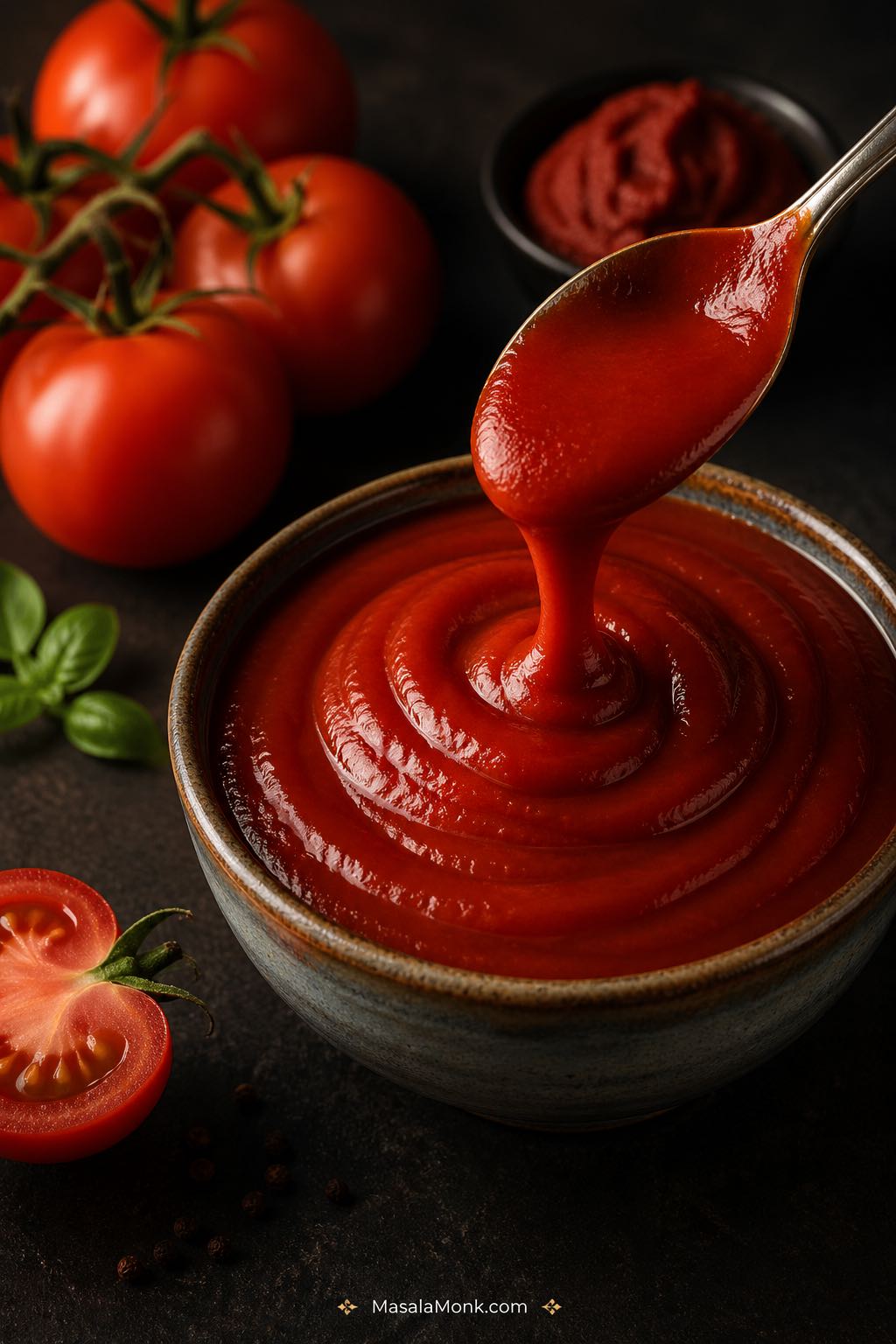
Thick glossy homemade ketchup in a bowl with a spoon, fresh tomatoes, and tomato paste nearby.

A good homemade ketchup recipe should taste bright, tangy, lightly sweet, deeply tomato-forward, and smooth enough for dipping, spreading, spooning, or squeezing. It should be thicker than tomato sauce, sharper than tomato chutney, and balanced enough for fries, burgers, sandwiches, wraps, pakoras, grilled snacks, and quick dipping sauces. You can also use it as a simple meatloaf glaze or a base for burger sauce.

This homemade tomato ketchup gives you the full fresh tomato method first: ripe tomatoes cooked down with onion, garlic, vinegar, sweetener, salt, mustard, and warm spices until glossy and thick. Then, because real kitchens are not always full of perfect summer tomatoes, you also get a quick tomato paste ketchup recipe, a sugar-free option, texture fixes, storage guidance, and clear canning notes.

In many kitchens, especially in India, this would simply be called a tomato ketchup recipe or homemade tomato sauce. Here, though, the goal is classic ketchup texture: smooth, glossy, thick, tangy-sweet, and easy to dip.

Most importantly, this is a recipe about control. Once you understand the tomato-to-vinegar-to-sweetener balance, you can make ketchup sweeter, tangier, smoother, thicker, spicier, lower in sugar, or closer to bottled ketchup without guessing. That way, the same base can work for fries, burgers, wraps, snacks, and quick sauces without needing a separate recipe every time.

For that reason, the recipe below does not force one version on every kitchen. Instead, it shows you when fresh tomatoes are worth the longer simmer and when tomato paste is the smarter shortcut.

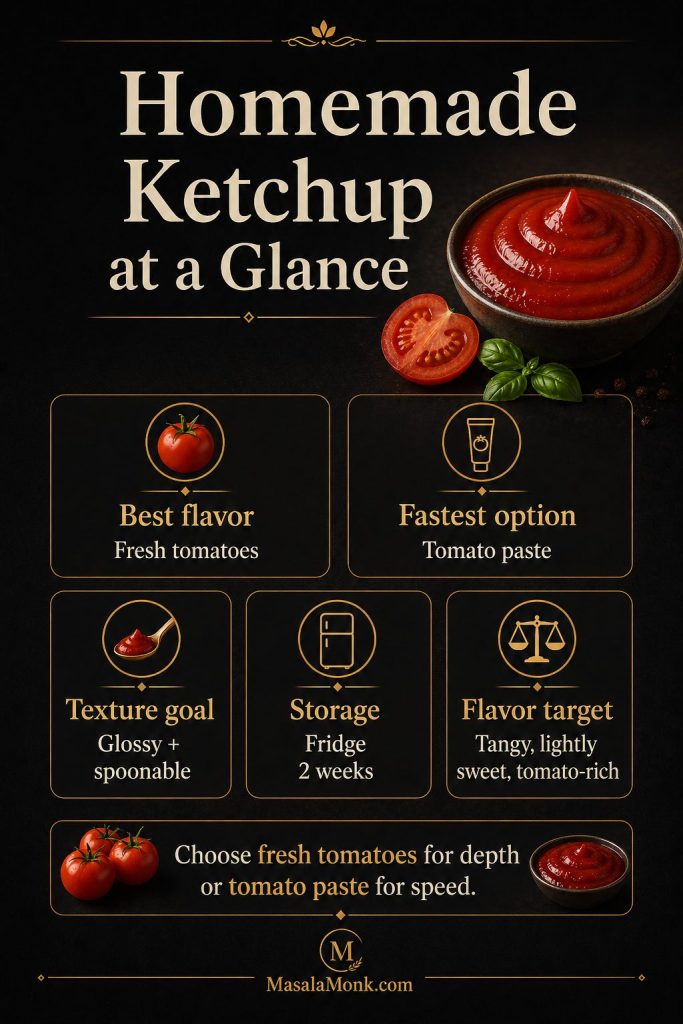
At-a-glance guide summarizing homemade ketchup options, flavor target, texture goal, and storage guidance.
If you want the short version first, this guide shows the key homemade ketchup decisions: which method to choose, how it should taste, and how to store it safely.

Before you start: choose the version based on your tomatoes. If they are ripe and flavorful, use the fresh tomato method. However, if they are watery or bland, use the tomato paste shortcut instead. That way, you get a thick, balanced ketchup without fighting the ingredients.

Quick Answer: The Best Homemade Ketchup Recipe Ratio

Fresh Tomato Ketchup Ratio

To make homemade ketchup with fresh tomatoes, first cook ripe tomatoes with onion and garlic until soft. Next, blend them smooth and strain them for a finer texture. From there, simmer the tomato puree with vinegar, sugar or jaggery, salt, mustard powder, and warm spices until thick and glossy.

Tomato Paste Ketchup Ratio

For a faster version, whisk tomato paste with water, vinegar, sweetener, salt, onion powder, garlic powder, mustard powder, and a tiny pinch of warm spice. Then, simmer it for 5–8 minutes. Compared with the fresh tomato version, tomato paste ketchup is quicker, smoother, and more predictable, although it tastes less seasonal.

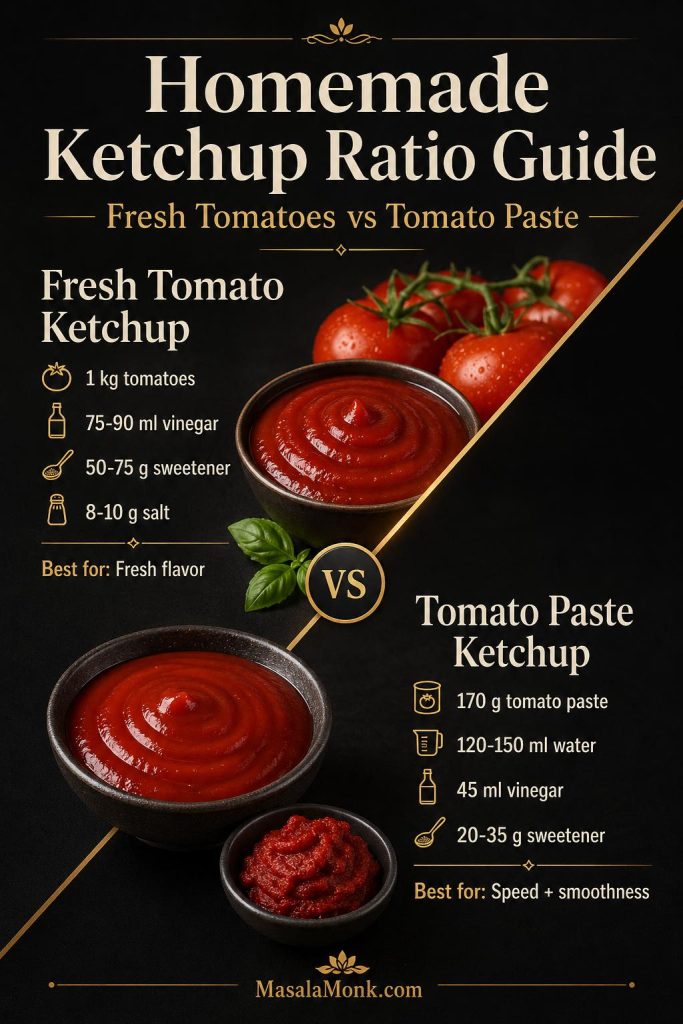
As a starting point, use the fresh tomato ratio when flavor matters most and the tomato paste ratio when speed and smoothness matter more.

Version Quick Ratio Best For
Fresh tomato ketchup 1 kg tomatoes + 75–90 ml vinegar + 50–75 g sweetener + 8–10 g salt Ripe summer tomatoes, fresh flavor, and from-scratch ketchup
Tomato paste ketchup 170 g tomato paste + 120–150 ml water + 45 ml vinegar + 20–35 g sweetener Quick ketchup, smooth texture, burgers, fries, and weeknight meals
Ratio guide comparing homemade ketchup made with fresh tomatoes and ketchup made with tomato paste.
Use the fresh tomato ratio when flavor matters most, and the tomato paste ratio when speed, smoothness, and consistency matter more.

That is why this ketchup recipe gives you two practical paths: a fresh tomato version for deeper flavor and a quick tomato paste version for speed.

Because this ketchup recipe is homemade, you can adjust the vinegar, sweetener, salt, and spices near the end instead of being locked into one fixed bottled flavor.

How the Ketchup Should Taste

Flavor target: good ketchup should taste tomato-rich first, then tangy, lightly sweet, salty enough to pop, and only gently spiced. If you can clearly taste cinnamon, clove, or allspice, the warm spice is too strong.

That flexibility is what makes a homemade ketchup recipe useful: the method gives you a starting point, but the final balance comes from tasting and adjusting.

The finished ketchup should taste tomato-rich, tangy-sweet, savory, and gently spiced in the background. When it tastes like plain tomato sauce, it needs more vinegar, sweetener, salt, mustard, or a tiny pinch of warm spice. However, when it tastes like chutney, the warm spices or sweetener are probably too strong.

Which Homemade Ketchup Version Should You Make?

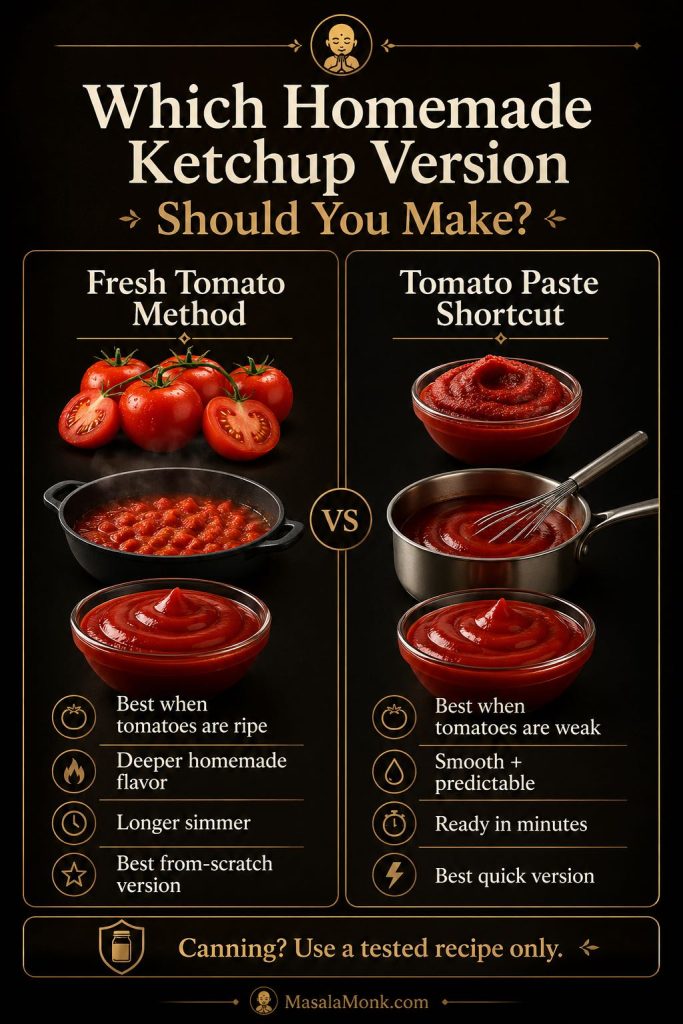
Before you start cooking, decide what problem you are solving. Fresh tomatoes give the best homemade flavor when they are ripe, while tomato paste gives better control when the tomatoes are watery, pale, or out of season.

The easiest way to choose is to look at your tomatoes, your time, and how you plan to store the ketchup. When the tomatoes are ripe and red, fresh tomatoes give the best homemade flavor. On the other hand, when the tomatoes are watery, pale, or out of season, tomato paste gives the fastest, smoothest, most predictable result. If you are reducing sugar, however, the ketchup needs a little more balancing so it still tastes like ketchup instead of plain tomato sauce.

Decision guide showing when to make homemade ketchup with fresh tomatoes and when to use tomato paste.
Fresh tomatoes are best when they are ripe and flavorful, while tomato paste is the smarter shortcut when you want faster, smoother, more predictable ketchup.

In other words, the best homemade version is not always the longest ketchup recipe. It is the version that fits your tomatoes, your time, and the way you want to serve it.

Situation Best Version Why It Works
Ripe summer tomatoes Fresh tomato ketchup This gives the best flavor and the most homemade character.
Watery, pale, or bland tomatoes Tomato paste ketchup The paste gives more predictable color, body, and flavor.
Ketchup needed in about 10 minutes Quick tomato paste ketchup recipe No long reduction is needed.
Lower-sugar ketchup Sugar-free ketchup option This lets you control the sweetener while keeping the sauce balanced.
Pantry-stable jars Tested canning recipe only A flexible fridge ketchup should not be canned casually.

Why This Recipe Works

This recipe works because it treats ketchup as a balance problem, not just a tomato puree. The tomatoes soften first so their flavor turns rounded, the mixture is blended and strained for texture, and the seasoned puree reduces slowly until the vinegar, sweetener, salt, mustard, and spices taste like one glossy sauce.

The fresh tomato version gives deeper homemade flavor, while the tomato paste version gives speed and consistency. Together, they cover both real kitchen situations: good ripe tomatoes and the nights when you need a quick ketchup for fries, burgers, wraps, or snacks. Because both versions use the same sweet-acid-salt logic, you can adjust them in the same way near the end.

Homemade Ketchup Ingredients: Tomatoes, Vinegar, Sugar, Salt and Spices

Ketchup tastes simple, but it depends on balance. Tomatoes give the sauce body, while vinegar adds the sharp tang. Sweetener rounds the acidity, and salt makes the tomato flavor pop. Finally, onion, garlic, mustard, and warm spices turn cooked tomato into ketchup instead of plain tomato sauce.

Because the sauce reduces as it cooks, the balance of vinegar, salt, and sweetener becomes more concentrated near the end. Therefore, it is better to start slightly cautious and adjust after the sauce thickens.

What Is Ketchup Made Of?

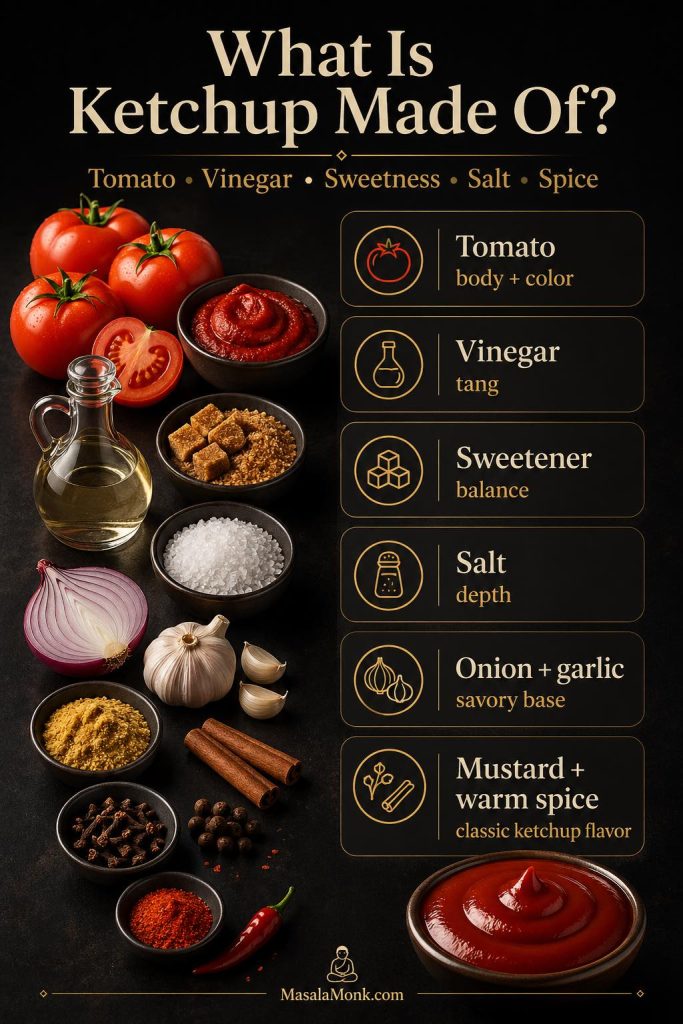
Ketchup is usually made from tomatoes or tomato paste, vinegar, sugar or another sweetener, salt, onion, garlic, mustard, and warm spices. The main ingredient is tomato, but the familiar ketchup flavor comes from the balance of tomato, vinegar, sweetness, salt, and spice.

Compared with many bottled ketchup ingredients lists, homemade ketchup gives you more control. You can choose fresh tomatoes or tomato paste, adjust the sugar, use 5% acidity vinegar, control the salt, and keep the spice level gentle.

Ingredients for homemade ketchup including tomatoes, vinegar, sweetener, salt, onion, garlic, mustard powder, and warm spices.
Homemade ketchup gets its classic flavor from balance: tomatoes for body, vinegar for tang, sweetener for roundness, salt for depth, and spices for warmth.

Tomatoes and Vinegar

Tomatoes give the ketchup body, color, and fresh flavor. Meanwhile, vinegar gives the sauce its sharp ketchup tang. For this small-batch fridge version, apple cider vinegar gives a rounder flavor, while white vinegar tastes cleaner and sharper.

Sweetener, Salt and Spices

Sweetener balances tomato acidity, salt sharpens the flavor, and spices make the sauce taste like ketchup instead of plain tomato sauce. In this ketchup recipe, the homemade flavor comes from restraint: mustard powder, cinnamon, and a tiny pinch of clove or allspice are enough. Too much warm spice can push the sauce toward chutney.

Once you understand what each ingredient does, the recipe becomes easier to adjust. The table below shows the fresh tomato amounts first because that version depends most on balance and reduction.

Measurement note: metric weights are more accurate for tomatoes, onion, sweetener, and salt. The US cup and spoon measures are included for convenience, but final yield can vary because tomatoes contain different amounts of water.

Fresh Tomato Ketchup Ingredient Amounts

Ingredient Amount for Fresh Tomato Ketchup Why It Matters
Ripe red tomatoes 1 kg / 2.2 lb Tomatoes form the body, color, and main flavor. Roma, plum, San Marzano-style, or other meaty tomatoes reduce faster and taste richer.
Onion 80–100 g / 3–3.5 oz / 1 small onion Onion builds a savory base and helps the ketchup taste rounded.
Garlic 8–12 g / 2–3 cloves Garlic deepens the flavor. Use less if you want a cleaner bottled-style ketchup.
5% acidity vinegar 75–90 ml / 5–6 tbsp Vinegar gives ketchup its sharp tang. Apple cider vinegar tastes rounder; white vinegar tastes cleaner and sharper.
Sugar, jaggery, or brown sugar 50–75 g / 1.75–2.6 oz / about ¼–⅓ cup packed Sweetener balances tomato acidity and keeps the sauce from tasting like sour tomato puree.
Fine salt 8–10 g / about 1½ tsp Salt sharpens the tomato flavor. Add it carefully because reduction concentrates the sauce.
Mustard powder 1–2 g / ½–1 tsp Mustard powder brings the classic ketchup sharpness without making the sauce taste mustardy.
Cinnamon Pinch to ⅛ tsp A small amount adds warmth. Too much can push the ketchup toward chutney.
Clove or allspice Tiny pinch / 1/16 tsp or less This gives the familiar background spice, but it becomes overpowering quickly.
Cayenne or chili powder Optional, ⅛–¼ tsp Use this for mild heat without turning the ketchup into hot sauce.

How Much Sugar Is in This Homemade Ketchup?

This ketchup recipe uses 50–75 g added sugar, jaggery, or brown sugar for a homemade batch that finishes at about 2–2½ cups. That works out to roughly 1.25–2.3 g added sweetener per tablespoon, depending on your final yield and how much sweetener you use.

For a less sweet ketchup, start with 50 g sweetener and adjust only after the sauce has reduced. Because reduction concentrates flavor, the ketchup may taste sweeter and saltier near the end than it did at the start. Still, do not remove all sweetness unless you want a sharper tomato-sauce-style condiment. Instead, reduce the sweetener gradually and taste again after the ketchup cools.

It is also useful when you want a no-corn-syrup ketchup and prefer to choose the sweetener yourself. For a lighter or more controlled version, homemade ketchup lets you adjust the sugar, salt, and vinegar instead of relying on a fixed bottled formula.

Use 5% acidity vinegar for this recipe, especially when you are also reading the canning section. For regular fridge ketchup, apple cider vinegar, white vinegar, or a mix of the two all work. Apple cider vinegar gives a slightly fruitier ketchup; by contrast, white vinegar gives a cleaner, sharper ketchup.

Important: this flexible recipe is for fridge and freezer storage. If you want shelf-stable canned ketchup, use a tested canning formula and do not casually change vinegar, tomato, onion, vegetable, jar, or processing-time ratios.

Homemade Ketchup Recipe with Fresh Tomatoes

This is the main ketchup-from-scratch version to make when tomatoes are ripe, red, and flavorful. In practice, it starts with 1 kg / 2.2 lb fresh tomatoes and reduces into about 500–600 g / 17.5–21 oz / 2–2½ cups of ketchup, depending on the tomato variety and how thick you cook it.

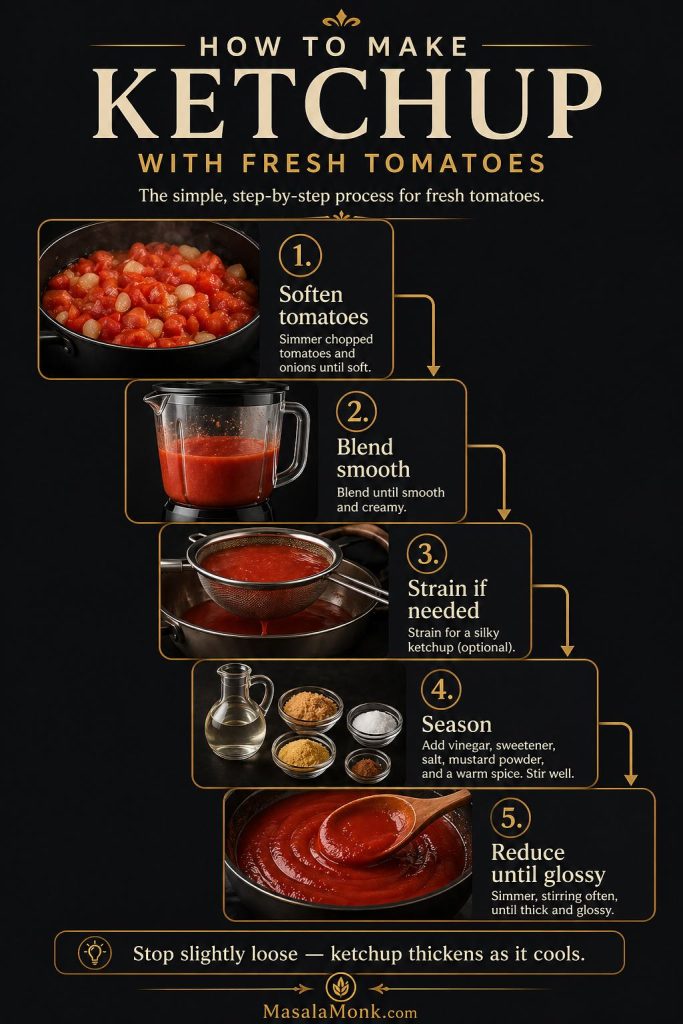
The method is simple, even though the simmer takes time: soften the tomatoes, blend, strain if needed, season, then reduce until the sauce turns glossy and spoonable.

Step-by-step guide showing how to make homemade ketchup with fresh tomatoes by softening, blending, straining, seasoning, and reducing.
The fresh tomato method is simple: soften the tomatoes, blend them smooth, strain if needed, season, and reduce until the ketchup turns glossy and spoonable.

Best Tomatoes for Homemade Ketchup

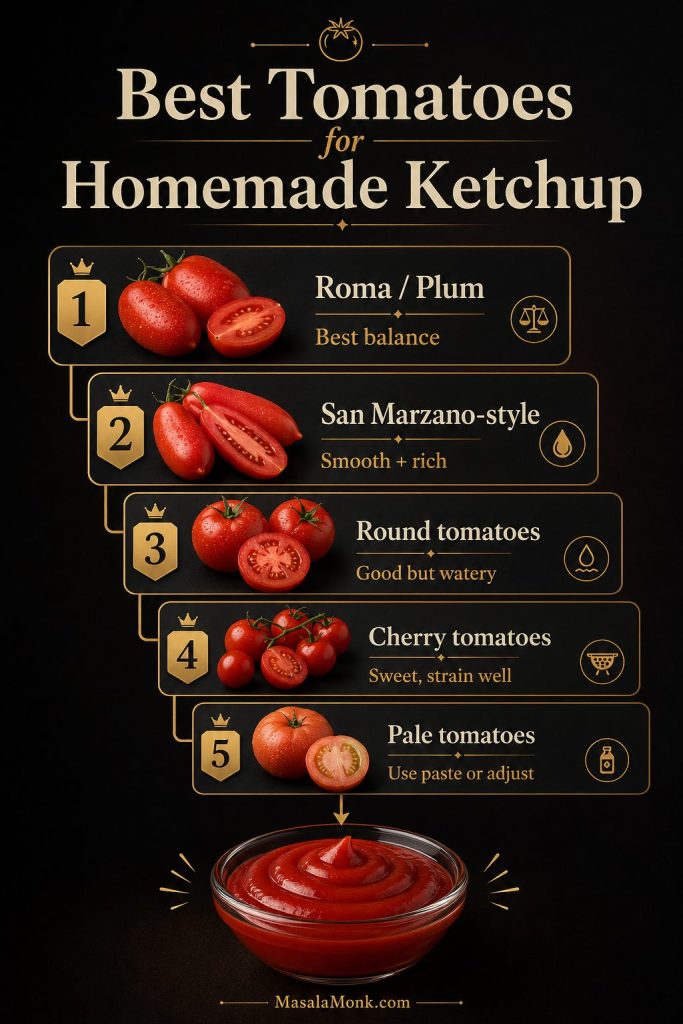
The best tomatoes for homemade ketchup are meaty, ripe, and deeply red. For example, Roma, plum, San Marzano-style, and other paste tomatoes are ideal because they have more flesh and less water. Regular round tomatoes also work; however, they usually take longer to reduce. In addition, cherry tomatoes can make a sweet ketchup, although they are often seedier and may need straining.

Homemade ketchup may look slightly darker or softer red than bottled ketchup, especially if you use brown sugar, jaggery, apple cider vinegar, or long cooking. For the brightest color, use ripe red paste tomatoes, white vinegar, white sugar, and gentle heat.

Guide to tomato types for homemade ketchup, including Roma tomatoes, plum tomatoes, San Marzano-style tomatoes, round tomatoes, cherry tomatoes, and pale tomatoes.
Meaty, ripe, deeply red tomatoes make the best homemade ketchup because they reduce faster, taste richer, and give the sauce better color.
Tomato Type How It Works in Ketchup Adjustment
Roma / plum tomatoes Best balance of flesh, flavor, and low water Follow the main formula.
San Marzano-style tomatoes Excellent for smooth, rich ketchup Use the recipe as written.
Regular round tomatoes Good flavor but often watery Give them extra simmering time in a wide pan.
Cherry tomatoes Sweet and bright but more skins/seeds Blend thoroughly, then strain for a smoother finish.
Pale or underripe tomatoes Sharper, less sweet, less red Increase the sweetener slightly or switch to tomato paste.

Step 1: Cook the Tomatoes, Onion, and Garlic

Wash and roughly chop 1 kg / 2.2 lb ripe tomatoes. Then, add them to a wide heavy-bottomed pan with 80–100 g chopped onion and 2–3 garlic cloves. Once everything is in the pan, cover and cook over medium-low heat for 15–20 minutes, until the tomatoes collapse, release their juices, and soften completely.

At this stage, do not add the vinegar, sugar, or salt yet. Starting with just the tomatoes, onion, and garlic lets the vegetables soften evenly before the final reduction.

Step 2: Blend and Strain

After the tomatoes soften, blend the mixture until smooth. An immersion blender is easiest, but a countertop blender gives a finer texture. When using a countertop blender, work in batches and let steam escape safely.

Texture Goal What to Do
Rustic homemade ketchup Blend only, leaving a little skin and seed texture.
Smooth ketchup Pass the blended mixture through a coarse sieve.
Bottled-style ketchup Use a food mill or fine sieve, then blend again after reducing.

For a smoother finish, strain the puree before the final reduction. If you are new to reducing fresh tomatoes, MasalaMonk’s guide to tomato sauce from fresh tomatoes is useful because it explains the food mill method, the no-food-mill path, and why tomato reduction changes texture.

Step 3: Add Vinegar, Sweetener, Salt, and Spices

From there, return the blended and strained tomato puree to the pan. Add:

  • 75–90 ml / 5–6 tbsp 5% acidity vinegar
  • 50–75 g sugar, brown sugar, or jaggery
  • 8–10 g fine salt, or about 1½ tsp
  • ½–1 tsp mustard powder
  • Pinch to ⅛ tsp cinnamon
  • Tiny pinch clove or allspice
  • Optional ⅛–¼ tsp cayenne or chili powder

Start with the lower amount of sugar and vinegar when your tomatoes are already sweet and flavorful. If the tomatoes taste flat, watery, or very acidic, use the higher amount instead. Either way, taste again near the end because the flavor changes as the ketchup reduces.

Step 4: Simmer Until Thick and Glossy

Simmer the ketchup uncovered over low to medium-low heat for 45–70 minutes after blending and seasoning, stirring more often as it thickens. The total cook time is usually 60–90 minutes including the first tomato-softening stage, but watery tomatoes can take longer.

The pan should show small, steady bubbles, not an aggressive boil. Near the end of cooking, the ketchup can catch on the bottom quickly, so use a splatter screen when needed and stir more often as it thickens. Instead of rushing the heat, give the sauce time to reduce slowly; that way, it stays brighter, smoother, and less bitter.

Heat cue: keep the ketchup at a gentle simmer with small, steady bubbles, not a rolling boil. If the sauce spits aggressively, darkens quickly, or sticks to the bottom, lower the heat and stir more often. Gentle reduction gives you brighter flavor, smoother texture, and better color.

Stage Approximate Amount Visual Cue
Fresh chopped tomatoes 1 kg / 2.2 lb Chunky, raw, watery
After softening and blending About 900 ml–1.1 L Loose tomato puree
After straining About 750–950 ml Smoother but still thin
Final ketchup About 500–600 g / 2–2½ cups Glossy, thick, spoonable

Step 5: Test the Thickness

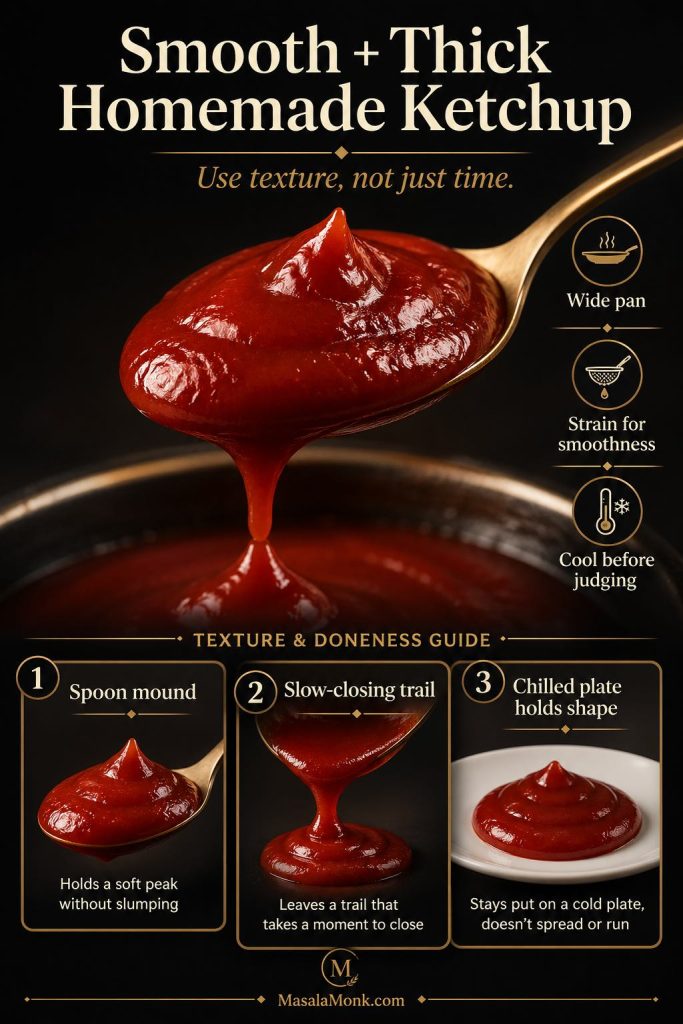
Rather than relying only on time, use the texture as your guide. Because tomatoes vary so much, the exact cook time can shift from batch to batch. Near the end of cooking, check the ketchup with one or more of these doneness tests:

Test What You Should See
Spoon mound test The ketchup should mound slightly on a spoon instead of running off like tomato juice.
Trail test Drag a spatula through the pan; the trail should close slowly, not immediately flood back.
Cold plate test Drop a little ketchup on a chilled plate. After 30 seconds, it should hold shape instead of spreading into a watery puddle.

When in doubt, stop slightly before it looks perfect because ketchup thickens as it cools.

Step 6: Taste and Adjust

Once the ketchup is thick, taste it before you store it. A flat flavor usually needs a little salt first. When the sauce tastes too sweet, add vinegar 1 teaspoon at a time. If the flavor leans too sour, balance it with sweetener in small amounts. When it tastes like plain tomato sauce instead of ketchup, add vinegar, sweetener, salt, mustard, and a very tiny pinch of clove or cinnamon until the flavor tastes rounded.

Do not worry if the ketchup tastes slightly sharp while hot. After cooling, the vinegar softens, the sweetness feels rounder, and the texture becomes thicker.

Step 7: Cool and Store

Before you store it, let the ketchup cool fully. Then, transfer it to a clean glass jar. Refrigerate and use within 2 weeks for best quality, or freeze for longer storage.

For the best flavor, chill the ketchup for at least 2 hours before serving. While it is hot, freshly cooked ketchup can taste sharper than expected. After cooling, the sweetness, acidity, salt, and spices settle into a rounder flavor.

Quick Tomato Paste Ketchup: How to Make Ketchup from Tomato Paste

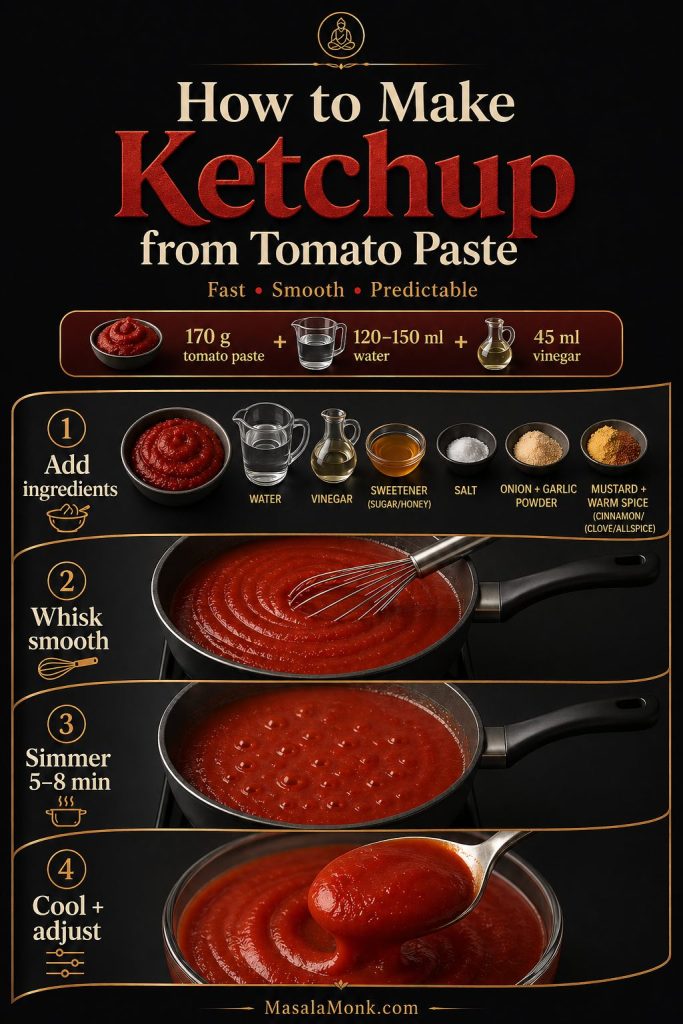
When fresh tomatoes are weak or you need ketchup quickly, tomato paste is the better starting point. Because it has already been cooked down, this version thickens in minutes, needs less guesswork, and gives you a smoother, more predictable ketchup. It is not as fresh-tasting as the fresh tomato version, but it is much faster.

A standard 6 oz / 170 g can of tomato paste is the easiest starting point for this shortcut. If your paste is very thick or double-concentrated, start with the higher amount of water and adjust after simmering.

Step-by-step guide showing how to make ketchup from tomato paste with water, vinegar, sweetener, salt, onion powder, garlic powder, mustard, and warm spice.
Tomato paste ketchup is the fast route: whisk the ingredients smooth, simmer for a few minutes, cool, and adjust the thickness or tang before serving.
Detail Spec
Yield About 300–350 g / 10.5–12 oz / 1¼–1½ cups
Prep time 3 minutes
Cook time 5–8 minutes
Total time 8–12 minutes
Best for Fries, burgers, sandwiches, dips, and weeknight meals

Tomato Paste Ketchup Ingredients

Ingredient Metric US / Imperial
Tomato paste 170 g 6 oz can
Water 120–150 ml ½–⅔ cup
5% acidity vinegar 45 ml 3 tbsp
Sugar, honey, jaggery, or maple syrup 20–35 g 1½–2½ tbsp
Fine salt 4–5 g About ¾ tsp
Onion powder ½ tsp
Garlic powder ¼–½ tsp
Mustard powder ¼–½ tsp
Cinnamon, clove, or allspice Tiny pinch

How to Make Ketchup from Tomato Paste

  1. Add tomato paste, water, vinegar, sweetener, salt, onion powder, garlic powder, mustard powder, and spices to a small saucepan.
  2. Whisk until the mixture is completely smooth.
  3. Simmer over low heat for 5–8 minutes, stirring often.
  4. If it is too thick, add more water 1 tablespoon at a time.
  5. For more tang, add vinegar 1 teaspoon at a time.
  6. Cool before judging the final thickness.

Best use: tomato paste ketchup is the easiest version for burgers, fries, sandwiches, wraps, and quick mayo-ketchup sauce. It is not as fresh-tasting as the fresh tomato version, but it is smoother and faster.

Sugar-Free, No-Sugar and Keto Homemade Ketchup Option

Classic ketchup needs sweetness to balance tomato acidity. Without any sweetness, the sauce will not taste like familiar bottled ketchup. Instead, it will taste sharper, more acidic, and more like seasoned tomato sauce. However, you still have several good options depending on what “sugar-free” means for you.

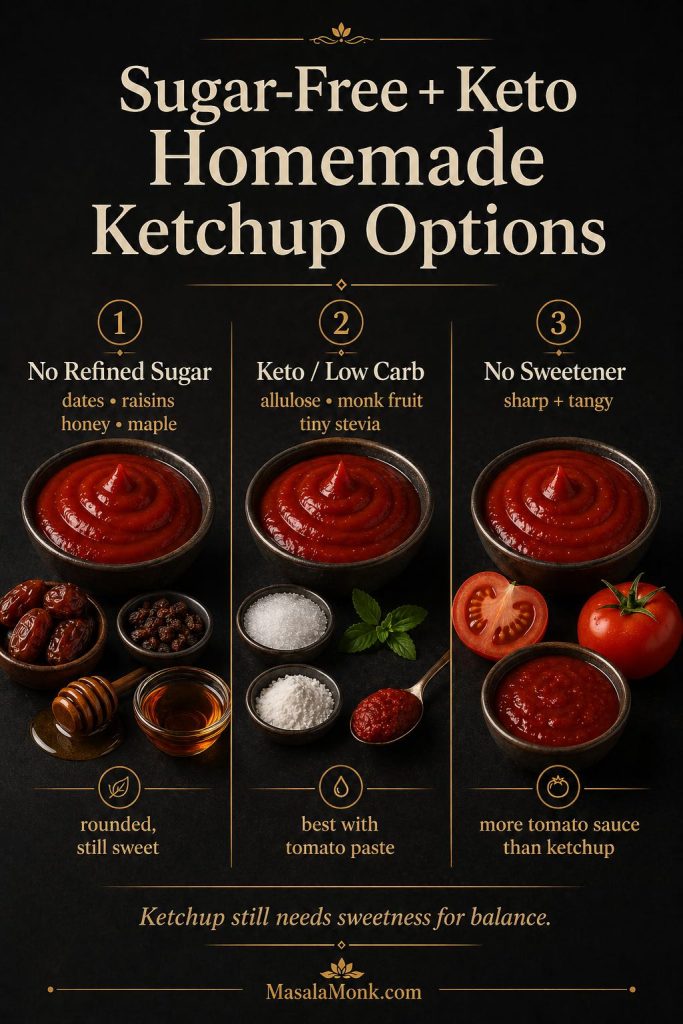
This section is for readers looking for ketchup without sugar, no-sugar tomato ketchup, zero-sugar ketchup, or a lower-carb ketchup option. The key point is that ketchup still needs sweetness for balance, so the best sugar-free version uses a low-carb sweetener instead of removing sweetness completely.

Guide comparing no refined sugar, keto low-carb, and no-sweetener options for homemade ketchup.
Ketchup still needs some sweetness for balance, so the best sugar-free version replaces sweetness thoughtfully instead of removing it completely.

Once the basic ketchup tastes balanced, you can lower the sugar more safely. The important thing is to replace sweetness thoughtfully instead of removing it all at once.

Sweetener Options for Sugar-Free Ketchup

Version What to Use Flavor Result
No refined sugar Dates, raisins, apple, jaggery, honey, or maple syrup Still rounded and ketchup-like, but not strictly sugar-free
Keto / low-carb Allulose, monk fruit, or a tiny amount of stevia Closest low-carb option, especially with tomato paste ketchup
No sweetener Skip sweetener Sharper, tangier, more like tomato sauce than ketchup

How to Adjust the Sweetness

In the fresh tomato recipe, replace the 50–75 g sugar with 40–60 g chopped dates or raisins and blend very thoroughly. For keto ketchup, the tomato paste version is easier because it is already thick and consistent. Start with 1–2 tablespoons allulose or monk fruit sweetener, then adjust after simmering.

The best sugar-free ketchup still tastes slightly sweet. If you remove sweetness completely, the sauce becomes tangy tomato sauce, not classic ketchup.

If you are building low-carb burger plates or bowls, this sugar-free ketchup variation fits better than sugary bottled sauces. MasalaMonk’s keto hamburger recipes also explain why ketchup-heavy sauces can become a hidden carb trap.

Fresh Tomato Ketchup vs Tomato Paste Ketchup

Neither version is automatically better. Instead, the right choice depends on your tomatoes and your timing. When tomatoes are ripe and flavorful, fresh tomato ketchup gives the best flavor. By contrast, tomato paste ketchup works better when you want speed, smoothness, and consistency.

In short, the best homemade ketchup recipe for you depends on whether you care more about fresh tomato flavor, speed, smoothness, or consistency.

Need Fresh Tomato Ketchup Tomato Paste Ketchup
Fresh flavor Best when tomatoes are ripe and sweet Good, although less fresh
Speed Slower because it needs reduction Fastest option because paste is already concentrated
Texture Smooth only after careful straining Usually smooth and consistent
Predictability Depends on the tomatoes More predictable because the base is concentrated
Summer tomatoes Ideal choice when tomatoes are in season Useful when fresh tomatoes are weak
Beginner-friendliness Good, although slower Easiest because it skips long reduction
Canning suitability Only with a tested canning recipe Only with a tested canning recipe

How to Make Homemade Ketchup Smooth and Thick

In practice, the two biggest homemade ketchup problems are texture and thickness. Because fresh tomatoes contain a lot of water, ketchup needs reduction. If you stop too early, it tastes like thin tomato sauce. However, if you cook it too hard or too long, it can scorch, darken, or become pasty. Therefore, the goal is slow reduction, not aggressive boiling.

The texture goal is glossy and spoonable, not watery like tomato puree and not stiff like tomato paste.

Texture guide for homemade ketchup showing a spoon mound test, slow-closing trail test, and chilled plate test.
Good homemade ketchup should look glossy, mound slightly on a spoon, leave a slow-closing trail in the pan, and hold shape on a chilled plate.

Use a Wide Pan

A wide pan helps water evaporate faster. By contrast, a tall narrow pot traps steam and makes the ketchup take longer to thicken. For a 1 kg tomato batch, a 26–30 cm / 10–12 inch wide pan is ideal.

Strain for a Smoother Finish

Tomato skins and seeds can make homemade ketchup feel rough. For a smoother finish, blend the softened tomatoes, then pass them through a sieve or food mill before the final reduction.

Reduce Slowly

Keep the ketchup at a gentle simmer. As it thickens, stir more often and scrape the bottom of the pan. The sauce should look glossy, not dry or scorched.

Cool Before Judging Thickness

Hot ketchup looks thinner than cooled ketchup. Therefore, stop when it is slightly looser than your ideal final texture, then let it cool before deciding whether it needs more reduction.

Texture reminder: after cooling, ketchup becomes thicker and smoother. Because of that, stop a little early rather than reducing it until it looks perfect in the hot pan.

How to Fix Homemade Ketchup

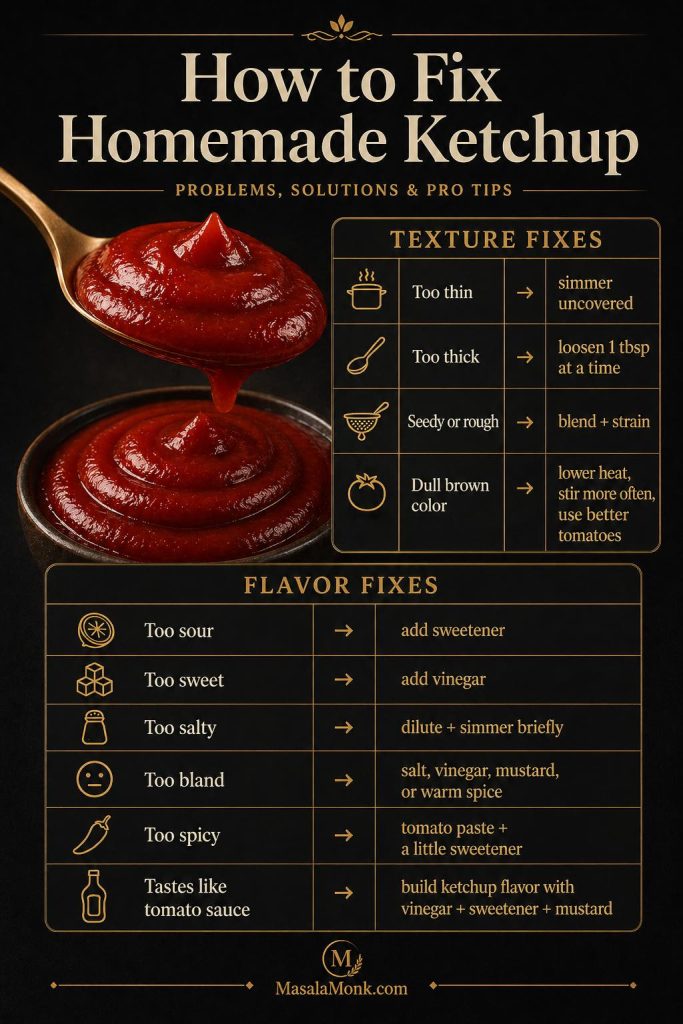
Homemade ketchup is easy to adjust when you know what is wrong. First, decide whether the problem is texture, flavor, or color. Then, make small changes and taste again after the ketchup cools slightly on a spoon.

Troubleshooting guide for homemade ketchup showing fixes for ketchup that is too thin, too thick, too sour, too sweet, too salty, bland, spicy, or rough.
Most homemade ketchup problems are easy to fix once you know whether the issue is texture, acidity, sweetness, salt, or spice.

Texture Fixes

Problem Likely Cause Fix
Runny or thin Watery tomatoes or not enough reduction Simmer uncovered in a wide pan until the ketchup thickens and the extra water cooks off.
Stiff or pasty Over-reduced sauce or too much tomato paste Loosen it with water, tomato juice, or vinegar 1 tablespoon at a time.
Rough or seedy Skins or seeds remain Blend longer, then strain through a sieve or food mill for a smoother texture.

Flavor and Color Fixes

Problem Likely Cause Fix
Sharp or sour Too much vinegar or underripe tomatoes Add sugar, jaggery, honey, dates, or raisins in small amounts until the acidity tastes rounded.
Overly sweet Too much sweetener Add vinegar 1 teaspoon at a time. Afterward, add a small pinch of salt or mustard powder if the flavor still feels flat.
Salty or harsh Salt added early or sauce reduced too far Dilute the flavor with unsalted tomato paste, tomato puree, or a little water, then simmer briefly.
Flat or bland Not enough salt, vinegar, or spice Start with salt. Then add vinegar, mustard powder, or warm spice in small amounts.
Too spicy Too much cayenne or chili Round out the heat with tomato paste and a little sweetener.
Brown or dull Overcooking, burning, dark sugar, or dull tomatoes Next time, use ripe red tomatoes, lower the heat, stir more often, and avoid scorching.
Tomato-sauce flavor Missing ketchup’s sweet-acid-spice balance Build ketchup flavor with vinegar, sweetener, salt, mustard powder, and a tiny pinch of clove or cinnamon.

How to Store Homemade Ketchup

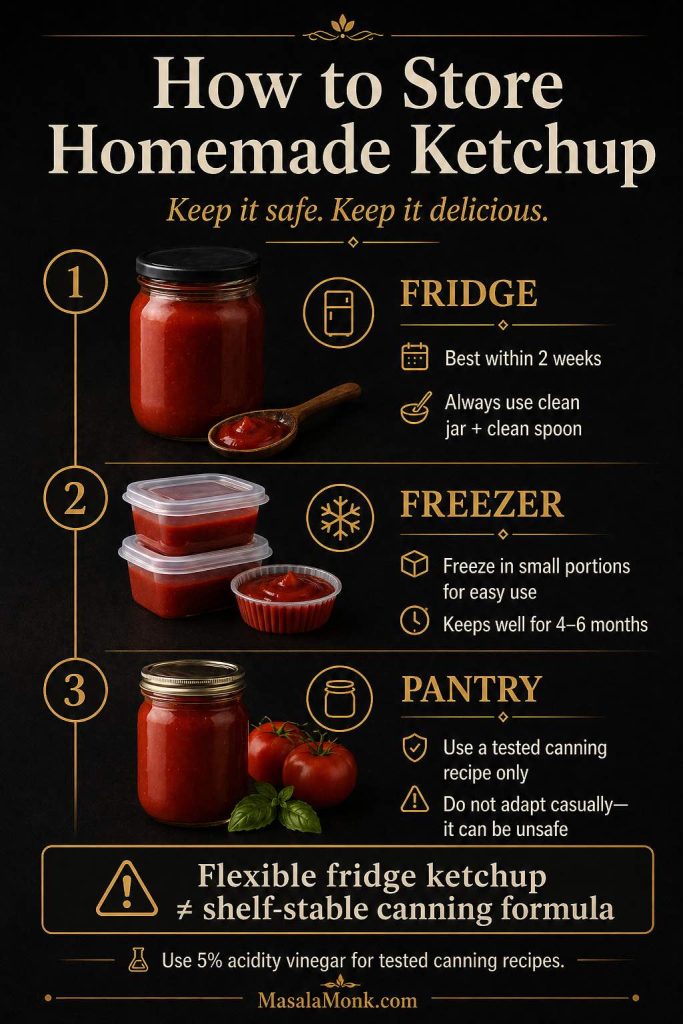
After the ketchup tastes right, storage matters as much as flavor. This is especially true for small-batch homemade ketchup because it does not have commercial stabilizers or a tested shelf-stable process.

Store it in a clean glass jar, use a clean spoon, and keep it refrigerated. After serving, return the jar to the fridge rather than leaving it on the counter.

Storage guide for homemade ketchup showing fridge storage, freezer storage, and tested canning safety information.
This small-batch ketchup is best treated as a fridge or freezer condiment unless you follow a tested canning recipe exactly.

Fridge, Freezer and Room Temperature Storage

Storage Method Recommendation
Fridge For best quality, use within 2 weeks.
Freezer For longer storage, freeze for 4–6 months in small portions.
Room temperature Only keep ketchup at room temperature when it has been properly canned with a tested recipe.
After thawing After thawing, stir well; if watery, simmer briefly to bring the texture back.
Jar hygiene Because homemade ketchup has no commercial stabilizers, use clean jars and clean spoons every time.

Can You Can Homemade Ketchup?

Think of this recipe as a fridge ketchup, not a pantry ketchup. You can freeze it safely, but do not treat it like a shelf-stable jarred product unless you follow a tested canning recipe.

For that reason, this flexible MasalaMonk ketchup recipe is not a shelf-stable canning formula.

For canning ketchup, use a tested canning formula from a reliable source such as the National Center for Home Food Preservation tomato ketchup recipe. Do not casually reduce vinegar, increase tomatoes, add extra onion, add extra vegetables, change jar size, change headspace, or shorten processing time.

For context, the NCHFP tomato ketchup formula is a large tested batch using 24 lb ripe tomatoes, 3 cups chopped onions, 3 cups 5% acidity cider vinegar, sugar, salt, and whole spices, with a yield of 6–7 pints. That is a different type of recipe from this flexible small-batch fridge ketchup.

Canning safety note: fridge ketchup is flexible. Canning ketchup is not. For shelf-stable jars, follow a tested recipe exactly, use vinegar with 5% acidity, and process jars according to the tested time for your altitude.

Healthy Canning’s quick ketchup guidance explains the same principle clearly: sweetness, salt, and dry spices are more flexible, but vinegar and low-acid vegetable ratios should not be casually changed in a water-bath canning recipe. If you want a pantry-stable ketchup, use tested canning instructions instead of adapting this small-batch fridge recipe.

Homemade Catsup vs Ketchup: Are They the Same?

Catsup and ketchup usually refer to the same sweet-tangy tomato condiment. “Ketchup” is the dominant modern spelling, but some readers still search for homemade catsup, homemade tomato catsup, or a recipe for tomato catsup.

If you came here looking for catsup, you are in the right place. The spelling changes, but the method is the same: tomatoes are reduced with vinegar, sweetener, salt, mustard, and spices until the sauce becomes thick, glossy, tangy, and balanced.

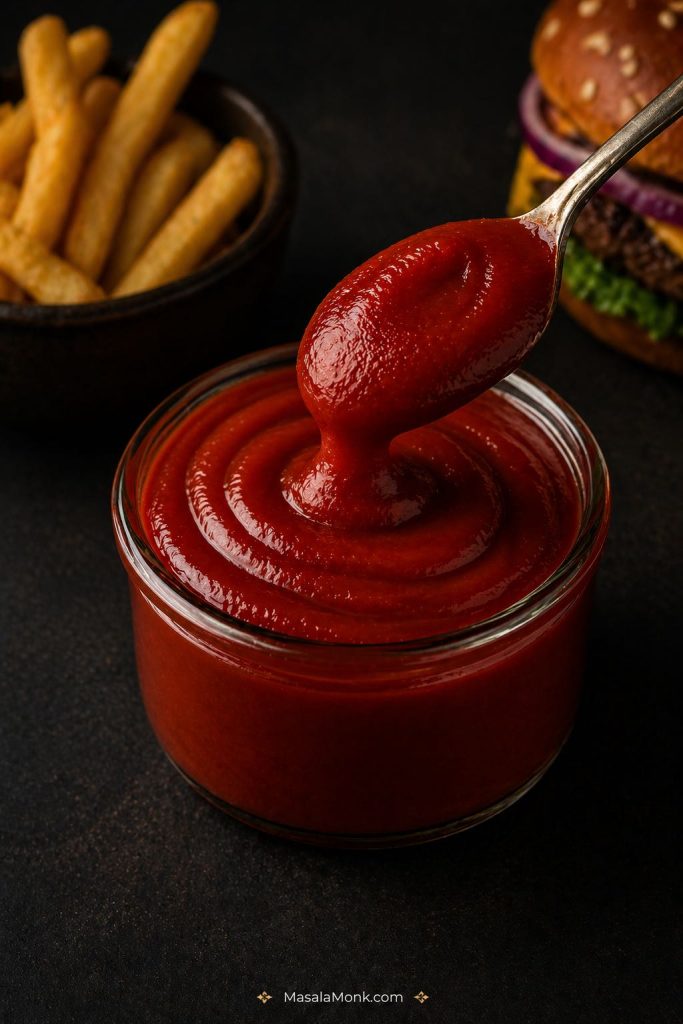
Close-up of thick glossy homemade ketchup in a bowl with a spoon, with fries in the background.
Homemade ketchup should look smooth, glossy, and spoonable, with enough body to coat fries and burgers without tasting heavy.

Ways to Use Homemade Ketchup

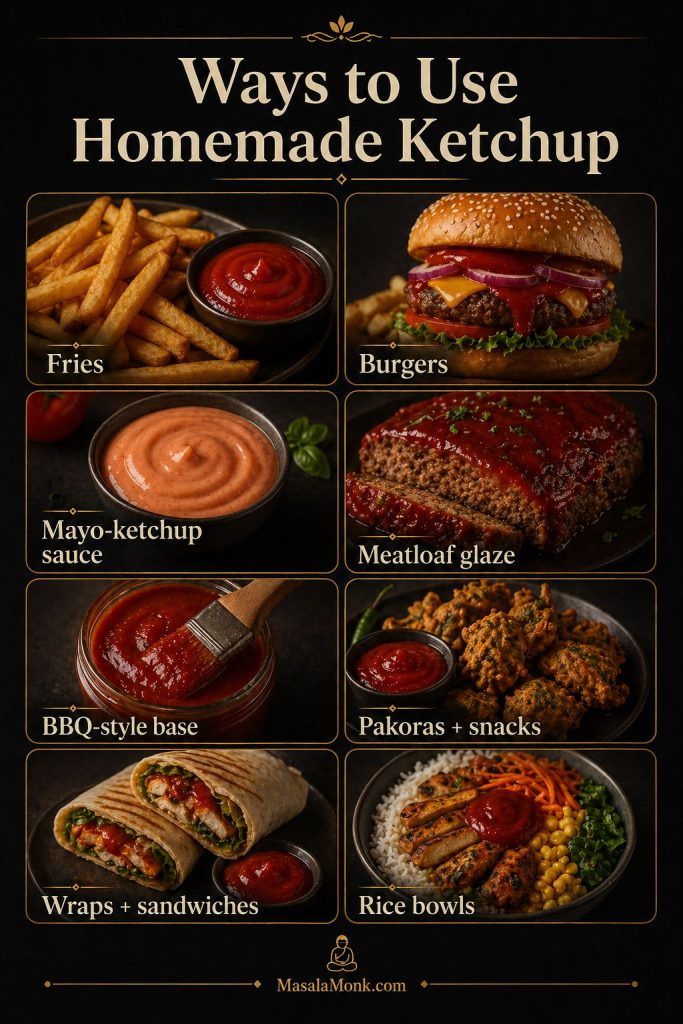
Homemade ketchup is more than a dip for fries. Once you have a jar in the fridge, it becomes a quick base for sauces, glazes, spreads, marinades, and snack plates. For everyday meals, that means one batch can cover burgers, wraps, fries, bowls, and quick dipping sauces.

Guide showing ways to use homemade ketchup with fries, burgers, mayo-ketchup sauce, meatloaf glaze, barbecue sauce, pakoras, wraps, and rice bowls.
A jar of homemade ketchup can do much more than dip fries — it also works in burger sauce, glazes, barbecue-style sauces, and snack platters.
Use How to Use the Ketchup
Fries Pair chilled ketchup with hot crispy homemade French fries.
Burgers Use it on burger buns or fold it into mayo for a creamy burger sauce.
Mayo ketchup sauce Stir 2 parts mayo with 1 part ketchup for a quick fry sauce. MasalaMonk’s homemade mayonnaise guide already covers mayo-ketchup sauce as a useful variation.
Meatloaf glaze Blend ketchup with brown sugar or honey and a splash of vinegar, then brush it over meatloaf.
BBQ sauce base Turn it into a quick barbecue-style sauce with vinegar, brown sugar, smoked paprika, black pepper, and Worcestershire-style seasoning.
Pakoras and snacks Serve it as a tangy-sweet dip when chutney feels too sharp.
Wraps and sandwiches Add a thin layer inside grilled cheese, paneer rolls, tofu wraps, or egg sandwiches.
Rice bowls Spoon it into spicy tomato rice, fried rice-style bowls, or quick sauce bases.

For a fruitier, hotter homemade sauce, try MasalaMonk’s mango habanero sauce. For a sharper fruit-and-mustard dip, try the mango mustard sauce. Both fit naturally into the same homemade sauce and condiment family.

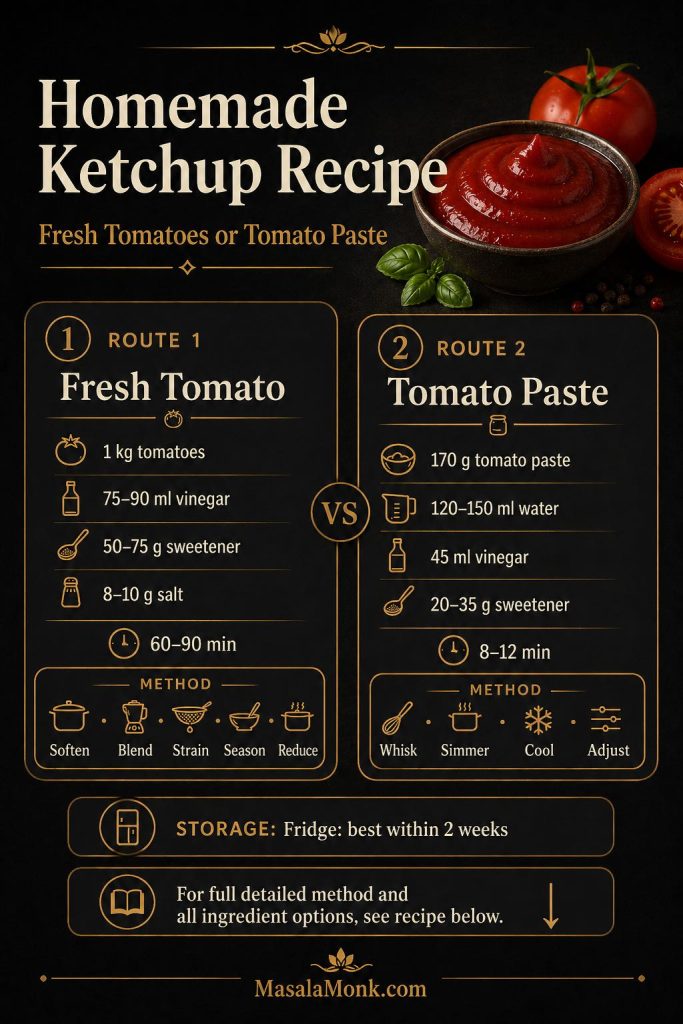
Recipe recap board for homemade ketchup showing fresh tomato and tomato paste versions with a short method summary.
This quick visual recap summarizes both homemade ketchup routes, while the full recipe card below gives the detailed method and ingredient options.

Before you jump to the recipe card: choose the fresh tomato version when tomatoes are ripe and flavorful. However, choose the tomato paste shortcut when you want a faster, smoother, more predictable ketchup. Either way, taste again after cooling because ketchup thickens and mellows in the fridge.

Homemade Ketchup Recipe with Fresh Tomatoes or Tomato Paste

A smooth, tangy homemade ketchup made with ripe fresh tomatoes, vinegar, sweetener, salt, onion, garlic, mustard, and warm spices. This small-batch recipe includes a tomato paste shortcut, sugar-free notes, storage guidance, and texture fixes.

Prep Time15 minutes
Cook Time60–90 minutes
Total Time1 hr 15 min–1 hr 45 min
Yield500–600 g / 2–2½ cups

Equipment

  • Wide heavy-bottomed pan or Dutch oven
  • Immersion blender or countertop blender
  • Sieve or food mill, optional but recommended
  • Spatula
  • Clean glass jar

Ingredients

  • 1 kg / 2.2 lb ripe red tomatoes, roughly chopped
  • 80–100 g / 3–3.5 oz onion, chopped
  • 2–3 garlic cloves, about 8–12 g
  • 75–90 ml / 5–6 tbsp 5% acidity vinegar, apple cider or white vinegar
  • 50–75 g / about ¼–⅓ cup packed brown sugar, jaggery, or sugar
  • 8–10 g fine salt, about 1½ tsp
  • ½–1 tsp mustard powder
  • Pinch to ⅛ tsp ground cinnamon
  • Tiny pinch ground clove or allspice, 1/16 tsp or less
  • Optional: ⅛–¼ tsp cayenne or chili powder
  • Optional: ¼ tsp black pepper

Method

  1. Prep the tomatoes. Wash and roughly chop the tomatoes. Chop the onion and garlic.
  2. Soften. Place the tomatoes, onion, and garlic in a wide pot. Cover and cook over medium-low heat for 15–20 minutes, until the tomatoes collapse and release their juices.
  3. Blend. Blend the mixture until smooth with an immersion blender or countertop blender.
  4. Strain, optional. For smoother ketchup, pass the blended mixture through a sieve or food mill. For rustic ketchup, skip this step.
  5. Season. Return the tomato puree to the pot. Stir in vinegar, sweetener, salt, mustard powder, cinnamon, clove or allspice, and optional cayenne or black pepper.
  6. Reduce. Simmer uncovered over low to medium-low heat for 45–70 minutes. Stir more often as the ketchup thickens so it does not catch on the bottom.
  7. Test. Check that the ketchup mounds slightly on a spoon, leaves a slow-closing trail in the pan, and holds shape on a chilled plate.
  8. Adjust. Taste before storing. Add sweetener if sour, vinegar if sweet, salt if flat, or water if too thick.
  9. Cool and store. Cool the ketchup, transfer it to a clean jar, and refrigerate. Use within 2 weeks for best quality.

Quick Tomato Paste Option

Whisk together 170 g / 6 oz tomato paste, 120–150 ml / ½–⅔ cup water, 45 ml / 3 tbsp vinegar, 20–35 g sweetener, 4–5 g salt, ½ tsp onion powder, ¼–½ tsp garlic powder, ¼–½ tsp mustard powder, and a tiny pinch of cinnamon or clove. Simmer 5–8 minutes, then cool.

Notes

  • For faster thickening and better color, use ripe, meaty tomatoes.
  • A 26–30 cm / 10–12 inch pan works best for a 1 kg tomato batch because it evaporates water faster.
  • Ketchup thickens as it cools, so stop reducing slightly before it looks perfect.
  • For the best flavor, chill the ketchup for at least 2 hours before serving.
  • If you want a smoother bottled-style finish, strain the tomato mixture before the final reduction.
  • If using a countertop blender, blend hot tomatoes in batches and vent the lid so steam can escape safely.
  • Reduction concentrates flavor, so add salt carefully.
  • When doubling the recipe, use a wider pan or expect a longer reduction time. A double batch will not thicken in the same time.
  • For a lower-sugar or sugar-free variation, use allulose, monk fruit, dates, or raisins.
  • This homemade ketchup recipe is flexible for fridge and freezer storage, but it should not be used as a canning formula. For shelf-stable jars, follow a tested canning recipe exactly.

FAQs About Homemade Ketchup

How do I make homemade ketchup from fresh tomatoes?

Fresh tomatoes make excellent homemade ketchup when they are ripe, red, and flavorful. To make it, cook them with onion and garlic, then blend, strain if needed, and reduce with vinegar, sweetener, salt, mustard, and spices until thick.

How do I make ketchup from tomato paste?

Tomato paste ketchup is the fastest version because the tomato base is already concentrated. To make it, whisk tomato paste with water, vinegar, sweetener, salt, onion powder, garlic powder, mustard powder, and a tiny pinch of spice. Then simmer for 5–8 minutes.

Why is my homemade ketchup too thin?

Thin ketchup usually means the tomatoes were watery or the sauce has not reduced enough. To fix it, simmer the ketchup uncovered in a wide pan and stir often as it thickens. The sauce is ready when it mounds slightly on a spoon and holds shape on a chilled plate.

Why does my ketchup taste too sour?

Too much vinegar, underripe tomatoes, or not enough sweetener can make ketchup taste sour. To balance it, gradually add sugar, jaggery, honey, dates, raisins, or a low-carb sweetener until the acidity tastes rounded.

Why does my homemade ketchup taste like tomato sauce?

Your ketchup can taste like tomato sauce when it does not have enough sweet-acid-spice balance. To fix that, add a little vinegar for tang, sweetener for roundness, salt for depth, mustard powder for sharpness, and a tiny pinch of clove, cinnamon, or allspice for classic ketchup flavor. After that, chill it briefly and taste again.

Is homemade ketchup good without sugar?

You can make homemade ketchup without refined sugar, but the flavor changes. For a no-refined-sugar version, use dates, raisins, apple, honey, maple, or jaggery. Meanwhile, keto ketchup works better with allulose, monk fruit, or a very small amount of stevia. Without any sweetener, however, the sauce will taste more like tangy tomato sauce than classic ketchup.

How long does homemade ketchup last?

This small-batch fridge ketchup is best within 2 weeks. For that reason, keep it refrigerated in a clean jar and use a clean spoon. For longer storage, freeze it in small portions for 4–6 months. After thawing, stir before serving.

Does homemade ketchup freeze well?

Freezing works well for homemade ketchup. After cooling, use small containers or ice cube trays. Then, after thawing, stir well. If it separates or turns watery, simmer it briefly to bring the texture back.

Is this homemade ketchup recipe safe for canning?

Do not can this flexible recipe as written. Instead, use it for fridge and freezer storage. For shelf-stable canning, use a tested ketchup canning recipe from a reliable source and follow the vinegar, jar size, headspace, and processing-time instructions exactly.

Is catsup the same as ketchup?

Usually, yes. Catsup and ketchup are alternate names for the same sweet-tangy tomato condiment. Today, ketchup is the more common spelling; however, homemade catsup and homemade tomato catsup usually refer to the same type of recipe.

What makes this a homemade ketchup recipe instead of tomato sauce?

A homemade ketchup recipe uses tomato, vinegar, sweetener, salt, mustard, and warm spices in a tighter balance than tomato sauce. As a result, the finished ketchup tastes tangy-sweet, glossy, concentrated, and dip-friendly.

What is ketchup made of?

Ketchup is usually made from tomatoes, vinegar, sugar or another sweetener, salt, onion or onion powder, garlic or garlic powder, mustard, and warm spices. For homemade ketchup, cinnamon, clove, allspice, or celery seed should stay in the background rather than dominate the sauce. Otherwise, the ketchup can start tasting like chutney instead of a classic dip.

Back to top

Posted on 4 Comments

Mango Mustard Sauce Recipe

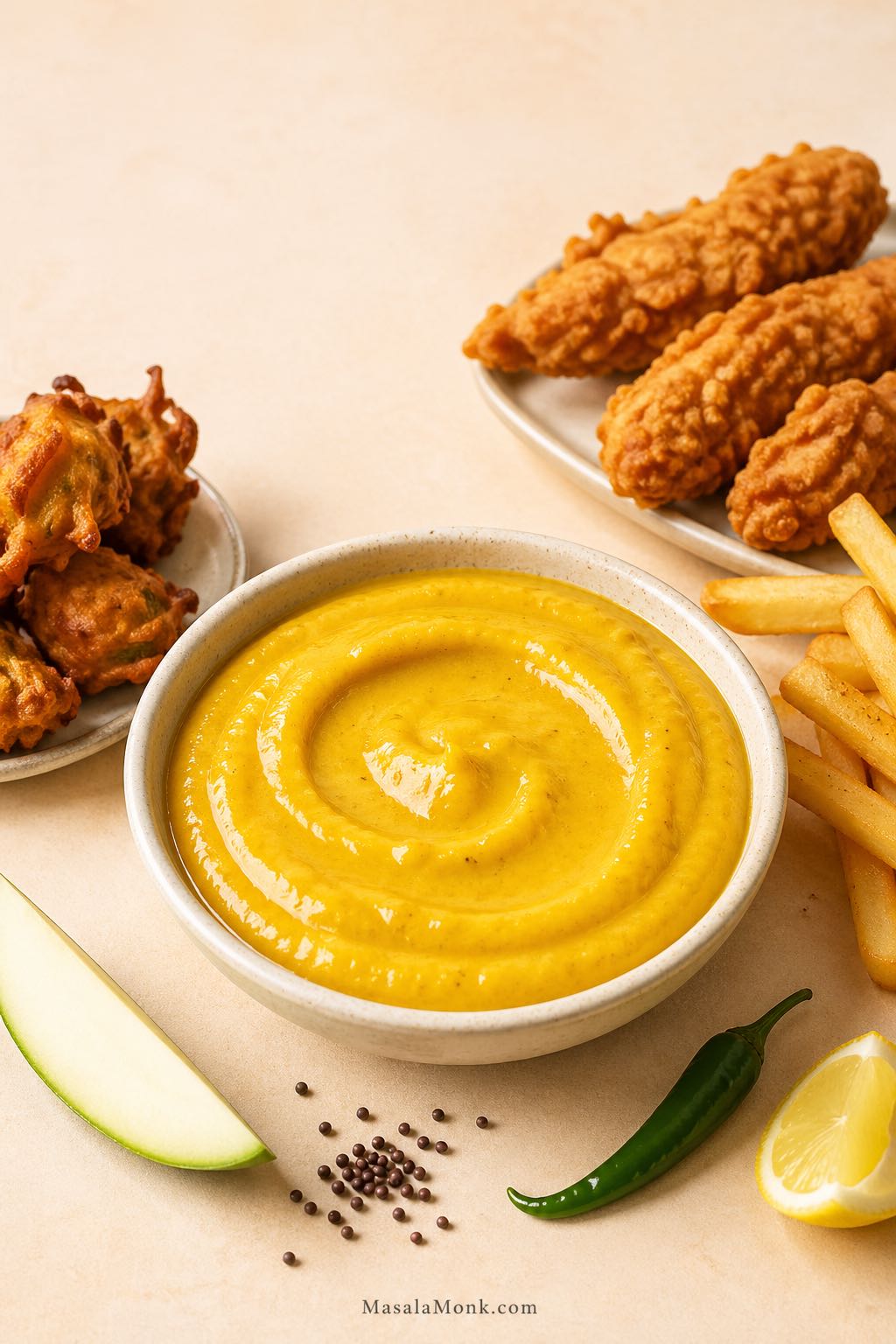
Creamy mango mustard sauce in a bowl with fries, fried chicken, pakoras, green mango, mustard seeds, chili and lemon for a quick dipping sauce.

A good mango mustard sauce should taste sweet, tangy, sharp, lightly spicy, and useful enough to go with more than one meal. It should work as a dipping sauce for fries, chicken tenders, wings, pakoras, and nuggets, but also as a spread for burgers, sandwiches, wraps, and rolls.

This mango mustard sauce recipe gives you the most useful version first: a fast blender sauce made with ripe mango, mustard, lemon or vinegar, chili, salt, and a creamy base such as mayonnaise, thick yogurt, coconut cream, or soaked cashews. It takes only a few minutes, yet it tastes brighter and more interesting than plain honey mustard or a regular mayo-based dip.

At the same time, there is a sharper Indian/Bengali direction to know. In Bengali cooking, aam kasundi or mango kasundi usually means a pungent raw mango mustard sauce made with green mango, mustard seeds, mustard oil, green chili, turmeric, and salt. Because the two styles serve different needs, this guide keeps the fast blender sauce as the main recipe, then shows you how to move it toward an aam kasundi-style version when you want a stronger, sharper mustard flavor.

Quick Answer

Mango mustard sauce is a sweet-tangy sauce made with mango and mustard. In its easiest form, it blends ripe mango or unsweetened mango pulp with mustard, lemon juice or vinegar, chili, salt, and a creamy base such as mayonnaise, thick yogurt, coconut cream, or soaked cashews. As a result, it works as a dip, spread, drizzle, dressing, or quick sauce for chicken, fries, wings, burgers, fish, shrimp, pakoras, paneer, and wraps.

For a softer, creamier sauce, use ripe mango and mayo, yogurt, or coconut cream. By contrast, a sharper Indian/Bengali-style version starts with raw mango, mustard seeds, mustard oil, green chili, turmeric, and salt. That second version is closer to aam kasundi or mango kasundi, which is more pungent, sour, and mustard-forward than a creamy mango mustard dip.

  • Best quick version: ripe mango, Dijon or yellow mustard, lemon, chili, salt, and mayo or yogurt.
  • Best no-mayo version: use coconut cream, thick curd, Greek yogurt, or soaked cashews.
  • Best Indian-style version: use kasundi or make the aam kasundi-style raw mango variation below.
  • Best for dipping: keep the sauce thick and creamy.
  • Best for drizzling: thin it with water, lemon juice, vinegar, or a little oil.
  • Best for chicken and wings: keep it tangy, slightly sweet, and medium-spicy.

Which Mango Mustard Sauce Should You Make?

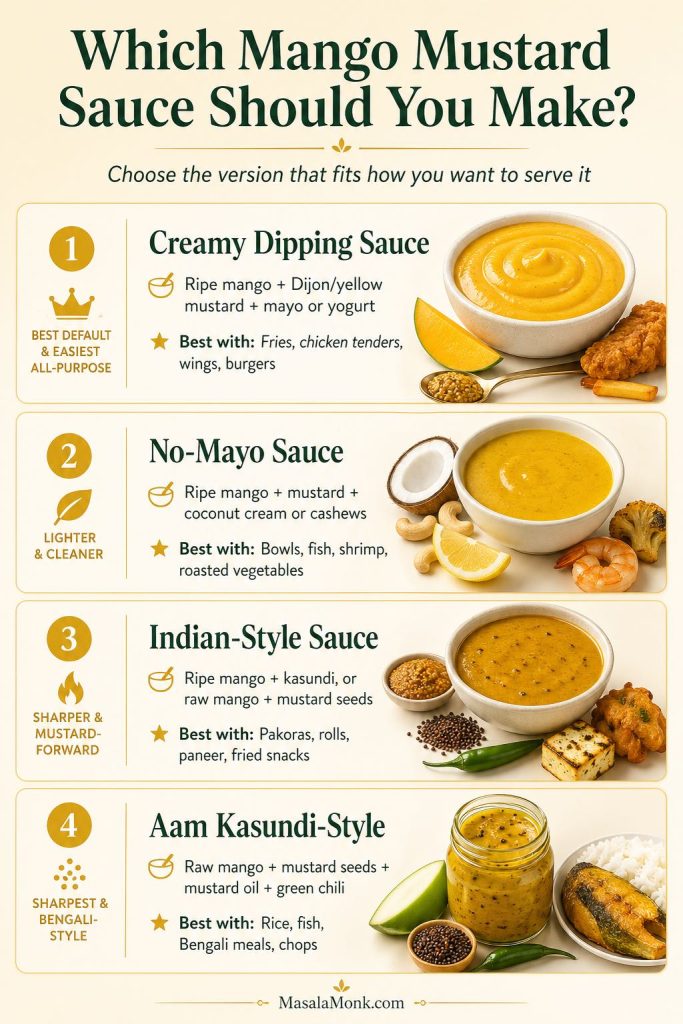
Choose the version based on how you want to serve it. The quick creamy sauce is best for dipping and spreading, the no-mayo version is better for lighter drizzles and bowls, and the aam kasundi-style version is sharper, sourer, and more mustard-forward.

If You Want… Make This Version Best With
A creamy dipping sauce Ripe mango + Dijon or yellow mustard + mayo or yogurt Fries, chicken tenders, wings, nuggets, burgers
A no-mayo sauce Ripe mango + mustard + coconut cream, thick yogurt, or cashews Wraps, bowls, shrimp, fish, roasted vegetables
A sharper Indian-style sauce Ripe mango + kasundi, or raw mango + mustard seeds Pakoras, rolls, paneer, fish, fried snacks
A Bengali-style aam kasundi Raw mango + mustard seeds + mustard oil + green chili Rice, fish, Bengali meals, chops, pakoras
Decision guide comparing creamy mango mustard sauce, no-mayo mango mustard sauce, Indian-style mango mustard sauce, and aam kasundi-style sauce with serving ideas.
Choose the mango mustard sauce that fits your meal: creamy for fries and chicken, no-mayo for lighter bowls and seafood, Indian-style for pakoras and paneer, or aam kasundi-style when you want raw mango and mustard seed sharpness.

Quick Mango Mustard Sauce

This quick mango mustard sauce is creamy, tangy, lightly spicy, and ready in minutes. For the best first batch, use ripe mango, Dijon mustard, lemon juice, chili, salt, and mayonnaise or thick yogurt. After that, adjust it toward a no-mayo, vegan, honey mustard, or aam kasundi-style version.

Prep Time
5 minutes
Cook Time
0 minutes
Rest Time
10 minutes, optional
Total Time
5 to 15 minutes
Yield
About 1 cup

Ingredients

  • 1 cup diced ripe mango or unsweetened mango pulp, about 160–170 g / 6 oz
  • 2 tablespoons Dijon mustard, yellow mustard, or kasundi, about 30 ml
  • 2 to 3 tablespoons mayonnaise, Greek yogurt, thick curd, or coconut cream, about 30–45 g
  • Or, for a cashew version: 2 tablespoons soaked cashews, about 18–22 g, plus 1 to 2 tablespoons water
  • 1 tablespoon fresh lemon juice or apple cider vinegar, about 15 ml
  • 1/4 teaspoon chili flakes or cayenne, or 1 small green chili, finely chopped
  • 1/4 teaspoon fine salt, about 1.5 g, plus more to taste
  • 1 to 2 teaspoons honey or sugar, about 5–10 ml honey or 4–8 g sugar, optional
  • 1 to 2 tablespoons cold water, about 15–30 ml, only if needed to thin

Instructions

  1. Add everything to a blender. Add the mango, mustard, creamy base, lemon juice or vinegar, chili, and salt. Do not add all the honey or sugar yet unless your mango is very tart.
  2. Blend until smooth. Blend until the sauce looks creamy, glossy, and fully combined. Scrape down the sides if needed.
  3. Check the texture. For a dip, the sauce should coat the back of a spoon. For a drizzle, it should fall in a thin ribbon. For a dressing, thin it until pourable but still creamy.
  4. Adjust in small amounts. Add mustard 1 teaspoon at a time for more sharpness, lemon or vinegar 1 teaspoon at a time for brightness, water 1 teaspoon at a time for a thinner sauce, and salt 1 small pinch at a time if the flavor tastes flat.
  5. Rest briefly. Let the sauce sit for 10 minutes if possible. The mustard sharpness settles and the mango flavor becomes rounder.
  6. Serve or chill. Use right away, or refrigerate in a clean airtight jar.

Notes

  • This makes about 1 cup, enough for 4 to 6 servings as a dip or 6 to 8 servings as a drizzle.
  • Use ripe mango for the quick creamy version.
  • Use unsweetened mango pulp when you want the smoothest blender sauce.
  • If using sweetened mango pulp, skip the honey or sugar and add extra lemon, vinegar, or mustard to keep the sauce savory.
  • If using cashews, soak them in hot water for 20 to 30 minutes, then drain before blending.
  • Use kasundi instead of Dijon when you want a sharper Indian-style mango mustard sauce.
  • Use coconut cream or soaked cashews for a vegan no-mayo mango mustard sauce.
  • Honey or sugar is optional. Add it only if the mango is tart or the mustard tastes harsh.

For the first serving, try this mango mustard sauce with fries, chicken tenders, pakoras, grilled paneer, roasted vegetables, fish, shrimp, burgers, wraps, or sandwiches. Ideally, it should taste sweet-tangy first, mustard-sharp second, and spicy only as much as you want it to be.

Why This Mango Mustard Sauce Works

  • Ripe mango gives body and sweetness. It makes the sauce smooth, golden, and fruity without needing much added sugar.
  • Mustard keeps it savory. Dijon, yellow mustard, or kasundi stops the sauce from tasting like plain mango puree.
  • Lemon or vinegar adds lift. The acidity keeps the creamy base from feeling heavy and makes the sauce better with fried, grilled, and roasted foods.
  • The creamy base controls the texture. Mayo makes it rich, yogurt makes it tangier, coconut cream makes it vegan, and soaked cashews make it thick and neutral.
  • The aam kasundi-style option solves the raw mango question. It gives readers a sharper Bengali-style path without making the whole recipe traditional, time-heavy, or confusing.

Once blended, the finished sauce should be smooth, glossy, and spoonable. For dipping, it should cling to fries, pakoras, or chicken tenders. When used as a drizzle, it should fall from a spoon in a thin ribbon. As a spread, it should stay thicker and creamier.

What Is Mango Mustard Sauce?

Mango mustard sauce is a condiment made by combining mango with mustard, acid, salt, and heat. In its easiest form, it is a quick blender sauce made with ripe mango, prepared mustard, lemon or vinegar, chili, and something creamy. Therefore, it tastes like a brighter, fruitier mustard dip and works especially well with fried, grilled, roasted, or snacky foods.

However, mango mustard sauce can also point toward aam kasundi, a Bengali-style mango mustard condiment made with raw mango, mustard seeds, mustard oil, green chili, turmeric, salt, and sometimes garlic or ginger. That version is sharper, more pungent, sourer, and more mustard-heavy than a creamy dipping sauce.

For that reason, this recipe gives you both paths. Make the fast blender version when you need a sauce for fries, chicken, burgers, wraps, wings, fish, or pakoras. Meanwhile, use the aam kasundi-style variation when you need a bolder raw mango mustard flavor for rice, fish, rolls, fried snacks, Bengali-style meals, or kasundi mayo.

For a fresh, chunky mango topping instead of a mustard sauce, try this mango salsa recipe. Mango salsa is brighter, fresher, and diced, while mango mustard sauce is smoother, sharper, and more condiment-like.

For a tangier pickled mango sauce with turmeric, fenugreek, chili, and vinegar, use the amba sauce guide.

Mango Mustard Sauce Ingredients

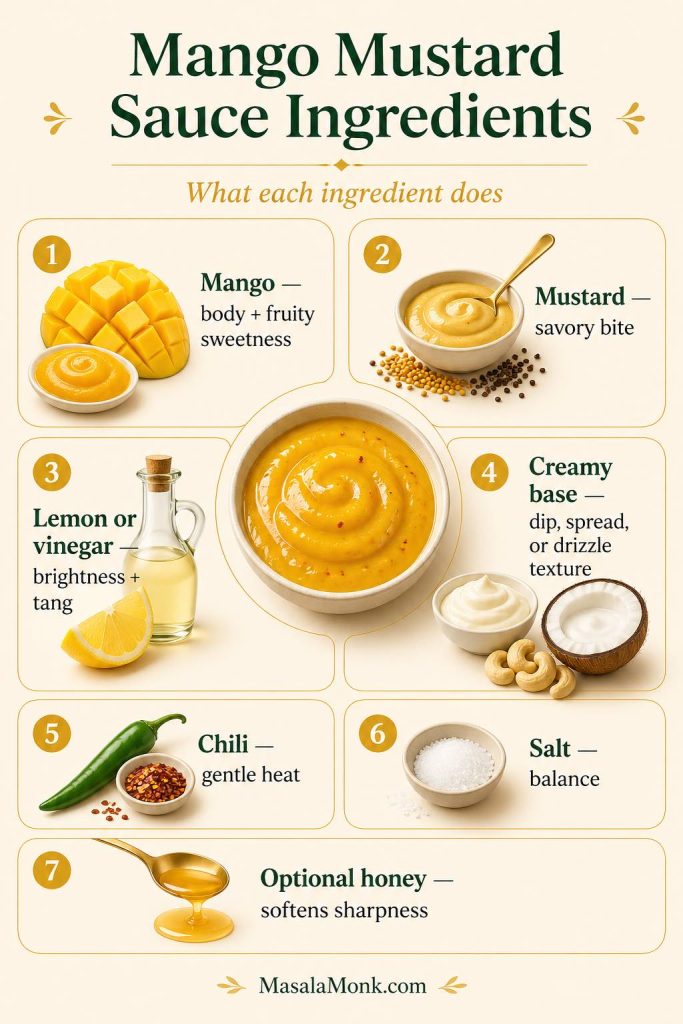
The ingredient list is simple, but each ingredient has a job. First, mango brings body and sweetness. Then, mustard gives bite. Meanwhile, lemon or vinegar keeps the sauce from tasting heavy. Finally, the creamy base decides whether the sauce feels like a dip, spread, drizzle, or dressing.

Mango mustard sauce ingredients guide showing mango, mustard, lemon or vinegar, creamy base, chili, salt, and optional honey with each ingredient’s role.
Each ingredient has a job in mango mustard sauce: mango gives body and sweetness, mustard adds savory bite, lemon or vinegar brings tang, and the creamy base turns it into a dip, spread, or drizzle.

Ripe mango or mango pulp

Use ripe mango for the fast blender version because it gives the sauce sweetness, color, body, and a smooth fruit flavor. Fresh mango gives the brightest taste, while mango pulp gives the smoothest texture and the most consistent result. Whenever possible, choose unsweetened mango pulp. However, sweetened pulp can still work if you skip the honey or sugar and add extra lemon, vinegar, or mustard to keep the sauce savory.

Mustard

Mustard is what keeps the sauce savory. Dijon mustard gives the cleanest sharpness, while yellow mustard gives a familiar tangy dip flavor. By contrast, kasundi gives a deeper Indian/Bengali-style bite. When you use mustard seeds, the sauce moves closer to aam kasundi.

Lemon juice or vinegar

Acid keeps mango mustard sauce lively. Lemon juice tastes fresh and bright, while apple cider vinegar tastes rounder and slightly fruitier. White vinegar, on the other hand, tastes sharper. Start with a small amount, then adjust after blending.

Creamy base

Mayonnaise gives the richest, smoothest dipping sauce. By comparison, Greek yogurt or thick curd makes the sauce lighter and tangier. Meanwhile, coconut cream makes a vegan no-mayo version that works especially well with shrimp, fish, and snacks. For a neutral vegan base instead, soaked cashews make the sauce creamy without adding a strong coconut flavor.

Chili

Use chili flakes, cayenne, fresh green chili, jalapeño, or a little hot sauce depending on how spicy you want the sauce. For an all-purpose dip, keep the heat moderate. Then, for wings, grilled meats, or a spicy mango habanero mustard variation, increase the chili gradually.

Salt and optional honey

Salt makes the mango and mustard taste complete. Honey or sugar is optional, so use it only if the mango is tart, the mustard tastes harsh, or you prefer a softer honey mustard-style sauce.

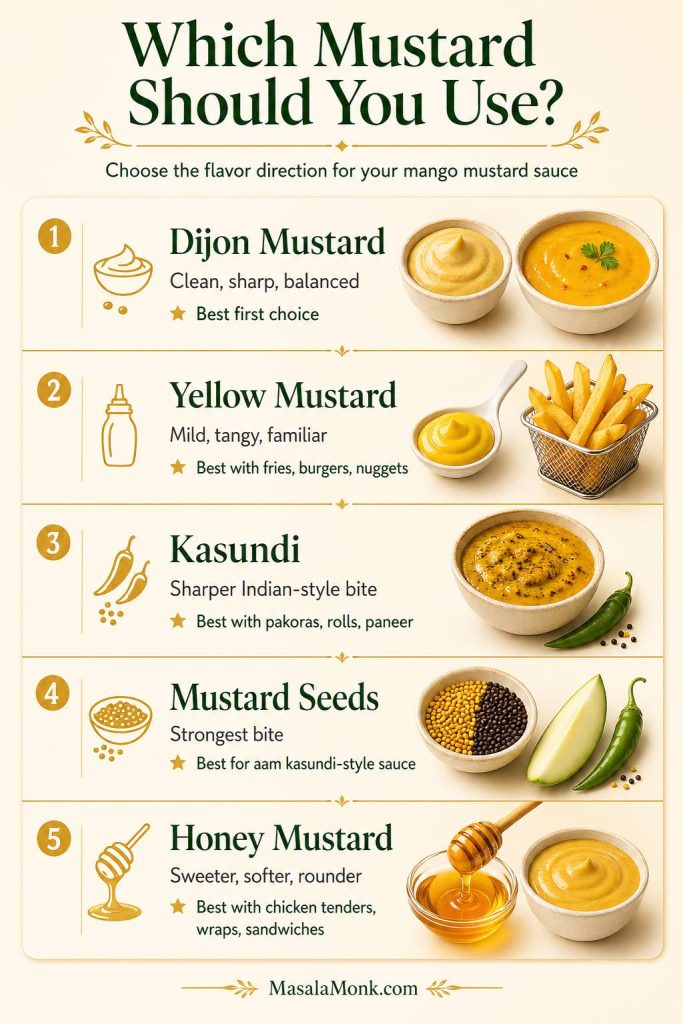
Which Mustard Should You Use?

The mustard changes the whole personality of the sauce. For the easiest all-purpose version, start with Dijon. If you want something milder for fries, burgers, or kids, use yellow mustard instead. However, when you want the sauce to taste sharper and more Indian, kasundi is the better choice.

Mustard Best For Flavor
Dijon mustard Everyday mango mustard sauce, chicken, fish, sandwiches, wraps. Sharp, smooth, balanced, not too sweet.
Yellow mustard Fries, burgers, nuggets, chicken tenders, kid-friendly dipping sauce. Mild, tangy, familiar, less pungent.
Kasundi Indian-style dipping sauce, pakoras, rolls, paneer, fish, fried snacks. Sharper, deeper, more pungent, mustard-forward.
Mustard seeds Aam kasundi-style sauce, raw mango mustard sauce. Strongest bite, more traditional, more textured if not blended fully.
Honey mustard Softer variation for chicken, wraps, sandwiches, and fries. Sweeter, rounder, less sharp.
Mustard chooser guide for mango mustard sauce comparing Dijon mustard, yellow mustard, kasundi, mustard seeds, and honey mustard with best uses.
Dijon is the best first choice for balanced mango mustard sauce, yellow mustard makes it milder, kasundi adds Indian-style sharpness, mustard seeds move it toward aam kasundi, and honey mustard makes it sweeter and softer.

If you are unsure, use Dijon for the first batch. It gives the cleanest balance and lets the mango stay clear. After that, you can make the sauce sharper with kasundi or milder with yellow mustard.

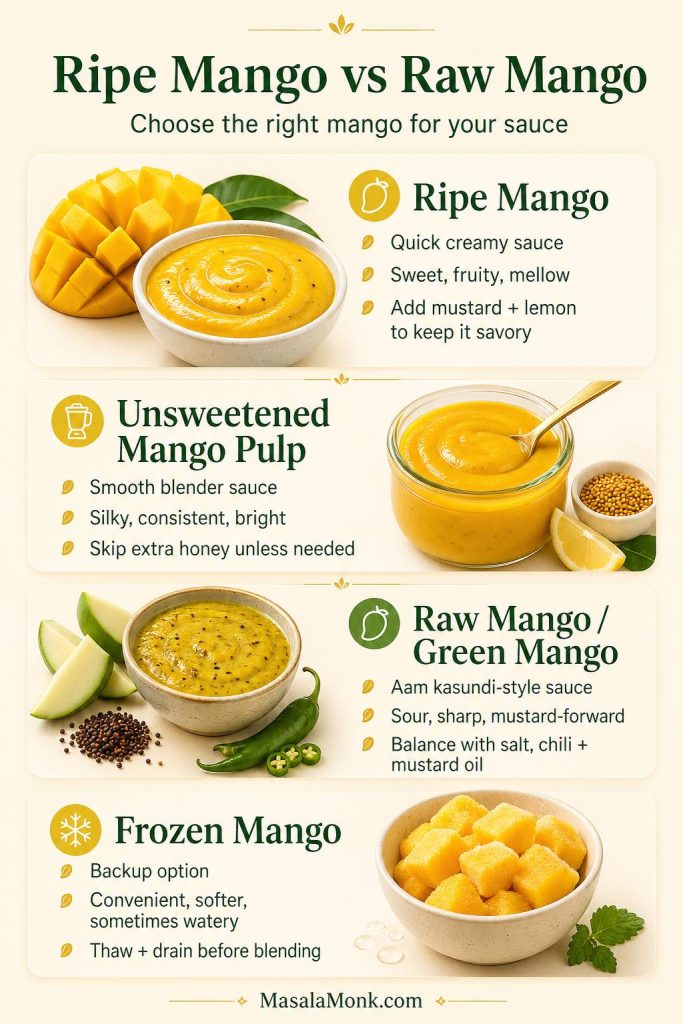
Ripe Mango vs Raw Mango

This is the most important decision in the recipe. On one hand, ripe mango gives you a sweet, smooth, creamy dipping sauce. On the other hand, raw mango gives you a sharper, sourer, aam kasundi-style sauce. Both are useful, but they are not the same.

Mango Type Best For Flavor How to Adjust
Ripe mango Quick creamy mango mustard sauce. Sweet, fruity, mellow. Add lemon/vinegar and mustard to keep it savory.
Unsweetened mango pulp Fast blender sauce, smooth dipping sauce. Very smooth, consistent, often sweeter than fresh mango. Skip extra honey unless needed.
Raw mango / green mango Aam kasundi-style mango mustard sauce. Sour, sharp, more traditional. Balance with salt, mustard oil, chili, and a little sugar if needed.
Frozen mango Backup option for quick sauce. Convenient, softer, sometimes watery. Thaw and drain first, then blend.
Comparison guide showing ripe mango, unsweetened mango pulp, raw green mango, and frozen mango for making mango mustard sauce or aam kasundi-style sauce.
Use ripe mango or unsweetened mango pulp for a smooth, sweet-tangy mango mustard sauce. Choose raw green mango when you want a sharper, sourer, mustard-forward aam kasundi-style sauce.

For the everyday blender sauce, use ripe mango or unsweetened mango pulp. For the aam kasundi-style variation, use raw mango or firm green mango. When the two are swapped, the sauce still works, but the flavor moves in a different direction: ripe mango tastes sweeter and smoother, while raw mango tastes sharper and more mustard-forward.

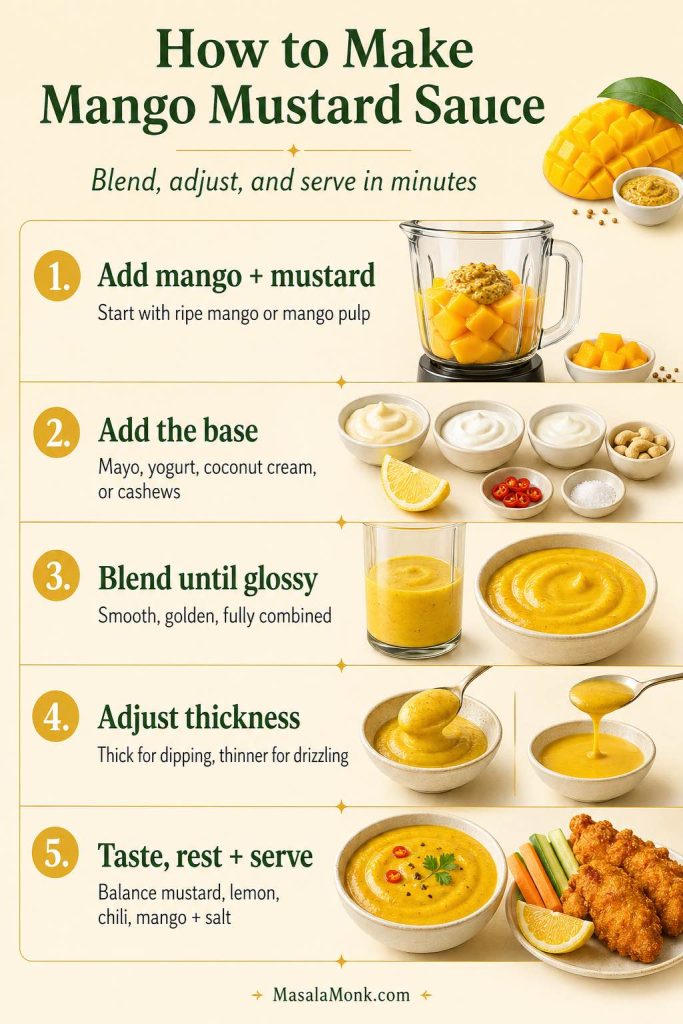
How to Make Mango Mustard Sauce

The quick version is a blender sauce. Even so, the final tasting step matters because mangoes and mustards vary a lot.

Step-by-step guide showing how to make mango mustard sauce in a blender by adding mango and mustard, adding a creamy base, blending, adjusting thickness, and serving.
This quick mango mustard sauce comes together in a blender: start with mango and mustard, add your creamy base, blend until glossy, then adjust the thickness for dipping or drizzling.

1. Add the mango and mustard

Add the ripe mango or mango pulp to a blender with the mustard. For the cleanest flavor, use Dijon. For a milder dip, choose yellow mustard instead. Alternatively, use kasundi for a sharper Indian-style sauce.

2. Add the creamy base

Next, add mayonnaise, Greek yogurt, thick curd, coconut cream, or soaked cashews with a little water. Use more creamy base for a thicker dipping sauce and less for a lighter drizzle.

3. Add acid, chili, and salt

After that, add lemon juice or vinegar, chili, and salt. Because mango usually brings enough sweetness on its own, do not add too much sweetener at the beginning.

4. Blend until smooth

Blend until the sauce is smooth, glossy, and spoonable. After that, scrape down the sides if needed so no mango pieces or mustard streaks remain.

5. Adjust the sauce

After blending, taste the sauce before adding anything else. When it tastes too sweet, add mustard, lemon, vinegar, chili, or salt. If it tastes too sharp, round it out with more mango or creamy base. Finally, when the flavor seems flat, add salt first before reaching for more lemon.

6. Rest before serving

Let the sauce sit for 10 minutes if you can. During that short rest, the mustard sharpness settles, the mango flavor comes forward, and the sauce tastes more complete.

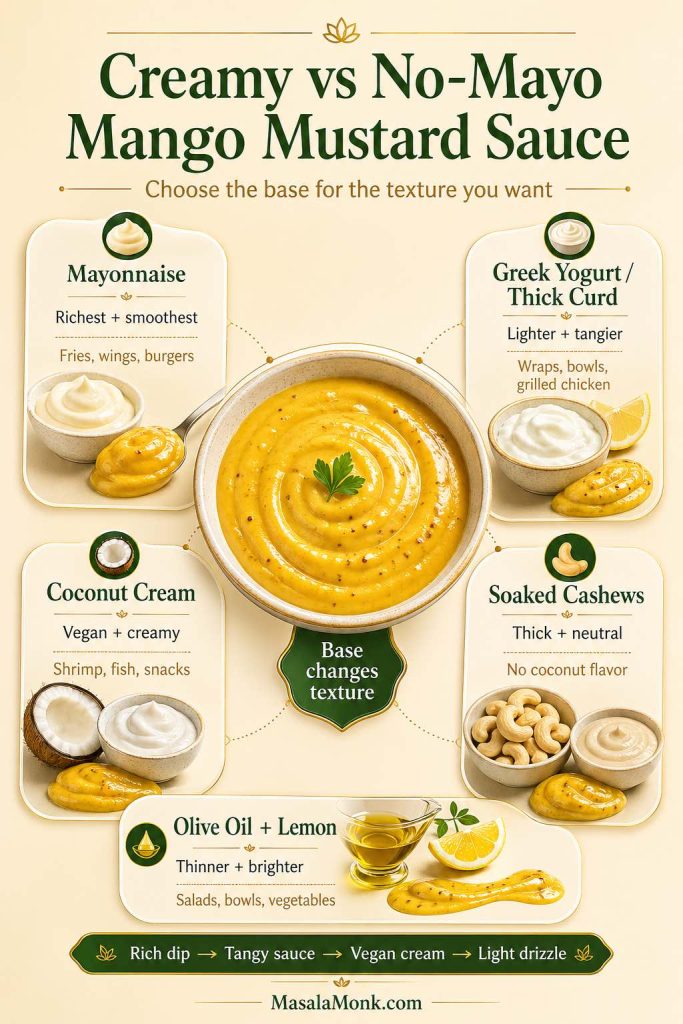
Creamy vs No-Mayo Mango Mustard Sauce

You do not have to use mayonnaise. Instead, the creamy base simply decides how rich, tangy, vegan, or pourable the sauce becomes.

Base Best For What It Does
Mayonnaise Classic dipping sauce, fries, wings, chicken tenders, burgers. Richest, smoothest, most dip-like.
Greek yogurt / thick curd Grilled chicken, wraps, bowls, sandwiches. Lighter, tangier, less rich.
Coconut cream Vegan/no-mayo sauce, shrimp, fish, fried snacks. Creamy with a mild tropical note.
Soaked cashews Vegan creamy sauce without coconut flavor. Thick, neutral, smooth.
Olive oil + lemon or vinegar Dressing-style sauce for salads, bowls, and roasted vegetables. Thinner, brighter, more pourable.
Creamy vs no-mayo mango mustard sauce guide showing mayonnaise, Greek yogurt, coconut cream, soaked cashews, and olive oil with lemon as base options.
The creamy base changes the whole texture of mango mustard sauce: use mayonnaise for the richest dip, yogurt for a lighter tangy sauce, coconut cream or cashews for a vegan version, and olive oil with lemon for a thinner drizzle.

For the most crowd-friendly sauce, use mayonnaise or thick yogurt. Meanwhile, coconut cream or soaked cashews give you a vegan mango mustard sauce without losing body. When you want a dressing instead of a dip, use less creamy base and thin the sauce with lemon juice, vinegar, water, or olive oil.

For a smoother mango-based dressing rather than a mustard sauce, this sweet and spicy mango salad dressing is a better fit for salads, bowls, and lighter drizzles.

Aam Kasundi-Style Mango Mustard Sauce

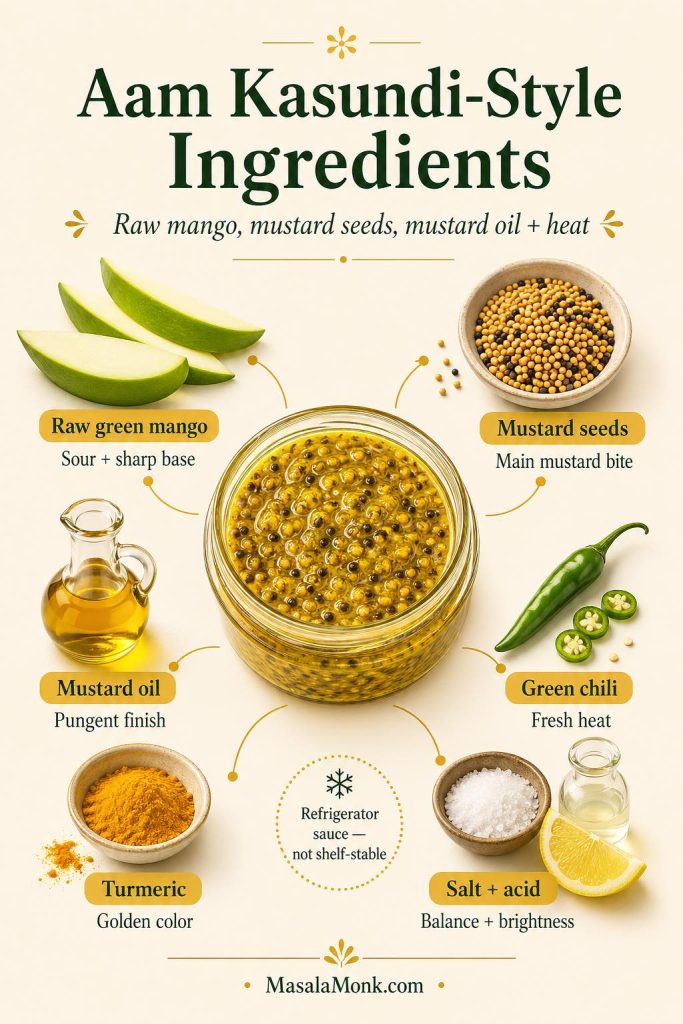
Aam kasundi, also called mango kasundi or aam kashundi, is a sharper Bengali-style mango mustard condiment. Traditionally, it is usually made with raw mango, mustard seeds, mustard oil, green chili, turmeric, and salt. Compared with the fast blender sauce above, it tastes sourer, hotter, more pungent, and more mustard-forward.

This version is an aam kasundi-style refrigerator sauce. In other words, it gives you the raw mango mustard flavor without treating the sauce as shelf-stable or canned.

Aam kasundi-style ingredient guide showing raw green mango, mustard seeds, mustard oil, green chili, turmeric, salt, and acid for a refrigerator sauce.
Aam kasundi-style mango mustard sauce gets its sharper flavor from raw green mango, mustard seeds, mustard oil, green chili, turmeric, salt, and acid. This version is a refrigerator sauce, not a shelf-stable preserve.

Aam Kasundi-Style Ingredients

  • 1 cup grated raw mango or finely chopped green mango
  • 1 1/2 tablespoons yellow mustard seeds
  • 1 to 2 teaspoons black mustard seeds, optional, for stronger bite
  • 1 to 2 green chilies
  • 1/2 teaspoon turmeric
  • 1 small garlic clove or 1/2 teaspoon grated ginger, optional
  • 1 to 2 tablespoons food-grade mustard oil
  • 1 tablespoon vinegar or lemon juice
  • 1/2 teaspoon salt, plus more to taste
  • 1/2 to 1 teaspoon sugar, optional
  • Water as needed to blend

Use food-grade mustard oil where available. Without mustard oil, replace it with neutral oil and add a little extra prepared mustard or kasundi for sharper flavor.

How to Make the Aam Kasundi-Style Version

  1. Soak the mustard seeds in water for 20 to 30 minutes, then drain.
  2. Add the drained mustard seeds, raw mango, green chili, turmeric, salt, vinegar or lemon juice, garlic or ginger if using, and a splash of water to a blender.
  3. Blend to a coarse or smooth paste, depending on the texture you like.
  4. Stir in the mustard oil.
  5. Taste and adjust with more salt, vinegar, chili, or a small amount of sugar.
  6. Transfer to a clean jar and refrigerate.

If you are new to kasundi-style sauces, start with the smaller amount of black mustard seeds. You can always make the next batch sharper, but it is harder to fix a sauce that turns too bitter or pungent.

Important: This aam kasundi-style sauce is a refrigerator condiment, not a shelf-stable preserve. Keep it refrigerated, use a clean spoon, and do not store it at room temperature. For traditionally preserved kasundi or mango pickle, follow a trusted preservation recipe and do not casually change vinegar, water, salt, oil, or food proportions.

Use this sharper version with rice, fish, pakoras, rolls, Bengali-style meals, fried snacks, grilled paneer, or as a base for kasundi mayo. However, when it tastes too strong on its own, mix a spoonful into mayonnaise, yogurt, coconut cream, or mango pulp for a milder dip.

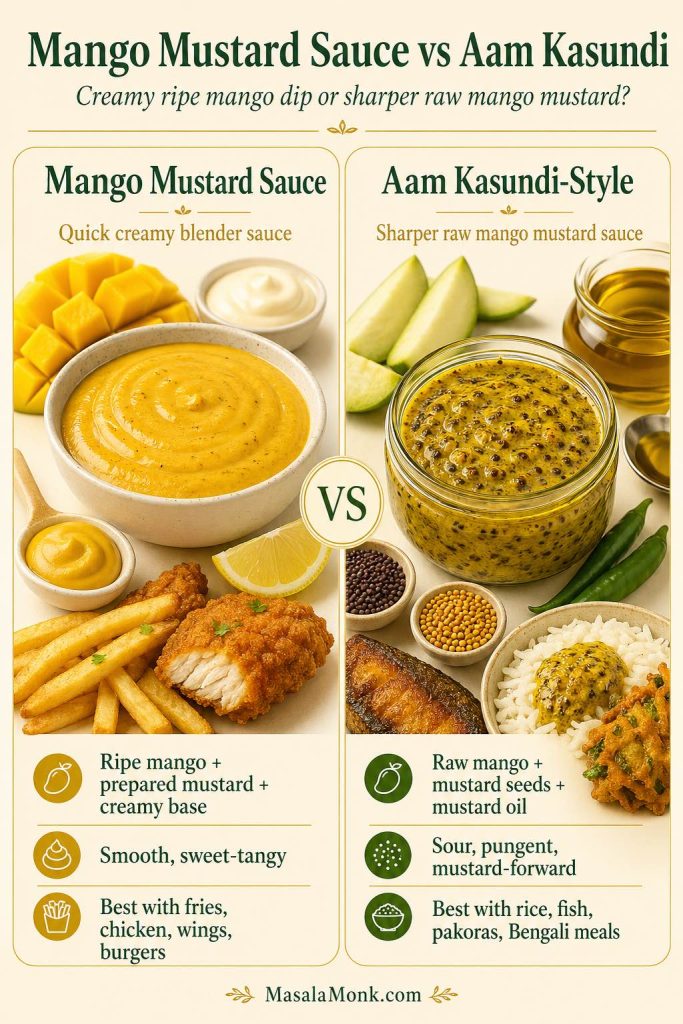
Mango Mustard Sauce vs Aam Kasundi

Mango mustard sauce and aam kasundi overlap, but they are not exactly the same. In general, the fast blender sauce is creamy and made with ripe mango. By contrast, aam kasundi is usually sharper, more pungent, and made with raw mango and mustard seeds.

Side-by-side comparison of creamy mango mustard sauce made with ripe mango and prepared mustard versus aam kasundi made with raw mango, mustard seeds, and mustard oil.
Mango mustard sauce is usually a smooth, creamy ripe-mango dip for fries, chicken, wings, and burgers. Aam kasundi is sharper, more pungent, and built around raw mango, mustard seeds, mustard oil, and green chili.
Sauce Mango Mustard Texture Flavor Best Use
Quick mango mustard sauce Ripe mango or mango pulp Dijon, yellow mustard, or kasundi Creamy and smooth Sweet-tangy, mild to sharp Fries, chicken, wings, burgers, wraps
No-mayo mango mustard sauce Ripe mango or mango pulp Prepared mustard or kasundi Creamy or pourable Lighter, tangy, less rich Snacks, salads, bowls, shrimp, fish
Aam kasundi / mango kasundi Raw mango / green mango Mustard seeds + mustard oil Pungent, thicker, sometimes coarse Sharp, sour, spicy, mustard-heavy Rice, fish, pakoras, rolls, Bengali meals
Mango honey mustard Ripe mango Mustard + honey Smooth Sweeter, softer, rounder Chicken tenders, sandwiches, wraps
Mango habanero mustard Ripe mango Mustard + habanero Smooth or slightly seedy Hot, fruity, sharp Wings, grilled meats, burgers

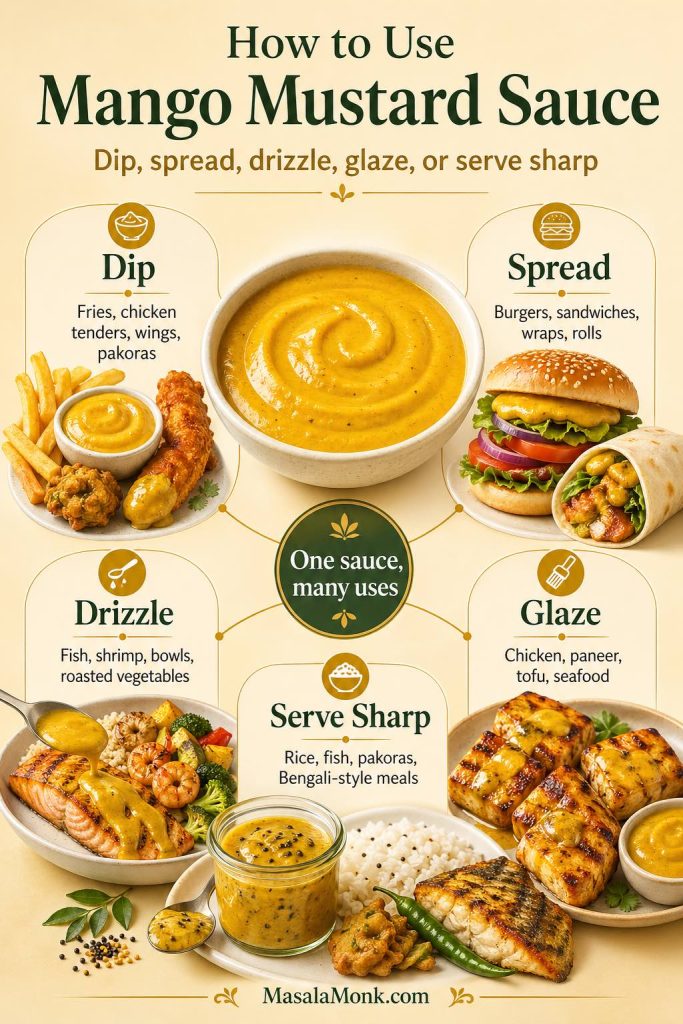
How to Use Mango Mustard Sauce

Mango mustard sauce is useful because it can be thick, creamy, pourable, or sharp depending on how you adjust it. Keep it thicker for dipping and spreading. When you need a drizzle or dressing, thin it slightly with water, lemon juice, vinegar, or oil.

As a simple rule, use the creamy ripe-mango version with fries, chicken, burgers, sandwiches, and wraps. Use the thinner no-mayo version with bowls, salads, grilled fish, shrimp, and roasted vegetables. Use the aam kasundi-style version when you want a sharper, mustard-heavy sauce for rice, fish, pakoras, rolls, or Bengali-style meals.

Guide showing how to use mango mustard sauce as a dip, spread, drizzle, glaze, or sharper sauce with fries, chicken, burgers, fish, shrimp, paneer, rice, and pakoras.
Mango mustard sauce works beyond dipping: keep it thick for fries, wings, burgers, and wraps, thin it for fish, shrimp, bowls, and vegetables, or use the sharper aam kasundi-style version with rice, fish, pakoras, and Bengali-style meals.

Best foods for dipping

Use thick mango mustard sauce with chicken tenders, fries, potato wedges, wings, pakoras, nuggets, onion rings, chips, crackers, and vegetable sticks. For this use, keep the sauce creamy enough to cling instead of running off the food.

Mango Mustard Sauce for Chicken

For chicken tenders, nuggets, fried chicken sandwiches, grilled chicken, or wings, keep the sauce tangy and medium-thick. Use Dijon for a sharper sauce, yellow mustard for a softer family-style dip, or kasundi for a stronger Indian-style chicken sauce. When using it as a glaze, brush it on near the end of cooking so the mango and creamy base do not scorch.

Best places to spread it

Spread mango mustard sauce on burgers, sandwiches, wraps, rolls, grilled cheese, paneer wraps, tofu wraps, and fried chicken sandwiches. For spreading, keep it thicker than a dressing so it stays in place.

Best meals for drizzling

Thin mango mustard sauce slightly and drizzle it over grilled chicken, fish, shrimp, roasted vegetables, grain bowls, salads, grilled paneer, tofu bowls, and rice bowls. For a lighter drizzle, use yogurt, coconut cream, cashews, or olive oil instead of a heavy mayo base.

Glaze, marinade, or finishing sauce

For chicken, fish, shrimp, paneer, or tofu, use mango mustard sauce as a finishing glaze, table sauce, or short marinade. A 20 to 30 minute marinade is usually enough because the sauce is acidic and strongly flavored. When the sauce contains yogurt, mayo, or coconut cream, avoid brushing it too early over high heat because it can split or scorch. Instead, add it near the end of cooking, or spoon it over the finished dish at the table.

If the sauce has touched raw chicken, fish, shrimp, paneer, or tofu, do not reuse it as a table sauce unless it has been cooked properly. For serving, keep a clean portion separate before marinating.

For Bengali-style meals

The aam kasundi-style version is stronger and sharper. Therefore, it works especially well with rice, fish, pakoras, rolls, chops, fried snacks, or mustard-forward dishes. For a milder snack dip, mix a small spoonful into mayo, yogurt, or thick curd.

Mango Mustard Sauce Variations

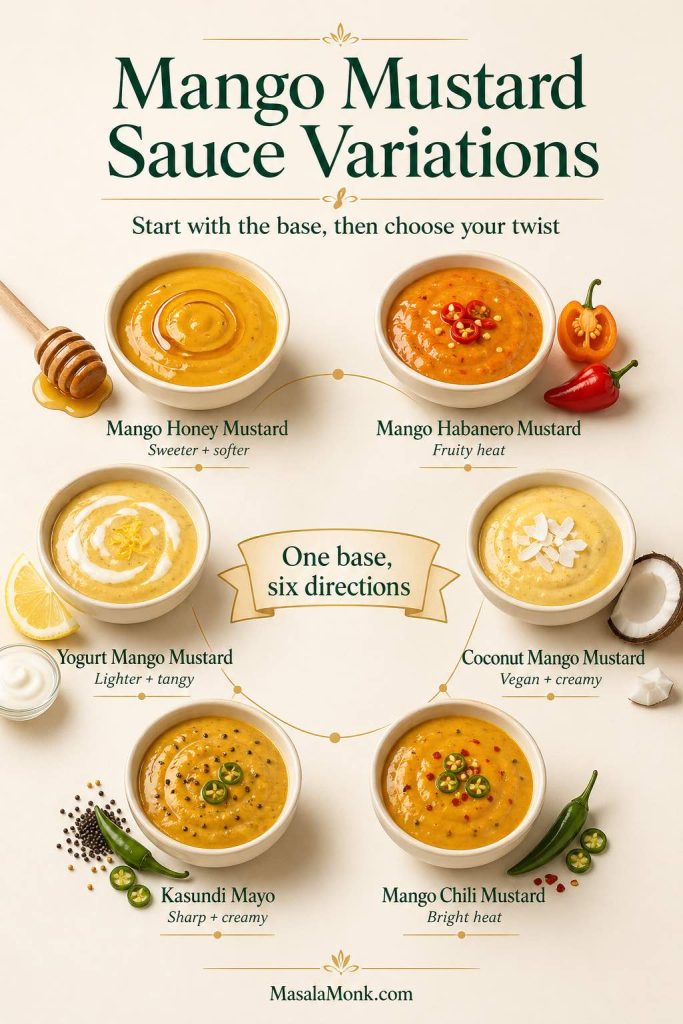
Once the base sauce tastes balanced, you can move it sweeter, hotter, creamier, tangier, or more Indian-style depending on what you are serving. In other words, the same base can become a dip, glaze, dressing, or sharper kasundi-style sauce with only a few changes.

Mango mustard sauce variations guide showing mango honey mustard, mango habanero mustard, yogurt mango mustard, coconut mango mustard, kasundi mayo, and mango chili mustard.
Start with the basic mango mustard sauce, then adjust it into a sweeter honey mustard, hotter habanero sauce, lighter yogurt version, vegan coconut sauce, sharper kasundi mayo, or bright mango chili mustard.

Mango Honey Mustard

Add 1 to 2 teaspoons honey and use Dijon or yellow mustard. As a result, this version becomes softer, sweeter, and especially good with chicken tenders, sandwiches, wraps, and fries.

Mango Habanero Mustard

Add a very small amount of minced habanero or habanero hot sauce. Since habanero heat builds quickly, start with less than you think you need. This variation is best with wings, grilled meats, burgers, and spicy sandwiches.

Coconut Mango Mustard Sauce

Use coconut cream instead of mayo or yogurt. This version is vegan, creamy, slightly tropical, and especially good with shrimp, fish, roasted vegetables, and fried snacks.

Yogurt Mango Mustard Sauce

Use Greek yogurt or thick curd for a lighter, tangier sauce. Because it has more acidity and less richness than mayo, it works well with grilled chicken, wraps, bowls, paneer, and roasted vegetables.

Kasundi Mayo

Mix 1 tablespoon kasundi with 2 tablespoons mayo or yogurt and 1 to 2 tablespoons mango pulp. This gives you a fast, sharp, creamy dip for fries, pakoras, rolls, sandwiches, and snacks.

Mango Chili Mustard Sauce

Add chili flakes, fresh green chili, cayenne, or a small amount of chili sauce. However, keep the mango and mustard balanced so the sauce tastes fruity and sharp, not just hot.

How to Fix Mango Mustard Sauce

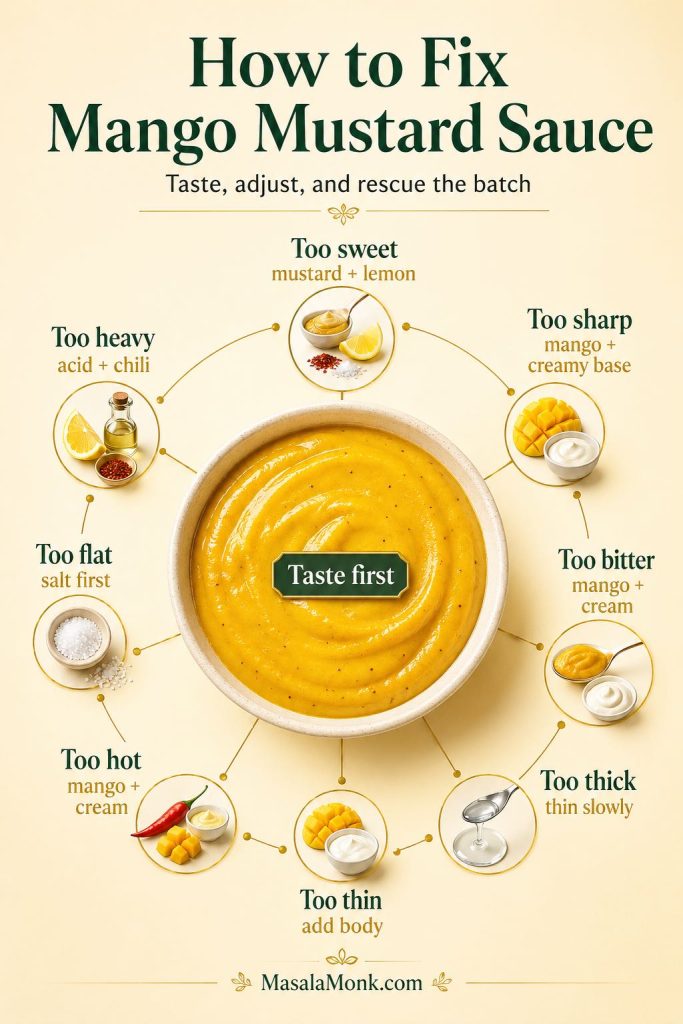
Mangoes, mustards, and creamy bases all vary. Therefore, after blending, taste the sauce and adjust it before serving.

Troubleshooting guide for mango mustard sauce showing how to fix sauce that is too sweet, too sharp, too bitter, too thick, too thin, too hot, too flat, or too heavy.
Taste mango mustard sauce after blending and adjust it before serving: sharpen sweetness with mustard and lemon, soften harshness with mango and creamy base, add salt when it tastes flat, or thin it slowly for drizzling.
Problem What Happened How to Fix It
Too sweet The mango or mango pulp is very sweet. Add lemon juice, vinegar, mustard, chili, or a pinch of salt.
Too sharp There is too much mustard or acid. Add more mango, mayo, yogurt, coconut cream, or a tiny bit of honey.
Too bitter The mustard seeds or mustard are too strong. Add mango and creamy base. Next time, use less mustard seed or a milder mustard.
Too thick There is too much mango pulp, cashew, mayo, or coconut cream. Thin with water, lemon juice, vinegar, or a little oil.
Too thin There is too much liquid or the mango is watery. Add mayo, yogurt, cashew paste, coconut cream, or more mango pulp.
Too hot The chili is stronger than expected. Add more mango and creamy base.
Too flat The sauce is under-salted or lacks acid. Add salt first, then lemon or vinegar if it still needs brightness.
Too heavy There is too much mayo or cream. Add lemon juice, vinegar, chili, mango, or mustard to lift it.

Store-Bought vs Homemade Mango Mustard Sauce

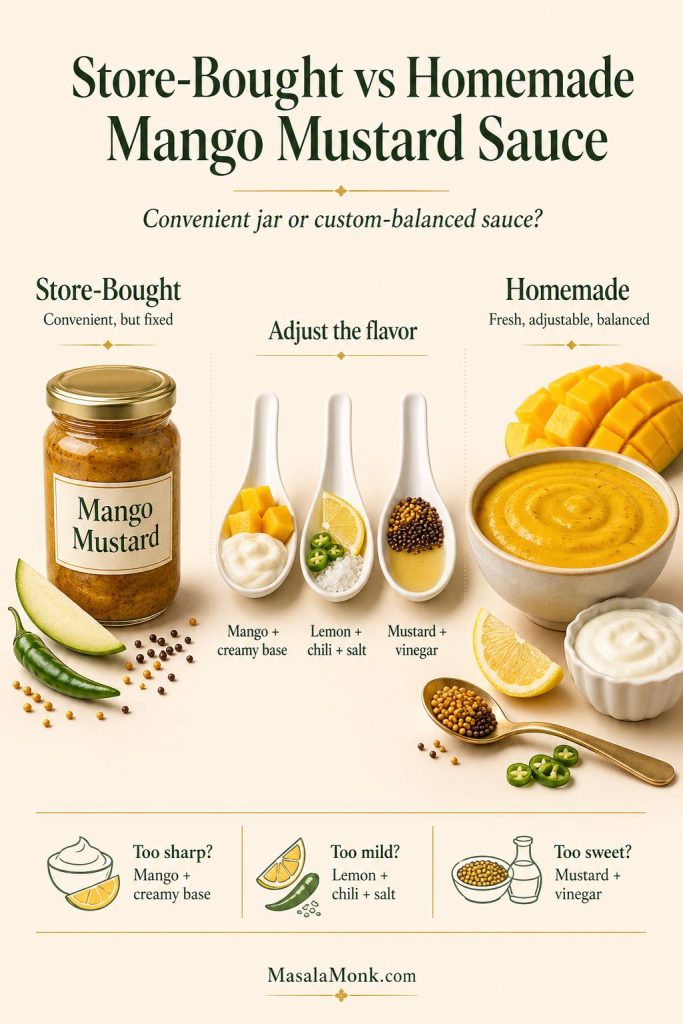
Store-bought aam kasundi, mango kasundi, or mango mustard sauce can be convenient, but the flavor varies a lot. Some versions are sharp, salty, oily, and pungent. Others, however, are sweeter, creamier, or closer to a mild mustard dip.

Store-bought vs homemade mango mustard sauce guide showing a jarred sauce, adjustment spoons with mango, lemon, chili, salt, mustard, and vinegar, and a fresh homemade sauce bowl.
Store-bought mango mustard sauce or mango kasundi can be convenient, but homemade sauce gives you more control. Use mango and a creamy base to soften sharpness, lemon, chili, and salt to brighten mild sauce, or mustard and vinegar to balance extra sweetness.

Homemade mango mustard sauce gives you more control. Instead of accepting one fixed flavor, you can make it creamy or no-mayo, sweet or sharp, mild or spicy, thick for dipping, or thin for drizzling. However, if you already have store-bought kasundi, you can still turn it into a fast sauce by whisking a spoonful with mango pulp and mayo, yogurt, coconut cream, or soaked cashews.

When store-bought kasundi tastes too sharp, soften it with mango pulp and a creamy base. If it tastes too mild, brighten it with lemon, chili, or a pinch of salt. When it leans too sweet, bring back the mustard bite with extra mustard, vinegar, or lemon juice.

Storage

Storage depends on the version you make. Because the fast blender sauce contains fresh mango and often mayo, yogurt, coconut cream, or cashews, treat it as a fresh refrigerator sauce.

Quick creamy mango mustard sauce

  • Store in a clean airtight jar or container in the refrigerator.
  • Use within 3 to 4 days.
  • Stir before serving because the sauce may thicken slightly as it sits.
  • Use a clean spoon every time.
  • Do not leave the sauce at room temperature for more than 2 hours, or more than 1 hour in very hot weather.

Aam kasundi-style refrigerator sauce

  • Store in a clean jar in the refrigerator.
  • For best flavor and freshness, use within 5 to 7 days.
  • Use a clean spoon to avoid introducing moisture or crumbs.
  • Treat it as a refrigerator condiment, not a shelf-stable preserve.
  • Discard if it smells off, grows mold, or changes texture in an unpleasant way.
Important: For shelf-stable mustard, kasundi, or mango pickle, use a tested preservation recipe. Do not casually adjust vinegar, water, salt, oil, or food proportions in preserved condiments.

For general safe pickling principles, see the National Center for Home Food Preservation’s pickling guidance.

Mango Mustard Sauce FAQs

What is mango mustard sauce made of?

Mango mustard sauce is usually made with mango, mustard, lemon juice or vinegar, chili, salt, and a creamy base such as mayonnaise, yogurt, coconut cream, or soaked cashews. A sharper aam kasundi-style version, however, uses raw mango, mustard seeds, mustard oil, green chili, turmeric, and salt.

Is mango mustard sauce the same as aam kasundi?

Not exactly. Quick mango mustard sauce is usually creamy and made with ripe mango and prepared mustard. By contrast, aam kasundi is a sharper Bengali-style mango mustard condiment made with raw mango, mustard seeds, mustard oil, and green chili.

What is mango kasundi?

Mango kasundi, also called aam kasundi or aam kashundi, is a Bengali-style raw mango mustard sauce. Because it uses raw mango and mustard seeds, it is usually sharper, sourer, and more pungent than a creamy mango mustard dipping sauce.

Can I make mango mustard sauce without mayo?

Yes. Instead of mayonnaise, use Greek yogurt, thick curd, coconut cream, or soaked cashews. For a vegan no-mayo version, coconut cream and cashews are the best options.

Can I use mango pulp?

Yes. Mango pulp works well for a smooth blender sauce. Unsweetened mango pulp is best; however, if the pulp is very sweet, skip the honey or sugar and add extra lemon juice or mustard if needed.

Which mustard is best?

Dijon mustard is the best first choice because it is sharp, smooth, and balanced. Yellow mustard makes a milder dipping sauce. Meanwhile, kasundi gives the sauce a stronger Indian/Bengali-style flavor, and mustard seeds are best for the aam kasundi-style version.

Is mango mustard sauce good with chicken?

Yes. Mango mustard sauce works well with grilled chicken, chicken tenders, chicken wings, chicken sandwiches, wraps, and rice bowls. Depending on the meal, use it as a dip, spread, drizzle, or finishing glaze.

Can I use mango mustard sauce as a marinade?

Yes, but it works best as a short marinade or finishing glaze. For a marinade, 20 to 30 minutes is usually enough. Since the sauce may contain mayo, yogurt, or coconut cream, avoid cooking it over very high heat for too long because it can split or scorch. For grilling, brush it on near the end or serve it on the side.

What do you eat with mango mustard sauce?

Serve mango mustard sauce with fries, chicken tenders, wings, pakoras, nuggets, onion rings, burgers, sandwiches, wraps, grilled chicken, fish, shrimp, paneer, tofu, roasted vegetables, grain bowls, or salads.

How long does mango mustard sauce last?

The quick creamy version usually keeps for 3 to 4 days in the refrigerator in a clean airtight container. Meanwhile, the aam kasundi-style version should also be refrigerated and used within 5 to 7 days for best flavor and freshness.

Can I make mango habanero mustard?

Yes. Add a very small amount of minced habanero or habanero hot sauce to the quick mango mustard sauce. Since habanero heat builds quickly, start with less than you think you need.

Is mango mustard sauce sweet or spicy?

It can be both, but the best version is balanced. Ripe mango gives sweetness, mustard gives sharpness, lemon or vinegar gives tang, and chili adds heat. Therefore, you can make it mild, medium, or hot depending on how much chili you use.

Final Tips for the Best Mango Mustard Sauce

Before you make your first batch, keep these final points in mind.

  • Use ripe mango for the quick creamy sauce and raw mango for the aam kasundi-style version.
  • Start with Dijon if you want the cleanest all-purpose mango mustard sauce.
  • Use kasundi when you want a sharper Indian-style flavor.
  • Keep the sauce thick for dipping and thinner for drizzling.
  • Add salt before adding more lemon or vinegar if the sauce tastes flat.
  • Use coconut cream or soaked cashews for a vegan no-mayo version.
  • Let the sauce rest for 10 minutes before final judging.
  • Keep homemade mango mustard sauce refrigerated.

↑ Back to top