Posted on Leave a comment

Honey Mustard Chicken Tenders Recipe

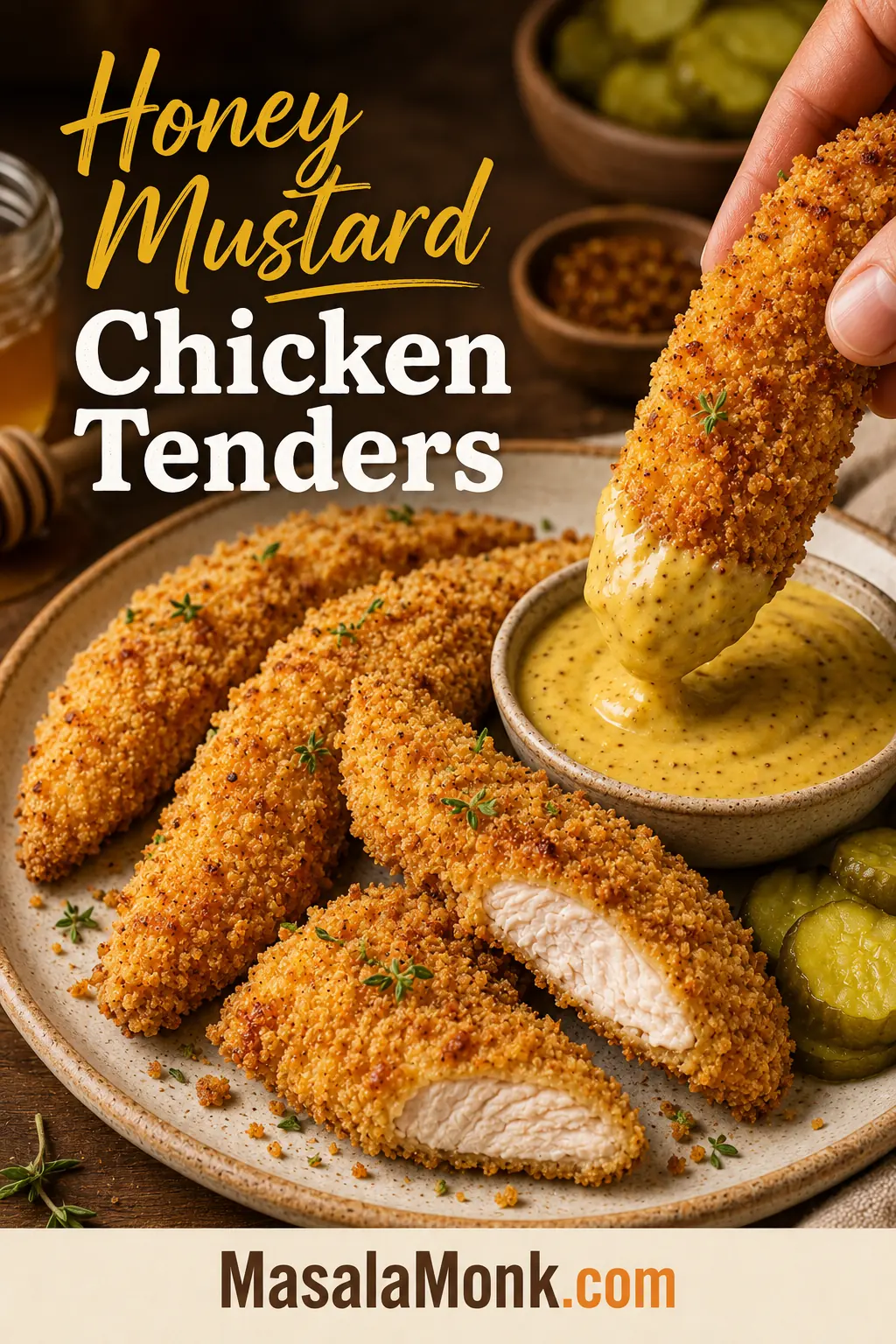
Golden panko-coated honey mustard chicken tenders on a plate with dip, pickles, crumbs, and a cut-open cooked tender.

These honey mustard chicken tenders are for the night you want crispy chicken strips, a creamy sweet-tangy dip, and zero deep-frying drama. The chicken stays juicy, the panko turns golden, and every piece is made for dragging through honey mustard sauce.

They are the kind of tenders people pick from the tray before dinner is even on the table: crisp edges, juicy centers, and just enough honey mustard to keep everyone reaching for one more.

Here, the goal is simple: no pale panko, no soggy bottoms, no dry chicken, and no wasted dipping sauce because it touched raw chicken. Everything runs on one simple system: creamy honey mustard as the binder, panko as the crunch, clean dip reserved first, then an oven or air fryer finish.

Remember the signature rule: mix once, divide first — one clean bowl for dipping, one bowl for coating raw chicken. For the best all-around tray, use chicken strips about 3/4 inch thick, press them into panko, and bake at 425°F / 220°C until golden and cooked through. It is the kind of dinner that feels fun without asking you to set up a frying station or babysit a pan of oil.

Quick Answer: How to Make Honey Mustard Chicken Tenders

To make crispy honey mustard chicken tenders, pat chicken tenderloins or chicken breast strips dry, coat them in a creamy mustard-honey mixture, reserve clean sauce before raw chicken touches the rest, press the coated chicken into panko breadcrumbs, then bake at 425°F / 220°C for 16–20 minutes or air fry at 390°F / 200°C for 10–12 minutes.

The chicken is done when the thickest piece reaches 165°F / 74°C. For the best texture, keep the strips evenly sized, spray the crumb layer lightly with oil, leave space between pieces, and dip at the table instead of pouring sauce over the crust too early.

Jump to recipe card · Oven method · Air fryer method · Fix a problem

Honey Mustard Chicken Tenders Recipe Card

Recipe: Crispy Honey Mustard Chicken Tenders

Main method: Oven baked
Alternate method: Air fryer
Servings: 4
Yield: About 10–12 chicken tenders

Prep Time15 minutes
Optional Rest15–30 minutes
Cook Time16–20 minutes oven / 10–12 minutes air fryer
Total Time35–45 minutes, plus optional 15–30 minute rest
Chicken Doneness165°F / 74°C internal temperature

Ingredients

For the Chicken and Coating

  • 1 1/2 lb / 680 g / 24 oz chicken tenderloins, or boneless chicken breast sliced into strips about 3/4 inch thick
  • 1 1/2 cups / 75–90 g panko breadcrumbs
  • Fine salt, 1 teaspoon / 5–6 g, divided
  • Black pepper, 1/2 teaspoon
  • Garlic powder, 1 teaspoon
  • Onion powder, 1/2 teaspoon
  • Smoked paprika or sweet paprika, 1 teaspoon
  • Oil spray, or 1 tablespoon / 15 ml olive oil for drizzling

For the Honey Mustard Coating and Dipping Sauce

  • 1/4 cup / 60 ml / about 60 g Dijon mustard, yellow mustard, or a mix of both
  • 3 tablespoons honey / 45 ml / about 60 g
  • 3 tablespoons mayonnaise or Greek yogurt / 45 ml / about 45 g
  • 1 tablespoon / 15 ml lemon juice or apple cider vinegar
  • 1/4 teaspoon garlic powder
  • Pinch of salt and black pepper, to taste

Sauce note: This amount gives enough sauce to coat the chicken and reserve a small dipping bowl. For sauce-heavy serving, make a second half-batch of honey mustard or reserve more before raw chicken touches it.

Instructions

Prepare the Sauce

  1. In a bowl, mix the mustard, honey, mayonnaise or Greek yogurt, lemon juice or vinegar, garlic powder, salt and pepper.
  2. Taste and adjust. Make it sweeter with more honey, sharper with extra Dijon, or brighter with a little more lemon juice.
  3. Mix once, divide first: reserve about one-third to one-half of the sauce in a clean bowl for dipping. Keep this portion away from raw chicken.

Coat the Chicken

  1. Pat the chicken tenders dry with paper towels. The surface should look dry, not shiny-wet.
  2. Season the chicken lightly with some of the salt, pepper, garlic powder, onion powder and paprika.
  3. Add the chicken to the remaining honey mustard mixture and turn until each piece is coated.
  4. Let the chicken sit for 15–30 minutes if you have time. Avoid a long acidic marinade for very thin strips because the surface can soften and the coating may not grip as well.
  5. Place the panko breadcrumbs in a shallow bowl. Season with the remaining salt and spices.
  6. Press each honey mustard-coated chicken tender firmly into the panko, turning to coat all sides.

Bake the Chicken Tenders

  1. Preheat the oven to 425°F / 220°C. Line a baking sheet with parchment paper. For crispier bottoms, place a wire rack over the baking sheet.
  2. Arrange the coated tenders in a single layer with space between them.
  3. Spray the tops lightly with oil, or drizzle with a small amount of olive oil.
  4. Bake for 16–20 minutes, flipping once if needed, until the edges are golden and the chicken is cooked through.
  5. Check the thickest tender for doneness.
  6. Rest for 3–5 minutes on a rack or plate, then serve with the reserved clean honey mustard dipping sauce.

Air Fryer Method

  1. Preheat the air fryer to 390°F / 200°C.
  2. Arrange the chicken tenders in a single layer. Do not overcrowd the basket.
  3. Spray lightly with oil.
  4. Air fry for 10–12 minutes, flipping halfway, until crisp and cooked through. Check around 9–10 minutes the first time because air fryers brown at different speeds.
  5. Cook in batches if needed. Two lighter batches will beat one crowded batch every time.

Recipe Notes

  • No egg is needed here because the honey mustard mixture acts as the binder.
  • Very thin strips cook quickly, so start checking early.
  • Thicker tenders may need the full 20 minutes, or a gentler 400°F / 200°C bake for a few extra minutes.
  • For the crunchiest crust, use a wire rack and oil spray.
  • To get a familiar fast-food-style honey mustard, use more yellow mustard and mayonnaise.
  • Prefer a sharper Dijon-style sauce? Use more Dijon and a little extra lemon juice.

Choose Your Version

Already know what kind of tray you want? Use this table to steer the recipe. The base method stays the same; the small changes below make the tenders crunchier, faster, milder, sharper, party-style, or gluten-free.
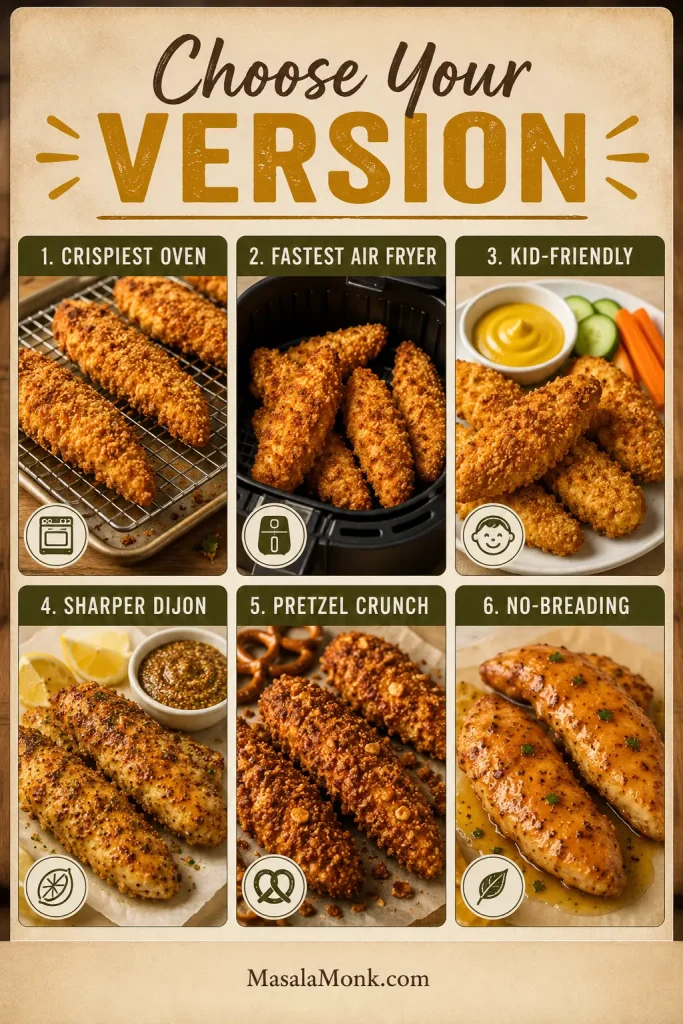
Six-panel board comparing honey mustard chicken tender versions: oven, air fryer, kid-friendly, Dijon, pretzel crunch, and no-breading.
Choose the version that fits your night: oven-baked for maximum crunch, air fryer for speed, Dijon for a sharper bite, pretzel crumbs for texture, or no-breading for a lighter option.
Want This Result?Do This
Crispiest oven tendersUse panko, toast it first if you can, spray with oil, and bake on a wire rack.
Fastest versionUse the air fryer at 390°F / 200°C in a single layer.
Kid-friendly flavorUse yellow mustard, mayonnaise, and a little extra honey.
Sharper Dijon versionUse more Dijon, Greek yogurt, and extra lemon juice.
Party-style crunchReplace panko with crushed pretzels and reduce added salt.
Gluten-free versionUse gluten-free panko or crushed gluten-free rice cereal.
No-breading versionSkip the panko and bake lightly coated honey mustard tenderloins.

Time and Temperature Guide

Chicken tenders cook quickly, so timing matters. Use the table below as a guide, then check the thickest piece before serving.

MethodTemperatureTimeBest For
Oven, standard tenders425°F / 220°C16–20 minutesFull batch, golden crumb crust
Oven, thick tenders400°F / 200°C20–25 minutesLarger chicken strips
Air fryer390°F / 200°C10–12 minutesFast crisping, smaller batches
Reheat375–390°F / 190–200°C5–8 minutes, or until hot and crispLeftovers

Chicken should reach 165°F / 74°C in the thickest part. The tenders should also look golden at the edges and feel firm when lifted with tongs, but the thermometer is the safest check.

Once the timing is clear, the next thing is texture. These tenders work because the coating is built to cling, brown, and stay crisp long enough to dip.

Why This Recipe Works

The best honey mustard chicken tenders are not just sweet chicken in breadcrumbs. They need a coating that stays put, a crust that browns before the chicken dries out, and a dipping sauce that does not soften the crunch too early.

The magic is not complicated, but it does depend on a few small choices that keep baked tenders from tasting like soft breaded chicken.

  • Dry chicken helps the coating grip. You want the mustard-honey layer to cling, not slide around.
  • Honey mustard replaces egg. It gives the crumbs something to hold onto and adds flavor at the same time.
  • Panko gives the oven-fried bite. It is lighter and flakier than regular breadcrumbs.
  • Oil spray brings the color. Dry crumbs stay pale; a little oil helps them turn golden.
  • Space and a rack fight steam. Give the tenders a little breathing room so they brown instead of softening together.
  • Reserved sauce stays clean. Moving the dip to a separate bowl before coating the chicken keeps serving simple and safe.

When those pieces work together, you get the comfort of chicken fingers, the brightness of honey mustard, and a crisp bite that still tastes juicy underneath.

The best part is the contrast: the craggy panko shell, the tender strip of chicken inside, and that cool-sweet honey mustard dip catching in all the little crispy edges.

Crispy Outside, Juicy Inside

This is the texture target to keep in mind before you start coating: crisp crumbs on the outside, tender chicken in the middle, and sauce served on the side so the crust stays lively.
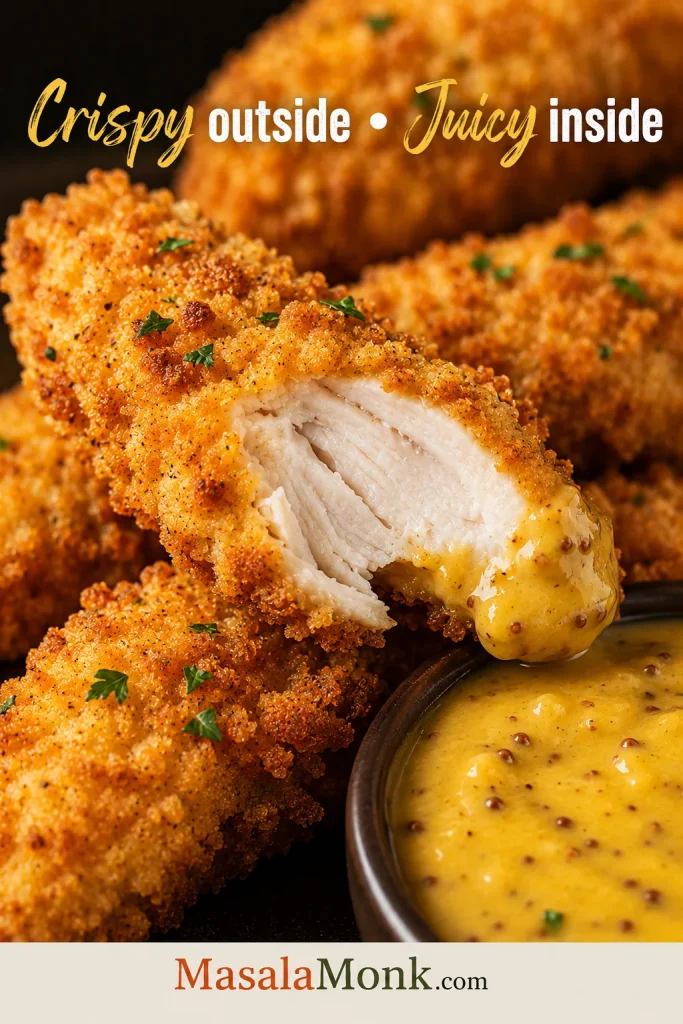
Close-up of a cut-open crispy chicken tender with golden panko coating, white cooked chicken inside, and honey mustard dip nearby.
Aim for contrast in every bite: a crunchy panko shell outside and moist white chicken inside. Pull the tenders once they are cooked through so the center stays juicy.

Ingredients You Need

Most of the flavor comes from the ingredients. Simple tools and small technique choices handle the texture.
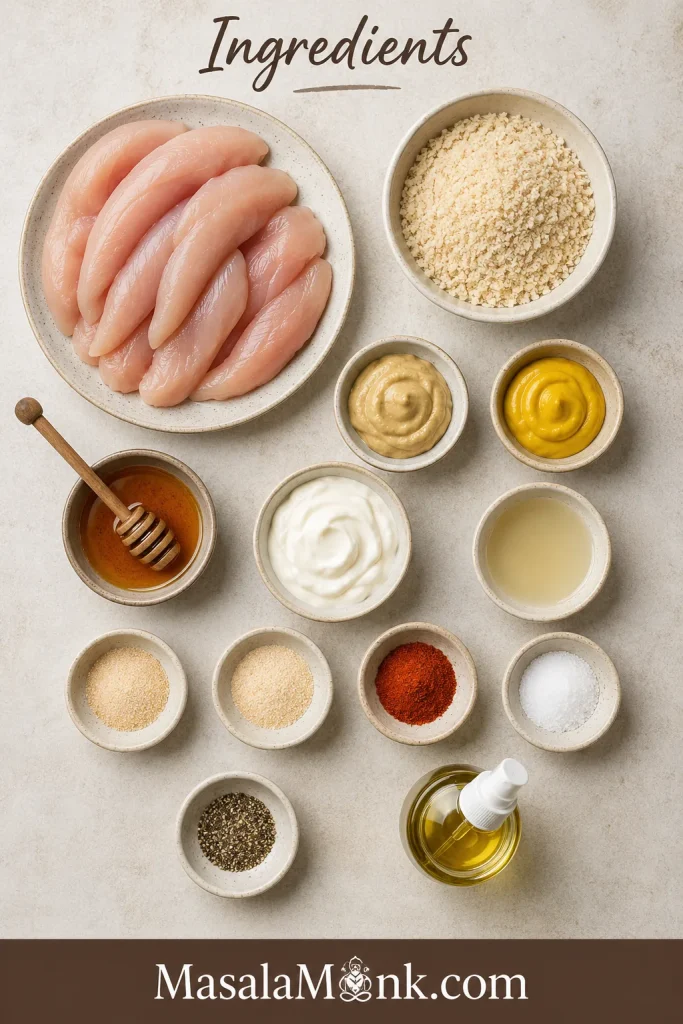
Overhead layout of ingredients for honey mustard chicken tenders, including raw chicken, panko, mustard, honey, yogurt or mayo, spices, and oil.
Set out the chicken, panko, sauce ingredients, seasonings, and oil spray before you start. It keeps the coating step smooth and makes it easier to reserve a clean dipping bowl.

Chicken Tenderloins or Chicken Breast

Chicken tenderloins are easiest because they are already shaped like strips. Boneless chicken breast works too; just slice it lengthwise into even pieces about 3/4 inch thick at the widest part. Very thin strips cook before the crumbs brown, while very thick strips need more time and can darken the honey before the center is done.
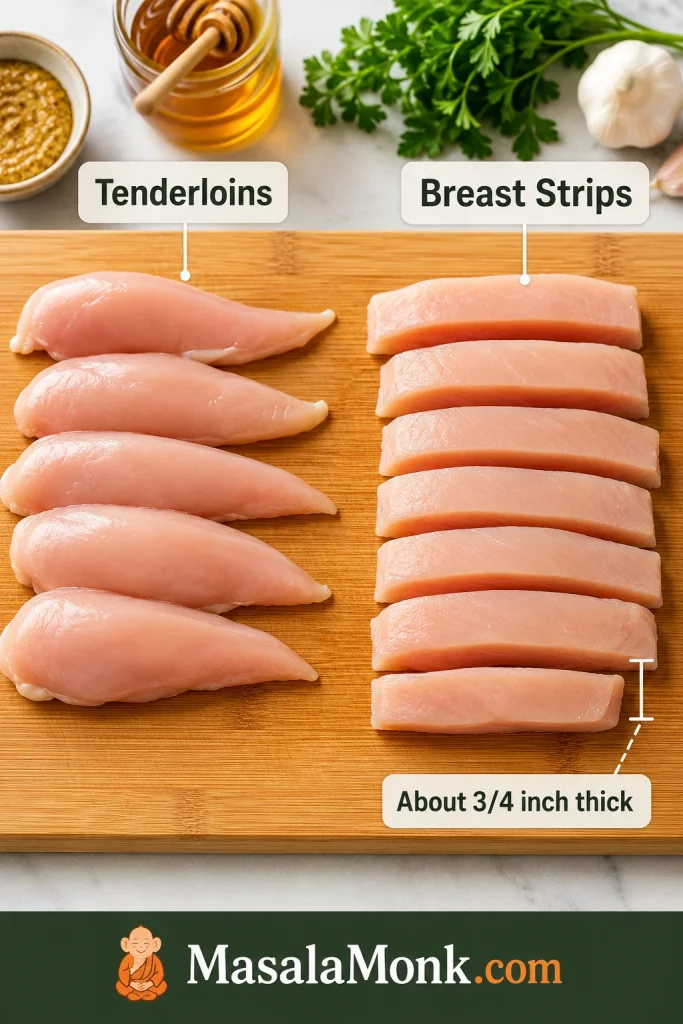
Raw chicken tenderloins and sliced chicken breast strips arranged side by side on a cutting board with a 3/4 inch thickness label.
Even thickness matters more than perfect shape. Keep chicken tenderloins or breast strips close to 3/4 inch thick so the coating can brown before the center dries out.

If you are starting with full chicken breasts and want more detail on keeping them juicy, this baked chicken breast recipe goes deeper into timing, thickness, and avoiding dry chicken.

Mustard

Dijon brings bite; yellow mustard brings nostalgia. Use Dijon for a sharper sauce, yellow mustard for a milder dipping-sauce flavor, or a mix of both for the best middle ground.

Honey

Honey gives the sauce its classic sweetness, but this is not a sticky glaze recipe. The honey mustard flavors the chicken while the panko does the crisping, so the tenders stay crunchy instead of turning syrupy.

Mayonnaise or Greek Yogurt

Mayonnaise makes the sauce creamy and familiar. Greek yogurt gives you a lighter, tangier version. Both help the mustard-honey coating cling to the chicken and hold the crumbs in place.

If you like making creamy sauces from scratch, this homemade mayonnaise guide gives you a richer base for dips.

Panko Breadcrumbs

Panko is what keeps baked tenders from feeling like soft breaded chicken. The flakes are light and uneven, so they create a craggy shell that feels much closer to fried chicken fingers.

This recipe skips the classic flour-and-egg dredge to keep the coating simple. The mustard-honey layer works as the glue. For a firmer, more restaurant-style crust, lightly dust the chicken with flour before dipping it into the sauce, then press it into the panko.

Seasonings

Garlic powder, onion powder, paprika, salt and pepper are enough. They make the coating savory without hiding the honey mustard flavor.

Equipment That Helps

You can make these with a baking sheet and a bowl, but a few simple tools make the difference between “good enough” tenders and crisp, golden ones.

  • Rimmed baking sheet: Keeps crumbs and oil contained.
  • Parchment paper: Helps prevent sticking and makes cleanup easier.
  • Wire rack: Gives the bottoms a better chance to crisp.
  • Shallow bowl: Makes pressing the panko onto the chicken easier.
  • Oil spray: Helps the crumbs turn golden without deep frying.
  • Air fryer: Optional, but excellent for smaller batches.
  • Instant-read thermometer: Helpful for avoiding dry or undercooked chicken.

Honey Mustard Sauce: Dip, Binder or Marinade?

Honey mustard does three jobs here: it helps the crumbs stick, flavors the chicken, and gives you that creamy dipping bowl at the end. The only rule is that the dip must be reserved before raw chicken touches the rest.

Sauce safety rule: mix once, divide first. Make one batch of honey mustard, then immediately move the dipping portion to a clean bowl before raw chicken touches the rest.

Mix Once, Divide First

This visible split is what keeps dinner simple: one bowl becomes the clean dip, while the rest of the sauce seasons and coats the raw chicken before breading.
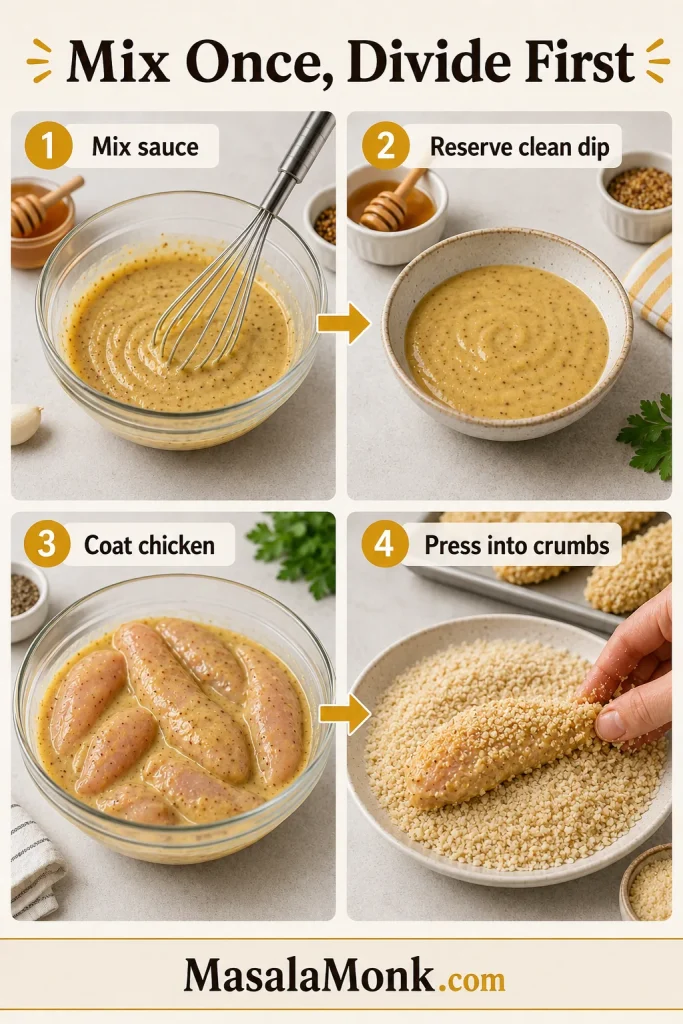
Four-panel guide showing honey mustard sauce mixed, clean dip reserved, raw chicken coated, and chicken pressed into panko crumbs.
Mix once, then divide before raw chicken touches the sauce. This keeps one bowl safe and clean for dipping while the remaining honey mustard becomes the flavorful coating binder.

The sauce has three jobs. First, it helps the crumb layer stick. At the table, it gives the cooked tenders that creamy sweet-tangy finish. If the chicken rests for 15–30 minutes before breading, the same sauce also works as a short flavor boost.

Honey Mustard Sauce Spoon Test

Before the chicken goes in, lift a spoon through the sauce and check the texture. It should coat the spoon in a creamy layer, not run off immediately.
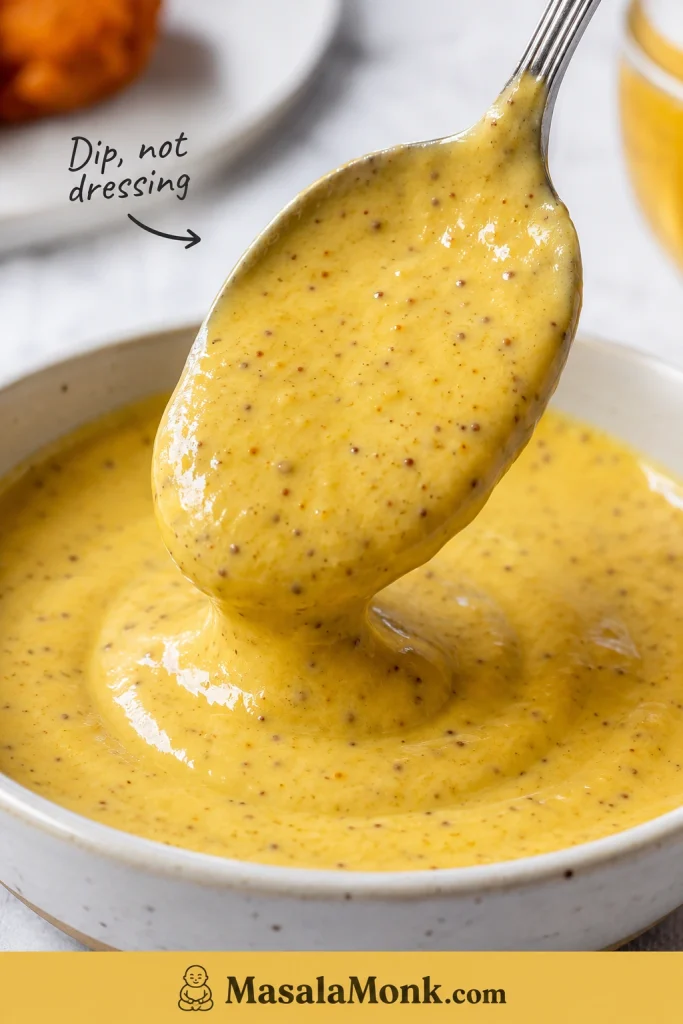
Thick creamy honey mustard sauce clinging to the back of a spoon above a bowl with visible mustard specks.
Look for a spoon-coating texture: thick enough to cling, creamy enough to dip. If the honey mustard looks runny, thicken it slightly before coating the chicken.

For a loose sauce, whisk in another spoonful of mayo or Greek yogurt before breading. A thicker sauce grips the chicken better and protects the panko from turning wet.

Very thin strips do not need an overnight marinade, especially if your sauce is tangy with lemon juice or vinegar. Too much time in an acidic sauce can soften the surface and make the coating less secure.

Simple Honey Mustard Dipping Sauce Ratio

  • 1/4 cup / 60 ml mayonnaise or Greek yogurt
  • 2 tablespoons / 30 ml Dijon or yellow mustard
  • 2 tablespoons honey / 30 ml / about 40 g
  • 1–2 teaspoons lemon juice or apple cider vinegar
  • Pinch of garlic powder
  • Salt and pepper to taste

Make it sweeter with more honey, sharper with extra Dijon, or more familiar and restaurant-style with yellow mustard and mayo. Greek yogurt plus a little extra lemon juice gives you the lighter, tangier version.

If you enjoy this sweet-tangy lane, mango mustard sauce is a fun next dip for fries, wraps and sandwiches.

Next: press into panko · Bake the tenders · Air fry the tenders · Back to recipe card

How to Make Honey Mustard Chicken Tenders

Once the recipe card is open, these are the small visual cues that make the tray come out right: dry surface, spoon-coating sauce, firmly pressed crumbs, enough space, and golden edges.

1. Dry and Season the Chicken

The chicken should look dry before the sauce goes on. You want the mustard-honey coating to cling, not slide around.

2. Mix, Taste and Divide the Sauce

The sauce should taste sweet first, tangy next, and creamy enough to dip. Once it tastes right, reserve the clean dipping portion before you coat the raw chicken.

3. Coat Lightly, Not Heavily

You want a thin layer of honey mustard clinging to the chicken, not a heavy blanket of sauce. Too much sauce can make the crumbs wet and slow down browning.

4. Press the Panko

Press the crumbs onto the chicken instead of sprinkling them over the top. The coating should look attached before it goes into the oven or air fryer.
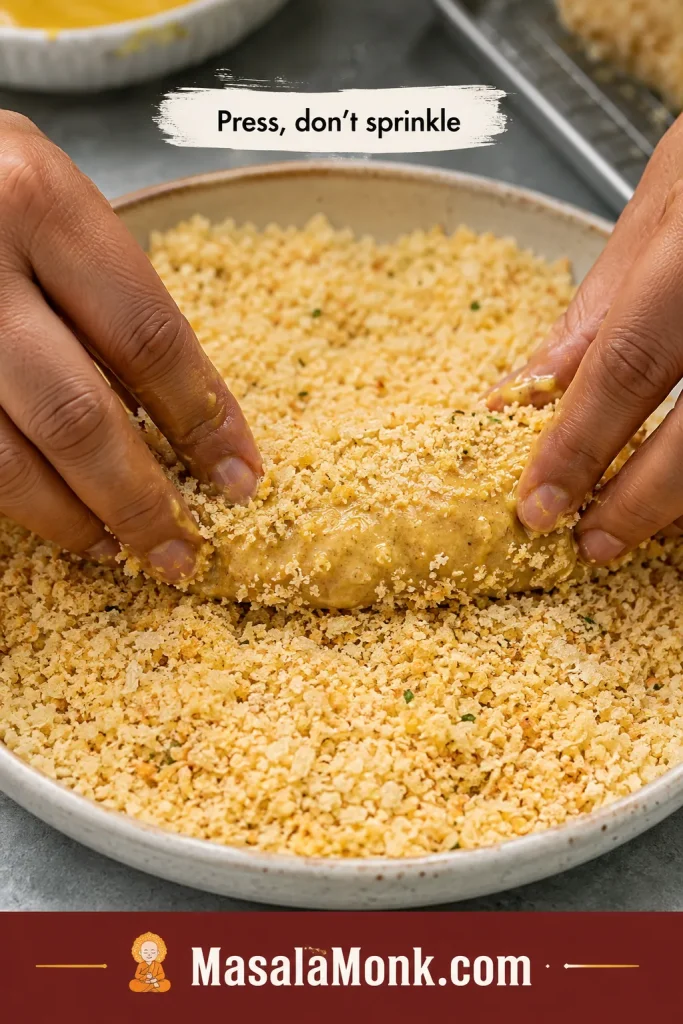
Hands pressing a honey-mustard-coated chicken tender into coarse panko breadcrumbs in a shallow bowl.
After coating the chicken, press it firmly into the panko instead of sprinkling crumbs over the top. This helps the breadcrumb crust grip better during baking or air frying.

5. Space, Spray and Cook

Leave gaps between the tenders and give the crumb layer a light spray of oil. This is the step that makes the tray look like dinner instead of pale baked chicken: the crumbs need both heat and a little fat to turn golden.

Oven Method

Use the oven when you want the whole tray ready together, with enough tenders for dinner plates and a few “just one more” pieces.

  • Temperature: 425°F / 220°C
  • Time: 16–20 minutes
  • Best setup: parchment-lined baking sheet or a wire rack over a baking sheet
  • Texture goal: golden crumbs, juicy chicken, crisp edges
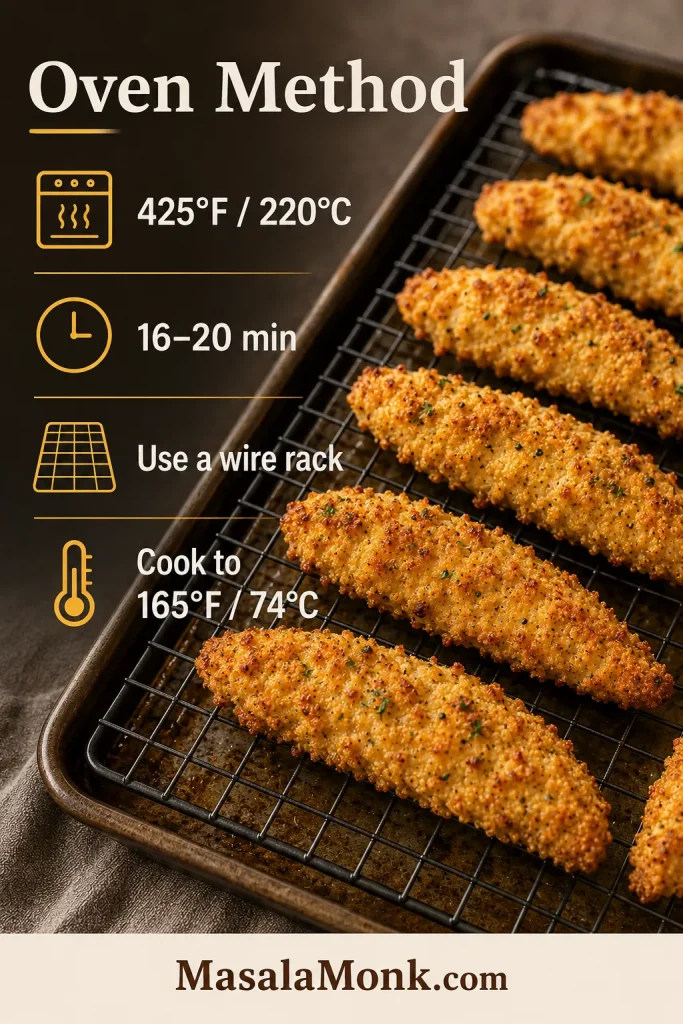
Oven method guide for panko honey mustard chicken tenders showing baking temperature, time, wire rack use, and safe doneness.
For the oven method, high heat and rack spacing do most of the work. The rack helps the panko crisp underneath while the quick bake keeps the chicken tender.

Why Use a Wire Rack?

A wire rack helps hot air reach the bottom of the tenders, which keeps them from steaming against the pan. When baking directly on parchment, flip the tenders once for better bottom color. With a rack, flipping is optional.
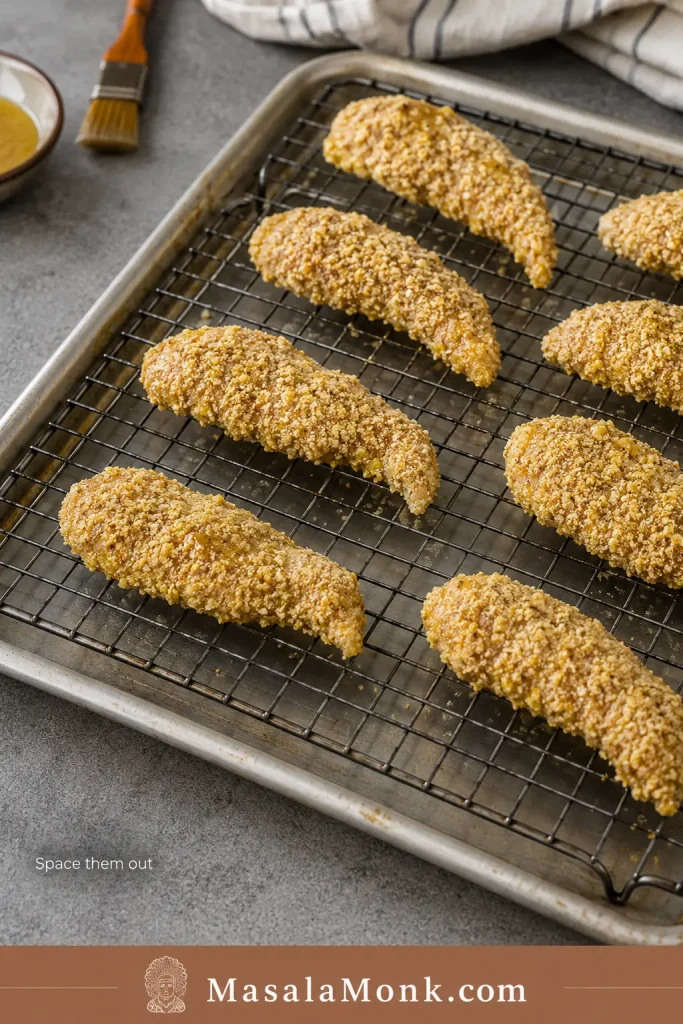
Breaded chicken tenders spaced apart on a wire rack over a rimmed baking sheet before baking.
A wire rack gives baked chicken tenders an instant crispness boost. Because heat can move underneath the pieces, the bottoms stay drier and the panko browns more evenly.

Thick tenders can bake at 400°F / 200°C for about 20–25 minutes. Thin strips may be ready closer to 14–16 minutes, so start checking early.

Compare the air fryer method · Make them extra crispy · See serving ideas · Back to recipe card

Air Fryer Method

Use the air fryer when speed matters more than cooking the whole batch at once. It crisps the crumb layer quickly, but only if the basket has enough space.

Air Fryer Single Layer Setup

Before starting the timer, check the basket. The pieces should sit in one layer with visible gaps, even if that means cooking two smaller batches.
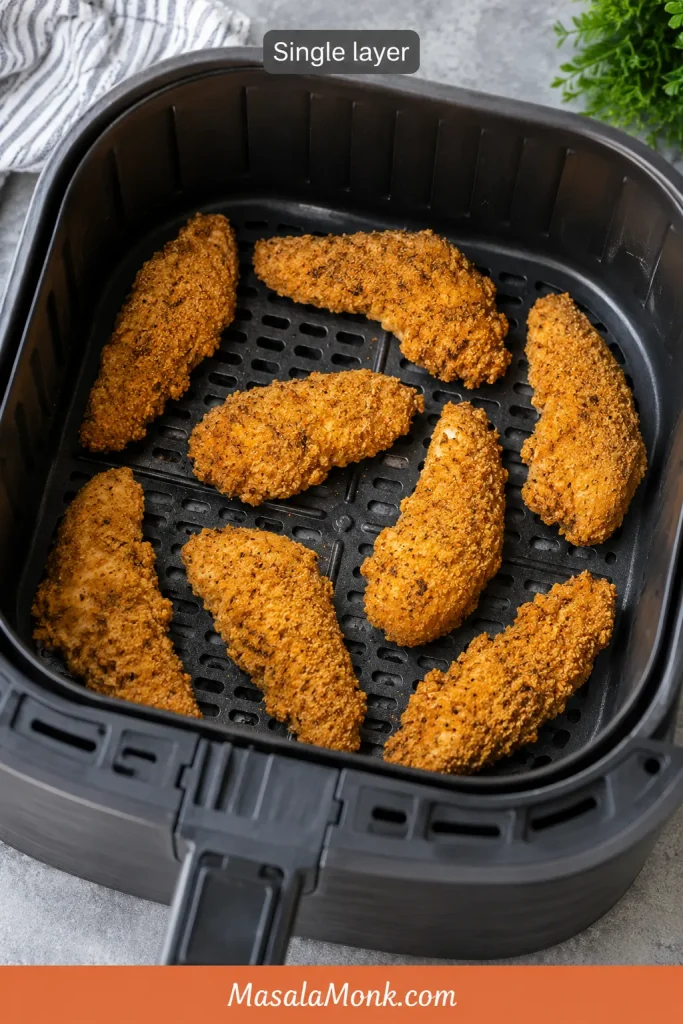
Breaded chicken tenders arranged in a single layer inside a black air fryer basket with space between each piece.
In the air fryer, crowding turns crisping into steaming. Therefore, leave small gaps between the tenders so the hot air can brown the panko coating properly.
  • Temperature: 390°F / 200°C
  • Time: 10–12 minutes
  • Flip: halfway through
  • Oil: light spray on both sides
  • Best rule: cook in batches if the basket is small

Air Fryer Time and Temperature Guide

Use this quick visual check when you want the air fryer version: moderate-high heat, a halfway flip, and enough space for the crumbs to crisp.
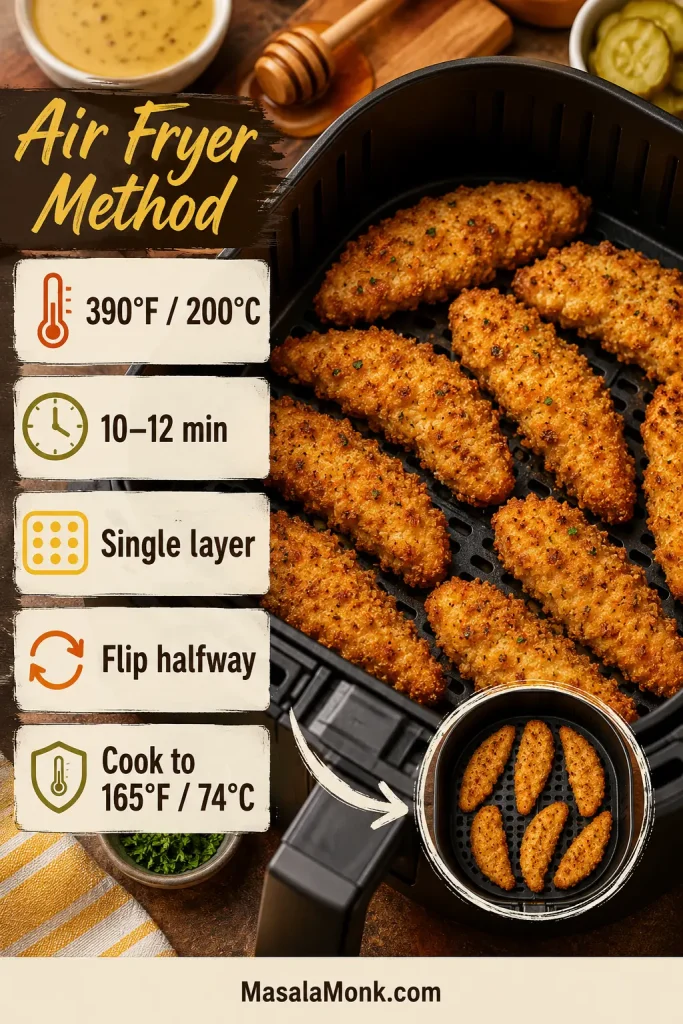
Air fryer method guide with breaded chicken tenders in a basket and text for temperature, time, flipping, single-layer spacing, and doneness.
Give every tender room in the air fryer basket. Meanwhile, flipping halfway helps both sides get direct heat so the coating crisps instead of softening.

Different air fryers brown at different speeds, so check around 9–10 minutes the first time. Keep the first batch warm on a rack in a low oven while the rest cook, and avoid stacking hot tenders in a bowl because steam will soften the crust.

The same air-flow rule shows up in crispy recipes like air fryer chicken wings: dry surfaces, space between pieces, and late saucing protect the crunch.

Make them extra crispy · Try another coating · See serving ideas · Back to recipe card

Extra Crispy Upgrades

Once the basic method is in place, these upgrades take baked chicken tenders from good to properly crisp. They are especially helpful if your baked tenders usually come out pale or soft.

  • Toast the panko first. This is the best color upgrade. Toasting gives baked tenders a golden head start before the chicken has a chance to overcook.
  • Use a wire rack. It lets heat move around the tenders instead of trapping steam underneath.
  • Spray both sides lightly. A little oil helps the crumbs brown and gives the crust a more oven-fried texture.
  • Rest cooked tenders on a rack. If you have a rack, use it even after baking. It keeps the bottoms from softening while everyone is getting plates ready.
  • Avoid stacking. Hot tenders piled together will soften quickly.
  • Dip, do not drown. Let the crust stay in charge until the moment you eat.

Best Coatings for Honey Mustard Chicken Tenders

Panko is the easiest default, but honey mustard chicken tenders are flexible. Use this quick guide to choose the coating that fits the meal.
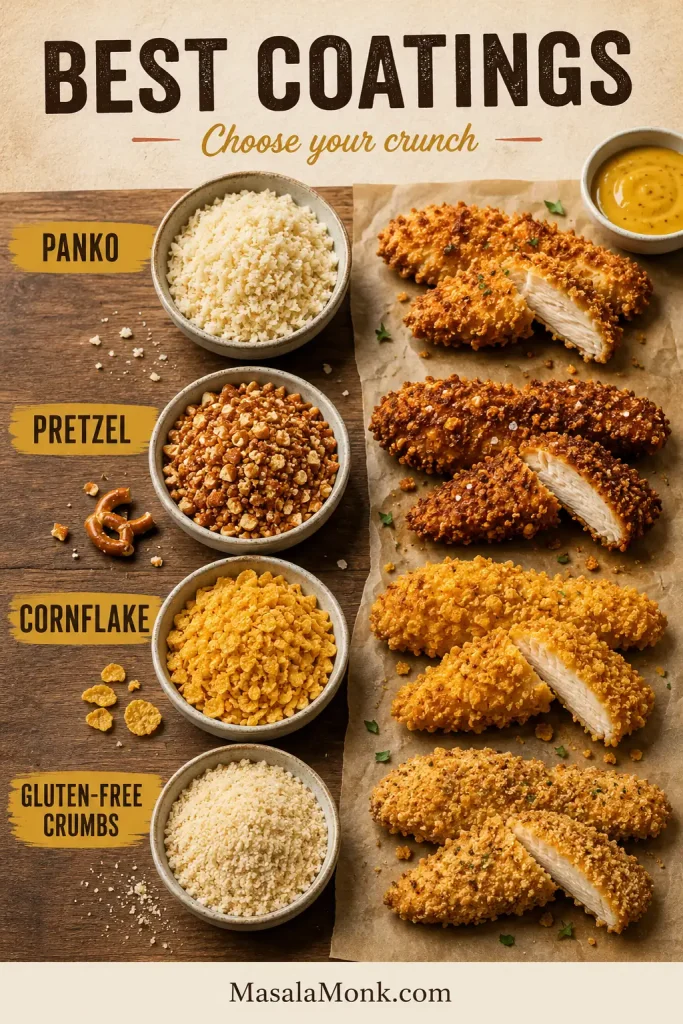
Coating comparison board showing panko, pretzel, cornflake, and gluten-free crumbs with chicken tender samples.
Each coating changes the crunch. Panko stays light and flaky, pretzel crumbs add salty depth, cornflakes create a bigger golden crust, and gluten-free crumbs keep the recipe flexible.
CoatingBest ForNotes
Panko breadcrumbsClassic crispy baked tendersBest default choice
Crushed pretzelsSalty, crunchy party-style tendersUse less added salt
Crushed cornflakesExtra crisp kid-friendly tendersCrush finely but not into powder
Regular breadcrumbsSofter chicken stripsWorks, but less crisp than panko
Gluten-free pankoGluten-free versionCheck labels on mustard and seasonings too
Crushed rice cerealEmergency gluten-free crunchBest with a little extra seasoning

If you use pretzels or cornflakes, crush them into small uneven crumbs. A little texture is good, but a fine powder will not give the same crunch.

Variations

Once the basic tray works, this recipe is easy to bend toward the people eating it — sweeter for kids, sharper for Dijon lovers, spicier for game day, crunchier with pretzels, or lighter without mayo.

Spicy Hot Honey Mustard Chicken Tenders

This is the game-day version: still sweet and creamy, but with enough heat to keep people dipping. Add a pinch of cayenne, chili powder or hot sauce to the honey mustard mixture. You can also finish the cooked tenders with a tiny drizzle of hot honey, but add it at the table so the coating stays crisp.

For a fruitier heat, borrow the sweet-spicy direction from this mango habanero sauce and add only a small amount to the honey mustard dip.

Pretzel-Crusted Honey Mustard Tenders

Replace the panko with crushed pretzels for a salty snack-style crust that feels made for a party tray. Reduce the salt in the crumb mixture because pretzels are already salty.

Buttermilk Honey Mustard Chicken Tenders

For a more tender, classic chicken-finger texture, soak the chicken in buttermilk for 30 minutes before coating. Pat off the excess before adding the honey mustard mixture so the panko does not slide off.

No-Mayo Honey Mustard Sauce

Use Greek yogurt when you want the dip tangier and lighter without losing the creamy coating. Add a little extra honey if you want it sweeter. For an egg-free creamy base, eggless mayonnaise also works well.

Kid-Friendly Yellow Mustard Version

Use yellow mustard instead of Dijon, skip the cayenne or spicy seasonings, and keep the sauce a little sweeter. This version tastes closer to familiar fast-food honey mustard.

Gluten-Free Honey Mustard Chicken Tenders

Use gluten-free panko or crushed gluten-free rice cereal. Also check the mustard, mayonnaise and seasonings to make sure they fit your needs.

No-Breading Honey Mustard Tenderloins

This version is not trying to be crispy. It is for the night you want juicy honey mustard tenderloins over rice, salad, or roasted vegetables. Skip the panko, coat the chicken lightly in honey mustard, and bake on parchment until cooked through, starting to check around 14–16 minutes depending on thickness.

Green Chutney Mayo Dip

For an Indian-style dipping sauce, stir a spoonful of green chutney into mayo or Greek yogurt. It gives the tenders a fresh coriander-mint bite without changing the main recipe.

Shallow-fried note: If you want a more classic chicken-finger texture, shallow fry the coated tenders in a thin layer of neutral oil until golden and cooked through. Keep the heat moderate so the honey in the coating does not brown too fast.

What to Serve with Honey Mustard Chicken Tenders

Once the tray is done, the only real question is whether this is a cozy dinner, a game-day snack, or a wrap-and-leftovers situation. Keep the dip close and build the meal around something crisp, creamy, tangy or fresh.
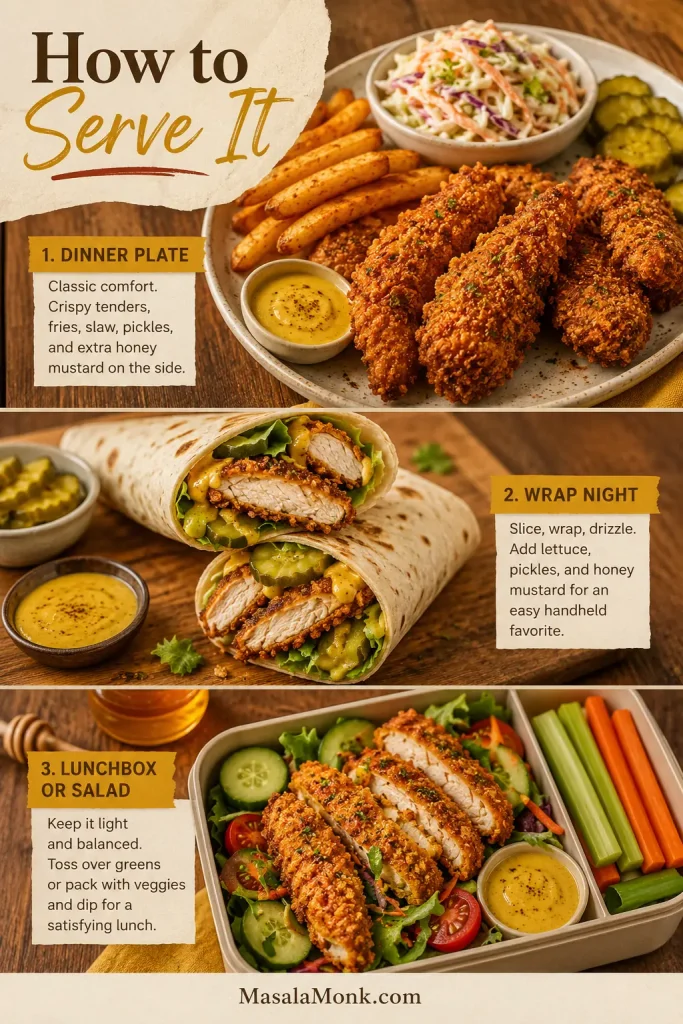
Three serving ideas for honey mustard chicken tenders: dinner plate with fries and slaw, chicken wrap, and lunchbox salad.
These tenders can move from snack to full meal with the right sides. Try them with fries and slaw, tuck them into wraps, or slice them over salad with extra honey mustard.
  • Weeknight dinner: roasted broccoli, green beans, mashed potatoes, or macaroni and cheese.
  • Diner-style plate: crispy homemade French fries, creamy coleslaw, pickles, and extra honey mustard.
  • Game-day tray: buffalo chicken dip, potato wedges, celery sticks, and a pile of napkins.
  • Lunchbox or salad bowl: cucumber salad, green salad, crunchy vegetables, and sliced cold tenders.
  • Wrap or sandwich night: lettuce, pickles, soft buns or tortillas, and enough sauce to swipe through every bite.

Leftover tenders are great sliced over salad, tucked into wraps, or layered into sandwiches with lettuce, pickles and extra honey mustard. For more lunch ideas, these chicken sandwich recipes are a useful next stop.

Storage, Freezing and Reheating

The main rule for leftovers is simple: keep the sauce separate and bring the crunch back with dry heat.

Storing Leftovers

Store cooked chicken tenders in an airtight container in the fridge for 3–4 days. Keep the honey mustard sauce in a separate container so the coating does not soften. That 3–4 day window matches the FoodSafety.gov cold storage chart for cooked meat and poultry leftovers.

Reheating

For the best texture, reheat the tenders in an oven or air fryer at 375–390°F / 190–200°C for about 5–8 minutes, or until hot and crisp. The microwave works if you are in a hurry, but it will soften the coating.

Freezing

For easiest freezing, freeze cooked tenders. Raw breaded tenders can also be frozen if the chicken was handled cold and clean, but cooked leftovers are simpler and safer for most home kitchens. Freeze in a single layer first, then move to a freezer-safe bag or container.

Do not freeze the dipping sauce with the chicken. Make fresh sauce or store it separately in the fridge.

Troubleshooting

Most honey mustard chicken tender problems come down to moisture, crowding, or too much sauce. If baked tenders have ever come out pale, soft, or half-naked on the pan, this is the section that saves the next batch.
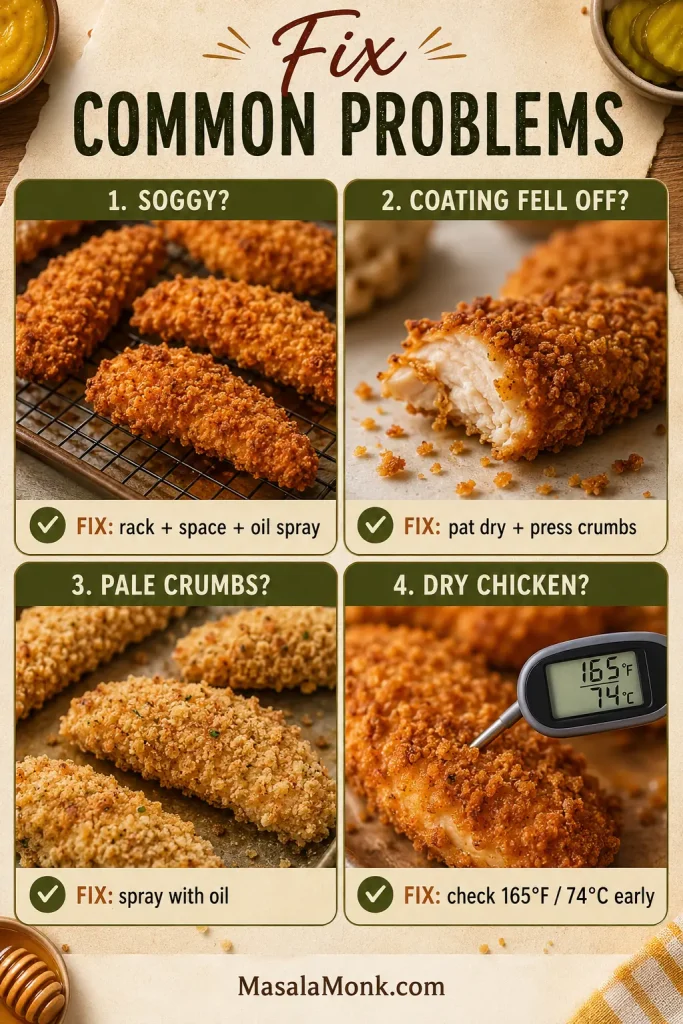
Troubleshooting board showing fixes for soggy chicken tenders, coating falling off, pale crumbs, and dry chicken with temperature guidance.
For soggy coating, fix the airflow first with a rack, spacing, and oil spray. When crumbs fall off, start earlier by patting the chicken dry and pressing the panko firmly.

Why Are My Chicken Tenders Soggy?

Likely causes: crowding, too much sauce, not enough oil on the crumbs, or stacking hot tenders after cooking.

Fix: leave space between pieces, use a rack if possible, spray lightly with oil, rest cooked tenders without stacking, and dip at the table instead of saucing early.

Why Did My Coating Fall Off?

Likely causes: wet chicken, thin sauce, loose crumbs, or not enough pressing.

Fix: pat the chicken dry, use a creamy coating that clings, and press each tender into the panko until the crumbs look attached.

Why Is My Panko Pale?

Likely causes: dry breadcrumbs, low browning, or not enough time for color before the chicken is done.

Fix: spray or drizzle the panko lightly with oil. For deeper color, toast the panko before coating the chicken.

Why Did the Honey Burn?

Likely causes: a sauce layer that is too heavy, very small chicken pieces, or cooking too long.

Fix: use a thin coating, rely on panko for crunch, and start checking thin strips early.

Why Is the Chicken Dry?

Likely causes: thin strips, uneven sizes, or cooking past the safe internal temperature.

Fix: cut even pieces, start checking early, and use a thermometer in the thickest tender.

Why Is the Sauce Too Sweet or Too Sharp?

Likely causes: too much honey for your taste, too much Dijon, or not enough creamy base.

Fix: add mustard or lemon juice if it is too sweet. Add honey, mayo, or Greek yogurt if it is too sharp. Honey mustard should taste sweet first, tangy next, and creamy enough to dip.

Back to recipe card · Review oven method · Review air fryer method · Back to top

FAQs

Are Chicken Tenders and Chicken Strips the Same Thing?

They are often used the same way in recipes. Tenderloins are the small natural strips attached to the chicken breast. Strips are usually sliced from boneless chicken breast. Both work as long as the pieces are similar in size.

Can I Use Chicken Breast Instead of Tenderloins?

Yes. Slice boneless chicken breast into even strips about 3/4 inch thick at the widest part. Try not to make them too thin, because thin strips can dry out before the coating gets crisp.

Do I Need Flour or Egg for These Chicken Tenders?

No. The honey mustard mixture works as the binder in this recipe. For a firmer restaurant-style crust, lightly dust the chicken with flour before adding the sauce and panko.

Can I Make Honey Mustard Chicken Tenders in the Air Fryer?

Yes. Air fry at 390°F / 200°C for 10–12 minutes, flipping halfway, until the chicken is crisp and cooked through. Cook in batches so the basket is not crowded.

How Do I Keep Baked Chicken Tenders Crispy?

Use panko breadcrumbs, spray or drizzle the coating lightly with oil, leave space between the tenders, and bake at high heat. A wire rack helps too. Keep the sauce on the side until serving.

Can I Make These Gluten-Free?

Yes. Use gluten-free panko or crushed gluten-free rice cereal. Check your mustard, mayonnaise, and seasonings as well if gluten-free cooking is important for your household.

Can I Make the Sauce Without Mayo?

Yes. Use Greek yogurt for a tangier, lighter sauce. Add a little extra honey if you want it sweeter, or use eggless mayonnaise if you want a mayo-style sauce without egg.

Can I Use the Same Honey Mustard as Marinade and Dip?

Only if you divide it first. Reserve the dipping portion in a clean bowl before raw chicken touches the rest. The sauce used on raw chicken should not be served as a dip unless it is cooked safely.

How Do I Reheat or Freeze Honey Mustard Chicken Tenders?

Reheat cooked tenders in an oven or air fryer at 375–390°F / 190–200°C for 5–8 minutes, or until hot and crisp. For freezing, cooked tenders are the easiest option. Freeze in a single layer first, then store in a freezer-safe bag or container.

Final Bite

The win here is simple: no frying pot, no soggy tray, no dry chicken, and no wasted dipping sauce because it touched raw chicken.

Just golden panko, juicy strips, and a clean bowl of sweet-tangy honey mustard that somehow disappears faster than expected. Keep the sauce creamy, the crumbs well-pressed, and the dip on the side until the moment everyone starts reaching.
Posted on Leave a comment

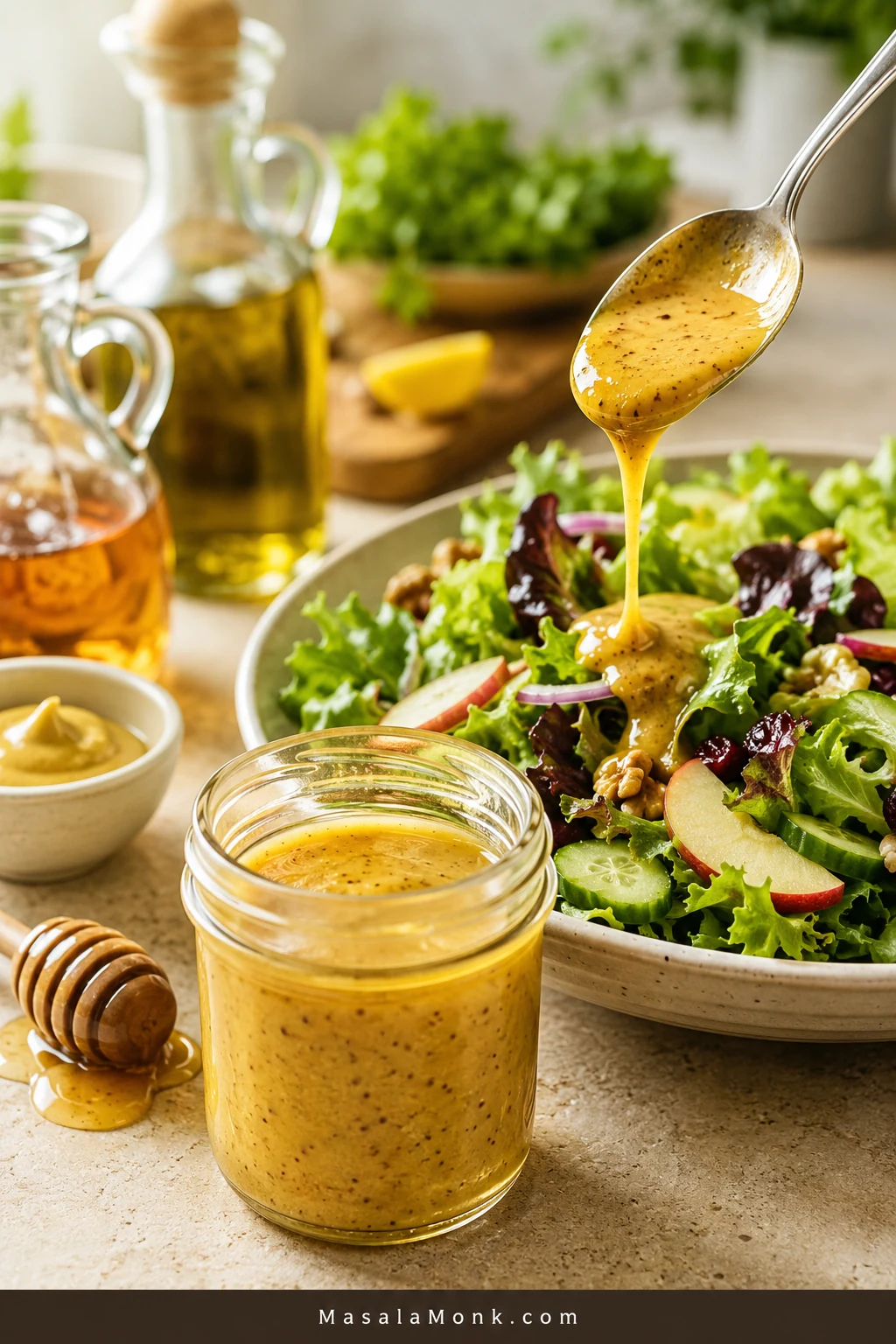
Honey Mustard Dressing Recipe

Golden honey mustard dressing in a glass jar with a spoon drizzling it over a salad made with greens, cucumber, tomatoes, onions, apples, and nuts.

A good honey mustard dressing should taste bright before it tastes sweet. It should cling lightly to salad leaves, drizzle smoothly over grain bowls, and still have enough punch for chicken, roasted vegetables, salmon, ham, wraps, or sandwiches. Too much honey makes it taste like bottled yellow sugar; too much vinegar leaves it sharp and thin. The best batch tastes lively, not sugary.

This honey mustard dressing recipe starts with a simple no-mayo Dijon base: mustard, honey, apple cider vinegar, olive oil, salt, and pepper. It takes about five minutes, uses pantry ingredients, and gives you a clean dressing you can turn into a creamy sauce, a thicker dip, or a lighter vinaigrette.

The little trick is knowing what your plate actually needs, because the dressing you want for greens is not always the one you want for fries. For salads, start with the no-mayo dressing. When chicken tenders, fries, nuggets, burgers, or sandwiches are involved, make the creamy mayo sauce.

It is the kind of quick jar that rescues plain greens, leftover chicken, roasted vegetables, and rushed lunches without making anything feel heavy.

Quick Answer: How Do You Make Honey Mustard Dressing?

To make honey mustard dressing, whisk Dijon mustard, honey, apple cider vinegar or lemon juice, olive oil, salt, and black pepper until smooth. For the main 1-cup batch, use ¼ cup Dijon mustard, 3 tablespoons honey, 3 tablespoons vinegar or lemon juice, and ¼ cup olive oil. Add 1–2 tablespoons water at the end only if the dressing needs loosening.

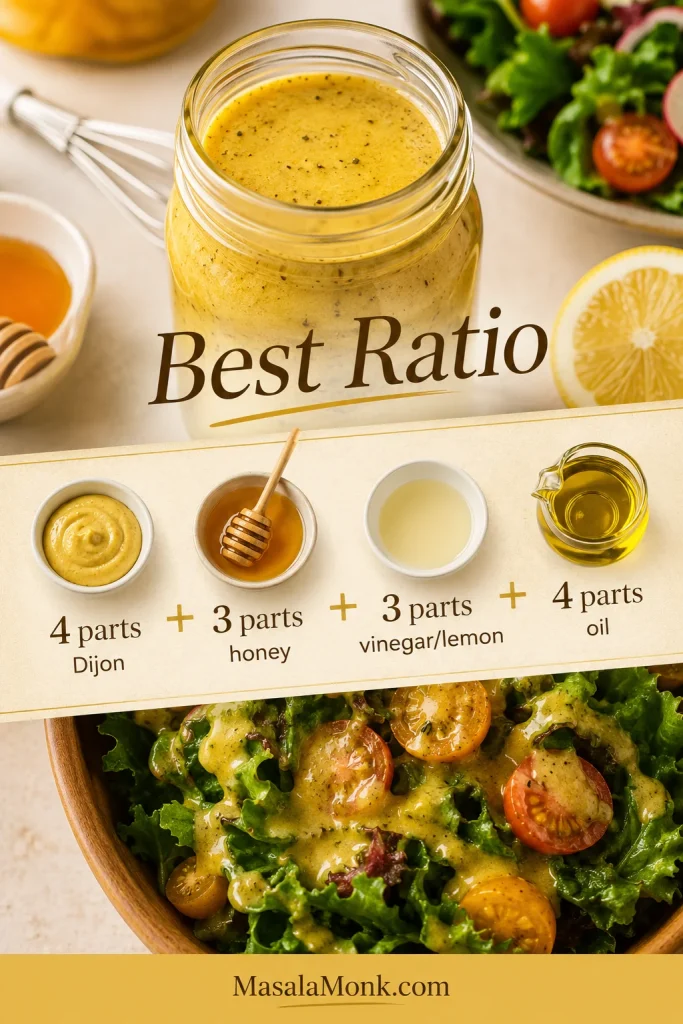
Best honey mustard dressing ratio: 4 parts Dijon mustard, 3 parts honey, 3 parts vinegar or lemon juice, and 4 parts oil. For a sweeter, bolder dressing, use equal parts mustard, honey, vinegar, and oil.

Honey mustard dressing ratio graphic showing four parts Dijon mustard, three parts honey, three parts vinegar or lemon juice, and four parts oil.
Start with the 4:3:3:4 honey mustard dressing ratio, then adjust the jar with more vinegar for brightness, more honey for sweetness, or a pinch of salt when the flavor tastes flat.

The flavor should be tangy first, lightly sweet second, with a clean Dijon bite and enough body to coat greens without feeling heavy. Taste before serving; a tiny splash or pinch is usually enough.

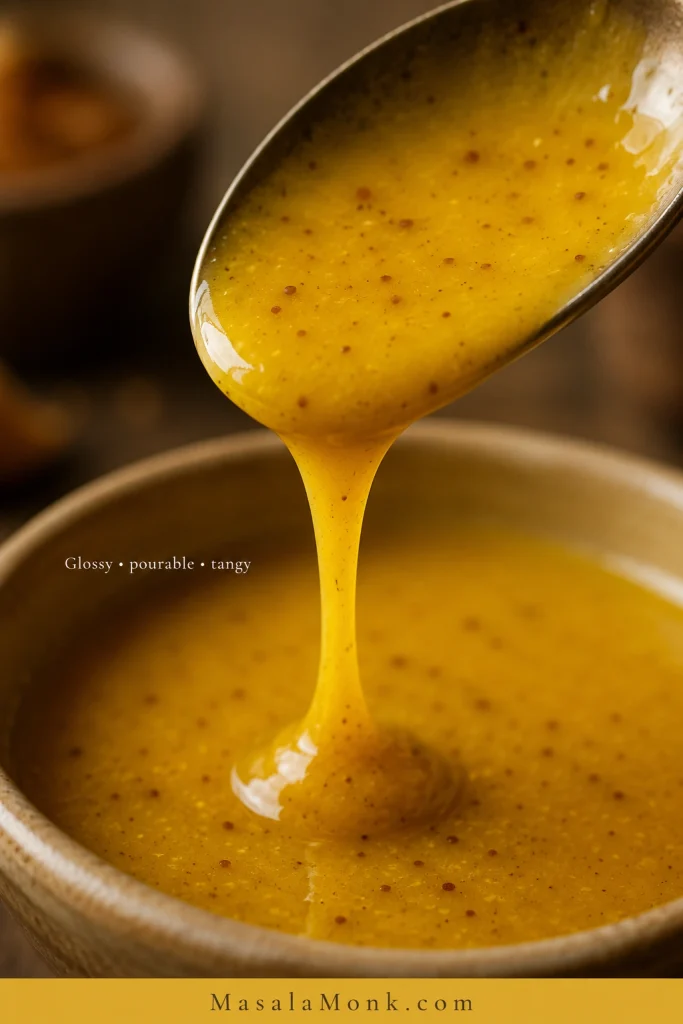
Texture cue: The finished dressing should fall in a glossy ribbon, not sit like a thick dip.

Close-up of glossy golden honey mustard dressing dripping from a spoon into a bowl, with small mustard and pepper specks visible.
Look for a glossy ribbon when the dressing falls from the spoon; if it holds thick peaks instead, you have moved from salad dressing toward honey mustard dip.

5-Minute Honey Mustard Dressing Recipe

This is the main no-mayo dressing: glossy, zippy, lightly sweet, and loose enough to drizzle. Use it on salads, roasted vegetables, grain bowls, chicken, salmon, ham, wraps, or any meal-prep bowl that needs a quick sweet-tangy finish.

Prep Time
5 minutes

Cook Time
0 minutes

Total Time
5 minutes

Yield
About 1 cup / 240 ml

Servings
7–8 servings

Serving Size
About 2 tbsp / 30 ml

Equipment

  • Small bowl or clean jar with lid
  • Small whisk or fork
  • Measuring spoons and cups
  • Optional: small blender or immersion blender for a more blended dressing

Ingredients

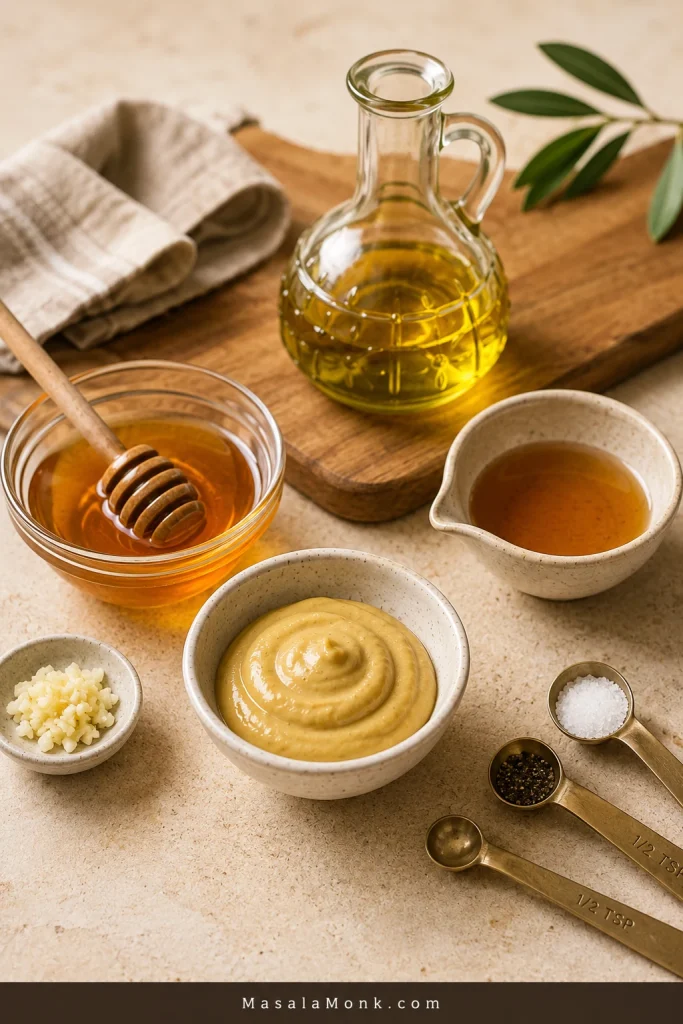
Honey mustard dressing ingredients arranged on a counter, including Dijon mustard in a bowl, honey, olive oil, vinegar, garlic, salt, pepper, and measuring spoons.
Because homemade honey mustard dressing uses only a few pantry ingredients, each one shows up clearly: Dijon adds bite, honey rounds it out, acid brightens it, and oil gives it body.
  • ¼ cup Dijon mustard, about 60 ml / 60–65 g
  • 3 tablespoons honey, about 45 ml / 60–65 g
  • 3 tablespoons apple cider vinegar, or 2 tablespoons apple cider vinegar plus 1 tablespoon fresh lemon juice, about 45 ml total
  • ¼ cup extra-virgin olive oil, about 60 ml
  • 1–2 tablespoons cool water, only as needed to loosen
  • ¼ teaspoon fine salt, plus more to taste
  • ¼ teaspoon black pepper
  • Optional: 1 small grated garlic clove or ¼ teaspoon garlic powder

Instructions

  1. Add the Dijon mustard, honey, vinegar or vinegar-lemon mix, salt, pepper, and garlic to a small bowl or jar.
  2. Whisk until the mustard and honey look smooth and evenly mixed.
  3. Slowly whisk in the olive oil until the dressing turns glossy and pourable. For the jar method, add the oil with everything else, close the lid tightly, and shake hard for 15–20 seconds.
  4. Taste the dressing. Add more honey for sweetness, more vinegar or lemon juice for zip, or a small pinch of salt when the flavor tastes flat.
  5. If the dressing feels too thick, loosen it with 1–2 tablespoons water.
  6. Use right away or refrigerate in an airtight jar. Shake or whisk again before serving.

Recipe Notes

  • Use 2 tablespoons honey for a sharper salad dressing.
  • Use up to 4 tablespoons honey for a sweeter sauce-style dressing.
  • Strong olive oil can dominate the dressing. Light olive oil, avocado oil, or a neutral oil gives a milder result.
  • For meal prep, garlic powder keeps the flavor smoother and more predictable than fresh garlic.
  • Separation after chilling is normal. Shake the jar hard before using.

Need a thicker sauce or dip? Go to the style guide, jump to the creamy version, or return to the top ↑

4-Ingredient Honey Mustard Dressing

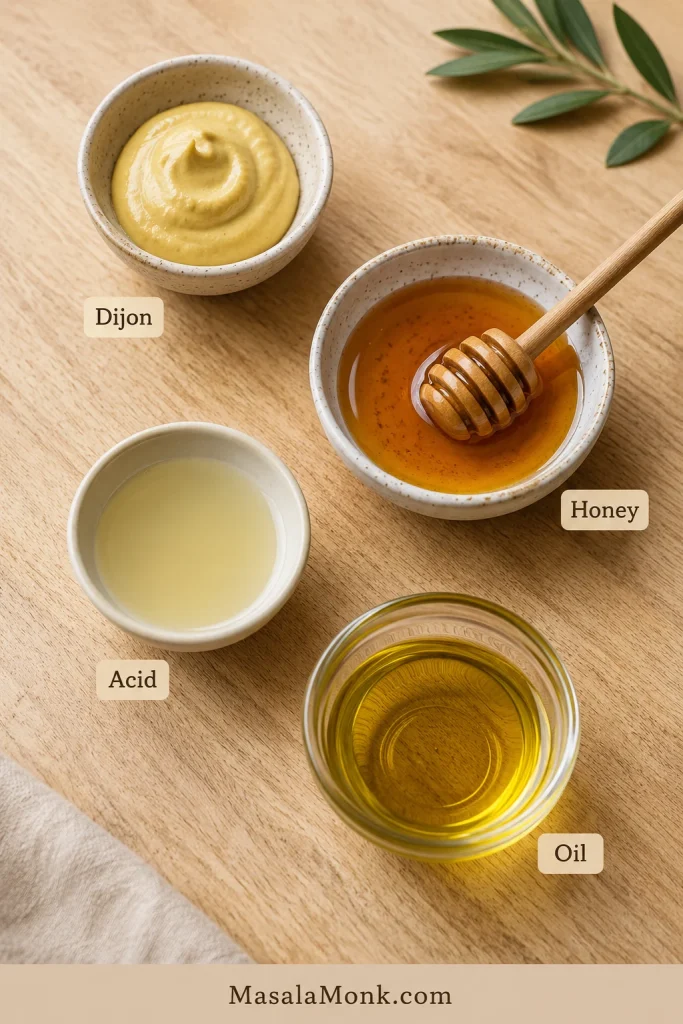
Strip it down and honey mustard dressing is just four things: mustard for bite, honey for roundness, acid for brightness, and oil for body. Salt and pepper are the difference between “fine” and “finished,” but the core flavor comes from those four ingredients.

  • Dijon mustard: use it for the cleanest salad-style flavor.
  • Honey: use more for dipping sauce and less for sharper greens.
  • Apple cider vinegar or lemon juice: use it to keep the dressing bright.
  • Olive oil: use enough to help the dressing cling instead of running off.
Four core ingredients for honey mustard dressing shown in bowls: Dijon mustard, honey, vinegar or lemon juice, and olive oil.
At its simplest, 4-ingredient honey mustard dressing is mustard for bite, honey for roundness, acid for brightness, and oil for a smooth drizzle.

For a quick small batch, whisk 2 tablespoons Dijon mustard, 1 tablespoon honey, 2 tablespoons apple cider vinegar or lemon juice, and 2 tablespoons olive oil. Add salt and pepper to taste. This makes enough for one large salad or two smaller side salads.

Honey Mustard Dressing Ratio

Once you know the ratio, the recipe becomes less of a rule and more of a dial. You can make the same jar sweeter, sharper, thicker, thinner, creamier, or lighter without starting over.

StyleEasy RatioUse It For
Everyday dressing4 parts mustard : 3 parts honey : 3 parts vinegar : 4 parts oilEveryday salads and bowls
Equal-parts dressing1 part mustard : 1 part honey : 1 part vinegar : 1 part oilSweeter, bolder dressing
Sharper salad dressingMore vinegar or lemon, less honeyGreens, slaws, roasted vegetables
Creamy sauceMayo or yogurt base + mustard + honey + acidChicken, fries, sandwiches
VinaigretteMore oil and vinegar, no creamy baseSpinach, kale, cabbage, grain bowls

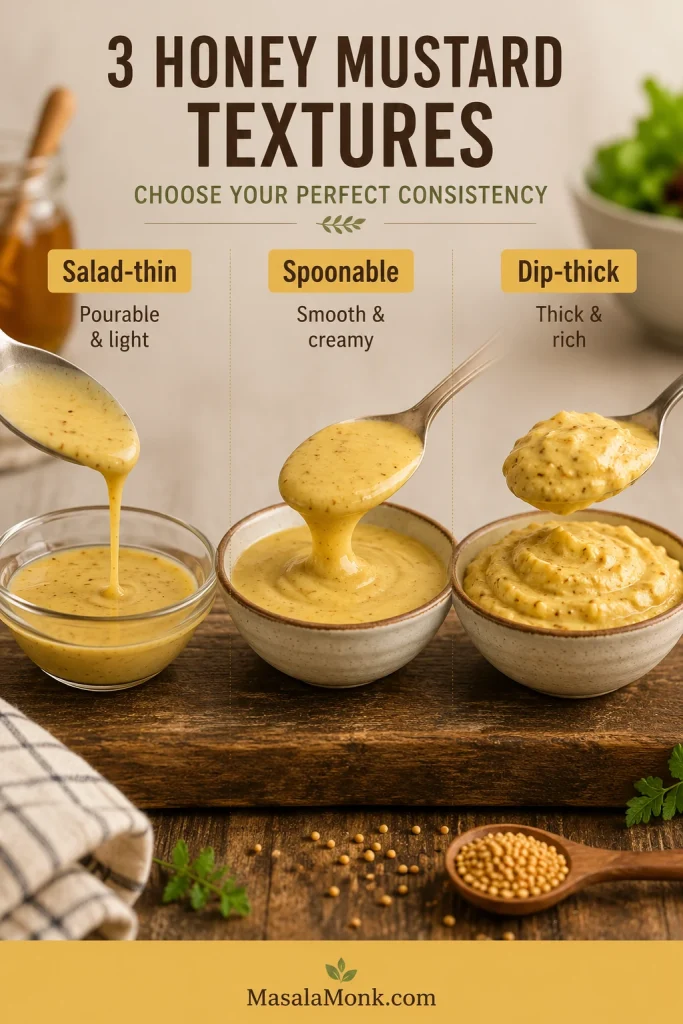
Texture cue: Salad dressing should drizzle, sauce should spoon, and dip should hold onto crispy food.

Three honey mustard textures shown side by side: a thin salad dressing, a spoonable sauce, and a thick dip.
Texture changes the job of the recipe: salad-thin dressing coats greens, spoonable sauce works for bowls and sandwiches, and dip-thick honey mustard belongs with crispy food.

Easy memory trick: too sweet needs acid, too punchy needs honey, and flat almost always needs salt before anything else.

Not sure whether the batch should be thin, spoonable, or dip-thick? Go to the style guide.

Should You Make Dressing, Sauce, Dip, or Vinaigrette?

This is where honey mustard changes personality. Thin it and it belongs on greens. Make it creamy and suddenly it is the sauce everyone reaches for beside fries or chicken.

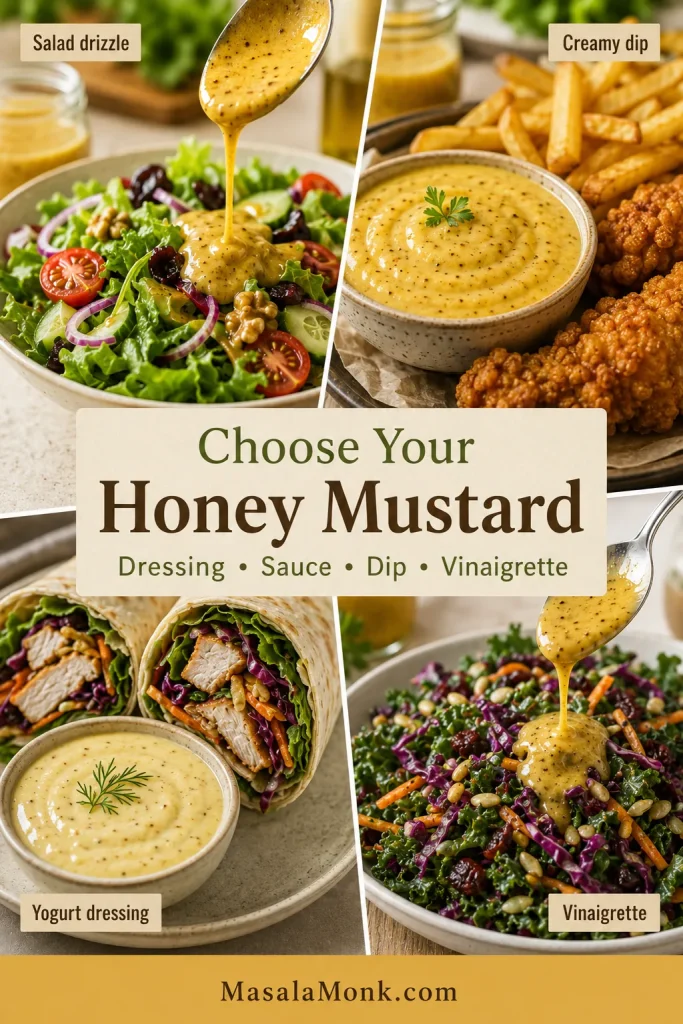
Do not force a salad dressing to behave like a dip. If fries, nuggets, or chicken tenders are involved, give the bowl a creamy base.

A honey mustard guide showing salad drizzle, creamy dip with fries and chicken, yogurt dressing with wraps, and vinaigrette over a hearty salad.
Match the honey mustard style to the food: keep it pourable for salads, make it creamy for dipping, use yogurt for a lighter sauce, or thin it into vinaigrette for sturdy greens.
The Plate Needs…Make ThisTextureBest For
A clean salad dressingNo-mayo Dijon dressingPourableGreen salads, bowls, roasted vegetables
A classic dipCreamy mayo sauceThick and smoothChicken tenders, fries, nuggets, pretzels
A lighter creamy dressingGreek yogurt dressingCreamy and tangyWraps, lunch bowls, chicken salads
A sharper vinaigretteOil-vinegar dressingLight and glossySlaws, spinach, kale, grain bowls
A sandwich sauceDijon + yellow mustard + mayoMedium-thickHam, turkey, burgers, wraps

Good rule: salads need a dressing that drizzles; fries and chicken need a sauce that stays put.

Make the no-mayo dressing first when you are unsure. Once you taste that base, it is easy to make the next batch richer, sharper, sweeter, or thick enough for dipping without guesswork.

Ingredients and Substitutions

Because the ingredient list is short, the jar changes fast. A bold mustard can make it bite, a floral honey can push it sweeter, and a strong olive oil can take over if you are not expecting it. Taste the base before adding more salt, honey, or vinegar.

Dijon mustard is the safest starting point because it blends easily and gives the dressing a clean mustard bite without turning harsh. Yellow mustard works too, but it tastes brighter and sweeter, so it is better in creamy dips and sandwich-style sauces.

Honey softens the mustard and vinegar so the dressing tastes rounded instead of biting. Use 2 tablespoons for a sharper salad dressing, 3 for the balanced batch, and 4 when you want it sweeter and more sauce-like.

Apple cider vinegar gives the dressing a rounder tang. Lemon juice makes it brighter and more awake. Use either one, or mix them when you want both depth and freshness.

Olive oil gives the dressing enough body to cling to leaves instead of running straight to the bottom of the bowl. Extra-virgin olive oil adds flavor; light olive oil, avocado oil, or a neutral oil keeps the dressing milder.

Salt, pepper, and garlic finish the jar. When the dressing tastes dull, salt is usually the quiet fix. Garlic is optional, but garlic powder is easier for meal prep because it stays smoother and gentler after a day or two in the fridge.

Bowl Method vs Jar Method

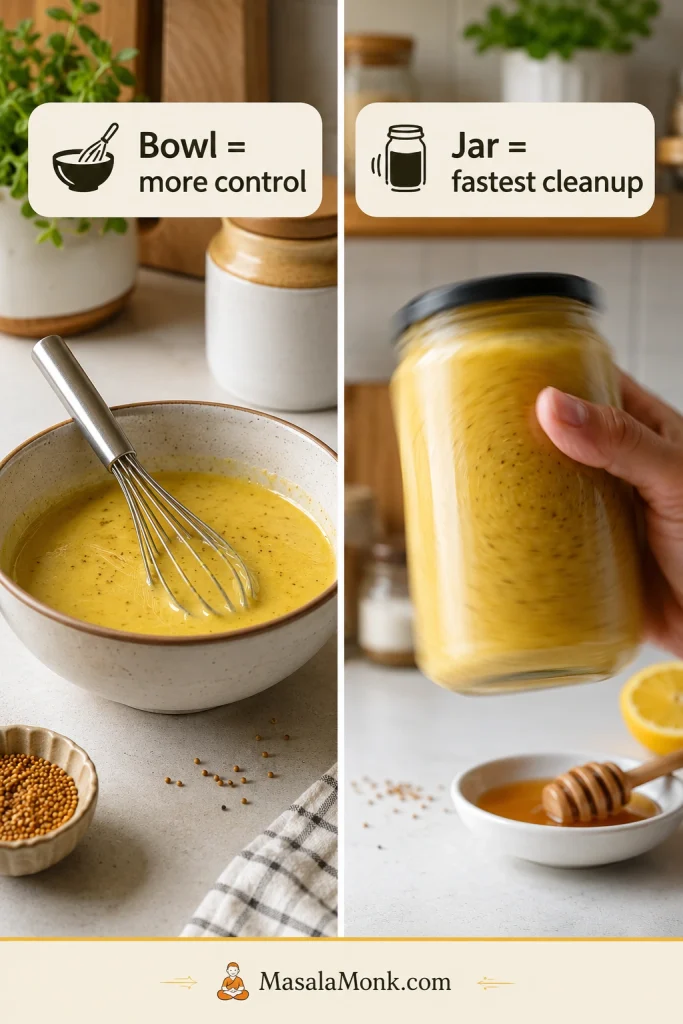
The order matters more than the effort. Mix the mustard, honey, vinegar, salt, and pepper first, then add the oil. This gives the dressing a smoother texture and makes it easier to adjust before serving.

Side-by-side comparison of honey mustard dressing mixed in a bowl with a whisk and shaken in a glass jar by hand.
The bowl method is best when you want to fine-tune flavor and thickness; the jar method wins when you need a quick dressing that stores neatly.

Bowl Method

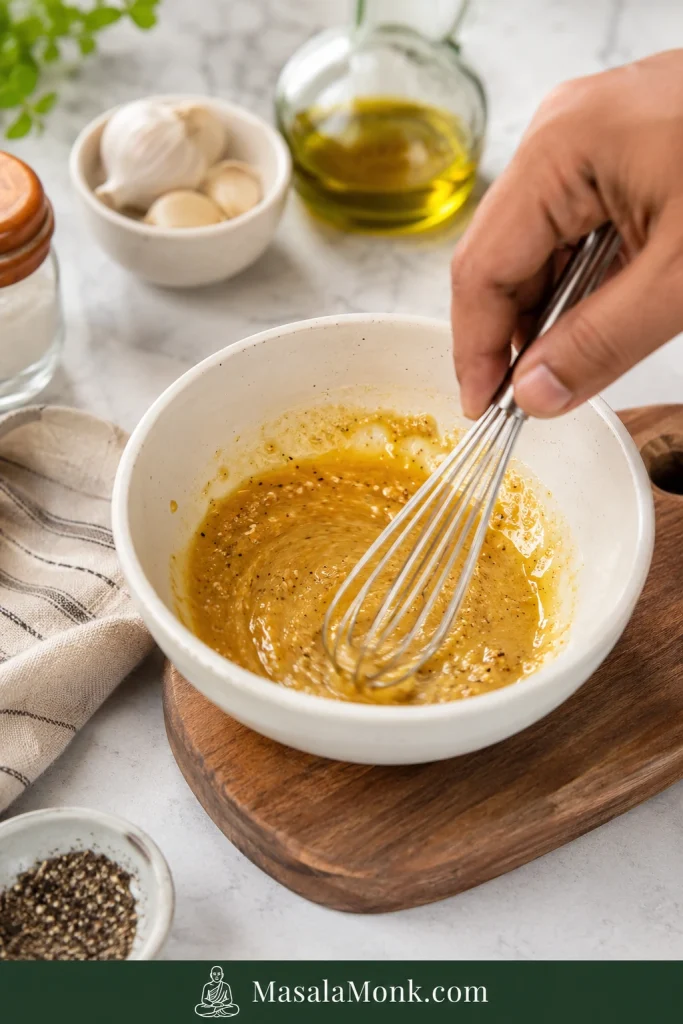
  1. Whisk the Dijon mustard, honey, vinegar or vinegar-lemon mix, salt, pepper, and garlic together first.
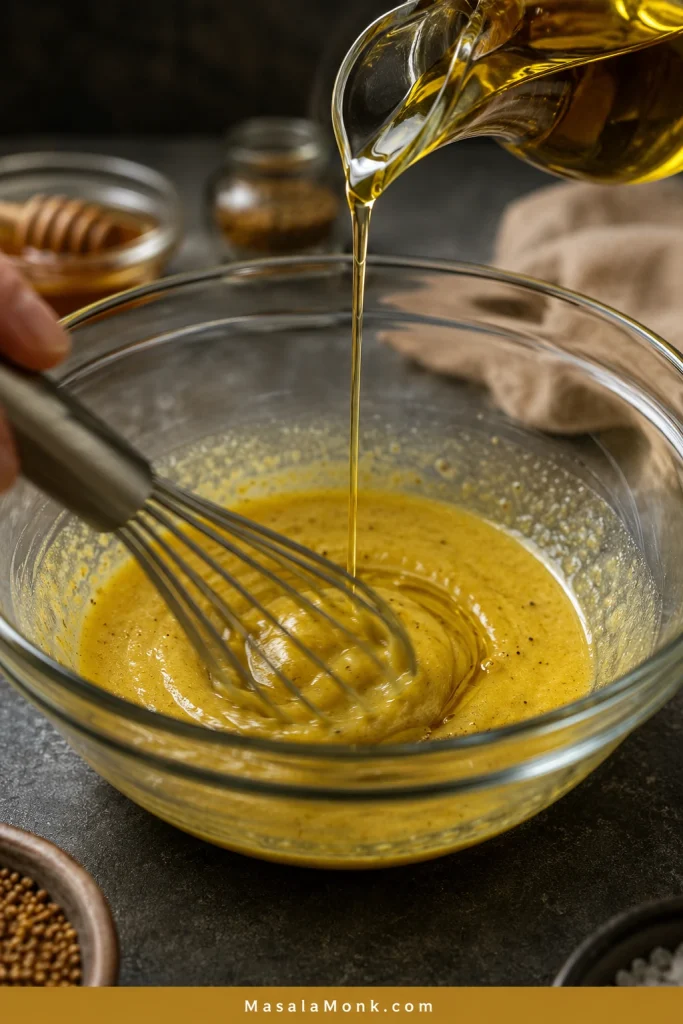
  2. Drizzle in the olive oil slowly while whisking.
  3. Keep whisking until the dressing looks smooth and lightly thickened.
  4. Taste before serving and adjust one thing at a time.

Method cue: Mix the flavor base before adding oil.

A hand whisking Dijon mustard, honey, vinegar, salt, pepper, and garlic in a white bowl before olive oil is added.
First, build flavor before texture: whisking mustard, honey, vinegar, salt, and pepper together makes the dressing easier to balance before the oil goes in.

Emulsion cue: Add oil slowly for a smoother dressing.

Olive oil being poured in a thin stream into a bowl of honey mustard dressing while the mixture is whisked.
Next, the slow oil pour is what turns the mixture glossy, helping homemade honey mustard dressing cling to leaves instead of separating right away.

Jar Method

  1. Add all ingredients to a clean jar.
  2. Close the lid tightly.
  3. Shake hard for 15–20 seconds, until the dressing looks glossy and combined.
  4. Refrigerate in the same jar and shake again before using.

Why mustard helps: Dijon helps the oil and vinegar hold together long enough to coat greens evenly. If the dressing separates later, nothing is wrong; just shake it again.

If the dressing tastes too sweet, too sharp, too thick, or separated, jump to the quick fix table.

Honey Mustard Dressing Without Mayo

You do not need mayo for a good honey mustard dressing. The oil-vinegar base is usually better for salads because it stays lighter, brighter, and easier to drizzle.

Use the small-batch formula below when you want just enough for one salad, one wrap night, or a quick bowl.

Small-Batch No-Mayo Formula

  • 2 tablespoons Dijon mustard / 30 ml
  • 1 tablespoon honey / 15 ml / about 20 g
  • 2 tablespoons apple cider vinegar or lemon juice / 30 ml
  • 2 tablespoons olive oil / 30 ml
  • Salt and black pepper, to taste

This makes enough for one large salad or two smaller side salads. Taste it with a lettuce leaf, cucumber slice, or piece of chicken before adjusting; a spoonful can taste stronger than it will taste on food.

Creamy Honey Mustard Dressing

Use the creamy version when honey mustard needs to sit beside crispy food, not disappear into greens. Mayo gives it the thicker, smoother body you want for chicken tenders, fries, nuggets, burgers, wraps, and sandwiches. Thin it slightly when you want a spoonable salad dressing.

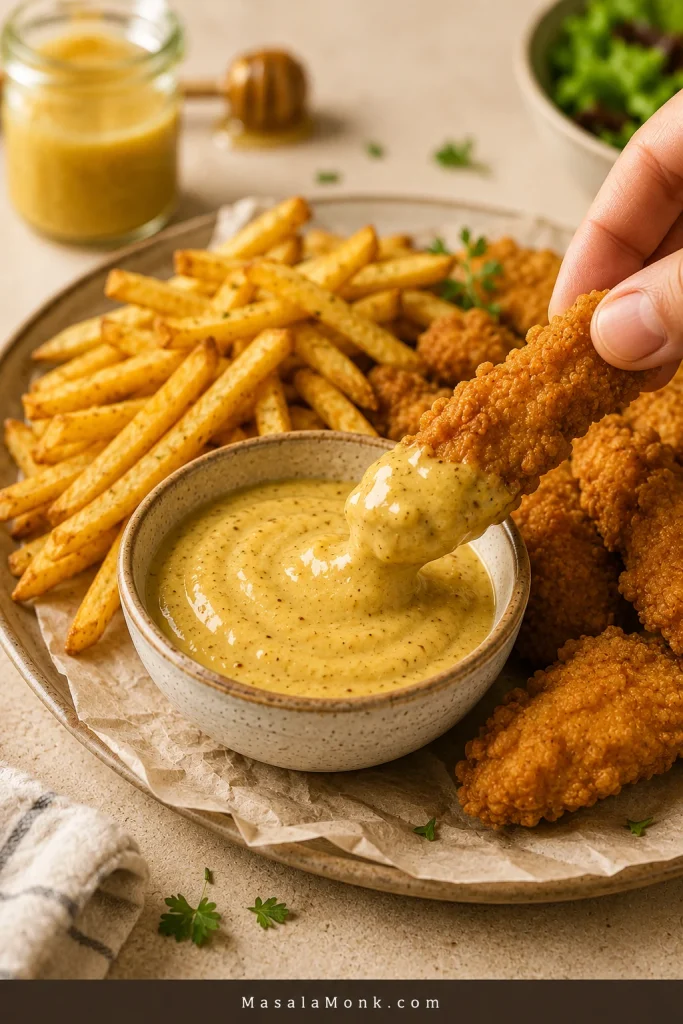
A cooked crispy chicken tender being dipped into thick creamy honey mustard sauce beside fries and more chicken tenders.
For fries, nuggets, and chicken tenders, make creamy honey mustard sauce thick enough to stay on the food instead of sliding off like salad dressing.

Creamy Mayo Honey Mustard

  • ½ cup mayonnaise / 120 ml / about 110–115 g
  • 2 tablespoons Dijon mustard / 30 ml
  • 1 tablespoon yellow mustard / 15 ml
  • 2–3 tablespoons honey / 30–45 ml / about 40–60 g
  • 1–2 teaspoons lemon juice or apple cider vinegar / 5–10 ml
  • Salt and pepper, to taste

Whisk everything together until silky. Two tablespoons honey keeps it tangier; three makes it sweeter and more dip-like. Add a teaspoon or two of water only when you want it loose enough to drizzle instead of scoop.

Already making homemade mayo? This is one of the easiest ways to turn it into a quick dipping sauce.

Keep it thick for crispy homemade French fries, chicken tenders, nuggets, or pretzels. For the same mustardy idea with a fruitier edge, try this mango mustard sauce.

Greek Yogurt Honey Mustard Dressing

Use Greek yogurt when you want the creamy feel of a dip but still want something fresh enough for lunch bowls, wraps, and chicken salads. It is the one to make when mayo feels too heavy but the no-mayo dressing feels too thin.

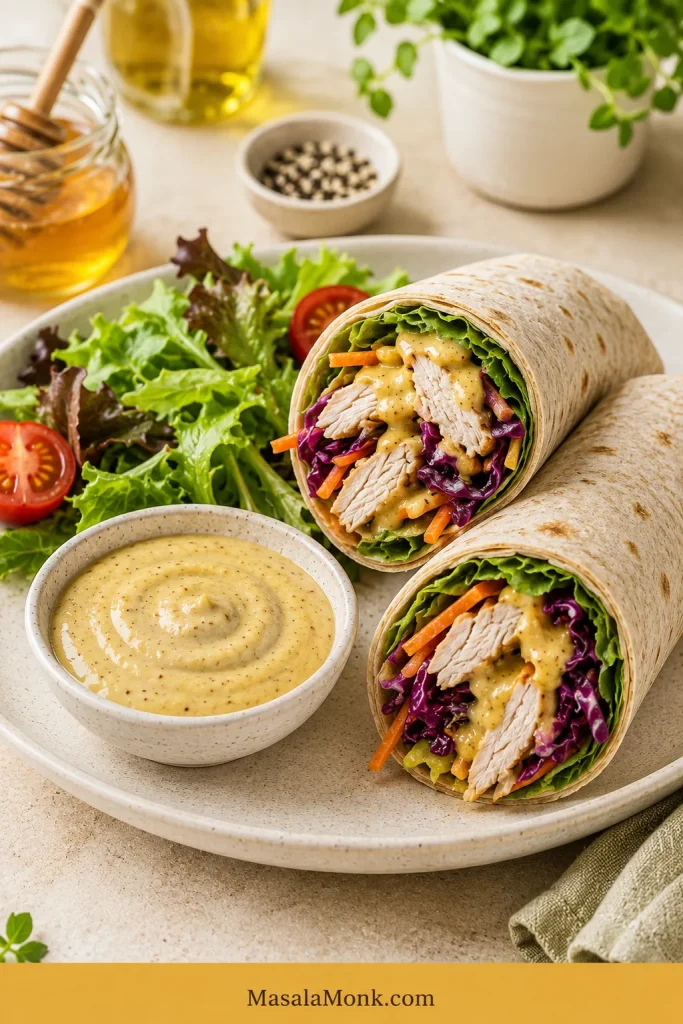
Greek yogurt honey mustard dressing served beside chicken wraps filled with lettuce, cabbage, carrots, and golden dressing.
Greek yogurt honey mustard dressing gives wraps and lunch bowls a creamy feel while keeping the flavor brighter and lighter than a mayo-based dip.
  • ½ cup Greek yogurt / 120 ml / about 125 g
  • 2 tablespoons Dijon mustard / 30 ml
  • 2–3 tablespoons honey / 30–45 ml / about 40–60 g
  • 1 tablespoon lemon juice or apple cider vinegar / 15 ml
  • 1 tablespoon olive oil / 15 ml, optional for a smoother texture
  • Salt and pepper, to taste

Yogurt dressing is naturally tangier than mayo-based sauce, so taste before adding extra vinegar. Thin a thick batch with water, lemon juice, or a little olive oil.

This tangy, creamy dressing also works well in a chicken salad sandwich, especially when the filling needs creaminess without feeling too heavy.

Honey Mustard Vinaigrette

Make the vinaigrette when the salad needs brightness more than richness. It is especially good with sturdy greens, cabbage, apples, nuts, roasted vegetables, and grain bowls because it cuts through heavier ingredients instead of coating them like a dip.

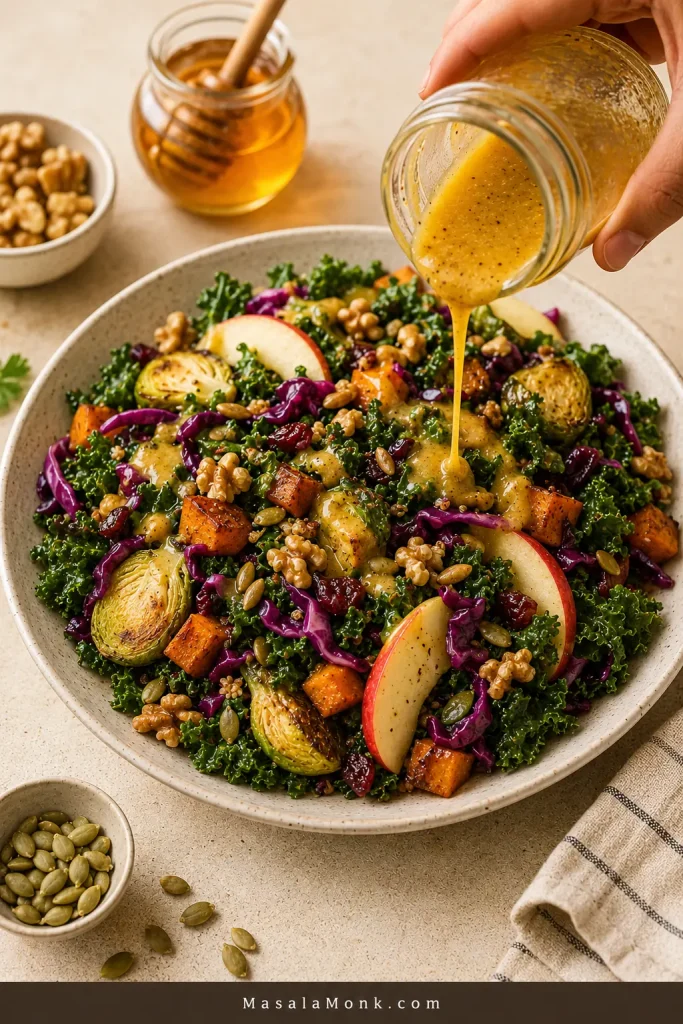
Honey mustard vinaigrette being poured from a jar over a kale and cabbage salad with apples, walnuts, seeds, roasted vegetables, and dried cranberries.
For kale, cabbage, apples, nuts, and roasted vegetables, honey mustard vinaigrette works better than a thick sauce because the extra acid keeps hearty ingredients lively.
  • ⅓ cup to ½ cup olive oil / 80–120 ml
  • 3 tablespoons apple cider vinegar, white wine vinegar, or white balsamic vinegar / 45 ml
  • 2 tablespoons Dijon mustard / 30 ml
  • 2–3 tablespoons honey / 30–45 ml / about 40–60 g
  • Salt and black pepper, to taste

Shake everything in a jar until combined. Vinaigrettes naturally separate as they sit, so give the jar another hard shake before pouring. If the olive oil firms up in the fridge, let the jar sit at room temperature for 10–15 minutes, then shake again.

This lighter dressing is especially good when the salad has cabbage, apples, nuts, roasted vegetables, or anything that needs a sweet-tangy spark. Use it on a crunchy chickpea salad, cabbage slaw, kale salad, or roasted vegetable bowl. It can also replace the creamier dressing in a coleslaw recipe when the bowl needs more tang and less richness.

Want the base batch again? Back to the 5-minute recipe card.

What Mustard Is Best for Honey Mustard Dressing?

For the main dressing, Dijon is the best all-purpose choice because it blends smoothly, tastes clean, and has enough bite to stand up to honey without turning harsh.

  • Dijon mustard: best for the main dressing and vinaigrette.
  • Yellow mustard: brighter, sweeter, and more classic for creamy dip or sandwich sauce.
  • Whole grain mustard: rustic and textured, especially good with roasted vegetables or grain bowls.
  • Spicy brown mustard: bolder and better for pork, ham, and sandwiches.
  • Half Dijon + half yellow: a good middle path for creamy honey mustard sauce.

Only yellow mustard in the fridge? Start with less honey and taste as you go, because yellow mustard already has a sweeter, brighter flavor than Dijon.

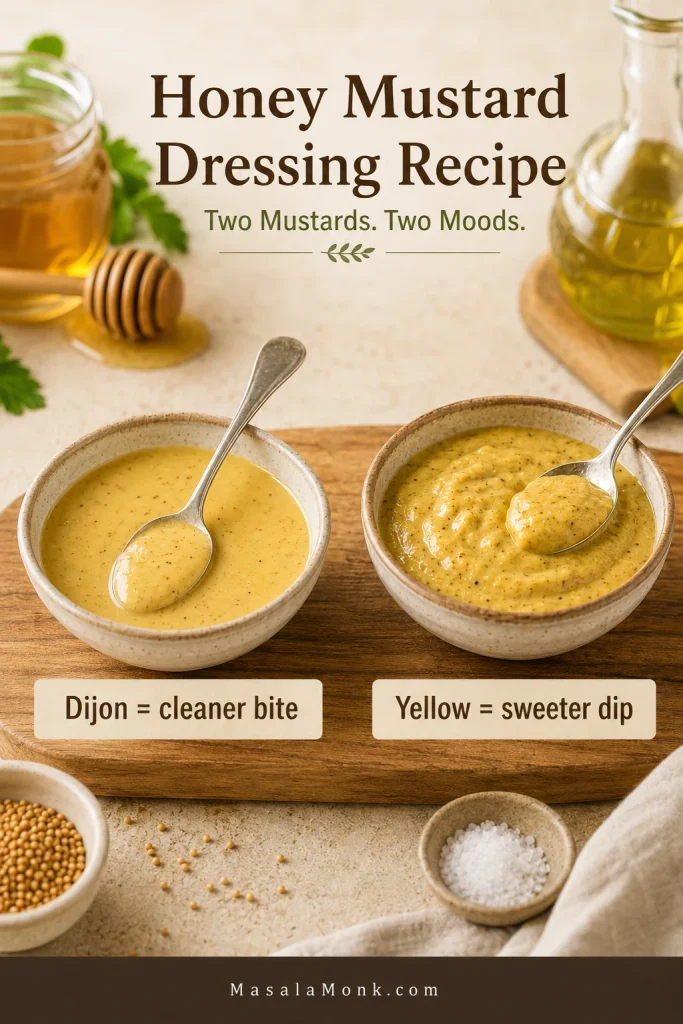
Two bowls comparing Dijon-based honey mustard dressing and yellow mustard honey mustard sauce, with labels for cleaner bite and sweeter dip.
Dijon mustard gives honey mustard dressing a cleaner bite, while yellow mustard tastes sweeter and works especially well in creamy dipping sauces.

Healthy and Dietary Options

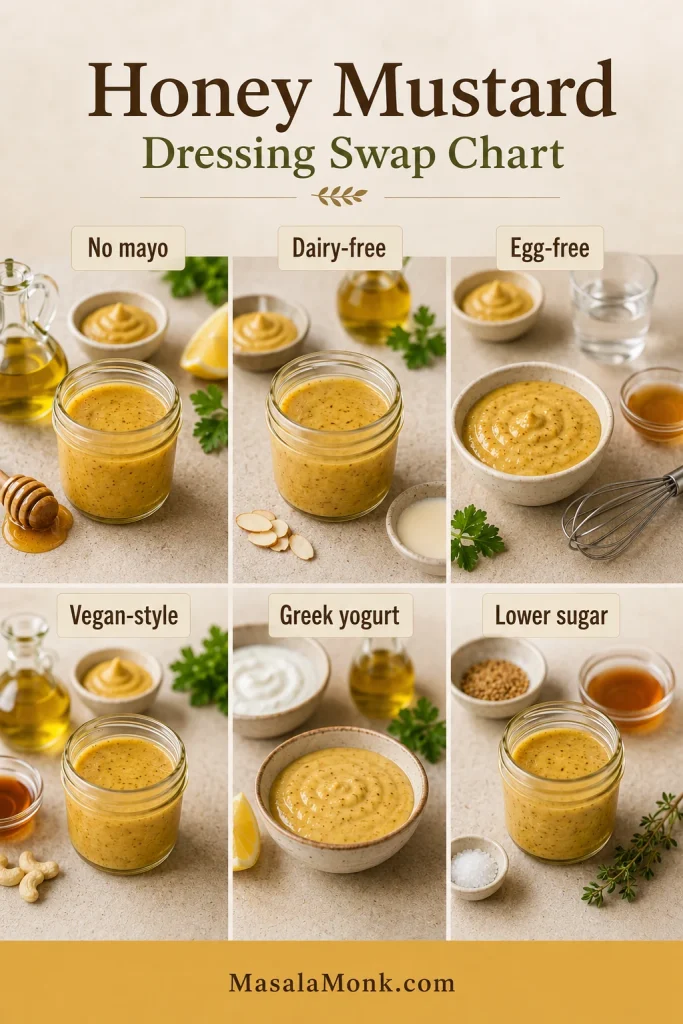
Begin with the no-mayo dressing when you want something lighter, then adjust from there. The same basic jar can become dairy-free, egg-free, lower-sugar, lower-oil, or creamy with Greek yogurt.

Honey mustard dressing swap chart showing no mayo, dairy-free, egg-free, vegan-style, Greek yogurt, and lower sugar options.
Once the no-mayo honey mustard base is balanced, it becomes easy to steer the recipe toward dairy-free, egg-free, vegan-style, Greek yogurt, or lower-sugar versions.
  • No mayo: use the Dijon, honey, vinegar, and oil base.
  • Dairy-free: the main no-mayo dressing is dairy-free as written.
  • Lighter creamy dressing: use Greek yogurt instead of mayo.
  • Egg-free: avoid regular mayo or use eggless mayonnaise.
  • Vegan-style: honey is not vegan, so use maple syrup or agave instead.
  • Lightened-up: reduce some oil and honey, then loosen the dressing with vinegar, lemon juice, or water so it still drizzles well.
  • Lower sugar: use less honey, then add a little extra mustard and acid so the dressing still tastes complete.

Do not remove all the sweetness unless you are replacing it with something else. Mustard and vinegar need a little sweetness to taste rounded instead of harsh.

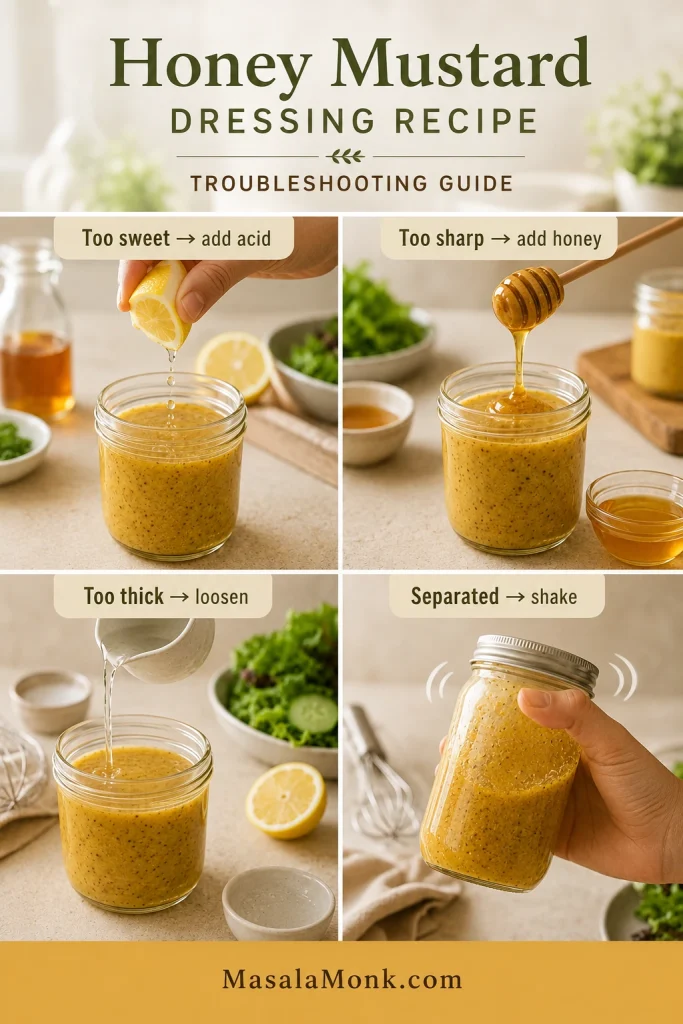
How to Fix Honey Mustard Dressing

This dressing is easy to fix because nothing is cooked. Taste it, change one thing, then taste again. Most batches need one small adjustment, not a fresh start.

Troubleshooting guide showing lemon added to too-sweet dressing, honey added to too-sharp dressing, liquid added to too-thick dressing, and a jar shaken for separated dressing.
Most honey mustard dressing problems need one small fix: add acid if it is too sweet, honey if it is too sharp, liquid if it is too thick, or shake if it separates.
ProblemWhat to Do
Overly sweetAdd vinegar or lemon juice, 1 teaspoon at a time.
Sharp or sourAdd honey, mayo, or Greek yogurt.
Too thickAdd water, vinegar, lemon juice, or oil, 1 teaspoon at a time.
Runny or thinAdd Dijon mustard, mayo, Greek yogurt, or a little more honey.
Mustard-heavyAdd honey or a creamy base.
Oily-tastingAdd more Dijon and a splash of vinegar or lemon juice.
Flat flavorAdd a pinch of salt first, then adjust acid if needed.
Separated dressingShake hard in a jar or whisk again.
Firm olive oilLet the jar sit for 10–15 minutes, then shake.

Unsure what is missing? Add salt first. A tiny pinch often makes the honey, mustard, and vinegar taste like one dressing instead of three separate ingredients.

Once the flavor is balanced, see what to serve it with or how to store it.

What to Serve with Honey Mustard Dressing

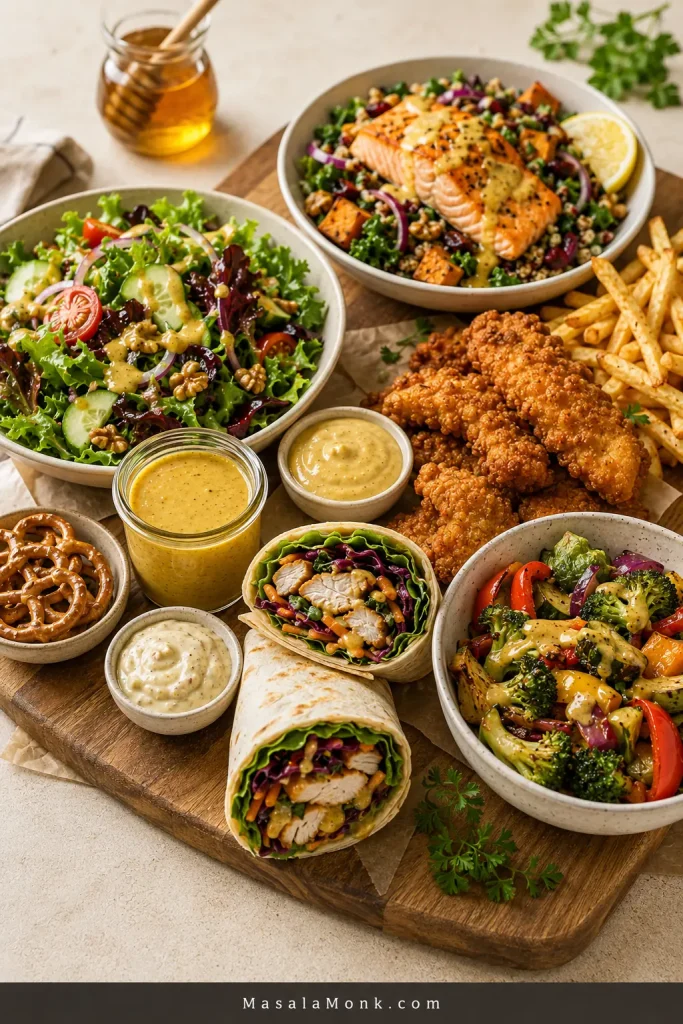
Think of this as the jar you pull out when dinner is already cooked but the plate still needs a little lift. The salad-style dressing is bright and pourable, while the creamy sauce works better as a dip.

Serving board with honey mustard dressing, green salad, salmon bowl, fries, cooked crispy chicken tenders, roasted vegetables, wraps, pretzels, and dipping sauces.
One batch can work across the whole meal: drizzle no-mayo honey mustard dressing over salads and bowls, then use the creamy version for fries, chicken, wraps, and pretzels.
  • Green salads with lettuce, spinach, arugula, kale, or cabbage
  • Grain bowls with rice, quinoa, roasted vegetables, or grilled chicken
  • Chicken tenders, nuggets, grilled chicken, or chicken wraps
  • Salmon, shrimp, or simple seafood bowls
  • Ham, turkey sandwiches, burgers, and wraps
  • Roasted potatoes, carrots, broccoli, Brussels sprouts, or sweet potatoes
  • Fries, pretzels, and snack plates when you make the creamy dip
  • Slaws and pasta salads when you want something sweet and tangy

At dinner, spoon it over sliced baked chicken breast when the plate needs a quick lift. The creamy sauce belongs in wraps, burgers, and chicken sandwich recipes, where a loose vinaigrette would disappear.

In bowls, drizzle it over rice, greens, cucumbers, roasted vegetables, or a simple salmon bowl. Delicate greens work best with the no-mayo dressing. Hearty salads with cabbage, kale, apples, nuts, or roasted vegetables are especially good with the vinaigrette.

How to Store Homemade Honey Mustard Dressing

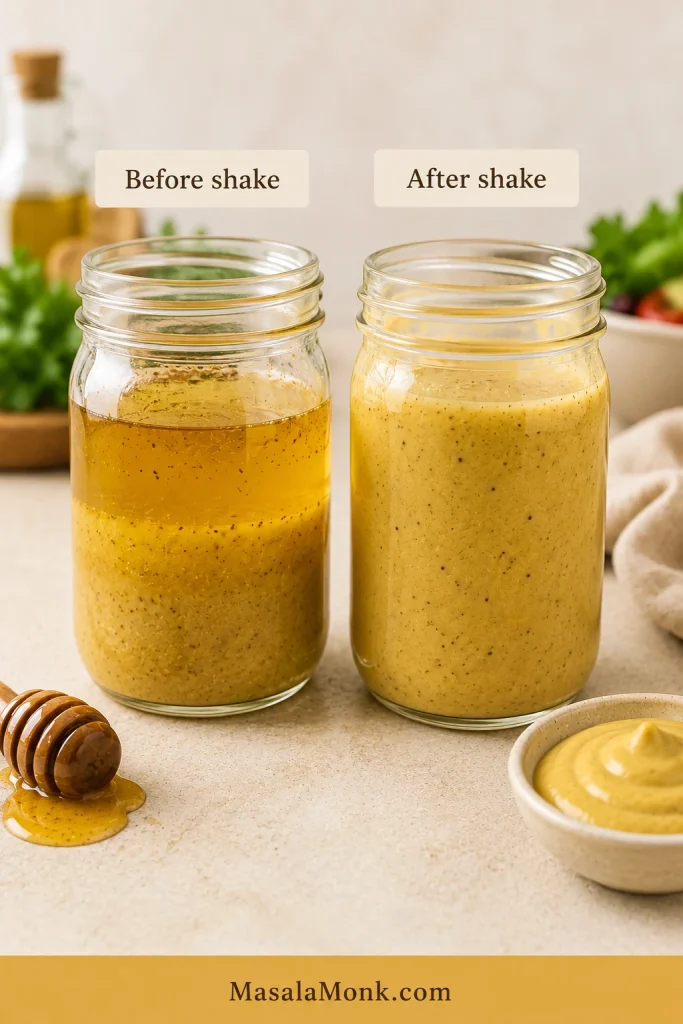
Keep the dressing in a clean airtight jar in the fridge. It may look a little separated the next day. That is normal; it just needs a shake.

Storage cue: If the dressing separates after chilling, it is usually normal oil-and-vinegar separation, not a failed batch.

Two jars of honey mustard dressing labeled before shake and after shake, with separated dressing on the left and smooth dressing on the right.
Finally, separated dressing is not ruined; once the chilled oil and mustard base loosen slightly, a firm shake brings the jar back to a smooth, glossy texture.
StyleBest Storage TimeNotes
No-mayo dressing7–10 daysShake before using.
Creamy mayo sauce5–7 daysKeep refrigerated and use a clean spoon.
Greek yogurt dressing5–7 days or by yogurt expiryMay thicken as it sits.
VinaigretteAbout 1 weekOlive oil may firm up in the fridge.

Do not freeze creamy honey mustard dressing. Mayo and yogurt can split after thawing. The no-mayo dressing is so quick that it is better to make a fresh batch when you need it.

Back to the top ↑

FAQs About Honey Mustard Dressing

Does honey mustard dressing have mayo?

Not always. Salad-style honey mustard dressing is often made without mayo using mustard, honey, vinegar or lemon juice, and oil. Creamy honey mustard sauce usually adds mayo or Greek yogurt.

How do I make honey mustard dressing without mayo?

Use Dijon mustard, honey, vinegar or lemon juice, olive oil, salt, and pepper. It will be lighter and more pourable than a mayo-based sauce, which makes it better for salads, slaws, roasted vegetables, and grain bowls.

What is honey mustard dressing made of?

Honey mustard dressing is usually made with mustard, honey, vinegar or lemon juice, oil, salt, and pepper. Creamy sauces add mayonnaise or Greek yogurt. A simple 4-ingredient batch uses Dijon mustard, honey, vinegar or lemon juice, and olive oil.

Is honey mustard dressing dairy-free?

The main no-mayo dressing is dairy-free as written because it uses mustard, honey, vinegar or lemon juice, and oil. Greek yogurt dressing is not dairy-free unless you use a dairy-free yogurt.

Can I use maple syrup instead of honey?

Yes. Maple syrup or agave can replace honey if you want a vegan-style mustard dressing. Start with the same amount, then taste and adjust because maple syrup tastes different from honey.

Is honey mustard dressing the same as honey mustard sauce?

They overlap, but texture is the difference. Dressing is usually thinner and pourable for salads. Sauce is thicker and often contains mayo or yogurt, so it works better as a dip or sandwich spread.

Dijon or yellow mustard: which one works better?

Dijon gives a cleaner, more balanced dressing. Yellow mustard tastes brighter and sweeter, which is why it works well in creamy dipping sauces. A mix of Dijon and yellow mustard is a good choice for sandwich-style honey mustard.

What can I use instead of vinegar?

Lemon juice is the easiest substitute. It gives the dressing a fresh, lifted flavor. Apple cider vinegar gives it a deeper tang, and a mix of both works well.

How long does homemade honey mustard dressing last?

The no-mayo dressing is best within 7–10 days in the fridge. Mayo and Greek yogurt sauces are best within 5–7 days. Store everything in a clean airtight jar and shake before using.

Why did my dressing separate?

Oil and vinegar naturally separate over time. Shake the dressing hard in a jar or whisk it again before serving. For a smoother texture, whisk the oil in slowly or blend the dressing briefly.

How do I make it creamy?

Whisk in mayonnaise for a classic dipping sauce, or Greek yogurt for a tangier, lighter version. Thin with lemon juice, vinegar, or water when you want it pourable.

Can honey mustard dressing be used as a marinade?

Yes, the no-mayo dressing can work as a quick marinade for chicken, salmon, pork, or vegetables. Avoid mayo or yogurt sauces for marinating. Do not reuse marinade that has touched raw meat unless it has been boiled thoroughly. Cook poultry to a safe minimum internal temperature of 165°F / 74°C. For dipping, make a separate fresh batch.

A Five-Minute Dressing You Can Use All Week

Once you make this once, you stop needing the bottle. The base is simple enough for a weekday salad, but flexible enough to become a dip, sauce, or vinaigrette depending on what is on the plate.

Keep it pourable for greens, make it creamy for dipping, or add a little extra acid when a bowl needs lift. After a batch or two, you will know when it needs more honey, more vinegar, a pinch of salt, or just a good shake.

Back to the top ↑